More info:
E25845
Revised Edition V2 / January 2025

2
COPYRIGHT INFORMATION
LIMITATION OF LIABILITY
No part of this manual, including the products and software described in it, may be reproduced,
transmitted, transcribed, stored in a retrieval system, or translated into any language in any form
or by any means, except documentation kept by the purchaser for backup purposes, without the
express written permission of ASUSTeK COMPUTER INC. (“ASUS”).
ASUS PROVIDES THIS MANUAL “AS IS” WITHOUT WARRANTY OF ANY KIND, EITHER EXPRESS
OR IMPLIED, INCLUDING BUT NOT LIMITED TO THE IMPLIED WARRANTIES OR CONDITIONS OF
MERCHANTABILITY OR FITNESS FOR A PARTICULAR PURPOSE. IN NO EVENT SHALL ASUS,
ITS DIRECTORS, OFFICERS, EMPLOYEES OR AGENTS BE LIABLE FOR ANY INDIRECT, SPECIAL,
INCIDENTAL, OR CONSEQUENTIAL DAMAGES (INCLUDING DAMAGES FOR LOSS OF PROFITS,
LOSS OF BUSINESS, LOSS OF USE OR DATA, INTERRUPTION OF BUSINESS AND THE LIKE), EVEN
IF ASUS HAS BEEN ADVISED OF THE POSSIBILITY OF SUCH DAMAGES ARISING FROM ANY
DEFECT OR ERROR IN THIS MANUAL OR PRODUCT.
Products and corporate names appearing in this manual may or may not be registered trademarks
or copyrights of their respective companies, and are used only for identification or explanation and
to the owners’ benefit, without intent to infringe.
SPECIFICATIONS AND INFORMATION CONTAINED IN THIS MANUAL ARE FURNISHED FOR
INFORMATIONAL USE ONLY, AND ARE SUBJECT TO CHANGE AT ANY TIME WITHOUT NOTICE,
AND SHOULD NOT BE CONSTRUED AS A COMMITMENT BY ASUS. ASUS ASSUMES NO
RESPONSIBILITY OR LIABILITY FOR ANY ERRORS OR INACCURACIES THAT MAY APPEAR IN THIS
MANUAL, INCLUDING THE PRODUCTS AND SOFTWARE DESCRIBED IN IT.
Copyright © 2025 ASUSTeK COMPUTER INC. All Rights Reserved.
Circumstances may arise where because of a default on ASUS’ part or other liability, you are
entitled to recover damages from ASUS. In each such instance, regardless of the basis on which
you are entitled to claim damages from ASUS, ASUS is liable for no more than damages for bodily
injury (including death) and damage to real property and tangible personal property; or any other
actual and direct damages resulted from omission or failure of performing legal duties under this
Warranty Statement, up to the listed contract price of each product.
ASUS will only be responsible for or indemnify you for loss, damages or claims based in contract,
tort or infringement under this Warranty Statement.
This limit also applies to ASUS’ suppliers and its reseller. It is the maximum for which ASUS, its
suppliers, and your reseller are collectively responsible.
UNDER NO CIRCUMSTANCES IS ASUS LIABLE FOR ANY OF THE FOLLOWING: (1) THIRD-PARTY
CLAIMS AGAINST YOU FOR DAMAGES; (2) LOSS OF, OR DAMAGE TO, YOUR RECORDS OR DATA;
OR (3) SPECIAL, INCIDENTAL, OR INDIRECT DAMAGES OR FOR ANY ECONOMIC CONSEQUENTIAL
DAMAGES (INCLUDING LOST PROFITS OR SAVINGS), EVEN IF ASUS, ITS SUPPLIERS OR YOUR
RESELLER IS INFORMED OF THEIR POSSIBILITY.
SERVICE AND SUPPORT
Visit our multi-language website at https://www.asus.com/support/.
MyASUS offers a variety of support features including troubleshooting, products performance
optimization, ASUS software integration, and helps you to organize personal desktop and increase
storage space. For more details, please visit https://www.asus.com/support/FAQ/1038301/.

3
Table of Contents
About this manual .............................................................................7
Conventions used in this manual ..........................................................8
Icons .......................................................................................................8
Typography .............................................................................................8
Safety precautions.............................................................................9
Using your Notebook PC .......................................................................9
Caring for your Notebook PC ................................................................10
Proper disposal ......................................................................................11
Battery safety information .....................................................................12
Chapter 1: Hardware Setup
Getting to know your Notebook PC .................................................. 16
Front View...............................................................................................16
Rear View ................................................................................................16
Top View ................................................................................................. 20
Bottom View ........................................................................................... 21
Right View ...............................................................................................22
Left View .................................................................................................24
Detachable keyboard .........................................................................28
Chapter 2: Using your Notebook PC
Getting started ................................................................................... 32
Attach the tablet to the keyboard ..........................................................32
Charge your Notebook PC ..................................................................... 33
Press the power button .........................................................................36
Gestures for the touch screen panel and touchpad ........................ 37
Using touch screen panel gestures ......................................................37
Using the touchpad ................................................................................ 39
Using the keyboard ............................................................................46
Function keys .........................................................................................46
Hotkeys ................................................................................................... 46
Windows keys ........................................................................................48

4
Chapter 3: Working with Windows
Starting for the first time ................................................................... 50
Start menu ......................................................................................... 51
Windows apps ...................................................................................53
Working with Windows apps ................................................................. 54
Customizing Windows apps ..................................................................54
Task view ........................................................................................... 57
Widgets .............................................................................................. 58
Snap feature .......................................................................................60
Snap hotspots ........................................................................................ 60
Action Center ..................................................................................... 62
GameVisual ........................................................................................64
Setting the OLED display ...................................................................66
Setting the Dark Mode ........................................................................... 66
Turning off the display when not in use ...............................................68
Adjusting display brightness ................................................................. 70
Auto-hide the taskbar ............................................................................72
Setting the Dark Mode in Microsoft Office ...........................................74
Other keyboard shortcuts .................................................................75
Connecting to wireless networks .....................................................77
Wi-Fi ........................................................................................................77
Bluetooth ................................................................................................78
Airplane mode ........................................................................................ 79
Turning your Notebook PC off .......................................................... 80
Putting your Notebook PC to sleep ..................................................81
Putting your Notebook PC into the lowest power mode .................82

5
Chapter 4: Power-On Self-Test (POST)
The Power-On Self-Test (POST) ....................................................... 84
Using POST to access BIOS and Troubleshoot ....................................84
BIOS .................................................................................................... 84
Accessing BIOS ......................................................................................84
Recovering your system ....................................................................85
Performing a recovery option ................................................................86
Tips and FAQs
Useful tips for your Notebook PC .....................................................90
Hardware FAQs .................................................................................. 92
Software FAQs ................................................................................... 95
Appendices
Legal information ..............................................................................98
USB-IF Trademark ..................................................................................98
Regulatory statements ......................................................................99
Federal Communications Commission Interference Statement ........99
FCC RF Exposure Information ............................................................... 100
FCC RF Caution Statement ....................................................................100
FCC 5.925-7.125 GHz Caution Statement ............................................ 100
ISED 5.925-7.125 GHz Caution Statement ........................................... 100
Radio Frequency (RF) Exposure Information .......................................101
Informations concernant l'exposition aux fréquences radio (RF) .......101
Caution ...................................................................................................101
Mise en garde .........................................................................................101
Compliance Statement of Innovation, Science and Economic
Development Canada (ISED) ................................................................. 102
Déclaration de conformité de Innovation, Sciences et
Développement économique Canada (ISED) ....................................... 102

6
UL Safety Notices
..................................................................................103
Power Safety Requirement .................................................................... 104
TV Notices .............................................................................................. 104
Macrovision Corporation Product Notice ............................................. 104
Prevention of Hearing Loss ................................................................... 104
USB PD Fast Charging ...........................................................................104
Nordic Lithium Cautions (for lithium-ion batteries) ............................. 105
Declaration of Compliance for Product Environmental Regulation .... 106
EU REACH and Article 33 ......................................................................106
EU RoHS .................................................................................................106
Japan JIS-C-0950 Material Declarations .............................................. 106
India RoHS .............................................................................................. 106
Coating Notice .......................................................................................107
ASUS Recycling/Takeback Services ..................................................... 107
Rechargeable Battery Recycling Service in North America.................107
Vietnam RoHS ........................................................................................ 107
Regional notice for Singapore ............................................................... 107
Ecodesign Directive ...............................................................................108
ENERGY STAR
®
Qualified Product ........................................................108
EPEAT Registered Products ..................................................................109
Notices for removable batteries ...........................................................109
Avis concernant les batteries remplaçables ........................................ 109
Wi-Fi Network Notice ............................................................................. 109
Simplified EU Declaration of Conformity .............................................. 110
Simplified UKCA Declaration of Conformity .........................................110

7
About this manual
This manual provides information about the hardware and software
features of your Notebook PC, organized through the following
chapters:
Chapter 1: Hardware Setup
This chapter details the hardware components of your
Notebook PC.
Chapter 2: Using your Notebook PC
This chapter shows you how to use the different parts of your
Notebook PC.
Chapter 3: Working with Windows
This chapter provides an overview of using Windows in your
Notebook PC.
Chapter 4: Power-On Self-Test (POST)
This chapter shows you how to use POST to change the
settings of your Notebook PC.
Tips and FAQs
This section presents some recommended tips, hardware
FAQs, and software FAQs you can refer to for maintaining and
fixing common issues with your Notebook PC.
Appendices
This section includes notices and safety statements for your
Notebook PC.
8
Conventions used in this manual
To highlight key information in this manual, some text are presented
as follows:
IMPORTANT! This message contains vital information that must be
followed to complete a task.
NOTE: This message contains additional information and tips that
can help complete tasks.
WARNING! This message contains important information that must
be followed to keep you safe while performing tasks and prevent
damage to your Notebook PC's data and components.
Typography
Bold = This indicates a menu or an item that must be selected.
Italic
= This indicates sections that you can refer to in this
manual.
= Use the touch screen panel.
= Use the touchpad.
= Use the keyboard.
Icons
The icons below indicate the devices you can use for completing a
series of tasks or procedures on your Notebook PC.
9
Safety precautions
Using your Notebook PC
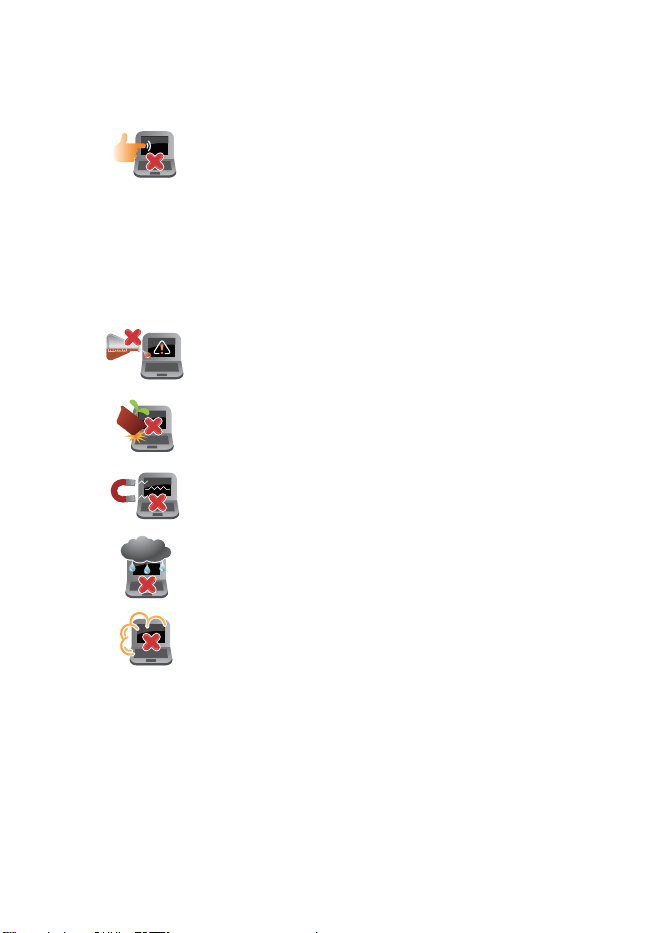
This Notebook PC should only be used in
environments with ambient temperatures
between 5°C (41°F) and 35°C (95°F).
Refer to the rating label on the bottom of your
Notebook PC and ensure that your power
adapter complies with this rating.
Your Notebook PC can get warm to hot while in
use or while charging the battery pack. Do not
leave your Notebook PC on your lap or near any
part of your body to prevent injury from heat.
When working on your Notebook PC, do not
place it on surfaces that can block the vents.
Do not use damaged power cords, accessories,
and other peripherals with your Notebook PC.
While powered on, ensure that you do not carry
or cover your Notebook PC with any materials
that can reduce air circulation.
Do not place your Notebook PC on uneven or
unstable work surfaces.
You can send your Notebook PC through x-ray
machines (used on items placed on conveyor
belts), but do not expose them to magnetic
detectors and wands.
Contact your airline provider to learn about
related in-flight services that can be used and
restrictions that must be followed when using
your Notebook PC in flight.
10
Caring for your Notebook PC
Disconnect the AC power and remove the
battery pack (if applicable) before cleaning your
Notebook PC. Use a clean cellulose sponge
or chamois cloth dampened with warm water.
Remove any extra moisture from your Notebook
PC using a dry cloth. Keep any liquids from
entering the chassis or keyboard gap to prevent
short circuit or corrosion.
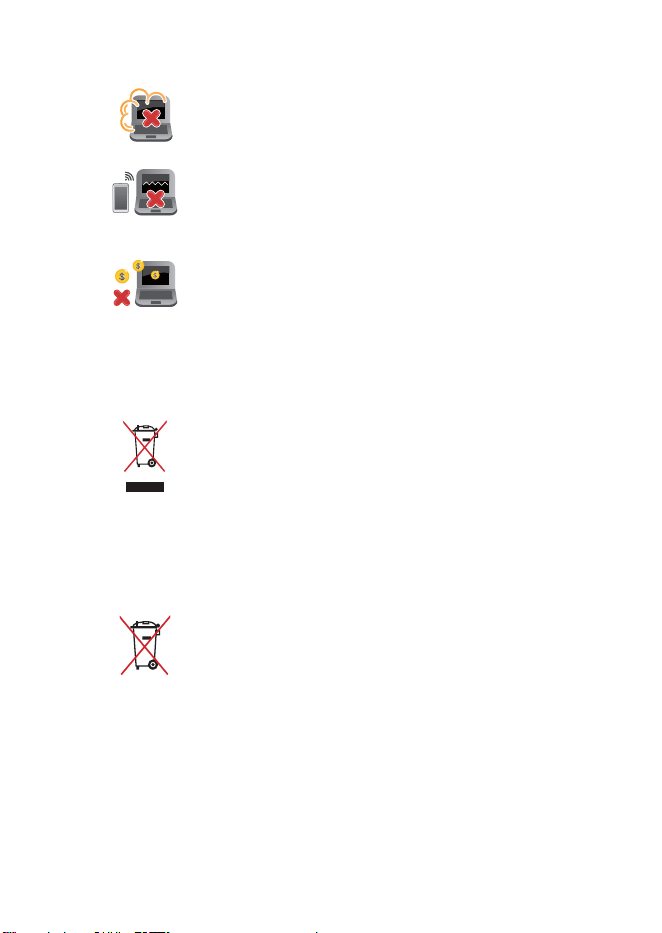
Do not use strong solvents such as alcohol,
thinners, benzene, or other chemicals on or near
your Notebook PC.
Do not place objects on top of your Notebook
PC.
Do not expose your Notebook PC to strong
magnetic or electrical fields.
Do not use or expose your Notebook PC near
liquids, rain, or moisture.
Do not expose your Notebook PC to dusty
environments.
11
Proper disposal
Do not throw your Notebook PC in municipal
waste. This product has been designed to enable
proper reuse of parts and recycling. The symbol
of the crossed out wheeled bin indicates that
the product (electrical, electronic equipment and
mercury-containing button cell battery) should
not be placed in municipal waste. Check local
regulations for disposal of electronic products.
Do not throw the battery in municipal waste.
The symbol of the crossed out wheeled bin
indicates that the battery should not be placed in
municipal waste.
Do not use your Notebook PC near gas leaks.
Do not place active electronic devices close
to your Notebook PC to avoid electromagnetic
wave interference to the display panel.
Do not use this Notebook PC for cryptocurrency
mining (consuming a vast amount of electricity
and time to gain convertible virtual currency)
and/or related activities.

12
Battery protection
• Frequently charging a battery under high voltage may shorten
the battery life. To protect the battery, once the battery is fully
charged, the system may stop charging when the battery
power is between 90% and 100%.
NOTE: The level at which the battery resumes charging is usually set
between 90% and 99%. The actual value may vary by model.
• Charging or storing a battery in high ambient temperatures
may result in permanent damage to the battery power
capacity and rapidly shorten battery life. If the battery
temperature is too high, the system may reduce the battery
power charging capacity or even stop charging to protect the
battery.
• Battery power capacity may drop even when your device is
powered off and disconnected from the AC power. This is
normal as the system still draws a small amount of power
from the battery.
Battery safety information

13
Standard battery care
• If you are not using your device for a long period of time,
ensure to charge the battery power to 50%, then power off
your device and disconnect the AC power adapter. Recharge
the battery power to 50% every three months to avoid over-
discharging and prevent damage to the battery.
• Avoid charging the battery at high voltage for a prolonged
period of time to extend the battery life. If you are constantly
using AC power for your device, ensure to discharge the
battery power to 50% at least once every two weeks. You
can also adjust the settings from Battery Health Charging in
MyASUS to help extend the battery life.
• It is recommended to store your battery at temperatures
between 5°C (41°F) and 35°C (95°F) with the battery power
at 50%. You can also adjust the settings from Battery Health
Charging in MyASUS to help extend the battery life.
• Do not leave your battery in damp environments. Exposure
to damp environments may increase the battery over-
discharging rate. Low temperature environment may damage
the chemicals inside the battery while high temperature or
overheating may result in a risk of explosion.
• Do not place your device or battery pack near radiators,
fireplaces, furnaces, heaters, or any sources of heat with
temperature exceeding 60°C (140°F). High temperature
surrounding environment may result in an explosion or
leakage that may cause fire.

14

15
Chapter 1:
Hardware Setup
16
Getting to know your Notebook PC
Front View
Rear View

17
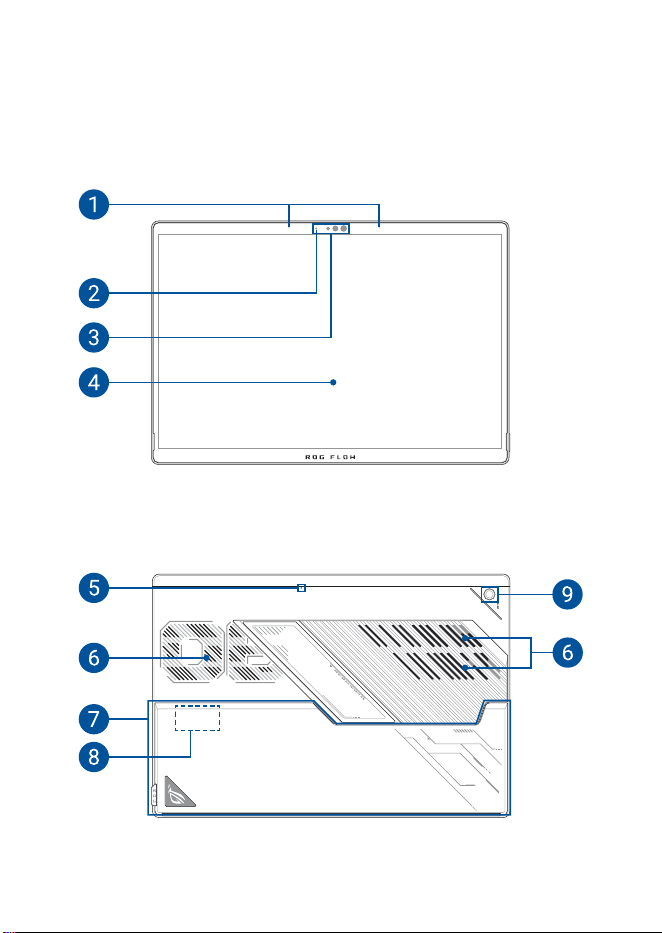
Array microphones
The array microphones feature echo canceling, noise
suppression, and beam forming functions for better voice
recognition and audio recording.
Camera indicator
The camera indicator lights up when the built-in camera is in
use.
NOTE: The indicator does not light up for the rear camera.
Camera
The built-in camera allows you to take pictures or record
videos using your Notebook PC.
IR Camera
The built-in IR camera captures infrared images for facial
recognition and supports Windows Hello.
NOTE: The red IR LED blinks in the process while data is being
read before you sign in with Windows Hello facial recognition.

18
Touch screen panel
This high-definition touch screen panel provides excellent
viewing features for photos, videos, and other multimedia
files on your Notebook PC. It also allows you to operate it
using touch screen gestures.
NOTE: For more details, refer to the Using touch screen panel
gestures section in this manual.
Microphone
The built-in microphone can be used for video conferencing,
voice narrations, or simple audio recording.
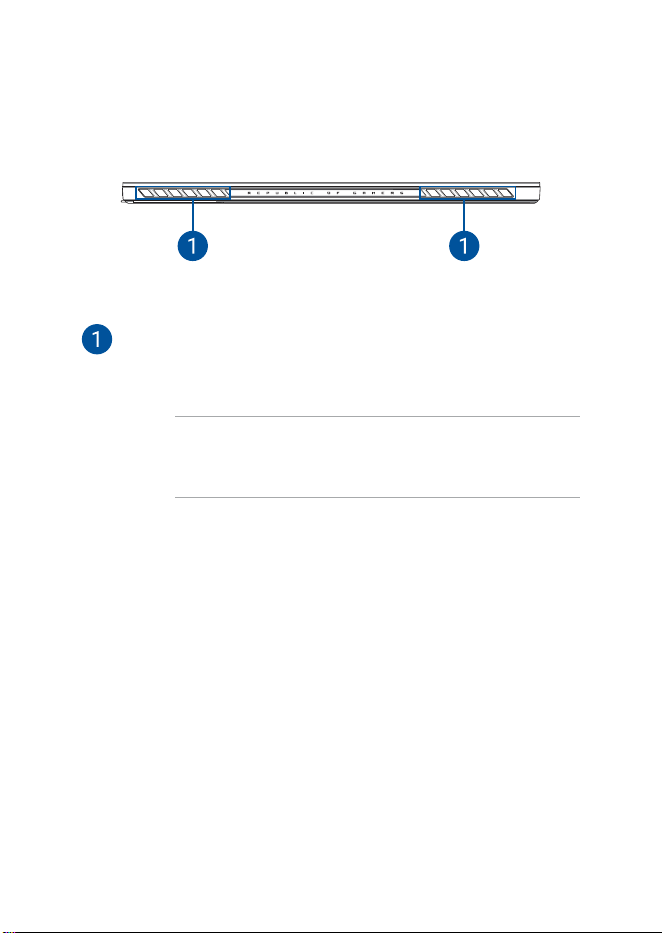
Air vents
The air vents allow cool air to enter or warm air to exit the
Notebook PC.
WARNING! Ensure that paper, books, clothing, cables, or other
objects do not block any of the air vents or else overheating
may occur.

19
Kickstand
The built-in kickstand allows you to prop up your Notebook
PC and adjust viewing angle.
Compartment cover
This cover protects the reserved spaces in your Notebook
PC for the removable SSD (M.2 2230 slot) module.
NOTE:
• For more details, refer to the Upgrade Guide on our multi-
language website at https://www.asus.com/support/.
• The M.2 2230 slot does not support M.2 SATA SSD.
Camera
The built-in camera allows you to take pictures or record
videos using your Notebook PC.
20
Top View
Air vents
The air vents allow cool air to enter or warm air to exit the
Notebook PC.
WARNING! Ensure that paper, books, clothing, cables, or other
objects do not block any of the air vents or else overheating
may occur.
21
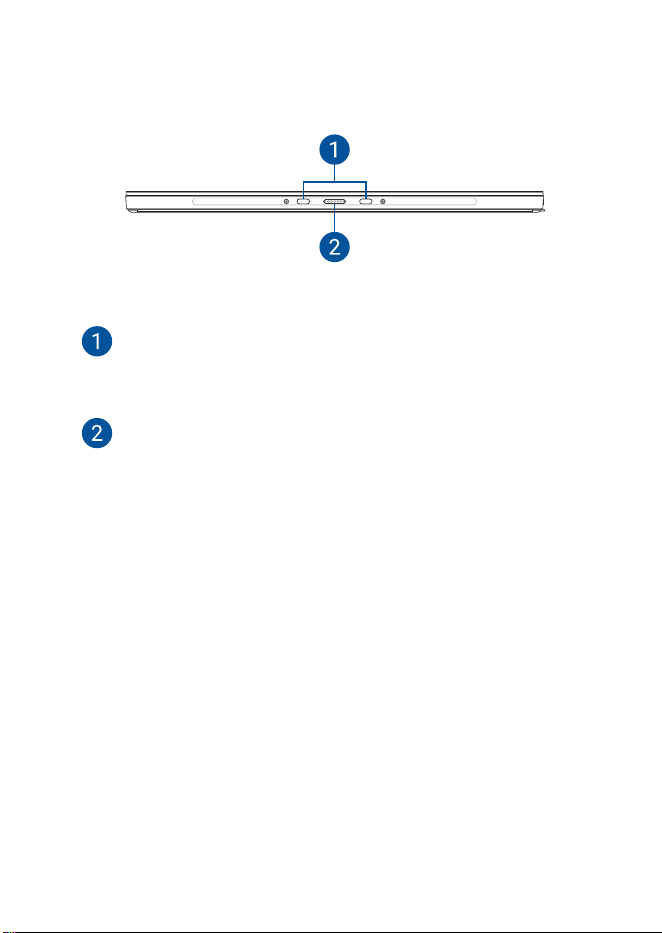
Bottom View
Hinge holes
Align and insert the latch hooks into these holes to securely
attach your device to the keyboard.
Docking port
Connect your device to this port to support keyboard and
touchpad functions.
22
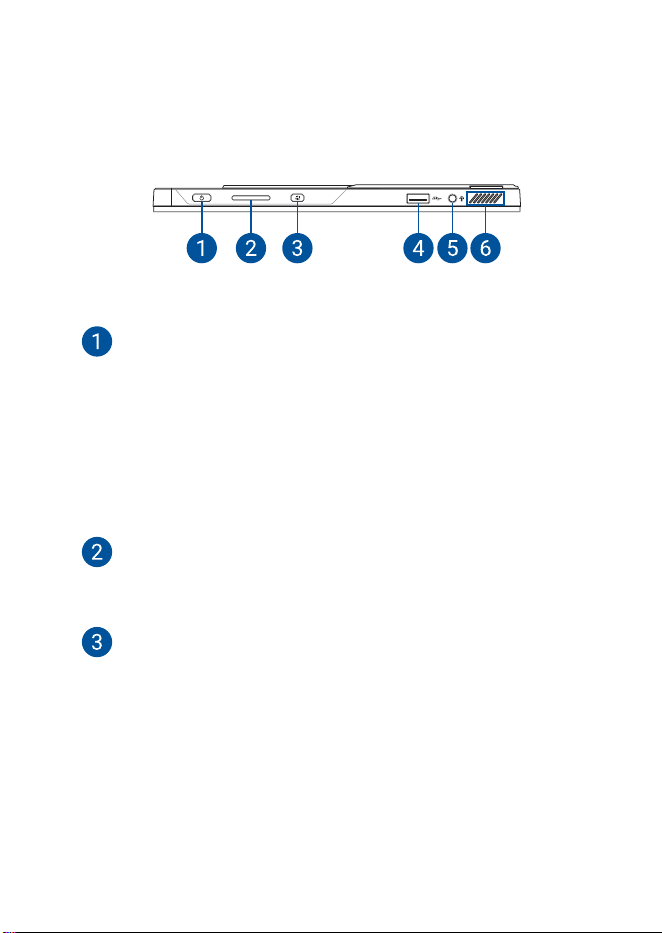
Right View
Power button
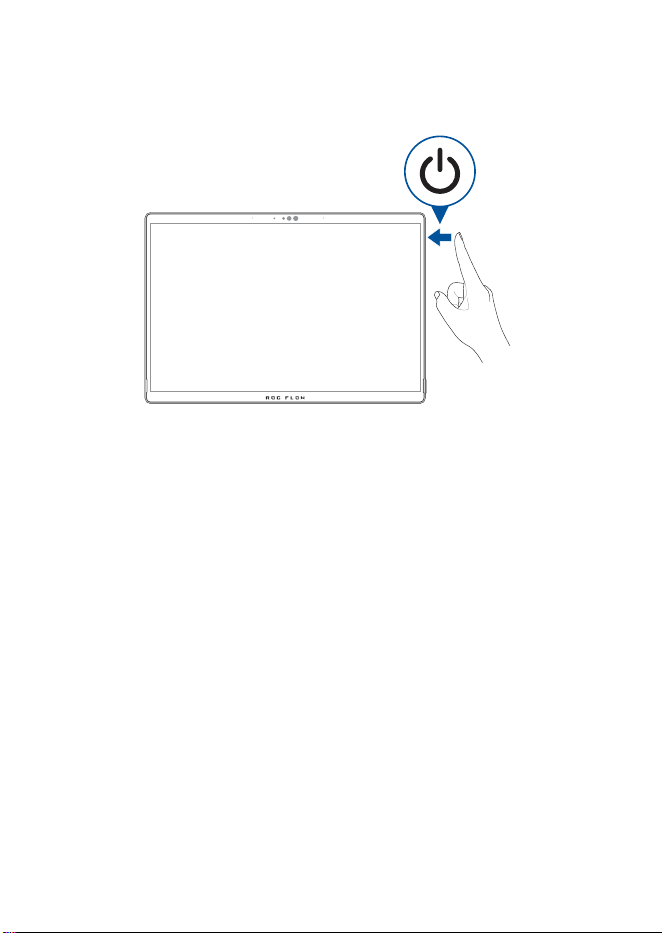
Press the power button to turn your Notebook PC on or off.
You can also use the power button to put your Notebook
PC to sleep or hibernate mode and wake it up from sleep or
hibernate mode.
In the event that your Notebook PC becomes unresponsive,
press and hold the power button for at least ten (10)
seconds until your Notebook PC shuts down.
Volume button
This button turns the volume up or down on your Notebook
PC.
Command Center button
Press this button to quickly access the Armoury Crate app
and other frequently used features.

23
USB 3.2 Gen 2 port
The USB 3.2 (Universal Serial Bus 3.2) Gen 2 port provides a
transfer rate of up to 10 Gbit/s and is backward compatible
to USB 2.0.
Headphone/Headset/Microphone jack
This port allows you to connect amplified speakers or
headphones. You can also use this port to connect your
headset or an external microphone.
Audio speakers
The built-in audio speakers allow you to hear audio straight
from your Notebook PC. Audio features are software-
controlled.
24
Left View
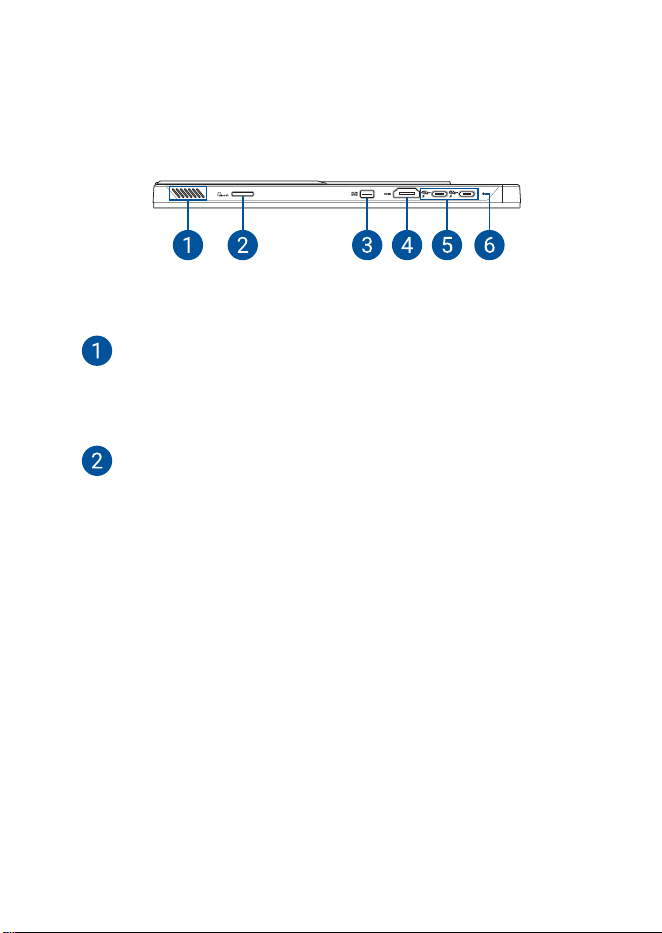
Audio speakers
The built-in audio speakers allow you to hear audio straight
from your Notebook PC. Audio features are software-
controlled.
microSD card slot
This built-in memory card reader slot supports microSD card
formats.

25
Power (DC) input port
Insert the bundled power adapter into this port to charge the
battery pack and supply power to your Notebook PC.
WARNING! The adapter may become warm to hot while in
use. Do not cover the adapter and keep it away from your
body while it is connected to a power source.
IMPORTANT! Use only the bundled power adapter to charge
the battery pack and supply power to your Notebook PC.
HDMI output port
This port allows you to send audio and video signals from
your Notebook PC to an HDMI-compatible device using an
HDMI cable.

26
USB4
®
/Power Delivery combo port
The USB4
®
(Universal Serial Bus 4) port provides a transfer
rate of up to 40 Gbit/s and is backward compatible to USB
2.0. Use a USB Type-C
®
adapter to connect your Notebook
PC to an external display. Connect a power source rated
20V/5A to charge the battery pack and supply power to your
Notebook PC.
NOTE: Transfer rate of this port may vary per model.
WARNING! The adapter may become warm to hot while in
use. Do not cover the adapter and keep it away from your
body while it is connected to a power source.
IMPORTANT!
• It may take longer to fully charge your Notebook PC
through a low-voltage power source.
• To prevent any damage, use only power sources rated
20V/5A to charge your Notebook PC with the USB Power
Delivery combo port. For more information, consult an
ASUS service center for assistance.

27
Two-color battery charge indicator
The two-color LED provides a visual indication of the
battery’s charge status. Refer to the following table for
details:
Color Status
Solid White The Notebook PC is plugged
to a power source and the
battery power is 100%.
Solid Orange The Notebook PC is plugged
to a power source, charging its
battery, and the battery power
is between 0% and 99%.
Blinking Orange The Notebook PC is running
on battery mode and the
battery power is less than
10%.
Lights off The Notebook PC is running
on battery mode and the
battery power is between 10%
to 100%.
28
Latch hooks
The latch hooks allow you to securely attach the device to
the keyboard.
Docking connector
Securely attach the device to the keyboard by aligning the
dock port on top of this connector.
Detachable keyboard
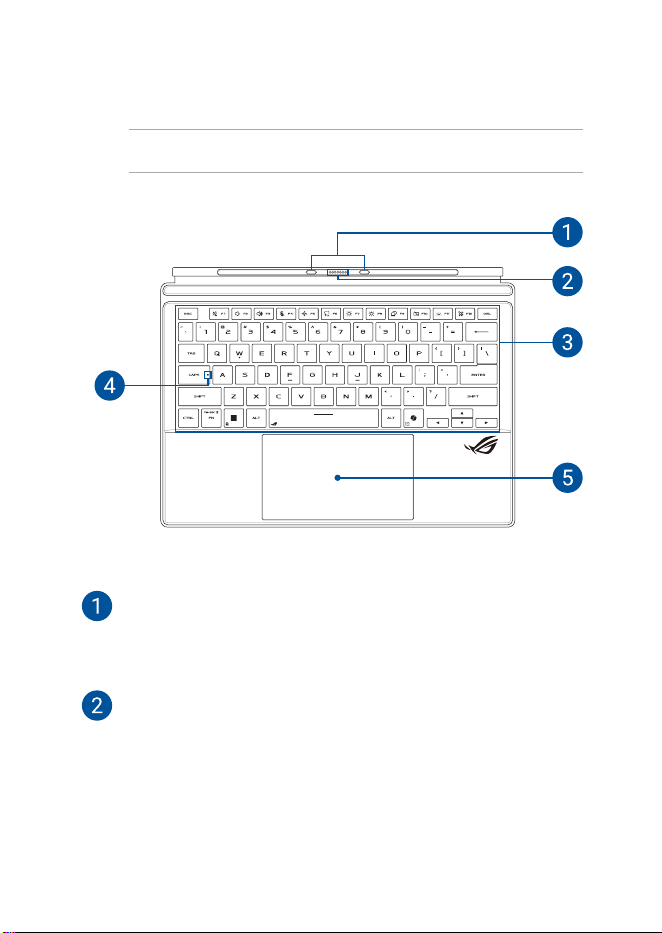
NOTE: The keyboard's layout may vary per region or country.

29
Keyboard
The keyboard provides full-sized QWERTY keys with a
comfortable travel depth for typing. It also enables you to
use the function keys, allows quick access to Windows, and
controls other multimedia functions.
NOTE: The keyboard layout differs by model or territory.
Capital lock indicator
This indicator lights up when the capital lock function is
activated. Using capital lock allows you to type capitalized
letters (such as A, B, C) using your Notebook PC’s keyboard.
Touchpad
The touchpad allows the use of multi-gestures to navigate
onscreen, providing an intuitive user experience. It also
simulates the functions of a regular mouse.
NOTE: For more details, refer to the Using the touchpad
section in this manual.

30

31
Chapter 2:
Using your Notebook PC
32
Getting started
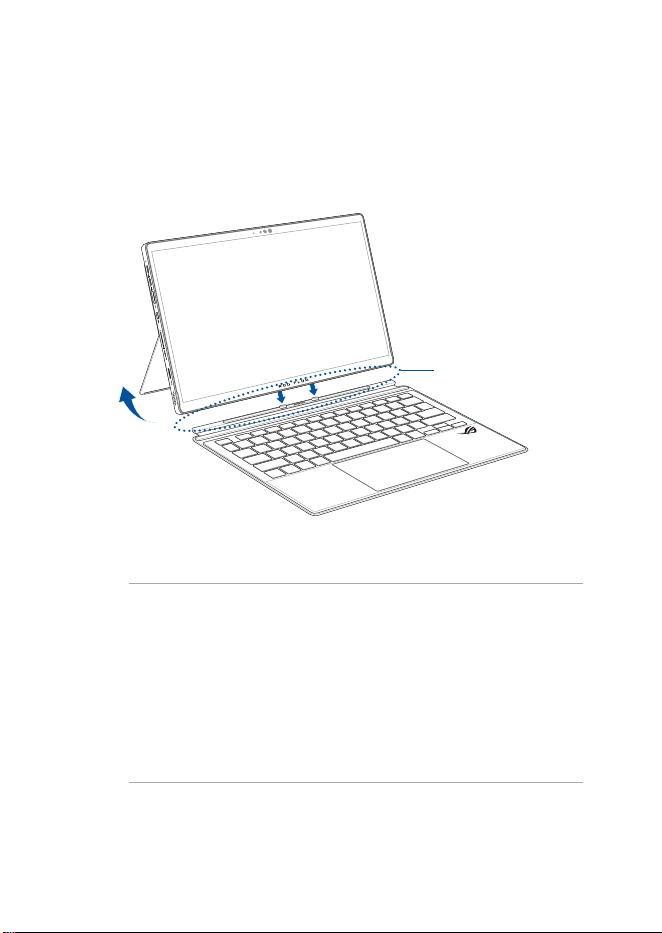
Attach the tablet to the keyboard
Magnetic attachment
WARNING!
• Ensure your device and keyboard are attached in the orientation
shown above. Incorrect orientation may cause damage to the
device and the keyboard.
• The device, keyboard and cover stand come with magnetic
attachments. Keep the magnetic attachment away from external
storage drives and cards with magnetic strips to prevent
demagnetization.
33
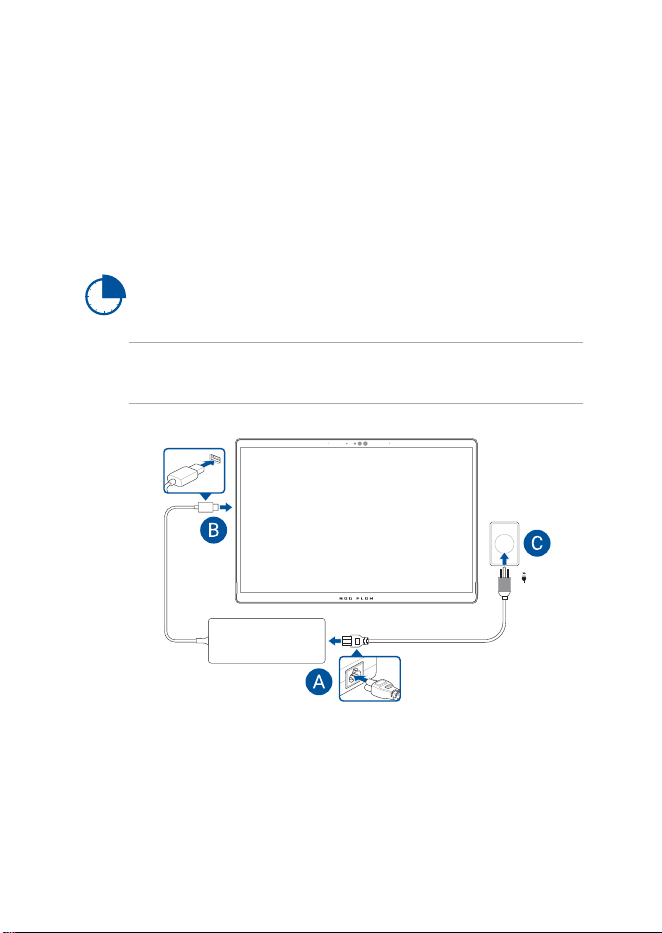
Charge the Notebook PC for 3 hours before using it
in battery mode for the first time.
NOTE: The power adapter may vary in appearance, depending on
model and your region.
Charge your Notebook PC
A. Connect the AC power cord to the AC/DC adapter.
B. Connect the DC power connector into your Notebook PC’s
power (DC) input port.
C. Plug the AC power adapter into a 100V~240V power source.

34
IMPORTANT!
AC/DC power adapter information:
• Input voltage: 100-240Vac
• Input frequency: 50-60Hz
• Rating output current: 10A (200W)
• Rating output voltage: 20V
USB Power Delivery power adapter* information:
• Input voltage: 100-240Vac
• Input frequency: 50-60Hz
• Rating output current: 5A (100W)
• Rating output voltage: 20V
* On selected models

35
IMPORTANT!
• Locate the input/output rating label on your Notebook PC and
ensure that it matches the input/output rating information on
your power adapter. Some Notebook PC models may have
multiple rating output currents based on the available SKU.
• Ensure that your Notebook PC is connected to the power adapter
before turning it on for the first time. Always plug the power
cord into a wall socket without using any extension cords. For
your safety, connect this device to a properly grounded electrical
outlet only.
• The socket outlet must be easily accessible and near your
Notebook PC.
• To disconnect your Notebook PC from its main power supply,
unplug your Notebook PC from the power socket.
WARNING!
Read the following precautions for your Notebook PC’s battery:
• Only ASUS-authorized technicians should remove the battery
inside the device (for non-removable battery only).
• The battery used in this device may present a risk of fire or
chemical burn if removed or disassembled.
• Follow the warning labels for your personal safety.
• Risk of explosion if battery is replaced by an incorrect type.
• Do not dispose of in fire.
• Never attempt to short-circuit your Notebook PC’s battery.
• Never attempt to disassemble and reassemble the battery
(for non-removable battery only).
• Discontinue usage if leakage is found.
• The battery and its components must be recycled or disposed of
properly.
• Keep the battery and other small components away from
children.
36
Press the power button
37
Gestures for the touch screen panel and
touchpad
Gestures allow you to launch programs and access the settings of
your Notebook PC. Refer to the following illustrations when using
hand gestures on your touch screen panel and touchpad.
NOTE: The following screenshots are for reference only. The touch
screen panel’s appearance may vary depending on model.
Using touch screen panel gestures
The gestures allow you to launch programs and access the settings
of your Notebook PC. The functions can be activated by using the
hand gestures on your Notebook PC’s touch screen panel.
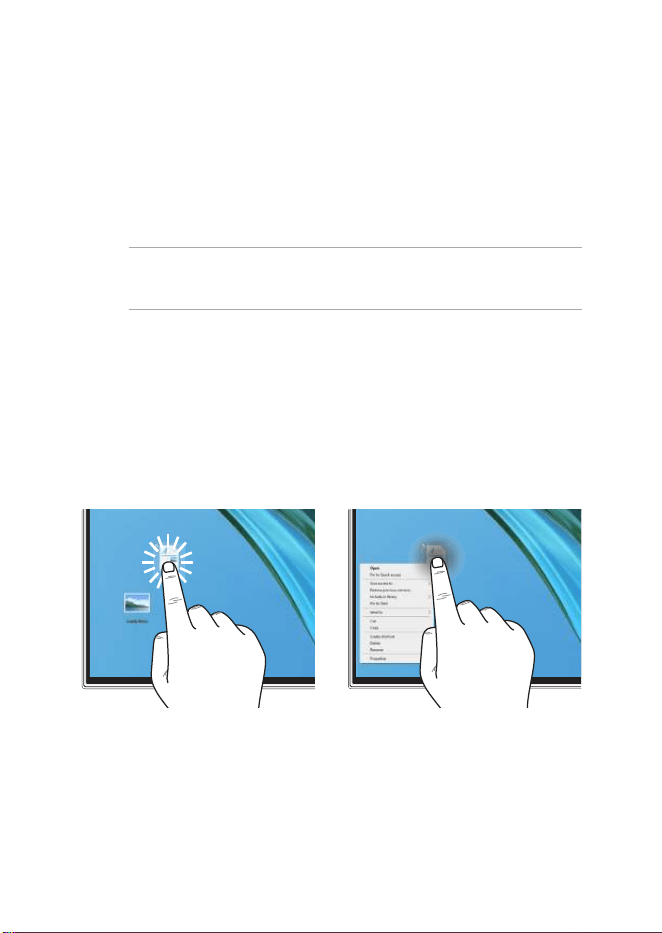
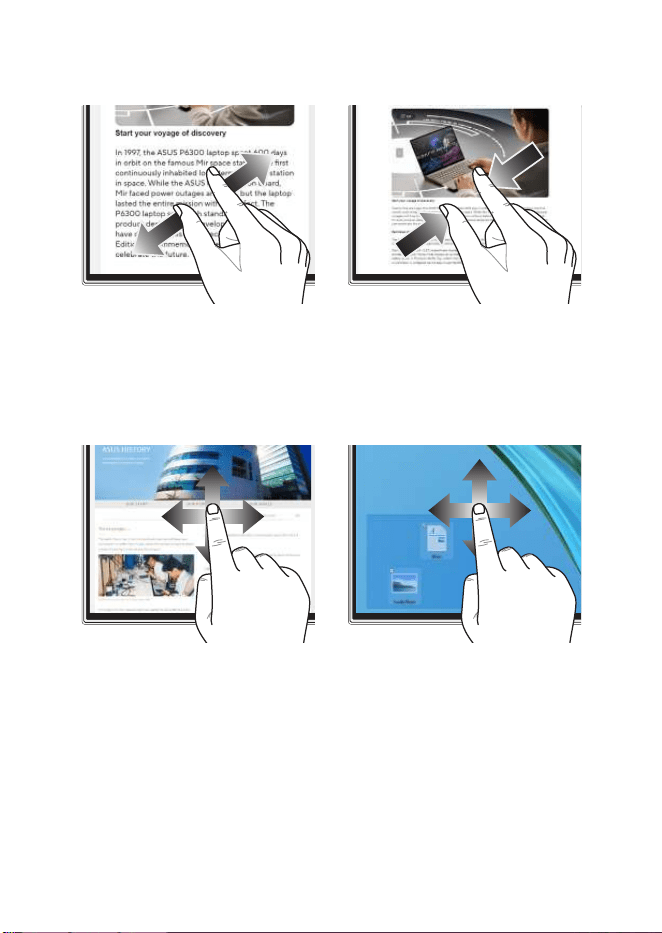
Tap/Double-tap Press and hold
• Tap an app to select it.
• Double-tap an app to
launch it.
Press and hold to open the
right-click menu.
38
Zoom in Zoom out
Spread apart your two fingers
on the touch screen panel.
Bring together your two fingers
on the touch screen panel.
Finger slide Drag
Slide your finger to scroll up and
down and slide your finger to
pan the screen left or right.
• Drag to create a
selection box around
multiple items.
• Drag and drop an item
to move it to a new
location.
39
Using the touchpad
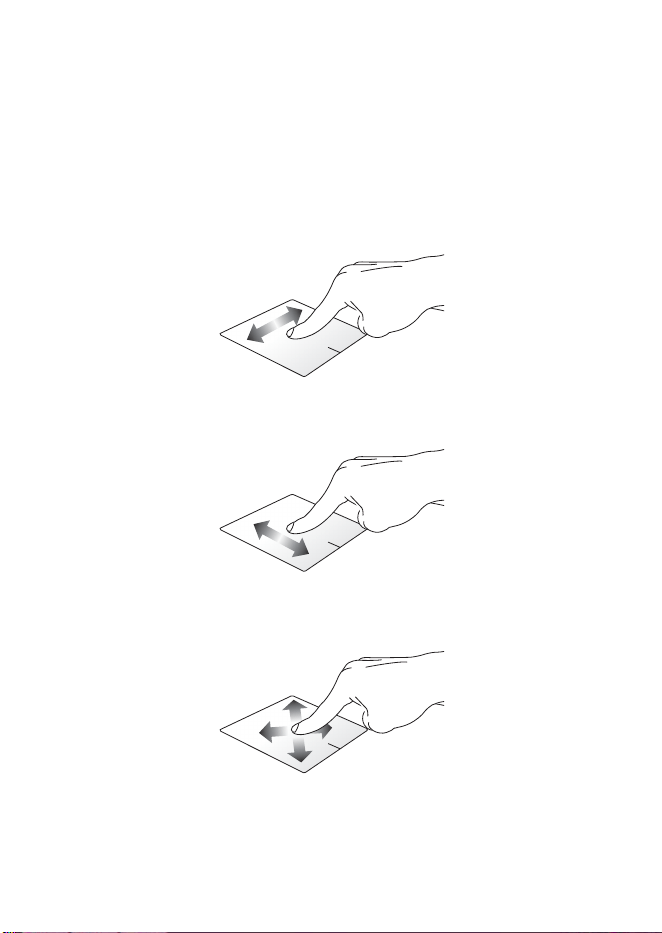
Moving the pointer
You can tap anywhere on the touchpad to activate its pointer, then
slide your finger on the touchpad to move the pointer onscreen.
Slide horizontally
Slide vertically
Slide diagonally
40
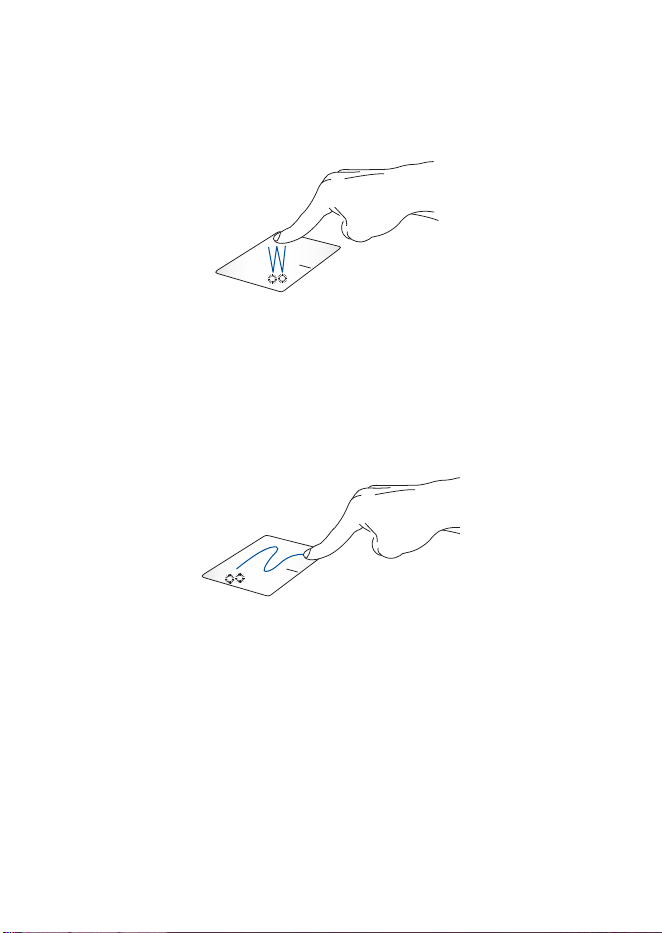
One-finger gestures
Tap/Double-tap
• Tap an app to select it.
• Double-tap an app to launch it.
Drag and drop
Double-tap an item, then slide the same finger without lifting it off
the touchpad. To drop the item to its new location, lift your finger
from the touchpad.
41
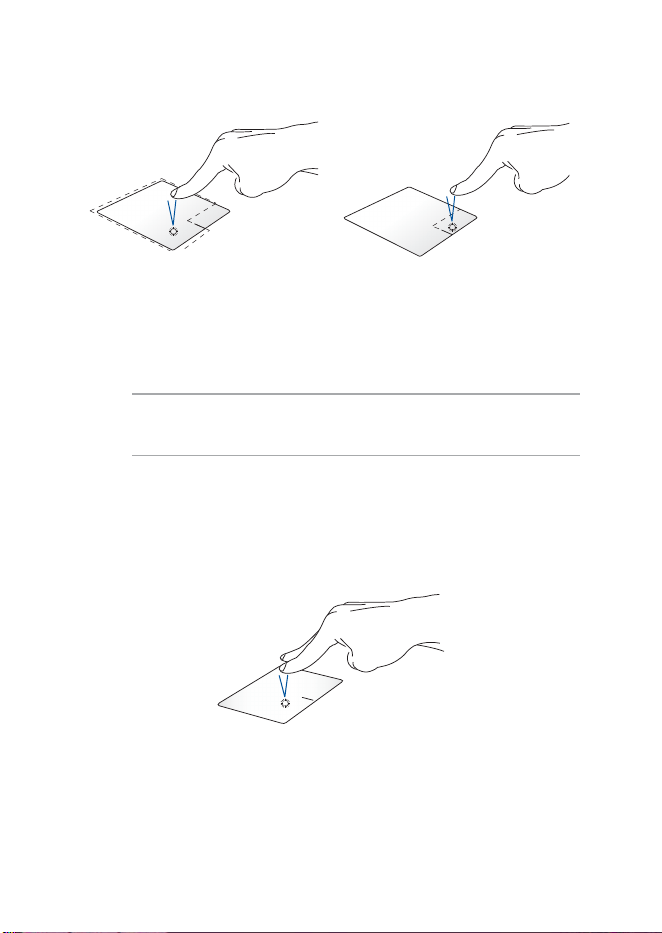
Left-click Right-click
• Click an app to select it.
• Double-click an app to
launch it.
Click this button to open the
right-click menu.
NOTE: The areas inside the dotted line represent the locations of the
left mouse button and the right mouse button on the touchpad.
Two-finger gestures
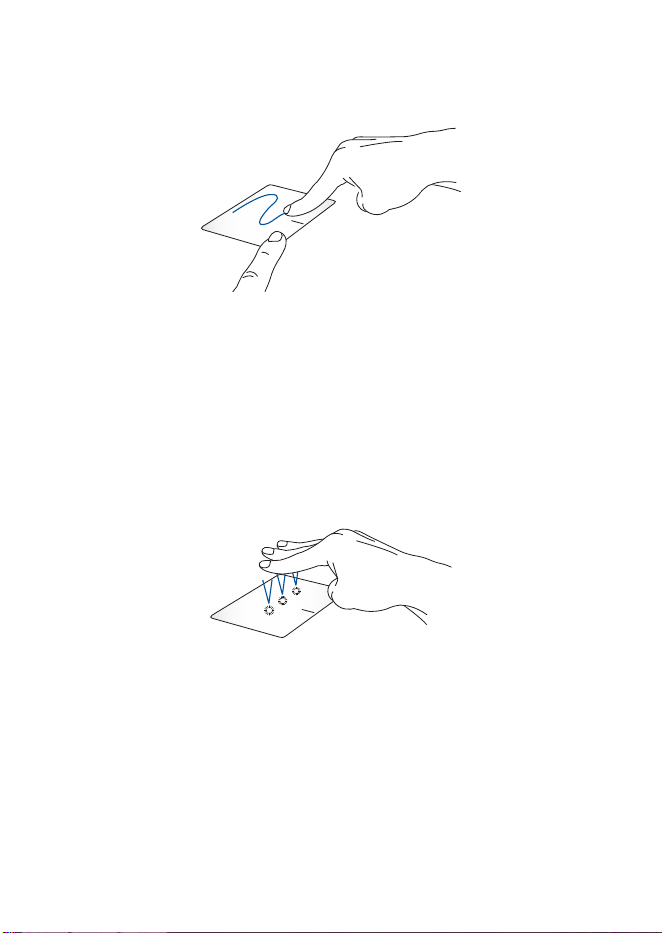
Tap
Tap two fingers on the touchpad to simulate the right-click
function.
42
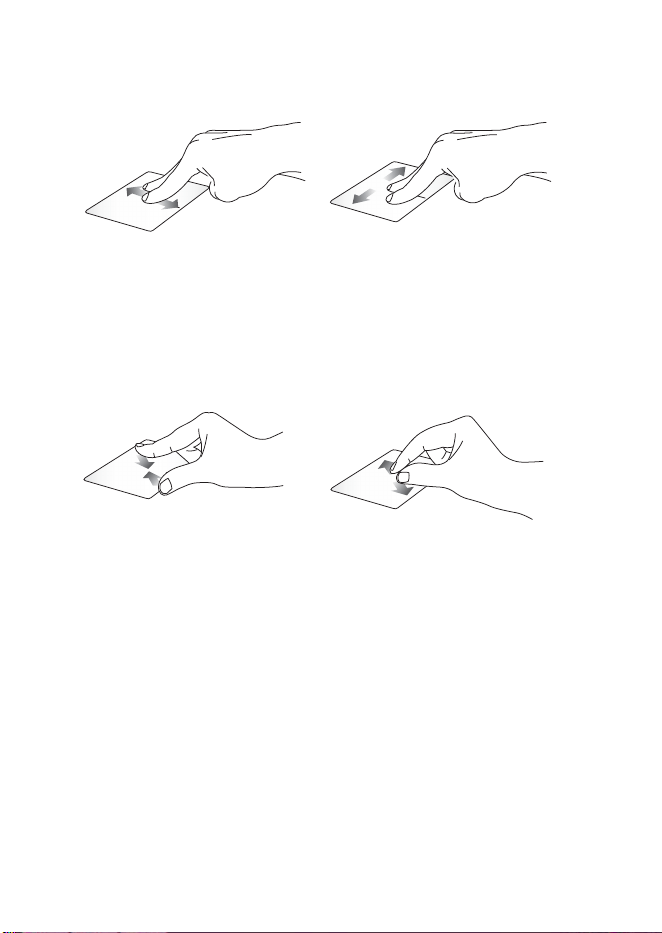
Two-finger scroll (up/down) Two-finger scroll (left/right)
Slide two fingers to scroll up or
down.
Slide two fingers to scroll left or
right.
Zoom out Zoom in
Bring together your two fingers
on the touchpad.
Spread apart your two fingers on
the touchpad.
43
Drag and drop
Select an item, then press and hold the left button. Using your
other finger, slide on the touchpad to drag the item, lift your finger
off the button to drop the item.
Three-finger gestures
Tap
Tap three fingers on the touchpad to launch the function you
selected in Settings.
44
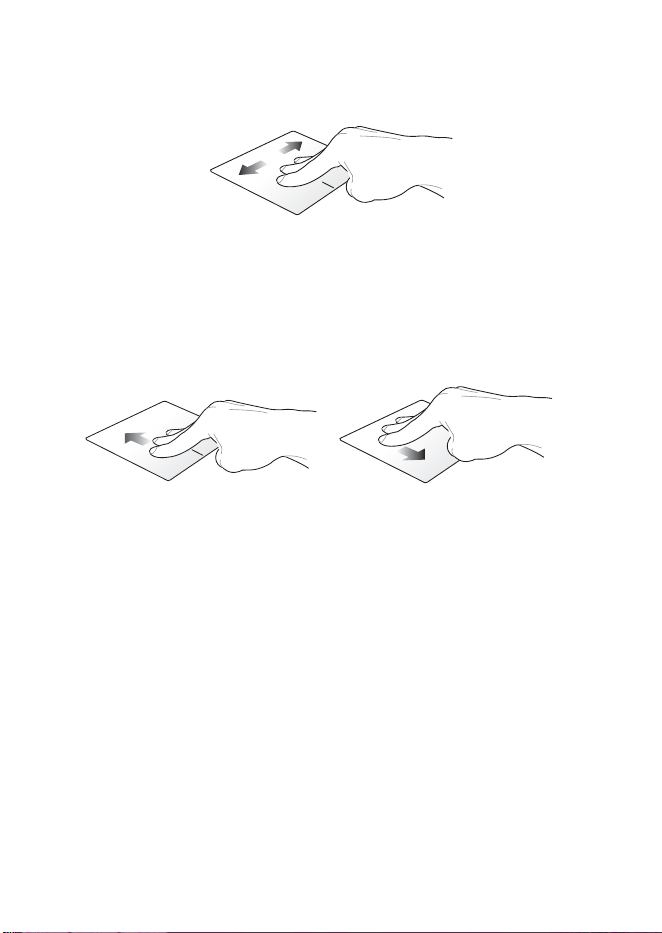
Swipe left/Swipe right
If you opened multiple apps, swipe three fingers left or right to
switch between these apps.
Swipe up Swipe down
Swipe up to see an overview of
all the apps currently opened.
Swipe down to show the
desktop.
45
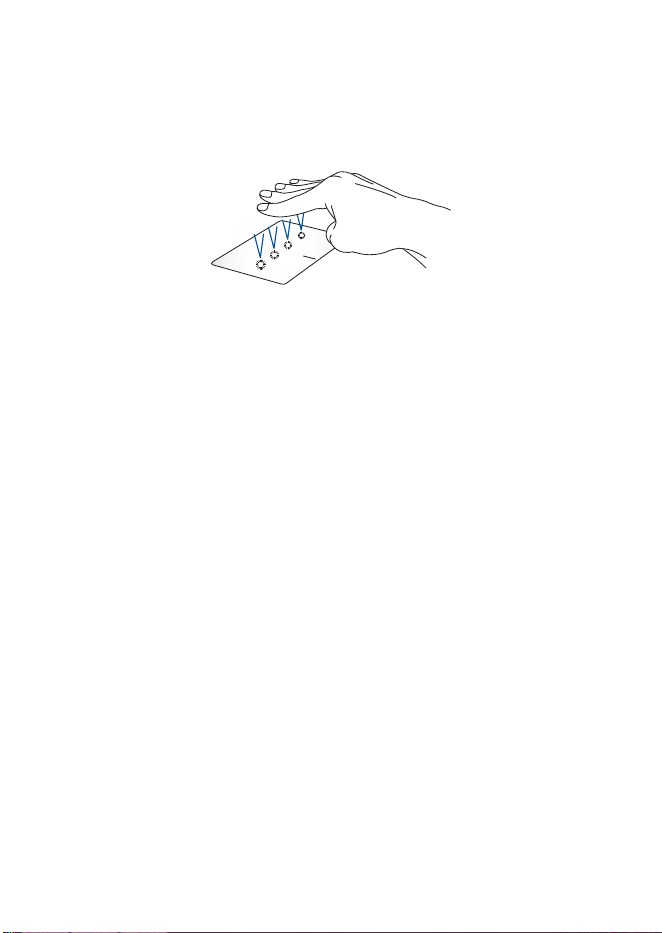
Four-finger gestures
Tap
Tap four fingers on the touchpad to launch the function you
selected in Settings.
46
Using the keyboard
Hotkeys
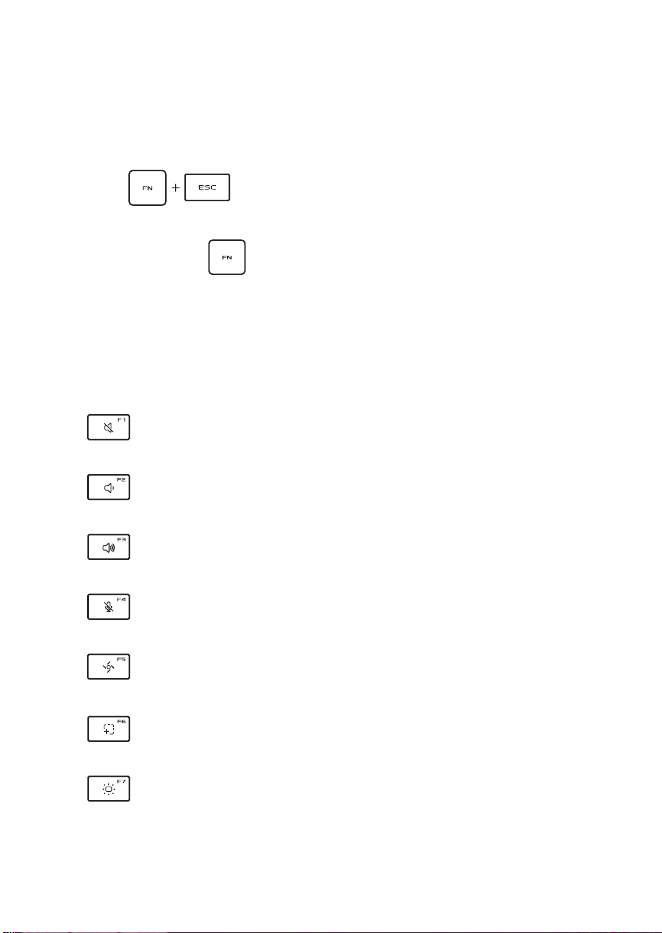
The hotkeys on your Notebook PC’s keyboard can trigger the
following commands:
Turns the speaker on or off
Turns the speaker volume down
Turns the speaker volume up
Turns the microphone on or off
Toggles the fan mode
Activates screen capture tool
Decreases display brightness
Function keys
Press to enable or disable the function keys (F1-F12).
When the function keys are enabled, you can also access hotkeys
by holding down
in combination with the function keys.
47
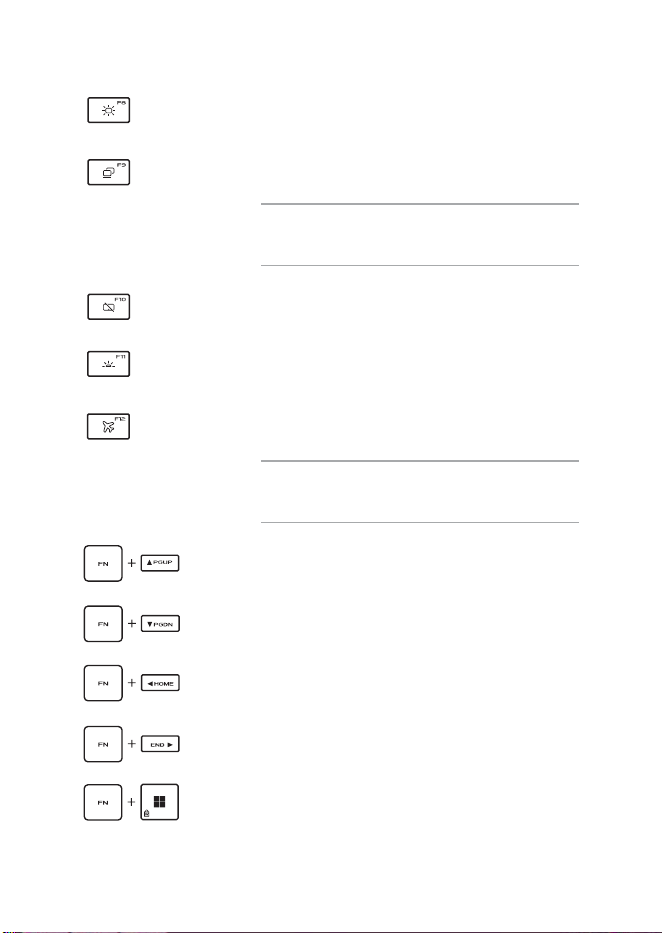
Increases display brightness
Toggles the display mode
NOTE: Ensure that the second display is
connected to your Notebook PC.
Enables or disables the touchpad
Adjusts brightness for the backlit keyboard
Turns Airplane mode on or off
NOTE: When enabled, the Airplane mode
disables all wireless connectivity.
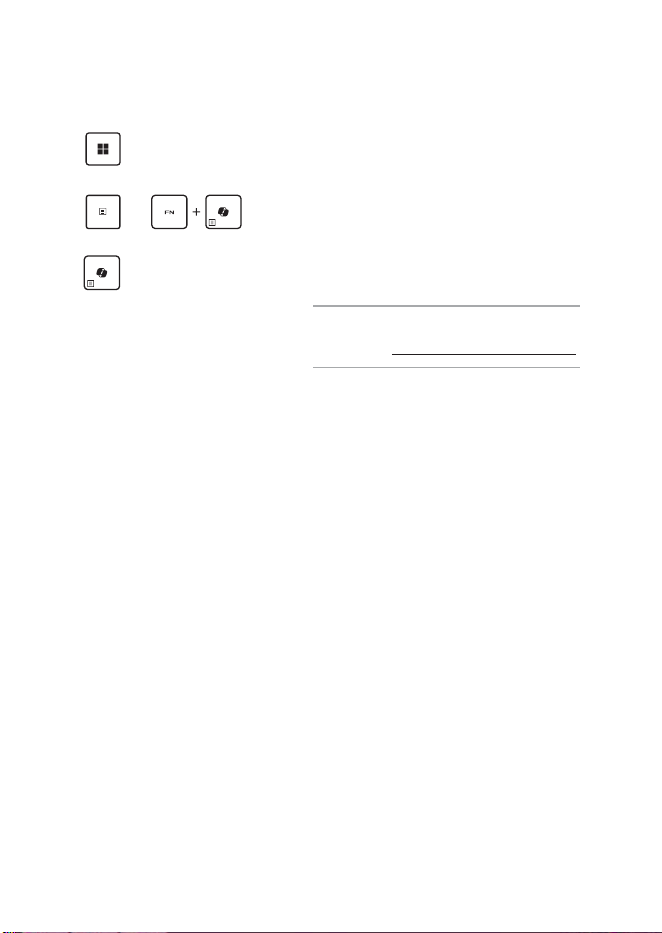
Simulates the page up key
Simulates the page down key
Simulates the home key
Simulates the end key
Enables or disables the Windows key lock

49
Chapter 3:
Working with Windows

50
Starting for the first time
When you start your Notebook PC for the first time, a series of
screens appear to guide you in configuring your Windows operating
system.
To start your Notebook PC for the first time:
1. Press the power button on your Notebook PC. Wait for a few
minutes until the setup screen appears.
2. From the setup screen, pick your region and a language to
use on your Notebook PC.
3. Carefully read the License Agreement. Select Accept.
4. Follow the onscreen instructions to configure the following
basic items:
• Personalize
• Get online
• Settings
• Your account
5. After configuring the basic items, Windows proceeds to
install your apps and preferred settings. Ensure that your
Notebook PC is kept powered on during the setup process.
6. Once the setup process is complete, the Desktop appears.
NOTE: The screenshots in this chapter are for reference only.
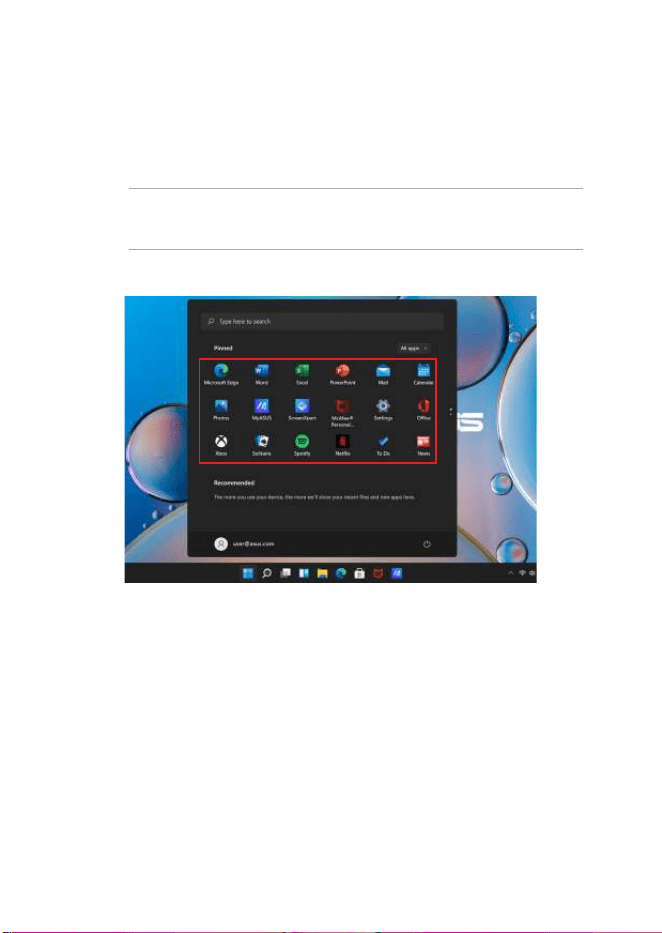
51
Start menu
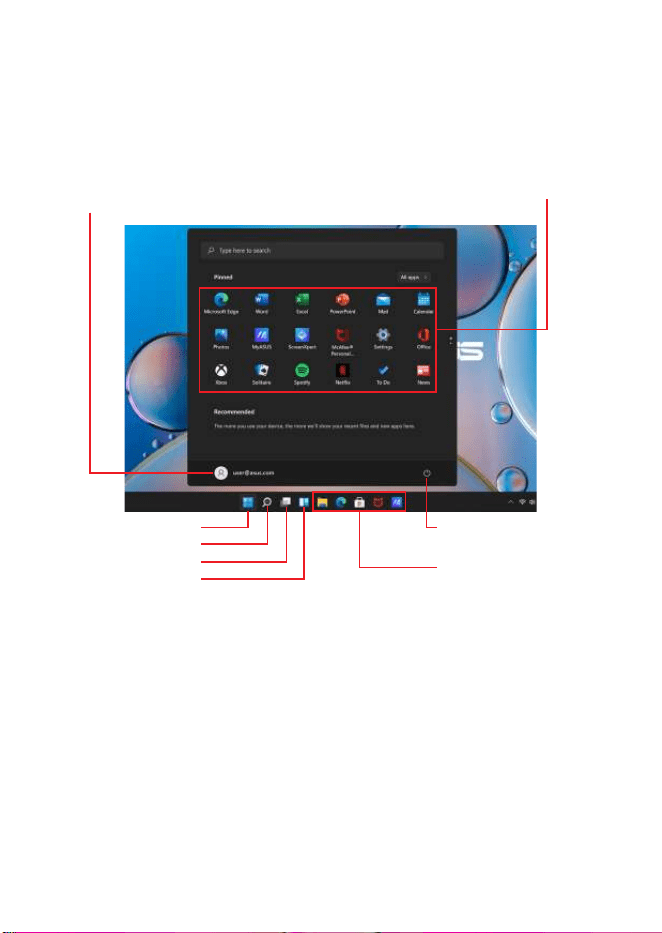
The Start menu is the main gateway to your Notebook PC’s
programs, Windows apps, folders, and settings.
You can use the Start menu to do these common activities:
• Start programs or Windows apps
• Open commonly used programs or Windows apps
• Adjust Notebook PC settings
• Get help with the Windows operating system
• Turn off your Notebook PC
• Log off from Windows or switch to a different user account
Change account settings, lock,
or sign out from your account
Launch the Start menu
Launch Task view
Shut down, restart, or put
your Notebook PC to sleep
Launch an app from the taskbar
Launch an app from the Start menu
Launch Search
Launch Widgets
52
Launching the Start menu
Tap the Start icon on your desktop.
Position your mouse pointer over the Start icon
on your desktop, then click it.
Press the Windows logo key on your keyboard.
Opening programs from the Start menu
One of the most common uses of the Start menu is opening
programs installed on your Notebook PC.
Tap the program to launch it.
Position your mouse pointer over the program, then
click to launch it.
Use the arrow keys to browse through the programs.
Press
to launch it.
NOTE: Select All apps to display a full list of programs and folders on
your Notebook PC in alphabetical order.
53
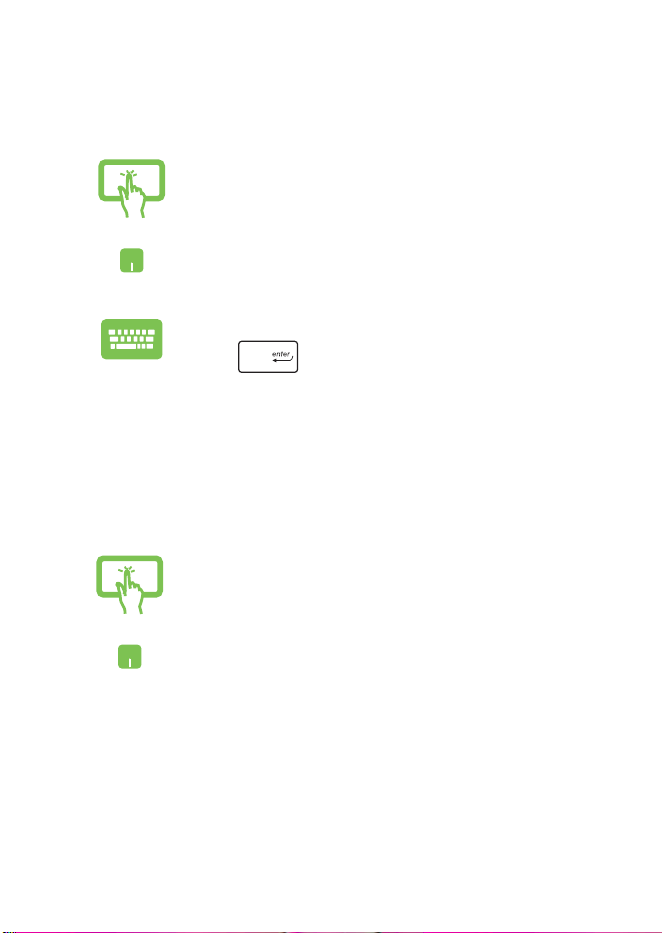
Windows apps
These are apps pinned on the Start menu and displayed in tiled-
format for easy access.
NOTE: Some Windows apps require signing in to your Microsoft
account before they are fully launched.
54
Working with Windows apps
Customizing Windows apps
You can move, unpin, or pin apps to the taskbar from the Start
menu using the following steps:
Launching Windows apps from the Start menu
Tap the app to launch it.
Position your mouse pointer over the app, then click
to launch it.
Use the arrow keys to browse through the apps.
Press
to launch an app.
Moving apps
Press and hold the app, then drag and drop it to a
new location.
Position your mouse pointer over the app, then drag
and drop the app to a new location.
55
Unpinning apps
Press and hold the app, then tap Unpin from Start.
Position your mouse pointer over the app and right-
click it, then click Unpin from Start.
Use the arrow keys to navigate to the app.
Press
or (on selected models),
then select Unpin from Start.
56
Pinning more apps to the Start menu
From All apps, press and hold the app you want to
add to the Start menu, then tap Pin to Start.
From All apps, position your mouse pointer over the
app you want to add to the Start menu and right-click
it, then click Pin to Start.
From All apps, press or (on
selected models) on the app that you want to add to
the Start menu, then select Pin to Start.
Pinning apps to the taskbar
Press and hold the app, then tap Pin to taskbar.
Position your mouse pointer over the app and right-
click it, then click Pin to taskbar.
Use the arrow keys to navigate to the app.
Press
or (on selected models),
then select Pin to taskbar.
57
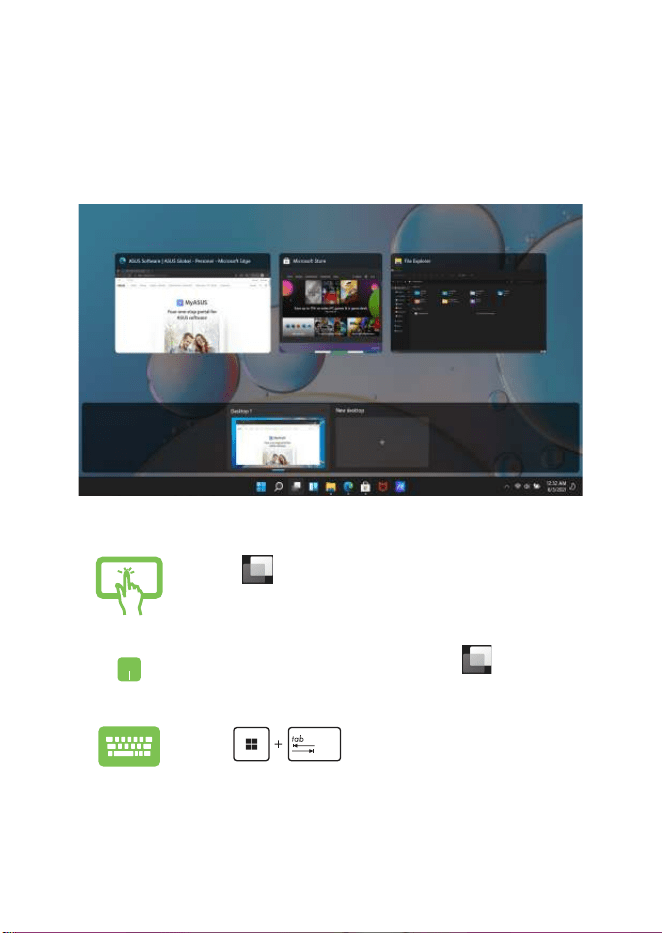
Task view
Quickly switch between opened apps and programs using the
Task view feature, you can also use Task view to switch between
desktops.
Launching Task view
Tap the icon on the taskbar or swipe from the
bottom edge of the screen.
Position your mouse pointer over the icon on the
taskbar and click it.
Press on your keyboard.
58
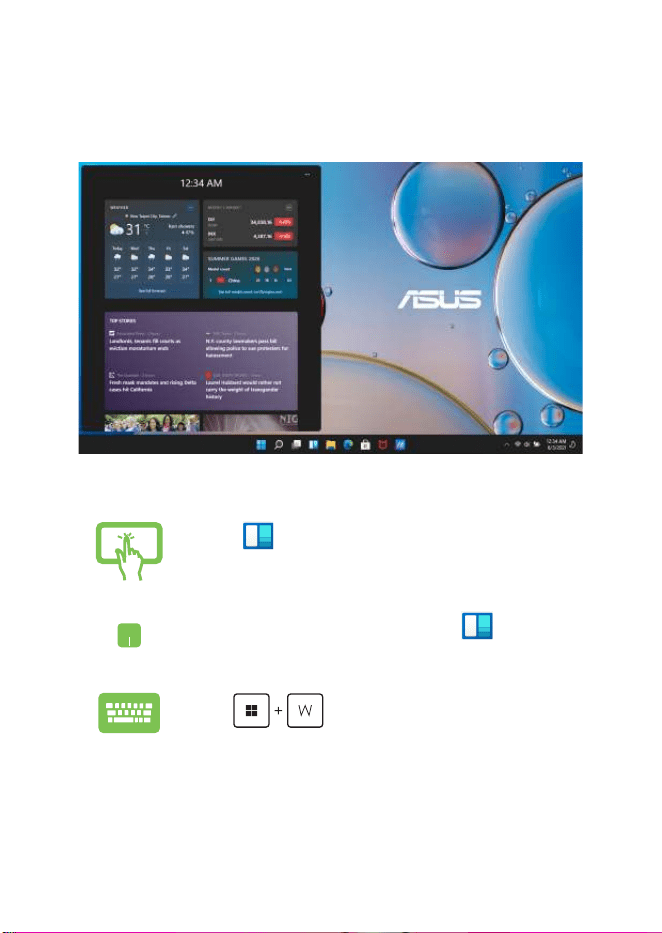
Widgets
You can launch Widgets for quick access of important info.
Launching Widgets
Tap the icon on the taskbar.
Position your mouse pointer over the icon on the
taskbar and click it.
Press on your keyboard.
59
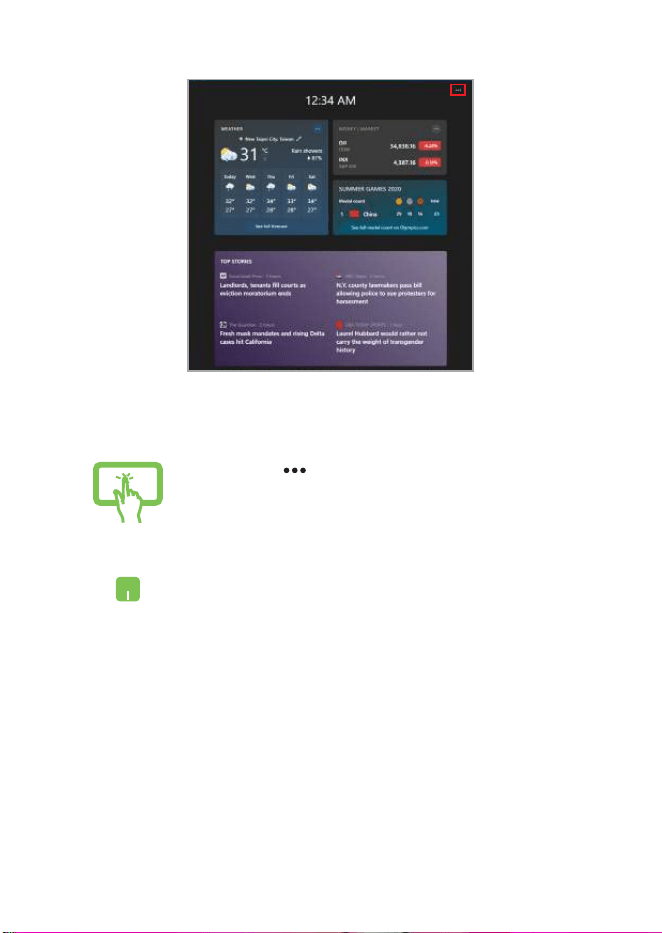
Customizing Widgets
or
Click/Tap the icon, then select Manage interests
to change the content that shows up in the Widgets.
60
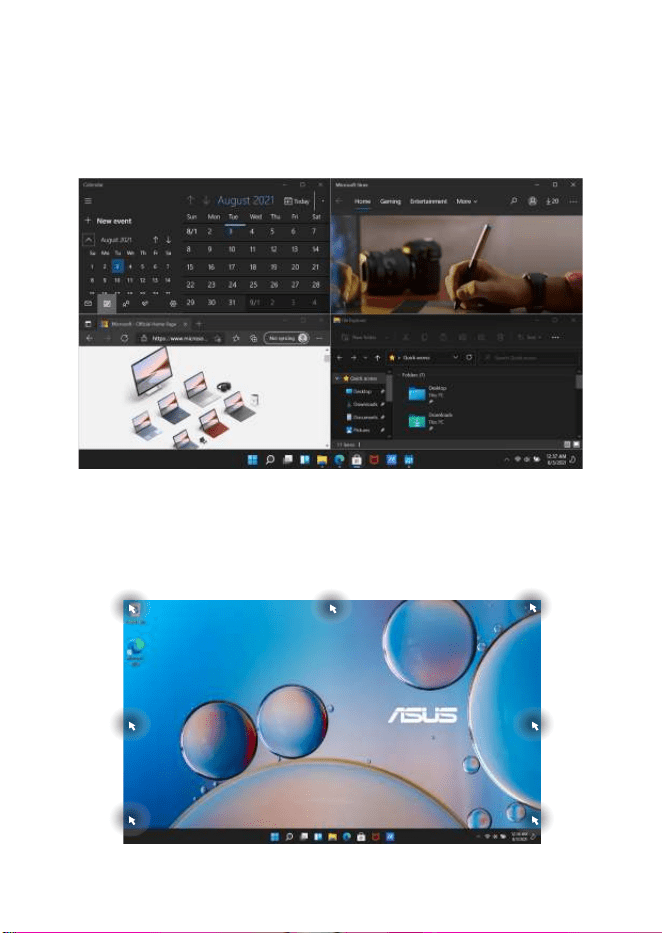
Snap feature
The Snap feature displays apps side-by-side, allowing you to work
or switch between apps.
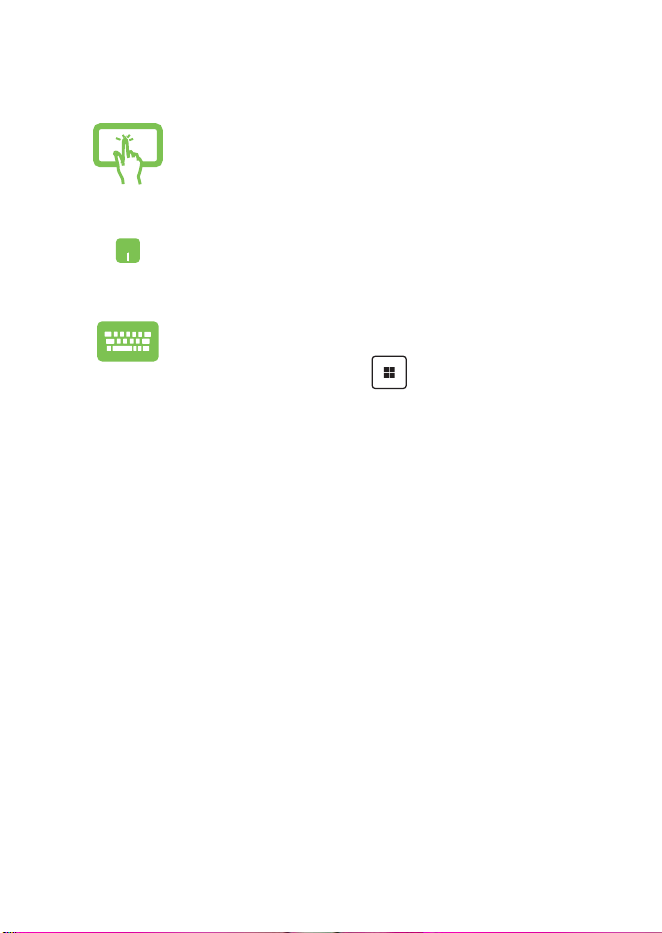
Snap hotspots
You can drag and drop apps to these hotspots to snap them into
place.
61
Using Snap
or
1. Launch the app you wish to snap.
2. Drag the title bar of your app and drop the app
to the edge of the screen to snap.
3. Launch another app and repeat the above steps
to snap another app.
1. Launch the app you wish to snap.
2. Press and hold the
key, then use the
arrow keys to snap the app.
3. Launch another app and repeat the above steps
to snap another app.
62
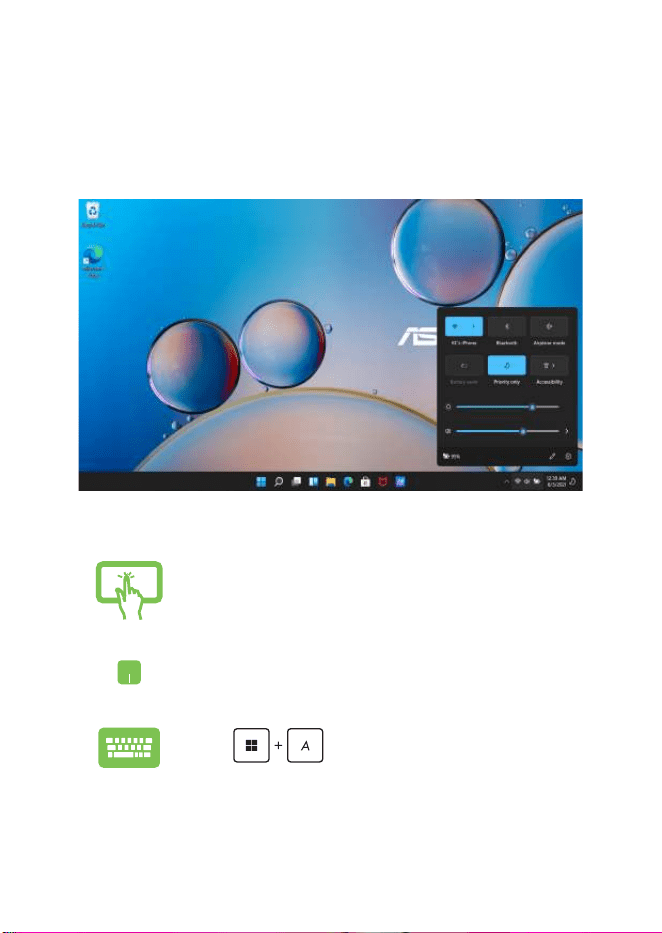
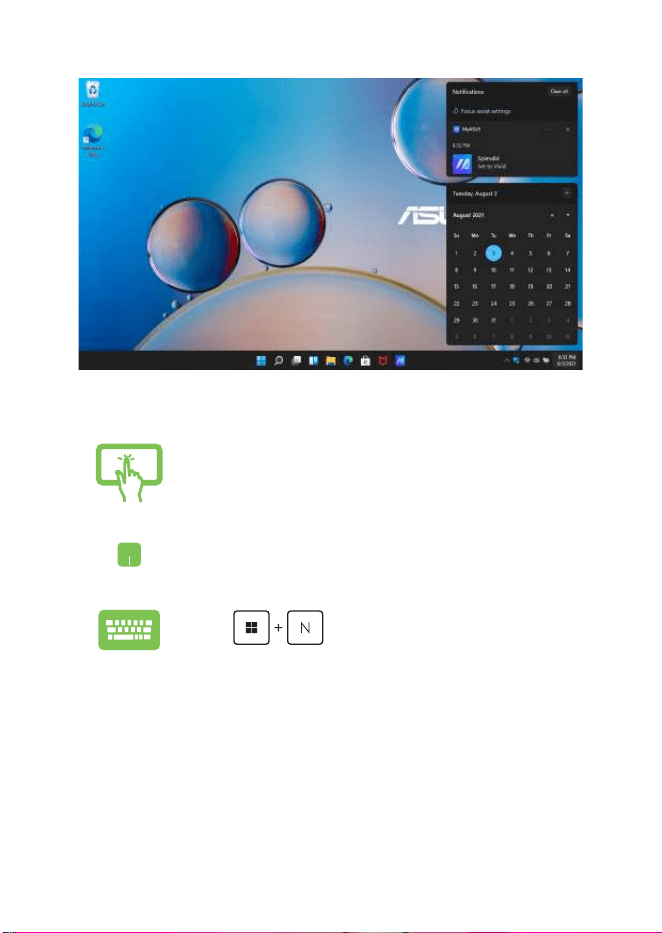
Action Center
Action Center consolidates notifications from apps and presents a
single place where you can interact with them. It also has a really
useful Quick Actions section.
Launching Quick Actions
Tap the status icons on the taskbar.
Position your mouse pointer over the status icons on
the taskbar and click it.
Press on your keyboard.
63
Launching Notifications
Tap the date and time on the taskbar.
Position your mouse pointer over the date and time
on the taskbar and click it.
Press on your keyboard.

64
GameVisual
ROG GameVisual ensures that all ROG display panels show
identical and accurate colors. You may select Eyecare or other
color modes to adjust display settings.
Low blue light panels and technology reduce blue light emission
and relieve eye discomfort.
Please refer to the following tips to alleviate eye strain:
• Take some time away from the display if working for long
hours. It is advised to take short breaks (at least 5 minutes)
after around 1 hour of continuous working at the computer.
Taking short and frequent breaks is more effective than a
long break.
• To minimize eye strain and eye dryness, rest your eyes
periodically by focusing on objects that are far away.
Default: For models with OLED and Nebula panels, this mode
is compliant with TÜV Low Blue Light Certification.
Eyecare: This mode reduces blue light emission by up to 30%,
helping to protect your eyes.

65
If eye strain persists, please consult a physician.
• Repeat the following exercises to reduce eye strain:
(1) Look up and down repeatedly
(2) Slowly roll your eyes
(3) Move your eyes diagonally
High energy blue light may lead to eye strain and AMD (Age-Related
Macular Degeneration). Blue light Filter reduces 30% (max.) harmful
blue light to avoid CVS (Computer Vision Syndrome).
66
Setting the OLED display
The following settings are recommended to optimize the visual
experience, maximize battery life, and extend the lifespan of your
OLED display (on selected models).
Setting the Dark Mode
The Dark Mode is enabled by default. To check or adjust the
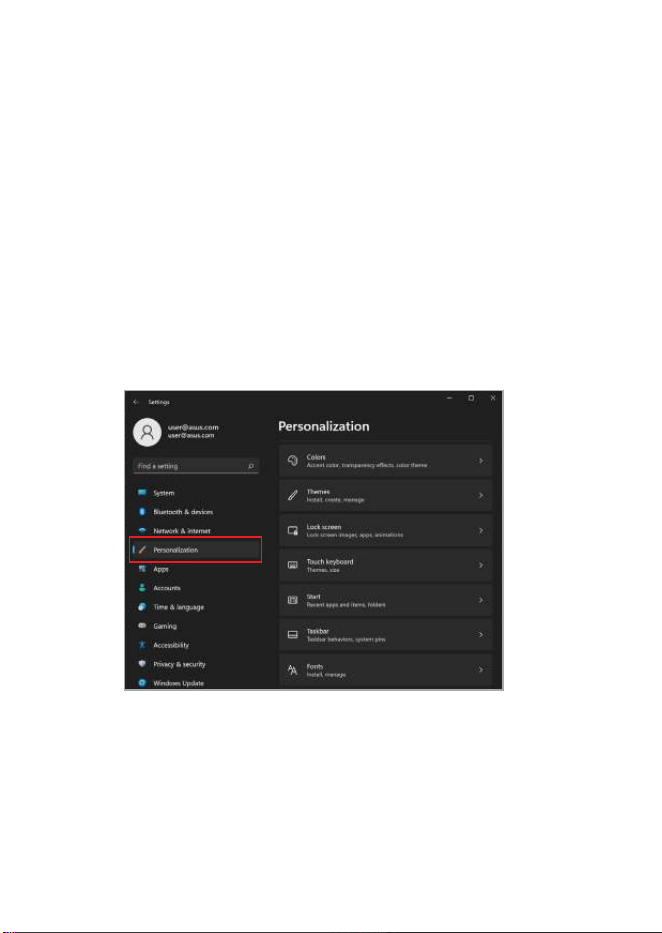
settings:
1. Launch the Start menu.
2. Click/Tap Settings and select Personalization.
67
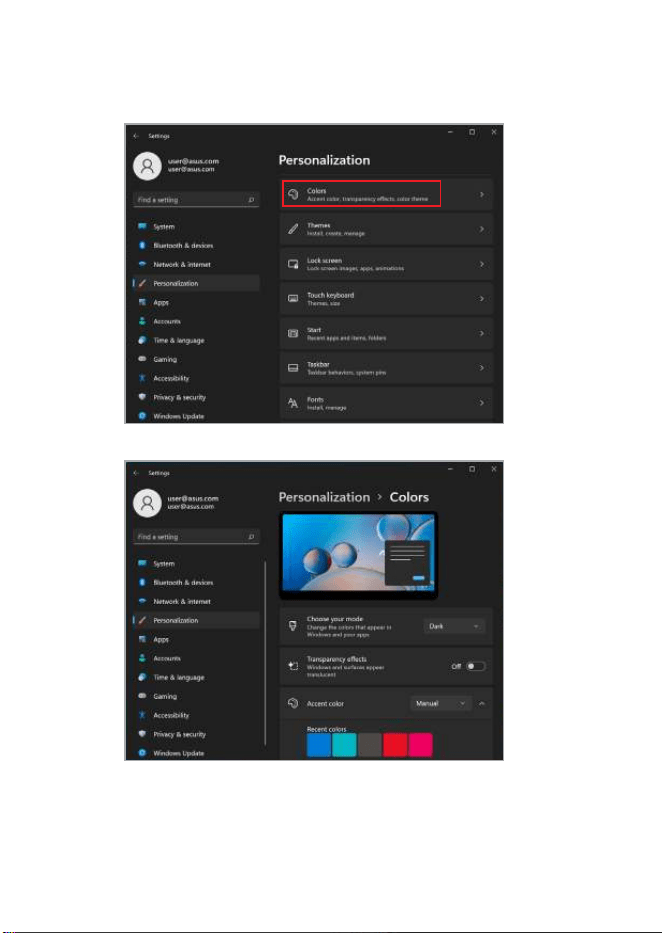
3. Select the Colors tab to view the options.
68
Turning off the display when not in use
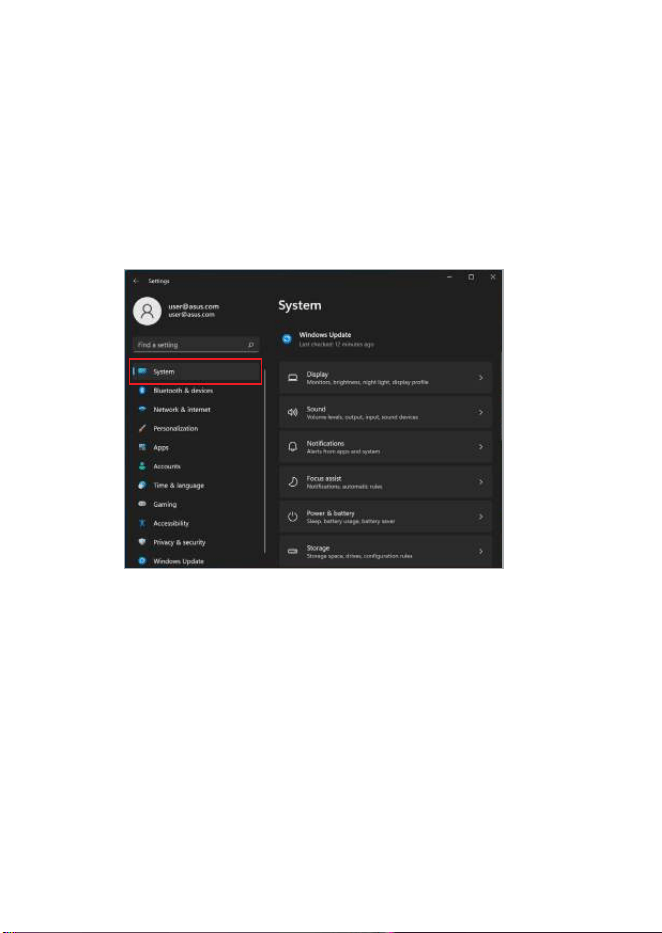
Ensure to set your display to turn off automatically when not in use.
To check or adjust the settings:
1. Launch the Start menu.
2. Click/Tap Settings and select System.
69
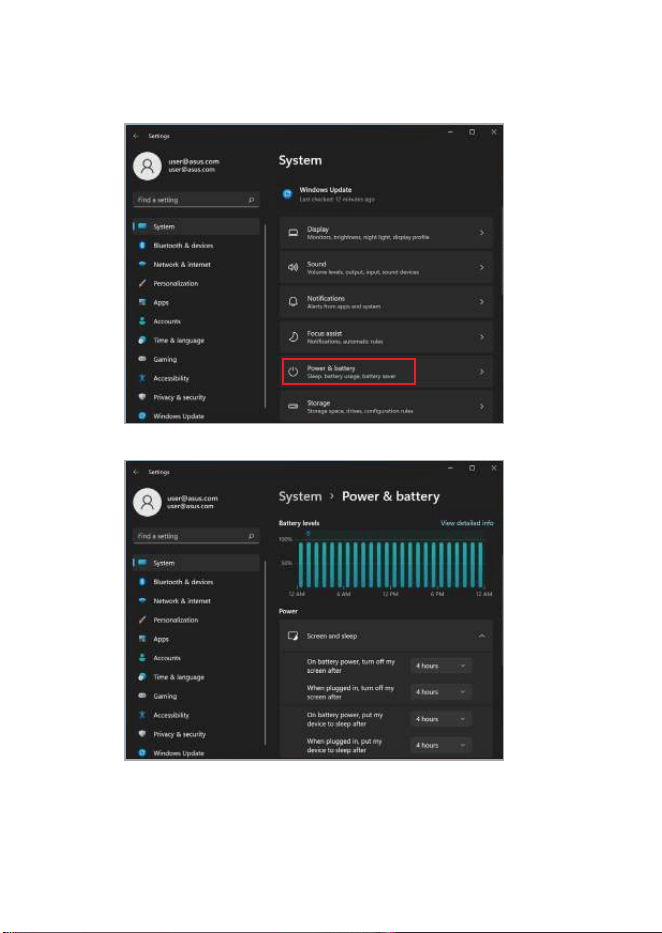
3. Select the Power & battery tab to view the options.
70
Adjusting display brightness
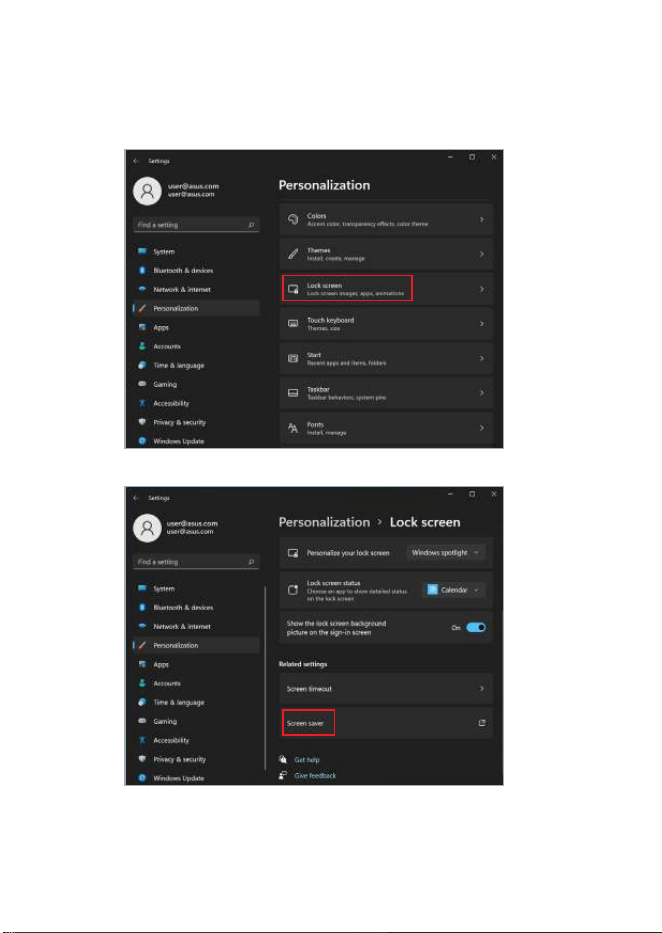
It is recommended to enable animated dark-background
screensaver and avoid setting your OLED display at maximum
brightness to extend the lifespan of your OLED display. To check or
adjust the settings:
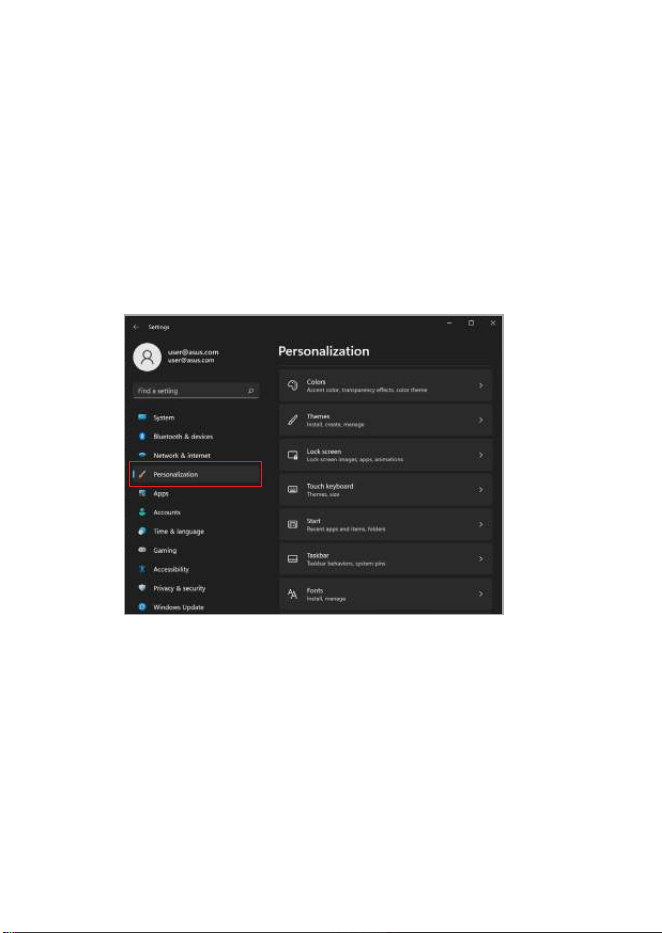
1. Launch the Start menu.
2. Click/Tap Settings and select Personalization.
71
3. Select the Lock screen tab and then select Screen saver to
view the options.
72
Auto-hide the taskbar
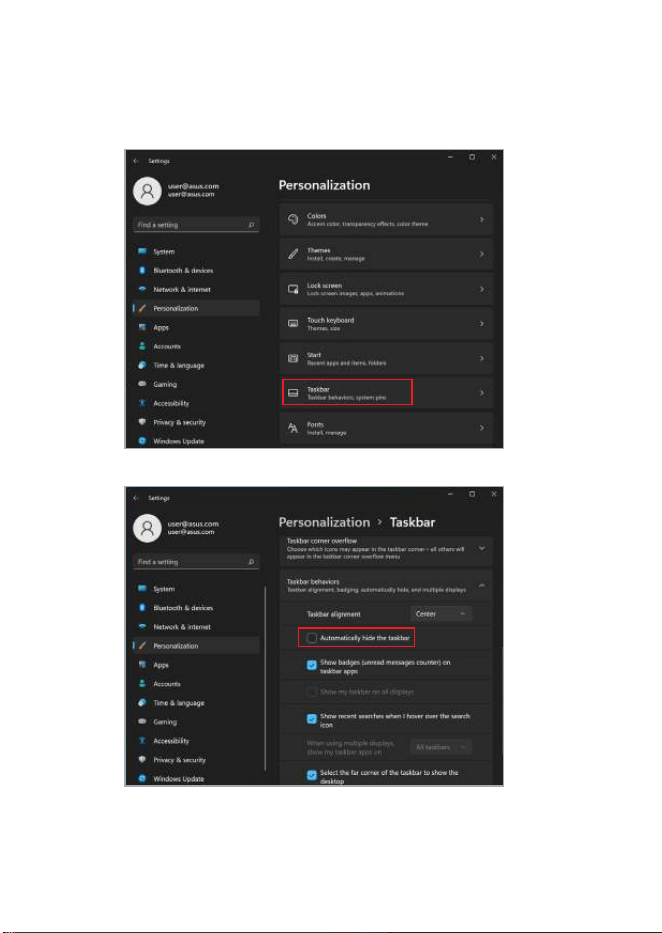
To avoid displaying the taskbar on your OLED display for a
prolonged period of time, ensure to auto-hide the taskbar. To adjust
the settings:
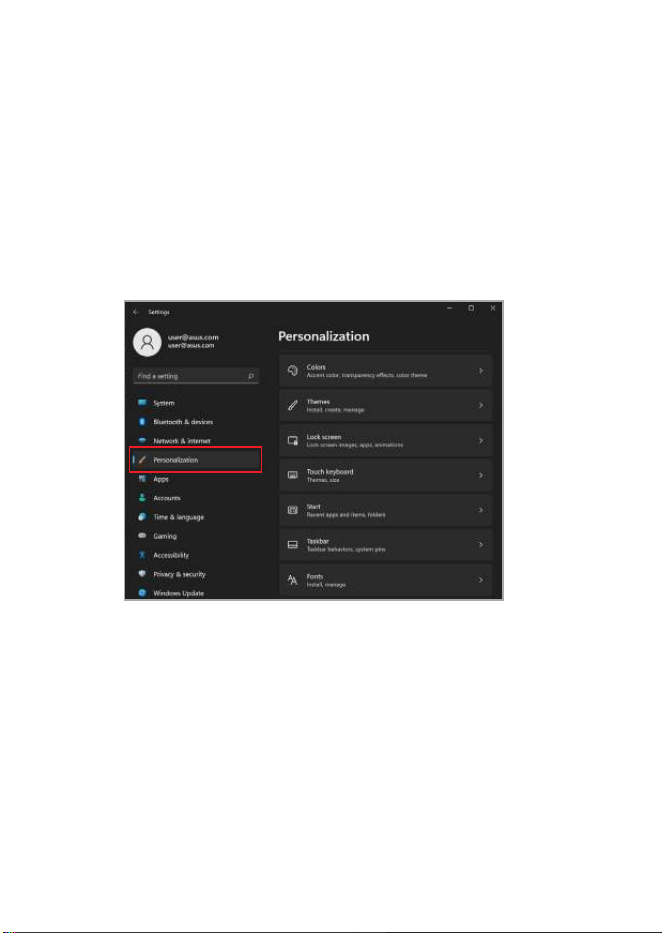
1. Launch the Start menu.
2. Click/Tap Settings and select Personalization.
73
3. Select the Taskbar tab and then enable Automatically hide
the taskbar.

74
1. Launch a Microsoft Office application, and then click/tap File
> Account.
2. Select Dark Gray under Office Theme. The theme will be
applied to all the Microsoft applications.
Setting the Dark Mode in Microsoft Office
75
Other keyboard shortcuts
Using the keyboard, you can also use the following shortcuts to
help you launch applications and navigate Windows.
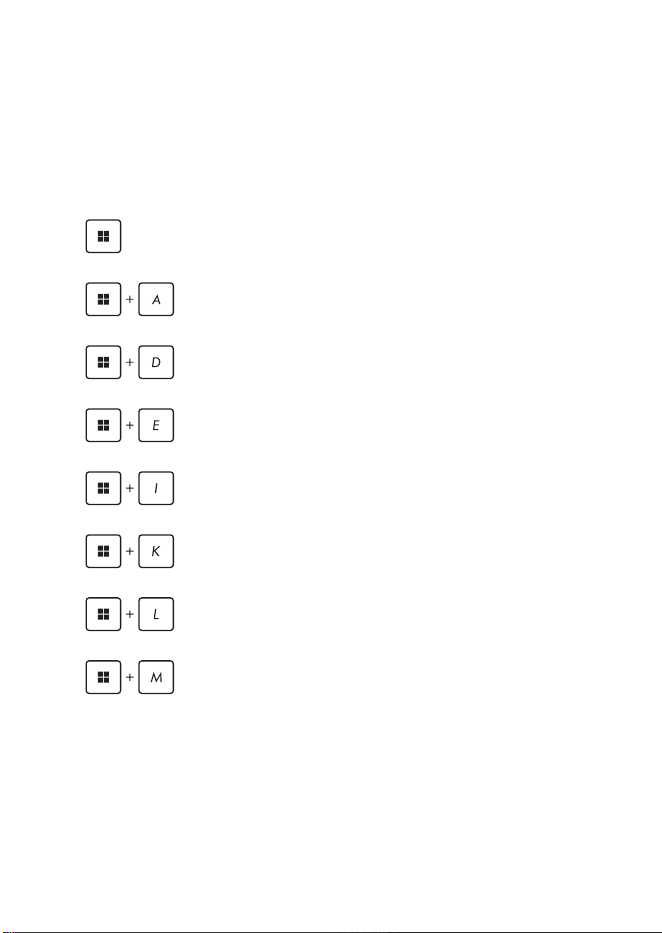
Launches Start menu
Launches Action Center
Launches the desktop
Launches the File Explorer
Launches Settings
Launches Connect panel
Activates the lock screen
Minimizes all currently active windows
76
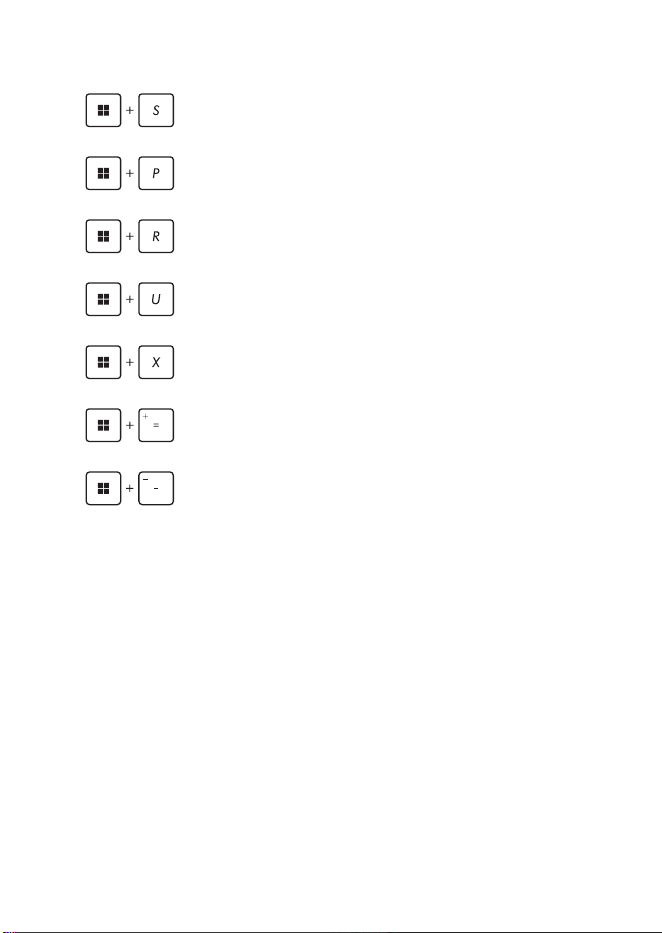
Launches Search
Launches Project panel
Opens the Run window
Opens Accessibility
Opens the context menu of the Start
button
Launches the magnifier icon and zooms
in your screen
Zooms out your screen

77
Connecting to wireless networks
Wi-Fi
Access emails, surf the Internet, and share applications via social
networking sites using your Notebook PC’s Wi-Fi connection.
IMPORTANT! Airplane mode disables this feature. Ensure that
Airplane mode is turned off before enabling the Wi-Fi connection of
your Notebook PC.
Connecting to Wi-Fi
Connect your Notebook PC to a Wi-Fi network by using the
following steps:
or
1. Launch Action Center from the taskbar.
2. Click/Tap the Wi-Fi icon to enable Wi-Fi.
3. Select an access point from the list of available
Wi-Fi connections.
4. Select Connect to start the network connection.
NOTE: You may be prompted to enter a security key to
activate the Wi-Fi connection.
78
or
1. Launch Settings from the Start menu.
2. Select Bluetooth & devices > Add device to
search for Bluetooth-enabled devices.
3. Select a device from the list to pair your
Notebook PC with the device.
NOTE: For some Bluetooth-enabled devices, you may
be prompted to key in the passcode of your Notebook
PC.
Bluetooth
Use Bluetooth to facilitate wireless data transfers with other
Bluetooth-enabled devices.
IMPORTANT! Airplane mode disables this feature. Ensure that
Airplane mode is turned off before enabling the Bluetooth connection
of your Notebook PC.
Pairing with other Bluetooth-enabled devices
You need to pair your Notebook PC with other Bluetooth-enabled
devices to enable data transfers. Connect your devices by using the
following steps:
79
Airplane mode
Airplane mode disables wireless communication, allowing you to
use your Notebook PC safely while in flight.
NOTE: Contact your airline provider to learn about related in-flight
services that can be used and restrictions that must be followed
when using your Notebook PC in flight.
Turning Airplane mode on/off
or
1. Launch Action Center from the taskbar.
2. Click/Tap the Airplane mode icon to enable or
disable Airplane mode.
80
Turning your Notebook PC off
You can turn off your Notebook PC by doing either of the following
procedures:
or
• Launch the Start menu, then select > Shut
down to do a normal shutdown.
• From the log-in screen, select
> Shut down.
• Press to launch Shut Down
Windows. Select Shut down from the drop-
down list, then select OK.
• If your Notebook PC is unresponsive, press
and hold the power button for at least ten (10)
seconds until your Notebook PC turns off.
81
Putting your Notebook PC to sleep
To put your Notebook PC to Sleep mode:
or
• Launch the Start menu, then select > Sleep
to put your Notebook PC to sleep.
• From the log-in screen, select
> Sleep.
Press to launch Shut Down Windows.
Select Sleep from the drop-down list, then select
OK.
NOTE: You can also put your Notebook PC to Sleep mode by pressing
the power button once.
82
or
• Launch the Start menu, select the power
icon, then select Shut down to do a normal
shutdown.
• From the log-in screen, select the power icon,
then select Shut down.
• Press to launch Shut Down
Windows. Select Shut down from the drop-
down list, then select OK.
• If your Notebook PC is unresponsive, press
and hold the power button for at least ten (10)
seconds until your Notebook PC turns off.
Putting your Notebook PC into the lowest
power mode
To put your Notebook PC into the lowest power mode:
1. Enable fast startup.
Right-click on the Windows Start icon > select Run > type:
powercfg.cpl > click OK > Choose what the power buttons
do > Change settings that are currently unavailable > check
Turn on fast startup (recommended) > click Save changes.
2. Turn your Notebook PC off.

83
Chapter 4:
Power-On Self-Test (POST)

84
The Power-On Self-Test (POST)
The POST (Power-On Self-Test) is a series of software-controlled
diagnostic tests that run when you turn on or restart your Notebook
PC. The software that controls the POST is installed as a permanent
part of the Notebook PC’s architecture.
Using POST to access BIOS and Troubleshoot
During POST, you can access the BIOS settings or run
troubleshooting options using the function keys of your Notebook
PC. You may refer to the following information for more details.
BIOS
The BIOS (Basic Input and Output System) stores system hardware
settings that are needed for system startup in the Notebook PC.
The default BIOS settings apply to most conditions of your
Notebook PC. Do not change the default BIOS settings except in
the following circumstances:
• An error message appears onscreen during system bootup
and requests you to run the BIOS Setup.
• You have installed a new system component that requires
further BIOS settings or updates.
WARNING! Using inappropriate BIOS settings may result in system
instability or boot failure. We strongly recommend that you change
the BIOS settings only with the help of a trained service personnel.
Accessing BIOS
Restart your Notebook PC, then press during POST.

85
Recovering your system
Using recovery options on your Notebook PC allows you to restore
the system to its original state or simply refresh its settings to help
improve performance.
IMPORTANT!
• Backup all your data files before doing any recovery option on
your Notebook PC.
• Note down important customized settings such as network
settings, user names, and passwords to avoid data loss.
•
Ensure that your Notebook PC is plugged in to a power source
before resetting your system.
Windows allows you to do any of the following recovery options:
• Keep my files - This option allows you to refresh your
Notebook PC without affecting personal files (photos, music,
videos, documents).
Using this option, you can restore your Notebook PC to its
default settings and delete other installed apps.
• Remove everything - This option resets your Notebook PC to
its factory settings. You must backup your data before doing
this option.
86
• Advanced startup - Using this option allows you to perform
other advanced recovery options on your Notebook PC such
as:
- Using a USB drive, network connection or Windows
recovery DVD to startup your Notebook PC.
- Using Troubleshoot to enable any of these advanced
recovery options: Startup Repair, Uninstall Updates,
Startup Settings, UEFI Firmware Settings, Command
Prompt, System Restore, and System Image Recovery.
Performing a recovery option
Refer to the following steps if you want to access and use any of
the available recovery options for your Notebook PC.
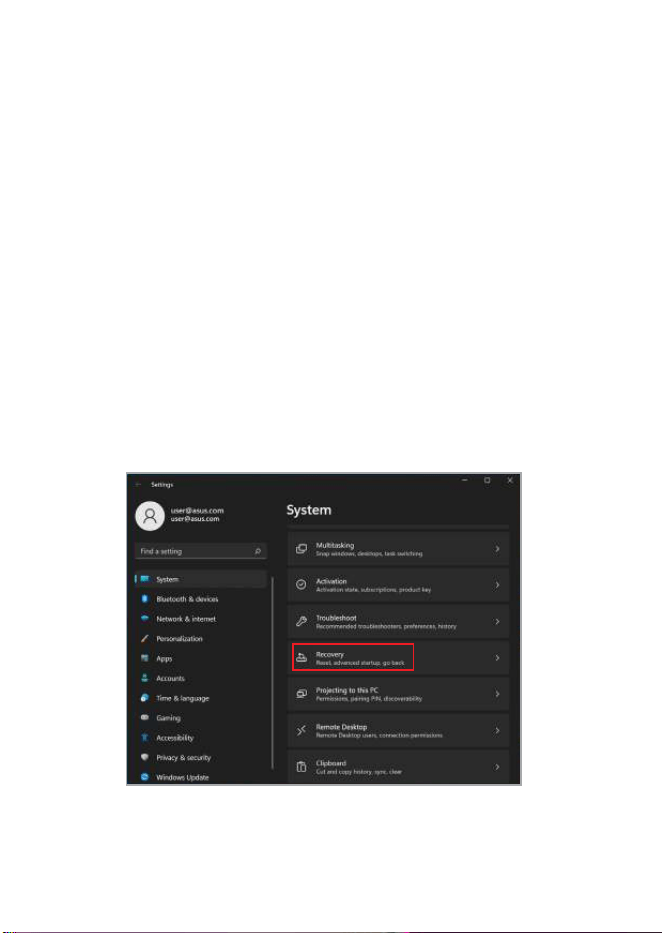
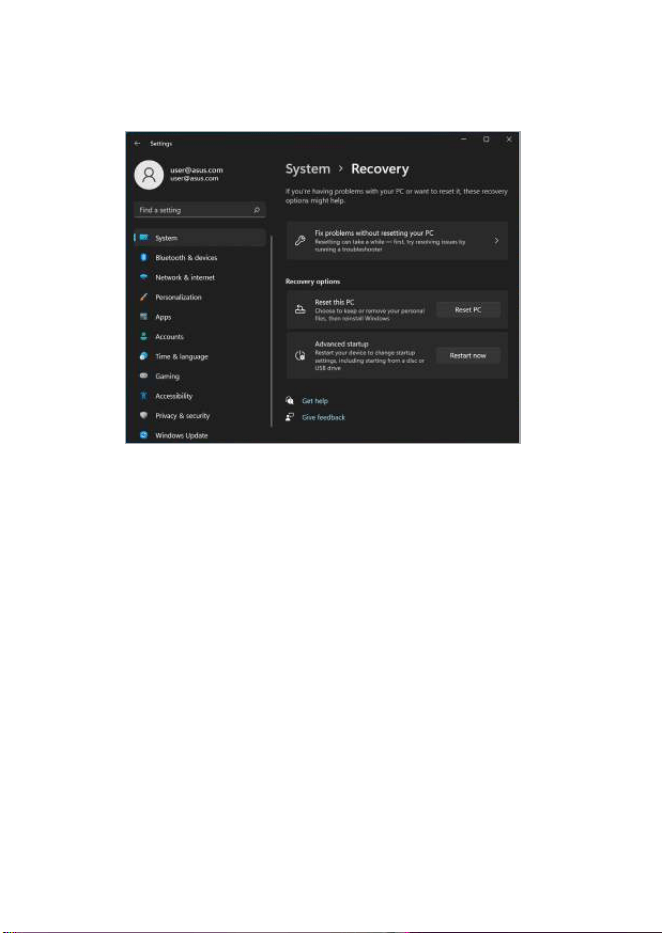
1. Launch Settings and select System > Recovery.
87
2. Select the recovery option you would like to perform.

88

89
Tips and FAQs

90
Useful tips for your Notebook PC
To help you maximize the use of your Notebook PC, maintain its
system performance, and ensure all your data are kept secured,
here are some useful tips that you can follow:
• Update Windows periodically to ensure that your applications
have the latest security settings.
• Update MyASUS to ensure that you have the latest settings
for ASUS exclusive applications, drivers, and utilities.
• Use an anti-virus software to protect your data and keep this
updated too.
• Unless absolutely necessary, refrain from using force
shutdown to turn off your Notebook PC.
• Always backup your data and make it a point to create a
backup data in an external storage drive.
• If you are not using your Notebook PC for a long period of
time, ensure to charge the battery power to 50%, then power
off your Notebook PC and disconnect the AC power adapter.
• If you are constantly using AC power for your Notebook
PC, set the Battery Health Charging to Balanced mode in
MyASUS.

91
• Disconnect all external devices and ensure you have the
following items prior to resetting your Notebook PC:
- Product key for your operating systems and other
installed applications
- Backup data
- Log in ID and password
- Internet connection information
• Visit our support site for troubleshooting and view some of
the most frequently asked questions at
https://www.asus.com/support.

92
Hardware FAQs
1. A black dot, or sometimes a colored dot, appears onscreen
when I turn on the Notebook PC. What should I do?
Although these dots normally appear onscreen, they will
not affect your system. If the incident continues and
subsequently affects system performance, consult an
authorized ASUS service center.
2. My display panel has an uneven color and brightness. How
can I fix this?
The color and brightness of your display panel may be
affected by the angle and current position of your Notebook
PC. The brightness and color tone of your Notebook PC
may also vary per model. You may use the function keys or
the display settings in your operating system to adjust the
appearance of your display panel.
3. How can I maximize my Notebook PC ‘s battery life?
You can try doing any of the following suggestions:
• Use the function keys to adjust the display brightness.
• If you are not using any Wi-Fi connection, switch your
system into Airplane mode.
• Disconnect unused USB devices.
• Close unused applications, especially those that take up
too much system memory.

93
4. My battery charge indicator does not light up. What’s wrong?
• Check whether the power adapter or battery pack
is attached correctly. You may also disconnect the
power adapter or battery pack, wait for a minute, then
reconnect them again to the power outlet and Notebook
PC.
• If the problem still exists, contact your local ASUS
service center for assistance.
5. Why is my touchpad not working?
Press
to enable your touchpad.
6. When I play audio and video files, why can’t I hear any sound
from my Notebook PC’s audio speakers?
You can try doing any of the following suggestions:
• Press
to turn up the speaker volume.
• Check if your speakers were set to mute.
• Check if a headphone jack is connected to your
Notebook PC and remove it.
7. What should I do if my Notebook PC’s power adapter gets
lost or my battery stops working?
Contact your local ASUS service center for assistance.

94
8. My Notebook PC cannot do keystrokes correctly because my
cursor keeps on moving. What should I do?
Make sure that nothing accidentally touches or presses on
your touchpad while you type on the keyboard. You can also
disable your touchpad by pressing
.
9. I have disabled sleep mode, but why does my Notebook PC
still go into sleep mode when I close the lid?
Closing the lid when the system is under high load forces your
Notebook PC to go into sleep mode to prevent overheating.

95
Software FAQs
1. When I turn on my Notebook PC, the power indicator lights
up but nothing appears on my screen. What can I do to fix
this?
You can try doing any of the following suggestions:
• Force shutdown your Notebook PC by pressing the
power button for at least ten (10) seconds. Check if the
power adapter and battery pack are inserted correctly,
then turn on your Notebook PC.
• If the problem still exists, contact your local ASUS
service center for assistance.
2. What should I do when my screen displays this message:
“Remove disks or other media. Press any key to restart.”?
You can try doing any of the following suggestions:
• Remove all connected USB devices, then restart your
Notebook PC.
• Remove any optical discs that are left inside the optical
drive, then restart.
• If the problem still exists, your Notebook PC might have
a memory storage problem. Contact your local ASUS
service center for assistance.

96
3. My Notebook PC boots slower than usual and my operating
system lags. How can I fix this?
Delete the applications you recently installed or were not
included with your operating system package, then restart
your system.
4. My Notebook PC does not boot up. How can I fix this?
You can try doing any of the following suggestions:
• Remove all connected devices to your Notebook PC,
then restart your system.
• If the problem still exists, contact your local ASUS
service center for assistance.
5. Why can’t my Notebook PC wake up from sleep mode?
• You need to press the power button to resume your last
working state.
• Your system might have completely used up its battery
power. Connect the power adapter to your Notebook
PC and connect to a power outlet, then press the power
button.
If you have any other problems, please visit
https://www.asus.com/support/FAQ/1045091/ for troubleshooting.

97
Appendices

98
Legal information
USB-IF Trademark
The USB 5Gbps Port Logo is a trademark of the USB Implementers Forum, Inc.
The USB 10Gbps Port Logo is a trademark of the USB Implementers Forum, Inc.
The USB 20Gbps Port Logo is a trademark of the USB Implementers Forum, Inc.
The USB 40Gbps Port Logo is a trademark of the USB Implementers Forum, Inc.

99
Federal Communications Commission
Interference Statement
This device complies with FCC Rules Part 15. Operation is subject to the
following two conditions:
• This device may not cause harmful interference.
• This device must accept any interference received, including
interference that may cause undesired operation.
This equipment has been tested and found to comply with the limits for a
class B digital device, pursuant to Part 15 of the Federal Communications
Commission (FCC) rules. These limits are designed to provide reasonable
protection against harmful interference in a residential installation. This
equipment generates, uses, and can radiate radio frequency energy and, if not
installed and used in accordance with the instructions, may cause harmful
interference to radio communications. However, there is no guarantee that
interference will not occur in a particular installation. If this equipment does
cause harmful interference to radio or television reception, which can be
determined by turning the equipment off and on, the user is encouraged to
try to correct the interference by one or more of the following measures:
• Reorient or relocate the receiving antenna.
• Increase the separation between the equipment and receiver.
• Connect the equipment into an outlet on a circuit different from that to
which the receiver is connected.
• Consult the dealer or an experienced radio/TV technician for help.
WARNING! The use of a shielded-type power cord is required in order to meet
FCC emission limits and to prevent interference to the nearby radio and television
reception. It is essential that only the supplied power cord be used. Use only
shielded cables to connect I/O devices to this equipment. You are cautioned that
changes or modifications not expressly approved by the party responsible for
compliance could void your authority to operate the equipment.
Regulatory statements

100
FCC RF Exposure Information
This device meets the government’s requirements for exposure to radio
waves. This device is designed and manufactured not to exceed the
emission limits for exposure to radio frequency (RF) energy set by the
Federal Communications Commission of the U.S. Government. The exposure
standard employs a unit of measurement known as the Specific Absorption
Rate, or SAR. The SAR limit set by the FCC is 1.6 W/kg. Tests for SAR are
conducted using standard operating positions accepted by the FCC with the
EUT transmitting at the specified power level in different channels. The FCC
has granted an Equipment Authorization for this device with all reported SAR
levels evaluated as in compliance with the FCC RF exposure guidelines. SAR
information on this device is on file with the FCC and can be found under the
Display Grant section of www.fcc.gov/oet/ea/fccid.
FCC RF Caution Statement
WARNING! Any changes or modifications not expressly approved by the party
responsible for compliance could void the user’s authority to operate this
equipment.
ISED 5.925-7.125 GHz Caution Statement
RLAN devices:
Devices shall not be used for control of or communications with unmanned
aircraft systems.
Les dispositifs ne doivent pas être utilisés pour commander des systèmes
d’aéronef sans pilote ni pour communiquer avec de tels systèmes.
FCC 5.925-7.125 GHz Caution Statement
Operation of transmitters in the 5.925-7.125 GHz band is prohibited for
control of or communications with unmanned aircraft systems.
(Reprinted from the Code of Federal Regulations #47, part 15.193, 1993.
Washington DC: Office of the Federal Register, National Archives and Records
Administration, U.S. Government Printing Office.)

101
Radio Frequency (RF) Exposure Information
The radiated output power of the Wireless Device is below the Innovation,
Science and Economic Development Canada (ISED) radio frequency
exposure limits. The Wireless Device should be used in such a manner such
that the potential for human contact during normal operation is minimized.
This device has been evaluated for and shown compliant with the ISED
Specific Absorption Rate (“SAR”) limits when operated in portable exposure
conditions.
Informations concernant l'exposition aux
fréquences radio (RF)
La puissance de sortie rayonnée du dispositif sans fil est inférieure
aux limites d’exposition aux radiofréquences d’Innovation, Sciences et
Développement économique Canada (ISED). Le dispositif sans fil doit être
utilisé de manière à minimiser le potentiel de contact humain pendant le
fonctionnement normal.
Cet appareil a été évalué et montré conforme aux limites de DAS (Débit
d’Absorption Spécifique) de l’ISED lorsqu’il est utilisé dans des conditions
d’exposition portables.
Caution
(i) The device for operation in the band 5150-5250 MHz is only for indoor use
to reduce the potential for harmful interference to co-channel mobile satellite
systems.
Mise en garde
(i) Les dispositifs fonctionnant dans la bande 5150-5250 MHz sont
réservés uniquement à une utilisation en intérieur afin de réduire les risques
d’interférence préjudiciables aux systèmes de satellites mobiles utilisant les
mêmes canaux.

102
Compliance Statement of Innovation, Science
and Economic Development Canada (ISED)
This device complies with Innovation, Science and Economic Development
Canada licence exempt RSS standard(s). Operation is subject to the following
two conditions: (1) this device may not cause interference, and (2) this
device must accept any interference, including interference that may cause
undesired operation of the device.
Operation in the band 5150–5250 MHz is only for indoor use to reduce the
potential for harmful interference to co-channel mobile satellite systems.
CAN ICES(B)/NMB(B)
Déclaration de conformité de Innovation,
Sciences et Développement économique
Canada (ISED)
Le présent appareil est conforme aux CNR d’Innovation, Sciences et
Développement économique Canada applicables aux appareils radio exempts
de licence. L’exploitation est autorisée aux deux conditions suivantes: (1)
l’appareil ne doit pas produire de brouillage, et (2) l’utilisateur de l’appareil
doit accepter tout brouillage radioélectrique subi, même si le brouillage est
susceptible d’en compromettre le fonctionnement.
La bande 5150–5250 MHz est réservée uniquement pour une utilisation à
l’intérieur afin de réduire les risques de brouillage préjudiciable aux systèmes
de satellites mobiles utilisant les mêmes canaux.
CAN ICES(B)/NMB(B)

103
UL Safety Notices
Required for UL 1459 covering telecommunications (telephone) equipment
intended to be electrically connected to a telecommunication network that
has an operating voltage to ground that does not exceed 200V peak, 300V
peak-to-peak, and 105V rms, and installed or used in accordance with the
National Electrical Code (NFPA 70).
When using the Notebook PC modem, basic safety precautions should
always be followed to reduce the risk of fire, electric shock, and injury to
persons, including the following:
• DO NOT use the Notebook PC near water, for example, near a bath tub,
wash bowl, kitchen sink or laundry tub, in a wet basement or near a
swimming pool.
• DO NOT use the Notebook PC during an electrical storm. There may
be a remote risk of electric shock from lightning.
• DO NOT use the Notebook PC in the vicinity of a gas leak.
Required for UL 1642 covering primary (non-rechargeable) and secondary
(rechargeable) lithium batteries for use as power sources in products. These
batteries contain metallic lithium, or a lithium alloy, or a lithium ion, and may
consist of a single electrochemical cell or two or more cells connected in
series, parallel, or both, that convert chemical energy into electrical energy by
an irreversible or reversible chemical reaction.
• DO NOT dispose the Notebook PC battery pack in a fire, as they
may explode. Check with local codes for possible special disposal
instructions to reduce the risk of injury to persons due to fire or
explosion.
• DO NOT use power adapters or batteries from other devices to reduce
the risk of injury to persons due to fire or explosion. Use only UL
certified power adapters or batteries supplied by the manufacturer or
authorized retailers.
104
Power Safety Requirement
Products with electrical current ratings up to 6A and weighing more than
3Kg must use approved power cords greater than or equal to: H05VV-F, 3G,
0.75mm
2
or H05VV-F, 2G, 0.75mm
2
.
TV Notices
Note to CATV System Installer—Cable distribution system should be
grounded (earthed) in accordance with ANSI/NFPA 70, the National Electrical
Code (NEC), in particular Section 820.93, Grounding of Outer Conductive
Shield of a Coaxial Cable – installation should include bonding the screen of
the coaxial cable to the earth at the building entrance.
Macrovision Corporation Product Notice
This product incorporates copyright protection technology that is protected
by method claims of certain U.S.A. patents and other intellectual property
rights owned by Macrovision Corporation and other rights owners. Use of
this copyright protection technology must be authorized by Macrovision
Corporation, and is intended for home and other limited viewing uses only
unless otherwise authorized by Macrovision Corporation. Reverse engineering
or disassembly is prohibited.
Prevention of Hearing Loss
To prevent possible hearing damage, do not listen at high
volume levels for long periods.
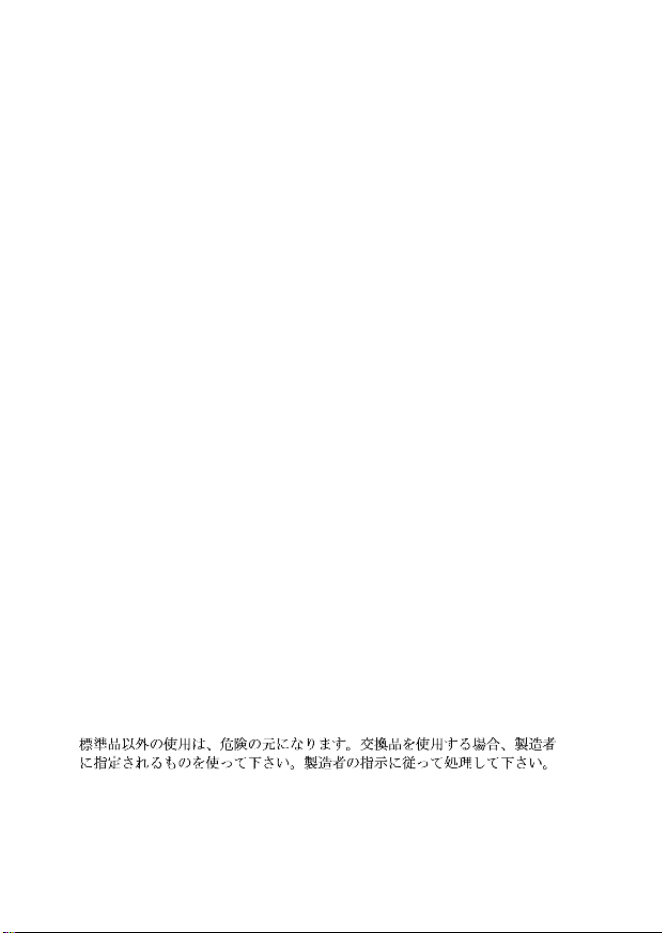
USB PD Fast Charging
The power delivered by the charger must be between min 45
Watts required by the radio equipment, and max 100 Watts in
order to achieve the maximum charging speed.
*The above is a description of EU regulations (Radio Equipment Directive).
45 – 100
W
USB PD
105
Nordic Lithium Cautions (for lithium-ion
batteries)
CAUTION! Danger of explosion if battery is incorrectly replaced. Replace only
with the same or equivalent type recommended by the manufacturer. Dispose
of used batteries according to the manufacturer’s instructions. (English)
ATTENZIONE! Rischio di esplosione della batteria se sostituita in modo
errato. Sostituire la batteria con un una di tipo uguale o equivalente
consigliata dalla fabbrica. Non disperdere le batterie nell’ambiente. (Italian)
VORSICHT! Explosionsgefahr bei unsachgemäßen Austausch der Batterie.
Ersatz nur durch denselben oder einem vom Hersteller empfohlenem
ähnlichen Typ. Entsorgung gebrauchter Batterien nach Angaben des
Herstellers. (German)
ADVARSELI! Lithiumbatteri - Eksplosionsfare ved fejlagtig håndtering.
Udskiftning må kun ske med batteri af samme fabrikat og type. Levér det
brugte batteri tilbage til leverandøren. (Danish)
VARNING! Explosionsfara vid felaktigt batteribyte. Använd samma batterityp
eller en ekvivalent typ som rekommenderas av apparattillverkaren. Kassera
använt batteri enligt fabrikantens instruktion. (Swedish)
VAROITUS! Paristo voi räjähtää, jos se on virheellisesti asennettu. Vaihda
paristo ainoastaan laitevalmistajan sousittelemaan tyyppiin. Hävitä käytetty
paristo valmistagan ohjeiden mukaisesti. (Finnish)
ATTENTION! Danger d’explosion si la batterie n’est pas correctement
remplacée. Remplacer uniquement avec une batterie de type semblable
ou équivalent, recommandée par le fabricant. Jeter les batteries usagées
conformément aux instructions du fabricant. (French)
ADVARSEL! Eksplosjonsfare ved feilaktig skifte av batteri. Benytt samme
batteritype eller en tilsvarende type anbefalt av apparatfabrikanten. Brukte
batterier kasseres i henhold til fabrikantens instruksjoner. (Norwegian)
(Japanese)
ВНИМАНИЕ! При замене аккумулятора на аккумулятор иного типа
возможно его возгорание. Утилизируйте аккумулятор в соответствии с
инструкциями производителя. (Russian)

106
EU REACH and Article 33
Complying with the REACH (Registration, Evaluation, Authorization, and
Restriction of Chemicals) regulatory framework, we publish the chemical
substances in our products at ASUS REACH website at
https://esg.asus.com/Compliance.htm.
Declaration of Compliance for Product
Environmental Regulation
ASUS follows the green design concept to design and manufacture our
products, and makes sure that each stage of the product life cycle of ASUS
product is in line with global environmental regulations. In addition, ASUS
disclose the relevant information based on regulation requirements.
Please refer to https://esg.asus.com/Compliance.htm for information
disclosure based on regulation requirements ASUS is complied with.
India RoHS
This product complies with the “India E-Waste (Management) Rules, 2016”
and prohibits use of lead, mercury, hexavalent chromium, polybrominated
biphenyls (PBBs) and polybrominated diphenyl ethers (PBDEs) in
concentrations exceeding 0.1% by weight in homogenous materials and
0.01% by weight in homogenous materials for cadmium, except for the
exemptions listed in Schedule II of the Rule.
EU RoHS
This product complies with the EU RoHS Directive. For more details, see
https://esg.asus.com/Compliance.htm.
Japan JIS-C-0950 Material Declarations
Information on Japan RoHS (JIS-C-0950) chemical disclosures is available
on https://esg.asus.com/Compliance.htm.

107
Rechargeable Battery Recycling Service in
North America
For US and Canada customers, you can call 1-800-822-8837
(toll-free) for recycling information of your ASUS products’
rechargeable batteries.
Regional notice for Singapore
This ASUS product complies with IMDA Standards.
Complies with
IMDA Standards
DB103778
Coating Notice
IMPORTANT! To provide electrical insulation and maintain electrical safety, a
coating is applied to insulate the device except on the areas where the I/O ports
are located.
Vietnam RoHS
ASUS products sold in Vietnam, on or after September 23, 2011, meet the
requirements of the Vietnam Circular 30/2011/TT-BCT.
Các sản phẩm ASUS bán tại Việt Nam, vào ngày 23 tháng 9 năm2011 trở về
sau, đều phải đáp ứng các yêu cầu của Thông tư 30/2011/TT-BCT của Việt
Nam.
ASUS Recycling/Takeback Services
ASUS recycling and takeback programs come from our commitment to the
highest standards for protecting our environment. We believe in providing
solutions for you to be able to responsibly recycle our products, batteries,
other components as well as the packaging materials.
Please go to https://esg.asus.com/en/Takeback.htm for detailed recycling
information in different regions.
108
ENERGY STAR
®
Qualified Product
ENERGY STAR
®
is a joint program of the U.S. Environmental
Protection Agency and the U.S. Department of Energy helping
us all save money and protect the environment through energy
efficient products and practices.
All ASUS products with the ENERGY STAR
®
logo comply with the ENERGY
STAR
®
standard, and the power management feature is enabled by default.
The monitor is automatically set to sleep within 10 minutes of user inactivity;
the computer is automatically set to sleep within 30 minutes of user
inactivity. To wake your computer, click the mouse, press any key on the
keyboard, or press the power button.
Please visit https://www.energystar.gov for detailed information on the
ENERGY STAR
®
joint program, power management, and the benefits to the
environment.
NOTE: ENERGY STAR
®
is NOT supported on FreeDOS and Linux-based products.
Ecodesign Directive
The European Union announced a framework for the setting of ecodesign
requirements for energy-related products (2009/125/EC). Specific
implementing measures are aimed at improving environmental performance
of specific products or across multiple product types. ASUS provides product
information at https://esg.asus.com/Compliance.htm.

109
Notices for removable batteries
• Risk of explosion if battery is replaced by an incorrect type.
• The battery and its component must be recycled or disposed of
properly.
Avis concernant les batteries remplaçables
• La batterie de l’appareil peut présenter un risque d’incendie ou de
brûlure si celle-ci est retirée ou désassemblée.
• La batterie et ses composants doivent être recyclés de façon
appropriée.
Wi-Fi Network Notice
IMPORTANT! Wi-Fi 6E network card is available on selected models. The
connectivity of Wi-Fi 6E band may vary according to the regulation and
certification of each country/region.
EPEAT Registered Products
The public disclosure of key environmental information for ASUS EPEAT
(Electronic Product Environmental Assessment Tool) registered products is
available at https://esg.asus.com/en/Ecolabel.htm. More information about
EPEAT program and purchase guidance can be found at www.epeat.net.
110
Simplified UKCA Declaration of Conformity
ASUSTek Computer Inc. hereby declares that this device is in compliance
with the essential requirements and other relevant provisions of The Radio
Equipment Regulations 2017 (S.I. 2017/1206). Full text of UKCA declaration
of conformity is available at https://www.asus.com/support/.
The WiFi operating in the band 5150-5350 MHz shall be restricted to indoor
use for the country listed below:
Simplified EU Declaration of Conformity
ASUSTek Computer Inc. hereby declares that this device is in compliance
with the essential requirements and other relevant provisions of Directive
2014/53/EU. Full text of EU declaration of conformity is available at
https://www.asus.com/support/.
The WiFi operating in the band 5150-5350 MHz shall be restricted to indoor
use for countries listed in the table below:
AT BE BG CZ DK EE FR
DE IS IE IT EL ES CY
LV LI LT LU HU MT NL
NO PL PT RO SI SK TR
FI SE CH HR UK(NI)