DURASTAR.COM1
INSTALLATION MANUAL
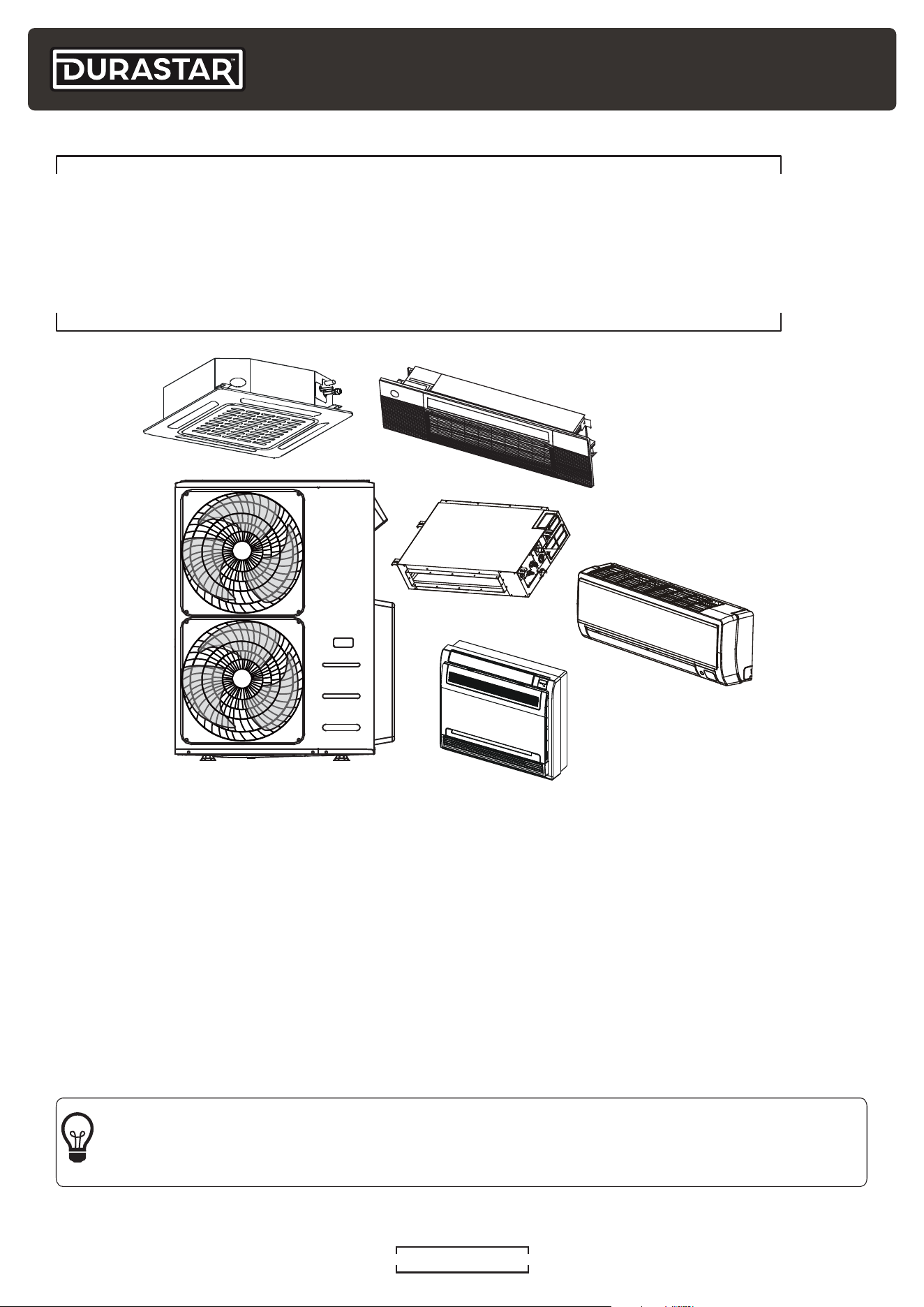
MULTI-ZONE OUTDOOR UNIT
SPLIT-STYLE AIR CONDITIONER
DRA2U18M1B, DRA3U28M1B, DRA4U36M1B,
DRA5U48M1B, DRA5U55M1B
Model Number:
Serial Number:
Purchase Date:
Installing Contractor Company Name:
TIP
Capture relevant information about your Durastar mini-split equipment before it is
installed and write it above for future reference.
DURASTAR.COM2
TABLE OF CONTENTS
TABLE OF CONTENTS .................................................................................................... 2
INTRODUCTION ................................................................................................................. 3
WARNINGS ........................................................................................................................... 3
IMPORTANT SAFETY PRECAUTIONS ................................................................... 4
OPERATING TEMPERATURES ................................................................................... 7
ACCESSORIES .....................................................................................................................8
PARTS IDENTIFICATION ................................................................................................ 9
OUTDOOR UNIT INSTALLATION ............................................................................. 10
STEP 1: SELECT INSTALLATION LOCATION .................................................... 10
STEP 2: INSTALL THE DRAIN JOINT ..................................................................... 11
STEP 3: MOUNT THE OUTDOOR UNIT ................................................................. 12
STEP 4: CONNECT THE SIGNAL AND POWER CABLES ............................ 13
REFRIGERANT PIPING CONNECTIONS ...............................................................15
STEP 1: CUT PIPES ........................................................................................................... 17
STEP 2: REMOVE BURRS ............................................................................................. 17
STEP 3: FLARE PIPE ENDS ......................................................................................... 18
STEP 4: CONNECT PIPES .............................................................................................19
SYSTEM EVACUATION ..................................................................................................20
FINAL CHECKS ...................................................................................................................22
TEST RUN .............................................................................................................................23
TROUBLESHOOTING .....................................................................................................24
WIRING DIAGRAMS .........................................................................................................28
ERROR AND OPERATING CODES ..........................................................................32
JOB SITE INFORMATION SHEET .............................................................................33
DURASTAR.COM
3
WARNINGS
The warning symbol indicates cautionary information for the user. Extra care and
precautions should be taken to ensure the user's safety.
The pencil indicates any manufacturer notes relating to surrounding content. These may
include further clarifications or call-outs.
A light bulb symbol indicates suggested manufacturer tips for the user to get the most
out of the Durastar equipment and to accommodate the best user experience.
Symbols Used in This Manual
INTRODUCTION
To better serve you, please do the following before contacting customer service:
• If you received a damaged product, immediately contact the retailer or dealer that sold you the
product.
• Read and follow this owner's manual carefully to help you use and maintain your air conditioner.
• Read the troubleshooting section of this manual as it will help you diagnose and solve common
issues.
• Visit us on the web at WWW.DURASTAR.COM to download product guides and up-to-date
information.
• If you need warranty service, our friendly customer service representatives are available via
email at QUESTIONS@DURASTAR.COM or by telephone at 1-888-320-0706.
DURASTAR.COM4
IMPORTANT SAFETY PRECAUTIONS
Improper handling can cause serious damage or injury. Please read the following safety
information in its entirety.
Operation, Cleaning, and Maintenance Safety Precautions
• Children and people with reduced physical, sensory, or mental capabilities, or lack of
experience and knowledge, should only use this air conditioner if they are given supervision or
instructions concerning use of the air conditioner in a safe way and understand the hazards
involved.
• Children should not play with the air conditioner.
• Never stick fingers or any other body parts into the air conditioner openings. The internal fan
may be rotating at high speeds, and may result in injury.
• After removing the filter, do not touch the fins in order to avoid injury.
• Maintenance must be performed by qualified professionals. Otherwise, you may experience
personal injury or damage to the air conditioner and surrounding property.
• Do not repair the air conditioner by yourself. It may cause electric shock or damage. Please
contact a qualified service representative when you need to repair the air conditioner.
• Do not block the air outlet or air inlet. This could cause a malfunction.
• Do not spill water on the remote control as this can permanently damage the remote.
• If the below problems occur, please turn off the air conditioner and disconnect power at the
circuit breaker immediately. Then contact your dealer or a qualified professional for service.
− The power cord is overheating or damaged.
− There is an abnormal sound during operation.
− The circuit breaker trips frequently.
− The air conditioner gives off a burning smell.
− The indoor unit is leaking.
• If the air conditioner operates under abnormal conditions, it may cause malfunctions, electric
shock, or fire hazard.
• When turning the unit on or off via the emergency operation switch, press the switch with an
insulated object other than metal.
• Do not step on the top panel of the unit, or put heavy objects on the top panel. This could
cause damage or personal injury.
• Cleaning and user maintenance should not be performed by children without supervision.
• Do not spray water on the indoor unit. This could cause electric shock or a unit malfunction.
• Do not use flammable materials such as hair spray, lacquer, or paint near the air conditioner as
they may catch fire.
• Do not operate the air conditioner in places near combustible gases. Emitted gases may
collect around the air conditioner and cause an explosion.
• Do not use fire or a hair dryer to dry the filter. This could cause a deformation or fire hazard.
• Do not wash the air conditioner with water as this could cause an electric shock.
• Disconnect the power supply by turning it off at the circuit breaker when cleaning the air
conditioner. Otherwise, you could risk electric shock.
DURASTAR.COM
5
Electrical Safety
• Do not modify the length of the power supply cord or use an extension cord to power the unit.
• If the supply cord is damaged, it must be replaced by the manufacturer, a service agent, or a
similarly qualified person in order to avoid a safety hazard.
• Do not share the electrical outlet with other appliances. Improper or insufficient power supply
can cause fire or electrical shock.
• The product must be properly grounded at the time of installation, or electrical shock may
occur.
• For all electrical work, follow all local and national wiring standards and regulations. Connect
cables tightly, and clamp them securely to prevent external forces from damaging the
terminal. Improper electrical connections can overheat and cause fire, and may also cause
shock. All electrical connections must be made according to the Electrical Connection
Diagram located on the panels of the indoor and outdoor units.
• All wiring must be properly arranged to ensure that the control board cover can close properly.
If the control board cover is not closed properly, it can lead to corrosion and cause the
connection points on the terminal to heat up, catch fire, or cause electrical shock.
• The air conditioner’s circuit board (PCB) is designed with a fuse to provide over-current
protection. The specifications of the fuse are printed on the circuit board.
DURASTAR.COM6
Installation Safety
• Installation must be performed by an authorized dealer or specialist. Improper installation
can cause water leakage, electrical shock, or fire. (In North America, installation must be
performed in accordance with NEC and CEC requirements by authorized personnel only.)
• Installation must be performed according to the installation instructions. Improper installation
can cause water leakage, electrical shock, or fire.
• This air conditioner shall be installed in accordance with national and local wiring regulations.
• Contact an authorized service technician for repair or maintenance of this unit.
• Only use the included accessories, parts, and specified parts for installation. Using non-
standard parts can cause water leakage, electrical shock, fire, and can cause the unit to fail.
• Install the unit in a firm location that can support the unit’s weight. If the chosen location
cannot support the unit’s weight, or the installation is not done properly, the unit may fall and
cause serious injury and damage.
• Install drainage piping according to the instructions in the installation manual. Improper
drainage may cause water damage to your home and property.
• For units that have an auxiliary electric heater, do not install the unit within 3 feet (1 meter) of
any combustible materials.
• Do not install the unit in a location that may be exposed to combustible gas leaks. If
combustible gas accumulates around the unit, it may cause a fire.
• Do not turn on the power until all work has been completed.
• When moving or relocating the air conditioner, consult experienced service technicians for
disconnection and re-installation of the unit.
Additional Precautions
• Turn off the air conditioner and disconnect the power if you are not going to use it for a long
time.
• Turn off the unit during electrical storms to avoid damaging the unit.
• Make sure that water condensation can drain unhindered from the unit.
• Do not operate the air conditioner with wet hands. This may cause electric shock.
• Do not use this device for any other purpose than its intended use.
• Do not climb onto or place objects on top of the outdoor unit.
• Do not allow the air conditioner to operate for long periods of time with doors or windows
open, or if the humidity is very high.
DURASTAR.COM
7
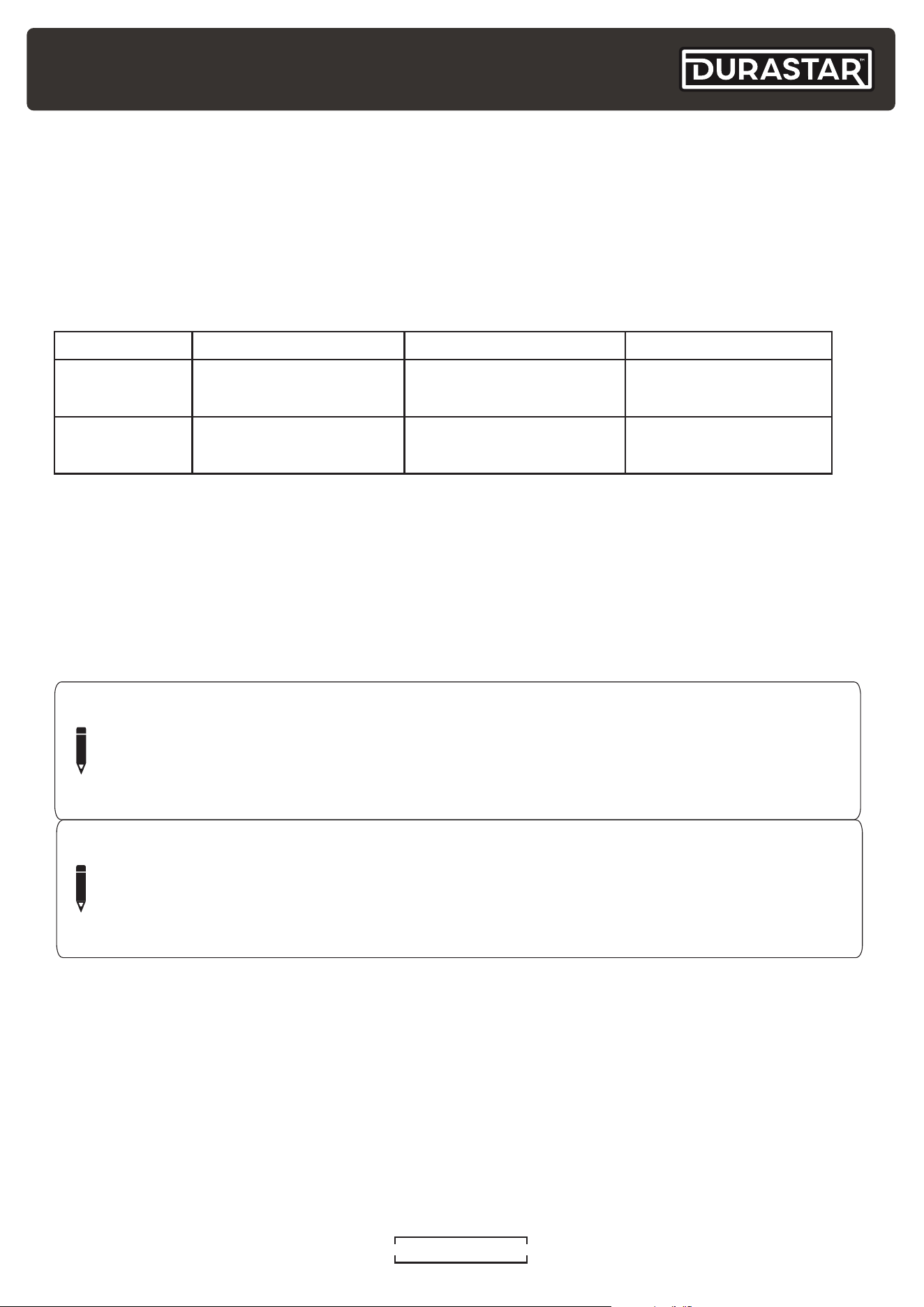
Your air conditioner is designed to operate in the following indoor and outdoor temperatures.
When your air conditioner is used outside of the following temperature ranges, certain safety
features may activate and turn off the unit to protect it from damage.
TEMPERATURE RANGES
COOL mode HEAT mode DRY mode
Indoor Air
Temperature
62°F - 90°F
(17°C - 32°C)
32°F - 86°F
(0°C - 30°C)
50°F - 90°F
(10°C - 32°C)
Outdoor Air
Temperature
5°F - 122°F
(-15°C - 50°C)
-13°F - 75°F
(-25°C - 24°C)
32°F - 122°F
(0°C - 50°C)
To further optimize the performance of your unit, do the following:
• Keep doors and windows closed.
• Limit energy usage by using TIMER ON and TIMER OFF features.
• Do not block air inlets or outlets.
• Regularly inspect and clean air filters.
OPERATING TEMPERATURES
NOTE
Keep the room's relative humidity below 80%. If the air conditioner operates in excess
of this, the surface of the air conditioner may attract condensation. To help prevent
condensation from forming and dripping, set the vertical airflow louver to its maximum
angle (vertically to the floor) and set the fan to HIGH.
NOTE
Your Durastar air conditioner's outdoor unit is equipped with a base pan heater, allowing
it to continue to operate at freezing temperatures as low as -13°F (-25°C). When outdoor
air temperatures are at or below 32°F (0°C), we strongly recommend keeping the unit
plugged in at all times to ensure smooth ongoing performance.
DURASTAR.COM8
INCLUDED INSTALLATION ACCESSORIES
The air conditioning system comes with the following accessories. They may vary by model.
FIELD SUPPLIED INSTALLATION ACCESSORIES
The following installation accessories may be required and must be purchased separately.
• Refrigerant lines
• Indoor and outdoor connection wire
• Outdoor power supply cord
• Drain hose
• Pipe and cable wrapping tape
• Wall hole sleeve and cover
• Putty
• Suspension bolts and necessary hardware to hang indoor unit (if necessary)
• Wiring u-lugs
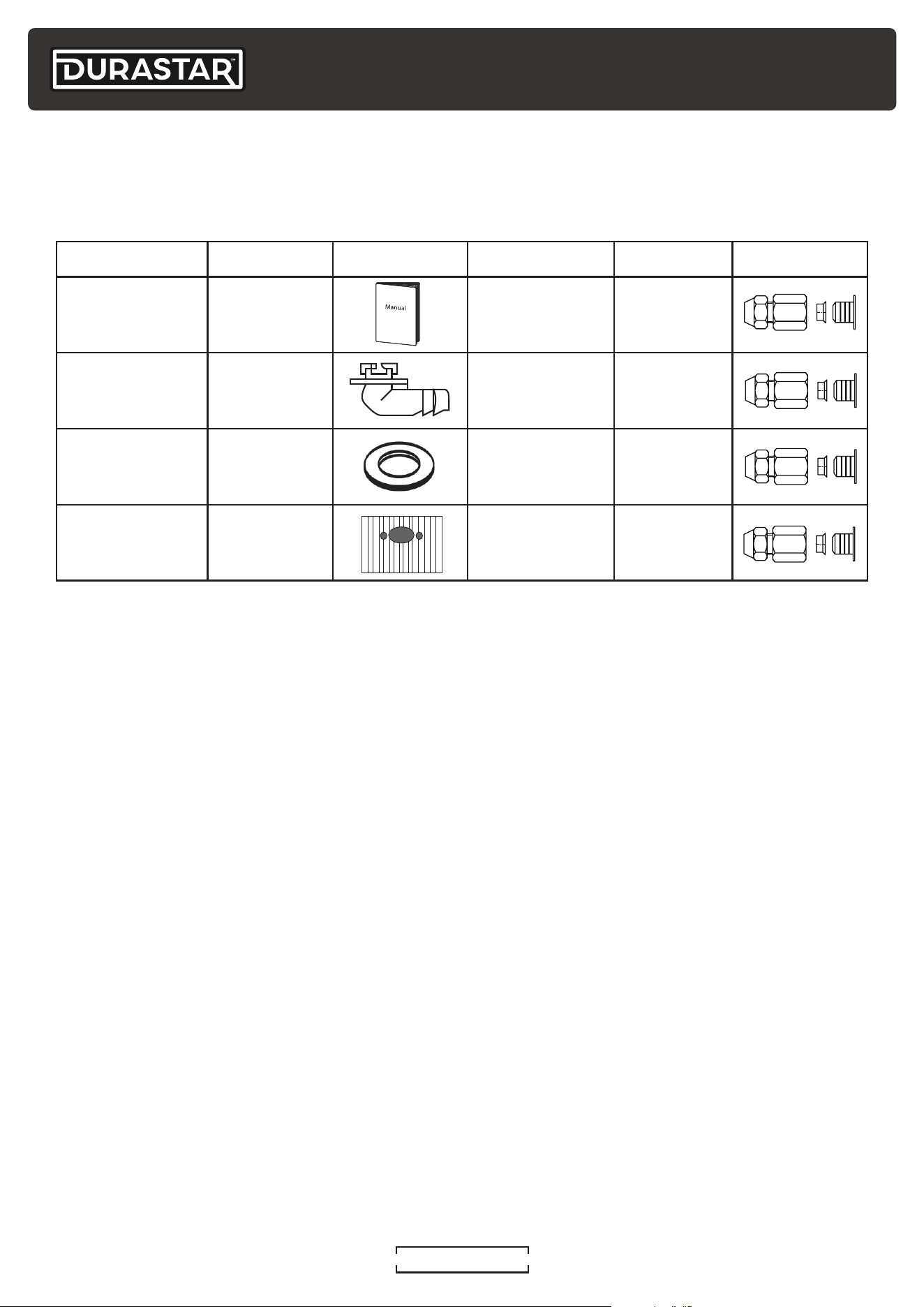
Accessory Quantity Image Accessory Quantity Image
Installation
Manual
1 Refrigerant
Pipe Adapter
(3/8"-1/2")
2-3
Drain Joint 1 Refrigerant
Pipe Adapter
(1/2"-3/8")
0-2
Drain Joint Seal 1 Refrigerant
Pipe Adapter
(1/2"-5/8")
0-2
Rubber Foot 4 Refrigerant
Pipe Adapter
(1/4"-3/8")
0-2
ACCESSORIES
TOOLS NEEDED
The following tools may be required for installation.
• Phillips screwdriver
• Drill with 2 1/2" or 3 1/2" (indoor unit model
depending) core bit
• Vacuum pump
• HVAC manifold gauge set
• Micron Gauge
• Refrigerant leak detector
• Copper pipe cutter
• Flaring tool
• Burr reamer
• Crescent or spanner wrench
• Hexagonal wrench set
• Torque wrench
• Hammer
• Wire strippers
• Wire crimper
• Multimeter
• Electroprobe
• Level
DURASTAR.COM
9
PARTS IDENTIFICATION
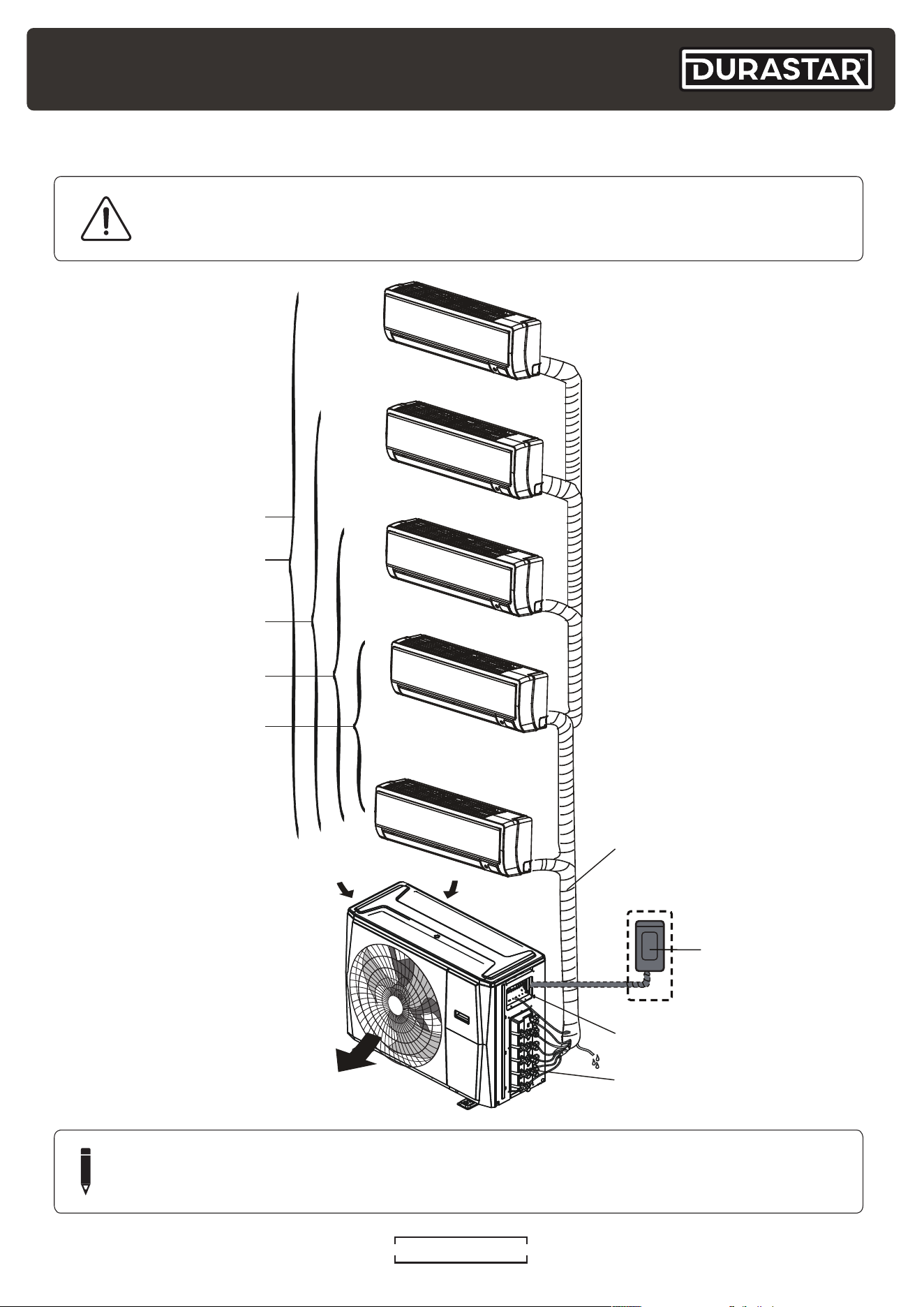
NOTE
Illustrations in this manual are for explanatory purposes. The actual shape of your mini-
split equipment may vary slightly. Indoor units may also vary in configuration.
DRA2U18M1B
DRA3U28M1B
DRA4U36M1B
DRA5U48M1B
Air Inlets
Air Outlet
Refrigerant Valves
Signal Cable,
Refrigerant Pipes,
and Drain Pipe
Wiring Terminal
Power
Supply
DRA5U55M1B
WARNING
When installing a Multi-zone outdoor unit, a minimum of 2 associated indoor units
must be installed and operational for the system to operate properly.
DURASTAR.COM10
OUTDOOR UNIT INSTALLATION
STEP 1: SELECT INSTALLATION LOCATION
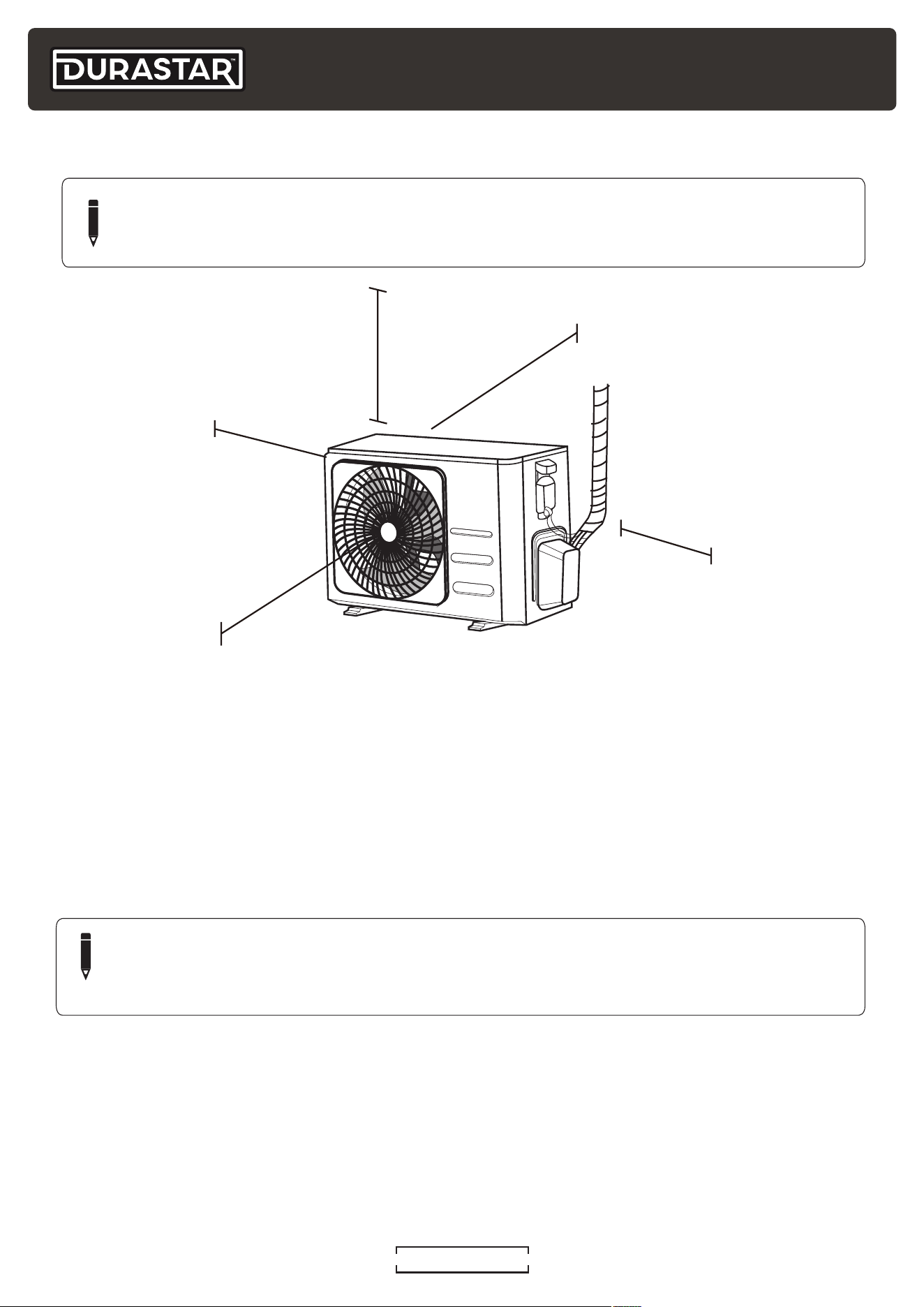
Before installing the outdoor unit, you must choose an appropriate location. The following are
standards that will help you choose an appropriate location for the unit.
Proper installation locations meet the following standards:
• Meets all spatial requirements shown in installation space requirements above.
• Good air circulation and ventilation.
• Firm and solid location —the location can support the unit's weight and will not vibrate.
• Noise from the unit will not disturb others.
• Protected from prolonged periods of direct sunlight or rain.
24” (610)
on right
12” (305)
on left
79” (2007)
in front
12” (305)
from back wall
24” (610)
above
DO NOT install unit in the following locations:
• Near an obstacle that will block air inlets and outlets.
• Near a public street, crowded areas, or where noise from the unit will disturb others.
• Near animals or plants that will be harmed by hot air discharge.
• Near any source of combustible gas.
• In a location that is exposed to large amounts of dust.
• In a location exposed to an excessive amount of salty air.
NOTE
Where snowfall is anticipated, raise the unit above the base pad to prevent ice buildup
and coil damage. Mount the unit high enough to be above the average accumulated
area snowfall. The minimum height must be 18 inches.
NOTE
The installation must be performed in accordance with the required local and national
standard. The installation may be slightly different in certain areas.
DURASTAR.COM
11
Special considerations for extreme weather
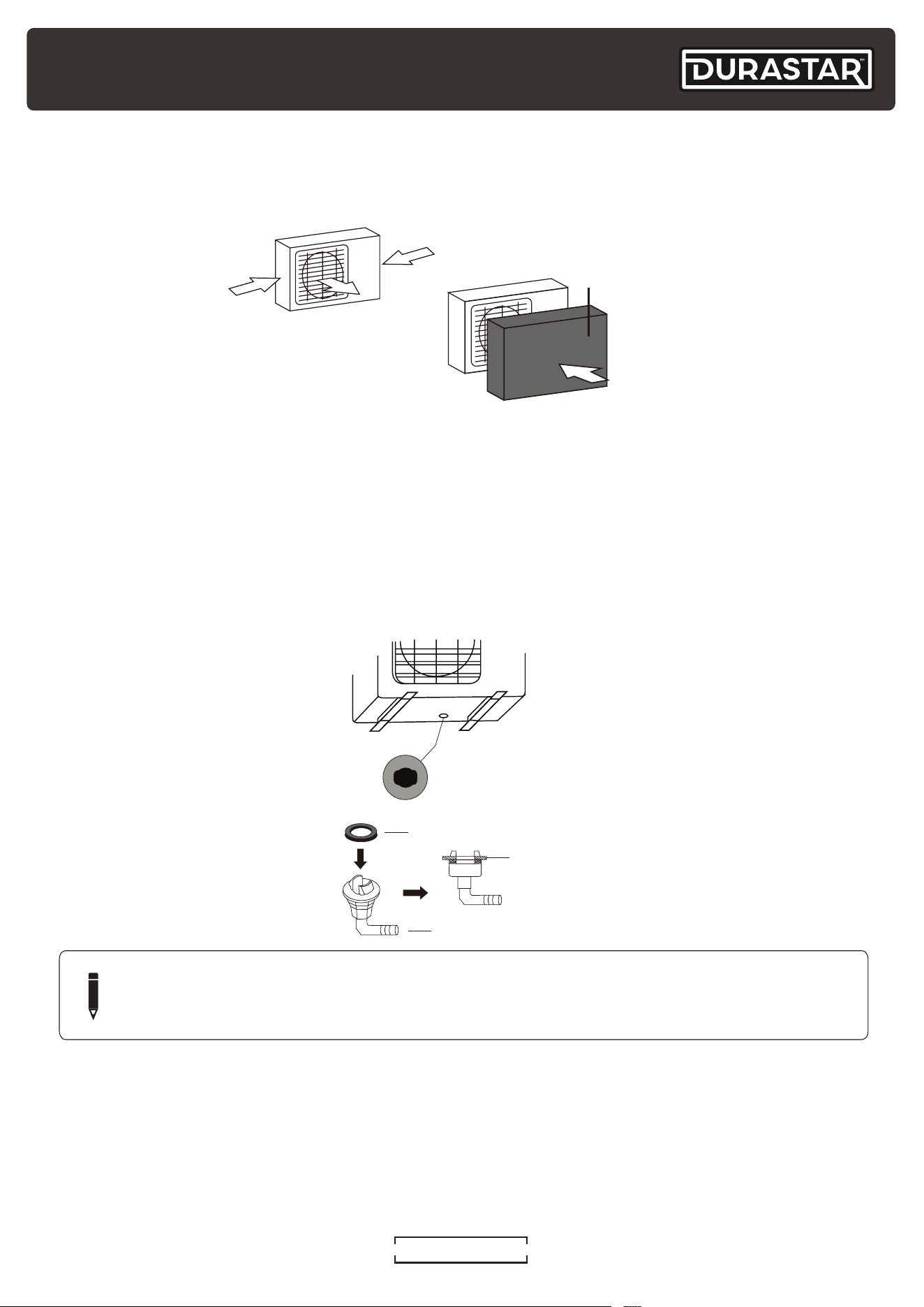
If the unit is exposed to heavy wind, install unit so that air outlet fan is at a 90° angle to the
direction of the wind. If needed, build a barrier in front of the unit to protect it from extremely
heavy winds. See figures below.
If the unit is frequently exposed to heavy rain or snow
Build a shelter above the unit to protect it from rain or snow. Be careful not to obstruct airflow
around the unit.
STEP 2: INSTALL THE DRAIN JOINT
1. Fit the rubber seal on the end of the drain joint that will connect to the outdoor unit.
2. Insert the drain joint into the hole in the base pan of the unit.
3. Rotate the drain joint 90° until it clicks in place facing the front of the unit.
4. Connect a drain hose extension (not included) to the drain joint to redirect water from the unit
during heating mode.
Strong
wind
Strong wind
Strong wind
Wind Baffle
Seal
Drain joint
Base pan hole of
outdoor unit
Seal
NOTE
In cold climates, make sure that the drain hose is as vertical as possible to ensure swift
water drainage. If water drains too slowly, it can freeze in the hose and flood the unit.
STEP 3: MOUNT THE OUTDOOR UNIT
Anchoring the Unit
The outdoor unit can be anchored to the ground or to a wall-mounted bracket (sold separately)
with bolts (M10). Mount the unit on a cement slab, condenser mounting pad, or other level surface
able to support the unit's weight. Do not place the unit directly on the ground. If using a wall-
mounting bracket, make sure the attached structure can support at least four times the unit's
weight.
DURASTAR.COM12
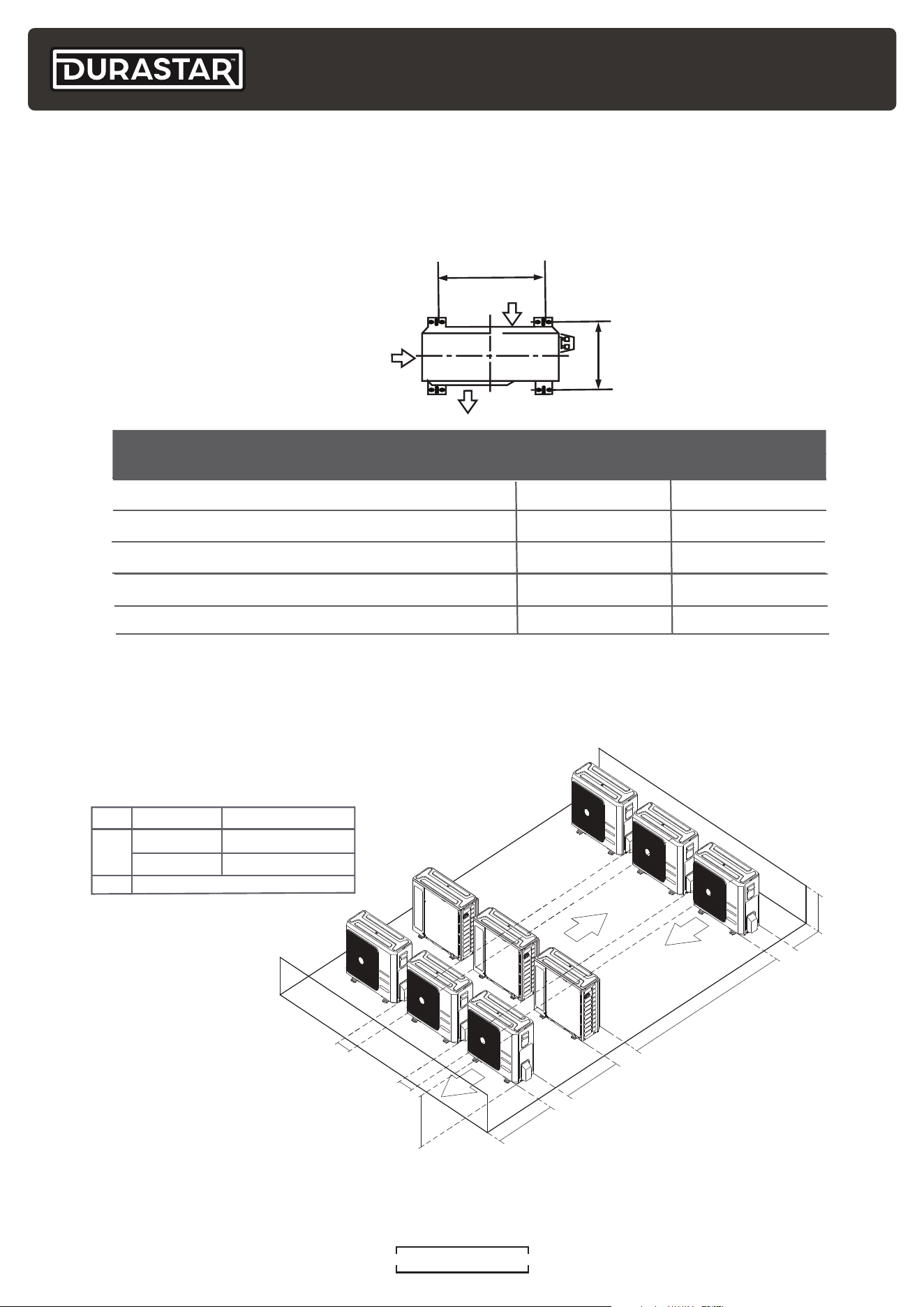
Installing multiple outdoor units
If installing multiple outdoor units, refer to the diagram below for proper clearances.
A
B
Air inlet
Air outlet
Air inlet
Outdoor Unit - Dimensions
W x H x D inches (mm)
Mounting Dimensions
Dist. A inches (mm) Dist. B inches (mm)
DRA5U48M1B - 37 1/2” x 52 1/2” x 16 5/16” (952 x 1333 x 415)
24-15/16” (634)
15-15/16” (404)
DRA4U36M1B - 37 1/4” x 31 7/8” x 16 1/8” (946 x 810 x 410)
26-1/2” (673)
15-7/8” (403)
DRA2U18M1B - 35 1/16” x 26 1/2” x 13 7/16” (890 x 673 x 342) 26-1/8” (663) 13-15/16” (354)
DRA3U28M1B - 37 1/4 ” x 31 7/8” x 16 1/8” (946 x 810 x 410)
26-1/2” (673) 15-7/8” (403)
DRA5U55M1B - 37 1/2” x 52 1/2” x 16 5/16” (952 x 1333 x 415) 24-15/16” (634) 15-15/16” (404)
L
H
≥118” (3000mm)
A
≥59”
(1500mm)
L ≤ H
L ≤ 1/2H
L A
≥9 13/16” (250mm)
1/2H < L ≤ H
≥11 13/16” (300mm)
L > H
Can not be installed
250m
≥9 13/16”
( m)
(6 )
≥23 5/8”
00mm
Distance between units
H = Outdoor unit height
L = Wall / Obstruction height
A = Required distance between unit and wall / obstruction
250m
≥9 13/16”
( m)
Unit Mounting Dimensions
The distance between their mounting feet varies by outdoor unit. Prepare the installation base of the unit
according to the dimensions below. In most cases, it may be easier to place the outdoor unit in its correct
location and mark the exact placement for the anchor holes.
DURASTAR.COM
13
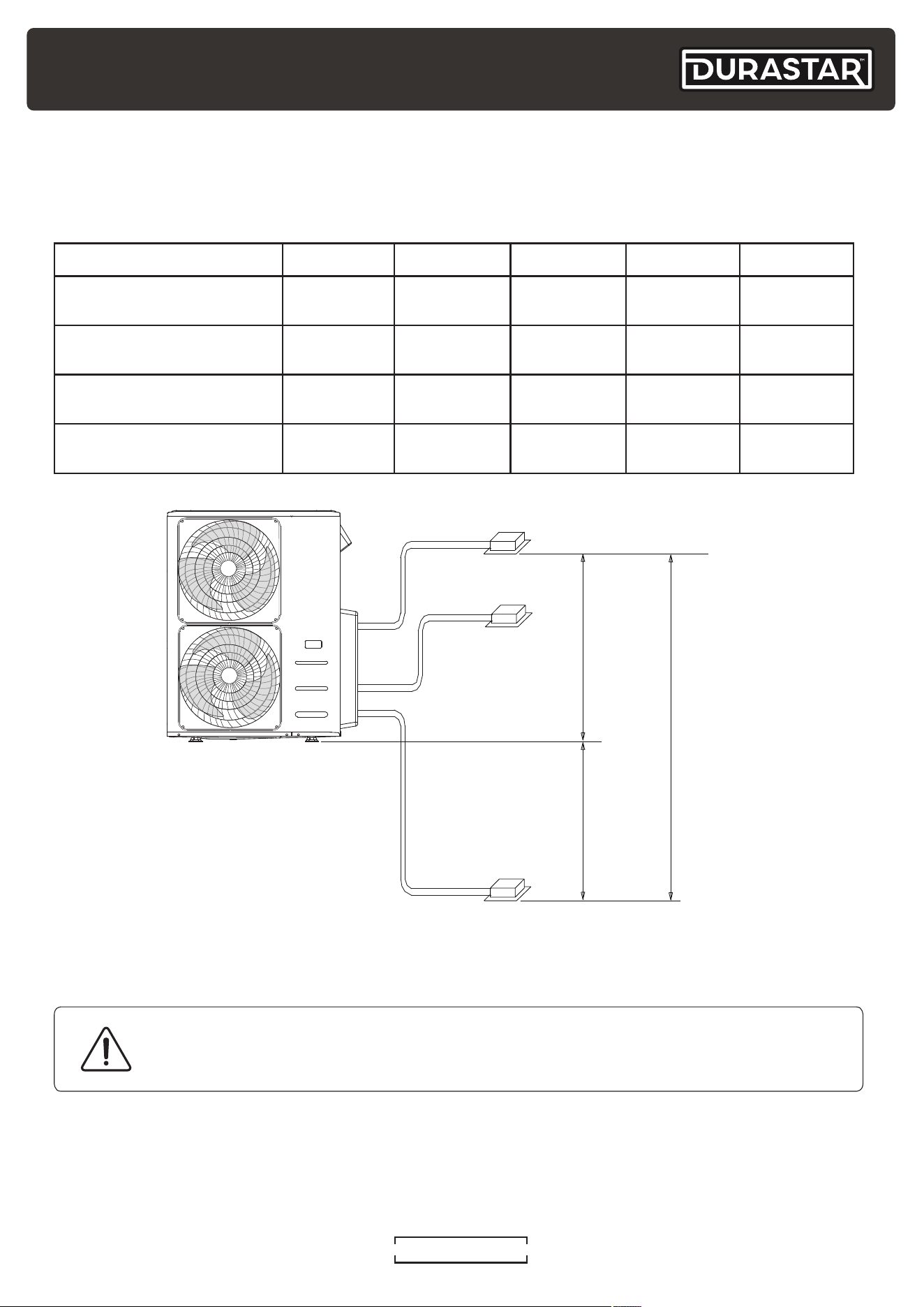
33’ (10m)
Indoor unit
Indoor unit
Indoor unit
Outdoor unit
49’ (15m)
49’ (15m)
Max. Height difference
Pipe length and unit height difference maximums
When installing multiple indoor units with a single outdoor unit, ensure that the length of the
refrigerant pipe and the drop height between the outdoor and indoor units, and between indoor
units, meets the requirements below.
DRA2U18M1B DRA3U28M1B DRA4U36M1B DRA5U48M1B DRA5H55M1B
Max. length for all rooms 131' (40m) 197' (60m) 262' (80m) 262' (80m) 262' (80m)
Max. length for one indoor unit 82' (25m) 98' (30m) 115' (35m) 115' (35m) 115' (35m)
Max. height difference be-
tween outdoor and indoor unit
49' (15m) 49' (15m) 49' (15m) 49' (15m) 49' (15m)
Max. height difference be-
tween indoor units
33' (10m) 33' (10m) 33' (10m) 33' (10m) 33' (10m)
STEP 4: CONNECT THE SIGNAL AND POWER CABLES
The outside unit’s terminal block is protected by an electrical wiring cover on the side of the unit. A
comprehensive wiring diagram is printed on the inside of the wiring cover.
WARNING
Before performing any electrical or wiring work, turn off the main power to the
system.
USE THE RIGHT CABLE
• Indoor Power/ Signal Cable: 14/4 stranded, unshielded
• Outdoor Power Cable: Determined by amperage of system and the local codes in your area.
DURASTAR.COM14
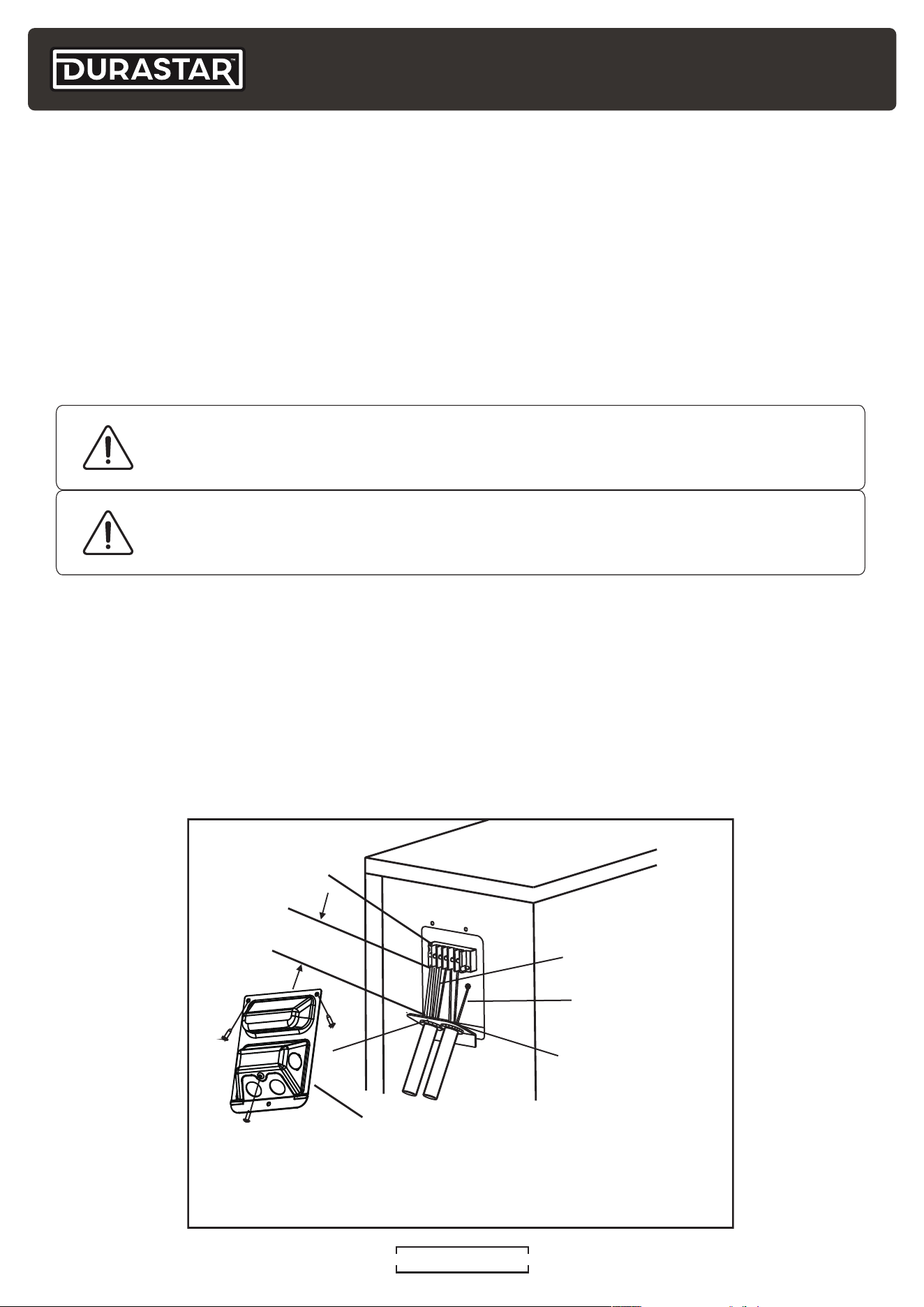
1. Remove the electrical wiring cover.
2. Remove the caps on the conduit panel.
3. Temporarily mount the conduit tubes (sold separately) onto the conduit panel.
4. Properly connect both the power supply and low voltage lines to the corresponding terminals
on the terminal block.
5. Ground the unit in accordance with local codes.
6. Be sure to cut the wire several inches longer than the required length for future maintenance.
7. Permanently secure the conduit tubes to the conduit panel.
8. Replace the wire cover on the side of the unit, and screw it in place.
G
Wire Cover
Over 1.57in.(40mm)
Terminal block
Conduit panel
Connecting cable
Power supply cord
Select the appropriate holes to feed the wires
through according to their diameter.
WARNING
Pay attention to the live wire. While crimping wires, make sure you clearly distinguish
the Live (“L”) Wire from other wires.
WARNING
All wiring work must be performed strictly in accordance with the wiring diagram
located inside the terminal cover of the outdoor unit.
Choose the Correct Size of Cable
The size of the power supply cable, signal cable, fuse, and switch needed is determined by the
maximum current of the unit. The maximum current is indicated on the nameplate located on the
side panel of the unit. Refer to this nameplate to choose the right cable (stranded wire preferred),
fuse, or switch.
Prepare the cable and wires for connection:
• Using wire strippers, strip the rubber jacket from both ends of cable to reveal about 1.5" (38-
40mm) of the wires inside.
• Strip the insulation from the ends of the wires.
• Using a wire crimper, crimp u-lugs on the ends of the wires.
DURASTAR.COM
15
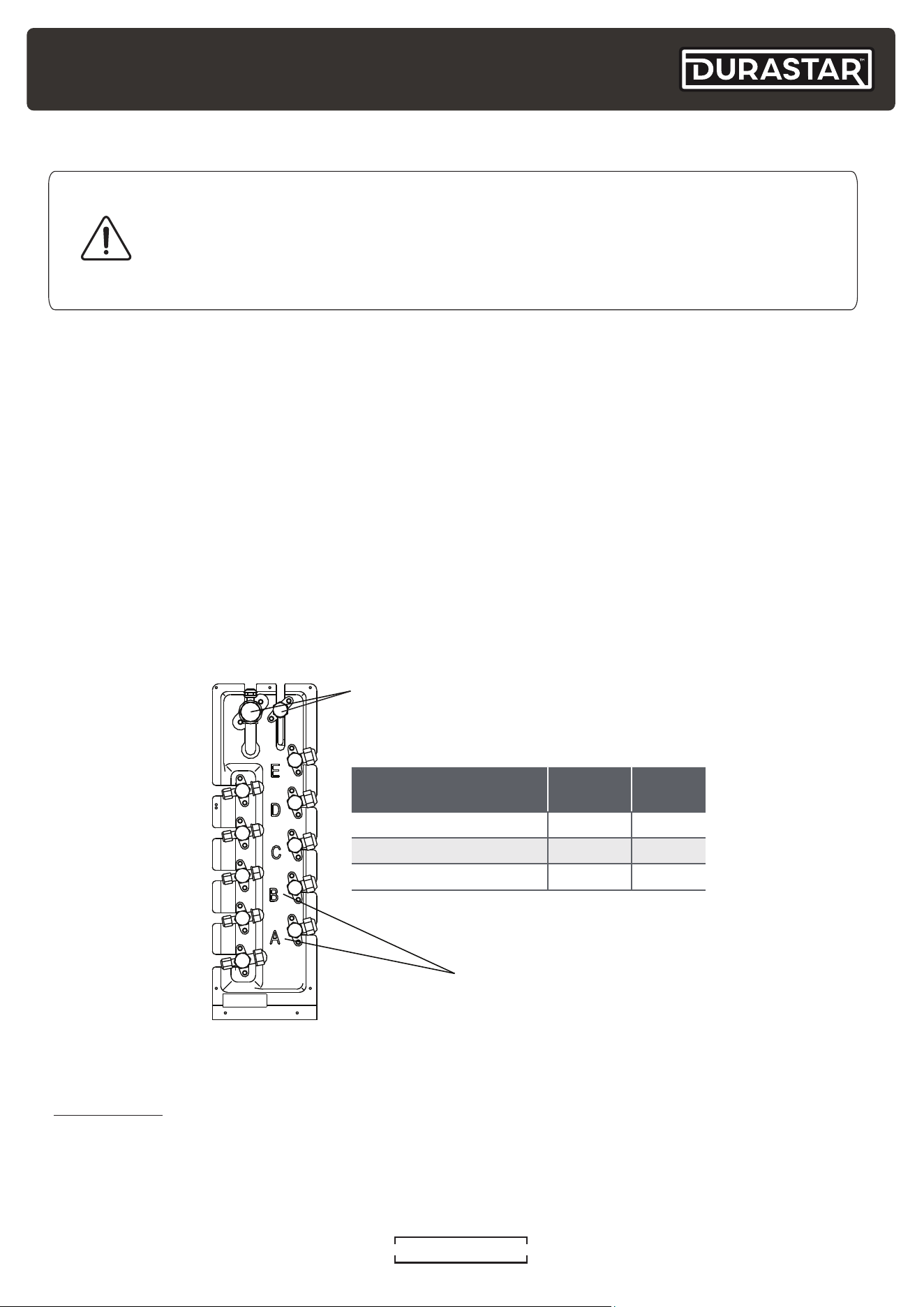
Note on refrigerant valve selection for indoor units
For DRA3U28M1B and DRA4U36M1B:
If installing a 24,000 BTU indoor unit, only connect the unit to the valve ports labeled "A" on the
outdoor unit.
For DRA5U48M1B and DRA5U55M1B:
If installing one 24,000 BTU indoor unit, only connect the unit to the valve ports labeled "A" on the
outdoor unit. If installing two 24,000 BTU indoor units, only connect the units to the valve ports
labeled "A" and "B" on the outdoor unit.
REFRIGERANT PIPING CONNECTIONS
REFRIGERANT PIPE LENGTH
The length of refrigerant piping will affect the performance and efficiency of the unit. Nominal
efficiency is tested with a pipe length of 25 feet (7.6 meters). A minimum pipe run of 10 feet (3
meters) is required to minimize vibration and excessive noise.
Refer to the table on page 13 for specifications on the maximum length and drop height of
refrigerant piping.
WARNING
When connecting refrigerant piping, do not let substances or moisture other than
specified refrigerant enter the unit or pipes. Run nitrogen through the refrigerant
tubing when brazing to avoid carbon build up. The presence of foreign materials will
lower the unit's capacity and can cause abnormally high pressure in the refrigeration
system. This can result in explosion and personal injury.
Note on master valves
For DRA3U28M1B, DRA4U36M1B, DRA5U48M1B, and DRA5U55M1B
Initial startup
Once installation is complete, open all zone valves connected to an indoor unit. Connect the high
side hose of the manifold gauge to the gas side master valve to gain access to all connected
zones. Perform leak check procedures. Afterwards, remove the high side hose and attach the low
side hose from the manifold to evacuate all connected zones.
Refrigerant connecting pipe sizes
for indoor units
Indoor Unit capacity
(Btu/h)
Liquid Gas
6K/9K/12K 1/4” 3/8”
12K &18K 1/4” 1/2”
24K 3/8” 5/8”
“A” and “B” valve ports.
Master Valves
DURASTAR.COM16
Indoor Unit
Indoor Unit
Outdoor Unit
Outdoor Unit
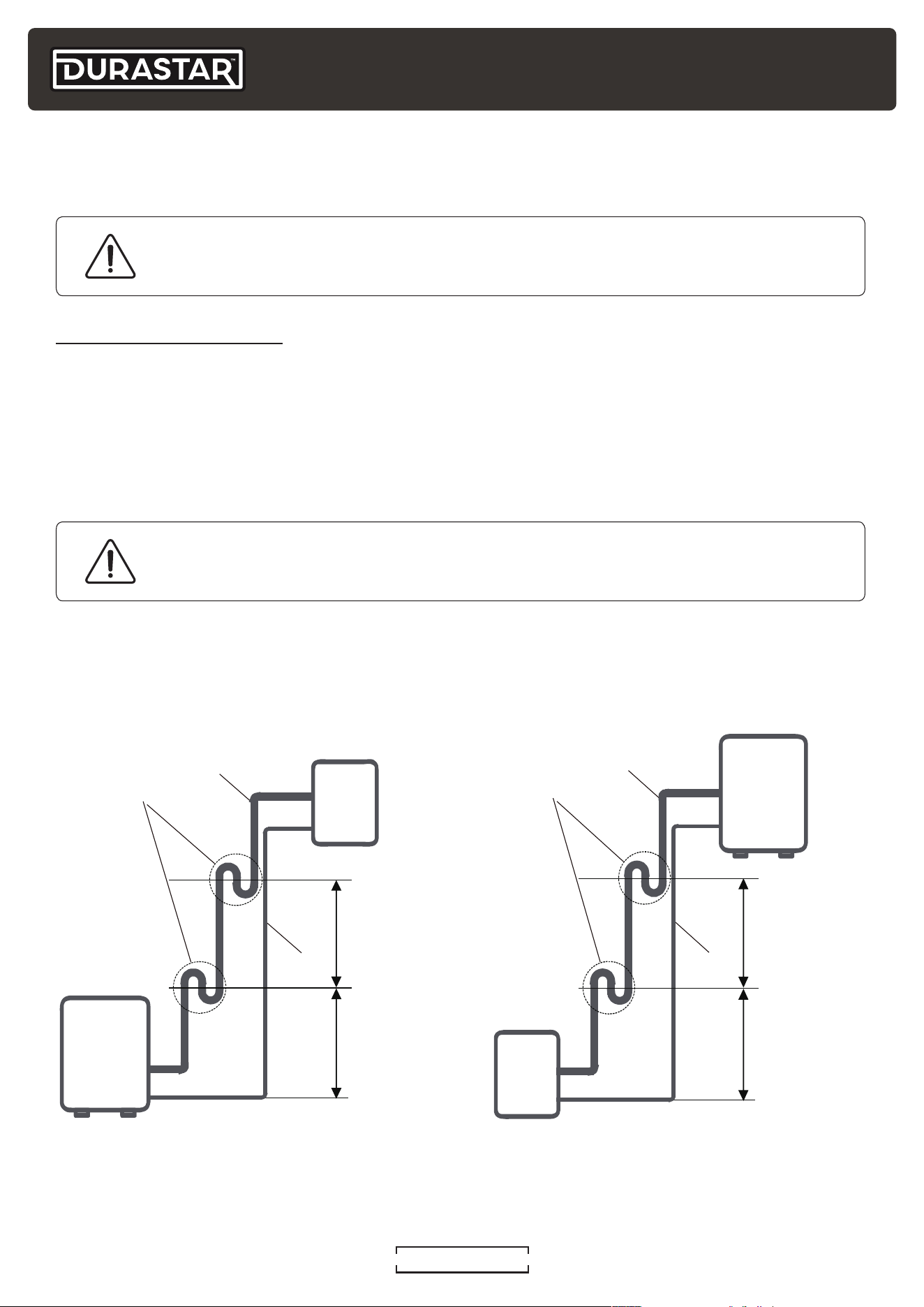
Oil Trap
Oil Trap
Gas Pipe
Gas Pipe
Liquid
Pipe
Liquid
Pipe
32’ 10” (10m)
32’ 10” (10m)
19’ 9” (6m)
19’ 9” (6m)
Required distance between oil traps when
the indoor unit is installed higher than the
outdoor unit.
Required distance between oil traps when
the outdoor unit is installed higher than the
indoor unit.
OIL TRAPS
Oil traps are necessary for the continued performance of the system if the indoor and outdoor
units are installed at significantly different heights.
Post start-up and servicing
Once the system is operational, the master valves can be used to access the entire system for
servicing and troubleshooting. If a repair requires the entire refrigerant charge to be removed, the
master valves will allow the recovery of all system refrigerant. Simply connect the low side hose
of the manifold gauge directly to the gas side master valve to recover refrigerant. Once repair is
complete, use the high side hose of the manifold to leak check. Then, connect the low side hose
again to pull a vacuum and charge the system. After service is complete, both master valves and
all zone valves connected to an IDU must remain open for proper operation.
WARNING
After servicing, the master valves and all zone valves connected to an IDU must
remain open for proper operation.
WARNING
After startup, the master valves and all zone valves connected to an IDU must
remain open for proper operation.
Once a vacuum is maintained, open both master valves to release the refrigerant charge into
the entire system. After all the refrigerant is released, both master valves and all zone valves
connected to an IDU must remain open for proper operation.
DURASTAR.COM
17
REFRIGERANT PIPE CONNECTION INSTRUCTIONS
STEP 1: CUT PIPES
When preparing refrigerant pipes, take extra care to cut and flare them properly. This will ensure
efficient operation and minimize leaks and the need for future maintenance.
1. Measure the distance between the indoor and outdoor units.
2. Using a pipe cutter, cut the pipe length a little longer than the measured distance.
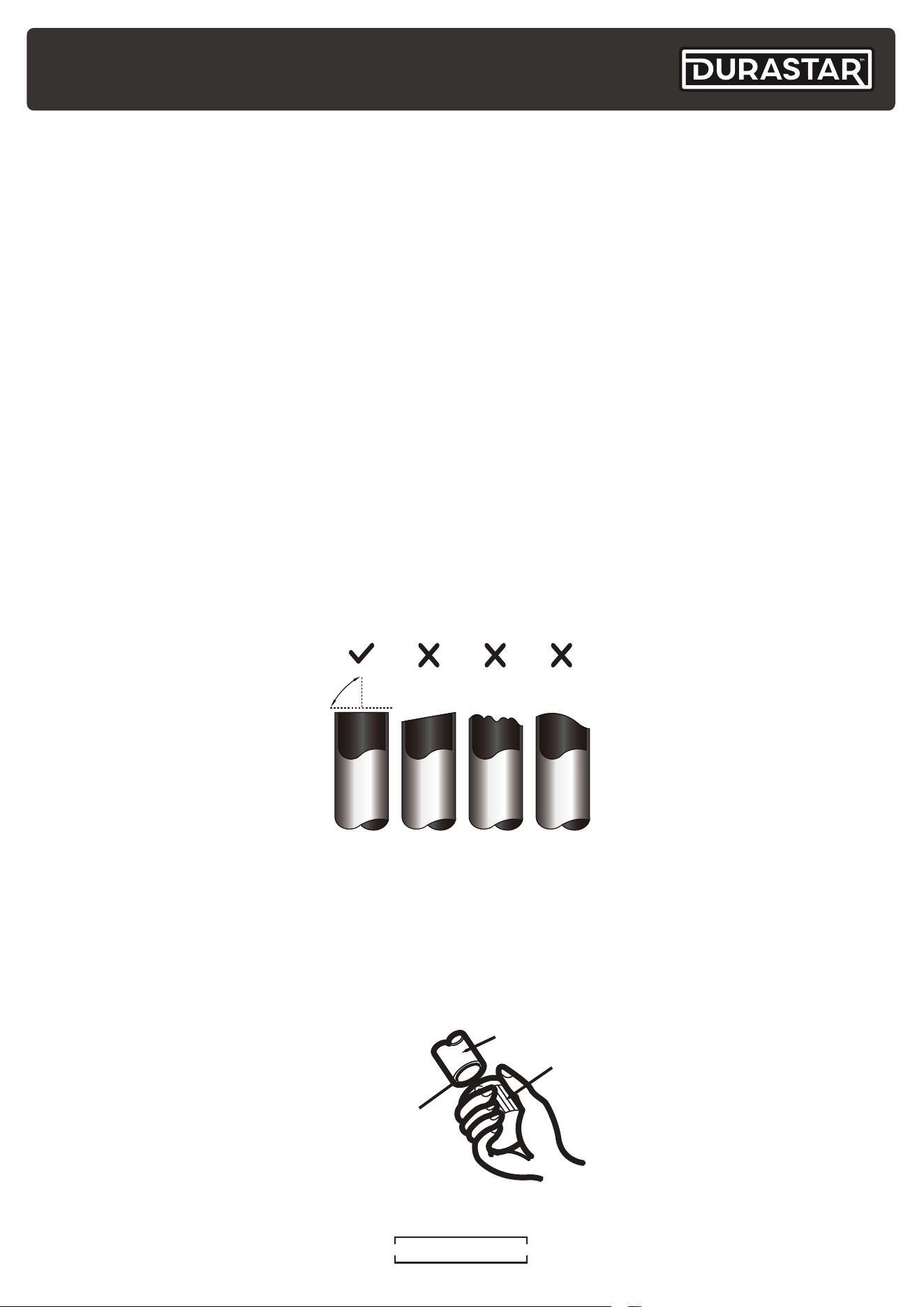
3. Make sure that the pipe is cut at a perfect 90o angle.
4. Do not damage, deform, or dent the pipe while cutting.
Oblique Rough Warped
90°
STEP 2: REMOVE BURRS
Burrs can affect the airtight seal of the refrigerant piping connection and must be completely
removed.
1. Hold the pipe at a downward angle to prevent burrs from falling into the pipe.
2. Using a reamer or deburring tool, remove all burrs from the cut section of the pipe.
Pipe
Reamer
Point downward
If the indoor unit is installed higher than the outdoor unit:
Oil may flow back into the outdoor unit's compressor and cause liquid compression. This will lead
to deterioration of performance and shorten the life of the compressor. Oil traps in the rising gas
piping can prevent this and should be installed every 32'10" (10m) of vertical rise.
If the outdoor unit is installed higher than the indoor unit:
Proper oil return to the compressor must be maintained with the suction gas velocity. If velocities
drop below 1500fpm, oil return will be decreased and lead to deterioration of performance and
shorten the life of the compressor. Oil traps in the rising gas piping can prevent this and should be
installed every 19'9" (6m) of vertical rise.
DURASTAR.COM18
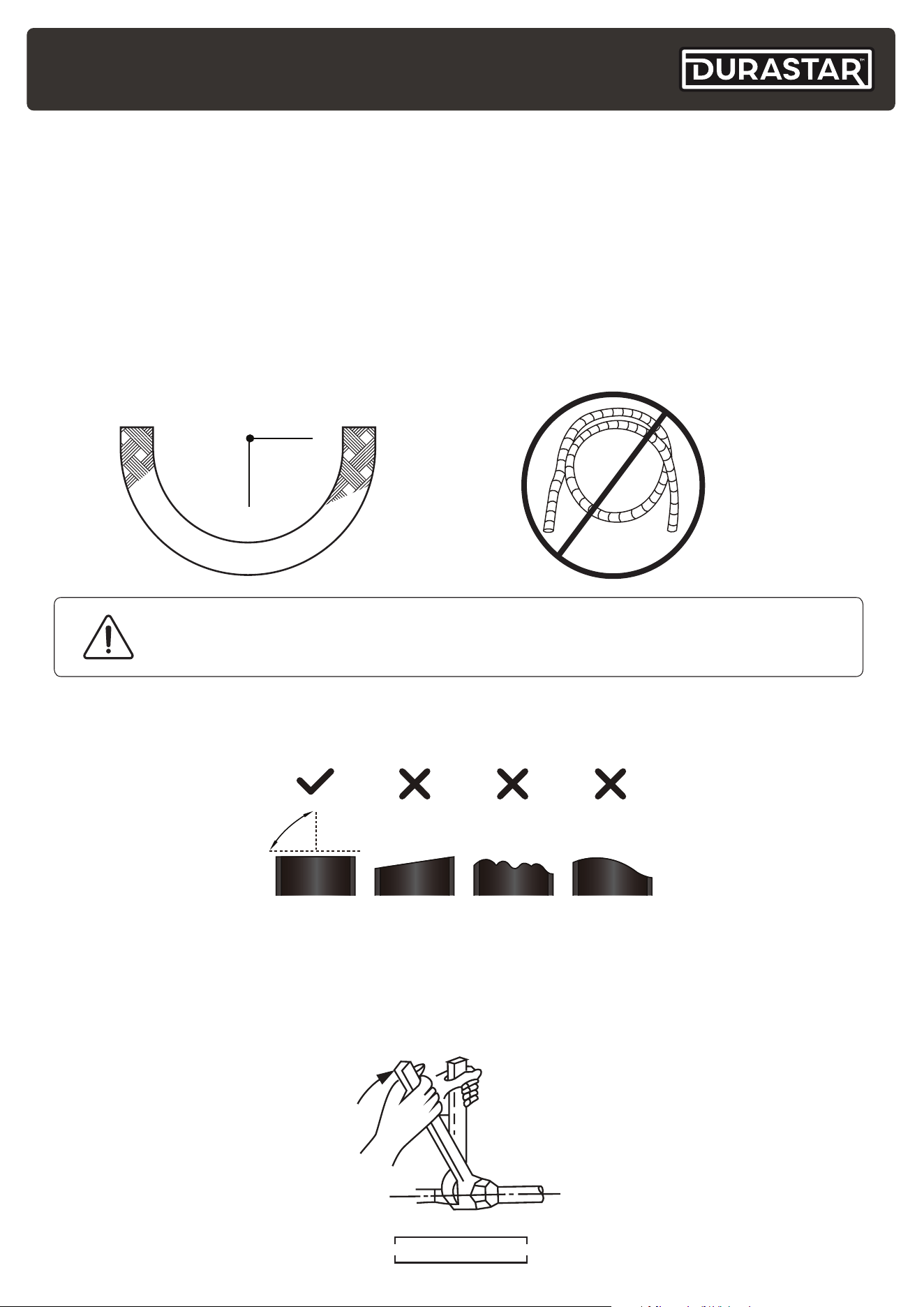
PIPE EXTENSION BEYOND FLARE FORM
Outer Diameter of Pipe
Inches (mm)
"A" Minimum Extension
Inches (mm)
"A" Maximum Extension
Inches (mm)
Ø 1/4" (6.4mm) 0.0275" (0.7mm) 0.05" (1.3mm)
Ø 3/8" (9.5mm) 0.04" (1.0mm) 0.063" (1.6mm)
Ø 1/2" (12.7mm) 0.04" (1.0mm) 0.07" (1.8mm)
Ø 5/8" (15.9mm) 0.078" (2.0mm) 0.086" (2.2mm)
Ø 3/4" (19.1mm) 0.078" (2.0mm) 0.094" (2.4mm)
Flare form
Pipe
A
STEP 3: FLARE PIPE ENDS
Proper flaring is essential to achieve an airtight seal.
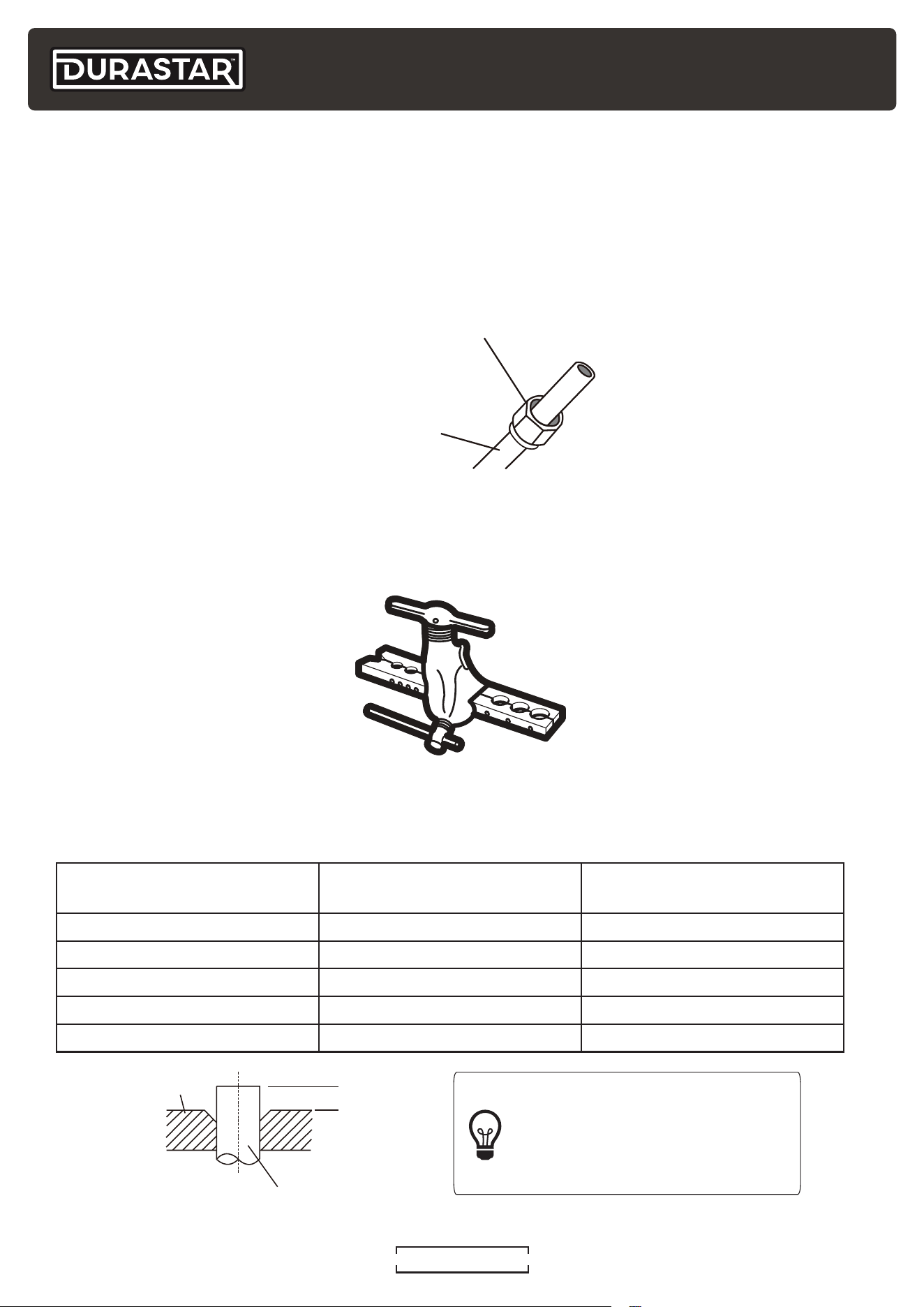
1. After removing burrs from cut pipe, seal the ends with PVC tape to prevent foreign materials
from entering the pipe.
2. Sheath pipe with insulating material.
3. Place flare nuts on both ends of the pipe. Make sure they are facing in the right direction as
you cannot change their orientation after flaring.
Flare nut
Copper pipe
4. Remove PVC tape from ends of pipe when ready to perform flaring.
5. Clamp flare form on the end of pipe. The end of the pipe must extend beyond the edge of the
flare form in accordance with the pipe extension table.
TIP: THICKNESS COMPARISON
• 0.0275" = A Thumbnail
• 0.04" = A Dime
• 0.078" = A Nickle
DURASTAR.COM
19
6. Place flaring tool onto the form.
7. Turn the handle of the flaring tool clockwise until the pipe is fully flared.
8. Remove the flaring tool and flare form, then inspect the pipe for cracks and even flaring.
STEP 4: CONNECT PIPES
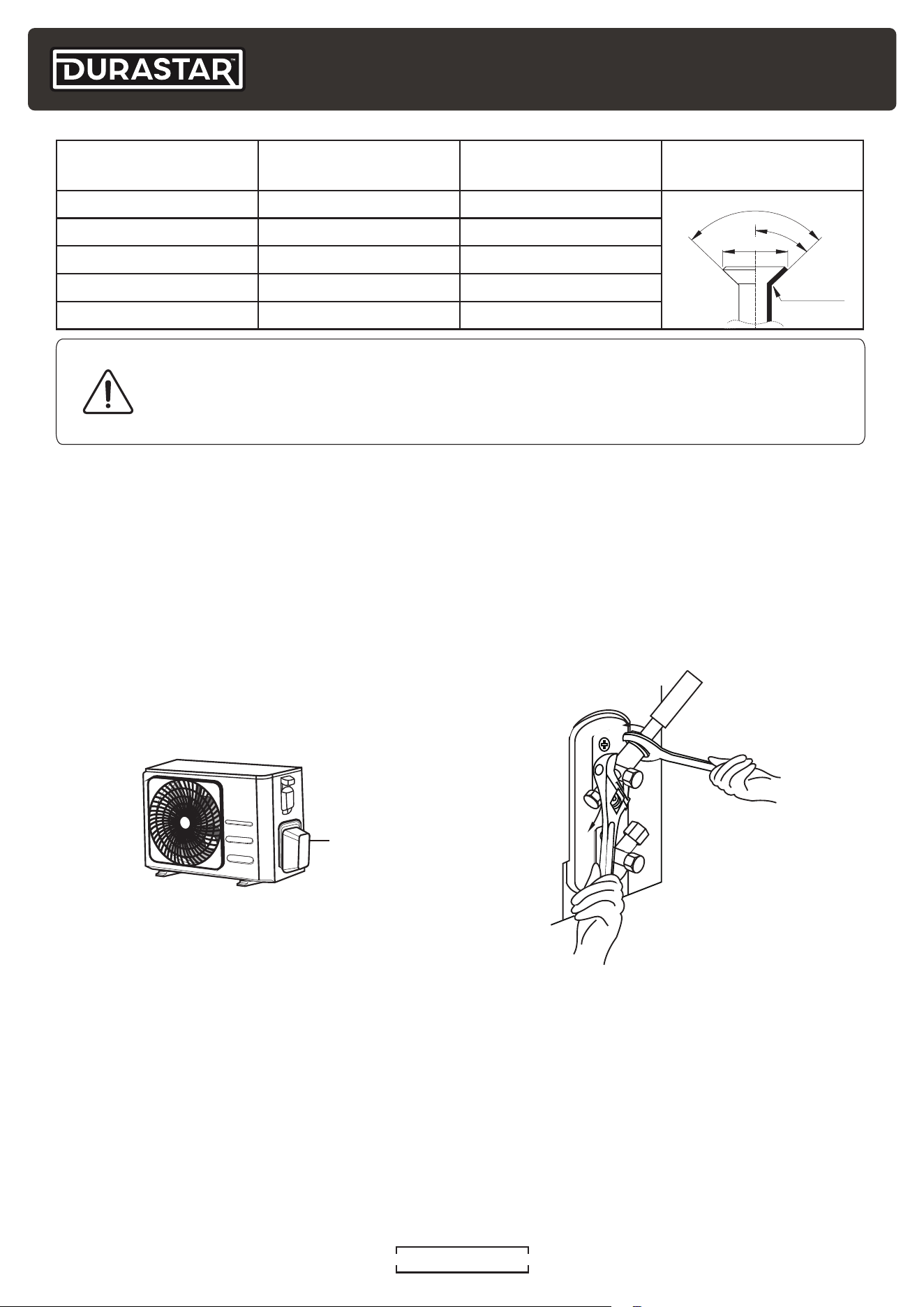
When connecting refrigerant pipes, be careful not to use excessive torque or to deform the piping
in any way. You should first connect the low-pressure pipe, then the high-pressure pipe.
When bending connective refrigerant piping, the minimum bending radius is 4 inches (10cm). Do
not leave coils in the refrigerant line sets. Remove excess line length to ensure proper system
operation.
CONNECTING PIPING TO INDOOR UNIT
1. Align the center of the two pipes that you will connect.
Oblique Rough
Warped
90°
2. Tighten the flare nut as tightly as possible by hand.
3. Using a spanner, grip the nut on the unit tubing.
4. While firmly gripping the nut on the unit tubing, use a torque wrench to tighten the flare nut
according to the torque values in the table on the next page. Loosen the flaring nut slightly,
then tighten again.
Radius ~4” (10cm)
WARNING
Do not leave coils in the refrigerant line sets. All excess line length must be removed
to ensure proper system operation.
DURASTAR.COM20
SYSTEM EVACUATION
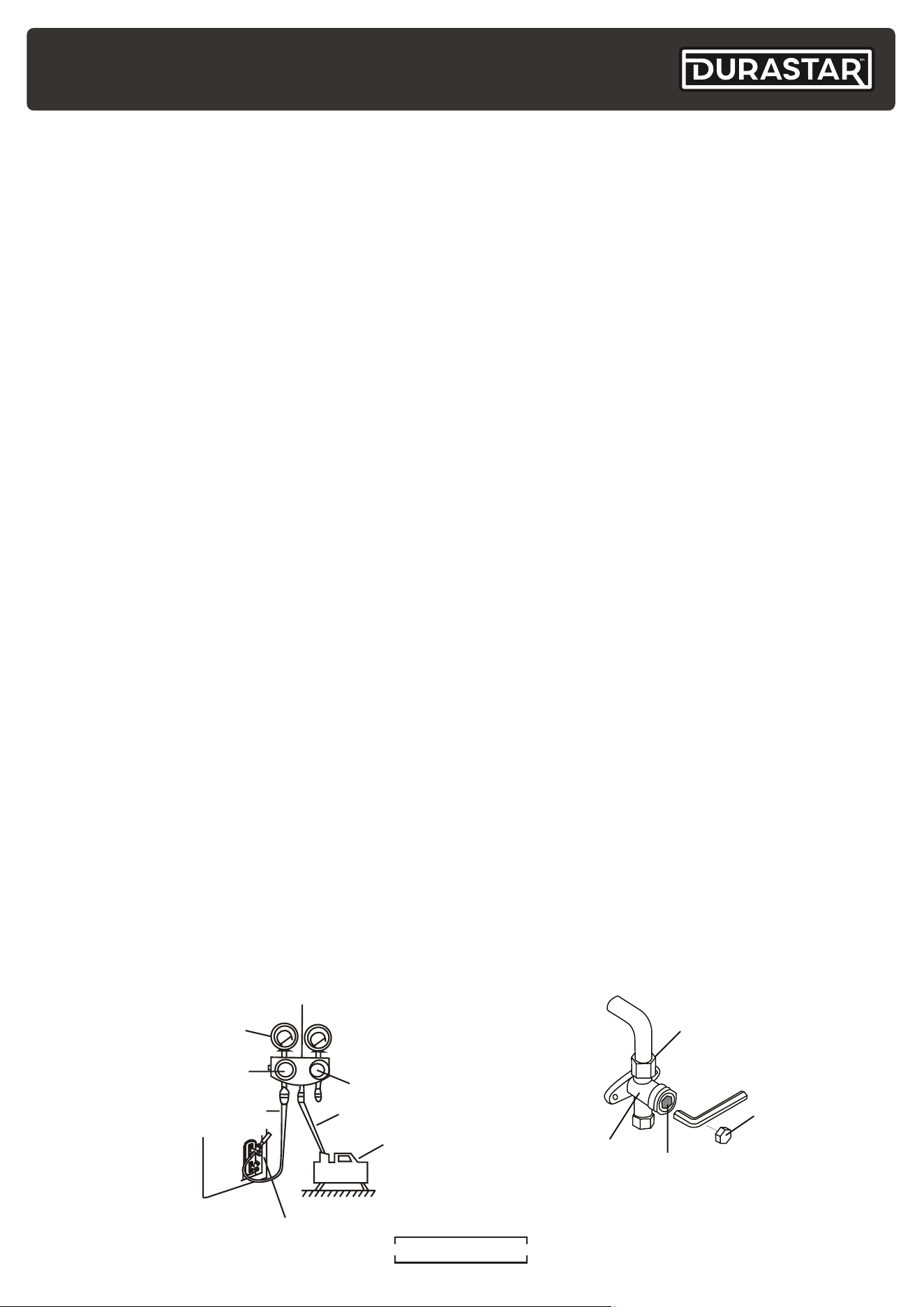
Outer Diameter of
Pipe Inches (mm)
Tightening Torque
lb-ft (Nm)
Flare Dimension "B"
Inches (mm)
Flare Shape
Ø 1/4" (6.4mm) 13.3~14.8 (18~20) 0.33~0.34 (8.4~8.7)
R 0.4~0.8
45
°
±
2
90
°
±
4
B
Ø 3/8" (9.5mm) 23.6~28.8 (32~39) 0.52~0.53 (13.2~13.5)
Ø 1/2" (12.7mm) 36.1~43.5 (49~59) 0.64~0.65 (16.2~16.5)
Ø 5/8" (15.9mm) 42~52.4 (57~71) 0.76~0.78 (19.2~19.7)
Ø 3/4" (19.1mm) 49.4~74.5 (67~101) 0.91~0.93 (23.2~23.7)
CONNECTING PIPING TO OUTDOOR UNIT
1. Remove the valve cover on the side of the outdoor unit.
2. Remove the protective caps from the ends of the valves.
3. Align flared pipe end with each valve and tighten the flare nut as tightly as possible by hand.
4. Using a spanner, grip the body of the valve. Do not grip the nut that seals the service valve.
5. While firmly gripping the body of the valve, use a torque wrench to tighten the flare nut
according to the correct torque values in the table above.
6. Loosen the flare nut slightly, then tighten again.
7. Repeat steps 3-6 for the remaining pipe.
Valve cover
WARNING
Do not use excessive torque. Excessive force can break the nut or damage the
refrigerant piping. You must not exceed the torque requirements shown in the table
above.
PREPARATIONS AND PRECAUTIONS
Air and foreign matter in the refrigerant system can cause abnormal rises in pressure, which can
damage the air conditioner, reduce energy efficiency, and cause injury. Use a vacuum pump and
manifold gauge to evacuate the refrigerant system, removing any non-condensible gas and
moisture from the system. Evacuation should be performed upon initial installation and if unit is
relocated.
DURASTAR.COM
21
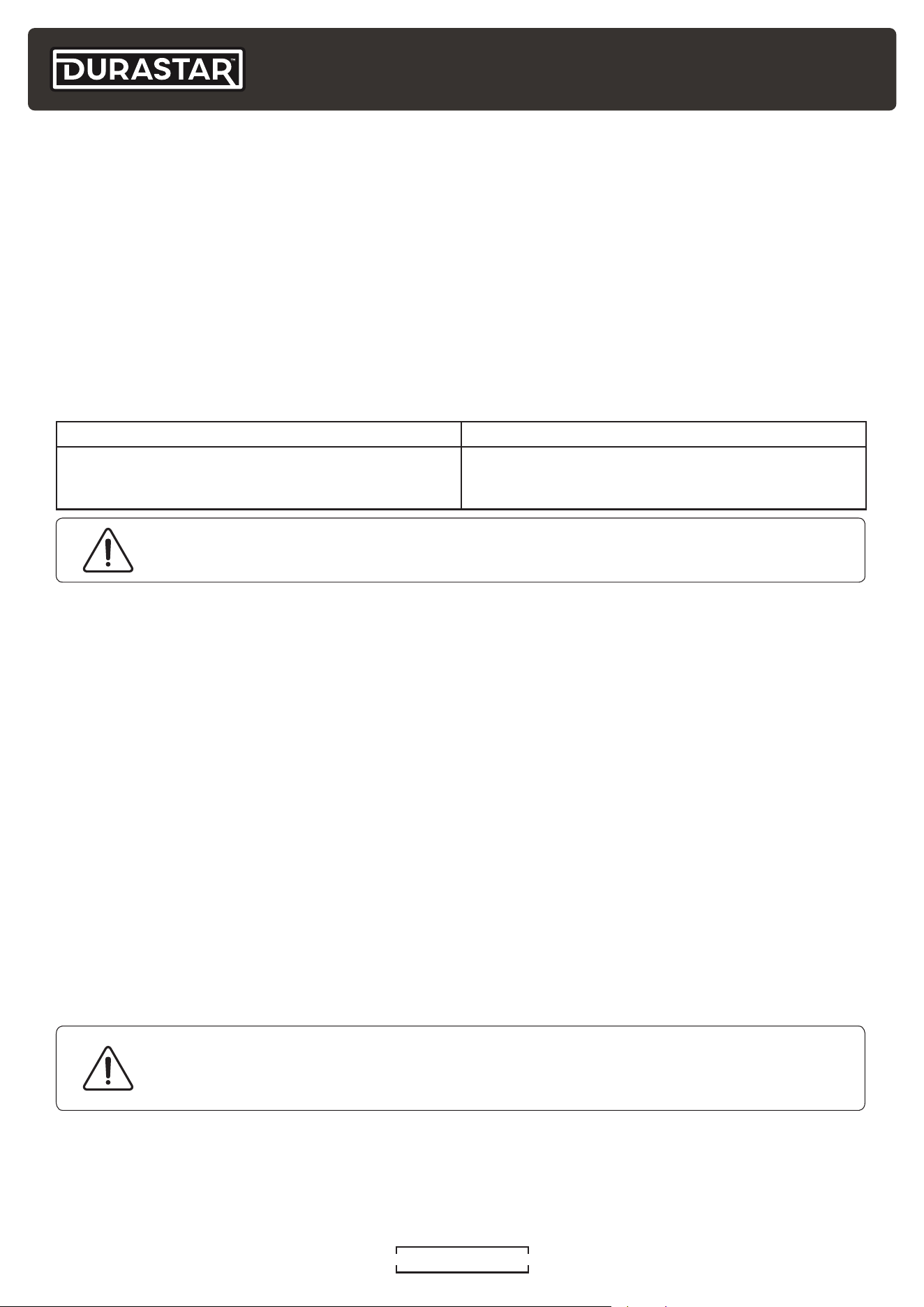
BEFORE PERFORMING EVACUATION
1. Check to make sure the refrigerant pipes connecting the indoor and outdoor units are
connected properly and leak free.
2. Check to make sure all wiring is connected properly.
EVACUATION INSTRUCTIONS
1. Connect the high pressure side hose of the manifold gauge to the service port on the outdoor
unit’s service valve.
2. Connect the hose from the auxiliary port of the manifold gauge to the nitrogen tank.
3. Open the high pressure side of the manifold gauge. Keep the low pressure side closed.
4. Open the nitrogen tank valve and pressurize the system to 600PSIG.
5. Close nitrogen tank valve and high pressure side of the manifold gauge.
6. Wait 15 minutes, then check that there has been no change in pressure.
7. If pressure loss is greater than 5PSIG, a leak may be present. Using the Soap and Bubble
Method, locate and fix all leaks. Start back at step 1 once all leaks have been fixed.
8. If there is no change in pressure, remove the auxiliary port of the manifold gauge from the
nitrogen tank.
9. Release the pressure in the system by opening up the high side of the manifold gauge.
10. Once pressure has been released, remove the high pressure side hose of the manifold gauge
from the service port and replace it with the low pressure side hose.
11. Connect the hose of the auxiliary port of the manifold gauge to the vacuum pump and a
MICRON GAUGE.
12. Turn on the vacuum pump to evacuate the system.
13. Run the vacuum until the micron gauge reads 250 microns.
14. Once the micron gauge reads 250 microns, close the low pressure side of the manifold gauge
and turn off the vacuum pump. System must hold below 500 microns for 15 minutes with the
vacuum pump off.
15. If there is a change in pressure, a leak may be present. Using the Soap and Bubble Method,
locate and fix all leaks. Start back at step 1 once all leaks have been fixed.
16. If there is no change in pressure, remove the manifold gauge auxiliary hose from the vacuum
pump.
17. Remove the caps from the unit's valve bodies, and open the system's valves gently with a hex
wrench by turning it counterclockwise until they reach their stopping point. Do not try to force
the valves to open further.
Manifold Gauge
Low pressure
gauge
Low pressure
valve
High pressure
valve
Low pressure hose
Auxiliary hose
Vacuum pump
Low pressure valve
Flare nut
Cap
Valve body
Valve stem
DURASTAR.COM22
NOTE ON ADDING ADDITIONAL REFRIGERANT
Each outdoor unit is factory charged with enough refrigerant to support up to 25' (7.5m) per zone.
This is based on a one way liquid line measurement from the outdoor unit to the indoor unit. For
example, (N x 25' = T) where "T" is the total length of line set that can be supported by the units
factory charge and "N" is the number of zones available for use (eg. The DRA3 outdoor system
has zone A, B, and C available or 3 zones [3 x 25' = 75'] So the total length of line set that the
DRA3 can support in one direction is 75' distributed between the 3 (or less) zones available.)
Systems with line sets that exceed this length will require additional refrigerant (see the following
chart). The refrigerant should be charged from the service port on the outdoor unit's low pressure
valve. Additional refrigerant information can be found in the SUBMITTALS DOCUMENTS at
WWW.SERVICE.DURASTAR.COM. Additional refrigerant can be calculated using the following
formula:
Liquid Side Ø 1/4" (6.35mm) Liquid Side Ø 3/8" (9.52mm)
(Actual pipe length - Standard pipe length) x 0.16oz/ft
or
(Actual pipe length - Standard pipe length) x 15g/m
(Actual pipe length - Standard pipe length) x 0.32oz/ft
or
(Actual pipe length - Standard pipe length) x 30g/m
BEFORE THE TEST RUN
Only perform the test run after you have completed the following steps:
• Electrical Safety Checks - Confirm that the unit's electrical system is connected and operating
correctly.
• Gas Leak Check - Check all flare nut connections and confirm the system is not leaking.
• Confirm that the low and high pressure valves are fully open.
• Check grounding work by measuring the grounding resistance by visual detection and with a
multimeter. The grounding resistance must be less than 0.1 Ω.
ELECTRICAL SAFETY CHECKS
After installation, confirm that all electrical wiring is installed in accordance with local and national
regulations, and according to this installation manual.
DURING TEST RUN
Using your multimeter, verify the voltage of the main power entering the system. If the main power
voltage is greater than ±10% of the name plate voltage, turn off the unit and immediately call a
licensed electrician to find and resolve the cause.
FINAL CHECKS
WARNING
DO NOT mix refrigerant types.
WARNING
RISK OF ELECTRICAL SHOCK - All wiring must comply with local and national
electrical codes, and must be installed by a licensed electrician.
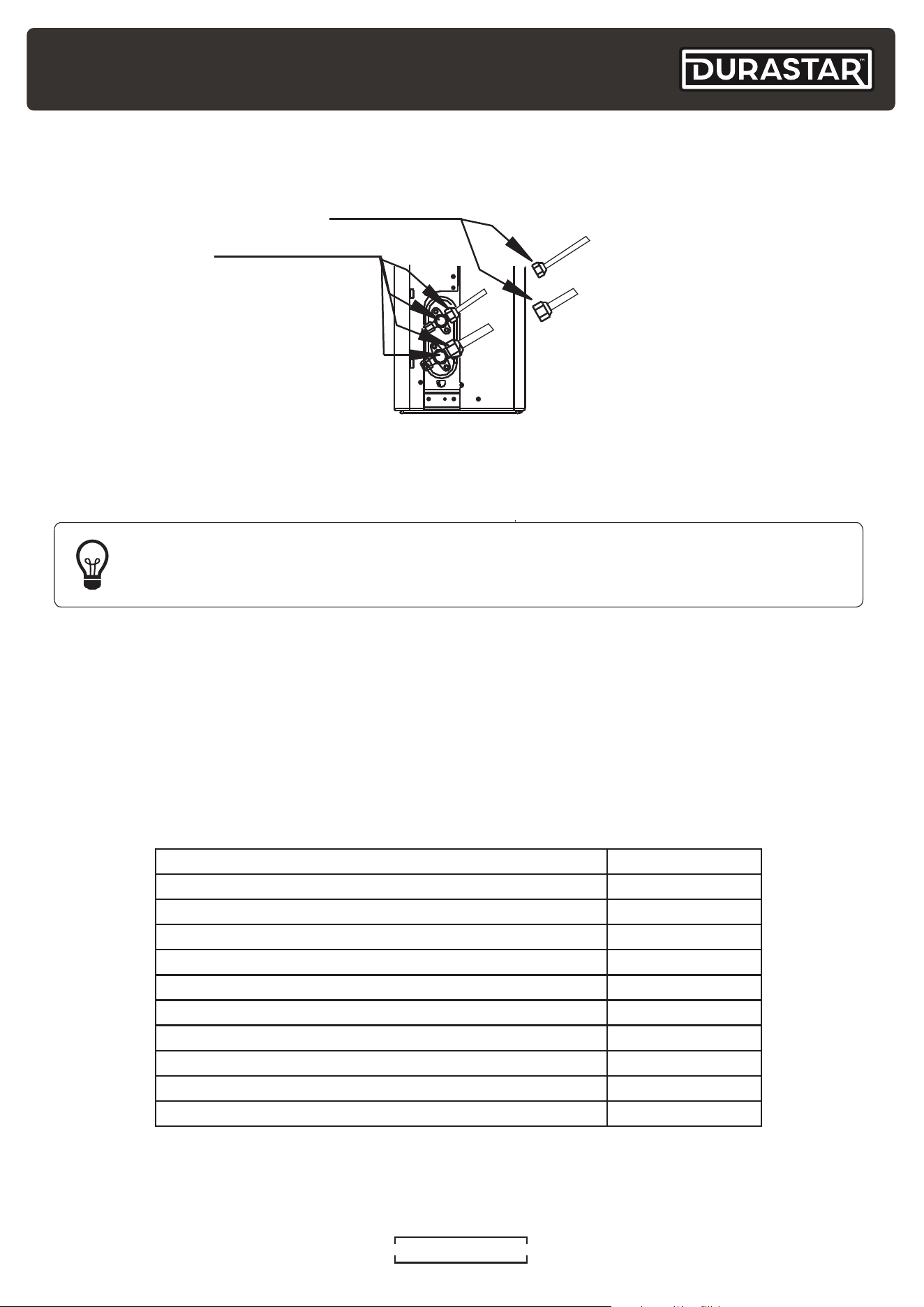
GAS LEAK CHECK
There are two methods to check for gas leaks:
1. Soap and Water Method - Using a soft brush, apply a soapy water or liquid detergent to all
pipe connection points on the indoor and outdoor unit. The presence of bubbles indicates a
leak.
DURASTAR.COM
23
A: Low pressure stop valve
B: High pressure stop valve
C & D: Indoor unit flare nuts
Check-point of indoor unit
Check-point of outdoor unit
A
B
C
D
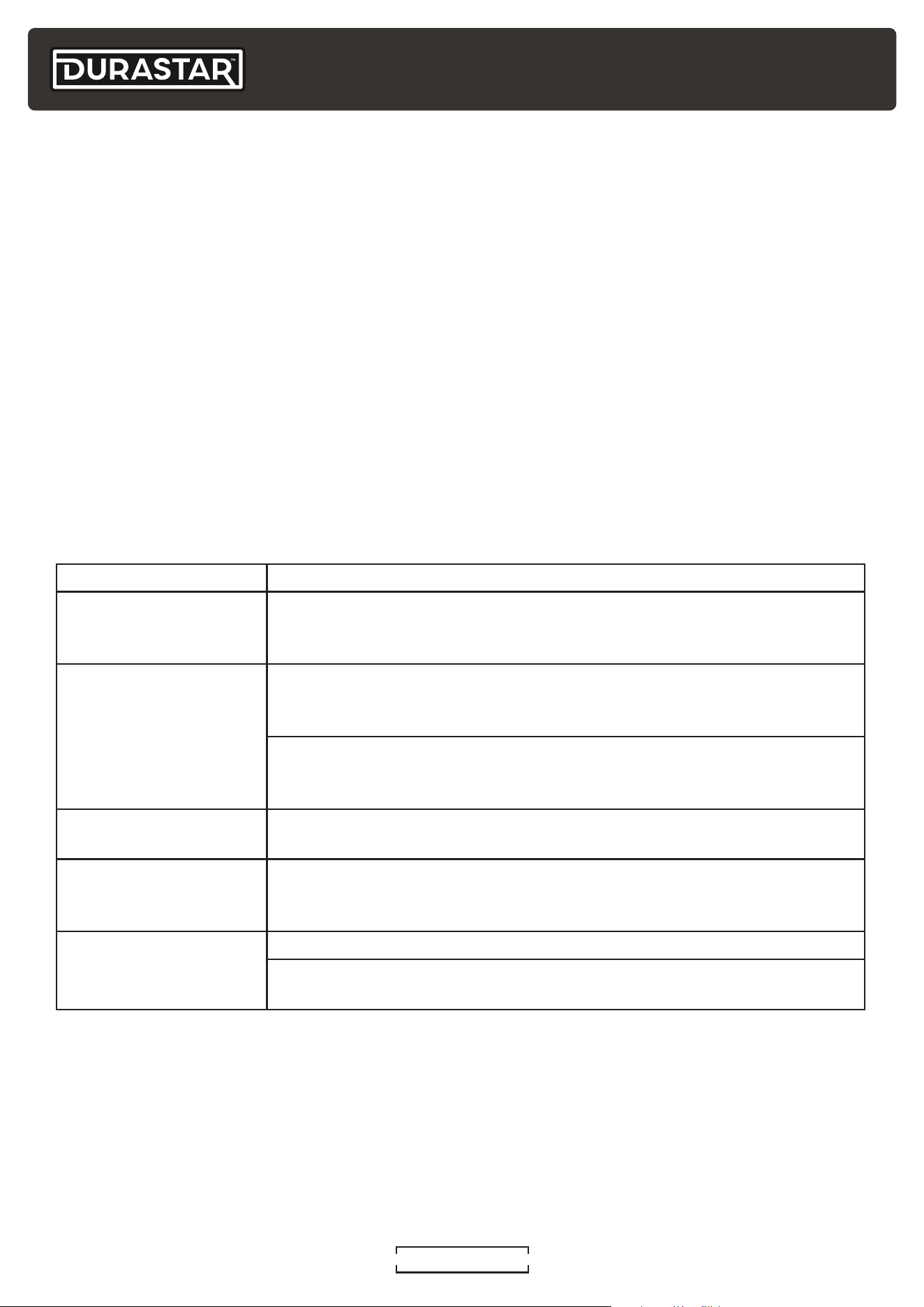
TEST RUN
TEST RUN INSTRUCTIONS
You should perform the test run for at least 30 minutes.
1. Connect power to the unit.
2. Press the ON/OFF button on the remote controller or wired thermostat to turn the unit on.
3. Press the MODE button to scroll through the following functions, one at a time:
• COOL - Select lowest possible temperature.
• HEAT - Select highest possible temperature.
4. Let each function run for 5 minutes and perform the following checks:
LIST OF CHECKS TO PERFORM [ X ]
Unit is Properly Grounded [ ]
All Electrical Terminals are Properly Covered [ ]
Indoor and Outdoor Units are Solidly Installed [ ]
All Pipe Connection Points Do Not Leak [ ]
Water Drains Properly from Drain Hose [ ]
All Piping is Properly Insulated [ ]
Unit Performs COOL Function Properly [ ]
Unit Performs HEAT Function Properly [ ]
Indoor Unit Louvers Move Properly [ ]
Indoor Unit Responds to Remote Controller or Thermostat [ ]
5. Double check all pipe connections. During operation, the pressure of the refrigerant system will
increase. This may reveal leaks that were not present during the initial leak check. Take time
during the test run to recheck all pipe connection points. Refer to Gas Leak Check section for
instructions.
2. Leak Detector Method - If using a leak detector, refer to the device's operation manual for
proper usage instructions.
GAS LEAK CHECK POINTS
TIP
Use the Durastar Job Site Information Sheet at the end of this manual as a
commissioning report to record your start up readings.
DURASTAR.COM24
TROUBLESHOOTING
SAFETY PRECAUTIONS
If ANY of the following conditions occurs, turn off your unit immediately!
• The power cord is damaged or abnormally warm
• You smell a burning odor
• The unit emits loud or abnormal sounds
• A power fuse blows or the circuit breaker frequently trips
• Water or other objects fall into or out of the unit
DO NOT ATTEMPT TO FIX THESE YOURSELF! CONTACT AN AUTHORIZED SERVICE PROVIDER
IMMEDIATELY!
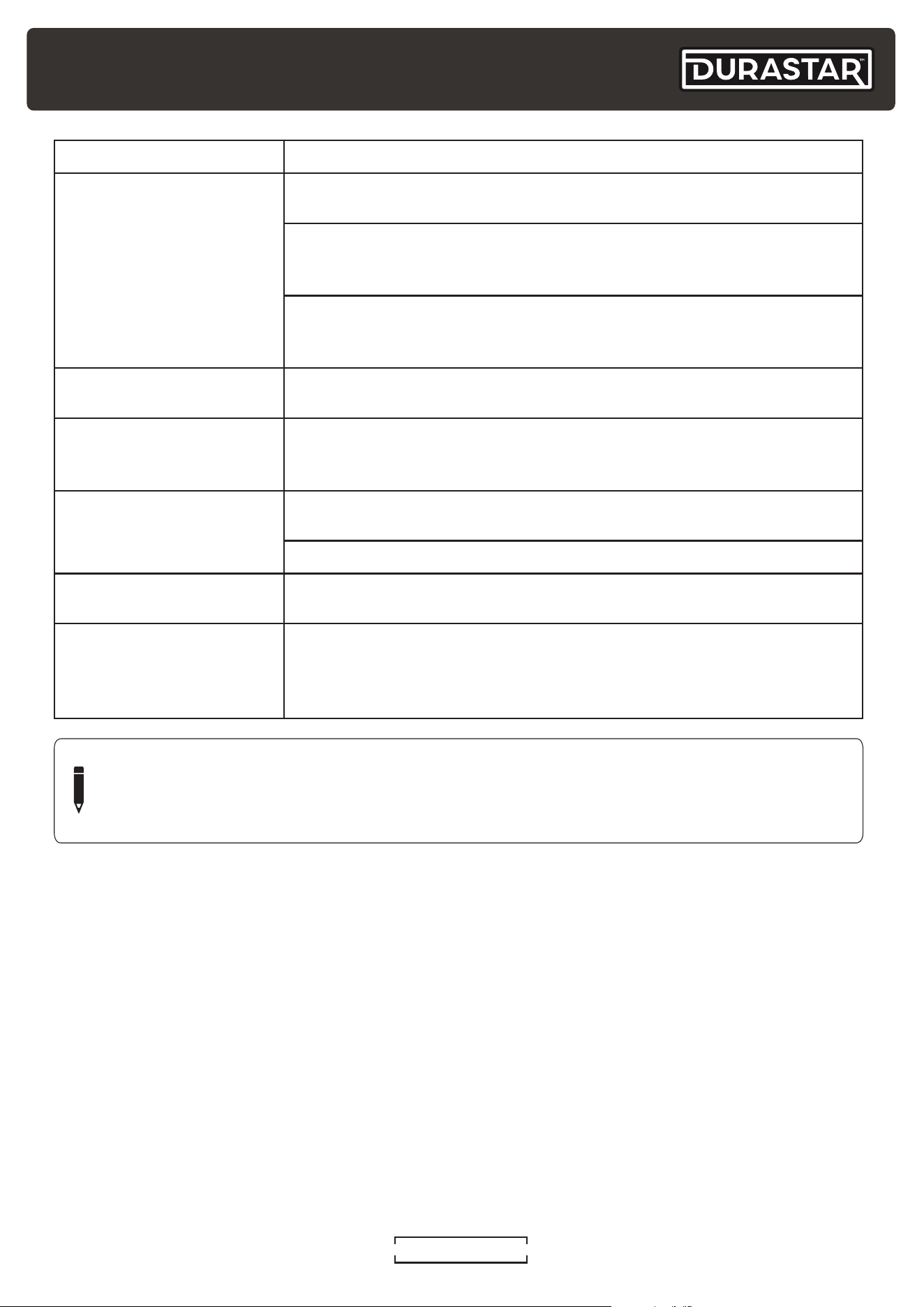
COMMON ISSUES
The following problems are not a malfunction and in most situations will not require repairs.
ISSUE POSSIBLE CAUSES
Unit does not turn on
when pressing ON/OFF
button
The Unit has a 3-minute protection feature that prevents the unit from
overloading. The unit cannot be restarted within three minutes of being
turned off.
The unit changes from
COOL/HEAT mode to
FAN mode
The unit may change its setting to prevent frost from forming on the
unit. Once the temperature increases, the unit will start operating in
the previously selected mode again.
The set temperature has been reached, at which point the unit
turns off the compressor. The unit will continue operating when the
temperature fluctuates again.
The indoor unit emits
white mist
In humid regions, a large temperature difference between the room’s
air and the conditioned air can cause white mist.
Both the indoor and
outdoor units emit
white mist
When the unit restarts in HEAT mode after defrosting, white mist may
be emitted due to moisture generated during the defrosting process.
The indoor unit makes
noises
A rushing air sound may occur when the louver resets its position.
A squeaking sound may occur after running the unit in HEAT mode due
to expansion and contraction of the unit’s plastic parts.
DURASTAR.COM
25
ISSUE POSSIBLE CAUSES
Both the indoor unit and
outdoor unit make noises
Low hissing sound during operation: This is normal and is caused by
refrigerant gas flowing through both indoor and outdoor units.
Low hissing sound when the system starts, has just stopped running,
or is defrosting: This noise is normal and is caused by the refrigerant
gas stopping or changing direction.
Squeaking sound: Normal expansion and contraction of plastic and
metal parts caused by temperature changes during operation can
cause squeaking noises.
The outdoor unit makes
noises
The unit will make different sounds based on its current operating
mode.
Dust is emitted from
either the indoor or
outdoor unit
The unit may accumulate dust during extended periods of non-
use, which will be emitted when the unit is turned on. This can be
mitigated by covering the unit during long periods of inactivity.
The unit emits a bad
odor
The unit may absorb odors from the environment (such as furniture,
cooking, cigarettes, etc.) which will be emitted during operations.
The unit’s filters have become moldy and should be cleaned.
The fan of the outdoor
unit does not operate
During operation, the fan speed is controlled to optimize product
operation.
Operation is erratic,
unpredictable, or unit is
unresponsive
Interference from cell phone towers and remote boosters may
cause the unit to malfunction. In this case, try the following:
• Disconnect the power, then reconnect.
• Press ON/OFF button on remote control to restart operation.
NOTE
If problem persists, contact a local dealer or your nearest customer service center.
Provide them with a detailed description of the unit malfunction as well as your model
number.
DURASTAR.COM26
TROUBLESHOOTING
When troubles occur, please check the following points before contacting a repair company.
PROBLEM POSSIBLE CAUSES SOLUTION
Poor Cooling
Performance
Temperature setting may be higher
than ambient room temperature
Lower the temperature setting
The heat exchanger on the indoor
or outdoor unit is dirty
Clean the affected heat exchanger
The air filter is dirty Remove the filter and clean it according
to instructions
The air inlet or outlet of either unit is
blocked
Turn the unit off, remove the obstruction
and turn it back on
Doors and windows are open Make sure that all doors and windows are
closed while operating the unit
Excessive heat is generated by
sunlight
Close windows and curtains during
periods of high heat or bright sunshine
Low refrigerant due to leak or long-
term use
Check for leaks, re-seal if necessary and
top off refrigerant
Excessive heat is generated by
sunlight
Block sunlight in installation area
Too many sources of heat in
the room (people, computers,
electronics, etc.)
Reduce amount of heat sources
Poor Heating
Performance
The outdoor temperature is
extremely low
This model is designed to work down to
-13°F, however, heating performance is
impacted at temperatures below freezing
Cold air is entering through doors
and windows
Make sure that all doors and windows are
closed during use
Low refrigerant due to leak or
long-term use
Check for leaks, re-seal if necessary,
and top off refrigerant
The unit
starts and
stops fre-
quently
There’s too much or too little
refrigerant in the system
Check for leaks and recharge the system
with refrigerant
Incompressible gas or moisture has
entered the system
Evacuate and recharge the system with
refrigerant
The compressor is broken Replace the compressor
The voltage is too high or too low Install a manostat to regulate the voltage
DURASTAR.COM
27
PROBLEM POSSIBLE CAUSES SOLUTION
The unit is not
working
Power failure Wait for the power to be restored
The power is turned off Turn on the power
The fuse is burned out Replace the fuse
Remote control batteries are dead Replace batteries
The Unit’s 3-minute protection has
been activated
Wait three minutes after restarting the
unit
Timer is activated Turn timer off
Indicator
lamps con-
tinue flashing
or error code
appears
The unit may stop operation or continue to run safely. If the indicator lamps
continue to flash or error codes appear, wait for about 10 minutes. The problem
may resolve itself.
If not, disconnect the power, then connect it again. Turn the unit on.
If the problem persists, disconnect the power and contact your nearest
customer service center.
NOTE
If your problem persists after performing the checks and diagnostics above, turn off your
unit immediately and contact an authorized service center.
DURASTAR.COM28
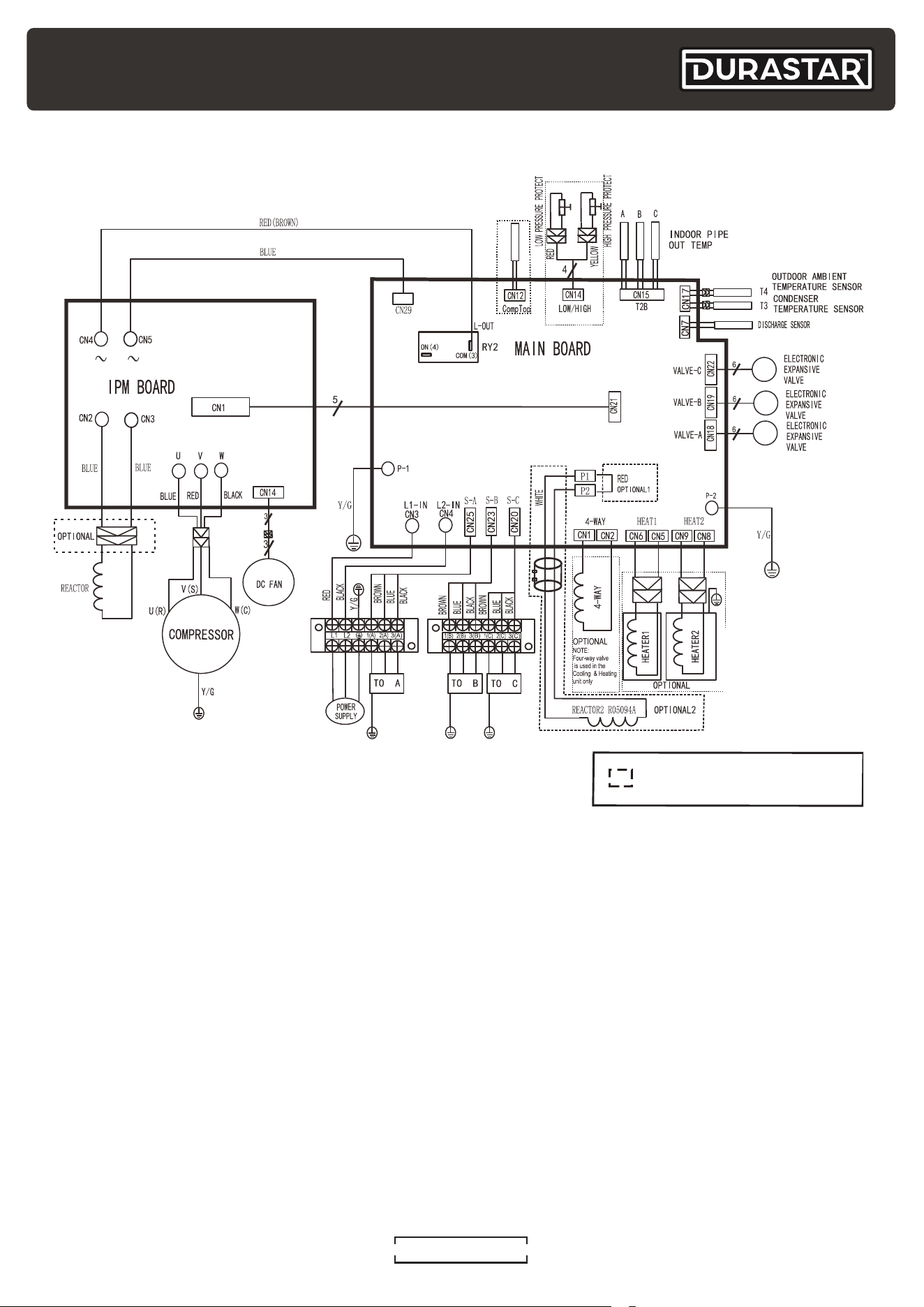
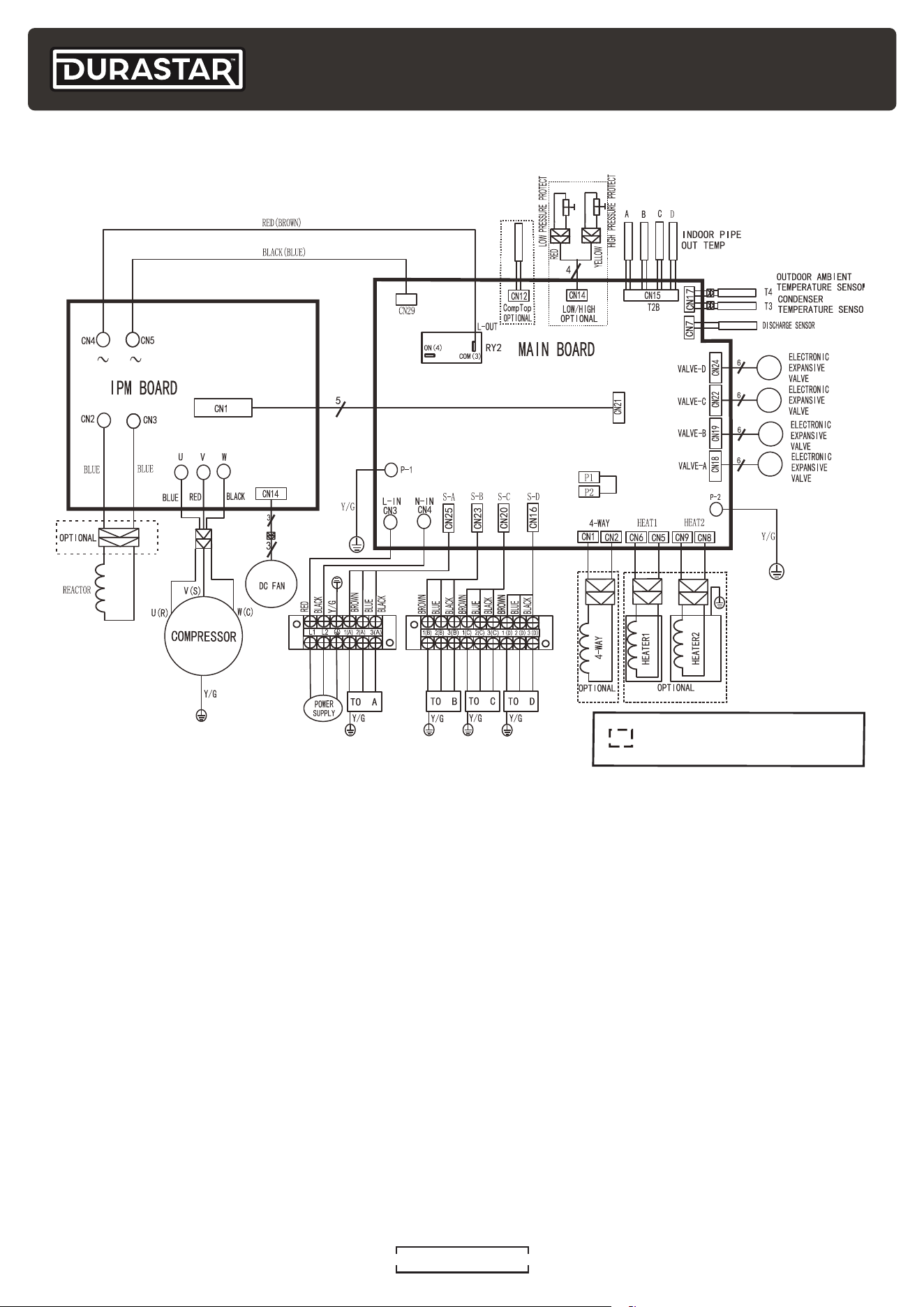
WIRING DIAGRAMS
DRA2U18M1B
Dotted line indicates this component is
optional. Your configuration many vary.
16022000035644
5(8)
COMP TOP
DURASTAR.COM
29
DRA3U28M1B
Dotted line indicates this component is
optional. Your configuration many vary.
16022300002514
DURASTAR.COM30
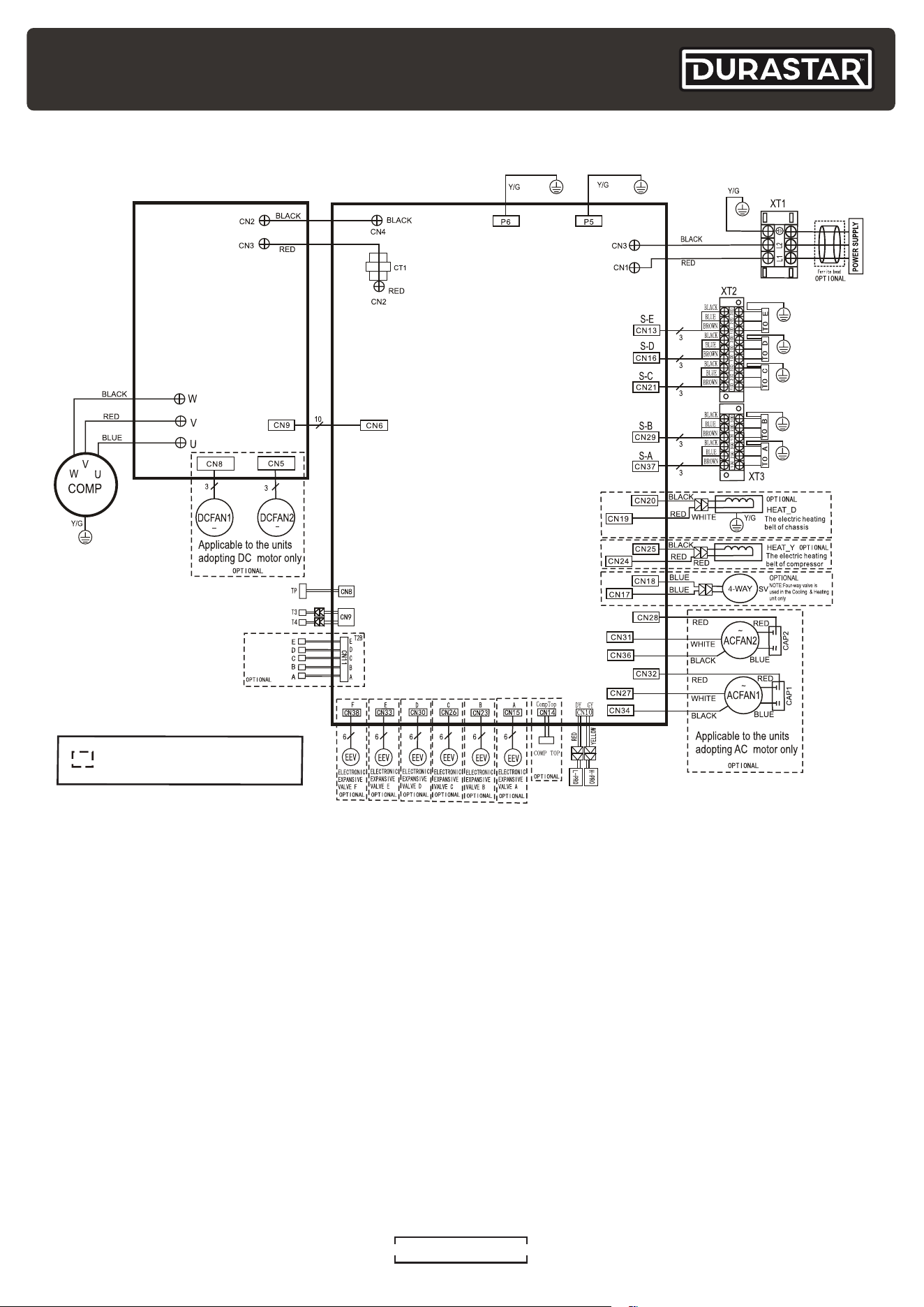
DRA4U36M1B
Dotted line indicates this component is
optional. Your configuration many vary.
16022300002633
DURASTAR.COM
31
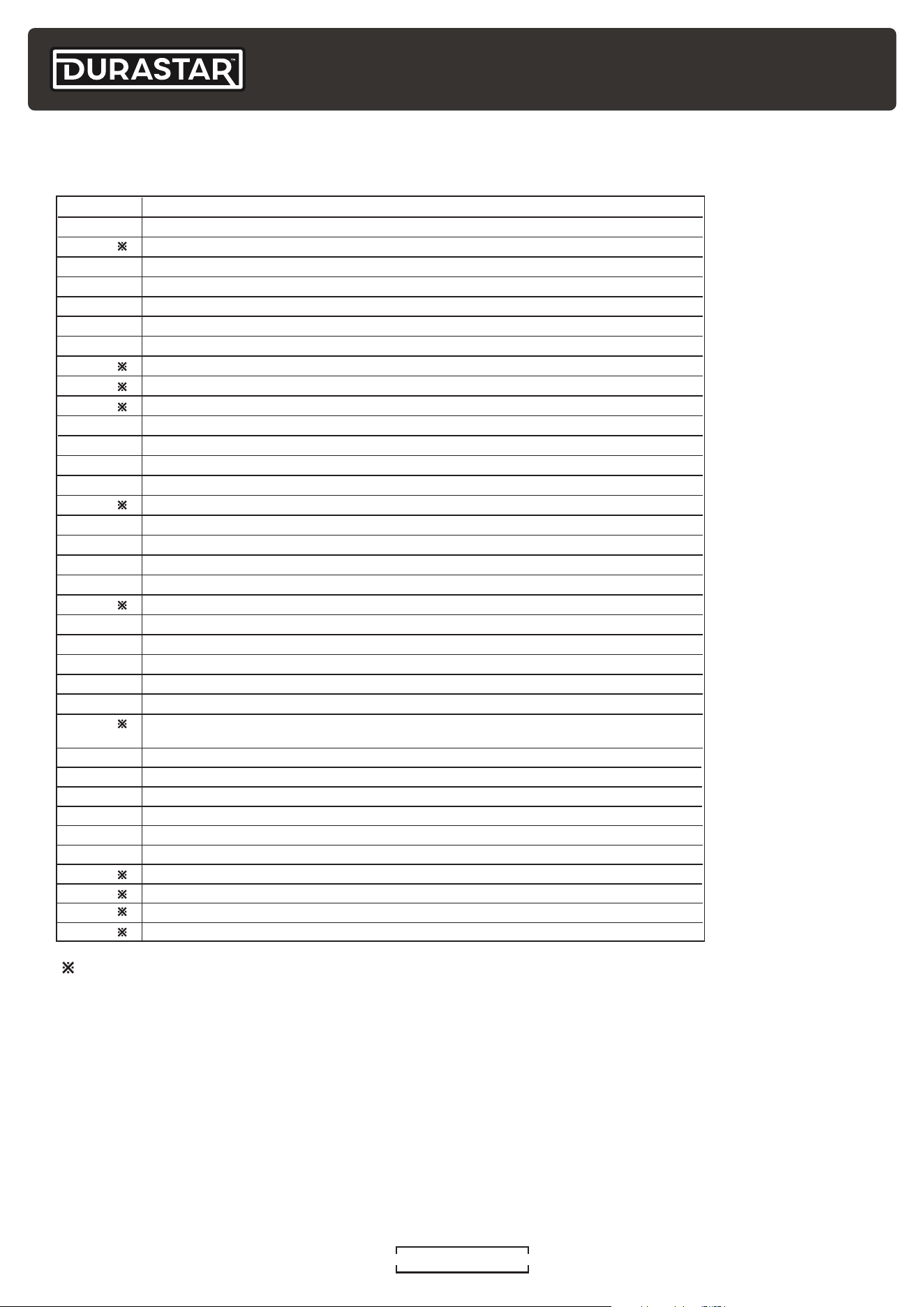
DRA5U48M1B and DRA5U55M1B
MAIN CONTROL BOARD
IPM&PFC BOARD
INDOOR COIL
OUTLET
TEMP.SENSOR
Dotted line indicates this component is
optional. Your configuration many vary.
16022000036851
DURASTAR.COM32
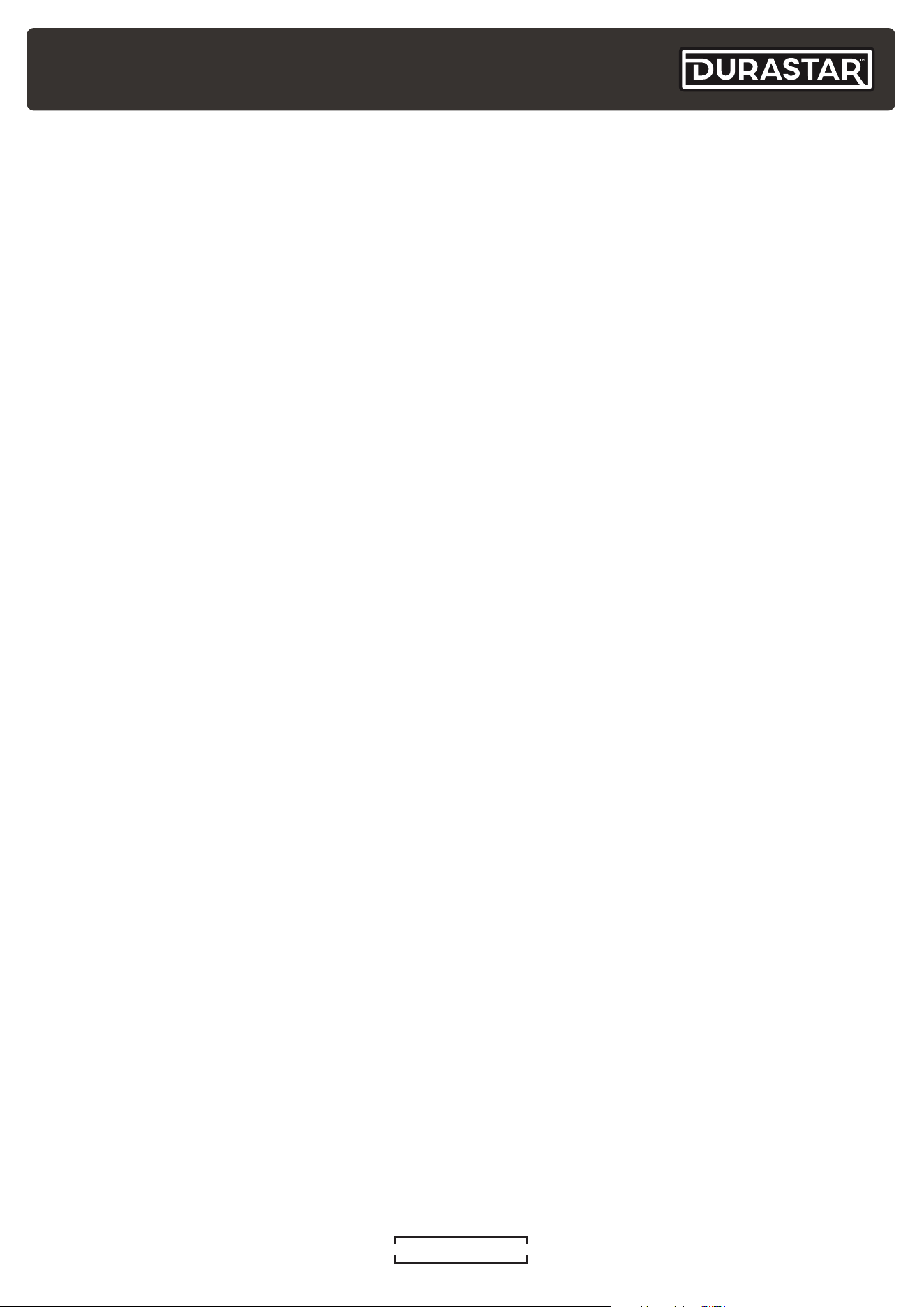
ERROR AND OPERATING CODES
[ ]
Applicable to some units only.
Outdoor unit main control board DC bus high voltage protection
Communication malfunction between indoor and outdoor units
Capability dismatch between indoor unit and outdoor unit
EL01
FL14
Outdoor temp. sensor error
EC50
Outdoor EEPROM error
EC51
Condenser coil temperature sensor (T3) malfunction
EC52
Outdoor ambient temperature sensor (T4 ) malfunction
EC53
Compressor discharge temperature sensor TP is in open circuit or has short circuited
EC54
EC55
Outdoor IPM module temperature sensor malfunction
EC56
Outdoor T2B sensor error
EC57
Refrigerant pipe temperature sensor error
EC07
Outdoor DC fan motor malfunction/fan speed out of control
EC71
Over current failure of outdoor DC fan motor
EC72
PC00
Lack phase failure of outdoor DC fan motor
Inverter module (IPM) protection
PC02
Top temperature protection of compressor
PC06
Discharge temperature protection of compressor
PC08
Outdoor overcurrent protection
PC0A
High temperature protection of condenser
PC0F
PFC module protection
PC0L
Low temperature protection of outdoor unit
PC10
PC11
PC12
PC30
PC31
PC40
PC42
PC43
PC44
PC45
PC46
PC49
PCA1
PH90
PH91
LC06
Outdoor unit low AC voltage protection
Display Malfunction & protection indication
Outdoor unit main control board DC bus high voltage protection /341 MCE error
Compressor overcurrent failure
System high pressure protection
System low pressure protection
Communication error between outdoor main chip and compressor
driven chip
Compressor start failure of outdoor unit
Outdoor compressor lack phase protection
Outdoor unit zero speed protection
Outdoor unit IR chip drive failure
Compressor speed has been out of control
Condensation protection of refrigerant pipe
Low temperature protection of Evaporator
High temperature protection of Evaporator
High temperature protection of Inverter module (IPM)
Note: DF (defrost) and FC (forced cooling) are normal operating codes, not malfunctions.
DURASTAR.COM
33
JOB SITE INFORMATION SHEET
Site Information
Job Name: _____________________________________________ Installation Date: _________________
Address: ______________________________ City: _____________________ State: ______ Zip: ________
Phone: ________________________ Email: ____________________________________________________
Contractor Information
Contractor Name: _____________________________ Technician Name: __________________________
Address: ______________________________ City: _____________________ State: ______ Zip: ________
Phone: ________________________ Email: ____________________________________________________
Outdoor Unit Information
Model #: _________________________________ Serial #: _______________________________________
Unit Location: ____________________________________________________________________________
_________________________________________________________________________________________
Outdoor Electrical Readings
Line Power Wire Color: L1 __________________ L2 __________________ G _____________________
Line Voltage (Power Off): L1 to L2 _____________ L1 to G _____________ L2 to G ________________
Line Voltage (Power On): L1 to L2 _____________ L1 to G _____________ L2 to G ________________
Outdoor Thermal Readings
Discharge: _________°F Ambient: _________°F
DURASTAR.COM34
Indoor System Information
Unit Information
Model #: _________________________________ Serial #: _______________________________
Type: ____________________ Location: _____________________________________________
Refrigerant Line Size 1/4" 3/8" 1/2" 5/8" Line Set Length: _______________
(Circle Liquid and Gas Line):
Electrical Readings
Power/Control Wire Color: 1 _______________ 2 _______________ 3 ________________
Voltage Readings: 1-2 ___________ AC 2-3 ___________DC
Thermal Readings
Return Air: _________°F Supply Air: _________°F Room Air: _________°F
Gas Line Saturation: _________°F Liquid Line Saturation: _________°F
Unit Information
Model #: _________________________________ Serial #: _______________________________
Type: ____________________ Location: _____________________________________________
Refrigerant Line Size 1/4" 3/8" 1/2" 5/8" Line Set Length: _______________
(Circle Liquid and Gas Line):
Electrical Readings
Power/Control Wire Color: 1 _______________ 2 _______________ 3 ________________
Voltage Readings: 1-2 ___________ AC 2-3 ___________DC
Thermal Readings
Return Air: _________°F Supply Air: _________°F Room Air: _________°F
Gas Line Saturation: _________°F Liquid Line Saturation: _________°F
A
B
DRA2
DURASTAR.COM
35
Unit Information
Model #: _________________________________ Serial #: _______________________________
Type: ____________________ Location: _____________________________________________
Refrigerant Line Size 1/4" 3/8" 1/2" 5/8" Line Set Length: _______________
(Circle Liquid and Gas Line):
Electrical Readings
Power/Control Wire Color: 1 _______________ 2 _______________ 3 ________________
Voltage Readings: 1-2 ___________ AC 2-3 ___________DC
Thermal Readings
Return Air: _________°F Supply Air: _________°F Room Air: _________°F
Gas Line Saturation: _________°F Liquid Line Saturation: _________°F
Unit Information
Model #: _________________________________ Serial #: _______________________________
Type: ____________________ Location: _____________________________________________
Refrigerant Line Size 1/4" 3/8" 1/2" 5/8" Line Set Length: _______________
(Circle Liquid and Gas Line):
Electrical Readings
Power/Control Wire Color: 1 _______________ 2 _______________ 3 ________________
Voltage Readings: 1-2 ___________ AC 2-3 ___________DC
Thermal Readings
Return Air: _________°F Supply Air: _________°F Room Air: _________°F
Gas Line Saturation: _________°F Liquid Line Saturation: _________°F
C
DRA3
D
DRA4
DURASTAR.COM36
Unit Information
Model #: _________________________________ Serial #: _______________________________
Type: ____________________ Location: _____________________________________________
Refrigerant Line Size 1/4" 3/8" 1/2" 5/8" Line Set Length: _______________
(Circle Liquid and Gas Line):
Electrical Readings
Power/Control Wire Color: 1 _______________ 2 _______________ 3 ________________
Voltage Readings: 1-2 ___________ AC 2-3 ___________DC
Thermal Readings
Return Air: _________°F Supply Air: _________°F Room Air: _________°F
Gas Line Saturation: _________°F Liquid Line Saturation: _________°F
E
DRA5
DURASTAR.COM
37
NOTES:
DURASTAR.COM38
THIS PAGE INTENTIONALLY LEFT BLANK.
DURASTAR.COM39
THIS PAGE INTENTIONALLY LEFT BLANK.
DURASTAR.COM40
©2022 Durastar
V2.0 1122
THIS PAGE INTENTIONALLY LEFT BLANK.