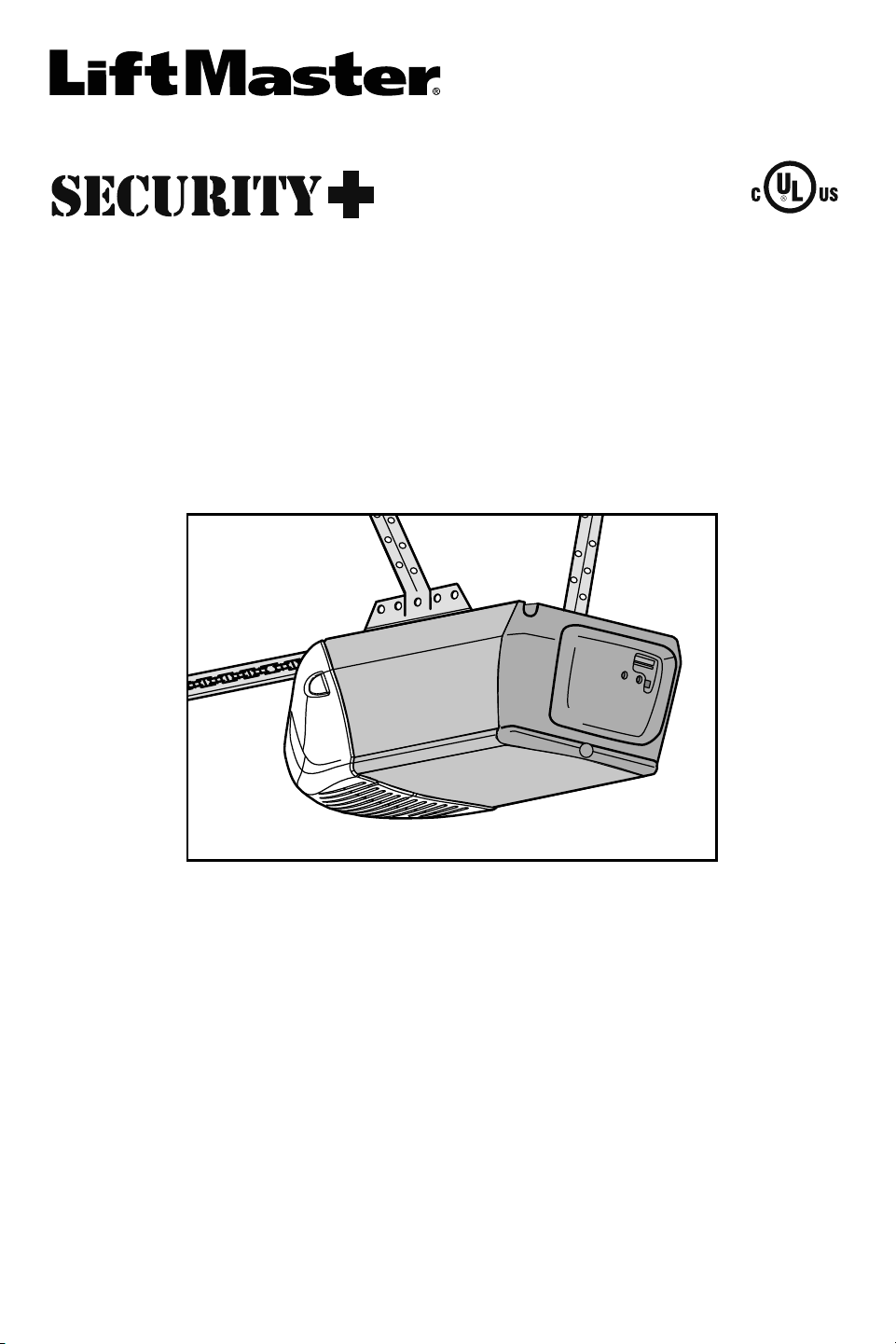
Owner’s Manual
■ Please read this manual and the enclosed safety materials carefully!
■ Fasten the manual near the garage door after installation.
■ The door WILL NOT CLOSE unless the Protector System
®
is connected and properly aligned.
■ Periodic checks of the opener are required to ensure safe operation.
■ The model number label is located on the front panel of your opener.
GARAGE DOOR OPENER
Model 3245M 1/3 HP
3255M 1/2 HP
3255-2M 1/2 HP
For Residential Use Only
The Chamberlain Group, Inc.
845 Larch Avenue
Elmhurst, Illinois 60126-1196
www.liftmaster.com
®
2
Introduction 2-5
Safety symbol and signal word review . . . . . . . . . . . . . . . 2
Preparing your garage door . . . . . . . . . . . . . . . . . . . . . . . 3
Tools needed. . . . . . . . . . . . . . . . . . . . . . . . . . . . . . . . . . . 3
Planning . . . . . . . . . . . . . . . . . . . . . . . . . . . . . . . . . . . . . . 4
Carton inventory . . . . . . . . . . . . . . . . . . . . . . . . . . . . . . . . 5
Hardware inventory. . . . . . . . . . . . . . . . . . . . . . . . . . . . . . 5
Assembly 6-7
Attach the rail to the motor unit . . . . . . . . . . . . . . . . . . . . 6
Attach the chain to the sprocket . . . . . . . . . . . . . . . . . . . . 6
Tighten the chain . . . . . . . . . . . . . . . . . . . . . . . . . . . . . . . 7
Installation 7-23
Installation safety instructions . . . . . . . . . . . . . . . . . . . . . 7
Determine the header bracket location . . . . . . . . . . . . . . . 8
Install the header bracket . . . . . . . . . . . . . . . . . . . . . . . . . 9
Attach the rail to the header bracket . . . . . . . . . . . . . . . . 10
Position the opener. . . . . . . . . . . . . . . . . . . . . . . . . . . . . 11
Hang the opener . . . . . . . . . . . . . . . . . . . . . . . . . . . . . . . 12
Install the door control . . . . . . . . . . . . . . . . . . . . . . . . . . 13
Install the light . . . . . . . . . . . . . . . . . . . . . . . . . . . . . . . . 14
Attach the emergency release rope and handle. . . . . . . . 14
Electrical requirements . . . . . . . . . . . . . . . . . . . . . . . . . . 15
Install the Protector System
®
. . . . . . . . . . . . . . . . . . 16-19
Fasten the door bracket. . . . . . . . . . . . . . . . . . . . . . . 20-21
Connect the door arm to the trolley . . . . . . . . . . . . . 22-23
Adjustment 24-26
Adjust the travel limits . . . . . . . . . . . . . . . . . . . . . . . . . . 24
Adjust the force. . . . . . . . . . . . . . . . . . . . . . . . . . . . . . . . 25
Test the safety reversal system. . . . . . . . . . . . . . . . . . . . 26
Test the Protector System
®
. . . . . . . . . . . . . . . . . . . . . . . 26
Operation 27-30
Operation safety instructions . . . . . . . . . . . . . . . . . . . . . 27
Using your garage door opener . . . . . . . . . . . . . . . . . . . 28
Using the wall-mounted door control . . . . . . . . . . . . . . . 28
To open the door manually . . . . . . . . . . . . . . . . . . . . . . . 28
Care of your opener . . . . . . . . . . . . . . . . . . . . . . . . . . . . 28
Having a problem? . . . . . . . . . . . . . . . . . . . . . . . . . . . . . 29
Diagnostic chart . . . . . . . . . . . . . . . . . . . . . . . . . . . . . . . 30
Programming 31-32
To add or reprogram a hand-held remote control. . . . . . 31
To erase all codes . . . . . . . . . . . . . . . . . . . . . . . . . . . . . . 31
3-Button remotes . . . . . . . . . . . . . . . . . . . . . . . . . . . . . . 31
To add, reprogram or change
a Keyless Entry PIN. . . . . . . . . . . . . . . . . . . . . . . . . . . . . 32
Repair Parts 33-34
Rail assembly parts. . . . . . . . . . . . . . . . . . . . . . . . . . . . . 33
Installation parts . . . . . . . . . . . . . . . . . . . . . . . . . . . . . . . 33
Motor unit assembly parts . . . . . . . . . . . . . . . . . . . . . . . 34
Accessories 35
Repair Parts and Service 36
Warranty 36
TABLE OF CONTENTS
When you see these Safety Symbols and Signal Words on
the following pages, they will alert you to the possibility
of serious injury or death if you do not comply with the
warnings that accompany them. The hazard may come
from something mechanical or from electric shock. Read
the warnings carefully.
When you see this Signal Word on the following pages, it
will alert you to the possibility of damage to your garage
door and/or the garage door opener if you do not comply
with the cautionary statements that accompany it. Read
them carefully.
INTRODUCTION
Safety Symbol and Signal Word Review
This garage door opener has been designed and tested to offer safe service provided it is installed, operated, maintained
and tested in strict accordance with the instructions and warnings contained in this manual.
Mechanical
Electrical
3
To prevent damage to garage door and opener:
• ALWAYS disable locks BEFORE installing and
operating the opener.
• ONLY operate garage door opener at 120V, 60 Hz to
avoid malfunction and damage.
To prevent possible SERIOUS INJURY or DEATH:
• ALWAYS call a trained door systems technician if
garage door binds, sticks or is out of balance. An
unbalanced garage door may NOT reverse when
required.
• NEVER try to loosen, move or adjust garage door,
door springs, cables, pulleys, brackets or their
hardware, ALL of which are under EXTREME tension.
• Disable ALL locks and remove ALL ropes connected
to garage door BEFORE installing and operating
garage door opener to avoid entanglement.
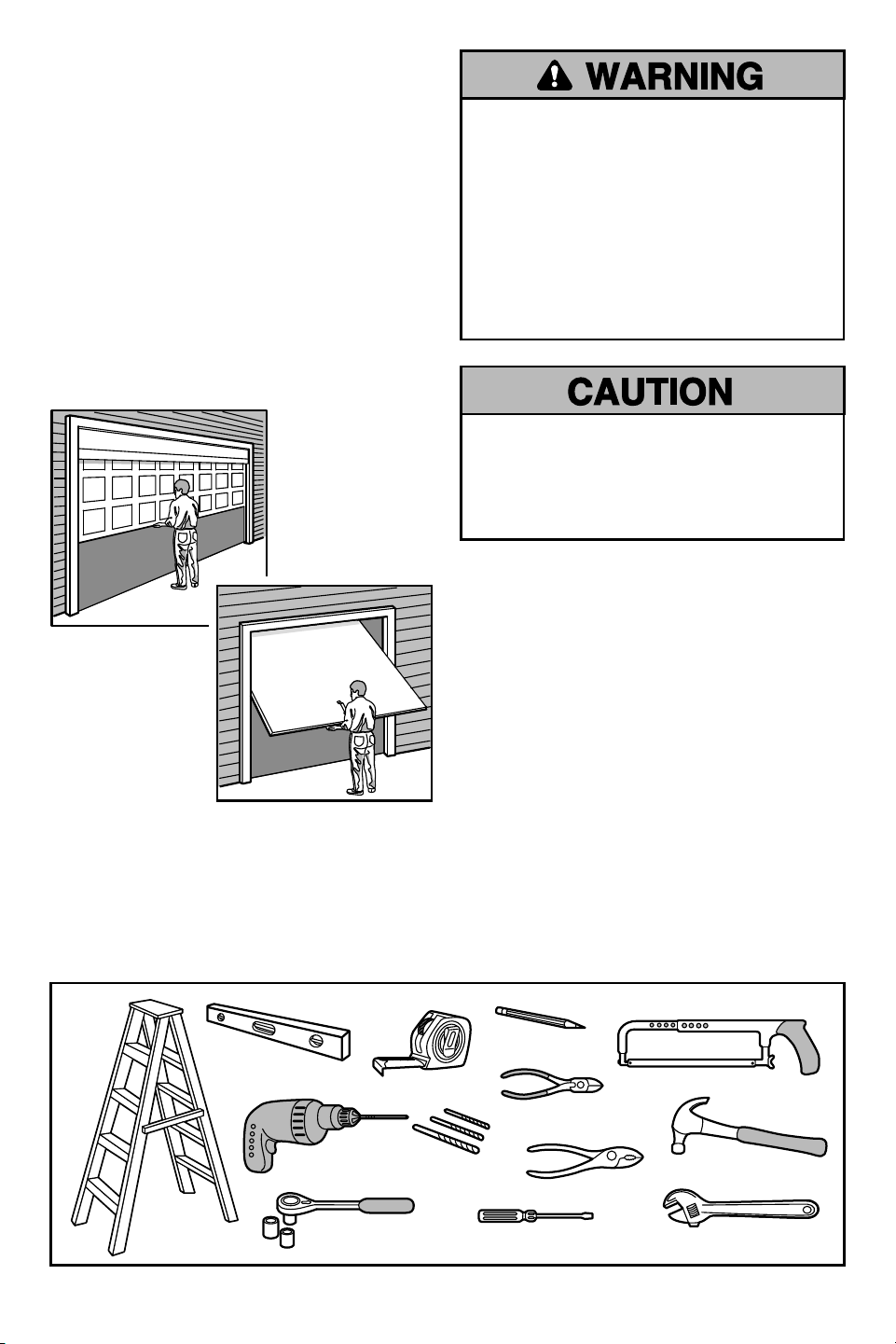
Preparing your garage door
Before you begin:
• Disable locks.
• Remove any ropes connected to garage door.
• Complete the following test to make sure your garage
door is balanced and is not sticking or binding:
1. Lift the door about halfway as shown. Release
the door. If balanced, it should stay in place,
supported entirely by its springs.
2. Raise and lower the door to see if there is any
binding or sticking.
If your door binds, sticks, or is out of balance, call a
trained door systems technician.
Tools needed
During assembly, installation and adjustment of the
opener, instructions will call for hand tools as illustrated
below.
Sectional Door
One-Piece Door
2
1
Carpenter’s
Level (Optional)
Tape Measure
Pencil
Wire Cutters
Hack Saw
Claw Hammer
Adjustable End Wrench
Screwdriver
Pliers
Drill
Stepladder
1/2" and 7/16" Sockets
and Wrench
3/16", 5/16" and
5/32" Drill Bits
4
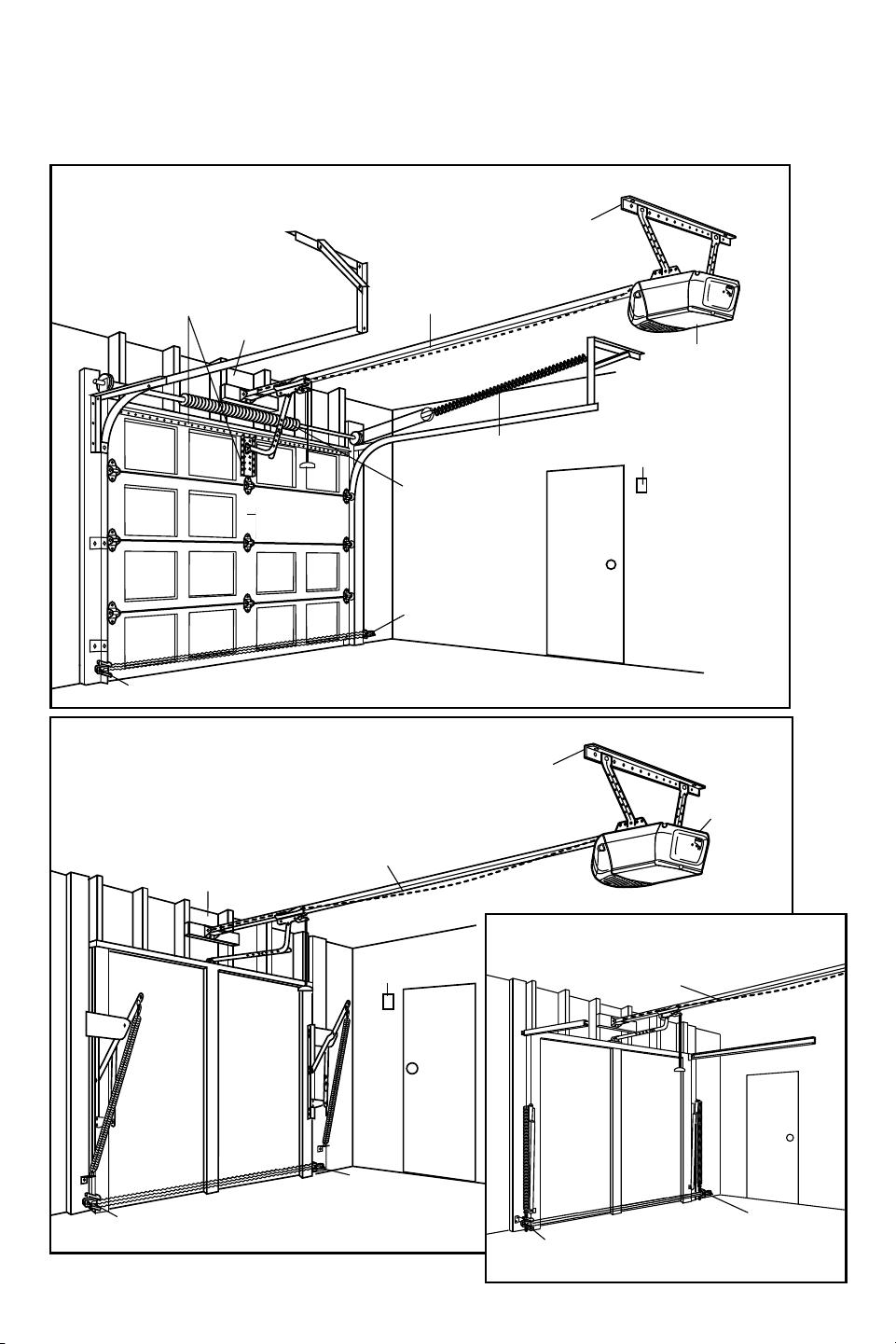
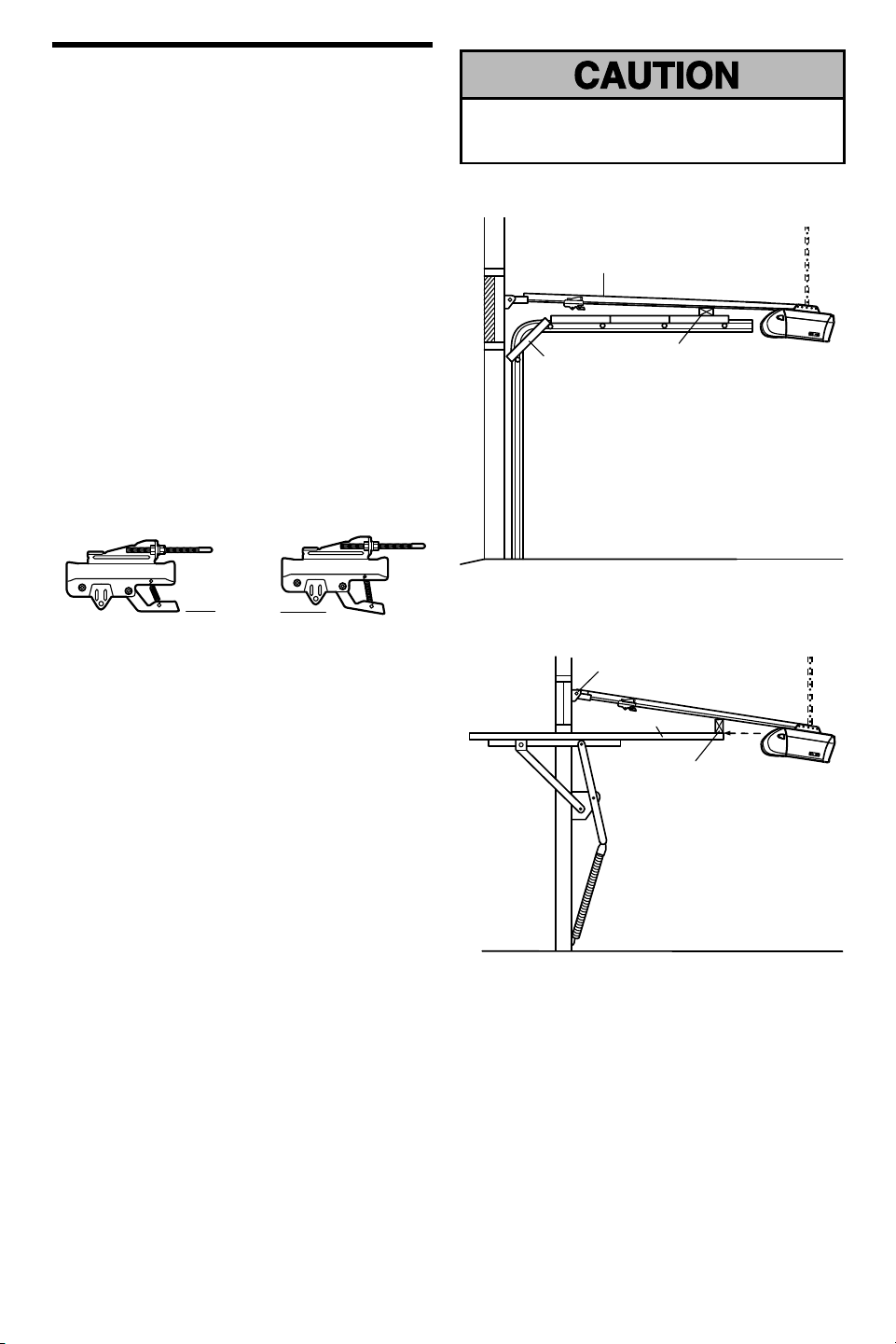
Planning
Identify the type and height of your garage door. Survey
your garage area to see if any of the conditions below
apply to your installation. Additional materials may
be required. You may fi nd it helpful to refer back to
this page and the accompanying illustrations as you
proceed with the installation of your opener.
— — — — — — — —
SECTIONAL DOOR INSTALLATION
ONE-PIECE DOOR WITHOUT TRACK
ONE-PIECE DOOR WITH TRACK
Horizontal and vertical reinforcement
is needed for light weight garage doors
(fi berglass, steel, aluminum,
door with glass panels, etc.).
See page 20 for details.
Slack in chain tension
is normal when
garage door is closed.
Support bracket &
fastening hardware
is required.
See page 12.
Motor Unit
FINISHED CEILING
Wall-Mounted
Door Control
Extension Spring
OR
Torsion Spring
Header Wall
Access
Door
Safety
Reversing
Sensor
Vertical
Centerline of
Garage Door
Gap between fl oor and bottom of door
must not exceed 1/4" (6 mm).
Gap between fl oor
and bottom of door
must not exceed 1/4" (6 mm).
Gap between fl oor and
bottom of door must
not exceed 1/4" (6 mm).
Safety Reversing Sensor
Safety Reversing
Sensor
Safety
Reversing Sensor
Wall-Mounted
Door Control
Header Wall
Slack in chain tension
is normal when
garage door is closed.
Support bracket
& fastening
hardware is required.
See page 12.
FINISHED CEILING
Motor Unit
Slack in chain tension is
normal when garage door
is closed.
Access
Door
Access
Door
Safety
Reversing
Sensor
Safety
Reversing
Sensor
5
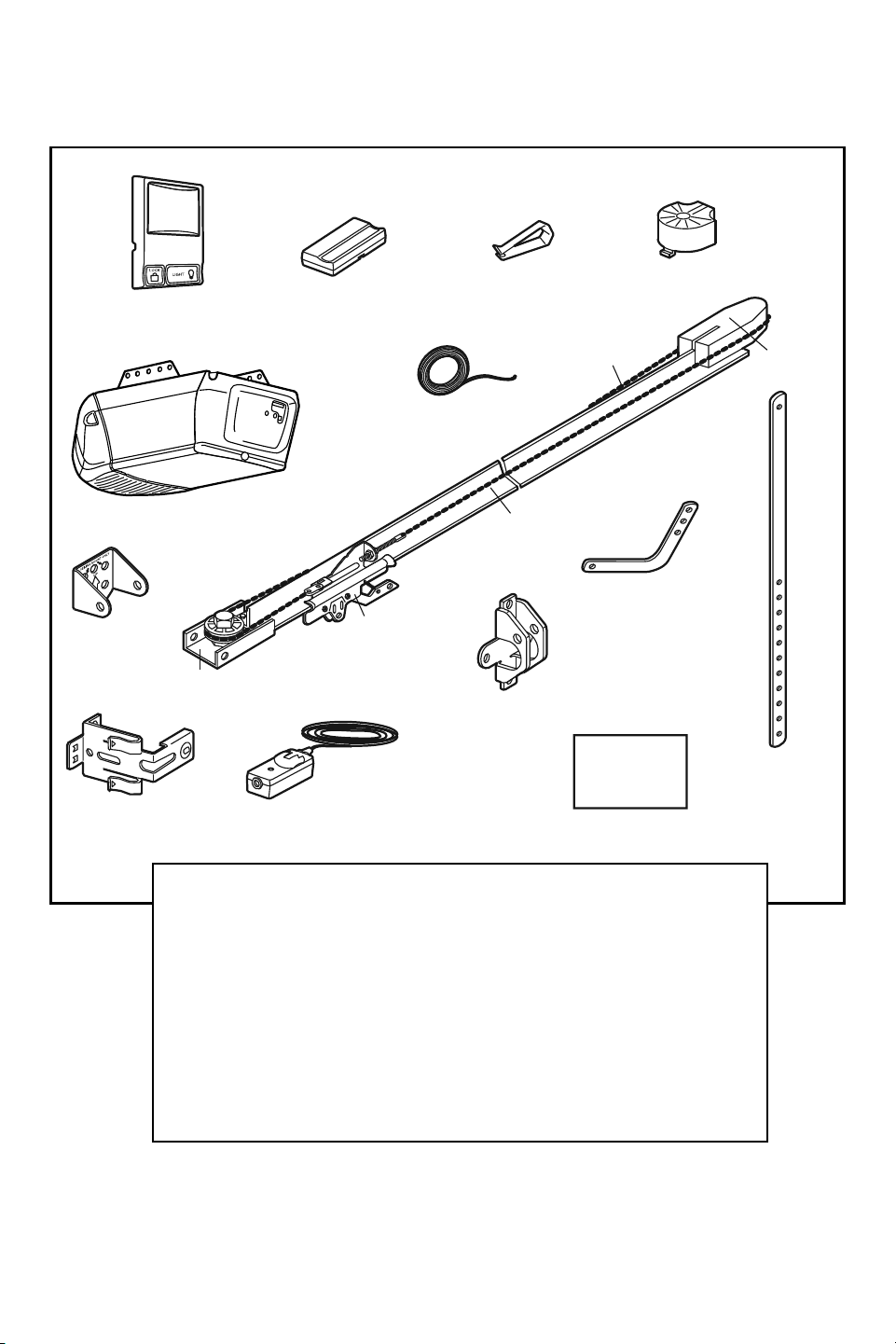
Your garage door opener is packaged in two cartons which
contain the motor unit and all parts illustrated below.
Accessories will depend on the model purchased.
If anything is missing, carefully check the packing material.
Parts may be stuck in the foam. Hardware for installation
is also listed below.
Carton Inventory
INSTALLATION HARDWARE
Hex Bolt 5/16"-18x7/8" (4)
Lag Screw 5/16"-9x1-5/8" (2)
Clevis Pin 5/16"x2-3/4" (1)
Clevis Pin 5/16"x1-1/4" (1)
Clevis Pin 5/16"x1" (1)
Nut 5/16"-18 (4)
Lock Washer 5/16" (4)
Screw 6ABx1-1/4" (2)
Screw 6-32x1" (2)
Self-Threading Screw 1/4"-14x5/8" (2)
Insulated Staples (10)
Ring Fastener (3)
Drywall Anchors (2)
Carriage Bolt 1/4"-20x1/2" (2)
Wing Nut 1/4"-20 (2)
Rope
Handle
SECURITY✚
®
Single-Button Remote Control
Multi-Function Door
Control Panel
Motor Unit with Light Lens
Header Bracket
Safety Reversing
Sensor Bracket (2)
Safety Labels
and
Literature
Door Bracket
Curved Door
Arm Section
2 Conductor Bell
Wire White &
White/Red
Trolley
Chain Pulley
Bracket
Remote Control
Visor Clip
Chain
Styrofoam
One-Piece
Rail
Sprocket Cover
Straight Door
Arm Section
The Protector System
®
(2) Safety Reversing Sensors
(1 Sending Eye and 1 Receiving Eye)
with 2-Conductor White & White/Black
Bell Wire Attached
Models 3245M, 3255M (1)
Model 3255-2M (2)
6
ASSEMBLY STEP 1
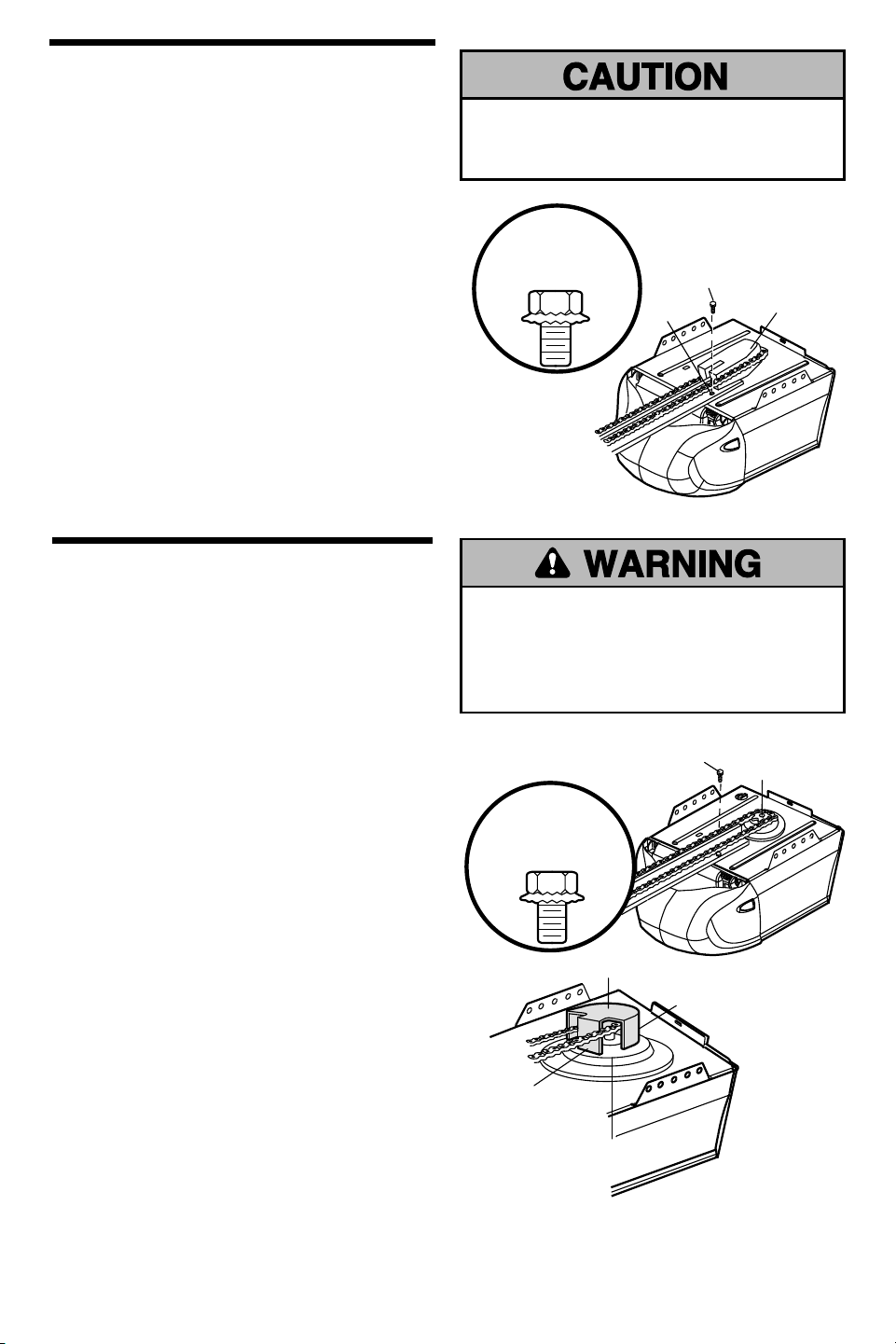
Attach the Rail to the Motor Unit
To avoid installation diffi culties, do not run the garage
door opener until instructed to do so.
• Remove the two washered bolts mounted in top of
motor unit.
• Position rail at a 45° angle to opener so one hole in rail
and motor unit line up.
• Thread one of the washered bolts part way in.
Use only these bolts! Use of any other bolts will cause
serious damage to door opener.
• Align rail and styrofoam over sprocket. Cut tape from
rail, chain and styrofoam.
• REMOVE STYROFOAM.
ASSEMBLY STEP 2
Attach the Chain to the Sprocket and Install
the Sprocket Cover
• Position chain over the sprocket. If necessary, loosen
the outer nut on the trolley to obtain more chain slack.
• Insert the second washered bolt. CAUTION: Use only
the bolt previously removed from motor unit!
• Tighten both bolts securely through the rail into the
motor unit as shown.
• Install the sprocket cover: Insert the back tab in the
slot. Squeeze the cover slightly and insert the front tab
in the slot on the mounting plate.
To avoid possible SERIOUS INJURY to fi ngers from
moving garage door opener:
• ALWAYS keep hand clear of sprocket while operating
opener.
• Securely attach sprocket cover BEFORE operating.
To avoid SERIOUS damage to garage door opener,
use ONLY those bolts/fasteners mounted in the top of
the opener.
USE ONLY THIS
TYPE AND SIZE
BOLT
Washered Bolt
5/16"-18x1/2"
Styrofoam
Rail
Hole
USE ONLY THIS
TYPE AND SIZE
BOLT
Washered Bolt
5/16"-18x1/2"
Sprocket
Sprocket Cover
Back Tab Slot
Front Tab Slot
Mounting
Plate
7
INSTALLATION
ASSEMBLY STEP 3
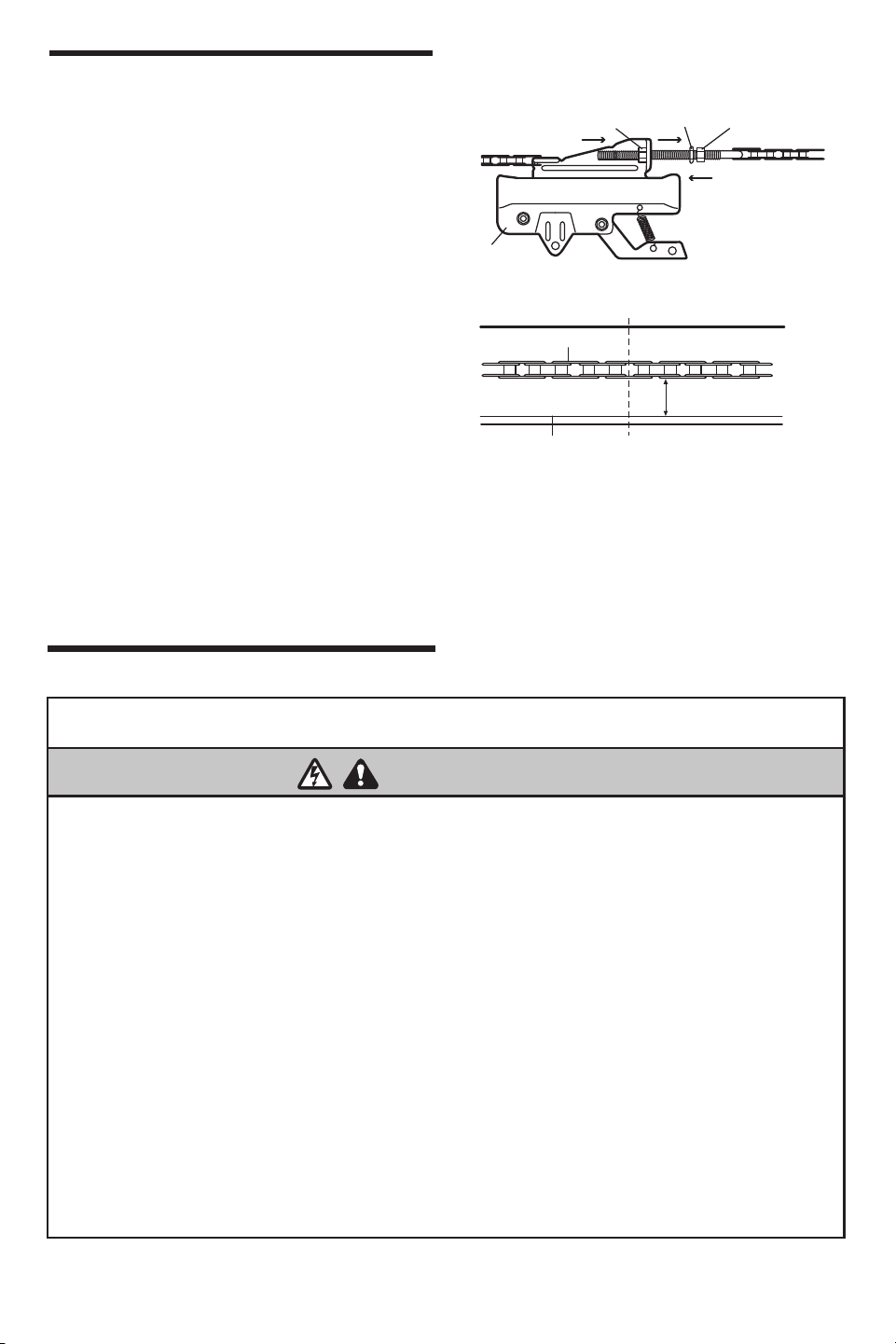
Tighten the Chain
• Spin the inner nut and lock washer down the trolley
threaded shaft, away from the trolley.
• To tighten the chain, turn outer nut in the direction
shown (Figure 1).
• When the chain is approximately 1/2" (13 mm) above
the base of the rail at its midpoint, re-tighten the inner
nut to secure the adjustment.
Sprocket noise can result if chain is too loose.
When installation is complete, you may notice some chain
droop with the door closed. This is normal. If the chain
returns to the position shown in Figure 2 when the door is
open, do not re-adjust the chain.
NOTE: During future maintenance, ALWAYS pull the
emergency release handle to disconnect trolley before
adjusting chain. You may notice loosening of chain after
Adjustment Step 3 (Test the Safety Reversal System).
Check for proper tension and readjust chain if necessary.
Then repeat Adjustment Step 3.
You have now fi nished assembling your garage door
opener. Please read the following warnings before
proceeding to the installation section.
IMPORTANT INSTALLATION INSTRUCTIONS
To reduce the risk of SEVERE INJURY or DEATH:
WARNING
WARNING
WARNING WARNING
1. READ AND FOLLOW ALL INSTALLATION WARNINGS
AND INSTRUCTIONS.
2. Install garage door opener ONLY on properly balanced
and lubricated garage door. An improperly balanced
door may NOT reverse when required and could result
in SEVERE INJURY or DEATH.
3. ALL repairs to cables, spring assemblies and other
hardware MUST be made by a trained door systems
technician BEFORE installing opener.
4. Disable ALL locks and remove ALL ropes connected
to garage door BEFORE installing opener to avoid
entanglement.
5. Install garage door opener 7 feet (2.13 m) or more
above fl oor.
6. Mount the emergency release within reach, but at
least 6 feet (1.8 m) above the fl oor and avoiding
contact with vehicles to avoid accidental release.
7. NEVER connect garage door opener to power source
until instructed to do so.
8. NEVER wear watches, rings or loose clothing while
installing or servicing opener. They could be caught
in garage door or opener mechanisms.
9. Install wall-mounted garage door control:
• within sight of the garage door.
• out of reach of children at minimum height of
5 feet (1.5 m).
• away from ALL moving parts of the door.
10. Place entrapment warning label on wall next to
garage door control.
11. Place manual release/safety reverse test label in plain
view on inside of garage door.
12. Upon completion of installation, test safety reversal
system. Door MUST reverse on contact with a 1-1/2"
(3.8 cm) high object (or a 2x4 laid fl at) on the fl oor.
Figure 1
Figure 2
Lock
Washer
Inner Nut
To Tighten Inner Nut
Outer Nut
To Tighten Outer Nut
Trolley
Chain
1/2" (13 mm)
Mid Length of Rail
Base of Rail
8
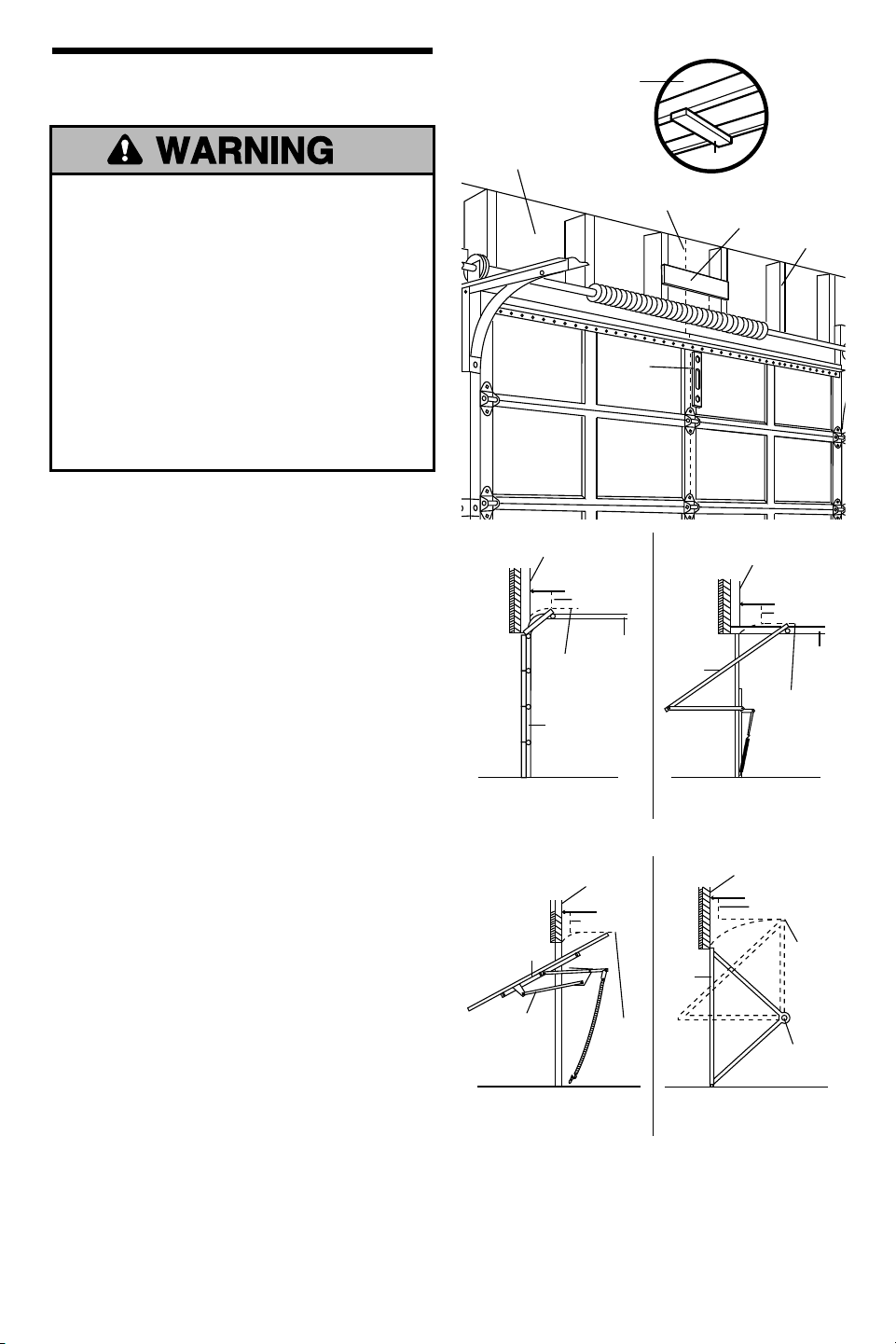
INSTALLATION STEP 1
Determine the Header Bracket Location
Installation procedures vary according to garage door
types. Follow the instructions which apply to your door.
1. Close the door and mark the inside vertical centerline
of the garage door.
2. Extend the line onto the header wall above the door.
You can fasten the header bracket within 4 feet
(1.22 m) of the left or right of the door center only if
a torsion spring or center bearing plate is in the way;
or you can attach it to the ceiling (see page 9) when
clearance is minimal. (It may be mounted on the
wall upside down if necessary, to gain approximately
1/2" (1 cm).)
If you need to install the header bracket on a 2x4
(on wall or ceiling), use lag screws (not provided)
to securely fasten the 2x4 to structural supports as
shown here and on page 9.
3. Open your door to the highest point of travel as shown.
Draw an inter secting horizontal line on the header wall
above the high point:
• 2" (5 cm) above the high point for sectional door
and one-piece door with track.
• 8" (20 cm) above the high point for one-piece door
without track.
This height will provide travel clearance for the top
edge of the door.
NOTE: If the total number of inches exceeds the height
available in your garage, use the maximum height
possible, or refer to page 9 for ceiling installation.
To prevent possible SERIOUS INJURY or DEATH:
• Header bracket MUST be RIGIDLY fastened to
structural support on header wall or ceiling,
otherwise garage door might NOT reverse when
required. DO NOT install header bracket over drywall.
• Concrete anchors MUST be used if mounting header
bracket or 2x4 into masonry.
• NEVER try to loosen, move or adjust garage door,
springs, cables, pulleys, brackets, or their hardware,
ALL of which are under EXTREME tension.
• ALWAYS call a trained door systems technician if
garage door binds, sticks, or is out of balance. An
unbalanced garage door might NOT reverse when
required.
Unfi nished
Ceiling
Header Wall
Vertical Centerline
of Garage Door
2x4
2x4
Structural
Supports
Level
(Optional)
Header Wall
Header Wall
2" (5 cm)
2" (5 cm)
Highest
Point of
Travel
Highest
Point of
Travel
Highest
Point of
Travel
Highest
Point of
Travel
Track
Track
Header Wall
8" (20 cm)
8" (20 cm)
Header Wall
Door
Door
Door
Jamb
Hardware
Door
Pivot
Sectional door with
curved track
One-piece door without track:
jamb hardware
One-piece door with
horizontal track
One-piece door without track:
pivot hardware
OPTIONAL
CEILING
MOUNT
FOR
HEADER
BRACKET
9
INSTALLATION STEP 2
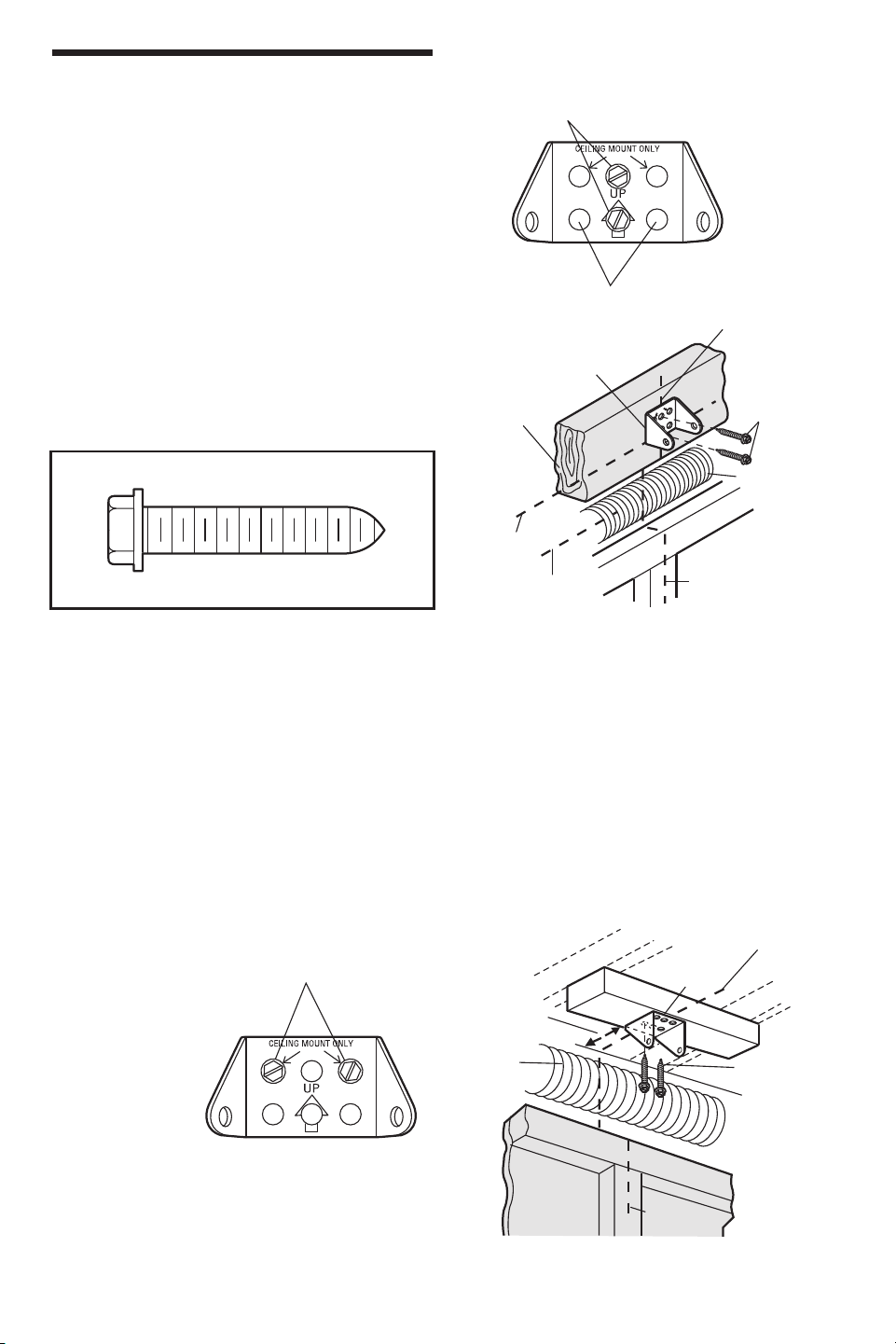
Install the Header Bracket
You can attach the header bracket either to the wall above
the garage door, or to the ceiling. Follow the instructions
which will work best for your particular requirements.
DO NOT install the header bracket over drywall.
If installing into masonry, use concrete anchors
(not provided).
WALL HEADER BRACKET INSTALLATION
• Center the bracket on the vertical centerline with the
bottom edge of the bracket on the horizontal line as
shown (with the arrow pointing toward the ceiling).
• Mark the vertical set of bracket holes (do not use the
holes designated for ceiling mount). Drill 3/16" pilot
holes and fasten the bracket securely to a structural
support with the hardware provided.
HARDWARE SHOWN ACTUAL SIZE
Header Bracket
2x4 Structural
Support
Vertical Centerline
of Garage Door
Optional Wall
Mounting Holes
Lag Screws
5/16"-9x1-5/8"
Vertical Centerline
of Garage Door
Door Spring
Highest Point
of Garage
Door Travel
Horizontal
Line
- Header Wall -
Wall Mounting Holes
- Garage Door -
- Header Wall -
Lag Screw
5/16"-9x1-5/8"
Garage Door
- Finished Ceiling -
Ceiling Mounting Holes
Vertical
Centerline
of Garage
Door
Vertical Centerline
of Garage Door
Lag Screws
5/16"-9x1-5/8"
Header
Bracket
Door
Spring
6" (15 cm)
Maximum
CEILING HEADER BRACKET INSTALLATION
• Extend the vertical centerline onto the ceiling as shown.
• Center the bracket on the vertical mark, no more than
6" (15 cm) from the wall. Make sure the arrow is
pointing toward the wall. The bracket can be mounted
fl ush against the ceiling when clearance is minimal.
• Mark the side holes. Drill 3/16" pilot holes and fasten
bracket securely to a structural support with the
hardware provided.
10
INSTALLATION STEP 3
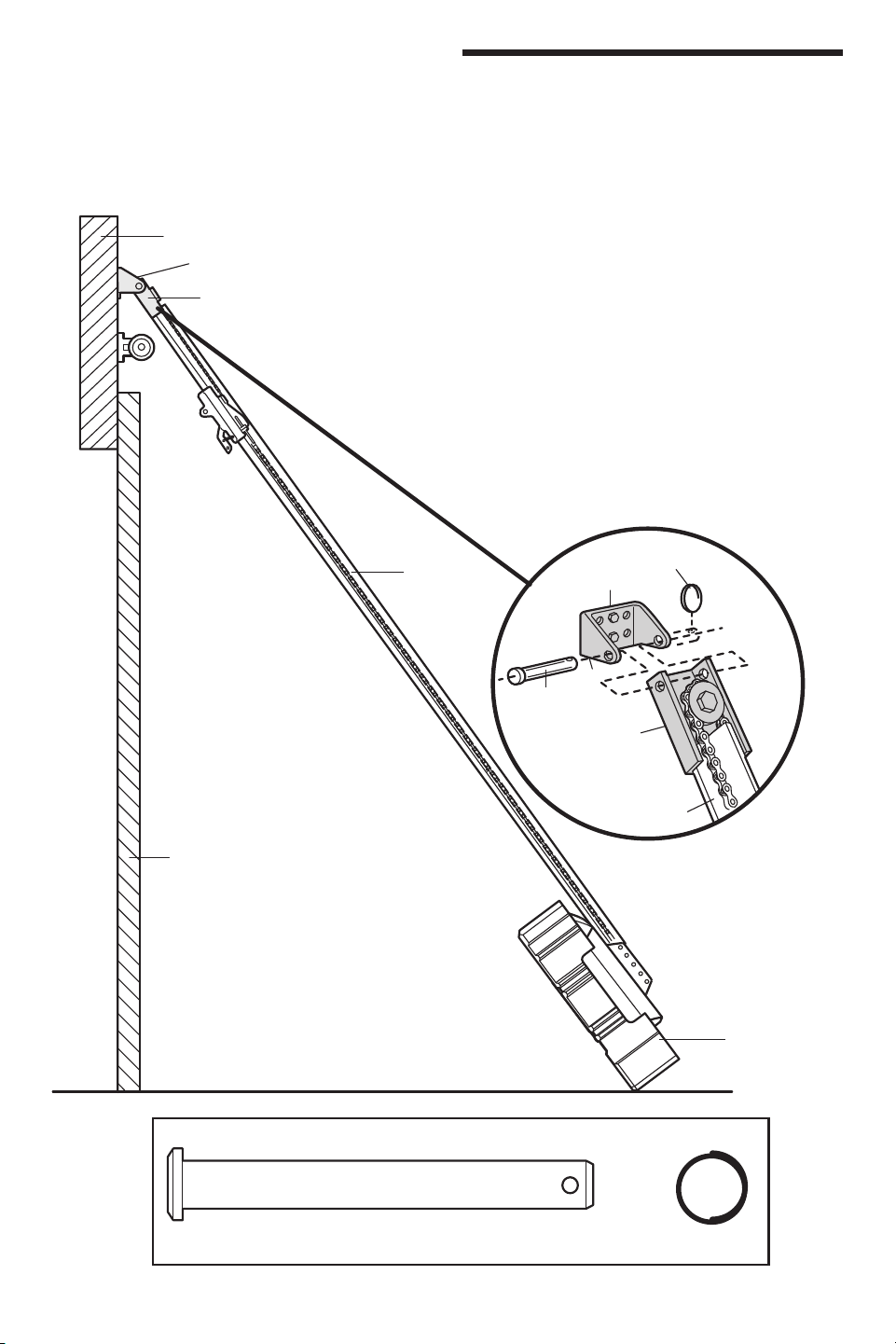
Attach the Rail to the Header Bracket
• Position the opener on the garage fl oor below the
header bracket. Use packing material as a protective
base. NOTE: If the door spring is in the way you’ll need
help. Have someone hold the opener securely on a
temporary support to allow the rail to clear the spring.
• Position the rail bracket against the header bracket.
• Align the bracket holes and join with a clevis pin
as shown.
• Insert a ring fastener to secure.
HARDWARE SHOWN ACTUAL SIZE
Header Wall
Header Bracket
Header Bracket
Clevis Pin
5/16"x2-3/4"
Chain
Pulley
Bracket
Rail
Temporary
Support
Ring Fastener
Clevis Pin
5/16"x2-3/4"
Garage
Door
Ring Fastener
Chain Pulley
Bracket
Rail
11
ONE-PIECE DOOR WITHOUT TRACK
A 2x4 on its side is convenient for setting an ideal
door-to-rail distance.
• Remove foam packaging.
• Raise the opener onto a stepladder. You will need help
at this point if the ladder is not tall enough.
• Open the door all the way and place a 2x4 on its side
on the top section of the door beneath the rail.
• The top of the door should be level with the top of the
motor unit. Do not position the opener more than
4" (10 cm) above this point.
INSTALLATION STEP 4
Position the Opener
Follow instructions which apply to your door type as
illustrated.
SECTIONAL DOOR OR ONE-PIECE DOOR WITH
TRACK
A 2x4 laid fl at is convenient for setting an ideal
door-to-rail distance.
• Remove foam packaging.
• Raise the opener onto a stepladder. You will need help
at this point if the ladder is not tall enough.
• Open the door all the way and place a 2x4 laid fl at on
the top section beneath the rail.
• If the top section or panel hits the trolley when you
raise the door, pull down on the trolley release arm to
disconnect inner and outer sections. Slide the outer
trolley toward the motor unit. The trolley can remain
disconnected until Installation Step 12 is completed.
To prevent damage to garage door, rest garage door
opener rail on 2x4 placed on top section of door.
Rail
Door
2x4 is used to determine
the correct mounting height
from ceiling.
2x4 is used to determine
the correct mounting height
from ceiling.
Header Bracket
RELEASED
Trolley
Release Arm
ENGAGED
Top of Door
12
INSTALLATION STEP 5
Hang the Opener
Three representative installations are shown. Yours may
be different. Hanging brackets should be angled
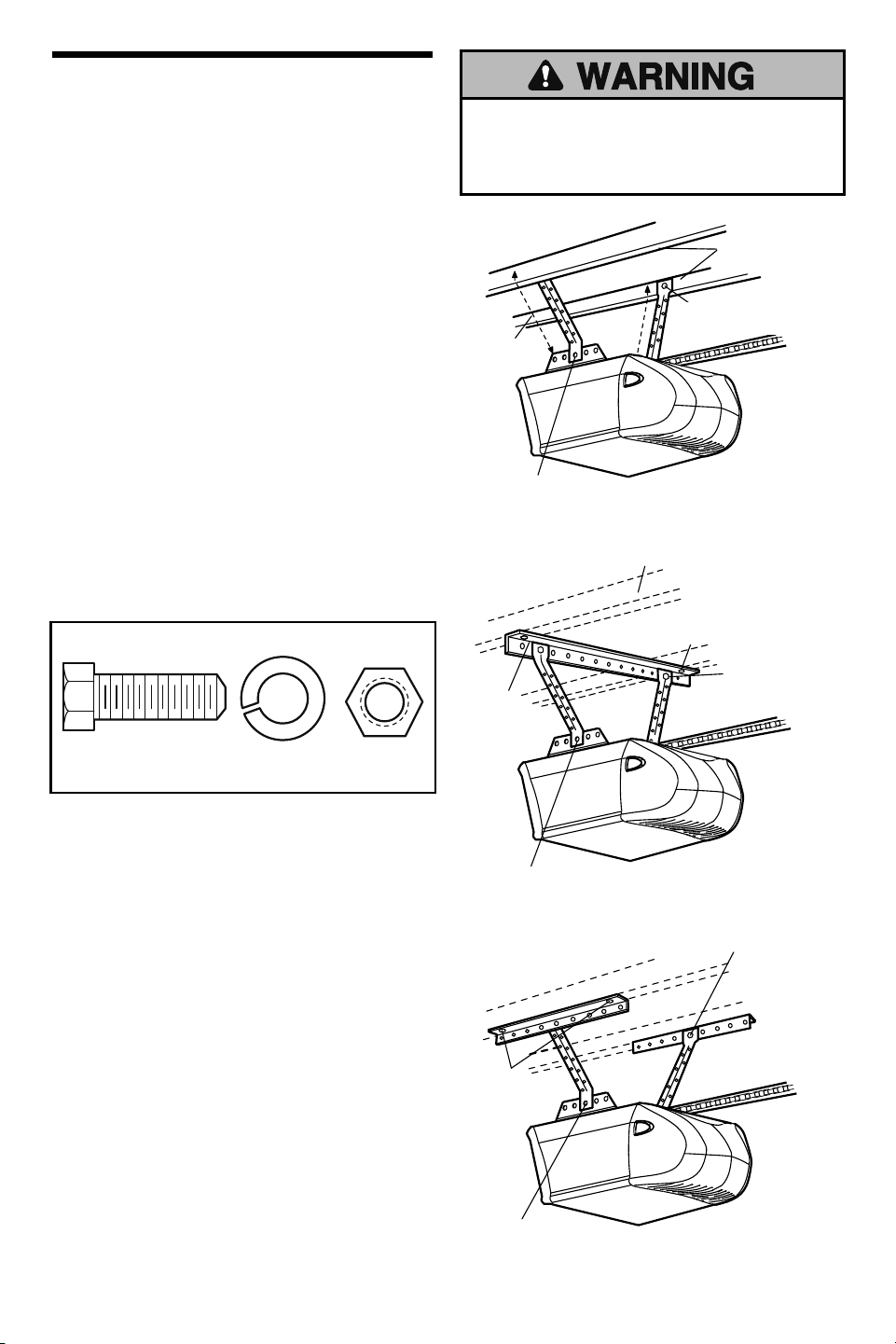
(Figure 1) to provide rigid support. On fi nished ceilings
(Figure 2 and Figure 3), attach a sturdy metal bracket
to structural supports before installing the opener. This
bracket and fastening hardware are not provided.
1. Measure the distance from each side of the motor unit
to the structural support.
2. Cut both pieces of the hanging bracket to required
lengths.
3. Drill 3/16" pilot holes in the structural supports.
4. Attach one end of each bracket to a support with
5/16"-18x1-7/8" lag screws (not provided).
5. Fasten the opener to the hanging brackets with
5/16"-18x7/8" hex bolts, lock washers and nuts.
6. Check to make sure the rail is centered over the door
(or in line with the header bracket if the bracket is not
centered above the door).
7. Remove the 2x4. Operate the door manually. If the
door hits the rail, raise the header bracket.
NOTE: DO NOT connect power to opener at this time.
To avoid possible SERIOUS INJURY from a falling
garage door opener, fasten it SECURELY to structural
supports of the garage. Concrete anchors MUST be
used if installing ANY brackets into masonry.
Figure 1
Figure 2
Figure 3
FINISHED CEILING
FINISHED CEILING
Bolt 5/16"-18x7/8"
Lock Washer 5/16"
Nut 5/16"-18
Bolt 5/16"-18x7/8"
Lock Washer 5/16"
Nut 5/16"-18
Bolt 5/16"-18x7/8"
Lock Washer 5/16"
Nut 5/16"-18
(Not Provided)
Bolt 5/16"-18x7/8"
Lock Washer 5/16"
Nut 5/16"-18
(Not Provided)
Bolt 5/16"-18x7/8"
Lock Washer 5/16"
Nut 5/16"-18
Structural
Supports
Measure
Distance
Hidden Support
Bracket
(Not Provided)
HARDWARE SHOWN ACTUAL SIZE
Hex Bolt
5/16"-18x7/8"
Lock Washer
5/16"
Nut
5/16"-18
(Not Provided)
Lag Screws 5/16"-18x1-7/8"
(Not Provided)
Lag Screws 5/16"-18x1-7/8"
(Not Provided)
Lag Screws
5/16"-18x1-7/8"
13
To prevent possible SERIOUS INJURY or DEATH from
electrocution:
• Be sure power is NOT connected BEFORE installing
door control.
• Connect ONLY to 24 VOLT low voltage wires.
To prevent possible SERIOUS INJURY or DEATH from a
closing garage door:
• Install door control within sight of garage door,
out of reach of children at a minimum height of 5 feet
(1.5 m), and away from ALL moving parts of door.
• NEVER permit children to operate or play with door
control push buttons or remote control transmitters.
• Activate door ONLY when it can be seen clearly, is
properly adjusted, and there are no obstructions to
door travel.
• ALWAYS keep garage door in sight until completely
closed. NEVER permit anyone to cross path of closing
garage door.
INSTALLATION STEP 6
Install the Door Control
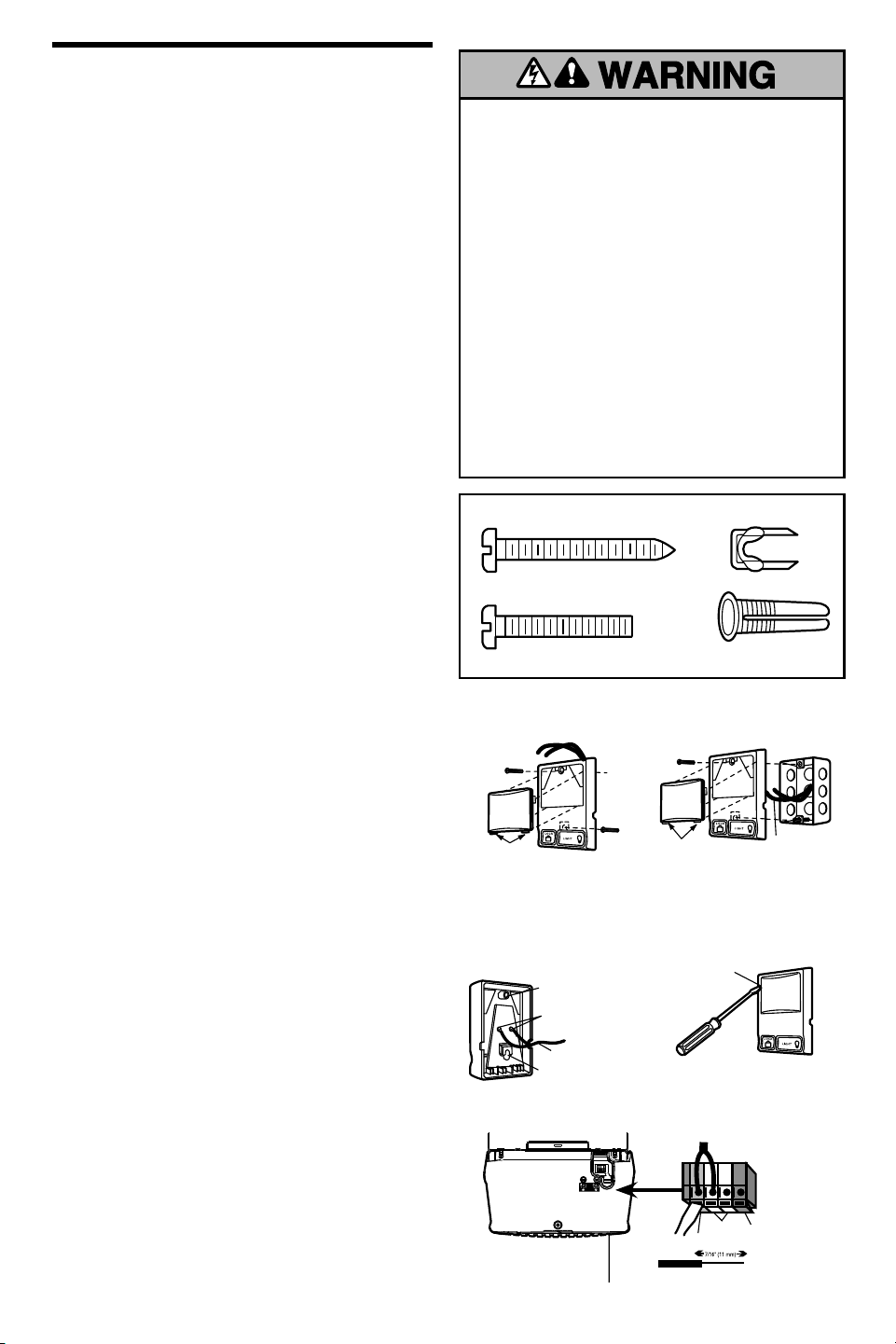
Locate door control within sight of door at a minimum
height of 5 feet (1.5 m) where small children cannot
reach, and away from moving parts of door and door
hardware. The installation surface must be smooth and
fl at. If installing into drywall (Figure 1), drill 5/32" holes
and use anchors provided. For pre-wired installations
(as in new home construction), it may be mounted to
a single gang box (Figure 2). NOTE: After installation,
a green or amber indicator light behind the cover will
indicate proper connection. If not lit, the Lock and Light
features will not function (reverse wires to correct).
1. Strip 7/16" (11 mm) of insulation from one end of bell
wire and connect to the two screw terminals on back
of door control by color: white wire to WHT and white/
red wire to the RED (Figure 3).
2. Remove cover by gently prying at slot in the side of
the cover with a small fl at head screwdriver (Figure 4).
Fasten with 6ABx1-1/4" self-tapping screws (drywall
installation) or 6-32x1" machine screws (into gang
box) as follows:
• Drill and install bottom screw, allowing 1/8" (3 mm)
to protrude above wall surface.
• Position bottom of door control on screw head and
slide down to secure. Adjust screw for snug fi t.
• Install top screw with care to avoid cracking plastic
housing. DO NOT overtighten.
• Insert bottom tabs and snap on cover.
NOTE: The push bar may stick if the door control is not
mounted on a smooth surface. If a click is not heard
when pressing the push bar, loosen the two mounting
screws or relocate the door control to a smoother
surface.
3. (Standard installation only) Run bell wire up wall and
across ceiling to motor unit. Use insulated staples to
secure wire in several places. Do not pierce wire with a
staple, creating a short or open circuit.
4. Strip 7/16" (11 mm) of insulation from end of bell wire.
Connect bell wire to the quick-connect terminals as
follows: white to white and white/red to red (Figure 5).
NOTE: When connecting multiple door controls to the
opener, twist same color wires together. Insert wires
into quick-connect holes: white to white and red/white
to red.
5. Use tacks or staples to permanently attach entrapment
warning label to wall near door control, and manual
release/safety reverse test label in a prominent location
on inside of garage door.
NOTE: DO NOT connect power and operate opener at this
time. The trolley will travel to the full open position but
will not return to the close position until the sensor beam
is connected and properly aligned.
HARDWARE SHOWN ACTUAL SIZE
Figure 5
Figure 1
Figure 3 Figure 4
Figure 2
REMOVE COVER
Screw 6ABx1-1/4"
(standard installation)
Insulated Staples
PRE-WIRED
INSTALLATION
MULTI-FUNCTION
DOOR CONTROL (BACK)
STANDARD
INSTALLATION
To Replace
Insert Bottom
Tabs First
To Replace
Insert Bottom
Tabs First
Top Mounting Hole
Terminal Screws
Bell Wire
Bottom Mounting Hole
Door Control
Connections
To release or insert
wire, push in tab
with screwdriver tip
White
Grey
Red
Strip wire 7/16" (11 mm)
Slot
24 Volt
Bell Wire
Drywall Anchors
Screw 6-32x1"
(pre-wired)
14
INSTALLATION STEP 7
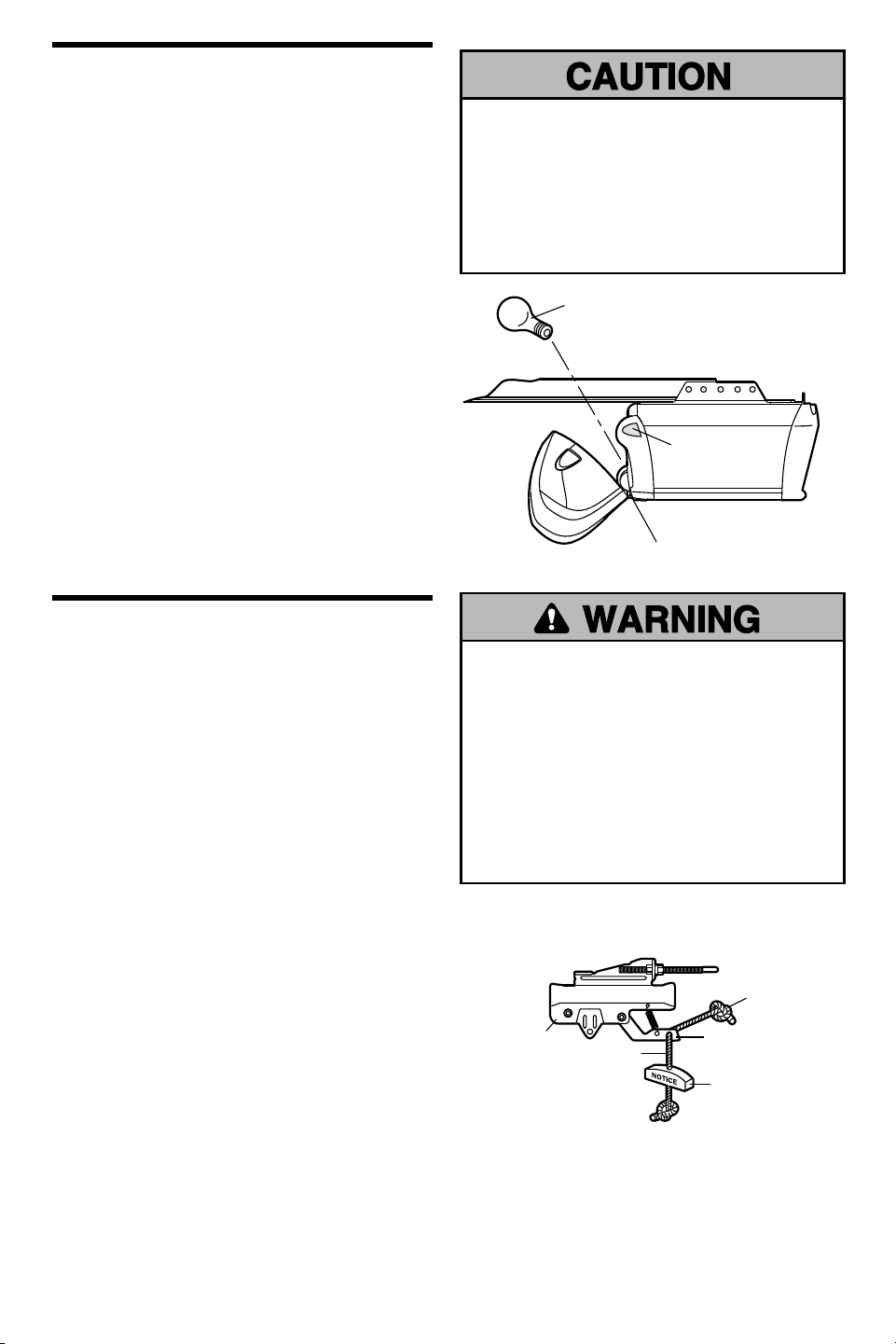
Install the Light
• Press the release tabs on both sides of lens. Gently
rotate lens back and downward until the lens hinge is
in the fully open position. Do not remove the lens.
• Install a 100 watt maximum light bulb in each socket.
Light bulb size should be A19, standard neck only.
The lights will turn ON and remain lit for approximately
4-1/2 minutes when power is connected. Then the
lights will turn OFF.
• Reverse the procedure to close the lens.
• Use A19, standard neck garage door opener bulbs for
replacement.
NOTE: Use only standard light bulbs. The use of short
neck or speciality light bulbs may overheat the endpanel
or light socket.
INSTALLATION STEP 8
Attach the Emergency Release Rope and
Handle
• Thread one end of the rope through the hole in the
top of the red handle so “NOTICE” reads right side up
as shown. Secure with an overhand knot at least
1" (2.5 cm) from the end of the rope to prevent
slipping.
• Thread the other end of the rope through the hole in
the release arm of the outer trolley.
• Adjust rope length so the handle is 6 feet (1.83 m)
above the fl oor. Ensure that the rope and handle clear
the tops of all vehicles to avoid entanglement. Secure
with an overhand knot.
NOTE: If it is necessary to cut the rope, heat seal the cut
end with a match or lighter to prevent unraveling.
To prevent possible OVERHEATING of the endpanel or
light socket:
• DO NOT use short neck or specialty light bulbs.
• DO NOT use halogen bulbs. Use ONLY incandescent.
To prevent damage to the opener:
• DO NOT use bulbs larger than 100W.
• ONLY use A19 size bulbs.
To prevent possible SERIOUS INJURY or DEATH from
a falling garage door:
• If possible, use emergency release handle to
disengage trolley ONLY when garage door is
CLOSED. Weak or broken springs or unbalanced
door could result in an open door falling rapidly and/
or unexpectedly.
• NEVER use emergency release handle unless garage
doorway is clear of persons and obstructions.
• NEVER use handle to pull door open or closed. If
rope knot becomes untied, you could fall.
100 Watt (Max)
Standard Light Bulb
Release Tab
Lens Hinge
Overhand
Knot
Trolley
Release Arm
Emergency
Release Handle
Rope
Trolley
15
INSTALLATION STEP 9
Electrical Requirements
To avoid installation diffi culties, do not run the opener
at this time.
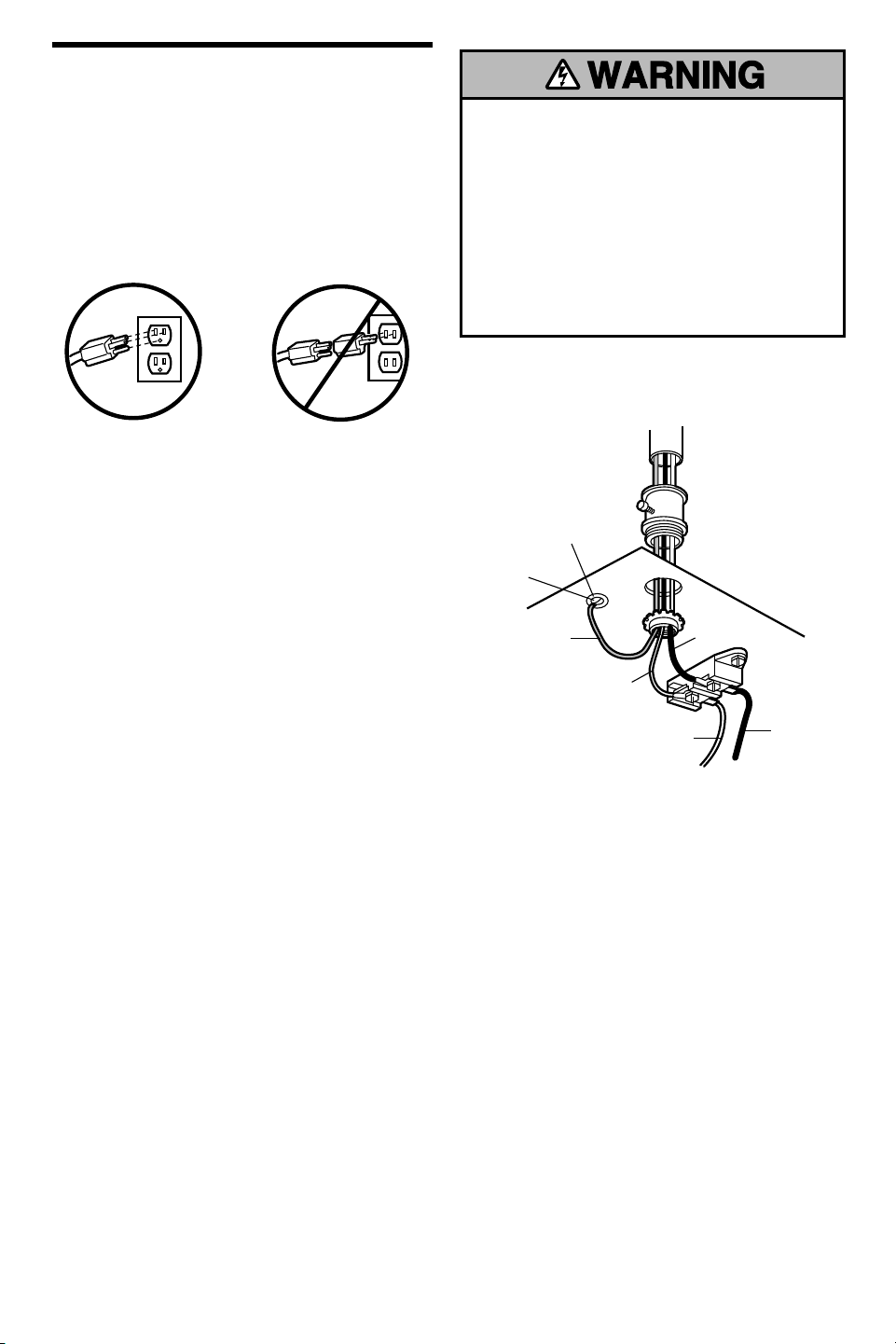
To reduce the risk of electric shock, your garage door
opener has a grounding type plug with a third grounding
pin. This plug will only fi t into a grounding type outlet.
If the plug doesn’t fi t into the outlet you have, contact a
qualifi ed electrician to install the proper outlet.
If permanent wiring is required by your local code, refer
to the following procedure.
To make a permanent connection through the 7/8" hole in
the top of the motor unit:
• Remove the motor unit cover screws and set the cover
aside.
• Remove the attached 3-prong cord.
• Connect the black (line) wire to the screw on the brass
terminal; the white (neutral) wire to the screw on
the silver terminal; and the ground wire to the green
ground screw. The opener must be grounded.
• Reinstall the cover.
To avoid installation diffi culties, do not run the opener
at this time.
To prevent possible SERIOUS INJURY or DEATH from
electrocution or fi re:
• Be sure power is NOT connected to the opener, and
disconnect power to circuit BEFORE removing cover
to establish permanent wiring connection.
• Garage door installation and wiring MUST be in
compliance with ALL local electrical and building
codes.
• NEVER use an extension cord, 2-wire adapter, or
change plug in ANY way to make it fi t outlet. Be sure
the opener is grounded.
RIGHT WRONG
PERMANENT WIRING
CONNECTION
Ground
Tab
Black
Wire
Black
Wire
White
Wire
White
Wire
Green
Ground
Screw
Ground
Wire
16
Facing the door from inside the garage.
INSTALLATION STEP 10
Install The Protector System
®
The safety reversing sensor must be connected and
aligned correctly before the garage door opener will
move in the down direction.
IMPORTANT INFORMATION ABOUT THE SAFETY
REVERSING SENSOR
When properly connected and aligned, the sensor will
detect an obstacle in the path of its electronic beam.
The sending eye (with an amber indicator light) transmits
an invisible light beam to the receiving eye (with a green
indicator light). If an obstruction breaks the light beam
while the door is closing, the door will stop and reverse
to full open position, and the opener lights will fl ash
10 times.
The units must be installed inside the garage so that the
sending and receiving eyes face each other across the
door, no more than 6" (15 cm) above the fl oor. Either can
be installed on the left or right of the door as long as the
sun never shines directly into the receiving eye lens.
The mounting brackets are designed to clip onto the track
of sectional garage doors without additional hardware.
If it is necessary to mount the units on the wall, the
brackets must be securely fastened to a solid surface
such as the wall framing. Extension brackets (see
Accessories) are available if needed. If installing in
masonry construction, add a piece of wood at each
location to avoid drilling extra holes in masonry if
repositioning is necessary.
The invisible light beam path must be unobstructed. No
part of the garage door (or door tracks, springs, hinges,
rollers or other hardware) may interrupt the beam while
the door is closing.
Be sure power is NOT connected to the garage door
opener BEFORE installing the safety reversing sensor.
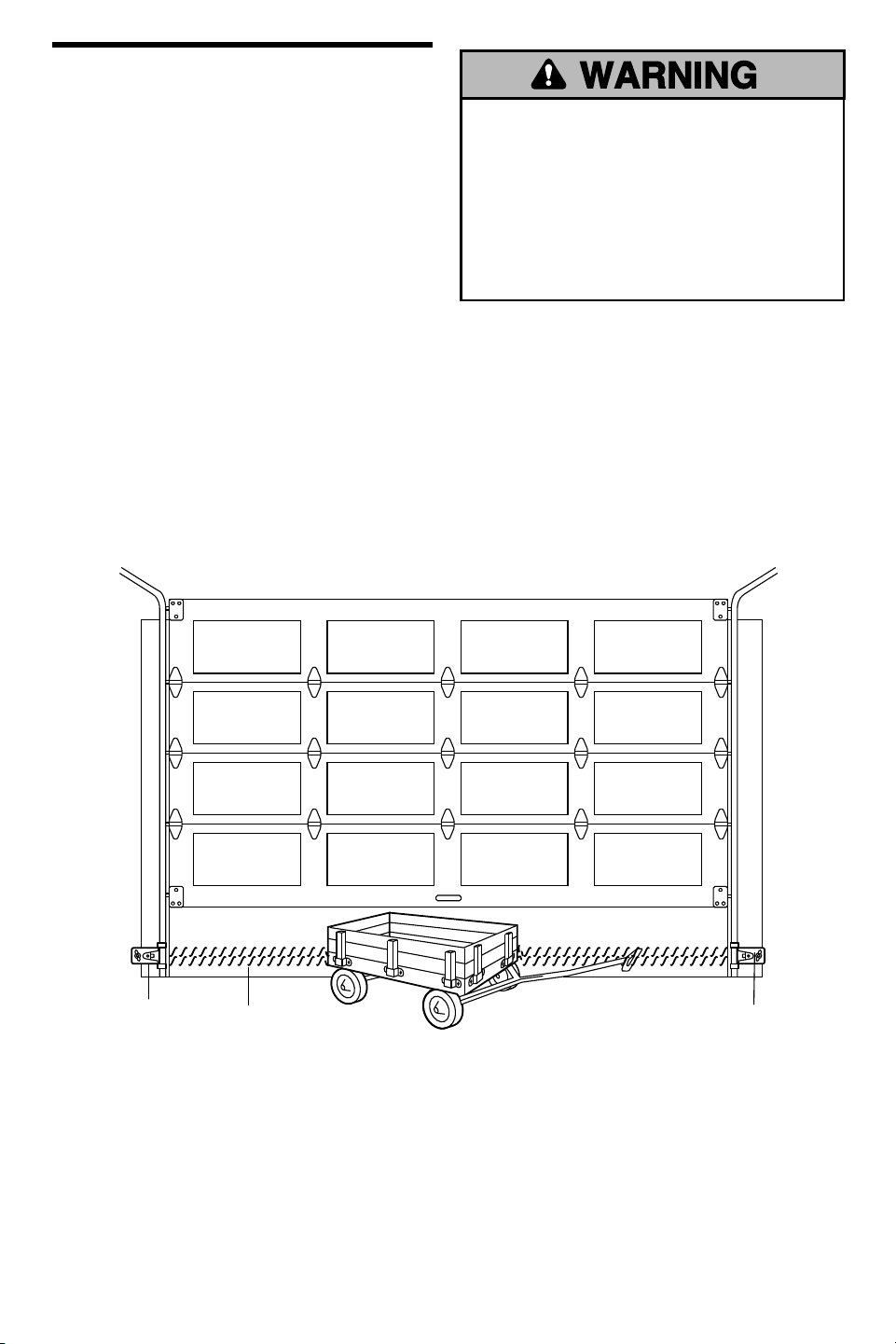
To prevent SERIOUS INJURY or DEATH from a
closing garage door:
• Correctly connect and align the safety reversing
sensor. This required safety device MUST NOT be
disabled.
• Install the safety reversing sensor so beam is NO
HIGHER than 6" (15 cm) above garage fl oor.
Safety Reversing Sensor
6" (15 cm) max. above fl oor
Safety Reversing Sensor
6" (15 cm) max. above fl oor
Invisible Light Beam
Protection Area
17
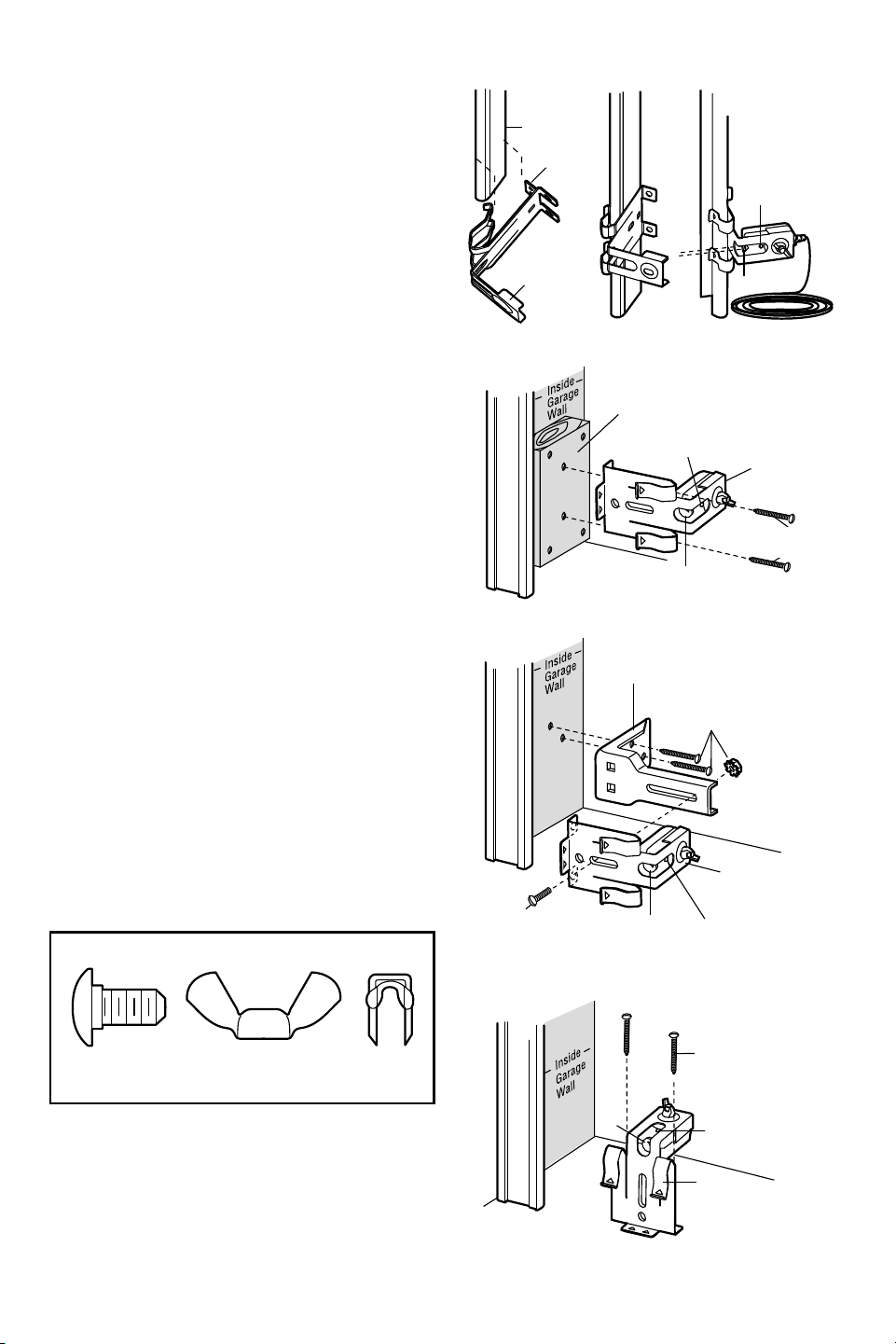
INSTALLING THE BRACKETS
Be sure power to the opener is disconnected. Install
and align the brackets so the sensors will face each other
across the garage door, with the beam no higher than
6" (15 cm) above the fl oor. They may be installed in one of
three ways, as follows.
Garage door track installation (preferred):
• Slip the curved arms over the rounded edge of each
door track, with the curved arms facing the door. Snap
into place against the side of the track. It should lie
fl ush, with the lip hugging the back edge of the track,
as shown in Figure 1.
If your door track will not support the bracket securely,
wall installation is recommended.
Wall installation (Figures 2 & 3):
• Place the bracket against the wall with curved arms
facing the door. Be sure there is enough clearance for
the sensor beam to be unobstructed.
• If additional depth is needed, an extension bracket (see
Accessories) or wood blocks can be used.
• Use bracket mounting holes as a template to locate
and drill (2) 3/16" diameter pilot holes on the wall at
each side of the door, no higher than 6" (15 cm) above
the fl oor.
• Attach brackets to wall with lag screws (not provided).
• If using extension brackets or wood blocks, adjust
right and left assemblies to the same distance out from
the mounting surface. Make sure all door hardware
obstructions are cleared.
Floor installation (Figure 4):
• Use wood blocks or extension brackets (see
Accessories) to elevate sensor brackets so the lenses
will be no higher than 6" (15 cm) above the fl oor.
• Carefully measure and place right and left assemblies
at the same distance out from the wall. Be sure all door
hardware obstructions are cleared.
• Fasten to the fl oor with concrete anchors as shown.
HARDWARE SHOWN ACTUAL SIZE
Figure 4
Figure 3
Figure 2
Figure 1
DOOR TRACK MOUNT (RIGHT SIDE)
WALL MOUNT (RIGHT SIDE)
WALL MOUNT (RIGHT SIDE)
FLOOR MOUNT (RIGHT SIDE)
Safety
Reversing
Sensor
Bracket
Safety
Reversing
Sensor
Bracket
(Provided with
Extension Bracket)
Extension Bracket
(See Accessories)
Safety
Reversing
Sensor
Bracket
Safety
Reversing
Sensor
Bracket
Door
Track
Lip
Indicator
Light
Lens
Lens
Lens
Carriage Bolt
1/4"-20x1/2"
Wing Nut
1/4"-20
Staples
Lens
Attach with
Concrete Anchors
(Not Provided)
Indicator
Light
(Provided with
Extension Bracket)
Indicator
Light
Lag Screws
(Not Provided)
Indicator
Light
Fasten Wood Block to Wall with
Lag Screws (Not Provided)
18
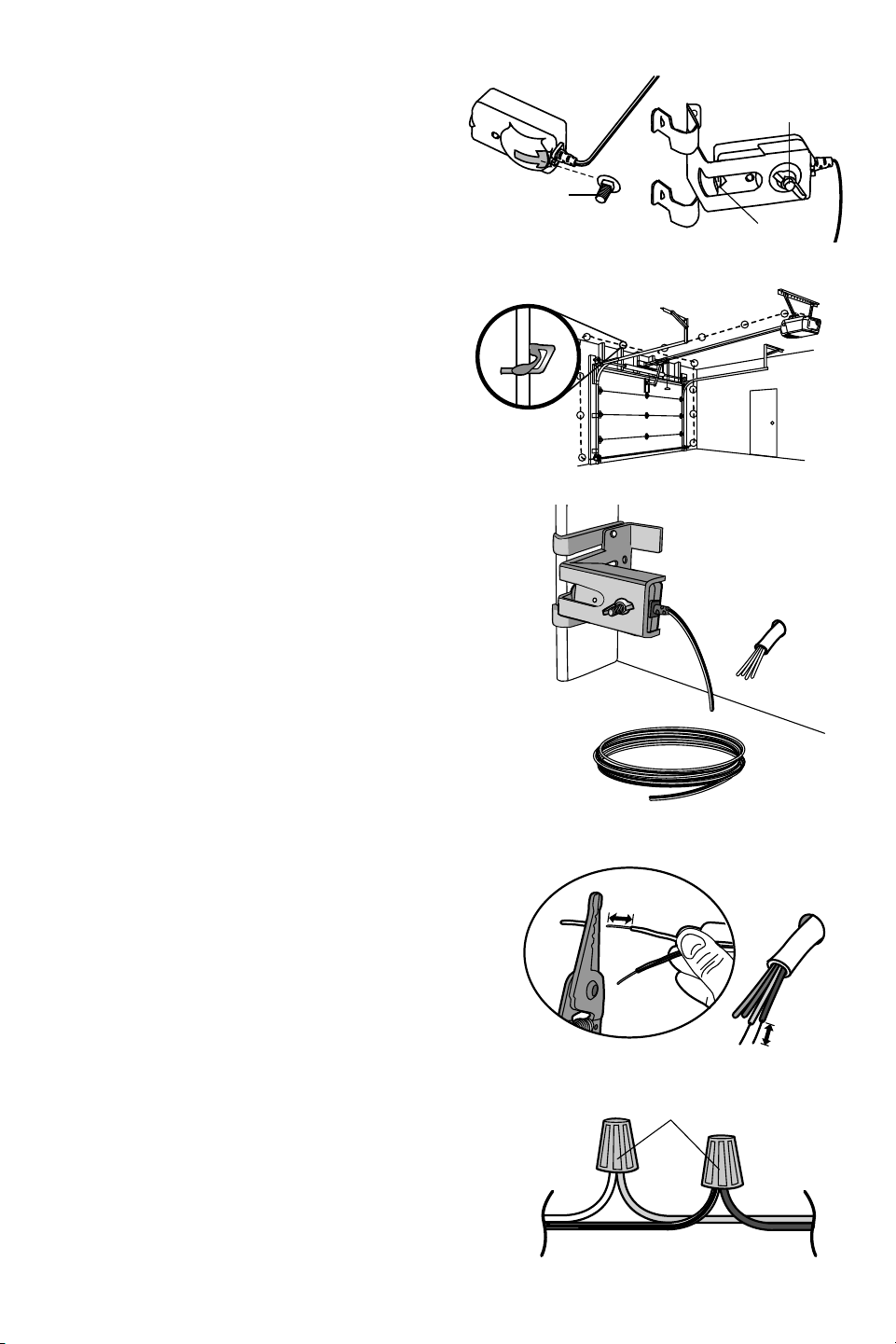
MOUNTING AND WIRING THE SAFETY
REVERSING SENSORS
Mounting:
• Slide a 1/4"-20x1/2" carriage bolt head into the slot
on each sensor. Use wing nuts to fasten sensors
to brackets, with lenses pointing toward each other
across the door. Be sure the lens is not obstructed by a
bracket extension (Figure 5).
• Finger tighten the wing nuts.
Option A - Installation Without Pre-Wiring:
• Run the bell wire from both sensors to the garage
door opener. Attach the wire to the wall and ceiling
with the staples (Figure 6).
Option B - Pre-Wired Installation:
If your garage already has wires installed for the safety
reversing sensors, follow the instructions below:
• Cut the end of the safety reversing sensor wire, making
sure there is enough wire to reach the pre-installed
wires from the wall (Figure 7).
• Separate the safety reversing sensor wires and strip
7/16" (11 mm) of insulation from each end. Choose two
of the pre-installed wires and strip 7/16" (11 mm) of
insulation from each end. Make sure that you choose
the same color pre-installed wires for each sensor
(Figure 8).
• Connect the pre-installed wires to the sensor wires with
wire nuts making sure the colors correspond for each
sensor (Figure 9).
Figure 5
Figure 6
Figure 7
Figure 9
Figure 8
Safety Reversing
Sensor Wires
Safety Reversing
Sensor Wires
White
White/Black
Not Provided
Pre-Installed
Wires
7/16"
(11 mm)
7/16"
(11 mm)
Pre-Installed
Wires
Wing Nut
1/4"-20
Lens
Carriage Bolt
1/4"-20x1/2"
19
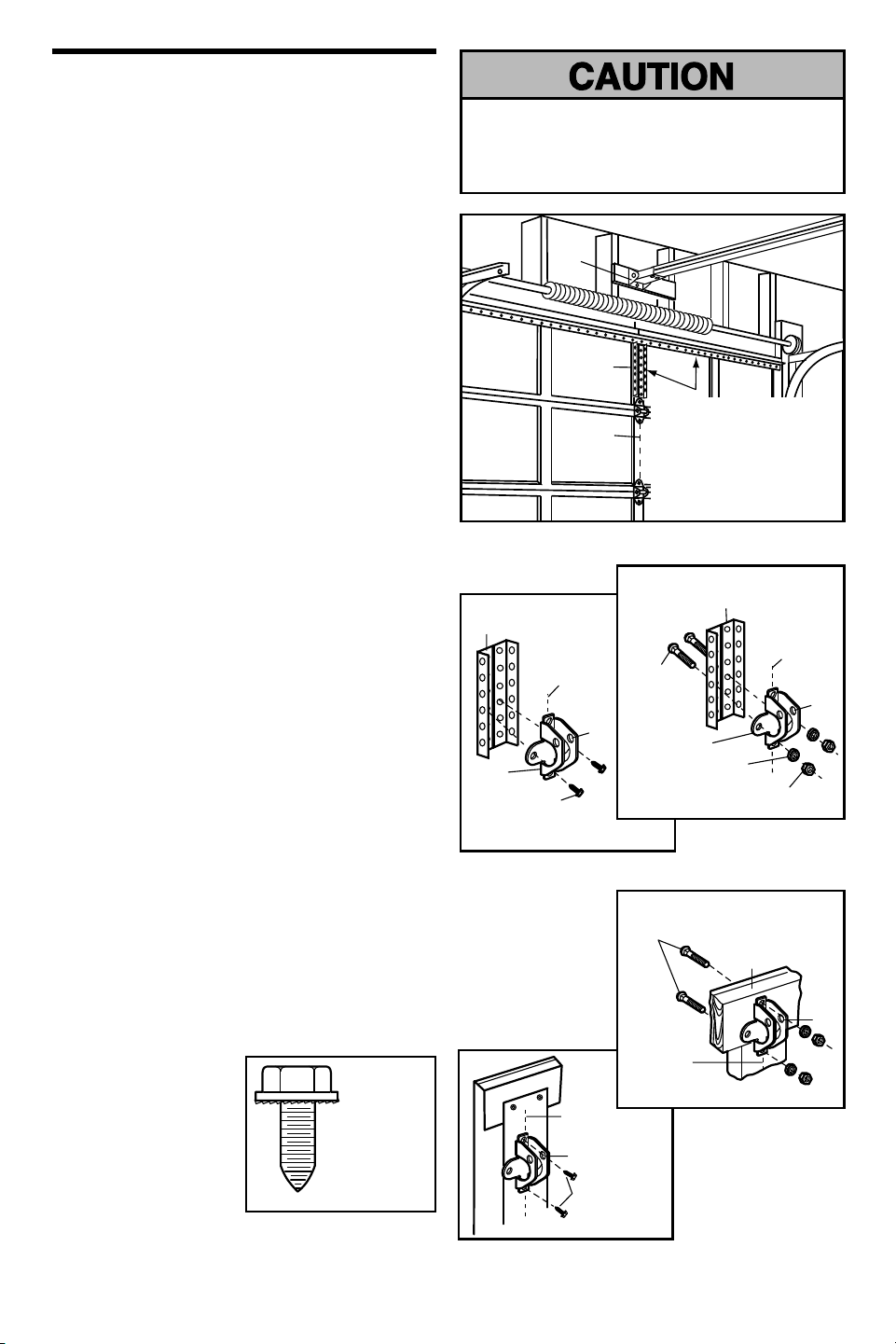
ALIGNING THE SAFETY REVERSING SENSORS
• Plug in the opener. The indicator lights in both the
sending and receiving eyes will glow steadily if wiring
connections and alignment are correct.
The sending eye amber indicator light will glow regardless
of alignment or obstruction. If the green indicator light in
the receiving eye is off, dim, or fl ickering (and the invisible
light beam path is not obstructed), alignment is required.
• Loosen the sending eye wing nut and readjust, aiming
directly at the receiving eye. Lock in place.
• Loosen the receiving eye wing nut and adjust sensor
until it receives the sender’s beam. When the green
indicator light glows steadily, tighten the wing nut.
TROUBLESHOOTING THE SAFETY
REVERSING SENSORS
1. If the sending eye indicator light does not glow steadily
after installation, check for:
• Electric power to the opener.
• A short in the white or white/black wires. These can
occur at staples, or at opener connections.
• Incorrect wiring between sensors and opener.
• A broken wire.
2. If the sending eye indicator light glows steadily but the
receiving eye indicator light doesn’t:
• Check alignment.
• Check for an open wire to the receiving eye.
3. If the receiving eye indicator light is dim, realign
either sensor.
NOTE: When the invisible beam path is obstructed or
misaligned while the door is closing, the door will reverse.
If the door is already open, it will not close. The opener
lights will blink 10 times. See page 16.
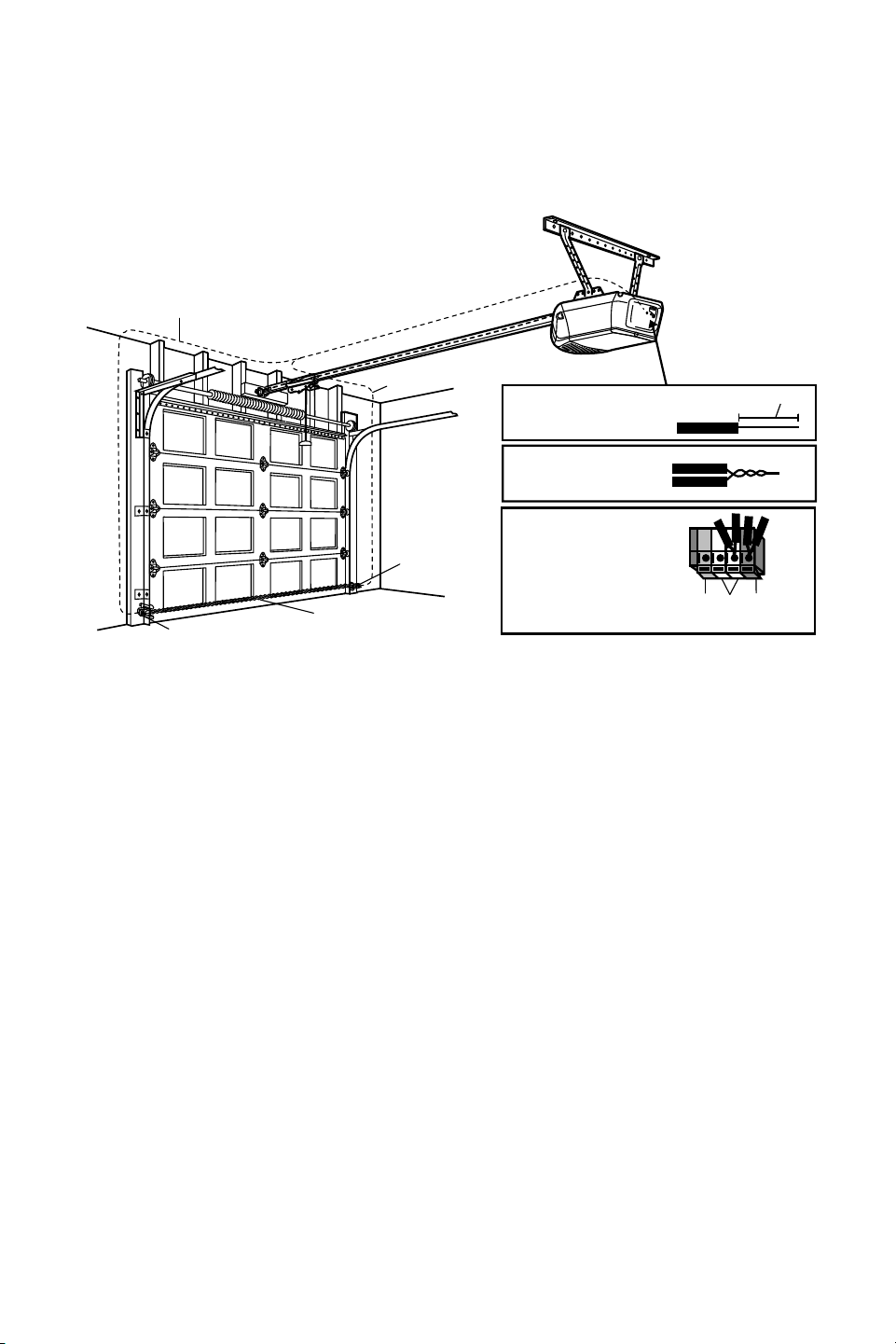
Connect to garage door opener:
• Strip 7/16" (11 mm) of insulation from each set of
wires. Separate white and white/black wires suffi ciently
to connect to the opener quick-connect terminals.
Twist like colored wires together. Insert wires into
quick-connect holes: white to white and white/black to
grey (Figure 10).
Figure 10
- Finished Ceiling -
Bell Wire
Bell Wire
Connect Wire to
Quick-Connect Terminals
Safety
Reversing
Sensor
Safety Reversing
Sensor
Invisible Light Beam
Protection Area
Quick-Connect Terminals
Red White
7/16" (11 mm)1. Strip wire 7/16" (11 mm)
2. Twist like colored
wires together
3. To insert or release wire,
push in tab with
screwdriver tip
Grey
20
Fiberglass, aluminum or lightweight steel garage
doors WILL REQUIRE reinforcement BEFORE
installation of door bracket. Contact your door
manufacturer for reinforcement kit.
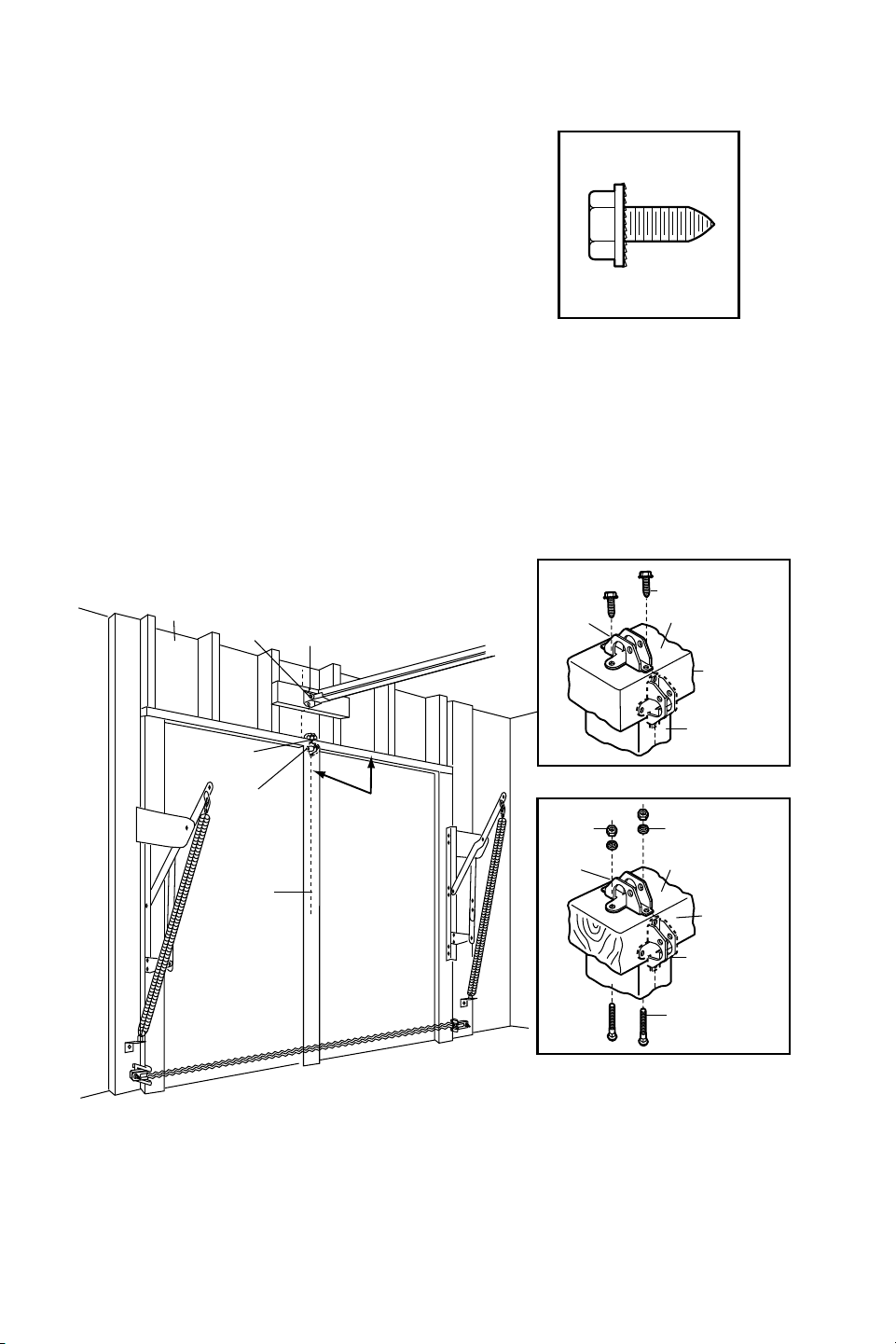
INSTALLATION STEP 11
Fasten the Door Bracket
Follow instructions which apply to your door type as
illustrated below or on the following page.
A horizontal reinforcement brace should be long enough
to be secured to two or three vertical supports. A vertical
reinforcement brace should cover the height of the top
panel.
Figure 1 shows one piece of angle iron as the horizontal
brace. For the vertical brace, 2 pieces of angle iron are
used to create a U-shaped support. The best solution is to
check with your garage door manufacturer for an opener
installation door reinforcement kit.
NOTE: Many door reinforcement kits provide for direct
attachment of the clevis pin and door arm. In this case you
will not need the door bracket; proceed to Step 12.
SECTIONAL DOORS
1. Center the door bracket on the previously marked
vertical centerline used for the header bracket
installation. Note correct UP placement, as stamped
inside the bracket.
2. Position the top edge of the bracket 2"-4" (5-10 cm)
below the top edge of the door, OR directly below any
structural support across the top of the door.
3. Mark, drill holes and install as follows, depending on
your door’s construction:
Metal or light weight doors using a vertical angle iron
brace between the door panel support and the door
bracket:
• Drill 3/16" fastening holes. Secure the door bracket
using the two 1/4"-14x5/8" self-threading screws
(Figure 2A).
• Alternately, use two 5/16" bolts, lock washers and nuts
(not provided) (Figure 2B).
Metal, insulated or light weight factory reinforced doors:
• Drill 3/16" fastening holes. Secure the door bracket
using the self-threading screws (Figure 3).
Wood Doors:
• Use top and bottom or side to side door bracket holes.
Drill 5/16" holes through the door and secure bracket
with 5/16"x2" carriage bolts, lock washers and nuts
(not provided) (Figure 4).
NOTE: The 1/4"-14x5/8" self-threading screws are not
intended for use on wood doors.
Figure 1
Figure 2A
Figure 3
Figure 4
Figure 2B
HARDWARE
SHOWN
ACTUAL SIZE
HORIZONTAL AND VERTICAL
REINFORCEMENT IS NEEDED
FOR LIGHTWEIGHT GARAGE
DOORS (FIBERGLASS,
ALUMINUM, STEEL, DOORS
WITH GLASS PANEL, ETC).
(NOT PROVIDED)
Header
Bracket
Door
Bracket
Location
Vertical
Centerline
of Garage
Door
Vertical
Reinforcement
Vertical
Reinforcement
Vertical
Centerline
of Garage
Door
Vertical
Centerline of
Garage Door
UP
Self-Threading
Screw
1/4"-14x5/8"
Self-Threading
Screw
1/4"-14x5/8"
Vertical
Centerline of
Garage Door
Door
Bracket
Self-Threading
Screw 1/4"-14x5/8"
UP
UP
Nut
5/16"-18
Lock
Washer
5/16"
Door
Bracket
Bolt
5/16"-18x2"
(Not
Provided)
Vertical
Centerline
of Garage
Door
UP
Bolt 5/16"x2"
(Not Provided)
Inside Edge
of Door or
Reinforcement
Board
21
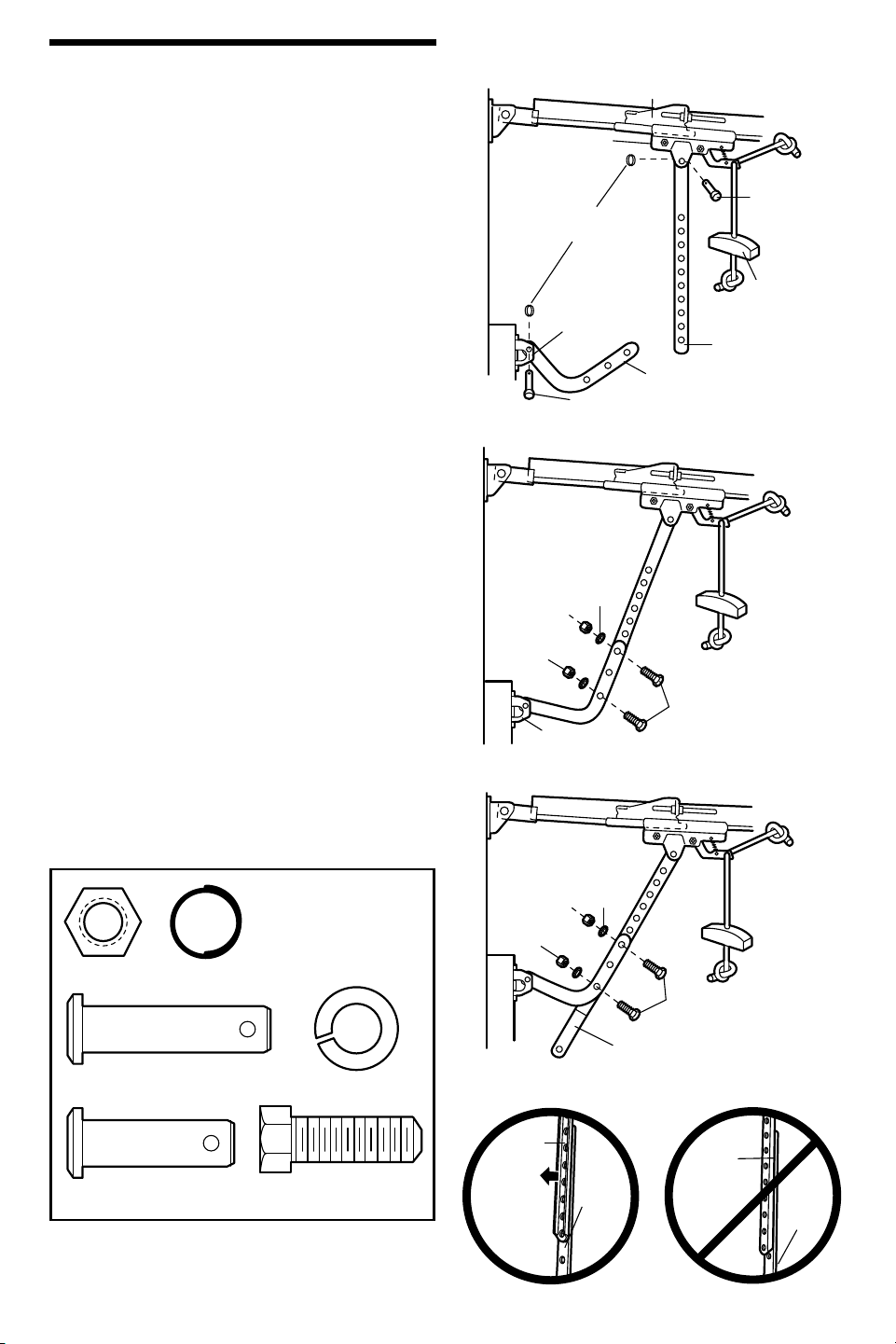
ONE-PIECE DOORS
Please read and comply with the warnings and
reinforcement instructions on the previous page.
They apply to one-piece doors also.
• Center the door bracket on the top of the door, in line
with the header bracket as shown. Mark either the left
and right, or the top and bottom holes.
• Metal Doors: Drill 3/16" pilot holes and fasten the
bracket with the 1/4"-14x5/8" self-threading screws
provided.
• Wood Doors: Drill 5/16" holes and use 5/16"x2"
carriage bolts, lock washers and nuts (not provided) or
5/16"x1-1/2" lag screws (not provided) depending on
your installation needs.
NOTE: The door bracket may be installed on the top edge
of the door if required for your installation. (Refer to the
dotted line optional placement drawing.)
HARDWARE SHOWN
ACTUAL SIZE
Self-Threading Screw
1/4"-14x5/8"
WOOD DOOR
METAL DOOR
- Finished Ceiling -
HORIZONTAL
AND VERTICAL
REINFORCEMENT
IS NEEDED FOR
LIGHTWEIGHT
GARAGE DOORS
(FIBERGLASS,
ALUMINUM,
STEEL, DOORS
WITH GLASS
PANEL, ETC).
(NOT PROVIDED)
Self-Threading
Screw 1/4"-14x5/8"
Top of Door
(Inside Garage)
Top of Door
(Inside Garage)
Top Edge
of Door
Top Edge
of Door
Optional
Placement
Optional
Placement
Carriage Bolt
5/16"x2"
(Not Provided)
For a door with no exposed framing, or for the
optional installation, use lag screws 5/16"x1-1/2"
(Not Provided) to fasten door bracket.
Lock Washer 5/16"
Nut
5/16"-18
Door
Bracket
Door
Bracket
Header
Wall
Header
Bracket
2x4
Support
Door
Bracket
Optional
Placement
of Door
Bracket
Vertical
Centerline
of Garage
Door
22
INSTALLATION STEP 12
Connect Door Arm to Trolley
Follow instructions which apply to your door type as
illustrated below and on the following page.
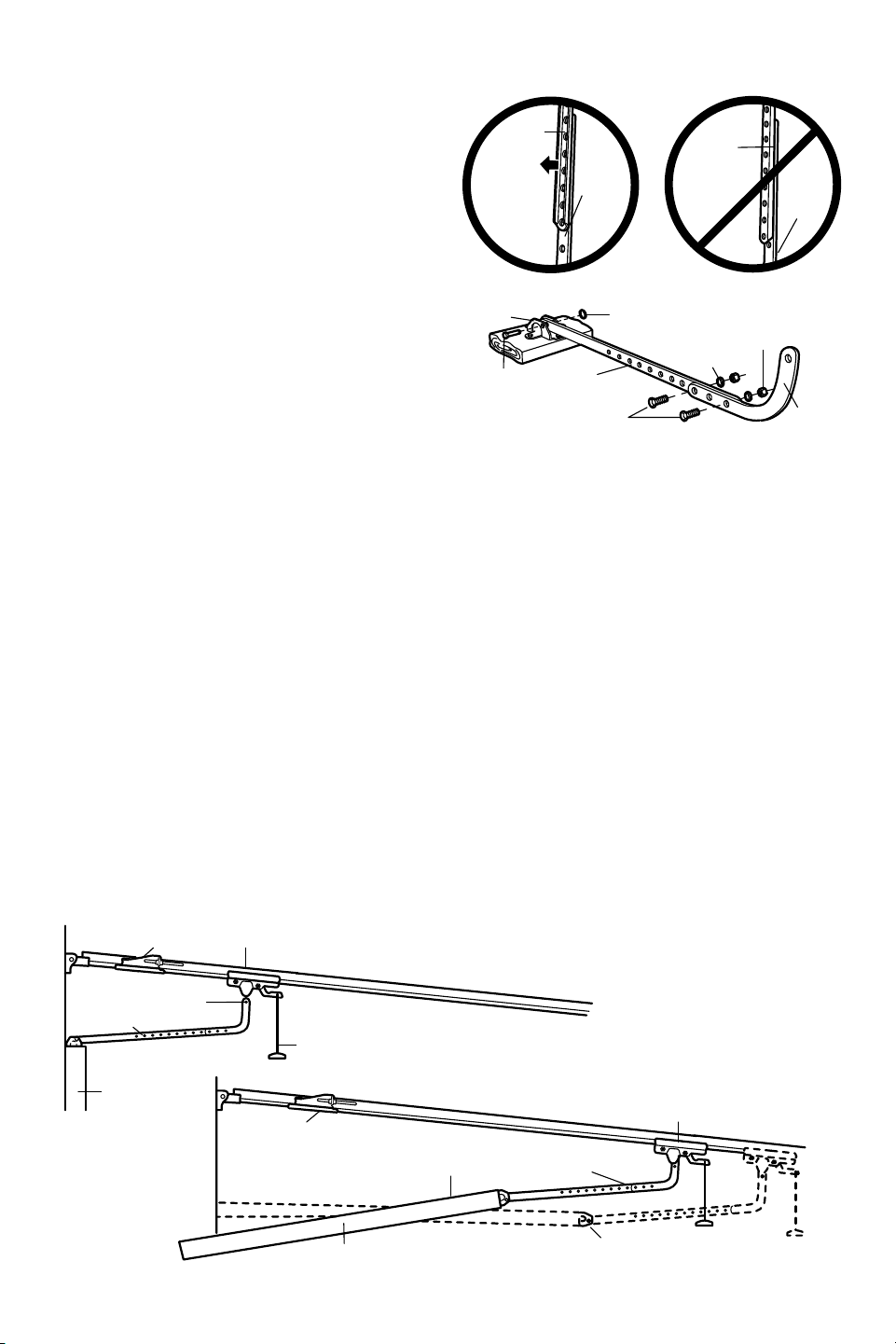
SECTIONAL DOORS ONLY
Make sure garage door is fully closed. Pull the emergency
release handle to disconnect the outer trolley from the
inner trolley. Slide the outer trolley back (away from the
door) about 2" (5 cm) as shown in Figures 1, 2 and 3.
Figure 1:
• Fasten straight door arm section to outer trolley with
the 5/16"x1" clevis pin. Secure the connection with a
ring fastener.
• Fasten curved section to the door bracket in the same
way, using the 5/16"x1-1/4" clevis pin.
IMPORTANT: The groove on the straight door arm MUST
face away from the curved door arm (Figure 4).
Figure 2:
• Bring arm sections together. Find two pairs of holes
that line up and join sections. Select holes as far apart
as possible to increase door arm rigidity.
Figure 3, Hole alignment alternative:
• If holes in curved arm are above holes in straight arm,
disconnect straight arm. Cut about 6" (15 cm) from the
solid end. Reconnect to trolley with cut end down as
shown.
• Bring arm sections together.
• Find two pairs of holes that line up and join with bolts,
lock washers and nuts.
Pull the emergency release handle toward the opener at
a 45° angle so that the trolley release arm is horizontal.
Proceed to Adjustment Step 1, page 24. Trolley will
re-engage automatically when opener is operated.
Figure 1
Figure 2
Figure 3
Figure 4
HARDWARE SHOWN
ACTUAL SIZE
Straight
Door Arm
Straight
Door Arm
Curved
Door
Arm
Curved
Door
Arm
(Groove
facing out)
CORRECT INCORRECT
Inner Trolley
Outer Trolley
Ring
Fastener
Clevis Pin
5/16"x1"
Emergency
Release
Handle
Straight
Door Arm
Curved
Door Arm
Clevis Pin
5/16"x1-1/4"
Lock
Washers
5/16"
Lock
Washers
5/16"
Nuts
5/16"-18
Nuts
5/16"-18
Nut 5/16"-18 Ring Fastener
Clevis Pin 5/16"x1-1/4"
(Door Bracket)
Clevis Pin 5/16"x1"
(Trolley)
Hex Bolt
5/16"-18x7/8"
Lock Washer 5/16"
Bolts
5/16"-18x7/8"
Bolts
5/16"-18x7/8"
Cut This End
Door Bracket
Door Bracket
23
ALL ONE-PIECE DOORS
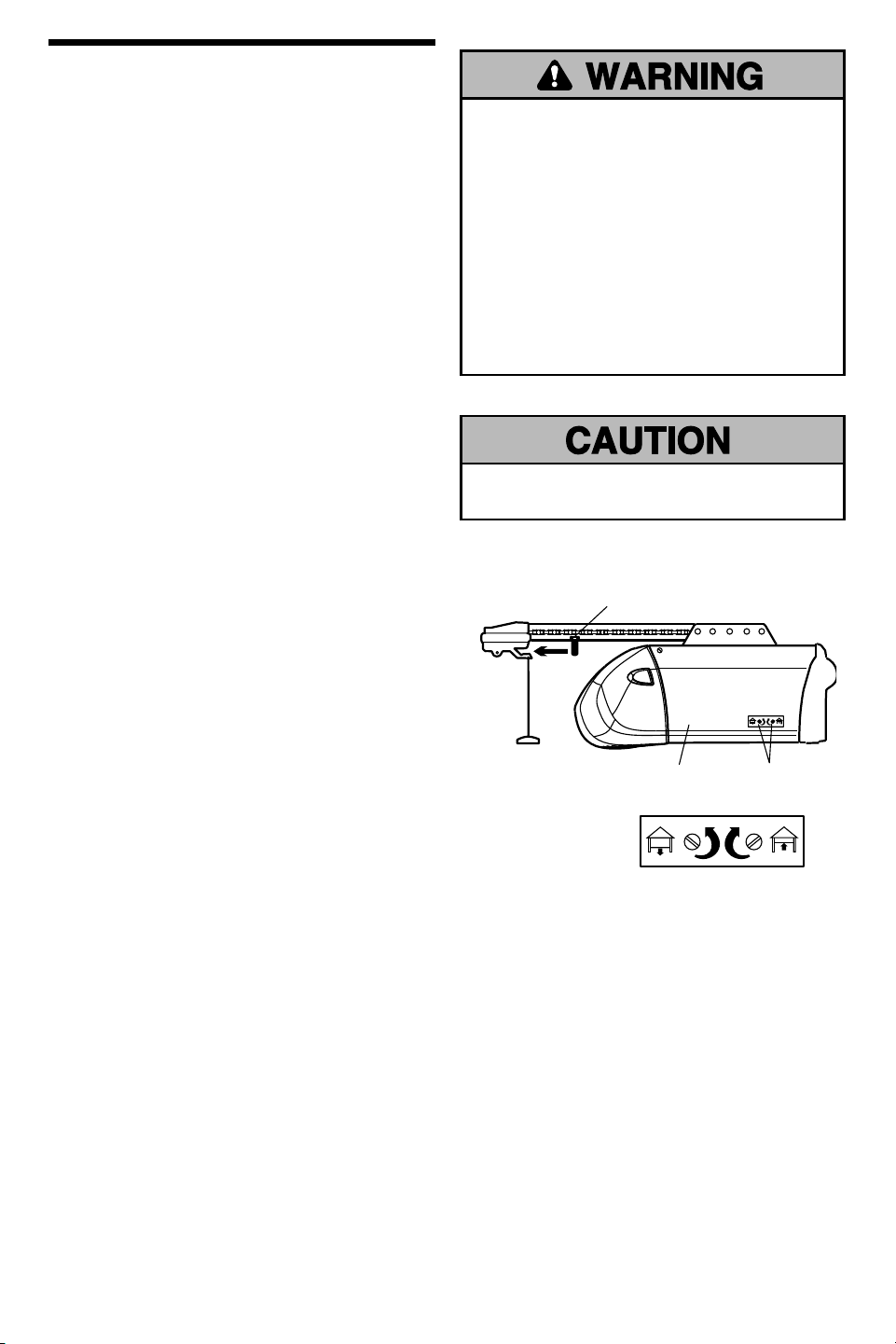
1. Assemble the door arm, Figure 5:
IMPORTANT: The groove on the straight door arm MUST
face away from the curved door arm (Figure 5).
• Fasten the straight and curved door arm sections
together to the longest possible length (with a 2 or 3
hole overlap).
• With the door closed, connect the straight door arm
section to the door bracket with the 5/16"x1-1/4"
clevis pin.
• Secure with a ring fastener.
2. Adjustment procedures, Figure 6:
• On one-piece doors, before connecting the door arm
to the trolley, the travel limits must be adjusted. Limit
adjust ment screws are located on the left side panel
as shown on page 24. Follow adjustment procedures
below.
• Open door adjustment: decrease UP travel limit
- Turn the UP limit adjustment screw
counterclockwise 4 turns.
- Press the Door Control push button. The trolley will
travel to the fully open position.
- Manually raise the door to the open position
(parallel to the fl oor), and lift the door arm to the
trolley. The arm should touch the trolley just in back
of the door arm connector hole. Refer to the fully
open trolley/door arm positions in the illustration.
If the arm does not extend far enough, adjust the
limit further. One full turn equals 2" (5 cm) of trolley
travel.
• Closed door adjustment: decrease DOWN travel
limit
- Turn the DOWN limit adjustment screw clockwise
4 complete turns.
- Press the Door Control push button. The trolley will
travel to the fully closed position.
Figure 5
Figure 6
- Manually close the door and lift the door arm to the
trolley. The arm should touch the trolley just ahead of
the door arm connector hole. Refer to the fully closed
trolley/door arm positions in the illustration. If the arm
is behind the connector hole, adjust the limit further.
One full turn equals 2" (5 cm) of trolley travel.
3. Connect the door arm to the trolley:
• Close the door and join the curved arm to the
connector hole in the trolley with the remaining clevis
pin. It may be necessary to lift the door slightly to
make the connection.
• Secure with a ring fastener.
• Run the opener through a complete travel cycle. If
the door has a slight “backward” slant in full open
position as shown in the illustration, decrease the UP
limit until the door is parallel to the fl oor.
NOTE: When setting the up limit on the following page, the
door should not have a “backward” slant when fully open
as illustrated below. A slight backward slant will cause
unnecessary bucking and/or jerking operation as the door
is being opened or closed from the fully open position.
Straight
Door Arm
Straight
Door Arm
Curved
Door
Arm
Curved
Door
Arm
(Groove
facing out)
CORRECT INCORRECT
Door
Bracket
Clevis Pin
5/16"x1-1/4"
Straight
Arm
Bolts
5/16"-18x7/8"
Ring
Fastener
Lock
Washers
5/16"
Nuts
5/16"-18
Curved
Door Arm
Inner Trolley
Outer Trolley
Emergency Release
Handle
Correct Angle
Open Door
Door with Backward
Slant (Incorrect)
Outer Trolley
Door Arm
Door Arm
Connector Hole
Door Arm
Closed Door
Inner Trolley
24
ADJUSTMENT STEP 1
Adjust the UP and DOWN Travel Limits
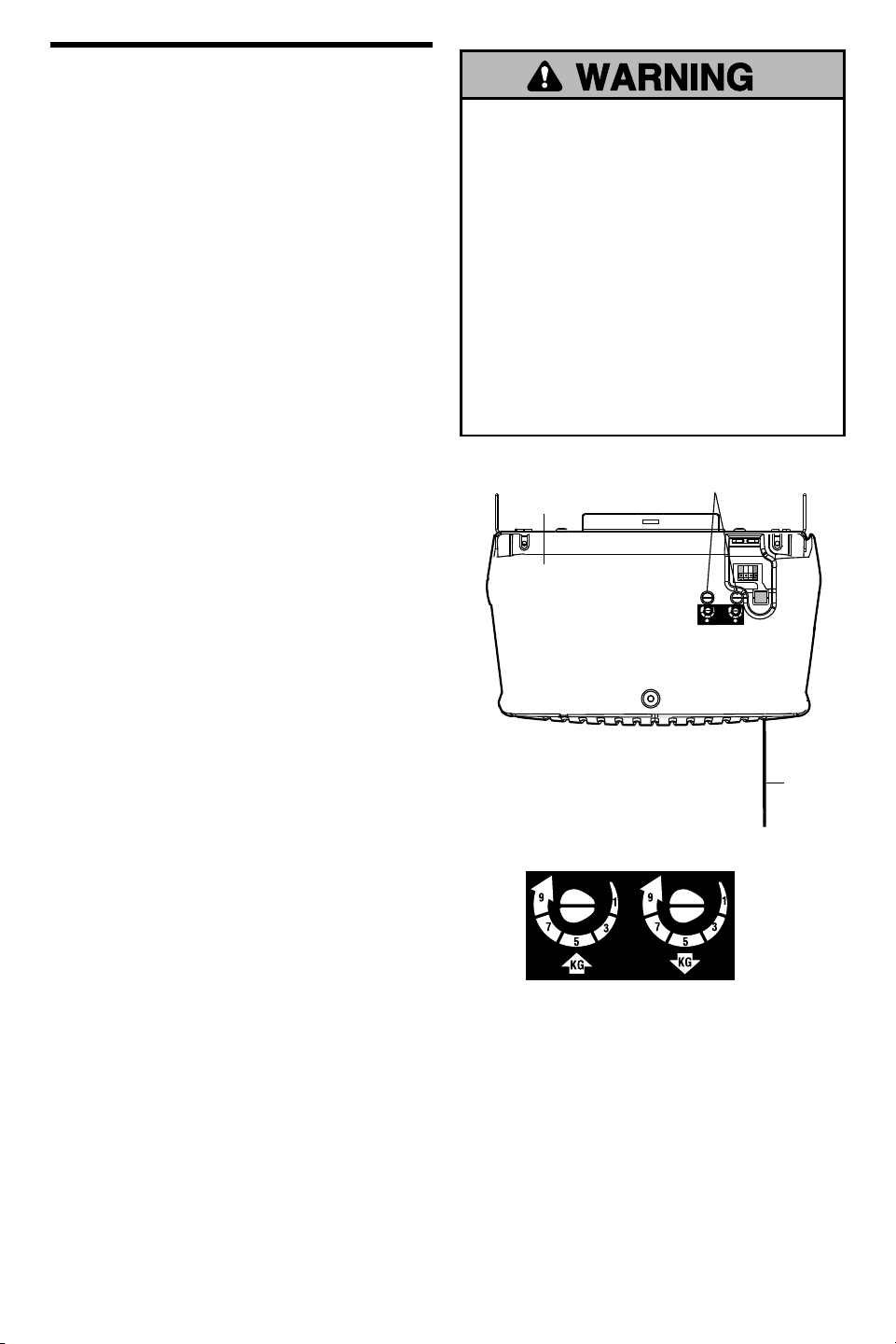
Limit adjustment settings regulate the points at which the
door will stop when moving up or down.
To operate the opener, press the Door Control push bar.
Run the opener through a complete travel cycle.
• Does the door open and close completely?
• Does the door stay closed and not reverse
unintentionally when fully closed?
If your door passes both of these tests, no limit
adjustments are necessary unless the reversing test fails
(Adjustment Step 3, page 26).
Adjustment procedures are outlined below. Read the
procedures carefully before proceeding to Adjustment
Step 2. Use a screwdriver to make limit adjustments.
Run the opener through a complete travel cycle after
each adjustment.
NOTE: Repeated operation of the opener during adjustment
procedures may cause the motor to overheat and shut off.
Simply wait 15 minutes and try again. If anything interferes
with the door’s upward travel, it will stop. If anything
interferes with the door’s downward travel (including
binding or unbalanced doors), it will reverse.
HOW AND WHEN TO ADJUST THE LIMITS
• If the door does not open completely but opens at
least fi ve feet (1.5 m):
Increase up travel. Turn the UP limit adjustment screw
clockwise. One turn equals 2" (5 cm) of travel.
NOTE: To prevent the trolley from hitting the cover
protection bolt, keep a minimum distance of
2-4" (5 cm - 10 cm) between the trolley and the bolt.
• If door does not open at least 5 feet (1.5 m):
Adjust the UP (open) force as explained in Adjustment
Step 2.
• If the door does not close completely:
Increase down travel. Turn the DOWN limit adjustment
screw counterclockwise. One turn equals 2" (5 cm)
of travel.
If door still won't close completely and the trolley
bumps into the pulley bracket (page 4), try lengthening
the door arm (page 22) and decreasing the down limit.
• If the opener reverses in fully closed position:
Decrease down travel. Turn the DOWN limit adjustment
screw clockwise. One turn equals 2" (5 cm) of travel.
• If the door reverses when closing and there is no
visible interference to travel cycle:
If the opener lights are fl ashing, the Safety Reversing
Sensors are either not installed, misaligned, or
obstructed. See Troubleshooting, page 19.
Test the door for binding: Pull the emergency release
handle. Manually open and close the door. If the door is
binding or unbalanced, call for a trained door systems
technician. If the door is balanced and not binding,
adjust the DOWN (close) force. See Adjustment Step 2.
Without a properly installed safety reversal system,
persons (particularly small children) could be
SERIOUSLY INJURED or KILLED by a closing garage
door.
• Incorrect adjustment of garage door travel limits
will interfere with proper operation of safety reversal
system.
• If one control (force or travel limits) is adjusted, the
other control may also need adjustment.
• After ANY adjustments are made, the safety reversal
system MUST be tested. Door MUST reverse on
contact with 1-1/2" high (3.8 cm) object (or 2x4 laid
fl at) on fl oor.
To prevent damage to vehicles, be sure fully open
door provides adequate clearance.
Cover Protection Bolt
2-4"
(5-10 cm)
Left Side
Panel
Limit Adjustment
Screws
ADJUSTMENT LABEL
25
ADJUSTMENT STEP 2
Adjust the Force
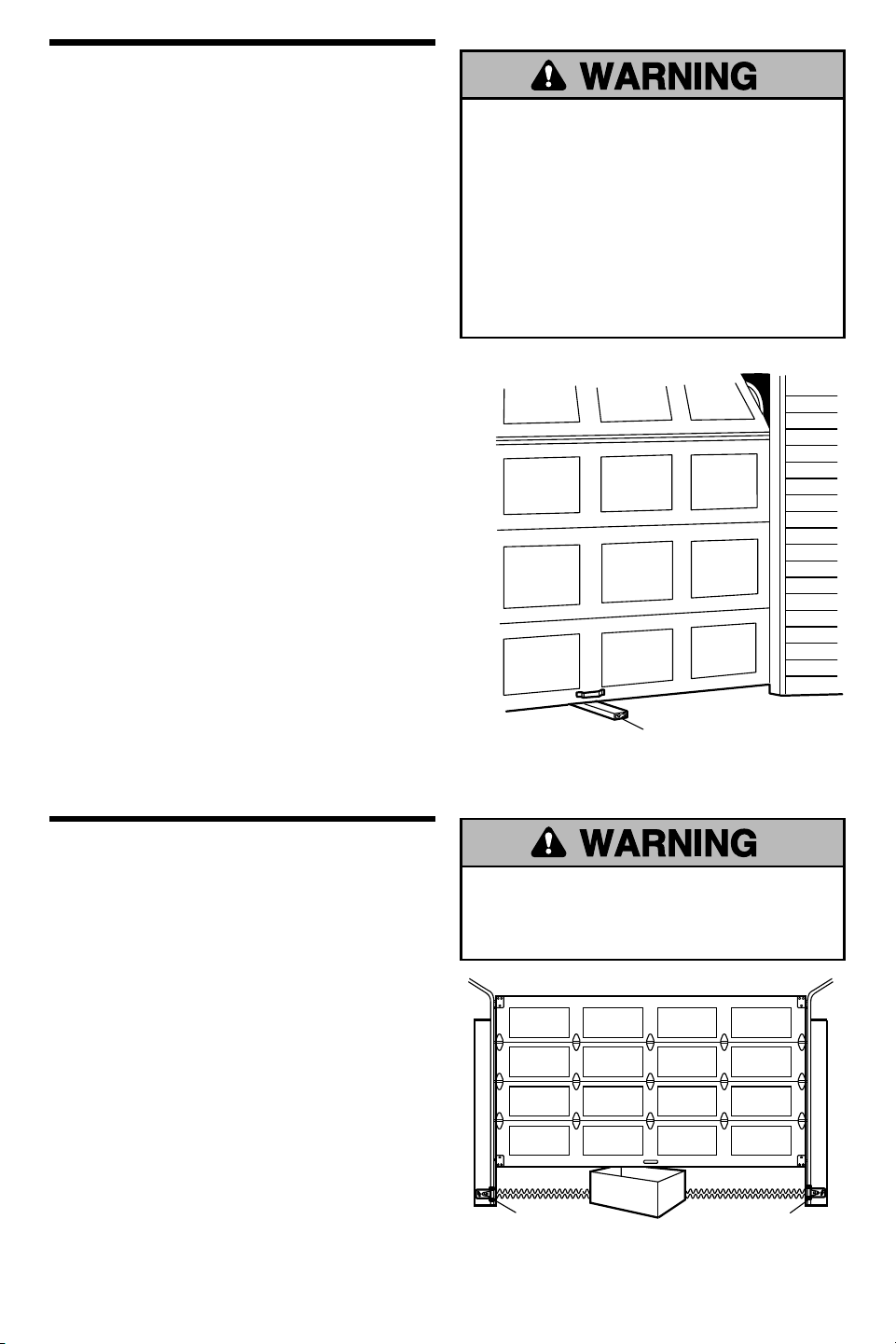
Force adjustment controls are located on the back panel
of the motor unit. Force adjustment settings regulate the
amount of power required to open and close the door.
If the forces are set too light, door travel may be
interrupted by nuisance reversals in the down direction
and stops in the up direction. Weather conditions can
affect the door movement, so occasional adjustment may
be needed.
The maximum force adjustment range is about 3/4 of a
complete turn. Do not force controls beyond that point.
Turn force adjustment controls with a screwdriver.
NOTE: If anything interferes with the door’s upward
travel, it will stop. If anything interferes with the door’s
downward travel (including binding or unbalanced doors),
it will reverse.
HOW AND WHEN TO ADJUST THE FORCES
1. Test the DOWN (close) force
• Grasp the door bottom when the door is about halfway
through DOWN (close) travel. The door should reverse.
Reversal halfway through down travel does not
guarantee reversal on a 1-1/2" (3.8 cm) obstruction.
See Adjustment Step 3, page 26. If the door is hard to
hold or doesn’t reverse, DECREASE the DOWN (close)
force by turning the control counterclockwise. Make
small adjustments until the door reverses normally.
After each adjustment, run the opener through a
complete cycle.
• If the door reverses during the down (close) cycle
and the opener lights aren’t fl ashing, INCREASE
DOWN (close) force by turning the control clockwise.
Make small adjustments until the door completes a
close cycle. After each adjustment, run the opener
through a complete travel cycle. Do not increase the
force beyond the minimum amount required to close
the door.
2. Test the UP (open) force
• Grasp the door bottom when the door is about halfway
through UP (open) travel. The door should stop. If the
door is hard to hold or doesn’t stop, DECREASE UP
(open) force by turning the control counterclockwise.
Make small adjustments until the door stops easily
and opens fully. After each adjustment, run the opener
through a complete travel cycle.
• If the door doesn’t open at least 5 feet (1.5 m),
INCREASE UP (open) force by turning the control
clockwise. Make small adjustments until door opens
completely. Readjust the UP limit if necessary. After
each adjustment, run the opener through a complete
travel cycle.
Without a properly installed safety reversal system,
persons (particularly small children) could be
SERIOUSLY INJURED or KILLED by a closing garage
door.
• Too much force on garage door will interfere with
proper operation of safety reversal system.
• NEVER increase force beyond minimum amount
required to close garage door.
• NEVER use force adjustments to compensate for a
binding or sticking garage door.
• If one control (force or travel limits) is adjusted, the
other control may also need adjustment.
• After ANY adjustments are made, the safety reversal
system MUST be tested. Door MUST reverse on
contact with 1-1/2" high (3.8 cm) object (or 2x4 laid
fl at) on fl oor.
Back Panel
Force Adjustment
Controls
Antenna
FORCE ADJUSTMENT LABEL
Close ForceOpen Force
26
Without a properly installed safety reversal system,
persons (particularly small children) could be
SERIOUSLY INJURED or KILLED by a closing garage
door.
• Safety reversal system MUST be tested every month.
• If one control (force or travel limits) is adjusted, the
other control may also need adjustment.
• After ANY adjustments are made, the safety reversal
system MUST be tested. Door MUST reverse on
contact with 1-1/2" high (3.8 cm) object (or 2x4 laid
fl at) on the fl oor.
ADJUSTMENT STEP 3
Test the Safety Reversal System
TEST
• With the door fully open, place a 1-1/2" (3.8 cm) board
(or a 2x4 laid fl at) on the fl oor, centered under the
garage door.
• Operate the door in the down direction. The door must
reverse on striking the obstruction.
ADJUST
• If the door stops on the obstruction, it is not traveling
far enough in the down direction. Increase the DOWN
limit by turning the DOWN limit adjustment screw
counterclockwise 1/4 turn.
NOTE: On a sectional door, make sure limit adjustments
do not force the door arm beyond a straight up and
down position. See the illustration on page 22.
• Repeat the test.
• When the door reverses on the 1-1/2" (3.8 cm) board,
remove the obstruction and run the opener through
3 or 4 complete travel cycles to test adjustment.
• If the unit continues to fail the Safety Reverse Test, call
for a trained door systems technician.
IMPORTANT SAFETY CHECK:
Test the Safety Reverse System after:
• Each adjustment of door arm length, limits, or force
controls.
• Any repair to or adjustment of the garage door
(including springs and hardware).
• Any repair to or buckling of the garage fl oor.
• Any repair to or adjustment of the opener.
ADJUSTMENT STEP 4
Test The Protector System
®
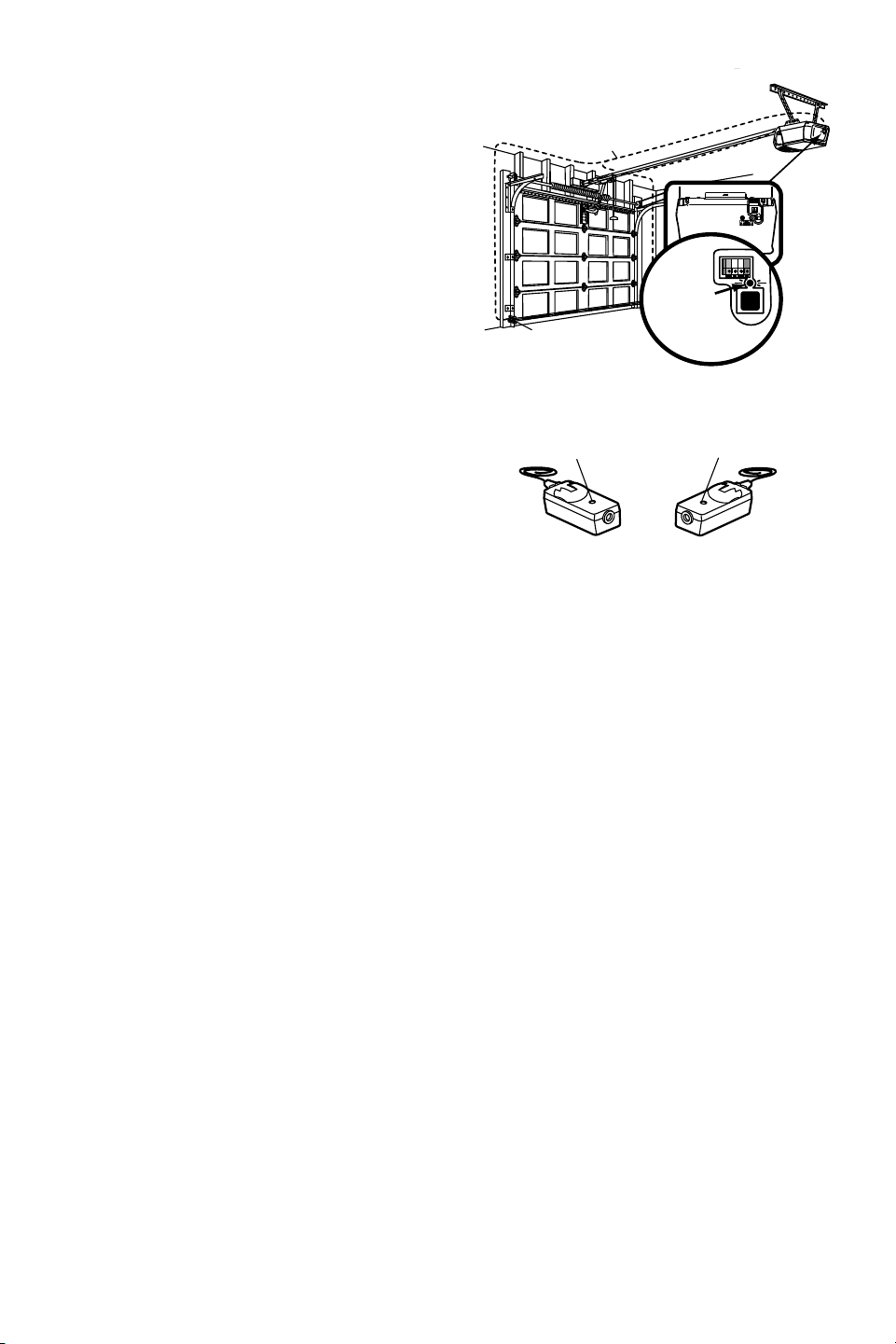
• Press the remote control push button to open the door.
• Place the opener carton in the path of the door.
• Press the remote control push button to close the door.
The door will not move more than an inch (2.5 cm),
and the opener lights will fl ash.
The garage door opener will not close from a remote if the
indicator light in either sensor is off (alerting you to the
fact that the sensor is misaligned or obstructed).
If the opener closes the door when the safety reversing
sensor is obstructed (and the sensors are no more
than 6" (15 cm) above the fl oor), call for a trained door
systems technician.
Without a properly installed safety reversing sensor,
persons (particularly small children) could be
SERIOUSLY INJURED or KILLED by a closing garage
door.
1-1/2" (3.8 cm) board
(or a 2x4 laid fl at)
Safety Reversing Sensor Safety Reversing Sensor
27
OPERATION
IMPORTANT SAFETY INSTRUCTIONS
To reduce the risk of SEVERE INJURY or DEATH:
Using Your Garage Door Opener
Your Security✚
®
opener and hand-held remote control
have been factory-set to a matching code which changes
with each use, randomly accessing over 100 billion
new codes. Your opener will operate with up to eight
Security✚
®
remote controls and one Security✚
®
Keyless
Entry System. If you purchase a new remote, or if you
wish to deactivate any remote, follow the instructions in
the Programming section.
Activate your opener with any of the following:
• The Hand-Held Remote Control: Hold the large push
button down until the door starts to move.
• The Wall-Mounted Door Control: Hold the push button
or bar down until the door starts to move.
• The Keyless Entry (See Accessories): If provided with
your garage door opener, it must be programmed
before use. See Programming.
When the opener is activated (with the safety reversing
sensor correctly installed and aligned)
1. If open, the door will close. If closed, it will open.
2. If closing, the door will reverse.
3. If opening, the door will stop.
4. If the door has been stopped in a partially open
position, it will close.
5. If obstructed while closing, the door will reverse.
If the obstruction interrupts the sensor beam, the
opener lights will blink for fi ve seconds.
6. If obstructed while opening, the door will stop.
7. If fully open, the door will not close when the beam is
broken. The sensor has no effect in the opening cycle.
If the sensor is not installed, or is misaligned, the door
won’t close from a hand-held remote. However, you can
close the door with the Door Control, the Outside Keylock,
or Keyless Entry, if you activate them until down travel
is complete. If you release them too soon, the door will
reverse.
The opener lights will turn on under the following
conditions: when the opener is initially plugged in; when
power is restored after interruption; when the opener is
activated.
They will turn off automatically after 4-1/2 minutes or
provide constant light when the Light feature on the
Multi-Function Door Control is activated. Bulb size is A19.
Bulb power is 100 watts maximum.
Security
✚
®
light feature: Lights will also turn on when
someone walks through the open garage door. With a
Multi-Function Door Control, this feature may be turned off
as follows: With the opener lights off, press and hold the
light button for 10 seconds, until the light goes on, then off
again. To restore this feature, start with the opener lights
on, then press and hold the light button for 10 seconds
until the light goes off, then on again.
WARNING
WARNING
WARNING WARNING
1. READ AND FOLLOW ALL WARNINGS AND
INSTRUCTIONS.
2. ALWAYS keep remote controls out of reach of
children. NEVER permit children to operate or play with
garage door control push buttons or remote controls.
3. ONLY activate garage door when it can be seen clearly,
it is properly adjusted, and there are no obstructions
to door travel.
4. ALWAYS keep garage door in sight and away from
people and objects until completely closed. NO ONE
SHOULD CROSS THE PATH OF THE MOVING DOOR.
5. NO ONE SHOULD GO UNDER A STOPPED, PARTIALLY
OPEN DOOR.
6. If possible, use emergency release handle to disengage
trolley ONLY when garage door is CLOSED. Use
caution when using this release with the door open.
Weak or broken springs or unbalanced door could
result in an open door falling rapidly and/or
unexpectedly and increasing the risk of SEVERE
INJURY or DEATH.
7. NEVER use emergency release handle unless garage
doorway is clear of persons and obstructions.
8. NEVER use handle to pull garage door open or closed.
If rope knot becomes untied, you could fall.
9. If one control (force or travel limits) is adjusted, the
other control may also need adjustment.
10. After ANY adjustments are made, the safety reversal
system MUST be tested.
11. Safety reversal system MUST be tested every month.
Garage door MUST reverse on contact with 1-1/2"
high (3.8 cm) object (or a 2x4 laid fl at) on the fl oor.
Failure to adjust the garage door opener properly
increases the risk of SEVERE INJURY or DEATH.
12. ALWAYS KEEP GARAGE DOOR PROPERLY
BALANCED (see page 3). An improperly balanced
door may NOT reverse when required and could
result in SEVERE INJURY or DEATH.
13. ALL repairs to cables, spring assemblies and other
hardware, ALL of which are under EXTREME tension,
MUST be made by a trained door systems technician.
14. ALWAYS disconnect electric power to garage door
opener BEFORE making ANY repairs or removing
covers.
15.
SAVE THESE
INSTRUCTIONS.
28
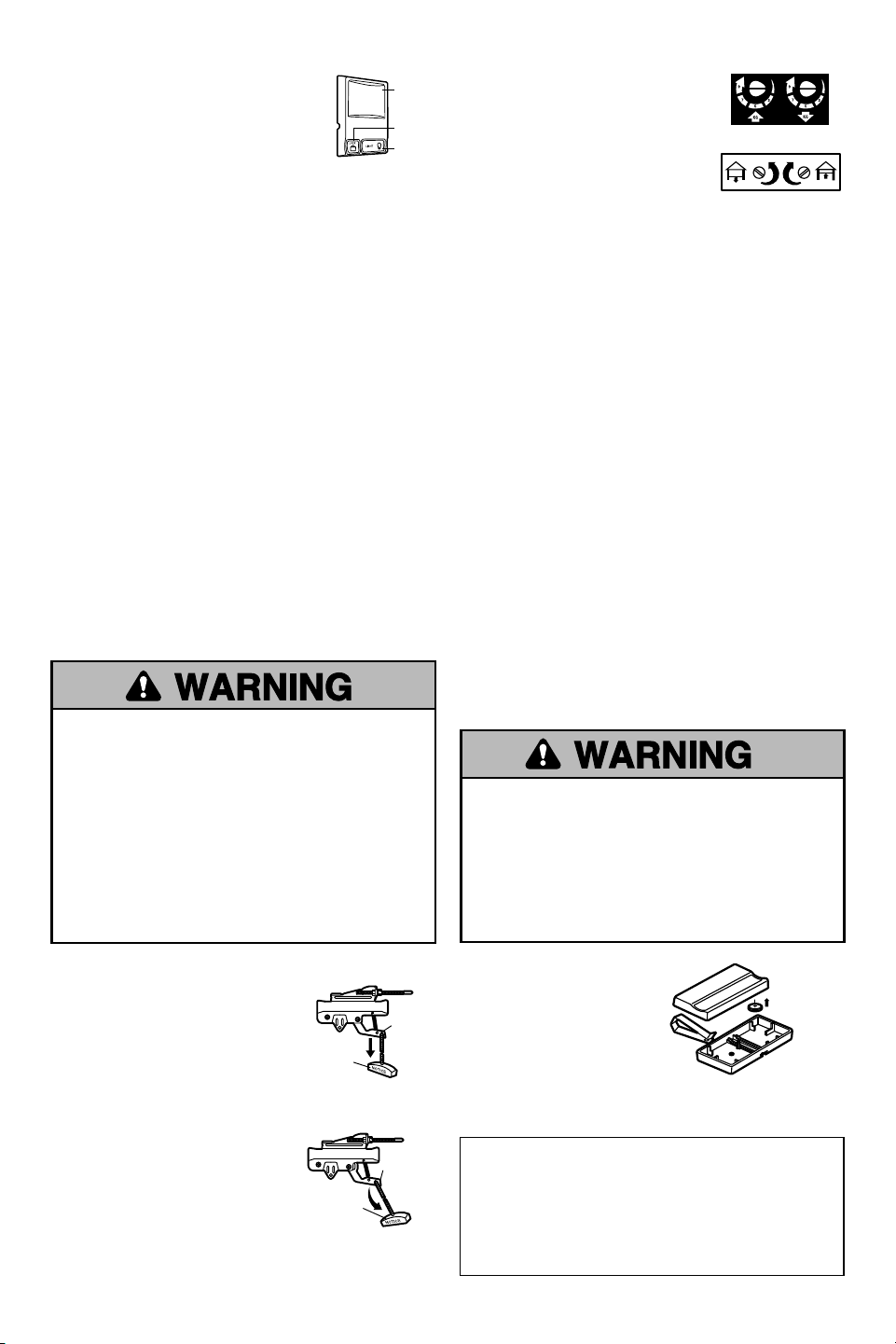
Using the Wall-Mounted Door Control
THE MULTI-FUNCTION DOOR CONTROL
Press the push button to open or close
the door. Press again to reverse the door
during the closing cycle or to stop the
door while it's opening.
Light feature: Press the Light button to turn the opener
light on or off. It will not control the opener lights when
the door is in motion. If you turn it on and then activate the
opener, the light will remain on for 4-1/2 minutes. Press
again to turn it off sooner. The 4-1/2 minute interval can
be changed to 1-1/2, 2-1/2, or 3-1/2 minutes as follows:
Press and hold the Lock button until the light blinks (about
10 seconds). A single blink indicates that the timer is reset
to 1-1/2 minutes. Repeat the procedure and the light will
blink twice, resetting the timer to 2-1/2 minutes. Repeat
again for a 3-1/2 minute interval, etc., up to a maximum of
four blinks and 4-1/2 minutes.
Lock feature: Designed to prevent operation of the door
from hand-held remote controls. However, the door will
open and close from the Door Control, the Outside Keylock
and the Keyless Entry Accessories.
To activate, press and hold the Lock button for 2 seconds.
The push bar light will fl ash as long as the Lock feature is
on.
To turn off, press and hold the Lock button again for 2
seconds. The push bar light will stop fl ashing. The Lock
feature will also turn off whenever the “learn” button on
the motor unit panel is activated.
To Open the Door Manually
NOTICE: To comply with FCC and or Industry Canada (IC) rules,
adjustment or modifications of this receiver and/or transmitter are
prohibited, except for changing the code setting or replacing the
battery. THERE ARE NO OTHER USER SERVICEABLE PARTS.
Tested to Comply with FCC Standards FOR HOME OR OFFICE USE.
Operation is subject to the following two conditions: (1) this device may
not cause harmful interference, and (2) this device must accept any
interference received, including interference that may cause undesired
operation.
To prevent possible SERIOUS INJURY or DEATH:
• NEVER allow small children near batteries.
• If battery is swallowed, immediately notify doctor.
To reduce risk of fi re, explosion or chemical burn:
• Replace ONLY with 3V2032 coin batteries.
• DO NOT recharge, disassemble, heat above 100° C
(212° F) or incinerate.
To prevent possible SERIOUS INJURY or DEATH from
a falling garage door:
• If possible, use emergency release handle to
disengage trolley ONLY when garage door is
CLOSED. Weak or broken springs or unbalanced door
could result in an open door falling rapidly and/or
unexpectedly.
• NEVER use emergency release handle unless garage
doorway is clear of persons and obstructions.
• NEVER use handle to pull door open or closed. If rope
knot becomes untied, you could fall.
Care of Your Opener
LIMIT AND FORCE ADJUSTMENTS:
Weather conditions may cause some
minor changes in door operation
requiring some re-adjustments,
particularly during the fi rst year of
operation.
Pages 24 and 25 refer to the limit and force adjustments.
Only a screwdriver is required. Follow the instructions
carefully.
Repeat the safety reverse test (Adjustment Step 3,
page 26) after any adjustment of limits or force.
MAINTENANCE SCHEDULE
Every Month
• Manually operate door. If it is unbalanced or binding,
call a trained door systems technician.
• Check to be sure door opens and closes fully. Adjust
limits and/or force if necessary (see pages 24 and 25).
• Repeat the safety reverse test. Make any necessary
adjustments (see Adjustment Step 3).
Two Times a Year
• Check chain tension. Disconnect trolley fi rst. Adjust if
necessary (see page 7).
Every Year
• Oil door rollers, bearings and hinges. The opener does
not require additional lubrication. Do not grease the
door tracks.
Every Three to Four Years
• Use a rag to wipe away the existing grease from the
garage door opener rail. Reapply a small layer of white
lithium grease to the rail.
THE REMOTE CONTROL BATTERY
The lithium battery should
produce power for up to
5 years.
To replace battery, use the
visor clip or screwdriver
blade to pry open the case as
shown. Insert battery positive
side up (+).
FORCE CONTROLS
LIMIT CONTROLS
Push
Button
Lock
Button
Light
Button
MANUAL DISCONNECT
POSITION
Trolley
Release
Arm
Emergency
Release
Handle
(Pull Down)
LOCKOUT POSITION
Trolley
Release
Arm
Emergency
Release
Handle
(Down and Back)
Dispose of old battery properly.
Replace the battery with only
3V2032 coin cell batteries.
Battery
positive
side up (+)
The door should be fully closed
if possible. Pull down on the
emergency release handle and lift the
door manually. To reconnect the door
to the opener, press the door control
push bar.
The lockout feature prevents
the trolley from reconnecting
automatically. Pull the emergency
release handle down and back
(toward the opener). The door can
then be raised and lowered manually
as often as necessary. To disengage
the lockout feature, pull the handle
straight down. The trolley will
reconnect on the next UP or DOWN
operation, either manually or by using
the door control or remote.
29
Having a Problem?
1. My door will not close and the light bulbs blink on
my motor unit: The safety reversing sensor must be
connected and aligned correctly before the garage door
opener will move in the down direction.
• Verify the safety reversing sensors are properly
installed, aligned and free of any obstructions.
Refer to Installation Step 10: Install The Protector
System
®
.
• Check diagnostic LED for fl ashes on the motor unit
then refer to the Diagnostic Chart on the following
page.
2. My remotes will not activate the door:
• Verify your door control is not blinking. If it is
blinking, deactivate the Lock Mode following the
instructions for Using the Wall-Mounted Door
Control.
• Reprogram remotes following the programming
instructions. Refer to Programming.
• If remote will still not activate your door, check
diagnostic LED for fl ashes on motor unit then refer
to Diagnostic Chart on the following page.
3. My door reverses for no apparent reason: Repeat
safety reverse test after adjustments to force or travel
limits. The need for occasional adjustment for the force
and limit settings is normal. Weather conditions in
particular can affect door travel.
• Manually check door for balance or any binding
problems.
• Refer to Adjustment Step 2, Adjust the Force.
4. My door reverses for no apparent reason after fully
closing and touching the fl oor: Repeat safety reverse
test after adjustments to force or travel limits. The
need for occasional adjustment for the force and limit
settings is normal. Weather conditions in particular
can affect door travel.
• Refer to Adjustment Step 1, Adjust the UP and
DOWN Travel Limits. Decrease down travel by
turning down limit adjustment screw clockwise.
5. My lights will not turn off when door is open:
• The garage door opener is equipped with a security
light feature. This feature activates the light on
when the safety reversing sensor beam has been
obstructed. Refer to Operation section; Using the
Wall-Mounted Door Control, Light Feature.
6. My motor unit hums briefl y:
• First verify that the trolley is against the stop bolt.
• Release the door from the opener by pulling the
Emergency Release Rope.
• Manually bring the door to a closed position.
• Loosen the chain by adjusting the outer nut 4 to 5
turns. This relieves the tension.
• Run the motor unit from the remote control or door
control. The trolley should travel towards the door
and stop. If the trolley re-engages with the door, pull
the Emergency Release Rope to disengage.
• Decrease the UP travel by turning the UP Travel
adjustment screw 2 full turns away from the arrow.
• Re-tighten the outer nut so the chain is a 1/2"
(13 mm) above the base of the rail. (When the door
is reconnected and closed, the chain will sag. This
is normal.)
• If the trolley does not move away from the bolt,
repeat the steps above.
Bell Wire
Safety Reversing
Sensor
Sending Eye Safety Reversing
Sensor (Amber Indicator Light)
Receiving Eye Safety Reversing
Sensor (Green Indicator Light)
“Learn”
Button
LED or
Diagnostic
LED
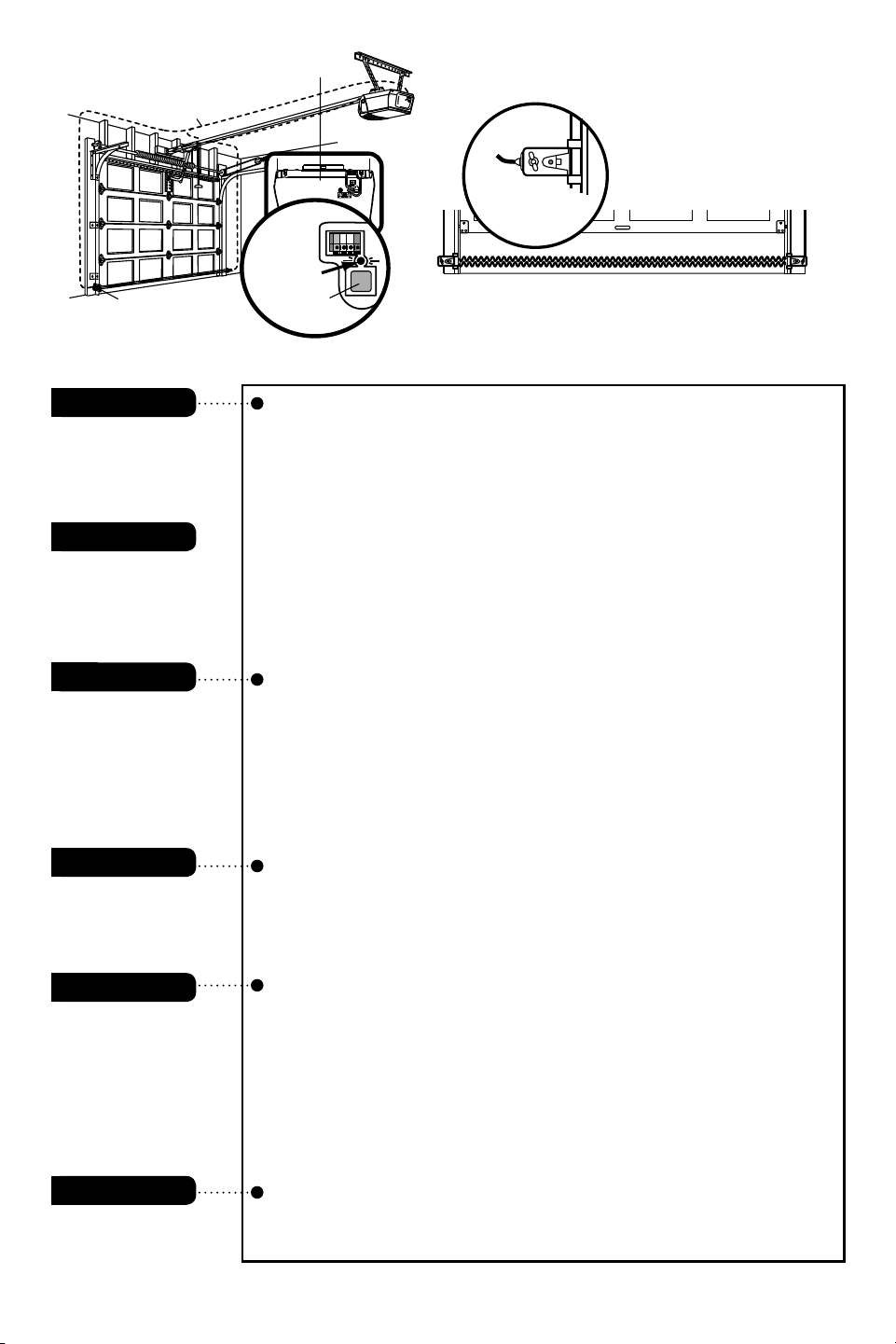
30
Your garage door opener is programmed with self-diagnostic
capabilities. The “Learn” button/diagnostic LED will fl ash
a number of times then pause signifying it has found a
potential issue. Consult Diagnostic Chart below.
Diagnostic Chart
Symptom: One or both of the Indicator lights on the safety reversing sensors
do not glow steady.
• Inspect sensor wires for a short (staple in wire), correct wiring polarity (black/
white wires reversed), broken or disconnected wires, replace/attach as needed.
• Disconnect all wires from back of motor unit.
• Remove sensors from brackets and shorten sensor wires to 1-2 ft. (30-60 cm)
from back each of sensor.
• Reattach sending eye to motor unit using shortened wires. If sending eye indicator
light glows steadily, attach the receiving eye.
• Align sensors, if the indicator lights glow replace the wires for the sensors. If the
sensor indicator lights do not light, replace the safety reversing sensors.
Symptom: LED is not lit on door control.
• Inspect door control/wires for a short (staple in wire), replace as needed.
• Disconnect wires at door control, touch wires together. If motor unit activates,
replace door control.
• If motor unit does not activate, disconnect door control wires from motor unit.
Momentarily short across red and white terminals with jumper wire. If motor unit
activates, replace door control wires.
Symptom: Sending indicator light glows steadily, receiving indicator light is dim
or fl ashing.
• Realign receiving eye sensor, clean lens and secure brackets.
• Verify door track is fi rmly secured to wall and does not move.
Symptom: Motor has over heated; the motor unit does not operate or trolley
is stuck on stop bolt = Motor unit hums briefl y; RPM Sensor = Short travel
6-8" (15-20 cm).
• Unplug unit to reset. Try to operate motor unit, check diagnostic code.
• If it is still fl ashing 5 times and motor unit moves 6-8" (15-20 cm), replace
RPM sensor.
• If motor unit doesn’t operate, motor unit is overheated. Wait 30 minutes and retry.
If motor unit still will not operate replace logic board.
Symptom: Motor unit doesn’t operate.
• Replace logic board because motor rarely fails.
Motor Circuit Failure.
Replace Receiver.
Logic Board.
Motor overheated or
possible RPM sensor
failure. Unplug to reset.
Safety reversing sensors
slightly misaligned
(dim or fl ashing LED).
Door control or
wire shorted.
Safety reversing sensors
wire shorted or black/
white wire reversed.
Safety reversing sensors
wire open (broken or
disconnected).
OR
1 FLASH
2 FLASHES
3 FLASHES
4 FLASHES
5 FLASHES
6 FLASHES
Safety Reversing
Sensor
LED or
Diagnostic
LED
“Learn”
Button
Bell Wire
Diagnostics Located
on Motor Unit
Installed
Safety Reversing
Sensor
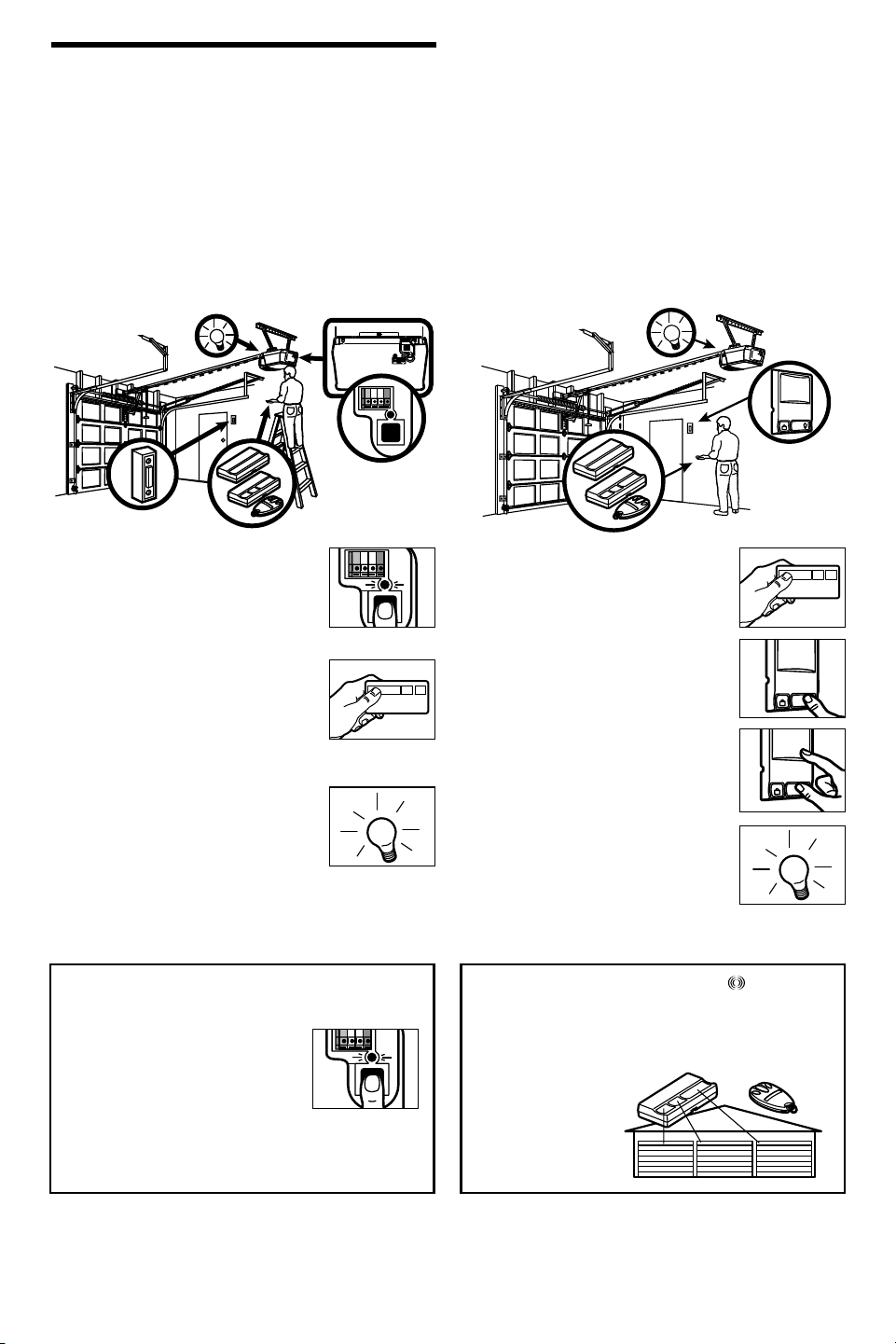
31
*3-Button Remotes
If provided with your garage door opener, the large
button is factory programmed to operate it. Additional
buttons on any Security✚
®
3-Button remote or
compact remote
can be programmed
to operate other
Security✚
®
garage
door openers.
To Erase All Codes From
Motor Unit Memory
To deactivate any unwanted remote,
fi rst erase all codes:
Press and hold the “learn” button on
motor unit until the learn indicator
light goes out (approximately 6 seconds). All previous
codes are now erased. Reprogram each remote or
keyless entry you wish to use.
1. Press and hold the button on the
hand-held remote* that you wish to
operate your garage door.
2. While holding the remote button,
press and hold the LIGHT button on
the door control.
3. Continue holding both buttons while
you press the push bar on the door
control (all three buttons are held).
4. Release buttons when the motor unit
lights blink. It has learned the code.
If light bulbs are not installed, two
clicks will be heard.
1. Press and release the “learn” button
on the motor unit. The learn indicator
light will glow steadily for 30 seconds.
2. Within 30 seconds, press and hold the
button on the hand-held remote* that
you wish to operate your garage door.
3. Release the button when the motor
unit lights blink. It has learned the
code. If light bulbs are not installed,
two clicks will be heard.
PROGRAMMING
NOTICE: If this Security
✚
®
garage door opener is operated with a non-rolling code transmitter, the technical measure in
the receiver of the garage door opener, which provides security against code-theft devices, will be circumvented.
The owner of the copyright in the garage door opener does not authorize the purchaser or supplier of the non-rolling code
transmitter to circumvent that technical measure.
Your garage door opener has already been programmed at the factory to operate with your hand-held remote control.
The door will open and close when you press the large push button.
Below are instructions for programming your opener to operate with additional Security✚
®
315 MHz remote controls.
To Add or Reprogram a Hand-Held Remote Control
USING THE “LEARN” BUTTON USING THE DOOR CONTROL
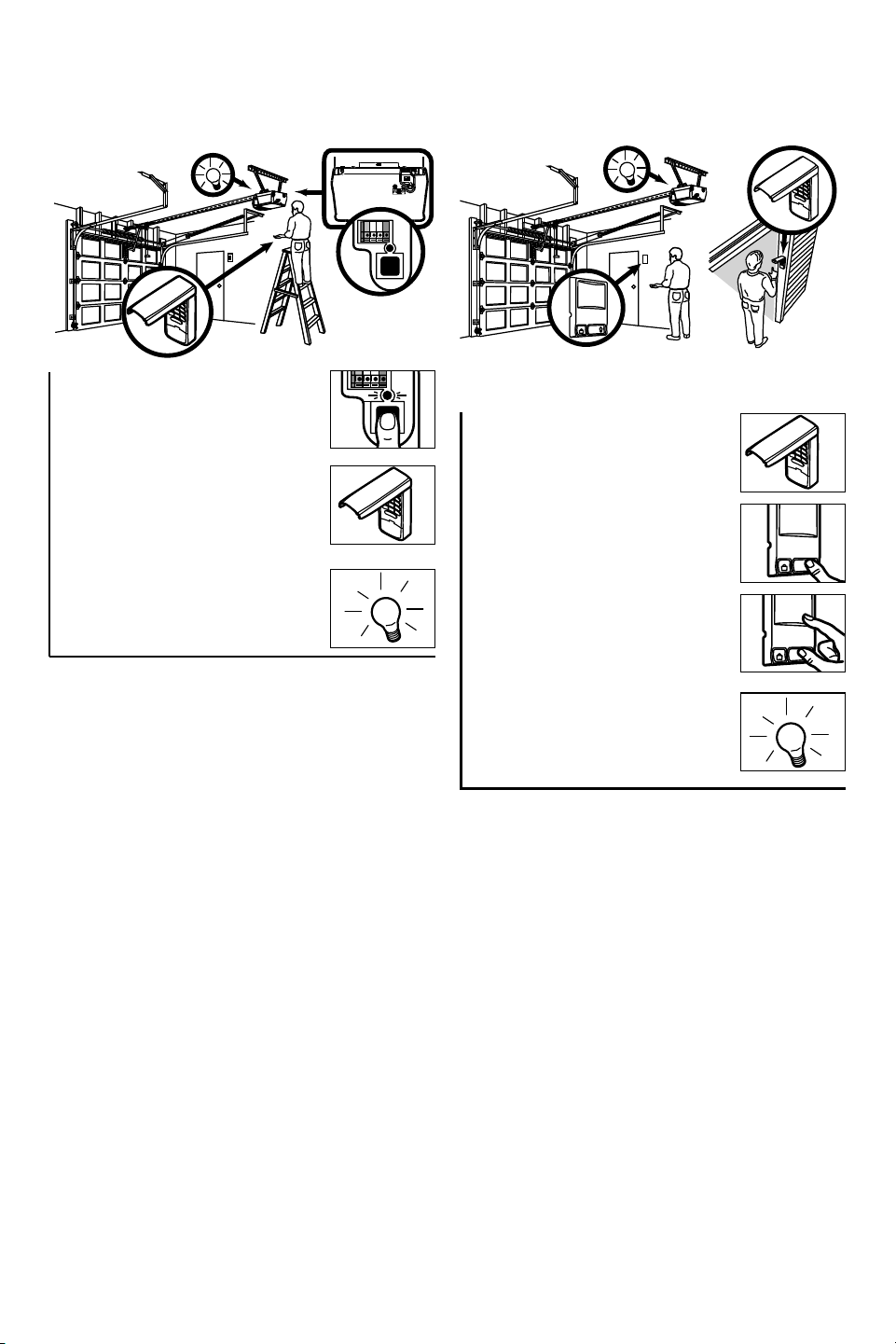
32
1. Enter a four digit personal
identifi cation number (PIN) of your
choice on the keypad. Then press and
hold enter.
2. While holding the ENTER button,
press and hold the LIGHT button on
the door control.
3. Continue holding the ENTER and
LIGHT buttons while you press the
push bar on the door control (all three
buttons are held).
4. Release buttons when the motor unit
lights blink. It has learned the code. If
light bulbs are not installed, two clicks
will be heard.
1. Press and release the “learn” button
on motor unit. The learn indicator
light will glow steadily for 30 seconds.
2. Within 30 seconds, enter a four digit
personal identifi cation number (PIN)
of your choice on the keypad. Then
press and hold the ENTER button.
3. Release the button when the motor
unit lights blink. It has learned the
code. If light bulbs are not installed,
two clicks will be heard.
To Add, Reprogram or Change a Keyless Entry PIN
NOTE: Your new Keyless Entry must be programmed to operate your garage door opener.
USING THE “LEARN” BUTTON USING THE DOOR CONTROL
NOTE: This method requires two people if the Keyless
Entry is already mounted outside the garage.
To change an existing, known PIN
If the existing PIN is known, it may be changed by one
person without using a ladder.
1. Press the four buttons for the present PIN, then press
and hold the # button.
The opener light will blink twice. Release the # button.
2. Press the new 4-digit PIN you have chosen, then
press Enter.
The motor unit lights will blink once when the PIN has
been learned.
Test by pressing the new PIN, then press Enter. The door
should move.
To set a temporary PIN
You may authorize access by visitors or service people
with a temporary 4-digit PIN. After a programmed number
of hours or number of accesses, this temporary PIN
expires and will no longer open the door. It can be used
to close the door even after it has expired. To set a
temporary PIN:
1. Press the four buttons for your personal entry PIN
(not the last temporary PIN), then press and hold the
✽ button.
The opener light will blink three times. Release the
button.
2. Press the temporary 4-digit PIN you have chosen, then
press Enter.
The opener light will blink four times.
3. To set the number of hours this temporary PIN will
work, press the number of hours (up to 255), then
press ✽.
OR
3. To set the number of times this temporary PIN will
work, press the number of times (up to 255), then
press #.
The opener light will blink once when the temporary PIN
has been learned.
Test by pressing the four buttons for the temporary PIN,
then press Enter. The door should move. If the temporary
PIN was set to a certain number of openings, remember
that the test has used up one opening. To clear the
temporary password, repeat steps 1-3, setting the number
of hours or times to 0 in step 3.
LOCK
LIGHT
One Button Close: Opener can be closed by pressing only the ENTER button if the one button close feature has been
activated. This feature has been activated at the factory. To activate or deactivate this feature press and hold buttons
1 and 9 for 10 seconds. The keypad will blink twice when the one button close is active. The keypad will blink four times
when one button close is deactivated.
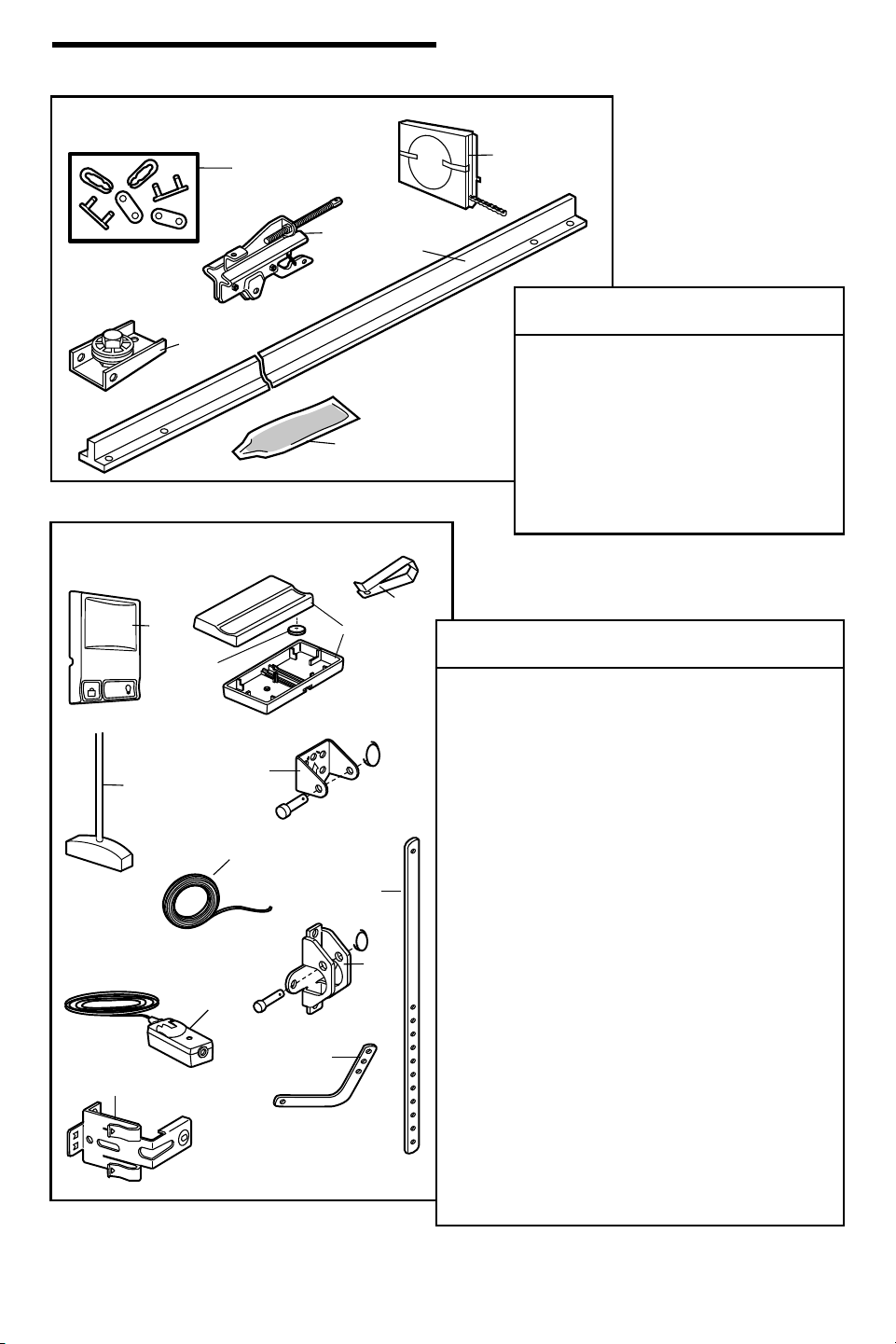
33
REPAIR PARTS
Rail Assembly Parts
KEY PART
NO. NO. DESCRIPTION
1 4A1008 Master link kit
2 41A4813 Chain pulley bracket
3 41A3489 Complete trolley assembly
4 1707LM One-piece rail
1708LM 8 ft. (2.4 m) complete rail
1710LM 10 ft. (3 m) complete rail
5 41D3484 Full chain assembly
6 83A11-2 Rail grease
UP
CEILING MOUNT ONLY
NOTICE
LOCK
LIGHT
Installation Parts
KEY PART
NO. NO. DESCRIPTION
1 41A5273-1 Multi-function door control panel
2 371LM Single-button remote control
3 10A20 3V2032 Lithium battery
4 29B137 Remote control visor clip
5 41A2828 Emergency release rope & handle
assembly
6 41B4494-1 2-Conductor bell wire,
white & white/red
7 41A4353 Header bracket with clevis pin &
fastener
8 41A5047 Door bracket with clevis pin &
fastener
9 178B35 Curved door arm section
10 178B34 Straight door arm section
11 41A5034 Safety reversing sensor kit (receiving
and sending eyes) with 3 ft. (.9 m)
2-conductor bell wire
12 41A5266-1 Safety reversing sensor brackets (2)
NOT SHOWN
41A2770-6 Installation hardware bag
(includes hardware listed on page 5)
114A4248 Owner’s manual
114A4248SP Owner’s manual - Spanish
1
3
5
4
6
2
1
5
3
2
4
7
6
8
9
10
11
12
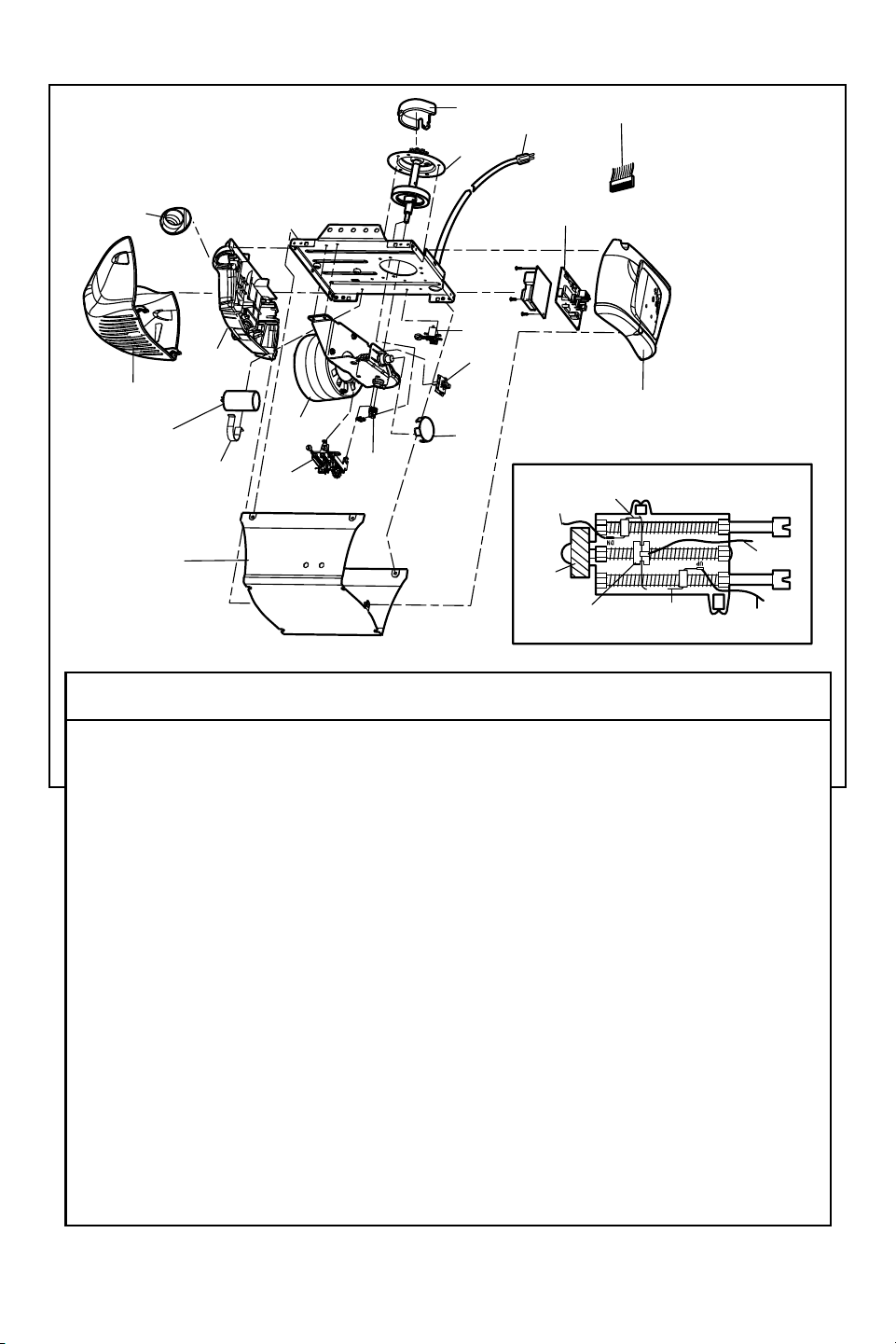
34
Motor Unit Assembly Parts
KEY PART
NO. NO. DESCRIPTION
1 31D380 Sprocket cover
2 41C4220A Gear and sprocket assembly
Complete with: Spring washer,
thrust washer, retaining ring,
bearing plate, roll pins (2), drive
gear and worm gear, helical
gear with retainer and grease
3 41B4245 Line cord
4 41A5484-1 End panel with all labels
5 4A1344 Light socket
6 108D79 Lens
7 30B532 Capacitor - 1/2 HP
30B533 Capacitor - 1/3 HP
8 12A373 Capacitor bracket
9 41A3150 Terminal block with screws
10 41D3058 Universal replacement motor &
bracket assembly
Complete with: Motor, worm,
bracket, bearing assembly, RPM
sensor
KEY PART
NO. NO. DESCRIPTION
11 41A5525-24 Cover
12 41A2818 Limit switch drive & retainer
13 41D3452 Limit switch assembly
14 41A2822-1 Interrupter cup assembly
15 41C4398A RPM sensor assembly
16 41AC050-1M Receiver logic board
Complete with: Logic board,
end panel with all labels
17 41C5498 Low voltage wire harness
41C5497 High voltage wire harness
18 41D180-1 End panel with all labels
NOT SHOWN
41A2826 Motor shaft bearing kit
41A2825 Opener assembly hardware kit
(includes screws not designated
by a number in illustration)
1
2
3
6
7
8
9
11
14
13
15
16
17
18
10
12
5
4
LIMIT SWITCH ASSEMBLY
(Down)
Contact
Brown
Wire
Drive
Gear
Center Limit
Contact
(Up)
Contact
Yellow Wire
Grey Wire
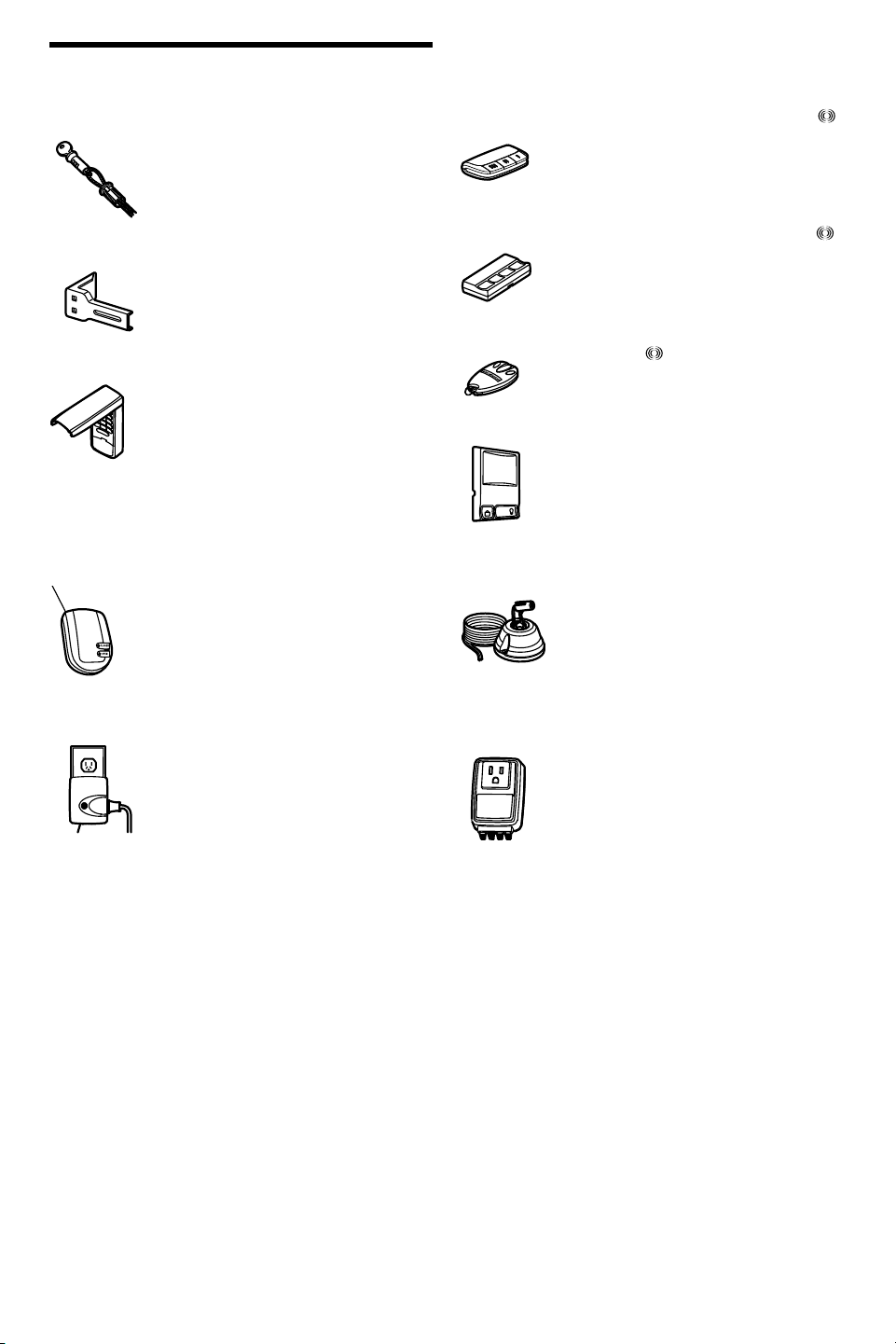
35
ACCESSORIES
374LM
370LM
395LM
41A5281
1702LM
Outside Quick Release:
Required for a garage with NO access
door. Enables homeowner to open
garage door manually from outside by
disengaging trolley.
Remote Light Control:
Enables homeowner to turn on a lamp,
television or other appliance from their
car with their garage door opener remote
or from anywhere in their home with an
additional LiftMaster Security✚
®
remote.
Security✚
®
4-Button Remote Control :
Includes visor clip.
Wireless Door Control:
Push bar, light feature and auxiliary button.
Includes battery.
377LM
Extension Brackets:
(Optional) For safety reversing sensor
installation onto the wall or fl oor.
Wireless Keyless Entry with Security✚
®
:
Enables homeowner to operate garage
door opener from outside by entering
a password on a specially designed
keyboard. Also can add a temporary
password for visitors or service persons.
This temporary password can be limited
to a programmable number of hours or
entries.
378LM
3-Button Mini-Remote Control with
Security✚
®
:
With key ring and fastening strip.
Garage Door Monitor:
Security for the largest door of your
home!
Tells you if your garage door is open or
closed. Monitors up to 4 garage doors by
adding additional sensor modules.
915LM 975LM
990LM
Laser Park Assist:
Laser enables homeowners to precisely
park vehicles in the garage.
Surge Protector:
The Garage Door Opener Surge Protector
is designed to protect LiftMaster
®
garage
door openers against damage from
lightning and power surges.
Security✚
®
3-Button Remote Control :
Includes visor clip.
373P
© 2011, The Chamberlain Group, Inc.
114A4248D All Rights Reserved
LIFTMASTER
®
ONE-YEAR LIMITED WARRANTY
FOUR YEAR MOTOR LIMITED WARRANTY
The Chamberlain Group, Inc. (“Seller”) warrants to the fi rst retail purchaser of this product, for the residence in which this product is
originally installed, that it is free from defect in materials and/or workmanship for a period of one year from the date of purchase [and
that the motor is free from defect in materials and/or workmanship for a period of four years from the date of purchase]. The proper
operation of this product is dependent on your compliance with the instructions regarding installation, operation, maintenance and
testing. Failure to comply strictly with those instructions will void this limited warranty in its entirety.
If, during the limited warranty period, this product appears to contain a defect covered by this limited warranty, call 1-800-528-9131,
toll free, before dismantling this product. Then send this product, pre-paid and insured, to our service center for warranty repair. You
will be advised of shipping instructions when you call. Please include a brief description of the problem and a dated proof-of-purchase
receipt with any product returned for warranty repair. Products returned to Seller for warranty repair, which upon receipt by Seller are
confi rmed to be defective and covered by this limited warranty, will be repaired or replaced (at Seller’s sole option) at no cost to you
and returned pre-paid. Defective parts will be repaired or replaced with new or factory-rebuilt parts at Seller’s sole option.
ALL IMPLIED WARRANTIES FOR THE PRODUCT, INCLUDING BUT NOT LIMITED TO ANY IMPLIED WARRANTIES OF
MERCHANTABILITY AND FITNESS FOR A PARTICULAR PURPOSE, ARE LIMITED IN DURATION TO THE ONE-YEAR LIMITED
WARRANTY PERIOD SET FORTH ABOVE [EXCEPT THE IMPLIED WARRANTIES WITH RESPECT TO THE MOTOR, WHICH ARE
LIMITED IN DURATION TO THE FOUR-YEAR LIMITED WARRANTY PERIOD FOR THE MOTOR], AND NO IMPLIED WARRANTIES
WILL EXIST OR APPLY AFTER SUCH PERIOD. Some States do not allow limitations on how long an implied warranty lasts, so the
above limitation may not apply to you. THIS LIMITED WARRANTY DOES NOT COVER NON-DEFECT DAMAGE, DAMAGE CAUSED
BY IMPROPER INSTALLATION, OPERATION OR CARE (INCLUDING, BUT NOT LIMITED TO ABUSE, MISUSE, FAILURE TO PROVIDE
REASONABLE AND NECESSARY MAINTENANCE, UNAUTHORIZED REPAIRS OR ANY ALTERATIONS TO THIS PRODUCT), LABOR
CHARGES FOR REINSTALLING A REPAIRED OR REPLACED UNIT, REPLACEMENT OF BATTERIES AND LIGHT BULBS OR UNITS
INSTALLED FOR NON-RESIDENTIAL USE.
THIS LIMITED WARRANTY DOES NOT COVER ANY PROBLEMS WITH, OR RELATING TO, THE GARAGE DOOR OR GARAGE
DOOR HARDWARE, INCLUDING BUT NOT LIMITED TO THE DOOR SPRINGS, DOOR ROLLERS, DOOR ALIGNMENT OR HINGES.
THIS LIMITED WARRANTY ALSO DOES NOT COVER ANY PROBLEMS CAUSED BY INTERFERENCE. ANY SERVICE CALL THAT
DETERMINES THE PROBLEM HAS BEEN CAUSED BY ANY OF THESE ITEMS COULD RESULT IN A FEE TO YOU.
UNDER NO CIRCUMSTANCES SHALL SELLER BE LIABLE FOR CONSEQUENTIAL, INCIDENTAL OR SPECIAL DAMAGES ARISING
IN CONNECTION WITH USE, OR INABILITY TO USE, THIS PRODUCT. IN NO EVENT SHALL SELLER’S LIABILITY FOR BREACH
OF WARRANTY, BREACH OF CONTRACT, NEGLIGENCE OR STRICT LIABILITY EXCEED THE COST OF THE PRODUCT COVERED
HEREBY. NO PERSON IS AUTHORIZED TO ASSUME FOR US ANY OTHER LIABILITY IN CONNECTION WITH THE SALE OF THIS
PRODUCT.
Some States do not allow the exclusion or limitation of consequential, incidental or special damages, so the above limitation or
exclusion may not apply to you. This limited warranty gives you specifi c legal rights, and you may also have other rights which vary
from state to state.
LIFTMASTER
®
SERVICE
IS ON CALL
OUR LARGE SERVICE ORGANIZATION SPANS
AMERICA AND CANADA
INSTALLATION AND SERVICE INFORMATION IS AS
NEAR AS YOUR TELEPHONE.
SIMPLY DIAL OUR TOLL FREE NUMBER:
1-800-528-9131
www.liftmaster.com
For professional installation, parts and service,
contact your local LIFTMASTER/CHAMBERLAIN
dealer. Look for him in the Yellow Pages, or call our
Service number for a list of dealers in your area.
HOW TO ORDER
REPAIR PARTS
Selling prices will be furnished on request or parts will
be shipped at prevailing prices and you will be billed
accordingly.
WHEN ORDERING REPAIR PARTS, ALWAYS GIVE
THE FOLLOWING INFORMATION:
• PART NUMBER
• PART NAME
• MODEL NUMBER
ADDRESS ORDERS TO:
THE CHAMBERLAIN GROUP, INC.
Technical Support Group
6050 S. Country Club Road
Tucson, Arizona 85706
SERVICE INFORMATION TOLL FREE NUMBER:
1-800-528-9131