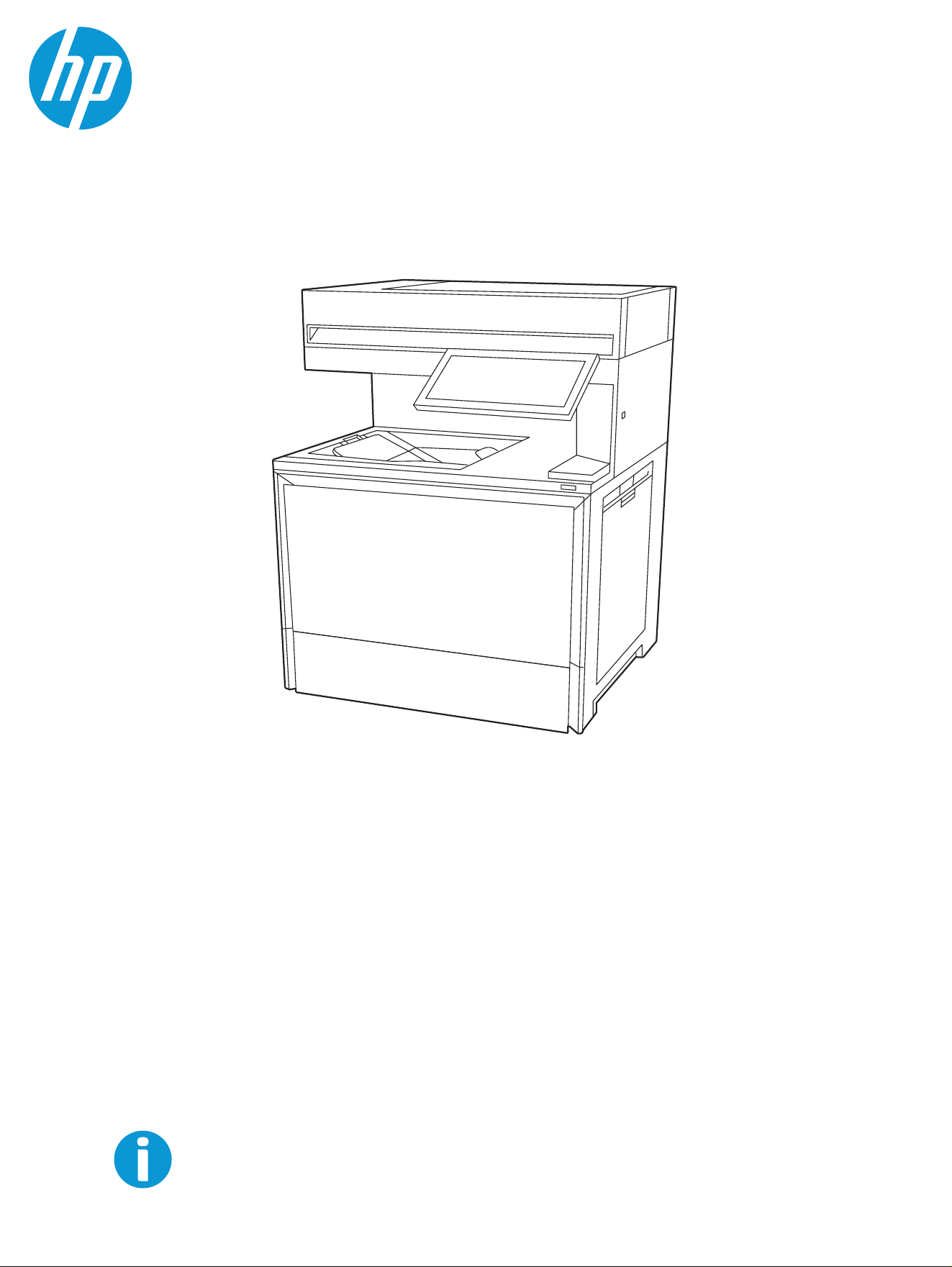
HP Color LaserJet Enterprise MFP 6800
HP Color LaserJet Enterprise Flow MFP 6800
HP Color LaserJet Enterprise MFP 6801
HP Color LaserJet Enterprise Flow MFP 6801
www.hp.com/support/colorlj6800MFP
www.hp.com/support/colorlj6801MFP
User Guide

HP Color LaserJet Enterprise MFP 6800,
6801, HP Color LaserJet Enterprise Flow
MFP 6800, 6801 - User Guide
SUMMARY
This guide provides configuration, use, warranty, safety and environmental information.

Legal information
Copyright and License
© Copyright 2024 HP Development
Company, L.P.
Reproduction, adaptation, or translation
without prior written permission is
prohibited, except as allowed under the
copyright laws.
The information contained herein is subject
to change without notice.
The only warranties for HP products and
services are set forth in the express
warranty statements accompanying such
products and services. Nothing herein
should be construed as constituting an
additional warranty. HP shall not be liable
for technical or editorial errors or omissions
contained herein.
Edition 3, 8/2024
Trademark Credits
Adobe
®
, Adobe Photoshop
®
, Acrobat
®
, and
PostScript
®
are trademarks of Adobe
Systems Incorporated.
Apple and the Apple logo are trademarks of
Apple Inc., registered in the U.S. and other
countries.
macOS is a trademark of Apple Inc.,
registered in the U.S. and other countries.
AirPrint is a trademark of Apple Inc.,
registered in the U.S. and other countries.
Google™ is a trademark of Google Inc.
Microsoft®, Windows®, and Windows Server®
are U.S. registered trademarks of Microsoft
Corporation.
UNIX
®
is a registered trademark of The Open
Group.

Table of contents
1 Printer overview.....................................................................................................................................................................................................................................1
Warning icons...................................................................................................................................................................................................................................1
Potential shock hazard ............................................................................................................................................................................................................. 2
Printer views..................................................................................................................................................................................................................................... 2
Printer front view................................................................................................................................................................................................................ 2
Printer back view................................................................................................................................................................................................................5
Control-panel view............................................................................................................................................................................................................6
Printer specifications ................................................................................................................................................................................................................8
Technical specifications...............................................................................................................................................................................................8
Supported operating systems................................................................................................................................................................................11
Mobile printing solutions............................................................................................................................................................................................12
Printer dimensions..........................................................................................................................................................................................................13
Power consumption, electrical specifications, and acoustic emissions ...............................................................................15
Operating-environment range...............................................................................................................................................................................15
Printer hardware setup and software installation..............................................................................................................................................16
2 Paper trays..............................................................................................................................................................................................................................................17
Load paper to Tray 1 (multipurpose tray).....................................................................................................................................................................17
Load Tray 1 (multipurpose tray)...............................................................................................................................................................................17
Tray 1 (multipurpose tray) paper orientation................................................................................................................................................19
Load paper to Tray 2................................................................................................................................................................................................................. 22
Load Tray 2 or the optional 550-sheet trays................................................................................................................................................ 23
Tray 2 and the optional 550-sheet trays paper orientation .............................................................................................................25
Use alternative letterhead mode........................................................................................................................................................................28
Load and print envelopes.....................................................................................................................................................................................................28
Print envelopes.................................................................................................................................................................................................................29
Envelope orientation ....................................................................................................................................................................................................29
Load and print labels...............................................................................................................................................................................................................30
Manually feed labels.....................................................................................................................................................................................................30
Label orientation .............................................................................................................................................................................................................30
Configure the stapler/stacker and select staple options..............................................................................................................................31
Configure the default staple location using the Embedded Web Server (EWS)...............................................................31
Configure the operation mode for the stapler/stacker.......................................................................................................................32
Select staple options (Windows).........................................................................................................................................................................33
Select staple options (macOS).............................................................................................................................................................................33
Staple configurations..................................................................................................................................................................................................33
3 Supplies, accessories, and parts.........................................................................................................................................................................................36
Order supplies, accessories, and parts....................................................................................................................................................................36
Ordering.................................................................................................................................................................................................................................36
Supplies and accessories........................................................................................................................................................................................36
iii

Customer self-repair parts......................................................................................................................................................................................39
Configure the HP toner-cartridge-protection supply settings..................................................................................................................39
Introduction.........................................................................................................................................................................................................................39
Enable or disable the Cartridge Policy feature.........................................................................................................................................40
Enable or disable the Cartridge Protection feature.............................................................................................................................. 42
Replace the toner cartridges............................................................................................................................................................................................44
Toner cartridge information....................................................................................................................................................................................44
Remove and replace the toner cartridge......................................................................................................................................................46
Replace the toner collection unit (TCU) .....................................................................................................................................................................48
Replace the toner collection unit (TCU)..........................................................................................................................................................48
Replace the staple cartridge (stapler models only).......................................................................................................................................... 51
Remove and replace the staple cartridge in the 3-bin stapler/stacker.................................................................................... 51
Remove and replace the staple cartridge in the finisher.................................................................................................................. 52
Remove and replace the staple cartridge in the convenience stapler...................................................................................54
4 Print............................................................................................................................................................................................................................................................56
Print tasks (Windows)..............................................................................................................................................................................................................56
How to print (Windows)...............................................................................................................................................................................................56
Automatically print on both sides (Windows)..............................................................................................................................................57
Manually print on both sides (Windows) ........................................................................................................................................................57
Print multiple pages per sheet (Windows).....................................................................................................................................................57
Select the paper type (Windows)........................................................................................................................................................................58
Additional print tasks...................................................................................................................................................................................................58
Print tasks (macOS)..................................................................................................................................................................................................................59
How to print (macOS)...................................................................................................................................................................................................59
Automatically print on both sides (macOS).................................................................................................................................................59
Manually print on both sides (macOS)............................................................................................................................................................59
Print multiple pages per sheet (macOS)........................................................................................................................................................60
Select the paper type (macOS)............................................................................................................................................................................60
Additional print tasks....................................................................................................................................................................................................61
Store print jobs on the printer to print later or print privately ....................................................................................................................61
Introduction..........................................................................................................................................................................................................................61
Create a stored job (Windows)...............................................................................................................................................................................61
Create a stored job (macOS)..................................................................................................................................................................................62
Print a stored job.............................................................................................................................................................................................................63
Delete a stored job.........................................................................................................................................................................................................63
Information sent to printer for Job Accounting purposes...............................................................................................................64
Mobile printing .............................................................................................................................................................................................................................64
Mobile printing solutions...........................................................................................................................................................................................64
Wi-Fi, Wi-Fi Direct Print, NFC, and BLE printing..........................................................................................................................................65
HP ePrint via email.........................................................................................................................................................................................................66
AirPrint....................................................................................................................................................................................................................................66
Android embedded printing.....................................................................................................................................................................................67
Print from a USB flash drive................................................................................................................................................................................................67
Enable the USB port for printing...........................................................................................................................................................................67
Print USB documents..................................................................................................................................................................................................68
iv

Print using the SuperSpeed USB 3.0 port (wired) ..............................................................................................................................................69
Method one: Enable the SuperSpeed USB 3.0 port from the printer control panel menus.....................................69
Method two: Enable the SuperSpeed USB 3.0 port from the HP Embedded Web Server (network-
connected printers only) ...........................................................................................................................................................................................69
5 Copy............................................................................................................................................................................................................................................................70
Make a copy....................................................................................................................................................................................................................................70
Copy on both sides (duplex)................................................................................................................................................................................................72
Additional copy tasks...............................................................................................................................................................................................................74
6 Scan............................................................................................................................................................................................................................................................75
Set up Scan to Email.................................................................................................................................................................................................................75
Introduction..........................................................................................................................................................................................................................75
Before you begin ..............................................................................................................................................................................................................75
Step one: Access the HP Embedded Web Server (EWS)....................................................................................................................76
Step two: Configure the Network Identification settings...................................................................................................................77
Step three: Configure the Send to Email feature .....................................................................................................................................77
Step four: Configure the Quick Sets (optional)..........................................................................................................................................87
Step five: Set up Send to Email to use Office 365 Outlook (optional) .......................................................................................87
Set up Scan to Network Folder........................................................................................................................................................................................90
Introduction.........................................................................................................................................................................................................................90
Before you begin .............................................................................................................................................................................................................90
Step one: Access the HP Embedded Web Server (EWS)...................................................................................................................90
Step two: Set up Scan to Network Folder......................................................................................................................................................91
Set up Scan to SharePoint................................................................................................................................................................................................100
Introduction.......................................................................................................................................................................................................................100
Before you begin ...........................................................................................................................................................................................................100
Step one: Access the HP Embedded Web Server (EWS).................................................................................................................100
Step two: Enable Scan to SharePoint and create a Scan to SharePoint Quick Set......................................................101
Scan a file directly to a SharePoint site........................................................................................................................................................103
Quick Set scan settings and options for Scan to SharePoint .....................................................................................................104
Set up Scan to USB Drive ..................................................................................................................................................................................................106
Introduction.......................................................................................................................................................................................................................106
Step one: Access the HP Embedded Web Server (EWS).................................................................................................................106
Step two: Enable Scan to USB Drive...............................................................................................................................................................106
Step three: Configure the Quick Sets (optional).....................................................................................................................................107
Default scan settings for Scan to USB Drive setup............................................................................................................................108
Default file settings for Save to USB setup...............................................................................................................................................108
Scan to email ..............................................................................................................................................................................................................................109
Introduction.......................................................................................................................................................................................................................109
Scan to email...................................................................................................................................................................................................................109
Scan to job storage .................................................................................................................................................................................................................112
Introduction........................................................................................................................................................................................................................ 112
Scan to job storage on the printer ....................................................................................................................................................................112
Print from job storage on the printer...............................................................................................................................................................114
Scan to network folder..........................................................................................................................................................................................................114
Introduction........................................................................................................................................................................................................................114
v

Scan to network folder ..............................................................................................................................................................................................114
Scan to SharePoint..................................................................................................................................................................................................................116
Introduction.........................................................................................................................................................................................................................117
Scan to SharePoint........................................................................................................................................................................................................117
Scan to USB drive.....................................................................................................................................................................................................................118
Introduction........................................................................................................................................................................................................................119
Scan to USB drive..........................................................................................................................................................................................................119
Use HP JetAdvantage business solutions............................................................................................................................................................120
Additional scan tasks.............................................................................................................................................................................................................121
7 Fax............................................................................................................................................................................................................................................................. 122
Set up fax....................................................................................................................................................................................................................................... 122
Introduction....................................................................................................................................................................................................................... 122
Set up fax by using the printer control panel............................................................................................................................................ 122
Change fax configurations...............................................................................................................................................................................................123
Fax dialing settings......................................................................................................................................................................................................123
General fax send settings.......................................................................................................................................................................................124
Fax receive settings.................................................................................................................................................................................................... 125
Send a fax......................................................................................................................................................................................................................................126
Create a fax printing schedule.......................................................................................................................................................................................128
Block incoming faxes............................................................................................................................................................................................................128
Create a list of blocked fax numbers..............................................................................................................................................................128
Delete numbers from the list of blocked fax numbers......................................................................................................................129
Additional fax tasks................................................................................................................................................................................................................129
8 Manage the printer.......................................................................................................................................................................................................................130
Advanced configuration with the HP Embedded Web Server (EWS).................................................................................................130
Introduction.......................................................................................................................................................................................................................130
How to access the HP Embedded Web Server (EWS)........................................................................................................................131
HP Embedded Web Server features...............................................................................................................................................................132
Configure IP network settings........................................................................................................................................................................................139
Printer sharing disclaimer......................................................................................................................................................................................140
View or change network settings.....................................................................................................................................................................140
Rename the printer on a network .....................................................................................................................................................................140
Manually configure IPv4 TCP/IP parameters from the control panel....................................................................................... 141
Manually configure IPv6 TCP/IP parameters from the control panel.......................................................................................141
Link speed and duplex settings..........................................................................................................................................................................142
Printer security features ....................................................................................................................................................................................................142
Introduction....................................................................................................................................................................................................................... 142
Security statements...................................................................................................................................................................................................143
Assign an administrator password .................................................................................................................................................................143
IP Security..........................................................................................................................................................................................................................144
Encryption support: HP High Performance Secure Hard Disks.................................................................................................144
Lock the formatter.......................................................................................................................................................................................................144
Energy-conservation settings........................................................................................................................................................................................144
vi

Set the sleep timer and configure the printer to use 1 watt or less of power...................................................................144
Set the sleep schedule.............................................................................................................................................................................................145
HP Web Jetadmin.....................................................................................................................................................................................................................145
Software and firmware updates...................................................................................................................................................................................145
9 Solve problems................................................................................................................................................................................................................................146
Control panel help system.................................................................................................................................................................................................146
Reset factory settings...........................................................................................................................................................................................................147
Introduction........................................................................................................................................................................................................................147
Method one: Reset factory settings from the printer control panel.........................................................................................147
Method two: Reset factory settings from the HP Embedded Web Server (network-connected
printers only)......................................................................................................................................................................................................................147
A “Cartridge is low” or “Cartridge is very low” message displays on the printer control panel or EWS...................147
Change the “Very Low” settings ........................................................................................................................................................................148
Order supplies ................................................................................................................................................................................................................149
Printer does not pick up paper or misfeeds.........................................................................................................................................................149
Introduction.......................................................................................................................................................................................................................149
The printer does not pick up paper..................................................................................................................................................................149
The printer picks up multiple sheets of paper......................................................................................................................................... 152
The document feeder jams, skews, or picks up multiple sheets of paper..........................................................................154
Clear paper jams......................................................................................................................................................................................................................155
Paper jam locations....................................................................................................................................................................................................155
Auto-navigation for clearing paper jams ....................................................................................................................................................156
Experiencing frequent or recurring paper jams?..................................................................................................................................156
31.13.yz jam error in the document feeder ...................................................................................................................................................157
13.B2.D1 jam error in Tray 1 (multipurpose tray)........................................................................................................................................161
13.B2.D2 jam error in Tray 2....................................................................................................................................................................................165
13.A3 jam error in Tray 3 ........................................................................................................................................................................................... 170
13.A4 jam error in Tray 4 ............................................................................................................................................................................................176
13.A4 jam error in Tray 4 (2,100 sheet feeder HCI) .................................................................................................................................183
13.B2 jam error in right door..................................................................................................................................................................................190
13.B4 jam errors in the right door .....................................................................................................................................................................193
13.B9 jam errors in the fuser.................................................................................................................................................................................195
13.D3 jam errors in the duplexer.........................................................................................................................................................................199
13.E1 jam error in the output bin..........................................................................................................................................................................201
13.E2 jam error in top cover ..................................................................................................................................................................................202
13.60 jam errors in the fuser exit area when printing to a stapler/stacker or floor-standing finisher............204
13.80, 13.83, or 13.84 jam errors in the 3 Bin Stapler/Stacker.......................................................................................................206
13.40 or 13.47 Punch jam error in the Floor-standing finisher........................................................................................................210
13.6, 13.7, or 13.8 jam error in the Floor-standing finisher ..................................................................................................................213
Resolving color print quality problems .....................................................................................................................................................................217
Introduction........................................................................................................................................................................................................................217
Troubleshoot print quality.......................................................................................................................................................................................218
Improve copy image quality ............................................................................................................................................................................................230
Check the scanner glass for dirt and smudges....................................................................................................................................230
Calibrate the scanner............................................................................................................................................................................................... 232
Check the paper settings......................................................................................................................................................................................233
vii

Check the image-adjustment settings........................................................................................................................................................233
Optimize copy quality for text or pictures..................................................................................................................................................234
Improve scan image quality............................................................................................................................................................................................ 234
Check the scanner glass for dirt and smudges....................................................................................................................................234
Check the resolution settings............................................................................................................................................................................236
Check the color settings........................................................................................................................................................................................236
Check the image-adjustment settings........................................................................................................................................................236
Optimize scan quality for text or pictures...................................................................................................................................................237
Check the output-quality settings...................................................................................................................................................................238
Improve fax image quality.................................................................................................................................................................................................238
Check the scanner glass for dirt and smudges....................................................................................................................................238
Check the send-fax resolution settings...................................................................................................................................................... 240
Check the image-adjustment settings........................................................................................................................................................ 240
Optimize fax quality for text or pictures........................................................................................................................................................241
Check the error-correction setting...................................................................................................................................................................241
Check the fit-to-page setting...............................................................................................................................................................................242
Send to a different fax machine.........................................................................................................................................................................242
Check the sender's fax machine.......................................................................................................................................................................242
Solve wired network problems.......................................................................................................................................................................................242
Introduction.......................................................................................................................................................................................................................242
Poor physical connection.......................................................................................................................................................................................243
The computer is unable to communicate with the printer .............................................................................................................243
The printer is using incorrect link and duplex settings for the network................................................................................243
New software programs might be causing compatibility problems.......................................................................................243
The computer or workstation might be set up incorrectly.............................................................................................................244
The printer is disabled, or other network settings are incorrect...............................................................................................244
Solve wireless network problems................................................................................................................................................................................244
Introduction.......................................................................................................................................................................................................................244
Wireless connectivity checklist.........................................................................................................................................................................244
The printer does not print after the wireless configuration completes................................................................................245
The printer does not print, and the computer has a third-party firewall installed.........................................................245
The wireless connection does not work after moving the wireless router or printer.................................................245
Cannot connect more computers to the wireless printer............................................................................................................. 246
The wireless printer loses communication when connected to a VPN ............................................................................... 246
The network does not appear in the wireless networks list......................................................................................................... 246
The wireless network is not functioning...................................................................................................................................................... 246
Reduce interference on a wireless network.............................................................................................................................................247
Solve fax problems.................................................................................................................................................................................................................247
Checklist for solving fax problems ..................................................................................................................................................................247
General fax problems................................................................................................................................................................................................249
Appendix A Service and support ........................................................................................................................................................................................... 251
HP limited warranty statement...................................................................................................................................................................................... 251
UK, Ireland, and Malta ............................................................................................................................................................................................... 252
Austria, Belgium, Germany, Luxemburg. and Switzerland..............................................................................................................253
Belgium, France, Luxemburg, and Switzerland.......................................................................................................................................254
Italy.........................................................................................................................................................................................................................................256
viii

Spain.....................................................................................................................................................................................................................................256
Denmark..............................................................................................................................................................................................................................257
Norway.................................................................................................................................................................................................................................257
Sweden ................................................................................................................................................................................................................................257
Portugal...............................................................................................................................................................................................................................258
Greece and Cyprus....................................................................................................................................................................................................258
Hungary..............................................................................................................................................................................................................................258
Czech Republic..............................................................................................................................................................................................................259
Slovakia............................................................................................................................................................................................................................... 259
Poland ..................................................................................................................................................................................................................................259
Bulgaria...............................................................................................................................................................................................................................260
Romania..............................................................................................................................................................................................................................260
Belgium and the Netherlands.............................................................................................................................................................................260
Finland ..................................................................................................................................................................................................................................261
Slovenia ...............................................................................................................................................................................................................................261
Croatia..................................................................................................................................................................................................................................261
Latvia ....................................................................................................................................................................................................................................262
Lithuania.............................................................................................................................................................................................................................262
Estonia................................................................................................................................................................................................................................. 262
Limited Warranty Statement for HP Print Cartridges, Imaging Drums, and Imaging Units for use with HP
LaserJet Printers, HP Laser Printers and Samsung Branded Laser Printers.............................................................................263
Long life consumable and maintenance kit limited warranty statement.......................................................................................263
HP policy on non-HP supplies.........................................................................................................................................................................................263
HP anticounterfeit Web site............................................................................................................................................................................................264
Data stored on the toner cartridge............................................................................................................................................................................264
End User License Agreement........................................................................................................................................................................................264
Customer self-repair warranty service..................................................................................................................................................................269
Customer support..................................................................................................................................................................................................................269
Appendix B Environmental product stewardship program..................................................................................................................................270
Protecting the environment..............................................................................................................................................................................................270
Ozone production....................................................................................................................................................................................................................270
Power consumption ...............................................................................................................................................................................................................270
Toner consumption.................................................................................................................................................................................................................270
Paper use........................................................................................................................................................................................................................................271
Plastics.............................................................................................................................................................................................................................................271
HP LaserJet print supplies.................................................................................................................................................................................................271
Paper..................................................................................................................................................................................................................................................271
Material restrictions...............................................................................................................................................................................................................271
Battery information.................................................................................................................................................................................................................271
Disposal of waste equipment by users (EU, UK, and India)........................................................................................................................272
Electronic hardware recycling........................................................................................................................................................................................272
Brazil hardware recycling information .....................................................................................................................................................................272
ix

WEEE (Turkey)..............................................................................................................................................................................................................................273
Chemical substances...........................................................................................................................................................................................................273
Product Power Data per European Union Commission Regulation 1275/2008 and the UK Relevant
Statutory Requirements.....................................................................................................................................................................................................273
SEPA Ecolabel User Information (China).................................................................................................................................................................273
The regulation of the implementation on China energy label for printer, fax, and copier...................................................273
Restriction on Hazardous Substances statement (India)..........................................................................................................................274
Substances Table (China) ..................................................................................................................................................................................................275
Material Safety Data Sheet (MSDS)...........................................................................................................................................................................275
EPEAT ...............................................................................................................................................................................................................................................276
Substances Table (Taiwan)................................................................................................................................................................................................277
For more information ............................................................................................................................................................................................................278
Appendix C Regulatory information.....................................................................................................................................................................................279
Regulatory statements........................................................................................................................................................................................................279
Regulatory model identification numbers..................................................................................................................................................279
European Union & United Kingdom Regulatory Notice.....................................................................................................................279
Class 1 consumer laser statement.................................................................................................................................................................280
FCC regulations............................................................................................................................................................................................................280
Canada - Industry Canada ICES-003 Compliance Statement ..................................................................................................280
VCCI statement (Japan)..........................................................................................................................................................................................280
EMC statement (Korea) ...........................................................................................................................................................................................280
EMC statement (China).............................................................................................................................................................................................281
Power cord instructions...........................................................................................................................................................................................281
Power cord statement (Japan)............................................................................................................................................................................281
Laser safety......................................................................................................................................................................................................................281
Laser statement for Finland..................................................................................................................................................................................281
Nordic Statements (Denmark, Finland, Norway, Sweden)............................................................................................................. 282
GS statement (Germany).......................................................................................................................................................................................282
Eurasian Conformity (Armenia, Belarus, Kazakhstan, Kyrgyzstan).........................................................................................283
EMC statement (Taiwan).........................................................................................................................................................................................283
Taiwan BSMI USB Port (Walk-up) statement.............................................................................................................................................284
Product stability............................................................................................................................................................................................................284
Battery statements...............................................................................................................................................................................................................284
Coin/button cell battery safety statements ............................................................................................................................................284
Telecom (fax) statements..................................................................................................................................................................................................284
Fax Cord Statement...................................................................................................................................................................................................284
Europe Statement for Telecom Operation................................................................................................................................................284
Declaração para a ANATEL do Brasil...........................................................................................................................................................285
New Zealand Telecom Statements.................................................................................................................................................................285
Additional FCC statement for telecom products (US)......................................................................................................................285
Telephone Consumer Protection Act (US).................................................................................................................................................286
Industry Canada CS-03 requirements ........................................................................................................................................................286
Japan Telecom Mark..................................................................................................................................................................................................287
Belarus.................................................................................................................................................................................................................................287
x

Wireless statements.............................................................................................................................................................................................................287
European regulatory notice ..................................................................................................................................................................................287
FCC compliance statement—United States.............................................................................................................................................288
Australia statement...................................................................................................................................................................................................288
Brazil: (Portuguese)....................................................................................................................................................................................................288
Canadian statements...............................................................................................................................................................................................288
Products with 5 GHz Operation Industry of Canada.........................................................................................................................289
Exposure to Radio Frequency Radiation (Canada).............................................................................................................................289
European Regulatory Notice...............................................................................................................................................................................289
China CMIIT Wireless Statement.....................................................................................................................................................................289
Notice for use in Japan ...........................................................................................................................................................................................289
Notice for use in Russia..........................................................................................................................................................................................289
Mexico statement........................................................................................................................................................................................................290
Taiwan statement ........................................................................................................................................................................................................290
Taiwan NCC statement............................................................................................................................................................................................290
Thailand Wireless Statement .............................................................................................................................................................................290
RFID/NFC Statement............................................................................................................................................................................................................290
China Short Range Device Statement ........................................................................................................................................................290
Index..............................................................................................................................................................................................................................................................291
xi

Printer overview1
Review the location of features on the printer, the physical and technical specifications of the printer,
and where to locate setup information.
The following information is correct at the time of publication. For current information, see Support for
HP Color LaserJet Enterprise MFP 6800 or Support for HP Color LaserJet Enterprise MFP 6801
For more information:
HP's all-inclusive help for the printer includes the following information:
● Install and configure
● Learn and use
● Solve problems
● Download software and firmware updates
● Join support forums
● Find warranty and regulatory information
Warning icons
Use caution if you see a warning icon on your HP printer, as indicated in the icon definitions.
Figure 1-1 Caution: Electric shock
Figure 1-2 Caution: Hot surface
Figure 1-3 Caution: Keep body parts away from moving parts
Figure 1-4 Caution: Sharp edge in close proximity
Figure 1-5 Warning
Printer overview
1

Potential shock hazard
Review this important safety information.
● Read and understand these safety statements to avoid an electrical shock hazard.
● Always follow basic safety precautions when using this product to reduce risk of injury from fire or
electric shock.
● Read and understand all instructions in the user guide.
● Observe all warnings and instructions marked on the product.
● Use only a grounded electrical outlet when connecting the product to a power source. If you do not
know whether the outlet is grounded, check with a qualified electrician.
● Do not touch the contacts on any of the sockets on the product. Replace damaged cords
immediately.
● Unplug this product from wall outlets before cleaning.
● Do not install or use this product near water or when you are wet.
● Install the product securely on a stable surface.
● Install the product in a protected location where no one can step on or trip over the power cord.
● Do not place anything on top of the machine (water, small metal or heavy objects, candles, lit
cigarettes, etc.).
This could result in electric shock or fire.
Printer views
Identify certain parts of the printer and the control panel.
Printer front view
Locate features on the front of the printer.
2
Chapter 1 Printer overview
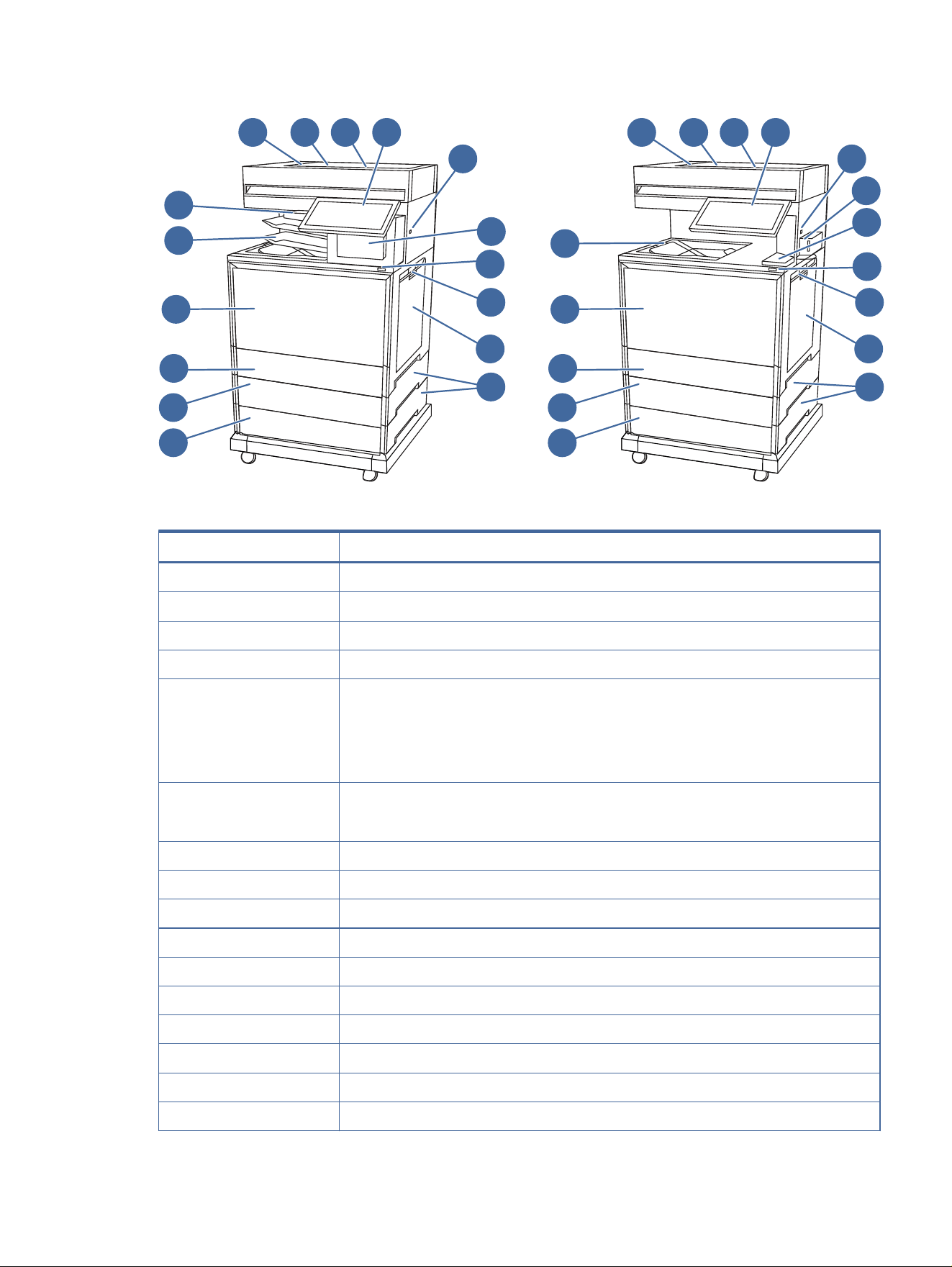
Figure 1-6 Printer front view - dn, zf, and zfsw models
4
5
21 3
8
9
10
12
15
14
16
13
17
18
4
5
21 3
7
9
6
15
14
16
17
13
11
10
12
11
Table 1-1 Printer front components (dn, zf, and zfsw models)
Item Description
1 Automatic document feeder output tray
2 Automatic document feeder cover, for access for clearing jams
3 Automatic document feeder input tray
4 Control panel with color touchscreen display (tilts up for easier viewing)
5 Easy-access USB port
Insert a USB flash drive for printing or scanning without a computer or to update the printer
firmware.
NOTE: An administrator must enable this port before use.
6 Convenience stapler
NOTE: Not available on models that have the 3-bin stapler/stacker.
7 Hardware integration pocket (HIP) for connecting accessory and third-party devices
8 Staple access door (models with inner finisher)
9 On/off button
10 Right door, access for clearing jams and accessing long-life consumables
11 Tray 1 (multipurpose tray)
12 Tray jam access doors
13 Optional Tray 4
14 Optional Tray 3
15 Tray 2
16 Front door, for access to the toner cartridges
Printer front view 3
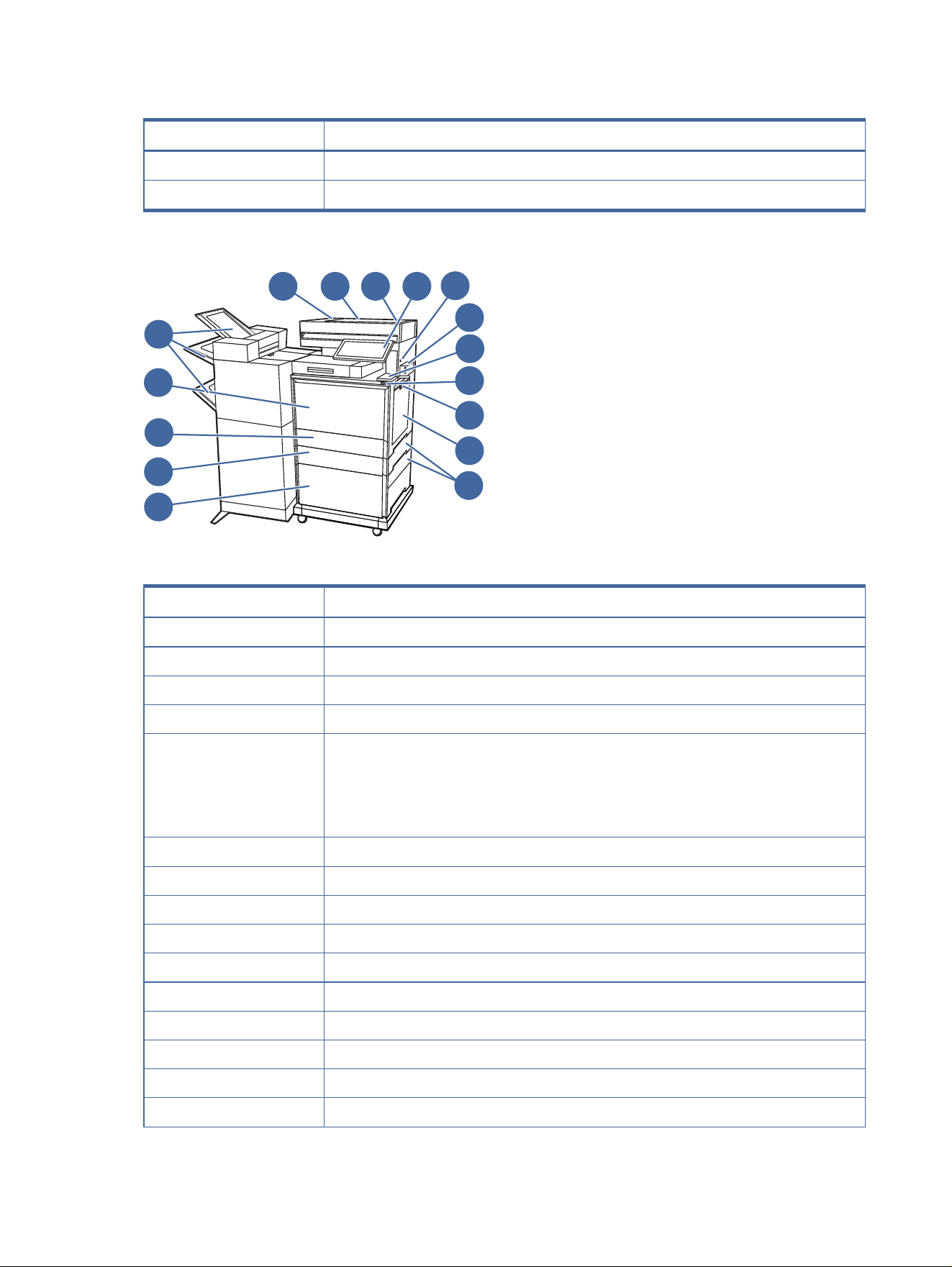
Table 1-1 Printer front components (dn, zf, and zfsw models) (continued)
Item Description
17 Output bin (multi-bin output included with the zfsw models)
18 Hardware integration pocket (HIP) location for models with an inner finisher
Figure 1-7 Printer front view - zfw+ models
4
7
8
5
10
9
11
14
13
15
21 3
12
16
6
Table 1-2 Printer front components
Item Description
1 Automatic document feeder output tray
2 Automatic document feeder cover, for access for clearing jams
3 Automatic document feeder input tray
4 Control panel with color touchscreen display (tilts up for easier viewing)
5 Easy-access USB port
Insert a USB flash drive for printing or scanning without a computer or to update the printer
firmware.
NOTE: An administrator must enable this port before use.
6 Convenience stapler
7 Hardware integration pocket (HIP) for connecting accessory and third-party devices
8 On/off button
9 Right door, access for clearing jams and accessing long-life consumables
10 Tray 1 (multipurpose tray)
11 Tray jam access doors
12 High-capacity input Tray 4
13 Tray 3
14 Tray 2
15 Front door, for access to the toner cartridges
4 Chapter 1 Printer overview
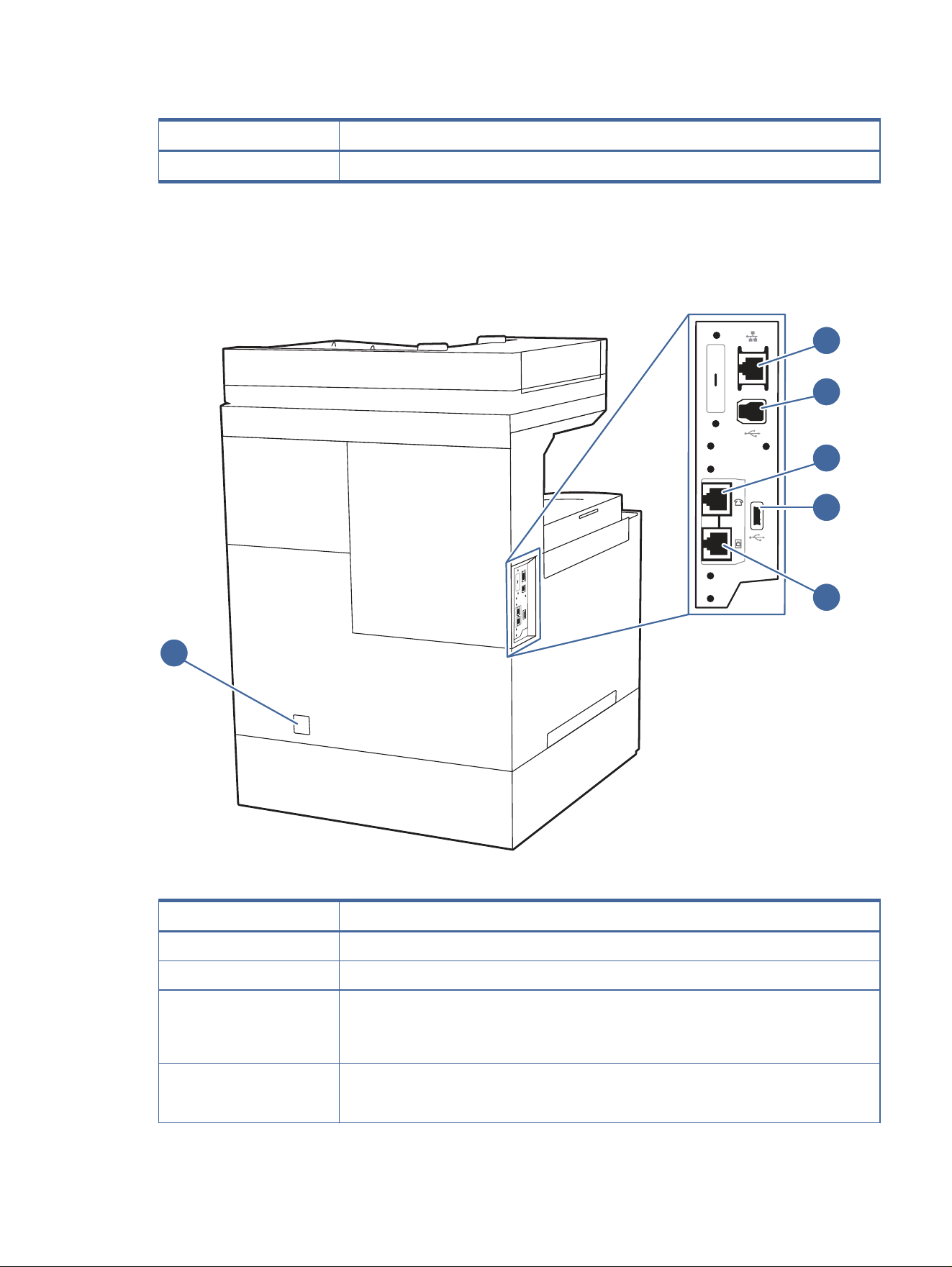
Table 1-2 Printer front components (continued)
Item Description
16 Output bins on the floor-standing finisher
Printer back view
Locate features on the back of the printer.
Figure 1-8 Printer back view
6
3
4
2
1
5
Table 1-3 Rear components
Item Description
1 Local area network (LAN) Ethernet (RJ-45) network port
2 SuperSpeed USB 3.0 interface port
3 Telephone "line out" port (for attaching an extension phone, answering machine, or other
device)
NOTE: This port should remain covered when not in use.
4 SuperSpeed USB 3.0 host port (for job storage and private printing)
NOTE: This port should remain covered when not in use.
Printer back view 5
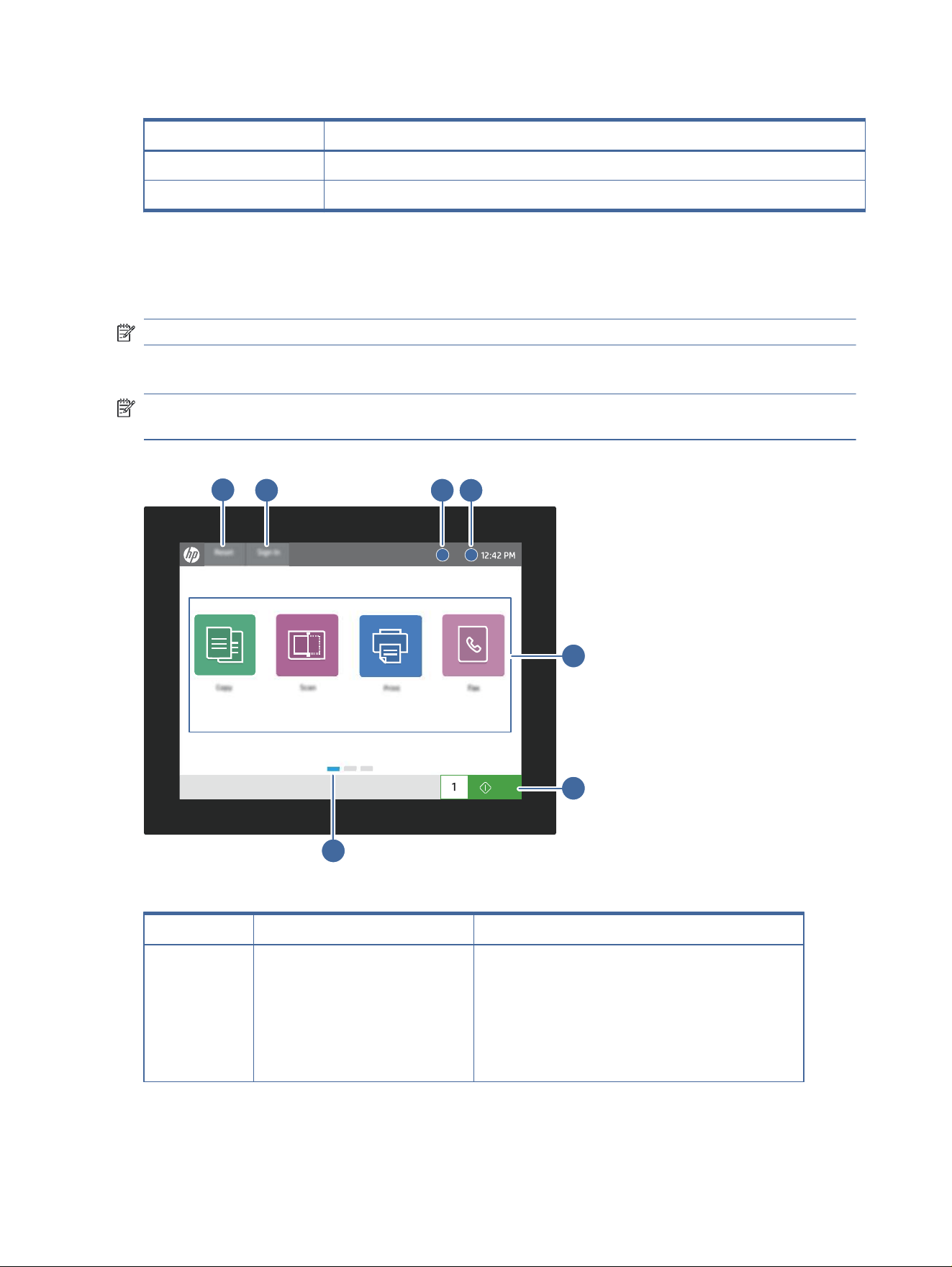
Table 1-3 Rear components (continued)
Item Description
5 Fax "line in" port (for attaching the fax phone line to the printer)
6 Power connection
Control-panel view
The control panel provides access to the printer features and indicates the current status of the printer.
NOTE: Tilt the control panel for easier viewing.
The Home screen provides access to the printer features and indicates the current status of the printer.
NOTE: The features that appear on the Home screen can vary, depending on the printer
configuration.
Figure 1-9 Control-panel view
i ?
1 2
3 4
5
6
7
Table 1-4
Control panel components
Item Control Description
1 Reset button The Reset button returns the printer to default settings
and is always present if users are not logged in. The
Reset button is not present when the Sign Out button is
present. Touch the Reset button to resume and release
jobs from the previous pause state and interrupt mode,
reset the quick copy count in the copy count field,
exit special modes, reset the display language and the
keyboard layout.
6 Chapter 1 Printer overview

Table 1-4 Control panel components (continued)
Item Control Description
2 Sign In or Sign Out button Touch the Sign In button to access secured features.
Touch the Sign Out button to sign out of the printer. The
printer restores all options to the default settings.
NOTE: This button displays only if the administrator has
configured the printer to require permission for access
to features.
3
Information button
● Display Language: Change the language setting for
the current user session.
● Sleep Mode: Place the printer into sleep mode.
● Wi-Fi Direct: View information for how to connect
directly to the printer using a phone, tablet, or other
device with Wi-Fi (only available when the optional
wireless accessory is installed).
● Wireless: View or change wireless connection
settings (only available when the optional wireless
accessory is installed).
● Ethernet: View or change Ethernet connection
settings.
● HP Web Services: View information to connect and
print to the printer using HP Web Services.
Touch the information button to access a screen that
provides access to several types of printer information.
Touch the buttons at the bottom of the screen for the
following information:
4
Help button
Touch the Help button to open the embedded help
system.
The status line provides information about the overall
printer status.
5 Applications area Touch any of the icons to open the application. Swipe the
screen sideways to access more applications.
NOTE: The available applications vary by printer. The
administrator can configure which applications appear
and the order in which they appear.
6 Copy button Touch the Copy button to start a copy job.
7 Home-screen page indicator Indicates the number of pages on the Home screen or in
an application. The current page is highlighted. Swipe the
screen sideways to scroll between pages.
How to use the touchscreen control panel
Perform the following actions to use the printer touchscreen control panel.
How to use the touchscreen control panel
7
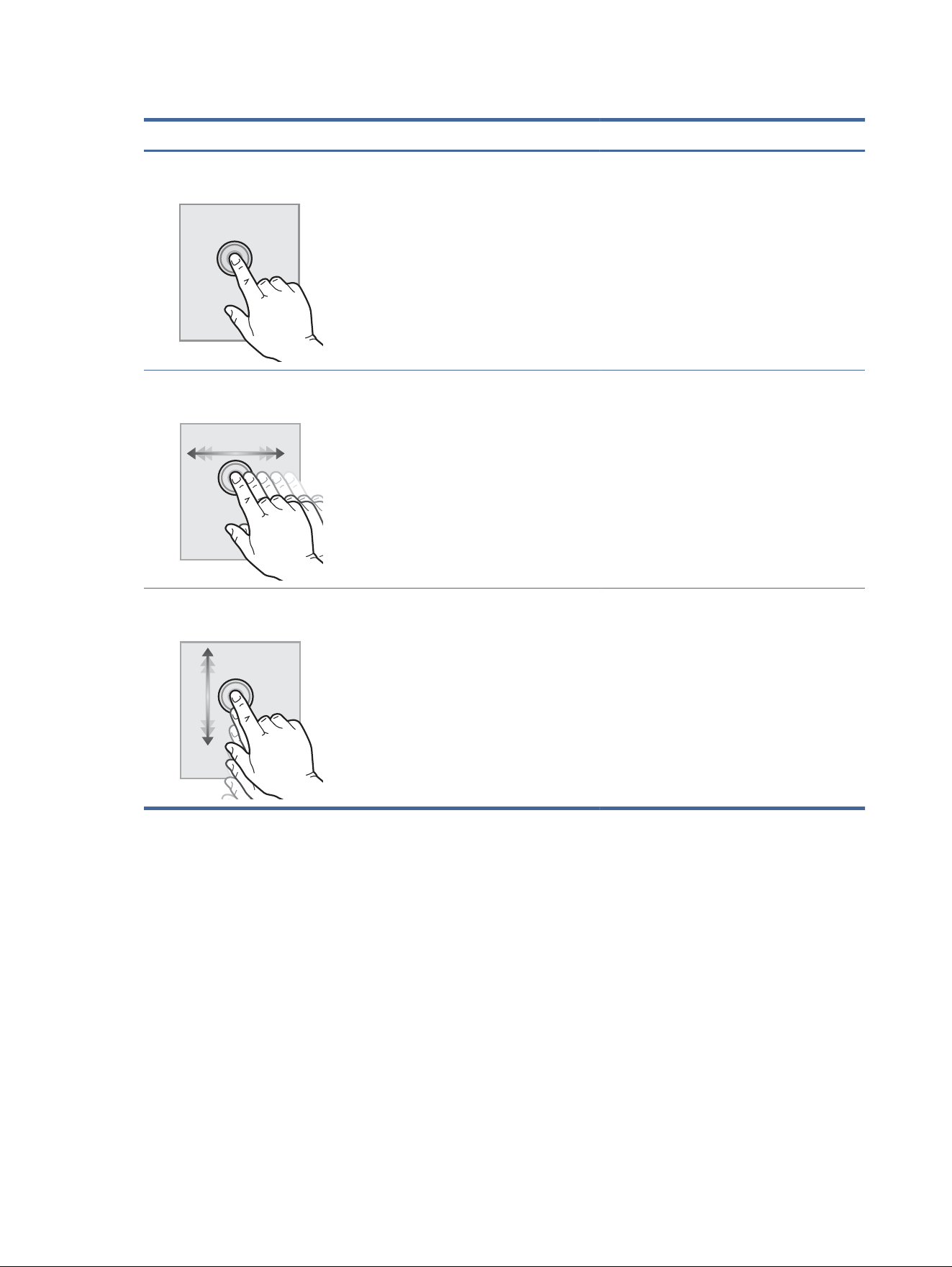
Table 1-5 Touchscreen control panel actions
Action Description Example
Touch Touch an item on the screen to select that
item or open that menu. Also, when scrolling
through menus, briefly touch the screen to
stop the scrolling.
Touch the Settings icon to open the Settings
app.
Swipe Touch the screen and then move your finger
horizontally to scroll the screen sideways.
Swipe until the Settings app displays.
Scroll Touch the screen and then move your finger
vertically to scroll the screen up and down.
When scrolling through menus, briefly touch
the screen to stop the scrolling.
Scroll through the Settings app.
Printer specifications
Determine the specifications for your printer model.
Technical specifications
Review the technical specifications for the printer.
Product numbers for each model
● 6800dn - #6QN35A
● 6800zf - #6QN36A
● 6800zfsw - #6QN37A
8
Chapter 1 Printer overview

● 6800zfw+ - #6QN38A
● 6800 Configurable (can be custom-configured when ordered)
● 6801zfsw - #76H10A
● 6801zfw+ - #76H11A
● 6801 Configurable (can be custom-configured when ordered)
WARNING! The maximum recommended product configuration height is 127 cm (50.1 in). Exceeding
this height by installing additional accessories is not recommended and could cause a potential tilt
hazard.
Table 1-6
Paper handling specifications
Paper handling features 6800dn 6800zf 6800zfsw
6801zfsw
6800zfw+
6801zfw+
6800/6801
Configurable
Tray 1 (100-sheet capacity)
Tray 2 (550-sheet capacity)
Optional 550-sheet accessory
tray
Optional Optional (2) Available option
Printer stand Optional Optional Not available Available option
Printer stand with storage
compartment
Optional Optional Not available Not available Available option
2,100-sheet High Capacity Paper
Tray/Stand
Optional Optional Not available Available option
Convenience stapler
1
Optional Optional Not available Available option
3-bin Stapler/stacker
2
Not available Not available Not available Available option
Floor-standing finisher with edge
stapling and hole punch
Not available Not available Not available Available option
Automatic duplex printing
1
Convenience stapler – Up to 20 sheets of 75gsm
2
3-bin stapler-stacker - Up to 50 sheets (60 g/m2 (16 lb) to 120 g/m2 (32 lb) paper)
Table 1-7
Connectivity specifications
Connectivity features 6800dn 6800zf 6800zfsw
6801zfsw
6800zfw+
6801zfw+
6800/6801
Configurable
10/100/1000 Ethernet LAN
connection with IPv4 and IPv6
Dual-band wireless Optional Optional Available option
Wifi-Direct and BLE Optional Optional Available option
SuperSpeed USB 3.0 rear ports
and Hi-Speed USB 2.0 front port
for walk-up USB printing
Technical specifications 9

Table 1-7 Connectivity specifications (continued)
Connectivity features 6800dn 6800zf 6800zfsw
6801zfsw
6800zfw+
6801zfw+
6800/6801
Configurable
Hardware integration pocket (HIP)
for connecting accessory and
third-party devices
Table 1-8 Print specifications
Print features 6800dn 6800zf 6800zfsw
6800zfw+
6801zfw+
6801zfsw
6800/6801
Configurable
Prints up to 52 pages per minute
(ppm) on A4 and 55 ppm on letter-
sized paper, with a maximum of 61
ppm on A4 and 65 ppm on letter-
sized paper (configured at time of
purchase)
Not available Available option
Prints up to 61 ppm on A4 and 65
ppm on letter-sized paper
Not available Not available Not available Available option
Job storage and private printing
Table 1-9 Copy and scan specifications
Copy and scan features 6800dn 6800zf 6800zfsw
6801zfsw
6800zfw+
6801zfw+
6800/6801
Configurable
ADF copy/scan speed 80 images-
per-minute (ipm) single-sided, and
160 ipm double-sided
Not available Not available Not available Available option
ADF copy/scan speed 100 ipm
single-sided, and 200 ipm double-
sided
Not available Available option
150-page document feeder with
dual-head scanning for single-
pass duplex copying and scanning
Scan to E-mail, Scan to USB, and
Scan to Network Folder options
Table 1-10 Other specifications
Other features 6800dn 6800zf 6800zfsw
6801zfsw
6800zfw+
6801zfw+
6800/6801
Configurable
6 GB base memory
500 GB Hard Disk Drive Available option
512 GB FIPS Hard Disk Drive Optional Optional Optional Optional Available option
32 GB embedded Multi-Media
Controller (eMMC)
Not available Not available Not available Not available Available option
10 Chapter 1 Printer overview

Table 1-10 Other specifications (continued)
Other features 6800dn 6800zf 6800zfsw
6801zfsw
6800zfw+
6801zfw+
6800/6801
Configurable
Small color touchscreen control
panel
Not available Not available Not available Available option
Large color touchscreen control
panel
Not available Available option
Fax features Optional Available option
HP Trusted Platform Module for
encrypting all data that passes
through the printer
Supported operating systems
Learn about supported operating systems.
The following information applies to the Printer-Specific Windows PCL 6 and HP print drivers for macOS
and to the software installer.
Windows: The HP Software Installer can be downloaded from the printer support website for this printer
which installs the correct print driver, depending on the Windows operating system, along with optional
software when using the software installer. The print driver only package is also made available in the
printer support website. Download the applicable package from the printer-support website for this
printer: support.hp.com.
macOS: Mac computers are supported with this printer. Download HP Easy Start either from 123.hp.com
or from the Printer Support page, and then use HP Easy Start to install the HP print driver. HP Easy Start
is not included in the HP Software Installer.
1. Go to 123.hp.com.
2. Follow the steps provided to download the printer software.
Linux: For information and print drivers for Linux, go to www.hp.com/go/linuxprinting.
Table 1-11
Supported operating systems and print drivers
Operating system Print driver installed (from the software on the web)
Windows 10, 32-bit and 64-bit The “HP PCL-6” printer-specific print driver is installed for this
operating system as part of the software installation.
Windows 11, 32-bit and 64-bit The “HP PCL-6” printer-specific print driver is installed for this
operating system as part of the software installation.
Windows Server 2003 SP2, 32-bit The “HP PCL.6” printer-specific print driver is available for
download from the printer-support website. Download the
driver, and then use the Microsoft Add Printer tool to install
it.
Microsoft retired mainstream support for Windows Server
2003 in July 2010. HP will continue to provide best effort
support for the discontinued Server 2003 operating system.
Some features and page sizes in the print driver are not
supported.
Supported operating systems 11

Table 1-11 Supported operating systems and print drivers (continued)
Operating system Print driver installed (from the software on the web)
Windows Server 2008 R2, 64-bit The “HP PCL 6” printer-specific print driver is available for
download from the printer-support website. Download the
driver, and then use the Microsoft Add Printer tool to install
it.
Windows Server 2012, 64-bit The PCL 6 printer-specific print driver is available for download
from the printer-support website. Download the driver, and
then use the Microsoft Add Printer tool to install it.
Windows Server 2012 R2, 64-bit The PCL 6 printer-specific print driver is available for download
from the printer-support website. Download the driver, and
then use the Microsoft Add Printer tool to install it.
Windows Server 2016, 64-bit The PCL 6 printer-specific print driver is available for download
from the printer-support website. Download the driver, and
then use the Microsoft Add Printer tool to install it.
Windows Server 2019, 64-bit The PCL 6 printer-specific print driver is available for download
from the printer-support website. Download the driver, and
then use the Microsoft Add Printer tool to install it.
Windows Server 2022, 64-bit The PCL 6 printer-specific print driver is available for download
from the printer-support website. Download the driver, and
then use the Microsoft Add Printer tool to install it.
macOS Catalina v10.15, macOS Big Sur v11.0, macOS Monterey
v12.0
To install the print driver, download HP Easy Start from
123.hp.com. Follow the steps provided to install the printer
software and print driver.
NOTE: Supported operating systems can change. For a current list of supported operating systems,
go to support.hp.com for HP's all-inclusive help for the printer.
NOTE: For details on client and server operating systems and for HP Smart UPD (SUPD) driver
support for this printer, go to hp.com/go/smartupd. Under Additional information, click the links.
Table 1-12
Minimum system requirements
Windows macOS
● Internet connection
● Dedicated USB 1.1 or 2.0 connection or a network
connection
● 2 GB of available hard-disk space
● Internet connection
● 1 GB of available hard-disk space
Mobile printing solutions
HP offers multiple mobile printing solutions to enable easy printing to an HP printer from a laptop, tablet,
smartphone, or other mobile device.
To see the full list and to determine the best choice, go to www.hp.com/go/MobilePrinting.
NOTE: Update the printer firmware to ensure all mobile printing capabilities are supported.
● Wi-Fi Direct on wireless models
12
Chapter 1 Printer overview
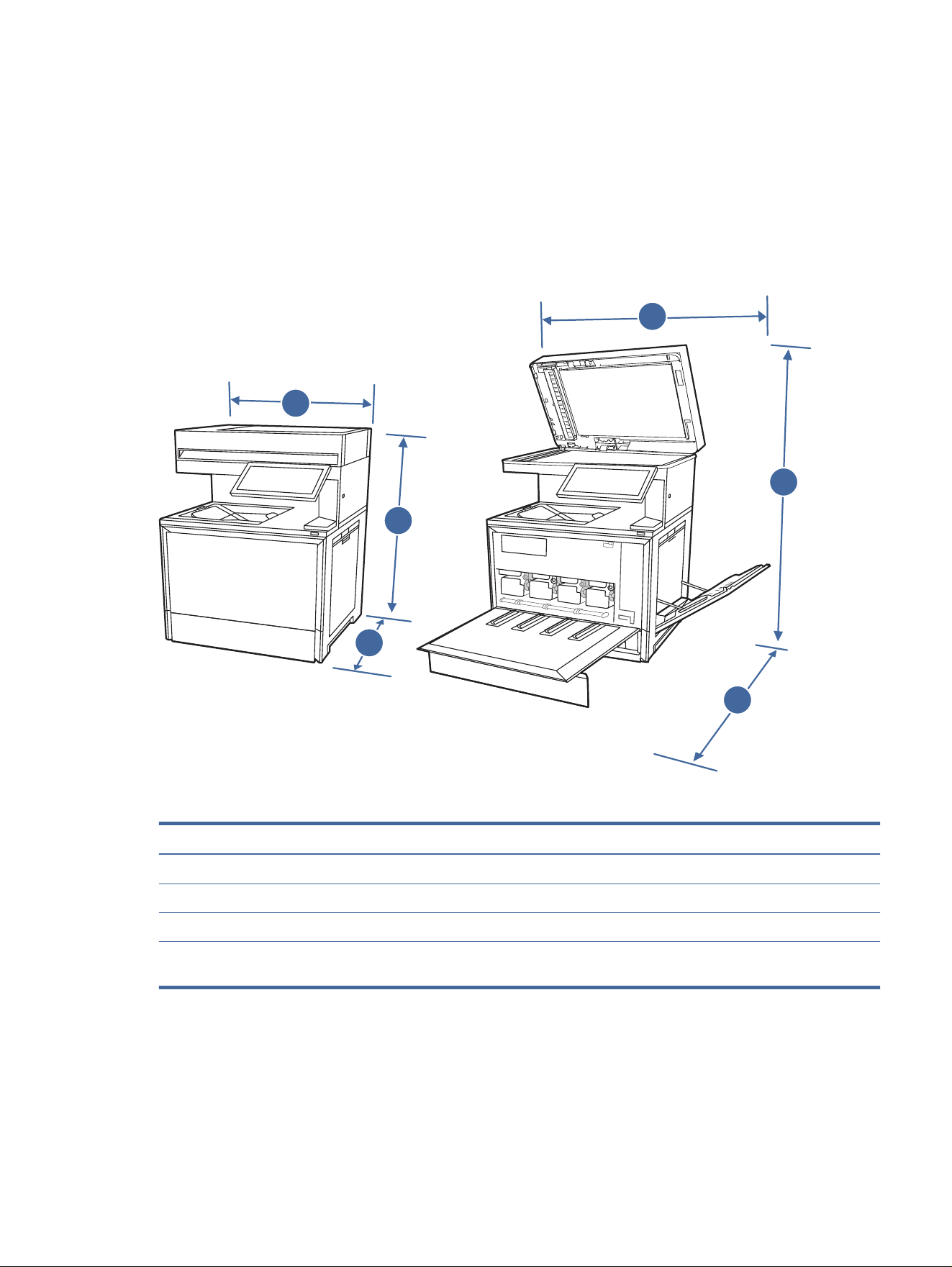
● AirPrint
● Android Printing
● HP Smart app
Printer dimensions
Make sure your printer environment is large enough to accommodate the printer.
Figure 1-10 Printer dimensions (dn and zf models)
1
3
2
2
1
3
Table 1-13 Dimensions for the printer (dn and zf models)
Measurement Printer fully closed Printer fully opened
1. Width 500 mm (19.7 in) 860 mm (33.9 in)
2. Height 651 mm (25.6 in) 896 mm (35.3 in)
3. Depth 460 mm (18.1 in) 820 mm (32.3 in)
Weight (with
cartridges)
42.2 kg (93 lb) 42.2 kg (93 lb)
Printer dimensions 13
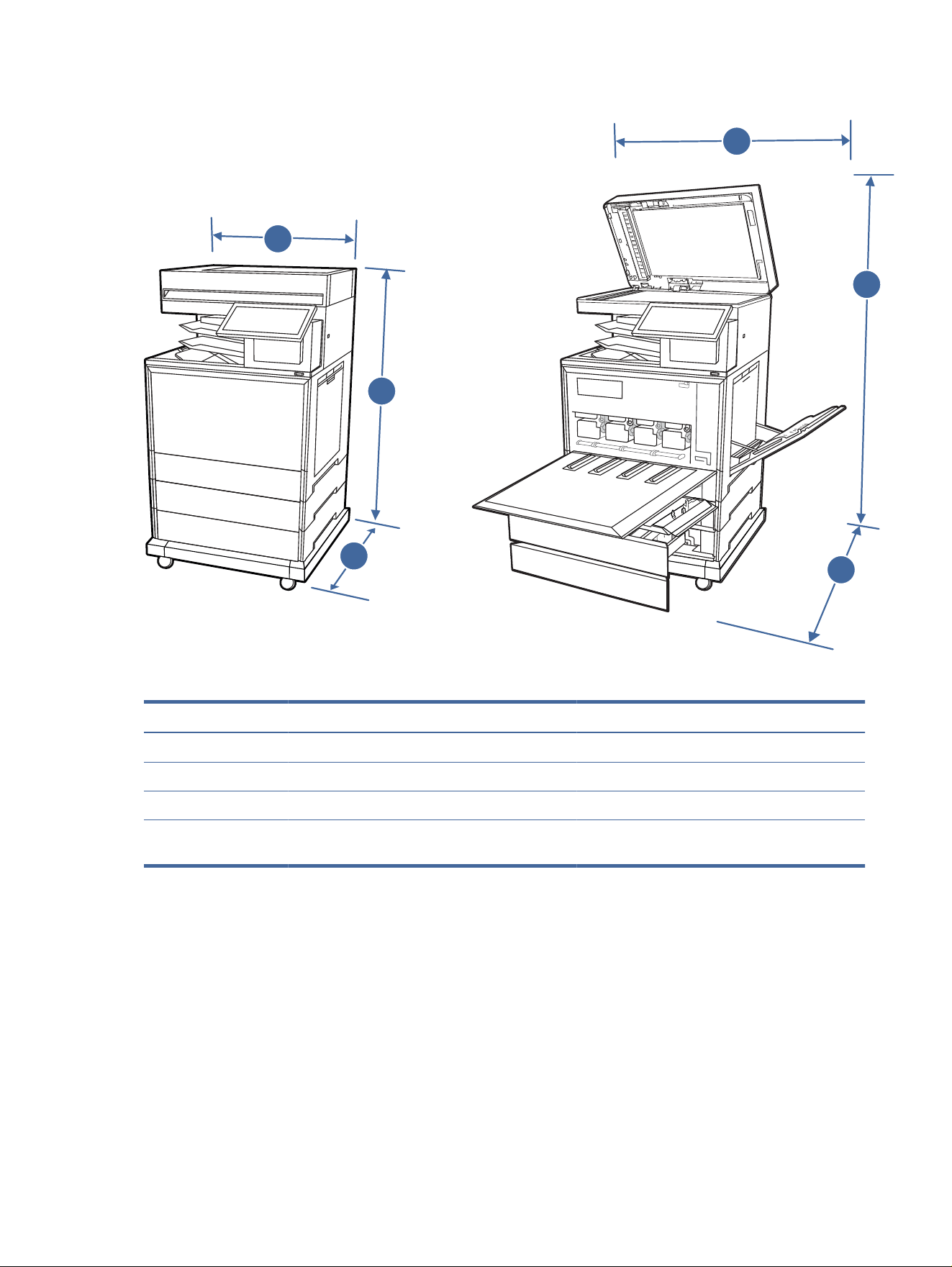
Figure 1-11 Printer dimensions (zfsw models)
2
1
3
1
3
2
Table 1-14 Dimensions for the printer (zfsw models)
Measurement Printer fully closed Printer fully opened
1. Width 520 mm (20.5 in) 870 mm (34.3 in)
2. Height 1155 mm (45.5 in) 1399 mm (55.1 in)
3. Depth 528 mm (20.8 in) 823 mm (32.4 in)
Weight (with
cartridges)
79.45 kg (175.16 lb) 79.45 kg (175.16 lb)
14 Chapter 1 Printer overview
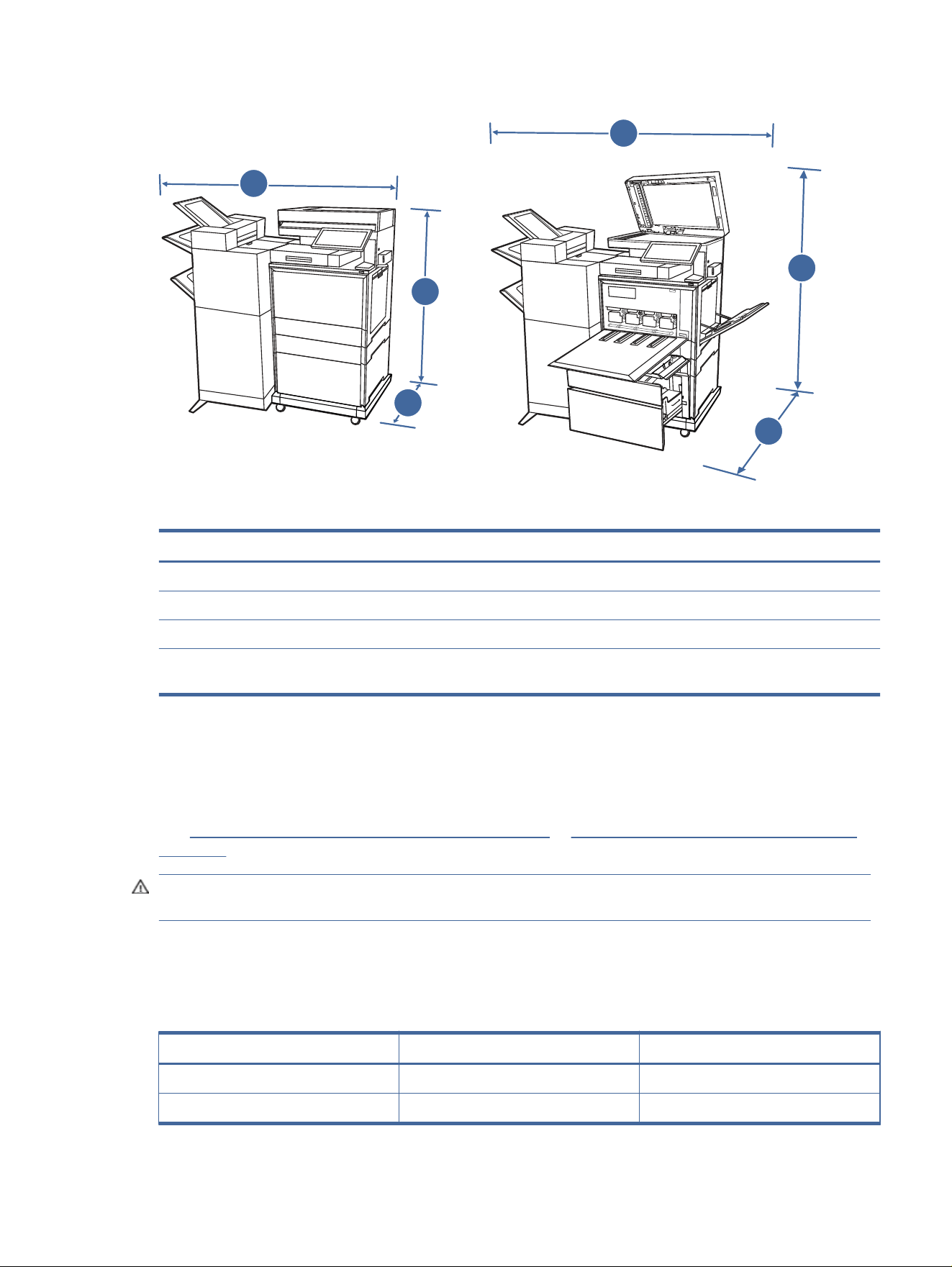
Figure 1-12 Printer dimensions (zfw+ models)
1
3
2
1
3
2
Table 1-15 Dimensions for the printer (zfw+ models)
Measurement Printer fully closed Printer fully opened
1. Width 1202 mm (47.3 in) 1552 mm (61.1 in)
2. Height 1147 mm (45.2 in) 1383 mm (54.4 in)
3. Depth 559mm (22 in) 939 mm (37 in)
Weight (with
cartridges)
84.45 kg (186.2 lb) 84.45 kg (186.2 lb)
Power consumption, electrical specifications, and acoustic emissions
In order to operate properly, the printer must be in an environment that meets certain power
specifications.
See Support for HP Color LaserJet Enterprise MFP 6800 or Support for HP Color LaserJet Enterprise
MFP 6801 for current information.
CAUTION: Power requirements are based on the country/region where the printer is sold. Do not
convert operating voltages. This will damage the printer and void the printer warranty.
Operating-environment range
In order to operate properly, the printer must be in an environment that meets certain specifications.
Table 1-16
Operating-environment specifications
Environment Recommended Storage
Temperature 15° to 27°C (59° to 80.6°F) 10° to 32.5°C (50° to 90.5°F)
Relative humidity 30% to 70% relative humidity (RH) 10% to 80% relative humidity (RH)
Power consumption, electrical specifications, and acoustic emissions 15

Printer hardware setup and software installation
For basic setup instructions, see the Hardware Installation Guide that came with the printer. For
additional instructions, go to HP support on the web.
Go to Support for HP Color LaserJet Enterprise MFP 6800 or Support for HP Color LaserJet Enterprise
MFP 6801 for HP's all-inclusive help for the printer, which includes the following information:
● Install and configure
● Learn and use
● Solve problems
● Download software and firmware updates
● Join support forums
● Find warranty and regulatory information
● Find instructions about how to use the Microsoft Add Printer tool
16
Chapter 1 Printer overview

Paper trays2
Discover how to load and use the paper trays, including how to load special items such as envelopes
and labels.
The following information is correct at the time of publication. For current information, see Support for
HP Color LaserJet Enterprise MFP 6800 or Support for HP Color LaserJet Enterprise MFP 6801.
For more information:
HP's all-inclusive help for the printer includes the following information:
● Install and configure
● Learn and use
● Solve problems
● Download software and firmware updates
● Join support forums
● Find warranty and regulatory information
Use caution when loading the paper trays.
CAUTION: Do not extend more than one paper tray at a time.
Do not use paper tray as a step.
All trays must be closed while relocating/moving product.
Keep hands out of paper trays or drawers when closing.
If the printer has a keyboard, close keyboard tray when not in use.
Load paper to Tray 1 (multipurpose tray)
The following information describes how to load paper in Tray 1.
CAUTION: To avoid jams, never add or remove paper from Tray 1 during printing.
Load Tray 1 (multipurpose tray)
This tray holds up to 100 sheets of 75 grams per square meter (20 lb) paper, or 10 envelopes.
View a video of how to load paper in Tray 1
NOTE: Select the correct paper type in the print driver before printing.
Paper trays
17
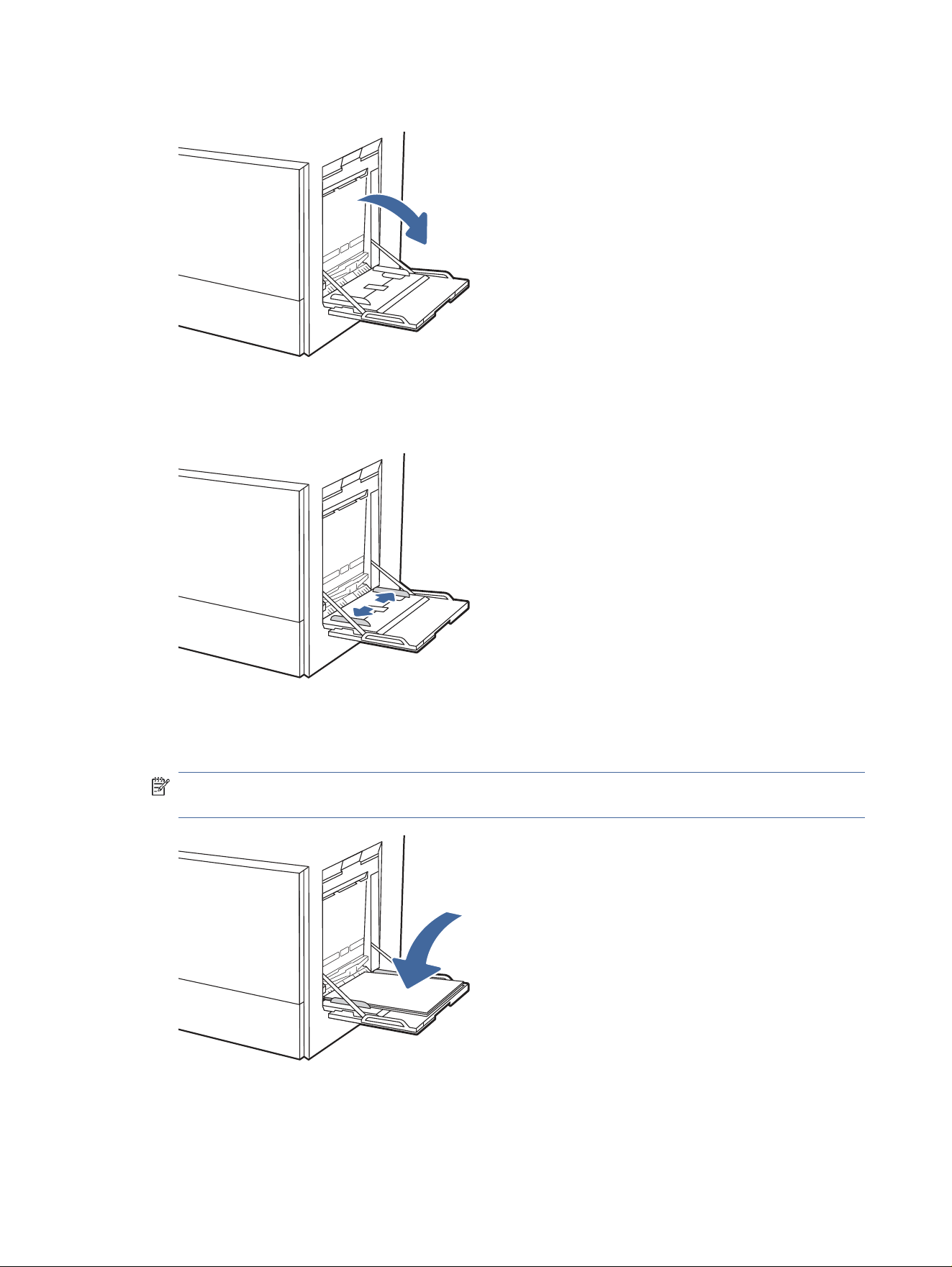
1. Open Tray 1.
2. Pull out the tray extension to support the paper, if necessary.
3. Use the adjustment latch to spread the paper guides outward.
4. Load paper in the tray.
Make sure that the paper fits under the fill line on the paper guides.
NOTE: The maximum stack height is 10 mm (0.4 in), or approximately 100 sheets of 75 grams per
square meter (20 lb) paper.
18
Chapter 2 Paper trays
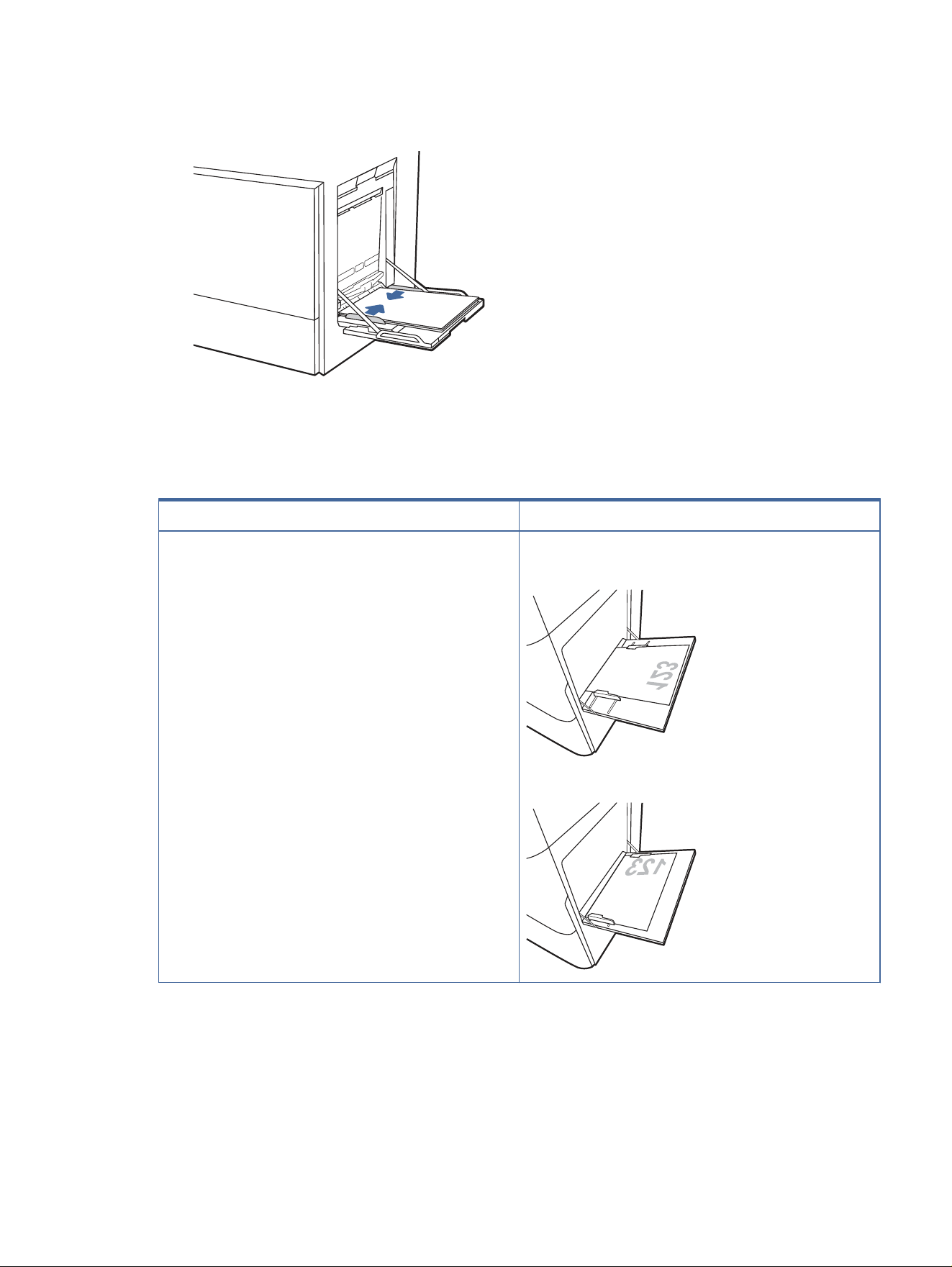
5. Using the adjustment latch, adjust the side guides so that they lightly touch the paper stack, but do
not bend it.
Tray 1 (multipurpose tray) paper orientation
Position paper correctly in Tray 1 (multipurpose tray) to ensure the best print quality.
Table 2-1
Letterhead or preprinted paper - Portrait
Duplex mode How to load paper
1-sided printing Face-down
Bottom edge leading into the printer
Right side of pre-printed image leading into the printer
Tray 1 (multipurpose tray) paper orientation
19
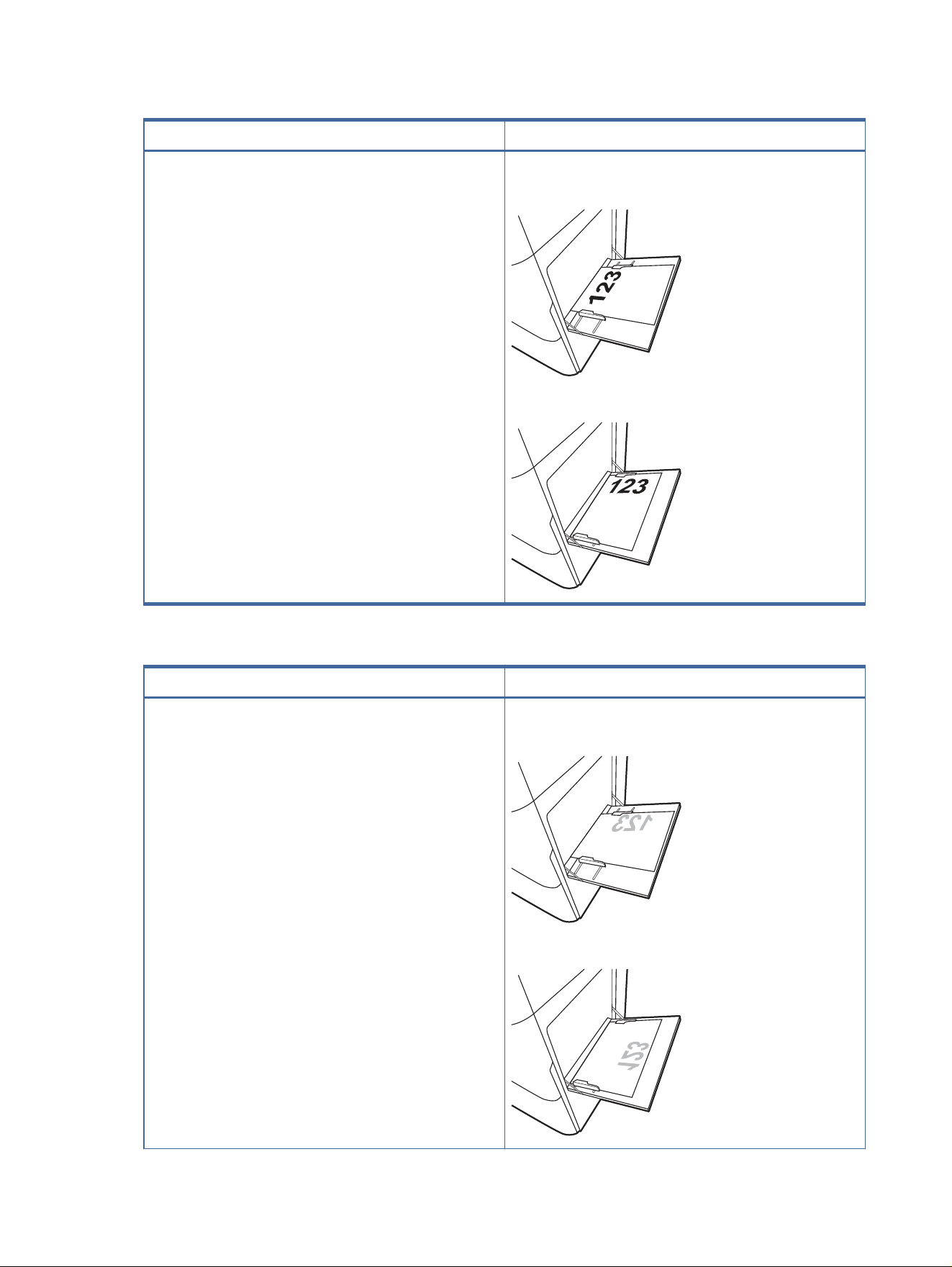
Table 2-1 Letterhead or preprinted paper - Portrait (continued)
Duplex mode How to load paper
Automatic 2-sided printing or with Alternative Letterhead
Mode enabled
Face-up
Top edge leading into the printer
Left side of pre-printed image leading into the printer
Table 2-2
Letterhead or preprinted paper - Landscape
Duplex mode How to load paper
1-sided printing Face-down
Right edge of pre-printed image leading into the printer
Bottom edge leading into the printer
20
Chapter 2 Paper trays
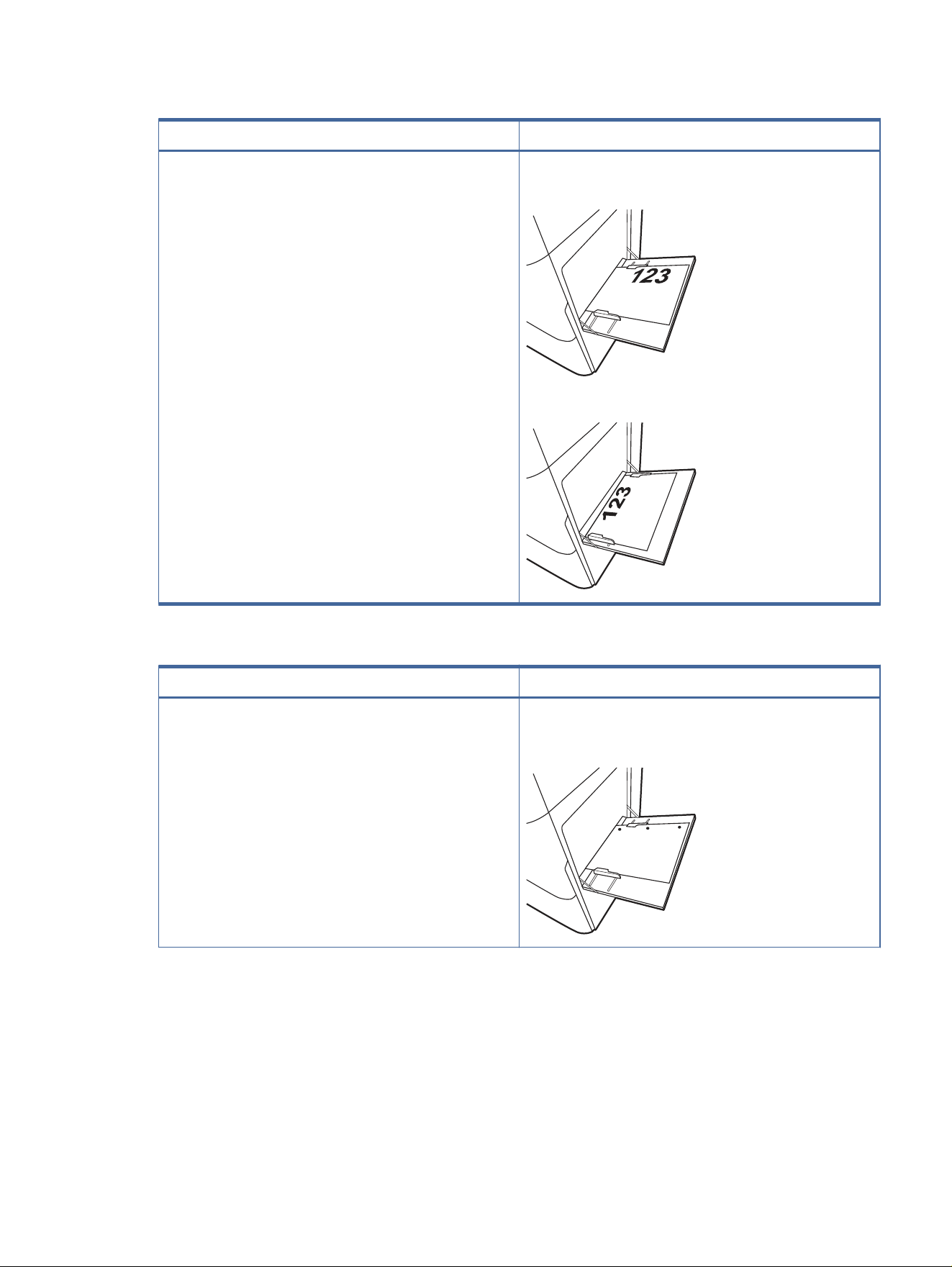
Table 2-2 Letterhead or preprinted paper - Landscape (continued)
Duplex mode How to load paper
Automatic 2-sided printing or with Alternative Letterhead
Mode enabled
Face-up
Left side of the pre-printed image leading into the printer
Top edge leading into the printer
Table 2-3
Prepunched paper - Portrait
Duplex mode How to load paper
1-sided printing Face-down
Holes toward the back of the printer
Tray 1 (multipurpose tray) paper orientation 21
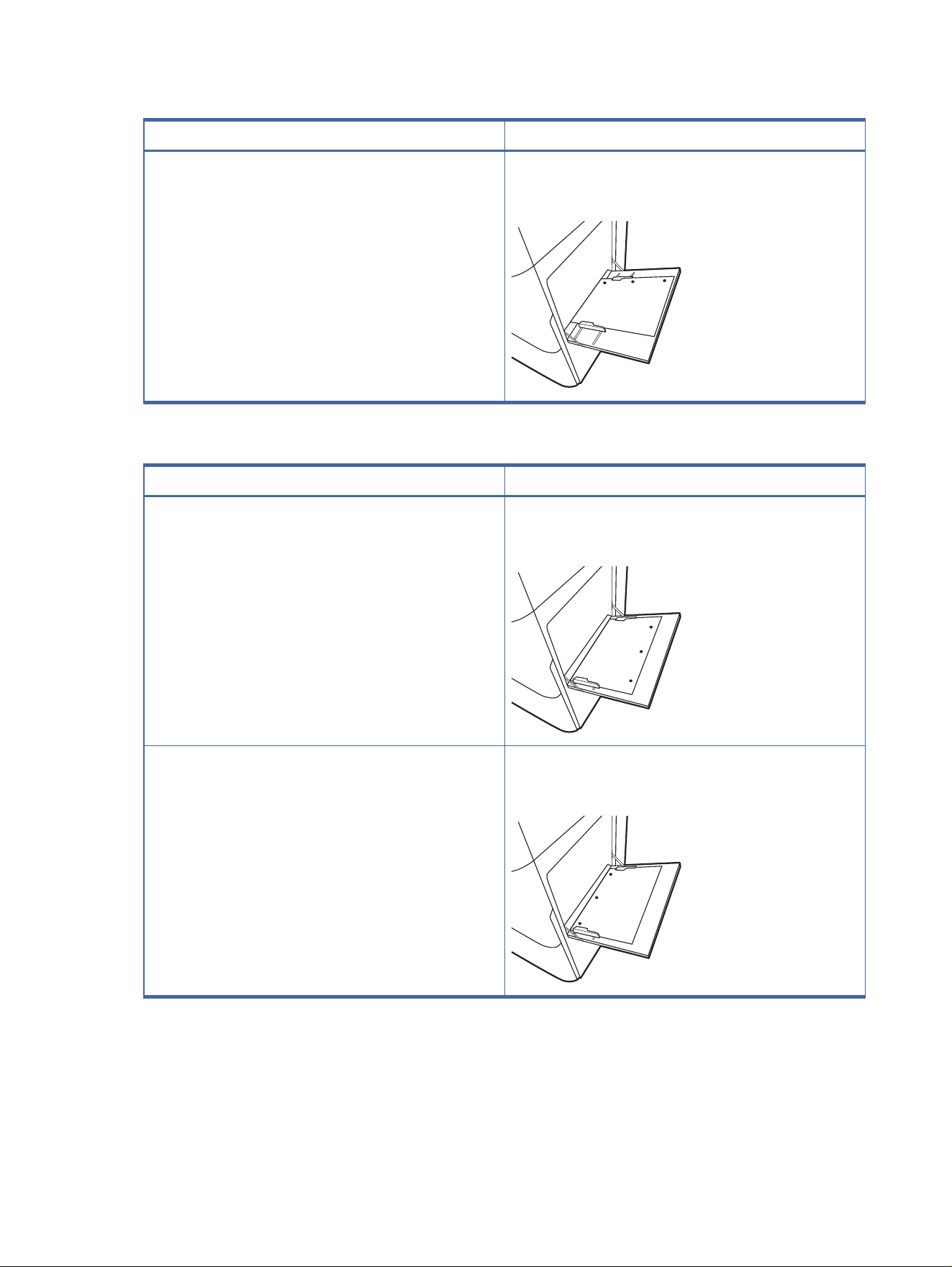
Table 2-3 Prepunched paper - Portrait (continued)
Duplex mode How to load paper
Automatic 2-sided printing or with Alternative Letterhead
Mode enabled
Face-up
Holes toward the back of the printer
Table 2-4 Prepunched paper - Landscape
Duplex mode How to load paper
1-sided printing Face-down
Holes away from the printer
Automatic 2-sided printing or with Alternative Letterhead
Mode enabled
Face-up
Holes towards the printer
Load paper to Tray 2
Review the following information about loading paper to Tray 2.
22
Chapter 2 Paper trays
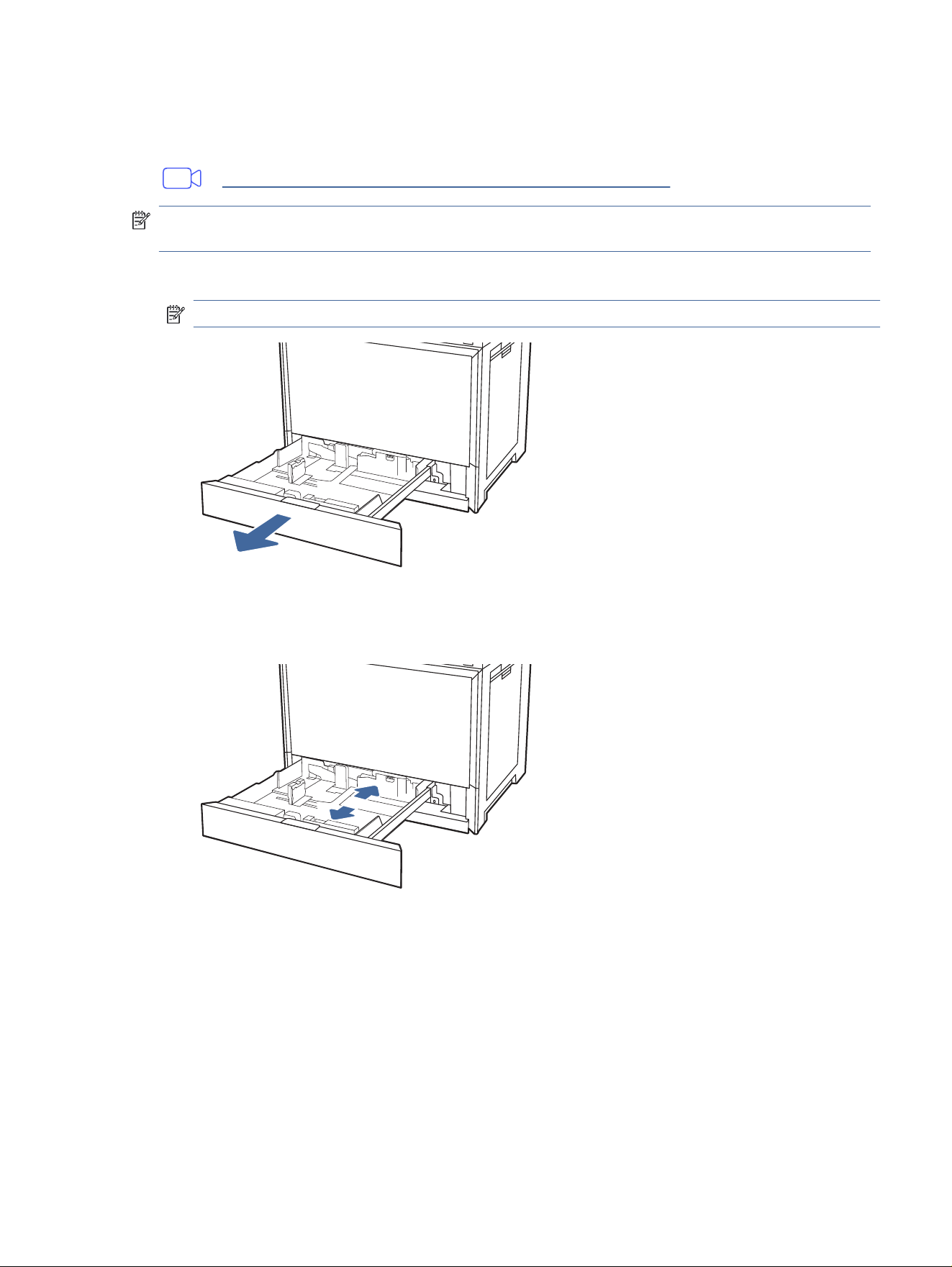
Load Tray 2 or the optional 550-sheet trays
These trays hold up to 550 sheets of 75 grams per square meter (20 lb) paper.
View a video of how to load paper in Tray 2 and the optional trays
NOTE: The procedure to load paper to Tray 2 or the optional 550-sheet trays is the same. Only Tray 2
is shown here.
1. Open the tray.
NOTE: Do not open any tray while it is in use.
2. Before loading paper, adjust the paper-width guides by holding down the blue lock/unlock toggle
switch on the rear paper-width guide, pinching the blue adjustment latch on the front paper-width
guide, and then sliding the guides to the fully open position.
Load Tray 2 or the optional 550-sheet trays
23
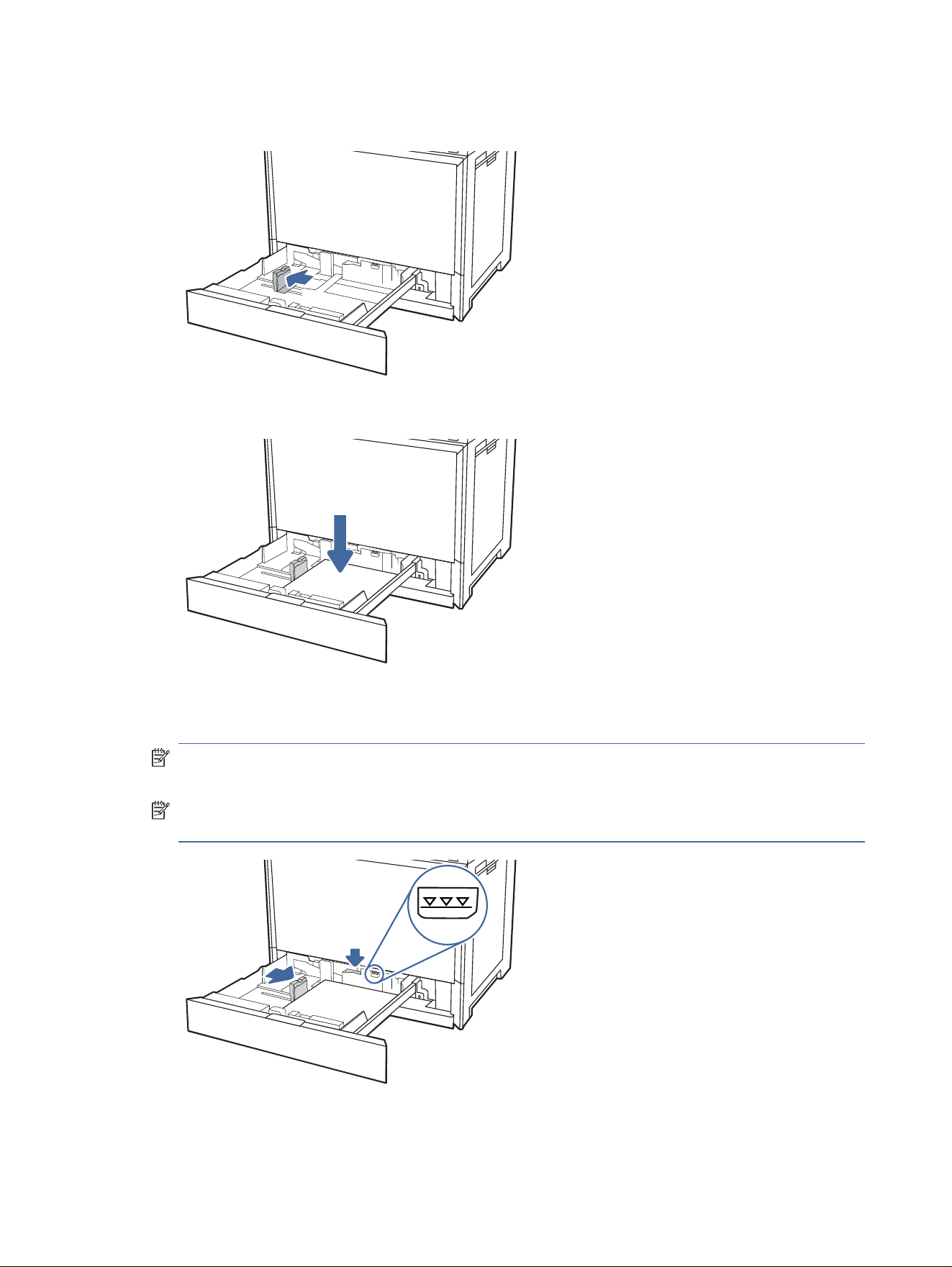
3. Adjust the paper-length guide by pushing in at the bottom of the blue adjustment latch while sliding
the guide to the size of the paper being used.
4. Load paper into the tray.
5. Adjust the paper-length and paper-width guides to the size of the paper being used. Check the
paper to verify the guides lightly touch the stack, but do not bend it.
NOTE: Do not adjust the paper guides tightly against the paper stack. Adjust them to the
indentations or markings in the tray.
NOTE: To prevent jams, adjust the paper guides to the correct size and do not overfill the tray. Be
sure that the top of the stack is below the tray full indicator.
24
Chapter 2 Paper trays
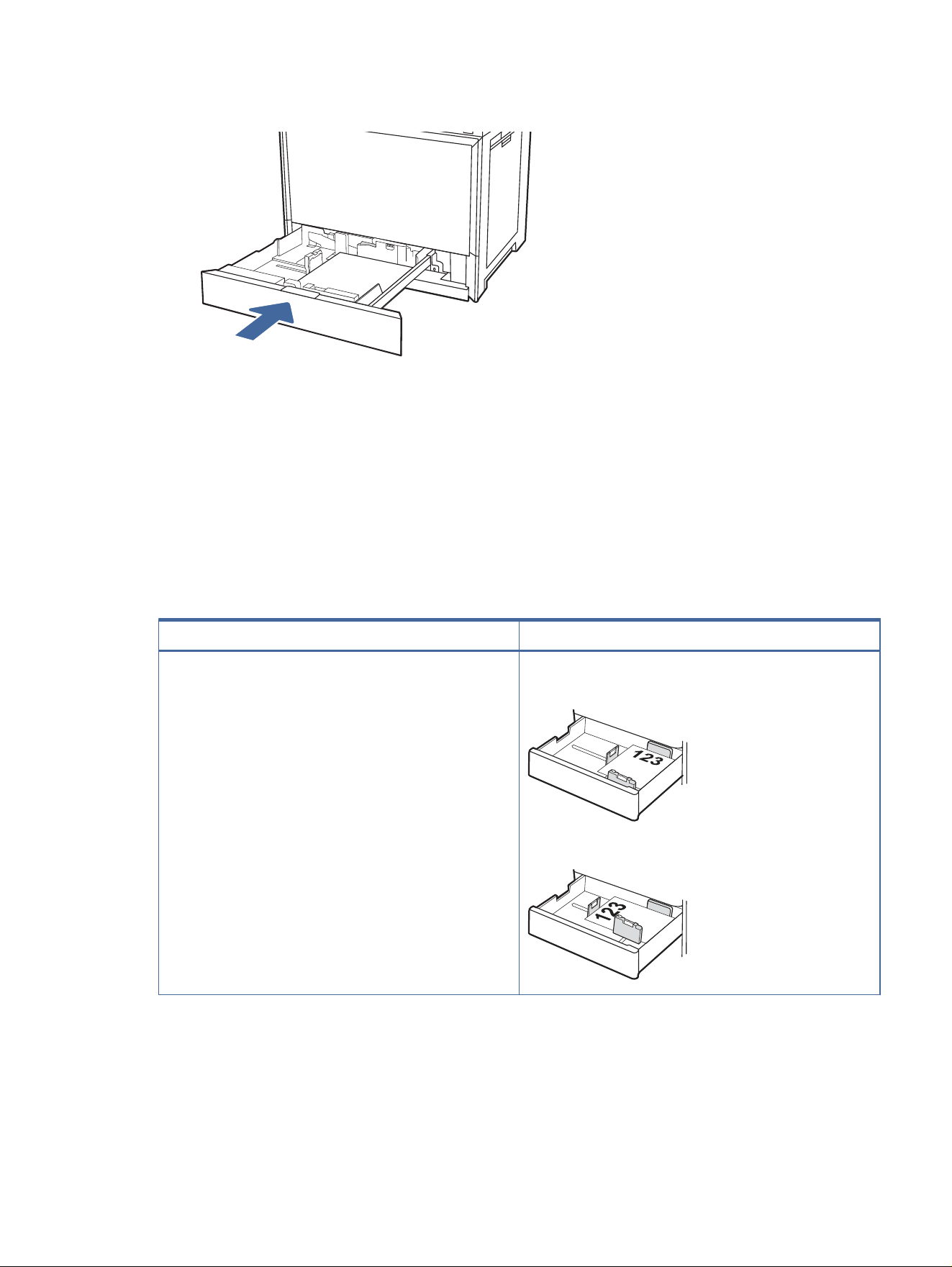
6. Close the tray.
7. The tray configuration message displays on the printer control panel.
8. Select OK to accept the detected type and size, or select Modify to choose a different paper size or
type.
For custom-size paper, specify the X and Y dimensions for the paper when the prompt displays on
the printer control panel.
Tray 2 and the optional 550-sheet trays paper orientation
Position paper correctly in Tray 2 and the optional 550-sheet trays to ensure the best print quality.
Table 2-5
Letterhead or preprinted paper - Portrait
Duplex mode How to load paper
1-sided printing Face-up
Top edge at the back of the tray
Top edge at the left side of the tray
Tray 2 and the optional 550-sheet trays paper orientation 25
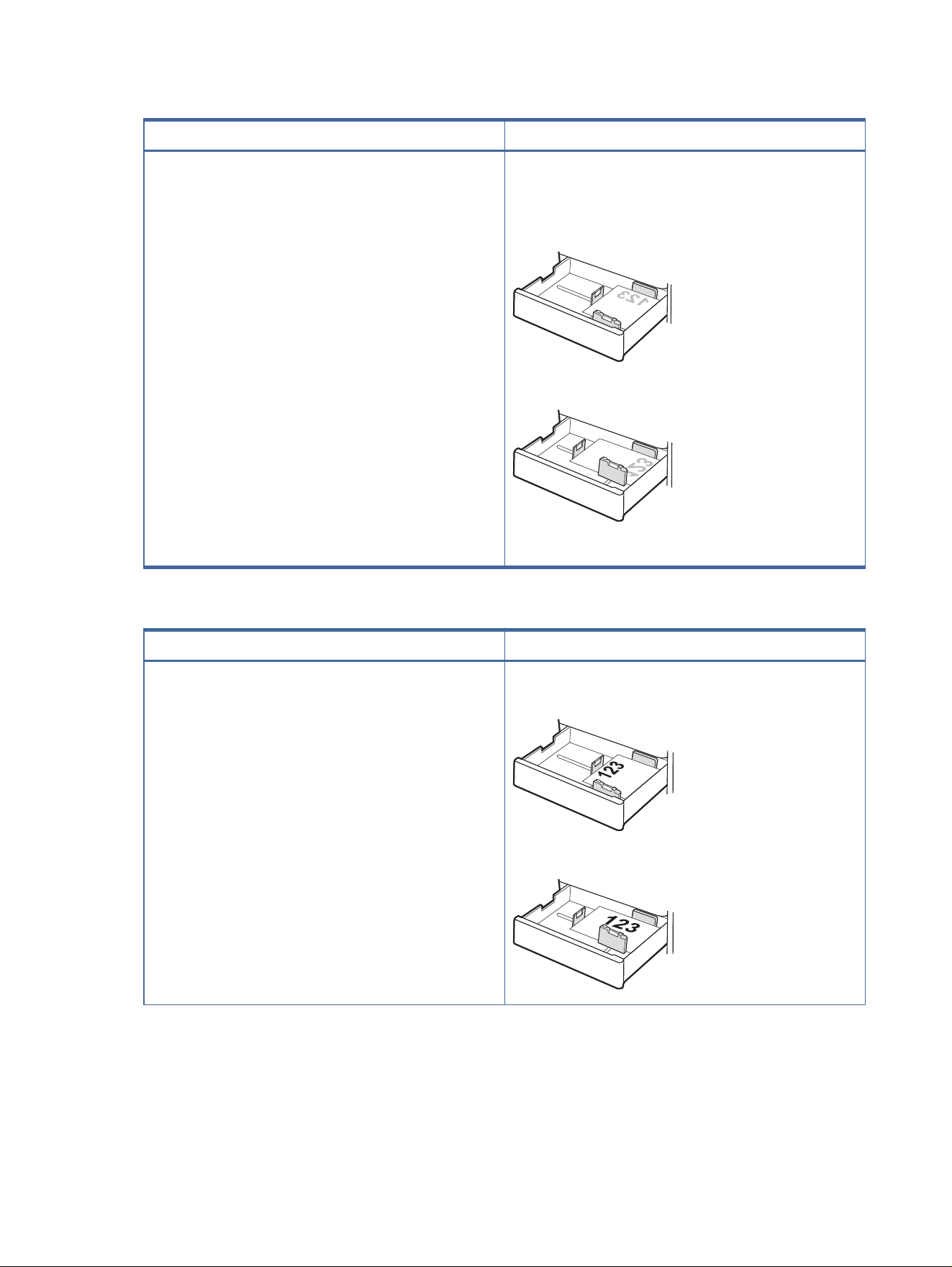
Table 2-5 Letterhead or preprinted paper - Portrait (continued)
Duplex mode How to load paper
Automatic 2-sided printing or with Alternative Letterhead
Mode enabled
Face-down
Top edge at the back of the tray
NOTE: This is the preferred orientation when printing on A4
or Letter.
Top edge at the right side of the tray
Table 2-6
Letterhead or preprinted paper - Landscape
Duplex mode How to load paper
1-sided printing Face-up
Top edge at the left side of the tray
Top edge at the back of the tray
26 Chapter 2 Paper trays
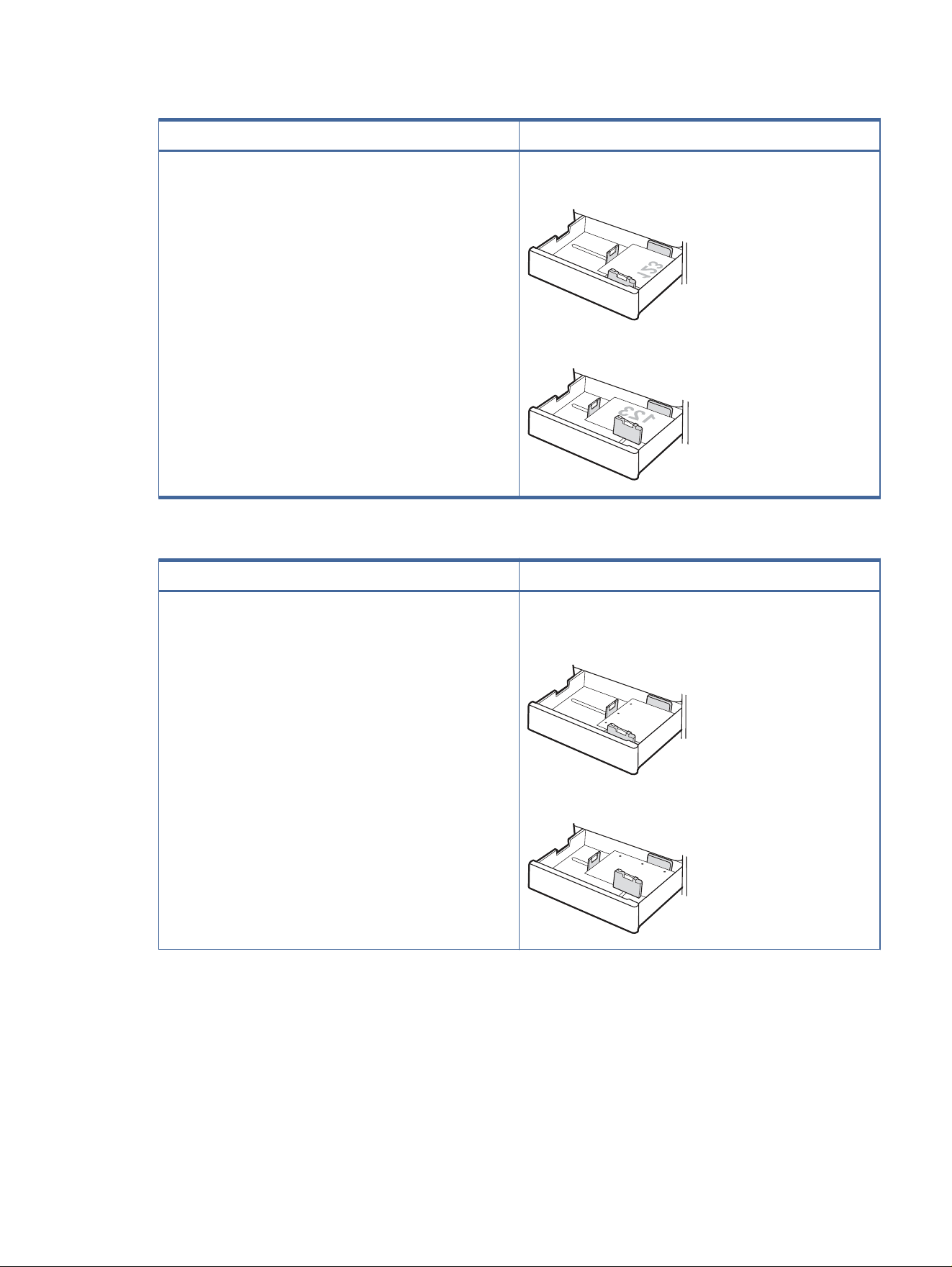
Table 2-6 Letterhead or preprinted paper - Landscape (continued)
Duplex mode How to load paper
Automatic 2-sided printing or with Alternative Letterhead
Mode enabled
Face-down
Top edge at the right side of the tray
Top edge at the back of the tray
Table 2-7 Prepunched paper - Portrait
Duplex mode How to load paper
1-sided printing Face-up
Holes at the left side of the tray, with the top of the form at the
rear of the printer
Holes at the back of the tray
Tray 2 and the optional 550-sheet trays paper orientation 27
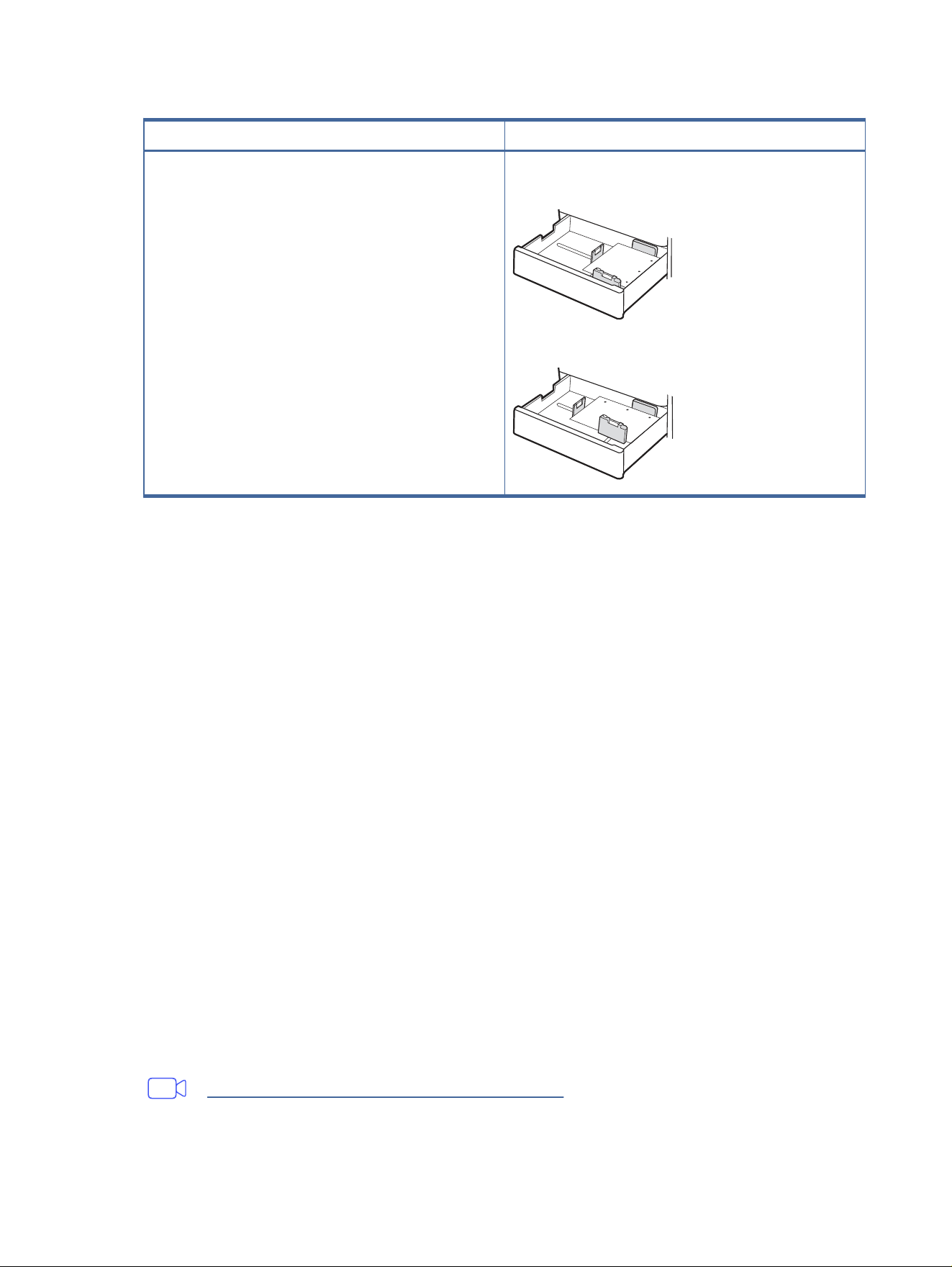
Table 2-7 Prepunched paper - Portrait (continued)
Duplex mode How to load paper
Automatic 2-sided printing or with Alternative Letterhead
Mode enabled
Face-down
Holes at the right side of the tray
Holes at the back of the tray
Use alternative letterhead mode
Use the Alternative Letterhead Mode feature to load letterhead or preprinted paper into the tray the
same way for all jobs, whether printing to one side of the sheet of paper or to both sides. When using this
mode, load paper as for automatic duplex printing.
Enable Alternative Letterhead Mode by using the printer control-panel menus
Use the Settings menu to enable Alternative Letterhead Mode.
1. From the Home screen on the printer control panel, open the Settings menu.
2. Open the following menus:
a. Copy/Print or Print
b. Manage Trays
c. Alternative Letterhead Mode
3. Select On.
Load and print envelopes
To print on envelopes, use only Tray 1 (multipurpose tray). Tray 2 and the optional 550-sheet trays do not
support envelopes. Tray 1 (multipurpose tray) holds up to 10 envelopes.
In addition to the instructions provided in this document, you can view the following video of how to load
envelopes in the printer.
View a video of how to load envelopes in the printer
28
Chapter 2 Paper trays
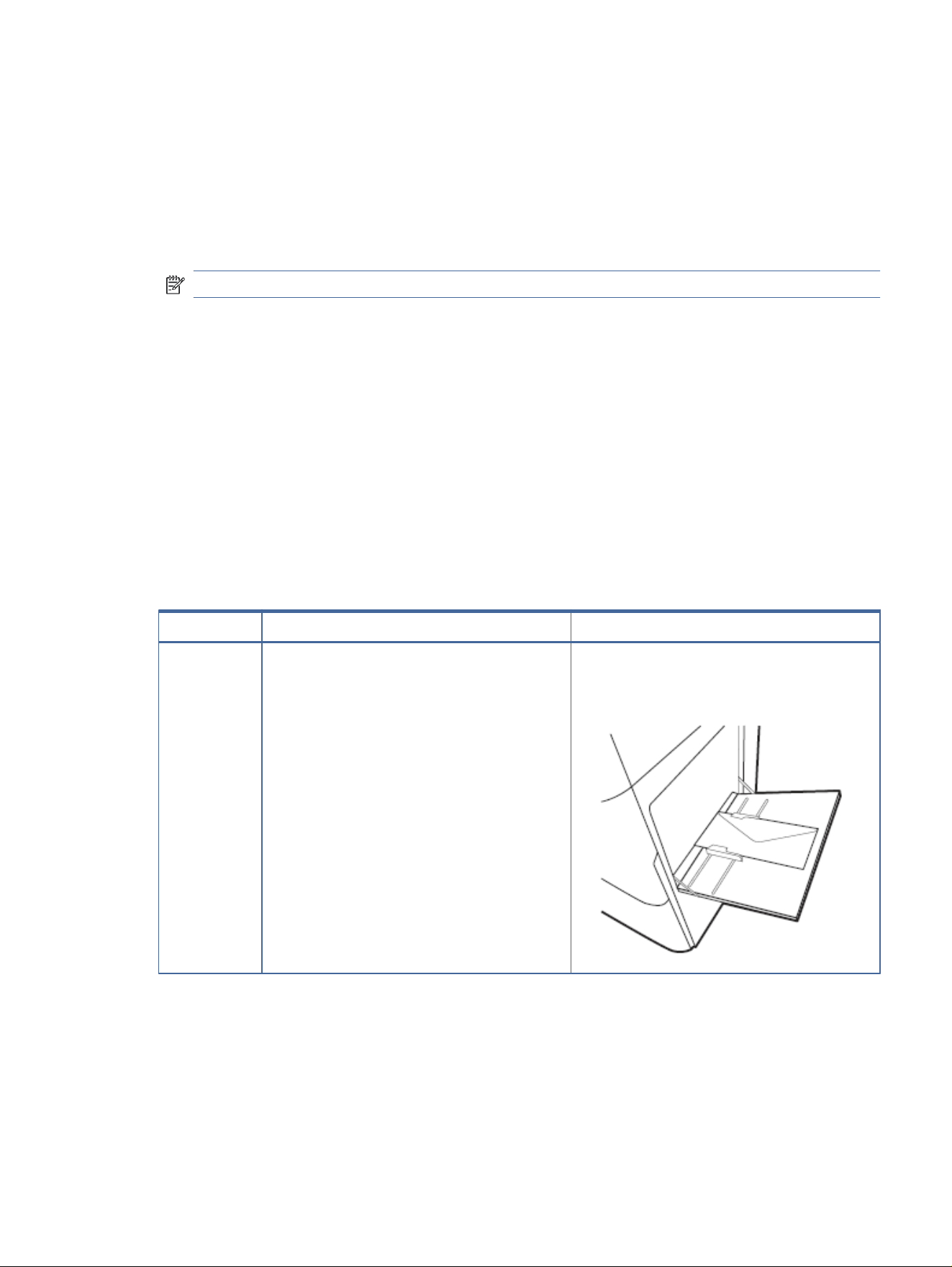
Print envelopes
To print envelopes using the manual feed option, follow these steps to select the correct settings in the
print driver, and then load the envelopes into the tray after sending the print job to the printer.
1. From the software program, select the Print option.
2. Select the printer from the list of printers, and then click the Properties or Preferences button to
open the print driver.
NOTE: The name of the button varies for different software programs.
3. Click the Paper/Quality tab.
4. In the Paper size drop-down list, select the correct size for the envelopes.
5. In the Paper type drop-down list, select Envelope.
6. In the Paper source drop-down list, select Manual feed.
7. Click the OK button to close the Document Properties dialog box.
8. In the Print dialog box, click the OK button to print the job.
Envelope orientation
Envelopes need to be loaded in a specific manner in order to print correctly.
Table 2-8
Envelope orientation
Tray Envelope size How to load envelopes
Tray 1 Envelope #9, Envelope #10, Envelope Monarch,
Envelope DL, Envelope B5, Envelope C5 (wallet),
Envelope C6
Face-down
Top edge toward the back of the printer
Print envelopes 29
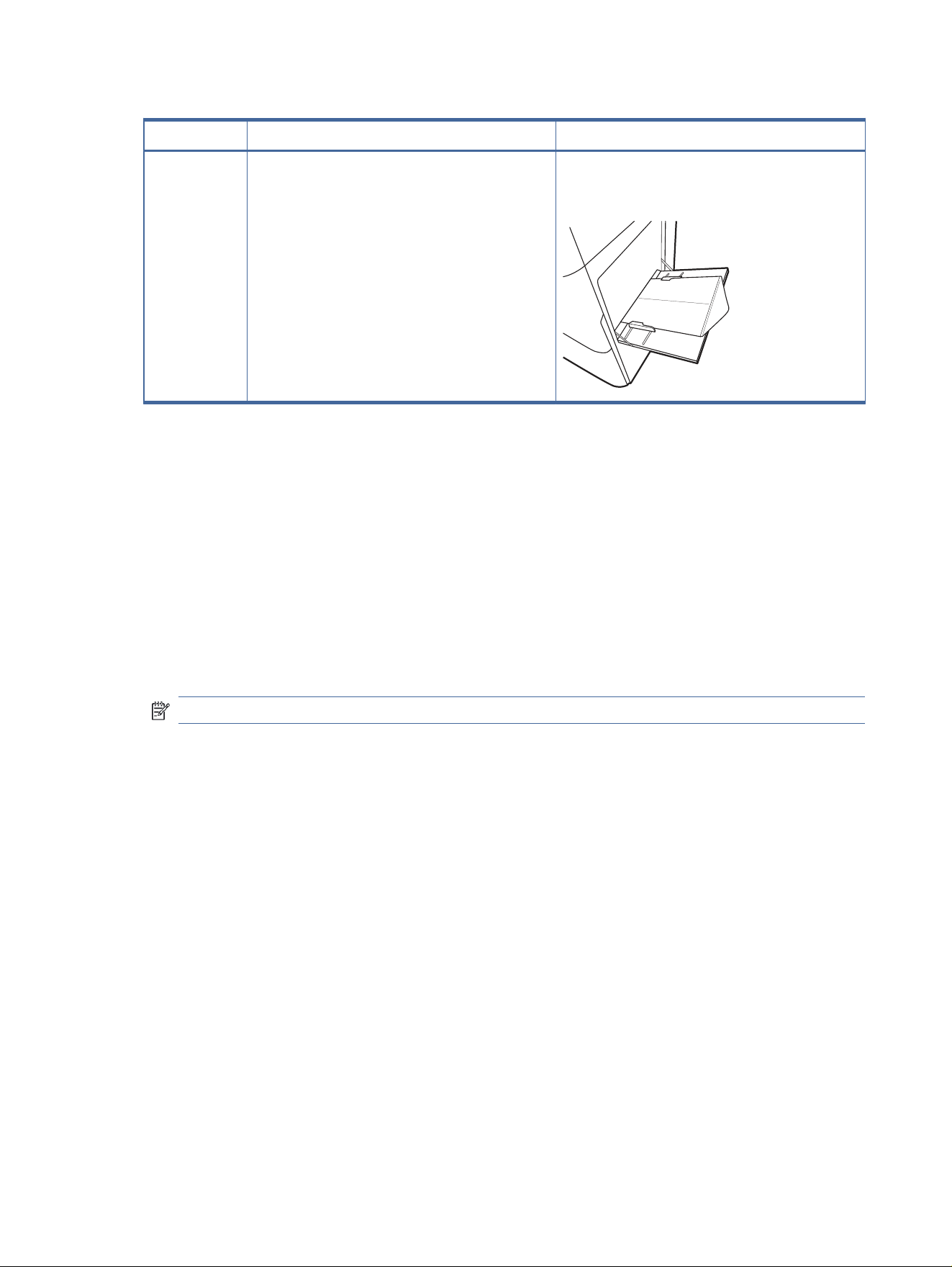
Table 2-8 Envelope orientation (continued)
Tray Envelope size How to load envelopes
Tray 1 Envelope B5, Envelope C5 (pocket) Face-down
Bottom edge leading into the printer; top flap open
Load and print labels
To print on sheets of labels, use only Tray 1 (multipurpose tray), Tray 2, Tray 3 and the optional 550-sheet
trays.
Manually feed labels
Use the manual feed mode for Tray 1 (multipurpose tray) to print sheets of labels.
1. From the software program, select the Print option.
2. Select the printer from the list of printers, and then click the Properties or Preferences button to
open the print driver.
NOTE: The name of the button varies for different software programs.
3. Click the Paper/Quality tab.
4. In the Paper size drop-down list, select the correct size for the sheets of labels.
5. In the Paper type drop-down list, select Labels.
6. In the Paper source drop-down list, select Manual feed.
7. Click the OK button to close the Document Properties dialog box.
8. In the Print dialog box, click the Print button to print the job.
Label orientation
Labels need to be loaded in a specific manner in order to print correctly.
30
Chapter 2 Paper trays
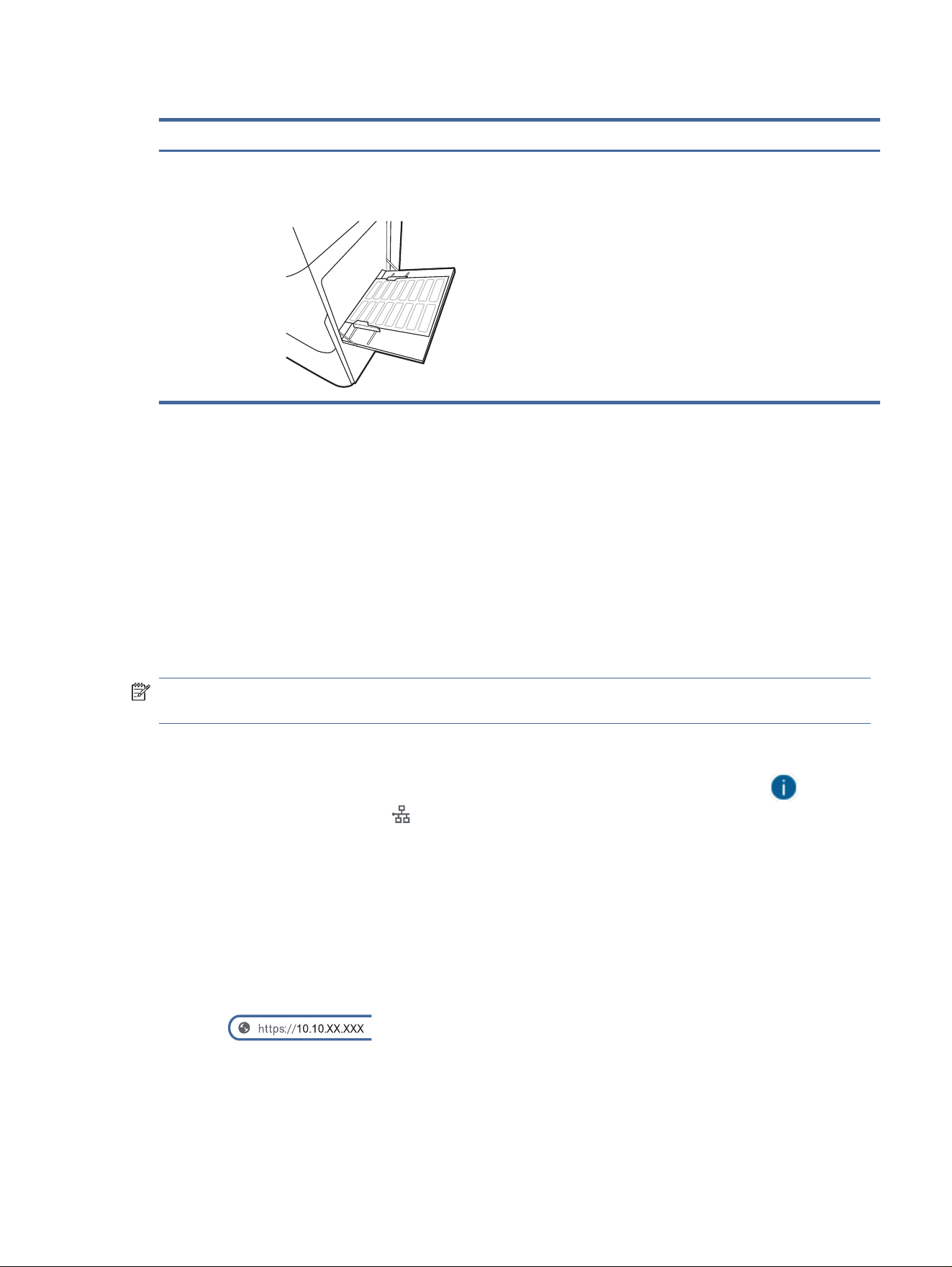
Table 2-9 Label orientation
Tray How to load labels
Tray 1 Face-down
Bottom edge leading into the printer
Configure the stapler/stacker and select staple options
Learn how to configure the stapler/stacker and select the staple options.
Configure the default staple location using the Embedded Web Server (EWS)
Use the printer's Embedded Web Server (EWS) to configure the default staple location for documents.
Refer to the Staple configurations section in this document to view the options available for the default
staple location.
Follow these steps to configure the default staple location from the printer's Embedded Web Server.
NOTE: Your printer must be connected to an IP-based network before you can access the Embedded
Web Server.
1. Obtain the printer's IP address using the printer control panel:
a. From the Home screen on the printer control panel, touch the Information icon , and then
touch the Network icon to display the printer's IP address or host name.
b. Make note of the IP address.
2. Open the Embedded Web Server (EWS):
a. On your computer, open a web browser.
b. In the browser address line, type the IP address or host name exactly as it displays on the
printer control panel.
Figure 2-1 Example of an IP address in a browser address bar
Configure the stapler/stacker and select staple options
31

c. Press the Enter key on the computer keyboard.
NOTE: If a message displays in the web browser indicating that the website might not be
safe, select the Advanced option to continue to the website. Accessing this website will not
harm the computer.
The EWS opens.
3. On the EWS Home page, on the top navigation bar, click Copy/Print.
4. In the left navigation pane, click Default Print Options.
5. In the Staple drop-down menu, select the staple location from the available options (listed below),
and then click Apply.
● None
● Top left
● Two left
● Two top
● Top right
● Two right
● Two top or left
Configure the operation mode for the stapler/stacker
Use the printer's Embedded Web Server (EWS) to configure the operation mode for the stapler/stacker.
The operation mode dictates how the printer sorts jobs into the output bins.
NOTE: Your printer must be connected to an IP-based network before you can access the Embedded
Web Server.
1. Obtain the printer's IP address using the printer control panel:
a. From the Home screen on the printer control panel, touch the Information icon , and then
touch the Network icon to display the printer's IP address or host name.
b. Make note of the IP address.
2. Open the Embedded Web Server (EWS):
a. On your computer, open a web browser.
b. In the browser address line, type the IP address or host name exactly as it displays on the
printer control panel.
Figure 2-2 Example of an IP address in a browser address bar
32
Chapter 2 Paper trays

c. Press the Enter key on the computer keyboard.
NOTE: If a message displays in the web browser indicating that the website might not be
safe, select the Advanced option to continue to the website. Accessing this website will not
harm the computer.
The EWS opens.
3. On the EWS Home page, on the top navigation bar, click Copy/Print.
4. In the left navigation pane, click Manage Stapler/Stacker.
5. In the Operation Mode drop-down menu, select the desired operation mode from the following
options:
● Function Separator: The printer places jobs in different bins according to the job type (print
jobs, copy jobs, or fax jobs).
● Mailbox: The printer places jobs in different bins according to the person who sent them.
● Mailbox/Stacker: The printer stacks jobs in the bins from bottom to top.
6. Click Apply at the bottom of the page to save the setting.
Select staple options (Windows)
Follow these steps to collate and staple when printing from a Windows application, using the Smart
Universal Print Driver (sUPD).
1. From the software application, click File, and then click Print.
2. Select the printer, and then click Printer Properties or Preferences.
3. Click the Finishing tab.
4. In the Staple drop-down menu, select the staple location.
5. Click the OK button to close the dialog, and then click Print.
Select staple options (macOS)
Follow these steps to select the staple location when printing from a macOS application, using an HP
print driver.
1. From the software program, click the File menu, and then click the Print option.
2. In the Printer drop-down menu, select the appropriate printer.
3. Open the menu's drop-down list, or click Show Details, and then select Finishing.
4. In the Staple drop-down menu, select the desired staple location.
5. Click the Print button.
Staple configurations
The tables below show the staple locations that can be configured when using an optional finisher
accessory.
Select staple options (Windows)
33
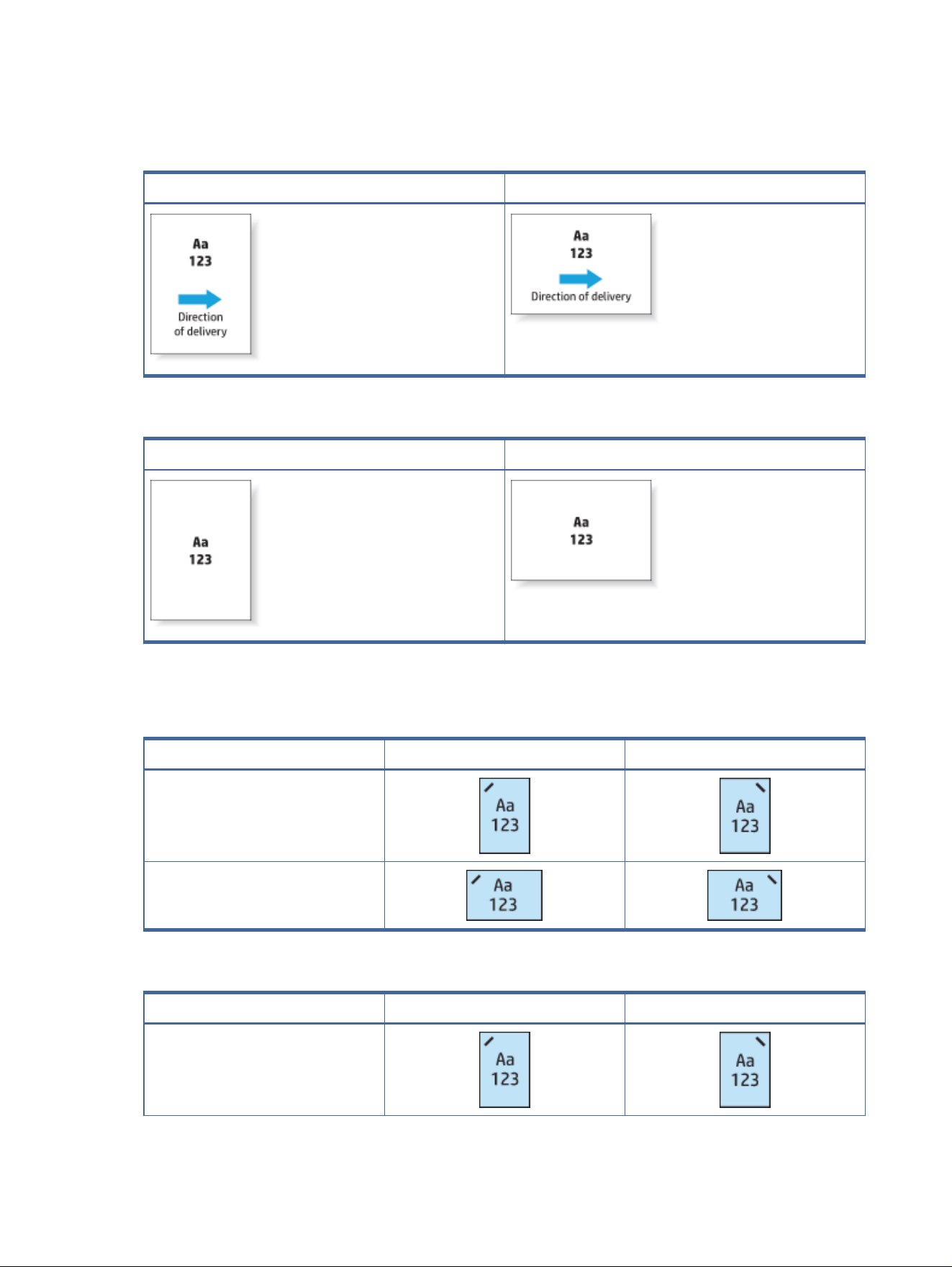
The output result depends on the document orientation and feed orientation. Feed orientation is the
direction that you load the paper in the tray.
Table 2-10 Long or short edge feed orientation
Long edge feed orientation Short edge feed orientation
Table 2-11 Portrait or landscape document orientation
Portrait document orientation Landscape document orientation
The following tables show the staple configurations for different feed orientations.
Table 2-12
One staple - Long edge tray feed orientation
Orientation One staple left One staple right
Portrait
Landscape
Table 2-13 One staple - Short edge tray feed orientation
Orientation One staple left One staple right
Portrait
34 Chapter 2 Paper trays
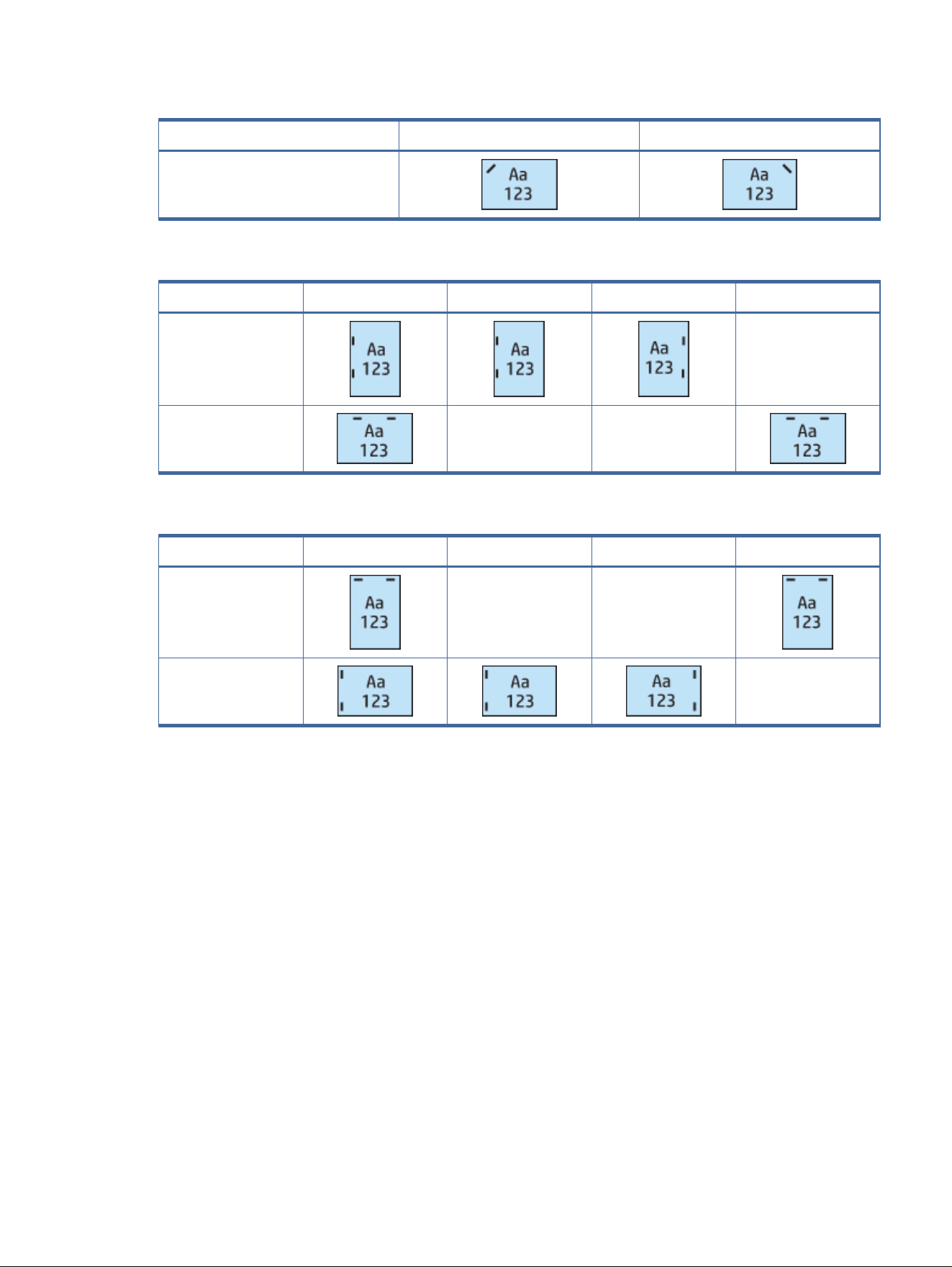
Table 2-13 One staple - Short edge tray feed orientation (continued)
Orientation One staple left One staple right
Landscape
Table 2-14 Two staples - Long edge tray feed orientation
Orientation Two staples top or left Two staples left Two staples right Two staples top
Portrait Not supported
Landscape Not supported Not supported
Table 2-15 Two staples - Short edge tray feed orientation
Orientation Two staples top or left Two staples left Two staples right Two staples top
Portrait Not supported Not supported
Landscape Not supported
Staple configurations 35

Supplies, accessories, and parts3
Order supplies or accessories, replace the toner cartridges, or remove and replace another part.
The following information is correct at the time of publication. For current information, see Support for
HP Color LaserJet Enterprise MFP 6800 or Support for HP Color LaserJet Enterprise MFP 6801.
HP's all-inclusive help for the printer includes the following information:
● Install and configure
● Learn and use
● Solve problems
● Download software and firmware updates
● Join support forums
● Find warranty and regulatory information
Order supplies, accessories, and parts
Find out how to obtain replacement supplies, accessories, and parts for the printer.
Ordering
Order parts, supplies, or accessories through one of the following channels.
Table 3-1
Ordering options
Ordering option Ordering information
Order supplies and paper www.hp.com
Order genuine HP parts or accessories www.hp.com/buy/parts
Order through service or support providers Contact an HP-authorized service or support provider.
Order using the HP Embedded Web Server (EWS) To access, in a supported web browser on your computer,
enter the printer IP address or host name in the address/URL
field. The EWS contains a link to the HP website, which
provides options for purchasing Original HP supplies.
Supplies and accessories
Find information about the supplies and accessories that are available for your printer.
NOTE: Cartridges are for distribution and use with their designated product only; they will not work
with other printer models.
36
Chapter 3 Supplies, accessories, and parts

Table 3-2 Supplies
Item Cartridge number Part number
HP 213A Black Original LaserJet Toner
Cartridge
213A W2130A
HP 213A Cyan Original LaserJet Toner
Cartridge
213A W2131A
HP 213A Yellow Original LaserJet Toner
Cartridge
213A W2132A
HP 213A Magenta Original LaserJet
Toner Cartridge
213A W2133A
HP 213X High Yield Black Original
LaserJet Toner Cartridge
213X W2130X
HP 213X High Yield Cyan Original
LaserJet Toner Cartridge
213X W2131X
HP 213X High Yield Yellow Original
LaserJet Toner Cartridge
213X W2132X
HP 213X High Yield Magenta Original
LaserJet Toner Cartridge
213X W2133X
HP 213Y Extra High Yield Black Original
LaserJet Toner Cartridge
213Y W2130Y
HP 213Y Extra High Yield Cyan Original
LaserJet Toner Cartridge
213Y W2131Y
HP 213Y Extra High Yield Yellow Original
LaserJet Toner Cartridge
213Y W2132Y
HP 213Y Extra High Yield Magenta
Original LaserJet Toner Cartridge
213Y W2133Y
HP 217Z Ultra High Yield Black Original
LaserJet Toner Cartridge
217Z W2170Z
HP 217Z Ultra High Yield Cyan Original
LaserJet Toner Cartridge
217Z W2171Z
HP 217Z Ultra High Yield Yellow Original
LaserJet Toner Cartridge
217Z W2172Z
HP 217Z Ultra High Yield Magenta
Original LaserJet Toner Cartridge
217Z W2173Z
HP Staple cartridge pack for the
convenience stapler - contains two
staple cartridges with 1500 staples each
Not applicable Q7432A
HP Staple Cartridge Refill for the floor-
standing fnisher or 3-bin stapler/stacker
Not applicable J8J96A
Table 3-3 Accessories
Item Description Part number
HP Color LaserJet 550-sheet Paper Tray Optional (Tray 3) 550-sheet paper feeder 6QN57A
HP LaserJet 2100 Sheet Paper Tray Optional 2,100-sheet high-capacity
paper feeder and stand
6QN58A
Supplies and accessories 37

Table 3-3 Accessories (continued)
Item Description Part number
HP Color LaserJet Storage Stand Optional printer stand with storage
space
6QN55A
HP Color LaserJet Stand Optional printer stand 6QN54A
HP MFP Analog Fax 702 Accessory Optional fax accessory 1M0Q0A
HP MFP Analog Fax 703 Accessory Optional fax accessory
NOTE: Available in Korea only.
1M0Q1A
HP LaserJet Workflow Accelerator Card Accelerator card 1M0Q5A
HP Printing Voice Assistant Accessory to add voice command and
screen reader functions to the printer
478C2A
HP Accessibility Kit Accessibility tools including an
accessible keyboard, prop handle, and
braille labels
2TD64A
HP Internal USB Expansion Kit Two optional USB ports for connecting
third-party devices
4XN67A
HP Jetdirect LAN Accessory HP Jetdirect accessory for network
connectivity
8FP31A
HP Foreign Interface Harness Optional port for connecting third-party
devices
B5L31A
HP LaserJet Workflow Keyboard - US External keyboard for Flow models only 1M0Q2A
HP LaserJet Workflow Keyboard - UK External keyboard for Flow models only 616H2A
HP LaserJet Keyboard Overlay Kit for
Simplified Chinese & Traditional Chinese
Language-specific, adhesive overlay for
the physical keyboard
A7W12A
HP LaserJet Keyboard
Overlay Kit-Danish/French-Switzerland/
German-Switzerland
Language-specific, adhesive overlay for
the physical keyboard
A7W13A
HP LaserJet Swedish Overlay Keyboard Language-specific, adhesive overlay for
the physical keyboard
A7W14A
HP USB Universal Card Reader Multiple-protocol proximity card reader X3D03A
HP HIP2 Keystroke Reader Dual-band, keystroke card reader that
can read up to four different card types
simultaneously
Y7C05A
HP Legic Secure USB Reader Authentication card reader 4QL32A
HP Removable Hard Drive Enclosure Hard drive enclosure that can be locked 2NR12A
HP LaserJet Secure Solid State Drive Solid state hard drive 1M0Q4A
HP 500GB CCC FIPS Hard Disk Drive Hard disk drive 9EQ11A
HP 500GB CCC FIPS TAA Hard Disk
Drive
TAA-compliant hard disk drive 6HN31A
HP Jetdirect 3100w BLE/NFC/Wireless HP Jetdirect accessory for Wi-Fi, BLE,
NFC, and proximity badge reading
3JN69A
38 Chapter 3 Supplies, accessories, and parts

Customer self-repair parts
Customer self-repair (CSR) parts are available for many HP LaserJet printers to reduce repair time.
NOTE: More information about the CSR program and benefits can be found at www.hp.com/go/csr-
support and www.hp.com/go/csr-faq.
Genuine HP replacement parts can be ordered at www.hp.com/buy/parts or by contacting an HP-
authorized service or support provider. When ordering, one of the following will be needed: part number,
serial number (found on back of printer), product number, or printer name.
● Parts listed as Mandatory self-replacement are to be installed by the customer unless the customer
is willing to pay HP service personnel to perform the repair. For these parts, on-site or return-to-
depot support is not provided under the HP printer warranty.
● Parts listed as Optional self-replacement can be installed by HP service personnel at your request
for no additional charge during the printer warranty period.
Table 3-4
Customer self-repair (CSR) parts
Item Description Self-replacement
options
Part number
550-sheet paper input tray Replacement cassette for Tray 2 Mandatory RM2-3615-000CN
HP Color LaserJet 550 sheet Paper
Tray
550-sheet paper feeder (optional
Tray 3)
Mandatory 6QN57A
Configure the HP toner-cartridge-protection supply settings
A network administrator can configure the toner-cartridge-protection settings using the printer control
panel or the HP Embedded Web Server (EWS).
Introduction
Use HP Cartridge Policy and Cartridge Protection to control which cartridges are installed in the printer
and protect the cartridges that are installed from theft.
In HP Web Jetadmin, the settings are located under the Device Management pane in the following menu
chain: Config > Supplies > Cartridge Policy or Cartridge Protection.
● Cartridge Policy: This feature protects the printer from counterfeit toner cartridges by allowing
only genuine HP cartridges to be used with the printer. Using genuine HP cartridges ensures the
best possible print quality. When someone installs a cartridge that is not a genuine HP cartridge,
the printer control panel displays a message that the cartridge is unauthorized and it provides
information explaining how to proceed.
Customer self-repair parts
39

● Cartridge Protection: This feature permanently associates toner cartridges with a specific printer,
or fleet of printers, so they cannot be used in other printers. Protecting cartridges protects your
investment. When this feature is enabled, if someone attempts to transfer a protected cartridge
from the original printer into an unauthorized printer, that printer will not print with the protected
cartridge. The printer control panel displays a message that the cartridge is protected, and it
provides information explaining how to proceed.
CAUTION: After enabling cartridge protection for the printer, all subsequent toner cartridges
installed in the printer are automatically and
permanently
protected. To avoid protecting a new
cartridge, disable the feature
before
installing the new cartridge.
Turning the feature off does not turn off protection for cartridges that are currently installed.
Enable or disable the Cartridge Policy feature
The Cartridge Policy feature can be enabled or disabled using the control panel or the Embedded Web
Server (EWS).
NOTE: Enabling or disabling this feature might require entering an administrator password.
Check with your administrator to determine if an administrator password has been set. EWS
passwords cannot be recovered.
Use the printer control panel to enable the Cartridge Policy feature
From the printer control panel, a network administrator can enable the Cartridge Policy feature. This
allows only genuine HP cartridges to be used with the printer.
1. From the Home screen on the printer control panel, navigate to the Settings application, and then
select the Settings icon.
2. Open the following menus:
a. Manage Supplies
b. Cartridge Policy
3. Select Authorized HP.
Use the printer control panel to disable the Cartridge Policy feature
From the printer control panel, a network administrator can disable the Cartridge Policy feature. This
removes the restriction that only genuine HP cartridges can be used.
1. From the Home screen on the printer control panel, navigate to the Settings application, and then
select the Settings icon.
2. Open the following menus:
a. Manage Supplies
b. Cartridge Policy
3. Select Off.
40
Chapter 3 Supplies, accessories, and parts
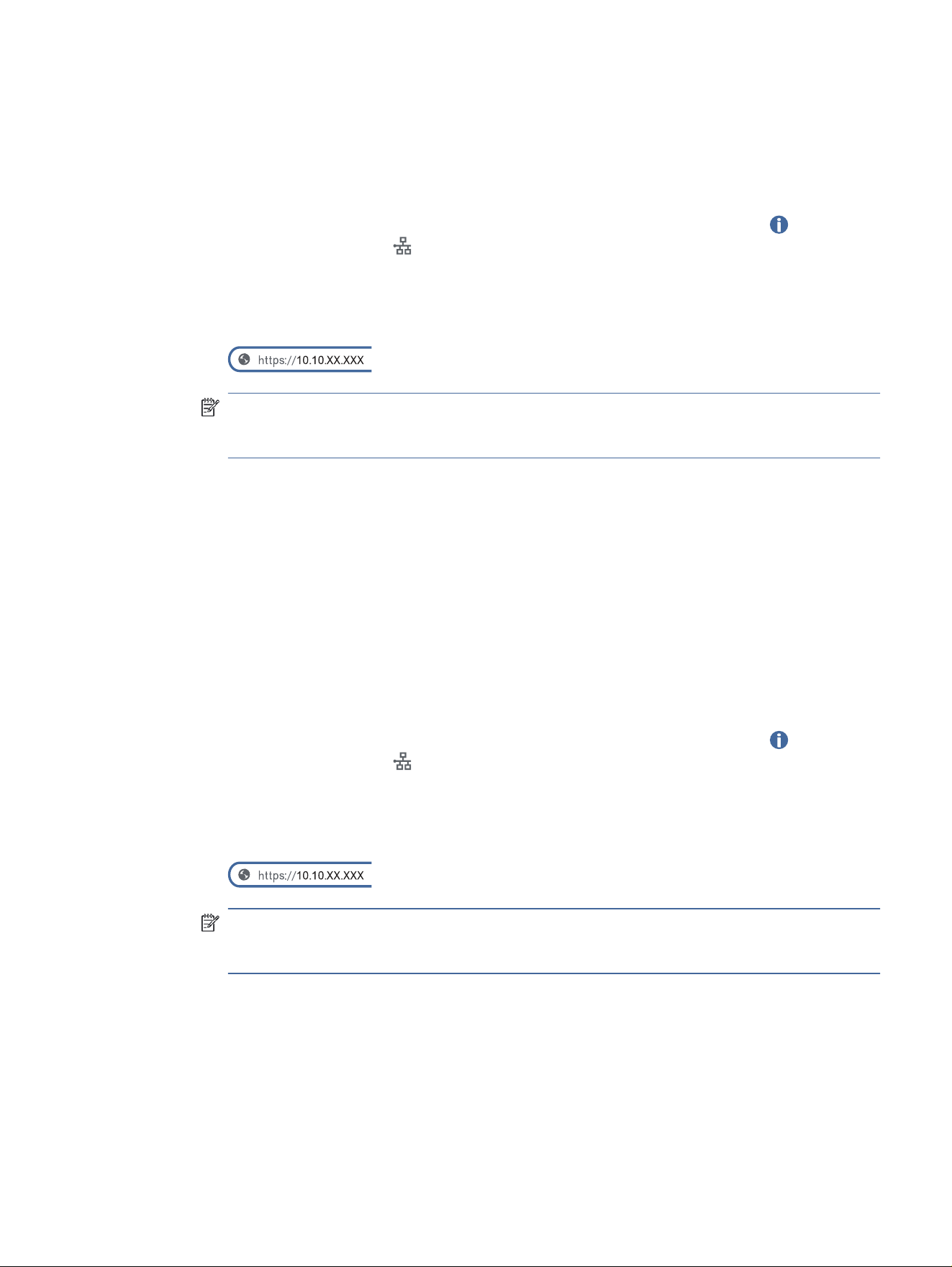
Use the HP Embedded Web Server (EWS) to enable the Cartridge Policy feature
From the EWS, a network administrator can enable the Cartridge Policy feature. This allows only genuine
HP cartridges to be used with the printer.
1. Open the HP Embedded Web Server (EWS):
a. From the Home screen on the printer control panel, touch the Information icon , and then
touch the Ethernet icon to display the IP address or host name.
b. Open a web browser, and in the address line, type the IP address or host name exactly as
it displays on the printer control panel. Press the Enter key on the computer keyboard. The
EWS opens.
NOTE: If the web browser displays a message indicating that accessing the website might
not be safe, select the option to continue to the website. Accessing this website will not harm
the computer.
2. Open the Copy/Print tab.
3. From the left navigation pane, select Manage Supplies.
4. In the Supply Settings area, select Authorized HP from the Cartridge Policy drop-down list.
5. Click the Apply button to save the changes.
Use the HP Embedded Web Server (EWS) to disable the Cartridge Policy feature
From the EWS, a network administrator can disable the Cartridge Policy feature. This removes the
restriction that only genuine HP cartridges can be used.
1. Open the HP Embedded Web Server (EWS):
a. From the Home screen on the printer control panel, touch the Information icon , and then
touch the Ethernet icon to display the IP address or host name.
b. Open a web browser, and in the address line, type the IP address or host name exactly as
it displays on the printer control panel. Press the Enter key on the computer keyboard. The
EWS opens.
NOTE: If the web browser displays a message indicating that accessing the website might
not be safe, select the option to continue to the website. Accessing this website will not harm
the computer.
2. Open the Copy/Print tab.
3. From the left navigation pane, select Manage Supplies.
4. In the Supply Settings area, select Off from the Cartridge Policy drop-down list.
5. Click the Apply button to save the changes.
Use the HP Embedded Web Server (EWS) to enable the Cartridge Policy feature
41

Troubleshoot Cartridge Policy control panel error messages
Review the recommended actions for Cartridge Policy error messages.
Table 3-5 Cartridge Policy control panel error messages
Error message Description Recommended action
10.0X.30 Unauthorized <Color> Cartridge The administrator has configured this
printer to use only genuine HP supplies
that are still under warranty. The
cartridge must be replaced to continue
printing.
Replace the cartridge with a genuine HP
toner cartridge.
If you believe you purchased a
genuine HP supply, visit www.hp.com/go/
anticounterfeit to determine if the toner
cartridge is a genuine HP cartridge, and
learn what to do if it is not a genuine HP
cartridge.
Enable or disable the Cartridge Protection feature
The Cartridge Protection feature can be enabled or disabled using the control panel or the Embedded
Web Server (EWS).
NOTE: Enabling or disabling this feature might require entering an administrator password.
Check with your administrator to determine if an administrator password has been set. EWS
passwords cannot be recovered.
Use the printer control panel to enable the Cartridge Protection feature
From the printer control panel, a network administrator can enable the Cartridge Protection feature. This
protects the cartridges associated with the printer from being stolen and used in other printers.
1. From the Home screen on the printer control panel, navigate to the Settings application, and then
select the Settings icon.
2. Open the following menus:
a. Manage Supplies
b. Cartridge Protection
3. Select Protect Cartridges.
4. When the printer prompts to confirm, select Continue to enable the feature.
CAUTION: After enabling cartridge protection for the printer, all subsequent toner cartridges
installed in the printer are automatically and
permanently
protected. To avoid protecting a new
cartridge, disable the feature
before
installing the new cartridge.
Turning the feature off does not turn off protection for cartridges that are currently installed.
Use the printer control panel to disable the Cartridge Protection feature
From the printer control panel, a network administrator can disable the Cartridge Protection feature.
This removes protection for any new cartridges installed in the printer.
1. From the Home screen on the printer control panel, navigate to the Settings application, and then
select the Settings icon.
42
Chapter 3 Supplies, accessories, and parts
2. Open the following menus:
a. Manage Supplies
b. Cartridge Protection
3. Select Off.
Use the HP Embedded Web Server (EWS) to enable the Cartridge Protection feature
From the EWS, a network administrator can enable the Cartridge Protection feature. This protects the
cartridges associated with the printer from being stolen and used in other printers.
1. Open the HP Embedded Web Server (EWS):
a. From the Home screen on the printer control panel, touch the Information icon , and then
touch the Ethernet icon to display the IP address or host name.
b. Open a web browser, and in the address line, type the IP address or host name exactly as
it displays on the printer control panel. Press the Enter key on the computer keyboard. The
EWS opens.
NOTE: If the web browser displays a message indicating that accessing the website might
not be safe, select the option to continue to the website. Accessing this website will not harm
the computer.
2. Open the Copy/Print tab.
3. From the left navigation pane, select Manage Supplies.
4. In the Supply Settings area, select Protect cartridges from the Cartridge Protection drop-down list.
5. Click the Apply button to save the changes.
CAUTION: After enabling cartridge protection for the printer, all subsequent toner cartridges
installed in the printer are automatically and
permanently
protected. To avoid protecting a new
cartridge, disable the feature
before
installing the new cartridge.
Turning the feature off does not turn off protection for cartridges that are currently installed.
Use the HP Embedded Web Server (EWS) to disable the Cartridge Protection feature
From the EWS, a network administrator can disable the Cartridge Protection feature. This removes
protection for any new cartridges installed in the printer.
1. Open the HP Embedded Web Server (EWS):
a. From the Home screen on the printer control panel, touch the Information icon , and then
touch the Ethernet icon to display the IP address or host name.
b. Open a web browser, and in the address line, type the IP address or host name exactly as
it displays on the printer control panel. Press the Enter key on the computer keyboard. The
EWS opens.
Use the HP Embedded Web Server (EWS) to enable the Cartridge Protection feature
43

NOTE: If the web browser displays a message indicating that accessing the website might
not be safe, select the option to continue to the website. Accessing this website will not harm
the computer.
2. Open the Copy/Print tab.
3. From the left navigation pane, select Manage Supplies.
4. In the Supply Settings area, select Off from the Cartridge Protection drop-down list.
5. Click the Apply button to save the changes.
Troubleshoot Cartridge Protection control panel error messages
Review the recommended actions for Cartridge Protection error messages.
Table 3-6
Cartridge Protection control panel error messages
Error message Description Recommended action
10.0X.57 Protected <Color> Cartridge The cartridge can only be used in
the printer or fleet of printers that
initially protected it using HP Cartridge
Protection.
The Cartridge Protection feature allows
an administrator to restrict cartridges
to work in only one printer or fleet of
printers. The cartridge must be replaced
to continue printing.
Replace the cartridge with a new toner
cartridge.
Replace the toner cartridges
Replace the toner cartridges if you receive a message on the printer, or if you have print quality
problems.
Toner cartridge information
Review details about ordering replacement toner cartridges.
The printer indicates when the toner-cartridge level is low and very low. The actual toner cartridge life
remaining can vary. Consider having a replacement cartridge available to install when print quality is no
longer acceptable.
Continue printing with the current cartridge until redistributing the toner no longer yields acceptable
print quality. To redistribute the toner, remove the toner cartridge from the printer and gently rock
the cartridge back and forth end to end. For graphical representation, see the cartridge replacement
instructions. Reinsert the toner cartridge into the printer, and then close the cover.
To purchase cartridges or check cartridge compatibility for the printer, go to www.hp.com/go/
suresupply. Scroll to the bottom of the page and verify that the country/region is correct.
Table 3-7
Supplies
Item Cartridge number Part number
HP 213A Black Original LaserJet Toner
Cartridge
213A W2130A
44 Chapter 3 Supplies, accessories, and parts

Table 3-7 Supplies (continued)
Item Cartridge number Part number
HP 213A Cyan Original LaserJet Toner
Cartridge
213A W2131A
HP 213A Yellow Original LaserJet Toner
Cartridge
213A W2132A
HP 213A Magenta Original LaserJet
Toner Cartridge
213A W2133A
HP 213X High Yield Black Original
LaserJet Toner Cartridge
213X W2130X
HP 213X High Yield Cyan Original
LaserJet Toner Cartridge
213X W2131X
HP 213X High Yield Yellow Original
LaserJet Toner Cartridge
213X W2132X
HP 213X High Yield Magenta Original
LaserJet Toner Cartridge
213X W2133X
HP 213Y Extra High Yield Black Original
LaserJet Toner Cartridge
213Y W2130Y
HP 213Y Extra High Yield Cyan Original
LaserJet Toner Cartridge
213Y W2131Y
HP 213Y Extra High Yield Yellow Original
LaserJet Toner Cartridge
213Y W2132Y
HP 213Y Extra High Yield Magenta
Original LaserJet Toner Cartridge
213Y W2133Y
HP 217Z Ultra High Yield Black Original
LaserJet Toner Cartridge
217Z W2170Z
HP 217Z Ultra High Yield Cyan Original
LaserJet Toner Cartridge
217Z W2171Z
HP 217Z Ultra High Yield Yellow Original
LaserJet Toner Cartridge
217Z W2172Z
HP 217Z Ultra High Yield Magenta
Original LaserJet Toner Cartridge
217Z W2173Z
NOTE: High-yield toner cartridges contain more toner than standard cartridges for increased page
yield. For more information, go to www.hp.com/go/toneryield.
Do not remove the toner cartridge from its package until it is time to replace it.
CAUTION: To prevent damage to the toner cartridge, do not expose it to light for more than a few
minutes. Cover the green imaging drum if the toner cartridge must be removed from the printer for an
extended period of time.
The following illustration shows the toner cartridge components.
Toner cartridge information
45
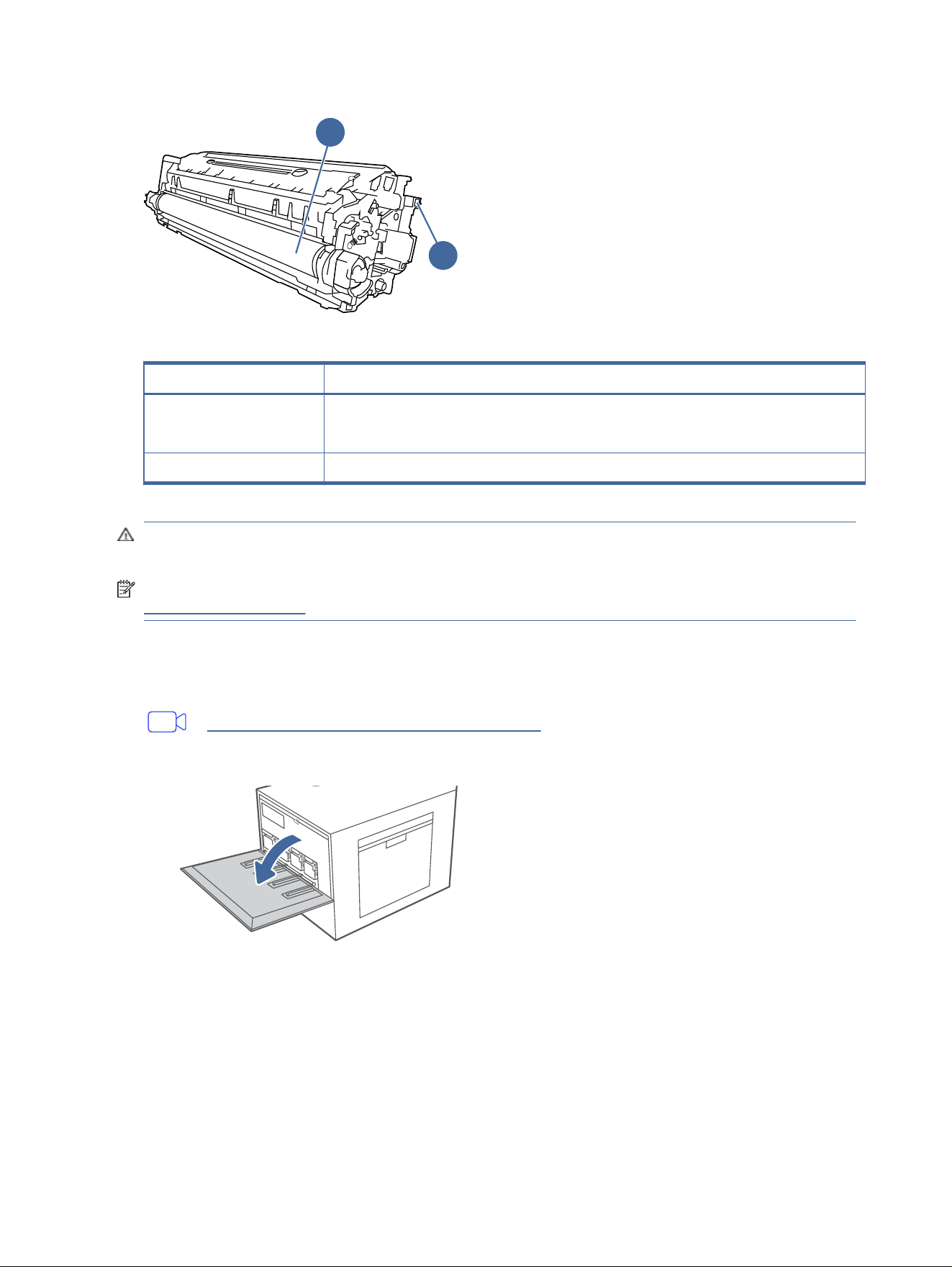
Figure 3-1 Toner cartridge components
1
2
Table 3-8 Toner cartridge components
Callout Description
1 Imaging drum
CAUTION: Do not touch the imaging drum. Fingerprints can cause print-quality problems.
2 Memory chip
CAUTION: If toner gets on clothing, wipe it off by using a dry cloth and wash the clothes in cold water.
Hot water sets toner into fabric.
NOTE: Information about recycling used toner cartridges is in the toner cartridge box or at
www.hp.com/hprecycle.
Remove and replace the toner cartridge
Follow these steps to replace the toner cartridge.
View a video of how to replace a toner cartridge
1. Open the front door.
46
Chapter 3 Supplies, accessories, and parts
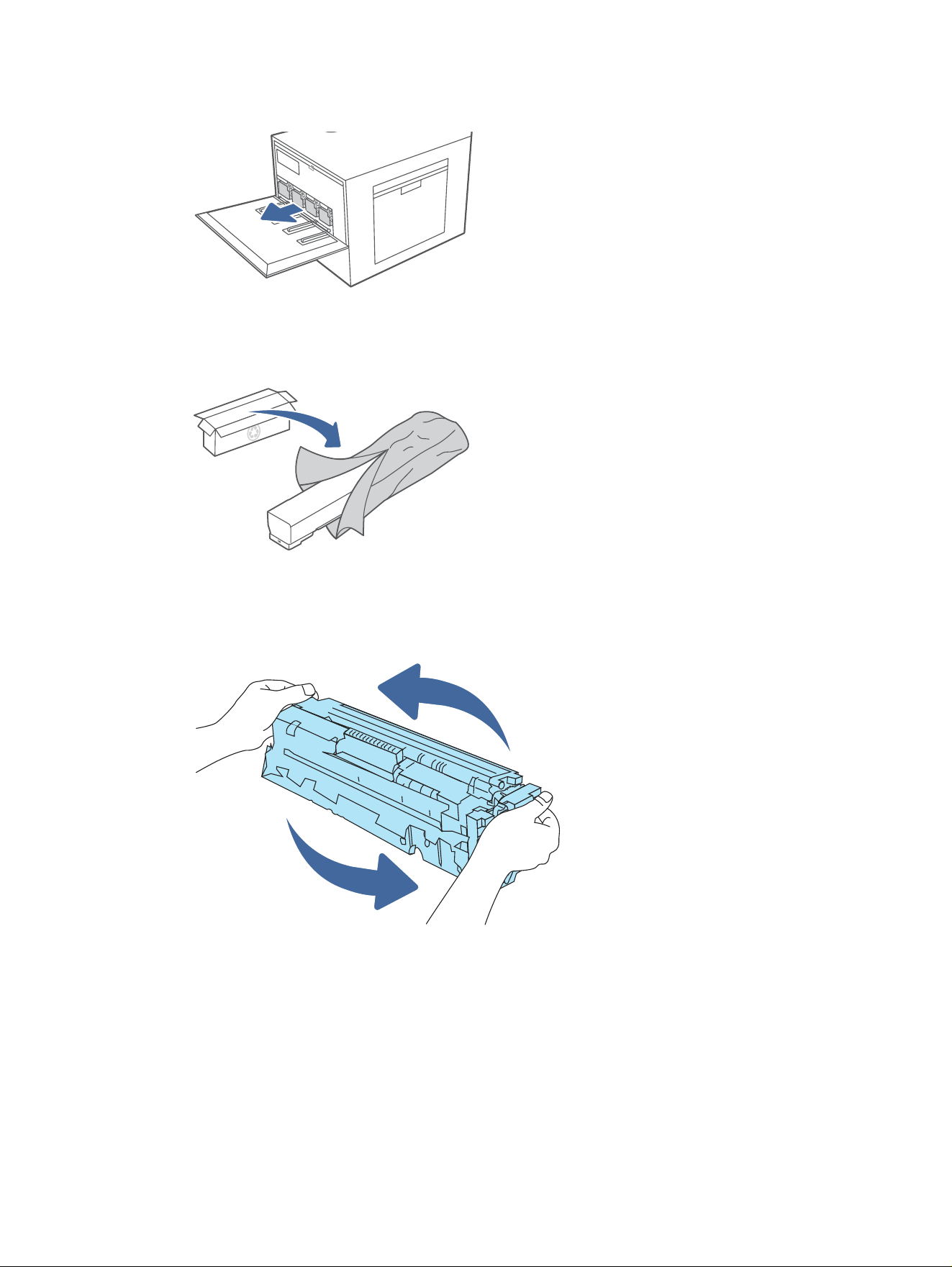
2. Grasp the end of the toner cartridge and pull it straight out of the printer.
3. Remove the new toner cartridge from its package. Save all packaging for recycling the used toner
cartridge.
4. Hold both ends of the toner cartridge and rock it back and forth end to end to evenly distribute the
toner that is inside.
Remove and replace the toner cartridge
47
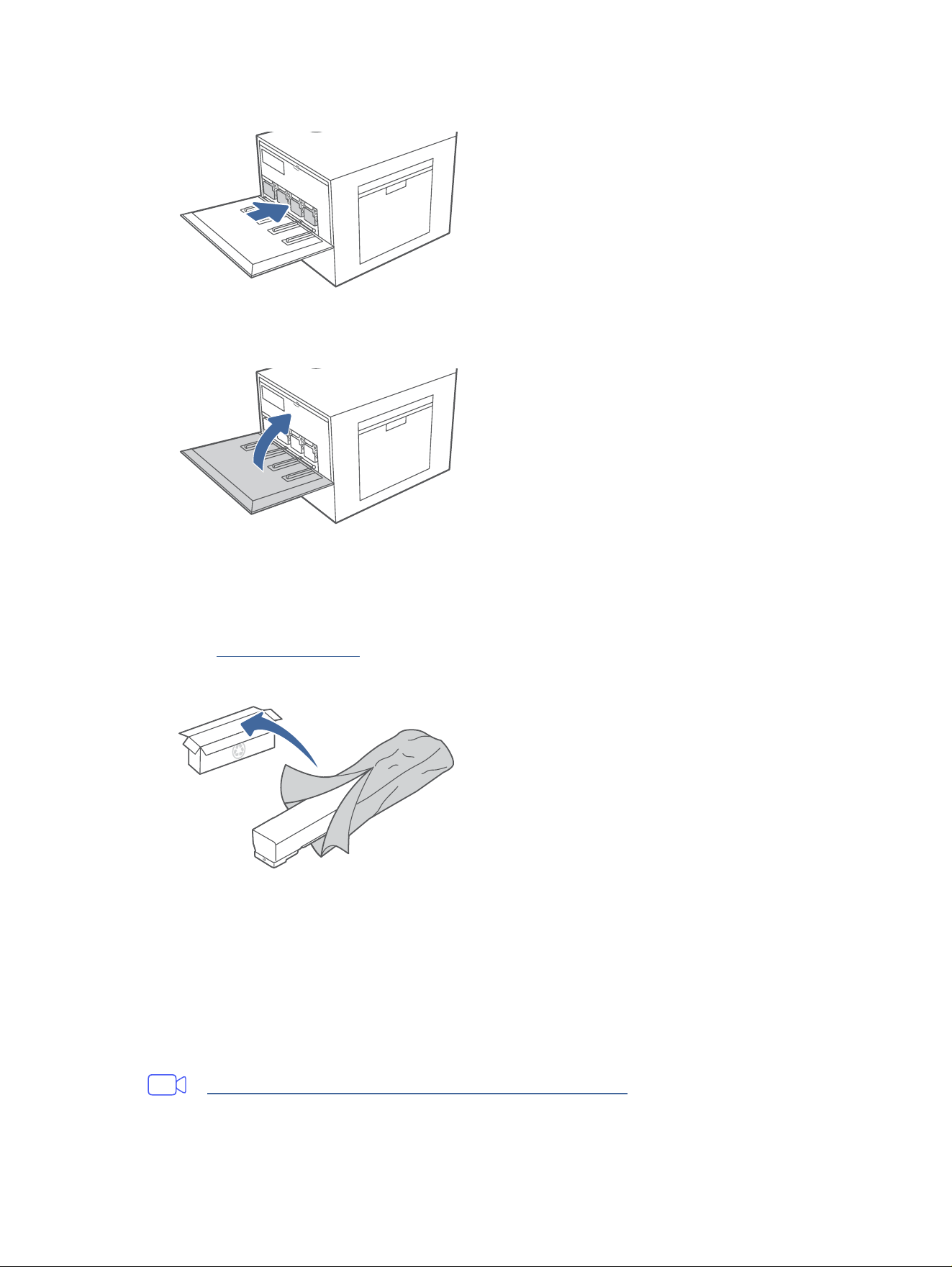
5. Align the toner cartridge with its slot and insert it into the printer.
6. Close the front door.
7. Pack the used toner cartridge into the box that the new toner cartridge came in. See the enclosed
recycling guide for information about recycling.
In the U.S. and Canada, a pre-paid shipping label is included in the box. In other countries/regions,
go to www.hp.com/recycle to print a pre-paid shipping label.
Adhere the pre-paid shipping label to the box, and return the used cartridge to HP for recycling.
Replace the toner collection unit (TCU)
Replace the toner collection unit if you receive a message on the printer, or if you have print quality
problems.
Replace the toner collection unit (TCU)
Follow these steps to replace the toner collection unit (TCU).
View a video of how to replace the toner collection unit (TCU)
48
Chapter 3 Supplies, accessories, and parts
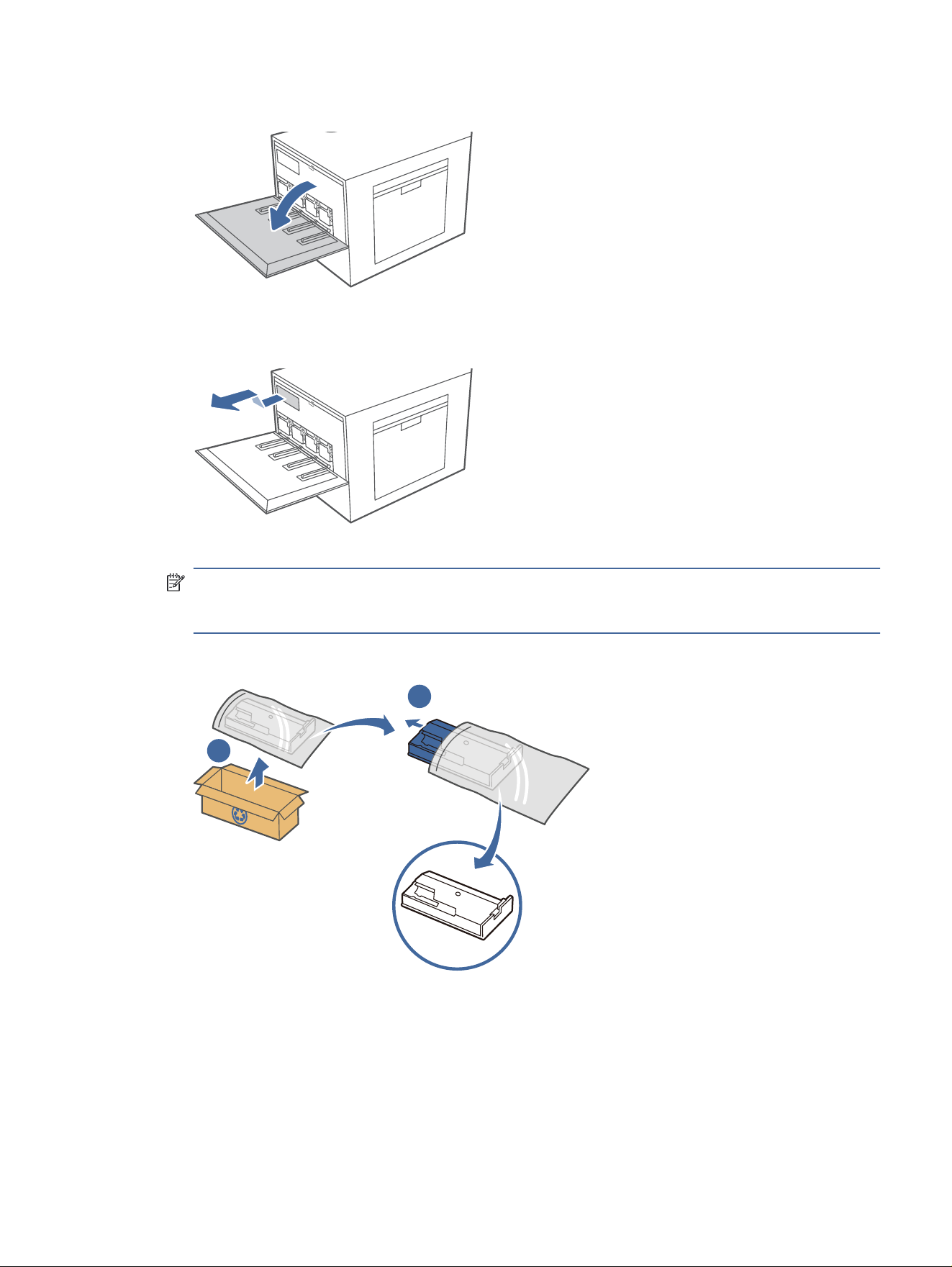
1. Open the front door.
2. Lift the TCU slightly and then pull it out of the printer.
NOTE: Maintain the position of the TCU as you pull it out from the printer. This will ensure that you
do not spill any waste toner in the printer. Place the unit into the clear plastic bag the new TCU was
packaged in.
3. Remove the new TCU from its package. Save all packaging for recycling the used TCU.
1
2
Replace the toner collection unit (TCU)
49
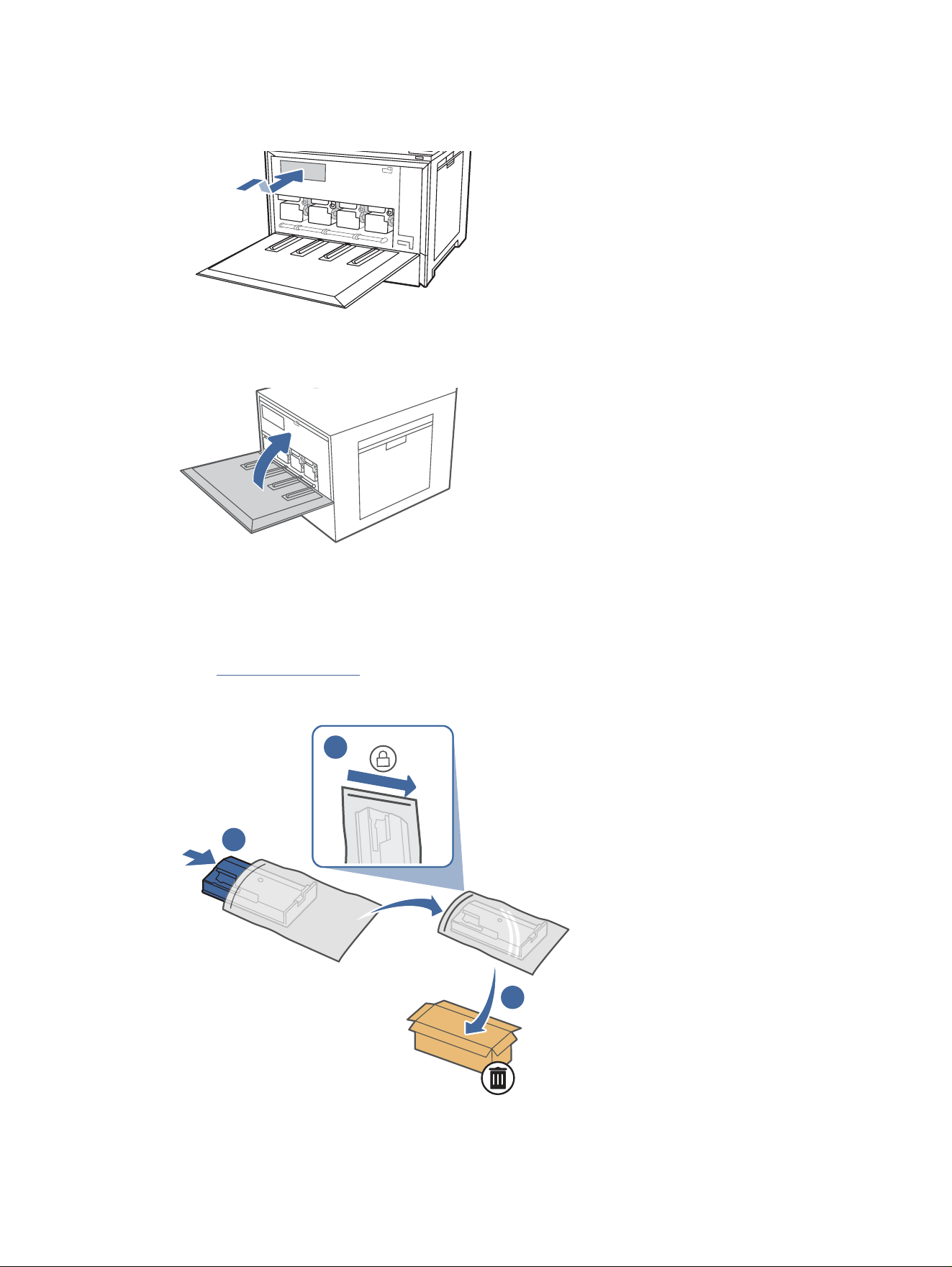
4. Install the new TCU by inserting it into the printer, and then lifting slightly to make sure it pushes all
the way in.
5. Close the front door.
6. Pack the used TCU into the box that the new TCU came in. See the enclosed recycling guide for
information about recycling.
In the U.S. and Canada, a pre-paid shipping label is included in the box. In other countries/regions,
go to www.hp.com/recycle to print a pre-paid shipping label.
Adhere the pre-paid shipping label to the box, and return the used TCU to HP for recycling.
1
3
2
50
Chapter 3 Supplies, accessories, and parts
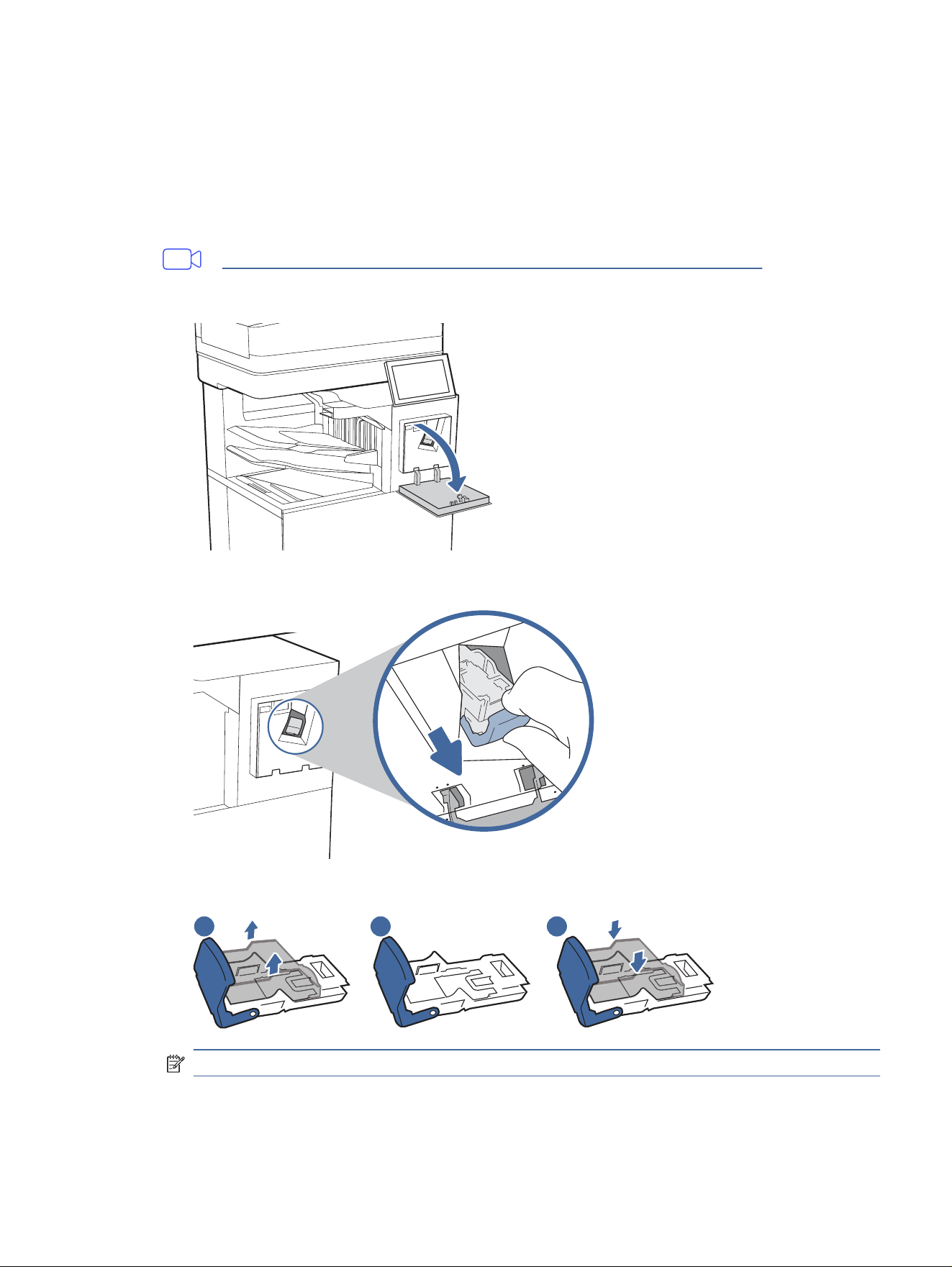
Replace the staple cartridge (stapler models only)
The following applies to models with staplers.
Remove and replace the staple cartridge in the 3-bin stapler/stacker
Use the steps below to remove and replace the staple cartridge in the 3-bin stapler/stacker.
View a video of how to replace the staple cartridge in the 3-bin stapler stacker
1. Open the 3-bin stapler/stacker staple door.
2. Pull down the colored handle on the staple carriage, and then pull the staple carriage straight out.
3. Remove the staple cartridge from the sled and replace it with the new staple cartridge.
1 2 3
NOTE: Do not dispose of the staple carrier/sled. The sled is not an orderable or replaceable part.
Replace the staple cartridge (stapler models only)
51
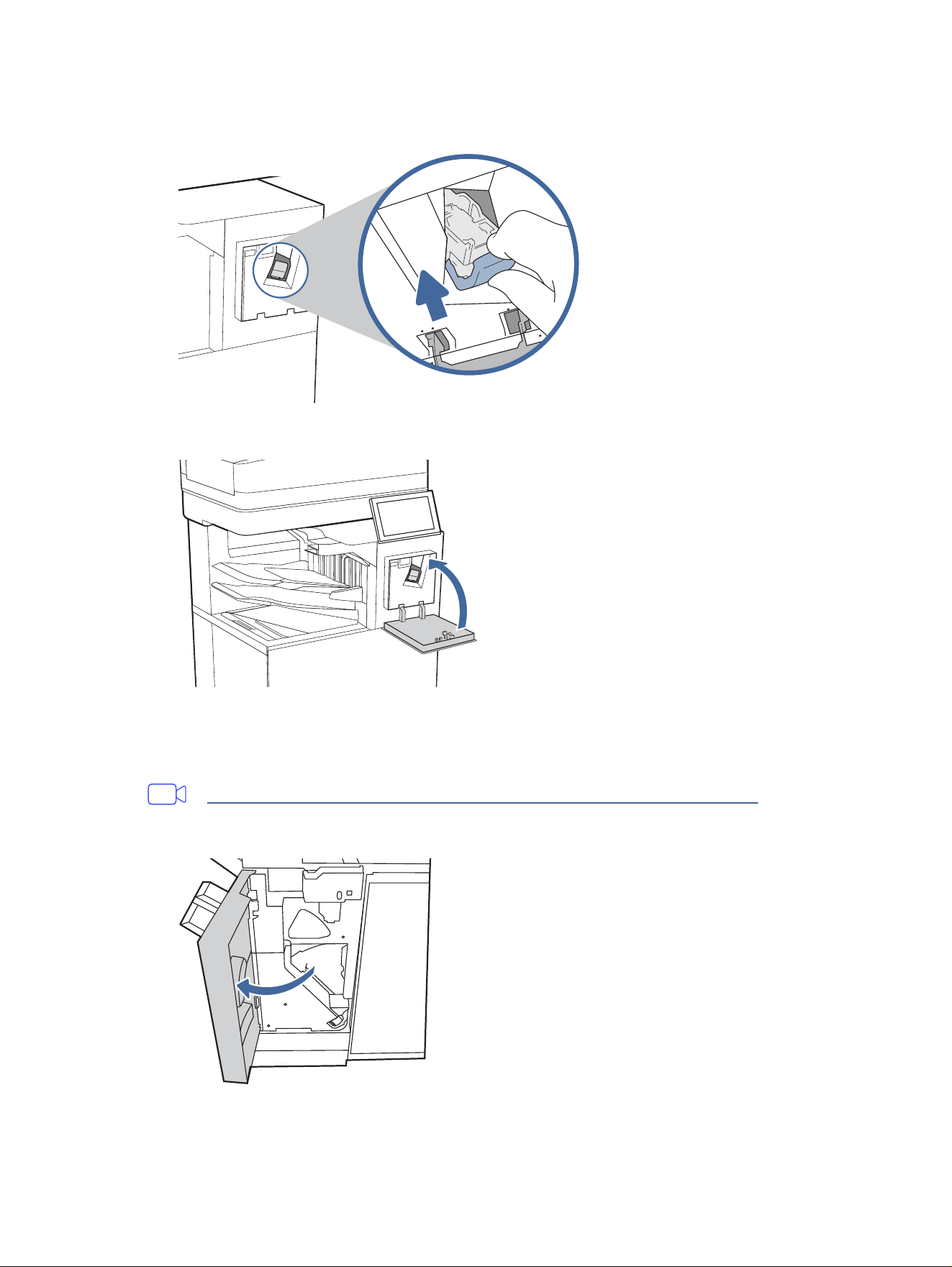
4. Reinstall the staple carriage into the stapler by pressing the colored handle inward until it snaps
into place.
5. Close the 3-bin stapler/stacker staple door.
Remove and replace the staple cartridge in the finisher
Use the steps below to remove and replace the staple cartridge in the floor-standing finisher.
View a video of how to replace the staple cartridge in the floor-standing finisher
1. Open the finisher door.
52
Chapter 3 Supplies, accessories, and parts
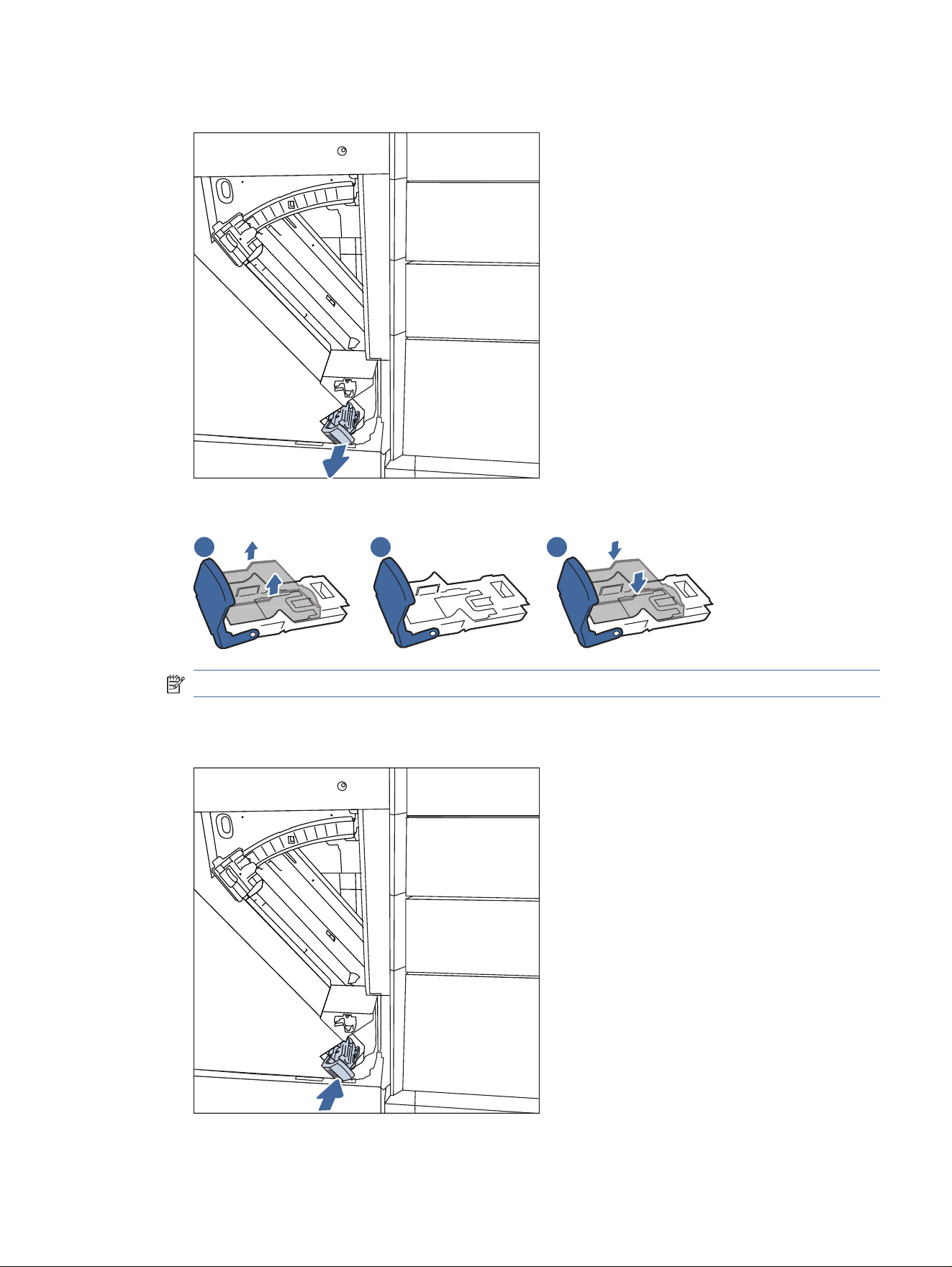
2. Pull down the colored handle on the staple carriage, and then pull the staple carriage straight out.
3. Remove the staple cartridge from the sled and replace it with the new staple cartridge.
1 2 3
NOTE: Do not dispose of the staple carrier/sled. The sled is not an orderable or replaceable part.
4. Reinstall the staple carriage into the stapler by pressing the colored handle inward until it snaps
into place.
Remove and replace the staple cartridge in the finisher
53
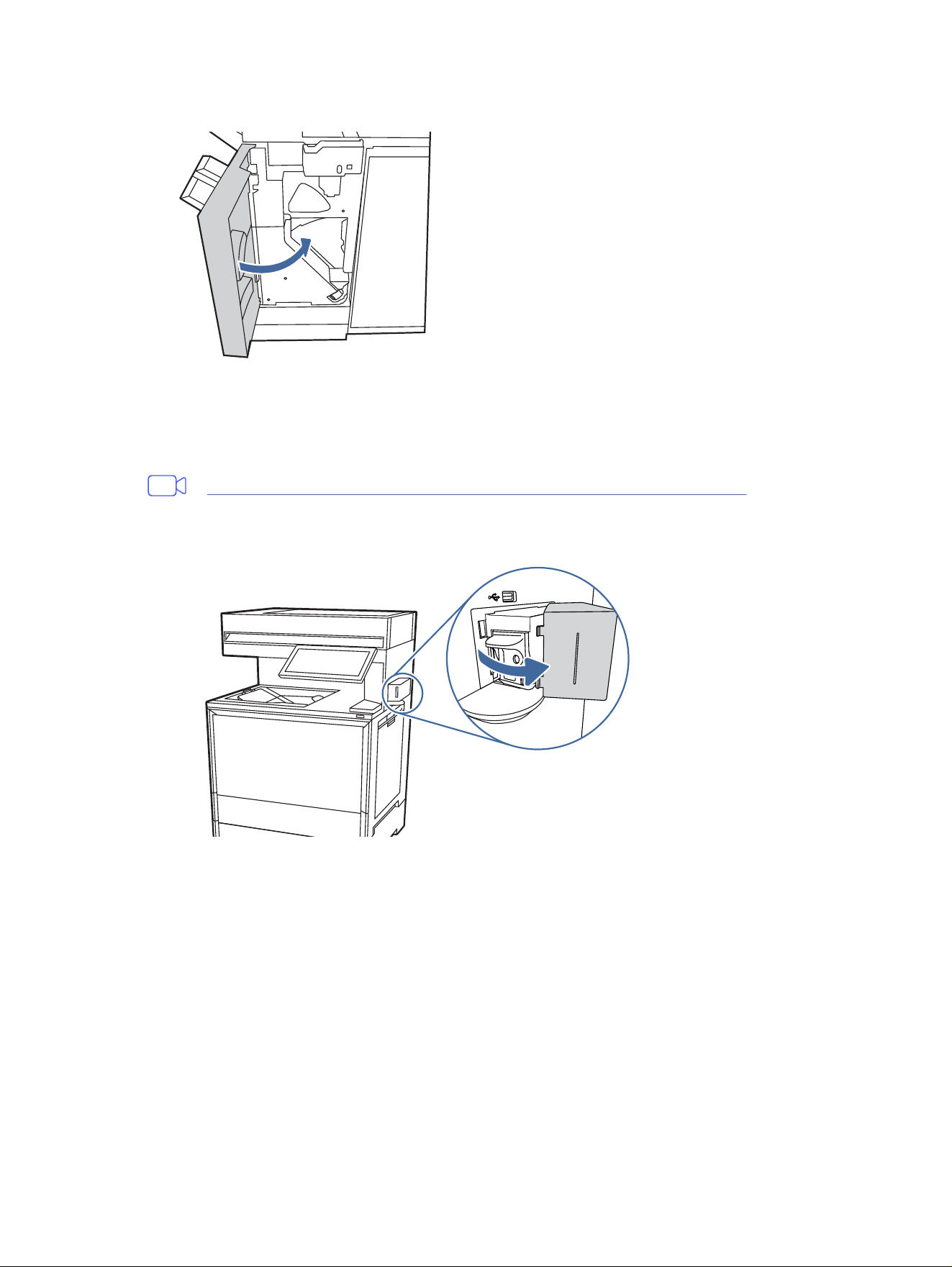
5. Close the finisher door.
Remove and replace the staple cartridge in the convenience stapler
Use the steps below to remove and replace the staple cartridge in the convenience stapler on the left
side of the printer.
View a video of how to replace the staple cartridge in the convenience stapler
1. Open the stapler door.
54
Chapter 3 Supplies, accessories, and parts
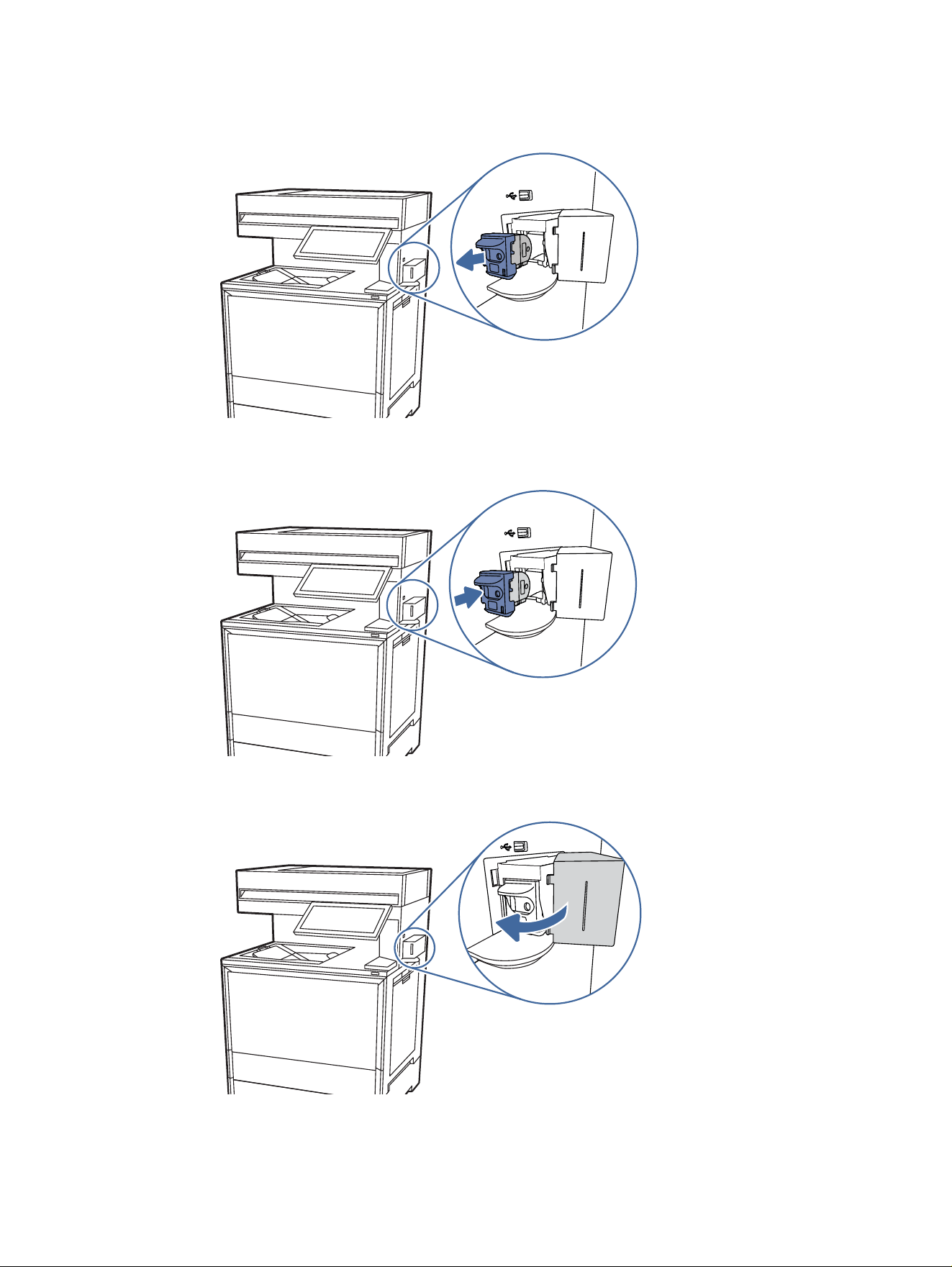
2. Pull the staple carriage straight out.
3. Insert the new staple carriage into the stapler.
4. Close the stapler door.
Remove and replace the staple cartridge in the convenience stapler
55

Print4
Print using the software, or print from a mobile device or USB flash drive.
The following information is correct at the time of publication. For current information, see Support for
HP Color LaserJet Enterprise MFP 6800 or Support for HP Color LaserJet Enterprise MFP 6801.
For more information:
HP's all-inclusive help for the printer includes the following information:
● Install and configure
● Learn and use
● Solve problems
● Download software and firmware updates
● Join support forums
● Find warranty and regulatory information
Print tasks (Windows)
Learn about common printing tasks for Windows users.
How to print (Windows)
Use the Print option from a software application to select the printer and basic options for your print job.
The following procedure describes the basic printing process for Windows.
1. From the software program, select the Print option.
2. Select the printer from the list of printers. To change settings, click the Printer Properties or
Preferences button to open the print driver.
NOTE: The name of the button varies for different software programs.
For the HP PCL 6 driver, the HP AiO Printer Remote application downloads additional driver
features when More settings is selected.
NOTE: For more information, click the Help (?) button in the print driver.
3. Click the tabs in the print driver to configure the available options. For example, set the paper
orientation on the Finishing tab, and set the paper source, paper type, paper size, and quality
settings on the Paper/Quality tab.
4. Click the OK button to return to the Print dialog box. Select the number of copies to print from this
screen.
5. Click the Print button to print the job.
56
Chapter 4 Print

Automatically print on both sides (Windows)
If your printer has an automatic duplexer installed, you can automatically print on both sides of the
paper. Use a paper size and type supported by the duplexer.
1. From the software program, select the Print option.
2. Select the printer from the list of printers, and then click the Printer Properties or Preferences
button to open the print driver.
NOTE: The name of the button varies for different software programs.
For the HP PCL 6 driver, the HP AiO Printer Remote application downloads additional driver
features when More settings is selected.
3. Click the Finishing tab.
4. Select Print on both sides. Click OK to close the Document Properties dialog.
5. In the Print dialog, click Print to print the job.
Manually print on both sides (Windows)
Use this procedure for printers that do not have an automatic duplexer installed or to print on paper that
the duplexer does not support.
1. From the software program, select the Print option.
2. Select the printer from the list of printers, and then click the Printer Properties or Preferences
button to open the print driver.
NOTE: The name of the button varies for different software programs.
For the HP PCL 6 driver, the HP AiO Printer Remote application downloads additional driver
features when More settings is selected.
3. Click the Finishing tab.
4. Select Print on both sides (manually), and then click OK to close the Document Properties dialog.
5. In the Print dialog, click Print to print the first side of the job.
6. Retrieve the printed stack from the output bin, and place it in Tray 1.
7. If prompted, select the appropriate control panel button to continue.
Print multiple pages per sheet (Windows)
When you print from a software application using the Print option, you can select an option to print
multiple pages on a single sheet of paper. For example, you might want to do this if you are printing a
very large document and want to save paper.
1. From the software program, select the Print option.
2. Select the printer from the list of printers, and then click the Printer Properties or Preferences
button to open the print driver.
NOTE: The name of the button varies for different software programs.
Automatically print on both sides (Windows)
57

For the HP PCL 6 driver, the HP AiO Printer Remote application downloads additional driver
features when More settings is selected.
3. Click the Finishing tab.
4. Select the number of pages per sheet from the Pages per sheet drop-down.
5. Select the correct Print page borders, Page order, and Orientation options. Click OK to close the
Document Properties dialog.
6. In the Print dialog, click Print to print the job.
Select the paper type (Windows)
When you print from a software application using the
Print option, you can set the paper type you are
using for your print job. For example, if your default paper type is Letter, but you are using a different
paper type for a print job, select that specific paper type.
1. From the software program, select the Print option.
2. Select the printer from the list of printers, and then click the Printer Properties or Preferences
button to open the print driver.
NOTE: The name of the button varies for different software programs.
For the HP PCL 6 driver, the HP AiO Printer Remote application downloads additional driver
features when More settings is selected.
3. Click the Paper/Quality tab.
4. Select the paper type from the Paper type drop-down list.
5. Click OK to close the Document Properties dialog. In the Print dialog, click Print to print the job.
If the tray needs to be configured, a tray configuration message displays on the printer control
panel.
6. Load the tray with the specified type and size of paper, and then close the tray.
7. Touch the OK button to accept the detected type and size, or touch the Modify button to choose a
different paper size or type.
8. Select the correct type and size, and then touch the OK button.
Additional print tasks
Locate information on the Web for performing common printing tasks.
Go to Support for HP Color LaserJet Enterprise MFP 6800 or Support for HP Color LaserJet Enterprise
MFP 6801.
Instructions are available for print tasks, such as the following:
● Create and use printing shortcuts or presets
● Select the paper size, or use a custom paper size
● Select the page orientation
58
Chapter 4 Print

● Create a booklet
● Scale a document to fit a specific paper size
● Print the first or last pages of the document on different paper
● Print watermarks on a document
Print tasks (macOS)
Print using the HP printing software for macOS, including how to print on both sides or print multiple
pages per sheet.
How to print (macOS)
Use the Print option from a software application to select the printer and basic options for your print job.
The following procedure describes the basic printing process for macOS.
1. Click the File menu, and then click the Print option.
2. Select the printer.
3. Click Show Details or Copies & Pages, and then select other menus to adjust the print settings.
NOTE: The name of the item varies for different software programs.
4. Click the Print button.
Automatically print on both sides (macOS)
If your printer has an automatic duplexer installed, you can automatically print on both sides of the
paper. Use a paper size and type supported by the duplexer.
NOTE: This information applies to printers that include an automatic duplexer.
NOTE: This feature is available if you install the HP print driver. It might not be available if you are
using AirPrint
®
.
1. Click the File menu, and then click the Print option.
2. Select the printer.
3. Click Show Details or Copies & Pages, and then click the Layout menu.
macOS 10.14 Mojave and later: Click Show Details, click Two-Sided, and then click the Layout menu.
NOTE: The name of the item varies for different software programs.
4. Select a binding option from the Two-Sided drop-down list.
5. Click the Print button.
Manually print on both sides (macOS)
Use this procedure for printers that do not have an automatic duplexer installed or to print on paper that
the duplexer does not support.
Print tasks (macOS)
59

NOTE: This feature is available if you install the HP print driver. It might not be available if you are
using AirPrint.
1. Click the File menu, and then click the Print option.
2. Select the printer.
3. Click Show Details or Copies & Pages, and then click the Manual Duplex menu.
NOTE: The name of the item varies for different software programs.
4. Click the Manual Duplex box, and select a binding option.
5. Click the Print button.
6. Go to the printer and remove any blank paper that is in Tray 1.
7. Retrieve the printed stack from the output bin and place it with the printed-side facing down in the
input tray.
8. If prompted, touch the appropriate control panel button to continue.
Print multiple pages per sheet (macOS)
When you print from a software application using the Print option, you can select an option to print
multiple pages on a single sheet of paper. For example, you might want to do this if you are printing a
very large document and want to save paper.
1. Click the File menu, and then click the Print option.
2. Select the printer.
3. Click Show Details or Copies & Pages, and then click the Layout menu.
NOTE: The name of the item varies for different software programs.
4. From the Pages per Sheet drop-down list, select the number of pages that you want to print on
each sheet.
5. In the Layout Direction area, select the order and placement of the pages on the sheet.
6. From the Borders menu, select the type of border to print around each page on the sheet.
7. Click the Print button.
Select the paper type (macOS)
When you print from a software application using the
Print option, you can set the paper type you are
using for your print job. For example, if your default paper type is Letter, but you are using a different
paper type for a print job, select that specific paper type.
1. Click the File menu, and then click the Print option.
2. Select the printer.
60
Chapter 4 Print

3. Click Show Details or Copies & Pages, and then click the Media & Quality menu or the Paper/Quality
menu.
NOTE: The name of the item varies for different software programs.
4. Select from the Media & Quality or Paper/Quality options.
NOTE: This list contains the master set of options available. Some options are not available on all
printers.
● Media Type: Select the option for the type of paper for the print job.
● Print Quality or Quality: Select the resolution level for the print job.
● Edge-To-Edge Printing: Select this option to print close to the paper edges.
5. Click the Print button.
Additional print tasks
Locate information on the Web for performing common printing tasks.
Go to Support for HP Color LaserJet Enterprise MFP 6800 or Support for HP Color LaserJet Enterprise
MFP 6801.
Instructions are available for print tasks, such as the following:
● Create and use printing shortcuts or presets
● Select the paper size, or use a custom paper size
● Select the page orientation
● Create a booklet
● Scale a document to fit a specific paper size
● Print the first or last pages of the document on different paper
● Print watermarks on a document
Store print jobs on the printer to print later or print privately
Store print jobs in the printer memory for printing at a later time.
Introduction
The following information provides procedures for creating and printing documents that are stored on
the USB flash drive. These jobs can be printed at a later time or printed privately.
Create a stored job (Windows)
Store jobs on the USB flash drive for private or delayed printing.
1. From the software program, select the Print option.
Additional print tasks
61

2. Select the printer from the list of printers, and then select Printer Properties or Preferences.
NOTE: The name of the button varies for different software programs.
For the HP PCL 6 driver, the HP AiO Printer Remote application downloads additional driver
features when More settings is selected.
3. Click the Job Storage tab.
4. Select a Job Storage Mode option:
● Proof and Hold: Print and proof one copy of a job, and then print more copies.
● Personal Job: The job does not print until you request it at the printer control panel. For this
job-storage mode, you can select one of the Make Job Private/Secure options. If you assign a
personal identification number (PIN) to the job, you must provide the required PIN at the control
panel. If you encrypt the job, you must provide the required password at the control panel. The
print job is deleted from memory after it prints and is lost if the printer loses power.
● Quick Copy: Print the requested number of copies of a job and store a copy of the job in the
printer memory so you can print it again later.
● Stored Job: Store a job on the printer and allow other users to print the job at any time. For this
job-storage mode, you can select one of the Make Job Private/Secure options. If you assign a
personal identification number (PIN) to the job, the person who prints the job must provide the
required PIN at the control panel. If you encrypt the job, the person who prints the job must
provide the required password at the control panel.
5. To use a custom user name or job name, click the Custom button, and then enter the user name or
the job name.
Select which option to use if another stored job already has that name:
● Use Job Name + (1-99): Append a unique number to the end of the job name.
● Replace Existing File: Overwrite the existing stored job with the new one.
6. Click the OK button to close the Document Properties dialog box. In the Print dialog box, click the
Print button to print the job.
Create a stored job (macOS)
Store jobs on the USB flash drive for private or delayed printing.
1. Click the File menu, and then click the Print option.
2. In the Printer menu, select the printer.
3. Click Show Details or Copies & Pages, and then click the Job Storage menu.
NOTE: If the Job Storage menu is not showing, follow the instructions in the "Disable or enable job
storage feature" section to activate the menu.
62
Chapter 4 Print

4. In the Mode drop-down list, select the type of stored job.
● Proof and Hold: Print and proof one copy of a job, and then print more copies. The first copy
prints immediately. Printing of the subsequent copies must be initiated from the device's front
control panel. For example, if 10 copies are sent, one copy prints immediately, and the other
nine copies will print when the job is retrieved. The job is deleted after all copies are printed.
● Personal Job: The job does not print until someone requests it at the printer control panel. If
the job has a personal identification number (PIN), provide the required PIN at the control panel.
The print job is deleted from memory after it prints.
● Quick Copy: Print the requested number of copies of a job and store a copy of the job in
the printer memory to print it again later. The job is deleted manually or by the job retention
schedule.
● Stored Job: Store a job on the printer and allow other users to print the job at any time. If the
job has a personal identification number (PIN), the person who prints the job must provide the
required PIN at the control panel. The job is deleted manually or by the job retention schedule.
5. To use a custom user name or job name, click the Custom button, and then enter the user name or
the job name.
NOTE: macOS 10.14 Mojave and later: The print driver no longer includes the Custom button. Use
the options below the Mode drop-down list to set up the saved job.
Select which option to use if another stored job already has that name.
● Use Job Name + (1-99): Append a unique number to the end of the job name.
● Replace Existing File: Overwrite the existing stored job with the new one.
6. If you selected the Stored Job or Personal Job option in the Mode drop-down list, you can protect
the job with a PIN. Type a 4-digit number in the Use PIN to Print field. When other people attempt to
print this job, the printer prompts them to enter this PIN.
7. Click the Print button to process the job.
Print a stored job
Use the following procedure to print a job that is stored in the printer memory.
1. From the Home screen on the printer control panel, navigate to the Print application, and then
select the Print icon.
2. Select Print from Job Storage.
3. Select the name of the folder where the job is stored, or select Choose to see the folder list.
4. Select the name of the job. If the job is private or encrypted, enter the PIN or password.
5. To adjust the number of copies, select the number of copies field. Use the keypad to enter the
number of copies to print.
6. Select Start or Print to print the job.
Delete a stored job
You can delete documents that have been saved to the printer when they are no longer needed. You can
also adjust the maximum number of jobs for the printer to store.
Print a stored job
63

Delete a job that is stored on the printer
Use the control panel to delete a job that is stored in the printer memory.
1. From the Home screen on the printer control panel, navigate to the Print application, and then
select the Print icon.
2. Select Print from Job Storage.
3. Select the name of the folder where the job is stored or select Choose to see the folder list.
4. Select the name of the job. If the job is private or encrypted, enter the PIN or password.
5. Select the Trash button to delete the job.
Change the job storage limit
When a new job is stored in the printer memory, the printer overwrites any previous jobs with the same
user and job name. If a job is not already stored under the same user and job name, and the printer
needs additional space, the printer might delete other stored jobs starting with the oldest.
To change the number of jobs that the printer can store, complete the following procedure:
1. From the Home screen on the printer control panel, navigate to the Settings application, and then
select the Settings icon.
2. Open the following menus:
a. Copy/Print or Print
b. Manage Stored Jobs
c. Temporary Job Storage Limit
3. Use the keypad to enter the number of jobs that the printer stores.
4. Select OK or Done to save the setting.
Information sent to printer for Job Accounting purposes
Printing jobs sent from drivers on the client (e.g., PC) may send personally identifiable information to HP’s
Printing and Imaging devices. This information may include, but is not limited to, user name and client
name from which the job originated that may be used for job accounting purposes, as determined by the
Administrator of the printing device. This same information may also be stored with the job on the mass
storage device (e.g., disk drive) of the printing device when using the job storage feature.
Mobile printing
Mobile printing solutions enable easy printing to an HP printer from a laptop, tablet, smartphone, or other
mobile device.
Mobile printing solutions
Learn what HP offers for mobile printing solutions.
HP offers multiple mobile printing solutions to enable easy printing to an HP printer from a laptop, tablet,
smartphone, or other mobile device. To see the full list and to determine the best choice, go to Wireless
printing from a laptop, phone, or tablet.
64
Chapter 4 Print

● Wi-Fi Direct
● HP All-in-One Remote app for iOS and Android devices
● AirPrint
● Android Printing
Wi-Fi, Wi-Fi Direct Print, NFC, and BLE printing
HP provides Wi-Fi Direct Print, Near Field Communication (NFC), and Bluetooth Low Energy (BLE) printing
for printers with a supported HP Jetdirect 3100w BLE/NFC/Wireless Accessory. This is an optional
accessory.
These features enable Wi-Fi capable (mobile) devices to make a wireless network connection directly to
the printer without using a wireless router.
The printer does not need to be connected to the network for this mobile walk-up printing to work.
Use Wi-Fi Direct Print to print wirelessly from the following devices:
● iPhone, iPad, or iPod touch using Apple AirPrint
● Android mobile devices using the Android embedded print solution
For more information on wireless printing, go to www.hp.com/go/LaserJetMobilePrinting.
NFC, BLE, and Wi-Fi Direct Print capabilities can be enabled or disabled from the printer control panel.
Enable wireless printing
To print wirelessly from mobile devices, Wi-Fi Direct must be turned on.
1. From the Home screen on the printer control panel, select the Settings menu.
2. Select the following menus:
a. Networking
b. Wi-Fi Direct
c. Status
3. Select On, and then select OK to enable wireless printing.
Change the Wi-Fi Direct name
Change the printer Wi-Fi Direct name using the HP Embedded Web Server (EWS).
NOTE: In environments where more than one model of the same printer is installed, it might be helpful
to provide each printer a unique Wi-Fi Direct Name for easier printer identification for HP Wi-Fi Direct
printing. The Wireless network names, e.g., Wireless, Wi-Fi Direct, etc. are available on the Information
screen by selecting the Information icon , and then selecting the Wi-Fi Direct icon .
Complete the following procedure to change the printer Wi-Fi Direct name:
1. From the Home screen on the printer control panel, select the Settings icon.
2. Open the following menus:
Wi-Fi, Wi-Fi Direct Print, NFC, and BLE printing
65
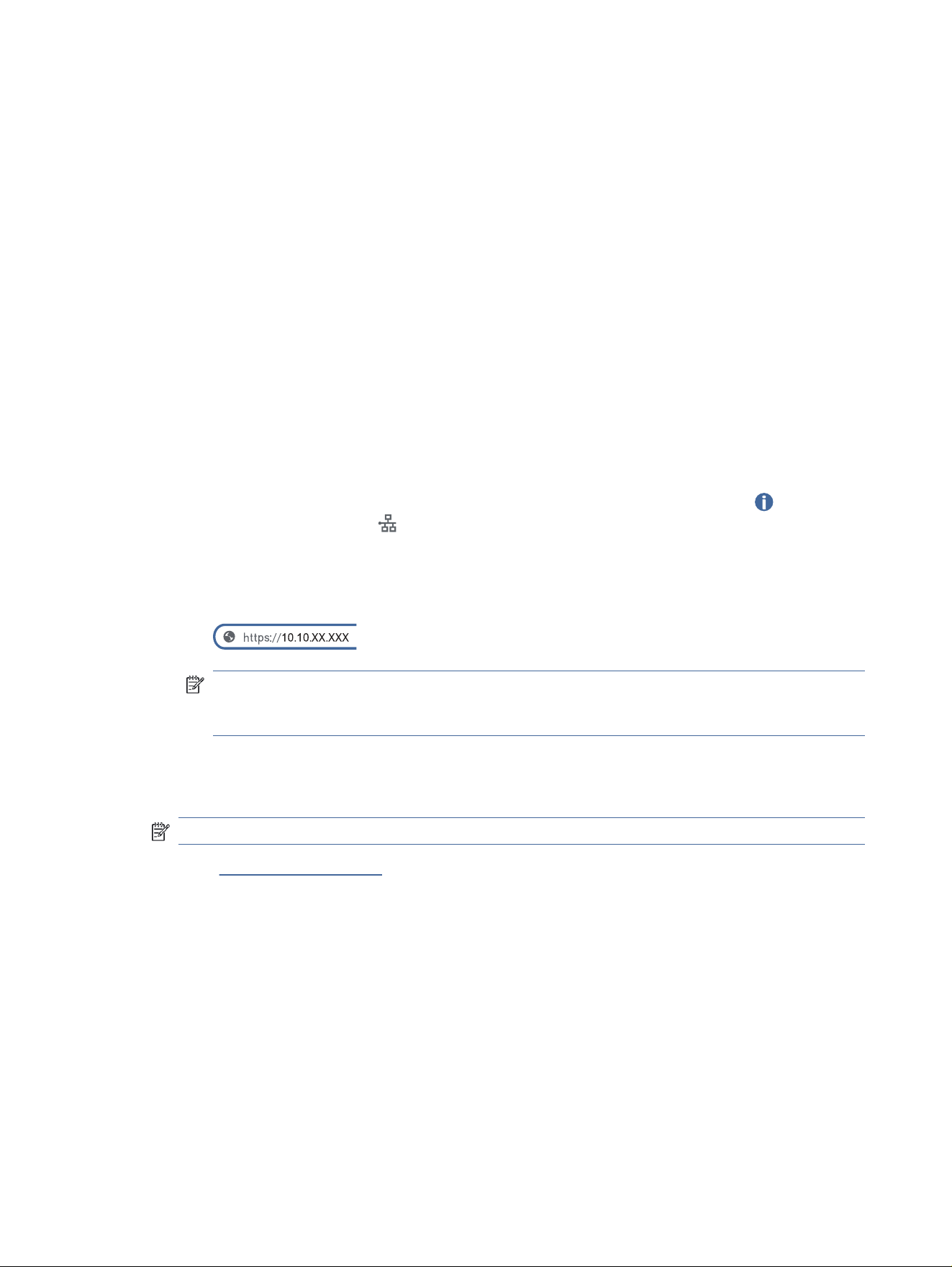
a. Networking
b. Wi-Fi Direct
c. Wi-Fi Direct Name
3. Use the keypad to change the name in the Wi-Fi Direct Name text field, and then select OK.
HP ePrint via email
Use HP ePrint via email to print documents by sending them as an email attachment to the printer's
email address from any email enabled device.
To use HP ePrint via email, the printer must meet these requirements:
● The printer must be connected to a wired or wireless network and have Internet access.
● HP Web Services must be enabled on the printer, and the printer must be registered with HP Smart.
Follow this procedure to enable HP Web Services and register with HP Smart:
1. Open the HP Embedded Web Server (EWS):
a. From the Home screen on the printer control panel, touch the Information icon , and then
touch the Ethernet icon to display the IP address or host name.
b. From a computer on the same network as the printer, open a web browser. In the address line,
type the IP address or host name exactly as it displays on the printer control panel. Press the
Enter key on the computer keyboard. The EWS opens.
NOTE: If the web browser displays a message indicating that accessing the website might
not be safe, select the option to continue to the website. Accessing this website will not harm
the computer.
2. Click the HP Web Services tab.
3. Select the option to enable Web Services.
NOTE: Enabling Web Services might take several minutes.
4. Go to www.hpconnected.com to create an account and complete the setup process.
AirPrint
Direct printing using Apple’s AirPrint is supported for iOS and from Mac computers running macOS 10.7
Lion and newer.
Use AirPrint to print directly to the printer from an iPad, iPhone (3GS or later), or iPod touch (third
generation or later) in the following mobile applications:
● Mail
● Photos
● Safari
66
Chapter 4 Print

● iBooks
● Select third-party applications
To use AirPrint, the printer must be connected to the same network (sub-net) as the Apple device. For
more information about using AirPrint and about which HP printers are compatible with AirPrint, go to
www.hp.com/go/MobilePrinting.
NOTE: Before using AirPrint with a USB connection, verify the version number. AirPrint versions 1.3
and earlier do not support USB connections.
Android embedded printing
HP's built-in print solution for Android and Kindle enables mobile devices to automatically find and print
to HP printers that are either on a network or within wireless range for Wi-Fi Direct printing.
The print solution is built into many versions of the operating system.
NOTE: If printing is not available on your device, go to the Google Play > Android apps and install the
HP Print Service Plugin.
For more information on how to use Android embedded printing and which Android devices are
supported, go to www.hp.com/go/MobilePrinting.
Print from a USB flash drive
This printer features easy-access USB printing to print files without a computer.
The printer accepts standard USB flash drives in the USB port near the control panel. It supports the
following types of files:
● .pdf
● .prn
● .pcl
● .ps
● .cht
● .jpg
● .png
Enable the USB port for printing
The USB port is disabled by default. Before using this feature, enable the USB port.
Use one of the following methods to enable the port:
Method one: Enable the USB port from the printer control panel
Use the printer control panel to enable the USB port for printing.
1. From the Home screen on the printer control panel, navigate to the Settings application, and then
select the Settings icon.
Android embedded printing
67
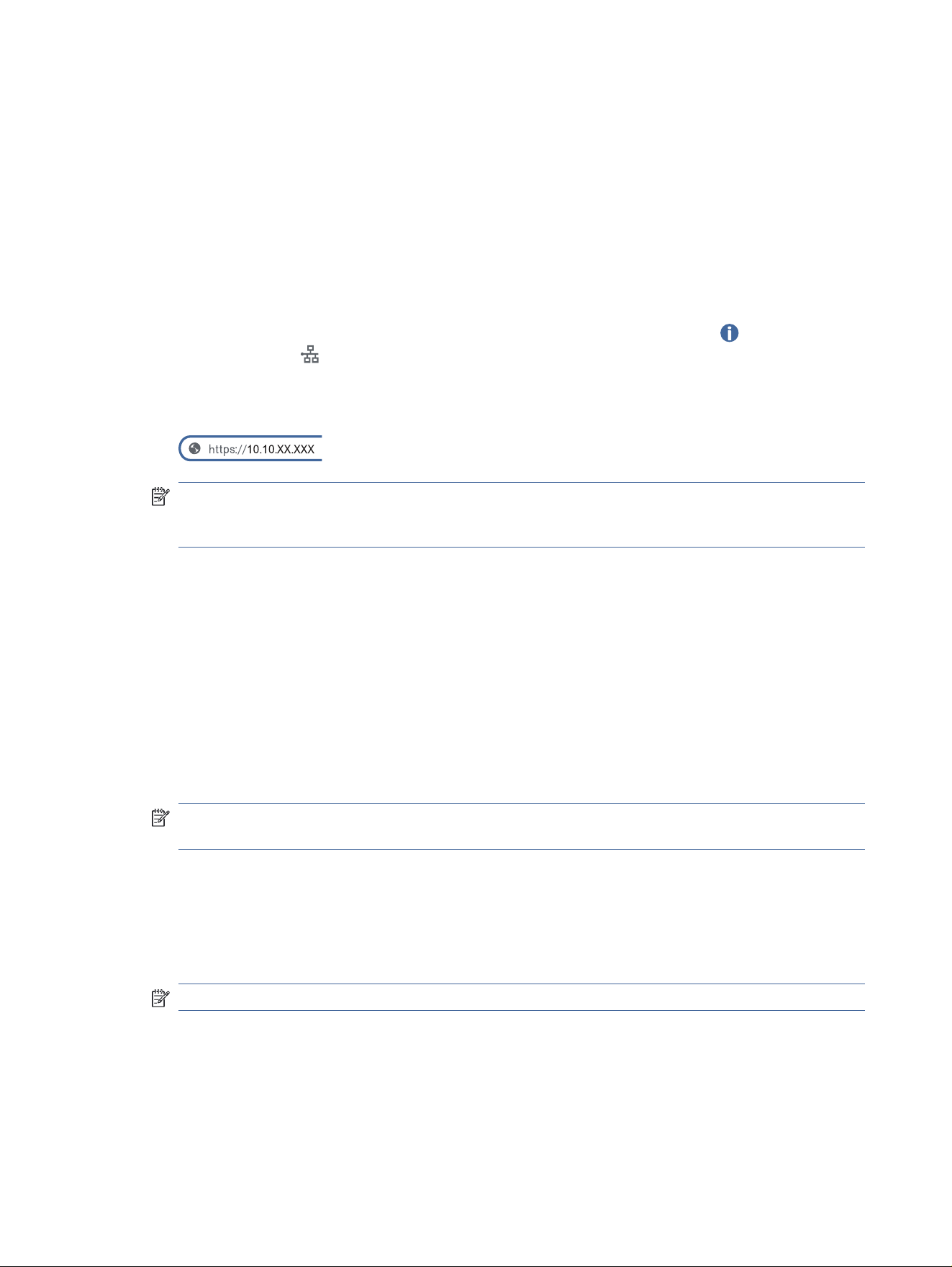
2. Open the following menus:
a. Copy/Print or Print
b. Enable Device USB
3. Select Enable Print from USB Drive.
Method two: Enable the USB port from the HP Embedded Web Server (network-connected
printers only)
Use the HP Embedded Web Server to enable the USB port for printing.
1. From the Home screen on the printer control panel, touch the Information icon , and then touch
the Ethernet icon to display the IP address or host name.
2. Open a web browser, and in the address line, type the IP address exactly as it displays on the printer
control panel. Press the Enter key on the computer keyboard. The EWS opens.
NOTE: If the web browser displays a message indicating that accessing the website might not be
safe, select the option to continue to the website. Accessing this website will not harm the
computer.
3. Select the Copy/Print tab for MFP models or the Print tab for SFP models.
4. In the left menu, select Print from USB Drive Settings.
5. Select Enable Print from USB Drive.
6. Click Apply.
Print USB documents
Print documents from a USB flash drive.
1. Insert the USB flash drive into the easy-access USB port.
NOTE: The port might be covered. For some printers, the cover flips open. For other printers, pull
the cover straight out to remove it.
2. From the Home screen on the printer control panel, navigate to the Print application, and then
select the Print icon.
3. Select Print from USB Drive.
4. Select Choose, select the name of the document to print, and then select Select.
NOTE: The document might be in a folder. Open folders as necessary.
5. To adjust the number of copies, touch the box to the left of the Print button, and then select the
number of copies from the keypad that opens. To close the keypad, select the Close button.
6. Select Print to print the document.
68
Chapter 4 Print
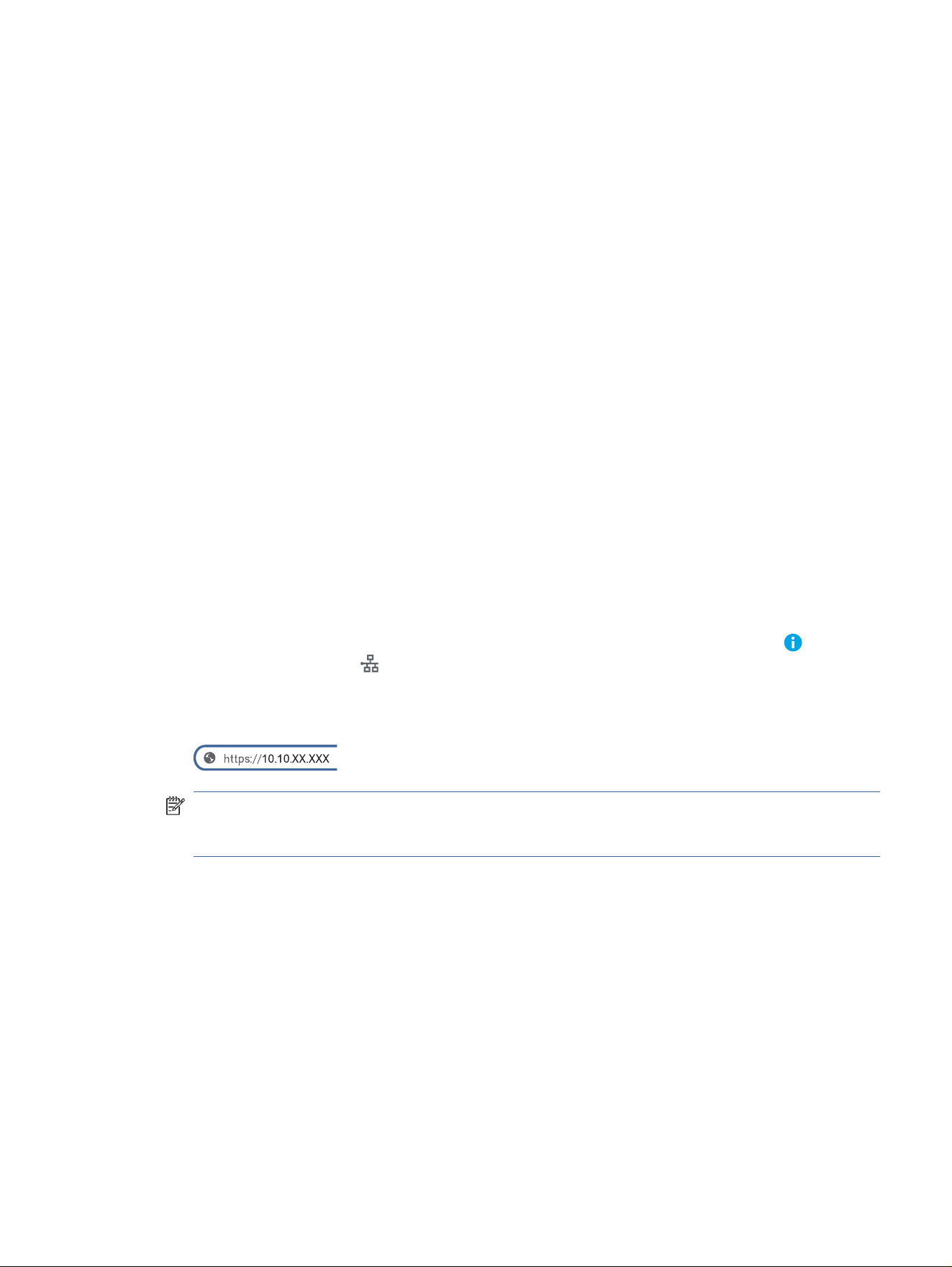
Print using the SuperSpeed USB 3.0 port (wired)
Enable the SuperSpeed USB 3.0 port for wired USB printing. The port is located in the interface ports
area and is disabled by default.
Use one of the following methods to enable the SuperSpeed USB 3.0 port. Once the port is enabled,
install the product software in order to print using this port.
Method one: Enable the SuperSpeed USB 3.0 port from the printer control panel
menus
Use the control panel to enable the port.
1. From the Home screen on the printer control panel, navigate to the Settings application, and then
select the Settings icon.
2. Open the following menus:
a. General
b. Enable Device USB
3. Select the Enabled option.
Method two: Enable the SuperSpeed USB 3.0 port from the HP Embedded Web
Server (network-connected printers only)
Use the HP EWS to enable the port.
1. Find the printer IP address. On the printer control panel, select the Information button , and then
select the Network icon to display the IP address or host name.
2. Open a web browser, and in the address line, type the IP address exactly as it displays on the printer
control panel. Press the Enter key on the computer keyboard. The EWS opens.
NOTE: If the web browser displays a message indicating that accessing the website might not be
safe, select the option to continue to the website. Accessing this website will not harm the
computer.
3. Select the Security tab.
4. On the left side of the screen, select General Security.
5. Scroll down to the Hardware Ports and select the following check boxes:
a. Enable Device USB
b. Enable Host USB plug and play
6. Click Apply.
Print using the SuperSpeed USB 3.0 port (wired)
69

Copy5
Make copies with the printer, learn how to copy a two-sided document, and locate additional copy tasks
on the web.
The following information is correct at the time of publication. For current information, see Support for
HP Color LaserJet Enterprise MFP 6800 or Support for HP Color LaserJet Enterprise MFP 6801.
For more information:
HP's all-inclusive help for the printer includes the following information:
● Install and configure
● Learn and use
● Solve problems
● Download software and firmware updates
● Join support forums
● Find warranty and regulatory information
Make a copy
Copy a document or picture from the scanner glass or automatic document feeder.
1. Place the document face-down on the scanner glass, or place it face-up in the document feeder
and adjust the paper guides to fit the size of the document.
2. From the Home screen on the printer control panel, navigate to the Copy application, and then
select the Copy icon.
3. To select the number of copies, touch the box next to Copy, use the keypad to enter the number of
copies, and then touch the close keypad button .
4. Select Optimize Text/Picture to optimize for the type of image being copied: text, graphics, or
photos. Select one of the predefined options.
5. Set options marked with a yellow triangle before using the preview feature.
NOTE: After the preview scan, these options are removed from the main Options list and are
summarized in the Pre-scan Options list. To change any of these options, discard the preview and
start over.
Using the preview feature is optional.
70
Chapter 5 Copy
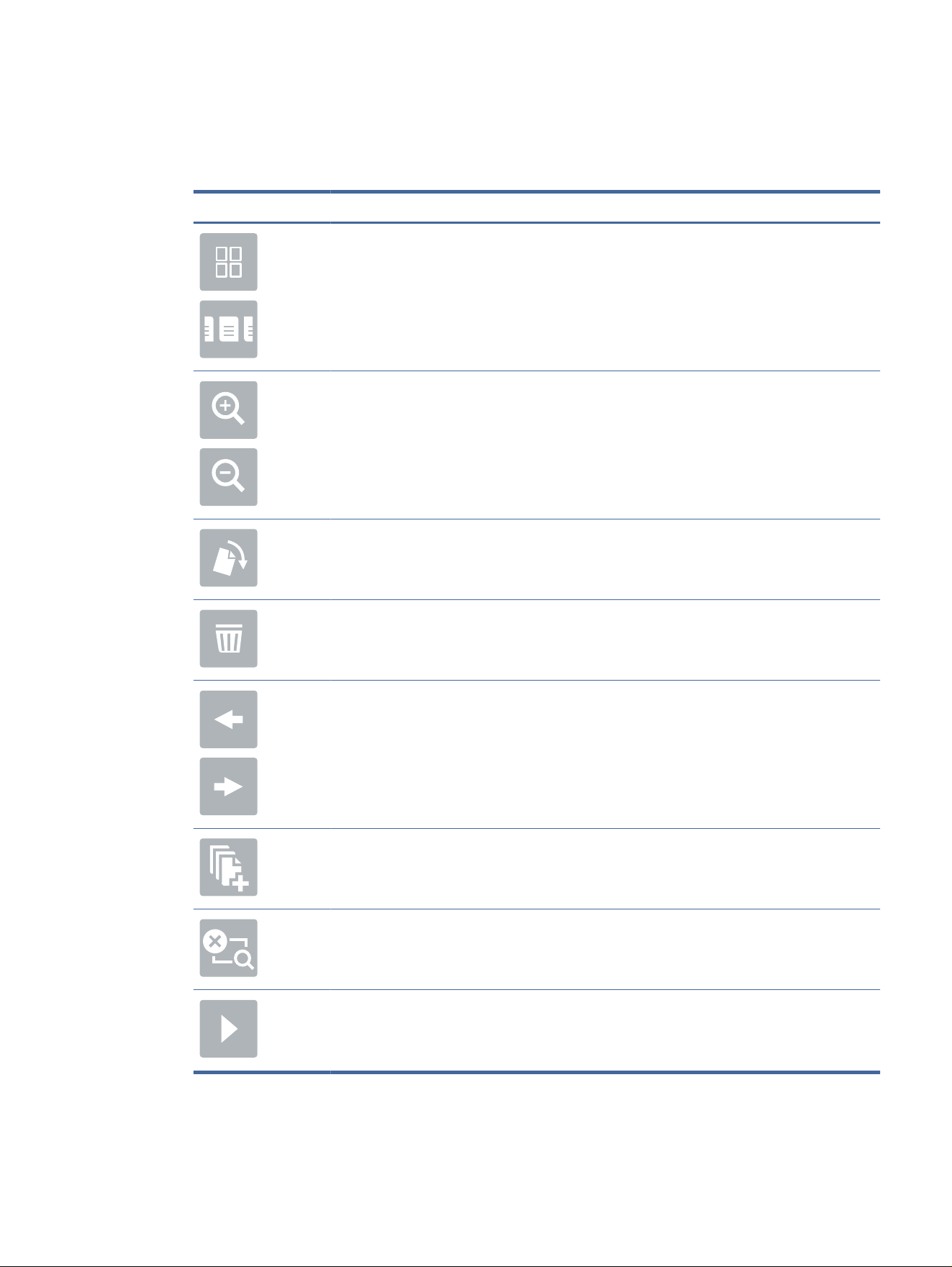
6. Touch the right pane of the screen to preview the document. In the preview screen, use the buttons
on the right of the screen to adjust the preview options and to rearrange, rotate, insert, or remove
pages.
Table 5-1 Buttons on the right side of the preview pane
Button Description
Use these buttons to toggle between single-page view and thumbnail view. More options are
available in thumbnail view than in single-page view.
Use these buttons to zoom in or out on the selected page.
NOTE: Select only one page at a time to use these buttons.
Use this button to rotate the page 180 degrees.
NOTE: This button is available only in the thumbnail view.
Use this button to delete the selected pages.
NOTE: This button is available only in the thumbnail view.
Use these buttons to rearrange the pages within the document. Select one or more pages and
move them to the left or right.
NOTE: These buttons are available only in the thumbnail view.
Use this button to add a page to the document. The printer prompts to scan additional pages.
Use this button to clear the changes made in the preview and start over.
Touch this button to collapse the preview screen and return to the Copy screen.
7. When the document is ready, touch Copy to begin copying.
Make a copy
71

Copy on both sides (duplex)
Copy or print on both sides of the paper.
1. Place the document face-down on the scanner glass, or place it face-up in the document feeder
and adjust the paper guides to fit the size of the document.
2. From the Home screen on the printer control panel, navigate to the Copy application, and then
select the Copy icon.
3. In the Options pane, select Original Side, and then select the option that describes the original
document:
● Use Automatically detect to detect whether the original is printed on one or both sides of the
page.
● Use 1-sided for originals that are printed on one side of the page.
● Use 2-sided (book-style) for originals that flip on the right/left edge of the page, like books. If the
image is portrait, the output flips on the long edge of the page. If the image is landscape, the
output flips on the short edge of the page.
● Use 2-sided (flip-style) for originals that flip on the top/bottom edge of the page, like calendars.
If the image is portrait, the output flips on the short edge of the page. If the image is landscape,
the output flips on the long edge of the page.
4. Select Output Sides, and then select one of these options:
● 1-sided: The output will be 1-sided. However, if the administrator has restricted 1-sided printing,
the output will be 2-sided book-style.
● 2-sided (book-style): The output will flip on the right/left edge of the page, like a book. If the
image is portrait, the output flips on the long edge of the page. If the image is landscape, the
output flips on the short edge of the page.
● 2-sided (flip-style): The output will flip on the top/bottom edge of the page, like a calendar. If the
image is portrait, the output flips on the short edge of the page. If the image is landscape, the
output flips on the long edge of the page.
5. Set options marked with a yellow triangle before using the preview feature.
NOTE: After the preview scan, these options are removed from the main Options list and are
summarized in the Pre-scan Options list. To change any of these options, discard the preview and
start over.
Using the preview feature is optional.
72
Chapter 5 Copy
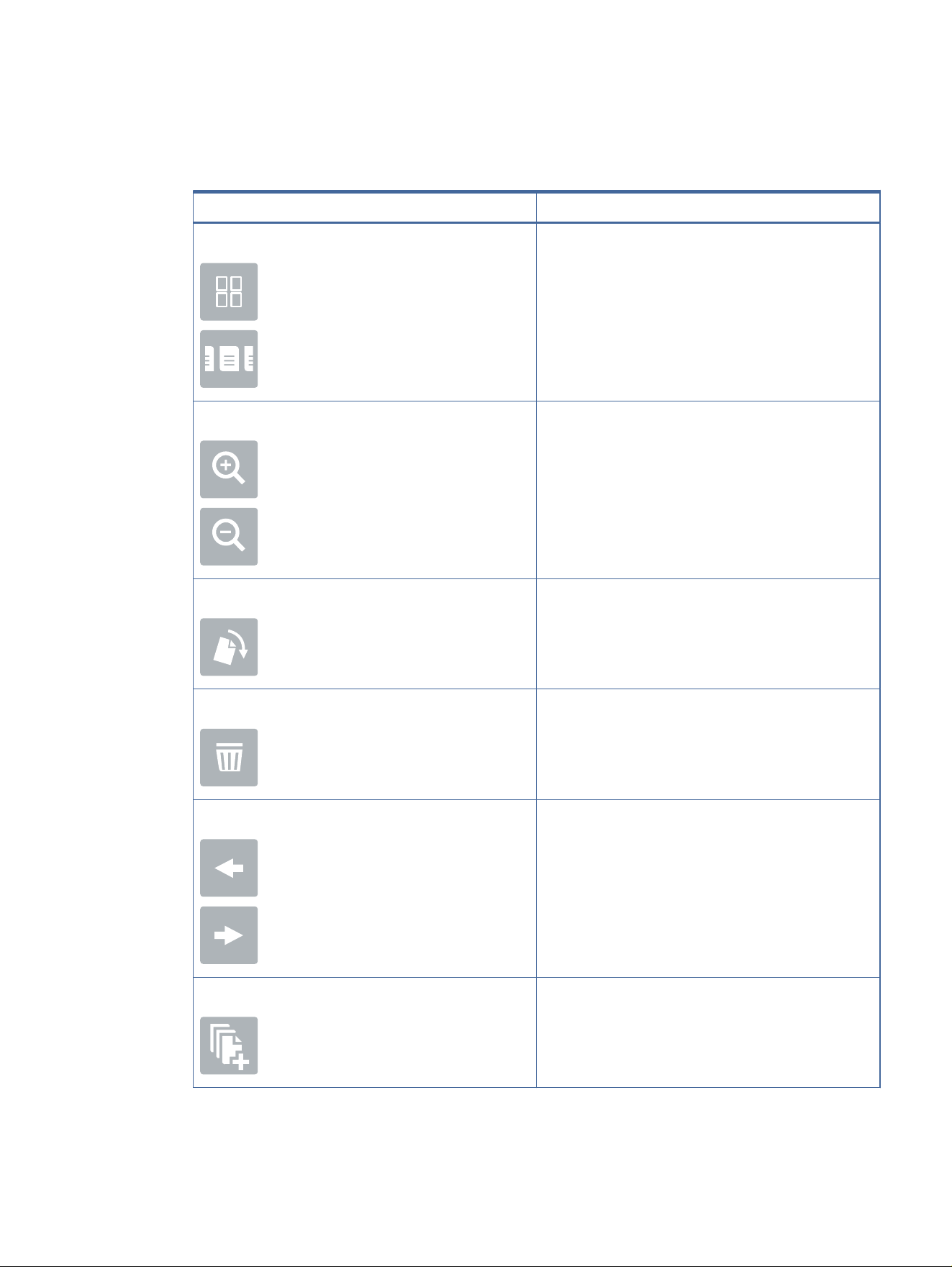
6. Touch the right pane of the screen to preview the document. In the preview screen, use the buttons
on the right of the screen to adjust the preview options and to rearrange, rotate, insert, or remove
pages.
Table 5-2 Buttons on the right side of the preview pane
Button Button function
Thumbnail and page view buttons Use these buttons to toggle between single-page view and
thumbnail view. More options are available in thumbnail
view than in single-page view.
Zoom buttons Use these buttons to zoom in or out on the selected page.
NOTE: Select only one page at a time to use these
buttons.
Rotate button Use this button to rotate the page 180 degrees.
NOTE: This button is available only in the thumbnail view.
Delete button Use this button to delete the selected pages.
NOTE: This button is available only in the thumbnail view.
Arrow buttons Use these buttons to rearrange the pages within the
document. Select one or more pages and move them to
the left or right.
NOTE: These buttons are available only in the thumbnail
view.
Add page button Use this button to add a page to the document. The printer
prompts to scan additional pages.
Copy on both sides (duplex) 73
Table 5-2 Buttons on the right side of the preview pane (continued)
Button Button function
Clear preview button Use this button to clear the changes made in the preview
and start over.
Collapse preview button Touch this button to collapse the preview screen and return
to the Copy screen.
7. When the document is ready, touch Start to begin copying.
Additional copy tasks
Locate information on the Web for performing common copy tasks.
Go to Support for HP Color LaserJet Enterprise MFP 6800 or Support for HP Color LaserJet Enterprise
MFP 6801.
Instructions are available for copy tasks, such as the following:
● Copy or scan pages from books or other bound documents
● Copy mixed-size documents
● Copy or scan both sides of an identification card
● Copy or scan a document into a booklet format
74
Chapter 5 Copy

Scan6
Scan using the software, or scan directly to email, a USB flash drive, a network folder, or another
destination.
The following information is correct at the time of publication. For current information, see Support for
HP Color LaserJet Enterprise MFP 6800 or Support for HP Color LaserJet Enterprise MFP 6801.
For more information:
HP's all-inclusive help for the printer includes the following information:
● Install and configure
● Learn and use
● Solve problems
● Download software and firmware updates
● Join support forums
● Find warranty and regulatory information
Set up Scan to Email
The printer has a feature that enables it to scan a document and send it to one or more email addresses.
Introduction
To use this scan feature, the printer must be connected to a network; however, the feature is not
available until it has been configured. There are two methods for configuring Scan to Email, the Scan to
Email Setup Wizard for basic and Email Setup for advanced.
Use the following information to set up the Scan to Email feature.
Before you begin
To set up the Scan to Email feature, the printer must have an active network connection.
Administrators need the following information before beginning the configuration process.
● Administrative access to the printer
● DNS suffix (e.g., companyname.com)
Scan
75
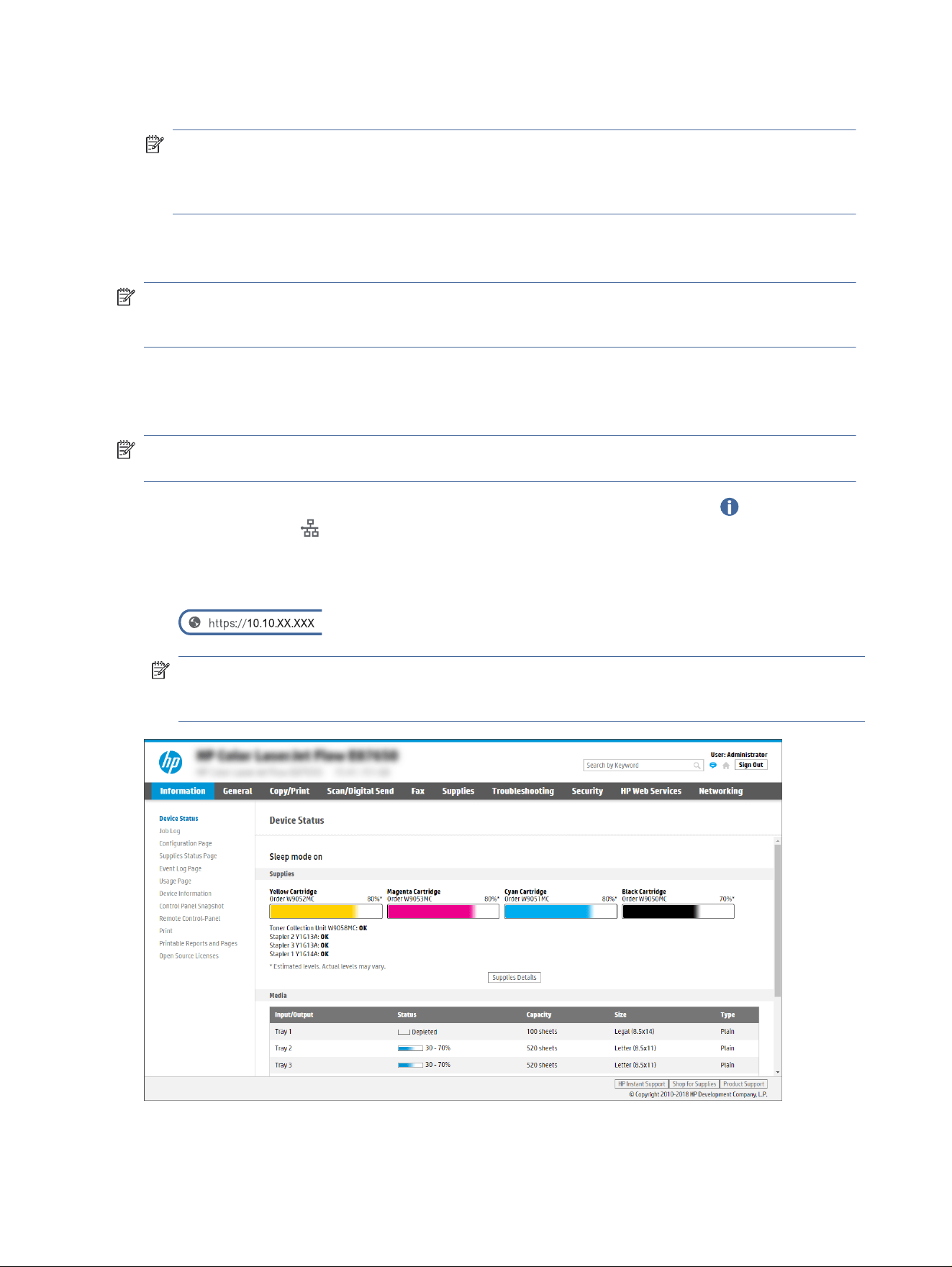
● SMTP server (e.g., smtp.mycompany.com)
NOTE: If you do not know the SMTP server name, SMTP port number, or authentication
information, contact the email/Internet service provider or system administrator for the
information. SMTP server names and port names are typically found by doing an Internet search.
For example, use terms like "Gmail smtp server name" or "Yahoo smtp server name" to search.
● SMTP server authentication requirements for outgoing email messages, including the user name
and password used for authentication, if applicable.
NOTE: Consult your email service provider's documentation for information on digital sending limits
for your email account. Some providers may temporarily lock your account if you exceed your sending
limit.
Step one: Access the HP Embedded Web Server (EWS)
Open the EWS to start the setup process.
NOTE: The figure in this topic shows an EWS screen for a color printer. However, the procedure below
is valid for both color and mono printers.
1. From the Home screen on the printer control panel, touch the Information icon , and then touch
the Ethernet icon to display the IP address or host name.
2. Open a web browser, and in the address line, type the IP address or host name exactly as it displays
on the printer control panel. Press the Enter key on the computer keyboard. The EWS opens.
NOTE: If the web browser displays a message indicating that accessing the website might not be
safe, select the option to continue to the website. Accessing this website will not harm the
computer.
76
Chapter 6 Scan
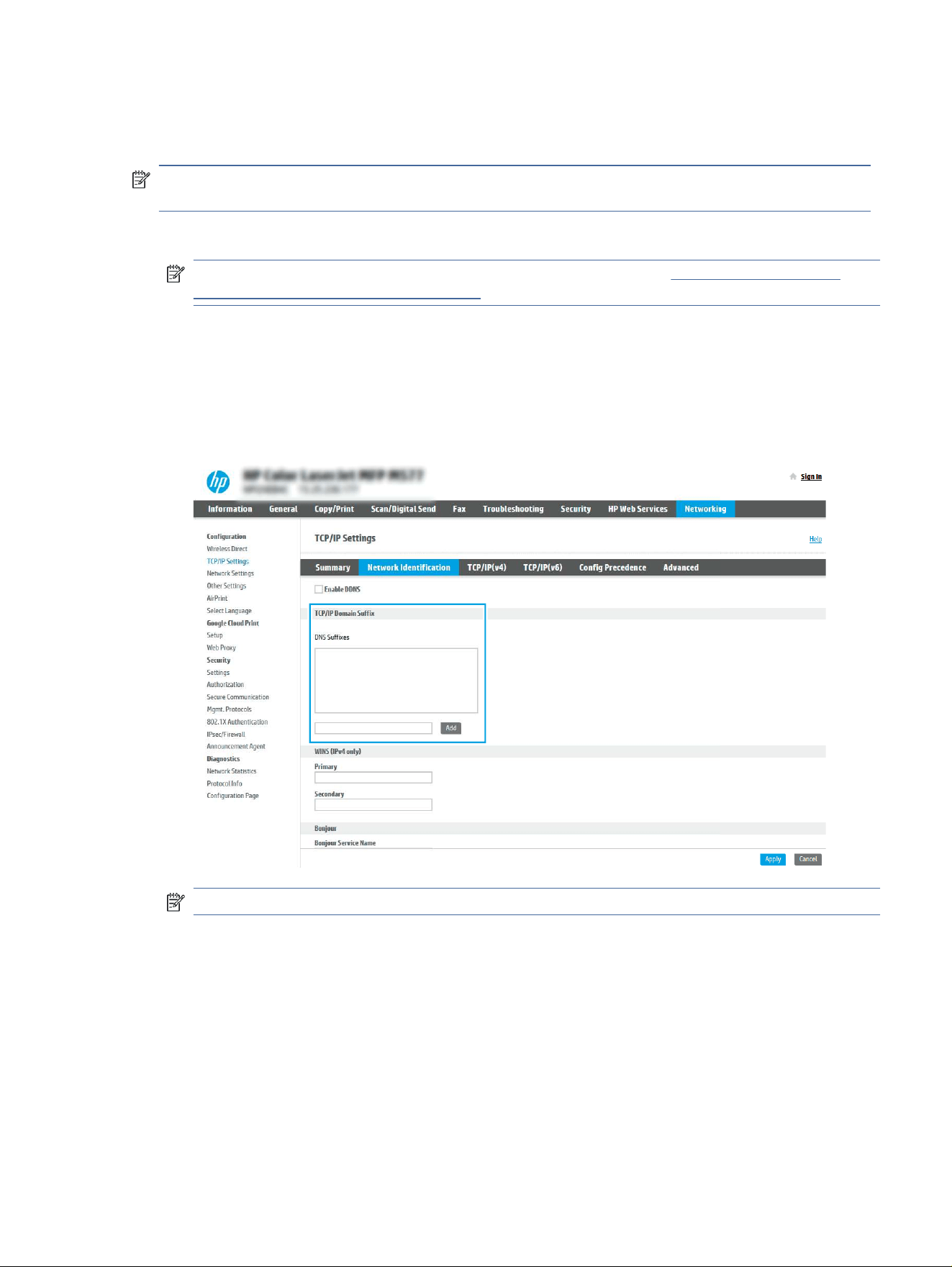
Step two: Configure the Network Identification settings
Configure advanced setting for network identification.
NOTE: Configuring email setup on the Networking tab is an advanced process and might require the
assistance of a system administrator.
1. Using the EWS top navigation tabs, click Networking.
NOTE: For configuring the network settings for use with Office 365, Step five: Set up Send to
Email to use Office 365 Outlook (optional)
2. In the left navigation pane, click TCP/IP Settings. A username/password might be required to
access the Network Identification tab of the EWS.
3. On the TCP/IP Settings dialog, click the Network Identification tab.
4. If DNS is required on the network, in the TCP/IP Domain Suffix area, verify that the DNS suffix for the
email client being used is listed. DNS suffixes have this format:
companyname.com
,
gmail.com
, etc.
NOTE: If the Domain Name suffix is not set up, use the IP address.
5. Click Apply.
6. Click OK.
Step three: Configure the Send to Email feature
The two options for configuring Send to Email are the Email Setup Wizard for basic configuration
and Email Setup for advanced configuration. Use the following options to configure the Send to Email
feature:
Step two: Configure the Network Identification settings
77
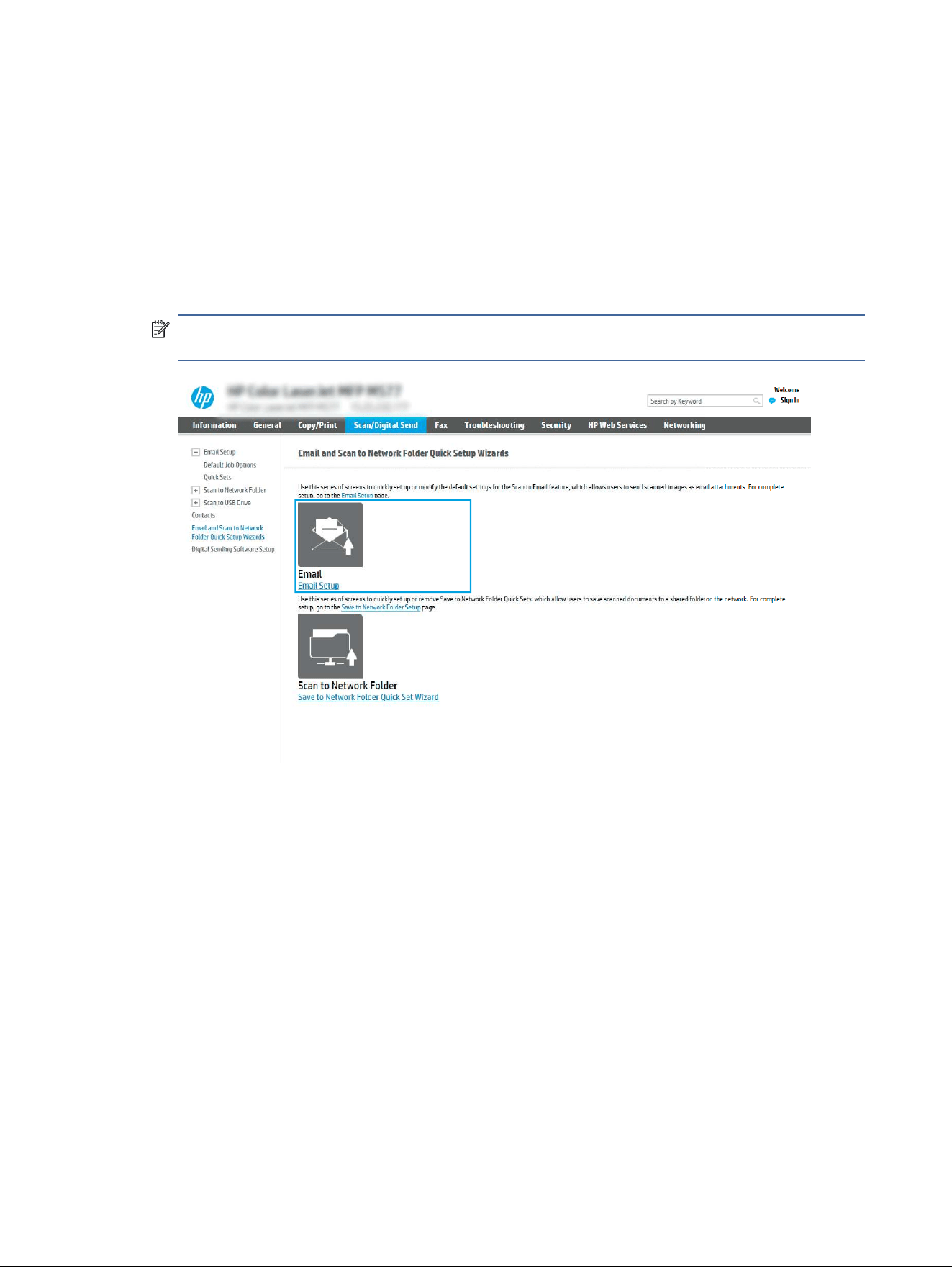
Method one: Basic configuration using the Email Setup Wizard
Perform basic configuration using the Email Setup Wizard.
This option opens the Email Setup Wizard in the HP Embedded Web Server (EWS) for basic
configuration.
1. Using the EWS top navigation tabs, click Scan/Digital Send.
2. In the left navigation pane, click Email and Scan to Network Folder Quick Setup Wizards.
3. In the Email and Scan to Network Folder Quick Setup Wizards dialog, click the Email Setup link.
NOTE: If a message displays indicating that the Scan to Email feature is disabled, click Continue
to proceed with the configuration and enable the Scan to Email feature upon completion.
4. On the Configure Email Servers (SMTP) dialog, select one of the following options and complete the
steps:
● Option one: Use a server already in use by Email.
Select Use a server already in use by Email, and then click Next.
● Option two: Search the network for the outgoing email server.
This option finds outgoing SMTP servers inside your firewall only.
a. Select Search network for outgoing email server, and then click Next.
b. Select the appropriate server from the Configure Email Server (SMTP) list, and then click
Next.
c. Select the option that describes the server’s authentication requirements:
– Server does not require authentication: Select Server does not require
authentication, and then click Next.
78
Chapter 6 Scan

-OR-
– Server requires authentication: From the drop-down list, select an authentication
option:
○ Select Use credentials of user to connect after Sign In at the control panel, and
then click Next.
-OR-
○ Select Always use these credentials, enter the User name and Password, and
then click Next.
● Option three: Add the SMTP server.
a. Select Add SMTP server.
b. Enter the Server Name and Port Number, and then click Next.
NOTE: In most cases, the default port number does not need to be changed.
NOTE: If you are using a hosted SMTP service such as Gmail, verify the SMTP address,
port number, and SSL settings from the service provider’s website or other sources.
Typically, for Gmail, the SMTP address is smtp.gmail.com, port number 465, and the SSL
should be enabled.
Please refer to online sources to confirm these server settings are current and valid at
the time of configuration.
c. Select the appropriate server authentication option:
– Server does not require authentication: Select Server does not require
authentication, and then click Next.
-OR-
– Server requires authentication: Select an option from the Server requires
authentication drop-down list:
○ Select Use credentials of user to connect after Sign In at the control panel, and
then click Next.
-OR-
○ Select Always use these credentials, enter the User name and Password, and
then click Next.
5. On the Configure Email Settings dialog, enter the following information about the sender’s email
address, and then click Next.
NOTE: When setting up the From, Subject, and Message fields, if the User editable check box is
unchecked, users will not be able to edit those fields at the printer control panel when sending an
email.
Method one: Basic configuration using the Email Setup Wizard
79

Table 6-1 Send email settings
Option Description
From
(Required)
Select one of the following options from the From drop-down list:
● User’s address (sign-in required)
● Default From: Enter a default email address and display name in the Default From
Email Address and Default Display Name fields
NOTE: Create an email account for the printer, and use this address for the
default email address.
NOTE: Configure the email feature so that users must sign in before using it.
This prevents users from sending an email from an address that is not their own.
Subject
(Optional)
Provide a default subject line for the email messages.
Message
(Optional)
Create a custom message.
To use this message for all emails sent from the printer, clear the User editable check
box for Message.
6. In the Configure File Scan Settings area, set the default scanning preferences, and then click Next.
Table 6-2
Scan settings
Option Description
File Type Select the default file type for the scanned document:
● PDF
● JPEG
● TIFF
● MTIFF
● XPS
● PDF/A
HP LaserJet Enterprise Flow MFP printers or MFP printers that are connected to a
digital send software (DSS) server also support the following OCR file types:
● Text (OCR)
● Unicode Text (OCR)
● RTF (OCR)
● Searchable PDF (OCR)
● Searchable PDF/A (OCR)
● HTML (OCR)
● CSV (OCR)
80
Chapter 6 Scan

Table 6-2 Scan settings (continued)
Option Description
Color/Black Select the default color setting for the scanned document:
● Color
● Black
● Black/Gray
● Automatically detect
Quality and File Size Select the default output quality for the scanned document:
● Low (small file)
● Medium
● High (large file)
Resolution Select the default scan resolution for the scanned document:
● 75 dpi
● 150 dpi
● 200 dpi
● 300 dpi
● 400 dpi
● 600 dpi
7. Review the Summary area, and then click Finish to complete the setup.
Method two: Advanced configuration using the Email Setup
Use the following steps for advanced configuration using the E-mail Setup dialog in the EWS.
1. Using the EWS top navigation tabs, click Scan/Digital Send, expand the Email Setup menu in the left
navigation pane, and then click Default Job Options.
The Default Job Options page displays the Basic Settings for Scan to Email setup. To access
additional settings, click the Advanced Settings button at the bottom of the page. To switch back to
basic settings, click the Basic Settings button.
NOTE: This procedure covers the steps for Basic Settings first and then the steps for Advanced
Settings.
Method two: Advanced configuration using the Email Setup
81
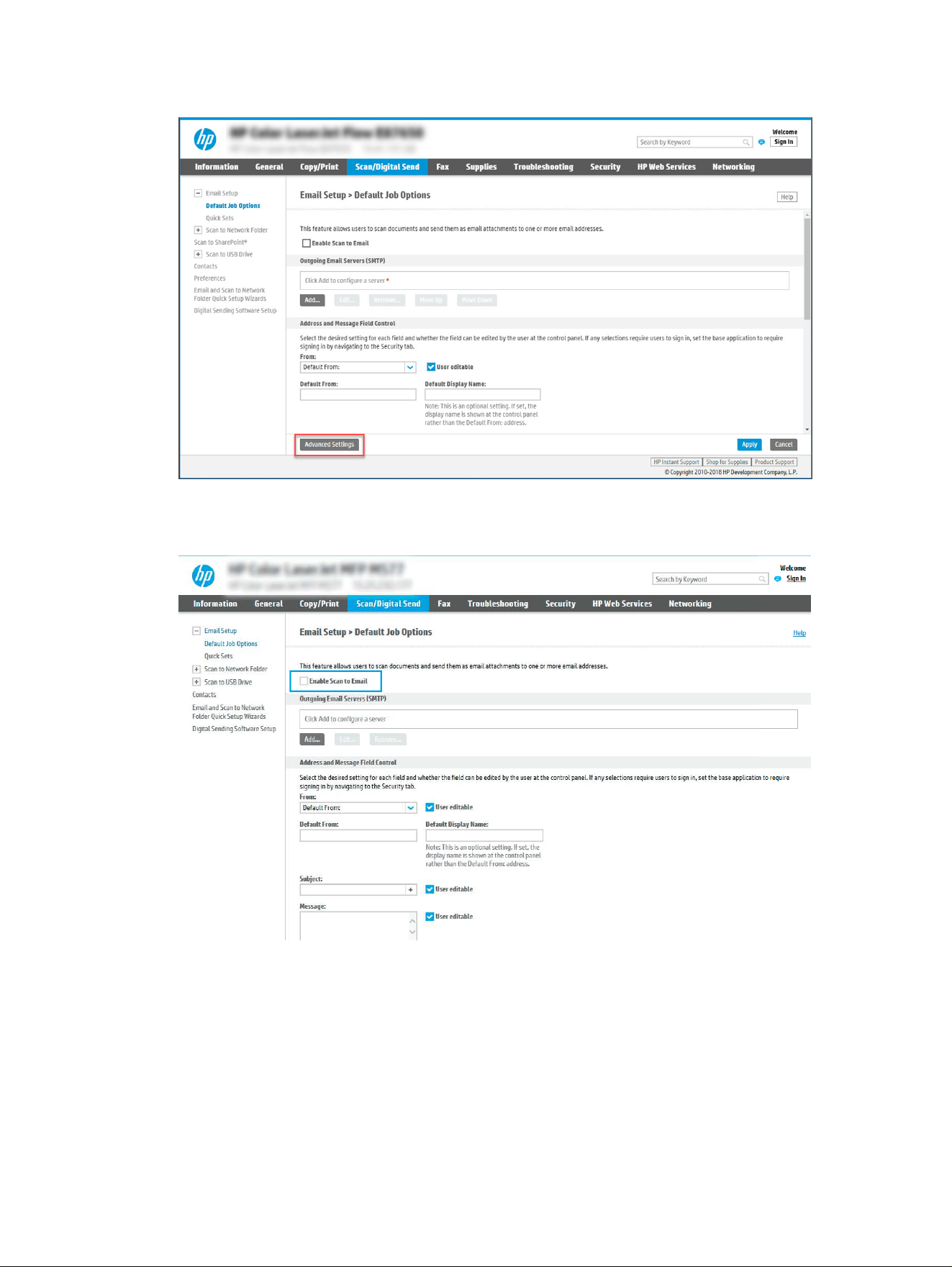
Figure 6-1 Location of Advanced Settings button
2. On the Default Job Options page, select the Enable Scan to Email check box. If this check box is not
selected, the feature is unavailable at the printer control panel.
3. In the Outgoing Email Servers (SMTP) area, complete the steps for one of the following options:
● Select one of the displayed servers.
● Click Add to start the SMTP wizard.
a. In the SMTP wizard, select one of the following options:
– Option one: I know my SMTP server address or host name: Enter the address of an
SMTP server, and then click Next
82
Chapter 6 Scan

– Option two: If you do not know the address of the SMTP server, select Search network
for outgoing email server, and then click Next. Select the server, and then click Next.
NOTE: If an SMTP server was already created for another printer function, the Use a
server already in use by another function option displays. Select this option, and then
configure it to be used for the email function.
b. On the Set the basic information necessary to connect to the server dialog, set the
options to use, and then click Next.
– Some servers have problems sending or receiving emails that are larger than 5
megabytes (MB). These problems can be prevented by entering a number in Split
emails if larger than (MB).
– In most cases, the default port number does not need to be changed. However, when
using the Enable SMTP SSL Protocol option, port 587 must be used.
– If you are using Google™ Gmail for email service, select the Enable SMTP SSL Protocol
check box. Typically, for gmail, the SMTP address is smtp.gmail.com, port number
465, and the SSL should be enabled. Refer to online sources to confirm these server
settings are current and valid at the time of configuration.
c. On the Server Authentication Requirements dialog, select the option that describes the
server’s authentication requirements:
– Server does not require authentication, and then click Next.
– Server requires authentication
○ From the drop-down box, select Use credentials of user to connect after Sign In at
the control panel, and then click Next.
○ From the drop-down box, select Always use these credentials, enter the
Username and Password, and then click Next.
NOTE: If using a signed-in user's credentials, set email to require sign in by the user on
the printer control panel. Deny device guest access to email by clearing the check box for
email in the Device Guest column in the Sign in and Permission Policies area on the
Access Control dialog of the Security tab. The icon in the check box changes from a check
mark to a lock.
d. On the Server Usage dialog, choose the printer functions that will send email through this
SMTP server, and then click the Next button.
If the server requires authentication, a user name and password for sending automatic
alerts and reports from the printer will be required.
e. On the Summary and Test dialog, enter a valid email address in the Send test email to:
field, and then click Test.
f. Verify that all of the settings are correct, and then click Finish to complete the outgoing
email server set up.
Method two: Advanced configuration using the Email Setup
83

4. In the Address and Message Field Control area, enter a From: setting and any of the other optional
settings.
Table 6-3 Address and Message Field Control (Basic Settings)
Feature Description
User editable To use the Default From address and Default Display Name for all emails sent from this
printer (unless a user is signed in), clear the User editable check box.
When setting up the address fields, if the User editable check box is cleared, users will
not be able to edit those fields at the printer control panel when sending an email. For
send-to-me functionality, clear the User editable check boxes for all of the address fields,
including the From:, To:, CC:, and BCC: fields, and then set that user's send email From: their
own email address and To: their own email address.
Default From: and Default
Display Name:
Provide an email address and name to use for the From: address for the email message.
NOTE: Create an email account for the printer, and use this address for the default email
address.
NOTE: Configure the email feature so that users must sign in before using it. This
prevents users from sending an email from an address that is not their own.
Subject: Provide a default subject line for the email messages.
Message: Create a custom message. To use this message for all emails sent from the printer, clear
or do not select the User editable check box for Message:.
Table 6-4 Address and Message Field Control (Advanced Settings - optional)
Feature Description
Address Field Restrictions Specify whether users must select an email address from an address book or whether
users are allowed to enter in an email address manually.
CAUTION: If Users must select from address book is selected, and any of the address
fields are also set as User editable, changes to those editable fields also change the
corresponding values in the address book.
To prevent users from changing contacts in the Address Book at the printer control
panel, go to the Access Control page on the Security tab, and deny Device Guest access
to address book modifications.
Allow invalid email address
formats
Select to allow an invalid email address format.
To: Provide a To (recipient) email address for emails.
CC: Provide a CC email address for emails.
BCC: Provide a BCC email address for emails.
5. In the File Settings area, set the default file settings preferences.
Table 6-5
File Settings (Basic Settings)
Feature Description
File Name Default file name for the file to be saved.
Select the User editable check box to make this setting editable at the printer control
panel.
84 Chapter 6 Scan

Table 6-5 File Settings (Basic Settings) (continued)
Feature Description
File Type Select the file format for the saved file.
Select the User editable check box to make this setting editable at the printer control
panel.
Resolution Set the resolution for the file. Higher resolution images have more dots per inch (dpi), so
they show more detail. Lower resolution images have fewer dots per inch and show less
detail, but the file size is smaller.
Quality and File Size Select the quality for the file. Higher-quality images require a larger file size than lower-
quality images, and they take more time to send.
Color/Black Specify whether copies are to be printed in color, black and gray, or black only (color
printers only).
Table 6-6 File settings (Advanced Settings - optional)
Feature Description
File Name Prefix Set the default file name prefix used for files saved to a network folder.
File Name Suffix Set the default file name suffix used for files saved to a network folder.
Duplicate filename suffix default [filename]_YYYYMMDDT
File Name Preview Enter a file name, and then click the Update Preview button.
File Numbering Format Select a file name format for when the job is divided into multiple files.
Add numbering when job
has just one file (ex. _1–1)
Select this setting to add numbering to a file name when the job is only one file instead of
multiple files.
High Compression (smaller
file)
Select this setting to compress the scanned file, which reduces the file size. However,
the scanning process for a High compression file might take longer than for a Normal
compression file.
PDF encryption If the file type is PDF, then this option encrypts the output PDF file. A password must be
specified as part of the encryption. The same password must be used to open the file. The
user will be prompted to enter a password prior to scanning their job if one has not been
set prior to pressing start.
Suppress blank pages If the Suppress blank pages option is enabled, blank pages will be ignored.
Create Multiple Files Select this setting to scan pages into separate files based on a predetermined maximum
number of pages per file.
6. Click the Advanced Settings button to display the following settings:
● Signing and Encryption
● Notification (job notification)
● Scan Settings
Method two: Advanced configuration using the Email Setup
85

7. In the Signing and Encryption area, set the signing and encryption preferences.
Table 6-7 Signing and Encryption settings
Feature Description
Signing Select whether to sign the email with a security certificate.
Select the User editable check box to make this setting editable at the printer control
panel.
Hashing Algorithm Select the algorithm to use for signing the certificate.
Encryption Select whether to encrypt the email.
Select the User editable check box to make this setting editable at the printer control
panel.
Encryption Algorithm Select the algorithm to use for encrypting the email.
Attribute for Recipient
Public Key
Enter which attribute to use to retrieve the recipient’s public key certificate from LDAP.
Use the recipient public
key certificate to verify the
recipient
Select this setting to use the recipient’s public key certificate to verify the recipient.
8. In the Notification area, select when users will receive notifications about sent emails. The default
setting is using the signed in user's email address. If the recipient email address is blank, no
notification is sent.
9. In the Scan Settings area, set the default scanning preferences.
Table 6-8
Scan Settings
Feature Description
Original Size Select the page size of the original document.
Original Sides Select whether the original document is single-sided or double-sided.
Optimize Text/Picture Select to optimize the output of a particular type of content.
Content Orientation Select the way the content of the original document is placed on the page: Portrait or
Landscape.
Background Cleanup Select a value to remove faint images from the background or to remove a light
background color.
Darkness Select a value to adjust the darkness of the file.
Contrast Select a value to adjust the contrast of the file.
Sharpness Select a value to adjust the sharpness of the file.
Image Preview Select whether to require or make optional a displayed preview of the job or to disable a
preview.
Cropping Options Select whether or not to allow a job to be cropped and the type of cropping option.
Erase Edges Select this setting to specify the width of edge margins to be erased, in either inches or
millimeters, for the front side and back side of a job.
10. Review the selected options to verify that they are accurate, and then click Apply to complete the
setup.
86
Chapter 6 Scan

Step four: Configure the Quick Sets (optional)
Quick Sets are optional short-cut jobs that can be accessed on the main Home screen or within the
Quick Sets application at the printer. Use the following procedure to configure the Quick Sets.
1. In the Email Setup area of the left navigation pane, click Quick Sets.
2. Select one of the following options:
● Select an existing Quick Set under Quick Sets Application in the table.
-OR-
● Click Add to start the Quick Set Wizard.
3. If you selected Add, the Quick Sets Setup page opens. Complete the following information:
● Quick Set Name: Enter a title for the new Quick Set.
● Quick Set Description: Enter a description of the Quick Set.
● Quick Set Start Option: To set how the Quick Set starts, click either Enter application, then user
presses Start or Start instantly when selected from the Home Screen.
4. Define the following settings for the Quick Set: Address and Message Field Control, Signing and
Encryption, Notification, Scan Settings, File Settings.
5. Click Finish to save the Quick Set.
Step five: Set up Send to Email to use Office 365 Outlook (optional)
Enable the printer to send an email with an Office 365 Outlook account from the control panel.
Introduction
Microsoft Office 365 Outlook is a cloud-based email system provided by Microsoft which uses
Microsoft's Simple Mail Transfer Protocol (SMTP) server to send or receive emails. Complete the
following to enable the printer to send an email with an Office 365 Outlook account from the control
panel.
NOTE: You must have an email address account with Office 365 Outlook to configure the settings in
the EWS.
Configure the outgoing email server (SMTP) to send an email from an Office 365 Outlook
account
Configure the outgoing email server using the following procedure.
1. Using the EWS top navigation tabs, click Networking.
2. In the left navigation pane, click TCP/IP Settings.
3. In the TCP/IP Settings area, click the Network Identification tab.
Step four: Configure the Quick Sets (optional)
87
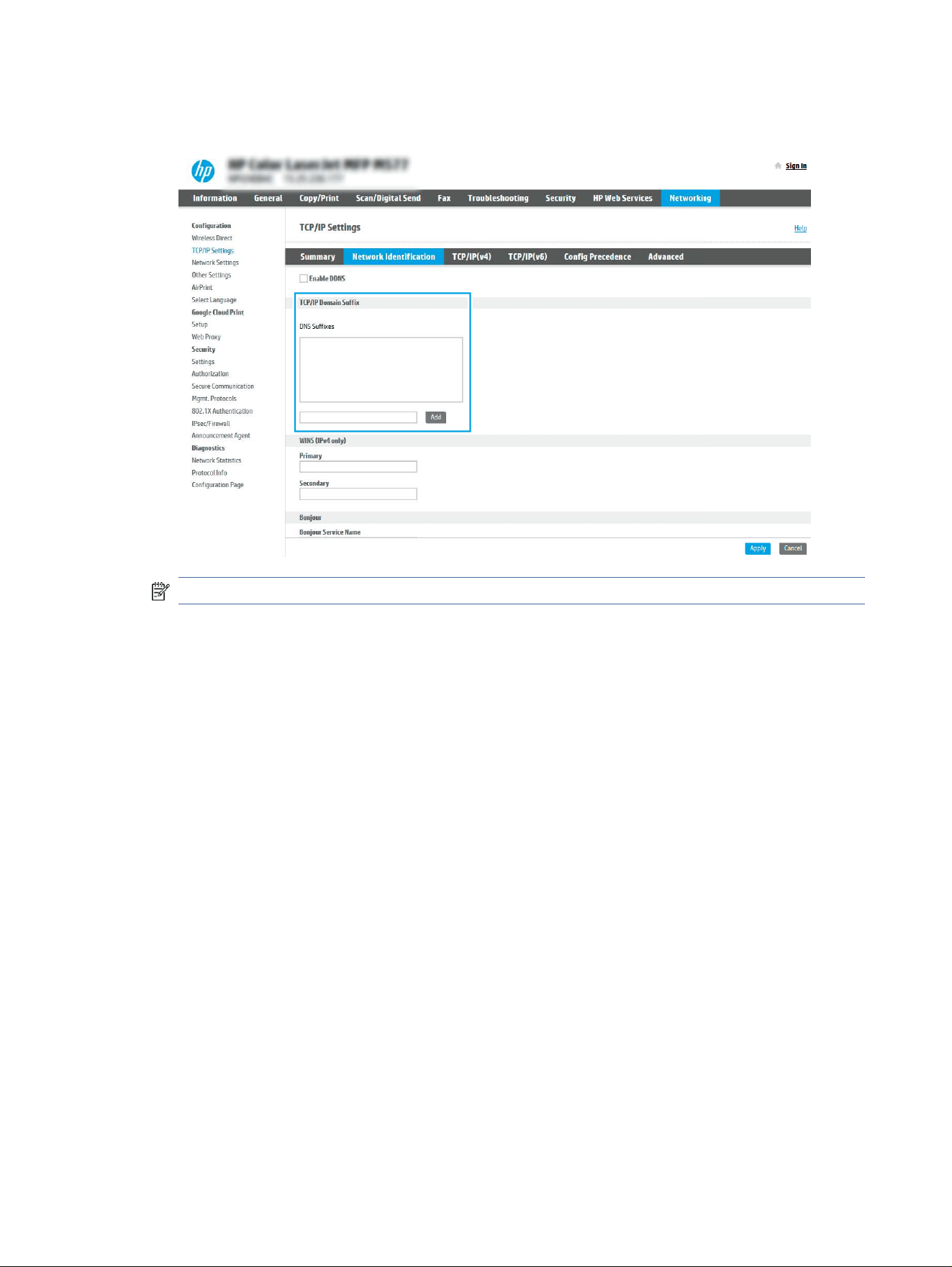
4. If DNS is required on the network, in the TCP/IP Domain Suffix area, verify that the DNS suffix for the
email client being used is listed. DNS suffixes have this format:
companyname.com
,
Gmail.com
, etc.
NOTE: If the Domain Name suffix is not set up, use the IP address.
5. Click Apply.
6. Click the Scan/Digital Send tab.
7. On the left navigation pane, click Email Setup.
88
Chapter 6 Scan
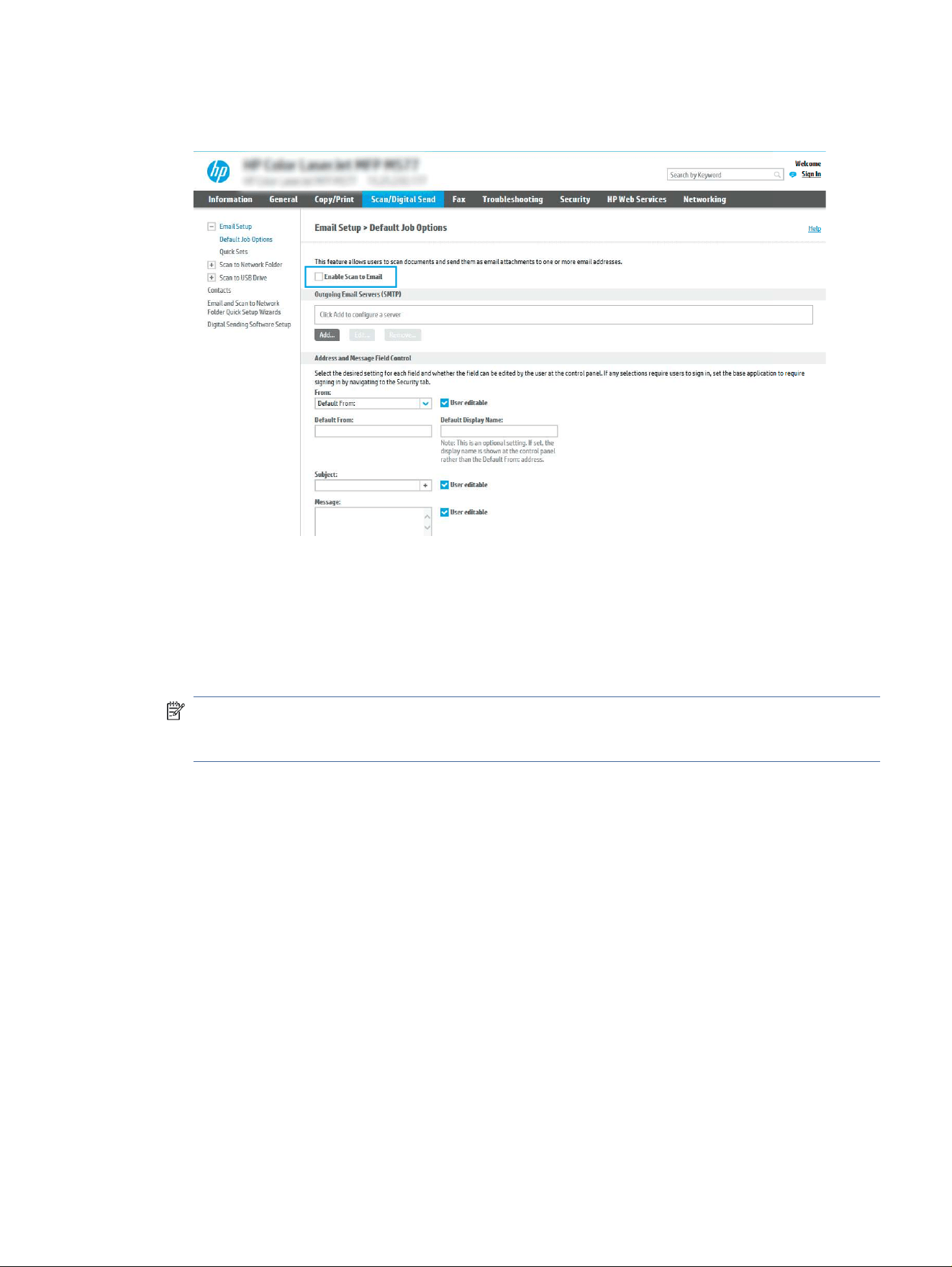
8. On the Email Setup page, select the Enable Scan to Email check box. If this check box is not
available, the feature is unavailable at the printer control panel.
9. In the Outgoing Email Servers (SMTP) area, click Add to start the SMTP wizard.
10. In the I know my SMTP server address or host name field, type smtp.onoffice.com, and then
click Next.
11. On the Set the basic information necessary to connect to the server dialog, in the Port Number
field, type 587.
NOTE: Some servers have problems sending or receiving emails that are larger than 5
megabytes (MB). These problems can be prevented by entering a number in Split emails if larger
than (MB).
12. Select the Enable SMTP SSL Protocol check box, and then click Next.
13. On the Server Authentication Requirements dialog, complete the following information:
a. Select Server requires authentication.
b. From the drop-down list, select Always use these credentials.
c. In the Username field, type the Office 365 Outlook email address.
d. In the Password field, type the Office 365 Outlook account password, and then click Next.
14. On the Server Usage dialog, choose the printer functions that will send email through this SMTP
server, and then click the Next button.
15. On the Summary and Test dialog, enter a valid email address in the Send a test email to: field, and
then click Test.
16. Verify that all of the settings are correct, and then click Finish to complete the outgoing email
server setup.
Configure the outgoing email server (SMTP) to send an email from an Office 365 Outlook account
89

For more information, go to Microsoft's Support page.
Set up Scan to Network Folder
Set up the Scan to Folder feature to scan documents directly to network folder.
Introduction
This section explains how to enable and configure the Scan to Network Folder function. The printer
has a feature that enables it to scan a document and save it to a network folder. To use this scan
feature, the printer must be connected to a network; however, the feature is not available until it has
been configured. There are two methods for configuring Scan to Network Folder, the Save to Network
Folder Setup Wizard for basic setup and Save to Network Folder Setup for advanced setup.
Before you begin
Have the following items available before you set up the Scan to Network feature.
NOTE: To set up the Scan to Network Folder feature, the printer must have an active network
connection.
Administrators need the following items before beginning the configuration process.
● Administrative access to the printer.
● The fully-qualified domain name (FQDN) (e.g., \\servername.us.companyname.net\scans) of the
destination folder OR the IP address of the server (e.g., \\16.88.20.20\scans).
NOTE: The use of the term "server" in this context refers to the computer where the shared folder
resides.
Step one: Access the HP Embedded Web Server (EWS)
Open the EWS to start the setup process.
NOTE: The figure in this topic shows an EWS screen for a color printer. However, the procedure below
is valid for both color and mono printers.
1. From the Home screen on the printer control panel, touch the Information icon , and then touch
the Ethernet icon to display the IP address or host name.
2. Open a web browser, and in the address line, type the IP address or host name exactly as it displays
on the printer control panel. Press the Enter key on the computer keyboard. The EWS opens.
NOTE: If the web browser displays a message indicating that accessing the website might not be
safe, select the option to continue to the website. Accessing this website will not harm the
computer.
90
Chapter 6 Scan
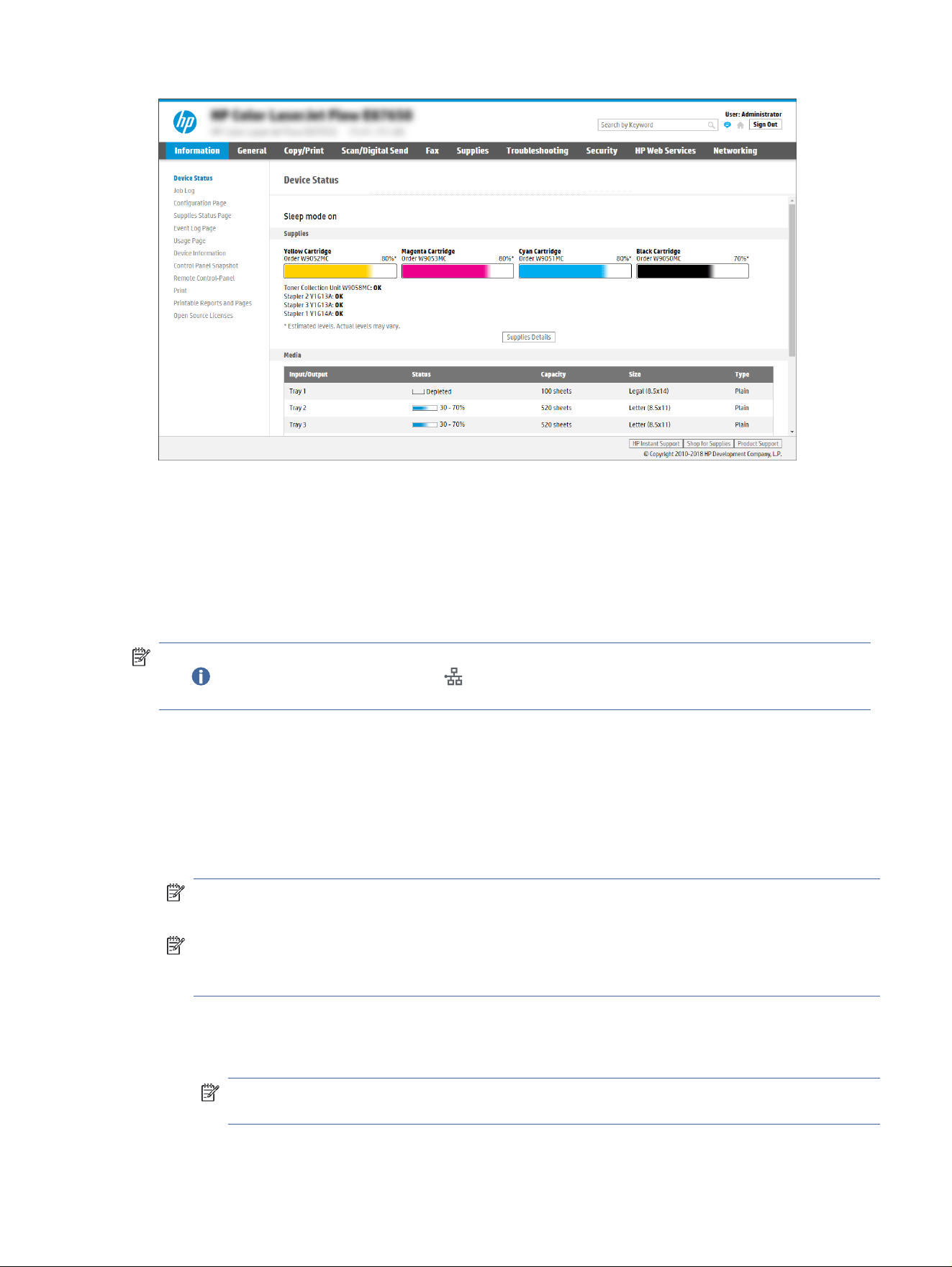
Step two: Set up Scan to Network Folder
Set up Scan to Network Folder using one of the following methods.
Method one: Use the Scan to Network Folder Wizard
Use this option for basic configuration of the Save to Network Folder feature using the Scan to Network
Folder wizard.
NOTE: Before you begin: To display the printer's IP address or host name, touch the Information
icon , and then touch the Network icon on the printer's control panel. Enter the IP address into a
Web browser to open the EWS.
1. Using the EWS top navigation tabs, click Scan/Digital Send tab. The Email and Scan to Network
Folder Quick Setup Wizards dialog opens.
2. In the left navigation pane, click Email and Scan to Network Folder Quick Setup Wizards.
3. Click the Save to Network Folder Quick Set Wizard link.
4. On the Add or Remove a Save to Network Folder Quick Set dialog, click Add.
NOTE: Quick Sets are shortcut jobs that can be accessed on the printer Home screen or within
the Quick Sets application.
NOTE: The Save to Network Folder feature can be minimally configured without creating a quick
set. However, without the Quick Set, users must enter the destination folder information at the
control panel for each scan job. A quick set is required to include Save to Network Folder metadata.
5. On the Add Folder Quick Set dialog, complete the following information:
a. In the Quick Set Title field, type a title.
NOTE: Name the Quick Set something that users can understand quickly (e.g., "Scan and
save to a folder").
Step two: Set up Scan to Network Folder
91

b. In the Quick Set Description field, type a description explaining what the Quick Set will save.
c. Click Next.
6. On the Configure Destination Folder dialog, complete the following information:
a. In the UNC Folder Path field, type a folder path where the scan will go.
The folder path can either be the fully-qualified domain name (FQDN) or the IP address of the
server. Be sure that the folder path (e.g., \scans) follows the FQDN or IP address.
FQDN example: \\servername.us.companyname.net\scans
IP address example: \\16.88.20.20\scans
NOTE: The FQDN can be more reliable than the IP address. If the server gets its IP address
via DHCP, the IP address can change. However, the connection with an IP address might be
faster because the printer does not need to use DNS to find the destination server.
b. From the Authentication Settings drop-down, select one of the following options:
● Use credentials of user to connect after Sign In at the control panel
● Always use these credentials
NOTE: If Always use these credentials is selected, a user name and password must be
entered in the corresponding fields, and the printer’s access to the folder must be verified
by clicking Verify Access.
c. In the Windows Domain field, type the Windows domain.
TIP: To find the Windows domain in Windows 7, click Start, click Control Panel, click System.
To find the Windows domain in Windows 8, click Search, enter System in the search box, and
then click System.
The domain is listed under Computer name, domain, and workgroup settings.
d. Click Next.
7. On the Configure File Scan Settings dialog, set the default scanning preferences for the Quick Set,
and then click Next.
8. Review the Summary dialog, and then click Finish.
Method two: Use Scan to Network Folder Setup
This option enables advanced configuration of the Save to Network Folder feature using the
HP Embedded Web Server (EWS) for the printer.
NOTE: Before you begin: To display the printer's IP address or host name, touch the Information
icon , and then touch the Network icon on the printer's control panel. Enter the IP address into a
Web browser to open the EWS.
Step one: Begin the configuration
Use the following steps to begin Scan to Network Folder setup.
1. Click the Scan/Digital Send tab.
92
Chapter 6 Scan

2. In the left navigation pane, click Scan to Network Folder Setup.
Step two: Configure the Scan to Network Folder settings
Use the following procedure to complete Scan to Network Folder setup.
Step one: Begin the configuration
Use the following steps to begin configuration.
1. On the Scan to Network Folder Setup page, select the Enable Scan to Network Folder check box. If
this box is not selected, the feature is unavailable at the printer control panel.
2. In the Scan to Network Folder area of the left navigation pane, click Quick Sets. Click Add to open
the Quick Sets Setup dialog.
NOTE: Quick Sets are shortcut jobs that can be accessed on the printer Home screen or within
the Quick Sets application.
NOTE: The Scan to Network Folder feature can be minimally configured without creating a Quick
Set. However, without the Quick Set, users must enter the destination folder information at the
control panel for each scan job. A Quick Set is required to include Scan to Network Folder
metadata.
Complete all of the settings in the Quick Set Setup to fully configure the Scan to Network Folder feature.
Dialog one: Set the Quick Set name, description, and options for user interaction at the control panel
Set the Quick Set details for user interaction at the printer's control panel.
Use the Set the button location for the Quick Set and options for user interaction at the control panel
dialog to configure where the Quick Set button will display on the printer control panel and to configure
the level of user interaction at the printer control panel.
1. In the Quick Set Name field, type a title.
NOTE: Name the Quick Set something that users can understand quickly (e.g., "Scan and save to
a folder").
2. In the Quick Set Description field, type a description explaining what the Quick Set will save.
3. From the Quick Set Start Option list, select one of the following options:
● Option one: Enter application, then user presses Start.
● Option two: Start instantly upon selection.
Select one of the following prompt options :
○ Prompt for original sides
○ Prompt for additional pages
○ Require Preview
NOTE: If Start instantly upon selection is selected, the destination folder must be entered in
the next step.
4. Click Next.
Step two: Configure the Scan to Network Folder settings
93
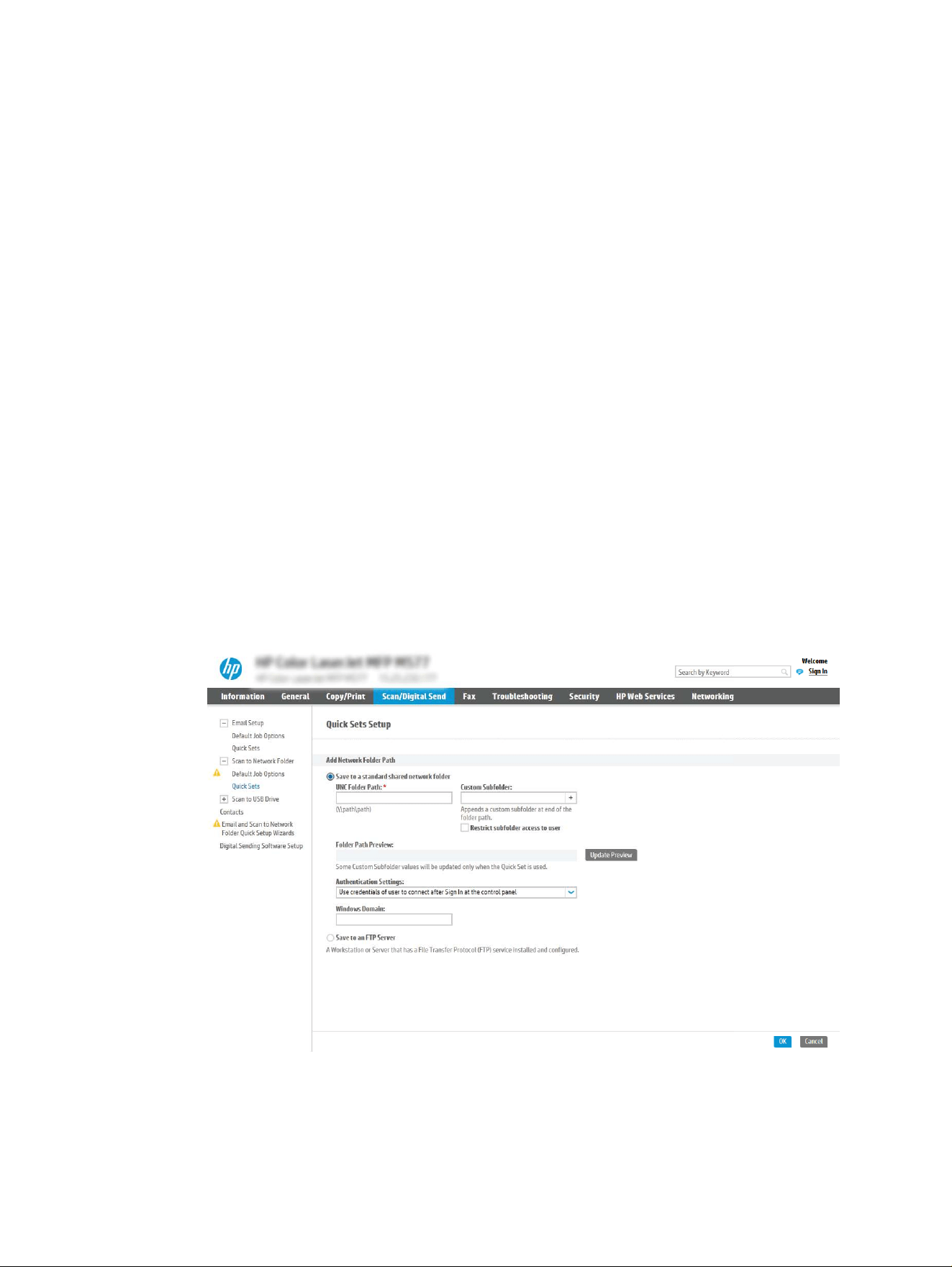
Dialog two: Folder Settings
Use the Folder Settings dialog to configure the types of folders the printer sends scanned documents to
and the folder permissions.
There are two types of destination folders to select from:
● Shared folders or FTP folders
● Personal shared folders
There are two types of folder permissions to select from:
● Read and write access
● Write access only
Configure the destination folder for scanned documents
Select one of the following options to set up a destination folder.
Option 1: Configure the printer to save to a shared folder or FTP folder
To save scanned documents to a standard shared folder or an FTP folder, complete the following steps.
1. If it is not already selected, select Save to shared folders or FTP folders.
2. Click Add.... The Add Network Folder Path dialog opens.
3. On the Add Network Folder Path dialog, select one of the following options:
● Option one: Save to a standard shared network folder.
a. If it is not already selected, select Save to a standard shared network folder.
b. In the UNC Folder Path field, type a folder path.
94
Chapter 6 Scan

The folder path can either be the fully-qualified domain name (FQDN) or the IP address of
the server. Be sure that the folder path (e.g., \scans) follows the FQDN or IP address.
FQDN example: \\servername.us.companyname.net\scans
IP address example: \\16.88.20.20\scans
NOTE: The FQDN can be more reliable than the IP address. If the server gets its IP
address via DHCP, the IP address can change. However, the connection with an IP address
might be faster because the printer does not need to use DNS to find the destination
server.
c. To automatically create a subfolder for scanned documents in the destination folder,
select a format for the subfolder name from the Custom Subfolder list.
To restrict the subfolder access to the user who creates the scan job, select Restrict
subfolder access to user.
d. To view the complete folder path for scanned documents, click Update Preview.
e. From the Authentication Settings list, select one of the following options:
– Use credentials of user to connect after Sign In at the control panel
– Always use these credentials
NOTE: If Always use these credentials is selected, a user name and password must be
entered in the corresponding fields.
f. In the Windows Domain field, type the Windows domain.
NOTE: To find the Windows domain in Windows 7, click Start, click Control Panel, click
System.
To find the Windows domain in Windows 8, click Search, enter System in the search box,
and then click System.
The domain is listed under Computer name, domain, and workgroup settings.
NOTE: If a shared folder is set to be accessed by everyone, values for a workgroup name
(default is “Workgroup”), a user name, and password must be entered in the corresponding
fields. However, if the folder is within a particular user’s folders and not Public, the user
name and password of that user must be used.
NOTE: An IP address might be necessary instead of a computer name. Many home
routers do not handle computer names well, and there is no Domain Name Server (DNS).
In this case, it is best to set up a static IP address on the shared PC to alleviate the
problem of DHCP assigning a new IP address. On a typical home router, this is done by
setting a static IP address that is on the same subnet, but outside the DHCP address
range.
g. Click OK.
● Option two: Save to an FTP Server.
Option 1: Configure the printer to save to a shared folder or FTP folder
95
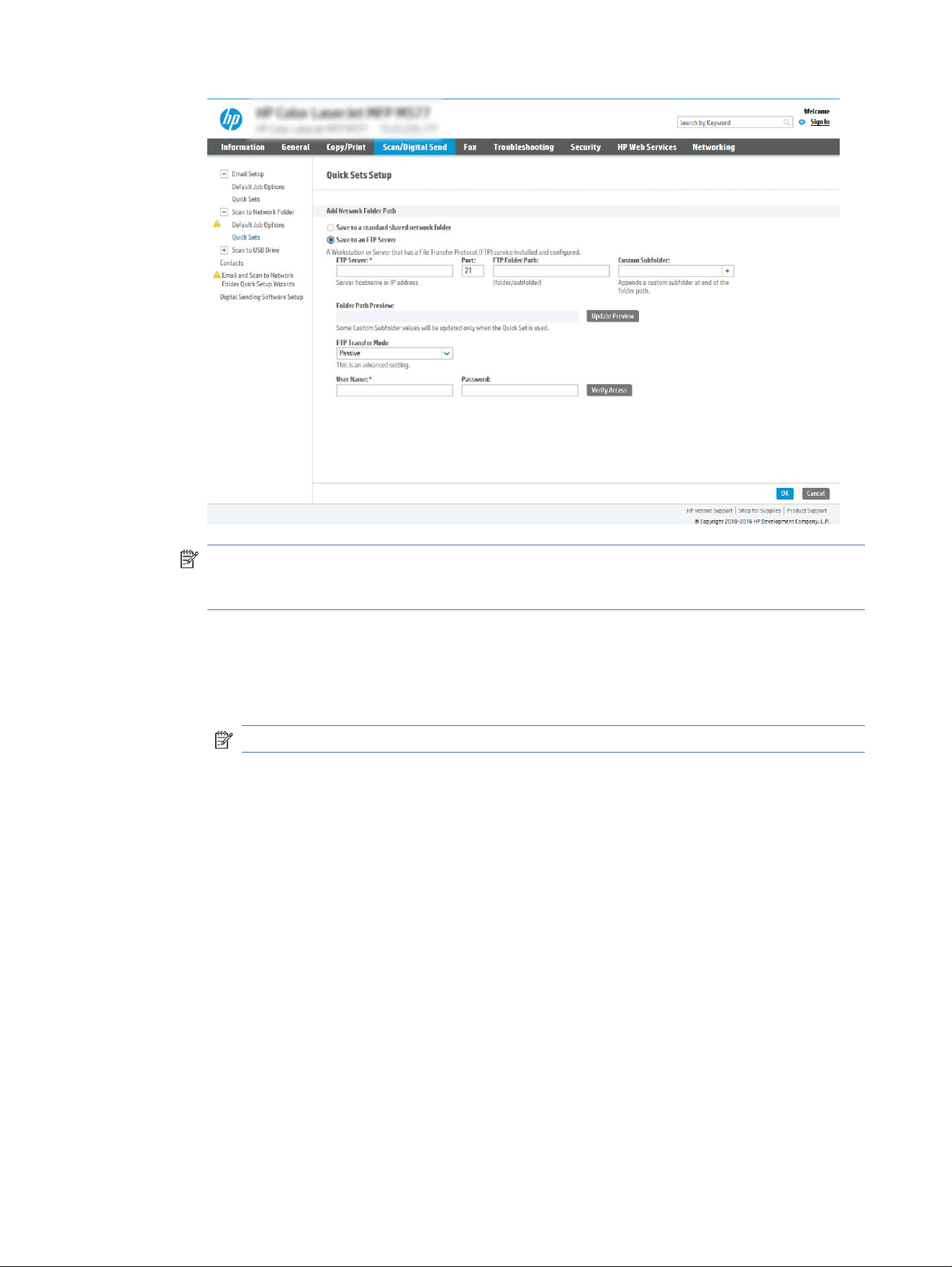
NOTE: If an FTP site is outside the firewall, a proxy server must be specified under the
network settings. These settings are located in the EWS Networking tab, under the Advanced
options.
a. Select Save to an FTP Server.
b. In the FTP Server field, type the FTP server name or IP address.
c. In the Port field, type the port number.
NOTE: In most cases, the default port number does not need to be changed.
d. To automatically create a subfolder for scanned documents in the destination folder,
select a format for the subfolder name from the Custom Subfolder list.
e. To view the complete folder path for scanned documents, click Update Preview.
f. From the FTP Transfer Mode list, select one of the following options:
– Passive
– Active
g. In the Username field, type the user name.
h. In the Password field, type the password.
i. Click Verify Access to confirm the destination can be accessed.
j. Click OK.
Option 2: Configure the printer to save to a personal shared folder
To save scanned documents to a personal shared folder, complete the following steps.
96
Chapter 6 Scan

NOTE: This option is used in domain environments where the administrator configures a shared
folder for each user. If the Save to a personal shared folder feature is configured, users will be required
to sign in at the printer control panel using Windows credentials or LDAP authentication.
1. Select Save to a personal shared folder.
2. In the Retrieve the device user’s home folder using this attribute field, type the user’s home folder in
the Microsoft Active Directory.
NOTE: Verify that the user knows where this home folder is located on the network.
3. To add a user name subfolder at the end of the folder path, select Create subfolder based on user
name.
To restrict the subfolder access to the user who creates the scan job, select Restrict subfolder
access to user.
Select the destination folder permissions
Select one of the following options to set up destination folder permissions.
Option 1: Configure read and write access
To send scanned documents to a folder configured for read and write access, complete the following
steps.
NOTE: Send only to folders with read and write access supports folder verification and job
notification.
1. If it is not already selected, select Send only to folders with read and write access.
2. To require the printer to verify folder access before starting a scan job, select Verify folder access
prior to job start.
NOTE: Scan jobs can complete more quickly if Verify folder access prior to job start is not
selected; however, if the folder is unavailable, the scan job will fail.
3. Click Next.
Option 2: Configure write access only
To send scanned documents to a folder configured for write access only, complete the following steps.
NOTE: Allow sending to folders with write access only does not support folder verification or job
notification.
NOTE: If this option is selected, the printer cannot increment the scan filename. It sends the same
filename for all scans.
Select a time-related filename prefix or suffix for the scan filename, so that each scan is saved as a
unique file, and does not overwrite a previous file. This filename is determined by the information in the
File Settings dialog in the Quick Set Wizard.
1. Select Allow sending to folders with write access only.
2. Click Next.
Select the destination folder permissions
97

Dialog three: Notification Settings
Use the Notification Settings dialog to configure when notifications will be sent.
■
On the Notification Settings dialog, complete one of the following tasks:
● Option one: Do not notify.
a. Select Do not notify.
b. To prompt the user to review their notification settings, select Prompt user prior to job start,
and then click
Next.
● Option two: Notify when job completes.
a. Select Notify when job completes.
b. Select the method for delivering the notification from the Method Used to Deliver
Notification list.
If the method of notification selected is Email, type the email address in the Notification
Email Address field.
c. To include a thumbnail of the first scanned page in the notification, select Include
Thumbnail.
d. To prompt the user to review their notification settings, select Prompt user prior to job start,
and then click Next.
● Option three: Notify only if job fails.
a. Select Notify only if job fails.
b. Select the method for delivering the notification from the Method Used to Deliver
Notification list.
If the method of notification selected is Email, type the email address in the Notification
Email Address field.
c. To include a thumbnail of the first scanned page in the notification, select Include
Thumbnail.
d. To prompt the user to review their notification settings, select Prompt user prior to job start,
and then click Next.
Dialog four: Scan Settings
Complete the scan settings as follows.
On the Scan Settings dialog, set the default scanning preferences for the Quick Set, and then click Next.
Table 6-9
Scan settings
Feature Description
Original Size Select the page size of the original document.
Original Sides Select whether the original document is single-sided or double-sided.
Optimize Text/Picture Select to optimize for the output of a particular type of content.
98 Chapter 6 Scan

Table 6-9 Scan settings (continued)
Feature Description
Content Orientation Select the way the content of the original document is placed on the page:
Portrait or Landscape.
Background Cleanup Select a value to remove faint images from the background or to remove a
light background color.
Darkness Select a value to adjust the darkness of the file.
Contrast Select a value to adjust the contrast of the file.
Sharpness Select a value to adjust the sharpness of the file.
Image Preview Select whether to require or make optional a displayed preview of the job or
to disable a preview.
Cropping Options Select whether or not to allow a job to be cropped and the type of cropping
option.
Erase Edges Select this setting to specify the width of edge margins to be erased, in
either inches or millimeters, for the front side and back side of a job.
Dialog five: File Settings
Complete the file settings as follows.
On the File Settings dialog, set the default file settings for the Quick Set, and then click Next.
Table 6-10
File settings
Feature Description
File Name Prefix Set the default file name prefix used for files saved to a network folder.
File Name Default file name for the file to be saved.
Select the User editable check box to make this setting editable at the
printer control panel.
File Name Suffix Set the default file name suffix used for files saved to a network folder.
File Name Preview Enter a file name, and then click the Update Preview button.
File Numbering Format Select a file name format for when the job is divided into multiple files.
Add numbering when job has just one file (ex. _1–1) Select this setting to add numbering to a file name when the job is only one
file instead of multiple files.
File Type Select the file format for the saved file.
Select the User editable check box to make this setting editable at the
printer control panel.
High Compression (smaller file) Select this setting to compress the scanned file, which reduces the file
size. However, the scanning process for a High compression file might take
longer than for a Normal compression file.
PDF encryption If the file type is PDF, then this option encrypts the output PDF file. A
password must be specified as part of the encryption. The same password
must be used to open the file. The user will be prompted to enter a
password prior to scanning their job if one has not been set prior to starting
the scan.
Dialog five: File Settings 99

Table 6-10 File settings (continued)
Feature Description
Resolution Set the resolution for the file. Higher resolution images have more dots per
inch (dpi), so they show more detail. Lower resolution images have fewer
dots per inch and show less detail, but the file size is smaller.
Quality and File Size Select the quality for the file. Higher-quality images require a larger file size
than lower-quality images, and they take more time to send.
Color/Black Specify whether copies are to be printed in color, black and gray, or black
only.
Suppress blank pages If the Suppress blank pages option is enabled, blank pages will be ignored.
Metadata File Format Use the drop-down list to select the file format for metadata information.
Create Multiple Files Select this setting to scan pages into separate files based on a
predetermined maximum number of pages per file.
Dialog six: Summary
On the Summary dialog, review the Summary dialog, and then click Finish.
Step three: Complete the configuration
Use the following steps to complete Scan to Network Folder setup.
1. In the left navigation pane, click Scan to Network Folder.
2. On the Scan to Network Folder page, review the selected settings, and then click Apply to complete
the setup.
Set up Scan to SharePoint
Use Scan to SharePoint to scan documents directly to a Microsoft SharePoint site. This feature
eliminates the need to scan the documents to a network folder, USB flash drive, or email message,
and then manually upload the files to the SharePoint site.
Introduction
Set up the Scan to SharePoint feature, and then scan documents directly to a SharePoint site.
Scan to SharePoint supports all scanning options, including the ability to scan documents as images or
use the OCR features to create text files or searchable PDFs.
The feature is disabled by default. Enable Save to Sharepoint in the HP Embedded Web Server (EWS).
Before you begin
Before this procedure can be completed, the destination folder that the scanned files will be saved to
must exist on the SharePoint site, and write access must be enabled to the destination folder. Scan to
SharePoint is disabled by default.
Step one: Access the HP Embedded Web Server (EWS)
Open the EWS to start the setup process.
100
Chapter 6 Scan
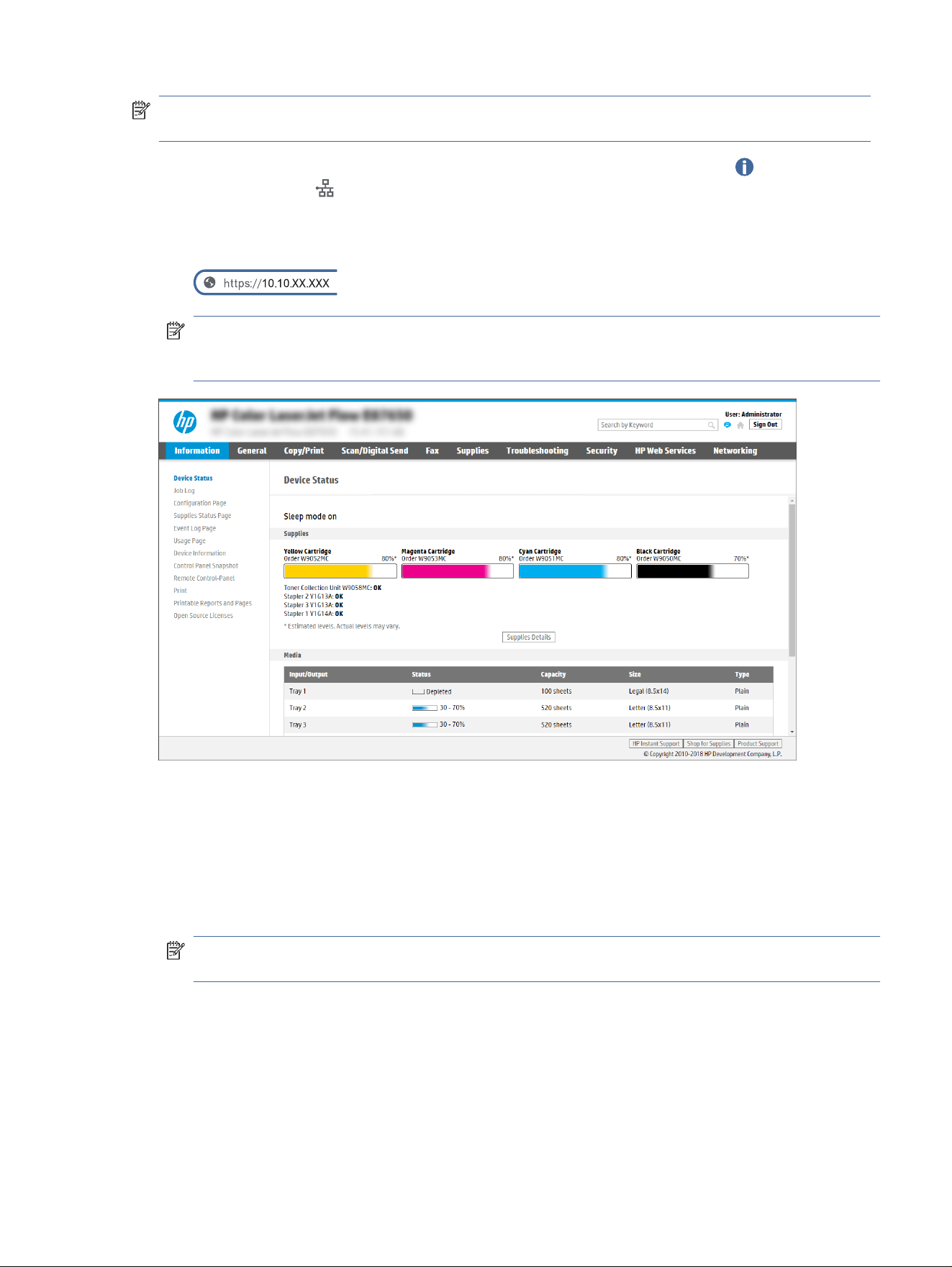
NOTE: The figure in this topic shows an EWS screen for a color printer. However, the procedure below
is valid for both color and mono printers.
1. From the Home screen on the printer control panel, touch the Information icon , and then touch
the Ethernet icon to display the IP address or host name.
2. Open a web browser, and in the address line, type the IP address or host name exactly as it displays
on the printer control panel. Press the Enter key on the computer keyboard. The EWS opens.
NOTE: If the web browser displays a message indicating that accessing the website might not be
safe, select the option to continue to the website. Accessing this website will not harm the
computer.
Step two: Enable Scan to SharePoint and create a Scan to SharePoint Quick Set
Follow the steps to enable the Scan to SharePoint feature and create a Scan to SharePoint Quick Set.
1. Using the top navigation tabs, click Scan/Digital Send.
2. In the left navigation pane, click Scan to SharePoint®.
NOTE: Quick Sets are shortcut jobs that can be accessed on the printer Home screen or within
the Quick Sets application.
3. Select Enable Scan to SharePoint®, and then click Apply.
4. In the Scan to SharePoint area of the left navigation pane, click Quick Sets. Click Add to launch the
Quick Set Wizard.
5. Enter a Quick Set Name (for example, “Scan to SharePoint”) and a Quick Set Description.
Step two: Enable Scan to SharePoint and create a Scan to SharePoint Quick Set
101

6. Select a Quick Set Start Option to determine what occurs after selecting a Quick Set on the printer
control panel, and then click Next.
7. Use the following steps to add the path to the SharePoint folder:
a. Click Add on the SharePoint Destination Settings page to open the Add SharePoint Path page.
b. Open another browser window, navigate to the SharePoint folder to use, and then copy the
folder path for the SharePoint folder from that browser window.
c. Paste the SharePoint folder path into the SharePoint Path: field.
d. By default, the printer overwrites an existing file that has the same file name as the new file.
Clear Overwrite existing files so that a new file with the same name as an existing file is given
an updated time/date stamp.
e. Select an option from the Authentication Settings drop-down menu. Select whether it is
necessary to sign in to the SharePoint site with credentials, or store the credentials within the
Quick Set.
NOTE: Use credentials of user to connect after Sign In at the control panel is selected in the
Authentication Settings drop-down menu, the logged-in user must have permission to write to
the specified SharePoint site.
NOTE: For security purposes, the printer does not display credentials entered in the Quick
Set Wizard.
f. Click OK to complete the SharePoint path setup, and navigate back to the SharePoint
Destination Settings page.
8. Select Verify folder access prior to job start to ensure that the SharePoint folder specified as the
destination folder is accessible each time the Quick Set is used. If this option is not selected, jobs
can be saved to the SharePoint folder more quickly. However, if this option is not selected
and
the
SharePoint folder is inaccessible, the job will fail.
9. Click Next.
10. Set a Condition on Which to Notify on the Notification Settings page. This setting configures the
Quick Set to either not notify, or to send email messages or print a summary page if a job either
completes successfully or fails. Select one of the following options from the Condition on Which to
Notify drop-down menu:
● Select Do not notify for the Quick Set to not perform any notification action when a job
completes successfully or fails.
● Select Notify when job completes to for the Quick Set to send a notification when a job
completes successfully.
● Select Notify only if job fails to for the Quick Set to send a notification only when a job fails.
Selecting either Notify when job completes or Notify only if job fails requires the Method Used to
Deliver Notification: to be set. Select from the following options:
● Email: Use this option to send an email when the selected notification condition occurs. This
option requires a valid email address in the Notification Email Address: field.
NOTE: To use the email notification feature, first configure the email feature on the printer.
102
Chapter 6 Scan
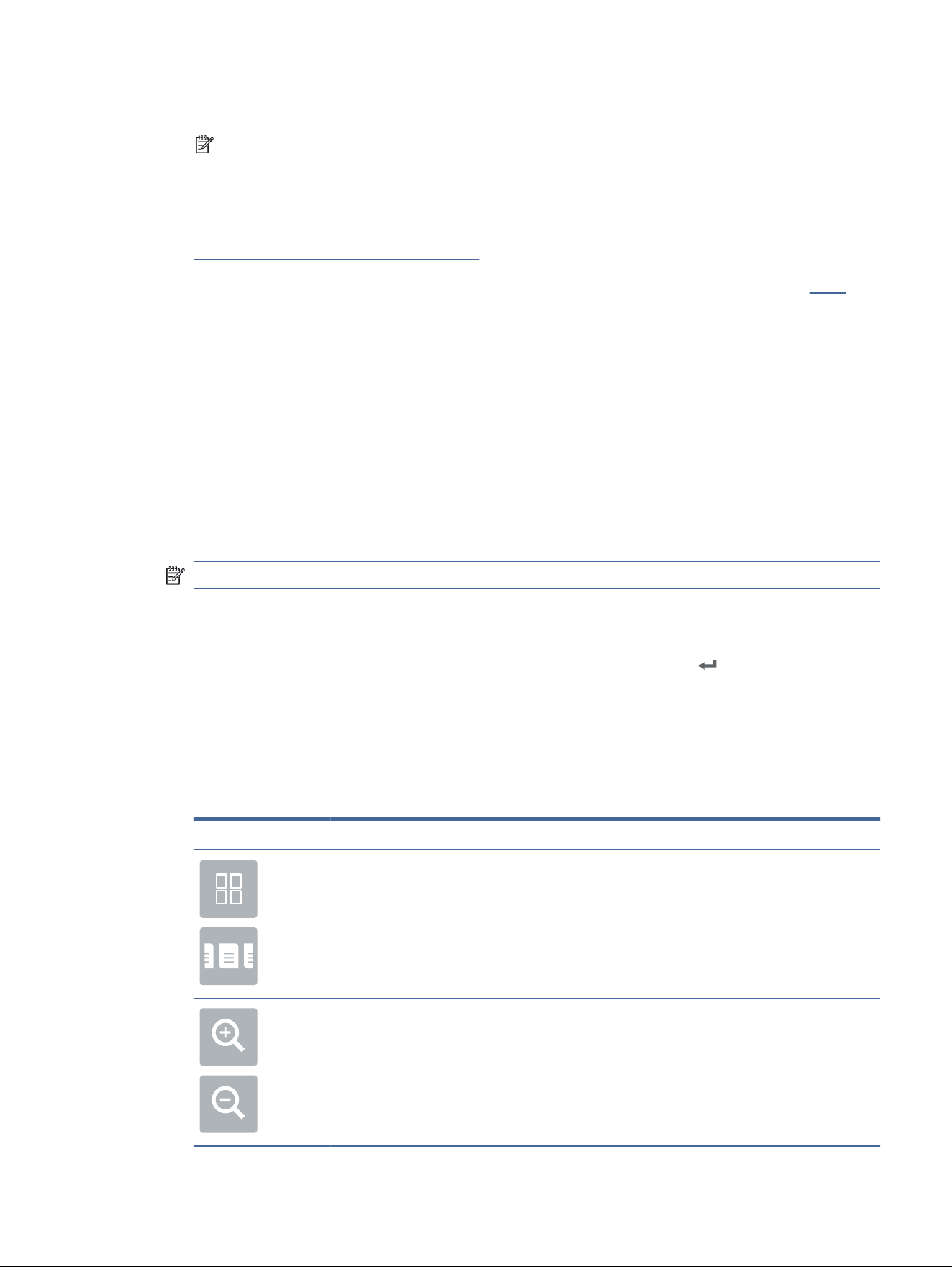
● Print: Use this option to print the notification when the selected notification condition occurs.
NOTE: Select Include Thumbnail for either notification option to include a thumbnail image of
the first page of the scanned page of the job.
11. Click Next.
12. Select options from the Scan Settings page, and then click Next. For more information, see Table
6-12 Scan settings for Scan to SharePoint.
13. Select options from the File Settings page, and then click Next. For more information, see Table
6-13 File settings for Scan to SharePoint.
14. Review the summary of settings. Click Finish to save the Quick Set or click Previous to edit the
settings.
Scan a file directly to a SharePoint site
Follow the steps to scan a document directly to a SharePoint site.
1. Place the document face-down on the scanner glass, or place it face-up in the document feeder
and adjust the paper guides to fit the size of the document.
2. From the Home screen on the printer control panel, navigate to the Scan application, select the
Scan icon, and then select Scan to SharePoint®.
NOTE: It might be necessary to sign in to the printer to use this feature.
3. Under Quick Sets, touch Select, select a Quick Set, and then select Load.
4. Touch the File Name: text field to open a keyboard. Type the name for the file using either the
on-screen keyboard or the physical keyboard, and touch the Enter button .
5. Touch Options to view and configure settings for the document.
6. Touch the right pane of the screen to preview the document. In the preview screen, use the buttons
on the right of the screen to adjust the preview options and to rearrange, rotate, insert, or remove
pages.
Table 6-11
Buttons on the right side of the preview pane
Button Description
Use these buttons to toggle between single-page view and thumbnail view. More options are
available in thumbnail view than in single-page view.
Use these buttons to zoom in or out on the selected page.
NOTE: Select only one page at a time to use these buttons.
Scan a file directly to a SharePoint site 103
Table 6-11 Buttons on the right side of the preview pane (continued)
Button Description
Use this button to rotate the page 180 degrees.
NOTE: This button is available only in the thumbnail view.
Use this button to delete the selected pages.
NOTE: This button is available only in the thumbnail view.
Use these buttons to rearrange the pages within the document. Select one or more pages and
move them to the left or right.
NOTE: These buttons are available only in the thumbnail view.
Use this button to add a page to the document. The printer prompts to scan additional pages.
Use this button to clear the changes made in the preview and start over.
Touch this button to collapse the preview screen and return to the Copy screen.
7. When the document is ready, select Send to save it to the SharePoint location.
Quick Set scan settings and options for Scan to SharePoint
Review the settings and options available in the Quick Set Wizard when adding, editing, or copying a
Scan to SharePoint Quick Set.
Table 6-12
Scan settings for Scan to SharePoint
Feature Description
Original Size Select the page size of the original document.
Original Sides Select whether the original document is single-sided or double-sided.
Optimize Text/Picture Select to optimize for the output of a particular type of content.
Content Orientation Select the way the content of the original document is placed on the page:
Portrait or Landscape.
Background Cleanup Select a value to remove faint images from the background or to remove a
light background color.
Darkness Select a value to adjust the darkness of the file.
Contrast Select a value to adjust the contrast of the file.
104 Chapter 6 Scan

Table 6-12 Scan settings for Scan to SharePoint (continued)
Feature Description
Sharpness Select a value to adjust the sharpness of the file.
Image Preview Select whether to require or make optional a displayed preview of the job or
to disable a preview.
Cropping Options Select whether or not to allow a job to be cropped and the type of cropping
option.
Erase Edges Select this setting to specify the width of edge margins to be erased, in
either inches or millimeters, for the front side and back side of a job.
Table 6-13 File settings for Scan to SharePoint
Feature Description
File Name Prefix Set the default file name prefix used for files to be saved.
File Name Default file name for the file to be saved.
Select the User editable check box to make this setting editable at the
printer control panel.
File Name Suffix Set the default file name suffix used for files to be saved.
Duplicate filename suffix default [filename]_YYYYMMDDT
File Name Preview Enter a file name, and then click the Update Preview button.
File Numbering Format Select a file name format for when the job is divided into multiple files.
Add numbering when job has just one file (ex. _1–1) Select this setting to add numbering to a file name when the job is only one
file instead of multiple files.
File Type Select the file format for the saved file.
Select the User editable check box to make this setting editable at the
printer control panel.
High Compression (smaller file) Select this setting to compress the scanned file, which reduces the file
size. However, the scanning process for a High compression file might take
longer than for a Normal compression file.
PDF encryption If the file type is PDF, then this option encrypts the output PDF file. A
password must be specified as part of the encryption. The same password
must be used to open the file. The user will be prompted to enter a
password prior to scanning their job if one has not been set prior to starting
the scan.
Resolution Set the resolution for the file. Higher resolution images have more dots per
inch (dpi), so they show more detail. Lower resolution images have fewer
dots per inch and show less detail, but the file size is smaller.
Quality and File Size Select the quality for the file. Higher-quality images require a larger file size
than lower-quality images, and they take more time to send.
Color/Black Specify whether copies are to be printed in color, black and gray, or black
only
Suppress blank pages If the Suppress blank pages option is enabled, blank pages will be ignored.
Create Multiple Files Select this setting to scan pages into separate files based on a
predetermined maximum number of pages per file.
Quick Set scan settings and options for Scan to SharePoint 105
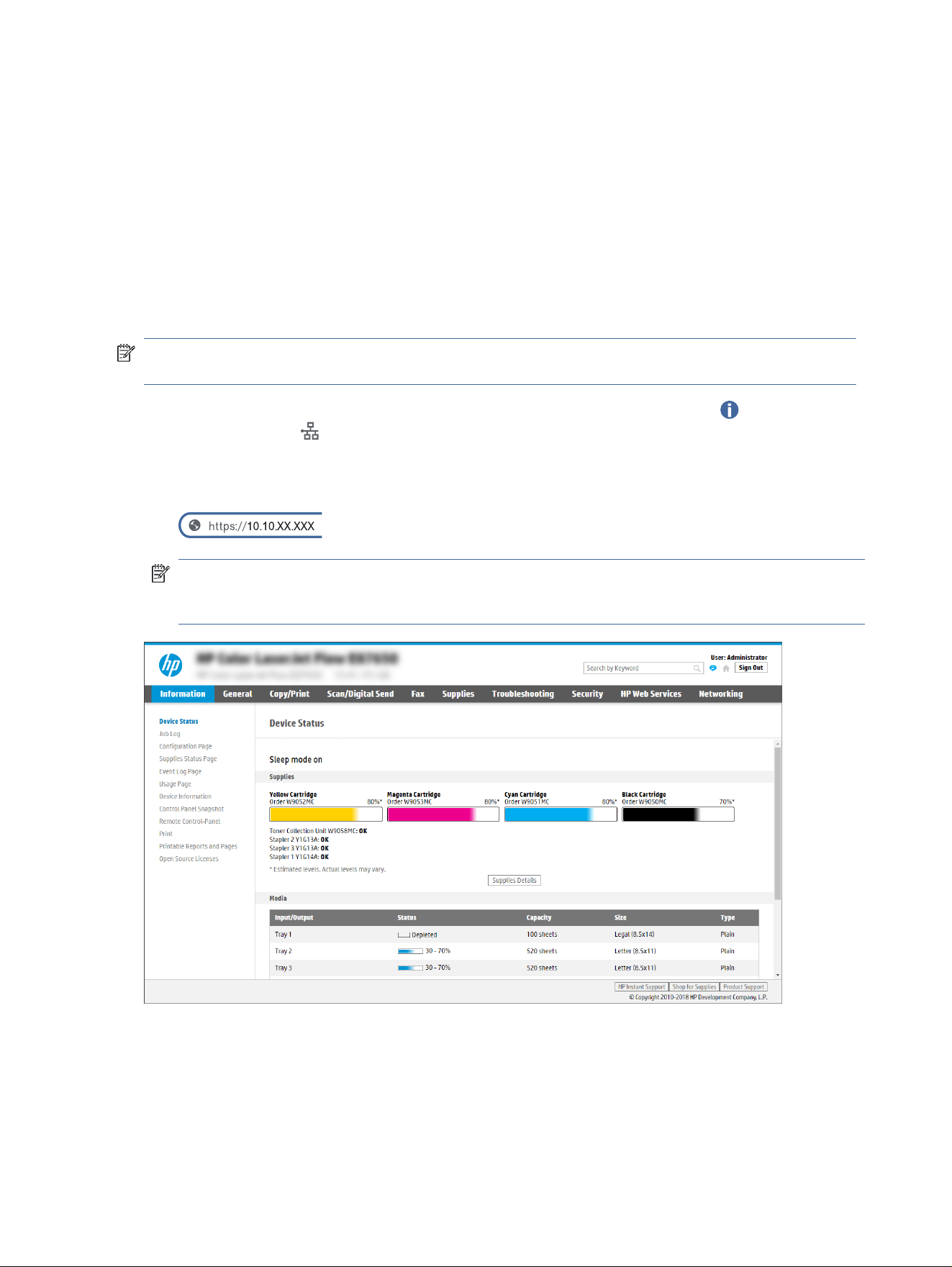
Set up Scan to USB Drive
Enable the Scan to USB Drive feature, which allows you to scan directly to a USB flash drive.
Introduction
The printer has a feature that enables it to scan a document and save it to a USB flash drive. The feature
is not available until it has been configured through the HP Embedded Web Server (EWS).
Step one: Access the HP Embedded Web Server (EWS)
Open the EWS to start the setup process.
NOTE: The figure in this topic shows an EWS screen for a color printer. However, the procedure below
is valid for both color and mono printers.
1. From the Home screen on the printer control panel, touch the Information icon , and then touch
the Ethernet icon to display the IP address or host name.
2. Open a web browser, and in the address line, type the IP address or host name exactly as it displays
on the printer control panel. Press the Enter key on the computer keyboard. The EWS opens.
NOTE: If the web browser displays a message indicating that accessing the website might not be
safe, select the option to continue to the website. Accessing this website will not harm the
computer.
Step two: Enable Scan to USB Drive
Enable Scan to USB Drive using the following steps.
1. Select the Security tab.
2. Scroll to Hardware Ports and make sure that Enable Host USB plug and play is enabled.
106
Chapter 6 Scan

3. Select the Scan/Digital Send tab and then click the Scan to USB Driver Settings option in the left
navigation pane.
4. Select the Enable Scan to USB Drive check box.
5. Click Apply at the bottom of the page.
NOTE: Most devices ship with hard disk drives (HDDs) already installed. In some cases, additional
storage devices can be added via USB. Verify whether the Save to USB feature needs to be expanded
to USB and hard drive.
Step three: Configure the Quick Sets (optional)
Use the following steps to set up Quick Sets for Scan to USB Drive. Quick Sets are shortcut jobs that can
be accessed on the printer Home screen or within the Quick Sets application.
1. In the Scan to USB Drive area of the left navigation pane, click Quick Sets.
2. Select one of the following options:
● Select an existing Quick Set under Quick Sets Application in the table.
-OR-
● Click Add to start the Quick Set Wizard.
3. If you clicked Add, the Quick Sets Setup page opens. Complete the following information:
a. Quick Set Name: Enter a title for the new Quick Set.
b. Quick Set Description: Enter a description of the Quick Set.
c. Quick Set Start Option: To set how the Quick Set starts, click either Enter application, then
user presses Start or Start instantly when selected from the Home Screen.
4. Select a default location where scanned files are saved on USB storage devices inserted into the
USB port on the control panel, and then click Next. The default location options are:
● Save at root directory of the USB storage device.
● Create or place in this folder on the USB Storage Device — The path to the folder on the USB
storage device must be specified when using this file location option. A backslash \ must be
used to separate folder\subfolder names in the path.
5. Select an option from the Condition on Which to Notify: drop-down list, and then click Next.
This setting determines if, or how, users are notified when a Save To USB Quick Set job completes
or fails. The options for the Condition on Which to Notify: setting are:
● Do not notify
● Notify when job completes
● Notify only if job fails
Step three: Configure the Quick Sets (optional)
107

6. Choose the Scan Settings for the Quick Set, and then click Next.
NOTE: For more information on the available scan settings, see Default scan settings for Scan to
USB Drive setup
7. Choose the File Settings for the Quick Set, and then click Next.
NOTE: For more information on the available file settings, see Default scan settings for Scan to
USB Drive setup
8. Review the summary of settings, and then click Finish to save the Quick Set, or click Previous to edit
the settings.
Default scan settings for Scan to USB Drive setup
Review the default settings for Scan to USB Drive setup.
Table 6-14
Scan settings for Scan to USB Drive setup
Feature Description
Original Size Select the page size of the original document.
Original Sides Select whether the original document is single-sided or double-sided.
Optimize Text/Picture Select to optimize for the output of a particular type of content.
Content Orientation Select the way the content of the original document is placed on the page: Portrait or
Landscape.
Background Cleanup Select a value to remove faint images from the background or to remove a light background
color.
Darkness Select a value to adjust the darkness of the file.
Contrast Select a value to adjust the contrast of the file.
Sharpness Select a value to adjust the sharpness of the file.
Image Preview Select whether to require or make optional a displayed preview of the job or to disable a
preview.
Cropping Options Select whether or not to allow a job to be cropped and the type of cropping option.
Erase Edges Select this setting to specify the width of edge margins to be erased, in either inches or
millimeters, for the front side and back side of a job.
Default file settings for Save to USB setup
Review the options for Save to USB setup.
Table 6-15
File settings for Save to USB setup
Option name Description
File Name Prefix Set the default file name prefix used for files saved to a network folder.
File Name Default file name for the file to be saved.
Select the User editable check box to make this setting editable at the printer control panel.
108 Chapter 6 Scan

Table 6-15 File settings for Save to USB setup (continued)
Option name Description
File Name Suffix Set the default file name suffix used for files saved to a network folder.
Duplicate filename suffix default [filename]_YYYYMMDDT
File Name Preview Enter a file name, and then click the Update Preview button.
File Numbering Format Select a file name format for when the job is divided into multiple files.
Add numbering when job has
just one file (ex. _1–1)
Select this setting to add numbering to a file name when the job is only one file instead of
multiple files.
File Type Select the file format for the saved file.
Select the User editable check box to make this setting editable at the printer control panel.
High Compression (smaller
file)
Select this setting to compress the scanned file, which reduces the file size. However, the
scanning process for a High compression file might take longer than for a Normal compression
file.
PDF encryption If the file type is PDF, then this option encrypts the output PDF file. A password must be
specified as part of the encryption. The same password must be used to open the file. The user
will be prompted to enter a password prior to scanning their job if one has not been set prior to
starting the scan.
Resolution Set the resolution for the file. Higher resolution images have more dots per inch (dpi), so they
show more detail. Lower resolution images have fewer dots per inch and show less detail, but
the file size is smaller.
Quality and File Size Select the quality for the file. Higher-quality images require a larger file size than lower-quality
images, and they take more time to send.
Color/Black Specify whether copies are to be printed in color, black and gray, or black only.
Suppress blank pages If the Suppress blank pages option is enabled, blank pages will be ignored.
Create Multiple Files Select this setting to scan pages into separate files based on a predetermined maximum
number of pages per file.
Scan to email
Scan a document directly to an email address or contact list. The scanned document is sent as an email
message attachment.
Introduction
The printer has a feature that enables it to scan a document and send it to one or more email addresses.
Scan to email
Use the following steps to scan a document directly to an email address or contact list.
1. Place the document face-down on the scanner glass, or place it face-up in the document feeder
and adjust the paper guides to fit the size of the document.
2. From the Home screen on the printer control panel, navigate to the Scan application, select the
Scan icon, and then select Scan to Email.
NOTE: If prompted, type your user name and password.
Scan to email
109

3. Touch the To field to open a keyboard.
NOTE: If you are signed in to the printer, your user name or other default information might appear
in the From field. If so, you might not be able to change it.
4. Specify the recipients by using one of these methods:
● Use the keypad to enter the address in the To field.
To send to multiple addresses, separate the addresses with a semicolon, or select the Enter
button on the touchscreen keyboard after typing each address.
● Use a contact list as follows:
a. Select the Contacts button that is next to the To field to open the Contacts screen.
b. Select the appropriate contact list.
c. Select a name or names from the list of contacts to add to the recipients list, and then
select Add.
5. Complete the Subject, File Name, and Message fields by touching the field and using the
touchscreen keyboard to enter information. Select the Close button whenever you need to
close the keyboard.
6. To load a Quick Set, select Load, select the Quick Set, and then select Load under the Quick Sets
list.
NOTE: Quick Sets are predefined settings for various types of output, such as Text, Photograph,
and High Quality. You can select a Quick Set to view the description.
7. To configure settings, such as File Type and Resolution, Original Sides, and Content Orientation,
select Options in the lower left corner, and then select the settings from the Options menus. Select
Done if prompted.
8. Optional Preview: Touch the right pane of the screen to preview the document. You can use the
Expand and Collapse buttons on the left side of the preview pane to expand and collapse the
preview screen.
Table 6-16
Buttons on the left side of the preview pane
Button Description
Expand the preview screen.
Collapse the preview screen.
Use the buttons on the right of the screen to adjust the preview options and to rearrange, rotate,
insert, or remove pages.
110
Chapter 6 Scan
Table 6-17 Buttons on the right side of the preview pane
Button Description
Use these buttons to toggle between single-page view and thumbnail view. More options are
available in thumbnail view than in single-page view.
Use these buttons to zoom in or out on the selected page.
NOTE: Select only one page at a time to use these buttons.
Use this button to rotate the page 180 degrees.
NOTE: This button is available only in the thumbnail view.
Use this button to delete the selected pages.
NOTE: This button is available only in the thumbnail view.
Use these buttons to rearrange the pages within the document. Select one or more pages and
move them to the left or right.
NOTE: These buttons are available only in the thumbnail view.
Use this button to add a page to the document. The printer prompts to scan additional pages.
Use this button to clear the changes made in the preview and start over.
Touch this button to collapse the preview screen and return to the Copy screen.
9. When the document is ready, select Send to email it.
NOTE: The printer might prompt you to add the email address to the contact list.
Scan to email
111

Scan to job storage
Scan a document and save it to a job storage folder on the printer.
Introduction
The printer has a feature that enables it to scan a document and save it to a job storage folder on the
printer. You can retrieve the document from the printer and print it when needed.
NOTE: Before you can scan to a storage folder on the printer, your printer administrator or IT
department must use the HP Embedded Web Server to enable the feature and configure the settings.
Scan to job storage on the printer
Use this procedure to scan a document and save it to a job storage folder on the printer so that you can
print copies at any time.
1. Place the document face-down on the scanner glass, or place it face-up in the document feeder
and adjust the paper guides to fit the size of the document.
2. From the Home screen on the printer control panel, navigate to the Scan application, select the
Scan icon, and then select Scan to Job Storage.
NOTE: If prompted, enter your user name and password.
3. Select the default storage folder name shown under Folder.
If the printer administrator has configured the option, you can create a new folder. Follow these
steps to create a new folder:
a. Select the New Folder icon .
b. Select the New Folder field, type the folder name, and then select OK.
4. Make sure that you have selected the correct folder.
5. Touch the Job Name text field to open a touchscreen keyboard, type the name for the file, and then
select the Enter button .
6. To make the job private, select the PIN button , enter a four-digit PIN in the PIN field, and then
close the touchscreen keypad.
7. To configure settings, such as Sides and Content Orientation, select Options in the lower left
corner, and then select the settings from the Options menus. Select Done for each setting if
prompted.
112
Chapter 6 Scan
8. Optional Preview: Touch the right pane of the screen to preview the document. You can use the
Expand and Collapse buttons on the left side of the preview pane to expand and collapse the
preview screen.
Table 6-18 Buttons on the left side of the preview pane
Button Description
Expand the preview screen.
Collapse the preview screen.
Use the buttons on the right of the screen to adjust the preview options and to rearrange, rotate,
insert, or remove pages.
Table 6-19
Buttons on the right side of the preview pane
Button Description
Use these buttons to toggle between single-page view and thumbnail view. More options are
available in thumbnail view than in single-page view.
Use these buttons to zoom in or out on the selected page.
NOTE: Select only one page at a time to use these buttons.
Use this button to rotate the page 180 degrees.
NOTE: This button is available only in the thumbnail view.
Use this button to delete the selected pages.
NOTE: This button is available only in the thumbnail view.
Scan to job storage on the printer 113
Table 6-19 Buttons on the right side of the preview pane (continued)
Button Description
Use these buttons to rearrange the pages within the document. Select one or more pages and
move them to the left or right.
NOTE: These buttons are available only in the thumbnail view.
Use this button to add a page to the document. The printer prompts to scan additional pages.
Use this button to clear the changes made in the preview and start over.
Touch this button to collapse the preview screen and return to the Copy screen.
9. When the document is ready, select Save to save the file to the storage folder.
Print from job storage on the printer
Use this procedure to print a scanned document that is in a job storage folder on the printer.
1. From the Home screen on the printer control panel, navigate to the Print application, select the
Print icon, and then select Print from Job Storage.
2. Under Stored Jobs to Print, select Choose, select the folder in which the document is saved, select
the document, and then select Select.
3. If the document is private, enter the four-digit PIN in the Password field, and then select OK.
4. To adjust the number of copies, touch the box to the left of the Print button, and then select the
number of copies from the keypad that opens. Select the Close button to close the keypad.
5. Select Print to print the document.
Scan to network folder
Scan a document and save it to a folder on the network.
Introduction
The printer can scan a file and save it in a shared folder on the network.
Scan to network folder
Use this procedure to scan a document and save it to a network folder.
114
Chapter 6 Scan

NOTE: You might be required to sign in to the printer to use this feature.
1. Place the document face-down on the scanner glass, or place it face-up in the document feeder
and adjust the paper guides to fit the size of the document.
2. From the Home screen on the printer control panel, navigate to the Scan application, select the
Scan icon, and then select Scan to Network Folder.
3. Specify a folder destination. Folder options must first be configured by the printer administrator.
● To select a folder location that the administrator already set up, select Load under Quick Sets
and Defaults, select the folder, and then select Load.
● To specify a new folder location, touch the Folder Paths field to open a touchscreen keyboard,
type the path to the folder, and then select the Enter button . Enter user credentials if
prompted and then select Save to save the path.
NOTE: Use this format for the path: \\server\folder, where “server” is the name of the
server that hosts the shared folder, and “folder” is the name of the shared folder. If the folder is
nested inside other folders, complete all necessary segments of the path to reach the folder.
For example: \\server\folder\folder
NOTE: The Folder Paths field might have a pre-defined path, and it might not be editable. In
this situation, the administrator has configured this folder for common access.
4. Touch the File Name text field to open a touchscreen keyboard, type the name for the file, and then
select the Enter button .
5. To configure settings, such as File Type and Resolution, Original Sides, and Content Orientation,
select Options in the lower left corner, and then select the settings from the Options menus. Select
Done for each setting if prompted.
6. Optional Preview: Touch the right pane of the screen to preview the document. You can use the
Expand and Collapse buttons on the left side of the preview pane to expand and collapse the
preview screen.
Table 6-20
Buttons on the left side of the preview pane
Button Description
Expand the preview screen.
Collapse the preview screen.
Use the buttons on the right of the screen to adjust the preview options and to rearrange, rotate,
insert, or remove pages.
Scan to network folder
115

Table 6-21 Buttons on the right side of the preview pane
Button Description
Use these buttons to toggle between single-page view and thumbnail view. More options are
available in thumbnail view than in single-page view.
Use these buttons to zoom in or out on the selected page.
NOTE: Select only one page at a time to use these buttons.
Use this button to rotate the page 180 degrees.
NOTE: This button is available only in the thumbnail view.
Use this button to delete the selected pages.
NOTE: This button is available only in the thumbnail view.
Use these buttons to rearrange the pages within the document. Select one or more pages and
move them to the left or right.
NOTE: These buttons are available only in the thumbnail view.
Use this button to add a page to the document. The printer prompts to scan additional pages.
Use this button to clear the changes made in the preview and start over.
Touch this button to collapse the preview screen and return to the Copy screen.
7. When the document is ready, select Send to save the file to the network folder.
Scan to SharePoint
Scan a document directly to a SharePoint site.
116
Chapter 6 Scan

Introduction
If you have a workflow-equipped printer, you can scan a document and send it to a SharePoint site.
This feature eliminates the need to scan the documents to a network folder, USB flash drive, or email
message, and then manually upload the files to the SharePoint site.
Scan to SharePoint supports all scanning options, including the ability to scan documents as images or
use the OCR features to create text files or searchable PDFs.
NOTE: Before you can scan to SharePoint, your printer administrator or IT department must use the
HP Embedded Web Server to enable the feature and set it up.
Scan to SharePoint
Use the following steps to scan a document directly to a SharePoint site.
1. Place the document face-down on the scanner glass, or place it face-up in the document feeder
and adjust the paper guides to fit the size of the document.
2. From the Home screen on the printer control panel, navigate to the Scan application, select the
Scan icon, and then select Scan to SharePoint®.
NOTE: It might be necessary to sign in to the printer to use this feature.
3. Under Quick Sets, touch Select, select a Quick Set, and then select Load.
4. Select the File Name: text field to open a keyboard. Type the name for the file, and then select the
enter button .
5. To configure settings, such as File Type and Resolution, Sides, and Content Orientation, select
Options in the lower left corner, and then select the settings from the Options menus. Select Done
if prompted.
6. Optional Preview: Touch the right pane of the screen to preview the document. You can use the
Expand and Collapse buttons on the left side of the preview pane to expand and collapse the
preview screen.
Table 6-22
Buttons on the left side of the preview pane
Button Description
Expand the preview screen.
Collapse the preview screen.
Use the buttons on the right of the screen to adjust the preview options and to rearrange, rotate,
insert, or remove pages.
Introduction
117

Table 6-23 Buttons on the right side of the preview pane
Button Description
Use these buttons to toggle between single-page view and thumbnail view. More options are
available in thumbnail view than in single-page view.
Use these buttons to zoom in or out on the selected page.
NOTE: Select only one page at a time to use these buttons.
Use this button to rotate the page 180 degrees.
NOTE: This button is available only in the thumbnail view.
Use this button to delete the selected pages.
NOTE: This button is available only in the thumbnail view.
Use these buttons to rearrange the pages within the document. Select one or more pages and
move them to the left or right.
NOTE: These buttons are available only in the thumbnail view.
Use this button to add a page to the document. The printer prompts to scan additional pages.
Use this button to clear the changes made in the preview and start over.
Touch this button to collapse the preview screen and return to the Copy screen.
7. When the document is ready, select Send to save it to the SharePoint location.
Scan to USB drive
Scan a document directly to a USB drive.
118
Chapter 6 Scan

Introduction
The printer can scan a file and save it to a USB flash drive.
Scan to USB drive
Use the following steps to scan a document directly to a USB drive.
NOTE: You might be required to sign in to the printer to use this feature.
1. Place the document face-down on the scanner glass, or place it face-up in the document feeder
and adjust the paper guides to fit the size of the document.
2. Insert the USB drive into the USB port near the printer control panel.
3. From the Home screen on the printer control panel, navigate to the Scan application, select the
Scan icon, and then select Scan to USB Drive.
4. Select the USB drive under Destination, and then select the save location (either the root of the
USB drive or an existing folder).
5. Touch the File Name text field to open a touchscreen keyboard, type the name for the file, and then
select the Enter button .
6. To configure settings, such as File Type and Resolution, Original Sides, and Content Orientation,
select Options in the lower left corner, and then select the settings from the Options menus. Select
Done if prompted.
7. Optional Preview: Touch the right pane of the screen to preview the document. You can use the
Expand and Collapse buttons on the left side of the preview pane to expand and collapse the
preview screen.
Table 6-24
Buttons on the left side of the preview pane
Button Description
Expand the preview screen.
Collapse the preview screen.
Use the buttons on the right of the screen to adjust the preview options and to rearrange, rotate,
insert, or remove pages.
Introduction
119

Table 6-25 Buttons on the right side of the preview pane
Button Description
Use these buttons to toggle between single-page view and thumbnail view. More options are
available in thumbnail view than in single-page view.
Use these buttons to zoom in or out on the selected page.
NOTE: Select only one page at a time to use these buttons.
Use this button to rotate the page 180 degrees.
NOTE: This button is available only in the thumbnail view.
Use this button to delete the selected pages.
NOTE: This button is available only in the thumbnail view.
Use these buttons to rearrange the pages within the document. Select one or more pages and
move them to the left or right.
NOTE: These buttons are available only in the thumbnail view.
Use this button to add a page to the document. The printer prompts to scan additional pages.
Use this button to clear the changes made in the preview and start over.
Touch this button to collapse the preview screen and return to the Copy screen.
8. When the document is ready, select Save to save the file to the USB drive.
Use HP JetAdvantage business solutions
HP JetAdvantage solutions are workflow and printing solutions that are easy to use, and both network-
and cloud-based. HP JetAdvantage solutions are designed to help businesses of all types, including
120
Chapter 6 Scan

healthcare, financial services, manufacturing, and public sector, manage a fleet of printers and
scanners.
HP JetAdvantage Solutions include:
● HP JetAdvantage Security solutions
● HP JetAdvantage Management solutions
● HP JetAdvantage Workflow solutions
● HP JetAdvantage Mobile Printing solutions
For more information about HP JetAdvantage business workflow and printing solutions, go to
www.hp.com/go/PrintSolutions.
Additional scan tasks
Locate information on the Web for performing common scan tasks.
Go to Support for HP Color LaserJet Enterprise MFP 6800 or Support for HP Color LaserJet Enterprise
MFP 6801.
Instructions are available for performing specific scan tasks, such as the following:
● Copy or scan pages from books or other bound documents
● Send a scanned document to a folder in the printer memory
● Copy or scan both sides of an identification card
● Copy or scan a document into a booklet format
Additional scan tasks
121

Fax7
Configure the fax features, and send and receive faxes using the printer.
The following information is correct at the time of publication. For current information, see Support for
HP Color LaserJet Enterprise MFP 6800 or Support for HP Color LaserJet Enterprise MFP 6801.
For more information:
HP's all-inclusive help for the printer includes the following information:
● Install and configure
● Learn and use
● Solve problems
● Download software and firmware updates
● Join support forums
● Find warranty and regulatory information
Set up fax
Set up the fax features for the printer.
Introduction
This information applies to fax and Flow models, or to other printers when an optional analog fax
accessory has been installed. Before continuing, connect the printer to a phone line (for analog fax) or to
an Internet or network fax service.
Set up fax by using the printer control panel
Configure the fax features using the control panel.
1. From the Home screen on the printer control panel, navigate to the Settings application, and then
select the Settings icon.
2. Open the following menus:
a. Fax
b. Internal Fax Modem Setup
NOTE: If the Internal Fax Modem Setup menu does not appear in the menu listing, LAN or
Internet fax might be enabled. When LAN or Internet fax is enabled, the analog fax accessory
is disabled and the Internal Fax Modem Setup menu does not display. Only one fax feature,
either LAN fax, analog fax, or Internet fax, can be enabled at a time. To use analog fax when
LAN fax is enabled, use the HP Embedded Web Server to disable LAN fax.
3. Select the location from the list on the right side of the screen, and then select Next.
122
Chapter 7 Fax

4. Touch the Company Name text field, and use the keypad to type the company name.
5. Touch the Fax Number text field, and use the keypad to type the sending fax number. Select Next.
6. Verify that the date and time settings are correct. Make changes as necessary, and then select
Next.
7. If a dialing prefix is required for sending faxes, touch the Dialing Prefix text field, and use the keypad
to enter the number.
8. Review all the information on the left pane, and then select Finish to complete the fax setup.
Change fax configurations
Change or update fax settings.
NOTE: The settings configured using the control panel override any settings made in the HP
Embedded Web Server.
Fax dialing settings
Use the following steps to change the fax dialing settings.
1. From the Home screen on the printer control panel, navigate to the Settings application, and then
select the Settings icon.
2. Open the following menus:
a. Fax
b. Fax Send Settings
c. Fax Dialing Settings
3. Configure any of the following settings, and then select Done.
Table 7-1
Fax dialing settings
Menu item Description
Redial on Error The Redial on Error feature sets the number of times a fax number will be
redialed when an error occurs during a fax transmission.
Redial on No Answer The Redial on No Answer setting selects the number of times the fax accessory
redials if the number dialed does not answer. The number of retries is either 0
to 1 (used in the U.S.) or 0 to 2, depending on the location setting. The interval
between retries is set by the Redial Interval setting.
Redial on Busy The Redial on Busy setting selects the number of times (0 through 9) the fax
accessory redials a number when the number is busy. The interval between
retries is set by the Redial Interval setting.
Redial Interval The Redial Interval setting selects the number of minutes between retries if the
number dialed is busy or not answering, or if an error occurs.
NOTE: You might observe a redial message on the control panel when both the
Redial on Busy and Redial on No Answer settings are set to off. This occurs
when the fax accessory dials a number, establishes a connection, and then
loses the connection. As a result of this error condition, the fax accessory
performs three automatic redial attempts regardless of the redial settings.
During this redial operation, a message displays on the control panel to indicate
that a redial is in progress.
Change fax configurations 123

Table 7-1 Fax dialing settings (continued)
Menu item Description
Fax Send Speed The Fax Send Speed setting sets the modem bit rate (measured in bits per
second) of the Analog Fax modem while sending a fax.
● Fast (v.34 – 33.6k)
● Medium (v.17 – 14.4k)
● Slow (v.29 – 9.6k)
Line Monitor Volume Use the Line Monitor Volume setting to control the printer's dialing volume level
when sending faxes.
Dialing Mode The Dialing Mode setting sets the type of dialing that is used: either tone (touch-
tone phones) or pulse (rotary-dial phones).
Dialing Prefix The Dialing Prefix setting allows you to enter a prefix number (such as a "9" to
access an outside line) when dialing. This prefix number is automatically added
to all phone numbers when dialed.
Detect Dial Tone The Detect Dial Tone setting determines whether the fax checks for a dial tone
before sending a fax.
General fax send settings
Use the following steps to change the fax send settings.
1. From the Home screen on the printer control panel, navigate to the Settings application, and then
select the Settings icon.
2. Open the following menus:
a. Fax
b. Fax Send Settings
c. General Fax Send Settings
3. Configure any of the following settings, and then select Done.
Table 7-2
Fax send settings
Menu item Description
Fax Number Confirmation When the Fax Number Confirmation feature is enabled, the fax number must be
entered twice to ensure that it was entered correctly. The feature is disabled by
default.
PC Fax Send Use the PC Fax Send feature to send faxes from a PC. This feature is enabled by
default.
124 Chapter 7 Fax

Table 7-2 Fax send settings (continued)
Menu item Description
Error Correction Mode Normally, the fax accessory monitors the signals on the telephone line while it
is sending or receiving a fax. If the fax accessory detects an error during the
transmission and the Error Correction Mode setting is on, the fax accessory can
request that the error portion of the fax be sent again.
The Error Correction Mode feature is enabled by default. You should turn it off
only if you are having trouble sending or receiving a fax and if you are willing
to accept the errors in the transmission and a probable quality reduction in the
image. Turning off the setting might be useful when you are trying to send a fax
overseas or receive one from overseas, or if you are using a satellite telephone
connection.
NOTE: Some VoIP providers might suggest turning off the Error Correction
Mode setting. However, this is not usually necessary.
Fax Header Use the Fax Header feature to control whether the header is appended to the
top, and content is shifted down, or if the header is overlaid on top of the
previous header.
Fax receive settings
Use the following steps to change the fax receive settings.
1. From the Home screen on the printer control panel, navigate to the Settings application, and then
select the Settings icon.
2. Open the following menus:
a. Fax
b. Fax Receive Settings
c. Fax Receive Setup
3. Configure any of the following settings, and then select Done.
Table 7-3
Fax receive settings
Menu item Description
Rings to Answer The Rings to Answer setting determines the number of times the phone rings
before the call is answered by the fax accessory.
NOTE: The default range for the available options for the Rings to Answer
setting is location-specific. The range of possible Rings to Answer options is
limited by location.
If the fax accessory is not answering, and the Rings to Answer setting is 1, try
increasing it to 2.
Ring Volume The Ring Volume setting allows you to adjust the ringer volume.
Fax Receive Speed Touch the Fax Receive Speed drop-down menu and select one of the following
options:
● Fast (v.34 – 33.6k)
● Medium (v.17 – 14.4k)
● Slow (v.29 – 9.6k)
Fax receive settings 125

Send a fax
Use the following steps to send a fax from the printer.
1. Place the document face-down on the scanner glass, or place it face-up in the document feeder
and adjust the paper guides to fit the size of the document.
2. From the Home screen on the printer control panel, navigate to the Fax application, and then select
the Fax icon. You might be prompted to type a user name and password.
3. Specify the recipients using one of these methods:
● Use the keypad to enter the recipient or recipients.
Touch the Fax Recipients text field, and then use the keypad to enter the fax number. To send to
multiple fax numbers, separate the numbers with a semicolon, or select the Enter button
on
the touchscreen keyboard after typing each number.
● Use a contact list as follows:
a. Select the Contacts button that is next to the Fax Recipients field to open the Contacts
screen.
b. Select the appropriate contact list.
c. Select a name or names from the list of contacts to add to the recipients list, and then
select Add.
4. To load a Quick Set, select Load, select the Quick Set, and then select Load under the Quick Sets
list.
NOTE: Quick Sets are predefined settings for various types of output, such as Text, Photograph,
and High Quality. You can select a Quick Set to view the description.
5. To configure settings, such as Resolution, Sides, and Content Orientation, select Options in the
lower left corner, and then select the settings from the Options menus. Select Done if prompted.
6. Optional Preview: Touch the right pane of the screen to preview the document. You can use the
Expand and Collapse buttons on the left side of the preview pane to expand and collapse the
preview screen.
Table 7-4
Buttons on the left side of the preview pane
Button Description
Expand the preview screen.
Collapse the preview screen.
126 Chapter 7 Fax
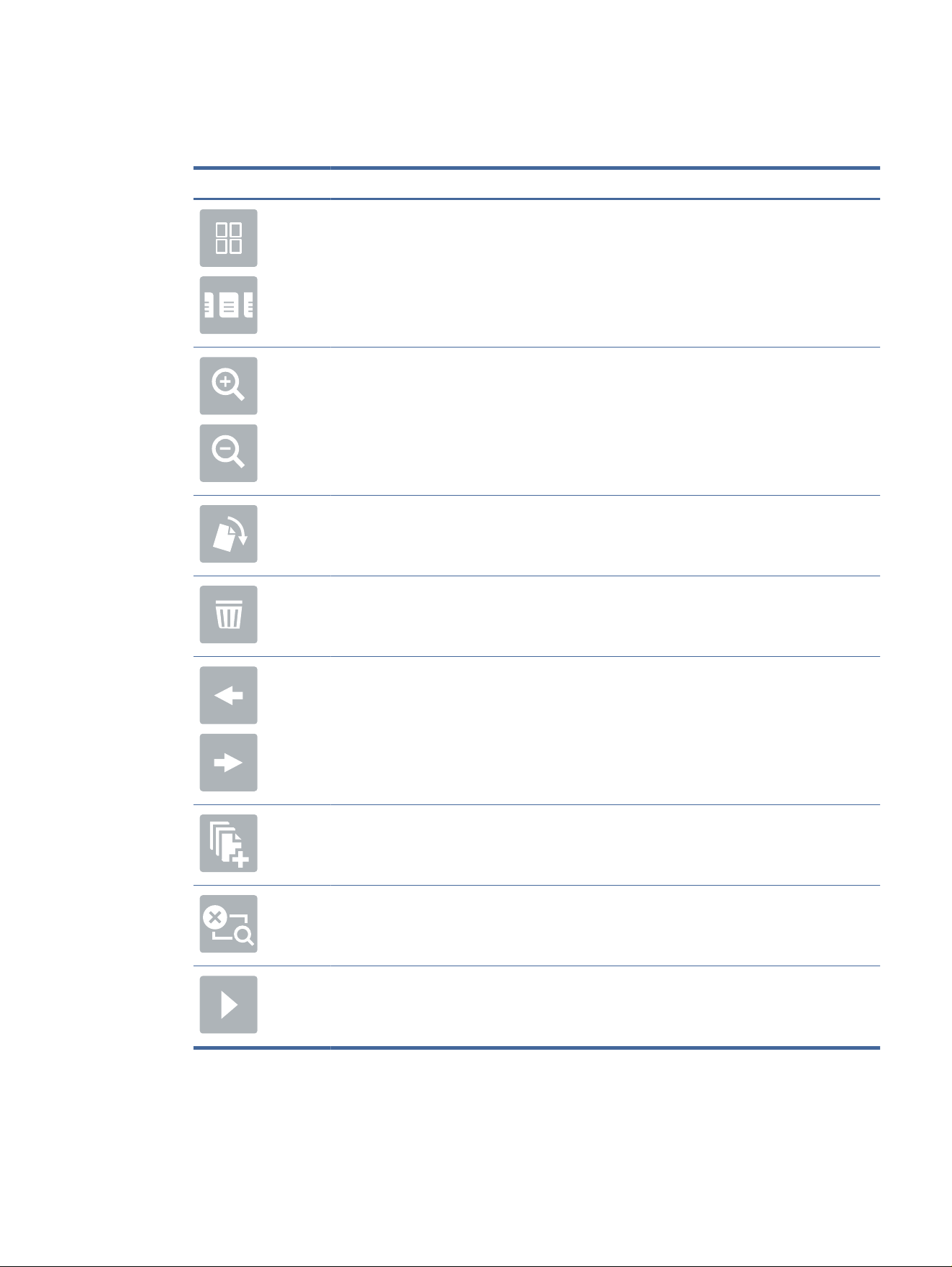
Use the buttons on the right of the screen to adjust the preview options and to rearrange, rotate,
insert, or remove pages.
Table 7-5 Buttons on the right side of the preview pane
Button Description
Use these buttons to toggle between single-page view and thumbnail view. More options are
available in thumbnail view than in single-page view.
Use these buttons to zoom in or out on the selected page.
NOTE: Select only one page at a time to use these buttons.
Use this button to rotate the page 180 degrees.
NOTE: This button is available only in the thumbnail view.
Use this button to delete the selected pages.
NOTE: This button is available only in the thumbnail view.
Use these buttons to rearrange the pages within the document. Select one or more pages and
move them to the left or right.
NOTE: These buttons are available only in the thumbnail view.
Use this button to add a page to the document. The printer prompts to scan additional pages.
Use this button to clear the changes made in the preview and start over.
Touch this button to collapse the preview screen and return to the Copy screen.
7. When the document is ready, select Send to send the fax.
Send a fax
127

Create a fax printing schedule
Faxes print automatically upon receipt, but they can also be stored and printed on a schedule that you
determine. After you create the schedule, you can enable or disable the schedule as needed.
1. From the Home screen on the printer control panel, navigate to the Settings application, and then
select the Settings icon.
2. Open the following menus:
a. Fax
b. Fax Receive Settings
c. Fax Printing Schedule
3. Under Incoming Fax Options, select Use Schedule.
4. Select New Event.
5. Select an option under Event Type.
● Begin Printing
● Begin Storing
6. Choose a time and the day. You can select multiple days.
7. Select Save. To add another event, repeat steps 4 – 6.
8. Select Done to enable the fax printing schedule.
Block incoming faxes
Use the fax block list setting to create a list of blocked phone numbers. When a fax is received from a
blocked phone number, the fax is not printed and is immediately deleted from memory.
Create a list of blocked fax numbers
Use the following steps to create the list of fax numbers to block.
1. From the Home screen on the printer control panel, navigate to the Settings application, and then
select the Settings icon.
2. Open the following menus:
a. Fax
b. Fax Receive Settings
c. Blocked Fax Numbers
3. Use one of the following options to add a number to the list:
● Select Add Last Sender.
● Select the New Fax Number field, type the number on the keypad that appears, and then
select the Enter button . To add additional numbers, type the number and select the Enter
button .
128
Chapter 7 Fax

4. Select Done.
Delete numbers from the list of blocked fax numbers
Use the following steps to remove numbers from the list of blocked fax numbers.
1. From the Home screen on the printer control panel, navigate to the Settings application, and then
select the Settings icon.
2. Open the following menus:
a. Fax
b. Fax Receive Settings
c. Blocked Fax Numbers
3. Select one or more existing fax numbers in the list, or select Select All if you want to remove all the
numbers.
4. Select the Trash button , and then select Delete on the confirmation prompt.
Additional fax tasks
Locate information on the Web for performing common fax tasks.
Go to Support for HP Color LaserJet Enterprise MFP 6800 or Support for HP Color LaserJet Enterprise
MFP 6801.
Instructions are available for fax tasks, such as the following:
● Create and manage fax speed dial lists
● Configure fax billing codes
● Use a fax printing schedule
● Block incoming faxes
● Fax archiving and forwarding
Delete numbers from the list of blocked fax numbers
129

Manage the printer8
Utilize management tools, configure security and energy-conservation settings, and manage firmware
updates for the printer.
The following information is correct at the time of publication. For current information, see Support for
HP Color LaserJet Enterprise MFP 6800 or Support for HP Color LaserJet Enterprise MFP 6801.
For more information:
HP's all-inclusive help for the printer includes the following information:
● Install and configure
● Learn and use
● Solve problems
● Download software and firmware updates
● Join support forums
● Find warranty and regulatory information
Advanced configuration with the HP Embedded Web Server
(EWS)
Use the HP Embedded Web Server to manage advanced printing functions.
Introduction
Use the HP Embedded Web Server to manage printing functions from a computer instead of the printer
control panel.
● View printer status information
● Determine the remaining life for all supplies and order new ones
● View and change tray configurations
● View and change the printer control-panel menu configuration
● View and print internal pages
● Receive notification of printer and supplies events
● View and change network configuration
The HP Embedded Web Server works when the printer is connected to an IP-based network. The
HP Embedded Web Server does not support IPX-based printer connections. Internet access is not
needed to open and use the HP Embedded Web Server.
130
Chapter 8 Manage the printer
When the printer is connected to the network, the HP Embedded Web Server is automatically available.
NOTE: The HP Embedded Web Server is not accessible beyond the network firewall.
How to access the HP Embedded Web Server (EWS)
Use the following steps to open the Embedded Web Server.
1. From the Home screen on the printer control panel, touch the Information icon , and then touch
the Ethernet icon to display the IP address or host name.
2. Open a web browser, and in the address line, type the IP address or host name exactly as it displays
on the printer control panel. Press the Enter key on the computer keyboard. The EWS web page
opens.
NOTE: If the web browser displays a message indicating that accessing the website might not be
safe, select the option to continue to the website. Accessing this website will not harm the
computer.
To use the HP Embedded Web Server, the browser must meet the following requirements:
Windows® 7
● Internet Explorer (version 8.x or greater)
● Google Chrome (version 34.x or greater)
● Firefox (version 20.x or greater)
Windows® 8 or greater
● Internet Explorer (version 9.x or greater)
● Google Chrome (version 34.x or greater)
● Firefox (version 20.x or greater)
Windows 10 or greater
● Microsoft Edge (version 93 or greater)
● Internet Explorer (version 9.x or greater)
● Google Chrome (version 34.x or greater)
● Firefox (version 20.x or greater)
macOS
● Safari (version 5.x or greater)
● Google Chrome (version 34.x or greater)
Linux
● Google Chrome (version 34.x or greater)
How to access the HP Embedded Web Server (EWS)
131
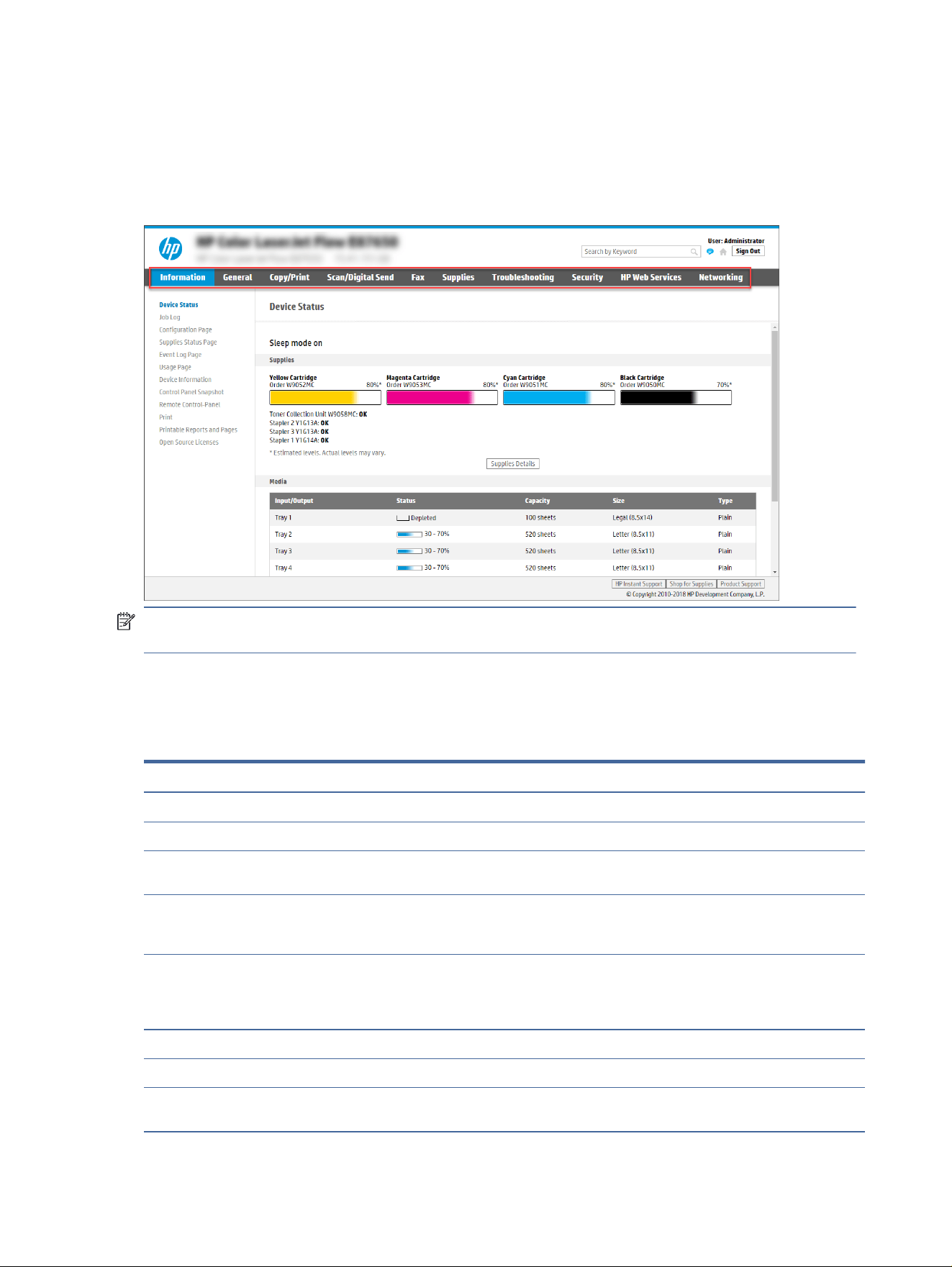
● Firefox (version 20.x or greater)
HP Embedded Web Server features
Learn about the HP Embedded Web Server (EWS) features available on each tab.
Figure 8-1 EWS Tabs
NOTE: Copy/Print, Scan/Digital Send, and Fax tabs only appear for multi-function printers (MFPs). A
Print tab appears for single-function printers (SFPs).
Information
tab
Settings available on the Information tab of the EWS.
Table 8-1
HP Embedded Web Server Information tab
Menu Description
Configuration Page Shows the information found on the configuration page.
Control Panel Snapshot Shows an image of the current screen on the control panel display.
Device Information Shows the printer network name, address, and model information. To customize
these entries, click the Device Information menu on the General tab.
Device Status Shows the printer status and shows the estimated life remaining of HP supplies. The
page also shows the type and size of paper set for each tray. To change the default
settings, click the Change Settings link.
Event Log Page Shows a list of all printer events and errors. Use the HP Instant Support link (in the
Other Links area on all HP Embedded Web Server pages) to connect to a set of
dynamic web pages that help solve problems. These pages also show additional
services available for the printer.
Event Schedule Summary The Event Schedule Summary page is used to view a table of all scheduled events.
Job Log Provides a list of the jobs that have been processed.
Open Source Licenses Shows a summary of the licenses for open source software programs that can be
used with the printer.
132 Chapter 8 Manage the printer

Table 8-1 HP Embedded Web Server Information tab (continued)
Menu Description
Print Allows the user to send a print-ready file to the printer to be printed.
Printable Reports and Pages Lists the internal reports and pages for the printer. Select one or more items to print.
Remote Control-Panel Provides a way to troubleshoot or manage the printer from a browser window on a
desktop or laptop.
Supplies Status Page Shows the status of the supplies for the printer.
Usage Page Shows a summary of the number of pages the printer has printed, grouped by size,
type, and paper print path.
General tab
Refer to the table for settings in the General tab.
Table 8-2
HP Embedded Web Server General tab
Menu Description
Control Panel Customization Reorder, show, or hide features on the control-panel display.
Change the default display language and keyboard layouts.
Quick Sets Configure jobs that are available in the Quick Sets area of the Home screen on the
printer control panel.
Alerts Set up email alerts for various printer and supplies events.
Control Panel Settings App Shows the Settings app options that are available on the printer control panel.
General Settings Configure how the printer recovers from jams and other general printer settings.
Edit Other Links Add or customize a link to another website. This link displays in the footer area on all
HP Embedded Web Server pages.
Ordering Information Enter information about ordering replacement toner cartridges. This information
displays on the supplies status page.
Device Information Name the printer and assign an asset number to it. Enter the name of the primary
contact who will receive information about the printer.
Language Set the language in which to display the HP Embedded Web Server information.
Firmware Upgrade Download and install printer firmware upgrade files.
Date/Time Settings Set the date and time or synchronize with a network time server.
Energy Settings Set or edit a wake time, sleep time, and sleep delay for the printer. Set a different
schedule for each day of the week and for holidays.
Set which interactions with the printer cause it to wake from sleep mode.
Back up and Restore Create a backup file that contains printer and user data. If necessary, use this file to
restore data to the printer.
Reset Factory Settings Restore printer settings to the factory defaults.
Solution Installer Install or remove third-party software packages that extend or modify the
functionality of the printer.
Job Statistics Settings Provides connection information about third-party job-statistics services, or enables
local serverless device job accounting.
General tab 133

Table 8-2 HP Embedded Web Server General tab (continued)
Menu Description
Quota Settings Provides connection information about third-party job-quota services, or enables
local device quota service.
Copy/Print tab
Settings available on the Copy/Print tab of the EWS.
Table 8-3 HP Embedded Web Server Copy/Print tab
Menu Description
Copy Settings Configure the default options and Quick Sets for copy jobs.
NOTE: If job-specific copy setting options are not set from the control panel at the
start of a job, the default settings will be used for the job.
Default Print Options Configure the default options for print jobs.
Expert Copy Enable or disable Expert Copy and set the initial copy view.
The Expert Copy feature is available only on some HP MFPs with larger control
panels, and is available in FutureSmart 4 firmware 24.7.3 release or later.
Manage Stored Jobs Enable or disable the ability to store jobs in the printer memory.
Configure job-storage options.
Manage Stapler/Stacker Configure settings for the stapler/stacker for printers that have this feature.
Manage Trays Configure settings for paper trays.
PCL and PostScript Settings Adjust the PCL and PostScript settings for all print jobs, including copy jobs and
received faxes.
Print from USB Drive Settings Enable or disable the Print from USB Drive menu on the control panel.
Print Quality Configure the print quality settings, including color adjustment, image registration,
and allowed paper types.
Restrict Color
(Color printers only)
Permit or restrict color printing and copying.
Specify permissions for individual users or for jobs that are sent from specific
software programs.
Scan/Digital Send tab
Refer to the table for settings in the Scan/Digital Send tab.
134
Chapter 8 Manage the printer

Table 8-4 HP Embedded Web Server Scan/Digital Send tab
Menu Description
Scan to Email Settings Configure the default email settings for digital sending, including the following:
● Settings for the outgoing mail (SMTP) server
● Settings for Email Quick Sets jobs
● Default message settings, such as the "From" address and the subject line
● Settings for digital signatures and encryption
● Settings for email notifications
● Default scan settings for email jobs
● Default file settings for email jobs
Scan to Network Folder Settings Configure the network folder settings for digital sending, including the following:
● Settings for Quick Sets jobs saved in a network folder
● Settings for notifications
● Default scan settings for jobs saved in a network folder
● Default file settings for jobs saved in a network folder
Scan to SharePoint® Settings Configure the SharePoint settings for digital sending, including the following:
● Settings for Quick Sets jobs saved in a document library on the SharePoint site
● Default settings for jobs saved in a document library on the SharePoint site
Scan to USB Drive Settings Configure the USB settings for digital sending, including the following:
● Settings for Quick Sets jobs saved on a USB flash drive
● Settings for notifications
● Default scan settings for jobs saved on a USB flash drive
● Default file settings for jobs saved on a USB flash drive
Contacts Manage contacts, including the following:
● Add email addresses into the printer one at a time.
● Import a large list of frequently-used email addresses on to the printer all at
once, rather than adding them one at a time.
● Export contacts from the printer into a .CSV file on the computer to use as a
data backup, or import the records onto another HP printer.
● Edit email addresses that have already been saved in the printer.
Email and Scan to Network Folder Quick
Setup Wizards
Configure the printer to send scanned images as email attachments.
Configure the printer to save scanned images to network-folder Quick Sets. Quick
Sets provide easy access to files saved on the network.
Digital Sending Software Setup Configure settings related to using optional Digital Sending software.
Fax tab
Settings available on the Fax tab of the EWS.
Fax tab
135

Table 8-5 HP Embedded Web Server Fax tab
Menu Description
Fax Send Setup Configure settings for sending faxes, including the following:
● Default settings for outgoing faxes
● Settings for fax Quick Sets jobs
● Settings for notifications
● Default setting for sending faxes using the internal fax modem
● Settings for using a LAN fax service
● Settings for using an Internet fax service
Fax Speed Dials Manage speed dials, including the following:
● Import .CSV files containing email addresses, fax numbers, or user records, so
that they can be accessed on this printer.
● Export email, fax, or user records from the printer into a file on the computer to
use as a data backup, or import the records onto another HP printer.
Supplies tab
Refer to the table for settings in the Supplies tab.
Table 8-6
HP Embedded Web Server Supplies tab
Menu Description
Manage Supplies Configure how the printer reacts when supplies reach a Very Low state.
Troubleshooting tab
Refer to the table for settings in the Troubleshooting tab.
Table 8-7
HP Embedded Web Server Troubleshooting tab
Menu Description
General Troubleshooting Use the following options as appropriate:
● Reports and Tests area: Select and print several types of reports and tests.
Some reports can be viewed in the EWS by clicking the View button.
● Fax Tools area: Configure settings for fax troubleshooting. (MFP and Digital
Sender products with HP analog fax accessory only)
● OXPd Troubleshooting area: Enable or disable the Allow a Non-Secure
Connection for Web Services option
● Auto Recovery area: Enable or disable the Enable Auto Recovery option, which
allows the printer to auto recover from errors that might require the power to
be turned off and on (for example, a 49 error).
Online Help Link to HP cloud-based online help to assist in troubleshooting printing issues.
136 Chapter 8 Manage the printer

Table 8-7 HP Embedded Web Server Troubleshooting tab (continued)
Menu Description
Diagnostic Data
NOTE: This item is available only if an
administrator password is set from the
Security tab.
Export printer information to a file that can be useful for HP technical support to use
for detailed problem analysis.
Calibration/Cleaning Enable the automatic cleaning feature, create and print the cleaning page, and
select an option to calibrate the printer immediately.
Reset Factory Settings Restore printer settings to factory defaults.
Firmware Upgrade Download and install printer firmware upgrade files.
Scheduled Restart Restart the printer at the frequency or time specified.
Security tab
Refer to the table for settings in the Security tab.
Table 8-8
HP Embedded Web Server Security tab
Menu Description
General Security Settings for general security, including the following:
● Configure an administrator password to restrict access to certain features on
the printer.
● Set a custom device Service Access Code.
● Set PJL password for processing PJL commands.
● Set file system access and firmware upgrade security.
● Enable or disable the Host USB port on the control panel or the USB
connectivity port on the formatter for printing directly from a computer.
● View the status of all security settings.
Account Policy Enable administrator account settings.
Access Control Configure access to printer functions for specific individuals or groups, and select
the method individuals use to sign in to the printer.
Protect Stored Data Configure and manage the internal storage for the printer.
Configure settings for jobs that are stored on the printer internal storage.
Manage Remote Apps Manage or whitelist remote apps by importing or deleting certificates that allow
devices to use this product.
Certificate Management Install and manage security certificates for access to the printer and the network.
Email Domain Restriction If email functionality is enabled, administrators can limit the email addresses to
which the printer can send messages.
Security Log Export security event log data to a file that can be used for detailed problem
analysis.
Web Service Security Allow resources on this printer to be accessed by web pages from different
domains. If no sites are added to the list, then all sites are trusted.
Security tab 137

Table 8-8 HP Embedded Web Server Security tab (continued)
Menu Description
Security Log Export security event log data to a file that can be used for detailed problem
analysis.
Self Test Verify that the security functions are running according to expected system
parameters.
HP Web Services tab
Settings available on the HP Web Services tab of the EWS.
Use the HP Web Services tab to configure and enable HP Web Services for this printer. HP Web Services
must be enabled to use mobile printing features.
Table 8-9
HP Embedded Web Server HP Web Services tab
Menu Description
Web Services Setup Connect this printer to HP Connected on the web by enabling HP Web Services.
Web Proxy Configure a proxy server if there are issues enabling HP Web Services or
connecting the printer to the Internet.
Smart Cloud Print Enable Smart Cloud Print, which allows access to web-based apps that extend the
capabilities of the printer.
Networking tab
Use the Networking tab to configure and secure network settings for the printer when it is connected to
an IP-based network. This tab does not display if the printer is connected to other types of networks.
Table 8-10
HP Embedded Web Server Networking tab > Configuration settings
Menu Description
Wireless Station Configure the initial wireless settings.
NOTE: The configuration options available depend on the print server model.
Wi-Fi Direct Configure Wi-Fi Direct settings for printers that include embedded Wi-Fi Direct Print
and NFC printing or that have a wireless accessory installed.
NOTE: The configuration options available depend on the print server model.
TCP/IP Settings Configure TCP/IP settings for IPv4 and IPv6 networks.
NOTE: The configuration options available depend on the print server model.
Network Settings Configure IPX/SPX, AppleTalk, DLC/LLC, and SNMP settings, depending on the print
server model.
Other Settings Configure general printing protocols and services supported by the print server.
The available options depend on the print server model, but can include firmware
update, LPD queues, USB settings, support information, and refresh rate.
AirPrint Enable, set up, or disable network printing from Apple-supported printers.
Select Language Change the language displayed by the HP Embedded Web Server. This page
displays if the web pages support multiple languages. Optionally, select supported
languages through language-preference settings in the browser.
138 Chapter 8 Manage the printer

Table 8-10 HP Embedded Web Server Networking tab > Configuration settings (continued)
Menu Description
Web Proxy Enter the Web Proxy server settings for your network, if required.
Table 8-11 HP Embedded Web Server Networking tab > Security settings
Menu Description
Settings View and restore current security settings to factory-default values.
Configure security settings using the Security Configuration Wizard.
NOTE: Do not use the Security Configuration Wizard to configure security settings
if using network-management applications, such as HP Web Jetadmin.
Secure Communication Configure Transport Layer Security (TLS) protocol and encryption options.
Mgmt. Protocols Configure and manage security protocols for this printer, including the following:
● Set the security management level for the HP Embedded Web Server, and
control traffic over HTTP and HTTPS.
● Configure the SNMP (Simple Network Management Protocol) operation. Enable
or disable the SNMP v1/v2c or SNMP v3 agents on the print server.
● Control access through protocols that may not be secure, such as printing
protocols, print services, discovery protocols, name resolution services, and
configuration-management protocols.
802.1X Authentication Configure 802.1X authentication settings on the Jetdirect print server as required for
client authentication on the network, and reset the 802.1X authentication settings to
factory-default values.
CAUTION: When changing the 802.1X authentication settings; the printer might
lose its connection. To reconnect, it might be necessary to reset the print server to a
factory-default state and reinstall the printer.
IPsec/Firewall View or configure a Firewall policy or an IPsec/Firewall policy.
Announcement Agent Enable or disable the HP Device Announcement Agent, set the configuration server,
and configure mutual authentication using certificates.
Table 8-12 HP Embedded Web Server Networking tab > Diagnostics settings
Menu Description
Network Statistics Display network statistics that are collected and stored on the HP Jetdirect print
server.
Protocol Info View a list of network-configuration settings on the HP Jetdirect print server for each
protocol.
Configuration Page View the HP Jetdirect configuration page, which contains status and configuration
information.
Configure IP network settings
Use the EWS to configure the printer network settings.
Configure IP network settings
139
Printer sharing disclaimer
Review the following disclaimer.
HP does not support peer-to-peer networking, as the feature is a function of Microsoft operating
systems and not of the HP printer drivers. Go to Microsoft at www.microsoft.com.
View or change network settings
Use the HP Embedded Web Server to view or change IP configuration settings.
1. Open the HP Embedded Web Server (EWS):
a. From the Home screen on the printer control panel, touch the Information icon , and then
touch the Ethernet icon to display the IP address or host name.
b. Open a web browser, and in the address line, type the IP address or host name exactly as
it displays on the printer control panel. Press the Enter key on the computer keyboard. The
EWS opens.
NOTE: If the web browser displays a message indicating that accessing the website might
not be safe, select the option to continue to the website. Accessing this website will not harm
the computer.
2. Click the Networking tab to obtain network information. Change settings as needed.
Rename the printer on a network
To rename the printer on a network so that it can be uniquely identified, use the HP Embedded Web
Server.
1. Open the HP Embedded Web Server (EWS):
a. From the Home screen on the printer control panel, touch the Information icon , and then
touch the Ethernet icon to display the IP address or host name.
b. Open a web browser, and in the address line, type the IP address or host name exactly as
it displays on the printer control panel. Press the Enter key on the computer keyboard. The
EWS opens.
NOTE: If the web browser displays a message indicating that accessing the website might
not be safe, select the option to continue to the website. Accessing this website will not harm
the computer.
2. Open the General tab.
3. On the Device Information page, the default printer name is in the Device Name field. You can
change this name to uniquely identify this printer.
NOTE: Completing the other fields on this page is optional.
140
Chapter 8 Manage the printer

4. Click the Apply button to save the changes.
Manually configure IPv4 TCP/IP parameters from the control panel
Use the control-panel Settings menus to manually set an IPv4 address, subnet mask, and default
gateway.
1. From the Home screen on the printer control panel, navigate to the Settings application, and then
select the Settings icon.
2. Open the following menus:
a. Networking
b. Ethernet
c. TCP/IP
d. IPV 4 Settings
e. Config Method
3. Select the Manual option, and then touch the Save button.
4. Open the Manual Settings menu.
5. Touch the IP Address, Subnet Mask, or Default Gateway option.
6. Touch the first field to open a keypad. Enter the correct digits for the field, and then touch the OK
button.
Repeat the process for each field, and then touch the Save button.
Manually configure IPv6 TCP/IP parameters from the control panel
Use the control-panel Settings menus to manually set an IPv6 address.
1. From the Home screen on the printer control panel, navigate to the Settings application, and then
select the Settings icon.
2. To enable manual configuration, open the following menus:
a. Networking
b. Ethernet
c. TCP/IP
d. IPV6 Settings
3. Select Enable, and then select On.
4. Select the Enable Manual Settings option, and then touch the Done button.
5. To configure the address, open the Address menu, and then touch the field to open a keypad.
6. Use the keypad to enter the address, and then touch the OK button.
7. Touch Save.
Manually configure IPv4 TCP/IP parameters from the control panel
141

Link speed and duplex settings
Use the following steps to make changes to link speed and duplex settings.
NOTE: This information applies only to Ethernet networks. It does not apply to wireless networks.
The link speed and communication mode of the print server must match the network hub. For most
situations, leave the printer in automatic mode. Incorrect changes to the link speed and duplex settings
might prevent the printer from communicating with other network devices. To make changes, use the
printer control panel.
NOTE: The printer setting must match the setting for the network device (a network hub, switch,
gateway, router, or computer).
NOTE: Making changes to these settings causes the printer to turn off and then on. Make changes
only when the printer is idle.
1. From the Home screen on the printer control panel, navigate to the Settings application, and then
select the Settings icon.
2. Open the following menus:
a. Networking
b. Ethernet
c. Link Speed
3. Select one of the following options:
● Auto: The print server automatically configures itself for the highest link speed and
communication mode allowed on the network.
● 10T Half: 10 megabytes per second (Mbps), half-duplex operation
● 10T Full: 10 Mbps, full-duplex operation
● 10T Auto: 10 Mbps, automatic-duplex operation
● 100TX Half: 100 Mbps, half-duplex operation
● 100TX Full: 100 Mbps, full-duplex operation
● 100TX Auto: 100 Mbps, automatic-duplex operation
● 1000T Full: 1000 Mbps, full-duplex operation
4. Touch the Save button. The printer turns off and then on.
Printer security features
Restrict who has access to configuration settings, secure data, and prevent access to valuable
hardware components.
Introduction
The printer includes several security features to restrict who has access to configuration settings, to
secure data, and to prevent access to valuable hardware components.
142
Chapter 8 Manage the printer
Security statements
Review this important security statement.
The printer supports security standards and recommended protocols that help you keep the printer
secure, protect critical information on your network, and simplify the way you monitor and maintain the
printer.
Assign an administrator password
Assign an administrator password for access to the printer and the HP Embedded Web Server so that
unauthorized users cannot change the printer settings.
Use the HP Embedded Web Server (EWS) to set the password
Use the following steps to set a password for the printer.
1. Open the HP Embedded Web Server (EWS):
a. From the Home screen on the printer control panel, touch the Information icon , and then
touch the Ethernet icon to display the IP address or host name.
b. Open a web browser, and in the address line, type the IP address or host name exactly as
it displays on the printer control panel. Press the Enter key on the computer keyboard. The
EWS opens.
NOTE: If the web browser displays a message indicating that accessing the website might
not be safe, select the option to continue to the website. Accessing this website will not harm
the computer.
2. Click the Security tab.
3. Open the General Security menu.
4. In the area labeled Set the Local Administrator Password, enter the name to associate with the
password in the Username field.
5. Enter the password in the New Password field, and then enter it again in the Verify Password field.
NOTE: To change an existing password, first enter the existing password in the Old Password field.
6. Click the Apply button.
IMPORTANT: Make note of the password and store it in a safe place. The administrator password
cannot be recovered. If the administrator password is lost or forgotten, contact HP Support for the
assistance required to completely reset the printer.
Click here to contact HP Support about resetting the printer password.
Provide user access credentials at the printer control panel
Use the following steps to sign into the control panel.
Security statements
143

Some features on the printer control panel can be secured so that unauthorized people cannot use
them. When a feature is secured, the printer prompts you to sign in before you can use it. You can also
sign in without waiting for a prompt by selecting Sign In from the printer control panel.
Typically, the credentials for signing in to the printer are the same as for signing in to the network.
Consult the network administrator for this printer if you have questions about which credentials to use.
1. From the Home screen on the printer control panel, select Sign In.
2. Follow the prompts to enter the credentials.
NOTE: To maintain security for the printer, select Sign Out when you have finished using the printer.
IP Security
IP Security (IPsec) is a set of protocols that control IP-based network traffic to and from the printer. IPsec
provides host-to-host authentication, data integrity, and encryption of network communications.
For printers that are connected to the network and have an HP Jetdirect print server, you can configure
IPsec by using the Networking tab in the HP Embedded Web Server.
Encryption support: HP High Performance Secure Hard Disks
The hard disk provides hardware-based encryption so you can securely store sensitive data without
impacting printer performance. This hard disk uses the latest Advanced Encryption Standard (AES) and
has versatile time-saving features and robust functionality.
Use the Security menu in the HP Embedded Web Server to configure the disk.
Lock the formatter
The formatter has a slot that you can use to attach a security cable.
Locking the formatter prevents someone from removing valuable components from it.
Energy-conservation settings
Learn about the energy-conservation settings that are available for the printer.
Set the sleep timer and configure the printer to use 1 watt or less of power
The sleep settings affect how much power the printer uses, the wake/sleep time, how quickly the printer
enters sleep mode, and how quickly the printer wakes up from sleep mode.
To configure the printer to use 1 watt or less of power while in sleep mode, enter the time for the Sleep
after Inactivity setting.
1. From the Home screen on the printer control panel, select Settings.
2. Open the following menus:
● General
● Energy Settings
● Sleep Settings
144
Chapter 8 Manage the printer

3. Select Sleep after Inactivity to specify the number of minutes the printer is inactive before it enters
sleep mode. Enter the appropriate time period.
4. Select Done to save the settings.
Set the sleep schedule
Use the Sleep Schedule feature to configure the printer to automatically wake or go into Sleep mode at
specific times on specific days of the week.
1. From the Home screen on the printer control panel, navigate to the Settings application, and then
select the Settings icon.
2. Open the following menus:
a. General
b. Energy Settings
c. Sleep Schedule
3. Select the New Event button, and then select the type of event to schedule: Wake Event or Sleep
Event.
4. For a wake or sleep event, configure the time and the days of the week for the event. Select Save to
save the setting.
HP Web Jetadmin
HP Web Jetadmin is an award-winning, industry-leading tool for efficiently managing a wide variety
of networked HP products, including printers, multifunction printers, and digital senders. This single
solution allows you to remotely install, monitor, maintain, troubleshoot, and secure your printing and
imaging environment — ultimately increasing business productivity by helping you save time, control
costs, and protect your investment.
HP Web Jetadmin upgrades are periodically made available to provide support for specific product
features. Go to www.hp.com/go/webjetadmin for more information.
Software and firmware updates
HP regularly updates features that are available in the printer firmware. To take advantage of the most
current features, update the printer firmware.
Download the most recent firmware update file from the web:
Go to Support for HP Color LaserJet Enterprise MFP 6800 or Support for HP Color LaserJet Enterprise
MFP 6801. Click Software, Drivers and Firmware.
Set the sleep schedule
145
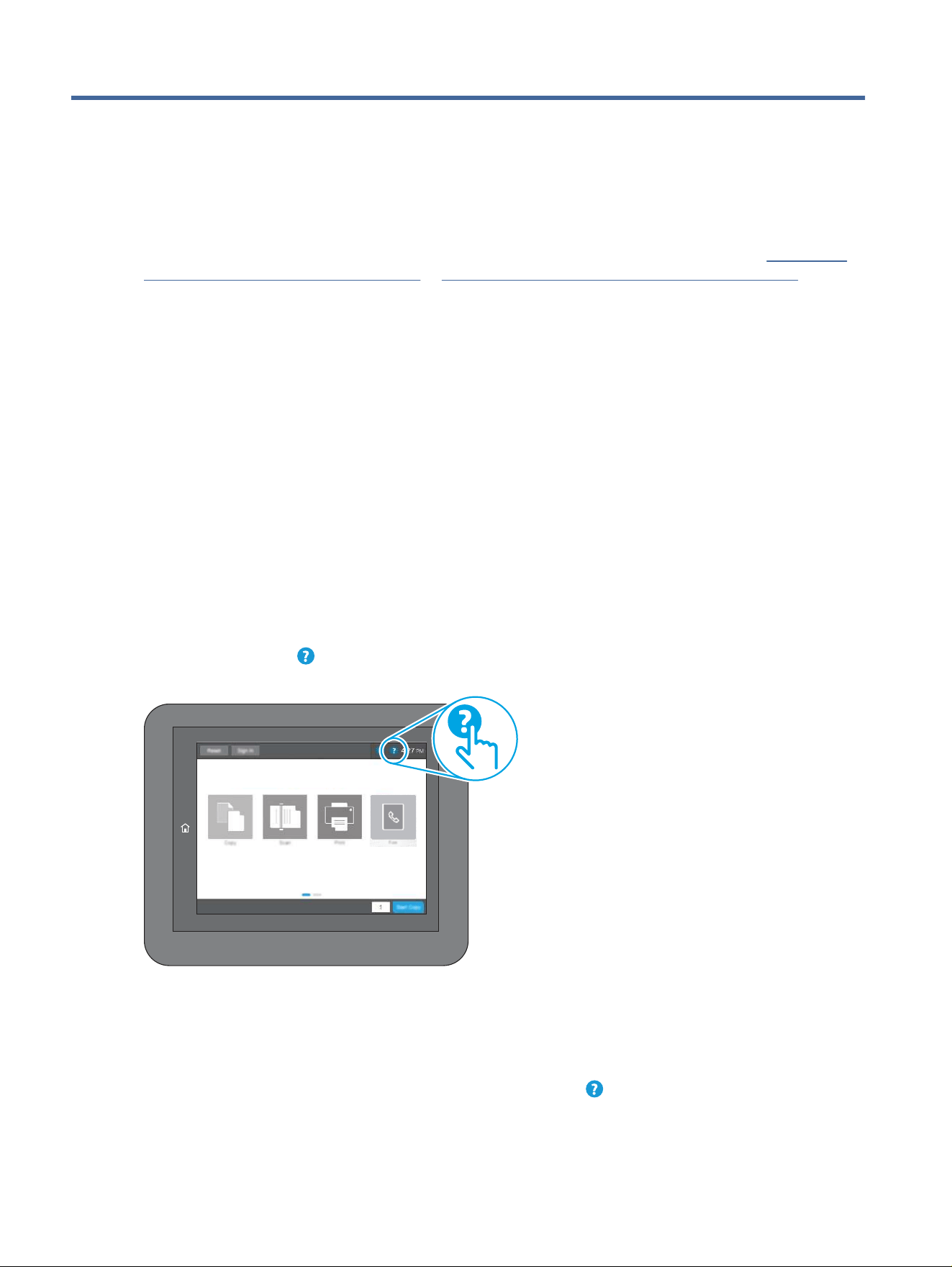
Solve problems9
Troubleshoot problems with the printer. Locate additional resources for help and technical support.
The following information is correct at the time of publication. For current information, see Support for
HP Color LaserJet Enterprise MFP 6800 or Support for HP Color LaserJet Enterprise MFP 6801.
For more information:
HP's all-inclusive help for the printer includes the following information:
● Install and configure
● Learn and use
● Solve problems
● Download software and firmware updates
● Join support forums
● Find warranty and regulatory information
Control panel help system
The printer has a built-in Help system that explains how to use each screen. To open the Help system,
touch the Help button
in the upper-right corner of the screen.
For some screens, the Help opens to a global menu where you can search for specific topics. You can
browse through the menu structure by touching the buttons in the menu.
Some Help screens include animations that show specific procedures, such as clearing paper jams.
If the printer alerts of an error or warning, touch the Help button to open a message that describes
the problem. The message also contains instructions to help solve the problem.
146
Chapter 9 Solve problems

Reset factory settings
Resetting the printer settings to the factory-set defaults can help resolve problems.
Introduction
Use one of the following methods to reset the printer settings to the original settings from the factory.
Method one: Reset factory settings from the printer control panel
Use the printer control panel to restore the settings to their original values.
1. From the Home screen on the printer control panel, navigate to the Settings application, and then
select the Settings icon.
2. Open the following menus:
a. General
b. Reset Factory Settings
3. Select Reset.
A verification message advises that completing the reset function might result in loss of data.
4. Select Reset to complete the process.
NOTE: The printer restarts automatically after the reset operation completes.
Method two: Reset factory settings from the HP Embedded Web Server (network-
connected printers only)
Use the HP EWS to reset the printer settings to the original settings.
1. On the printer control panel, select the Information button , and then select the Network icon
to display the IP address or host name.
2. Open the General tab.
3. On the left side of the screen, click Reset Factory Settings.
4. Click the Reset button.
NOTE: The printer restarts automatically after the reset operation completes.
A “Cartridge is low” or “Cartridge is very low” message displays
on the printer control panel or EWS
Review the possible solutions to this issue.
Cartridge is low: The printer indicates when a toner cartridge level is low. Actual toner cartridge life
remaining may vary. Consider having a replacement available to install when print quality is no longer
acceptable. The toner cartridge does not need to be replaced now.
Reset factory settings
147
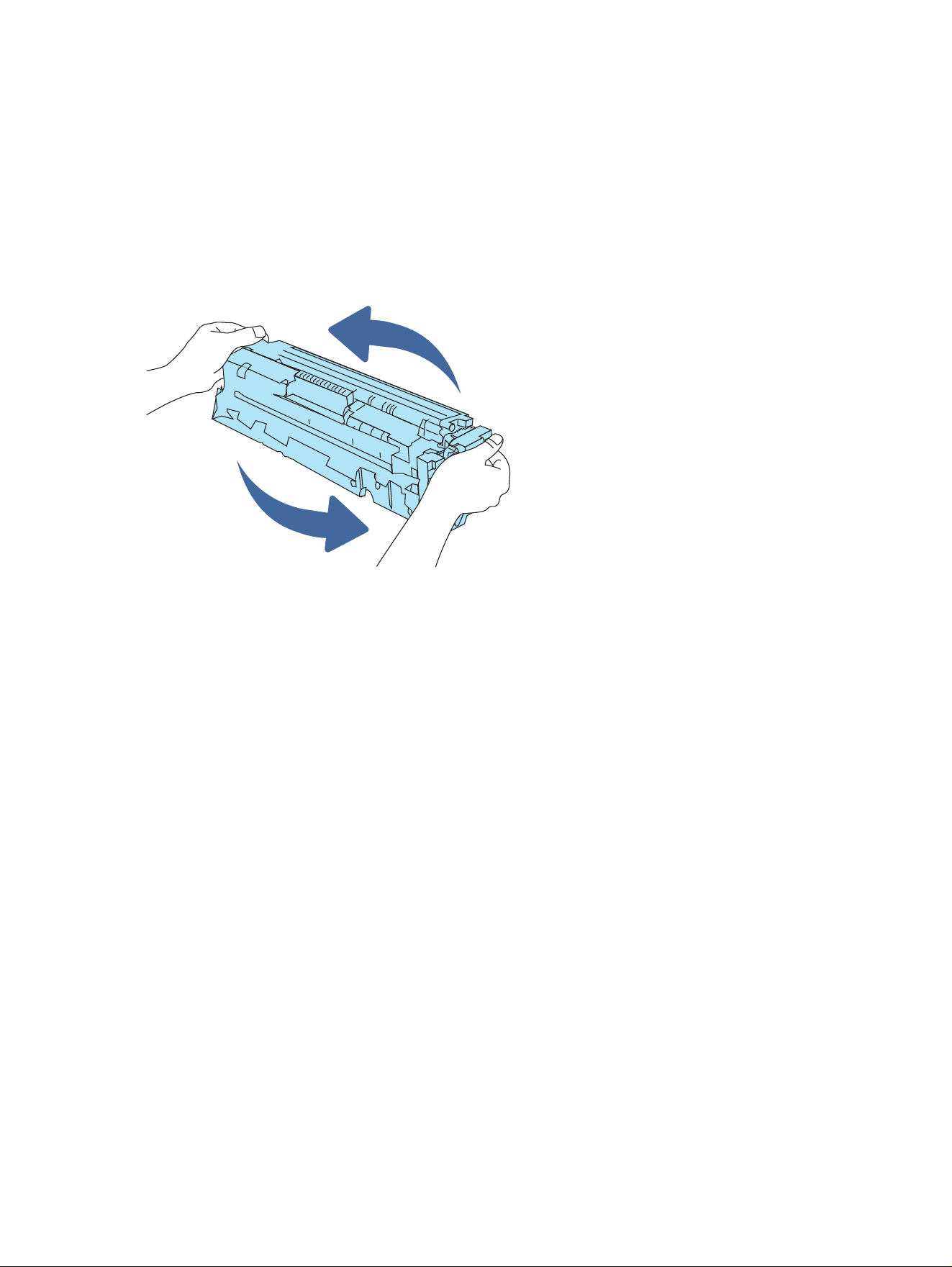
Continue printing with the current cartridge until redistributing the toner no longer yields acceptable
print quality. To redistribute the toner, remove the toner cartridge from the printer and gently rock the
cartridge back and forth end to end. Reinsert the toner cartridge into the printer and close the cover.
Cartridge is very low: The printer indicates when the toner cartridge level is very low. Actual toner
cartridge life remaining may vary. To extend the life of the toner, gently rock the cartridges back and
forth end to end. Consider having a replacement available to install when print quality is no longer
acceptable. The toner cartridge does not need to be replaced now unless the print quality is no longer
acceptable.
HP’s Premium Protection Warranty expires when a message indicating that HP's Premium Protection
Warranty on this supply has ended appears on the Supplies Status Page or the EWS.
Change the “Very Low” settings
You can change the way the printer reacts when supplies reach the Very Low state. You do not have to
re-establish these settings when you install a new cartridge.
Change the “Very Low” settings at the control panel
Change the setting at the printer control panel.
1. From the Home screen on the printer control panel, navigate to the Settings application, and then
select the Settings icon.
2. Open the following menus:
a. Manage Supplies
b. Very Low Behavior
c. Black Cartridge or Color Cartridges
3. Select one of the following options:
● Select the Stop option to set the printer to stop printing when the cartridge reaches the Very
Low threshold.
● Select the Prompt to continue option to set the printer to stop printing when the cartridge
reaches the Very Low threshold. You can acknowledge the prompt or replace the cartridge to
resume printing.
148
Chapter 9 Solve problems

● Select the Continue option to set the printer to alert you that the cartridge is very low,
and to continue printing beyond the Very Low setting without interaction. This can result in
unsatisfactory print quality.
For printers with fax capability
When the printer is set to the Stop or Prompt to continue option, there is some risk that faxes will not
print when the printer resumes printing. This can occur if the printer has received more faxes than the
memory can hold while the printer is waiting.
The printer can print faxes without interruption when it passes the Very Low threshold if you select the
Continue option for the cartridge, but print quality might degrade.
Order supplies
Order supplies and paper for your HP printer.
Table 9-1
Ordering options
Ordering option Ordering information
Order supplies and paper www.hp.com
Order through service or support providers Contact an HP-authorized service or support provider.
Order using the HP Embedded Web Server (EWS) To access, in a supported web browser on your computer, enter the printer
IP address or host name in the address/URL field. The EWS contains a
link to the HP website, which provides options for purchasing Original HP
supplies.
Printer does not pick up paper or misfeeds
Use this information if the printer is not picking up paper from the tray or is picking up multiple sheets of
paper at one time.
Introduction
The following solutions can help solve problems if the printer is not picking up paper from the tray or is
picking up multiple sheets of paper at one time. Either of these situations can result in paper jams.
The printer does not pick up paper
If the printer does not pick up paper from the tray, try these solutions:
1. Open the printer and remove any jammed sheets of paper. Verify that no torn remnants of paper
remain inside the printer.
2. Load the tray with the correct size of paper for the job.
3. Make sure the paper size and type are set correctly on the printer control panel.
4. Make sure the paper guides in the tray are adjusted correctly for the size of paper. Adjust the guides
to the appropriate indentation in the tray. The arrow on the tray guide should line up exactly with the
marking on the tray.
NOTE: Do not adjust the paper guides tightly against the paper stack. Adjust them to the
indentations or markings in the tray.
For printers with fax capability
149
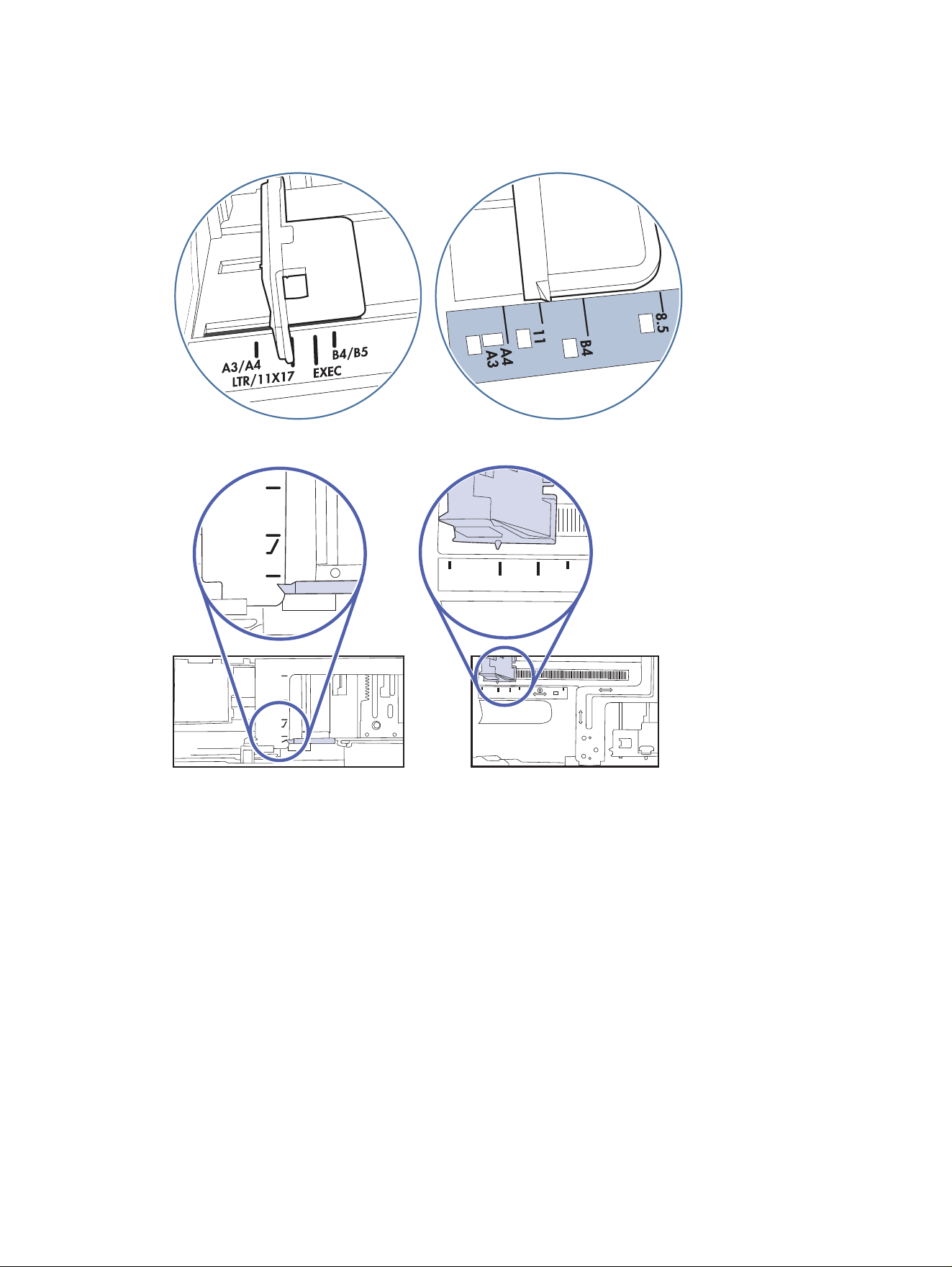
The following images show examples of the paper-size indentations in the trays for various printers.
Most HP printers have markings similar to these.
Figure 9-1 Size markings for Tray 1 or the multipurpose tray
Figure 9-2 Size markings for cassette trays
A6
A5
A4
LTR/LGL
JIS B5
EXEC
A5
EXEC
A4
LTR/LGL
JIS B5
A4 B5
A5
11
10.5
A4
11 10.5
B5
5. Verify that the humidity in the room is within specifications for this printer and that paper is being
stored in unopened packages. Most reams of paper are sold in moisture-proof wrapping to keep
paper dry.
In high-humidity environments, paper at the top of the stack in the tray can absorb moisture, and it
might have a wavy or uneven appearance. If this happens, remove the top 5 to 10 sheets of paper
from the stack.
In low-humidity environments, excess static electricity can cause sheets of paper to stick together.
If this happens, remove the paper from the tray, and flex the stack by holding it at each end and
bringing the ends up to form a U shape. Then, rotate the ends down to reverse the U shape. Next,
hold each side of the stack of paper and repeat this process. This process releases individual
sheets without introducing static electricity. Straighten the paper stack against a table before
returning it to the tray.
150
Chapter 9 Solve problems
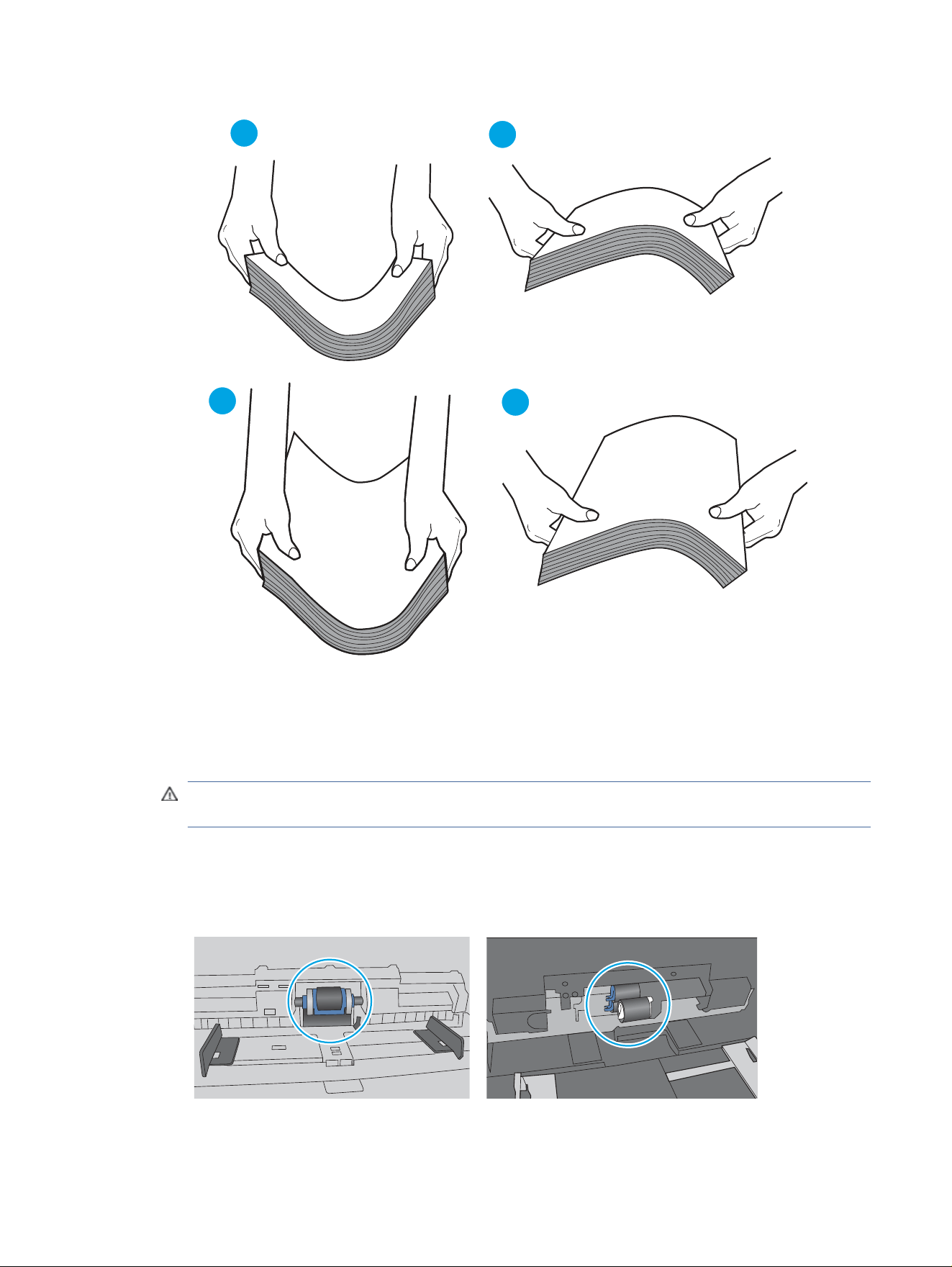
Figure 9-3 Technique for flexing the paper stack
1
2
1
2
A4
A3
6. Check the printer control panel to see if it is displaying a prompt to feed the paper manually. Load
paper, and continue.
7. The rollers above the tray might be contaminated. Clean the rollers with a lint-free cloth dampened
with warm water. Use distilled water, if it is available.
CAUTION: Do not spray water directly onto the printer. Instead, spray water on the cloth or dab
the cloth in water and wring it out before cleaning the rollers.
The following image shows examples of the roller location for various printers.
Figure 9-4 Roller locations for Tray 1 or the multipurpose tray
The printer does not pick up paper
151
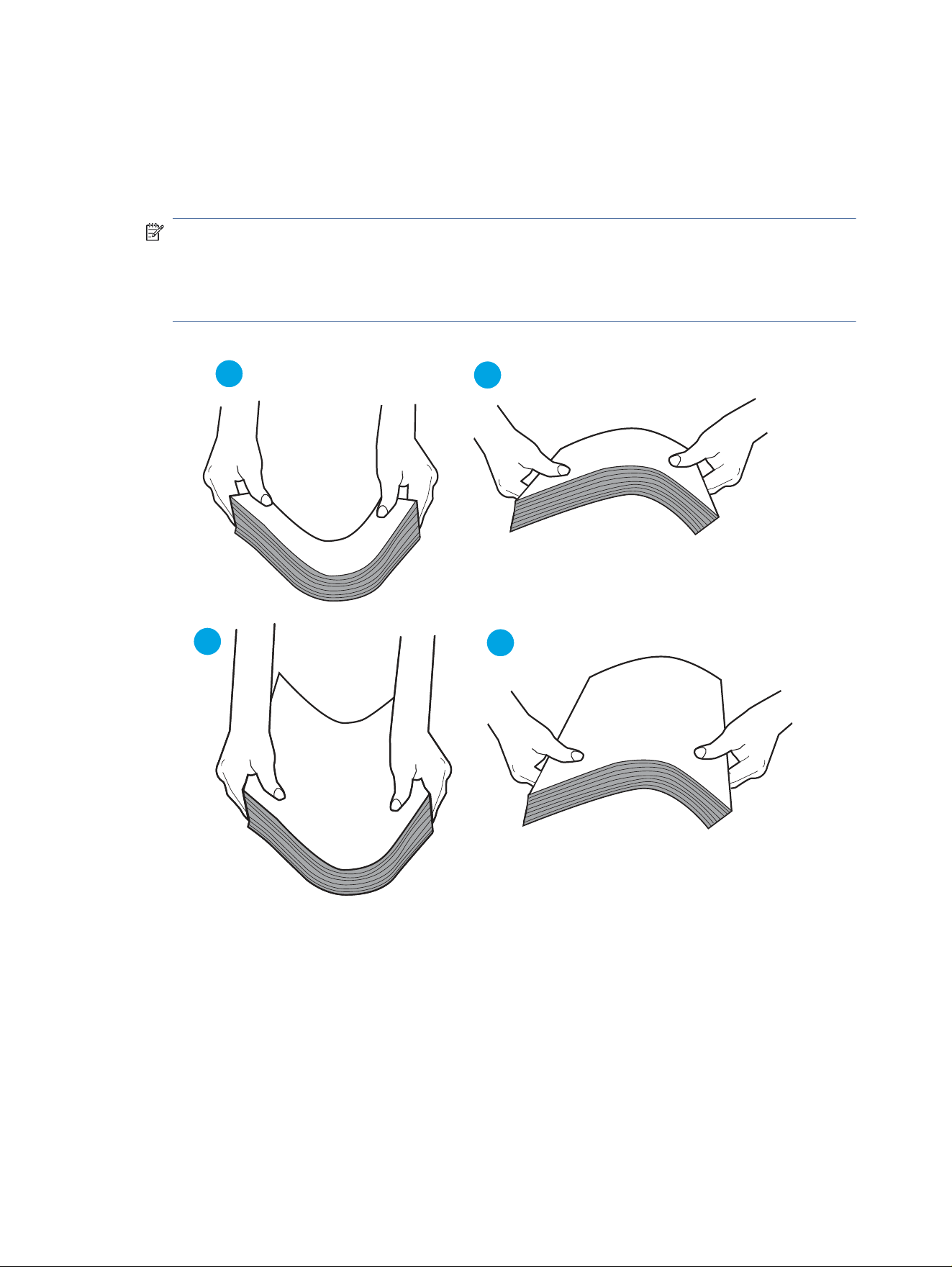
The printer picks up multiple sheets of paper
If the printer picks up multiple sheets of paper from the tray, try these solutions:
1. Remove the stack of paper from the tray and flex it, rotate it 180 degrees, and flip it over.
Do not fan
the paper.
Return the stack of paper to the tray.
NOTE: Fanning the paper introduces static electricity. Instead of fanning the paper, flex the stack
by holding it at each end and bringing the ends up to form a U shape. Then, rotate the ends down to
reverse the U shape. Next, hold each side of the stack of paper and repeat this process. This
process releases individual sheets without introducing static electricity. Straighten the paper
stack against a table before returning it to the tray.
Figure 9-5 Technique for flexing the paper stack
1
2
1
2
A4
A3
2. Use only paper that meets HP specifications for this printer.
3. Verify that the humidity in the room is within specifications for this printer, and that paper is being
stored in unopened packages. Most reams of paper are sold in moisture-proof wrapping to keep
paper dry.
In high-humidity environments, paper at the top of the stack in the tray can absorb moisture, and it
might have a wavy or uneven appearance. If this happens, remove the top 5 to 10 sheets of paper
from the stack.
In low-humidity environments, excess static electricity can cause sheets of paper to stick together. If
this happens, remove the paper from the tray and flex the stack as described above.
152
Chapter 9 Solve problems
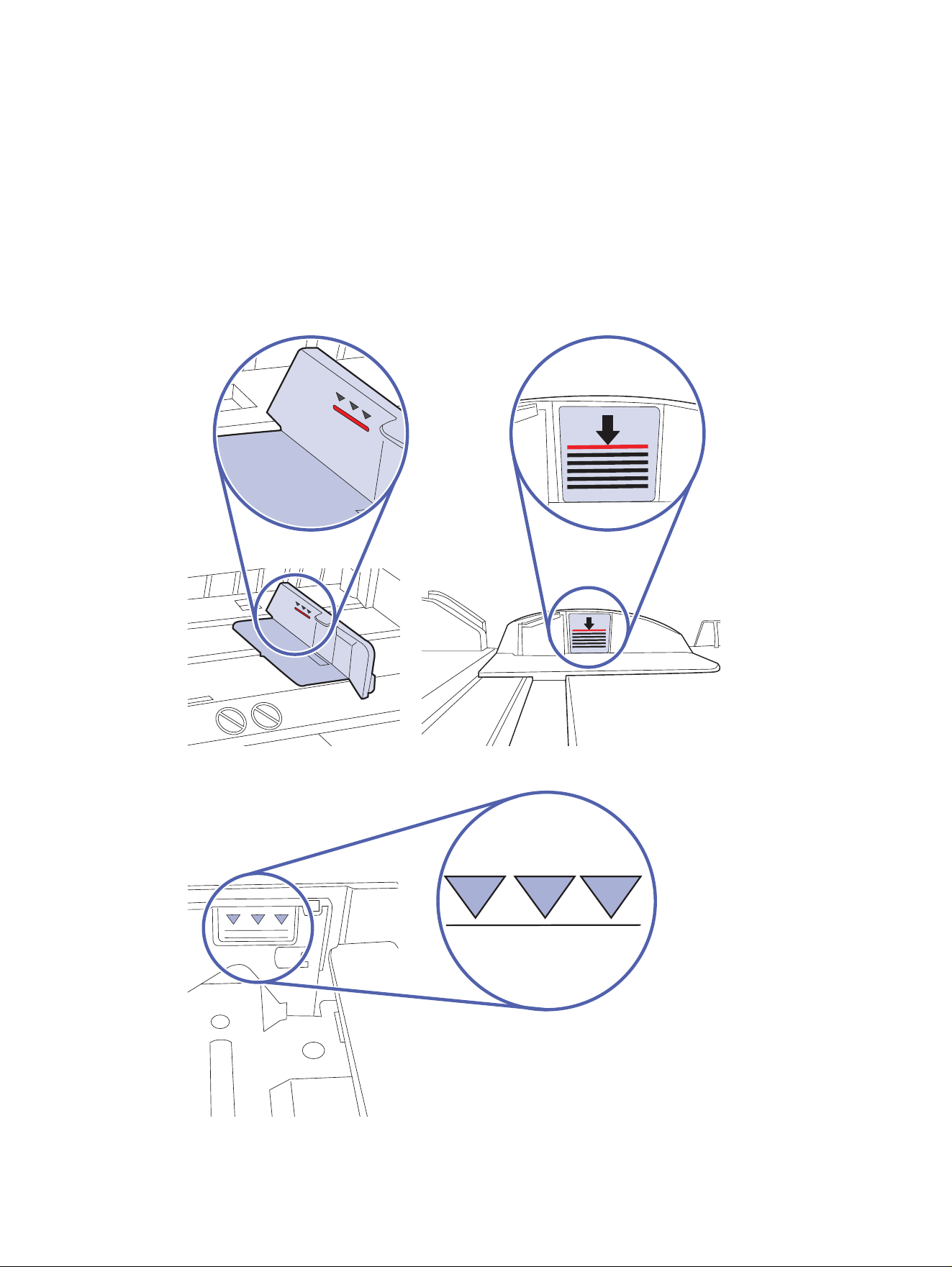
4. Use paper that is not wrinkled, folded, or damaged. If necessary, use paper from a different
package.
5. Make sure the tray is not overfilled by checking the stack-height markings inside the tray. If it is
overfilled, remove the entire stack of paper from the tray, straighten the stack, and then return some
of the paper to the tray.
The following examples show the stack-height markings in the trays for various printers. Most HP
printers have markings similar to these. Also make sure that all sheets of paper are below the tabs
near the stack-height marks. These tabs help hold the paper in the correct position as it enters the
printer.
Figure 9-6 Stack-height markings
Figure 9-7 Tab for the paper stack
The printer picks up multiple sheets of paper
153
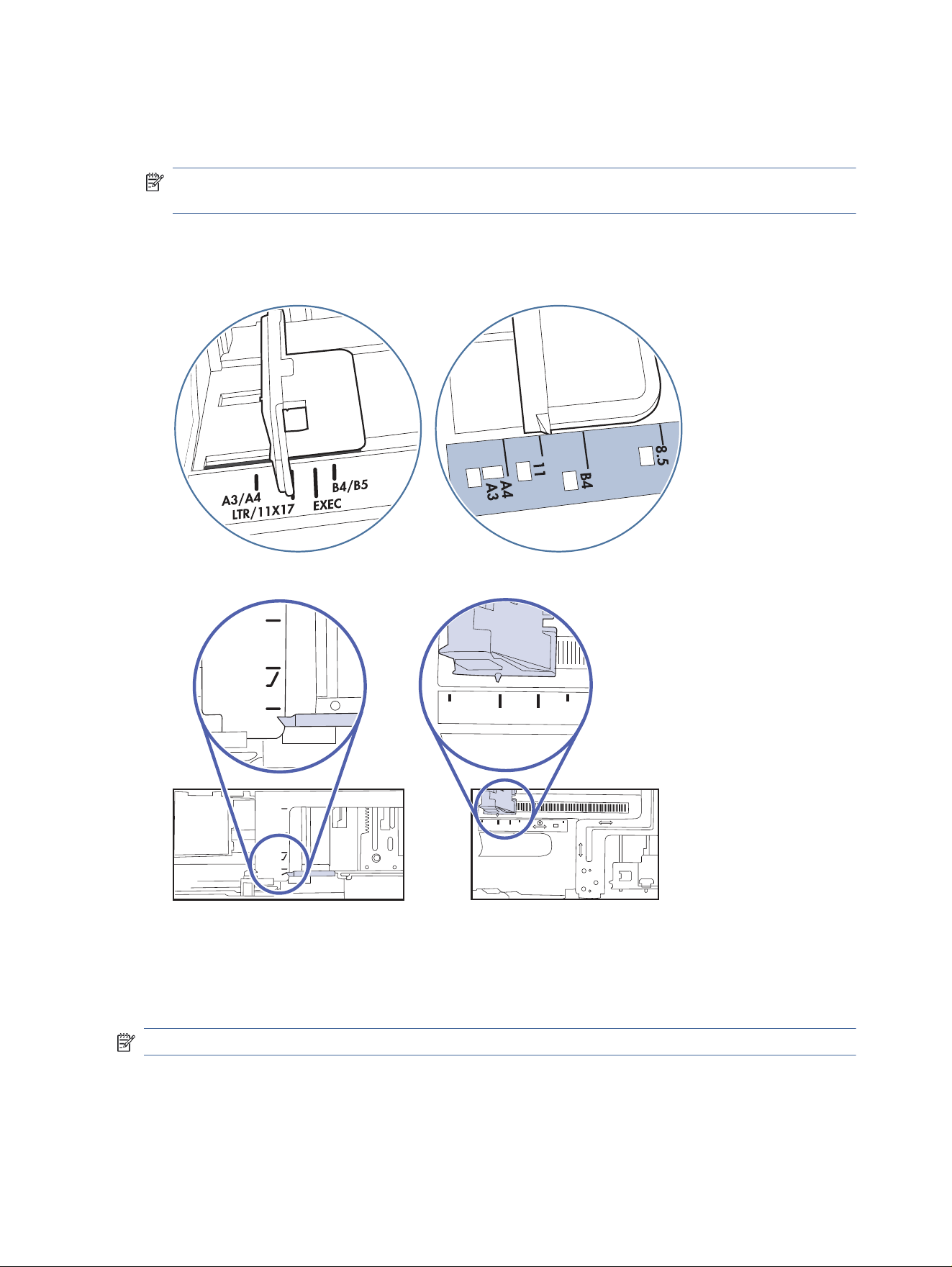
6. Make sure the paper guides in the tray are adjusted correctly for the size of paper. Adjust the guides
to the appropriate indentation in the tray. The arrow on the tray guide should line up exactly with the
marking on the tray.
NOTE: Do not adjust the paper guides tightly against the paper stack. Adjust them to the
indentations or markings in the tray.
The following images show examples of the paper-size indentations in the trays for various printers.
Most HP printers have markings similar to these.
Figure 9-8 Size markings for Tray 1 or the multipurpose tray
Figure 9-9 Size markings for cassette trays
A6
A5
A4
LTR/LGL
JIS B5
EXEC
A5
EXEC
A4
LTR/LGL
JIS B5
A4 B5
A5
11
10.5
A4
11 10.5
B5
7. Make sure the printing environment is within recommended specifications.
The document feeder jams, skews, or picks up multiple sheets of paper
If the document feeder jams, skews, or picks up multiple sheets of paper, try these solutions.
NOTE: This information applies to MFP printers only.
● The original might have something on it, such as staples or self-adhesive notes, that must be
removed.
154
Chapter 9 Solve problems
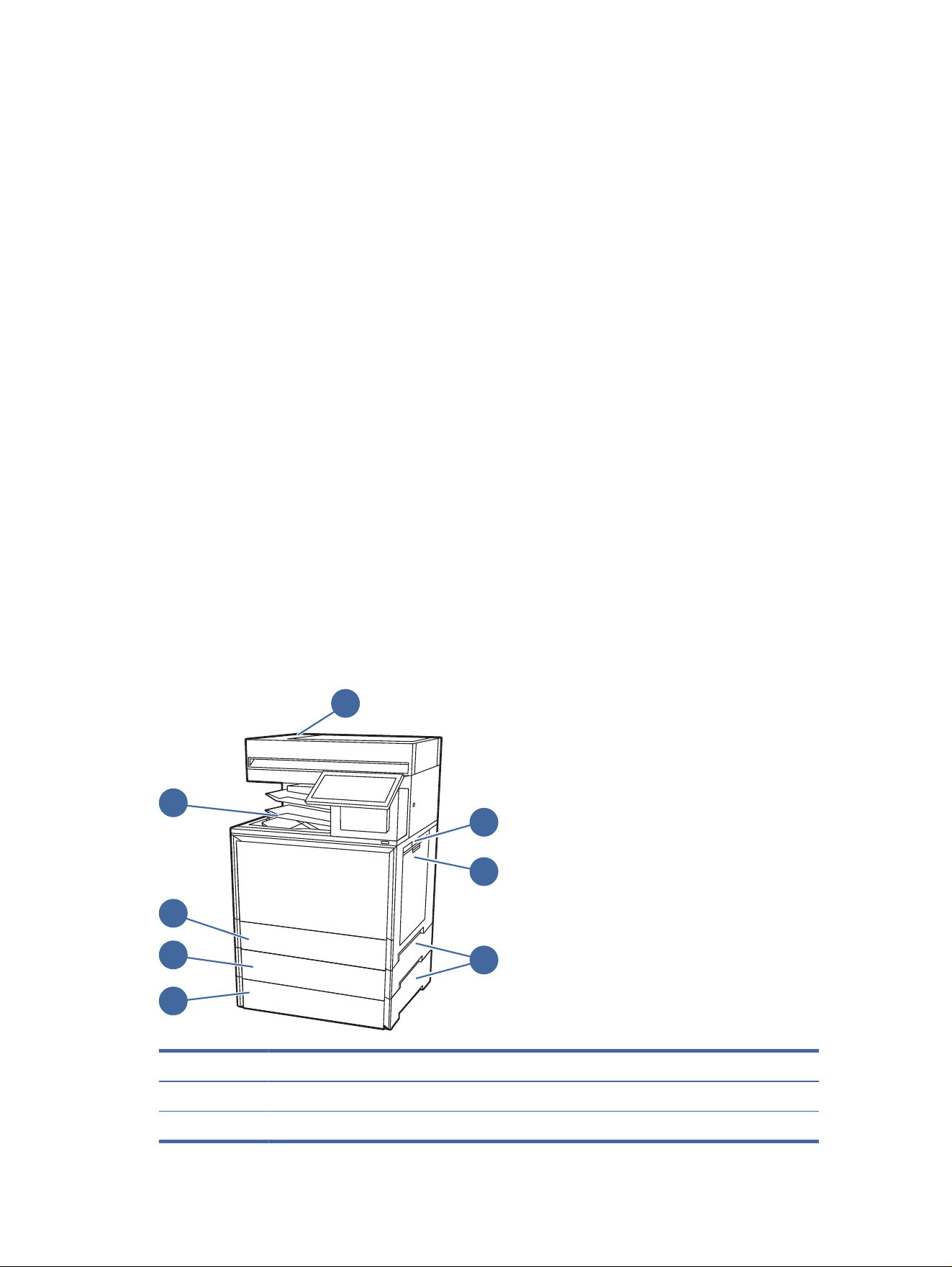
● Check that all rollers are in place and that the roller-access cover inside the document feeder is
closed.
● Make sure that the top document-feeder cover is closed.
● The pages might not be placed correctly. Straighten the pages and adjust the paper guides to
center the stack.
● The paper guides must be touching the sides of the paper stack to work correctly. Make sure that
the paper stack is straight and the guides are against the paper stack.
● The document feeder input tray or output bin might contain more than the maximum number of
pages. Make sure the paper stack fits below the guides in the input tray, and remove pages from the
output bin.
● Verify that there are no pieces of paper, staples, paper clips, or other debris in the paper path.
● Clean the document-feeder rollers and the separation pad. Use compressed air or a clean, lint-free
cloth moistened with warm water. If misfeeds still occur, replace the rollers.
● From the Home screen on the printer control panel, scroll to and touch the Supplies button. Check
the status of the document-feeder kit, and replace it if necessary.
Clear paper jams
Use the procedures in this section to clear jammed paper from the printer paper path.
Paper jam locations
Jams can occur in these locations.
Figure 9-10 Jam locations - dn, zf, and zfsw models
1
2
3
7
8
6
5
4
Item
Description
1 Document feeder
2 Right door and fuser area
Clear paper jams 155
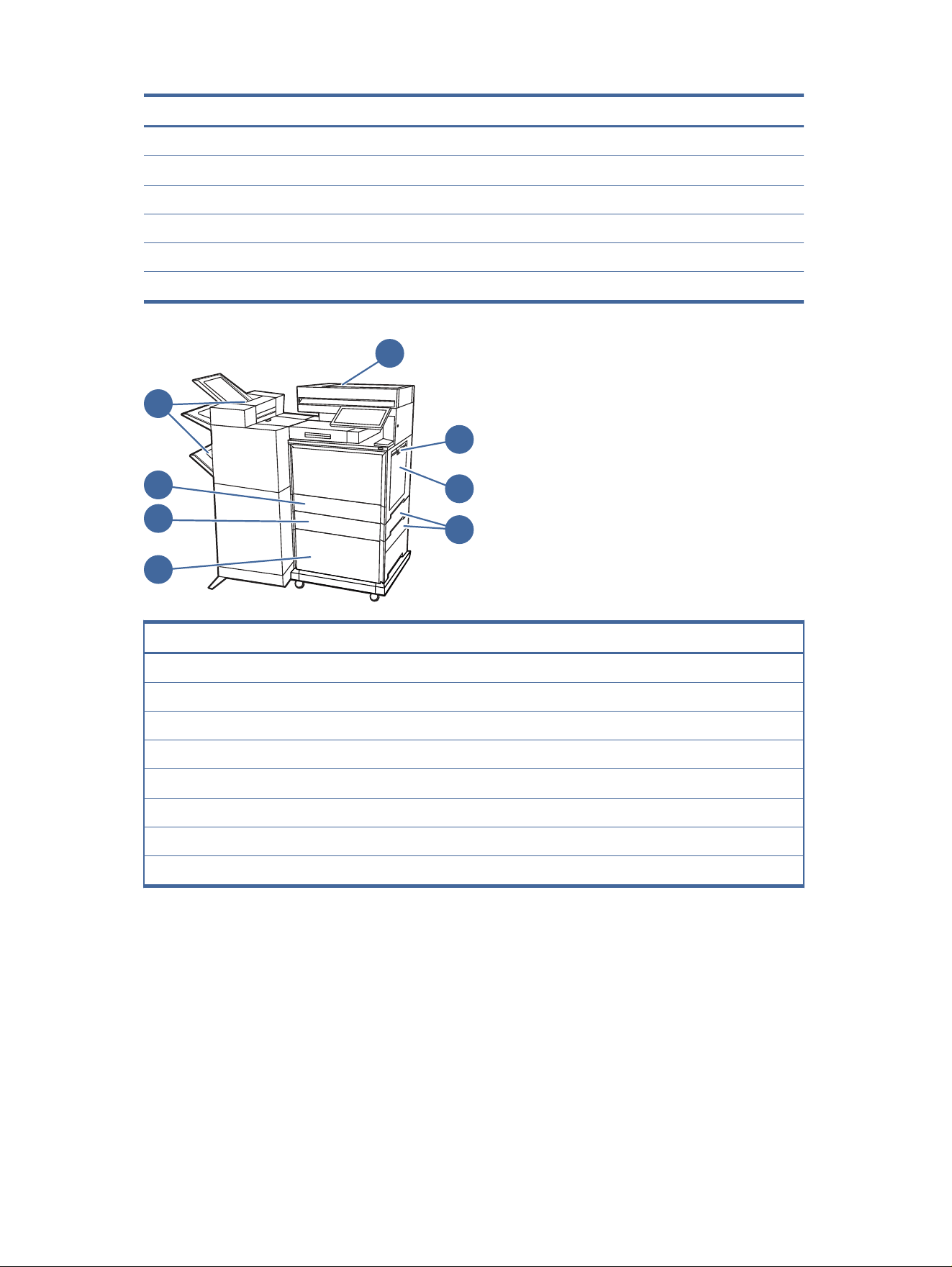
Item Description
3 Tray 1 (multipurpose tray)
4 Tray jam access doors
5 Optional Tray 4
6 Optional Tray 3
7 Tray 2
8 Output bin or finisher output trays
Figure 9-11 Jam locations - zfw+ model
1
2
3
7
8
6
5
4
Item Description
1 Document feeder
2 Right door and fuser area
3 Tray 1 (multipurpose tray)
4 Tray jam access doors
5 Tray 4 (high-capacity input tray)
6 Tray 3
7 Tray 2
8 Output bins (floor-standing finisher)
Auto-navigation for clearing paper jams
Learn about printer jam clearing auto-navigation.
The auto-navigation feature assists in clearing jams by providing step-by-step instructions on the control
panel.
When you complete a step, the printer displays instructions for the next step until you have completed all
steps in the procedure.
Experiencing frequent or recurring paper jams?
To reduce the number of paper jams, try these solutions.
156
Chapter 9 Solve problems

View a video that demonstrates how to load paper in a way that reduces the number of paper
jams
1. Use only paper that meets HP specifications for this printer.
2. Use paper that is not wrinkled, folded, or damaged. If necessary, use paper from a different
package.
3. Use paper that has not previously been printed or copied on.
4. Make sure the tray is not overfilled. If it is, remove the entire stack of paper from the tray, straighten
the stack, and then return some of the paper to the tray.
5. Make sure the paper guides in the tray are adjusted correctly for the size of paper. Adjust the guides
so they are touching the paper stack without bending it.
6. Make sure that the tray is fully inserted in the printer.
7. If you are printing on heavy, embossed, or perforated paper, use the manual feed feature and feed
sheets one at a time.
8. Open the Trays menu on the printer control panel. Verify that the tray is configured correctly for the
paper type and size.
9. Make sure the printing environment is within recommended specifications.
31.13.yz jam error in the document feeder
The following information describes how to clear paper jams in the document feeder. When a jam
occurs, the control panel displays an animation that assists in clearing the jam.
In addition to the instructions provided below
NOTE: The printer model referenced in this video might be different from your printer model, but the
steps to clear the jam are the same.
Recommended action for customers
When a jam occurs, the control panel displays a message and an animation that assists in clearing the
jam.
● 31.13.01 Jam in document feeder
● 31.13.02 Jam in document feeder
● 31.13.13 Jam in document feeder
View a video of how to clear a jam in the document feeder
31.13.yz jam error in the document feeder
157
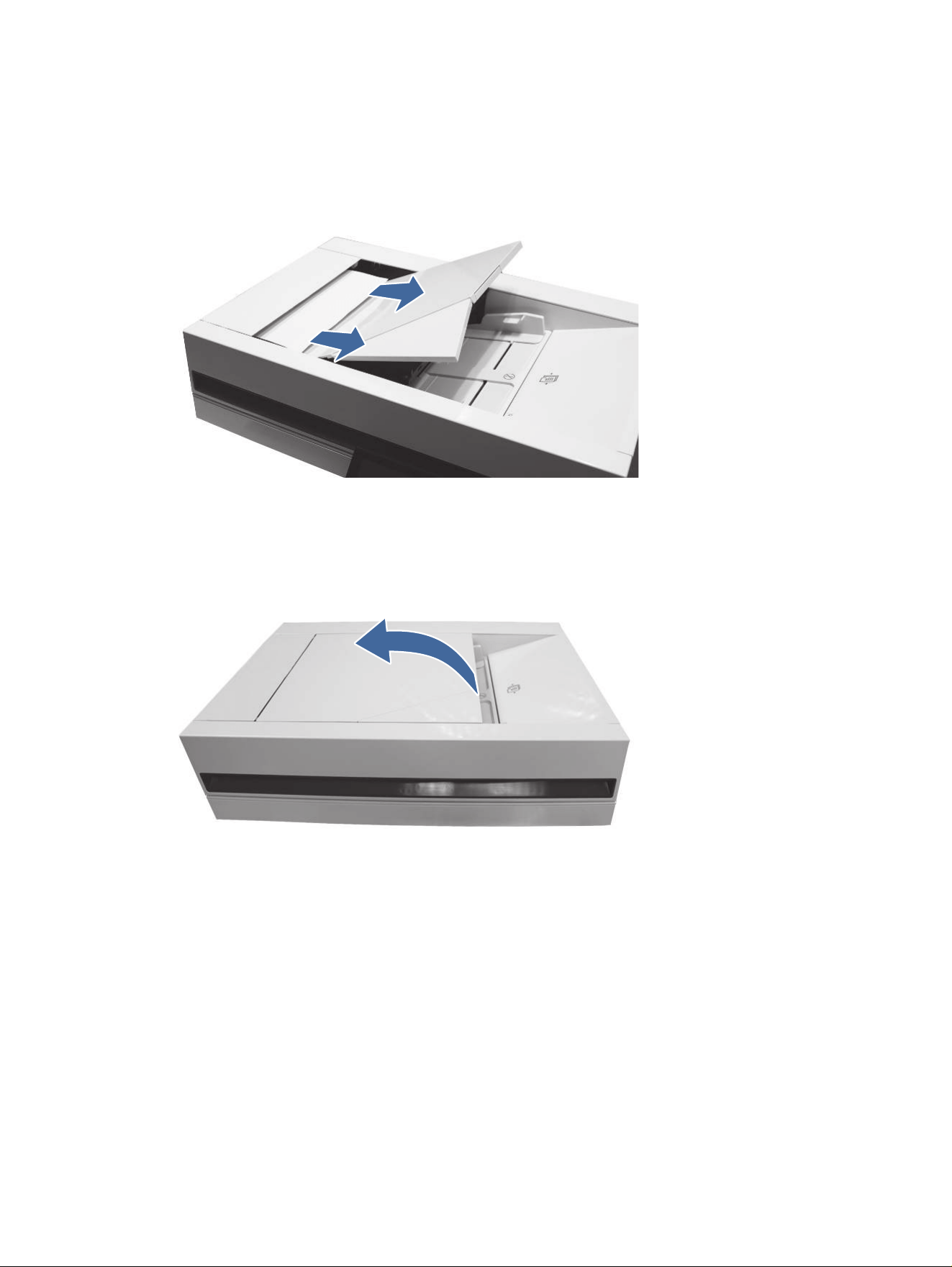
1. Remove paper from the exit assembly of the document feeder.
2. Open the document-feeder cover.
158
Chapter 9 Solve problems
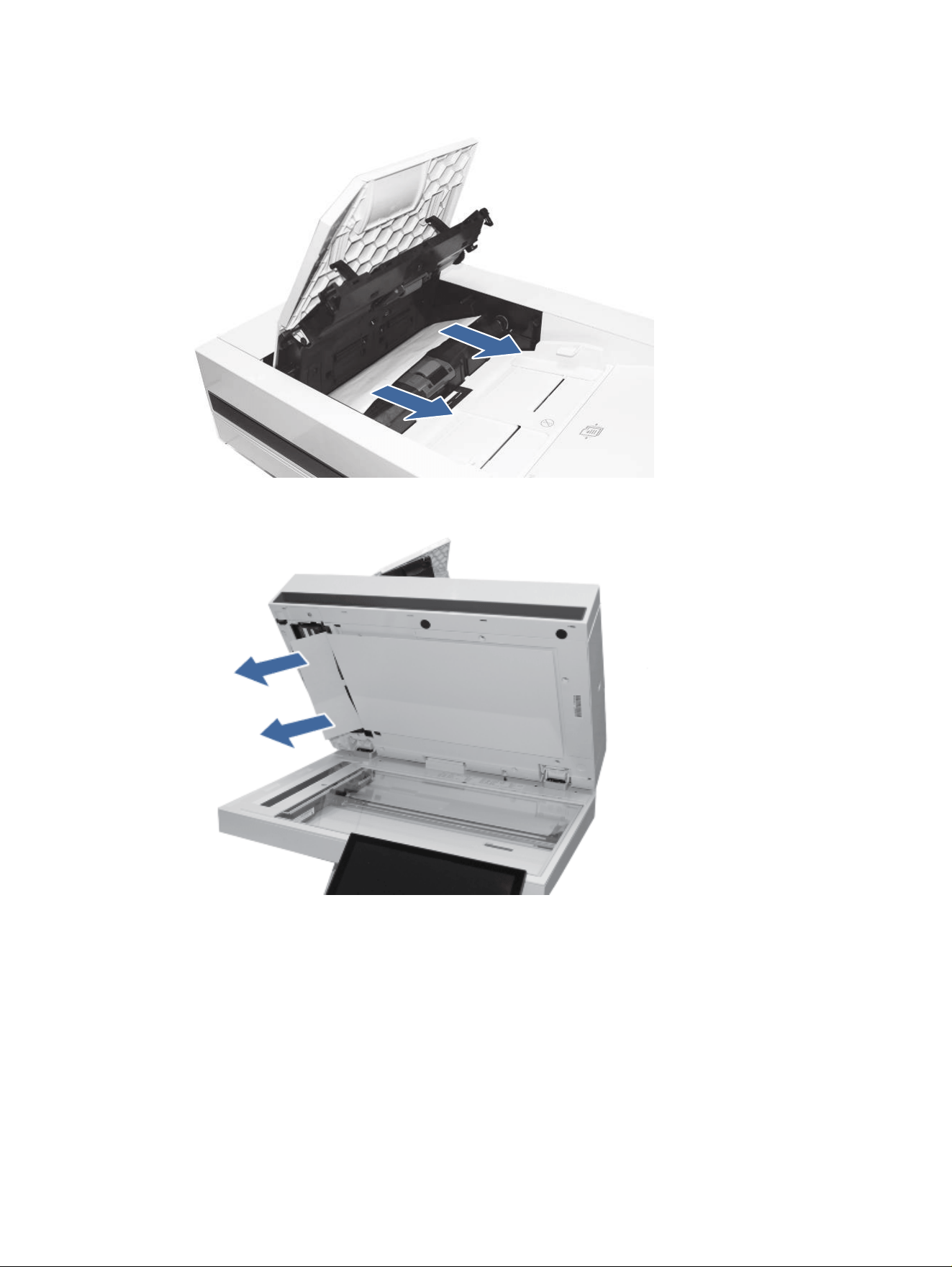
3. Remove any jammed paper from the document feeder input area.
4. Lift the document feeder and check the lower side of the feed path.
31.13.yz jam error in the document feeder
159
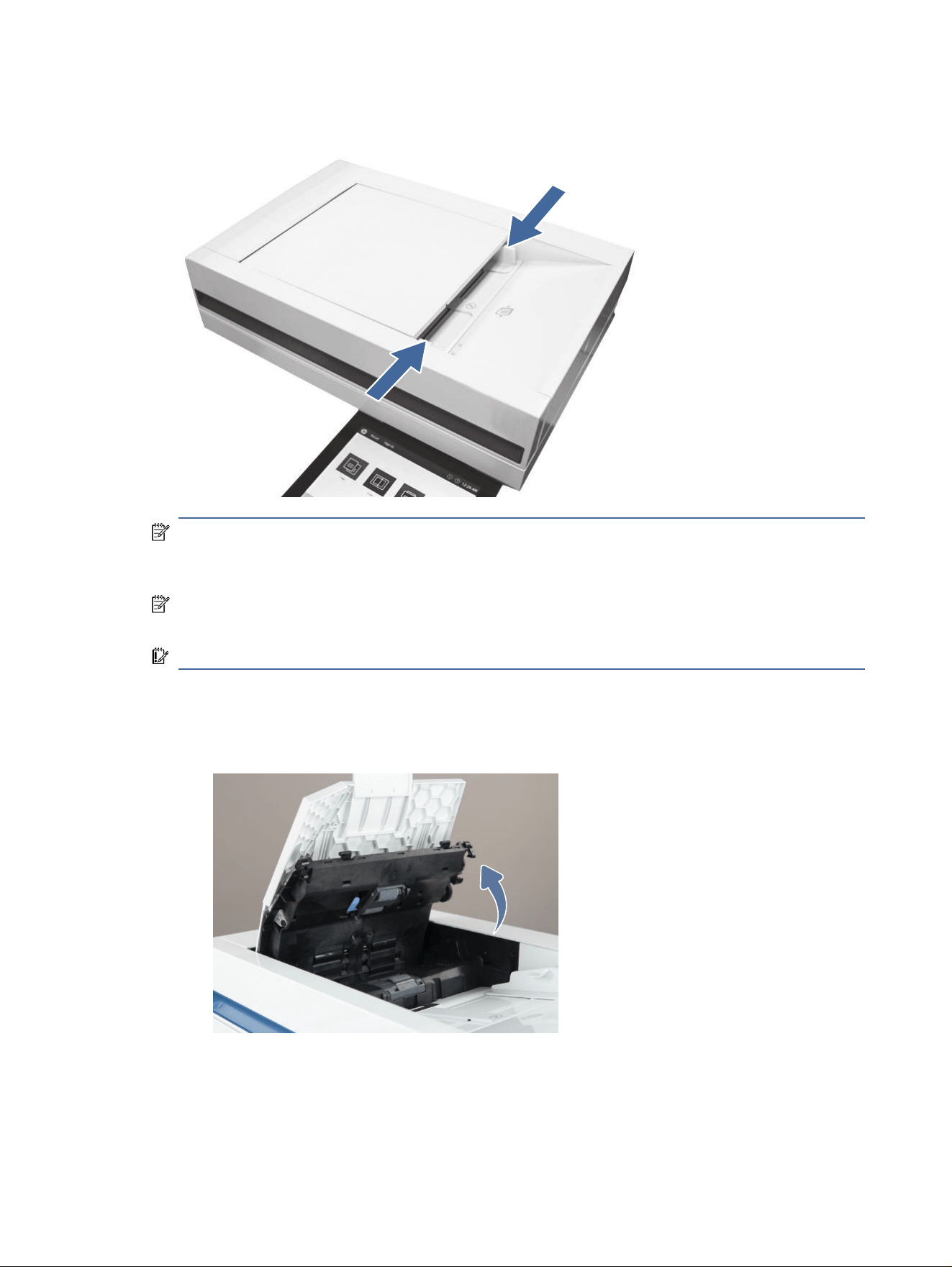
5. Make sure the guides in the document-feeder input tray are adjusted to the correct size for the
document before loading paper.
NOTE: To avoid document feeder jams, to copy narrow documents, use the flatbed scanner.
Remove all staples and paper clips from original documents. Do not feed damaged or wrinkled
paper.
NOTE: Original documents that are printed on heavy, glossy paper can jam more frequently than
originals that are printed on plain paper.
IMPORTANT: Warning: Do not run labels through the automatic document feeder (ADF).
6. If the paper continues to jam, remove and clean the document feeder rollers.
a. Open the document-feeder jam access door.
Figure 9-12 Open the document-feeder jam access door
160
Chapter 9 Solve problems
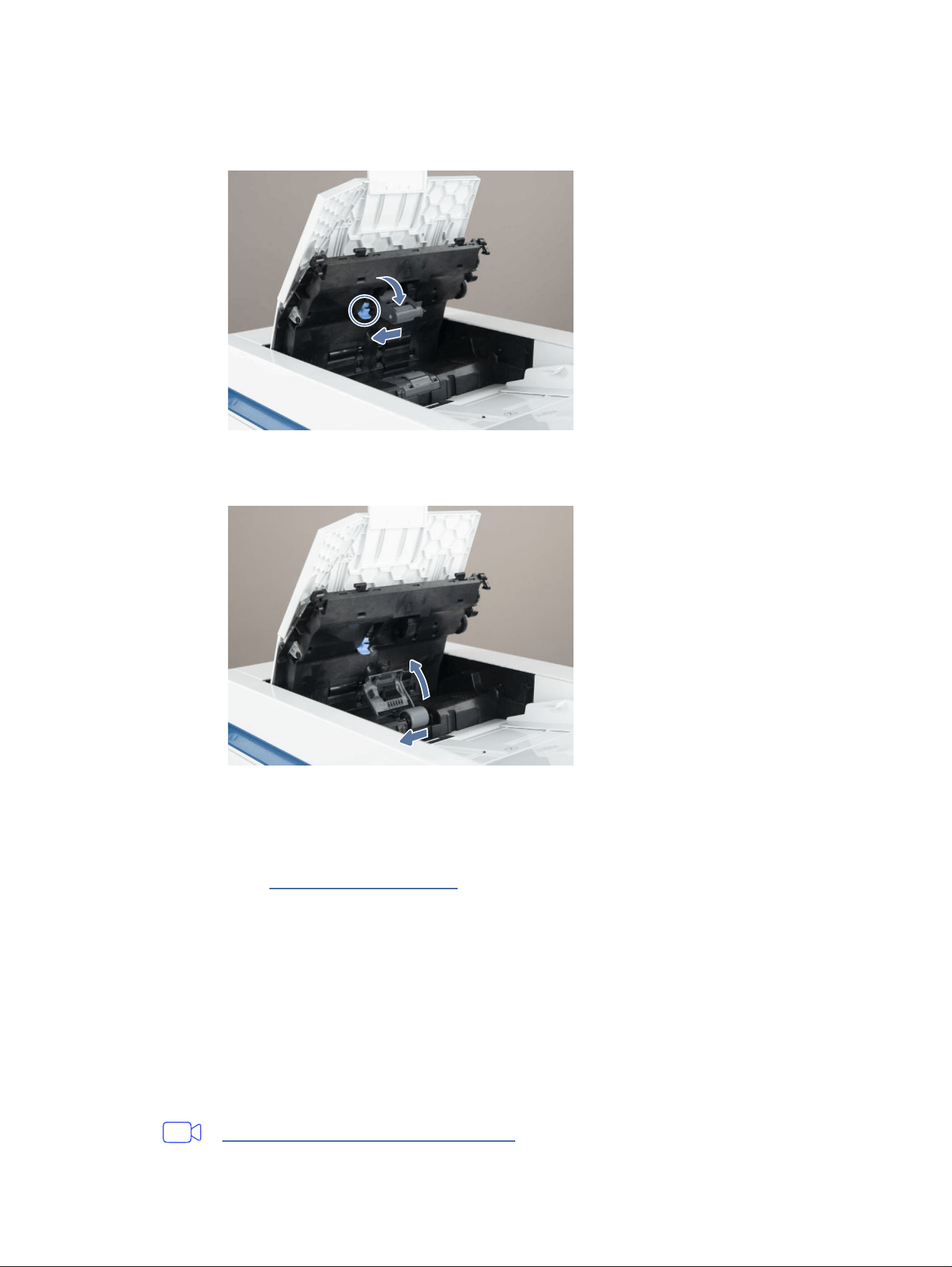
b. Release the blue locking arm to drop the assembly down. Slide the pickup and feed roller
assembly to the left, and then pull it away from the document feeder to remove it.
Figure 9-13 Release the blue locking arm
c. Lift the roller cover up and then slide the roller toward the front of the printer to remove it.
Figure 9-14 Release the separation roller cover
d. Clean the rollers with a dampened lint free cloth.
e. Reinstall the rollers in the document feeder and perform a copy job to test.
7. If the error persists, contact your HP-authorized service or support provider, or contact customer
support at www.hp.com/go/contactHP.
13.B2.D1 jam error in Tray 1 (multipurpose tray)
Use the following procedure to clear paper jams in Tray 1 (multipurpose tray). When a jam occurs, the
control panel displays an animation that assists in clearing the jam.
Recommended action for customers
When a jam occurs, the control panel displays a message and an animation that assists in clearing the
jam.
● 13.B2.D1 Jam in tray 1
View a video of how to clear a jam in Tray 1
13.B2.D1 jam error in Tray 1 (multipurpose tray)
161
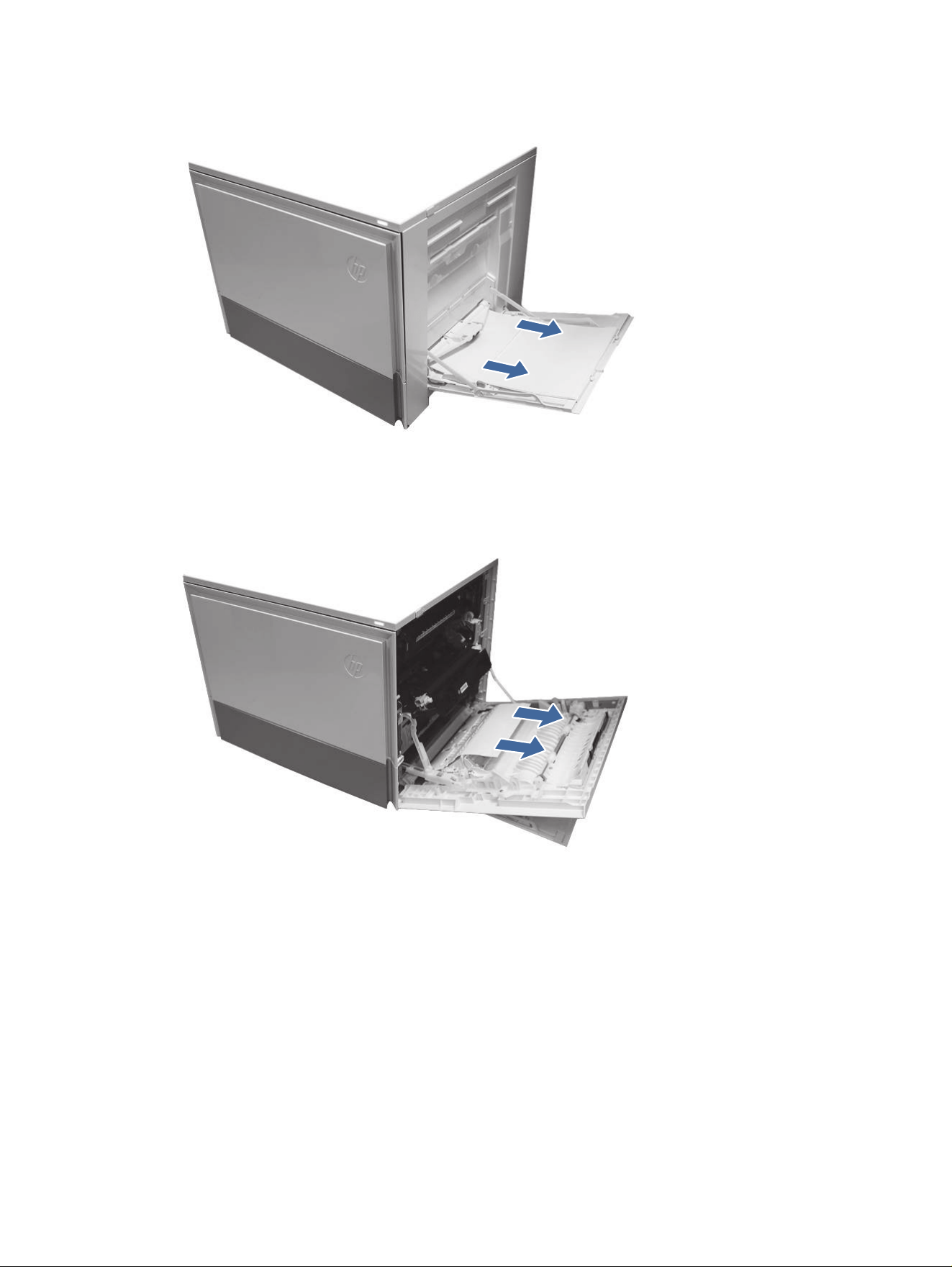
1. If you can see the jammed sheet in Tray 1, remove the jammed sheet by gently pulling it straight out.
2. Open the right door and remove paper from the area shown.
3. Close the right to allow the printer to clear the message.
4. Make sure the type and quality of the paper being used meets the HP specifications for the printer.
162
Chapter 9 Solve problems
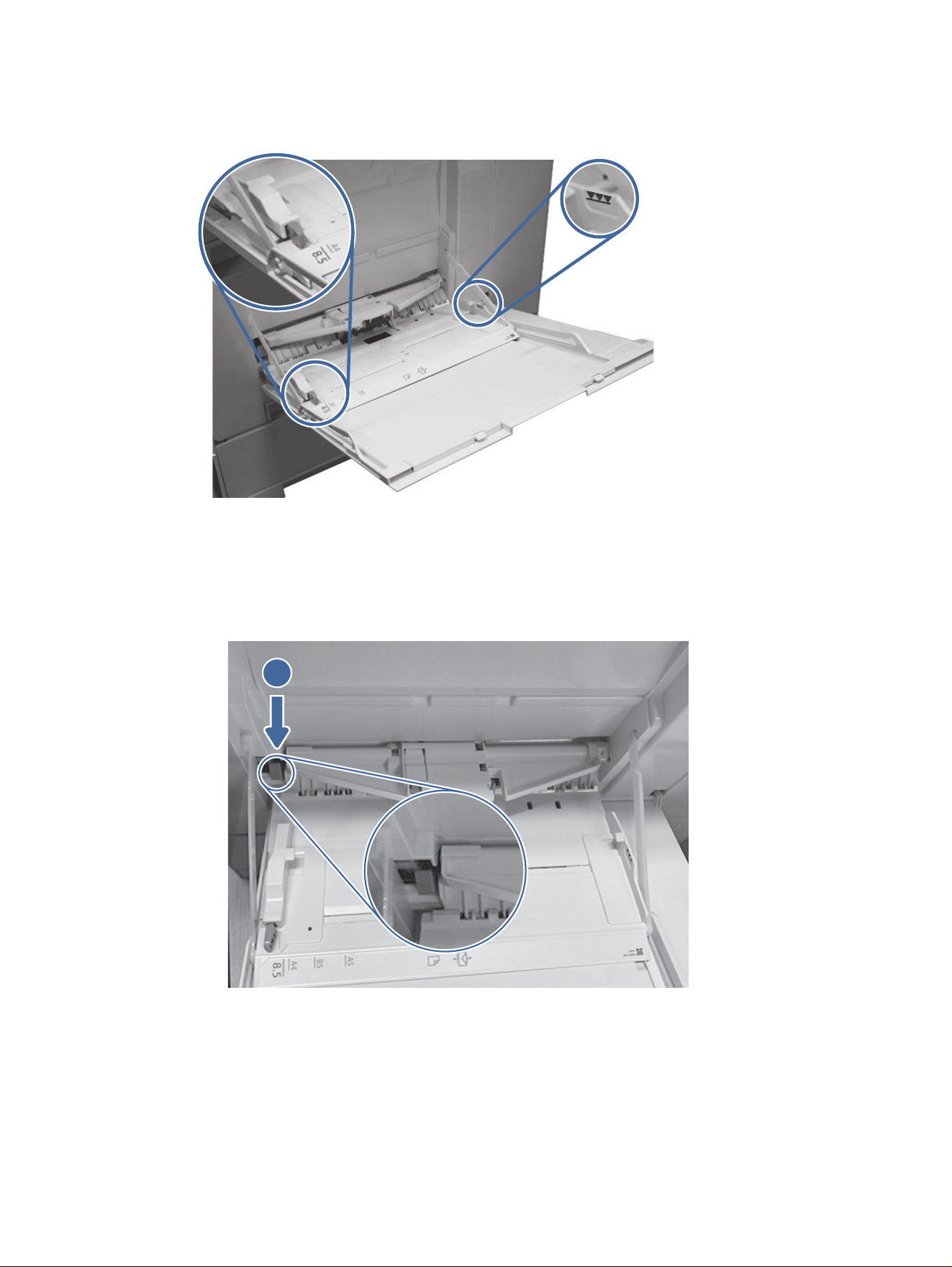
5. Make sure the Tray 1 guides are set to the correct paper size and that the paper tray is not overfilled
(paper is below the 3 triangles on the right guide).
6. Load the paper back into the tray and restart the print job.
7. If the same jam appears remove and clean the tray 1 pick, feed and separation rollers.
a. Locate and release the pickup roller assembly release tab.
Figure 9-15 Locate the pickup roller assembly tab
1
13.B2.D1 jam error in Tray 1 (multipurpose tray)
163
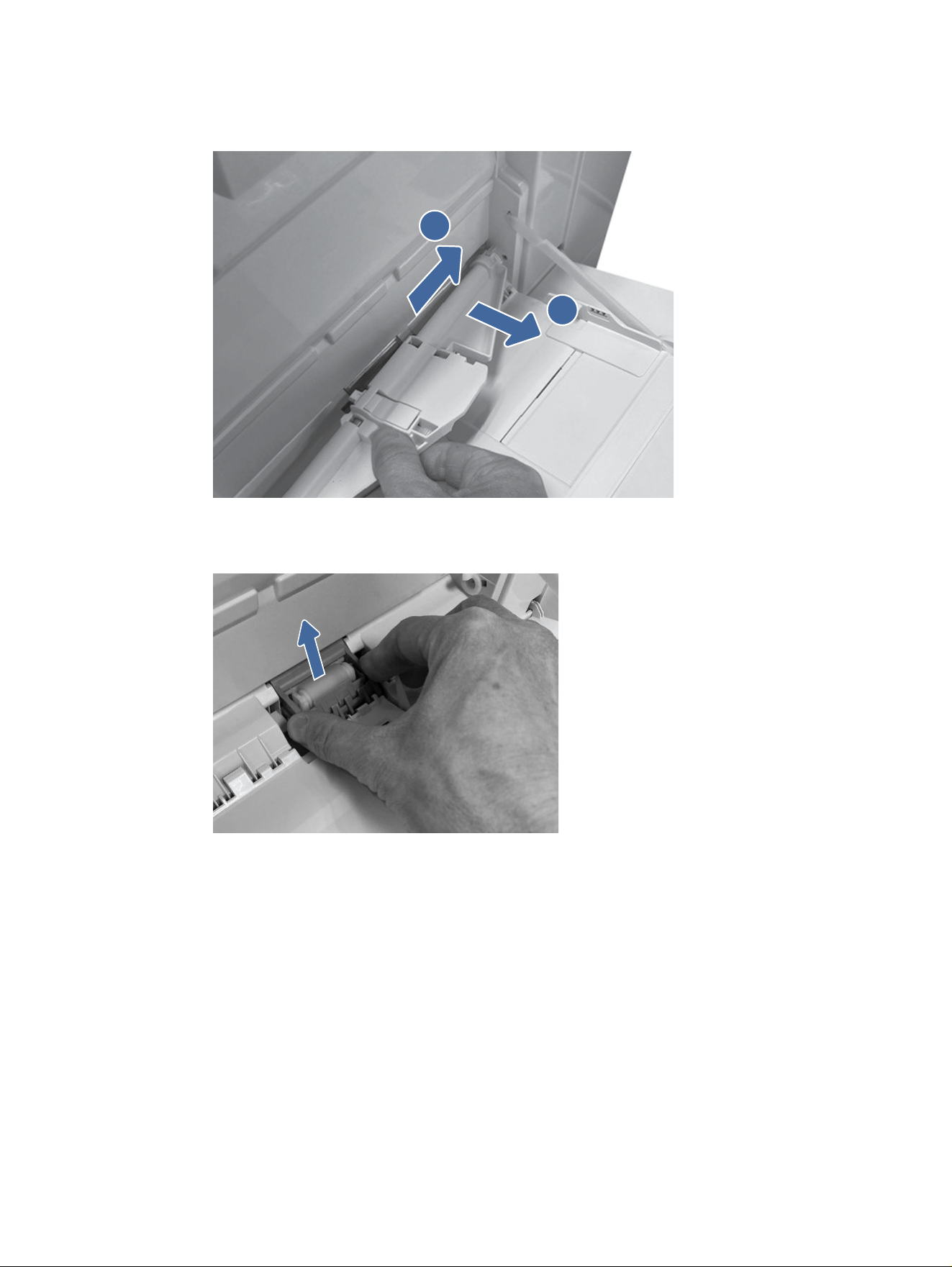
b. Push the pickup roller assembly to the right and then away from the printer.
Figure 9-16 Remove the pickup roller assembly
2
1
c. Grasp the left- and right-side of the separation roller assembly, and then lift the assembly up.
Figure 9-17 Lift the separation roller assembly
164
Chapter 9 Solve problems
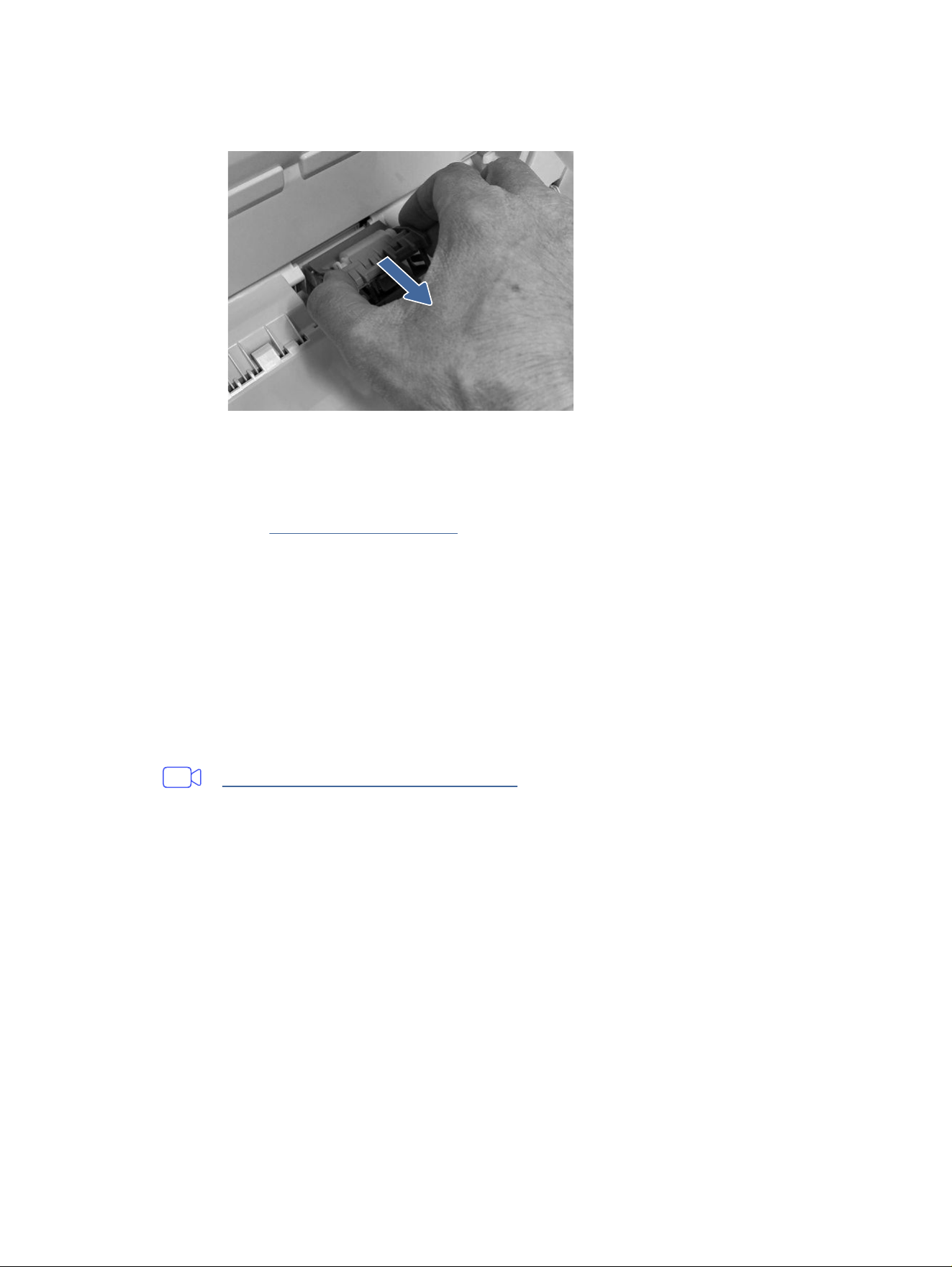
d. Pull the separation roller assembly straight out to remove it.
Figure 9-18 Remove the separation roller assembly
e. Clean the roller with a dampened lint free cloth.
f. Install the rollers back into tray one and test the tray by printing from tray 1.
8. If the error persists, contact your HP-authorized service or support provider, or contact customer
support at www.hp.com/go/contactHP.
13.B2.D2 jam error in Tray 2
Use the following procedure to check for paper in all possible jam locations related to Tray 2. When a jam
occurs, the control panel displays an animation that assists in clearing the jam.
Recommended action for customers
When a jam occurs, the control panel displays a message and an animation that assists in clearing the
jam.
● 13.B2.D2 Paper jam in tray 2
View a video of how to clear a jam in Tray 2
13.B2.D2 jam error in Tray 2
165
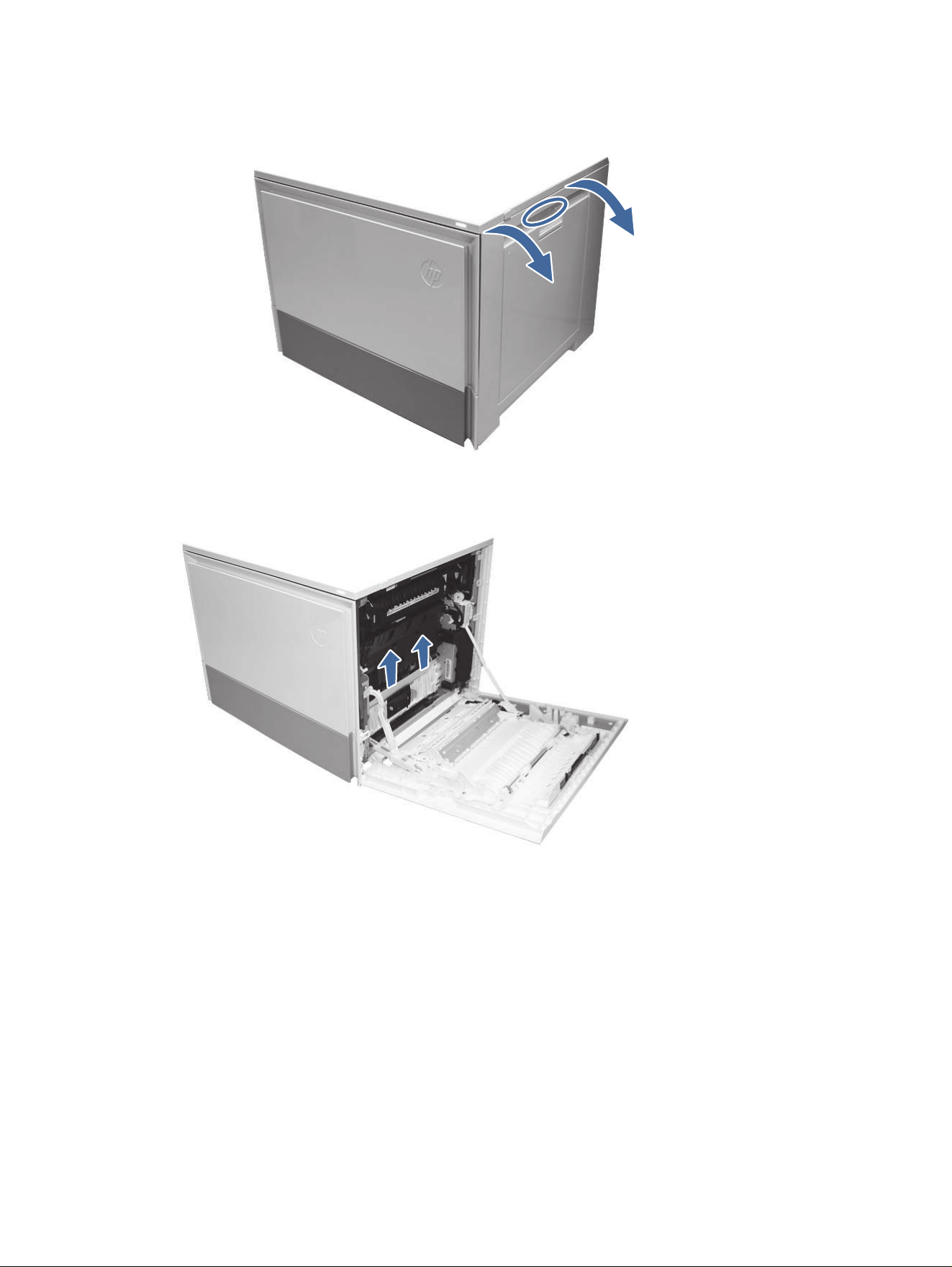
1. Open the right door.
2. Gently remove any jammed paper.
3. Close the right door to clear the control panel message.
166
Chapter 9 Solve problems
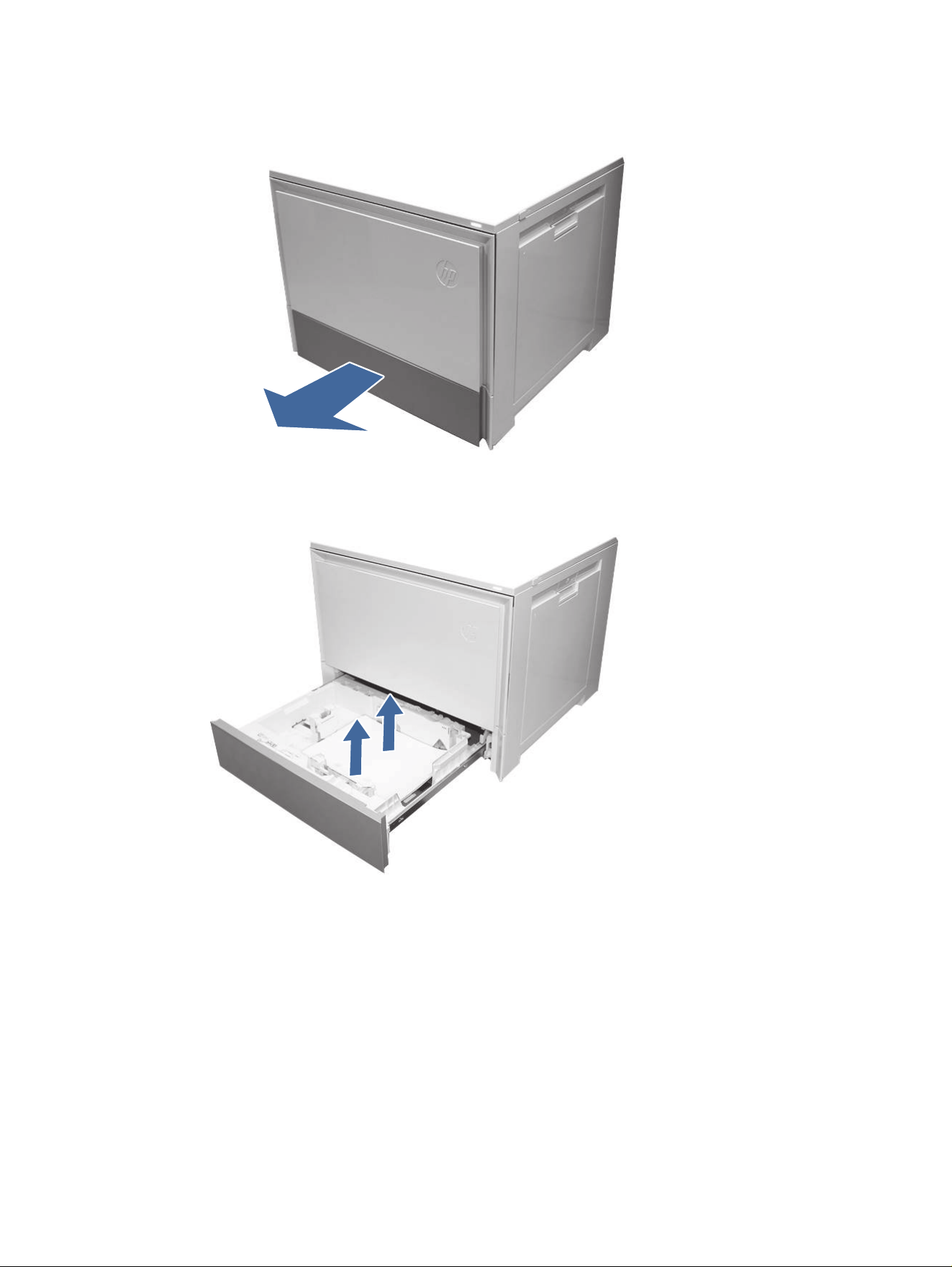
4. Open Tray 2.
5. Remove the paper from the tray and discard any bent, curled, or damaged sheets.
13.B2.D2 jam error in Tray 2
167
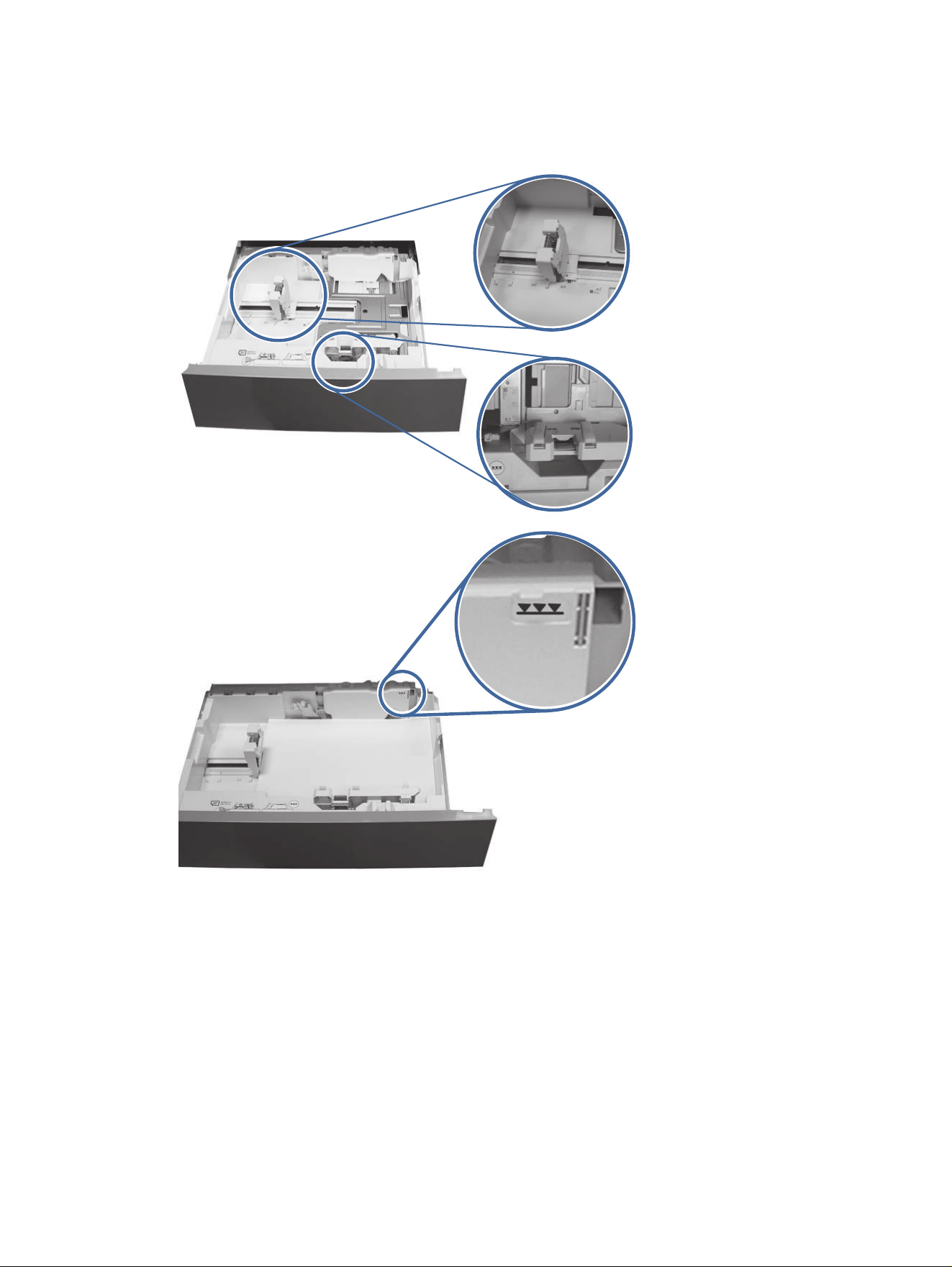
6. Make sure that the tray width and length guides are set to the correct paper size for the paper
being installed into the tray and that the tray is not over filled above the fill mark (line below 3
triangles on rear guide).
7. Ensure the type and quality of the paper being used meets the HP specifications for the printer.
8. If the error persists, clean the Tray 2 pick, feed, separation rollers.
168
Chapter 9 Solve problems
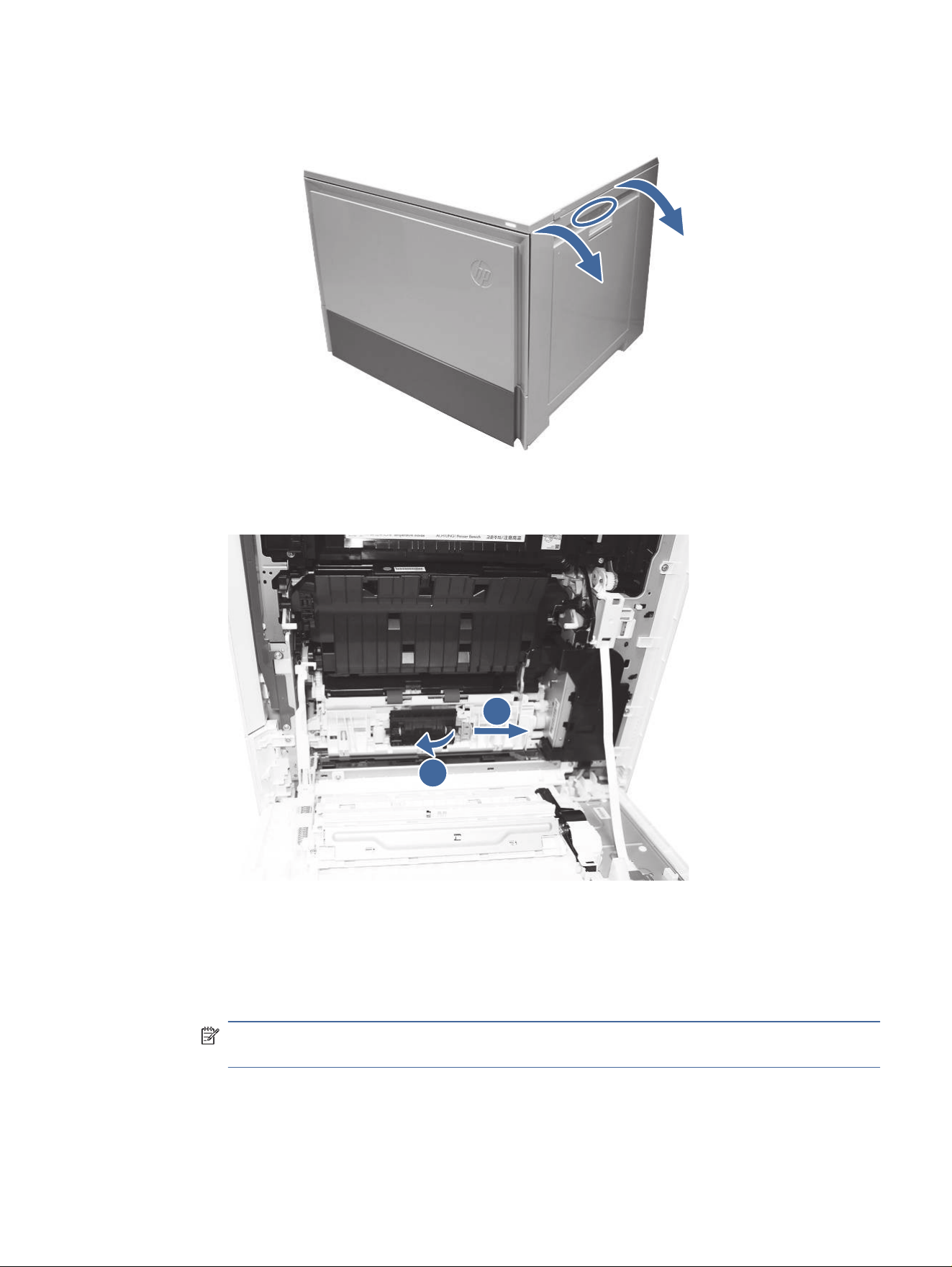
a. Open the right door to access the rollers.
b. Locate and remove the Tray 2 separation roller.
1
2
Call-out 1- slide blue locking lever
Call-out 2- Remove the roller assembly.
c. Remove the Tray 2 pick and feed rollers.
To remove the roller assembly, gently pull on the side of the assembly and slide out as shown.
NOTE: Make sure your hands are clean before touching the rollers. Oils or debris from hands
can cause paper pickup issues.
13.B2.D2 jam error in Tray 2
169
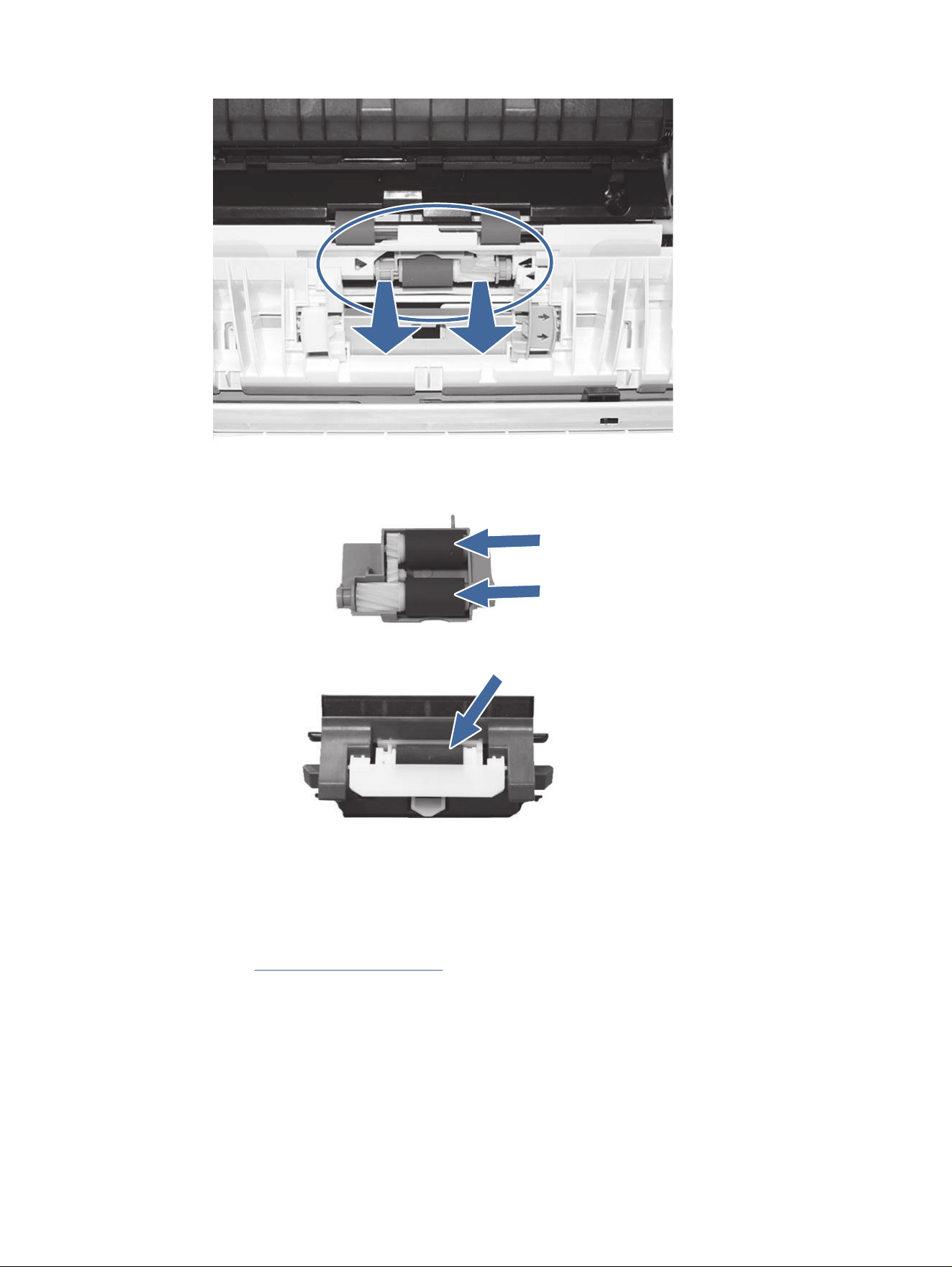
d. Clean the rollers with a dampened lint free cloth.
e. Reinstall the roller assemblies and close the right door.
f. Run a print job from Tray 2.
9. If the error persists, contact your HP-authorized service or support provider, or contact customer
support at www.hp.com/go/contactHP.
13.A3 jam error in Tray 3
Use the following procedure to check for paper in all possible jam locations related to Tray 3. When a jam
occurs, the control panel displays an animation that assists in clearing the jam.
Recommended action for customers
170
Chapter 9 Solve problems
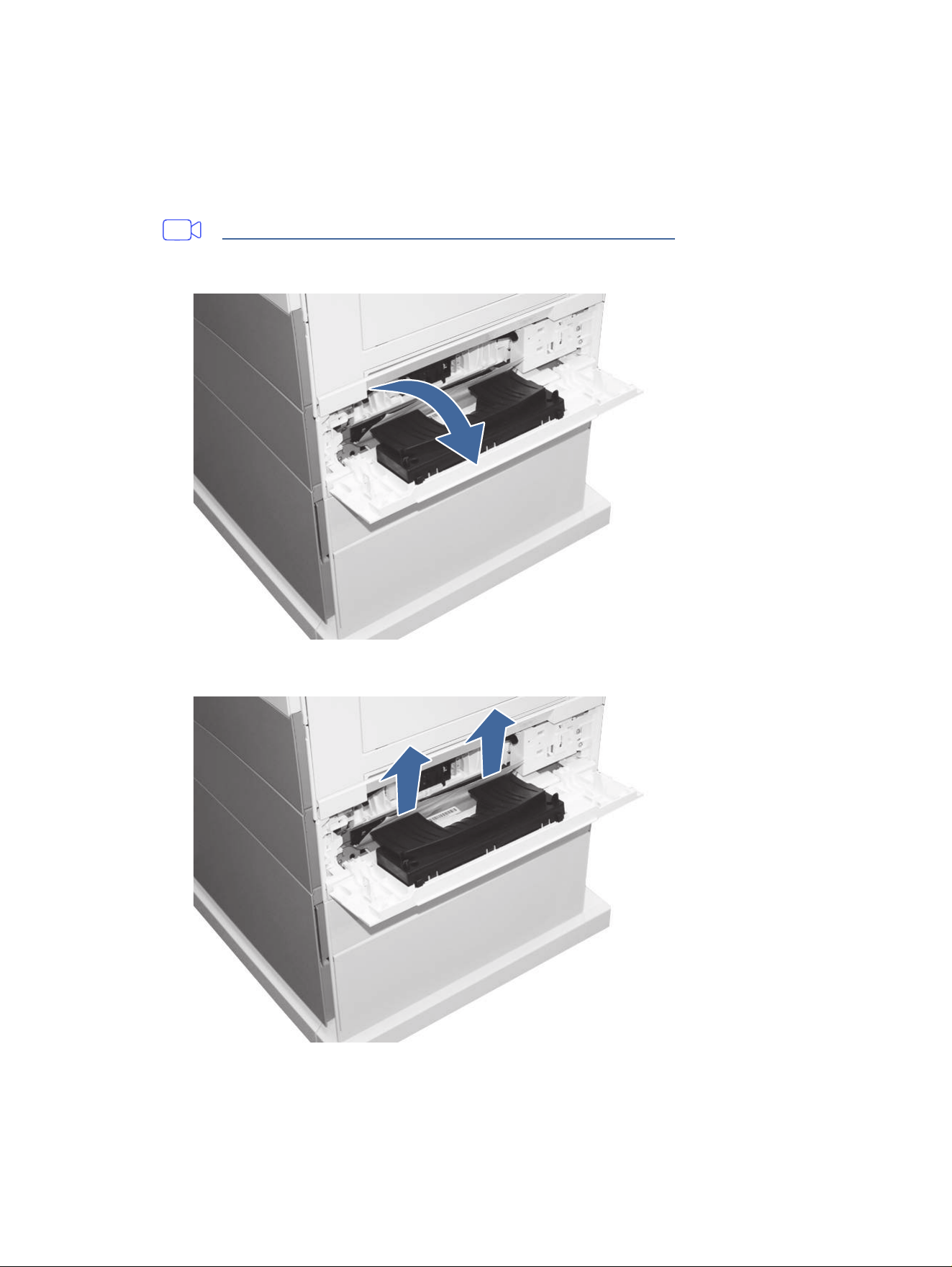
Use the following procedure to check for paper in all possible jam locations related to the 550-sheet
trays. When a jam occurs, the control panel displays an animation that assists in clearing the jam.
● 13.A3.A3 Jam in tray 3
● 13.A3.D3 Jam in tray 3
View a video of how to clear a jam in Tray 3, and the optional trays
1. Open the Tray 3 right side access door.
2. Remove any jammed paper found in access area.
13.A3 jam error in Tray 3
171
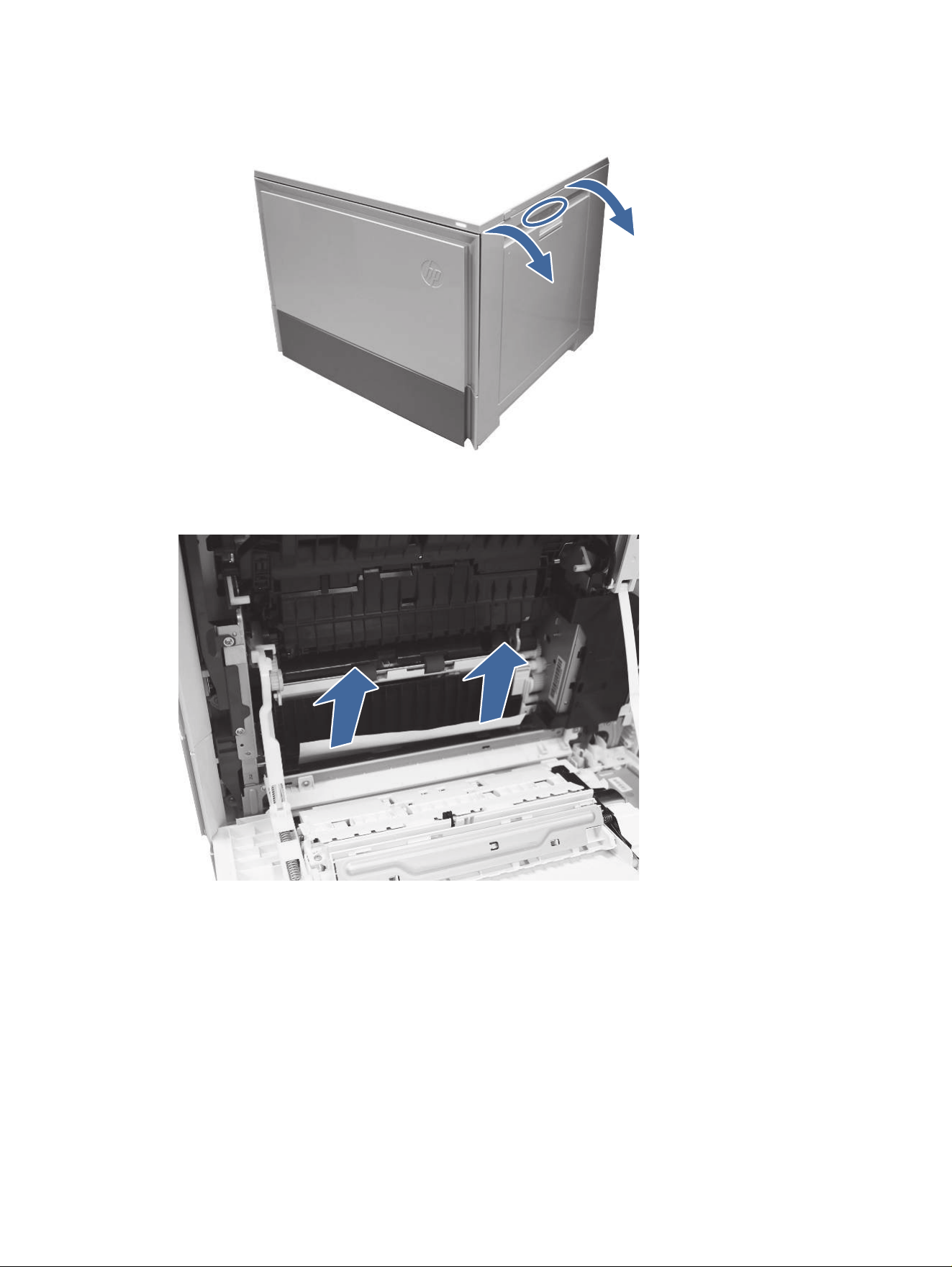
3. Open the right door.
4. Gently remove any jammed paper.
172
Chapter 9 Solve problems
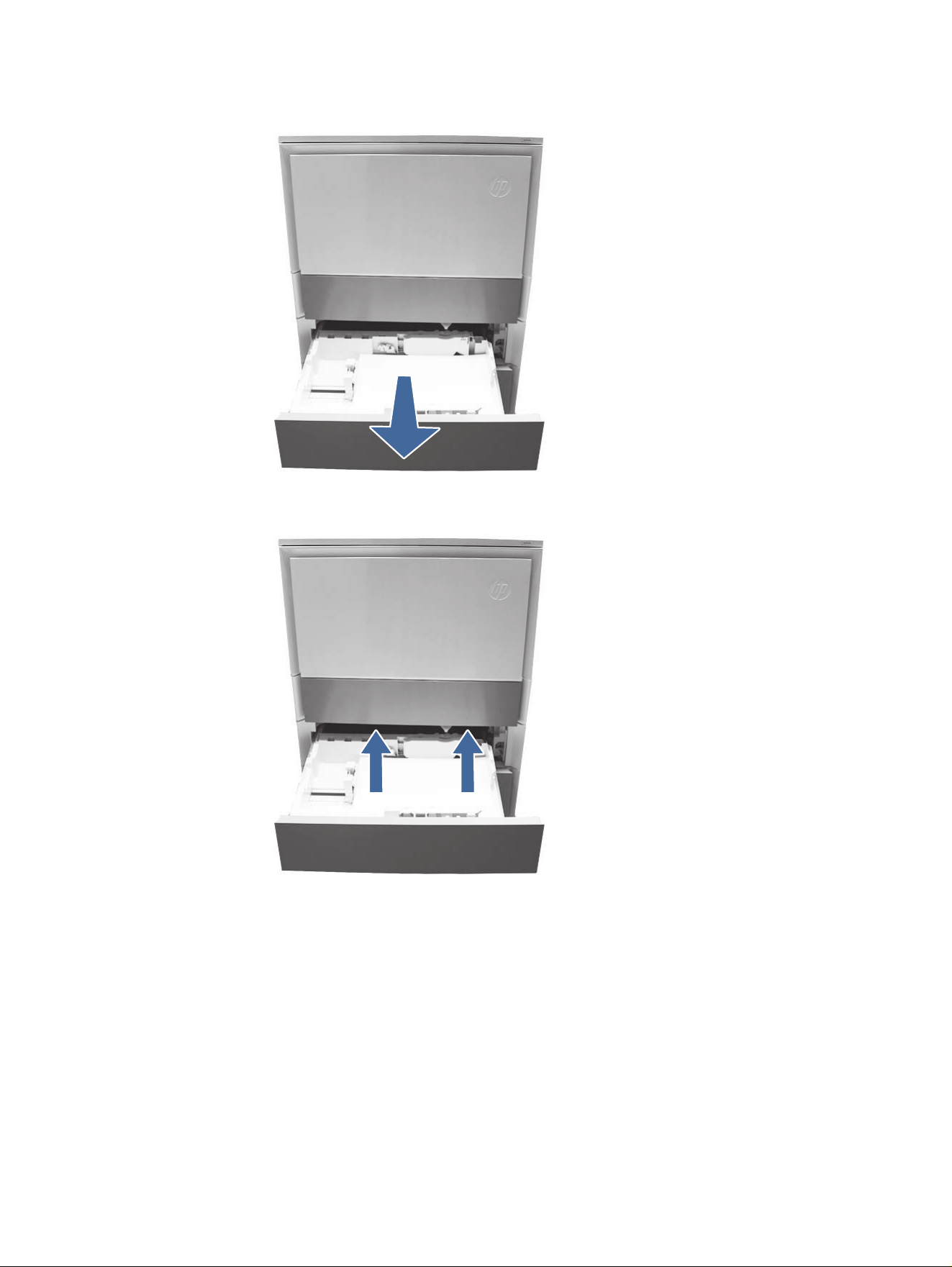
5. Open Tray 3.
6. Remove the paper from the tray and discard any bent, curled, or damaged sheets.
13.A3 jam error in Tray 3
173
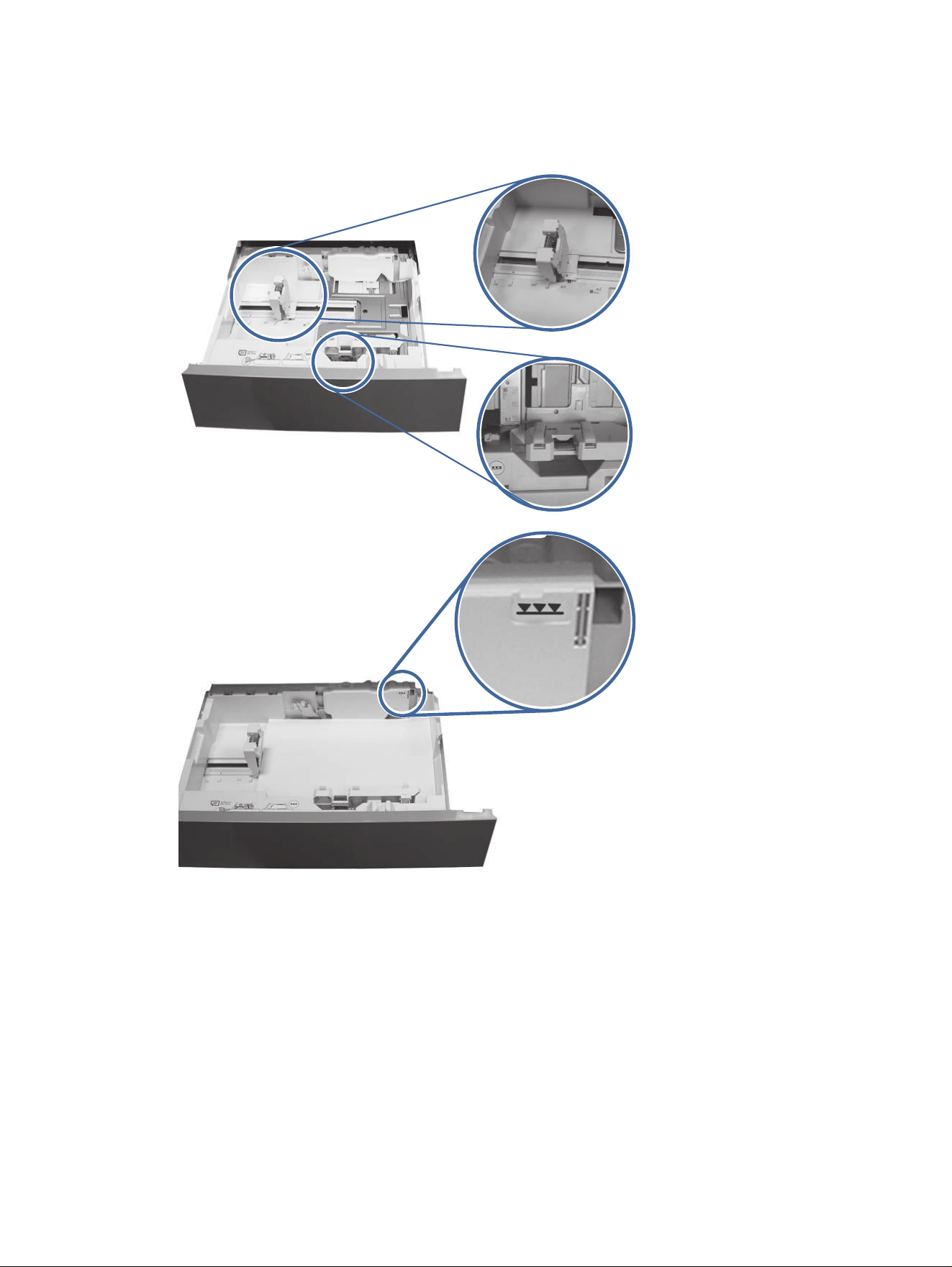
7. Make sure that the tray width and length guides are set to the correct paper size for the paper
being installed into the tray and that the tray is not over filled above the fill mark (line below 3
triangles on rear guide).
8. Ensure the type and quality of the paper being used meets the HP specifications for the printer.
9. If the error persists, clean the Tray 3 pick, feed, separation rollers.
174
Chapter 9 Solve problems
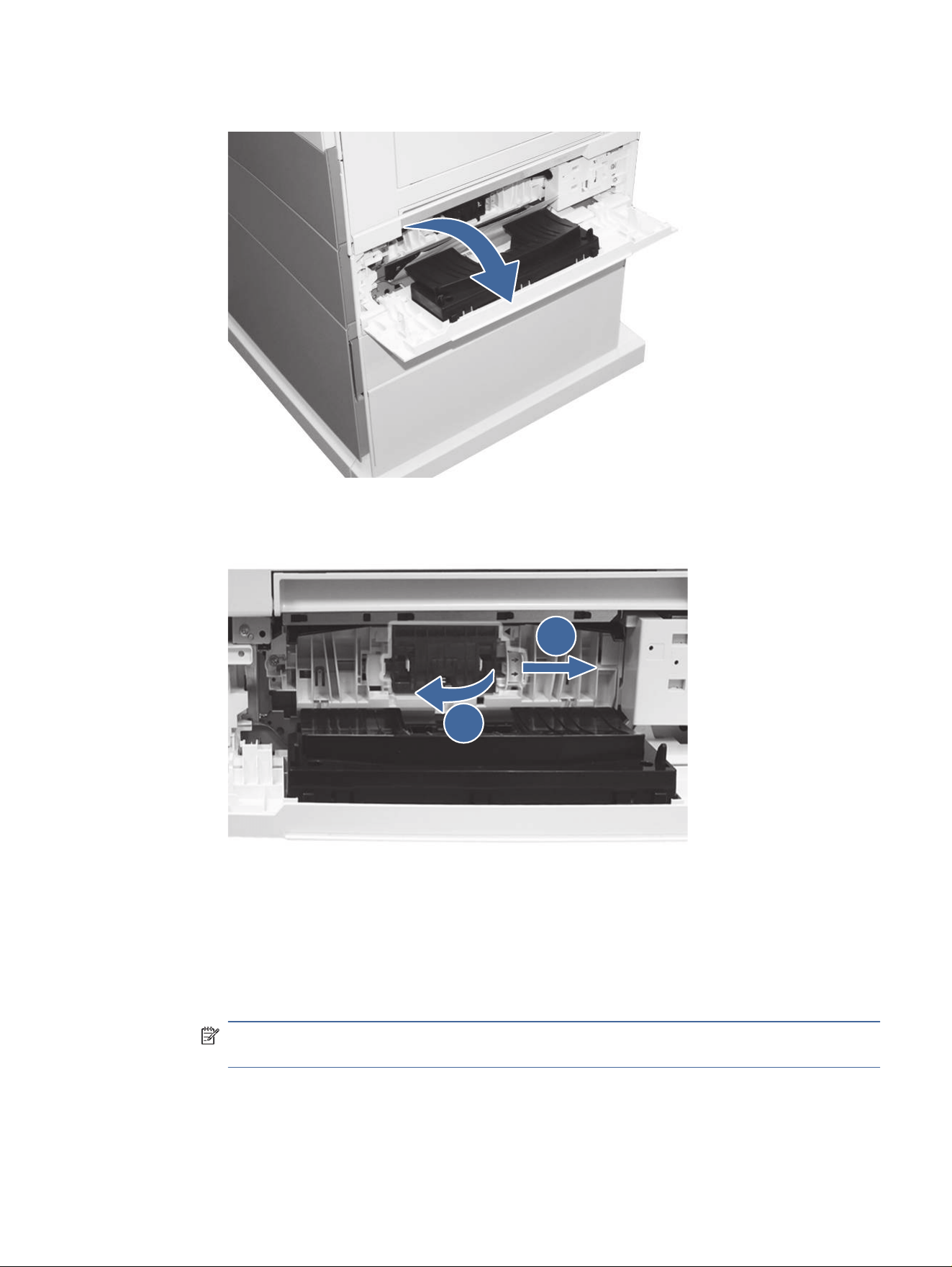
a. Open the Tray 3 right door to access the rollers.
b. Locate and remove the Tray 3 separation roller.
1
2
Call-out 1- slide blue locking lever
Call-out 2- Remove the roller assembly.
c. Remove the Tray 3 pick and feed rollers.
To remove the roller assembly, gently pull on the side of the assembly and slide out as shown.
NOTE: Make sure your hands are clean before touching the rollers. Oils or debris from hands
can cause paper pickup issues.
13.A3 jam error in Tray 3
175
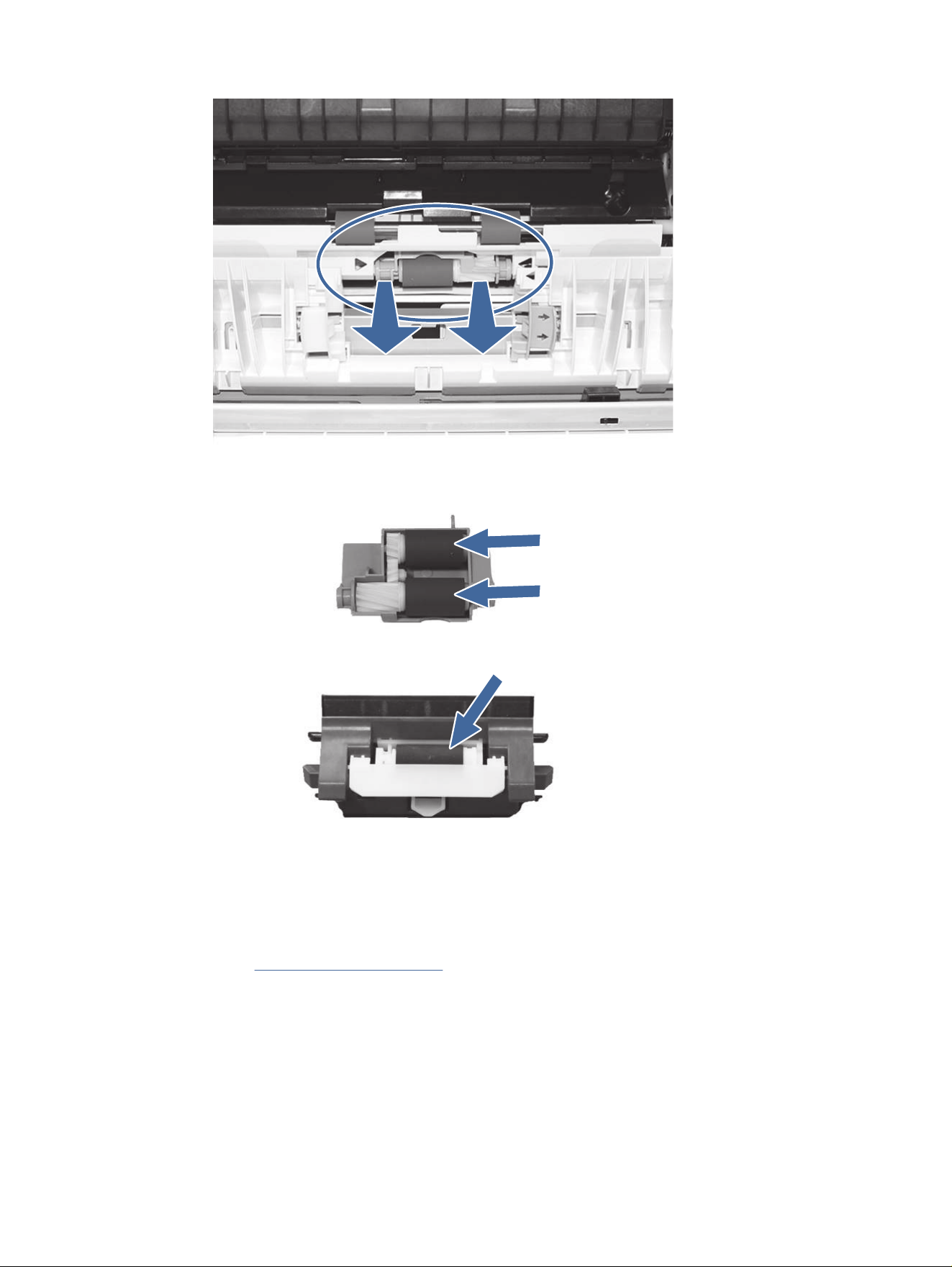
d. Clean the rollers with a dampened lint free cloth.
e. Reinstall the roller assemblies and close the right door.
f. Run a print job from Tray 3.
10. If the error persists, contact your HP-authorized service or support provider, or contact customer
support at www.hp.com/go/contactHP.
13.A4 jam error in Tray 4
Use the following procedure to check for paper in all possible jam locations related to the 550 sheet Tray
4. When a jam occurs, the control panel displays an animation that assists in clearing the jam.
Recommended action for customers
176
Chapter 9 Solve problems
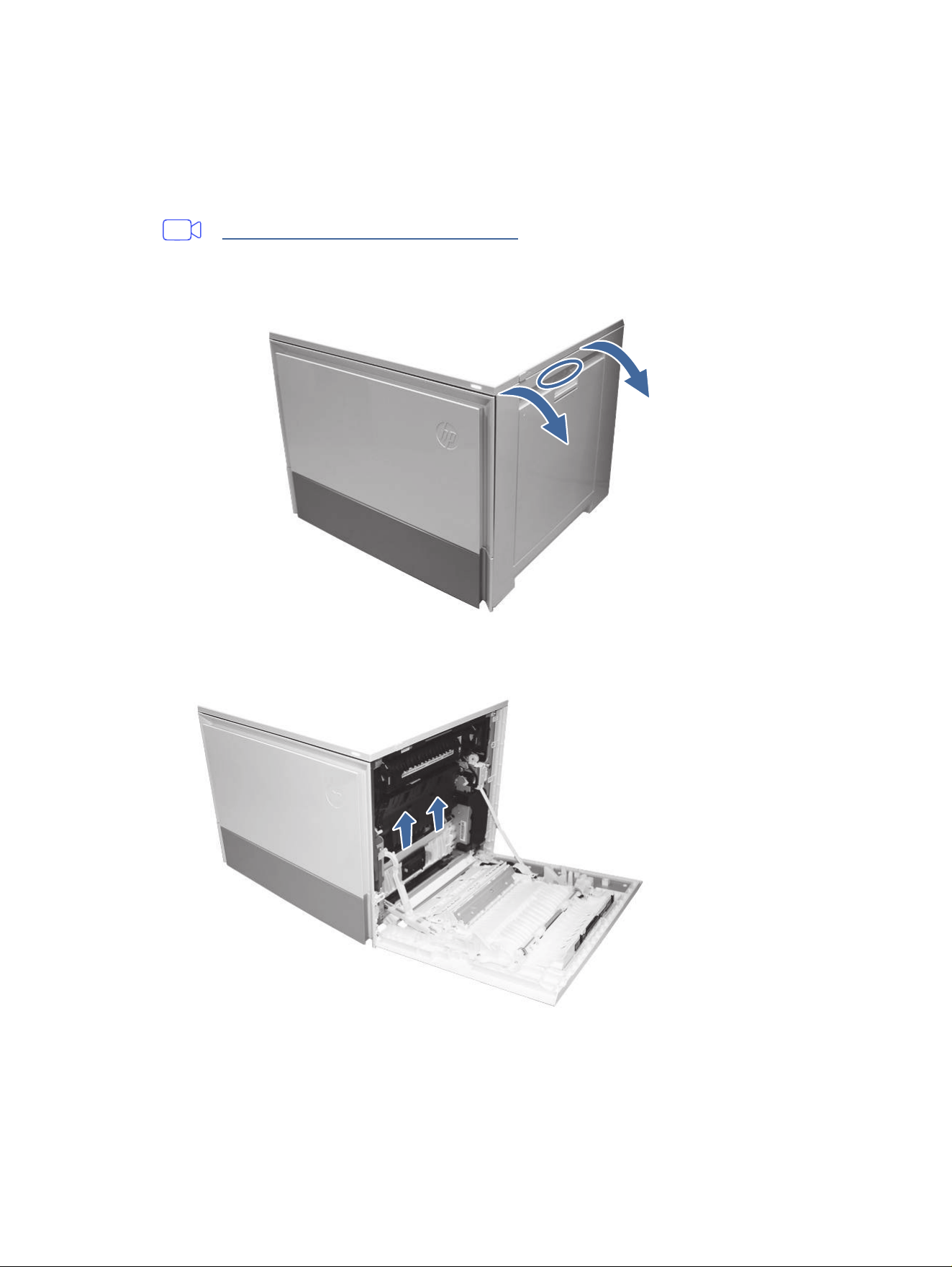
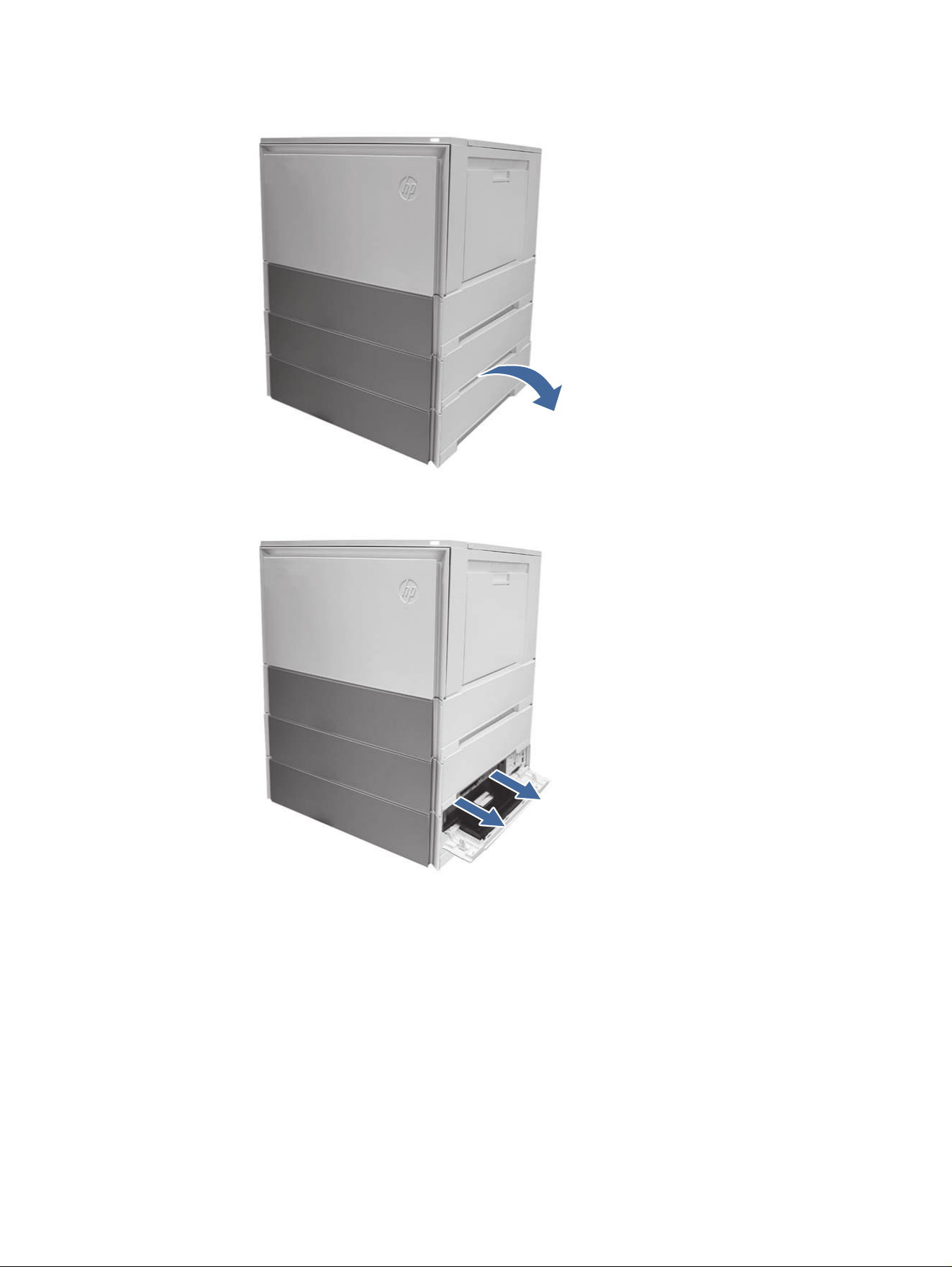
3. Open the Tray 4 right access door.
4. Gently remove any jammed paper.
178
Chapter 9 Solve problems
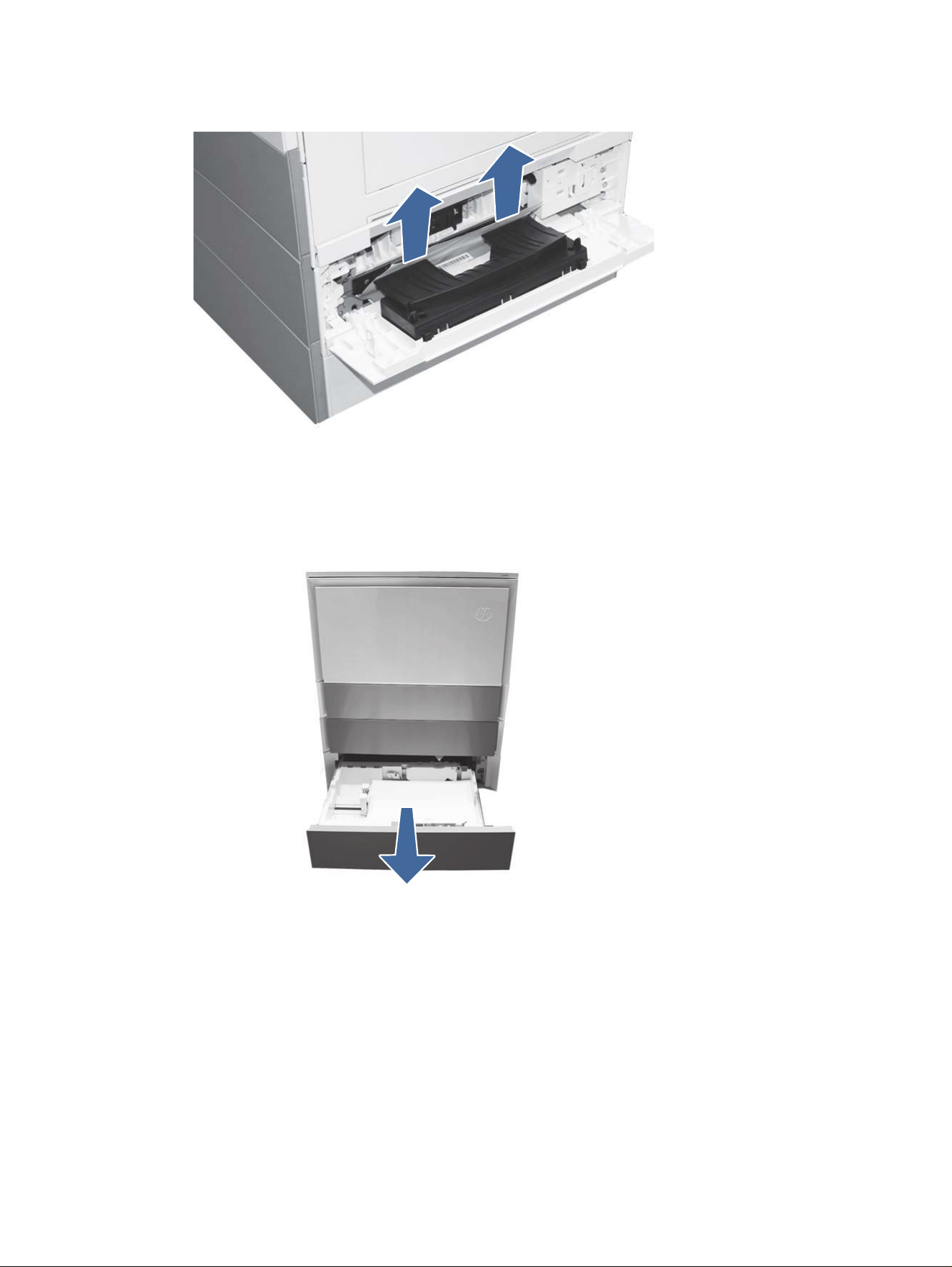
5. Open the Tray 3 access door and gently remove any jammed paper.
6. Close the right door to clear the control panel message.
7. Open Tray 4.
13.A4 jam error in Tray 4
179
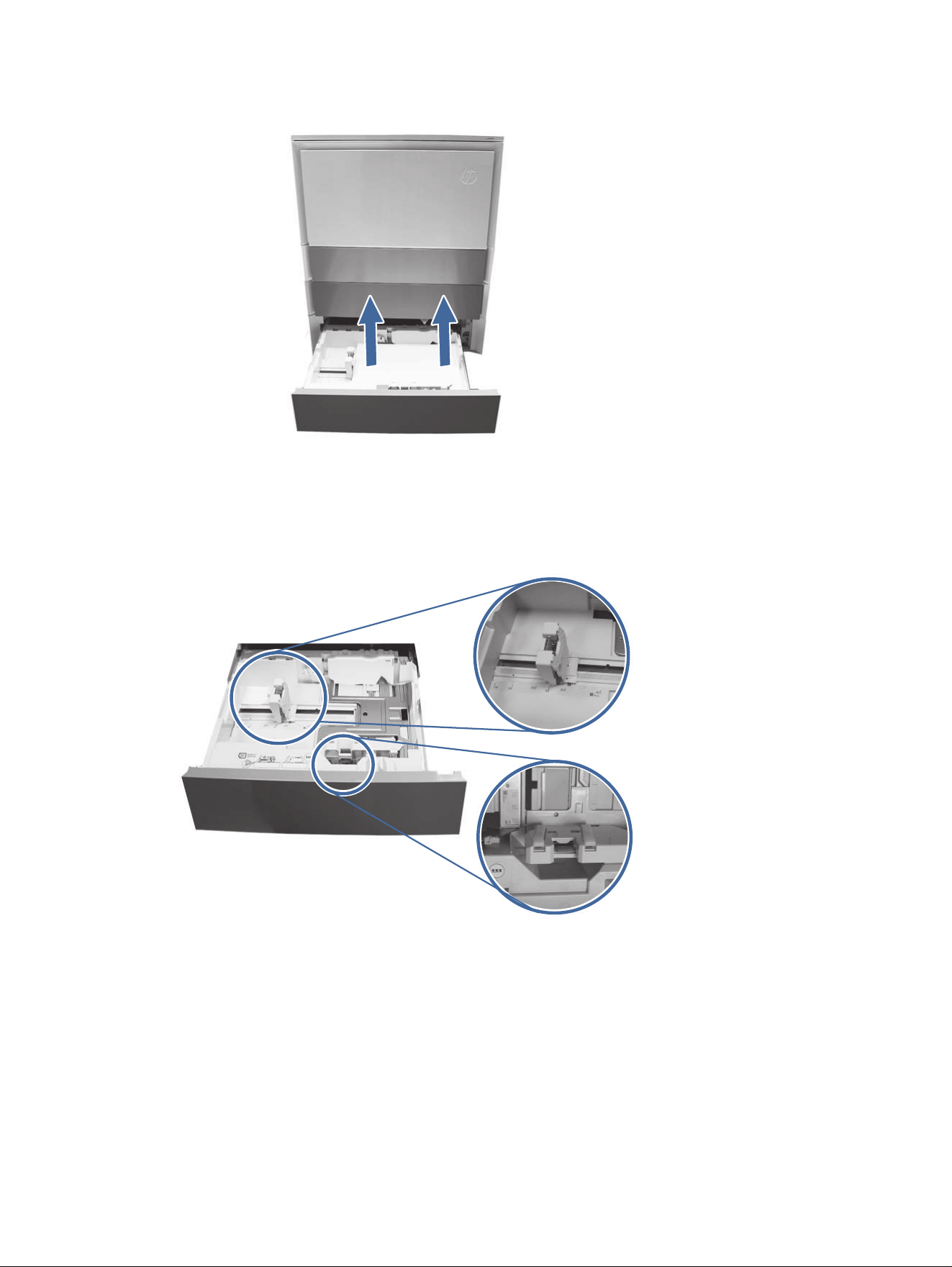
8. Remove the paper from the tray and discard any bent, curled, or damaged sheets.
9. Make sure that the tray width and length guides are set to the correct paper size for the paper
being installed into the tray and that the tray is not over filled above the fill mark (line below 3
triangles on rear guide).
180
Chapter 9 Solve problems
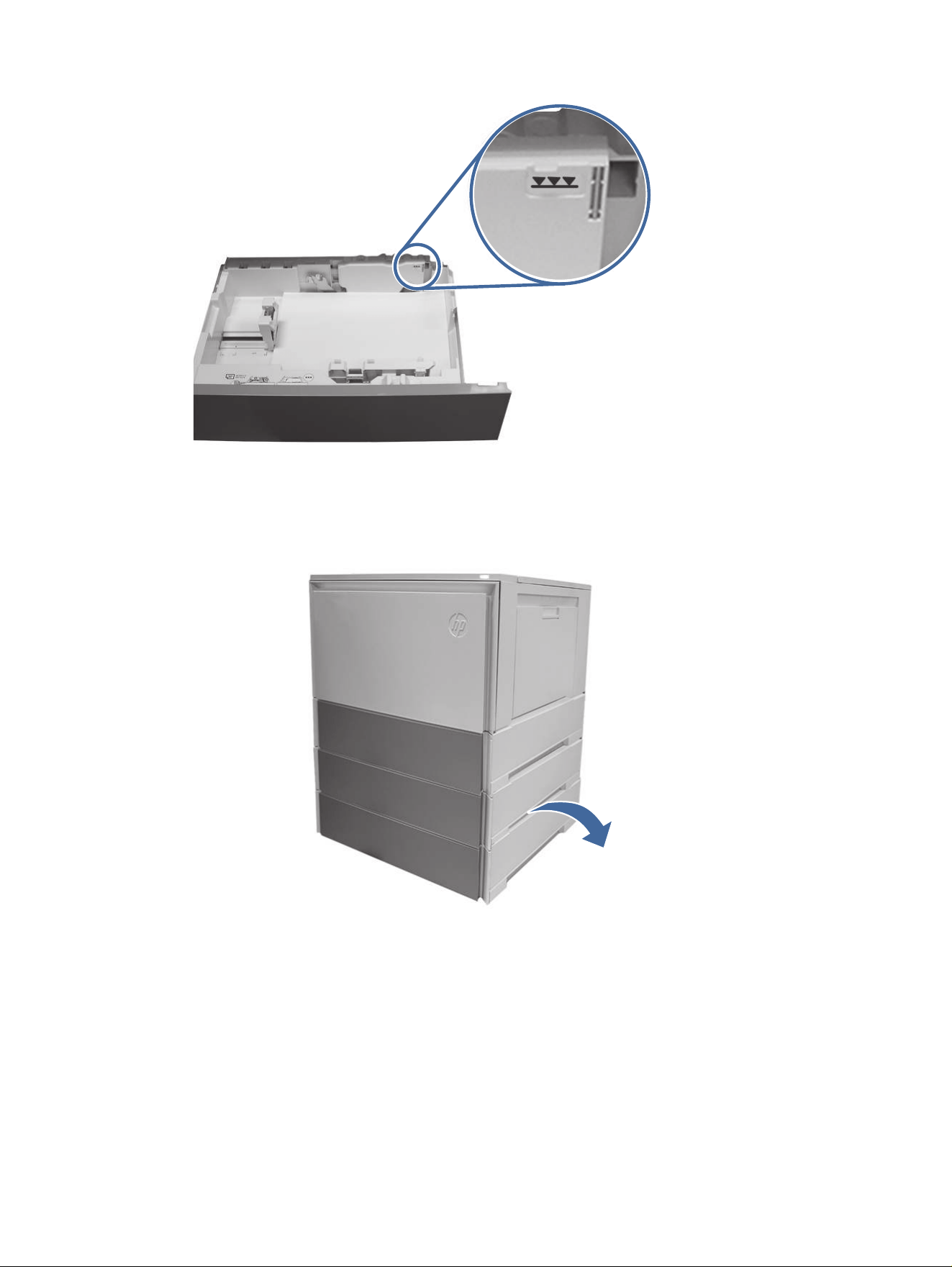
10. Ensure the type and quality of the paper being used meets the HP specifications for the printer.
11. If the error persists, clean the Tray 4 pick, feed, separation rollers.
a. Open the Tray 4 door to access the rollers.
13.A4 jam error in Tray 4
181
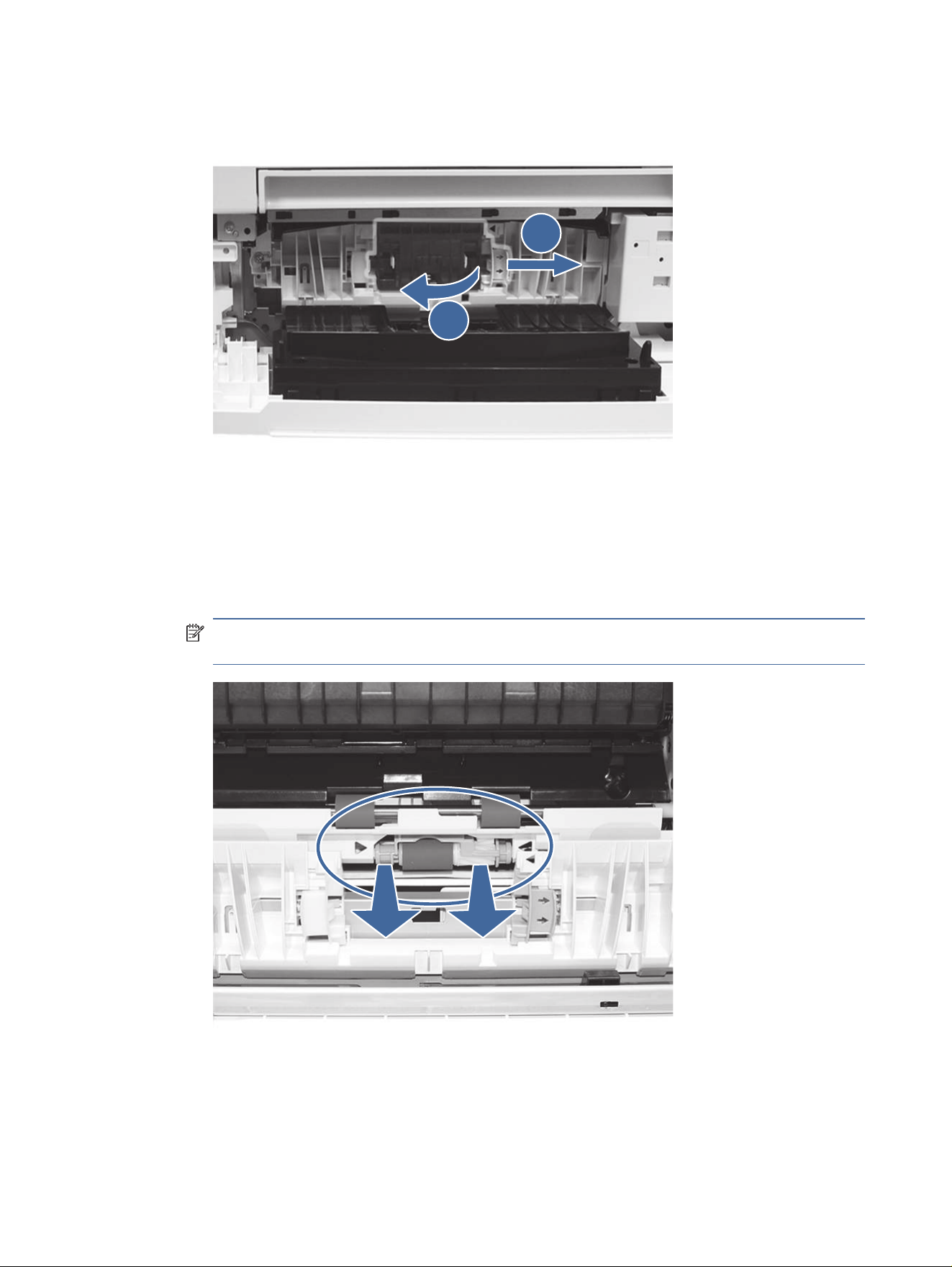
b. Locate and remove the Tray 4 separation roller.
1
2
Call-out 1- slide blue locking lever
Call-out 2- Remove the roller assembly.
c. Remove the Tray 4 pick and feed rollers.
To remove the roller assembly, gently pull on to the side of the rollers as shown.
NOTE: Make sure your hands are clean before touching the rollers. Oils or debris from hands
can cause paper pickup issues.
182
Chapter 9 Solve problems
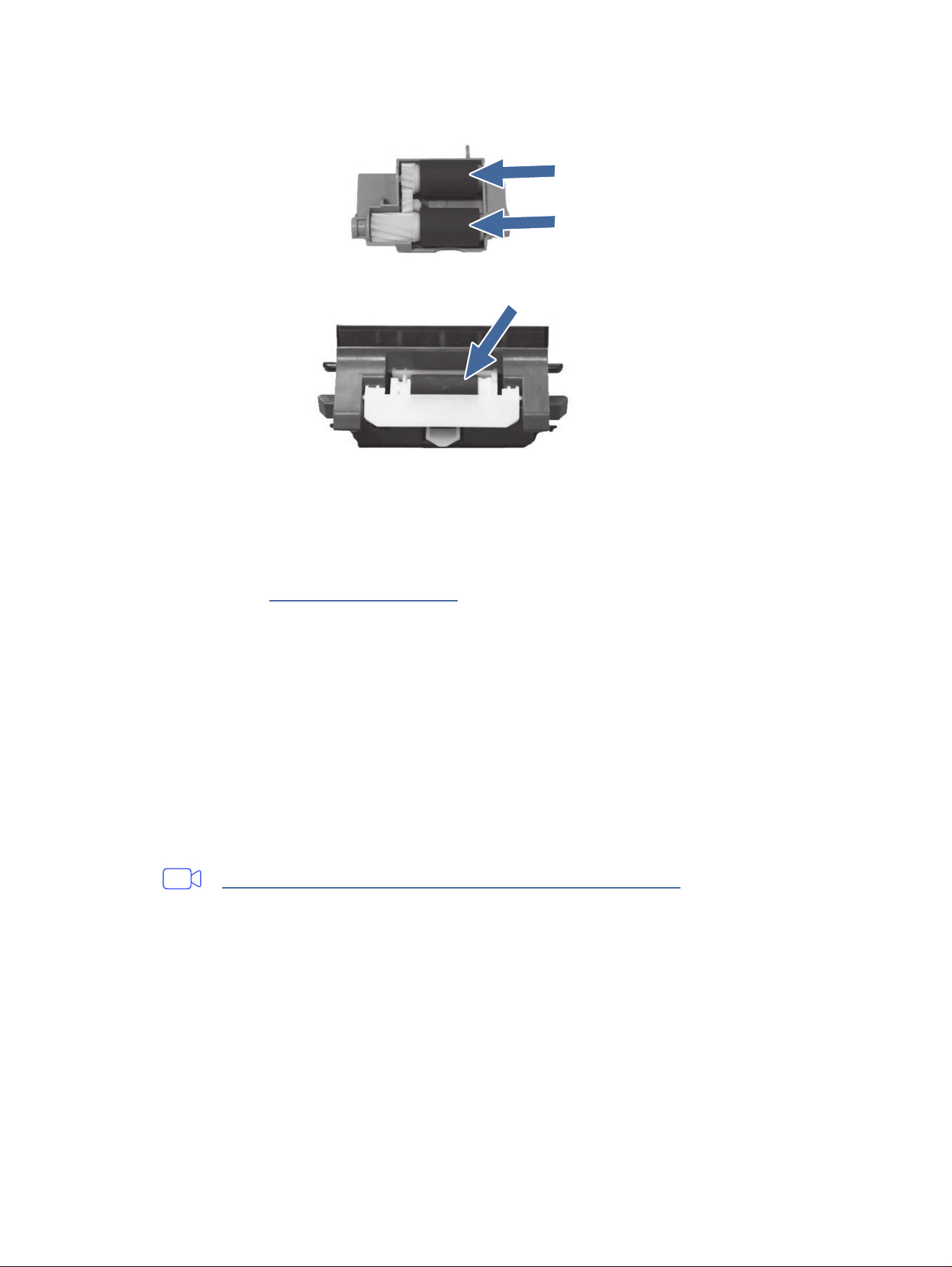
d. Clean the rollers with a dampened lint free cloth.
e. Reinstall the roller assemblies and close the right door.
f. Run a print job from Tray 4.
12. If the error persists, contact your HP-authorized service or support provider, or contact customer
support at www.hp.com/go/contactHP.
13.A4 jam error in Tray 4 (2,100 sheet feeder HCI)
Use the following procedure to check for paper in all possible jam locations related to the HCI Tray 4.
When a jam occurs, the control panel displays an animation that assists in clearing the jam.
Recommended action for customers
When a jam occurs, the control panel displays a message and an animation that assists in clearing the
jam.
● 13.A4.A4 Paper jam in tray 4
● 13.A4.D4 Paper jam in tray 4
View a video of how to clear a jam in the high-capacity input Tray 4
13.A4 jam error in Tray 4 (2,100 sheet feeder HCI)
183
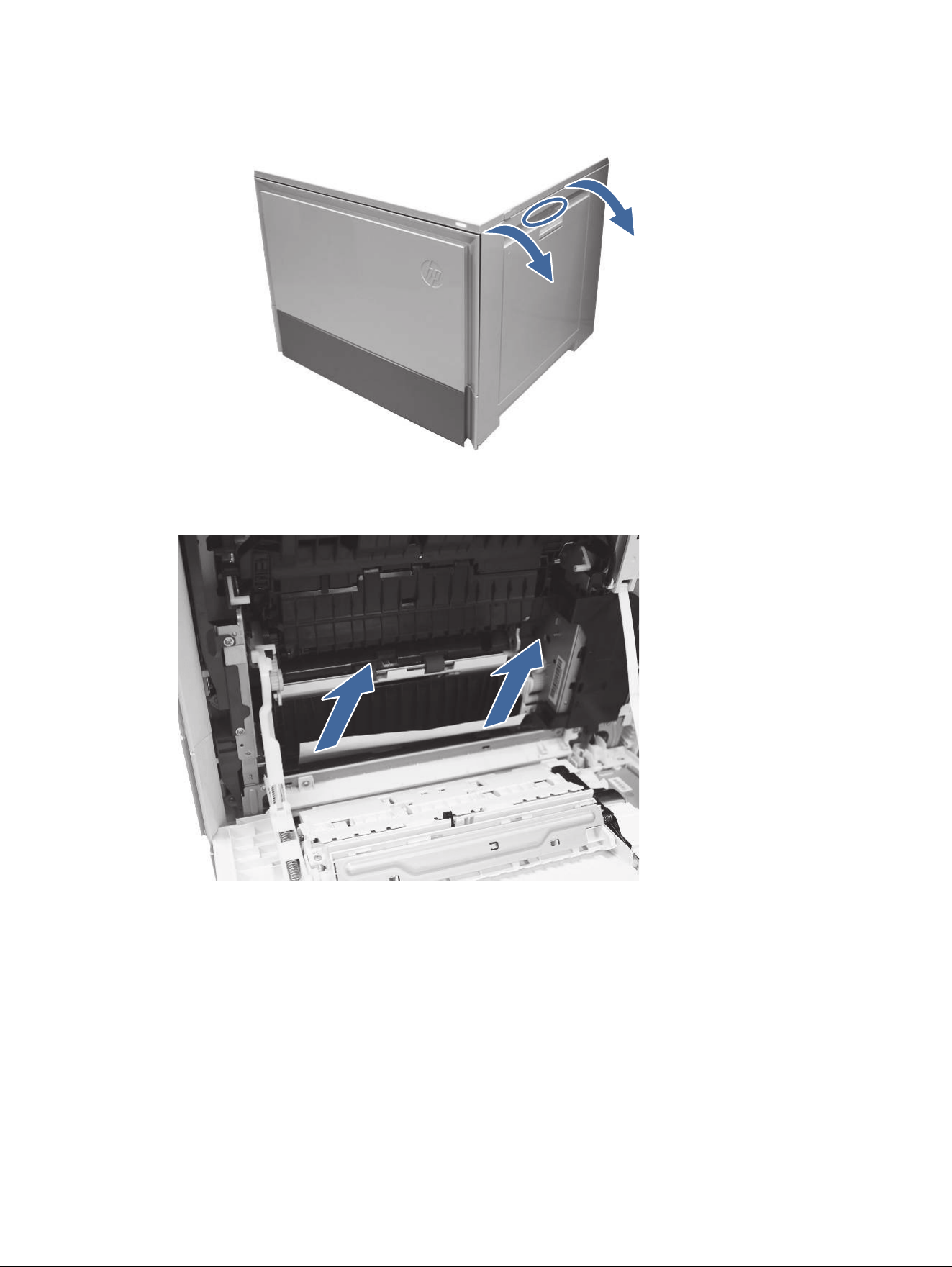
1. Open the printer right door.
2. Gently remove any jammed paper.
184
Chapter 9 Solve problems
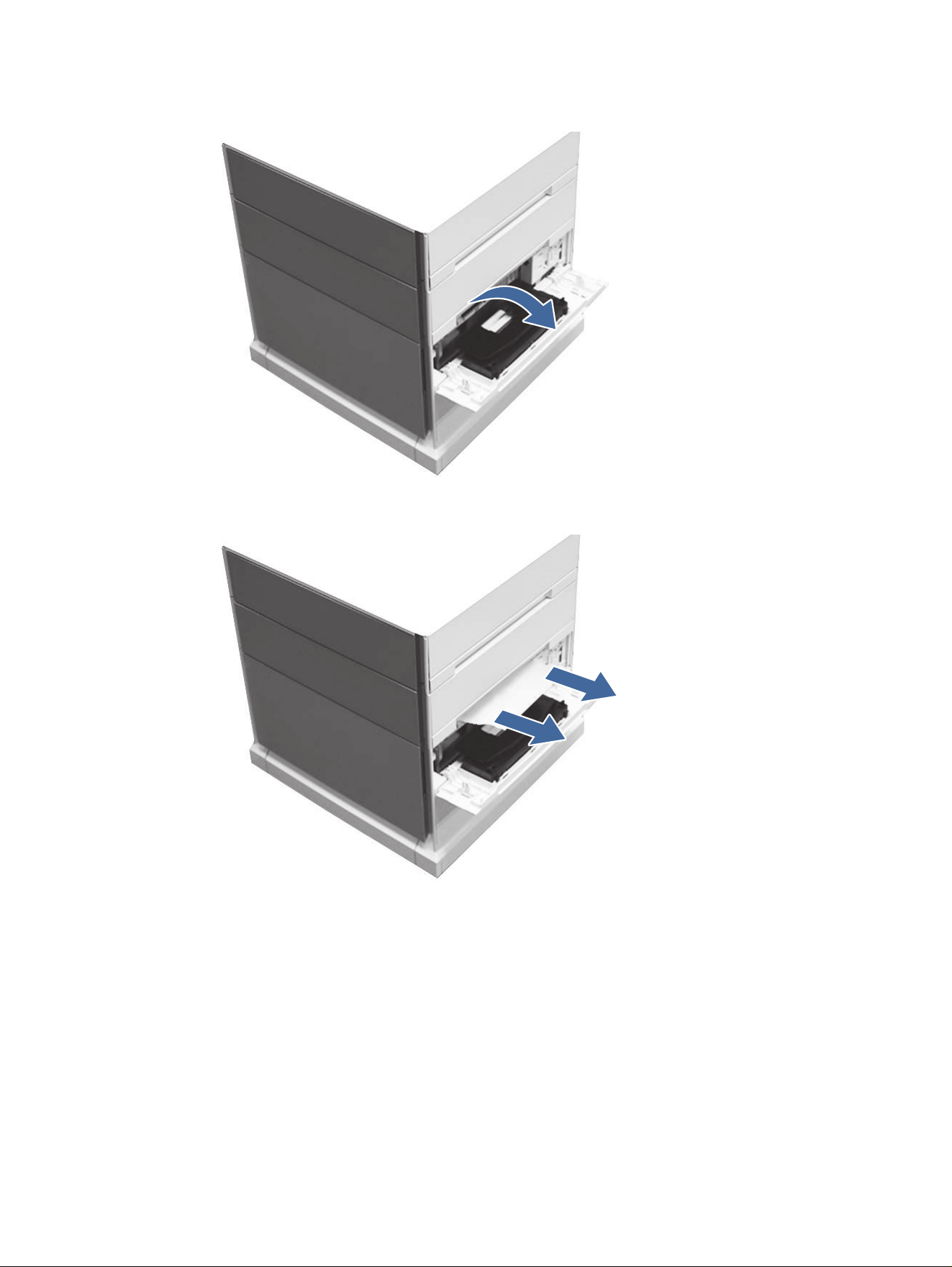
3. Open the Tray 4 right access door.
4. Gently remove any jammed paper.
13.A4 jam error in Tray 4 (2,100 sheet feeder HCI)
185
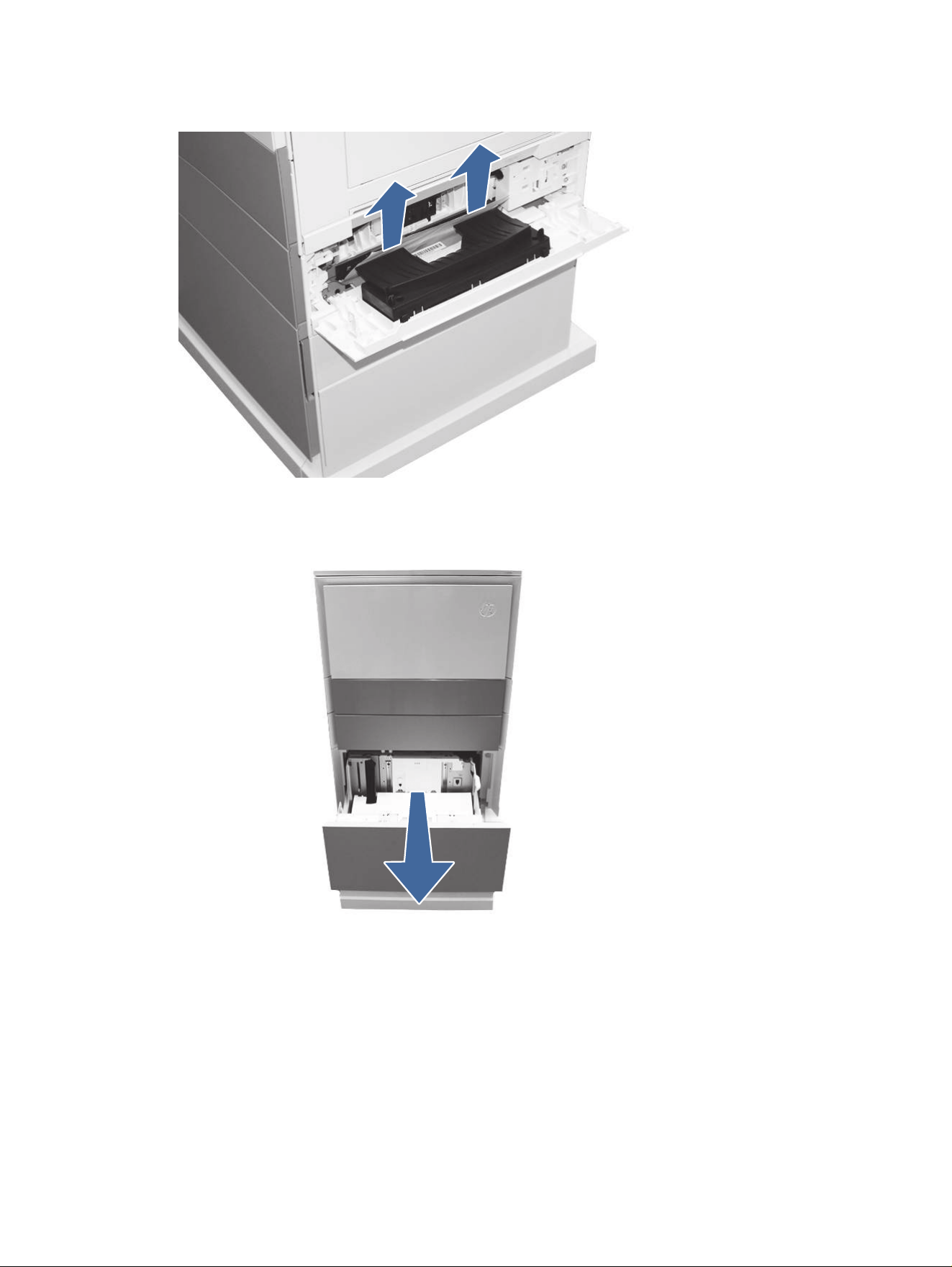
5. Open the Tray 3 access door and gently remove any jammed paper.
6. Close the right door to clear the control panel message.
7. Open Tray 4.
186
Chapter 9 Solve problems
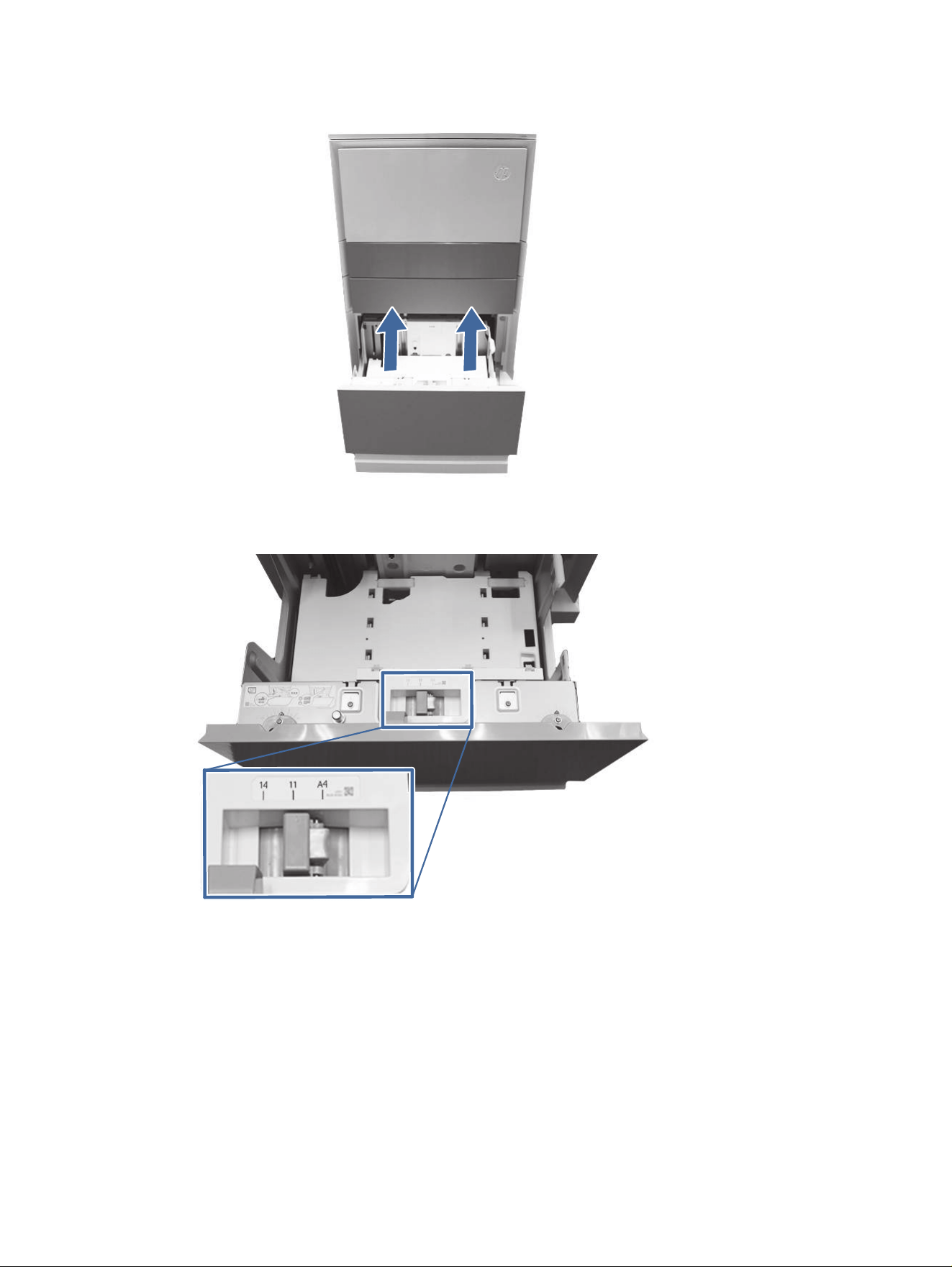
8. Remove the paper from the tray and discard any bent, curled, or damaged sheets.
9. Make sure that the tray width guide is set to the correct paper size for the paper being installed into
the tray and that the tray is not over filled above the fill mark (line below 3 triangles on rear guide).
13.A4 jam error in Tray 4 (2,100 sheet feeder HCI)
187
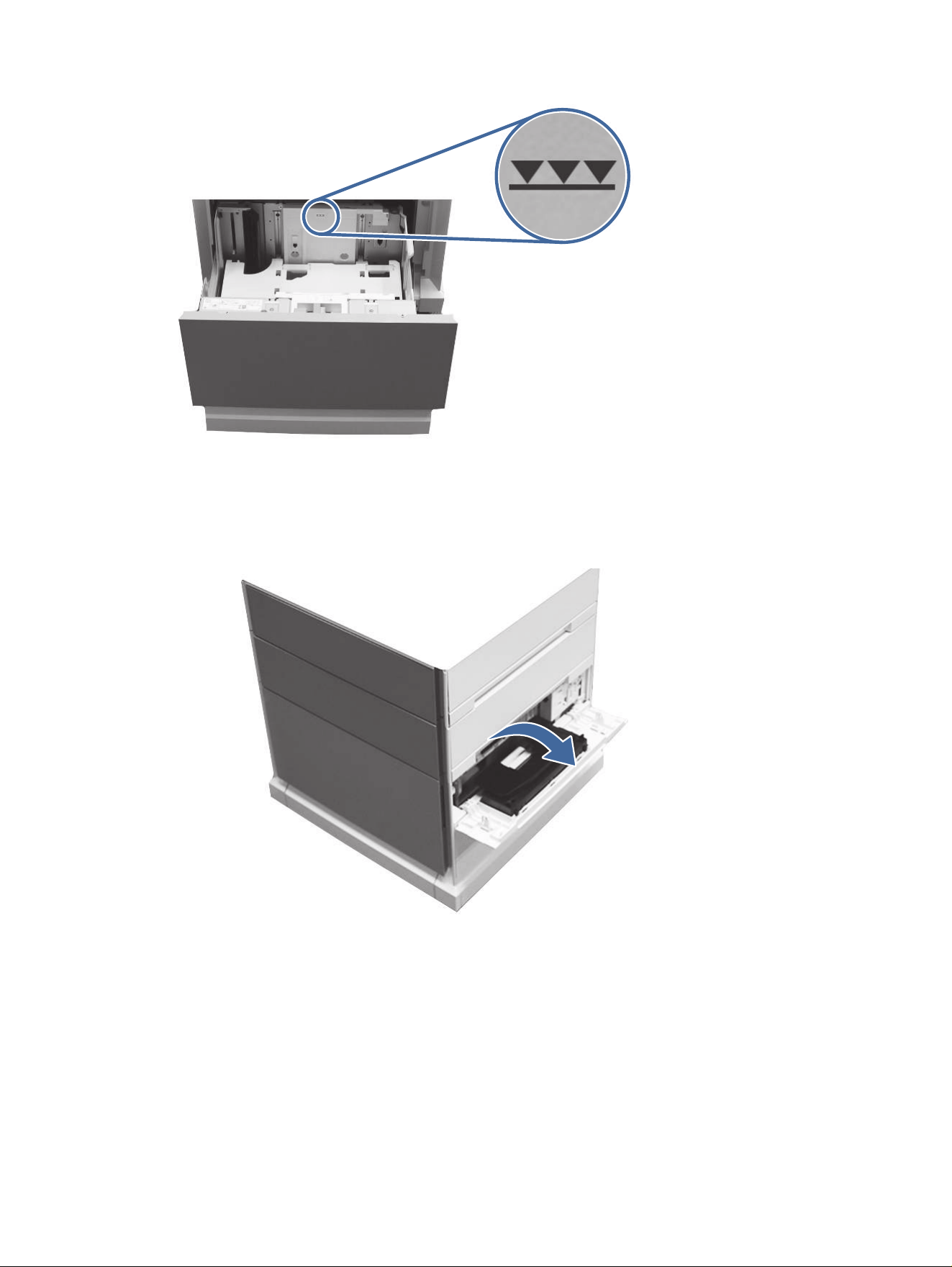
10. Ensure the type and quality of the paper being used meets the HP specifications for the printer.
11. If the error persists, clean the Tray 4 pick, feed, and separation rollers.
a. Open the Tray 4 door to access the rollers.
188
Chapter 9 Solve problems
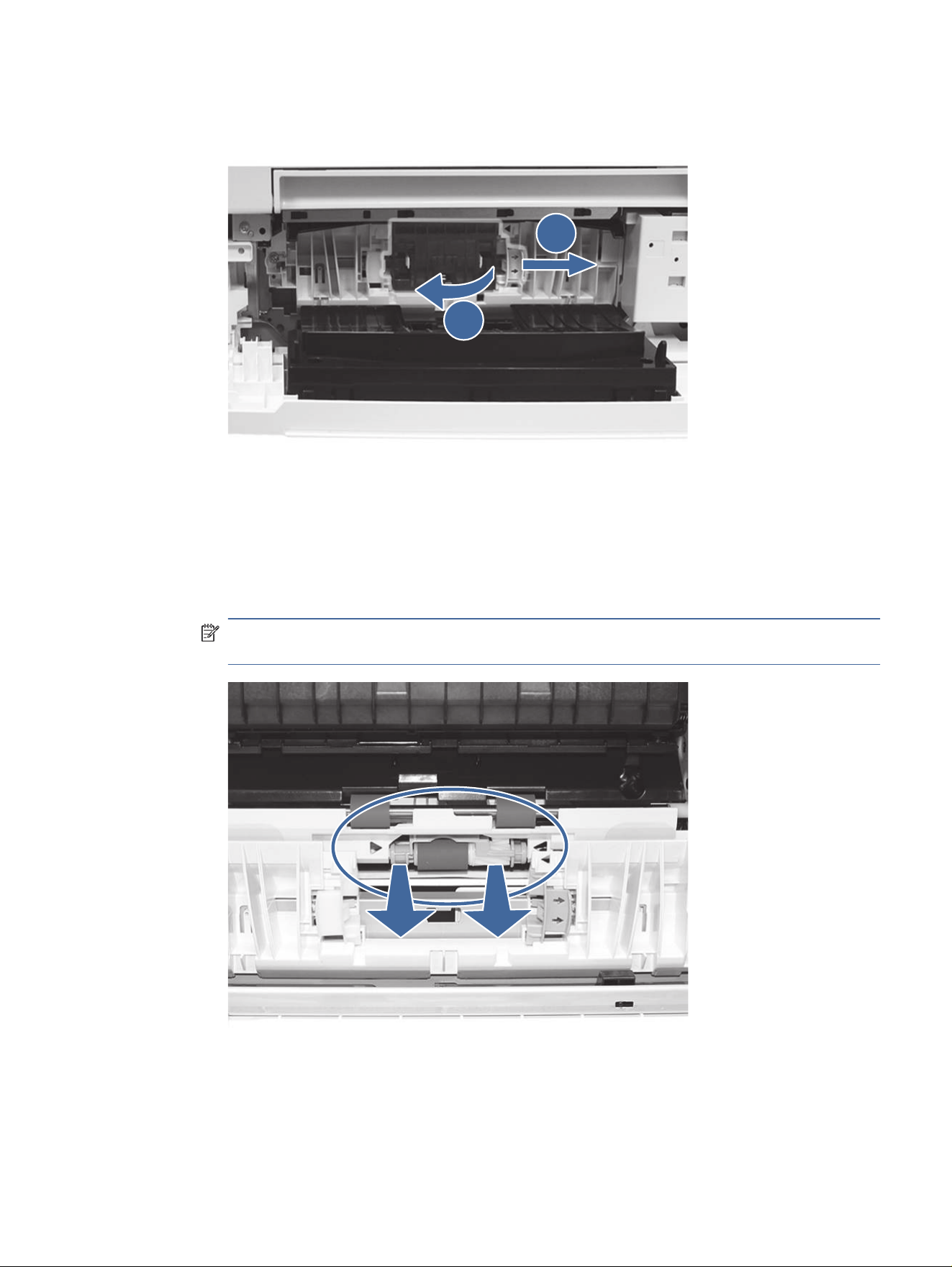
b. Locate and remove the Tray 4 separation roller.
1
2
Call-out 1- slide locking lever
Call-out 2- Remove the roller assembly.
c. Remove the Tray 4 pick and feed rollers.
To remove the roller assembly, gently pull on to the side of the rollers as shown.
NOTE: Do not touch the rubber part of the rollers with hands. Oils or debris from hands can
cause paper pickup issues.
13.A4 jam error in Tray 4 (2,100 sheet feeder HCI)
189
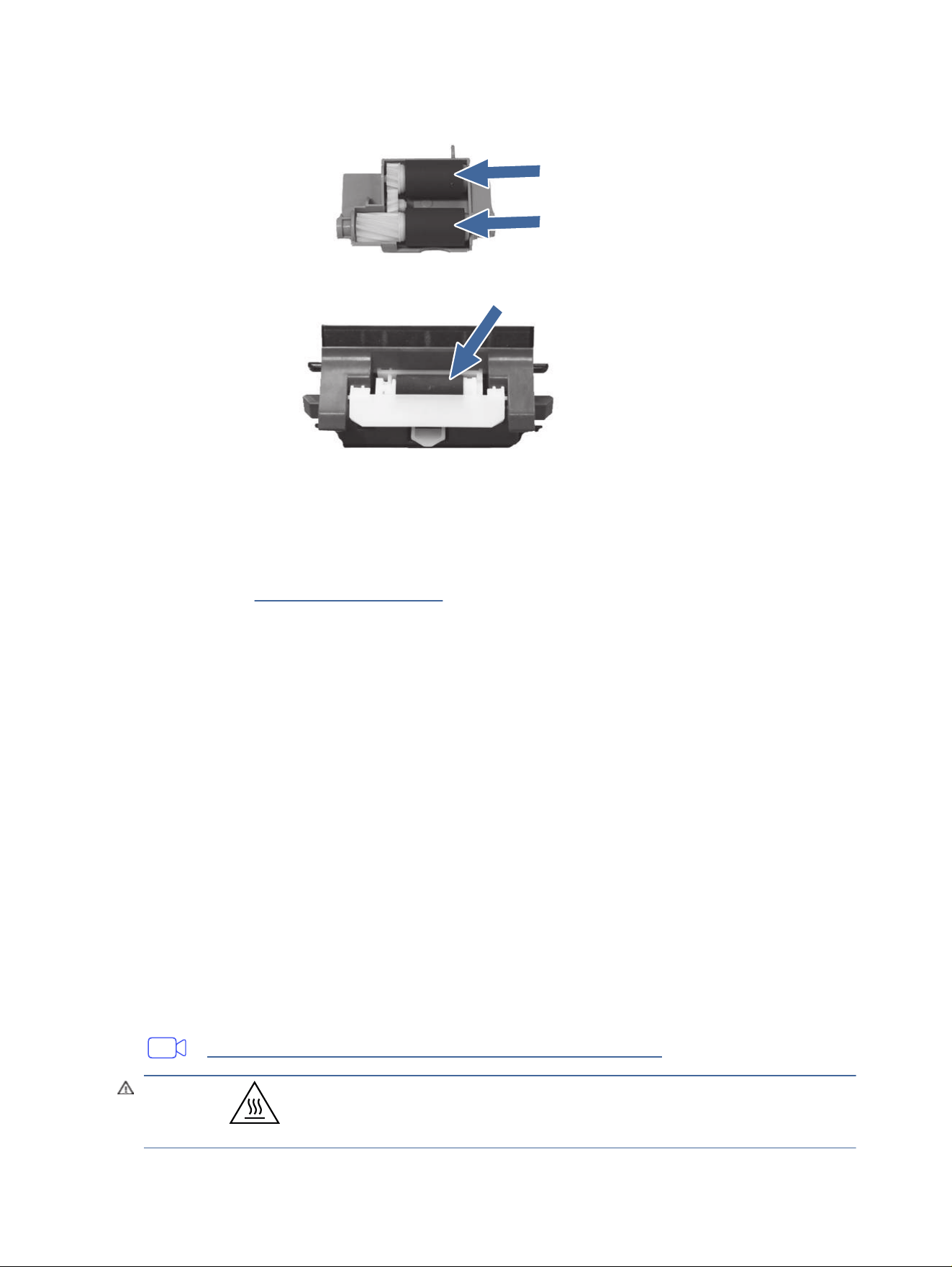
d. Clean the rollers with a dampened lint free cloth.
e. Reinstall the roller assemblies and close the right door.
f. Run a print job from Tray 4.
12. If the error persists, contact your HP-authorized service or support provider, or contact customer
support at www.hp.com/go/contactHP.
13.B2 jam error in right door
Use the following procedure to clear paper jams in the right door and fuser area. When a jam occurs, the
control panel displays an animation that assists in clearing the jam.
Recommended action for customers
When a jam occurs, the control panel displays a message and an animation that assists in clearing the
jam.
● 13.B2.Az Stay jam in right door
● 13.B2.Dz Delay jam in right door
● 13.B2.5z Inappropriate page to the Delivery Path jam
● 13.B2.FF Residual paper jam in right door
z = paper tray. This can be trays 1-5 or "D" for duplex jobs
Or
z = Fuser mode. This can be 0-9 or A-F.
View a video of how to clear a jam in the right door and fuser area
CAUTION: The fuser can be hot while the printer is in use. Wait for the fuser to cool before
handling it.
190
Chapter 9 Solve problems
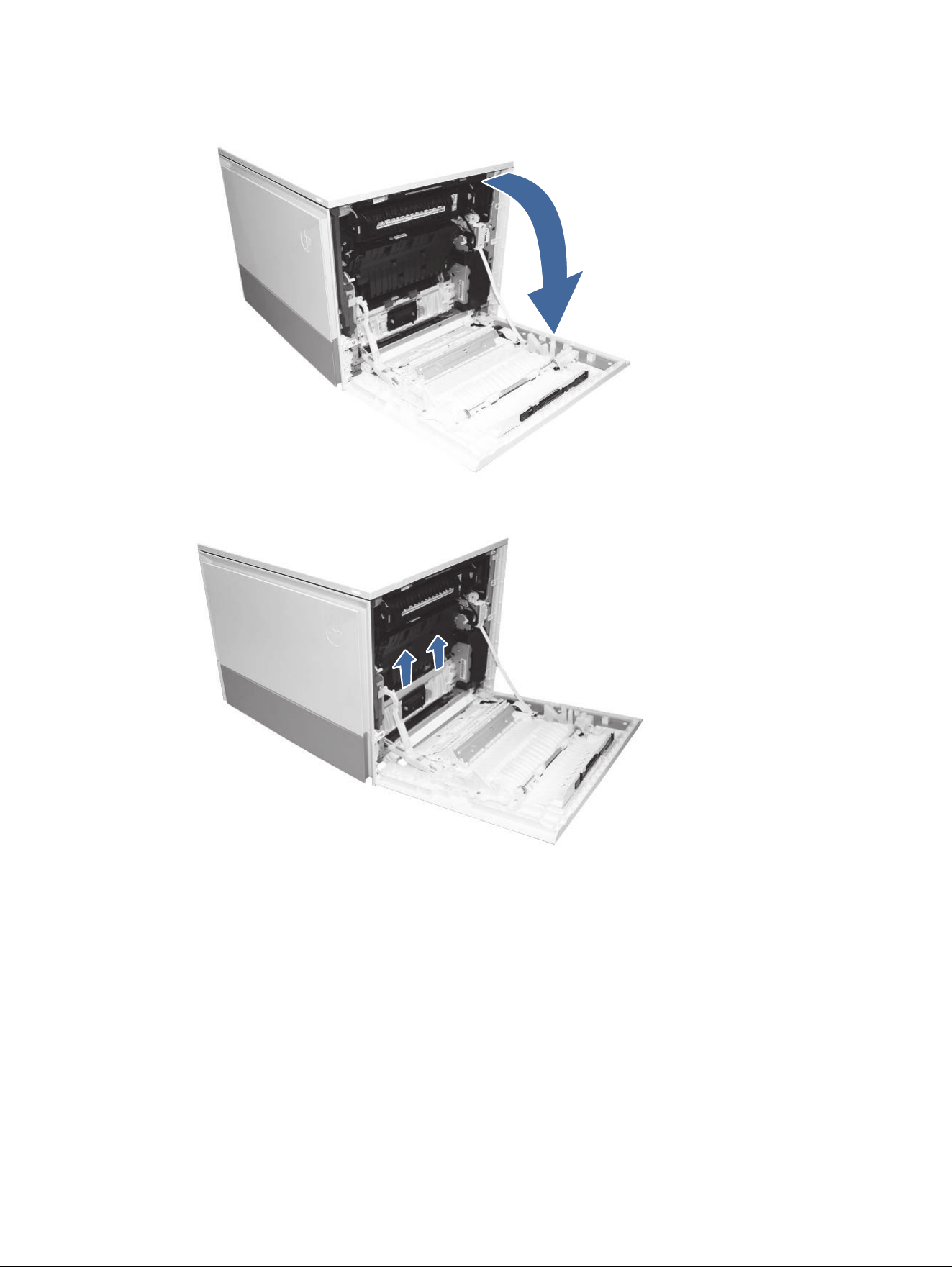
1. Open the right door.
2. Gently remove any jammed paper.
13.B2 jam error in right door
191
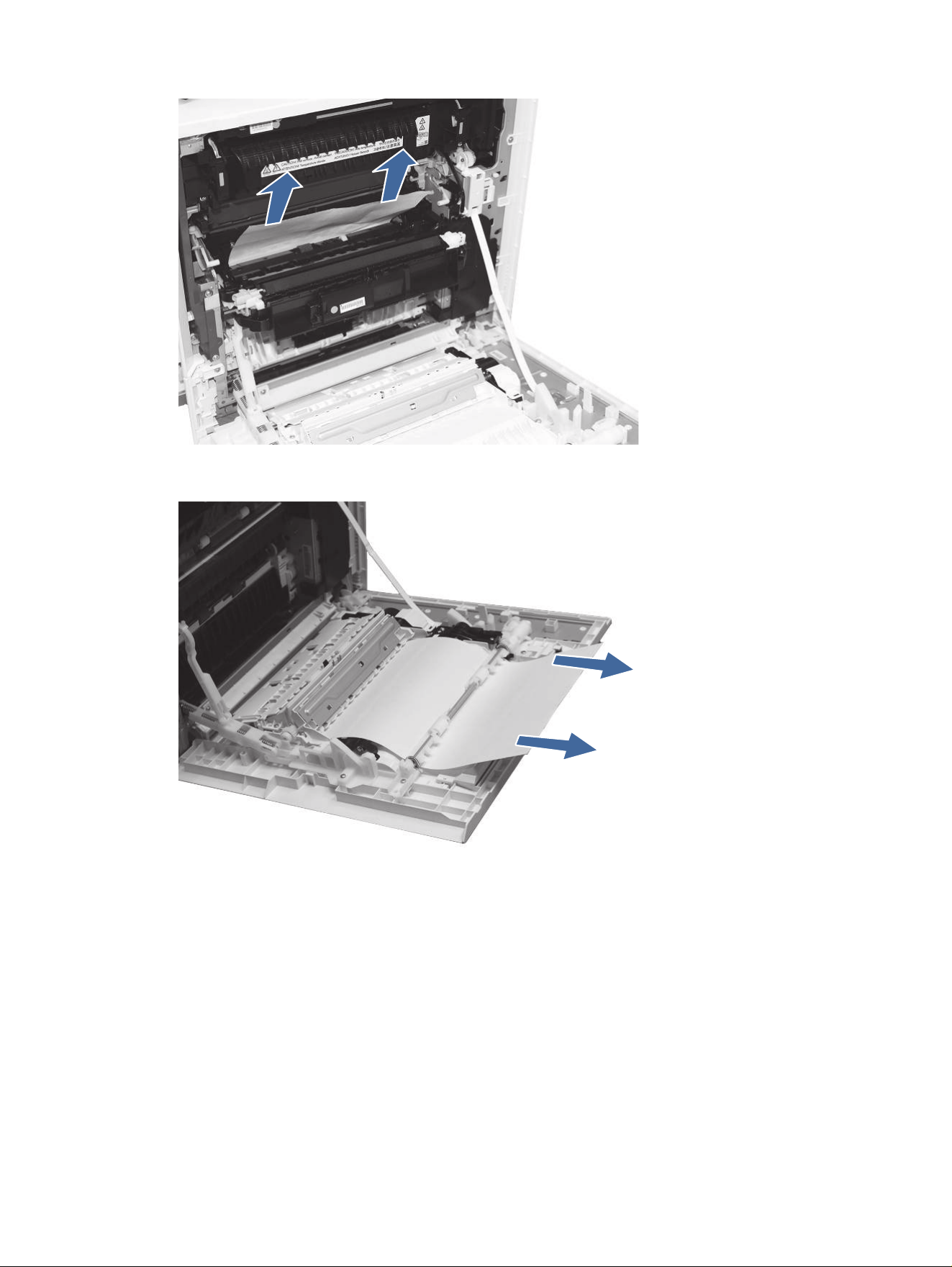
3. Gently remove any jammed paper from the duplexer paper path.
192
Chapter 9 Solve problems
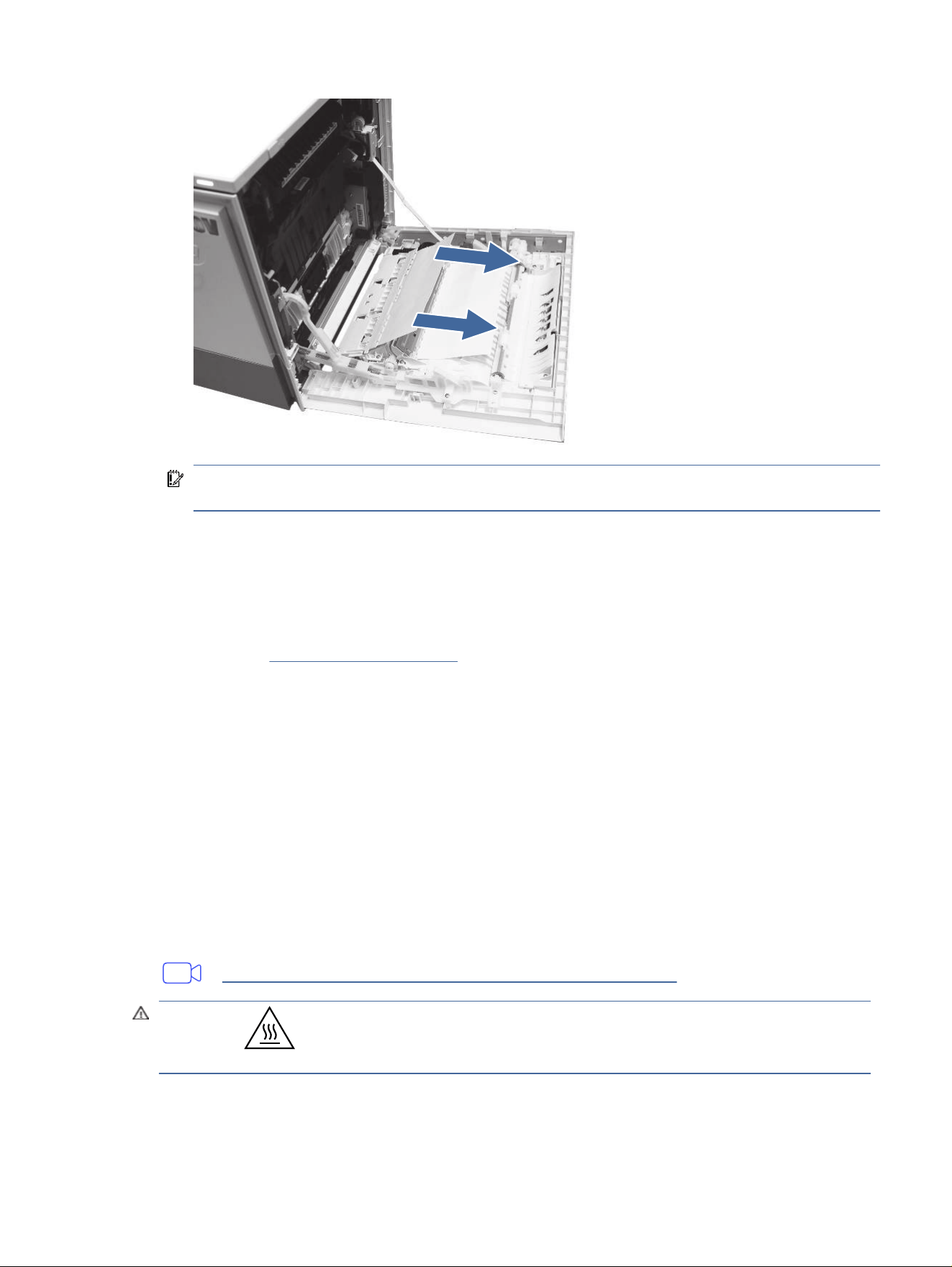
IMPORTANT: Make sure the paper being used is not too short for the printers duplexer
requirements.
4. Close the right door.
5. Ensure the type and quality of the paper being used meets the HP specifications for the printer.
6. Ensure the paper tray guides are set to the correct size for the paper loaded.
7. If the error persists, contact your HP-authorized service or support provider, or contact customer
support at www.hp.com/go/contactHP.
13.B4 jam errors in the right door
Use the following procedure to clear paper jams in the right door and fuser area. When a jam occurs, the
control panel displays an animation that assists in clearing the jam.
Recommended action for customers
When a jam occurs, the control panel displays a message and an animation that assists in clearing the
jam.
● 13.B4.Cz Jam in right door
● 13.B4.FF Residual paper jam in right door
z = paper tray. This can be trays 1-5 or "D" for duplex print jobs.
View a video of how to clear a jam in the right door and fuser area
CAUTION: The fuser can be hot while the printer is in use. Wait for the fuser to cool before
handling it.
13.B4 jam errors in the right door
193
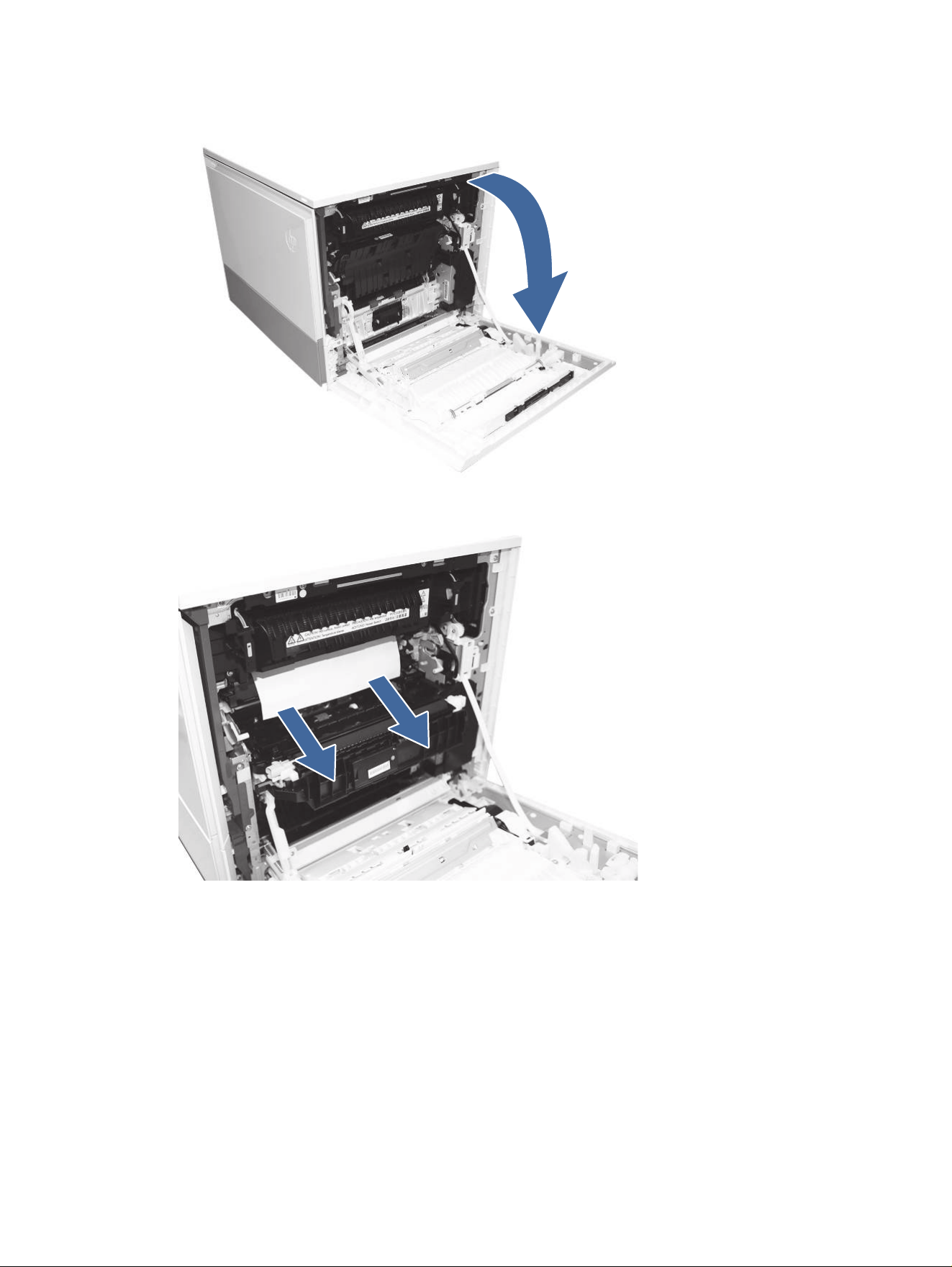
1. Open the right door.
2. Gently remove any jammed paper.
194
Chapter 9 Solve problems
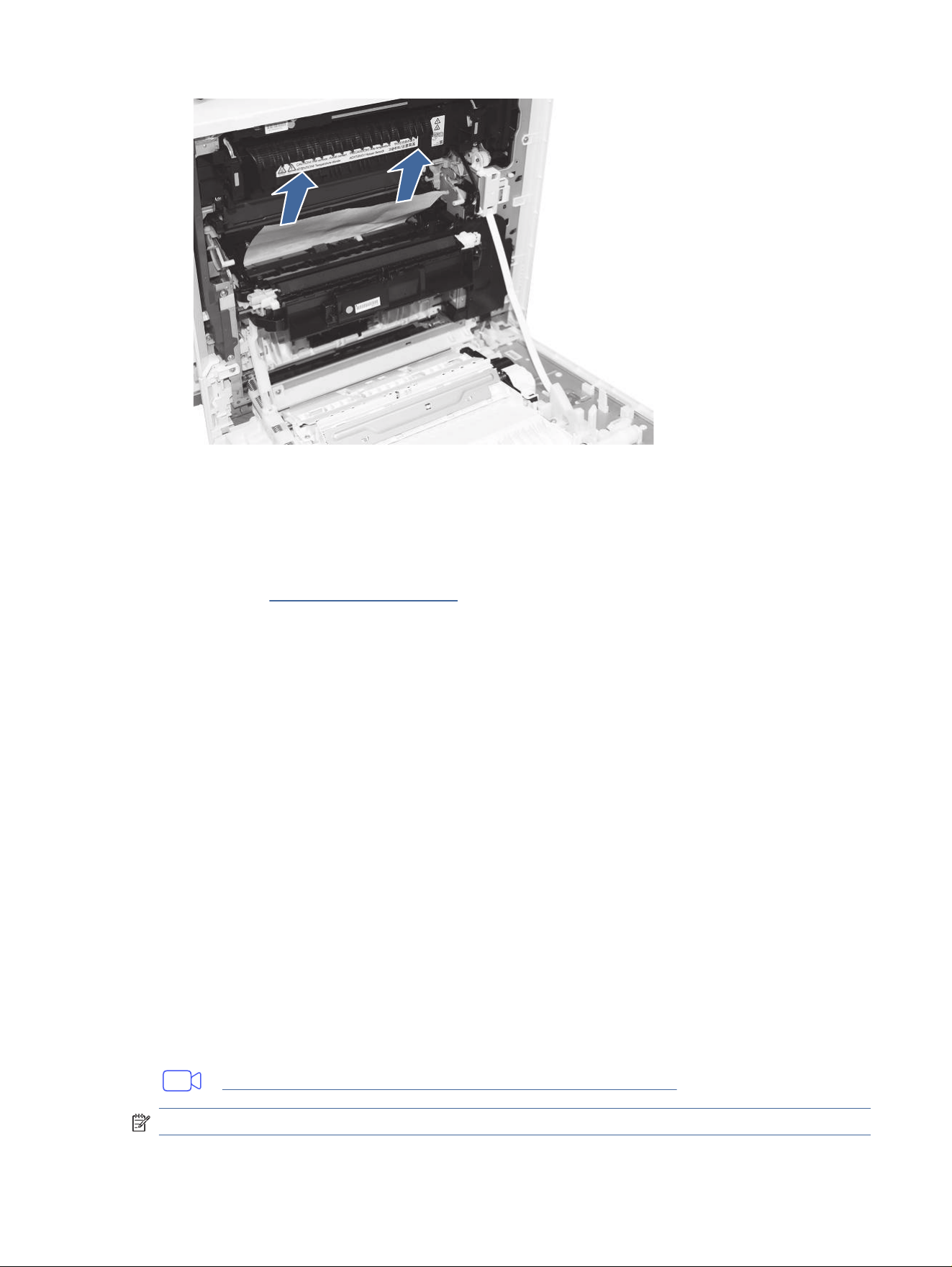
3. Close the right door.
4. Ensure the type and quality of the paper being used meets the HP specifications for the printer.
5. Ensure the paper tray guides are set to the correct size for the paper loaded.
6. If the error persists, contact your HP-authorized service or support provider, or contact customer
support at www.hp.com/go/contactHP.
13.B9 jam errors in the fuser
Use the following procedure to clear paper jams in the right door and fuser area. When a jam occurs, the
control panel displays an animation that assists in clearing the jam.
Recommended action for customers
When a jam occurs, the control panel displays a message and an animation that assists in clearing the
jam.
● 13.B9.yz Jam in right door
y = jam type (A or D)
z = Paper tray. This can be 0-5 or "D" for duplex print jobs.
Or
z = Fuser mode. This can be 0-9 or A-F.
● 13.B9.Cz Jam in right door (Fuser wrap jam)
z = Fuser mode. This can be 0-9 or A-F.
● 13.B9.FF Residual paper jam in right door
View a video of how to clear a jam in the right door and fuser area
NOTE: The fuser is hot while the printer is in use. Wait for the fuser to cool before clearing jams.
13.B9 jam errors in the fuser
195
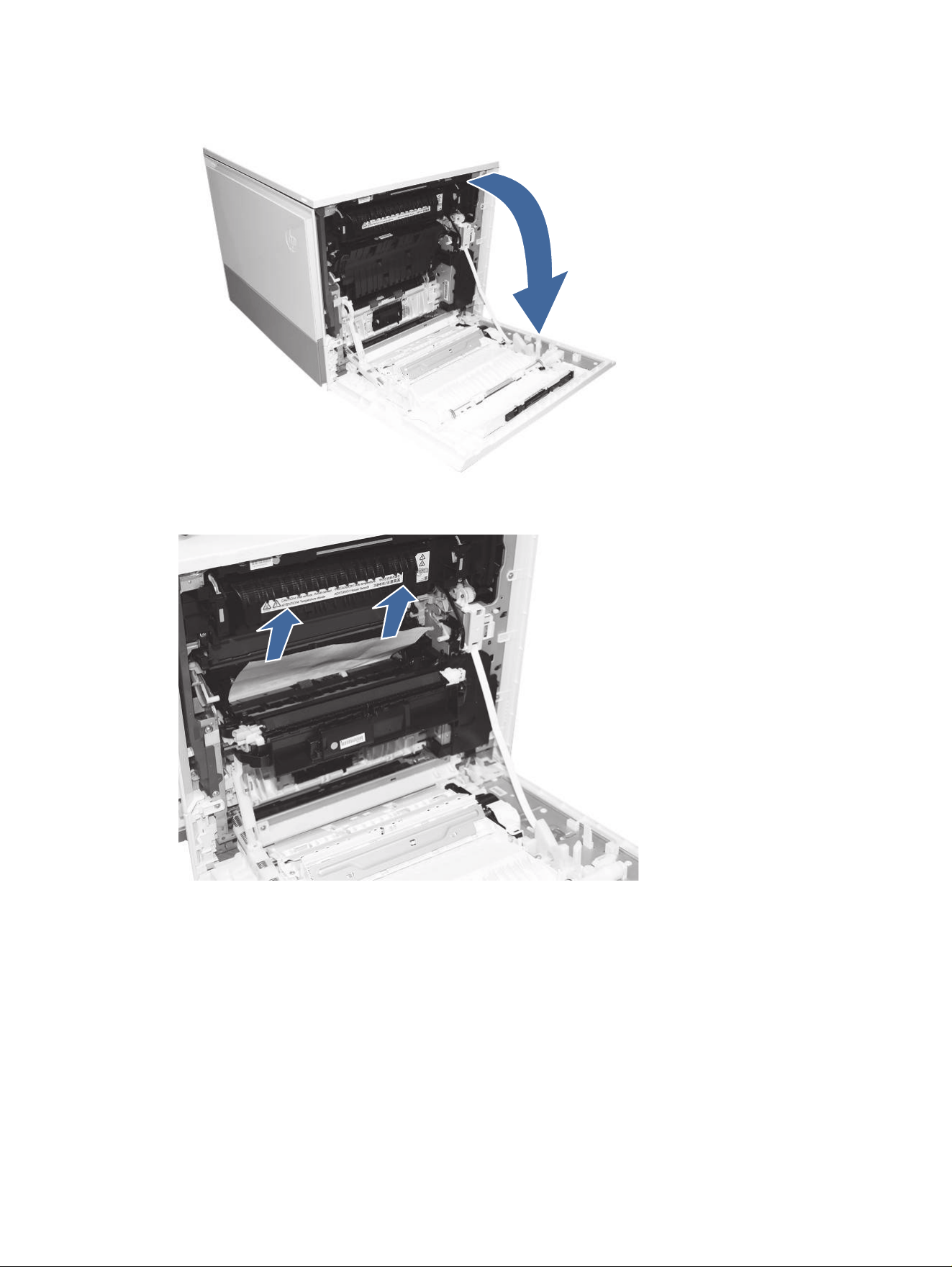
1. Open the right door.
2. Gently remove any jammed paper from the fuser input.
196
Chapter 9 Solve problems
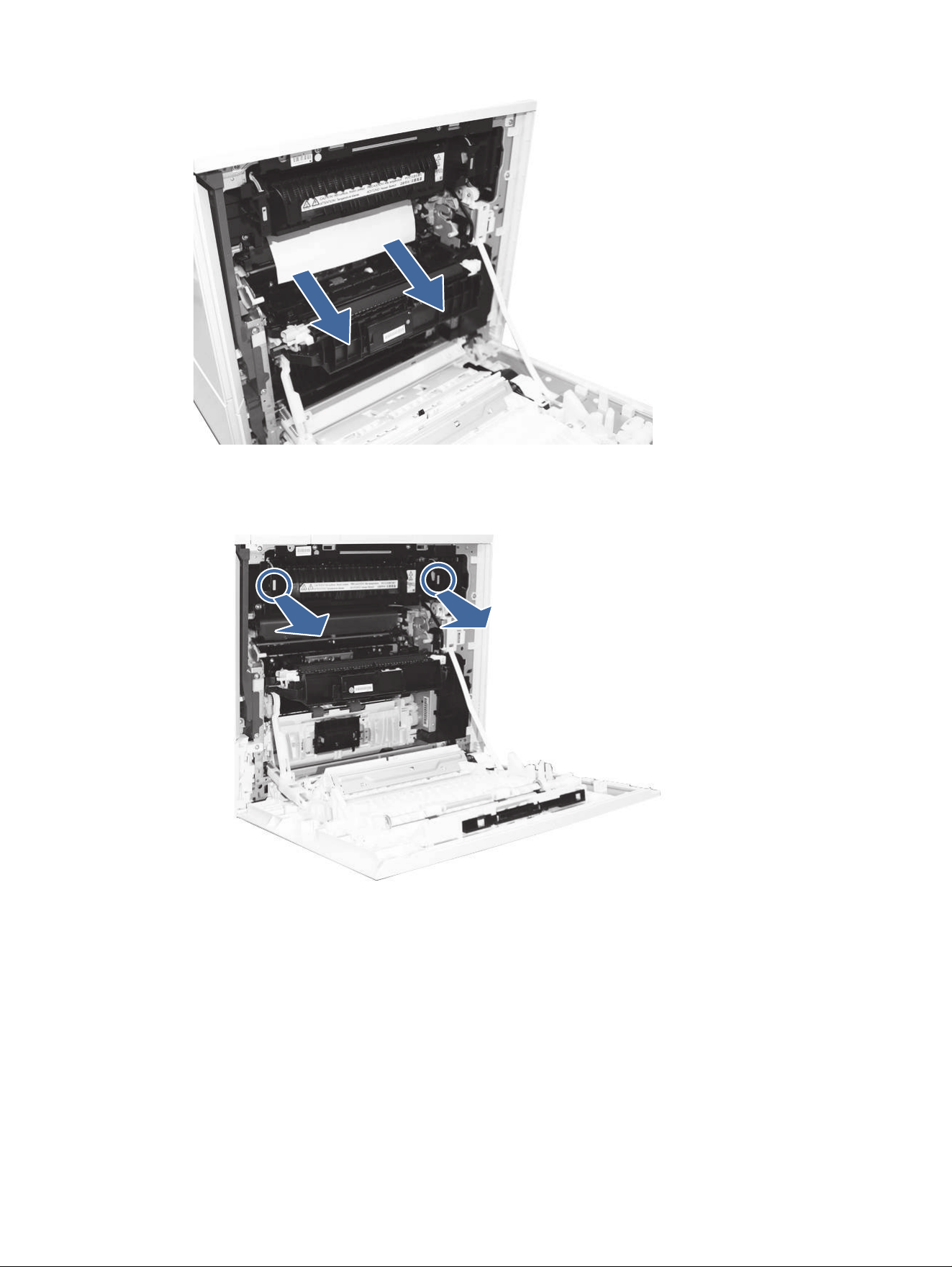
3. Remove the fuser and remove any jammed paper found.
a. Squeeze the release levers on the handles (circle call-outs) and then remove the fuser.
13.B9 jam errors in the fuser
197
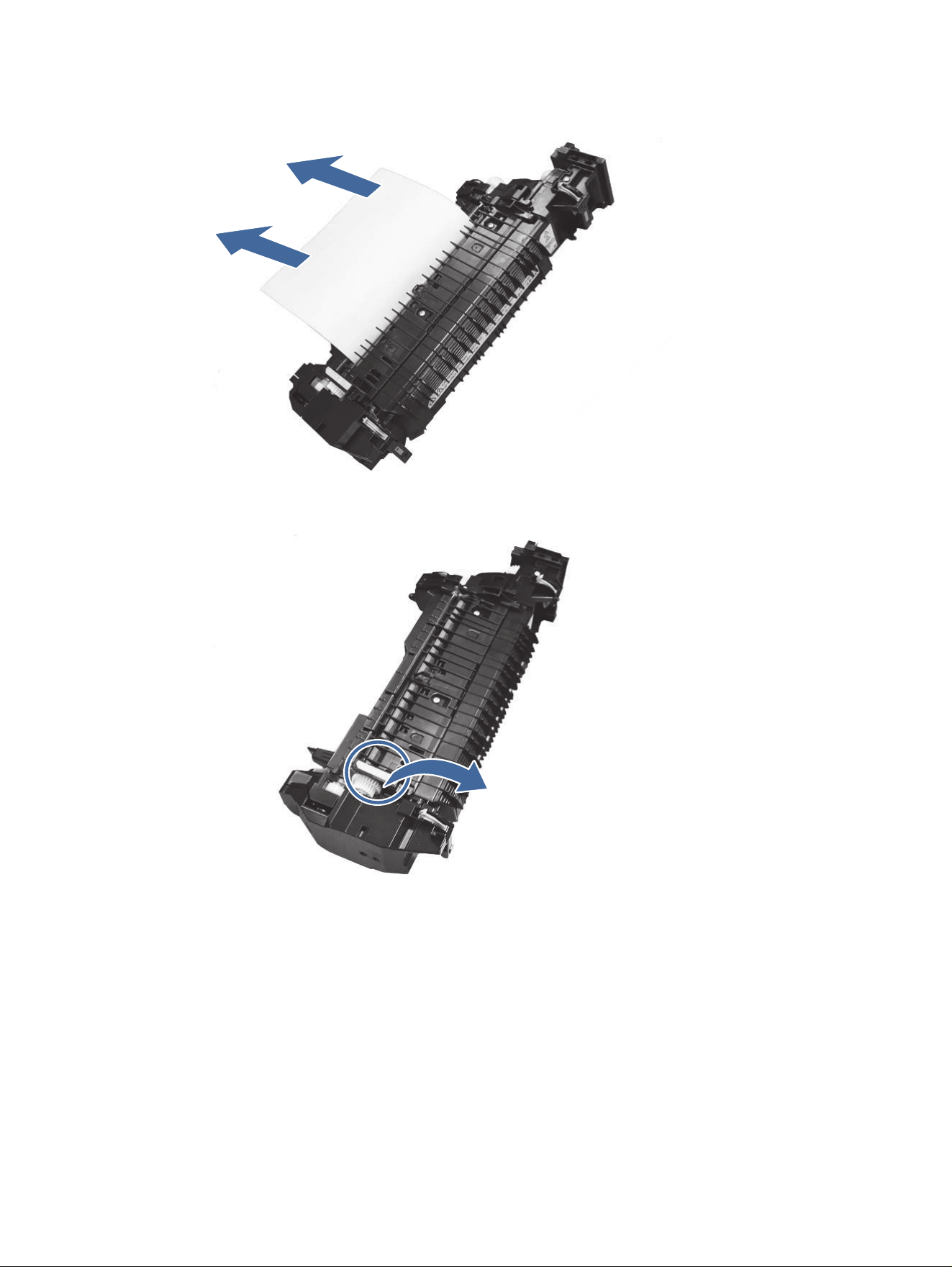
b. Remove any paper from the exit of the fuser.
c. Open the fuser access and check for a z-fold paper jam.
198
Chapter 9 Solve problems
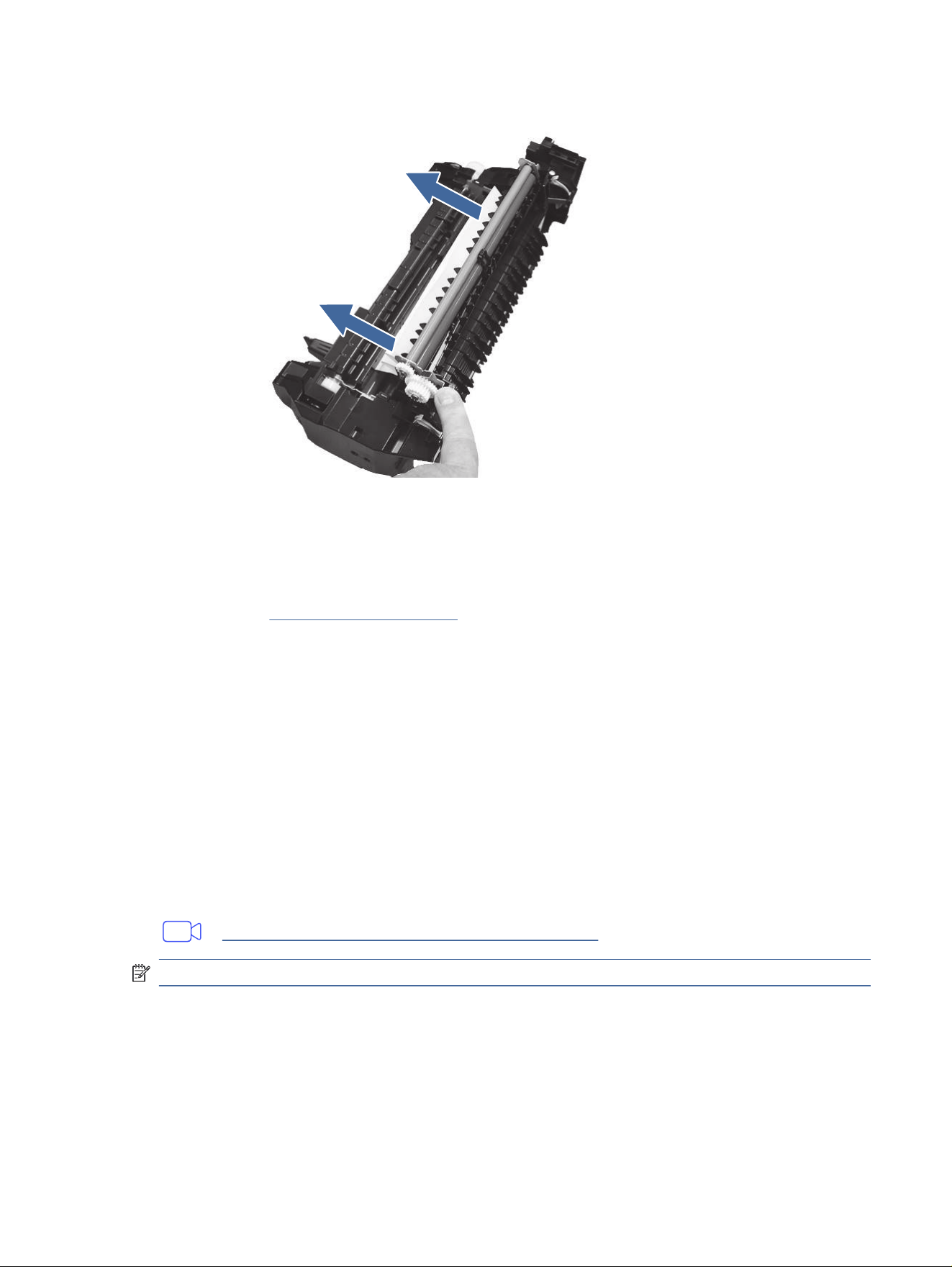
d. Remove jammed paper from fuser.
e. Reinstall the fuser and close the right door.
4. If the error persists, ensure the type and quality of the paper being used meets the HP
specifications for the printer.
5. If the error persists, contact your HP-authorized service or support provider, or contact customer
support at www.hp.com/go/contactHP.
13.D3 jam errors in the duplexer
Use the following procedure to clear paper jams in the duplexer area. When a jam occurs, the control
panel displays an animation that assists in clearing the jam.
Recommended action for customers
When a jam occurs, the control panel displays a message and an animation that assists in clearing the
jam.
● 13.D3.Dz Duplex delivery delay jam
● 13.D3.FF Residual paper jam in right door
z = Fuser mode. This can be 0-9 or A-F.
View a video of how to clear a jam in the duplexer area
NOTE: The fuser is hot while the printer is in use. Wait for the fuser to cool before clearing jams.
13.D3 jam errors in the duplexer
199
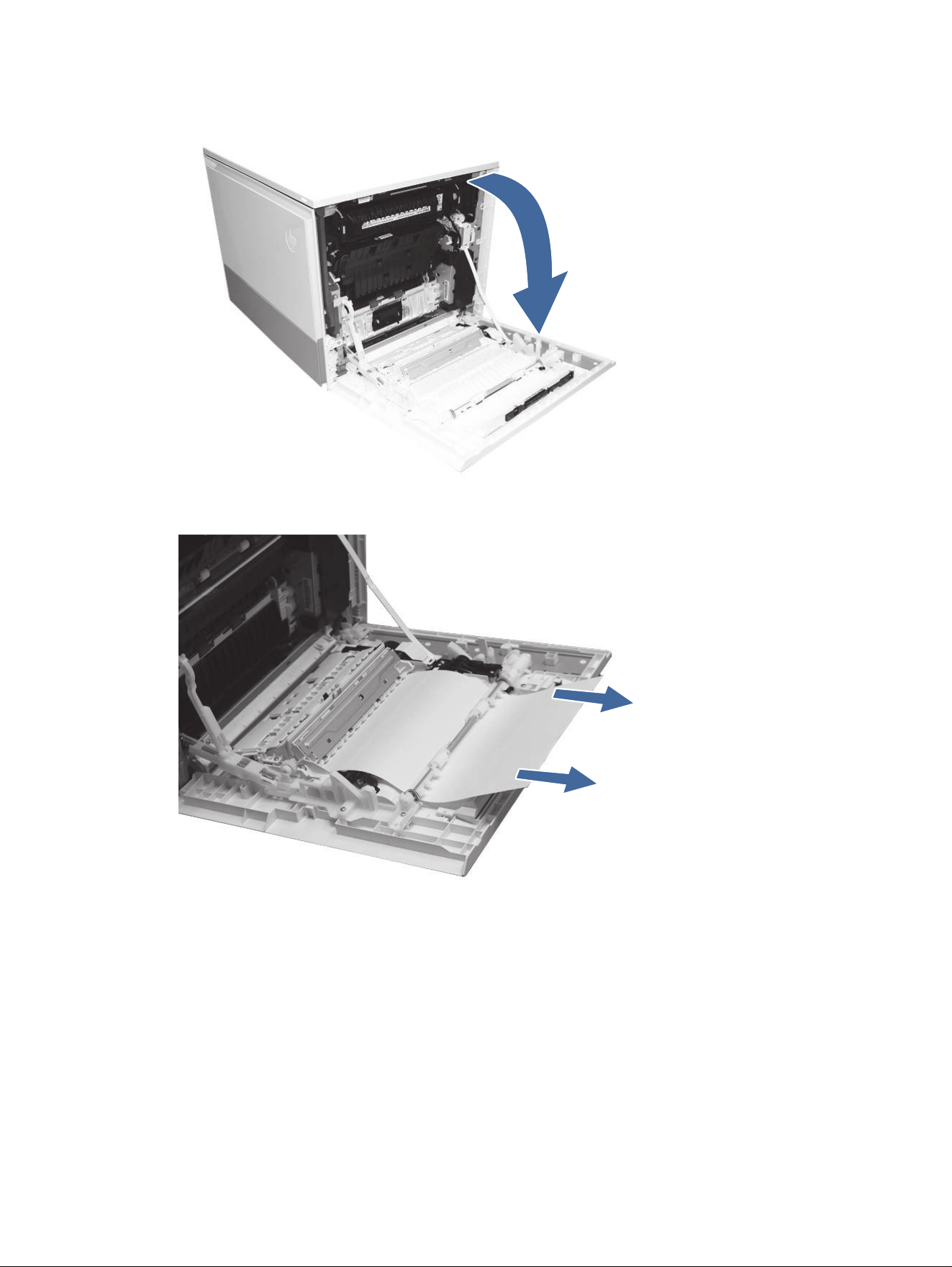
1. Open the right door.
2. Gently remove any jammed paper from the duplexer paper path.
200
Chapter 9 Solve problems
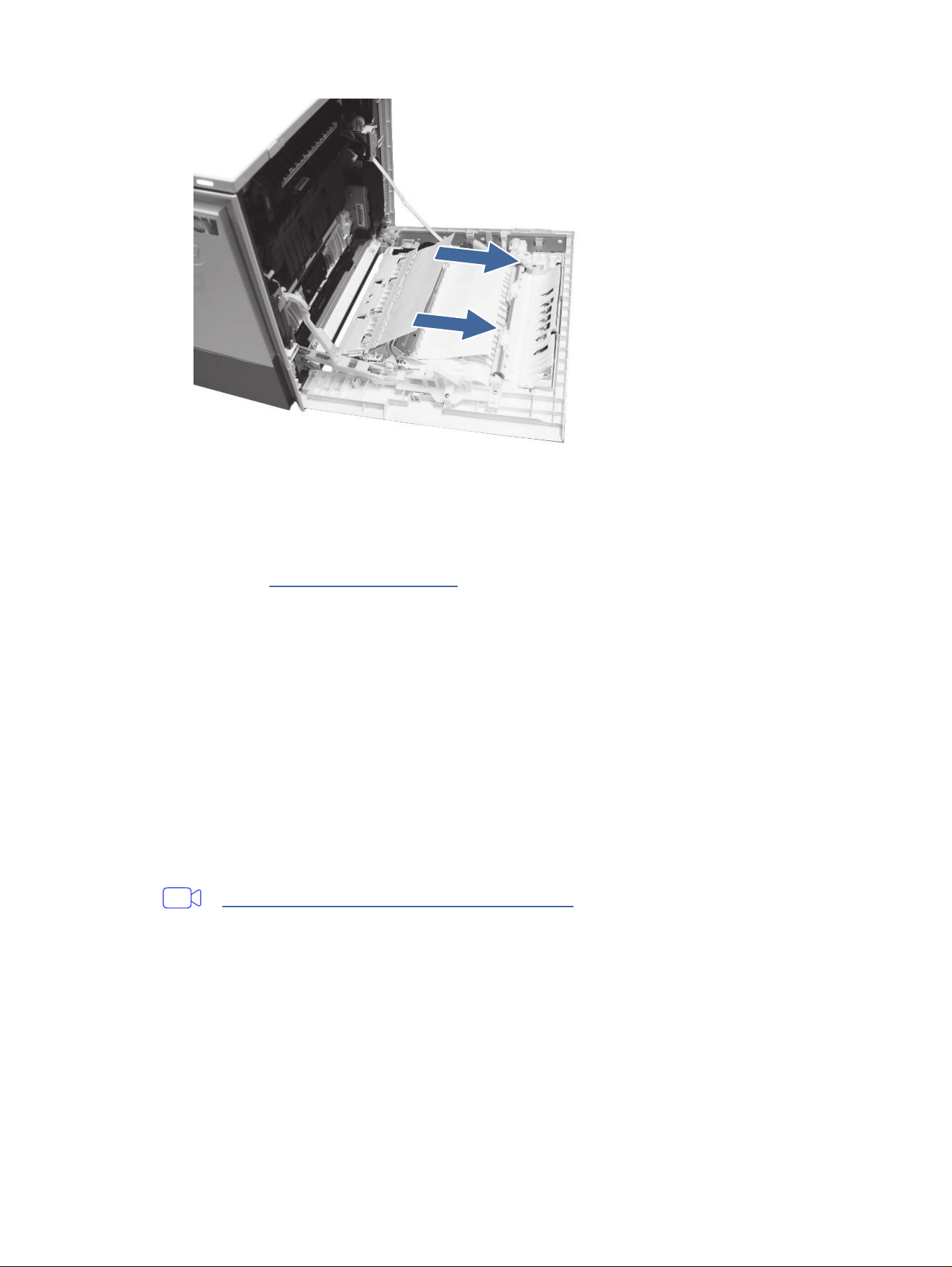
3. Close the right door.
4. If the error persists, ensure the type and quality of the paper being used meets the HP
specifications for the printer.
5. If the error persists, contact your HP-authorized service or support provider, or contact customer
support at www.hp.com/go/contactHP.
13.E1 jam error in the output bin
Use the following procedure to check for paper in all possible jam locations in the output bin. When a jam
occurs, the control panel displays an animation that assists in clearing the jam.
Recommended action for customers
When a jam occurs, the control panel displays a message and an animation that assists in clearing the
jam.
● 13.E1.Dz Jam in output bin
● 13.E1.FF Residual paper jam in output bin
z = paper type that is being printed on. This can be 0-9 or A-F.
View a video of how to clear a jam in the output bin
13.E1 jam error in the output bin
201
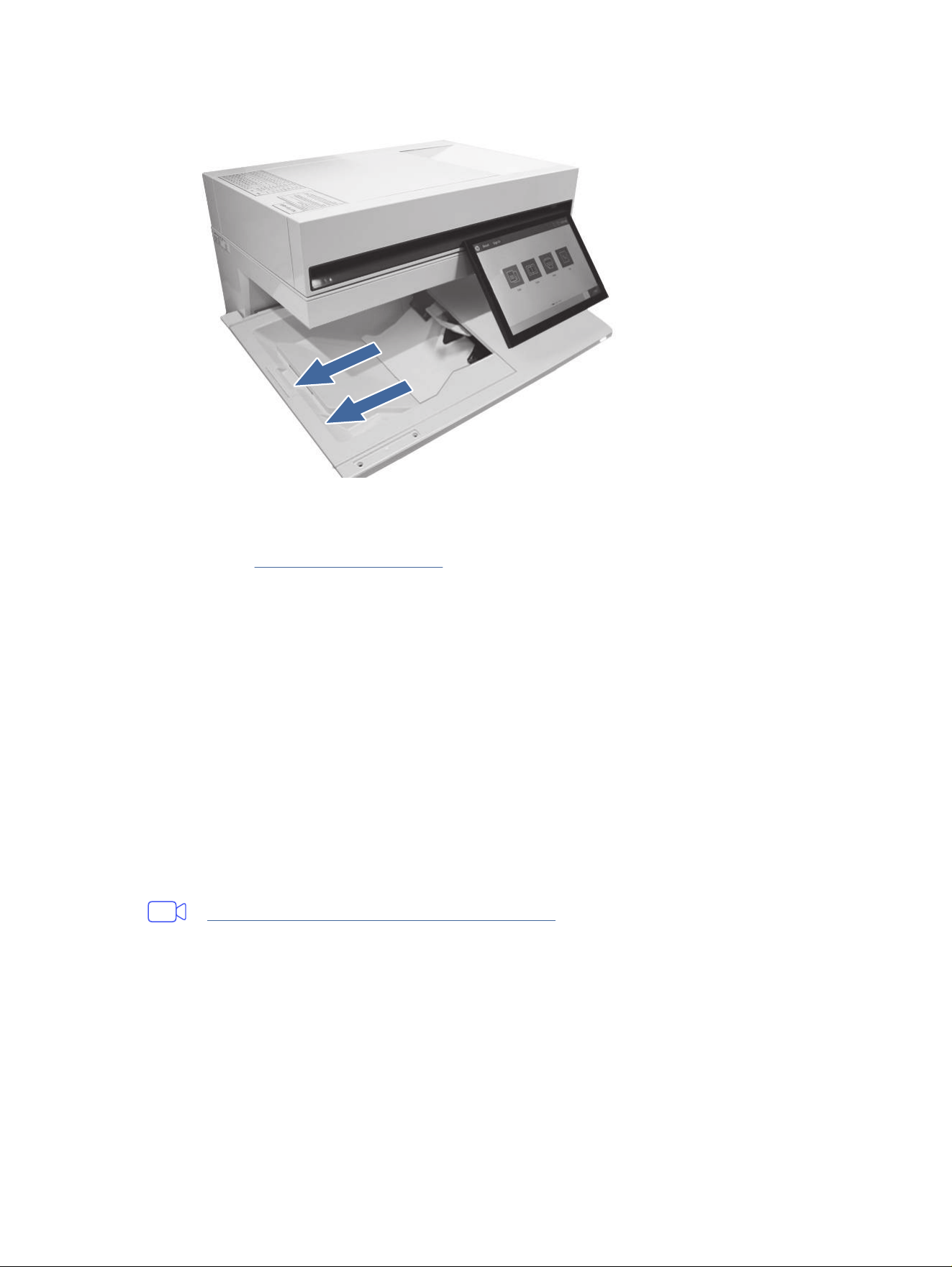
1. If paper is visible in the output bin, grasp the leading edge and remove it.
2. Ensure the type and quality of the paper being used meets the HP specifications for the printer.
3. If the error persists, contact your HP-authorized service or support provider, or contact customer
support at www.hp.com/go/contactHP.
13.E2 jam error in top cover
Use the following procedure to check for paper in all possible jam locations in the top cover area. When
a jam occurs, the control panel displays an animation that assists in clearing the jam.
Recommended action for customers
When a jam occurs, the control panel displays a message and an animation that assists in clearing the
jam.
● 13.E2.yz Jam in Top cover
y = "A" (stay jam) or "D" (delay jam)
z = 1-4 (output bin page is going to)
These jams can only be present if the floor standing finisher is installed
View a video of how to clear a jam in the top cover.
202
Chapter 9 Solve problems
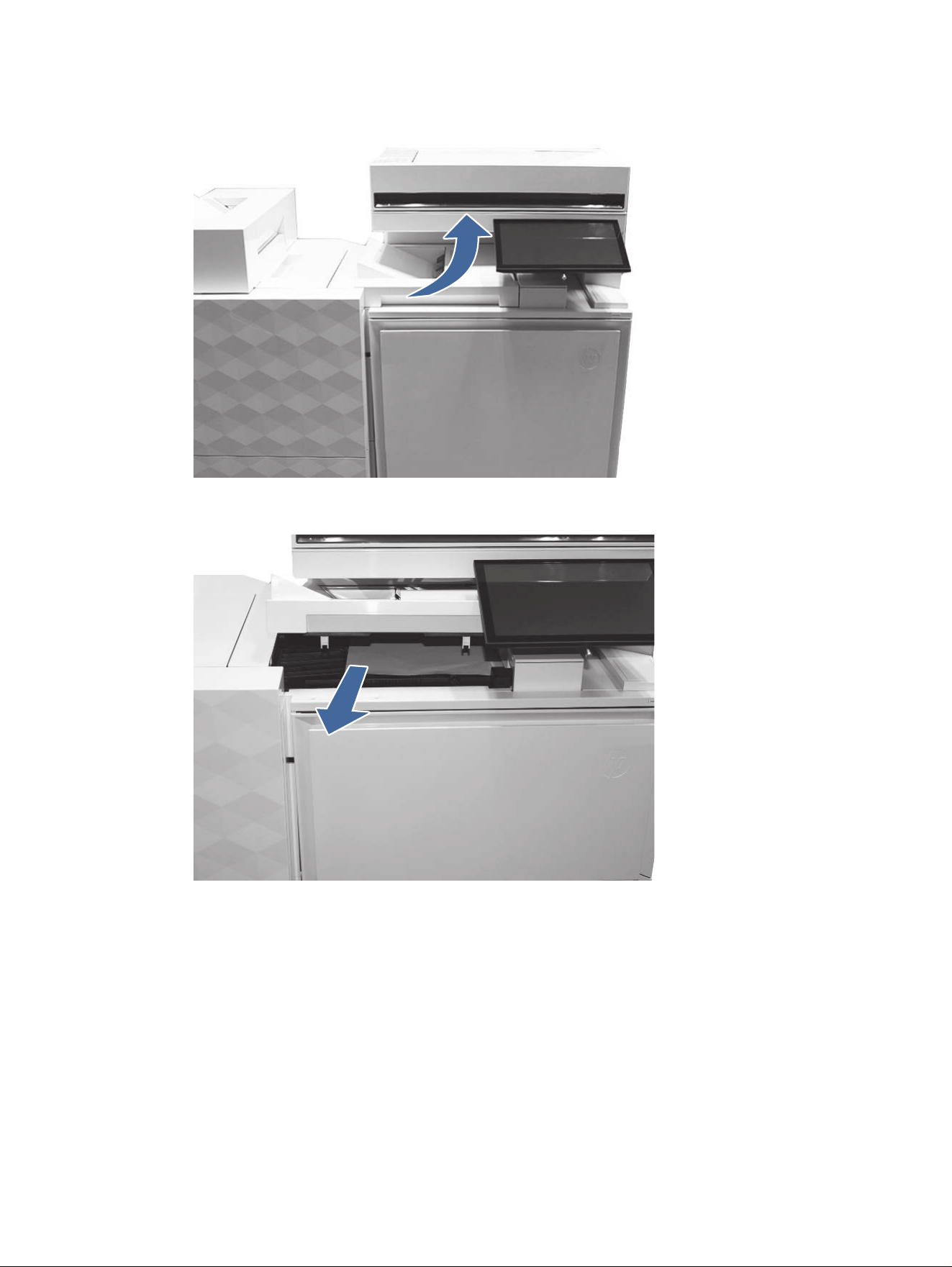
1. Open the printer top access cover.
2. Remove all paper from inside the top cover.
13.E2 jam error in top cover
203
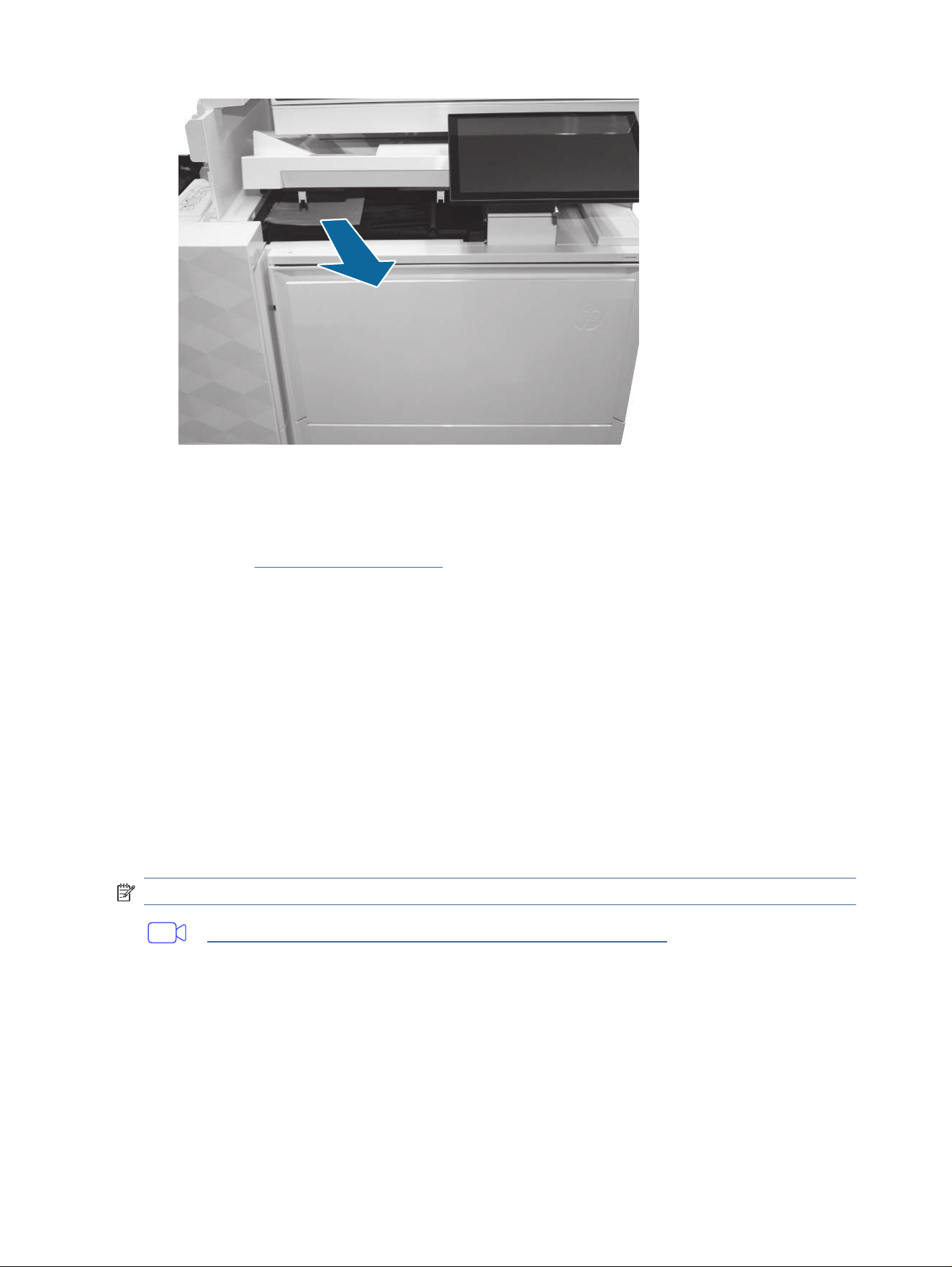
3. Make sure that the floor standing finisher is correctly secured to the printer.
4. Make sure the type and quality of the paper being used meets the HP specifications for the printer.
5. If the error persists, contact your HP-authorized service or support provider, or contact customer
support at www.hp.com/go/contactHP.
13.60 jam errors in the fuser exit area when printing to a stapler/stacker or floor-
standing finisher
Use the following procedure to check for paper in all possible jam locations in the fuser exit area when
printing to a finisher. When a jam occurs, the control panel displays an animation that assists in clearing
the jam.
Recommended action for customers
When a jam occurs, the control panel displays a message and an animation that assists in clearing the
jam.
● 13.60.51, 13.60.52 Paper too short jam
● 13.60.61, 13.60.62, 13.60.63, 13.60.64 Inter-Page Gap Jam
NOTE: The images provide do not show any accessories or copy module attached to the printer.
View a video of how to clear a jam in the fuser exit area on finisher.
204
Chapter 9 Solve problems
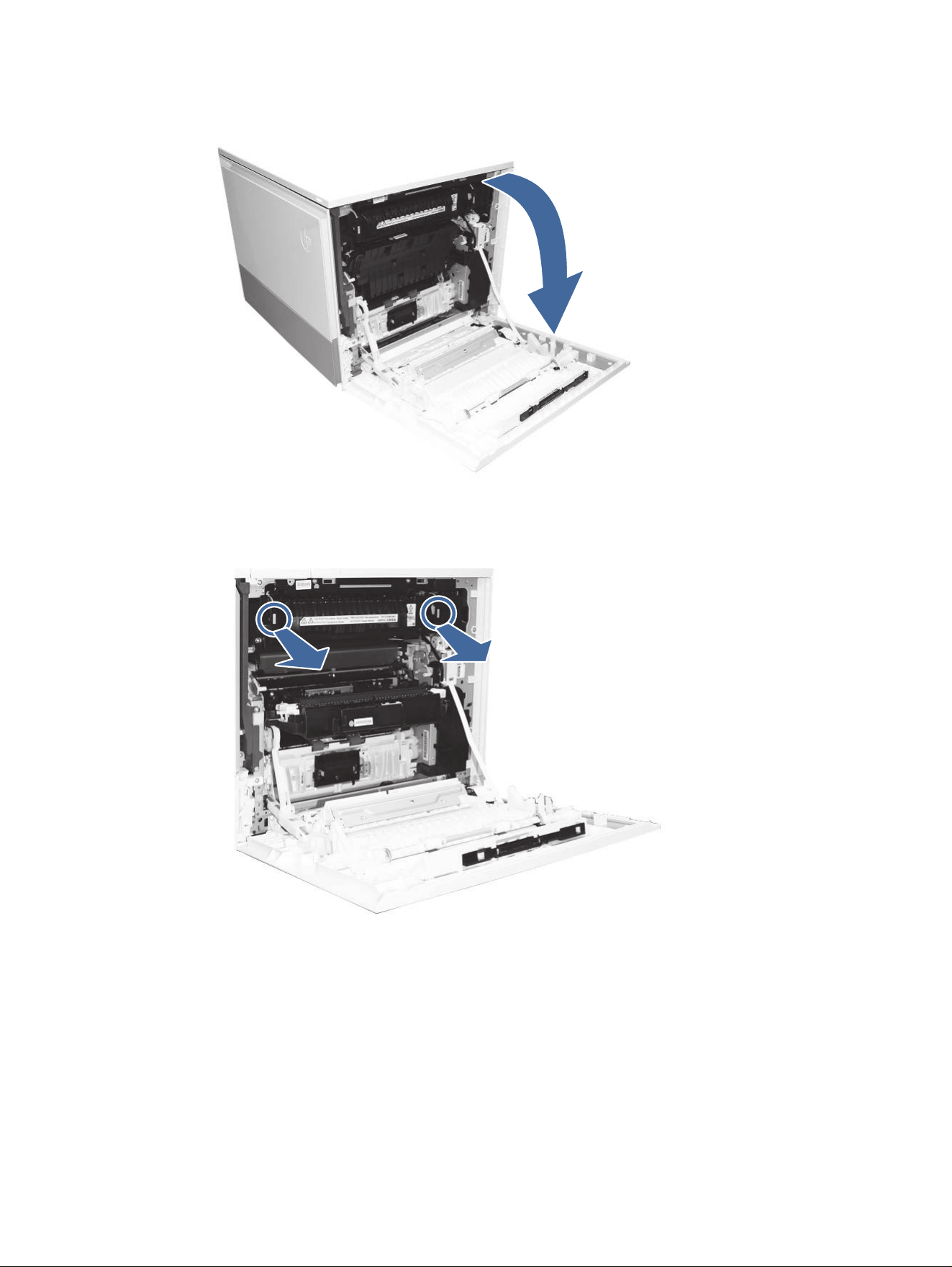
1. Open the right door.
2. Remove the fuser and remove any jammed paper found.
a. Squeeze the release levers on the handles (circle call-outs) and then remove the fuser.
13.60 jam errors in the fuser exit area when printing to a stapler/stacker or floor-standing finisher
205
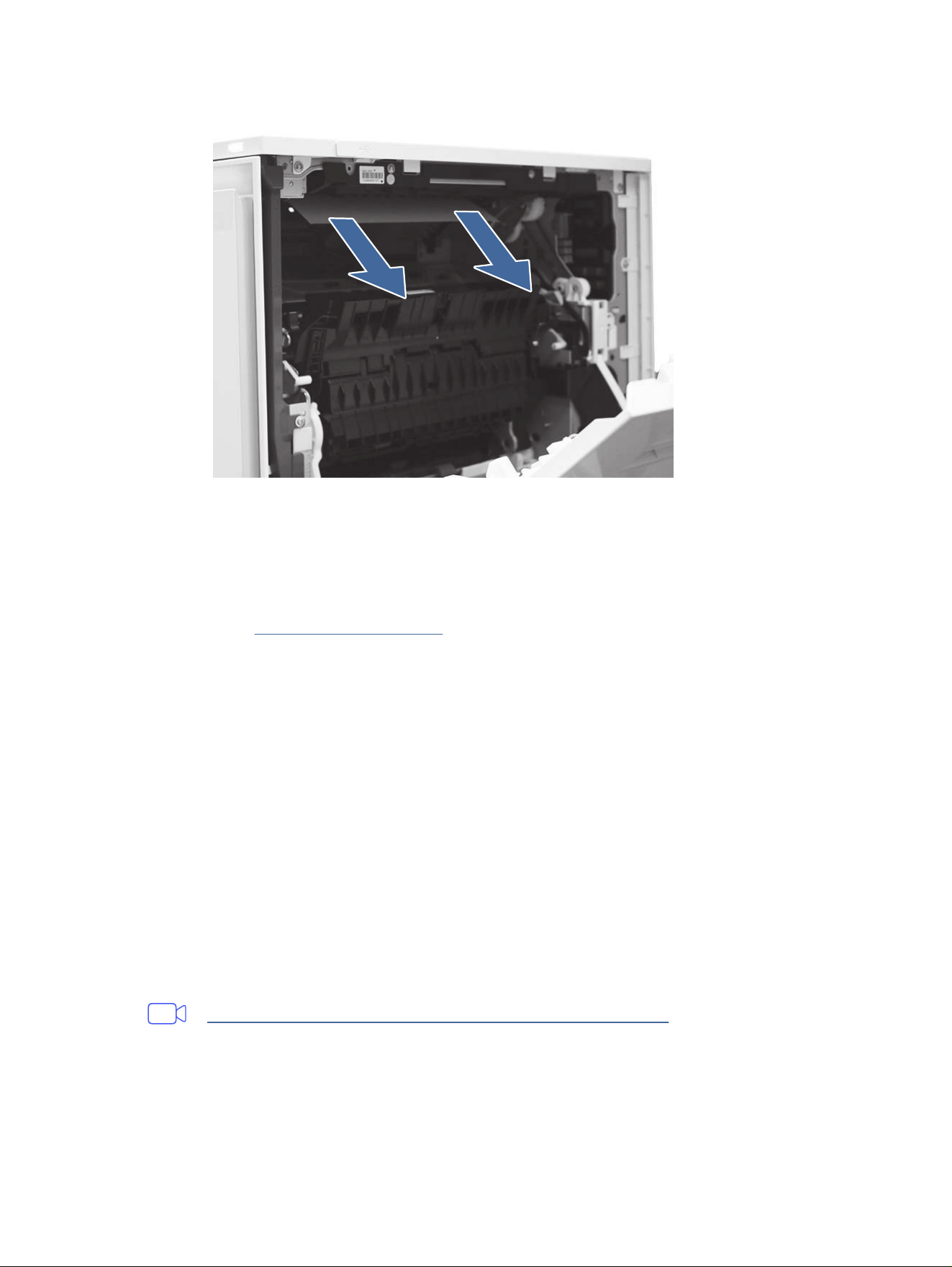
b. Remove any paper jammed in the fuser exit area.
c. Reinstall the fuser and close the right door.
3. Close right door to allow the printer to clear jam message.
4. Ensure the type and quality of the paper being used meets the HP specifications for the printer.
5. If the error persists, contact your HP-authorized service or support provider, or contact customer
support at www.hp.com/go/contactHP.
13.80, 13.83, or 13.84 jam errors in the 3 Bin Stapler/Stacker
Use the following procedure to check for paper in all possible jam locations in the 3-bin stapler/stacker.
When a jam occurs, the control panel displays an animation that assists in clearing the jam.
Recommended action for customers
When a jam occurs, the control panel displays a message and an animation that assists in clearing the
jam.
● 13.80.yz Jam in 3 Bin stapler/stacker
● 13.83.yz Jam in 3 Bin stapler/stacker
● 13.84.yz Jam in 3 Bin stapler/stacker
y = "A" (stay jam), "B" (delay jam) "F" (residual jam)
z = Output destination tray 0-4
View a video of how to clear a jam in the 3-bin stapler/stacker area.
206
Chapter 9 Solve problems
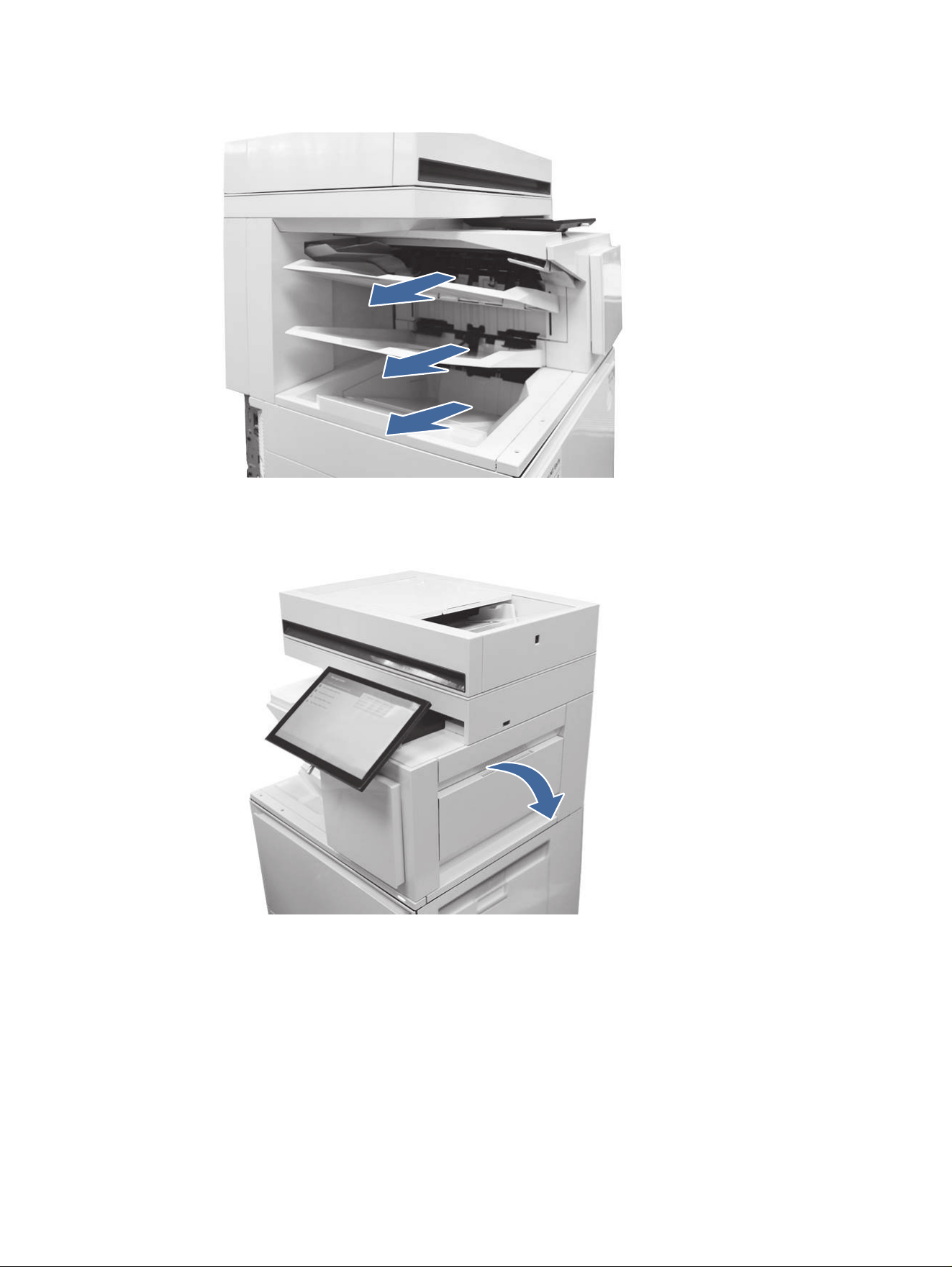
1. Remove any paper from the output bins.
2. Clear all paper from upper right door.
a. Open the upper right door.
13.80, 13.83, or 13.84 jam errors in the 3 Bin Stapler/Stacker
207
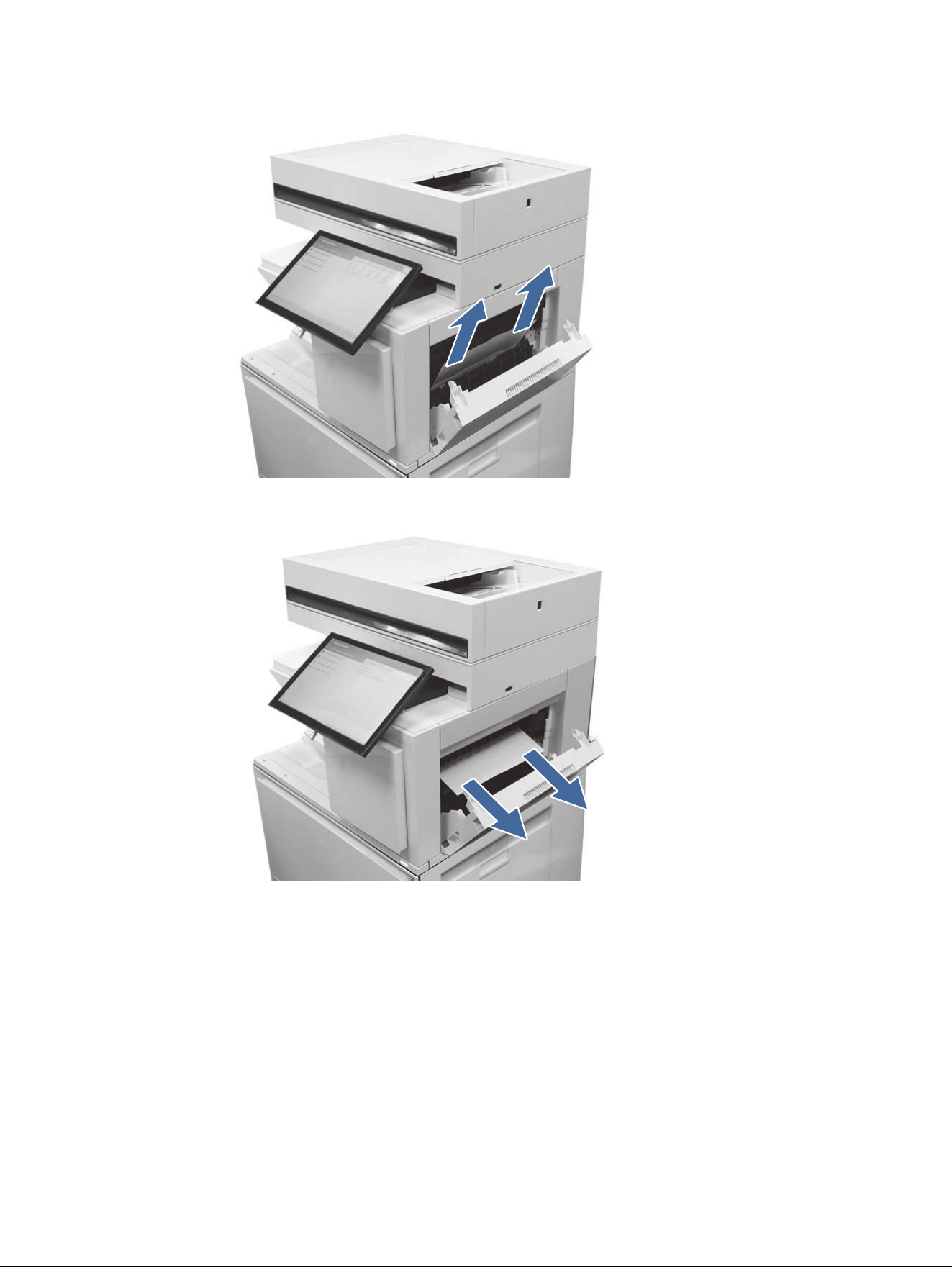
b. Remove paper from input area inside the door.
c. Remove paper from upper output area inside the door.
208
Chapter 9 Solve problems
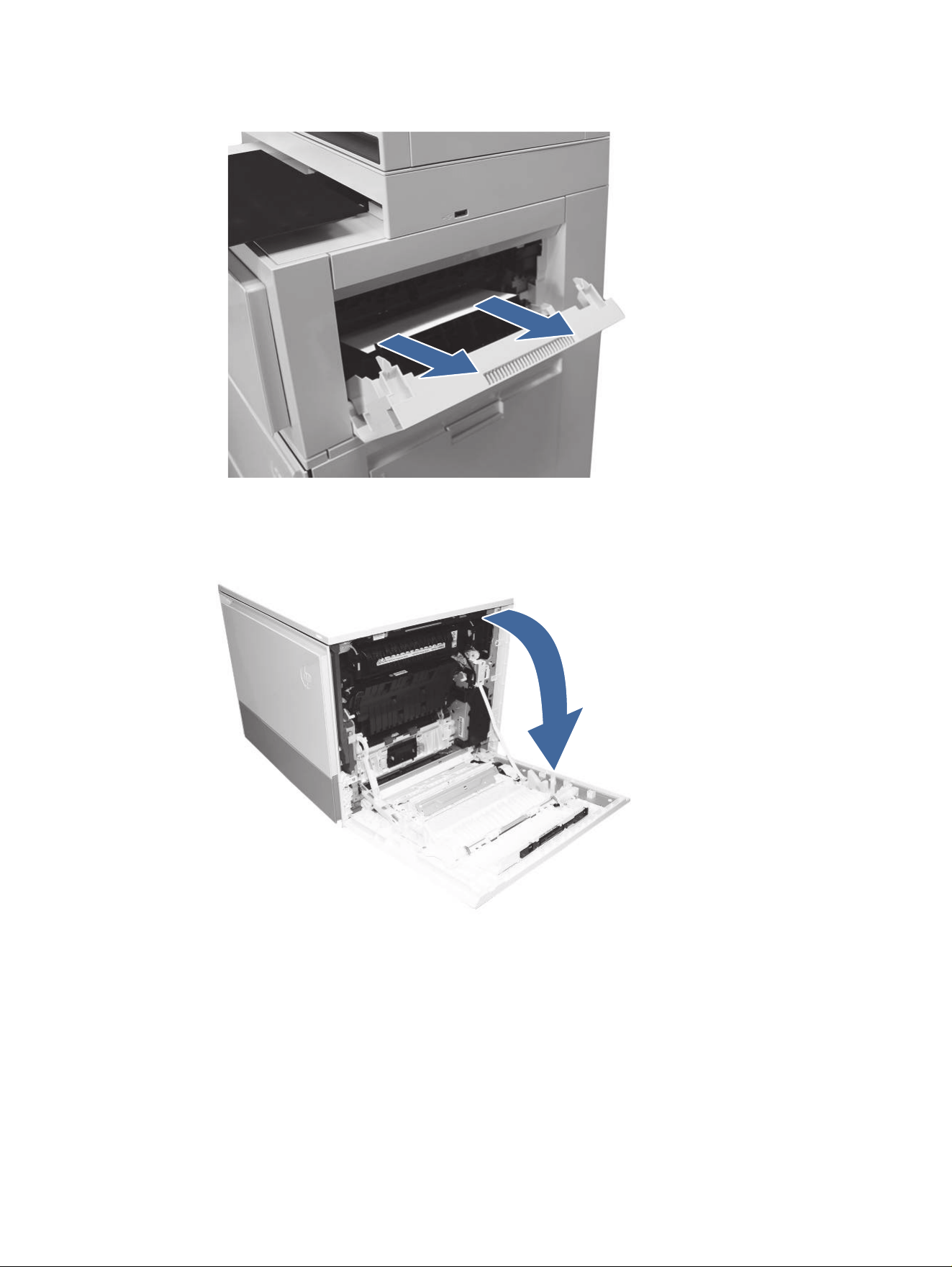
d. Remove paper from upper standard exit area.
e. Close the upper right door.
3. Open the right door.
4. Remove the fuser and remove any jammed paper found.
13.80, 13.83, or 13.84 jam errors in the 3 Bin Stapler/Stacker
209
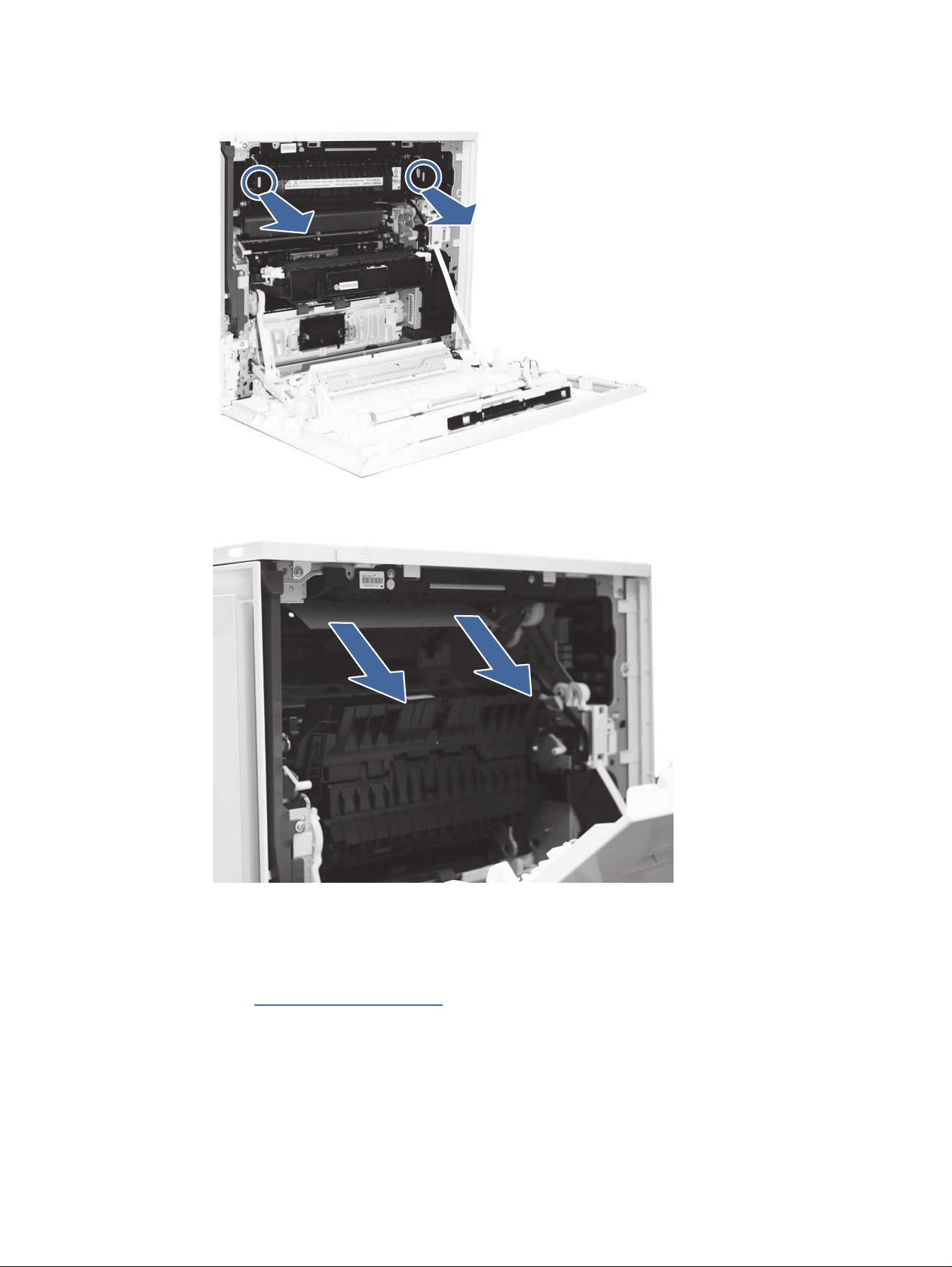
a. Squeeze the release levers on the handles (circle call-outs) and then remove the fuser.
b. Remove any paper jammed in the fuser exit area.
c. Reinstall the fuser and close the right door.
5. Ensure the type and quality of the paper being used meets the HP specifications for the printer.
6. If the error persists, contact your HP-authorized service or support provider, or contact customer
support at www.hp.com/go/contactHP.
13.40 or 13.47 Punch jam error in the Floor-standing finisher
Use the following procedure to check for paper in all possible jam locations in the floor-standing finisher
punch area. When a jam occurs, the control panel displays an animation that assists in clearing the jam.
Recommended action for customers
210
Chapter 9 Solve problems
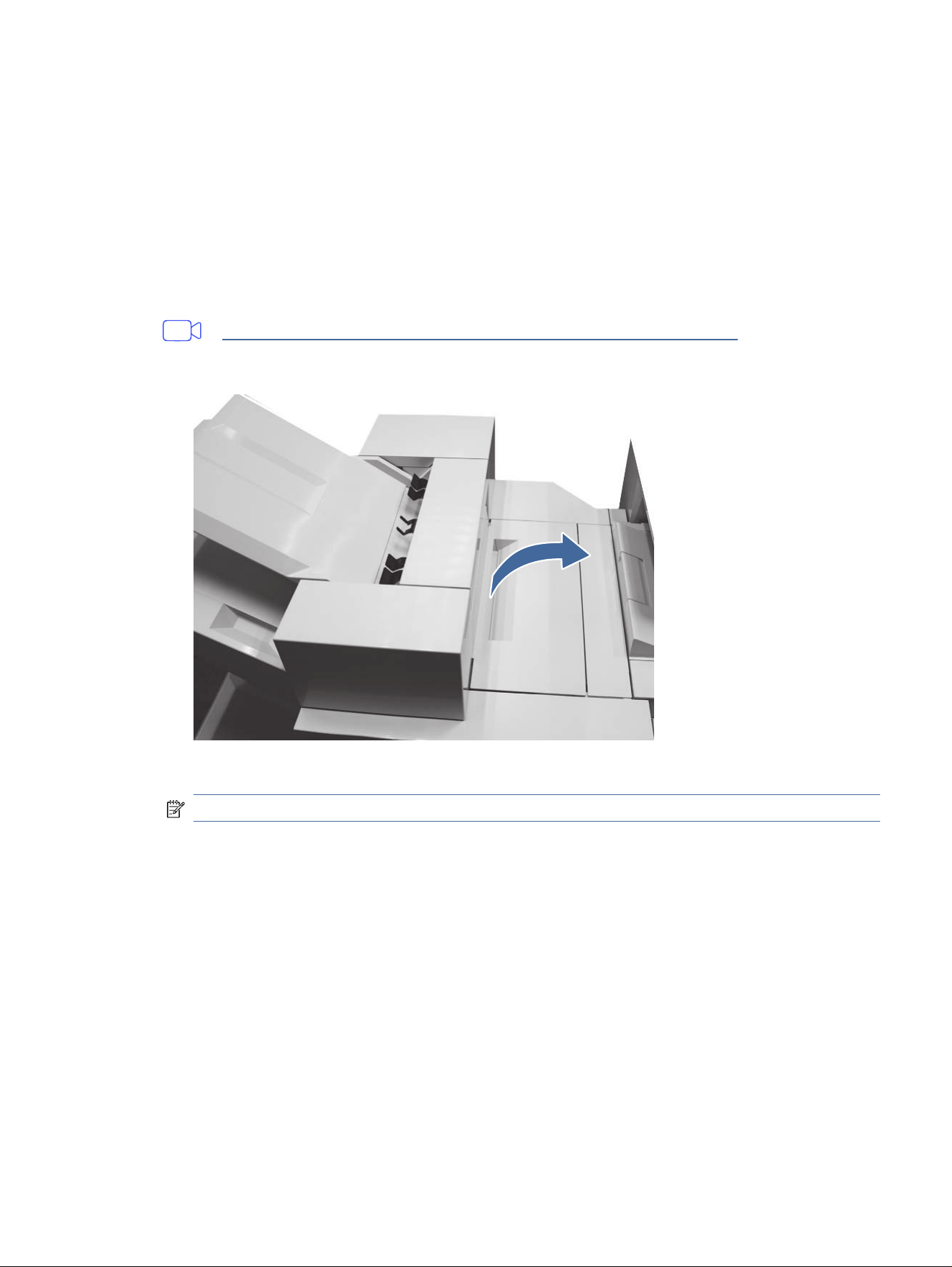
When a jam occurs, the control panel displays a message and an animation that assists in clearing the
jam.
● 13.40.yz Punch inlet jam
y = "A" (stay jam), "D" (delay jam) or "F" (residual jam)
z = Output destination tray 0, 2-4
● 13.47.4z Punch jam
z = Output destination tray 2-4
View a video of how to clear a jam in the floor-standing finisher punch area
1. Open the top left door.
2. Rotate the green dial on the top to the right or left
NOTE: Use the directions on the inside to assist in clearing the jam.
13.40 or 13.47 Punch jam error in the Floor-standing finisher
211
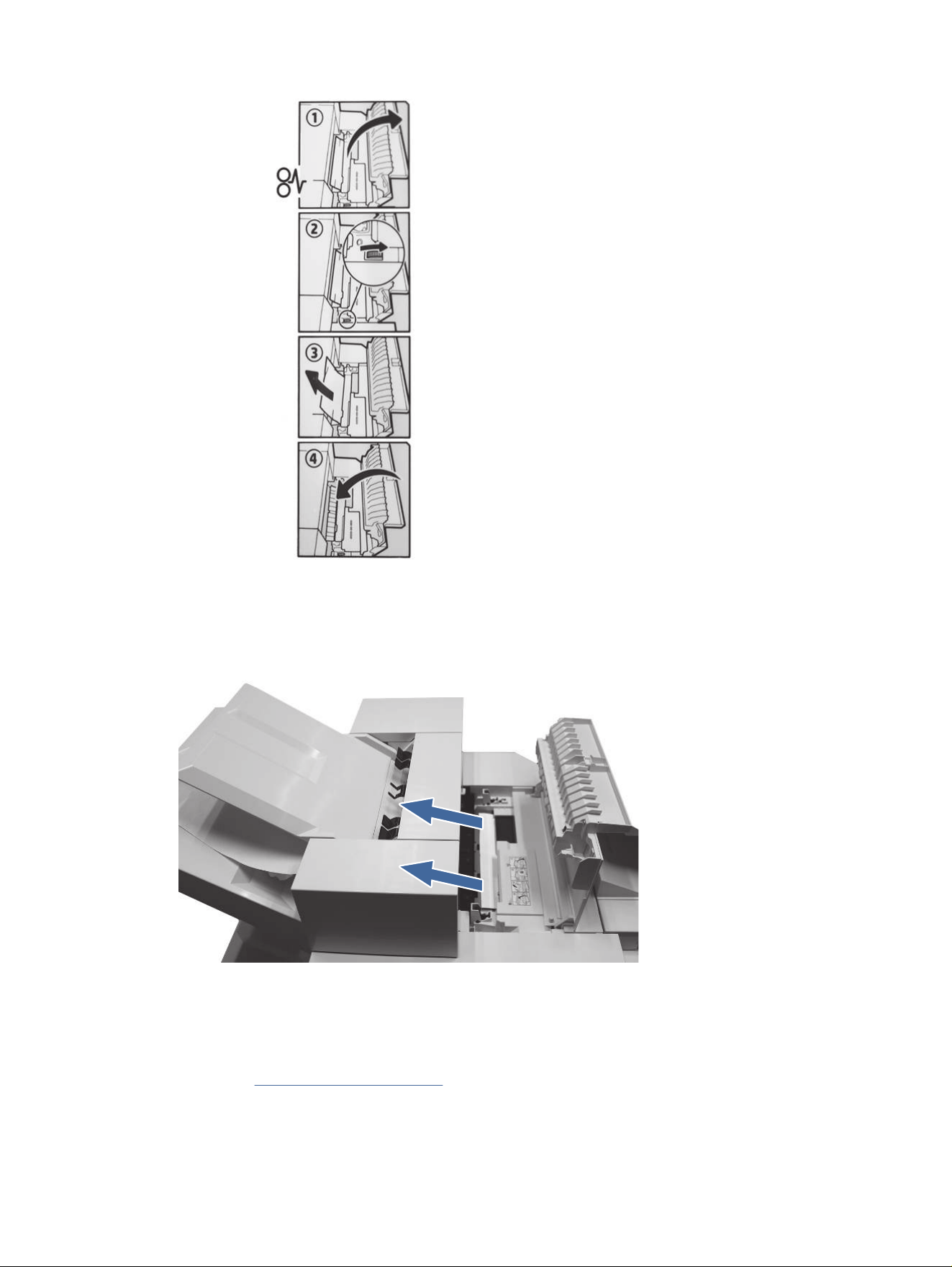
3. Remove paper from the top left door.
4. Close the top left door.
5. Ensure the type and quality of the paper being used meets the HP specifications for the printer.
6. If the error persists, contact your HP-authorized service or support provider, or contact customer
support at www.hp.com/go/contactHP.
212
Chapter 9 Solve problems
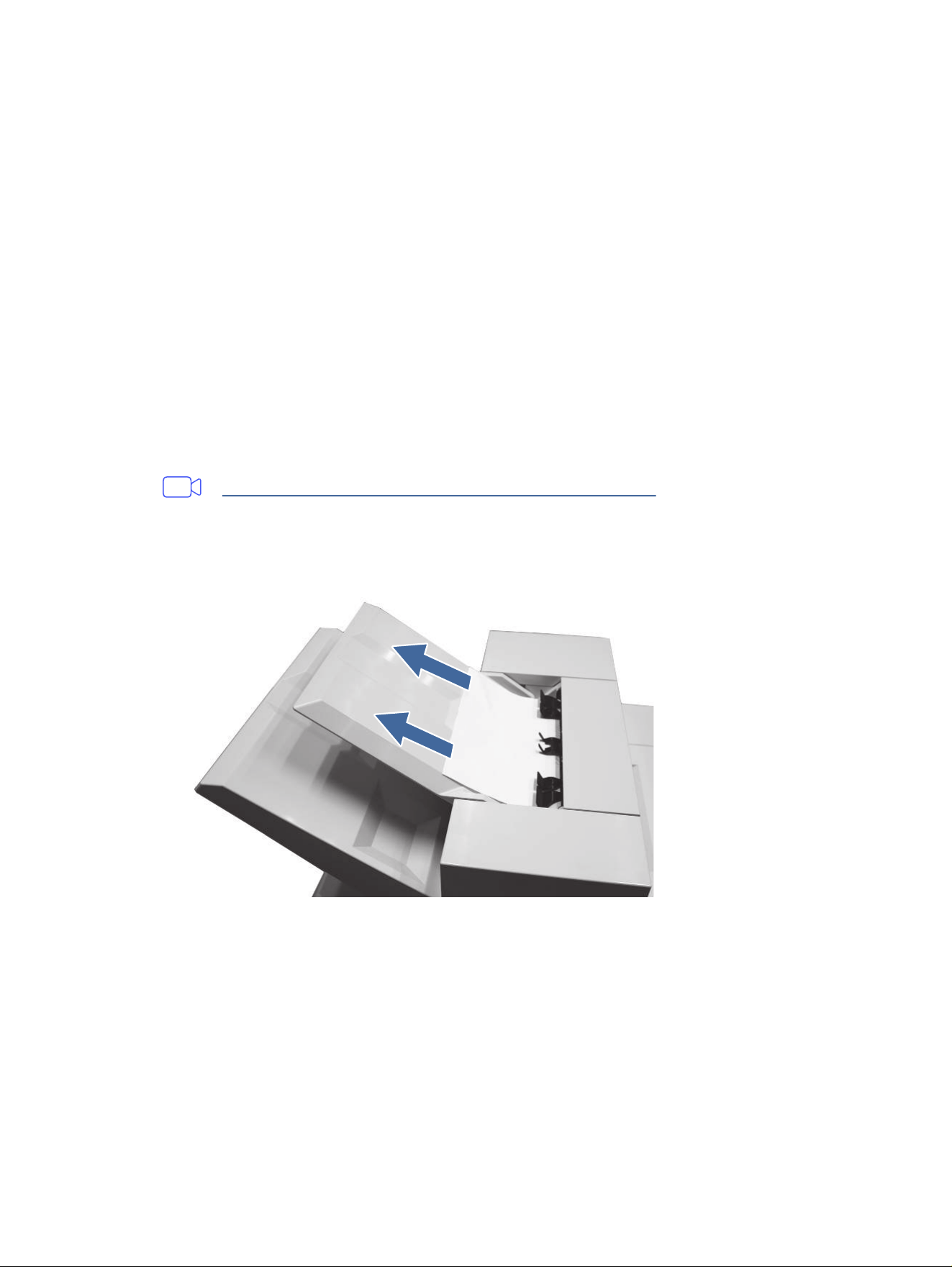
13.6, 13.7, or 13.8 jam error in the Floor-standing finisher
Use the following procedure to check for paper in all possible jam locations in the floor-standing finisher.
When a jam occurs, the control panel displays an animation that assists in clearing the jam.
Recommended action for customers
When a jam occurs, the control panel displays a message and an animation that assists in clearing the
jam.
● 13.6x.yz Jam in Floor standing stapler/stacker
● 13.7x.yz Jam in Floor standing stapler/stacker
● 13.8x.yz Jam in Floor standing stapler/stacker
x = 0, 1, 3, 4, 5
y = "A" (stay jam), "D" (delay jam), "F" (residual jam)
z = Output destination tray 0-4
View a video of how to clear a jam in the floor-standing finisher
1. Remove any paper jams from the output bins by gently grasping the leading edge and remove it.
13.6, 13.7, or 13.8 jam error in the Floor-standing finisher
213
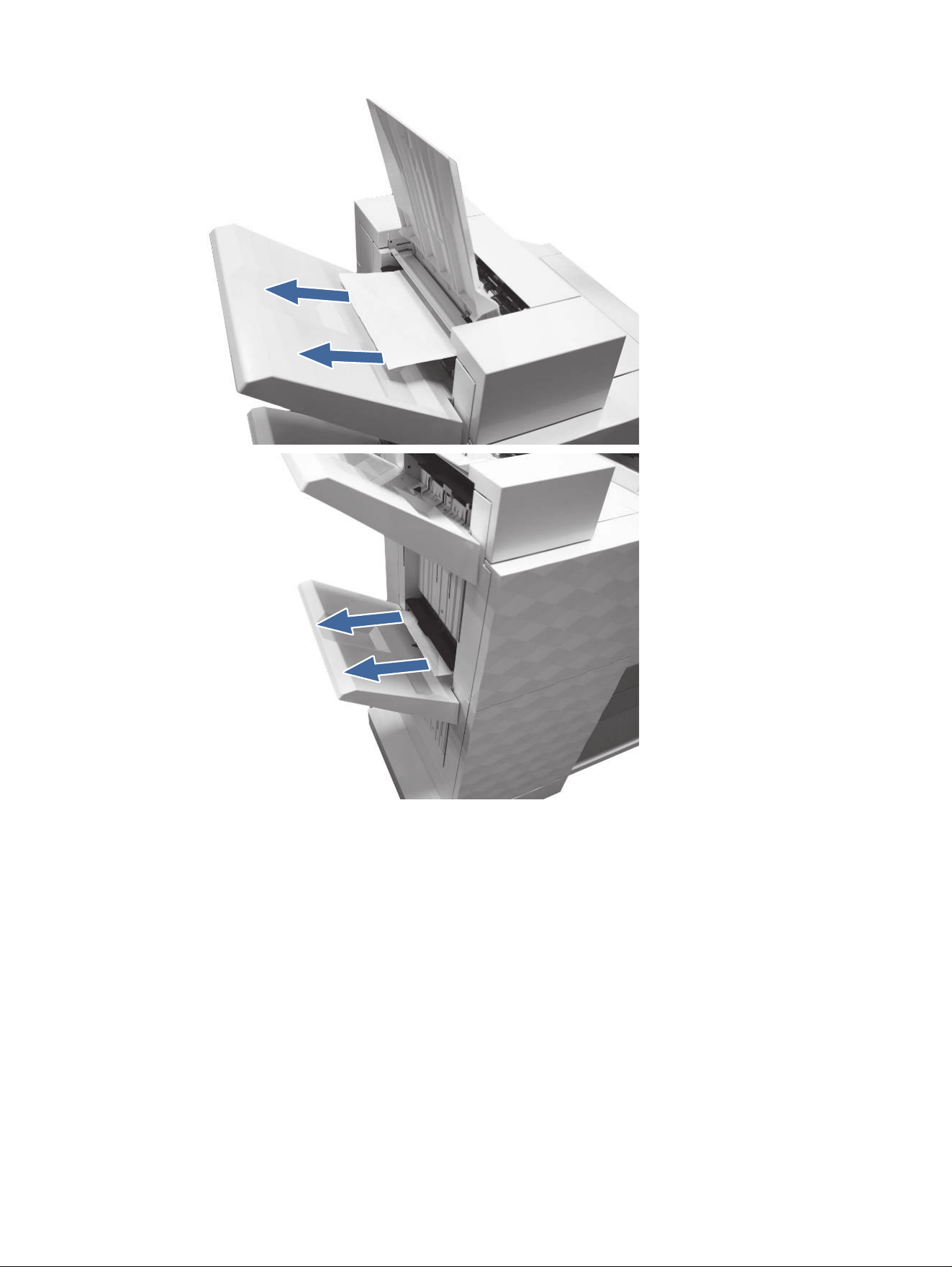
214 Chapter 9 Solve problems
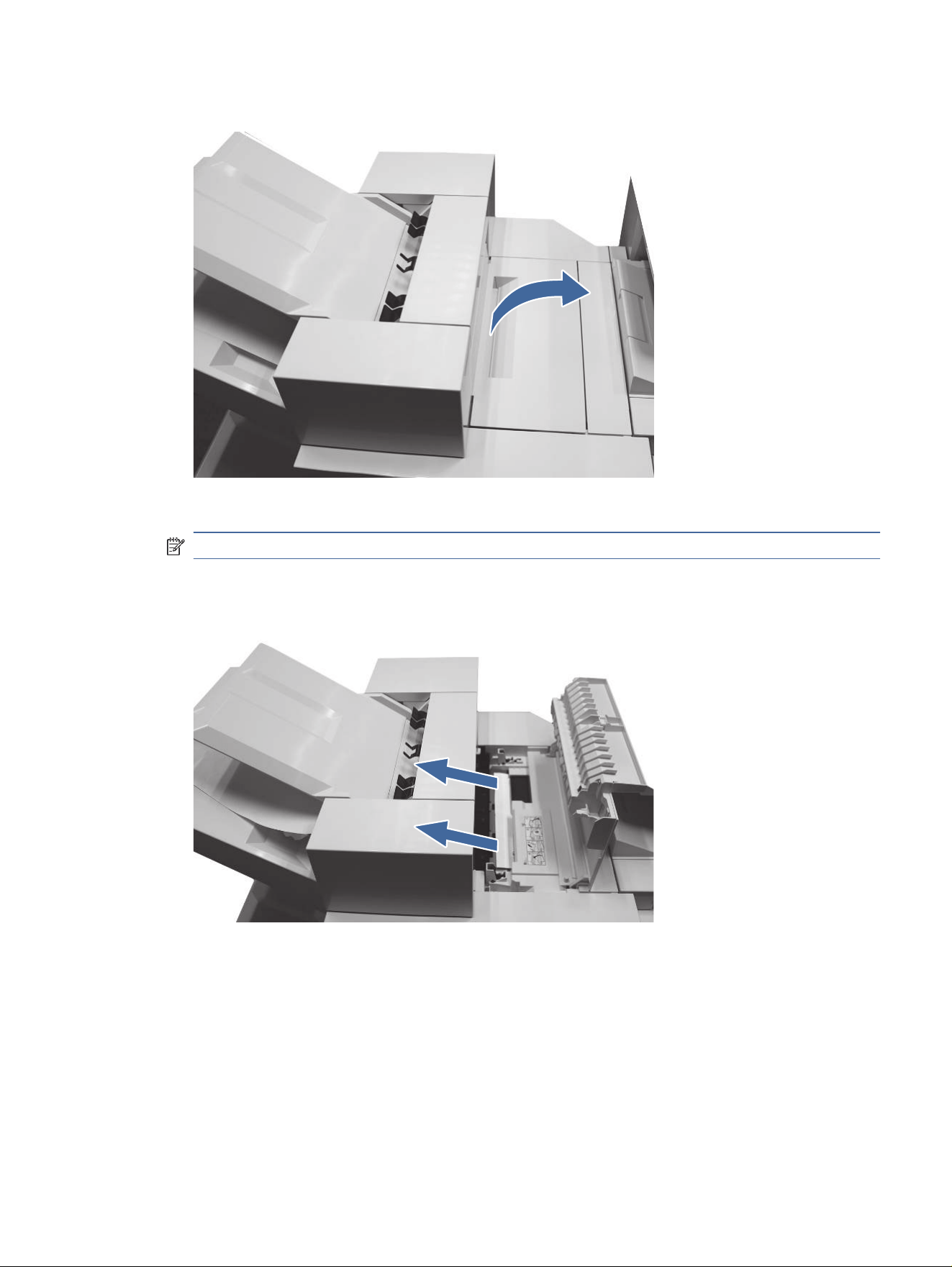
2. Open the top left door.
3. Remove paper from the top left door.
NOTE: Use the directions on the inside to assist in clearing the jam.
13.6, 13.7, or 13.8 jam error in the Floor-standing finisher
215
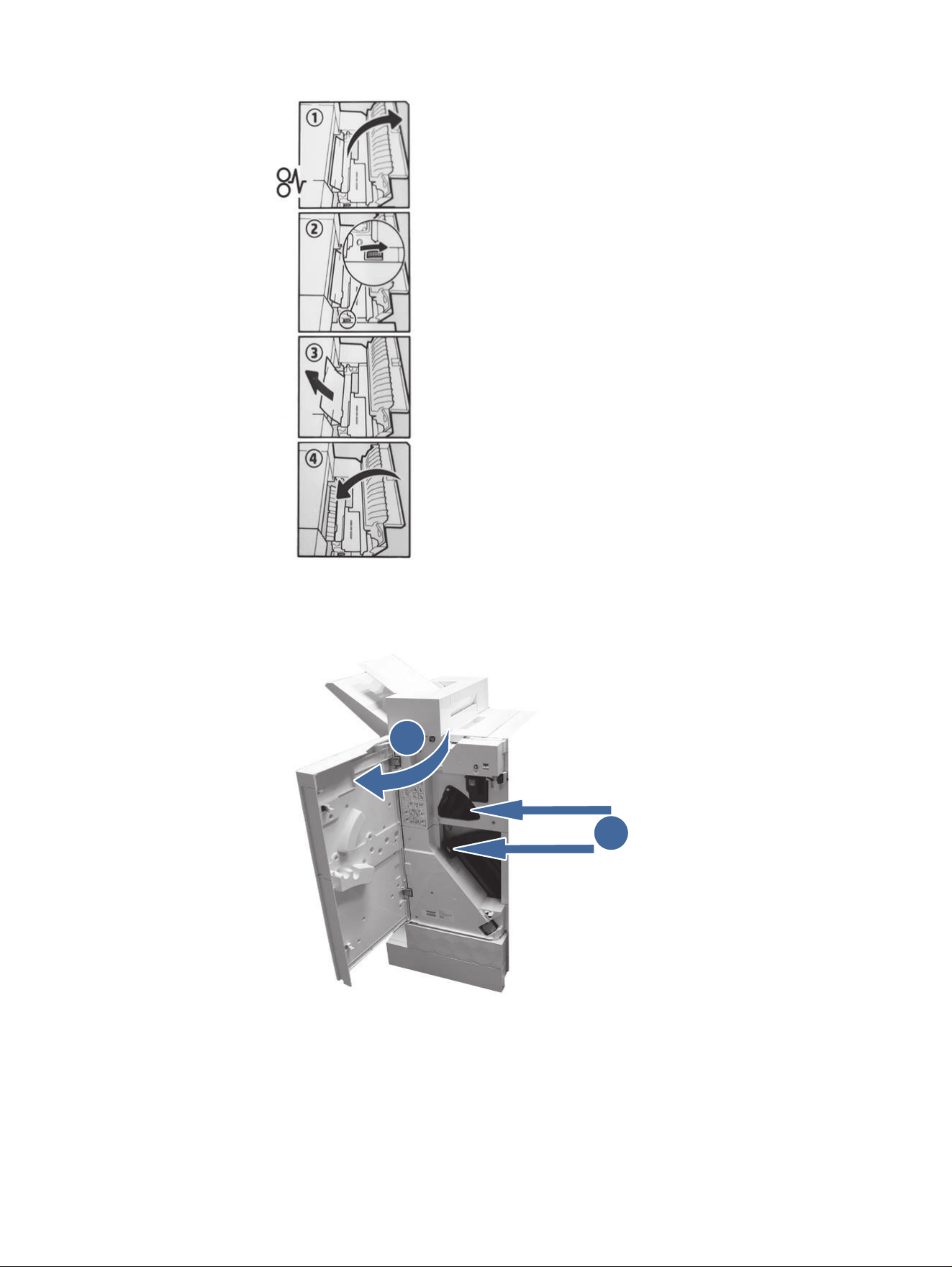
4. Open the front access door to clear any jammed paper.
a. Open the front door and check jam access areas.
1
2
Call-out 1: Open door
Call-out 2: Check access areas
216
Chapter 9 Solve problems
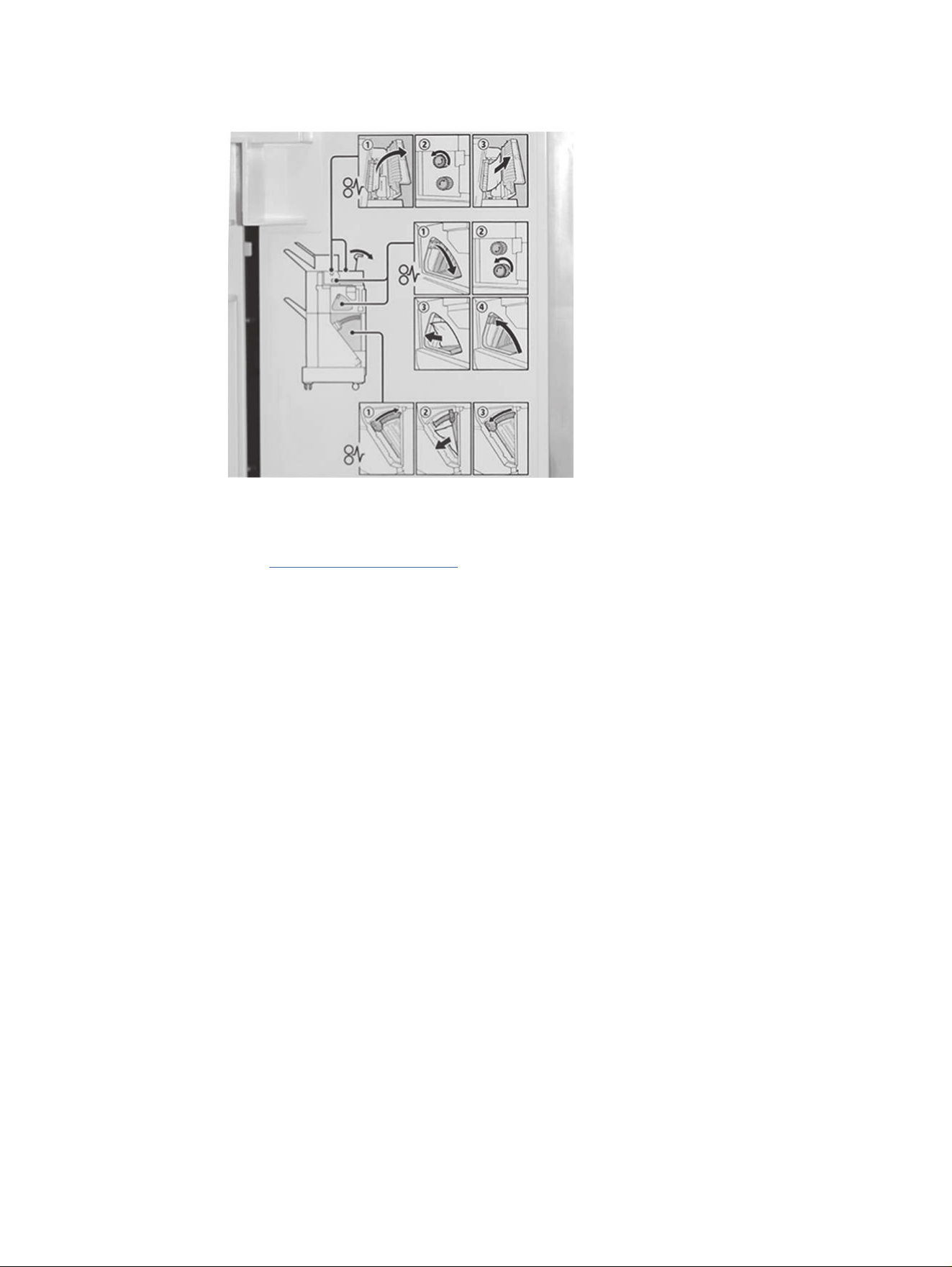
b. Use the directions inside the front access door to help remove the paper.
5. Ensure the type and quality of the paper being used meets the HP specifications for the printer.
6. If the error persists, contact your HP-authorized service or support provider, or contact customer
support at www.hp.com/go/contactHP.
Resolving color print quality problems
Use the information below to troubleshoot print-quality, color-quality, and image-quality problems on HP
Color LaserJet Enterprise printers.
Introduction
The troubleshooting steps can help resolve the following defects:
● Blank pages
● Black pages
● Colors that do not align
● Curled paper
● Dark or light bands
● Dark or light streaks
● Fuzzy print
● Gray background or dark print
● Light print
● Loose toner
● Missing toner
Resolving color print quality problems
217

● Scattered dots of toner
● Skewed images
● Smears
● Streaks
Troubleshoot print quality
To resolve print-quality issues, try these steps in the order presented.
To troubleshoot specific image defects, see Troubleshoot image defects.
Update the printer firmware
Try upgrading the printer firmware.
For instructions, go to www.hp.com/support.
Print from a different software program
Try printing from a different software program.
If the page prints correctly, the problem is with the software program from which you were printing.
Check the paper-type setting for the print job
Check the paper type setting when printing from a software program and the printed pages have
smears, fuzzy or dark print, curled paper, scattered dots of toner, loose toner, or small areas of missing
toner.
Check the paper type setting on the control panel
Check the paper type setting on the printer control panel, and change the setting as needed.
1. Open and close the paper tray.
2. Follow the control panel prompts to confirm or modify the paper type and size settings for the tray.
3. Make sure the paper loaded meets specifications.
4. Adjust the humidity and resistance setting on the control panel to match the environment.
a. Open the following menus:
i. Settings
ii. Copy/Print
iii. Print quality
iv. Adjust paper type
b. Select the paper type that matches the type loaded in the tray.
c. Use the arrows to increase or decrease the humidity and resistance setting.
5. Make sure the driver settings match the control panel settings.
NOTE: The print driver settings will override any control panel settings.
218
Chapter 9 Solve problems

Check the paper type setting (Windows)
Check the paper type setting for Windows, and change the setting as needed.
NOTE: The print driver settings will override any control panel settings.
1. From the software program, select the Print option.
2. Select the printer, and then click the Properties or Preferences button.
3. Click the Paper/Quality tab.
4. From the Paper Type drop-down list, click the More... option.
5. Expand the list of Type is: options.
6. Expand the category of paper types that best describes your paper.
7. Select the option for the type of paper you are using, and click the OK button.
8. Click the OK button to close the Document Properties dialog box. In the Print dialog box, click the OK
button to print the job.
Check the paper type setting (macOS)
Check the paper type setting for macOS, and change the setting as needed.
1. Click the File menu, and then click the Print option.
2. In the Printer menu, select the printer.
3. By default, the print driver displays the Copies & Pages menu. Open the menus drop-down list, and
then click the Finishing menu.
4. Select a type from the Media Type drop-down list.
5. Click the Print button.
Check toner-cartridge status
Follow these steps to check the estimated life remaining in the toner cartridges and if applicable, the
status of other replaceable maintenance parts.
Step one: Print the Supplies Status Page
The supplies status page indicates the cartridge status.
1. From the Home screen on the printer control panel, select the Reports menu.
2. Select the Configuration/Status Pages menu.
3. Select Supplies Status Page, and then select Print to print the page.
Step two: Check supplies status
Check the supplies status report as follows.
Check the paper type setting (Windows)
219

1. Look at the supplies status report to check the percent of life remaining for the toner cartridges
and, if applicable, the status of other replaceable maintenance parts.
Print quality problems can occur when using a toner cartridge that is at its estimated end of life.
The supplies status page indicates when a supply level is very low. After an HP supply has reached
the very low threshold, HP’s premium protection warranty on that supply has ended.
The toner cartridge does not need to be replaced now unless the print quality is no longer
acceptable. Consider having a replacement available to install when print quality is no longer
acceptable.
If you determine that you need to replace a toner cartridge or other replaceable maintenance
parts, the supplies status page lists the genuine HP part numbers.
2. Check to see if you are using a genuine HP cartridge.
A genuine HP toner cartridge has the word “HP” on it, or has the HP logo on it. For more information
on identifying HP cartridges go to www.hp.com/go/learnaboutsupplies.
Print a cleaning page
During the printing process paper, toner, and dust particles can accumulate inside the printer and can
cause print-quality issues such as toner specks or spatter, smears, streaks, lines, or repeating marks.
Follow these steps to clean the printer paper path:
1. From the Home screen on the printer control panel, select the Support Tools menu.
2. Select the following menus:
a. Maintenance
b. Calibration/Cleaning
c. Cleaning Page
3. Select Print to print the page.
A Cleaning... message displays on the printer control panel. The cleaning process takes a few
minutes to complete. Do not turn the printer off until the cleaning process has finished. When it is
finished, discard the printed page.
Visually inspect the toner cartridge or cartridges
Follow these steps to inspect each toner cartridge:
1. Remove the toner cartridge from the printer, and verify that the sealing tape has been removed.
2. Check the memory chip for damage.
3. Examine the surface of the green imaging drum.
CAUTION: Do not touch the imaging drum. Fingerprints on the imaging drum can cause print-
quality problems.
4. If you see any scratches, fingerprints, or other damage on the imaging drum, replace the toner
cartridge.
5. Reinstall the toner cartridge and print a few pages to see if the problem has resolved.
220
Chapter 9 Solve problems

Check paper and the printing environment
Use the following information to check the paper selection and the printing environment.
Step one: Use paper that meets HP specifications
Some print-quality problems arise from using paper that does not meet HP specifications.
● Always use a paper type and weight that this printer supports.
● Use paper that is of good quality and free of cuts, nicks, tears, spots, loose particles, dust, wrinkles,
voids, staples, and curled or bent edges.
● Use paper that has not been previously printed on.
● Use paper that does not contain metallic material, such as glitter.
● Use paper that is designed for use in laser printers. Do not use paper that is designed only for use in
Inkjet printers.
● Use paper that is not too rough. Using smoother paper generally results in better print quality.
Step two: Check the environment
The environment can directly affect print quality and is a common cause of print-quality or paper-
feeding issues. Try the following solutions:
● Move the printer away from drafty locations, such as open windows or doors, or air-conditioning
vents.
● Make sure the printer is not exposed to temperatures or humidity outside of printer specifications.
● Do not place the printer in a confined space, such as a cabinet.
● Place the printer on a sturdy, level surface.
● Remove anything that is blocking the vents on the printer. The printer requires good air flow on all
sides, including the top.
● Protect the printer from airborne debris, dust, steam, grease, or other elements that can leave
residue inside the printer.
Step three: Set the individual tray alignment
Follow these steps when text or images are not centered or aligned correctly on the printed page when
printing from specific trays.
1. From the Home screen on the printer control panel, select the Settings menu.
2. Select the following menus:
a. Copy/Print or Print
b. Print Quality
c. Image Registration
3. Select Tray, and then select the tray to adjust.
4. Select Print Test Page, and then follow the instructions on the printed pages.
Check paper and the printing environment
221

5. Select Print Test Page again to verify the results, and then make further adjustments if necessary.
6. Select Done to save the new settings.
Try a different print driver
Try a different print driver when printing from a software program and the printed pages have
unexpected lines in graphics, missing text, missing graphics, incorrect formatting, or substituted fonts.
Download a different print driver from the HP support Web site: Support for HP Color LaserJet
Enterprise MFP 6800 or Support for HP Color LaserJet Enterprise MFP 6801.
Troubleshoot color quality
Calibrating the printer can help ensure color print quality.
Calibrate the printer to align the colors
Calibration is a printer function that optimizes print quality.
Follow these steps to resolve print-quality problems such as misaligned color, colored shadows, blurry
graphics, or other print-quality issues.
1. From the Home screen on the printer control panel, select the Support Tools menu.
2. Select the following menus:
● Maintenance
● Calibration/Cleaning
● Full Calibration
3. Select Start to start the calibration process.
A Calibrating message will display on the printer control panel. The calibration process takes a few
minutes to complete. Do not turn the printer off until the calibration process has finished.
4. Wait while the printer calibrates, and then try printing again.
Troubleshoot image defects
Review examples of image defects and steps to resolve these defects.
222
Chapter 9 Solve problems
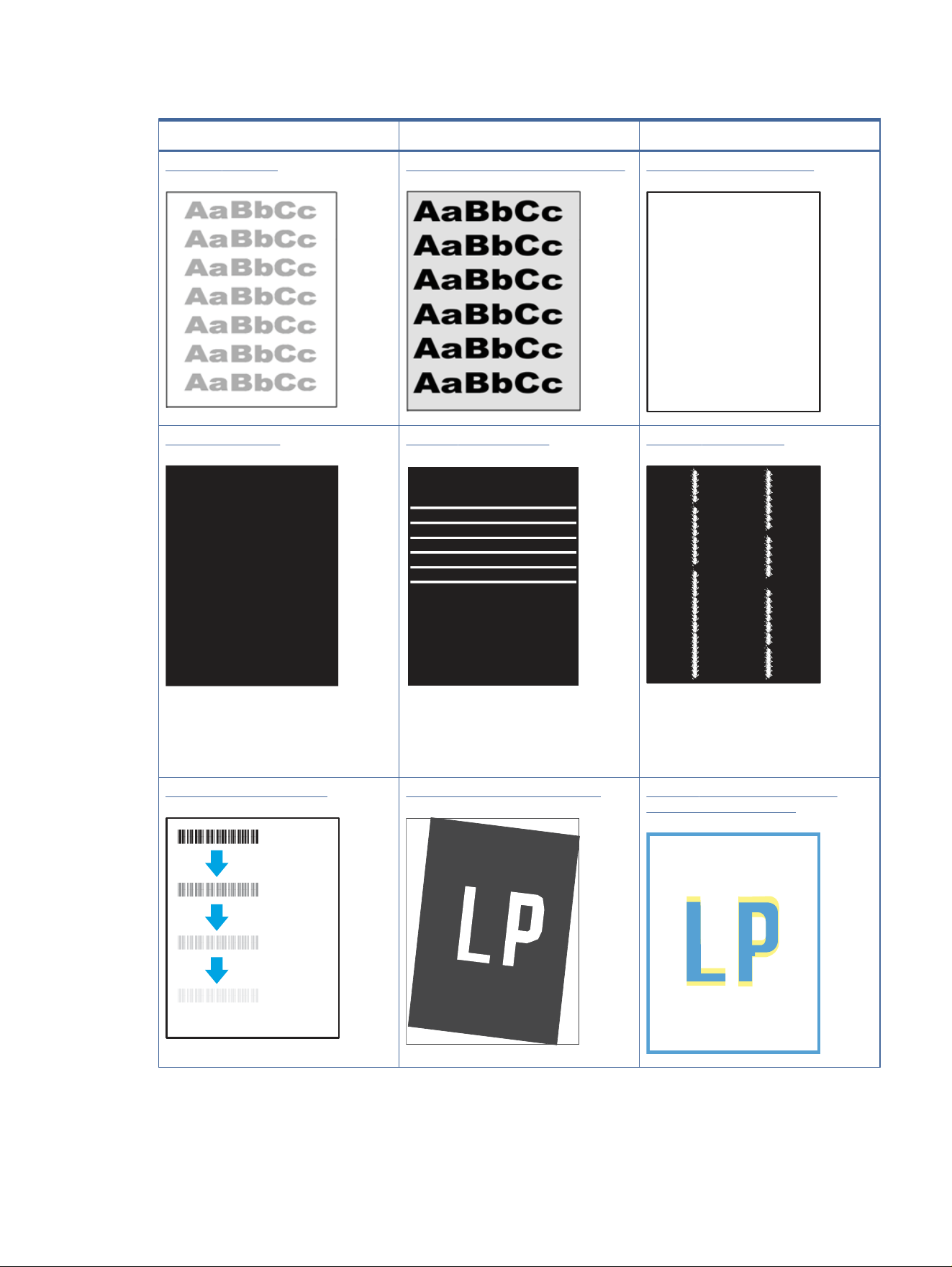
Table 9-2 Image defects table quick reference
Defect Defect Defect
Table 9-10 Light print Table 9-8 Gray background or dark print Table 9-5 Blank page - No print
Table 9-4 Black page Table 9-3 Banding defects Table 9-12 Streak defects
Table 9-7 Fixing/fuser defects Table 9-9 Image placement defects Table 9-6 Color plane registrations
defects (color models only)
Troubleshoot image defects 223
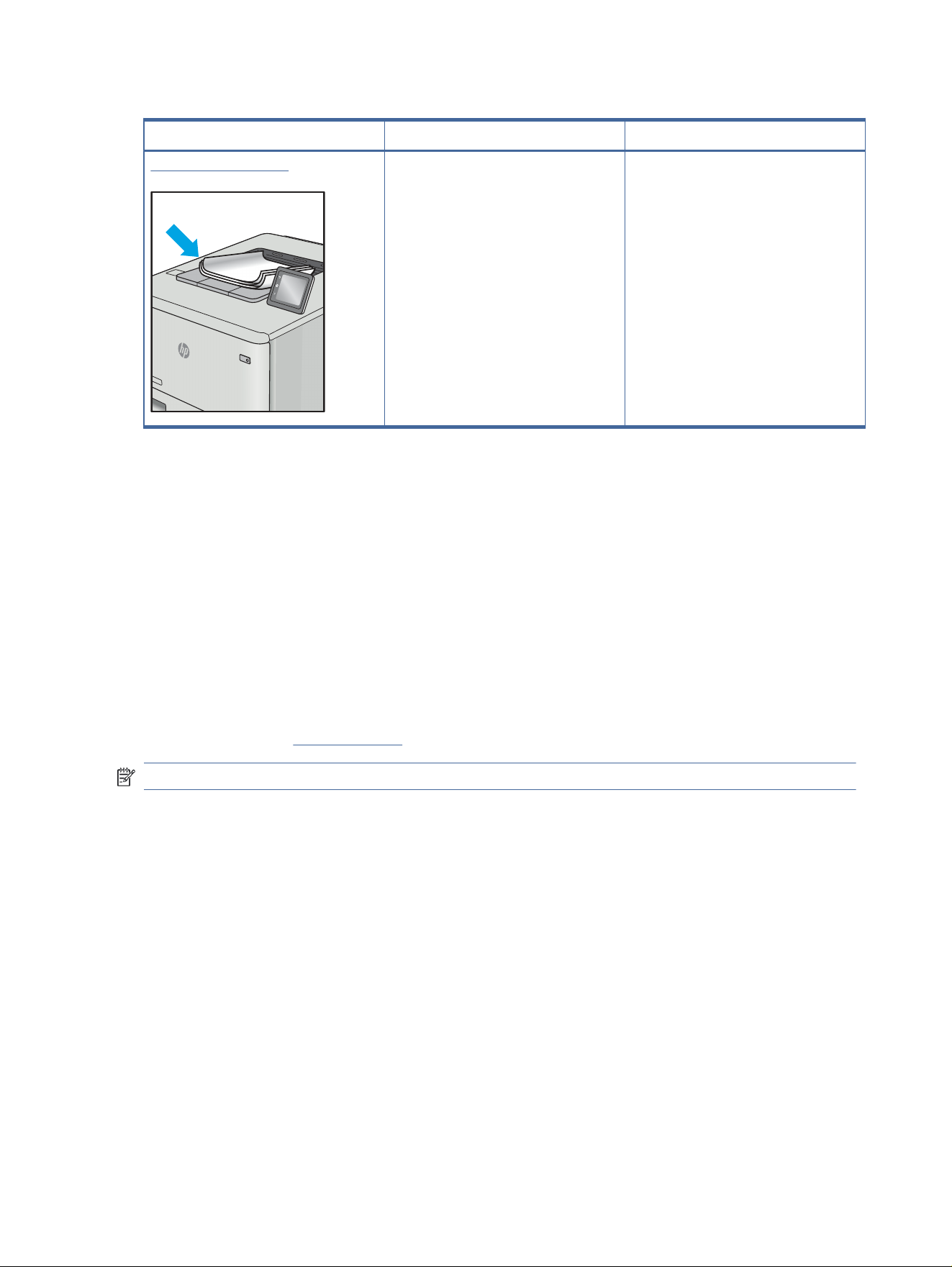
Table 9-2 Image defects table quick reference (continued)
Defect Defect Defect
Table 9-11 Output defects
Image defects, no matter the cause, can often be resolved using the same steps. Use the following steps
as a starting point for solving image defect issues.
1. Reprint the document. Print quality defects can be intermittent in nature or can go away completely
with continued printing.
2. Check the condition of the cartridge or cartridges. If a cartridge is in a Very Low state (it has
passed the rated life), replace the cartridge.
3. Make sure that the driver and tray print mode settings match the media that is loaded in the tray.
Try using a different ream of media or a different tray. Try using a different print mode.
4. Make sure the printer is within the supported operating temperature/humidity range.
5. Make sure that the paper type, size, and weight are supported by the printer. See the printer
support page at support.hp.com for a list of the supported paper sizes and types for the printer.
NOTE: The term "fusing" refers to the part of the printing process where toner is affixed to paper.
The following examples depict letter-size paper that has passed through the printer with the short edge
first.
224
Chapter 9 Solve problems

Table 9-3 Banding defects
Sample Description Possible solutions
Dark or light lines which repeat down
the length of the page, and are wide-
pitch and/or impulse bands. They might
be sharp or soft in nature. The defect
displays only in areas of fill, not in text or
sections with no printed content.
1. Reprint the document.
2. Try printing from another tray.
3. Replace the cartridge.
4. Use a different paper type.
5. Enterprise models only: From the
Home screen on the printer control
panel, go to the Adjust Paper Types
menu, and then choose a print
mode that is designed for a slightly
heavier media than what you are
using. This slows the print speed
and might improve the print quality.
6. If the issue persists, go to
support.hp.com.
Table 9-4
Black page
Sample Description Possible solutions
The entire printed page is black. 1. Visually inspect the cartridge to
check for damage.
2. Make sure that the cartridge is
installed correctly.
3. Replace the cartridge.
4. If the issue persists, go to
support.hp.com.
Troubleshoot image defects 225
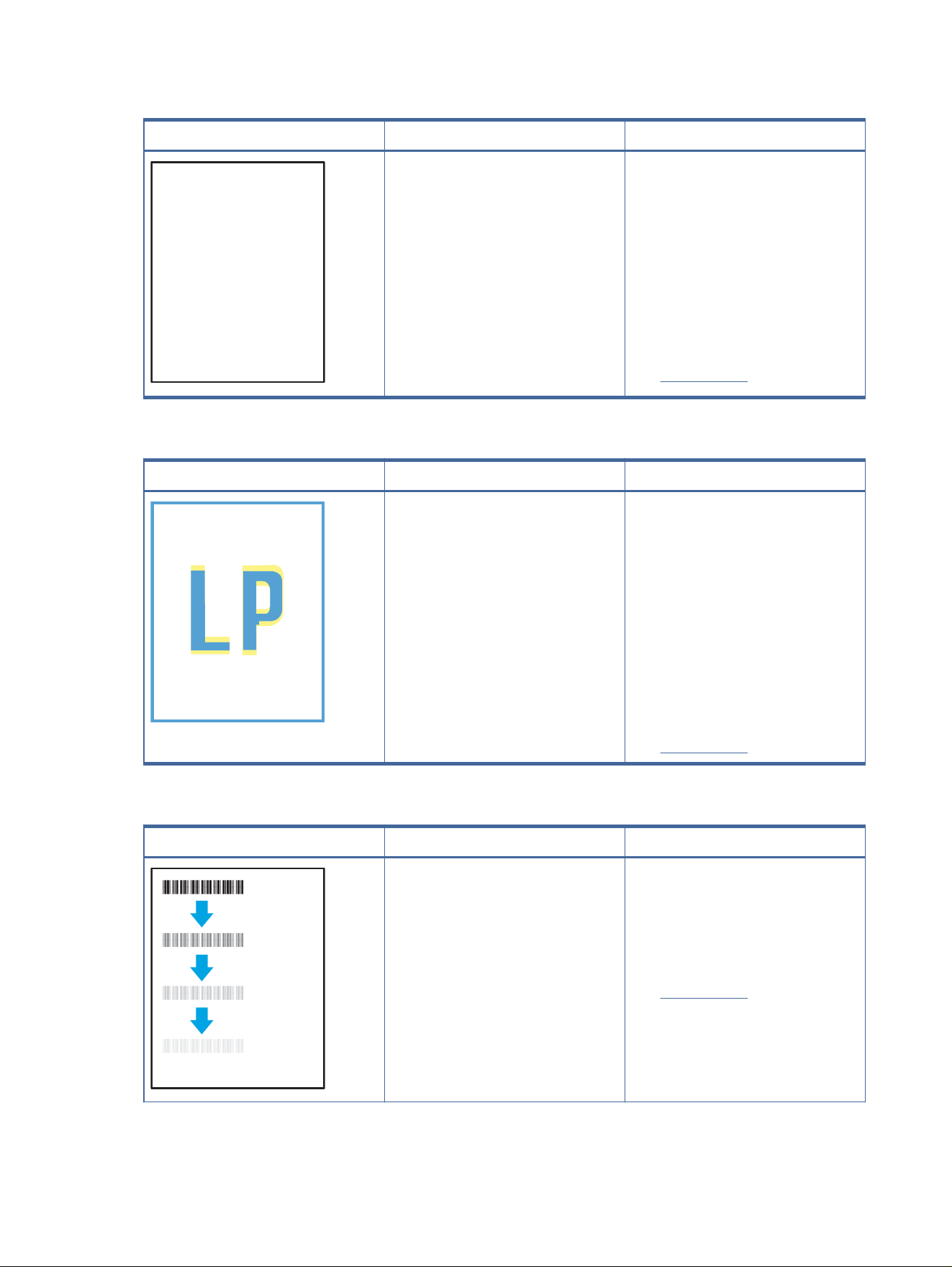
Table 9-5 Blank page - No print
Sample Description Possible solutions
The page is completely blank and
contains no printed content.
1. Make sure that the cartridges are
genuine HP cartridges.
2. Make sure that the cartridge is
installed correctly.
3. Print with a different cartridge.
4. Check the paper type in the paper
tray and adjust the printer settings
to match. If necessary, select a
lighter paper type.
5. If the issue persists, go to
support.hp.com.
Table 9-6
Color plane registrations defects (color models only)
Sample Description Possible solutions
One or more color plane(s) is not
aligned with the other color planes. This
registration error will typically occur with
yellow.
1. Reprint the document.
2. From the printer control panel,
calibrate the printer.
3. If a cartridge has reached a Very
Low state, or the printed output
is severely faded, replace the
cartridge.
4. From the printer control panel use
the Restore Calibration feature
to reset the printer's calibration
settings to the factory defaults.
5. If the issue persists, go to
support.hp.com.
Table 9-7
Fixing/fuser defects
Sample Description Possible solutions
Slight shadows or offsets of the image
are repeated down the page. The
repeated image might fade with each
recurrence.
1. Reprint the document.
2. Check the paper type in the paper
tray and adjust the printer settings
to match. If necessary, select a
lighter paper type.
3. If the issue persists, go to
support.hp.com.
226 Chapter 9 Solve problems
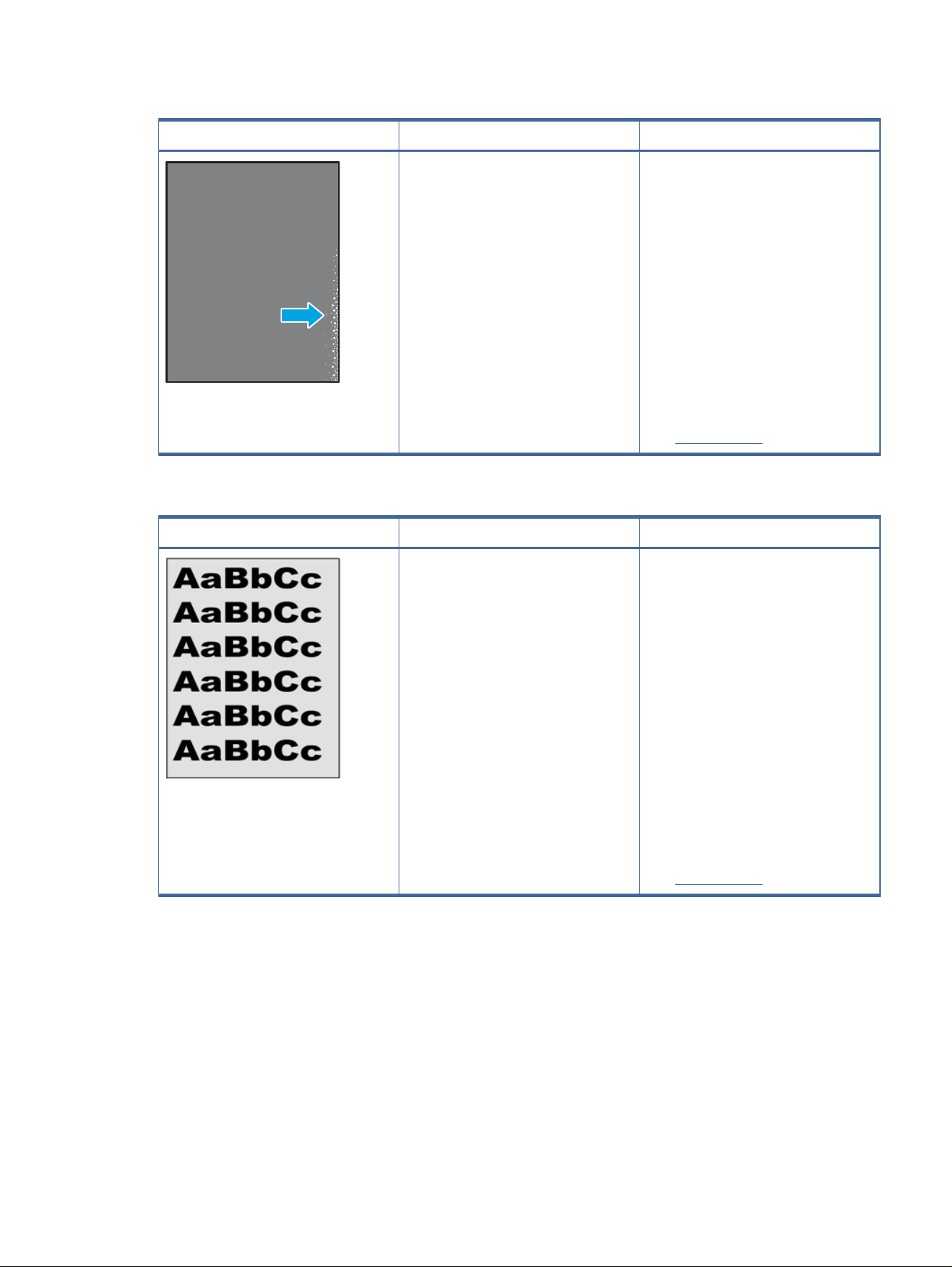
Table 9-7 Fixing/fuser defects (continued)
Sample Description Possible solutions
Toner rubs off along either edge of the
page. This defect is more common at the
edges of high-coverage jobs, and on light
media types, but can occur anywhere on
the page.
1. Reprint the document.
2. Check the paper type in the paper
tray and adjust the printer settings
to match. If necessary, select a
heavier paper type.
3. Enterprise models only: From the
printer control panel, go to the
Edge-to-Edge menu and then select
Normal. Reprint the document.
4. Enterprise models only: From the
printer control panel, select Auto
Include Margins and then reprint
the document.
5. If the issue persists, go to
support.hp.com.
Table 9-8
Gray background or dark print
Sample Description Possible solutions
The image or text is darker than
expected and/or the background is gray.
1. Make sure that the paper in the
trays has not already been run
through the printer.
2. Use a different paper type.
3. Reprint the document.
4. Mono models only: From the Home
screen on the printer control panel,
go to the Adjust Toner Density
menu, and then adjust the toner
density to a lower level.
5. Make sure that the printer is
within the supported operating
temperature and humidity range.
6. Replace the cartridge.
7. If the issue persists, go to
support.hp.com.
Troubleshoot image defects
227
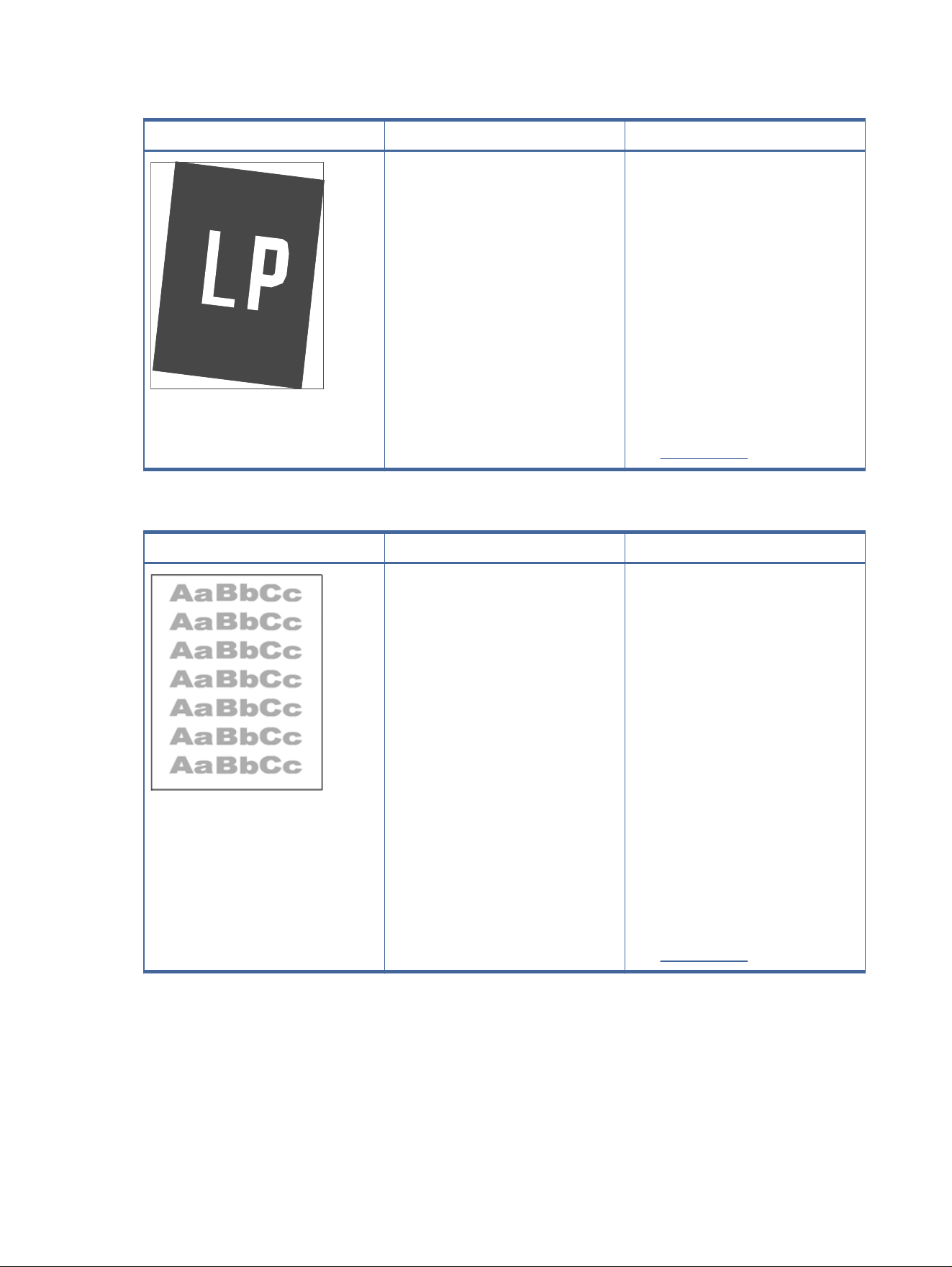
Table 9-9 Image placement defects
Sample Description Possible solutions
The image is not centered, or is skewed
on the page. The defect occurs when the
paper is not positioned properly as it is
pulled from the tray and moves through
the paper path.
1. Reprint the document.
2. Remove the paper and then reload
the tray. Make sure that all the
paper edges are even on all sides.
3. Make sure that the top of the paper
stack is below the tray-full indicator.
Do not overfill the tray.
4. Make sure that the paper guides
are adjusted to the correct size
for the paper. Do not adjust the
paper guides tightly against the
paper stack. Adjust them to the
indentations or markings in the
tray.
5. If the issue persists, go to
support.hp.com.
Table 9-10
Light print
Sample Description Possible solutions
The printed content is light or faded on
the entire page.
1. Reprint the document.
2. Remove the cartridge, and then
shake it to redistribute the toner.
Reinsert the toner cartridges into
the printer and close the cover. For
a graphical representation of this
procedure, see
Replace the toner
cartridges
.
3. Mono models only: Make sure that
the EconoMode setting is disabled,
both at the printer control panel
and in the print driver.
4. Make sure that the cartridge is
installed correctly.
5. Print a Supplies Status Page and
check the life and usage of the
cartridge.
6. Replace the cartridge.
7. If the issue persists, go to
support.hp.com.
228
Chapter 9 Solve problems
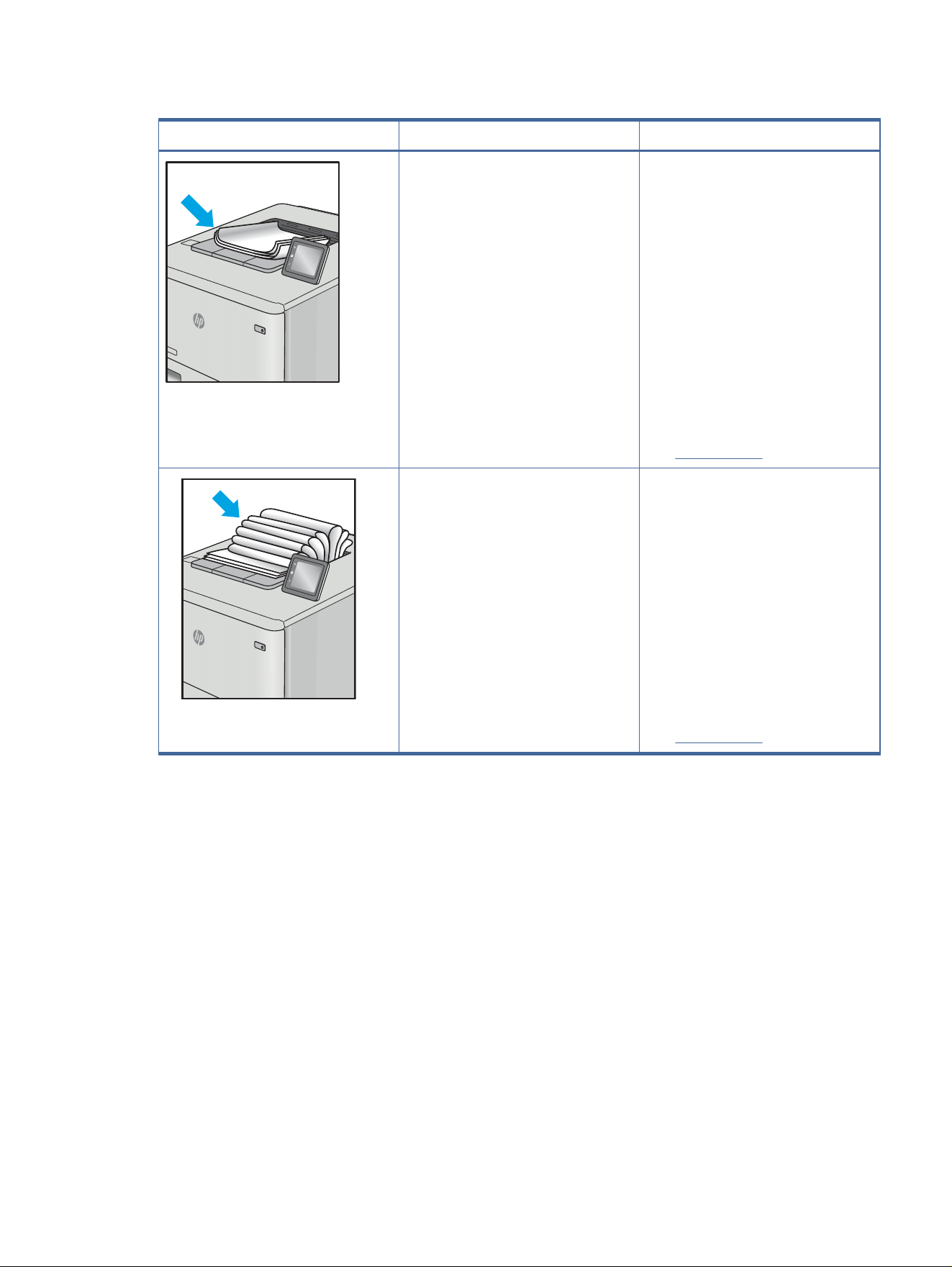
Table 9-11 Output defects
Sample Description Possible solutions
Printed pages have curled edges. The
curled edge can be along the short or
long side of the paper. Two types of curl
are possible:
● Positive curl: The paper curls
toward the printed side. The defect
occurs in dry environments or
when printing high-coverage pages.
● Negative curl: The paper curls
away from the printed side. The
defect occurs in high-humidity
environments or when printing low-
coverage pages.
1. Reprint the document.
2. Positive curl: From the printer
control panel, select a heavier
paper type. The heavier paper type
creates a higher temperature for
printing.
Negative curl: From the printer
control panel, select a lighter paper
type. The lighter paper type creates
a lower temperature for printing.
Try storing the paper in a dry
environment prior to use, or use
freshly opened paper.
3. Print in duplex mode.
4. If the issue persists, go to
support.hp.com.
The paper does not stack well in the
output tray. The stack might be uneven,
skewed, or the pages might be pushed
out of the tray and onto the floor. Any of
the following conditions can cause this
defect:
● Extreme paper curl
● The paper in the tray is wrinkled or
deformed
● The paper is a non-standard paper
type, such as envelopes
● The output tray is too full
1. Reprint the document.
2. Extend the output bin extension.
3. If the defect is caused by
extreme paper curl, refer to the
troubleshooting steps for "Output
curl."
4. Use a different paper type.
5. Use freshly opened paper.
6. Remove the paper from the output
tray before the tray gets too full.
7. If the issue persists, go to
support.hp.com.
Troubleshoot image defects
229
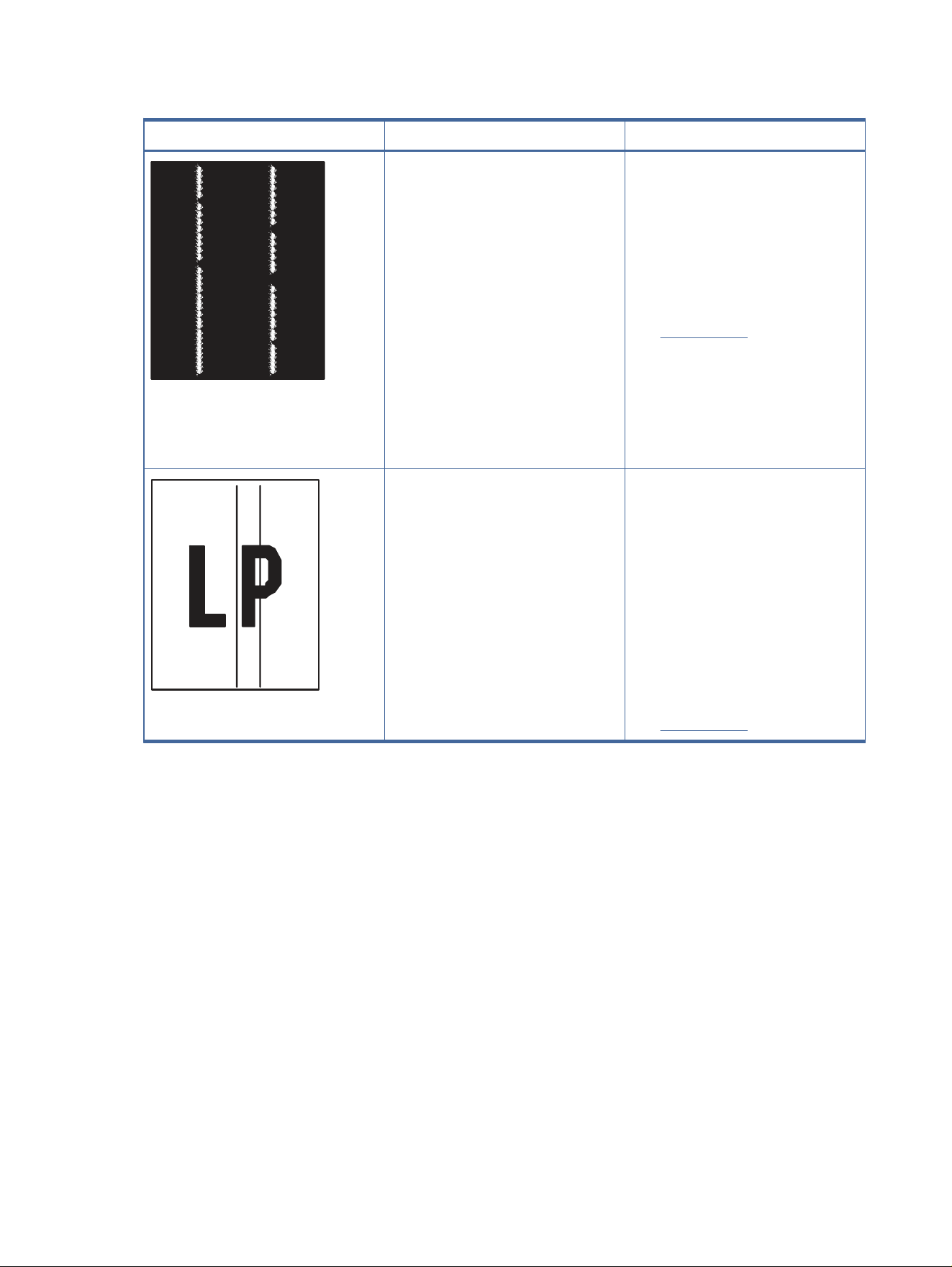
Table 9-12 Streak defects
Sample Description Possible solutions
Light vertical streaks that usually span
the length of the page. The defect
displays only in areas of fill, not in text
or sections with no printed content.
1. Reprint the document.
2. Remove the cartridge, and then
shake it to redistribute the toner.
Reinsert the toner cartridges into
the printer and close the cover. For
a graphical representation of this
procedure, see
Replace the toner
cartridges
.
3. If the issue persists, go to
support.hp.com.
NOTE: Both light and dark vertical
streaks can occur when the printing
environment is outside the specified
range for temperature or humidity. Refer
to your printer's environmental
specifications for allowable temperature
and humidity levels.
Dark vertical lines which occur down the
length of the page. The defect might
occur anywhere on the page, in areas of
fill or in sections with no printed content.
On color models, these lines or streaks
will also be visible on the ITB cleaning
page.
1. Reprint the document.
2. Remove the cartridge, and then
shake it to redistribute the toner.
Reinsert the toner cartridges into
the printer and close the cover. For
a graphical representation of this
procedure, see
Replace the toner
cartridges
.
3. Print a cleaning page.
4. Check the toner level in the
cartridge.
5. If the issue persists, go to
support.hp.com.
Improve copy image quality
If the printer is having copy quality problems, try the following solutions in the order presented to resolve
the issue.
Try these few simple steps first:
● Use the flatbed scanner rather than the document feeder.
● Use high-quality originals.
● When using the document feeder, load the original document into the feeder correctly, using the
paper guides, to avoid unclear or skewed images.
If the problem still exists, try these additional solutions. If they do not fix the problem, see “Improve print
quality” for further solutions.
Check the scanner glass for dirt and smudges
Learn about solving copy-quality debris problems.
230
Chapter 9 Solve problems
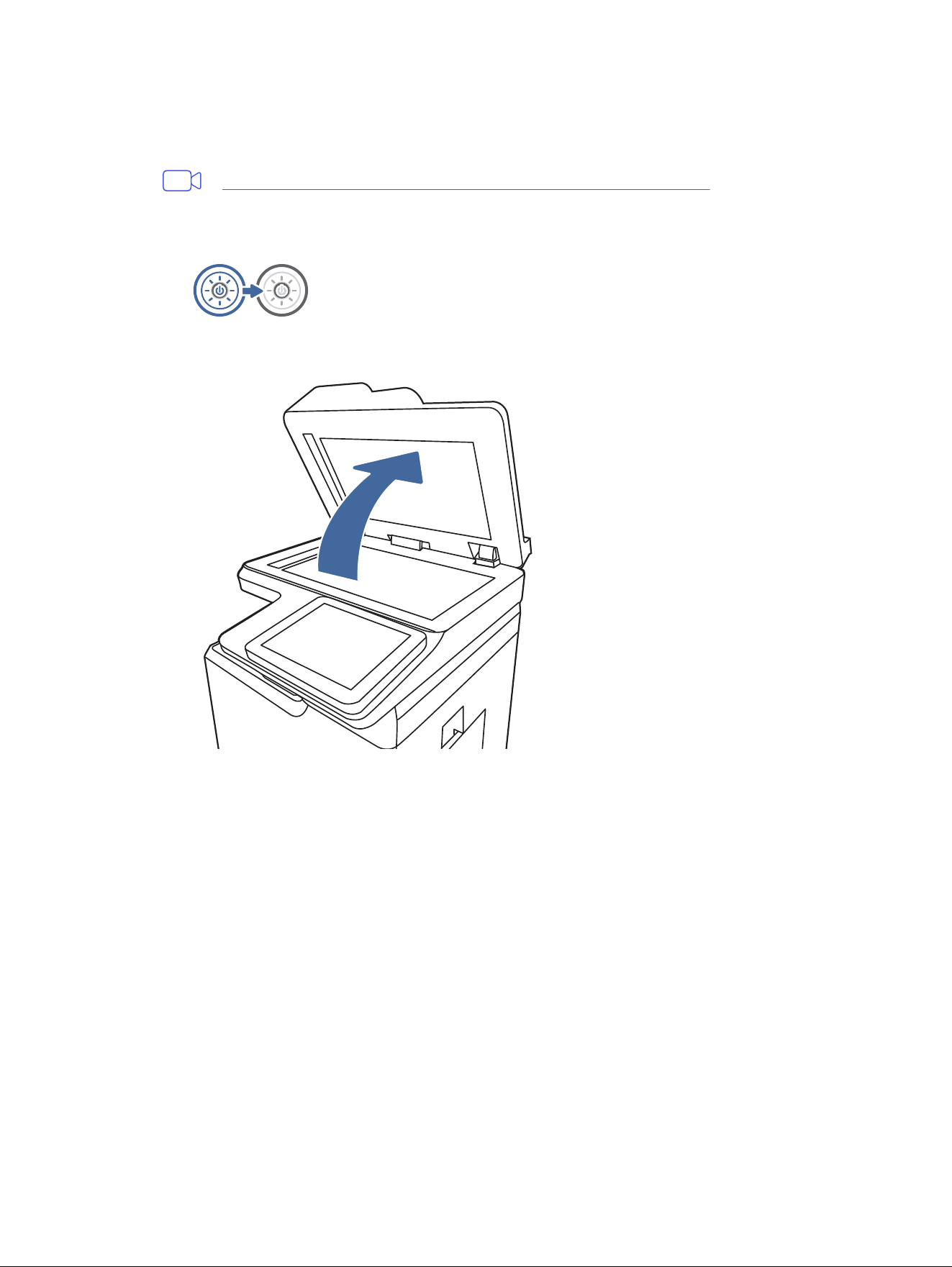
Over time, specks of debris might collect on the scanner glass and document feeder white plastic
backing, which might cause print defects. Use the following procedure to clean the scanner if the printed
pages have streaks, unwanted lines, black dots, poor print quality, or unclear text.
View a video of cleaning the document feeder glass and flatbed glass.
1. Press the power button to turn the printer off, and then disconnect the power cable from the
electrical outlet.
2. Open the scanner lid.
Check the scanner glass for dirt and smudges
231
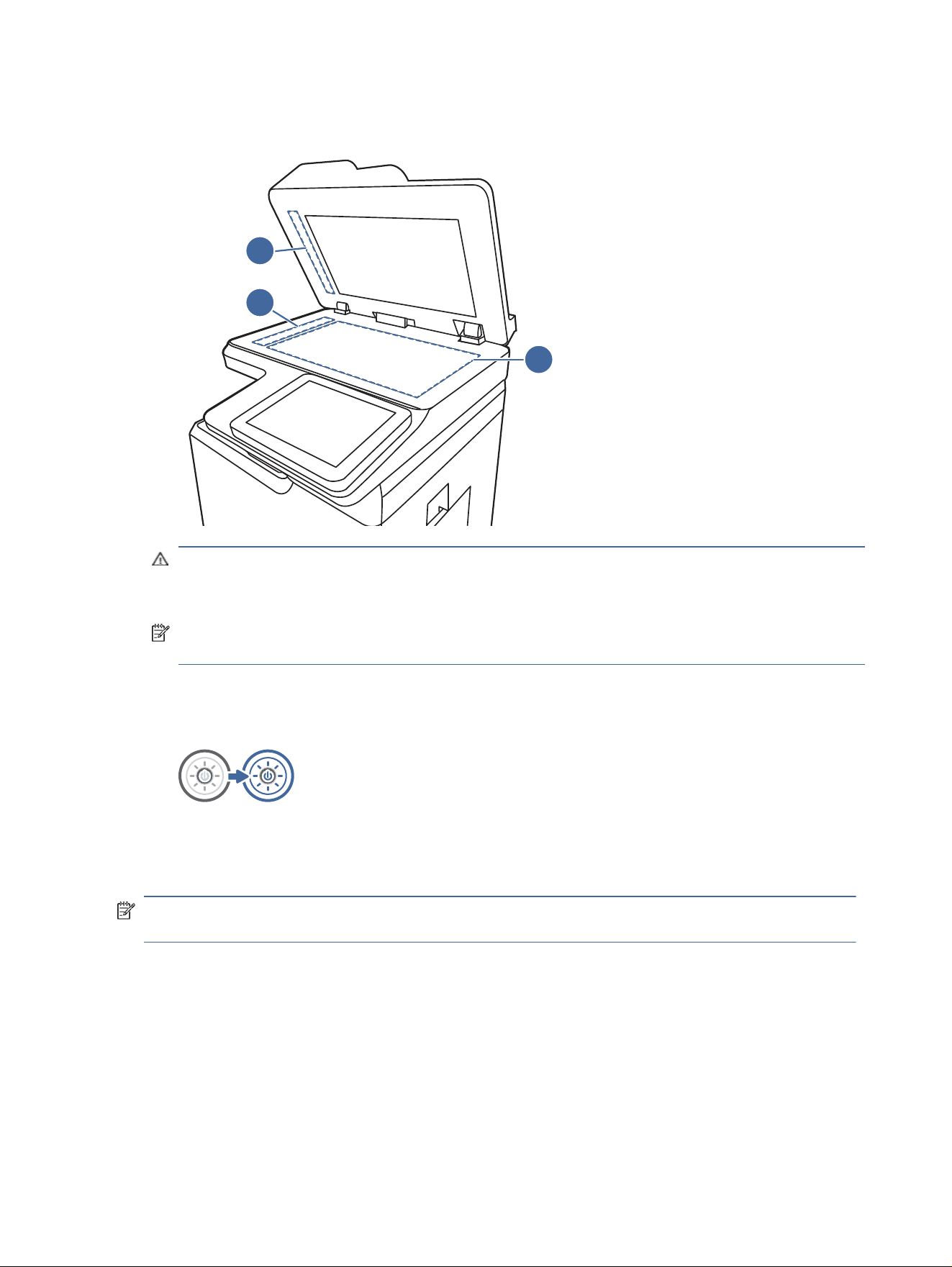
3. Clean the scanner glass (callout 1) and the document feeder strips (callout 2, callout 3) with a soft
cloth or sponge that has been moistened with nonabrasive glass cleaner.
3
2
1
CAUTION: Do not use abrasives, acetone, benzene, ammonia, ethyl alcohol, or carbon
tetrachloride on any part of the printer; these can damage the printer. Do not place liquids directly
on the glass or platen. They might seep and damage the printer.
NOTE: If you are having trouble with streaks on copies when you are using the document feeder,
be sure to clean the small strips of glass on the left side of the scanner (callout 2, callout 3).
4. Dry the glass and white plastic parts with a chamois or a cellulose sponge to prevent spotting.
5. Connect the power cable to an outlet, and then press the power button to turn the printer on.
Calibrate the scanner
Calibration is a process that optimizes scan quality.
NOTE: When using the document feeder, make sure to adjust the guides in the input tray so they are
against the original document.
1. From the Home screen on the printer control panel, navigate to the Support Tools application, and
then select the Support Tools icon.
2. Open the following menus:
a. Maintenance
b. Calibration/Cleaning
c. Calibrate Scanner
232
Chapter 9 Solve problems

3. Touch the Start button to start the calibration process. Follow the on-screen prompts.
4. Wait while the printer calibrates, and then try copying again.
Check the paper settings
Follow these steps if copied pages have smears, fuzzy or dark print, curled paper, or areas where
pigment has dropped out.
Check the paper selection options
Use the following steps to check the paper selection options.
1. From the Home screen on the printer control panel, navigate to the Copy application, and then
select the Copy icon.
2. Select Options, and then scroll to and select Paper Selection.
3. Select Paper size, and then select one of the predefined options.
4. Select Paper type, and then select one of the predefined options.
5. Select Paper tray, and then select one of the predefined options.
6. Select Done to save the paper selection options.
Check the image-adjustment settings
Adjust the settings in the Copy menu to optimize image quality.
● Sharpness: Clarify or soften the image. For example, increasing the sharpness could make text
appear crisper, but decreasing it could make photos appear smoother.
● Darkness: Increase or decrease the amount of white and black used in colors in scanned images.
● Contrast: Increase or decrease the difference between the lightest and the darkest color on the
page.
● Background Cleanup: Remove faint colors from the background of scanned images. For example, if
the original document is printed on colored paper, use this feature to lighten the background without
affecting the darkness of the image.
● Automatic Tone: Available for Flow printers only. The printer automatically adjusts the Darkness,
Contrast, and Background Cleanup settings to the most appropriate for the scanned document.
1. From the Home screen on the printer control panel, navigate to the Copy application, and then
select the Copy icon.
2. Select Options, and then scroll to and select Image Adjustment.
3. Adjust the sliders to set the levels, and select Done.
4. Select Copy to start the copy job.
NOTE: These settings are temporary. After you have finished the job, the printer returns to the default
settings.
Check the paper settings
233

Optimize copy quality for text or pictures
Optimize the copy job for the type of image being copied: text, graphics, or photos.
1. From the Home screen on the printer control panel, navigate to the Copy application, and then
select the Copy icon.
2. Select Options, and then select Optimize Text/Picture.
3. Select one of the predefined options.
4. Select Copy to start the copy job.
NOTE: These settings are temporary. After you have finished the job, the printer returns to the default
settings.
Improve scan image quality
Try the following basic solutions to improve scanned image quality.
● Use the flatbed scanner rather than the document feeder.
● Use high-quality originals.
● When using the document feeder, load the original document into the feeder correctly, using the
paper guides, to avoid unclear or skewed images.
If the problem still exists, try these additional solutions. If they do not fix the problem, see “Improve print
quality” for further solutions.
Check the scanner glass for dirt and smudges
Learn about solving copy-quality debris problems.
Over time, specks of debris might collect on the scanner glass and document feeder white plastic
backing, which might cause print defects. Use the following procedure to clean the scanner if the printed
pages have streaks, unwanted lines, black dots, poor print quality, or unclear text.
View a video of cleaning the document feeder glass and flatbed glass.
1. Press the power button to turn the printer off, and then disconnect the power cable from the
electrical outlet.
234
Chapter 9 Solve problems
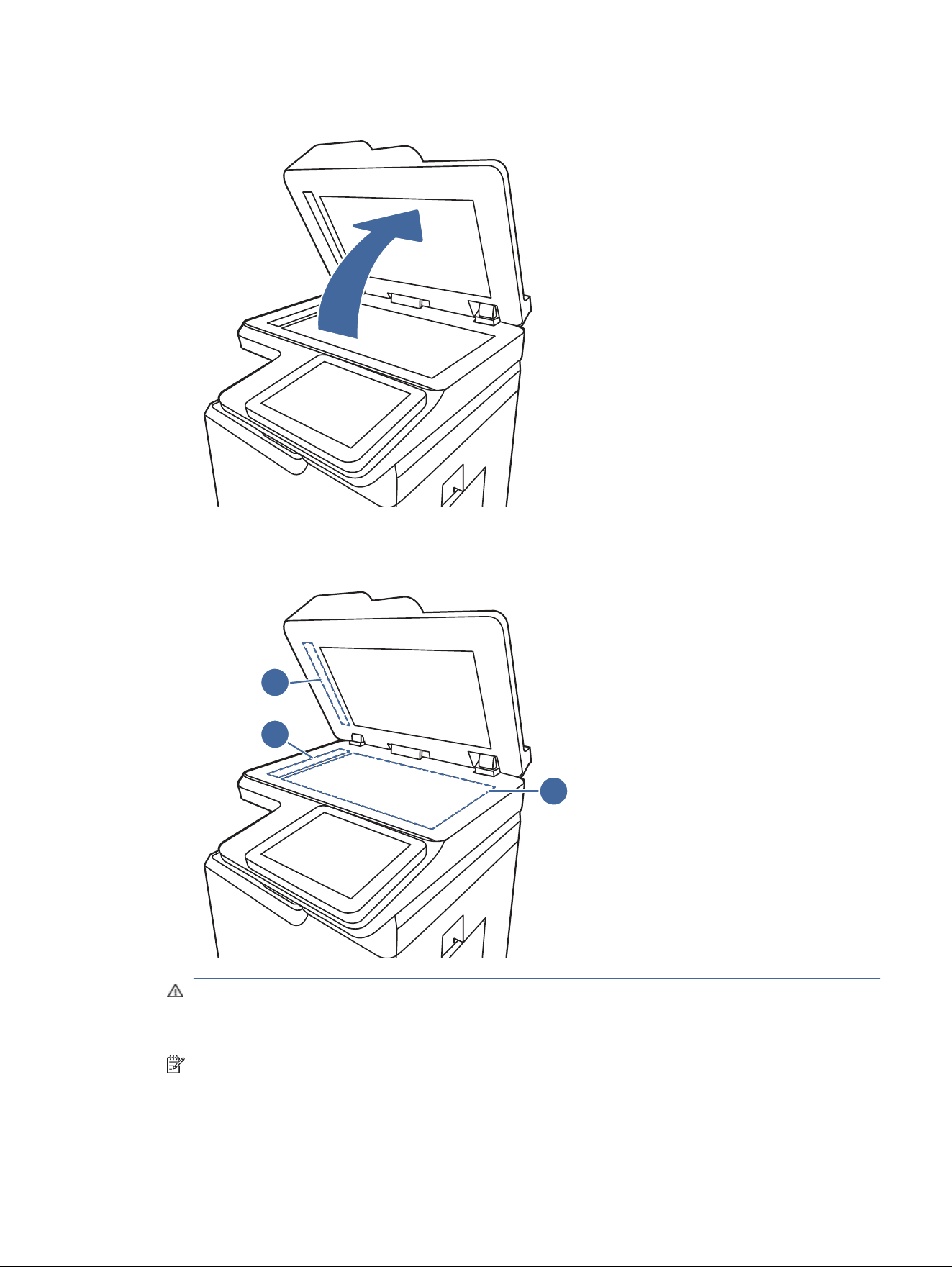
2. Open the scanner lid.
3. Clean the scanner glass (callout 1) and the document feeder strips (callout 2, callout 3) with a soft
cloth or sponge that has been moistened with nonabrasive glass cleaner.
3
2
1
CAUTION: Do not use abrasives, acetone, benzene, ammonia, ethyl alcohol, or carbon
tetrachloride on any part of the printer; these can damage the printer. Do not place liquids directly
on the glass or platen. They might seep and damage the printer.
NOTE: If you are having trouble with streaks on copies when you are using the document feeder,
be sure to clean the small strips of glass on the left side of the scanner (callout 2, callout 3).
4. Dry the glass and white plastic parts with a chamois or a cellulose sponge to prevent spotting.
Check the scanner glass for dirt and smudges
235

5. Connect the power cable to an outlet, and then press the power button to turn the printer on.
Check the resolution settings
Follow these steps to adjust the resolution setting. Setting the resolution to a high value increases the
file size and the scan time.
1. From the Home screen on the printer control panel, navigate to the Scan application, and then
select the Scan icon.
2. Select one of the following Scan features:
● Scan to Email
● Scan to Network Folder
● Scan to USB Drive
● Scan to SharePoint®
3. Select Options, and then select File Type and Resolution.
4. Select one of the predefined Resolution options, and then select Done.
5. Select Send or Save to start the scan.
Check the color settings
Follow these steps to adjust the color setting.
1. From the Home screen on the printer control panel, navigate to the Scan application, and then
select the Scan icon.
2. Select one of the following Scan features:
● Save to Device Memory
● Scan to Email
● Scan to Network Folder
● Scan to USB
● Scan to SharePoint®
3. Touch the Options button.
4. In the Options pane, scroll to and select Color/Black.
5. Select one of the predefined options.
6. Touch the Send button.
Check the image-adjustment settings
Adjust the settings in the Scan menu to optimize image quality.
236
Chapter 9 Solve problems

● Sharpness: Clarify or soften the image. For example, increasing the sharpness could make text
appear crisper, but decreasing it could make photos appear smoother.
● Darkness: Increase or decrease the amount of white and black used in colors in scanned images.
● Contrast: Increase or decrease the difference between the lightest and the darkest color on the
page.
● Background Cleanup: Remove faint colors from the background of scanned images. For example, if
the original document is printed on colored paper, use this feature to lighten the background without
affecting the darkness of the image.
● Automatic Tone: Available for Flow printers only. The printer automatically adjusts the Darkness,
Contrast, and Background Cleanup settings to the most appropriate for the scanned document.
1. From the Home screen on the printer control panel, navigate to the Scan application, and then
select the Scan icon.
2. Select one of the following Scan features:
● Scan to Email
● Scan to Network Folder
● Scan to USB Drive
● Scan to Job Storage
● Scan to SharePoint®
3. Select Options, and then select Image Adjustment.
4. Adjust the sliders to set the levels, and then select Done.
5. Select Send or Save to start the scan.
NOTE: These settings are temporary. After you have finished the job, the printer returns to the default
settings.
Optimize scan quality for text or pictures
Optimize the scan job for the type of image being scanned: text, graphics, or photos.
1. From the Home screen on the printer control panel, navigate to the Scan application, and then
select the Scan icon.
2. Select one of the following Scan features:
● Scan to Email
● Scan to Network Folder
● Scan to USB Drive
● Scan to Job Storage
● Scan to SharePoint®
3. Select Options, and then select Optimize Text/Picture.
Optimize scan quality for text or pictures
237

4. Select one of the predefined options.
5. Select Send or Save to start the scan.
NOTE: These settings are temporary. After you have finished the job, the printer returns to the default
settings.
Check the output-quality settings
This setting adjusts the level of compression when saving the file. For the highest quality, select the
highest setting.
1. From the Home screen on the printer control panel, navigate to the Scan application, and then
select the Scan icon.
2. Select one of the following Scan features:
● Scan to Email
● Scan to Network Folder
● Scan to USB Drive
● Scan to SharePoint®
3. Select Options, and then select File Type and Resolution.
4. Select one of the predefined Quality and File Size options, and then select Done.
5. Select Send or Save to start the scan.
Improve fax image quality
If the printer is having fax quality problems, try the following solutions in the order presented to resolve
the issue.
Try these few simple steps first:
● Use the flatbed scanner rather than the document feeder.
● Use high-quality originals.
● When using the document feeder, load the original document into the feeder correctly, using the
paper guides, to avoid unclear or skewed images.
If the problem still exists, try these additional solutions. If they do not fix the problem, see “Improve print
quality” for further solutions.
Check the scanner glass for dirt and smudges
Learn about solving copy-quality debris problems.
Over time, specks of debris might collect on the scanner glass and document feeder white plastic
backing, which might cause print defects. Use the following procedure to clean the scanner if the printed
pages have streaks, unwanted lines, black dots, poor print quality, or unclear text.
View a video of cleaning the document feeder glass and flatbed glass.
238
Chapter 9 Solve problems
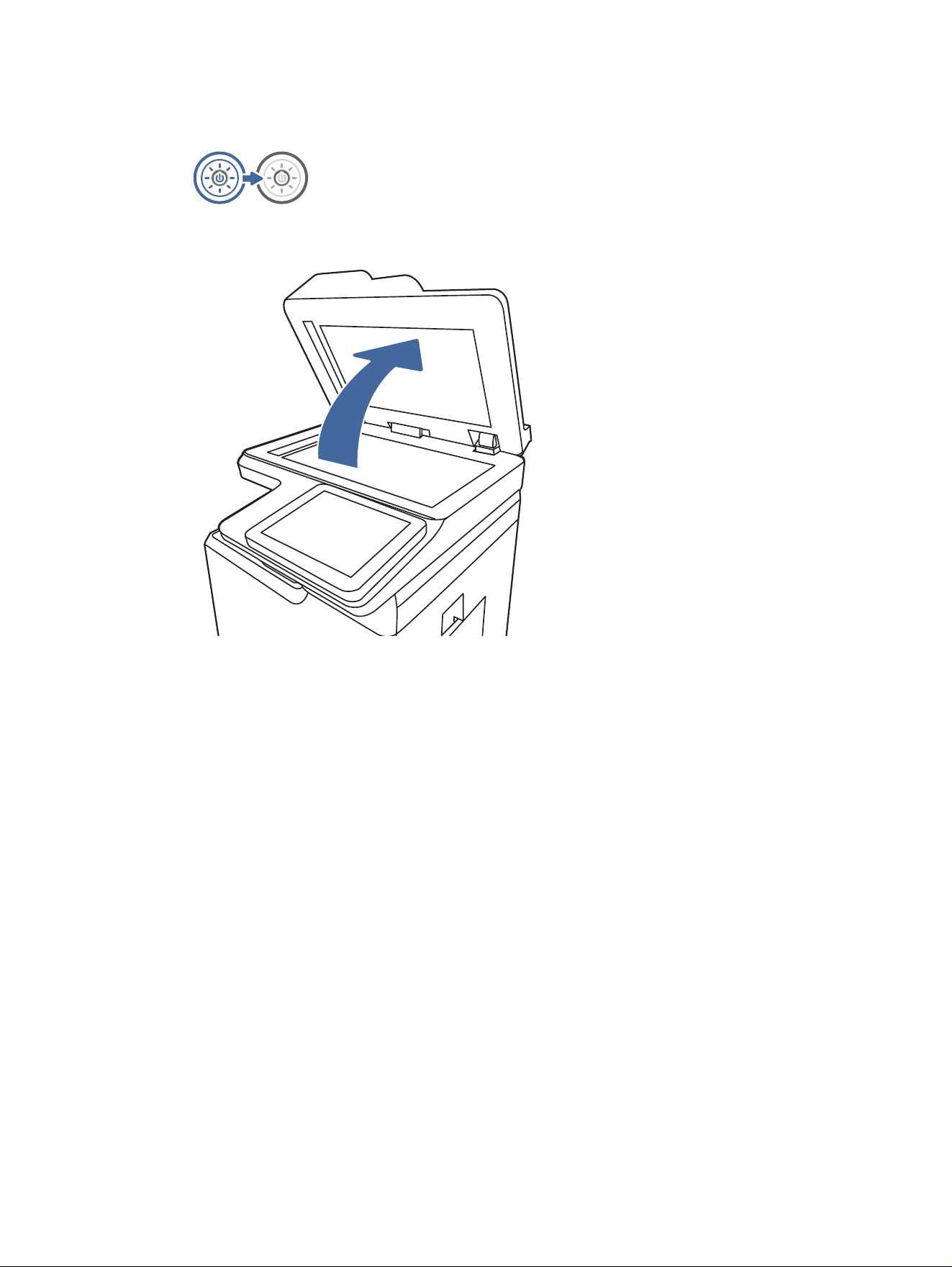
1. Press the power button to turn the printer off, and then disconnect the power cable from the
electrical outlet.
2. Open the scanner lid.
Check the scanner glass for dirt and smudges 239
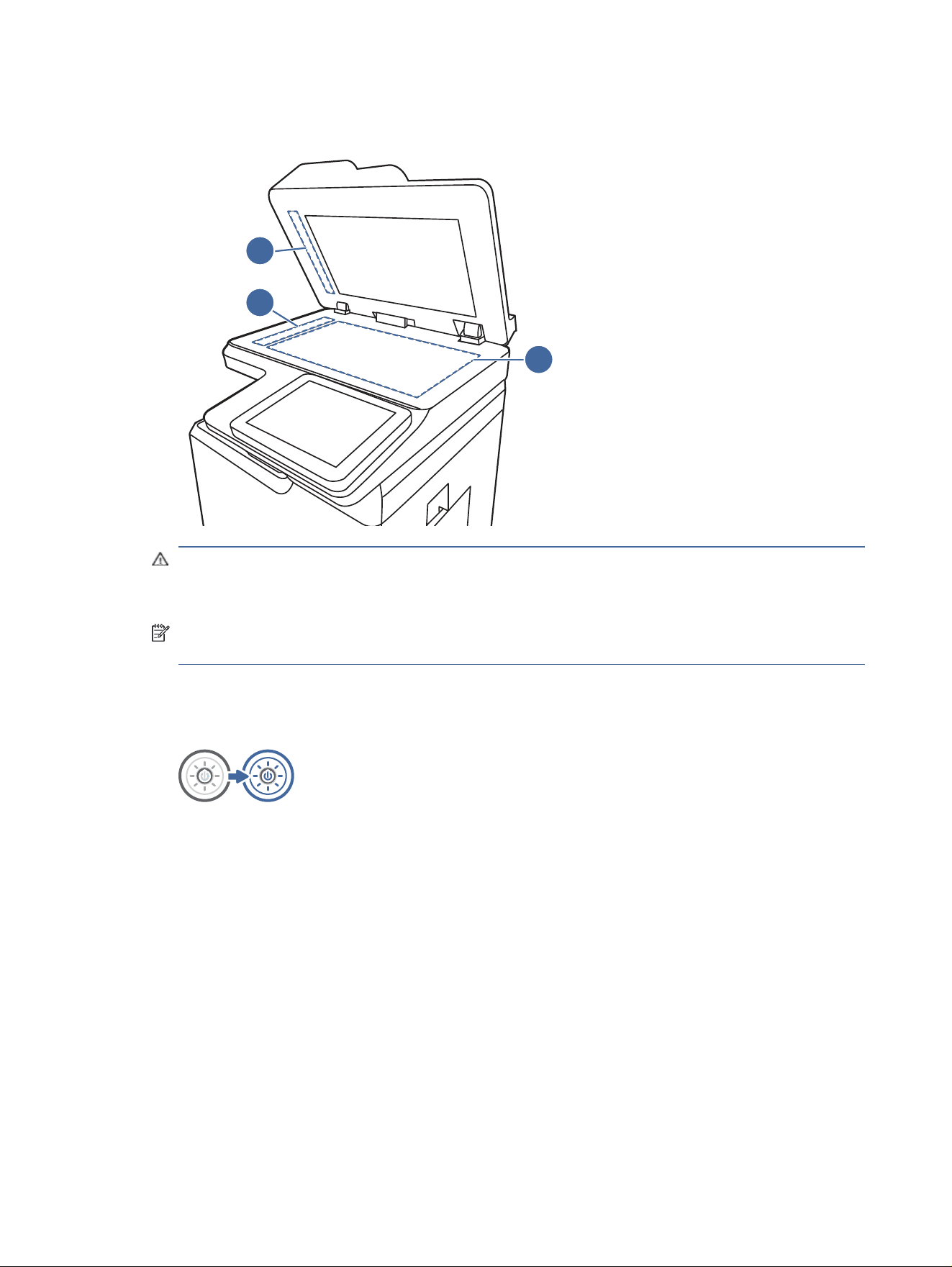
3. Clean the scanner glass (callout 1) and the document feeder strips (callout 2, callout 3) with a soft
cloth or sponge that has been moistened with nonabrasive glass cleaner.
3
2
1
CAUTION: Do not use abrasives, acetone, benzene, ammonia, ethyl alcohol, or carbon
tetrachloride on any part of the printer; these can damage the printer. Do not place liquids directly
on the glass or platen. They might seep and damage the printer.
NOTE: If you are having trouble with streaks on copies when you are using the document feeder,
be sure to clean the small strips of glass on the left side of the scanner (callout 2, callout 3).
4. Dry the glass and white plastic parts with a chamois or a cellulose sponge to prevent spotting.
5. Connect the power cable to an outlet, and then press the power button to turn the printer on.
Check the send-fax resolution settings
Adjust the resolution of outgoing faxes as needed. A higher resolution setting increases the fax size and
send time.
1. From the Home screen on the printer control panel, navigate to the Fax application, and then select
the Fax icon.
2. Select Options.
3. In the Options pane, scroll to and select Resolution.
4. Select one of the predefined options, and then select Send to send the fax.
Check the image-adjustment settings
Adjust the settings in the Fax menu to optimize image quality.
240
Chapter 9 Solve problems

● Sharpness: Clarify or soften the image. For example, increasing the sharpness could make text
appear crisper, but decreasing it could make photos appear smoother.
● Darkness: Increase or decrease the amount of white and black used in colors in scanned images.
● Contrast: Increase or decrease the difference between the lightest and the darkest color on the
page.
● Background Cleanup: Remove faint colors from the background of scanned images. For example, if
the original document is printed on colored paper, use this feature to lighten the background without
affecting the darkness of the image.
● Automatic Tone: Available for Flow printers only. The printer automatically adjusts the Darkness,
Contrast, and Background Cleanup settings to the most appropriate for the scanned document.
1. From the Home screen on the printer control panel, navigate to the Fax application, and then select
the Fax icon.
2. Select Options.
3. In the Options pane, scroll to and select Image Adjustment.
4. Adjust the sliders to set the levels, and then select Done.
5. Select Send to send the fax.
NOTE: These settings are temporary. After you have finished the job, the printer returns to the default
settings.
Optimize fax quality for text or pictures
Optimize the fax job for the type of image being scanned: text, graphics, or photos.
1. From the Home screen on the printer control panel, navigate to the Fax application, and then select
the Fax icon.
2. Select Options.
3. In the Options pane, scroll to and select Optimize Text/Picture.
4. Select one of the predefined options.
5. Select Send to send the fax.
NOTE: These settings are temporary. After you have finished the job, the printer returns to the default
settings.
Check the error-correction setting
Make sure the Error Correction Mode setting is enabled. This setting can improve image quality.
1. From the Home screen on the printer control panel, navigate to the Settings application, and then
select the Settings icon.
2. Open the following menus:
a. Fax
b. Fax Send Settings
Optimize fax quality for text or pictures
241

c. General Fax Send Settings
3. Select the Error Correction Mode option. Touch the Done button.
Check the fit-to-page setting
If the Fit to Page setting is enabled, and the incoming fax is larger than the default page size, the printer
attempts to scale the image to fit the page. If this setting is disabled, larger images split across multiple
pages.
1. From the Home screen on the printer control panel, navigate to the Settings application, and then
select the Settings icon.
2. Open the following menus:
a. Fax
b. Fax Receive Settings
c. Default Job Options
d. Fit to Page
3. Select the On option to enable the setting, or select the Off option to disable it.
Send to a different fax machine
The problem might be related to fax machine settings or supplies status.
Try sending the fax to a different fax machine. If the fax quality is better, the problem is related to the
initial recipient's fax machine settings or supplies status.
Check the sender's fax machine
Try the following to check the sender's fax machine.
Ask the sender to try sending from a different fax machine. If the fax quality is better, the problem is with
the sender's fax machine. If a different fax machine is unavailable, ask the sender to consider making
the following changes:
● Make sure the original document is on white (not colored) paper.
● Increase the fax resolution, quality level, or contrast settings.
● If possible, send the fax from a computer software program.
Solve wired network problems
Check the following information to resolve wired network issues.
Introduction
Certain types of problems can indicate there is a network communication problem. These problems
include the following issues:
242
Chapter 9 Solve problems

Poor physical connection
Check the cable connections.
1. Verify that the printer is attached to the correct network port using a cable of the correct length.
2. Verify that cable connections are secure.
3. Look at the network port connection on the back of the printer, and verify that the amber activity
light flashes indicating network traffic, and the green link-status light is continuously lit indicating a
network link.
4. If the problem continues, try a different cable or port on the hub.
The computer is unable to communicate with the printer
Verify that the printer is communicating with the network and your computer.
1. Test network communication by pinging the network.
a. Open a command-line prompt on your computer.
● For Windows, click Start, click Run, type cmd, and then press Enter.
● For macOS, go to Applications, then Utilities, and open Terminal.
b. Type ping followed by the IP address for your printer.
c. If the window displays round-trip times, the network is working.
2. If the ping command failed, verify that the network hubs are on, and then verify that the network
settings, the printer, and the computer are all configured for the same network (also known as
subnet).
3. Open the printer properties and click the Ports tab. Verify that the current IP address for the printer
is selected. The printer IP address is listed on the printer configuration page.
4. If you installed the printer using the HP standard TCP/IP port, select the box labeled Always print to
this printer, even if its IP address changes.
5. If you installed the printer using a Microsoft standard TCP/IP port, use the printer’s hostname
instead of the IP address.
6. If the IP address is correct, delete the printer and then add it again.
7. Reinstall the printer software and driver.
The printer is using incorrect link and duplex settings for the network
HP recommends leaving these settings in automatic mode (the default setting). If you change these
settings, you must also change them for your network.
New software programs might be causing compatibility problems
Verify that any new software programs are correctly installed and that they use the correct print driver.
Poor physical connection
243

The computer or workstation might be set up incorrectly
An incorrectly configured computer can cause issues with printing.
1. Check the network drivers, print drivers, and the network redirection settings.
2. Verify that the operating system is configured correctly.
The printer is disabled, or other network settings are incorrect
Check the network settings.
1. Review the printer’s configuration/networking pages to check the status of the network settings
and protocols.
2. Reconfigure the network settings if necessary.
Solve wireless network problems
Check the following information to resolve wireless network issues.
Introduction
Use the troubleshooting information to help resolve issues.
NOTE: To determine whether HP NFC, Wi-Fi, BLE, or other wireless printing capabilities are enabled on
the printer, print a configuration page from the printer control panel.
NOTE: If you have been experiencing intermittent loss of network connectivity, first update the printer
firmware. For instructions on how to update the printer firmware, go to http://support.hp.com, search
for your printer, and then search on “update the firmware.”
Wireless connectivity checklist
Use the checklist to help resolve wireless connection issues.
● For printers that do not support simultaneous wired and wireless connections, verify that the
network cable is not connected.
● Verify that the printer and the wireless router are turned on and have power. Also make sure that the
wireless radio in the printer is turned on. (The wireless network indicator is solid when the printer is
connected to a wireless network, and blinking when it is searching for a wireless network.)
● Verify that the service set identifier (SSID) is correct:
– For a wireless connection to your network, confirm that your mobile device is connecting to the
correct router/access point.
– For a Wi-Fi Direct connection, print a configuration page to determine the printer’s SSID.
If you are not sure that the SSID is correct, run the wireless setup again.
● With secured networks, verify that the security information is correct. If the security information is
incorrect, run the wireless setup again.
● If the wireless network is working correctly, try accessing other computers on the wireless network.
If the network has Internet access, try connecting to the Internet over a wireless connection.
244
Chapter 9 Solve problems

● Verify that the encryption method (AES or TKIP) is the same for the printer as it is for the wireless
access point (on networks using WPA security).
● Verify that the printer is within the range of the wireless network. For most networks, the printer
must be within 30 m (100 ft) of the wireless access point (wireless router).
● Verify that obstacles do not block the wireless signal. Remove any large metal objects between
the access point and the printer. Make sure poles, walls, or support columns containing metal or
concrete do not separate the printer and wireless access point.
● Verify that the printer is located away from electronic devices that might interfere with the wireless
signal. Many devices can interfere with the wireless signal including motors, cordless phones,
security system cameras, other wireless networks, and some Bluetooth devices.
● For computers connecting to the wireless printer:
– Verify that the print driver is installed on the computer.
– Verify that you have selected the correct printer port.
– Verify that the computer and printer connect to the same wireless network.
– If your environment has multiple wireless signals and you need the printer to support dual band
networks on both 2.4 GHz and 5 GHz, install the HP Jetdirect 2900nw print server accessory.
– For macOS, verify that the wireless router supports Bonjour.
The printer does not print after the wireless configuration completes
Resolve issues between your computer and the printer.
1. Make sure that the printer is turned on and in the ready state.
2. Turn off any third-party firewalls on your computer.
3. Make sure that the wireless network is working correctly.
4. Make sure that your computer is working correctly. If necessary, restart the computer.
5. Verify that you can open the printer HP Embedded Web Server from a computer on the network.
The printer does not print, and the computer has a third-party firewall installed
Verify that a firewall is not interfering with wireless communication.
1. Update the firewall with the most recent update available from the manufacturer.
2. If programs request firewall access when you install the printer or try to print, make sure that you
allow the programs to run.
3. Temporarily turn off the firewall, and then install the wireless printer on the computer. Enable the
firewall when you have completed the wireless installation.
The wireless connection does not work after moving the wireless router or printer
Verify that the printer and network settings are correct.
1. Make sure that the router or printer connects to the same network that your computer connects to.
The printer does not print after the wireless configuration completes
245

2. Print a configuration page.
3. Compare the service set identifier (SSID) on the configuration page to the SSID in the printer
configuration for the computer.
4. If the numbers are not the same, the devices are not connecting to the same network. Reconfigure
the wireless setup for the printer.
Cannot connect more computers to the wireless printer
Complete the following steps to solve connection issues.
1. Make sure that the other computers are within the wireless range and that no obstacles block the
signal. For most networks, the wireless range is within 30 m (100 ft) of the wireless access point.
2. Make sure that the printer is turned on and in the ready state.
3. Make sure there are not more than 5 concurrent Wireless Print Direct users.
4. Turn off any third-party firewalls on your computer.
5. Make sure that the wireless network is working correctly.
6. Make sure that your computer is working correctly. If necessary, restart the computer.
The wireless printer loses communication when connected to a VPN
Typically, you cannot connect to a VPN and other networks at the same time.
The network does not appear in the wireless networks list
Follow these steps when the network does not appear in the wireless network list on your computer or
mobile device.
● Make sure the wireless router is turned on and has power.
● The network might be hidden. However, you can still connect to a hidden network. Make sure the
router/access point is advertising the SSID by checking for its SSID in the available networks seen
by your mobile device.
The wireless network is not functioning
Complete the following steps to ensure that the network is functioning correctly.
1. For printers that do not support simultaneous wired and wireless connections, make sure that the
network cable is disconnected.
2. To verify if the network has lost communication, try connecting other devices to the network.
3. Test network communication by pinging the network.
a. Open a command-line prompt on your computer.
● For Windows, click Start, click Run, type cmd, and then press Enter.
● For macOS, go to Applications, then Utilities, and open Terminal.
b. Type ping followed by the router IP address.
c. If the window displays round-trip times, the network is working.
246
Chapter 9 Solve problems

4. Make sure that the router or printer connects to the same network that the computer connects to.
a. Print a configuration page.
b. Compare the service set identifier (SSID) on the configuration report to the SSID in the printer
configuration for the computer.
c. If the numbers are not the same, the devices are not connecting to the same network.
Reconfigure the wireless setup for the printer.
Reduce interference on a wireless network
The following tips can reduce interference in a wireless network:
● Keep the wireless devices away from large metal objects, such as filing cabinets, and other
electromagnetic devices, such as microwaves and cordless telephones. These objects can disrupt
radio signals.
● Keep the wireless devices away from large masonry structures and other building structures. These
objects can absorb radio waves and lower signal strength.
● Position the wireless router in a central location in line of sight with the wireless printers on the
network.
Solve fax problems
Use the following sections to solve issues involving the printer fax functions.
Checklist for solving fax problems
Use the following checklist to help identify the cause of any fax-related problems you encounter:
● Are you using the fax cable supplied with the fax accessory? This fax accessory has been tested
with the supplied fax cable to meet RJ11 and functional specifications. Do not substitute another
fax cable; the analog-fax accessory requires an analog-fax cable. It also requires an analog phone
connection.
● Is the fax/phone line connector seated in the outlet on the fax accessory? Make sure that the phone
jack is correctly seated in the outlet. Insert the connector into the outlet until it "clicks."
NOTE: Verify that the phone jack is connected to the fax port rather than to the network port. The
ports are similar.
● Is the phone wall jack working properly? Verify that a dial tone exists by attaching a phone to the wall
jack. Can you hear a dial tone, and can you make or receive a phone call?
What type of phone line are you using?
Verify the type of phone line you are using, and review the recommendations for that type of line.
● Dedicated line: A standard analog fax/phone line assigned to receive or send faxes.
NOTE: The phone line should be for printer fax use only and not shared with other types of
telephone devices. Examples include alarm systems that use the phone line for notifications to a
monitoring company.
Reduce interference on a wireless network
247

● PBX system: A business-environment phone system. Standard home phones and the fax accessory
use an analog phone signal. Some PBX systems are digital and might not be compatible with the
fax accessory. You might need an interfacing Analog Telephone Adapter (ATA) to connect the fax
machine to digital PBX systems.
● Roll-over lines: A phone system feature where a new call "rolls over" to the next available line when
the first incoming line is busy. Try attaching the printer to the first incoming phone line. The fax
accessory answers the phone after it rings the number of times set in the rings-to-answer setting.
Are you using a surge-protection device?
A surge-protection device can be used between the wall jack and the fax accessory to protect the fax
accessory against electrical power passed through the phone lines. These devices can cause some fax
communication problems by degrading the quality of the phone signal.
If you are having problems sending or receiving faxes and are using one of these devices, connect
the printer directly to the phone jack on the wall to determine whether the problem is with the surge-
protection device.
Are you using a phone company voice-messaging service or an answering machine?
If the rings-to-answer setting for the messaging service is lower than the rings-to-answer setting for the
fax accessory, the messaging service answers the call, and the fax accessory cannot receive faxes.
If the rings-to-answer setting for the fax accessory is lower than that of the messaging service, the fax
accessory answers all calls.
Does your phone line have a call-waiting feature?
If the fax telephone line has an activated call-waiting feature, a call-waiting notice can interrupt a fax call
in progress, which causes a communication error.
Ensure that a call-waiting feature is not active on the fax telephone line.
Check fax accessory status
If the analog-fax accessory does not appear to be functioning, print a Configuration Page report to
check the status.
1. From the Home screen, scroll to and select Reports.
2. Open the following menus:
a. Configuration/Status Pages
b. Configuration Page
3. Touch the Print button to print the report, or touch the View button to view the report on the screen.
The report consists of several pages.
NOTE: The printer IP address or host name is listed on the Jetdirect Page.
248
Chapter 9 Solve problems

4. On the Fax Accessory Page of the Configuration Page, under the Hardware Information heading,
check the Modem Status. The following table identifies the status conditions and possible
solutions.
NOTE: If the Fax Accessory Page does not print, there might be a problem with the analog fax
accessory. If you are using LAN fax or Internet fax, those configurations could be disabling the
feature.
Table 9-13 Analog-fax accessory troubleshooting
Status conditions Possible solutions
Operational / Enabled
1
The analog-fax accessory is installed and ready.
Operational / Disabled
1
The fax accessory is installed, but you have not configured
the required fax settings yet.
The fax accessory is installed and operational; however, the
HP Digital Sending utility has either disabled the printer fax
feature or has enabled LAN fax. When LAN fax is enabled,
the analog-fax feature is disabled. Only one fax feature,
either LAN fax or analog fax, can be enabled at a time.
NOTE: If LAN fax is enabled, the Scan to Fax feature is
unavailable on the printer control panel.
Non-Operational / Enabled/Disabled
1
The printer has detected a firmware failure. Upgrade the
firmware.
Damaged / Enabled/Disabled
1
The fax accessory has failed. Reseat the fax accessory
card and check for bent pins. If the status is still DAMAGED,
replace the analog-fax accessory card.
1
ENABLED indicates that the analog-fax accessory is enabled and turned on; DISABLED indicates that LAN fax is enabled
(analog fax is turned off).
General fax problems
Learn about solutions for common fax problems.
The fax failed to send
Verify the fax issue, and try the suggested solution.
JBIG is enabled, and the receiving fax machine does not have JBIG capability.
Turn off the JBIG setting.
No fax address book button displays
Verify the fax issue, and try the suggested solution.
None of the contacts in the selected contacts list have fax information associated with them. Add the
necessary fax information.
Not able to locate the Fax settings in HP Web Jetadmin
Verify the fax issue, and try the suggested solution.
Fax settings in HP Web Jetadmin are located under the device's status page drop-down menu.
Select Digital Sending and Fax from the drop-down menu.
General fax problems
249

The header is appended to the top of the page when the overlay option is enabled
This fax issue is a normal part of operation.
For all forwarded faxes, the printer appends the overlay header to the top of a page.
This is normal operation.
A mix of names and numbers is in the recipients box
This fax issue is a normal part of operation.
Names and numbers can both display, depending on where they are from. The fax address book lists
names, and all other databases list numbers.
This is normal operation.
A one-page fax prints as two pages
Verify the fax issue, and try the suggested solution.
The fax header is being appended to the top of the fax, pushing text to a second page.
To print a one page fax on a single page, set the overlay header to overlay mode, or adjust the fit-to-page
setting.
A document stops in the document feeder in the middle of faxing
Verify the fax issue, and try the suggested solution.
A jam is in the document feeder.
Clear the jam, and send the fax again.
The volume for sounds coming from the fax accessory is too high or too low
Verify the fax issue, and try the suggested solution.
The volume setting needs to be adjusted.
Adjust the volume in the Fax Send Settings menu and the Fax Receive Settings menu.
250
Chapter 9 Solve problems

Service and supportA
HP limited warranty statement
HP PRODUCT DURATION OF LIMITED WARRANTY*
HP Color LaserJet Enterprise MFP 6800, HP Color
LaserJet Enterprise MFP 6800dn, HP Color LaserJet
Enterprise Flow MFP 6800zf, HP Color LaserJet
Enterprise Flow MFP 6800zfsw, HP Color LaserJet
Enterprise Flow MFP 6800zfw+, HP Color LaserJet
Enterprise Flow MFP 6801zfsw, HP Color LaserJet
Enterprise Flow MFP 6801zfw+
One-year, next-business day, onsite warranty
NOTE: *Warranty and support options vary by product, country, and local legal requirements. Go to
support.hp.com to learn about HP award-winning service and support options in your region.
HP warrants to you, the end-user customer, this HP Limited Warranty applies only to HP branded
products sold or leased a) from HP Inc., its subsidiaries, affiliates, authorized resellers, authorized
distributors, or country distributors; and, b) with this HP Limited Warranty, that HP hardware and
accessories will be free from defects in materials and workmanship after the date of purchase, for
the period specified above. If HP receives notice of such defects during the warranty period, HP will, at
its option, either repair or replace products which prove to be defective. Replacement products may be
either new or equivalent in performance to new.
HP warrants to you that HP software will not fail to execute its programming instructions after the date
of purchase, for the period specified above, due to defects in material and workmanship when properly
installed and used. If HP receives notice of such defects during the warranty period, HP will replace
software which does not execute its programming instructions due to such defects.
HP does not warrant that the operation of HP products will be uninterrupted or error free. If HP is unable,
within a reasonable time, to repair or replace any product to a condition as warranted, you will be entitled
to a refund of the purchase price upon prompt return of the product.
HP products may contain remanufactured parts equivalent to new in performance or may have been
subject to incidental use.
Warranty does not apply to defects resulting from (a) improper or inadequate maintenance or
calibration, (b) software, interfacing, parts or supplies not supplied by HP, (c) unauthorized modification
or misuse, (d) operation outside of the published environmental specifications for the product, or (e)
improper site preparation or maintenance.
TO THE EXTENT ALLOWED BY LOCAL LAW, THE ABOVE WARRANTIES ARE EXCLUSIVE AND NO
OTHER WARRANTY OR CONDITION, WHETHER WRITTEN OR ORAL, IS EXPRESSED OR IMPLIED AND
HP SPECIFICALLY DISCLAIMS ANY IMPLIED WARRANTIES OR CONDITIONS OF MERCHANTABILITY,
SATISFACTORY QUALITY, AND FITNESS FOR A PARTICULAR PURPOSE. Some countries/regions, states
or provinces do not allow limitations on the duration of an implied warranty, so the above limitation or
exclusion might not apply to you. This warranty gives you specific legal rights and you might also have
other rights that vary from country/region to country/region, state to state, or province to province.
Service and support
251

HP's limited warranty is valid in any country/region or locality where HP has a support presence for this
product and where HP has marketed this product. The level of warranty service you receive may vary
according to local standards. HP will not alter form, fit or function of the product to make it operate in a
country/region for which it was never intended to function for legal or regulatory reasons.
TO THE EXTENT ALLOWED BY LOCAL LAW, THE REMEDIES IN THIS WARRANTY STATEMENT ARE YOUR
SOLE AND EXCLUSIVE REMEDIES. EXCEPT AS INDICATED ABOVE, IN NO EVENT WILL HP OR ITS
SUPPLIERS BE LIABLE FOR LOSS OF DATA OR FOR DIRECT, SPECIAL, INCIDENTAL, CONSEQUENTIAL
(INCLUDING LOST PROFIT OR DATA), OR OTHER DAMAGE, WHETHER BASED IN CONTRACT, TORT, OR
OTHERWISE. Some countries/regions, states or provinces do not allow the exclusion or limitation of
incidental or consequential damages, so the above limitation or exclusion may not apply to you.
THE WARRANTY TERMS CONTAINED IN THIS STATEMENT, EXCEPT TO THE EXTENT LAWFULLY
PERMITTED, DO NOT EXCLUDE, RESTRICT OR MODIFY AND ARE IN ADDITION TO THE MANDATORY
STATUTORY RIGHTS APPLICABLE TO THE SALE OF THIS PRODUCT TO YOU.
UK, Ireland, and Malta
The HP Limited Warranty is a commercial guarantee voluntarily provided by HP. The name and address
of the HP entity responsible for the performance of the HP Limited Warranty in your country/region is as
follows:
UK: HP Inc UK Limited, Earley West, 300 Thames Valley Park Drive, Reading, RG6 1PT, United Kingdom
Ireland: HP Technology Ireland Limited, Liffey Valley Office Campus, 1st FLOOR, BLOCK B Quarryvale, Co.
Dublin D22 X0Y3 Ireland
Malta: HP Europe B.V., Amsterdam, Meyrin Branch, Route du Nant-d'Avril 150, 1217 Meyrin, Switzerland
United Kingdom: The HP Limited Warranty benefits apply in addition to any legal rights to
a guarantee from seller of nonconformity of goods with the contract of sale. These rights expire
six years from delivery of goods for products purchased in England or Wales and five years
from delivery of goods for products purchased in Scotland. However various factors may impact
your eligibility to receive these rights. For further information, please consult the following link:
Consumer Legal Guarantee (http://www.hp.com/go/eu-legal) or you may visit the European Consumer
Centers website (https://commission.europa.eu/live-work-travel-eu/consumer-rights-and-complaints/
resolve-your-consumer-complaint/european-consumer-centres-network-ecc-net). Consumers have the
right to choose whether to claim service under the HP Limited Warranty or against the seller under the
legal guarantee.
Ireland: The HP Limited Warranty benefits apply in addition to any statutory rights from seller
in relation to nonconformity of goods with the contract of sale. However various factors may
impact your eligibility to receive these rights. Consumer statutory rights are not limited or affected
in any manner by HP Care Pack. For further information, please consult the following link:
Consumer Legal Guarantee (www.hp.com/go/eu-legal) or you may visit the European Consumer
Centers website (https://commission.europa.eu/live-work-travel-eu/consumer-rights-and-complaints/
resolve-your-consumer-complaint/european-consumer-centres-network-ecc-net). Consumers have the
right to choose whether to claim service under the HP Limited Warranty or against the seller under the
legal guarantee.
Malta: The HP Limited Warranty benefits apply in addition to any legal rights to a two-year guarantee
from seller of nonconformity of goods with the contract of sale; however various factors may
impact your eligibility to receive these rights. Consumer statutory rights are not limited or affected
in any manner by the HP Limited Warranty. For further information, please consult the following
link: Consumer Legal Guarantee (www.hp.com/go/eu-legal) or you may visit the European Consumer
Centers website (https://commission.europa.eu/live-work-travel-eu/consumer-rights-and-complaints/
resolve-your-consumer-complaint/european-consumer-centres-network-ecc-net). Consumers have the
252
Appendix A Service and support

right to choose whether to claim service under the HP Limited Warranty or against the seller under
two-year legal guarantee.
Austria, Belgium, Germany, Luxemburg. and Switzerland
Die beschränkte HP Herstellergarantie ist eine von HP auf freiwilliger Basis angebotene kommerzielle
Garantie. Der Name und die Adresse der HP Gesellschaft, die in Ihrem Land für die Gewährung der
beschränkten HP Herstellergarantie verantwortlich ist, sind wie folgt:
Schweiz: Die beschränkte HP Herstellergarantie ist eine von HP auf freiwilliger Basis angebotene
kommerzielle Garantie. Der Name und die Adresse der HP Entität, die in Ihrem Land für die Gewährung
der beschränkten HP Herstellergarantie verantwortlich ist, sind wie folgt:
Deutschland: HP Deutschland GmbH, Schickardstr. 32, D-71034 Böblingen
Österreich: HP Austria GmbH., Technologiestrasse 5, A-1120 Wien
Luxemburg: HP Luxembourg S.C.A., 75, Parc d'Activités Capellen, L-8308 Capellen
Belgien: HP Belgium BV, Hermeslaan 1, Building B, B-1831 Diegem, Unternehmensnummer 0597.618.285
Schweiz: HP Schweiz GmbH, Glatt Tower, Neue Winterthurerstrasse 99, 8304 Wallisellen
Deutschland: Die Rechte aus der beschränkten HP Herstellergarantie gelten zusätzlich zu den
gesetzlichen Ansprüchen wegen Sachmängeln auf eine zweijährige Gewährleistung ab dem
Lieferdatum. Ob Sie Anspruch auf diese Rechte haben, hängt von zahlreichen Faktoren ab. Die
Rechte des Kunden sind in keiner Weise durch die beschränkte HP Herstellergarantie eingeschränkt
bzw. betroffen. Weitere Hinweise finden Sie auf der folgenden Website: Gewährleistungsansprüche
für Verbraucher (http://www.hp.com/go/eu-legal) oder Sie können die Website des
Europäischen Verbraucherzentrums (https://commission.europa.eu/live-work-travel-eu/consumer-
rights-and-complaints/resolve-your-consumer-complaint/european-consumer-centres-network-ecc-net)
besuchen. Verbraucher haben das Recht zu wählen, ob sie eine Leistung von HP gemäß der
beschränkten HP Herstellergarantie in Anspruch nehmen oder ob sie sich gemäß der gesetzlichen
zweijährigen Haftung für Sachmängel (Gewährleistung) sich an den jeweiligen Verkäufer wenden.
Österreich, Luxemburg und Belgien: Die Rechte aus der beschränkten HP Herstellergarantie gelten
zusätzlich zu den gesetzlichen Ansprüchen wegen Sachmängeln auf eine zweijährige Gewährleistung
ab dem Lieferdatum. Ob Sie Anspruch auf diese Rechte haben, hängt von zahlreichen Faktoren ab. Die
Rechte des Kunden sind in keiner Weise durch die beschränkte HP Herstellergarantie eingeschränkt
bzw. betroffen. Weitere Hinweise finden Sie auf der folgenden Website: Gewährleistungsansprüche
für Verbraucher (http://www.hp.com/go/eu-legal) oder Sie können die Website des
Europäischen Verbraucherzentrums (https://commission.europa.eu/live-work-travel-eu/consumer-
rights-and-complaints/resolve-your-consumer-complaint/european-consumer-centres-network-ecc-net)
besuchen. Verbraucher haben das Recht zu wählen, ob sie eine Leistung von HP gemäß der
beschränkten HP Herstellergarantie in Anspruch nehmen oder ob sie sich gemäß der gesetzlichen
zweijährigen Haftung für Sachmängel (Gewährleistung) sich an den jeweiligen Verkäufer wenden.
Schweiz: Die beschränkte HP Herstellergarantie Vorteile gelten zusätzlich zu den rechtlichen
Gewährleistungsansprüchen bei fehlerhaften Produkten aus dem Kaufvertrag. Ob Sie Anspruch auf
diese Rechte haben, hängt von zahlreichen Faktoren ab. Die Rechte des Kunden sind in keiner Weise
durch die beschränkte HP Herstellergarantie eingeschränkt bzw. betroffen.
Verbraucher haben das Recht zu wählen, ob sie die beschränkte HP Herstellergarantie beanspruchen
wollen oder sich mit den Gewährleistungsansprüchen an den Verkäufer richten wollen
Austria, Belgium, Germany, Luxemburg. and Switzerland
253

Belgium, France, Luxemburg, and Switzerland
La garantie limitée HP est une garantie commerciale fournie volontairement par HP. Voici les
coordonnées de l'entité HP responsable de l'exécution de la garantie limitée HP dans votre pays:
France: HP France SAS, société par actions simplifiée identifiée sous le numéro 448 694 133 RCS
Nanterre, Meudon Campus Bât. 1, 14 rue de la Verrerie 92190 Meudon, tel. 09 69 32 04 35 (produits
des gammes grand public et gaming) ou 01 70 48 53 19 (produits de la gamme professionnelle). Autres
options de contact : WhatsApp et Messenger.
G.D. Luxembourg: HP Luxembourg S.C.A., 75, Parc d'Activités Capellen, L-8308 Capellen
Belgique: HP Belgium BV, Hermeslaan 1, Building B, B-1831 Diegem, numéro d’entreprise 0597.618.285
Suisse: HP Suisse Sàrl, Glatt Tower, Neue Winterthurerstrasse 99, 8304 Wallisellen
France: La Garantie Limitée HP s'applique sans préjudice du droit pour le consommateur de bénéficier
de la garantie légale de conformité dans les conditions prévues aux articles L. 217-1 à L. 217-32 du code
de la consommation et de celle relative aux vices cachés dans les conditions prévues aux articles 1641
à 1649 du code civil. Le consommateur peut ainsi choisir d'exercer ses droits au titre de la Garantie
Limitée HP ou, auprès du vendeur, au titre des garanties légales dont les modalités de mises en œuvre
sont rappelées ci-dessous.
254
Appendix A Service and support

Le consommateur dispose d’un délai de deux ans à compter de la délivrance du bien pour obtenir la mise en oeuvre de la
garantie légale de conformité en cas d’apparition d’un défaut de conformité. Durant ce délai, le consommateur n’est tenu
d’établir que l’existence du défaut de conformité et non la date d’apparition de celui-ci.
Lorsque le contrat de vente du bien prévoit la fourniture d’un contenu numérique ou d’un service numérique de manière
continue pendant une durée supérieure à deux ans, la garantie légale est applicable à ce contenu numérique ou ce service
numérique tout au long de la période de fourniture prévue. Durant ce délai, le consommateur n’est tenu d’établir que l’existence
du défaut de conformité affectant le contenu numérique ou le service numérique et non la date d’apparition de celui-ci.
La garantie légale de conformité emporte obligation pour le professionnel, le cas échéant, de fournir toutes les mises à jour
nécessaires au maintien de la conformité du bien.
La garantie légale de conformité donne au consommateur droit à la réparation ou au remplacement du bien dans un délai de
trente jours suivant sa demande, sans frais et sans inconvénient majeur pour lui.
Si le bien est réparé dans le cadre de la garantie légale de conformité, le consommateur bénéficie d’une extension de six mois
de la garantie initiale. Si le consommateur demande la réparation du bien, mais que le vendeur impose le remplacement, la
garantie légale de conformité est renouvelée pour une période de deux ans à compter de la date de remplacement du bien.
Le consommateur peut obtenir une réduction du prix d’achat en conservant le bien ou mettre fin au contrat en se faisant
rembourser intégralement contre restitution du bien, si:
1° Le professionnel refuse de réparer ou de remplacer le bien;
2° La réparation ou le remplacement du bien intervient après un délai de trente jours;
3° La réparation ou le remplacement du bien occasionne un inconvénient majeur pour le consommateur, notamment lorsque
le consommateur supporte définitivement les frais de reprise ou d’enlèvement du bien non conforme, ou s’il supporte les frais
d’installation du bien réparé ou de remplacement;
4° La non-conformité du bien persiste en dépit de la tentative de mise en conformité du vendeur restée infructueuse.
Le consommateur a également droit à une réduction du prix du bien ou à la résolution du contrat lorsque le défaut de
conformité est si grave qu’il justifie que la réduction du prix ou la résolution du contrat soit immédiate. Le consommateur n’est
alors pas tenu de demander la réparation ou le remplacement du bien au préalable.
Le consommateur n’a pas droit à la résolution de la vente si le défaut de conformité est mineur.
Toute période d’immobilisation du bien en vue de sa réparation ou de son remplacement suspend la garantie qui restait à courir
jusqu’à la délivrance du bien remis en état.
Les droits mentionnés ci-dessus résultent de l’application des articles L. 217-1 à L. 217-32 du code de la consommation.
Le vendeur qui fait obstacle de mauvaise foi à la mise en oeuvre de la garantie légale de conformité encourt une amende civile
d’un montant maximal de 300 000 euros, qui peut être porté jusqu’à 10 % du chiffre d’affaires moyen annuel (article L. 241-5 du
code de la consommation).
Le consommateur bénéficie également de la garantie légale des vices cachés en application des articles 1641 à 1649 du code
civil, pendant une durée de deux ans à compter de la découverte du défaut. Cette garantie donne droit à une réduction de prix si
le bien est conservé ou à un remboursement intégral contre restitution du bien.
Pour de plus amples informations, veuillez consulter le lien suivant:
Garanties légales accordées au consommateur (http://www.hp.com/go/eu-legal) ou
vous pouvez également consulter le site Web des Centres européens des
consommateurs (https://commission.europa.eu/live-work-travel-eu/consumer-rights-and-complaints/
resolve-your-consumer-complaint/european-consumer-centres-network-ecc-net).
G.D. Luxembourg et Belgique: Les avantages de la garantie limitée HP s'appliquent en complément
des droits dont vous disposez au titre de la garantie de non-conformité des biens avec
le contrat de vente. Cependant, de nombreux facteurs peuvent avoir un impact sur le
bénéfice de ces droits. Vos droits en tant que consommateur au titre de ces garanties ne
sont en aucune façon limités ou affectés par la garantie limitée HP. Pour de plus amples
informations, veuillez consulter le lien suivant: Garanties légales accordées au consommateur
(http://www.hp.com/go/eu-legal) ou vous pouvez également consulter le site Web des Centres
Belgium, France, Luxemburg, and Switzerland
255

européens des consommateurs (https://commission.europa.eu/live-work-travel-eu/consumer-rights-
and-complaints/resolve-your-consumer-complaint/european-consumer-centres-network-ecc-net). Les
consommateurs ont le droit de choisir de réclamer un service sous la garantie limitée HP ou auprès
du vendeur au cours d'une garantie légale de deux ans.
Suisse: Les avantages de la garantie limitée HP s'appliquent en complément des droits
dont vous disposez au titre de la garantie de non-conformité des biens avec le contrat
de vente. Cependant, de nombreux facteurs peuvent avoir un impact sur le bénéfice de
ces droits. Vos droits en tant que consommateur au titre de ces garanties ne sont
en aucune façon limités ou affectés par la garantie limitée HP. Pour de plus amples
informations, veuillez consulter le lien suivant: Garanties légales accordées au consommateur
(http://www.hp.com/go/eu-legal) ou vous pouvez également consulter le site Web des Centres
européens des consommateurs (https://commission.europa.eu/live-work-travel-eu/consumer-rights-
and-complaints/resolve-your-consumer-complaint/european-consumer-centres-network-ecc-net). Les
consommateurs ont le droit de choisir de réclamer un service sous la garantie limitée HP ou auprès
du vendeur au cours d'une garantie légale.
Italy
La Garanzia limitata HP è una garanzia commerciale fornita volontariamente da HP. Di seguito sono
indicati nome e indirizzo della società HP responsabile della fornitura dei servizi coperti dalla Garanzia
limitata HP nel vostro Paese:
Italia: HP Italy S.r.l., Via G. Di Vittorio 9, 20063 Cernusco S/Naviglio
I vantaggi della Garanzia limitata HP vengono concessi ai consumatori in aggiunta ai diritti derivanti
dalla garanzia di due anni fornita dal venditore in caso di non conformità dei beni rispetto al contratto
di vendita. Tuttavia, diversi fattori possono avere un impatto sulla possibilita’ di beneficiare di tali diritti.
I diritti spettanti ai consumatori in forza della garanzia legale non sono in alcun modo limitati, né
modificati dalla Garanzia limitata HP. Per ulteriori informazioni, si prega di consultare il seguente link:
Garanzia legale per i clienti (http://www.hp.com/go/eu-legal), oppure visitare il sito Web dei Centri europei
per i consumatori (https://commission.europa.eu/live-work-travel-eu/consumer-rights-and-complaints/
resolve-your-consumer-complaint/european-consumer-centres-network-ecc-net). I consumatori hanno
il diritto di scegliere se richiedere un servizio usufruendo della Garanzia limitata HP oppure rivolgendosi
al venditore per far valere la garanzia legale di due anni.
Spain
Su Garantía limitada de HP es una garantía comercial voluntariamente proporcionada por HP. El nombre
y dirección de las entidades HP que proporcionan la Garantía limitada de HP (garantía comercial
adicional del fabricante) en su país es:
España: HP Printing and Computing Solutions S.L. Calle Jose Echegaray 18 Las Rozas, 28232 Madrid
Los beneficios de la Garantía limitada de HP son adicionales a la garantía legal de 2 años a la que
los consumidores tienen derecho a recibir del vendedor en virtud del contrato de compraventa; sin
embargo, varios factores pueden afectar su derecho a recibir los beneficios bajo dicha garantía
legal. A este respecto, la Garantía limitada de HP no limita o afecta en modo alguno los derechos
legales del consumidor (http://www.hp.com/go/eu-legal). Para más información, consulte el siguiente
enlace: Garantía legal del consumidor o puede visitar el sitio web de los Centros europeos de
los consumidores (https://commission.europa.eu/live-work-travel-eu/consumer-rights-and-complaints/
resolve-your-consumer-complaint/european-consumer-centres-network-ecc-net). Los clientes tienen
derecho a elegir si reclaman un servicio acogiéndose a la Garantía limitada de HP o al vendedor de
conformidad con la garantía legal de dos años.
256
Appendix A Service and support

Denmark
Den begrænsede HP-garanti er en garanti, der ydes frivilligt af HP. Navn og adresse på det HP-selskab,
der er ansvarligt for HP's begrænsede garanti i dit land, er som følger:
Danmark: HP Inc Danmark ApS, Engholm Parkvej 8, 3450, Allerød
Den begrænsede HP-garanti gælder i tillæg til eventuelle juridiske rettigheder, for en toårig
garanti fra sælgeren af varer, der ikke er i overensstemmelse med salgsaftalen, men
forskellige faktorer kan dog påvirke din ret til at opnå disse rettigheder. Forbrugerens
lovbestemte rettigheder begrænses eller påvirkes ikke på nogen måde af den begrænsede
HP-garanti. Se nedenstående link for at få yderligere oplysninger: Forbrugerens juridiske
garanti (http://www.hp.com/go/eu-legal) eller du kan besøge De Europæiske Forbrugercentres
websted (https://commission.europa.eu/live-work-travel-eu/consumer-rights-and-complaints/resolve-
your-consumer-complaint/european-consumer-centres-network-ecc-net). Forbrugere har ret til at vælge,
om de vil gøre krav på service i henhold til HP's begrænsede garanti eller hos sælger i henhold til en
toårig juridisk garanti.
Norway
HPs garanti er en begrenset og kommersiell garanti som HP selv har valgt å tilby. Følgende lokale
selskap innestår for garantien:
Norge: HP Norge AS, Rolfbuktveien 4b, 1364 Fornebu
HPs garanti kommer i tillegg til det mangelsansvar HP har i henhold til norsk forbrukerkjøpslovgivning,
hvor reklamasjonsperioden kan være to eller fem år, avhengig av hvor lenge salgsgjenstanden
var ment å vare. Ulike faktorer kan imidlertid ha betydning for om du kvalifiserer til å kreve
avhjelp iht slikt mangelsansvar. Forbrukerens lovmessige rettigheter begrenses ikke av HPs
garanti. Hvis du vil ha mer informasjon, kan du klikke på følgende kobling: Juridisk garanti
for forbruker (http://www.hp.com/go/eu-legal) eller du kan besøke nettstedet til de europeiske
forbrukersentrene (https://commission.europa.eu/live-work-travel-eu/consumer-rights-and-complaints/
resolve-your-consumer-complaint/european-consumer-centres-network-ecc-net). Forbrukere har retten
til å velge å kreve service under HPs garanti eller iht selgerens lovpålagte mangelsansvar.
Sweden
HP:s begränsade garanti är en kommersiell garanti som tillhandahålls frivilligt av HP. Namn och adress
till det HP-företag som ansvarar för HP:s begränsade garanti i ditt land är som följer:
Sverige: HP PPS Sverige AB, SE-169 73 Stockholm
Fördelarna som ingår i HP:s begränsade garanti gäller utöver de lagstadgade rättigheterna
till tre års garanti från säljaren angående varans bristande överensstämmelse gentemot
köpeavtalet, men olika faktorer kan påverka din rätt att utnyttja dessa rättigheter.
Konsumentens lagstadgade rättigheter varken begränsas eller påverkas på något sätt av HP:s
begränsade garanti. Mer information får du om du följer denna länk: Lagstadgad garanti för
konsumenter (http://www.hp.com/go/eu-legal) eller så kan du gå till European Consumer Centers
webbplats (https://commission.europa.eu/live-work-travel-eu/consumer-rights-and-complaints/resolve-
your-consumer-complaint/european-consumer-centres-network-ecc-net). Konsumenter har rätt att välja
om de vill ställa krav enligt HP:s begränsade garanti eller på säljaren enligt den lagstadgade treåriga
garantin.
Denmark
257

Portugal
A Garantia Limitada HP é uma garantia comercial fornecida voluntariamente pela HP. O nome e a
morada da entidade HP responsável pela prestação da Garantia Limitada HP no seu país são os
seguintes:
Portugal: HPCP – Computing and Printing Portugal, Unipessoal, Lda., Edificio D. Sancho I, Quinta da Fonte,
Porto Salvo, Lisboa, Oeiras, 2740 244
As vantagens da Garantia Limitada HP aplicam-se cumulativamente com quaisquer direitos
decorrentes da legislação aplicável à garantia de dois anos do vendedor, relativa
a defeitos do produto e constante do contrato de venda. Existem, contudo, vários fatores
que poderão afetar a sua elegibilidade para beneficiar de tais direitos. Os direitos
legalmente atribuídos aos consumidores não são limitados ou afetados de forma alguma
pela Garantia Limitada HP. Para mais informações, consulte a ligação seguinte: Garantia
legal do consumidor (http://www.hp.com/go/eu-legal) ou visite o Web site da Rede dos
Centros Europeus do Consumidor (https://commission.europa.eu/live-work-travel-eu/consumer-rights-
and-complaints/resolve-your-consumer-complaint/european-consumer-centres-network-ecc-net). Os
consumidores têm o direito de escolher se pretendem reclamar assistência ao abrigo da Garantia
Limitada HP ou contra o vendedor ao abrigo de uma garantia jurídica de dois anos.
Greece and Cyprus
Η Περιορισμένη εγγύηση HP είναι μια εμπορική εγγύηση η οποία παρέχεται εθελοντικά από την HP. Η επωνυμία
και η διεύθυνση του νομικού προσώπου ΗΡ που παρέχει την Περιορισμένη εγγύηση ΗΡ στη χώρα σας είναι η
εξής:
Ελλάδα /Κύπρoς: HP Printing and Personal Systems Hellas EPE, Tzavella 1-3, 15232 Chalandri, Attiki
Ελλάδα /Κύπρoς: HP Συστήματα Εκτύπωσης και Προσωπικών Υπολογιστών Ελλάς Εταιρεία Περιορισμένης
Ευθύνης, Tzavella 1-3, 15232 Chalandri, Attiki
Τα προνόμια της Περιορισμένης εγγύησης HP ισχύουν επιπλέον των νόμιμων δικαιωμάτων για διετή εγγύηση
έναντι του Πωλητή για τη μη συμμόρφωση των προϊόντων με τις συνομολογημένες συμβατικά ιδιότητες, ωστόσο
η άσκηση των δικαιωμάτων σας αυτών μπορεί να εξαρτάται από διάφορους παράγοντες. Τα νόμιμα δικαιώματα
των καταναλωτών δεν περιορίζονται ούτε επηρεάζονται καθ’ οιονδήποτε τρόπο από την Περιορισμένη
εγγύηση HP. Για περισσότερες πληροφορίες, συμβουλευτείτε την ακόλουθη τοποθεσία web: Νόμιμη
εγγύηση καταναλωτή (http://www.hp.com/go/eu-legal) ή μπορείτε να επισκεφτείτε την τοποθεσία web των
Ευρωπαϊκών Κέντρων Καταναλωτή (https://commission.europa.eu/live-work-travel-eu/consumer-rights-
and-complaints/resolve-your-consumer-complaint/european-consumer-centres-network-ecc-net). Οι
καταναλωτές έχουν το δικαίωμα να επιλέξουν αν θα αξιώσουν την υπηρεσία στα πλαίσια της Περιορισμένης
εγγύησης ΗΡ ή από τον πωλητή στα πλαίσια της νόμιμης εγγύησης δύο ετών.
Hungary
A HP korlátozott jótállás egy olyan kereskedelmi jótállás, amelyet a HP a saját elhatározásából biztosít.
Az egyes országokban a HP mint gyártó által vállalt korlátozott jótállást biztosító vállalatok neve és címe
a jótállási jegyen vagy a termékhez csatolt egyéb dokumentumban található, vagy ennek hiányában
erről az eladó ad tájékoztatást.
Budapest, Hungary, (BUD): HP Inc Magyarország Kft. 1117 Budapest, Újbuda Allee Corner Október
huszonharmadika u. 8-10.
A HP korlátozott jótállásban biztosított jogok azokon a jogokon felül illetik meg Önt, amelyek
a termékeknek az adásvételi szerződés szerinti minőségére vonatkozó kétéves, jogszabályban foglalt
eladói szavatosságból, továbbá ha az Ön által vásárolt termékre alkalmazandó, a jogszabályban foglalt
kötelező eladói jótállásból erednek, azonban számos körülmény hatással lehet arra, hogy ezek a jogok
258
Appendix A Service and support

Önt megilletik-e. További információért kérjük, keresse fel a következő webhelyet: Jogi Tájékoztató
Fogyasztóknak (http://www.hp.com/go/eu-legal) vagy látogassa meg az Európai Fogyasztói Központok
webhelyét (https://commission.europa.eu/live-work-travel-eu/consumer-rights-and-complaints/resolve-
your-consumer-complaint/european-consumer-centres-network-ecc-net). A fogyasztóknak jogában áll,
hogy megválasszák, hogy a jótállással kapcsolatos igényüket a HP korlátozott jótállás alapján vagy
a kétéves, jogszabályban foglalt eladói szavatosság, illetve, ha alkalmazandó, a jogszabályban foglalt
kötelező eladói jótállás alapján érvényesítik.
Czech Republic
Omezená záruka HP je obchodní zárukou dobrovolně poskytovanou společností HP. Názvy a adresy
společností skupiny HP, které odpovídají za plnění omezené záruky HP ve vaší zemi, jsou následující:
Česká republika: HP Inc Czech Republic s. r. o., Za Brumlovkou 5/1559, 140 00 Praha 4
Výhody, poskytované omezenou zárukou HP, se uplatňuji jako doplňek k jakýmkoli právním
nárokům na dvouletou záruku poskytnutou prodejcem v případě nesouladu zboží s kupní
smlouvou. Váš nárok na uznání těchto práv však může záviset na mnohých faktorech.
Omezená záruka HP žádným způsobem neomezuje ani neovlivňuje zákonná práva zákazníka.
Další informace získáte kliknutím na následující odkaz: Zákonná záruka spotřebitele
(http://www.hp.com/go/eu-legal) případně můžete navštívit webové stránky Evropského spotřebitelského
centra (https://commission.europa.eu/live-work-travel-eu/consumer-rights-and-complaints/resolve-your-
consumer-complaint/european-consumer-centres-network-ecc-net). Spotřebitelé mají právo se
rozhodnout, zda chtějí službu reklamovat v rámci omezené záruky HP nebo v rámci zákonem stanovené
dvouleté záruky u prodejce.
Slovakia
Obmedzená záruka HP je obchodná záruka, ktorú spoločnosť HP poskytuje dobrovoľne. Meno a adresa
subjektu HP, ktorý zabezpečuje plnenie vyplývajúce z Obmedzenej záruky HP vo vašej krajine:
Slovenská republika: HP Inc Slovakia, s.r.o., Galvaniho 7, 821 04 Bratislava
Výhody Obmedzenej záruky HP sa uplatnia vedľa prípadných zákazníkových zákonných
nárokov voči predávajúcemu z vád, ktoré spočívajú v nesúlade vlastností tovaru
s jeho popisom podľa predmetnej zmluvy. Možnosť uplatnenia takých prípadných nárokov
však môže závisieť od rôznych faktorov. Služby Obmedzenej záruky HP žiadnym
spôsobom neobmedzujú ani neovplyvňujú zákonné práva zákazníka, ktorý je spotrebiteľom.
Ďalšie informácie nájdete na nasledujúcom prepojení: Zákonná záruka spotrebiteľa
(http://www.hp.com/go/eu-legal), prípadne môžete navštíviť webovú lokalitu európskych zákazníckych
stredísk (https://commission.europa.eu/live-work-travel-eu/consumer-rights-and-complaints/resolve-
your-consumer-complaint/european-consumer-centres-network-ecc-net). Spotrebitelia majú právo zvoliť
si, či chcú uplatniť servis v rámci Obmedzenej záruky HP alebo počas zákonnej dvojročnej záručnej
lehoty u predajcu.
Poland
Ograniczona gwarancja HP to komercyjna gwarancja udzielona dobrowolnie przez HP. Nazwa i adres
podmiotu HP odpowiedzialnego za realizację Ograniczonej gwarancji HP w Polsce:
Polska: HP Inc Polska sp. z o.o., ul. Szturmowa 2a, 02-678 Warszawa, wpisana do rejestru przedsiębiorców
prowadzonego przez Sąd Rejonowy dla m.st. Warszawy w Warszawie, XIII Wydział Gospodarczy
Krajowego Rejestru Sądowego, pod numerem KRS 0000546115, NIP 5213690563, REGON 360916326,
BDO 000006211, kapitał zakładowy 480.500 PLN.
Świadczenia wynikające z Ograniczonej gwarancji HP stanowią dodatek do praw przysługujących
nabywcy w związku z dwuletnią odpowiedzialnością sprzedawcy z tytułu niezgodności towaru
Czech Republic
259

z umową (rękojmia). Niemniej, na możliwość korzystania z tych praw mają wpływ różne czynniki.
Ograniczona gwarancja HP w żaden sposób nie ogranicza praw konsumenta ani na nie nie
wpływa. Więcej informacji można znaleźć pod następującym łączem: Gwarancja prawna konsumenta
(http://www.hp.com/go/eu-legal), można także odwiedzić stronę internetową Europejskiego Centrum
Konsumenckiego (https://commission.europa.eu/live-work-travel-eu/consumer-rights-and-complaints/
resolve-your-consumer-complaint/european-consumer-centres-network-ecc-net). Konsumenci mają
prawo wyboru co do możliwosci skorzystania albo z usług gwarancyjnych przysługujących w ramach
Ograniczonej gwarancji HP albo z uprawnień wynikających z dwuletniej rękojmi w stosunku do
sprzedawcy.
Bulgaria
Ограничената
гаранция на HP представлява търговска гаранция, доброволно предоставяна от HP. Името и
адресът на дружеството на HP за вашата страна, отговорно за предоставянето на гаранционната поддръжка
в рамките на Ограничената гаранция на HP, са както следва:
HP Inc Bulgaria EOOD (Ейч Пи Инк България ЕООД), HP Inc България ЕООД, Бизнес Парк София, 1766
София, сграда 10, България
Предимствата на Ограничената гаранция на HP се прилагат в допълнение към всички законови
права за двугодишна гаранция от продавача при несъответствие на стоката с договора за продажба.
Въпреки това, различни фактори могат да окажат влияние върху условията за получаване на тези
права. Законовите права на потребителите не са ограничени или засегнати по никакъв начин от
Ограничената гаранция на HP. За допълнителна информация, моля вижте Правната гаранция на
потребителя (http://www.hp.com/go/eu-legal) или посетете уебсайта на Европейския потребителски
център (https://commission.europa.eu/live-work-travel-eu/consumer-rights-and-complaints/resolve-
your-consumer-complaint/european-consumer-centres-network-ecc-net). Потребителите имат правото
да избират дали да претендират за извършване на услуга в рамките на Ограничената гаранция на HP или да
потърсят такава от търговеца в рамките на двугодишната правна гаранция.
Romania
Garanția limitată HP este o garanție comercială furnizată în mod voluntar de către HP. Numele și adresa
entității HP răspunzătoare de punerea în aplicare a Garanției limitate HP în țara dumneavoastră sunt
următoarele:
Romănia: HP Inc Romania SRL, 5 Fabrica de Glucoza Str., Building F, Ground Floor and Floor 8, 2nd
District, Bucureşti
Beneficiile Garanției limitate HP se aplică suplimentar faţă de orice drepturi privind garanţia
de doi ani oferită de vânzător pentru neconformitatea bunurilor cu contractul de vânzare; cu
toate acestea, diverşi factori pot avea impact asupra eligibilităţii dvs. de a beneficia de aceste
drepturi. Drepturile legale ale consumatorului nu sunt limitate sau afectate în vreun fel de
Garanția limitată HP. Pentru informaţii suplimentare consultaţi următorul link: garanția acordată
consumatorului prin lege (http://www.hp.com/go/eu-legal) sau puteți accesa site-ul Centrul European
al Consumatorilor (https://commission.europa.eu/live-work-travel-eu/consumer-rights-and-complaints/
resolve-your-consumer-complaint/european-consumer-centres-network-ecc-net). Consumatorii au
dreptul să aleagă dacă să pretindă despăgubiri în cadrul Garanței limitate HP sau de la vânzător, în
cadrul garanției legale de doi ani.
Belgium and the Netherlands
De Beperkte Fabrieksgarantie van HP is een commerciële garantie vrijwillig verstrekt door HP. De
naam en het adres van de HP-entiteit die verantwoordelijk is voor het uitvoeren van de Beperkte
Fabrieksgarantie van HP in uw land is als volgt:
260
Appendix A Service and support

Nederland: HP Nederland B.V., Startbaan 16, 1187 XR Amstelveen
België: HP Belgium BV, Hermeslaan 1, Building B, B-1831 Diegem, ondernemingsnummer 0597.618.285
De voordelen van de Beperkte Fabrieksgarantie van HP vormen een aanvulling op de
wettelijke garantie voor consumenten gedurende twee jaren na de levering te verlenen
door de verkoper bij een gebrek aan conformiteit van de goederen met de relevante
koopovereenkomst. Niettemin kunnen diverse factoren een impact hebben op de eventuele
aanspraak van de consument op deze wettelijke rechten. De wettelijke rechten van de
consument worden op geen enkele wijze beperkt of beïnvloed door de Beperkte Fabrieksgarantie
van HP. Raadpleeg voor meer informatie de volgende webpagina: Wettelijke garantie voor
consumenten (http://www.hp.com/go/eu-legal) of u kan de website van het Europees Consumenten
Centrum bezoeken (https://commission.europa.eu/live-work-travel-eu/consumer-rights-and-complaints/
resolve-your-consumer-complaint/european-consumer-centres-network-ecc-net). Consumenten hebben
het recht om te kiezen tussen enerzijds de Beperkte Fabrieksgarantie van HP of anderzijds het
aanspreken van de verkoper ter uitoefening van de wettelijke garantie.
Finland
HP:n rajoitettu takuu on HP:n vapaaehtoisesti antama kaupallinen takuu. HP:n myöntämästä takuusta
maassanne vastaavan HP:n edustajan yhteystiedot ovat:
Suomi: HP Finland Oy, Piispankalliontie, FIN - 02200 Espoo
HP:n takuun edut ovat voimassa mahdollisten kuluttajansuojalakiin perustuvien oikeuksien
lisäksi sen varalta, että tuote ei vastaa myyntisopimusta. Saat lisätietoja seuraavasta
linkistä: Kuluttajansuoja (http://www.hp.com/go/eu-legal) tai voit käydä Euroopan kuluttajakeskuksen
sivustolla (https://commission.europa.eu/live-work-travel-eu/consumer-rights-and-complaints/resolve-
your-consumer-complaint/european-consumer-centres-network-ecc-net). Kuluttajilla on oikeus vaatia
virheen korjausta HP:n takuun ja kuluttajansuojan perusteella HP:lta tai myyjältä.
Slovenia
Omejena garancija HP je prostovoljna trgovska garancija, ki jo zagotavlja podjetje HP. Ime in naslov
poslovne enote HP, ki je odgovorna za omejeno garancijo HP v vaši državi, sta naslednja:
Slovenija: HP Europe B.V. Meyrin Branch, Route du Nant-d'Avril 150, 1217 Meyrin, Switzerland
Ugodnosti omejene garancije HP veljajo poleg zakonskih pravic, ki ob sklenitvi kupoprodajne pogodbe
izhajajo iz dveletne garancije prodajalca v primeru neskladnosti blaga, vendar lahko na izpolnjevanje
pogojev za uveljavitev pravic vplivajo različni dejavniki. Omejena garancija HP nikakor ne omejuje
strankinih z zakonom predpisanih pravic in ne vpliva nanje. Za dodatne informacije glejte naslednjo
povezavo: Strankino pravno jamstvo (http://www.hp.com/go/eu-legal); ali pa obiščite spletno mesto
evropskih središč za potrošnike (https://commission.europa.eu/live-work-travel-eu/consumer-rights-and-
complaints/resolve-your-consumer-complaint/european-consumer-centres-network-ecc-net). Potrošniki
imajo pravico izbrati, ali bodo uveljavljali pravice do storitev v skladu z omejeno garancijo HP ali proti
prodajalcu v skladu z dvoletno zakonsko garancijo.
Croatia
HP ograničeno jamstvo komercijalno je dobrovoljno jamstvo koje pruža HP. Ime i adresa HP subjekta
odgovornog za HP ograničeno jamstvo u vašoj državi:
Hrvatska: HP Computing and Printing d.o.o. za računalne i srodne aktivnosti, Radnička cesta 41, 10000
Zagreb
Finland
261

Pogodnosti HP ograničenog jamstva vrijede zajedno uz sva zakonska prava na dvogodišnje jamstvo
kod bilo kojeg prodavača s obzirom na nepodudaranje robe s ugovorom o kupnji. Međutim, razni
faktori mogu utjecati na vašu mogućnost ostvarivanja tih prava. HP ograničeno jamstvo ni na koji
način ne utječe niti ne ograničava zakonska prava potrošača. Dodatne informacije potražite na ovoj
adresi: Zakonsko jamstvo za potrošače (http://www.hp.com/go/eu-legal) ili možete posjetiti web-mjesto
Europskih potrošačkih centara (https://commission.europa.eu/live-work-travel-eu/consumer-rights-and-
complaints/resolve-your-consumer-complaint/european-consumer-centres-network-ecc-net). Potrošači
imaju pravo odabrati žele li ostvariti svoja potraživanja u sklopu HP ograničenog jamstva ili pravnog
jamstva prodavača u trajanju ispod dvije godine.
Latvia
HP ierobežotā garantija ir komercgarantija, kuru brīvprātīgi nodrošina HP. HP uzņēmums, kas sniedz HP
ierobežotās garantijas servisa nodrošinājumu jūsu valstī:
Latvija: HP Finland Oy, PO Box 515, 02201 Espoo, Finland
HP ierobežotās garantijas priekšrocības tiek piedāvātas papildus jebkurām likumīgajām
tiesībām uz pārdevēja un/vai rażotāju nodrošinātu divu gadu garantiju gadījumā, ja
preces neatbilst pirkuma līgumam, tomēr šo tiesību saņemšanu var ietekmēt vairāki
faktori. HP ierobežotā garantija nekādā veidā neierobežo un neietekmē patērētāju likumīgās
tiesības. Lai iegūtu plašāku informāciju, izmantojiet šo saiti: Patērētāju likumīgā garantija
(http://www.hp.com/go/eu-legal) vai arī Eiropas Patērētāju tiesību aizsardzības centra tīmekļa
vietni (https://commission.europa.eu/live-work-travel-eu/consumer-rights-and-complaints/resolve-your-
consumer-complaint/european-consumer-centres-network-ecc-net). Patērētājiem ir tiesības izvēlēties,
vai pieprasīt servisa nodrošinājumu saskaņā ar HP ierobežoto garantiju, vai arī pārdevēja sniegto divu
gadu garantiju.
Lithuania
HP ribotoji garantija yra HP savanoriškai teikiama komercinė garantija. Toliau pateikiami HP bendrovių,
teikiančių HP garantiją (gamintojo garantiją) jūsų šalyje, pavadinimai ir adresai:
Lietuva: HP Finland Oy, PO Box 515, 02201 Espoo, Finland
HP ribotoji garantija papildomai taikoma kartu su bet kokiomis kitomis įstatymais nustatytomis teisėmis
į pardavėjo suteikiamą dviejų metų laikotarpio garantiją dėl prekių atitikties pardavimo sutarčiai, tačiau
tai, ar jums ši teisė bus suteikiama, gali priklausyti nuo įvairių aplinkybių. HP ribotoji garantija niekaip
neapriboja ir neįtakoja įstatymais nustatytų vartotojo teisių. Daugiau informacijos rasite paspaudę šią
nuorodą: Teisinė vartotojo garantija (http://www.hp.com/go/eu-legal) arba apsilankę Europos vartotojų
centro internetinėje svetainėje (https://commission.europa.eu/live-work-travel-eu/consumer-rights-and-
complaints/resolve-your-consumer-complaint/european-consumer-centres-network-ecc-net). Vartotojai
turi teisę prašyti atlikti techninį aptarnavimą pagal HP ribotąją garantiją arba pardavėjo teikiamą dviejų
metų įstatymais nustatytą garantiją.
Estonia
HP piiratud garantii on HP poolt vabatahtlikult pakutav kaubanduslik garantii. HP piiratud garantii eest
vastutab HP üksus aadressil:
Eesti: HP Finland Oy, PO Box 515, 02201 Espoo, Finland
HP piiratud garantii rakendub lisaks seaduses ettenähtud müüjapoolsele kaheaastasele
garantiile, juhul kui toode ei vasta müügilepingu tingimustele. Siiski võib esineda asjaolusid,
mille puhul teie jaoks need õigused ei pruugi kehtida. HP piiratud garantii ei piira ega
mõjuta mingil moel tarbija seadusjärgseid õigusi. Lisateavet leiate järgmiselt lingilt: tarbija
õiguslik garantii (http://www.hp.com/go/eu-legal) või võite külastada Euroopa tarbijakeskuste
262
Appendix A Service and support

veebisaiti (https://commission.europa.eu/live-work-travel-eu/consumer-rights-and-complaints/resolve-
your-consumer-complaint/european-consumer-centres-network-ecc-net). Tarbijal on õigus valida, kas ta
soovib kasutada HP piiratud garantiid või seadusega ette nähtud müüjapoolset kaheaastast garantiid.
Limited Warranty Statement for HP Print Cartridges, Imaging
Drums, and Imaging Units for use with HP LaserJet Printers, HP
Laser Printers and Samsung Branded Laser Printers
This product is covered by the HP Commercial/Limited Warranty in countries/regions authorized for
use/distribution. For complete warranty details, see: hp.com/toner/info.
Long life consumable and maintenance kit limited warranty
statement
This HP product is warranted to be free from defects in materials and workmanship until the earlier of a)
the printer providing a low-life indicator on the control panel, or b) the expiration of the warranty period.
Replacement Preventative Maintenance kits or LLCs products carry a 90 day parts only limited warranty,
from the last purchase date.
This warranty does not apply to products that (a) have been refurbished, remanufactured or tampered
with in any way, (b) experience problems resulting from misuse, improper storage, or operation outside of
the published environmental specifications for the printer product or (c) exhibit wear from ordinary use.
To obtain warranty service, please return the product to place of purchase (with a written description of
the problem) or contact HP customer support. At HP’s option, HP will either replace products that prove
to be defective or refund your purchase price.
TO THE EXTENT ALLOWED BY LOCAL LAW, THE ABOVE WARRANTY IS EXCLUSIVE AND NO
OTHER WARRANTY OR CONDITION, WHETHER WRITTEN OR ORAL, IS EXPRESSED OR IMPLIED.
HP SPECIFICALLY DISCLAIMS ANY IMPLIED WARRANTIES OR CONDITIONS OF MERCHANTABILITY,
SATISFACTORY QUALITY, AND FITNESS FOR A PARTICULAR PURPOSE.
TO THE EXTENT ALLOWED BY LOCAL LAW, IN NO EVENT WILL HP OR ITS SUPPLIERS BE LIABLE
FOR DIRECT, SPECIAL, INCIDENTAL, CONSEQUENTIAL (INCLUDING LOST PROFIT OR DATA), OR OTHER
DAMAGE, WHETHER BASED IN CONTRACT, TORT, OR OTHERWISE.
THE WARRANTY TERMS CONTAINED IN THIS STATEMENT, EXCEPT TO THE EXTENT LAWFULLY
PERMITTED, DO NOT EXCLUDE, RESTRICT OR MODIFY AND ARE IN ADDITION TO THE MANDATORY
STATUTORY RIGHTS APPLICABLE TO THE SALE OF THE PRODUCT TO YOU.
HP policy on non-HP supplies
HP cannot recommend the use of non-HP toner cartridges, either new or remanufactured.
NOTE: For HP printer products, the use of a non-HP toner cartridge or a refilled toner cartridge does
not affect either the warranty to the customer or any HP support contract with the customer. However,
if product failure or damage is attributable to the use of a non-HP toner cartridge or refilled toner
cartridge, HP will charge its standard time and materials charges to service the product for the
particular failure or damage.
Limited Warranty Statement for HP Print Cartridges, Imaging Drums, and Imaging Units for use with HP LaserJet
Printers, HP Laser Printers and Samsung Branded Laser Printers 263

HP anticounterfeit Web site
Go to www.hp.com/go/anticounterfeit when you install an HP cartridge and the control-panel message
indicates the cartridge is non-HP. HP will help determine if the cartridge is genuine and take steps to
resolve the problem.
Your cartridge might not be a genuine HP cartridge if you notice the following:
● The supplies status page indicates that a non-HP supply is installed.
● You are experiencing a high number of problems with the cartridge.
● The cartridge does not look like it usually does (for example, the packaging differs from
HP packaging).
Data stored on the toner cartridge
The HP toner cartridges used with this product contain a memory chip that assists in the operation of
the product.
In addition, this memory chip collects a limited set of information about the usage of the product, which
might include the following: the date when the toner cartridge was first installed, the date when the toner
cartridge was last used, the number of pages printed using the toner cartridge, the page coverage,
the printing modes used, any printing errors that might have occurred, and the product model. This
information helps HP design future products to meet our customers' printing needs.
The data collected from the toner cartridge memory chip does not contain information that can be used
to identify a customer or user of the toner cartridge or their product.
HP collects a sampling of the memory chips from toner cartridges returned to HP's free return and
recycling program (HP Planet Partners: www.hp.com/hprecycle). The memory chips from this sampling
are read and studied in order to improve future HP products. HP partners who assist in recycling this
toner cartridge might have access to this data, as well.
Any third party possessing the toner cartridge might have access to the anonymous information on the
memory chip.
End User License Agreement
READ CAREFULLY BEFORE USING THIS SOFTWARE EQUIPMENT: This End-User License Agreement
("EULA") is a legal agreement between (a) you (either an individual or a single entity) and (b) HP Inc. ("HP")
that governs your use of the Sign-In Once application installed on or made available by HP for use with
your printing device (the “Software”).
An amendment or addendum to this EULA may accompany the HP Product.
RIGHTS IN THE SOFTWARE ARE OFFERED ONLY ON THE CONDITION THAT YOU AGREE TO ALL TERMS
AND CONDITIONS OF THIS EULA. BY INSTALLING, COPYING, DOWNLOADING, OR OTHERWISE USING
THE SOFTWARE, YOU AGREE TO BE BOUND BY THE TERMS OF THIS EULA. IF YOU DO NOT ACCEPT
THESE LICENSE TERMS, YOUR SOLE REMEDY IS TO IMMEDIATELY STOP USING SOFTWARE AND TO
UNINSTALL THE PRODUCT FROM YOUR DEVICE.
THIS EULA IS A GLOBAL AGREEMENT AND IS NOT SPECIFIC TO ANY PARTICULAR COUNTRY, STATE OR
TERRITORY. IF YOU ACQUIRED THE SOFTWARE AS A CONSUMER WITHIN THE MEANING OF RELEVANT
CONSUMER LEGISLATION IN YOUR COUNTRY, STATE OR TERRITORY, THEN DESPITE ANYTHING TO
THE CONTRARY IN THIS EULA, NOTHING IN THIS EULA AFFECTS ANY NON EXCLUDABLE STATUTORY
264
Appendix A Service and support

RIGHTS OR REMEDIES THAT YOU MAY HAVE UNDER SUCH CONSUMER LEGISLATION AND THIS EULA
IS SUBJECT TO THOSE RIGHTS AND REMEDIES. REFER TO SECTION 17 FOR FURTHER INFORMATION
ON YOUR CONSUMER RIGHTS.
1. GRANT OF LICENSE. HP grants you the following rights provided you comply with all terms and
conditions of this EULA. In the case you are representing an entity or organization, the same terms
and conditions in this Section 1 shall also apply with respect to the use, copying, and storage of the
Software on the devices of your respective entity or organization.
a. Use. You may use one copy of the Software on your device for the purpose of accessing and
using the Software. You may not separate component parts of the Software for use on more
than one device. You do not have the right to distribute the Software, nor do you have the right
to modify the Software or disable any licensing or control feature of the Software. You may
load the Software into the temporary memory (RAM)of your device for purposes of using the
Software.
b. Storage. You may copy the Software into the local memory or storage device of your device.
c. Copying. You may make archival or back-up copies of the Software, provided the copy contains
all of the original Software's proprietary notices and that it is used only for back-up purposes.
d. Reservation of Rights. HP and its suppliers reserve all rights not expressly granted to you in this
EULA.
e. Freeware. Notwithstanding the terms and conditions of this EULA, all or any portion of the
Software which constitutes non-proprietary HP software or software provided under public
license by third parties ("Freeware"), is licensed to you subject to the terms and conditions of the
software license agreement or other documentation accompanying such Freeware at the time
of download, installation, or use of the Freeware. Use of the Freeware by you shall be governed
entirely by the terms and conditions of such license.
2. UPGRADES. To use Software identified as an upgrade, you must first be licensed for the original
Software identified by HP as eligible for the upgrade. After upgrading, you may no longer use the
original Software Product that formed the basis for your upgrade eligibility.
3. ADDITIONAL SOFTWARE. This EULA applies to updates or supplements to the original Software
provided by HP unless HP provides other terms along with the update or supplement. In case of a
conflict between such terms, the other terms will prevail.
4. TRANSFER.
a. Third Party. The initial user of the Software may make a one-time transfer of the Software to
another end user. Any transfer must include all component parts, media, printed materials, this
EULA, and if applicable, the Certificate of Authenticity. The transfer may not be an indirect
transfer, such as a consignment. Prior to the transfer, the end user receiving the transferred
product must agree to all the EULA terms. Upon transfer of the Software, your license is
automatically terminated.
b. Restrictions. You may not rent, lease or lend the Software or use the Software for commercial
timesharing or bureau use. You may not sublicense, assign or transfer the license or Software
except as expressly provided in this EULA.
5. PROPRIETARY RIGHTS. All intellectual property rights in the Software and user documentation are
owned by HP or its suppliers and are protected by law, including but not limited to United States
copyright, trade secret, and trademark law, as well as other applicable laws and international
treaty provisions. You shall not remove any product identification, copyright notices or proprietary
restrictions from the Software.
End User License Agreement
265

6. LIMITATION ON REVERSE ENGINEERING. You may not reverse engineer, decompile, or disassemble
the Software, except and only to the extent that the right to do so is mandated under applicable law
notwithstanding this limitation or it is expressly provided for in this EULA.
7. TERM. This EULA is effective unless terminated or rejected. This EULA will also terminate upon
conditions set forth elsewhere in this EULA or if you fail to comply with any term or condition of this
EULA.
8. ACCOUNT SET-UP.
a. You must register and establish an account on HP ID in order to use the Software. It is your
responsibility to obtain and maintain all equipment, services and software needed for access to
and use of the HP ID account, any applications linked via this Software, and your device(s), as
well as paying any applicable charges.
b. YOU ARE SOLELY AND FULLY RESPONSIBLE FOR MAINTAINING THE CONFIDENTIALITY OF
ANY USERNAMES AND PASSWORDS COLLECTED BY THE SOFTWARE. You must notify HP
immediately of any unauthorized use of your HP ID account or any other breach of security
related to this Software or the device(s) it is installed on.
9. NOTICE OF DATA COLLECTION. HP may collect usernames, passwords, device IP addresses,
and/or other authentication information used by you to access HP ID and the various applications
connected via this Software. HP may use this data to optimize Software performance based on user
preferences, provide support and maintenance, and assure security and software integrity. You can
read more about the data collection in the sections titled “What Data We Collect” and “How We Use
Data” in the HP Privacy Statement.
10. DISCLAIMER OF WARRANTIES. TO THE MAXIMUM EXTENT PERMITTED BY APPLICABLE LAW,
HP AND ITS SUPPLIERS PROVIDE THE SOFTWARE “AS IS” AND WITH ALL FAULTS, AND
HEREBY DISCLAIM ALL OTHER WARRANTIES, DUTIES, AND CONDITIONS, EITHER EXPRESS,
IMPLIED, OR STATUTORY, INCLUDING, BUT NOT LIMITED TO, WARRANTIES: (i) OF TITLE AND NON-
INFRINGEMENT; (ii) OF MERCHANTABILITY; (iii) OF FITNESS FOR A PARTICULAR PURPOSE; (iv) THAT
THE SOFTWARE WILL FUNCTION WITH NON-HP SUPPLIES OR ACCESSORIES; AND (v), OF LACK OF
VIRUSES ALL WITH REGARD TO THE SOFTWARE. Some states/jurisdictions do not allow exclusion of
implied warranties or limitations on the duration of implied warranties, so the above disclaimer may
not apply to you in its entirety.
11. LIMITATION OF LIABILITY. Subject to local law, notwithstanding any damages that you might incur,
the entire liability of HP and any of its suppliers under any provision of this EULA and your exclusive
remedy for all of the foregoing shall be limited to the greater of the amount actually paid by you
separately for the Software or U.S. $5.00. TO THE MAXIMUM EXTENT PERMITTED BY APPLICABLE
LAW, IN NO EVENT SHALL HP OR ITS SUPPLIERS BE LIABLE FOR ANY SPECIAL, INCIDENTAL,
INDIRECT, OR CONSEQUENTIAL DAMAGES WHATSOEVER (INCLUDING, BUT NOT LIMITED TO,
DAMAGES FOR LOSS OF PROFITS OR CONFIDENTIAL OR OTHER INFORMATION, FOR BUSINESS
INTERRUPTION, FOR PERSONAL INJURY, OR FOR LOSS OF PRIVACY) ARISING OUT OF OR IN
ANY WAY RELATED TO THE USE OF OR INABILITY TO USE THE SOFTWARE, OR OTHERWISE IN
CONNECTION WITH ANY PROVISION OF THIS EULA, EVEN IF HP OR ANY SUPPLIER HAS BEEN
ADVISED OF THE POSSIBILITY OF SUCH DAMAGES AND EVEN IF THE REMEDY FAILS OF ITS
ESSENTIAL PURPOSE. Some states/jurisdictions do not allow the exclusion or limitation of incidental
or consequential damages, so the above limitation or exclusion may not apply to you.
12. U.S. GOVERNMENT CUSTOMERS. Consistent with FAR 12.211 and 12.212, Commercial Computer
Software, Computer Software Documentation, and Technical Data for Commercial Items are
licensed to the U.S. Government under HP's standard commercial license.
266
Appendix A Service and support

13. COMPLIANCE WITH EXPORT LAWS. You shall comply with all laws and regulations of the United
States and other countries ("Export Laws") to assure that the Software is not (1) exported, directly
or indirectly, in violation of Export Laws, or (2) used for any purpose prohibited by Export Laws,
including, without limitation, nuclear, chemical, or biological weapons proliferation.
14. CAPACITY AND AUTHORITY TO CONTRACT. You represent that you are of the legal age of majority
in your state of residence and, if applicable, you are duly authorized by your employer to enter into
this contract.
15. APPLICABLE LAW. This EULA is governed by the laws of the State of California, U.S.A.
16. ENTIRE AGREEMENT. Unless you have entered into a separate license agreement for the Software,
this EULA (including any addendum or amendment to this EULA which is included with the
HP Product) is the entire agreement between you and HP relating to the Software and it supersedes
all prior or contemporaneous oral or written communications, proposals and representations with
respect to the Software or any other subject matter covered by this EULA. To the extent the terms of
any HP policies or programs for support services conflict with the terms of this EULA, the terms of
this EULA shall control.
17. CONSUMER RIGHTS. Consumers in some countries, states or territories may have the benefit of
certain statutory rights and remedies under consumer legislation in respect of which HP’s liability
cannot lawfully be excluded or limited. If you acquired the Software as a consumer within the
meaning of relevant consumer legislation in your country, state or territory, the provisions of this
EULA (including the disclaimers of warranties, limitations and exclusions of liability) must be read
subject to applicable law and apply only to the maximum extent permitted by that applicable law.
Australian Consumers: If you acquired the Software as a consumer within the meaning of the
‘Australian Consumer Law’ under the Australian Competition and Consumer Act 2010 (Cth) then
despite any other provision of this EULA:
a. the Software comes with guarantees that cannot be excluded under the Australian Consumer
Law, including that goods will be of acceptable quality and services will be supplied with due
care and skill. You are entitled to a replacement or refund for a major failure and compensation
for any other reasonably foreseeable loss or damage. You are also entitled to have the Software
repaired or replaced if it is not of acceptable quality and the failure does not amount to a major
failure
b. nothing in this EULA excludes, restricts or modifies any right or remedy, or any guarantee,
warranty or other term or condition implied or imposed by the Australian Consumer Law which
cannot be lawfully excluded or limited; and
c. the benefits provided to you by the express warranties in this EULA are in addition to other
rights and remedies available to you under the Australian Consumer Law. Your rights under the
Australian Consumer Law prevail to the extent that they are inconsistent with any limitations
contained in the express warranty.
The Software may be capable of retaining user-generated data. HP hereby provides you with
notice that if HP repairs your Software, that repair may result in the loss of that data. To the
full extent permitted by law, the limitations and exclusions of HP’s liability in this EULA apply in
respect of any such loss of data.
If you think that you are entitled to any warranty under this agreement or any of the above
remedies, please contact HP:
Table A-1
HP PPS Australia Pty Ltd
End User License Agreement 267

Table A-1 (continued)
Building F, 1 Homebush Bay
Drive
Rhodes, NSW 2138
Australia
To initiate a support request or warranty claim, please call 13 10 47 (within Australia) or +61 2 8278
1039 (if dialing internationally) or visit www.hp.com.au and select the “Support” tab for the most
current customer service options.
If you are a consumer within the meaning of the Australia Consumer Law and you are purchasing
the Software or warranty and support services for the Software which are not of a kind ordinarily
acquired for personal, domestic or household use or consumption, then despite any other provision
of this EULA, HP limits its liability for failure to comply with a consumer guarantee as follows:
a. provision of warranty or support services for the Software: to any one or more of the following:
re-supply of the services or payment of the costs of having the services re-supplied;
b. provision of the Software: to any one or more of the following: replacement of the Software or
the supply of equivalent software; repair of the Software; payment of the costs of replacing the
Software or of acquiring equivalent software; or payment of the costs of having the Software
repaired; and
c. otherwise, to the maximum extent permitted by law.
New Zealand Consumers: In New Zealand, the Software comes with guarantees that cannot be
excluded under the Consumer Guarantees Act 1993. In New Zealand, Consumer Transaction means
a transaction involving a person who is purchasing goods for personal, domestic or household
use or consumption and not for the purpose of a business. New Zealand consumers who are
purchasing goods for personal, domestic or household use or consumption and not for the purpose
of a business ("New Zealand Consumers") are entitled to repair, replacement or refund for a failure
and compensation for other reasonably foreseeable loss or damage. A New Zealand Consumer (as
defined above) may recover the costs of returning the product to the place of purchase if there
is a breach of the New Zealand consumer law; furthermore, if it will be of significant cost to the
New Zealand Consumer to return the goods to HP then HP will collect such goods at its own cost.
Where any supply of products or services is for business purposes, you agree that the Consumer
Guarantees Act 1993 does not apply and that given the nature and value of the transaction, this is
fair and reasonable.
© Copyright 2019 HP Development Company, L.P.
The information contained herein is subject to change without notice. All other product names
mentioned herein may be trademarks of their respective companies. To the extent permitted by
applicable law, the only warranties for HP products and services are set forth in the express warranty
statements accompanying such products and services. Nothing herein should be construed as
constituting an additional warranty. To the extent permitted by applicable law, HP shall not be liable
for technical or editorial errors or omissions contained herein.
Version: April 2019
268
Appendix A Service and support

Customer self-repair warranty service
HP products are designed with many Customer Self Repair (CSR) parts to minimize repair time and
allow for greater flexibility in performing defective parts replacement. If during the diagnosis period, HP
identifies that the repair can be accomplished by the use of a CSR part, HP will ship that part directly
to you for replacement. There are two categories of CSR parts: 1) Parts for which customer self repair is
mandatory. If you request HP to replace these parts, you will be charged for the travel and labor costs
of this service. 2) Parts for which customer self repair is optional. These parts are also designed for
Customer Self Repair. If, however, you require that HP replace them for you, this may be done at no
additional charge under the type of warranty service designated for your product.
Based on availability and where geography permits, CSR parts will be shipped for next business day
delivery. Same-day or four-hour delivery may be offered at an additional charge where geography
permits. If assistance is required, you can call the HP Technical Support Center and a technician will
help you over the phone. HP specifies in the materials shipped with a replacement CSR part whether a
defective part must be returned to HP. In cases where it is required to return the defective part to HP,
you must ship the defective part back to HP within a defined period of time, normally five (5) business
days. The defective part must be returned with the associated documentation in the provided shipping
material. Failure to return the defective part may result in HP billing you for the replacement. With a
customer self repair, HP will pay all shipping and part return costs and determine the courier/carrier to
be used.
Customer support
Get telephone support for your country/region
Have the product name, serial number, date of purchase, and
problem description ready.
Country/region phone numbers are on the flyer that was in the
box with your product or at www.hp.com/support/.
Get 24-hour Internet support, and download software utilities
and drivers
Support for HP Color LaserJet Enterprise MFP 6800 or
Support for HP Color LaserJet Enterprise MFP 6801
Order additional HP service or maintenance agreements www.hp.com/go/carepack
Register your product www.register.hp.com
Customer self-repair warranty service 269

Environmental product stewardship
program
B
Protecting the environment
HP is committed to providing quality products in an environmentally sound manner. This product has
been designed with several attributes to minimize impacts on our environment.
Ozone production
The airborne emissions of ozone for this product has been measured according to a standardized
protocol* and when these emissions data are applied to an anticipated high-use scenario in an office
workspace**, HP has determined there is no appreciable amount of ozone generated during printing and
the levels are well within current indoor air quality standards and guidelines.
* Test method for the determination of emissions from hardcopy devices with respect to awarding the
environmental label for office devices with printing function; RAL-UZ 219 - BAM January, 2021
** Based on ozone concentration when printing 2 hours per day in 30.6 cubic meter room with a
ventilation rate of 0.68 air changes per hour with HP printing supplies
Power consumption
Power usage drops significantly while in Ready, Sleep, or Off mode, which saves natural resources
and saves money without affecting the high performance of this product. HP printing and imaging
equipment marked with the ENERGY STAR
®
logo is qualified to the U.S. Environmental Protection
Agency's ENERGY STAR specifications for imaging equipment. The following mark will appear on
ENERGY STAR qualified imaging products:
Additional ENERGY STAR qualified imaging product model information is listed at:
www.hp.com/go/energystar
Toner consumption
EconoMode uses less toner, which might extend the life of the print cartridge. HP does not recommend
the full-time use of EconoMode. If EconoMode is used full-time, the toner supply might outlast the
mechanical parts in the print cartridge. If print quality begins to degrade and is no longer acceptable,
consider replacing the print cartridge.
270
Appendix B Environmental product stewardship program

Paper use
This product’s duplex feature (manual or automatic) and N-up printing (multiple pages printed on one
page) capability can reduce paper usage and the resulting demands on natural resources.
Plastics
Plastic parts over 25 grams are marked according to international standards that enhance the ability to
identify plastics for recycling purposes at the end of the product’s life.
HP LaserJet print supplies
Original HP Supplies were designed with the environment in mind. HP makes it easy to conserve
resources and paper when printing. And when you are done, we make it easy and free to recycle.
1
All HP cartridges returned to HP Planet Partners go through a multiphase recycling process where
materials are separated and refined for use as raw material in new Original HP cartridges and everyday
products. No Original HP cartridges returned through HP Planet Partners are ever sent to a landfill, and
HP never refills or resells Original HP cartridges.
To participate in the HP Planet Partners return and recycling program, visit www.hp.com/hprecycle.
Select your country/region for information on how to return HP printing supplies. Multi-lingual program
information and instructions are also included in every new HP LaserJet print cartridge package.
1
Program availability varies. For more information, visit www.hp.com/hprecycle.
Paper
This product is capable of using recycled paper and lightweight paper (EcoFFICIENT™) when the paper
meets the guidelines outlined in the
HP LaserJet Printer Family Print Media Guide
. This product is
suitable for the use of recycled paper and lightweight paper (EcoFFICIENT™) according to EN12281:2002.
Material restrictions
This HP product does not contain added mercury.
Battery information
This product may contain a:
● Poly-carbonmonofluoride lithium (BR type) or
● Manganese dioxide lithium (CR type)
battery that may require special handling at end-of-life.
NOTE: NOTE for CR type only: Perchlorate material - special handling may apply. See
http://dtsc.ca.gov/hazardouswaste/perchlorate.
Weight: ~3 g
Location: On motherboard
Paper use
271

User Removable: No
廢電池請回收
For recycling information, you can contact http://www.hp.com/recycle or contact your local authorities
or the Electronics Industries Alliance: http://www.eiae.org.
Disposal of waste equipment by users (EU, UK, and India)
This symbol means do not dispose of your product with your other household waste. Instead, you should
protect human health and the environment by handing over your waste equipment to a designated
collection point for the recycling of waste electrical and electronic equipment. For more information,
please contact your household waste disposal service, or go to: www.hp.com/recycle.
Electronic hardware recycling
HP encourages customers to recycle used electronic hardware. For more information about recycling
programs go to: www.hp.com/recycle.
Brazil hardware recycling information
Este produto eletrônico e seus componentes não devem ser descartados no lixo comum, pois embora
estejam em conformidade com padrões mundiais de restrição a substâncias nocivas, podem conter,
ainda que em quantidades mínimas, substâncias impactantes ao meio ambiente. Ao final da vida útil
deste produto, o usuário deverá entregá-lo à HP. A não observância dessa orientação sujeitará o
infrator às sanções previstas em lei.
Após o uso, as pilhas e/ou baterias dos produtos HP deverão ser entregues ao estabelecimento
comercial ou rede de assistência técnica autorizada pela HP.
Para maiores informações, inclusive sobre os pontos de recebimento, acesse:
www.hp.com.br/reciclar
272 Appendix B Environmental product stewardship program

WEEE (Turkey)
Türkiye Cumhuriyeti: AEEE Yönetmeliğine Uygundur
Chemical substances
HP is committed to providing our customers with information about the chemical substances in our
products as needed to comply with legal requirements such as REACH (Regulation EC No 1907/2006 of
the European Parliament and the Council). A chemical information report for this product can be found
at:
www.hp.com/go/reach.
Product Power Data per European Union Commission
Regulation 1275/2008 and the UK Relevant Statutory
Requirements
For product power data, including the power consumption of the product in networked standby if all
wired network ports are connected and all wireless network ports are activated, please refer to section
P14 ‘Additional Information’ of the product IT ECO Declaration at www.hp.com/hpinfo/globalcitizenship/
environment/productdata/itecodesktop-pc.html.
SEPA Ecolabel User Information (China)
中国环境标识认证产品用户说明
噪声大于 63.0 dB(A)的办公设备不宜放置于办公室内,请在独立的隔离区域使用。
如需长时间使用本产品或打印大量文件,请确保在通风良好的房间内使用。
如您需要确认本产品处于零能耗状态,请按下电源关闭按钮,并将插头从电源插座断开。
您可以使用再生纸,以减少资源耗费。
The regulation of the implementation on China energy label for
printer, fax, and copier
依据“复印机、打印机和传真机能源效率标识实施规则”,本打印机具有中国能效标签。根据“复印机、打印
机和传真机能效限定值及 能效等级” (“GB21521”) 决定并计算得出该标签上所示的能效等级和 TEC (典型
能耗) 值。
1. 能效等级
能效等级分为三个等级,等级 1 级能效最高。 根据产品类型和打印速度标准决定能效限定值。
2. 能效信息
2.1 LaserJet 打印机和高性能喷墨打印机
● 典型能耗
典型能耗是正常运行 GB21521 测试方法中指定的时间后的耗电量。 此数据表示为每周千瓦时 (kWh)。
WEEE (Turkey)
273

标签上所示的能效数字按涵盖根据“复印机、打印机和传真机能源效率标识实施规则”选择的登记装置中
所有配置的代表性配置测定而 得。因此,本特定产品型号的实际能耗可能与标签上所示的数据不同。
有关规格的详细信息,请参阅 GB21521 标准的当前版本。
Restriction on Hazardous Substances statement (India)
This product, as well as its related consumables and spares, complies with the reduction in hazardous
substances provisions of the "India E-waste Rule 2016." It does not contain lead, mercury, hexavalent
chromium, polybrominated biphenyls or polybrominated diphenyl ethers in concentrations exceeding
0.1 weight % and 0.01 weight % for cadmium, except where allowed pursuant to the exemptions set in
Schedule 2 of the Rule.
274
Appendix B Environmental product stewardship program
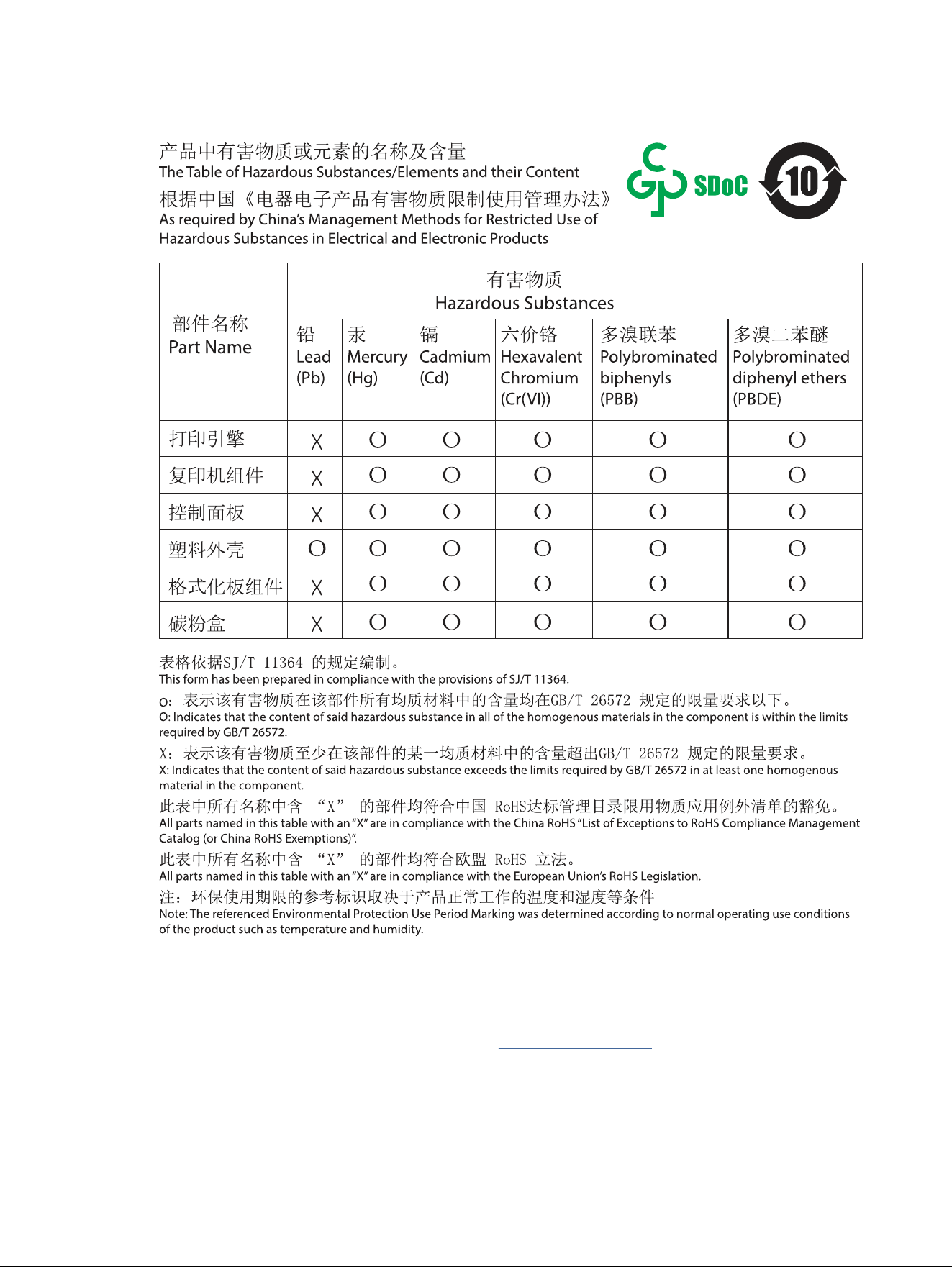

EPEAT
EPEAT is an Electronic Product Environmental Assessment Tool used to evaluate the effects of a
product on the environment.
HP products are designed to meet EPEAT criteria. Click here for information on HP's EPEAT registered
products.
For more information on EPEAT, go to EPEAT.net.
276 Appendix B Environmental product stewardship program
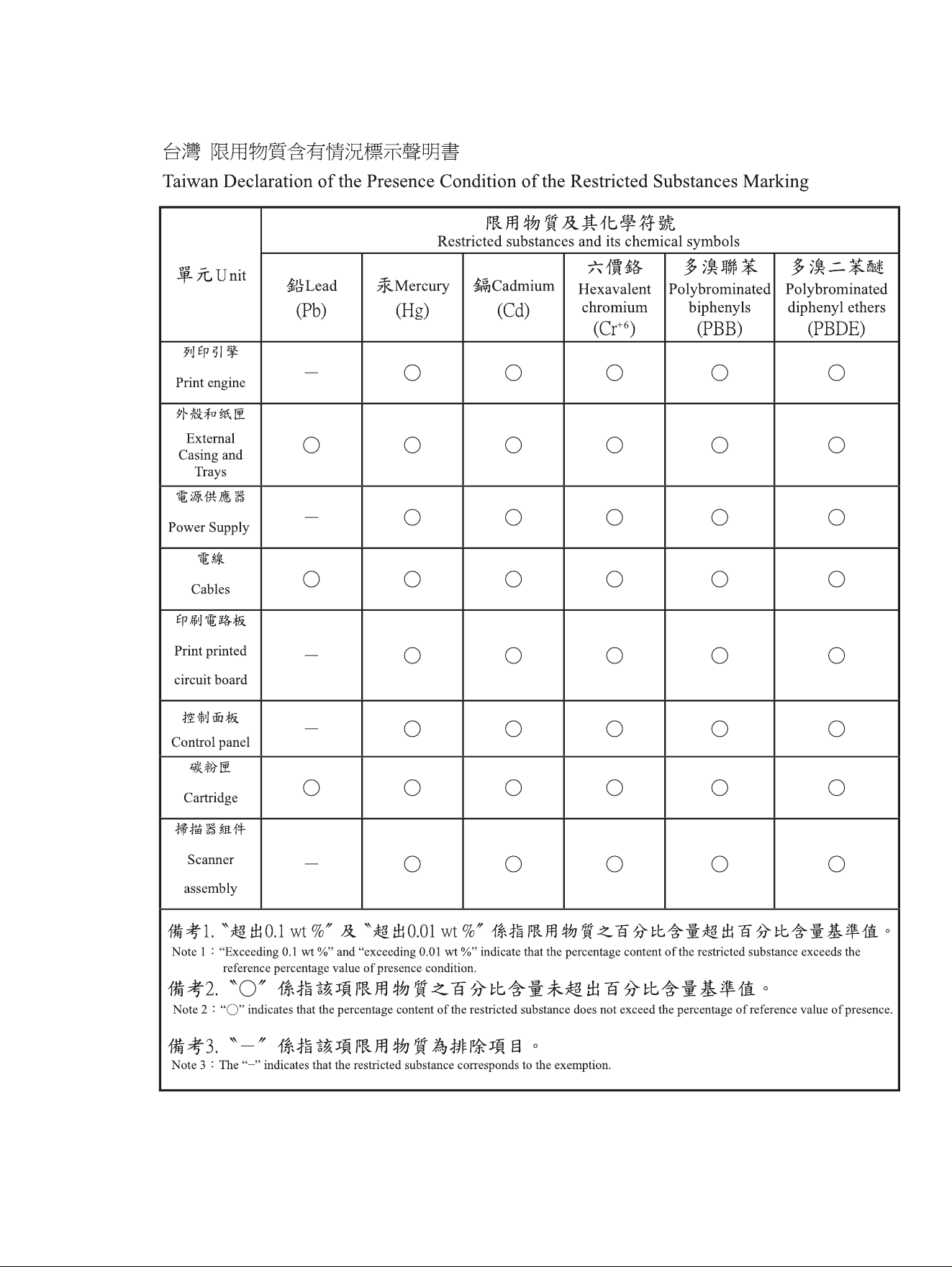
Substances Table (Taiwan)
Substances Table (Taiwan) 277

For more information
To obtain information about these environmental topics:
● Product environmental profile sheet for this and many related HP products
● HP’s commitment to the environment
● HP’s environmental management system
● HP’s end-of-life product return and recycling program
● Material Safety Data Sheets
Visit www.hp.com/go/environment.
Also, visit www.hp.com/recycle.
278
Appendix B Environmental product stewardship program

Regulatory informationC
Regulatory statements
Regulatory model identification numbers
For regulatory identification purposes, your product is assigned a regulatory model number. Regulatory
model numbers should not be confused with marketing names or product numbers.
Table C-1
Regulatory model identification numbers
Product model number Regulatory model number
HP Color LaserJet Enterprise MFP 6800
HP Color LaserJet Enterprise MFP 6801
HP Color LaserJet Enterprise MFP 6800dn
BOISB-2002-02
HP Color LaserJet Enterprise Flow MFP 6800zf BOISB-2002-03
HP Color LaserJet Enterprise Flow MFP 6800zfsw
HP Color LaserJet Enterprise Flow MFP 6801zfsw
HP Color LaserJet Enterprise Flow MFP 6800zfw+
HP Color LaserJet Enterprise Flow MFP 6801zfw+
BOISB-2002-04
European Union & United Kingdom Regulatory Notice
Products bearing the CE marking and UKCA marking comply with one or more of the following EU
Directives and/or equivalent UK Statutory Instruments as may be applicable: Low Voltage Directive
2014/35/EU, EMC Directive 2014/30/EU, Eco Design Directive 2009/125/EC, RED 2014/53/EU, RoHS
Directive 2011/65/EU. Battery Regulation 2023/1542.
Compliance with these directives is assessed using applicable European Harmonized Standards.
The full EU and UK Declaration of Conformity can be found at the following website: www.hp.com/go/
certificates (Search with the product model name or its Regulatory Model Number (RMN), which may be
found on the regulatory label.)
The point of contact for regulatory matters is: Email r[email protected]
The EU point of contact for regulatory matters is:
Regulatory information
279
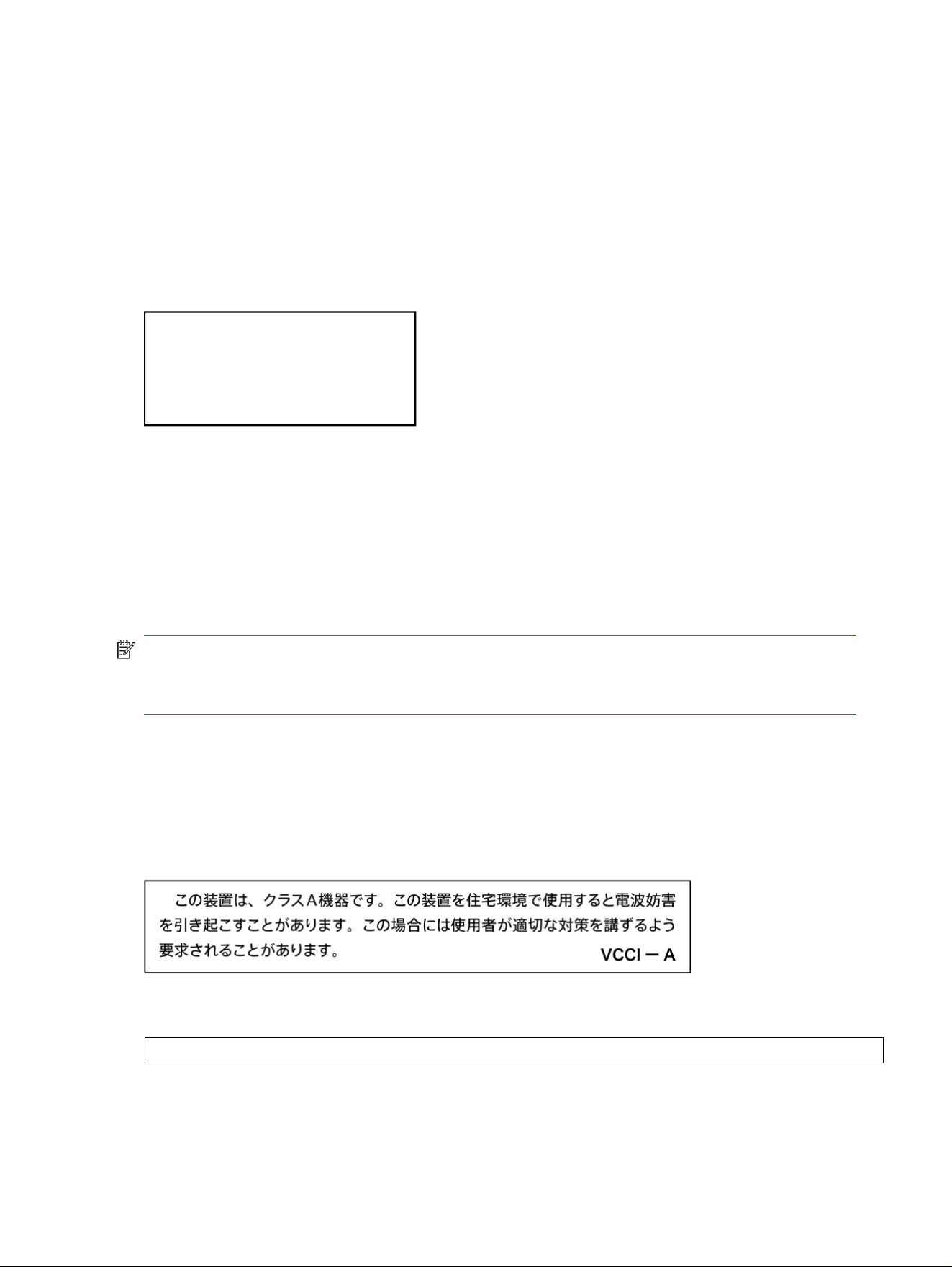
HP REG 23010, 08028, Barcelona Spain
The UK point of contact for regulatory matters is:
HP Inc UK Ltd, Regulatory Enquiries, Earley West, 300 Thames Valley Park Drive, Reading, RG6 1PT
The product meets the requirements of EN 55032 and its equivalent UK/BS EN standard, in which case
the following applies: 'Warning – This is a Class A product. In a domestic environment this product may
cause radio interference in which case the user may be required to take adequate measures.’
Class 1 consumer laser statement
CLASS 1 LASER PRODUCT
CONSUMER LASER PRODUCT
EN 50689:2021
FCC regulations
This equipment has been tested and found to comply with the limits for a Class A digital device,
pursuant to Part 15 of the FCC rules. These limits are designed to provide reasonable protection against
harmful interference when the equipment is operated in a commercial environment. This equipment
generates, uses, and can radiate radio frequency energy, and if not installed and used in accordance
with the instruction manual, may cause harmful interference to radio communications. Operation of this
equipment in a residential area is likely to cause harmful interference in which case the user will be
required to correct the interference at his own expense.
NOTE: Any changes or modifications to the printer that are not expressly approved by HP could void
the user’s authority to operate this equipment.
Use of a shielded interface cable is required to comply with the Class A limits of Part 15 of FCC rules.
Canada - Industry Canada ICES-003 Compliance Statement
CAN ICES-003(A)/NMB-003(A)
VCCI statement (Japan)
VCCI 32-1 規定適合の場合
EMC statement (Korea)
이 기기는 업무용 환경에서 사용할 목적으로 적합성평가를 받은 기기로서 가정용 환경에서 사용하는 경우 전파간섭의 우려가 있습니다
280 Appendix C Regulatory information
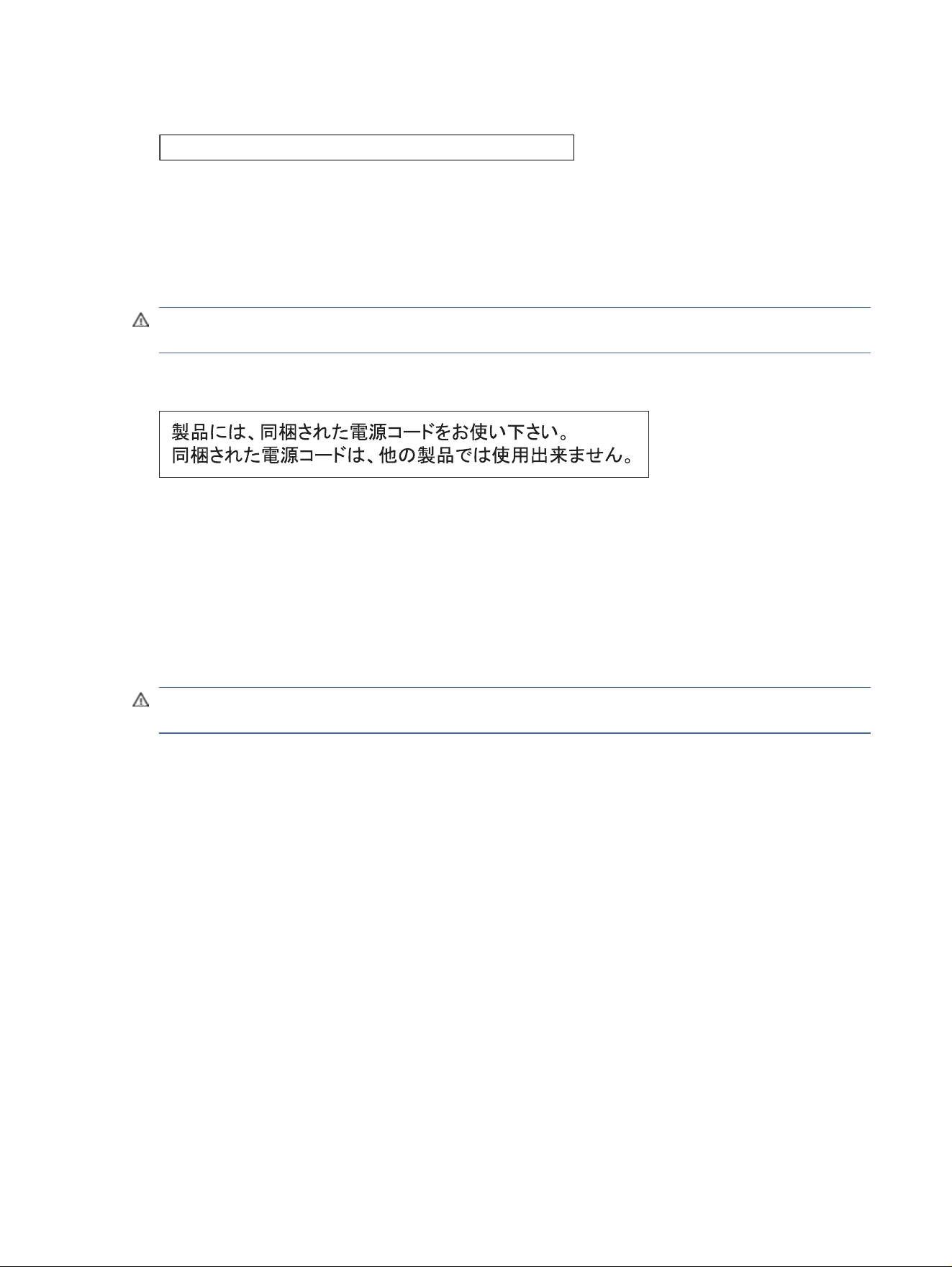
EMC statement (China)
婗⌻ˤ☙⬶Ṁ䊠❴ᴞ˖廁圽㩕媯⟸⋠修ḋ弑㓑䶰䐦ⵣㅡǎ
Power cord instructions
Make sure your power source is adequate for the product voltage rating. The voltage rating is on the
product label. The product uses either 100-127 Vac or 220-240 Vac and 50/60 Hz.
Connect the power cord between the product and a grounded AC outlet.
CAUTION: To prevent damage to the product, use only the power cord that is provided with the
product.
Power cord statement (Japan)
Laser safety
The Center for Devices and Radiological Health (CDRH) of the U.S. Food and Drug Administration
has implemented regulations for laser products manufactured since August 1, 1976. Compliance is
mandatory for products marketed in the United States. The device is certified as a “Class 1” laser
product under the U.S. Department of Health and Human Services (DHHS) Radiation Performance
Standard according to the Radiation Control for Health and Safety Act of 1968. Since radiation emitted
inside the device is completely confined within protective housings and external covers, the laser beam
cannot escape during any phase of normal user operation.
WARNING! Using controls, making adjustments, or performing procedures other than those specified
in this user guide may result in exposure to hazardous radiation.
For other US/Canada regulatory matters, please contact:
HP Inc.
1501 Page Mill Rd, Palo Alto, CA 94304, USA
Email contact: r[email protected] or Telephone contact: +1 (650) 857-1501
Laser statement for Finland
Luokan 1 laserlaite
HP Color LaserJet Enterprise MFP 6800, HP Color LaserJet Enterprise MFP 6800dn, HP Color LaserJet
Enterprise Flow MFP 6800zf, HP Color LaserJet Enterprise Flow MFP 6800zfsw, HP Color LaserJet
Enterprise Flow MFP 6800zfw+, HP Color LaserJet Enterprise Flow MFP 6801zfsw, HP Color LaserJet
Enterprise Flow MFP 6801zfw+, laserkirjoitin on käyttäjän kannalta turvallinen luokan 1 laserlaite.
Normaalissa käytössä kirjoittimen suojakotelointi estää lasersäteen pääsyn laitteen ulkopuolelle.
Laitteen turvallisuusluokka on määritetty standardin EN 60825-1 (2014) mukaisesti.
VAROITUS !
EMC statement (China)
281

Laitteen käyttäminen muulla kuin käyttöohjeessa mainitulla tavalla saattaa altistaa käyttäjän
turvallisuusluokan 1 ylittävälle näkymättömälle lasersäteilylle.
VARNING !
Om apparaten används på annat sätt än i bruksanvisning specificerats, kan användaren utsättas för
osynlig laserstrålning, som överskrider gränsen för laserklass 1.
HUOLTO
HP Color LaserJet Enterprise MFP 6800, HP Color LaserJet Enterprise MFP 6800dn, HP Color
LaserJet Enterprise Flow MFP 6800zf, HP Color LaserJet Enterprise Flow MFP 6800zfsw, HP Color
LaserJet Enterprise Flow MFP 6800zfw+, HP Color LaserJet Enterprise Flow MFP 6801zfsw, HP Color
LaserJet Enterprise Flow MFP 6801zfw+ - kirjoittimen sisällä ei ole käyttäjän huollettavissa olevia
kohteita. Laitteen saa avata ja huoltaa ainoastaan sen huoltamiseen koulutettu henkilö. Tällaiseksi
huoltotoimenpiteeksi ei katsota väriainekasetin vaihtamista, paperiradan puhdistusta tai muita käyttäjän
käsikirjassa lueteltuja, käyttäjän tehtäväksi tarkoitettuja ylläpitotoimia, jotka voidaan suorittaa ilman
erikoistyökaluja.
VARO !
Mikäli kirjoittimen suojakotelo avataan, olet alttiina näkymättömällelasersäteilylle laitteen ollessa
toiminnassa. Älä katso säteeseen.
VARNING !
Om laserprinterns skyddshölje öppnas då apparaten är i funktion, utsättas användaren för osynlig
laserstrålning. Betrakta ej strålen.
Tiedot laitteessa käytettävän laserdiodin säteilyominaisuuksista: Aallonpituus 775-795 nm Teho 5 m W
Luokan 3B laser.
Nordic Statements (Denmark, Finland, Norway, Sweden)
Denmark:
Apparatets stikprop skal tilsuttes en stikkontakt med jord, som giver forbindelse til stikproppens jord.
Finland:
Laite on liitettävä suojakoskettimilla varustettuun pistorasiaan.
Norway:
Apparatet må tilkoples jordet stikkontakt.
Sweden:
Apparaten skall anslutas till jordat uttag.
GS statement (Germany)
Das Gerät ist nicht für die Benutzung im unmittelbaren Gesichtsfeld am Bildschirmarbeitsplatz
vorgesehen. Um störende Reflexionen am Bildschirmarbeitsplatz zu vermeiden, darf dieses Produkt
nicht im unmittelbaren Gesichtsfeld platziert werden.
Das Gerät ist kein Bildschirmarbeitsplatz gemäß BildscharbV. Bei ungünstigen Lichtverhältnissen (z. B.
direkte Sonneneinstrahlung) kann es zu Reflexionen auf dem Display und damit zu Einschränkungen der
Lesbarkeit der dargestellten Zeichen kommen.
282
Appendix C Regulatory information
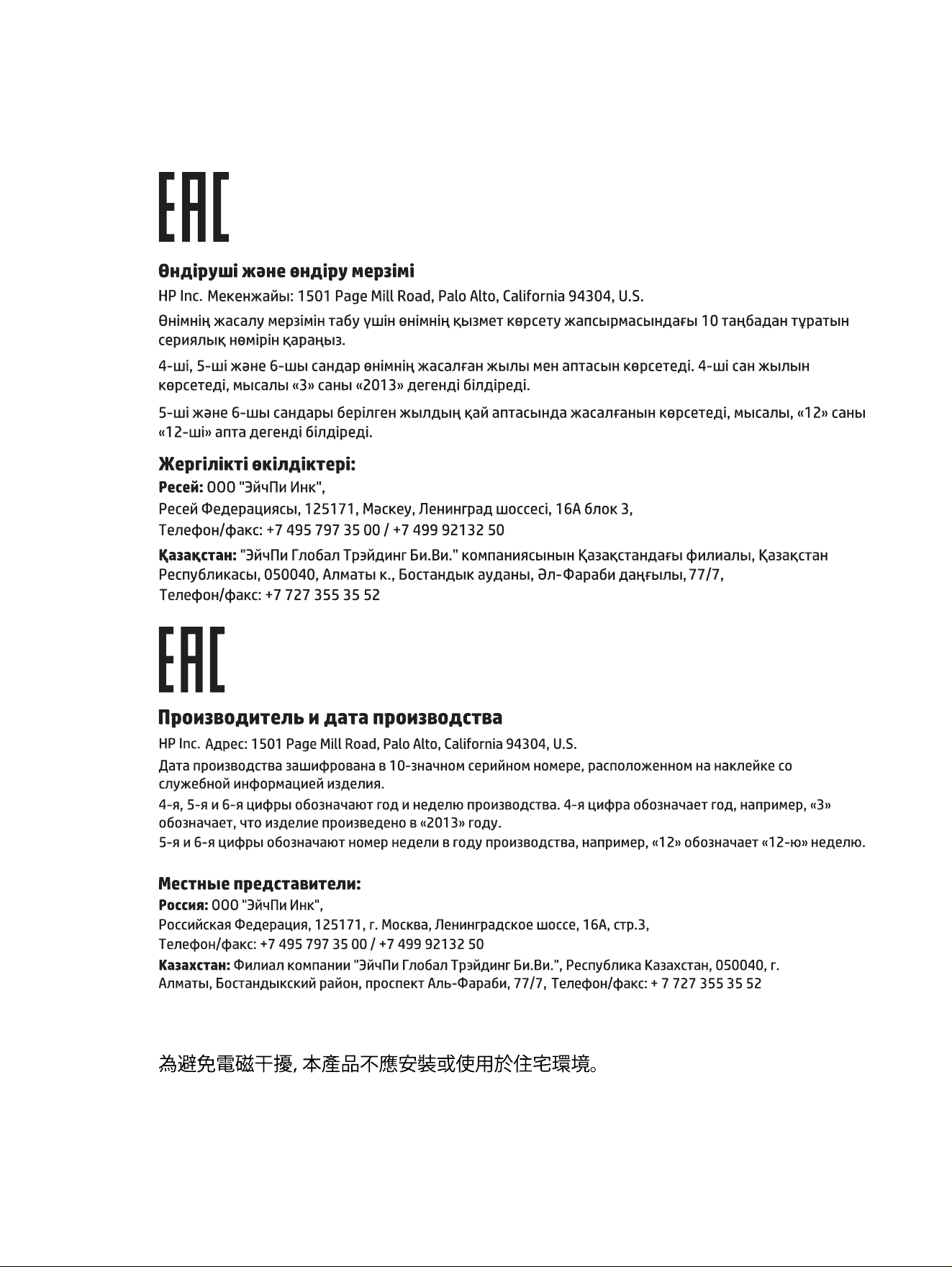
Die Bilddarstellung dieses Gerätes ist nicht für verlängerte Bildschirmtätigkeiten geeignet.
Eurasian Conformity (Armenia, Belarus, Kazakhstan, Kyrgyzstan)
EMC statement (Taiwan)
Eurasian Conformity (Armenia, Belarus, Kazakhstan, Kyrgyzstan) 283

Taiwan BSMI USB Port (Walk-up) statement
台灣 BSMI USB 埠 (Walk-up) 聲明
產品前端, 上方或側邊之 USB 埠 (walk-up 埠), 僅支持隨身碟.
Product stability
Do not extend more than one paper tray at a time.
Do not use paper tray as a step.
All trays must be closed while relocating/moving product.
Keep hands out of paper tray when closing.
If the printer has a keyboard, close keyboard tray when not in use.
Battery statements
Coin/button cell battery safety statements
The following statements are only applicable for products with a coin/button cell battery.
WARNING! This product contains a coin/button cell battery. If the coin/button cell battery is
swallowed, it can cause severe internal burns in just 2 hours and can lead to death.
WARNING! Keep new and used batteries away from children.
WARNING! If the battery compartment does not close securely, stop using the product and keep it
away from children.
WARNING! If you think batteries might have been swallowed or placed inside any part of the body,
seek immediate medical attention.
Telecom (fax) statements
Fax Cord Statement
Product may or may not have fax/telephone cord enclosed. If not provided to reduce the risk of fire, use
only No. 26 AWG or larger telecommunication line cord.
Europe Statement for Telecom Operation
The printer meets applicable EU Directive & UK Statutory Instruments and carries the CE & UKCA mark
accordingly. For details see EU & UK Declaration of Conformity issued by the manufacturer.
For printers with the feature to be connected to the analog Public Switched Telecommunication
Networks (PSTN):
Due to differences between individual European national PSTNs the product may not guarantee
unconditional assurance of successful operation on every PSTN termination point. Network
compatibility depends on the correct setting being selected by the customer in preparation of its
connection to the PSTN. Please follow the instructions provided in the user manual. If you experience
network compatibility issues, please contact your equipment supplier or HP Inc. help desk in the country
284
Appendix C Regulatory information

of operation. Connecting to a PSTN termination point may be the subject of additional requirements set
out by the local PSTN operator.
Declaração para a ANATEL do Brasil
Para maiores informações consulte o site da ANATEL – www.anatel.gov.br
New Zealand Telecom Statements
The grant of a Telepermit for any item of terminal equipment indicates only that Telecom has
accepted that the item complies with minimum conditions for connection to its network. It indicates
no endorsement of the product by Telecom, nor does it provide any sort of warranty. Above all, it
provides no assurance that any item will work correctly in all respects with another item of Telepermitted
equipment of a different make or model, nor does it imply that any product is compatible with all of
Telecom’s network services.
This equipment may not provide for the effective hand-over of a call to another device connected to the
same line.
This equipment shall not be set up to make automatic calls to the Telecom “111” Emergency Service.
This product has not been tested to ensure compatibility with the FaxAbility distinctive ring service for
New Zealand.
Additional FCC statement for telecom products (US)
This equipment complies with Part 68 of the FCC rules and the requirements adopted by the ACTA. On
the back of this equipment is a label that contains, among other information, a product identifier in the
format US:AAAEQ##TXXXX. If requested, this number must be provided to the telephone company.
The REN is used to determine the quantity of devices, which may be connected to the telephone line.
Excessive RENs on the telephone line may result in the devices not ringing in response to an incoming
call. In most, but not all, areas, the sum of the RENs should not exceed five (5.0). To be certain of the
number of devices that may be connected to the line, as determined by the total RENs, contact the
telephone company to determine the maximum REN for the calling area.
This equipment uses the following USOC jacks: RJ11C.
FCC-compliant telephone cord, jack and modular plug should be used with this equipment. This
equipment is designed to be connected to the telephone network or premises wiring using a compatible
modular jack, which is Part 68 compliant. This equipment cannot be used on telephone company-
provided coin service. Connection to Party Line Service is subject to state tariffs.
If this equipment causes harm to the telephone network, the telephone company will notify you in
advance that temporary discontinuance of service may be required. If advance notice is not practical,
the telephone company will notify the customer as soon as possible. Also, you will be advised of your
right to file a complaint with the FCC if you believe it is necessary.
The telephone company may make changes in its facilities, equipment, operations, or procedures
that could affect the operation of the equipment. If this happens, the telephone company will provide
advance notice in order for you to make the necessary modifications in order to maintain uninterrupted
service.
If trouble is experienced with this equipment, please see the numbers in this manual for repair and (or)
warranty information. If the trouble is causing harm to the telephone network, the telephone company
may request you remove the equipment from the network until the problem is resolved.
Declaração para a ANATEL do Brasil
285

The customer can do the following repairs: Replace any original equipment that came with the device.
This includes the toner cartridge, the supports for trays and bins, the power cord, and the telephone
cord. It is recommended that the customer install an AC surge arrestor in the AC outlet to which this
device is connected. This is to avoid damage to the equipment caused by local lightning strikes and
other electrical surges.
Telephone Consumer Protection Act (US)
The Telephone Consumer Protection Act of 1991 makes it unlawful for any person to use a computer or
other electronic device, including fax machines, to send any message unless such message clearly
contains, in a margin at the top or bottom of each transmitted page or on the first page of the
transmission, the date and time it is sent and an identification of the business, other entity, or individual
sending the message and the telephone number of the sending machine or such business, or other
entity, or individual. (The telephone number provided cannot be a 900 number or any other number for
which charges exceed local or long distance transmission charges).
Industry Canada CS-03 requirements
Notice: The Industry Canada label identifies certified equipment. This certification means the equipment
meets certain telecommunications network protective, operational, and safety requirements as
prescribed in the appropriate Terminal Equipment Technical Requirement document(s). The Department
does not guarantee the equipment will operate to the user’s satisfaction. Before installing this
equipment, users should ensure that it is permissible for the equipment to be connected to the facilities
of the local telecommunications company. The equipment must also be installed using an acceptable
method of connection. The customer should be aware that compliance with the above conditions
may not prevent degradation of service in some situations. Repairs to certified equipment should be
coordinated by a representative designated by the supplier. Any repairs or alterations made by the
user to this equipment, or equipment malfunctions, may give the telecommunications company cause
to request the user to disconnect the equipment. Users should ensure for their own protection that
the electrical ground connections of the power utility, telephone lines, and internal metallic water pipe
system, if present, are connected together. This precaution can be particularly important in rural areas.
CAUTION: Users should not attempt to make such connections themselves, but should contact the
appropriate electric inspection authority, or electrician, as appropriate. The Ringer Equivalence
Number (REN) of this device is shown on the regulatory chassis label.
This product meets the applicable Innovation, Science and Economic Development Canada technical
specifications.
The Ringer Equivalence Number (REN) indicates the maximum number of devices allowed to be
connected to a telephone interface. The termination of an interface may consist of any combination
of devices subject only to the requirement that the sum of the RENs of all the devices not exceed five (5).
The standard connecting arrangement code (telephone jack type) for equipment with direct
connections to the telephone network is CA11A.
Remarque: L'étiquette Industrie Canaca identifie un équiement certifié. Cette certification signifie que
l'équipement satisfait à certaines exigences en matière de protection, d'exploitation et de sécurité
du réseau de télécommunications, conformément au(x) document(s) sur les exigences techniques
relatives à l'équipement terminal. Le Ministère ne garantit pas que l'équipement donnera satisfaction
à l'utilisateur. Avant d'installer cet équipement, les utilisateurs doivent s'assurer qu'ils sont autorisés
à connecter l'équipement aux installations de l'entreprise locale de télécommunications. L'équipement
doit également être installé via une méthode de connexion appropriée. Le client doit être conscient que
le respect des conditions ci-dessus ne peut pas empêcher la dégradation du service dans certaines
situations. Les réparations de l'équipement certifié doivent être coordonnées par un représentant
désigné par le fournisseur. Toute réparation ou modification apportée par l'utilisateur à cet équipement
286
Appendix C Regulatory information

ou tout dysfonctionnement de l'équipement peut amener l'entreprise de télécommunications à
demander à l'utilisateur de débrancher l'équipement. Pour leur propre protection, les utilisateurs
doivent s'assurer que les connexions électriques à la terre du service public d'électricité, des lignes
téléphoniques et, le cas échéant, des conduites d'eau métalliques internes sont raccordées ensemble.
Cette précaution peut être particulièrement importante dans les zones rurales.
CAUTION: Les utilisateurs ne doivent pas tenter d'effectuer eux-mêmes de tels raccordements, mais
doivent prendre contact avec les services d'inspection électrique appropriés ou avec un électricien,
selon le cas. Le numéro d'équivalence de sonnerie (REN) de cet appareil est indiqué sur l'étiquette
réglementaire du châssis.
Ce produit est conforme aux spécifications techniques applicables d'Innovation, Sciences et
Développement économique Canada.
Le numéro d'équivalence de sonnerie (REN) indique le nombre maximum d'appareils pouvant être
connectés à une interface téléphonique. La terminaison d'une interface peut consister en n'importe
quelle combinaison de dispositifs, à la seule condition que la somme des REN de tous les dispositifs ne
dépasse pas cinq (5).
Le code de raccordement standard (type prise téléphonique) pour les appareils directement raccordés
au réseau téléphonique est CA11A.
Japan Telecom Mark
この製品には、認定済みファックス モジュールが含まれています。
認証番号 (XXX XXXXXXXX) は、HP アナログ ファックス アクセサリにあります。
Belarus
В соответствии с Постановлением Совета Министров Республики Беларусь от 24 мая 2017 года № 383 (об
описании и порядке применения знака соответствия к техническому регламенту Республики Беларусь)
продукция, требующая подтверждения соответствия техническому регламенту Республики Беларусь,
размещенная на рынке Республики Беларусь, должна быть маркирована знаком соответствия ТР BY.
Wireless statements
European regulatory notice
Wireless functionality in Europe
For products with 802.11b/g/n or Bluetooth radio
This product operates on radio frequency between 2400 MHz
and 2483.5 MHz, with a transmit power of 20 dBm (100 mW) or
less.
Japan Telecom Mark 287

For products with 802.11a/b/g/n radio
CAUTION: IEEE802.11x wireless LAN with 5.15-5.35 GHz
frequency band is restricted for indoor use only in all European
Union member states, EFTA (Iceland, Norway, Liechtenstein)
and most other European countries (i.e.: Switzerland, Turkey,
Republic of Serbia). Using this WLAN application outdoors
might lead to interference issues with existing radio services.
This product operates on radio frequencies between 2400
MHz and 2483.5 MHz, and between 5170 MHz and 5710 MHz,
with a transmit power of 20 dBm (100 mW) or less.
FCC compliance statement—United States
Exposure to radio frequency radiation
CAUTION: The radiated output power of this device is far below the FCC radio frequency exposure
limits. Nevertheless, the device shall be used in such a manner that the potential for human contact
during normal operation is minimized.
In order to avoid the possibility of exceeding the FCC radio frequency exposure limits, human proximity
to the antenna shall not be less than 20 cm (8 in) during normal operation.
This device complies with Part 15 of FCC Rules. Operation is subject to the following two conditions:
(1) this device may not cause interference, and (2) this device must accept any interference, including
interference that may cause undesired operation of the device.
CAUTION: Based on Section 15.21 of the FCC rules, changes of modifications to the operation of this
product without the express approval by HP may invalidate its authorized use.
Australia statement
This device incorporates a radio-transmitting (wireless) device. For protection against radio
transmission exposure, it is recommended that this device be operated no less than 20 cm from the
head, neck, or body.
Brazil: (Portuguese)
Este equipamento não tem direito à proteção contra interferência prejudicial e não pode causar
interferência em sistemas devidamente autorizados.
Para maiores informações consulte o site da ANATEL – www.anatel.gov.br
Canadian statements
For Indoor Use
. This digital apparatus does not exceed the Class B limits for radio noise emissions
from digital apparatus as set out in the radio interference regulations of the Canadian Department of
Communications. The internal wireless radio complies with RSS 210 of Industry Canada.
Pour l´usage d´intérieur. Le présent appareil numérique n´émet pas de bruits radioélectriques
dépassant les limites applicables aux appareils numériques de Classe B prescribes dans le règlement
sur le brouillage radioélectrique édicté par le Ministère des Communications du Canada. Le composant
RF interne est conforme à la norme CNR-210 d´Industrie Canada.
288
Appendix C Regulatory information

Products with 5 GHz Operation Industry of Canada
CAUTION: When using IEEE 802.11a wireless LAN, this product is restricted to indoor use, due to its
operation in the 5.15- to 5.25-GHz frequency range. Industry Canada requires this product to be used
indoors for the frequency range of 5.15 GHz to 5.25 GHz to reduce the potential for harmful interference
to co-channel mobile satellite systems. High-power radar is allocated as the primary user of the 5.25- to
5.35-GHz and 5.65- to 5.85-GHz bands. These radar stations can cause interference with and/or
damage to this device.
Lors de l'utilisation d'un réseau local sans fil IEEE 802.11a, ce produit est réservé à une utilisation en
intérieur en raison de sa plage de fréquences, comprise entre 5,15 et 5,25 GHz. Industrie Canada
recommande l'utilisation en intérieur de ce produit pour la plage de fréquences comprise entre 5,15
et 5,25 GHz afin de réduire les interférences nuisibles potentielles avec les systèmes de satellite
portables utilisant le même canal. Le radar à haute puissance est défini comme étant le principal
utilisateur des bandes 5,25 à 5,35 GHz et 5,65 à 5,85 GHz. Ces stations radar peuvent provoquer des
interférences sur ce périphérique et/ou l'endommager.
Exposure to Radio Frequency Radiation (Canada)
WARNING! Exposure to Radio Frequency Radiation The radiated output power of this device is below
the Industry Canada radio frequency exposure limits. Nevertheless, the device should be used in such
a manner that the potential for human contact is minimized during normal operation.
To avoid the possibility of exceeding the Industry Canada radio frequency exposure limits, human
proximity to the antennas should not be less than 20 cm (8 inches).
AVERTISSEMENT! Exposition aux émissions de fréquences radio. La puissance de sortie émise par
ce périphérique est inférieure aux limites fixées par Industrie Canada en matière d’exposition aux
fréquences radio. Néanmoins, les précautions d'utilisation du périphérique doivent être respectées afin
de limiter tout risque de contact avec une personne.
European Regulatory Notice
The telecommunications functionality of this product may be used in the following European countries/
regions:
Austria, Belgium, Bulgaria, Cyprus, Czech Republic, Denmark, Estonia, Finland, France, Germany, Greece,
Hungary, Iceland, Ireland, Italy, Latvia, Liechtenstein, Lithuania, Luxembourg, Malta, Netherlands, Norway,
Poland, Portugal, Romania, Slovak Republic, Slovenia, Spain, Sweden, Switzerland, and United Kingdom.
China CMIIT Wireless Statement
中国无线电发射设备通告
型号核准代码显示在产品本体的铭牌上。
Notice for use in Japan
この機器は技術基準適合証明又は工事設計認証を受けた無線設備を搭載しています。
Notice for use in Russia
Существуют определенные ограничения по использованию беспроводных сетей (стандарта 802.11 b/g)
с рабочей частотой 2,4 ГГц: Данное оборудование может использоваться внутри помещений с
использованием диапазона частот 2400-2483,5 МГц (каналы 1-13). При использовании внутри помещений
Products with 5 GHz Operation Industry of Canada
289

максимальная эффективная изотропно–излучаемая мощность (ЭИИМ) должна составлять не более
100мВт.
Mexico statement
Aviso para los usuarios de México
“La operación de este equipo está sujeta a las siguientes dos condiciones: (1) es posible que este equipo
o dispositivo no cause interferencia perjudicial y (2) este equipo o dispositivo debe aceptar cualquier
interferencia, incluyendo la que pueda causar su operación no deseada."
Para saber el modelo de la tarjeta inalámbrica utilizada, revise la etiqueta regulatoria de la impresora.
Taiwan statement
取得審驗證明之低功率射頻器材,非經核准,公司、商號或使用者均不得擅自變更頻率、加大功率或變更
原設計之特性及功能。低功率射頻器材之使用不得影響飛航安全及干擾合法通信;經發現有干擾現象時,
應立即停用,並改善至無干擾時方得繼續使用。前述合法通信,指依電信管理法規定作業之無線電通信。
低功率射頻器材須忍受合法通信或工業、科學及醫療用電波輻射性電機設備之干擾。
Taiwan NCC statement
應避免影響附近雷達系統之操作。
高增益指向性天線只得應用於固定式點對點系統。
Thailand Wireless Statement
เครื่องวิทยุคมนาคมนี้มีระดบั การแผ่คลื่นแม่เหล็กไฟฟ้ าสอดคล้องตามมาตรฐานความปลอดภยั ต่อสุขภาพของมนุษย์จาก
การ ใช้เครื่องวิทยุคมนาคมที่คณะกรรมการกิจการโทรคมนาคมแห่งชาติประกาศกําหนด
This radio communication equipment has the electromagnetic field strength in compliance with the
Safety Standard for the Use of Radio Communication Equipment on Human Health announced by the
National Telecommunications Commission.
RFID/NFC Statement
China Short Range Device Statement
若产品为微功率短距离无线电发射设备 ,在此承诺: 本设备符合《微功率短距离无线电发射设备目录和技
术要求》, 不擅自做任何改变,不会对其他合法的无线电台(站)产生有害干扰,也不会提出免受有害干扰
保护,不会在任何管制区域内使用.
290
Appendix C Regulatory information

Index
Symbols/Numerics
550-sheet paper trays
part numbers 36
550-sheet tray
jams 155
A
accessories
ordering 36
part numbers 36
acoustic specifications 15
AirPrint 64, 66
alternative letterhead mode 17,
28
Android devices
printing from 64, 67
anticounterfeit supplies 251, 264
B
batteries included 270, 271
bin, output
locating 2
Bonjour
identifying 130
browser requirements
HP Embedded Web
Server 130
C
calibrate
colors 222
scanner 230
cartridge
replacing 44
cartridge policy 39, 40
cartridge protection 39, 42
cartridges
non-HP 251, 263
order numbers 44
recycling 270, 271
warranty 251, 263
ce marking 279
checklist
wireless connectivity 244
China Short Range Device
Statement 290
Class 1 consumer laser 280
cleaning
glass 230, 234, 238
paper path 218
colors
calibrate 222
control panel
help 146
locating 2
locating features 6
copy
optimize for text or
pictures 230
copy settings
HP Embedded Web
Server 130, 132, 134
copying
overview 70
counterfeit supplies 251, 264
customer support
online 251, 269
D
default gateway, setting 141
deleting
stored jobs 61, 63
digital send settings
HP Embedded Web
Server 130, 132, 134
digital sending
folders 114
printer memory 112
sending documents 109
USB 118
dimensions, printer 13
disposal, end-of-life 270, 271
document feeder
jams 155, 157
locating 2
paper-feeding problems 149,
154
double-sided printing
Mac 59
Windows 56
duplex printing
Mac 59
duplex printing (double-sided)
settings (Windows) 56
Windows 56
duplexer
jams 155
duplexing
manually (Mac) 59
manually (Windows) 56
E
easy-access USB port
locating 2
easy-access USB printing 67
edge-to-edge copying 230
electrical specifications 15
electronic hardware
recycling 270, 272
Embedded Web Server
changing network
settings 140
changing printer name 140
opening 139
Embedded Web Server (EWS)
assigning passwords 142, 143
features 130
network connection 130
end-of-life disposal 270, 271
energy use, optimizing 144
envelopes
orientation 17
orientation, loading 29
envelopes, loading 28
environmental stewardship
program 270
Eurasian conformity 279, 283
Explorer, versions supported
HP Embedded Web
Server 130
F
fax
block 128
feeding problems 247, 249
optimize for text or
pictures 238
overview 122
required settings 122
settings 123, 128
setup 122
Index
291

fax settings
HP Embedded Web
Server 130, 132, 135
required 122
FCC regulations 279, 280
feeding problems 247, 249
Finnish laser safety
statement 279, 281
folders
sending to 114
formatter
locating 5
fraud Web site 251, 264
front door
locating 2
fuser
jams 155, 193, 195, 199
G
gateway, setting default 141
general configuration
HP Embedded Web
Server 130, 132, 133
genuine HP cartridges 39, 40
glass, cleaning 230, 234, 238
H
hard disks
encrypted 142, 144
hardware recycling, Brazil 270,
272
Help button
locating 6
help, control panel 146
Home button
locating 6
HP Customer Care 251, 269
HP Embedded Web Server
changing network
settings 140
changing printer name 140
copy settings 130, 132, 134
digital send settings 130, 132,
134
fax settings 130, 132, 135
general configuration 130, 132,
133
HP Web Services 130, 132, 138
information pages 130, 132
network settings 130, 132, 138
opening 139
other links list 130, 132
print settings 130, 132, 134
scan settings 130, 132, 134
security settings 130, 132, 137
supplies 136
troubleshooting tools 130, 132,
136
HP Embedded Web Server (EWS)
features 130
network connection 130
HP fraud Web site 251, 264
HP JetAdvantage business
solutions 120
HP Web Jetadmin 145
HP Web Services
enabling 130, 132, 138
I
image quality
check toner-cartridge
status 218, 219
information pages
HP Embedded Web
Server 130, 132
interface ports
locating 5
Internet Explorer, versions
supported
HP Embedded Web
Server 130
IP Security 142, 144
IPsec 142, 144
IPv4 address 141
IPv6 address 141
J
jams
550-sheet tray 155
auto-navigation 156
causes of 156
document feeder 155, 157
duplexer 155
fuser 155, 193, 195, 199
in right door 190
locations 155
output bin 155, 201, 202, 204,
206, 210, 213
Tray 1 155
Tray 2 155, 165
Tray 4 176, 183
Japanese VCCI statement 279,
280
Jetadmin, HP Web 145
JetAdvantage 120
jobs, stored
creating (Windows) 61
deleting 61, 63
Mac settings 61
printing 61, 63
K
Korean EMC statement 279, 280
L
label
orientation 30
labels
orientation, loading 30
printing (Windows) 56
printing on 30
labels, loading 30
laser safety statements 279, 281
license, software 251, 264
loading
paper in Tray 1 17
paper in Tray 2 22
lock
formatter 142, 144
M
Mac driver settings
Job Storage 61
managing network 139
managing the printer
overview 130
manual duplex
Mac 59
Windows 56
margins, small
copying 230
material restrictions 270, 271
Material Safety Data Sheet
(MSDS) 270, 275
memory
included 8
memory chip (toner)
locating 44
memory chip, toner cartridge
description 251, 264
mercury-free product 270, 271
mobile printing
Android devices 64, 67
mobile printing, software
supported 12
multiple pages per sheet
printing (Mac) 59
printing (Windows) 56
292
Index

N
Near Field Communication
printing 64, 65
Netscape Navigator, versions
supported
HP Embedded Web
Server 130
network
printer name, changing 140
settings, changing 140
settings, viewing 140
network duplex settings,
changing 142
Network Folder, scan to 114
network link speed settings,
changing 142
network settings
HP Embedded Web
Server 130, 132, 138
networks
default gateway 141
HP Web Jetadmin 145
IPv4 address 141
IPv6 address 141
subnet mask 141
supported 8
NFC connect and print 64, 65
non-HP supplies 251, 263
O
on/off button
locating 2
online help, control panel 146
online support 251, 269
operating-environment range
printer 15
optimize copy images 230
optimize fax images 238
optimize scanned images 234
ordering
supplies and accessories 36
orientation
envelopes 29
labels 30
other links list
HP Embedded Web
Server 130, 132
output bin
clear jams 155, 201, 202, 206,
210, 213
locating 2
P
pages per minute 8
pages per sheet
selecting (Mac) 59
selecting (Windows) 56
paper
jams 155, 156
loading Tray 1 17
loading Tray 2 22
selecting 218, 221
Tray 1 orientation 17, 19
Tray X orientation 25
paper jams
550-sheet tray 155
document feeder 155, 157
duplexer 155
fuser 155, 193, 195, 199
locations 155
output bin 155, 201, 202, 204,
206, 210, 213
right door 190
Stapler stacker 204
Tray 1 155
Tray 2 155, 165
Tray 4 176, 183
paper pickup problems
solving 149, 152
paper trays
overview 17
part numbers 36
paper type
selecting (Windows) 56
paper types
selecting (Mac) 59
paper, ordering 36
part numbers
accessories 36
replacement parts 39
supplies 36
toner cartridges 36
potential shock hazard 2
power
consumption 15
power usage 144
print media
loading in Tray 1 17
print on both sides
Mac 59
manually, Windows 56
Windows 56
print settings
HP Embedded Web
Server 130, 132, 134
printer
operating-environment
range 15
overview 1
printer memory
sending to 112
printer memory, scan to 112
printing
from USB storage
accessories 67
overview 56
stored jobs 61, 63
printing on both sides
settings (Windows) 56
private printing 61
product number
location 5
protect cartridges 39, 42
R
recycling 270, 271
electronic hardware 270, 272
replacement parts
part numbers 39
replacing
staples 51
toner cartridges 44
toner collection unit 48
required settings
fax 122
reset factory settings 147
right door
locating 2
Right door
jams 190
S
safety statements 279, 281
Save to printer memory 112
scan settings
HP Embedded Web
Server 130, 132, 134
Scan to Network Folder 114
initial setup 90
Scan to USB Drive 118
enabling 106
scanner
calibrate 230
glass cleaning 230, 234, 238
scanning
optimize for text or
pictures 234
overview 75
Index
293

scanning to email
sending documents 109
scanning to folder 114
scanning to printer folder 112
scanning to printer memory 112
scanning to USB 118
security
encrypted hard disk 142, 144
security settings
HP Embedded Web
Server 130, 132, 137
sending to email
sending documents 109
serial number
locating 5
settings
fax 123, 128
reset to factory (default)
settings 147
Sign In button
locating 6
Sign Out button
locating 6
sleep delay
setting 144
small margins 230
software
software license
agreement 251, 264
special paper
printing (Windows) 56
specifications
electrical and acoustic 15
speed, optimizing 144
stapler
locating 2
Stapler stacker
clear jams 204
staples
replacing 51
status, fax accessory page 247
storage, job
Mac settings 61
store print jobs 61
stored jobs
creating (Mac) 61
creating (Windows) 61
deleting 61, 63
printing 61, 63
storing jobs
with Windows 61
subnet mask 141
supplies
counterfeit 251, 264
HP Embedded Web
Server 136
low threshold settings 147
non-HP 251, 263
ordering 36
part numbers 36
recycling 270, 271
replacing staples 51
replacing toner cartridges 44
replacing toner collection
unit 48
using when low 147
support
online 251, 269
system requirements
HP Embedded Web
Server 130
T
Taiwan EMI statement 279, 283
TCP/IP
manually configuring IPv4
parameters 141
manually configuring IPv6
parameters 141
technical support
online 251, 269
toner cartridge
low threshold settings 147
using when low 147
toner cartridges
components 44
memory chips 251, 264
non-HP 251, 263
order numbers 44
part numbers 36
recycling 270, 271
replacing 44
See
toner cartridges
warranty 251, 263
toner collection unit
replacing 48
touchscreen
locating features 6
transparencies
printing (Windows) 56
Tray 1
jams 155
loading envelopes 28
locating 2
paper orientation 17, 19
Tray 2
jams 155, 165
loading 22
locating 2
paper orientation 25
Tray 3
locating 2
paper orientation 25
Tray 4
jams 176, 183
locating 2
trays
capacity 8
included 8
locating 2
use alternative letterhead
mode 28
troubleshooting
check toner-cartridge
status 218, 219
jams 155, 156
network problems 242
overview 146
paper feed problems 149
wired network 242
wireless network 244
troubleshooting tools
HP Embedded Web
Server 130, 132, 136
two-sided printing
settings (Windows) 56
U
USB
sending to 118
USB port
enabling 67, 69
USB storage accessories
printing from 67
W
warranty
customer self repair 251, 269
license 251, 264
product 251
toner cartridges 251, 263
waste disposal 270, 272
web browser requirements
HP Embedded Web
Server 130
Web sites
customer support 251, 269
fraud reports 251, 264
Material Safety Data Sheet
(MSDS) 270, 275
294
Index