BUILT
UNDER
SERIES
@GrandCruWineFridges
www.grandcruwinefridges.com.au
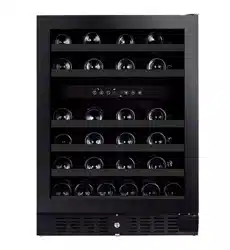
BEVERAGE FRIDGE
GC46 SERIES
WINE FRIDGE
GC46 SERIES
OWNERS MANUAL
NEED HELP? CALL
1300 935 683
3
IMPORTANT SAFETY INFORMATION .............................................................................. 4
STRUCTURE & INSTALLATION ....................................................................................... 7
OPERATING THE WINE FRIDGE ...................................................................................... 9
WORKING CLIMATE ...................................................................................................................9
WINE STORAGE ..........................................................................................................................9
RECOMMENDED TEMPERATURES ..........................................................................................9
CONTROL PANEL ...........................................................................................................10
FOR SINGLE ZONE ...................................................................................................................10
FOR DUAL ZONE ......................................................................................................................10
POWER ON/OFF CONTROL .....................................................................................................11
UNLOCKING THE CONTROL PANEL ......................................................................................11
INTERIOR LIGHTING ON/OFF CONTROL ................................................................................11
TEMPERATURE DISPLAY WINDOW ........................................................................................11
TEMPERATURE SETTING ........................................................................................................11
SELECTING FAHRENHEIT (°F) & CELSIUS (°C) DISPLAY .....................................................12
CARE & MAINTENANCE .................................................................................................13
CLEANING THE WINE FRIDGE ................................................................................................13
POWER FAILURE .....................................................................................................................13
MOVING THE WINE FRIDGE ....................................................................................................13
ENERGY SAVING TIPS..............................................................................................................13
TROUBLESHOOTING ......................................................................................................14
REVERSE THE DOOR SWING ..........................................................................................15
WARRANTY, SERVICE AND SUPPORT ............................................................................17
STORING AND STACKING ..............................................................................................18
DIFFERENT SHAPES & SIZES .................................................................................................18
STACKING FOR AGEING ..........................................................................................................18
STACKING FOR ACCESSIBILITY ..............................................................................................18
FREQUENTLY ASKED QUESTIONS .................................................................................19
WINE STORAGE GUIDE ................................................................................................. 23
WINE TEMPERATURE SERVING GUIDE ......................................................................... 25
CONTENTS
4
IMPORTANT SAFEGUARDS
When using an electrical appliance, basic
precautions should always be followed to
reduce the risk of fire, electric shock, and
injury to persons, including the following:
FOR YOUR SAFETY
Read all instructions carefully, even if you
are quite familiar with the appliance.
• The appliance is intended to be used
exclusively for the storage of wine.
• Use this appliance only as described in this
manual. Other uses not recommended may
cause fire, electric shock or personal injury.
• This appliance is not intended for use by
young children or infirm persons unless
they have been adequately supervised
by a responsible person to ensure that
they can use the appliance safely.
• Young children should be
supervised to ensure that they do
not play with the appliance.
• To protect against the risk of electric
shock, DO NOT IMMERSE the unit, cord,
or plug in water or spray any other liquid.
• Unplug the appliance from the plug socket
when not in use, when moving from one
location to another and before cleaning.
IMPORTANT SAFETY INFORMATION
• To disconnect the appliance, grip
the plug and pull it from the wall
outlet. Never pull by the cord.
• Do not operate the appliance in
the presence of explosive and/
or flammable fumes.
• Do not place the appliance or any of
its part near an open flame, cooking
or other heating appliance.
• Do not operate the appliance with a damage
cord or plug, if the product malfunctions, or
if it is dropped or damaged in any manner.
• The use of attachments not recommended
by the manufacturer may be hazardous.
• Place the unit on a dry level surface.
• Do not operate if the housing
is removed or damaged.
• A loose fit between the AC outlet
(receptacle) and plug may cause
overheating and a distortion of the
plug. Contact a qualified electrician
to replace loose or worn outlet.
• Locate the unit away from direct
sunlight and sources of heat
(stove, heater, radiator, etc.).
• This appliance is CFC- and HFC-free and
contains small quantities of Isobutane
(R600a), an environmentally friendly coolant.
• You must ensure that the cooling
circuit is undamaged when installing
This manual contains important
information including safety and
installation instructions of the appliances.
Please read it carefully before use and
follow all safety information & instructions.
It is recommended to keep this manual for
easy reference so that you can be familiar
with the operation of the appliance.
BUILT UNDER SERIES
BEVERAGE FRIDGE
GC46 SERIES
WINE FRIDGE
GC46 SERIES
5
the appliance. However, if it becomes
damaged, avoid proximity to open fires
and heat sources of all kinds. The room
in which the appliance is located should
be ventilated for a few minutes.
• Never use an appliance with
a damaged circuit.
Warning: Do not operate
any electrical appliance
inside the appliance.
• Do not attempt to repair or replace
any part of your appliance unless it
is specifically recommended in this
manual. All other servicing should be
referred to a qualified technician.
• Replace all panels after
service before operating.
• Use two or more people to move and
install the appliance. Failure to do so
can result in back or other injury.
• Never clean appliance parts with
flammable fluids. These fumes can create
a fire hazard or explosion. And do not
store or use gasoline or other flammable
vapors and liquids in the vicinity of this
or any other appliance. The fumes can
create a fire hazard or explosion.
• Do not connect or disconnect the electric
plug when your hands are wet.
• It is recommended that a separate
circuit, serving only your appliance be
provided. Use receptacles that cannot
be turned off by a switch or pull chain.
Warning: To reduce the
risk of fire, electric shock
or personal injury, unplug or
disconnect the appliance from the
power supply before servicing.
If you are experiencing problems, check the
Troubleshooting Guide at the back of this
manual. It lists causes of minor operating
problems that you can correct yourself.
DISPOSAL OF OLD APPLIANCE
• Dispose of your appliance
packaging properly.
• Refrigeration equipment must be properly
disposed of in a way which protects the
environment. This applies to your old
appliance and to your new unit once it
has reached the end of its service life.
Warning: Please ensure that
old, worn appliances are
rendered unusable before disposal
by removing the plug, cutting the
network cable, and removing or
destroying any snap fastenings
or bolts. You will thus prevent
children from locking themselves
in the appliance during play (risk
of suffocation) or endangering
their lives in any other way.
DISPOSAL INSTRUCTIONS
• The appliance must not be
disposed of in the dustbin or with
normal household rubbish.
• The coolant circuit, particularly the
heat exchanger at the back/bottom
of the unit, must not be damaged.
• The
symbol on the product or its
packaging indicates that this product is not
to be handled as normal household waste
but is to be taken to a recycling collection
point for electrical and electronic goods.
By correctly disposing of this product you
are contributing to the protection of the
environment and to the health of your
fellow human beings. Improper disposal
endangers health and the environment.
• Further information about the
recycling of the product may be
obtained from your town hall, refuse
collection department or the store
where you purchased the product.
6
BEFORE USING THE APPLIANCE
Before using the appliance, please properly
position and install it as described in this
manual. To avoid the risk of fire, electrical
shock or injury when using the appliance,
please follow these basic precautions:
• The appliance is intended to be used
exclusively for the storage of wine.
• Make sure the voltage/current marked
on the rating label corresponds
with your supply voltage. Plug into
a standard 10amp 3-pin outlet.
• It is recommended that a separate circuit,
serving only your appliance be provided.
• Never clean the appliance parts with
flammable fluids which may create a fire
hazard or explosion. And do not store or
use gasoline or other flammable vapours
and liquids in the vicinity of the appliance.
• Do not connect or disconnect the electric
plug when your hands are wet.
• Unplug the appliance or disconnect
power before cleaning, maintenance
or servicing. Failure to do so can
result in electrical shock or death.
• Do not attempt to repair or replace
any part of the appliance unless it is
specifically recommended in this material.
All other servicing should be referred
to a qualified service technician.
• To ensure proper ventilation for the
appliance, the front of the unit must be
completely unobstructed. Locate the unit
away from direct sunlight and sources
of heat (stove, heater, radiator, etc.).
• The fuse (or circuit breaker) size
should be 10 amp or higher.
• It is important for the appliance to be
leveled in order to work properly. You may
adjust the appliance’s feet to level it.
• This appliance is intended for use by
persons with sufficient experience and
knowledge of electrical appliances.
Any other persons (including children)
should be supervised or given instruction
concerning use of the appliance by a
person responsible for their safety.
• Children should be supervised to ensure
that they do not play with the appliance.
• Do not use solvent-based cleaning agents
of abrasives on the interior. These cleaners
may damage or discolor the interior.
• Do not use this appliance for other
than its intended purpose.
• The use of attachments not recommended
by the manufacturer may be hazardous.
• When you dispose the appliance, take off
the door and leave the shelves in place
so that children may not easily climb
inside. And make sure the coolant circuit,
particularly the heat exchanger at the
back/bottom of the unit is not damaged.
• The
symbol on the product or its
packaging indicates that this product is not
to be handled as normal household waste
and it is to be taken to a recycling collection
point for electrical and electronic goods.
7
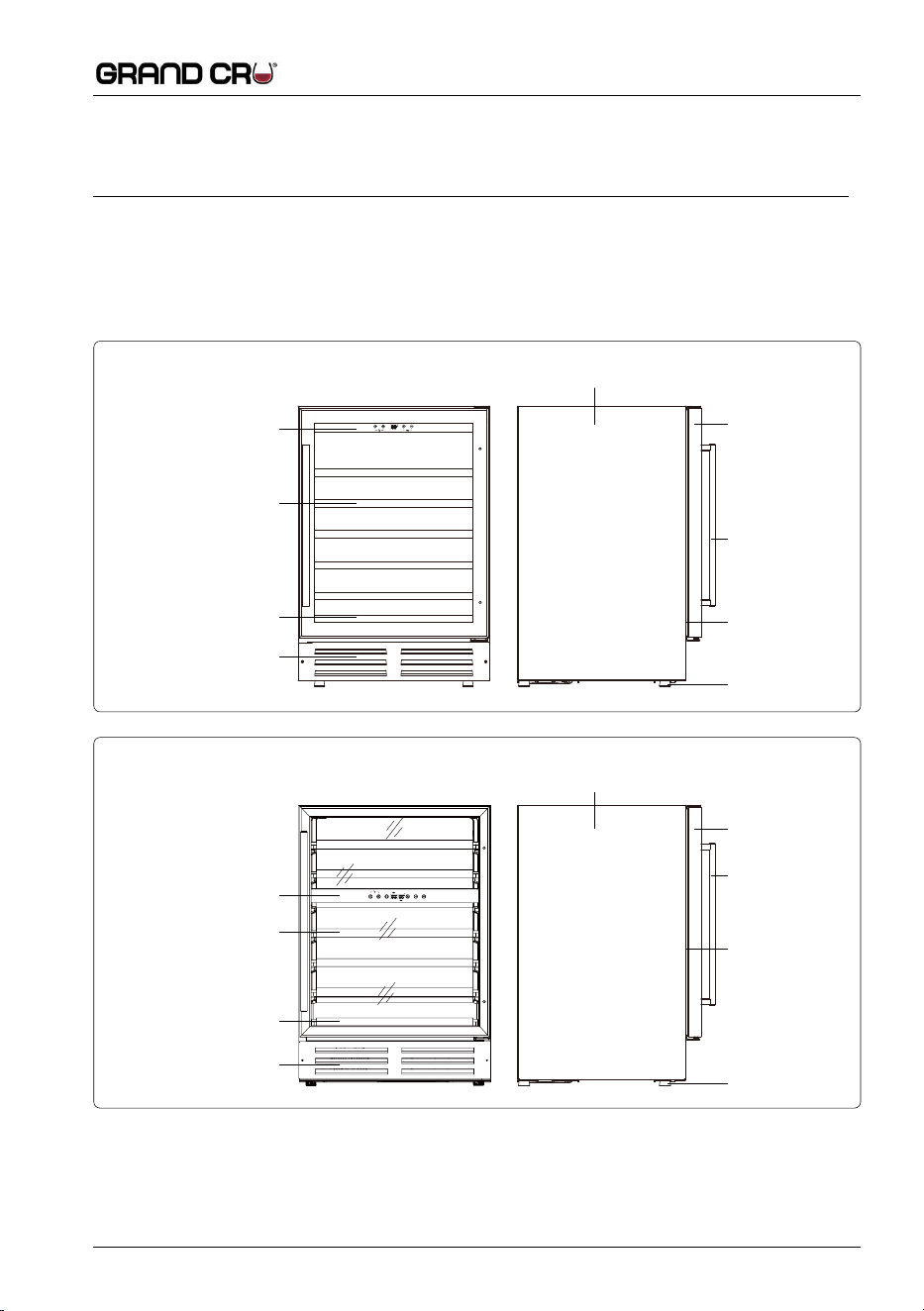
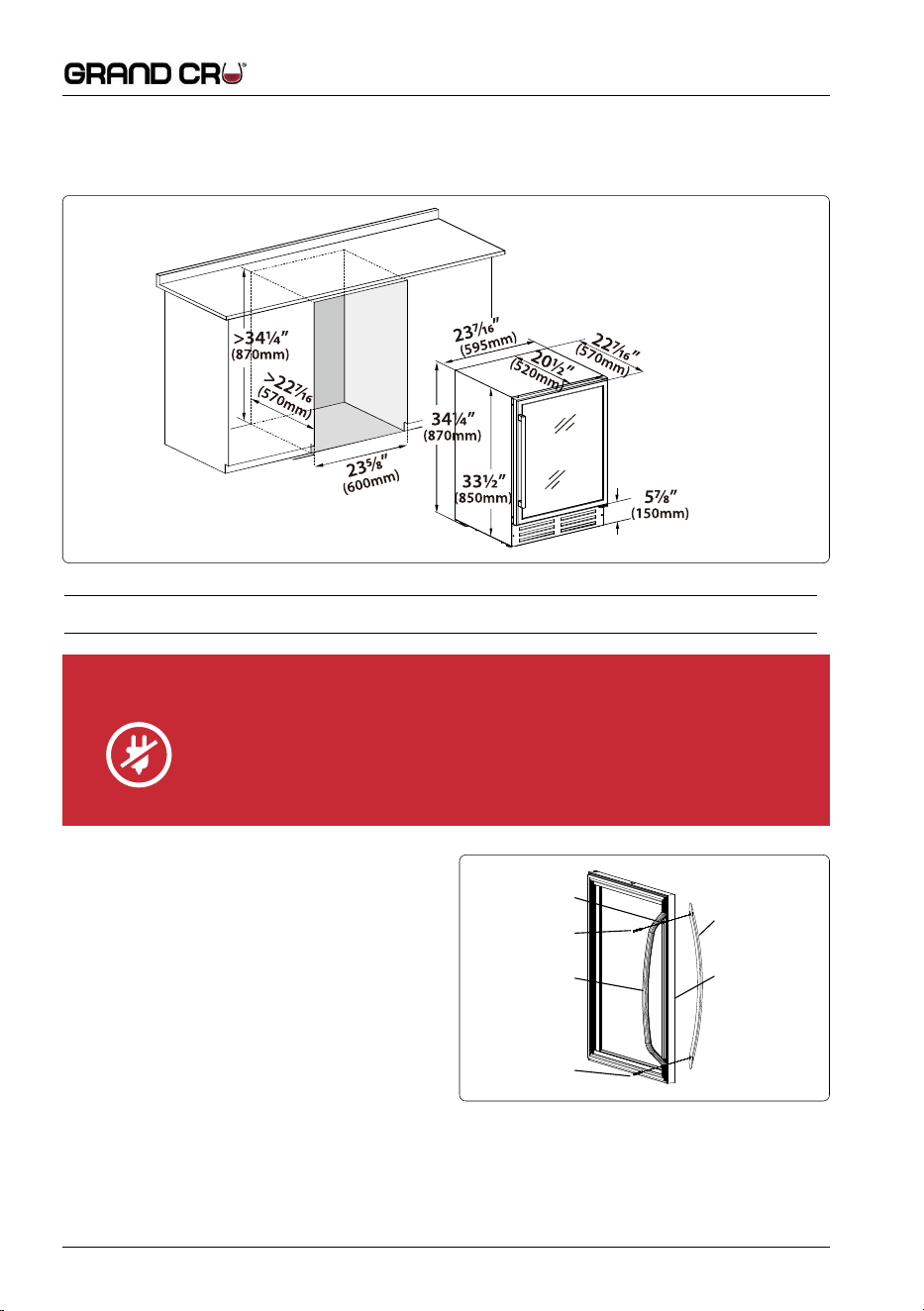
BUILT-UNDER SERIES (BUILT UNDER A KITCHEN TABLE TOP)
The following pictures only show the structure of the appliance. The dimension
and shelf quantity may differ among the models of the same series.
STRUCTURE & INSTALLATION
Dual Zone Structure
Door
Outside Cabinet
Handle
Gasket
Leveling Foot
Leveling Foot
Single Zone Structure
Door
Outside Cabinet
Handle
Gasket
Touch-Key Control
Panel & Digital
Display
Shallow Shelf
Deep Shelf
Deep Shelf
Touch-Key Control
Panel & Digital
Display
Front Louver
Shallow Shelf
Front Louver
8
Height Adjustable:
870-890mm
UNPACKING AND CLEANING
THE WINE FRIDGE
• Remove the exterior and
interior packing materials.
• Use a soft cloth to clean the interior
surface with lukewarm water.
• If required install the door handle provided
with the appliance by following these steps:
1st Step - Remove the gasket
on the internal door to expose
the two screw holes.
2nd Step - Install the handle with the
screws and washers provided.
3rd Step - Restore the gasket.
Flat Washer
Screw
Gasket
Screw
Handle
Door Frame
ACCESSORY INSTALLATION BEFORE OPERATING
DO NOT TURN ON FOR AT LEAST 24 HOURS AFTER DELIVERY
Let the appliance stand upright for approximately 24 hours before
connecting it to the power source, which helps to reduce the possibility
of a cooling-system malfunction from handling during transportation.
9
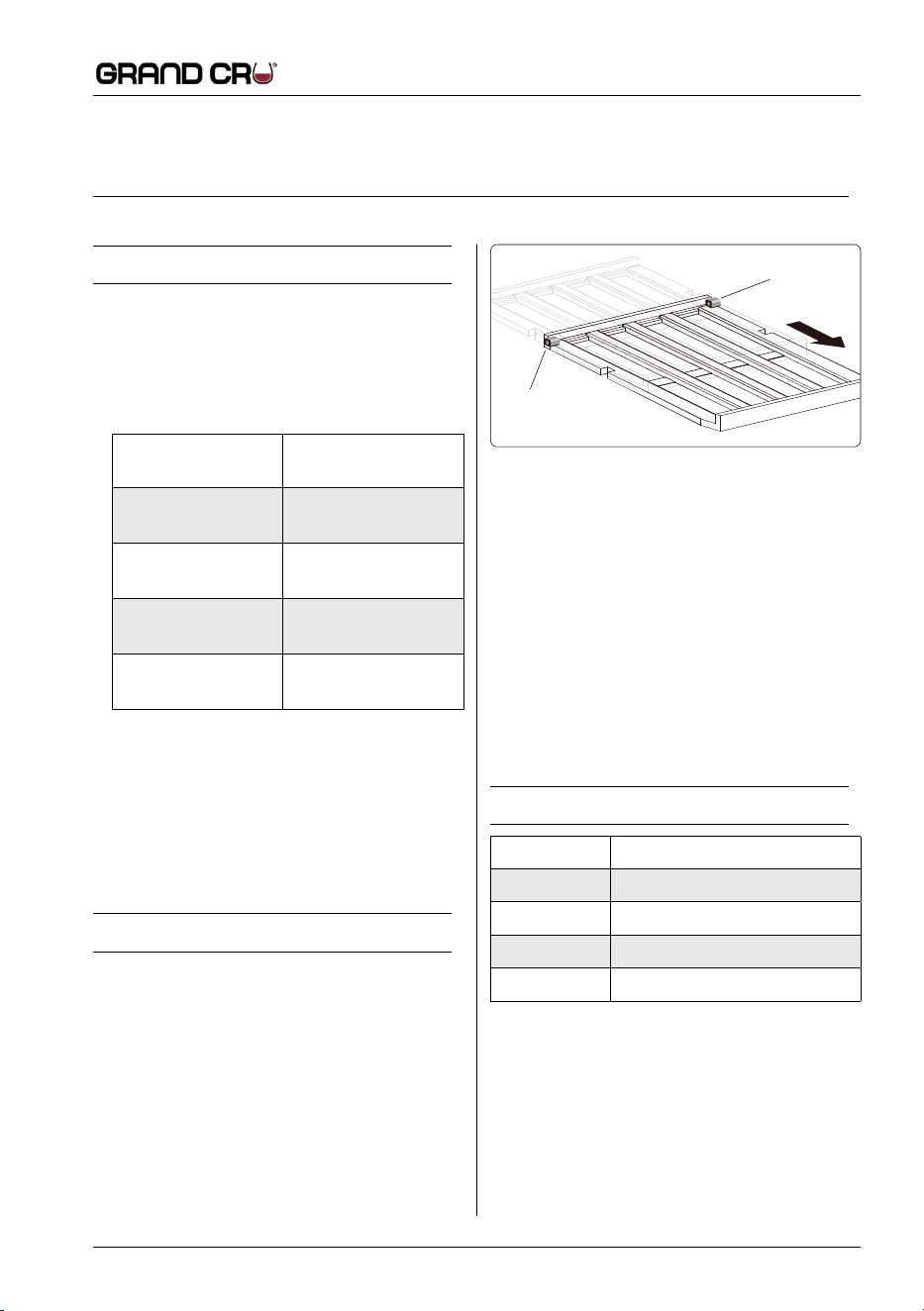
Stopper
Stopper
• To prevent damaging the door gasket,
make sure to have the door opened fully
all the way before pulling the shelves out.
• Please store wine in sealed bottles.
• Do not cover the shelves with aluminum
foil or any other shelf material which
may prevent air circulation.
• Should the wine fridge be left empty
for long periods it is suggested that
the appliance is unplugged, and after
careful cleaning, leave the door ajar
to allow air to circulate inside the
cabinet in order to avoid possible
condensation, mould or odours forming.
RECOMMENDED TEMPERATURES
Wine Type Recommended Temperature
Red 14-18°C (59°F-64°F)
White 6-14°C (48°F-57°F)
Rose 6-12°C (50°F-52°F)
Sparkling 4-10°C (41°F-46°F)
For further information see the Wine
Temperature Serving Guide on page 26.
WORKING CLIMATE
• The appliance is designed for operating
from SN to T climate (see below climate
class chart). It is recommended to
maintain the ambient around 22-25°C
which helps the appliance working
with low power consumption.
Climate Class Ambient
Temperature
SN = Subnormal 10°C -32°C
(50°F-90°F)
N = Normal 16°C -32°C
(61°F-90°F)
ST =Subtropical 18°C -38°C
(64°F-100°F)
T = Tropical 18°C -43°C
(64°F-109°F)
• If the ambient temperature is above or
below the designed climate range, the
performance of the unit may be affected.
For example, the appliance operating
in extreme cold or hot conditions may
cause interior temperatures to fluctuate,
and the temperature set 5-22°C
may not be reached sometimes.
WINE STORAGE
• The standard shelves are designed
perfectly for Bordeaux style bottle
storage. The maximum bottle loading
may vary subject to the different size or
dimension of wine bottles you store.
• The shelves can be pulled out
by approximately 2/3 for easy
access to the wine storage.
• The shelves are fitted with a plastic Stopper
on each side of the shelf track to prevent
the shelf from sliding out completely.
OPERATING THE WINE FRIDGE
10
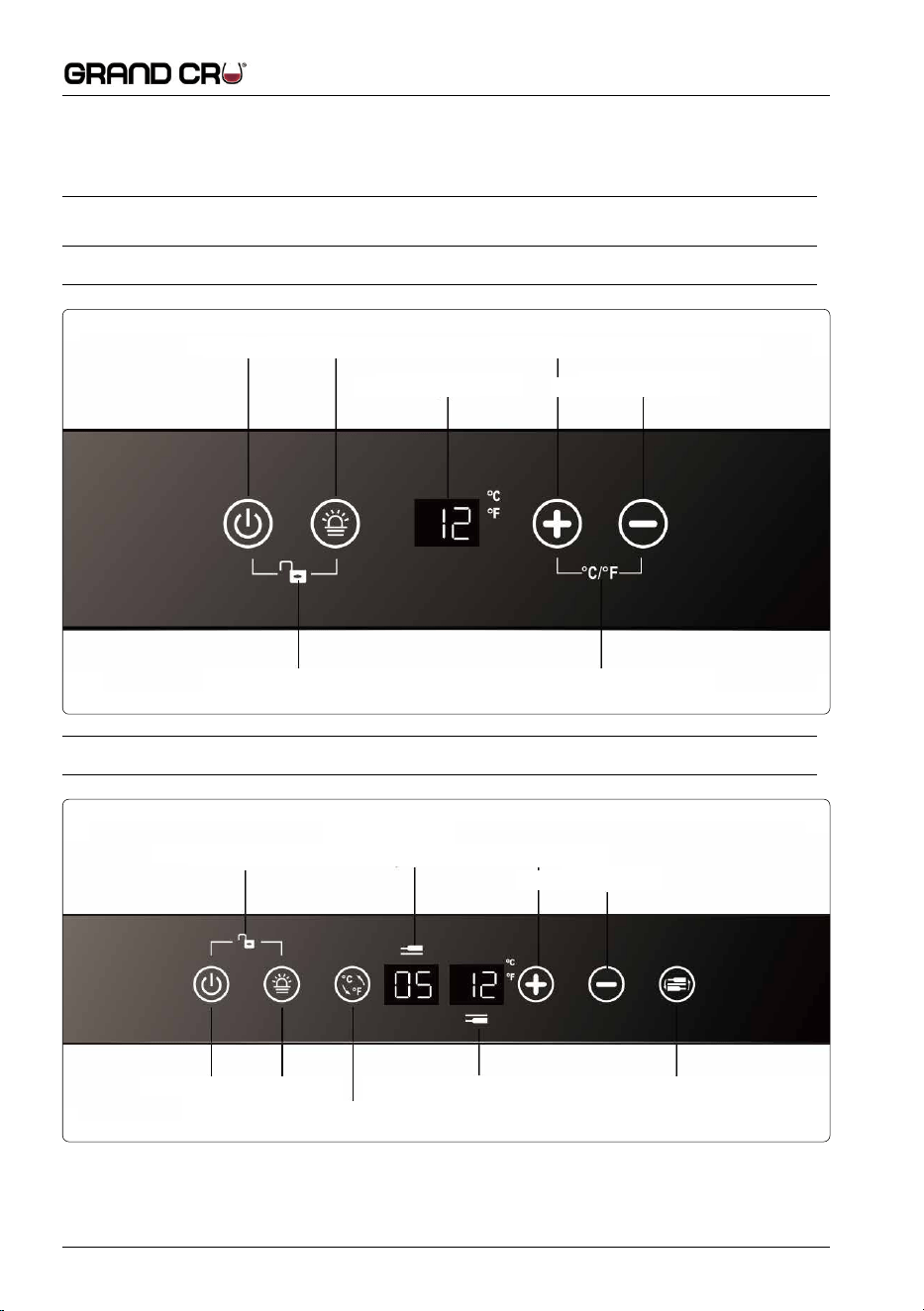
FOR SINGLE ZONE
FOR DUAL ZONE
CONTROL PANEL
Power Lighting
Lock/Unlock ˚C/˚F Interchange
Temp-Up
Temp-UpDisplay Window
Upper Zone
Display Window
Bottom Zone
Zone SelectPower Lighting
˚C/˚F Interchange
Lock/Unlock
Display Window Temp-Down
Temp-Down
11
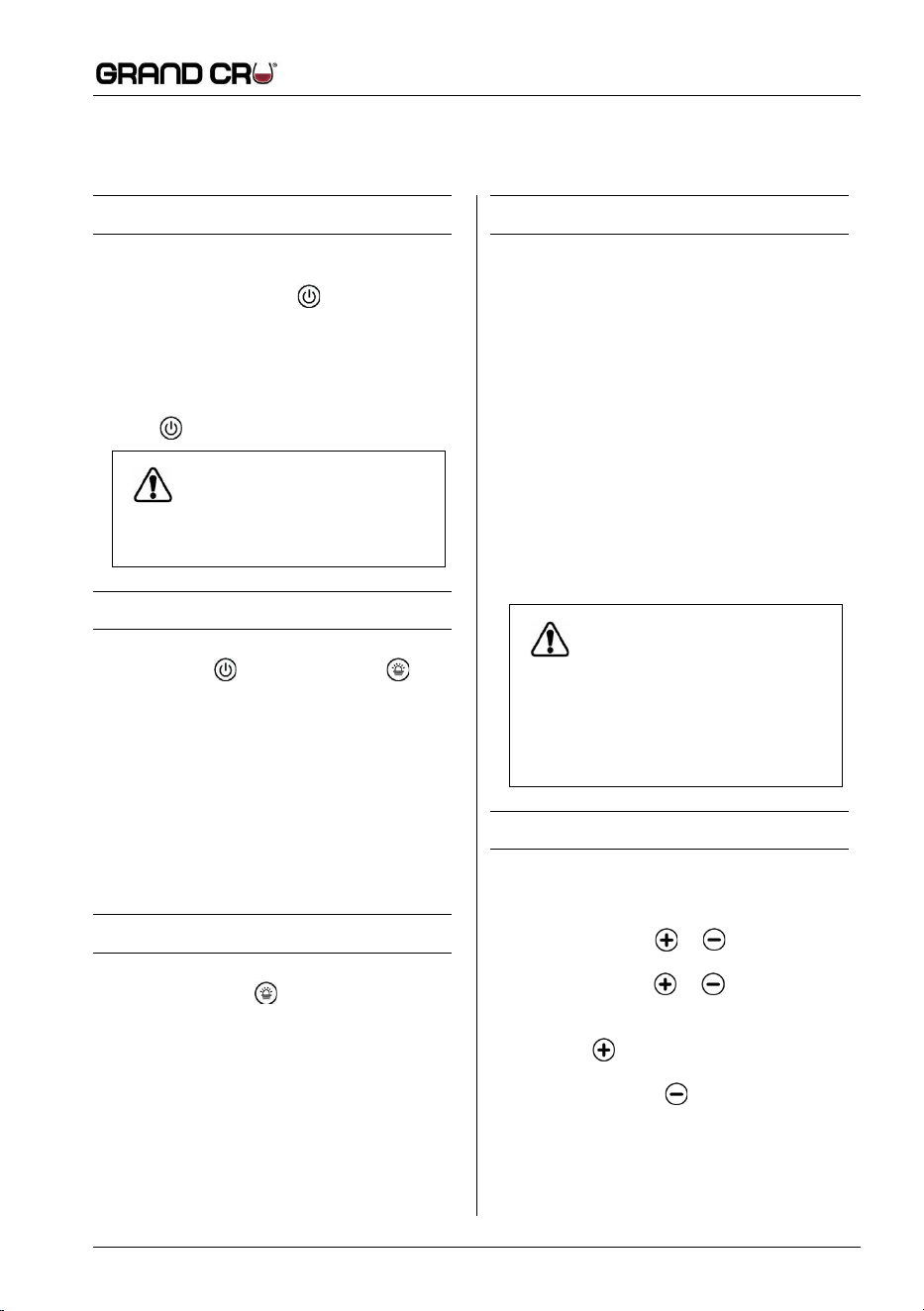
POWER ON/OFF CONTROL
• When the appliance is plugged in to a
power outlet, it powers on automatically.
• Touch the power mark
and
hold for 10 seconds to turn off
(or turn on) the appliance.
• No matter whether the appliance is under
a locked or unlocked situation, you can turn
off the appliance by touching the power
mark
and holding for 10 seconds.
Warning: To avoid breaking
the compressor, please do not
turn on the appliance again within
5 minutes after you turn it off.
UNLOCKING THE CONTROL PANEL
• To unlock the control panel, touch the
power mark
and lighting mark
with 2 fingers at the same time and
hold for 3 seconds. When unlocked
a buzz sound will be heard.
• The control panel will be automatically
locked with a buzz sound heard after
10 seconds without being touched.
• Under the locked situation, the control
panel will not react to any touch
operation other than for lighting on/
off and temperature setting.
INTERIOR LIGHTING ON/OFF CONTROL
• Under the unlocked situation, touch
the lighting mark
to turn on (or
turn off) the interior LED lighting.
• The lighting will be continuously
on if it is not turned off.
TEMPERATURE DISPLAY WINDOW
• The temperature is displayed in digital
display form. The digital display is shown as
the set temperature when you are setting
the temperature, and it will change to
be the actual temperature inside cabinet
after 10 seconds without being touched.
• When the temperature probe is out of
order, the display window will show
with “HH” or “LL” instead of a digital
figure while a continuous buzz sound
will be heard. In case of this happens,
this appliance is designed to keep
the compressor and fan running
periodically which helps to keep the
desired temperature of the inside
cabinet to protect your stored wines.
Warning: To avoid destroying
your stored wines, it is
strongly recommended to have the
appliance repaired immediately,
as the periodical running cannot
ensure the appliance will achieve
the temperature you have set.
TEMPERATURE SETTING
For Single Zone beverage fridge:
• The temperature setting range
is 2-20°C (36-68°F).
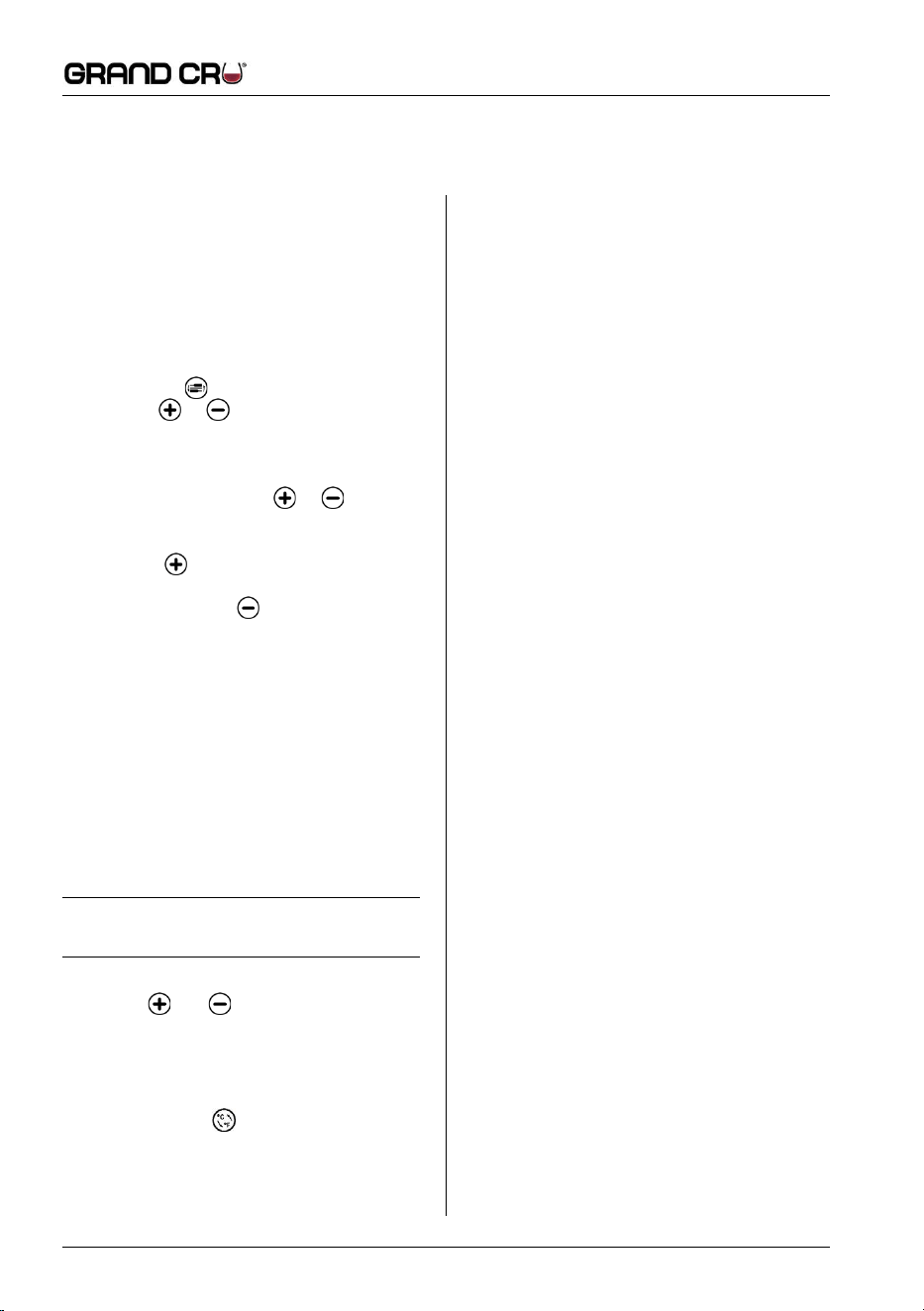
• Directly touch the
or mark to set
the wine fridge temperature as you want.
• The first touch on
or mark will
recall the previous set temperature
displayed in the digital window.
• Touch the
mark to increase the set
temperature by 1°C(or by 1°F). On the
contrary, touch the
mark to decrease
the set temperature by 1°C (or by 1°F).
12
• The digital will change to display the real
temperature of the inside cabinet after
10 seconds without being touched.
For Dual Zone wine fridges:
• The temperature setting ranges are
5-12°C (41-54°F) for the upper zone and
12-22°C (54-72°F) for the bottom zone.
• You need to select the set zone by
touching the
mark before touching
the mark
or to set the desired
temperature. The display window with
digital flashing indicates the zone
ready for temperature setting.
• The first touch on mark
or will
recall the previous set temperature
displayed in the digital window
• Touch the
mark to increase the set
temperature by 1°C (or by 1°F). On the
contrary, touch the
mark to decrease
the set temperature by 1°C (or by 1°F).
• The digital will change to display the real
temperature of the inside cabinet after
10 seconds without being touched.
Note: For the first time to use the
appliance or to restart the appliance
after having been shut off for a long time,
you may find a few degrees variance
between the set temperature and the
displayed temperature. It is normal and
everything of the appliance will be in
the order after a few hours running.
SELECTING FAHRENHEIT (°F)
OR CELSIUS (°C) DISPLAY
For Single Zone
Touch the
and marks with 2
fingers at the same time and hold for
5 seconds, you can interchange the
Fahrenheit and Celsius display.
For Dual Zone
Directly touch the
mark, you can
interchange the Fahrenheit and Celsius
display for both zones at the same time.
13
CARE & MAINTENANCE
CLEANING THE WINE FRIDGE
• Turn off the power, unplug the appliance,
and remove all items including shelves.
• Wipe the inside surfaces with a sponge
and baking soda solution. The solution
should be about 2 tablespoons of
baking soda to 1 litre of warm water.
• Wash the shelves with a mild
detergent solution. Allow the wooden
shelves to dry before placing them
back into the wine fridge.
• Remove excess water from the sponge
or cloth when cleaning the controls, or
any other electrical display areas.
• Wipe the outside cabinet with warm
water and a mild liquid detergent.
Wipe dry with a clean soft cloth.
• Do not use steel wool or steel brush
on the stainless steel. These will
contaminate the stainless steel with
steel particles and rusting may occur.
POWER FAILURE
Most power failures are corrected within
a few hours and should not affect the
temperature of your appliance if you
minimize the number of times the door is
opened. If the power is going to be off for
a longer period of time, you need to take
the proper steps to protect your contents.
MOVING THE WINE FRIDGE
• Remove all items.
• Securely tape down all loose items
(shelves) inside your appliance.
• Turn the adjustable legs up to
the base to avoid damage.
• Tape the door shut.
• Ensure the appliance stays secure in the
upright position during transportation.
Also protect the outside of appliance
with a blanket, or similar item.
ENERGY SAVING TIPS
• The appliance should be located away
from heat producing appliances,
and away from direct sunlight.
• Ensure that the unit is adequately
ventilated. Never cover the air vents.
• Only open the door when necessary.
Avoid leaving the door open for long periods
or opening/closing the door frequently.
14
TROUBLESHOOTING
If you feel the appliance is out of order, follow these instructions to try to see if
you can solve the problem simply by yourself before calling for service.
Problem Problem Possible Cause / Measure
The wine fridge does
not operate
• Not plugged in.
• The appliance is turned off.
• The circuit breaker tripped or a blown fuse.
The wine fridge is
not cold enough
• Check the temperature control setting.
• External environment may require a higher setting.
• The door is opened too frequently.
• The door is not closed completely.
• The door gasket does not seal properly.
Automatically turn-on
and turn-off frequently
• The room temperature is hotter than normal.
• A large amount of contents has been
added to the wine fridge.
• The door is opened too frequently.
• The door is not closed completely.
• The temperature control is not set correctly.
• The door gasket does not seal properly.
The lighting does not work
• Not plugged in.
• The circuit breaker tripped or a blown fuse.
• The lighting is turned off.
Too much vibration
• Check to assure that the appliance is level.
• Check to assure no parts inside the cabinet
or in the compressor chamber are loose.
The wine fridge seems to
make too much noise
• The rattling noise may come from the flow
of the refrigerant, which is normal.
• As each cycle ends, you may hear gurgling
sounds caused by the flow of refrigerant.
• Contraction and expansion of the inside walls
may cause popping and crackling noises.
• The appliance is not level.
The door will not close properly.
• The wine fridge is not level.
• The door was reversed and not properly installed.
• The gasket is dirty.
• The shelves are out of position.
The display window is shown
with “HH” or “LL” instead of
a digital figure, and/or with
a continuous buzz sound.
• The temperature probe is out of order.
15
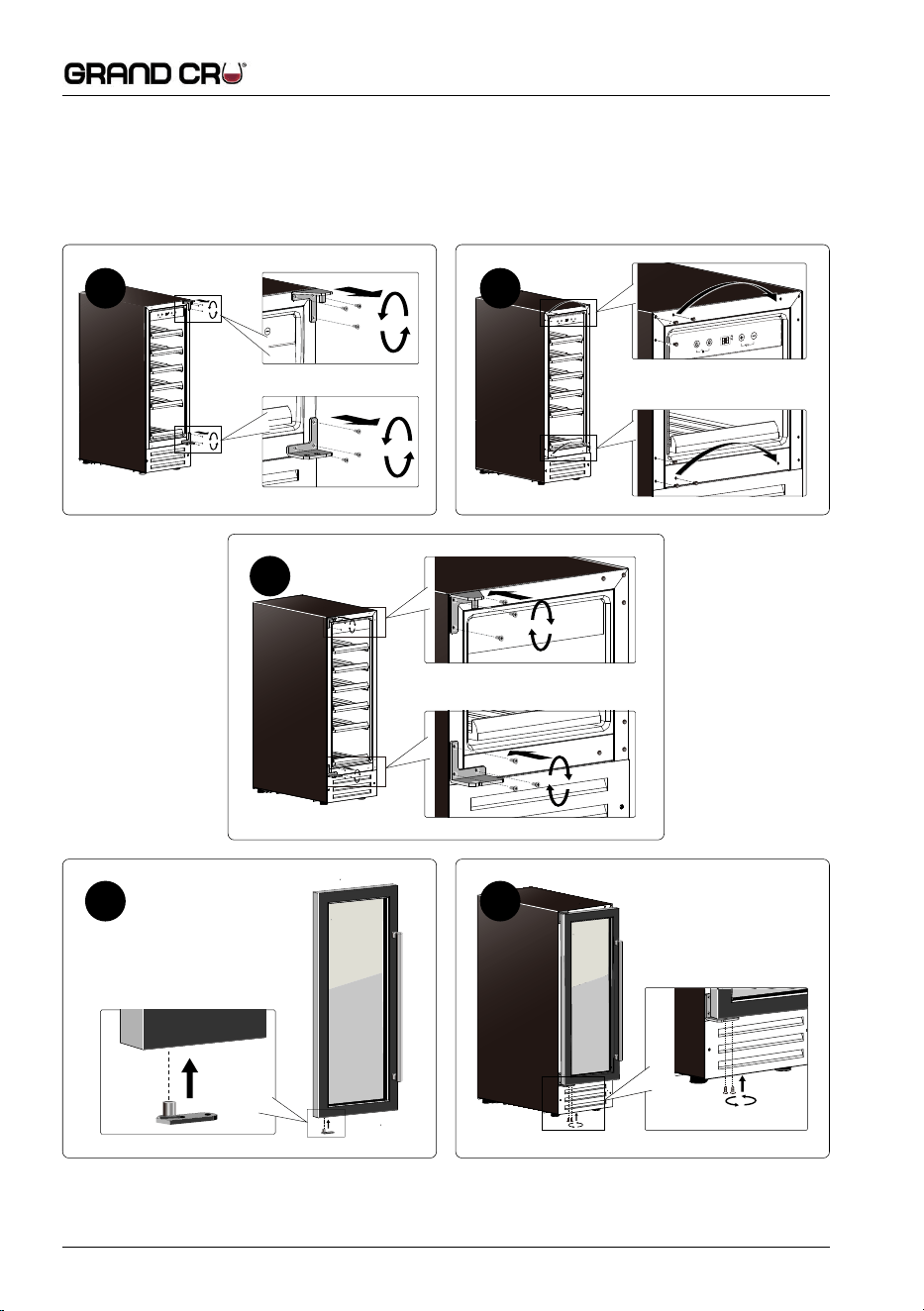
REVERSE THE DOOR SWING
• The instruction is based on a unit with right door hinge installed already.
• To reserve the door from right hinge to left hinge, you need to get ready two
new spare parts: an Upper Left Hinge, and a Bottom Left Hinge.
*All removed parts should be saved in case of door re-reversal.
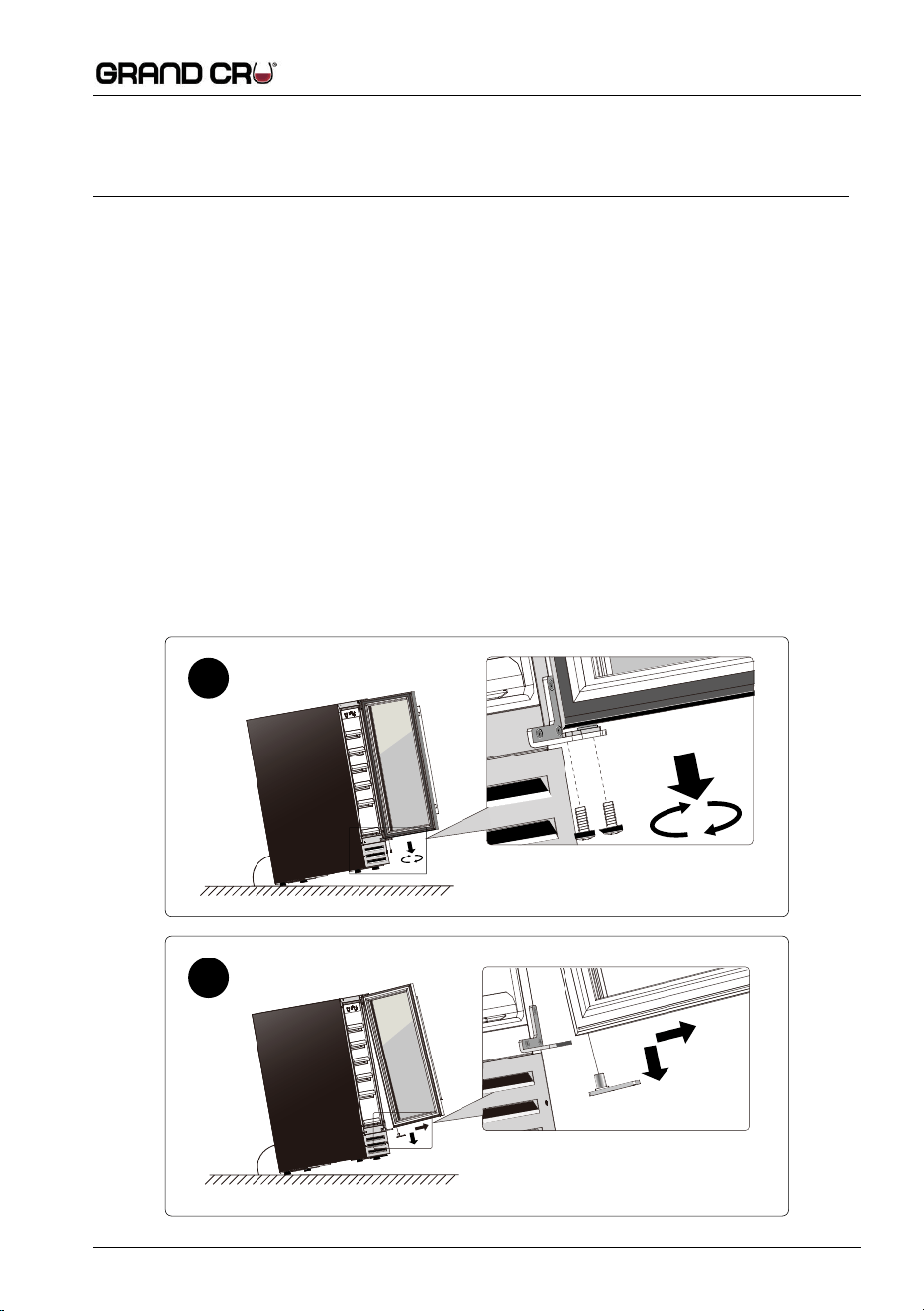
1. Open the door and loosen the screws from the support rod of the bottom hinge.
2. Remove the door off the upper hinge and take out the support rod.
3. For a door with lock, use a small flat head screwdriver to pry up the
lock hole cap on the top of the door and remove to the bottom.
4. Unscrew the upper hinge and bottom hinge.
5. Pry out the plastic caps at the left side of the cabinet and remove them to the right side.
6. Install the hinge set which are packed as accessories with
the instruction manual to the opposite side.
7. Rotate the door 180˚ so that the top is now the bottom, and
install it by attaching the support rod with screws.
1
60
o
Min.
60
o
Min.
2
16
3
6
4
7
5
17
Thank you for purchasing a Grand Cru Wine Fridge from Home Icon International Pty
Ltd. Home Icon provides a 5-year warranty on the Grand Cru range of Wine Fridges.
WARRANTY REGISTRATION
Register your wine fridge now for warranty, and allow us to
provide you with the best possible after sales service:
1. Please log on to our website at www.grandcruwinefridges.com.au
2. Click on the ‘Support’ tab across the top
3. Select ‘Warranty Registration’ and fi ll out the details as required
This warranty does not cover the following:
• Any damages caused from improper use or not used in
accordance with the instruction manuals.
• Damage caused by connecting your product to the wrong power source/supply.
• Incorrect installation or modifi cations made during installation or use of the product.
• Removing screws or otherwise opening the outer case will void the warranty.
• Any damages resulting from poor handling or moving of the
product, misuse, fi re or water damage etc.
• Failure to maintain the product as per the Instruction Manual.
• Problems caused by incorrect or inadequate venting of the product.
SERVICE AND SUPPORT
Should an instance arrive where you require assistance, contact our support team:
1. Please log on to our website at www.grandcruwinefridges.com.au
2. Click on the ‘Support’ tab across the top
3. Select the ‘Request a Service’ option and fi ll out the details as required
NEED HELP? CALL
1300 935 683
WARRANTY, SERVICE AND SUPPORT
18
DIFFERENT SHAPES AND SIZES
This brochure makes reference to the
‘standard Bordeaux style bottle’ when
specifying capacity. However, wine
producers use a huge range of different
bottle shapes and sizes. Bottle shape variety
should be considered when selecting the
appropriate Grand Cru cabinet in which
to house your precious collection, since
shelf height and adjustability varies across
the product range. Please also be aware
that some bottles will not fi t opposite
each other on the same shelf and this
may affect capacity. You may need to lay
the bottles opposite more suitably shaped
bottles. Ideally, bottles should lie with
their necks comfortably interlocking.
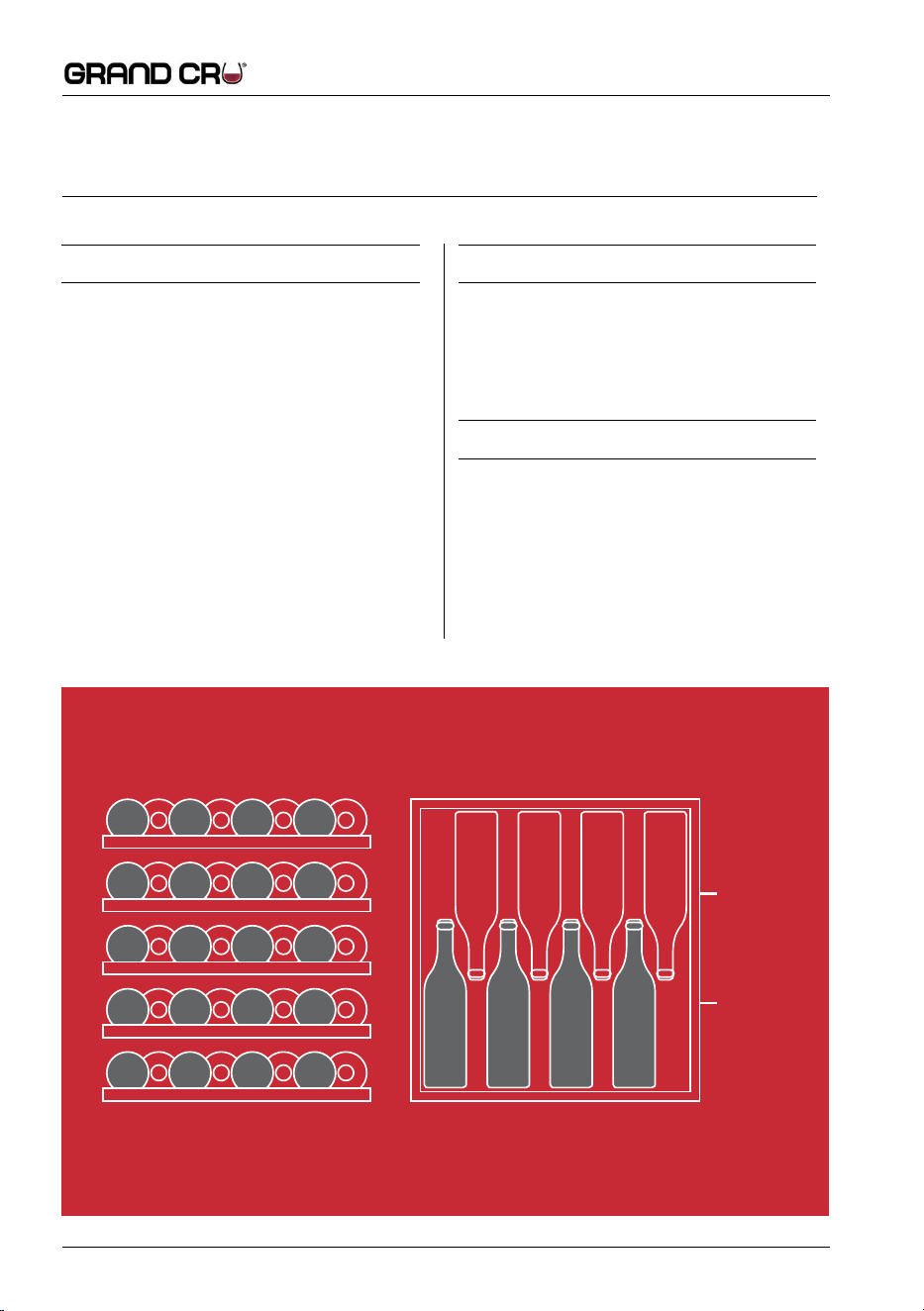
STACKING FOR AGEING
When fi lling your cabinet, we suggest
stacking the bottles you wish to cellar
and mature at the back of the shelves,
and the wines you wish to consume
in the shortterm at the front.
STACKING FOR ACCESSIBILITY
When stacking bottles, it is practical to
keep bottles from the same case together.
See diagrams below, in which bottles
from the same case are represented by
the same colours. Vertically stacking
same-case bottles enables safe and
easy access to all your different wines.
STACKING FOR STORING & SERVING
FRONT VIEW TOP VIEW
SERVING
SERVING
SERVING
SERVING
STORING
STORING
STORING
STORING
Back Row
Front Row
STORING AND STACKING
19
CHOOSING THE RIGHT WINE FRIDGE
To keep my wines ready to serve at
the perfect drinking temperatures?
Choose any Dual-Zone Grand Cru wine
fridge, and keep in mind that most whites
are generally best served at 6-8 deg C, and
most reds at 16-18 deg C. With a Dual-
Zone cabinet, you can fi ne-tune the serving
temperatures of different styles of wine: You
can set the temperature to suit your needs.
To store my wines in the ideal cellaring
conditions so they can mature?
Choose any Grand Cru Wine fridge, and
make sure you set it at 12-14 deg C as this
is the proper temperature for cellaring and
medium/long term storage for all wines:
reds, whites, roses and champagne.
To cellar only white wines
or only red wines?
All wines cellar at the same temperature
(12-14 deg C), so any Single-Zone fridge
set between 12-14 deg C is ideal for white
wine and/or red wine storage. When set
within this temperature range, Single-
Zone fridges will also keep humidity
levels above 55% (which is important to
maintain the integrity of the cork). Having
said that, any dual zone can also be kept
at the same temperature and humidity
levels throughout the whole unit.
To cellar both red and white wines?
All wines — Whites, Reds, Champagnes
— cellar at the same temperature (12-
14 deg C), so any Grand Cru fridge set
between 12-14 deg C is ideal for white
wine and/or red wine storage. Set within
this temperature range, Grand Cru
wine fridges will also keep humidity
levels above 55% (which is important
to maintain the integrity of the cork).
My wine is purely for investment:
which wine fridge will suit me best?
For (investment) wine to appreciate in value,
the discerning purchaser will want a wine
fridge that is designed for cellaring at the
perfect temperature so any of the Grand Cru
units will suit that purpose – it just becomes
more of a question of the size of unit needed.
FREQUENTLY ASKED QUESTIONS
20
WINE TEMPERATURE
At what temperature should I
be cellaring my wines?
The recommended cellaring temperature
is between 12 and 14 degrees Celsius.
Whichever temperature you choose,
the key is to remember that the
temperature must be constant.
What should the humidity levels
be in my wine cabinet?
The humidity in a wine cabinet should
be over 55% so that corks don’t dry out
and shrink: humidity levels below 55%
can lead to your wines spoiling because
of oxidation. All Grand Cru wine fridges
are designed to maintain humidity levels
above 55% (when set at 12-14 deg C).
Do I need humidity control
when cellaring my wines?
YES, humidity is essential to ensure that
the corks do not dry out. If that happens,
they shrink and air can get into the wine.
If air gets into the wine it will cause
oxidation, generating an odorous smell.
How long can I keep my wines in
a Dual -Zone wine fridge?
As long as the temperature is correct,
there is no limit to how long your
wine can be stored in there.
Can I use my wine fridge for beer and food?
No, wine fridges are not normal fridges.
The temperature does not go low enough
to keep food fresh and are not cold enough
for the serving of beer. The Grand Cru
GC46BC Beverage Centre is designed
for beers (or white wines at drinking
temperature), as they can cool beverages
down to 2 deg C, and have metallic racks
on which to stand beer bottles up. However,
they are not suitable for food storage.
I have a Dual-Zone wine cabinet. Can I
use one compartment for the serving
of my white wines and the bottom
compartment for cellaring my wines?
YES. Just set the top compartment
temperature to between 6*-8* and the bottom
section to a temperature range of 12*-14*.
TECHNICAL & INSTALLATION
What is the difference between Dual-Zone
cabinets and Single-Zone wine cabinets?
Dual -Zone wine fridges are designed for
keeping and serving red and white wines
at the perfect drinking temperatures.
Single-Zone wine cabinets are designed for
cellaring all wines (reds, whites or sparkling)
at the proper temperature (12-14 deg C).
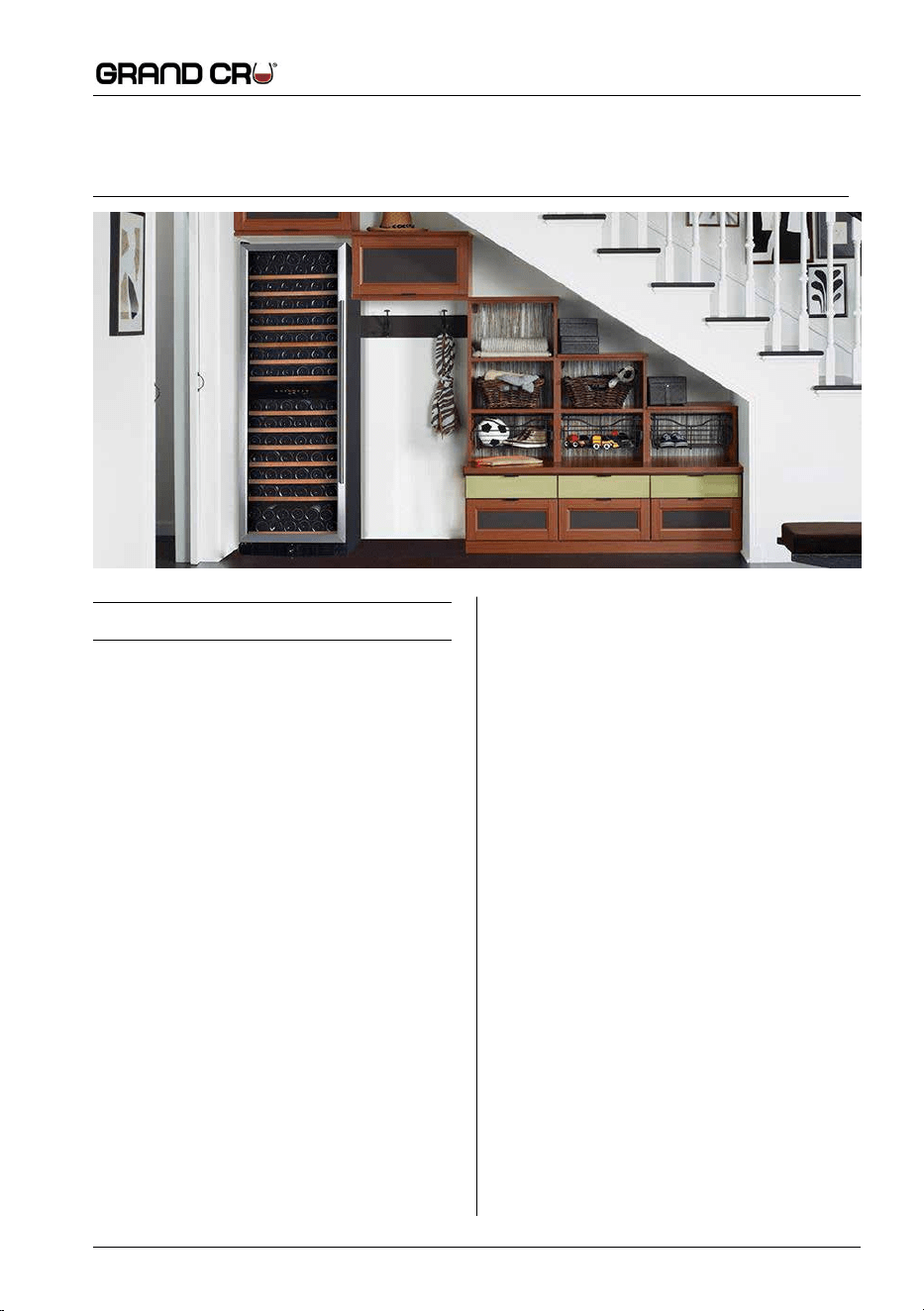
Does my cabinet require ventilation
and can it be built-in under bench?
Some of the Grand Cru range are not
suitable for built –in installation, so
please consider this before purchasing.
The following Grand Cru wine fridges
are suitable for built in installation:
GC46, GC100, GC166, GC183 & GC194.
TROUBLE SHOOTING
My unit is making a lot of noise
If your wine fridge sounds noisy, it may be:
1) due to incorrect stacking of bottles and/
or the fridge is not completely level, so
please empty the unit, check the levelling
and then reload, 2) because ventilation
requirements have not been considered,
and so the unit is over-heating —refer to the
manual or call Grand Cru for further help.
There is water coming out of
the back of my cabinet.
The door has been left open to some
degree. Please wipe out the unit
and ensure the door is shut.
21
There is water on the inside
back wall of my cabinet
This is a perfectly normal occurrence
and needed to maintain the correct
humidity in the wine fridge. Just keep
your bottles away from the wall so
you do not block the water fl ow, an
essential part of the cellaring climate.
My bottles are wet
If they are in contact with the back wall of the
cabinet, they will have some condensation
on them so please make sure you keep a
fi nger’s distance between the bottom of the
bottle and the wall when you load. If not,
please keep in mind that it is normal that
condensation appears on the bottles after
you open the door, and that high humidity is
essential in cellaring your wine properly.
There is a +/- 2 deg temperature
swing on the digital readout
Yes, this in normal. It is the variance in
the air temperature that triggers the
thermostat and the compressor. The small
temperature fl uctuations occur in the air
around the bottles, not in the wine itself.
There is condensation on the outer surface
of the glass door of my wine cabinet
This indicates excessive humidity
in the environment.
What happens if there is a power outage?
The units are very well insulated and can
maintain the temperature for hours before
there is any change in the temperature itself.
We don’t advise opening the doors during
the outage. Once the power is restored,
electronically-controlled cabinets can revert
to factory settings, so reset as necessary.
SHIPPING & DELIVERY
What happens if my home/
property is damaged?
While this scenario is extremely rare, it can
occur. If anything at your home/property is
damaged by the carrier, contact Customer
Support immediately! We will make the
initial arraignments with the carrier to
get compensation to you in a quick and
timely fashion. As always, notate the BOL
of what was damaged before you sign!
Note: Grand Cru cannot give direct
compensation for damages that occur
to your home/property before and/or
after the fact. These actions have to be
negotiated through you and the carrier,
but as our customer we will give you all
the necessary information and assistance
needed to make sure you have a timely
and satisfactory resolution to the matter.
I signed for my wine cellar as delivered for
in satisfactory condition, but I discovered
damage later on. What do I do?
If this occurs, please contact Customer
Support immediately! There is a window of
48 hours where you would still be entitled
to a replacement and/or compensation.
After the window lapses, we cannot provide
a replacement or compensation as the
wine cellar is offi cially signed off “AS IS”
I am receiving or I have received delivery
and certain services are not being rendered
or were not rendered. What do I do?
Contact Customer Support so we can look
into the matter directly with the carrier.
We may be able to have the services
rendered and/or provide compensation for
the inconvenience. Note: Make sure you are
informed of what services that are and are
not included in your delivery. Refer to this
information packet or you can discuss this
at the time of purchase with your Home Icon
Customer Representative before delivery.
22
Does the carrier install/assemble
any components (such as shelving)
at the time of delivery?
No. We cannot nor do we authorise the
carrier to install shelving or assemble any
part of the wine fridge. This is always the
responsibility of the client regardless of
what services are being rendered. If you
require a white glove unpacking service,
please contact Customer Support to fi nd
out more as this feature incurs a fee.
We hope that this has been informative
and insightful information that will
help you not only on your purchase,
but as well as the delivery process.
Should you have any further questions
in regards to this information and/
or should you have questions that are
not included in this information packet
please do not hesitate to contact us.
Customer Support: 1300 935 683
Email: [email protected]
NEED HELP? CALL
1300 935 683
23
SOME HELPFUL ADVICE
Have you bought some nice wine that you
are planning keep for a special occasion
or maybe you wish to start your own
wine collection. What are the best tips
for successfully storing your wine?
Firstly, it’s useful to remember that
only a small percentage of fi ne wines
on the market benefi t from long-term
aging. Most wines are best enjoyed within
a few years of release. If you’re looking
to buy wines to mature, you should
really consider investing in a proper
wine fridge or an external wine storage
solution, but more about that later.
For everyone else, however, following a
few simple guidelines should keep your
wines safe until you’re ready to drink them.
1. KEEP IT COOL
Heat is enemy number one for wine.
Temperatures higher than 21°C will age a
wine more quickly than is usually desirable.
And if it gets too much hotter, your wine
may get “cooked,” resulting in fl at aromas
and fl avours. The ideal temperature range
is between 7°C and 18°C (and 14°C is often
cited as close to perfect), though this isn’t
an exact science. Don’t worry too much if
your storage runs a couple degrees warmer,
as long as you’re opening the bottles
within a few years from their release.
2. BUT NOT COLD
Keeping wines in your household
refrigerator is fi ne for a couple months,
but it’s not a good bet for the longer term.
The average fridge temp sits between
3 - 4°C to safely store perishable foods,
and the lack of moisture (humidity) could
eventually dry out corks, which might
allow air to seep into the bottles and
damage the wine. Keeping wine in a fridge
for a longer time will also slow down
the aging process which is not ideal.
3. CONSISTENCY IS THE KEY
More important than worrying about
achieving a perfect 12°C is avoiding the
landmines of rapid, extreme or frequent
temperature variations. Temperature
variation is likely to be more critical for
older wines where the seal of the cork
is less tight (corks lose some elasticity
WINE STORAGE GUIDE
24
with age). The problem with temperature
variations is that the volume of the wine
expands as temperature rises, decreasing
the ullage volume, and then contracts
as temperature falls, increasing the
ullage volume. If the closure is providing
a completely airtight seal then this is
of relatively little consequence. Aim for
consistency, but don’t get paranoid about
minor temperature fl uctuations; wines may
see worse in transit from the winery to the
store. (Even if heat has caused wine to seep
out past the cork, that doesn’t always mean
the wine is ruined. There’s no way to know
until you open it—it could still be superb).
4. TURN OFF THE LIGHTS
Light, especially sunlight, can pose
a potential problem for long-term
storage. The sun’s UV rays can degrade
and prematurely age wine. One of the
reasons why vintners use coloured
glass bottles? They’re like sunglasses
for wine. Light from household bulbs
probably won’t damage the wine itself,
but can fade your labels in the long run.
5. HUMIDITY IS IMPORTANT
BUT NOT CRITICAL
Conventional wisdom says that wines
should be stored at an ideal humidity
level of 70 percent. The theory goes
that dry air will dry out the corks, which
would let air into the bottle and spoil the
wine. Yes, this does happen, but unless
you live in a very dry desert or arctic like
climate, it probably won’t happen to you.
Anywhere between 50 percent and 80
percent humidity is considered safe, and
placing a tray or saucepan of water in
your storage area can improve conditions.
Conversely, extremely damp conditions
can promote mould. This won’t affect a
properly sealed wine, but can damage
the labels. A dehumidifi er can fi x that.
6. FLAT OR STANDING –
STORING OR ON SHOW
Traditionally, bottles have been stored
on their sides in order to keep the liquid
up against the cork, which theoretically
should keep the cork from drying out.
If you’re planning on drinking these
bottles in the near-term, or if the bottles
have alternative closures (screw caps or
synthetic corks), this is not necessary.
7. LIMIT THE MOVEMENT
There are theories that vibration could
damage wine in the long term by speeding
up the chemical reactions in the liquid.
Some serious collectors worry about even
the subtle vibrations caused by electronic
and other appliances, though there’s
little evidence supporting the impacts of
this. Signifi cant vibrations could possibly
disturb the sediment in older wines and
keep them from settling, potentially
making them unpleasantly gritty.
WHERE SHOULD I STORE MY WINE?
If you do not have a cool, not-too-damp
basement or underground garage that can
double as a fridge, you can improvise with
some simple wine racks in a safe place.
Rule out your kitchen or laundry, where
hot temperatures could affect your wines,
and look for a location that is generally less
effected by climate control systems and
not directly in line with sun light pouring in
from a window. Perhaps there is a little-
used closet or other vacant storage area
that could be repurposed for storing wine?
25
HOW TO SERVE WINE
When it comes to serving your favourite
bottle of wine at the correct temperature,
ideally it should be just right. Too hot and
the wine’s alcohol will be emphasized,
leaving it fl at and fl abby. Too cold and the
aromas and fl avours will be muted and,
for reds, the tannins may seem harsh
and astringent. The old adage of serving
white wines chilled and red wines at room
temperature is a useful starting point,
although not nearly detailed enough.
The reason we try to serve wine at their
correct temperatures is because the
temperature can dramatically impact the
way a wine smells and tastes. By serving
the wine at its ideal temperature, we ensure
we will always get the best experience
and enjoyment from our favourite bottle.
For those like myself who wish to be
even more specifi c, I have included
below some more detailed serving
temperature recommendations for
Australia’s most popular wine varietals.
NON-VINTAGE CHAMPAGNE/SPARKING
WINE AND ICE WINE – ICE COLD, 4-6˚
I like to put my bubbly in the freezer about
an hour before I pop it – but don’t forget
about it or you’ll have an explosion. If you’re
short on time, you can also place the bottle
in an ice bucket for 30 minutes and have
similar results. The ice cold temperature
will keep the bubbles fi ne rather than foamy.
After you open the bottle and pour the fi rst
glasses, you should place the open bottle
on ice until the entire bottle is fi nished.
LIGHTER BODIED WHITE WINE,
SWEETER ROSÉ, VINTAGE CHAMPAGNE
AND DESSERT – COLD, 6-10˚
The best way to get lighter bodied white wine
and sweeter rose cold is to place it in the
fridge immediately after buying it; however,
if you buy the wine already chilled the same
day you want to drink it, either leave it in
the fridge for several hours, or you can
place it in the freezer for about 30 minutes.
After you open the bottle and pour the fi rst
glasses, you should place the open bottle
on ice until the entire bottle is fi nished.
WINE TEMPERATURE SERVING GUIDE
26
FULL BODIED WHITE WINE AND
DRY ROSÉ – COOL, 10-14˚
The best way to get full bodied white wine
cool is to place it in the fridge or preferably
a wine fridge immediately after buying it.
I suggest taking the wine out of the fridge
30 minutes prior to serving and after
opening the bottle and pouring everyone
their fi rst glass, I prefer not to place it on
ice, but instead let the bottle sweat on the
table, as the wine’s aromas and character
changes slightly as the temperature rises.
LIGHTER BODIED RED WINE
– COOLED, 12-16˚
The most common misconception with
lighter bodied red wine is that it is ideal to
serve it at room temperature (see below),
when in fact serving it cool is the best way
to enjoy it. To cool lighter red down to its
proper serving temperature, either place
it in the fridge an hour before serving or
preferably invest in a good quality wine
fridge and serve immediately at the right
temperature. After opening and either
decanting or pouring the fi rst glasses, just
as with full bodied white I like leaving the
wine out on the table to slowly warm.
FULL BODIED RED WINE –
ROOM TEMPERATURE, 16-18˚
Depending on the time of year, room
temperature in Australia sits somewhere
between 20°C and 25°C which is not the
ideal serving temperature. Red wine served
too warm will lose all its fi nesse and
freshness to an overpowering sensation
of alcohol. To cool full bodied red down
to its ideal serving temperature, I like to
place it in the fridge 20 minutes before
serving or preferably invest in a good
quality wine fridge and just take it out
15 minutes prior to serving. After opening
and either decanting or pouring the fi rst
glasses, leave the wine out on the table.
POCKET GUIDE
19˚ VINTAGE PORT
16˚- 18˚ SHIRAZ, DURIF,
CABERNET SAUVIGNON
14˚- 16˚ PINOT NOIR, GSM,
SANGIOVESE CABERNET MERLOT,
GRENACHE, TAWNY PORT
12˚- 14˚ CHARDONANAY,
MERLOT, GAMAY
10˚- 12˚ DRY ROSE, SEMILLON,
VIOGNIER, MARSANNE, SAUTERNES
8˚- 10˚ SPARKLING RED, CHENIN
BLANC, REISLING, VERDELHO,
SEMILLON SAUVIGNON BLANC,
VINTAGE CHAMPAGNE
6˚- 8˚ SAUVIGNON BLANC,
SWEET ROSE, PINOT GRIGIO,
PINOT GRIS, DESSERT WINES
4˚- 6˚ NON-VINTAGE CHAMPAGNE,
SPARKLING WHITE, ICE WINES
@GrandCruWineFridges
www.grandcruwinefridges.com.au
Your wine deserves an exceptional wine fridge.
NEED HELP? CALL
1300 935 683
