
Fhiaba
Cantina vini
Manuale utente
Wine Cellars
User manual


4
www.fhiaba.com · [email protected] · Info Line 800-344222
1.1. Avvertenze di sicurezza e
potenziale pericolo
> Sequestaapparecchiaturasostituisceun’altragià
es
istente
ch
e
de
ve
es
sere
me
ssa
dapar
te
osm
al-
tita,
as
sicurarsi
ch
e
es
sa
no
n
di
venti
un
a
pe
ricolosa
tr
appola per i bambini.
> Questaapparecchiaturaèprogettataperrared-
darebe
vande
eci
bi
edède
stinata
al
l’utilizzo
do
me-
stico.
> Qu
esto
ap
parecchio
ède
stinato
al
la
re
frigerazio-
neeconservazionedialimentifreschiesurgelatiin
ambientedomestico.Ognialtrousoèimproprio.
> L’
apparecchio
no
n
èco
ncepito
pe
r
fu
nzionare
co
n
te
mporizzatori
es
terni
o co
n
si
stemi
dico
mando
a
di
stanza.
> L’apparecchiaturadeveessereinstallataseguen-
do le istruzioni riportate nella Guida all’installazione
inparticolarevannomantenutelibere da ostruzioni
le aperture di ventilazione dell’apparecchiatura o
nella struttura ad incasso.
> L’
apparecchiatura
è do
tata
di unsi
stema
di il
lu-
minazione
alu
ce
co
ncentrata
co
n
la
mpade
Le
d.
Non
gu
ardare
al
l’interno
de
lle
la
mpade
qu
ando
so
no
ac-
cese
p
er
e
vitare
p
ossibili
d
anni
a
lla
v
ista.
> Questaavvertenzaèriportataanchesull’etichetta
in
collata
a
ll’interno
d
ella
p
orta
d
el
f
rigorifero.
> Quandoilfreezerèinfunzionenontoccarelesu-
p
erci
in
terne
inac
ciaio
co
n
lema
ni
um
ide
obag
na-
te,inquantolapellepotrebbeattaccarsiallesuper-
ci
pa
rticolarmente
f
redde.
> Nonusareapparecchielettricidialcuntipoall’in-
terno
d
egli
s
comparti
p
er
l
a
c
onservazione
d
ei
c
ibi.
> Duranteilriposizionamentodeiripianinonavvici-
nare
l
e
d
ita
a
lla
g
uida
d
i
s
corrimento
d
el
r
ipiano.
> No
n
po
sizionare
co
ntenitori
dili
quidi
ina
mmabili
nellevicinanzedell’apparecchiatura.
> No
n
te
ntare
maidisp
egnere
unaam
ma/incen-
dioco
n
ac
qua:
sp
egnere
l’
apparecchio
e co
prire
la
a
mma
c
on
u
na
c
operta
i
gnifuga.
> Non toccare gli elementi riscaldanti all’esterno
de
ll’apparecchio.
> Sp
egnere
co
mpletamente
l’
apparecchiatura
st
ac-
candola
da
lla
pr
esa
de
lla
co
rrente
du
rante
op
erazio-
ni
dipulizia.Selaspinanonèfacilmenteraggiungi-
bileèopportunoscollegarel’interruttoreomnipolare
re
lativo
a
lla
p
resa
c
ui
l
’apparecchiatura
èc
ollegata.
> Ico
mponenti
de
ll’imballaggio
po
ssono
es
sere
pe-
r
icolosi
pe
r
ibam
bini:
no
n
pe
rmettere
lo
ro
digi
ocare
consacchetti,lmsplasticiepolistirolo.
> Qualsiasi riparazionedeveessereeettuatada
untecnicoqualicato.
> Qu
esto
ap
parecchio
no
n
è da in
tendersi
ad
atto
al
l’uso
dapar
te
dipe
rsone
(i
ncluso
bam
bini)
co
n
ri-
d
otte
ca
pacità
s
iche,
se
nsoriali
o me
ntali,
o pr
ive
diesperienzaeconoscenza,amenochesianostate
supervisionate oistruiteriguardoall’usodell’appa-
recchio
daun
a
pe
rsona
re
sponsabile
de
lla
lo
ro
si-
c
urezza.
Iba
mbini
dov
rebbero
es
sere
sup
ervisionati
perassicurarsichenongiochinoconl’apparecchio.
> Non danneggiare i tubi del circuito refrigerante
de
ll’apparecchio.
> Nonin
trodurre
ne
ll’apparecchio
bo
mbolette
sp
ray
o re
cipienti
ch
e
co
ntengano
pro
pellenti
o so
stanze
inammabili.
> Laqu
antità
diga
s
re
frigerante
co
ntenuta
ne
l
vo-
s
tro
ap
parecchio
èind
icata
ne
lla
ta
rghetta
d’i
denti-
cazione
po
sta
al
l’interno
de
ll’apparecchio.
Ne
l
ca
so
incuiilcavodicollegamentoelettricodovessesubire
da
nni,
ène
cessario
so
stituirlo,
co
involgere
ilse
rvizio
ass
istenza
cl
ienti
au
torizzato
ounel
ettricista
qu
ali-
catoadeseguirequestaoperazione.
> In
stallazioni o riparazioni eseguite da personale
nonau
torizzato,
po
ssono
pot
enzialmente
cr
eare
pe-
ricolo
p
er
l
’utente
ed
anni
a
ll’apparecchio.
> Le riparazioni vanno eseguite dal servizio assi-
stenza
cl
ienti
au
torizzato.
> Èconsentitousaresolopartidiricambiooriginali
de
l
co
struttore.
So
lo
co
n
l’
impiego
di de
tti
co
mpo-
nentiilcostruttoregarantiscecheirequisitidisicu-
rezza del prodotto siano rispettati.
> Le ri
parazioni
de
vono
es
sere
es
eguite
so
lo
da
l
pr
oduttore,
se
rvizio
as
sistenza
au
torizzato
o al
tra
per
sona
qu
alicata.
> Co
llegare
l’
apparecchio
aun
a
pr
esa
a3po
li
co
lle-
gato alla terra
> Nonrimuovereilpolodimessaaterra.
> Non u
tilizzare un adattatore.
> Non u
tilizzare una prolunga.
> Scollegarelafontedialimentazionedatuttiidi-
s
positivi
pr
ima
de
ll’intervento.
> Se il CA
VO
DI AL
IMENTAZIONE
è da
nneggiato,
de
ve
es
sere
so
stituito
da
l
pro
duttore,
unse
rvizio
di
as
sistenza
au
torizzato
oal
tra
pe
rsona
qu
alicata
in
mododaevitarepericoli.
> I bambini devono essere sorvegliati per assicu-
rarsi
c
he
n
on
g
iochino
c
on
l
’apparecchio.
> Nonm
odicare
l
’apparecchio.
> Nonins
erire
og
getti
met
allici
ap
puntiti
(p
osate
o
utensili) nelle feritoie.
> Nonto
ccare
(s
pecialmente
co
n
lema
ni
bag
nate)
o
me
ttere
d
irettamente
i
n
b
occa
ic
ibi
c
ongelati.
> Nonco
nservare
so
stanze
in
ammabili,
es
plosive
ocheevaporano.
> Nonconservaresostanze esplosive,comebom-
bolettesprayconpropellenteinammabileall’inter-
no
d
ell’apparecchio.
1. INDICAZIONIIMPORTANTIPERLASICUREZZAEPERL’AMBIENTE

www.fhiaba.com · [email protected] · Info Line 800-344222
5
www.fhiaba.com · [email protected] · Info Line 800-344222
IT
> Lebottiglieconaltapercentualedialcoldevono
es
sere
b
en
c
hiuse
ei
n
p
osizione
v
erticale.
> Leso
stanze
or
ganiche,
ac
ide
egl
i
ol
i
et
erei
po
sso-
no
co
rrodere
lesu
perci
inpl
astica
elegu
arnizioni
seacontattoperlungotempo.
> Nont
irare
m
ai
i
l
c
avo
p
er
s
taccare
l
a
s
pina.
1.2. Nell’impiego quotidiano
> Le operazioni di pulizia e manutenzione, destinate
ad
ess
ere
e
ettuate
d
all’utilizzatore,
n
on
d
evono
es-
s
ere
e
ettuate
d
ai
ba
mbini
s
enza
s
orveglianza.
> Nonsbrinareopuliremail’apparecchioconuna
pulit
rice
a va
pore.
Il va
pore
può ra
ggiungere
pa
rti
elettriche e provocare un cortocircuito. Pericolo di
sc
arica
el
ettrica!
> Non utilizzare oggetti appuntiti o alati per ri-
muovere
gl
i
st
rati
di br
ina
o gh
iaccio.
E’ po
ssibile
danneggiareiraccordidelcircuitorefrigerante,che
re
nde
i
nservibile
l
’apparecchio.
> Il ga
s
fu
oriuscendo
pe
r
e
etto
de
lla
pr
essione,
pu
ò
p
rovocare
i
rritazioni
a
gli
o
cchi.
> Non us
are
im
propriamente
lo zo
ccolo,
i ca
sset-
ti
es
traibili,
lepo
rte
ec
c.
qu
ale
pu
nto
diap
poggio
o
co
me
so
stegno.
> Controllarechenonrimanganoincastratioggetti
nelle porte.
> Pe
r la pulizia estrarre la spina d’alimentazione o
disinserire
l’
interruttore
disi
curezza.
Ev
itare
dies
er-
citaretrazionisulcordone elettrico,maimpugnare
correttamentelaspina.
> Conservarealcooladaltagradazioneinuncon-
tenitoreermeticamentechiuso,epostoinposizione
verticale.
> Evitarecheoliiograssiimbrattinopartiplastiche
oleguarnizionidelleporte.Igrassiaggredisconoil
materialeplasticoelaguarnizionedellaportadiven-
tano fragili e porose.
> Non ostruire le aperture di passaggio dell’aria di
aerazionede
ll’apparecchio.
> Pe
rmettere
l’
uso
de
ll’apparecchio
so
lo
abam
bini
inet
à
di8an
ni
osu
periore.
So
rvegliare
ibam
bini
du-
r
ante la pulizia e la manutenzione.
> Inac
cordo
al
le
at
tuali
no
rmative,
i bam
bini
tr
a
i
3egl
i
8an
ni
po
ssono
pr
elevare
oca
ricare
gl
i
al
i-
menti
dall’apparecchio,masisconsigliaaltamentedi
permettereaibambinisottoagli8annidieettuare
queste operazioni e in generale di utilizzare l’appa-
recchio.
> Tenere lontani i bambini inferiori agli 8 anni, se
nonco
ntinuamente
so
rvegliati,
eas
sicurarsi
ch
e
no
n
gi
ochino
c
on
l
’apparecchio.
> Nonut
ilizzare
di
spositivi
me
ccanici,
el
ettrici,
ch
i-
mici
diversi da quelli raccomandati dal produttore
peraccelerareilprocessodisbrinamento.
1. INDICAZIONIIMPORTANTIPERLASICUREZZAEPERL’AMBIENTE
> Nondanneggiareilcircuitodirefrigerazione,(nel
ca
so
p
ossa
e
ssere
a
ccessibile).
> Nonutilizzareapparecchielettriciall’internode-
gli
sc
omparti
p
er
lac
onservazione
d
ei
c
ibi,
seq
uesti
nonsonodeltiporaccomandatodalcostruttore.
> Inca
so
dida
nneggiamento
de
l
ci
rcuito
dire
frige-
razioneevitarel’utilizzodiammelibereedaerare
op
portunamente
i
l
l
ocale.
> Nonut
ilizzare
l’
apparecchio
opar
ti
dies
so
di
ver-
samente
d
a
q
uanto
i
ndicato
n
el
p
resente
m
anuale.
> L’
apertura
de
lla
po
rta
pe
r
lu
nghi
pe
riodi
pu
ò
ca
u-
sare
un not
evole
au
mento
de
lla
tem
peratura
ne
gli
sc
omparti
d
ell’apparecchio.
> Pu
lire
re
golarmente
lesu
perci
ch
e
po
ssono
ve-
n
ire
a co
ntatto
co
n
ci
bo
e si
stemi
didr
enaggio
ac-
c
essibili.
> Co
nservare
l
a
c
arne
c
ruda
ei
l
p
esce
i
n
c
ontenitori
adattiinfrigorifero,inmodochenonvengaincontat-
to
c
on
a
ltri
a
limenti
oc
i
g
occioli
s
opra.
> Se l’apparecchio viene lasciato vuoto per lunghi
periodi, spegnerlo, scongelarlo, pulirlo, asciugarlo
elasciarelaportaapertaperevitarelosviluppodi
mu
a
a
l
s
uo
i
nterno.
> Du
rante
l’
uso
no
n
app
oggiare
su
ll’apparecchio
ogg
etti
met
allici
ap
puntiti
co
me
co
ltelli,
for
chette
cu
cchiai
ec
operchi.
> Su
lle
par
ti
inve
tro
no
n
ut
ilizzare
de
tergenti
ab
ra-
sivi
oco
rrosivi
(e
s.
pro
dotti
inpo
lvere,
sm
acchiatori
espug
nette
met
alliche).
> Nons
edersi
s
ull’apparecchio.
> Nonappoggiarsiosedersisullaportaosueven-
tualic
assetti
a
perti.
> Nonfa
re
le
va
su
lla
po
rta
osu
lla
ma
niglia
pe
r
sp
o-
stare
l’
apparecchio.
> Nonut
ilizzare
ap
parecchi
el
ettrici
(a
d
es
.
ph
on
pe
r
ica
pelli...)
osp
ray
pe
r
losb
rinamento
ch
e
po
trebbero
de
formare
l
e
pa
rti
i
n
p
lastica.
> Nonus
are
inne
ssun
ca
so
l’
apparecchio
pe
r
ri
n-
frescare
l’ambiente.
> Staccaresempredallareteelettrical’apparecchio
incasodiguasto,manutenzioneodurantelapulizia.
> No
n
c
onservare
n
el
c
ongelatore
l
iquidi
i
n
l
attine
o
co
ntenitori
d
i
v
etro.
> Non a
ppoggiare oggetti pesanti sulla sommità
dell’apparecchio.
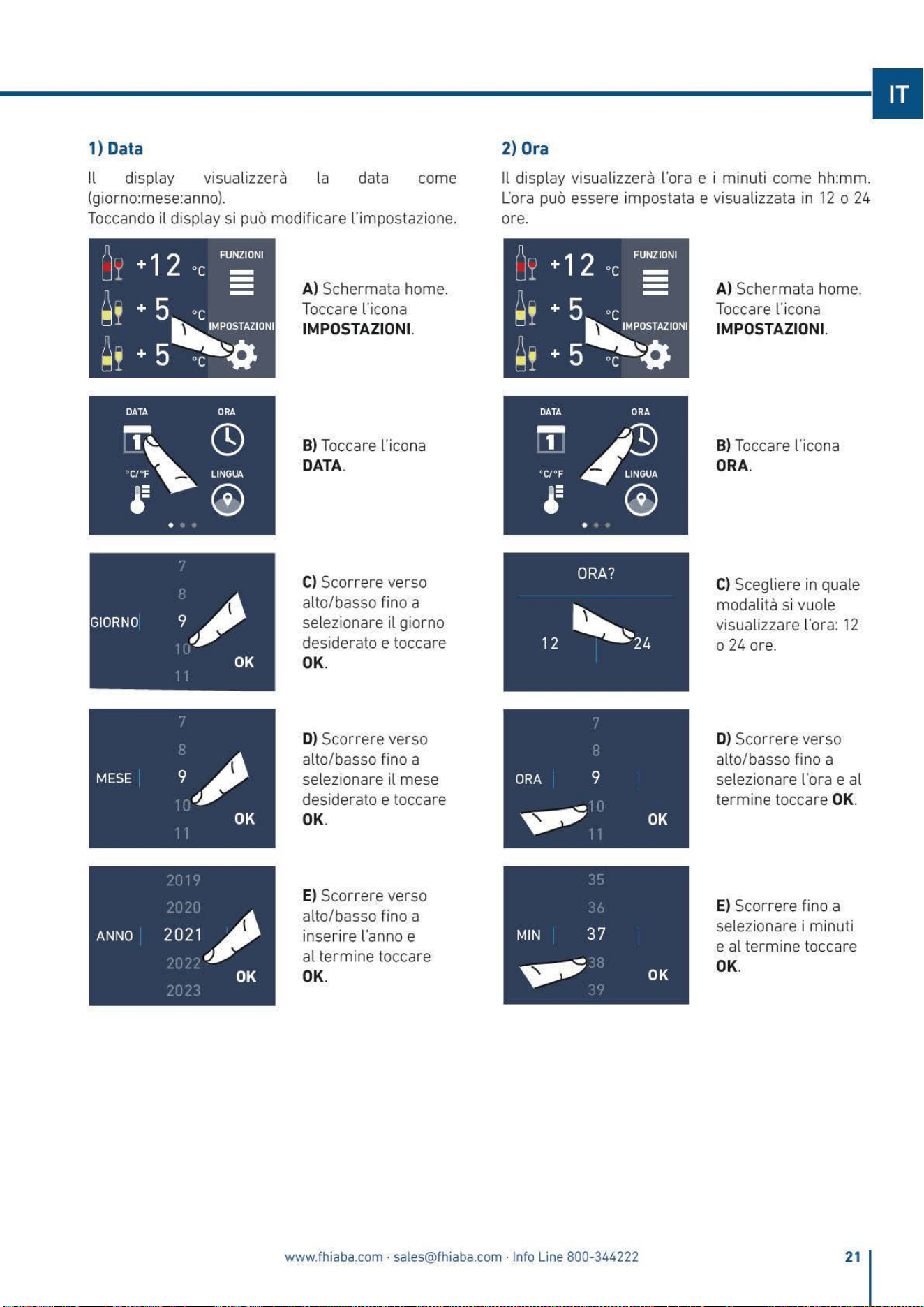
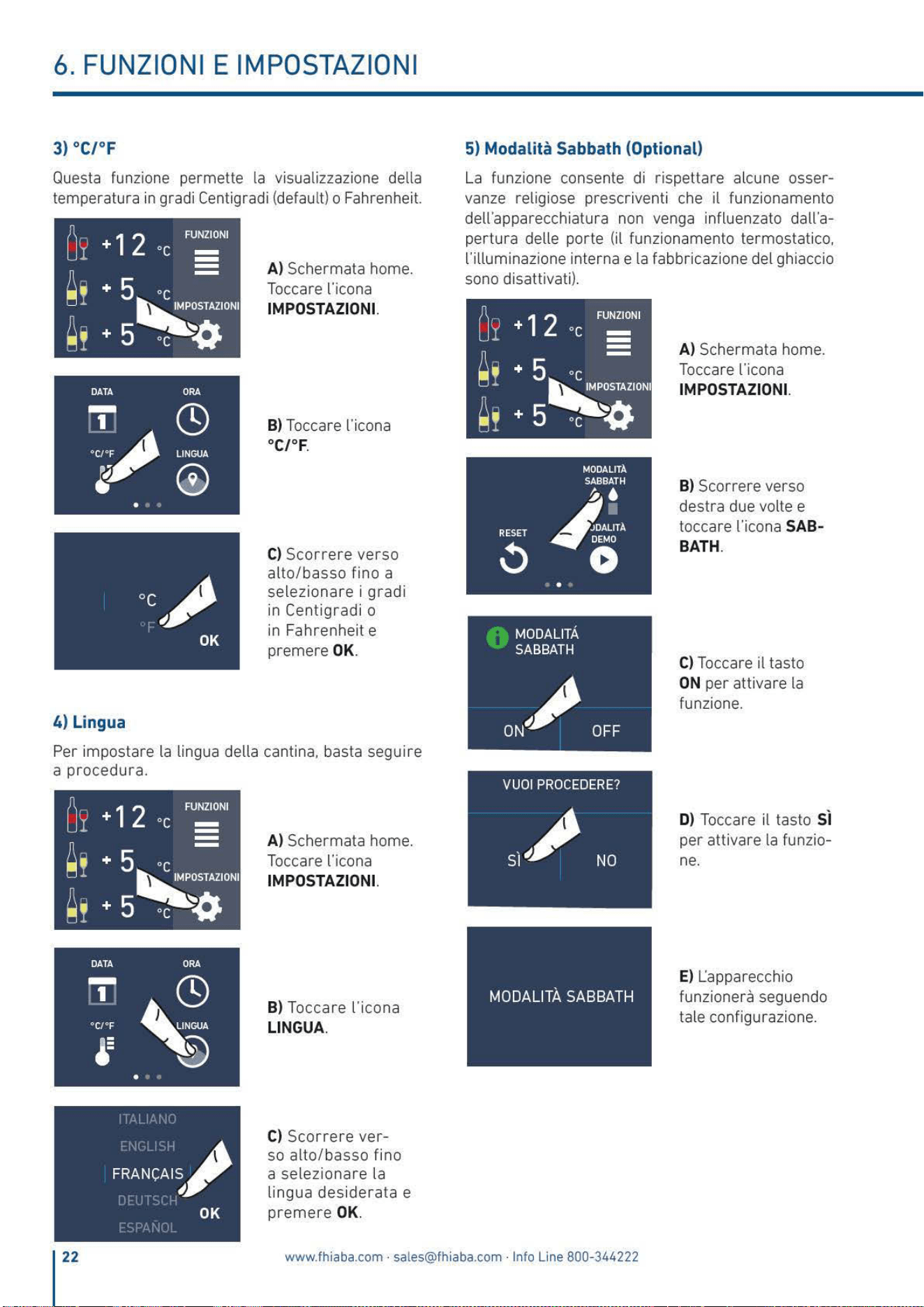
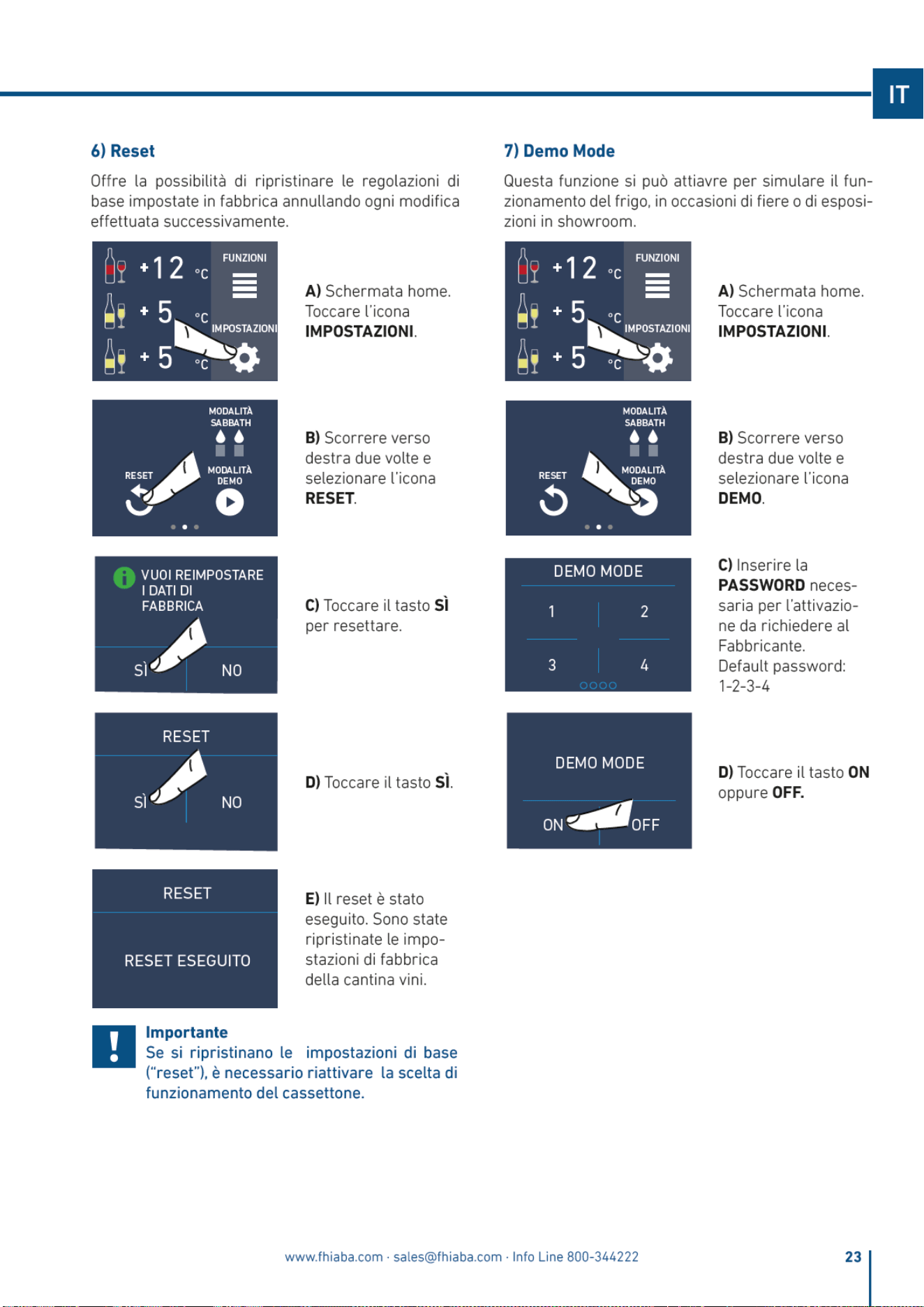
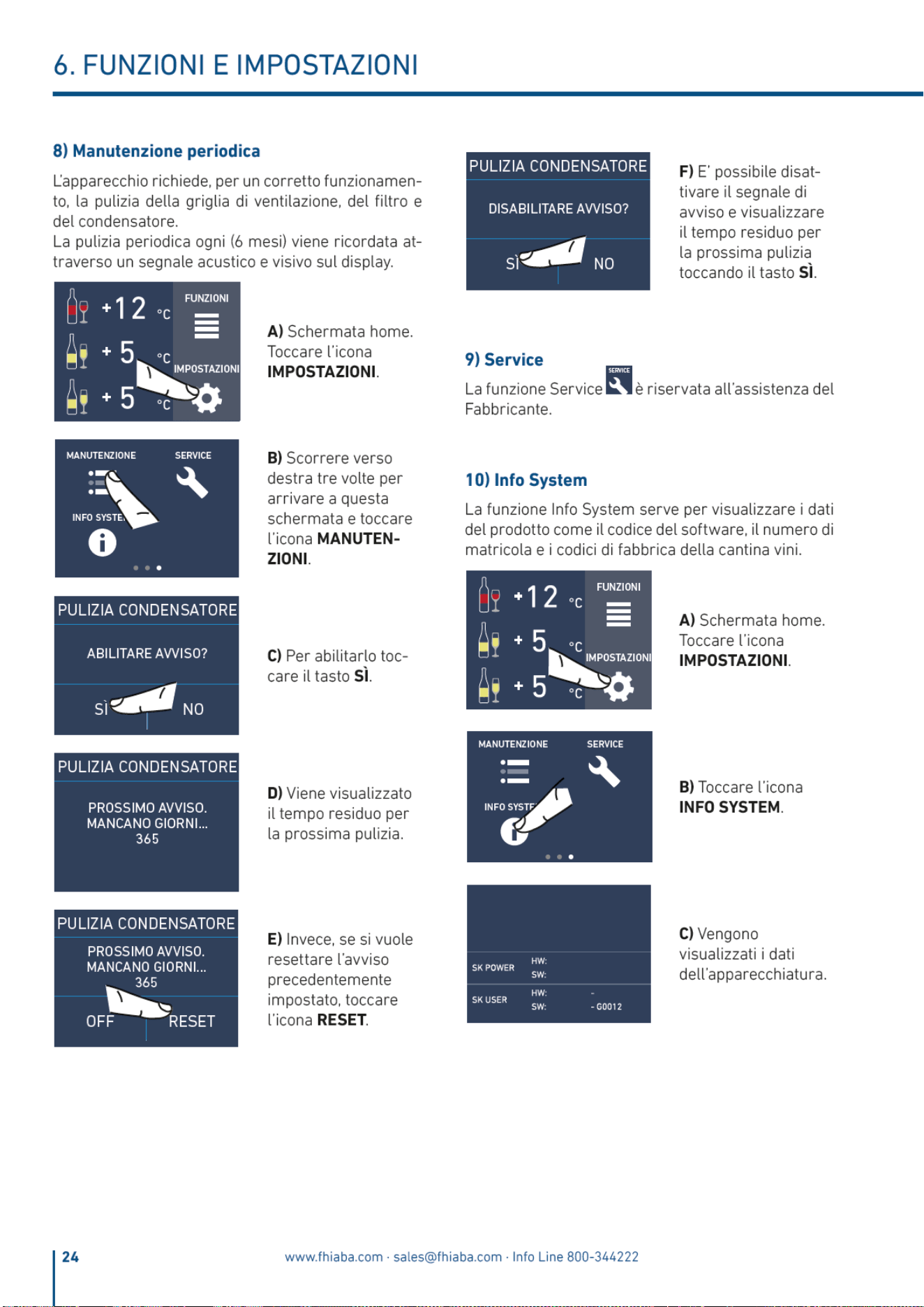
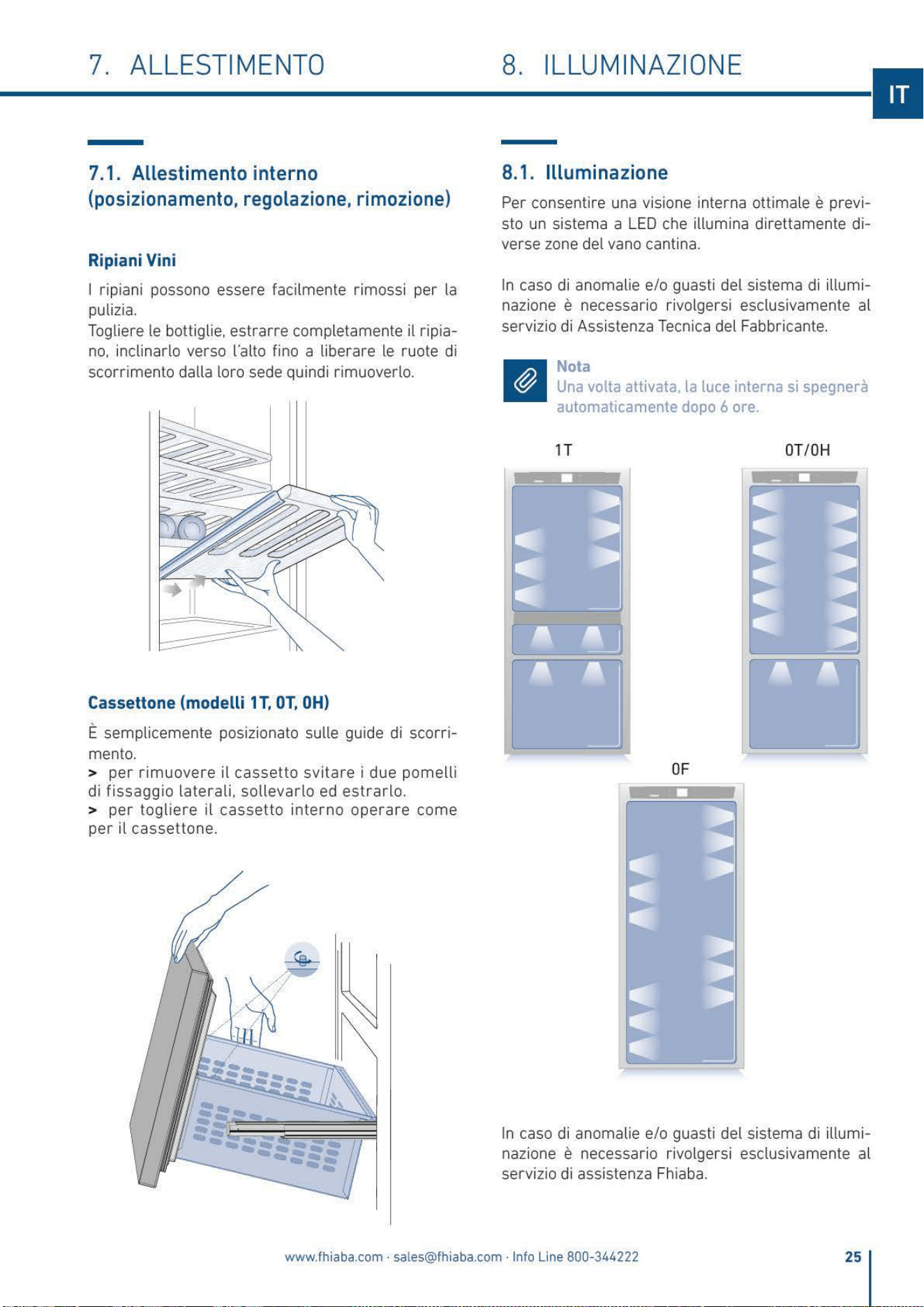
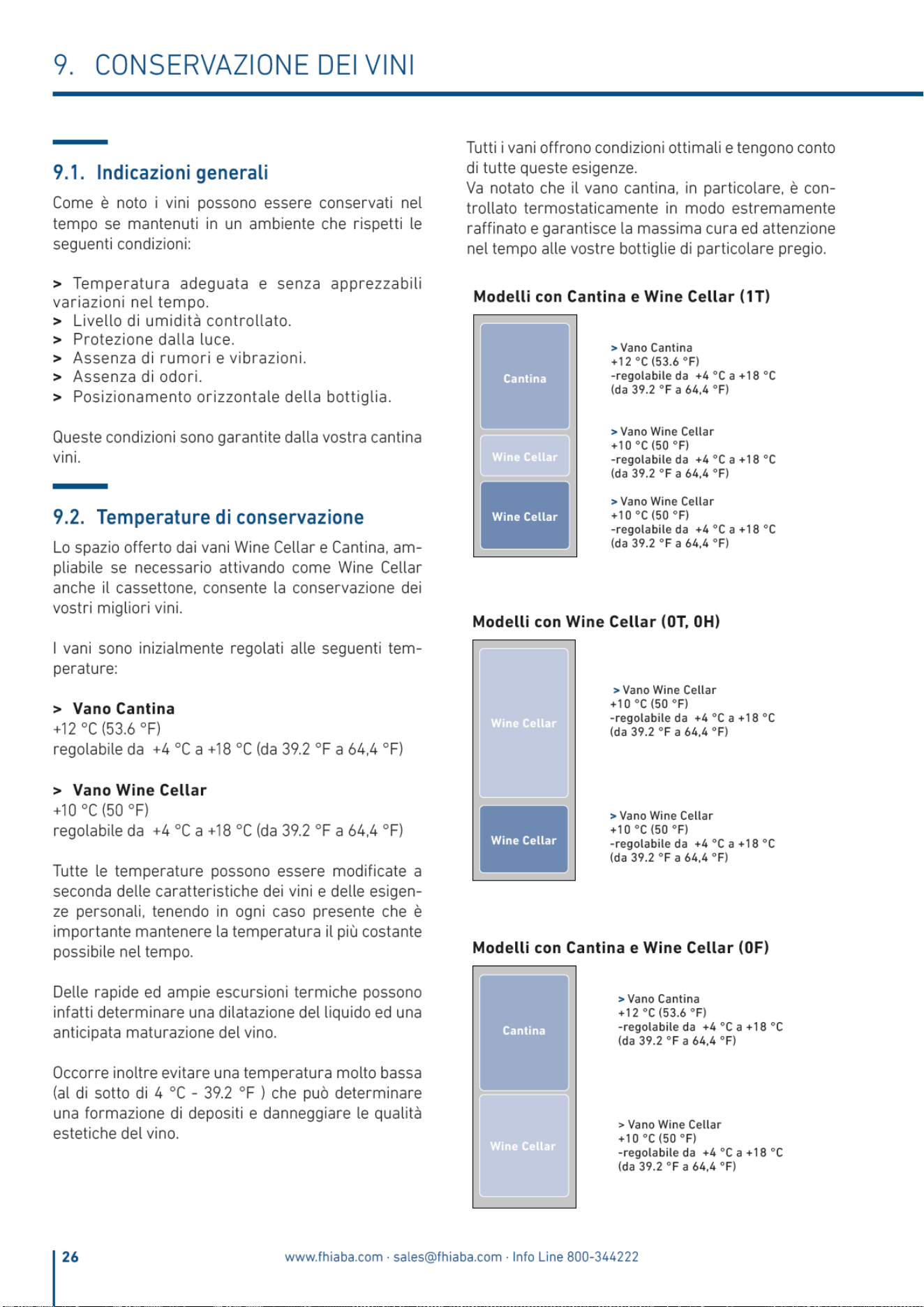
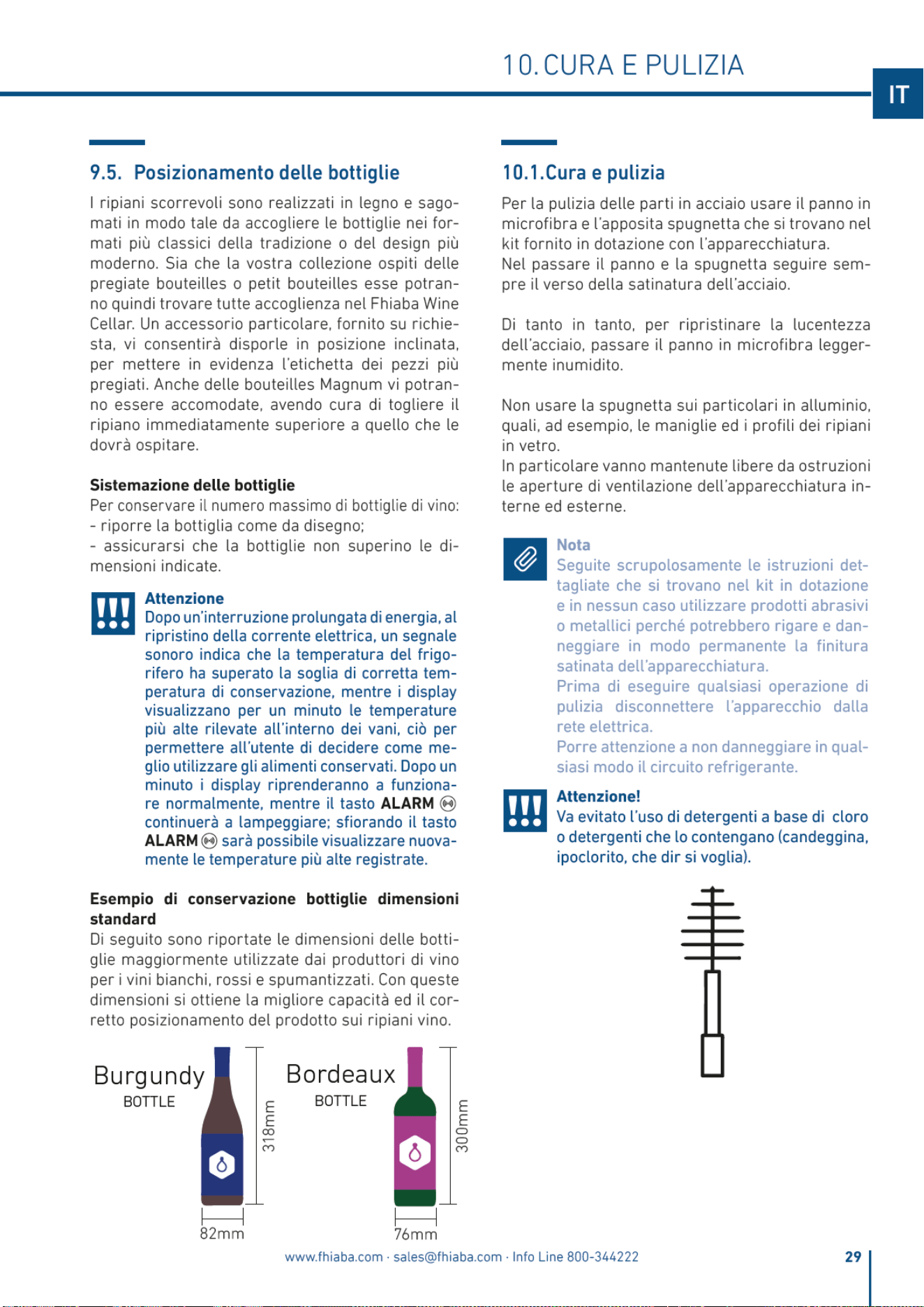
www.fhiaba.com · [email protected] · Info Line 800-344222
27
www.fhiaba.com · [email protected] · Info Line 800-344222
IT
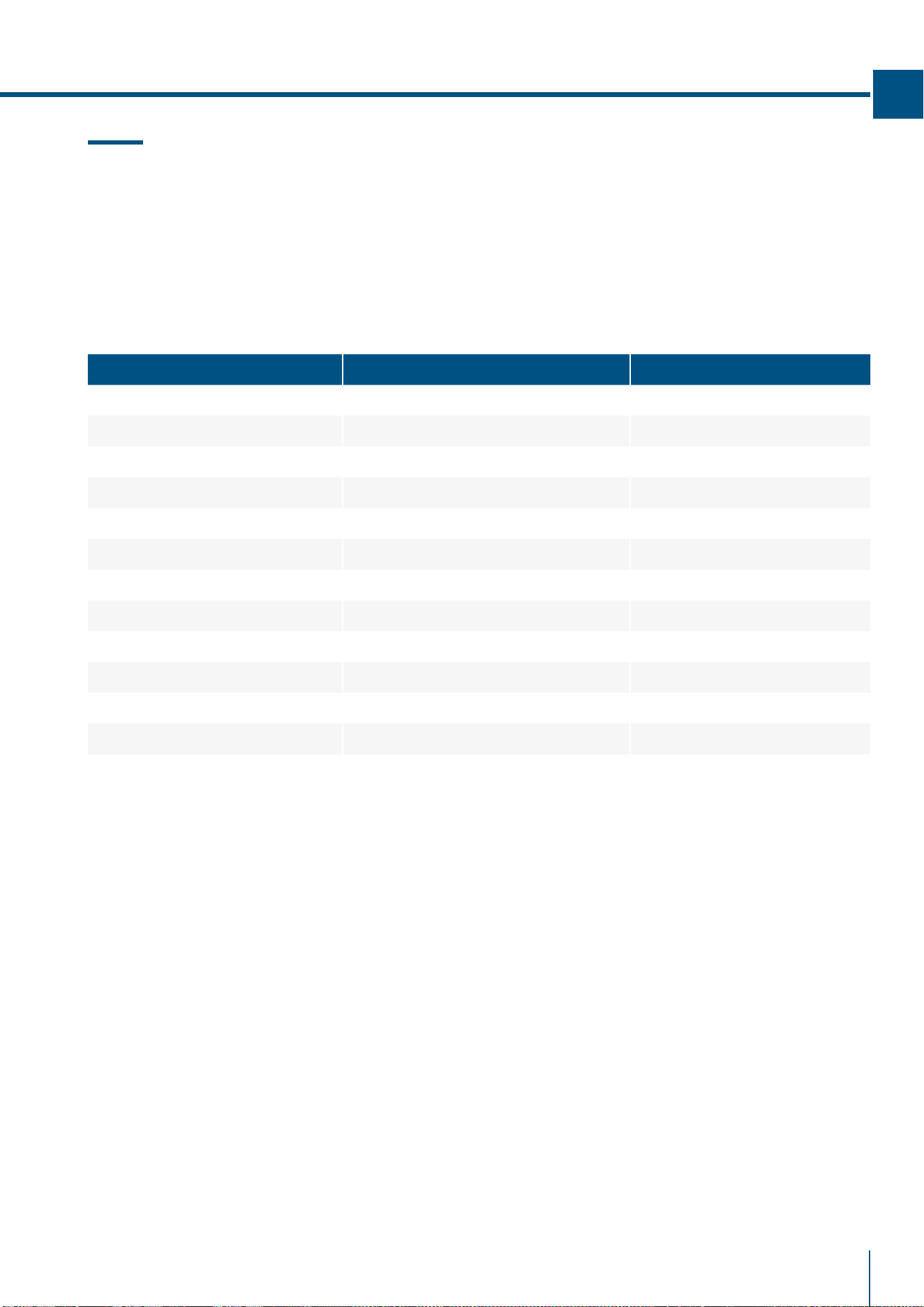
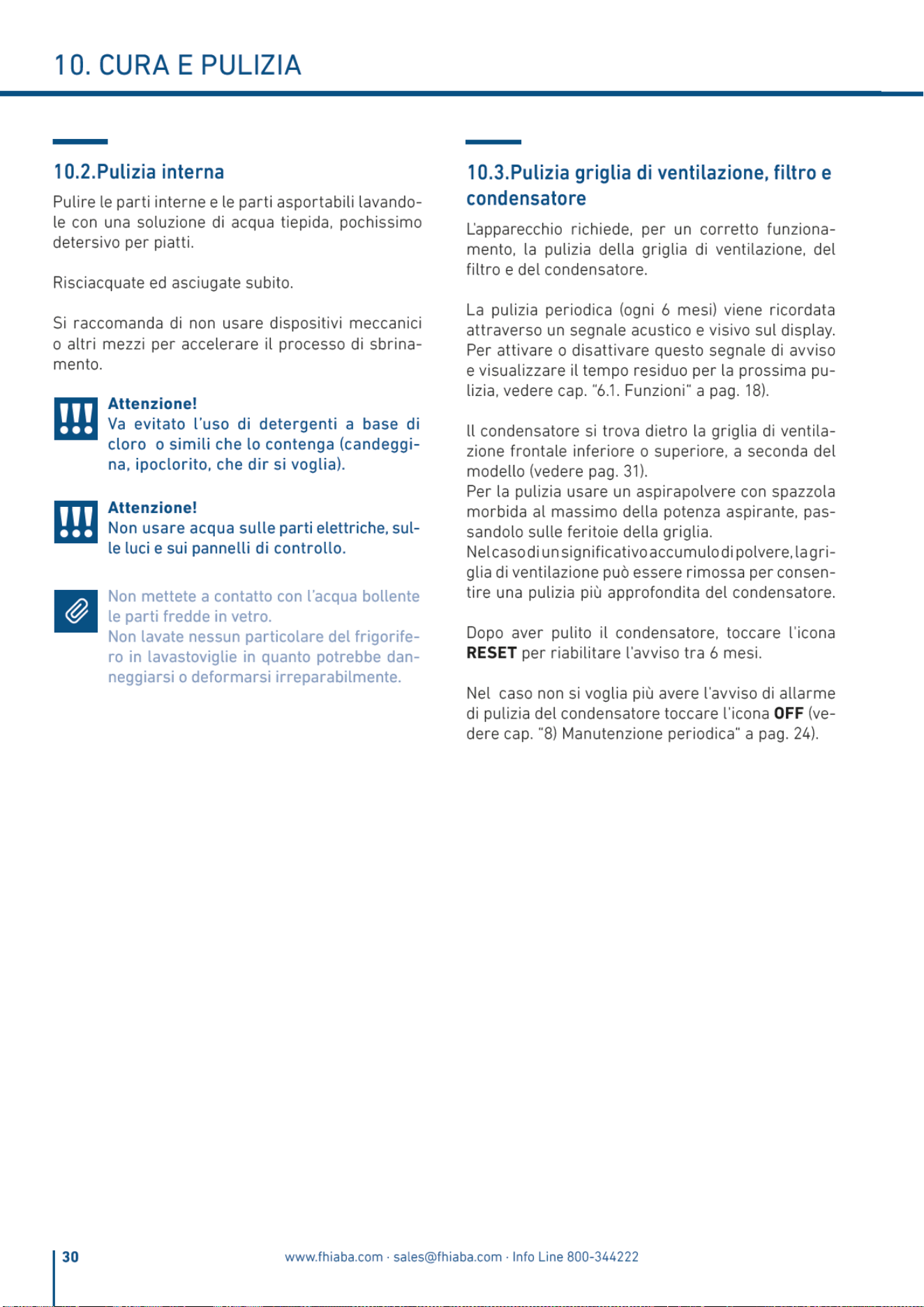
TIPOLOGIA DEL VINO TEMPERATURA DI CONSERVAZIONE TEMPO DI CONSERVAZIONE
ViniNovelli da12a14°C 6 mesi
Spumanti
dolci da8a10°C 1 anno
Vini R
osati da
10a14°C 1 anno
Vini F
rizzanti da
10a12°C 1-2 anni
ViniBianchinormali da10a14°C 1-2 anni
Vini R
ossi leggeri da
12a14°C 2 anni
SpumantiSecchi da8a10°C 2 anni
SpumantiClassici da8a10°C 3-4 anni
ViniBianchiVigorosioBarricati da8a12°C 3-5 anni
Vini Rossi normali da
14a16°C 3-5 anni
ViniR
ossi
VigorosioBarric
ati da
14a18°C 7-10 anni
Vini P
assiti o Liquorosi da
16a18°C 10-15 anni
9.3. Tempo di conservazione
Ilmiglioramentoneltempodelvinoelasuadurataingeneraledipendedallecaratteristichedellavarietàetipo-
logia di appartenenza.
Viene
dise
guito
ind
icato
ilpe
riodo
ot
timale
dico
nservazione
ediin
vecchiamento
pe
r
ledi
verse
ti
pologie
ne
lle
co
ndizioni
i
deali
d
i
c
onservazione
o
erte
d
alla
v
ostra
a
pparecchiatura.
In ogni caso seguite i suggerimenti oerti dal produttore della bottiglia, in particolare per i vini più pregiati.

28
www.fhiaba.com · [email protected] · Info Line 800-344222
9.4. Temperature di degustazione
Comeregolageneralesiconsideraperibianchiuna
te
mperatura
dise
rvizio
ot
timale
tr
a
i10
°C
ei12
°C
(5
0°F
e53
,6°F)
epe
r
iros
si
tr
a
i12e14
°C
(5
3,6
e
57,2°F).Alcunivini,tuttavia,possonoorireilmeglio
dil
oro
s
tessi
at
emperature
p
iù
e
levate
op
iù
ba
sse.
Va anche tenuto presente che, durante l’estate, si
pr
eferisce
ge
neralmente
de
gustare
ivi
ni
unpòpi
ù
fr
eddi
ch
e
inin
verno.
Pi
ù
inpar
ticolare
vaco
nside-
rato
ch
e:
Vini Bianchi
Ivinibianchinonvannodinormaservitiatempera-
ture
alte,essendoessigeneralmentepiùacidideivini
ros
si
epo
co
ta
nnici,
eri
sultando
qu
indi
pi
ù
gr
adevoli
a bas
se temperature.
Sipreferisceservirequestivinitrai10°C(50°F)ei
14
°C
(5
7,2°F).
Ivi
ni
bi
anchi
gi
ovani,
fr
eschi
earo
ma-
tici
possonoessereservitianchea10°C(50°F)men-
tre
quellimenoaromaticia12°C(53,6°F).Letempe-
rature
trai12°C(53,6°F)ei14°C(57,2°F)vengono
inveceriservateaivinibianchimorbidiematuriche
so
no
st
ati
af
finati
pe
r
qu
alche
an
no
inbo
ttiglia.
Te
m-
perature
didegustazionepiùelevatefavorirebberol’esal-
tazione
delcaratteredolcedelvinoadiscapitodell’acidità
esapiditàchesonoconsideratecaratteristichegradevoli
edesideratediquestotipodivino.
Vini Rosati
Ilvino rosatovieneservito allestesse temperature
deivinibianchi.Vanotatotuttaviachequestivinipos-
sono
presentareuncertocontenutoditanninoequin-
di
risultarepiùgradevoliatemperaturepiùelevate.
Siservonoquinditrai10°C(50°F)ei12°C((53,6°F),
segiovaniefreschi,etra12°C(53,6°F)ei14°C
(57,2°F)sepiùrobustiematuri.
Vin
i Novelli
Perlaloroparticolaretecnicadivinicazioneivini
no
velli
ha
nno
un
a
bas
sa
ta
nnicità
eso
no
qu
indi
pi
ù
gr
adevoli
sese
rviti
tr
a
i12
°C
(5
3,6°F)
ei 14
°C
(5
7,2°F).
Vini Rossi
Possedendo per natura unapiù elevatatannicità e
unapiùbassaaciditàivinirossivengonodinorma
servitiatemperaturepiùalte.
Quelligiovanipiùpoveriintanninosiservonosoli-
tamentefrai14°Cei16°C(57,2e60,8°F),mentre
quellipiùcorposiericchiditannicitàvengonoserviti
anchea18°C(64,4°F).Alcunivinianatiperanni
inbottiglia,ancoracorposietannici,possonoessere
servitia18°C(64,4°F)oaddiritturaa20°C(68°F).
Ivinirossigiovanipocotanniciepocostrutturatiri-
sultanoinvecegradevolialletemperaturepiùbasse,
frai12°Cei14°C(53,6e57,2°F).
Vini Spumanti
Èdi
cile
fo
rnire
ind
icazioni
va
lide
pe
r
lagr
ande
va-
r
ietà di spumanti esistenti. Come regola generale gli
spumanti
pi
ù
do
lci
earo
matici
va
nno
se
rviti
ate
m-
peraturepi
ù
bas
se,
n
o
a8°
C
(4
6,4°F),
me
ntre
gl
i
spumantipiùtannicipossonoessereservitiatempe-
rature
piùalte,noa14°C(57,2°F).
Gli
spu
manti
se
cchi
ve
ngono
di nor
ma
se
rviti
fr
a
gl
i
8 °
C
e i10
°C
(4
6,4
e 50
°F).
An
che
gl
i
spumanti“classici” vengonodinormaservitia
qu
este
te
mperature,
ch
e
tut
tavia
po
ssono
ar
ri-
vare
a
nche
a1
2°C
(
53,6°F)
n
el
c
aso
d
i
s
pumanti
affinati per lungo tempo.
E’
be
ne
co
munque
se
mpre
se
guire,
par
ticolar-
mente
pe
r
ivi
ni
pi
ù
pr
egiati,
isu
ggerimenti
ele
raccomandazionidelproduttoredellabottiglia.
Vini Liquorosi e Passiti
Questotipodivinipuo’essereservitoatemperature
tra16°Ce18°C(60,8e64,4°F),tuttavia,secondo
i gusti personali, per attenuareil sapore dolce dei
pas
siti,
qu
esto
pu
ò
es
sere
se
rvito
an
che
ate
mpera-
turadi10°C(50°F).
Gestione temperature di servizio per vini spuman-
tizzati e Champagne
Pergarantireunutilizzoecientedellacantinavini
da
l
pu
nto
divi
sta
en
ergetico,
èim
portante
co
nside-
rarelaposizioneelatemperaturadiconservazione
de
i
div
ersi
tip
i
divin
o.
Ne
l
ca
so
divin
i
sp
umantizza-
tiechampagne,cherichiedonounatemperaturadi
serviziopiùbassarispettoallatemperaturedicon-
servazioneso
pra
de
scritte,
èco
nsigliabile
ado
ttare
speciche strategie di posizionamento all’interno
dellacantina.
Inunacantinaaduevani,ivinispumantizzatiecham-
pagnede
stinati
alse
rvizio
do
vrebbero
es
sere
co
llo-
catinelvanoinferiore.Questoconsentedisfruttare
alme
glio
leca
ratteristiche
co
struttive
de
lla
ca
ntina,
poichéilfreddo tendeadepositarsiversoilbasso,
permettendocosì dimantenerepiùfacilmenteuna
temperaturapiùbassainquestovano.Latempera-
turaidealediservizioperquestivinisiaggiraintorno
ai4°centigradi.Tuttavia,èimportantenotarechese
ilvanoinferioreèimpostatopermantenereunatem-
peratura di 4° centigradiper ilservizio immediato,
nonostantelacantinasiaequipaggiataconresisten-
zedibilanciamentosaràdicile,senonimpossibile,
mantenereunatemperaturadiconservazioneade-
guatanelvanosuperioresoprai14°centigradi.Que-
sto accade perché la bassa temperatura nel vano
inferioreinuiscesull’ambientedelvanosuperiore,
riducendolasuacapacitàdiraggiungereomante-
neretemperaturepiùelevate,necessarieperlacon-
servazioneottimaledialtritipidivini.
9. CONSERVAZIONE DEI VINI

32
www.fhiaba.com · [email protected] · Info Line 800-344222
11. RISOLUZIONEDEIPROBLEMI
11.1. Guida alla risoluzione dei problemi
Senotateanomalienelfunzionamentodellavostra
ap
parecchiatura,
ut
ilizzate
qu
esta
gu
ida
pr
ima
di
ch
iamare
ilse
rvizio
as
sistenza:
vipo
trà
ai
utare
ari-
s
olvere
pe
rsonalmente
ilpro
blema
ofo
rnirà
im
por-
tanti
in
formazioni
datras
ferire
alse
rvizio
ass
istenza
pe
r
a
ssicurare
u
n
s
ervizio
p
iù
r
apido
e
d
e
cace.
Messaggio “Call Service”
Unproblemadifunzionamentovienedinormaindi-
cato
d
al
d
isplay.
I
pro
blemi
ch
e
no
n
po
ssono
es
sere
ri
solti
da
ll’uten-
te,
ve
ngono
se
gnalati
at
traverso
unco
dice
digu
asto
eil messaggio“CallService”(chiamareAssistenza
Tec
nica).
L’apparecchiatura non funziona
L’apparecchiatura è collegataallarete dialimenta-
zione
el
ettrica?
Arrivacorrenteallapresadialimentazione?
Il tasto ON/OFF
èattivato?
Il
c
ondensatore
èp
ulito?
V
edere
pa
g.
3
1
Le temperature interne sono più alte del
normale
Ildisplayvisegnalaqualchecodicediguasto?Vedere
pag
. 33.
Latemperaturaèregolatainmodocorretto?
Il
c
ondensatore
èp
ulito?
V
edere
pa
g.
3
1
Le porteo i cassettisono rimastiapertiper lungo
te
mpo?
Sonostaterecentementeinseritegrossequantitàdi
alimenti?
L’apparecchiatura rimane in funzione per un
lungo periodo di tempo
Tenerpresentechenellegiornatemoltocaldeecon
temperatureelevatenellocaleènormalecheilcom-
pressore rimanga in funzione per periodi prolungati.
Leporteoicassettisonorimasteaperteperlungo
tempo?
Sonostaterecentementeinseritegrossequantitàdi
alimenti?
Ilcondensatoreèpulito?Vederepag.31.
Vericatecheleportesianobenchiuseechegliali-
mentioicontenitorinonimpediscanolaloroperfetta
chiusura.
Si sentono rumori strani
È normale sentire rumori legati al funzionamento
dei
ve
ntilatori
ode
i
co
mpressori
odu
rante
lafa
se
di
sb
rinamento.
La
ru
morosità
pu
ò
es
sere
pi
ù
ac
centuata
an
che
in
funzionedelposizionamentodell’apparecchiaturae
de
ll’ambiente
ci
rcostante.
Si forma condensa all’interno e dall’esterno
Seilclimaèmoltoumido,lacomparsadiunpo’di
co
ndensa
è no
rmale.
L’
apertura
de
lla
po
rta
o de
i
ca
ssetti
pe
r
pe
riodi
pro
lungati
pu
ò
co
ntribuire
al
la
fo
rmazione
d
i
c
ondensa.
Assicurateviinognicasocheleportesianosempre
ch
iuse
p
erfettamente.
Il vano presenta brina o ghiaccio
Avetelasciatoaperteleporteperunlungoperiodo?
Le
p
orte
n
on
c
hiudono
p
erfettamente?
Seleportenonchiudonoperfettamentecontattate
ilvo
stro
in
stallatore.
Ne
l
ca
so
difo
rmazione
dibr
i-
naodighiaccio,dovutaadaperturefrequentiepro-
lungate
de
lle
po
rte,
di
sattivare
pe
r
unce
rto
te
mpo
lefunzioniagendosulrelativopulsantedelpannel-
lodicontrollo.Attenderechelabrinaoilghiacciosi
sciolgano,quindiestrarreilcassettoedasciugarele
paretiedilfondodelvano.
Notate odori sgradevoli all’interno
Pulitel’apparecchiaturacompletamenteseguendole
is
truzioni.
Copriteermeticamentetuttiglialimenti.Nonconser-
vate
c
ibo
p
er
p
eriodi
p
rolungati.
La porta si apre con dicoltà
L’apparecchiaturaèstataprogettataperpermetter-
nelachiusuraermetica.Quandolaportaèchiusasi
puòvericareunasituazionedivuoto:inquestocaso
è necessario attenderequalche secondo perchéla
pressione si riequilibri, prima di aprire la porta.
www.fhiaba.com · [email protected] · Info Line 800-344222
33
www.fhiaba.com · [email protected] · Info Line 800-344222
IT
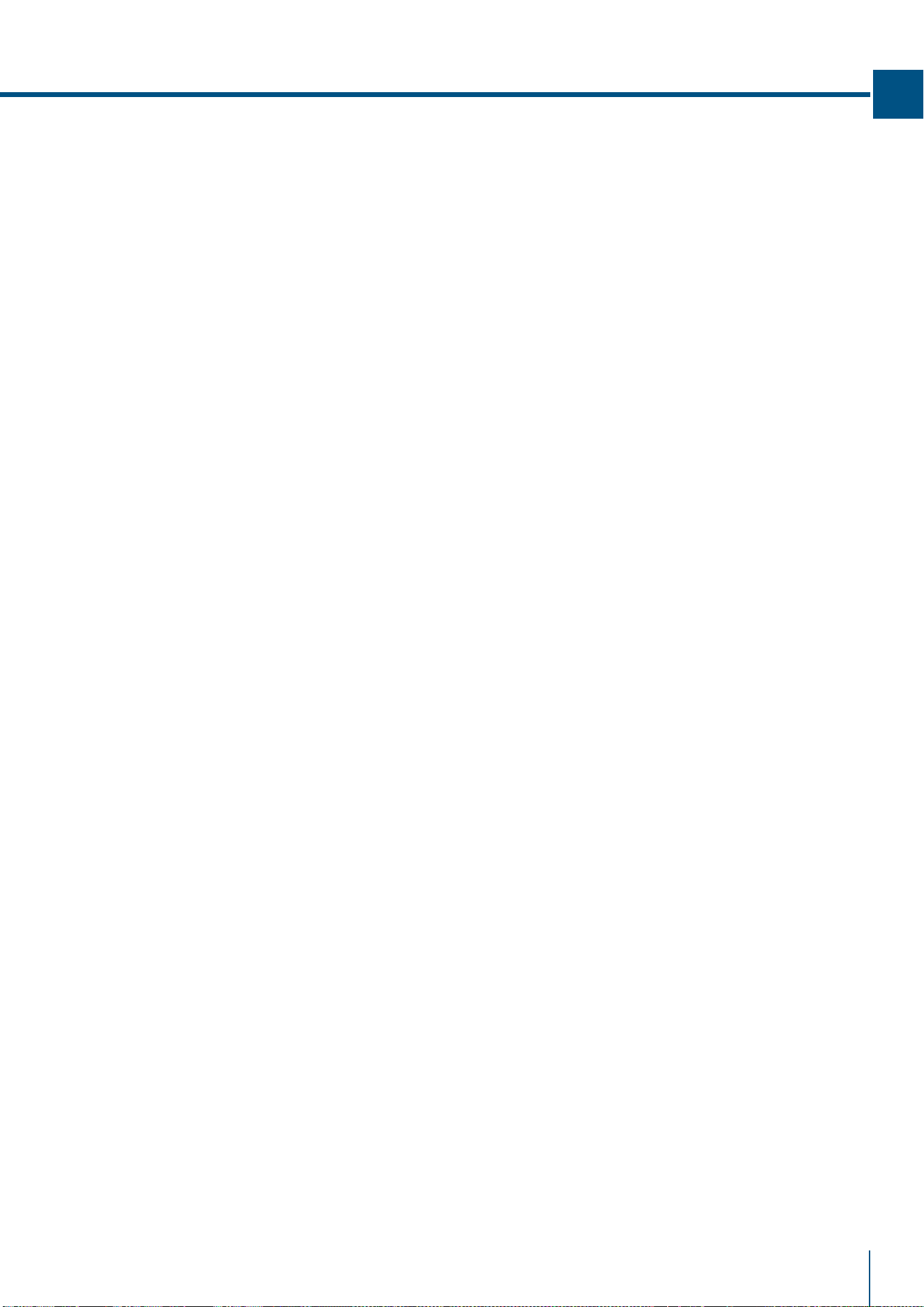
Messaggio sul display Descrizione Anomalia
Interr.Corrente!
Interruzione prolungata dell’energia elettrica
l’apparecchiatura
siri
avvia
au
tomaticamente
se
gnalando
lete
mperature
pi
ù
ca
lde
re
gistrate. Premere il pulsante ALARM
perdisattivarel’allarmesonoro
Porta Fr. Aperta
Porta aperta
il messaggio appare dopo un minuto dall’apertura della porta
TriMode Aperto
Cassettone aperto
il
messaggioapparedopounminutodall’aperturadelcassettone
Cant.TroppoCalda
Vano Wine Cellar troppo caldo
vedi
c
ap.
“
11.
R
ISOLUZIONE
D
EI
PR
OBLEMI“
apa
g.
3
2
CantTroppoFredda
Vano Wine Cellar troppo freddo
attendere12ore:sel’anomaliapersisterivolgersiall’AssistenzaTecnica
Ris.Troppo Calda
Vano Cantina troppo caldo
vedi
c
ap.
“
11.
R
ISOLUZIONE
D
EI
PR
OBLEMI“
apa
g.
3
2
Ris.TroppoFredda
Vano Cantina troppo freddo
attendere
12ore:sel’anomaliapersisterivolgersiall’AssistenzaTecnica
Frtr
oppo
c
aldo
Vano TriMode (modalità Frigorifero) troppo caldo
vedicap.“11.RISOLUZIONEDEIPROBLEMI“apag.32
Fr troppo freddo
Vano TriMode (modalità Frigorifero) troppo freddo
attendere12ore:sel’anomaliapersisterivolgersiall’AssistenzaTecnica
FrescoTroppoCald
Vano TriMode (modalità Crisper-Fresco) troppo caldo
vedic
ap.
“
11.
R
ISOLUZIONE
D
EI
PR
OBLEMI“
apa
g.
3
2
FrescoTroppoFred
Vano TriMode (modalità Crisper-Fresco) troppo freddo
attendere
1
2
o
re:
s
e
l
’anomalia
p
ersiste
r
ivolgersi
a
ll’Assistenza
T
ecnica
TModeTroppoCaldo
Vano TriMode (modalità Freezer) troppo caldo
vedi
c
ap.
“
11.
R
ISOLUZIONE
D
EI
PR
OBLEMI“
apa
g.
3
2
TMdeTroppoFreddo
Vano TriMode (modalità Freezer) troppo freddo
attendere
1
2
o
re:
s
e
l
’anomalia
p
ersiste
r
ivolgersi
a
ll’Assistenza
T
ecnica
Codice
guasto...
C
odice di guasto
rivolgersi
a
ll’Assistenza
T
ecnica
Check
condenser
C
heck Condenser
Ogni
6me
si
co
mpare
su
l
di
splay
ilme
ssaggio
“CHECK
COND.”,
pu
lire
ilco
ndensa-
tore
epremereper5secondiiltastoENTER
per il reset.
11.2. Indicazioni di anomalia che possono apparire sul display
> IncasodianomaliatoccareiltastoALARM eildisplayvisualizzeràilmessaggiodianomaliaconil
pro
prio
c
odice
n
umerico
d
i
e
rrore
(
vedi
t
abella
s
eguente).
> Ilmessaggiorimanevisualizzatoper3secondi,successivamentericompariràlaschermataHOME.
> Perbloccareilmessaggiosullaschermata,premeresuldisplayiltastoINFO
Modalità
Bottle Cooler
On O
. Il messaggio rimarrà sul
sulla
s
chermata
p
er
3
0
s
econdi,
p
oi
r
itornerà
l
a
s
chermata
HOM
E.
> Nelcasocompaianopiùmessaggidierrore,ildisplayvisualizzeràinsequenzaditempoivarimessaggidi
ano
malia.

www.fhiaba.com · [email protected] · Info Line 800-344222
3
www.fhiaba.com · [email protected] · Info Line 800-344222
EN
CONTENTS
1. IMPORTANT SAFETY AND ENVIRONMENTAL INFORMATION 4
1.1. Caring for the environment ............................................................................................................................................................6
1.2. Cleaning, sanitization and maintenance ....................................................................................................................................6
1.3. Information for regulatory authorities ........................................................................................................................................ 6
1.4. To save energy ...................................................................................................................................................................................6
1.5. Environmental labelling ..................................................................................................................................................................7
2.
INS
TALLATION
8
2.1. Instal
lation
...........................................................................................................................................................................................8
2.2. Connection to the electrical po
wer supply
................................................................................................................................8
2.3. R
efrigerant
..........................................................................................................................................................................................8
3.
BEFORE ST
ARTING
9
3.1. To kno
w your wine cellar well
.......................................................................................................................................................9
3.2. Manufacturer
’s liability....................................................................................................................................................................9
3.3.
Technic
al support
..............................................................................................................................................................................9
3.4.
Technical
specic
ations
..................................................................................................................................................................9
3.5. Product plate ......................................................................................................................................................................................9
3.6. Main components .............................................................................................................................................................................11
3.7. Electronic Contr
ol
..............................................................................................................................................................................13
3.8. Main control panel ............................................................................................................................................................................13
4.
TURNING THE APPLIANCE ON AND OFF 14
4.1.
Turning
onando .............................................................................................................................................................................14
5.
COMPARTMENT TEMPERATURE SETTING 16
5.1. How to adjust the compartment temperature .........................................................................................................................16
5.2. Information and malfunction messages on the display ........................................................................................................17
5.3. Wine storage temperatures ...........................................................................................................................................................17
6.
FUNCTIONS AND SET
TINGS
18
6.1. Functions .............................................................................................................................................................................................18
6.2. Settings ................................................................................................................................................................................................20
7.
LA
YOUT
25
7.1. Internal layout (positioning, adjustment, removal) .................................................................................................................25
8.
LIGHTING 25
8.1. Lighting ................................................................................................................................................................................................25
9.
CONSERV
ATION OF WINES
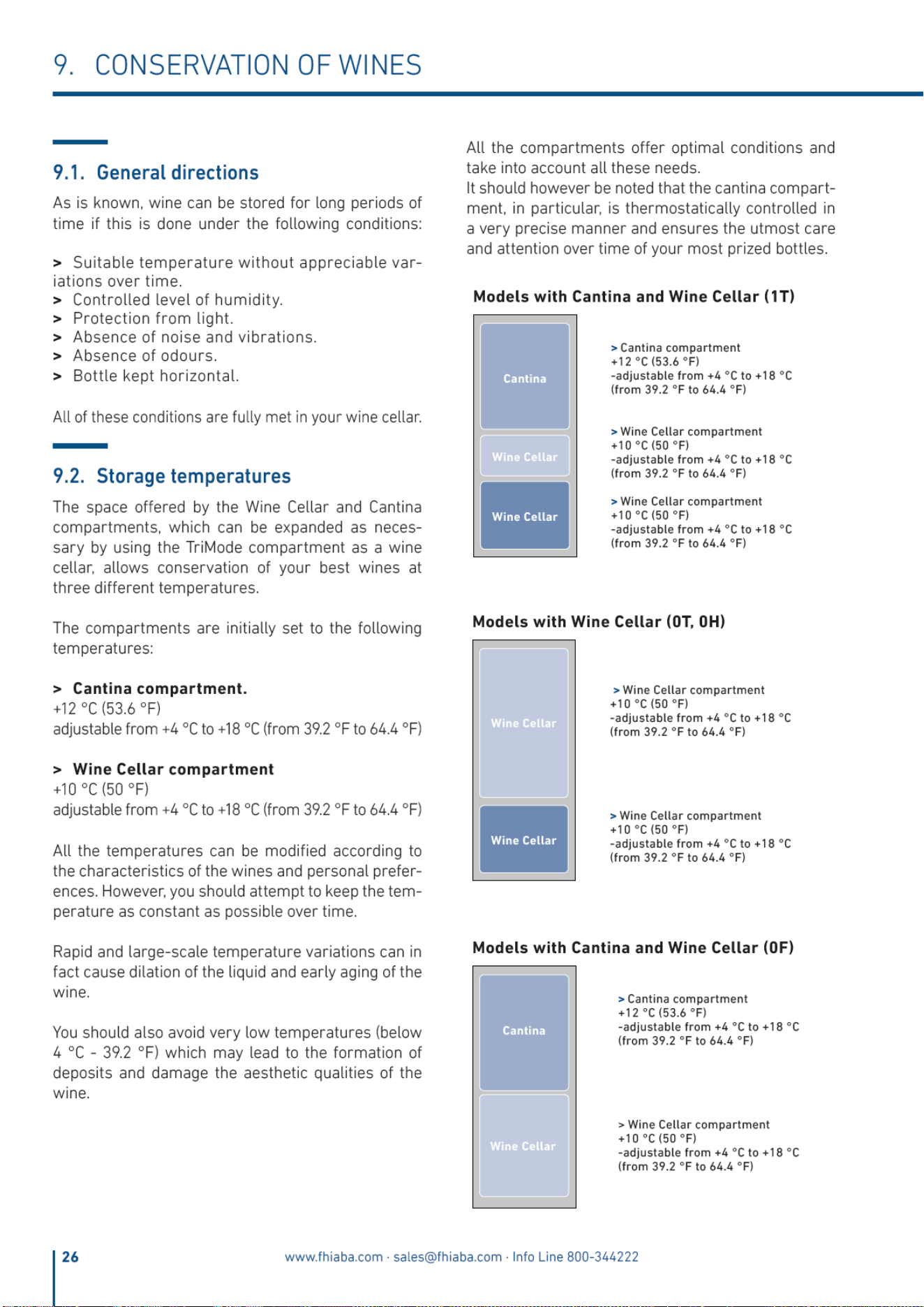
26
9.1. General dir
ections
.............................................................................................................................................................................26
9.2. Storage temperatures .....................................................................................................................................................................26
9.3. Time of conservation
........................................................................................................................................................................27
9.4.
Consumption temperature .............................................................................................................................................................28
9.5. Positioning the bottles .....................................................................................................................................................................29
10.
CARE AND CLEANING 29
10.1. Care and Cleaning .............................................................................................................................................................................29
10.2. Internal cleaning ...............................................................................................................................................................................30
10.3. Cleaningoftheventilationgrill,lterandcondenser ............................................................................................................30
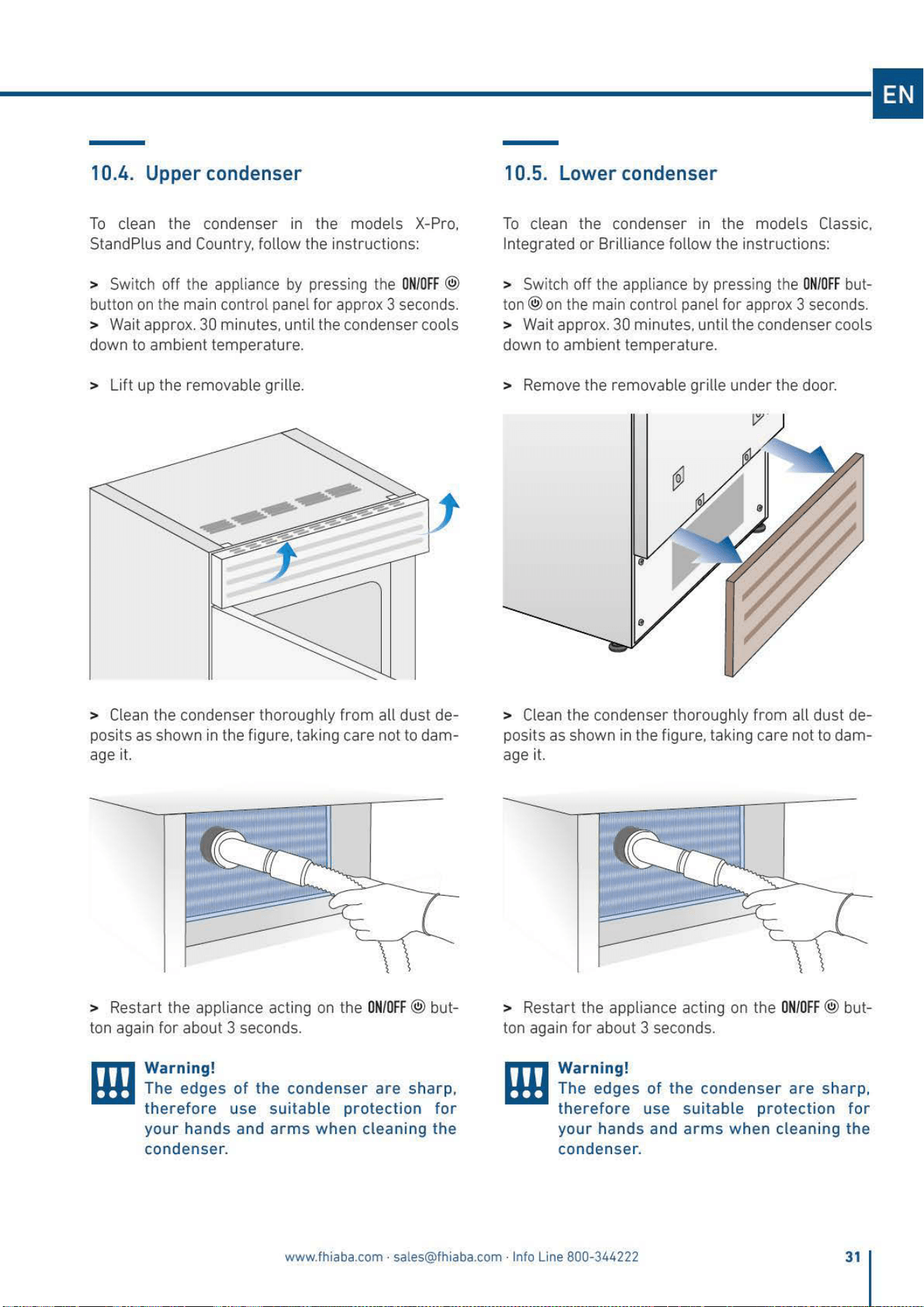
10.4. Upper condenser ............................................................................................................................................................................... 31
10.5. Lower condenser ..............................................................................................................................................................................31
11. TR
OUBLESHOOTING
32
11.1. Troubleshooting Guide .....................................................................................................................................................................32
11.2. Malfunction messages appearing on the display .................................................................................................................... 33

4
www.fhiaba.com · [email protected] · Info Line 800-344222
1.1. For your safety
> If this appliance is replacing an existing appliance
which must be removed or disposed of, make sure
that it does not become a dangerous trap for chil-
dren by cutting its power supply cable and rendering
it impossible to close the door.
> Th
is appliance is designed to refrigerate bever-
ages and foods and is intended for domestic use.
> Th
is appliance is for refrigeration and conserva-
tion of fresh and frozen foods in the home. Any other
use is considered inappropriate.
> Th
is appliance is not designed to operate with ex-
ternal timers or with remote-control systems.
> The
appliance must be installed by following the
instructions in the Installation Guide, particular care
should be taken not to obstruct the vent openings of
the appliance and of the built-in units.
> The
appliance features a concentrated lighting
system with LED lamps. Do not stare at these lamps
when they are on, as this could damage your vision.
> Th
is warning is also included on the label attached
to the inside of the refrigerator door.
> When the freezer is operating, do not touch the
interior stainless steel surfaces with wet or damp
hands, as skin may stick to the very cold surfaces.
> Do n
ot use any type of electrical equipment inside
the food storage compartments.
> Whe
n
po
sitioning
theshe
lves,
donotpl
ace
ng
ers
in the shelf slide guides.
> Do no
t
po
sition
co
ntainers
of a
mmable
li
quids
nea
r the appliance.
> Ne
ver
at
tempt
toex
tinguish
aa
me/re
wi
th
wa-
t
er:turnotheapplianceandcovertheamewitha
r
eproof
b
lanket.
> Do no
t
po
sition
co
ntainers
of a
mmable
li
quids
nea
r the appliance.
> Co
mpletely
swit
ch
o the ap
pliance
an
d
un
plug
the power supply cable during cleaning operations.
If the plug is not easily reached, it is a good idea to
disconnect the omnipolar switch that controls the
socket that the appliance is connected to.
> Pa
ckaging materials can be dangerous for chil-
dren: do not allow children to play with plastic bags,
plastic
lm
o
r
p
olystyrene.
> An
y
re
pairs
mu
st
bepe
rformed
byaqu
alied
se
r-
vice technician.
> This appliance is not intended for use by persons
(including children) with reduced physical, senso-
ry or mental capabilities or lack of experience and
knowledge unless they have been given supervision
or instruction concerning the use of the appliance by
a person responsible for their safety. Children should
be supervised to ensure that they do not play with
the appliance.
> Do not damage the appliance’s refrigerant circuit
pipes.
> Do not store explosive substances, such as aer-
osol
canswithaammablepropellant,insidethis
ap
pliance.
> The amount of refrigerant gas contained in your
appliance
isind
icated
onth
e
id
entication
pl
ate
lo-
c
ated inside the appliance. If the power cord of this
appliance is damaged, it must be replaced by the
manufacturer, customer service or a similarly quali-
edp
erson.
> Im
proper installations and repairs may put the
user at considerable risk.
> Repairs must be carried out by the authorized
customer service.
> Onl
y original spare parts from the manufacturer
can be used. Only with the use of these components
does the manufacturer guarantee that the safety re-
quirements of the product are complied with.
> Repairs may be performed by the manufacturer,
authorizedcustomerserviceorasimilarlyqualied
pe
rson only.
> Plug the appliance into a grounded 3-poles outlet.
> Do not remove the ground pole.
> Do not use an adapter.
> Do not use an extension cord.
> Di
sconnect power to all units before servicing.
> If the POWER CORD is damaged, it must be re-
placed by the manufacturer, an authorized service
centreorasimilarqualiedpersoninordertoavoid
any
hazards.
> Children must be supervised to make sure they do
not play with the appliance.
> Do not modify this appliance.
> Do n
ot insert pointed metal objects (kitchen uten-
sils or tools) into the slots in the appliance.
> Do n
ot touch (especially with wet hands) frozen
products or put them in your mouth directly.
> Don
ot
s
tore
ammable,
e
xplosive
o
r
v
olatile
s
ub-
stances inside the appliance.
> Do not store explosive substances, such as spray
bottlesw
ith
ammable
p
ropellants,
int
he
a
ppliance.
> Bo
ttles containing beverages with a high alcohol
content must be tightly closed and stored vertically.
> Organic compounds, acids and essential oils can
corrode the seals and plastic surfaces if left in con-
tact with them for extended periods.
> Do not pull on the cable to unplug the appliance.
1. IMPORTANT SAFETY AND ENVIRONMENTAL INFORMATION

www.fhiaba.com · [email protected] · Info Line 800-344222
5
www.fhiaba.com · [email protected] · Info Line 800-344222
EN
1.2. Important information when using
the appliance
> Cleaning and maintenance meant to be per-
formed by the user must not be carried out by unsu-
pervised children.
> Never defrost or clean the appliance with a steam
cleaner! The steam may penetrate electrical parts
and cause a short-circuit. Risk of electric shock!
> Do n
ot use pointed or sharp-edged implements to
remove frost or layers of ice. You could damage the
refrigerant tubes.
> Leaking refrigerant may cause eye injuries or ignite.
> Do not misuse the plinth, pull-out drawers, doors,
etc. as a point of support or as a support.
> Take care that no objects get stuck in the doors.
> Be
fore cleaning the appliance, pull out the power
cordplugorturnothesafetyswitch.Donotpullout
the power cord plug by tugging on the power cord.
> Store high-percentage alcohol tightly closed and
standing up.
> Ke
ep plastic parts and the door seal free of oil and
grease. Otherwise, parts and door seal will become
porous.
> Ne
ver cover or block the appliance’s ventilation
openings.
> Al
low the use of the appliance only to children
aged 8 years or older. Supervise children during
cleaning and maintenance.
> According to current regulations, children be-
tween 3 and 8 years of age may remove food from
or load it into the appliance, but we highly discourage
allowing children under 8 years of age to perform
these operations or to use the appliance in general.
> Keep children under the age of 8 at a safe distance
unless they are constantly supervised and make
sure that they do not play with the appliance.
> Do not use mechanical, electrical or chemical de-
vices other than those recommended by the manu-
facturer to speed up the defrosting process.
> Do not damage the cooling circuit (if it can be
accessed).
> Do
not use electrical appliances inside the food
storage compartments, if these are not those rec-
ommended by the manufacturer.
> In the event of damage to the cooling circuit, avoid
theuseofopenamesandventilatetheareaproperly.
> Do not use the appliance or parts of it in any way
other
t
han
t
hose
s
pecied
i
n
t
his
m
anual.
> Keeping the door open for long periods can cause
the temperature in the appliance compartments to
rise considerably.
> Perform cleaning of surfaces that may come into
contact with food and accessible drainage systems
regularly.
1. IMPORTANT SAFETY AND ENVIRONMENTAL INFORMATION
> Storerawmeatandshinsuitablecontainersin
th
e refrigerator, so that it does not come into contact
with other food or drip onto it.
> If th
e appliance is left empty for long periods of
time,switchito,defrostit,cleanit,dryitandleave
th
e door open to prevent the development of mould
inside.
> Ne
ver rest sharp metal objects such as knives,
forks, spoons and lids on the appliance during use.
> Do n
ot use abrasive or corrosive cleaning agents
(e.g. scouring powders, stain removers or metallic
scouring pads and sponges) on glass parts.
> Do
not sit on the appliance.
> Do n
ot sit or lean on the door or on any open
drawers.
> Do not put pressure on the door or handle to move
the appliance.
> Do not use electrical appliances (e.g. hair dryers)
or sprays for defrosting which may ruin the plastic
parts.
> Do not use the appliance to cool rooms for any
reason.
> Always unplug the appliance in the event of a mal-
function or when performing cleaning or maintenance.
> Do not keep liquids in tins or glass containers in
the freezer.
> Do
not place heavy objects on top of the appliance.
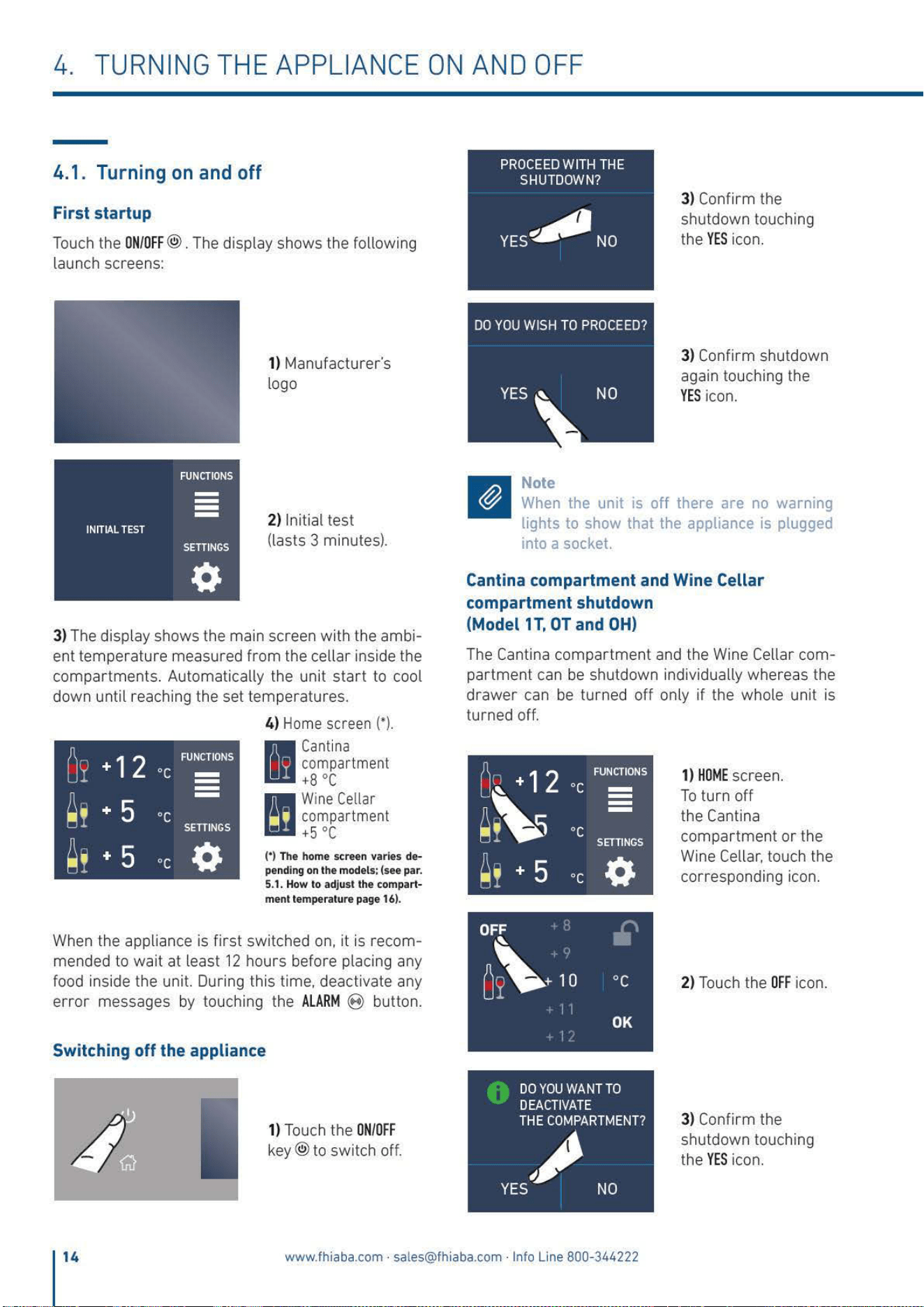
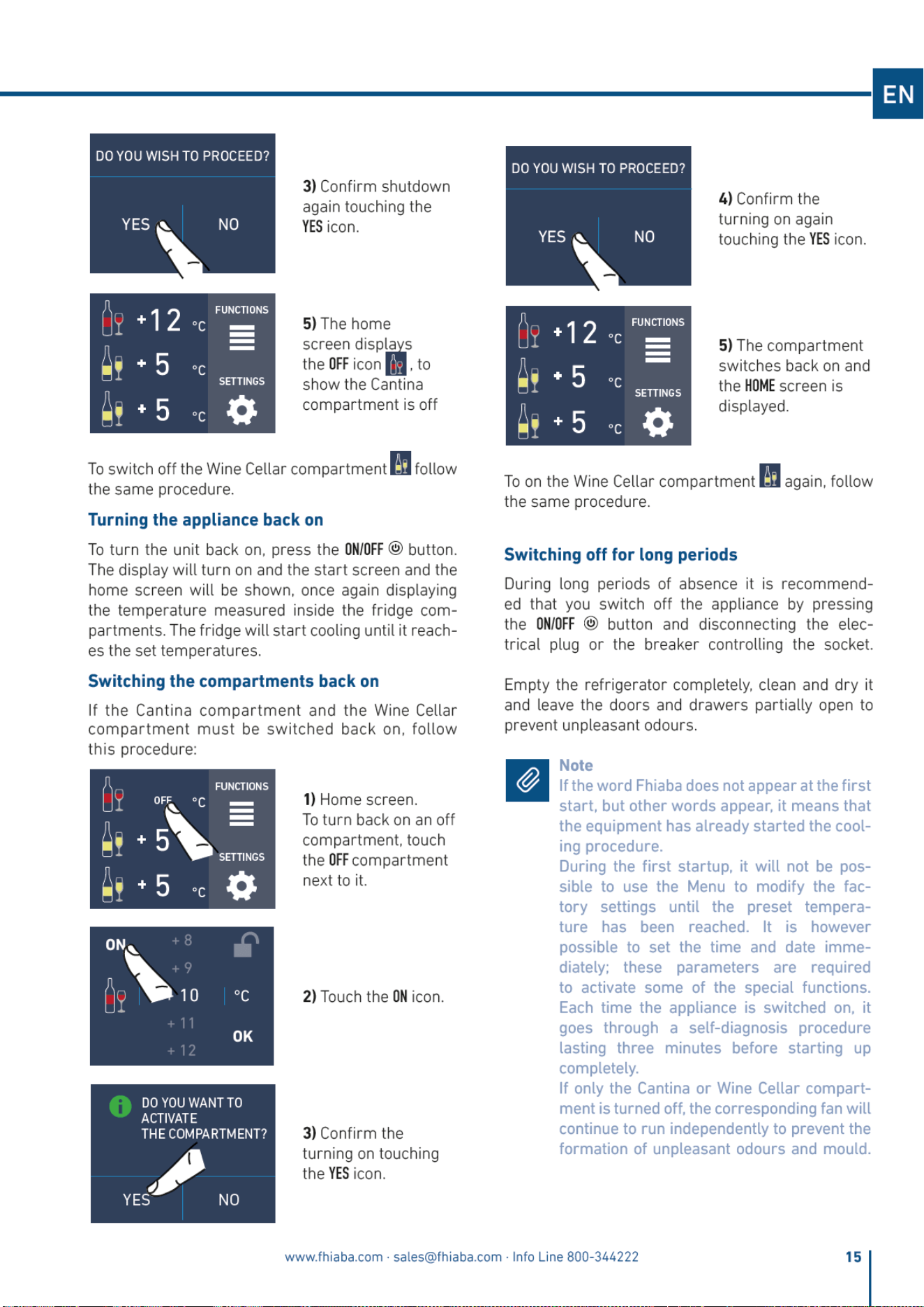
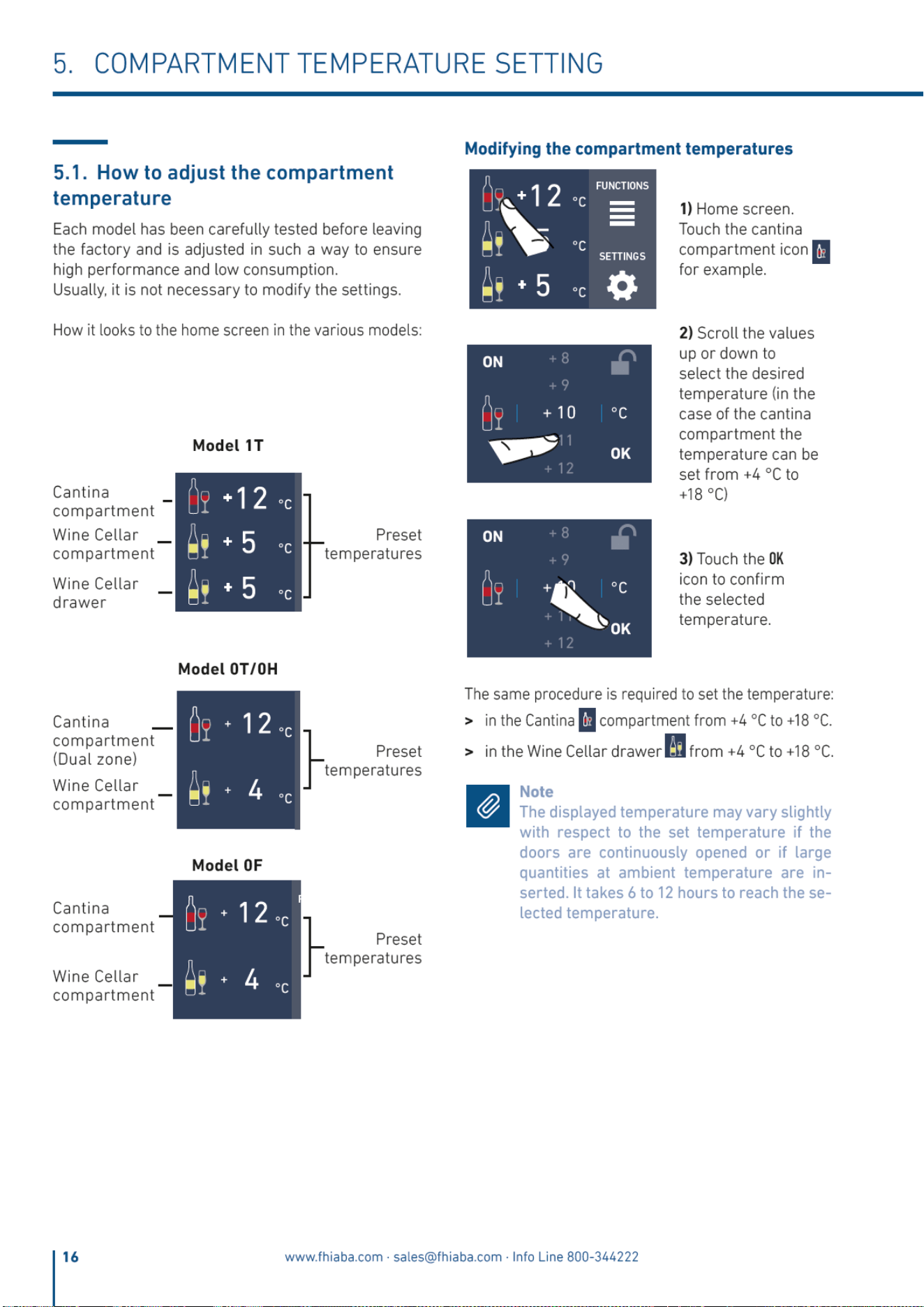
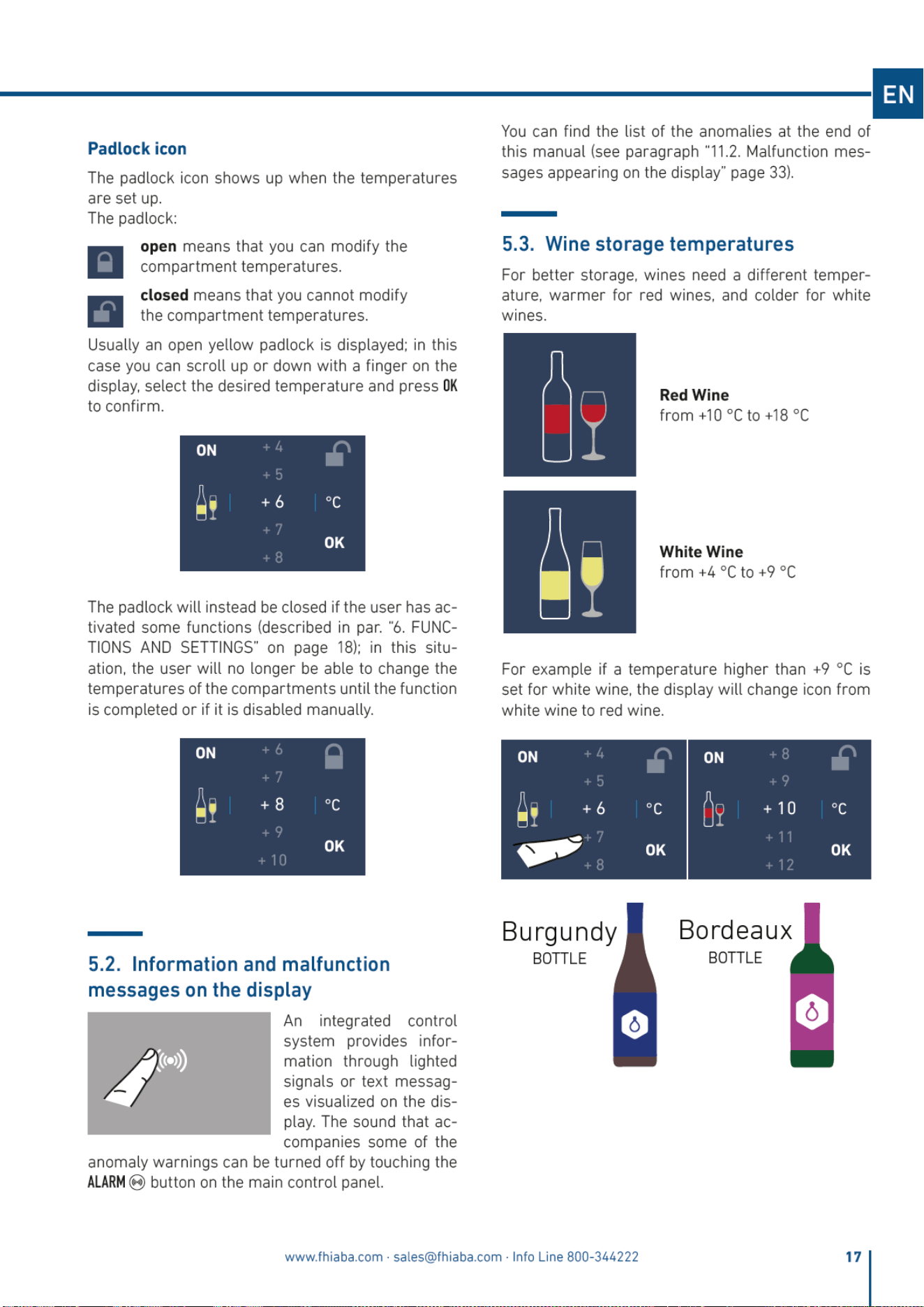
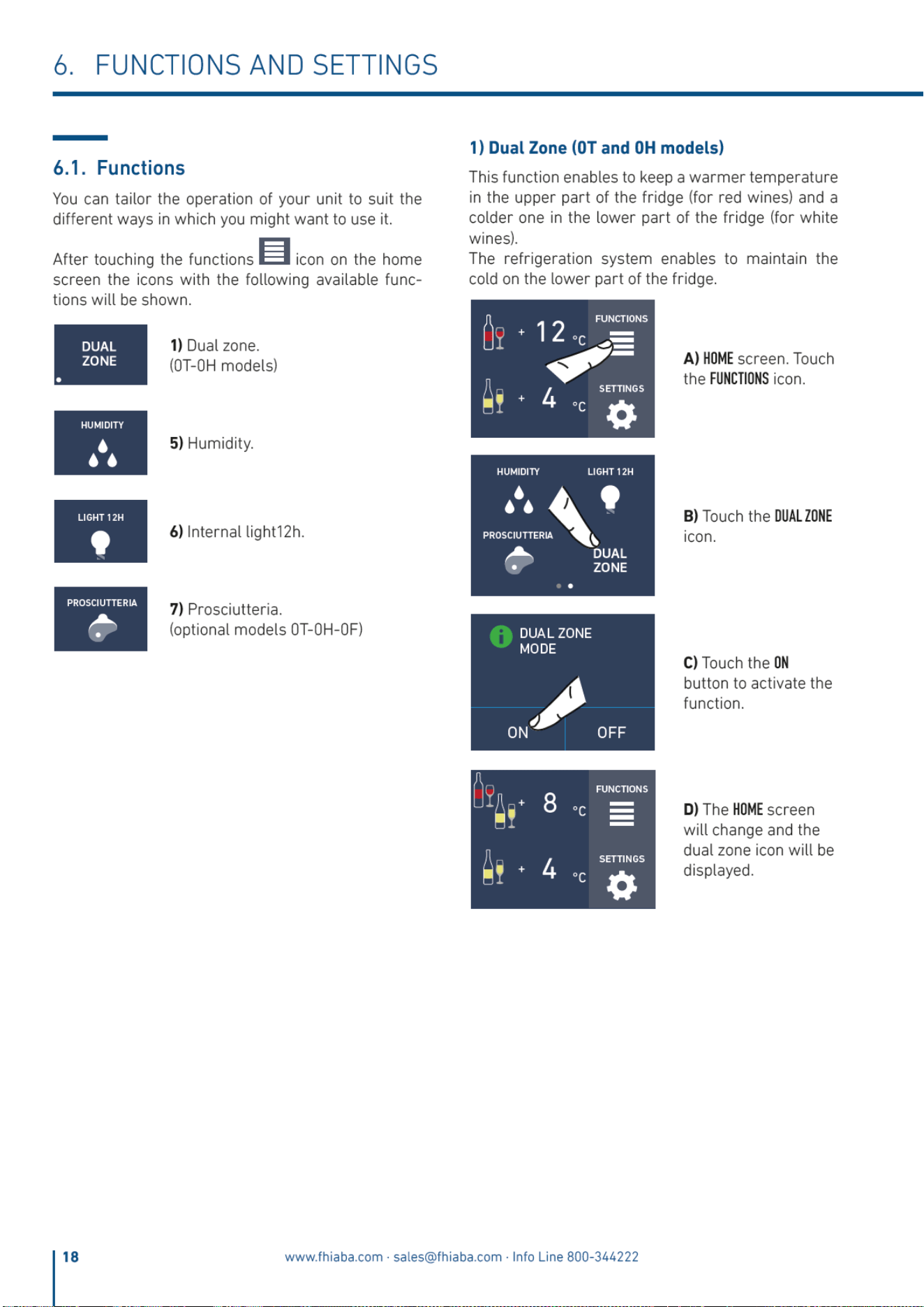
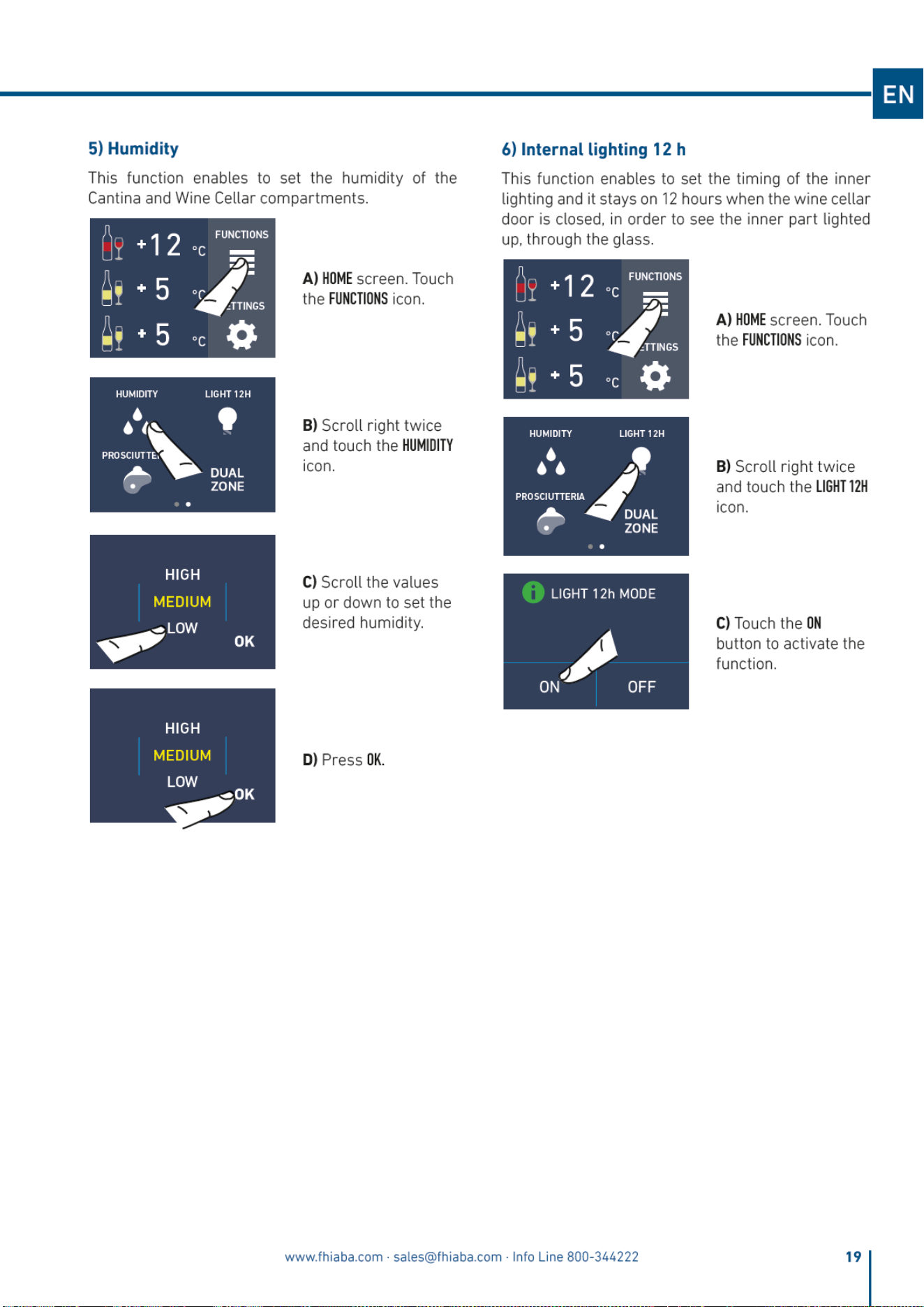
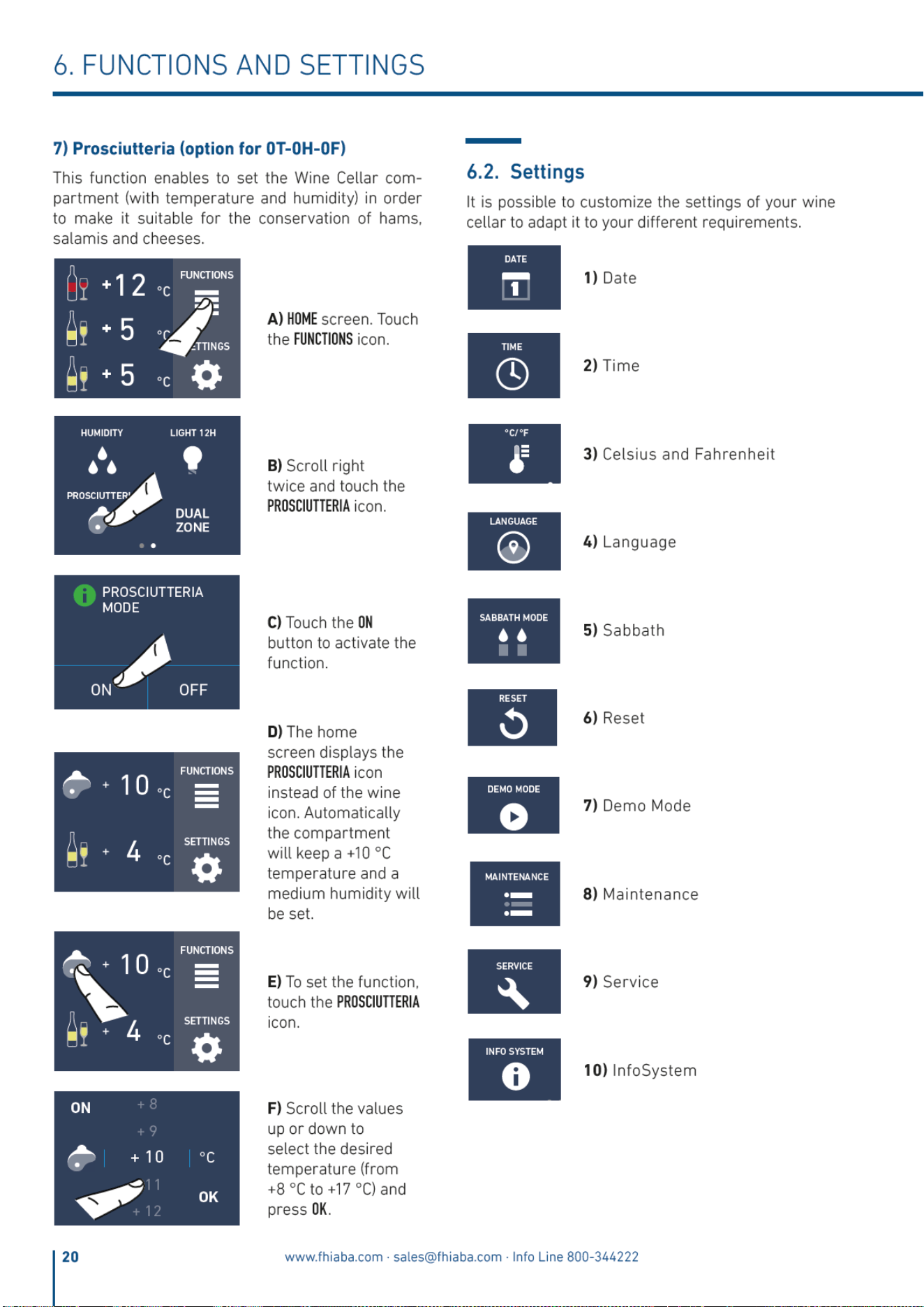
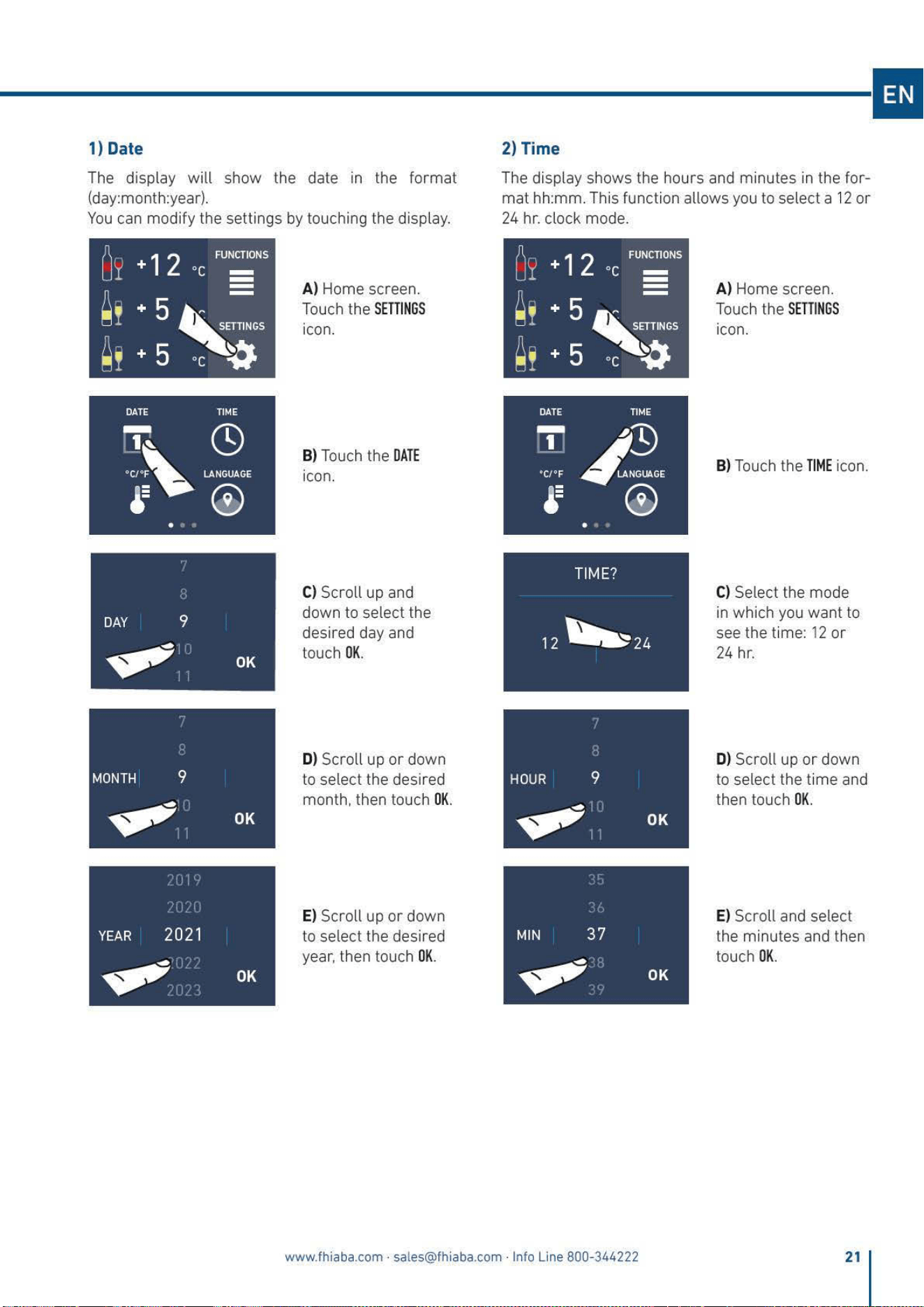
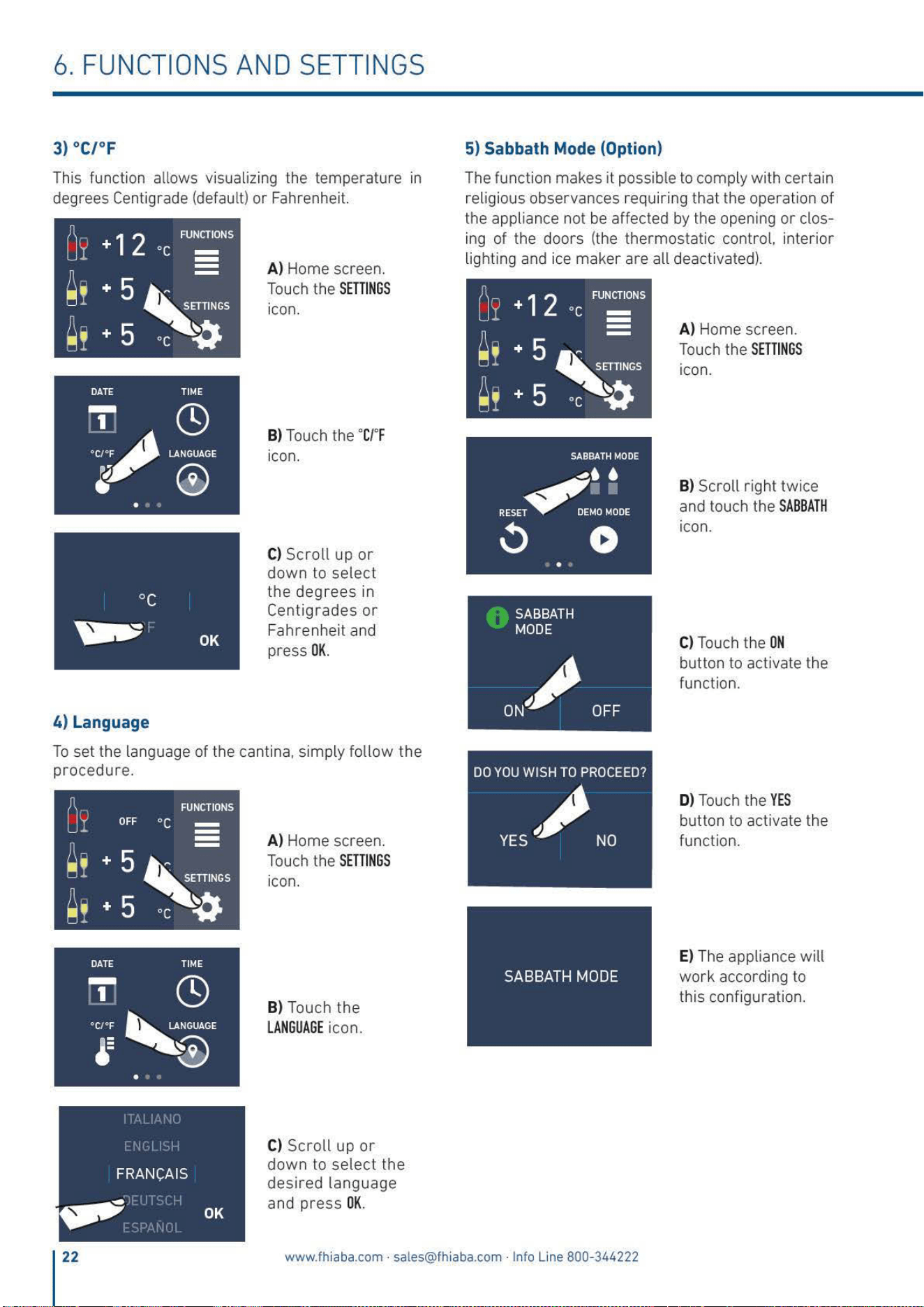
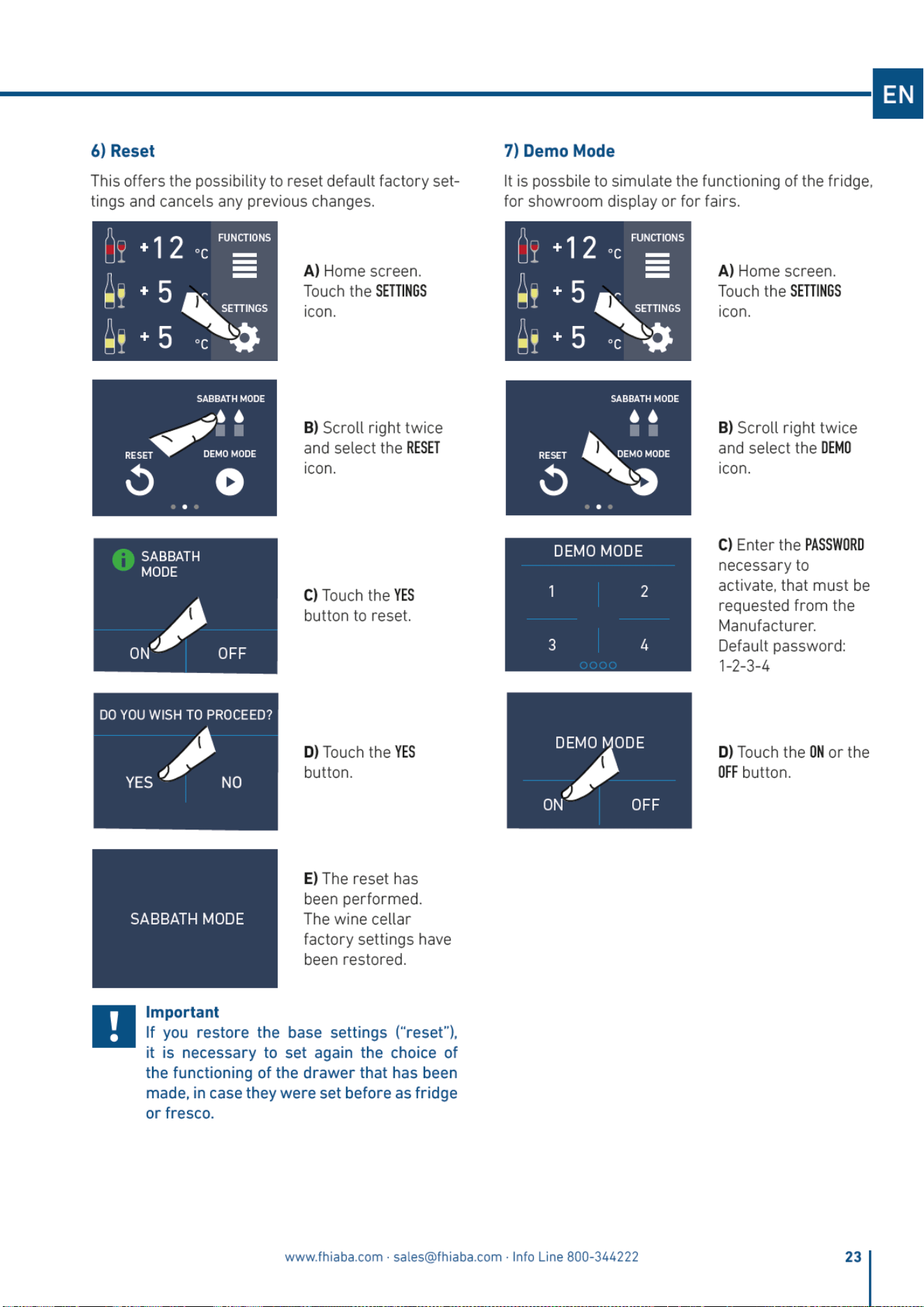
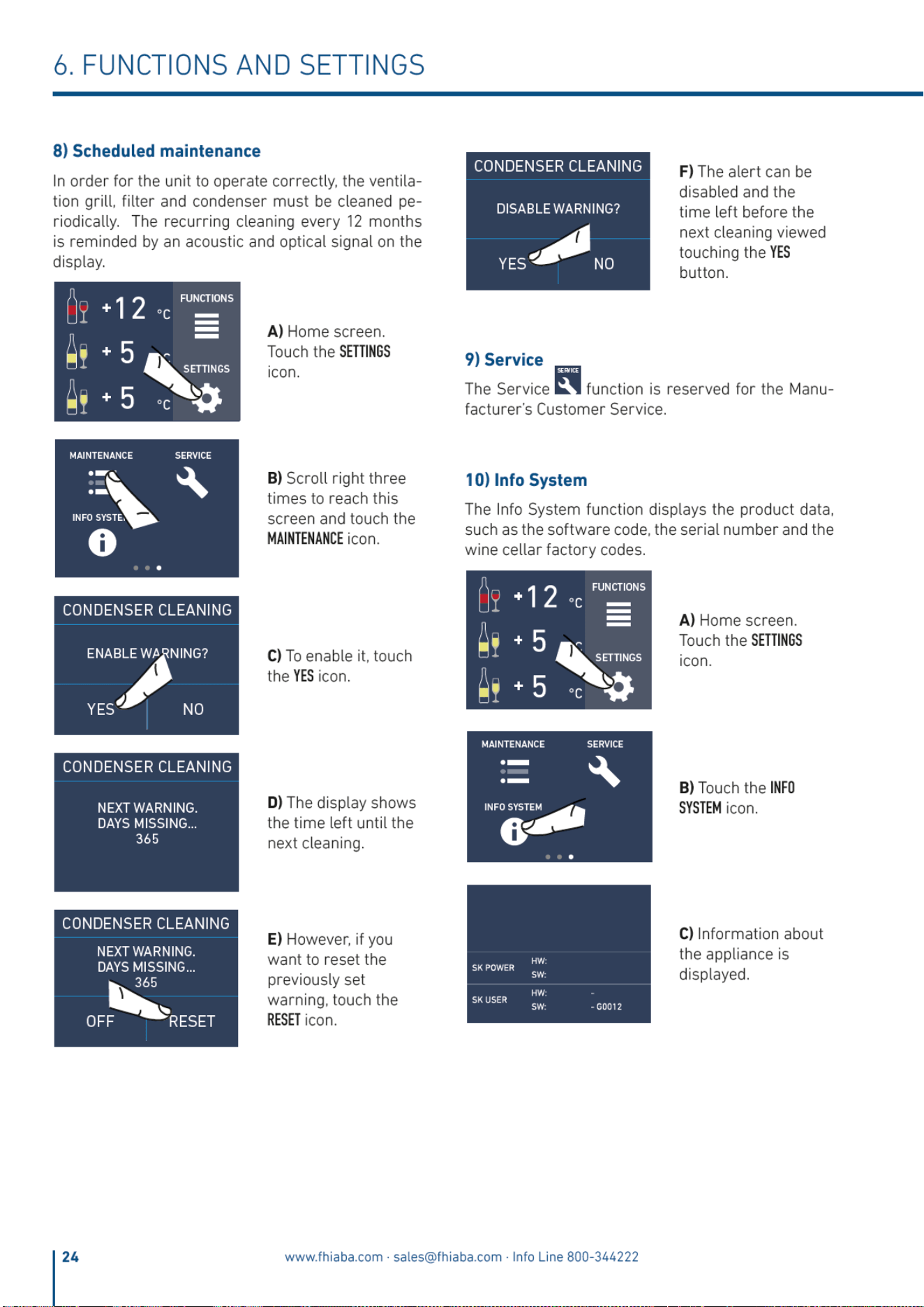
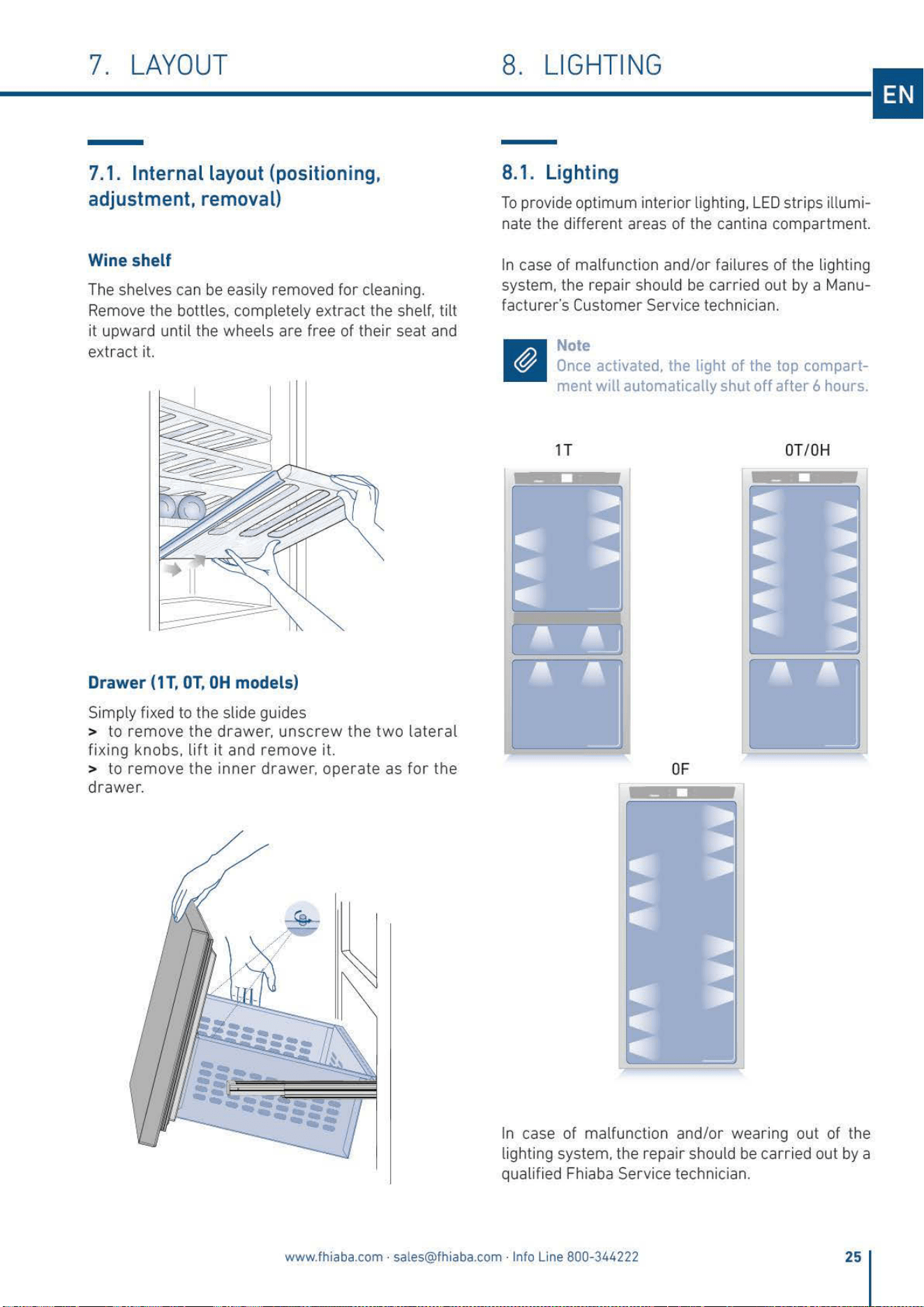
www.fhiaba.com · [email protected] · Info Line 800-344222
27
www.fhiaba.com · [email protected] · Info Line 800-344222
EN
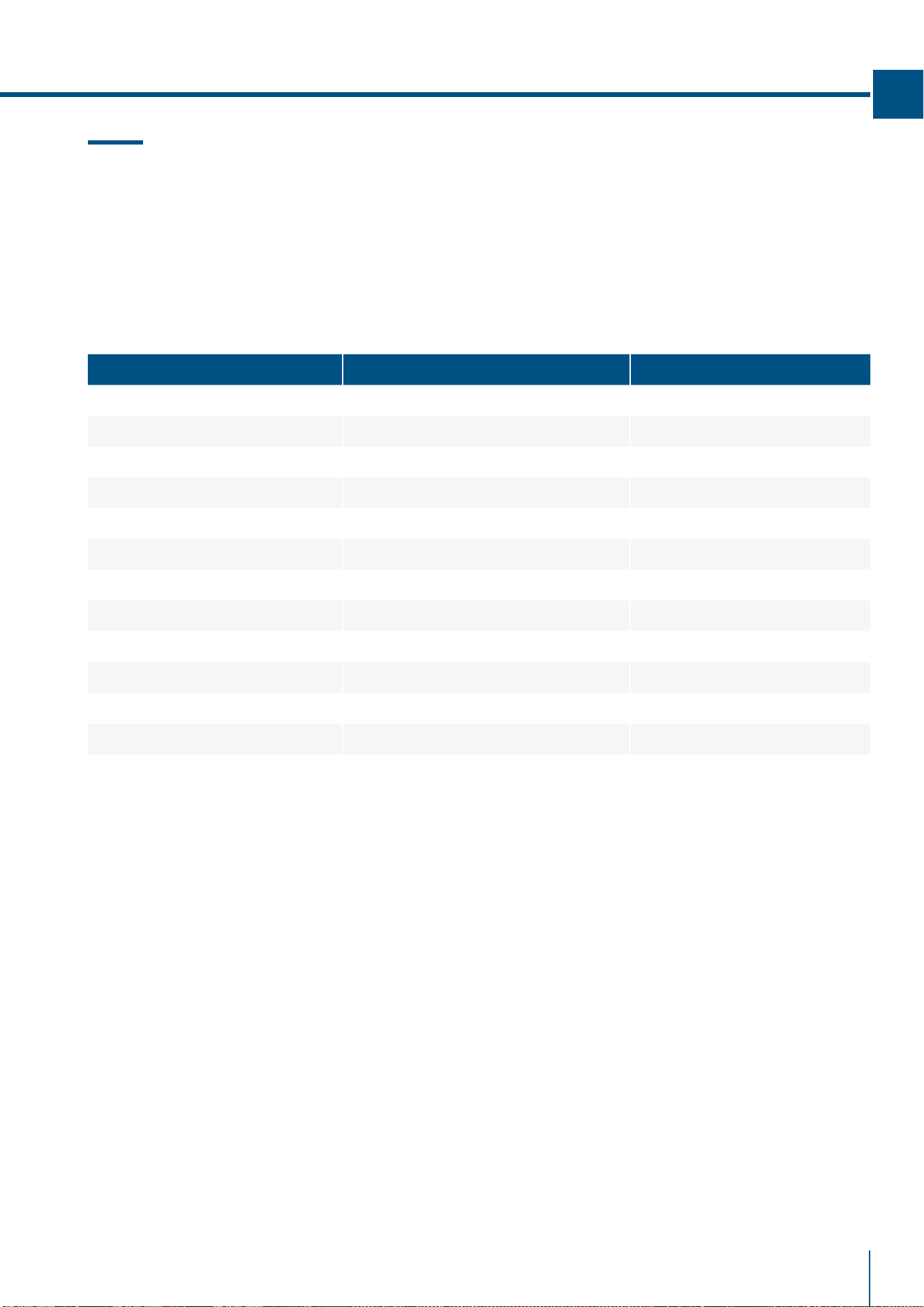
TYPE OF WINE CONSERVATION TEMPERATURE TIME OF CONSERVATION
New wines (Vin Nouveau) from12to14°C 6 months
Sweet sparkling wines from
8to10°C 1 y
ear
Rosé from
10to14°C 1 y
ear
Semi-sparkling wines from
10to12°C 1-2 y
ears
Normal white wines from
10to14°C 1-2 y
ears
Light red wines from
12to14°C 2 y
ears
Dry sparkling wines from
8to10°C 2 y
ears
Classic sparkling wines from
8to10°C 3-4 y
ears
Barrique and Vigorous white wines from8to12°C 3-5 years
Normal red wines from
14to16°C 3-5 y
ears
Barrique and Vigorous red wines from
14to18°C 7-10 y
ears
Straw wines or Liquorous wines from
16to18°C 10-15 y
ears
9.3. Time of conservation
Improvement of wine over time and its duration usually depends on the character of the variety and its type.
The following chart shows the best period of conservation and aging for various types in ideal conservation
conditions
o
ered
b
y
y
our
a
ppliance.
In a
ny case, follow the suggestions oered by the bottle producer, in particular for the nest wines.

28
www.fhiaba.com · [email protected] · Info Line 800-344222
9.4. Consumption temperature
As a general rule, white wines should be served at a
temperature
be
tween
10and12
°C
(5
0
and53
.6°F)
andr
ed
w
ines
b
etween
1
2
a
nd
1
4°C
(
53.6
a
nd
5
7°F).
Some wines may however be best enjoyed at higher
or lower temperatures.
You should also keep in mind that, during the summer,
wine is generally enjoyed at lower temperatures than
during the winter.
You should also consider the following:
White wines
White wines are normally not served at high tem
-
peratures, since they are generally more acidic
th
at red wines and not very tannic. Therefore
they are more enjoyable at low temperatures.
It is preferable to serve these wines between 10
and
14
°C
(5
0
and57
.2°F).
Yo
ung,
fr
esh
andaro-
m
atic
winescanalsobeservedat10°C(50°F),
while less aromatic ones are served at 12 °C
(5
3.6 °F).
Te
mperatures
be
tween
12 and 14
°C
(53.6and57.2°F)areforsoft,maturewhitewines
that have been aged for some years in the bottle.
Higher temperatures would favour the exaltation of
the sweet character of the wine, at the expense of the
acidity
and a
vour,
wh
ich
ar
e
co
nsidered
pl
easant
and desirable characteristics of this type of wine.
Rosé
Rosé wine is served at the same temperature as
white wines. It should be noted that these wines may
include a certain amount of tannin and may therefore
be preferable at higher temperatures.
Therefore,
th
ey
ar
e
se
rved
be
tween
10and12
°C
(5
0
and53.6°F),ifyoungandfresh,andbetween12and
14°C(53.6and57.2°F)ifrobustandmature.
Ne
w wines (Vin Nouveau)
Due to the special processing they undergo, new
vintage wines contain a low tannin content and are
therefore more enjoyable if served between 12 and
14°C(53.6and57.2°F).
Re
d wines
Since they contain more tannin and are less acidic,
red wines are normally served at higher tempera
-
tures. Younger wines with less tannin are normally
s
e
rvedbetween14and16°C(57.2and60.8°F),while
more full-bodied ones that are more tannic may be
servedatupto18°C(64.4°F).Somewinesthathave
aged for years in the bottle, still full-bodies and tannic,
maybeservedat18°C(64.4°F)oreven20°C(68°F).
Young red wines with little tannin and slightly struc
-
tured may be enjoyable at lower temperatures, be-
tween
12and14°C(53.6and57.2°F).
Sparkling wines
Itisdiculttoprovideinstructionstocoverthewide
variety of sparkling wines in available. As a general
rule, sweeter and more aromatic sparkling wines
should be served at lower temperatures, down to
8°C(4
6.4°F),
wh
ereas
mo
re
ta
nnic
spa
rkling
wi
nes
maybe servedat higher temperatures, upto 14 °C
(5
7.2°F).
Dry sparkling wines are usually served between
8and10°C(46.4and50°F).“Classic”sparkling
wi
nes are normally served at these tempera
-
tures,
which maybe as highas 12°C (53.6°F)
fo
r sparkling wines that have been aged for some
time.
It is however advisable, especially for finer wines,
to follow the suggestions and recommendations
of the winemaker on the bottle.
Liqueur and straw wines
These types of wines can be served at temperatures
between
16
°C
and18
°C
(6
0.8
and64
.4°F),
de
pend
-
ing on personal tastes, to attenuate the sweet taste
of
strawwines,itcanalsobeservedat10°C(50°F).
Service temperature management for sparkling
wines and Champagne
To
en
sure
en
ergy-ecient
us
e
ofth
e
wi
ne
ce
llar,
itis
im
portant to consider the location and storage tem
-
perature
of the dierent types of wine. In the case
of s
parkling wines and champagne, which require a
lower serving temperature than the storage tempera-
tures
describedabove,itisadvisabletoadoptspecic
po
sitioning strategies within the wine cellar.
In a two-compartment wine cellar, sparkling wines
and champagnes intended for service should be
placed in the lower compartment. This makes the
best use of the cellar’s design features, as the cold
tends to settle downwards, making it easier to main
-
tain a lower temperature in this compartment. The
id
eal serving temperature for these wines is around
4°
ce
ntigrade.
However, it is important to note that if the lower com-
partment
issettomaintainatemperatureof4°cen-
tigrade for immediate service, despite the fact that
th
e cellar is equipped with balancing resistors, it will
bedicult,ifnotimpossible,tomaintainanadequate
storage temperature in the upper compartment above
14°centigrade.
This happens because the low temperature in the
lower compartment aects the environment of the
up
per compartment, reducing its ability to reach or
maintain higher temperatures necessary for the opti
-
mal storage of other types of wine.
9. CONSERVATION OF WINES

32
www.fhiaba.com · [email protected] · Info Line 800-344222
11. TROUBLESHOOTING
11.1. Troubleshooting Guide
If you notice any malfunctioning of your appliance,
use this guide before calling for service. This guide
can help you to solve the problem on your own or
could provide important information that you can
convey to the Service technician in order to ensure
rapida
nd
e
ective
r
epair.
“Call Service” message
A malfunction is usually indicated by a message on
the display.
Problems that cannot be resolved by the user
are signalled through a malfunction code and the
“Call Service” message.
The appliance does not work
Is the appliance connected to the electrical power
supply?
Is electrical power being supplied from the electrical
socket?
Is the ON/OFF
key activated?
Is the condenser clean? See page 31
The internal temperatures are higher than
normal
Does the display show a malfunction code? See
page33.
Is the temperature adjusted correctly?
Is the condenser clean? See page 31
Were the doors or drawers open for a long period of
time?
Were large quantities of food recently placed inside?
The appliance keeps running for a long time
Bear in mind that during very hot weather and with
very high temperatures in the room it is normal for
the compressor to remain on for extended periods
of time.
Were the doors or drawers open for a long period of
time?
Were large quantities of food recently placed inside?
Is the condenser clean? See page 31
Check that the doors are closed and that food or con-
tainers are not keeping the door from fully closing.
If you hear unusual noises
It is normal to hear noise from the fans or compres-
sors during the defrost phase. Noise could be more
marked depending on the position of the appliance
and the surrounding environment.
Condensation forms both inside and out
If the atmospheric conditions are very humid or
damp, the formation of condensation is normal.
Opening the door or drawers for extended periods of
time can contribute to the formation of condensation.
In any case, make sure that the doors are always
fully closed.
The compartment has frost or ice
Did you leave the doors open for a long period of
time?
Are the doors closing completely?
If the doors do not fully close, contact your installer.
In the event of frost or ice build-up due to frequent
and extended opening of the doors, deactivate for
some time the functions acting on the relative button
on the control panel. Wait until the frost or ice melt,
then remove the drawer and dry the sides and bot-
tom of the compartment.
Unpleasant odours inside the refrigerator
Clean the appliance thoroughly according to the in-
structions.
Hermetically cover all of the food. Do not store food
for extended periods of time.
The doors are dicult to open
The appliance was designed to permit hermetic clo-
sure. When the door is closed, a vacuum condition
can be created: in such an event, it is necessary to
wait a few seconds until the pressure balances be-
fore opening the door.
www.fhiaba.com · [email protected] · Info Line 800-344222
33
www.fhiaba.com · [email protected] · Info Line 800-344222
EN
Display message Malfunction description
Power Failure
Extended interruption of electrical power
The appliance starts up again automatically and indicates the highest recorded
temperatures. Press the ALARM
button to deactivate the sound alarm
Door open
Door open
This message appears when the door has been open for a few minutes.
TriMode OPEN
Drawer open
This message appears few minutes from the drawer opening.
Cellar too warm
Cellar (Wine Cellar) compartment too warm
See chap. “11. TROUBLESHOOTING“ on page 32
Cellar too cold
Cellar (Wine Cellar) compartment too cold
wait for 12 hours: if the malfunction persists, call Customer Service for advice.
Cantina too warm
Cantina compartment too warm
See chap. “11. TROUBLESHOOTING“ on page 32
Cantina too cold
Cantina compartment too warm
wait for 12 hours: if the malfunction persists, call Customer Service for advice.
Fridge too warm
TriMode compartment (refrigerator mode) too warm
See chap. “11. TROUBLESHOOTING“ on page 32
Fridge too cold
TriMode compartment (refrigerator mode) too cold
wait for 12 hours: if the malfunction persists, call Customer Service for advice.
Refrigerator too warm
TriMode compartment (cooler mode) too warm
See chap. “11. TROUBLESHOOTING“ on page 32
Refrigerator too cold
TriMode compartment (cooler mode) too cold
wait for 12 hours: if the malfunction persists, call Customer Service for advice.
TriMode too warm
TriMode compartment (freezer mode) too warm
See chap. “11. TROUBLESHOOTING“ on page 32
TriMode too cold
TriMode compartment (freezer mode) too cold
wait for 12 hours: if the malfunction persists, call Customer Service for advice.
Error Code...
Functional problems
Contact Technical Service.
Check condenser
Check Condenser
Every 6 months the display shows the message “CHECK COND.”, clean the condenser
and press and hold the ENTER button
for 5 seconds to reset.
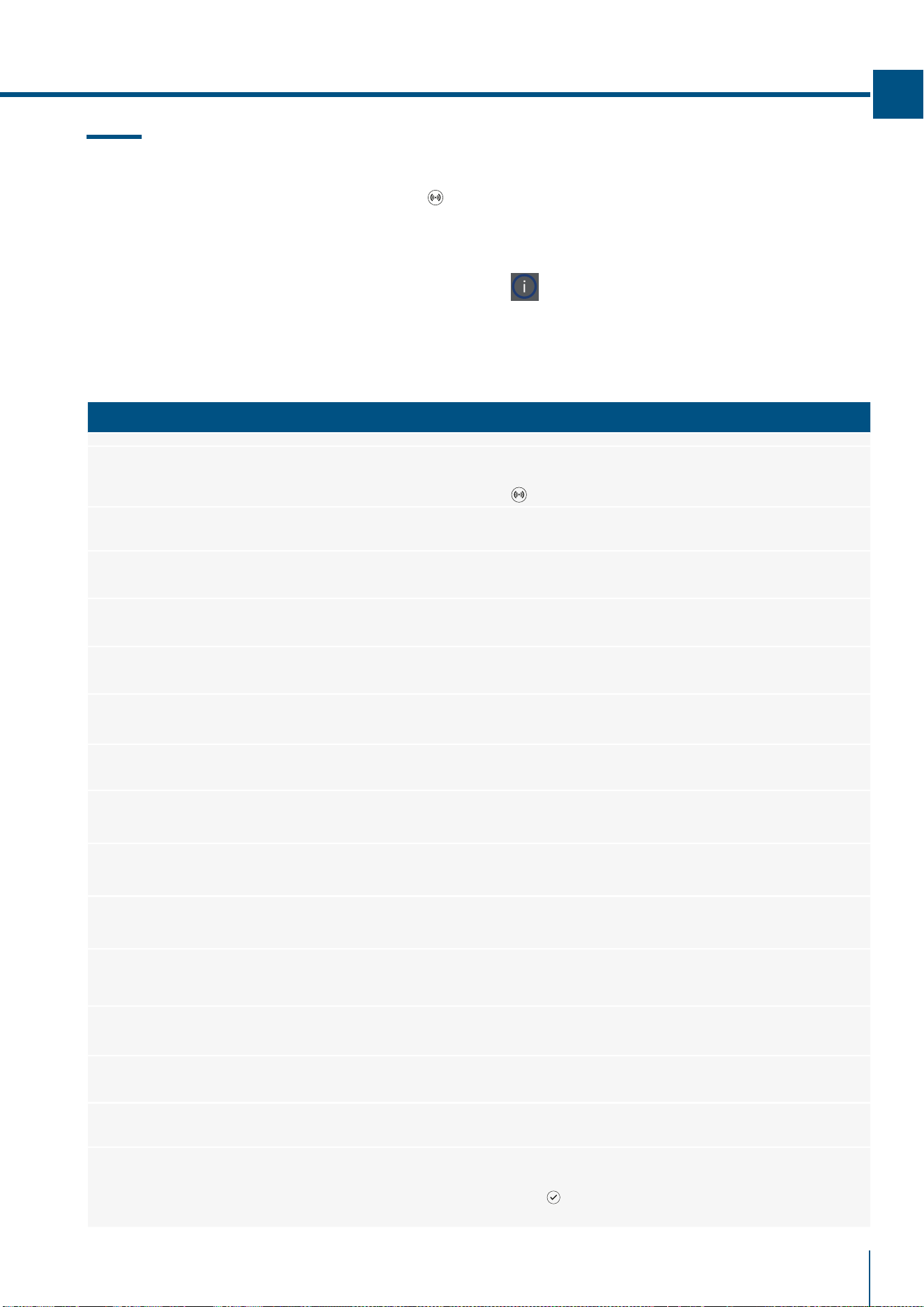
11.2. Malfunction messages appearing on the display
> In the event of a malfunction, touch the ALARM button and the display will show the fault message with
its error code (see following table).
> The message will be shown for 3 seconds, then it will go back to the HOME screen.
> To block the message on the screen, press the INFO button
Modalità
Bottle Cooler
On O
on the display. The message will remain on the
screen for 30 seconds, then it will go back to the HOME screen.
> Intheeventthatthereismorethanoneerrormessage,thedisplaywillshowthedierentfaultmessages
in
chronological order.