SIDE-BY-SIDE REFRIGERATOR OWNER'S MANUAL
REFRIGERATOR SAFETY
IMPORTANT SAFETY INSTRUCTIONS
WARNING: To reduce the risk of fire, electric shock, or injury to persons when using your appliance, follow basic precautions, including the following:
- Children should be supervised to ensure that they do not play with the appliance.
- This appliance is not intended for use by persons (including children) with reduced physical, sensory, or mental capabilities, or lack of experience and knowledge, unless they have been given supervision or instruction concerning use of the appliance by a person responsible for their safety.
- Do not use an extension cord.
- If power supply cord is damaged, it must be replaced by the manufacturer, its service agent, or a similarly qualified person in order to avoid a hazard.
- Connect to potable water supply only.
- This appliance is intended to be used in household and similar applications such as: staff kitchen areas in shops, offices, and other working environments; farm houses and by clients in hotels, motels, and other residential-type environments; bed and breakfast-type environments; and catering and similar non-retail applications.
- Do not store explosive substances such as aerosol cans with a flammable propellant in this appliance.
- Do not use replacement parts that have not been recommended by the manufacturer (e.g., parts made at home using a 3D printer).
- Keep ventilation openings, in the appliance enclosure or in the built-in structure, clear of obstruction.
- Do not use mechanical devices or other means to accelerate the defrosting process, other than those recommended by the manufacturer.
- Do not damage the refrigerant circuit.
- Do not use electrical appliances inside the food storage compartments of the appliance, unless they are of the type recommended by the manufacturer.
- Ice maker kit can be added to some models. See serial tag inside the food compartment of appliance for ice maker kit model information.
- A qualified service technician must install the water line and ice maker. See installation instructions supplied with ice maker kit for complete details.
Proper Disposal of Your Old Refrigerator
WARNING: Risk of child entrapment. Before you throw away your old refrigerator or freezer:
- Take off the doors.
- Leave the shelves in place so that children may not easily climb inside.
IMPORTANT: Child entrapment and suffocation are not problems of the past. Junked or abandoned refrigerators are still dangerous, even if they will sit for "just a few days." If you are getting rid of your old refrigerator, please follow these instructions to help prevent accidents.
Important information to know about disposal of refrigerants:
Dispose of refrigerator in accordance with federal and local regulations. Refrigerants must be evacuated by a licensed, EPA-certified refrigerant technician in accordance with established procedures.
OPERATING INSTRUCTIONS
WARNING: To reduce the risk of fire, electric shock, or injury to persons, read the IMPORTANT SAFETY INSTRUCTIONS, located in your appliance's Owner's Manual, before operating this appliance.
IMPORTANT: Before operating this appliance, make sure it has been properly installed according to the appliance's Owner's Manual.
The Temperature Control UI is located above the external dispenser on the freezer door. For your convenience, your refrigerator and freezer controls are preset at the factory.
For your convenience, your refrigerator and freezer temperature controls are set to the recommended set points at the factory. When you first install your refrigerator, make sure the temperature controls are still set to the recommended set points. The recommended set points are 37°F (3°C) for the refrigerator and 0°F (-18°C) for the freezer.
IMPORTANT:
- The recommended settings should be correct for normal household refrigerator use. The controls are set correctly when milk or juice is as cold as you like and when ice cream is firm.
NOTE: Areas such as a garage, basement, or porch may have higher humidity or extreme temperatures. You may need to adjust the temperature away from the recommended settings to accommodate for these conditions. - When the power is on, the temperature display shows the set point temperature of the compartment.
- Wait 24 hours for your refrigerator to cool completely before adding food. If you add food before the refrigerator has cooled completely, your food may spoil.
NOTE: Adjusting the refrigerator and freezer controls to a colder than recommended setting will not cool the compartments any faster. - If the temperature is too warm or too cold in the refrigerator or freezer, first check the air vents to be sure they are not blocked before adjusting the controls.
- Wait at least 24 hours between adjustments. Recheck the temperatures before other adjustments are made.
Turning Refrigerator Cooling On/Off
Your refrigerator and freezer will not cool when cooling is turned off. Follow the directions specific to your model.
Turn ON
- Press and hold Fast Freeze and Fast Cool buttons at the same time for 3 seconds. Cooling Off icon blinks twice and remains on.
Setting the Temperature "F/C preset at "F
- Press and hold the Fast Freeze and Fast Cool buttons at the same time for 3 seconds. Cooling Off icon blinks twice and remains on.
Adjusting Temperatures
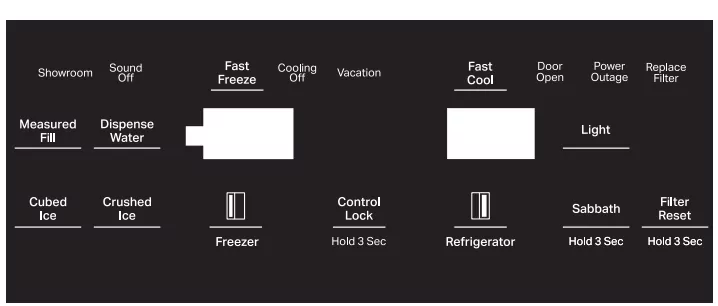
The following applies to both the refrigerator temperature button and freezer temperature button. Pressing the Freezer or Refrigerator picture button once will increase or decrease the temperature (1°C,2°F)
Once the temp setting reaches the lowest temperature allowed for that zone, the next button press will change the temperature to the highest temperature allowed for that zone (looping).
The Refrigerator temperature range will be from 33°F to 43°F (1°C to 6°C), with the factory default temperature being 37°F (3°C)
The Freezer temperature range will be from -8°F to 5°F (-22°C to -15°C), with the factory default temperature being 0°F (-18°C)
| CONDITION/REASON | TEMPERATURE ADJUSTMENT |
|---|---|
| REFRIGERATOR too cold | REFRIGERATOR Control 1°C or 2°F higher |
| REFRIGERATOR too warm | REFRIGERATOR Control 1°C or 2°F lower |
| FREEZER too cold | FREEZER Control 1°C or 2°F higher |
| FREEZER too warm/too little ice | FREEZER Control 1°C or 2°F lower |
Water Filter Indicator and Reset (all models)
The water filter indicator, located on the control panel, will help you know when to change the water filter.
Replace status:
- When the dispenser control panel's water filter status displays, this tells you that it is almost time to change the water filter cartridge. Replace the water filter cartridge.
Replace Overdue status:
- When the light turns red on the control panel, this tells you that it is time to change the water filter cartridge.
- It is recommended that you replace the filter when the status light turns red or water filter cartridge.
NOTE: If water flow to your water dispenser or ice maker decreases noticeably, change the filter sooner. The filter should be replaced at least every 6 months, depending on your water quality and usage. When dispensing water after the Replace Filter icon is on, the Replace Filter icon blinks for the duration of dispensing. This applies for both the Replace Filter state and Replace Overdue status. Fourteen days after the Replace Filter indicator turns On, it shall enter "Replace Overdue" mode.
Filter Reset
After changing the filter, press and hold Filter Reset button for 3 seconds. The button will no longer display once reset. See the "Water Filtration System" section in Owner's Manual for steps to remove and replace filter.
Sabbath Mode
To activate/deactivate Sabbath Mode, press and hold the Sabbath button for 3 seconds, and the button indicator will blink twice and remain on/off.
By selecting this feature:
- LEDs from the electronic controls will not display.
- The Sabbath button will be the only light displaying.
NOTE: If Sabbath mode is turned on in Showroom mode, Showroom will also be displayed. - Interior lights will turn OFF.
- Ice and Water will not dispense.
- No alarm will ring.
- UI does not go to sleep.
- No sound is generated on UI.
- Fast Cool and Fast Freeze are automatically turned off.
For most efficient refrigerator operation, it is recommended to exit Sabbath mode when it is no longer required.
NOTE: If a power outage occurs while in Sabbath Mode the appliance will remain in Sabbath Mode when power returns.
Fast Cool/Fast Freeze
Fast Cool
The Fast Cool feature assists with periods of high refrigerator use, full grocery loads, or temporarily warm room temperature.
- Press Fast Cool to set the freezer and refrigerator to the lowest temperature settings.
- Press Fast Cool again to return to the normal refrigerator set point.
NOTE: The Fast Cool feature will shut off automatically in approximately 12 hours. When Fast Cool is ON, changing the refrigerator temperature will deactivate Fast Cool. While Fast Cool is ON, activating Vacation Mode will deactivate Fast Cool.
Fast Freeze
The Fast Freeze feature assists with temporary periods of heavy ice use by increasing ice production.
- Press Fast Freeze to set the freezer to the lowest temperature setting.
- Press the Fast Freeze feature touch pad again to return to the normal freezer set point.
NOTE: The Fast Freeze feature will shut off automatically in approximately 48 hours. While Fast Freeze is ON, changing the freezer temperature will deactivate Fast Freeze.
Measured Fill
Household water pressure may affect the accuracy of the Measured Fill feature. For optimum performance of your water dispenser, you must first calibrate Measured Fill.
Calibrate Measured Fill
- Press and hold the Measured Fill button for 3 seconds to enter Calibration Mode. The button will display along with the 0.2 L or 8 oz default settings.
- Pressing the water pad will dispense water (e.g., into a measuring cup) until the desired amount is dispensed. Releasing the water pad will stop water dispensing.
Save and Exiting Calibration
- If water was dispensed, pressing the Measured Fill button will save the amount dispensed, a tone will play and the calibration amount display will blink twice.
- If no water was dispensed, Pressing the Measured Fill button will exit Calibration mode without saving the calibration amount.
NOTE: The amount of water you select will be dispensed. Be sure that the container is empty and can hold the entire volume. If ice is in the container, you may need to adjust your selection.
Dispensing
- Press Measured Fill to turn the feature on. When the feature is on, the Measured Fill screen appears on the display.
- To dispense water, press a sturdy glass against the water dispenser pad OR place the glass below the water dispenser and press the Measured Fill button. Hold the glass close to the water dispenser spout to ensure that the water dispenses into the glass.
See “Measured Fill” section in Owner’s Manual for additional instructions.
Alarm Functions
Door Open - The Door Ajar Alarm feature sounds an alarm when the refrigerator or freezer door is open for 5 minutes and the product cooling is turned on. The alarm will repeat every 2 minutes. Close both doors to turn it off. The feature then resets and will reactivate when either door is left open again for 5 minutes.
Power Outage - The power outage indicator lets you know if the power supply to the refrigerator has been cut off and the freezer temperature has risen to 18°F (–8°C) or higher. When power has been restored, the button repeatedly flashes and the red Power Outage icon appears. When the indicator is on, all other control and dispenser functions are disabled until you confirm that you are aware of the power outage.
- To enable other functions, press Measured Fill to reset the display screen to its normal status.
Miscellaneous
Ice Type: Ice options include Cubed and Crushed Ice. Select the desired ice type to be dispensed by pressing the button which will display to confirm selection.
Sound On/Off
- Press and hold [Fast Cool] and [Refrigerator] button for 3 seconds and the sound off indicator will blink twice and remain on/off.
- In Sound Off mode, the UI shall not make any sounds. The only exception to this is the door alarm.
Control Lock: Press and hold [Control Lock] button and the Lock indicator will blink twice, play a tone and remain on/off. When Control Lock is active;
- All other functions are not accessible.
- Pressing any button will play invalid tone 3 times and lock indicator blinks 3 times.
- Water/Ice paddles are not available, pressing the paddles will play invalid tone 3 times.
Showroom Mode: Demo mode for sales floor. Press and Hold the [RC Temp] + [FC Temp] buttons for 5 seconds, the showroom indicator will blink twice to remain on/off.
Vacation Mode: See “Vacation Care” section in the Owner’s Manual for instructions.
Dispenser Lighting
- Quickly press the Light button to turn the dispenser light ON.
- Quickly press the button again to turn the light OFF.
Water and Ice Dispensing Guide
TO DISPENSE WATER (STANDARD):
- Press a sturdy glass against the water dispenser paddle. Hold the glass close to the water dispenser spout to ensure that the water dispenses into the glass.
NOTE: While dispensing water, the digital display will count down how much water remains to be dispensed, according to the volume you selected. The flow of water will automatically stop once the desired volume has been dispensed. - To stop dispensing, remove the glass from the dispenser paddle.
TO DISPENSE WATER (MEASURED FILL):
Measured Fill allows you to dispense a specified amount of water with the touch of a few buttons.
IMPORTANT: Low water pressure may affects the accuracy of this feature.
NOTE: The amount of water you select will be dispensed. Be sure that the container is empty and can hold the entire volume. If ice is in the container, you may need to adjust your selection.
NOTE: Household water pressure may affect the accuracy of the Measured Fill feature. For optimum performance of your water dispenser, you must first calibrate Measured Fill.
How to calibrate Measured Fill:
IMPORTANT: Flush the water system before calibrating Measured fill. See "Flush the water system" in the Owner's Manual.
- Place a sturdy measuring cup (1 cup [237 mL] size) on the dispenser tray, centered in front of the water dispenser pad.
- Press and hold the "Measure Fill" button for 3 seconds. The words "Measured Fill" and "8 oz" will appear on the display screen. Also, "Light" will illuminate and remain lit while the Measured Fill feature is being calibrated.
NOTE: The light button does not change the amount of measurement on these models. - Using your hand (not the measuring cup), press and release the water dispenser paddle to dispense water to the 1 cup (8 oz) fill line.
NOTE: If overfilling or spilling occurs, discard the water and restart the calibration process.
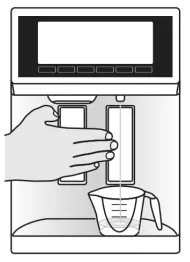
- When 1 cup of water has been correctly dispensed into the measuring cup, press the Measured Fill button to confirm calibration.
NOTE: You will hear a double beep, and the desired amount to calibrate the measure fill to will flash. (Example: Calibration to 8 oz, that amount displayed will flash.)
When the Measured Fill calibration has been confirmed, the display will return to the home screen.
Measured Fill Feature:
- Press Measured Fill to turn on the feature. When the feature is on, the "Measured Fill" and "Dispenser Water" appear on the Display.
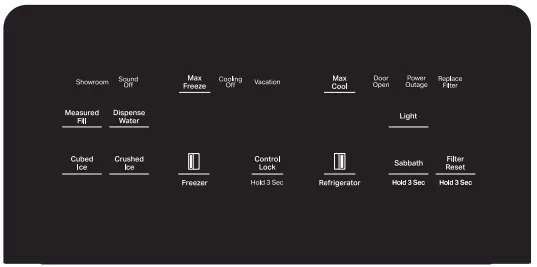
- To dispense water, press a sturdy glass against the water dispenser paddle or place a the glass below the water dispenser and press the "Water dispense" button. Hold the glass close to the water dispenser spout to ensure that the water dispenses into the glass.
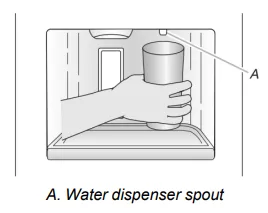
NOTE: While dispensing water, The Digital Display will count down how much water remains to be dispensed, according to the volume you selected. The flow of waters will automatically stop once the desired volume has been dispensed. (count down example - 8 oz. Dispense: 8,7,6,5,4,3,2,1 - now glass has filled to 8 oz) - To stop dispensing before the selected volume has been dispense, remove the glass from the dispenser pad, or press the Measured fill button a second time.
NOTE: If you stop dispensing before the desired volume has been dispensed, the digital display will continue to show how much water remains to be dispensed. The display will turn off after 1 minute of inactivity.
To select a new volume or start dispensing the same volume again, you must first finish dispensing the selected volume, or turn off the Measured Fill feature (either by waiting 1 minute so it will automatically turn off, or by pressing Measured fill to manually turn it off) and then turn it back on.
NOTE: The dispenser will automatically turn off Measured Fill after 1 minute of inactivity. When Measured fill turned off, any changes you have made will be lost, and all defaults will be Restored. - You can Dispense water by ounce (8, 16, 24), cup, or liter. The default unit is ounces. This model displays options for 8, 16, and 24 oz. Default, minimum, and maximum volumes are listed below.
| Units | Default | Minimum | Maximum |
|---|---|---|---|
| Ounces | 8 | 1 | 128 |
| Cups | 1 | 1/4 | 16 |
| Litres | 0.25 | 0.05 | 4.00 |
NOTE:
- Amounts lower than 8 oz can be dispensed.
- Use a measuring cup to set the calibration to an amount lower than a cup. The countdown for the measured fill feature will be faster when the calibration is set for any amount below a 1 cup.
- Most coffee cups (commonly 4 to 6 oz [118 to 177 ml] are not the same size as a measuring cup (8 oz [237 ml]. You may need to adjust the volume to avoid unintentionally over- filling coffee cups.
TO DISPENSE ICE:
Before dispensing ice, select which type of ice you prefer by pressing the "Ice Type" button. The display screen indicates which type of ice is selected.
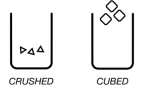
- Make sure the desired type of ice is selected. To switch between cubed and crushed, press Ice Type.
For crushed ice, cubes are crushed before being dispensed. This may cause a slight delay when dispensing crushed ice. Noise from the ice crusher is normal, and pieces of ice may vary in size. When changing from crushed to cubed, a few ounces of crushed ice will be dispensed along with the first cubes.
Warning: Use a sturdy glass when dispensing ice. Failure to do so can result in cuts. - Press a sturdy glass against the dispenser paddle. Hold the glass close to the ice guide to ensure that the ice dispenses into the glass.
IMPORTANT: You do not need to apply a lot of pressure to the paddle in order to activate the ice dispenser. Pressing hard will not make the ice dispenser faster or in greater quantities.
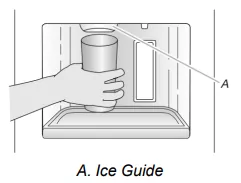
- Remove the glass from the dispenser paddle to stop dispensing.
NOTE: Ice may continue to dispense for several seconds after removing the glass from the lever. The dispenser may continue to make noise for a few seconds after dispensing.
MAINTENANCE AND CARE
Cleaning
Both the refrigerator and freezer sections defrost automatically. However, clean both sections about once a month to avoid buildup of odors. Wipe up spills immediately.
IMPORTANT: Because air circulates between both sections, any odors formed in one section will transfer to the other. You must thoroughly clean both sections to eliminate odors. To avoid odor transfer and drying out of food, wrap or cover foods tightly.
NOTE: Do not use abrasive or harsh cleaners such as window sprays, scouring cleansers, flammable fluids, cleaning waxes, concentrated detergents, bleaches or cleansers containing petroleum products on plastic parts, interior, and door liners or gaskets. Do not use paper towels, scouring pads, or other harsh cleaning tools. Stainless steel models have a coating. Do Not use regular stainless steel cleaning products. Do Not use stainless steel cleaner or polish and use only mild soap, water, and soft microfiber cloth to avoid damage to the stainless steel protective coating. Paper towels scratch and may dull the clear coat of the painted door. To avoid possible damage, use only clean cloths to polish and wipe the door.
- Unplug refrigerator or disconnect power.
- Hand-wash, rinse, and dry removable parts and interior surfaces thoroughly. Use a clean sponge or soft cloth and a mild detergent in warm water.
- Wash stainless steel and painted metal exteriors with a clean sponge or soft cloth and a mild detergent in warm water.
- There is no need for routine condenser cleaning in normal home operating environments. If the environment is particularly greasy or dusty, or there is significant pet traffic in the home, the condenser should be cleaned every 2 to 3 months to ensure maximum efficiency.
If you need to clean the condenser:- Remove the base grille. See the "Door Removal" instructions, either in the Owner's Manual or in the separate instruction sheet provided with your refrigerator.
- Use a vacuum cleaner with a soft brush to clean the grille, the open areas behind the grille, and the front surface area of the condenser.
- Replace the base grille when finished.
- Plug in refrigerator or reconnect power.
Lights
IMPORTANT: The light strips in both the refrigerator and freezer compartments of your new refrigerator use LED technology. The LED light strips in the refrigerator, freezer, air tower, and dispenser cannot be changed by yourself. If the lights do not illuminate when the refrigerator and/or freezer door is opened, See the Online Ordering Information section of your Quick Start Guide for contact information.
Freezer Shelf (number varies by model)
To Remove and Replace the Bottom Shelf:
- Lift up the front and back of the shelf, and remove from the cabinet. Be sure not to remove the retaining rods.
- Replace the shelf, aligning the rods with the cabinet ribs. Apply a little pressure on the shelf to attach the rods to the ribs of the cabinet.
To Remove and Replace the Mid and Top Shelf:
- With your hand, push the shelf from bottom to top until it is released from the holding rod. Pull the shelf until it is released from the rear rod. Remove from the cabinet.
- To replace the shelf:
- Replace rods into the support holes. Push the rods down so they click into the holes.
- Identify the front and rear trim of the shelf.
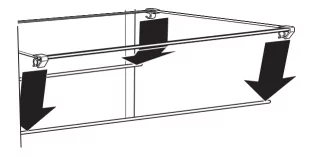
- Place the rear trim on the rear rod and push the shelf so it clicks the rod into the rear trim. (Keep the front raised while pushing.)
- Lower the front of the shelf until the front trim is on the rod and push the shelf down so it clicks the rod into the front trim.
NOTE: Be sure that both sides of the shelf are positioned evenly in the shelf support holes and the shelf is secure.
Vacation and Moving Care
Vacations
If You Choose to Leave Refrigerator On While You Are Away:
- Use up any perishables and freeze other items.
- If your refrigerator has an automatic ice maker and is connected to the household water supply, turn off the water supply to the refrigerator. Property damage can occur if the water supply is not turned off.
- If you have an automatic ice maker, turn off the ice maker.
NOTE: Depending on your model, raise the wire shut-off arm to Off (up) position or press the switch to Off. - Empty the ice bin.
If You Choose to Turn Refrigerator Off Before You Leave:
- Remove all food from the refrigerator.
- If your refrigerator has an automatic ice maker:
- Turn off the water supply to the ice maker at least one day ahead of time. When the last load of ice drops, raise the wire shut-off arm to the Off (up) position or move the switch to the Off setting.
- Depending on the model, turn the refrigerator control to Off or turn cooling off. See "Control Descriptions" in the Quick Start Guide.
- Unplug refrigerator or disconnect power.
- Clean, wipe, and dry thoroughly.
- Tape rubber or wood blocks to the tops of both doors to prop them open far enough for air to get in. This stops odor and mold from building up.
Moving
When you are moving your refrigerator to a new home, follow these steps to prepare it for the move.
- If your refrigerator has an automatic ice maker:
- Turn off the water supply to the ice maker at least one day ahead of time.
- Disconnect the water line from the back of the refrigerator.
- When the last load of ice drops, raise the wire shut-off arm to the Off (up) position or move the switch to the Off setting.
- Remove all food from the refrigerator and pack all frozen food in dry ice.
- Empty the ice bin.
- Depending on the model, turn the refrigerator control to Off or turn cooling off. See "Control Descriptions" in the Quick Start Guide.
- Unplug refrigerator or disconnect power.
- Clean, wipe, and dry thoroughly.
- Take out all removable parts, wrap them well, and tape them together so they don't shift and rattle during the move.
- Depending on the model, raise the front of the refrigerator so it rolls more easily, or screw in the leveling legs so they don't scrape the floor. See "Adjust the Doors" or "Door Removal, Leveling and Alignment" in the online Feature Guide.
- Tape the doors closed and tape the power cord to the back of the refrigerator.
When you get to your new home, put everything back and refer to the Installation Instructions for preparation instructions. Also, if your refrigerator has an automatic ice maker, remember to reconnect the water supply to the refrigerator.
INSTALLATION INSTRUCTIONS
Unpack the Refrigerator
WARNING - Excessive Weight Hazard: Use two or more people to move and install or uninstall appliance. Failure to do so can result in back or other injury.
Remove the Packaging
Dispose of/recycle all packaging materials. Do not use sharp instruments, rubbing alcohol, flammable fluids, or abrasive cleaners to remove tape or glue. These products can damage the surface of your refrigerator. For more information, see "Refrigerator Safety."
When Moving Your Refrigerator:
Your refrigerator is heavy. When moving the refrigerator for cleaning or service, be sure to cover the floor with cardboard or hardboard to avoid floor damage. Always pull the refrigerator straight out when moving it. Do not wiggle or "walk" the refrigerator when trying to move it, as floor damage could occur.
For counter-depth models, use 1/2" socket wrench to remove skids (socket extension is recommended). All four leveling legs must contact the floor to support and stabilize the full weight of the refrigerator.
Clean Before Using
After you remove all of the package materials, clean the inside of your refrigerator before using it. See the "Cleaning" section in this manual.
Important information to know about glass shelves and covers:
Do not clean glass shelves or covers with warm water when they are cold. Shelves and covers may break if exposed to sudden temperature changes or impact, such as bumping. Tempered glass is designed to shatter into many small, pebble-size pieces. This is normal. Glass shelves and covers are heavy. Use both hands when removing them to avoid dropping.
Location Requirements
IMPORTANT:
- This refrigerator is designed for indoor household use only.
- Observe all governing codes and ordinances.
- Installer: Leave Owner's Manual with homeowner.
- Homeowner: Keep Owner's Manual for future reference and for the local electrical inspector's use.
- Keep cardboard shipping piece or plywood under refrigerator until it is installed in the operating position.
- Comply with installation specifications and dimensions.
- Remove any moldings or decorative panels from kitchen cabinets that would not allow access to the refrigerator for service.
- Contact a qualified electrical installer.
For Standard Side-by-Side Installation:
To ensure proper ventilation for your refrigerator, allow for 1/2" (1.27 cm) of space on each side and at the top. Allow for 2" (5.08 cm) of space behind the refrigerator. If your refrigerator has an ice maker, allow extra space at the back for the water line connections. When installing your refrigerator next to a fixed wall, leave a 2" (5.08 cm) minimum space on each side (depending on your model) to allow the doors to swing open.
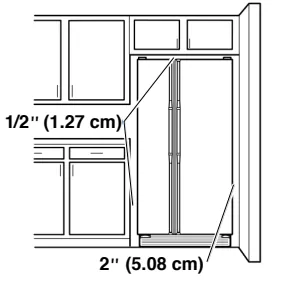
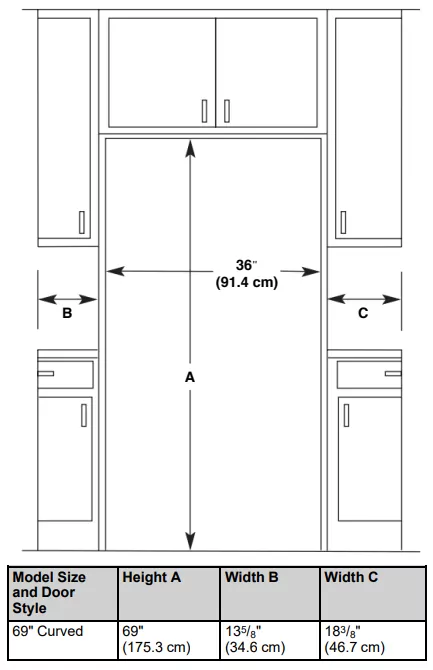
NOTES: This refrigerator is intended for use in a location where the temperature ranges from a minimum of 55°F (13°C) to a maximum of 110°F (43°C). The preferred room temperature range for optimum performance, which reduces electricity usage and provides superior cooling, is between 60°F (15°C) and 90°F (32°C). It is recommended that you do not install the refrigerator near a heat source, such as an oven or radiator. Normal minimum cabinet cut-out width required for product installation is 36" (91.44 cm). However, if the product is placed against an extended wall and the ability to remove the crisper pans is desired, an additional 18" (45.72 cm) of cabinet width is required, so a total cabinet opening width of 54" (137.16 cm) is recommended.
For Counter-Depth Side-by-Side Installation:
NOTES: The refrigerator can be installed into a recessed opening, at the end of cabinets or as a freestanding refrigerator. If you are installing the refrigerator to fit flush with the front of the base cabinets, all shoe moulding and baseboards must be removed from the rear of the refrigerator opening. Allow for 1" (2.54 cm) of space behind the refrigerator. Location should permit doors to open fully. See "Product Dimensions." This refrigerator is intended for use in a location where the temperature ranges from a minimum of 55°F (13°C) to a maximum of 110°F (43°C). The preferred room temperature range for optimum performance, which reduces electricity usage and provides superior cooling, is between 60°F (15°C) and 90°F (32°C). It is recommended that you do not install the refrigerator near a heat source, such as an oven or radiator. Floor must support refrigerator weight (more than 600 lbs [272 kg]) and contents.
Tools Needed: Gather the required tools and parts before starting installation. Read and follow the instructions provided with any tools listed here.
- Cordless drill,
- 5/16" or adjustable wrench,
- 1/4" nut driver and drill bit,
- 7/16" and 1/2" open-end wrenches,
- Two adjustable wrenches,
- 3/8" and 1/2" socket wrenches,
- Flat-blade screwdriver
Parts Needed:
- Your refrigerator dealer has a kit available with a 1/4" (6.35 mm) saddle-type shut-off valve, a union, and copper tubing.
- Or you can purchase 1/4" (6.35 mm) copper tubing with shut-off valve and a 1/4" (6.35 mm) compression fitting (coupling).
- Depending on water line connections, you may also need a 1/4" (6.35 mm) nut and 1/4" (6.35 mm) ferrule.
Product Dimensions - Top View
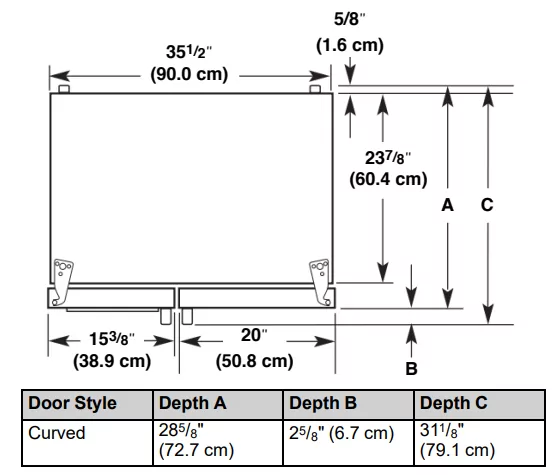
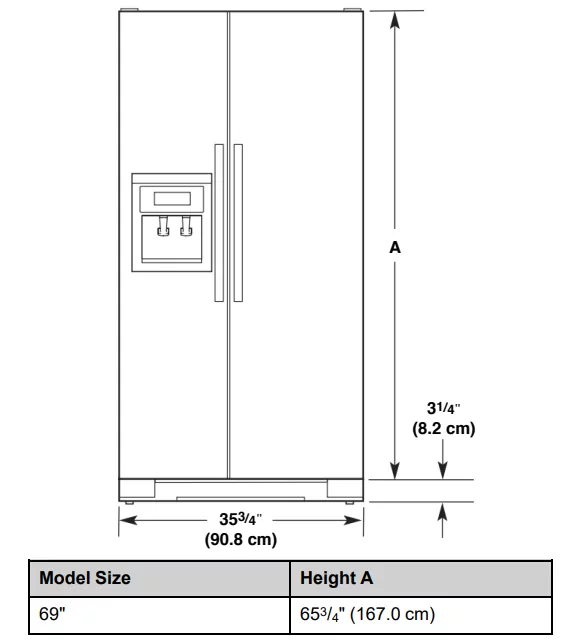
Product Dimensions - Front View
Product Dimensions - Side View
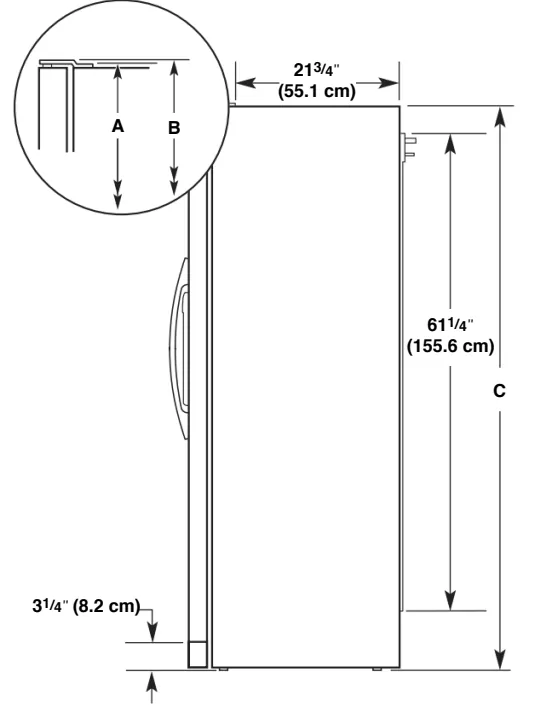
- Height dimensions are shown with the leveling legs extended to the minimum height of 1/4" (6.35 mm) below the refrigerator.
NOTE: When leveling legs are fully extended to 1" (25 mm) below the refrigerator, add 3/4" (19 mm) to the height dimensions. - The power cord is 61 1/4" (155.6 cm) long.
- The water line attached to the back of the refrigerator is 78" (198.1 cm) long.

Opening Dimensions
- Height dimensions are shown with the leveling legs extended to the minimum height of 1/4" (6.35 mm) below the refrigerator.
NOTE: When leveling legs are fully extended to 1" (25 mm) below the refrigerator, add 3/4" (19 mm) to the height dimensions. - In the following graphic, “A” represents the opening height required for standard cabinets. For full-overlay cabinet doors with a trim kit, add 1/8" (0.3 cm).
- In the following graphic, “B” represents the distance needed to fully open the freezer door and “C” represents the distance needed to fully open the refrigerator door.
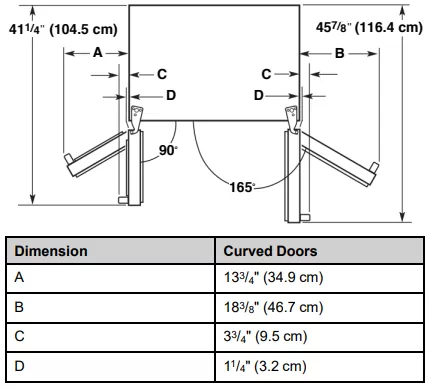
Door Swing Dimensions
- Location must permit doors to open to a minimum of 165°.
- In the following graphic, “A” represents the distance needed to fully open the freezer door and “B” represents the distance needed to fully open the refrigerator door.
Electrical Requirements
Before you move your refrigerator into its final location, it is important to make sure you have the proper electrical connection.
Recommended Grounding Method
A 115 V, 60 Hz AC-only, 15 A or 20 A fused, grounded electrical supply is required. It is recommended that a separate circuit serving only your refrigerator be provided. Use an outlet that cannot be turned off by a switch. Do not use an extension cord.
NOTE: Before performing any type of installation, cleaning, or removing a light bulb, turn cooling off or turn the control (thermostat, refrigerator, or freezer control depending on the model) to Off. Then disconnect the refrigerator from the electrical source. When you are finished, reconnect the refrigerator to the electrical source. Turn cooling on or reset the control (thermostat, refrigerator, or freezer control depending on the model) to the desired setting. See "Control Descriptions" in the Quick Start Guide.
Water Supply Requirements
Gather the required tools and parts before starting installation. Read and follow the instructions provided with any tools listed here.
Tools Needed:
- Flat-blade screwdriver,
- 1/4" nut driver,
- 7/16" and 1/2" open-end or two adjustable wrenches,
- 1/4" drill bit,
- Cordless drill
NOTE: Your refrigerator dealer has a kit available with a 1/4" (6.35 mm) saddle-type shut-off valve, a union, and copper or PEX tubing. Before purchasing, make sure a saddle-type valve complies with your local plumbing codes. Do not use a piercing-type or 3/16" (4.76 mm) saddle valve, which reduces water flow and clogs more easily.
IMPORTANT: All installations must meet local plumbing code requirements. Use copper or PEX tubing and check for leaks. Install copper or PEX tubing only in areas where the household temperatures will remain above freezing.
Water Pressure
A cold water supply with water pressure of between 30 psi and 120 psi (207 kPa and 827 kPa) is required to operate the water dispenser and ice maker. If you have questions about your water pressure, call a licensed, qualified plumber.
- If your refrigerator has a water dispenser: After installation is complete, use the water dispenser to check the water pressure. With the water filter removed, dispense 1 cup (237 mL) of water. If 1 cup of water is dispensed in 8 seconds or less, the water pressure to the refrigerator meets the minimum requirement.
- If it takes longer than 8 seconds to dispense 1 cup of water, the water pressure to the refrigerator is lower than recommended. See online "Troubleshooting" for suggestions.
Reverse Osmosis Water Supply
IMPORTANT: The pressure of the water supply coming out of a reverse osmosis system going to the water inlet valve of the refrigerator needs to be between 30 psi and 120 psi (207 kPa and 827 kPa).
If a reverse osmosis water filtration system is connected to your cold water supply, the water pressure to the reverse osmosis system needs to be a minimum of 40 psi to 60 psi (276 kPa to 414 kPa). If the water pressure to the reverse osmosis system is less than 40 psi to 60 psi (276 kPa to 414 kPa):
- Check to see whether the sediment filter in the reverse osmosis system is blocked. Replace the filter if necessary.
- Allow the storage tank on the reverse osmosis system to refill after heavy usage.
- If your refrigerator has a water filter, it may further reduce the water pressure when used in conjunction with a reverse osmosis system. Remove the water filter. See "Water Filtration System". If you have questions about your water pressure, call a licensed, qualified plumber.
Connect Water Supply
Read all directions before you begin.
IMPORTANT:
- Connect to potable water supply only.
- Plumbing shall be installed in accordance with the International Plumbing Code and any local codes and ordinances.
- The gray water tubing on the back of the refrigerator (which is used to connect to the household water line) is a PEX (cross-linked polyethylene) tube. Copper or PEX tubing connections from the household water line to the refrigerator are acceptable, and will help avoid off-taste or odor in your ice or water. Check for leaks. For recommended parts if PEX tubing is used instead of copper: W10505928RP (7 ft [2.14 m] jacketed PEX), 8212547RP (5 ft [1.52 m] PEX), or W10267701RP (25 ft [7.62 m] PEX).
- Install tubing only in areas where temperatures will remain above freezing.
Tools Needed:
- Flat-blade screwdriver,
- 7/16" and 1/2" open-end wrenches or two adjustable wrenches,
- 1/4" nut driver
Connect to Water Line
IMPORTANT: If you turn on the refrigerator before the water line is connected, turn off the ice maker.
Style 1 (Recommended)
- Unplug refrigerator or disconnect power.
- Turn off main water supply. Turn on nearest faucet long enough to clear line of water.
- Use a quarter-turn shut-off valve or the equivalent, served by a 1/2" copper or PEX household supply line.
NOTE: To allow sufficient water flow to the refrigerator, a minimum 1/2" size copper or PEX household supply line is recommended.
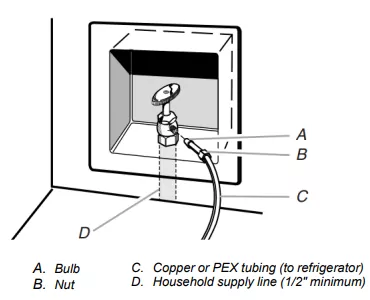
- Now you are ready to connect the copper or PEX tubing to the shut-off valve. Use 1/4" (6.35 mm) O.D. (outside diameter) soft copper or PEX tubing to connect the shut-off valve and the refrigerator.
- Ensure that you have the proper length needed for the job. Be sure both ends of the copper tubing are cut square.
- Slip compression sleeve and compression nut onto copper tubing as shown. (PEX tubing has compression sleeves and compression nuts preinstalled.) Insert end of tubing into outlet end squarely as far as it will go. Screw compression nut onto outlet end with adjustable wrench. Do not overtighten.
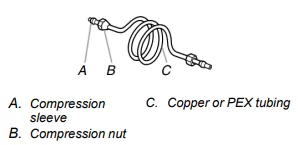
- Place the free end of the tubing into a container or sink, and turn on main water supply to flush out tubing until water is clear. Turn off shut-off valve on the water pipe. NOTE: Always drain the water line before making the final connection to the inlet of the water valve, to avoid possible water valve malfunction.
- Bend the copper or PEX tubing to meet the water line inlet, which is located on the back of the refrigerator cabinet. Leave a coil of copper or PEX tubing to allow the refrigerator to be pulled out of the cabinet or away from the wall for service.
Style 2
- Unplug refrigerator or disconnect power.
- Turn off main water supply. Turn on nearest faucet long enough to clear line of water.
- Locate a 1/2" (1.27 cm) to 1 1/4" (3.18 cm) vertical cold water pipe near the refrigerator.
IMPORTANT: Make sure it is a cold water pipe. Horizontal pipe will work, but drill on the top side of the pipe, not the bottom. This will help keep water away from the drill and normal sediment from collecting in the valve. - Determine the length of copper or PEX tubing you need. Measure from the connection on the lower rear corner of refrigerator to the water pipe. Add 7 ft (2.1 m) to allow for cleaning. Use 1/4" (6.35 mm) O.D. (outside diameter) copper or PEX tubing. Be sure both ends of copper or PEX tubing are cut square.
- Using a cordless drill, drill a 1/4" (6.35 mm) hole in the cold water pipe you have selected.
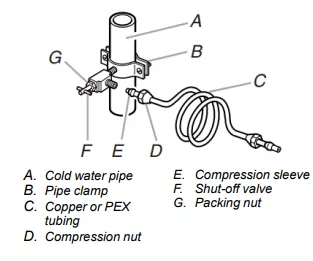
- Fasten the shut-off valve to the cold water pipe with the pipe clamp. Be sure the outlet end is solidly in the 1/4" (6.35 mm) drilled hole in the water pipe and that the washer is under the pipe clamp. Tighten the packing nut. Tighten the pipe clamp screws slowly and evenly so the washer makes a watertight seal. Do not overtighten, or you may crush the copper or PEX tubing.
- Slip compression sleeve and compression nut onto copper tubing as shown. (PEX tubing has compression sleeves and compression nuts preinstalled.) Insert end of tubing into outlet end squarely as far as it will go. Screw compression nut onto outlet end with adjustable wrench. Do not overtighten.
- Place the free end of the tubing in a container or sink, and turn on the main water supply. Flush the tubing until water is clear. Turn off the shut-off valve on the water pipe. Coil the tubing.
Connect to Refrigerator
Style 1
- Unplug refrigerator or disconnect power.
- Remove and discard the short, black plastic part from the end of the water line inlet.
- Thread the nut onto the end of the tubing. Tighten the nut by hand. Then tighten it with a wrench two more turns. Do not overtighten.
NOTE: To avoid rattling, be sure the copper tubing does not touch the cabinet's side wall or other parts inside the cabinet.
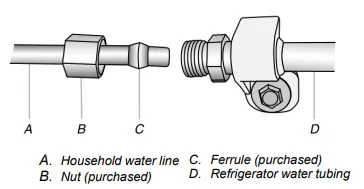
- Install the water supply tube clamp around the water supply line to reduce strain on the coupling.
- Turn shut-off valve on.
- Check for leaks. Tighten any connections (including connections at the valve) or nuts that leak.
Style 2
- Unplug refrigerator or disconnect power.
- Remove and discard the plastic part that is attached to the inlet of the water valve.
- Attach the copper or PEX tube to the valve inlet using a compression nut and sleeve as shown. Tighten the compression nut. Do not overtighten.
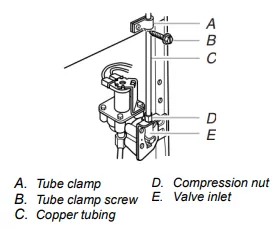
- Use the tube clamp on the back of the refrigerator to secure the tubing to the refrigerator as shown. This will help avoid damage to the tubing when the refrigerator is pushed back against the wall.
- Turn shut-off valve on.
- Check for leaks. Tighten any connections (including connections at the valve) or nuts that leak.
- On some models, the ice maker is equipped with a built-in water strainer. If your water conditions require a second water strainer, install it in the 1/4" (6.35 mm) water line at either tube connection. Obtain a water strainer from your nearest appliance dealer.
Style 3
- Unplug refrigerator or disconnect power.
- Remove and discard the black nylon plug from the gray water tube on the rear of the refrigerator.
- If the gray water tube supplied with the refrigerator is not long enough, a 1/4" x 1/4" (6.35 mm x 6.35 mm) coupling is needed in order to connect the water tubing to an existing household water line. Thread the provided nut onto the coupling on the end of the copper or PEX tubing. NOTE: Tighten the nut by hand. Then tighten it with a wrench two more turns. Do not overtighten.
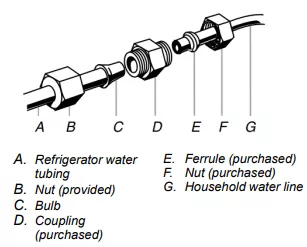
- Turn shut-off valve on.
- Check for leaks. Tighten any connections (including connections at the valve) or nuts that leak.
Complete the Installation
- Plug into a grounded 3-prong outlet.
- Wait a few minutes. Check that the compressor is operating properly and that all lights are working.
NOTE: If the refrigerator does not operate, check that the circuit breaker is not tripped or that the household fuse has not blown. - Flush the water system. See "Water and Ice Dispensers."
NOTE: Allow 24 hours to produce the first batch of ice. Allow 72 hours to completely fill ice container.
IMPORTANT: If construction will continue after refrigerator has been installed, unplug refrigerator or disconnect power.
Install Air Filter (on some models)
On some models, your refrigerator's accessory packet includes an air filter, which must be installed prior to use. On some models, the air filter is already installed at the factory. To order a replacement air filter, use part number W10311524.
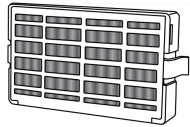
The air filter reduces the buildup of odors. This helps to maintain a cleaner environment inside the refrigerator.
Installing the Air Filter
The filter should be installed behind the vented door, which is located (depending on your model) along either the rear or left interior wall near the top of the refrigerator compartment.
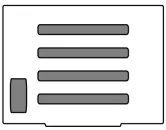
- Remove the air filter from its packaging.
- Lift open the vented door.
- Snap the filter into place.

- Close the vented door.
Installing the Filter Status Indicator (on some models)
The filter comes with a status indicator, which should be activated and installed at the same time the air filter is installed.
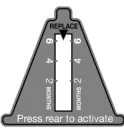
- Place the indicator facedown on a firm, flat surface.
- Apply pressure to the bubble on the back of the indicator, until the bubble pops to activate the indicator.
- Lift open the vented air filter door. On some models, there are notches behind the door.
- On models with notches:
- Slide the indicator down into the notches, facing outward. NOTE: The indicator will not easily slide into the notches if the rear bubble has not been popped.
- Close the air filter door, and check that the indicator is visible through the rectangular hole in the door.
- On models without notches: Place the indicator in a visible place you will easily remember- either inside the refrigerator or elsewhere in your kitchen or home.
Replacing the Air Filter
The disposable air filter should be replaced every 6 months, when the status indicator has completely changed from white to red. To order a replacement air filter, see ordering information in the Quick Start Guide.
- Remove the old air filter by squeezing in on the side tabs.
- Remove the old status indicator.
- Install the new air filter and status indicator using the instructions in the previous sections.
Install Produce Preserver (on some models)
Your refrigerator's accessory packet includes a Produce Preserver, which should be installed prior to use. On some models, the Produce Preserver is already installed at the factory. To order a replacement produce preserver, use part number W10346771.
The Produce Preserver absorbs ethylene, allowing the ripening process of many produce items to slow down. As a result, certain produce items will stay fresh longer.
Ethylene production and sensitivity varies depending on the type of fruit or vegetable. To preserve freshness, it is best to separate produce with sensitivity to ethylene from fruits that produce moderate to high amounts of ethylene.
| Sensitivity to Ethylene | Sensitivity to Ethylene | |
| Apples | High | Very High |
| Asparagus | Medium | Very Low |
| Berries | Low | Low |
| Broccoli | High | Very Low |
| Cantaloupe | Medium | High |
| Carrots | Low | Very Low |
| Citrus Fruit | Medium | Very Low |
| Grapes | Low | Very Low |
| Lettuce | High | Very Low |
| Pears | High | Very High |
| Spinach | High | Very Low |
Installing the Produce Preserver
CAUTION: IRRITANT. MAY IRRITATE EYES AND SKIN. DANGEROUS FUMES FORM WHEN MIXED WITH OTHER PRODUCTS. Do not mix with cleaning products containing ammonia, bleach, or acids. Do not get in eyes, on skin or clothing. Do not breathe dust. Keep out of reach of children.
FIRST AID TREATMENT: Contains potassium permanganate. If swallowed, call a Poison Control Center or doctor immediately. Do not induce vomiting. If in eyes, rinse with water for 15 minutes. If on skin, rinse with water.
The Produce Preserver pouches should be installed in their housing, which is located along an interior side wall of the crisper or convertible drawer.
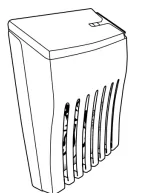
NOTE: For best performance, always use two pouches.
- Remove the Produce Preserver pouches from their packaging.
- Lift up on the housing in order to remove it from its mounting tab along the wall.
- Open the housing by pulling up and out on the back of the top of the housing.
- Place both pouches inside the housing; then snap the housing back together.
- Place the housing back on the mounting tab along the wall.
Installing the Status Indicator
The Produce Preserver comes with a status indicator, which should be activated and installed at the same time the pouch is installed.
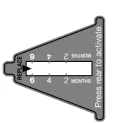
- Place the indicator facedown on a firm, flat surface.
- Apply pressure to the bubble on the back of the indicator, until the bubble pops to activate the indicator.
- Slide open the cap on the Produce Preserver housing.
- Place the indicator in the top of the housing, facing outward.
- Slide the cap closed, and check that the indicator is visible through the rectangular hole in the cap.
NOTE: The cap will not close easily if the indicator's rear bubble has not been popped.
Replacing the Produce Preserver Pouches
The disposable pouches should be replaced every 6 months, when the status indicator has completely changed from white to red. To order replacements, see the contact information in the Quick Start Guide. Order part number W10346771A or FRESH1.
- Remove the used pouches from the produce preserver housing.
- Remove the old status indicator.
- Install the new pouches and status indicator using the instructions in the previous sections.
REFRIGERATOR FEATURES
Convertible Drawer Temperature Control (on some models)
The control can be adjusted to properly chill meats or vegetables. The air inside the pan is cooled to avoid "spot" freezing and can be set to keep meats at the National Livestock and Meat Board recommended storage temperatures of 28°F to 32°F (-2°C to 0°C).
To store meat: Set the control to one of the three Meat settings to store meat at its optimal storage temperature.
To store vegetables: Set the control to Veg to store vegetables at their optimal storage temperatures.
NOTE: If food starts to freeze, move the control to the right (less cold), toward the Veg setting. Remember to wait 24 hours between adjustments.
Crisper Humidity Control (on some models)
You can control the amount of humidity in the moisture-sealed crisper. Adjust the control to any setting between Low and High. LOW (open) for best storage of fruits and vegetables with skins. HIGH (closed) for best storage of fresh, leafy vegetables.
Water and Ice Dispensers
On how to use your water and ice dispensers, see the online "Side-by-Side Refrigerator Dispensers" Feature Guide.
NOTES: Connect to potable water supply only. The dispensing system will not operate when either door (refrigerator or freezer) is open. Allow 24 hours for the refrigerator to cool down and chill water. Allow 24 hours to produce the first batch of ice. Discard the first three batches of ice produced. Wait 72 hours for full ice production. On some models, the display screen on the dispenser control panel will turn off automatically and enter "sleep" mode when the control buttons and dispenser pads have not been used for 2 minutes or more. While in "sleep" mode, the first press of a control button will only reactivate the display screen, without changing any settings.
Flush the Water System
Air in the water dispensing system can cause the water dispenser to drip. After connecting the refrigerator to a water source or replacing the water filter, flush the water system. Flushing the water dispensing system forces air from the water line and filter and prepares the water filter for use.
NOTE: As air is cleared from the system, water may spurt out of the dispenser.
- Using a sturdy container, depress and hold the water dispenser pad for 5 seconds; then release it for 5 seconds.
- Repeat step 1 until water begins to flow.
- Once water begins to flow, continue depressing and releasing the dispenser pad (5 seconds on, 5 seconds off) until a total of 1 gallon (3.8 Liters) has been dispensed.
Additional flushing may be required in some households.
The Water Dispenser
IMPORTANT: Dispense at least 1 quart (1 Liter) of water every week to maintain a fresh supply.
If the flow of water from the dispenser decreases, it could be caused by low water pressure.
- With the water filter removed, dispense 1 cup (237 mL) of water. If 1 cup of water is dispensed in 8 seconds or less, the water pressure to the refrigerator meets the minimum requirement.
- If it takes longer than 8 seconds to dispense 1 cup of water, the water pressure to the refrigerator is lower than recommended. See "Water Supply Requirements" or online "Troubleshooting" for suggestions.
Ice Maker and Storage Bin
- Allow 24 hours to produce the first batch of ice. Discard the first three batches of ice produced.
- The quality of your ice will be only as good as the quality of the water supplied to your ice maker. Avoid connecting the ice maker to a softened water supply. Water softener chemicals (such as salt) can damage parts of the ice maker and lead to poor quality ice. If a softened water supply cannot be avoided, make sure the water softener is operating properly and is well maintained.
- Do not use anything sharp to break up the ice in the storage bin. This can cause damage to the ice container and the dispenser mechanism.
- Do not store anything on top of or in the ice maker or storage bin.
Style 1
Turning the Ice Maker On/Off: The On/Off switch, located on the left wall of the freezer door, can only be accessed when the ice storage bin has been removed. See the following section for bin removal instructions.
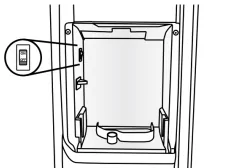
- To turn on the ice maker, flip the switch to the On (up) position.
- To manually turn off the ice maker, flip the switch to the Off (down) position.
NOTE: The ice maker has an automatic shut-off to keep the storage bin from overfilling during normal operation. As ice is made, the ice cubes will fill the ice storage bin, and the ice cubes will raise the shut-off arm to the Off (arm up) position. When the storage bin is at full capacity, the ice maker will automatically stop ice production, but the ice maker On/Off switch will remain in the On (up) position.
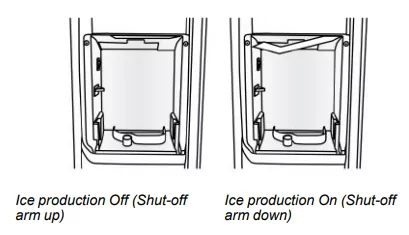
Removing and Replacing the Ice Storage Bin:
- Press down the release lever and tilt the bucket outward. Use both hands to hold the base of the storage bin, and then lift it up and out.
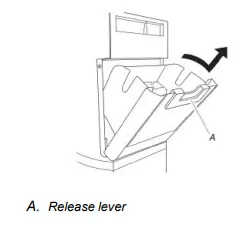
NOTE: It is not necessary to flip the ice maker On/Off switch to the Off (down) position when removing the storage bin. The storage bin sensor, located on the left wall (right wall on some models) of the freezer door, stops the ice maker from producing ice if the door is open or the storage bin is removed.
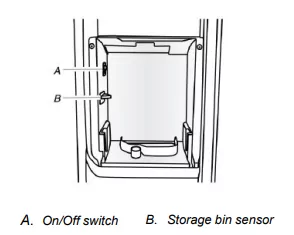
- Replace the bin by sliding it onto the door, and then tilting it back into an upright position. The release lever will click when the bin is securely in place.
Style 2
Turning the Ice Maker On/Off:
- To turn on the ice maker, lower the wire shut-off arm to the On position.
- To manually turn off the ice maker, lift the wire shut-off arm to the Off (arm up) position and listen for the click. Ice can still be dispensed, but no more can be made.
NOTE: The ice maker has an automatic shut-off to keep the storage bin from overfilling during normal operation. As ice is made, the ice cubes will fill the ice storage bin, and the ice cubes will raise the wire shut-off arm to the Off (arm up) position. Do not force the wire shut-off arm up or down.
Removing and Replacing the Ice Storage Bin:
- Pull the covering panel up from the bottom. 2
- Lift the wire shut-off arm so it clicks into the Off (up) position.
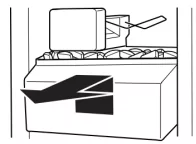
- Lift up the front of the storage bin and pull it out.
- Replace the bin by pushing it in all the way or the dispenser will not work.
- To restart ice production, lower the wire shut-off arm to the On (down) position. Make sure the door is closed tightly.
Style 3
Turning the Ice Maker On/Off:
- To turn on the ice maker, lift open the ice maker door and lower the wire shut-off arm to the On position.
- To manually turn off the ice maker, lift the wire shut-off arm to the Off (arm up) position and listen for the click. Ice can still be dispensed, but no more can be made.
NOTE: The ice maker has an automatic shut-off to keep the storage bin from overfilling during normal operation. As ice is made, the ice cubes will fill the ice storage bin, and the ice cubes will raise the wire shut-off arm to the Off (arm up) position. Do not force the wire shut-off arm up or down.
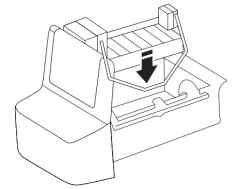
Removing and Replacing the Ice Storage Bin:
- Lift and hold open the ice maker door.
- Lift the wire shut-off arm so it clicks into the Off (up) position. Release the ice maker door.
- Lift up the front of the storage bin and pull it out.
- Replace the bin by pushing it in all the way or the dispenser will not work.
- To restart ice production, lift open the ice maker door and push the wire shut-off arm down to the On position.
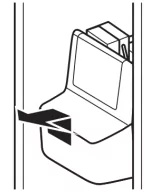
Style 4
Turning the Ice Maker On/Off: The On/Off switch is located on the bottom of the ice maker, which can be accessed by lifting and opening the ice maker door.
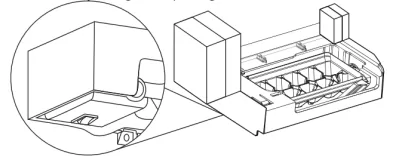
- To turn on the ice maker, lift open the ice maker door, and flip the switch to the On (right) position.
- To manually turn off the ice maker, lift open the ice maker door, and flip the switch to the Off (left) position. Ice can still be dispensed, but no more can be made.
NOTE: Your ice maker has an automatic shut-off to keep the storage bin from overfilling during normal operation. As ice is made, the ice cubes will fill the ice storage bin, and the ice cubes will raise the shut-off arm to the Off (arm up) position. When the storage bin is at full capacity, the ice maker will automatically stop ice production, but the ice maker On/Off switch will remain in the On (up) position.
Removing and Replacing the Ice Storage Bin:
- Pull the covering panel up from the bottom.
- Lift the plastic shut-off arm so it clicks into the Off (up) position.
- Lift up the front of the storage bin and pull it out.
- Replace the bin by pushing it in all the way or the dispenser will not work.
- To restart ice production, lower the plastic shut-off arm to the On (down) position. Make sure the door is closed tightly.
Style 5
Turning the Ice Maker On/Off: The ON/OFF switch is located on the right side of the ice maker, which can be accessed by lifting and opening the ice maker door.
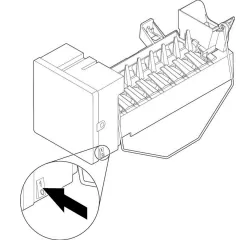
- o turn on the ice maker, lift open the ice maker door, and flip the switch ON/OFF to the ON (I) position.
- To manually turn the ice maker off, lift open the ice maker door, and flip the switch ON/OFF to the OFF (O) position.
NOTE: The ice maker has an automatic shut-off to keep the storage bin from overfilling during normal operation. As ice is made, the ice cubes will fill the ice storage bin and the ice cubes will raise the wire shut-off arm up. When the storage bin is at full capacity, the ice maker will automatically stop ice production, but the ice maker ON/OFF rocker switch will remain in the ON (I) position. Do not force the wire shut-off arm up or down.
Removing and Replacing the Ice Storage Bin:
- Pull the covering panel up from the bottom.
- Move the ON/OFF rocker switch to the OFF (O) position.
- Lift up the front of the storage bin and pull it out.
- Replace the bin by pushing it in all the way or the dispenser will not work.
- To restart ice production, move the ON/OFF rocker switch to the ON (I) position Make sure the door is closed tightly.
Water Filtration System
Do not use with water that is microbiologically unsafe or of unknown quality without adequate disinfection before or after the system. Systems certified for cyst reduction may be used on disinfected waters that may contain filterable cysts.
Water Filter Status Light
The water filter status light will help you know when to change your water filter. This is located on the refrigerator control panel. To order a replacement water filter see the Online Ordering Information section of your Quick Start Guide for contact information.
Changing the Water Filter
Style 1 - Top-right corner location:
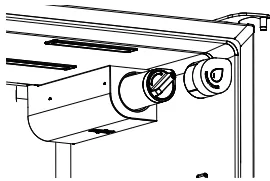
- Locate the water filter in the top-right corner of the refrigerator compartment.
- Remove exterior filter plug.
- When plug is removed. Twist the filter counterclockwise, then pull the filter straight out. NOTE: There may be some water in the filter. Some spilling may occur. Use a towel to wipe up any spills.
- Take the new filter out of its packaging and remove the cap. Be sure the O-rings are still in place after the cap is removed.
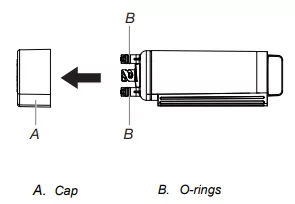
- With the filter knob symbol pointing away from the lock symbol, align the new filter with the filter housing and slide it into place. Turn the filter knob clockwise until the knob symbol aligns to the lock symbol.
- Push the plug back into position over the filter.
- After changing the filter, reset the filter status light.
- Flush the water system. See "Water and Ice Dispensers" for details.
Style 2 - Base grille location (automatic ejection):
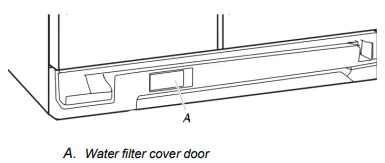
- Locate the water filter cover door in the base grille, and pull open the filter door. The filter will be released and then be ejected as the door is opened.
- When the door is completely open, pull the filter straight out.
NOTE: There may be some water in the filter. Some spilling may occur. Use a towel to wipe up any spills.
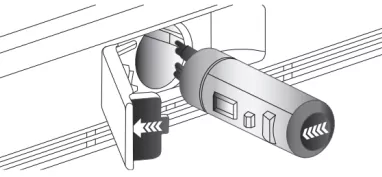
- Take the new filter out of its packaging and remove the covers from the O-rings. Be sure the O-rings are still in place after the covers are removed.
- With the arrow pointing to the left (toward the filter cover door's hinge), align the new filter with the filter housing and slide into place. The filter cover door will automatically begin to close as the new filter is inserted.
- Close the filter cover door completely in order to snap the filter into place. You may need to press hard.
- Flush the water system. See "Water and Ice Dispensers" for details.
DOOR REMOVAL AND LEVELING STYLE 1
Door Instructions
Gather the required tools and parts and read all instructions before starting installation. Save these instructions for future reference.
NOTE: Before moving your refrigerator into your home, measure the doorway of your home to see whether you need to remove the refrigerator and freezer doors. If door removal is necessary, see the instructions below.
TOOLS NEEDED Depending on your model, you may need the following: Bubble level, flat-blade screwdriver, Phillips screwdriver tip #2 with 4" long as minimum, 3/16" hex key, 1/4", 3/8" and 5/16" hex-head socket wrench, 1/4" and 5/16" open-ended wrenches or adjustable wrench, internal star drive or 3/8" hex-head socket wrench, TORX T30 screwdriver.
Install and Remove Door Handles
Refrigerator Door Handle Style 1
PARTS INCLUDED: Door handles (2).
To Install the Handles:
- Remove the handles, which are packed inside the refrigerator.
NOTE: To avoid scratching the finish, place the handles on a towel or other soft surface. - Open the freezer door. On the refrigerator door, place the handle on the shoulder screws.
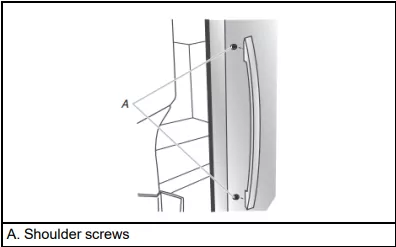
- Firmly push the handle toward the door until the handle base is flush against the door.
- While holding the handle, push downward until the handle is released from the shoulder screw.
- Open the refrigerator door and close the freezer door. Repeat steps 2 through 4 to install the other handle onto the freezer door
To Remove the Handles:
- While holding the handle, push upward until the handle is released from the shoulder screw.
- Gently pull the handle away from the door.
- If necessary, use a Phillips screwdriver to remove the shoulder screws from the door.
Refrigerator Door Handle Style 2
PARTS INCLUDED: Door handles(2), 1/8" hex key, spare setscrew(s)
NOTE: The handle mounting setscrews are pre-installed in the handle.
To Install the Handles:
- Remove the handles, which are packed inside the refrigerator.
NOTE: To avoid scratching the finish, place the handles on a towel or other soft surface. - Open the freezer door. On the refrigerator door, place the handle on the shoulder screws with the setscrews facing the freezer.
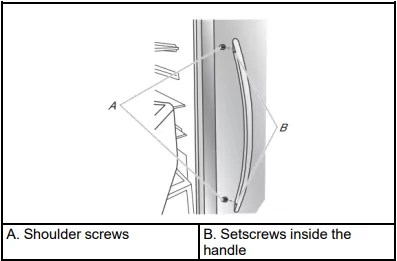
- Firmly push the handle toward the door until the handle base is flush against the door.
- While holding the handle, insert the short end of the hex key into the upper hole and slightly rotate the hex key until it is engaged in the setscrew.
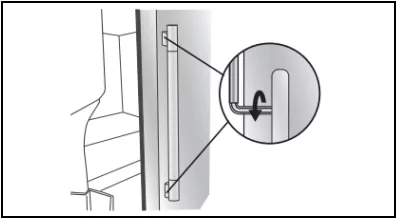
- Using a clockwise motion, tighten the setscrew until it begins to contact the shoulder screw.
- Repeat steps 4 and 5 to begin fastening the lower setscrew.
- Once both setscrews have been partially tightened as outlined in the previous steps, fully tighten both the upper and lower setscrews.
IMPORTANT: When the screws feel tight, tighten them an additional quarter-turn. The handle is not properly installed without this extra tightening. - Open the refrigerator door and close the freezer door. Repeat steps 2 through 7 to install the other handle onto the freezer door with the setscrews facing the refrigerator.
- Save the hex key and all instructions.
To Remove the Handles:
- While holding the handle, insert the short end of the hex key into the upper hole and slightly rotate the hex key until it is engaged in the setscrew.
- Using a counterclockwise motion, loosen the setscrew a quarter-turn at a time.
- Repeat steps 1 and 2 for the upper setscrew. Gently pull the handle away from the door.
- If necessary, use a Phillips screwdriver to remove the shoulder screws from the door.
Remove Doors and Hinges
If your refrigerator does not fit through the doorway or you are getting rid of your old refrigerator, follow the steps below for door removal.
- Unplug refrigerator or disconnect power.
- Fully open both doors.
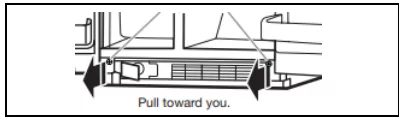
- If your model has water dispensing, please open the water filter door by pulling it toward you as shown below. It is not necessary to remove the water filter itself.
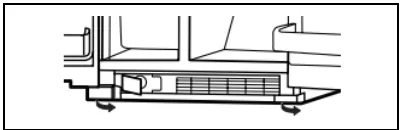
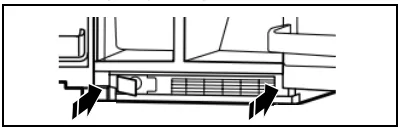
- Pull the base grille toward you from the sides and then from the center until it dislodges.
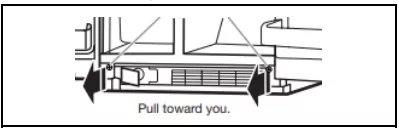
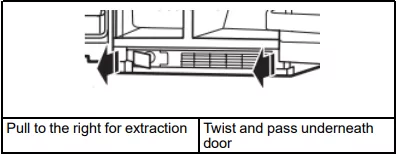
- To remove the base grille, twist and pull the right side until this side passes underneath the refrigerator door. Then pull the left side of the base grille for complete removal.
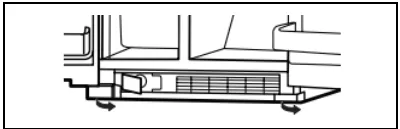
- If your model has water dispensing in the door, disconnect the water dispenser tubing located below the freezer door.
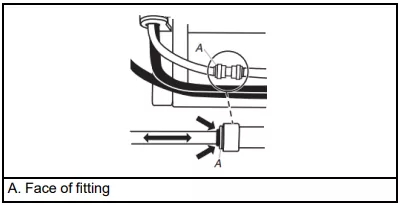
- Press the blue outer ring against the face of fitting and pull the dispenser tubing free as shown below.
NOTE: Keep the water tubing connector attached to the tube that runs underneath the freezer. The door cannot be removed if the connector is still attached to the tube that runs through the door hinge.
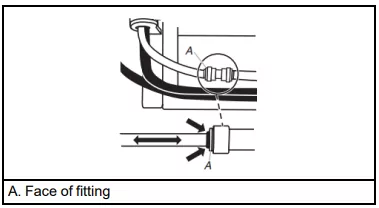
- Press the blue outer ring against the face of fitting and pull the dispenser tubing free as shown below.
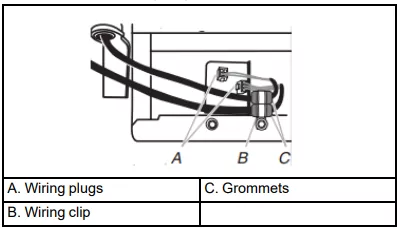
- If your model has water dispensing in the door, disconnect the wiring located below the freezer door as shown below.
- Remove the wiring clip and the bracket wire using a 1/4 hexagonal-head socket wrench.
- Disconnect the wiring plugs from the bracket wire.
- Close the freezer door and use a TORX T30 screwdriver to remove the top hinge completely as shown below.
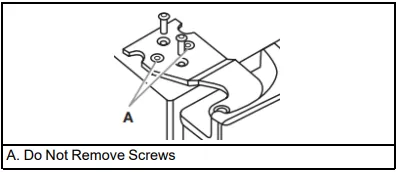
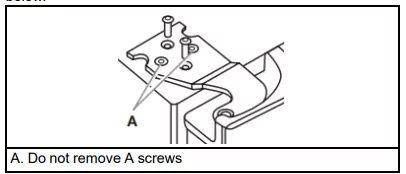
IMPORTANT: Do not remove either screw A. Hold the door while hinge is being removed. - Lift the freezer door straight up off from the bottom hinge as shown below. The water dispenser tubing and wiring will remain attached to the freezer door.
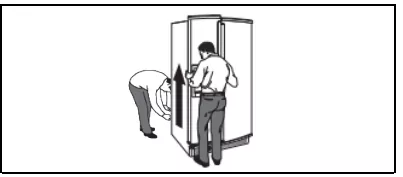
WARNING: Excessive Weight Hazard. Use two or more people to lift the appliance door. Failure to do so can result in back or other injury.
NOTE: This may require two people, one to lift the door and the other to feed the water tubing and wiring into the bottom hinge pin.
IMPORTANT: Rest the door on its side on a soft, clean surface, such as a towel, blanket, or piece of cardboard. This will help to avoid scratching or damaging the door, water tubing, and wiring. - Close the freezer door and use a TORX T30 screwdriver to remove the top hinge completely as shown below.
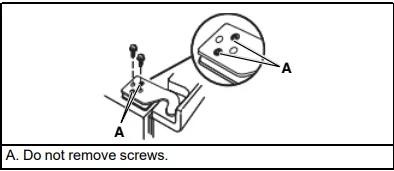
IMPORTANT: Do not remove either screw A. Hold the door while hinge is being removed. - Lift the refrigerator door straight up off from the bottom hinge as shown below.
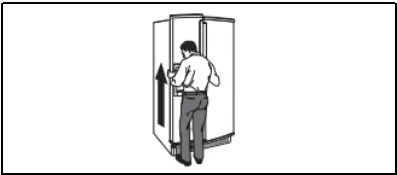
IMPORTANT: Rest the door on its side on a soft, clean surface, such as a towel, blanket, or piece of cardboard. This will help to avoid scratching or damaging the door. - If your refrigerator without doors does not pass through the doorway, you may remove both bottom hinges. Use a 5/16" nut driver to remove these as shown below.
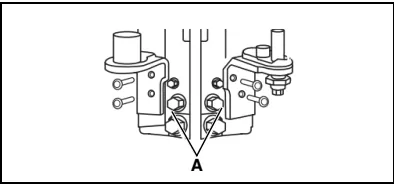
IMPORTANT: Do not remove either screw A.
Replace Doors and Hinges
If your doors and bottom hinges have been removed, please follow the next instructions for reinstallation:
- Reinstall both bottom hinges using a 5/16" nut driver to tighten screws as shown below.
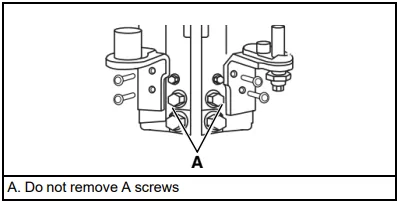
- If your model has water dispensing in the door:
- Lift the freezer door enough to feed the water dispenser tubing and wiring through the bottom hinge pin as shown below.
NOTE: This may require two people, one to lift the door and the other to feed the water tubing and wiring into the bottom hinge pin.
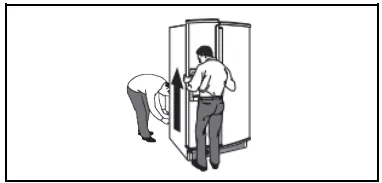
IMPORTANT: Hold the door while hinge is being installed.
- Lift the freezer door enough to feed the water dispenser tubing and wiring through the bottom hinge pin as shown below.
- Close the freezer door to align and reinstall the top hinge. Use a TORX T30 screwdriver to tighten the screws as shown below.
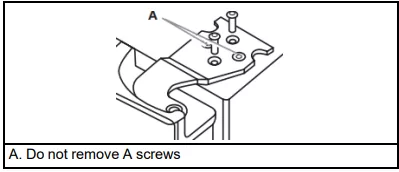
IMPORTANT: Provide additional support for the door while top hinge is being reinstalled. Do not depend on the door magnets to secure the door to the cabinet. - If your model has water dispensing in the door, connect the water dispenser tubing. For the connection, push the tubing into the dispenser tubing until black mark touches the face of fitting as shown below.
- Connect the wiring as shown below.
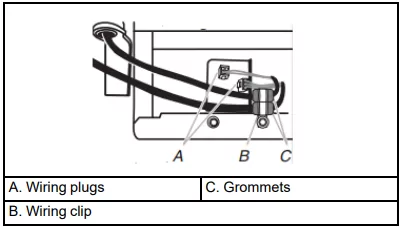
- Reinstall the wiring clip & the bracket wire using a 1/4" hexagonal head socket wrench.
- Connect the wiring plugs from the bracket wire.
- Lift the refrigerator door enough to insert the door onto the bottom hinge pin as shown below.
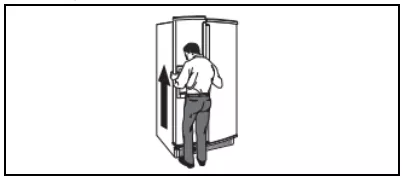
IMPORTANT: Hold the door while hinge is being installed. - Close the refrigerator door to align and reinstall the top hinge. Use a TORX T30 screwdriver to tighten the screws as shown below.
IMPORTANT: Provide additional support for the door while top hinge is being reinstalled. Do not depend on the door magnets to secure the door to the cabinet.
Door Closing and Alignment
Your refrigerator has two front adjustable wheels. These are used to level the refrigerator under uneven floor conditions or to allow the doors to close more easily. Please follow the instructions below:
- Use a bubble level to check levelness of floor where the rear side of the refrigerator will rest. If the refrigerator is not leveled, adjust or add the shim on flooring to create a leveled floor for the rear side wheels. A leveled rear side prevents the refrigerator cabinet from forming a twist.
- Place the refrigerator into its final location in the kitchen and open both doors.
- Fully open both doors.
- If your model has water dispensing, please open the water filter door by pulling it toward you as shown below. It is not necessary to remove the water filter itself.
- Pull the base grille toward you from the sides and then from the center until it dislodges.
- To remove the base grille, twist and pull the right side until this side passes underneath the refrigerator door. Then pull the left side of the base grille for complete removal.
- Raise the wheels while one person pushes on the refrigerator to lift from front side. Use the bubble level on top of the refrigerator or on its side to level the refrigerator. Check bubble level and at the same time observe the gaps and squareness to the adjacent cabinets, furniture, or trim. If adjacent furnishings are not level, it may not be possible to achieve even gaps when refrigerator is level. Continue adjusting until all four corners are steady without rock.
- Use a 3/8" nut driver to turn the leveling screws located in both sides of the refrigerator as shown below. Depending on uneven floor conditions, you must turn one or both screws to the right or left several times to raise or lower the refrigerator.
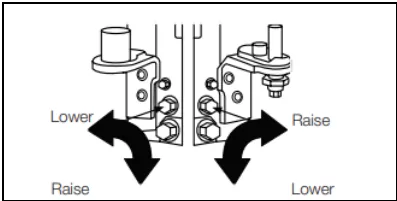
- Close both doors and check that they close as easily as you like. If not, turn both screws to the right to raise the refrigerator by tilting it more to the back until the doors close as easily as you like.
- Check and make sure that the technician sheet is placed in the base grille cavity before assembling the base grille into the cabinet.
- Reinstall the base grille into the cabinet, introducing the left side first and then the right side of the base grille as shown below. You may accommodate the water dispenser tubing and wiring into base grille cavity below the left bottom hinge.
- Attach the base grille by pushing it into the cabinet clips.
Door Leveling
The refrigerator doors are designed to be slightly misaligned vertically when the refrigerator is empty. If the doors are uneven after food has been placed, please follow the next instructions:
- Use an 11/16" open-ended wrench to loosen the locking nut located below the refrigerator door as shown below. Accommodate the wrench so that it fits in the space.
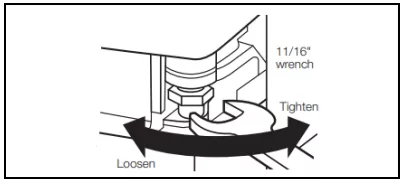
- Use a 5/16" open-ended wrench tool to turn the alignment screw as shown below. Depending on how the refrigerator door is misaligned in relation to the freezer door, you must turn the screw to the right to raise or to the left to lower the refrigerator door until both doors have been aligned vertically.
- Tighten the 11/16" locking nut with the wrench.
- Attach the base grille if it was dislodged.
Door Alignment
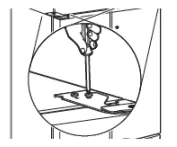
- Locate the hinges on top of your refrigerator. Loosen the hinge screws two full turns.
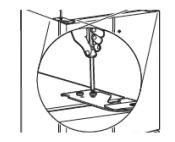
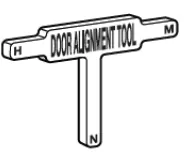
- Place the provided alignment tool between the doors so that the block sits on top of the doors.
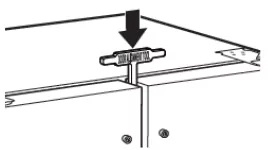
- Tighten the left and right hinge screws on the refrigerator top.
- Remove the alignment tool. If the gap between doors is uniform, store the tool for future adjustments.
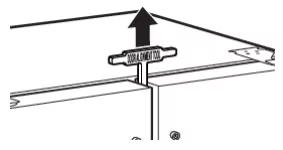
- If the gap is not uniform, repeat the alignment procedure with medium (M) or high (H) gap widths of the tool facing down until a uniform gap is achieved.
DOOR REMOVAL AND LEVELING STYLE 2
Door Instructions
Gather the required tools and parts and read all instructions before starting installation. Save these instructions for future reference.
NOTE: Before moving your refrigerator into your home, measure the doorway of your home to see whether you need to remove the refrigerator and freezer doors. If door removal is necessary, see the instructions below.
IMPORTANT: Before you begin, turn the refrigerator control off or turn cooling off. Unplug refrigerator or disconnect power. Remove food, the ice storage bin (on some models), and any adjustable door or utility bins from doors.
TOOLS NEEDED Depending on your model, you may need the following: Bubble level, flat-blade screwdriver, Phillips screwdriver tip #2 with 4" long as minimum, 3/16" hex key, 1/4", 3/8" and 5/16" hex-head socket wrench, 1/4" and 5/16" open-ended wrenches or adjustable wrench, internal star drive or 3/8" hex-head socket wrench, TORX T30 screwdriver.
Install and Remove Door Handles
PARTS INCLUDED: Door handles (2), 1/8" and 3/32" hex key as needed, spare setscrew(s).
To Install the Handles:
NOTE: The handle mounting setscrews are pre-installed in the handle.
- Remove the handles, which are packed inside the refrigerator.
NOTE: To avoid scratching the finish, place the handles on a towel or other soft surface. - Open the freezer door. On the refrigerator door, place the handle on the shoulder screws with the setscrews facing the freezer.
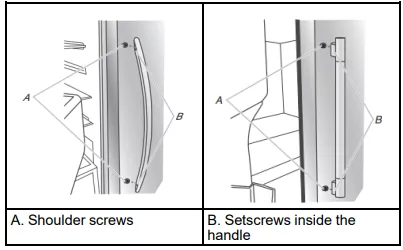
- Firmly push the handle toward the door until the handle base is flush against the door.
- While holding the handle, insert the short end of the hex key into the upper hole and slightly rotate the hex key until it is engaged in the setscrew.
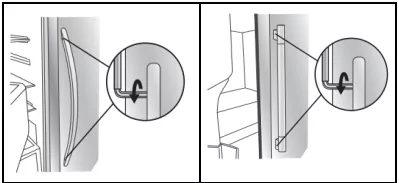
- Using a clockwise motion, tighten the setscrew until it begins to contact the shoulder screw.
- Repeat steps 4 and 5 to begin fastening the lower setscrew.
- Once both setscrews have been partially tightened as outlined in the previous steps, fully tighten both the upper and lower setscrews.
IMPORTANT: When the screws feel tight, tighten them an additional quarter-turn. The handle is not properly installed without this extra tightening. - Open the refrigerator door and close the freezer door. Repeat steps 2 through 7 to install the other handle onto the freezer door with the setscrews facing the refrigerator.
- Save the hex key and all instructions.
To Remove the Handles - Style 1:
- While holding the handle, insert the short end of the hex key into the upper hole and slightly rotate the hex key until it is engaged in the setscrew.
- Using a counterclockwise motion, loosen the setscrew a quarter-turn at a time.
- Repeat steps 1 and 2 for the upper setscrew. Gently pull the handle away from the door.
- If necessary, use a Phillips screwdriver to remove the shoulder screws from the door.
Remove Doors and Hinges
- Unplug refrigerator or disconnect power.
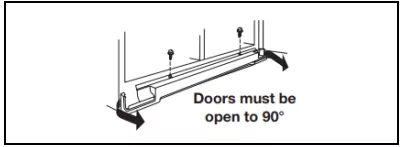
- Open both doors to 90°. Remove the base grille by removing the two screws, then pulling out on the outside corners as shown below.
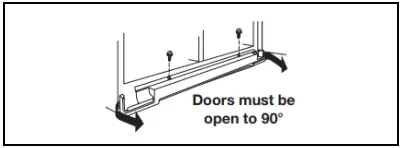
NOTE: The doors must only be opened to 90°. If they are opened all the way, the base grille will not come off. - Disconnect the water tubing, located behind the base grille on the freezer door side. The dispenser tubing runs through the door hinge and must be disconnected in order to remove the door.
NOTE: On models with the ice storage bin on the door, there are two water tubing connections, as shown. On models with the ice storage bin inside the freezer, there is only one water tubing connection.- Water Tubing Connection Style 1: Press the colored outer ring against the face of the fitting and gently pull the dispenser tubing free as shown below.
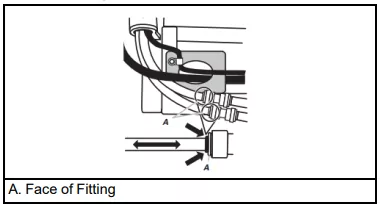
NOTE: Keep the water tubing connector attached to the tube that runs underneath the freezer. The door cannot be removed if the connector is still attached to the tube that runs through the door hinge. - Water Tubing Connection Style 2: Firmly pull on the clasp to release the tube, then pull the water tubing free as show below.
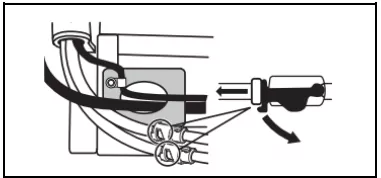
NOTE: Keep the clasp attached to the tube that runs underneath the freezer.
- Water Tubing Connection Style 1: Press the colored outer ring against the face of the fitting and gently pull the dispenser tubing free as shown below.
- Disconnect the wiring, located behind the base grille on the freezer door side as shown below.
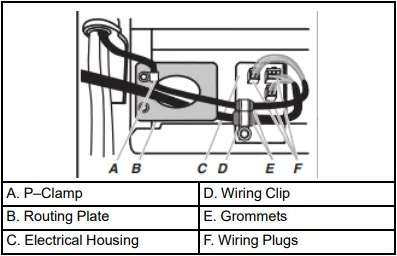
On models with the ice storage bin on the door:
NOTE: There are two wiring bundles that run underneath the freezer - a large bundle with a large grommet and two white plugs at the end, and a small bundle with a small grommet and one yellow plug at the end. Remove the P-clamp using a 1/4" hex-head socket wrench. Remove the small wiring bundle from the P-clamp. Remove the wiring clip using a 1/4" hex-head socket wrench. Pull the electrical housing out from under the refrigerator. Disconnect the wiring plugs from the housing. Gently pull the large wiring bundle (with two white plugs) through the routing plate.
On models with the ice storage bin inside the freezer:
NOTE: The wiring configuration is simpler than what is shown in the above graphic. There is only one wiring bundle with one wiring plug, and there is not a routing plate.- Remove the wiring clip using a 1/4" hex-head socket wrench.
- Pull the electrical housing out from under the refrigerator. Disconnect the wiring plugs from the housing.
- Close both doors and keep them closed until you are ready to lift them free from the cabinet.
- Depending on the model, use a 3/16" hex key or a TORX T30 screwdriver to remove the top left hinge screws as shown below.
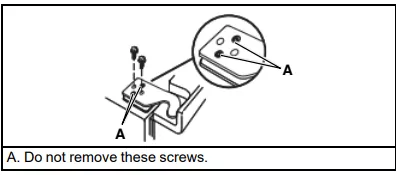
IMPORTANT: Do not remove screws A. Hold the door while removing the hinge. - Lift the freezer door straight up off the bottom hinge. The water tubing and wiring will remain attached to the freezer door and will need to be passed through the left bottom hinge.
NOTE: This may require two people, one to lift the door and another to feed the water tubing and wiring into the bottom hinge pin.
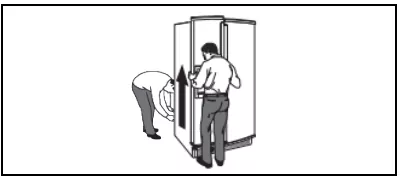
On models with the ice storage bin on the door:
Be sure the hole in the hinge is clear of obstructions; then gently pull one water tube through the hinge. (Avoid kinking the tube.) Next, gently pull the other water tube through the hinge, again avoiding kinks. Finally, gently pull the wiring bundle (including the grommet and wiring plugs) through the hinge.
On models with the ice storage bin inside the freezer:
Be sure the hole in the hinge is clear of obstructions; then gently pull the water tube through the hinge. (Avoid kinking the tube.) Next, gently pull the wiring bundle (including the grommet and wiring plug) through the hinge.
IMPORTANT: Rest the door on its side on a soft, clean surface, such as a towel, blanket, or piece of cardboard. This will help to avoid scratching or damaging the door, water tubing, and wiring. - Use a 3/16" hex key to remove the top right hinge screws as shown below.
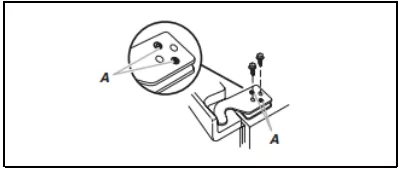
- Lift the refrigerator door straight up off the bottom hinge.
IMPORTANT: Rest the door on its side on a soft, clean surface, such as a towel, blanket, or piece of cardboard. This will help to avoid scratching or damaging the door. - It may not be necessary to remove the bottom hinges in order to move the refrigerator through a doorway. Both bottom hinges are similar in construction.
- If necessary, use an internal star drive or a 3/8" hex-head socket wrench to remove the bottom hinges as shown below.
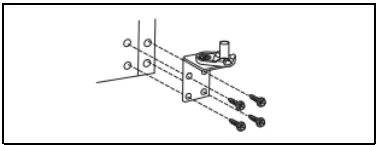
IMPORTANT: Jack brackets are mounted behind the hinges. If the hinges are removed, be sure the jack brackets are reinstalled when the hinges are reinstalled.
- If necessary, use an internal star drive or a 3/8" hex-head socket wrench to remove the bottom hinges as shown below.
Door Closing, Leveling, and Alignment
Your refrigerator has two front adjustable wheels. In most cases, the refrigerator should be stable when both legs touch the floor. If your refrigerator seems unstable or you want the doors to close more easily, adjust the refrigerator's tilt using the instructions below.
- Use a bubble level to check levelness of floor where the rear side of the refrigerator will rest. If the refrigerator is not leveled, adjust or add the shim on flooring to create a leveled floor for the rear side wheels. A leveled rear side prevents the refrigerator cabinet from forming a twist.
- Move the refrigerator to its final location. If necessary, open both doors to 90° and remove the base grille as shown below.
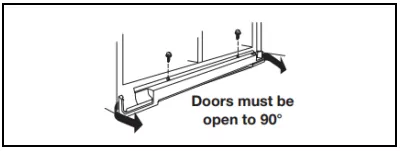
- The two leveling feet are located on the brackets on each side of the product as shown below.
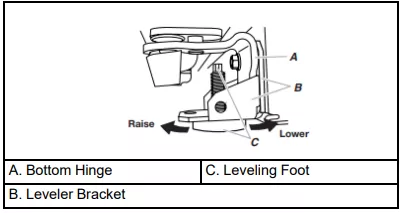
NOTE: Having someone push against the top of the refrigerator takes some weight off the leveling screws. This makes it easier to make adjustments. - Use a 1/4" open-ended or adjustable wrench to adjust the leveling feet. Turn the leveling foot to the left to raise that side of the product, or turn it to the right to lower that side of the product. Raise the wheels while one person pushes on the refrigerator to lift from front side. Use the bubble level on top of the refrigerator or on its side to level the refrigerator. Check bubble level and at the same time observe the gaps and squareness to the adjacent cabinets, furniture or trim. If adjacent furnishings are not level, it may not be possible to achieve even gaps when refrigerator is level.
NOTE: Both leveling feet should be snug against the floor, and the rollers should not touch the floor. This keeps the refrigerator from rolling forward when opening the doors. Continue adjusting until all four corners are steady without rock. - Open both doors again and check that they close as easily as you like. If not, tilt the refrigerator slightly more to the rear by turning the leveling feet to the left. It may take several more turns, and you should turn both leveling feet the same amount.
NOTE: Whenever you need to move the refrigerator, turn the leveling feet to the right until they are no longer touching the ground. This will allow the refrigerator to roll more easily.
Door Alignment
A refrigerator that is not level from side to side may appear to have doors that are not properly aligned. If the doors appear this way, use the instructions in the previous section to check the leveling. The doors are designed to be slightly different heights when the refrigerator is empty, in order to account for the weight of food that will be placed on the doors. If the doors are still not aligned after checking the leveling and loading the refrigerator with food, follow the steps below to adjust the door alignment.
- If necessary, open both doors to 90° and remove the base grille.
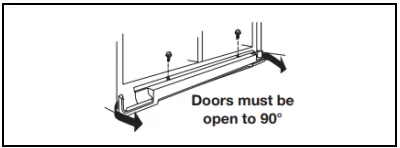
- Locate the alignment screw on the bottom hinge of the refrigerator door.
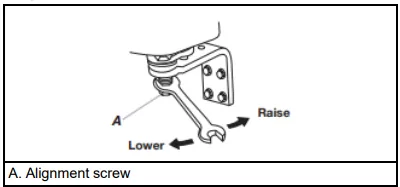
- Use a 5/16" open-ended or adjustable wrench to turn the screw. To raise the refrigerator door, turn the screw to the right. To lower the door, turn the screw to the left.
- Check that the doors are even at the top. If necessary, continue to turn the alignment screw until the doors are aligned.
- Open both doors to 90°. Replace the base grille.