
Visit our website at: http://www.harborfreight.com
Email our technical support at: [email protected]
2019E-B
DETAIL
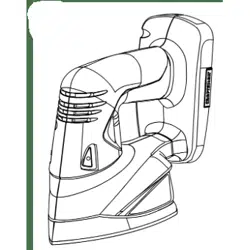
CORNER SANDER
57946
Owner’s Manual & Safety Instructions
Save This Manual Keep this manual for the safety warnings and precautions, assembly,
operating, inspection, maintenance and cleaning procedures. Write the product’s serial number in the
back of the manual near the assembly diagram (or month and year of purchase if product has no number).
Keep this manual and the receipt in a safe and dry place for future reference. 20j
When unpacking, make sure that the product is intact
and undamaged. If any parts are missing or broken,
please call 1-888-866-5797 as soon as possible.
Copyright
©
2020 by Harbor Freight Tools
®
. All rights reserved.
No portion of this manual or any artwork contained herein may be reproduced in
any shape or form without the express written consent of Harbor Freight Tools.
Diagrams within this manual may not be drawn proportionally. Due to continuing
improvements, actual product may differ slightly from the product described herein.
To ol s require d f o r as s em b ly a n d s er vi c e may not be included .
Read this material before using this product.
Failure to do so can result in serious injury.
SAVE THIS MANUAL.
Page 2 For technical questions, please call 1-888-866-5797. Item 57946
SaFEty OpEratiOn MaintEnancESEtup
table of contents
Safety ......................................................... 2
Setup - Before Use: .................................... 8
Setup .......................................................... 8
Operation .................................................... 9
Maintenance .............................................. 12
Parts List and Diagram .............................. 14
Warranty .................................................... 16
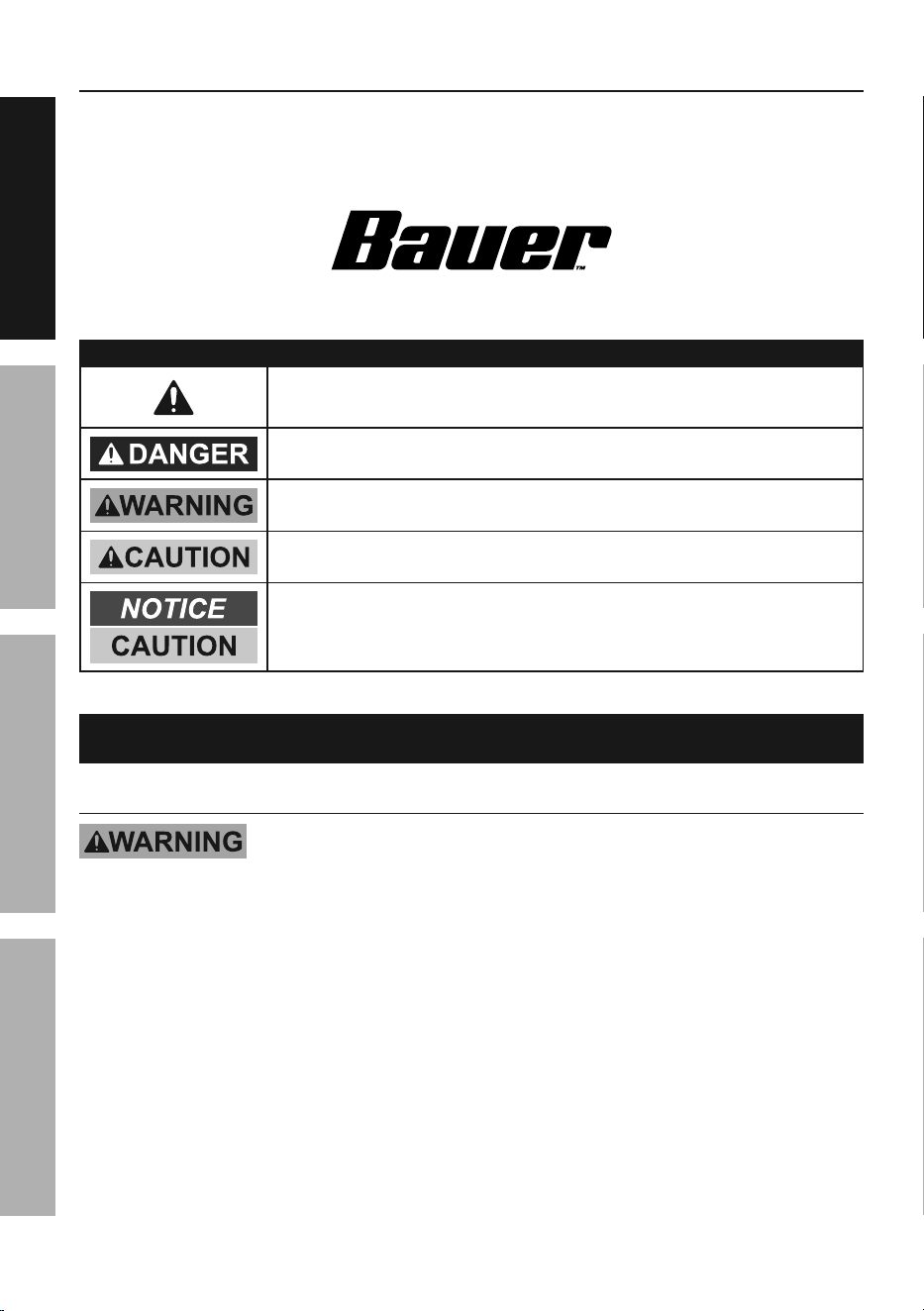
WarninG SyMBOLS anD DEFinitiOnS
This is the safety alert symbol. It is used to alert you to potential
personal injury hazards. Obey all safety messages that
follow this symbol to avoid possible injury or death.
Indicates a hazardous situation which, if not avoided,
will result in death or serious injury.
Indicates a hazardous situation which, if not avoided,
could result in death or serious injury.
Indicates a hazardous situation which, if not avoided,
could result in minor or moderate injury.
Addresses practices not related to personal injury.
iMpOrtant SaFEty inFOrMatiOn
General power tool Safety Warnings
read all safety warnings, instructions, illustrations and specifications provided with this power tool.
Failure to follow all instructions listed below may result in electric shock, fire and/or serious injury.
Save all warnings and instructions for future reference.
The term “power tool” in the warnings refers to your mains-operated (corded)
power tool or battery-operated (cordless) power tool.
1. Work area safety
a. Keep work area clean and well lit.
Cluttered or dark areas invite accidents.
b. Do not operate power tools in
explosive atmospheres, such as in
the presence of flammable liquids,
gases or dust. Power tools create sparks
which may ignite the dust or fumes.
c. Keep children and bystanders away
while operating a power tool. Distractions
can cause you to lose control.
2. Electrical safety
a. power tool plugs must match the outlet.
never modify the plug in any way. Do not use
any adapter plugs with earthed (grounded)
power tools. Unmodified plugs and matching
outlets will reduce risk of electric shock.

Page 3For technical questions, please call 1-888-866-5797.Item 57946
SaFEtyOpEratiOnMaintEnancE SEtup
b. avoid body contact with earthed or
grounded surfaces, such as pipes,
radiators, ranges and refrigerators.
There is an increased risk of electric shock
if your body is earthed or grounded.
c. Do not expose power tools to rain or wet
conditions. Water entering a power tool
will increase the risk of electric shock.
d. Do not abuse the cord. never use the cord
for carrying, pulling or unplugging the power
tool. Keep cord away from heat, oil, sharp
edges or moving parts. Damaged or entangled
cords increase the risk of electric shock.
e. When operating a power tool outdoors,
use an extension cord suitable for outdoor
use. Use of a cord suitable for outdoor
use reduces the risk of electric shock.
f. if operating a power tool in a damp location
is unavoidable, use a ground fault circuit
interrupter (GFci) protected supply. Use of
a GFCI reduces the risk of electric shock.
3. personal safety
a. Stay alert, watch what you are doing and
use common sense when operating a
power tool. Do not use a power tool while
you are tired or under the influence of
drugs, alcohol or medication. A moment
of inattention while operating power tools
may result in serious personal injury.
b. use personal protective equipment. always
wear eye protection. Protective equipment
such as dust mask, non-skid safety shoes, hard
hat, or hearing protection used for appropriate
conditions will reduce personal injuries.
c. prevent unintentional starting. Ensure
the switch is in the off-position before
connecting to power source and/or
battery pack, picking up or carrying the
tool. Carrying power tools with your finger
on the switch or energizing power tools that
have the switch on invites accidents.
d. remove any adjusting key or wrench
before turning the power tool on. A wrench
or a key left attached to a rotating part of the
power tool may result in personal injury.
e. Do not overreach. Keep proper
footing and balance at all times. This
enables better control of the power
tool in unexpected situations.
f. Dress properly. Do not wear loose clothing
or jewelry. Keep your hair, clothing
and gloves away from moving parts.
Loose clothes, jewelry or long hair
can be caught in moving parts.
g. if devices are provided for the connection
of dust extraction and collection
facilities, ensure these are connected
and properly used. Use of dust collection
can reduce dust-related hazards.
h. Do not let familiarity gained from frequent
use of tools allow you to become
complacent and ignore tool safety
principles. A careless action can cause
severe injury within a fraction of a second.
i. Only use safety equipment that has been
approved by an appropriate standards agency.
Unapproved safety equipment may not provide
adequate protection. Eye protection must be
ANSI-approved and breathing protection
must be NIOSH-approved for the
specific hazards in the work area.
j. Avoid unintentional starting.
Prepare to begin work before turning on the tool.
k. Do not lay the tool down until it has come to
a complete stop. Moving parts can grab the
surface and pull the tool out of your control.
l. When using a handheld power tool,
maintain a firm grip on the tool with
both hands to resist starting torque.
m. Do not leave the tool unattended when
it is plugged into an electrical outlet.
Turn off the tool, and unplug it from its
electrical outlet before leaving.
n. This product is not a toy.
Keep it out of reach of children.
o. People with pacemakers should consult their
physician(s) before use. Electromagnetic fields
in close proximity to heart pacemaker could
cause pacemaker interference or pacemaker
failure. In addition, people with pacemakers
should:
• Avoid operating alone.
• Do not use with Power Switch locked on.
• Properly maintain and inspect to avoid
electrical shock.
• Properly ground power cord.
Ground Fault Circuit Interrupter (GFCI)
should also be implemented – it prevents
sustained electrical shock.
p. The warnings, precautions, and instructions
discussed in this instruction manual cannot
cover all possible conditions and situations
that may occur. It must be understood by the
operator that common sense and caution are
factors which cannot be built into this product,
but must be supplied by the operator.
4. power tool use and care
a. Do not force the power tool. use the correct
power tool for your application. The correct
power tool will do the job better and safer
at the rate for which it was designed.

Page 4 For technical questions, please call 1-888-866-5797. Item 57946
SaFEty OpEratiOn MaintEnancESEtup
b. Do not use the power tool if the switch
does not turn it on and off. Any power
tool that cannot be controlled with the switch
is dangerous and must be repaired.
c. Disconnect the plug from the power
source and/or remove the battery pack,
if detachable, from the power tool before
making any adjustments, changing
accessories, or storing power tools.
Such preventive safety measures reduce the
risk of starting the power tool accidentally.
d. Store idle power tools out of the reach of
children and do not allow persons unfamiliar
with the power tool or these instructions
to operate the power tool. Power tools are
dangerous in the hands of untrained users.
e. Maintain power tools and accessories.
check for misalignment or binding of
moving parts, breakage of parts and any
other condition that may affect the power
tool’s operation. if damaged, have the power
tool repaired before use. Many accidents
are caused by poorly maintained power tools.
f. Keep cutting tools sharp and clean. Properly
maintained cutting tools with sharp cutting edges
are less likely to bind and are easier to control.
g. use the power tool, accessories and tool bits
etc. in accordance with these instructions,
taking into account the working conditions
and the work to be performed. Use of the
power tool for operations different from those
intended could result in a hazardous situation.
h. Keep handles and grasping surfaces
dry, clean and free from oil and grease.
Slippery handles and grasping surfaces
do not allow for safe handling and control
of the tool in unexpected situations.
5. Service
a. Have your power tool serviced by a
qualified repair person using only identical
replacement parts. This will ensure that
the safety of the power tool is maintained.
b. Maintain labels and nameplates on the tool.
These carry important safety information.
If unreadable or missing, contact
Harbor Freight Tools for a replacement.
6. Belt sander and drum sander safety warnings
a. Hold the power tool by insulated gripping
surfaces, because the sanding surface
may contact its own cord. Cutting a
“live” wire may make exposed metal
parts of the power tool “live” and could
give the operator an electric shock.
7. Vibration Safety
This tool vibrates during use.
Repeated or long-term exposure to vibration may
cause temporary or permanent physical injury,
particularly to the hands, arms and shoulders.
To reduce the risk of vibration-related injury:
a. Anyone using vibrating tools regularly or for
an extended period should first be examined
by a doctor and then have regular medical
check-ups to ensure medical problems are not
being caused or worsened from use. Pregnant
women or people who have impaired blood
circulation to the hand, past hand injuries,
nervous system disorders, diabetes, or
Raynaud’s Disease should not use this tool.
If you feel any symptoms related to
vibration (such as tingling, numbness,
and white or blue fingers), seek medical
advice as soon as possible.
b. Do not smoke during use. Nicotine reduces
the blood supply to the hands and fingers,
increasing the risk of vibration-related injury.
c. Wear suitable gloves to reduce the
vibration effects on the user.
d. Use tools with the lowest vibration
when there is a choice.
e. Include vibration-free periods each day of work.
f. Grip tool as lightly as possible (while still keeping
safe control of it). Let the tool do the work.
g. To reduce vibration, maintain the tool as
explained in this manual. If any abnormal
vibration occurs, stop use immediately.
Page 5For technical questions, please call 1-888-866-5797.Item 57946
SaFEtyOpEratiOnMaintEnancE SEtup
Grounding
tO prEVEnt ELEctric SHOcK anD DEatH FrOM
incOrrEct GrOunDinG WIRE CONNECTION:
Check with a qualified electrician if you are in doubt as to whether the outlet is properly grounded. Do
not modify the power cord plug provided with the tool. never remove the grounding prong
from the plug. Do not use the tool if the power cord or plug is damaged. if damaged, have it repaired by a
service facility before use. if the plug will not fit the outlet, have a proper outlet installed by a
qualified electrician.
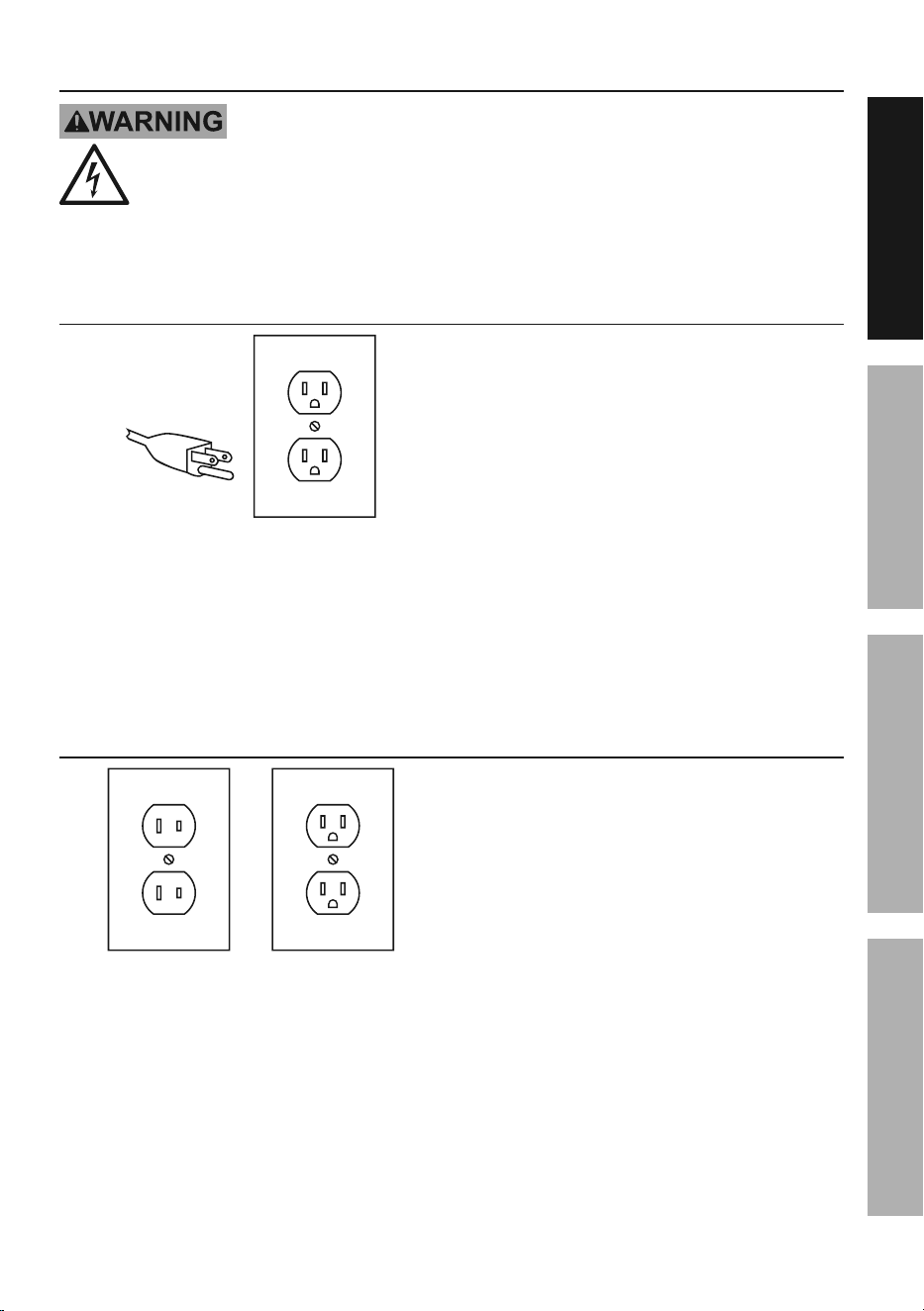
Grounded tools: tools with three prong plugs
3-prong plug and Outlet
1. Tools marked with “Grounding Required” have
a three wire cord and three prong grounding
plug. The plug must be connected to a properly
grounded outlet. If the tool should electrically
malfunction or break down, grounding provides
a low resistance path to carry electricity
away from the user, reducing the risk of
electric shock. (See 3-prong plug and Outlet.)
2. The grounding prong in the plug is connected
through the green wire inside the cord to the
grounding system in the tool. The green wire
in the cord must be the only wire connected to
the tool’s grounding system and must never
be attached to an electrically “live” terminal.
(See 3-prong plug and Outlet.)
3. The tool must be plugged into an appropriate outlet,
properly installed and grounded in accordance
with all codes and ordinances. The plug and outlet
should look like those in the preceding illustration.
(See 3-prong plug and Outlet.)
Double insulated tools: tools with two prong plugs
Outlets for 2-prong plug
1. Tools marked “Double Insulated” do not
require grounding. They have a special
double insulation system which satisfies
OSHA requirements and complies with
the applicable standards of Underwriters
Laboratories, Inc., the Canadian Standard
Association, and the National Electrical Code.
2. Double insulated tools may be used in either of the
120 volt outlets shown in the preceding illustration.
(See Outlets for 2-prong plug.)
Page 6 For technical questions, please call 1-888-866-5797. Item 57946
SaFEty OpEratiOn MaintEnancESEtup
Extension cords
1. Grounded tools require a three
wire extension cord. Double Insulated tools can
use either a two or three wire extension cord.
2. As the distance from the supply outlet increases,
you must use a heavier gauge extension cord.
Using extension cords with inadequately sized wire
causes a serious drop in voltage, resulting in loss
of power and possible tool damage. (See table a.)
3. The smaller the gauge number of the wire, the
greater the capacity of the cord. For example,
a 14 gauge cord can carry a higher current
than a 16 gauge cord. (See table a.)
4. When using more than one extension cord
to make up the total length, make sure
each cord contains at least the minimum
wire size required. (See table a.)
5. If you are using one extension cord for more
than one tool, add the nameplate amperes
and use the sum to determine the required
minimum cord size. (See table a.)
6. If you are using an extension cord outdoors, make
sure it is marked with the suffix “W-A” (“W” in
Canada) to indicate it is acceptable for outdoor use.
7. Make sure the extension cord is properly wired
and in good electrical condition. Always replace
a damaged extension cord or have it repaired
by a qualified electrician before using it.
8. Protect the extension cords from sharp objects,
excessive heat, and damp or wet areas.
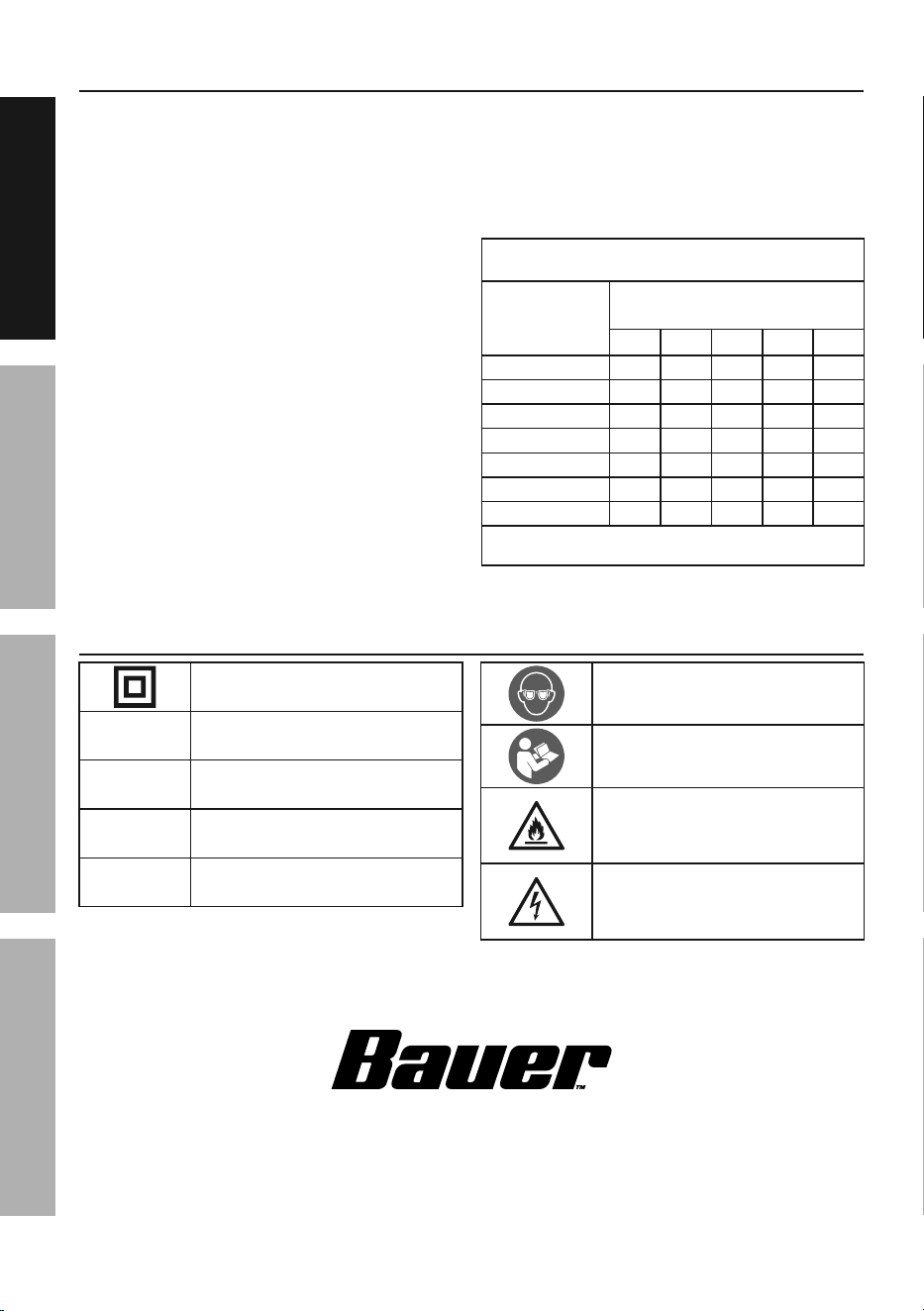
taBLE a: rEcOMMEnDED MiniMuM WirE
GauGE FOr EXtEnSiOn cOrDS* (120/240 VOLt)
naMEpLatE
aMpErES
(at full load)
EXtEnSiOn cOrD
LEnGtH
25´ 50´ 75´ 100´ 150´
0 – 2.0 18 18 18 18 16
2.1 – 3.4 18 18 18 16 14
3.5 – 5.0 18 18 16 14 12
5.1 – 7.0 18 16 14 12 12
7.1 – 12.0 18 14 12 10 -
12.1 – 16.0 14 12 10 - -
16.1 – 20.0 12 10 - - -
* Based on limiting the line voltage drop to five volts at
150% of the rated amperes.
Symbology
Double Insulated
V
Volts
~
Alternating Current
a
Amperes
n
0
xxxx/min.
No Load Revolutions
per Minute (RPM)
WARNING marking concerning Risk
of Eye Injury. Wear ANSI-approved
safety goggles with side shields.
Read the manual before
set-up and/or use.
WARNING marking
concerning Risk of Fire.
Do not cover ventilation ducts.
Keep flammable objects away.
WARNING marking concerning
Risk of Electric Shock.
Properly connect power cord
to appropriate outlet.

Page 7For technical questions, please call 1-888-866-5797.Item 57946
SaFEtyOpEratiOnMaintEnancE SEtup
Specifications
Electrical Rating 120VAC / 60Hz / 1.2A
No Load Speed 12,500/min
Sandpaper
Hook and Loop,
3-7/8" W x 5-1/2" L
Page 8 For technical questions, please call 1-888-866-5797. Item 57946
SaFEty OpEratiOn MaintEnancESEtup
Setup - Before use:
read the EntirE iMpOrtant SaFEty inFOrMatiOn section at the beginning of this
manual including all text under subheadings therein before set up or use of this product.
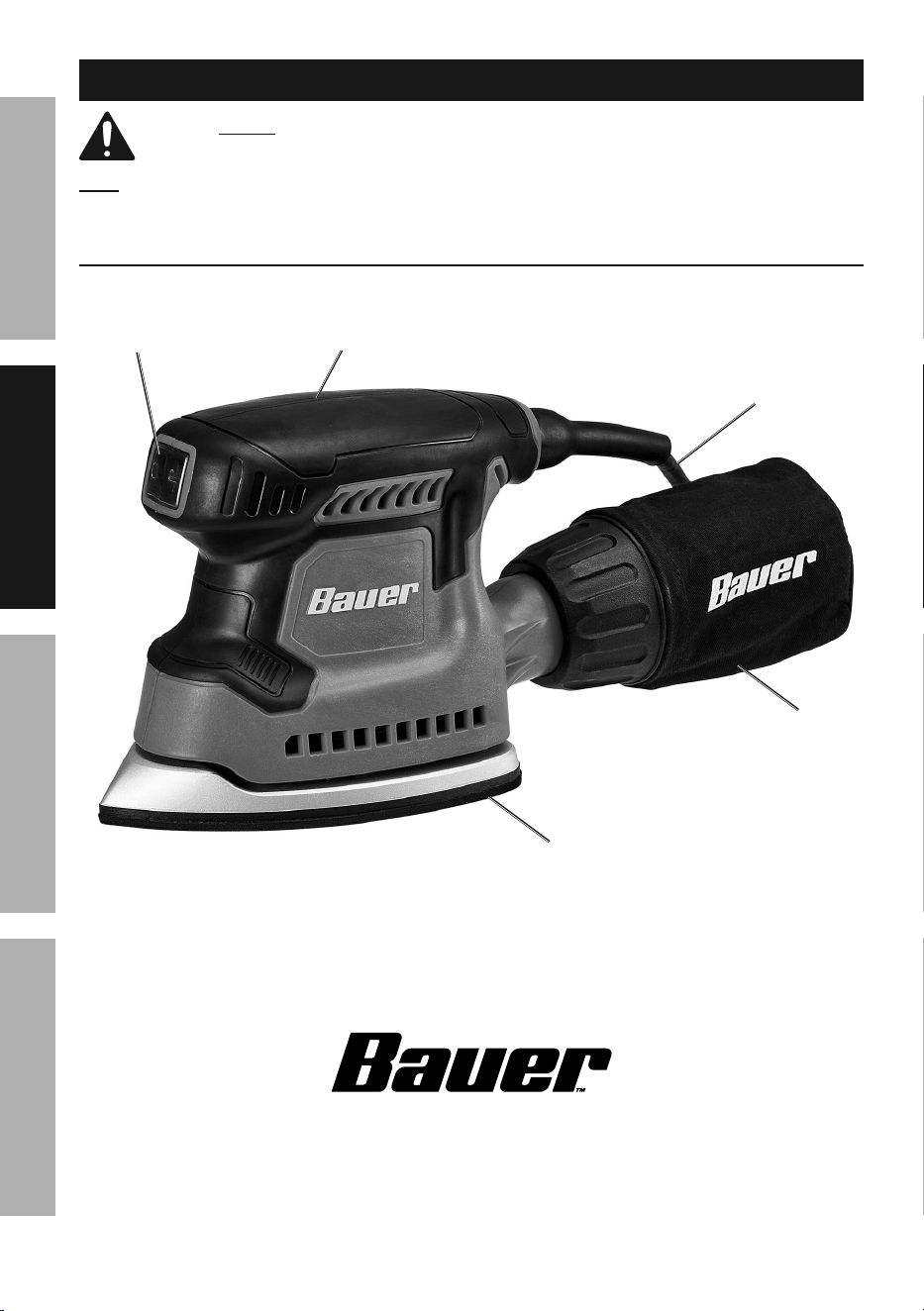
note: For additional information regarding the parts listed in the
following pages, refer to Parts List and Diagram on page 14.
Functions
power
Switch
Base plate
Dust Bag
power cord
Handle
Page 9For technical questions, please call 1-888-866-5797.Item 57946
SaFEtyOpEratiOnMaintEnancE SEtup
Operating instructions
read the EntirE iMpOrtant SaFEty inFOrMatiOn section at the beginning of this
manual including all text under subheadings therein before set up or use of this product.
Workpiece and Work area Set up
1. Workpiece selection:
a. Workpiece must be free of foreign objects.
b. Wear a NIOSH-approved respirator and
have appropriate ventilation whenever
sanding pressure treated lumber.
2. Designate a work area that is clean and well lit.
The work area must not allow access by children
or pets to prevent distraction and injury.
3. Route the power cord along a safe route to reach
the work area without creating a tripping hazard or
exposing the power cord to possible damage. The
power cord must reach the work area with enough
extra length to allow free movement while working.
4. Secure loose workpieces using a vise or clamps
(not included) to prevent movement while working.
5. There must not be objects, such as utility lines,
nearby that will present a hazard while working.
tool changing
tO prEVEnt SEriOuS inJury FrOM acciDEntaL OpEratiOn:
Make sure that the power Switch is in the off-position and unplug the tool from
its electrical outlet before performing any procedure in this section.
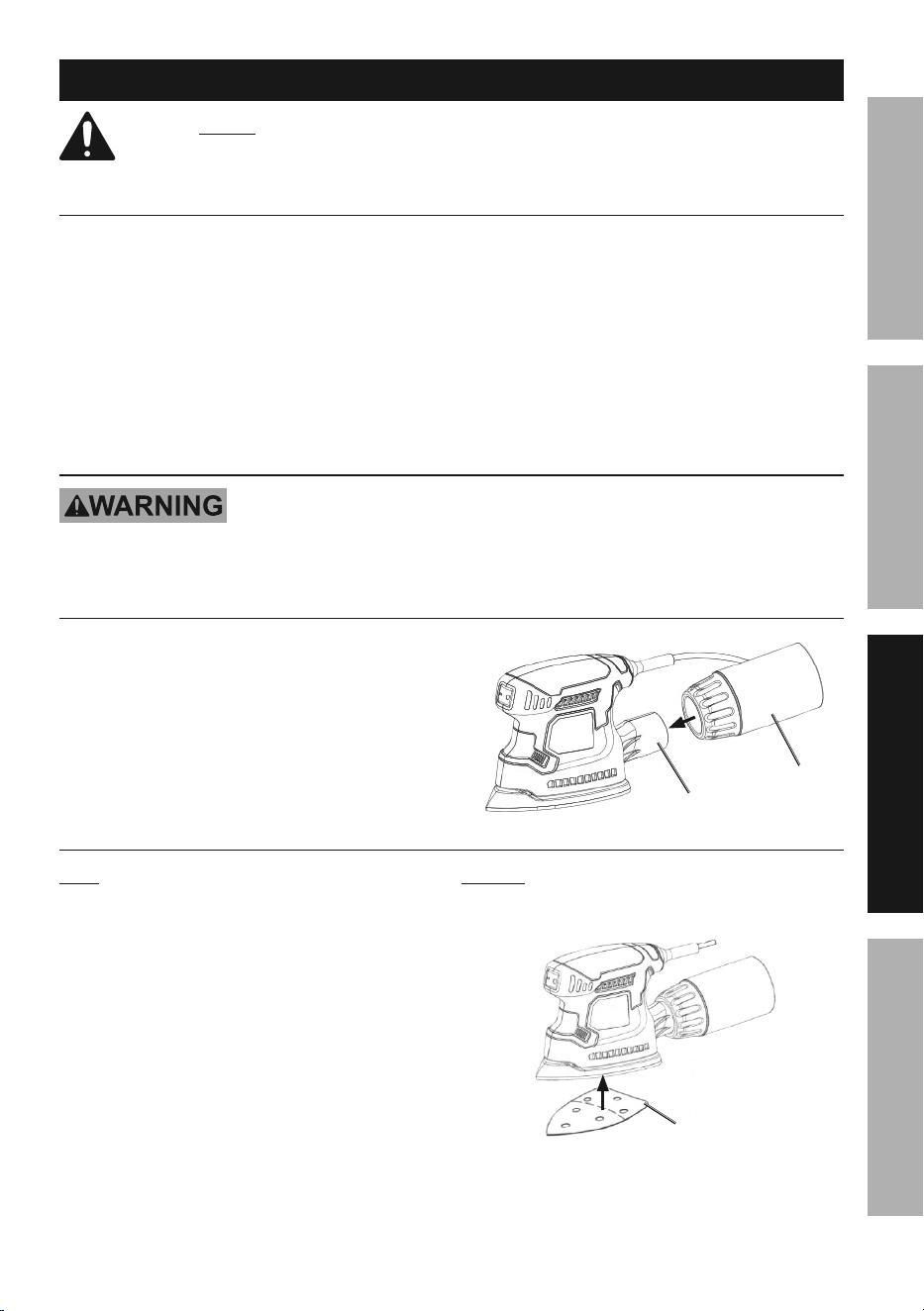
installing the Dust Bag
1. Unplug the Corner Sander.
2. The Dust Bag is installed on the
back of the Corner Sander.
3. Using a slight twisting motion, slide Dust Bag
over the blower Exhaust Port until firmly seated.
Dust
Bag
Exhaust port
installing Sandpaper
note; This Corner Sander uses
hook and loop Sandpaper.
1. Set the Corner Sander’s Power
Switch to OFF (0) and unplug it.
2. Before installing the Sandpaper, make sure
the Base Plate is free of dust and dirt.
3. Align the hook and loop Sandpaper with the holes
in the Base Plate so that dust can be collected into
the Dust Bag. Press sandpaper firmly in place.
4. Remove used Sandpaper by peeling
one edge away from the Base Plate
until the whole sheet is free.
nOticE: Do not use torn or severely worn
or damaged Sandpaper. To do so could
damage the surface of the Base Plate.
Sandpaper

Page 10 For technical questions, please call 1-888-866-5797. Item 57946
SaFEty OpEratiOn MaintEnancESEtup
Setting and testing
1. Ensure the Dust Bag is securely attached.
2. Ensure the Sandpaper (sold separately) is correctly
attached to the Sander and that its holes align
with the holes in the Base Plate so the Dust Bag
will collect dust during the sanding operation.
3. Switch the Power Switch to ON (I) and
run the tool for at least 30 seconds.
4. If abnormal noise/vibration occurs or the
Sandpaper/Dust Bag slip off, have the
problem corrected before further use.

Page 11For technical questions, please call 1-888-866-5797.Item 57946
SaFEtyOpEratiOnMaintEnancE SEtup
General instructions for use
tO prEVEnt SEriOuS inJury: Grip the tool firmly in both hands.
1. Wipe the work surface clean of all dirt and debris,
especially that of previous coarser sanding
sessions, which will scratch the surface
of a finer grit sanding session.
2. Attach the desired grit Sandpaper
(sold separately) onto the Base Plate.
3. Press Power Switch off (0), then plug in the tool.
4. To begin, grip the tool with both hands and
press the Power Switch on (i) to start the tool. If
connected to a vacuum, start the vacuum.
note: The Corner Sander may be alternately
connected to a vacuum (sold separately),
instead of the Dust Bag, if desired.
5. Wait until the tool has reached full speed,
then gently contact the surface.
6. Keep heavy pressure off of the tool when operating.
Allow the tool to do the work.
nOticE: Do not cover air vents.
7. Move the tool in a uniform pattern up and down or
side to side while sanding to ensure even sanding.
8. Periodically, stop the tool and check for:
• Sandpaper wear. Replace worn
Sandpaper as needed.
• Dust accumulation in the Dust Bag
(if not using a vacuum). Detach the
Dust Bag, clean it, then reinstall it.
note: When sanding for extended periods of time, the
motor may overheat. If this occurs, turn off the Sander
and let it come to a complete stop before removing from
workpiece. Allow the motor to cool before resuming.
WarninG! tO prEVEnt SEriOuS inJury:
The tool will restart automatically if stalled.
9. To prevent accidents, after use:
a. Turn off the tool and unplug it.
WarninG! tO prEVEnt SEriOuS
inJury: allow the tool to come to a
complete stop before setting it down.
b. If using a vacuum, stop it and
disconnect it from the Sander.
c. Unplug the tool.
d. Empty Dust Bag.
e. Clean Corner Sander, then store it
indoors out of children’s reach.

Page 12 For technical questions, please call 1-888-866-5797. Item 57946
SaFEty OpEratiOn MaintEnancESEtup
Maintenance and Servicing instructions
procedures not specifically explained in this manual must
be performed only by a qualified technician.
tO prEVEnt SEriOuS inJury FrOM acciDEntaL OpEratiOn:
Make sure that the power Switch is in the off-position and unplug the tool from
its electrical outlet before performing any procedure in this section.
tO prEVEnt SEriOuS inJury FrOM tOOL FaiLurE:
Do not use damaged equipment. if abnormal noise or vibration
occurs, have the problem corrected before further use.
cleaning, Maintenance, and Lubrication
1. BEFOrE EacH uSE, inspect the general
condition of the tool. Check for:
• loose hardware,
• misalignment or binding of moving parts,
• damaged cord/electrical wiring,
• cracked or broken parts, and
• any other condition that may
affect its safe operation.
2. aFtEr uSE:
• wipe external surfaces of tool with clean cloth,
• empty debris accumulated in the Dust Bag.
3. Periodically, wear ANSI-approved safety goggles
and NIOSH-approved breathing protection
and blow dust and grit out of the motor
vents using dry compressed air.
4. WarninG! tO prEVEnt SEriOuS
inJury: if the supply cord of this power
tool is damaged, it must be replaced only
by a qualified service technician.
Page 13For technical questions, please call 1-888-866-5797.Item 57946
SaFEtyOpEratiOnMaintEnancE SEtup
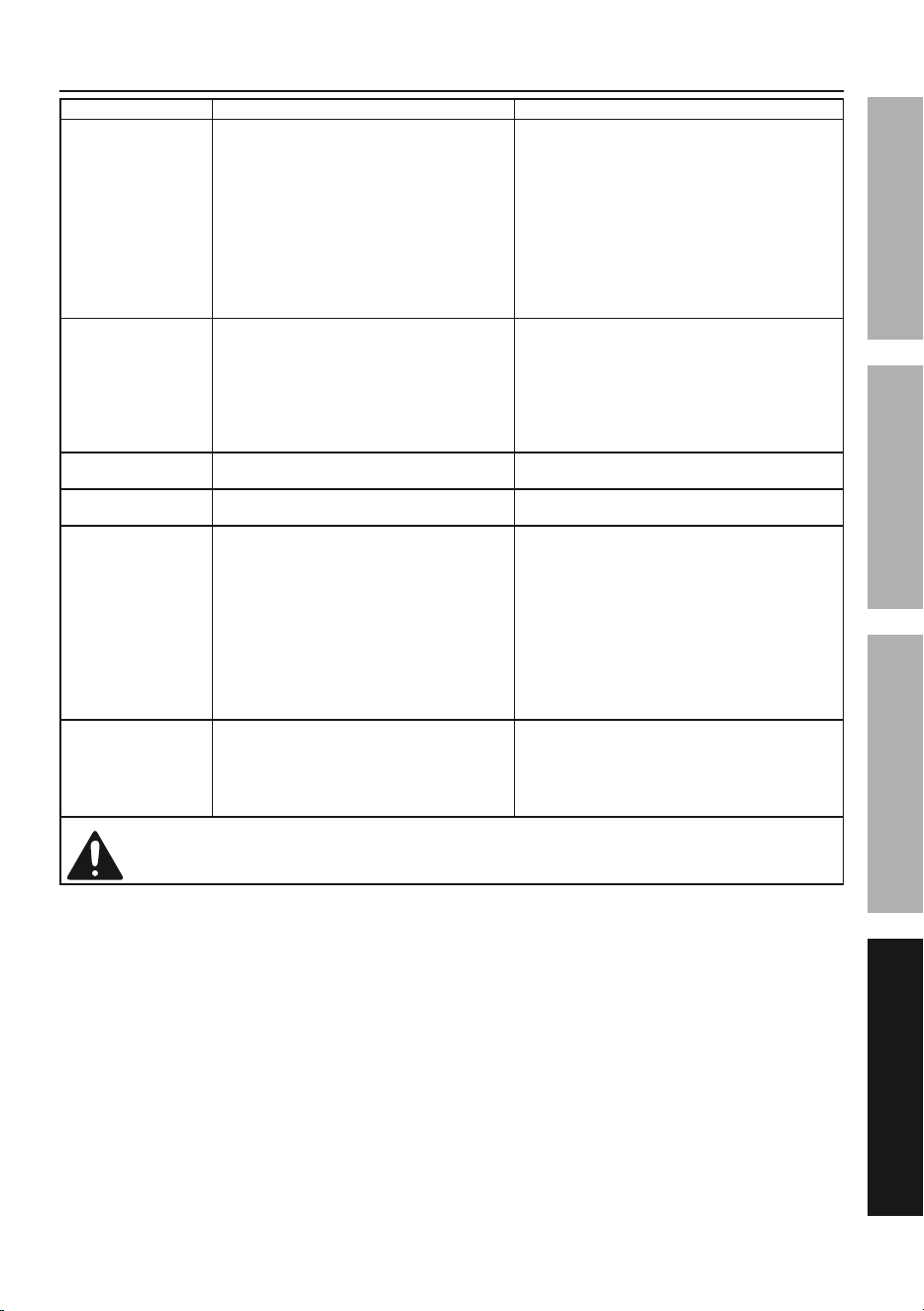
troubleshooting
problem possible causes Likely Solutions
Tool will not start. 1. Cord not connected.
2. No power at outlet.
3. Tool’s thermal reset
breaker tripped (if equipped).
4. Internal damage or wear. (Carbon
brushes or switch, for example.)
1. Check that cord is plugged in.
2. Check power at outlet.
If outlet is unpowered, turn off tool and
check circuit breaker. If breaker is tripped,
make sure circuit is right capacity for
tool and circuit has no other loads.
3. Turn off tool and allow to cool.
Press reset button on tool.
4. Have technician service tool.
Tool operates slowly. 1. Excess pressure applied to workpiece.
2. Power being reduced by long or small
diameter extension cord.
1. Decrease pressure, allow
tool to do the work.
2. Eliminate use of extension cord.
If an extension cord is needed, use
one with the proper diameter for
its length and load. See Extension
Cords in GROUNDING section.
Performance
decreases over time.
Carbon brushes worn or damaged. Have qualified technician replace brushes.
Excessive noise
or rattling.
Internal damage or wear.
(Carbon brushes or bearings, for example.)
Have technician service tool.
Overheating. 1. Forcing tool to work too fast.
2. Blocked motor housing vents.
3. Motor being strained by long or
small diameter extension cord.
1. Allow tool to work at its own rate.
2. Wear ANSI-approved safety goggles
and NIOSH-approved dust mask/
respirator while blowing dust out of
motor using compressed air.
3. Eliminate use of extension cord.
If an extension cord is needed,
use one with the proper diameter for
its length and load. See Extension
Cords in GROUNDING section.
Tool does not
grind, sand or
brush effectively.
1. Accessory loose.
2. Accessory damaged, worn or
wrong type for the material.
1. Confirm accessory arbor is correct
and Outer Flange/Arbor Nut is tight.
2. Check condition and type of disc accessory.
Use only proper type of disc
accessory in good condition.
Follow all safety precautions whenever diagnosing or servicing
the tool. Disconnect power supply before service.

Page 14 For technical questions, please call 1-888-866-5797. Item 57946
SaFEty OpEratiOn MaintEnancESEtup
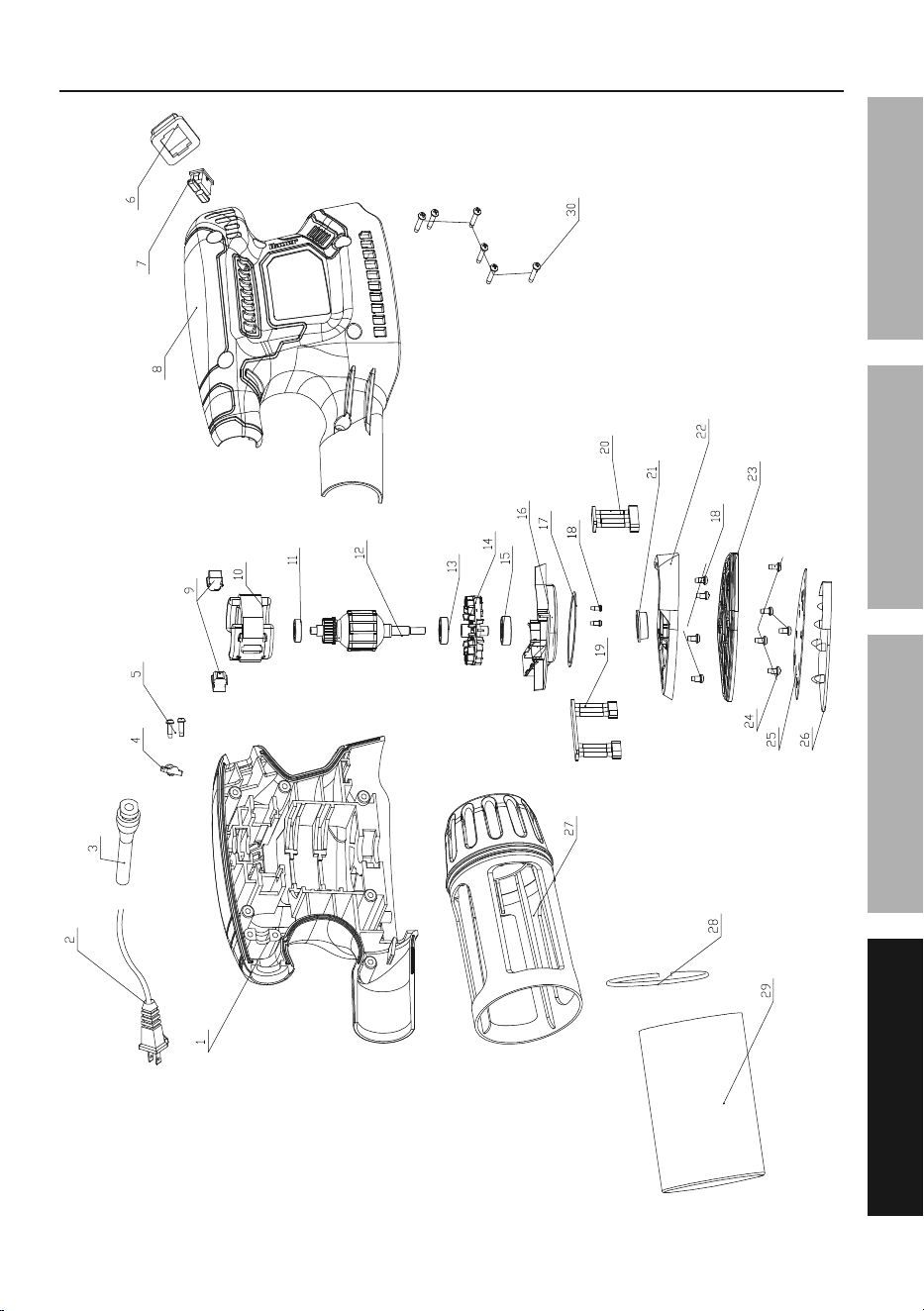
part Description Qty
1 Left Housing 1
2 Power Cord 1
3 Strain Relief 1
4 Cord Clamp 1
5 Screw, ST4 x 12 2
6 Switch Cover 1
7 Power Switch 1
8 Right Housing 1
9 Carbon Brush 2
10 Motor Field 1
11 Bearing 1
12 Motor Armature 1
13 Bearing, 627RS 1
14 Fan 1
15 Bearing, 628RS 1
part Description Qty
16 Fan Cover 1
17 Felt 1
18 Screw, ST4 x 8 6
19 Cushion Support Rear 1
20 Cushion Support Front 1
21 Bearing Cover 1
22 Aluminum Plate 1
23 Base 1
24 Screw, M4 X 8 5
25 Sandpaper 1
26 Base Plate 1
27 Holder 1
28 Dust Bag Spring 1
29 Dust Bag 1
30 Screw, ST4 X 16 6
parts List and Diagram
parts List
pLEaSE rEaD tHE FOLLOWinG carEFuLLy
THE MANUFACTURER AND/OR DISTRIBUTOR HAS PROVIDED THE PARTS LIST AND ASSEMBLY DIAGRAM
IN THIS MANUAL AS A REFERENCE TOOL ONLY. NEITHER THE MANUFACTURER OR DISTRIBUTOR
MAKES ANY REPRESENTATION OR WARRANTY OF ANY KIND TO THE BUYER THAT HE OR SHE IS
QUALIFIED TO MAKE ANY REPAIRS TO THE PRODUCT, OR THAT HE OR SHE IS QUALIFIED TO REPLACE
ANY PARTS OF THE PRODUCT. IN FACT, THE MANUFACTURER AND/OR DISTRIBUTOR EXPRESSLY
STATES THAT ALL REPAIRS AND PARTS REPLACEMENTS SHOULD BE UNDERTAKEN BY CERTIFIED AND
LICENSED TECHNICIANS, AND NOT BY THE BUYER. THE BUYER ASSUMES ALL RISK AND LIABILITY
ARISING OUT OF HIS OR HER REPAIRS TO THE ORIGINAL PRODUCT OR REPLACEMENT PARTS
THERETO, OR ARISING OUT OF HIS OR HER INSTALLATION OF REPLACEMENT PARTS THERETO.
record product’s Serial number Here:
note: if product has no serial number, record month and year of purchase instead.
note: Some parts are listed and shown for illustration purposes only, and are not available
individually as replacement parts. Specify UPC 193175427847 when ordering parts.
Page 15For technical questions, please call 1-888-866-5797.Item 57946
SaFEtyOpEratiOnMaintEnancE SEtup
Diagram

26541 agoura road • calabasas, ca 91302 • 1-888-866-5797
Limited 90 Day Warranty
Harbor Freight Tools Co. makes every effort to assure that its products meet high quality and durability
standards, and warrants to the original purchaser that this product is free from defects in materials
and workmanship for the period of 90 days from the date of purchase. This warranty does not apply to
damage due directly or indirectly, to misuse, abuse, negligence or accidents, repairs or alterations outside
our facilities, criminal activity, improper installation, normal wear and tear, or to lack of maintenance.
We shall in no event be liable for death, injuries to persons or property, or for incidental, contingent,
special or consequential damages arising from the use of our product. Some states do not allow the
exclusion or limitation of incidental or consequential damages, so the above limitation of exclusion
may not apply to you. THIS WARRANTY IS EXPRESSLY IN LIEU OF ALL OTHER WARRANTIES,
EXPRESS OR IMPLIED, INCLUDING THE WARRANTIES OF MERCHANTABILITY AND FITNESS.
To take advantage of this warranty, the product or part must be returned to us with transportation charges
prepaid. Proof of purchase date and an explanation of the complaint must accompany the merchandise.
If our inspection verifies the defect, we will either repair or replace the product at our election or we may
elect to refund the purchase price if we cannot readily and quickly provide you with a replacement. We will
return repaired products at our expense, but if we determine there is no defect, or that the defect resulted
from causes not within the scope of our warranty, then you must bear the cost of returning the product.
This warranty gives you specific legal rights and you may also have other rights which vary from state to state.