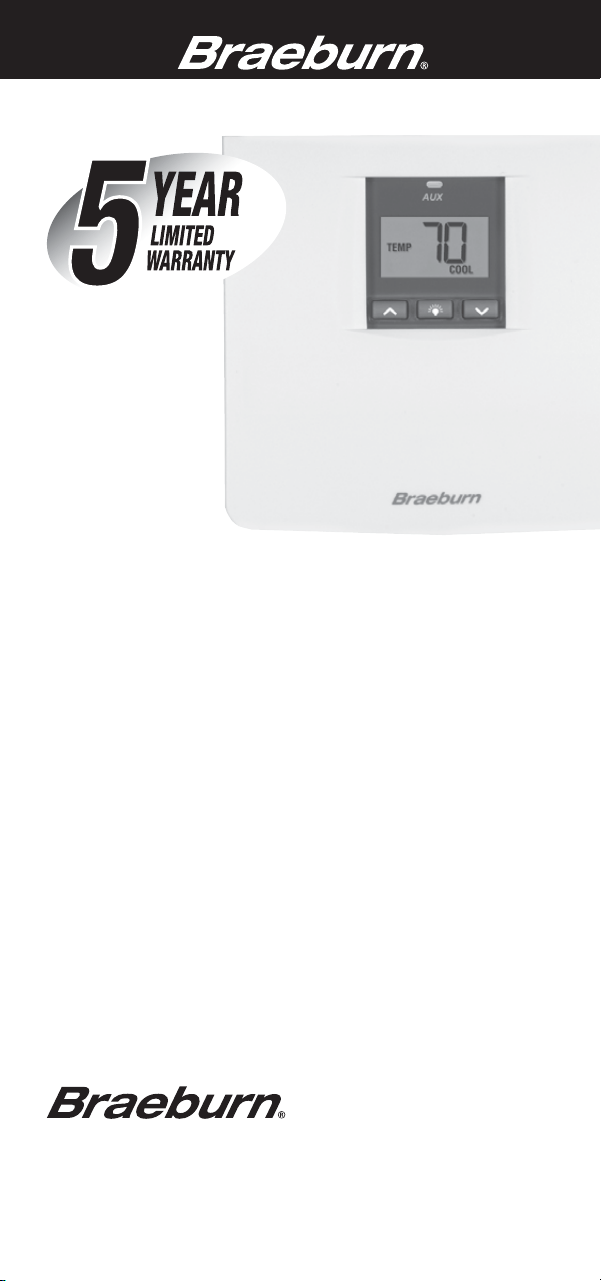
MODEL
3100
USER MANUAL
Compatible with low voltage multi-stage
heat / cool systems with up to two stages of
heating and two stages of cooling.
READ ALL INSTRUCTIONS BEFORE PROCEEDING
© 2005 Braeburn Systems LLC • Patents Pending • All Rights Reserved. Pub. No. 3100-100-006
WARNING!
Important Safety Information
• Always turn off power to the air conditioning or heating system prior to
installing, removing, cleaning or servicing thermostat.
• Read manual thoroughly prior to installing, programming or operating thermostat.
• This thermostat is designed for use with a 24 Volt-AC low voltage multi-stage
heat / cool system.
• Do not use this thermostat on systems with voltages higher than 30 Volt-AC.
• This thermostat requires 24 Volt AC power for normal operation and control of
the heating or cooling system.
• Wiring must conform to all building codes and ordinances as required by local
and national code authorities having jurisdiction.
• Do not short (or jumper) across terminals on the gas valve or at the heating or
cooling system control board to test the thermostat installation. This could
damage the thermostat and void the warranty.
• Do not select COOL mode of operation if the outside temperature is below 50˚ F
(10˚ C). This could possibly damage the controlled cooling system and may
cause personal injury.
• This thermostat should only be used as described in this manual. Any other use
is not recommended and will void the warranty.
SPECIFICATIONS
1
• Electrical Rating: 24 Volt AC (18-30 Volt AC)
2 amp maximum load per terminal
4 amp total maximum load (all terminals)
• Control Range: 45˚ - 90˚ F (7˚ - 32˚ C)
• Accuracy: +/- 1˚ F (+/- .5˚ C)
• AC Power: 18-30 Volt AC
• Compatibility: Multi-stage heat / cool systems with up to two stages of heating
and two stages of cooling.
• Terminations: R, Y1, Y2, W1, W2, G, O, B, C
INSTALLATION
2
2.1
Replacing Existing Thermostat
1.
Always turn off power to the air conditioning or heating system prior to removing
existing thermostat.
2.
Remove the cover of your old thermostat and locate the wire terminals. Do not
remove wires from terminals yet.
3.
Using small pieces of masking tape label wires prior to removal from terminals. Use
the chart below to determine the new terminal designations for your new thermostat.
4.
After labeling and removing all wires from terminals, unscrew the existing thermostat
sub-base from wall. Make sure to secure wires to prevent them from slipping back
into the hole in the wall.
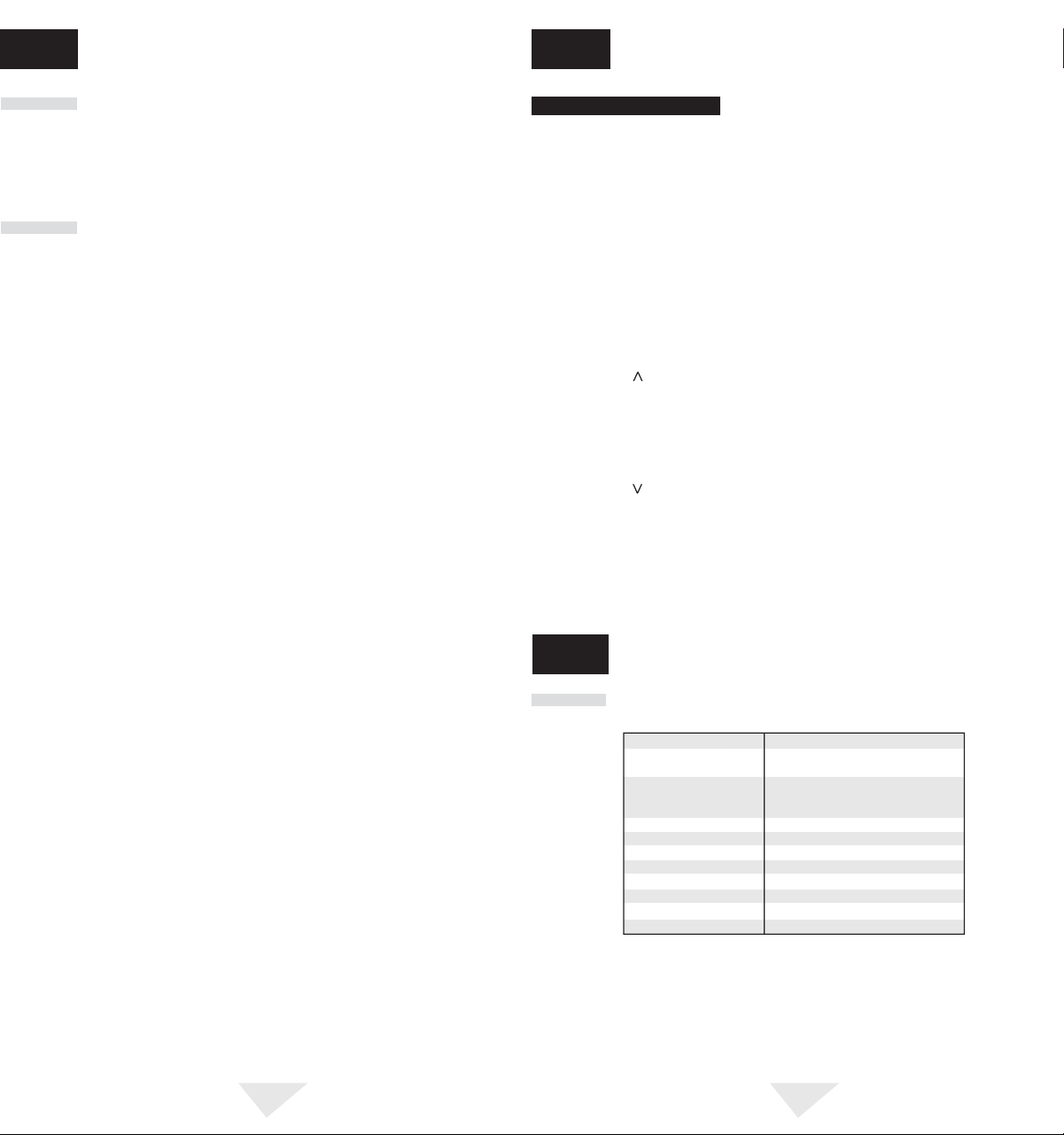
Old Terminal from New Terminal for
Existing Thermostat New Thermostat Terminal Description
R, V-VR or VR-R R 24 VAC
Y, Y1 or M Y1 1st Stage Cooling
Y2 Y2 2nd Stage Cooling
W1 W1 1st Stage Heating
W2 or W-U W2 2nd Stage Heating
G or F G Fan Control
O or R O Reversing Valve (Cooling)
B B Reversing Valve (Heating)
C, X or B C Transformer Common
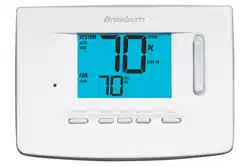
Premier Series
Non-Programmable
2 Heat / 2 Cool & Heat / Cool
Digital Thermostat
CONTENTS
SPECIFICATIONS
INSTALLATION
TESTING YOUR NEW THERMOSTAT
PROGRAMMING USER SETTINGS
ADDITIONAL OPERATION FEATURES
TROUBLESHOOTING
WIRING DIAGRAM
1
2
3
4
5
6
7
1
2 3
INSTALLATION
2
2.1
Replacing Existing Thermostat cont.
Installing Your New Thermostat
NOTE: If you are installing this thermostat in a new installation be sure to locate
the thermostat 4 to 5 feet above the floor in accordance with applicable building
codes. Make sure to install the thermostat in a location that provides good airflow
characteristics and avoid areas behind doors, near corners, air vents, direct sunlight
or near any heat generating device. Installation in any of these areas could impact
thermostat performance.
1.
Always turn off power to the air conditioning or heating system prior to
installing thermostat.
2.
Place system switch on front of thermostat to OFF position.
3.
Place fan control switch on front of thermostat to AUTO position.
4.
Remove front of thermostat from sub-base by pressing release latch on bottom
of thermostat.
5.
Place the thermostat sub-base against wall in the desired thermostat location.
6.
Guide thermostat wires through center hole in sub-base. Continue to hold
against wall.
7.
Mark placement of mounting holes and drill using a 3/16" drill bit. Gently tap supplied
plastic anchors into the holes in the wall.
8.
Place the sub-base against the wall in the desired location, making sure the mounting
holes are aligned and the thermostat wires are properly inserting through opening
in sub-base.
NOTE: This thermostat is for use on low voltage 24 Volt AC multi-stage heat / cool
systems with up to two stages of heating and two stages of cooling and requires a
transformer common wire for proper installation. This thermostat is not for use on
single stage heating or cooling systems.
TESTING YOUR
NEW THERMOSTAT
3
NOTE: Test your thermostat prior to programming any user settings. Pressing the
RESET button will erase any user entries previously programmed. This will erase all
user settings and return them to their default values.
WARNING!
Read BEFORE Testing
1. Place the system switch in the HEAT position.
2. Press the button on the keypad until the setpoint temperature setting is a minimum of 3 degrees
higher than the current room temperature. The heating system should start within several seconds.
The fan may not turn on immediately due to the heating system built-in fan delay.
3. Place the system switch in the OFF position. The heating system should stop within
several seconds.
4. Place the system switch in the COOL position.
5. Press the button on the keypad until the setpoint temperature is a minimum of 3 degrees lower
than the current room temperature.
6. The cooling system should start within several seconds. Place the system switch in the OFF
position. The cooling system should stop within 90 seconds (dependent on the setting of the
Residual Cooling Fan Feature).
7. Place the fan switch in the ON position. The system blower should start.
8. Place the fan switch in the AUTO position. The system blower should stop.
• Do not short (or jumper) across terminals on the gas valve or at the heating or cooling
system control board to test the thermostat installation. This could damage the
thermostat and void the warranty.
• Do not select COOL mode of operation if the outside temperature is below 50˚ F
(10˚ C). This could possibly damage the controlled cooling system and may cause
personal injury.
• This thermostat includes an automatic compressor protection feature to avoid potential
damage to the system from short cycling. This thermostat automatically provides a
5-minute delay after turning off the cooling system output to protect the compressor.
4.1
Default Thermostat Settings
Function Status After Reset
Operation Mode Normal Operating Mode
Room Temperature 70˚ F (21.0˚ C), to be renewed within
5 seconds
Setpoint Temperature According to system switch:
62˚ F (17.0˚ C) for Heat and Off
85˚ F (29.0˚ C) for Cool
Temperature Scale ˚F or ˚C dependent on switch setting
First Stage Differential .5˚ F (0.25˚ C)
Second Stage Differential 2˚ F (1.0˚ C)
Residual Cooling 60 Seconds
Short Cycle Protection Timer Reset
Output Relays Off
Recirculating Fan Timer Reset with 120 minute off cycle
Keypad Lock Unlocked
cont.
2.2
9. Fasten the sub-base to wall using supplied screws.
10. Connect wires to quick wiring terminal block as appropriate using the new terminal
designations. Refer to Wiring Diagram section of this manual if required for assistance.
11. Make sure all of the wire connections are secure and are not touching any other
terminal to prevent electrical shorts and potential damage to the thermostat.
12. Turn the front thermostat body over exposing the rear view of the circuit board.
13. Locate the internal ˚F / ˚C switch on the circuit board.
14. Using your finger, gently flip the switch toward the preferred temperature ˚F / ˚C scale.
15. Locate the internal fan option switch, HG (Gas) / HE (Elec) on the circuit board. This
switch controls the heating system fan delay. Select gas for gas or oil fired systems.
This will allow the furnace to run for a few seconds before initiating the fan. Select
electric for systems with electric furnace elements that require the fan to come
on immediately.
16. Using your finger, gently flip the switch towards the HG (gas) or HE (Elec) selection
which indicates the low voltage heating system the thermostat will control.
17. Attach front body of thermostat to sub-base of thermostat being careful to align the
terminal pins on the front body with the terminal block on the sub-base.
18. Restore system power so you can test installation.
PROGRAMMING
USER SETTINGS
4
4
PROGRAMMING
USER SETTINGS
4
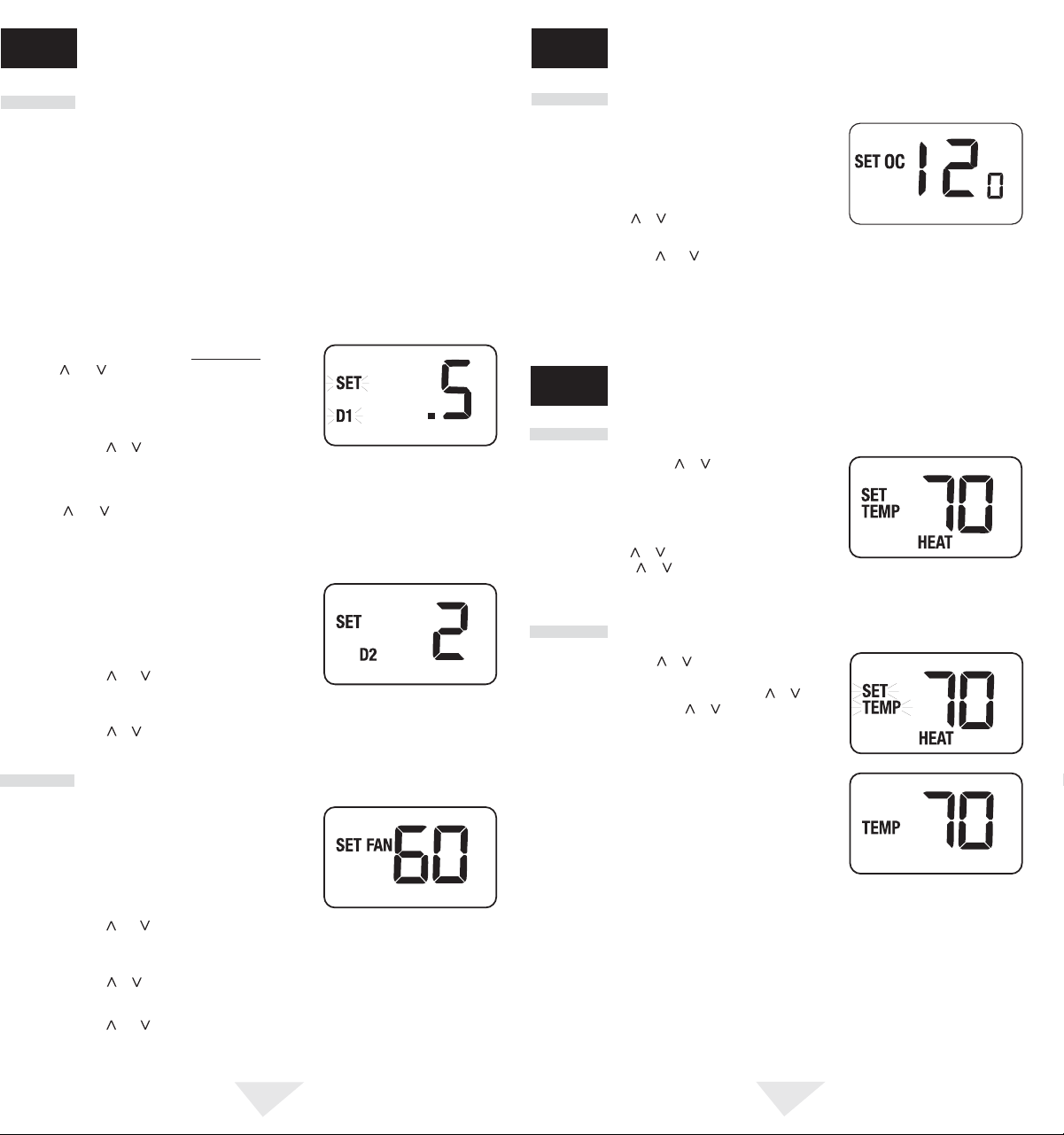
Setting Temperature Differentials
Setting First Stage Differential
NOTE: The first and second stage differential settings are the same for both the
heating and cooling systems.
NOTE: If you do not wish to change the second stage differential setting, you can press
the and buttons at the same time twice to proceed to the Residual Cooling fan
setting–see 4.3.
The default settings for the first and second stage differentials and residual cooling fan delay
settings are compatible with most systems and applications. This is normally set at time of
installation and usually does not require any modification under normal operating conditions.
If you feel that the first or second stage of your system is turning on too often, or you wish to
change the fan delay settings, follow the instructions below.
2.
Press the or button to set the first stage
differential to your desired setting of .5˚, 1˚, or 2˚ F (0.25˚, .5˚, or 1˚ C).
The default setting is .5˚ F (0.25˚ C). The room temperature must change .5˚ F (0.25˚ C) from
the setpoint temperature before the thermostat will initiate the system in heating or cooling.
1.
In normal operating mode, press and hold the
and button at the same time for 4 seconds.
LCD display will show "SET D1 X˚", where "X"
equals the ˚F / ˚C differential setting. This is the
current first stage differential setting.
Setting Residual Cooling Fan Feature
Setting Second Stage Differential
The default setting is 2˚ F (1.0˚ C). This means that
the room temperature must change 2˚ F (1.0˚ C) in
addition to the first stage differential setting before the
thermostat will initiate the second stage of the system
in heating or cooling.
3.
Press the and buttons at the same time again
and the LCD display will show "SET D2 X˚", where "X"
equals the ˚F / ˚C differential setting. This is the current second stage differential setting.
4.
Press the or button to set the second stage differential to your desired setting of 2˚, 3˚,
4˚, 5˚, or 6˚ F (1.0˚, 1.5˚, 2.0˚, 2.5˚, or 3.0˚ C).
4.2
cont.
1.
Press the and buttons at the same time again and the LCD display will show
"SET FAN XX", where "XX" equals the fan delay time in seconds during the cooling
mode of operation.
2.
Press the or button to set the residual cooling fan delay to your desired setting
of 0 (disabled), 30, 60, or 90 seconds.
The default setting is 60 seconds. During the COOL
mode of normal operation the fan will stay on for 60
seconds after the cooling system has satisfied the
setpoint temperature and has turned off the
compressor. This allows the system to provide
higher efficiency during cooling operation.
3.
Press the and buttons at the same time again to set the Recirculating Fan Cycle
or wait 5 seconds and the thermostat will automatically return to normal operating mode.
4.3
5.2
Changing Set Temperature
1.
Press and hold or button for 3 seconds. The
entire display will flash once and the SET TEMP
indicator will be flashing. Release the or
button and press the or button again as
desired to adjust the set temperature.
2.
The display will return to normal operating mode
after 5 seconds.
3.
The TEMP indicator will be showing in the display
indicating that the current temperature shown in the
display is the room temperature.
5
5.1
Review Set Temperature
1.
Press and hold the or button. The current
setpoint temperature will be displayed in the place
of the current room temperature, and the indicator
SET TEMP will be displayed.
2.
The display will return to normal operating mode
when the or button is released. Continuing
to hold the or button for 3 seconds or longer
will allow the user to change the current setpoint
temperature (See Changing Set Temperature).
ADDITIONAL
OPERATION FEATURES
5
PROGRAMMING
USER SETTINGS
cont.
4
4.4
Setting the Recirculating Fan Cycle (Also see section 5.3)
The default is 120 minutes.
1. The display will show "SET OC XXX", where XXX is
the maximum interval of time (in minutes) that the
fan will remain off if the Recirculating Fan Mode
is selected.
2. Press the or button to change the Recirculating
Fan off cycle (120, 60, or 40 minutes).
3. Press both the and buttons at the same time again to return to the normal
operating mode, or wait 5 seconds for the thermostat to return to the normal
mode automatically.
NOTE: To erase all user program setting, gently press the RESET button using a paper clip
or a small pencil tip. This will return all thermostat settings to their default values.
NOTE: Select either Cool or Heat with the system
switch to view or change separate cooling or
heating setpoints.
76
NOTE:
The installer can reset the thermostat and bypass the compressor protection
features by pressing the RESET button. This will erase all user program settings and should
only be used during installation for testing purposes or to reset a thermostat to regain normal
operation. This will return all thermostat settings to their default values. The user will have to
re-program all of the erased settings.
5.5
Compressor Protection
5.6
Resetting Thermostat
5.7
LED Status Indicator
This thermostat includes an automatic compressor protection feature to avoid potential
damage to the system from short cycling. This thermostat automatically provides a 5-minute
delay after turning off the cooling output to protect the compressor.
The Reset feature allows the user to completely reset the thermostat. To erase all entered
program settings, gently press the RESET button using a paper clip or a small pencil tip.
This will return all thermostat settings to their default values and register all new manual
switch settings.
The LED status indicator located on the front of your thermostat above the display will notify
you of key system information.
AUX (Green): This will turn on when the auxiliary stage of heating or cooling is active.
Thermostat does not
turn on heating or
cooling system.
Check to see if OFF is shown in display. This indicates that the
system is turned off at the thermostat. Move the system selector
switch to the HEAT or COOL position. After the compressor short
cycle protection 5-minute period expires, the system should
start within a minute.
Compressor protection features may be in effect due to
compressor short cycle conditions. See Compressor Protection
section for full explanation of this feature.
Check thermostat wiring to make sure that the heating and
cooling stages are connected to the correct terminals on the
wiring terminal block. See Installation and Wiring Diagram
sections of this manual.
5
ADDITIONAL
OPERATION FEATURES
cont.
5
ADDITIONAL
OPERATION FEATURES
cont.
SYMPTOM POTENTIAL SOLUTION
TROUBLESHOOTING
6
OFF is shown in
thermostat display
and heating or
cooling system will
not start.
This indicates that the system is turned off at the thermostat.
Move the system selector switch to the HEAT or COOL position.
After the compressor short cycle protection 5-minute period
expires the system should start within several seconds.
Thermostat turns
heating or cooling
system on too often
or not often enough.
Increase or decrease first stage temperature differential setting
as appropriate to provide the desired performance level. See
Setting Temperature Differential and Residual Cooling Fan
Feature section of this manual.
Thermostat turns on
second (auxiliary)
stage of heating or
cooling too quickly or
not quickly enough.
Increase or decrease second (auxiliary) stage temperature
differential setting as appropriate to provide the desired
performance level. See Setting Temperature Differential and
Residual Cooling Fan Feature section of this manual.
5.3
Recirculating Fan Mode (see section 4.4)
5.4
Keypad Lockout
The Recirculating Fan Mode provides more even temperature distribution and improves
indoor air quality by circulating air through the furnace filtration system more often.
The Recirculating Fan Mode can be selected by moving the fan switch to the recirculate
position
®
. If no call for heating or cooling occurs within the fan off cycle set in section
4.4, the fan will run for 12 minutes. The highest setting, 120 minutes (factory default), will
run the fan least often–10% minimum run time. The lowest setting, 40 minutes, will run the
fan most often–30% minimum run time. During any call for heating or cooling, fan control
operates in the AUTO mode. This feature is available in the HEAT, OFF, or COOL mode.
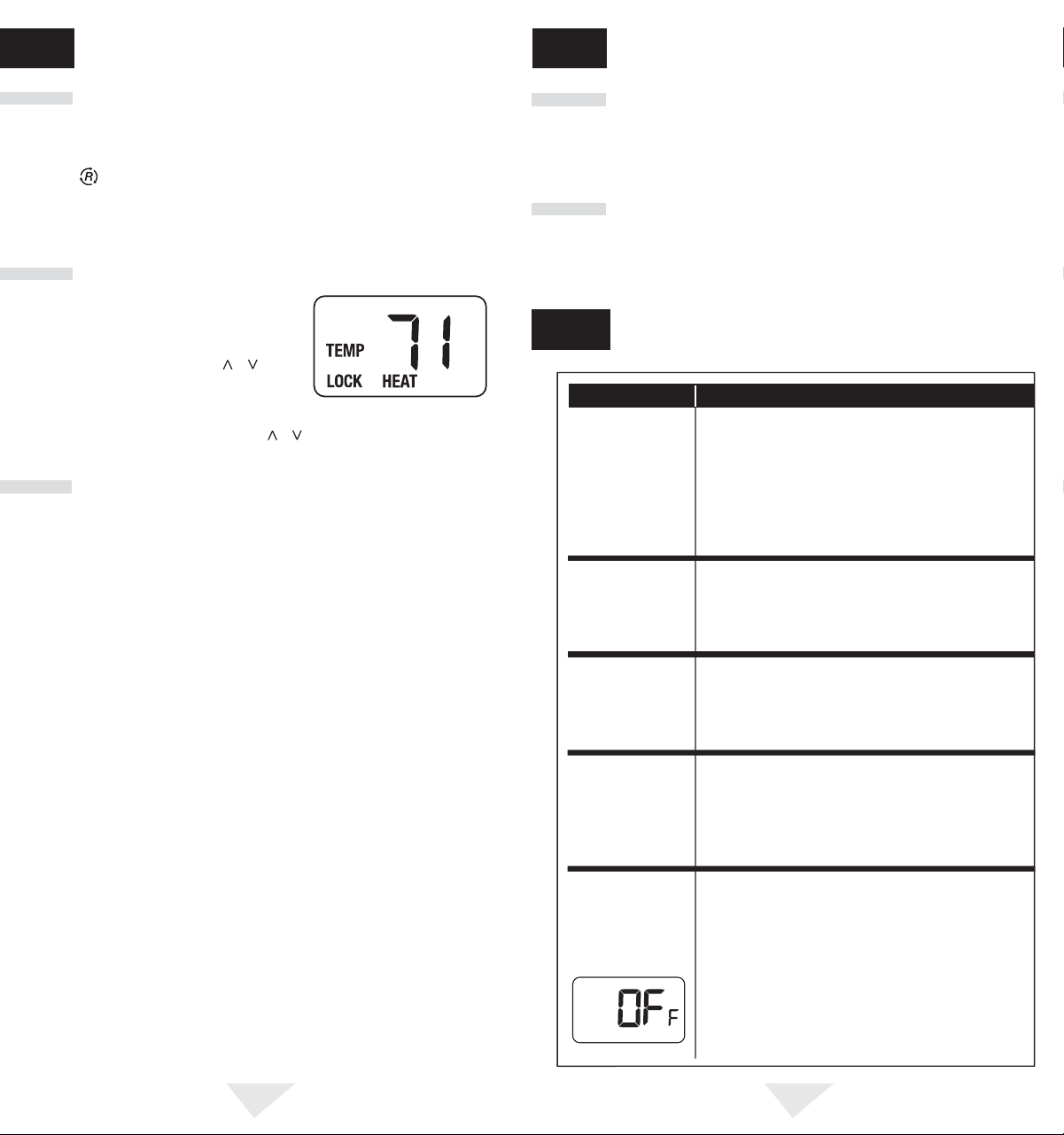
To prevent accidental or undesired adjustment of the
thermostat set point, the Keypad Lockout feature
disables the operation of the temperature setting keys,
but not the backlight key. In order to enable the
keypad lock, press and hold either the or button
together with the backlight button for 5 seconds. The
LOCK icon in the display will flash once per second,
then appear continuously in the display. The keypad is now locked.
To unlock the keypad, press and hold either the or button together with the backlight key
for 1 second. The LOCK icon will disappear from the display, and the keypad is now unlocked.
Thermostat turns on
heating instead of
cooling or cooling
instead of heating.
8 9
10
Thermostat display
is blank.
It is possible that AC power is not present at the thermostat.
Check fuse, circuit breaker and thermostat wiring as appropriate
to verify AC power is available.
If AC Power is present, call a professional service technician
immediately to verify thermostat and system performance.
WIRING DIAGRAM
7
SYMPTOM POTENTIAL SOLUTION
Thermostat will not
allow me to program
a setpoint
temperature higher
than 90˚ F (32˚ C).
This is above the normal thermostat temperature setting range
of 45˚ to 90˚ F (7˚ to 32˚ C).
Thermostat will not
allow me to program
a setpoint
temperature lower
than 45˚ F (7˚ C).
This is below the normal thermostat temperature setting range
of 45˚ to 90˚ F (7˚ to 32˚ C).
Fan continues to run
all the time whether
the system is on
or off.
Check that the fan control switch is in the AUTO position.
This will allow the fan to run only when the heating or cooling
system is turned on and running.
Check thermostat wiring to make sure that the fan control
wiring is connected to the correct terminals on the wiring
terminal block. See Installation and Wiring Diagram sections
of this manual.
Fan continues to run
in cooling mode when
the system has
turned off.
The Residual Cooling Fan Control Feature can allow up to a 90
second fan delay after cooling system shutdown for energy
efficiency gains. The default setting is 60 seconds. This can be
changed to disable this feature or shorten the time period if
desired. See Setting Residual Cooling Fan Feature section of
this manual.
The room is too
warm or too cold.
See Review Set Temperature section of this manual to verify the
current setpoint and make any modifications that are necessary.
Fan runs
intermittently or
when system is off.
Thermostat will not
allow me to change
the setpoint.
LO is shown in the
thermostat display
where the room
temperature is
normally displayed.
HI is shown in the
thermostat display
where the room
temperature is
normally displayed.
The temperature sensed by the thermostat is higher than the
90˚ F (32˚ C) upper limit of the thermostats display range.
The display will return to normal after the sensed temperature
lowers within the 45˚ to 90˚ F (7˚ to 32˚ C) display range.
Turn on the cooling system or use other methods to lower
the temperature accordingly.
This condition could occur from the system being turned off
during an exceptionally warm period or upon installation when
the thermostat has been stored for a long period of time in a
warm vehicle or location prior to being installed. The thermostat
is equipped with a mechanical high temperature safety switch
that will turn off the thermostat should the temperature exceed
99˚ F (37˚ C).
TROUBLESHOOTING
6
cont.
SYMPTOM POTENTIAL SOLUTION
TROUBLESHOOTING
6
cont.
Keypad is locked. Press either the or key along with the
backlight key to unlock.
Fan switch is in the Recirculate Mode ®.
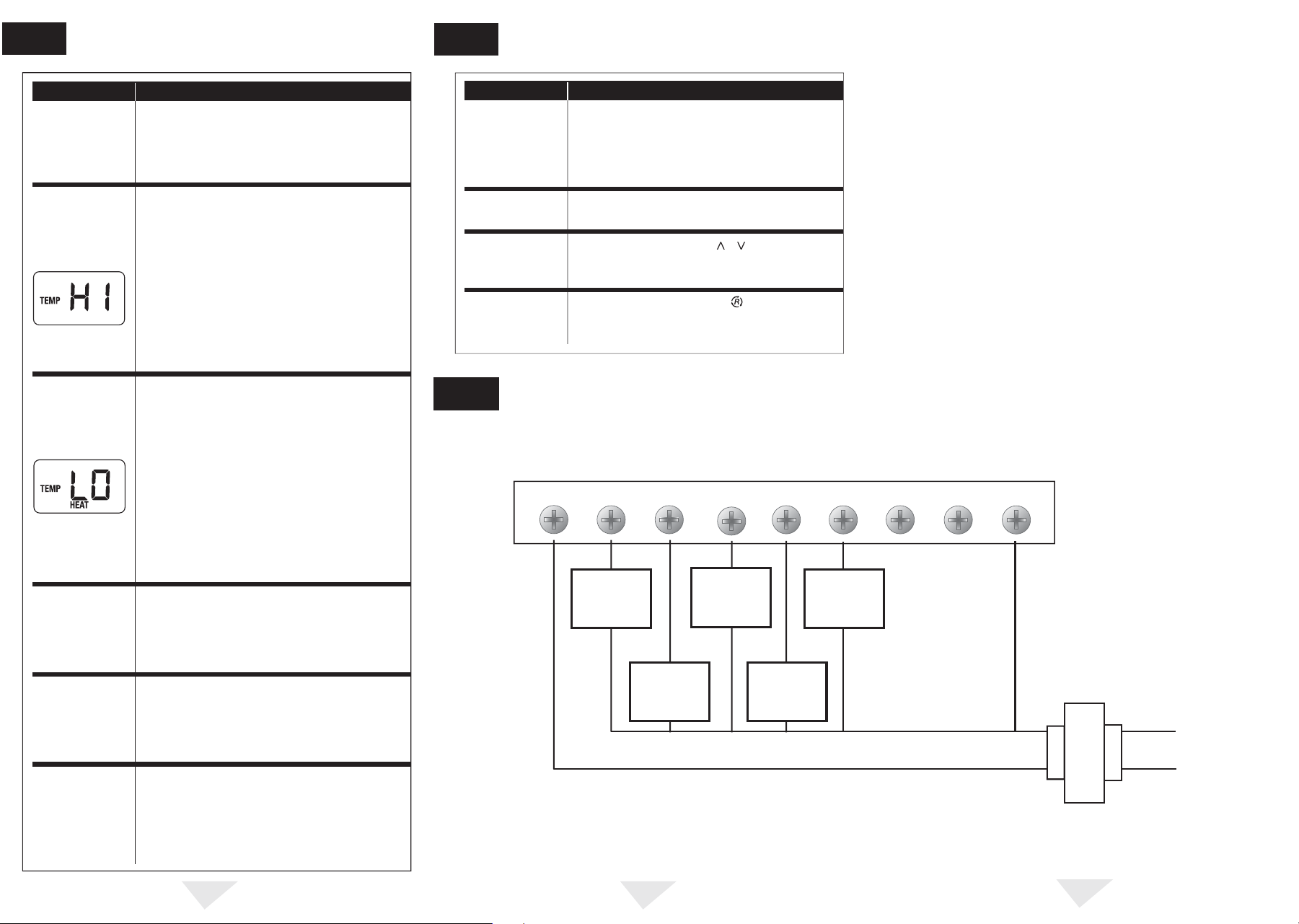
Wiring Diagram for 2 Stage Heat, 2 Stage Cool
R
Y1 Y2
W2
G O B CW1
1st Stage
Compressor
Contact
2nd Stage
Compressor
Contactor
Auxiliary Heat
Relay
(stage 2)
1st Stage
Heat Relay
Fan Relay
Transformer Common
(required)
24 VAC
Neutral
Hot
120 VAC
NOTE: Eliminate connection to Y2 for units with single stage cooling.
The temperature sensed by the thermostat is lower than the
45˚ F (7˚ C) lower limit of the thermostats display range. The
display will return to normal after the sensed temperature rises
within the 45˚ to 90˚ F (7˚ to 32˚ C) display range. If the
temperature in the controlled space seems to be normal, wait
for the thermostat to acclimate to the correct room temperature.
If the room seems to be colder than usual, turn on the heating
system to raise the temperature as needed for comfort within
the room.
This condition could occur from the system being turned off
during a cold weather period or upon installation when the
thermostat has been stored for a long period of time in a cold
vehicle or location prior to being installed. The thermostat should
be allowed to warm up prior to installation to allow proper
heating control once installed.
Store this
booklet for
future reference
© 2005 Braeburn Systems LLC • Patents Pending • All Rights Reserved. Pub. No. 3100-100-006
Braeburn Systems LLC warrants each new Braeburn thermostat against any defects that are
due to faulty material or workmanship for a period of five years after the original date of
purchase by a professional service technician. This warranty and our liability does not apply to
batteries, nor does it include damage to merchandise or the thermostat resulting from
accident, alteration, neglect, misuse, improper installation or any other failure to follow
Braeburn installation and operating instructions.
Braeburn Systems LLC agrees to repair or replace at its option any Braeburn thermostat
under warranty provided it is returned postage prepaid to our warranty facility in a padded
carton within the warranty period, with proof of the original date of purchase and a brief
description of the malfunction. This limited warranty does not include the cost of removal or
re-installation.
This warranty gives you specific legal rights and you may also have other rights that vary from
state to state or province to province. Answers to any questions regarding our limited warranty
may be obtained by writing our corporate offices.
WARRANTY FACILITY: Braeburn Systems LLC
Attn: Warranty Department
2215 Cornell Avenue
Montgomery, IL 60538
Braeburn Systems LLC
2215 Cornell Avenue • Montgomery, IL 60538
Technical Assistance: www.braeburnonline.com
Call us toll-free: 866-268-5599 (U.S. Only)
630-844-1968 (Outside the U.S.)