Form No. 769-11324
(December 7, 2015)
OperatOr’s Manual
CUB CADET LLC, P.O. BOX 361131 CLEVELAND, OHIO 44136-0019
WARNING
READ AND FOLLOW ALL SAFETY RULES AND INSTRUCTIONS IN THIS MANUAL BEFORE ATTEMPTING TO OPER-
ATE THIS MACHINE. FAILURE TO COMPLY WITH THESE INSTRUCTIONS MAY RESULT IN PERSONAL INJURY.
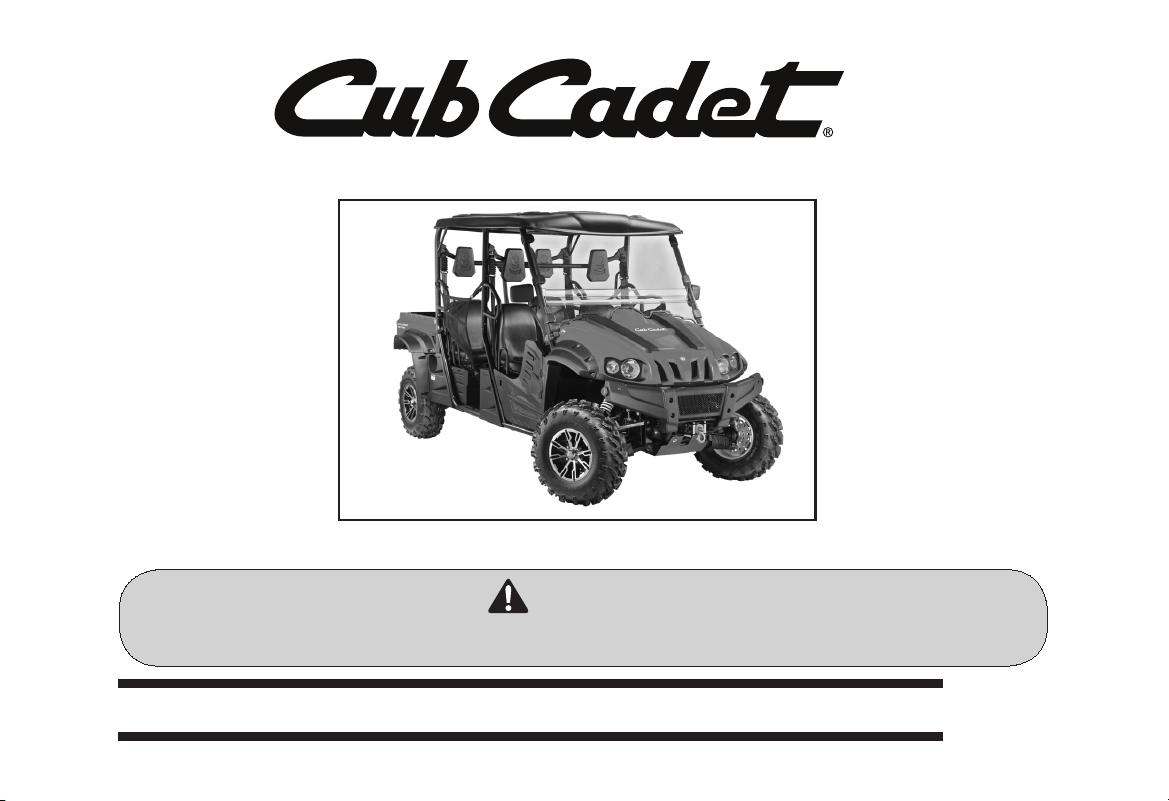
Challenger 750 Crew
Owner's Manual

Owner's Manual
INTRODUCTION
Congratulations on your purchase of the Challenger 750 Crew. This Owner’s / Operator’s manual will
provide you information regarding safe operation, operational instructions, maintenance and care. Fully
understanding this manual and following all of the instructions herein will provide the knowledge needed to
have safe and enjoyable UTV operation.
If you have any questions regarding the operation or maintenance of your UTV, please
consult your dealer.
IMPORTANT SAFETY MESSAGES:
● READ THIS MANUAL CAREFULLY AND COMPLETELY BEFORE OPERATING YOUR UTV. MAKE SURE
YOU UNDERSTAND ALL INSTRUCTIONS.
● PAY CLOSE ATTENTION TO THE WARNING AND CAUTION LABELS ON THE UTV.
● NEVER OPERATE AN UTV WITHOUT PROPER TRAINING OR INSTRUCTION.
● THIS UTV, AND ANY OTHER UTV OVER 90cc, SHOULD NOT BE RIDDEN BY ANYONE UNDER 16 YEARS
OF AGE.
Owner's Manual
IMPORTANT MANUAL INFORMATION
F
AILURE TO FOLLOW THE WARNINGS CONTAINED IN THIS MANUAL CAN RESULT IN SERIOUS INJURY
OR DEATH.
Particularly important information is distinguished in this manual by the following
notations:
The Safety Alert Symbol means ATTENTION!
YOUR SAFETY IS INVOLVED!
Failure to follow WARNING instructions could result in severe injury or death to
the machine operator, bystander or a person inspecting or repairing the
machine.
A CAUTION indicates special precautions that must be taken to avoid damage
to the machine.
A NOTE provides key information to make procedures easier or clearer.
NOTE:

Owner's Manual
IMPORTANT NOTICE
Turning speed must be less than 18MPH (30 km/h)
This UTV is designed and manufactured for OFF - ROAD use only. It is illegal and unsafe to operate this
UTV on any public street, road or highway.
This UTV complies with all applicable OFF - ROAD noise level and spark arrester laws and regulations in
effect at the time of manufacture.
Please check your local riding laws and regulations before operating this UTV.
When the temperature is below -4°F (-20°C), park the UTV in a place where the temperature is higher
than -4°F (-20°C). Start the UTV after the UTV has warmed up. Please see page 6-3 on the warming up
process.
Follow the proper parking procedures when the temperature is higher than 100°F (38°C): turn off the
engine; make sure the radiator fan is on for 3 minutes before turning off the power switch.
Starting the UTV for the first time will take longer because the fuel will need reach the fuel
injectors. To start the UTV the first time, hold the ignition key on at 5-second intervals. Allow the
starter to rest 15 seconds between each start attempt.

Owner's Manual
Location of the Warning and
Specification Labels 1-1
Safety Information 2-1
Description and Vehicle
Identification 3-1
Identification Number Records 3-3
Vehicle Identification Number 3-3
Control Functions 4-1
Main Switch
4-1
Indicator and Warning Lights
4-2
Use of EPS system
4-4
Speedometer Unit
4-5
Odometer and Trip Meter Modes
4-6
Fault code indicator
4-8
Fuel level indicator
4-9
Switches
4-9
Accelerator Pedal
4-13
Brake Pedal
4-15
Parking Brake Lever
4-15
Drive Select Lever
4-16
Fuel Tank Cap
4-17
Front Seats
4-17
Rear Seats
4-19
Seat Belt For Front Seats
4-19
Seat Belt For Rear Seats
4-20
Glove Compartment
4-22
Cargo Bed
4-23
Opening and Closing the Tailgate
4-23
Lifting and Lowering the Cargo
Bed
4-24
Front and Rear Shock Adjustment
4-26
Trailer Hitch Bracket
4-28
Auxiliary DC Jack
4-28
1
2
3
4
Owner's Manual
Pre Operation Checks
5-1
Brakes
5-2
Brake Pedal
5-2
Brake Fluid Level
5-2
Brake Fluid Leakage
5-3
Brake Operation
5-3
Fuel
5-4
Gasohol
5-4
Engine Oil
5-5
Coolant
5-6
Final Gear Oil
5-7
Differential Gear Oil
5-7
Throttle Pedal
5-8
Throttle Freeplay
5-8
Throttle Freeplay Inspection
5-9
Throttle Freeplay Adjustment
5-9
Steering Wheel Inspection
5-10
Seat Belts
5-10
Fittings and Fasteners
5-10
Lights
5-10
Switches
5-10
Tires
5-11
How to Measure Tire Pressure
5-12
Tire Wear Limit
5-13
Operation 6-1
Starting the Engine in Low
Temperatures
6-1
Starting the Engine
6-2
Warming Up
6-4
Drive Select Lever Operation and
Driving In Reverse
6-4
Parking
6-7
Parking on a Slope
6-8
Vehicle Break-in Period
6-9
Engine Break-In
CVT Break-in
6-9
6-11
Accessories
6-11
Loading
6-12
6
5

Owner's Manual
Driving Your Vehicle 7-1
Getting to Know Your Vehicle
7-1
Learning to Operate Your Vehicle
7-5
Turning your Vehicle
Operating Improperly in Reverse
7-6
7-7
Braking
7-7
Going Uphill
7-8
Going Downhill
7-10
Crossing Through Shallow Water
7-11
Vehicle Immersion
7-12
Riding Over Rough Terrain
7-15
Riding in Brush or Wooded Areas
7-15
Encountering Obstacles on the
Trail
7-16
Periodic Maintenance and
Adjustment 8-1
Periodic Maintenance Chart for the
Emission Control System
8-3
General Maintenance and
Lubrication Chart
8-4
Hood
8-7
Console
8-8
EFI system
8-9
To Change the Engine Oil
8-14
Final Gear Oil
8-17
Changing the Final Gear Oil
8-18
Differential Gear Oil
8-19
Changing The Differential Gear Oil
8-20
Coolant
8-22
Axle Boots
8-23
Spark Plug Inspection
8-24
Inspection
8-25
Installation
8-25
Cleaning the Air Filter Elements
8-26
V-belt Cooling Duct Check Hose
8-30
V-belt Case Drain Plug
8-31
Cleaning the Spark Arrester
8-32
Valve Clearance
8-33
Front Brake Pad Check
8-33
7
8

Owner's Manual
Rear Brake Pad Check
8-34
Checking the Brake Fluid Level
8-35
Brake Fluid Replacement
8-36
Checking the Brake Pedal
8-36
Parking Brake Lever Free Play
Adjustment
8-37
Brake Pedal and Accelerator Pedal
Lubrication
8-39
Rear Knuckle Upper and Lower
Pivot Lubrication
8-40
Steering Shaft Lubrication
8-40
Wheel Removal
8-41
Wheel Installation
8-42
Battery
8-43
Battery Maintenance
8-45
Fuse Replacement
8-46
Replacing Headlight Bulb
8-48
Headlight Beam Adjustment
8-51
Tail/brake Light Bulb Replacement
8-51
Troubleshooting
8-53
Solution to Common Problems in
the Vehicle
8-54
Cleaning and Storage 9-1
Cleaning 9-1
Storage
9-3
Specifications 10-1
Fault code of Electronic
Injection System 11-1
USA EPA Emissions Limited
Warranty 12-1
12
9
10
11
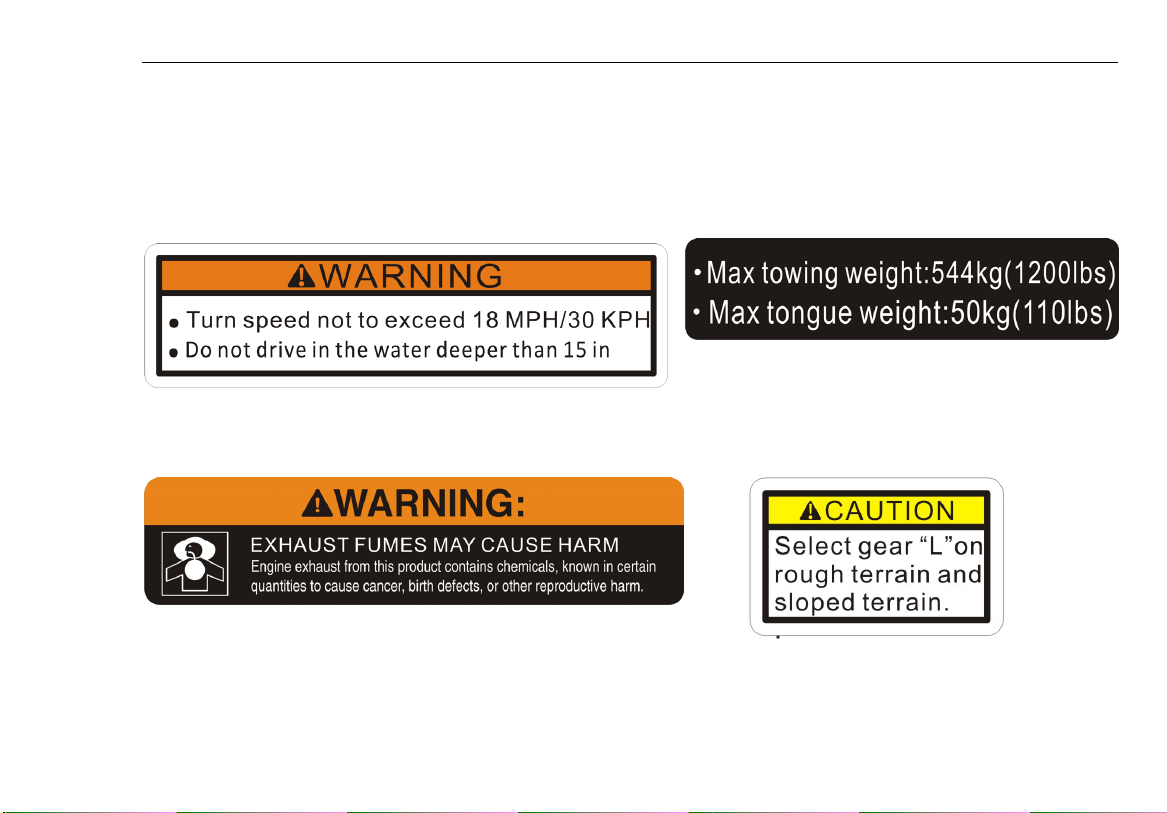
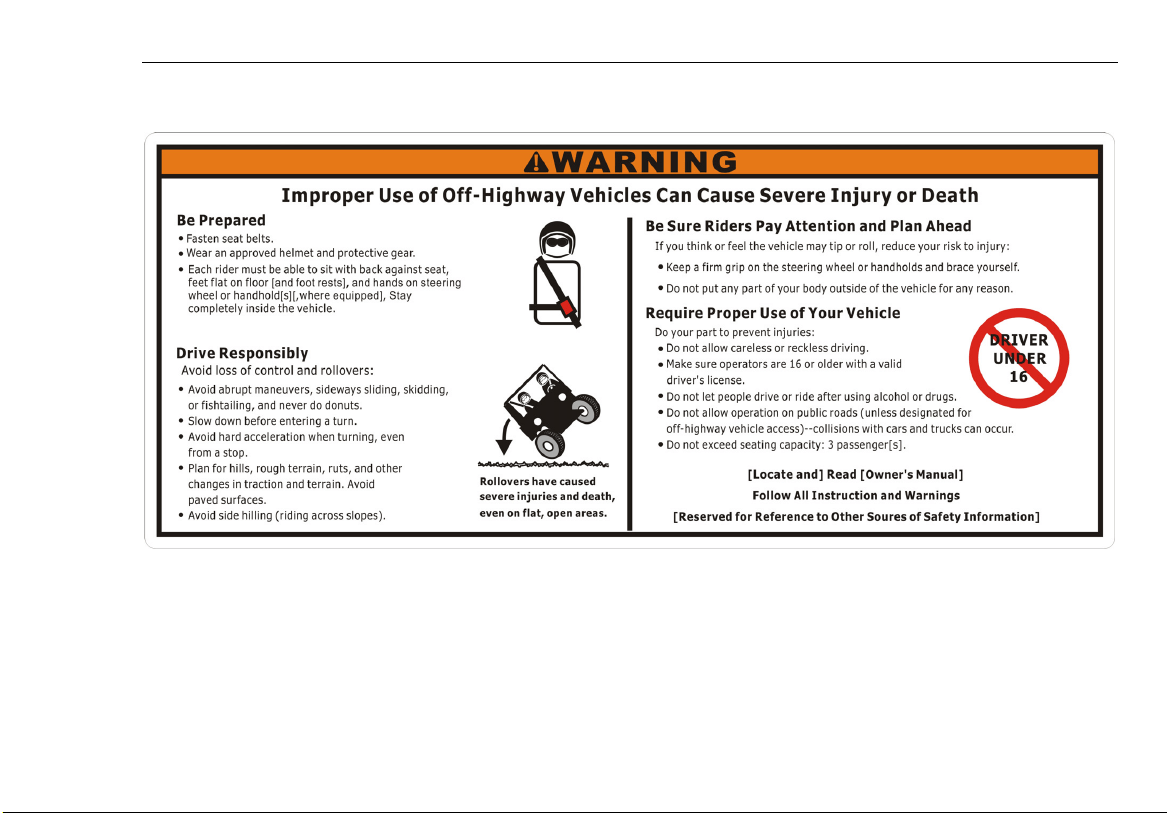
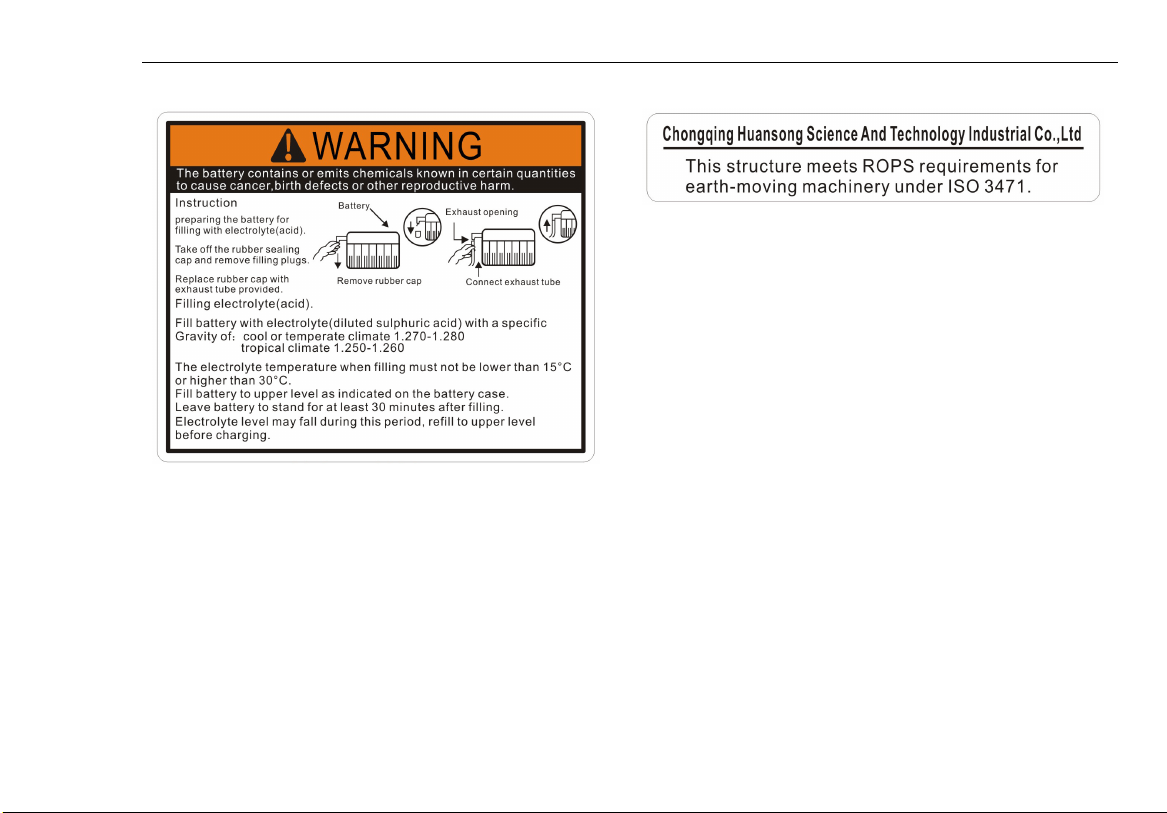
Location of the Warning and Safety Labels 1-1
Read and understand all of the labels on your vehicle. They contain important information for
safe and proper operation of your vehicle.
Never remove any labels from your vehicle. If a label becomes difficult to read or comes off, a
replacement label is available from your dealer.
1 3
2 4
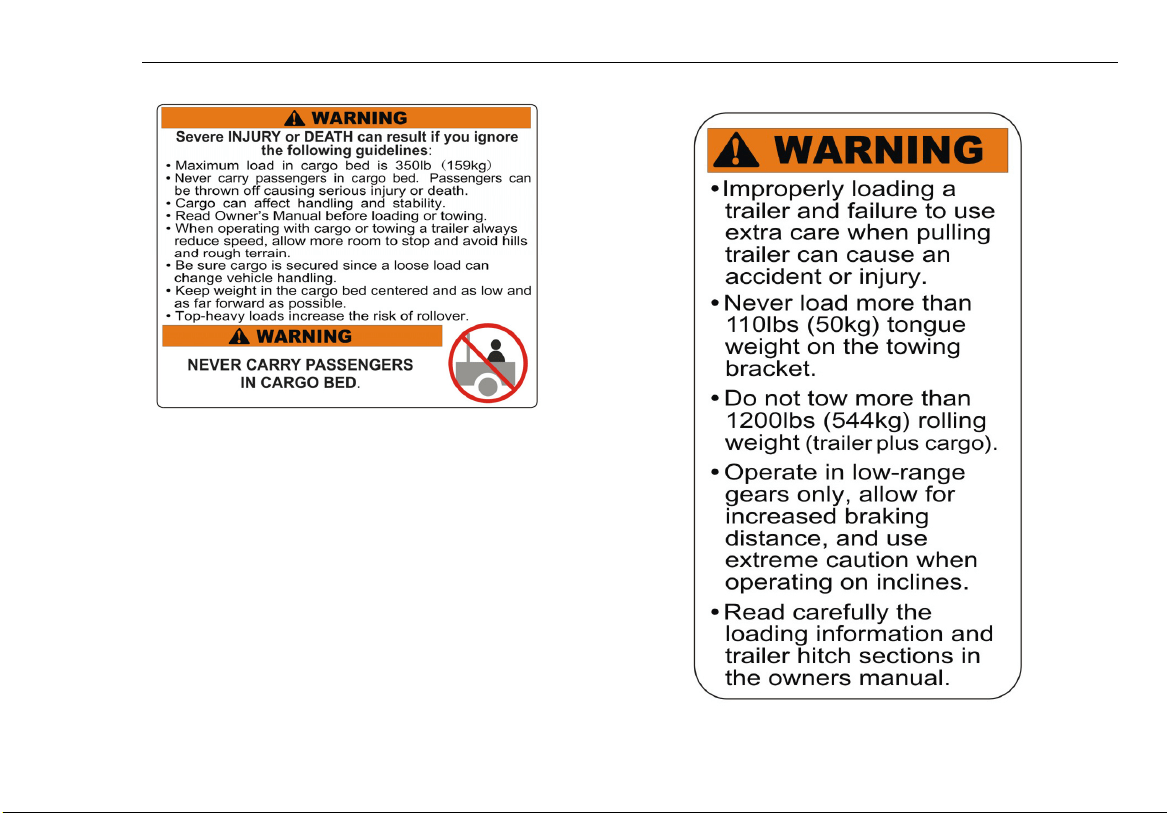
1-2 Location of the Warning and Safety Labels
5 6
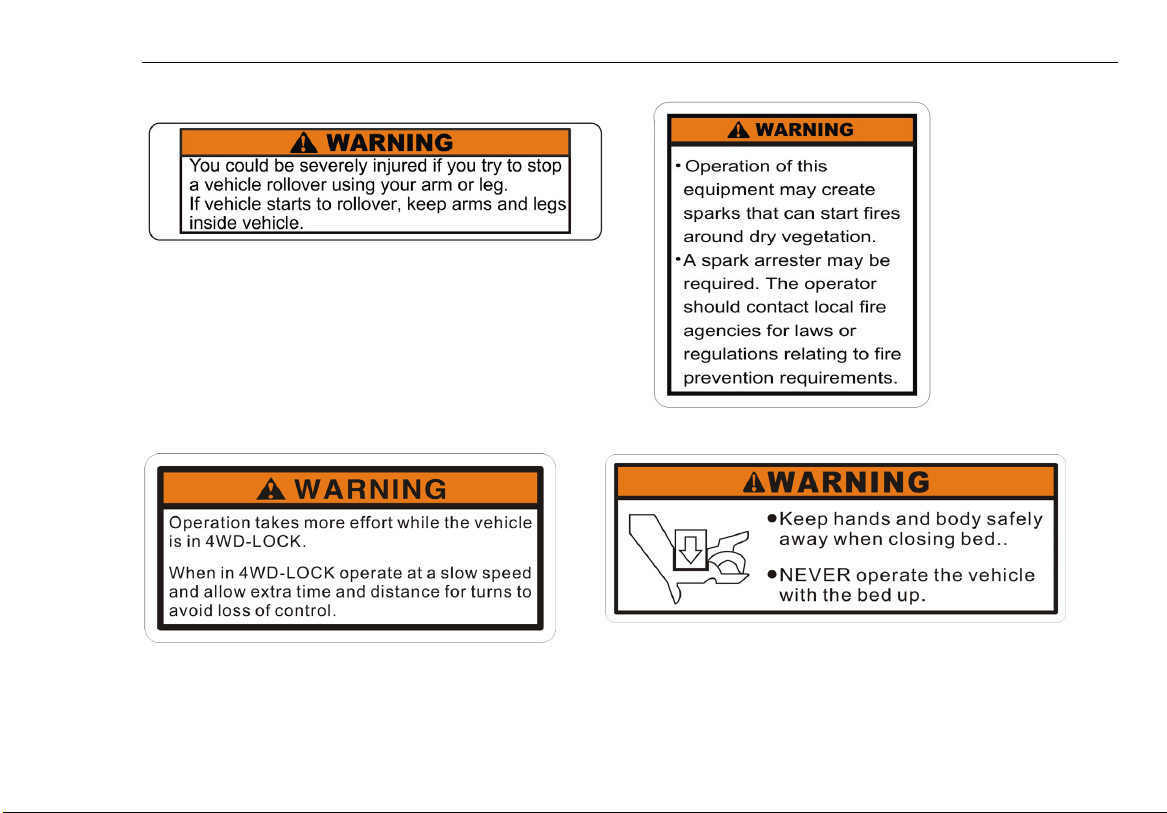
Location of the Warning and Safety Labels 1-3
7 9
8 10
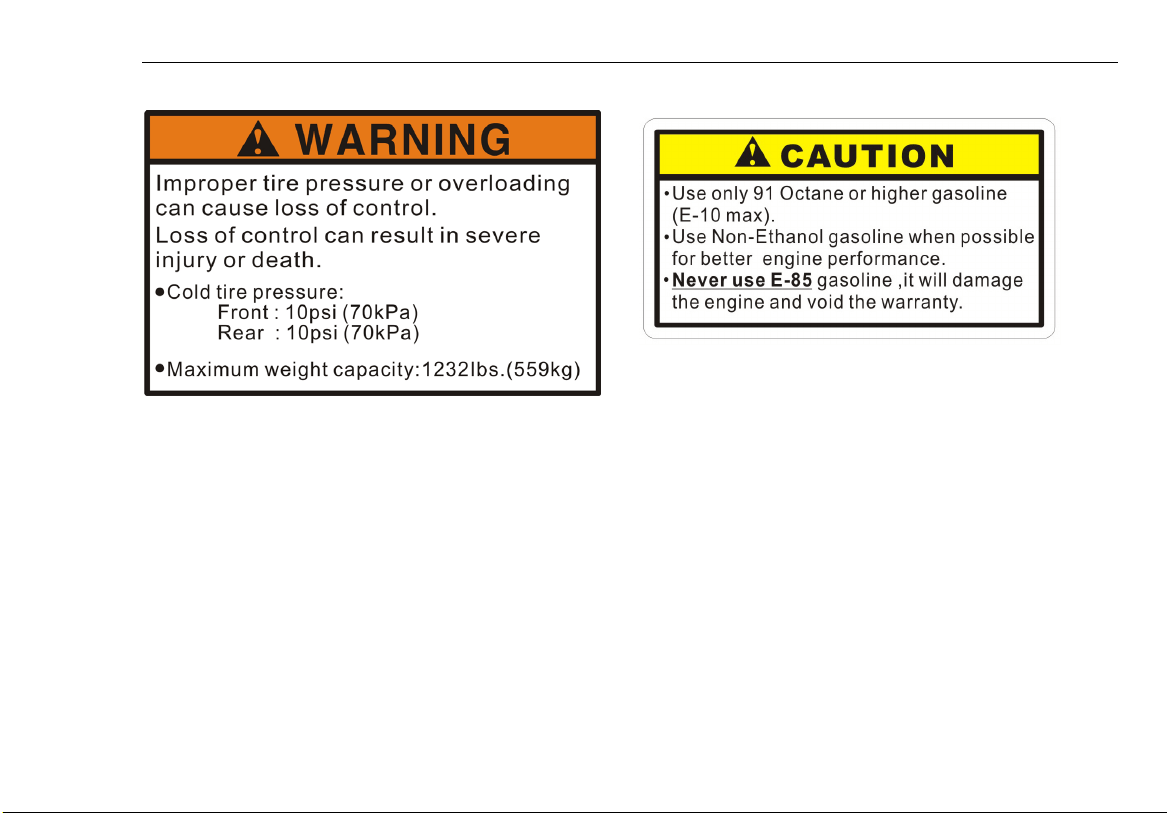
1-4 Location of the Warning and Safety Labels
11 12
Location of the Warning and Safety Labels 1-5
13
1-6 Location of the Warning and Safety Labels
14
15
Safety Information 2-1
This off-highway utility vehicle handles differently from other vehicles including cars and UTVs.
SEVERE INJURY OR DEATH can result if you do not follow these instructions:
● Read this manual and all labels carefully and follow the operating procedures described.
● The vehicle is designed to carry the driver and three passengers, one driver and one passenger on
front seats, and two passengers on rear seats. NEVER CARRY PASSENGERS IN THE CARGO
BED.
● Always be sure the driver and passengers are wearing seat belts.
● Never give a ride to a passenger who is too small to reach and hold the handgrip fixed before the
seat.
● Always avoid operating the vehicle on any paved surfaces, including sidewalks, driveways, parking
lots, and streets.
● Never operate this vehicle on any public street, road, or highway, even dirt or gravel streets
● Never operate this vehicle without wearing an approved motorcycle helmet that fits properly. You
should also wear eye protection (goggles or a face shield), gloves, over-the-ankle boots, long-
sleeved shirt or jacket, and long pants.
● Never consume alcohol or drugs before or while operating this vehicle.
● Never operate at speeds too fast for your skills or the conditions. Always go at a speed that is proper
for the terrain, visibility, operating conditions, and your experience.
SAFETY INFORMATION

2-2 Safety Information
● Never attempt jumps or other stunts.
● Always inspect your vehicle each time you use it to be sure it is in safe operating condition,
Always follow the inspection and maintenance procedures and schedules described in this
manual.
● Always keep hands, arms, feet, and legs inside the vehicle at all times during operation. Keep
your feet on the floorboard. Never hold onto the enclosure.
Your hand could be injured if it is
caught between the enclosure and an obstacle outside the vehicle.
● Always keep both hands on the steering wheel when driving.
● Never wrap your thumbs and fingers around the steering wheel. This is particularly important
when driving in rough terrain. The front wheels will move right and left as they respond to the
terrain, and this movement will be felt in the steering wheel. A sudden jolt could wrench the
steering wheel around, and your thumbs or fingers could be injured if they are in the way of the
steering wheel spokes.
● Always go slowly and be extra careful when operating on unfamiliar terrain .Always be alert to
changing terrain conditions when driving the vehicle.
● Never operate on excessively rough, slippery, or loose terrain until you have learned and
practiced the skills necessary to control the vehicle on such terrain. Always be especially
cautious on these kinds of terrain.
● Never turn at excessive speed. Practice turning at slow speeds before attempting to turn at
faster speeds. Do not attempt turns on steep inclines.

Safety Information 2-3
● Never operate the vehicle on hills that are too steep for it or for your abilities. Go straight up and down
hills where possible. Maximum slope angle: 15°.
● Never operate on hills that are slippery or ones where you will not be able to see far enough ahead of
you. Neve
r go over the top of a hill at speed if you cannot see what is on other side.
● Always follow proper procedures for going uphill. If you lose control and cannot continue up a hill,
back d
own the hill with the engine in reverse gear. Use engine braking to help you go slowly. If
necessary, use the brakes gradually to help you go slowly
.
● Always check terrain before going down hills. Go as slowly as possible. Never go down a hill at high
speed.
● Always check for obstacles before operating in a new area.
● Never operate the vehicle in fast flowing water or water deeper than the floorboards on this model.
Rem
ember that wet brakes may have reduced stopping ability. Test your brakes after leaving water. If
necessary, apply the brake several times to let friction dry out the linings.
● Always be sure there are no obstacles or people behind you when you operate in reverse. When it is
s
afe to proceed in reverse, go slowly
.
● Do not brake abruptly when carrying loads in the cargo bed.
● Always use the size and type of tires specified in this manual.
● Always make sure the tires have the proper tire pressure as described in this manual.
● Never exceed the stated load capacity. Cargo should be as far forward in the bed as possible, and
distributed evenly from side to side. Be sure cargo is secured so that it cannot move around during
operation. Reduce speed and follow instructions in this manual for carrying cargo or pulling a trailer.
Allow greater distance for braki
ng.
2-4 Safety Information
WARNING
POTENTIAL HAZARD
Improper h
andling of gasoline.
WHAT CAN HAPPEN
Gasoline can catch fire and you could be burned.
HOW TO AVOID THE HAZARD
Always turn off the engine when refueling. Do not refuel right after the engine has been running
and is still very hot. Do not spill gasoline on the engine or exhaust pipe/muffler when refueling.
Never refuel while smoking, or while in the vicinity of sparks, open flames, or other sources of
ignition such as the pilot light of water heaters and clothes dryers.
When transporting the vehicle in another vehicle, be sure it is kept in an upright position.
Otherwise, fuel may leak out of the engine or fuel tank.
WHAT CAN HAPPEN
Gasoline is poisonous and can cause injuries.
HOW TO AVOID THE HAZARD
If you should swallow some gasoline or inhale a lot of gasoline vapor, or get some gasoline in
your eyes, see your doctor immediately. If gasoline spills on your skin, wash with soap and
water. If gasoline spills on your clothing, change your clothes.
Safety Information 2-5
WARNING
POTENTIAL HAZARD
S
tarting or running the engine in a closed area.
WHAT CAN HAPPEN
Exhaust fumes are poisonous and may cause loss of consciousness and death within a
short time.
HOW TO AVOID THE HAZARD
Always operate your vehicle in an area with adequate ventilation.
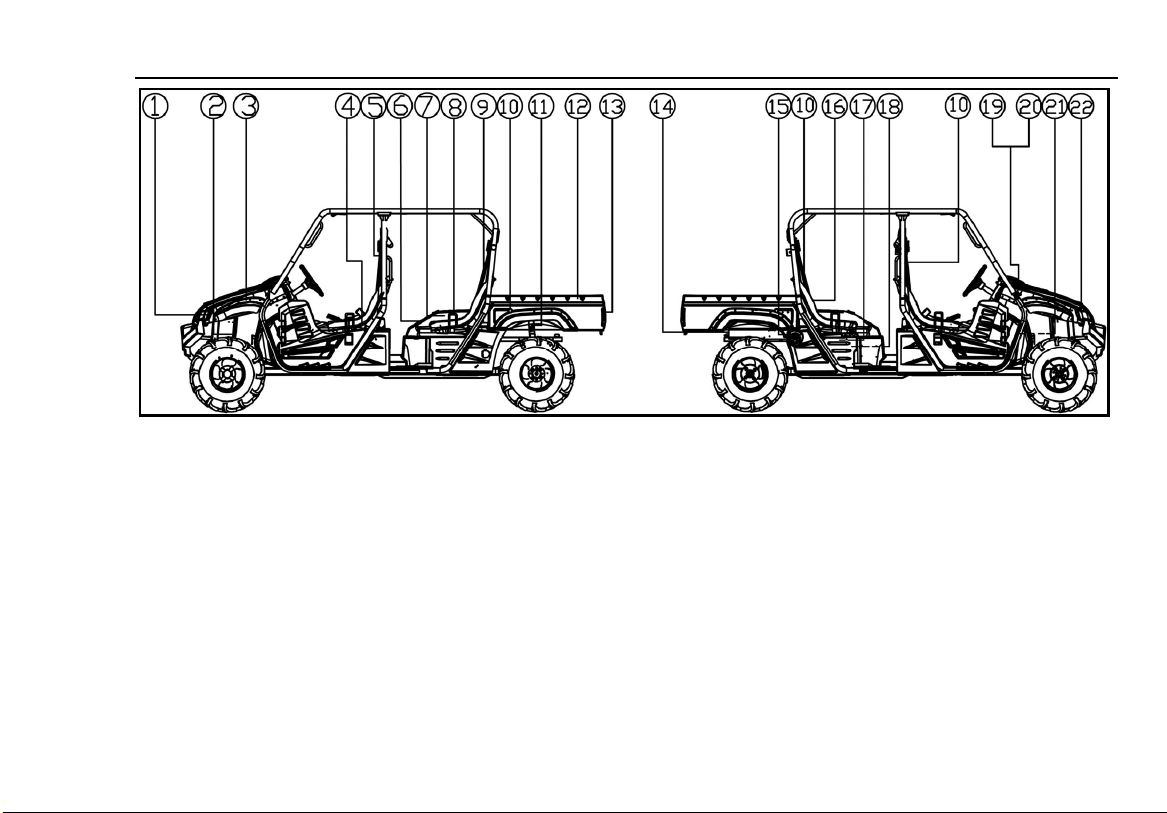
3-1 Description and Vehicle Identification
1. Headlights
2. Front shock absorber assembly adjusting ring
3. Brake fluid reservoir
4. Driver seat
5. Driver seat belt
6. Air filter element(engine and air intake duct)
7. Spark plug
8. Oil filter cartridge
9. Passenger seat belt
10. Cargo bed release levers
11. Rear shock absorber assembly adjusting ring
12. Cargo bed
13. Tail/brake lights
14. Spark arrester
15. Fuel tank cap
16. Passenger seat
17. V-belt case
18. Engine oil dipstick
19. Battery
20. Fuses
21. Coolant reservoir
22. Radiator cap
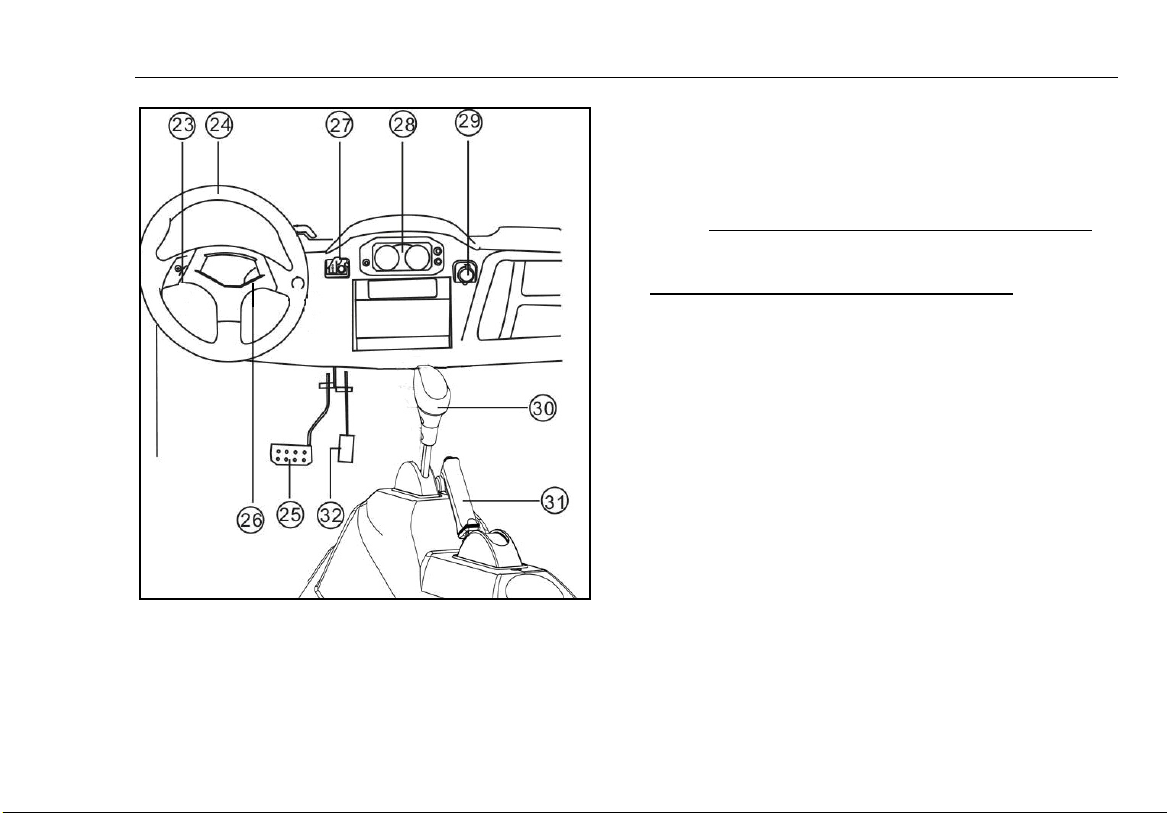
Description and Vehicle Identification 3-2
23. Light switch
24. Steering wheel
25. Brake pedal
26. Main switch
27. On-Command four-wheel-drive and differential lock switches
28. Multi-function meter unit
29. Auxiliary DC jack
30. Drive select lever
31. Parking brake lever
32. Accelerator pedal
NOTE:
T
he vehicle you have purchased may differ slightly
from those in the figures of this manual.
3-3 Description and Vehicle Identification
Identification Number Records
Record the key identification number, vehicle
identification number and model label
information in spaces provided for assistance
when ordering spare parts from a service
center or for reference in case the vehicle is
stolen.
1.KEY IDENTIFICATION NUMBER:
2.MODEL
LABEL INFORMATION
○
●
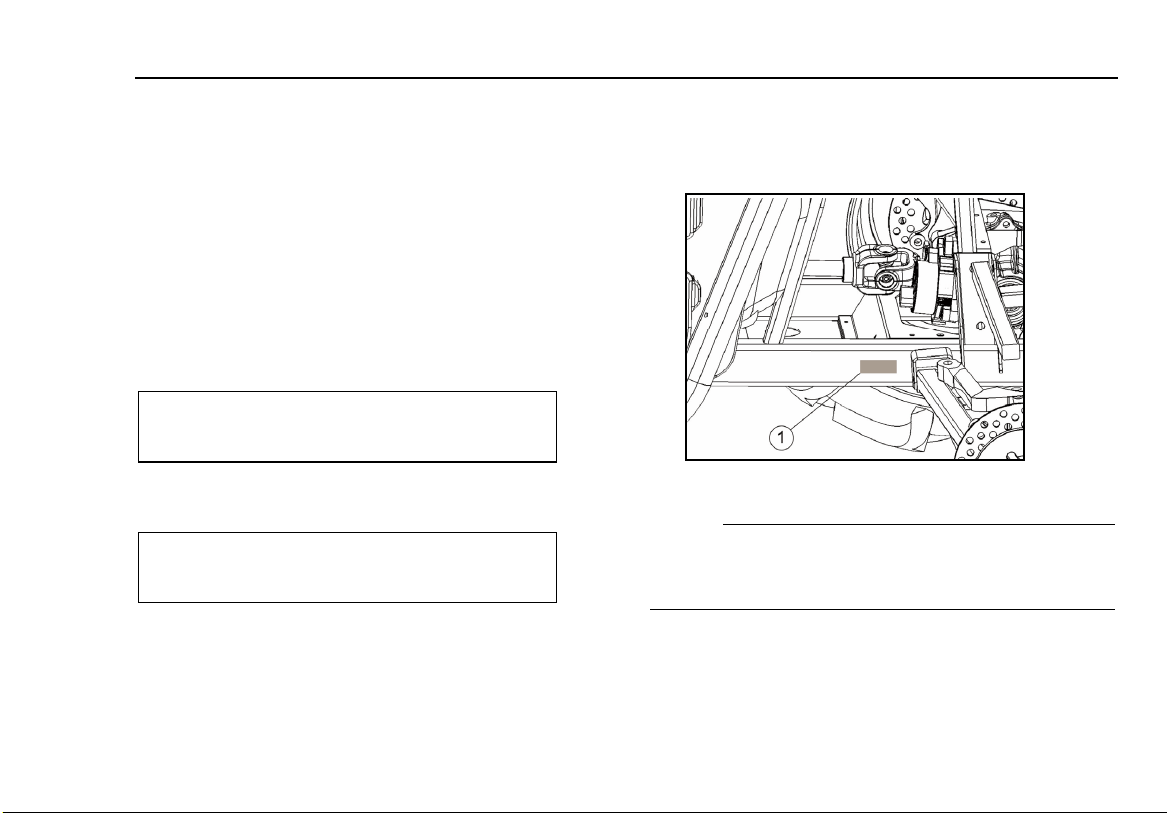
Vehicle identification number
The Vehicle identification number is stamped
into the frame.
1. Vehicle identification number
NOTE:
The ve
hicle identification number is used to
identify your vehicle.
Control Functions 4-1
CONTROL FUNCTIONS
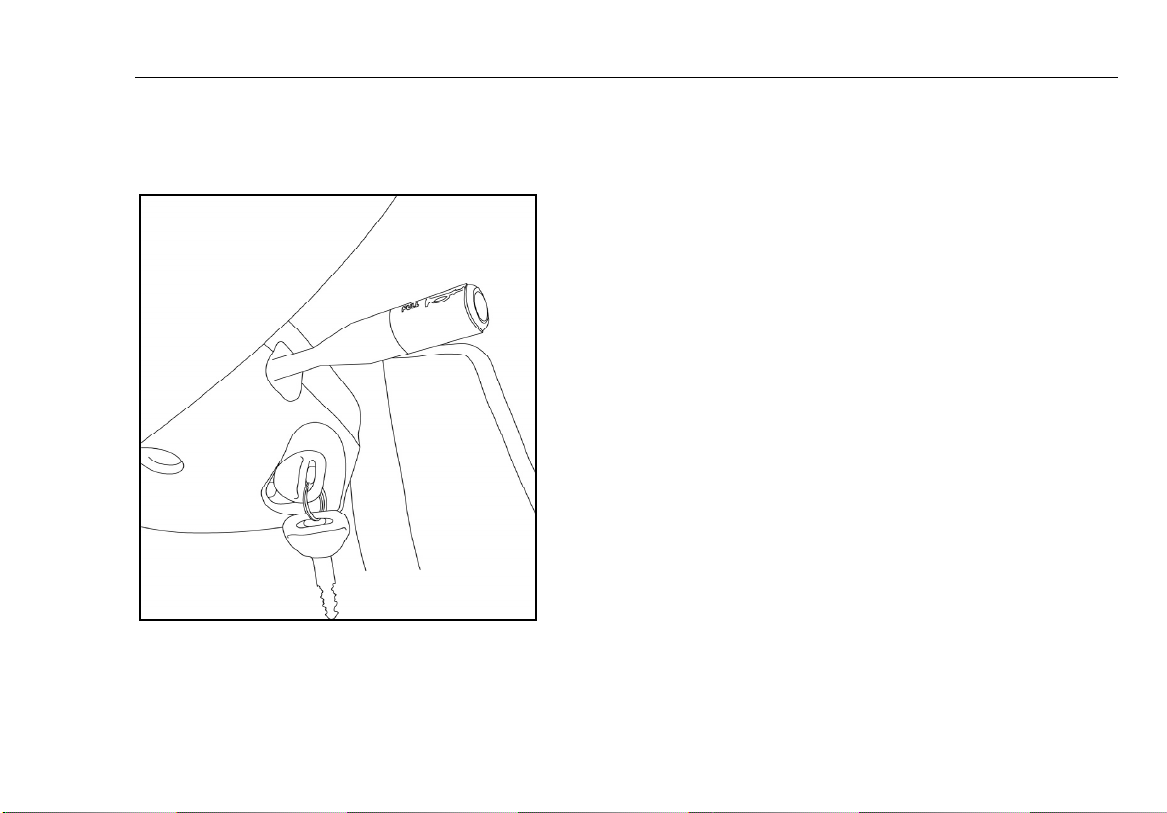
Main switch
1. Main switch
Functions of the respective switch positions
are as follows:
ON:
All electrical
circuits are supplied with power,
and the headlights and taillights illuminate
when the light switch is on.
OFF:
All electrical circuits are switched off. The key
can be removed in this position.
START:
The electric starter is engaged by turning and
holding the key in this position. Release the
key when the engine starts.
4-2 Control Functions
CAUTION:
● Do not operate the electric starter
continuously for more than 5 seconds at
a time, or starter damage could occur.
Wait at least 5 seconds between each
start attempt.
● Do not turn the key to the “START”
position with the engine running, or
damage to the electric starter can result.
● See starting instructions prior to starting
the engine. (See pages 6-1 — 6-3 for
details.)
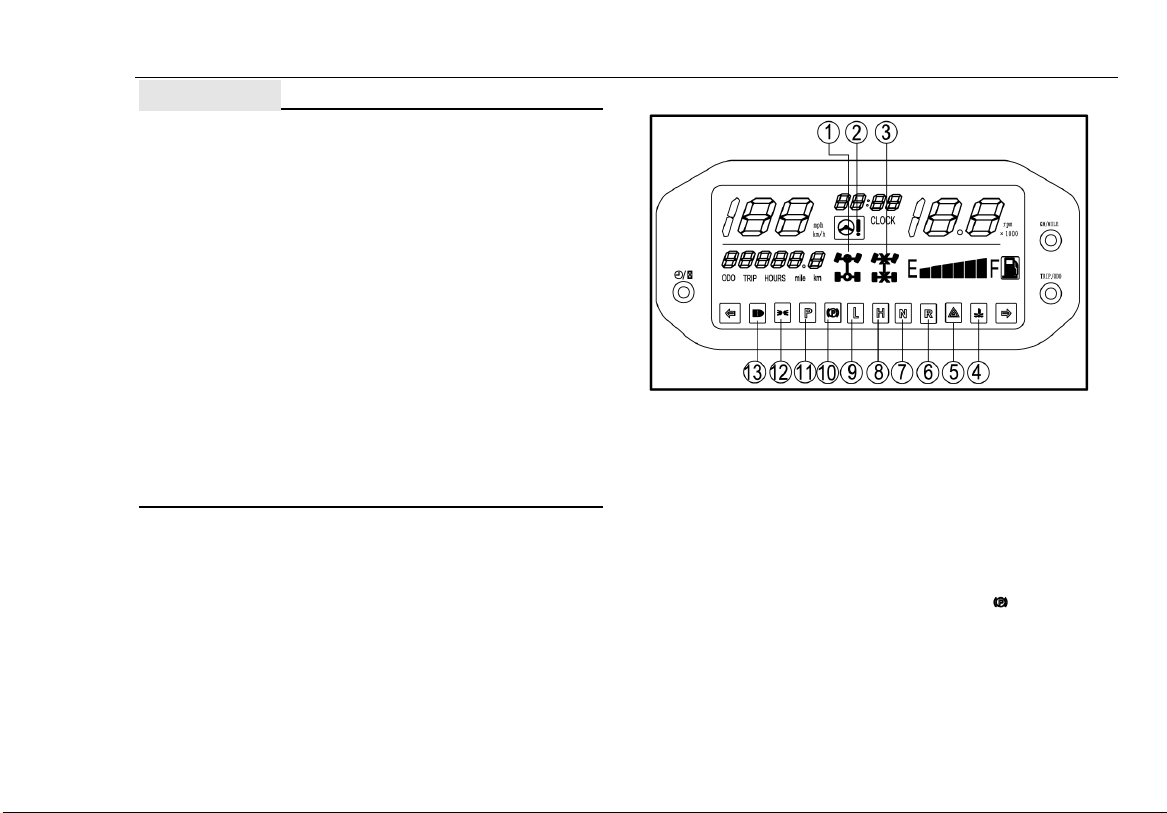
Indicator and Warning Lights
1. Four-wheel locked showing light
2. Fault indicator light for the EPS system
3. Differential gear lock indicator
4. Coolant temperature warning light
5. Emergency indicator
6. Reverse indicator light “R”
7. Neutral indicator light “N”
8. High-range indicator light “H”
9. Low-range indicator light “L”
10. Mechanical parking brake indicator light “ ”
11. Engine indicator light “P”
12. Front light indicator
13. High Beam light indicator

Control Functions 4-3
Lo
w-Range Indicator Light “L”
This indicator light comes on when the drive
select lever is in the “L” position.
Mechanical Parking Brake Indicator Light
“
”
This indicator light comes on when the
mechanical parking brake is applied.
High-Range Indicator Light “H”
This indicator light comes on when the drive
select lever is in the “H” position.
Neutral Indicator Light “N”
This indicator light comes on when the drive
select lever is in the “N” position.
Reverse Indicator Light “R”
This indicator light comes on when the drive
select lever is in the “R” reverse position.
Coolant Temperature Warning Light “
”
When the coolant temperature reaches a
specified level, this light comes on to warn
that the coolant temperature is too hot. If
the light comes on during operation, stop the
engine as soon as it is safe to do so and
allow the engine to cool down for about 15
minutes.
CAUTION:
The engine may overheat if the vehicle is
overloaded. If this happens, reduce the
load to specification.
After restarting, make sure that the light
is out. Continuous use while the light is

4-4 Control Functions
on may cause damage to the engine.
High beam indicator
The light being on means headlight is at high
beam mode.
Front light indicator
The light being on means that the front
headlights have been turned on.
Emergency indicator“ ”
The light being on means emergency lamp is
on.
Use of Electronic Power Steering (EPS)
system
The instrument panel is an important part of
UTV.
The instrument panel works together with
EPS system and monitors the working
condition of EPS system.
Faults will be displayed by the fault indicator
light of the EPS system, so the driver can
acknowledge the EPS fault in time and take
measures to keep himself/herself safe.
When a fault occurs on EPS system, the fault
indicator light will illuminate. At the same time,
a fault code will be displayed on the
instrument panel corresponding with the EPS
system.
The EPS will begin working
automatically when the main key switch
is turned on.
Control Functions 4-5
Check the instrument panel. If no EPS
fault indicator light is illuminated, the
EPS is working properly.
If the EPS fault indicator light is on, this
means the self-checking process of the
ECU found a problem with the EPS
System. You should consult your local
dealer for maintenance.
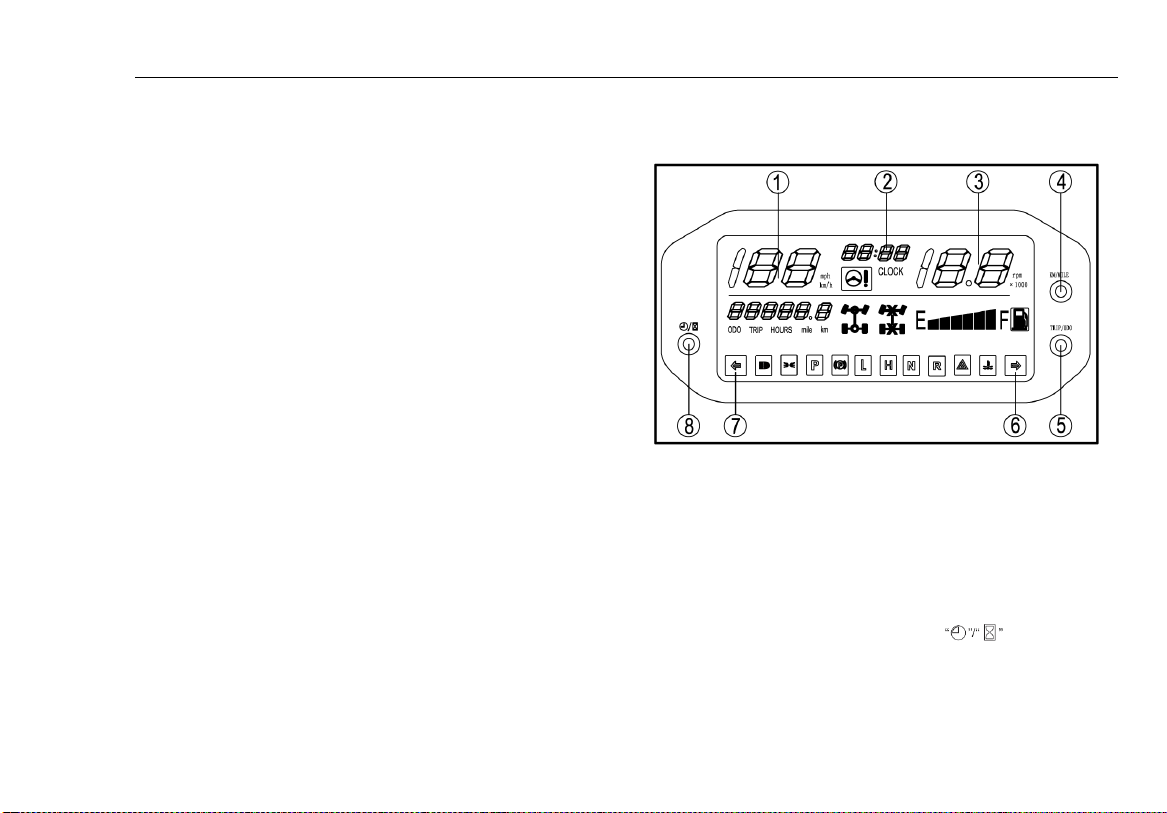
Speedometer Unit
1. Speed indicator
2. Clock/Hour/ fault code meter
3. RPM indicator
4. Metric/mile button
5. “TRIP/ODO” button
6. Right turn indicator light
7. Left turn indicator light
8. Clock/Hour/ fault code reset button

4-6 Control Functions
Speedometer unit functions:
a speedometer (which shows the speed)
an odometer (which shows the total
distance covered)
a trip-meter (which can be cleared and
then show any new distances traveled)
an RPM indicator (which shows the
revolutions per minute of the engine)
a clock
an Electronic Fuel Injection (EFI) fault
code indicator (which shows the fault
code for problems with the EFI )
Odometer and trip meter modes
On the display panel there are two large
buttons, one located on the left side and one
on the right side. Quickly pressing the
button on the left side toggles the display
from the odometer, to the trip-meter, and
then to the hours meter; then it starts the
cycle over.
The odometer displays the total distance
traveled by the UTV. The trip-meter records
distances for a specific trip and can record
distances from 0 through 999.9 miles.
To reset a trip meter, select it by pressing the
left button, Press left button to switch to
small mileage (Trip), press and hold the
right button to reset. The trip-meter can
be used to estimate the distance that can
be traveled with a full tank of fuel.
This information will enable you to judge
the fuel consumption.
To change the display from miles per hour to

Control Functions 4-7
kilometers per hour press the right side
button on the display. This will also change
the displayed mileage from miles to
kilometers.
Clock time adjustment
Press the left button and hold for three
seconds and the clock goes into the hour
‘set’ mode.
1. Press the right button to set the hour.
2. Press the left button again and the clock
goes into the minute ‘set’ mode.
3. Press the right button to set the minutes.
4. Press the left button again and the clock
will exit the ‘set’ mode.
Four-wheel drive indicator “
”
There are two 4WD indicators on the display
panel. The left 4WD indicator has a blinking
circle on the front axle when the grey and
yellow 4WD selector buttons are pressed to
indicate the “4WD” function has been
activated. This position also indicates that
the Front differential is NOT locked. This
allows the wheels on the left and right sides
to rotate at different speeds to accommodate
turning.
Differential gear lock indicator
The right 4WD symbol will show an ‘X’ over
the center of the front axle when the lever is
moved to the right and the yellow differential
gear lock button is set to out position, which
means the differential is not operational and
is locked. When riding an UTV on muddy and
slippery roads or when climbing a steep hill,

4-8 Control Functions
make sure the 4WD lock indicator is on.
When riding on a flat road at a comparatively
high speed, adjust the settings to
“2WD/UNLOCK” and there are no symbols
in either of the 4WD indicators.
Riding an UTV while the differential is
functioning and is NOT locked, may improve
the stability and safety of the UTV operation.
CAUTION:
When the s
elector is set to 4WD, the right
4WD symbol front axle will have an ‘X’ in the
middle . When riding on good surfaces you
should unlock the differential and press in
the yellow and the gray buttons to the 2WD
unlocked position. There should be no
symbols showing in either the left or right
4WD indicators.
CAUTION:
If the display indicators flash or the
speedometer does not show the speed while
the UTV is in motion, ask a dealer to check
the speed sensor and circuits.
Fault code indicator
When the EFI system encounters faults, the
Electronic Control Unit (ECU) will send the
fault code to the instrument display, and it will
flash on the clock.
If there is more than one fault code, they
will be shown in rolling sequence. When
fault codes are present, in order to see the
time, press the clock button, the time will be
shown. Then after five seconds, the fault
Control Functions 4-9
code returns again. Only after the fault is
fixed, will the time show automatically.
The descriptions for the fault codes are
shown in Chapter 11 of this manual.
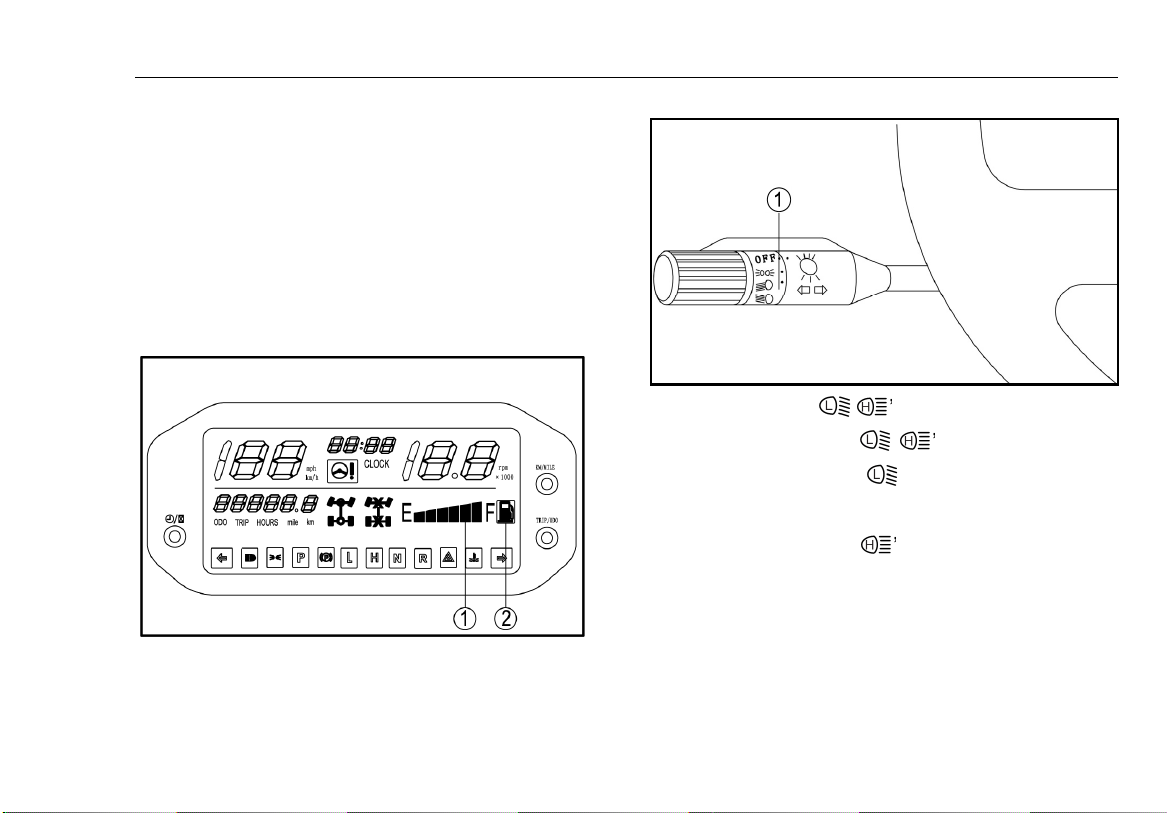
Fuel level indicator
The fuel level display will indicate the fuel
volume. When the fuel is getting low the fuel
pump symbol will flash.
1. Fuel level indicator 2. Fuel level warning indicator
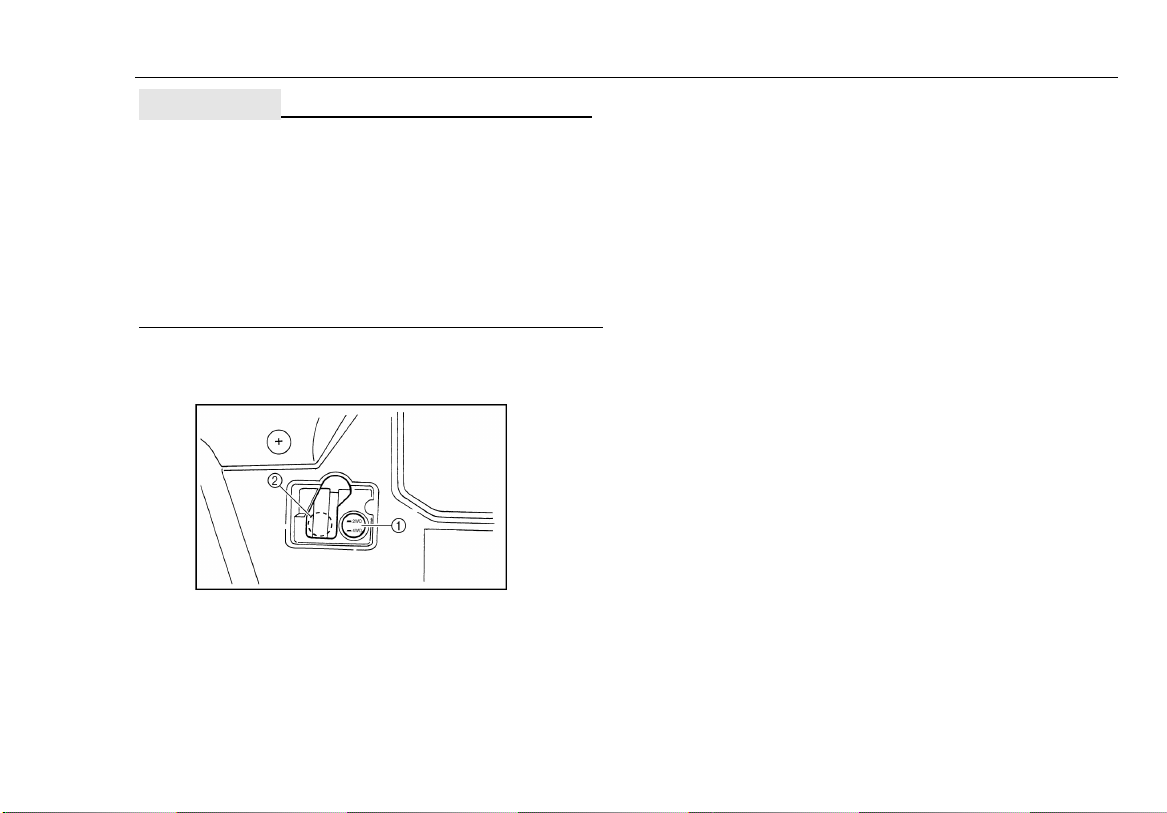
Switches
1. Light switch “OFF/ / ”
Light switch “OFF/ / ”
Set the switch to “
”to turn on the low
beam and the taillights.
Set the switch to “
”to turn on the high
beam and the taillights.
Set the switch to “OFF” to turn off all the
lights.
4-10 Control Functions
CAUTION:
Do not use the headlights with the engine
turned off for an extended period of time. The
battery may discharge to the point that the
starter motor will not operate properly. If this
should happen, remove the battery and
recharge it.
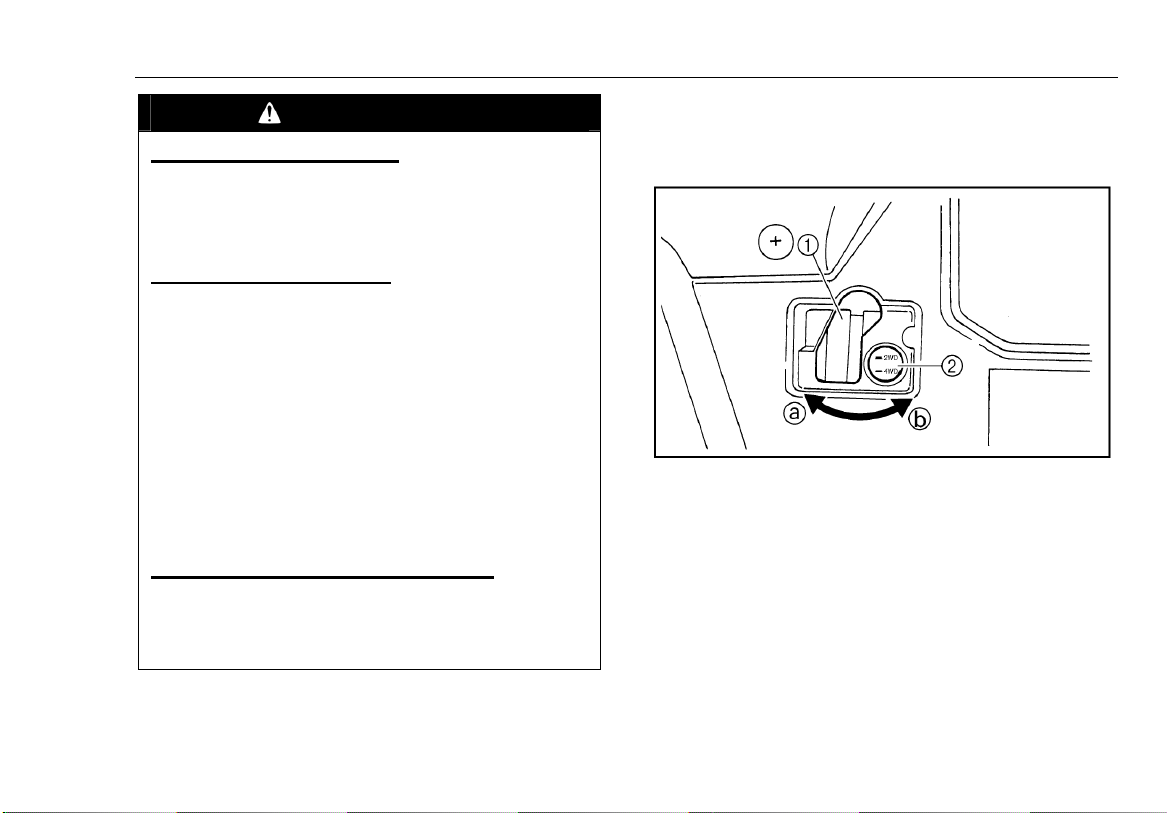
On-Command four-wheel –drive and diff-
erential gear lock switches
1. On-Command four-wheel –drive switch “2WD”/ “4 WD”
2. Differential gear lock switch “LOCK”/ “4WD”
This vehicle is equipped with an On-Com
mand four–wheel-drive switch “2WD”/
“4WD”and a differential gear lock switch
“4WD”/ “LOCK”. Select the appropriate drive
according to terrain and the conditions.
Two-wheel drive (”2WD”): Power is sup-
plied to the rear wheels only.
Four-wheel drive (“4WD’): Power is
supplied to the rear and front wheels.
Four–wheel drive with the differential
gear locked (“4WD-LOCK”): Power is
supplied to the rear and front wheels
when the differential gear is locked.
Unlike the 4WD mode, all wheels turn at
the same speed regardless of traction.
Control Functions 4-11
WARNING
POTENTIAL HAZARD
Changing from 2WD to 4WD or from
4WD to 4W
D-LOCK (“DIFF.LOCK”), or
vice-versa while the vehicle is moving .
WHAT CAN HAPPEN
The vehicle handles differently in 4WD
than in 2WD and in 2WD-LOCK in some
circumstances. Changing from 2WD to
4WD or from 2WD to 2WD–Differential
UNLOCK, or vice-versa while moving
may cause the vehicle to unexpectedly
handle differently. This could distract
the operator and increase the risk of
losing control and an accident.
HOW TO AVOID THE HAZARD
Always stop the vehicle before chang-
ing from 2WD to 4WD or from 2WDto
2WD–Differential UNLOCK.
On-Command four-
wheel-drive switch
“2WD/4WD”
1. Select lever
2. On-Command four –wheel-drive switch “2WD/4WD”
To change from 2WD to 4WD, stop the
vehicle, and then set the switch to
“4WD”.When the vehicle is in 4WD, the
4WD indicator will come on in the
multi-function meter unit display .To change
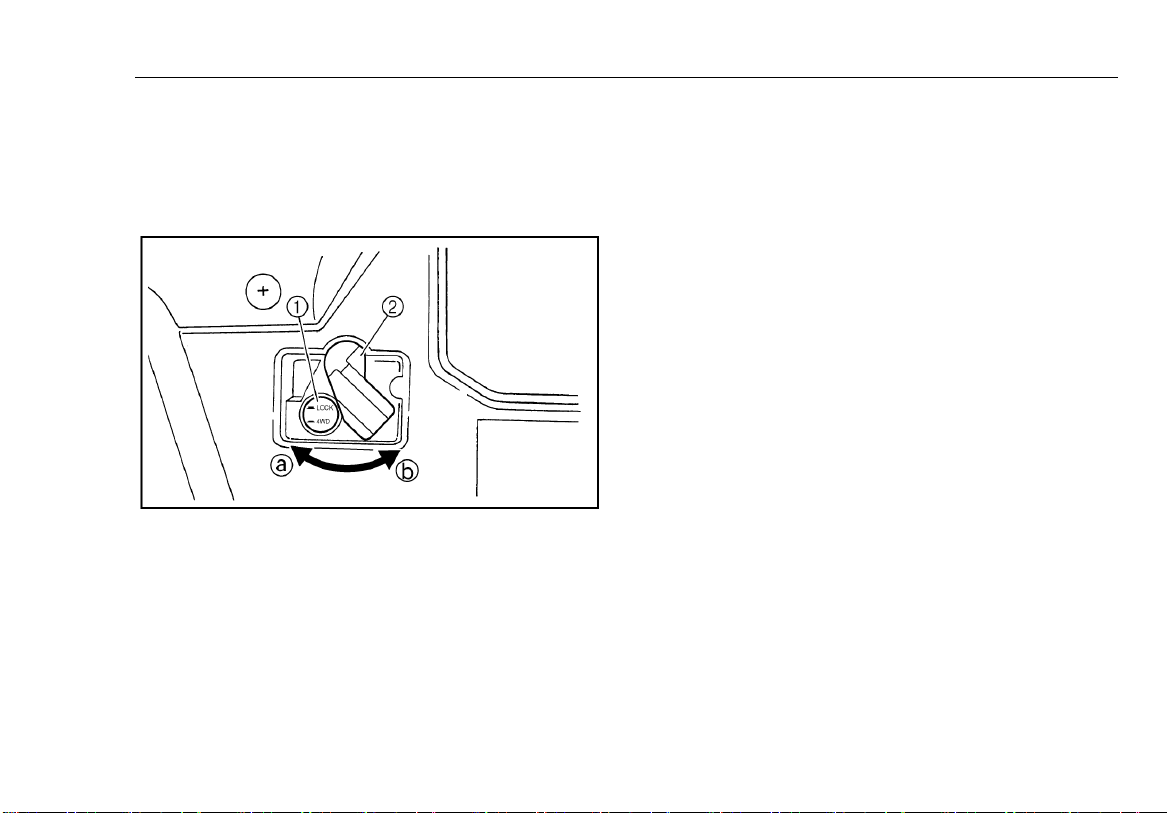
4-12 Control Functions
from 4WD to 2WD, stop the vehicle, be sure
the select lever is set to position ⓐ, and
then set the switch to “2WD”.
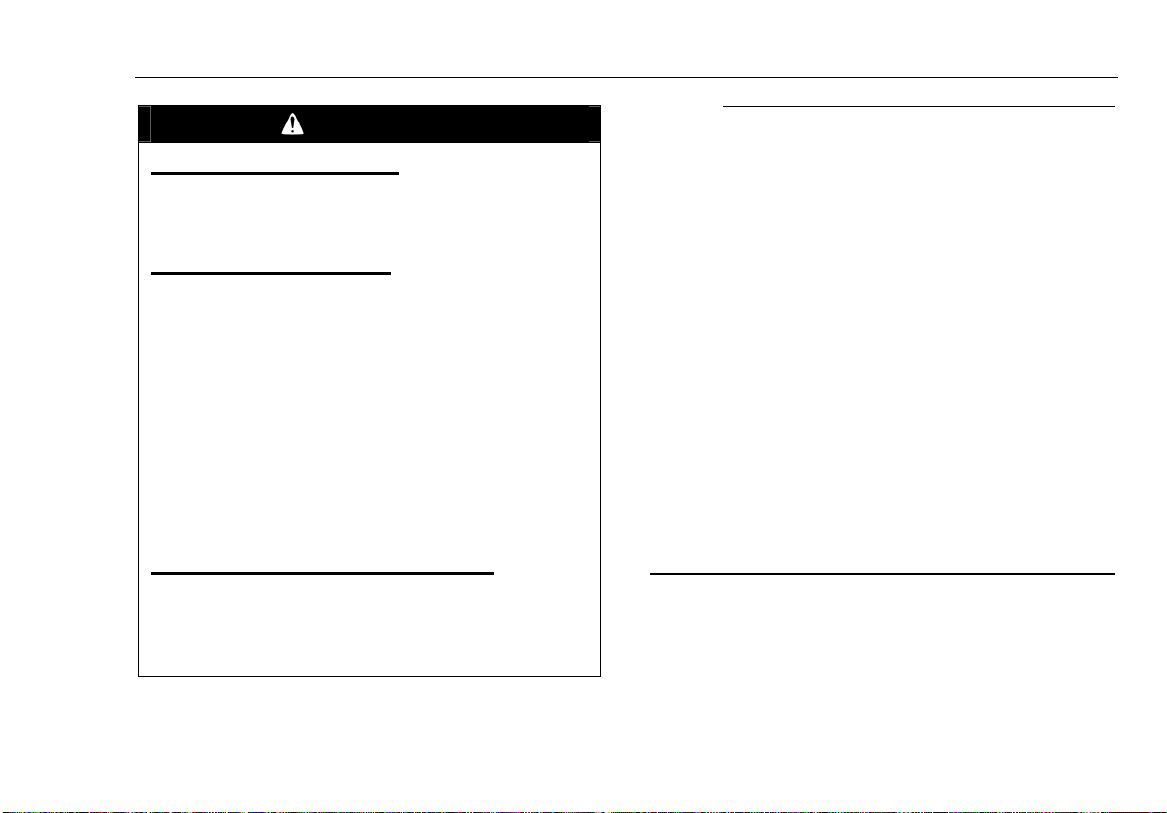
On-Command differential gear lock
switch “4WD”/”LOCK”
1. On-Command differential gear lock switch “4WD”/ “LOCK”
2. Select lever
To lock the differential gear in 4WD, stop the
vehicle, make sure the On-Command
four-wheel-drive switch is set to “4WD”,move
the select lever to position ⓑ,and then set
the switch to “LOCK”. When the differential
gear is locked, the differential gear lock
indicator light will come on along with the
differential gear lock indicator in the
multifunction meter unit display .To release
the differential gear lock , stop the vehicle
and set the switch to “4WD”.
Control Functions 4-13
WARNING
POTENTIAL HAZARD
Riding too fast while the vehicle is in
4WD-LOCK.
WHAT CAN HAPPEN
All wheels turn at the same speed when
the differential is locked, so it takes
more effort to turn the vehicle. The
amount of effort required is greater the
faster you go. You may lose control and
have an accident if you cannot make a
sharp enough turn for the speed you
are traveling.
HOW TO AVOID THE HAZARD
Always ride at a slow speed when the
vehicle is in 4WD-LOCK, and allow
extra time and distance for maneuvers.
NOTE:
When the switch is set to “LOCK”, the
differential gear lock indicator and
indicator light will flash until the
differential gear is locked.
When the indicator and indicator light are
flashing, turning the steering wheel back
and forth will help the differential gear
lock to engage.
Riding before the differential gear lock is
properly engaged (e.g.,when the indica-
tor and indicator light are flashing)will
cause the engine speed to be limited
until engagement is complete.
4-14 Control Functions
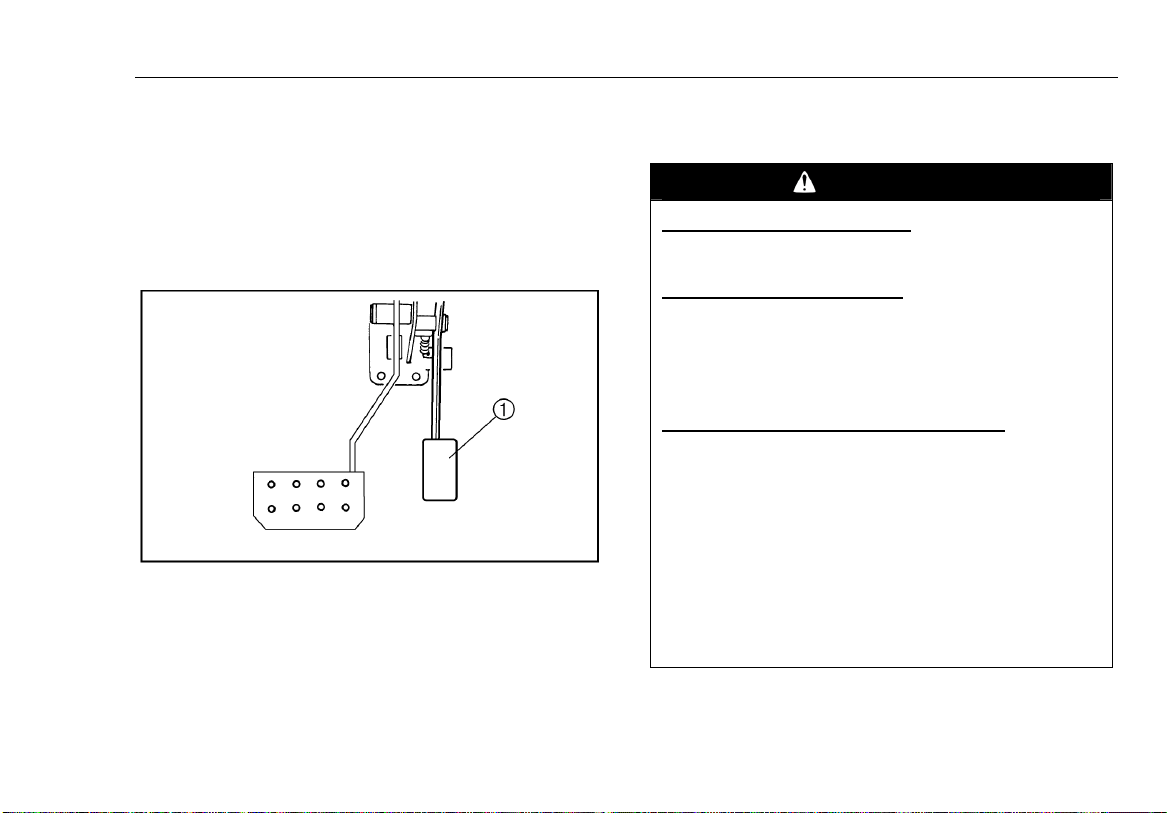
Accelerator pedal
Press the accelerator pedal down to increase
engine speed. Spring pressure returns the
pedal to the idle position when released.
Always check that the accelerator pedal
returns normally before starting the engine.
1. Accelerator pedal
Before starting the engine, check the accele-
rator pedal to be sure it is operating smoothly.
Make sure the accelerator pedal fully returns
to the idle position as soon as it is released.
WARNING
POTENTIAL HAZARD
Malfunction of the accelerator pedal.
WHAT CAN HAPPEN
A faulty pedal that makes it difficult to
speed up or slow down could cause
loss of control.
HOW TO AVOID THE HAZARD
Check the operation of the accelerator
pedal before you start the engine. If
it does not work smoothly, check for
the cause. Correct the problem
before operating the vehicle. Consult
a service center if you can’t find or
solve the problem yourself.
Control Functions 4-15
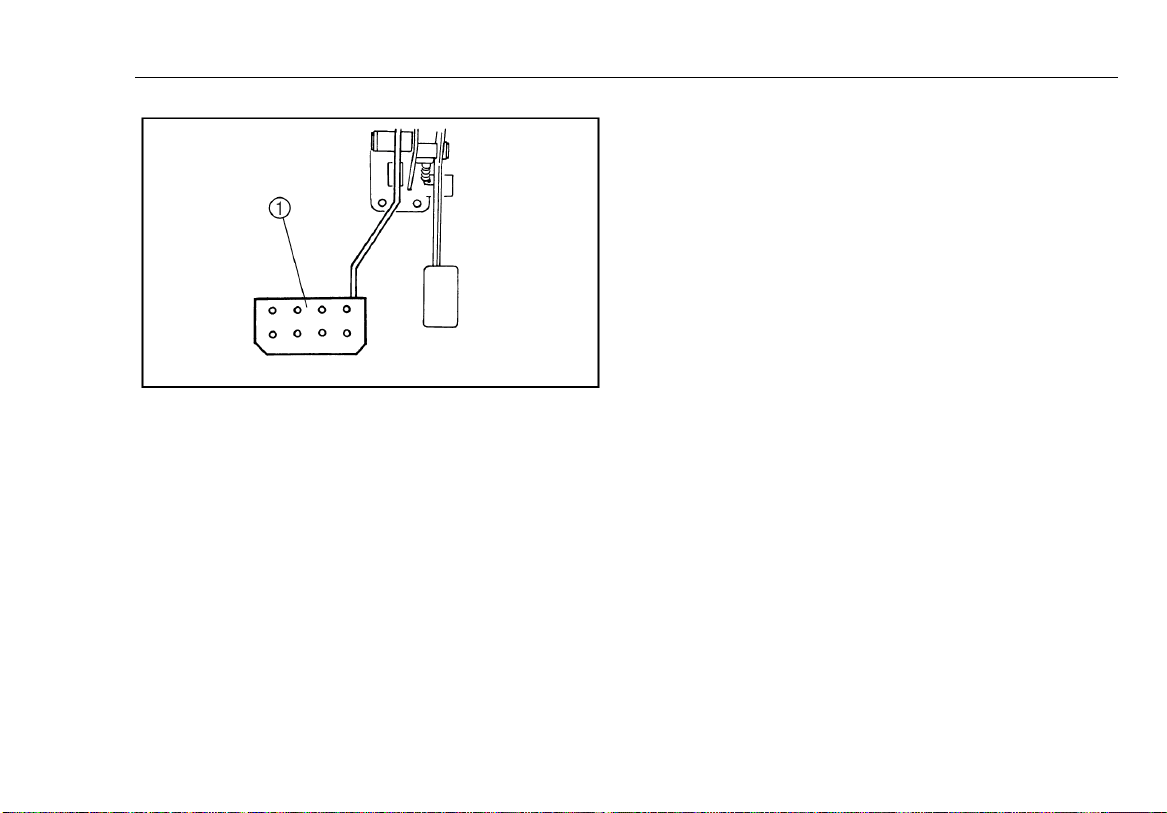
Brake pedal
1. Brake pedal
Parking brake lever
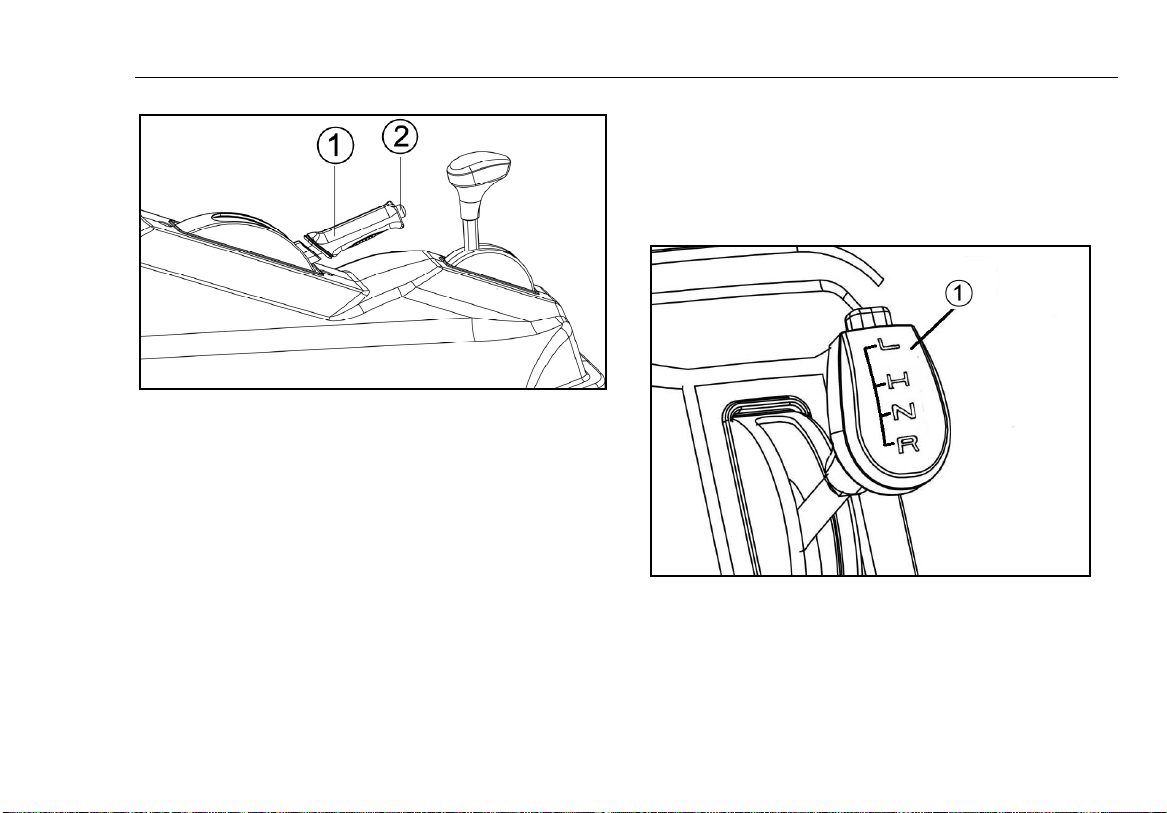
The parking brake lever is located at the right
side of the driver’s seat. It will help hold the
vehicle from moving while parked.
To set the parking brake, pull the lever up
completely.
To release the parking brake, pull up on the
lever, press the release button, and then
push the lever all the way down. Spring
pressure helps return the lever to the
released position. Be sure to fully release the
parking brake before starting out, Failure to
do so may result in poor performance and
premature wearing of the rear brake and
V-belt.
4-16 Control Functions
1. Parking brake lever 2. Release button
Drive select lever
The drive select lever is used to shift the
vehicle into the low, high, neutral and reverse
positions. (Refer to pages 6-4—6-6 for the
drive select lever operation.)
1. Drive select lever
Control Functions 4-17
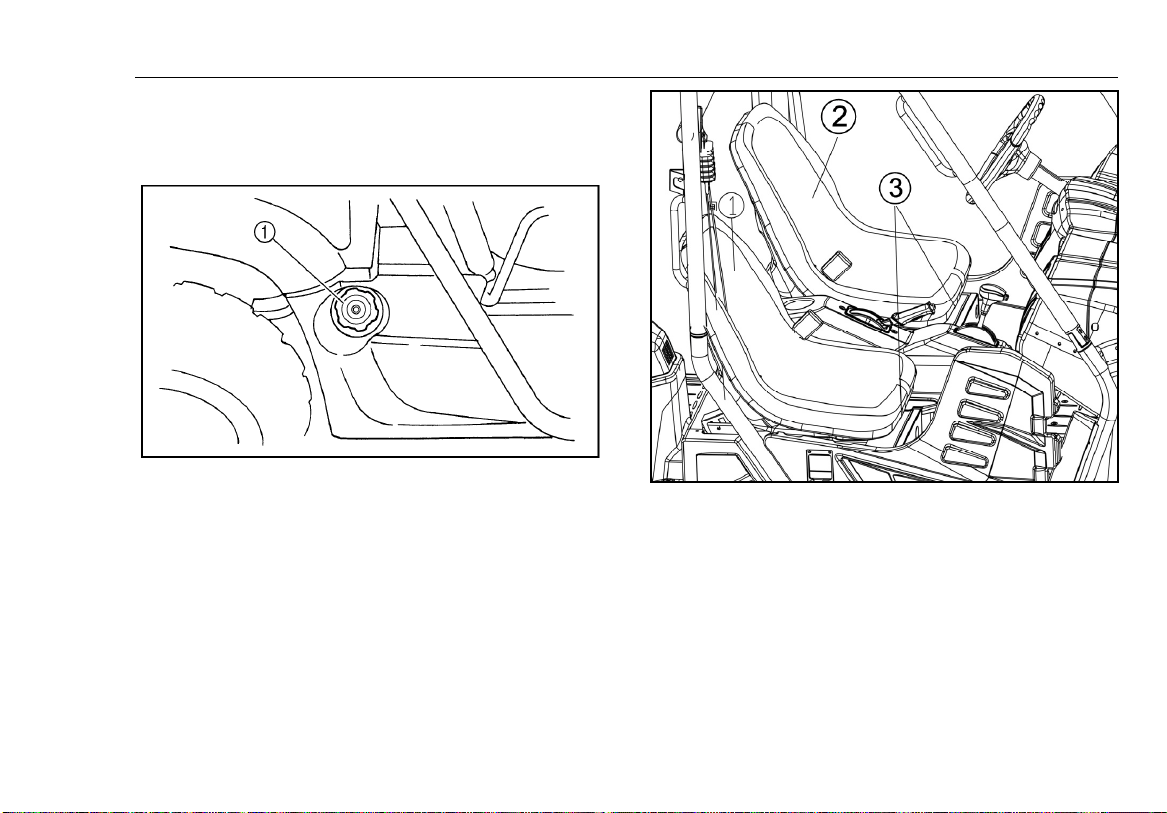
Fuel tank cap
Remove the fuel tank cap by turning it
counterclockwise.
1. Fuel tank cap
Front Seats
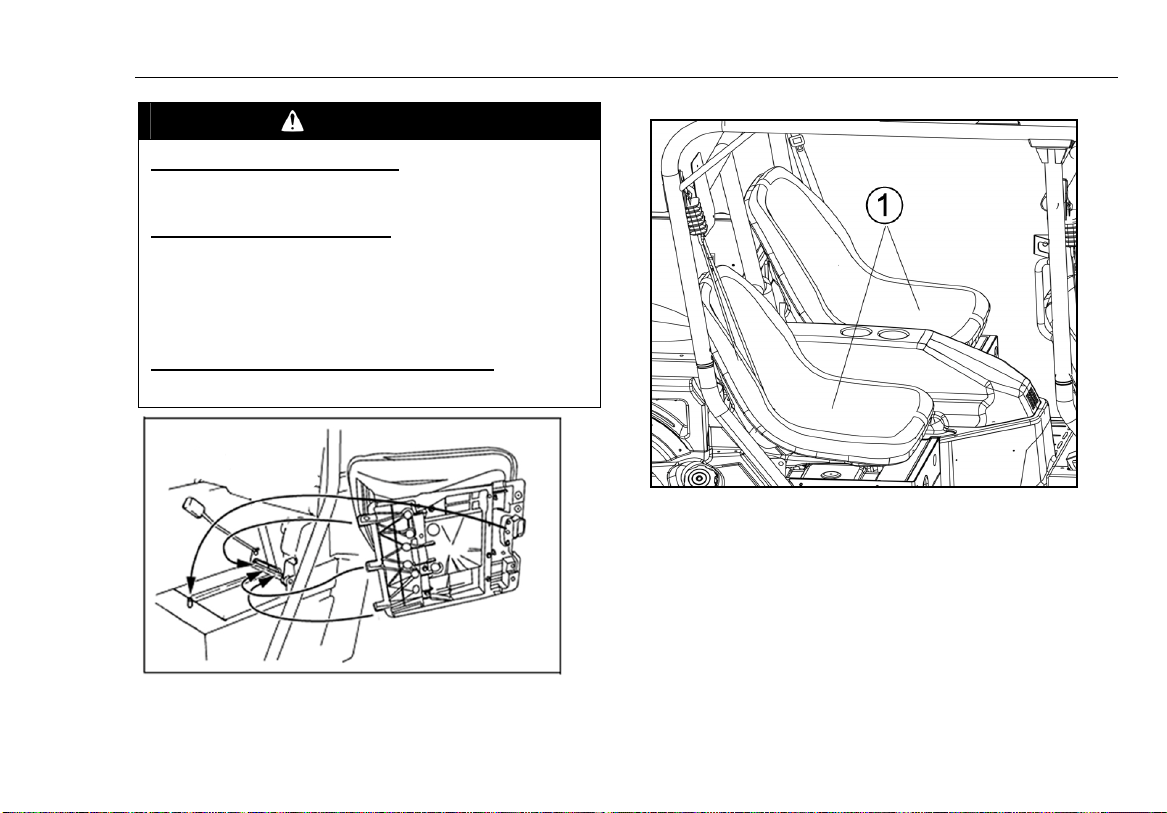
To remove a seat, pull its seat lock lever
upward, lift the front of the seat, and then
slide the seat forward and up.
1. Passenger seat 2. Driver seat
3. Seat lock lever (×2)
To install a seat, insert the projection on the
rear of the seat into the seat holders and
push down on the seat at the front.
4-18 Control Functions
WARNING
POTENTIAL HAZARD
A loose seat.
WHAT CAN HAPPEN
The operator could lose control or the
operator or passenger could fall if the
seat is loose during operation.
HOW TO AVOID THE HAZARD
Make sure the seat is securely latched.
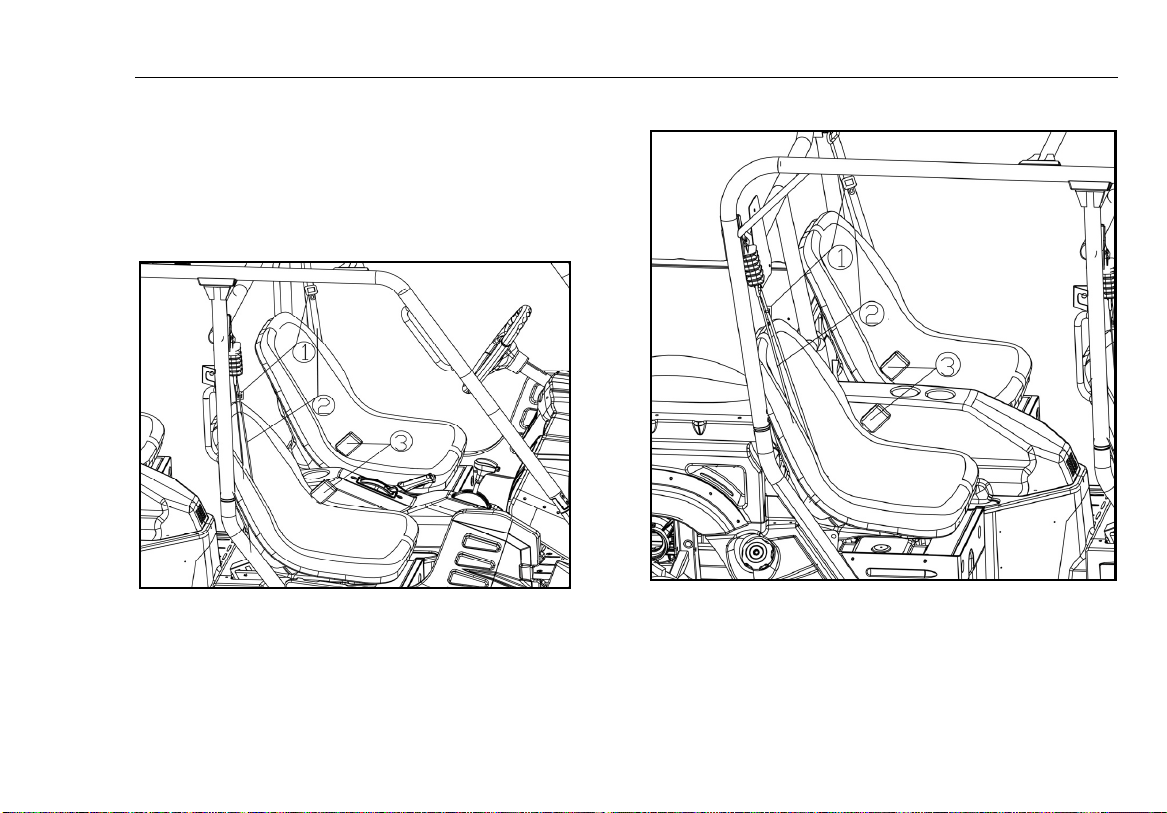
Rear Seats
1. Rear seat
To remove the rear seats, you need to pull it
up from back, and then push it back.
Control Functions 4-19
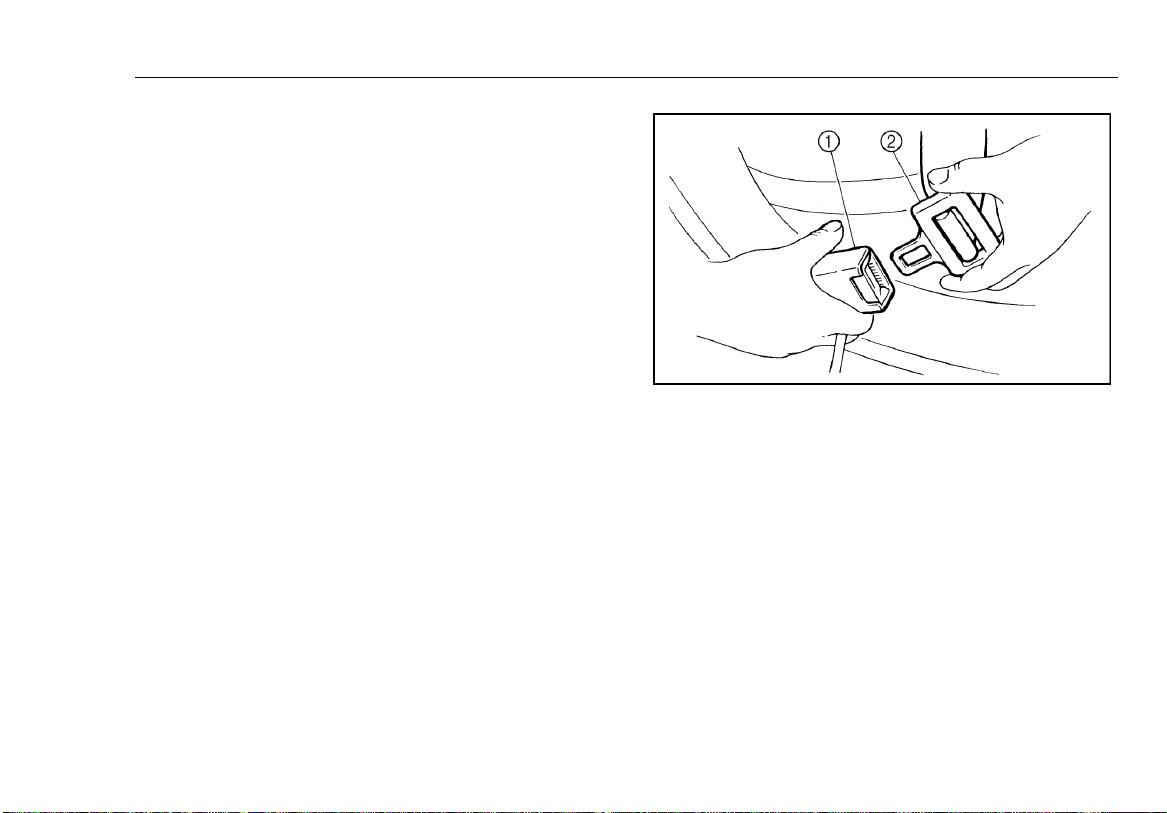
Seat Belt for Front Seats
This vehicle is equipped with three-point seat
belts for both the operator and passenger.
Always wear the seat belt while riding in the
vehicle.
1. Latch plate (×2) 2. Seat belt (×2)
3. Buckle (×2)
Seat Belt for Rear Seats
1. Latch plate (×2) 2. Seat belt (×2)
3. Buckle (×2)
4-20 Control Functions
This vehicle is equipped with three-point seat
belts for both rear passenger seats. Always
wear the seat belt while riding in the vehicle.
To wear the seat belt properly, do the
following:
1. Hold the latch plate as you pull the belt
across your lap and chest. Make sure the
belt is not twisted and is not caught on
any portion of the vehicle, your clothing,
or any equipment you are carrying.
2. Push the latch plate into the buckle until it
clicks. Pull up on the latch plate to make
sure it is secure.
3. Put the lap portion of the belt low on your
hips. Push down on the buckle end of the
belt as you pull up on the shoulder part
so the belt is snug across your hips.
1. Buckle 2. Latch plate
4. Position the shoulder belt over your
shoulder and across your chest. The
shoulder belt should fit against your
chest. If it is loose, pull the belt out all the
way and then let it retract.
5. To release the buckle, firmly press the
release button.
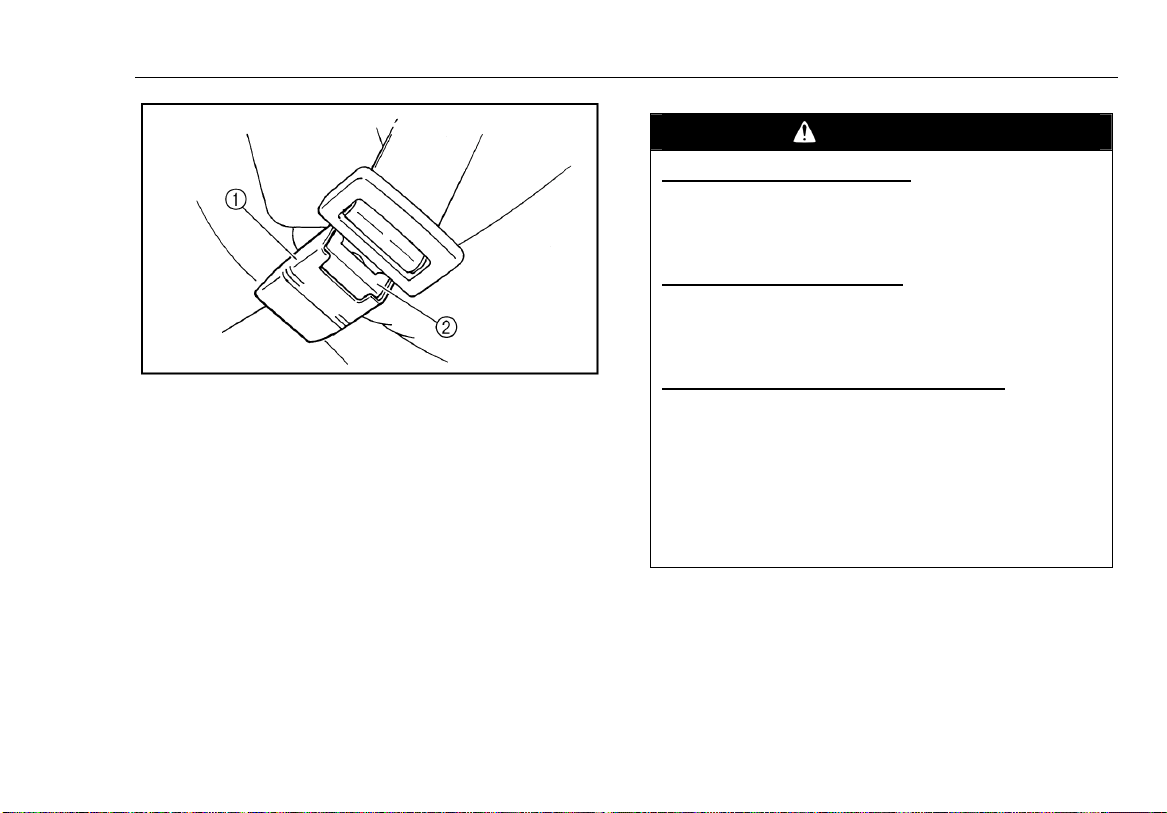
Control Functions 4-21
1. Buckle 2. Release button
WARNING
POTENTIAL HAZARD
Not wearing the seat belt.
Wearing the seat belt improperly.
WHAT CAN HAPPEN
There is increased risk of being killed
or seriously injured in an accident.
HOW TO AVOID THE HAZARD
Always wear your seat belt when riding
in the vehicle.
Be sure the seat belt is close-fitting
across your hips and chest and is
latched securely.
4-22 Control Functions
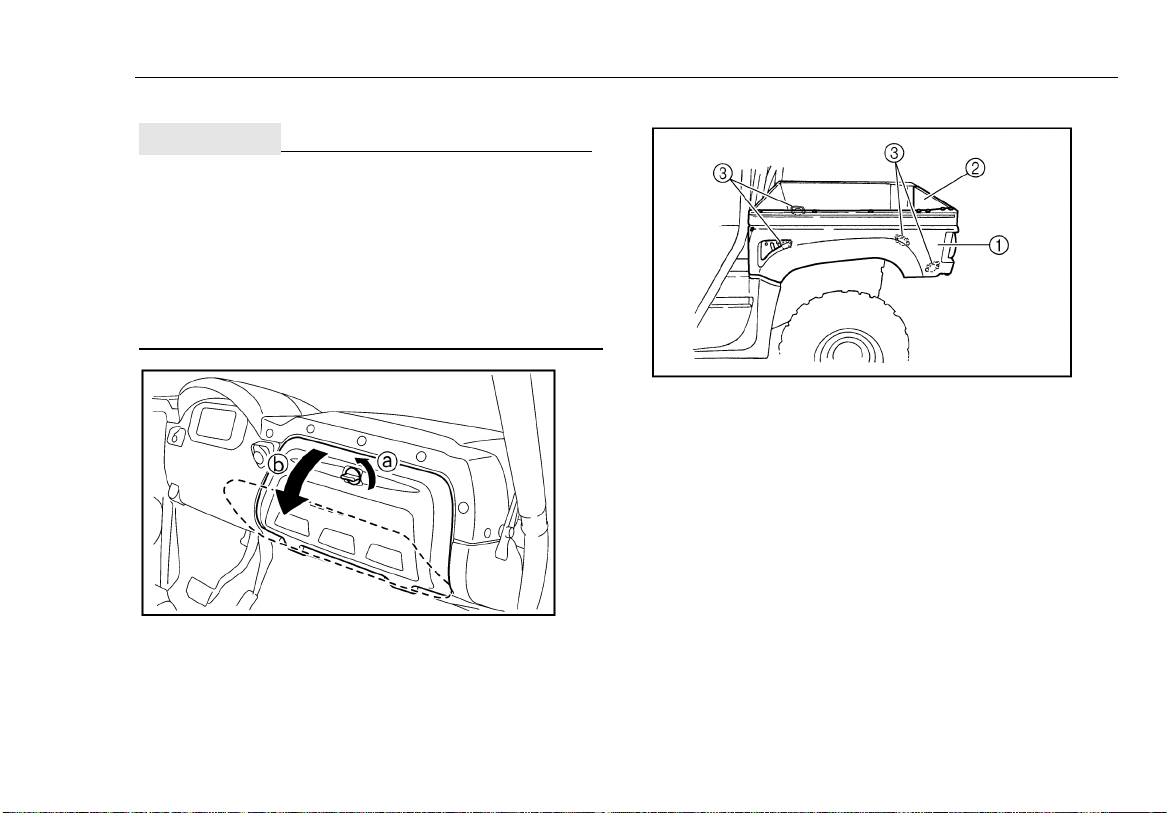
Glove compartment
CAUTION:
To protect from damage, do not put metal
products, like tools or sharp-edged
items directly in the glove compartment. If
they must be stored, wrap them in
appropriate cushion material.
a. Unlock b. Open.
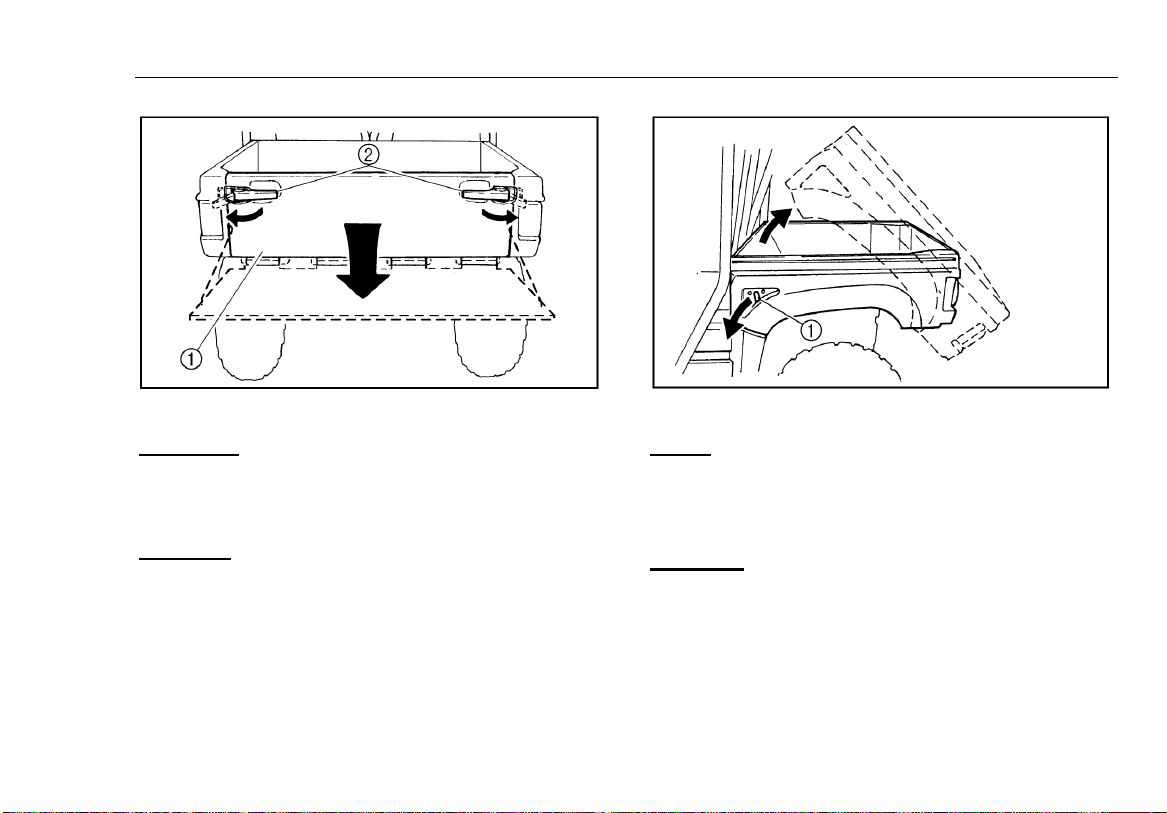
Cargo bed
1. Cargo bed 2. Tailgate
3. Cargo hook (×4)
Control Functions 4-23
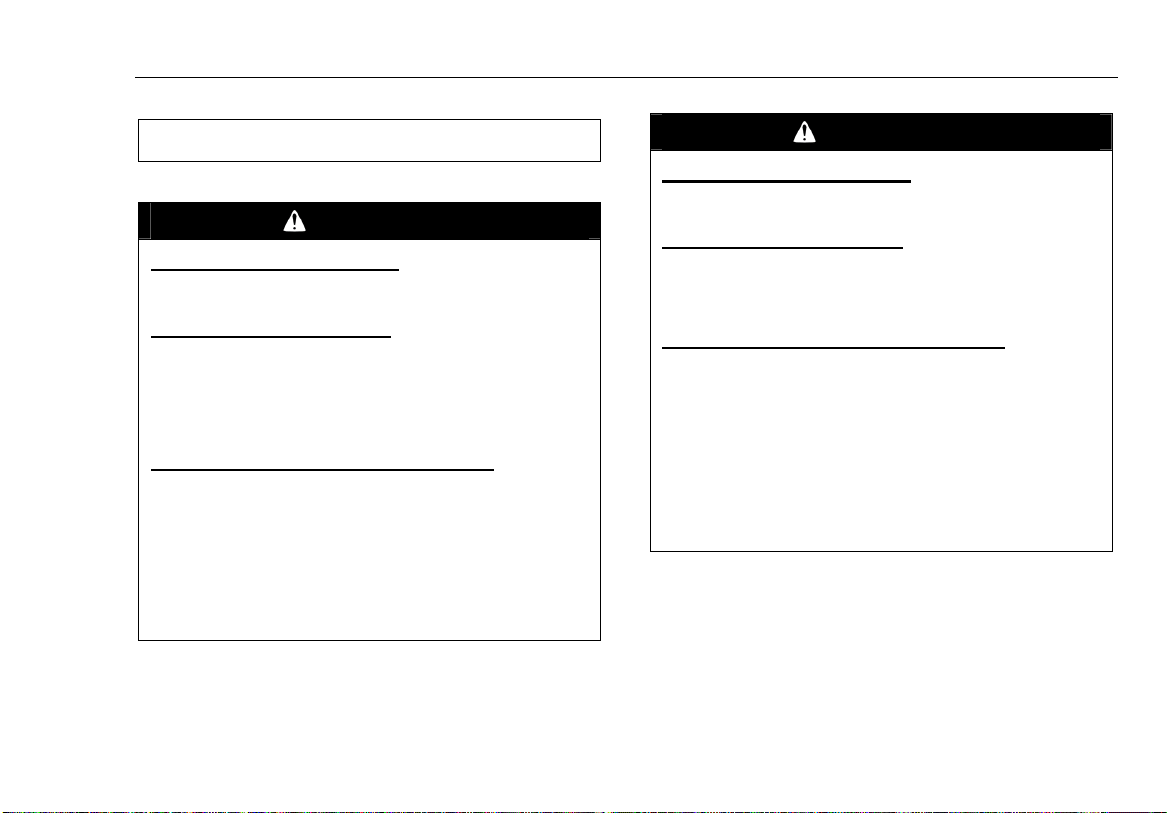
Opening and closing the tailgate
1. Tailgate 2. Latch (×2)
To open
Unhook the latches, and then lower the
tailgate.
To close
Place the tailgate in the original position, and
then hook the latches.
Lifting and lowering the cargo bed
1. Cargo bed release lever
To lift
Push down the cargo bed release lever on
the left or right side of the vehicle, and then
slowly lift up the cargo bed until it stops.
To lower
Lower the cargo bed slowly to its original po-
sition and be sure it is locked into place.
4-24 Control Functions
Maximum load limit: 350lb (159kg)
WARNING
POTENTIAL HAZARD
Pinch point
s.
WHAT CAN HAPPEN
You or someone else could be pin
ched
between the cargo bed and the frame
when the bed is being lowered.
HOW TO AVOID THE HAZARD
Before closing the bed, be sure others
are standing away from the vehicle.
Keep hands and fingers away from the
pinch points between the bed and the
frame.
WARNING
POTENTIAL HAZARD
Overloading the cargo bed
WHA
T
CAN HAPPEN
Could cause changes in vehicle handl-
ing which could lead to an accident.
HOW TO AVOID THE HAZARD
Never exceed the stated maximum load
limit for this cargo bed.
Cargo should be properly distributed
and securely attached.
Reduce speed when carrying cargo. Al-
low greater distance for braking.
Control Functions 4-25
WARNING
POTENTIAL HAZARD
Carr
ying a passenger in the cargo bed
WHAT CAN HAPPEN
The passenger could fall, be thrown
out, or be struck by objects in the cargo
bed.
HOW TO AVOID THE HAZARD
Never carry a passenger in the cargo
bed. This cargo bed is designed to
carry cargo only.
Front and Rear Shock Adjustment (Option 1)
The spring preload can be adjusted to suit
the operating conditions.
You can reduce preload for a softer ride, or
increase preload if frequent bottoming out of
the UTV occurs.
CAUTION:
Frequent or severe bottoming out of the UTV
can cause increased wear or damage to the
vehicle.
Adjust the spring prel
oad as follows.
To increase the spring preload, turn the
adjusting ring in direction ⓐ.
To decrease the spring preload, turn the
adjusting ring in direction ⓑ.
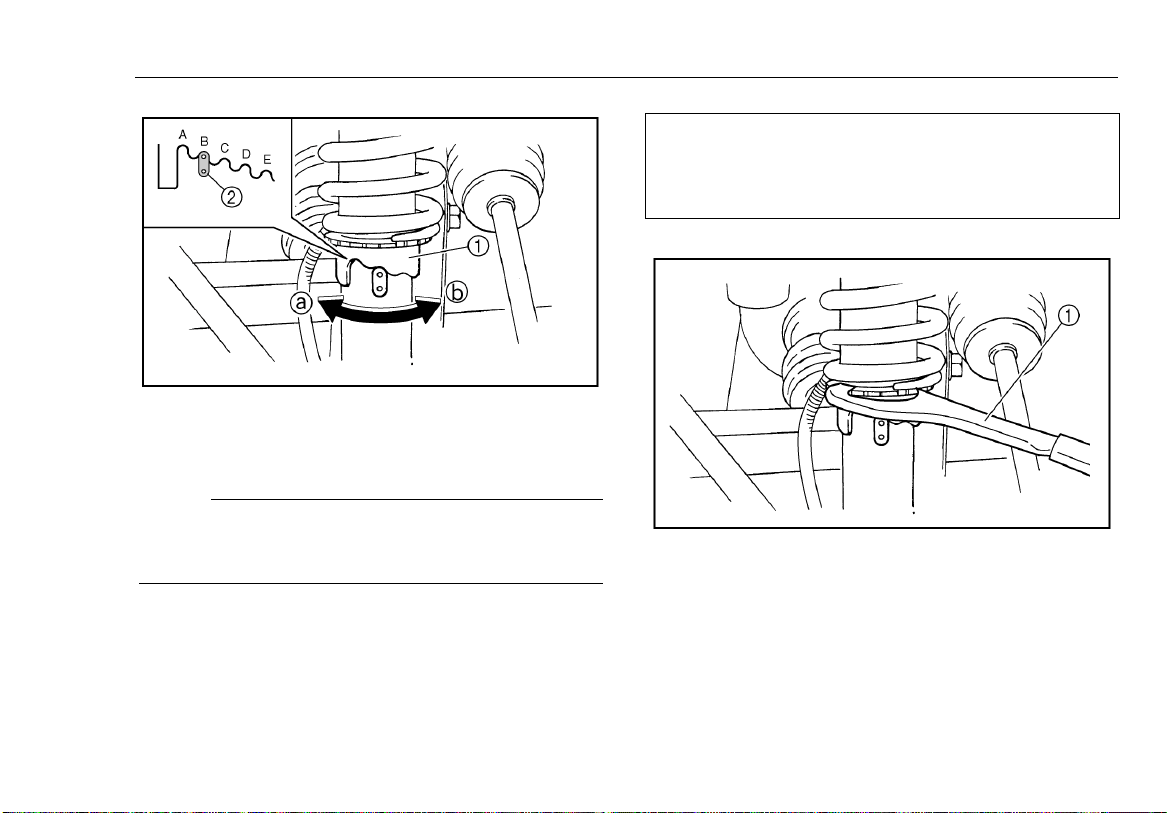
4-26 Control Functions
1. Spring preload adjusting ring
2. Position indicator
NOTE:
A
special wrench can be obtained at a dealer
to make this adjustment.
S
tandard position: B
A-Minimum(soft)
E-Maximum(hard)
1. Special wrench
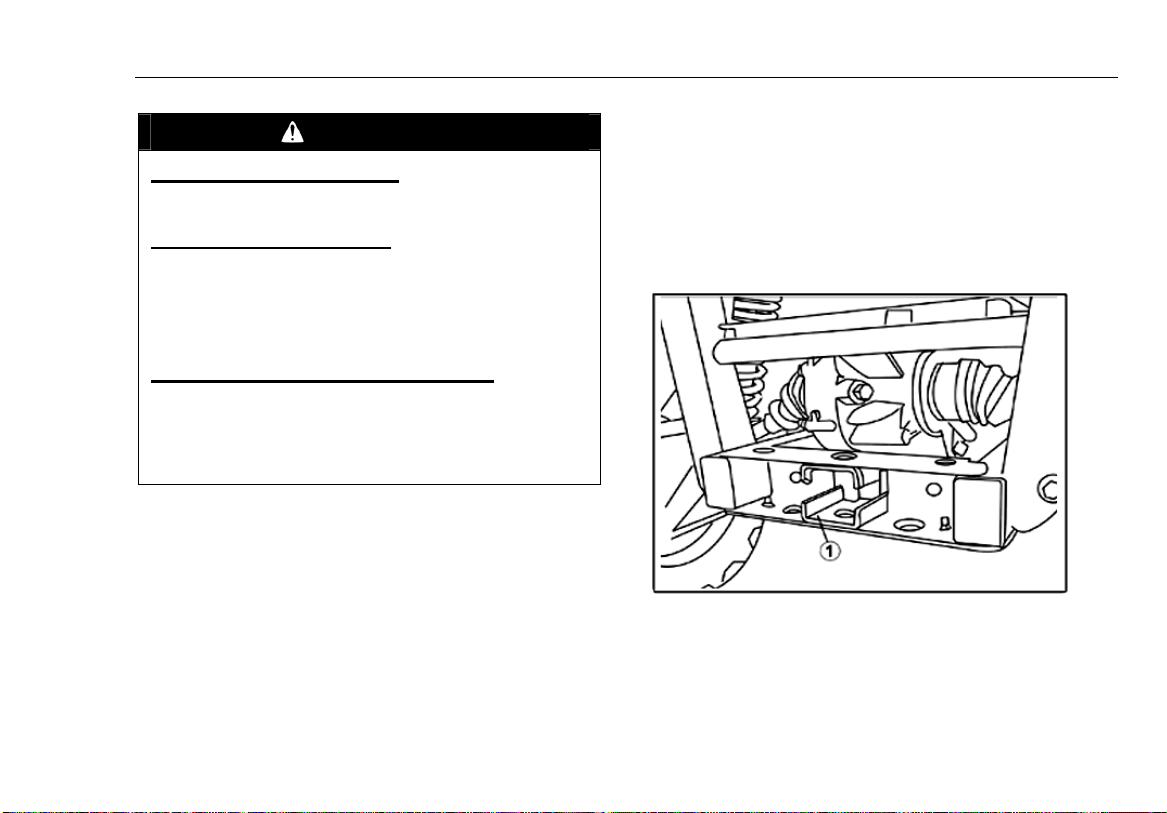
Control Functions 4-27
WARNING
POTENTIAL HAZARD
Improper shock absorb
er adjustment.
WHAT CAN HAPPEN
Uneven adjustment can cause poor
handling and loss of stability, which
could lead to an accident.
HOW TO AVOID THE HAZARD
Always adjust the shock absorbers on
the left and right side to the same
setting.
T
railer hitch bracket
This vehicle is equipped with a 1 ¼ in
receiver bracket for a standard trailer hitch.
Trailer towing equipment can be obtained at
a dealer. (See pages 6-12-6-14 for precaut-
ion information.)
1. Trailer hitch bracket
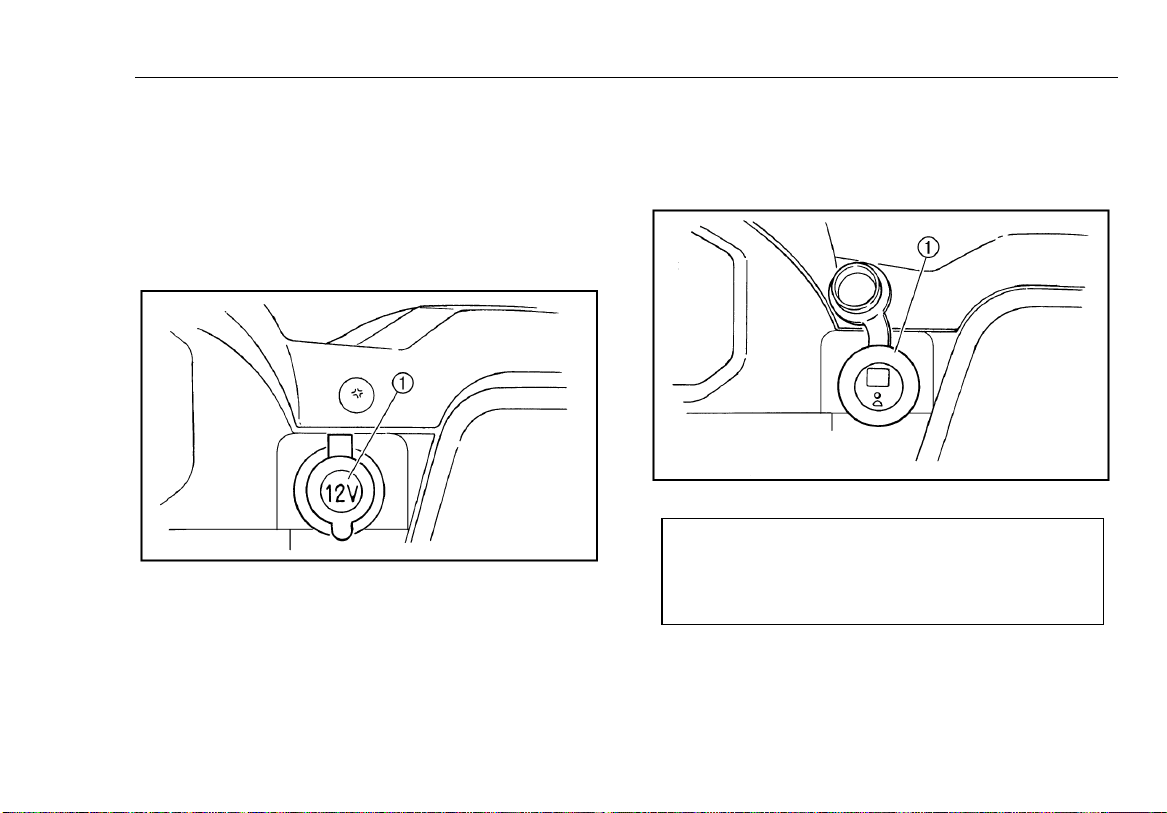
4-28 Control Functions
Auxiliary DC jack
The auxiliary DC jack is located at the right
side of the front panel.
The auxiliary DC jack can be used for
suitable work lights, radios, etc.
The auxiliary DC jack should only be used
when the engine is running.
1. Auxiliary DC jack cap
1. Set the light switch to “OFF”.
2. Start the engine. (See pages 6-1-6-3. )
3. Open the auxiliary DC jack cap, and then
insert the accessory power plug into the
jack.
4. When the auxiliary DC jack is not being
used, cover it with the cap.
1. Auxiliary DC jack
Maximum rated capacity for the auxiliary
DC jack:
DC 12V, 120W (10 A)

Control Functions 4-29
CAUTION:
Do not use accessories requiring more
than the above maximum capacity. This
may overload the circuit and cause the
fuse to blow.
If accessories are used without the
engine running or with the headlights
turned on, the battery will lose its charge
and engine starting may become difficult.
Do not use an automotive cigarette
lighter or other accessories with a plug
that gets hot because the jack can
be damaged.
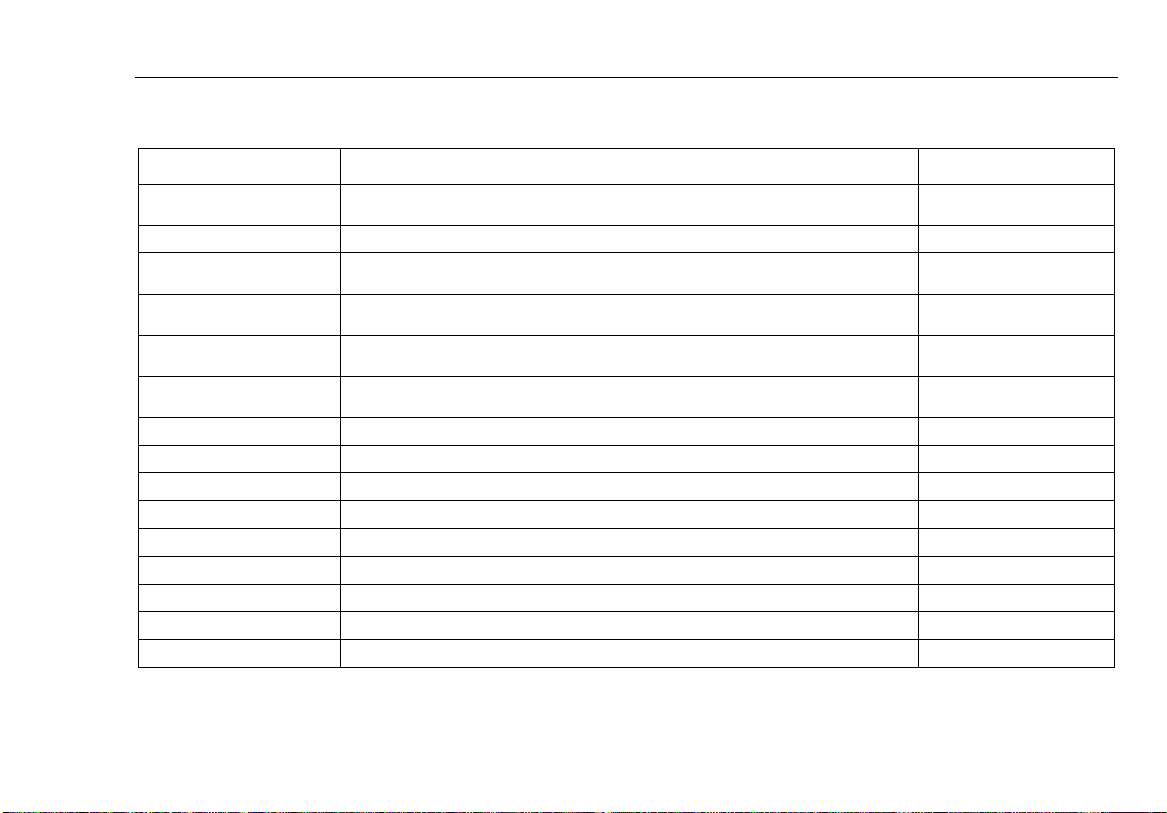
5-1 Pre-Operation Checks
Before using this vehicle, check the following points:
ITEM CHECK POINTS PAGE
Brakes
● Check operation, free play, fluid level and fluid leakage.
● Fill with DOT 4 brake fluid if necessary.
5-2—5-3,8-32
Parking brake
● Check for proper operation, condition and free play.
6-7—6-9
Fuel
● Check fuel level.
● Fill with fuel if necessary.
5-4—5-5
Engine/Gear box oil
● Check oil level.
● Fill with oil if necessary.
5-5
Coolant reservoir
● Check coolant level.
● Fill with coolant if necessary.
5-6,8-18—8-19
Final gear oil /
Differential gear oil
● Check for leakage.
5-7
Accelerator pedal
● Check for proper accelerator pedal operation.
5-8
Seat belts
● Check for proper operation and belt wear.
5-10
Steering
● Check for proper operation .
5-10
Fittings and fasteners
● Check all fittings and fasteners.
5-10
Lights and switches
● Check for proper operation.
5-10
Wheels and tires
● Check tire pressure, wear and damage.
5-1—5-13,8-38—8-39
Axle boots
● Check for damage.
8-20
Instrument
● Check for complete and correct display symbols
4-2—4-8
Light/Indicator ● Check for light / indicator operation 4-2—4-8
Pre-Operation Checks 5-2
WARNING
POTENTIAL HAZARD
Failure to inspect the vehicle before
operating. Failure to properly maintain
the vehicle.
WHAT CAN HAPPEN
Increases the possibility of an
accident or equipment damage.
HOW TO AVOID THE HAZARD
Always inspect your vehicle each time
you use it to make sure the vehicle is
in safe operating condition. Always
follow the inspection and maintenance
procedures and schedules described
in the Owner’s Manual.
Bra
kes
Brake pedal
Check for correct brake pedal free play. If the
brake pedal free play is incorrect, have a
dealer adjust it. (See pages 8-34-8-35.)
Check the operation of the brake pedal. It
should move smoothly and there should be a
firm feeling when the brakes are applied. If
not, have the vehicle inspected by a service
center.
Brake fluid level
Check the brake fluid level.
Add fluid if necessary. (See pages 8-32. )
5-3 Pre-Operation Checks
Recommended brake fluid: DOT
4
Brake fluid leakage
Check to see if any brake fluid is leaking out
of the pipe joints or the brake fluid reservoir.
Apply the brakes firmly for one minute. If
there is any leakage, have the vehicle
inspected by a service center.
Brake operation
Test the brakes at slow speed after starting
out to make sure they are working properly. If
the brakes do not provide proper braking
performance, inspect the brake system. (See
pages 8-30—8-35.)
WARNING
POTENTIAL HAZARD
Driving w
ith improperly operating
brakes.
WHAT CAN HAPPEN
You could lose braking ability, which
could lead to an accident.
HOW TO AVOID THE HAZARD
Always check the brakes at the start of
every ride. Do not operate the vehicle if
you find any problem with the brakes. If
a problem cannot be corrected by the
adjustment procedures provided in this
manual, have the vehicle inspected by
a service center.
Pre-Operation Checks 5-4
Fuel
Make sure there is sufficient gasoline in the
tank.
Recommended fuel:
Unleaded gasoline only
Fuel tank capacity:
7.4 gal (28L)
CAUTION:
Use only un
leaded gasoline. The use of
leaded gasoline will cause severe damage to
internal engine parts, such as the valves and
piston rings, as well as to the exhaust
system.
Your engine has been designed to use
regular unleaded gasoline with a pump
octane number ([R+M] /2) of 91 or higher, or
research octane number of 91 or hither. If
knocking or pinging occurs, use a different
brand of gasoline or premium unleaded fuel.
Unleaded fuel will give you longer spark plug
life and reduced maintenance cost.
Gasohol
The UTV uses an electric fuel injection
system, and its emissions meet the
requirements of the US Environment
Protection Agency. Never use E-85 fuel or
any fuel containing greater than 10%
(E-10) Ethanol. Fuels containing greater
than 10% Ethanol will damage the engine
and void any warranties.
5-5 Pre-Operation Checks
WARNING
POTENTIAL HAZARD
Improper care w
hen refueling.
WHAT CAN HAPPEN
Fuel can spill, which can cause a fire
and severe injury. Fuel expands when
it heats up. If the fuel tank is overfilled,
fuel could spill out due to heat from
the engine or the sun.
HOW TO AVOID THE HAZARD
Do not overfill the fuel tank. Be careful
not to spill fuel, especially on the
engine or exhaust pipe. Wipe up any
spilled fuel immediately. Be sure the
fuel tank cap is closed securely.
Engine oil
Make sure the engine oil is at the specified
level. Add oil as necessary. (See pages
8-10.)
CAUTION:
In order to prevent clutch slippage (since
the engine oil also lubricates the clutch),
do not mix any chemical additives. Do
not use oils with a diesel specification of
“CD” or oils of a higher quality than
specified. In addition, do not use oils
labeled “ENERGYCONSERVING II” or
higher.
Make sure that no foreign material en-
ters the crankcase.
Pre-Operation Checks 5-6
Recommended engin
e oil type and
quantity:
See page 10-2
Coolant
Check the coolant level in the coolant
reservoir w
hen the engine is cold. (The
coolant level will vary with engine
temperature.) The coolant level is
satisfactory if it is between the minimum and
maximum level marks on the coolant
reservoir. If the coolant level is at or below
the minimum level mark, add additional
coolant to bring the level up to maximum
level mark. If coolant is not available, add
distilled water. Change the coolant every two
years. (See pages 8-19—8-20 for details.)
CAUTION:
Hard water or salt wate
r is harmful to the
engine. You may use soft water if you cannot
get distilled water.
Coolan
t reservoir capacity
(up to the maximum level mark):
0.35L(0.31lmp qt, 0.37US qt)
5-7 Pre-Operation Checks
WARNING
POTENTIAL HAZARD
Removing th
e radiator cap when the
engine and radiator are still hot.
WHAT CAN HAPPEN
You could be burned by hot fluid and
steam blown out under pressure.
HOW TO AVOID THE HAZARD
Wait for the engine to cool before
removing the radiator cap. Always use
a thick rag over the cap. Allow any
remaining pressure to escape before
completely removing the cap.
Final gear oi
l
Make sure the final gear oil is at the specified
level. Add oil as necessary. (See pages
8-14—8-15 for details.)
Recommended oil:
SAE 80 API GL-4 Hypoid gear oil
If desired, an SAE 80W90 hypoid gear oil
may be used for all conditions.
NOTE:
GL-4 is a quality and additive rating, GL-5 or
GL-6 rated hypoid gear oils may also be
used.
Differential gear oil
Make sure the differential gear oil is at the
specified level. Add oil as necessary. (See
pages 8-16—8-18 for details.)
Recommended oil:
SAE 80 API GL-5 Hypoid gear oil
Pre-Operation Checks 5-8
Throttle Pedal
Check to see that the
accelerator
pedal
operates correctly. It must operate smoothly
and fully spring back to the idle position
when released. Have a dealer repair as
necessary for proper operation.
Throttle Freeplay
If the throttle pedal has excessive play due
to cable stretch or mis-adjustment, it will
cause a delay in throttle response, especially
at low engine speed. The throttle may also
not open fully. If the throttle pedal has no
freeplay, the throttle may be hard to control,
and the idle speed may be erratic.
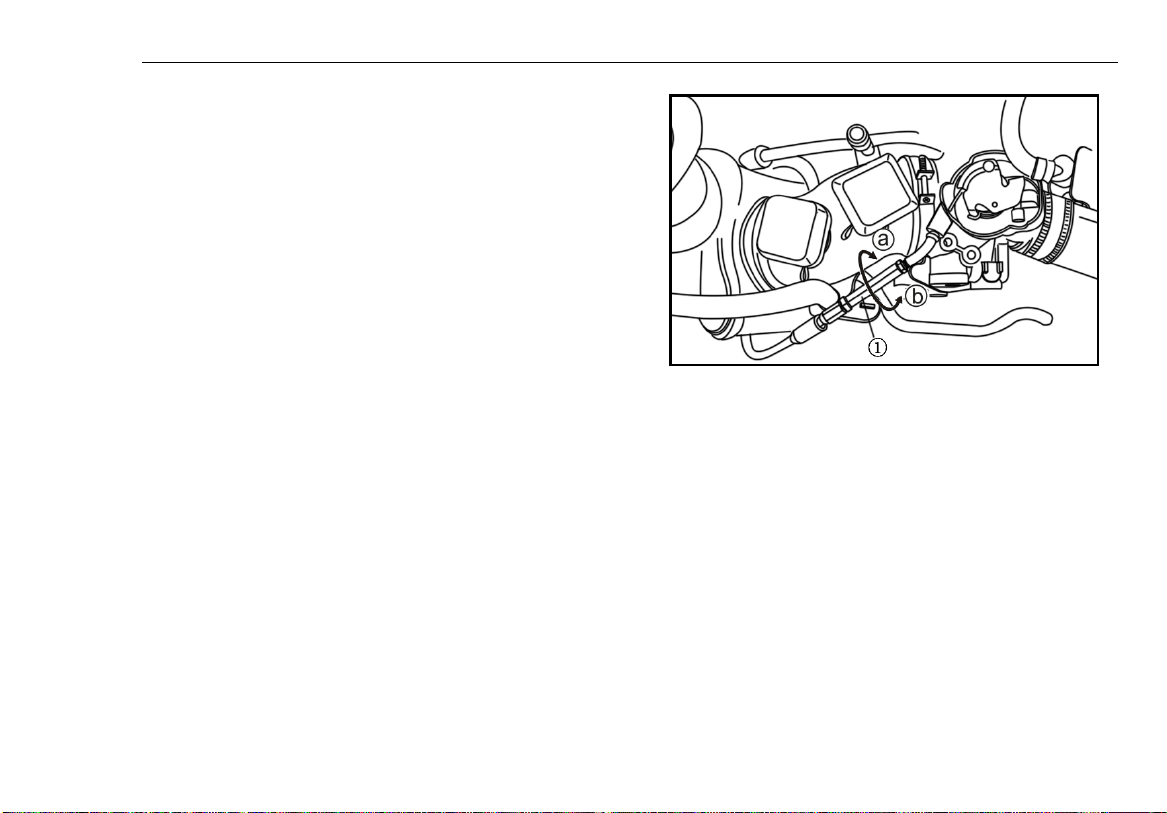
Check the throttle pedal freeplay , Adjust the
freeplay If necessary.
WARNING
Failure to check or maintain proper
operation of the throttle system can
result in an accident and lead to
serious injury or death if the throttle
pedal sticks during operation.
Never start or operate this vehicle if it
has a sticking or improperly operating
throttle pedal.
Immediately contact your service
center for service if throttle
problems arise.
Always check the pedal for free
movement and return before starting
the engine and occasionally during
operation.
5-9 Pre-Operation Checks
Throttle Freeplay Inspection
1. Lift the parking brake to the top to park
the car.
2. Apply the brakes. Start the engine. Allow
it to warm up thoroughly.
3. Measure the distance the throttle pedal
moves before the engine begins to pick
up speed. Freeplay should 1/16 to 1/8
inches (1.5-3mm).
Throttle Freeplay Adjustment
1. Remove both seats. Remove the middle
cover of the engine, ( see PAGE 8-9 )
2. Loosen the nut of throttle cable on the
valve.
Spin the throttle cable inside/ outside to
increase the throttle pedal’s moving
distance to 1.5-3 mm.
1.Accelerator Cable column nut
3. Tighten the nut.
4. Return the center cover and seat to
their position.
Steering Wheel Inspection
Check the steering wheel for specified
freeplay and smooth operation。
1. Position the vehicle on level ground.

Pre-Operation Checks 5-10
2. Lightly turn the steering wheel left and
right.
3. There should be 0.8″-1.0″ (20-25 mm)
of freeplay.
If there is excessive freeplay or strange
noises, or the steering feels rough or
″catchy,″ have the steering system
inspected by an authorized service center.
Seat belts
Make sure that both seat belts are not frayed
or damaged.
The seat belt must move smoothly when
pulled out and retract on its own when
released. The latch plate should click
securely into the buckle and release when
the release button is pushed firmly. Wash off
any dirt or mud which could affect operation.
Have a service center repair as necessary
for proper operation.
Fittings and fasteners
Always check the tightness of chassis fittings
and fasteners before a ride. Take the vehicle
to a dealer or refer to the Service Manual for
correct tightening torque.
Lights
Check the headlights and tail/brake lights to
make sure they are in working condition.
Repair as necessary for proper operation.
Switches
Check the operation of all switches. Have a
service center repair as necessary for proper
operation.
5-11 Pre-Operation Checks
Tires
WARNING
POTENTIAL HAZARD
Operating this vehicle
with improper
tires, or with improper or uneven tire
pressure.
WHAT CAN HAPPEN
Use of improper tires on this vehicle, or
operation of this vehicle with improper
or uneven tire pressure, may cause
loss of control, increasing your risk of
accident.
HOW TO AVOID THE HAZARD
1. The tires listed below have been
approved by Manufacturer for this
model. Other tire combinations are
not recommended.
Type Size
Front 26×9-12 6PR
Rear 26×10-12 6PR
2. The tires
should be set to the
recommended pressure:
● Recommended tire pressure
Front 10psi (70kpa, 0.7 kgf/cm
2
)
Rear 10psi (70kpa, 0.7 kgf/cm
2
)
Check and adjust tire pressures when
the tires are cold.
Tire pressures must be equal on both
sides.
3. Tire pressure below the minimum
specified could cause the tire to
dislodge from the rim under severe
riding conditions. The following are
minimums:
Front 9psi (63 kpa, 0.64kgf/cm
2
)
Rear 9psi (63 kpa, 0.64kgf/cm
2
)
4. Use no more than the following
pressures when seating the tire
beads.
Pre-Operation Checks 5-12
Front 36psi (250kpa, 2.5kgf/cm
2
)
Rear 36psi (250kpa, 2.5kgf/cm
2
)
Higher pressures may cause the tire to
burst. Inflate the tires very slowly and
carefully. Fast inflation could cause the
tire to burst.
How
to measure tire pressure
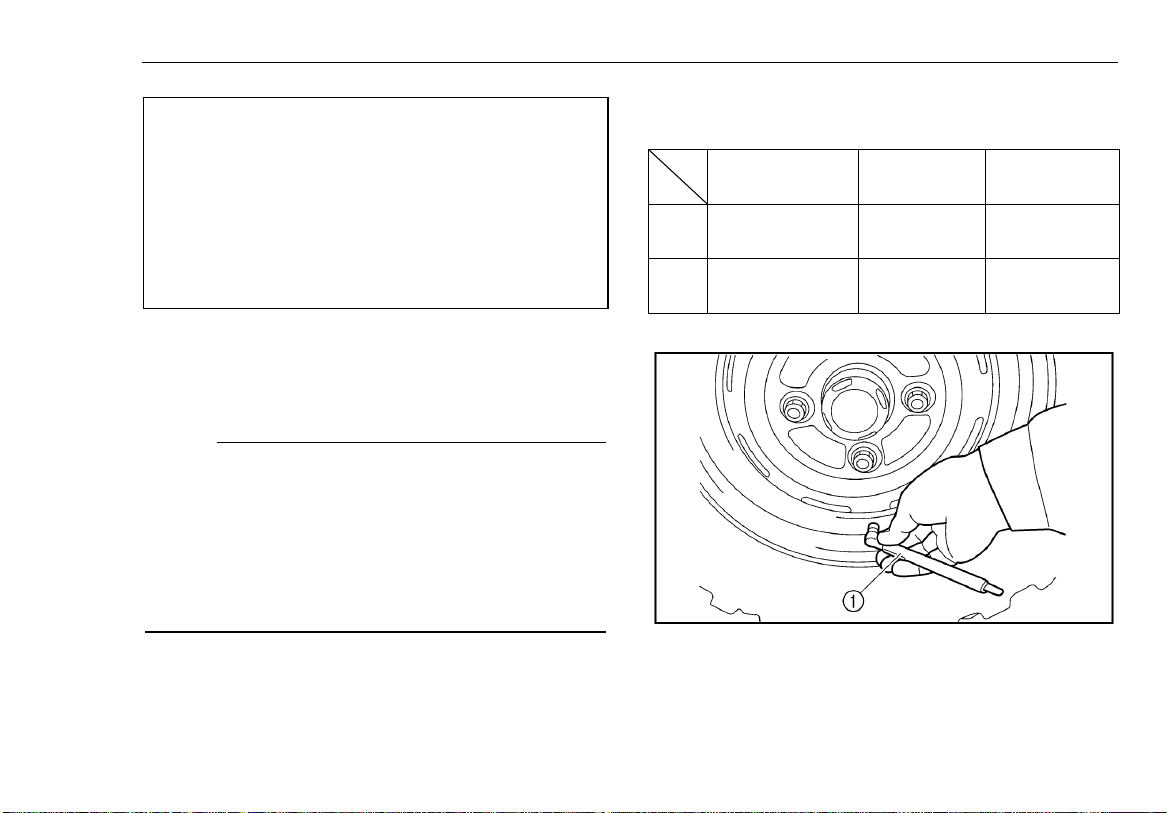
Use the tire pressure gauge.
NOTE:
The tire pressure gau
ge is included as stan-
dard equipment. Make two measurements of
the tire pressure and use the second reading.
Dust or dirt in the gauge could cause the first
reading to be incorrect.
Set pressure with tires col
d.
Set tire pressures to the following specifica-
tions:
Recommend
ed
Pressure
Minimum Maximum
Front
10psi (70kpa
(0.70kgf/ cm
2
)
9 psi (63kpa,
0.64kgf/ cm
2
)
11 psi, (77kpa,
0.77kgf/ cm
2
)
Rear
10psi (70kpa
(0.70kgf/ cm
2
)
9 psi (63kpa,
0.64kgf/ cm
2
)
11 psi, (77kpa,
0.77kgf/ cm
2
)
1. Tire pressure gauge
5-13 Pre-Operation Checks
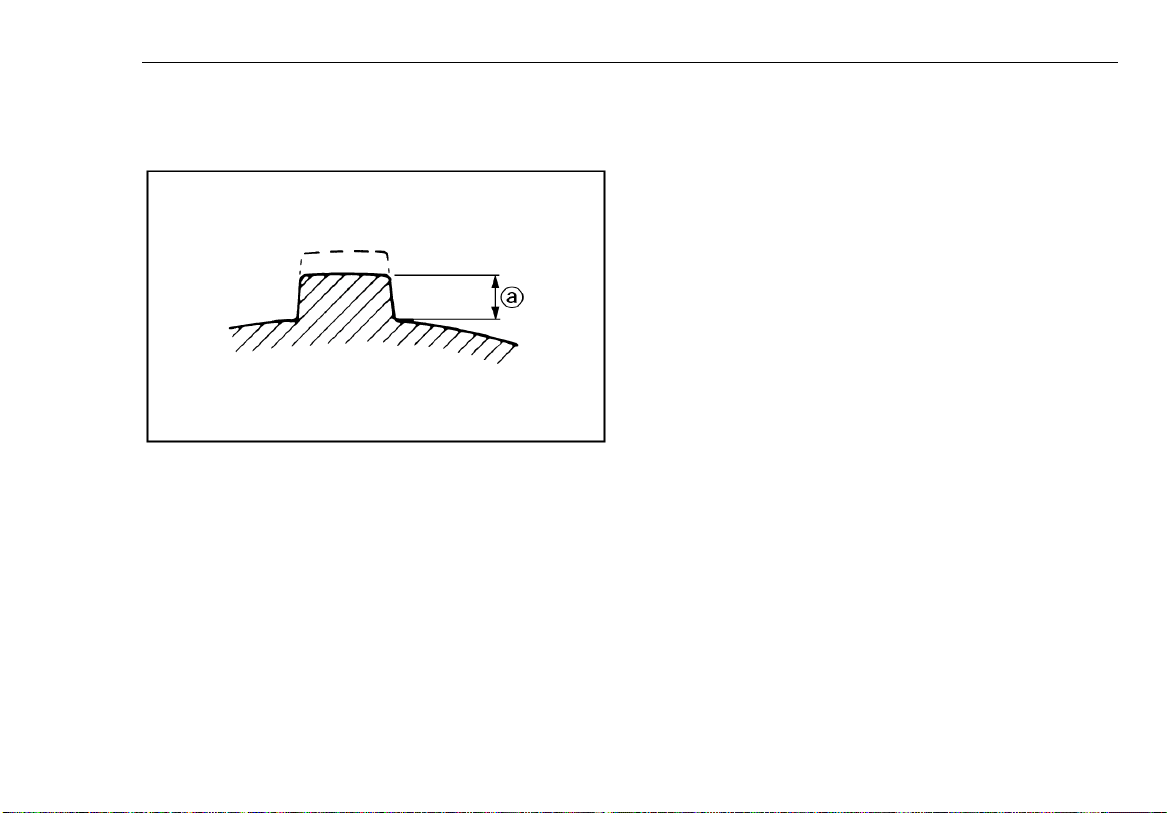
Tire wear limit
When the tire groove decreases to 0.12 in
(3 mm) due to wear, replace the tire.
a. Tire wear limit
Operation 6-1
WARNING
POTENTIAL HAZARD
Operating vehicle
without being
familiar with all controls.
WHAT CAN HAPPEN
Loss of control, which could cause an
accident or injury.
HOW TO AVOID THE HAZARD
Read the Owner’s Manual carefully. If
there is a control or function you do
not understand, ask your service
center.
Starting The Engine In Low Temperatures
WARNING
POTENTIAL HAZARD
Freezing
control cables in cold
weather.
WHAT CAN HAPPEN
You could be unable to control the
vehicle, which could lead to an
accident or collision.
HOW TO AVOID THE HAZARD
When riding in cold weather, always
make sure all control cables work
smoothly before you begin riding.
1. Check the throttle cable, parking cable,
and the reverse lock out cable, and make
sure that they are not frozen.
2. Start the engine (see P6-2).
6-2 Operation
Starting The Engine
CAUTION:
See the “Engine Break-In”section prior to
operating the engine for the first time.
1.
Turning the key to “ON”, the light in the
display will turn on, and electronic
injection system’s fuel pump will start to
work; wait for 10 second before the
following operation.
2. Apply the brake.
3. Shift the drive select lever into the neutral
position.
NOTE:
● When the drive select lever is in the
neutral position“N”, the neutral indicator
light should come on. If the neutral
indicator light does not come on, ask a
service center to inspect the electric
circuit.
● The engine can be started in any gear if
the brake is applied. However, it is
recommended to shift into neutral ”N”
before starting the engine.
4.
With your foot off the accelerator pedal,
start the engine by turning the key to
“START”.
Operation 6-3
NOTE:
If the engine fails to start, release the key,
and then try starting again. Wait a few
seconds before the next attempt. Each
cranking should be as short as possible to
preserve battery energy. Do not crank the
engine more than 5 seconds on each
attempt.
5. Continue warming up the engine until it
idles smoothly before riding.
WARNING
POTENTIAL HAZARD
Engine idle speed exceeds the
regulated speed.
WHAT CAN HAPPEN
Will make it difficult to select gear and
lose control, finally causing serious
injury or even death.
HOW TO AVOID THE HAZARD
Because of electronic injection
system, the idle speed will be
increased when the voltage of battery
is low. Place the gear selector in
position ‘N’, and press the throttle
pedal to make the engine run at
2500RPM to charge the battery for 5-10
minutes; when the voltage of battery is
over 12V, the idle speed will be
normal. If the idle speed is still high,
please contact your service center.

6-4 Operation
Warming Up
To get maximum engine life, always warm up
the engine before driving. Never accelerate
hard with a cold engine! To see whether or
not the engine is warm, check if it responds
to the throttle normally .
1. Release the brakes and press the
accelerator pedal gradually.
2. If the rotation rate of the engine
accelerates with pedal steadily, the
warming-up procedure is complete and
the vehicle can been driven.
Otherwise, go on with the third step.
3. Continue warming up the engine until it
idles smoothly.
CAUTION:
See the “Engine brea
k-in” section prior to
operating the engine for the first time.
Drive Select Lever Oper
ation And Driving
In Reverse
CAUTION:
Before shifting, you
must stop the UTV and
return the throttle lever to the closed position,
otherwise the transmission may be
damaged.
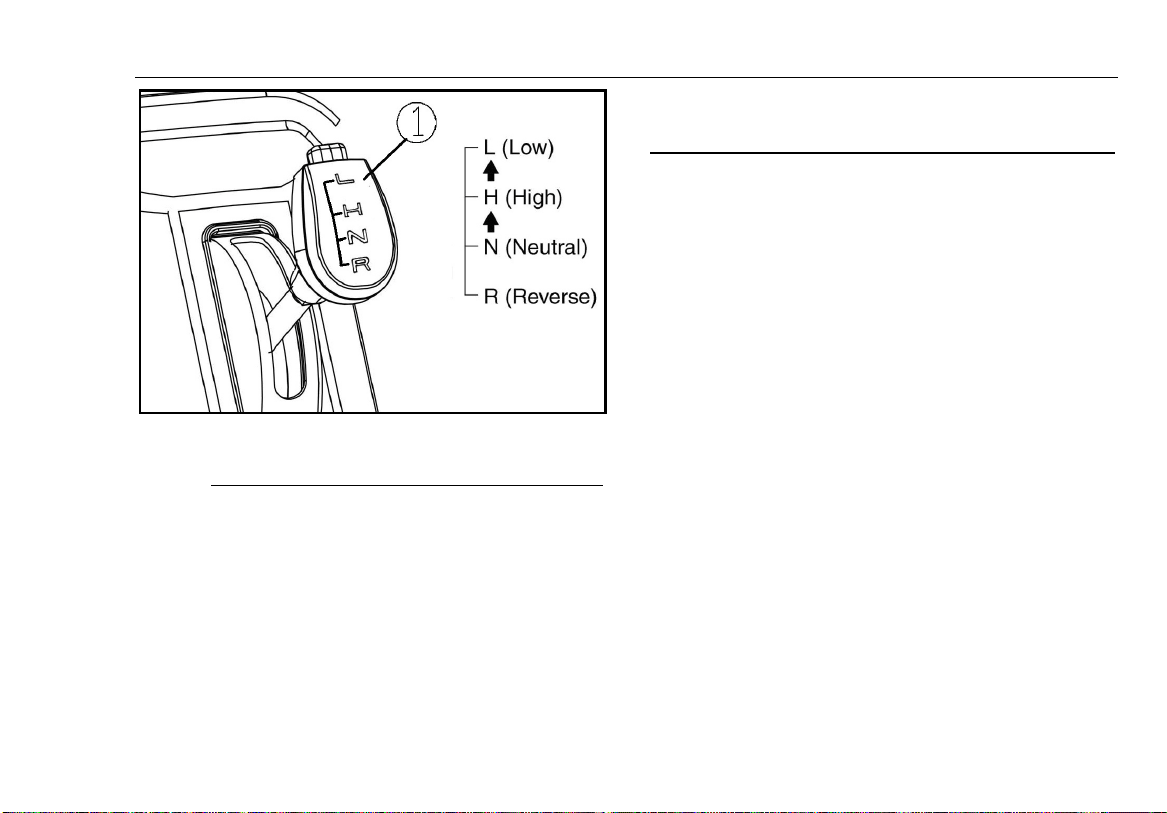
Shifting: Neutral to High and High to Low
1. Stop the vehicle. Keep your foot off the
accelerator pedal.
2. Apply the brakes, then shift by moving
the drive select lever along the shift
guide.
Operation 6-5
NOTE:
Make sure that the drive select lever is
completely shif
ted into position.
3. Release the brakes and press the
accelerator pedal gra
dually.
Shifting: Neutral to Reverse
1. Stop the vehicle. Keep your foot off the
accelerator pedal.
2. Apply the brake pedal.
3. Shift from neutral to reverse or vice versa
by moving the drive select lever along
the shift guide.
NOTE:
● Apply the brakes first, before placing
gearshift lever to “reverse” position.
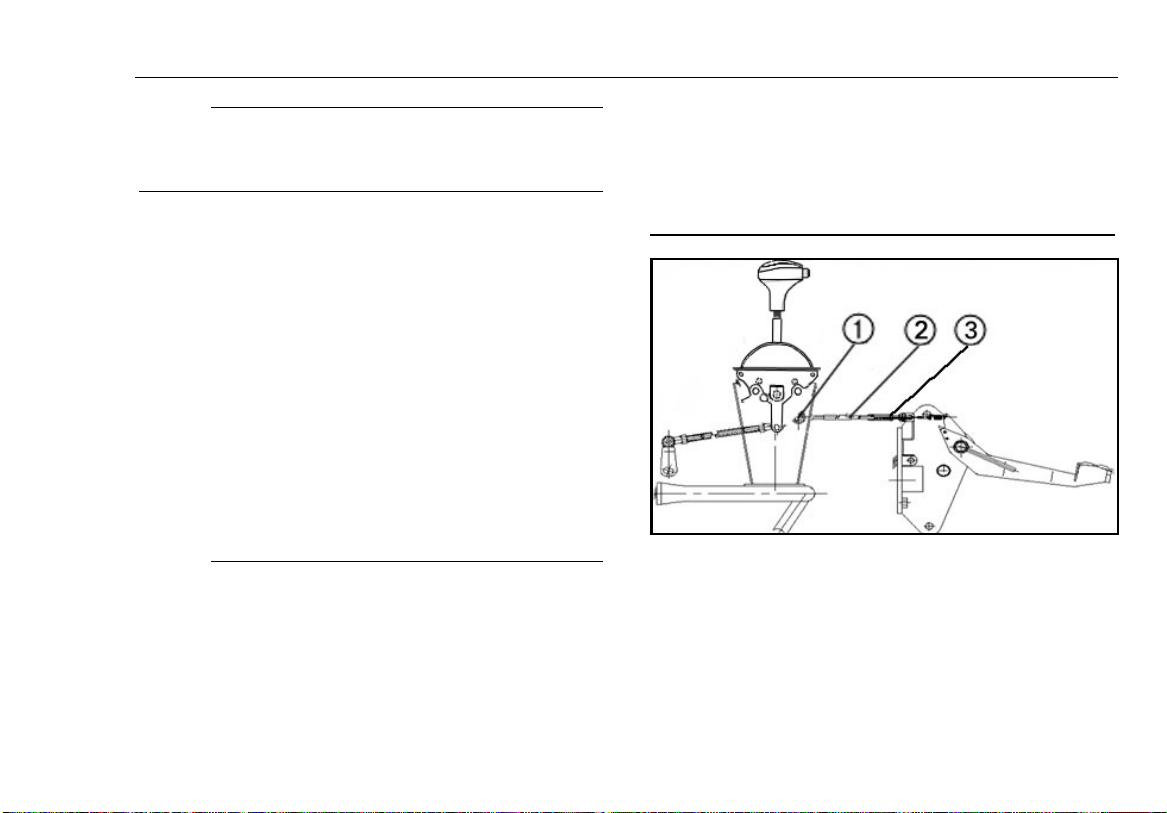
● In the brake pedal, there is a cable which
is connected to a position pin in the
gearshift assembly. When the brake
pedal is applied, the position pin will
release, and the gearshift can be moved
to the“reverse”position.
1.Position pin 2.Cable 3. Adjust
6-6 Operation
1. Drive select lever
NOTE:
● When in reverse, the reverse indicator
light should be on. If the light does not
come on, ask a dealer to inspect the
reverse indicator light electrical circuit.
● Due to the synchronizing mechanism in
the engine, the light may not come on
until the vehicle starts moving.
4. Check behind for people or obstacles,
then release the brake pedal.
5. Press the accelerator pedal gradually
and continue to watch to the rear while
backing up.
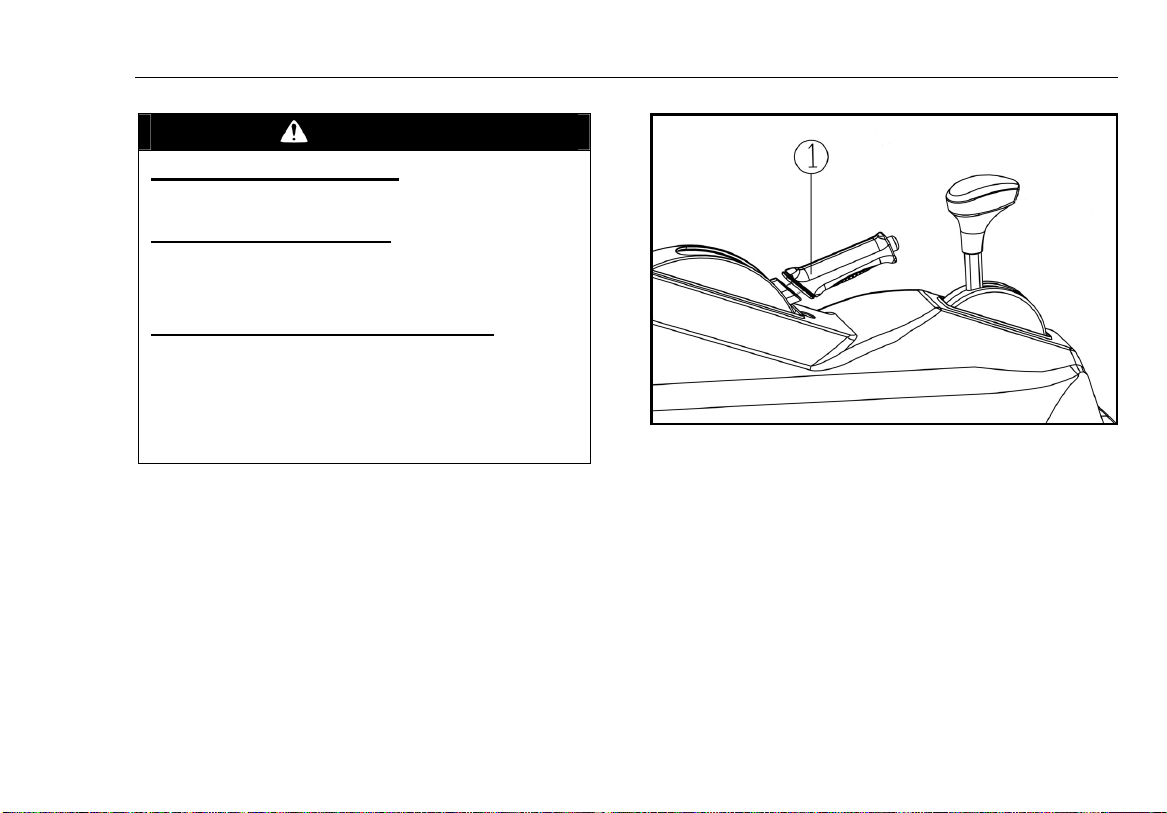
Operation 6-7
WARNING
POTENTIAL HAZARD
Improperly operating in reverse.
WHAT CAN HAPPEN
You could hit an obstacle or person
behind you, resulting in serious injury.
HOW TO AVOID THE HAZARD
When you shift into reverse, make
sure there are no obstacles or people
behind you. When it is safe to
proceed, go slowly.
Parking
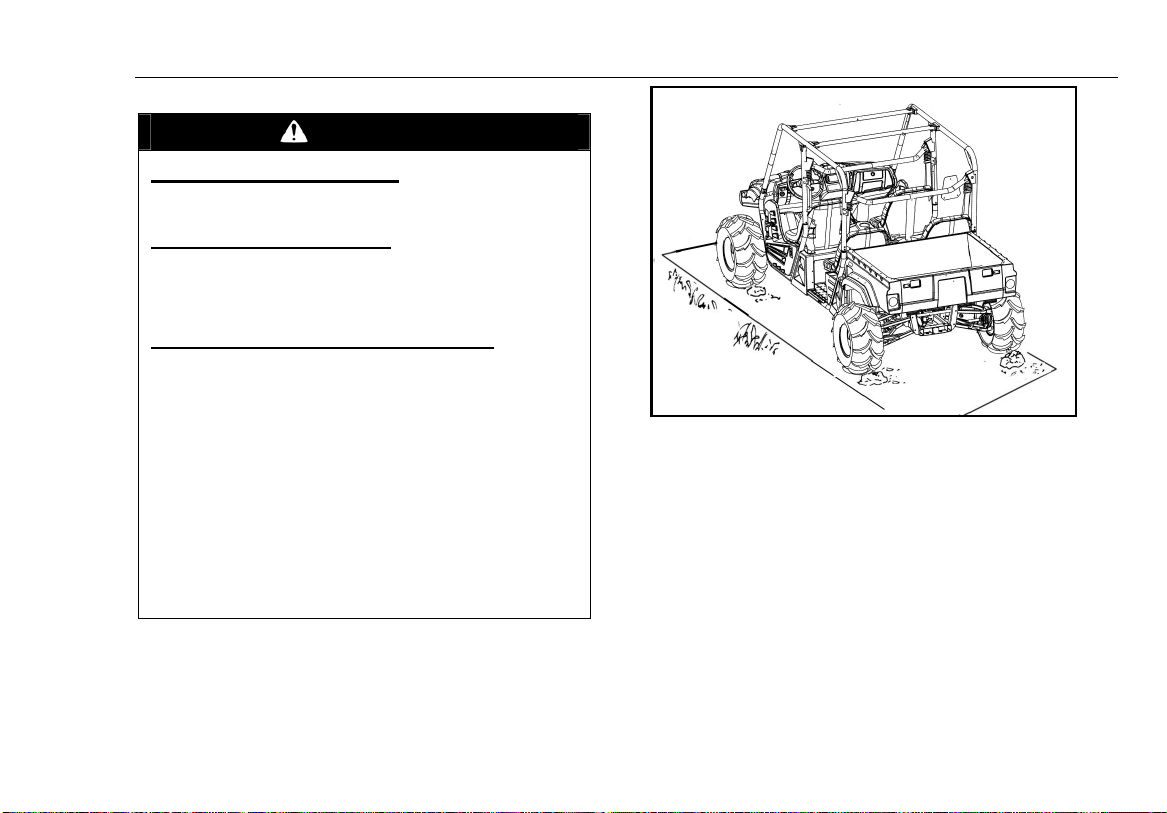
a) When parking, stop the engine and shift
the drive select lever into the neutral
position.
b) Push the brake pedal down, and pull the
parking brake to top position to park the
vehicle
1.Parking hand brake
6-8 Operation
Parking On a Slope
WARNING
POTENTIAL HAZARD
Parking on a hill or other incline.
WHAT CAN HAPPEN
The vehicle could roll out of control,
increasing the chance of an accident.
HOW TO AVOID THE HAZARD
Avoid parking on hills or other
inclines. If you must park on an
incline, apply the parking brake, and
block the front and rear wheels with
rocks or other objects. Do not park
the vehicle at all on hills that are so
steep you could not walk up them
easily.
1. Bring the vehicle to a stop by applying the
brakes.
2. Stop the engine.
3. With the brakes applied, set the parking
brake.

Operation 6-9
NOTE:
Like many other vehicles, the parking brake
acts on the rear wheels. For the parking
brake to operate all four wheels, shift to 4WD
before stopping the engine.
Vehicle Break-in Period
The break-in period for your new UTV
vehicle is the first 25 hours of operation, or
the time it takes to use the first three tanks
full of gasoline. No single action on your part
is as important as a proper break-in period.
Careful treatment of a new engine and drive
components will result in more efficient
performance and longer life for these
components. Perform the following
procedures carefully.
CAUTION:
● Excessive heat build-up during the first
three hours of operation will damage
close-fitted engine parts and drive
components. Do not operate at full
throttle or high speeds during the first
three hours of use.
● Use of any engine oil not mentioned in
this manual will cause severe damage to
the engine。
Engine Break-In
There is never a more important period in the
life of your vehicle than the period between 0
and 25 hours. For this reason, we ask that
you carefully read the following material.
Because the engine is brand new, you must

6-10 Operation
not put an excessive load on it for the first
several hours of running.
During the first 25 hours, the various parts in
the engine wear and polish themselves to the
correct operating clearances.
During this period, prolonged full throttle
operation or any condition which might result
in excessive engine heating must be avoided.
However, momentary (2-3 seconds
maximum) full throttle operation under load
does not harm the engine.
Each full throttle acceleration sequence
should be followed with a substantial rest
period for the engine by cruising at lower
RPM so the engine can rid itself of the
temporary build-up of heat. If any
abnormality is noticed during this period,
consult a dealer.
0-10 Hours:
Avoid continuous operation above half
throttle. Allow a cooling off period of five to
ten minutes after every hour of operation.
Vary the speed of the vehicle from time to
time. Do not operate it at one set throttle
position.
10-25 Hours:
Avoid prolonged operation above 3/4 throttle.
Rev the vehicle freely but do not use full
throttle at any time.
After break-in:
The vehicle can now be operated normally.
Brake System Break-in
Apply only moderate braking force for the
first 50 stops. Aggressive or overly forceful
braking when the brake system is new could
damage brake pads and rotors.

Operation 6-11
CVT Break-in (Clutches/Belt)
A proper break-in of the clutches and drive
belt will ensure a longer life and better
performance. Break in the clutches and belt
by operating at slower speeds during the
break-in period as recommended. Pull only
light loads. Avoid aggressive acceleration
and high speed operation during the break-in
period.
Accessories
Accessories can affect the handing and
control of your vehicle. Keep the following in
mind when considering an accessory or
operating a vehicle which has accessories.
● Choose only accessories designed for
your vehicle. Your dealer has a variety of
genuine accessories. Other accessories
may also be available on the market.
However, it is not possible for to test all
aftermarket accessories, nor have any
control over the quality or suitability
of them. Choose a genuine accessory,
or one that is equivalent in design and
quality.
● Accessories should be rigidly and
securely mounted. An accessory which
can shift position or come off while you
are operating could affect your ability to
control the vehicle.
● Do not mount an accessory where it
could interfere with your ability to control
the vehicle. Examples include (but are
not limited to) an object that limits your
ability to turn the steering wheel or one

6-12 Operation
that limits your view.
● Use extra caution when driving a vehicle
with accessories. The vehicle may
handle differently than it does without
accessories.
Loading
Cargo or a trailer can change the stability
and handling of a vehicle.
You must use common sense and good
judgment when carrying cargo or towing a
trailer. Keep the following points in mind:
● Never exceed the weight limits shown.
An overloaded vehicle can be unstable.
MAXIMUM LOADING LIMIT
● Vehicle loading limit (total weight of
cargo, operator, passengers and
accessories, and tongue weight):
559kg (1232 lb)
● Cargo bed: 350 lb (159kg)
● Trailer hitch:
Pulling load (total weight of trailer
and cargo): 1,212lbf (550kgf)
Tongue weight (vertical weight on
trailer hitch point): 50kgf (110lbf)
● Choose a trailer hitch drawbar designed
for use with a 2 in (5 cm) receiver.
(See page 4-32 for more information)
● Do not exceed the maximum tongue
weight. You can measure tongue weight

Operation 6-13
with a bathroom scale. Put the tongue of
the loaded trailer on the scale with the
tongue at hitch height. Adjust the load in
the trailer, if necessary, to reduce the
weight on hitch. If you are carrying cargo
and towing a trailer, include the tongue
weight in the maximum vehicle load limit.
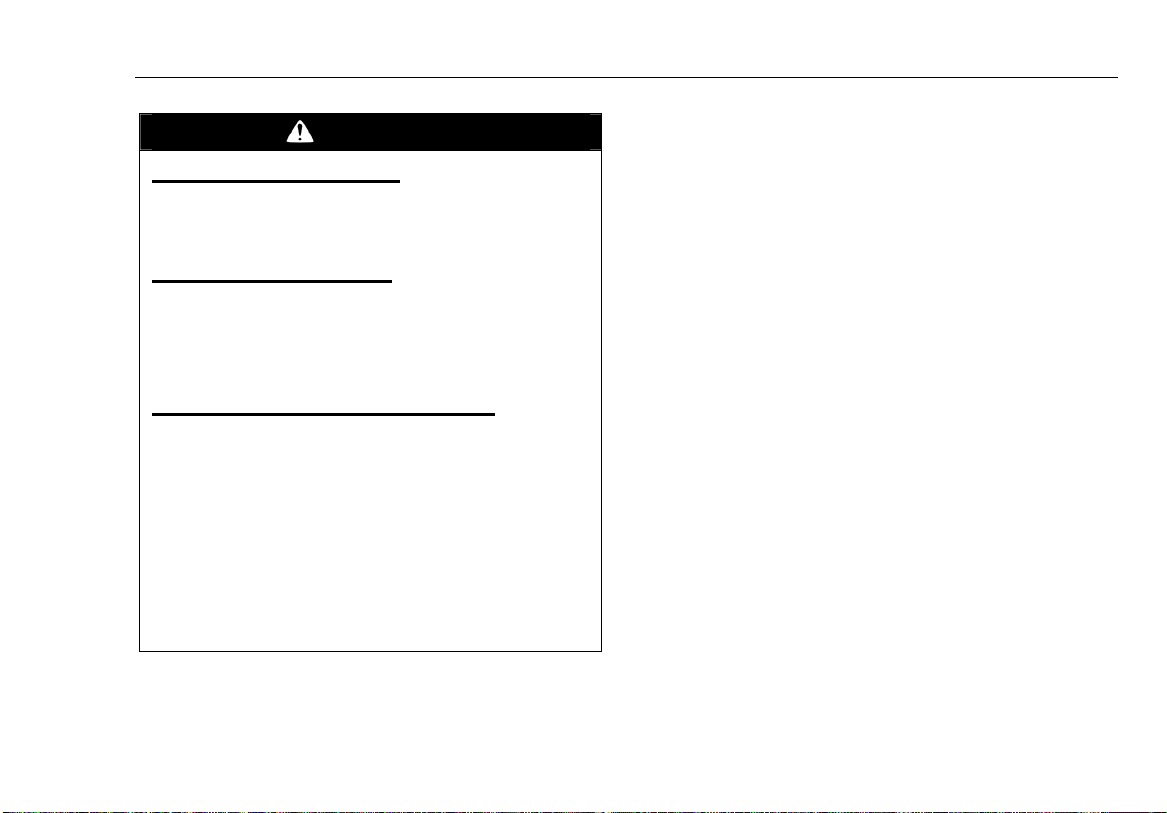
● Load cargo in the cargo bed as close to
the center of the vehicle as possible and
tie it down using the cargo hooks
equipped on the cargo bed.
● Tie down cargo securely in the trailer.
Make sure cargo in the trailer cannot
move around. A shifting load can cause
an accident.
● Make sure the load does not interfere
with controls or your ability to see where
you are going.
● Drive more slowly than would without a
load. The more weight you carry, the
slower you should go. Although
conditions vary, it is good practice not to
exceed low range whenever you are
carrying heavier loads or when towing a
trailer.
● Allow more braking distance. A heavier
vehicle takes longer to stop.
● Avoid making sharp turns unless at very
slow speeds.
● Avoid hills and rough terrain. Choose
terrain carefully. Added weight affects the
stability and handling of the vehicle.
6-14 Operation
WARNING
POTENTIAL HAZARD
Overloading this vehicle or carr
ying or
towing cargo improperly.
WHAT CAN HAPPEN
Could cause changes in vehicle
handling which could lead to an
accident.
HOW TO AVOID THE HAZARD
Never exceed the stated load capacity
for this vehicle.
Cargo should be properly distributed
and securely attached.
Reduce speed when carrying cargo or
pulling a trailer. Allow greater distance
for braking.
Your Vehicle 7-1
DRIVING YOUR VEHICLE
GETTING TO KNOW YOUR VEHICLE
This off-highway utility vehicle will handle
and maneuver differently form an ordinary
passenger car or other vehicle.
Before you begin to use your vehicle, be sure
you have read this Owner
’
s Manual
completely and understand of the controls.
Pay particular attention to the safety
information on pages 2-1-2-5. Please also
read all caution and warning labels on your
vehicle.
This vehicle is designed for the operator and
three passengers. The driver and passengers
must always wear a seat belt. Never carry
passengers in the cargo bed.
WARNING
POTENTIAL HAZARD
Not
wearing the seat belt.
Wearing the seat belt improperly.
WHAT CAN HAPPEN
There is increased risk of being killed or
seriously injured in an accident.
HOW TO AVOID THE HAZARD
Always wear your seat belt when riding in
the vehicle.
Be sure the seat belt is close-fitting
across your hips and chest and is latched
securely.
7-2 Your Vehicle
WARNING
POTENTIAL HAZARD
Carrying a p
assenger in the cargo bed.
WHAT CAN HAPPEN
The passenger could fall or be struck by
objects in the cargo bed.
HOW TO AVOID THE HAZARD
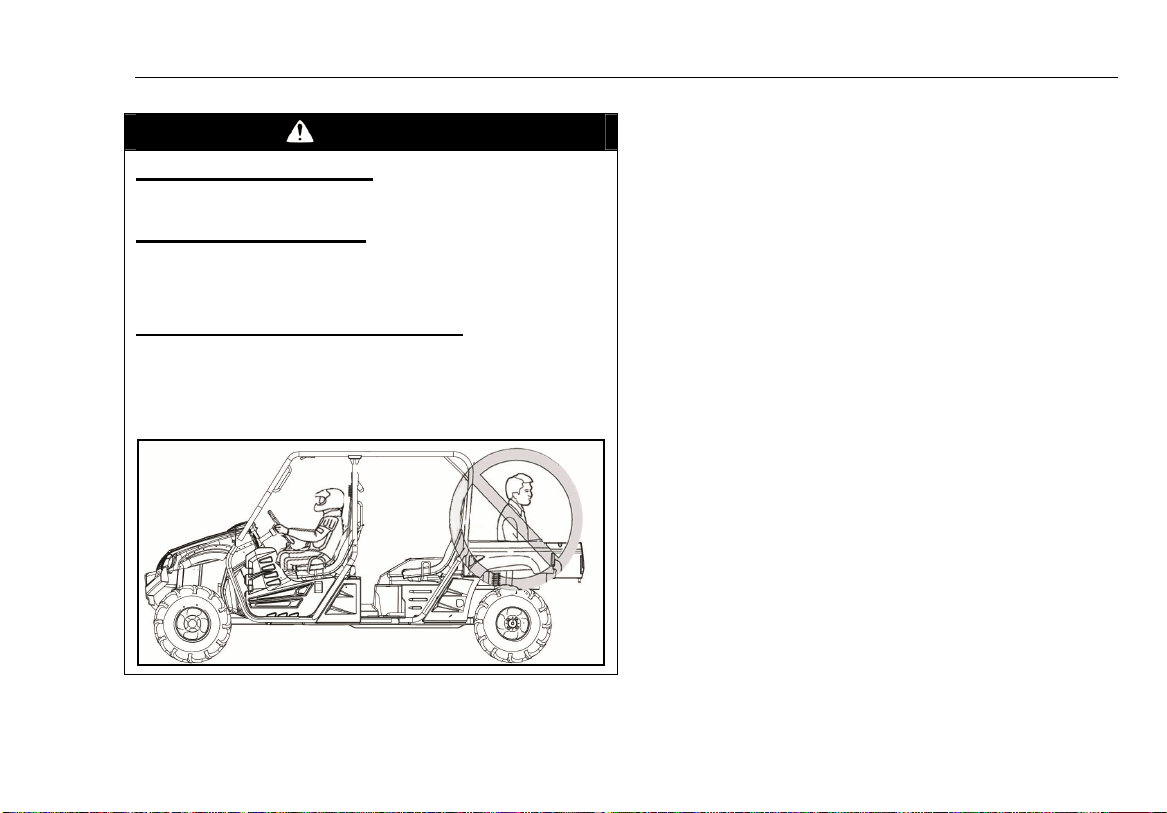
Never carry a passenger in the cargo bed .
The cargo bed is designed to carry cargo
only.
The total weight of operator, passenger,
accessories, cargo, trailer tongue weight,
and the vehicle itself must not exceed
2930 lb (1329Kg).
Your Vehicle 7-3
WARNING
POTENTIAL HAZARD
O
verloading this vehicle or carrying or towing
cargo improperly.
WHAT CAN HAPPEN
Could cause changes in vehicle handling
which could lead to an accident.
HOW TO AVOID THE HAZARD
Never exceed the stated load capacity for this
vehicle.
Cargo should be properly distributed and
securely attached.
Reduce speed when carrying cargo or pulling
a trailer. Allow greater distance for braking.
Always follow the instructions in your
Owner
’
s Manual for carrying cargo or pulling a
trailer.
The driver and passengers must always
wear a seat belt and an approved
motorcycle helmet. Also wear eye
protection and protective clothing,
including over-the-ankle boots, gloves, a
long-sleeved shirt or jacket, and long pants.
Keep hands and feet inside the vehicle at
all times.
7-4 Your Vehicle
WARNING
POTENTIAL HAZARD
Opera
ting this vehicle without wearing an
approved motorcycle helmet, eye
protection, and protective clothing.
WHAT CAN HAPPEN
Operating without an approved
motorcycle helmet
increases your
chances of a severe
head injury or death
in the event of an
accident.
Operating without
eye protection can
result in an accident
and increases
your
chances of a severe
injury in the event of
an accident.
HOW TO AVOID THE HAZARD
Al
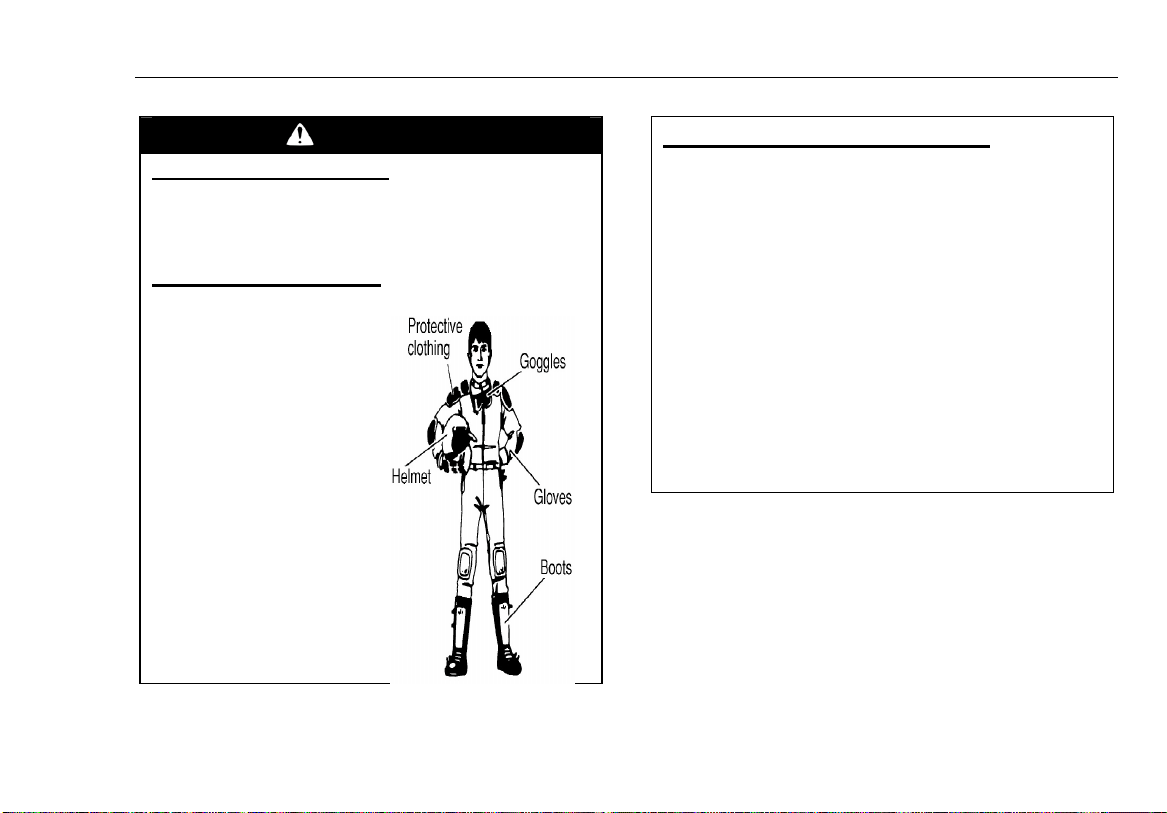
ways wear an approved motorcycle
helmet that fits properly. You should also
wear:
eye protection
(goggles or face shield)
gloves
boots
long-sleeved shirt or jacket
long pants

Your Vehicle 7-5
LEARNING TO OPERATE YOUR VEHICLE
You should become familiar with the
performance characteristics of the vehicle in
a large, flat area that is free of obstacles and
other vehicles. Practice control of the
accelerator pedal, brakes, steering, and drive
select lever. Drive first at slow speed and
become comfortable at that speed before
gradually increasing your speed. Become
familiar with the way the vehicle feels in low
and high ranges, first in two-wheel drive
(2WD) and then in four-wheel drive (4WD)
and four-wheel drive with the differential
locked. Also practice driving in reverse. Take
the time to learn basic operation before
attempting more difficult maneuvers.
Perform the Pre-Operation Checks on pages
5-1- 5-11. Set the parking brake, shift to
neutral, and follow the instructions on page
6-1 to start the engine. Once it has warmed
up, you are ready to begin driving your
vehicle. With the engine idling, shift the
drive select lever into low or high. Then
release the parking brake. Press the
accelerator pedal slowly and smoothly.
The centrifugal clutch will engage and
you will start to accelerate. Avoid higher
speeds until you are thoroughly
familiar with the operation of your vehicle.
When slowing down or stopping, take your
foot off the accelerator pedal and smoothly
press the brake pedal. Improper use of the
brakes can cause the tires to lose traction,
reducing control and increasing the
possibility of an accident.
7-6 Your Vehicle
CAUTION:
Do not shift from low to high or vice versa
without coming to a complete stop and
waiting for the engine to return to normal idle
speed . Damage to the engine or drive train
may occur.
TURNING YOUR VEHICLE
The vehicle is easier to steer in two-wheel
drive (2WD) than four-wheel drive (4WD).
Steering takes the most effort in 4WD with
the differential locked.
It is possible for the vehicle to roll over or go
out of control if you attempt sharp,
high-speed turns. You should also be careful
making sharp turns on rough terrain. Do not
attempt to turn around or make abrupt
maneuvers on a slope.
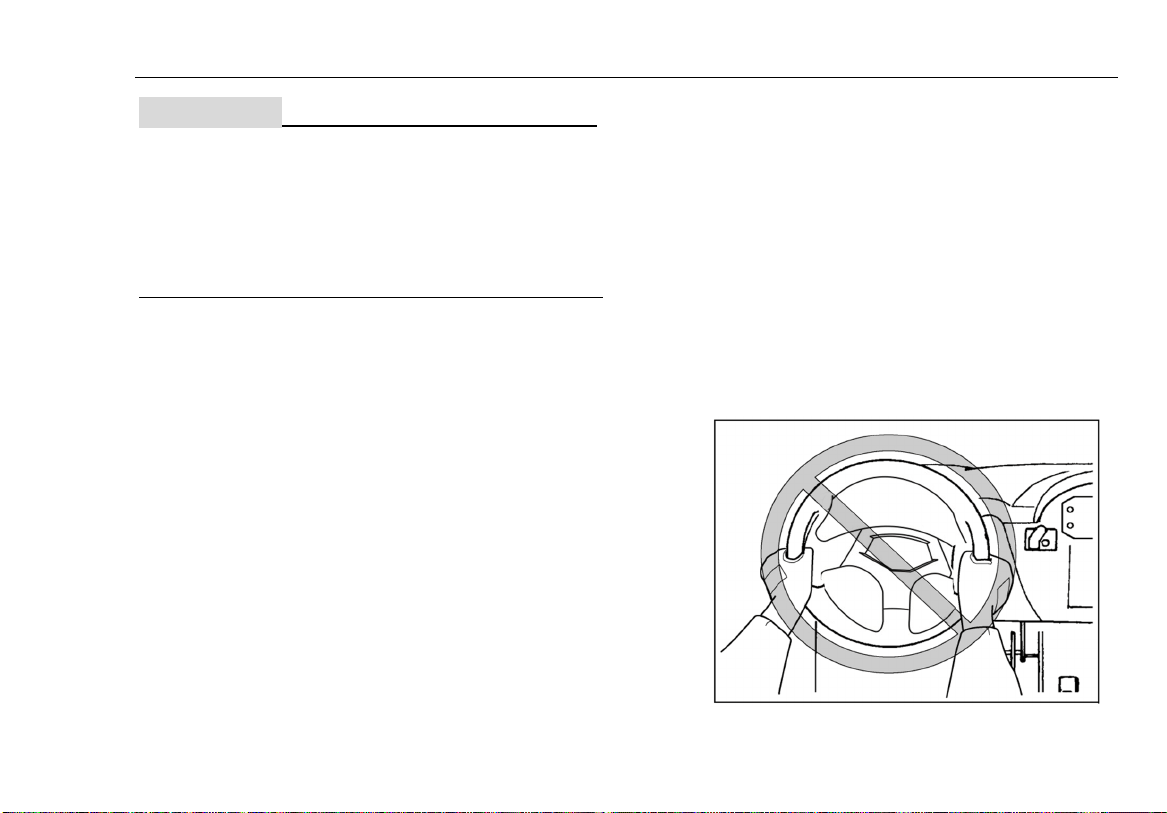
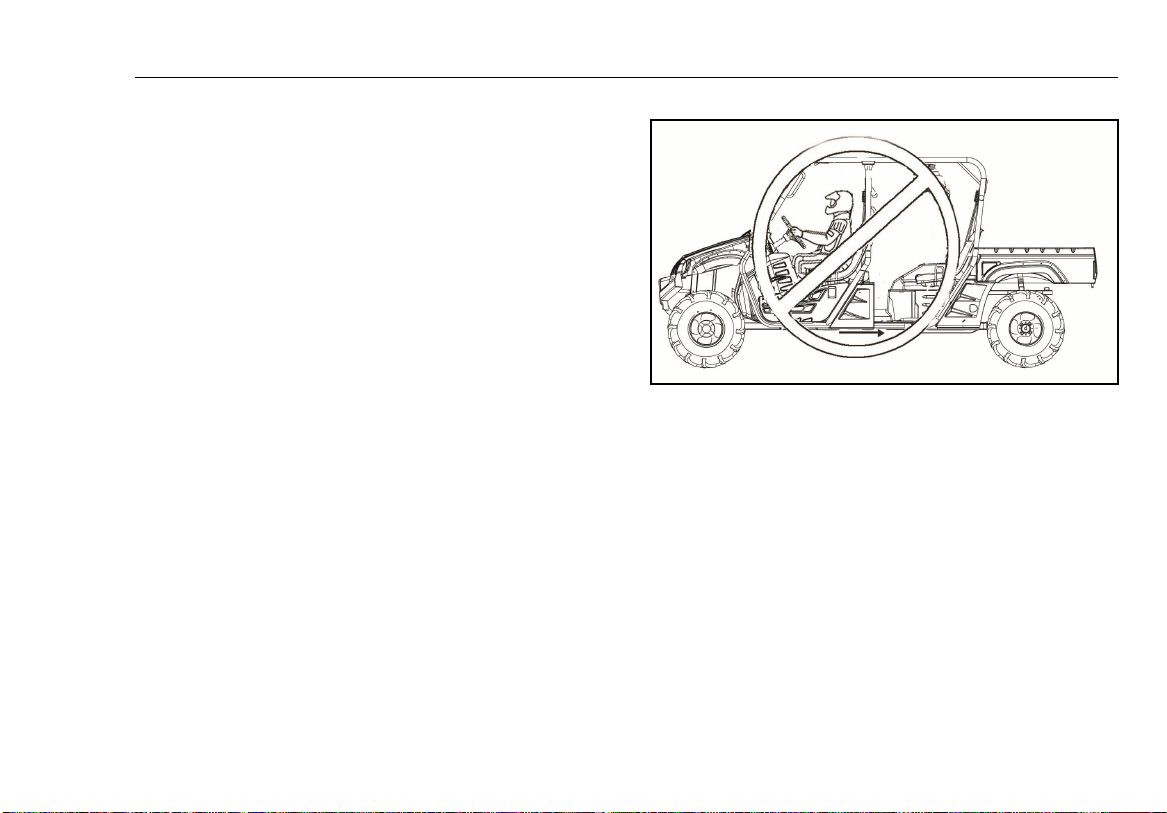
Position your hands on the steering wheel so
that your thumbs and fingers do not wrap
around the wheel. This is particularly
important
when driving in rough terrain. The front
wheels will move right and left as they
respond to the terrain, and this movement
will be felt in the steering wheel. A sudden jolt
could wrench the steering wheel around, and
your thumbs or fingers could be injured if
they are in the way of the steering wheel
spokes.
Your Vehicle 7-7
Operating Improperly in Reverse
Improperly operating in reverse could result
in a collision with an obstacle or person.
Always follow proper operating procedures 。
Follow these precautions when operating in
reverse:
1. Always check for obstacles or people
behind the vehicle.
2. Apply the throttle lightly. Never open the
throttle suddenly.
3. Back slowly.
4. Apply the brakes lightly for stopping.
5. Avoid making sharp turns.
Before shifting into reverse gear, always
check for obstacles or people behind the
vehicle. When it’s safe to proceed, back
slowly.
BRAKING
Braking ability is affected by the type of
terrain. In most cases, gradually application
of the brakes is more effective than abrupt
braking, particularly on loose surfaces like
gravel. Always allow for greater braking
distance on rough, loose, or slippery
surfaces.
7-8 Your Vehicle
GOING UPHILL
Do not attempt to climb hills until you
have mastered basic maneuvers on flat
ground. Use proper driving techniques
to avoid overturns on hills and slopes.
Drive straight up hills, and avoid crossing
a hill sideways, which increases your
chance of rollover. Practice first on
gentle slopes before attempting
steeper hills. Always check the terrain
carefully before attempting any hill. Use
common sense and remember that
some hills are too steep for you to climb.
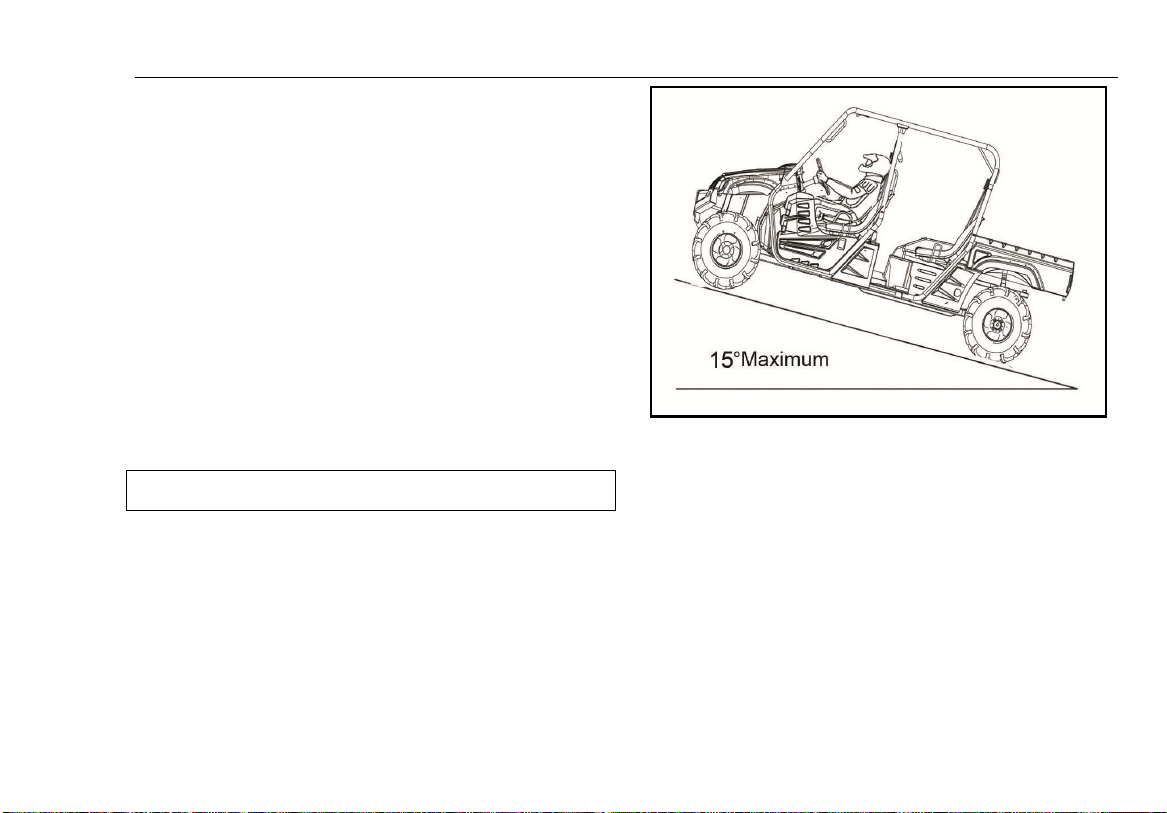
Maximum slope angle:15°
Choose carefully which hills you attempt to
climb. Avoid hills with slippery surfaces or
ones where you will not be able to see far
enough ahead of you.
Your Vehicle 7-9
WARNING
POTENTIAL HAZARD
Operating on excessively steep hills.
WHAT CAN HAPPEN
The vehicle can over turn more easily on
extremely steep hills than on level
surfaces or small hills.
HOW TO AVOID THE HAZARD
Never operate your vehicle on hills too
steep for it or your abilities. Never
operate vehicles on hills steeper than
15°.
Do not drive across the face of a hill. Go
straight up the hill.
Practice on smaller hills before
attempting large hills.
Before climbing the hill, first be sure you are
operating in low range 4WD or, if necessary,
with 4WD. To climb a hill, you need traction,
momentum, and steady throttle. Travel fast
enough to keep your momentum going, but
not so fast that you cannot react to changes
in the terrain as you climb. Slow down when
you reach the crest of the hill if you cannot
clearly see what is on the other side-there
could be another person, an obstacle, or a
sharp drop off.
If you start to lose traction or momentum
when climbing, and you decide you will be
unable to continue, use the brakes to come
to a stop. Do not attempt to turn the vehicle
around. With your foot on the brake, look
7-10 Your Vehicle
behind you and plan your descent. Shift the
drive select lever in reverse so you can use
the engine brake if necessary to slow your
descent. Release the brake and begin to
coast down the hill. Use engine braking as
much as possible, gently applying the brakes
when necessary.
GOING DOWNHILL
Check the terrain carefully before going
down a hill. When possible, choose a path
that lets you drive your vehicle straight
downhill. Avoid sharp angles that could allow
the vehicle to pitch or roll over. Carefully
choose your path and drive no faster than
you will be able to react to obstacles that may
appear.
WARNING
POTENTIAL HAZARD
Going down a hill improperly.
WHAT CAN HAPPEN
Could cause loss of control or cause the
vehicle to overturn.
HOW TO AVOID THE HAZARD
Always check the terrain carefully before
you start down any hill. Never go down a
hill at high speed. Avoid going down a hill
at an angle that would cause the vehicle
to lean sharply to one side. Go straight
down the hill where possible.

Your Vehicle 7-11
Before starting down hill, make sure the
vehicle is in low-range 4WD. On most slopes,
this will let you use engine braking to help
you go downhill slowly. Go as slowly as
possible. If you are starting to go too fast,
apply the brakes gently. Avoid sudden
application of the brakes, which could cause
the vehicle to start sliding.
If you are sliding or skidding, try to steer in
the direction the vehicle is sliding to help you
regain control.
If you must turn on the hill to avoid an
obstacle, do so slowly and carefully. if the
vehicle starts to tip, gradually steer in the
downhill direction if there are no obstacles in
your path. As you regain proper balance,
gradually steer again in the direction you
want to go.
CROSSING THROUGH SHALLOW WATER
If you must cross shallow, slow moving water
up to the depth of the vehicle’s floorboards,
choose your path carefully to avoid sharp
drop-offs, large rocks, or slippery surfaces
that could cause the vehicle to overturn.
Never operate through water deeper than
13 in (33 cm) or fast flowing water.
Wet brakes may have reduced effectiveness.
After leaving the water, test your brakes.
If necessary, apply the brakes several times
to let friction dry out the linings.
7-12 Your Vehicle
WARNING
POTENTIAL HAZARD
Operating this vehicle through deep or
fast-flowing water.
WHAT CAN HAPPEN
Loss of control, which could result in an
accident including overturn, which could
increase the risk of drowning.
HOW TO AVOID THE HAZARD
Never operate this vehicle in fast flowing
water or in water deeper than 13in
(33 cm).
Remember that wet brakes may have
reduced stopping ability. Test your
brakes after leaving water. If necessary,
apply them several times to let friction
dry out the linings.
CAUTION:
After riding your vehicle in water, be sure to
drain the trapped water by removing the
check hose at the bottom of the air filter case,
the V-belt cooling duct check hose, the drive
select lever box check hose and the V-belt
case drain plug. Wash the vehicle in fresh
water if it has been operated in salt water or
muddy conditions.
V
ehicle Immersion
CAUTION:
If your ve
hicle becomes immersed, major
engine damage can result if the machine is
not thoroughly inspected. Take the vehicle to

Your Vehicle 7-13
your service center before starting the
engine.
If it’
s impossible to take your vehicle to a
service center before starting it, follow the
steps outlined below.
1. Move the vehicle to dry land.
2. Check the air box. If water is present, dry
the air box and replace the filter with a
new filter.
3. Remove the spark plugs.
4. Turn the engine over several times.
5. Dry the spark plugs and reinstall them, or
install new plugs.
6. Attempt to start the engine. If necessary,
repeat the drying procedure.
7. Take the vehicle to your service center
for service as soon as possible, whether
you succeed in starting it or not.
8. If water has been ingested into the CVT,
make sure inspect the hole without water
left inside. If it is muddy water, open the
CVT cap and wash the parts before
reassemble.
9. Check the gearshift, release the water
inside. Wash it if it is necessary.
CAUTION:
Make sure all moving parts are coated
with grease after washing and reassemble.
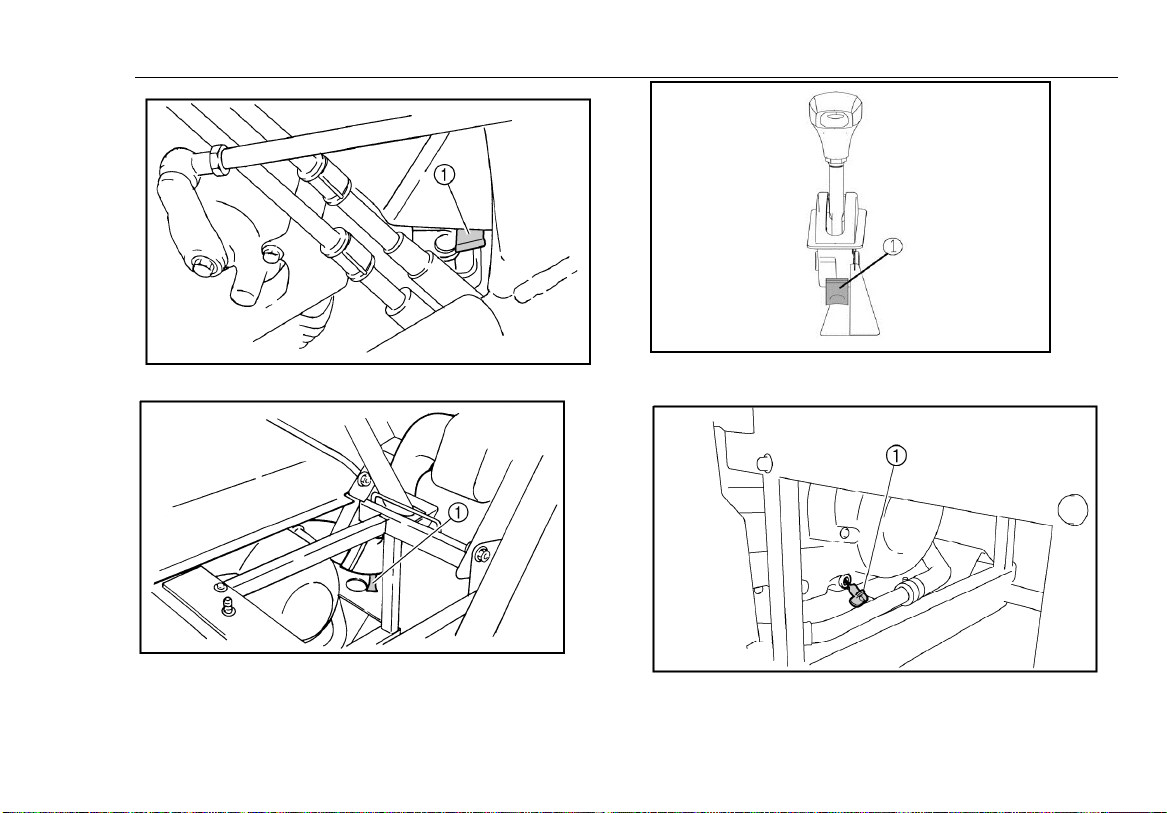
7-14 Your Vehicle
1.V-belt cooling duct check hose
1.Air filter case check hose
1. Drive select lever box check hose
1.V-belt case drain plug
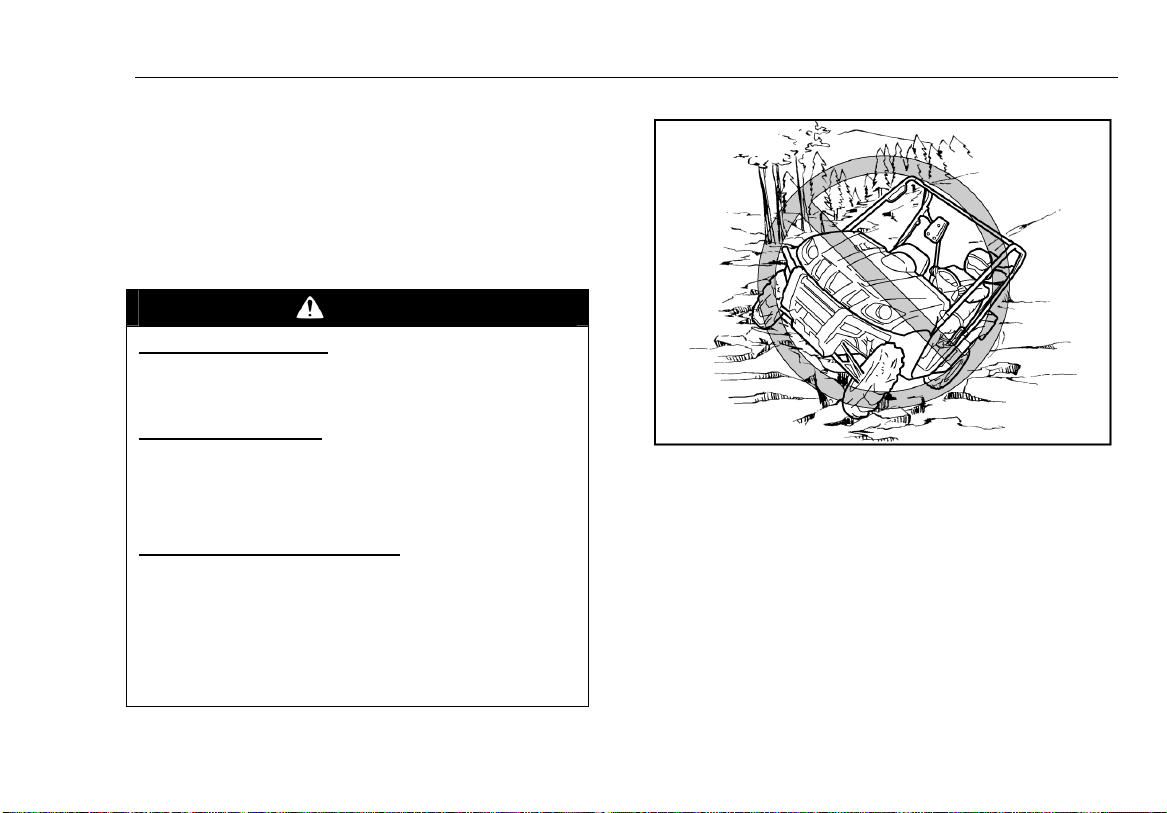
Your Vehicle 7-15
RIDING OVER ROUGH TERRAIN
Operating over rough terrain should be done
with caution. Look for obstacles that could
cause damage to the vehicle or could lead to
a rollover accident. Avoid jumping the vehicle
as injury, loss of control, and damage to the
vehicle could occur.
RIDING IN BRUSH OR W
OODED AREAS
When operating in areas with brush or trees,
watch carefully on both sides and above the
vehicle for obstacles such as branches that
the vehicle might hit, causing an accident, or
WARNING
POTENTIAL HAZARD
Failure
to use extra care when operating this
vehicle on unfamiliar terrain.
WHAT CAN HAPPEN
You can come upon hidden rocks, bumps, or holes,
without enough time to react. Could result in the
vehicle overturning or going out of control.
HOW TO AVOID THE HAZARD
Go slowly and be extra careful when operating on
unfamiliar terrain. Always be alert to changing
terrain conditions when operating the vehicle.

7-16 Your Vehicle
for brush that might enter the vehicle as you
pass and strike the driver or passenger.
Never hold onto the enclosure so your hand
is outside the vehicle. Hold only onto the
handgrip inside the enclosure.
ENCOUNTERING OBSTACLES ON THE
TRAIL
If you cannot go around an obstacle such as
a fallen tree trunk or a ditch,stop the vehicle
where it is safe to do so.Set the parking
brake and get out to inspect the area
thoroughly.Look from both your approach
side and the exit side.If you believe you can
continue safely, decide the path that will
allow you to get over the obstacle at as close
to a right angle as possible to minimize
vehicle tipping.Go only fast enough to
maintain your momentum but still give
yourself plenty of time to react to changes in
conditions.If there is any question about your
ability to maneuver safely over the obstacle,
you should turn around,if the ground is flat
and you have the room,or back up until you
find a less difficult path.
Your Vehicle 7-17
WARNING
POTENTIAL HAZARD
Improperly
operating over obstacles.
WHAT CAN HAPPEN
Could cause loss of control or a collision.
Could cause the vehicle to overturn.
HOW TO AVOID THE HAZARD
Before operating in a new area, check for
obstacles.
Use extreme caution when operating over
large obstacles, such as large rocks or
fallen trees.
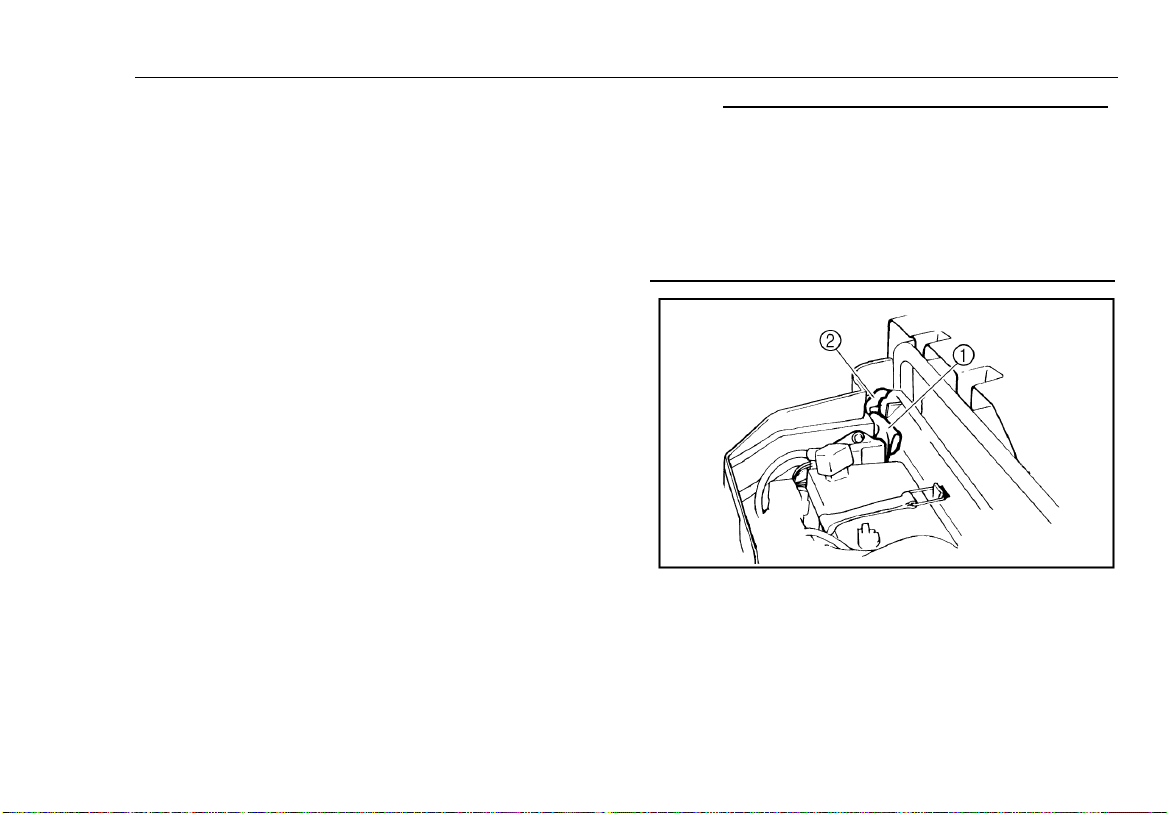
8-1 Periodic Maintenance and Adjustment
Periodic Maintenance and Adjustment
Periodic inspection, adjustment and
lubrication will keep your vehicle in the safest
and most efficient condition possible. Safety
is an obligation of the vehicle owner. The
most important points of vehicle inspection,
adjustment and lubrication are explained on
the following pages.
The service information included in this
manual is intended to provide you, the owner,
with the necessary information for
completing your own preventive
maintenance and minor repairs. The tools
provided in the Owner’s tool kit are sufficient
for this purpose, except that a torque wrench
is also necessary to properly tighten nuts and
bolts.
NOTE:
If you do not have a torque wrench availabl
e
during a service operation requiring one, take
your vehicle to service center to check the
torque settings and adjust them as
necessary.
1. Owner’s tool kit 2. Tire pressure gauge
Periodic Maintenance and Adjustment 8-2
WARNING
POTENTIAL HAZARD
Servicing an engine
while it is running.
WHAT CAN HAPPEN
Moving parts can catch clothing or
parts of the body, causing injury.
Electrical components can cause
shocks or can start fires.
HOW TO AVOID THE HAZARD
Turn off the engine when performing
maintenance unless otherwise
specified.
Have a service center perform service if
you are not familiar with vehicle
service.
WARNING
POTENTIAL HAZARD
Operating this vehicle with improper
modifications.
WHAT CAN HAPPEN
Improper installation of accessories or
modification of this vehicle may cause
changes in handling which in some
situations could lead to an accident.
HOW TO AVOID THE HAZARD
Never modify this vehicle through
improper installation or use of
accessories. All parts and accessories
added to this vehicle should be
genuine or equivalent components
designed for use on this vehicle and
should be installed and used according
to instructions.
If you have questions, consult an
authorized vehicle service center.
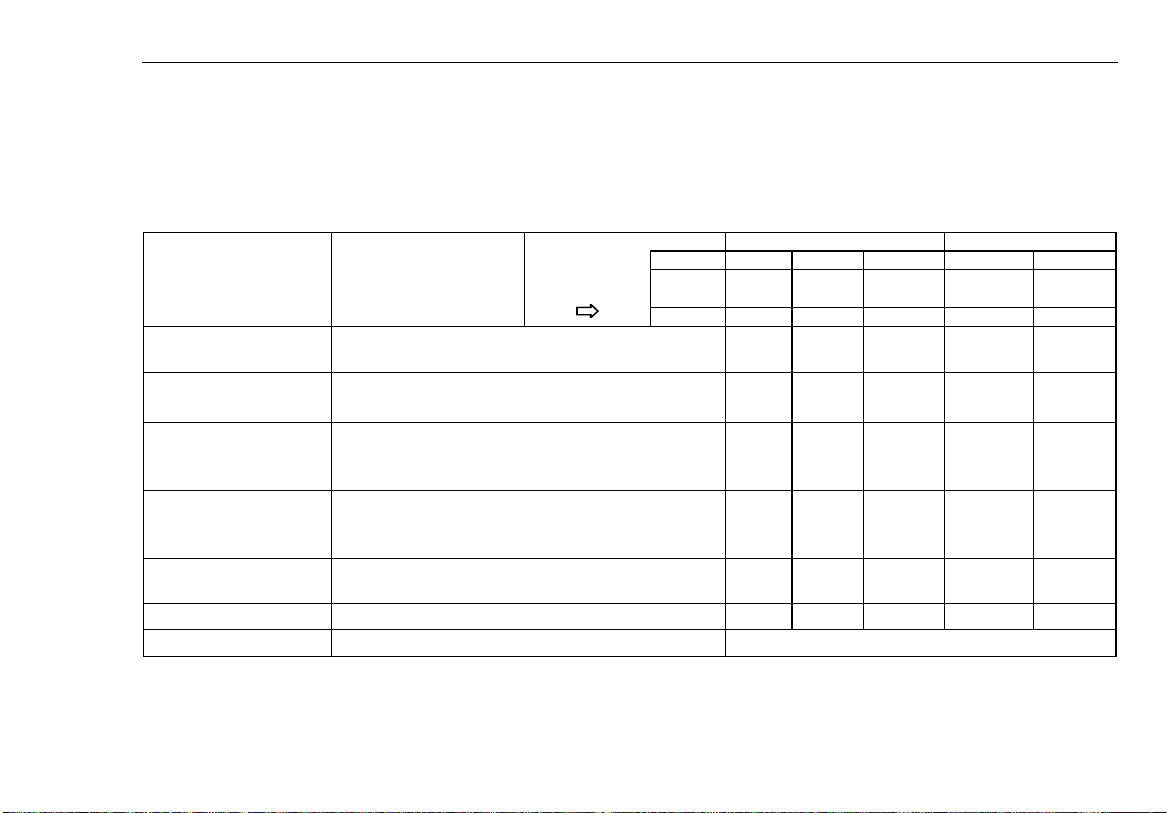
8-3 Periodic Maintenance and Adjustment
Periodic Maintenance Chart for the Emission Control System
●
For vehicles not equipped with an odometer or hour meter, follow the month maintenance intervals.
●
For vehicles equipped with an odometer or an hour meter, follow the miles (km) or hours maintenance intervals.
However, keep in mind that if the vehicle isn’t used for a long period of time, the month maintenance intervals should be
followed.
●
Items marked with an asterisk should be performed by service center as they require special tools, data and technical
skills.
ITEM ROUTINE
Whichever
Comes first
INITIAL EVERY
Month 1 3 6 6 12
mi
(Km)
200
(320)
750
(1,250)
1,500
(2,400)
1,500
(2,400)
3,000
(4,800)
hours 20 75 150 150 300
Valves*
● Check valve clearance.
● Adjust if necessary.
○ ○ ○ ○
Fuel line*
● Check fuel hose for cracks or damage.
● Replace if necessary.
○ ○ ○
Spark plug
● Check condition.
● Adjust gap and clean.
● Replace if necessary.
○ ○ ○ ○ ○
Exhaust system*
● Check for leakage.
● Tighten if necessary.
● Replace gasket(s) if necessary.
○ ○ ○
Crankcase breather
system*
● Check breather hose for cracks or damage.
● Replace if necessary.
○ ○ ○
Spark arrester
● Clean.
○ ○ ○
Sensor
● Clean.
to clean for each 500km (312ml)
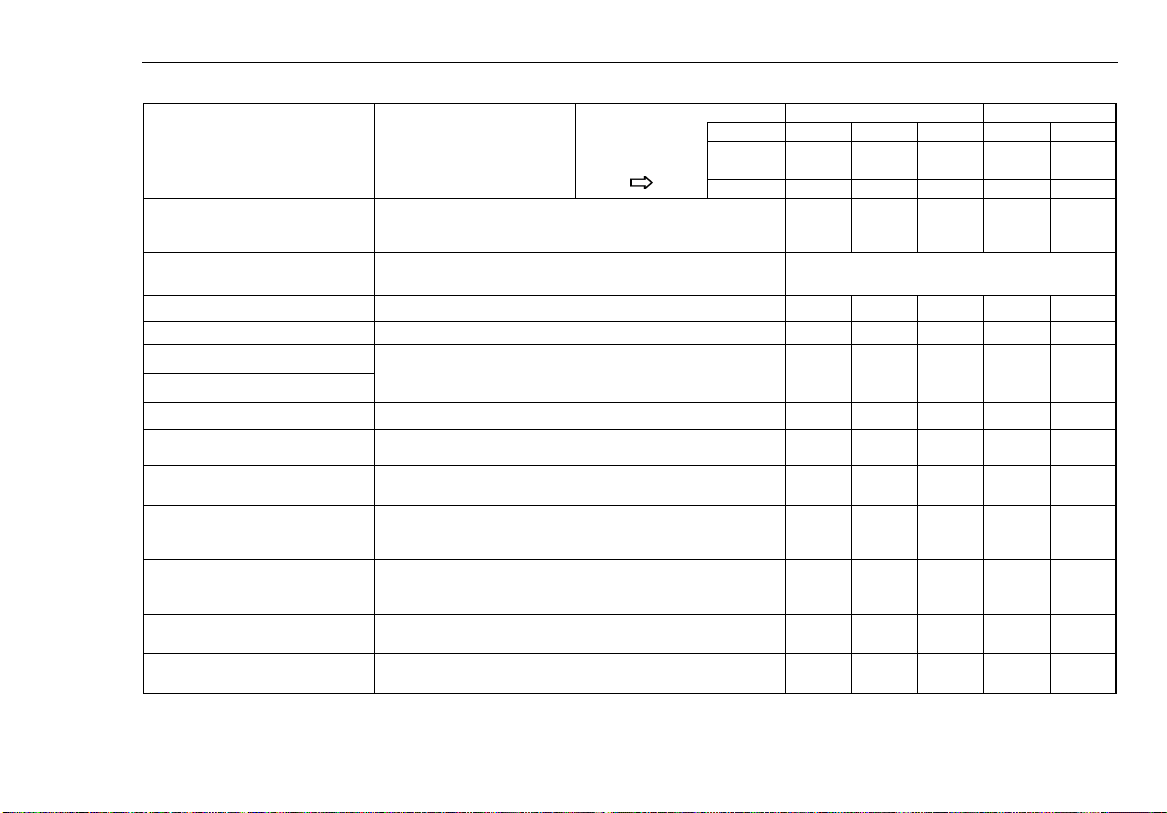
Periodic Maintenance and Adjustment 8-4
General Maintenance and Lubrication Chart
ITEM ROUTINE
Whichever
Comes first
INITIAL EVERY
Month 1 3 6 6 12
mi
(Km)
200
(320)
750
(1,200)
1,500
(2,400)
1,500
(2,400)
3,000
(4,800)
hours 20 75 150 150 300
Cooling system
● Check coolant leakage.
● Repair if necessary.
● Replace coolant ever
y
24 months.
○ ○ ○
○ ○
Air filter elements
(engine and air intake duct)
● Clean.
● Replace if necessary.
Every 20─40 hours
(More often in wet or dusty areas.)
Engine oil ● Replace (warm engine before draining.) ○ ○
○ ○
Engine oil filter cartridge ● Replace ○ ○
○ ○
Final gear oil
● Check oil lever oil leakage.
● Replace.
○
○
Differential gear oil
Accelerator pedal* ● Check operation and free play. ○ ○ ○
○ ○
V-belt*
● Check operation.
● Check for wear, cracks, or dama
g
e.
○
○ ○
Wheels*
● Check balance/damage/runout.
● Replace if necessary.
○ ○
○ ○
Front brake*
● Check operation/brake pad wear/fluid leakage/
see page 8-30—8-35.
● C
O
rrect if necessar
y
. Replace pads if worn to the limit.
○ ○ ○
○ ○
Rear brake*
● Check operation/brake pad wear/fluid leakage/se-
e NOTE page 8-30—8-35
●
Correct if necessary. Replace pads if worn to the limit.
○ ○ ○
○ ○
Front and rear suspension*
● Check operation and for leakage.
● Check toe-in/Adjust if necessary.
○
○
Wheel bearings*
● Check bearing assemblies for looseness/damaged.
● Repair if damaged.
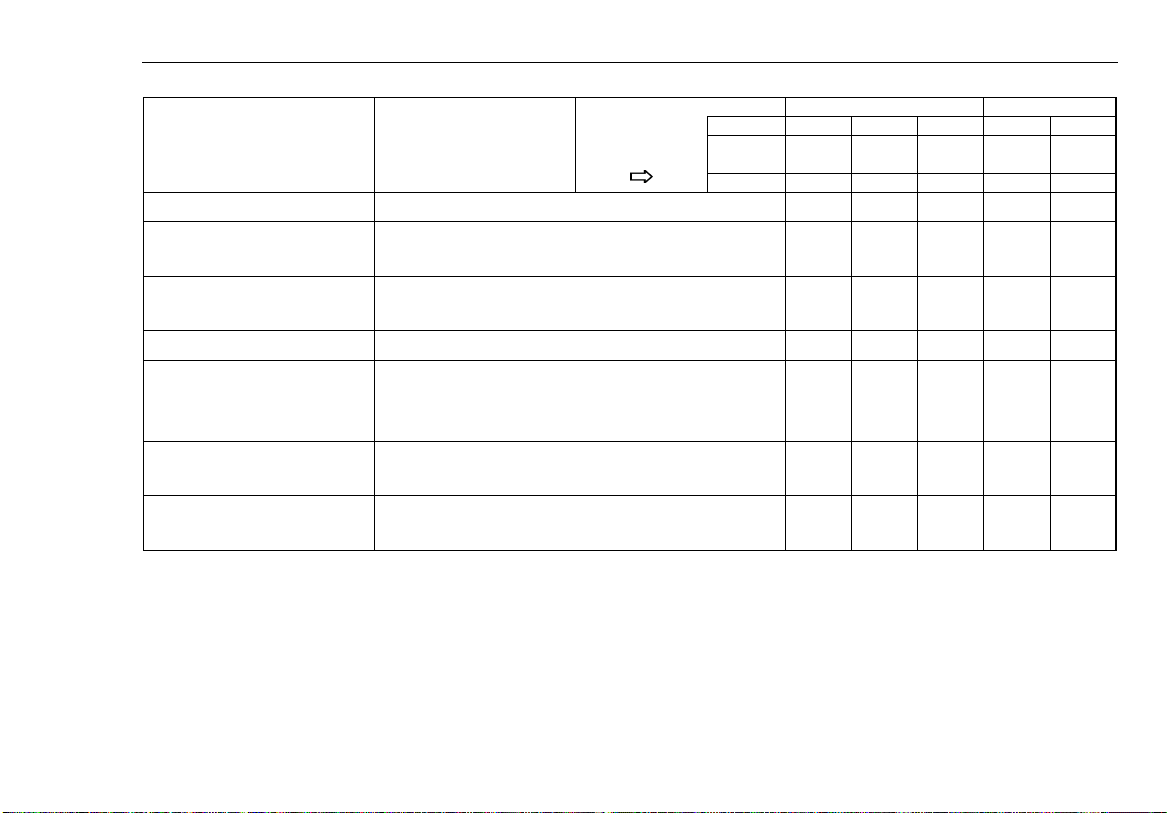
8-5 Periodic Maintenance and Adjustment
ITEM ROUTINE
Whichever
Comes first
INITIAL EVERY
Month 1 3 6 6 12
mi
(Km)
200
(320)
750
(1,200)
1,500
(2,400)
1,500
(2,400)
3,000
(4,800)
hours 20 75 150 150 300
Stabilizer bushings* ● Check for cracks or damage. ○ ○ ○
Fittings and fasteners*
● Check all chassis fittings and fasteners.
● Check if necessary.
○ ○ ○ ○ ○
Rear upper and lower
knuckle pivots*
● Lubricate with lithium–soap-based grease. ○ ○ ○
Drive shaft universal joint* ● Lubricate with lithium-soap-based grease. ○ ○ ○
Steering system*
● Check operation and for looseness/Replace if
damaged.
● Check toe-in/Adjust if necessary
○ ○ ○ ○ ○
Engine mount*
● Check for cracks or damage.
● Check bolt tightness.
○ ○ ○
Front and rear axle boots*
● Check operation.
● Replace if damaged.
○ ○
Periodic Maintenance and Adjustment 8-6
NOTE:
● Recommended brake fluid: DOT4
● Brake fluid replacement.
● When disassembling the master cylinder or caliper, replace the brake fluid. Normality check the brake
fluid level and add fluid as required.
● On the inner parts of the master cylinder and caliper, replace the oil seals every two years.
● Replace the brake hoses every four years, or if cracked or damaged.
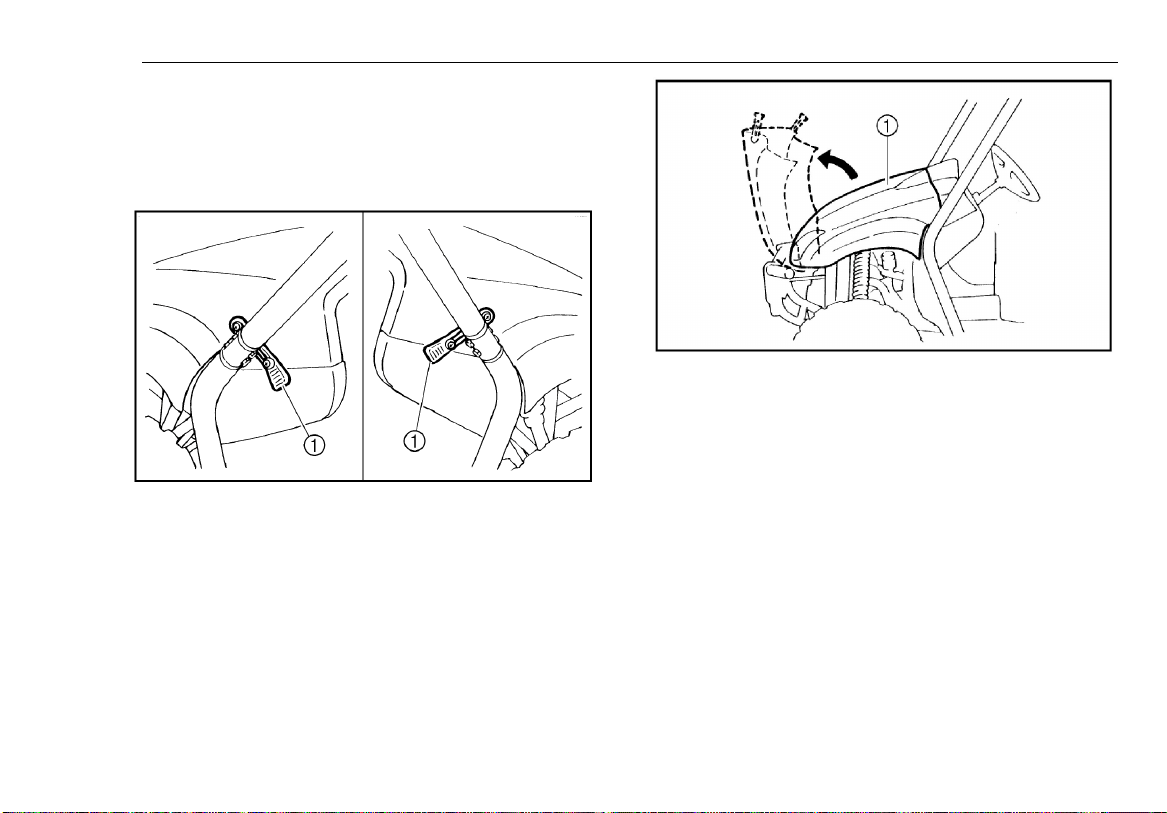
8-7 Periodic Maintenance and Adjustment
Hood
To Open
Unhook the hood latches, and then slowly tilt
the hood up until it stops.
1. Latch(×2)
1. Hood
To Close
Lower the hood slowly to its original position,
and then hook the hood latches.
Secure projections on the underside of ①
the hood into slots on the back of the ②
instrument panel. Secure slots on the side ③
of the hood around projections on the ④
frame.
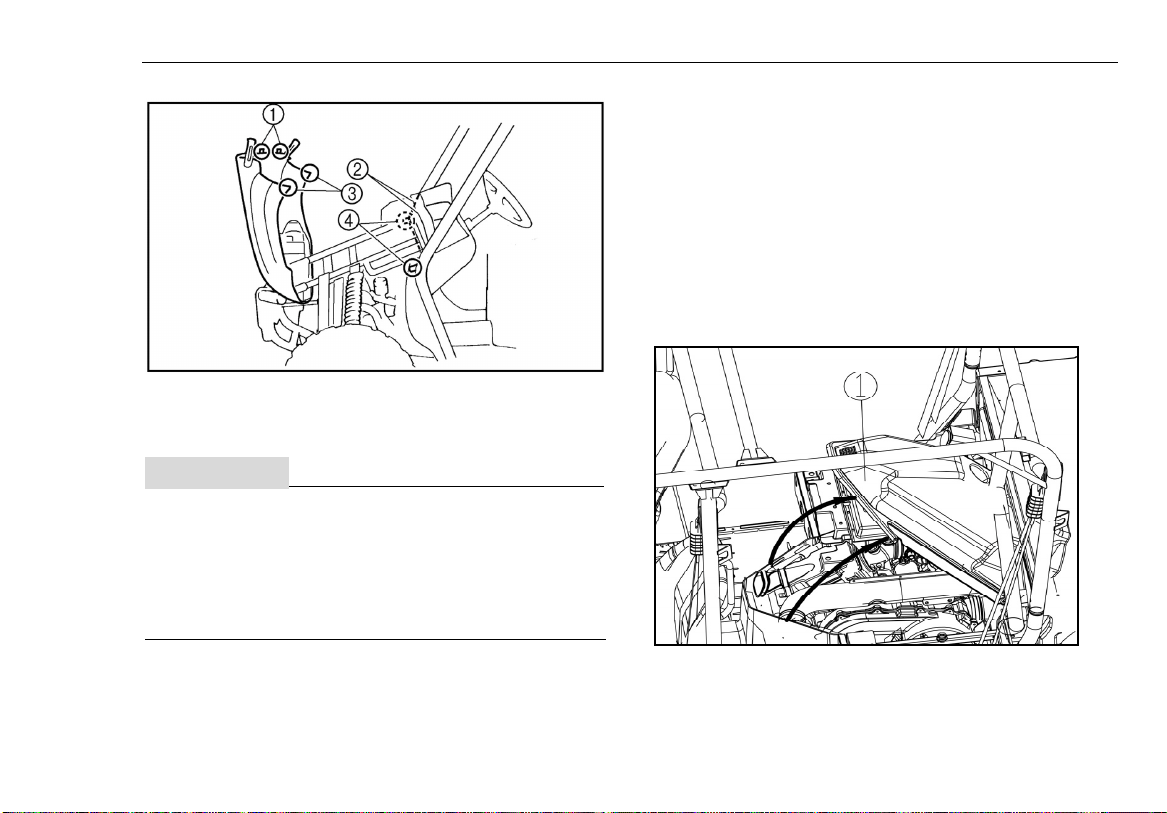
Periodic Maintenance and Adjustment 8-8
1. Projection (×2) 2. Slot (×2)
3. Slot (×2) 4. Projection (×2)
CAUTION:
Make sure that all cables and wires are
in place when closing the hood.
Do not drive the vehicle with the hood
open, unlatched, or removed.
Console
To Remove
1. Remove the seats. (See pages 4-19 for
seat removal and installation
procedures.)
2. Remove the parking brake lever boot.
3. Pull the console upward (the drive select
lever boot will come loose.)
1. Console
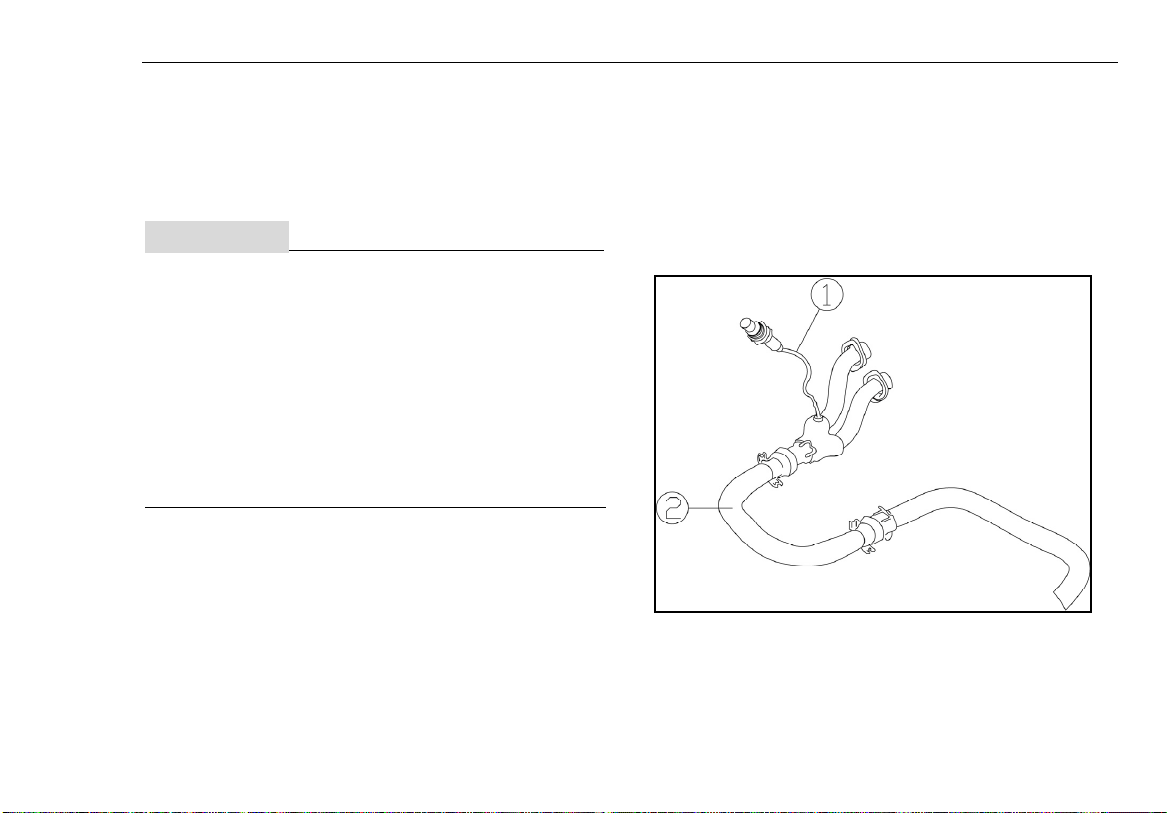
8-9 Periodic Maintenance and Adjustment
To Install
1. Place the console in its original position.
2. Install the parking brake lever boot.
3. Install the seats.
CAUTION:
When installing the console, be sure not
to pinch the cables or wires.
Make sure that the groove at the bottom
of the parking brake lever boot and the
drive select lever boot fits securely
around the edge of the hole in the
console.
EFI system
An EFI engine is completely different from an
engine which uses a carburetor, it consists of
ECU, EFI-cables, sensors, actuators and
other advanced components.
Refer to the following pictures:
1. Oxygen sensor
2. Exhaust Pipe
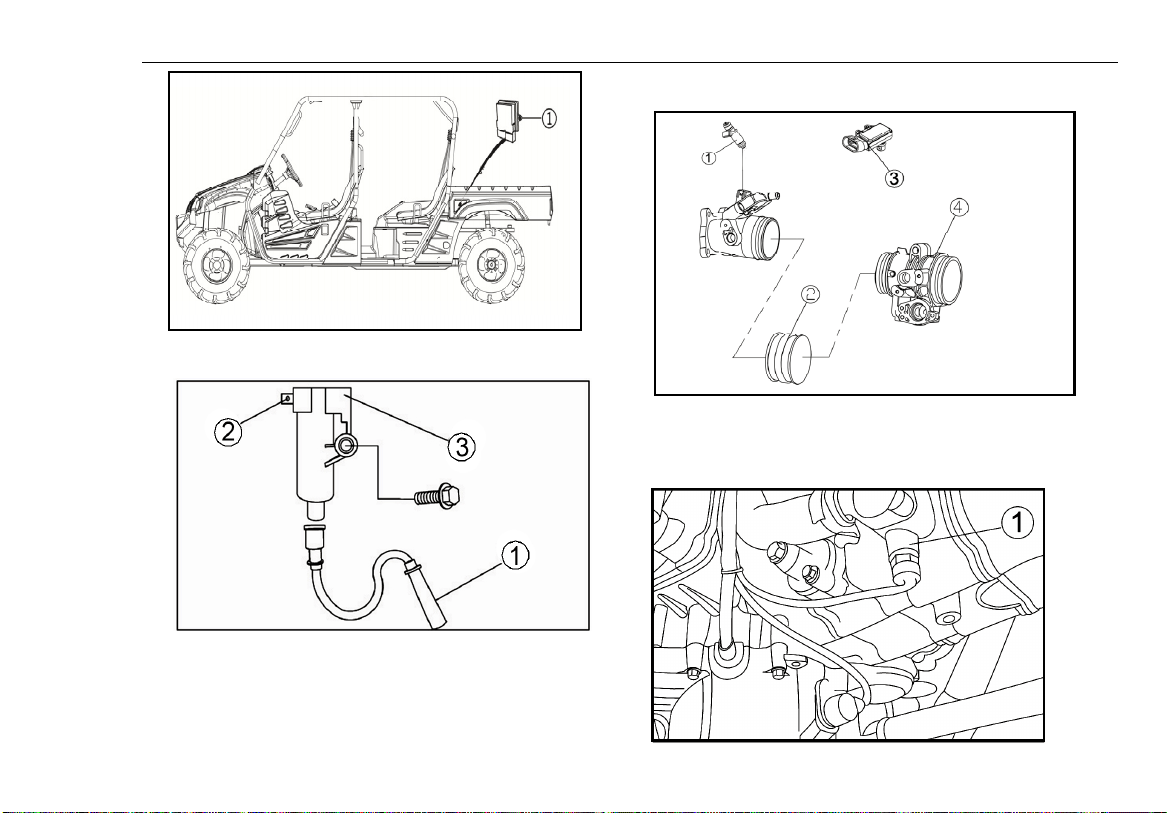
Periodic Maintenance and Adjustment 8-10
1. ECU
1. High voltage wire 2. Ignition signal plug
3. Ignition coil
1. Fuel injector 2. Inlet bent pipe
3. Intake air temperature sensor/ pressure sensor
4. Ducting dampers
1. Water temperature sensor
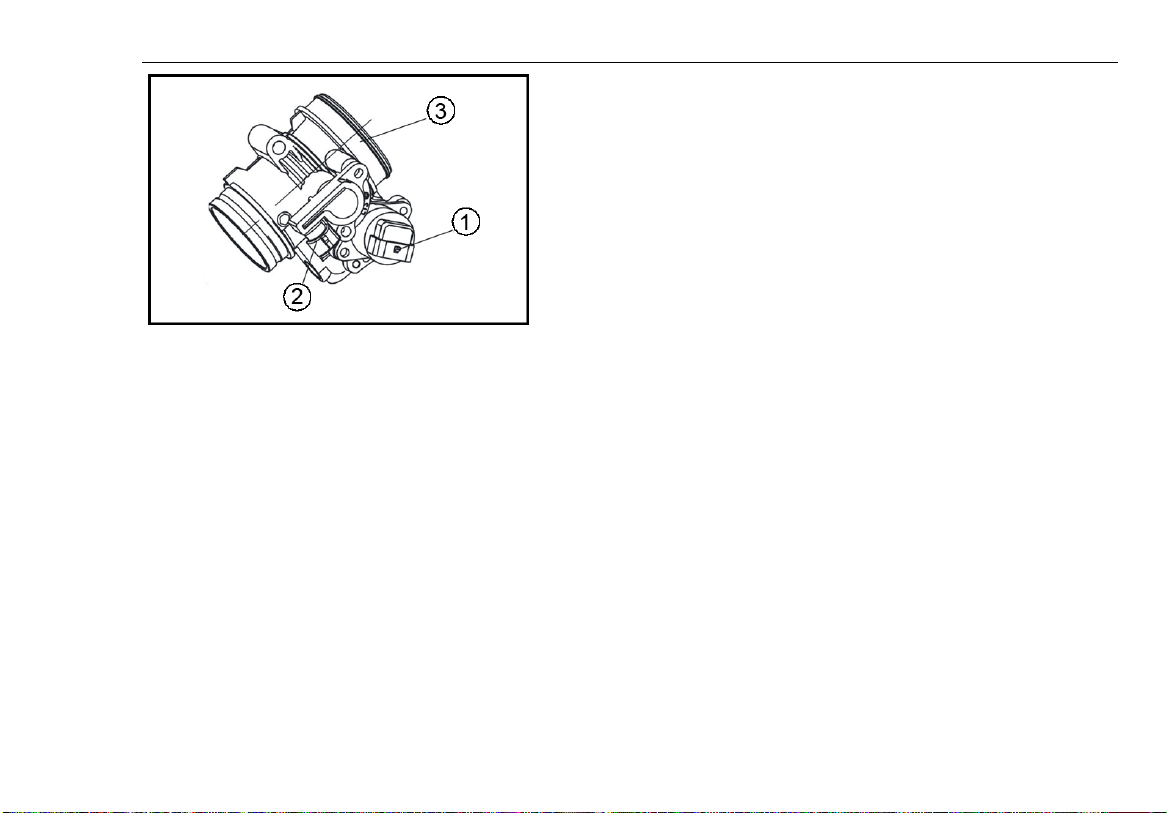
8-11 Periodic Maintenance and Adjustment
1. Idle speed stepper motor
2. Air damper degree sensor
3. Air damper
Air damper
Adjusts air intake volume.
Idle speed stepper motor
To stabilize the idle speed.
Fuel injector
Injects fuel into the cylinder.
Intake air temperature sensor
Senses the intake air temperature, allowing the
ECU to automatically adjust the fuel injection
volume.
Air intake pipe pressure sensor
For testing the negative pressure of the air
intake pipe, the engine has different
working settings. Two parameters, opening
of the air damper and pressure of air intake,
determine the engine’s working condition.
The ECU will adjust the fuel injection volume
according to different negative pressures
and opening of air damper. Adjusting the
engine fuel injection volume can adjust the
output power and output torque.

Periodic Maintenance and Adjustment 8-12
Water temperature sensor
The ECU continually monitors the
water temperature, according to the
temperature difference, the ECU will
automatically revise the fuel injection
volume, to ensure the smooth operation
of the engine all the time.
Ignition signal
The Ignition signal from the magneto
provides
the ECU with correct ignition timing signal.
ECU
The ECU is the core of EFI system, it uses a
specially designed micro computer chip as a
controller. According to the information from
sensors, the ECU ensures accurate control
in different conditions by controlling the
volume from the fuel injection nozzle. The
ECU works to achieve fuel-efficient low
emissions performance of the EFI engine.
EFI System inspection
If the EFI system has a failure, the meter will
display the appropriate failure code. You can
also use the special "EFI system failure
diagnostic device" for inspection. This
diagnostic device can provide more detailed
faliure information. The Diagnostic device is
equipped with its own users manual.
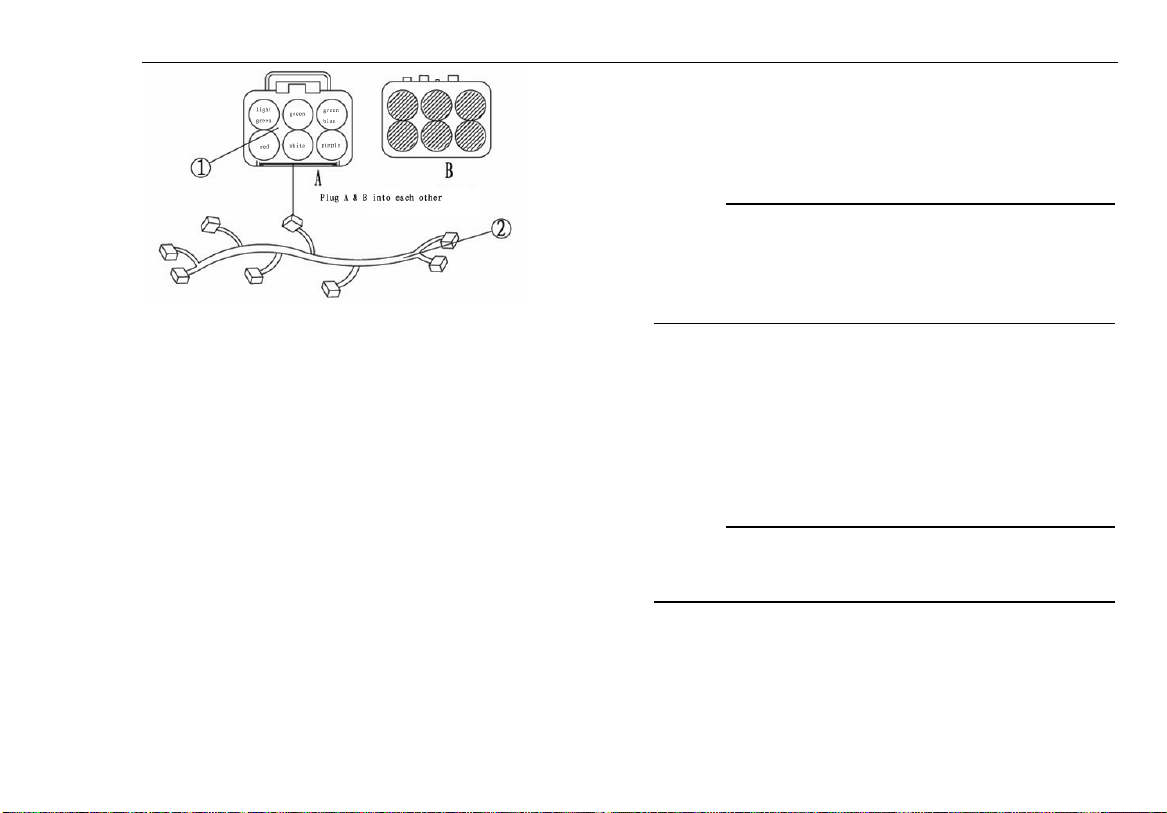
8-13 Periodic Maintenance and Adjustment
1. Diagnostic apparatus cable 2. EFI cables
Engine Oil And Oil Filter Cartridge
The engine oil level should be checked
before each operation. In addition, the oil
must be changed and the oil filter cartridge
replaced at the intervals specified in the
periodic maintenance and lubrication chart.
To Check The Engine Oil Level
1. Place the vehicle on a level surface.
2. Remove the console. (See page 8-8 for
console removal and installation
procedures.)
3. Check the engine oil level on a cold
engine.
NOTE:
If the engine was started before checking the
oil level, be sure to warm up the engine suff-
iciently, and then wait at least ten minutes
until the oil settles for an accurate reading.
4. Remove the engine oil filler cap and wipe
off the dipstick with a clean rag.
5. Insert the dipstick in the oil filler hole
(without screwing it in), and then remove
it again to check the oil level.
NOTE:
The engine oil should be between the
minimum and maximum level marks.
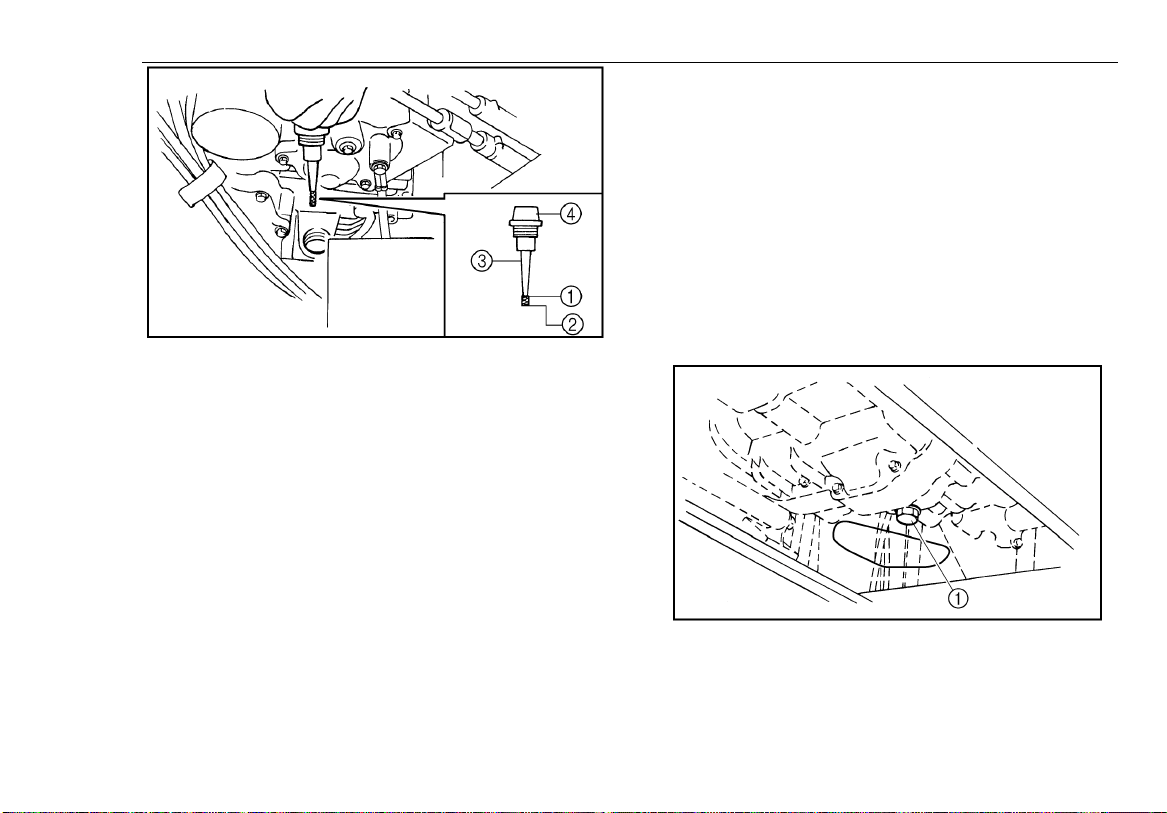
Periodic Maintenance and Adjustment 8-14
1. Engine oil drain bolt
1. Maximum level mark 2. Minimum level mark
3. Dipstick 4. Engine oil filler cap
6. If the engine oil is at or below the
minimum level mark, add sufficient oil of
the recommended type to raise it to the
correct level.
7. Insert the dipstick into the oil filler hole,
and then tighten the oil filler cap.
8. Install the console.
To Change the Engine Oil (With or
Without Oil Filter Cartridge Replacement)
1. Remove the console. (See page 8-8 for
console removal and installation
procedures.)
2. Place an oil pan under the engine to
collect the used oil, and then remove the
engine oil filler cap.
3. Remove the engine oil drain bolt to drain
the oil from the crankcase.
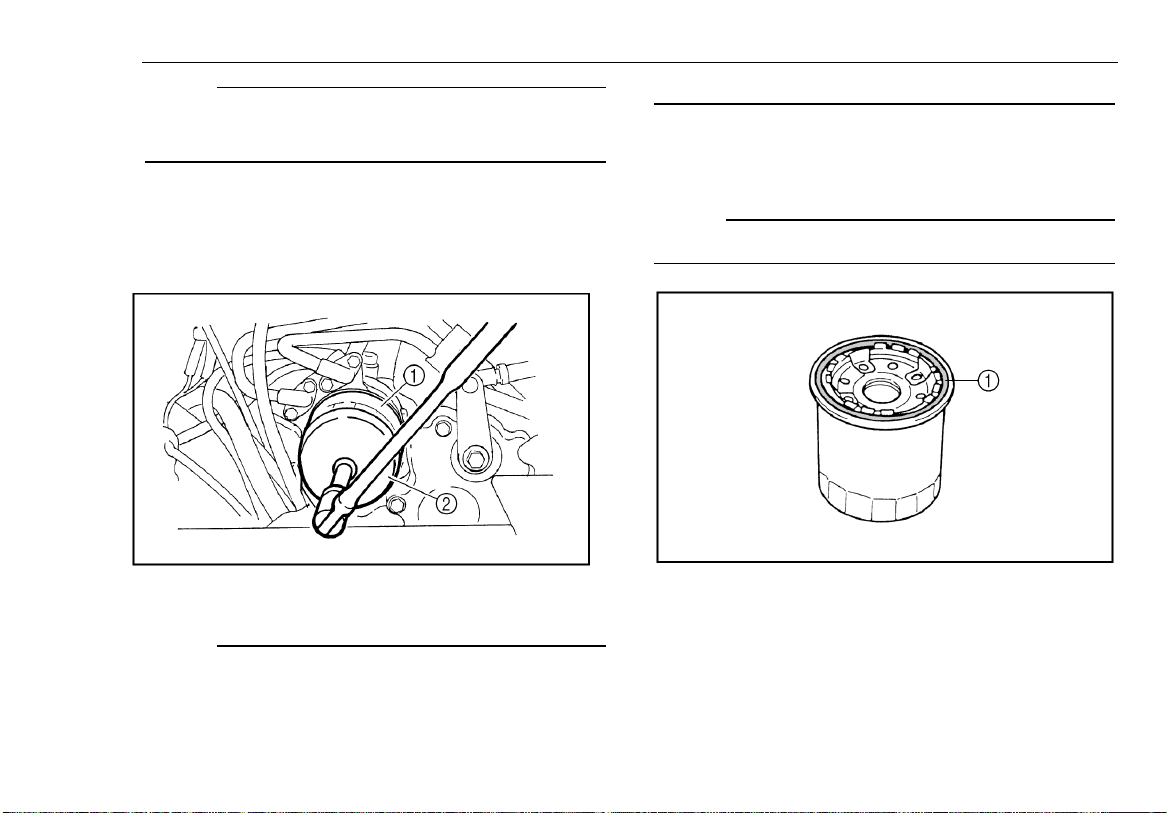
8-15 Periodic Maintenance and Adjustment
NOTE:
Skip steps 4-6 if the oil filter cartridge is not
being replaced.
4. Remove the oil filter cartridge with an oil
filter wrench.
1. Oil filter cartridge 2. Oil filter wrench
NOTE:
An oil filter wrench is available at a nearby
service center.
5. Apply a light coat of engine oil to the
O-ring of the new oil filter cartridge.
NOTE:
Make sure the O-ring is seated properly.
1. O-ring
6. Install the new oil filter cartridge with an
oil filter wrench, and then tighten it to the
specified torque with a torque wrench.
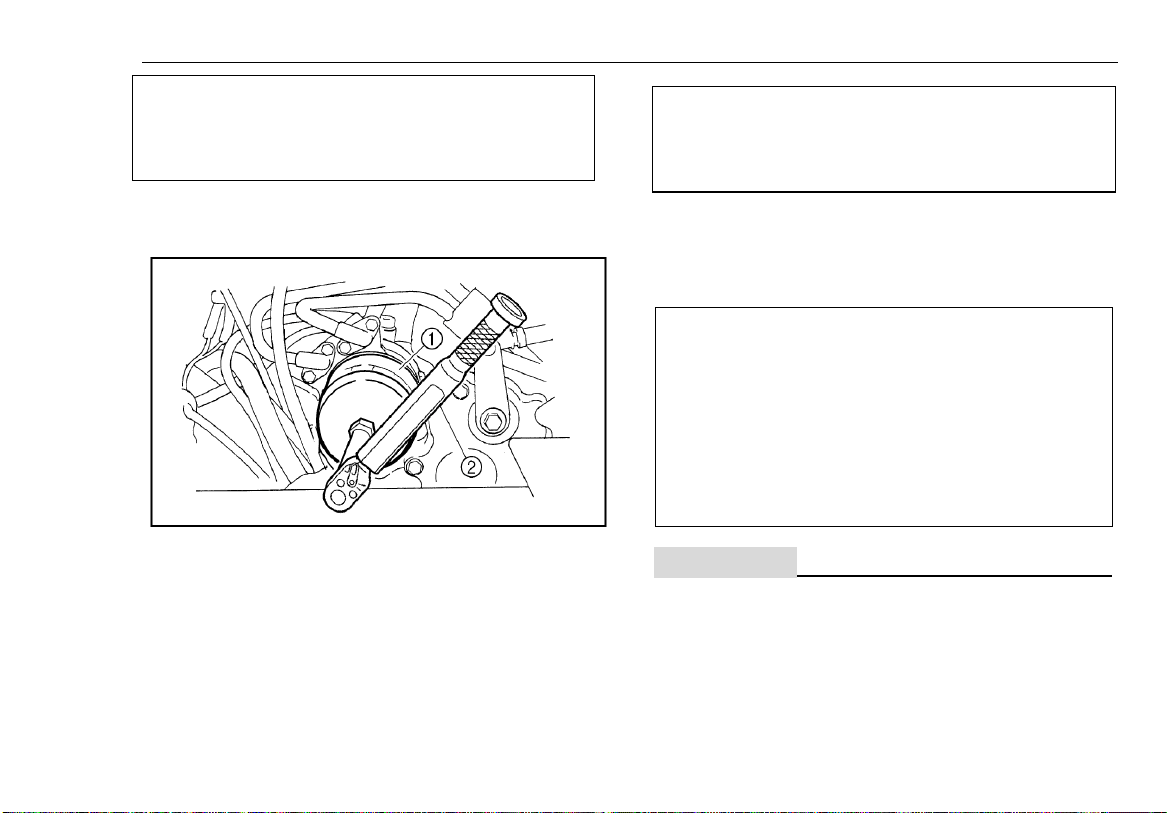
Periodic Maintenance and Adjustment 8-16
1. Oil filler cartridge 2. Torque wrench
7. Install the engine oil drain bolt, and then
tighten it to the specified torque.
Tightening torque:
Engine oil drain bolt:
30Nm (3.0m·kgf, 22 ft·lbf)
8. Add the specified amount of recomm-
ended engine oil, and then install the
engine oil filler cap and tighten it.
Recommended engine oil:
See page 10-2.
Oil quantity:
Without oil filter cartridge replacement:
1.9 L (1.67 lmp qt, 2.01 US qt)
With oil filter cartridge replacement:
2.1 L (1.85 lmp qt, 2.22 US qt)
CAUTION:
In order to prevent clutch slippage (since
the engine oil also lubricates the clutch),
do not mix any chemical additives. Do
Tightening torque:
Oil filter cartridge:
17Nm (1.7m·kgf, 12 ft·lbf)
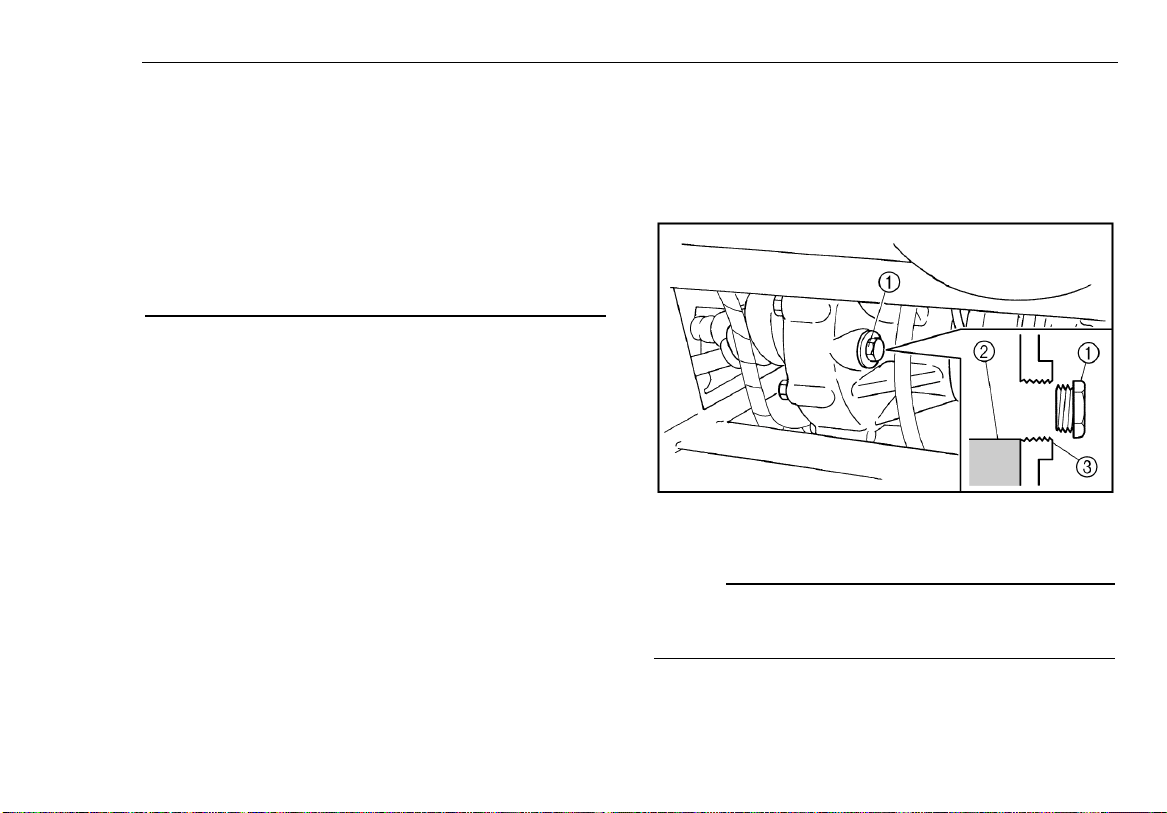
8-17 Periodic Maintenance and Adjustment
not use oils with a diesel specification of
“CD” or oils of a higher quality than
specified. In addition, do not use oils
labeled “ENERGY CONSERVING II” or
higher.
Make sure that no foreign material enters
the crankcase.
9. Start the engine, and then let it idle for
several minutes while checking it for oil
leakage. If oil is leaking, immediately turn
the engine off and check for the cause.
10. Turn the engine off, wait at least ten
minutes, and then check the oil level and
correct it if necessary.
11. Install the console.
Final Gear oil
Checking the Final Gear Oil Level
1. Place the vehicle on a level surface.
2. Remove the oil filler bolt, and then check
the oil level in the final gear case.
1. Speedometer sensor 2. final gear oil
3. Correct oil level
NOTE:
The oil level should be at the brim of the filler
hole.
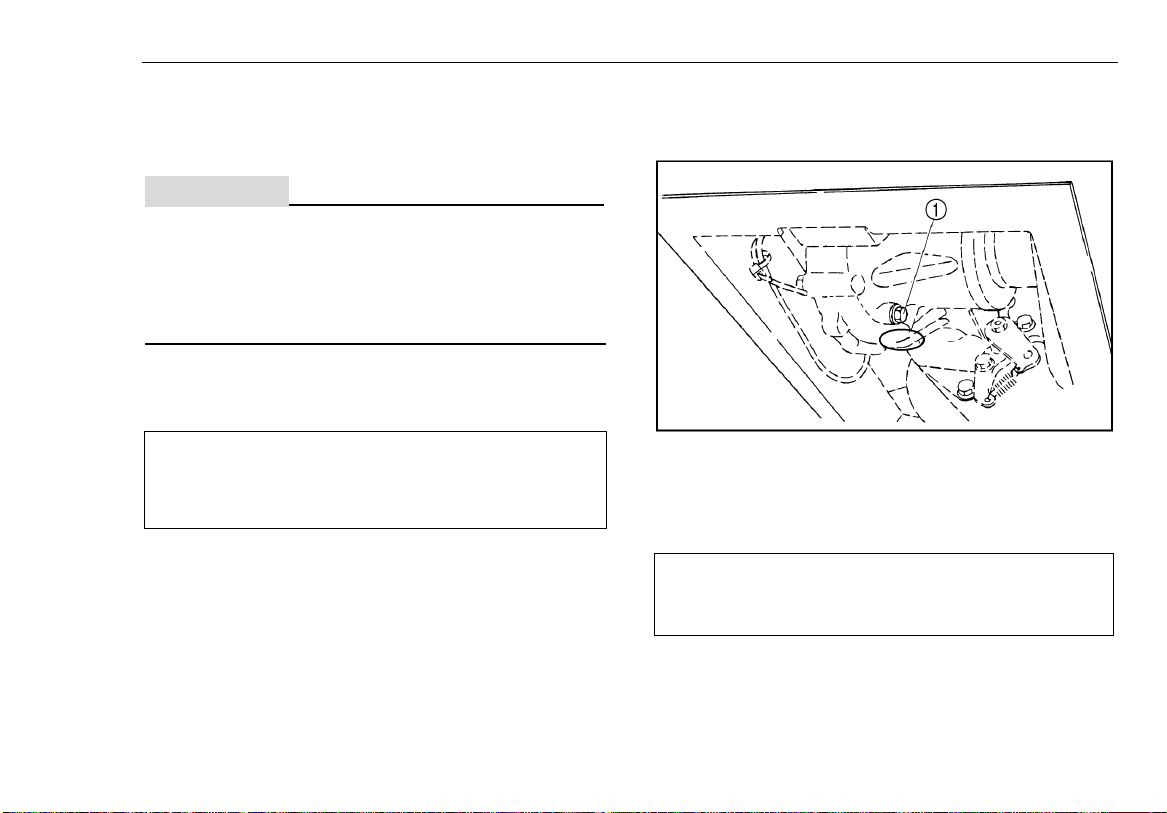
Periodic Maintenance and Adjustment 8-18
3. If the oil is below the brim of the filler hole,
add sufficient oil of the recommended
type to raise it to the correct level.
CAUTION:
1. Be sure no foreign material enters the
final gear case.
2. Clean the sensor every 300 mi (500 km)
period.
4.
Inst
all the oil filler bolt, and then tighten it
to the specified torque.
Tightening torque:
Final gear oil filler bolt:
23 Nm (2.3 m·kgf, 17 ft·lbf)
Changing the Final Gear Oil
1.
Place the vehicle on a level surface.
2.
Place a container under the final gear
case to collect the used oil.
3. Remove the oil filler bolt and the drain
bolt to drain the oil.
1. Final gear oil drain bolt
4. Install the drain bolt, and then tighten it to
the specified torque.
T
ightening torque:
Final gear oil drain bolt:
20 Nm (2.0 m·kgf, 14 ft·lbf )
5. Add the recommended final gear oil up
to the brim of the filler hole.
8-19 Periodic Maintenance and Adjustment
Recommended oil:
SAE 80 API GL-4Hypoid gear oil
Oil quantity:
0.25 L (0.22 lmp qt, 0.26 US qt)
CAUTION:
Be sure no foreign material enters the final
gear case.
6. Install the oil filler bolt, and then tighten it
to the specified torque.
Tightening torque:
Final gear oil filler bolt:
23 Nm (2.3 m·kgf, 17 ft·lbf)
7. Check for oil leakage. If oil leakage is
found, check for the cause.
Differential Gear Oil
Checking the Differential Gear Oil Level
1. Place the vehicle on a level surface.
2. Remove the differential gear oil filler bolt
and check the oil level. It should be up to
the brim of the filler hole. If the level is
low, add sufficient oil of the
recommended type to raise it to the
specified level.
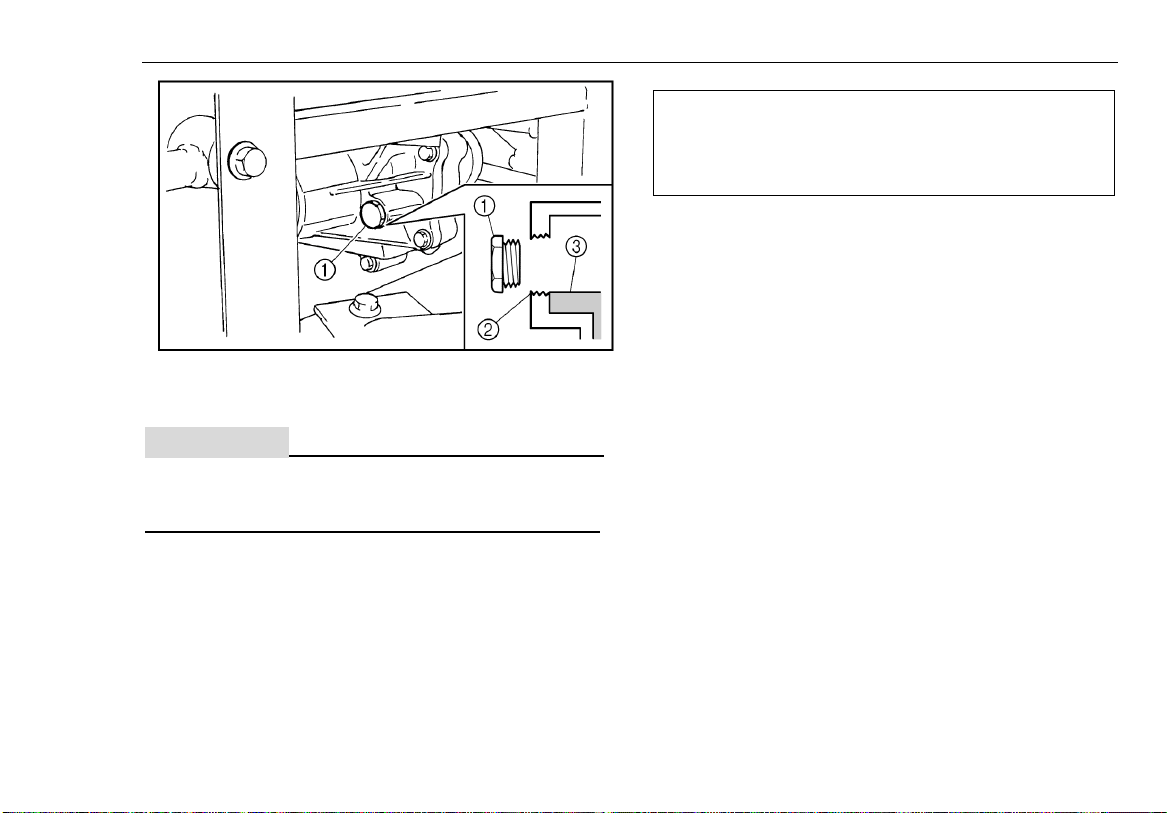
Periodic Maintenance and Adjustment 8-20
1. Differential gear oil filler bolt
2. Correct oil level 3. Differential gear oil
CAUTION:
Be sure no foreign material enters the
differential gear case.
3. Install the differential gear oil filler bolt,
and then tighten it to the specified
torque.
Tightening torque:
Differential gear oil filler bolt:
23Nm (2.3 m·kgf, 17 ft·lbf)
Changing the Differential Gear Oil
1. Place the vehicle on a level surface.
2. Place a container under the differential
gear case to collect the used oil.
3. Remove the differential gear oil filler bolt
and differential gear oil drain bolt to drain
the oil.
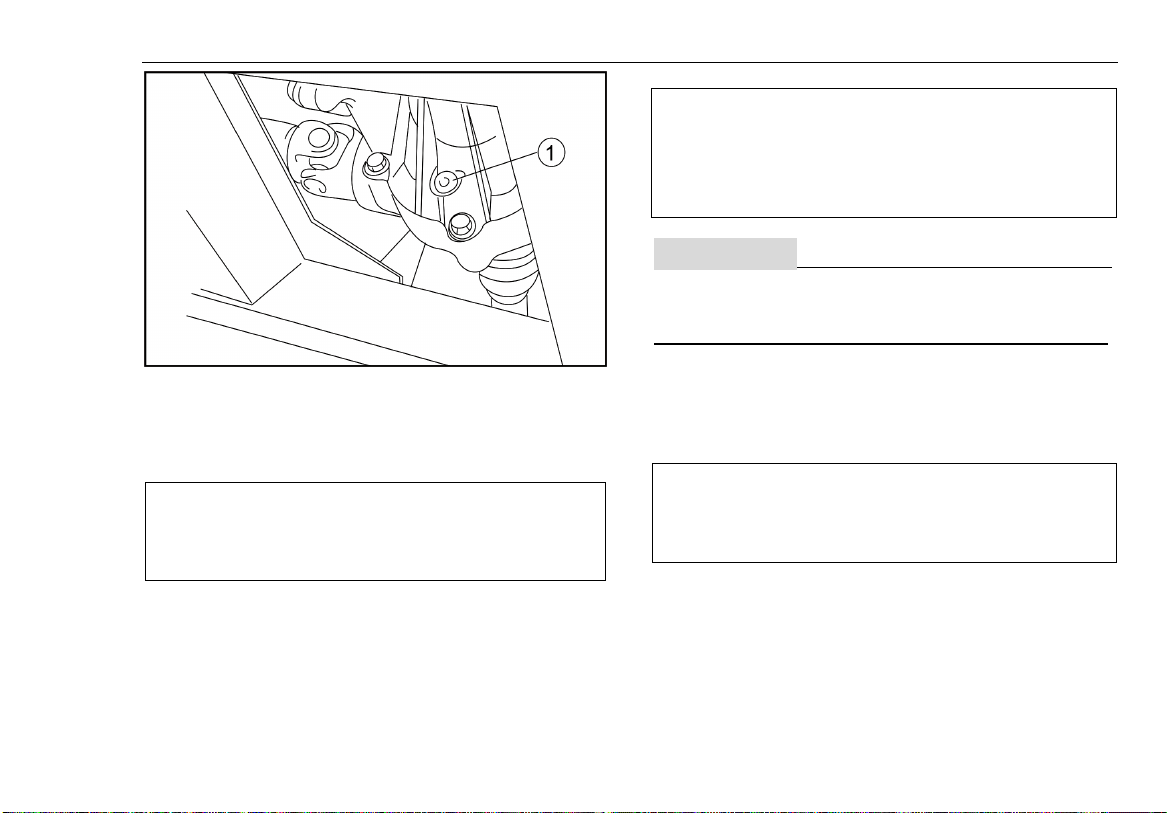
8-21 Periodic Maintenance and Adjustment
1. Differential gear oil drain bolt
4. Install the differential gear oil drain bolt,
and tighten it to the specified torque.
Tightening torque:
Differential gear oil drain bolt:
9.8Nm (0.98 m·kgf, 7.1 ft·lbf)
5. Fill the differential gear case with the
recommended oil.
Recommended oil:
SAE 80 API GL-5 Hypoid gear oil
Oil quantity:
0.32 L (0.28 lmp qt, 0.34 US qt)
CAUTION:
Be sure no foreign material enters the
differential gear case.
6. Install the differential gear oil filler bolt,
and then tighten it to the specified
torque.
Tightening torque:
Differential gear oil filler bolt:
23Nm (2.3m·kgf, 17 ft·lbf)
7. Check for oil leakage. If oil leakage is
found, check for the cause.
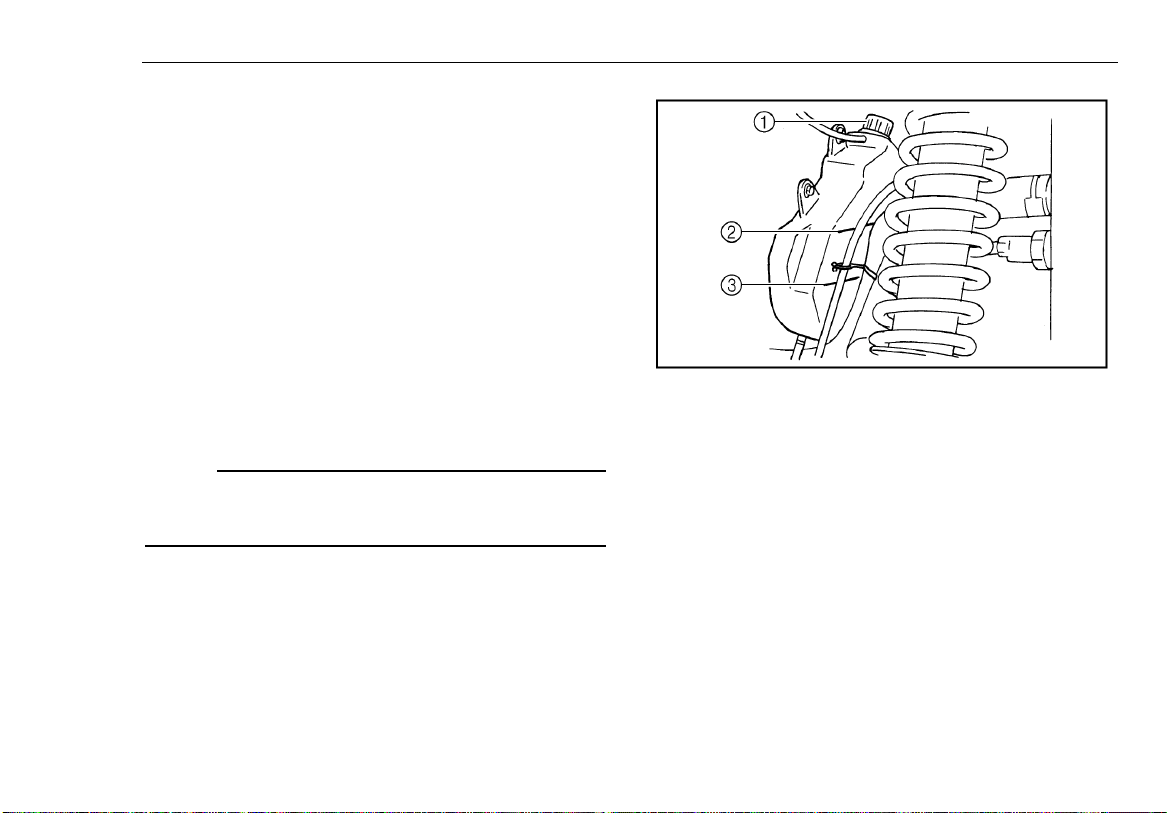
Periodic Maintenance and Adjustment 8-22
Coolant
The coolant level should be checked before
each ride.
Checking the Coolant Level
1. Place the vehicle on a level surface.
2. Open the hood. (See pages 8-7-8-8 for
hood opening and closing procedures.)
3. Check the coolant level in the coolant
reservoir when the engine is cold as the
coolant level varies with engine
temperature.
NOTE:
The coolant should be between the minimum
and maximum level marks.
1. Coolant reservoir cap
2. Maximum level mark 3. Minimum level mark
4. If the coolant is at or below the minimum
level mark, remove the reservoir cap,
add coolant to the maximum level mark,
install the reservoir cap, and then close
the hood.
8-23 Periodic Maintenance and Adjustment
Coolant reservoir capacity
(up to the maximum level mark):
0.35L (0.31 lmp qt, 0.37 US qt)
CAUTION:
Mix anti freeze with distilled water only.
However, if distilled water is not available,
soft water may be used for refilling.
Changing the coolant
The coolant must be changed by a service
center at the intervals specified in the
periodic maintenance and lubrication chart.
NOTE:
● Adding water instead of coolant lowers
the antifreeze content of the coolant. If
water is used instead of coolant, have a
service center check the antifreeze
content of the coolant as soon as
possible.
● The radiator fan is automatically
switched on or off according to the
coolant temperature in the radiator.
Axle Boots
Check the protective boots for holes or
tears.
If any damage is found, have them replaced
by a service center.
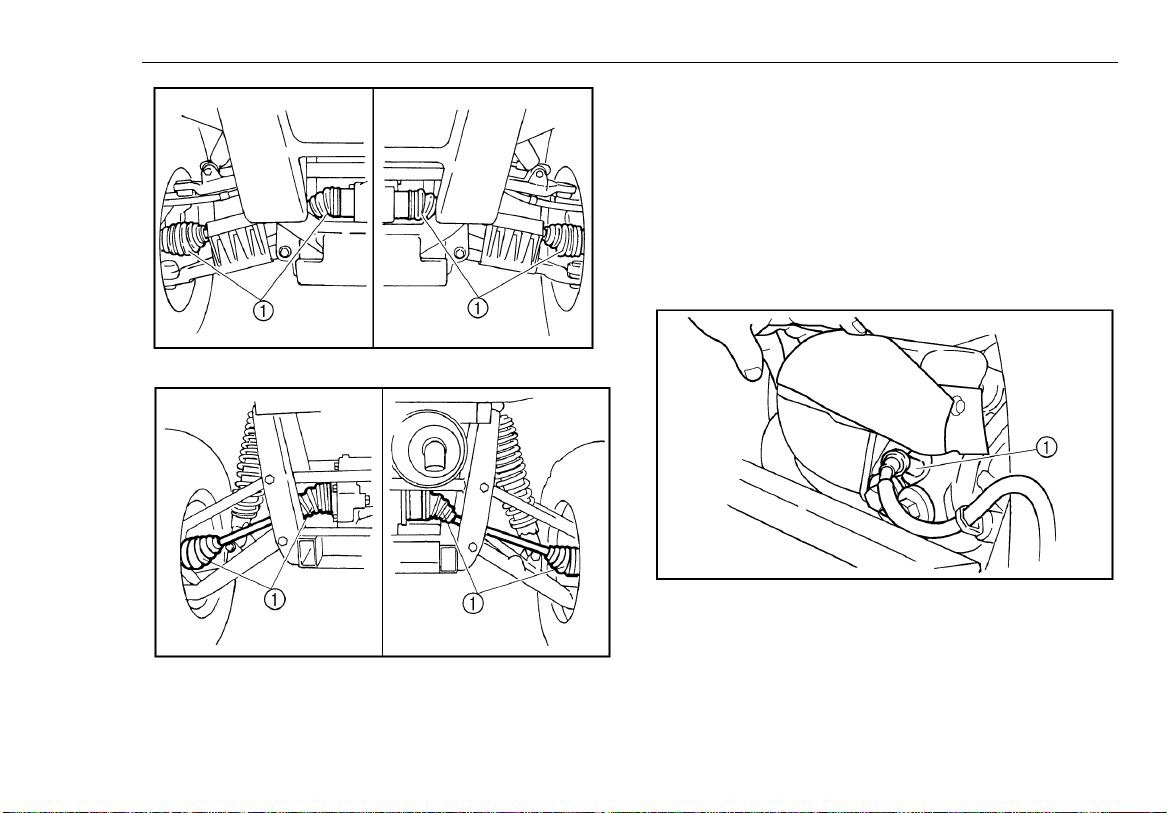
Periodic Maintenance and Adjustment 8-24
1. Front axle boot (×2 each side)
1. Rear axle boot (×2 each side)
Spark Plug Inspection
Removal
1. Lift the cargo bed up. (See pages 4-23
for cargo bed lifting and lowering
procedures.)
2. Remove the spark plug cap.
1. Spark plug cap
3. Use the spark plug wrench in the tool kit
to remove the spark plug as shown.
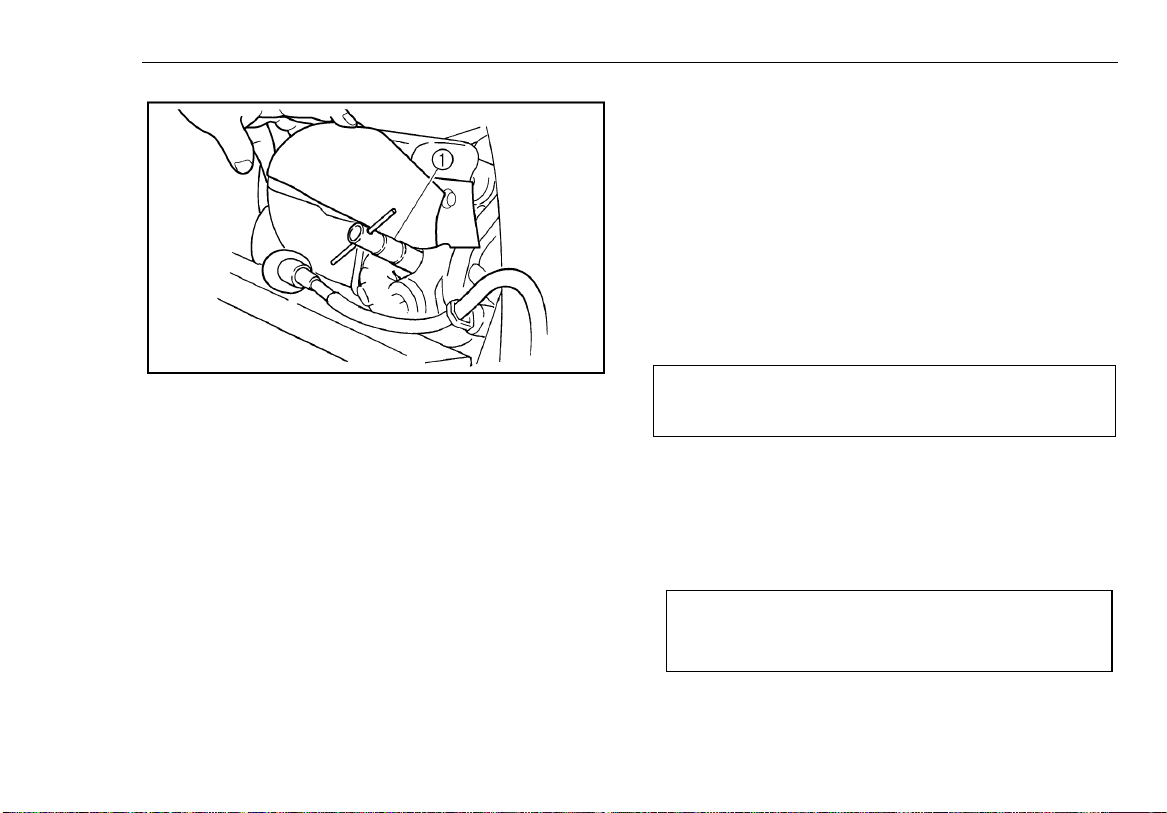
8-25 Periodic Maintenance and Adjustment
1. Spark plug wrench
Inspection
The spark plug is an important engine
component and is easy to inspect. The
condition of the spark plug can indicate the
condition of the engine.
The ideal color of the porcelain insulator
around the center electrode is a
medium-to-light tan for a vehicle that is being
ridden normally.
Do not attempt to diagnose such problems
yourself.
Instead, take the vehicle to a service center.
You should periodically remove and inspect
the spark plug because heat and deposits
will cause the spark plug to slowly break
down and erode. If electrode erosion
becomes excessive, or if carbon and other
deposits are excessive, you should replace
the spark plug with the specified plug.
Specified spark plug:
DCPR7E (NGK)
Installation
1. Measure the electrode gap with a wire
thickness gauge and, if necessary, adjust
the gap to specification.
Spark plug gap:
0.6-0.7mm(0.023-0.027 in)
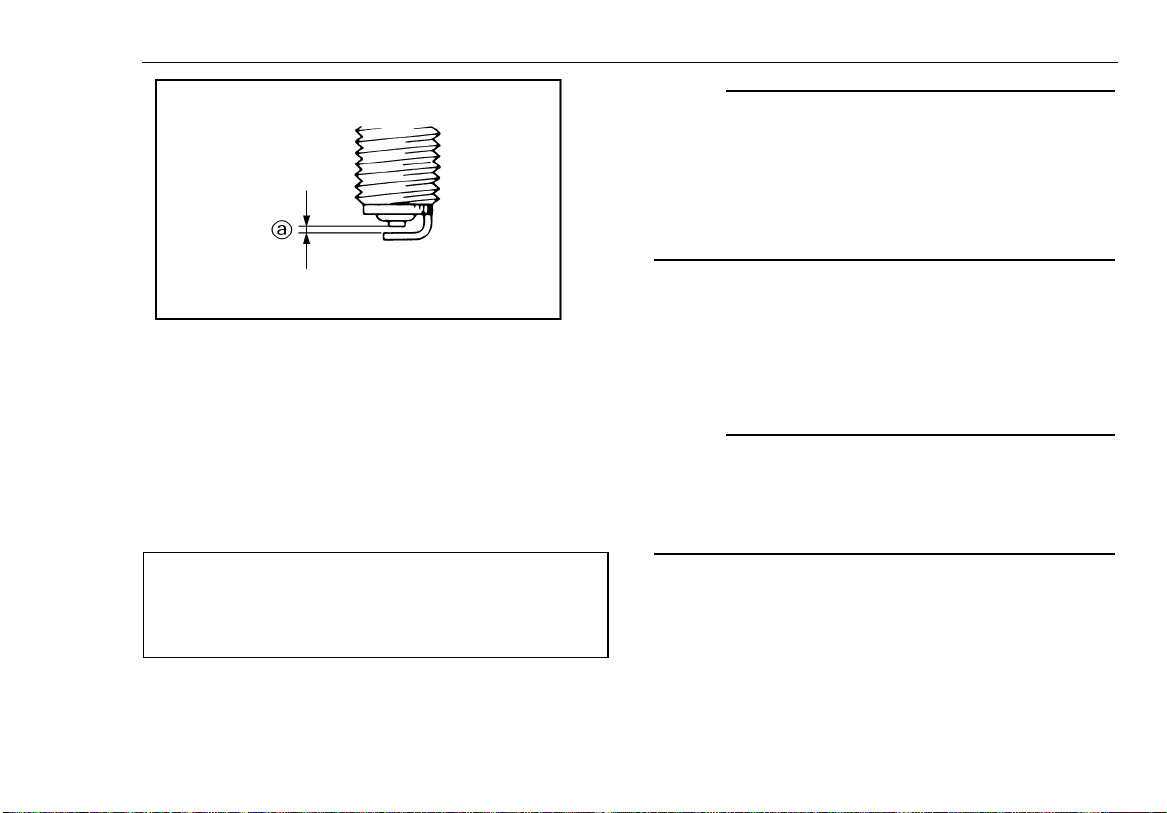
Periodic Maintenance and Adjustment 8-26
a. Spark plug gap
2. Clean the surface of the spark plug
gasket and its mating surface, and then
wipe off any grime from the spark plug
threads.
3. Install the spark plug and tighten it to the
specified torque.
Tightening torque:
Spark plug:
17.5 Nm(1.75 m·kgf, 12.7 ft·lbf)
NOTE:
If a torque wrench is not available when you
are installing the spark plug, a good estimate
of the correct torque is 1/4 to 1/2 turn past
finger tight. Have the spark plug tightened to
the specified torque as soon as possible.
4. Install the spark plug cap.
5. Lower the cargo bed.
Cleaning the Engine Air Filter Element
NOTE:
There is a check hose at the bottom of the
air filter case. If dust or water collects in this
hose, empty the hose and clean the air filter
element and air filter case.
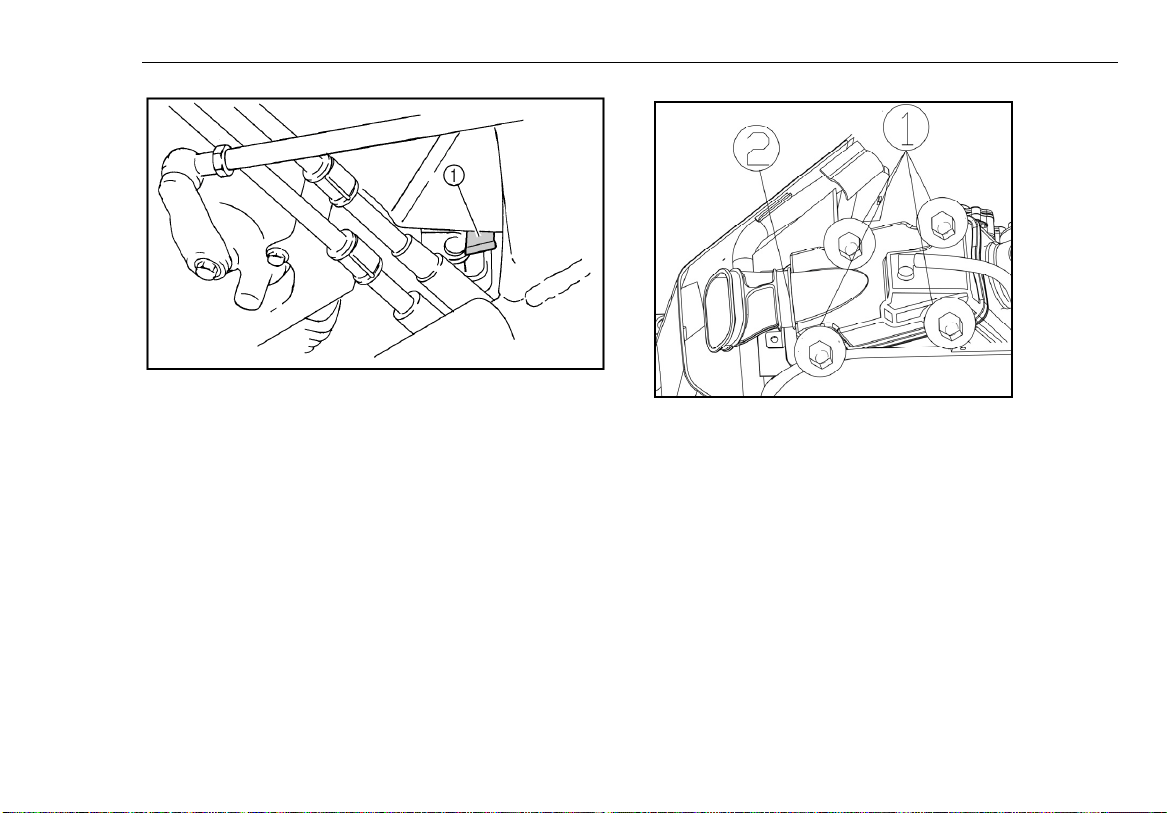
8-27 Periodic Maintenance and Adjustment
1. Air filter check hose
1. Remove the seats. (See pages 4-17─
4-19 for seat removal and installation
procedures. )
2. Remove the console.(See page 8-8 for
console removal and installation proced-
ures.)
3. Remove the air filter case cover by
unhooking the holders.
1. Holder (×4) 2. Air filter case cover
4. Remove the air filter element.
5. Remove the sponge material from its
frame.
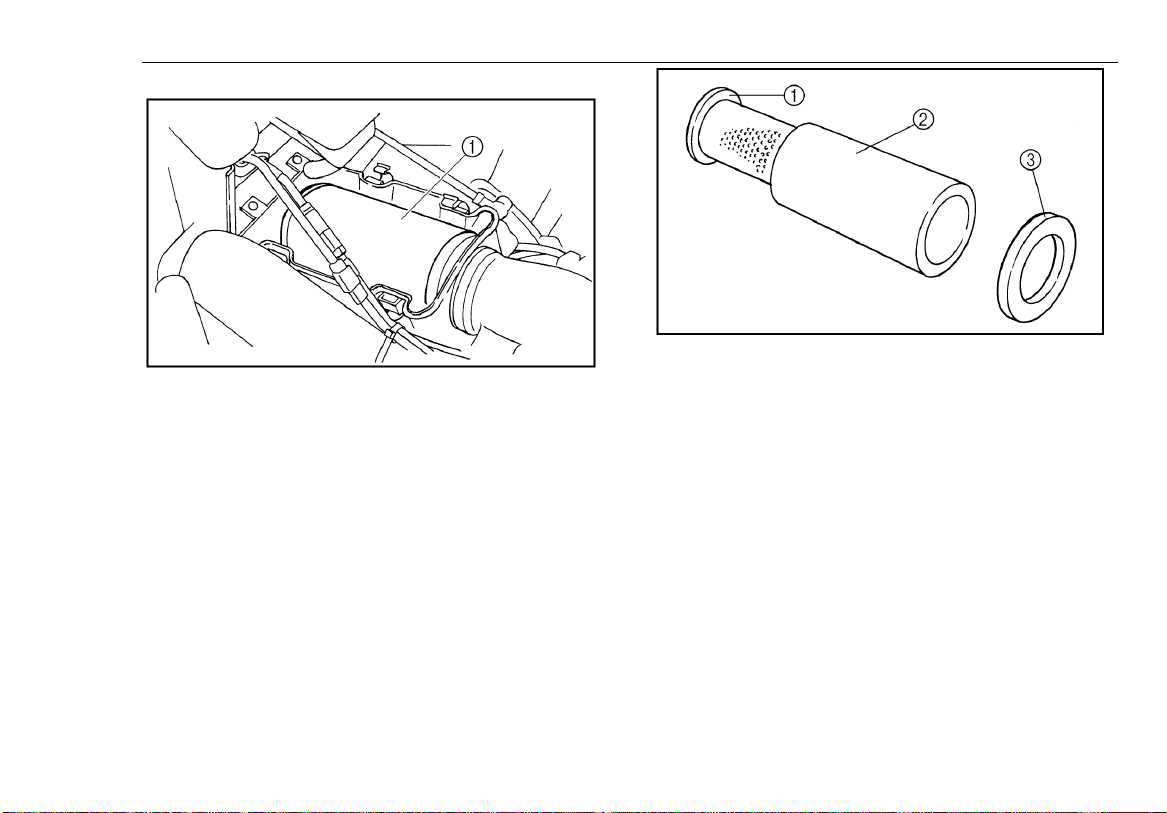
Periodic Maintenance and Adjustment 8-28
1. Air filter frame 2. Sponge material
3. Element retainin
g
plate
1. Air filter element
6.Wash the sponge material gently but
thoroughly in solvent.
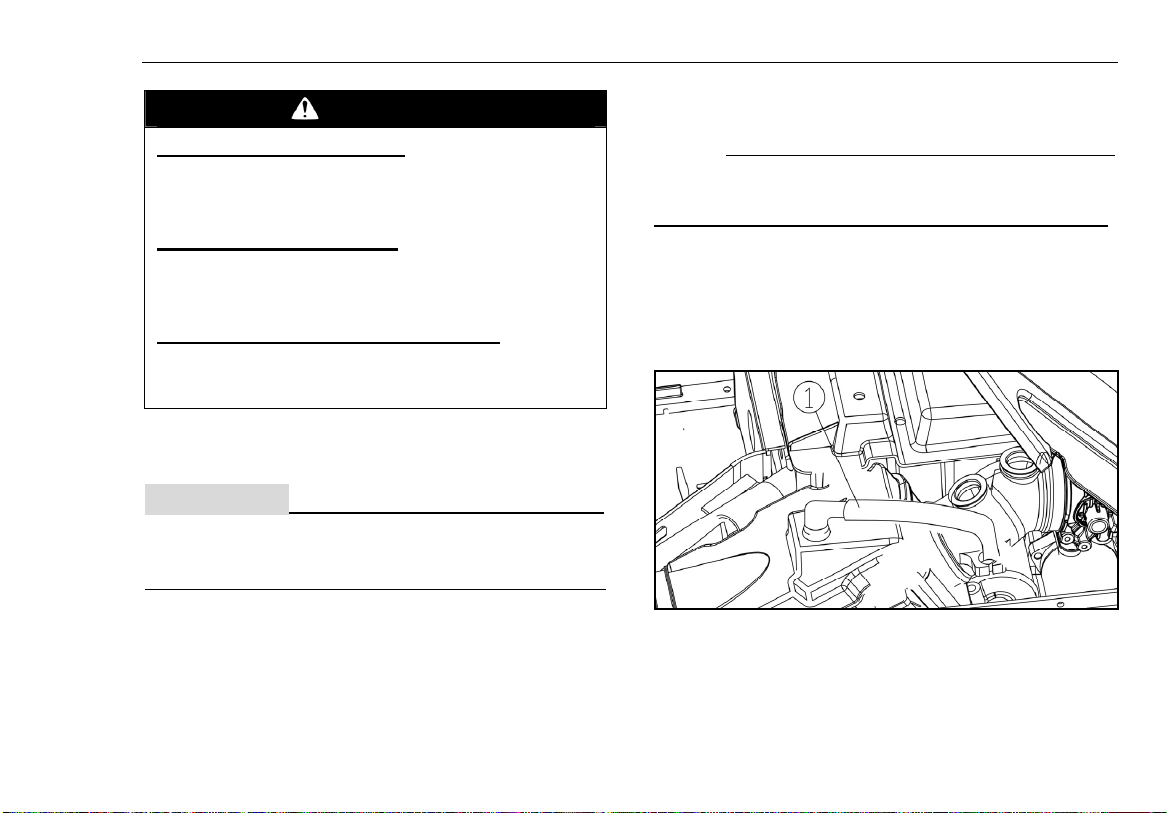
8-29 Periodic Maintenance and Adjustment
WARNING
POTENTIAL HAZARD
Using low flash point solvents or
gasoline to clean the sponge material.
WHAT CAN HAPPEN
Low flash point solvents or gasoline
can catch fire or explode.
HOW TO AVOID THE HAZARD
Use parts cleaning solvent to clean the
sponge material.
7. Squeeze the excess solvent out of the
sponge material and let it dry.
CAUTION:
Do not twist the sponge material when
squeezing it.
8. Inspect the sponge material and replace
it if damaged.
9. Thoroughly apply foam air filter oil or
other quality liquid foam air filter oil (not
spray type) to the sponge material.
NOTE:
The sponge material should be wet but not
dripping.
10. Pull the sponge material over its frame.
11. Install the air filter element.
12. Install the air filter case cover and be
sure the crankcase breather hose is
connected.
1. Crankcase breather hose
13. Install the console.
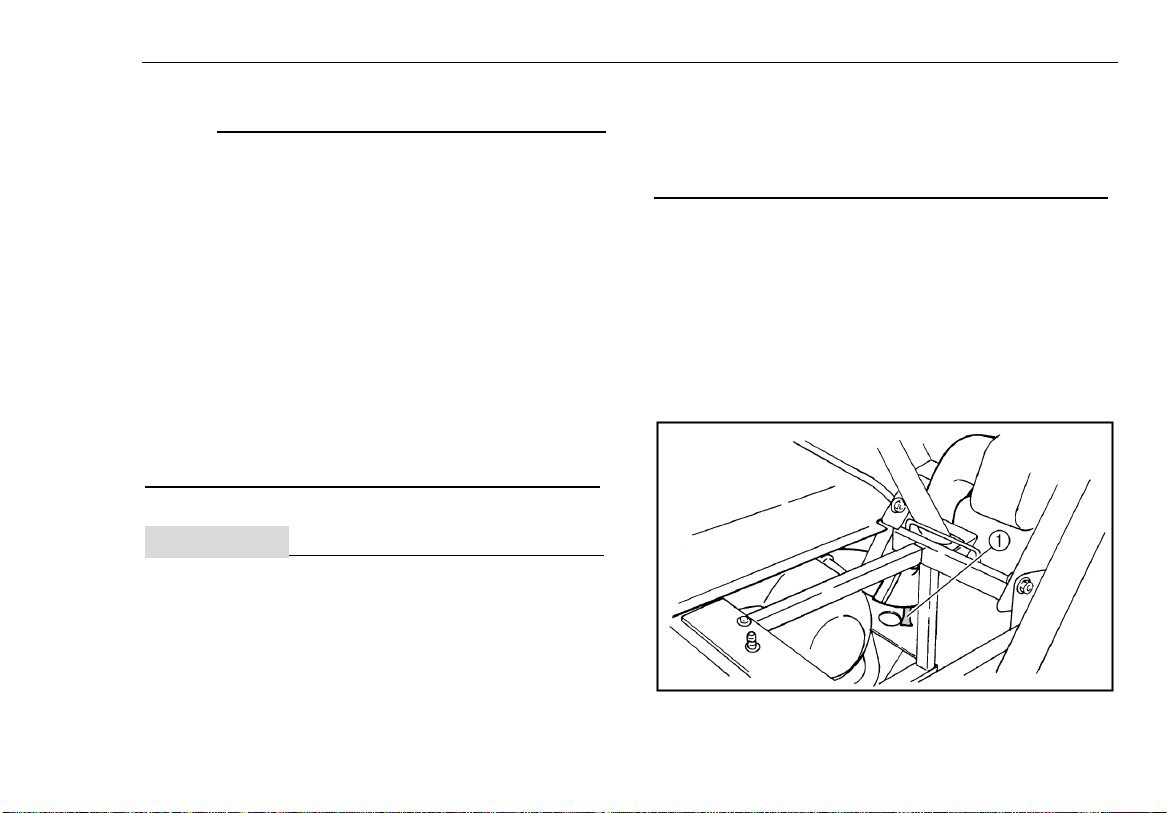
Periodic Maintenance and Adjustment 8-30
14. Install the seats.
NOTE:
The air filter element should b
e cleaned
every 20-40 hours. It should be cleaned and
lubricated more often if the vehicle is
operated in extremely dusty areas. Each
time air filter element maintenance is
performed, check the air inlet to the air filter
case for obstructions. Check the air filter
element rubber joint to the carburetor and
manifold fittings securely to avoid the
possibility of unfiltered air entering the
engine.
CAUTION:
Never operate the engine with the air filter
element removed. This will allow unfiltered
air to enter, causing rapid engine wear and
possible engine damage. Additionally,
operation without the air filter element will
affect engine tuning with subsequent
poor performance and possible engine
overheating.
V
-belt Cooling Duct Check Hose
The V-belt cooling duct check hose is
located under the driver seat.(See pages
4-17 ─ 4-19 for seat removal and installation
procedures.) If dust or water collects in the
V-belt cooling duct check hose, remove the
hose and clean it.
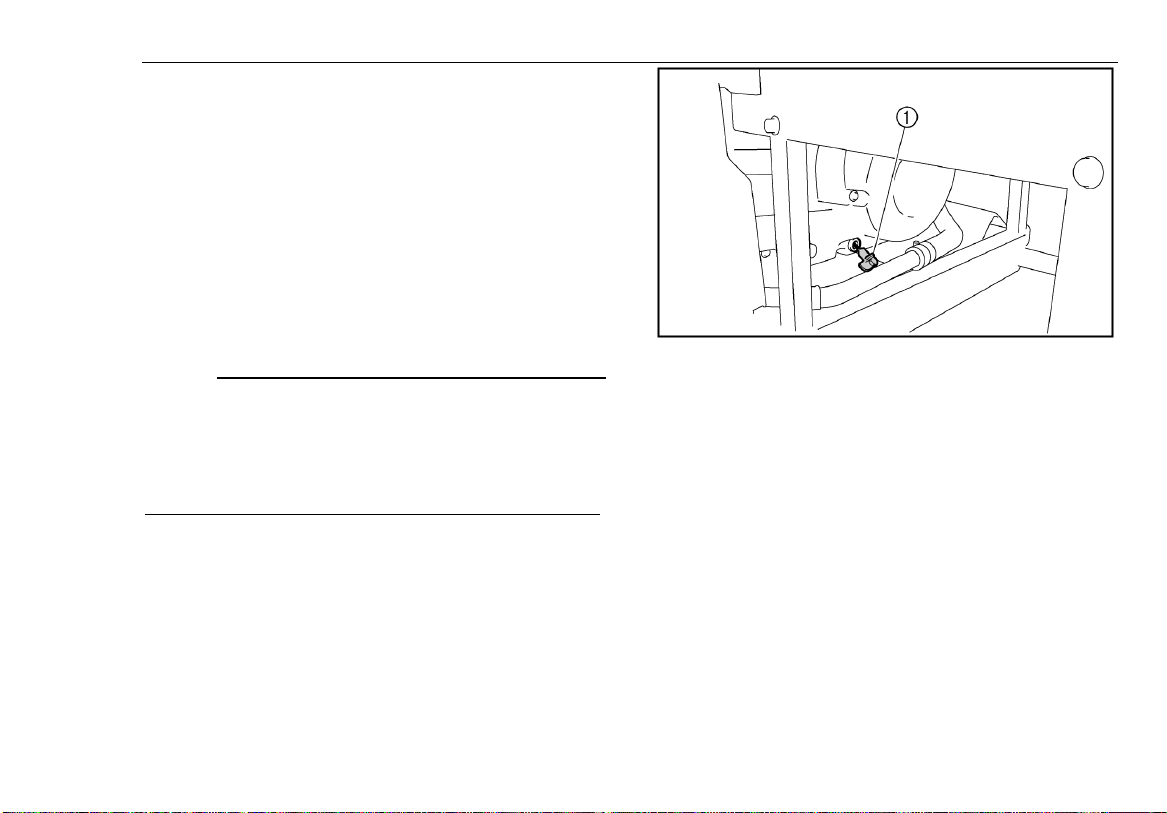
8-31 Periodic Maintenance and Adjustment
1. V-belt cooling duct check hose
V-belt Case Drain Plug
The V-belt case drain plug is located under
the driver seat.(See pages 4-17 ─ 4-19 for
seat removal and installation procedures.)
After riding in water deep enough to allow
water to enter the V-belt case, remove the
drain plug to drain any water from the case.
NOTE:
If water drains from the V-belt case after
removing the drain plug, have a service
center inspect the vehicle as the water may
affect other engine parts.
1. V-belt case drain plug
Cleaning the Spark Arrester
Be sure the exhaust pipe and muffler are
cool before cleaning the spark arrester.
1. Remove the bolts.
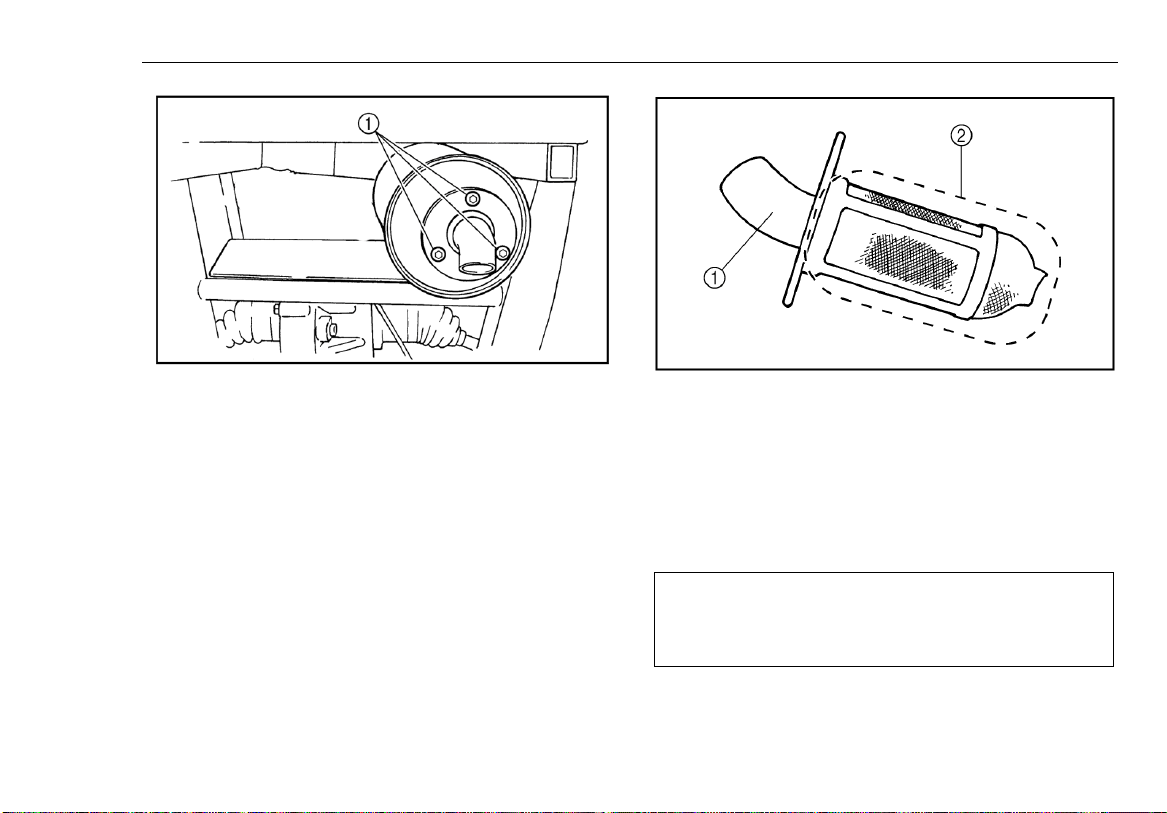
Periodic Maintenance and Adjustment 8-32
1. Bolt(×3)
2.Remove the tailpipe by pulling it out of
the muffler.
3.Tap the tailpipe lightly, and then use a
wire brush to remove any carbon deposits
from the spark arrester portion of the
tailpipe and inside of the tailpipe housing.
1. Tailpipe 2. Spark arrester
4. Insert the tailpipe into the muffler and
align the bolt holes.
5. Install the tailpipe by installing the bolts,
and then tighten the bolts to the specified
torque.
Tightening torque:
Tailpipe bolt:
9.5 Nm(0.95 m·kgf, 6.9 ft·lbf)
8-33 Periodic Maintenance and Adjustment
WARNING
POTENTIAL HAZARD
Improper cleaning of the spark arrester.
Hot exhaust system
WHAT CAN HAPPEN
Could injure the eyes.
Could cause burns.
Could cause carbon monoxide
poisoning, possibly leading to death.
Could start a fire.
HOW TO AVOID THE HAZARD
When cleaning the spark arrester:
Always let the exhaust system cool prior
to touching exhaust components.
Do not start the engine when cleaning the
exhaust system.
Valve Clearance
The correct valve clearance changes with
use, resulting in improper fuel-air supply or
engine noise. To prevent this, the valve
clearance must be adjusted regularly. This
adjustment however, should be left to a
professional service technician.
Front Brake Pad Check
Each brake pad is provided with wear
indicator grooves, which allow you to check
the brake pad wear without having to
disassemble the brake. To check the brake
pad wear, check the wear indicator grooves.
If a brake pad has worn to the point that the
wear indicator grooves have almost
disappeared, have a service center replace
the brake pads as a set.
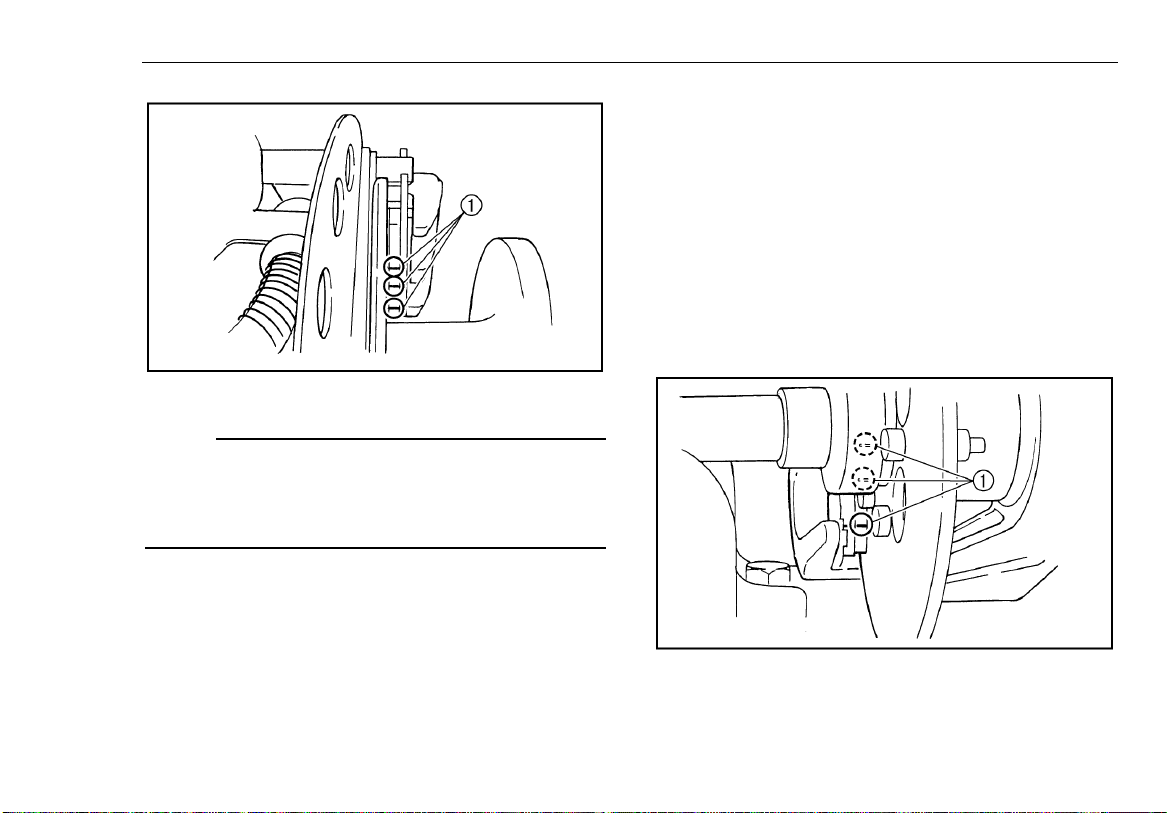
Periodic Maintenance and Adjustment 8-34
1. Brake pad wear indicator groove
NOTE:
The wheels need to be removed to check the
brake pads. (See pages 8-38-8-39 for wheel
removal and installation procedures.)
Rear Brake Pad Check
Each brake pad is provided with wear
indicator grooves, which allow you to check
the brake pad wear without having to
disassemble the brake. To check the brake
pad wear, check the wear indicator grooves.
If a brake pad has worn to the point that the
wear indicator grooves have almost
disappeared, have a service center replace
the brake pads as a set.
1. Brake pad wear indicator groove
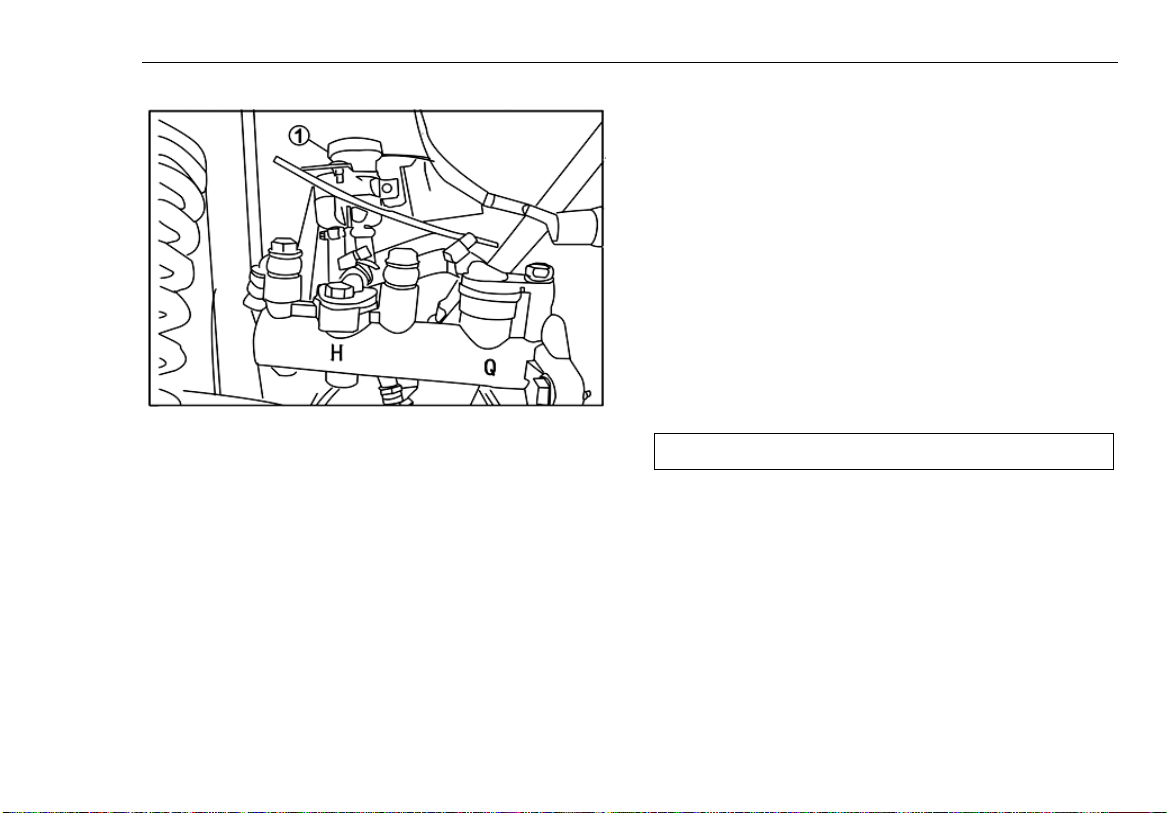
8-35 Periodic Maintenance and Adjustment
Checking the Brake Fluid Level
1. Minimum level mark
Insufficient brake fluid may let air enter the
brake system, possibly causing the brakes to
become ineffective.
Before riding, check that the brake fluid is
above the minimum level mark and replenish
if necessary. A low brake fluid level may
indicate worn brake pads and/or brake
system leakage. If the brake fluid level is low,
be sure to check the brake pads for wear
and the brake system for leakage.
The brake fluid reservoir is located under the
hood. (See pages 8-7 for hood opening and
closing procedures.)
Observe these precautions:
When checking the fluid level, make sure
the top of the brake fluid reservoir is
level.
Use only the recommended quality brake
fluid. Otherwise, the rubber seals may
deteriorate, causing leakage and poor
braking performance
Recommended brake fluid: DOT 4
Refill with the same type of brake fluid.
Mixing fluids may result a harmful
chemical reaction and lead to poor
braking performance.
Be careful that water does not enter the
brake fluid reservoir when refilling. Water
will significantly lower the boiling point of
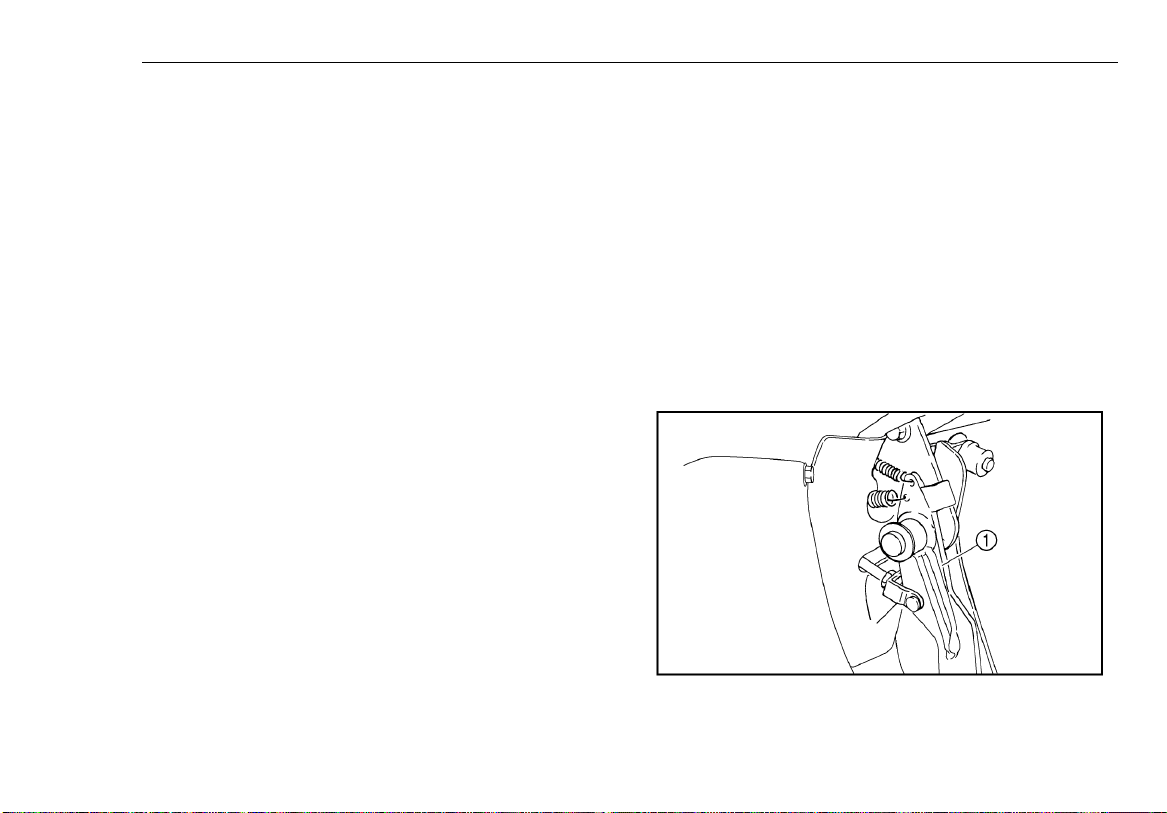
Periodic Maintenance and Adjustment 8-36
1. Brake pedal
the fluid and may result in vapor lock.
Brake fluid may deteriorate painted
surfaces or plastic parts. Always clean
up spilled fluid immediately.
Have a service center inspect the brake
system if the brake fluid level goes down.
Brake Fluid Replacement
Complete fluid replacement should be done
only by trained service personnel. Have a
service center replace the following
components during periodic maintenance or
when they are damaged or leaking.
Replace the oil seals every two years.
Replace the brake hoses every four
years.
Checking the Brake Pedal
Have a service center check the brakes at
the intervals specified in the periodic
maintenance and lubrication chart. There
should be no free play in the brake pedal.
The brakes should operate smoothly and
there should be no brake drag. If the brakes
feel soft or spongy, this could indicate air in
the brake system. Have a service center
check the brake system if necessary.
8-37 Periodic Maintenance and Adjustment
WARNING
POTENTIAL HAZARD
Operating with improperly serviced or
adjusted brakes.
WHAT CAN HAPPEN
You could lose braking ability, which
could lead to an accident.
HOW TO AVOID THE HAZARD
After servicing:
Make sure the brakes operate
smoothly and that the brake pedal
position is correct.
Make sure the brakes do not drag.
All air must be bled from the brake
system.
Replacement of brake components
requires professional knowledge. These
procedures should be performed by a
service center.
Parking Brake Lever Free Play
Adjustment
Periodically check the parking brake lever
free play and adjust it if necessary.
1. Shift the drive select lever into low gear
“L”.
2. Remove the seats. (See page 4-17—
4-19 for seat removal and installation
procedures.)
3. Remove the console. (See page 8-8 for
console removal and installation
procedures.)
4. Check the parking brake lever free play.
The maximum free play is equal to one
click of the parking brake lever. If
necessary, adjust the free play as
follows.
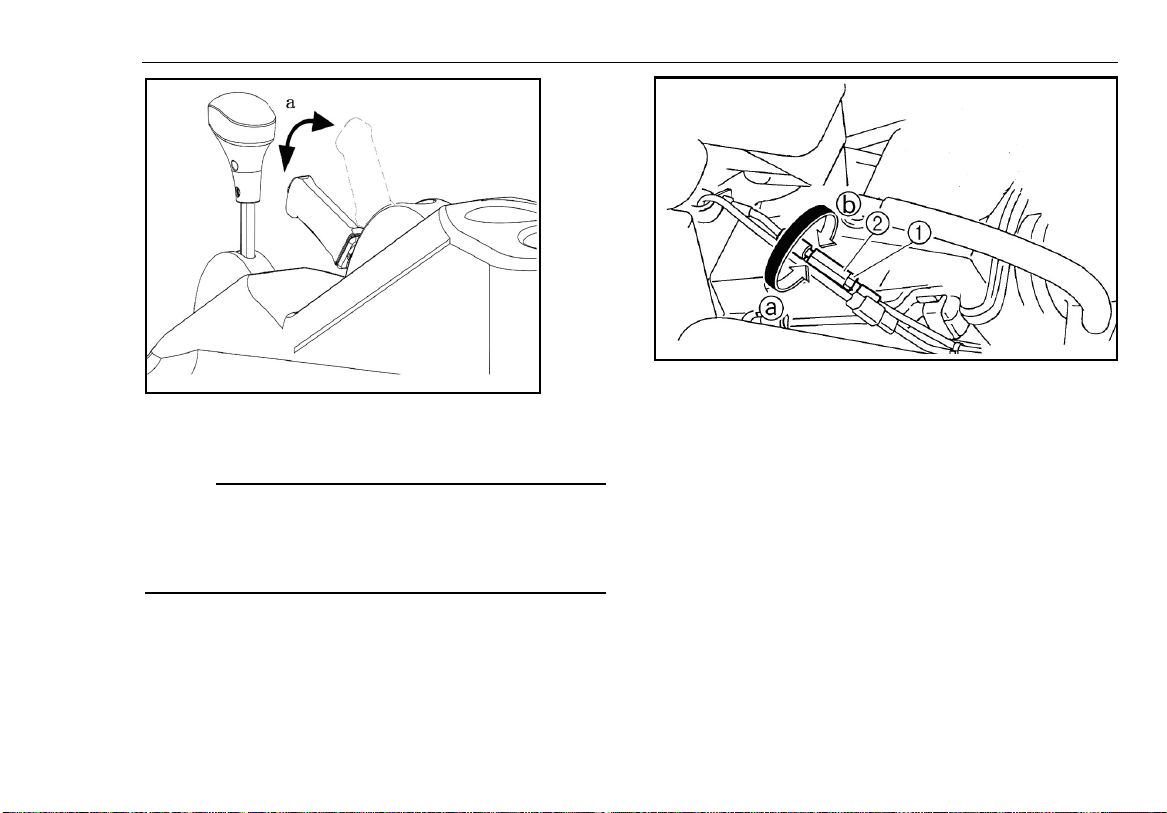
Periodic Maintenance and Adjustment 8-38
1.
Parking brake lever free play
NOTE:
The parking brake lever must be released
when checking and adjusting the parking
brake lever free play.
5. Loosen the locknut.
1. Locknut 2. Adjusting nut
6. Turn the adjusting nut in direction ⓐ to
increase the free play or in direction ⓑ
to decrease the free play.
7. Tighten the locknut.
8. Install the console.
9. Install the seats.
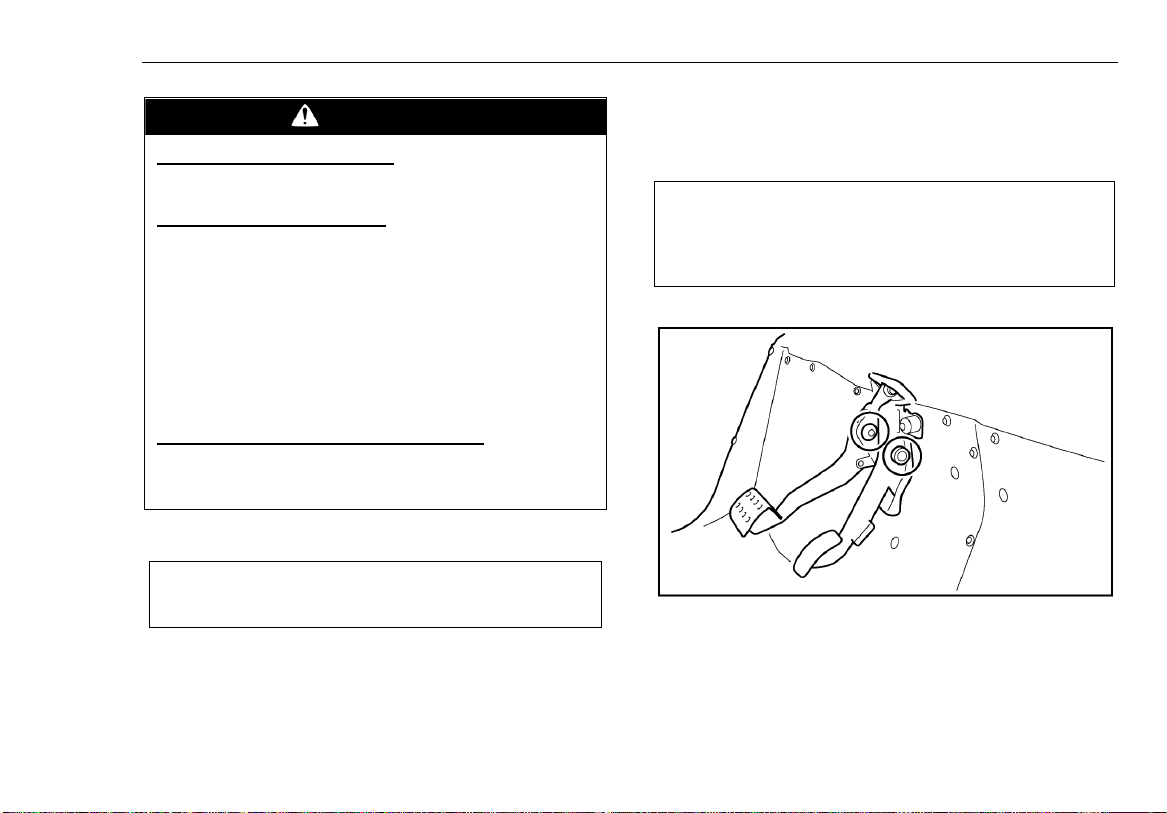
8-39 Periodic Maintenance and Adjustment
WARNING
POTENTIAL HAZARD
Damaged control cables.
WHAT CAN HAPPEN
Corrosion can result when the outer
covering of control cables becomes
damaged. Cables can also become frayed
or kinked. Operation of controls could be
restricted, which could cause an accident
or injury.
HOW TO AVOID THE HAZARD
Inspect cables frequently. Replace
damaged cables.
Recommended lubricant:
Engine oil
Brake Pedal and Accelerator Pedal
Lubrication
Lubricate the pivoting parts.
Recommended lubricant:
Lithium-soap-based grease
(all-purpose grease)
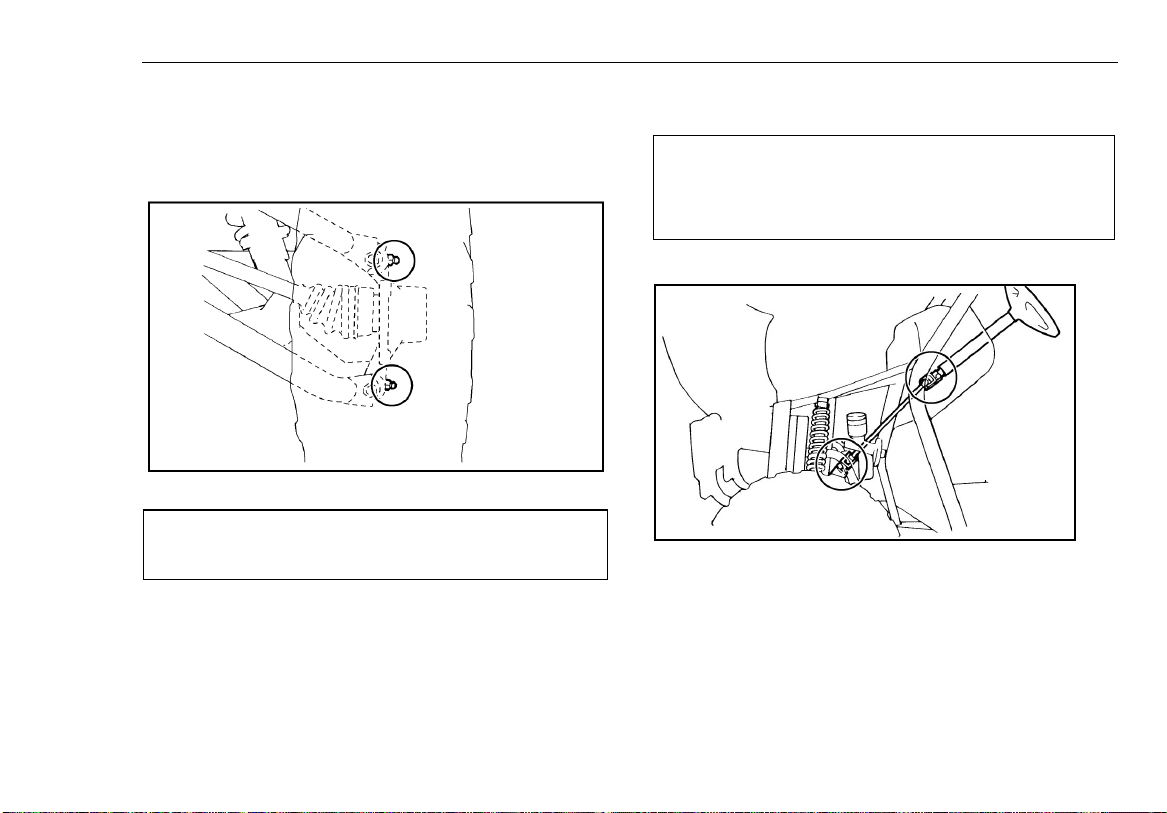
Periodic Maintenance and Adjustment 8-40
Rear Knuckle Upper and Lower Pivot
Lubrication
Lubricate the knuckle upper and lower pivots
with a grease gun.
Recommended lubricant:
Lithium-soap-based grease
Steering Shaft Lubrication
Lubricate the pivot points.
Recommended lubricant:
Lithium-soap-based grease
(all-purpose grease)
Lubrication of Drive Shaft Bearing Block
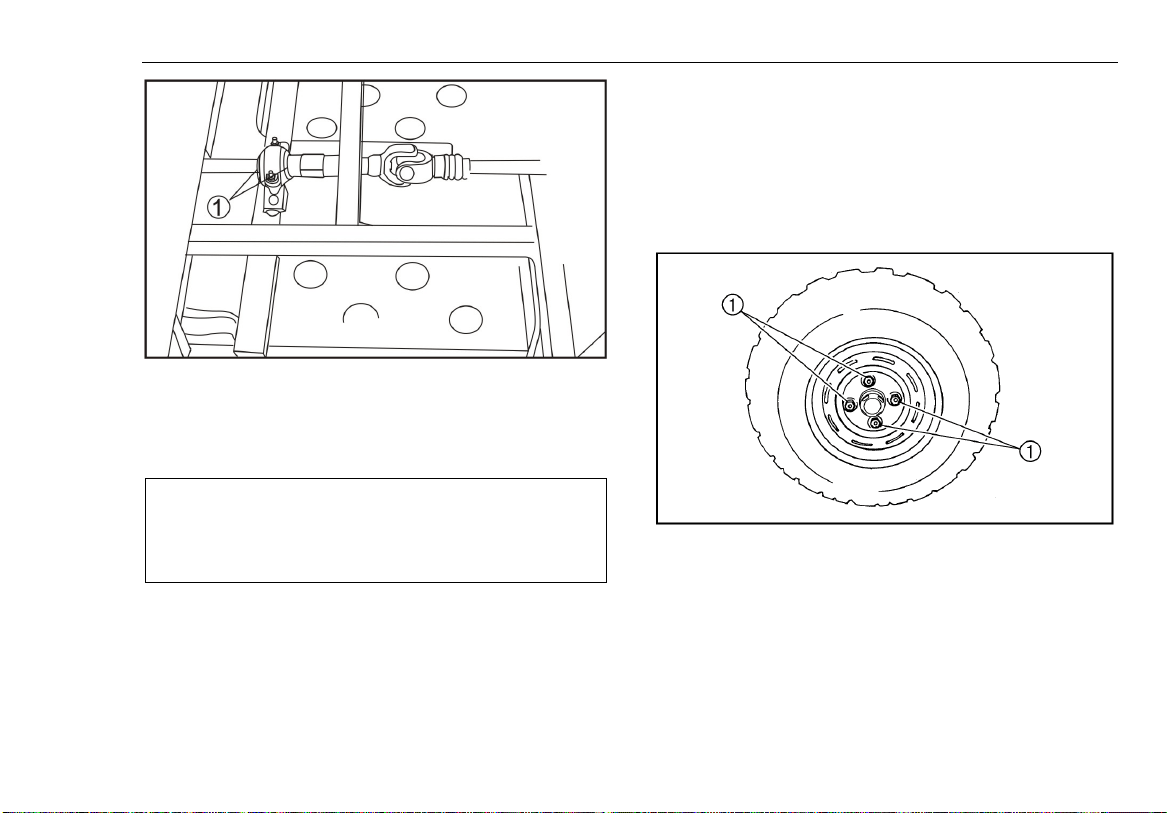
8-41 Periodic Maintenance and Adjustment
1. Bearing block
Lubricate the bearing block.
Recommended lubricant:
Lithium-soap-based grease
(all-purpose grease)
Wheel Removal
Loosen the wheel nuts .
Elevate the vehicle and place a suitable
stand under the frame.
Remove the nuts from the wheel.
Remove the wheel.
1. Nut(×4)
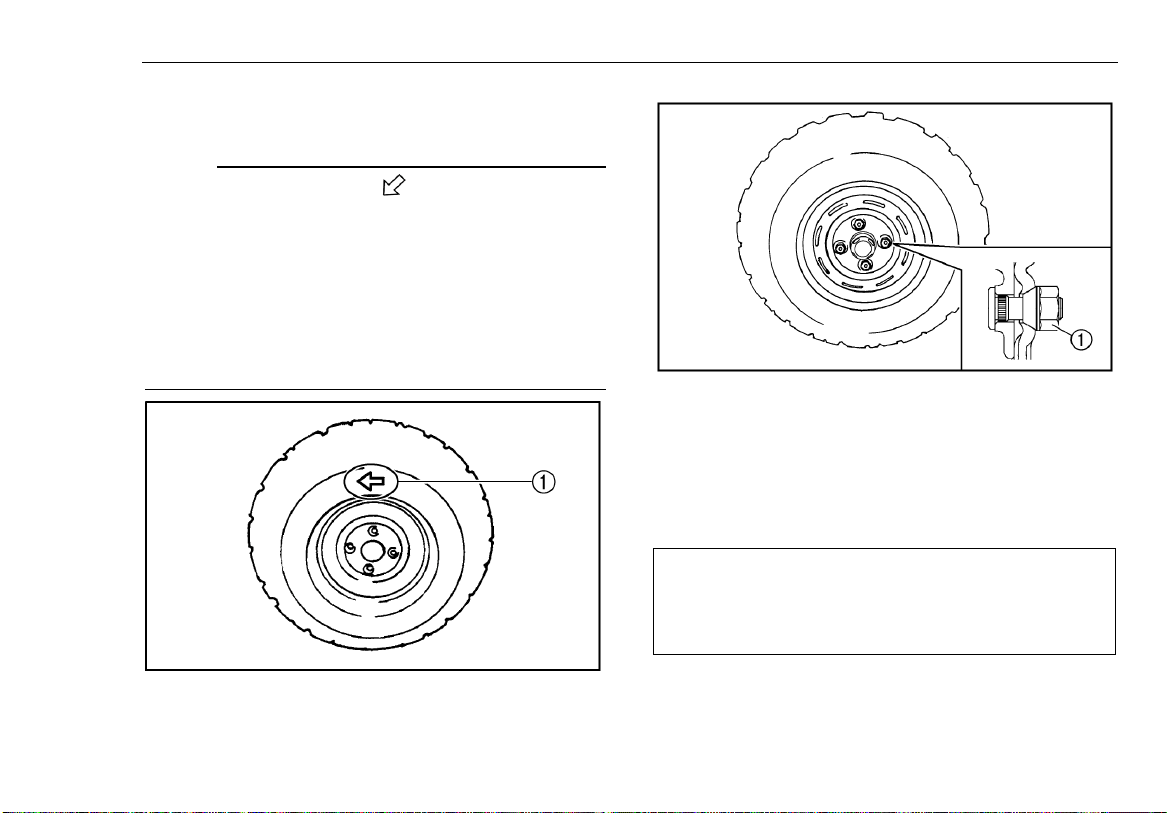
Periodic Maintenance and Adjustment 8-42
1. Arrow mark
Wheel Installation
1. Install the wheel and the nuts.
NOTE:
● The arrow mark on the tire must
point toward the rotating direction of the
wheel.
● Tapered nuts are used for both the front
and rear wheels. Install the nut with its
tapered side towards the wheel.
1. Tapered nut
2. Lower the vehicle so that the wheel is on
the ground.
3. Tighten the wheel nuts to the specified
torque.
Wheel nut torque:
Front:55Nm(5.5 m·kgf,40 ft·lbf)
Rear:55Nm(5.5 m·kgf,40 ft·lbf)

8-43 Periodic Maintenance and Adjustment
Battery
This vehicle is equipped with a sealed-type
battery. Therefore it is not necessary to
check the electrolyte or add distilled water in
the battery. If the battery seems to have
discharged, consult a service center.
CAUTION:
Do not try to remove the sealing caps of the
battery cells. You may damage the battery.
Periodic Maintenance and Adjustment 8-44
WARNING
POTENTIAL HAZARD
Failure to handle batteries or battery electrolyte carefully.
WHAT CAN HAPPEN
You could be poisoned. You could be severely burned by the sulfuric acid in battery
electrolyte. Batteries produce explosive gases.
HOW TO AVOID THE HAZARD
Avoid contact with skin, eyes or clothing. Always shield eyes when working near batteries.
Keep out of reach of children.
Antidote:
EXTERNAL: Flush with water.
INTERNAL: Drink large quantities of water or milk. Follow with milk of magnesia, beaten
egg or vegetable oil. Get prompt medical attention.
EYES: Flush with water for 15 minutes and get prompt medical attention. Keep batteries
away from sparks, flames, cigarettes or other sources of ignition. Ventilate when charging
or using in a closed space.
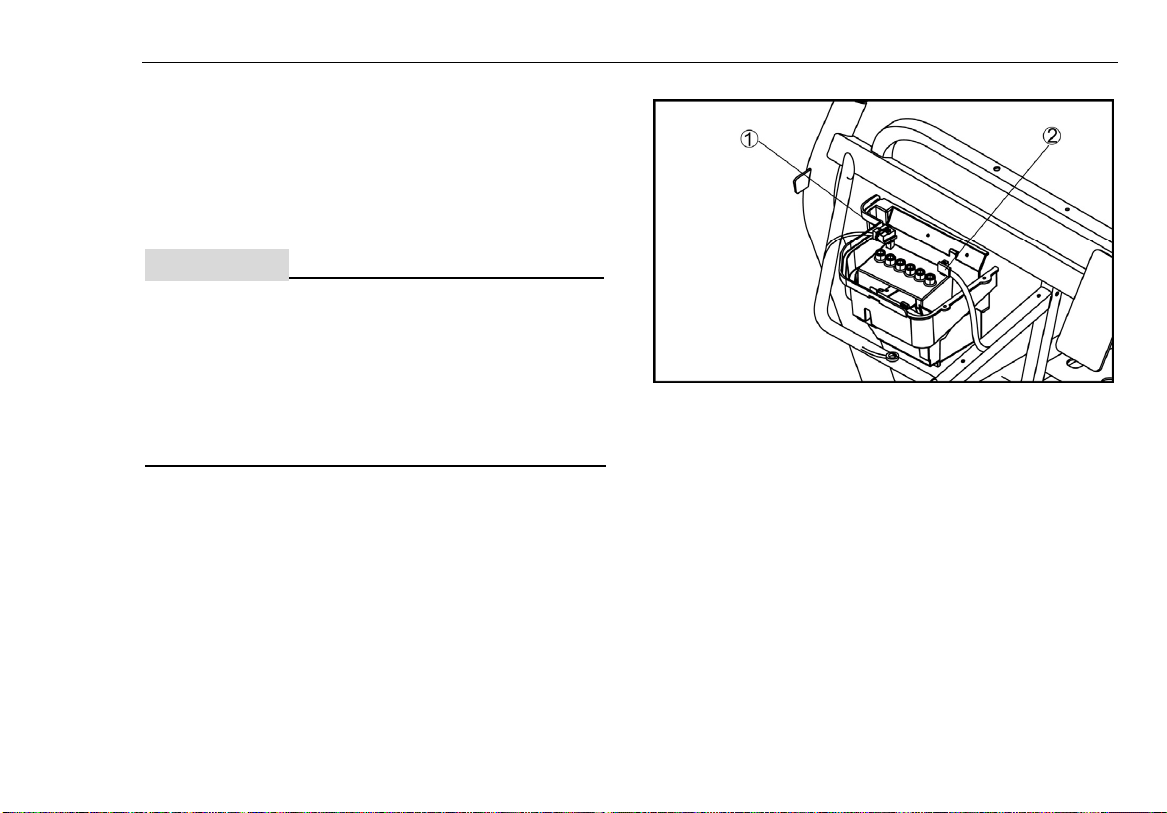
8-45 Periodic Maintenance and Adjustment
Battery Maintenance
1. When the vehicle is not used for a month
or longer, remove the battery and store it
in a cool, dark place. Completely rechar-
ge the battery before reinstallation.
CAUTION:
A special battery charger (constant
voltage/ampere or constant voltage) is
required for recharging a sealed-type battery.
Using a conventional battery charger may
shorten the battery life.
2. Always make sure the connections are
correct when putting the battery back in
the vehicle.
1. Positive battery lead 2. Negative battery lead
Fuse replacement
The main fuse and the fuse box are located
under the hood, the ECU are located under
the seat.(See pages 8-8 for hood opening
and closing procedures. And see page 4-17
for remove seat.)
If a fuse is blown, turn off the main switch
and install a new fuse of the specified
amperage.
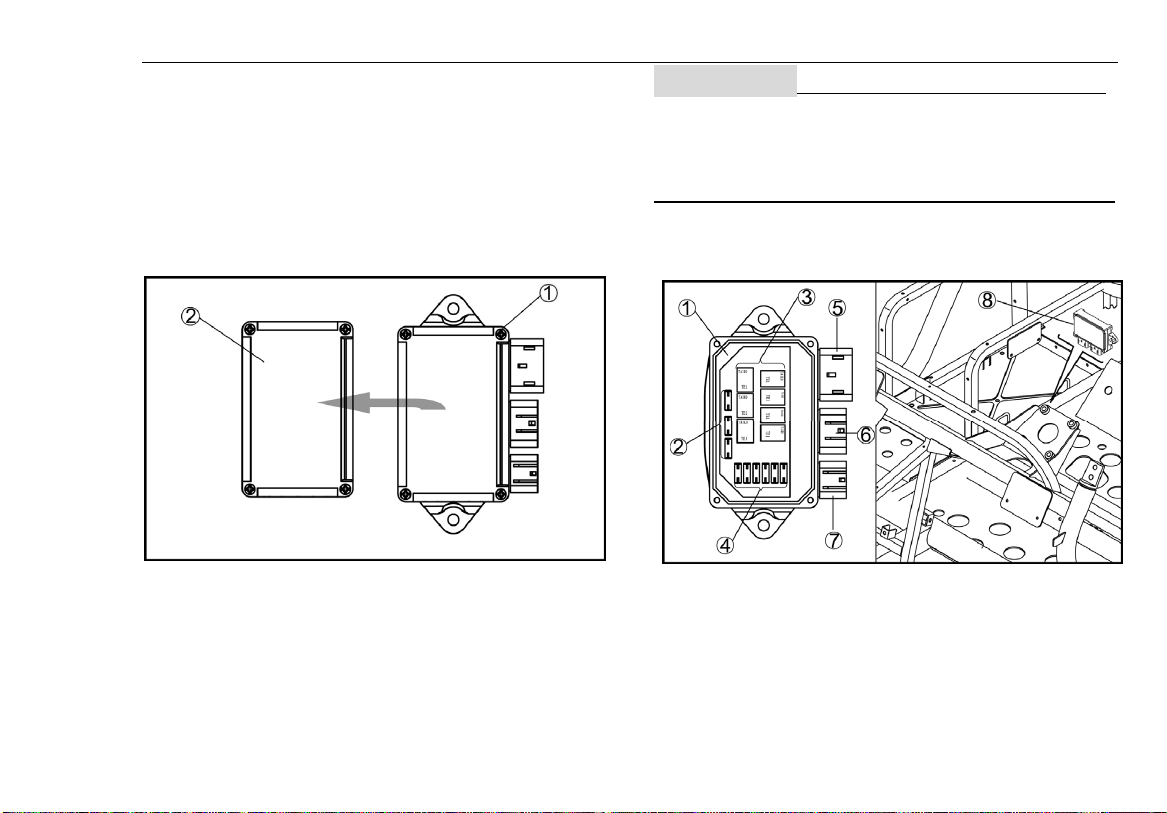
Periodic Maintenance and Adjustment 8-46
If a fuse is blown, replace it as follows.
1. Turn the key to “OFF” and turn off the
electrical circuit in question.
2. Remove the hood opening, then unplug
the relay assembly and open the relay
cover.
1. Screw M3 (×4) 2. Relay cover
CAUTION:
To prevent accidental short-circuiting, turn off
the main switch when checking or replacing
a fuse.
3. Remove the blown fuse, and then install
a new fuse of the specified amperage.
1. Relay assembly 2. Backup fuse
3. Relay 4. Fuse box
5. Adapter connector 3 6. Adapter connector 2
7. Adapter connector 1 8. ECU
8-47 Periodic Maintenance and Adjustment
Specified Fuse:
Headlight Fuse:
ECU Fuse:
Auxiliary DC Jack
Fuse:
Signaling System
Fuse:
2WD/4WD Fuse
Backup Fuse:
15.0A
15.0A
10.0A
10.0A
10.0A
10.0A
5.0A5.0A/10.0A/15.0A
4. Turn the key to “ON” and turn on the
electrical circuit in question to check if
the device operates.
5.
If the fuse immediately blows again,
have a service center check the
electrical system.
6. Install the battery compartment cover.
7. Close the hood.
WARNING
POTENTIAL HAZARD
Using an improper fuse
WHAT CAN HAPPEN
An improper fuse can cause damage to
the electrical system, which could lead to
a fire.
HOW TO AVOID THE HAZARD
A/ways use a fuse of the specified rating.
Never use a material in place of the
proper fuse.
Replacing a Headlight Bulb
If a headlight bulb burns out, replace it
as follows.
1. Lift the hood up.(See pages 8-7 for hood
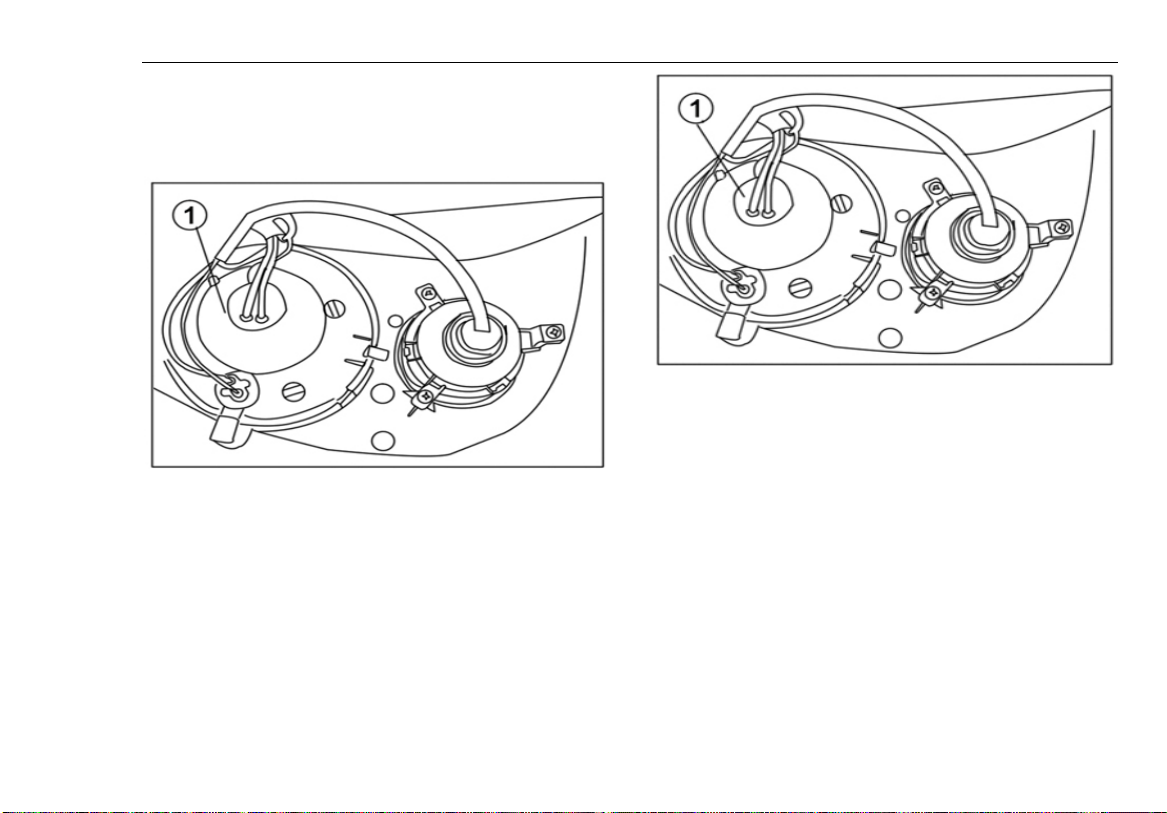
Periodic Maintenance and Adjustment 8-48
opening and closing procedures.)
2. Remove the cover at the rear of the
headlight by pulling it off.
1. Cover at the rear of the headlight
3. Remove the headlight bulb holder cover
by pulling it off.
1. Headlight bulb holder cover
4. Remove the headlight bulb holder by
pushing it in and turning it counterclock-
wise.
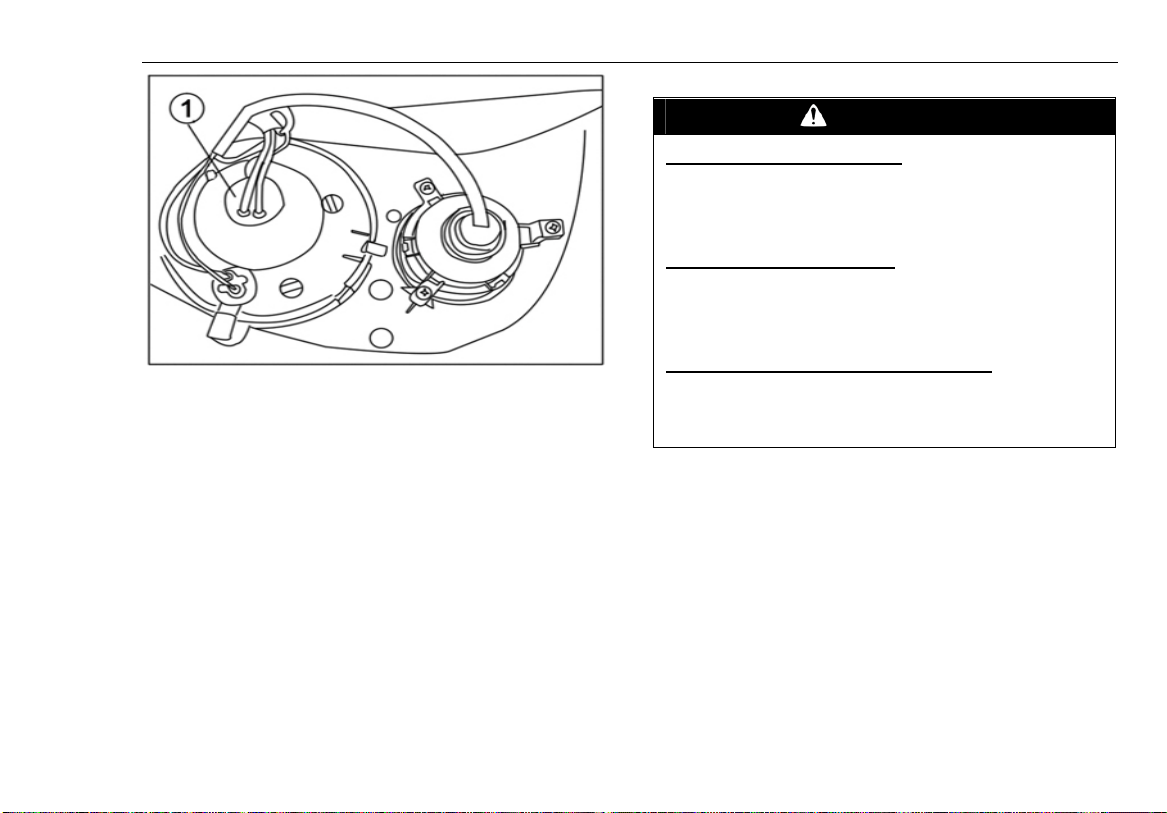
8-49 Periodic Maintenance and Adjustment
1. Headlight bulb holder
5. Remove the defective bulb by pulling it
out.
WARNING
POTENTIAL HAZARD
A
headlight bulb is hot when it is on and
immediately after it is turned off.
WHAT CAN HAPPEN
You can be burned, or a fire could start if
the bulb touches something flammable.
HOW TO AVOID THE HAZARD
Wait for the bulb to cool before touching
or removing it.
6. Insert a new headlight bulb into the bulb
holder by pushing it in.
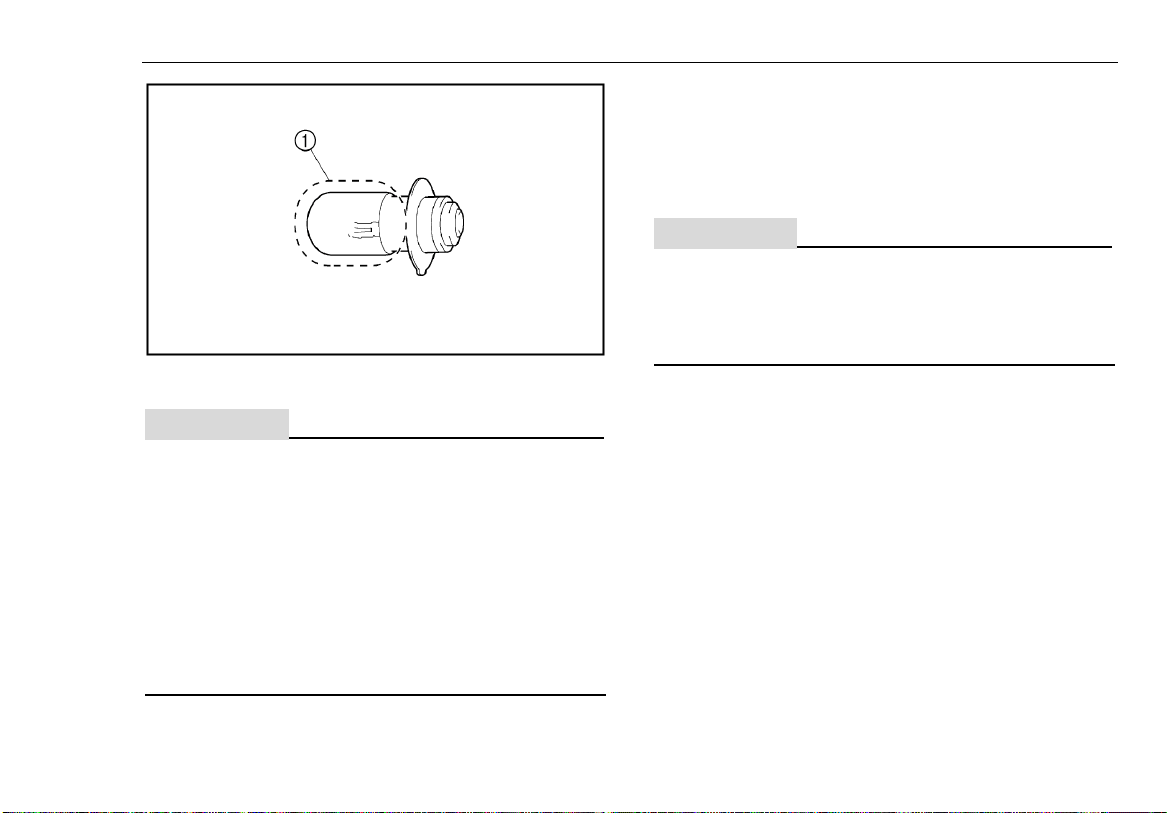
Periodic Maintenance and Adjustment 8-50
1. Do not touch the glass part of the bulb.
CAUTION:
Do not touch the glass part of the headlight
bulb to keep it free from oil, otherwise the
transparency of the glass, the luminosity of
the bulb, and the bulb life will be adversely
affected. Thoroughly clean off any dirt and
fingerprints on the headlight bulb using a
cloth moistened with alcohol or thinner.
7. Install the bulb holder by pushing it is
and turning it clockwise.
8. Install the bulb holder cover and the
cover at the rear of the headlight.
CAUTION:
Make sure the headlight bulb holder cover is
securely fitted over the bulb holder and
seated properly.
9. Close the hood.
10. Adjust the headlight beam if necessary.
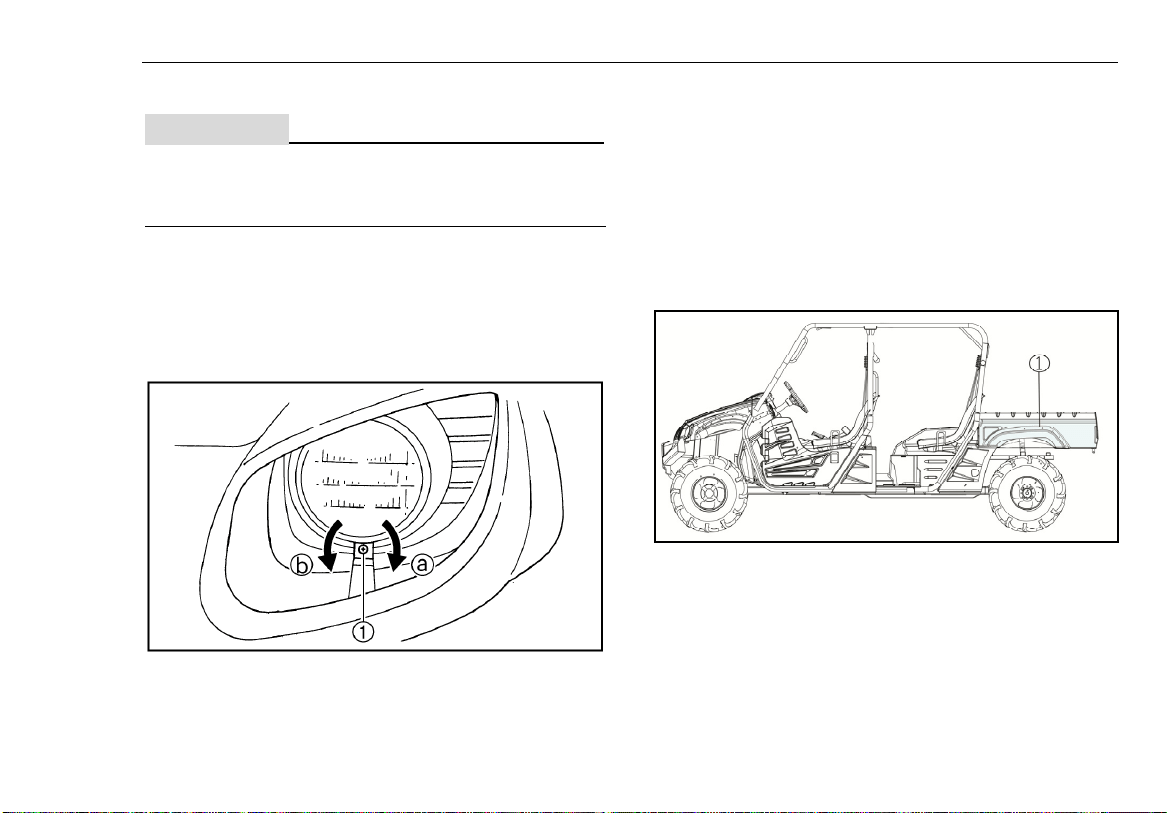
8-51 Periodic Maintenance and Adjustment
Headlight Beam Adjustment
CAUTION:
It is advisable to have a service center make
this adjustment.
To raise the beam, turn the adjusting screw
in directionⓐ.
To lower the beam, turn the adjusting screw
in directionⓑ.
1. Headlight beam adjusting screw
Tail/Brake Light Bulb Replacement
If a tail/brake light bulb burns out, replace it
as follows:
1. Remove panel A (if replacing the left
tail/brake bulb) or panel B (if replacing
the right tail/brake bulb) by removing the
quick fasteners and bolts.
1. Panel A
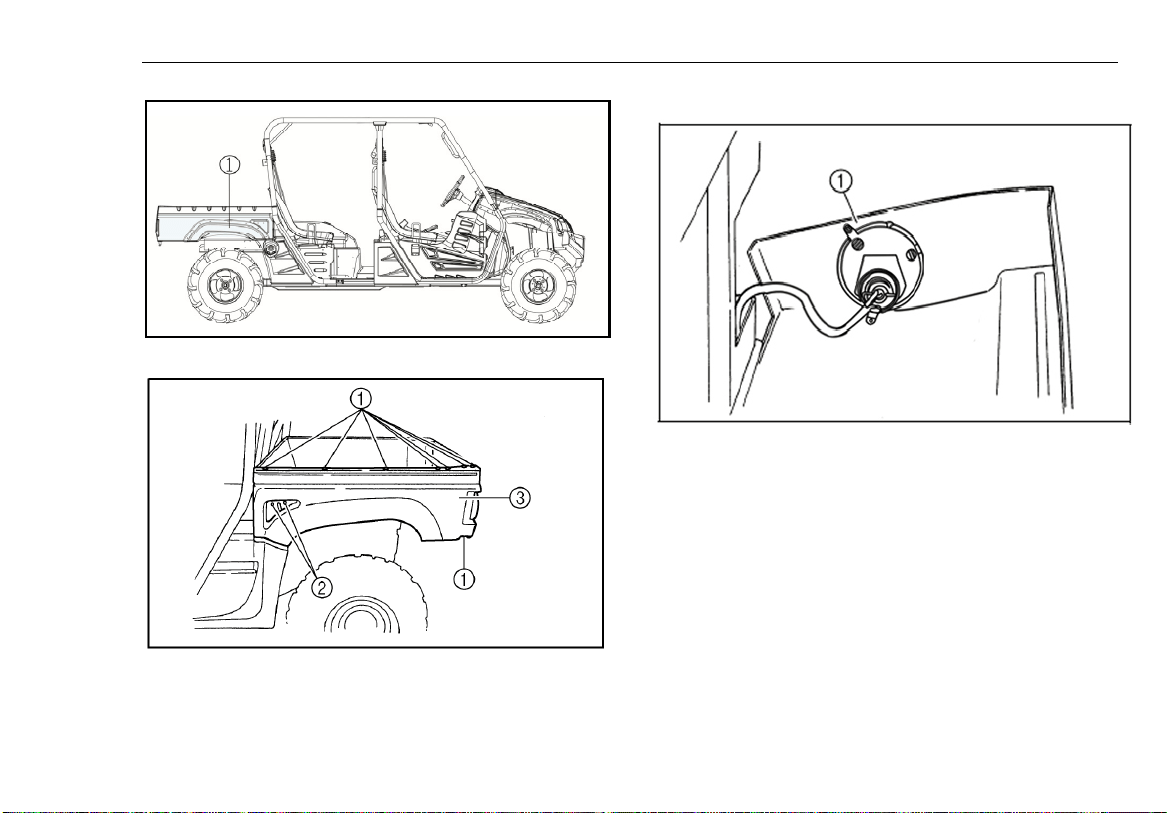
Periodic Maintenance and Adjustment 8-52
1. Panel B
2. Remove the bulb holder(together with
the bulb)by turning it counterclockwise.
1. Tail/brake light bulb holder
3. Push the defective bulb in and turn it
counterclockwise to remove it from the
bulb holder.
4. Push a new bulb in and turn it clockwise
to install in the bulb holder.
5. Install the bulb holder(together with the
bulb)by turning it clockwise.
6. Install the panel by installing the quick
fasteners and bolts, and then tighten the
1. Quick fastener(×8) 2. Bolt(×2)
3. Panel A
8-53 Periodic Maintenance and Adjustment
bolts to the specified torque.
Tightening torque:
Panel bolt:
6.5N·m(0.65 m·kgf,4.7 ft·lbf)
T
roubleshooting
Although vehicles receive a rigid inspection
before shipment from the factory, trouble
may occur during operation. Any problem in
the fuel, compression, or ignition systems
can cause poor starting and loss of power.
The troubleshooting chart describes a quick,
easy procedure for making checks, if your
vehicle requires any repair, take it to a
service center.
The skilled technicians at a service center
ship have the tools, experience, and know
how to properly service your vehicle.
Imitation parts may look like parts, but they
are often inferior.
Consequently, they have a shorter service
life and can lead to expensive repair bills.
WARNING
POTENTIAL HAZARD
Chec
king the fuel system while smoking
or near an open flame.
WHAT CAN HAPPEN
Fuel can ignite or explode, causing
severe injury or property damage.
HOW TO AVOID THE HAZARD
Do not smoke when checking the fuel
system. Make sure there are on open
flames or sparks in the area, including
pilot lights from water heaters of
furnaces.
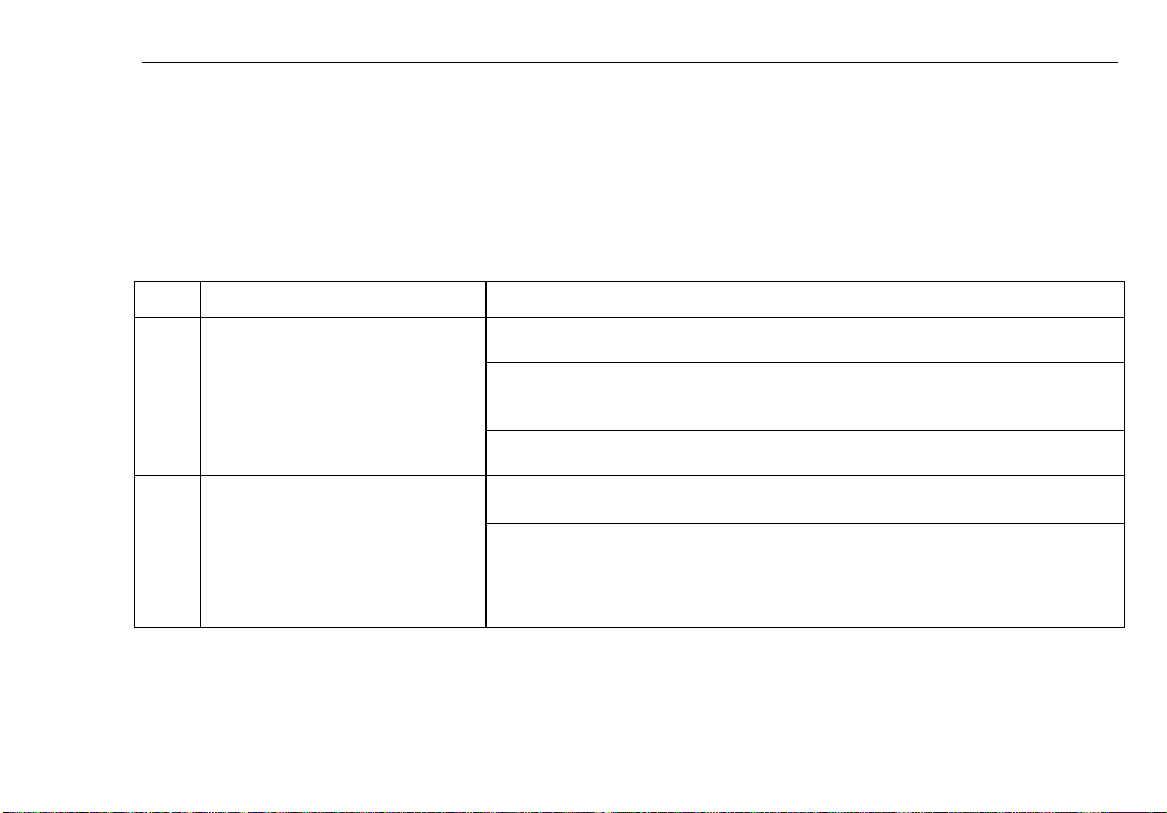
Periodic Maintenance and Adjustment 8-54
Solution to Common Problems in Vehicle
The below tables show some common problems that may come up when you are driving a
UTV, which will help to solve these problems. To repair a UTV requires technical skills, if you
cannot repair the UTV yourself, please contact your service center.
Table1:
Solution of Common Problems in Appearance Parts and Impact Fittings.
S/N Problems
Solutions
1
Plastic cover damaged
1. Repla
ce whit a new plastic cover.
2. Check if support brackets are bent or deformed, repair
and
re-paint if needed before replacing new plastic cover.
3. Re-apply decals and re-rivet warning labels.
2 Bumper damaged
1. Replace with a new bumper.
2. Check if support brackets are bent or deformed, repair
and
re-paint if needed before replacing new bumper.
8-55 Periodic Maintenance and Adjustment
S/N
Problems
Solutions
3
Damaged Front Skip Plate
1. Repla
ce Front Skid Plate with a new one.
2. Check if the gearbox or front differential / rear axles are
damag
ed or leaking.
3. Check plastic cover for damaged and replace if needed.
4 Warning labels
1. Repla
ce damaged warning label
s
Periodic Maintenance and Adjustment 8-56
Table 2:Solution of Common Problems in Brake System
S/N Problems
Solutions
1 Locked braking system
1. Che
ck whether brake disc plates deformed or damaged.
2. Check whether hydraulic cylinder is locked or brake clamp
assembly p
arts are deformed or damag
ed.
2
Brake performance
decreases
1. Che
ck the disc brake pads for excessive wear
.
2. Check the brake pads and rotor disc for excessive wear or
oil whi
ch might have gotten on either
.
3. Check brake fluid and refill if necessary.
3
Grinding noises from front
brake or brake rotor
become red during
operation due to heat.
1.
C
heck brake rotor for excess wear
.
2. Check whether hydraulic cylinder is locked or brake clamp
assembly p
arts are deformed or damag
ed.
4
Grinding noises from front
brake or brake rotor
become red during
operation due to heat.
1. Che
ck whether brake disc plates deformed or damaged.
2. Check whether hydraulic cylinder is locked or brake clamp
assembly p
arts are deformed or damag
ed.
3. Check if rear brake is locked and will not release. Check if
the p
arking brake is in the “ON” po
sition.
8-57 Periodic Maintenance and Adjustment
S/N
Problems
Solutions
5
Pulling to the left or right
during high speed braking
1. Che
ck if front brakes (left and right) are applying equal force
to the right and left brake rotors.
2. Check if a lack of front brake power has caused the rear
whe
els to “lock up” locked before front wheel
s.
3. Check if the left and right absorber springs are applying the
same fo
rce and are within the specifications.
4. Check if the front wheels and front wheel axle nuts are loose
or dam
age
d.
5. Check if the front wheel hub inner splines and front wheel
axle outer spl
ines are worn
or loose.
6. Check whether rubber washers connected to front
su
spension rocker and frame are damaged.
Periodic Maintenance and Adjustment 8-58
Table 3: Solution of Common Problems in Running System
S/N Problems
Solutions
1
Steering wheel is loose
and shifts up and down
when pulled.
1. Che
ck if the steering wheel nut is loose or damage
d.
2. Check if the steering column clip and clip seat loose or
damaged.
3. Check if the steering column bottom end inner bearing is
damag
ed.
2
Front wheel steering
clearance excessive
1. Che
ck if the tie-rod and steering column locknut ha
s
loosene
d or become damaged, or if the steering knuckle a
nd
steeri
ng column locknut has loosened or is damaged
.
2. Check if the tie-rod two ball joints are damaged or loose.
3
Front wheels sway during
operation
1. Che
ck if the steering knuckle bearing is damaged.
2. Check if the king pin ball joint is damaged.
3.
Check if the front wheel and axle locknut is loose or damaged.
4. Check if the front wheel hub inner splines and front wheel
axle outer spl
ines are worn
or loose.
5. Check if the rubber washers connected to front suspension
rocke
r arms and frame are damaged.
8-59 Periodic Maintenance and Adjustment
S/N
Problems
Solutions
4
Rear wheels sway
during operation
1. Che
ck if the rear axle bearings are damaged.
2. Check if the sliding bearings connected to rear axle bearing
hou
sing and rocker arm are loose or damaged.
3. Check if the rear wheel and axle locknut are loose or
damag
ed.
4. Check if the rear wheel hub inner splines and rear wheel
axle outer spl
ines are worn
or loose.
5. Check if the rubber washers connected to rear suspension
rocke
r arms and frame are damaged.
5
Wheels hop during
operation
1. Check if the wheel rims are bent or deformed.
2. Check if the front and rear axles are bent.
3. Check if the tires are aging, deformed or need air.
6
Shock absorbers become
soft or not comfortable
during use.
1. Che
ck if the vehicle is overloaded.
2. Check if the shocks need replacing.
3. Check if the shock absorbers have lost their damping force
and their travel.
Periodic Maintenance and Adjustment 8-60
S/N
Problems
Solutions
7
Front drive shaft makes
noise during use.
1. Che
ck if the drive shaft splin
e is broken.
2. Check if the splines in left & right axles and front & rear drive
shaf
ts are broken.
3. Check if the gears in rear drive shaft and reduction gear box
dif
ferential ar
e worn.
4. Check the dust covers of universal joints in right & left drive
shaf
ts are damaged.
8-61 Periodic Maintenance and Adjustment
Table 4: Solution of Common Problems in Electrical System
S/N Problems
Solutions
1 Lights do not work.
1. Che
ck if the headlight switch functions well.
2. Check if the wires are broken.
3. Check if the lamps or bulbs are broken.
2
Vehicle cannot go into 4
wheel drive mode.
1. Che
ck if the control switch on meter board wo
rks well.
2. Check if the differential lock control magneto plug in rear
reduction gear box is damaged.
3. Check if any wires are broken.
3
Rear differential will not
work.
1. Check if the control switch on the dashboard is working.
4
Rear differential will not
work.
1. Che
ck if the differential lock control magneto plug in rear
reduction gear box is broken.
2. Check if any wires are broken.
5
Meter display is not
normal.
1. Che
ck if the sensor is damage
d.
2. Check if the meter is broken.
3. Check if the surface of speed sensor is contaminated with
iron du
st.
6
Start switch will not work.
1. Check if the switch is broken.
2. Check if any wires are broken.
3. Check if the ECU is broken
Periodic Maintenance and Adjustment 8-62
S/N
Problems
Solutions
7 EFI system
1. Che
ck if the ECU is broken.
2. Check if the nozzle is clogged or the nozzle to the ECU
connection is disconnected.
3. Check if the engine speed signal sensor is broken.
4. Check if the engine speed signal to ECU connection is
disconnected.
5. Check if the inlet pressure/temperature sensor is
damaged or the ECU connection is disconnected.
6. Check if the throttle sensor is damaged or the ECU
connection is disconnected.
7. Check if the Sub-harness (cable) of the electrical injection
is broken.
8-63 Periodic Maintenance and Adjustment
Table5: Solution of Common Problems in Engine System
S/N Problems Solutions
1
Power or performance is
falling.
1. Check and clean the core of air cleaner.
2. Check muffler for partly blocked and clean spark arrestor.
2 Popping noise in engine.
1. Check air cleaner and admission line for leaks.
2. Check the connection joint of exhaust pipe with engine or
muffler for leaks.
3. Check the grade of gasoline to see if it’s too low.
3
Engine is difficult to start
at low temperatures.
1. Check if the battery voltage goes down when the
tem
p
erature
g
oes down.
2. If the temperature is under -18℃, place the vehicle in
warmer place for starting.
4 Coolant boils.
1. Check cooling fan of radiator for blockage by soil or dirt.
2. Check the speed sensor of radiator for damage and Check
the fan for failure.
3. Check if antifreeze meets the requirements stated in the
owners manual
5 Engine cannot start.
1. Check the battery. A low battery can cause motor not to
star or run poorl
y
2. Check the starting motor for damage.
3. Check if the spark plug is fouled or burned.
4. Check if the air cleaner is blocked.
Periodic Maintenance and Adjustment 8-64
S/N Problems Solutions
5 Engine cannot start.
5. Check if the oil circuit is working properly.
6. Check if the exhaust system is blocked.
6
Cylinder and cylinder
head
1. Check if the spark plug is loose.
2. Check if the cylinder head or cylinder body is loose.
3. Check if the cylinder head gasket is broken.
4. Check if the cylinder gasket is broken.
5. Check if the cylinder body is worn, damaged or seized.
7
Piston and piston rings
1. Check for an improperly installed piston ring.
2. Check if the piston ring is worn or broken.
3. Check if the piston ring is seized.
4. Check if the piston is seized or damaged.
8
Valve, camshaft and
crankshaft
1. Check for an Improperly sealed valve.
2. Check for improperly connected valve and valve seat.
3. Check if the valve timing is improper.
4. Check if the valve spring is broken.
5. Check if the camshaft is seized.
8-65 Periodic Maintenance and Adjustment
S/N Problems Solutions
9
Crankcase and
crankshaft
1. Check if the crankcase installed improperly.
2. Check if the crankshaft is seized.
10
Valve gear
1. Check for improperly adjusted valve clearance.
2. Check for improperly adjusted valve timing.
NOTE:
If it is difficult to get the recommended coolant, tap water can be temporarily used, provided
that it is changed to the recommended coolant as soon as possible.
WARNING
POTENTIAL HAZARD
Removing the radiator cap when the engine and radiator are still hot.
WHAT CAN HAPPEN
You could be burned by hot fluid and steam blown out under pressure.
HOW TO AVOID THE HAZARD
Wait for the engine to cool before removing the radiator cap. Always use a thick rag over the
cap. Allow any remaining pressure to escape before completely removing the cap.

Cleaning and Storage 9-1
Cleaning
Frequent, thorough cleaning of your vehicle
will not only enhance its appearance but will
improve its general performance and extend
the useful life of many components.
1. Before cleaning the vehicle:
a. Block off the end of the exhaust pipe to
prevent water entry. A plastic bag and
strong rubber band may be used.
b. Make sure the spark plug and all filler
caps are properly installed.
2. If the engine case is excessively greasy,
apply degreaser with a paint brush. Do
not apply degreaser to the wheel axles.
3. Rinse the dirt and degreaser off with a
garden hose. Use only enough pressure
to do the job.
CAUTION:
Excessive water pressure may cause water
seepage and deterioration of wheel bearings,
brakes, transmission seals and electrical
devices. Many expensive repair bills have
resulted from improper high pressure
detergent applications such as those
available in coin-operated car washers.
4. Once the majority of the dirt has been
hosed off, wash all surfaces with warm
water and mild, detergent-type soap. An
old toothbrush or bottle brush is handy
for hard-to-get-at places.
5. Rinse the vehicle off immediately with
clean water and dry all surfaces with a
chamois, clean towel or soft absorbent
cloth.
9-2 Cleaning and Storage
6. Clean the seats with a vinyl upholstery
cleaner to keep the cover pliable and
glossy.
7.
Automotive type wax may be applied to
all painted and chrome plated surfaces.
Avoid combination cleaner-waxes. Many
contain abrasives which may scratch the
paint or protective finish. When finished,
start the engine and let it idle for several
minutes.
WARNING
POTENTIAL HAZARD
Opera
tion with wet brakes after washing.
WHAT CAN HAPPEN
Wet brakes may have reduced stopping
ability, increasing the chance of an
accident.
HOW TO AVOID THE HAZARD
Test the brakes after washing. Apply the
brakes several times at slow speeds to let
friction dry out the linings.
Cleaning and Storage 9-3
Storage
Long term storage(60 days or more)of your
vehicle will require some preventive
procedures to guard against deterioration.
After thoroughly cleaning the vehicle,
prepare for storage as follows:
1. Fill the fuel tank with fresh fuel and add
the specified amount of Fuel Stabilizer
and Conditioner or equivalent product.
Operate the vehicle for at least 5 minutes
to distribute treated fuel through the fuel
system.
2. Drain the fuel from the fuel system as
much as possible and pour the drained
fuel into the fuel tank.
Specified amount:
1 oz of stabilizer to each gallon of fuel(or
7.5 ml of stabilizer to each liter of fuel)
NOTE:
Use of fuel st
abilizer and conditioner
eliminates the need to drain the fuel system.
Consult a service center if the fuel system
needs to be drained instead.
3.
Remove the spark plug, pour about one
tablespoon of SAE 10W30 or 20W40
motor oil in the spark plug. Ground the
spark plug wire and turn the engine over
several times to coat the cylinder wall
with oil.
4. Lubricate all control cables.
5. Block up the frame to raise all wheels off
the ground.
6. Tie a plastic bag over the exhaust pipe
outlet to prevent moisture from entering .
7. If storing in a humid or salt-air
atmosphere, coat all exposed metal
surfaces with a light film of oil. Do not

9-4 Cleaning and Storage
apply oil to any rubber parts or the seat
covers.
8. Remove the battery and charge it. Store
it in a dry place and recharge it once a
month. Do not store the battery in an
excessively warm or cold place(less than
32°F (0°C) or more than 86°F (30°C)).
NOTE:
Make any necessary repairs before storing
the vehicle.

Specifications 10-1
Model
Challenger 750 Crew
Dimensions:
Overall length
Overall width
Overall height
Seat height
Wheelbase
Ground clearance
Minimum turning radius
3,850 mm (151.6 in)
1,630 mm (64.2 in)
1,850 mm (72.8in)
818 mm (32.2 in)
2,860mm (112.6 in)
295mm (11.6 in)
5,150mm (202.6 in)
Basic weight:
With oil and full fuel tank 770kg (1,719 lb)
Engine:
Engine type
Cylinder arrangement
Displacement
Bore × stroke
Compression ratio
Starting system
Lubrication system
Liquid cooled 4-stroke, Water cooled
Forward-inclined single cylinder
735cm
3
For Challenger 750 Crew
102×90.0mm For Challenger 750 Crew
9.7:1 For Challenger 750 Crew
Electric starter
Wet sump
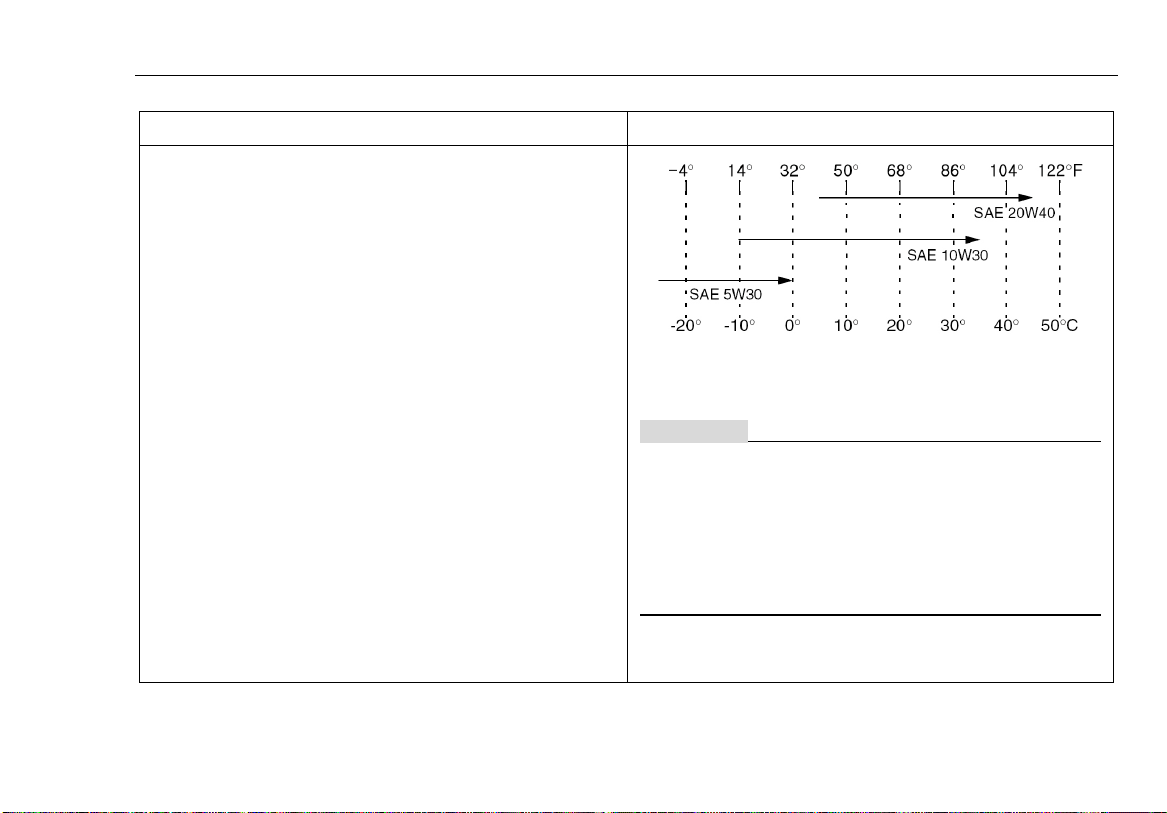
10-2 Specifications
Model
Challenger 750 Crew
Engine oil:
Type
Recommended engine oil classification
Quantity:
Without oil filter cartridge replacement
With oil filter cartridge replacement
API service SG type or hi
gher, JASO standard MA
CAUTION:
In order to prevent clutch slippage(since the engine
oil also lubricates the clutch) , do not mix any
chemical additives. Do not use oils with a diesel
specification of “CD” or oils of a higher quality than
specified. In addition, do not use oils labeled
“ENERGY CONSERVING Ⅱ” or higher.
1.90L(2.01 qt)
2.10L(2.22 qt)
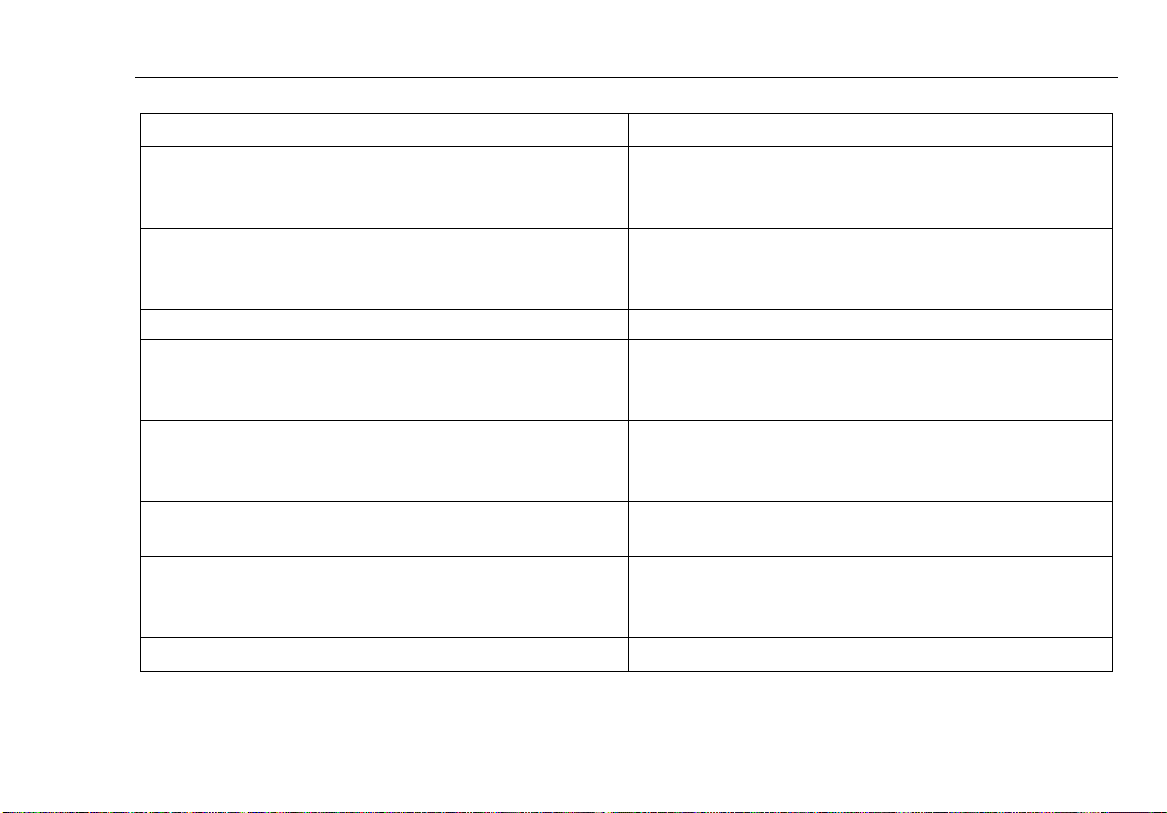
Specifications 10-3
Model
Challenger 750 Crew
Final gear case oil:
Type
Quantity:
SAE80 API GL-4 Hypoid gear oil
0.25L(0.22 lmp qt, 0.26 US qt)
Differential gear case oil:
Type
Quantity:
SAE80 API GL-5 Hypoid gear oil
0.32L(0.28 lmp qt, 0.34 US qt)
Radiator capacity(including all routes): 2.50L(2.20 lmp qt, 2.64 US qt)
Air filter:
Engine
Intake duct
Wet element
Dry element
Fuel:
Type
Fuel tank capacity
Unleaded gasoline only
28L(7.4 gal)
Throtlle valve:
Type/quantity DELPHI/MT05
Spark plug:
Type
Spark plug gap
DCPR7E
0.6-0.7 mm(0.023-0.027 in)
Clutch type: Wet, centrifugal automatic
10-4 Specifications
Model
Challenger 750 Crew
Transmission:
Primary reduction system
Secondary reduction system
Transmission type
Operation
Reverse gear
Sub transmission ratio low
High
V-belt
Shaft drive
V-belt automatic
Right hand operation
1.471
2.059
1.238
Tire:
Type
Size front
rear
Tubeless
26×9-12
26×10-12
Brakes:
System
Type front
rear
Operation
Front and rear unified
Dual disc brake
Dual disc brake
Foot operation
Specifications 10-5
Model
Challenger 750 Crew
Suspension:
Front suspension
Rear suspension
Double wishbone
Double wishbone
Shock absorber:
Front shock absorber
Rear shock absorber
Coil spring/oil damper
Coil spring/oil damper
Wheel travel:
Front wheel travel
Rear wheel travel
130mm(5.12in)
150mm(5.91in)
Electrical:
Ignition system
Generator system
Battery type
Battery capacity
ECU
AC magneto
U1L-11 or GSU1-9
12V32.0Ah or 12V30.0Ah
Bulb voltage, wattage × quantity:
Headlight
Tail/brake light
12V30.3W/30.0W × 2
12V5.0W/21.0W × 2
10-6 Specifications
Model
Challenger 750 Crew
Indicator lights:
Neutral indicator light
Reverse indicator light
Coolant temperature warning light
Parking brake indicator light
On-Command four-wheel-drive/differential gear
lock indicator
On-Command differential gear lock indicator light
High-range indicator light
Low-range indicator light
LED
LED
LED
LED
LED
LED
LED
LED
Specified fuses:
Speedometer ECU normally energized
Stop lamp 、Turn lamp fuse
Gear switch fuse、 EPS fuse
Fuel pump fuse
Auxiliary DC jack fuse
ECU、Speedometer unit fuse
Headlight fuse
Fou
r
-wheel drive fuse
5.0A
10.0A
10.0A
15.0A
10.0A
15.0A
15.0A
10.0A
Fault Code of Electronic Injection System 11-1
Fault Code of Electronic Injection System
DTC
Number
DTC Description Related Calibration
HEX DEC
P0107 MAP Circuit Low Voltage or Open KsDGDM_MAP_ShortLow 107 263
P0108 MAP Circuit High Voltage KsDGDM_MAP_ShortHigh 108 264
P0112 IAT Circuit Low Voltage KsDGDM_IAT_ShortLow 112 274
P0113 IAT Circuit High Voltage or Open KsDGDM_IAT_ShortHigh 113 275
P0117
Coolant/Oil Temperature Sensor Circuit
Low Voltage
KsDGDM_CoolantShortLow 117 279
P0118
Coolant/Oil Temperature Sensor Circuit
High Voltage or Open
KsDGDM_CoolantShortHigh 118 280
P0122 TPS Circuit Low Voltage or Open KsDGDM_TPS_ShortLow 122 290
P0123 TPS Circuit High Voltage KsDGDM_TPS_ShortHigh 123 291
P0131 O2S 1 Circuit Low Voltage KsDGDM_O2_1_ShortLow 131 305
11-2 Fault Code of Electronic Injection System
P0132 O2S 1 Circuit High Voltage KsDGDM_O2_1_ShortHigh 132 306
P0031 O2S Heater Circuit High Voltage KsDGDM_O2_HeaterShortHigh 31 49
P0032 O2S Heater Circuit Low Voltage KsDGDM_O2_HeaterShortLow 32 50
P0201 Injector 1 Circuit Malfunction KsDGDM_INJ_CYL_A_Fault 201 513
P0202 Injector 2 Circuit Malfunction KsDGDM_INJ_CYL_B_Fault 202 514
P0230 FPR Coil Circuit Low Voltage or Open KsDGDM_FPP_CircuitShortLow 230 560
P0232 FPR Coil Circuit High Voltage KsDGDM_FPP_CircuitShortHigh 232 562
P0336 CKP Sensor Noisy Signal KsDGDM_CrankNoisySignal 336 822
P0337 CKP Sensor No Signal KsDGDM_CrankNoSignal 337 823
P0351 Cylinder 1 Ignition Coil Malfunction KsDGDM_EST_A_Fault 351 849
P0352 Cylinder 2 Ignition Coil Malfunction KsDGDM_EST_B_Fault 352 850
P0505 Idle Speed Control Error KsDGDM_IdleControl 505 1285
P0562 System Voltage Low KsDGDM_SysVoltLow 562 1378
Fault Code of Electronic Injection System 11-3
P0563 System Voltage High KsDGDM_SysVoltHigh 563 1379
P0650 MIL Circuit Malfunction KsDGDM_MIL_Circuit 650 1616
P1693 Tachometer Circuit Low Voltage KsDGDM_TAC_Circuit_Low 1693 5779
P1694 Tachometer Circuit High Voltage KsDGDM_TAC_Circuit_High 1694 5780
P0137 O2S 2 Circuit Low Voltage KsDGDM_O2_2_ShortLow 137 311
P0138 O2S 2 Circuit High Voltage KsDGDM_O2_2_ShortHigh 138 312
P0038 O2S Heater 2 Circuit High Voltage KsDGDM_O2_HeaterShortHigh 38 56
P0037 O2S Heater 2 Circuit Low Voltage KsDGDM_O2_HeaterShortLow 37 55
P0500 VSS No Signal KsDGDM_VSS_NoSignal 500 1280
P0850 Park Neutral Switch Error KsDGDM_ParkNeutralSwitch 850 2128
P0445 CCP short to high KsDGDM_CCP_CircuitShortHigh 445 1093
P0444 CCP short to low/open KsDGDM_CCP_CircuitShortLow 444 1092
P0171 BLM Max Adapt(Kohler Special) KsFDIAG_BLM_MaxAdapt 171 369
P0172 BLM Min Adapt(Kohler Special) KsFDIAG_BLM_MinAdapt 172 370
P0174 PE System Lean(Kohler Special) KsFDIAG_PESystLean 174 372

FEDERAL EMISSION CONTROL WARRANTY STATEMENT
YOUR WARRANTY RIGHTS AND OBLIGATIONS
Cub Cadet LLC and the United States
Environmental Protection Agency (EPA)
are pleased to explain the emission
(evaporative and/or exhaust) control
system (ECS) warranty on your off-road
recreational utility vehicle (hereinafter
referred to as “vehicle”). New vehicles
must be designed, built and equipped
to meet the U.S. EPA’s regulations for
off-road recreational utility vehicles.
Cub Cadet LLC must warrant the
ECS on your vehicle for the period of
time listed below provided there has
been no abuse, neglect or improper
maintenance of your vehicle.
Your ECS may include parts such as the
carburetor, fuel-injection system, the
ignition system, catalytic converter,
fuel tanks, fuel lines, fuel caps, valves,
canisters, filters, vapor hoses, clamps,
connectors, and other associated
emission-related components.
Where a warrantable condition
exists, Cub Cadet LLC will repair your
vehicle at no cost to you including
diagnosis, parts and labor.
MANUFACTURER’S WARRANTY COVERAGE:
This emission control system is
warranted for 5000 km or at least for 30
months, whichever comes first. If any
emission-related part on your vehicle
is defective, the part will be repaired or
replaced by Cub Cadet LLC.
OWNER’S WARRANTY RESPONSIBILITIES:
As the vehicle owner, you are
responsible for performance of
the required maintenance listed in
your owner’s manual. Cub Cadet
LLC recommends that you retain
all receipts covering maintenance
on your vehicle, but Cub Cadet LLC
cannot deny warranty solely for the
lack of receipts.
As the vehicle owner, you should
however be aware that Cub Cadet
LLC may deny you warranty coverage
if your vehicle or a part has failed
due to abuse, neglect, or improper
maintenance or unapproved
modifications.
You are responsible for presenting
your vehicle to Cub Cadet LLC’s
distribution center or service center
as soon as the problem exists. The
warranty repairs should be completed
in a reasonable amount of time, not to
exceed 30 days. If you have a question
regarding your warranty coverage,
you should contact the Cub Cadet LLC
Service Department at 1-800-800-
7310 or via email at http://support.
mtdproducts.com.
GENERAL EMISSIONS WARRANTY COVERAGE:
Cub Cadet LLC warrants to the ultimate
purchaser and each subsequent
purchaser that the vehicle is: Designed,
built and equipped so as to conform
with all applicable regulations; and
free from defects in materials and
workmanship which cause such
vehicle to fail to conform to applicable
regulations of the U.S. EPA for the
periods specified below.
The warranty period begins on the date
the vehicle is delivered to an ultimate
purchaser or first placed into service.
The warranty period is 5000 km or at
least for 30 months, whichever comes
first.
Subject to certain conditions and
exclusions as stated below, the
warranty on emission-related parts is
as follows:

3. Any warranted part that is
scheduled for replacement as
required maintenance in the
written instructions supplied
is warranted for the period of
time before the first scheduled
replacement date for that part.
If the part fails before the first
scheduled replacement, the
part will be repaired or replaced
by Cub Cadet LLC according to
subsection (4) below. Any such
part repaired or replaced under
warranty will be warranted for
the remainder of the period
prior to the first scheduled
replacement point for the part.
4. Repair or replacement of any
warranted part under the
warranty provisions herein must
be performed at a warranty
station at no charge to the owner.
5. Notwithstanding the provisions
herein, warranty services or
repairs will be provided at all of
our distribution centers that are
franchised to service the subject
engines or equipment.
6. The vehicle owner will not be
charged for diagnostic labor
that is directly associated
with diagnosis of a defective,
emission-related warranted part,
provided that such diagnostic
work is performed at a warranty
station.
7. Cub Cadet LLC is liable for
damages to other engine
or equipment components
proximately caused by a failure
under warranty of any warranted
part.
8. Throughout the off-road engine
and equipment warranty period
stated above, Cub Cadet LLC will
maintain a supply of warranted
parts sufficient to meet the
expected demand for such parts.
9. Any replacement part may be
used in the performance of any
warranty maintenance or repairs
and must be provided without
charge to the owner. Such use
will not reduce the warranty
obligations of Cub Cadet LLC.
1. Any warranted part that is not
scheduled for replacement as
required maintenance in the
written instructions supplied,
is warranted for the warranty
period stated above. If the
part fails during the period of
warranty coverage, the part
will be repaired or replaced by
Cub Cadet LLC according to
subsection (4) below. Any such
part repaired or replaced under
warranty will be warranted for
the remainder of the period.
2. Any warranted part that is
scheduled only for regular
inspection in the written
instructions supplied is
warranted for the warranty
period stated above. Any such
part repaired or replaced under
warranty will be warranted for
the remaining warranty period.

10. The use of any non-exempted
add-on or modified parts by
the ultimate purchaser will
be grounds for disallowing a
warranty claim. Cub Cadet LLC will
not be liable to warrant failures
of warranted parts caused by the
use of a non-exempted add-on or
modified part.
WARRANTED PARTS:
The repair or replacement of any
warranted part otherwise eligible for
warranty coverage may be excluded
from such warranty coverage if Cub
Cadet LLC demonstrates that the
vehicle has been abused, neglected,
or improperly maintained, and that
such abuse, neglect, or improper
maintenance was the direct cause of
the need for repair or replacement
of the part. That notwithstanding,
any adjustment of a component that
has a factory installed, and properly
operating, adjustment limiting device
is still eligible for warranty coverage.
Further, the coverage under this
warranty extends only to parts that
were present on the off-road engine
and equipment purchased.
The following emission warranty parts
are covered (if applicable):
1. Fuel Metering System
• Cold start enrichment
system (soft choke)
• Carburetor and internal parts
(or fuel injection system)
• Fuel pump
• Fuel tank
2. Air Induction System
• Air cleaner
• Intake manifold
3. Ignition System
• Spark plug(s)
• Magneto ignition system
4. Exhaust System
• Catalytic converter
• SAI (Reed valve)
5. Miscellaneous Items Used in
Above System
• Vacuum, temperature,
position, time sensitive
valves and switches
• Connectors and assemblies
6. Evaporative Control
• Fuel hose
• Fuel hose clamps
• Tethered fuel cap
• Carbon canister
• Vapor lines

CUB CADET LLC
LIMITED WARRANTY FOR UTILITY VEHICLES
LIMITED WARRANTY
The limited warranty set forth herein
is given by Cub Cadet LLC with respect
to a new Cub Cadet-branded utility
vehicle (“UTV”) to the Initial Purchaser
(as defined herein). This limited
warranty does not cover Emission
Control Systems and as such is not a
Federal Emission Control Warranty
Statement as defined by U.S. federal
law. Please refer to the Federal
Emission Control Warranty Statement
in the operator’s manual for warranties
covering Emission Control Systems.
Scope of the Limited Warranty
Cub Cadet LLC offers the following
limited warranty to the Initial
Purchaser for residential or otherwise
non-commercial use: except for the
Exclusions (as defined herein), during
the Warranty Period (as defined herein),
the UTV will be free from manufacturing
defects (including workmanship and
materials). The “Initial Purchaser” is
the first person to purchase a new UTV
from an authorized Cub Cadet dealer,
distributor and/or retailer of such UTV
products. This limited warranty is
non-transferrable. Except as otherwise
set forth herein, the limited warranty
period for this new UTV product
purchased by the Initial Purchaser is
one (1) year from the date of purchase
as shown on the original sales receipt
for the UTV (“Warranty Period”).
What is a defect?
Except for the Exclusions, the
UTV is warranted to be free from
manufacturing defects in either
workmanship or materials for the
Warranty Period. During the Warranty
Period, Cub Cadet LLC will, at its option,
either repair or replace any original
part that is covered by this limited
warranty and is proven to be defective
in workmanship or material.
To qualify for this limited warranty
the UTV:
1. Must have been purchased from
an authorized Cub Cadet dealer,
distributor and/or retailer.
2. Must have been purchased
within the United States by the
Initial Purchaser.
3. Must have been used for
residential or otherwise non-
commercial purposes.
4. This limited warranty does not
apply to any UTV which is used
(a) for commercial purposes,
(b) in competition and/or (c)
in a manner not consistent
with the normal and proper
intended use for the UTV. This
UTV is not intended for rental or
commercial use.
Who can perform repairs under this
warranty?
In order to qualify for the limited warranty
as set forth herein, the repairs made
under this warranty must be performed
by an authorized Cub Cadet dealer.
How to get service under this limited
warranty:
To get warranty service, contact
your authorized Cub Cadet dealer,
distributor and/or retailer or contact

4. Normal wear and tear resulting
from use of the UTV.
5. Use of the product that is not
consistent with the intended use
as described in the operating
instructions, including, but not
limited to, abuse, misuse and/or
neglect of the UTV product.
6. Any expendable, consumable
and/or routine maintenance
item which needs replacement
or service as part of normal
maintenance, unless such items
have defects that cause failure or
premature wear. Normal wear
items include but are not limited
to, tires, oil filters, air filters, light
bulbs, brake pads/brake drums
spark plugs, worn brake pads/
linings, worn clutch linings,
battery (except as specifically set
forth herein regarding the original
equipment battery), filters, fuses,
and other consumable items.
7. Any product that has been altered
or modified in a manner not
consistent with the original design
of the product or in manner not
otherwise approved by Cub Cadet.
8. The original equipment battery
is covered by a limited warranty
against defects in material and
workmanship for a period of three
(3) months. During this three (3)
month period, a defective original
equipment battery will be replaced
at no cost to you; provided that,
Cub Cadet LLC will not reimburse
any portion of the cost of a non-
original equipment battery and/or
replacement battery.
9. Paint/Plastics – Paint repairs
or replacements for defective
paint (including materials and
application) are covered for
a period of three (3) months.
Plastic parts (which include, but
are not limited to, body panels,
windshields, and rubber pieces
such as hood latches and door
latches) are covered for a period of
three (3) months.
10. Wheels – Steel wheels are covered
for a period of three (3) months for
manufacturing defects.
Cub Cadet LLC at P.O. Box 361131,
Cleveland, Ohio 44136-0019 or call
1-877-282-8684 or log on to our
Website at www.cubcadet.com. The
retailer of this product does not make
any warranty of its own and may have
no authority to implement this limited
warranty on behalf of Cub Cadet LLC
without the approval of Cub Cadet
LLC. A COPY OF YOUR SALES RECEIPT
IS REQUIRED FOR WARRANTY SERVICE.
What this limited warranty does not
cover. This limited warranty does not
cover the following (the “Exclusions”):
1. UTV’s purchased outside of the
United States.
2. Emission Control Systems. These
items are subject to a separate
warranty under the applicable
Federal Emission Control Warranty
Statement. Please refer to the
applicable Federal Emission
Control Warranty Statement for
terms and conditions relating to
Emission Control Systems.
3. Damage due to lack of maintenance
and/or improper maintenance as
described in the operator’s manual.

This warranty does not cover
and Cub Cadet LLC disclaims any
responsibility for:
1. Loss of time or loss of use of the
UTV product.
2. Transportation costs and other
expenses incurred in connection
with the transport of the
UTV product to and from the
authorized Cub Cadet dealer.
3. Other loss or damage to other
equipment or personal items.
4. Damages caused by improper
maintenance or the use of other
than the specified fuel, oil or
lubricants recommended in the
operator’s manual.
Limitations:
1. NO IMPLIED WARRANTY,
INCLUDING, BUT NOT LIMITED
TO, ANY IMPLIED WARRANTY
OF MERCHANTABILITY OR
FITNESS FOR A PARTICULAR
PURPOSE APPLIES AFTER THE
APPLICABLE WARRANTY PERIOD
AS SET FORTH ABOVE AS TO
THE PARTS AS IDENTIFIED. NO
OTHER EXPRESS WARRANTY OR
GUARANTY, WHETHER WRITTEN
OR ORAL, EXCEPT AS MENTIONED
ABOVE, GIVEN BY ANY PERSON
OR ENTITY, INCLUDING A DEALER
OR RETAILER, WITH RESPECT
TO ANY PRODUCT SHALL BIND
CUB CADET LLC. DURING
THE WARRANTY PERIOD, THE
EXCLUSIVE REMEDY IS REPAIR OR
REPLACEMENT OF THE DEFECTIVE
PART, AS SET FORTH ABOVE.
(SOME STATES DO NOT ALLOW
LIMITATIONS ON HOW LONG AN
IMPLIED WARRANTY LASTS, SO
THE ABOVE LIMITATION MAY NOT
APPLY TO YOU.)
2. THE PROVISIONS AS SET FORTH
HEREIN PROVIDE THE SOLE AND
EXCLUSIVE REMEDY ARISING
FROM THE SALE. CUB CADET
SHALL NOT BE LIABLE FOR
INCIDENTAL OR CONSEQUENTIAL
LOSS OR DAMAGES INCLUDING,
WITHOUT LIMITATION, FOR
TRANSPORTATION OR FOR
RELATED EXPENSES, OR
FOR RENTAL EXPENSES TO
TEMPORARILY REPLACE A
WARRANTED PRODUCT. (SOME
STATES DO NOT ALLOW THE
EXCLUSION OR LIMITATION OF
INCIDENTAL OR CONSEQUENTIAL
DAMAGES, SO THE ABOVE
EXCLUSION OR LIMITATION MAY
NOT APPLY TO YOU.)
3. In no event shall recovery of any
kind be greater than the amount
of the purchase price of the
product sold. Alteration of the
safety features of the product
shall void this limited warranty.
You assume the risk and liability
for loss, damage, or injury to
you and your property and/
or to others and their property
arising out of the use or misuse
or inability to use the product.
How State Law Relates to this
Warranty:
This limited warranty gives you specific
legal rights, and you may also have
other rights which vary from state to
state.
CUB CADET LLC, P.O. BOX 361131 CLEVELAND, OHIO 44136-0019

