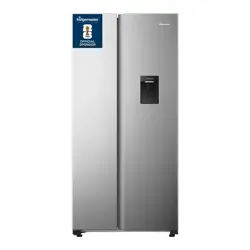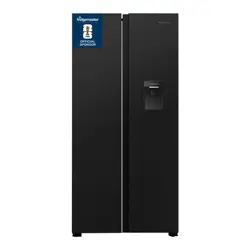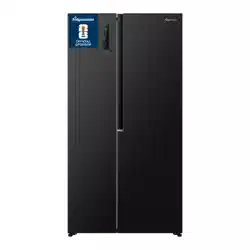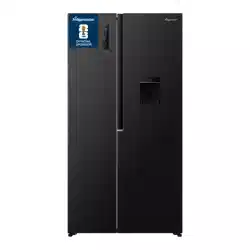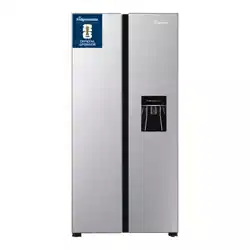
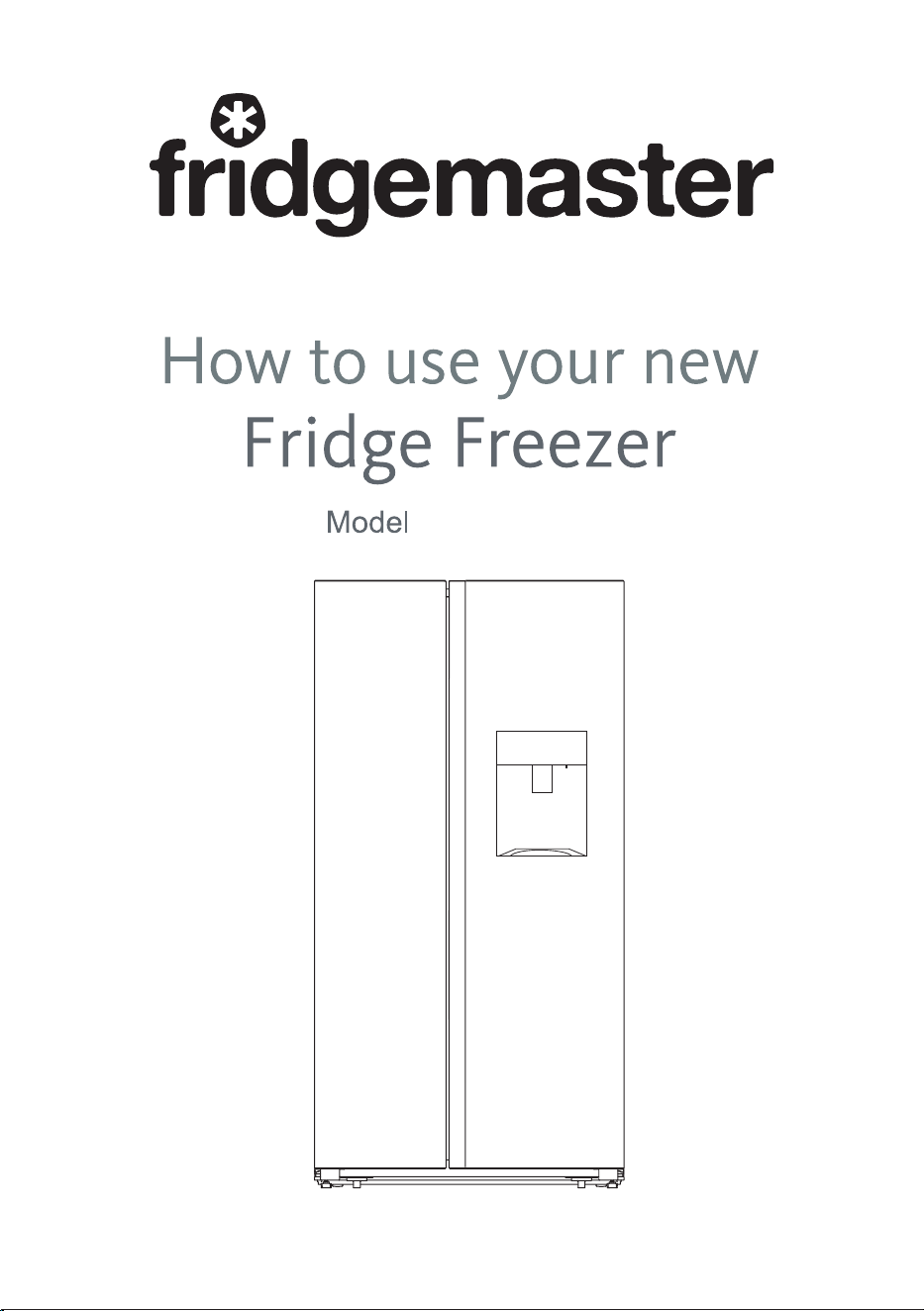
MS83430DES
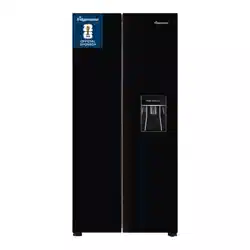
MS83430DEB
20
18
11
Children aged from 3 to 8 years are allowed to load and
unload refrigerating appliances.
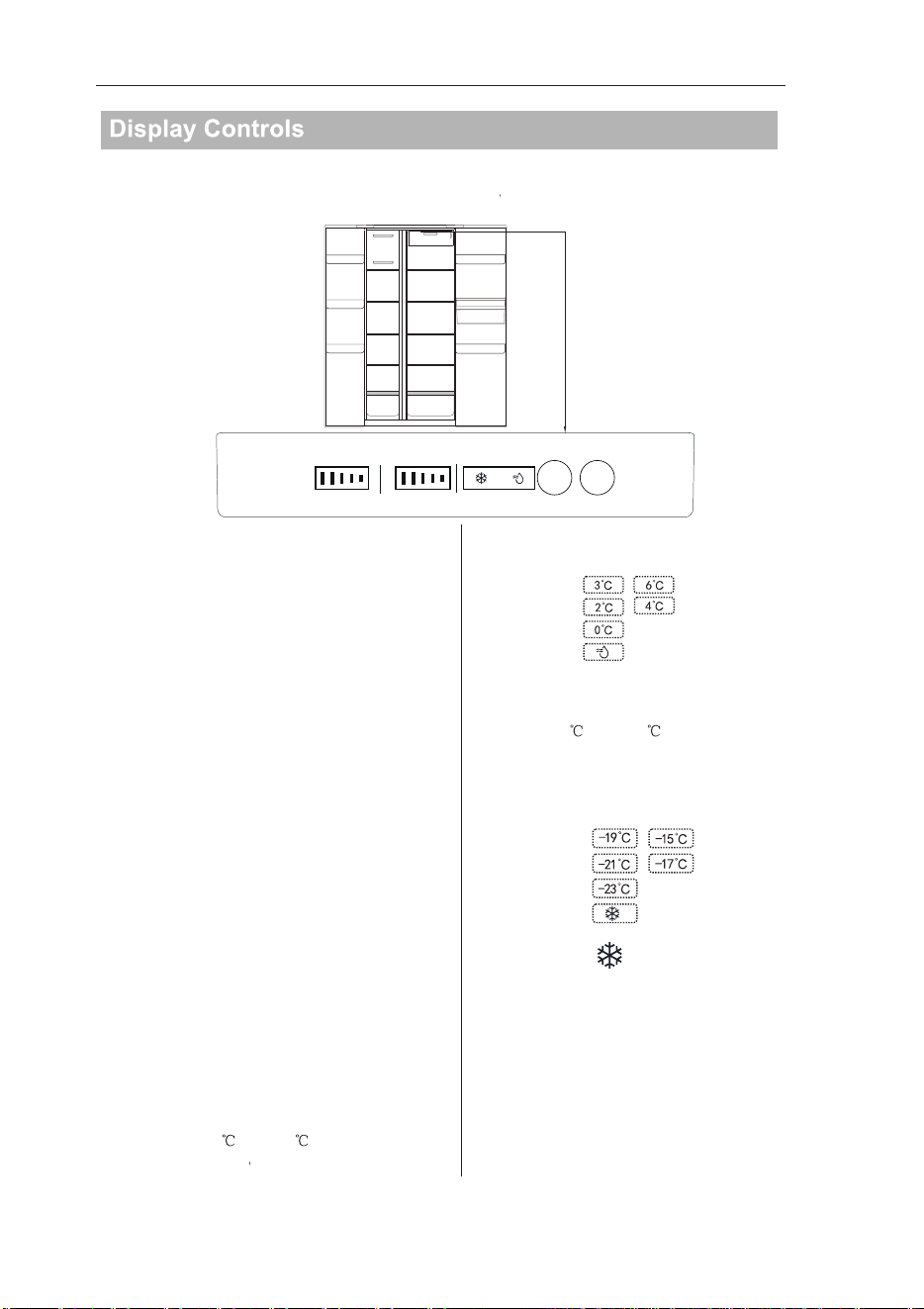
Display controls
13
15
17
12
Water Dispenser
14
Children should be supervised to ensure that they do not
play with the appliance.
residential
•
WARNING - The refrigerant and insulation blowing gas are
flammable. When disposing of the appliance, do so only at
an authorized waste disposal centre. Do not expose to
flame.
•
WARNING-When
positioning the appliance, ensure the
supply cord is not trapped or damaged.
•WARNING -Do not locate multiple portable socket-outlets
or portable power supplies at the rear of the appliance.
川ymbol
is a warning and indicates the
「ef「ige「a t and i sulation blowing gas a「e flaable.
Warning: Risk 。f fir
e I flammable materials
Replacing the illuminating lamps
• WARNING-The illuminating lamps must not be replaced by
the user! If the illuminating lamps is damaged, contact the
customer helpline for assistance.
This warning is only for refrigerators that contain illuminating
lamps.
Refrigerant
The refrigerant isobutene (R600a) is contained within the
refrigerant circuit of the appliance, a natural gas with a high
level of environmental compatibility, which is nevertheless
flammable. During transportation and installation of the
appliance, ensure that none of the components of the
refrigerant circuit becomes damaged.
The refrigerant (R600a) is flammable.
•
WARNING - Refrigerators contain refrigerant and gases in
the insulation. Refrigerant and gases must be disposed of
professionally as they may cause eye injuries or ignition.
Ensure that tubing of the refrigerant circuit is not damage
prior to proper disposal.
If the refrigerant circuit should be damaged:
-Avoid opening flames and sources of ignition.
-Thoroughly ventilate the room in which the appliance is
situated.
4
It is dangerous to alter the specifications or modify this
product in any way.
Any damage to the cord may cause a short circuit, fire, and/or
electric shock.
A 日ectrical Safety
1.The power cord must not be lengthened.
2. Make sure that the power plug is not crushed or damaged.
A crushed or damaged power plug may overheat and cause a
fire.
3. Make sure that you can access the main plug of the
appliance.
4. Do not pull the main cable.
5. If the power plug socket is loose, do not insert the power
plug. There is a risk of electric shock or fire.
6.You must not operate the appliance without the interior
lighting lamp cover.
?.The fridge is only applied with power supply of single phase
alternating current of 220
~
240V/50Hz. If fluctuation of voltage
in the district of user is so large that the voltage exceeds the
above scope, for safety sake, be sure to apply A.C. Automatic
voltage regulator of more than 350W to the fridge. The fridge
must employ a special power socket instead of common one
with other electric appliances. Its plug must match the socket
with ground wire.
Daily use
•
Do not store flammable gass or liquids in the appliance,
There is a risk of an explosion.
•
Do
not operate any electrical appliances in the appliance
(e.g.electric ice cream makers.mixers etc.).
• When unplugging always pull the plug from the mains
socket.do not pull on the cable.
•
Do not place hot items near the plastic components of this
appliance.
5
This refrigerating appliance is not intended to be used
as a built-in appliance.
7
& c…d cleaning
• Before maintenance, switch o仔the appliance and disconnect
the mains plug from the mains socket.
•
Do not clean the appliance with metal objects, steam
cleaner, ethereal oils, organic solvents or abrasive cleansers.
• Do not use sharp objects to remove frost from the appliance.
Use a plastic sc「ape「.
& lnstal川
•
For electrical connection carefully, follow the instructions
given in this manual.
Unpack the appliance and check if there are damages on it.
• Do not connect the appliance if it is damaged. Repo「t
possible damages immediately to the place you bought it. In
this case retain packing.
• It is advisable to wait at least four hours before connecting
the appliance to allow the oil to flow back in the compresso「.
• Adequate air circulation should be around the appliance,
lacking this leads to overheating. To achieve su忏icient
ventilation, follow the instructions relevant to installation.
•Whe「ever possible the back of the product shm』Id not be too
close to a wall to avoid touching or catching warm pa「ts
(compressor, condenser) to prevent the risk of a fire, follow
the instructions relevant to installation.
•
The appliance must not be locate close to radiators or cookers.
Make sure that the mains plug is accessible aer the
• installation of the appliance.
Seice
• Any electrical work required to do the servicing of the
appliance should be carried out by qualified electrician or
competent person.
•
This product must be serviced by an authorized Service
Center, and only genuine spare pa时s must be used.
1 )If the appliance is Frost Free.
2)1f the appliance contains freezer com pa时ment.
Installing your new appliance
Before using the appliance for the first
time, you should be informed of the
following tips.
Warning!
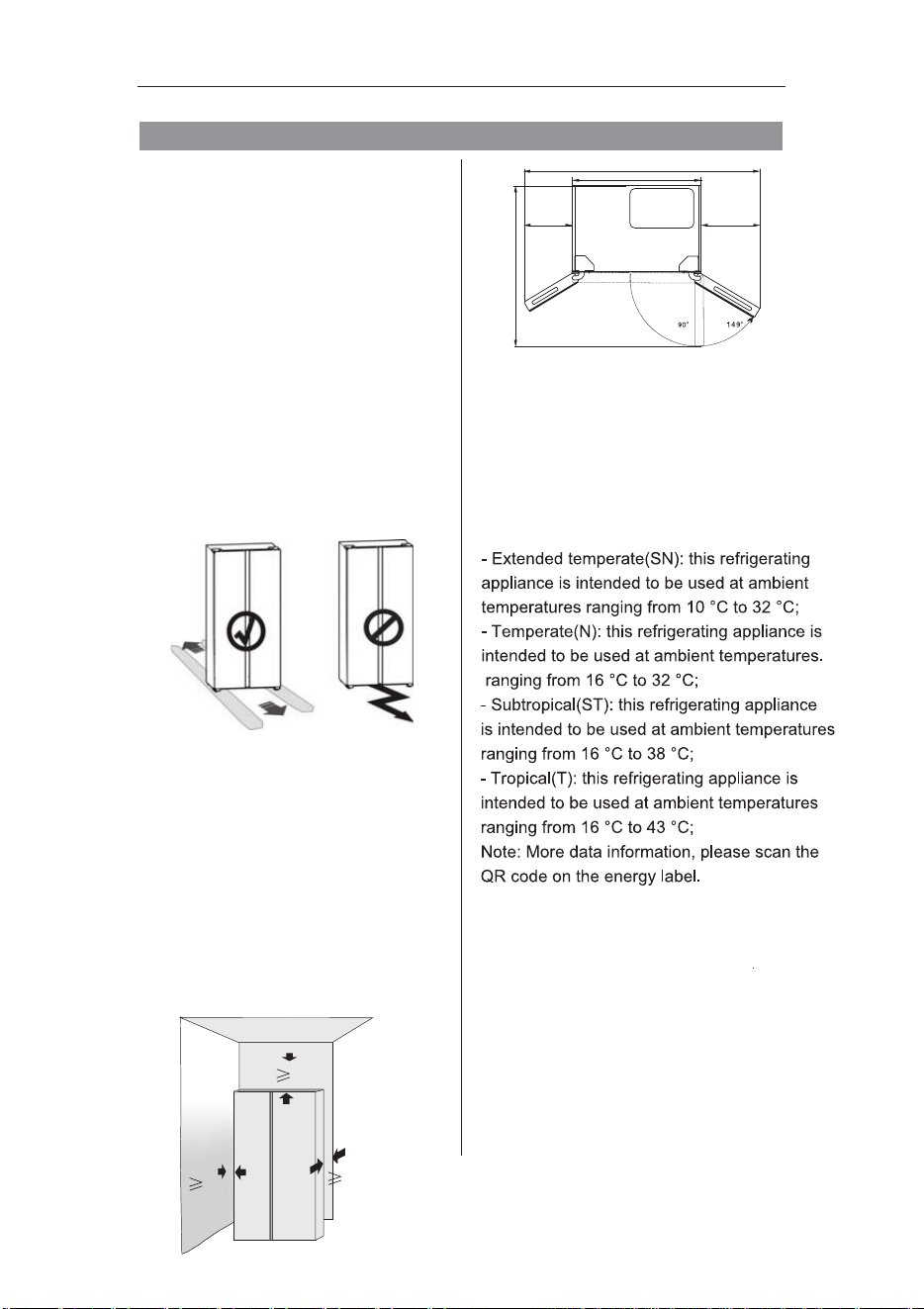
For proper installation, this refrigerator
must be placed on a level surface of hard
material that is the same height as the rest
of the flooring. This surface should be
strong enough to support a fully loaded
refrigerator.
The rollers, which are not castors, should
be only used for forward or backward
movement.
Moving the refrigerator
sideways may damage your floor and the
rollers.
Ventilation of appliance
Install the appliance in
a plane
and stable surface.
Assure
good ventilation.
W
e recommend letting a space at least:
Note:
yThe appliance is designed for a certain
climate class. Depending on the climate
class, the appliance can be operated at
the following ambient temperatures.
The climate class is specified on the
rating plate.
yStand your appliance in a dry place to
avoid high moisture.
yKeep the appliance out of direct sunlight,
rain or frost. Stand the appliance away
from heat sources such as stoves, fires or
heaters.
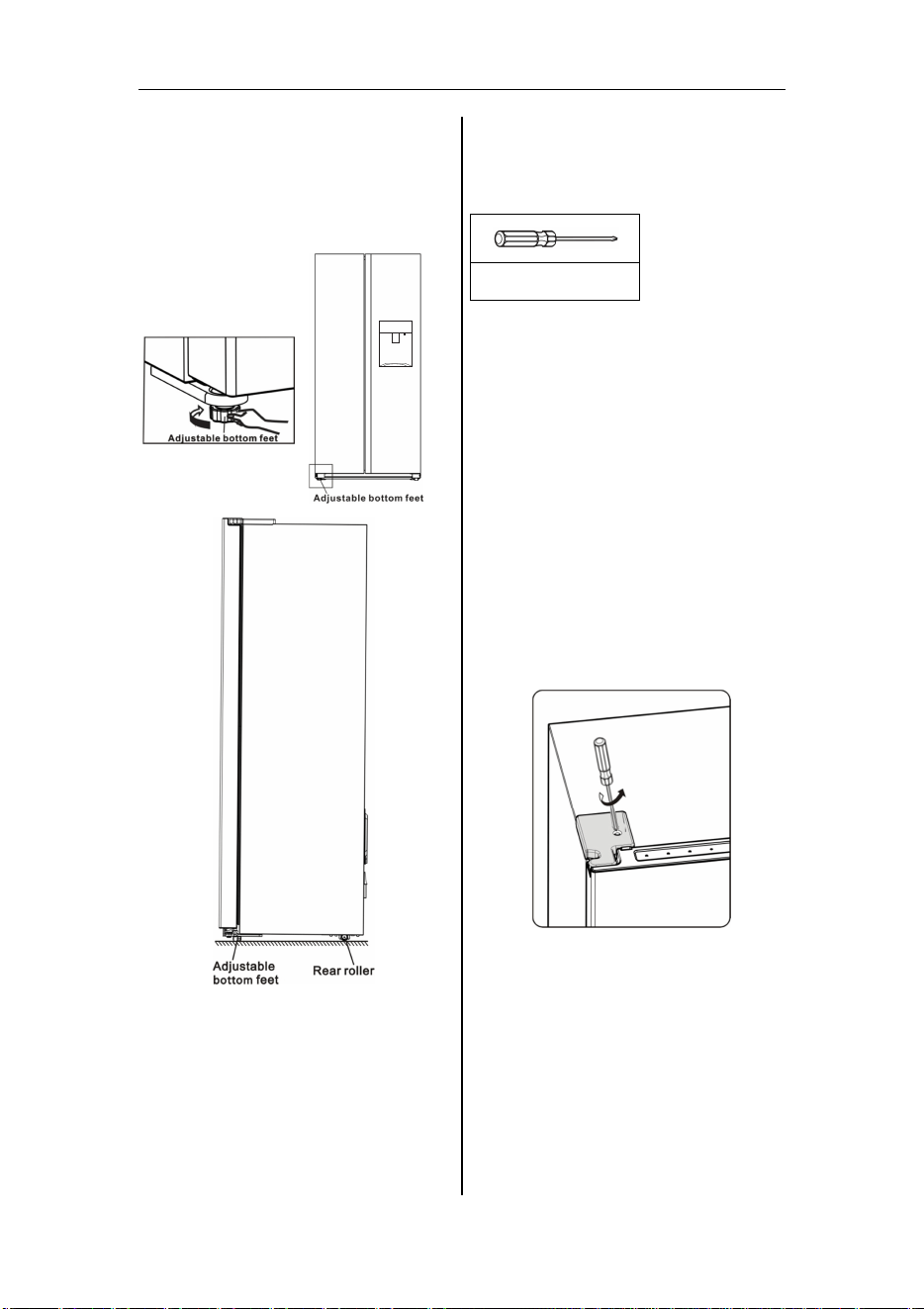
Leveling of appliance
yFor sufficient leveling and air circulating
in the lower rear section of the appliance,
1498
1020
319 343
836
&
8
-
100mm from the back to the wall
-
100mm from the top to th
e wall
-
100mm from its side to th
e wall
Enough sp
ace must be provi
d
ed i
n
the
front of the appliance to allow the doors to
open as shown in follow diagrams.
10cm
10cm
10cm
##9(
:9#
##(
y" /'
#*# /0
(
('
'
) ( "
(
) ' ;
( ) '
#(
$)
(-*
#
(
'
)(
#
> '
#
# > ;
(:#
#(
( - ' )
$ <4= )'
) )
. #
)(
( '
* )(
"(
y
yy
y : ) )
)#(
y
yy
y $*
'
( $
(
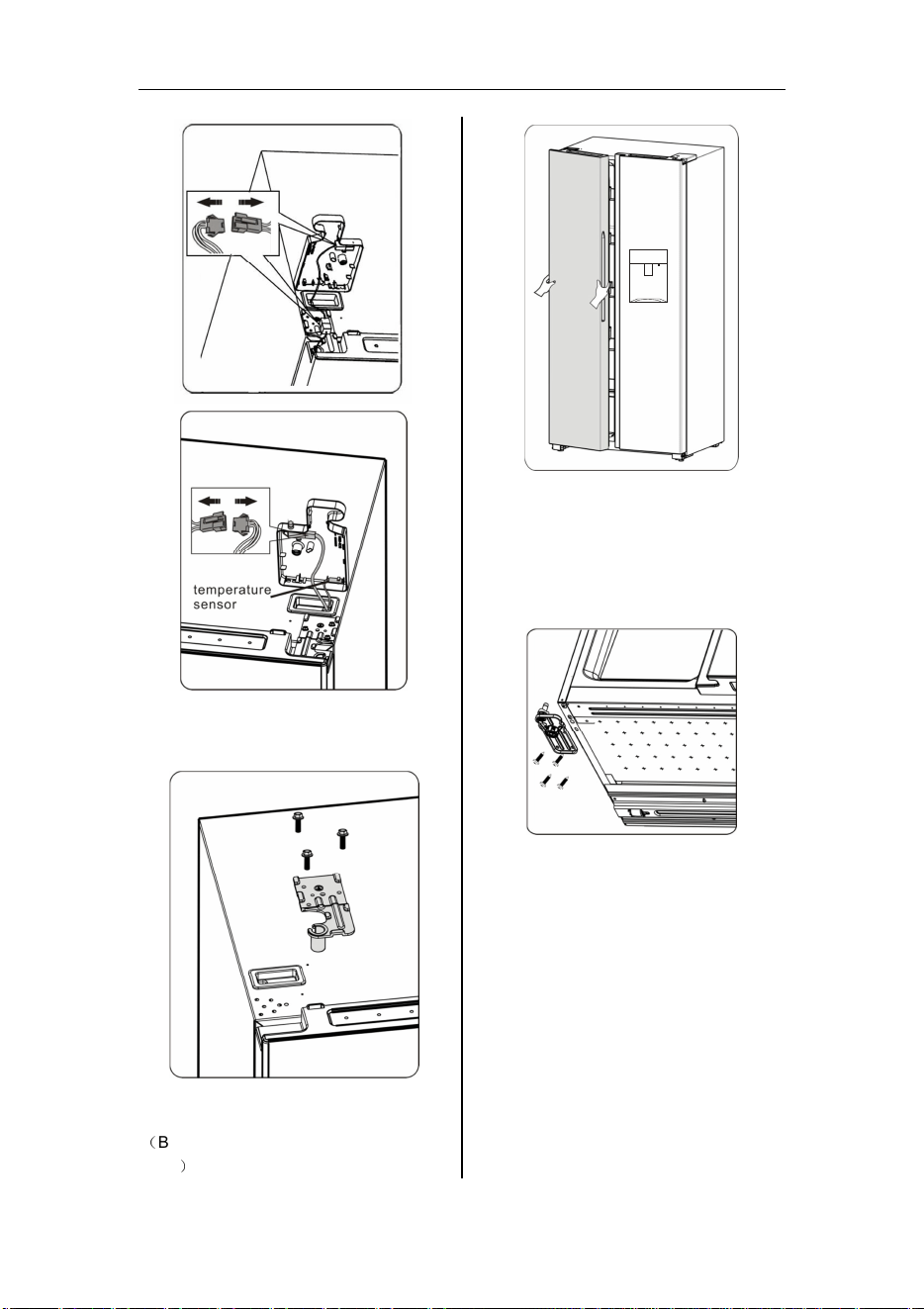
Warning!
When removing the door, the appliance
must be unplugged.
The tools you will need(Not provided):
9
6(?
)6;
- <=( " )
(
(@>'
#*(
˄
&
* )
(
˅
0(
?
))
(
"
#*' ) ;
-(")
(
"**
: / )
#(
(Just some
products)
11
(Only for some products)
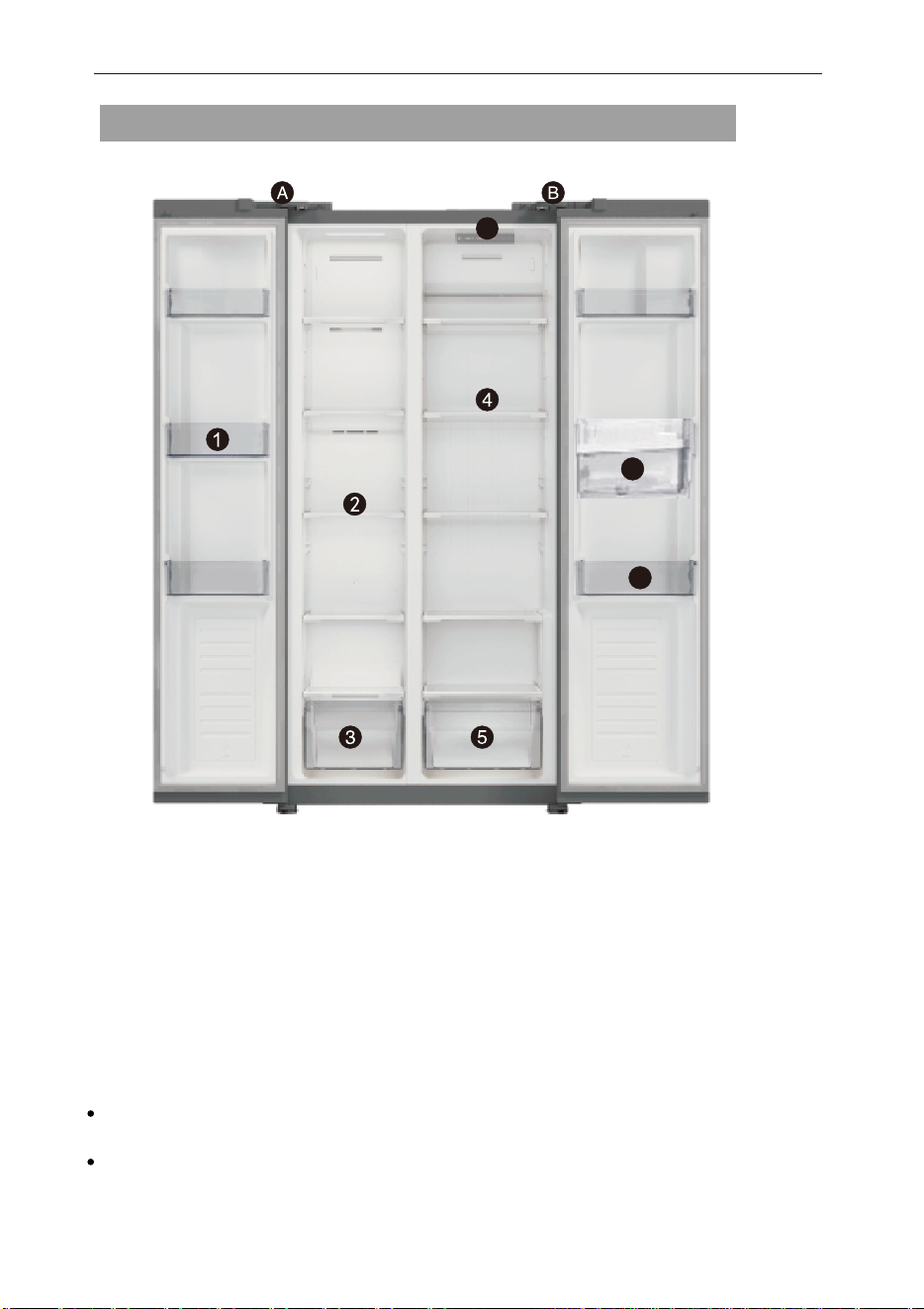
Description of the appliance(Only for some products)
A Freezer compartment
1 Freezer door tray
2 Freezer glass shelves
3 Freezer drawer
B Refrigerator compartment
4 Refrigerator glass shelves
5 Refrigerator drawer
6 Refrigerator door tray
7 C
8 Refrigerator drinking machine
ontrol panel
6
8
7
Due to unceasing modification of our products,your refrigerator may be slightly different
from this instruction manual,but its functions and using methods remain the same.
To get the best energy efficiency of this product,please place all shelves,drawers and
baskets on their original position as the illustration above.
Note!
Us
e
cor
r
Con
For
reco
refri
tem
3°C
to
c
instr
NOT
acce
Cau
you
who
insid
the
pan
sto
r
tem
tem
1.
F
Pre
s
bet
w
dis
p
e
your appli
a
r
esponding
f
ntrolling the
optimum
ommend th
gerator fo
perature fo
and the fre
change the
ructions belo
TE: High
elerate food
ution! When
set an ave
ole refrigera
de each co
temperature
el, dependin
re and where
perature m
perature ins
F
ridge
s
s “Fridge”
w
een 0
a
p
lay panel
w
a
nce accord
f
unctions a
s
e temperatu
food pre
hat when y
or the fir
r the refrige
eezer to -19
e temperatu
ow.
temperatur
waste.
n you set
erage temp
ator cabinet
mpartment
e values dis
ng on how
e you place
may also aff
side the app
to set frid
g
a
nd 6
a
s
w
ill display
ing to the f
o
the display
ure
eservation,
you start y
rst time,
erator is se
°C. If you w
ure, follow
re setting
a temperat
perature for
. Temperatu
may vary f
splayed on
much food
them. Am
b
fect the ac
liance.
g
e tempera
s
needed,
correspon
d
o
llowing co
n
panels sho
w
we
your
the
et to
want
the
will
ture,
the
ures
from
the
you
bient
ctual
ture
and
d
ing
val
se
q
2. F
Pre
bet
the
cor
follo
n
trol regulati
o
w
ed in the
p
u
es acco
r
q
uence.
Freezer
ess “Freezer
twe
en -15
display
rresponding
owing seque
o
ns, your a
p
p
ictures bel
o
r
ding to
r” to set free
and -2
3
panel
value ac
c
ence.
p
pliance ha
s
o
w.
the follo
ezer tempera
as needed,
will dis
cording to
12
s
the
w
ing
ature
and
s
play
the
Su
per Freeze.( )
(Only for some products)
Freezer Fridge
-23℃ -15℃ 6℃0℃
Freezer Fridge Feature
When the super freezer mode is selected,
the compressor will operate continuously to
freeze foods faster,
and keep them fresh.The super freezer mode
will automatically
turn off either after 24 hours of operation, or
when the freezer
reaches -28°C. The super freezer icon will turn
off, and the freezer
will continue to operate at the normal set
temperature.
13
/ !!"
" (-
#(#
/ "!
" #
)# ( %
#*
) )
(
/*4"!
" > #
#>'
'''2(
# 3)
) E ;(
#
(
7*'("0
" ) *
# '
D' # * * (
" #
( &
) *( &
)'
*(
#*#(
-))'
(
- )' *
# #
#*(
(
"#
)#(,#*#
(
" * '
("
)(
$., * )
Gl
ass sh elve
line r of cabi net
Glas s shelv e
line r of cabi net
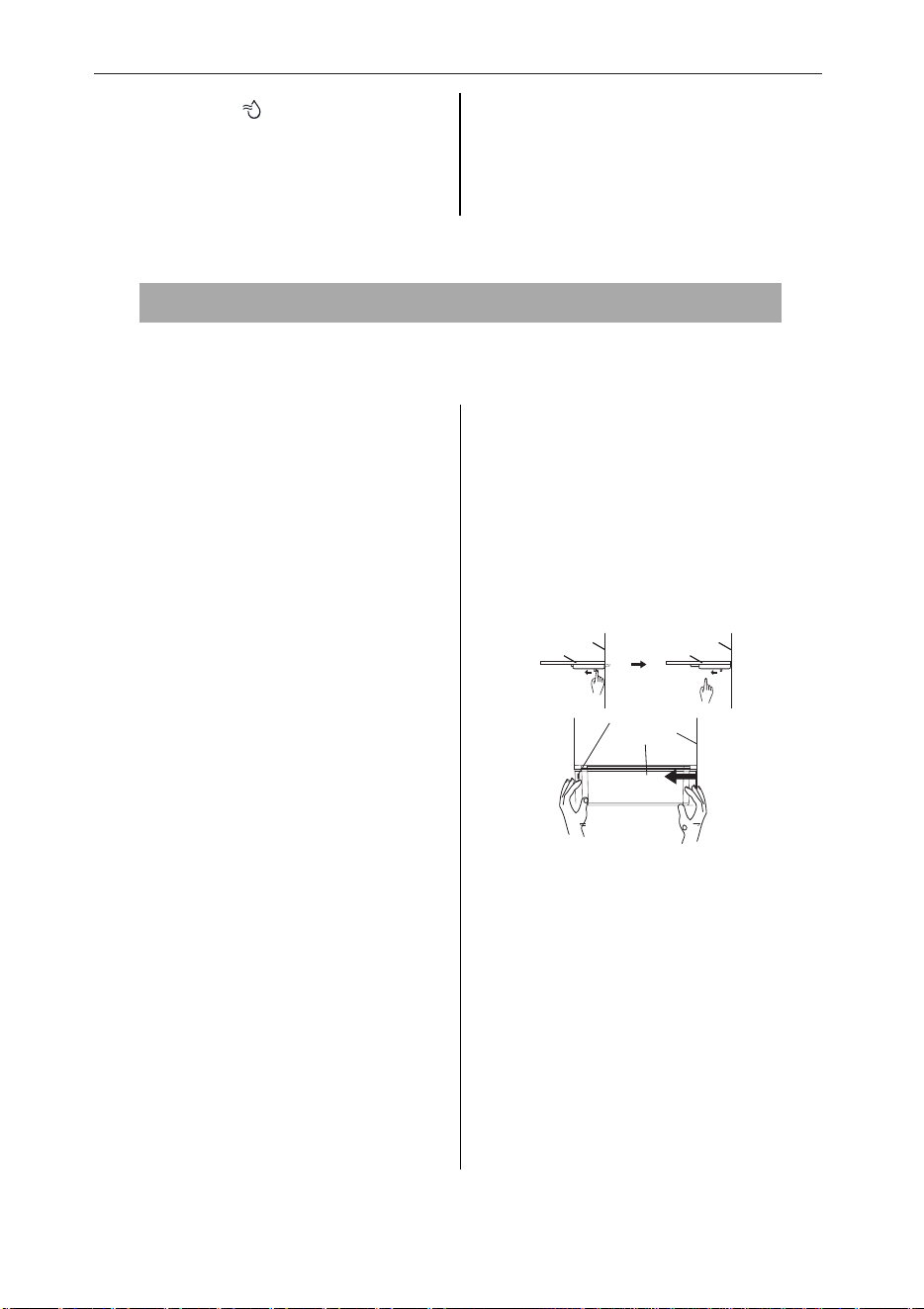
Here is a boss on the liner
liner of door
bottle shelf
When the super fridge mode is selected,
the fridge compartment reaches the set
temperature in the shortest period,in order
to keep the food as fresh as possible.under
this mode,the set temperature of the fridge
compartment locks on 0°C.
Su
per Cool
(
)
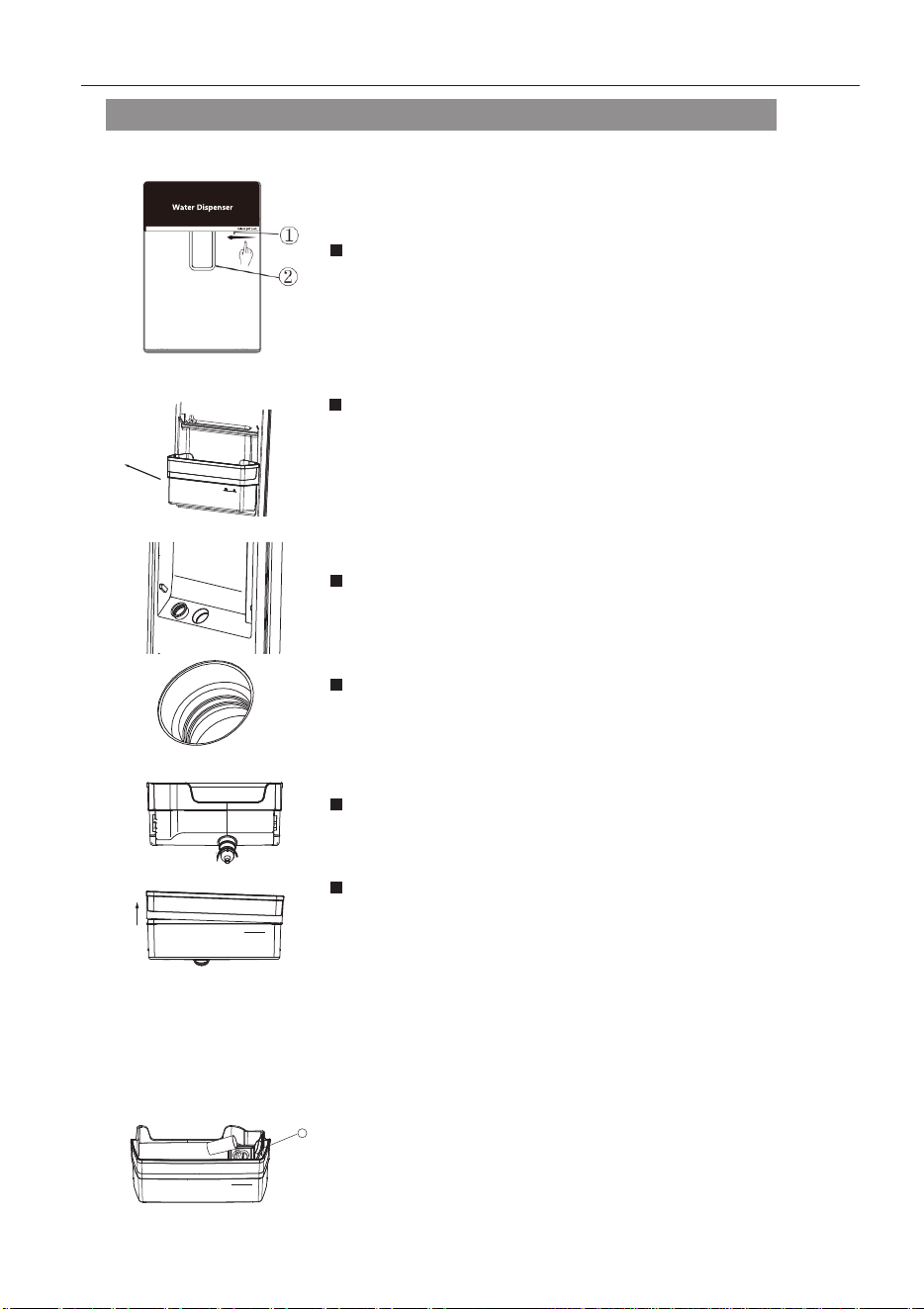
Water Dispenser
Instructions for child lock lever
Press the child's lock lever with your thumb as the direction as below
① and the water lever ② will be locked to prevent children from
taking any water.
Press in the opposite direction to unlock and take water
Instructions for water tank assembly
1.Hold both sides of the tank with hands and pull the tank assembly
off the door slightly in the direction indicated as below.
Notes: The transparent silicone par ts of the sealed water valve could
be brought out meantime when removing the water tank. If so, remove
them, and re-install them according to the following steps.
1-1.Align the sealed part with the hole in the door and place it in it.
1-2.It will be completed when the step of sealed part can be fitted to
the step in the hole.
2.Rotate counterclockwise to remove the water valve assembly from
the water tank for cleaning.
3.Pinch the flange of the water tank cover slightly upwards, and the
water tank cover can be separated from the water tank. Remove
the other side with the same method .The tank and its cover can
be cleaned after disassembly.
Fill the tank with pure drink water( )
*
Open the inlet cover of water tank①. Slowly fill the tank with pure
drinking water up to the maximum fill line marked with “2L”. Then
close the inlet cover①. To prevent any spills, please use a
narrow-bore container to charge water.
MAX
2L
1
MAX
2L
*
Only direct drinking water or mineral water can be stored in the
water tank
14
15
"
%
<;=
#)
(
#
" #
(
*A &
)
*(
89"
"
'(
y
( "
)#
(
y ' #
(
#
yF#9*
(
yF"'';'
' #)
) &>
("
(
"
:
( #
*(-
> *
## '
/
( - #
) #*(
")#
##*(
,
'
>
Ƚ
> D
*(*'
>
.
(?);
#*'
) (
G
(
( - '
>##)(
6(
" # >
#(
:
( *
##'
( -
(
#
#9 )
> (@
# #*
#**(
("
"**(*
**
#
(-
( ?
(
# @
#
16
7
!"*&8(*%
-. " H2 #
# A H2
'
( " H2 '
##.
((
(?))#
(
6(!H2)
(
(?H2
(
6! *!
8'!
-
#)(
y" ) *
)(
2
< '
)*=
yI
(
yF )
D(
y$ )'
' ( $
(
y
# '
)'9#
#
(
6*
y
>'
) *
(
y)
)(
y$
(
6
y+<,"=-.
#)
)#( ,
#
#(
y*''(.
" # ) #
(
y%)#.
" #
)(
y&.
#
(
y+*#.
) #
*(
64
y- /
'
#
(
y$#
#>
* # #D
DD(
y-
'
y
>
>
)(
y
) >
18
' ##
#*(
y#
> * * *
(
6*4
y2>#
#
y@
#/>(
;#
(
"* !!"
#
;'
# * )
(
(?)(
(?)
*(
6((
( 2
(
) -*
;#
' * # )'
#(
#F(#)
* #' D ' > )
(
# ,
)(
($78. ?* ( &
>.
/ "*(
/ H))#(
:- :-" ;
,*
*
(
* '
(
" # (" #
))#(
>
'
(
@
"#
'(
3
"
#D.
y(
19
y,)>
(
yJ#(
y$(
y*#(
y*(
y"(
@ #
**.
"#)(
"#*(
&(
"
D '
.
y"
yHD#
(
y"(
y*(
y,#
(
,
*#*#
)( 2 ( " )
'
(
"
:)DK
*##K
'#*
"
# C B
(
F #
* #* #
/0'
)(
"*
y"H2#(?H2
(
y"#
# * '
)(
!
###
"("###
D(
20
(!*!!"
#(
:"0
$*##(*
#(
<!*!!"
($*(
(
# ? (?
# 9 (
2#(
"(!*! "
"* #
2( " ) #
) '
##("
)'
("*
)(
~
~
~
21
~
~
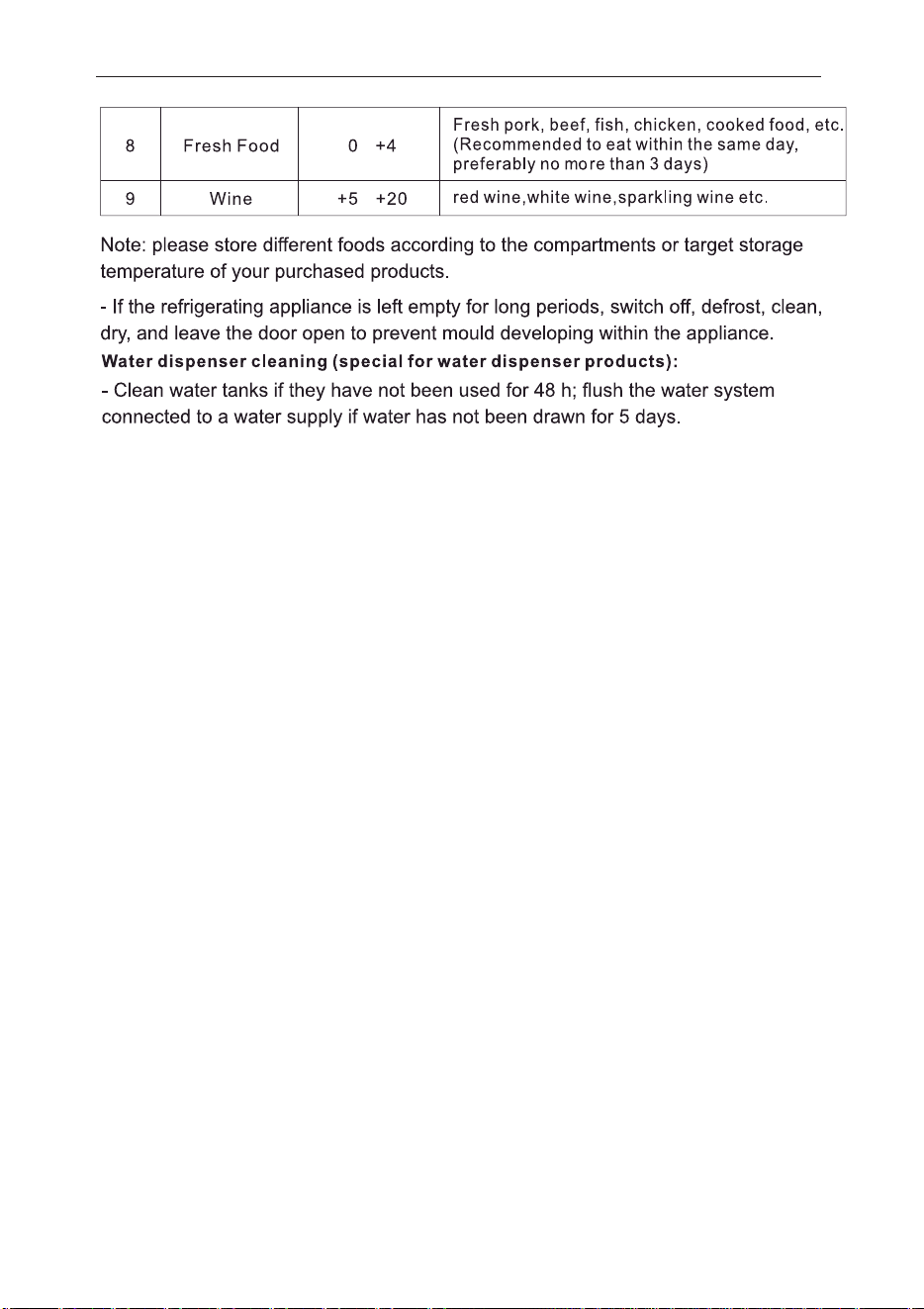
W ARNING!Food needs to be packed in bags before putting into the refrigerator, and
liquids need to be packed in bottles or capped containers to avoid the problem that
the product design structure is not easy to clean.
22
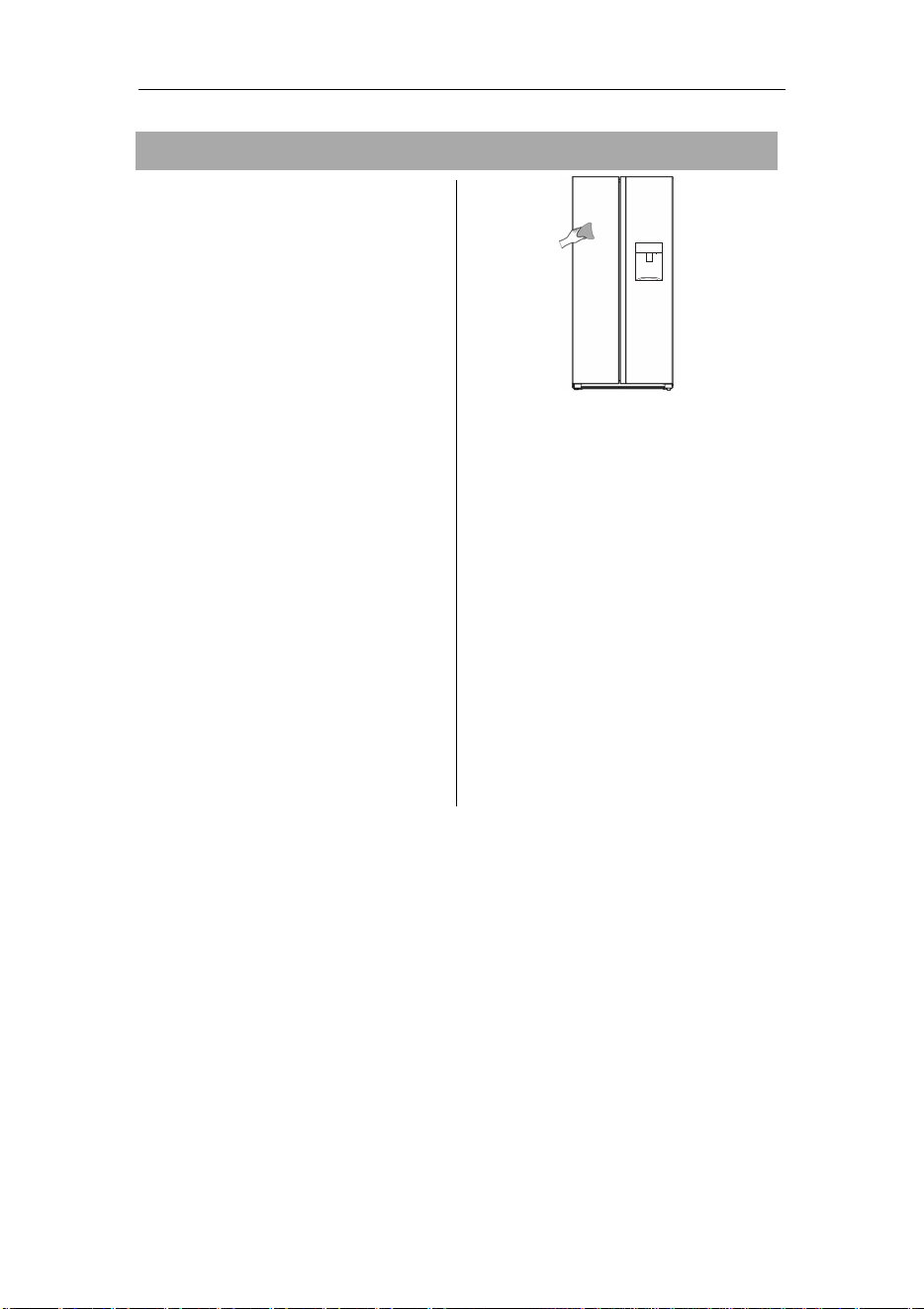
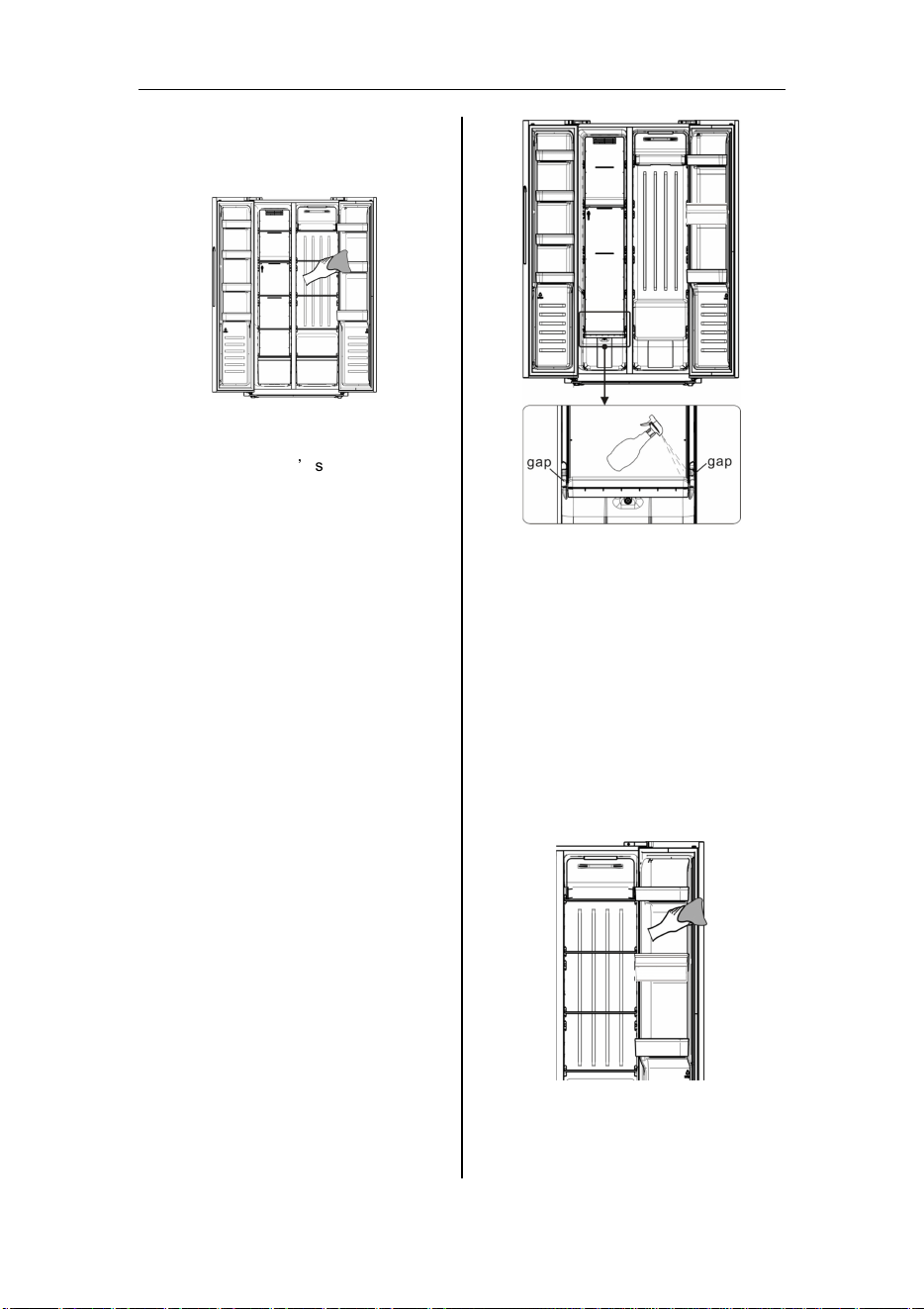
Cleaning:
Precautions for internal and external cleaning of refrigerator:
Before cleaning, always turn off the power switch, disconnect the power plug.
During cleaning, make sure that no water will enter the switch, control panel, door lamp
and top control box.
Remove dirt from the outside of refrigerator with mild cleaner, then wipe with clean soft
cloth, and let the refrigerator dry naturally.
When cleaning door sealing strip, always use clean water, wipe with dry cloth and let
it dry naturally. Wet soft cloth with warm water or neutral cleaner to wipe the refrigerator
body except the door sealing strip.
It is forbidden to flush the refrigerator directly with water,which will affect electrical
insulation properties, etc.
It is forbidden to clean the refrigerator with metal wipers,ware brushes, coarse abrasive
cleaners,strong alkaline detergents,or flammable or toxic cleaning fluids.
After cleaning, connect the power plug of refrigerator,and connected with
there
frigerator.
Note: Food is not allowed to touch directly all surfaces inside the appliance. It
has to be wrapped separately in aluminum sheet or in cellophane sheet or in
airtight plastic boxes.
Freezing and storing food in the freezer compartment
· To store deep-frozen food.
· To make ice cubes.
· To freeze food.
Note: Ensure that the freezer compartment door has been closed properly.
23
Purchasing frozen food
· Packaging must not be damaged.
· Use by the 'use by /best before/best by/' date.
· If possible, transport deep-frozen food in an insulated bag and place quickly
in the freezer compartment.
Storing frozen food
Store at -18°C or colder. Avoid opening the freezer compartment door
unnecessarily.
Freezing fresh food
Freeze fresh and undamaged food only.
To retain the best possible nutritional value, flavour and colour, vegetables should
be blanched before freezing.Aubergines, peppers, zucchini and asparagus do
not require blanching.
· The following foods are suitable for freezing:
Cakes and pastries, fish and seafood, meat, game, poultry, vegetables, fruit, herbs,
eggs without shells,dairy products such as cheese and butter, ready meals and
leftovers such as soups, stews, cooked meat and fish, potato dishes and desserts.
· The following foods are not suitable for freezing:
Types of vegetables, which are usually consumed raw, such as lettuce or radishes,
eggs in shells, grapes, whole apples, pears and peaches, hard-boiled eggs, yogurt,
soured milk, sour cream, and mayonnaise.
Recommended storage times of frozen food in the freezer compartment
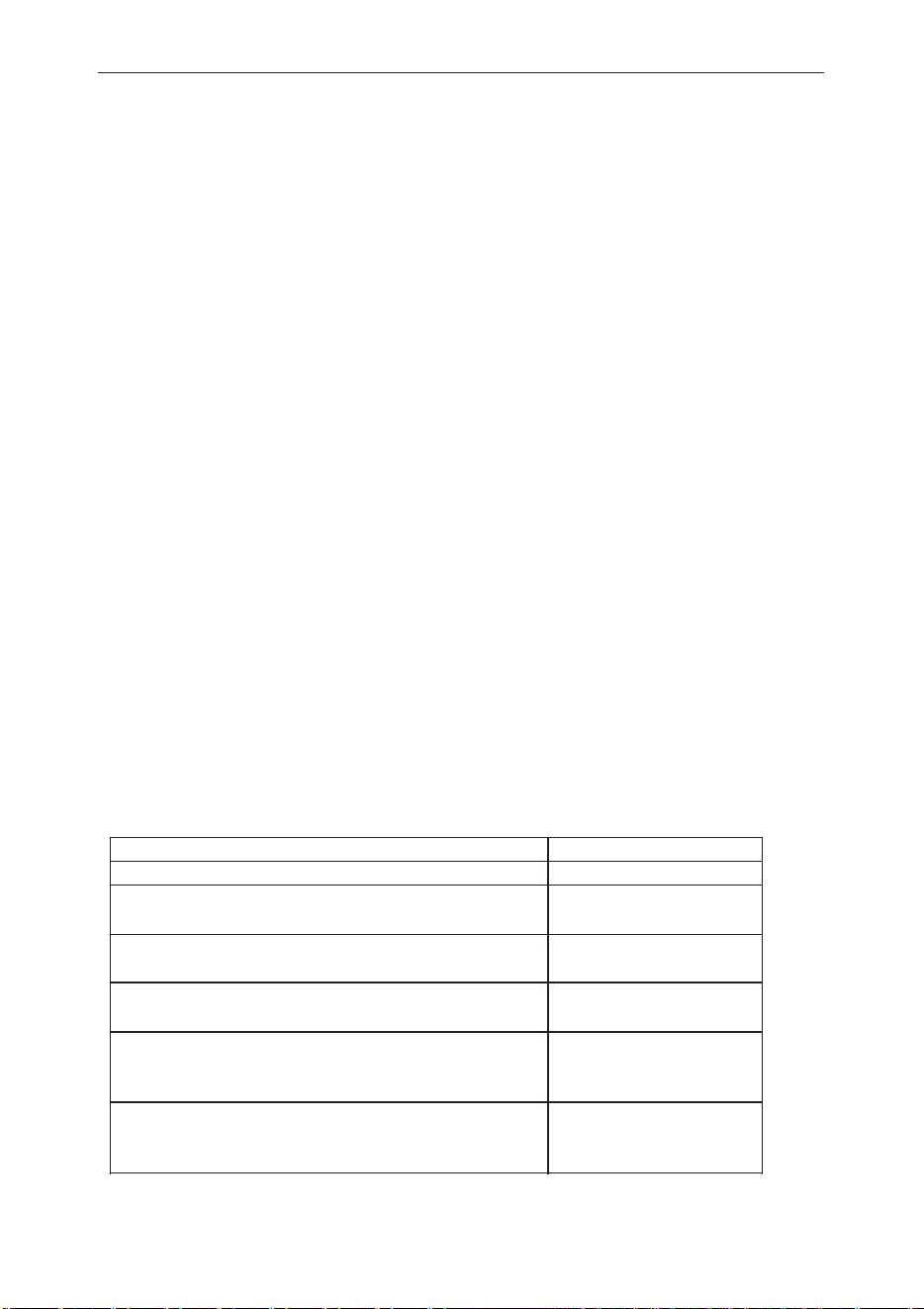
These times vary depending on the type of food. The food that you freeze can
be preserved from1 to 12 months (minimum at -18°C).
FOOD
Bacon, casseroles, milk
Bread, ice cream, sausages, pies,
prepared shellfish,oily fish
Non-oily fish, shellfish, pizza,
scones and muffins
Ham, cakes, biscuits, beef and
lamb chops, poultry pieces
Butter, vegetables (blanched), eggs
whole and yolks,cooked crayfish,
minced meat (raw), pork (raw)
Fruit (dry or in syrup), egg whites,
beef (raw), whole chicken,
lamb (raw), fruit cakes
Storage time
1 month
2months
3months
4months
6months
12months
24
Energy saving tips:
Make sure to keep the refrigerator away from heat source and direct sunlight.
-Before storing hot foods, cool them to room temperature and then put into refrigerator.
-Close the door timely, reduce the opening frequency, and shorten the opening time.
-When unfreezing frozen foods, you can put them into the refrigerating chamber, which
will assist in refrigeration of the refrigerating chamber.
-Make sure that the temperature sensor is not covered or blocked by foods,and
keep proper distance with foods.
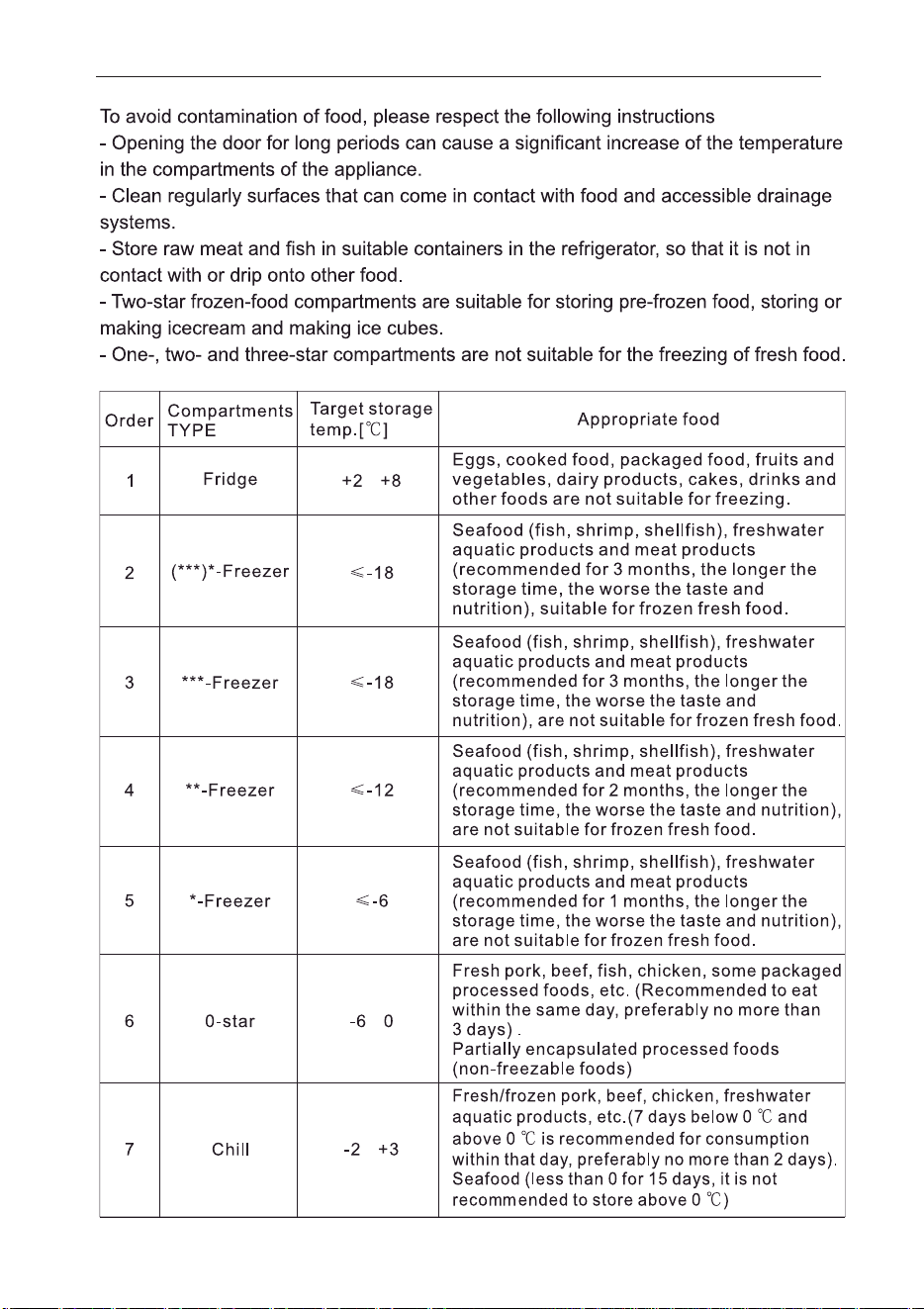
Storage of food:
Your appliance has the accessories as the “Structure illustration" showed in general,
with this part instruction you can have the right way to storage your food.The glass
shelves and crisper can be removed to store food if needed.
Note: Food is not allowed to touch directly all surfaces inside the appliance. lt has to be
wrapped separately in aluminum sheet or in cellophane sheet or in airtight plastic boxes
Dairy foods and eggs:
Most pre-packed dairy foods have a recommended 'use by
/best before/best by/ date stamped on them. Store them in the fridge compartment and
use within the recommended time.
Butter can become tainted by strong smelling foods so it is best stored in a sealed
container.
Eggs should be stored in the fridge compartment.
Red meat:
Place fresh red meat on a plate and loosely cover with waxed paper, plastic wrap or foil.
Store cooked and raw meat on separate plates. This will prevent any juice lost from the
raw meat from contaminating the cooked product.
Poultry:
Fresh whole birds should be rinsed inside and out with cold running water, dried and
placed on a plate. Cover loosely with plastic wrap or foil
Poultry pieces should also be stored this way. Whole poultry should never be
stuffed until just before cooking, otherwise food poisoning may result. Fish and seafood
Whole fish and fillets should be used on the day of purchase. Until required refrigerate on
a plate loosely covered with plastic wrap, waxed paper or foil. lf storing overnight or
longer, take particular care to select very fresh fish.
Whole fish should be rinsed in cold water to remove loose scales and dirt and then patted
dry with paper towels. Place whole fish or fillets in a sealed plastic bag.
Keep shellfish chilled at all times. Use within 1-2 days. Precooked foods and leftovers
These should be stored in suitable covered containers so that the food will not dry out.
Keep for only 1-2 days.
Reheat leftovers only once and until steaming hot.
25
Vegetable container
The vegetable container is the optimum storage location for fresh fruit and vegetables.
Take care not to store the following at temperatures of less than 6°C for long periods:
Citrus fruit, melons, aborigines, pineapple, papaya, curette, passion fruit, cucumber,
peppers, tomatoes.
Undesirable changes will occur at low temperatures such as softening of the flesh,
browning and/or accelerated decaying
Do not refrigerate avocados (until they are ripe), bananas and mangoes.
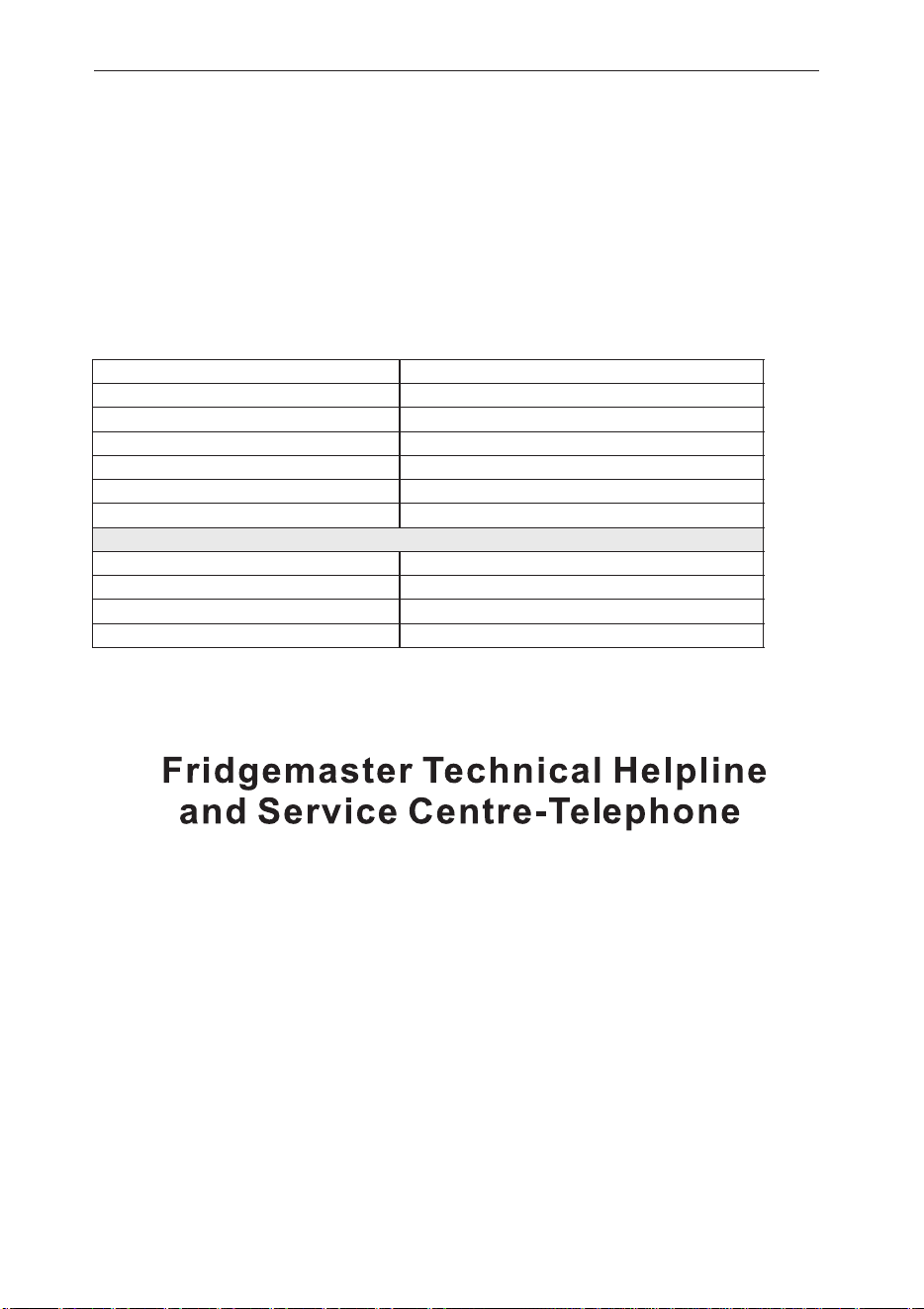
FOOD
Butter, cheese
Eggs
Fruit, vegetables, salad
Meat, sausage, cheese, milk
Dairy products, canned food, cans
Drinks, bottles, tubes
Location(Refrigerator )
Upper door rack
Door rack
Crisper
Lower area (lowest shelf 1 crisper cover)
Upper area or door rack
Door rack
chamber
FOOD
Small frozen food
Packaged frozen foods
Fish,meat,ice cream
Location(Freezer chamber)
Door rack
Freezer drawer
Lower area(lower shelf or drawer)
0191 387 0804
26
FRIDGEMASTER
Ground floor, Munroe Court,
White Rose Office Park,
Millshaw Park Lane,
Leeds LS11 0EA
United Kingdom
For service and repairs please contact
the Fridgemaster Technical Helpline on:
01913870804
Fridgemaster@0800repair.com