Models
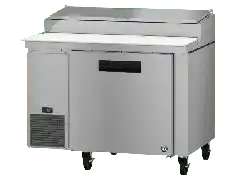
Refrigerated Prep Table with Raised Rail
Steelheart Series
Refrigerated Kitchen Equipment
Instruction Manual
Issued: 10-5-2021
Revised: 11-16-2021
hoshizakiamerica.com
2
WARNING
Only qualied service technicians should install and service the appliance. To
obtain the name and phone number of your local Hoshizaki Certied Service
Representative, visit www.hoshizaki.com. No installation or service should be
undertaken until the technician has thoroughly read this Instruction Manual.
Likewise, the owner/manager should not proceed to operate the appliance until the
installer has instructed them on its proper operation. Failure to install, operate, and
maintain the appliance in accordance with this manual may adversely affect safety,
performance, component life, and warranty coverage. Proper installation is the
responsibility of the installer. Product failure or property damage due to improper
installation is not covered under warranty.
Hoshizaki provides this manual primarily to assist qualied service technicians in the
installation, maintenance, and service of the appliance.
Should the reader have any questions or concerns which have not been satisfactorily
addressed, please call, send an e-mail message, or write to the Hoshizaki Technical
Support Department for assistance.
Phone: 1-800-233-1940; (770) 487-2331
Fax: 1-800-843-1056; (770) 487-3360
E-mail: techsuppor[email protected]
618 Highway 74 South
Peachtree City, GA 30269
Attn: Hoshizaki Technical Support Department
Web Site: www.hoshizaki.com
NOTE: To expedite assistance, all correspondence/communication MUST include the
following information:
• Model Number
• Serial Number
• Complete and detailed explanation of the problem.
3
IMPORTANT
This manual should be read carefully before the appliance is installed and operated.
Read the warnings and guidelines contained in this manual carefully as they
provide essential information for the continued safe use and maintenance of the
appliance. Retain this manual for any further reference that may be necessary.
CONTENTS
Important Safety Information ................................................................................................. 4
I. Installation Instructions ....................................................................................................... 8
A. Location ........................................................................................................................ 8
B. Checks Before Installation ............................................................................................. 9
C. Setup ............................................................................................................................. 9
D. Door Reversal.............................................................................................................. 13
E. Door/Drawer Reversal ................................................................................................. 17
F. Electrical Connection ................................................................................................... 24
G. Final Checklist ............................................................................................................ 25
II. Operating Instructions ...................................................................................................... 26
A. Important Notes About Usage ..................................................................................... 26
B. Startup ........................................................................................................................ 29
C. Controls and Adjustments ........................................................................................... 29
1. Temperature Display ............................................................................................... 29
2. Adjusting the Temperature Setpoint ....................................................................... 29
3. Changing the Temperature Display Scale (°F or °C) ............................................. 30
D. Control Module Icons .................................................................................................. 31
E. Defrost ......................................................................................................................... 32
F. Alarm Safeties .............................................................................................................. 33
G. Food Storage .............................................................................................................. 34
H. Safety Devices ............................................................................................................ 34
I. Cooling Performance .................................................................................................... 35
J. Cabinet Condensation ................................................................................................. 35
III. Cleaning and Maintenance Instructions .......................................................................... 36
A. Cleaning ...................................................................................................................... 36
B. Maintenance ................................................................................................................ 38
IV. Preparing the Appliance for Periods of Non-Use ............................................................ 39
V. Disposal ........................................................................................................................... 40
4
Important Safety Information
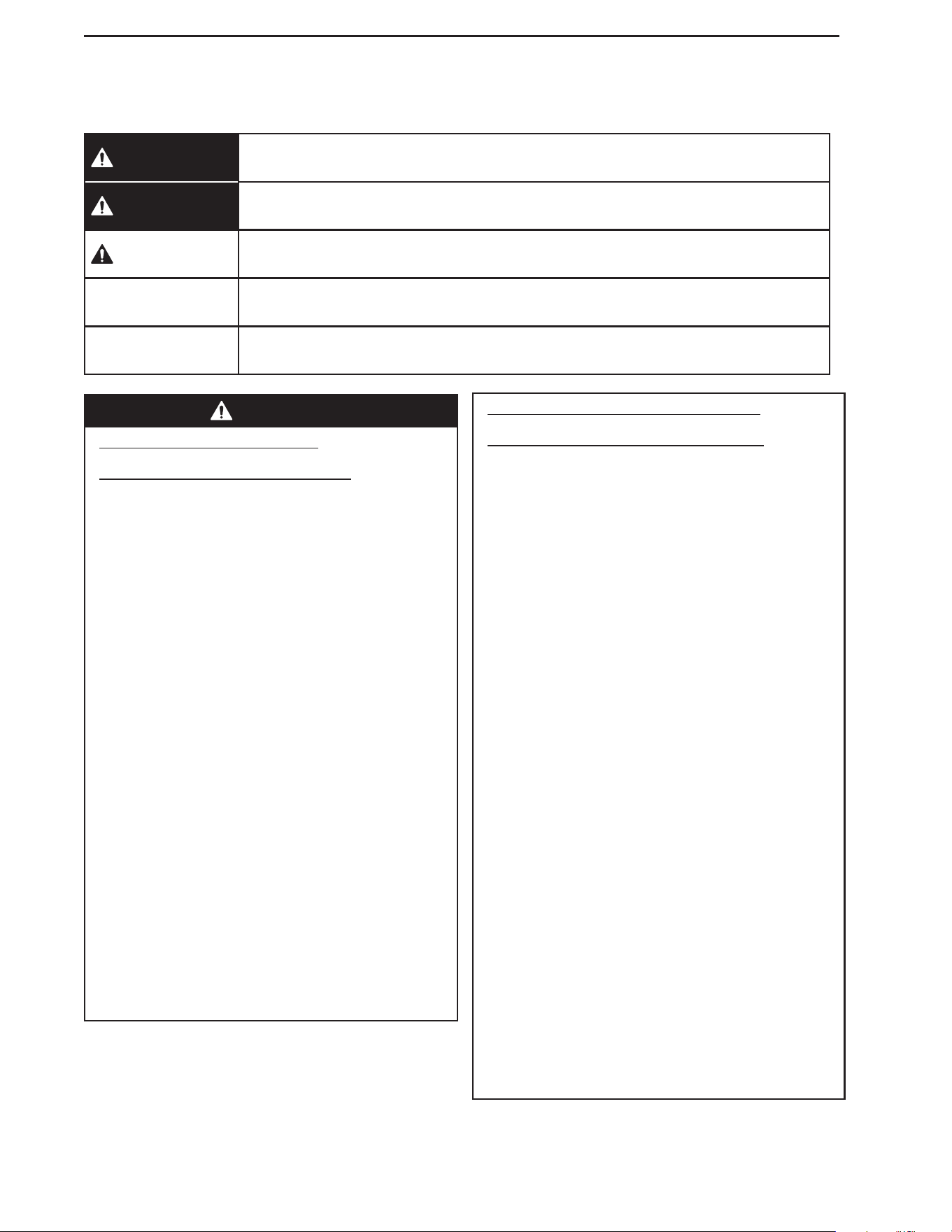
Throughout this manual, notices appear to bring your attention to situations which could
result in death, serious injury, damage to the appliance, or damage to property.
DANGER
Indicates a hazardous situation that, if not avoided, will result in
death or serious injury.
DANGER
Indique un risque imminent qui causera la mort ou de graves
blessures, s’il n’est pas évité.
WARNING
Indicates a hazardous situation that, if not avoided, could result
in death or serious injury.
NOTICE
Indicates a situation that, if not avoided, could result in damage
to the appliance or property.
IMPORTANT
Indicates important information about the use and care of the
appliance.
DANGER
Risk of Fire or Explosion
Flammable Refrigerant Used
• Follow handling instructions carefully
in compliance with U.S. government
regulations.
• Do not use mechanical devices to defrost.
• Do not puncture refrigerant tubing. Risk
of re or explosion due to puncture
of refrigerant tubing; follow handling
instructions carefully.
• Component parts shall be replaced with
like components.
• Servicing shall be done by factory
authorized service personnel to minimize
the risk of possible ignition due to
incorrect parts or improper service.
• Consult instruction manual/service manual
before attempting to install or service this
product. All safety precautions must be
followed.
• Dispose of properly in accordance with
federal or local regulations.
• Do not place any potential ignition sources
in or near the appliance.
Risque De Feu Ou D'Explosion
Le Frigorigène Est Inammable
• Suivre attentivement les instructions
de manipulation conformément à la
réglementation gouvernementale.
• Ne pas utiliser d'appareils mécaniques
pour dégivrer le réfrigérateur.
• Ne pas perforer la tubulure contenant le
frigorigène. Risque de feu ou d'explosion
si la tubulure contenant le frigorigène
est perforée; suivre les instructions de
manutention avec soin.
• Les pièces des composants doivent être
remplacées par des pièces et accessoires
équivalents.
• L’entretien doit être effectué par le
personnel de service autorisé par le
fabricant an de minimiser les risques
d’inammation attribuables à l’installation
d’une pièce inadéquate ou à la mauvaise
exécution du service.
• Consulter le manuel du propriétaire/
guide de réparation avant de tenter une
réparation. Toutes les mesures de sécurité
doivent être respectées.
• Éliminer conformément aux règlements
fédéraux ou locaux.
• Ne placez aucune source d’inammation
potentielle dans ou près de l’appareil.
5
WARNING
The appliance should be destined
only to the use for which it has been
expressly conceived. Any other use
should be considered improper and
therefore dangerous. The manufacturer
cannot be held responsible for injury
or damage resulting from improper,
incorrect, and unreasonable use.
Failure to install, operate, and maintain
the appliance in accordance with this
manual will adversely affect safety,
performance, component life, and
warranty coverage.
To reduce the risk of death, electric
shock, serious injury, or re, follow
basic precautions including the
following:
• Only qualied service technicians should
install and service the appliance.
• Wear appropriate personal protective
equipment (PPE) when servicing the
appliance.
• The appliance must be installed in
accordance with applicable national,
state, and local codes and regulations.
• Appliance is heavy. Use care when
lifting or positioning. Work in pairs when
needed to prevent injury or damage.
Do not lift using the top section or the
doors/drawers.
• The appliance requires an independent
power supply of proper capacity.
See the nameplate for electrical
specications. Failure to use an
independent power supply of proper
capacity can result in a tripped breaker,
blown fuse, damage to existing wiring,
or component failure. This could lead to
heat generation or re.
• To reduce the risk of electric shock, do
not touch the plug with damp hands.
• Unplug the appliance before servicing.
• Risk of electric shock. Appliance in the off
position does not de-energize all loads.
Use extreme caution and exercise safe
electrical practices.
• THE APPLIANCE MUST BE
GROUNDED. The appliance is equipped
with a NEMA5-15 three-prong grounding
plug to reduce the risk of potential
shock hazards. It must be plugged into a
properly grounded, independent 3-prong
wall outlet. If the outlet is a 2-prong outlet,
it is your personal responsibility to have
a qualied electrician replace it with a
properly grounded, independent 3-prong
wall outlet. Do not remove the ground
prong from the power cord and do not use
an adapter plug. Failure to follow these
instructions may result in death, electric
shock, or re.
• Do not use an extension cord.
• Do not use an appliance with a damaged
power cord. The power cord should not be
altered, jerked, bundled, weighed down,
pinched, or tangled. Such actions could
result in electric shock or re. To unplug
the appliance, be sure to pull the plug, not
the cord, and do not jerk the cord.
• The GREEN ground wire in the
factory-installed power cord is connected
to the appliance. If it becomes necessary
to remove or replace the power cord, be
sure to connect the power cord's ground
wire.
• Do not splash, pour, or spray water
directly onto or into the appliance. This
might cause short circuit, electric shock,
corrosion, or failure.
• Do not make any alterations to the
appliance. Alterations could result in
electric shock, injury, re, or damage to
the appliance.
• Do not use combustible spray or place
volatile or ammable substances in or
near the appliance. They might catch re.
• Be careful not to pinch ngers when
opening and closing the doors/drawers
or rail cover (prep table models) or when
handling food pans. Be careful when
opening and closing the doors/drawers or
rail cover when children are in the area.
6
• Do not block air inlets or outlets, otherwise
cooling performance may be reduced.
• Do not tightly pack the cabinet. Allow some
space between items to ensure good air
ow. Also allow space between items and
interior surfaces.
• Do not put warm or hot foods in the cabinet.
Let them cool rst, or they will raise the
cabinet temperature and could deteriorate
other foods in the cabinet or overload the
appliance.
• Food storage and handling must comply
with applicable codes and regulations.
• All foods should be wrapped in plastic lm
or stored in sealed containers. Otherwise
foods may dry up, pass their smells onto
other foods, cause frost to develop, result
in poor appliance performance, or increase
the likelihood of cross-contamination.
Certain dressings and food ingredients,
if not stored in sealed containers, may
accelerate corrosion of the evaporator,
resulting in failure.
• Do not store items near air outlets.
Otherwise, items may freeze up and
crack or break causing a risk of injury or
contamination of other food.
• The appliance is designed only for
temporary storage of food. Employ sanitary
methods. Use for any other purposes (for
example, storage of chemicals or medical
supplies such as vaccine and serum) could
cause deterioration of stored items.
WARNING, continued
• Children should be properly supervised
around the appliance.
• Do not climb, stand, or hang on the
appliance or doors/drawers or allow
children or animals to do so. Do not climb
into the appliance or allow children or
animals to do so. Death or serious injury
could occur or the appliance could be
damaged.
• Open and close the doors/drawers and
rail cover with care. Opening the doors/
drawers or rail cover too quickly or
forcefully may cause injury or damage to
the appliance or surrounding equipment.
• Keep the area around the appliance clean.
Dirt, dust, or insects in the appliance could
cause harm to individuals or damage to
the equipment.
• Do not throw anything onto the shelves or
load any single shelf with more than 120lb.
(54.5 kg) of product. They might fall off and
cause injury.
• Do not load any single drawer with more
than 75 lb. (34 kg) of product. Depending
on the weight of product in the drawers,
secure the unit as necessary to prevent it
from overturning. Do not open more than
one drawer at a time.
• The appliance is not intended for use by
persons (including children) with reduced
physical, sensory, or mental capabilities, or
lack of experience and knowledge, unless
they have been given supervision or
instruction concerning use of the appliance
by a person responsible for their safety.
7
NOTICE
• Protect the oor when moving the
appliance to prevent damage to the oor.
• Keep ventilation openings, in the
appliance enclosure or in the built-in
structure, clear of obstruction. Do not
place anything on top of the appliance in
an undercounter installation. There must
be at least 1.5" (4 cm) overhead clearance
for proper ventilation. The factory-installed
rear bumpers must be in place to ensure
proper rear clearance. Blockage of airow
could negatively affect performance and
damage the appliance.
• Do not allow the appliance to bear any
outside weight.
• To prevent deformation or cracks, do not
spray insecticide onto the plastic parts or
let them come into contact with oil.
• To avoid damage to the gasket, use only
the door/drawer handle when opening
and closing.
• Do not leave the doors/drawers open.
• To avoid damage to the top seal, do not lift
the appliance by the top panel or remove
the top panel.
• Do not place anything on top of the rail
hood or rail cover and do not lift the
appliance by the rail hood or rail cover.
The rail hood and rail cover are not
designed to bear any outside weight.
• Do not place anything on the air duct
panels beneath the pans in the rail.
The air duct panels are not load-bearing.
WARNING, continued
• The entire rail must always be covered
by rail dividers and pans. Otherwise, the
appliance will not cool properly. Use only
pans up to 6"(15cm) deep.
Do not use damaged rail dividers or pans.
• Ingredients must be pre-chilled to 37°F
(3°C) or less before placing in rail.
• Keep the rail cover closed when not actively
preparing food.
• The rail is for keeping ingredients cool while
preparing food. If not actively preparing
food for a long period such as overnight,
seal pans with plastic wrap in addition
to closing the rail cover. Depending on
conditions, the cabinet temperature setting
may need to be adjusted to prevent items
from freezing. Alternatively, seal ingredients
and store them in a refrigerator or freezer.
• For PR46A(-D2) models, the anti-tip
bracket must be properly installed and
adjusted. Otherwise, the unit may tip,
resulting in injury or damage.
8
I. Installation Instructions
WARNING
• The appliance must be installed in accordance with all applicable national, state,
and local regulations.
• Appliance is heavy. Use care when lifting or positioning. Work in pairs when needed
to prevent injury or damage. Do not lift using the refrigeration area, the top section,
or the doors/drawers.
• Do not tilt the appliance more than 45°.
A. Location
WARNING
• The appliance is not intended for outdoor use.
• Certied to maintain NSF temperatures between 45°F to 86°F (7°C to 30°C).
Engineered to maintain NSF temperatures up to 100°F (38°C).
• Operation of the appliance, for extended periods, outside of these temperature
ranges may affect appliance performance.
For best operating results:
• The appliance should not be located next to ovens, grills, or other high heat producing
equipment.
• The location should provide a rm and level foundation for the appliance.
• The appliance should not be located in a corrosive environment.
• Allow 1" (3 cm) clearance at sides for proper air circulation. The factory-installed rear
bumpers must be in place to ensure proper rear clearance. A minimum of 10"(25cm)
clearance above the rail should be provided to allow the rail cover to open.
9
B. Checks Before Installation
WARNING
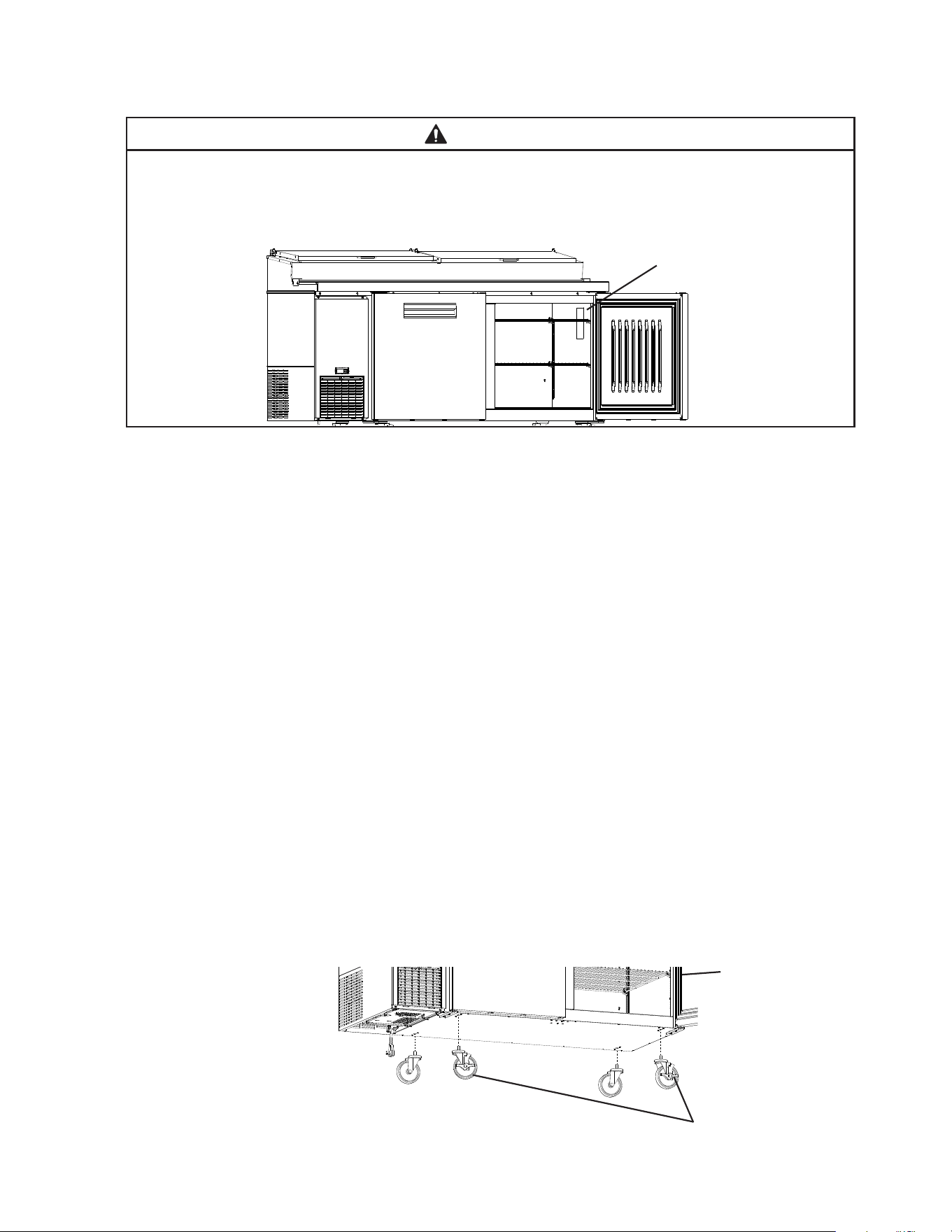
Refer to the nameplate for electrical specications. The nameplate is located on
the right side wall of the cabinet interior. For more electrical connection details, see
"I.F. Electrical Connection." We reserve the right to make specication and design
changes without prior notice.
• Visually inspect the exterior of the shipping package and immediately report any damage
to the carrier. Upon opening the package, any concealed damage should also be
immediately reported to the carrier.
• Remove the shipping carton, tape, and packing material. Also remove the protective plastic
lm from both the exterior panels and the interior door/drawer panel. If the appliance is
exposed to the sun or to heat, remove the lm after the appliance cools.
• Remove all accessory containers before discarding the packing materials. Dispose of all
packing materials in a proper and environmentally responsible manner.
• Check for missing or damaged accessories.
C. Setup
1. Remove the Appliance from the Pallet
1) Move as close to the nal location as possible.
2) Remove the 2 bolts securing the appliance to the pallet, then remove the appliance
from the pallet. Block the appliance securely at a height of 8" (20 cm) off the oor.
NOTICE! Do not place blocks under the refrigeration area or doors/drawers of the
appliance. Do not lay the appliance down.
3) Attach the casters to the bottom of the appliance. Locking casters should be attached
to the front of the appliance. See Fig. 1. NOTICE! Ensure casters are completely
threaded into appliance and tight
Door
Locking Casters in Front
Fig. 1
Nameplate
10
2. Check the Refrigeration Circuit
Visually check that the refrigerant lines do not rub or touch other lines or surfaces and
that the condenser fan blade turns freely.
3. Position the Appliance and Lock the Front Casters
The front casters on the appliance are lockable. After positioning the appliance in its nal
location, lock the front casters.
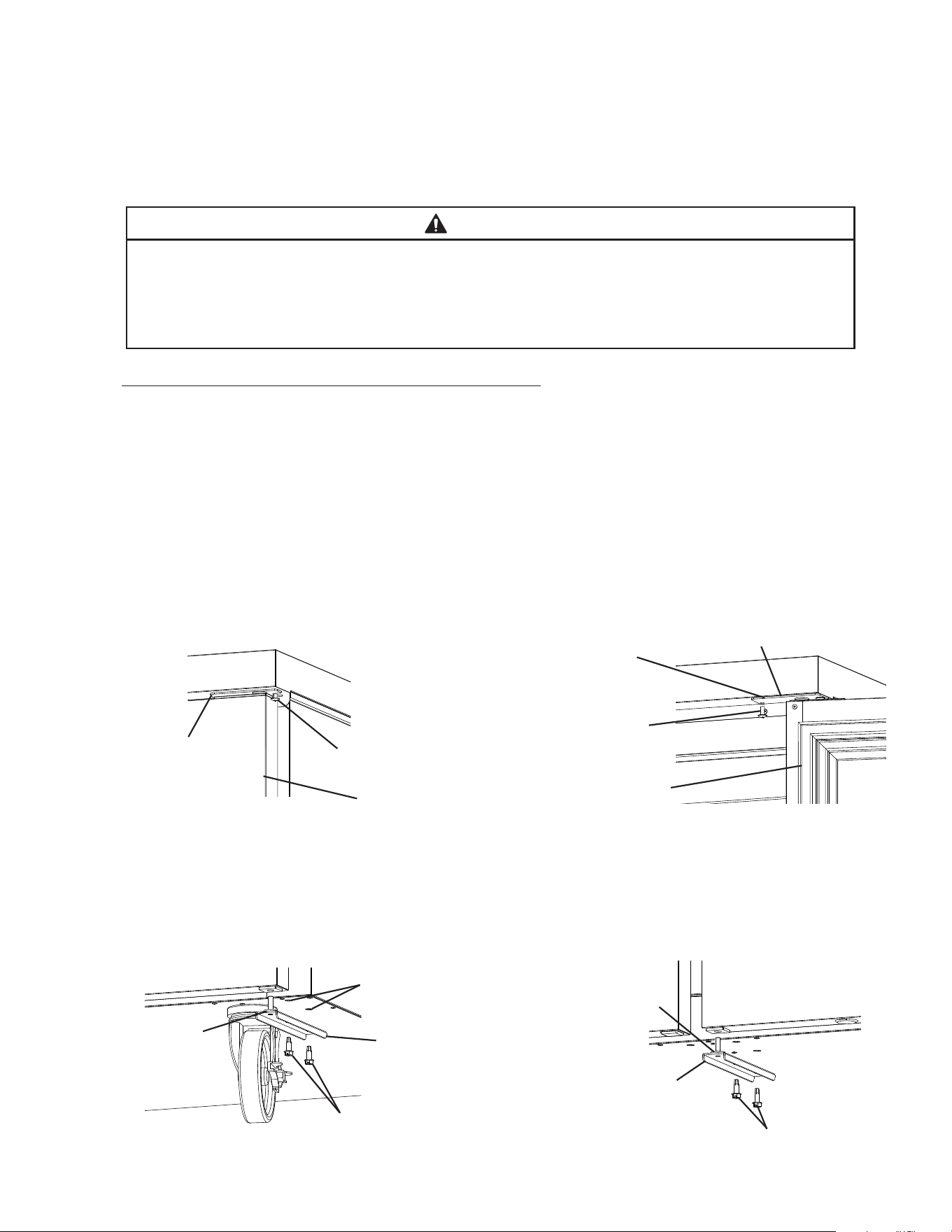
4. For PR46A(-D2) Models, Install the Anti-Tip Bracket
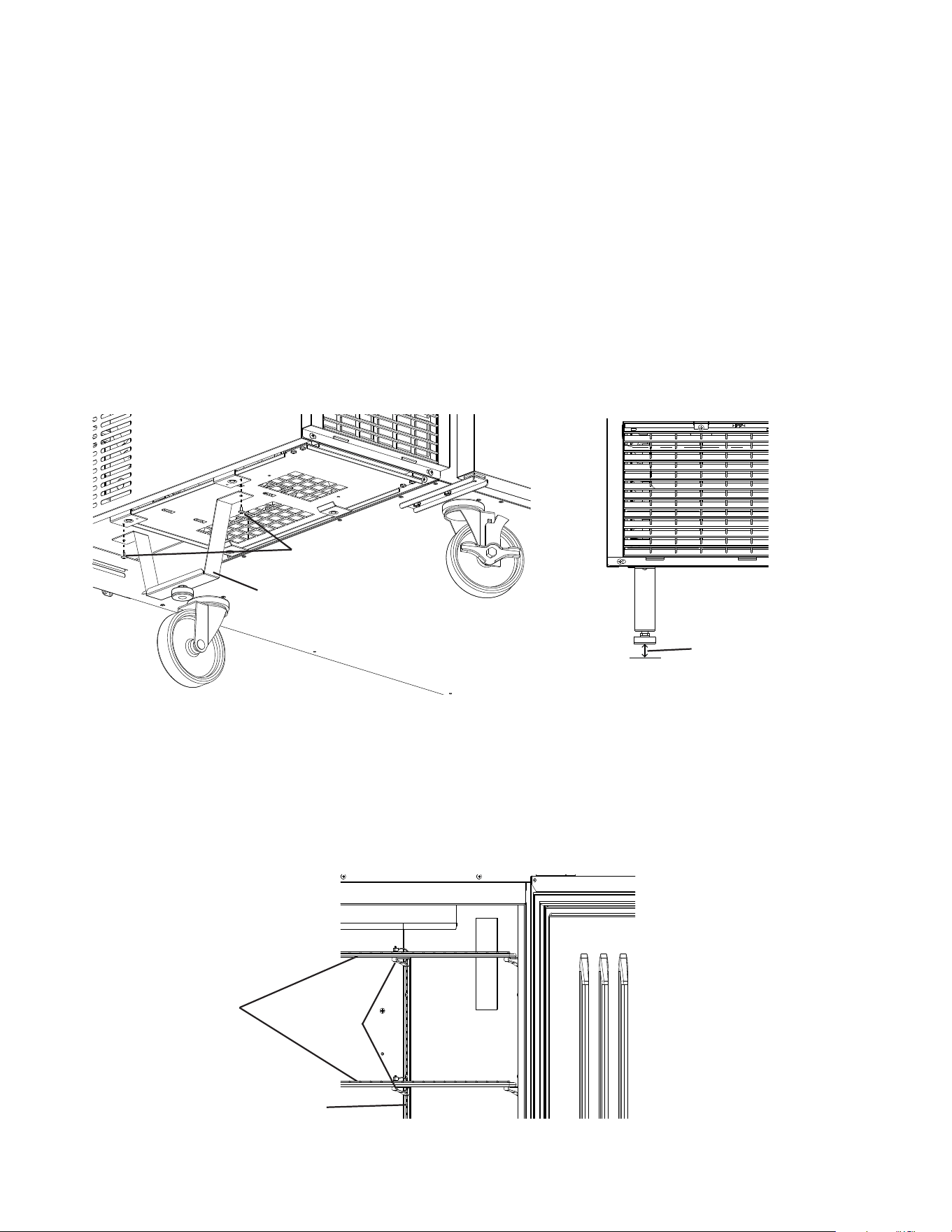
1) Attach the anti-tip bracket to the bottom of the appliance with the two 4×8 T2 screws
provided. See Fig. 2.
2) Adjust the leg on the anti-tip bracket. The maximum gap between the leg and the oor
is 1/2" (13 mm) WARNING! The anti-tip bracket must be properly installed and
adjusted. Otherwise, the unit may tip, resulting in injury or damage.
5. Install the Shelves
1) For each shelf, place the shelf support clips into the pilasters at the desired height
(4 shelf support clips per shelf). See Fig. 3.
2) Place the shelves in position on the support clips.
Fig. 2
Anti-Tip Bracket
4×8 T2 Screws
Adjust Leg
Maximum Gap
Between Leg and
Floor is 1/2" (13 mm)
Fig. 3
Shelf
Support Clip
Pilaster
Shelves
11
6. Conrm Rail Cover Operation
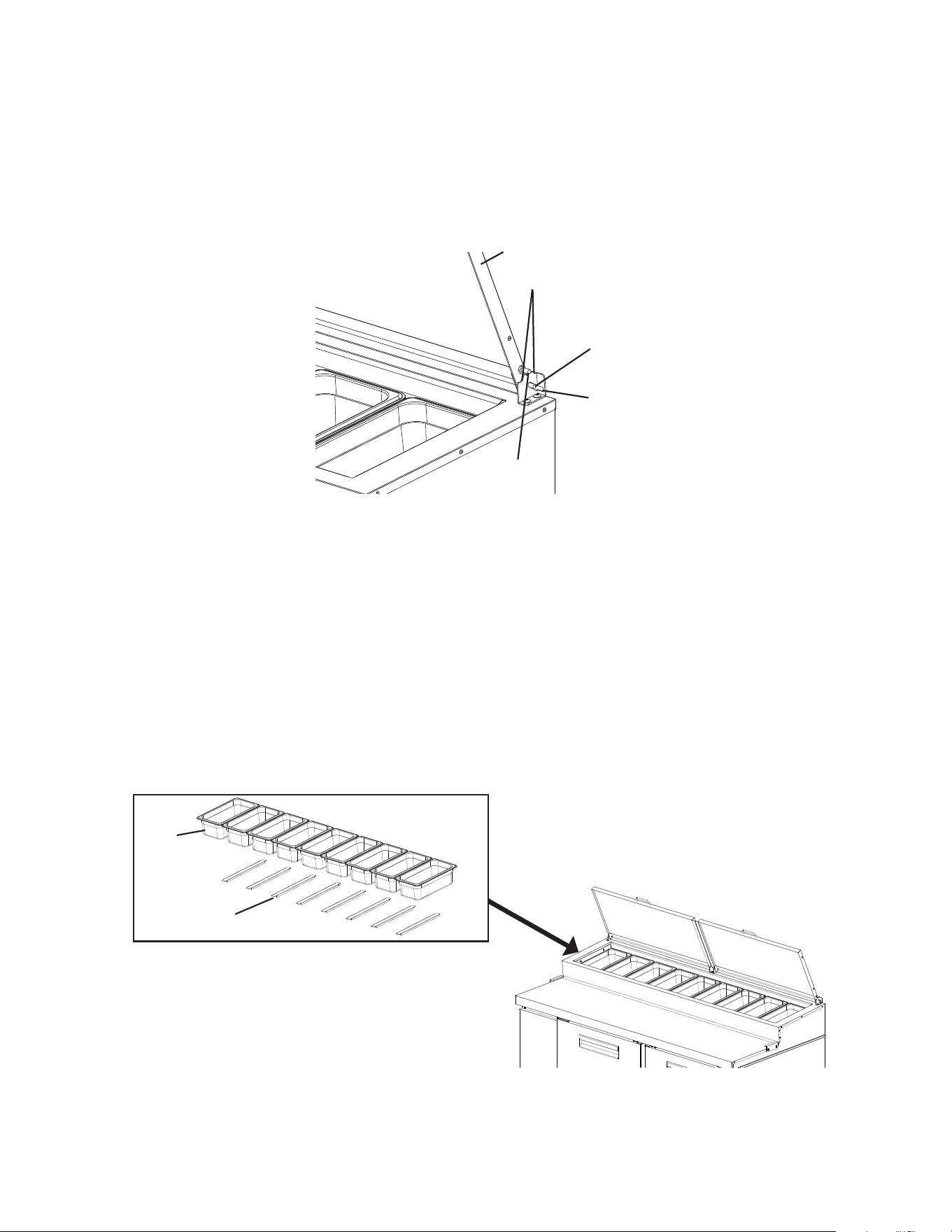
The rail cover's rear pins are inserted into the rear slots on both brackets. Use the rail
cover's front pins and the notches on the brackets to place the rail cover in the open
position. You can use either set of notches. The hollow side of the rail cover faces down.
See Fig. 4. WARNING! When the rail cover is open, make sure the rear pins on both
sides of the rail cover are securely in the rear slots and the front pins are resting
securely in the notches. Otherwise, the rail cover could close suddenly and cause
injury.
7. Conrm Rail Dividers and Pans are in Place
Conrm rail dividers and 1/3 size pans included with the appliance are in place.
See Fig.5.
• The entire rail must always be covered by rail dividers and pans. Otherwise, the
appliance will not cool properly.
• Use only pans up to 6"(15cm) deep. Do not use damaged rail dividers or pans.
• Wash the pans before use.
• At startup, leave the pans empty until the appliance cools down.
• On some models, an extra rail divider is included. Use the extra rail divider if a gap
remains after all pans and all other rail dividers are in place. Some pans on the market
are slightly larger and do not require the extra rail divider.
Fig. 4
Rear Pin
Rear Slot
Front Pin
Notches
Rail Cover
Pans
Rail Dividers
Fig. 5
Model Shown: PR67A
12
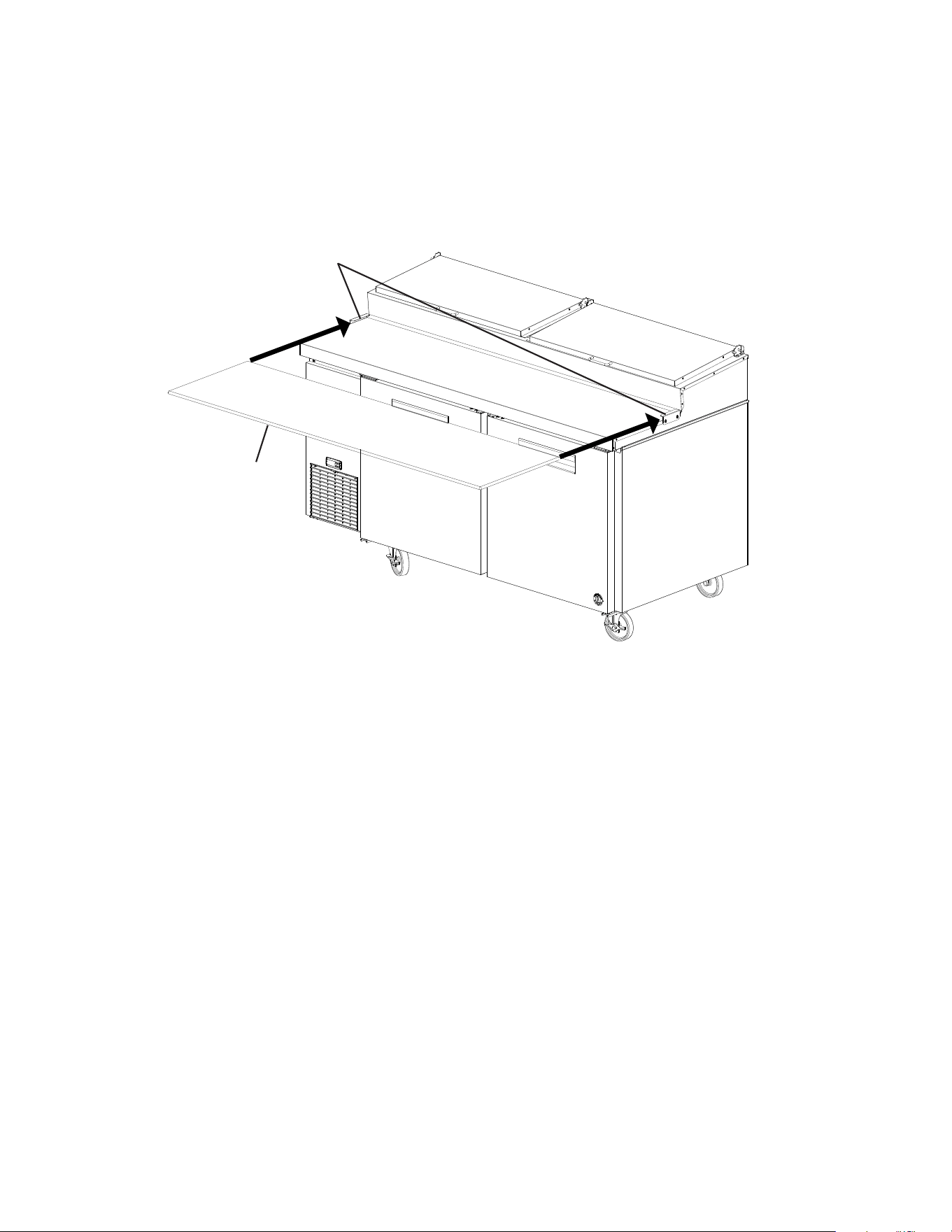
8. Attach the Cutting Board
1) Loosen, but do not remove, the screws securing the cutting board brackets. See Fig. 6.
2) Slide the cutting board under the cutting board brackets, then tighten the screws.
WARNING! Make sure the cutting board brackets and cutting board are secure.
Otherwise, the cutting board could come off and cause injury.
Note: Wash the cutting board before use.
Fig. 6
Cutting Board Brackets
Cutting Board
Model Shown: PR67A
13
D. Door Reversal
The appliance is provided with a cabinet design which, after being delivered to the
installation location, permits changing of the door swing from left to right or right to left. To
change the door swing, follow the steps below. Example shows change from right hinged
to left hinged.
WARNING
• Wear proper PPE (personal protection equipment) when executing these
procedures (safety glasses and gloves).
• Keep ngers away from edge of upper hinge bracket. Spring cartridge can cause
the upper hinge bracket to move suddenly with extreme force.
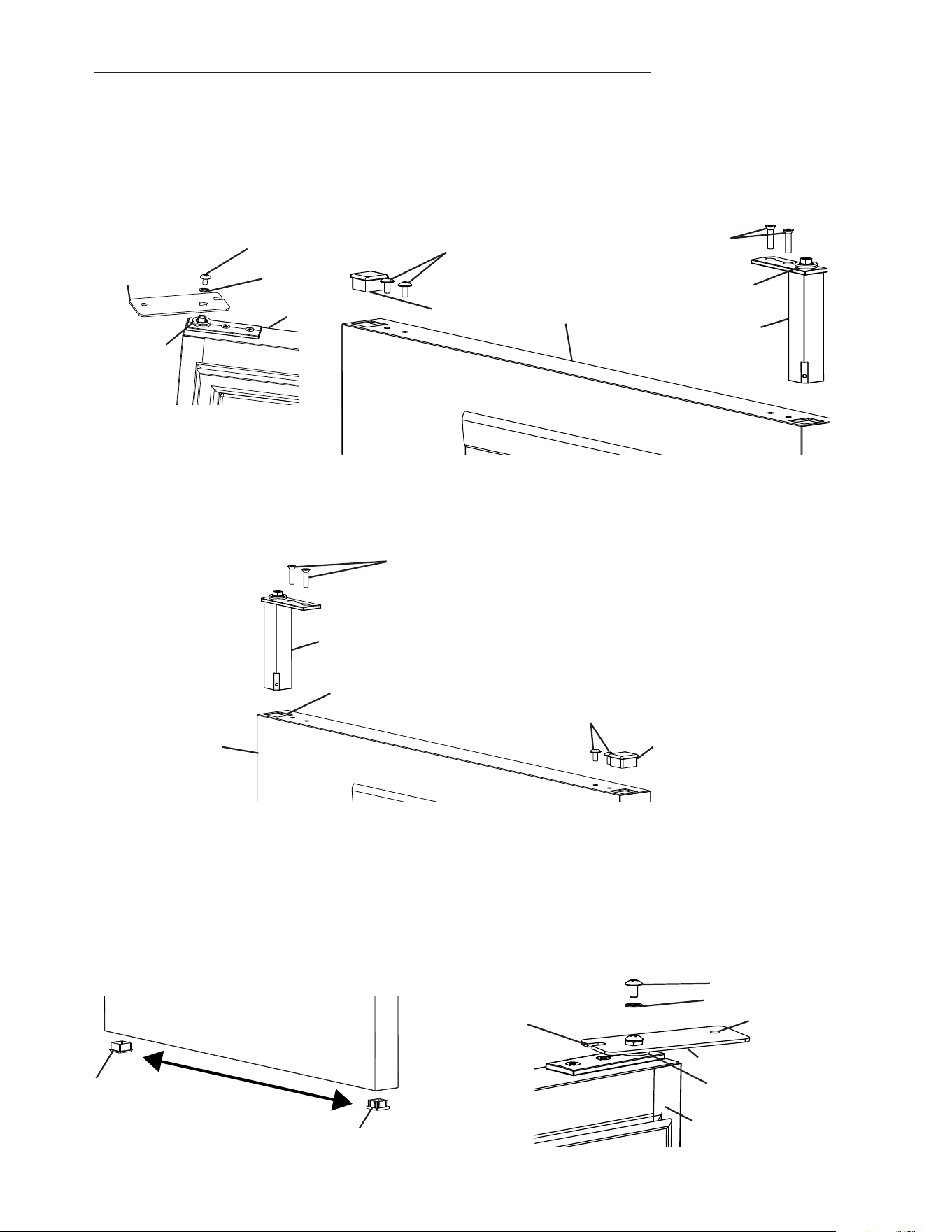
Door and Lower Hinge Removal and Relocation
1) Remove all items from the appliance. Make sure the appliance is unplugged from the
electrical outlet. Move the appliance out for ease of access then lock the casters.
2) With the door closed, loosen, but do not remove, the upper hinge bracket outer screw.
See Fig. 7. Next, open the door to the fully open position and remove the upper hinge
bracket inner screw. See Fig. 8.
3) Slide the upper hinge bracket out from under the outer screw and remove the door.
WARNING! Keep away from upper hinge bracket. Upper hinge bracket may spring
closed.
4) Replace the upper hinge bracket inner screw in its original position and tighten, then
tighten the upper hinge bracket outer screw.
5) Remove the lower hinge bracket. See Fig. 9. Be sure to leave the thrust washer in place.
6) Clear the foam from the lower hinge bracket mounting holes prior to securing lower
hinge bracket in its new location. Install the lower hinge bracket in its new location.
Be sure the lower hinge bracket is pushed all the way in and the thrustwasher is in its
original position.
Lower Hinge Bracket
Fig. 9
Bolts
Thrust
Washer
Fig. 7
Fig. 8
Upper Hinge
Bracket Inner
Screw
Door Fully Open
WARNING! Upper
hinge bracket may
spring closed
Lower Hinge Bracket
Bolts
Thrust Washer
Fig. 10
Upper Hinge Bracket
Outer Screw
Door Closed
Upper Hinge Bracket
Upper Hinge
Bracket
Lower Hinge
Bracket
Mounting Holes
14
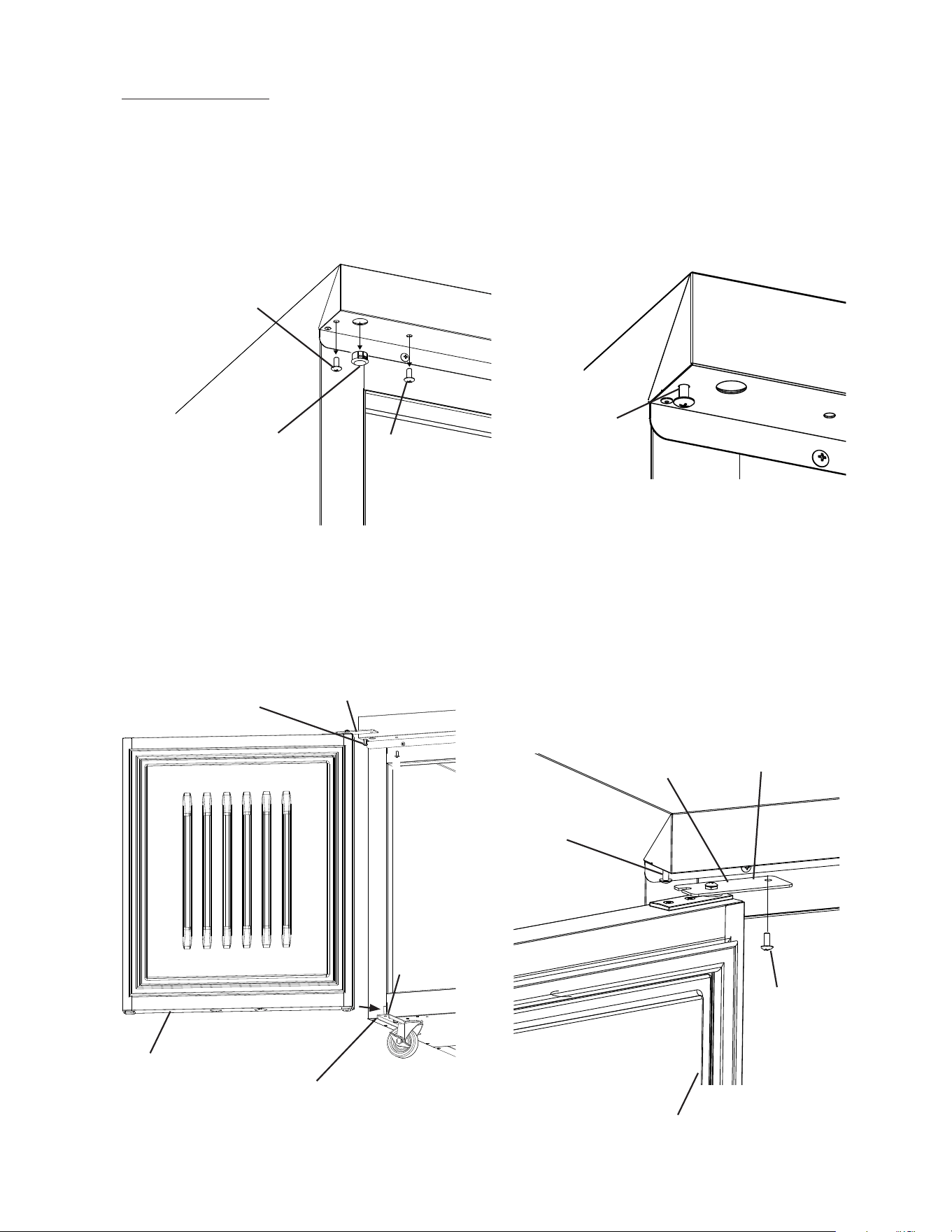
Upper Hinge Bracket Removal and Spring Cartridge Relocation
7) While preventing the upper hinge bracket from rotating, remove the upper hinge bracket
from the spring cartridge. See Fig. 11. Note which side of the upper hinge bracket is
facing up.
8) Remove the ller cap, ller screws, and spring cartridge. See Fig. 12. Leave the thrust
washers in place on the spring cartridge. NOTICE! Spring cartridge may be difficult
to remove. Be careful not to damage the nish.
9) Clear foam from the spring cartridge hole to allow for spring cartridge installation.
See Fig. 13. Install the spring cartridge in its new location. Reinstall the ller cap and
ller screws on the opposite side of the door.
Lower Door Prep and Upper Hinge Bracket Relocation
10) Remove the ller cap and nylon bearing from the bottom of the door. SeeFig.14.
Reinstall on the opposite side.
11) Make sure the thrust washers are in place on the spring cartridge, then ip the upper
hinge bracket over from its original position and install onto the spring cartridge in
the door open position. See Fig. 15. The upper hinge bracket should be positioned as
shown.
Upper Hinge
Bracket
Door
Fig. 11
Screw
Washer
Filler Cap
Door
Spring Cartridge
Filler Screws
Thrust Washers
Screws
Fig. 12
Filler Screws
Filler Cap
Door
Spring Cartridge
Screws
Fig. 13
Upper Hinge Bracket
Inside of
Door
Screw
Washer
Fig. 14
Fig. 15
Filler Cap
Nylon Bearing
Thrust Washers
Upper Hinge
Bracket Inner
Screw Hole
Spring Cartridge Hole
Upper Hinge
Bracket Outer
Screw Slot
Thrust
Washers
15
Door Installation
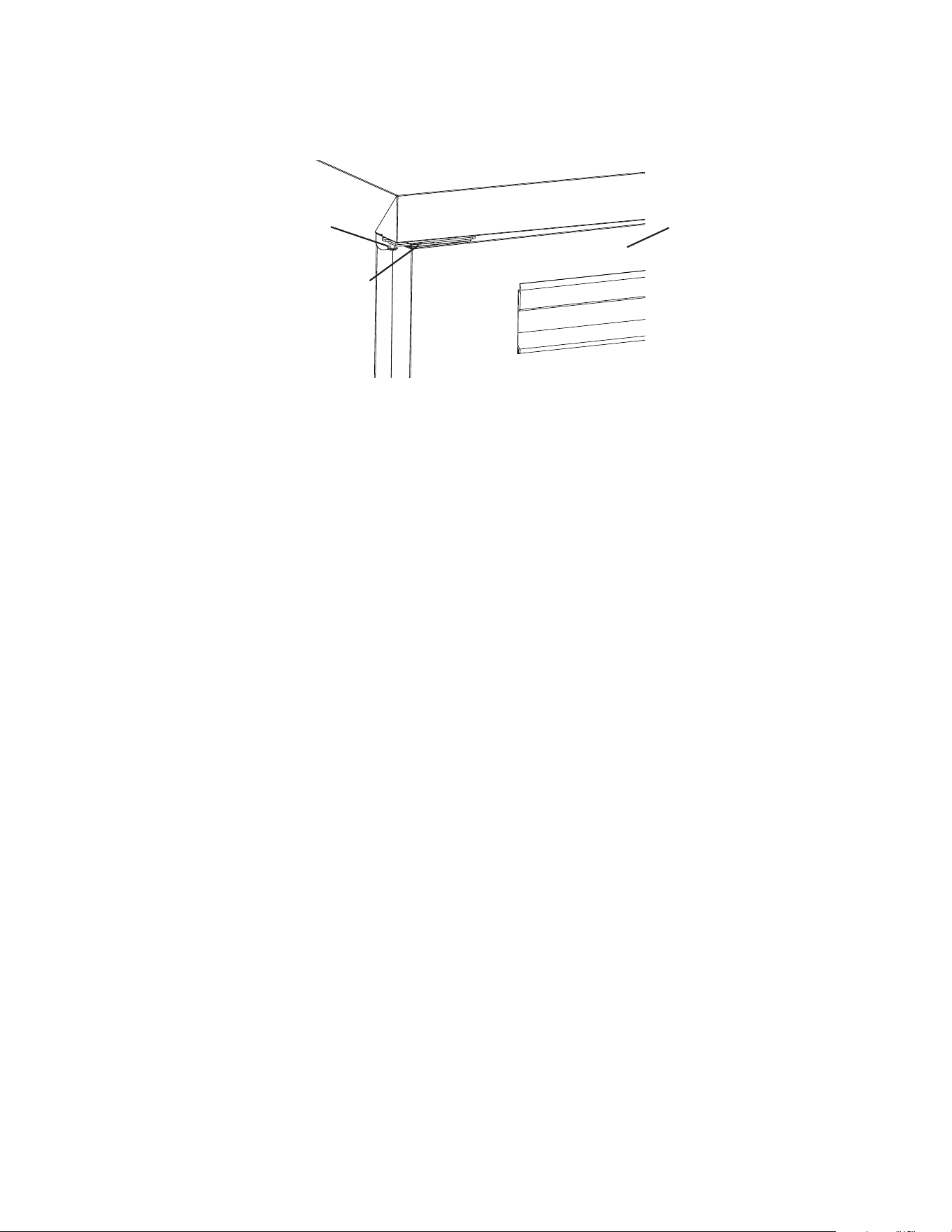
12) Remove the black plastic ller cap located from the hole above where the spring
cartridge screw will line up. Note: The black plastic ller cap is not reusable.
13) Remove the upper hinge bracket screws from the new location and apply Loctite
Threadlocker Blue 242 or 243 to the threads. Next, start the upper hinge bracket
outer screw into the appliance. Rotate a few threads into the appliance; do not tighten
thescrew. See Fig. 16.
14) Be sure the lower hinge bracket thrust washer is in place, then place the door on the
lower hinge bracket in the fully open position. Slide the door upper hinge bracket outer
slot onto the upper hinge bracket outer screw. See Fig. 17.
15) Install the upper hinge bracket inner screw and tighten.
Fig. 16
Fig. 17
Door Fully Open
Lower Hinge Bracket
Upper Hinge Bracket
Outer Screw
Upper Hinge
Bracket Outer
Screw
Door Fully Open
Upper Hinge
Bracket
Upper Hinge
Bracket Inner
Screw
Upper Hinge Bracket
Outer Screw
Upper Hinge
Bracket Inner
Screw
Black Plastic Filler Cap
Upper Hinge
Bracket Outer
Screw
Upper Hinge
Bracket
WARNING! Upper
hinge bracket may
spring closed
Thrust
Washer
16
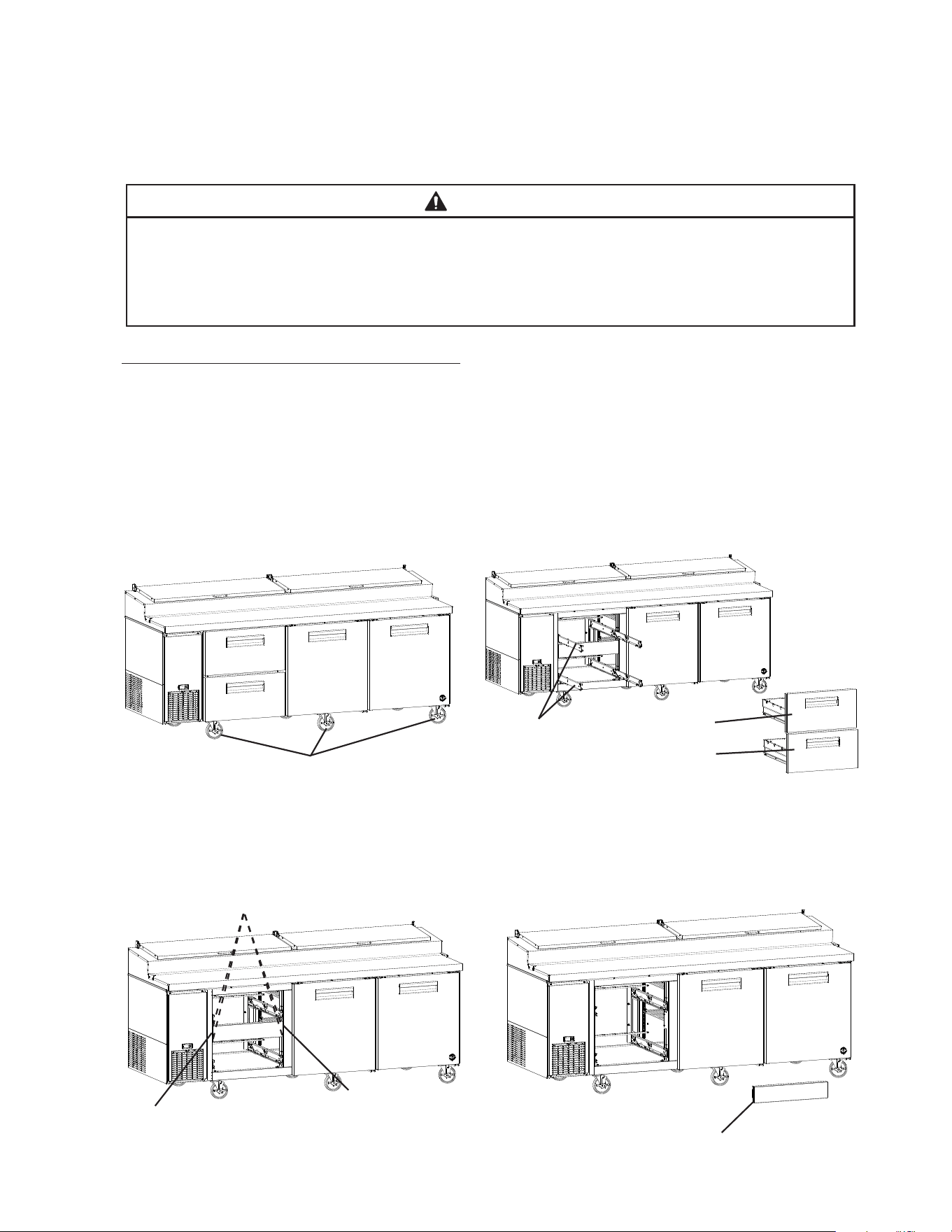
16) Close the door and tighten the upper hinge bracket outer screw.
See Fig. 18.
17) Check the door operation to assure it opens and closes properly. Note: Hold door at
45°angle from closed position and release. Door should close on its own. If not, adjust
hinge bracket.
18) Unlock the casters and move the appliance back into its original position. Lock the
casters once in position, then plug the appliance back into the electrical outlet. Allow the
appliance to cool down prior to putting product back in.
Fig. 18
Upper Hinge
Bracket
Upper Hinge Bracket
Outer Screw
Door Fully Closed
17
E. Door/Drawer Reversal
The appliance is provided with a cabinet design which, after being delivered to the
installation location, permits changing of the drawer and door locations. To change the
drawer and door locations, follow the steps below.
WARNING
• Wear proper PPE (personal protection equipment) when executing these
procedures (safety glasses and gloves).
• Keep ngers away from edge of upper hinge bracket. Spring cartridge can cause
the upper hinge bracket to move suddenly with extreme force.
Drawer and Drawer Cartridge Removal
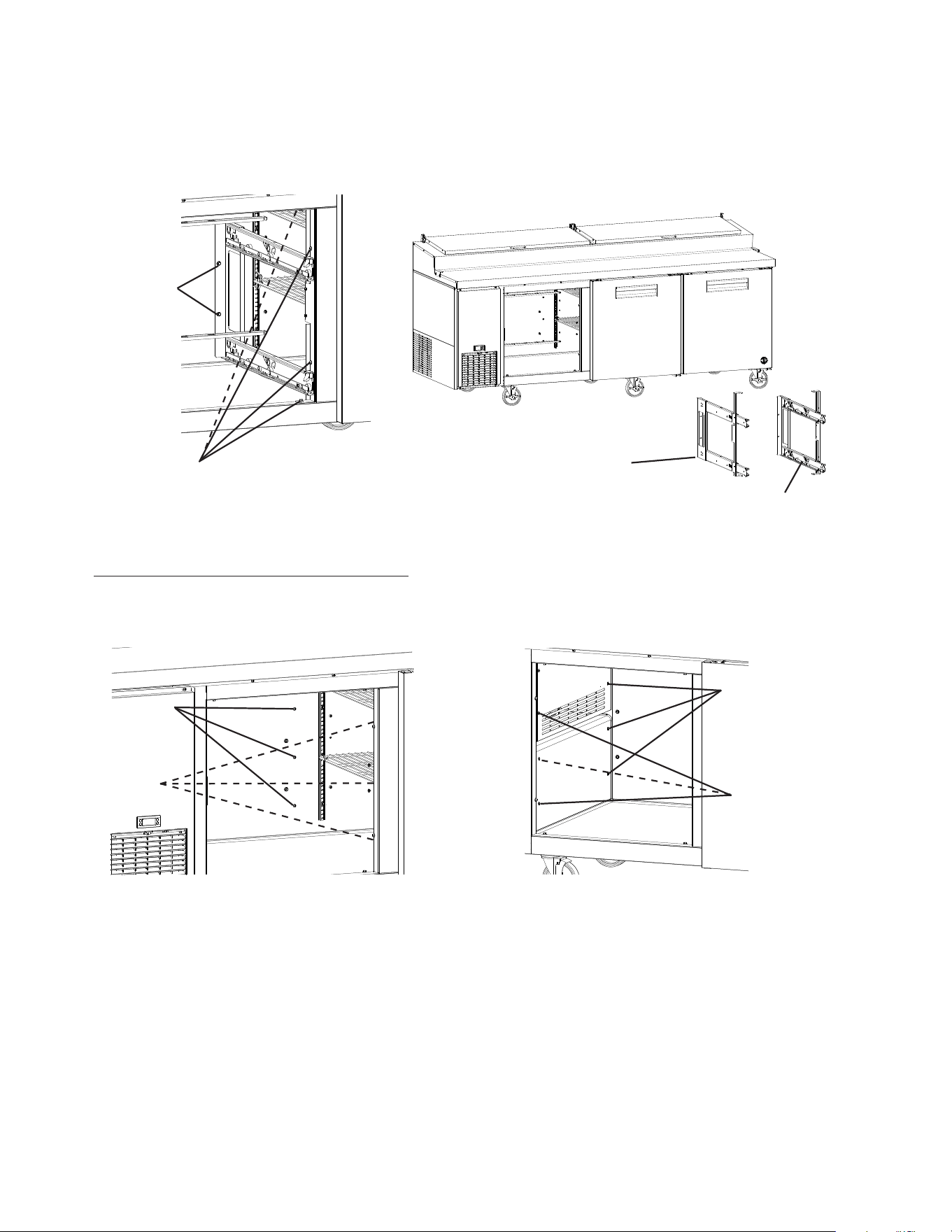
1) Remove all items from the appliance. Make sure the appliance is unplugged from the
electrical outlet. Move the appliance out for ease of access then lock the casters.
See Fig. 19.
2) Remove the drawers. Pull the drawer out to its fully extended position. Open the safety
clips (one on each side) by sliding them forward. Lift up slightly and remove them from
the drawer cartridge. See. "III.A.5. Drawers" for reference. Be sure to note which is the
upper drawer and which is the lower drawer.
3) Remove the 4 mullion screws, then cut the front mullion silicone loose and remove the
mullion. See Fig. 20.
Fig. 20
Mullion Screws
Mullion Silicone
Mullion Silicone
Mullion
Fig. 19
Upper Drawer
Lower Drawer
Drawer
Cartridge
Casters
18
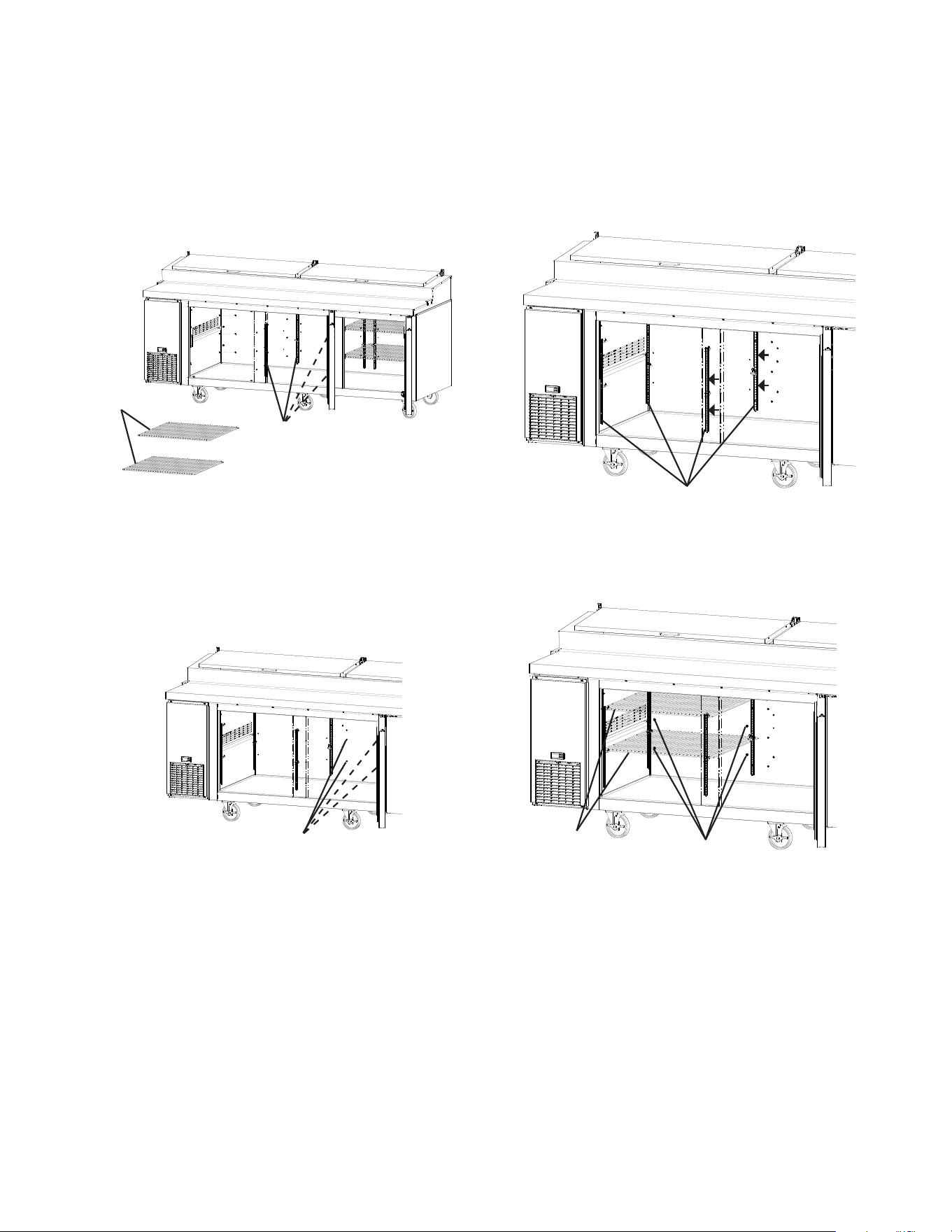
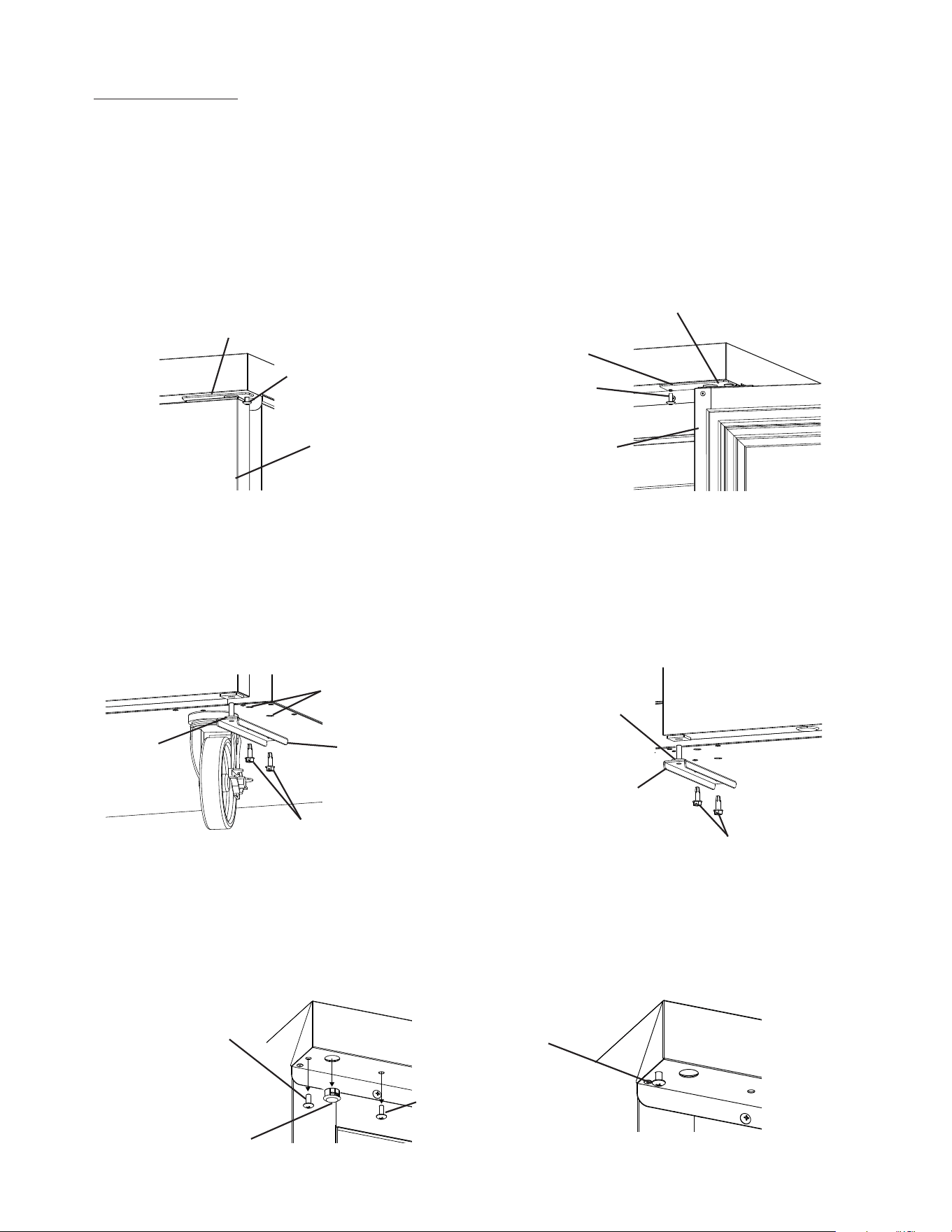
4) Remove the 4 rear screws from the left and right drawer cartridge frames
(2 per side). See Fig. 21.
5) Remove the 8 front screws from the left and right drawer cartridge frames (4 per side),
then remove the cartridge frames from the unit.
Pilaster and Filler Screw Relocation
6) Remove the 12 pilaster ller screws from the current drawer section. See Fig. 22.
Fig. 21
Fig. 22
Rear Pilaster
Filler Screws
Rear Screws
Front Screws
Left Drawer
Cartridge Frame
Right Drawer
Cartridge Frame
Front Pilaster
Filler Screws
Rear Pilaster
Filler Screws
Front Pilaster
Filler Screws
19
7) Remove the shelves from the door section, then remove the pilasters and place and
secure them in the new location (current drawer location). See Fig. 23. Note: Other than
in a center location, outer pilasters mount on the side wall not the rear wall.
8) Place and secure the pilaster ller screws removed in step 6 into the new drawer
location (current door location).
9) Remove the drawer cartridge frame rear ller screws from the new location (current
door location). Place the drawer cartridge frame ller screws in the new door location
and tighten. Replace the shelves. See Fig. 24.
Shelves
Pilasters
Pilasters
Fig. 23
Rear Filler
Screws
Shelves
Rear Filler
Screws
Fig. 24
20
Door Relocation
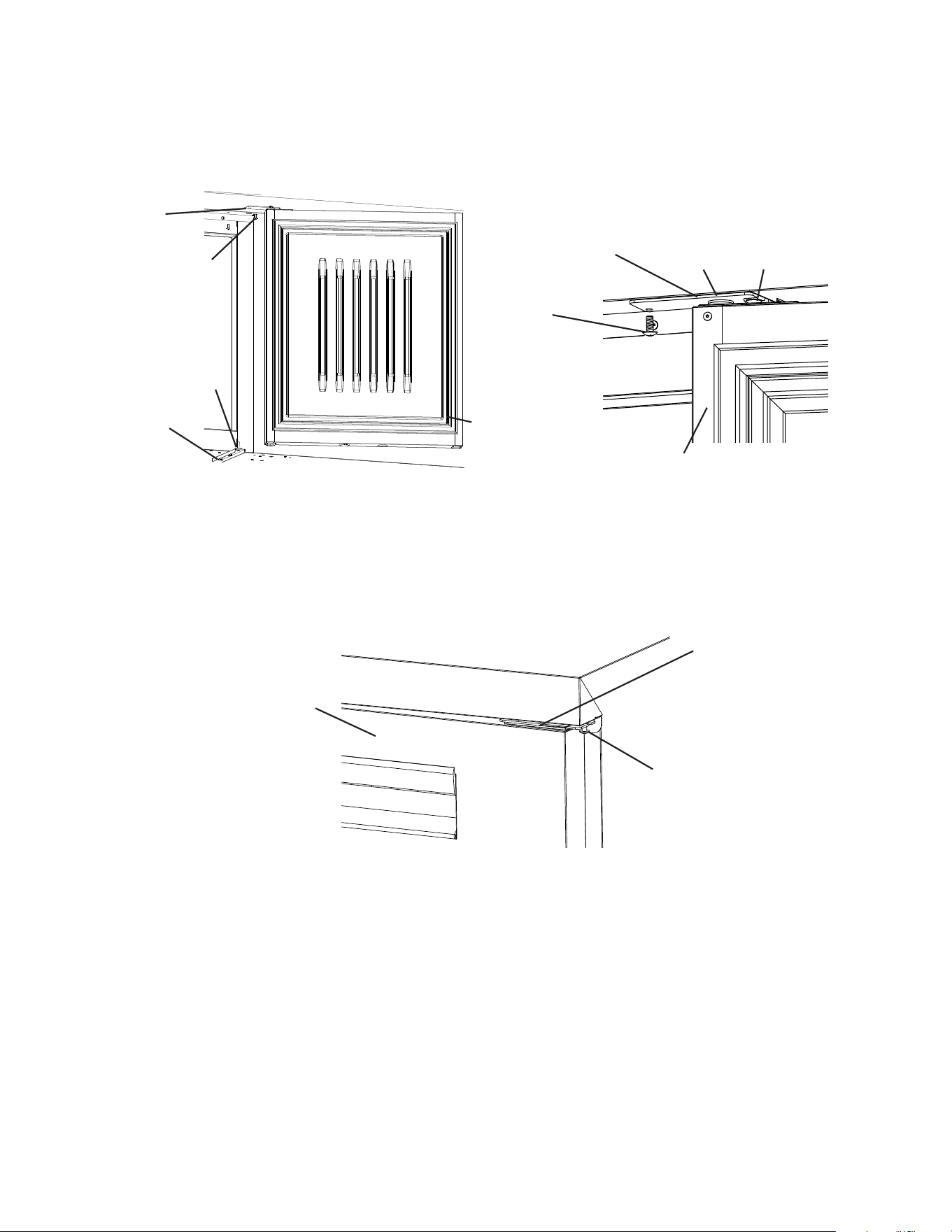
10) With the door closed, loosen, but do not remove, the upper hinge bracket outer screw.
See Fig. 25. Next, open the door to the fully open position and remove the upper hinge
bracket inner screw. See Fig. 26.
11) Slide the upper hinge bracket out from under the outer screw and remove the door.
WARNING! Keep away from upper hinge bracket. Upper hinge bracket may spring
closed.
12) Replace the upper hinge bracket inner screw in its original position and tighten, then
tighten the upper hinge bracket outer screw.
13) Remove the lower hinge bracket. See Fig. 27. Be sure to leave the thrust washer in
place.
14) Clear the foam from the lower hinge bracket mounting holes prior to securing the lower
hinge bracket in its new location. Install the lower hinge bracket in its new location. Be
sure the lower hinge bracket is pushed all the way in and the thrust washer is in its
original position.
15) Remove the black plastic ller cap located from the hole above where the spring
cartridge screw will line up. Note: The black plastic ller cap is not reusable.
16) Remove the upper hinge bracket screws from the new location and apply Loctite
Threadlocker Blue 242 or 243 to the threads. Next, start the upper hinge bracket
outer screw into the appliance. Rotate a few threads into the appliance; do not tighten
thescrew. See Fig. 28.
Upper Hinge
Bracket Outer
Screw
Door Closed
Upper Hinge
Bracket Inner
Screw
Door Fully Open
WARNING! Upper
hinge bracket may
spring closed
Lower Hinge Bracket
Bolts
Thrust
Washer
Lower Hinge Bracket
Bolts
Thrust Washer
Fig. 25
Fig. 27
Fig. 28
Upper Hinge Bracket
Upper Hinge Bracket
Upper Hinge Bracket
Outer Screw
Upper Hinge
Bracket Inner
Screw
Black Plastic Filler Cap
Upper Hinge
Bracket Outer
Screw
Fig. 26
Lower Hinge
Bracket
Mounting Holes
21
17) Be sure the lower hinge bracket thrust washer is in place, then place the door on the
lower hinge bracket in the fully open position. Slide the door upper hinge bracket outer
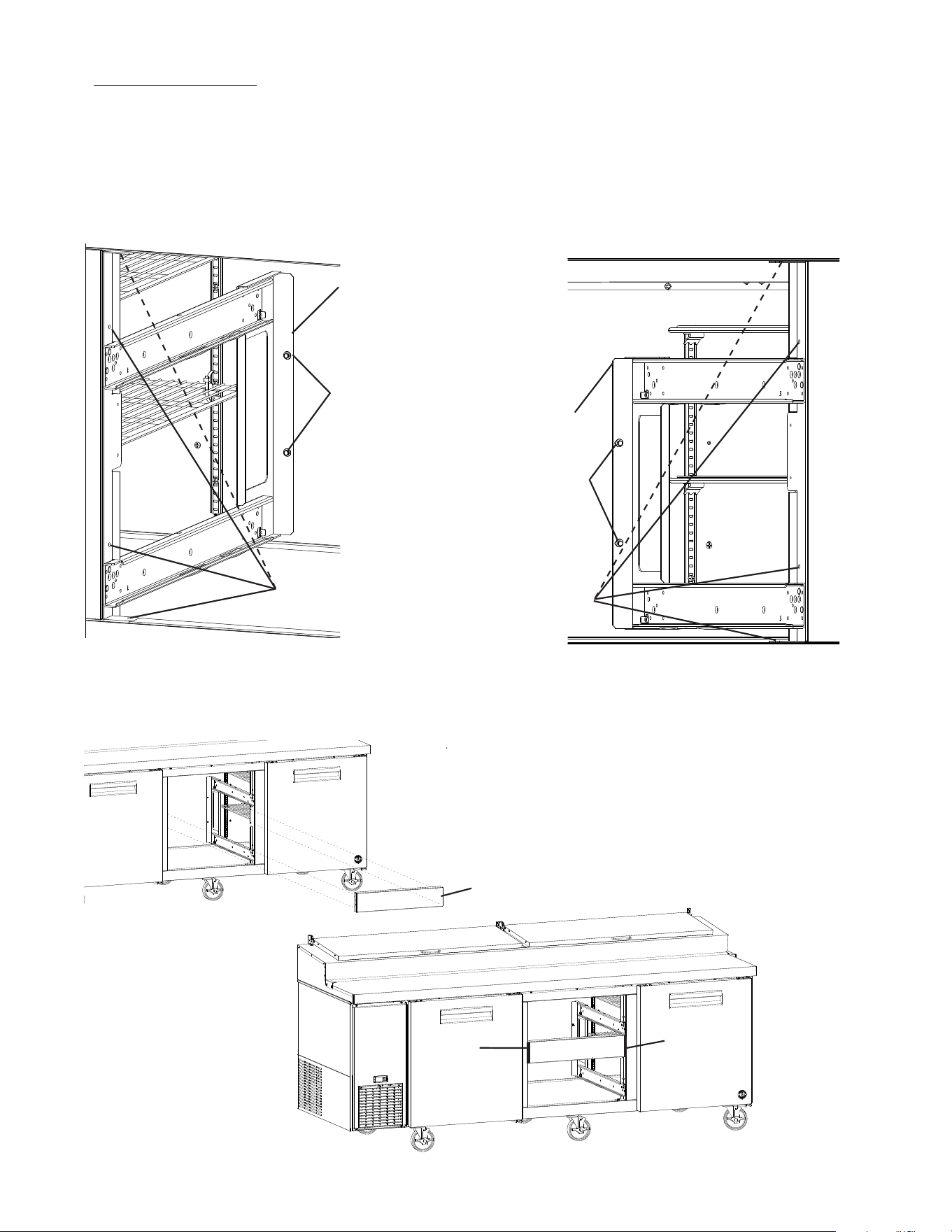
slot onto the upper hinge bracket outer screw. See Fig. 29.
18) Install the upper hinge bracket inner screw and tighten.
19) Close the door and tighten the upper hinge bracket outer screw. See Fig. 30.
20) Check the door operation to assure it opens and closes properly. Note: Hold door at
45°angle from closed position and release. Door should close on its own. If not, adjust
hinge bracket.
Upper Hinge
Bracket Inner
Screw
Door Fully Open
WARNING! Upper
hinge bracket may
spring closed
Fig. 29
Upper Hinge
Bracket Outer
Screw
Upper Hinge
Bracket Outer
Screw
Door Fully
Open
Lower Hinge
Bracket
Upper Hinge
Bracket
Thrust Washer
Upper Hinge
Bracket
Upper Hinge Bracket
Outer Screw
Upper Hinge Bracket
Door Fully Closed
Fig. 30
22
Drawer Relocation
21) Place a drawer cartridge frame in place and secure to the rear panel with screws
removed in step 4. See Fig. 31.
22) Using a 1/8" drill bit, drill pilot holes in all 4 front mounting holes.
23) Secure the drawer cartridge to the appliance with the screws removed in step 5.
24) Repeat steps 21 through 23 for the opposite side drawer cartridge frame.
25) Place the mullion in its correct position and secure with screws removed in step3.
26) Place a bead of food grade silicone down the 2 outside vertical gaps between the
mullion and appliance. See Fig. 32.
Left Drawer
Cartridge Frame
Front Screws
Rear Screws
Fig. 31
Right Drawer
Cartridge Frame
Front Screws
Rear Screws
Fig. 32
Mullion
Silicone
Location for
Mullion
Silicone
Location for
Mullion
23
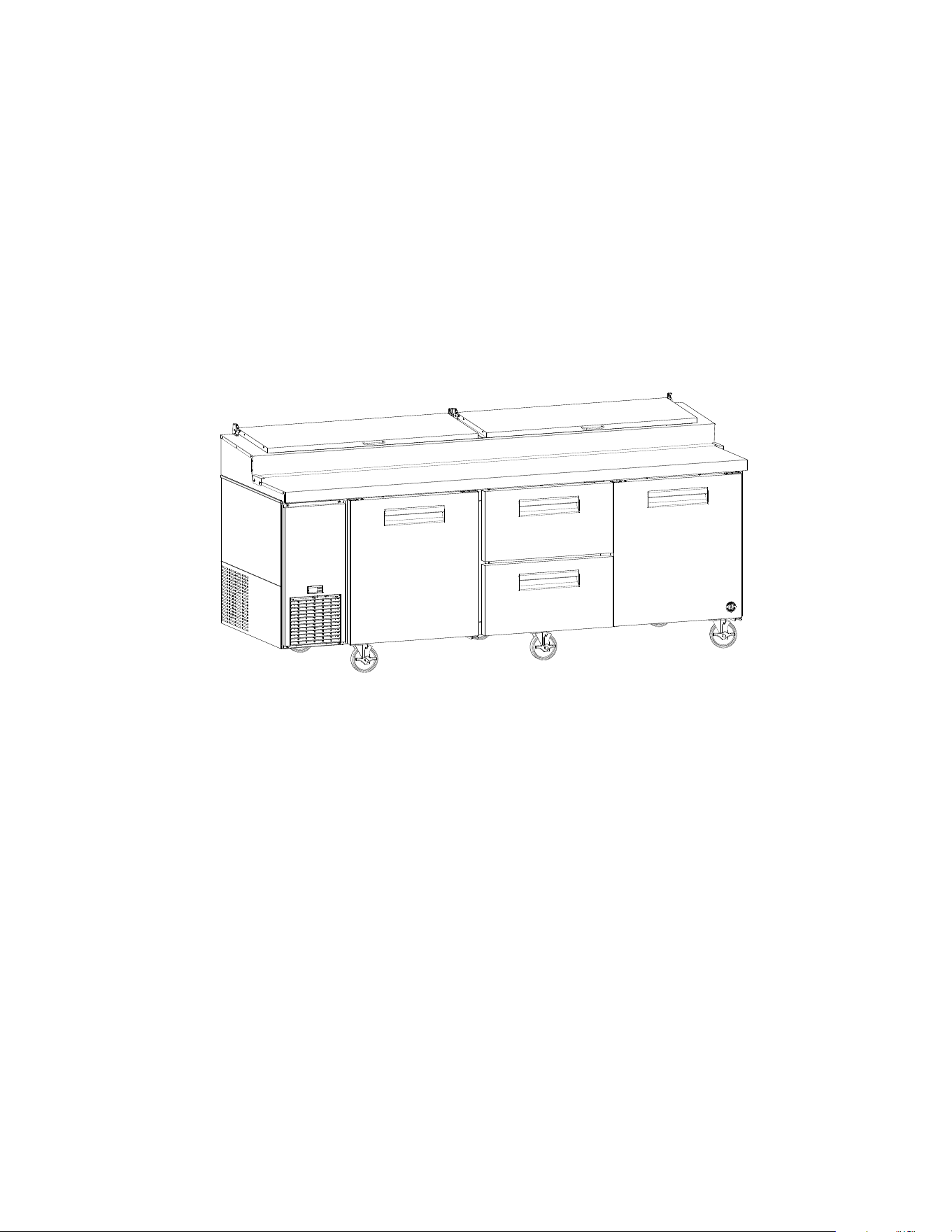
27) Place the lower drawer in the lower drawer slides and the upper drawer in the upper
drawer slides. See Fig. 33. WARNING! Be sure to close the safety clips when
reinstalling the drawer.
28) Make sure all gaskets are making good contact. Using a ashlight, check that there are
no openings around all gaskets.
29) Unlock the casters and move the appliance back into its original position. Lock the
casters once in position, then plug the appliance back into the electrical outlet. Allow the
appliance to cool down prior to putting product back in.
Fig. 33
24
F. Electrical Connection
WARNING
• Electrical connection must meet national, state, and local electrical code
requirements. Failure to meet these code requirements could result in death,
electric shock, serious injury, re, or severe damage to equipment.
• The appliance requires an independent power supply of proper capacity. See the
nameplate for electrical specications. Failure to use an independent power supply
of proper capacity can result in a tripped breaker, blown fuse, damage to existing
wiring, or component failure. This could lead to heat generation or re.
• THE APPLIANCE MUST BE GROUNDED. The appliance is equipped with a
NEMA5-15 three-prong grounding plug to reduce the risk of potential shock
hazards. It must be plugged into a properly grounded, independent 3-prong wall
outlet. If the outlet is a 2-prong outlet, it is your personal responsibility to have a
qualied electrician replace it with a properly grounded, independent 3-prong wall
outlet. Do not remove the ground prong from the power cord and do not use an
adapter plug. Failure to follow these instructions may result in death, electric shock,
or re.
• Risk of electric shock. Appliance in the off position does not de-energize all loads
Use extreme caution and exercise safe electrical practices.
• Do not use an extension cord.
• Do not use an appliance with a damaged power cord. The power cord should not
be altered, jerked, bundled, weighed down, pinched, or tangled. Such actions could
result in electric shock or re. To unplug the appliance, be sure to pull the plug, not
the cord, and do not jerk the cord.
• The GREEN ground wire in the factory-installed power cord is connected to the
appliance. If it becomes necessary to remove or replace the power cord, be sure to
connect the power cord's ground wire.
• Usually an electrical permit and services of a licensed electrician are required.
• The maximum allowable voltage variation is ±10 percent of the nameplate rating.

25
G. Final Checklist
1) Is the appliance level?
2) Have the casters been properly installed and have the front casters been locked?
For PR46A(-D2) models, has the anti-tip bracket been properly installed and adjusted?
3) Is the appliance in a site where the ambient temperature is constantly within 45°F to
86°F (7°C to 30°C)?
4) Have the shipping carton, tape, and packing material been removed from the
appliance? Hasthe protective plastic lm been removed from both the exterior panels
and the interior door/drawer panel?
5) Have the appliance and accessories been checked for shipping damage?
6) Is there at least 1" (3 cm) clearance at sides for proper air circulation? Are the
factory-installed rear bumpers in place to ensure proper rear clearance? Is there at least
10"(25cm) clearance above the rail to allow the rail cover to open?
7) Have the rail dividers, pans, rail cover, cutting board brackets, and cutting board been
properly installed?
8) Has the power supply voltage been checked or tested against the nameplate rating?
Is the power supply a properly grounded, independent wall outlet? Does the electrical
connection meet all national, state, and local code and regulation requirements.
9) Have the refrigerant lines been checked to make sure they do not rub or touch other
lines or surfaces? Has the condenser fan blade been checked to make sure it turns
freely? Is the compressor securely attached?
10) Have the shelves been adjusted to the desired height?
11) Has the end user been given the instruction manual, and instructed on how to operate
the appliance and the importance of the recommended periodic maintenance?
12) Has the end user been given the name and telephone number of an authorized service
agent?
13) Has the warranty card been lled out and forwarded to the factory for warranty
registration?
26
II. Operating Instructions
A. Important Notes About Usage
DANGER
Risk of Fire or Explosion
Flammable Refrigerant Used
• Do not use mechanical devices to defrost.
• Do not puncture refrigerant tubing. Risk
of re or explosion due to puncture
of refrigerant tubing; follow handling
instructions carefully.
• Do not place any potential ignition sources
in or near the appliance.
Risque De Feu Ou D'Explosion
Le Frigorigène Est Inammable
• Ne pas utiliser d'appareils mécaniques
pour dégivrer le réfrigérateur.
• Ne pas perforer la tubulure contenant le
frigorigène. Risque de feu ou d'explosion
si la tubulure contenant le frigorigène
est perforée; suivre les instructions de
manutention avec soin.
• Ne placez aucune source d’inammation
potentielle dans ou près de l’appareil.
• The appliance is not intended for use by
persons (including children) with reduced
physical, sensory, or mental capabilities,
or lack of experience and knowledge,
unless they have been given supervision
or instruction concerning use of the
appliance by a person responsible for
their safety.
• Children should be properly supervised
around the appliance.
• Do not climb, stand, or hang on the
appliance or doors/drawers or allow
children or animals to do so. Do not climb
into the appliance or allow children or
animals to do so. Death or serious injury
could occur or the appliance could be
damaged.
• Be careful not to pinch ngers when
opening and closing the doors/drawers
or rail cover or when handling food pans.
Be careful when opening and closing the
doors/drawers or rail cover when children
are in the area.
• Open and close the doors/drawers and
rail cover with care. Opening the doors/
drawers or rail cover too quickly or
forcefully may cause injury or damage to
the appliance or surrounding equipment.
• Do not use combustible spray or place
volatile or ammable substances in or
near the appliance. They might catch re.
• Keep the area around the appliance clean.
Dirt, dust, or insects in the appliance
could cause harm to individuals or
damage to the equipment.
• Do not throw anything onto the shelves
or load any single shelf with more than
120lb. (54.5 kg) of product. They might fall
off and cause injury.
• Do not load any single drawer with more
than 75 lb. (34 kg) of product. Depending
on the weight of product in the drawers,
secure the unit as necessary to prevent it
from overturning. Do not open more than
one drawer at a time.
WARNING
• Only qualied service technicians should
install and service the appliance.
• Wear appropriate personal protective
equipment (PPE) when servicing the
appliance.
• Failure to install, operate, and maintain
the appliance in accordance with this
manual may adversely affect safety,
performance, component life, and
warranty coverage.
• To reduce the risk of electric shock, do
not touch the plug with damp hands.
• Do not splash, pour, or spray water
directly onto or into the appliance. This
might cause short circuit, electric shock,
corrosion, or failure.
27
WARNING, continued
• The appliance is designed only for
temporary storage of food. Employ
sanitary methods. Use for any other
purposes (for example, storage of
chemicals or medical supplies such
as vaccine and serum) could cause
deterioration of stored items.
• Do not block air inlets or outlets, otherwise
cooling performance may be reduced.
• Do not tightly pack the cabinet. Allow
some space between items to ensure
good air ow. Also allow space between
items and interior surfaces.
• Do not put warm or hot foods in the
cabinet. Let them cool rst, or they will
raise the cabinet temperature and could
deteriorate other foods in the cabinet or
overload the appliance.
• Food storage and handling must comply
with applicable codes and regulations.
• All foods should be wrapped in plastic
lm or stored in sealed containers.
Otherwise foods may dry up, pass their
smells onto other foods, cause frost
to develop, result in poor appliance
performance, or increase the likelihood of
cross-contamination. Certain dressings
and food ingredients, if not stored in
sealed containers, may accelerate
corrosion of the evaporator, resulting in
failure.
• Do not store items near air outlets.
Otherwise, items may freeze up and
crack or break causing a risk of injury or
contamination of other food.
• The entire rail must always be covered
by rail dividers and pans. Otherwise, the
appliance will not cool properly. Use only
pans up to 6"(15cm) deep. Do not use
damaged rail dividers or pans.
• Ingredients must be pre-chilled to 37°F
(3°C) or less before placing in rail.
• Keep the rail cover closed when not
actively preparing food.
• The rail is for keeping ingredients cool
while preparing food. If not actively
preparing food for a long period such
as overnight, seal pans with plastic
wrap in addition to closing the rail cover.
Depending on conditions, the cabinet
temperature setting may need to be
adjusted to prevent items from freezing.
Alternatively, seal ingredients and store
them in a refrigerator or freezer.
28
NOTICE
• Protect the oor when moving the
appliance to prevent damage to the oor.
• Keep ventilation openings, in the
appliance enclosure or in the built-in
structure, clear of obstruction. Do not
place anything on top of the appliance
in an undercounter installation. There
must be at least 1.5" (4 cm) overhead
clearance for proper ventilation. The
factory-installed rear bumpers must be
in place to ensure proper rear clearance.
Blockage of airow could negatively
affect performance and damage the
appliance.
• Do not allow the appliance to bear any
outside weight.
• To prevent deformation or cracks, do not
spray insecticide onto the plastic parts or
let them come into contact with oil.
• To avoid damage to the gasket, use only
the door/drawer handle when opening
and closing.
• To avoid damage to the top seal, do not
lift the appliance by the top panel or
remove the top panel.
• Do not leave the doors/drawers open.
• Do not place anything on top of the rail
hood or rail cover and do not lift the
appliance by the rail hood or rail cover.
The rail cover is not designed to bear
any outside weight.
• Do not place anything on the air duct
panels beneath the pans in the rail. The
air duct panels are not load-bearing.
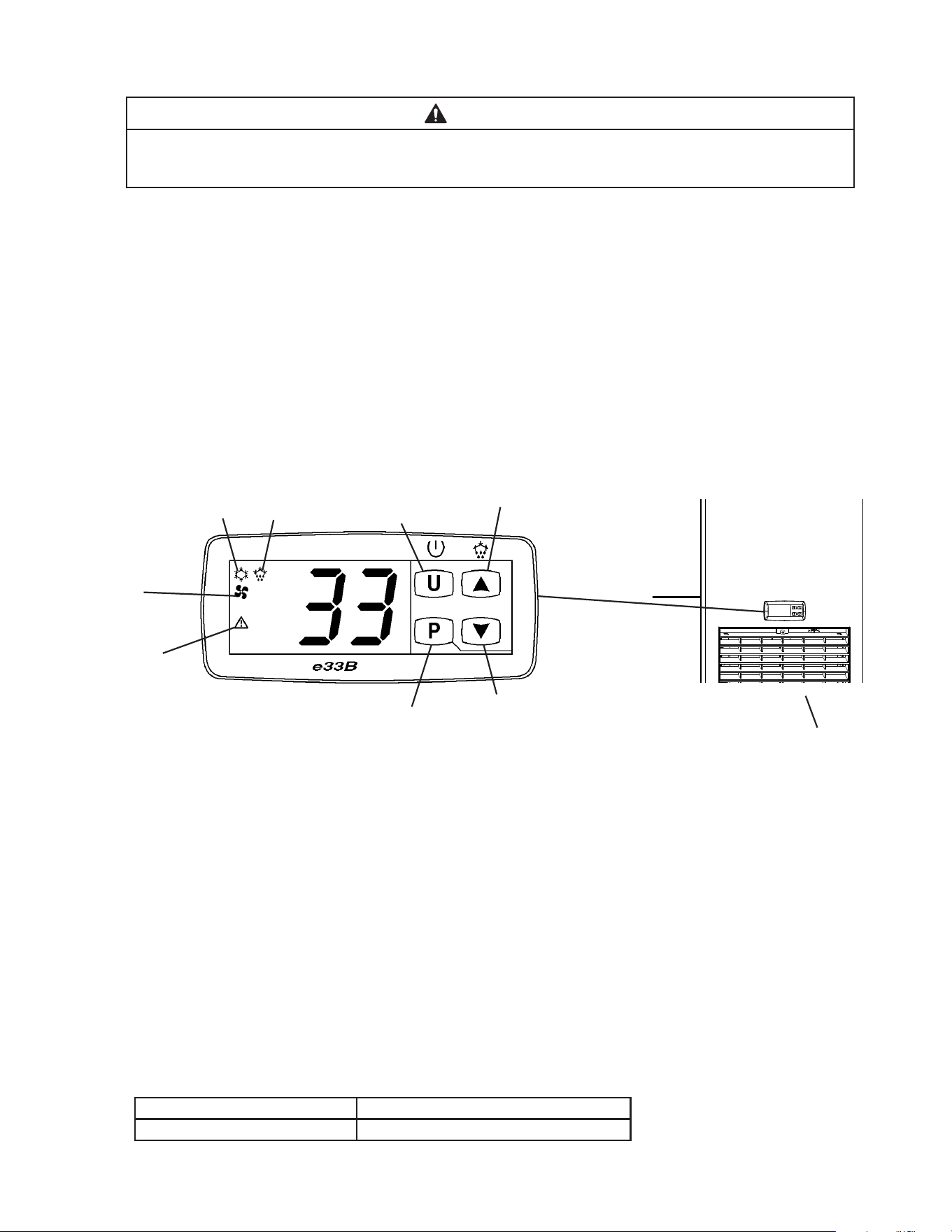
29
Fig. 34
Up/Manual Defrost Button
Down Button
Front Panel
Control Module
Compressor Icon
Defrost Icon
Evaporator
Fan Motor
Icon
Alarm
Icon
B. Startup
WARNING
All parts are factory-adjusted. Improper adjustments may adversely affect safety,
performance, component life, and warranty coverage.
Allow the appliance to cool down prior to loading it with food products.
1) Plug the appliance into the electrical outlet. At startup, there is a slight delay before the
compressor starts. If the temperature is not displayed, press the "U" button for 1 sec.
WARNING! To reduce the risk of electric shock, do not touch the plug with damp
hands.
C. Controls and Adjustments
1. Temperature Display
The cabinet temperature is displayed on the control module. See Fig. 34. The display is
in °F. To convert from °F to °C, see "II.C.3. Changing the Temperature Display Scale (°F
or °C)."
Service Button
ON/OFF
Button
2. Adjusting the Temperature Setpoint
The temperature setpoint is the value for the cabinet temperature. The temperature
differential for the compressor to turn on is ±1.8°F (±1°C) of the temperature setpoint.
The compressor turns off at 1.8°F below setpoint. For example, for a refrigerator
temperature setpoint of 34°F (1.1°C), the compressor comes on at 35.8°F (2.1°C) and
the compressor goes off at 32.2°F (0.1°C). If necessary, adjust the temperature setpoint
temperature as follows:
1) To change the temperature setpoint, press the down button briey and then release.
SP1 ashes for a few seconds, then the current temperature setpoint appears. Press
the up or down button until the desired value is displayed. After 10 seconds or the
"P" button is pressed, the display returns to the current cabinet temperature and the
temperature setpoint is saved. NOTICE! Do not adjust the temperature setpoint
more than 2°F (1°C) at a time. Allow the temperature to stabilize for a minimum of
8hours before making further temperature setpoint adjustments.
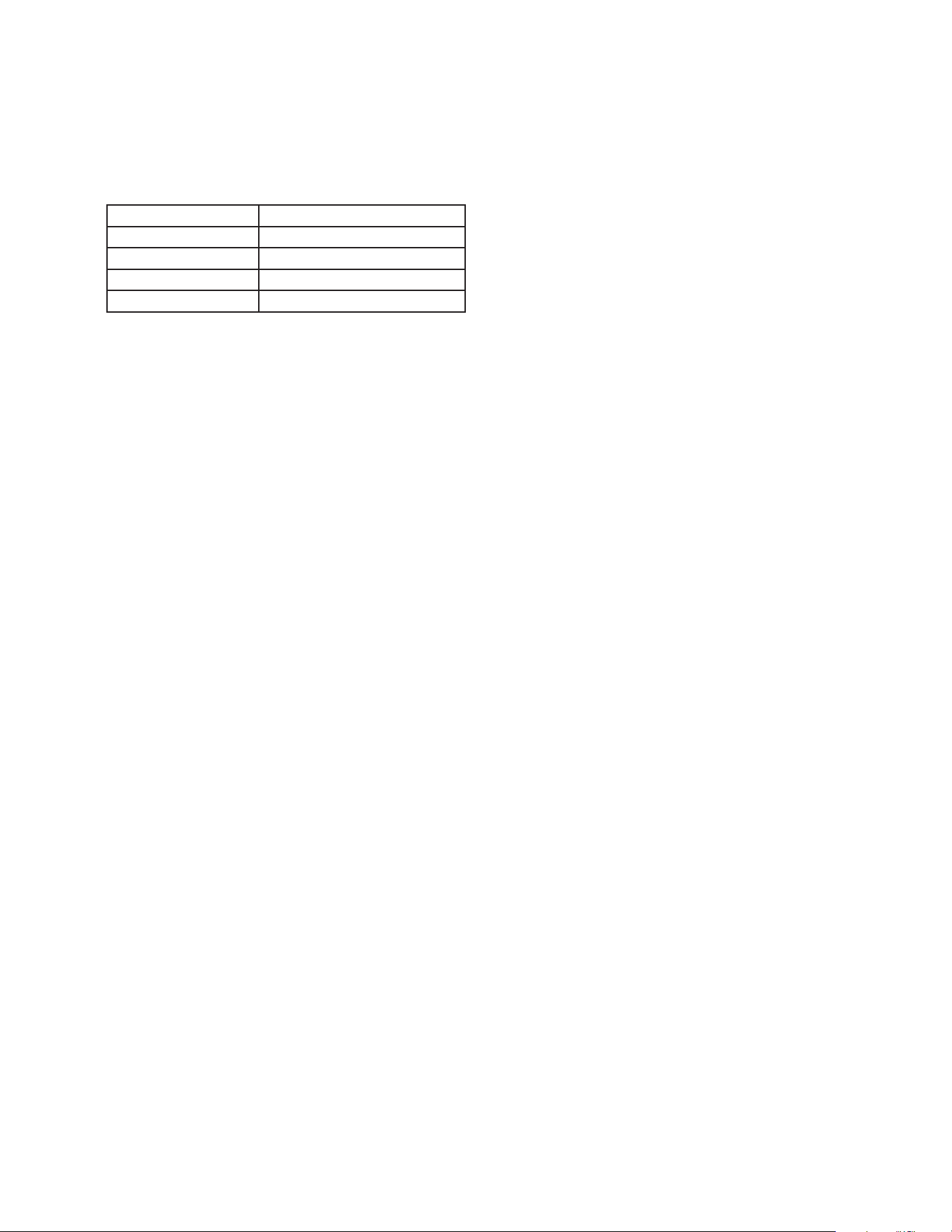
Temperature Setpoint Range Factory Default Temperature Setting
28°F to 45°F (-2.2°C to 7.2°C). 34°F (1.1°C)
30
3. Changing the Temperature Display Scale (°F or °C)
There are 4 temperature display settings from which to choose.
The factory temperature display default is F0 for °F whole number.
For a whole number temperature display scale value, select F0 or C0.
For a temperature display scale value to one decimal point, select F1 or C1.
Display Scale Temperature Display Style
F0 - Factory Default 34°F
C0 1°C
F1 34.0°F
C1 1.1°C
To change the temperature display scale value, follow the steps below.
1) Press the "U" and "P" buttons together for 5 seconds. I.uP is displayed.
2) Press the "P" button. The current display setting (F0, F1, C0, or C1) and I.uP start
ashing.
3) Press the up or down button until the desired temperature display style is displayed.
4) Press the "P" button to save the selection. I.uP is displayed. To return to normal display
mode, press and hold the "U" button for 5 sec. Display returns to normal display mode.
If no other button is pressed after pressing the "P" button, 25 sec. later, display returns
to normal display mode.
Note: If no selection is saved within 30 seconds, the display returns to normal mode
and the temperature display scale remains unchanged.
31
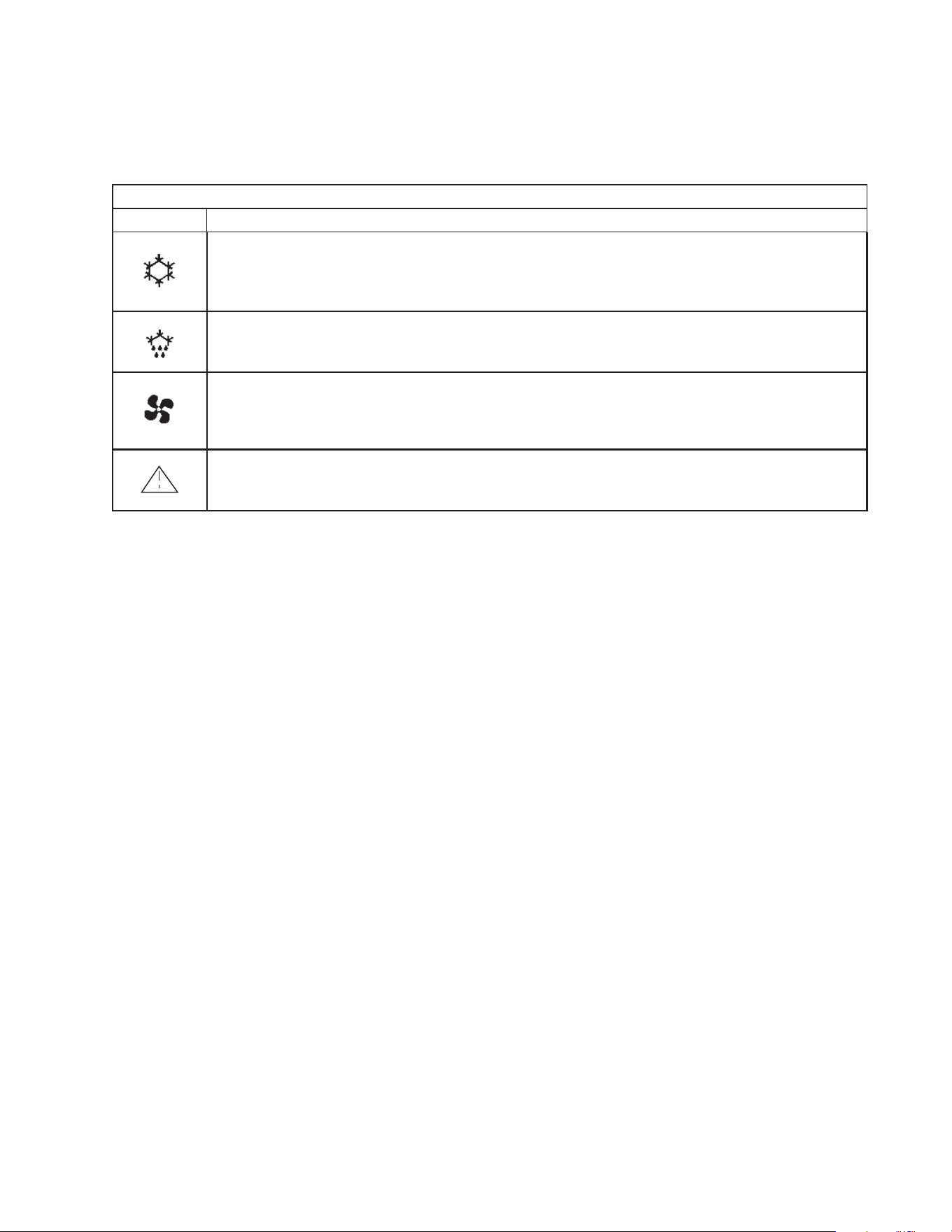
D. Control Module Icons
Control module icons inform you of energized components and if the appliance is in
alarm. Note: Icons ash when component is called for during a timed lockout. Once the
timer terminates, the icon goes solid and component energizes.
Control Module Icons
Icon Meaning
Compressor
Flashing: Compressor waiting for 1-min. compressor delay timer to terminate.
Solid: Compressor energized.
Defrost
Flashing: Drip Time (compressor delay)
Solid: Appliance is in defrost cycle. See "II.E. Defrost" for details.
Evaporator Fan Motor
Flashing: Evaporator fan motor waiting for 2-min. evaporator fan motor delay timer to terminate.
Solid: Evaporator fan motor energized.
Alarm
Appliance is in alarm. See "II.F. Alarm Safeties" for details.
32
E. Defrost
DANGER
Risk of Fire or Explosion Flammable Refrigerant Used
• Do not use mechanical devices to defrost.
• Do not puncture refrigerant tubing. Risk of re or explosion due to puncture of
refrigerant tubing; follow handling instructions carefully.
Risque De Feu Ou D'Explosion Le Frigorigène Est Inammable
• Ne pas utiliser d'appareils mécaniques pour dégivrer le réfrigérateur.
• Ne pas perforer la tubulure contenant le frigorigène. Risque de feu ou d'explosion si la
tubulure contenant le frigorigène est perforée; suivre les instructions de manutention
avec soin.
1. Automatic Defrost
Defrost is a time-initiated, temperature terminated heated defrost.
• Defrost Initiation: When the appliance is plugged in, the 6 hr. defrost timer starts.
Once the 6 hr. defrost timer terminates, defrost initiates if the defrost thermistor is
at or below 50°F (10°C). If the defrost thermistor is not at or below 50°F (10°C),
the control module continues in cooling mode until the termination of the next 6hr.
defrost timer.
The maximum defrost time is 1 hr.
• Defrost Termination: Once the defrost thermistor reaches 41°F (5°C), defrost
terminates. If 41°F (5°C) is not achieved, defrost continues until the 1-hr. maximum
timer terminates. The 6 hr. defrost timer resets once defrost terminates.
• The compressor energizes 1-min. after the defrost heater de-energizes (drip time)
and the evaporator fan motors energize 1 min. after the compressor energizes.
• During defrost "dEF" is displayed. Once defrost terminates, "Pdf" is displayed and
the defrost icon ashes. "Pdf" is displayed until cabinet temperature achieves 1.8°F
(1°C) above temperature setpoint. Once 1.8°F (1°C) above temperature setpoint is
achieved, cabinet temperature returns to display.
2. Manual Defrost
To initiate a manual defrost, press and hold the up button for 5 seconds.
To terminate a defrost, press and hold the up button for 5 seconds.
Note: Manual defrost only initiates when evaporator temperature (defrost thermistor) is at
or below 50°F (10°C).
33
F. Alarm Safeties
Alarm signals are designed to protect the appliance and food product. These alarms
give information or warnings in the event the appliance is operating out of acceptable
parameters. Should one of the alarms occur, follow the instructions in the table below to
address the alarm. The alarm code and alarm icon ash with audible alarm.
Alarm Signals
Alarm Code Problem Corrective Action/Reset Details
(-)E1
Cabinet Thermistor Malfunction Alarm
Cabinet thermistor has failed.
Call a qualied service technician.
Steady tone. To silence the alarm, press and release
any button.
Appliance cycles 5 min. on, 5 min. off.
-E1 - Cabinet thermistor out of place or open.
E1 - Cabinet thermistor shorted.
(-)E2
Defrost Thermistor Malfunction Alarm
Defrost thermistor has failed.
Call a qualied service technician.
Steady tone. To silence the alarm, press and release
any button.
Appliance cycles on and off with cabinet thermistor.
Defrost cycles for 10 min. every 6 hrs.
-E2 - Defrost thermistor out of place or open.
E2 - Defrost thermistor shorted.
Hi
High Temperature Alarm
Cabinet temperature has remained
above 57°F (13.9°C) for more than
1hour.
If obvious corrections such as closing drawers and
cleaning the air lter and/or condenser do not bring
temperature back in range, call a qualied service
technician.
Steady tone. To silence the alarm and clear "Hi" from
the display, press and release any button. The alarm
icon stays on.
Automatically resets when temperature returns to
normal.
Lo
Low Temperature Alarm
Cabinet temperature has remained
below 10°F (-12°C) for more than
1hour.
If obvious corrections do not bring the temperature
back in range, call a qualied service technician.
Steady tone. To silence the alarm and clear "Lo" from
the display, press and release any button. The alarm
icon stays on.
Automatically resets when temperature returns to
normal.
UHi
High Voltage Alarm (140VAC±5% or
more)
Call a qualied service technician.
The compressor de-energizes if voltage protection
operates. The voltage safeties automatically reset when
voltage is corrected.
ULo
Low Voltage Alarm (100VAC±5% or
less)
34
G. Food Storage
WARNING
• The appliance is designed only for storage of food. Employ sanitary methods. Use
for any other purposes (for example, storage of chemicals or medical supplies
such as vaccine and serum) could cause deterioration of stored items.
• Do not block air inlets or outlets, otherwise cooling performance may be reduced.
• Do not tightly pack the cabinet. Allow some space between items to ensure good
air ow. Also allow space between items and interior surfaces.
• Do not put warm or hot foods in the cabinet. Let them cool rst, or they will raise
the cabinet temperature and could deteriorate other foods in the cabinet or
overload the appliance.
• All foods should be wrapped in plastic lm or stored in sealed containers. Otherwise
foods may dry up, pass their smells onto other foods, cause frost to develop, result
in poor appliance performance, or increase the likelihood of cross-contamination.
Certain dressings and food ingredients, if not stored in sealed containers, may
accelerate corrosion of the evaporator, resulting in failure.
• Do not store items near air outlets. Otherwise, items may freeze up and crack or
break causing a risk of injury or contamination of other food.
H. Safety Devices
1. Compressor External or Internal Overload
If combined temperature/amperage value is above the limit specied by the
compressor manufacturer, the compressor overload operates independently to turn
off the compressor. The compressor overload de-energizes the compressor until the
temperature/amperage value returns to an acceptable level.
2. Short-Cycle Protection
There is a 2-minute minimum off-time for the compressor.
Note: Time may vary with compressor overload or high-pressure switch activation.
3. High-Pressure Switch
If high-side refrigeration pressure exceeds Hoshizaki specications, the high-pressure
switch activates and de-energizes the compressor circuit until the refrigeration pressure
returns to an acceptable level.

35
I. Cooling Performance
Be sure the appliance is properly installed and located for optimum cooling performance.
If cooling performance is not at its optimum level, check the following items:
• Door/Drawers opened too often.
• Doors/Drawers left open. Close.
• Cabinet too tightly packed or air inlets/outlets blocked. Allow some space between items
to ensure good air ow.
• Warm or hot foods inside. Take them out until they cool down more.
• Ambient temperature too high. Avoid installation near high heat producing equipment or
exposure to direct sunlight.
• Temperature setpoint not cold enough. Adjust to a colder setting. See "II.C.2. Adjusting
the Temperature Setpoint" for details.
• Appliance in defrost cycle. The cabinet temperature may rise temporarily during the
defrost cycle, but this will not affect the food inside.
J. Cabinet Condensation
In the event condensation develops on the cabinet exterior, check the following items:
• Drawers or doors left open. Close.
• Ambient humidity too high. In high humidity areas it may be necessary to wipe off the
cabinet frame occasionally.
36
III. Cleaning and Maintenance Instructions
A. Cleaning
WARNING
• Press and hold the "U" button for 1 sec. to turn the appliance off. Unplug the
appliance before cleaning to prevent electric shock by unexpected entrance of
water into the appliance or injury by moving parts. To reduce the risk of electric
shock, do not touch the plug with damp hands.
• Risk of electric shock. Appliance in the off position does not de-energize all loads.
Use extreme caution and exercise safe electrical practices.
• Before cleaning the appliance, move all foods into another clean refrigerator.
• Before cleaning the appliance, disconnect any cooking equipment on the appliance
top and allow to cool.
• Do not splash, pour, or spray water directly onto or into the appliance. This might
cause short circuit, electric shock, corrosion, or failure.
• Carefully follow instructions provided with cleaning and sanitizing products.
NOTICE
• To prevent damage to the plastic surfaces, do not use the following: hot water,
thinner, benzine, alcohol, petroleum, soap powder, polishing powder, alkaline
cleaner, acid, scouring pad and especially those strong cleaners for use on a
ventilating fan or a cooking range.
• To prevent corrosion and damage to stainless steel surfaces, use only products
formulated for use on stainless steel appliances. Do not use steel wool, abrasive
products, or products containing sodium hypochlorite (chlorine bleach).
• Use a clean cloth for cleaning.
1. Exterior
Wipe the exterior occasionally with a clean, soft cloth. Use a damp cloth containing
a neutral cleaner to wipe off oil or dirt buildup. Clean any rust colored spots using a
non-abrasive cleanser.
2. Cabinet Interior
Spills should be wiped up promptly to avoid unpleasant odors. The cabinet interior should
be cleaned periodically with a mild soap or detergent and warm water.
3. Drawer Gaskets
Drawer gaskets should be cleaned regularly with mild soap and warm water to remove
dirt and grease.
37
4. Drawers
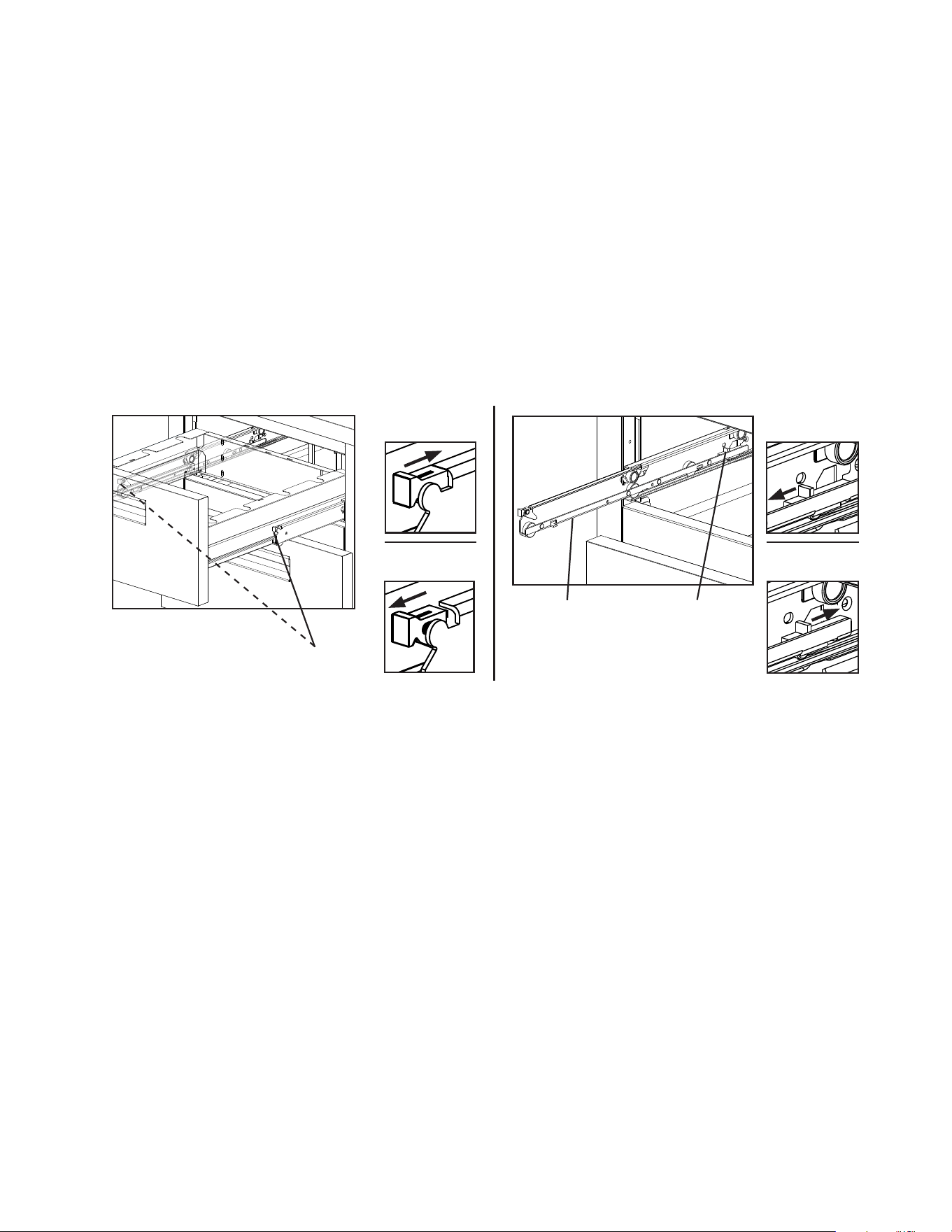
Drawers and drawer slides are removable.
• To remove a drawer: Remove all items from the drawer. Pull the drawer out to its fully
extended position. Open the safety clips (one on each side) by sliding them forward.
See Fig. 35. Lift up on the handle slightly, then pull to disengage the drawer. Be sure
to support the rear and front of the drawer while removing it. WARNING! Be sure to
close the safety clips when reinstalling the drawer.
• To remove a drawer slide (center slide containing rollers): Open the stop levers
(one on each side) by sliding them to the rear. See Fig. 36. Lift up on the drawer slide
slightly, then pull to disengage the drawer slide. WARNING! Be sure to close the stop
levers when reinstalling the drawer. Drawer slides do not require lubrication, but
drawer slides should be kept clean and free of food.
Note: Drawer slides are dishwasher safe.
Fig. 35
Safety Clips
Safety Clip
Closed
Fig. 36
Safety Clip
Open
Stop Lever
Drawer Slide
Stop Lever
Closed
Stop Lever
Open
38
B. Maintenance
WARNING
• Press and hold the "U" button for 1 sec. to turn the appliance off. Unplug the
appliance before performing maintenance to prevent electric shock or injury by
moving parts. To reduce the risk of electric shock, do not touch the plug with damp
hands.
• Risk of electric shock. Appliance in the off position does not de-energize all loads.
Use extreme caution and exercise safe electrical practices.
• Before performing maintenance, move all foods into another clean refrigerator.
• Before performing maintenance, disconnect any cooking equipment on the
appliance top and allow to cool.
1. Condenser
Check the condenser twice a year and use a brush or vacuum cleaner to clean the
condenser as required.
2. Power Supply Connection
If the plug or power cord is damaged, contact your local Hoshizaki service representative
or local Hoshizaki distributor immediately and ask for repairs.
All other maintenance or service on the appliance should be performed in accordance
with the Hoshizaki Service Manual by a qualied service technician.
39
IV. Preparing the Appliance for Periods of Non-Use
When shutting down the appliance for more than one week, follow the instructions below.
WARNING
• When preparing the appliance for long storage, prevent the doors or drawers from
closing to reduce the risk of children getting trapped.
• Risk of electric shock. Appliance in the off position does not de-energize all loads.
Use extreme caution and exercise safe electrical practices.
• To reduce the risk of electric shock, do not touch the plug with damp hands.
NOTICE
When preparing the appliance for long storage, clean the appliance. See "III.A.
Cleaning" for details.
1) Before shutting down the appliance, move all foods into another clean refrigerator.
2) Press and hold the "U" button for 1 sec. to turn the appliance off. Unplug the appliance.
40
V. Disposal
DANGER
Risk of Fire or Explosion Flammable Refrigerant Used
• Follow handling instructions carefully in compliance with U.S. government regulations.
• Do not puncture refrigerant tubing. Risk of re or explosion due to puncture of
refrigerant tubing; follow handling instructions carefully.
• Dispose of properly in accordance with federal or local regulations.
Risque De Feu Ou D'Explosion Le Frigorigène Est Inammable
• Suivre attentivement les instructions de manipulation conformément à la
réglementation gouvernementale.
• Ne pas perforer la tubulure contenant le frigorigène. Risque de feu ou d'explosion si la
tubulure contenant le frigorigène est perforée; suivre les instructions de manutention
avec soin.
• Éliminer conformément aux règlements fédéraux ou locaux.
WARNING
When preparing the appliance for disposal, remove the drawers to reduce the risk
of children getting trapped.
The appliance contains refrigerant and must be disposed of in accordance with
applicable national, state, and local codes and regulations. Refrigerant must be
recovered by properly certied service personnel.
41
618 Hwy. 74 South, Peachtree City, GA 30269 USA (P) 770.487.2331 (F) 770.487.3360 hoshizakiamerica.com 1A6671-010