
Functions of the machine and procedures
for placing originals and loading paper
BEFORE USING THE MACHINE
COPIER
Using the copy function
PRINTER
Using the printer function
FACSIMILE
Using the fax function
SCANNER
Using the scan function
TROUBLESHOOTING
What to do when a paper misfeed or other
problem occurs
SYSTEM SETTINGS
Configuring settings to make the
machine easier to use
Click to jump to the table of contents of the
desired chapter.
User's Manual
DIGITAL MULTIFUNCTIONAL SYSTEM
WEB PAGES
Machine settings configured from the Web
page
MODEL: MX-B350W
MX-B450W
i
HOW TO USE THIS MANUAL
Click a button below to move to the page that you wish to view.
The following explanation assumes that Adobe Acrobat Reader is being used (Some buttons do not appear in the
default state.).
(1) Return to top page button
If an operation does not proceed as expected, click this
button to start over again.
(2) Back one page button
Displays the previous page.
(3) Forward one page button
Displays the next page.
(4) Return to previously displayed page button
Displays the page that was displayed before the current
page.
(5) Title button
Displays the page of the title indicated by the button.
(6) Contents button
Displays the contents of each chapter.
For example, if the current page is part of the printer
chapter, the table of contents of the printer chapter
appears.
(1) (2) (3) (4)
(6)
(5)
(6)
(5)
If a button does not appear, refer to Adobe Reader Help to display the button.
ii
ABOUT OPERATION MANUAL
This manual explains how to use the MX-B350W/MX-B450W digital multifunctional system.
Please note
• For information on installing the drivers and software cited in this manual, please refer to the Software Setup Guide.
• For information on your operating system, please refer to your operating system manual or the online Help function.
• The explanations of screens and procedures in a Windows environment are primarily for Windows
®
10. The screens may be
different depending on the version of the operating system or the software application.
• The explanations of screens and procedures in a Macintosh environment are based on Mac OS X v10.12 in the case of Mac OS
X. The screens may be different depending on the version of the operating system or the software application.
• Wherever "MX-xxxx" appears in this manual, please substitute your model name for "xxxx".
• Considerable care has been taken in preparing this manual. If you have any comments or concerns about the manual, please
contact your dealer or nearest SHARP Service Department.
• This product has undergone strict quality control and inspection procedures. In the unlikely event that a defect or other problem
is discovered, please contact your dealer or nearest SHARP Service Department.
• Aside from instances provided for by law, SHARP is not responsible for failures occurring during the use of the product or its
options, or failures due to incorrect operation of the product and its options, or other failures, or for any damage that occurs due
to use of the product.
Warning
• Reproduction, adaptation or translation of the contents of the manual without prior written permission is prohibited, except as
allowed under copyright laws.
• All information in this manual is subject to change without notice.
Illustrations and the operation panel and display shown in this manual
The peripheral devices are generally optional, however, some models include certain peripheral devices as standard equipment.
The explanations in this manual assume that paper feed unit is installed on the MX-B450W.
For some functions and procedures, the explanations assume that devices other than the above are installed.
Icons used in the manuals
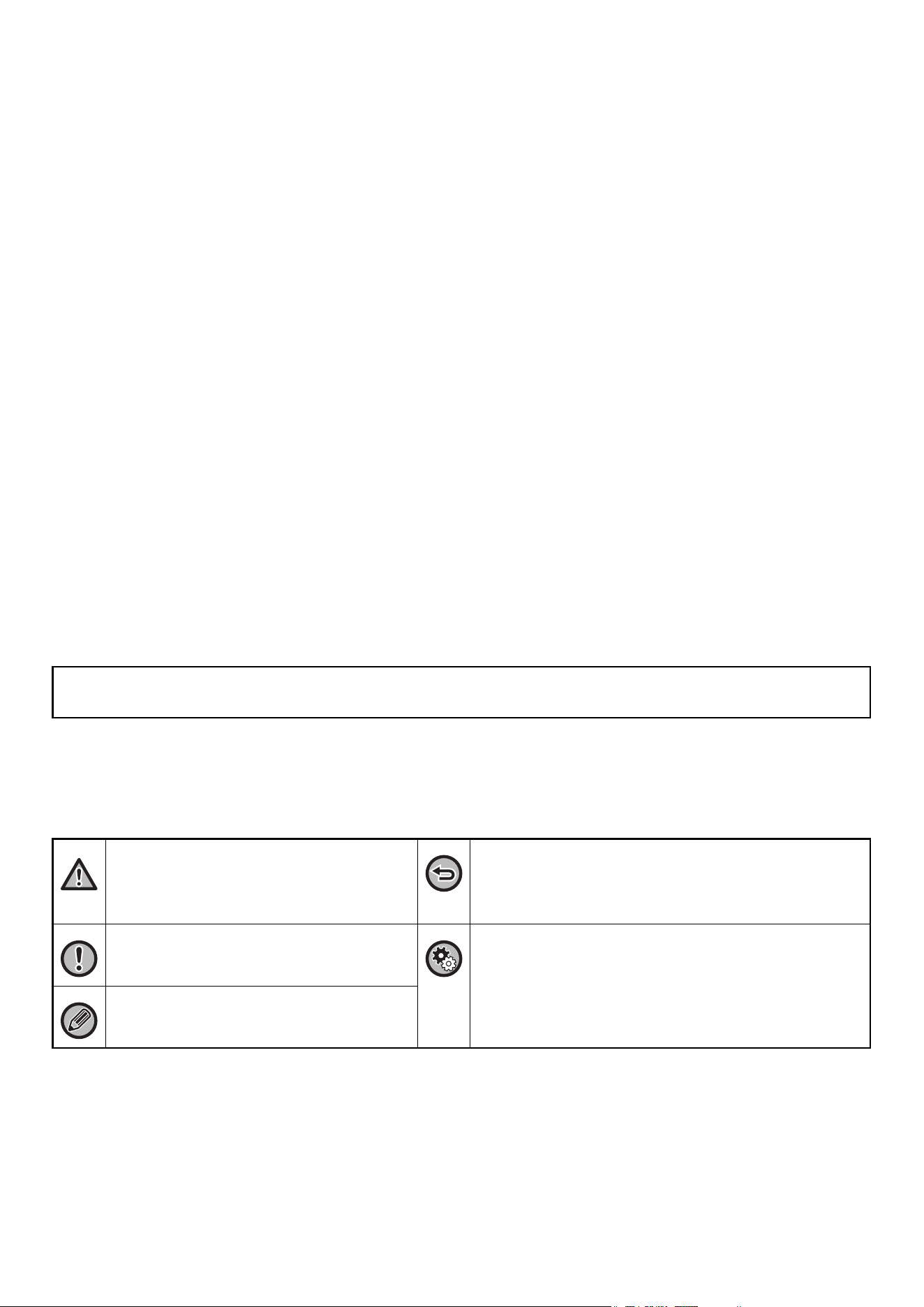
The icons in the manuals indicate the following types of information:
The display screens, messages, and key names shown in the manual may differ from those on the actual machine
due to product improvements and modifications.
This alerts you to a situation that could result in
death or serious personal injury. This alerts
you to a situation that could result in personal
injury or damage to properties.
This explains how to stop or correct an operation.
This alerts you to a situation where there is a
risk of machine damage or failure.
This describes a routine work relevant to setting mode.
This supplements function or operation
procedure.

1-1
BEFORE USING THE MACHINE
PART NAMES AND FUNCTION . . . . . . . . . . . . . . . 1-2
• EXTERIOR . . . . . . . . . . . . . . . . . . . . . . . . . . . . 1-2
• INTERIOR, SIDE AND BACK . . . . . . . . . . . . . . 1-3
• AUTOMATIC DOCUMENT FEEDER AND
DOCUMENT GLASS. . . . . . . . . . . . . . . . . . . . . 1-4
• OPERATION PANEL. . . . . . . . . . . . . . . . . . . . . 1-5
PERIPHERAL DEVICES . . . . . . . . . . . . . . . . . . . . . 1-7
DISPLAY . . . . . . . . . . . . . . . . . . . . . . . . . . . . . . . . . 1-8
• LEFT MENU AND RIGHT MENU . . . . . . . . . . . 1-8
• HOW TO USE THE DISPLAY . . . . . . . . . . . . . . 1-9
TURNING ON THE POWER. . . . . . . . . . . . . . . . . . . 1-11
Eco . . . . . . . . . . . . . . . . . . . . . . . . . . . . . . . . . . . . . . 1-12
• ECO FUNCTIONS OF THE MACHINE . . . . . . . 1-12
• AUTO POWER SHUT-OFF MODE . . . . . . . . . . 1-12
• PREHEAT MODE . . . . . . . . . . . . . . . . . . . . . . . 1-13
• ENTER AUTO POWER SHUT-OFF AFTER
THE REMOTE JOB . . . . . . . . . . . . . . . . . . . . . . 1-13
USER AUTHENTICATION MODE . . . . . . . . . . . . . . 1-14
• USING USER AUTHENTICATION MODE . . . . 1-14
UNIVERSAL DESIGN IN THE MACHINE . . . . . . . . 1-15
• UNIVERSAL DESIGN RELATED TO
OPERATION . . . . . . . . . . . . . . . . . . . . . . . . . . . 1-15
•
UNIVERSAL DESIGN RELATED TO HEARING . . . .
1-15
•
UNIVERSAL DESIGN FEATURES . . . . . . . . . . . . . .
1-16
LOADING PAPER
IMPORTANT POINTS ABOUT PAPER . . . . . . . . . . 1-17
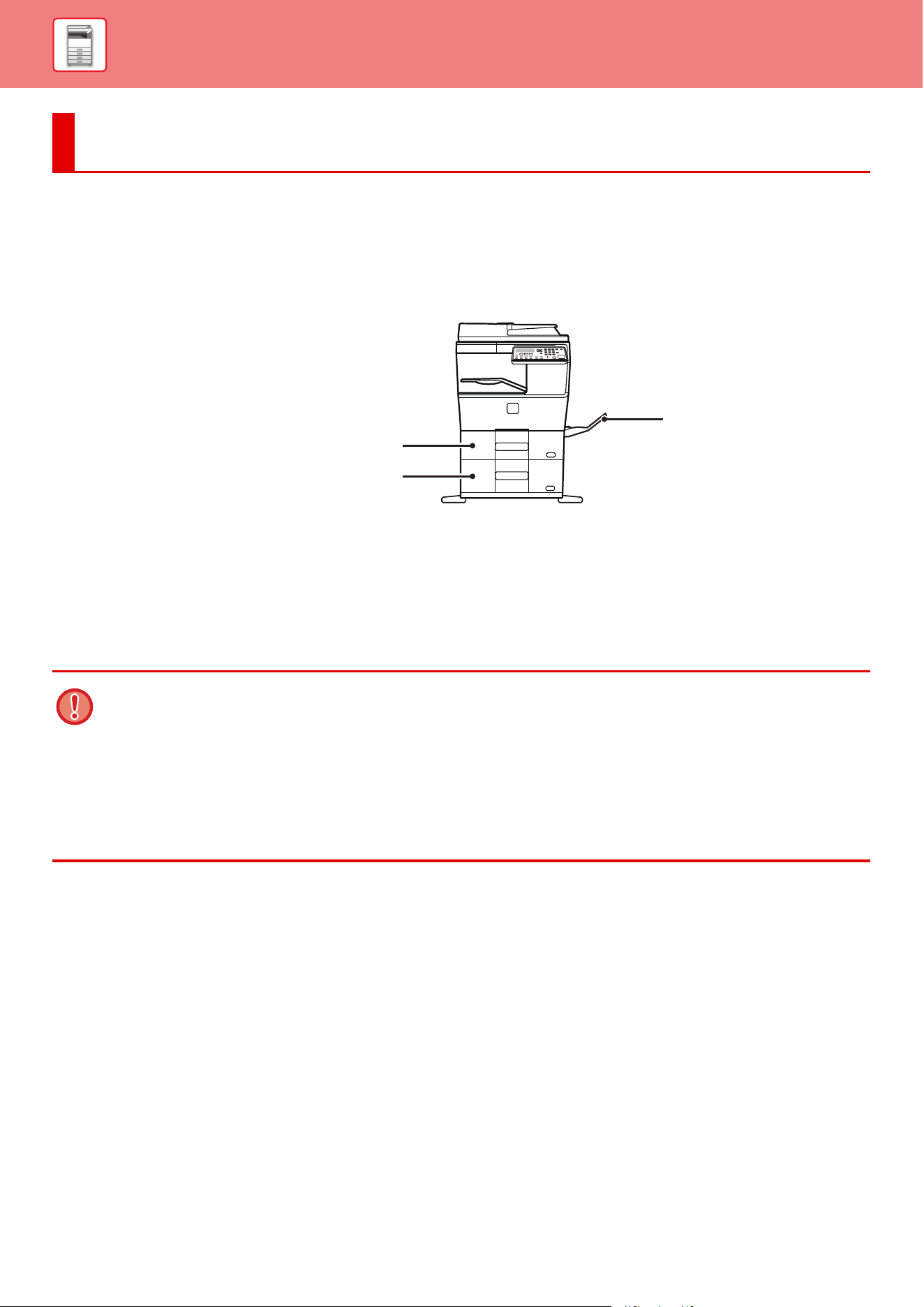
• NAMES AND LOCATIONS OF TRAYS. . . . . . . 1-17
• APPLICABLE PAPER TYPES. . . . . . . . . . . . . . 1-17
TRAY 1 - 2 . . . . . . . . . . . . . . . . . . . . . . . . . . . . . . . . 1-21
LOADING PAPER INTO THE BYPASS TRAY . . . . 1-24
TRAY SETTINGS . . . . . . . . . . . . . . . . . . . . . . . . . . . 1-29
HOW TO PLACE THE ORIGINAL
SELECTING A PROCEDURE FOR PLACING THE
ORIGINAL DEPENDING ON THE TYPE AND
STATUS OF THE ORIGINAL. . . . . . . . . . . . . . . . . . 1-30
AUTOMATIC DOCUMENT FEEDER . . . . . . . . . . . . 1-30
DOCUMENT GLASS . . . . . . . . . . . . . . . . . . . . . . . . 1-32
MAINTENANCE
CHECKING THE TOTAL OUTPUT COUNT AND
TONER REMAINING. . . . . . . . . . . . . . . . . . . . . . . . 1-33
ADJUSTING THE DISPLAY CONTRAST . . . . . . . 1-33
REGULAR MAINTENANCE . . . . . . . . . . . . . . . . . . 1-34
• CLEANING THE DOCUMENT GLASS AND
AUTOMATIC DOCUMENT FEEDER. . . . . . . . 1-34
• CLEANING THE BYPASS FEED ROLLER . . . 1-35
• CLEANING THE PAPER FEED ROLLER . . . . 1-35
REPLACEMENT OF TONER CARTRIDGE . . . . . . 1-36
CHARACTER ENTRY
CHARACTERS THAT CAN BE ENTERED . . . . . . 1-39
BEFORE USING THE MACHINE
1-2
BEFORE USING THE MACHINE►BEFORE USING THE MACHINE
PART NAMES AND FUNCTION
EXTERIOR
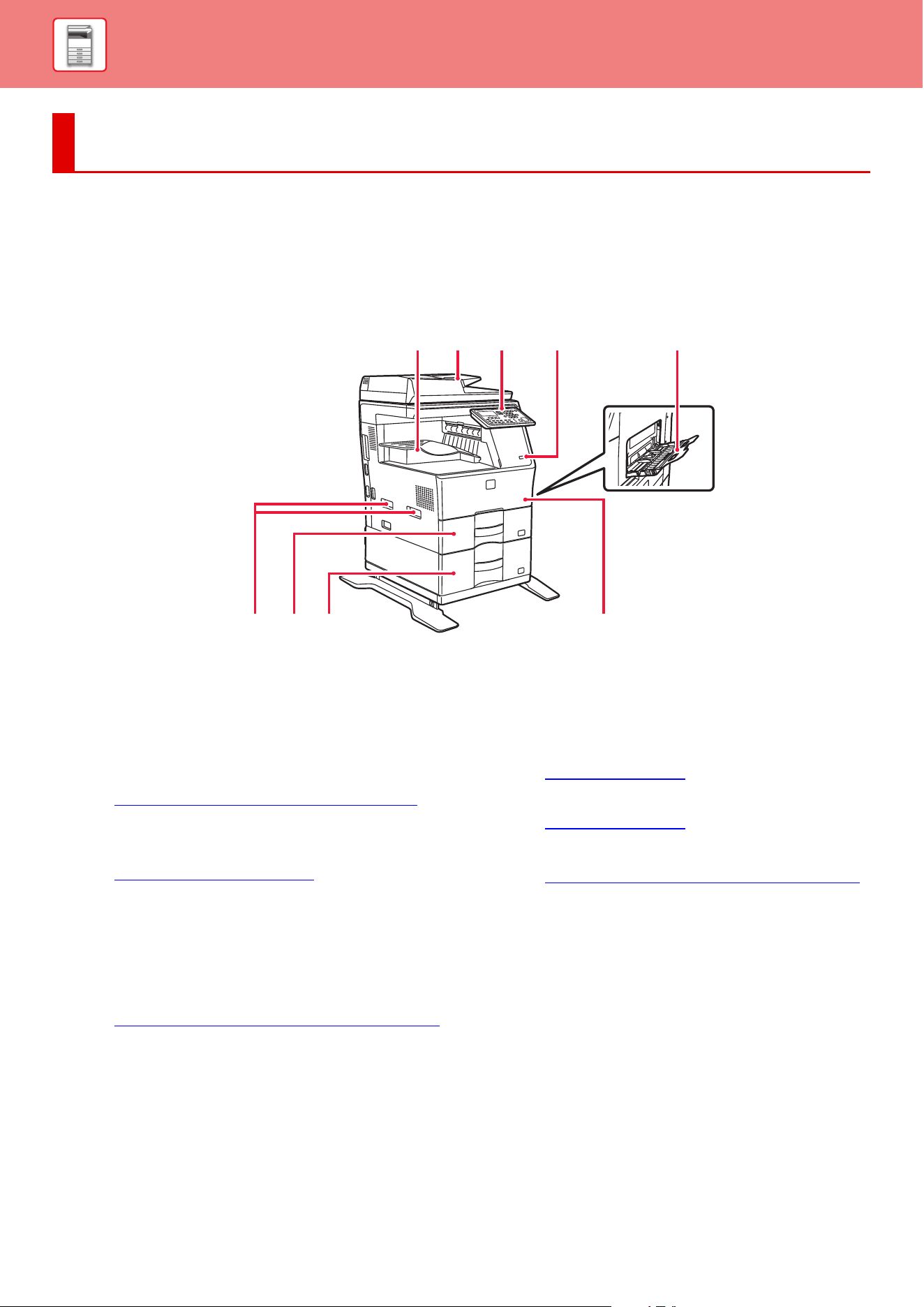
(1) Output tray (exit tray cabinet)
Received faxes and printed papers are delivered to this tray.
(2) Automatic document feeder
It automatically feeds and scans multiple originals. 2-sided
originals can be automatically scanned.
► AUTOMATIC DOCUMENT FEEDER (page 1-30)
(3) Operation panel
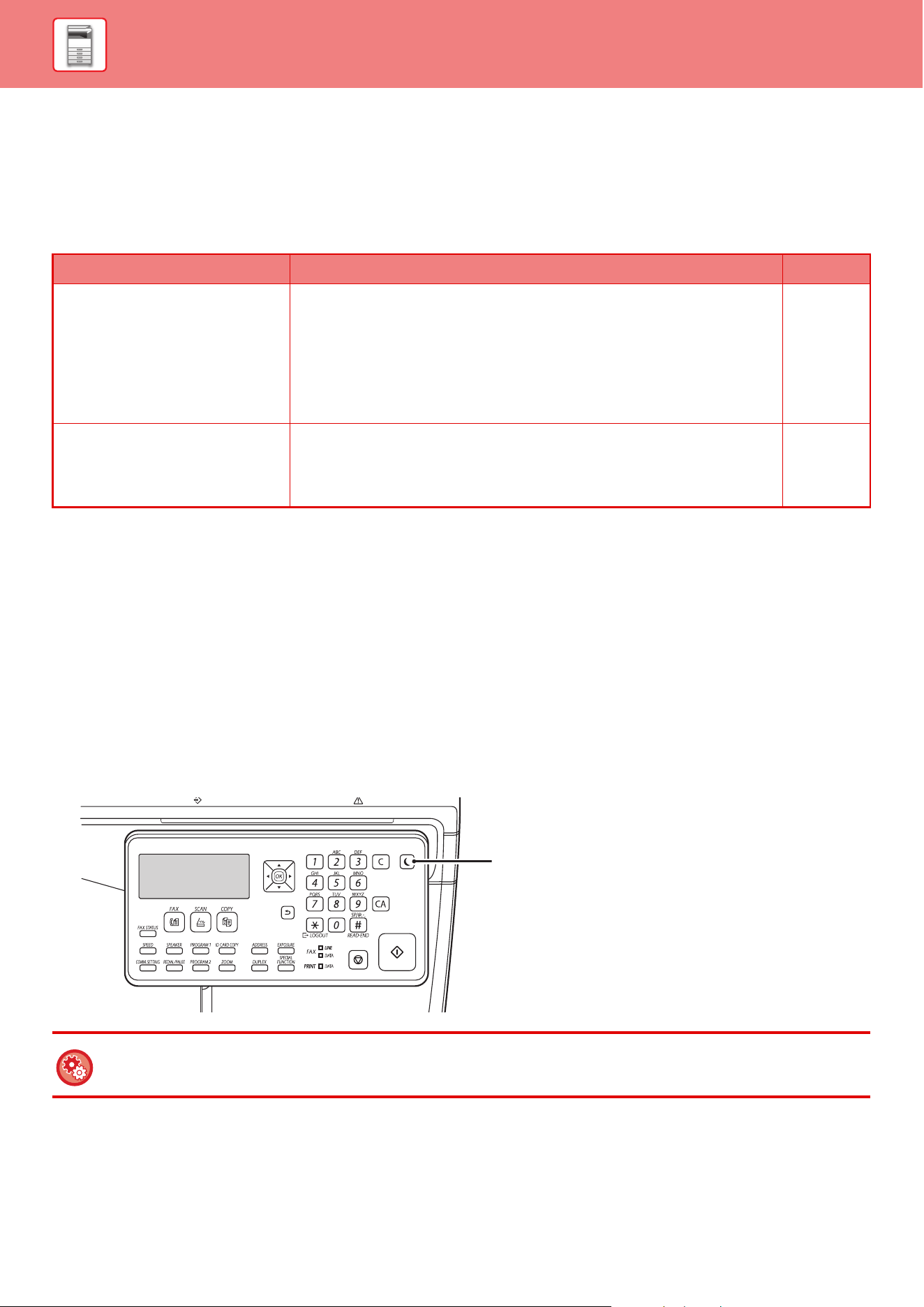
This panel hosts the [ENERGY SAVE] key/indicator, Printer
mode indicator, FAX mode indicators, and operation keys.
► OPERATION PANEL (page 1-5)
(4) USB port (A type)
This is used to connect a USB device such as a USB
memory device to the machine.
Supports USB 2.0 (Hi-Speed).
(5) Bypass tray
Use this tray to feed paper manually.
When loading paper, also open the extension tray.
►
LOADING PAPER INTO THE BYPASS TRAY (page 1-24)
(6) Handle
Grasp it when moving the machine.
(7) Tray 1
Store paper in this tray.
►
TRAY 1 - 2 (page 1-21)
(8) Tray 2 (when a 600-sheet paper feed unit is installed)
*
Store paper in this tray.
►
TRAY 1 - 2 (page 1-21)
(9) Front cover
Open this cover to replace a toner cartridge.
►
REPLACEMENT OF TONER CARTRIDGE (page 1-36)
*Optional
BEFORE USING THE MACHINE
(1) (5)(2) (3) (4)
(7)(6) (8) (9)
1-3
BEFORE USING THE MACHINE►BEFORE USING THE MACHINE
INTERIOR, SIDE AND BACK
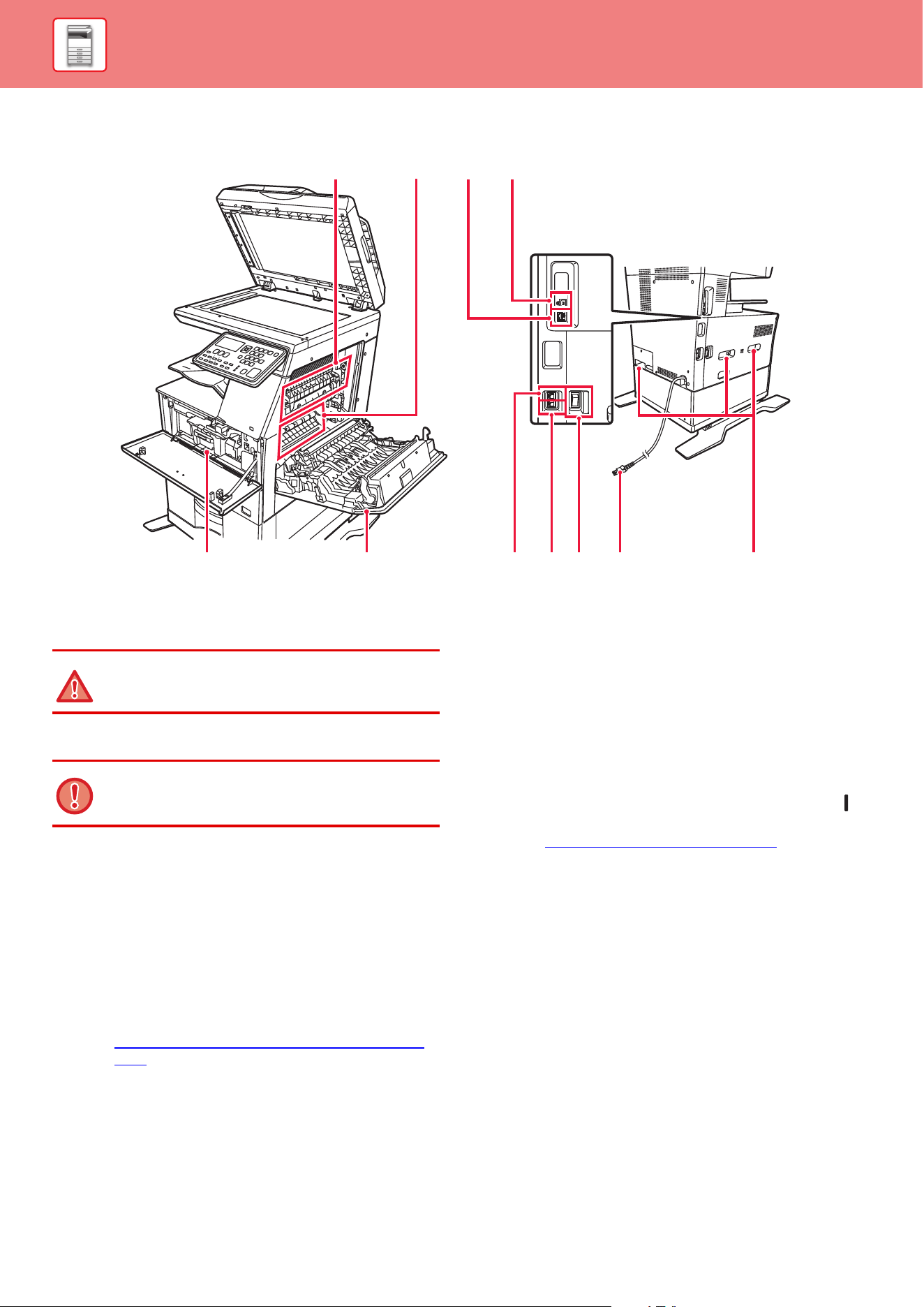
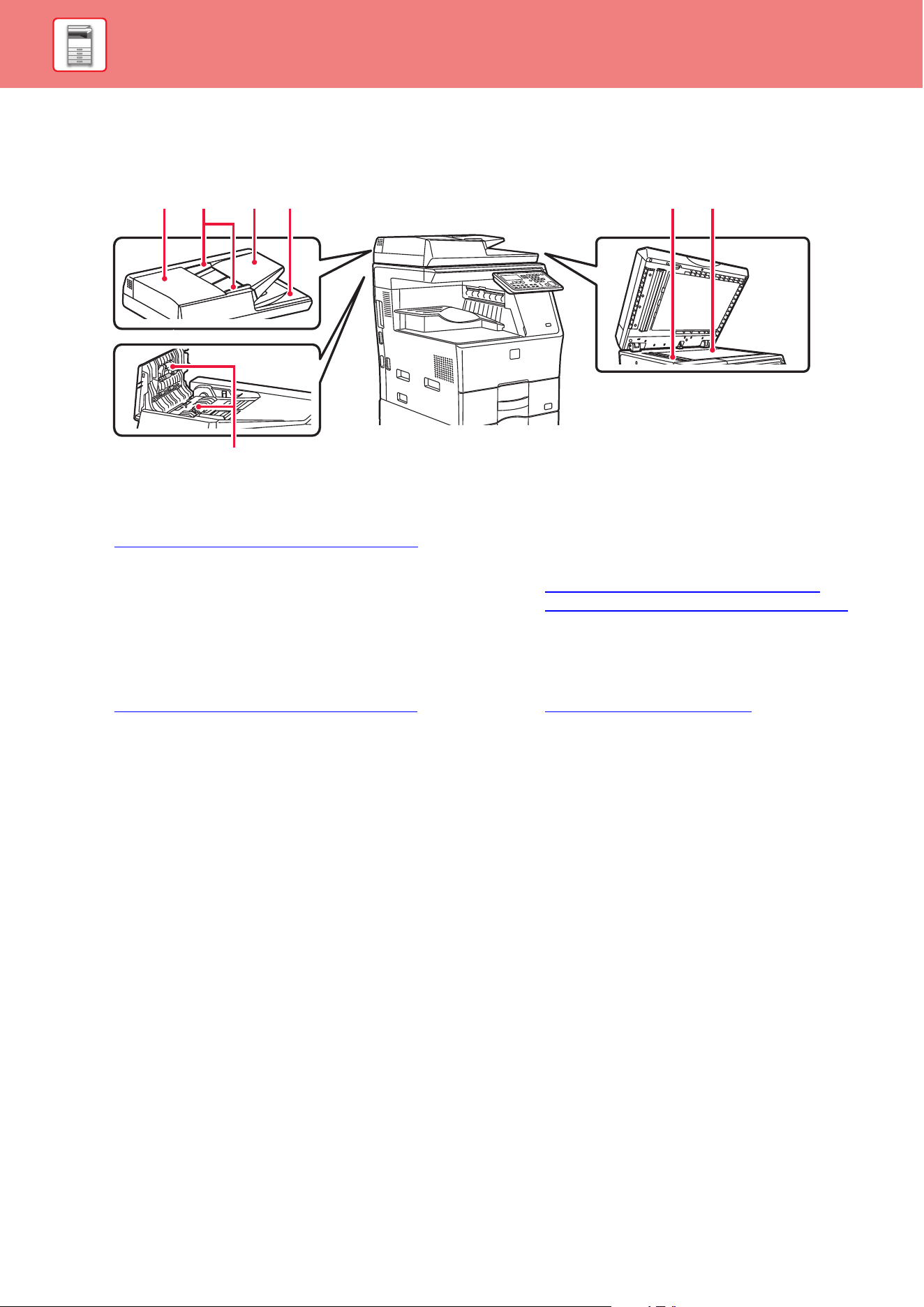
(1) Fusing unit
Heat is applied here to fuse the transferred image onto
the paper.
(2) Photoconductive drum unit
Images are formed on the photoconductive drum.
(3) LAN connector
Connect the LAN cable to this connector when the
machine is used on a network.
Use a shielded LAN cable.
(4) USB port (B type)
The machine does not use this connector.
(5) Toner cartridge
This cartridge contains toner.
When the toner in a cartridge runs out, replace with new
one.
► REPLACEMENT OF TONER CARTRIDGE (page
1-36)
(6) Side cover
Open this cover to remove a paper misfeed.
(7) Telephone line jack (LINE)
When the fax function of the machine is used, the
telephone line is connected to this jack.
(8) Extension phone jack (TEL)
When the fax function of the machine is used, an
extension phone can be connected to this jack.
(9) The main power switch
Use this switch to turn on the power for the machine.
When using the fax, always keep this switch in the “ ”
position.
►
TURNING ON THE POWER (page 1-11)
(10) Power plug
(11) Handle
Grasp it when moving the machine.
(5) (6) (11)(7) (8) (9) (10)
(1) (2) (3) (4)
The fusing unit is hot. Take care not to burn yourself
when removing a misfeed.
Do not touch or damage the photoconductive drum
and the transfer roller.
This may cause a defective image.
1-4
BEFORE USING THE MACHINE►BEFORE USING THE MACHINE
AUTOMATIC DOCUMENT FEEDER AND DOCUMENT
GLASS
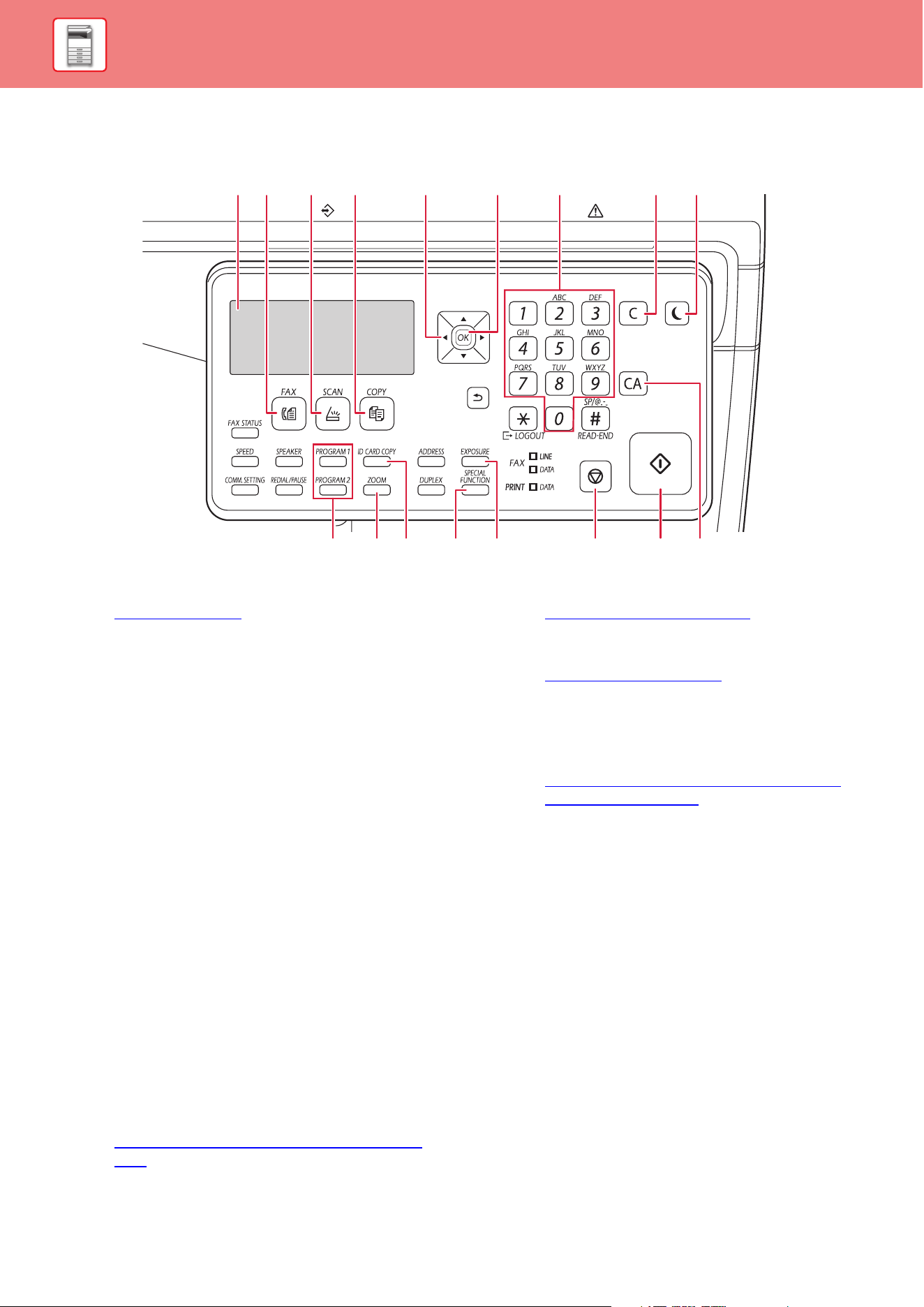
(1) Document feeding cover
Open this cover to remove an original misfeed.
This cover is also opened to clean the paper feed roller.
►
CLEANING THE PAPER FEED ROLLER (page 1-35)
(2) Original guides
These guides help ensure that the original is scanned
correctly.
Adjust the guides to the width of the original.
(3) Document feeder tray
Place the original.
Place the original with the print side facing up.
► AUTOMATIC DOCUMENT FEEDER (page 1-30)
(4) Original exit tray
The original is discharged to this tray after scanning.
(5) Scanning area
Originals placed in the automatic document feeder are
scanned here.
► CLEANING THE DOCUMENT GLASS AND
AUTOMATIC DOCUMENT FEEDER (page 1-34)
(6) Document glass
If you want to scan books or other thick originals that
cannot be fed through the automatic document feeder,
place them on this glass.
► DOCUMENT GLASS (page 1-32)
(7) Paper feed roller
This roller rotates to automatically feed the original.
(1) (3) (4)
(7)
(5) (6)(2)
1-5
BEFORE USING THE MACHINE►BEFORE USING THE MACHINE
OPERATION PANEL
This section describes the names and functions of the respective parts of the operation panel.
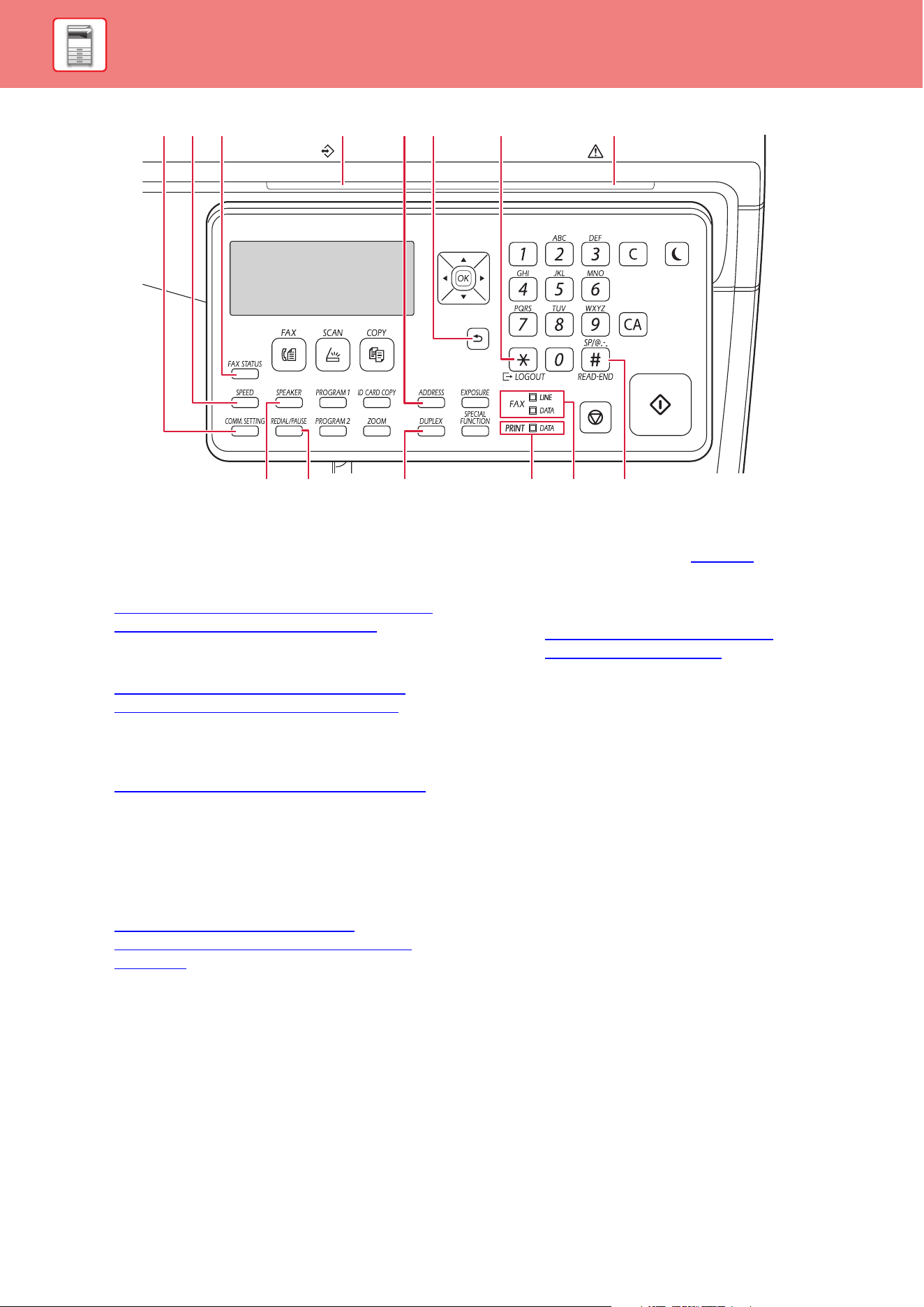
(1) Display
Shows various messages.
► DISPLAY (page 1-8)
(2) [FAX] key
/ indicator
Press to select fax mode.
(3) [SCAN] key / indicator
Press to select scan mode.
(4) [COPY] key
/ indicator
Press to select copy mode.
To check the total number of pages output in copy, print,
and fax modes hold down the [COPY] key when the
machine is in the standby state. The counts will appear
while the key is held down.
The toner level is shown at the bottom of the screen.
(5) Arrow keys
Press to move the highlighting (which indicates that an
item is selected) in the display.
(6) [OK] key
Press to enter the selected setting.
(7) Numeric keys
Enter characters/numbers.
(8) [C] key
Press to clear the set number of copies or stop a copy
run.
(9) [ENERGY SAVE] key
/ indicator
Press to enter the energy save mode.
(10) [PROGRAM 1 / PROGRAM 2] key
Press to use the scanner settings already stored.
► USING STORED SETTINGS (PROGRAM) (page
5-19)
(11) [ZOOM] key
Press to select a reduction or enlargement copy ratio.
► ENLARGE/REDUCE (page 2-10)
(12) [ID CARD COPY] key
Enable ID Card Copy.
► ID CARD COPY (page 2-17)
(13) [SPECIAL FUNCTION] key
Press to select Special Modes.
(14) [EXPOSURE] key
Use to select the exposure mode.
► CHANGING THE EXPOSURE AND ORIGINAL
IMAGE TYPE (page 2-8)
(15) [STOP] key
Press this key to stop a copy job or scanning of an
original.
(16) [START] key
/ indicator
Press this key to copy or scan an original in black and
white. This key is also used to send a fax in fax mode.
(17) [CA] key
Clears all selected settings and returns the machine to
the default settings.
(2) (8)(3) (4) (9)(6)(5)
(1) (7)
(15) (16)(10)
(17)(12) (14)(13)
(11)
1-6
BEFORE USING THE MACHINE►BEFORE USING THE MACHINE
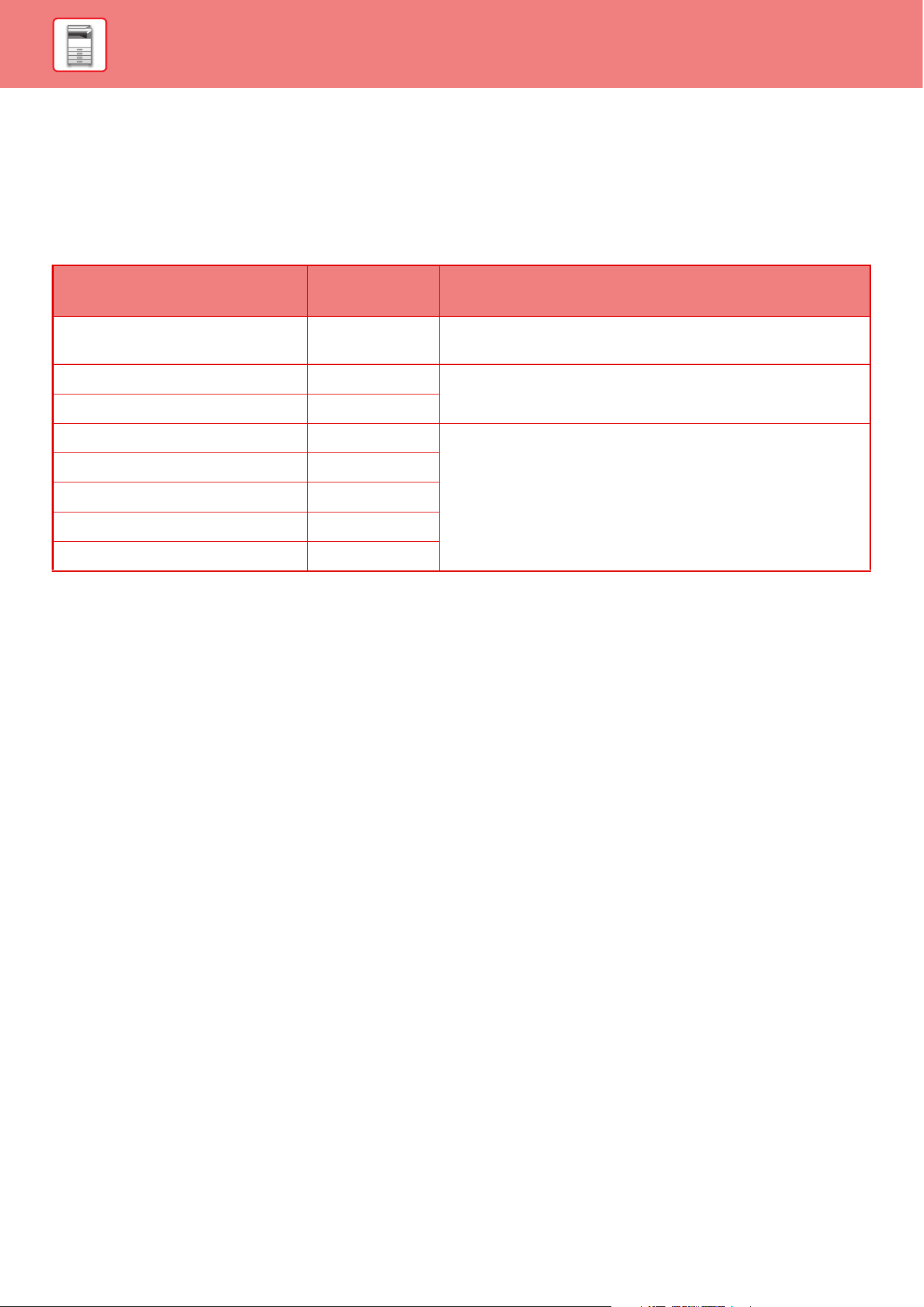
(18) [COMM. SETTING] key
This is used to switch between memory
transmission and direct transmission, and to switch
between automatic reception and manual
reception.
► Transmission settings (memory transmission mode
and direct transmission mode) (page 4-15)
(19) [SPEED] key
This is used to dial by Speed dialing.
► TRANSMISSION BY AUTO-DIALING (SPEED
DIALING AND GROUP DIALING) (page 4-12))
(20) [FAX STATUS] key
This is used to cancel a fax transmission or a stored fax
transmission.
► CANCELING A FAX TRANSMISSION (page 4-21)
(21) Data notification indicator
The indicator lights solidly or blinks to indicate the status
of a job.
(22) [ADDRESS] key
Used to search for address, numbers and other contact
information stored for auto dialing.
► SEARCHING FOR A PROGRAMMED
DESTINATION (USING THE [ADDRESS] KEY)
(page 4-13)
(23) [BACK] key
Press to return the display to the previous screen.
(24) [LOGOUT] key
Press this key to log out after you have logged in and
used the machine. When using the fax function, this key
can also be pressed to send tone signals on a pulse dial
line.
(25) Error indicator
Lights solidly or blinks to indicate the status of the error.
(26) [SPEAKER] key
This is used to dial without lifting an extension phone
connected to the machine. (page 4-16
)
(27) [REDIAL/PAUSE] key
This is used to redial the last number dialed, and enter a
pause when entering a fax number.
► CONVENIENT DIALING METHODS
(AUTO-DIALING) (page 4-6),
(28) [DUPLEX] key
Select the duplex copy/fax/scan mode.
(29) Printer mode indicator
• DATA indicator
Blinks when print data is being received. Lights
steadily during printing.
(30) FAX mode indicators
• LINE indicator
Lights up when a fax is being sent or received.
• DATA indicator
Blinks when a fax cannot be printed because there is
no paper or otherwise. Lights steadily when there is an
unsent fax.
(31) [READ-END] key
When copying in sort mode from the document glass,
press this key when you have finished scanning the
original pages and are ready to start copying.
(20)(19)(18)
(31)
(21) (25)
(28)
(23)(22) (24)
(27)(26) (30)
(29)
1-7
BEFORE USING THE MACHINE►BEFORE USING THE MACHINE
PERIPHERAL DEVICES
Peripheral devices can be installed on the machine to increase its range of functionality.
The peripheral devices are generally optional. However, some models include certain peripheral devices as standard
equipment.
(As of April, 2018)
Product name Product
number
Description
600-sheet paper feed unit MX-CS14 Additional tray. A maximum of 600 sheets of paper can be loaded
into the tray. One paper feed unit can be installed.
High stand MX-DS22
This is an additional dedicated stand. The stand has legs to
prevent toppling.
Low stand MX-DS23
Sharpdesk 1 license kit MX-USX1 This software enables integrated management of documents and
computer files.
Sharpdesk 5 license kit MX-USX5
Sharpdesk 10 license kit MX-USX10
Sharpdesk 50 license kit MX-USX50
Sharpdesk 100 license kit MX-USXA0
1-8
BEFORE USING THE MACHINE►BEFORE USING THE MACHINE
DISPLAY
This section explains how to use the display.
LEFT MENU AND RIGHT MENU
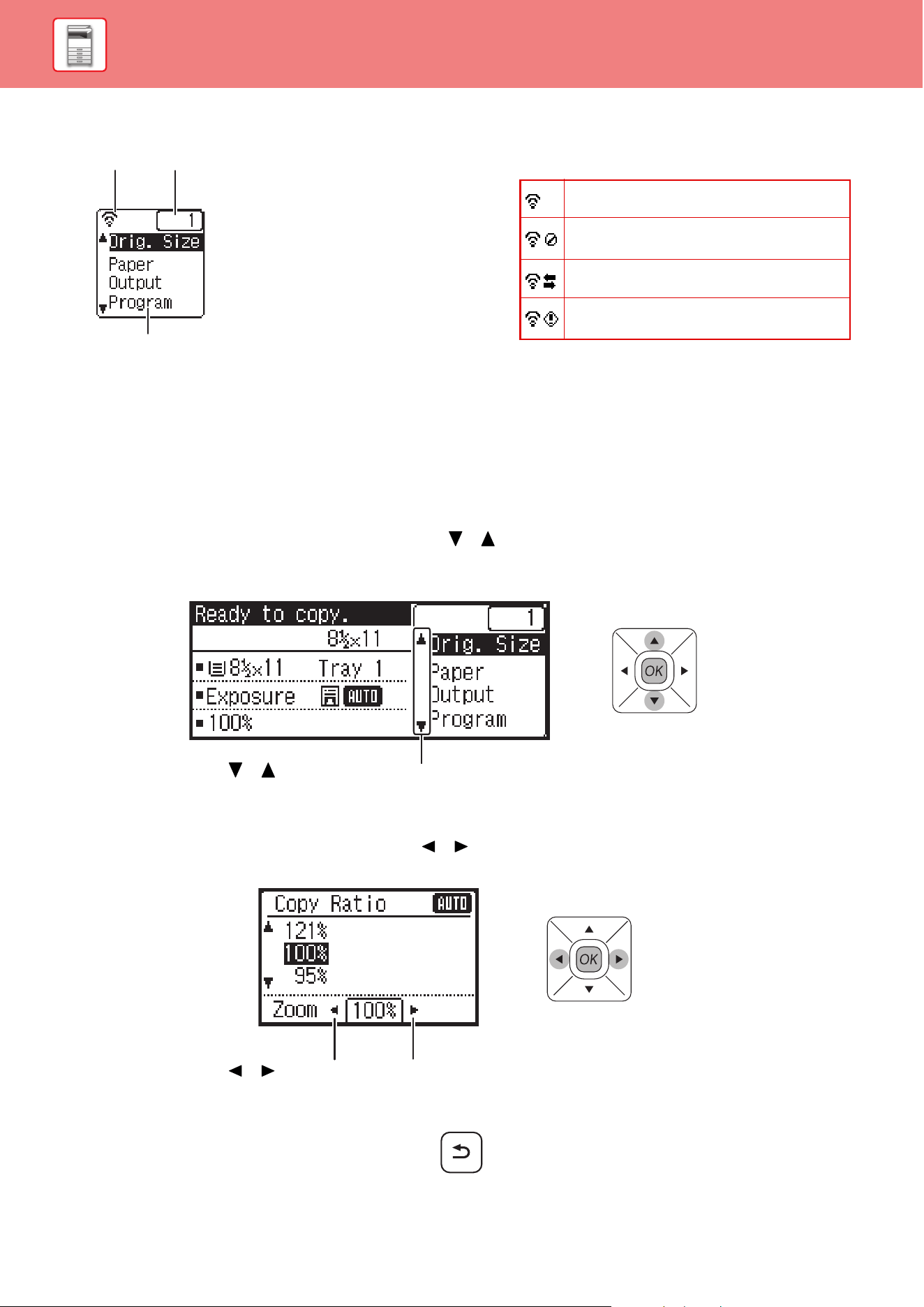
The display on the machine has a right menu containing frequently used settings and a left menu for display of the
settings and setting screens of each function.
Left Menu (Example: Copy mode)
(1) Message display
Messages are displayed regarding machine status and
operation.
(2) Special function icon display
Icons of enabled Special Modes will appear.
(3) Paper size display
Displays the selected paper size.
(4) Exposure display
Indicates the selected exposure mode.
(5) Copy ratio display
Displays the copy ratio for reduction or enlargement.
(6) Original size display
When the original size is specified in "Original Size" in the
right menu, this shows the specified size.
The following icons appear when the original is placed.
None: Document Glass
: Automatic document feeder (one-sided
scanning).
: Automatic document feeder (two-sided
scanning)
Left Menu Right Menu
1-sided to 2-sided
copy
2-sided to 2-sided copy
2-sided to 1-sided copy
Sort function
Suppress BG
2-Up copy
4-Up copy
Card shot
ID card copy
Sharpness
(1)
(6)(2)
(3)
(4)
(5)
1-9
BEFORE USING THE MACHINE►BEFORE USING THE MACHINE
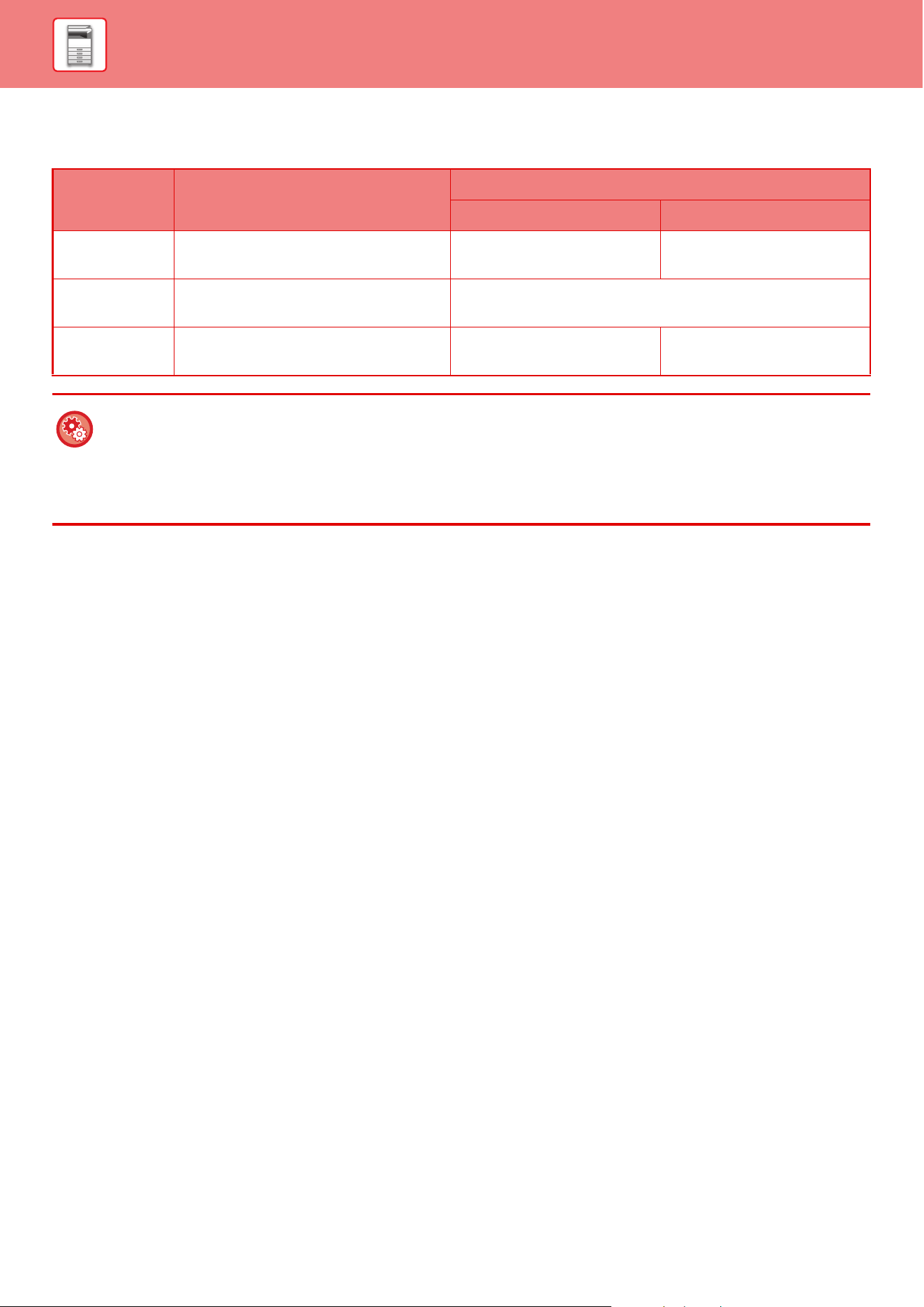
Right Menu
(1) Connection status display
Displayed when wireless LAN is on.
(2) Number of copies display
Shows the number of copies set.
(3) Function display
Shows the basic functions of each mode.
HOW TO USE THE DISPLAY
Selecting an item with the arrow keys (up/down)
Use the up/down arrow keys (indicated in this manual by [ ] [ ]) to move to and select (highlight) a setting item in the
selection screen. Press the [OK] key to display the screen of the selected setting item. Press [OK] in the setting screen
to save your settings.
Selecting an item with the arrow keys (left/right)
The left/right arrow keys (indicated in this manual by [ ] [ ]) are used to set the exposure and numbers in setting
screens. Press the [OK] key to save your settings.
Use the [BACK] key to return to the previous setting screen.
(7) (8)
(9)
Wireless infrastructure mode: Connecting
Wireless infrastructure mode:
Not connected
Wired + wireless access point mode
Connection failure of wireless LAN device
inside machine
The [ ] [ ] icons appear in the selection screen of settings that use the
up/down arrow keys.
The [ ] [ ] icons appear in setting screens that use the left/right arrow keys.
1-10
BEFORE USING THE MACHINE►BEFORE USING THE MACHINE
Data notification indicator and error indicator
The data notification indicator and the error indicator lights solidly or blinks to indicate the status of the machine.
Error indicator (red) Data notification indicator (green)
Pattern 1 Pattern 2
Solidly Errors that do not stop machine
operation, such as almost out of toner.
Job in progress, such as
paper feeding or output.
Ready state or other state
where jobs can be accepted.
Blinks Errors that stop machine operation, such
as misfeeds and out of toner.
A fax is being received
(Fax reception hold, print standby, printing a fax)
On/Blinking
Priority
Blinking Priority Blinking Priority Blinking Priority
•
To set the status indicated by the data notification indicator
Select [System Settings
(administrator)
] → [Device Control] → [Status Light Setting].
• To set the error indication
Select [System Settings
(administrator)
] → [Device Control] → [Error Light Setting].
• Specify whether or not the data notification indicator blinks while a fax is being received
Select [System Settings
(administrator)
] → [Device Control] → [Blink Setting for Received Data].
1-11
BEFORE USING THE MACHINE►BEFORE USING THE MACHINE
TURNING ON THE POWER
This section describes how to turn on/off the machine's power and how to restart the machine.
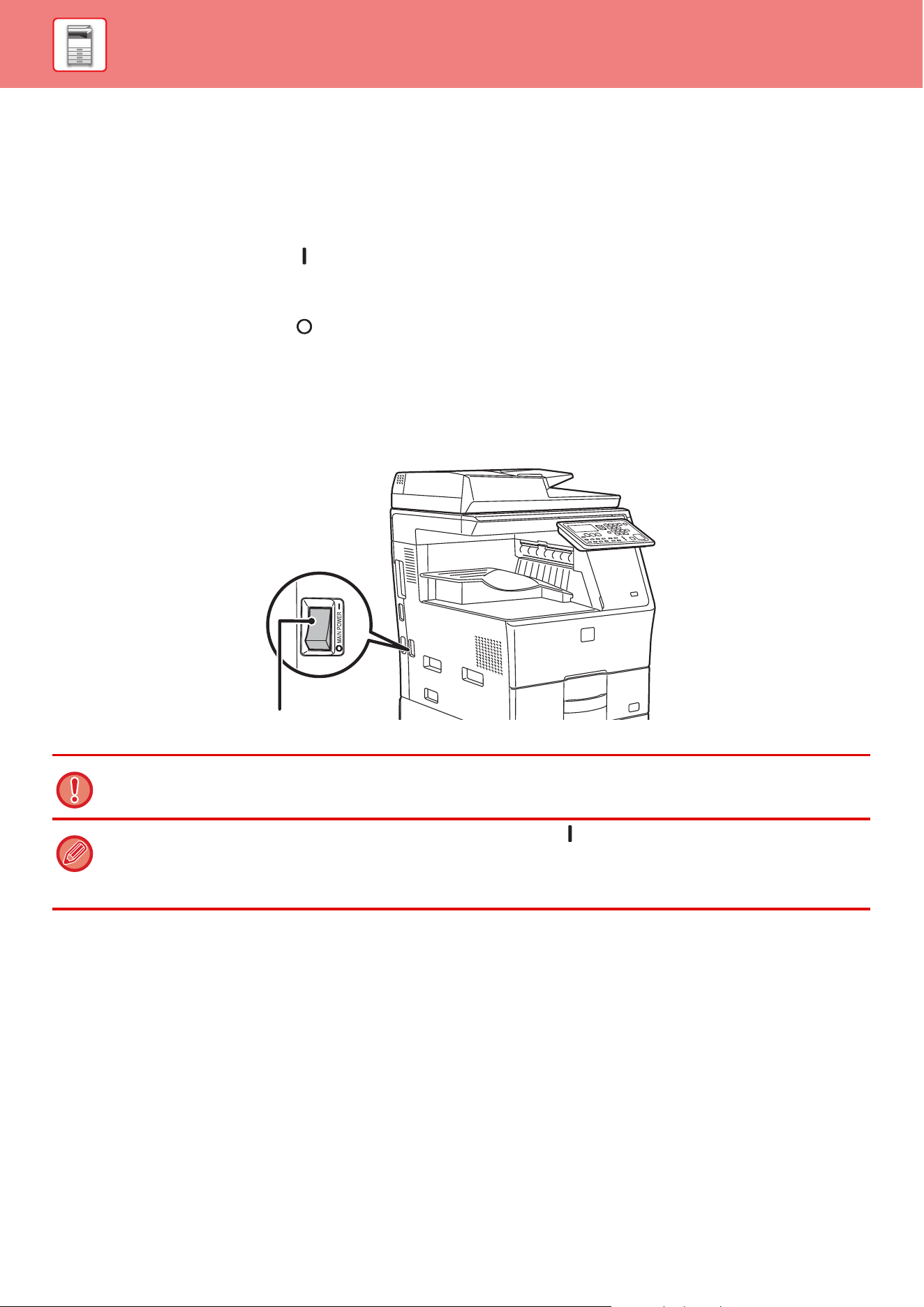
The power switch is located on the left side of the machine.
Turning on the power
Turn the main power switch to the " " position.
Turning off the power
Turn the main power switch to the " " position.
Restart the machine
Turn the main power switch off and then on.
Turn off the main power switch and unplug the power cord if you suspect a machine failure, if there is a bad thunderstorm
nearby, or when you are moving the machine.
• When using the fax function, always keep the main power switch in the " " position.
• Print and other functions cannot be used during a brief period of time after the power is turned on or after the machine is
wakened from sleep mode. This time is required to allow the machine to prepare for normal printing, and is called the
warmup time.
The main power switch
1-12
BEFORE USING THE MACHINE►BEFORE USING THE MACHINE
Eco
ECO FUNCTIONS OF THE MACHINE
These functions help save power consumption by managing operations of sections prone to high power consumption.
The machine provides two power-saving modes.
AUTO POWER SHUT-OFF MODE
This mode turns off the power to the operation panel and the fusing unit, and makes the machine wait in the lowest
power consumption state.
Auto Power Shut-Off Timer will activate when the set duration of time elapses in waiting status without executing a job.
Compared to preheat mode, the power-saving rate is considerably higher but the wakeup time is longer.
The [ENERGY SAVE] key blinks when the machine is in Auto Power Shut-Off Timer.
Auto Power Shut-Off Timer is also activated by pressing the [ENERGY SAVE] key while the [ENERGY SAVE] key is not
lit.
This mode is cleared when print data is being received, fax data is being output, or when the [ENERGY SAVE] key is
pressed while it is blinking.
Function Description Page
AUTO POWER SHUT-OFF
MODE
If no operations take place, this mode will turn off the power to the operation
panel and the fusing unit, and makes the machine wait in the lowest power
consumption state.
Although the power-saving rate is higher, the wakeup time is longer.
When "ENTER AUTO POWER SHUT-OFF AFTER THE REMOTE JOB" is
enabled, the machine returns to auto power shut-off mode after being
wakened from auto power-shut off mode and printing a job.
1-12
PREHEAT MODE This mode lowers the temperature of the fusing unit and makes the machine
wait in low power consumption state.
Compared to Auto Power Shut-Off Timer, the power-saving rate is lower, but
the wakeup time is shorter.
1-13
To set Auto Power Shut-Off Timer:
In "System Settings (administrator)" , select [Energy Save] → [Auto Power Shut-Off Timer].
[ENERGY SAVE] key/indicator
1-13
BEFORE USING THE MACHINE►BEFORE USING THE MACHINE
PREHEAT MODE
This mode lowers the temperature of the fusing unit and makes the machine wait in low power consumption state.
Preheat mode will activate when the set duration of time elapses in waiting status without executing a job.
Compared to Auto Power Shut-Off Mode, the amount of energy saved is less and the wakeup time is shorter.
In preheat mode the display turns off. Normal operation automatically resumes when a key on the operation panel is
pressed, an original is placed, or a print job or fax is received.
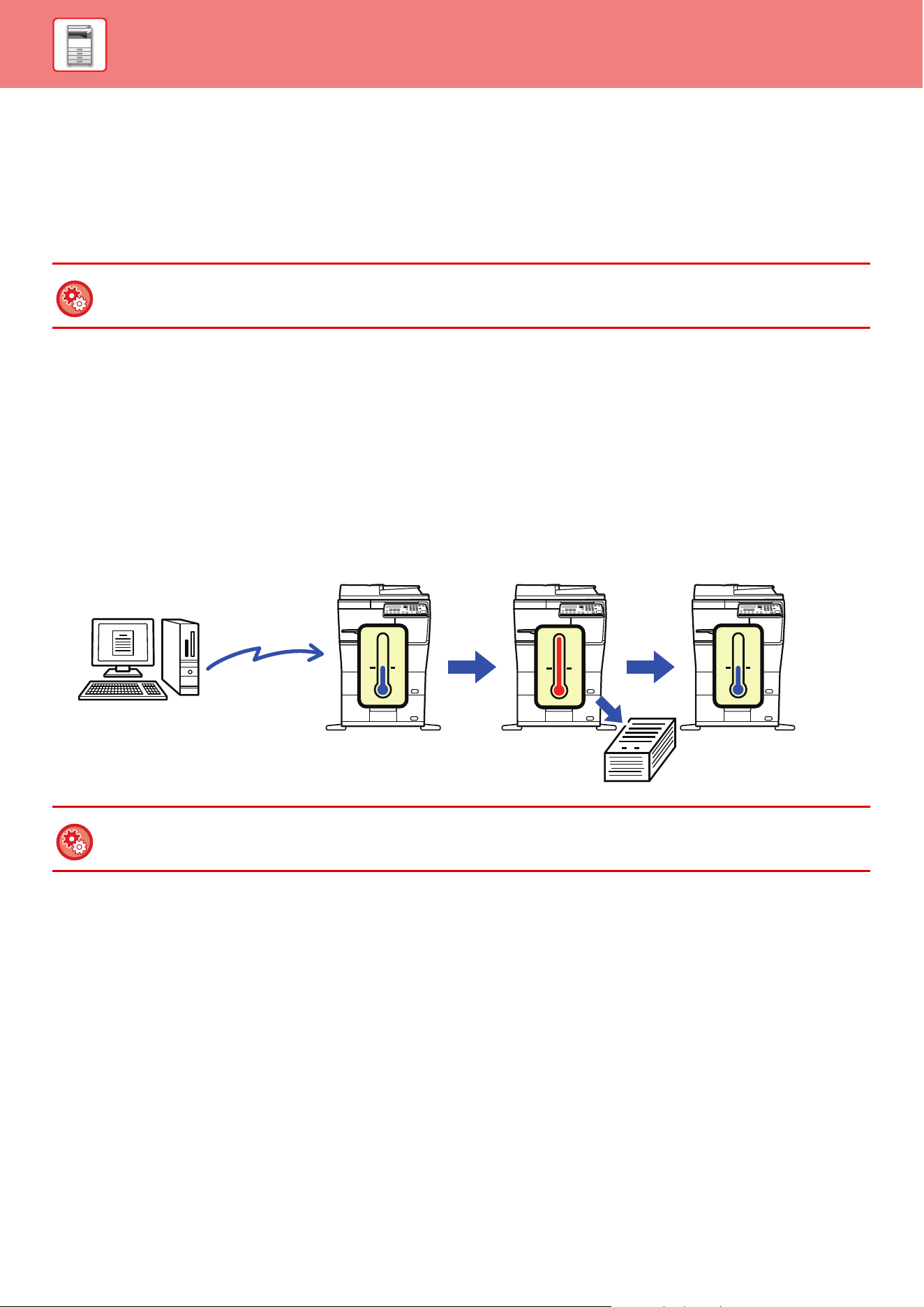
ENTER AUTO POWER SHUT-OFF AFTER THE REMOTE
JOB
Printing or outputting received fax data in Auto Power Shut-Off Timer turns on the power, and then the machine returns
to Auto Power Shut-Off Mode immediately after completing the print job.
To set preheat mode:
In "System Settings (administrator)", select [Energy Save] → [Preheat Mode].
To set "Enter Auto Power Shut-Off after the Remote Job":
In "System Settings (administrator)" , select [Energy Save] → [Enter Auto Power Shut-Off after the Remote Job].
1
L
L
H
L
Printed
Sleep mode
Print
Sleep mode
Fusing unit is turned
off
Fusing unit is turned
on
Fusing unit is turned
off
1-14
BEFORE USING THE MACHINE►BEFORE USING THE MACHINE
USER AUTHENTICATION MODE
When user authentication mode is enabled, a count is kept of the pages printed by each account. The page counts can
be viewed in the display. Users that can transmit faxes (up to 30) can be established and transmission time and other
information can be tracked for each account. The User Usage List (page 7-15)
can be printed out which shows the time
used for transmission and pages transmitted by each account.
This function is enabled in the system settings. (User Authentication (page 7-12)
)
Up to 30 can be stored.
USING USER AUTHENTICATION MODE
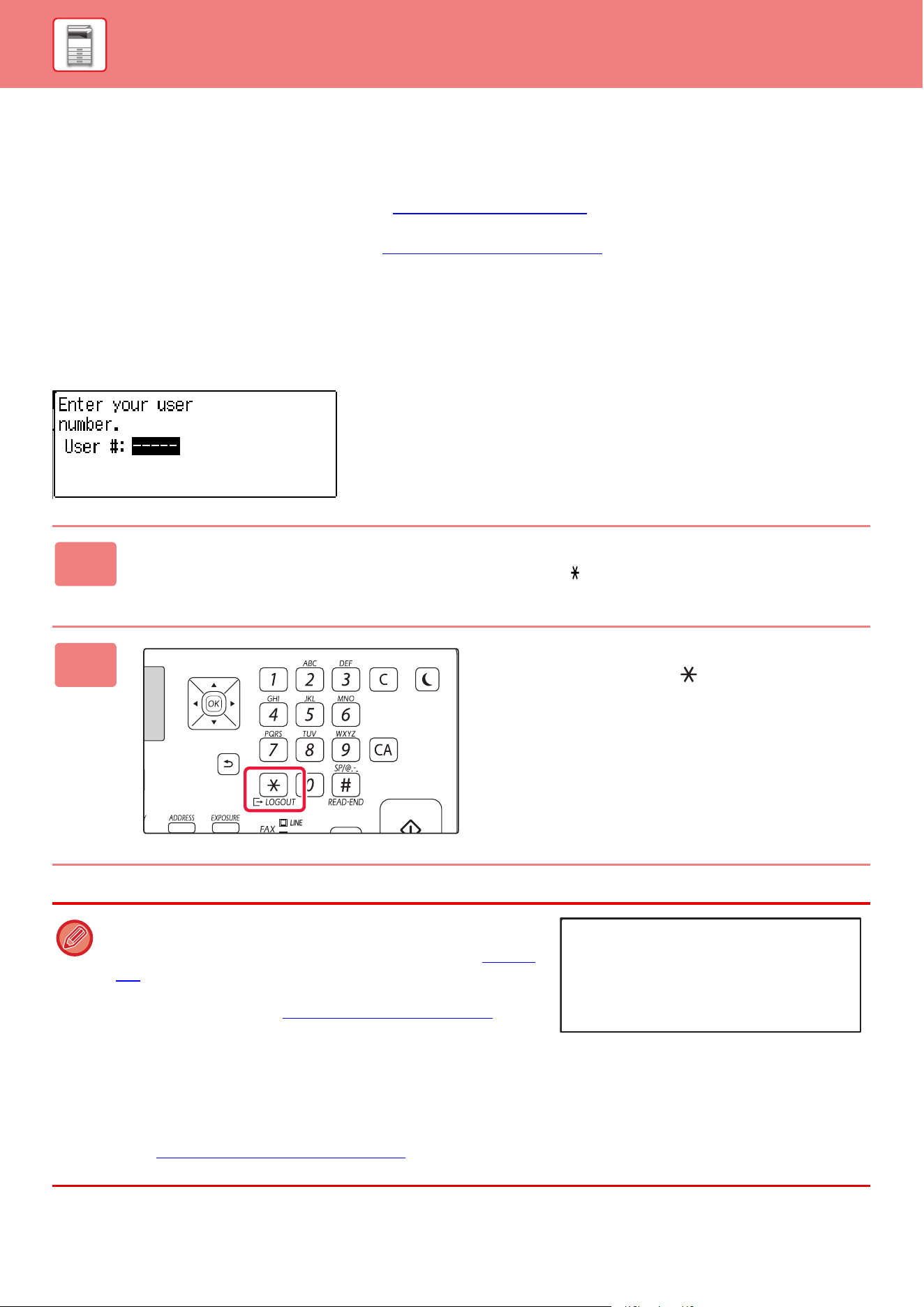
When user authentication mode is turned on, the account number entry screen is displayed. Enter your account number
(five-digit identification number) as explained below before performing a copy, fax, or scan operation.
1
Enter your account number (five digits) with the numeric keys.
As the account number is entered, the hyphens (-) change to asterisks ( ). If you enter an incorrect digit, press [C] key
and re-enter the correct digit.
2
When the copy job is finished, press
the [LOGOUT] key
().
• When a valid account number is entered, the current count of the
account will appear in the message display of the base screen. After 6
seconds (factory default setting), the base screen appears. (►page
1-8)
* In copy mode, the number of sheets remaining until the limit is
reached is also shown if Function Limit Setting (page 7-12)
is
enabled in the system settings.
• If you enter an user number for copy mode has also been programmed for fax mode, you can change to fax mode after
completing the copy operation and continue with the fax
operation without re-entering your user number. If you enter an user number for copy mode that has not been programmed
for fax mode, enter your user number for fax mode after you press the [FAX] key to change to fax mode.
• If an invalid account number is entered in step 1, the account number entry screen reappears.
• When A Warning when Login Fails (page 7-12)
in the system settings is enabled, a warning message will appear and
operation will not be permitted for 1 minute if an invalid account number is entered 3 times in a row.
00,057,600Prints:
1-15
BEFORE USING THE MACHINE►BEFORE USING THE MACHINE
UNIVERSAL DESIGN IN THE MACHINE
The structure of the machine and the software are designed to allow all people to use the machine with ease.
UNIVERSAL DESIGN RELATED TO OPERATION
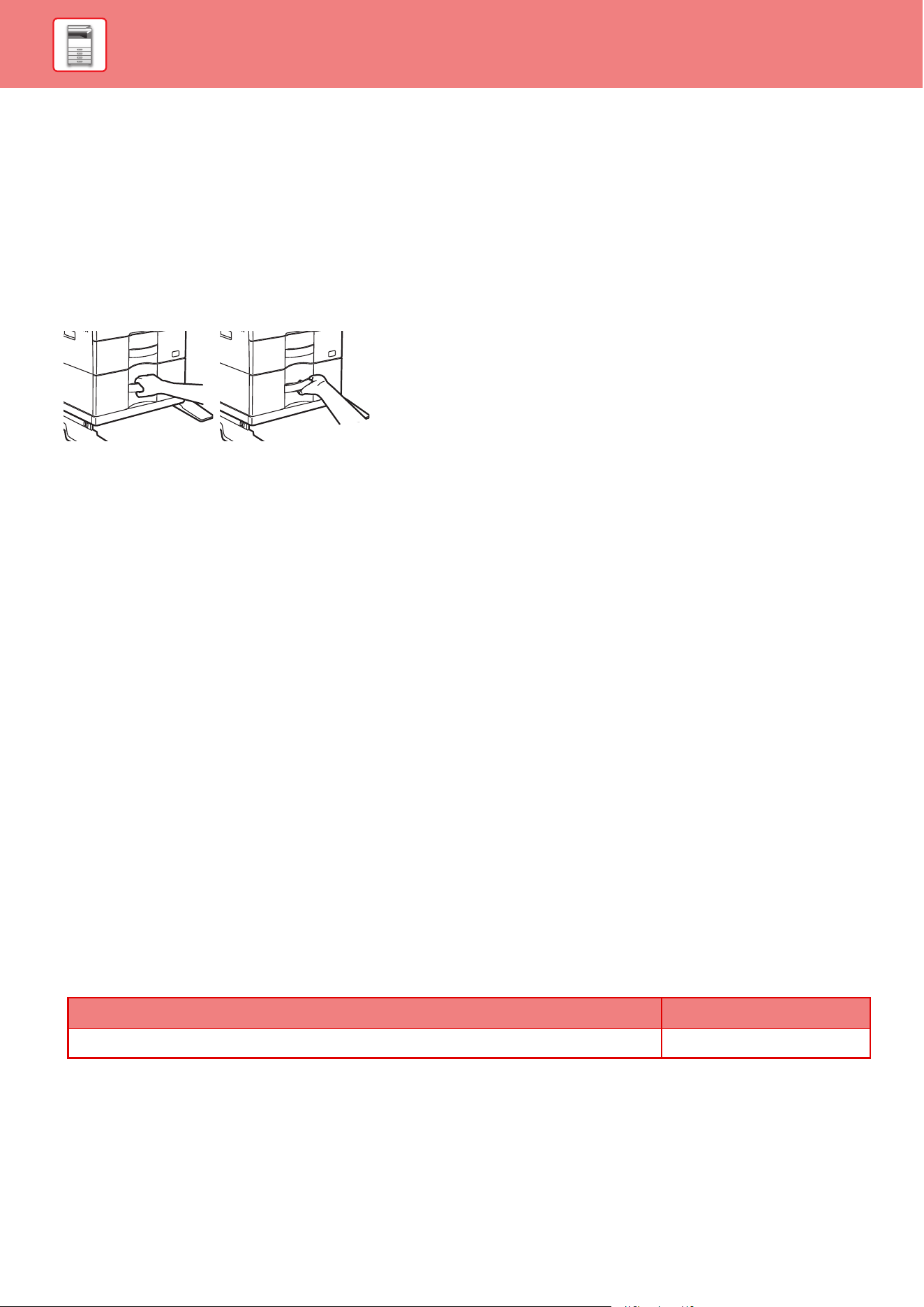
Grip handle on paper trays
The grip-type handles allow easy use from above or below. By simply placing your hand on a handle and gently pulling
forward, a tray can be withdrawn. The trays can be manipulated in a natural manner.
Changing of key response time
The response time of the keys can be changed as needed.
In "System Settings (administrator)", select [Operation Settings] → [Key Press Time] and [Disable Auto Key Repeat].
• Key Press Time
This setting is used to set the duration of time that a key must be pressed to take effect. The time can be set from 0 to
1.5 seconds in increments of 0.5 seconds.
By lengthening the time setting, key input can be prevented when a key is pressed accidentally. Keep in mind,
however, that when a longer setting is selected more care is required when pressing keys to ensure that key input is
registered.
• Disable Auto Key Repeat
This is used to disable key repeat.
Key repeat causes a setting to change continuously not only each time the key is pressed but while a key is pressed.
UNIVERSAL DESIGN RELATED TO HEARING
Audible alert sounds when changing settings
When moving through copy ratio or exposure settings, the user is alerted by an audible sound at the default setting
(copy ratio 100%, exposure 3).
In "System Settings (administrator)", select [Operation Settings] → [Keys Touch Sound] and [Keys Touch Sound At
Initial Point].
• Keys Touch Sound
Controls the key touch sound level, or turns the sound off. You can also have three peeps sound at initial values when
setting the ratio in copy mode or when adjusting the exposure in any mode.
• Keys Touch Sound At Initial Point
When you specify the exposure in the exposure adjustment screen of each mode, a bleep sounds three times when
the reference value is reached.
Screen in which setting is effective Initial value
Ratio setting screen in base screen of copy mode Ratio 100%

1-16
BEFORE USING THE MACHINE►BEFORE USING THE MACHINE
UNIVERSAL DESIGN FEATURES
The machine has design features and settings that are compatible with universal design.
Easy-to-use user interface
• Multi-language display
The language used in the display can be changed to another language such as English or French.
Select the desired language in "System Settings (administrator)" →[Operation Settings] →[Language Setting].
► Language Setting (page 7-14)
Intuitive operation
• Easy operation by storing programs
The program function lets you store groups of settings for copying, fax, and other functions. By storing groups of
settings that you frequently use, you can easily select those settings.
► FREQUENTLY USED SETTINGS (PROGRAMS) (page 2-24)
► USING A PROGRAM (page 4-49)
► USING STORED SETTINGS (PROGRAM) (page 5-19)
Easier operation at the machine
• Darkened output tray color
Output tray colors are darkened to make it easy to distinguish the tray to which a job has been output.
• On right side of operation panel
Located on the right side of the operation panel, this allows smooth removal of paper without interfering with the
output tray.
Simple toner replacement
• Toner box can be opened with one hand
The box that contains a toner cartridge can be easily opened with one hand.
1-17
BEFORE USING THE MACHINE►LOADING PAPER
IMPORTANT POINTS ABOUT PAPER
NAMES AND LOCATIONS OF TRAYS
APPLICABLE PAPER TYPES
This section describes paper types that can be used and those that cannot be used.
All types of paper other than plain paper are referred to as special media.
LOADING PAPER
• Various types of paper are commercially available, some of which cannot be used on the machine.
Before using any paper, consult the dealer or nearest SHARP Service Department.
• The image quality and toner fusibility of paper may change due to ambient conditions, operating conditions, and paper
characteristics, resulting in image quality inferior to that of Sharp standard paper.
Before using any paper, consult the dealer or nearest SHARP Service Department.
• The use of non-recommended or non-usable paper may result in skewed feeding, misfeeds, poor toner fusing (the toner
does not adhere to the paper well and can be rubbed off), or machine failure.
• The use of non-recommended paper may result in misfeeds or poor image quality. Before using non-recommended paper,
check whether printing can be performed properly.
Tray 1
Tray 2
(when a 600-sheet paper feed unit is installed)
Bypass tray
1-18
BEFORE USING THE MACHINE►LOADING PAPER
Useable paper
Specifications of plain paper, heavy paper and thin paper
Specifications of paper that can be used for two-sided printing
Plain Paper
Plain Paper 1 16 lbs. bond to 24 lbs. bond (60 g/m
2
to 89 g/m
2
)
Plain Paper 2 24 lbs. bond to 28 lbs. bond (90 g/m
2
to 105 g/m
2
)
Heavy paper
Heavy paper 1 28 lbs. bond to 65 lbs. cover (106 g/m
2
to 176 g/m
2
)
Heavy paper 2 65 lbs. cover to 80 lbs. cover (177 g/m
2
to 220 g/m
2
)
Thin paper 13 lbs to 16 lbs (55 g/m
2
to 59 g/m
2
)
• For paper specifications, see the specifications in the "Start Guide".
• Recycled paper, colored paper and pre-punched paper must meet the same specifications as plain paper.
Before using any paper, consult the dealer or nearest SHARP Service Department.
• If the paper that was output is significantly curled, remove the paper from the cassette, turn the paper over so it is face
down, and resume use.
Paper Type Plain, Recycled, Color, Letter Head, Pre-Printed, Punched
Paper Size 8-1/2" x 14", 8-1/2" x 13-1/2", 8-1/2" x 13-2/5", 8-1/2" x 13", 8-1/2" x 11", 5-1/2" x 8-1/2", A4, B5,
A5
1-19
BEFORE USING THE MACHINE►LOADING PAPER
Types of paper that can be set in each tray
*1 when a 600-sheet paper feed unit is installed
*2 "Plain Paper 1" is plain paper 16 to 24 lbs. bond (60 to 89 g/m
2
), "Plain Paper 2" is plain paper 24 to 28 lbs. bond
(90 to 105 g/m
2
).
*3 "Heavy Paper 1" is heavy paper up to 65 lbs. cover (176 g/m
2
), "Heavy Paper 2" is heavy paper up to 80 lbs. cover
(220 g/m
2
).
• For detailed information on the sizes and types of paper that can be loaded into each tray of the machine, see
"SPECIFICATIONS" in the "Start Guide".
• Recycled paper, colored paper and pre-punched paper must meet the same specifications as plain paper.
Before using any paper, consult the dealer or nearest SHARP Service Department.
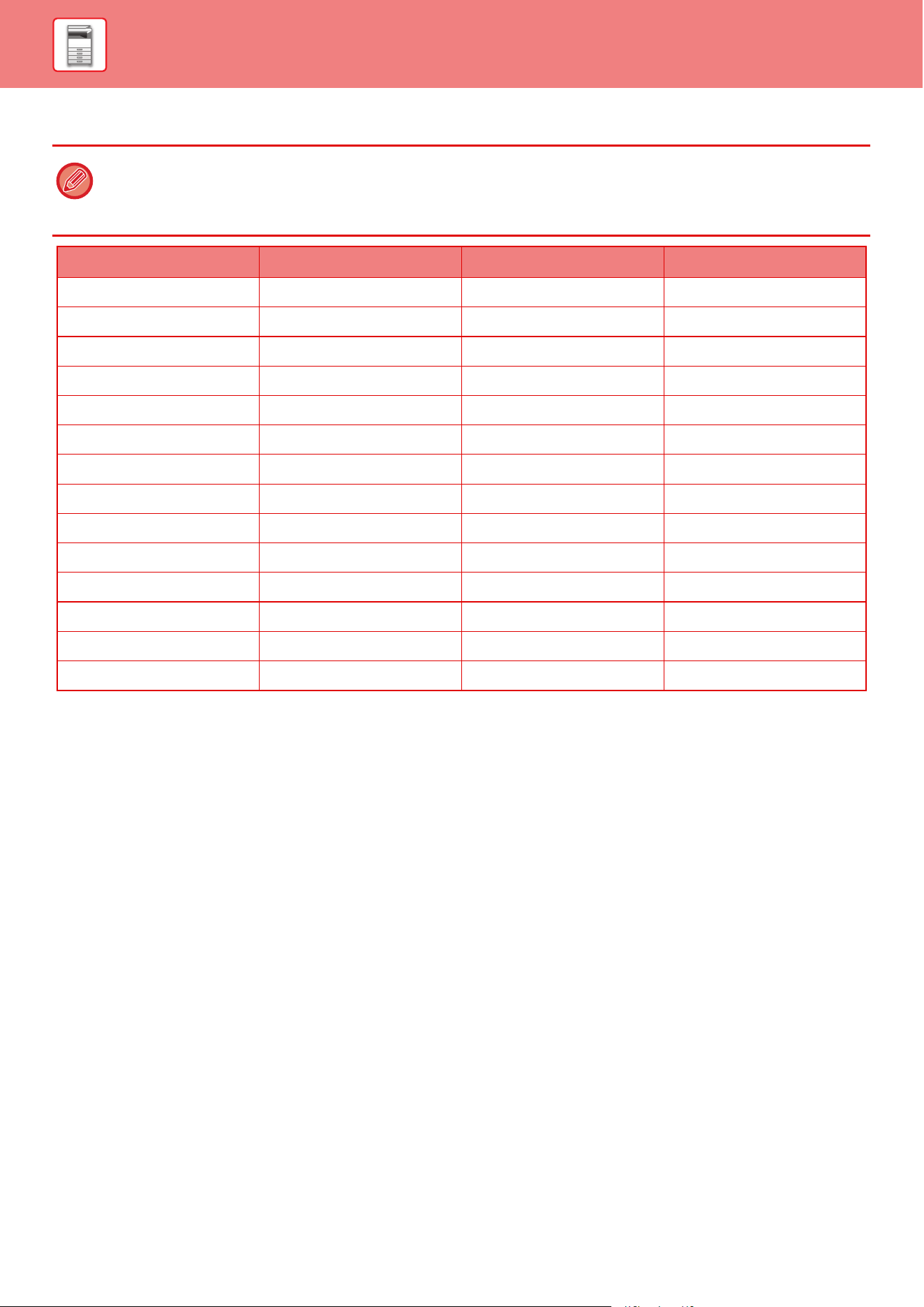
Tray 1 Tray 2
*1
Bypass tray
Plain Paper 1
*
2
Permitted Permitted Permitted
Plain Paper 2
*
2
Permitted Permitted Permitted
Heavy Paper 1*
3
- Permitted Permitted
Heavy Paper 2*
3
- Permitted Permitted
Thin Paper - Permitted Permitted
Pre-Printed Permitted Permitted Permitted
Recycle Paper Permitted Permitted Permitted
Letter Head Permitted Permitted Permitted
Pre-Punched Permitted Permitted Permitted
Color Permitted Permitted Permitted
Labels - - Permitted
Glossy Paper - - Permitted
Transparency - - Permitted
Envelope - - Permitted
1-20
BEFORE USING THE MACHINE►LOADING PAPER
Setting orientation of the print side
The setting orientation varies for the print side of paper, depending on the tray used. For "Letter Head" and
"Pre-Printed", set the paper in the reverse orientation.
Place with the print side facing the direction indicated below.
Paper that cannot be used
• Embossed paper
• Tab paper
• Special media for an ink jet printer
(fine paper, glossy paper, glossy film, etc.)
• Carbon paper or thermal paper
• Pasted paper
• Paper with clips
• Paper with fold marks
• Torn paper
• Oil-feed transparency film
• Thin paper less than 15 lbs (55 g/m
2
)
• Heavy paper as thick as 80lbs. cover (220 g/m
2
) over
• Irregularly shaped paper
• Stapled paper
• Damp paper
• Curled paper
• Paper whose print side or reverse side has been already printed on by another printer or multifunction device.
• Paper with a wave-like pattern due to moisture absorption
• Paper with creases
• Paper with dust
Non-recommended paper
• Iron-on transfer paper
• Perforated paper
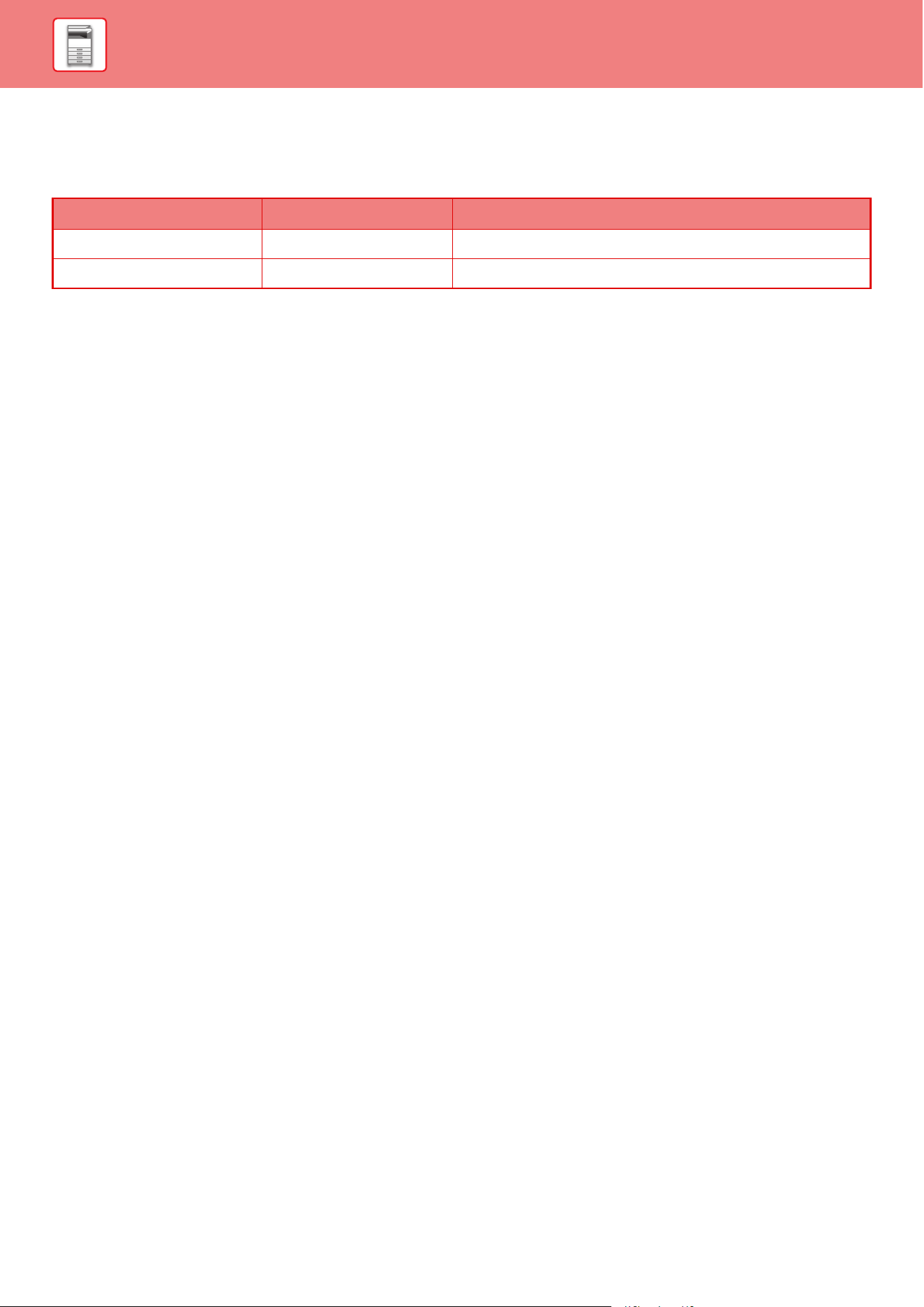
Tray In normal status With letter head or pre-printed paper set
Trays 1 - 2 Facing up Facing down
Bypass Facing down Facing up
1-21
BEFORE USING THE MACHINE►LOADING PAPER
TRAY 1 - 2
A maximum of 500 sheets of paper from size 5-1/2" x 8-1/2" to 8-1/2" x 11" (A6 to A4) can be loaded into tray 1.
(150 sheets when the paper is A6)
A maximum of 600 sheets of paper from size 5-1/2" x 8-1/2" to 8-1/2" x 14" (A5 to A4) can be loaded into tray 2.
If you loaded paper of a different type or size from the paper previously loaded, be sure to check the settings in "TRAY
SETTINGS (page 1-29)". Incorrect setting affects automatic paper selection action. It may cause print failure, printing on
paper of a wrong size or type or paper misfeeds.
Do not place heavy objects on the tray or press down on the tray.
To set the paper type or size
Press the [SPECIAL FUNCTION] key and set in [Paper Size Set] or [Paper Type Setup].
►TRAY SETTINGS (page 1-29)
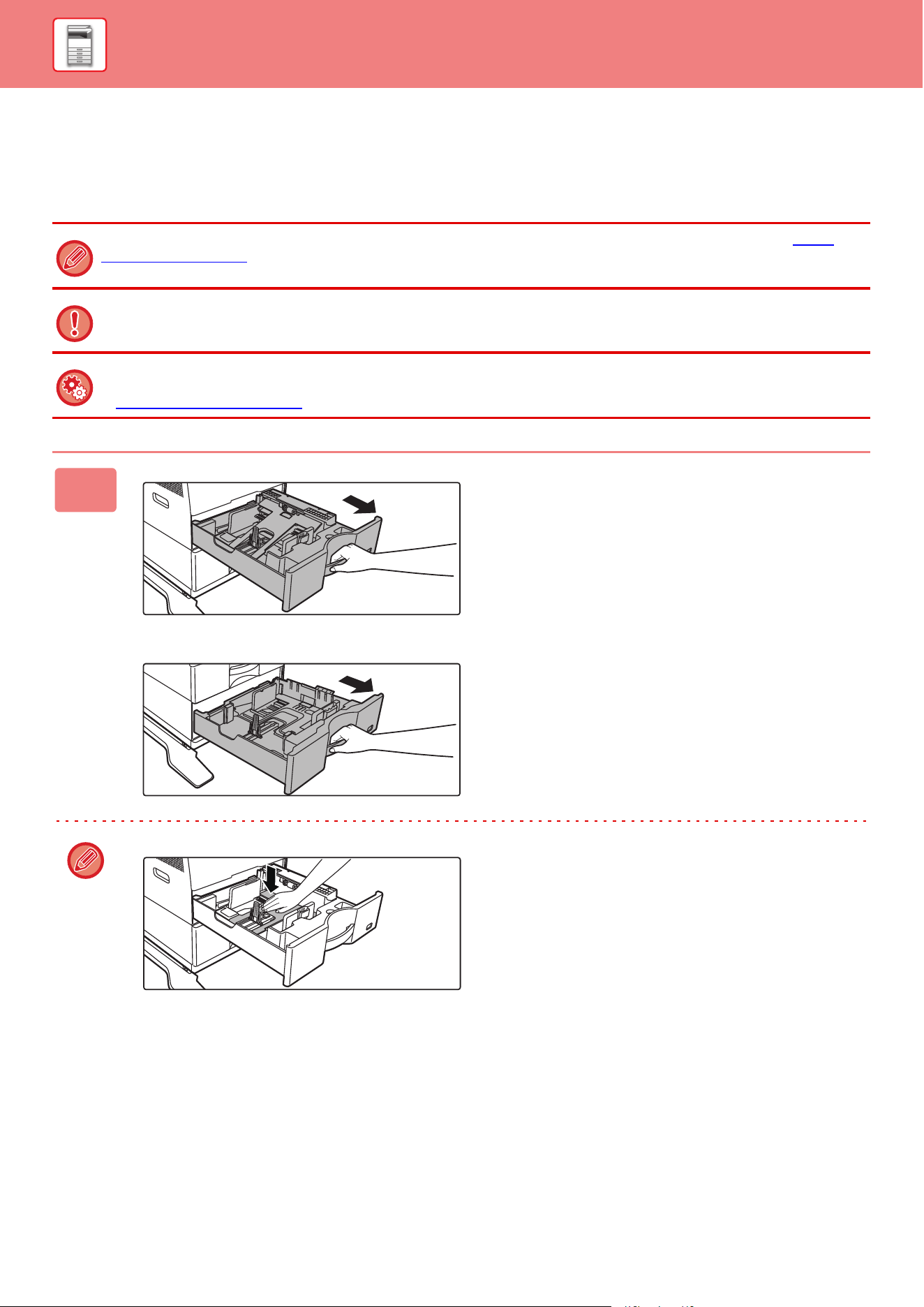
1
Tray 1
Tray 2
Pull out the paper tray.
Gently pull the tray out until it stops.
To load paper, go to step 3. To load a different size of
paper, go to the next step.
When using the tray 1, push the center of the pressure plate down until it locks into place.
1-22
BEFORE USING THE MACHINE►LOADING PAPER
2
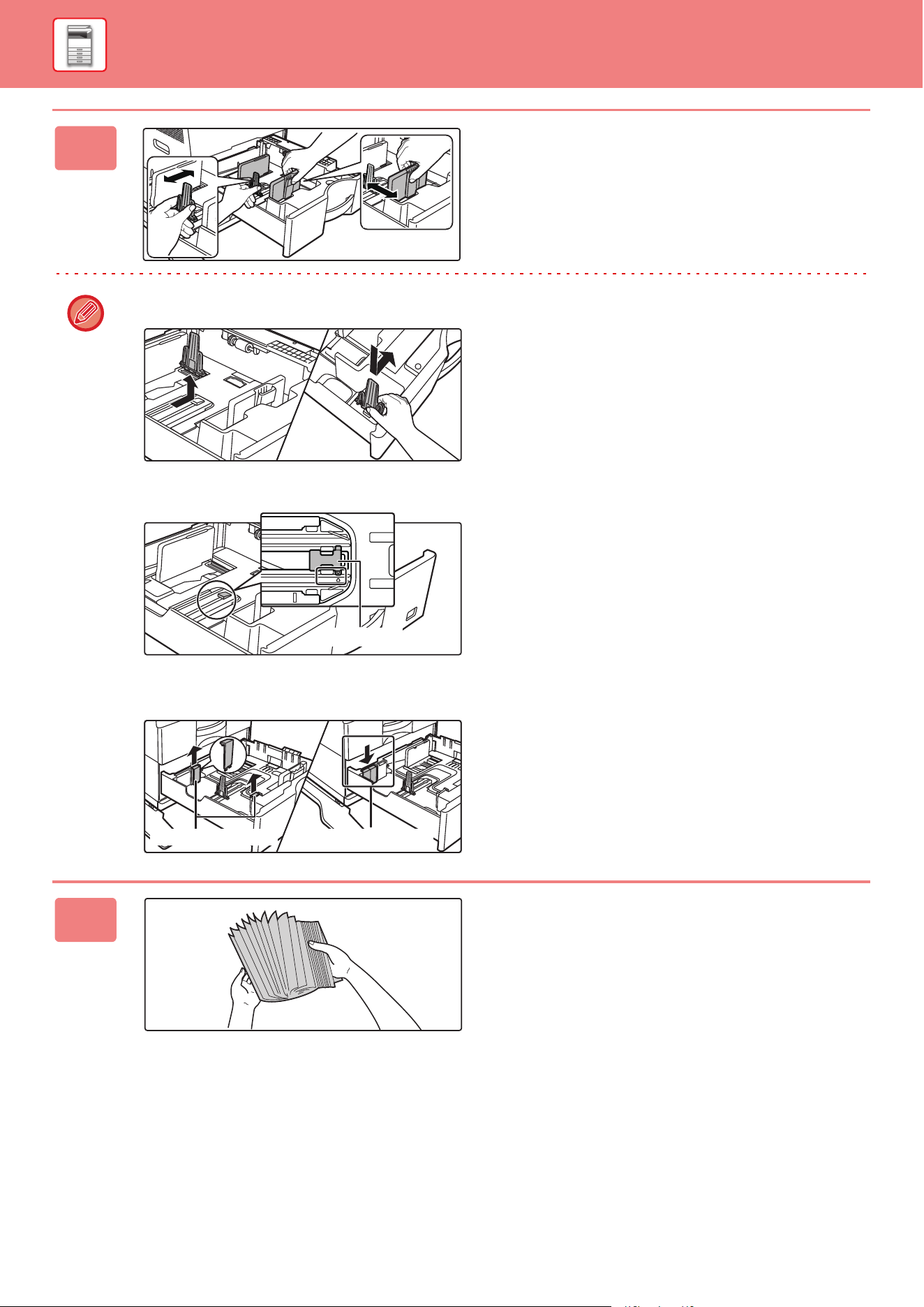
Adjust guide plates A and B to match
the longitudinal and transversal
dimensions of the paper to be loaded.
The guide plates A and B are slidable. Squeeze the
separator plate lever and slide to the desired paper size.
Adjust to the non-standard paper size so that the paper will
not be too loose or too tight.
• When loading 8-1/2" x 14" paper in tray 2, remove divider plate A.
Move divider plate A all the way to the paper feed opening (right side), and pull up.
• When setting 8-1/2" x 14" size paper in tray 2, check if the holder in the cassette is positioned at A4 (8-1/2" x 14” in
tray 2).
• When setting 8-1/2" x 11" size paper in tray 2, remove the 2 regulation plates with green color on the front and back
side of the tray before setting the paper. The plates are contained in the inside storage space of the back side of the
tray.
3
Fan the paper.
Fan the paper well before loading it. If the paper is not
fanned, multiple sheets may feed at once and cause a
misfeed.
A
B
A6
A4
Holder
Storage spaceRegulation plate
1-23
BEFORE USING THE MACHINE►LOADING PAPER
4
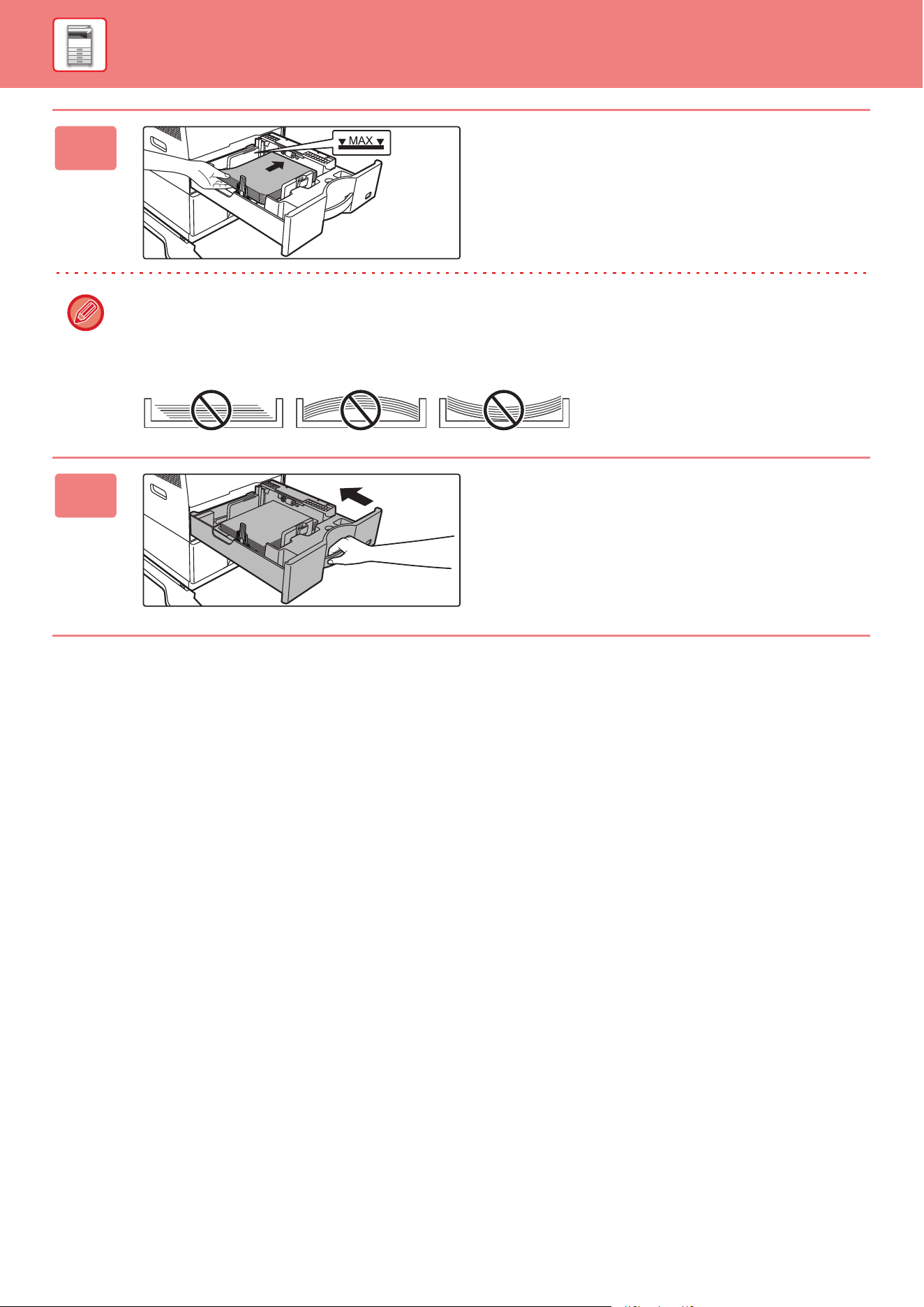
Insert the paper into the tray.
Load the paper with the print side facing up. The stack must
not be higher than the indicator line (Tray 1: maximum of
500 sheets (Maximum of 150 sheets of A6 paper), tray 2:
maximum of 600 sheets).
• If a paper misfeed occurs, turn the paper over and/or around, and reload.
• If the paper is curled, fix the curl before loading the paper.
• Adjust the divider plate so that there is no gap between the paper and divider plate.
• Do not add paper.
• Do not load the paper as shown below.
5
Gently push the paper tray into the
machine.
Push the tray firmly all the way into the machine slowly.
Forcefully inserting the paper may cause skewed feeding
and paper misfeeds.
1-24
BEFORE USING THE MACHINE►LOADING PAPER
LOADING PAPER INTO THE BYPASS TRAY
Use the bypass tray for printing on plain paper, envelopes, label sheets, and other special media.
Up to 50 sheets of paper can be loaded (Heavy paper weighing between 28 lbs. bond and 80 lbs. cover: 20 sheets,
envelope: 10 sheets) for continuous printing, just like operation using other trays.
How to place the original
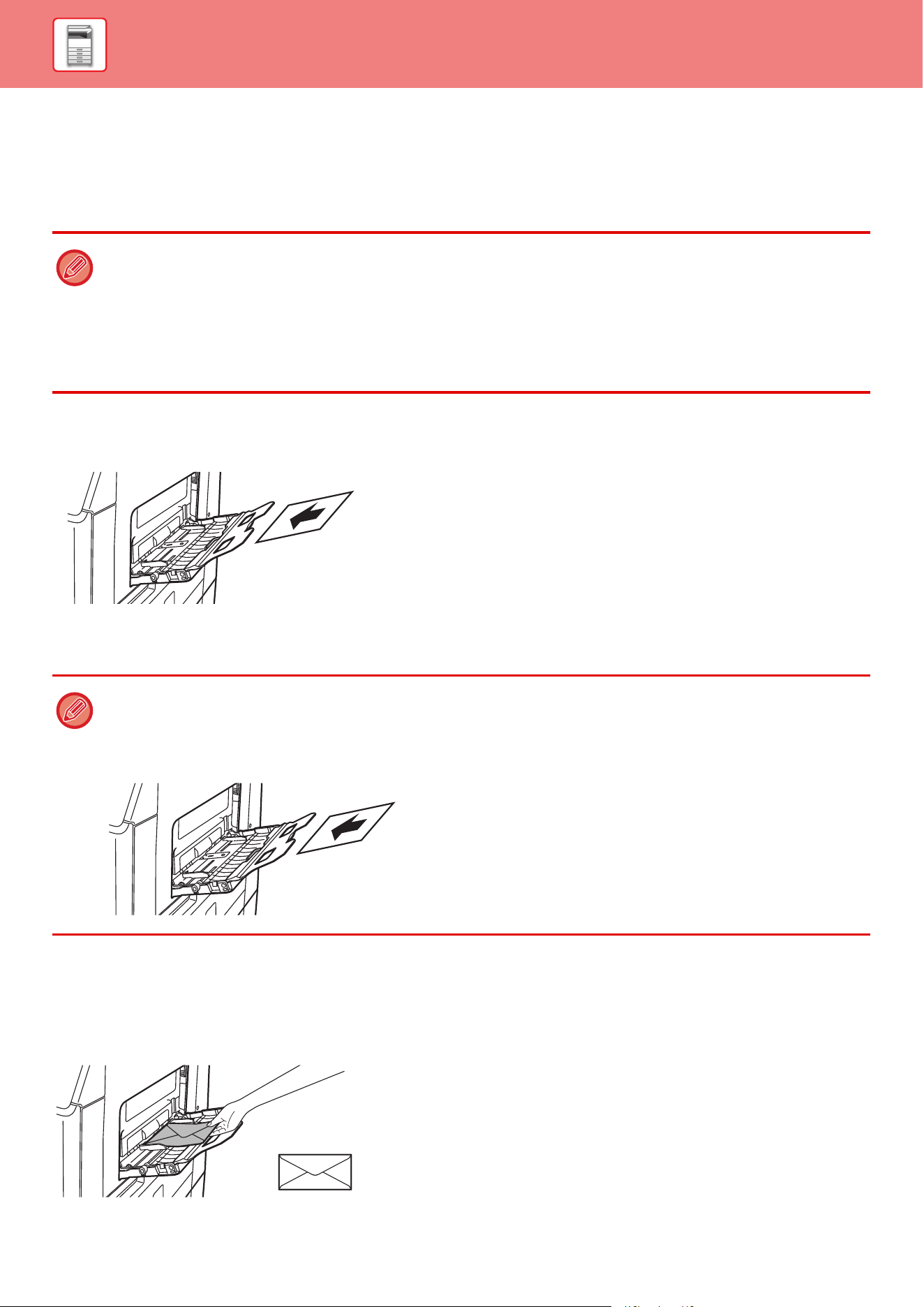
Load paper in landscape orientation.
Inserting transparency film
Loading envelopes
When inserting envelopes in the bypass tray, place them aligned to the left side in the orientation shown below.
Only the front side of envelopes can be printed or copied on. Place the front side facing down.
Fold the flap and make a sharp crease at the fold.
• When using plain paper other than Sharp standard paper or special media other than SHARP-recommended transparency
film, glossy paper, or when printing on the reverse side of paper that has been printed on one side, load paper one sheet
at a time. Loading more than one sheet at a time will cause misfeeds.
• Before loading paper, straighten any curling in the paper.
• When adding paper, remove any paper remaining in the bypass tray, combine it with the paper to be added, and reload as
a single stack. If paper is added without removing the remaining paper, a misfeed may result. Loading more sheets than
the specified number of sheets or the limit may cause paper misfeeds.
• After loading paper in the bypass tray, always check the paper type and size.
• Use SHARP-recommended transparency film.
• When loading multiple sheets of transparency film into the bypass tray, fan the sheets several times before loading.
• When printing on transparency film, remove each sheet as it is printed and output from the machine. Allowing sheets to
stack in the output tray may result in curling.
1-25
BEFORE USING THE MACHINE►LOADING PAPER
Important points when using envelopes
• Do not print on both sides of an envelope. This may result in misfeeds or poor print quality.
• Restrictions apply to some types of envelopes. For more information, consult a qualified service technician.
• Some operating environments may cause creasing, smudging, misfeeds, poor toner fusing, or machine failure.
• Fold the flap of the envelope and make a sharp crease at the fold. A misfeed may occur if the flap is up.
• Do not use the following envelopes:
• Those with a metal piece, a plastic hook or a ribbon hook
• Those with a string for closing
• Those with a window
• Those with a lining
• Those with an uneven surface, finished with titling or emboss
• Duplex envelopes or those with adhesive or other synthetic material for sealing
• Hand-made envelopes
• Those containing air inside
• Those damaged with a crease, fold mark or tear
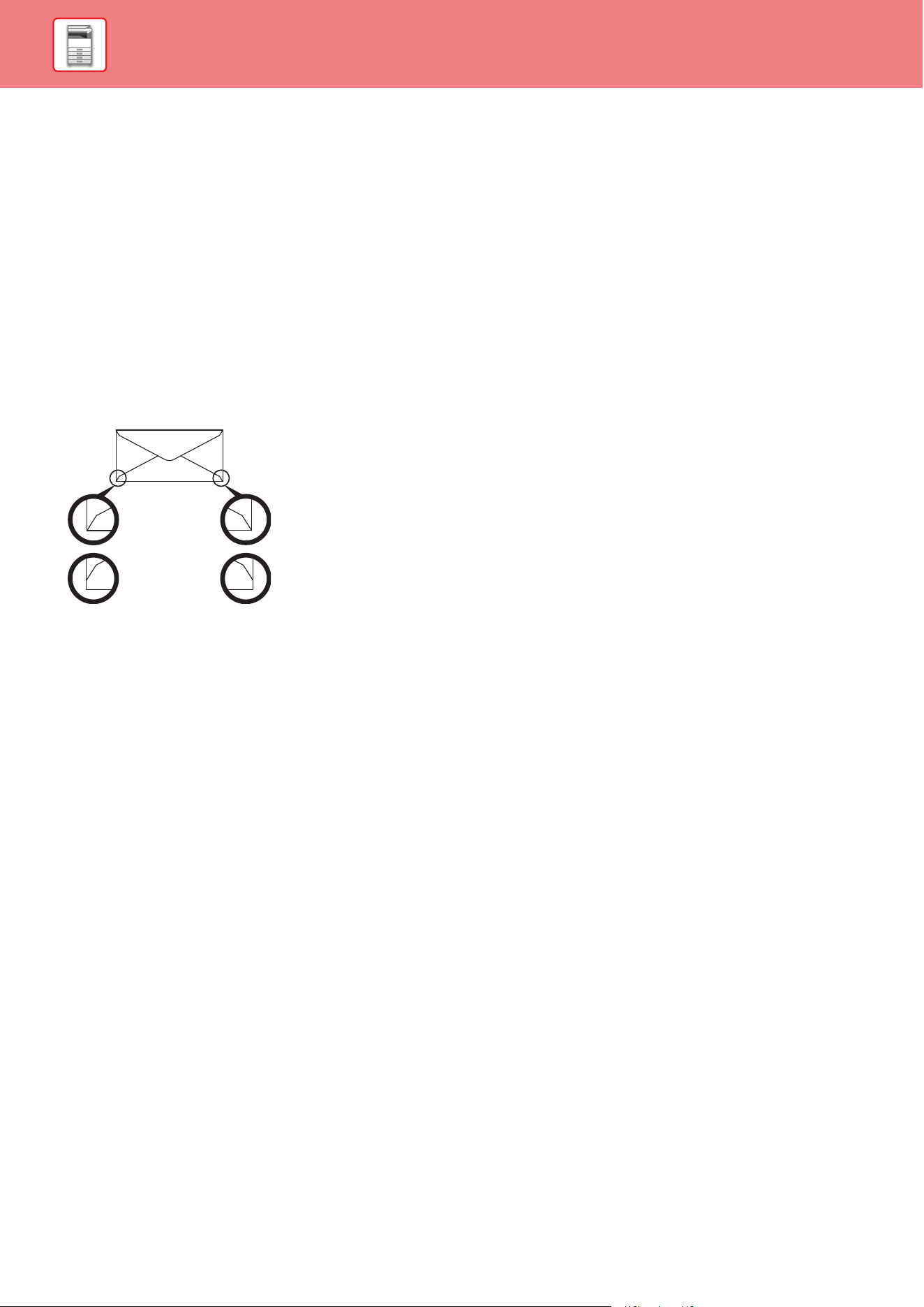
• Envelopes with the corner gluing position on the back not aligned with the corner edge should not be used as it may
cause creasing.
• Print quality is not guaranteed in the area 13/32" (10 mm) around the edges of the envelope.
• Print quality is not guaranteed on parts of envelopes where there is a large step-like change of thickness, such as on
four-layer parts or parts less than three layers.
• Print quality is not guaranteed on envelopes having peel off flaps for sealing the envelopes.
Important points when using label sheets
• For more information, consult the dealer or nearest SHARP Service Department.
• Some labels may have to be loaded into the bypass tray in the specified orientation. Follow such instructions.
If a form is already printed on the labels, and the print images and the preprinted form do not line up, adjust the
application or printer driver settings to rotate the print images.
• Do not use the following types of label sheets.
• Label sheets without an adhesive copy or label copy
• Label sheets with adhesive exposed
• Label sheets with a specified feeding direction that is not supported by the machine
• A label sheet that has already been fed or has some labels removed
• Label sheets consisting of multiple sheets
• Label sheets that do not support laser printing
• Label sheets that cannot withstand heat
• Label sheets that have perforations in the backing paper
• Label sheets with slits in the backing paper
• Non-standard label sheets
• Label sheets with adhesive that has deteriorated due to prolonged storage or otherwise
• Label sheets with cutouts that expose the backing paper
• Curled or otherwise deformed label sheets
• Torn or creased label sheets
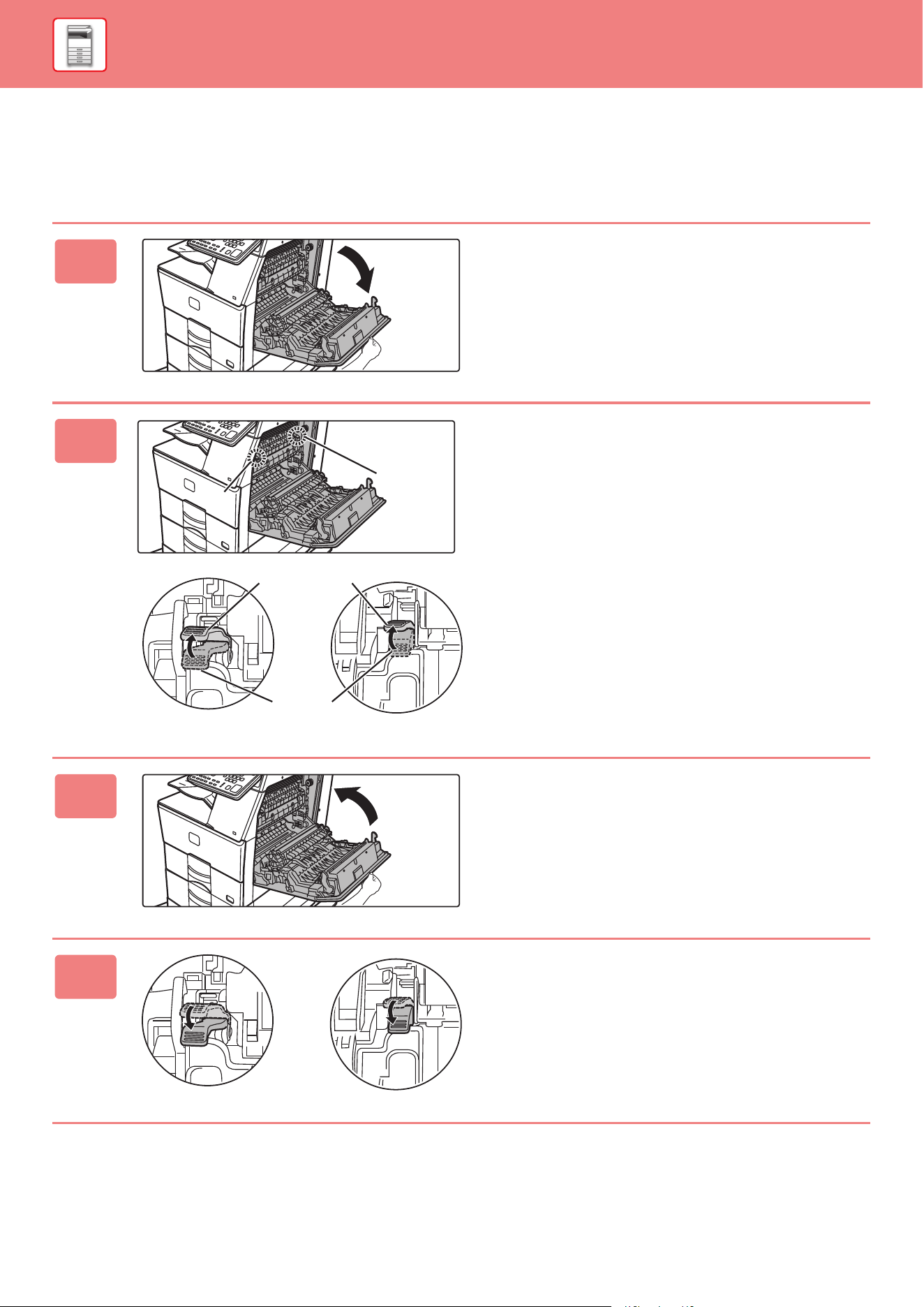
Can be used
Cannot be used
1-26
BEFORE USING THE MACHINE►LOADING PAPER
Fusing unit pressure adjusting levers
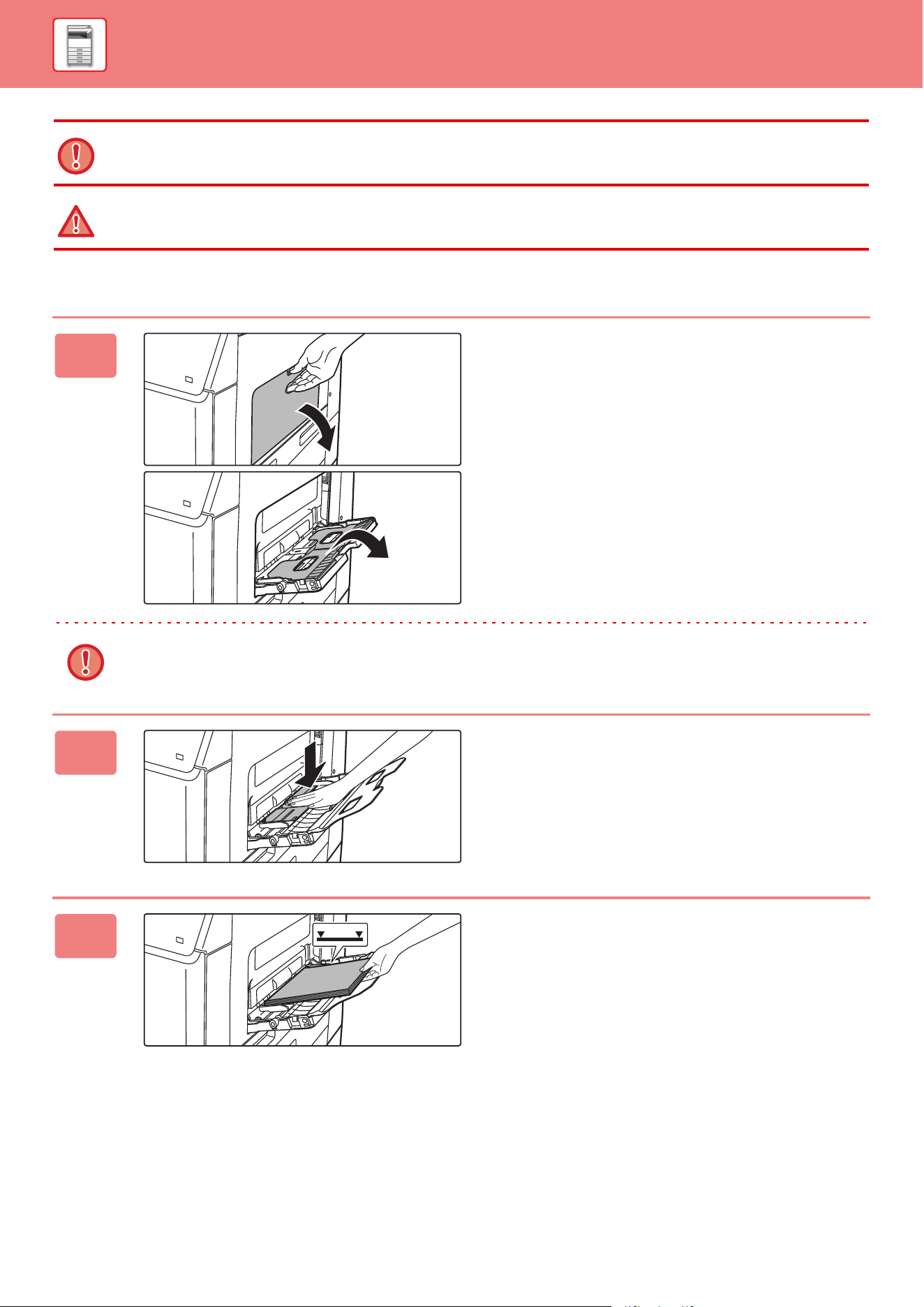
In some cases damage to the envelopes or smudging may occur even if envelopes within the specifications are used.
This problem may be alleviated by shifting the fusing unit pressure adjusting levers from their "normal pressure position"
to the "lower pressure position". Follow the procedure on the this page.
1
Open out the side cover.
Gently open the cover.
2
Move the fusing unit pressure
adjusting levers (two) to the lower
pressure position as shown.
3
Close the side cover.
4
Return the lever to the normal position
when finished feeding envelopes.
A
B
Normal
position
Lower pressure position
B
A
AB
1-27
BEFORE USING THE MACHINE►LOADING PAPER
Loading paper
Be sure to return the levers to the "normal pressure position" before printing or copying on paper other than envelopes.
Otherwise, fusing problems, paper misfeeds, or equipment failure may occur.
The fusing unit is hot. Take care not to burn yourself when operating the fusing unit pressure adjusting levers.
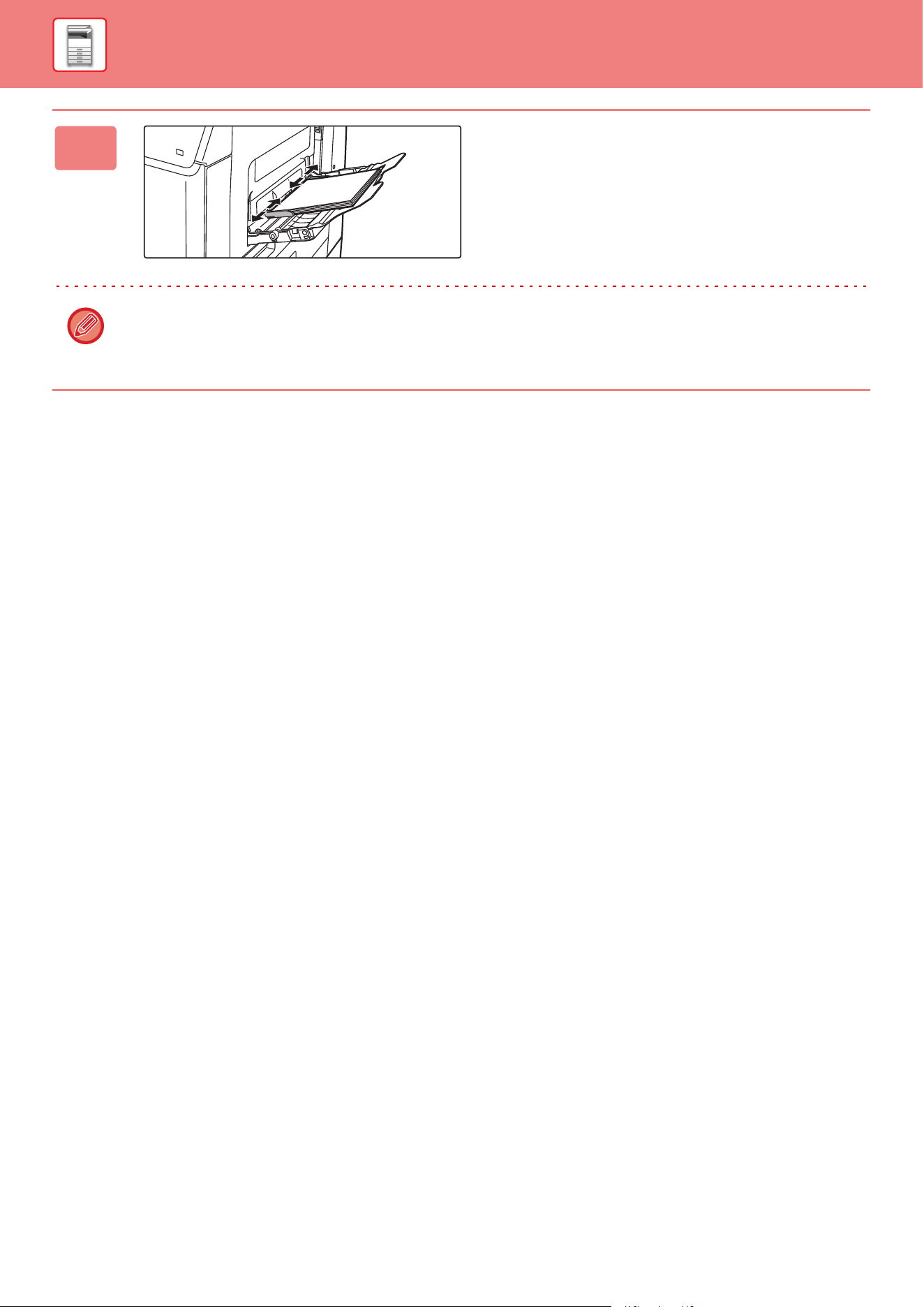
1
Open the bypass tray and the
extension tray.
Do not place heavy objects on the bypass tray or press down on the tray.
2
Push the center of the pressure plate
down until it locks into place.
3
Load the paper with the print side
facing down.
Insert the paper along the bypass tray guides all the way into the
bypass tray until it stops slowly. Inserting the paper with excessive
force may cause the leading edge to fold back. Inserting the paper
too loosely may cause skewed feeding or misfeeds.
The paper must not exceed the maximum number of sheets
and must not be higher than the indicator line.
1-28
BEFORE USING THE MACHINE►LOADING PAPER
4
Set the bypass tray guides correctly to
the width of the paper.
Adjust the bypass tray guides so that they slightly contact
the loaded paper.
• Do not forcefully push in paper that you are loading. This may cause misfeeds.
• If the bypass tray guides are set wider than the paper, move the bypass tray guides in until they correctly fit the width
of the paper. If the bypass guides are set too wide, the paper may skew or be creased.
1-29
BEFORE USING THE MACHINE►LOADING PAPER
TRAY SETTINGS
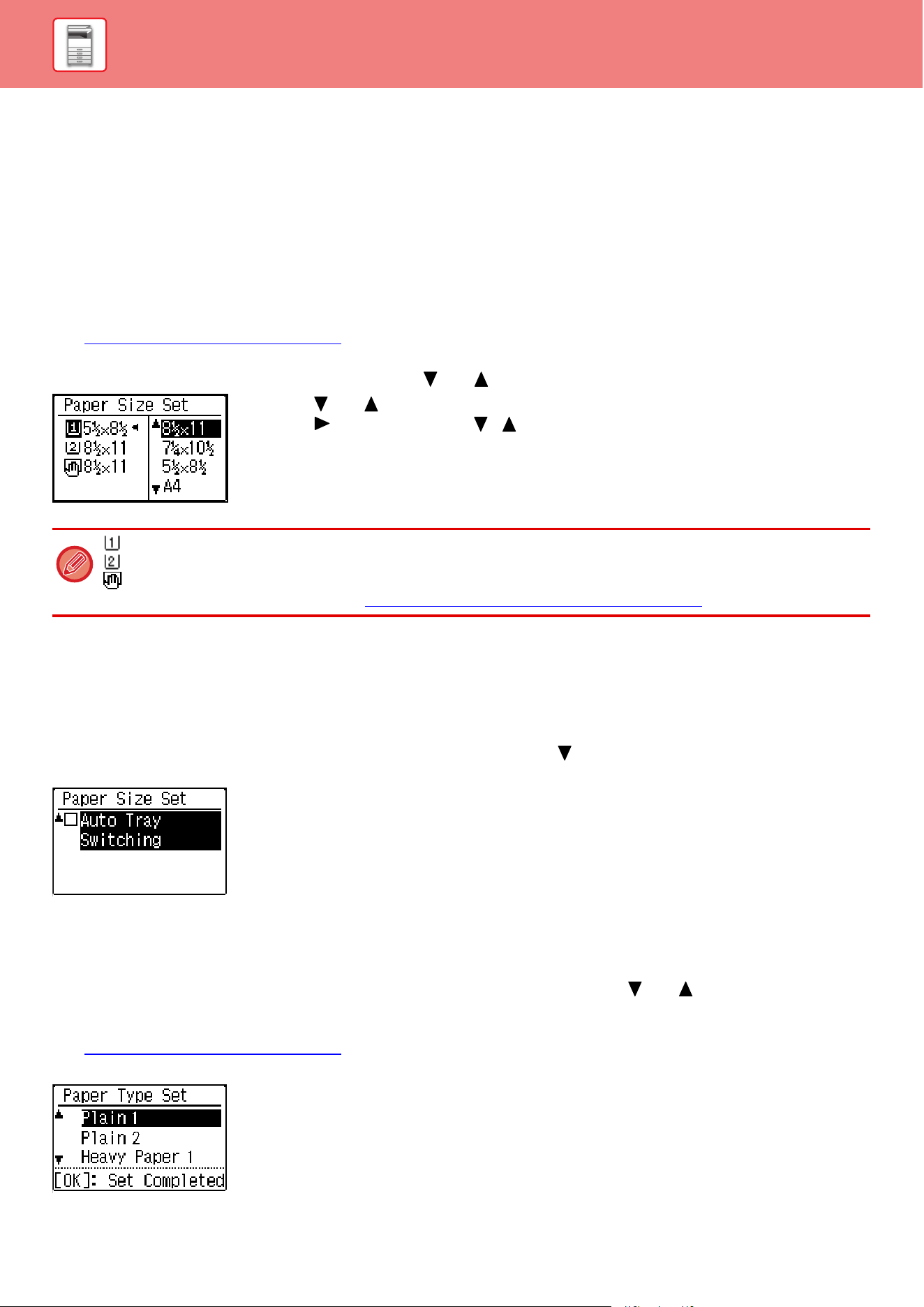
These programs are used to change the paper size and type setting of a tray, and auto tray switching.
Changing the paper size setting of a tray
If the size of the loaded paper is different from the size shown in the display, follow the steps below to change the paper
size setting of the tray.
The paper size setting cannot be changed during copying, printing, fax printing (when the fax option is installed),
or when a misfeed has occurred. However, if the machine is out of paper or out of toner, the paper size setting can be
changed during copying, printing, and fax printing.
See
APPLICABLE PAPER TYPES (page 1-17)
for information on the specifications for the types and sizes of paper that can
be loaded in the paper trays.
Press the [SPECIAL FUNCTION] key, and press the [ ] or [ ] key to select "Paper Size Set".
Press the [ ] or [ ] key to select the paper tray for which the paper size is being changed.
Press the [ ] key and press the [ ][ ] keys to select the paper size.
Press the [OK] key.
Disabling (enabling) auto tray switching
When auto tray switching is enabled and paper runs out during copying or printing, the job will continue using paper from
a different tray if that tray has the same size of paper in the same type. (This function does not operate when using the
bypass tray or when a fax is being printed.)
This function has been enabled at the factory. If you prefer to disable the function, follow the steps below.
Press the [SPECIAL FUNCTION] key, select "Paper Size", and press the [ ] key repeatedly until "Auto Tray Switching"
appears.
To re-enable auto tray switching, press the [OK] key that a checkmark appears.
Changing the paper type of a tray
To change the paper type setting for a tray, follow the steps below.
Press the [SPECIAL FUNCTION] key, select "Paper Type", select the tray with the [ ] or [ ] key, and press the [OK]
key. Select the desired paper type and press the [OK] key.
See
APPLICABLE PAPER TYPES (page 1-17)
for information on the specifications for the types and sizes of paper that can
be loaded in the paper trays.
: Shows tray "1".
: Shows tray "2".
: Shows Bypass tray.
For the paper trays and tray numbers,
see Types of paper that can be set in each tray (page 1-19).
1-30
BEFORE USING THE MACHINE►HOW TO PLACE THE ORIGINAL
SELECTING A PROCEDURE FOR PLACING
THE ORIGINAL DEPENDING ON THE TYPE
AND STATUS OF THE ORIGINAL
Place the original in the automatic document feeder. Depending the type and status of the original, use the document
glass. Follow the instructions to select the method for placing the original.
To place it in the automatic document feeder, see "AUTOMATIC DOCUMENT FEEDER (page 1-30)
".
AUTOMATIC DOCUMENT FEEDER
This section explains how to place originals in the automatic document feeder.
HOW TO PLACE THE ORIGINAL
• Before inserting originals into the document feeder tray, be sure to remove any staples or paper clips.
• If originals have damp spots due to correction fluid, ink or paste up glue, wait until the originals are dry before making
copies. Otherwise the interior of the machine or the document glass may be soiled.
• Do not use the following originals. Original misfeeds and smudges may result.
Transparency film or other transparent material for backup copy, tracing paper, carbon paper, thermal paper or originals
printed with thermal transfer ink ribbon should not be fed through the document feeder. Originals to be fed through the
feeder should not be damaged, crumpled, folded, loosely pasted together, or have cut-out holes. Originals with multiple
punched holes other than two-hole or three-hole punched paper may not feed correctly.
• The condition, material, shape, or fabrication method of some business cards may prevent correct feeding or scanning.
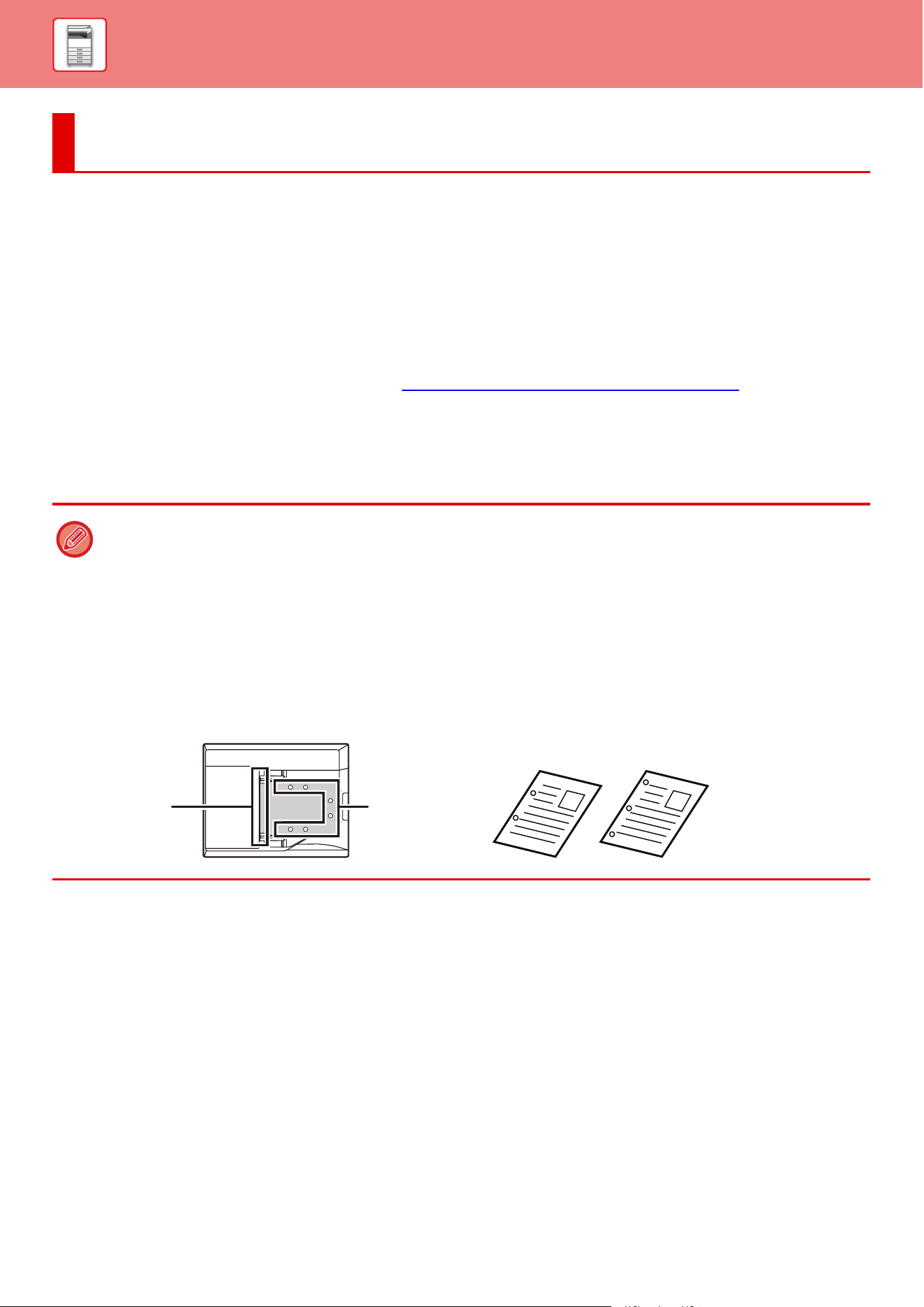
• When using originals with two or three holes, place them so that the punched edge is at a position away from the feed slot
of the document feeder tray. Specify the orientation of the original using [Original].
Hole positions
Feed slot
1-31
BEFORE USING THE MACHINE►HOW TO PLACE THE ORIGINAL
Allowed original sizes
When the original is a non-standard size, see the appropriate explanation below for the mode you are using.
► COPIER: "SPECIFYING THE SIZE OF THE ORIGINAL (page 2-11)"
► FAX: "BASIC PROCEDURE FOR SENDING FAXES (page 4-8)"
► SCANNER: "BASIC TRANSMISSION PROCEDURE (page 5-5)"
Allowed original weights
1-sided scanning: 13 to 28 lbs Bond (50 to 105 g/m
2
)
2-sided scanning: 13 to 28 lbs Bond (50 to 105 g/m
2
)
Business card: 0.1 to 0.2 mm
Minimum original size Maximum original size
Standard size
5-1/2" (longitudinal) × 8-1/2" (transversal)
105 mm (longitudinal) × 148 mm, or A6
Non-standard size
(Minimum size that can be specified manually)
4-1/4" (longitudinal) × 5-1/2" (transversal)
105 mm (longitudinal) × 140 mm (transversal)
Business card
2" (longitudinal) x 3-1/2" (transversal)
51 mm (longitudinal) x 89 mm (transversal)
Standard size
8-1/2" (longitudinal) × 14" (transversal)
210 mm (longitudinal) × 297 mm (transversal) or A4
Non-standard size
(Maximum size that can be specified manually)
Copy mode/Scanner mode:
8-1/2" (longitudinal) × 14" (transversal)
216 mm (longitudinal) × 356 mm (transversal)
Fax mode:
8-1/2" (longitudinal) × 19-5/8" (transversal)
216 mm (longitudinal) × 500 mm (transversal)
1
Make sure that there is no original on the document glass.
2
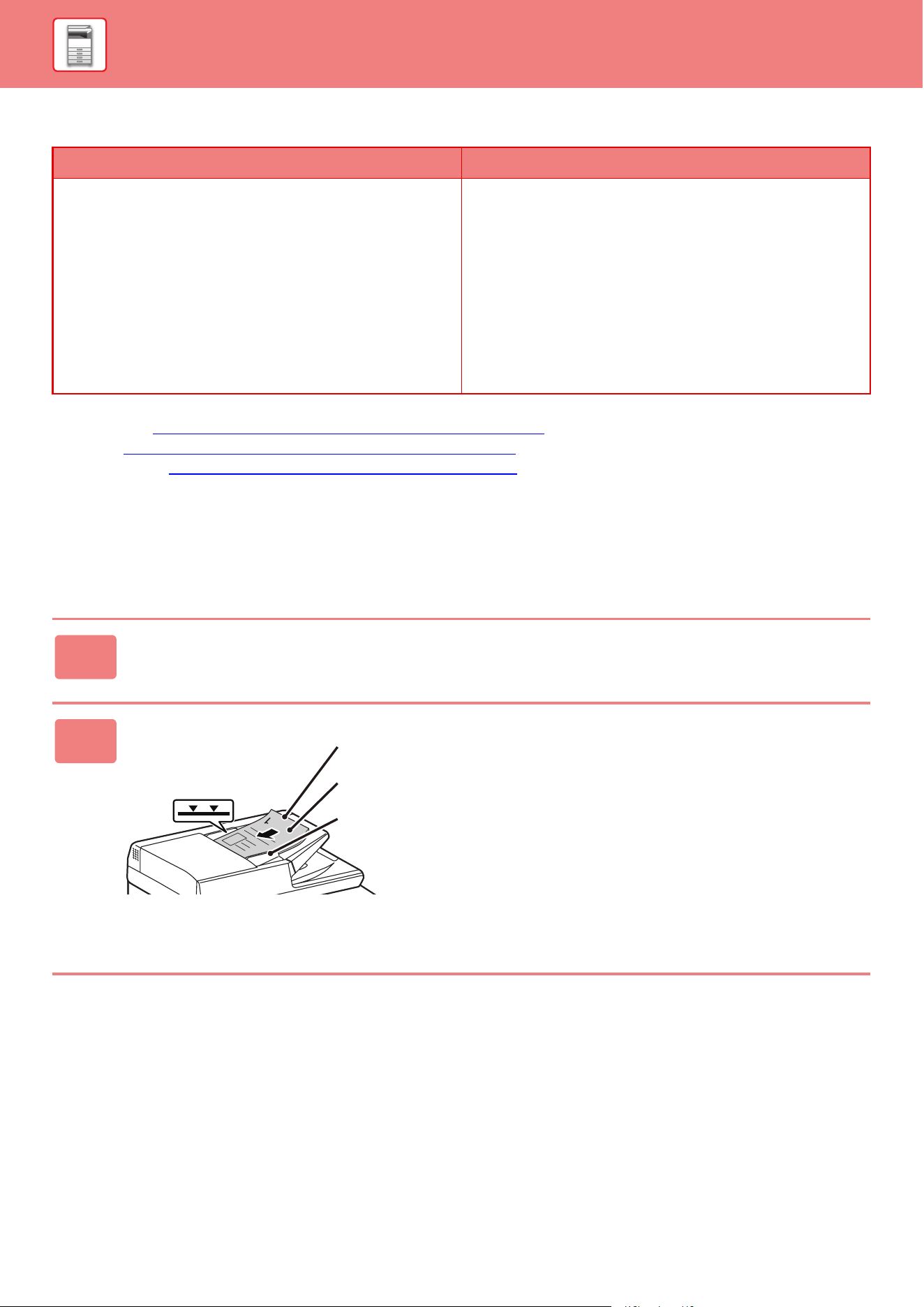
Place the original.
Up to 50 sheets can be inserted.
Business card:
Up to 25 sheets can be inserted.
After scanning is finished on the automatic document feeder,
remove originals from the original exit tray.
Align the edges evenly
and face them up
Insert to the end
Fit to the Original Size
Below the indicator line
1-32
BEFORE USING THE MACHINE►HOW TO PLACE THE ORIGINAL
DOCUMENT GLASS
This section describes the steps for setting the original on the document glass.
Allowed original sizes
When the original is a non-standard size, see the appropriate explanation below for the mode you are using.
► COPIER: "SPECIFYING THE SIZE OF THE ORIGINAL (page 2-11)"
► FAX: "BASIC PROCEDURE FOR SENDING FAXES (page 4-8)"
► SCANNER: "BASIC TRANSMISSION PROCEDURE (page 5-5)"
• Close the automatic document feeder slowly. Abruptly closing the automatic document feeder may damage it.
• Take care that your fingers are not pinched when closing the automatic document feeder.
Maximum original size
Standard size
8-1/2" (longitudinal) x 14" (transversal)
210 mm (longitudinal) x 297 mm (transversal) or A4
Non-standard size
8-1/2" (longitudinal) x 14" (transversal)
216 mm (longitudinal) x 356 mm (transversal)
1
Open the automatic document feeder.
2
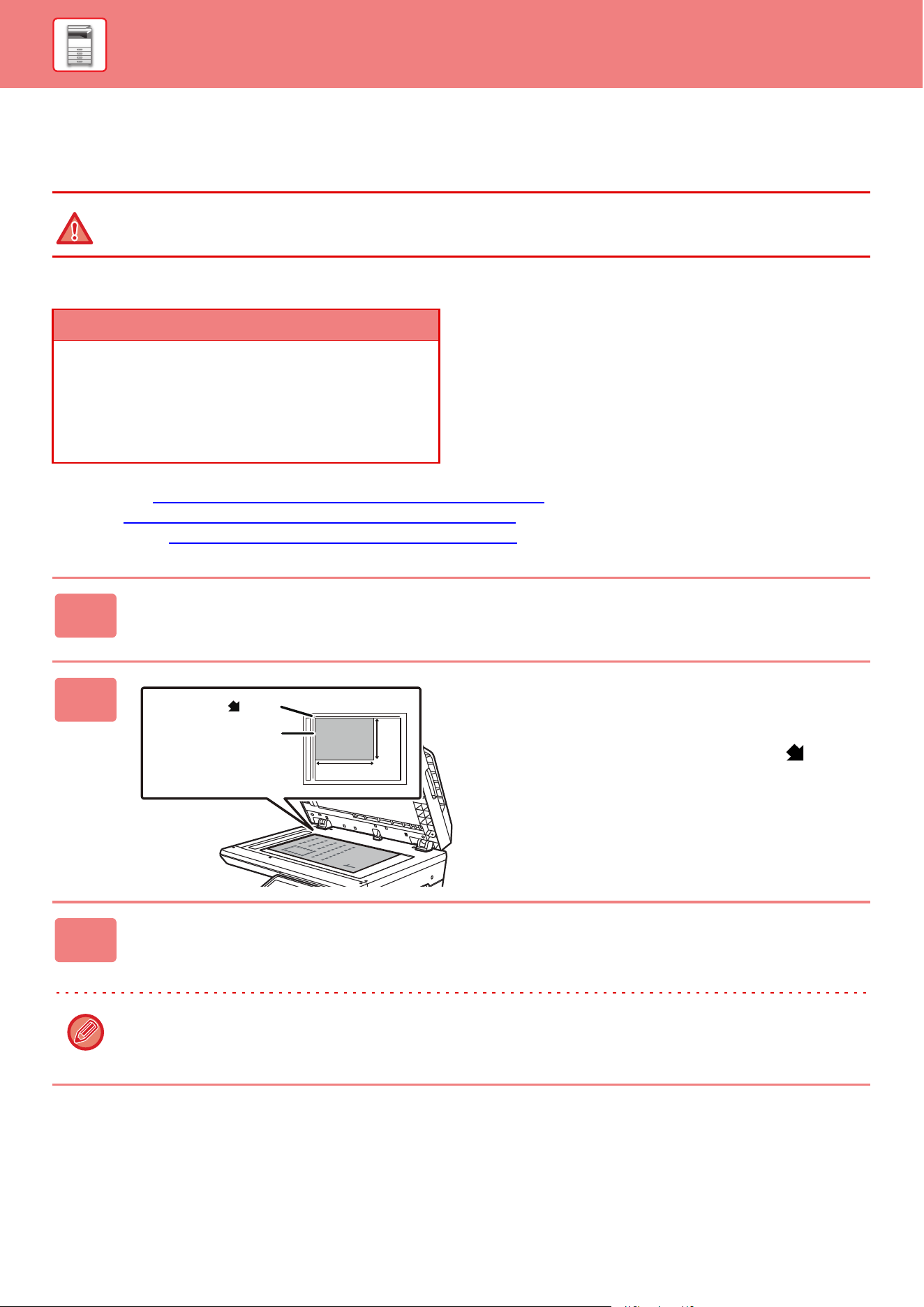
Load the paper with the print side
facing down.
Place the original face down and align the top left corner of
the original with back left (at the tip of the mark ) of the
document glass.
3
Close the automatic document feeder.
After placing the original, close the automatic document feeder. If the unit is left open, parts outside of the original will be
copied in black, causing excessive use of toner.
If originals have damp spots due to correction fluid, ink or paste up glue, wait until the originals are dry before making
copies. Otherwise the interior of the machine or the document glass may be soiled.
X
Y
Mark
Document glass
scale
1-33
BEFORE USING THE MACHINE►MAINTENANCE
This section explains how to check the total count or toner remaining, adjust the display contrast, clean the machine,
and replace the toner cartridge.
CHECKING THE TOTAL OUTPUT COUNT
AND TONER REMAINING
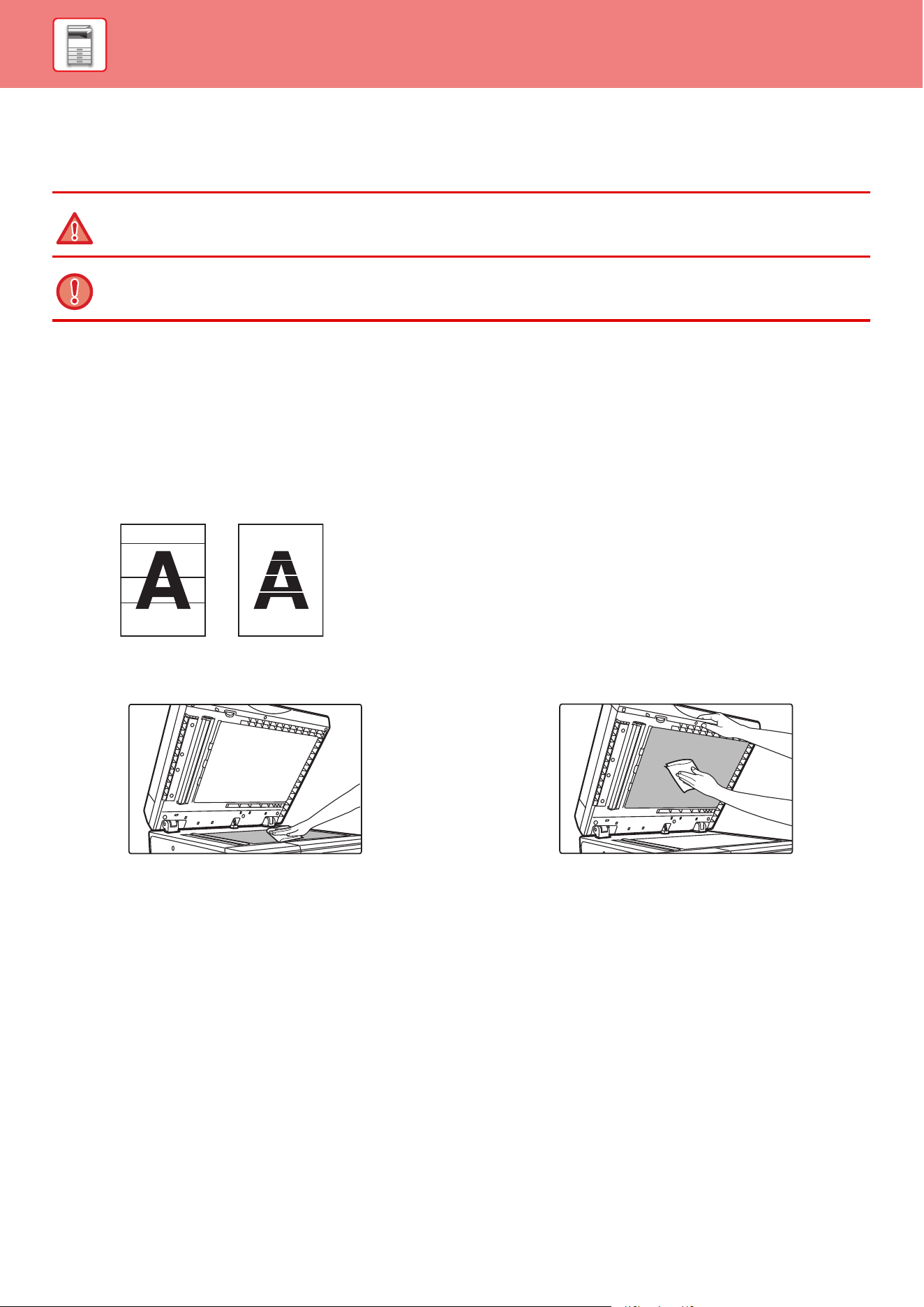
To check the total number of pages output in copy, print, and fax modes hold down the
[COPY] key when the machine is in the standby state. The counts will appear while the key
is held down. The total output count can be used as a guideline for cleaning. When the total
output count exceed "99,999,999", the counts return to "0".
The toner level is shown at the bottom of the screen.
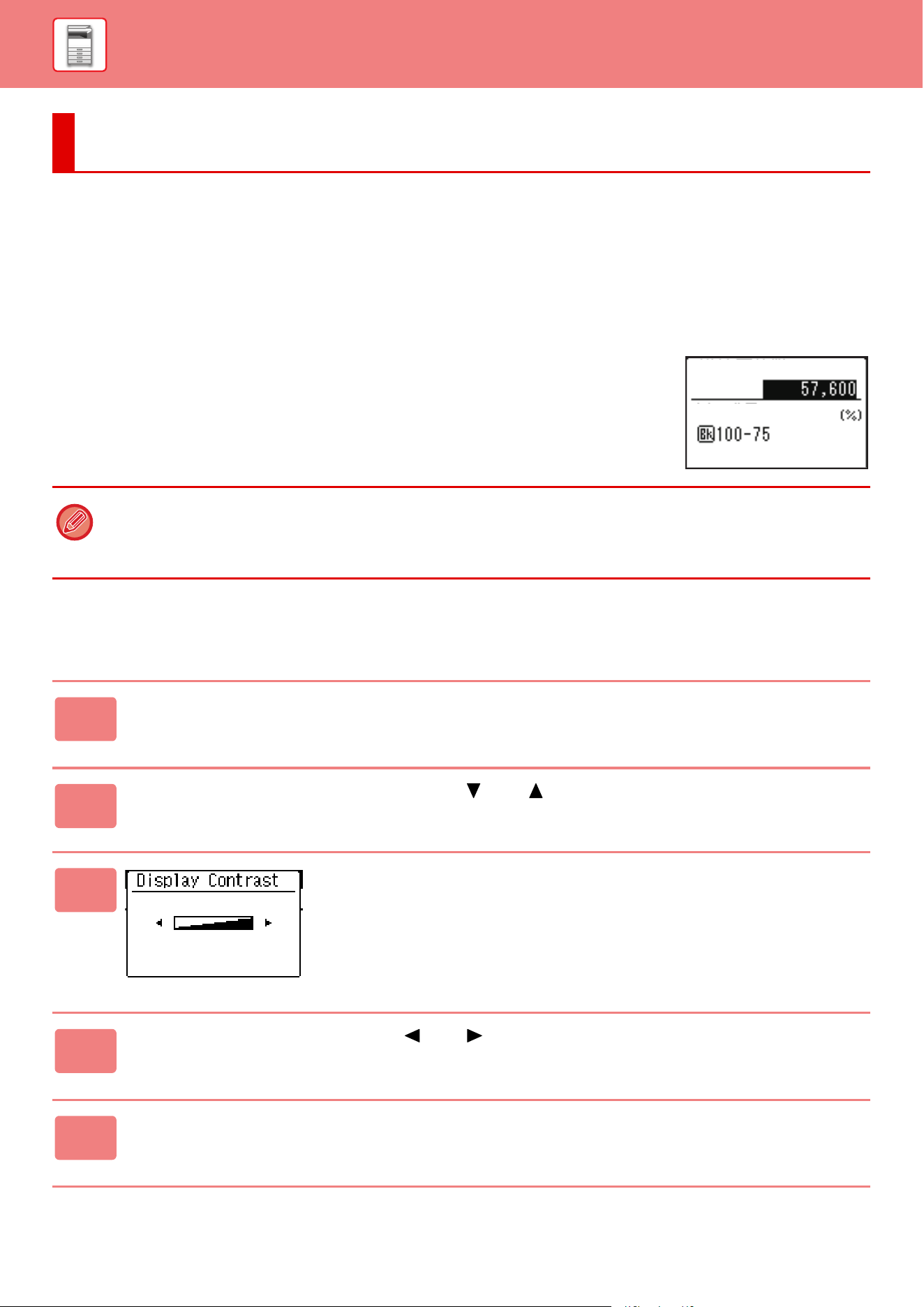
ADJUSTING THE DISPLAY CONTRAST
The contrast of the display can be adjusted as explained below.
MAINTENANCE
• You can also check by pressing the [SPECIAL FUNCTION] key and selecting "Total Count" in the function menu screen.
• Each two-sided sheet that is output is counted as two pages.
• Blank copies and blank prints are included in the count.
• If the last page of a two-sided printing job is blank, it is not included in the count.
1
Press the [SPECIAL FUNCTION] key.
The function screen appears.
2
Select "Display Contrast" with the [ ] or [ ] key.
3
Press the [OK] key.
The screen contrast setting screen appears.
4
Adjust the contrast with the [ ] or [ ] key.
To reset the contrast to the default setting, press the [C] key.
5
Press the [SPECIAL FUNCTION] key.
You will return to the base screen.
Total Count
Toner Remaining
1-34
BEFORE USING THE MACHINE►MAINTENANCE
REGULAR MAINTENANCE
To ensure that the machine continues to provide top quality performance, periodically clean the machine.
CLEANING THE DOCUMENT GLASS AND AUTOMATIC
DOCUMENT FEEDER
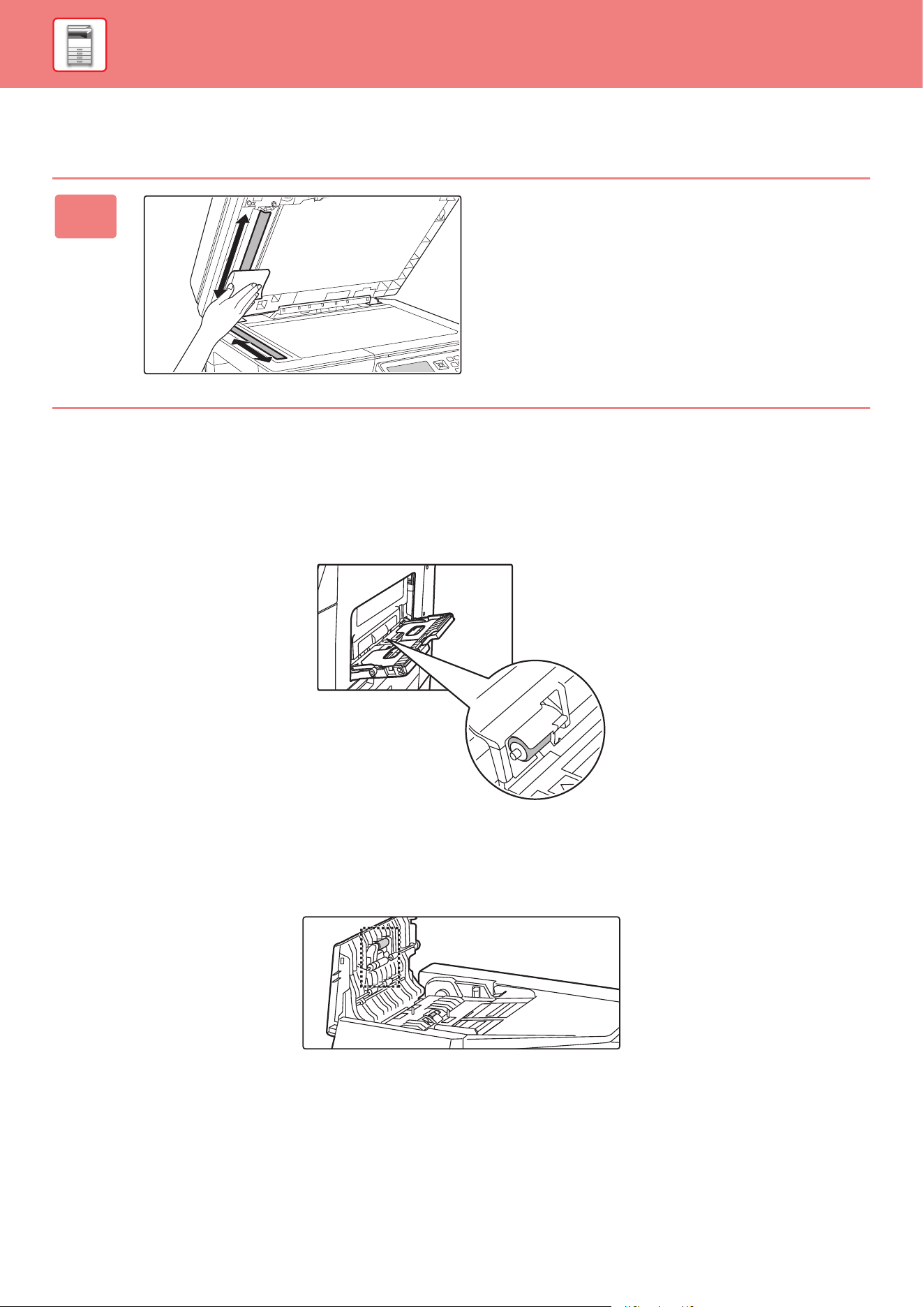
If the document glass or document backplate sheet becomes dirty, the dirt will appear as dirty spots, colored lines, or
white lines in the scanned image. Keep these parts clean at all times.
Wipe the parts with a clean, soft cloth.
If necessary, moisten the cloth with water or a small amount of neutral detergent. After that, wipe with a clean dry cloth.
Examples of lines in the image
Document glass Document backplate sheet
Do not use a flammable spray to clean the machine. If gas from the spray comes in contact with hot electrical
components or the fusing unit inside the machine, fire or electrical shock may result.
Do not use thinner, benzene, or similar volatile cleaning agents to clean the machine. These may degrade or discolor the
housing.
Black lines White lines
1-35
BEFORE USING THE MACHINE►MAINTENANCE
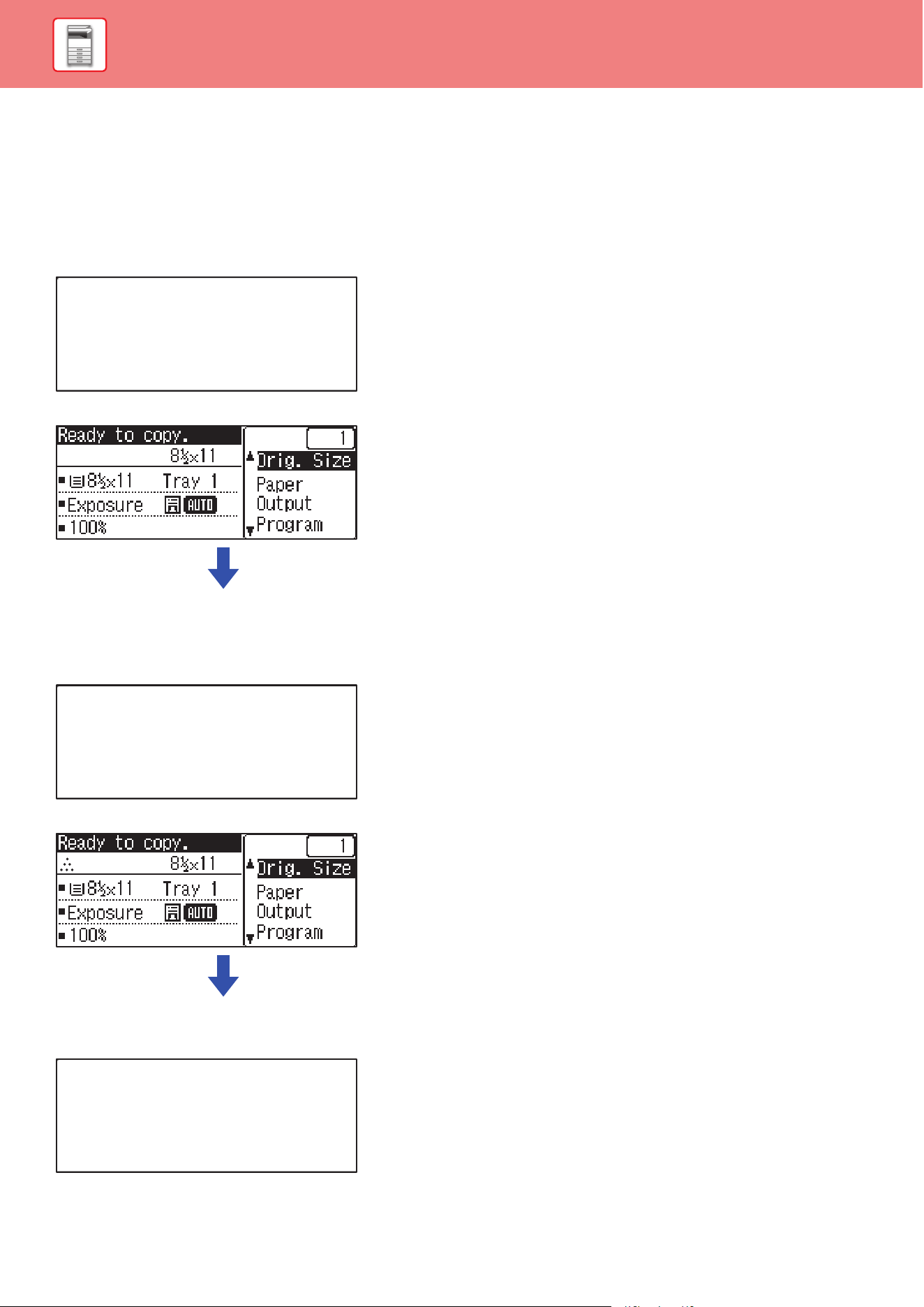
SCANNING AREA
If black lines or white lines appear in images scanned using the automatic document feeder, clean the scanning area
(the thin long glass next to the document glass).
CLEANING THE BYPASS FEED ROLLER
If paper misfeeds frequently occur when feeding envelopes or heavy paper through the bypass tray, wipe the surface of
the feed roller with a clean soft cloth moistened with water or a neutral detergent.
CLEANING THE PAPER FEED ROLLER
If lines or other dirt appear on the scanned original when the automatic document feeder is used, wipe the surface of the
roller with a clean soft cloth moistened with water or a neutral detergent.
1
Open the automatic document feeder
and clean the document scanning area
on the document glass with the soft
cloth.
1-36
BEFORE USING THE MACHINE►MAINTENANCE
REPLACEMENT OF TONER CARTRIDGE
Always replace the toner cartridge after the "Change the toner cartridge." message appears. You should keep one set of
replacement toner cartridges on hand so that you can replace a toner cartridge immediately when toner runs out.
Replacement message
When this message appears, prepare a toner cartridge for replacement.
When you press the any key, the dialog above will be deleted and the screen will change to the following screen.
If you continue printing, the following message appears.
When this message appears, prepare a toner cartridge for replacement and replace it.
In this state, printing is possible.
However, this message does not appear during printing.
When you press the any key, the dialog above will be deleted and the screen will change to the following screen.
If you continue to use the machine, the follow message will appear when the toner runs out.
Once the machine enters this state, printing can not be carried out until the toner cartridge is replaced.
Toner Low.
(Do not replace cartridge
until requested.)
Change the toner
cartridge.
Change the toner
cartridge.
1-37
BEFORE USING THE MACHINE►MAINTENANCE
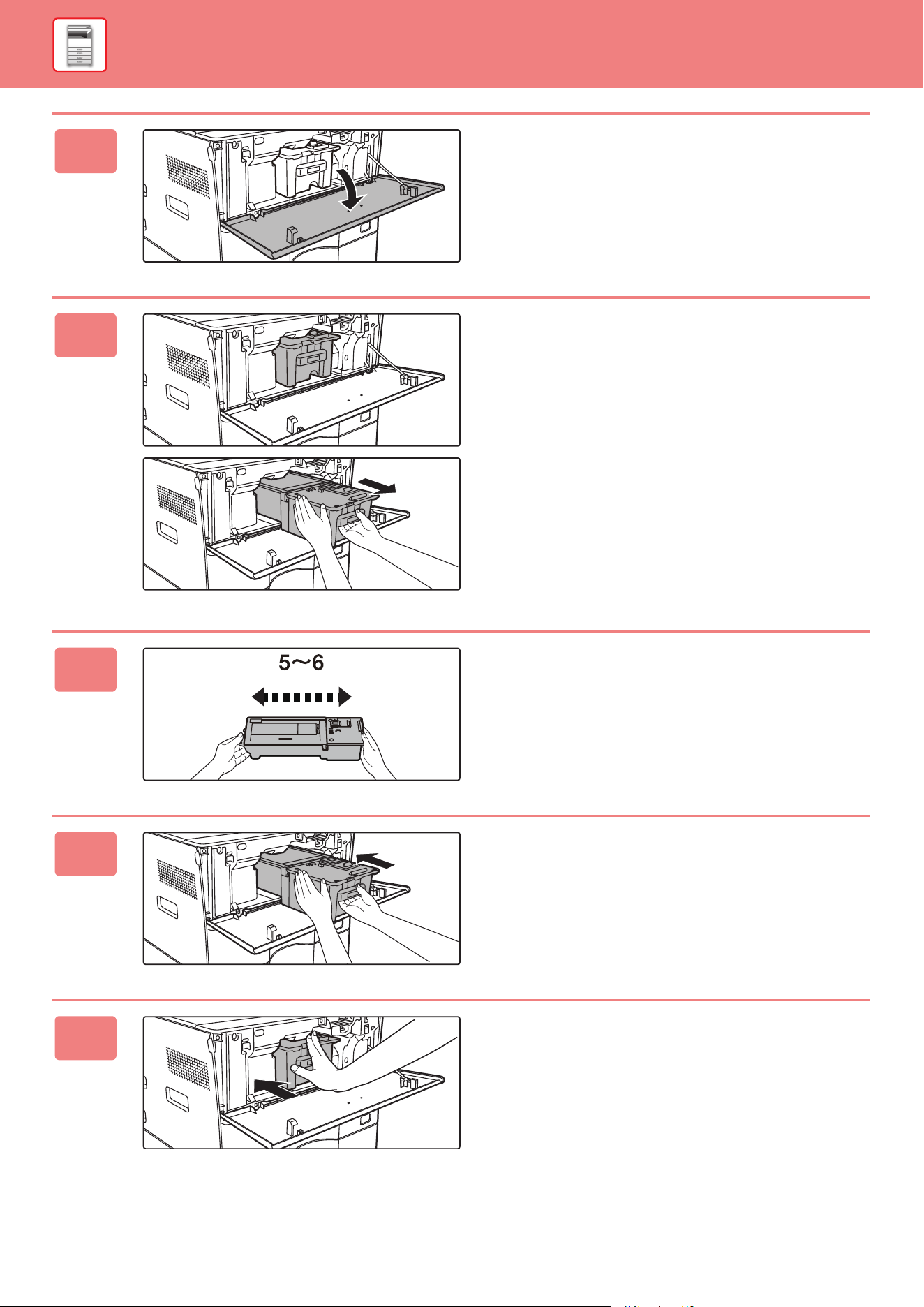
1
Open the front cover.
2
Pull the toner cartridge toward you.
Gently pull out the toner cartridge horizontally.
If the cartridge is pulled out abruptly, toner may spill out.
Hold the toner cartridge with both hands as shown and
slowly pull it out of the machine.
3
Take out a new toner cartridge from its
package and shake it horizontally five
or six times.
4
Slowly insert the new toner cartridge
on the level.
5
Press in firmly until you hear a "click"
sound.
1-38
BEFORE USING THE MACHINE►MAINTENANCE
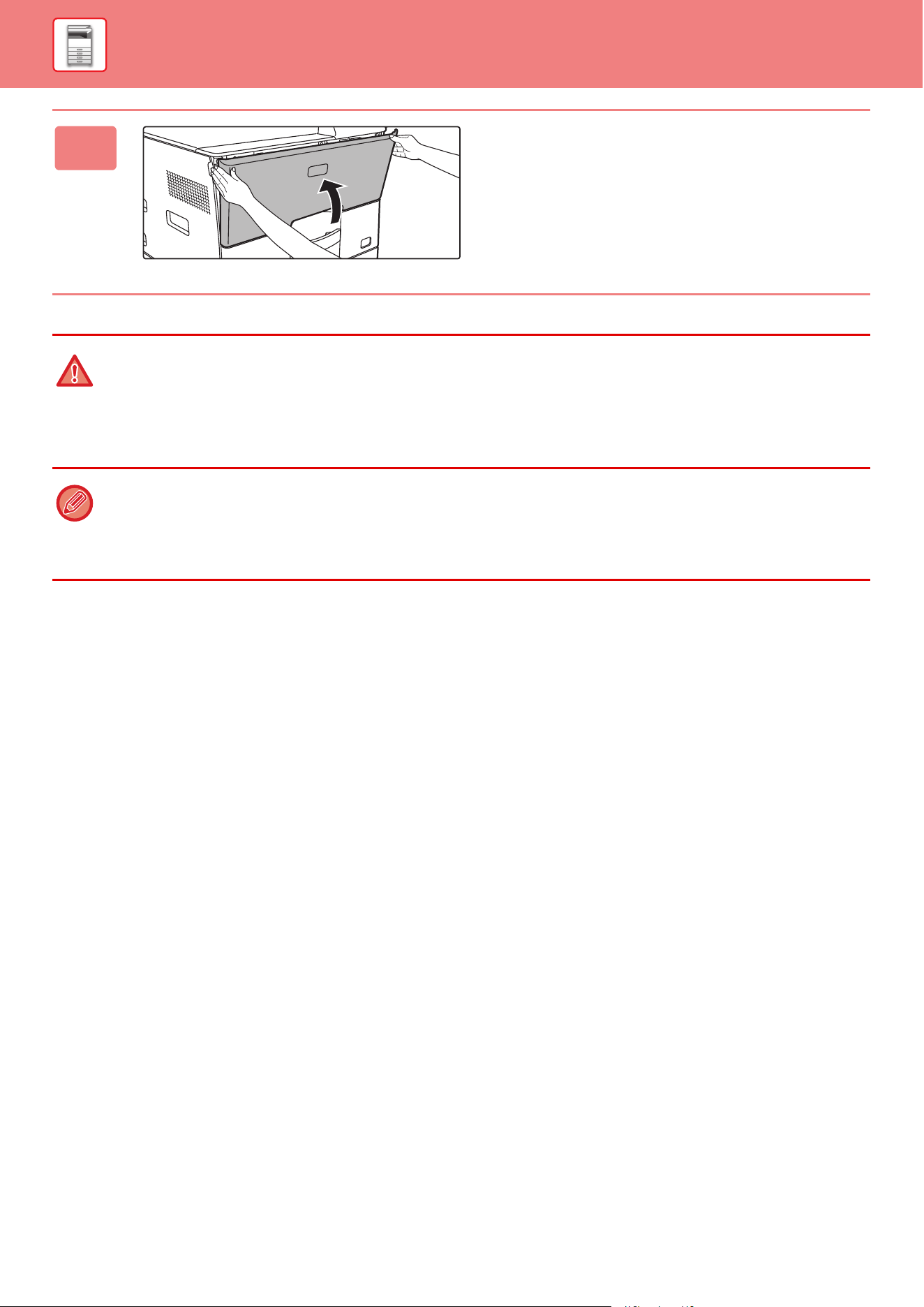
6
Close the front cover.
After the toner cartridge is replaced, the machine
automatically enters image adjustment mode. Do not open
the front cover while this is occurring.
• Do not throw a toner cartridge into a fire. Toner may fly and cause burns.
• Store toner cartridges out of reach of small children.
• If a toner cartridge is stored upright, the toner may harden and become unusable. Always store toner cartridges on their
side.
• If a toner cartridge other than a SHARP-recommended toner cartridge is used, the machine may not attain full quality and
performance and there is a risk of damage to the machine. Be sure to use a SHARP-recommended toner cartridge.
• Depending on your conditions of use, the color may become light or the image blurred.
• Your service technician will collect used toner cartridges.
• To view the approximate amount of toner remaining (indicated in %), hold down the [COPY] key during printing or in
standby mode. When the percentage falls to "25-0%", keep a toner cartridge for replacement purposes before toner runs
out.
1-39
BEFORE USING THE MACHINE►CHARACTER ENTRY
This section explains how to enter and edit characters for names of rapid dial numbers, Speed Dial numbers, and group
keys, as well as account names, program names, and search characters for the address list.
CHARACTERS THAT CAN BE ENTERED
Characters that can be entered for names
The following characters can be entered:
• Up to 36 characters can be entered for a name.
However, up to 18 characters can be entered for an account name or sender's name.
• Upper case alphabet, lower case alphabet, numbers, special characters, symbols.
Characters that can be used for search characters
The following characters can be used:
• Up to 10 characters can be entered for search characters.
• Upper case alphabet, lower case alphabet, numbers, special characters.
CHARACTER ENTRY
• Search characters are normally the first 10 characters of the name entered for a destination.
• Search characters are used when storing and using auto dial keys and numbers.
• When a destination name includes a symbol, the symbol cannot be stored as a search character.
• Search characters can be edited.
1-40
BEFORE USING THE MACHINE►CHARACTER ENTRY
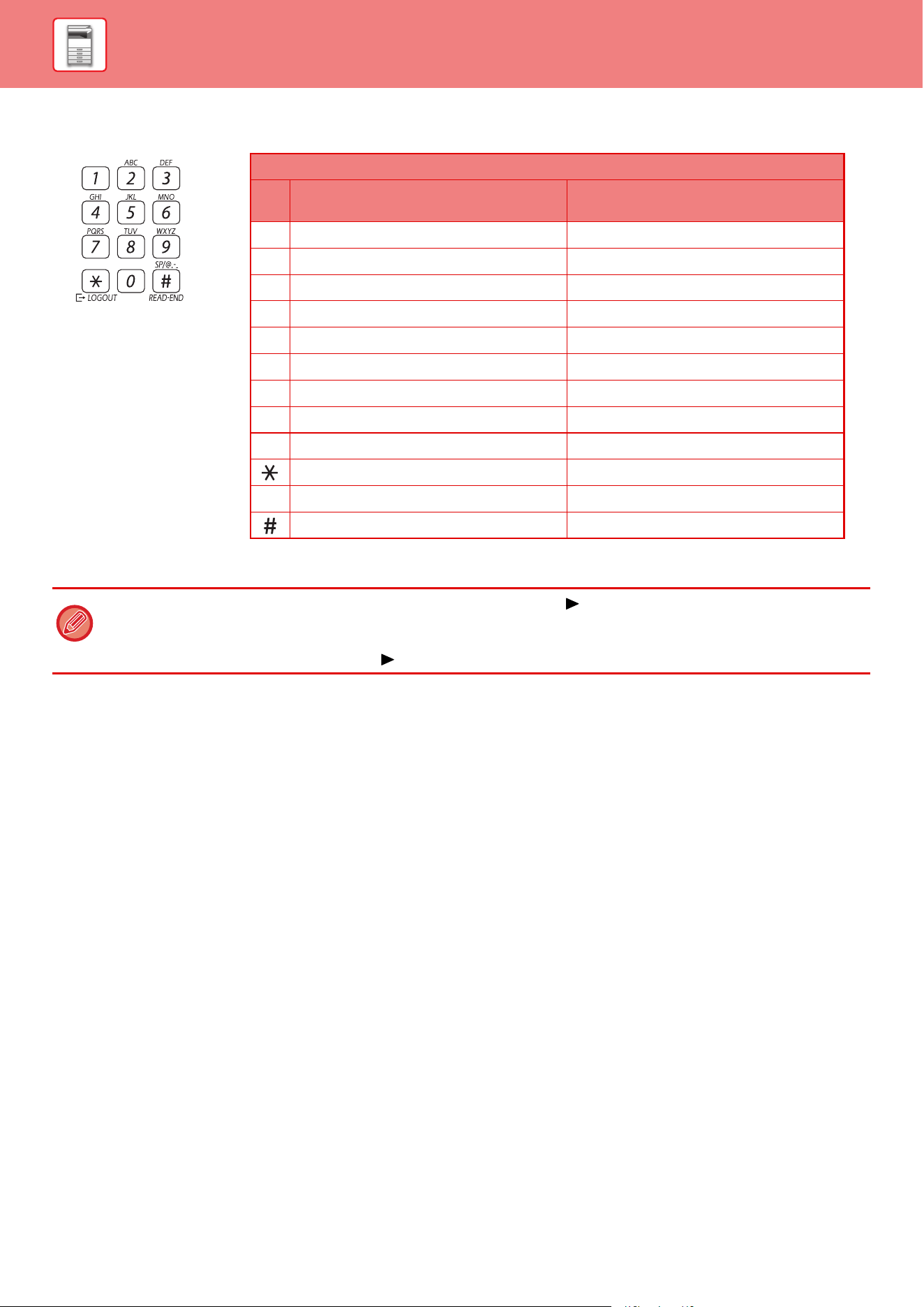
Characters are entered by pressing the numeric keys on the operation panel. The letters entered with each numeric key
are shown below.
Characters that can be entered
Key
Characters that can be entered for
names
Characters that can be used for
search characters
1 1 Space 1 Space
2 a b c 2 A B C a b c 2 A B C
3 d e f 3 D E F d e f 3 D E F
4 g h i 4 G H I g h i 4 G H I
5 j k l 5 J K L j k l 5 J K L
6 m n o 6 M N O m n o 6 M N O
7 p q r s 7 P Q R S p q r s 7 P Q R S
8 t u v 8 T U V t u v 8 T U V
9 w x y z 9 W X Y Z w x y z 9 W X Y Z
*}{][?>=;:,+)('&%$"!/_-.@#
00 0
Use to enter special characters. Use to enter special characters.
To enter two characters in succession that require the same key, press the [ ] key to move the cursor after entering the first
character.
Example: Entering "ab" (when directly entering an e-mail address)
Press the [2] key once, press the [ ] key once to move the cursor, and then press the [2] key twice.

2-1
BEFORE USING THE MACHINE AS A
COPIER
COPY MODE . . . . . . . . . . . . . . . . . . . . . . . . . . . . . . 2-2
COPYING SEQUENCE . . . . . . . . . . . . . . . . . . . . . . 2-3
SELECTING THE PAPER TRAY FOR COPYING . . .
2-4
BASIC PROCEDURE FOR MAKING
COPIES
COPYING . . . . . . . . . . . . . . . . . . . . . . . . . . . . . . . . . 2-5
• USING THE AUTOMATIC DOCUMENT
FEEDER FOR COPYING . . . . . . . . . . . . . . . . .
2-5
• USING THE DOCUMENT GLASS FOR
COPYING . . . . . . . . . . . . . . . . . . . . . . . . . . . . .
2-6
• CANCELING A COPY JOB . . . . . . . . . . . . . . . .
2-6
AUTOMATIC DUPLEX COPYING . . . . . . . . . . . . . . 2-7
CHANGING THE EXPOSURE AND ORIGINAL
IMAGE TYPE . . . . . . . . . . . . . . . . . . . . . . . . . . . . . . 2-8
• AUTOMATIC ADJUSTMENT OF EXPOSURE
AND ORIGINAL TYPE. . . . . . . . . . . . . . . . . . . .
2-8
• MANUAL ADJUSTMENT OF EXPOSURE AND
ORIGINAL TYPE . . . . . . . . . . . . . . . . . . . . . . . .
2-8
ENLARGE/REDUCE . . . . . . . . . . . . . . . . . . . . . . . . 2-10
SPECIFYING THE SIZE OF THE ORIGINAL . . . . . 2-11
MAKING COPIES USING THE BYPASS TRAY . . . 2-13
•
SPECIFYING A TYPE AND SIZE OF PAPER
LOADED ON BYPASS TRAY . . . . . . . . . . . . . . . . .
2-13
CONVENIENT COPY FUNCTIONS
OUTPUT . . . . . . . . . . . . . . . . . . . . . . . . . . . . . . . . . 2-15
• SORT SETTING. . . . . . . . . . . . . . . . . . . . . . . . 2-15
• ID CARD COPY . . . . . . . . . . . . . . . . . . . . . . . . 2-17
• RESOLUTION SETTINGS . . . . . . . . . . . . . . . . 2-18
SPECIAL MODES
COPYING MULTIPLE ORIGINALS ONTO A
SINGLE SHEET OF PAPER (2-Up / 4-Up COPY) . 2-19
COPYING BOTH SIDES OF A CARD AS A
SINGLE PAGE (CARD SHOT) . . . . . . . . . . . . . . . . 2-21
ADJUSTING THE SHARPNESS OF AN IMAGE
(SHARPNESS) . . . . . . . . . . . . . . . . . . . . . . . . . . . . 2-22
ADJUSTING THE BACKGROUND BY MAKING
LIGHT AREAS OF THE ORIGINAL DARKER OR
LIGHTER (SUPPRESS BG) . . . . . . . . . . . . . . . . . . 2-23
PROGRAMS
FREQUENTLY USED SETTINGS (PROGRAMS) . 2-24
• STORING A PROGRAM . . . . . . . . . . . . . . . . . 2-24
• CHANGING A PROGRAM . . . . . . . . . . . . . . . . 2-25
• DELETING A PROGRAM. . . . . . . . . . . . . . . . . 2-26
• USING A PROGRAM . . . . . . . . . . . . . . . . . . . . 2-26
COPIER
2-3
COPIER►BEFORE USING THE MACHINE AS A COPIER
COPYING SEQUENCE
This section explains the basic procedure for copying. Select settings in the order shown below to ensure that the copy
operation takes place smoothly.
For detailed procedures for selecting the settings, see the explanation of each setting in this chapter.
1
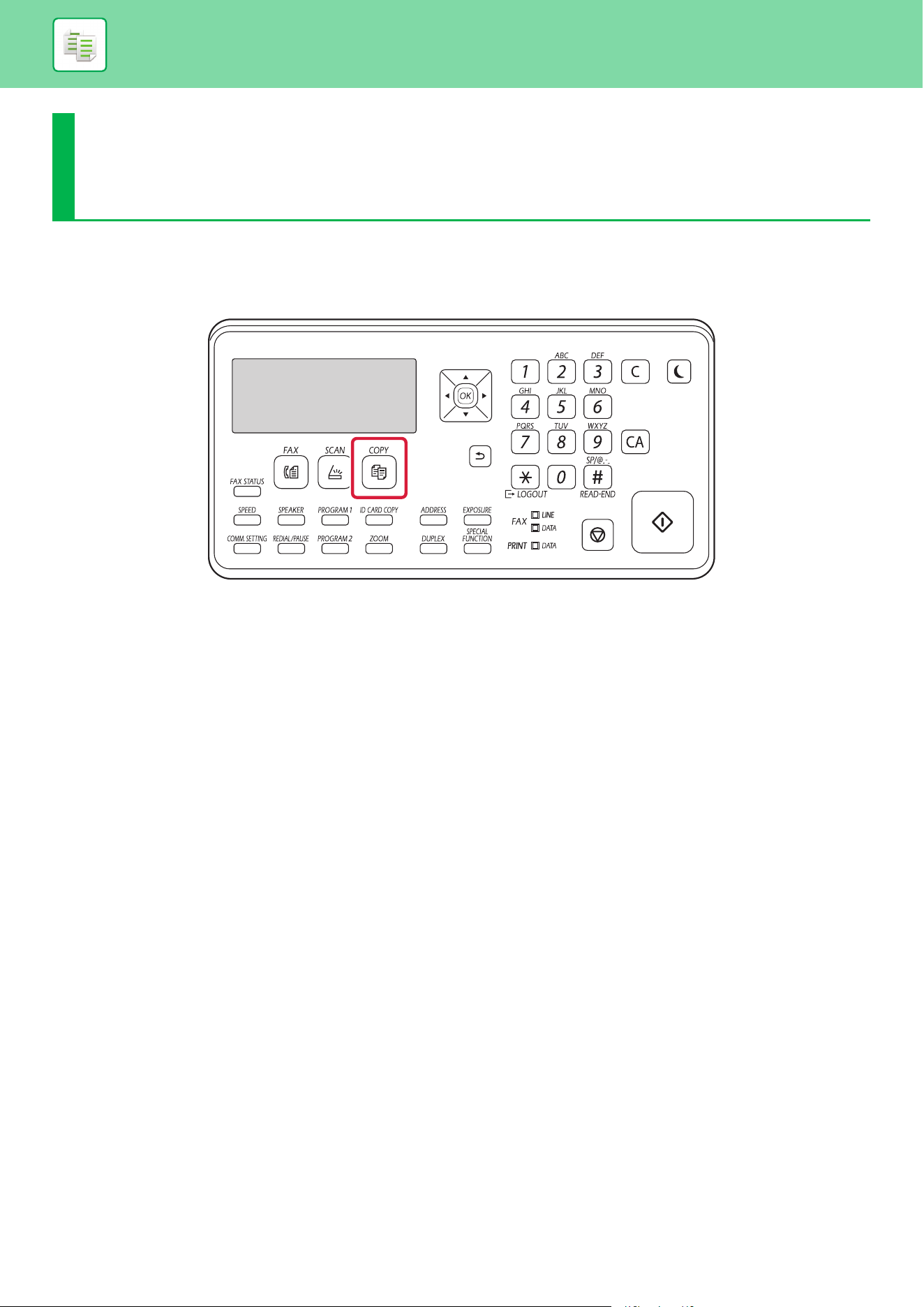
Switch to copy mode.
► COPY MODE (page 2-2)
2
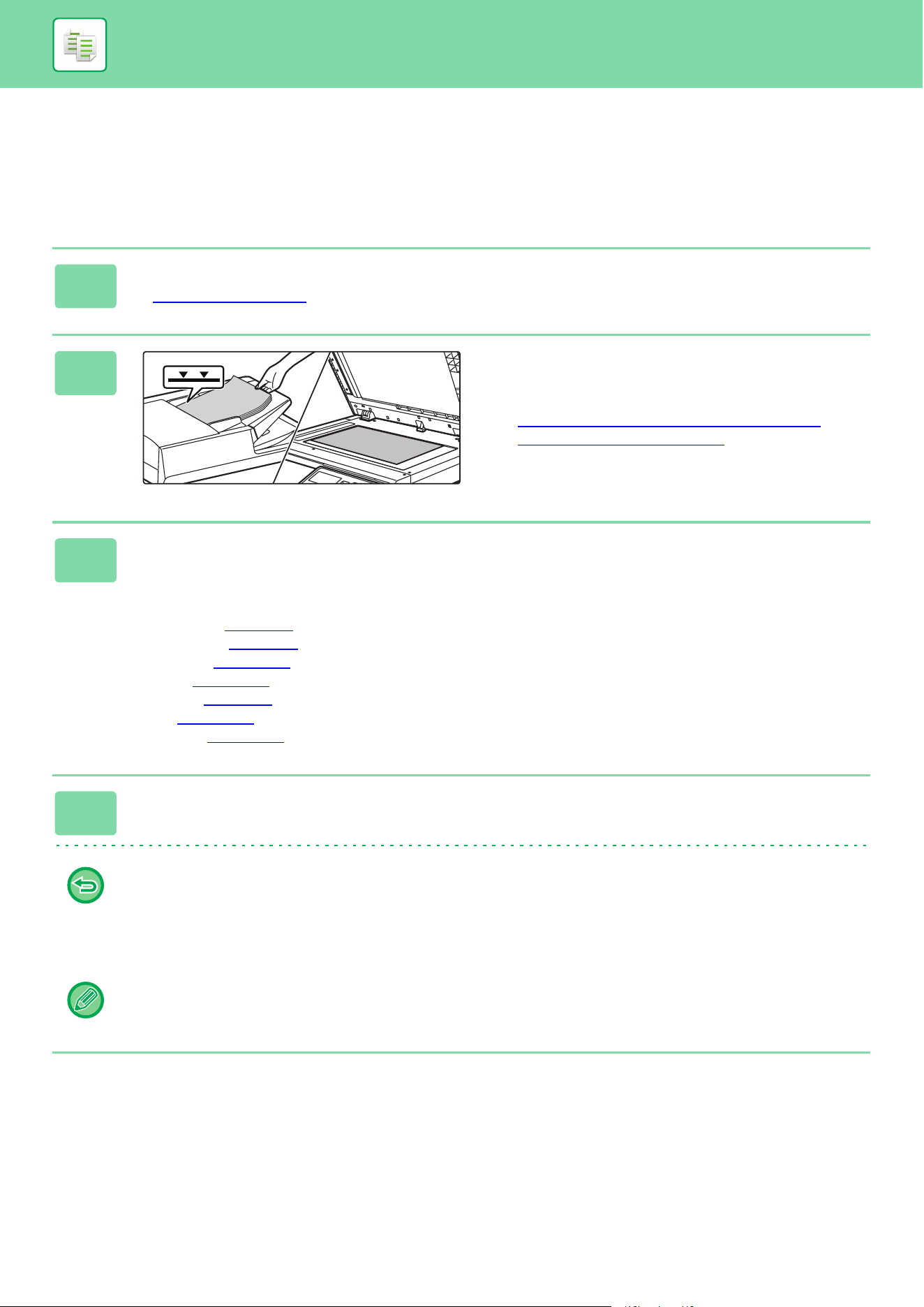
Place the original.
Place the original in the document feeder tray of the
automatic document feeder, or on the document glass.
► AUTOMATIC DOCUMENT FEEDER (page 1-30)
► DOCUMENT GLASS (page 1-32)
3
Select functions.
Specify the original scan size, exposure, resolution, etc.
If necessary, you can refer to the following functions for the setting.
• Paper Select ►page 2-4
• 2-Sided Copy ►page 2-7
• Copy Ratio ►page 2-10
• Original ►page 2-11
• Exposure ►page 2-8
•N-Up ►page 2-19
• Card Shot ►page 2-21
4
Press the [START] key to start copying.
When making only one set of copies, you do not need to specify the number of copies.
• To cancel all settings, press the [CA] key.
When the [CA] key is pressed, all settings selected to that point are cleared and you will return to the base screen.
• To cancel a copy job, press the [C] key or [CA] key. If you press the [C] key, the copy settings are retained. If you
press the [CA] key, the settings are canceled. If you press the [STOP] key while copying is in progress, a confirmation
screen appears asking if you want to cancel the copy job.
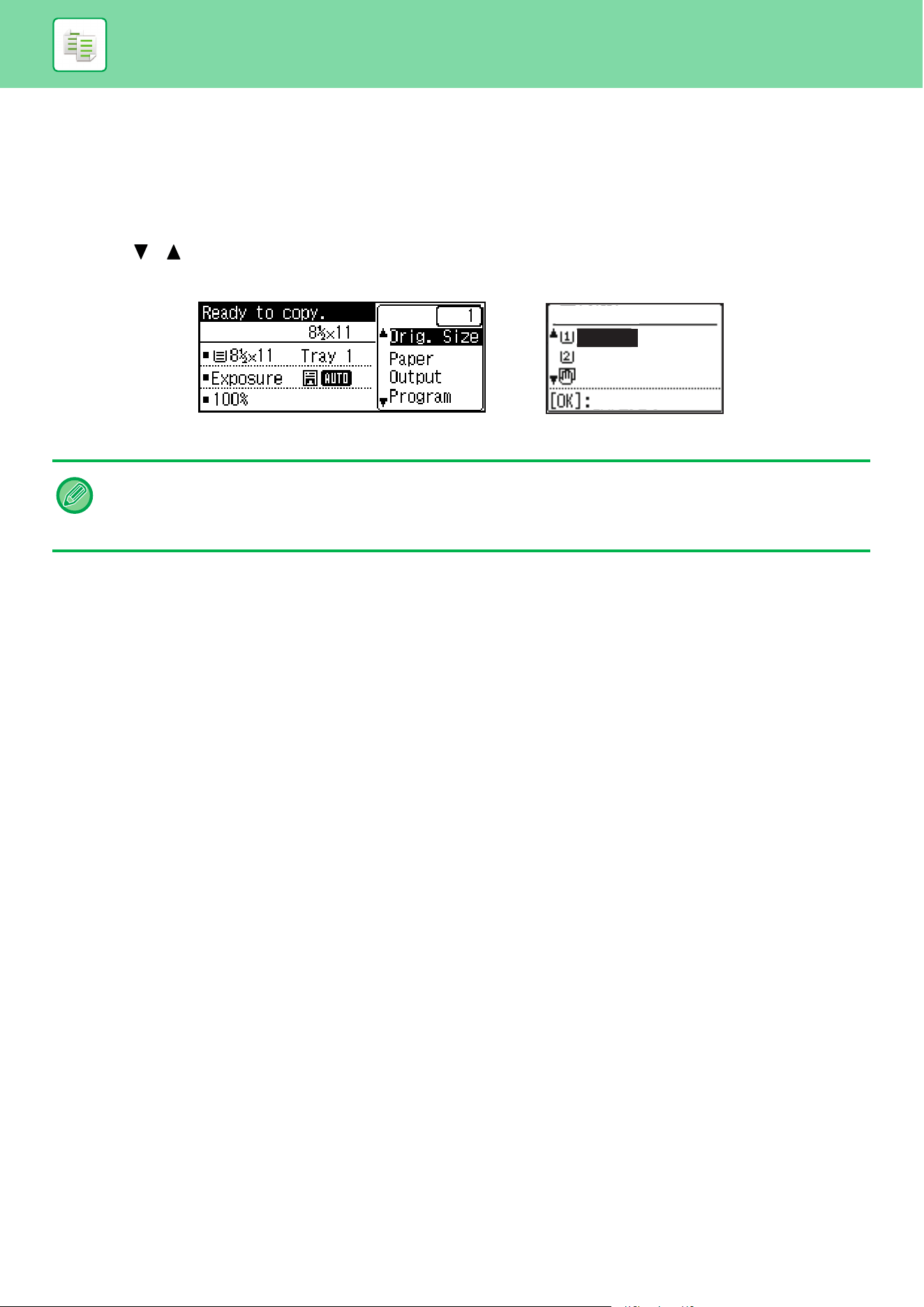
• To make two or more sets of copies:
Press the copies display key to specify the number of copies.
2-4
COPIER►BEFORE USING THE MACHINE AS A COPIER
SELECTING THE PAPER TRAY FOR
COPYING
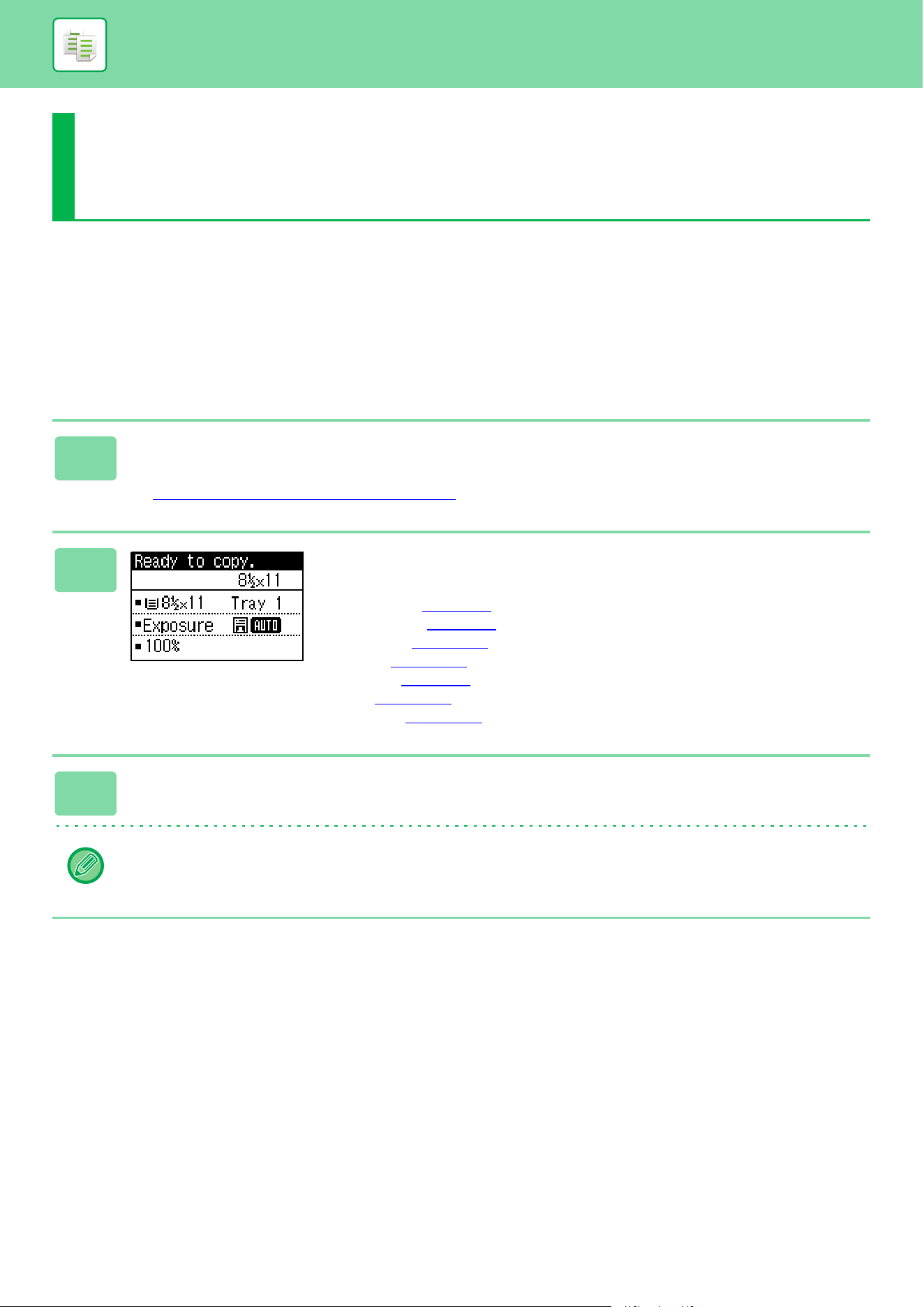
To change the tray you want to use in order to use the bypass tray or tray 2 (if installed), select "Paper Select" in the
right menu of the base screen of copy mode, and press the [OK] key.
Press the [ ] [ ] keys to select the tray, and press the [OK] key.
• If the selected tray runs out of paper during a copy job and there is another tray that has the same size and type of paper,
that tray will be automatically selected and the copy job will continue.
• If the "Ready to copy." message does not appear in the base screen of copy mode
If a list is being printed in the system settings, copying is not possible. Wait until list print finishes and then start copying.
Paper Select
8½x11
8½x11
5½x8½
Set Completed
2-5
COPIER►BASIC PROCEDURE FOR MAKING COPIES
COPYING
USING THE AUTOMATIC DOCUMENT FEEDER FOR
COPYING
BASIC PROCEDURE FOR MAKING
COPIES
1
Place the original in the document feeder tray of the automatic document
feeder.
► AUTOMATIC DOCUMENT FEEDER (page 1-30)
2
Check the paper (tray) you want to use for copying, and
press the keys for any other settings you want to select.
• Paper Select ►page 2-4
• 2-Sided Copy ►page 2-7
• Copy Ratio ►page 2-10
• Original ►page 2-11
• Exposure ►page 2-8
•N-Up ►page 2-19
• Card Shot ►page 2-21
3
Press the [START] key to start copying.
When making only one set of copies, you do not need to specify the number of copies.
To make two or more sets of copies:
Press the number of copies key to specify the number of copies.
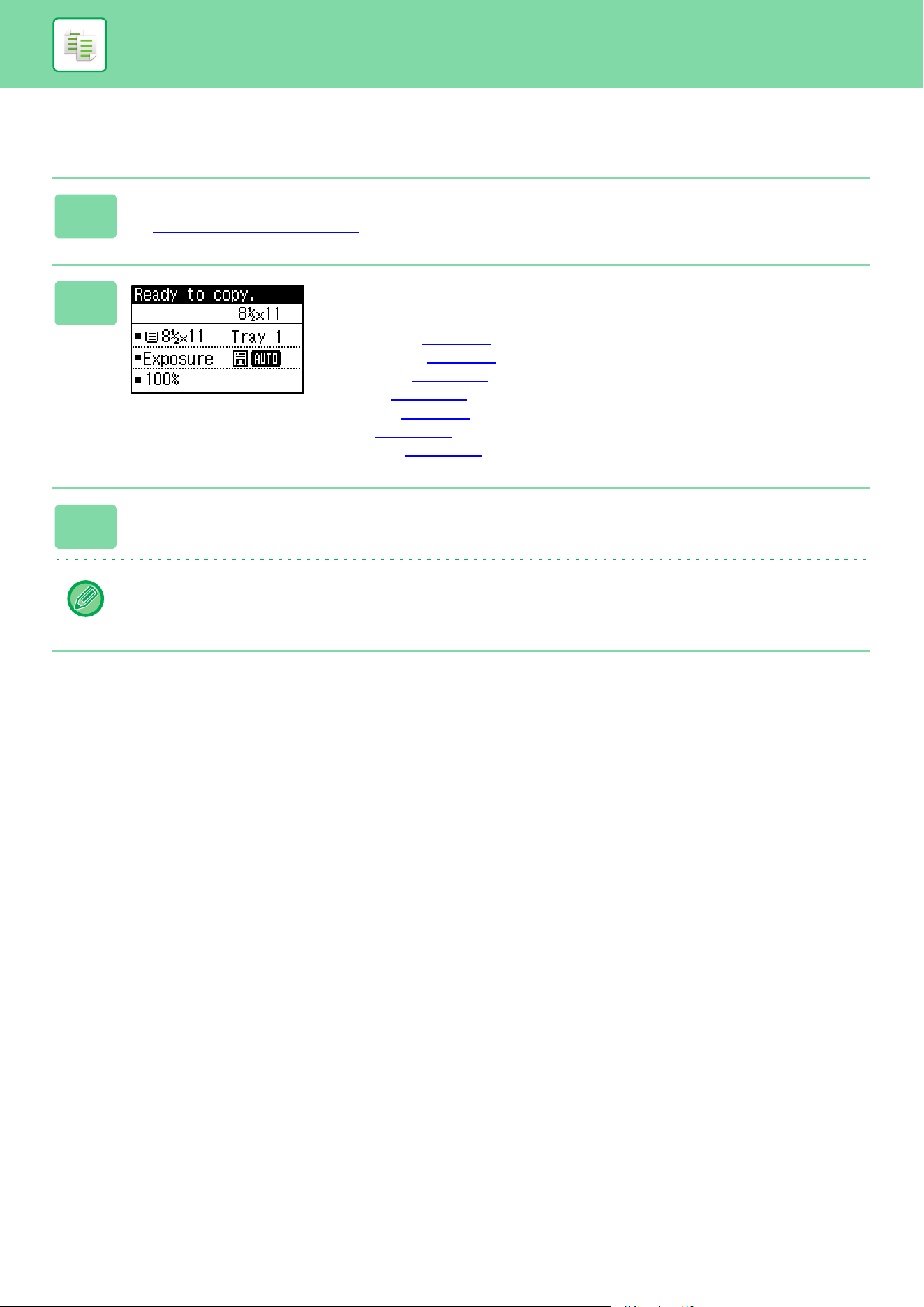
2-6
COPIER►BASIC PROCEDURE FOR MAKING COPIES
USING THE DOCUMENT GLASS FOR COPYING
CANCELING A COPY JOB
To cancel the copying, press [C] key or [CA] key. When [C] key is pressed the copy settings are maintained and when
[CA] key is pressed the copy settings are all deleted.
When [STOP] key is pressed while the copy is in process, the confirmation screen whether or not to cancel the copying
appears on the display.
1
Place the original on the document glass.
► DOCUMENT GLASS (page 1-32)
2
Check the paper (tray) you want to use for copying, and
press the keys for any other settings you want to select.
• Paper Select ►page 2-4
• 2-Sided Copy ►page 2-7
• Copy Ratio ►page 2-10
• Original ►page 2-11
• Exposure ►page 2-8
•N-Up ►page 2-19
• Card Shot ►page 2-21
3
Press the [START] key to start copying.
When making only one set of copies, you do not need to specify the number of copies.
To make two or more sets of copies:
Press the number of copies key to specify the number of copies.
2-7
COPIER►BASIC PROCEDURE FOR MAKING COPIES
AUTOMATIC DUPLEX COPYING
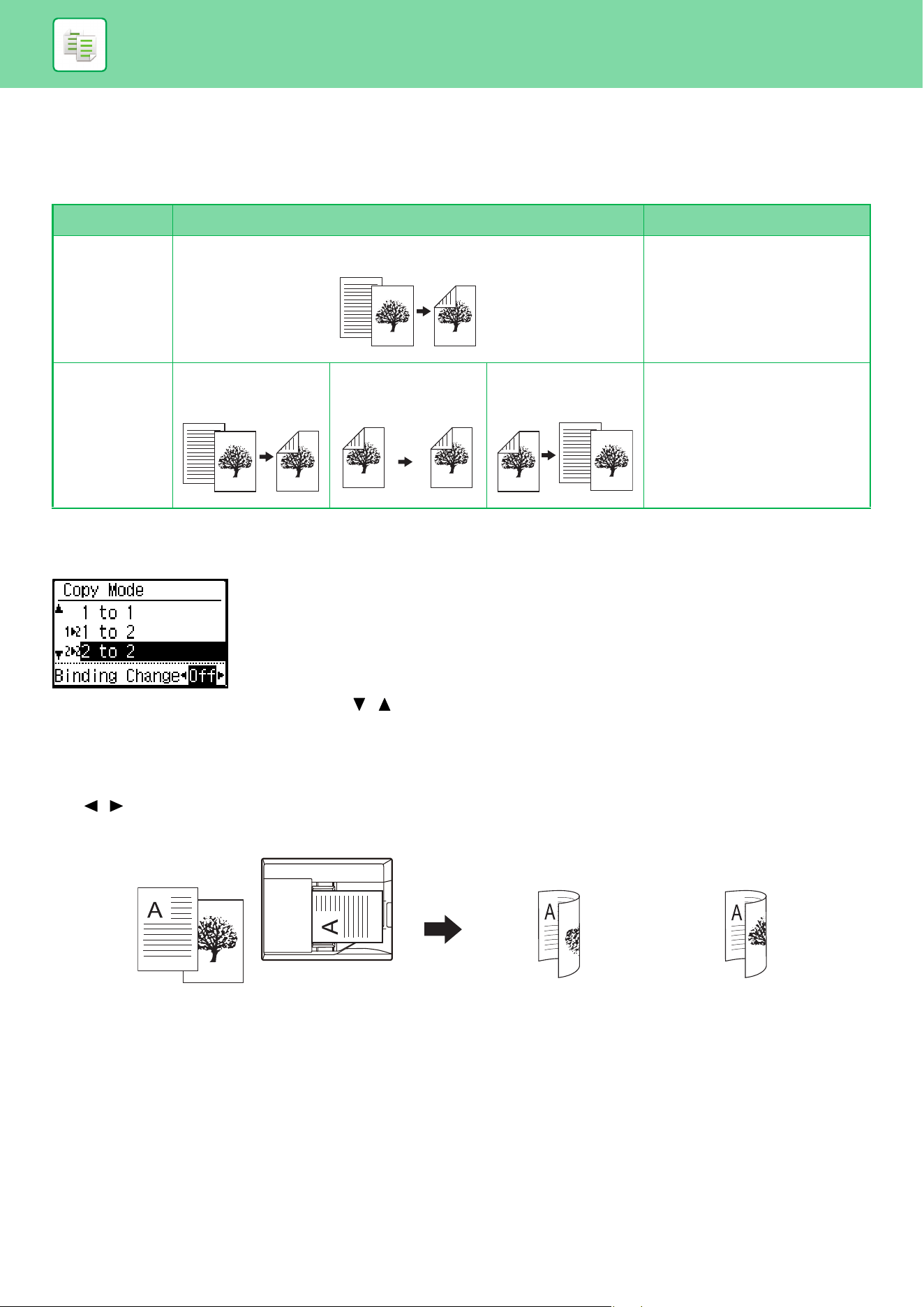
The machine is capable of performing the following type of auto duplex copying. When copying, the machine will
automatically turn over the originals and paper, allowing you to make 2-sided copies with ease.
To change to the 2-sided copy screen, press the [DUPLEX] key on the operation panel with the base screen of copy
mode displayed.
Select "1 to 2", "2 to 2", or "2 to 1" with the [ ][ ] keys and press the [OK] key.
When scanning the original on the document glass, press the [START] key after scanning the front side, turn the original
over on the glass, and press the [START] key. Duplex copying starts.
To change the orientation of the copy image on the front and back sides of the paper, set "Binding Change" to "On" with
the [ ][ ] keys.
Original → Paper Usable paper
Document
glass
One-sided original → Two sides
8-1/2" x 14", 8-1/2" x 11", 5-1/2"
x 8-1/2"
(A4, B5, A5)
Document
feeder
One-sided original
→ Two sides
Duplex original
→ Two sides
Duplex original
→ One side
8-1/2" x 14", 8-1/2" x 13-1/2",
8-1/2" x 13-2/5", 8-1/2" x 13",
8-1/2" x 11", 5-1/2" x 8-1/2"
(A4, B5, A5)
1
2
1
2
Portrait original
Orientation of the placed
original
Binding Change is
used
The top and bottom of the
images on the front and
back are reversed.
Binding Change is
not used
The top and bottom of the
images on the front and
back are the same.
2-8
COPIER►BASIC PROCEDURE FOR MAKING COPIES
CHANGING THE EXPOSURE AND ORIGINAL
IMAGE TYPE
AUTOMATIC ADJUSTMENT OF EXPOSURE AND
ORIGINAL TYPE
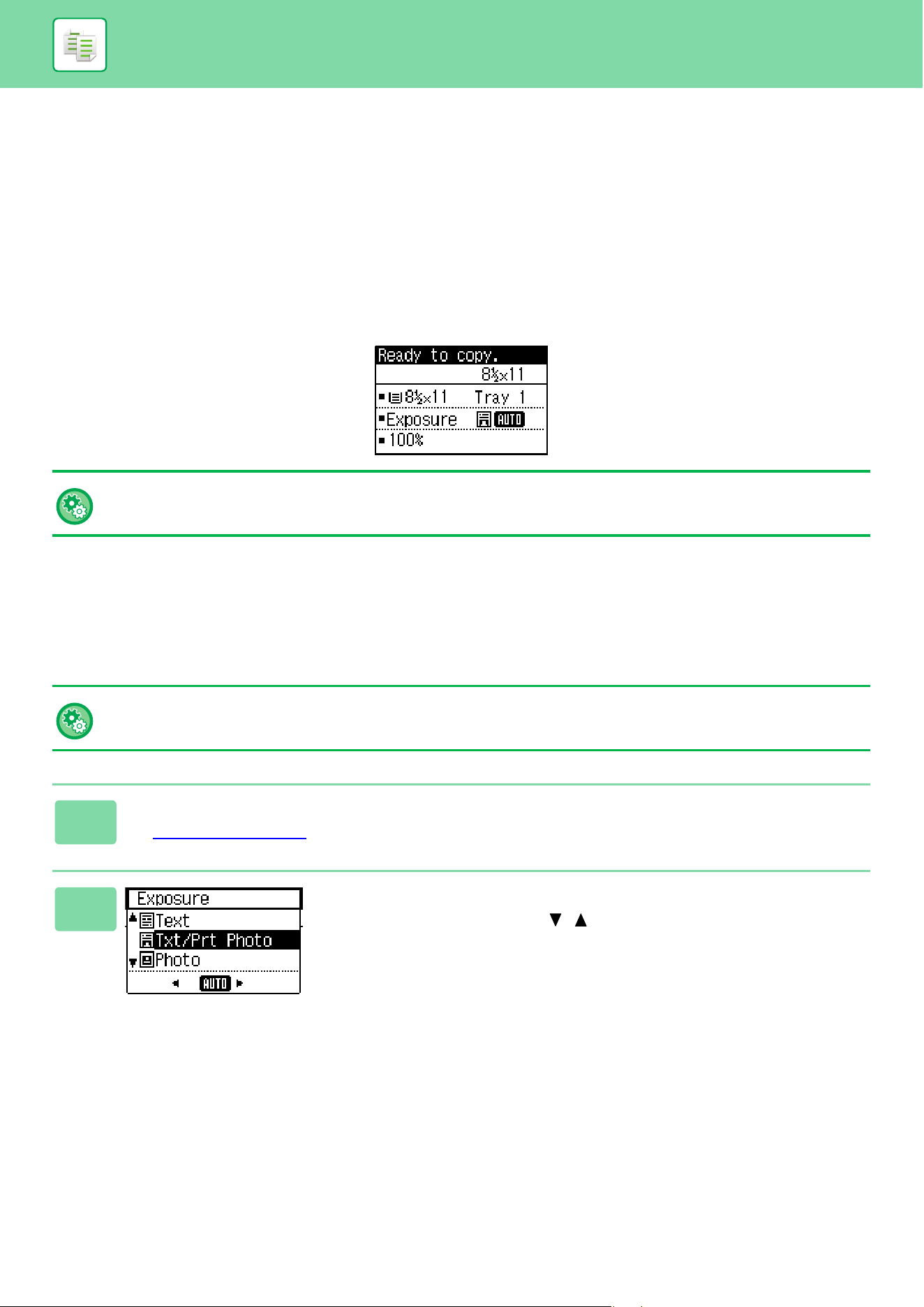
Automatic exposure adjustment operates by default to automatically adjust the exposure level and original type as
appropriate for the original being copied. ([Auto] is displayed.)
MANUAL ADJUSTMENT OF EXPOSURE AND
ORIGINAL TYPE
This section explains how to select the original type depending on the original to be copied or manually adjust the
exposure.
To change the default exposure:
In "System Settings (administrator)", select [Copy] → [Default Exposure].
To change the default exposure:
In "System Settings (administrator)", select [Copy] → [Default Exposure].
1
Press the [Exposure] key.
► COPY MODE (page 2-2)
2
Select the copy exposure.
Select the original type with the [ ][ ]keys.
Three exposure modes are available: "Text", "Text/Print Photo" and "Photo".
Original image type select keys
• Text ............................Use this mode for regular text documents.
• Text/Printed Photo .....This mode provides the best balance for copying an original which contains both text and
printed photographs, such as a magazine or catalogue.
• Photo..........................This mode is best for copying printed photographs, such as photos in a magazine or catalogue.
2-9
COPIER►BASIC PROCEDURE FOR MAKING COPIES
3
Adjust the exposure of the selected original type.
Set "Auto" or "Manual" (5 levels) for the exposure. If needed, adjust the exposure with the [ ][ ] keys.
Guidelines for the exposure level when [Text] is selected for "Exposure/Original Type"
1 to 2: Dark originals such as a newspaper
3: Normal density originals
4 to 5: Originals written in pencil or light colored text
4
Press the [OK] key.
2-10
COPIER►BASIC PROCEDURE FOR MAKING COPIES
ENLARGE/REDUCE
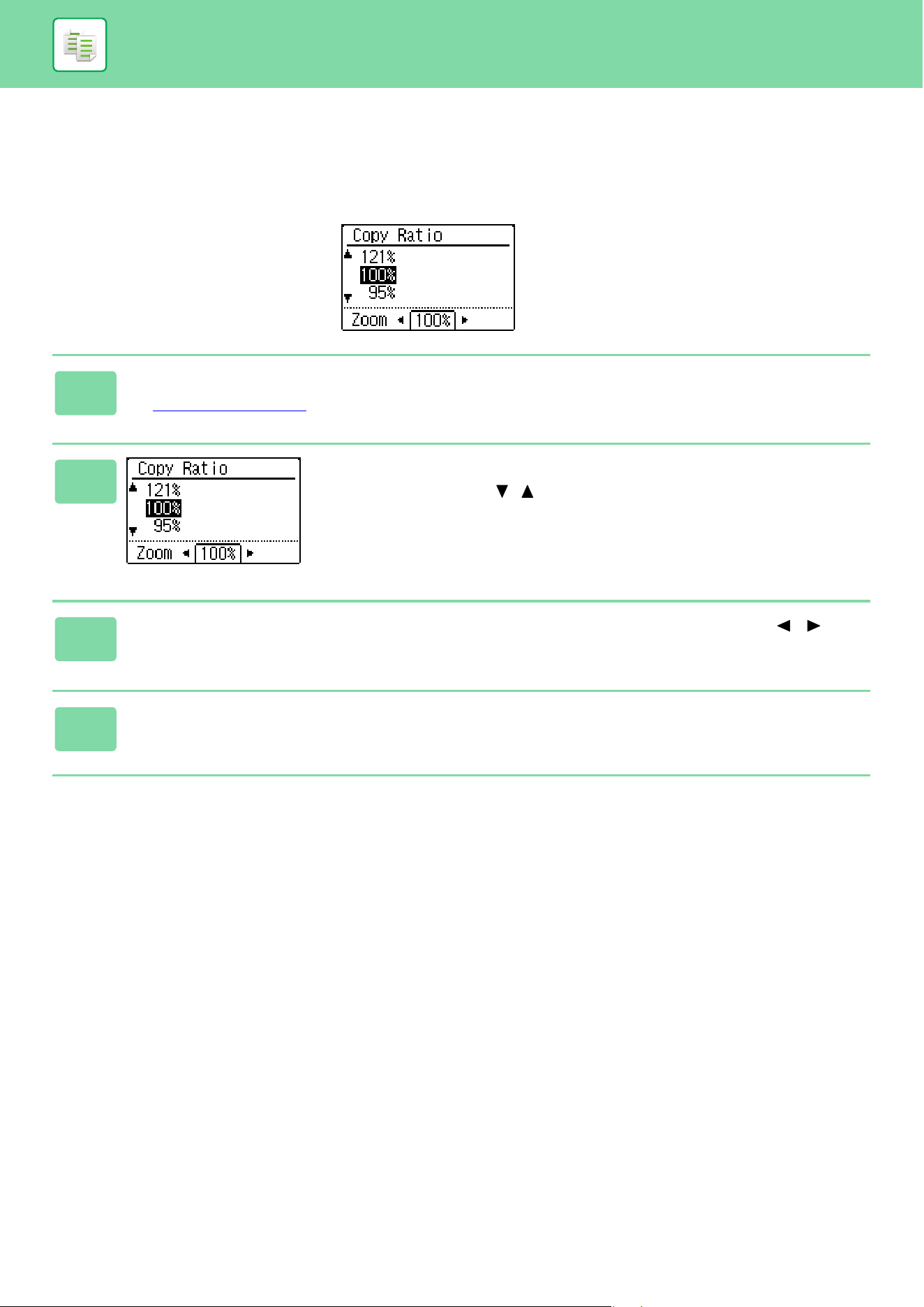
Place the original, and press the [ZOOM] key on the operation panel to change to the ratio selection screen.
Specifying a ratio from 25% to 400%: Preset ratios/zoom.
(When the document feeder is being used, the zoom copy ratio range is 25% to 200%.)
1
Press the [ZOOM] key.
► COPY MODE (page 2-2)
2
Select [Zoom].
Select the ratio with the [ ][ ] keys.
3
To set the ratio in increments of 1%, set a numerical value with the [ ][ ]
keys.
4
Press the [OK] key.
2-11
COPIER►BASIC PROCEDURE FOR MAKING COPIES
SPECIFYING THE SIZE OF THE ORIGINAL
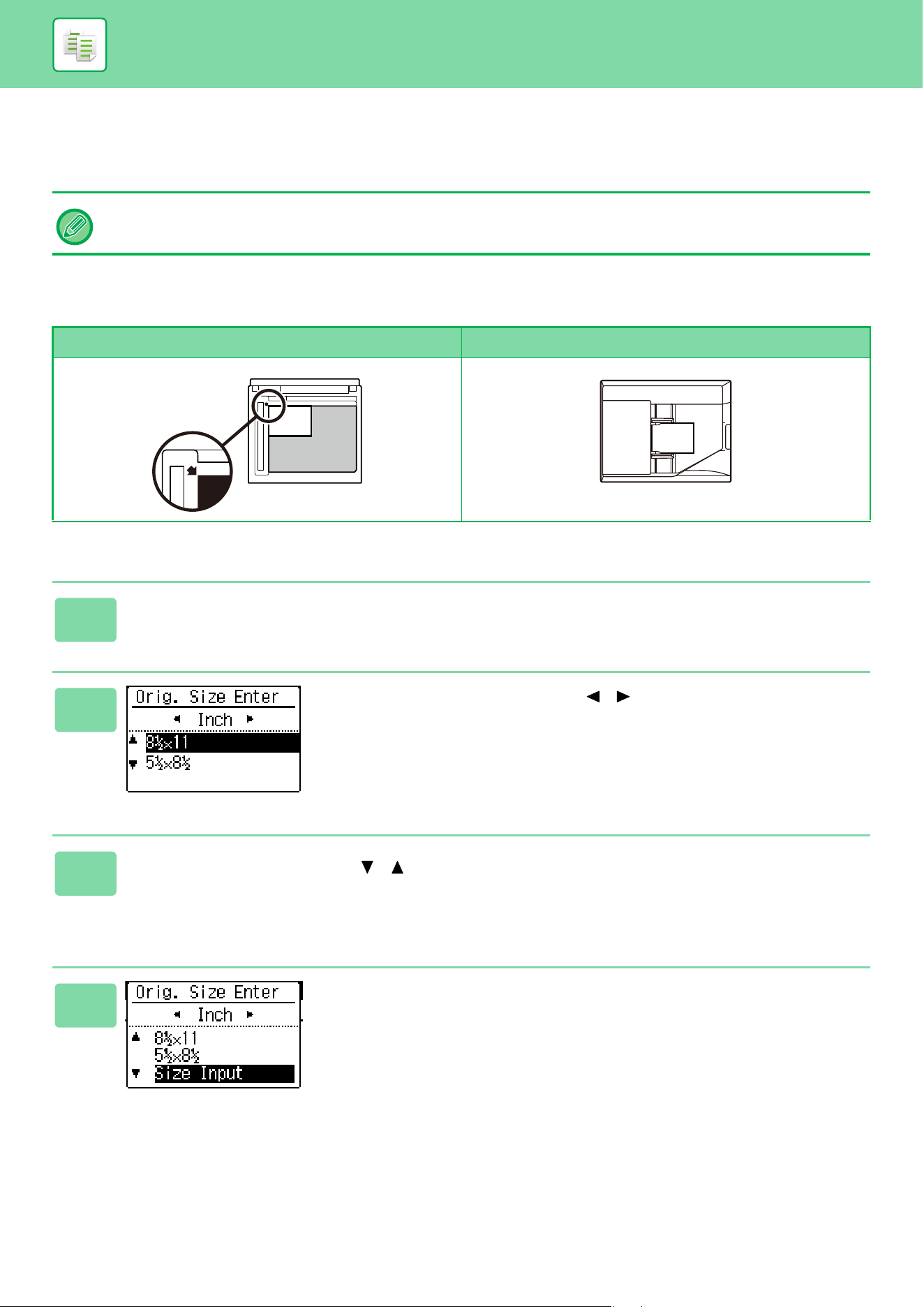
When you want to change the original size, select "Original Size" on the right menu and press the [OK] key.
Orientation of the original
Place the original as shown below.
Specifying the size of the original
Set the orientation and size of the original before scanning the original.
Document glass Document feeder
1
Select "Original Size" in the right menu of the base screen of copy mode and
press the [OK] key.
2
Select Inch or AB with the [ ][ ] keys.
3
Select the size with the [ ][ ] keys.
For a standard original size, select Original Size, press the [OK] key, and specify the original size.
The set original size will appear in the Original Size field of the base screen.
If you are using a special original size, go to step 4.
4
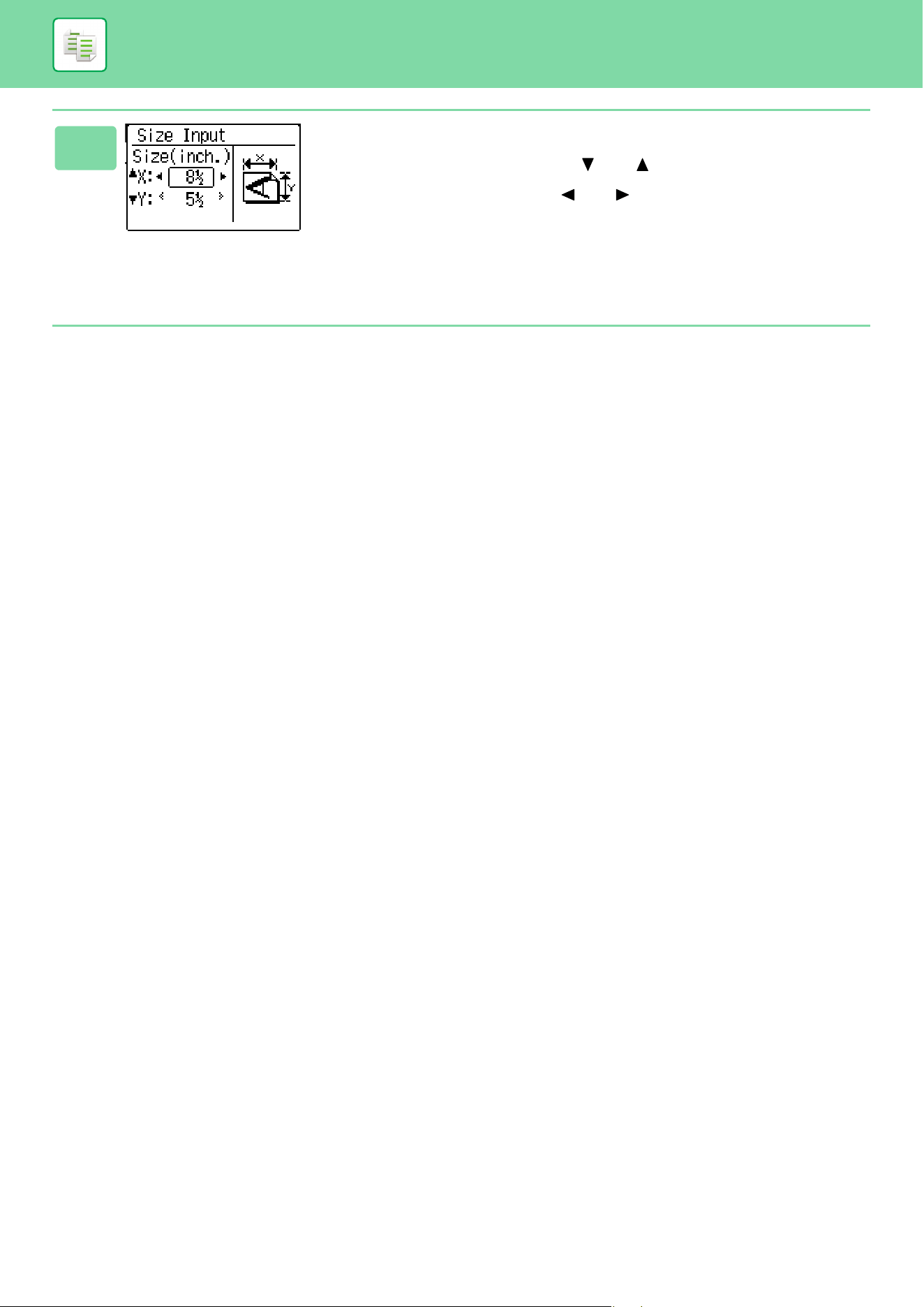
For a special paper size, select "Size Input" and press
the [OK] key.
abc
abc
2-12
COPIER►BASIC PROCEDURE FOR MAKING COPIES
5
Specify the original size.
(1) Select "X" (width) with the [ ] or [ ] key .
(2) Enter the width with the [ ] or [ ] key, then do the same for
the length (Y).
(3) Press the [OK] key.
The original size is set. "Custom" appears in the original size field of the base
screen.
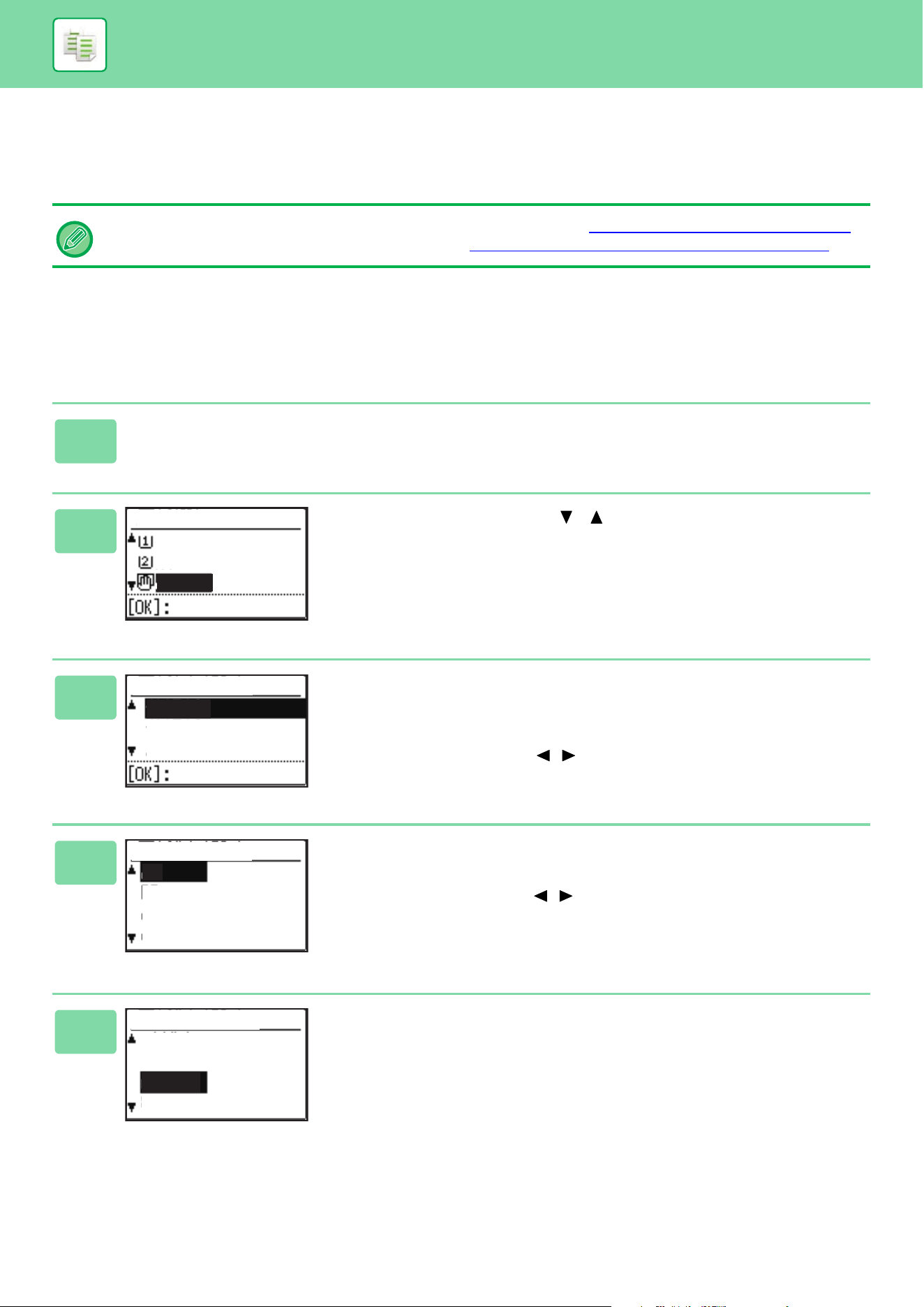
2-13
COPIER►BASIC PROCEDURE FOR MAKING COPIES
MAKING COPIES USING THE BYPASS TRAY
In addition to plain paper, the bypass tray allows you to make copies on transparency film, envelopes, and other special
media.
SPECIFYING A TYPE AND SIZE OF PAPER LOADED ON
BYPASS TRAY
For detailed information on paper that can be loaded into the bypass tray, see "APPLICABLE PAPER TYPES (page 1-17)".
For precautions on loading paper into the bypass tray, see "LOADING PAPER INTO THE BYPASS TRAY (page 1-24)
".
1
Select "Paper" in the right menu of the base screen of copy mode and press
the [OK] key.
2
Select "Paper" with the [ ][ ] keys, and press the [OK]
key.
3
Press the [SPECIAL FUNCTION] key, select "Paper Type
Set", and select the type of paper to be used in the
bypass tray.
Select the paper type with the [ ][ ] keys. When finished, press the [OK] key.
To use an envelope, go to step 7.
4
Press the [SPECIAL FUNCTION] key, select "Paper Size
Set", and select the paper size used in the bypass tray.
Select the paper size with the [ ][ ] keys. If the paper size is a standard size,
select Paper Size, press the [OK] key, and specify the paper size.
The specified paper size appears in the paper size field of the base screen.
To use a special paper size, go to step 5.
5
● Special paper size
Select "mm" or "inch" and press the [OK] key.
Paper Select
8½x11
8½x11
8½x11
Set Completed
Paper Type Set
Plain 1
Plain 2
Heavy Paper 1
Set Completed
Paper Size Set
8½x11
5½x8½
inch
7¼x10½
Paper Size Set
A4
5½x8½
inch
7¼x10½
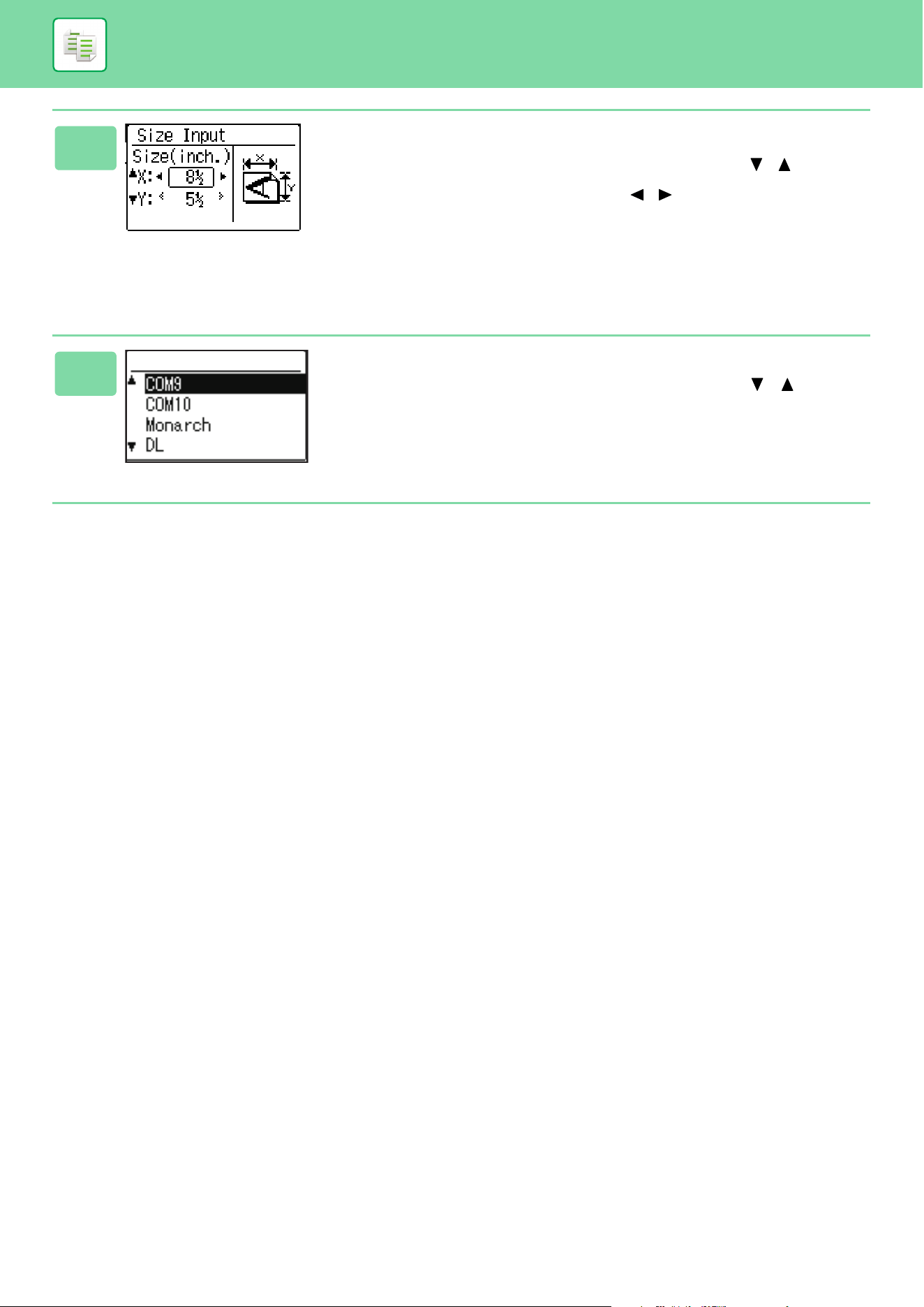
2-14
COPIER►BASIC PROCEDURE FOR MAKING COPIES
6
Specify the paper size.
(1) Select “X” (horizontal) or “Y” (vertical) with the [ ][ ] keys.
(2) Specify the size of each with the [ ][ ] keys.
In “mm”, you can specify the size in increments of 1 mm. In “inch”, you can specify
the size in increments of 1/8 inch.
(3) Press the [OK] key.
The paper size is set. “Custom” appears in the paper size field of the base screen.
7
● Envelope
Select the envelope size to be used with the [ ][ ] keys,
and press the [OK] key.
The envelope size is set. "Envelope" appears in the paper size field of the base screen.
Envelope Size
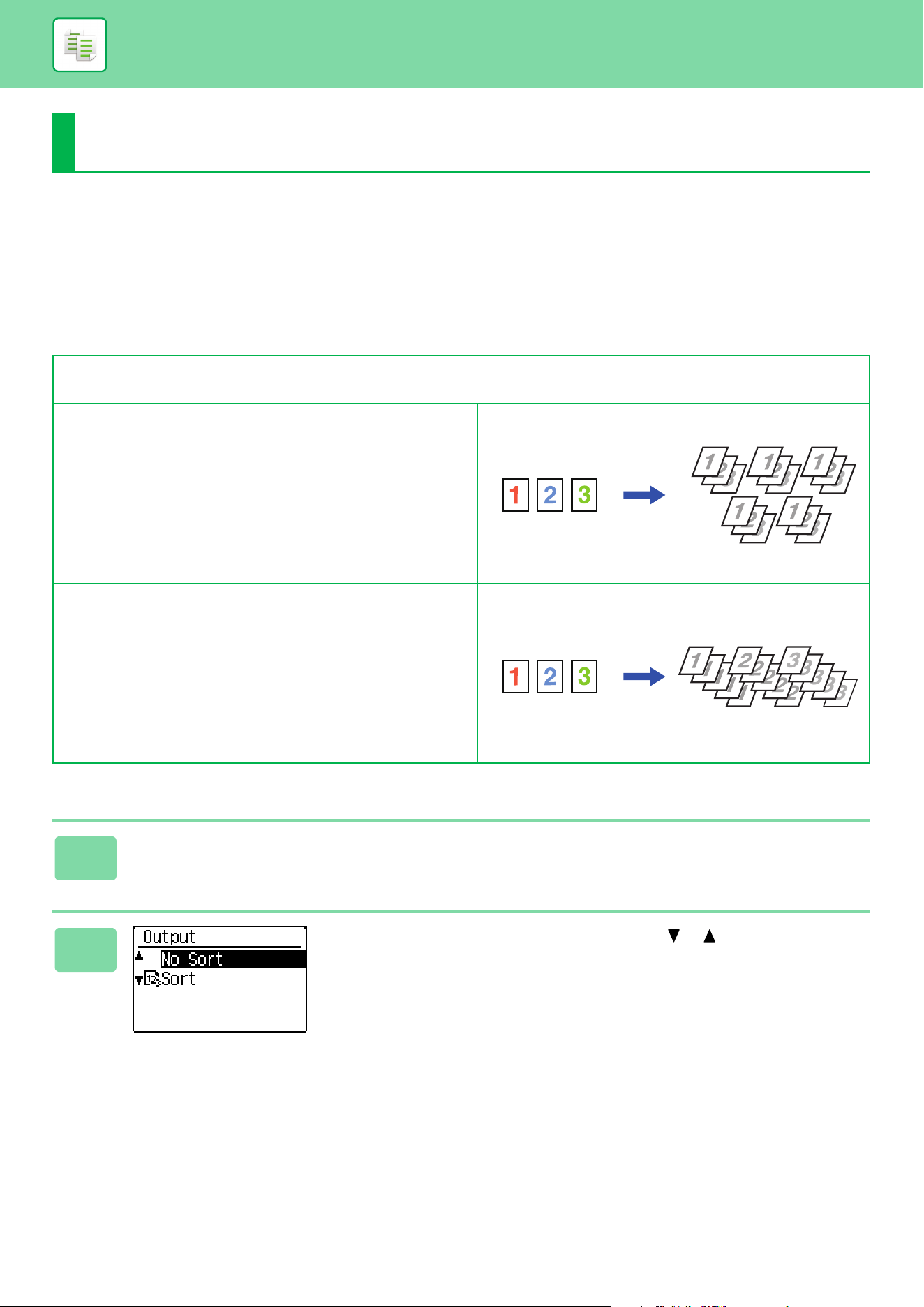
2-15
COPIER►CONVENIENT COPY FUNCTIONS
OUTPUT
SORT SETTING
• Sorts the scanned original on a set basis, and outputs them.
• Groups the scanned original on a page basis, and outputs them.
CONVENIENT COPY FUNCTIONS
Auto
Enables the sort mode when the original is placed in the automatic document feeder, and enables the group
mode when the original is placed on the document glass.
Sort Sorts the scanned original on a set basis, and
outputs them.
Group Groups the scanned original on a page basis,
and outputs them.
1
Select "Output" in the right menu of the base screen of copy mode and press
the [OK] key.
2
Select "No Sort" or "Sort" with the [ ] [ ] keys
Originals
When 5 is set for the
number of copies
Finished
Originals Finished
When 5 is set for the
number of copies
2-16
COPIER►CONVENIENT COPY FUNCTIONS
3
Press the [OK] key.
• If the memory becomes full while the originals are being scanned, "Memory is full." will appear in the display.
To start copying the originals that have been scanned to that point, press the [START]. To cancel the copy job, press the
[CA] key.
• The auto select setting for the sort function of the automatic document feeder can be changed in "Sort Auto Select" in the
system settings (►page 7-17)
.
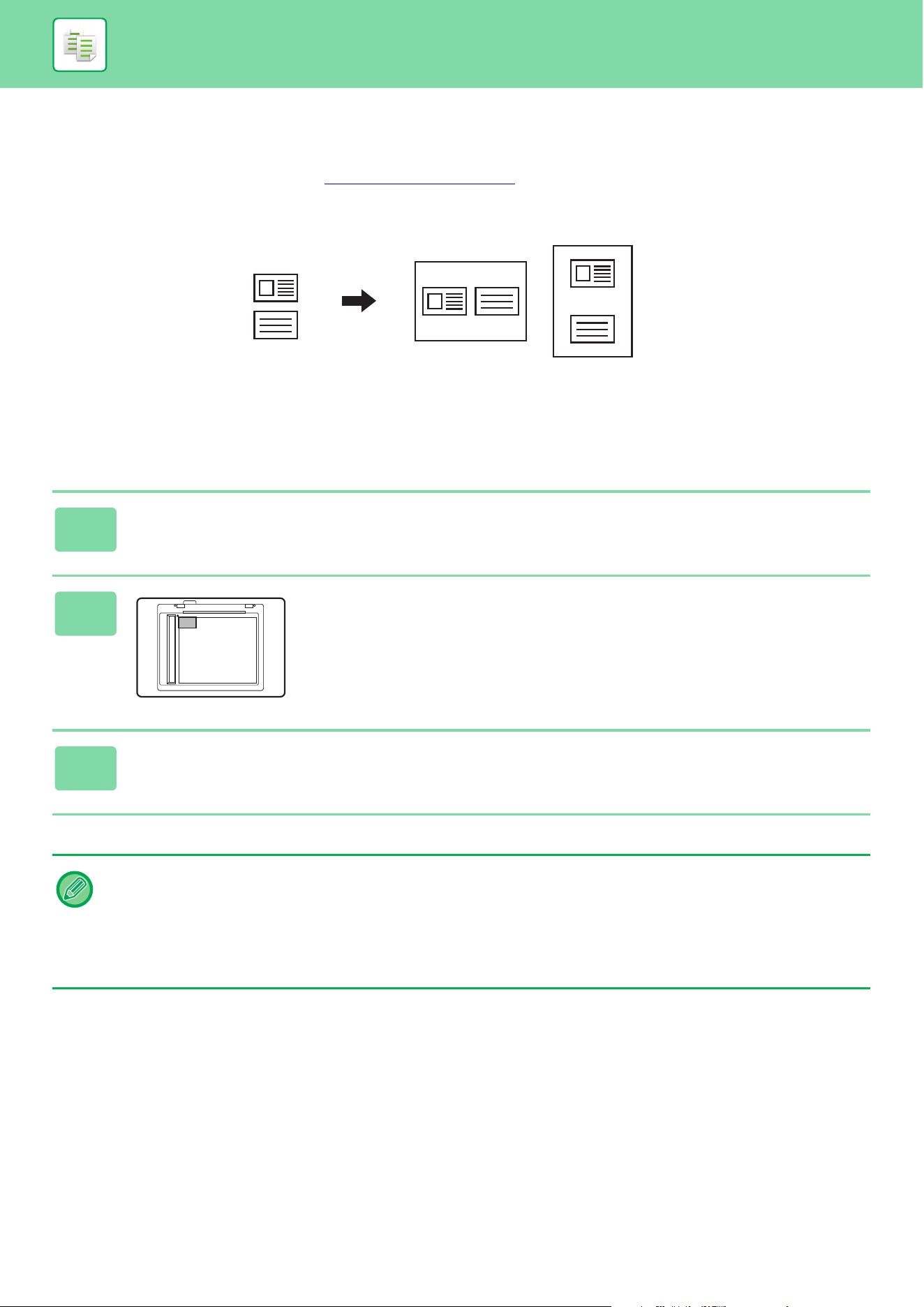
2-17
COPIER►CONVENIENT COPY FUNCTIONS
ID CARD COPY
You can copy the front and back sides of ID card onto a page through this function.
The layout of the ID card copy, set the "ID Card Setting (page 7-17)
" of SYSTEM SETTINGS.
• Set Horizontally
: Copies in the horizontal orientation (fixed position), regardless of the paper size.
• Set Vertically
: Copies in the vertical orientation (fixed position), regardless of the paper size.
1
Press the [ID CARD COPY] key on the operation panel.
2
Place the ID card on the upper left-hand corner of the
document glass, and press the [START] key.
3
Turn the ID card over and press the [START] key.
• The ID card copy function cannot be used at the same time as the 2-sided copy, 2-Up/4-Up copy, sort copy, and card shot
functions.
• Paper sizes that can be used with ID Card Copy are standard sizes.
• In ID card copy mode, scan area and scan number (1 page) cannot be changed. Scan area is:
X: 86 + 5 mm (1/4") (margin), Y: 54 + 5mm (1/4") (margin).
• Auto tray switch is invalid in ID card copy mode. Please select paper and tray manually.
Front
Back
Copies
Set Vertically
Set Horizontally
Original
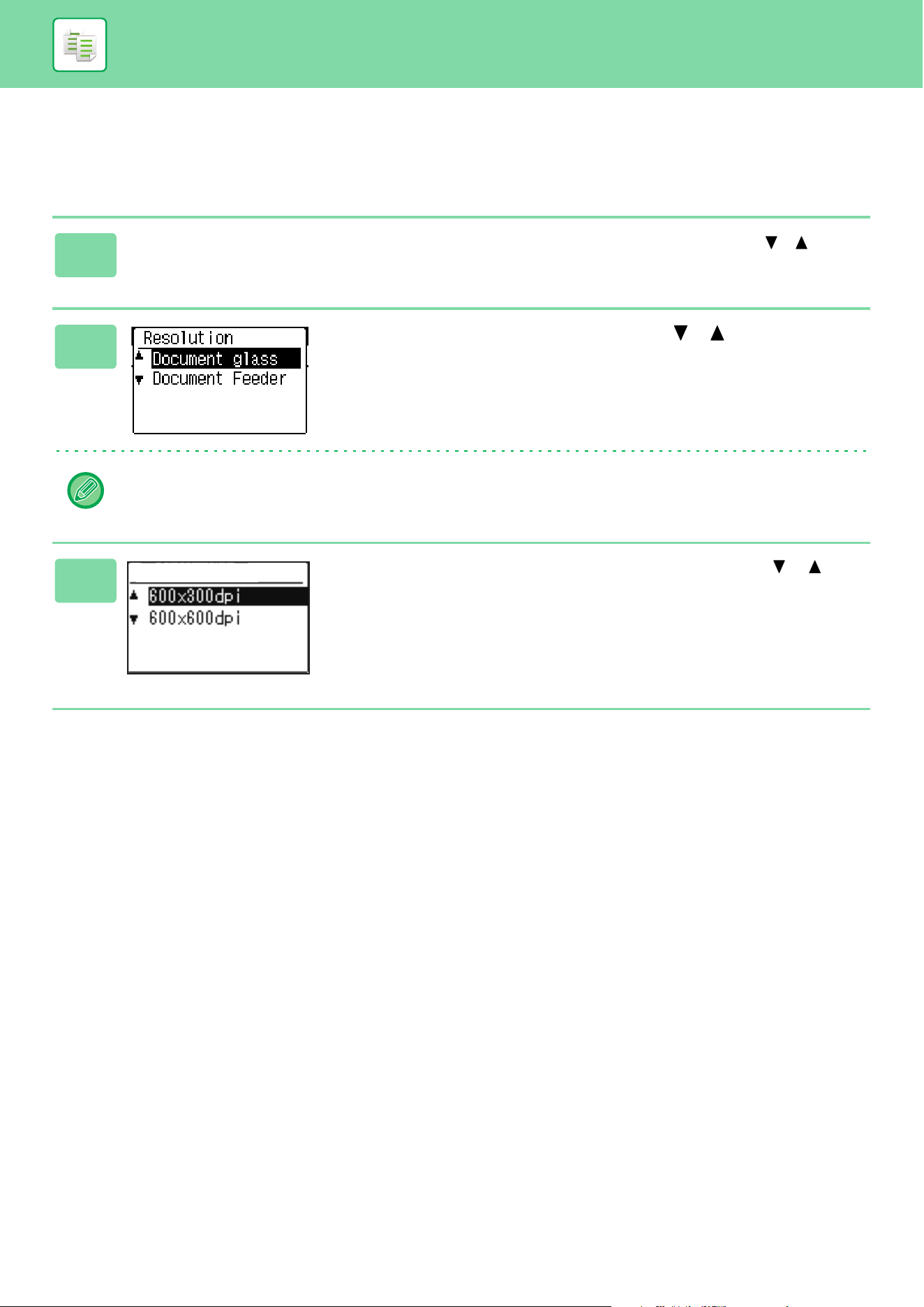
2-18
COPIER►CONVENIENT COPY FUNCTIONS
RESOLUTION SETTINGS
You can adjust the resolution for scanning an original on the document glass or in the auto document feeder, and select
high image quality or high speed as appropriate for your needs.
1
Press the [SPECIAL FUNCTION] key, select "Resolution" with the [ ][ ]
keys, and press the [OK] key.
2
Select "Document Feeder" with the [ ] [ ] keys and
press the [OK] key.
You can also select the document glass, however the document glass is fixed at 600 x 600 dpi, you can not change the
setting.
3
Select "600×300dpi" or "600×600dpi" with the [ ] [ ]
keys and press the [OK] key.
Document Feeder
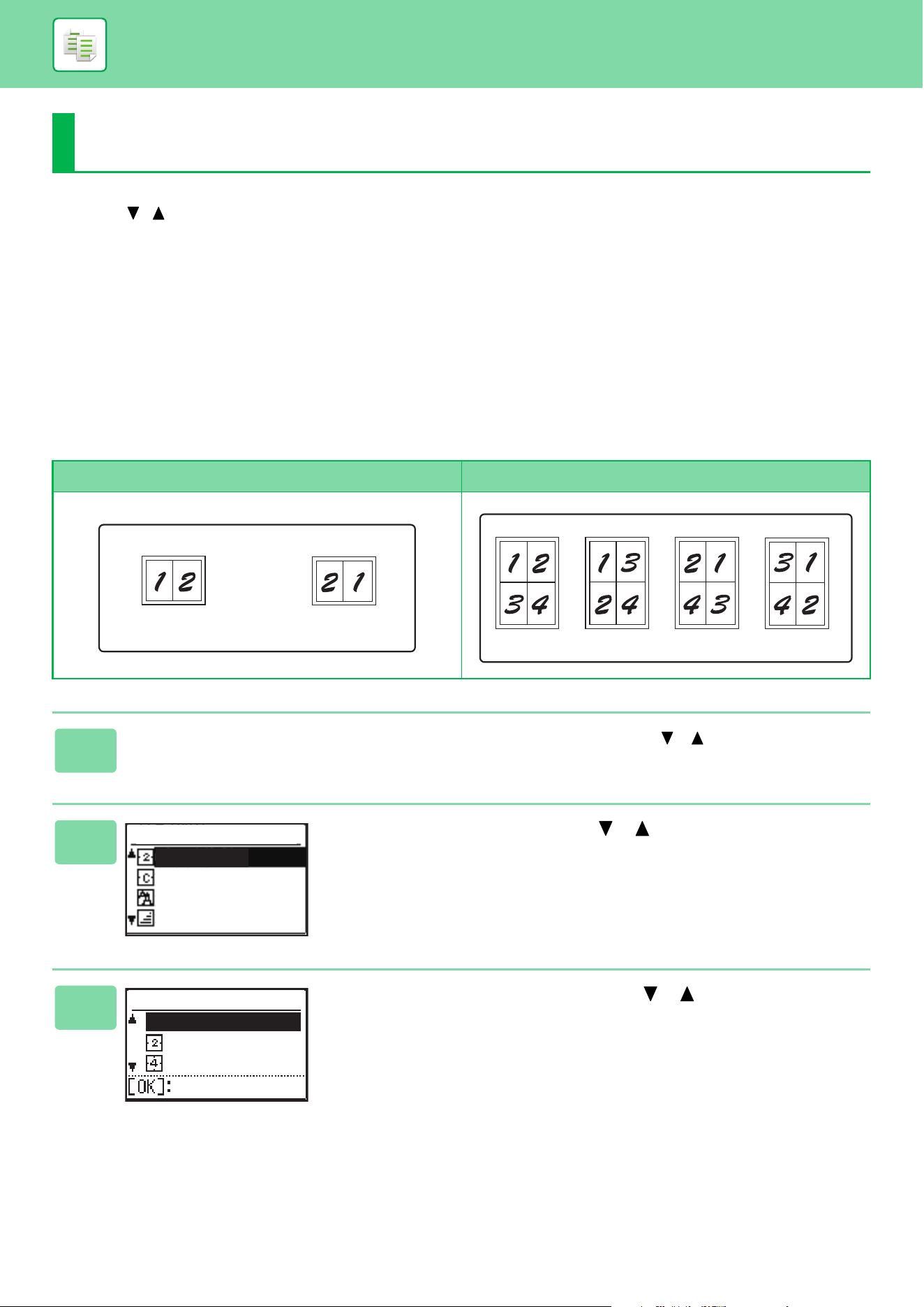
2-19
COPIER►SPECIAL MODES
To display the Special Modes menu, press the [SPECIAL FUNCTION] key with the base copy screen displayed, and
press the [ ][ ] keys to select "Special Modes".
COPYING MULTIPLE ORIGINALS ONTO A
SINGLE SHEET OF PAPER (2-Up / 4-Up
COPY)
Multiple originals can be copied onto a single sheet of paper in a selected layout pattern.
This function is convenient for compiling multi-page reference materials into a compact format, or for providing an
overview of all pages of a document on a single page.
SPECIAL MODES
2-Up copying 4-Up copying
1
Press the [SPECIAL FUNCTION] key, select "" with the [ ][ ] keys, and
press the [OK] key.
2
Select "2-Up/4-Up" with the [ ] [ ] keys and press the
[OK] key.
3
Select "2-Up" or "4-Up" with the [ ] [ ] keys and press
the [OK] key.
Pattern 1
Pattern 2
2 IN 1 COPY
Pattern 1 Pattern 2 Pattern 3 Pattern 4
4 IN 1 COPY
Special Modes
2-Up/4-Up
Card Shot
Sharpness
Suppress BG
2-Up/4-Up
2-Up
Off
Off
4-Up
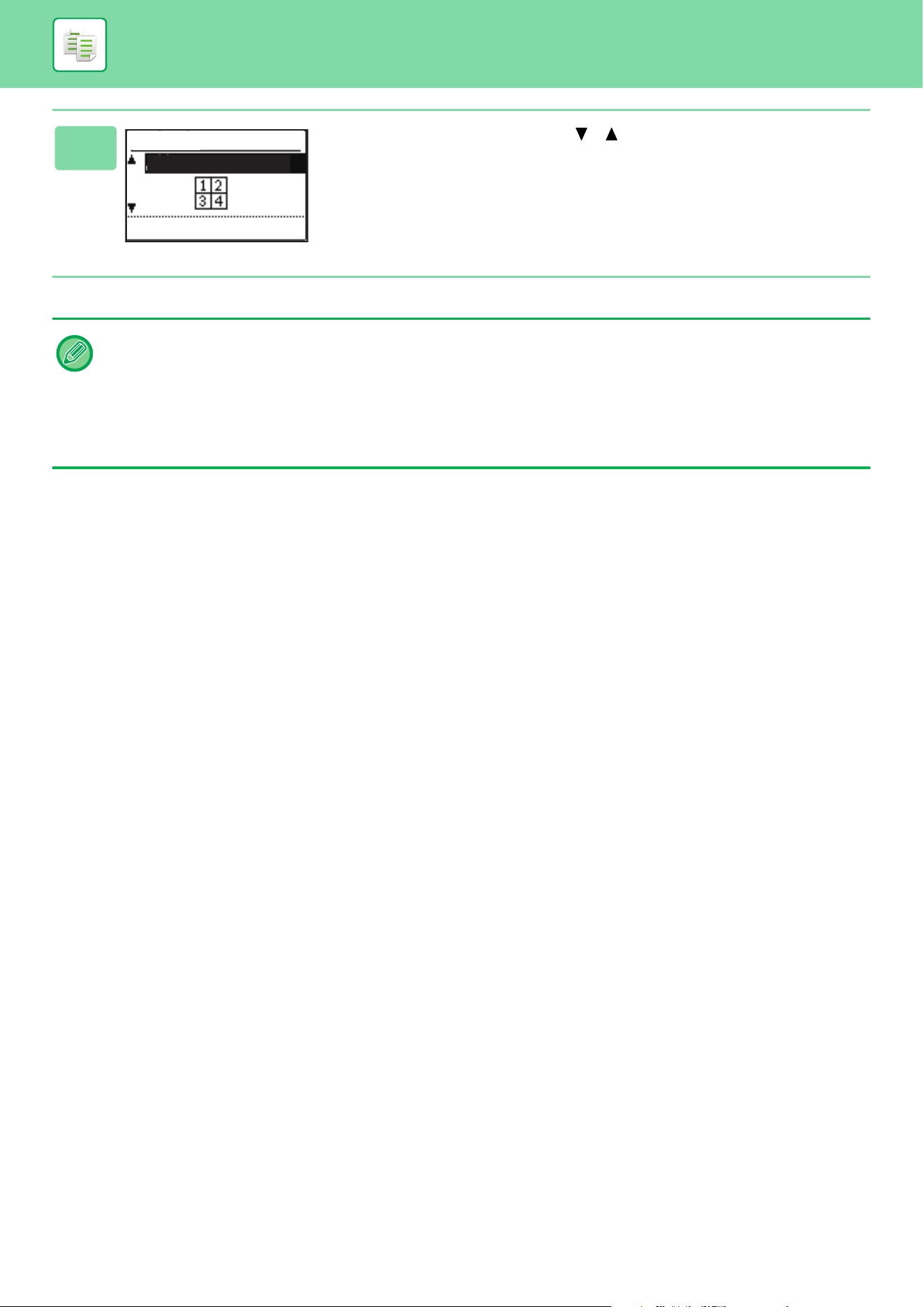
2-20
COPIER►SPECIAL MODES
4
Select the layout with the [ ][ ] keys and press the [OK]
key.
See above for the layouts that can be selected.
• 2-Up / 4-Up copy cannot be used in combination with the following functions. The function selected first will take
precedence.
Card shot, ID card copy
• A special paper size cannot be used for 2-Up / 4-Up copy.
• An appropriate ratio setting will be automatically selected based on the original size, the paper size, and the selected
number of images.
Certain combinations of original size, paper size, and number of images may result in images being cut off.
4-Up
Pattern 1
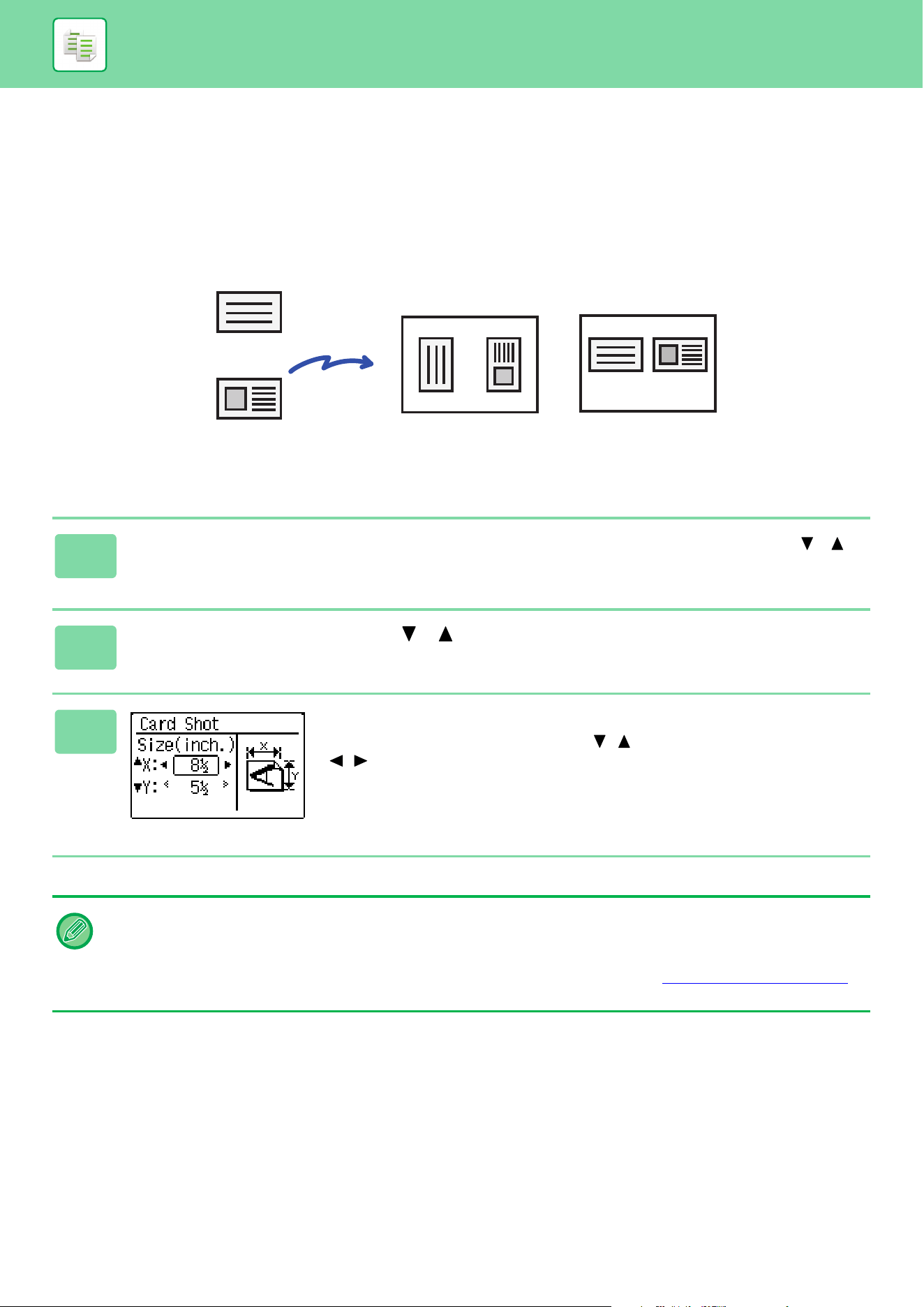
2-21
COPIER►SPECIAL MODES
COPYING BOTH SIDES OF A CARD AS A
SINGLE PAGE (CARD SHOT)
This function copies the front and reverse sides of a card on one sheet, not on separate sheets.
This function is convenient for making copies for identification purposes and helps save paper.
1
Press the [SPECIAL FUNCTION] key, select "Special Modes" with the [ ][ ]
keys, and press the [OK] key.
2
Select "Card Shot" with the [ ] [ ] keys and press the [OK] key.
3
Specify the card size in the Card Shot screen.
Select horizontal (X) or vertical (Y) with the [ ][ ] keys, specify the dimension with the
[ ][ ] keys, and press the [OK] key. Repeat for the other dimension.
• The horizontal and vertical dimensions can each be set to value from 1 to 8-1/2".
• Paper cannot be fed from the bypass tray.
• The card shot function cannot be used in combination with 2-Up / 4-Up copy, and ID card copy.
• The default settings for the horizontal and vertical dimensions in this screen can be set in Card Shot Default (page 7-17)
in
the system settings.
Back
Front
Example of a portrait copy
Example of a landscape copy
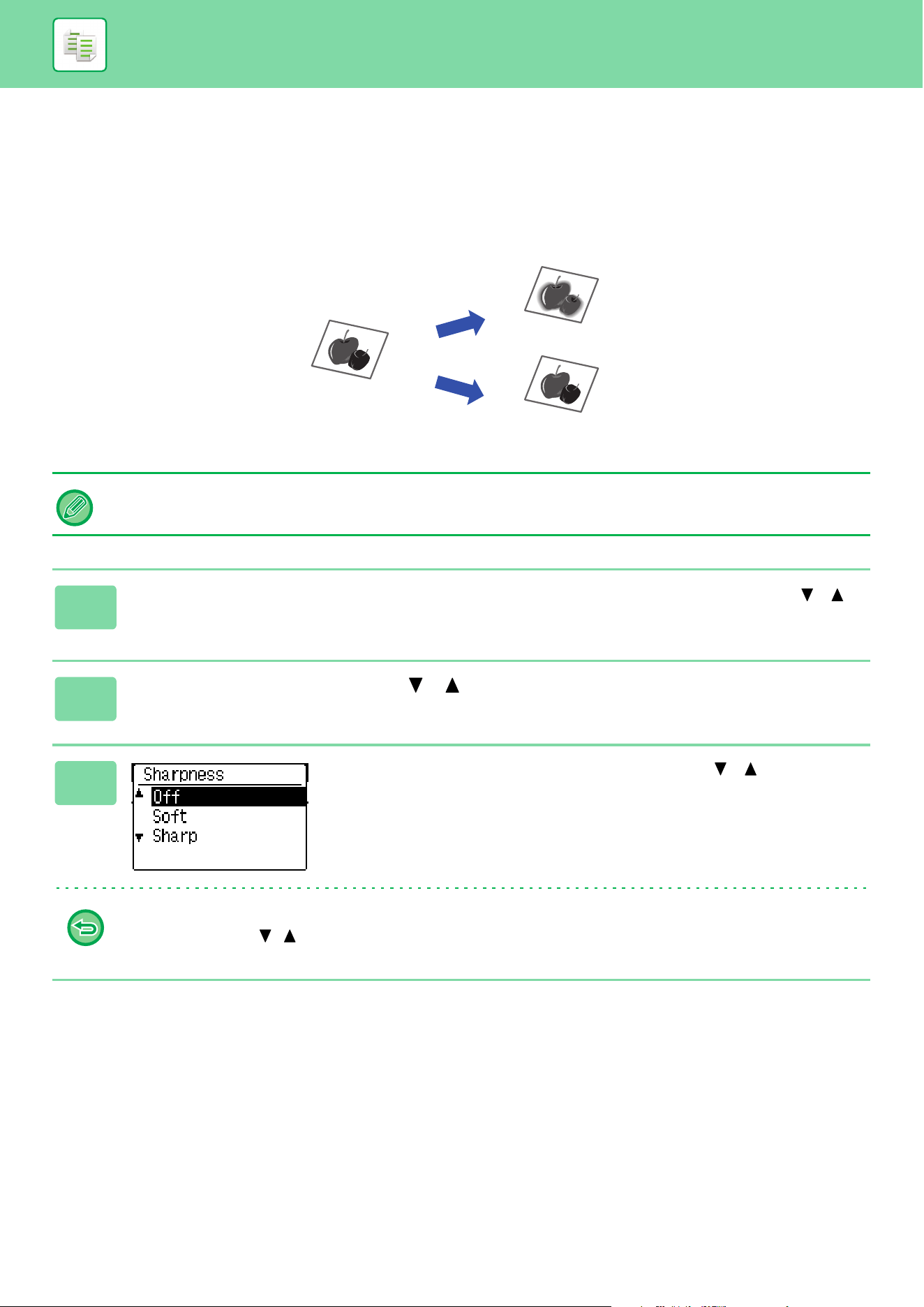
2-22
COPIER►SPECIAL MODES
ADJUSTING THE SHARPNESS OF AN
IMAGE (SHARPNESS)
This function adjusts the sharpness to make a sharper or softer image.
Sharpness must be specified before scanning the original.
1
Press the [SPECIAL FUNCTION] key, select "Special Modes" with the [ ][ ]
keys, and press the [OK] key.
2
Select "Sharpness" with the [ ] [ ] keys and press the [OK] key.
3
Select "Off", "Soft", or "Sharp" with the [ ][ ] keys and
press the [OK] key.
To cancel the sharpness setting:
Select "Off" with the [ ][ ] keys and press the [OK] key.
Softer
Sharper
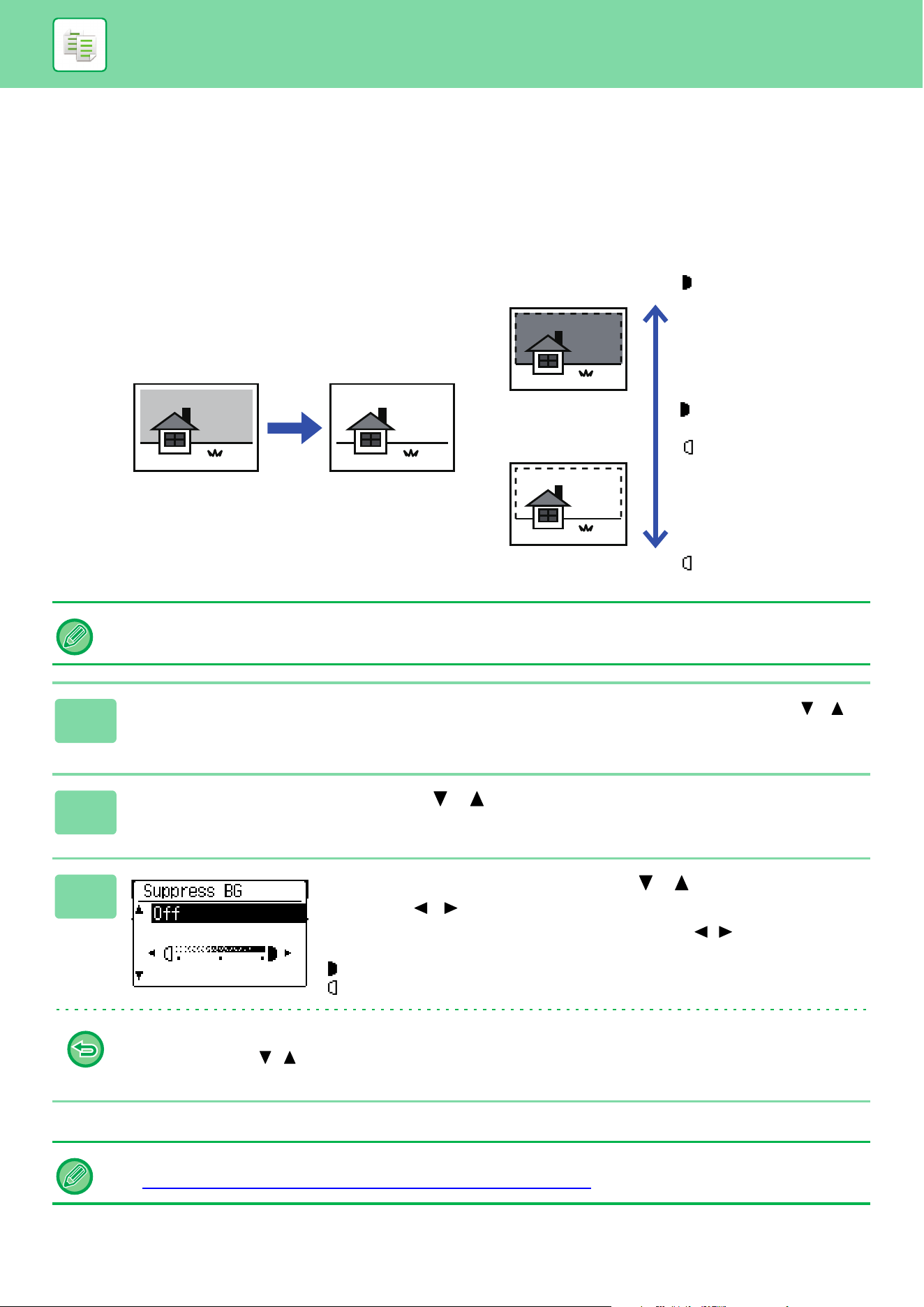
2-23
COPIER►SPECIAL MODES
ADJUSTING THE BACKGROUND BY
MAKING LIGHT AREAS OF THE ORIGINAL
DARKER OR LIGHTER (SUPPRESS BG)
You can adjust the background by making light areas of the original darker or lighter.
You must select Background Adjustment before scanning the original.
1
Press the [SPECIAL FUNCTION] key, select "Special Modes" with the [ ][ ]
keys, and press the [OK] key.
2
Select "Suppress BG" with the [ ] [ ] keys and press the [OK] key.
3
Select level adjustment with the [ ] [ ] keys, and adjust
with the [ ][ ] keys.
To select, change the level (3 levels are available) with the [ ][ ] keys and press the
[OK] key.
: Only light backgrounds are suppressed.
: Light to dark backgrounds are suppressed.
To cancel the Background Adjustment setting:
Select "Off" with the [ ][ ] keys and press the [OK] key.
When Background Adjustment is selected, the copy exposure setting is not applied.
► CHANGING THE EXPOSURE AND ORIGINAL IMAGE TYPE (page 2-8)
Adjust light areas in this way.
Level [ ]
[ ] makes the
background darker.
[ ] makes the
background lighter.
Level [ ]
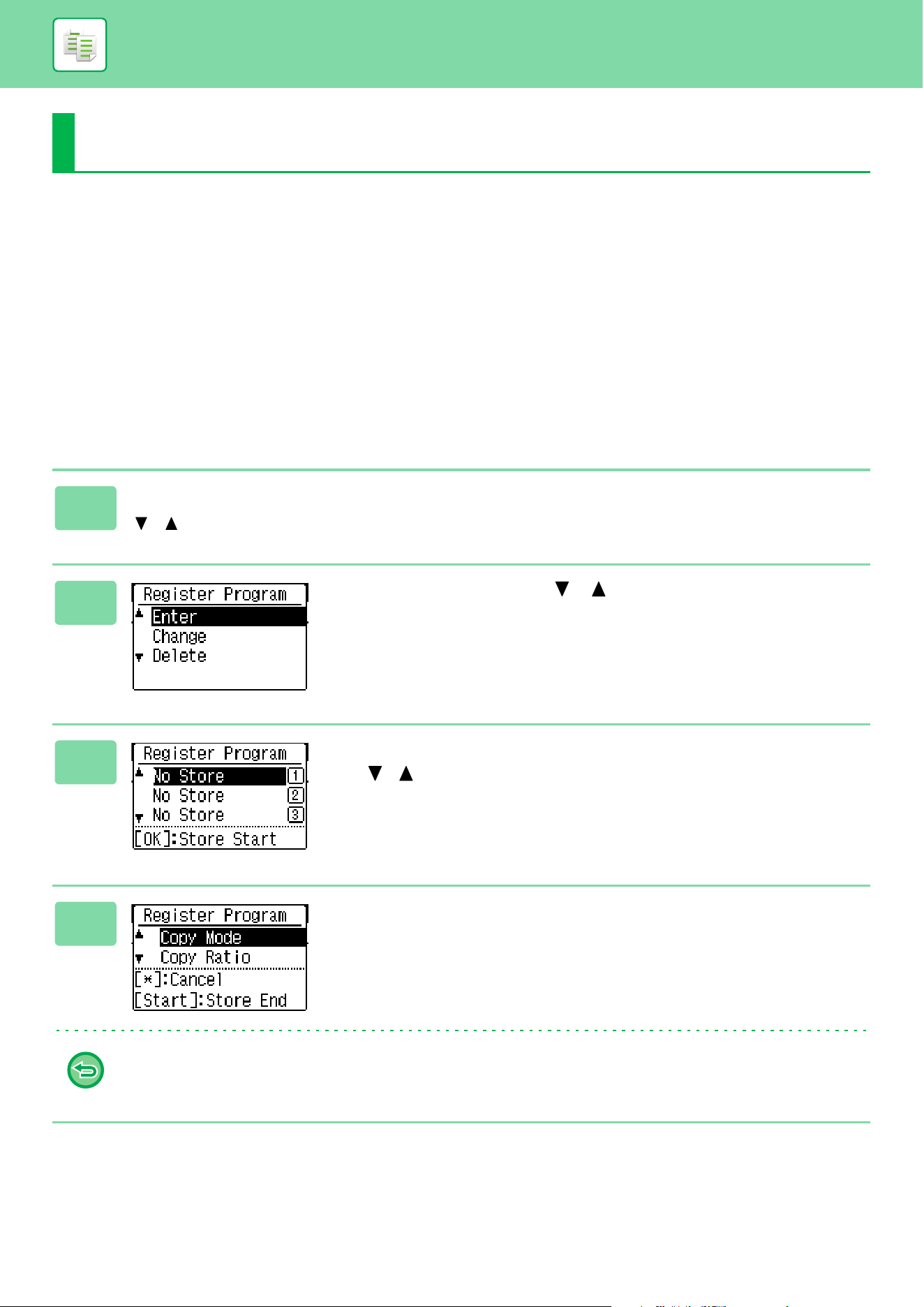
2-24
COPIER►PROGRAMS
FREQUENTLY USED SETTINGS
(PROGRAMS)
A group of copy settings can be stored together as a program. A stored program can be easily invoked.
STORING A PROGRAM
The following copy settings can be stored:
Duplex, Zoom, Exposure, Resolution, Orig. Size Enter, Paper Size, Sort, 2-Up/4-Up, Card Shot, Sharpness,
Background Adjustment
PROGRAMS
1
Press the [SPECIAL FUNCTION] key, select "Register Program" with the
[ ][ ] keys, and press the [OK] key.
2
Select "Enter" with the [ ] [ ] keys and press the [OK]
key.
3
Select the number of the program you want to store with
the [ ][ ] keys and press the [OK] key.
"No Store" appears in locations where a program has not been stored. "Program 1 - 3"
appears in locations where a program is already stored.
4
Refer to the copy setting procedures to configure
settings for the selected items.
A checkmark appears in front of each setting that you have selected. When you have
finished selecting settings, press the [START] key.
If you want to remove an item that has been set (item with a checkmark) from the program, press the [LOGOUT] key.
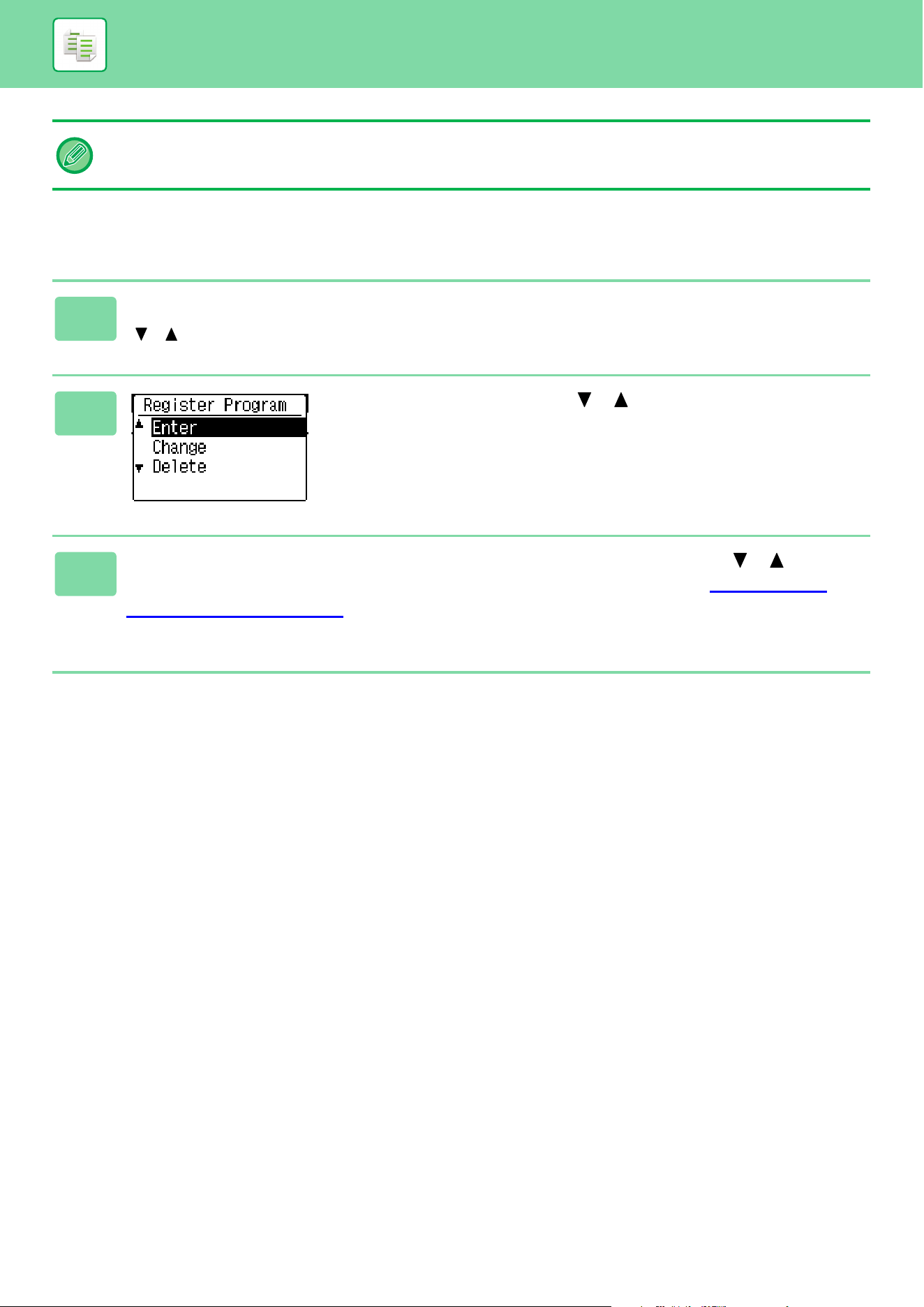
2-25
COPIER►PROGRAMS
CHANGING A PROGRAM
• Up to three programs can be stored.
• Some setting combinations are not possible.
(For example, 2-Up/4-Up and Card Shot)
1
Press the [SPECIAL FUNCTION] key, select "Register Program" with the
[ ][ ] keys, and press the [OK] key.
2
Select "Change" with the [ ] [ ] keys and press the
[OK] key.
3
Select the number of the program you want to modify with the [ ] [ ] keys,
and press [OK]. Modify the settings as explained in step 4 of STORING A
PROGRAM (page 2-24), and resave the program.
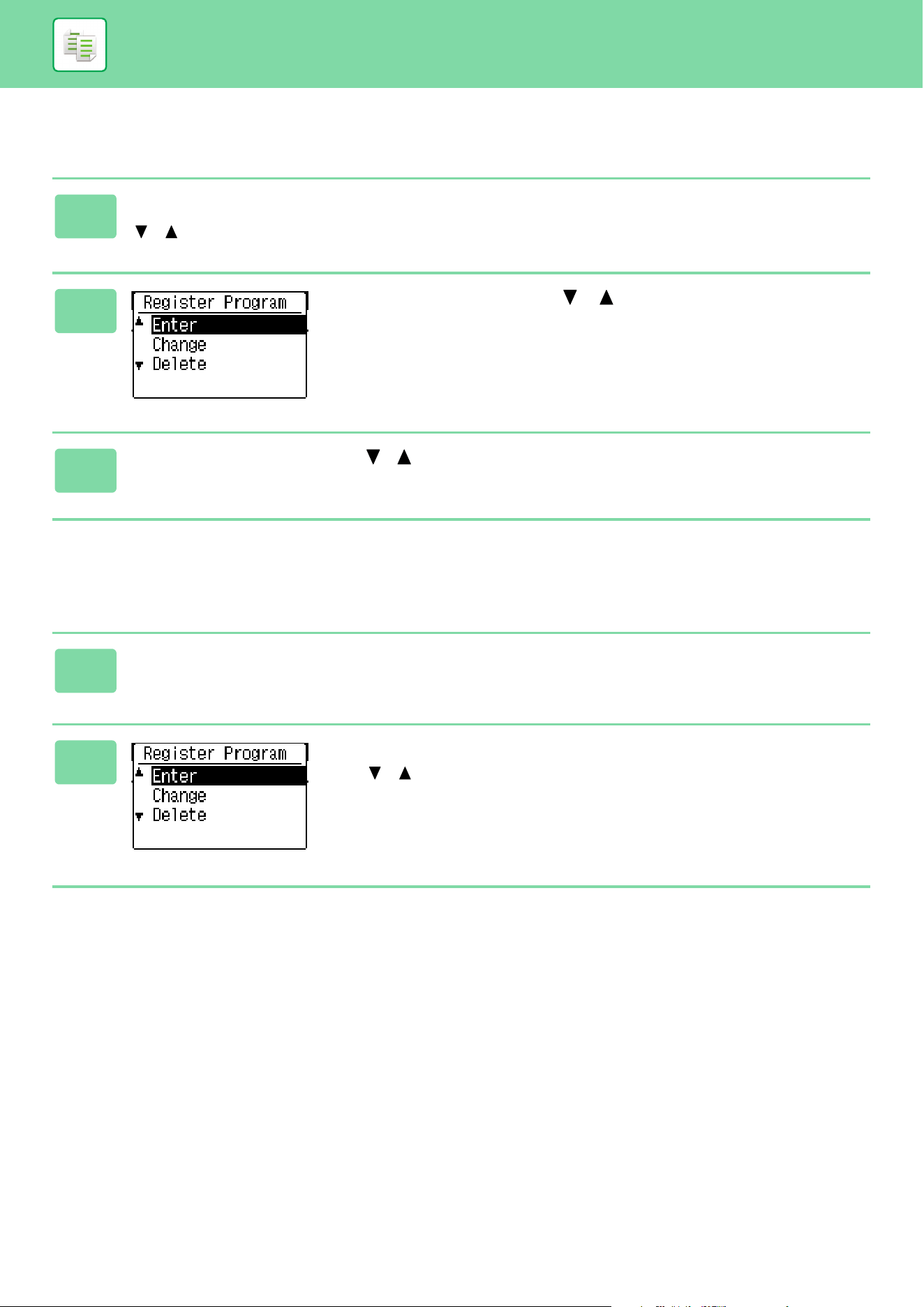
2-26
COPIER►PROGRAMS
DELETING A PROGRAM
USING A PROGRAM
1
Press the [SPECIAL FUNCTION] key, select "Register Program" with the
[ ][ ] keys, and press the [OK] key.
2
Select "Delete" with the [ ] [ ] keys and press the [OK]
key.
3
Select "Delete" with the [ ][ ] keys and press the [OK] key.
The selected program location changes to "No Store".
1
Select "Program" in the right menu of the base screen of copy mode and
press the [OK] key.
2
Select the number of the program you want to use with
the [ ][ ] keys and press the [OK] key.
The settings in the selected program are applied to the copy job.
3-1
The explanations in this chapter are based on American English and the North American version of the software.
Software for other countries and regions may vary slightly from the North American version.
PRINTER FUNCTION OF THE MACHINE
PRINTING IN A WINDOWS ENVIRONMENT
BASIC PRINTING PROCEDURE. . . . . . . . . . . . . . . 3-4
•
PRINTER DRIVER SETTINGS SCREEN /
REFERRING TO HELP . . . . . . . . . . . . . . . . . . . . .
3-6
• SELECTING THE PAPER. . . . . . . . . . . . . . . . . 3-7
• PRINTING ON ENVELOPES . . . . . . . . . . . . . . 3-8
PRINTING WHEN THE USER AUTHENTICATION
FUNCTION IS ENABLED. . . . . . . . . . . . . . . . . . . . . 3-9
FREQUENTLY USED FUNCTIONS. . . . . . . . . . . . . 3-10
• SAVING SETTINGS AT THE TIME OF
PRINTING . . . . . . . . . . . . . . . . . . . . . . . . . . . . . 3-10
• USING SAVED SETTINGS . . . . . . . . . . . . . . . . 3-11
• CHANGING THE PRINTER DRIVER DEFAULT
SETTINGS. . . . . . . . . . . . . . . . . . . . . . . . . . . . . 3-11
PRINTING IN A Mac OS ENVIRONMENT
BASIC PRINTING PROCEDURE. . . . . . . . . . . . . . . 3-13
• SELECTING THE PAPER. . . . . . . . . . . . . . . . . 3-14
• PRINTING ON ENVELOPES . . . . . . . . . . . . . . 3-15
PRINTING WHEN THE USER AUTHENTICATION
FUNCTION IS ENABLED. . . . . . . . . . . . . . . . . . . . . 3-16
FREQUENTLY USED FUNCTIONS
SELECTING THE RESOLUTION. . . . . . . . . . . . . . . 3-18
2-SIDED PRINTING . . . . . . . . . . . . . . . . . . . . . . . . . 3-19
FITTING THE PRINT IMAGE TO THE PAPER . . . . 3-20
PRINTING MULTIPLE PAGES ON ONE PAGE . . . 3-22
CONVENIENT PRINTING FUNCTIONS
CONVENIENT FUNCTIONS FOR CREATING
PAMPHLETS AND POSTERS . . . . . . . . . . . . . . . . 3-24
• CREATE A PAMPHLET (BOOKLET). . . . . . . . 3-24
• PRINTING WITH MARGIN SHIFT SETTING
(MARGIN). . . . . . . . . . . . . . . . . . . . . . . . . . . . . 3-26
• CREATE A LARGE POSTER (POSTER
PRINTING) . . . . . . . . . . . . . . . . . . . . . . . . . . . . 3-28
FUNCTIONS TO ADJUST THE SIZE AND
ORIENTATION OF THE IMAGE . . . . . . . . . . . . . . . 3-29
• ADJUST PRINT POSITION ON ODD AND
EVEN PAGES SEPARATELY (PRINT
POSITION) . . . . . . . . . . . . . . . . . . . . . . . . . . . . 3-29
• ROTATING THE PRINT IMAGE 180
DEGREES (ROTATE 180 DEGREES) . . . . . . 3-30
•
ENLARGING/REDUCING THE PRINT IMAGE
(ZOOM SETTING/ENLARGE OR REDUCE) . . .
3-31
• PRINT A MIRROR-IMAGE (MIRROR-IMAGE
REVERSE/ VISUAL EFFECTS). . . . . . . . . . . . 3-33
IMAGE ADJUSTING FUNCTION . . . . . . . . . . . . . . 3-34
• ADJUST THE BRIGHTNESS AND CONTRAST
OF THE IMAGE (IMAGE ADJUSTMENT) . . . . 3-34
• PRINTING FAINT TEXT AND LINES IN BLACK
(TEXT TO BLACK/VECTOR TO BLACK) . . . . 3-35
• SELECTING IMAGE SETTINGS TO MATCH
THE IMAGE TYPE . . . . . . . . . . . . . . . . . . . . . . 3-36
FUNCTIONS TO COMBINE TEXT AND IMAGES . . .
3-38
• ADDING A WATERMARK TO PRINTED
PAGES (WATERMARK) . . . . . . . . . . . . . . . . . 3-38
• PRINTING AN IMAGE OVER THE PRINT
DATA (IMAGE STAMP) . . . . . . . . . . . . . . . . . . 3-40
• OVERLAY A FIXED FORM ON THE PRINT
DATA (OVERLAYS) . . . . . . . . . . . . . . . . . . . . . 3-41
PRINTER

3-2
PRINTER
PRINT FUNCTIONS FOR SPECIAL PURPOSES. . .
3-43
• INSERTING COVERS (COVER PAGE) . . . . . . 3-43
• INSERT PRESET DATA BEFORE OR AFTER
EACH PAGE (PAGE INTERLEAVE). . . . . . . . . 3-45
• CHANGING THE RENDERING METHOD AND
PRINTING JPEG IMAGES (USE DRIVER TO
RENDER JPEGS) . . . . . . . . . . . . . . . . . . . . . . . 3-46
CONVENIENT PRINTER FUNCTIONS . . . . . . . . . . 3-47
• SAVING AND USING PRINT FILES
(RETENTION) . . . . . . . . . . . . . . . . . . . . . . . . . . 3-47
PRINTING WITHOUT THE PRINTER
DRIVER
EXTENSION OF PRINTABLE FILES. . . . . . . . . . . . 3-50
DIRECTLY PRINTING A FILE IN USB MEMORY. . .
3-51
DIRECTLY PRINTING FROM A COMPUTER . . . . . 3-53
• FTP PRINT . . . . . . . . . . . . . . . . . . . . . . . . . . . . 3-53
APPENDIX
PRINTER DRIVER SPECIFICATIONS LIST . . . . . . 3-54
3-3
PRINTER►PRINTER FUNCTION OF THE MACHINE
To enable printing from your computer, a printer driver must be installed.
See the table below to determine which printer driver to use in your environment.
Windows environment
Mac OS Environment
PRINTER FUNCTION OF THE MACHINE
Printer driver type
PCL6
The machine support the Hewlett-Packard PCL6 printer control languages.
PS
• This printer driver supports the PostScript
®
3™ page description language developed by Adobe Systems Incorporated, and
enables the machine to be used as a PostScript
®
3™ compatible printer.
• If it is desired to use the Windows standard PS printer driver, the PPD driver must be used.
• To install the printer driver and configure settings in a Windows environment, see the Software Setup Guide.
• The User's Manual mainly uses PCL6 printer driver screens to explain how to print in a Windows environment. The printer
driver screens may differ slightly depending on the printer driver you are using.
Printer driver type
PS
This printer driver supports the PostScript
®
3™ page description language developed by Adobe Systems Incorporated, and
enables the machine to be used as a PostScript
®
3™ compatible printer.
To install the printer driver and configure settings in a Mac OS environment, see the Software Setup Guide.
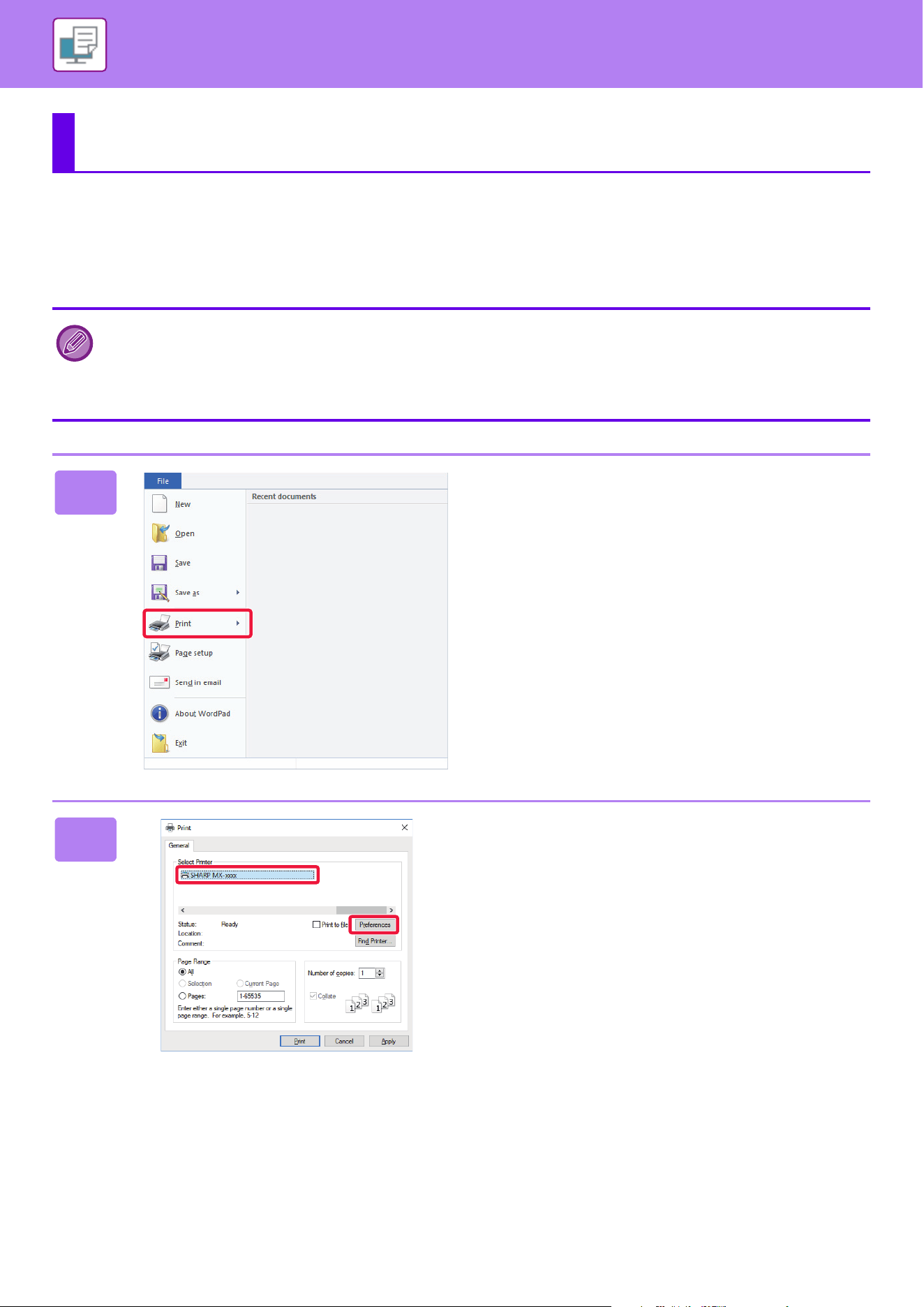
3-4
PRINTER►PRINTING IN A WINDOWS ENVIRONMENT
BASIC PRINTING PROCEDURE
The following example explains how to print a document from "WordPad", which is a standard accessory application in
Windows.
PRINTING IN A WINDOWS ENVIRONMENT
• The menu used to execute printing may vary depending on the application.
• The button that is used to open the printer driver properties window (usually [Property] or [Preferences]) may vary
depending on the application.
• The machine name that normally appears in the [Printer] menu is [MX-xxxx]. ("xxxx" is a sequence of characters that
varies depending on the machine model.)
1
Select [Print] from the [File] menu of
WordPad.
2
Select the printer driver for the
machine and click the [Preferences]
button.
The button that is used to open the printer driver properties
window (usually [Property] or [Preferences]) may vary
depending on the application.
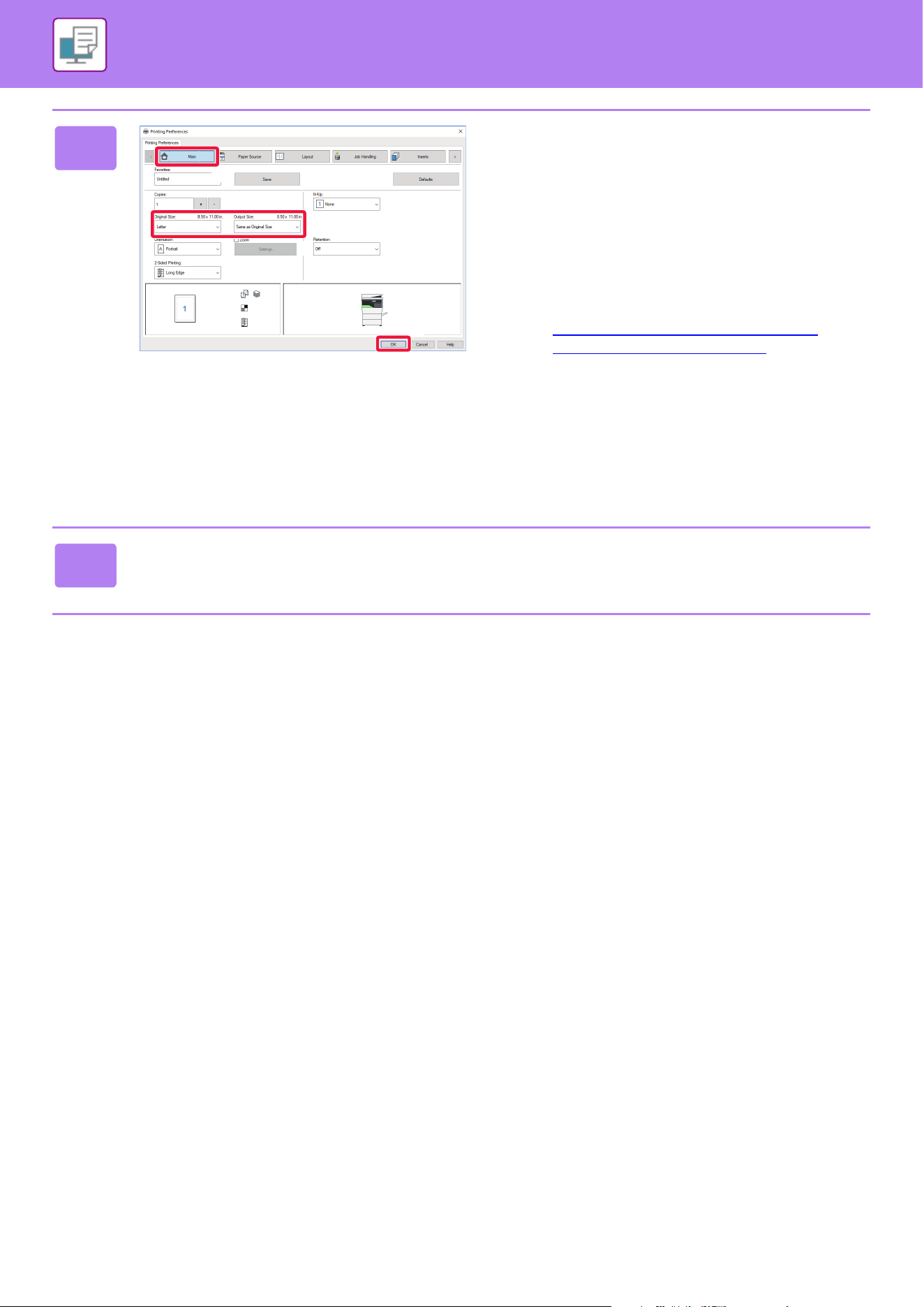
3-5
PRINTER►PRINTING IN A WINDOWS ENVIRONMENT
3
Select print settings.
(1) Click the [Main] tab.
(2) Select the original size.
• You can register up to seven user-defined sizes in
the menu. To store an original size, select [Custom
Paper] or one of [User1] to [User7] from the menu,
and click the [OK] button.
• To select settings on other tabs, click the desired tab
and then select the settings.
► PRINTER DRIVER SETTINGS SCREEN /
REFERRING TO HELP (page 3-6)
• If an original size larger than the largest paper size
that the machine supports is set, select the paper
size for printing in “Output Size”.
• If an "Output Size" different from the "Original Size"
is selected, the print image will be adjusted to match
the selected paper size.
(3) Click the [OK] button.
4
Click the [Print] button.
Printing begins.
(2)
(3)
(1)
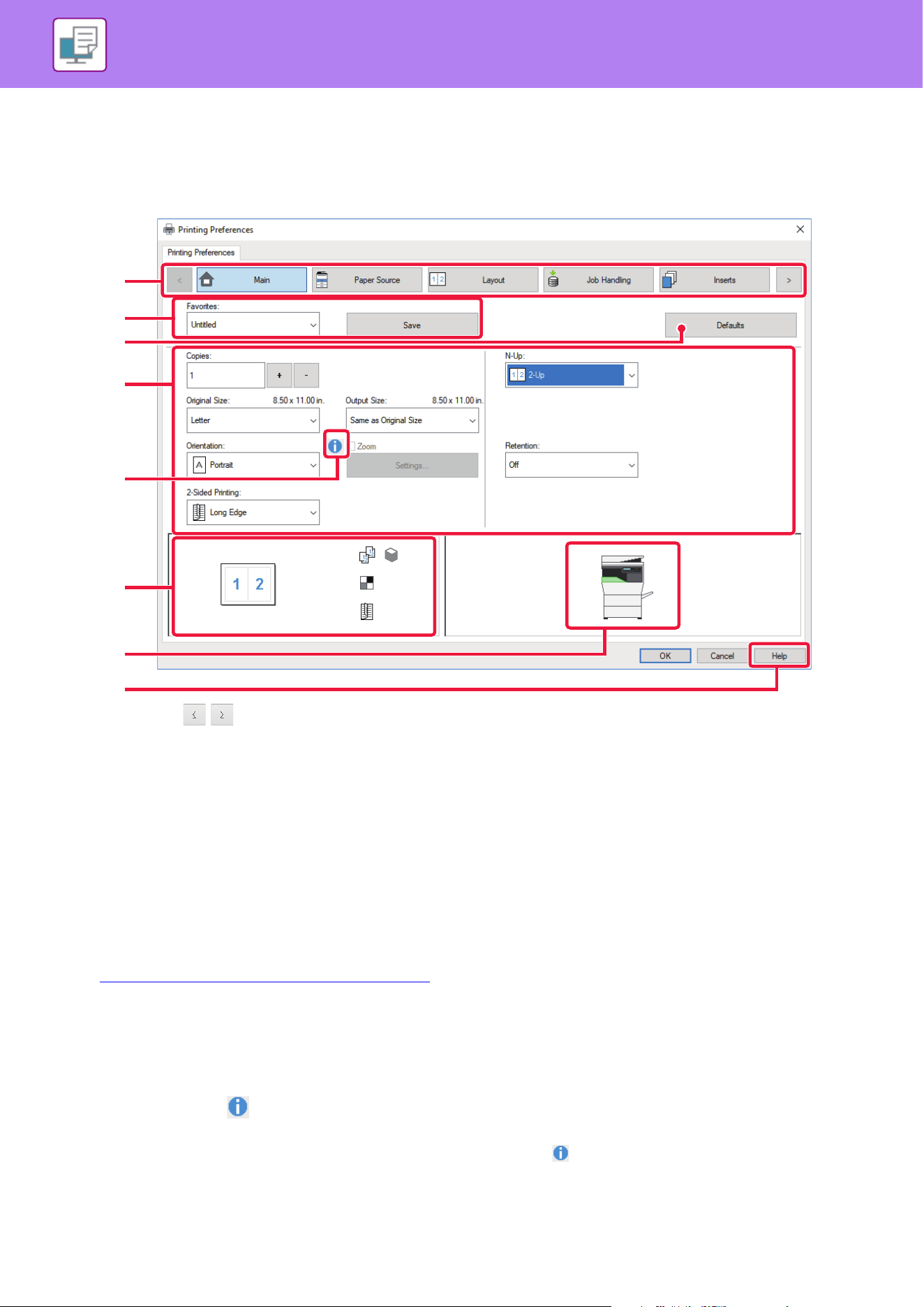
3-6
PRINTER►PRINTING IN A WINDOWS ENVIRONMENT
PRINTER DRIVER SETTINGS SCREEN / REFERRING TO HELP
The printer driver settings screen consists of 8 tabs. Click a tab to select the settings on that tab.
You can check information on each of the settings in the Help screen. Click the [Help] button at the bottom right of the
screen.
(1) Tabs: Click to change the tabs shown.
• [Main]: Frequently used functions are grouped on this tab. The settings are also on other tabs,
and each setting on this tab is linked to the corresponding setting on the other tab.
• [Paper Source]: Set the size and type of paper used for printing, and the paper tray.
• [Layout]: Select functions related to the layout such as two-sided printing and booklet.
• [Job Handling]: Set retention and user authentication.
• [Inserts]: Select cover insertion functions.
• [Stamp]: Select the watermark or stamp function.
• [Image Quality]: Select various image quality settings.
• [Detailed Settings]: Select tandem print and other detailed print settings.
(2) Favorites
Settings configured on each tab at the time of printing can be saved as Favorite.
►FREQUENTLY USED FUNCTIONS (page 3-10)
(3) [Defaults]
Return the settings on the currently selected tab to their default state.
(4) Setup Items
Displays the settings on each tab.
(5) Information icon( )
Some restrictions exist on the combinations of settings that can be selected in the printer driver properties window.
When a restriction exists on a selected setting, an information icon ( ) will appear next to the setting. Click the
icon to view an explanation of the restriction.
(2)
(1)
(3)
(4)
(5)
(6)
(7)
(8)
3-7
PRINTER►PRINTING IN A WINDOWS ENVIRONMENT
(6) Print image
This lets you visually check how the current settings affect the print image. Finishing settings is indicated by icons.
(7) Machine image
This shows the options that are installed on the machine, and the paper trays and output trays that are used.
(8) [Help] button
Displays the Help window of the printer driver.
SELECTING THE PAPER
Before printing, check the paper sizes, paper types, and paper remaining in the machine's trays. To check the most
recent tray information, click the [Tray Status] button in the [Paper Source] tab.
The "Output Size" setting and the "Paper Tray" setting are related as follows:
• When "Paper Tray" is set to [Auto Select]
The tray that contains paper of the size and type selected in "Output Size" and "Paper Type" is automatically selected.
• When "Paper Tray" is set to any setting other than [Auto Select]
The specified tray is used for printing regardless of the "Output Size" setting.
When you have set "Paper Type" to [Bypass Tray], be sure to select "Paper Type". Check the paper type that is set for
the bypass tray of the machine, check that paper of that type is actually loaded into the bypass tray, and then select
the appropriate paper type.
• When "Paper Type" is set to [Auto Select]
A tray with plain paper or recycled paper of the size specified in "Output Size" is automatically selected. (The factory
default setting is plain paper only.)
• When "Paper Type" is set to anything other than [Auto Select]
A tray with the specified type of paper and the size specified in "Output Size" is used for printing.
• Help can be displayed for a setting by clicking the setting and pressing the [F1] key.
• You can click the button in the upper right corner of the settings screen and then click a setting to show Help for that
setting in a sub-window.
Special media such as envelopes can also be placed in the bypass tray.
For the procedure for loading paper in the bypass tray, see "LOADING PAPER INTO THE BYPASS TRAY (page 1-24)
".
When [Administrator Settings (administrator)] → [Default Settings] → [Bypass Settings] → [Enable Detected Paper Size in
Bypass Tray] (disabled by factory default) or [Enable Selected Paper Type in Bypass Tray] (disabled by factory default) is
enabled in "Web page", printing will not take place if the paper size or paper type specified in the printer driver is different
from the paper size or paper type specified in the settings of the bypass tray.
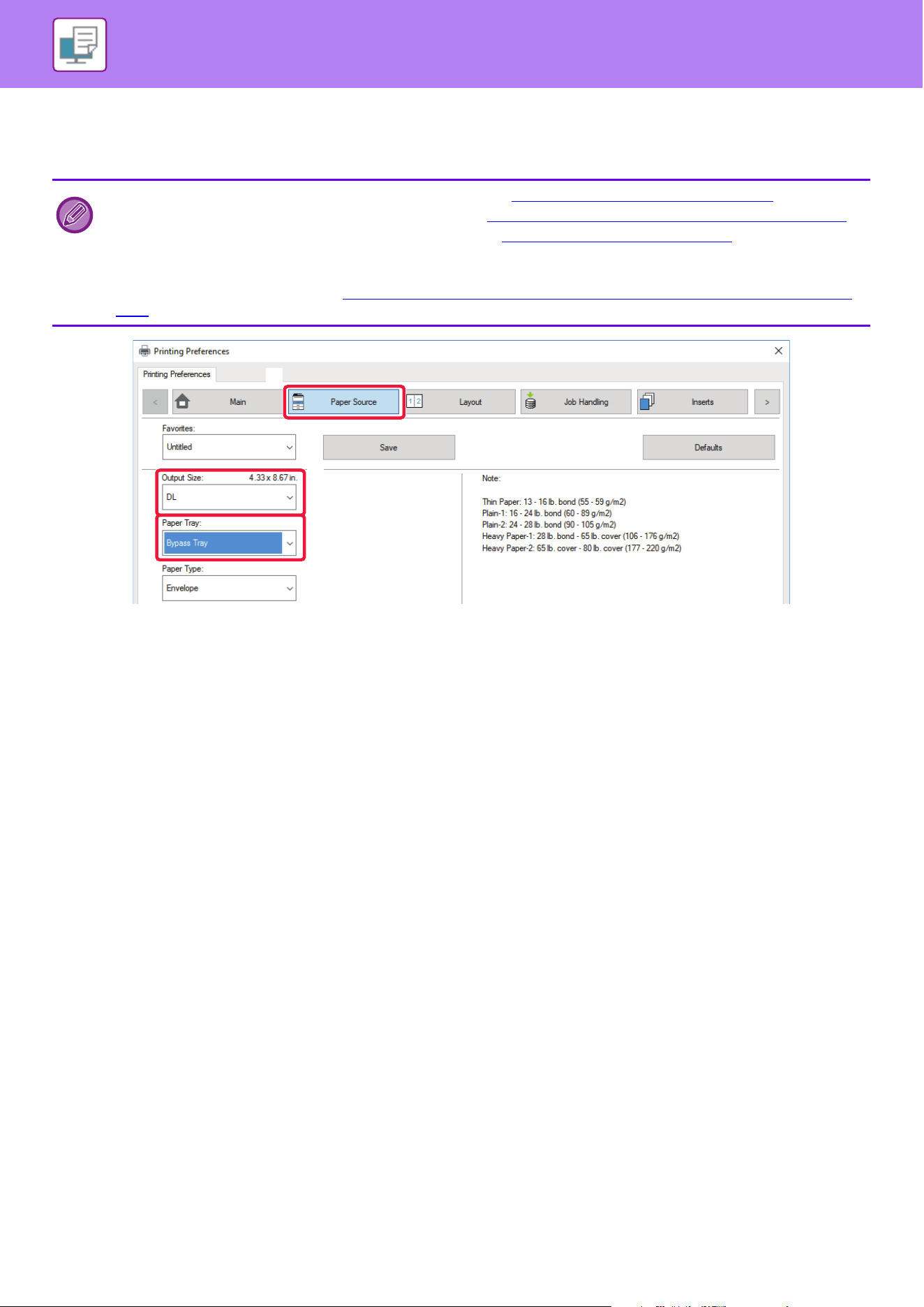
3-8
PRINTER►PRINTING IN A WINDOWS ENVIRONMENT
PRINTING ON ENVELOPES
The bypass tray can be used for envelope printing.
(1) Click the [Paper Source] tab.
(2) Select the envelope size from the "Output Size" menu.
When [Output Size] is set to envelope, [Paper Type] is automatically set to [Envelope].
When "Original Size" is set to envelope on the [Main] tab and "Output Size" is set to [Same as Original Size], "Paper Type" is
automatically set to [Envelope].
(3) Select [Bypass Tray] in "Paper Tray".
When [Administrator Settings (administrator)] → [Default Settings] → [Bypass Settings] → [Enable Selected Paper Type in
Bypass Tray ] (enabled by factory default) is enabled in "Web page", set the paper type of the bypass tray to [Envelope].
• For the types of paper that can be used in the bypass tray, see "APPLICABLE PAPER TYPES (page 1-17)".
• For the procedure for loading paper in the bypass tray, see "LOADING PAPER INTO THE BYPASS TRAY (page 1-24)
".
• For more information on the procedure for loading paper, see "SELECTING THE PAPER (page 3-7)
".
• It is recommended that you carry out a test print to check the print result before using an envelope.
• When using media such as envelopes that can be loaded only in a specific orientation, you can rotate the image 180
degrees. For more information, see "ROTATING THE PRINT IMAGE 180 DEGREES (ROTATE 180 DEGREES) (page
3-30)".
(1)
(2)
(3)
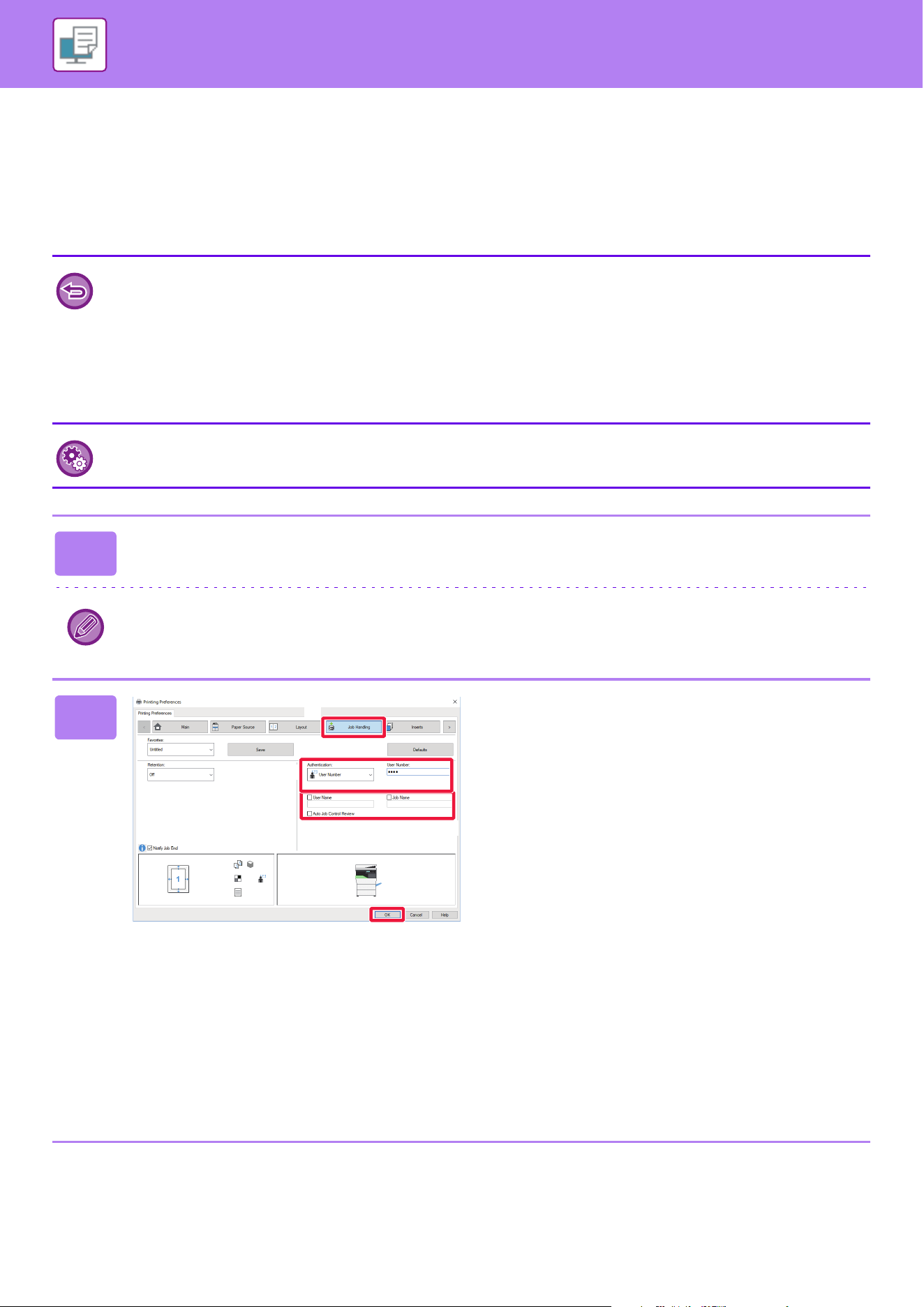
3-9
PRINTER►PRINTING IN A WINDOWS ENVIRONMENT
PRINTING WHEN THE USER
AUTHENTICATION FUNCTION IS ENABLED
The user information (such as User Number) that must be entered varies depending on the authentication method being
used, so check with the administrator of the machine before printing.
• If you have configured "Printing Policy" on the [Configuration] tab so that user authentication is always performed, users
are required to be authenticated for each print job. This is done by entering authentication information in a dialog box that
appears each time printing is performed.
• The machine's user authentication function cannot be used when the PPD driver
*
is installed and the Windows standard
PS printer driver is used.
For this reason, the machine can be configured to prohibit users from executing printing unless their user information is
stored in the machine.
* The PPD driver enables the machine to print using the Windows standard PS printer driver.
To prohibit printing by users whose user information is not stored in the machine:
In "System Settings (administrator)", select [User Control] → [Disable Print by Inv. User].
1
In the printer driver properties window of the application, select the printer
driver of the machine and click the [Preferences] button.
The button that is used to open the printer driver properties window (usually [Property] or [Preferences]) may vary
depending on the application.
2
Enter your user information.
(1) Click the [Job Handling] tab.
(2) Enter your user information.
When authentication is performed by user number,
select [User Number] and enter your 5 to 8 digit user
number.
(3) Enter the user name and job name as
necessary.
• Click the [User Name] checkbox, and enter your user
name using up to 32 characters. The entered user
name will appear on the display of the machine. If
you do not enter a user name, your PC login name
will appear.
• Click the [Job Name] checkbox, and enter a job
name using up to 30 characters. The entered job
name will appear as a file name on the display of the
machine. If you do not enter a job name, the file
name set in the application will appear.
•
To have a confirmation window appear before printing
starts, select the [Auto Job Control Review] checkbox.
(4) Click the [OK] button to execute printing.
(2)
(1)
(3)
(4)
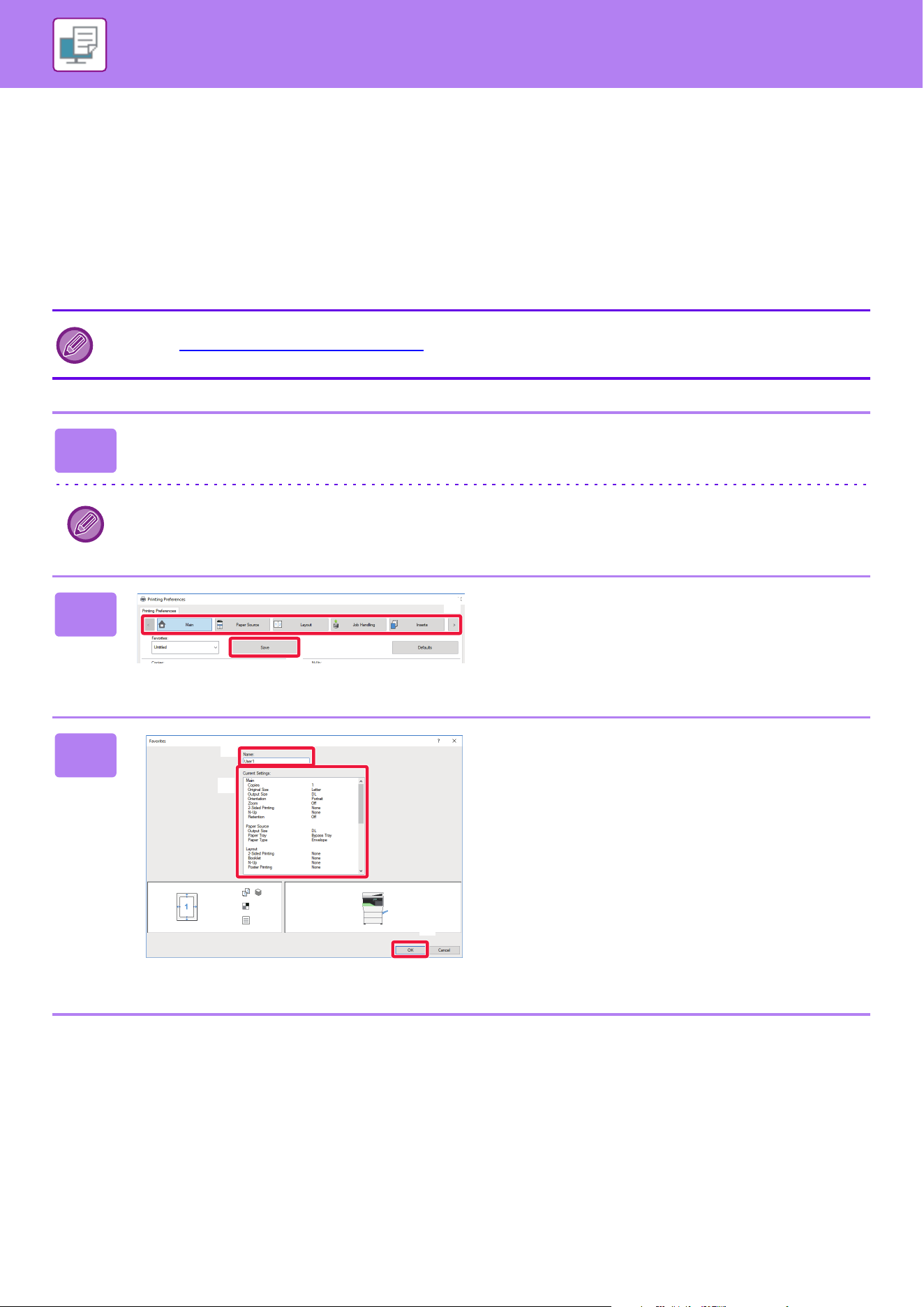
3-10
PRINTER►PRINTING IN A WINDOWS ENVIRONMENT
FREQUENTLY USED FUNCTIONS
SAVING SETTINGS AT THE TIME OF PRINTING
Settings configured on each of the tabs at the time of printing can be saved as Favorite. Saving frequently used settings
or complex settings under an assigned name makes it easy to select those settings the next time you need to use them.
Settings can be saved from any tab of the printer driver properties window. Settings configured on each tab are listed at
the time of saving, allowing you to check the settings as you save them.
Deleting saved settings
In step 2 of "USING SAVED SETTINGS (page 3-11)
", select the user settings that you want to delete and click the [Delete]
button.
1
Select the machine's printer driver from the print window of the application,
and click the [Preferences] button.
The button that is used to open the printer driver properties window (usually [Property] or [Preferences]) may vary
depending on the application.
2
Register Print Settings.
(1) Configure the print settings on each tab.
(2) Click the [Save] button.
3
Check and save the settings.
(1) Check the displayed settings.
(2) Enter a name for the settings using up to
20 characters.
(3) Click the [OK] button.
(2)
(1)
(2)
(1)
(3)
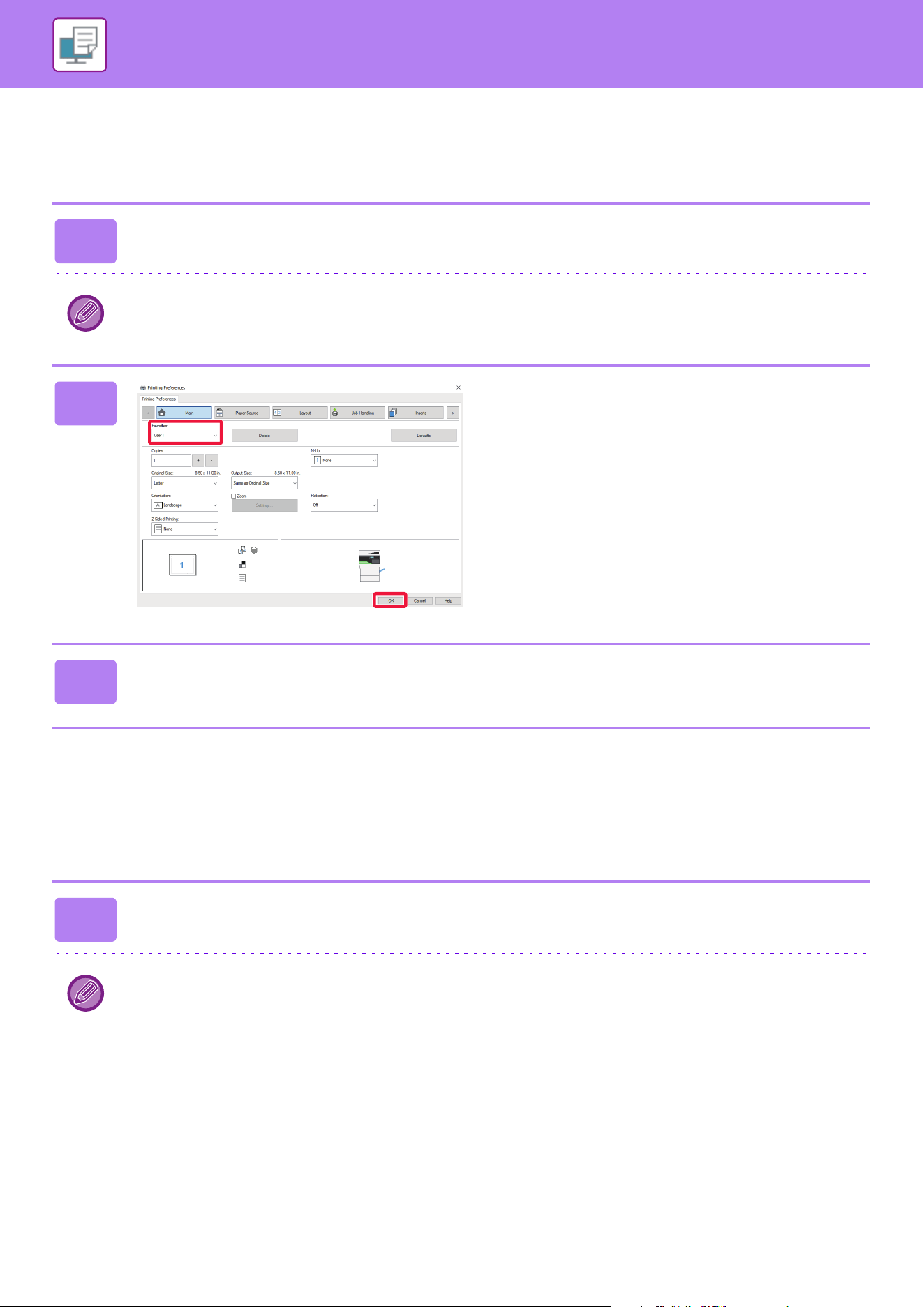
3-11
PRINTER►PRINTING IN A WINDOWS ENVIRONMENT
USING SAVED SETTINGS
You can specify the saved favorites through just one click to apply frequently used settings or complicated settings to
your printing.
CHANGING THE PRINTER DRIVER DEFAULT SETTINGS
You can change the default settings of the printer driver.
Changes you have made in the printer driver properties window when you execute printing from the application are
returned to the default settings specified here when you exit the application.
1
Select the machine's printer driver from the print window of the application,
and click the [Preferences] button.
The button that is used to open the printer driver properties window (usually [Property] or [Preferences]) may vary
depending on the application.
2
Select favorite settings.
(1) Select the favorite settings you want to
use.
(2) Click the [OK] button.
3
Start printing.
1
Click the [Start] button, select [Settings] → [Device] → [Devices and
Printers].
In Windows 8.1/Windows Server 2012, right-click the [Start] button, select [Control Panel] → [View devices and printers]
(or [Devices and Printers]).
In Windows 7/Windows Server 2008, click the [Start] button, select [Devices and Printers].
(1)
(2)
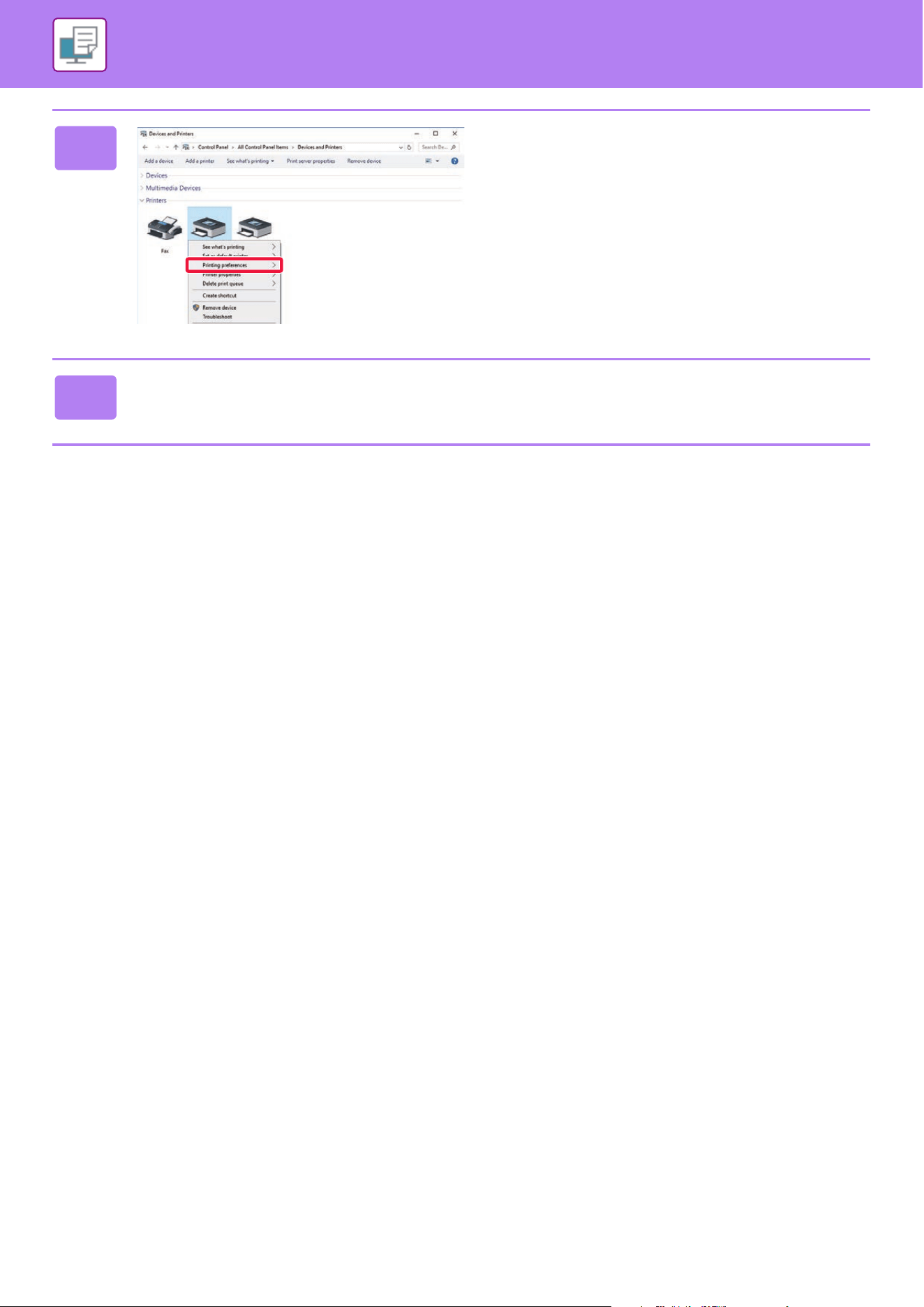
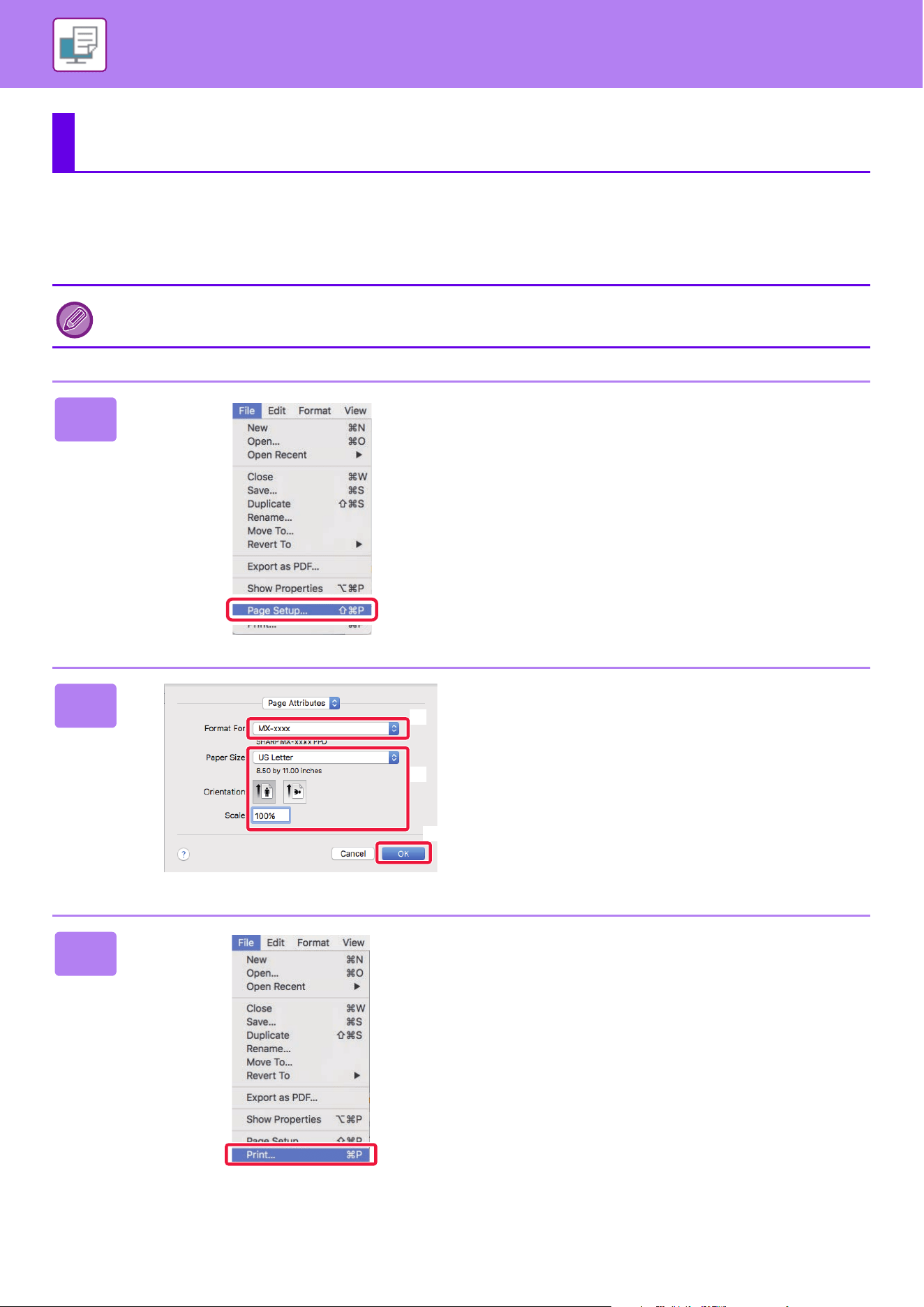
3-13
PRINTER►PRINTING IN A Mac OS ENVIRONMENT
BASIC PRINTING PROCEDURE
The following example explains how to print a document from the standard accessory application "TextEdit" in Mac OS X.
PRINTING IN A Mac OS ENVIRONMENT
• To install the printer driver and configure settings in a Mac OS environment, see the Software Setup Guide.
• The menu used to execute printing may vary depending on the application.
1
Select [Page Setup] from the [File]
menu and select the printer.
If the printer drivers appear as a list, select the name of the
printer driver to be used from the list.
2
Select paper settings.
(1) Make sure that the correct printer is
selected.
(2) Select paper settings.
Paper size, paper orientation, and enlarge/reduce
settings can be selected.
(3) Click the [OK] button.
3
Select [Print] from the [File] menu.
MX-xxxx
MX-xx
MX-xx
M
M
M
MX
MX-xx
MX-xx
MX
MX
X
X
X
X-x
X
X-xx
X
MX-xx
-
MX-xx
X-xx
xx
M
M
MX-xx
MX-xx
MX
M
M
X
X
X
X
X
X
X
X
-
x
xx
xx
M
MX xx
M
M
M
M
M
MX
X
MX
X
X
Xxx
xx
xx
M
M
M
M
M
M
M
M
MX
X
X
MX
X
X
xx
xx
x
x
x
Xxx
x
M
M
M
M
M
M
M
M
X
X
x
x
xx
xx
x
x
x
x
x
MX
M
M
M
M
M
M
M
X
X
X
X
x
x
xx
xx
x
x
x
M
MX
M
M
M
M
M
M
M
MX
X
X
X
X
X
X
x
-x
xx
x
x
M
M
M
M
M
M
M
M
X
MX
X
X
X
X
X
X
-
xx
xx
x
x
x
x
x
M
MX
M
M
M
X
X
X
X
X
MX-xx
xx
xx
x
x
x
x
x
M
M
M
M
M
M
M
X
X
X
X
X
X
X
-
-
xx
xx
xx
x
x
x
x
x
M
M
M
M
X
X
X
X
X
X
xx
xx
x
x
xx
xx
xx
xx
x
xx
xx
xx
xx
xx
xx
xx
xx
xx
xx
x
xx
xx
xx
xx
xx
xx
x
xx
xx
xx
xx
xx
x
xx
xx
xx
xx
xx
xx
xx
xx
xx
x
xx
xx
xx
xx
xx
xx
xx
x
xx
xx
xx
xx
xx
xx
xx
x
x
xx
xx
xx
x
x
x
(1)
(2)
(3)
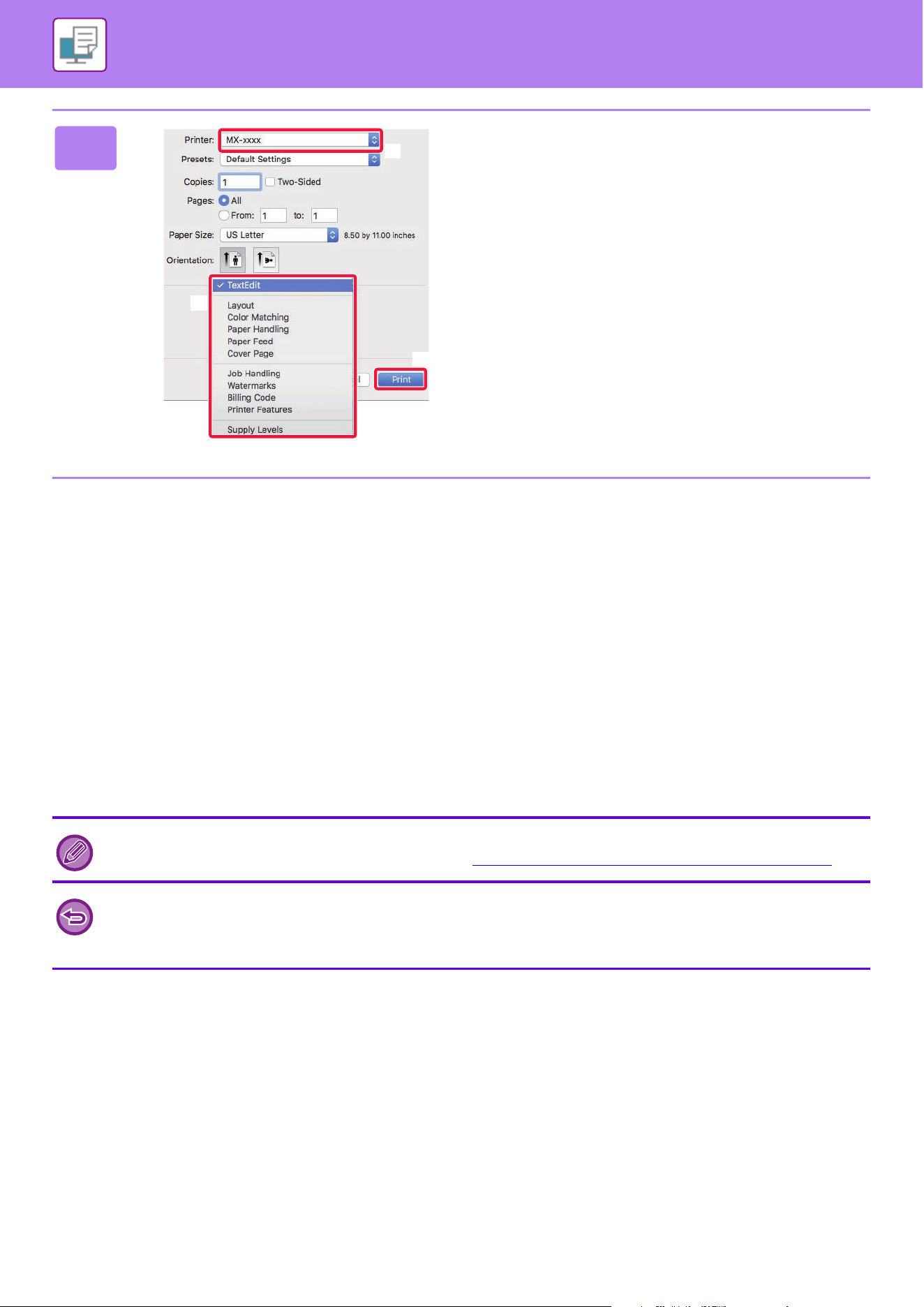
3-14
PRINTER►PRINTING IN A Mac OS ENVIRONMENT
SELECTING THE PAPER
This section explains the [Paper Feed] settings in the print settings window.
• When [Auto Select] is selected:
A tray that is set for plain or recycled paper (only plain paper in the factory default setting) of the size specified in
"Paper Size" on the page setup screen is automatically selected.
• When a paper tray is specified:
The specified tray is used for printing regardless of the "Paper Size" setting on the page setup screen.
For the bypass tray, also specify the paper type. Check that the paper type that is set for the bypass tray of the
machine, check that paper of that type is actually loaded into the bypass tray, and then select the appropriate bypass
tray (paper type).
• When a paper type is specified:
A tray with the specified type of paper and the size specified in "Paper Size" on the page setup screen is used for
printing.
4
Select print settings.
(1) Make sure that the correct printer is
selected.
(2) Select an item from the menu and
configure the settings as needed.
(3) Click the [Print] button.
Special media such as envelopes can also be placed in the bypass tray.
For the procedure for loading paper in the bypass tray, see "LOADING PAPER INTO THE BYPASS TRAY (page 1-24)
".
When [Administrator Settings (administrator)] → [Default Settings] → [Bypass Settings] → [Enable Detected Paper Size in
Bypass Tray] (disabled by factory default) or [Enable Selected Paper Type in Bypass Tray] (disabled by factory default) is
enabled in "Web page", printing will not take place if the paper size or paper type specified in the printer driver is different
from the paper size or paper type specified in the settings of the bypass tray.
(1)
(2)
(3)
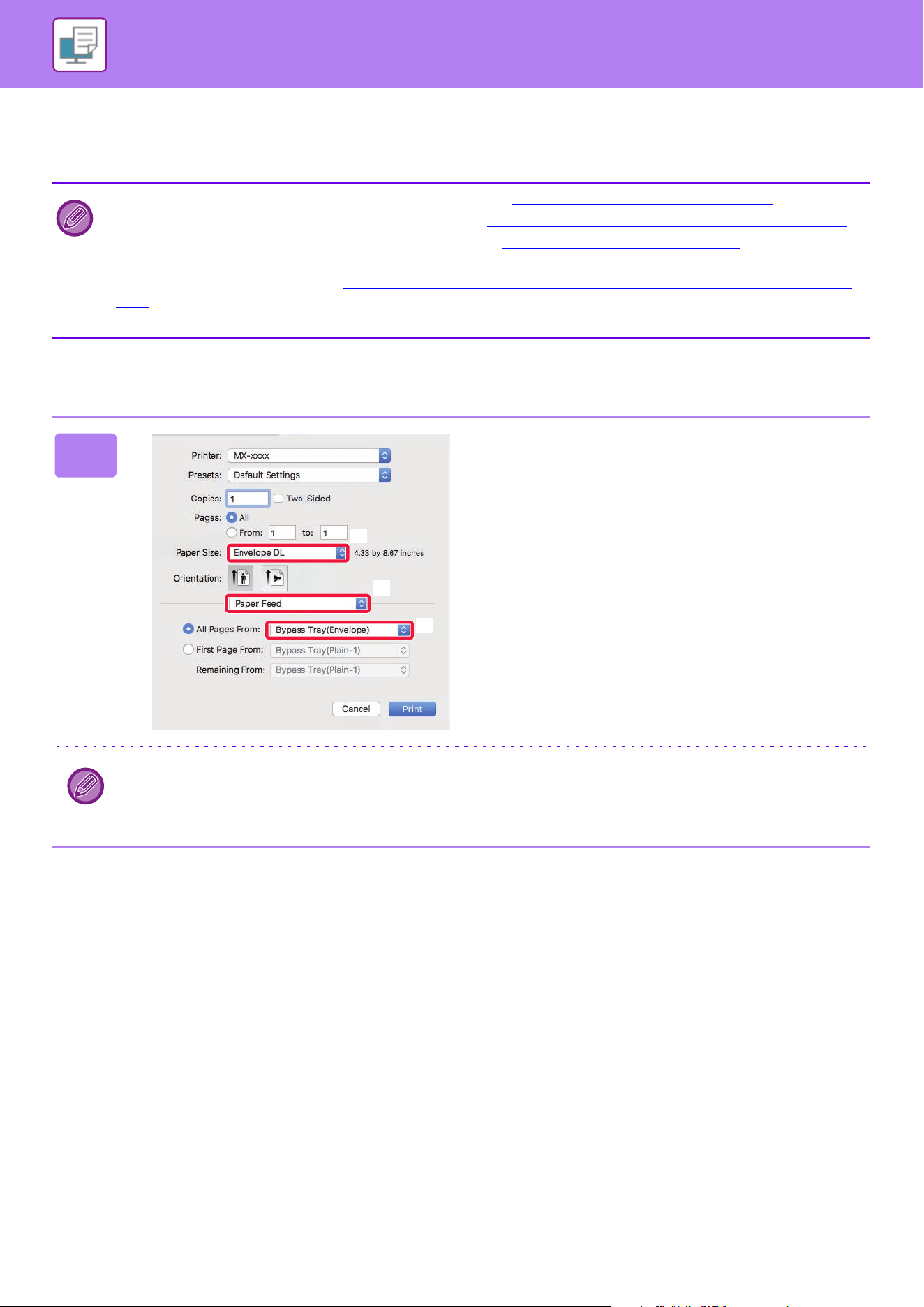
3-15
PRINTER►PRINTING IN A Mac OS ENVIRONMENT
PRINTING ON ENVELOPES
The bypass tray can be used for envelope printing.
Select the envelope size in the settings of the application ("Page Setup" in many applications) and then perform the
following steps.
• For the types of paper that can be used in the bypass tray, see "APPLICABLE PAPER TYPES (page 1-17)".
• For the procedure for loading paper in the bypass tray, see "LOADING PAPER INTO THE BYPASS TRAY (page 1-24)
".
• For more information on the procedure for loading paper, see "SELECTING THE PAPER (page 3-14)
".
• When using media such as envelopes that can be loaded only in a specific orientation, you can rotate the image 180
degrees. For more information, see "ROTATING THE PRINT IMAGE 180 DEGREES (ROTATE 180 DEGREES) (page
3-30)".
• It is recommended that you carry out a test print to check the print result before using an envelope.
1
Select print settings.
(1) Select the envelope size from the "Paper
Size" menu.
(2) Select [Paper Feed].
(3) Select the [Bypass Tray (Envelope)] from
the "All Pages From" menu.
When [Administrator Settings (administrator)] → [Default Settings] → [Bypass Settings] → [Enable Selected Paper Type
in Bypass Tray] (enabled by factory default) is enabled in "Web page", set the paper type of the bypass tray to
[Envelope].
(2)
(1)
(3)
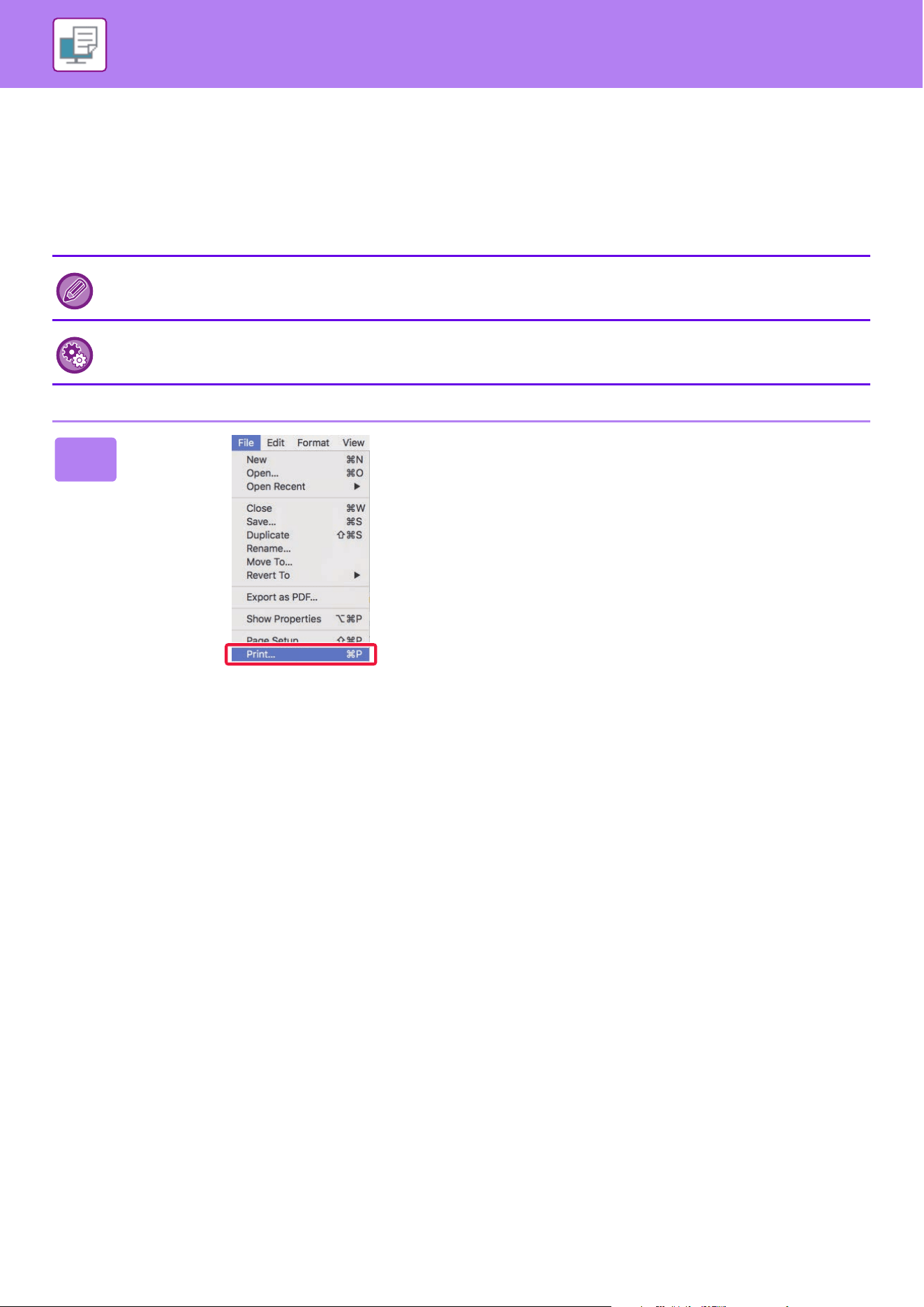
3-16
PRINTER►PRINTING IN A Mac OS ENVIRONMENT
PRINTING WHEN THE USER
AUTHENTICATION FUNCTION IS ENABLED
The user information (such as login name and password) that must be entered varies depending on the authentication
method being used, so check with the administrator of the machine before printing.
The menu used to execute printing may vary depending on the application.
To prohibit printing by users whose user information is not stored in the machine:
In "System Settings (administrator)", select [User Control] → [Disable Print by Inv. User].
1
In the application, select [Print] from
the [File] menu.
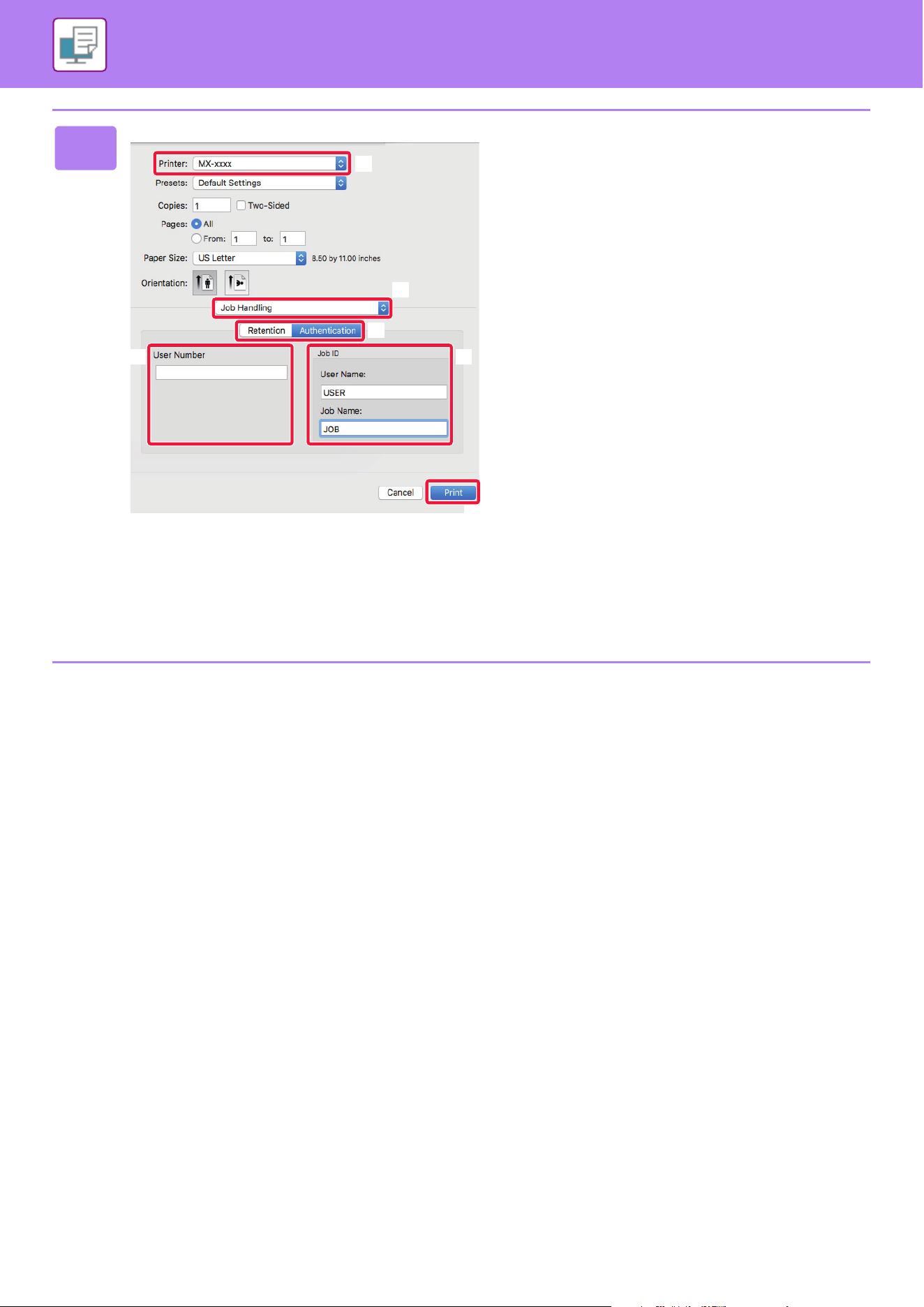
3-17
PRINTER►PRINTING IN A Mac OS ENVIRONMENT
2
Enter your user information.
(1) Make sure that the machine's printer
name is selected.
(2) Select [Job Handling].
(3) Click the [Authentication] tab.
(4) Enter your user information.
When authentication is carried out using the user
number, enter your user number (5 to 8 digits) in "User
Number".
(5) Enter the user name and job name as
necessary.
•User Name
Enter your user name using up to 32 characters. The
entered user name will appear on the display of the
machine. If you do not enter a user name, your PC
login name will appear.
•Job Name
Enter a job name using up to 80 characters. The
entered job name will appear as a file name on the
display of the machine. If you do not enter a job
name, the file name set in the application will
appear.
(6) Click the [Print] button.
(3)
(4)
(1)
(2)
(5)
(6)
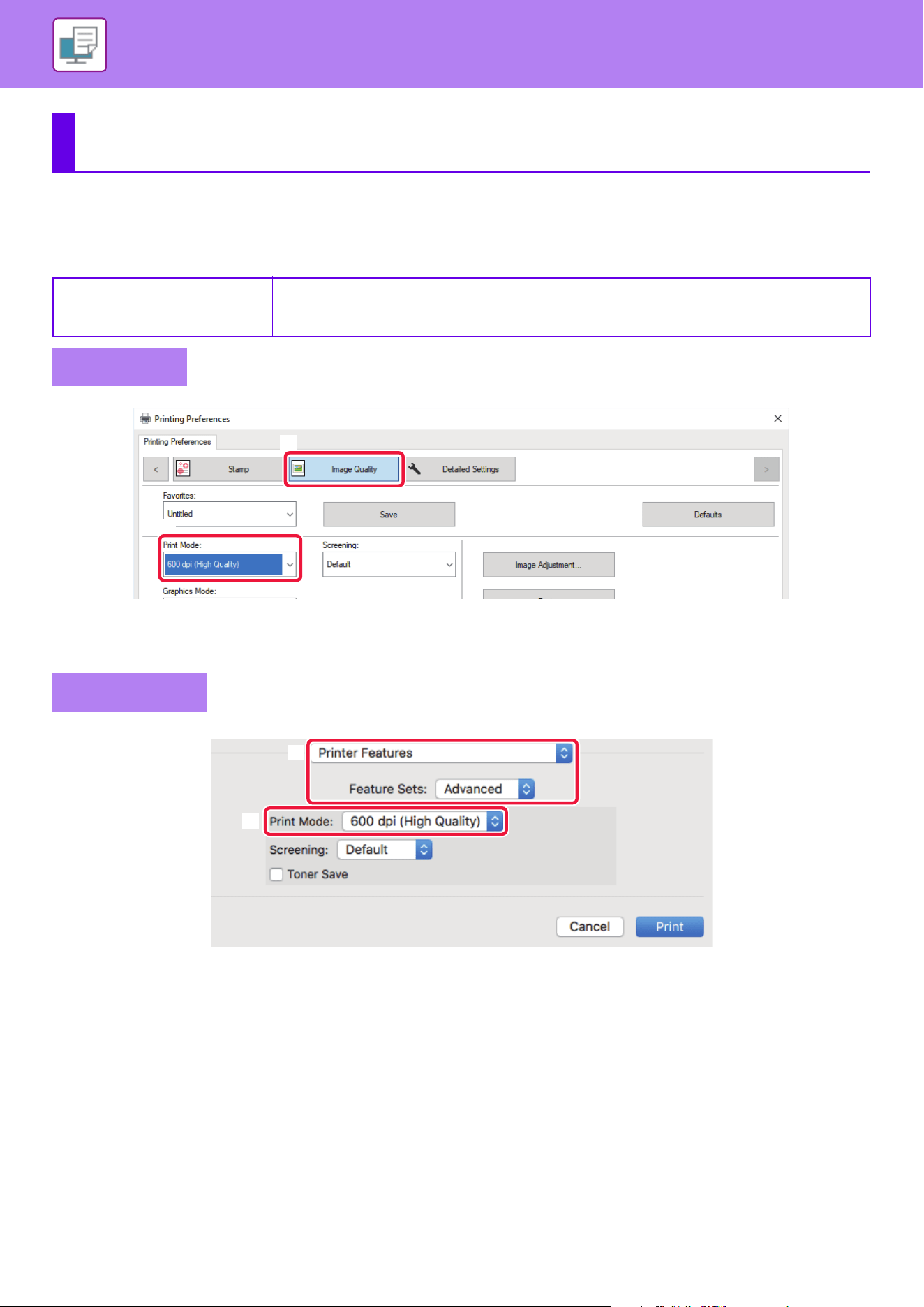
3-18
PRINTER►FREQUENTLY USED FUNCTIONS
SELECTING THE RESOLUTION
The following two selections are available for "Print Mode" (resolution):
(1) Click the [Image Quality] tab.
(2) Select "Print Mode".
(1) Select [Printer Features] and then select [Advanced].
(2) Select "Print Mode".
FREQUENTLY USED FUNCTIONS
600 dpi This mode is suitable for printing data such as regular text or a table.
600 dpi (High Quality) The print quality of photos and text are high.
Windows
Mac OS
(2)
(1)
(1)
(2)
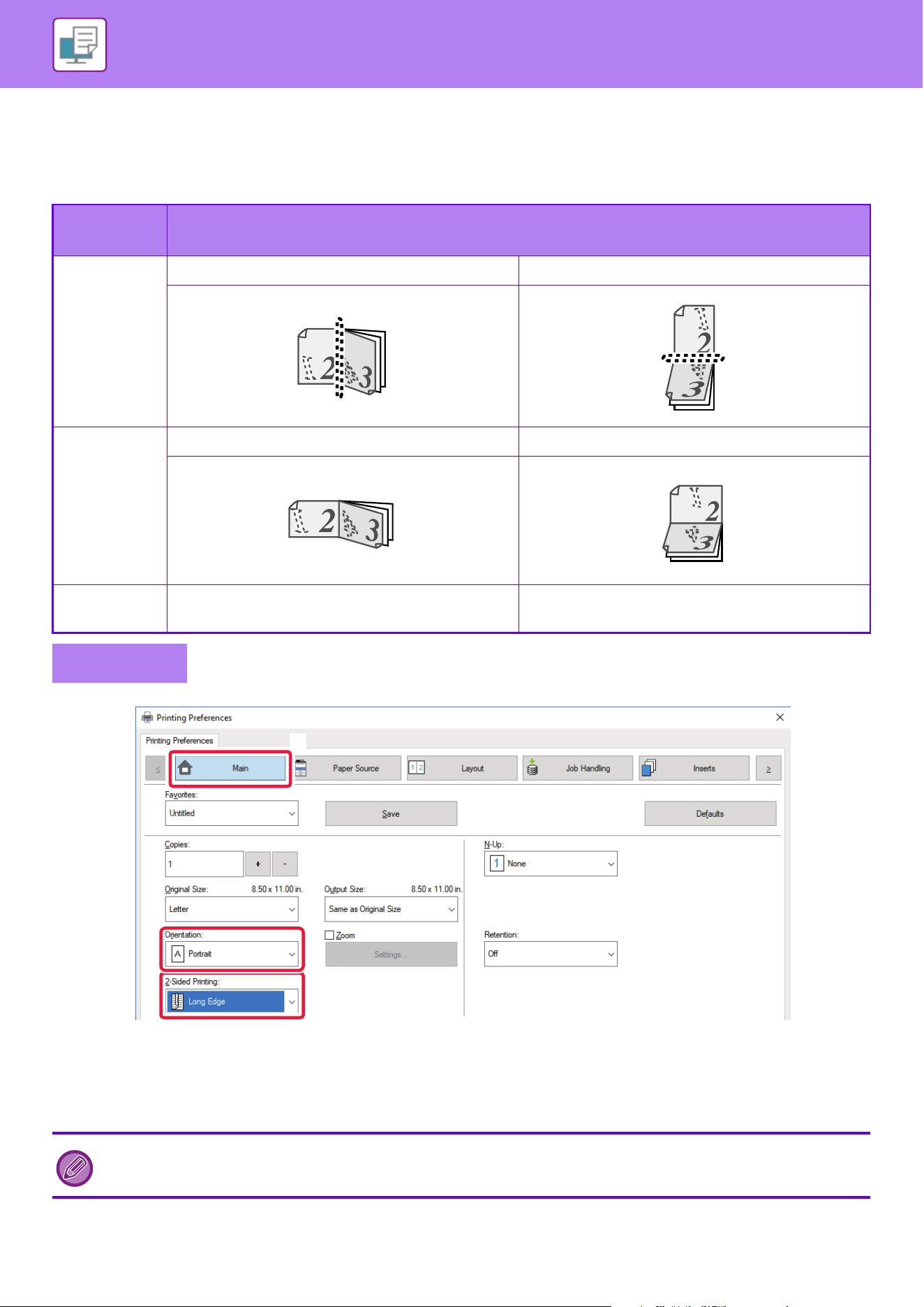
3-19
PRINTER►FREQUENTLY USED FUNCTIONS
2-SIDED PRINTING
The machine can print on both sides of the paper. This function is useful for many purposes, and is particularly
convenient when you want to create a simple pamphlet. 2-sided printing also helps conserve paper.
(1) Click the [Main] tab.
(2) Select the paper orientation.
(3) Select [Long Edge] or [Short Edge].
Paper
orientation
Print results
Portrait
Long Edge Short Edge
Landscape
Short Edge Long Edge
The pages are printed so that they can be bound at
the left or right side.
The pages are printed so that they can be bound at
the top.
Windows
If necessary, you can select the method of implementing 2-sided printing. Click the [Other Settings] button on the [Detailed
Settings] tab, and select the mode from "Duplex Style".
(2)
(3)
(1)
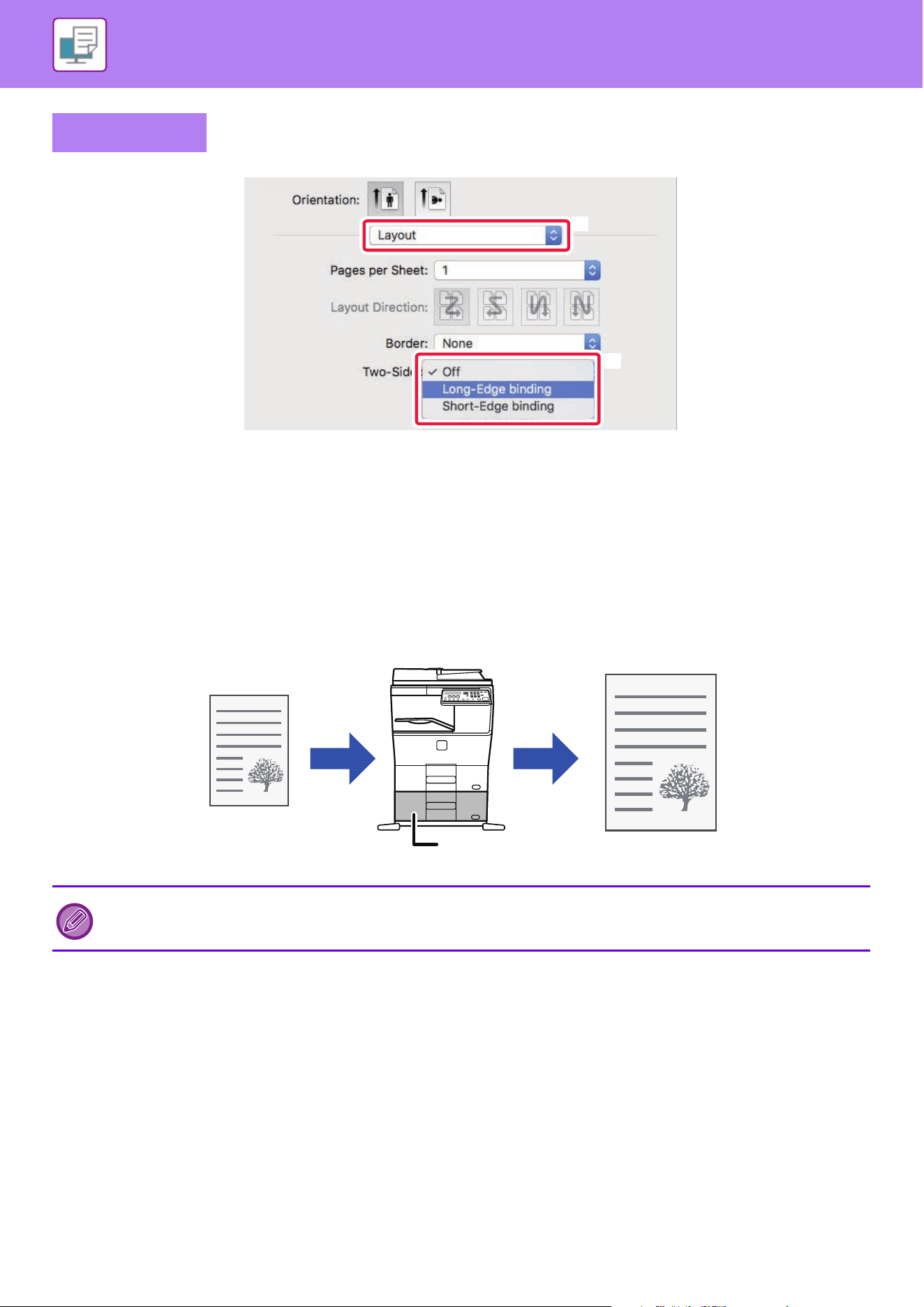
3-20
PRINTER►FREQUENTLY USED FUNCTIONS
(1) Select [Layout].
(2) Select [Long-Edge binding] or [Short-Edge binding].
FITTING THE PRINT IMAGE TO THE PAPER
This function automatically enlarges or reduces the print image to match the size of the paper loaded in the machine.
This function is convenient when enlarging an Invoice or A5 size document to letter or A4 size to make it easier to view,
or when printing a document on paper that is different in size from the original document.
The following example explains how to print an Invoice
(or A5) size document on a letter (or A4) size paper.
Mac OS
If A0, A1 or A2 size is selected in "Original Size", A4 (or Letter) is automatically selected in "Output Size".
(2)
(1)
Invoice (A5)
Letter (A4)
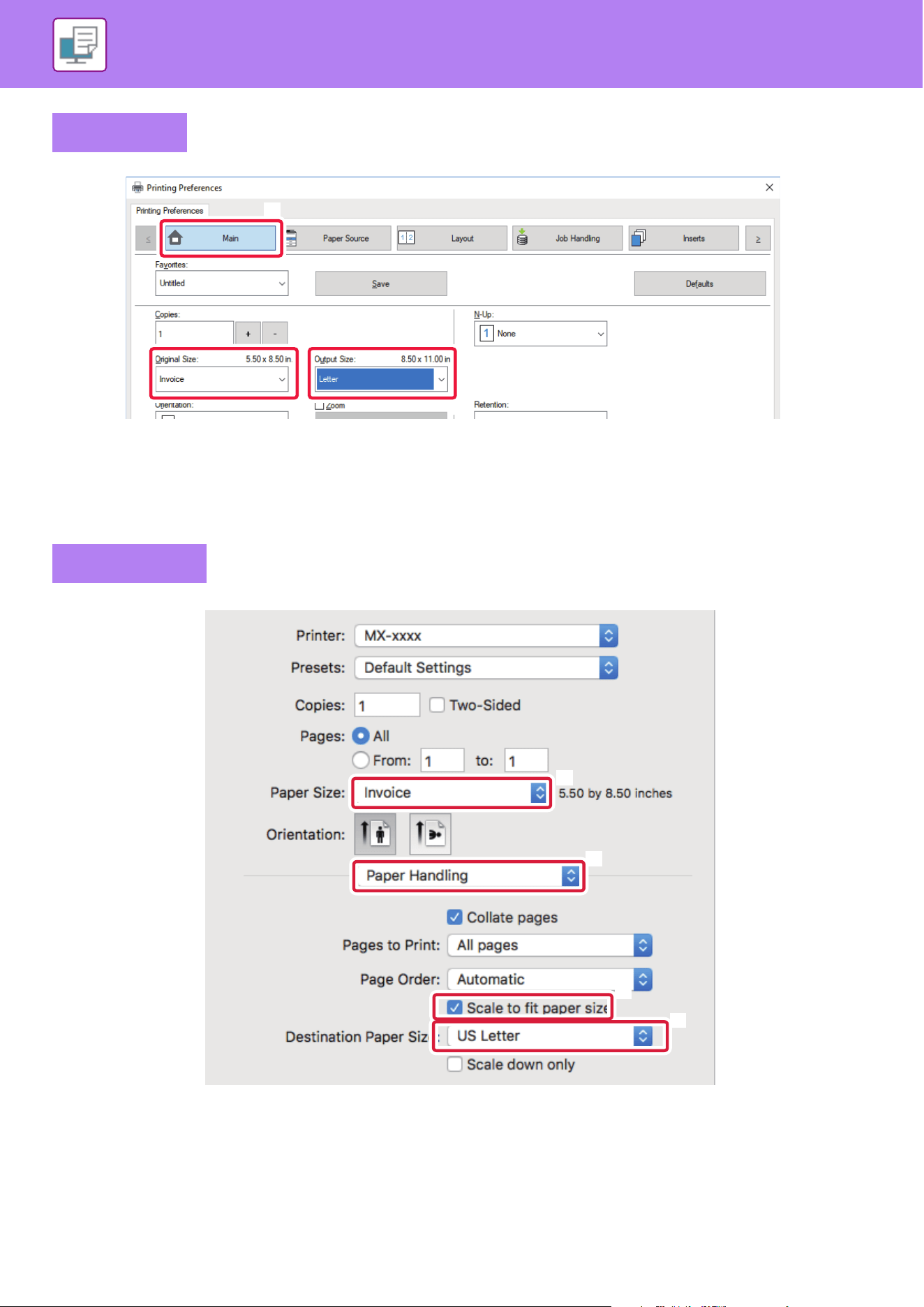
3-21
PRINTER►FREQUENTLY USED FUNCTIONS
(1) Click the [Main] tab.
(2) Select the original size from [Original Size] (for example: Invoice).
(3) Select the actual paper size to be used for printing from [Output Size] (for example: Letter).
If the output size is larger than the original size, the printed image will be automatically enlarged.
(1) Check the paper size for the print image (for example: Invoice).
(2) Select [Paper Handling].
(3) Select [Scale to fit paper size].
(4) Select the actual paper size to be used for printing (for example: Letter).
Windows
Mac OS
(2)
(1)
(3)
(2)
(1)
(3)
(4)
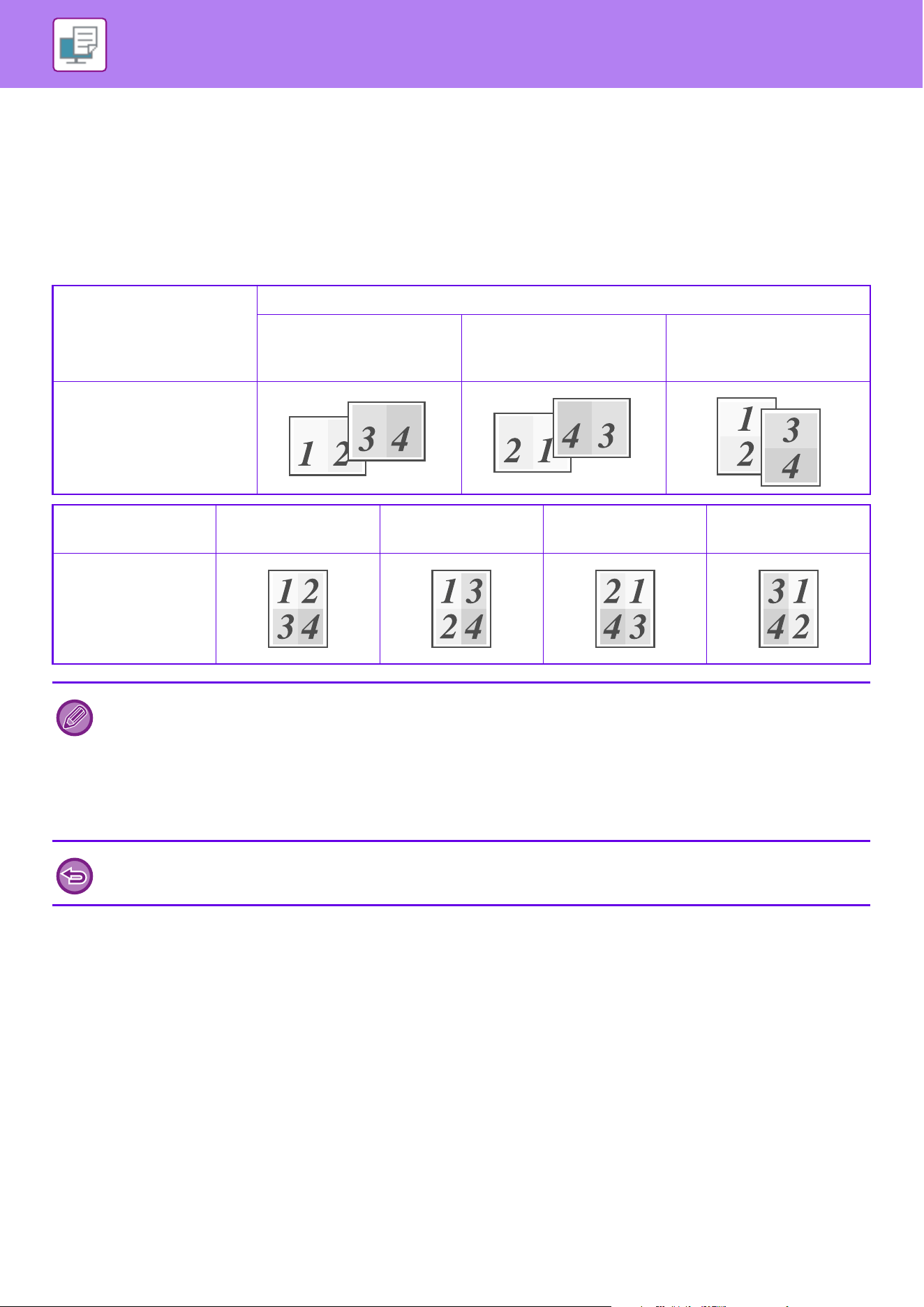
3-22
PRINTER►FREQUENTLY USED FUNCTIONS
PRINTING MULTIPLE PAGES ON ONE PAGE
This function reduces the print image and prints multiple pages on a single sheet of paper. You can print only the first
page in the original size and print multiple reduced pages on the subsequent sheets.
For example, when [2-Up] (2 pages per sheet) or [4-Up] (4 pages per sheet) is selected, the following print results will be
obtained, depending on the selected page order.
This is convenient when you want to print multiple images such as photos on a single sheet of paper, and when you
want to conserve paper. When used in combination with 2-sided printing, this function saves more paper.
N-Up
(Pages per sheet)
Print results
Left to Right Right to Left
Top To Bottom
(When the print orientation is
landscape)
2-Up
(2 pages per sheet)
N-Up
(Pages per sheet)
Right, and Down Down, and Right Left, and Down Down, and Left
4-Up
(4 pages per sheet)
• [N-Up] that can be set on the [Layout] tab can also be set on the [Main] tab. ("Order" can only be set in the [Layout] tab.)
• Note the following when printing multiple pages on one sheet:
• The page orders for 6-Up, 8-Up, 9-Up, and 16-Up are the same as for 4-Up.
• In a Windows environment, the page order can be viewed in the print image in the printer driver properties window.
• In a Mac OS environment, the page orders are displayed as selections.
• In a Mac OS environment, the number of pages that can be printed on a single sheet is 2, 4, 6, 9, or 16. Printing 8 pages
on one sheet is not supported.
The function for printing only the first page normally can only be used in the PCL6 printer driver.
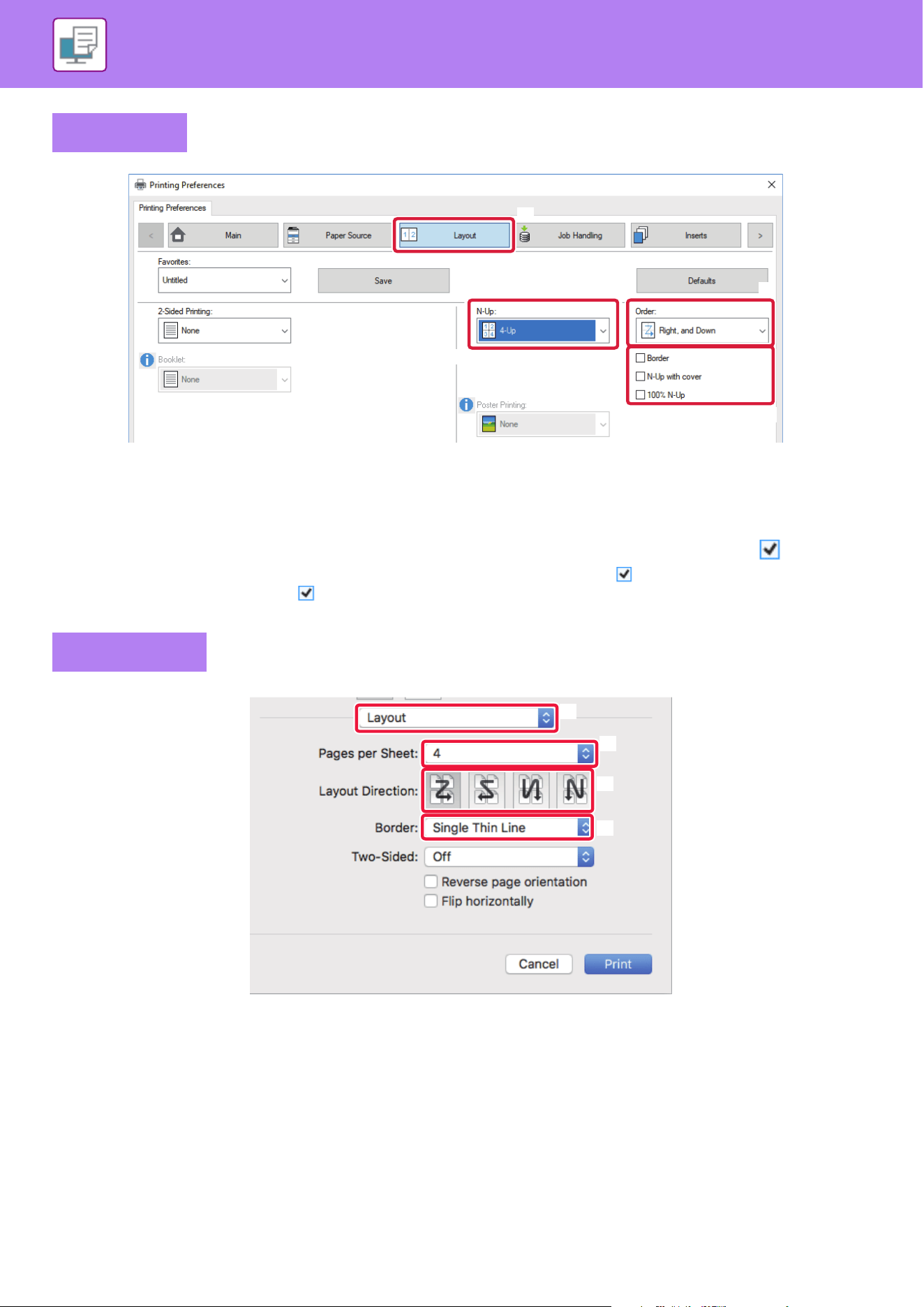
3-23
PRINTER►FREQUENTLY USED FUNCTIONS
(1) Click the [Layout] tab.
(2) Select the number of pages per sheet.
(3) Select the order of the pages.
(4) If you wish to print borderlines, click the [Border] checkbox so that the checkmark appears.
• To print the first page normally (as a cover), select the [N-Up with cover] checkbox ( ). (PCL6 only)
• When [100% N-Up] is selected ( ) for jobs such as N-Up copying of two A5 size pages onto one A4 sheet, the pages will be
printed at the full size of the original. If you select [Border] at this time, only the border will be printed.
(1) Select [Layout].
(2) Select the number of pages per sheet.
(3) Select the order of the pages.
(4) If you wish to print borderlines, select the desired type of borderline.
Windows
Mac OS
(3)
(1)
(2)
(4)
(2)
(1)
(3)
(4)
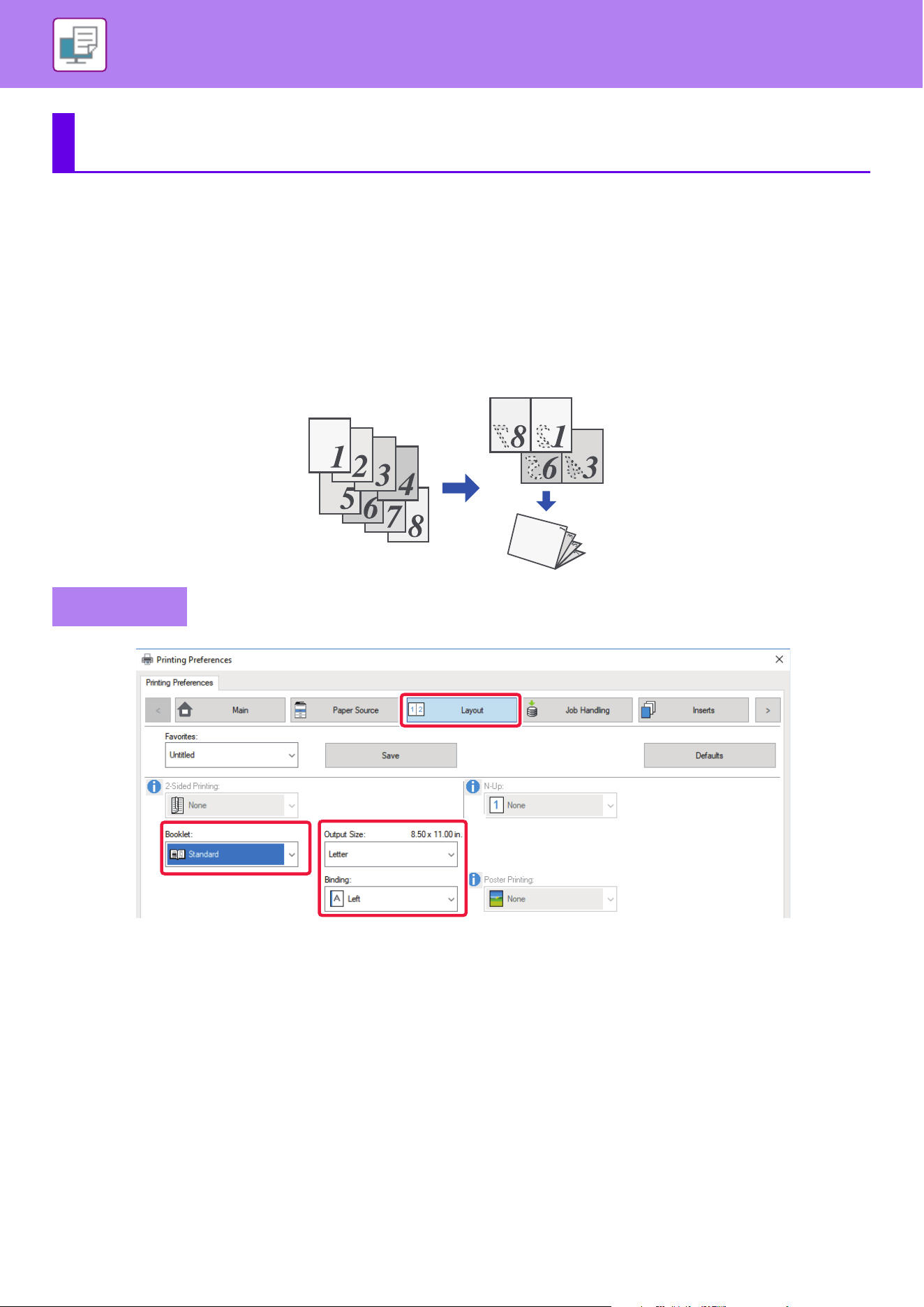
3-24
PRINTER►CONVENIENT PRINTING FUNCTIONS
CONVENIENT FUNCTIONS FOR CREATING
PAMPHLETS AND POSTERS
CREATE A PAMPHLET (BOOKLET)
The pamphlet function prints on the front and back of each sheet of paper so that the sheets can be folded and bound to
create a pamphlet.
(1) Click the [Layout] tab.
(2) Select [Standard] in "Booklet".
The printed image will be enlarged or reduced to fit the paper selected in "Output Size".
(3) Select the specified output size and the binding edge.
CONVENIENT PRINTING FUNCTIONS
Windows
(2)
(1)
(3)
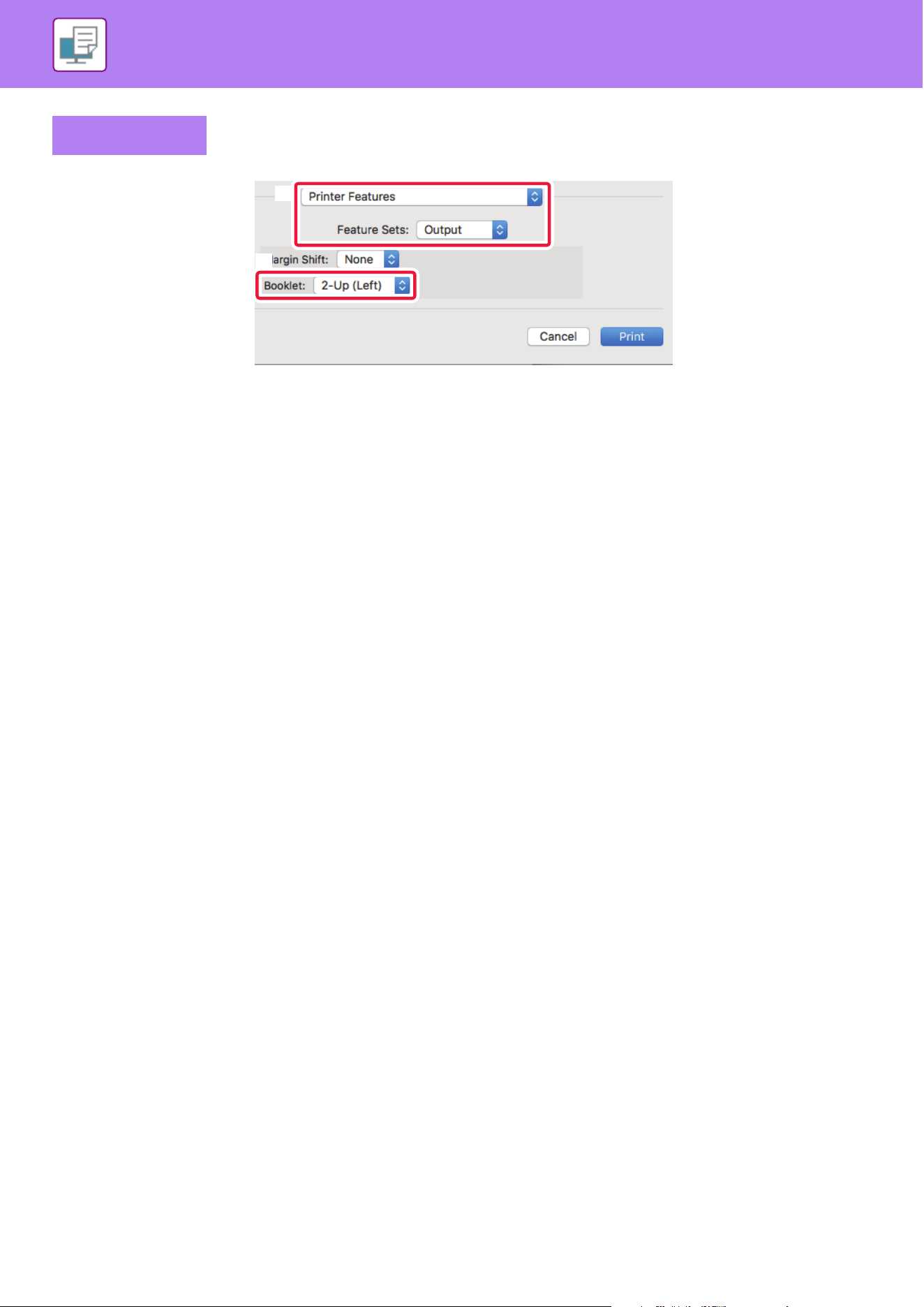
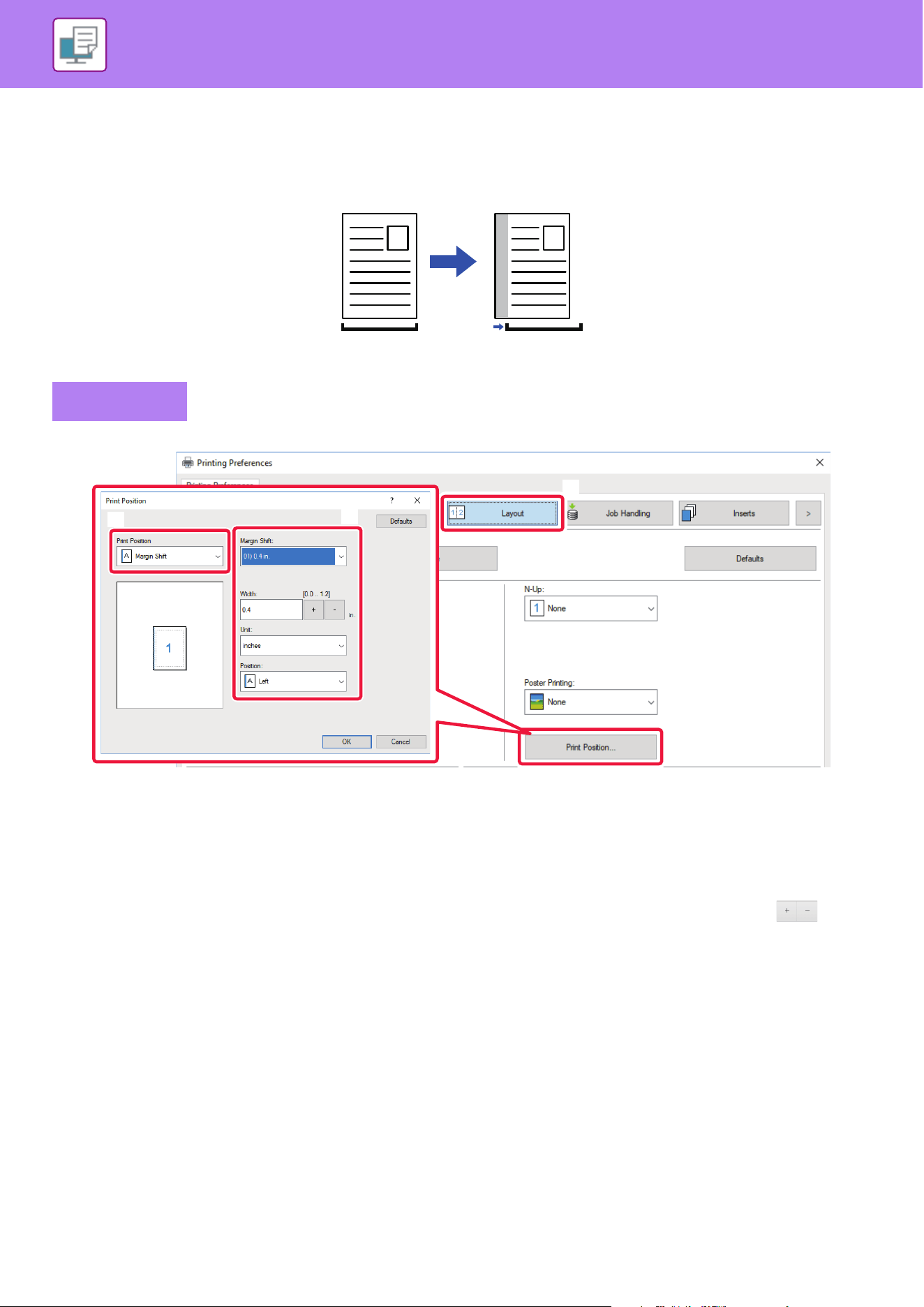
3-26
PRINTER►CONVENIENT PRINTING FUNCTIONS
PRINTING WITH MARGIN SHIFT SETTING (MARGIN)
This function shifts the print image to increase the margin at the left, the right, or the top of the paper.
By shifting the image, the part of the image that is outside the print area will not be printed.
(1) Click the [Layout] tab.
(2) Click the [Print Position] button.
(3) Select [Margin Shift].
(4) Select the shift width.
Select from the "Margin Shift" menu. If you wish to configure another numeric setting, select the setting and click buttons
or directly enter the number.
Windows
(2)
(1)
(3)
(4)
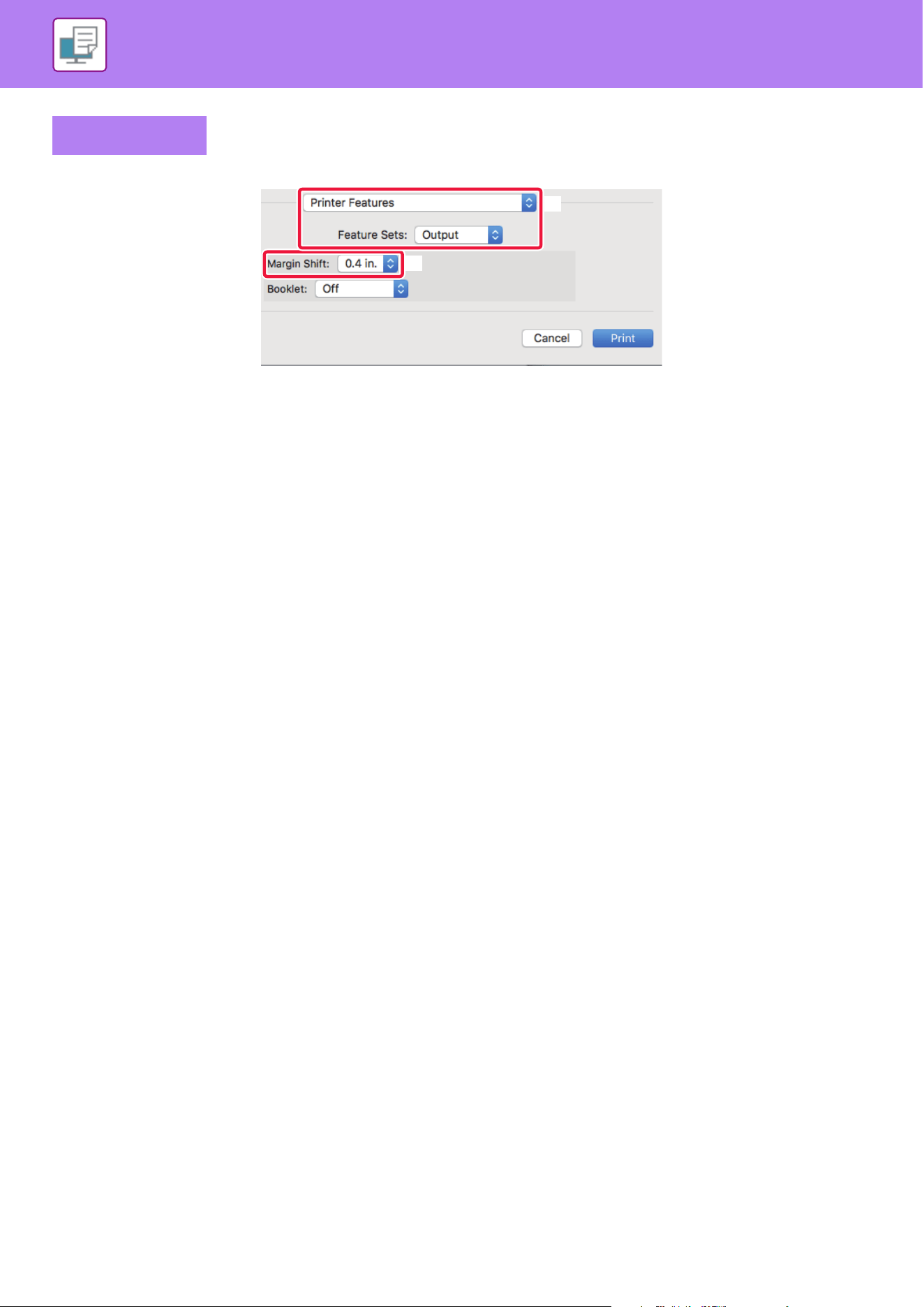
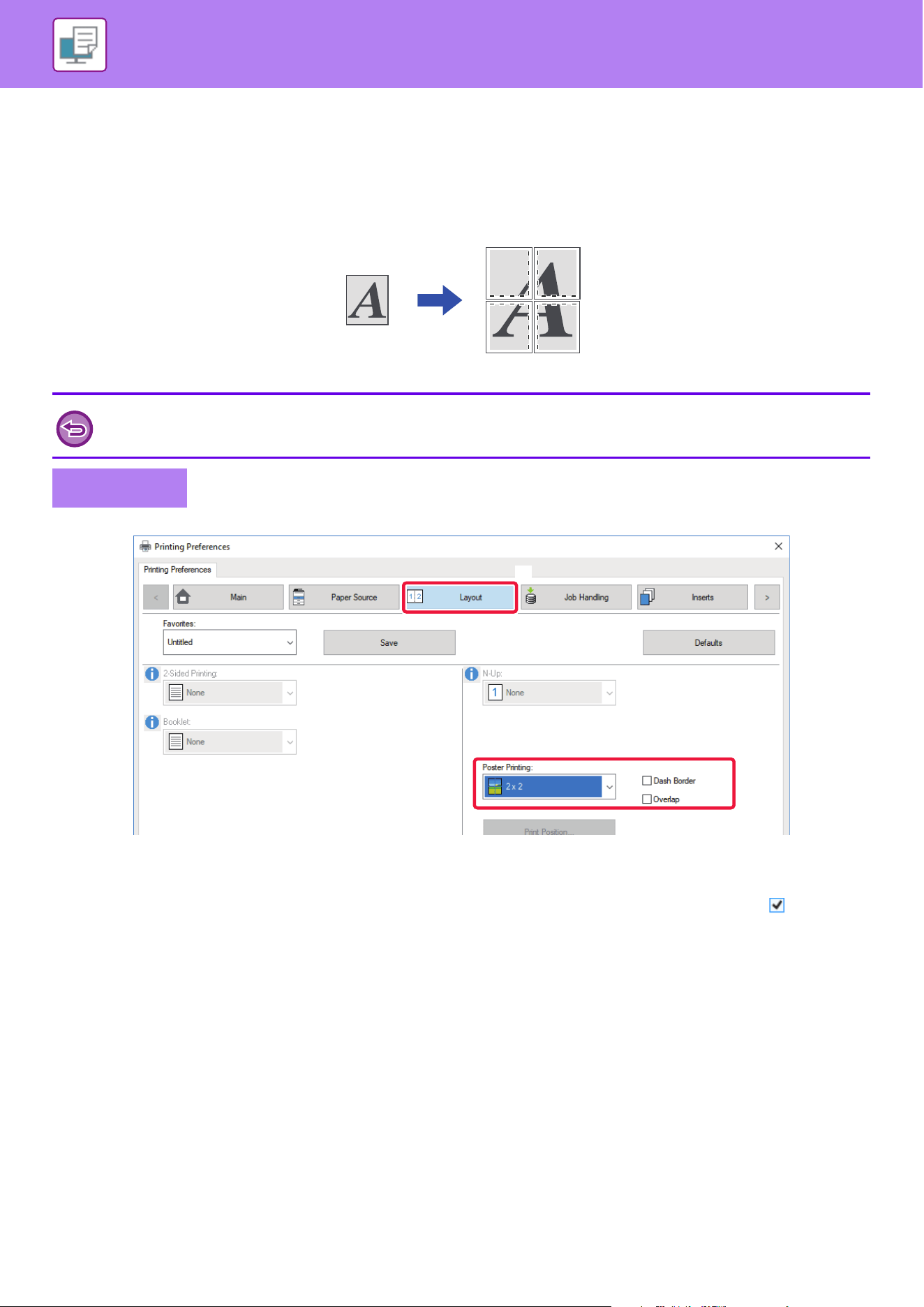
3-28
PRINTER►CONVENIENT PRINTING FUNCTIONS
CREATE A LARGE POSTER (POSTER PRINTING)
One page of print data is enlarged and printed using multiple sheets of paper (4 sheets (2 x 2), 9 sheets (3 x 3) or 16
sheets (4 x 4)). The sheets can then be attached together to create a large poster.
To enable precise alignment of the edges of the sheets during attachment, borderlines can be printed or overlapping
edges can be created (overlap function).
(1) Click the [Layout] tab.
(2) Select the number of sheets to be used in "Poster Printing".
If you wish to print borderlines and/or use the overlap function, click the corresponding checkboxes so that the appears.
This function is available in a Windows environment.
Windows
(2)
(1)
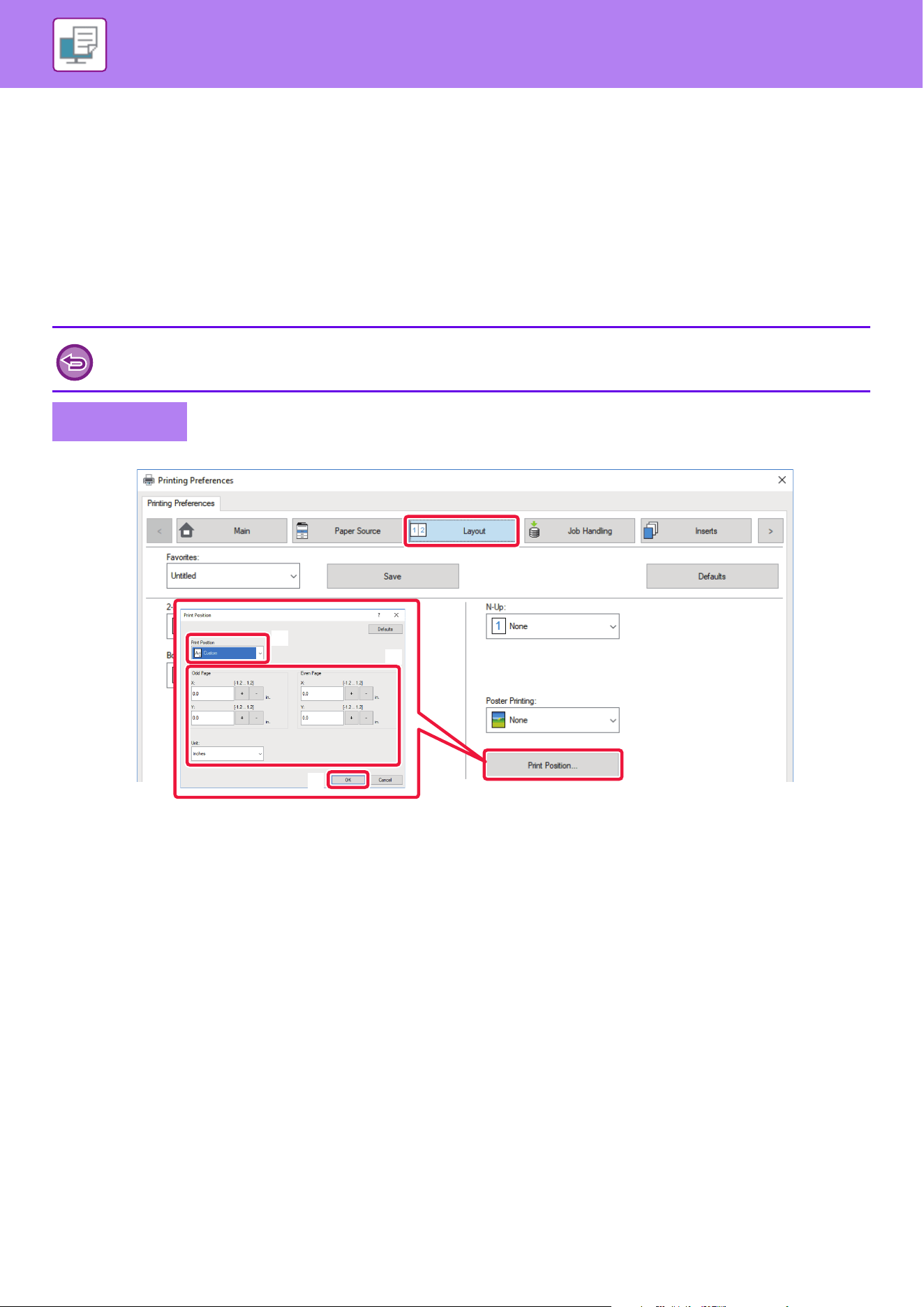
3-29
PRINTER►CONVENIENT PRINTING FUNCTIONS
FUNCTIONS TO ADJUST THE SIZE AND
ORIENTATION OF THE IMAGE
ADJUST PRINT POSITION ON ODD AND EVEN PAGES
SEPARATELY (PRINT POSITION)
This function sets different print positions (margins) separately for odd and even pages and prints the pages.
(1) Click the [Layout] tab.
(2) Click the [Print Position] button.
(3) Select [Custom].
(4) Set the amount of shifting of the print position for odd-numbered pages and even-numbered
pages.
(5) Click the [OK] button.
This function is available in a Windows environment.
Windows
(2)
(1)
(3)
(4)
(5)
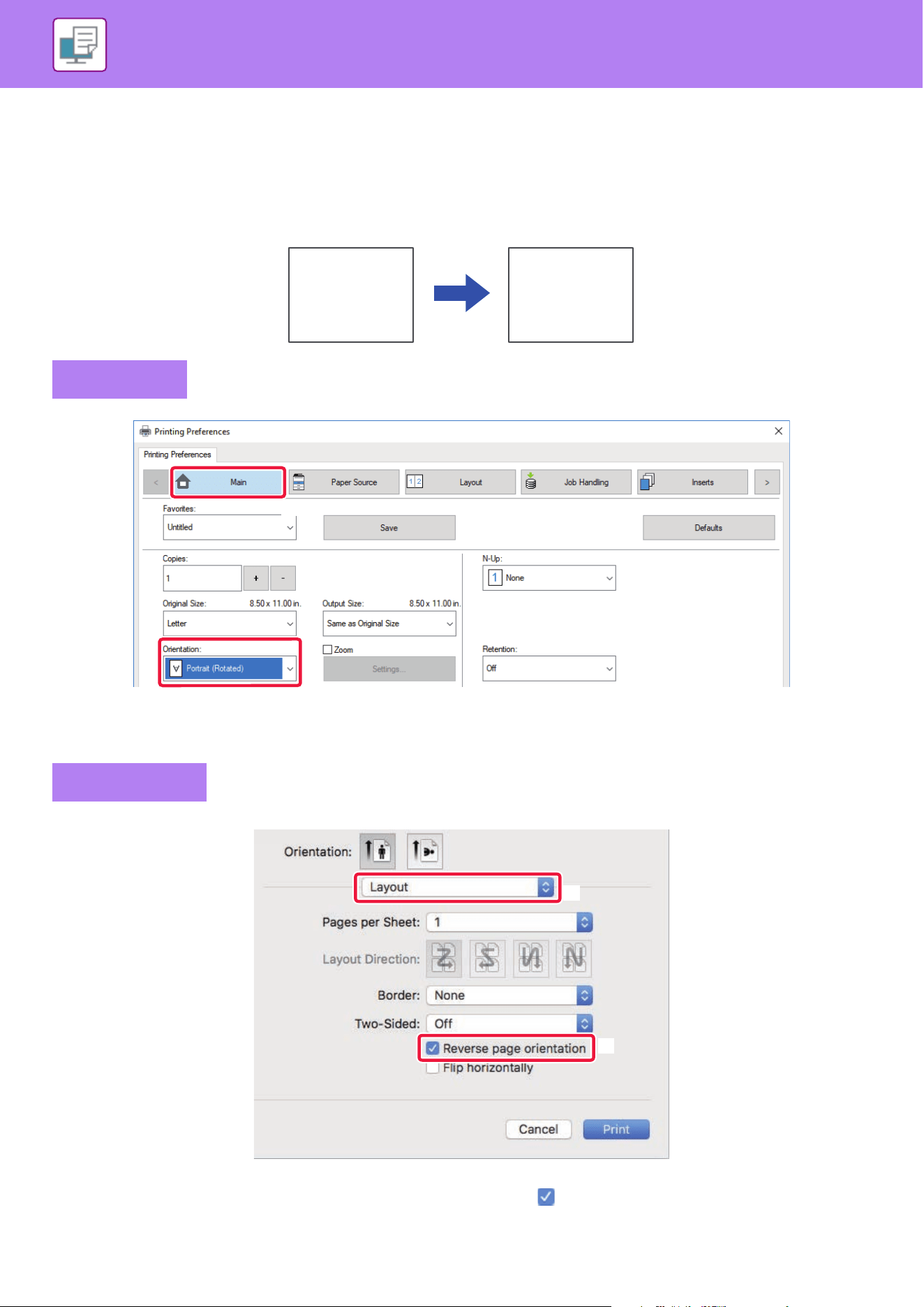
3-30
PRINTER►CONVENIENT PRINTING FUNCTIONS
ROTATING THE PRINT IMAGE 180 DEGREES (ROTATE
180 DEGREES)
This feature rotates the image 180 degrees so that it can be printed correctly on paper that can be loaded in only one
orientation (such as envelopes or paper with punch holes).
(1) Click the [Main] tab.
(2) Select [Portrait (Rotated)] or [Landscape (Rotated)] in "Orientation".
(1) Select [Layout]
(2) Select the [Reverse page orientation] checkbox so that appears.
Windows
Mac OS
ABCD
ABCD
(1)
(2)
(2)
(1)
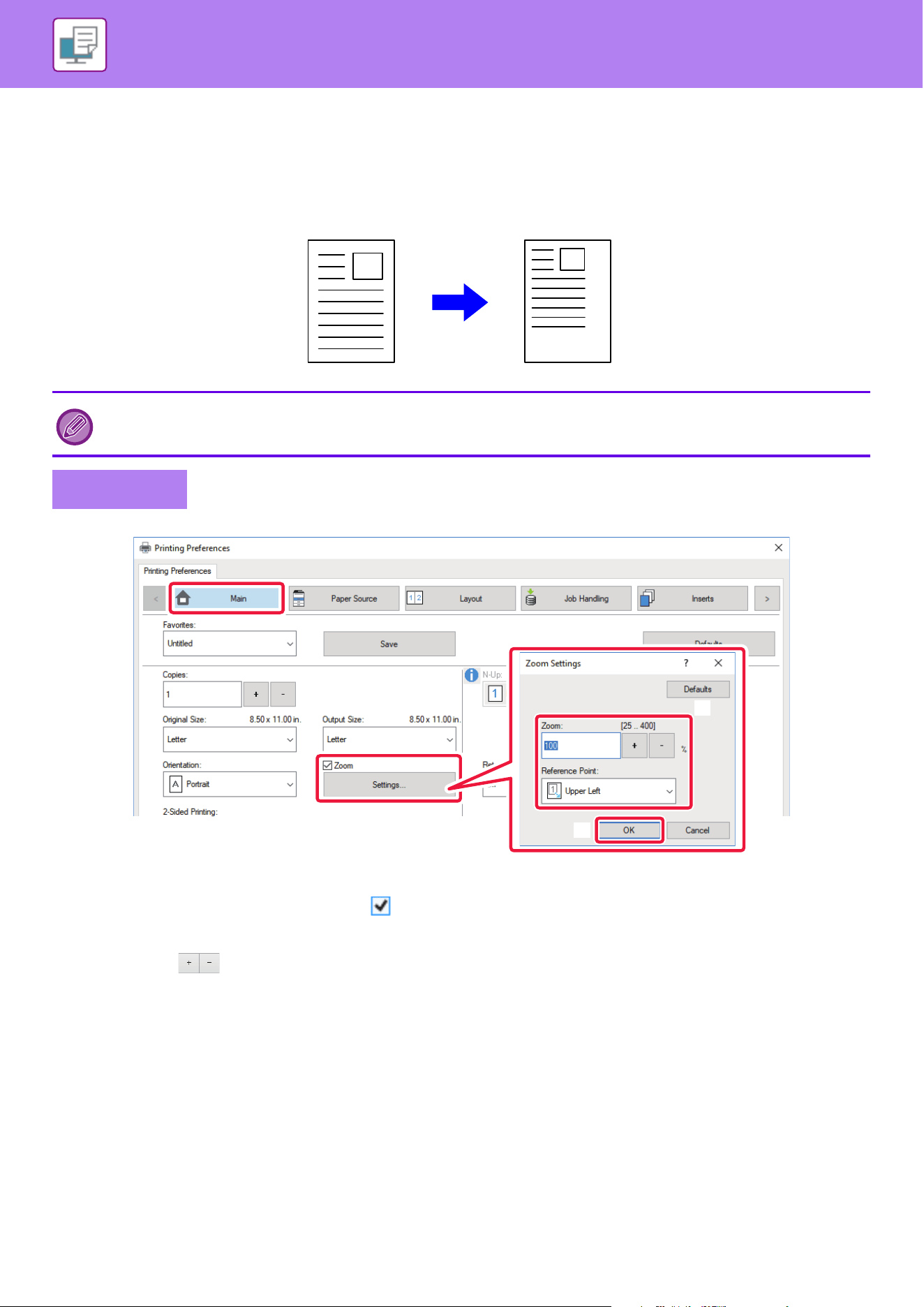
3-31
PRINTER►CONVENIENT PRINTING FUNCTIONS
ENLARGING/REDUCING THE PRINT IMAGE (ZOOM
SETTING/ENLARGE OR REDUCE)
This function enlarges or reduces the image to a selected percentage.
This allows you to enlarge a small image or add margins to the paper by slightly reducing an image.
(1) Click the [Main] tab.
(2) Click the [Zoom] checkbox so that appears, and click the [Settings] button.
(3) Enter the percentage.
By clicking the button, you can specify the value in increments of 1%. In addition, select [Upper Left] or [Center] for the
base point on the paper.
(4) Click the [OK] button.
When using the PS printer driver (Windows), you can set the width and length percentages separately to change the
proportions of the image.
Windows
(2)
(1)
(3)
(4)
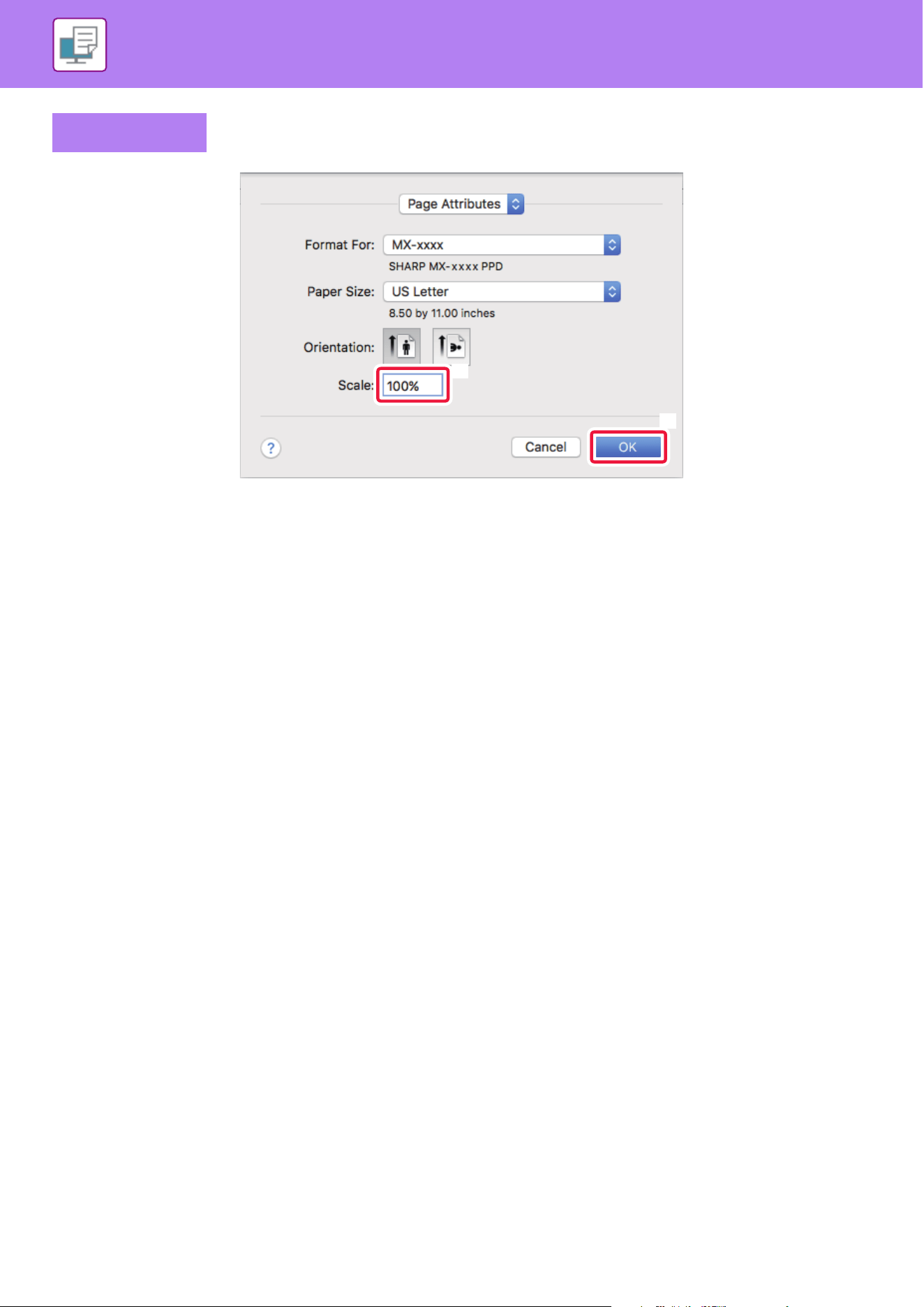
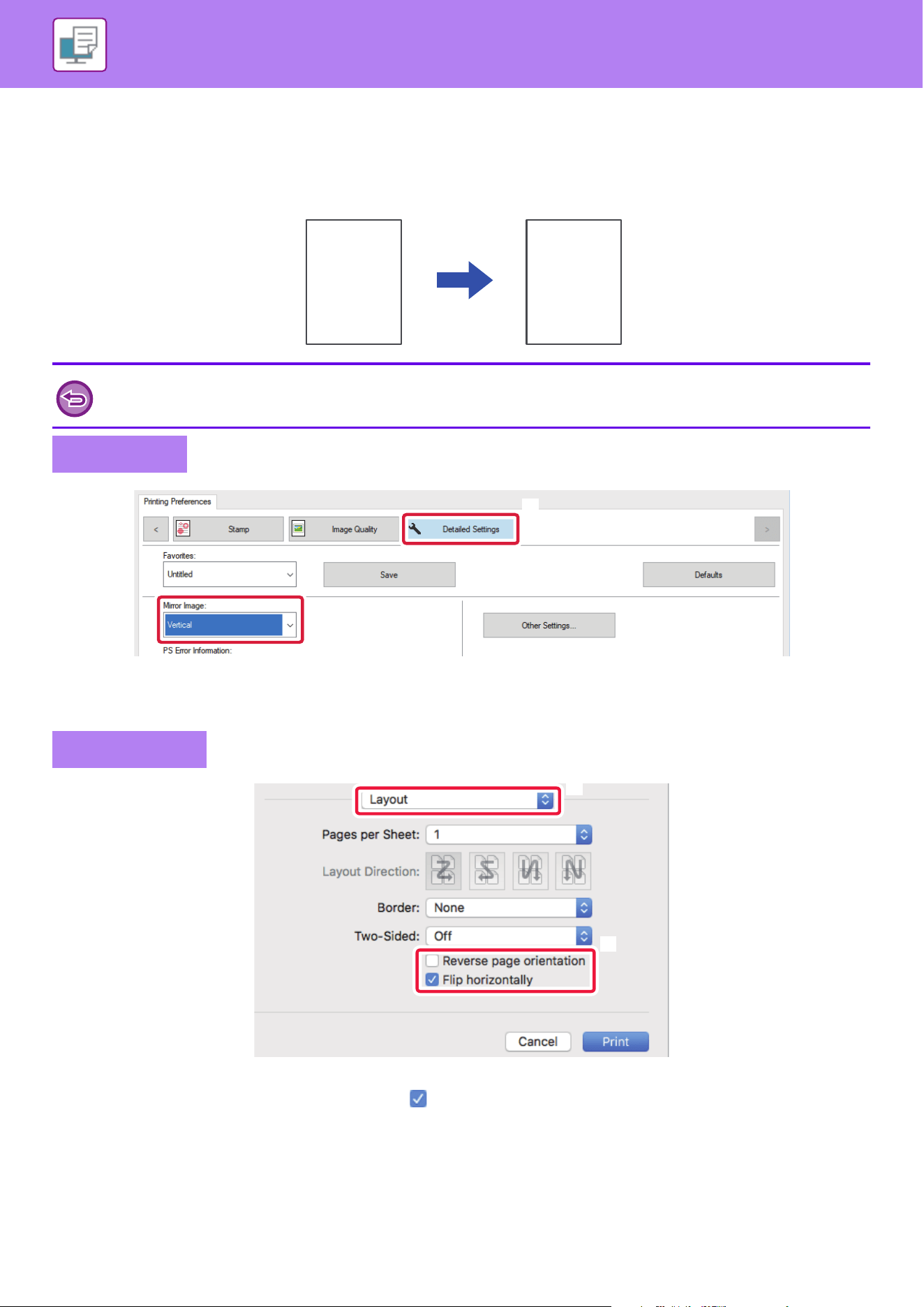
3-33
PRINTER►CONVENIENT PRINTING FUNCTIONS
PRINT A MIRROR-IMAGE (MIRROR-IMAGE REVERSE/
VISUAL EFFECTS)
The image is reversed to create a mirror image.
This function is conveniently used to print a design for a woodblock print or other printing medium.
(1) Click the [Detailed Settings] tab.
(2) If you wish to reverse the image horizontally, select [Horizontal]. If you wish to reverse the image
vertically, select [Vertical].
(1) Select [Layout].
(2) Select the [Flip horizontally] checkbox ( ).
In a Windows environment, this function is only available when using the PS printer driver.
Windows
Mac OS
B
B
(2)
(1)
(2)
(1)
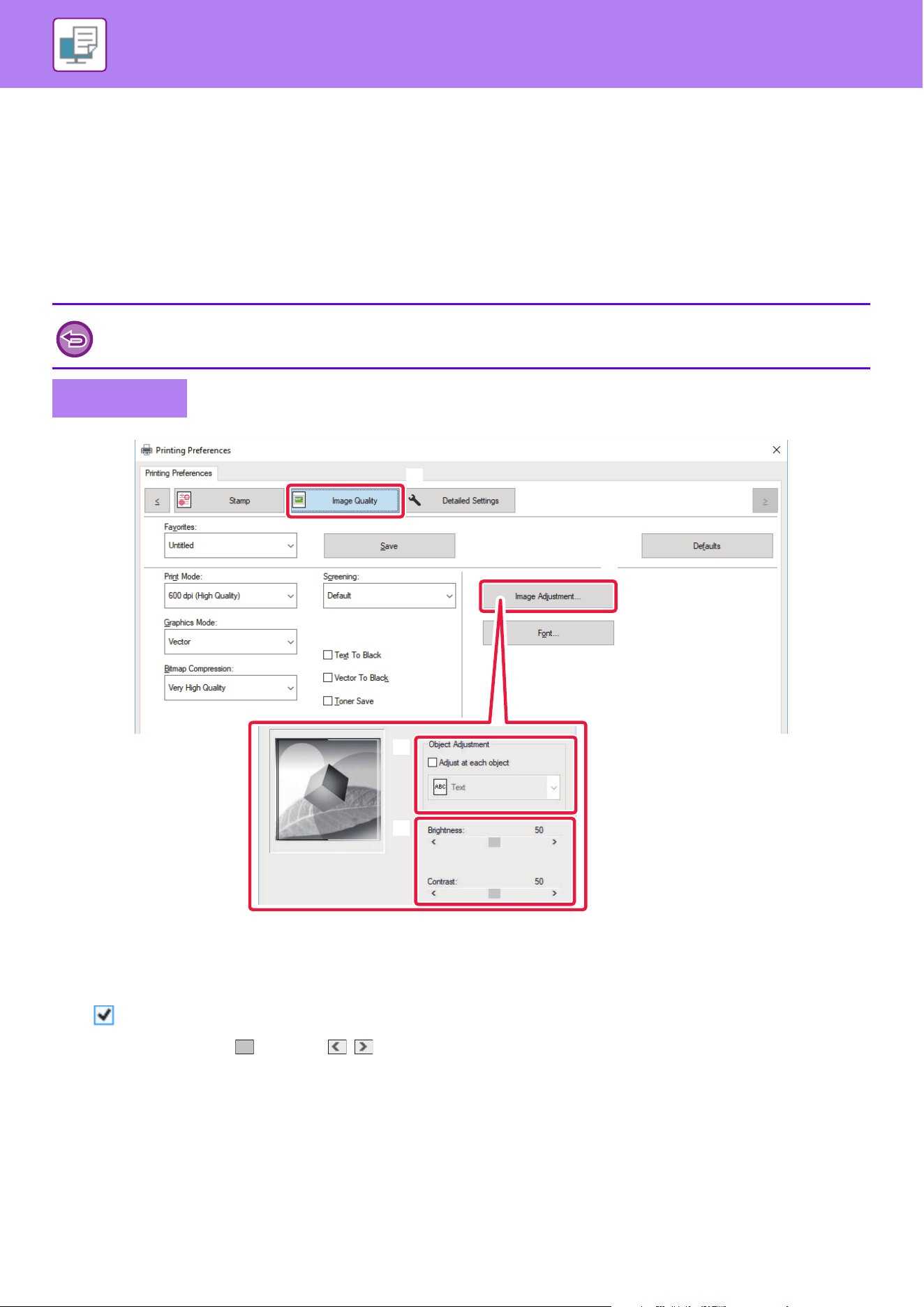
3-34
PRINTER►CONVENIENT PRINTING FUNCTIONS
IMAGE ADJUSTING FUNCTION
ADJUST THE BRIGHTNESS AND CONTRAST OF THE
IMAGE (IMAGE ADJUSTMENT)
This function adjusts the brightness and contrast in the print settings when a photo or other image is printed.
This function makes simple corrections even if image editing software is not installed on your computer.
(1) Click the [Image Quality] tab.
(2) Click the [Image Adjustment] button.
(3) To adjust objects (text, graphics, photos) individually, select the [Adjust at each object] checkbox
( ) and select the object.
(4) Drag the slide bar or click buttons to adjust the image.
This function is available in a Windows environment.
Windows
(2)
(1)
(3)
(4)
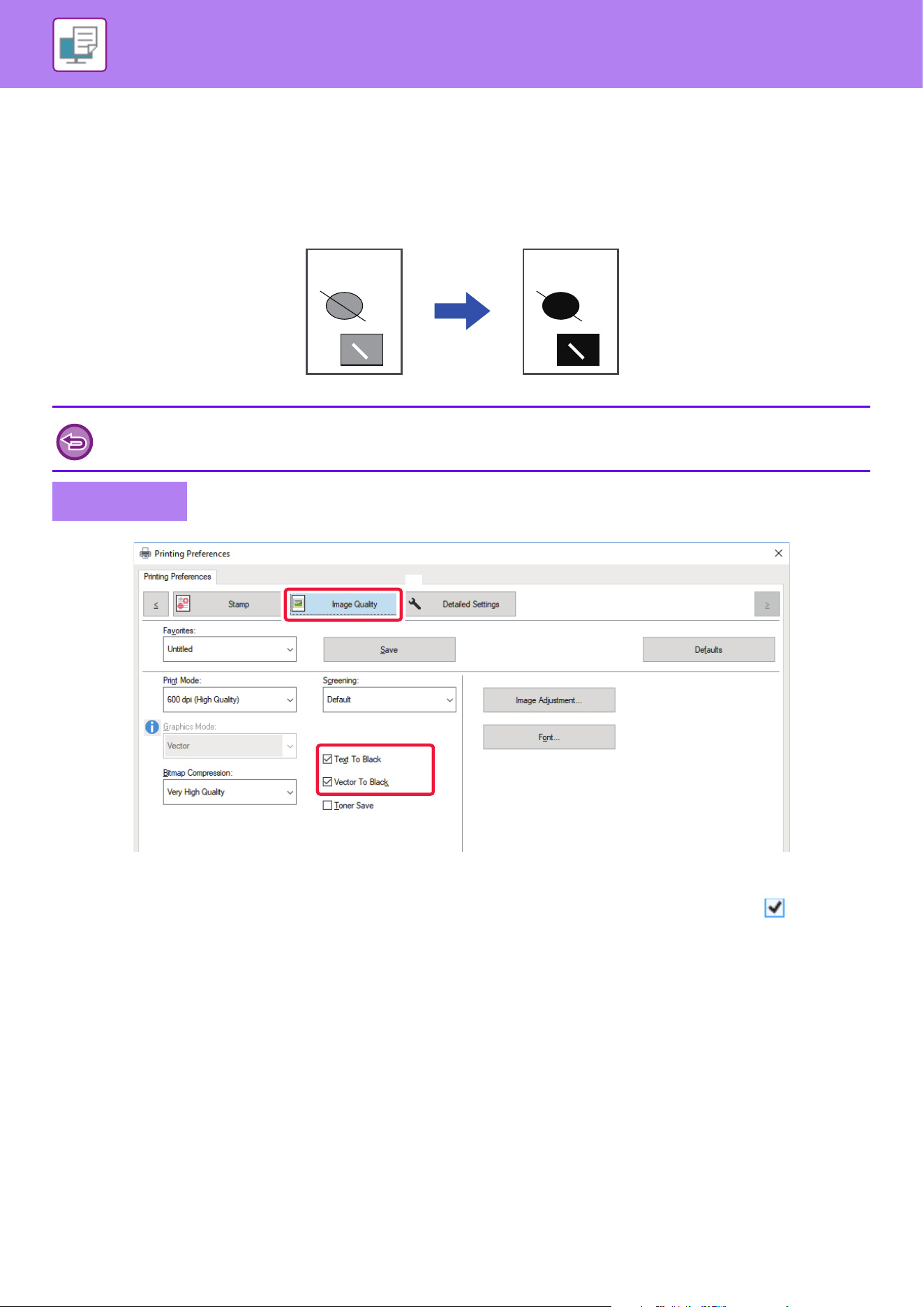
3-35
PRINTER►CONVENIENT PRINTING FUNCTIONS
PRINTING FAINT TEXT AND LINES IN BLACK (TEXT TO
BLACK/VECTOR TO BLACK)
When printing a color image in grayscale, text and lines that are drawn in faint colors are printed in black. This function
allows you to bring out color text and lines that are faint and difficult to see when printed in grayscale.
(1) Click the [Image Quality] tab.
(2) Select the [Text To Black] checkbox and/or the [Vector To Black] checkbox so that appears.
• When [Text To Black] is selected, all text other than white text is printed in black.
• When [Vector To Black] is selected, all vector graphics other than white lines and areas are printed in black.
• Raster data such as bitmap images cannot be adjusted.
• This function is available in a Windows environment.
Windows
ABCD ABCD
(2)
(1)
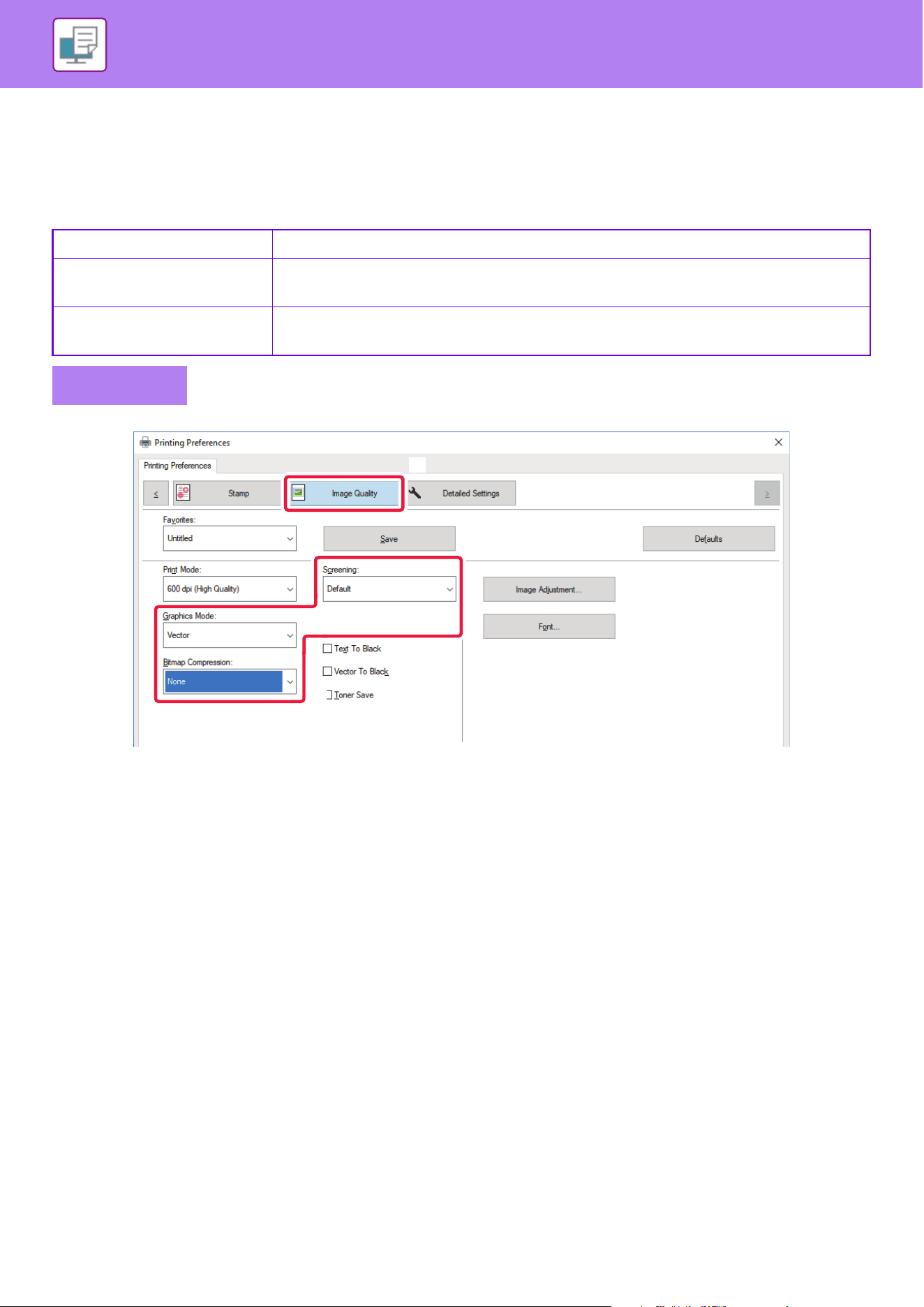
3-36
PRINTER►CONVENIENT PRINTING FUNCTIONS
SELECTING IMAGE SETTINGS TO MATCH THE IMAGE
TYPE
Preset settings are available in the machine's printer driver for various uses.
(1) Click the [Image Quality] tab.
(2) Specify the settings.
Graphics mode Select the graphics mode from "Raster" or "Vector".
Bitmap compression The data compression ratio of bitmap is set. If the ratio is higher, the image quality becomes
lower.
Screening Select the screening to modify the image to suit specific preferences, according to the
appropriate image processing method.
Windows
(1)
(2)
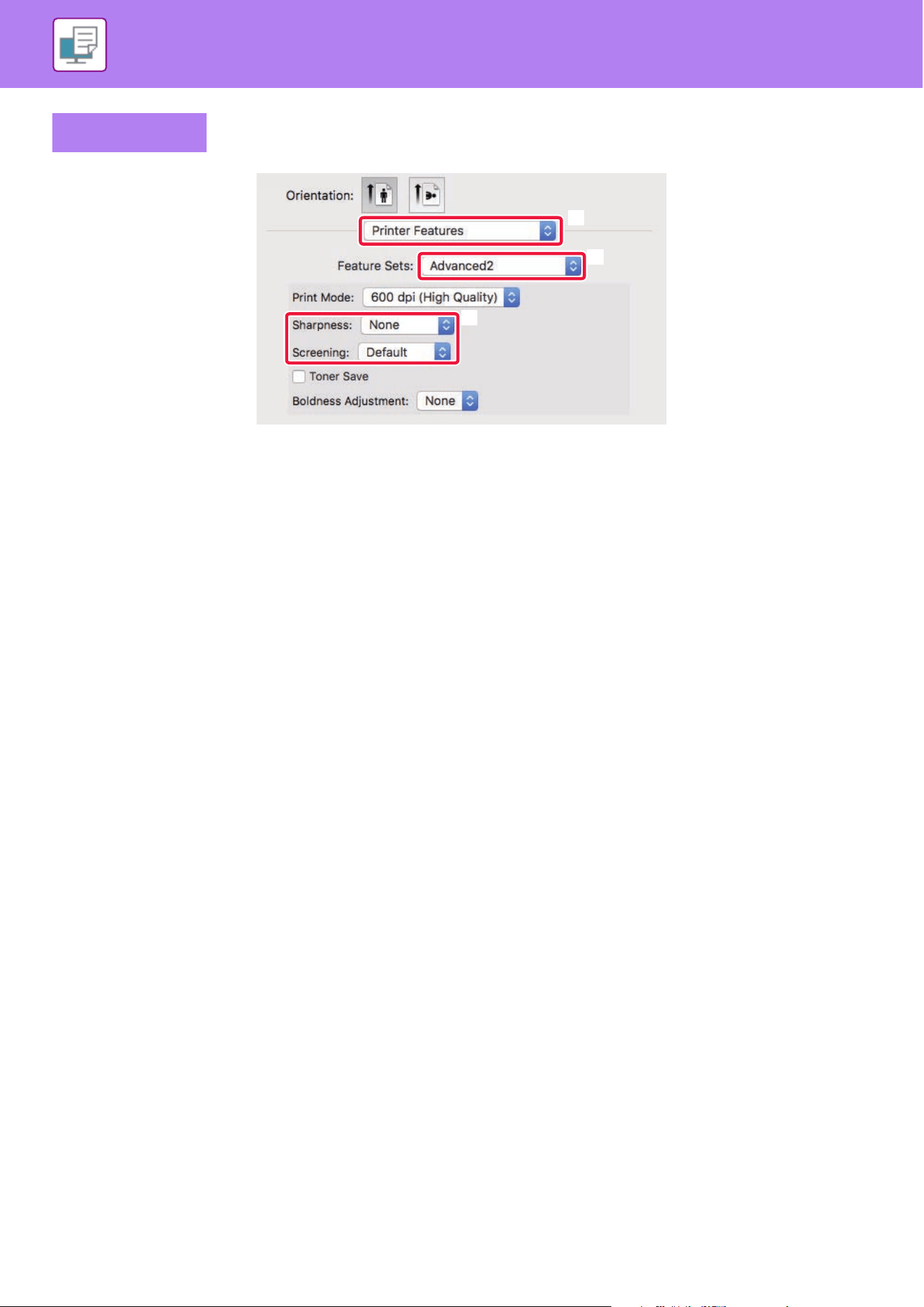
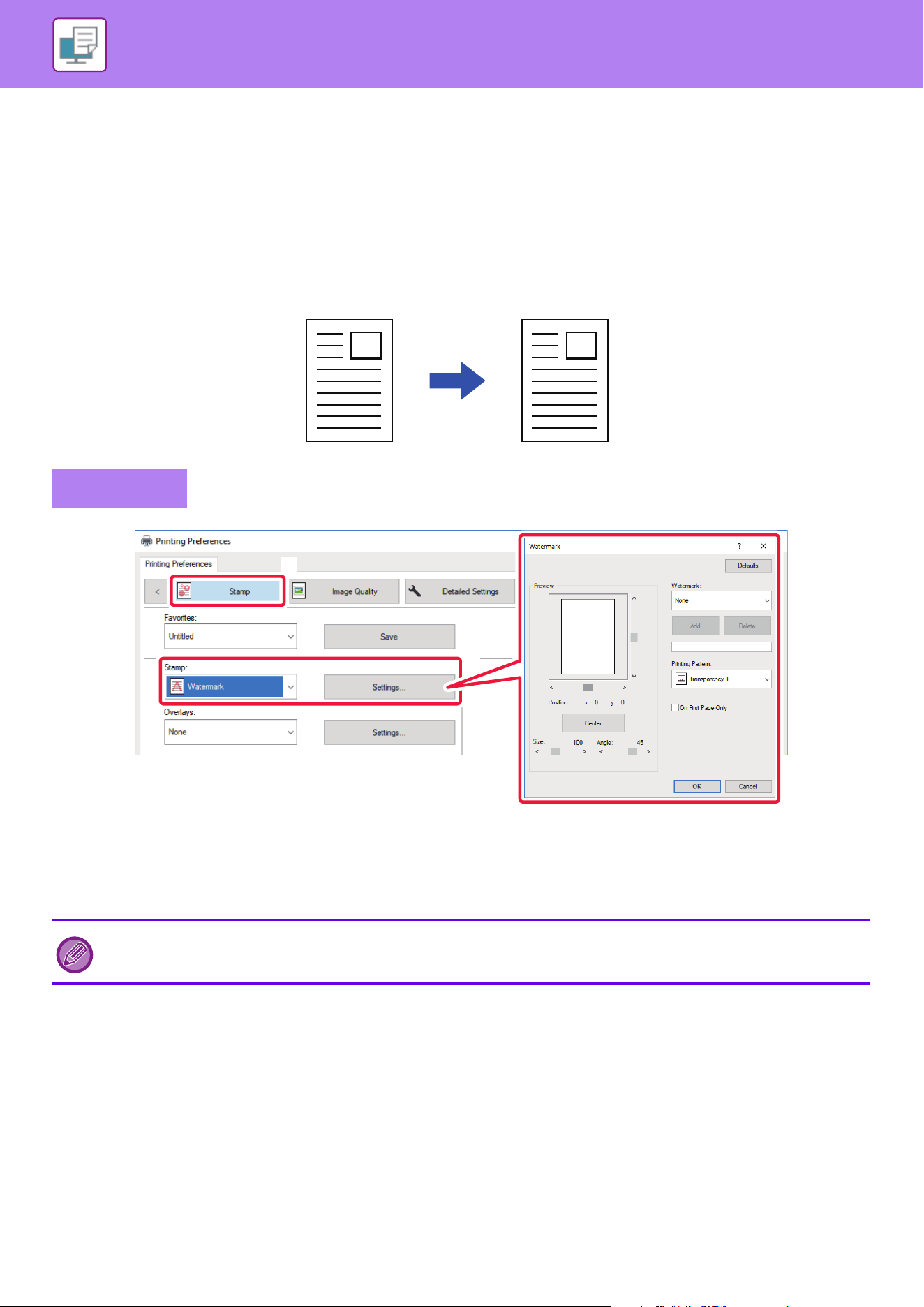
3-38
PRINTER►CONVENIENT PRINTING FUNCTIONS
FUNCTIONS TO COMBINE TEXT AND IMAGES
ADDING A WATERMARK TO PRINTED PAGES (WATERMARK)
This function adds faint shadow-like text as a watermark in the background of the printed image. The size and angle of
the watermark text can be adjusted.
The watermark text can be selected from the previously registered text in the list. When necessary, you can enter text to
create an original watermark.
(1) Click the [Stamp] tab.
(2) Select [Watermark] from "Stamp" and click the [Settings] button.
(3) Select the watermark to be used and click the [OK] button.
Windows
If you want to create a new watermark, enter the text of the watermark in the text box and click the [Add] button.
CONFIDENTIAL
(2)
(1)
(3)
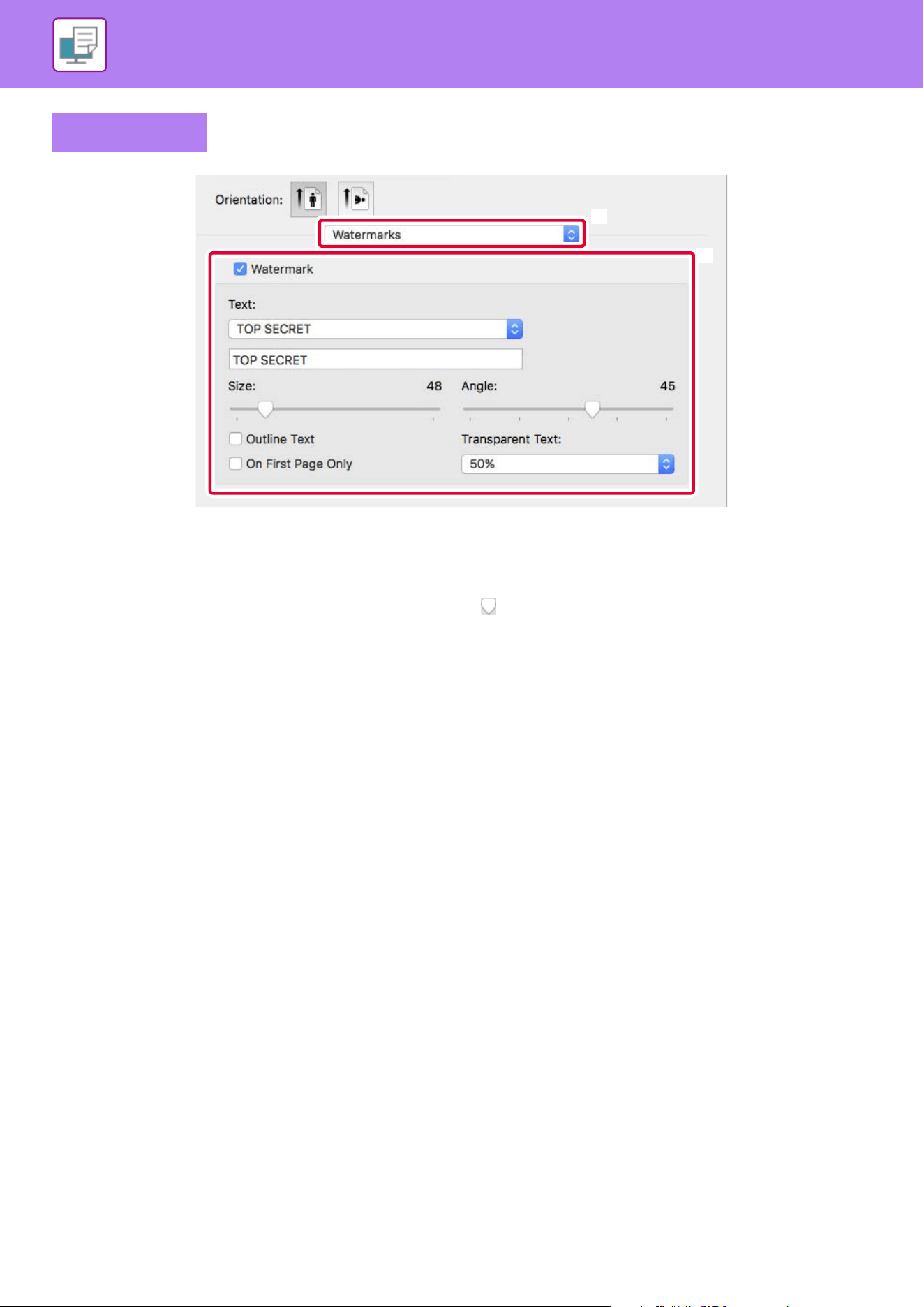
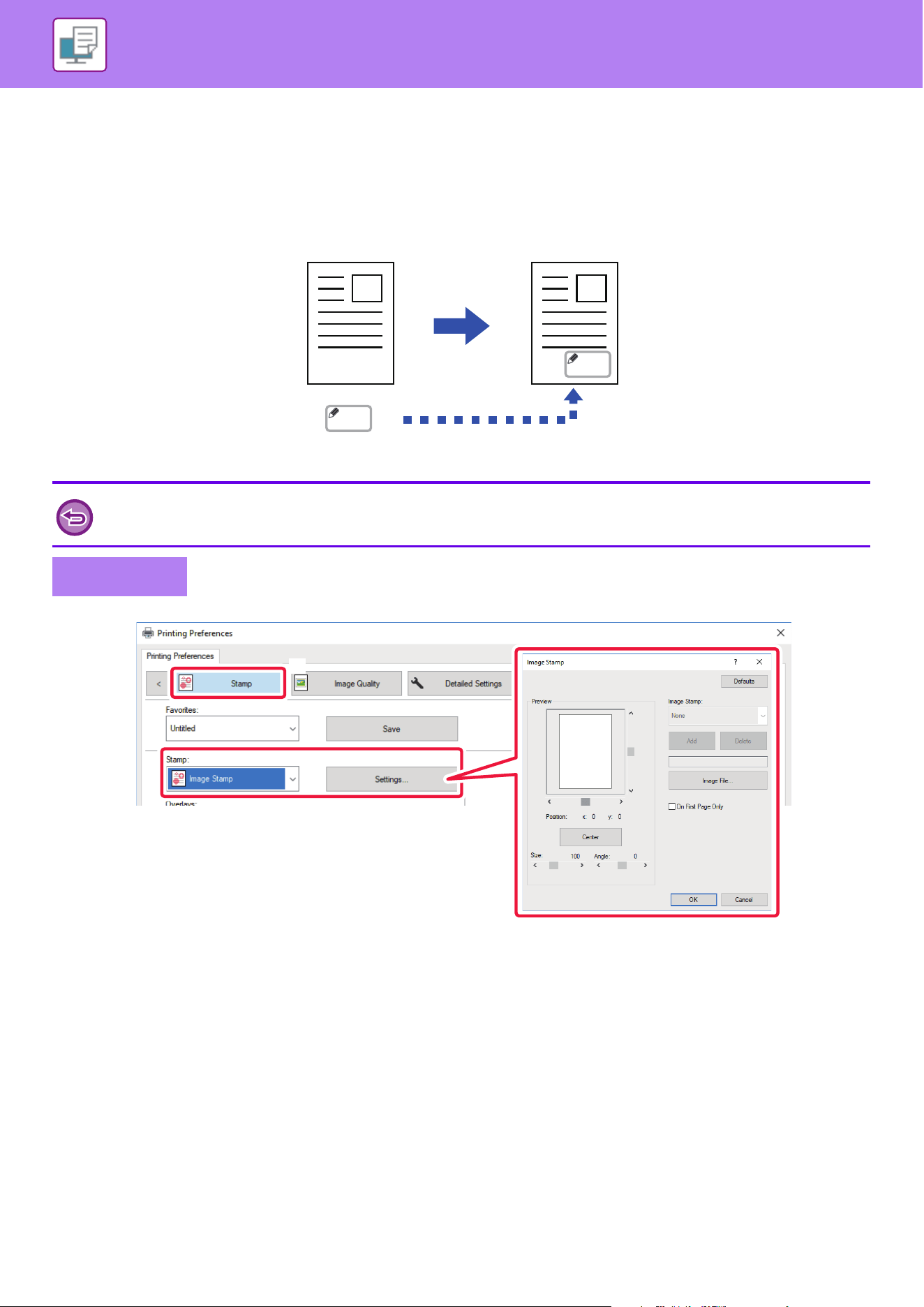
3-40
PRINTER►CONVENIENT PRINTING FUNCTIONS
PRINTING AN IMAGE OVER THE PRINT DATA (IMAGE
STAMP)
This function prints a bitmap or JPEG image stored on your PC over the print data.
This function prints a frequently used image or an icon of your own creation as if it is stamped on the print data. The size,
position, and angle of the image can be adjusted.
(1) Click the [Stamp] tab.
(2) Select [Image Stamp] from "Stamp" and click the [Settings] button.
(3) Select the image stamp to be used, and click the [OK] button.
• If an image stamp has already been stored, it can be selected from the menu.
• If you have not stored an image stamp, click the [Image File], select the file you wish to use for the image stamp, and click the
[Add] button.
This function is available in a Windows environment.
Windows
MEMO
MEMO
(2)
(1)
(3)
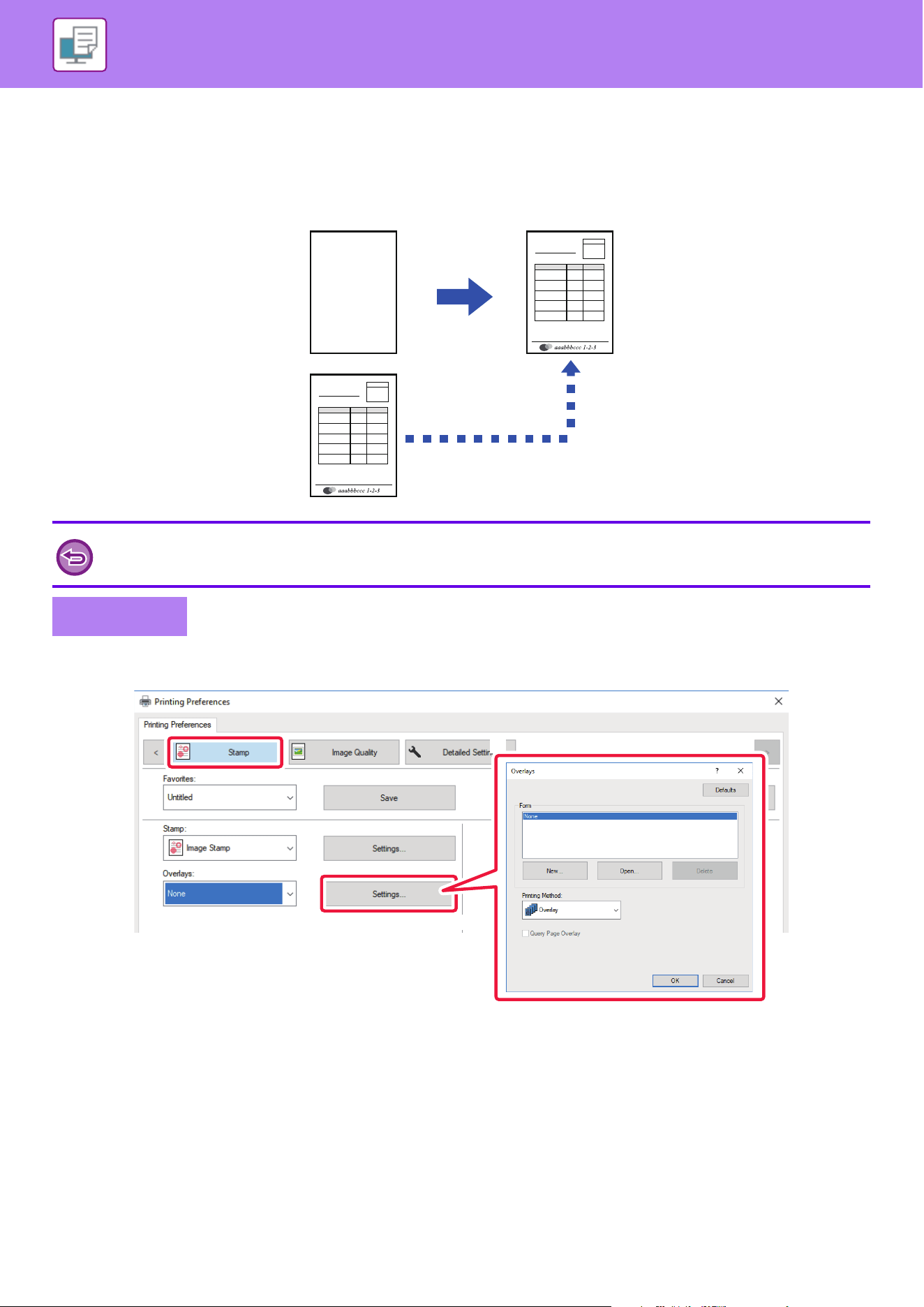
3-41
PRINTER►CONVENIENT PRINTING FUNCTIONS
OVERLAY A FIXED FORM ON THE PRINT DATA (OVERLAYS)
This function overlays data on a fixed form you have prepared.
By creating table rulings or a decorative frame in an application different from that of the text file and registering the data
as an overlay file, an attractive print result can be easily obtained without the need for complex manipulations.
Creating an overlay file
(1) Open the driver properties window from the application that is used for creating overlay data.
(2) Click the [Stamp] tab.
(3) Click the [Settings] button.
(4) Click the [New] button and specify the name and folder to be used for the overlay file that you
wish to create.
The file will be created when the settings are completed and printing is started.
This function is available in a Windows environment.
Windows
XXXX
XXX 1 100
XXXX 10 150
XXX 0 120
XXXX 10 250
XXXX
XXX 1 100
XXXX 10 150
XXX 0 120
XXXX 10 250
(3)
(2)
(4)
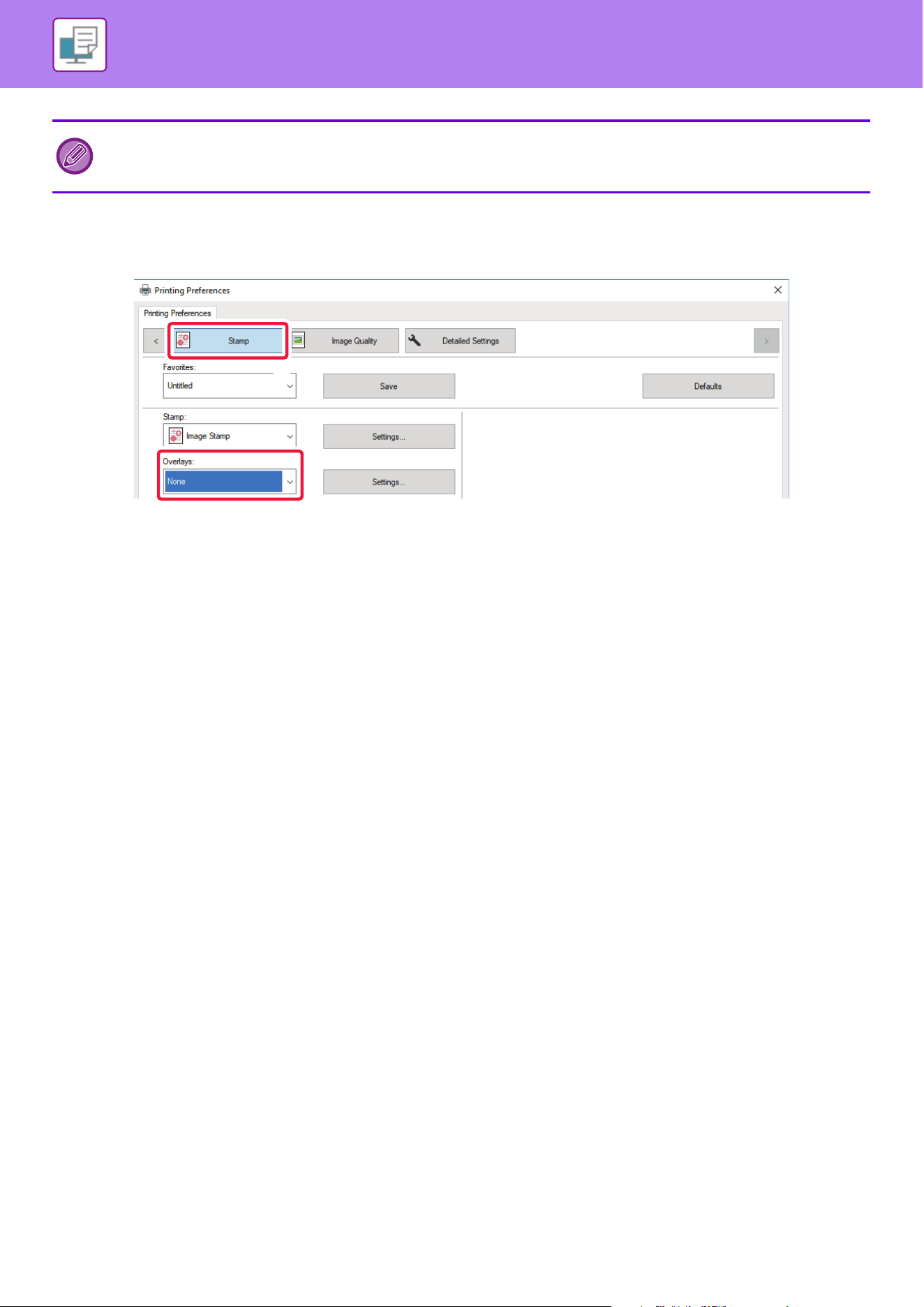
3-42
PRINTER►CONVENIENT PRINTING FUNCTIONS
Printing with an overlay file
(1) Open the driver properties window from the application that is used for printing with an overlay
file.
(2) Click the [Stamp] tab.
(3) Select an overlay file.
A previously created or stored overlay file can be selected from the menu.
• When printing is started, a confirmation message will appear. The overlay file will not be created until the [Yes] button is
clicked.
• When you click the [Open] button, the existing overlay file is registered.
(3)
(2)
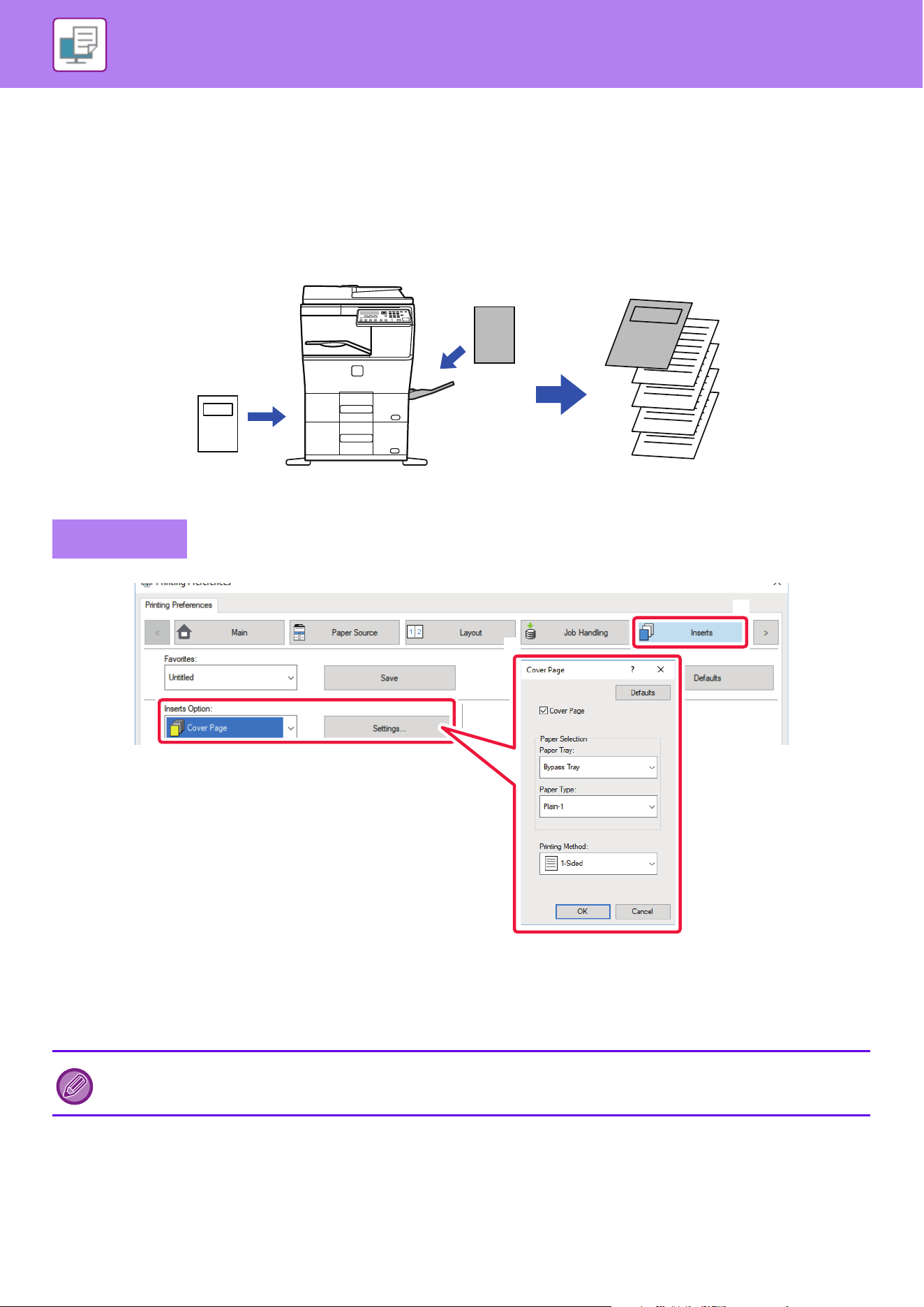
3-43
PRINTER►CONVENIENT PRINTING FUNCTIONS
PRINT FUNCTIONS FOR SPECIAL PURPOSES
INSERTING COVERS (COVER PAGE)
The front cover of a document is printed on paper that is different from the other pages. Use this function when you wish
to print only the front cover on heavy paper.
(1) Click the [Inserts] tab.
(2) Select [Cover Page] from [Inserts Option], and click the [Settings] button.
(3) Select the paper insertion settings.
Enable [Cover Page], and select the paper tray and the paper type you will use.
Windows
When [Bypass Tray] is selected in "Paper Tray", be sure to select the "Paper Type" and load that type of paper in the bypass
tray.
5
4
3
2
1
(2)
(1)
(3)
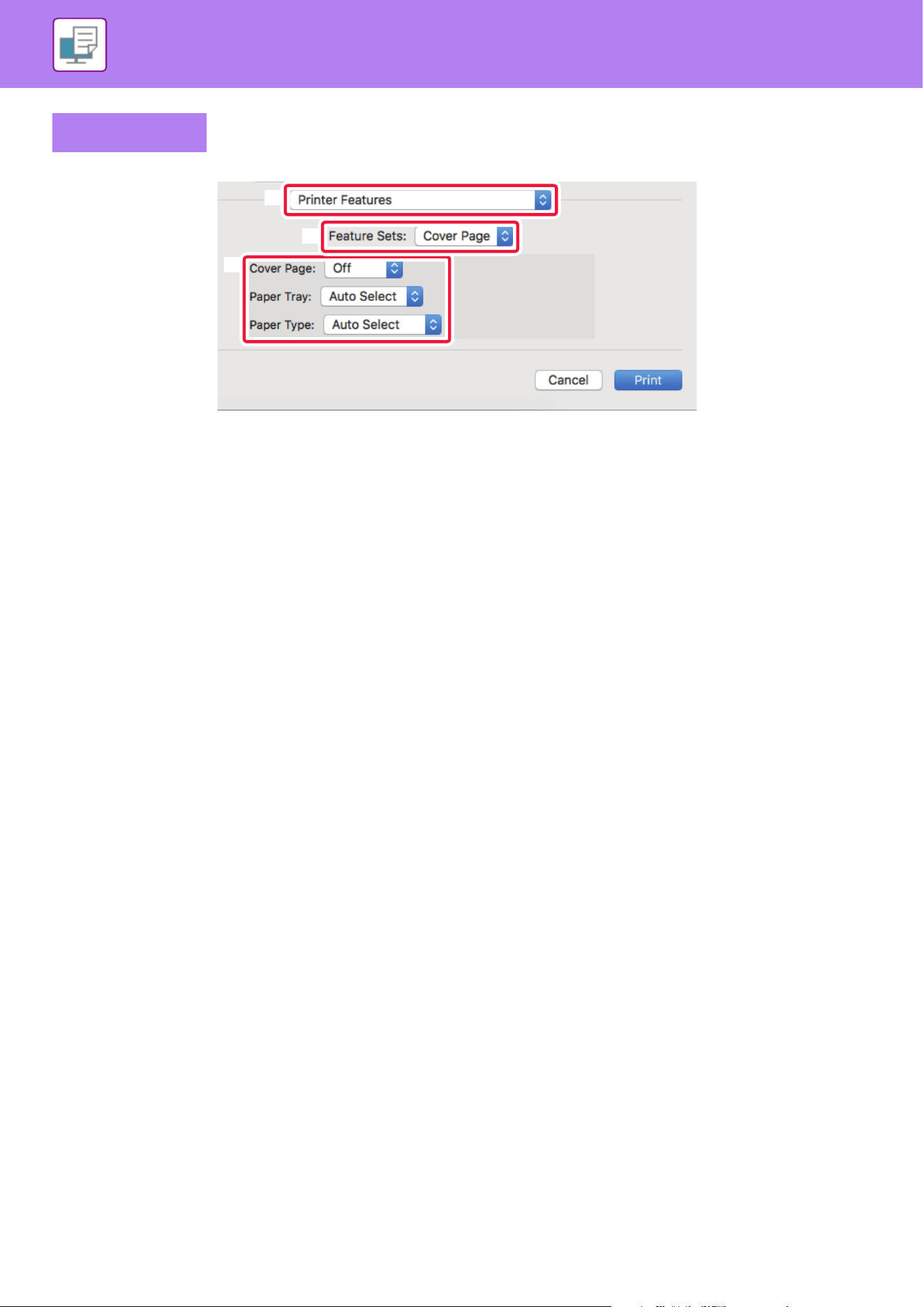
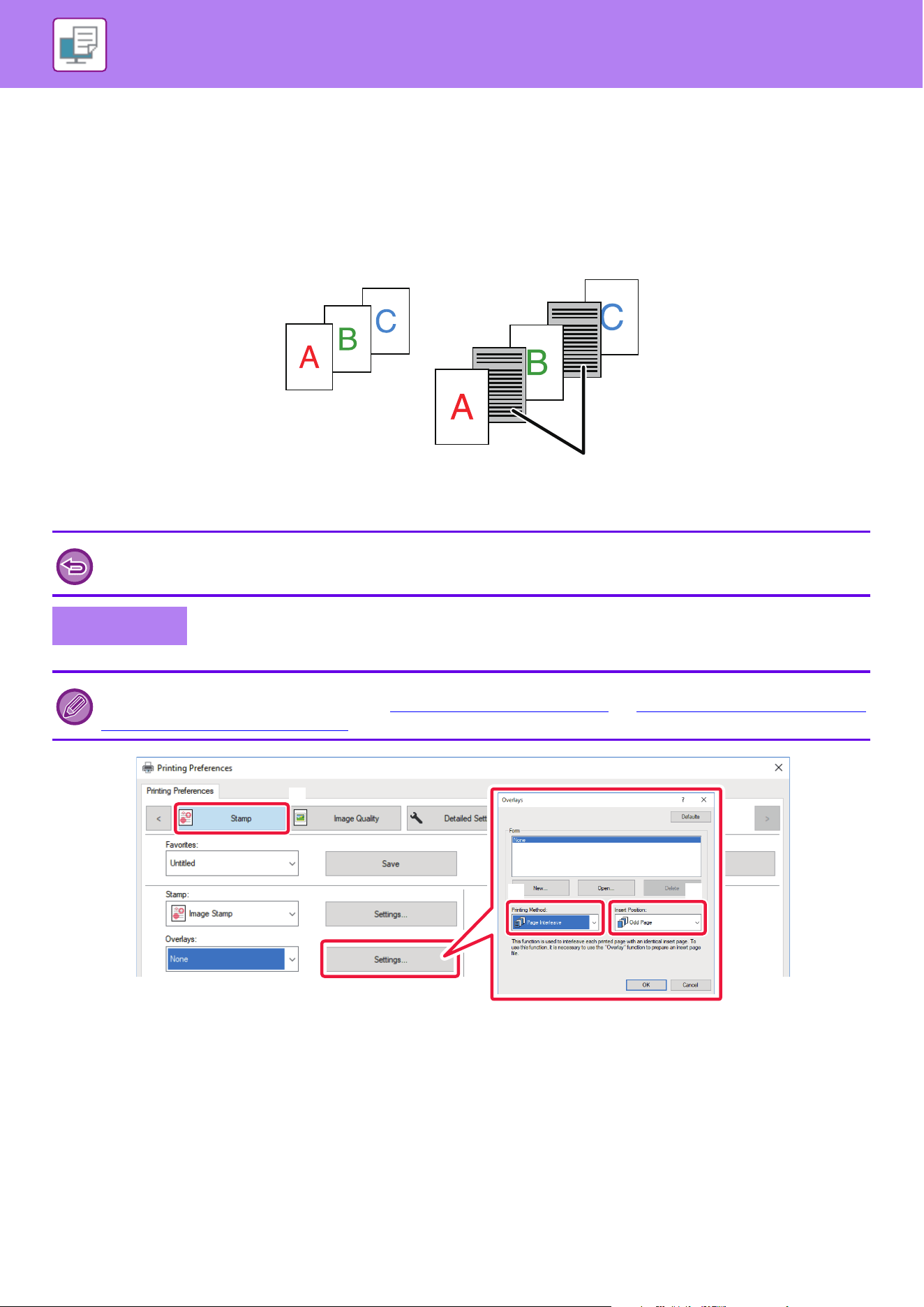
3-45
PRINTER►CONVENIENT PRINTING FUNCTIONS
INSERT PRESET DATA BEFORE OR AFTER EACH
PAGE (PAGE INTERLEAVE)
This function inserts a preset data item into every page during printing.
You can easily create documents with opened page spread that is made up of text on the left-hand page and a memo
space on the right-hand page.
(1) Click the [Stamp] tab.
(2) Click the [Settings] button.
(3) Select [Page Interleave] from the "Printing Method".
(4) Set the overlay data to be inserted and set its insertion position.
• This function is available in a Windows environment.
• This function can be used when the PCL6 printer driver is used.
Windows
You have to create page data to be inserted in advance.
For the procedure for creating page data, see "Creating an overlay file (page 3-41)
" in "OVERLAY A FIXED FORM ON THE
PRINT DATA (OVERLAYS) (page 3-41)".
Pre-set data
(2)
(1)
(3)
(4)
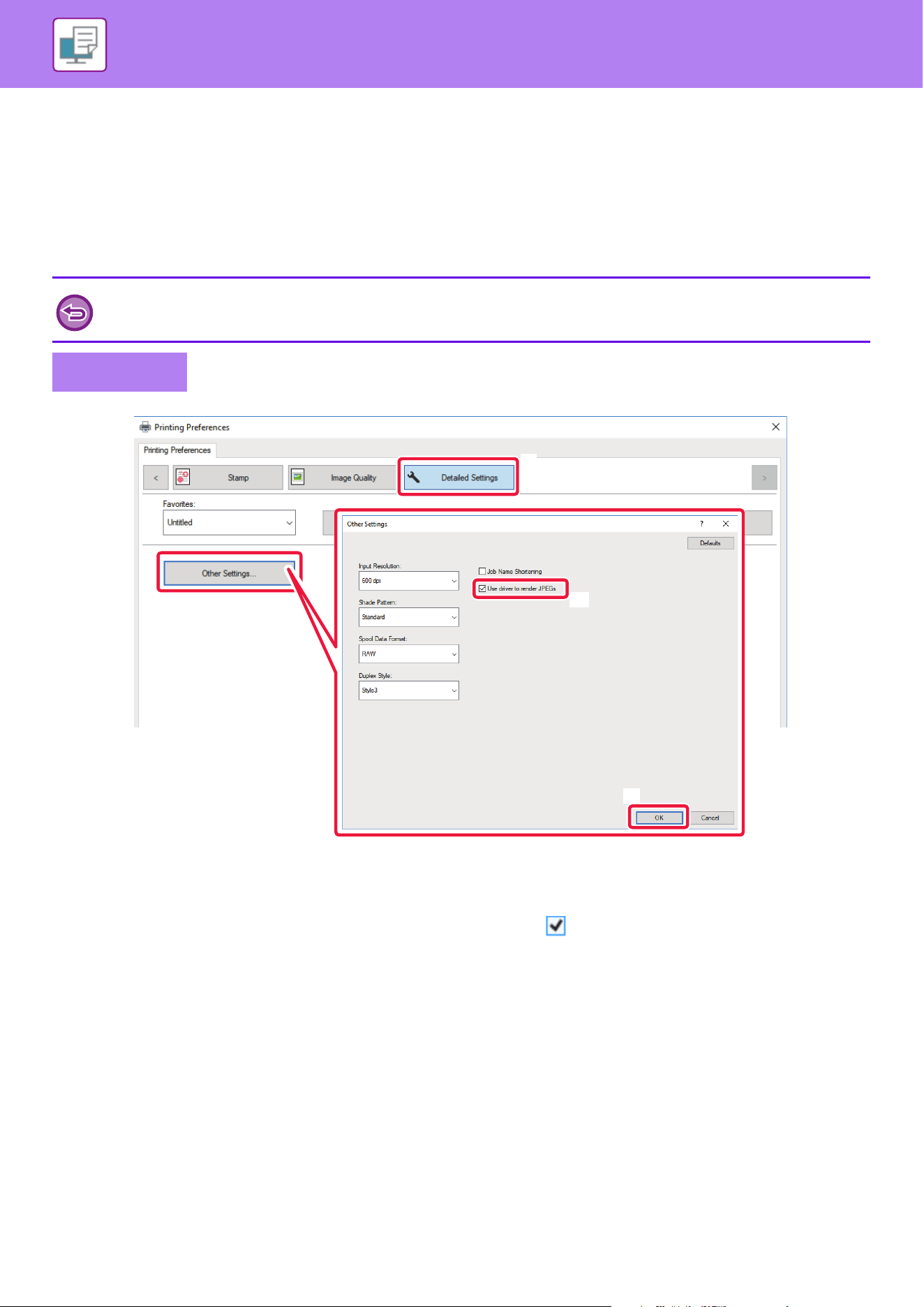
3-46
PRINTER►CONVENIENT PRINTING FUNCTIONS
CHANGING THE RENDERING METHOD AND PRINTING
JPEG IMAGES (USE DRIVER TO RENDER JPEGS)
In some situations, a document containing a JPEG image may not be printed correctly. This can be solved by changing
the way the JPEG image is rendered.
When you print an original containing JPEG images, this function allows you to select whether the images are rendered
in the printer driver or the machine.
(1) Click the [Detailed Settings] tab.
(2) Click the [Other Settings] button.
(3) Click the [Use driver to render JPEGs] checkbox so that appears.
(4) Click the [OK] button.
• This function is available in a Windows environment.
• When images are rendered in the printer driver, it may take time until the printing is completed.
Windows
(2)
(1)
(3)
(4)
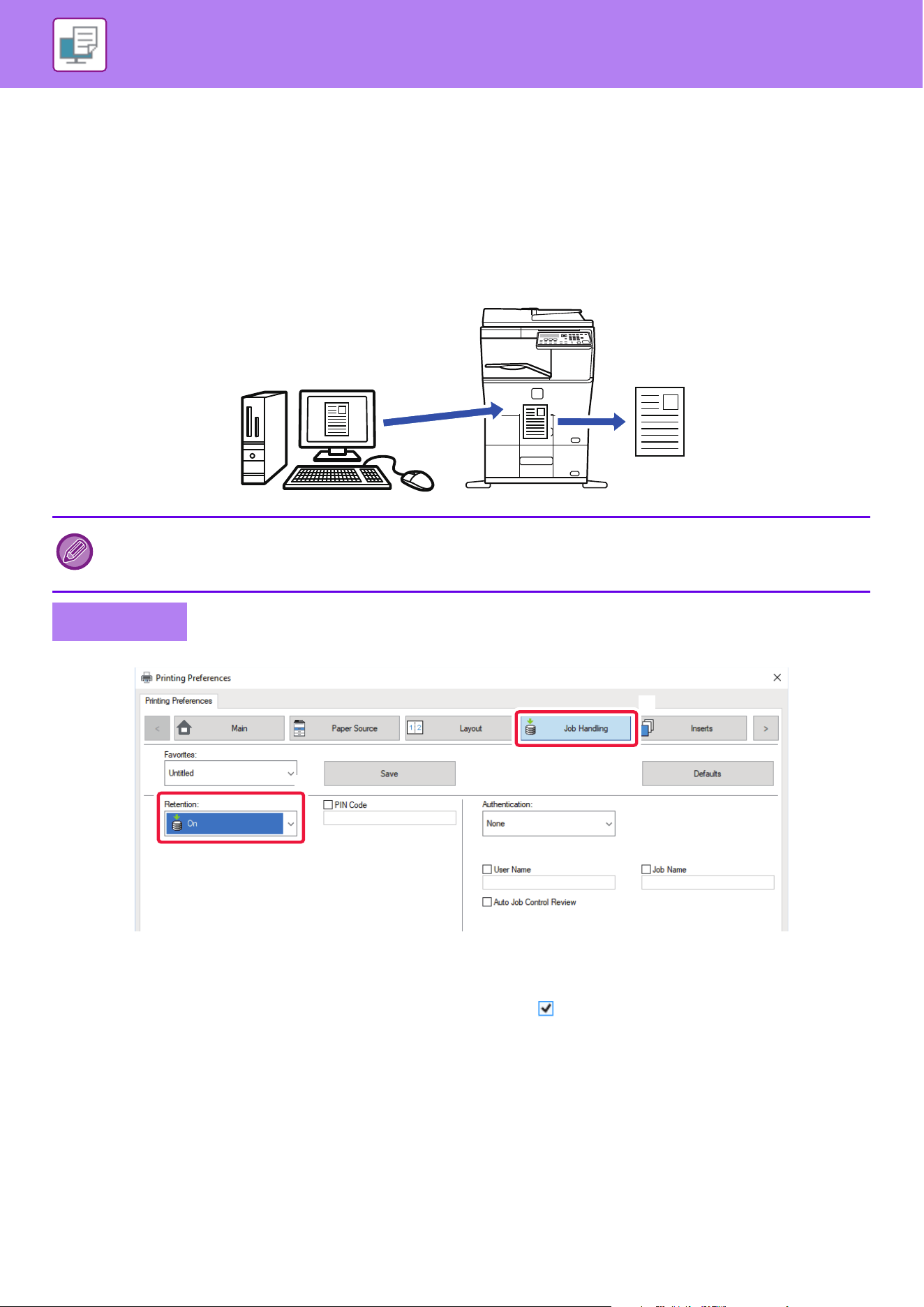
3-47
PRINTER►CONVENIENT PRINTING FUNCTIONS
CONVENIENT PRINTER FUNCTIONS
SAVING AND USING PRINT FILES (RETENTION)
This function is used to store a print job as a file on the machine, allowing the job to be printed from the operation panel.
When printing from a computer, a PIN code (5 to 8 digits) can be set to maintain the secrecy of information in a stored
file.
When a PIN code is set, the PIN code must be entered to print a stored file from the machine.
(1) Click the [Job Handling] tab.
(2) Select [On] in "Retention".
To enter a PIN code (5 to 8 digit number), click the [PIN Code] checkbox .
• Print data is erased when the power is turned off.
• Print data that exceeds 5 MB cannot be saved.
• A maximum of 5 files can be saved.
Windows
(2)
(1)
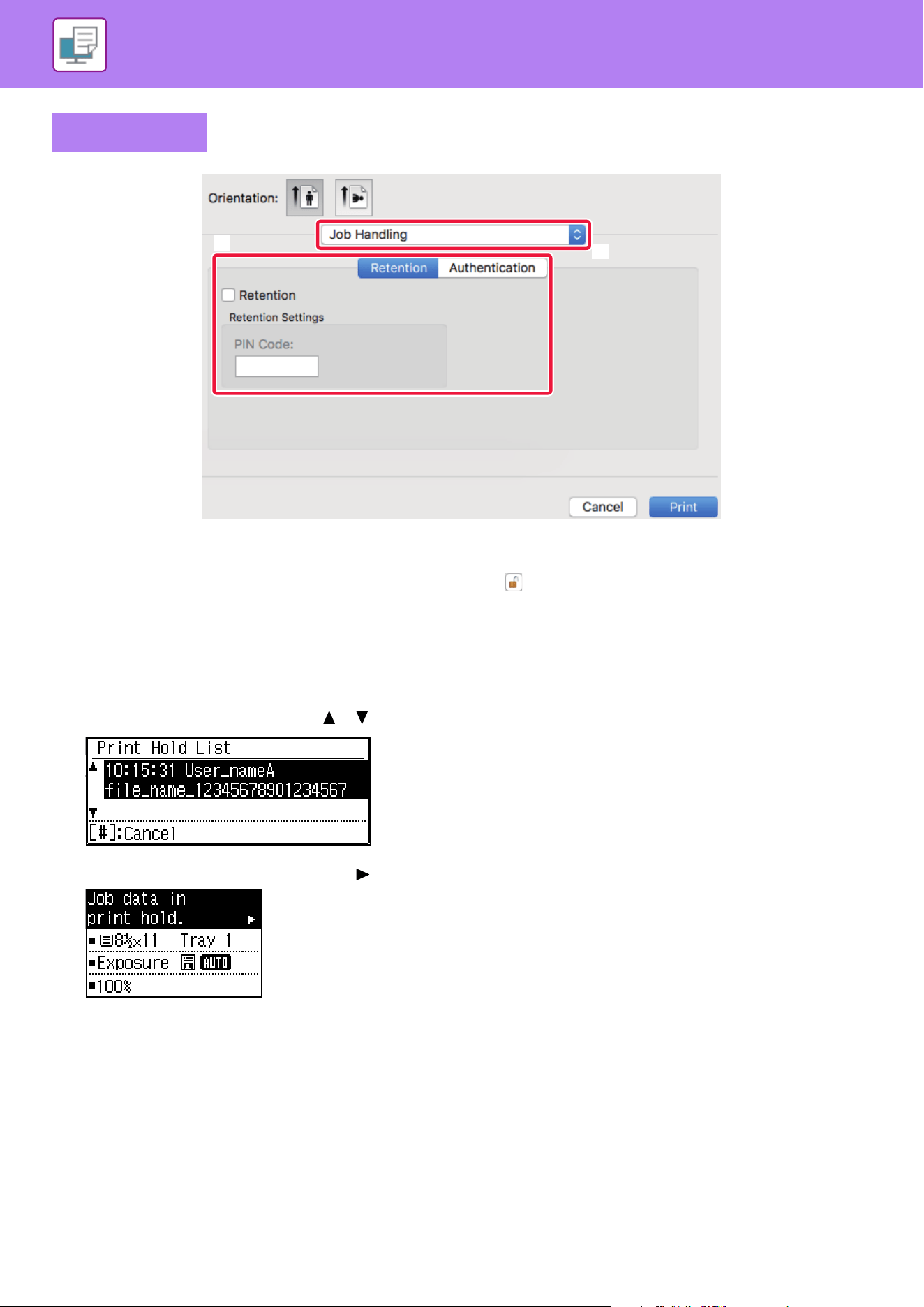
3-48
PRINTER►CONVENIENT PRINTING FUNCTIONS
(1) Select [Job Handling].
(2) Select [Retention].
After you have entered a PIN code (a 5 to 8-digit number), click the button to lock the PIN code. This allows you to readily
set the same PIN code the next time you use it.
Printing a job stored by retention
When retention is performed, the display appears as follows:
(1) Select the print job with the [ ][ ] keys.
If the screen appears as below, press the [ ] key to display the list of print hold jobs.
(2) Press the [OK] key.
Mac OS
(2)
(1)
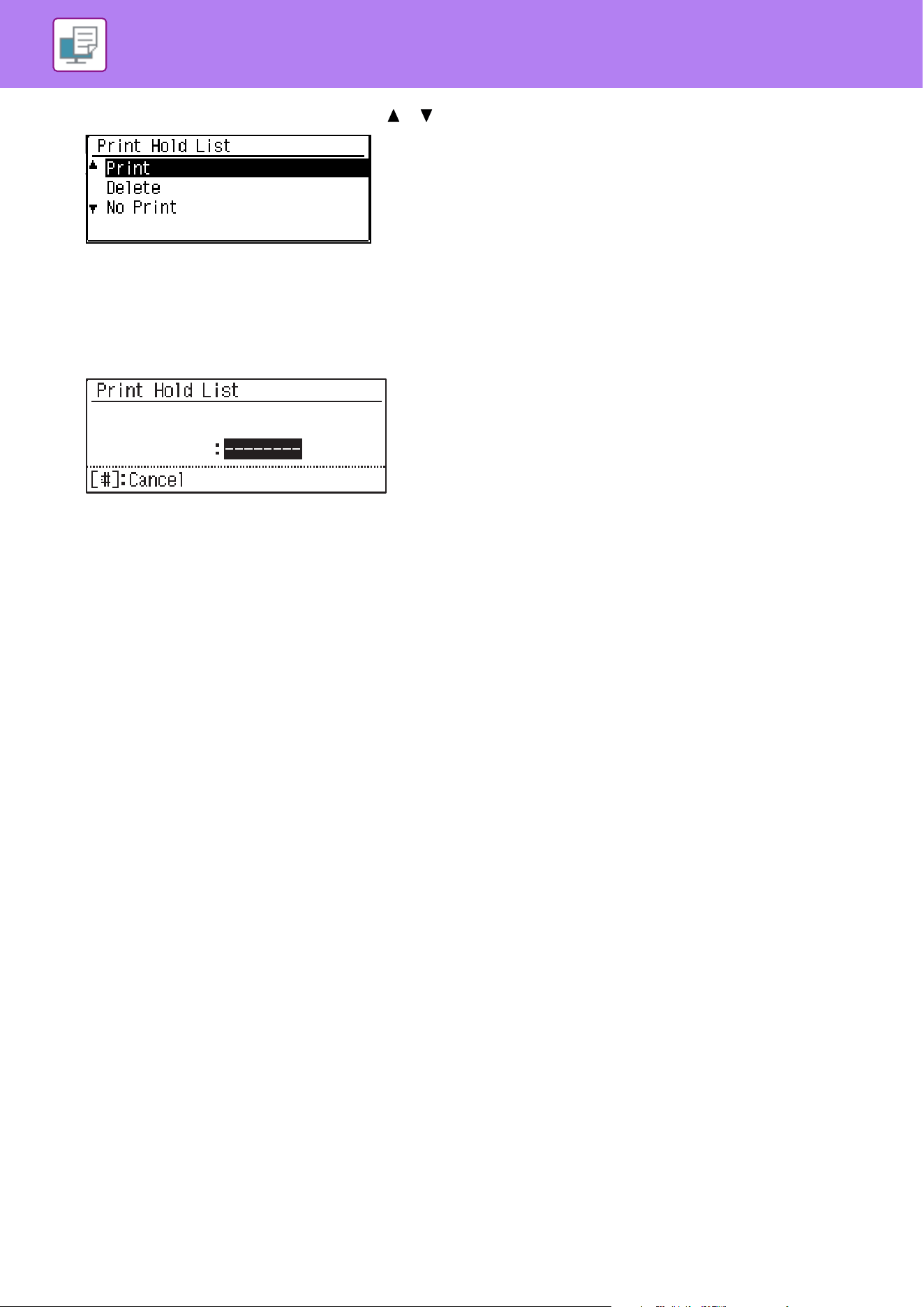
3-49
PRINTER►CONVENIENT PRINTING FUNCTIONS
(3) Print or delete the print job with the [ ][ ] keys.
Select "Print" to print the job.
Select "Delete" to delete the job without printing it.
Selecting "No Print" returns you to step 1.
(4) Press the [OK] key.
The print job is printed or deleted. If a PIN code is set, the job will be printed or deleted after you enter the PIN code with the
numeric keys and press the [OK] key.
Please enter Pin code.
Pin code
3-50
PRINTER►PRINTING WITHOUT THE PRINTER DRIVER
EXTENSION OF PRINTABLE FILES
When you do not have the printer driver installed on your PC, or when the application used to open a file that you wish to
print is not available, you can print directly to the machine without using the printer driver.
The file types (and corresponding extensions) that can be printed directly are shown below.
PRINTING WITHOUT THE PRINTER
DRIVER
File Type TIFF JPEG PCL PS
PDF,
Encrypt PDF,
Compact PDF,
PDF/A,
Compact PDF/A
Extension tiff, tif jpeg, jpg, jpe, jfif pcl, prn, txt ps, prn pdf
• Some files may not print correctly even if shown in the above table.
• A PDF that has a password cannot be printed.
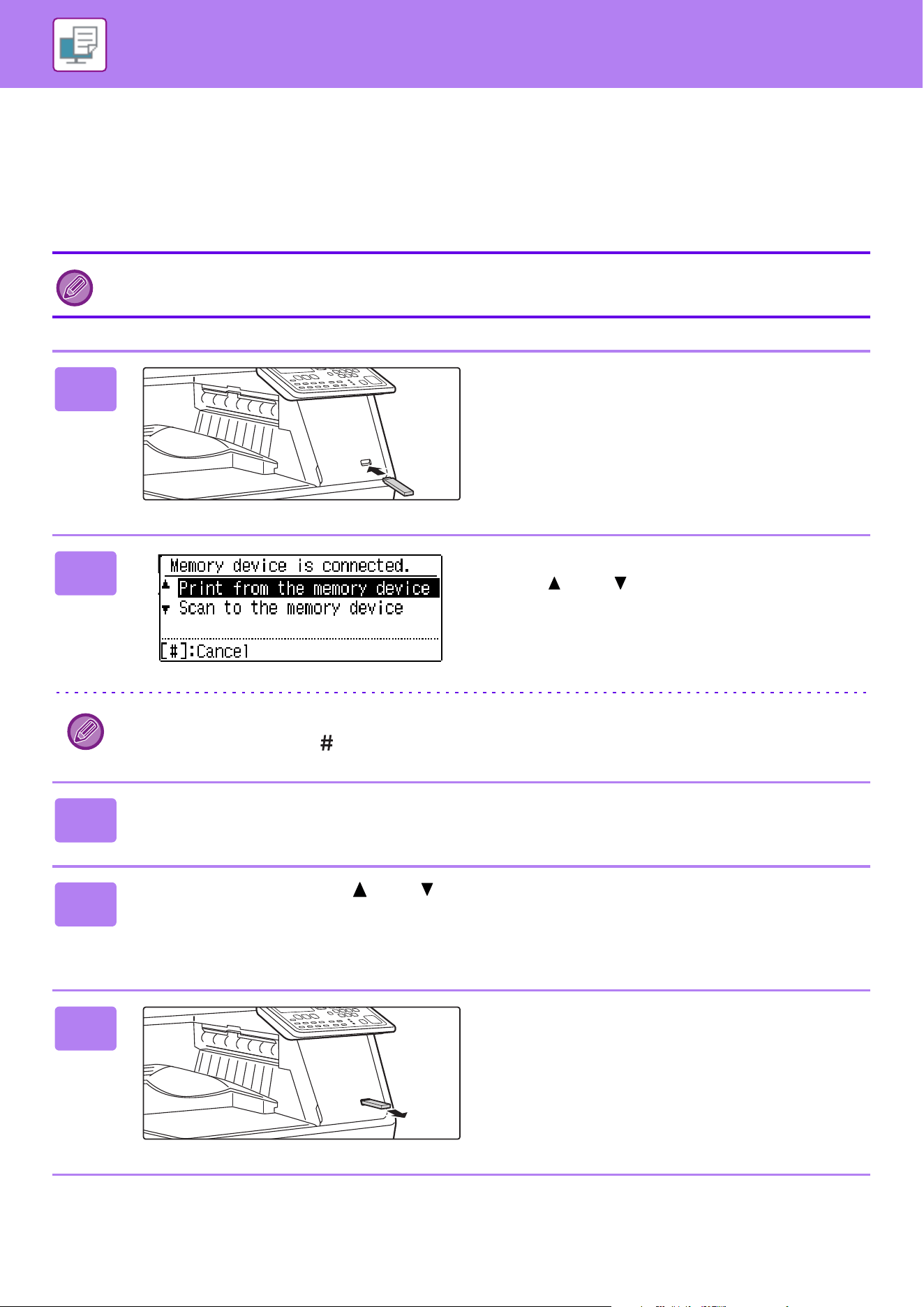
3-51
PRINTER►PRINTING WITHOUT THE PRINTER DRIVER
DIRECTLY PRINTING A FILE IN USB MEMORY
Files in a USB memory device connected to the machine are printed from the operation panel of the machine without
using the printer driver.
When the printer driver of the machine is not installed on your PC, you can copy a file into a commercially available USB
memory device and connect the device to the machine to print the file directly.
Use a FAT32 USB memory device with a capacity of no more than 32 GB.
1
Connect the USB memory device to
the machine.
2
Select "Print from the memory device"
with [ ] or [ ] key, and select the file
that you wish to print.
A name with "/" to its left is the name of a folder in the USB
memory. To display the files and folders in a folder, select
the folder and press the [OK] key.
• A total of 100 files and folders can be displayed.
• Press the [READ-END] key ( ) to move up one folder level.
3
Press the [OK] key.
4
Select "Print" with the [ ] or [ ] key and then press the [OK] key.
When forwarding of the selected file is completed, printing starts.
Print settings can be selected in the machine’s Web page. However, if a file that includes print settings (PCL, PS) is
selected, the file’s print settings will be applied.
5
Remove the USB memory device from
the machine.

3-53
PRINTER►PRINTING WITHOUT THE PRINTER DRIVER
DIRECTLY PRINTING FROM A COMPUTER
FTP PRINT
You can print a file from your PC by simply dragging and dropping the file onto the FTP server of the machine.
Performing FTP print
Type "ftp://" and then the IP address of the machine in the address bar of your PC's Web browser as shown below.
Example: ftp://192.168.1.28
In Windows, enter ftp://<IP address of machine> in Explorer, and drag and drop the file you want to print to that window.
Printing will automatically begin.
• If you selected a PS or PCL file that includes print conditions, the print conditions in the file will be given priority.
• When user authentication is enabled in the settings of the machine, the print function may be restricted. For more
information, ask your administrator.
3-54
PRINTER►APPENDIX
PRINTER DRIVER SPECIFICATIONS LIST
For information on the setting items, refer to printer driver Help.
► PRINTER DRIVER SETTINGS SCREEN / REFERRING TO HELP (page 3-6)
APPENDIX
Function PCL6 PS Windows
PPD
*1
Mac OS
PPD
*1
Tab
(Windows)
Item Page
Main
Copies - 1 - 999 1 - 999 1 - 999 1 - 999
Collate - Yes Yes Yes Yes
Original Size 3-4 Yes Yes Yes Yes
Output Size 3-4 Yes Yes No No
Orientation 3-30 Yes Yes Yes Yes
Scale to fit Paper Size 3-20 No No No Yes
Zoom 3-31 Yes*
2
Yes No No
2-Sided 3-19 Yes Yes Yes Yes
N-Up 3-22
2, 4, 6, 8, 9, 16 2, 4, 6, 8, 9, 16
2, 4, 6, 9, 16 2, 4, 6, 9, 16
Staple - No No No No
Document Filing - No No No No
Retention 3-47 Yes Yes No Yes
Color Mode - No No No No
Paper
Source
Output Size 3-4 Yes Yes No No
Paper Tray 3-7 Yes Yes Yes Yes
Paper Type 3-7 Yes Yes Yes Yes
Tray Status 3-7 Yes Yes No No
Finishing
Staple - No No No No
Punch - No No No No
Fold - No No No No
Offset - No No No No
Output - No No No No
Separator Page - No No No No
3-55
PRINTER►APPENDIX
Layout
2-Sided 3-19 Yes Yes Yes Yes
Chapter Inserts - No No No No
Booklet 3-24 Yes Yes Yes Yes
N-Up
Page No. 3-22
2, 4, 6, 8, 9, 16 2, 4, 6, 8, 9, 16
2, 4, 6, 9, 16 2, 4, 6, 9, 16
Repeat - No No No No
Order 3-22 Yes Yes No Yes
Border 3-22 Yes Yes No Yes
N-Up with
cover
3-22 Yes No No No
100% N-Up 3-22 Yes Yes No No
Poster Printing 3-28 Yes Yes No No
Print Position
Margin Shift 3-26
0 inch to 1.2
inch (10mm
to 30mm)
0 inch to 1.2
inch (10mm
to 30mm)
Yes Yes
Tab Shift - No No No No
Custom 3-29 Yes Yes No No
Job Handling
Print Release - No No No No
Document Filing - No No No No
Create PDF for PC Browsing - No No No No
Print and Send - No No No No
Notify Job End - No No No No
Retention 3-47 Yes Yes No Yes
Authentication 3-9 Yes Yes No Yes
Inserts
Cover 3-43 Yes Yes Yes Yes
Transparency Inserts - No No No No
Carbon Copy - No No No No
Tab Paper - No No No No
Stamp
Watermark 3-38 Yes Yes Yes Yes
Image Stamp 3-40 Yes Yes No No
Overlay 3-41 Yes Yes No No
Hidden Pattern - No No No No
Copies Stamp - No No No No
Image
Quality
Print Mode 3-18 Yes Yes Yes Yes
Graphics Mode - Yes No No No
Bitmap Compression - Yes Yes No No
Sharpness - No No No No
Screening 3-36 Yes Yes Yes Yes
Smoothing - No No No No
Text To Black 3-35 Yes Yes No No
Function PCL6 PS Windows
PPD
*1
Mac OS
PPD
*1
Tab
(Windows)
Item Page
3-56
PRINTER►APPENDIX
*1 The specifications of each function in Windows PPD and Mac OS PPD vary depending on the operating system
version and the application.
*2 The horizontal and vertical proportion cannot be set separately.
*3 This setting may not operate in some applications and operating systems.
Image
Quality
Vector To Black 3-35 Yes Yes No No
Toner Save
*3
- Yes Yes Yes Yes
Color Mode - No No No No
Image Type - No No No No
Advanced Color - No No No No
Image Adjustment 3-34 Yes Yes No No
Font - Yes Yes Yes No
Line Width - No No No No
Boldness Adjustment - No No No No
Detailed
Settings
Mirror Image 3-33 No Yes Yes Yes
PS Error Information - No Yes Yes No
PS Pass-Through - No Yes No No
Job Compression - No Yes No No
Tandem Print - No No No No
Disable Blank Page Print - No No No No
Custom Image Registration - No No No No
Other Settings
• Input Resolution - Yes Yes No No
• Shade Pattern - Yes No No No
• Spool Data Format - Yes Yes No No
• Printable Area - No No No No
• Rip Style - No No No No
• Duplex Style 3-19 Yes Yes No No
• CMYK Image Enhancement - No No No No
• Job Name Shortening - Yes Yes No No
• Use driver to render JPEGs 3-46 Yes Yes No No
• Thicken Fine Lines - No No No No
•Fine Text - No No No No
• Fine Edge - No No No No
• Text/Line control - No No No No
• Text/Line knockout control - No No No No
• Photo Image - No No No No
• Image Enhancement - No No No No
Function PCL6 PS Windows
PPD
*1
Mac OS
PPD
*1
Tab
(Windows)
Item Page

4-1
BEFORE USING THE MACHINE AS A FAX
TO USE THIS PRODUCT CORRECTLY AS A
FACSIMILE. . . . . . . . . . . . . . . . . . . . . . . . . . . . . . . . 4-2
POINTS TO CHECK AND PROGRAM AFTER
INSTALLATION . . . . . . . . . . . . . . . . . . . . . . . . . . . . 4-3
BASIC TRANSMISSION METHODS
FAX MODE (BASE SCREEN) . . . . . . . . . . . . . . . . . 4-4
ORIGINALS . . . . . . . . . . . . . . . . . . . . . . . . . . . . . . . 4-5
• ORIGINALS THAT CAN BE FAXED . . . . . . . . . 4-5
CONVENIENT DIALING METHODS
(AUTO-DIALING) . . . . . . . . . . . . . . . . . . . . . . . . . . . 4-6
FAX TRANSMISSION METHODS . . . . . . . . . . . . . . 4-7
• ADDRESS REVIEW FUNCTION. . . . . . . . . . . . 4-7
SENDING A FAX . . . . . . . . . . . . . . . . . . . . . . . . . . . 4-8
• BASIC PROCEDURE FOR SENDING FAXES . 4-8
• TRANSMISSION BY AUTO-DIALING (SPEED
DIALING AND GROUP DIALING). . . . . . . . . . . 4-12
• SEARCHING FOR A PROGRAMMED
DESTINATION (USING THE [ADDRESS] KEY) 4-13
• FAXING A TWO-SIDED ORIGINAL . . . . . . . . . 4-14
• HOW TO SELECT THE RESOLUTION . . . . . . 4-19
• CHANGING THE EXPOSURE . . . . . . . . . . . . . 4-20
• CANCELING A FAX TRANSMISSION . . . . . . . 4-21
FAX RECEPTION
RECEIVING FAXES . . . . . . . . . . . . . . . . . . . . . . . . . 4-25
• RECEIVING A FAX . . . . . . . . . . . . . . . . . . . . . . 4-25
• MANUAL FAX RECEPTION . . . . . . . . . . . . . . . 4-27
CONVENIENT FAX FUNCTIONS
FUNCTION KEY . . . . . . . . . . . . . . . . . . . . . . . . . . . . 4-28
• FAX PRINT HOLD FUNCTION . . . . . . . . . . . . . 4-28
• AUTOMATIC TRANSMISSION AT A
SPECIFIED TIME . . . . . . . . . . . . . . . . . . . . . . . 4-29
• SENDING THE SAME DOCUMENT TO
MULTIPLE DESTINATIONS IN A SINGLE
OPERATION . . . . . . . . . . . . . . . . . . . . . . . . . . . 4-30
• SENDING OPTIONS . . . . . . . . . . . . . . . . . . . . . 4-32
• POLLING MEMORY. . . . . . . . . . . . . . . . . . . . . 4-34
• STORING, EDITING, AND DELETING
AUTO-DIAL NUMBERS (SPEED DIAL
NUMBERS, AND GROUP DIALS) . . . . . . . . . . 4-37
• STORING, EDITING AND DELETING
PROGRAMS. . . . . . . . . . . . . . . . . . . . . . . . . . . 4-43
PRINTING LISTS OF PROGRAMMED
INFORMATION AND SETTINGS . . . . . . . . . . . . . . 4-45
• INCLUDING SENDER INFORMATION ON
FAXES (OWN NUMBER SENDING) . . . . . . . . 4-46
• FORWARDING FUNCTION . . . . . . . . . . . . . . . 4-47
USING SETTINGS STORED AS A PROGRAM . . . 4-49
• USING A PROGRAM . . . . . . . . . . . . . . . . . . . . 4-49
FORWARDING RECEIVED DATA TO A
NETWORK ADDRESS (INBOUND ROUTING
SETTINGS) . . . . . . . . . . . . . . . . . . . . . . . . . . . . . . . 4-50
• CONFIGURING THE BASIC SETTINGS . . . . . 4-50
• SETTINGS THE DESTINATION . . . . . . . . . . . 4-52
SENDING A FAX DIRECTLY FROM A COMPUTER
(PC-Fax) . . . . . . . . . . . . . . . . . . . . . . . . . . . . . . . . . 4-54
USING AN EXTENSION PHONE
CONNECTING AN EXTENSION PHONE. . . . . . . . 4-55
• CONNECTING AN EXTENSION PHONE . . . . 4-55
• USING AN EXTENSION PHONE. . . . . . . . . . . 4-56
OTHER FUNCTIONS
WHEN A TRANSACTION REPORT IS PRINTED . 4-58
• INFORMATION APPEARING IN THE
TYPE/NOTE COLUMN. . . . . . . . . . . . . . . . . . . 4-58
REPORT AT REGULAR INTERVALS
(COMMUNICATION ACTIVITY REPORT) . . . . . . . 4-60
WHEN AN ALARM SOUNDS AND A WARNING
MESSAGE IS DISPLAYED. . . . . . . . . . . . . . . . . . . 4-60
• SELF-DIAGNOSTIC FUNCTION . . . . . . . . . . . 4-60
• MESSAGES DURING NORMAL OPERATION 4-61
FACSIMILE
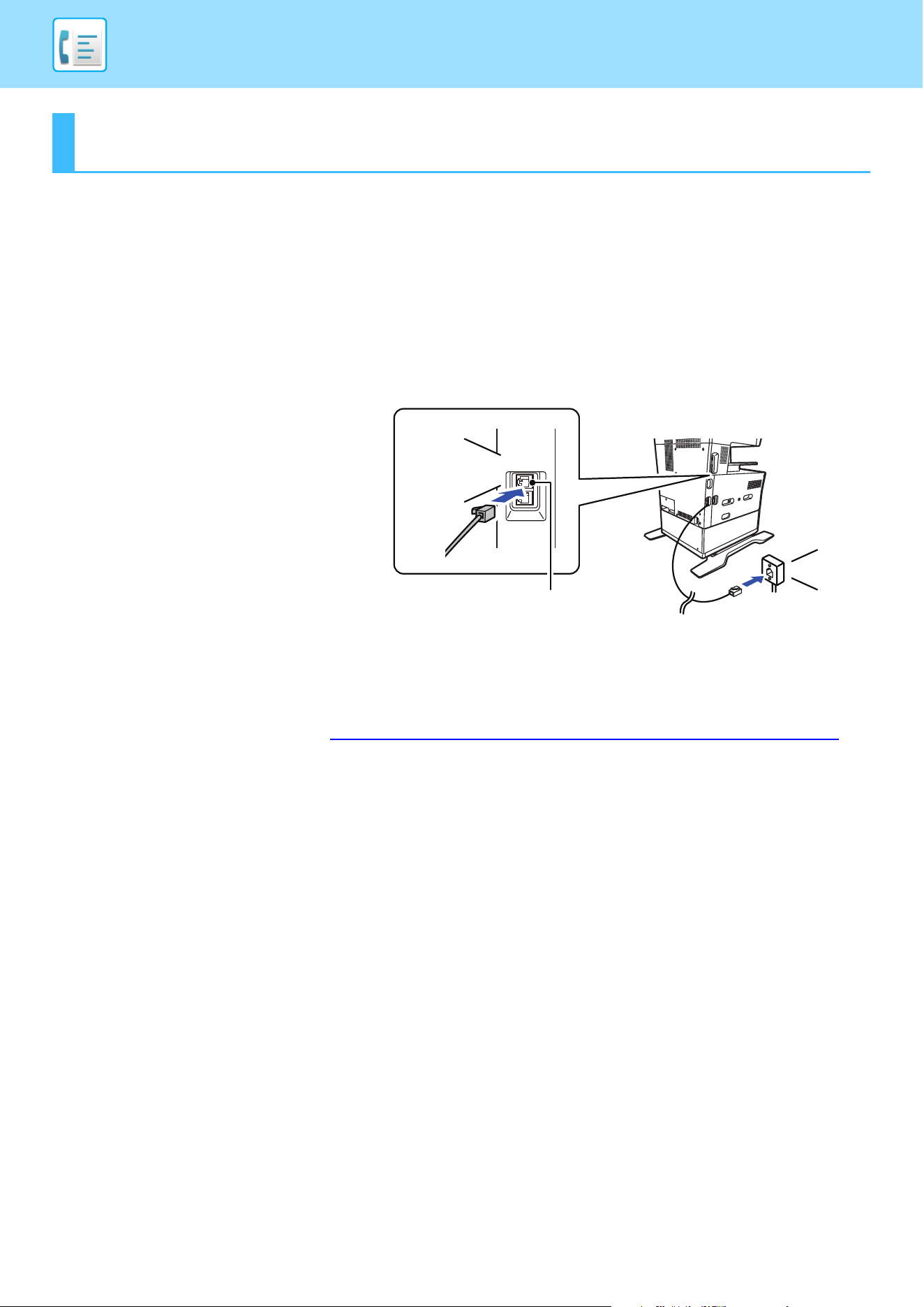
4-2
FACSIMILE►BEFORE USING THE MACHINE AS A FAX
TO USE THIS PRODUCT CORRECTLY AS A
FACSIMILE
Several points must be kept in mind when using this product as a facsimile.
Please note the following.
Line connection
Be sure to use the provided telephone line
cord to connect the machine to a telephone
line jack. Insert one end of the telephone line
cord into the LINE jack on the left side of the
machine as shown. Insert the other end of the
telephone line cord into a telephone line jack.
Insert the plug firmly until you hear a "click".
Setting the date and time and programming your sender's name and
number
Before using the fax function, you must set the date and time and program your sender's name and number in the
machine. This procedure is explained in POINTS TO CHECK AND PROGRAM AFTER INSTALLATION
(page 4-3) of
this manual.
Lithium battery
The date and time are protected by a lithium battery in the machine.
• When the battery dies, please contact your local Sharp dealer or SHARP Service Department for assistance in
disposing of this battery. The machine will not operate once the battery dies.
Please note
In the event of a thunderstorm, remove the power cord from the power outlet to ensure safety. Information will be
retained in memory even if the power cord is unplugged.
BEFORE USING THE MACHINE AS A FAX
LINE jack
Clicks
Clicks
4-3
FACSIMILE►BEFORE USING THE MACHINE AS A FAX
POINTS TO CHECK AND PROGRAM AFTER
INSTALLATION
After installing the machine and before using it as a fax machine, check the following points and program the required
information.
Set the date and time
The machine has an internal clock. It is important to set the correct date and time because they are used for such
features as Timer Transmission. (►page 4-29)
The date and time are set in the system settings. (►page 7-10)
The date and time appear in the display. Make sure the correct date and time appear. If the date and time are wrong,
please correct them.
Program the sender's name and sender's number
The name and fax number of the user of the machine is programmed in Own Passcode Set (page 7-19) in the system
settings. (Only one name and number can be programmed.)
The programmed name and number are printed at the top of each transmitted fax page. The sender's number is also
used as an identification number when you use the Polling function to request transmission from another fax machine
(see SENDING OPTIONS
(page 4-32)).
Paper sizes that can be used for fax mode
The machine can use 8-1/2" x 14", 8-1/2" x 13", 8-1/2"x13-2/5", 8-1/2"x13-1/2", 8-1/2" x 11", 5-1/2"x 8-1/2", A4, B5 and
A5 size paper; (8-1/2"x13-1/2", 5-1/2"x 8-1/2", B5 and A5 size paper cannot be used in fax mode.)
For this reason, if only paper sizes that can be used in other modes but not in fax mode are loaded in the machine,
received faxes cannot be printed.
(For other points regarding fax reception, see RECEIVING FAXES
(page 4-25).)
You can check your programmed name and number by printing out the "Administrator Settings List" in the system settings.
► List Setting
(page 7-18)
For the procedures for loading paper in the trays, LOADING PAPER (page 1-17).
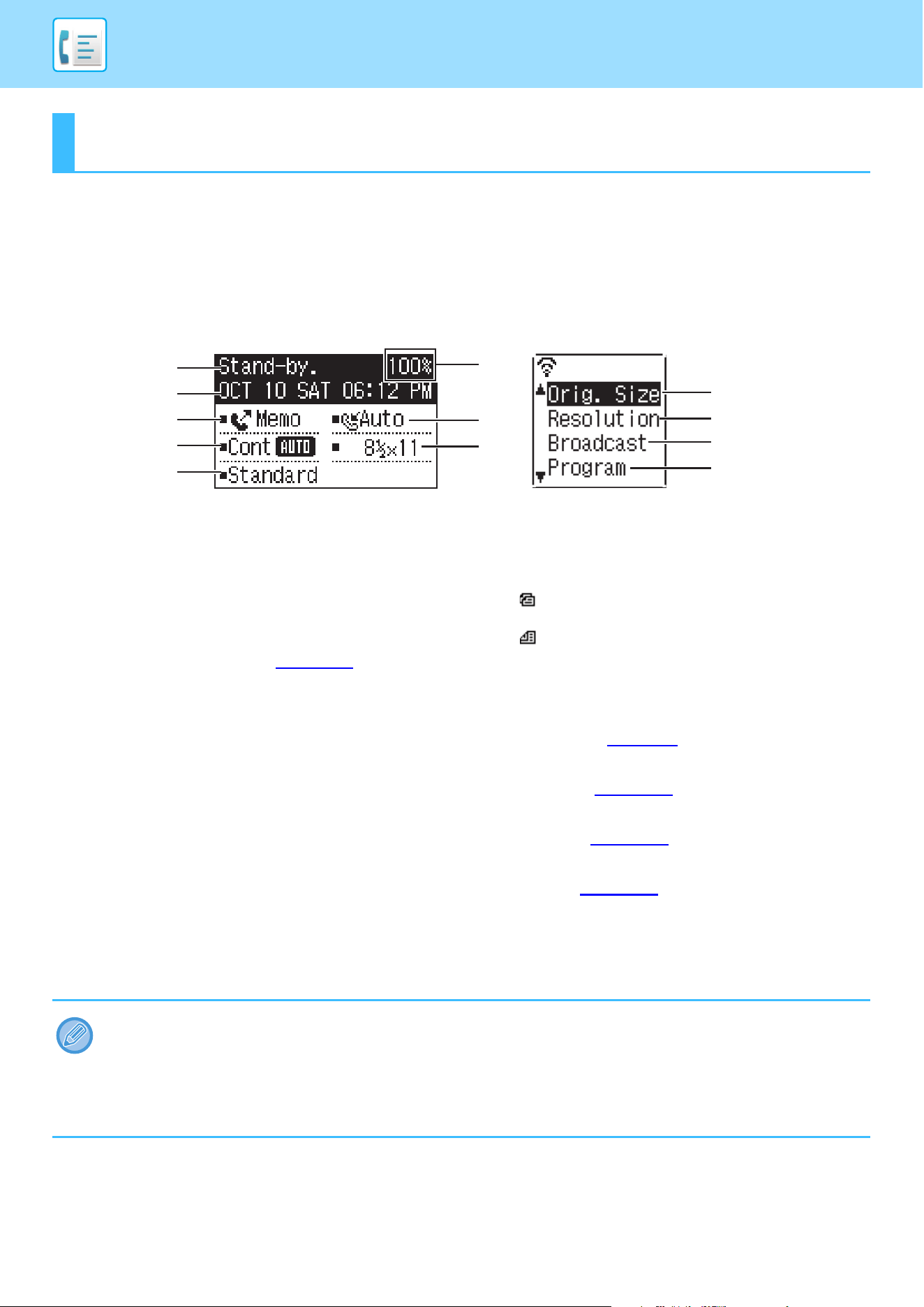
4-4
FACSIMILE►BASIC TRANSMISSION METHODS
FAX MODE (BASE SCREEN)
The base screen of fax mode is displayed by pressing the [FAX] key when the copy mode, or scan mode screen
appears.
The base screen of fax mode
(1) Message display
Messages appear here to indicate the current status of
the machine.
(2) Date and time display
This shows the date and time.
(3) Transmission mode display ►page 4-15
There are three transmission modes: memory
transmission, direct transmission, and manual
transmission. This shows the currently selected
transmission mode.
(4) Exposure display
This shows the exposure for scanning the original.
(5) Resolution display
This shows the resolution for scanning the original.
(6) Free memory display
This shows the percentage of fax memory that is free.
(7) Reception mode display
There are two modes for receiving faxes: automatic
reception and manual reception.
This shows the currently selected reception mode.
(8) Original display
This displays an icon to indicate the original scanning
mode when an original has been placed.
: One-sided original scanning in the document
feeder.
: Two-sided original scanning in the document
feeder.
None: Document glass
This also shows the currently selected original scanning
size.
(9) Original Size ►page 4-8
This is used to set the original scanning size.
(10) Resolution ►page 4-19
This menu is used to select resolution settings.
(11) Broadcast ►page 4-30
This is used to perform a broadcast transmission.
(12) Program ►page 4-43
Select this menu to use a program.
BASIC TRANSMISSION METHODS
(2)
(3)
(4)
(5)
(1)
(7)
(8)
(9)
(10)
(11)
(12)
(6)
Left Menu Right Menu
The following functions also operate when a mode other than fax mode is selected:
• Automatic reception
• Manual reception
• Timer Transmission
• Transmission of stored memory transmission jobs
• Voice calls (when the extension phone is installed)
• Remote reception
4-5
FACSIMILE►BASIC TRANSMISSION METHODS
ORIGINALS
ORIGINALS THAT CAN BE FAXED
For originals that can be set, see HOW TO PLACE THE ORIGINAL (page 1-30).
* Long originals
Depending on the resolution setting and the width of the original, there may not be sufficient space in memory to hold
a long original. When a long original cannot be entirely scanned, use direct transmission or manual transmission
(on-hook dialing).
Originals 8-1/2" x 14" or 8-1/2" x 11"or A4 can be placed in the document glass and 8-1/2"/A4 width and up to 500mm long
can be placed in the automatic document feeder.
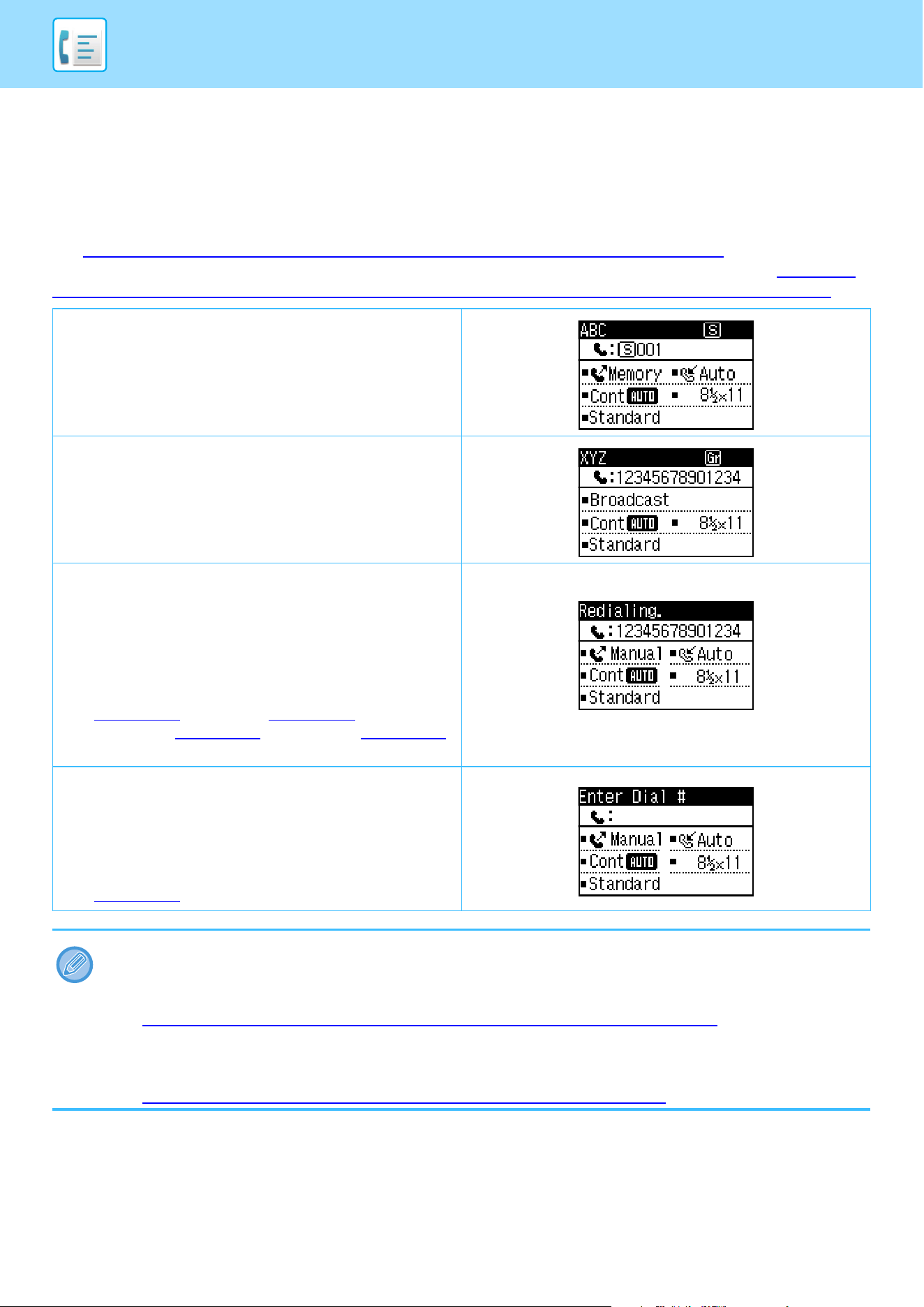
4-6
FACSIMILE►BASIC TRANSMISSION METHODS
CONVENIENT DIALING METHODS
(AUTO-DIALING)
The fax function includes a convenient auto dial feature (Speed dialing and group dialing). By programming frequently
dialed numbers, you can call and send faxes to these locations by means of a simple dialing operation.
► TRANSMISSION BY AUTO-DIALING (SPEED DIALING AND GROUP DIALING) (page 4-12)
There are two types of auto-dialing: Speed dialing, and group dialing. To program auto-dial numbers, see STORING,
EDITING, AND DELETING AUTO-DIAL NUMBERS (SPEED DIAL NUMBERS, AND GROUP DIALS) (page 4-37).
• Speed dialing (300 stations)
A stored destination can be dialed by pressing the [SPEED]
key, entering a 3-digit number (000 to 299), and pressing
the [START] key. A name (maximum 36 characters) can be
stored for each destination.
• Group dialing
Multiple numbers can be stored in a Speed Dial number.
This is convenient for communicating with a group of other
fax machines.
• Redialing
The machine retains the last fax or phone number dialed.
This number can be redialed by simply pressing the
[REDIAL] key and then the [START] key.
• If you pressed a numeric key during the previous call, the
[REDIAL] key may not dial the correct number.
• Redialing is not possible to broadcast transmission
(►page 4-30)
, serial polling (►page 4-32), timer
transmission (►page 4-29)
or group dialing (►page 4-12)
destinations.
• ON-HOOK DIALING
This feature allows you to dial without lifting an extension
phone connected to the machine.
Press the [SPEAKER] key, listen for the dial tone through
the speaker, and then dial.
• Faxes must be sent manually when using on-hook dialing.
(►page 4-16)
• Up to 100 destinations can be stored in each group dial number, and a combined total of 300 Speed Dial and group dial
numbers can be stored.
• Stored Group dialing and Speed dial destinations can be called up using a search name entered when the key or
destination was stored.
► TRANSMISSION BY AUTO-DIALING (SPEED DIALING AND GROUP DIALING) (page 4-12)
• To prevent dialing a wrong number and sending a fax to an incorrect destination, check the message display carefully
when you store the number. You can also check stored numbers by printing out the programmed information after storing
the number.
► PRINTING LISTS OF PROGRAMMED INFORMATION AND SETTINGS (page 4-45)

4-7
FACSIMILE►BASIC TRANSMISSION METHODS
FAX TRANSMISSION METHODS
There are three basic methods for fax transmission: memory transmission, direct transmission, and manual
transmission. When memory transmission is used, the document is temporarily stored in memory before being
transmitted. When direct transmission or manual transmission is used, the document is transmitted without being stored
in memory.
The default transmission setting can be set to "Memory TX" or "Direct TX" using "Send Mode" (►page 7-20)
in the
system settings.
To manually switch between "Memory TX" and "Direct TX", use the [COMM. SETTING] key. (See Faxing by direct
transmission (page 4-15).)
The following explanations generally assume that memory transmission is being used.
ADDRESS REVIEW FUNCTION
The Address Review function allows you to check fax destinations to prevent transmission to an incorrect destination.
When a fax number is entered with the numeric keys or selected with the [REDIAL] key, a screen appears after you
enter the number prompting you to reenter the number for confirmation.
• When a Speed Dial number (►page 4-12)
is used for transmission, a screen appears for confirmation of the stored
name and number.
• When a group dial number (►page 4-12)
is used for transmission, a screen appears for confirmation of all numbers
stored in the group.
This function can be set in "Address Review" in the system settings (►page 7-20)
.
• When the Address Review function is turned on, the [SPEAKER] key can only be used for manual reception (►page
4-16). If you press the [SPEAKER] key when the machine rings to signal an incoming call,
a screen appears to confirm whether you want to start reception. The speaker key on a connected extension phone can be
used.
• If the "Only apply to direct entry" checkbox is selected when the Address Review function is turned on, the Address Review
screen only appears when a number is entered with the numeric keys or the [REDIAL] key.
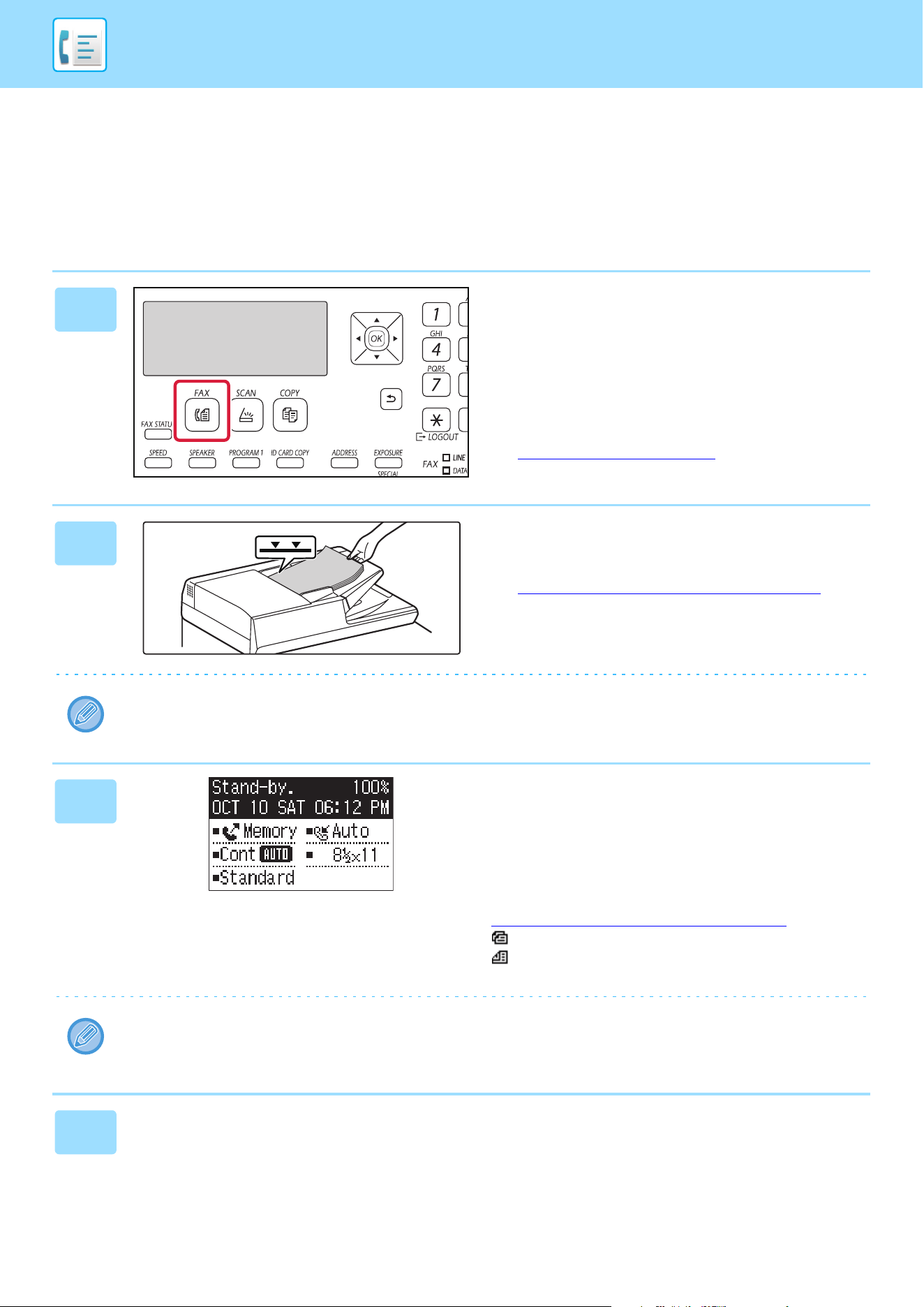
4-8
FACSIMILE►BASIC TRANSMISSION METHODS
SENDING A FAX
BASIC PROCEDURE FOR SENDING FAXES
Using the document feeder
1
Make sure that the machine is in fax
mode.
The FAX indicator is lit when the machine is in fax mode. If
the indicator is not lit, press the [FAX] key.
If user authentication has been enabled for the fax function
in the system settings, a message will appear prompting you
to enter your user number when you switch to fax mode.
Enter your account number (5 digits) with the numeric keys.
► User Authentication (page 7-12)
2
Place the original(s).
Place the original in the document feeder tray of the
automatic document feeder.
► AUTOMATIC DOCUMENT FEEDER (page 1-30)
This is a single transmission operation, and therefore originals cannot be scanned in succession from both the
document feeder and the document glass.
3
Specify the original size.
One-side scanning
When the original is placed in the document feeder, the icon
changes to [AUTO]. The original size cannot be changed by
selecting "Orig. Size" in the right menu.
Two-side scanning
For the procedure for specifying the original size see
FAXING A TWO-SIDED ORIGINAL (page 4-14)
.
AUTO: ....... One-sided scanning in the document feeder.
8-1/2" x 11: Two-sided scanning in the document feeder.
8-1/2" x 11: ..... Document glass
• Regardless of the width of the auto document feeder, AB-size documents are scanned at A4 width (210mm), and
inch-size documents are scanned at 8-1/2" width.
• Originals up to 500 mm long can be sent automatically.
4
If needed, adjust the resolution and exposure settings.
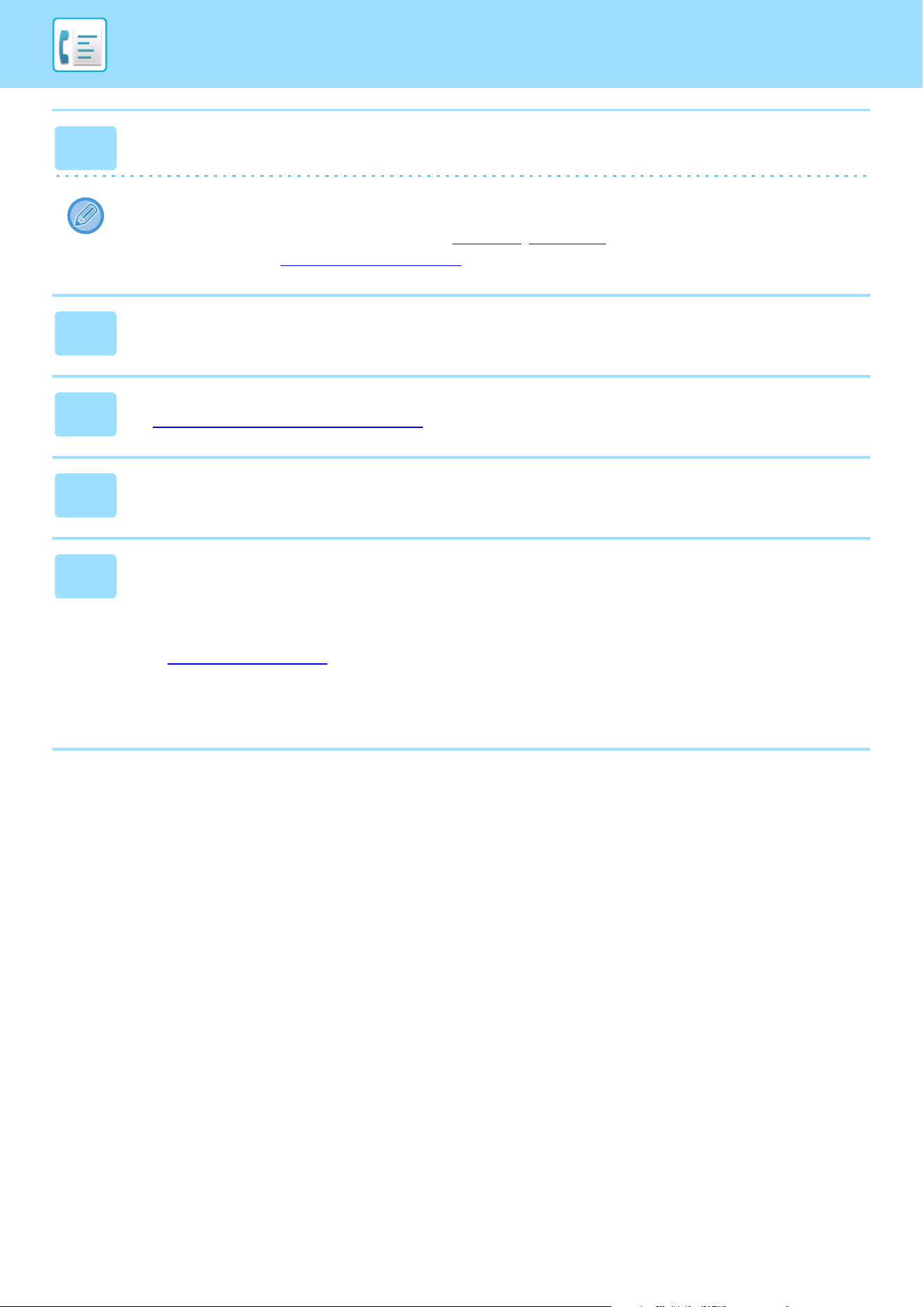
4-9
FACSIMILE►BASIC TRANSMISSION METHODS
5
Dial the fax number.
• The entered number appears in the message display. Up to 50 digits can be entered. If you make a mistake, press the
[C] key and then enter the correct number.
• Redialing and automatic dialing can also be used (►page 4-6
, ►page 4-12).
• To enter a pause, see Entering a pause (page 4-11)
.
6
Press the [OK] key.
7
When the reenter screen appears, reenter the fax number.
► ADDRESS REVIEW FUNCTION (page 4-7)
8
Press the [OK] key.
9
Press the [START] key.
Scanning begins.
If scanning is completed normally, the display returns to the base screen.
• If the line is free, the machine will dial the receiving machine and begin transmission as soon as the first page is
scanned.
► Quick On-line (page 4-17)
• If there is a previously stored job or a job is in progress, or if the line is being used, all pages of the original are
scanned into memory and stored as a transmission job. (This is called memory transmission: the destination is
automatically called and the document transmitted after previously stored jobs are completed.)
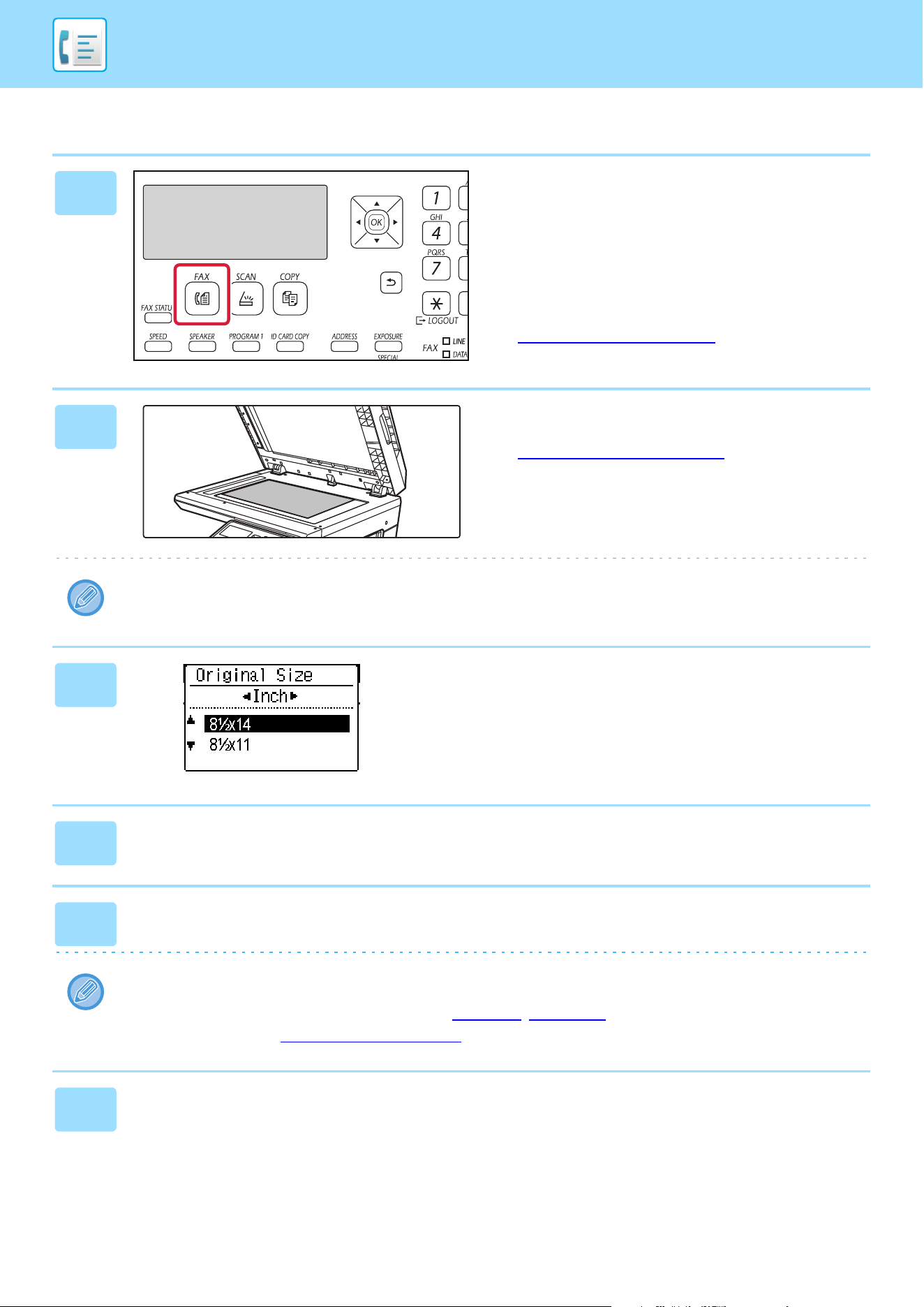
4-10
FACSIMILE►BASIC TRANSMISSION METHODS
Using the document glass
1
Make sure that the machine is in fax
mode.
The FAX indicator is lit when the machine is in fax mode. If
the indicator is not lit, press the [FAX] key.
If user authentication has been enabled for the fax function
in the system settings, a message will appear prompting you
to enter your user number when you switch to fax mode.
Enter your account number (5 digits) with the numeric keys.
► User Authentication (page 7-12)
2
Place the original.
Place the original on the document glass.
► DOCUMENT GLASS (page 1-32)
This is a single transmission operation, and therefore originals cannot be scanned in succession from both the
document feeder and the document glass.
3
Specify the original size.
Select the "Original Size" on the right menu.
The paper size that can be selected is 8-1/2" x 11",
8-1/2" x 14" or A4.
4
If needed, adjust the resolution and exposure settings.
5
Dial the fax number.
• The entered number appears in the message display. Up to 50 digits can be entered. If you make a mistake, press the
[C] key and then enter the correct number.
• Redialing and automatic dialing can also be used (►page 4-6
, ►page 4-12).
• To enter a pause, see Entering a pause (page 4-11).
6
Press the [OK] key.
4-11
FACSIMILE►BASIC TRANSMISSION METHODS
Entering a pause
If a pause is necessary when dialing an international number, press the [PAUSE] key. (This key functions as a [PAUSE]
key when entering a number.)
If you press the [PAUSE] key once, a hyphen ("-") appears and a 2-second pause* is inserted.
After entering a number, you can also press the [PAUSE] key to enter a hyphen and then enter another number using
the numeric keys. (This connects the numbers together, and is called Chain dialing.)
* The duration of each pause can be changed in the system settings. (See Pause Time (page 7-19)
.)
7
When the reenter screen appears, reenter the fax number.
► ADDRESS REVIEW FUNCTION (page 4-7)
8
Press the [OK] key.
9
Press the [START] key.
Scanning begins.
10
If you have another page to scan, change pages and then press the [START]
key.
• Repeat this sequence until all pages have been scanned.
• You can change the resolution and exposure settings as needed for each.
11
After the last page is scanned, press the [READ-END] key ().
Open the document feeder and remove the original. When the original is removed or any key operation is performed, the
display returns to the base screen.
The destination is automatically called and the document transmitted after any previously stored jobs are completed.
To cancel transmission
To cancel transmission while "Reading" appears or before the [READ-END] key ( ) is pressed, press the [C] or [CA]
key. To cancel a transmission job that is already stored, press the [FAX STATUS] key and cancel the job as explained
on (►page 4-21)
.
• A job number (3 digits) appears in the display with "Read End" when memory transmission is performed.
If you make a note of this number after performing a broadcast transmission, you can use the number to check the
results of the transmission in the transaction report or activity report.
• If the power is turned off or a power failure occurs while an original is being scanned in the document feeder, the
machine will stop and an original misfeed will occur. After power is restored, remove the original as explained in
MISFEED IN THE DOCUMENT FEEDER (page 6-14)
.
Group dials cannot be used for chain dialing.
4-12
FACSIMILE►BASIC TRANSMISSION METHODS
TRANSMISSION BY AUTO-DIALING
(SPEED DIALING AND GROUP DIALING)
Instead of entering a full fax number with the numeric keys, you can send a fax by pressing the [SPEED] key and
entering a 3-digit number. To use an automatic dialing, the 3-digit number and name and fax number of the destination
must first be stored. See CONVENIENT DIALING METHODS (AUTO-DIALING) (page 4-6)
for information on
auto-dialing and STORING, EDITING, AND DELETING AUTO-DIAL NUMBERS (SPEED DIAL NUMBERS, AND
GROUP DIALS) (page 4-37) for information on programming auto-dial destinations.
1
Enter the 3-digit number with numeric keys.
• Enter the 3-digit number entered when the Speed Dial number or Group Dial was programmed.
• If you make a mistake, press the [C] key and then enter the correct number. If you enter a 3-digit number that is not
programmed in the machine, press the [C] key and then enter the correct number. If you do not know the Speed Dial
number, print out the "Speed # List" or "Group List".
► PRINTING LISTS OF PROGRAMMED INFORMATION AND SETTINGS (page 4-45)
.
2
Press the [OK] key.
Check the destination. If correct, press the [OK] key again.
To cancel transmission
To cancel transmission while "Reading" appears or before the [READ-END] key ( ) is pressed, press the [C] or [CA]
key. To cancel a transmission job that is already stored, press the [FAX STATUS] key and cancel the job as explained
on Canceling a fax transmission (page 4-21)
.
• A job number (3 digits) appears in the display with "Read End" when transmission is performed. If you make a note of
this number after performing a broadcast transmission, you can use the number to check the results of the
transmission in the transaction report or activity report.
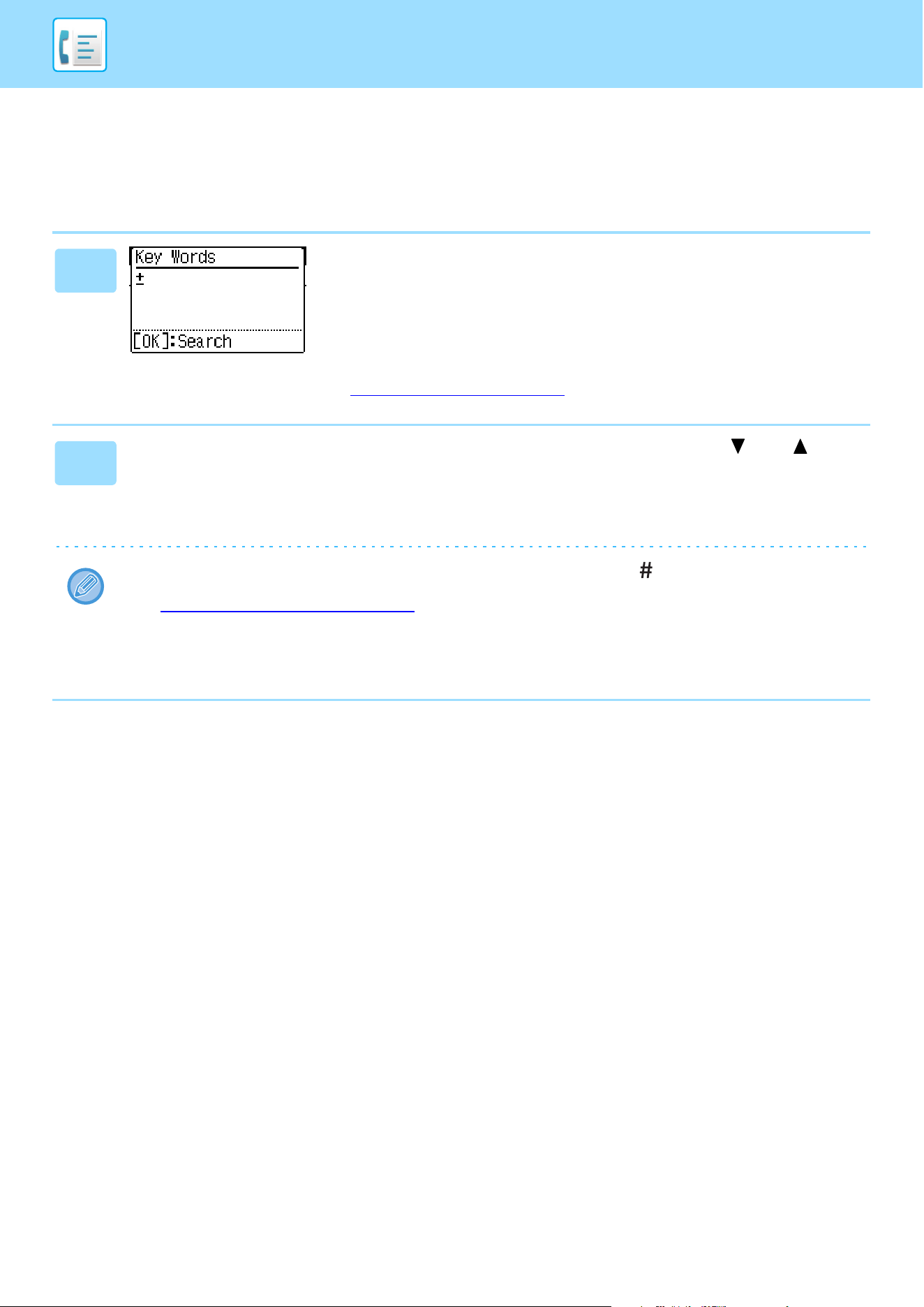
4-13
FACSIMILE►BASIC TRANSMISSION METHODS
SEARCHING FOR A PROGRAMMED DESTINATION
(USING THE [ADDRESS] KEY)
At the time of dialing, you can enter letters to search for a destination stored in a Speed Dial number, or Group dial.
1
Press the [ADDRESS] key and enter the search letters
(you can also skip entry of search letters and go directly
to the next step to display the first destination in the
address list).
Up to 10 of the following types of characters can be entered.
Upper case letters, lower case letters, numbers, special characters
► CHARACTER ENTRY (page 1-39)
2
Press the [OK] key and select the desired destination with the [ ] or [ ] key.
• The search results appear in the following order: upper case letters, lower case letters, special characters, and
numbers.
• If not all letters of the destination name appear, press the [READ END] key to display the full name. Press the [READ
END] key once again to return to the original screen.
• To cancel transmission while "Reading" appears or before the [READ-END] key ( ) is pressed, press the [C] or [CA]
key. To cancel a transmission job that is already stored, press the [FAX STATUS] key and cancel the job as explained
on Canceling a fax transmission (page 4-21)
.
• A job number (3 digits) appears in the display with "Read End" when transmission is performed. If you make a note of
this number after performing a broadcast transmission, you can use the number to check the results of the
transmission in the transaction report or activity report.
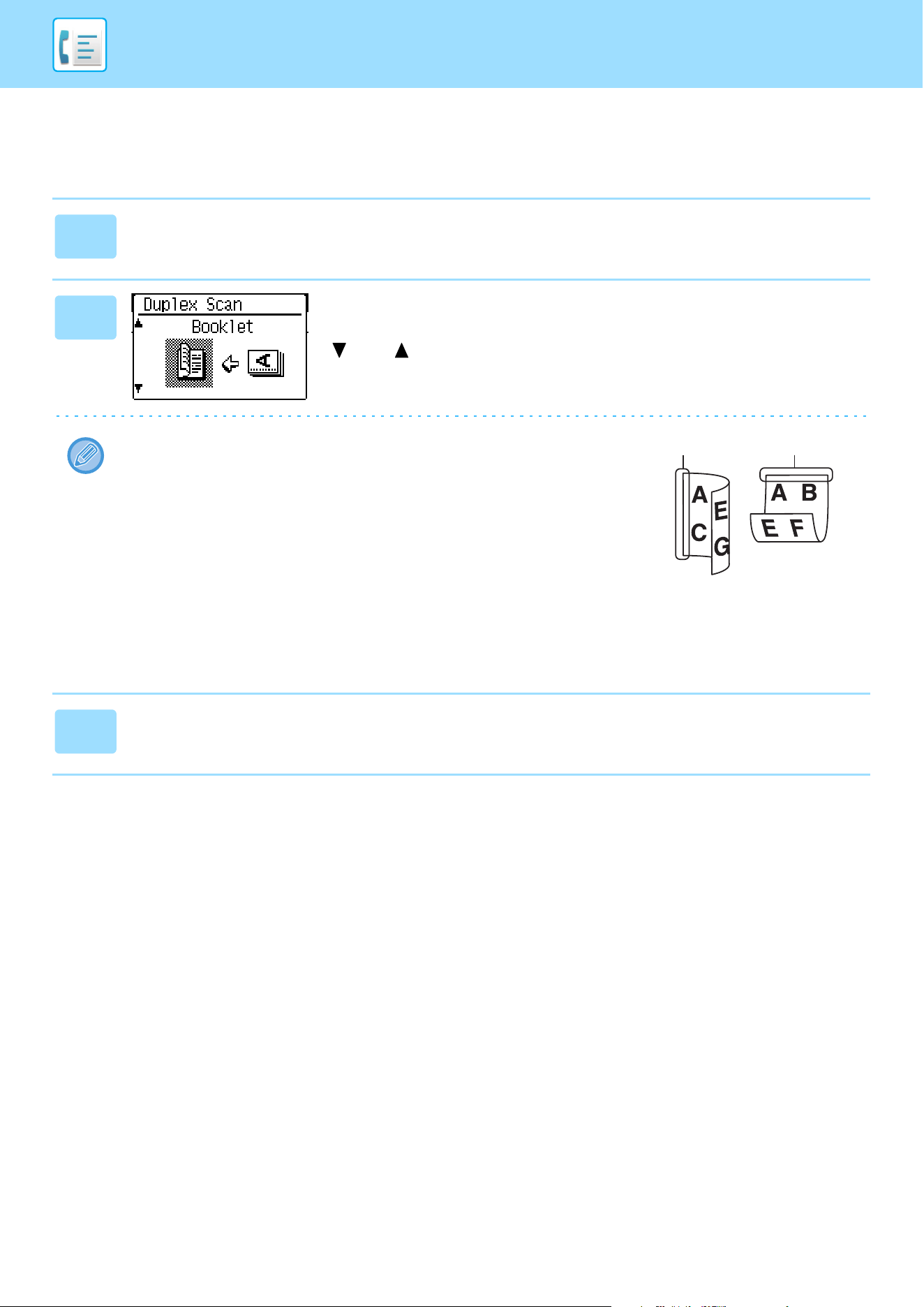
4-14
FACSIMILE►BASIC TRANSMISSION METHODS
FAXING A TWO-SIDED ORIGINAL
Follow the steps below to automatically transmit both sides of a two-sided original.
1
Press the [DUPLEX] key on the operation panel and select "2-Sided".
2
Select "Portrait-Booklet", "Portrait-Tablet",
"Landscape-Booklet", and "Landscape-Tablet" with the
[] or [] key.
• Booklets and tablets Two-sided originals that are bound at the side are booklets, and
two-sided originals that are bound at the top are tablets.
• Duplex scanning is canceled when the transmission is completed, or when the [CA]
key is pressed.
• Duplex scanning of two-sided originals is only possible when a Document feeder is
used. Automatic scanning of both sides of an original is not possible when the
document glass is used.
• The image of the back side of the original is rotated 180 degrees if needed at the time
of transmission, and thus there is no need to change the orientation at the receiving machine.
• To cancel duplex scanning, select "1-Sided" in step 1 and then press the [OK] key.
• Only the following two-sided document sizes can be used:
8-1/2
"x 14", 8-1/2 "x 13-1/2", 8-1/2 "x 13-2/5", 8-1/2 "x 13", 8-1/2" x 11",A4
3
Press [OK] key.
BOOKLET TABLET
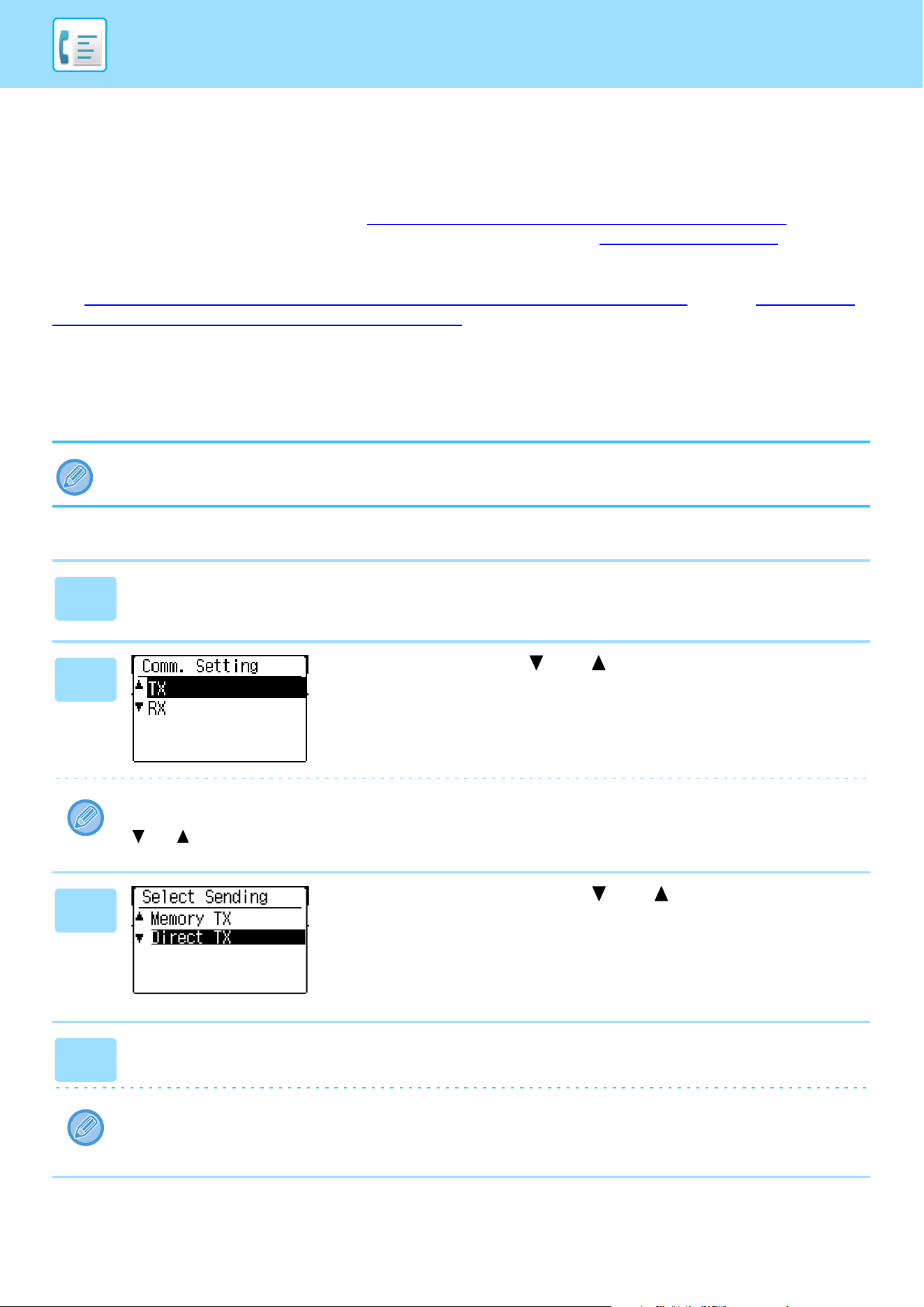
4-15
FACSIMILE►BASIC TRANSMISSION METHODS
Transmission settings (memory transmission mode and direct
transmission mode)
Transmission modes include memory transmission, where the original is temporarily scanned into memory before
transmission, and direct transmission, where the original is transmitted directly without being scanned into memory.
There are two types of memory transmission: Storing transmission jobs (memory transmission) (page 4-17)
, where all
pages of the original are scanned into memory before transmission begins, and Quick On-line (page 4-17)
, where the
destination is dialed after the first page is scanned and the remaining pages are transmitted as they are scanned.
During a memory transmission, it may happen that the memory becomes full while the originals are being scanned.
See If the memory becomes full during transmission of a stored transmission job (page 4-17)
, and see If the memory
becomes full during a quick online transmission (page 4-17)
If there are too many pages and memory transmission is not possible, you can press the [COMM. SETTING] key to
switch from memory transmission to direct transmission. When direct transmission is used, transmission begins after the
current job is completed, allowing you to give priority to a transmission job. As such, direct transmission is a convenient
means of performing an interrupt transmission when there are a large number of stored transmission jobs.
To switch between memory transmission and direct transmission, see the following "Faxing by direct transmission".
Faxing by direct transmission
When transmission is performed manually using an extension phone connected to the machine or using on-hook dialing,
direct transmission is automatically selected. (Memory transmission is not possible.)
1
Press the [COMM.SETTING] key.
The communication settings screen appears.
2
Select "TX" with the [ ] or [ ] key.
The communication settings screen can also be displayed from the function selection screen.
Press the [SPECIAL FUNCTION] key
to display the special function selection screen, select "Comm. Setting" with the
[ ] or [ ] key, and press the [OK] key.
3
Select "Direct TX" with the [ ] or [ ] key and press the
[OK] key.
4
Dial the fax number and press the [START] key.
When using the document glass, multiple original pages cannot be transmitted in a single transmission.
• To change from "Direct Transmission" back to "Memory Transmission", select "Memory TX" in step 3.
• To cancel a direct transmission, press the [C] key.
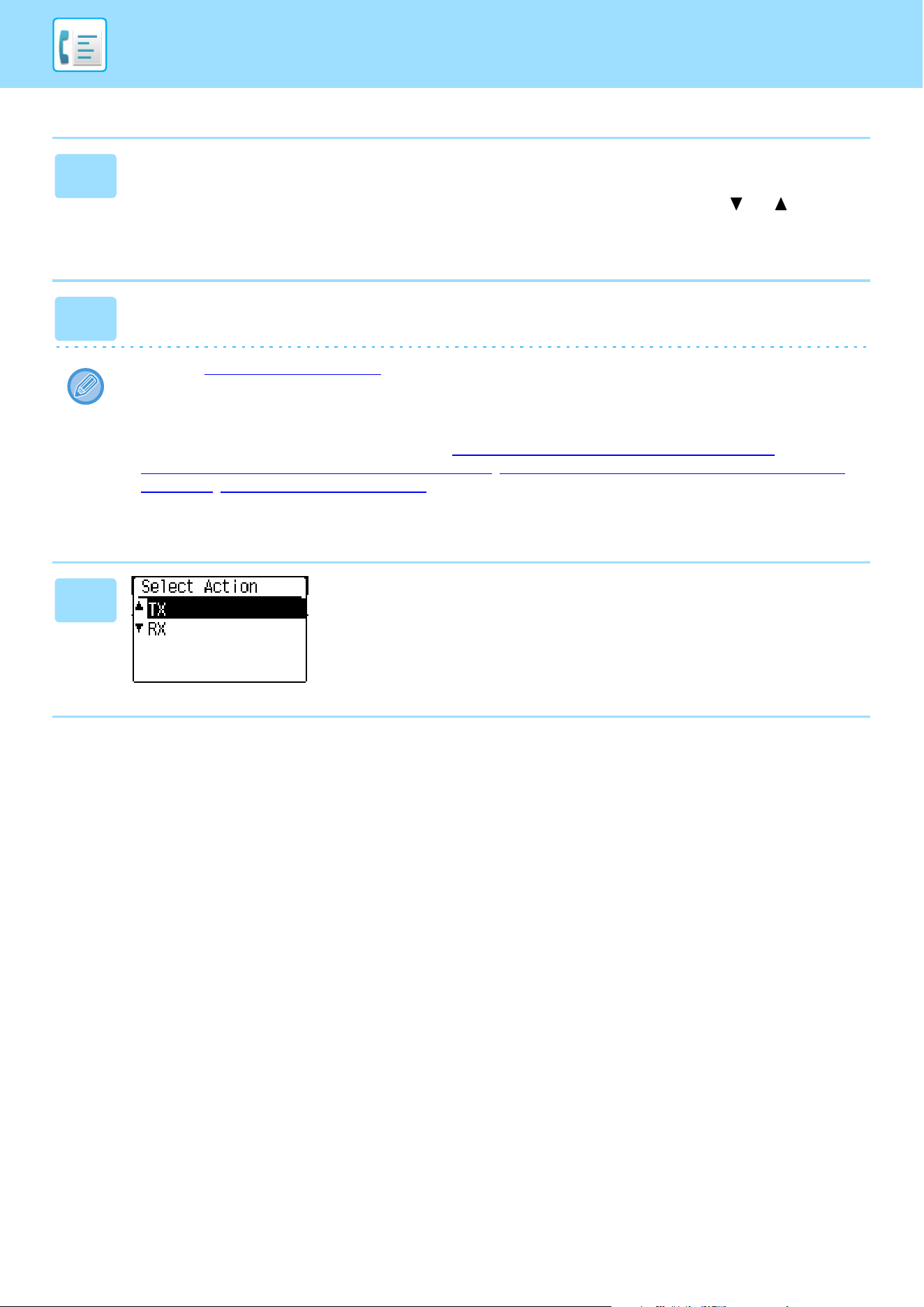
4-16
FACSIMILE►BASIC TRANSMISSION METHODS
Faxing by manual transmission (using the [SPEAKER] key)
1
Press the [SPEAKER] key.
When this key is pressed, a message regarding volume adjustment will appear briefly followed by the dial
entry screen. You can adjust the speaker volume (high, middle, or low) by pressing the
[] or [] key.
Note that this will not change the volume setting in the system settings. Ringing will be heard from the
speaker on the rear side of the machine when the [SPEAKER] key is used for dialing.
2
Dial the fax number and press the [START] key.
• When the Address Review (page 7-20) function is turned on, the [SPEAKER] key cannot be used for transmission.
• To cancel dialing using the [SPEAKER] key when you need to redial the number or because transmission was
interrupted, press the [SPEAKER] key once again.
• As the original is not stored in memory when direct transmission and manual transmission are used, the following
functions cannot be used. Broadcast transmission SENDING THE SAME DOCUMENT TO MULTIPLE
DESTINATIONS IN A SINGLE OPERATION (page 4-30), AUTOMATIC TRANSMISSION AT A SPECIFIED TIME
(page 4-29), Recall Setting (Busy) (page 7-20), duplex scanning, Address Review, and others.
• When a fax is sent by direct transmission or manual transmission, the fax is sent after the connection with the
receiving machine is established.
3
Select "TX" and press the [OK] key.

4-17
FACSIMILE►BASIC TRANSMISSION METHODS
Storing transmission jobs (memory transmission)
When the line is in use, the transmission job is temporarily stored in memory. When the current job and any previously
stored jobs are completed, transmission begins automatically. (This is called memory transmission.)
This means that transmission jobs can be stored in memory by performing a transmission operation while the machine is
occupied with another transmission/reception operation. A combined total of 50 memory transmission and timer
transmission jobs (►page 4-29)
can be stored at once. After transmission, the scanned document data is cleared from
memory.
You can check transmission jobs stored in memory in the fax job status screen. (►page 4-21)
Note that depending on the number of pages stored in memory and the transmission settings, it may not be possible to
store 50 jobs in memory.
• The procedure for storing a transmission job is the same as the procedure in BASIC PROCEDURE FOR SENDING
FAXES (page 4-8).
• If you have not yet pressed the [START] key, you can cancel a transmission job by pressing the [C] key.
• If you have already pressed the [START] key, see "Canceling a stored transmission job" (►page 4-21)
.
If the original is still being scanned after the [START] key is pressed, you can press the [C] key to cancel the
transmission.
• If you store a transmission job in direct transmission mode, you will not be able to store any further transmission jobs.
After transmission, the scanned document data is cleared from memory. You can check transmission jobs stored in
memory in the fax job status screen. (►page 4-21)
If the memory becomes full during transmission of a stored transmission job
If the memory becomes full while scanning the first page of a document, the transmission job is automatically canceled.
If the memory becomes full while scanning the second page or a following page, scanning stops. In this case, you can
either press the [C] key to cancel the transmission, or press the [OK] key to transmit only those pages which were
completely scanned.
Quick On-line
When you use the document feeder to send a multi-page document and there are no previously stored jobs waiting or in
progress (and the line is not being used), the machine dials the destination after the first page is scanned and begins
transmitting scanned pages while the remaining pages are being scanned. This transmission method is called Quick
On-line. When a quick online transmission is being performed, the message display shows "Reading" - "Dialing" -
"Comm." - "Sending" in that order until scanning of the remaining pages is completed. When all pages have been
scanned, "Read End" appears before the above messages appear.
If the receiving party is busy, the quick online transmission will change into a stored transmission job (memory
transmission).
► Storing transmission jobs (memory transmission) (page 4-17).
If the memory becomes full during a quick online transmission
If the memory becomes full while scanning the first page of a document, the transmission job is automatically canceled.
If the memory becomes full while scanning the second page or a following page, those pages which were completely
scanned will be transmitted.
The machine is initially set (factory setting) to perform Quick On-line transmission. If desired, you can disable this function in
the system settings. (See Quick On Line TX (page 7-20)
.) When an original is transmitted using the following methods, the
job will be stored in memory. (Quick On-line transmission will not be performed.)
• Sending a fax from the document glass.
• SENDING THE SAME DOCUMENT TO MULTIPLE DESTINATIONS IN A SINGLE OPERATION (page 4-30)
• AUTOMATIC TRANSMISSION AT A SPECIFIED TIME (page 4-29)

4-18
FACSIMILE►BASIC TRANSMISSION METHODS
If the receiving party is busy
If the receiving party is busy, the transmission is temporarily canceled and then automatically re-attempted after a brief
interval. (Two attempts are made at an interval of 3 minutes.*
1
)
If you do not want the machine to re-attempt the transmission, press the [FAX STATUS] key and cancel the job. (►page
4-21)
*1 The settings can be changed in the system settings. (See Recall Setting (Busy) (page 7-20))
If an error occurs that prevents transmission
If an error occurs that prevents transmission or the receiving machine does not answer the call within 45 seconds*
2
, the
transmission is stopped and then automatically re-attempted later. One attempt is made at an interval of
1 minute.*
2
) If you do not want the machine to re-attempt the transmission, press the [FAX STATUS] key and cancel the
job. (►page 4-21)
This machine also supports error correction mode (ECM) and is set to automatically resend any part
of a fax that is distorted due to noise on the line.*
3
*2 The settings can be changed in the system settings. (See Ring Timeout In Auto TX (page 7-20) and Recall Set (Err)
(page 7-20).)
*3 If the other fax machine does not support ECM or ECM is not operating, error correction will not take place.
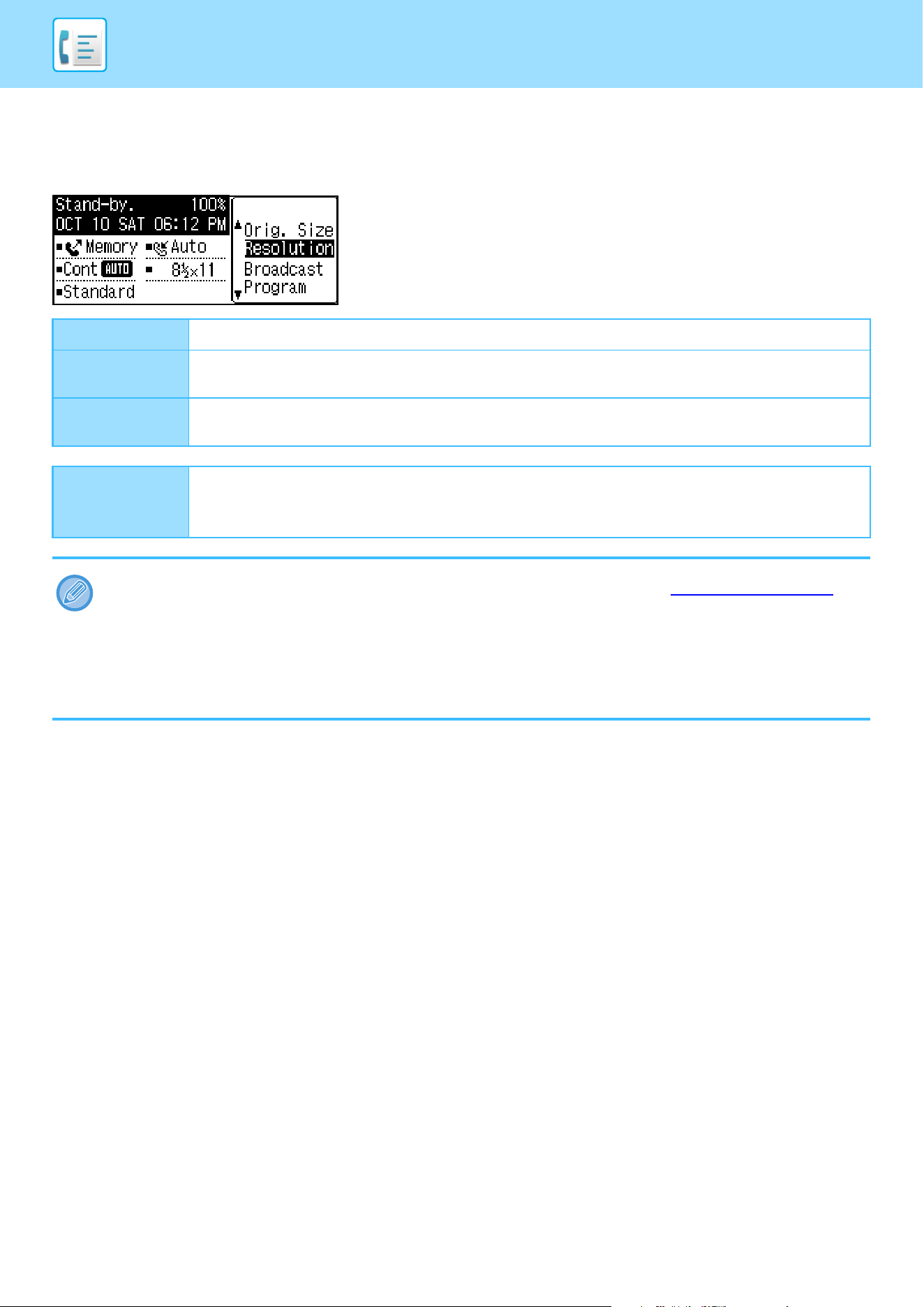
4-19
FACSIMILE►BASIC TRANSMISSION METHODS
HOW TO SELECT THE RESOLUTION
The resolution can be changed to match the text size of the original, and the original type, such as a photo. Select
"Resolution" in the right menu of the base screen of fax mode and press the [OK] key.
Standard
Select for an original with normal size text.
Fine
Select for an original with small text or detailed diagrams. The original will be scanned at twice the density
of "Standard".
Super Fine
Select for an original with intricate pictures or diagrams. A higher-quality image will be produced than with
the "Fine" setting.
Fine / Halftone
Super Fine /
Halftone
Use for photo or shaded color originals (color documents, etc.). Transmits a clearer image than with "Fine"
or "Super Fine" alone.
The transmission time is slightly longer when halftone is selected.
• The factory default settings for the resolution and contrast are "Standard" and "Auto", respectively.
The default settings for the resolution and contrast can be changed in the system settings Set Res. Con. (page 7-20)
.
When using the document glass to scan multiple original pages, you can change the resolution and contrast each time you
change pages. When using the auto document feeder, you cannot change the resolution and contrast after scanning has
started.
• Even if you send a fax at "Fine" or "Super Fine", the receiving fax may not be capable of receiving and printing the fax at
that resolution.
• To cancel a resolution setting, press the [CA] key.
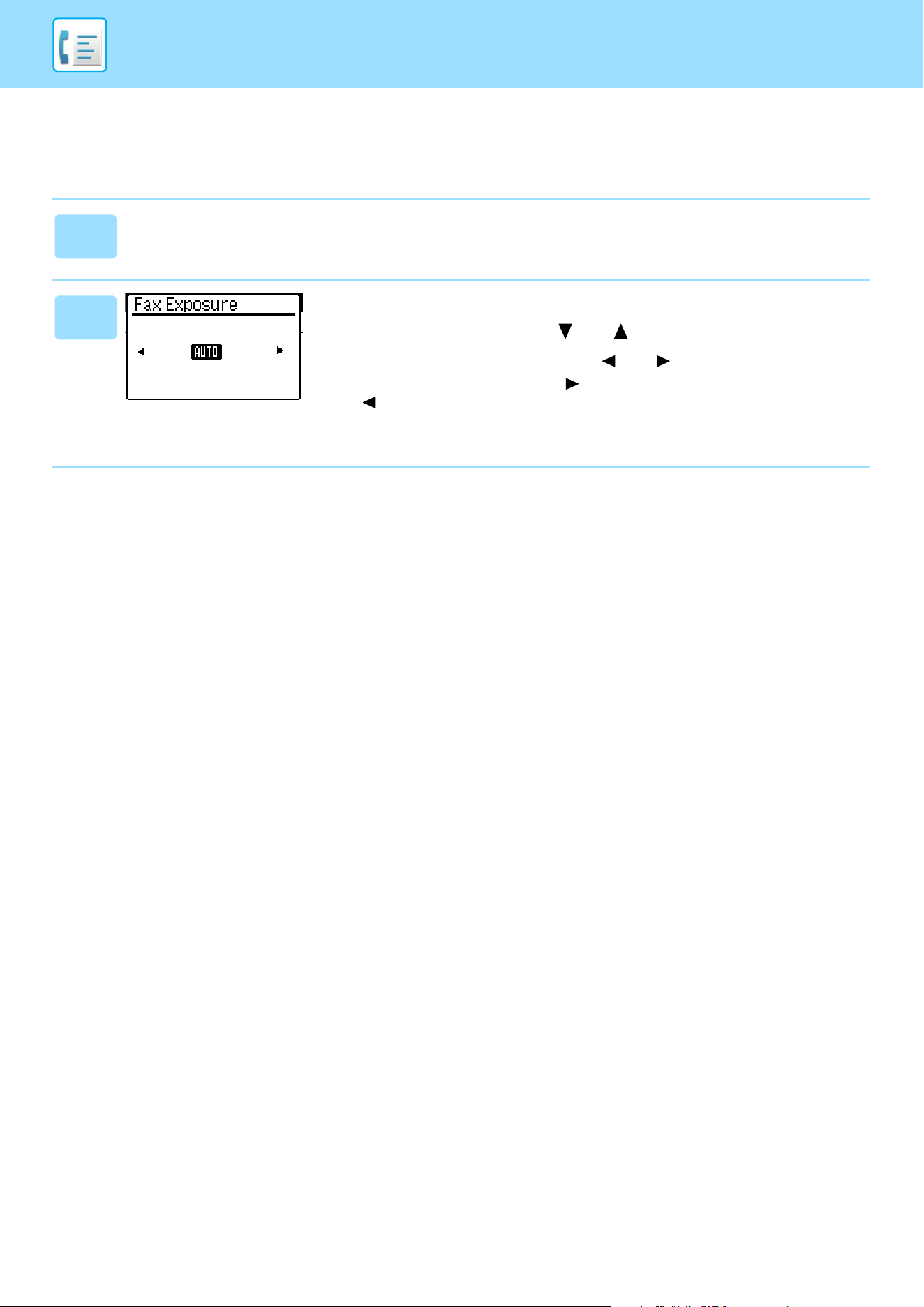
4-20
FACSIMILE►BASIC TRANSMISSION METHODS
CHANGING THE EXPOSURE
The exposure can be changed to match the darkness of the original.
1
Select the [EXPOSURE] key.
2
Adjust the exposure.
(1) Select the item with the [ ] or [ ] key.
(2) Adjust the exposure with the [ ] or [ ] key.
To dark the exposure, select the [ ] key, and to lighten the exposure, select the
[ ] key.
(3) Select the [OK] key.
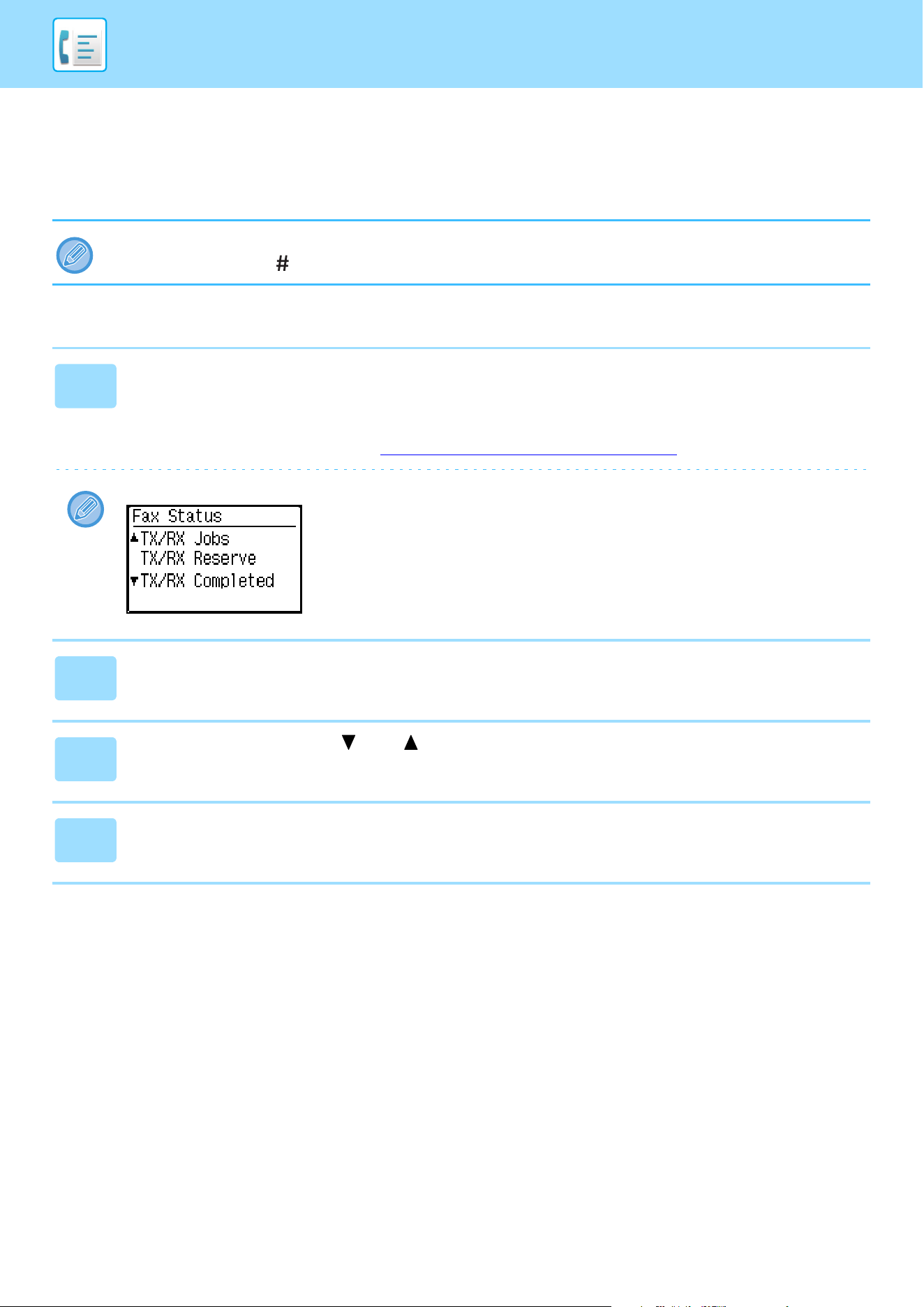
4-21
FACSIMILE►BASIC TRANSMISSION METHODS
CANCELING A FAX TRANSMISSION
To cancel a transmission that is in progress or a stored transmission job, follow the steps below. A transmission in
progress or a stored transmission job is canceled from the fax status screen. (Printing of a received fax cannot be
canceled.)
Canceling a fax transmission
To cancel a transmission while the original is being scanned ("Reading" appears in the message display) or before the key is
pressed ([READ-END] key ( ) when scanning the original from the document glass), the [C] or [CA] key can be pressed.
1
Press the [FAX STATUS] key.
When a transmission is in progress, the job being transmitted is displayed.
If the displayed job is not the job that you wish to cancel, it is likely that the job to be canceled is a stored job waiting for
transmission. Press the [BACK] key to display the fax status selection screen and then follow the procedure in
"Canceling a stored transmission job" on Canceling a stored transmission job (page 4-23)
to cancel the job.
When a transmission is not in progress, the following fax status selection screen appears.
2
Press the [C] key.
3
Select "Yes" with the [ ] or [ ] key.
4
Press the [OK] key.
The transmission is canceled.
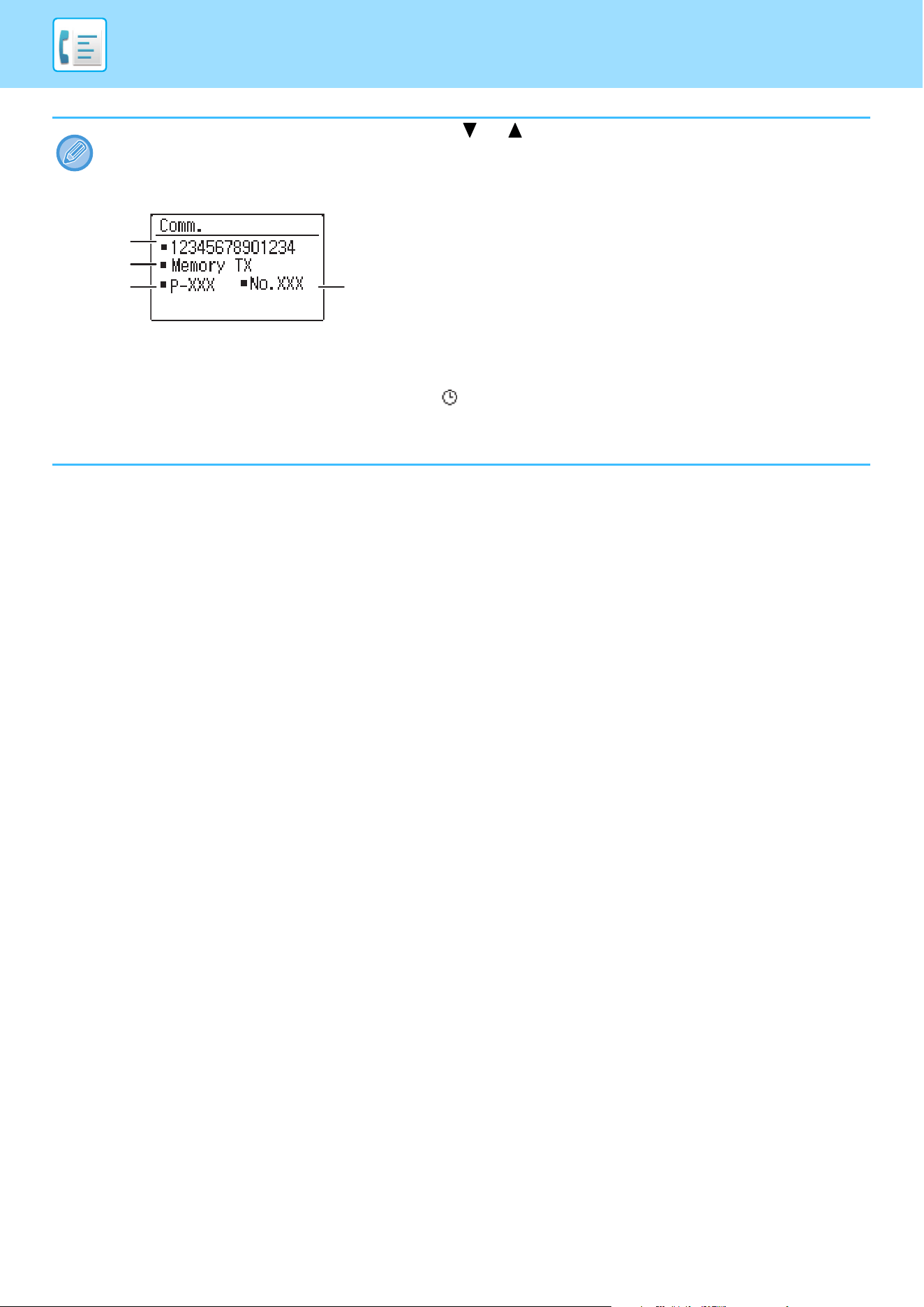
4-22
FACSIMILE►BASIC TRANSMISSION METHODS
• If you do not wish to cancel the transmission, press the [ ] or [ ] key in the screen of step 3, select "No", and press the
[OK] key.
• You can check canceled operations in the Activity Report. "Cancel" will appear in the "Type/Note" column of the report.
Additional information on the display during transmission.
(A) Destination name
The name of the destination appears if programmed.
(B) Transmission method name
In the case of a timer transmission, the timer icon " " appears at the beginning of the transmission method name.
(C) Number of pages currently transmitted
(D) Document number
The document number assigned at the time of scanning in memory transmission mode appears.
(A)
(B)
(C) (D)
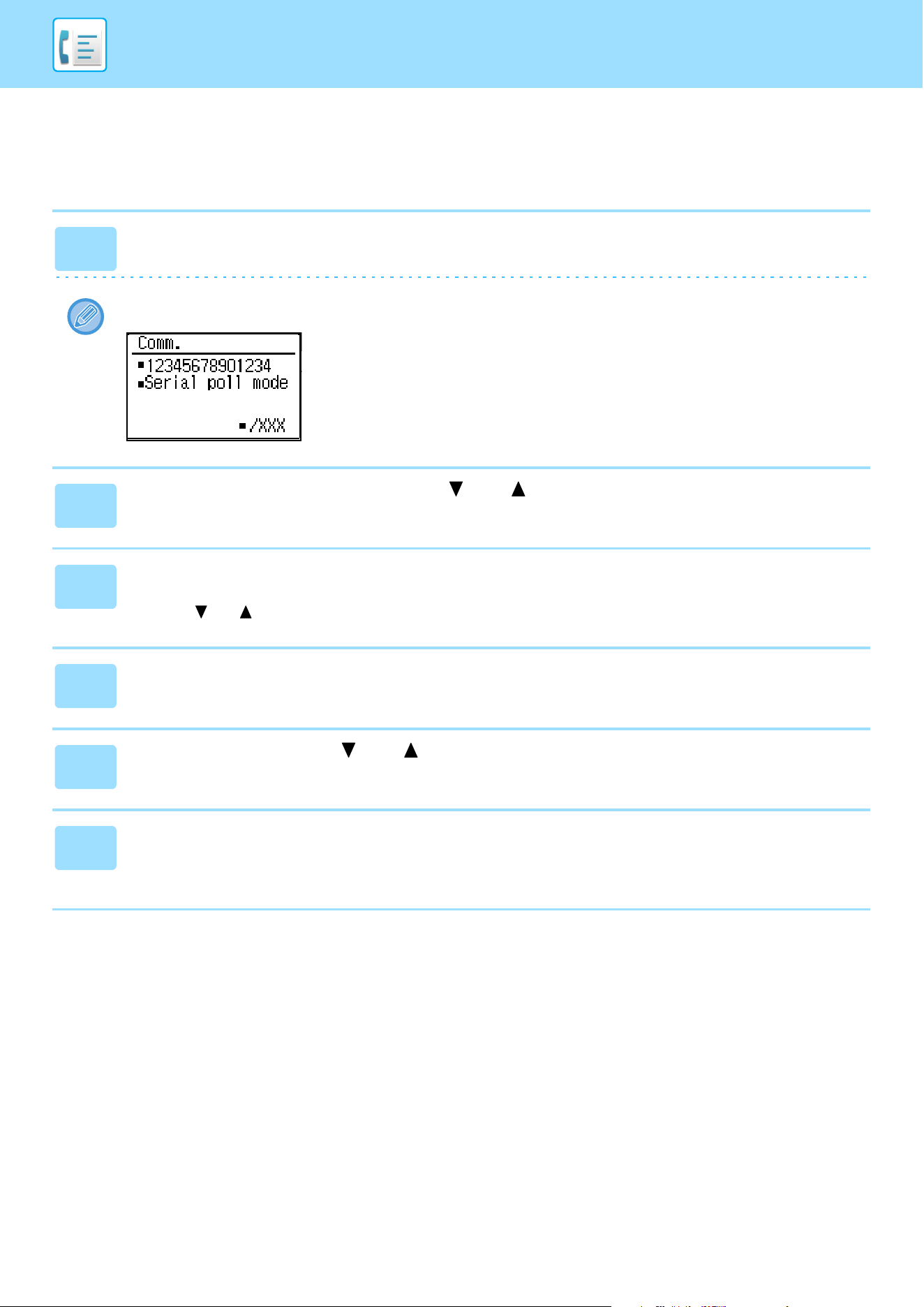
4-23
FACSIMILE►BASIC TRANSMISSION METHODS
Canceling a stored transmission job
If you do not wish to cancel a stored transmission job and only wish to check its status, press the [BACK] key instead of
the [C] key in step 4 to exit.
1
Press the [FAX STATUS] key.
The fax job status screen is displayed.
When a transmission is in progress, the job being transmitted is displayed. Press the [BACK] key to display the fax
status selection screen.
2
Select "TX/RX Reserve" with the [ ] or [ ] key.
3
Press the [OK] key.
The first stored transmission job appears.
Press the [ ] or [ ] key until the transmission job that you wish to cancel appears.
4
Press the [C] key.
The transmission cancel confirmation screen appears.
5
Select "Yes" with the [ ] or [ ] key.
6
Press the [OK] key.
The selected transmission job is canceled.
If you wish to cancel another transmission job, repeat steps 1 through 6.
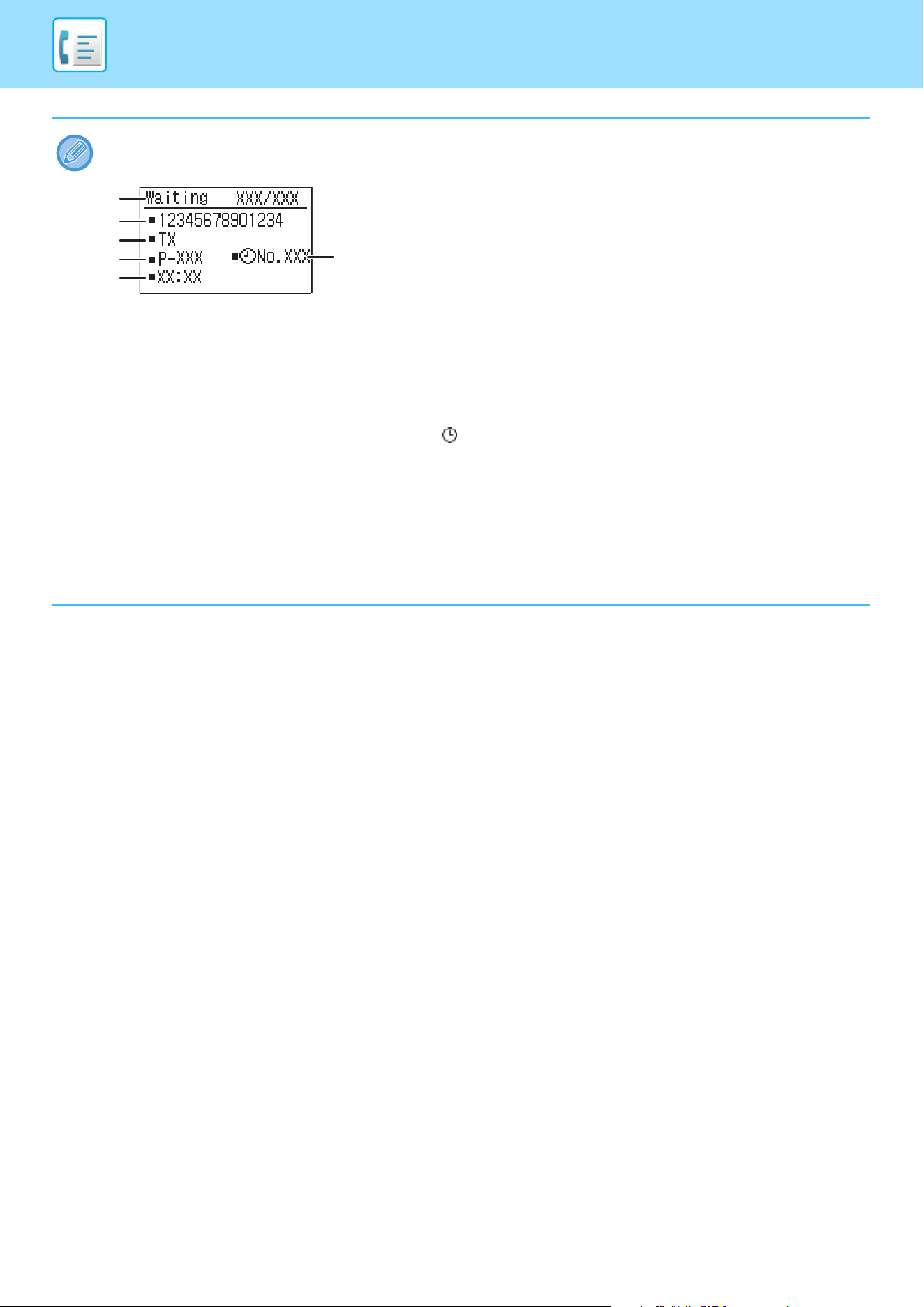
4-24
FACSIMILE►BASIC TRANSMISSION METHODS
You can check canceled recall mode jobs in the Activity Report. "Cancel" will appear in the "Type/Note" column of the report.
Contents of the stored job screen (screen of step 3)
(A) Current status
"Waiting" will appear next to stored transmission jobs and timer transmission jobs. "Recall" will appear next to recall
mode jobs.
(B) Destination
The name of the destination appears if programmed.
(C) Transmission method name
In the case of a timer transmission, the timer icon " " appears at the beginning of the transmission method name.
(D) Number of pages stored
In the case of a stored transmission job, the document number assigned at the time of scanning appears.
(E) In the case of a timer transmission, the timer job number appears.
(F) In the case of a timer transmission, the specified reservation time appears. "Prepared" will appear for a stored
transmission job.
Status of completed jobs
To check the status of completed jobs, select "TX/RX Completed" in step 2 and press the [OK] key in step 3.
(B)
(C)
(A)
(D)
(F)
(E)
4-25
FACSIMILE►FAX RECEPTION
RECEIVING FAXES
When another fax machine sends a fax to your machine, your machine will ring*, automatically receive the fax, and
begin printing. (This is called automatic reception.)
If you do not wish to have received faxes printed immediately, use the print hold function to hold received faxes in
memory for printing at your convenience (all received faxes will be printed at once). To enable this function and print
received faxes, see FAX PRINT HOLD FUNCTION (page 4-28)
.
RECEIVING A FAX
FAX RECEPTION
• You can store a transmission job while fax reception is in progress. (See Storing transmission jobs (memory transmission)
(page 4-17)).
• You can connect your telephone to receive a fax after talking, or automatically switch between phone and fax depending
on the type of call that is received. (page 4-56
to page 4-57)
• To print received fax pages on both sides of the paper, enable Duplex Reception (page 7-21)
in the system settings.
• If a extension phone is not connected to the machine, use automatic reception.
• If the Duplex Reception (page 7-21)
function is on, you can press the [SPEAKER] key when the machine rings to select
whether the fax will be received. Select "Yes" to receive the fax or "No" to reject the fax with [ ] [ ] , and press the [OK]
key.
• In order to receive faxes, paper must be loaded in the paper tray. See LOADING PAPER (page 1-17)
to load appropriate
paper.
1
The machine will ring* and reception will automatically begin.
The LINE indicator lights up.
If an extension phone is connected and the other party is sending a fax by manual transmission (►page 4-57), you can
lift the handset before fax reception starts and speak to the other party.
* Number of rings
The machine has been set to ring twice before beginning automatic reception. You can change the number of rings to
any number from 0 to 15 in the system settings.
► #Of Rings At. RX (page 7-21)
If the number of rings is set to 0, the machine will receive faxes without ringing.
2
Reception ends.
• When reception ends, the machine sounds a beep.
• Received faxes are output to the output tray.
When approximately 150 sheets accumulate in a tray, a message appears in the display and fax printing stops.
If this happens, remove the sheets. Printing will resume momentarily.

4-26
FACSIMILE►FAX RECEPTION
Fax Reception / Data lamp
When a fax is received in memory, or the machine is starting to print a received fax, the Fax Reception / Data lamp
blinks.
The timing at which this lamp starts blinking depends on the system settings. (See Blink Setting for Received Data (page
7-13))
If received data cannot be printed
If the machine runs out of paper or toner, or a paper misfeed occurs, or if the machine is printing a print or copy job,
received faxes will be held in memory until printing becomes possible. The received faxes are automatically printed
when printing is possible. When received faxes are held in memory, the FAX [DATA] light blinks. You can also use the
forwarding function to have another fax machine print the received faxes.
► FORWARDING FUNCTION (page 4-47)
In order to receive faxes, paper must be loaded in the paper tray. Load appropriate paper as explained in LOADING PAPER
(page 1-17).
• If you receive a fax that is larger than the loaded paper, the system setting uses Received Data Print Condition (page 7-21)
to print it out in the following manner:
If "Reduction" is set up, the image is automatically reduced before printing.*
1
If "Division" is set up, the image is split onto multiple sheets of paper and printed on them at actual size.*
1
If "Actual Size" is set up, the image is printed at actual size without being split.*
2
*1 If the loaded paper is of the B5 size or less, the received image may not be printed depending upon the width and length
of the image data.
*2 The received image won't be printed until you load the paper larger than the actual size.
• In fax mode, printing is not possible on 8-1/2" x 14" and 8-1/2" x 13" sizes.
• If the paper runs out while a fax is being printed, printing will automatically continue using the closest size of paper in
another tray.
• If you change the size of paper loaded in a tray, change the tray's paper size setting.
• Faxes cannot be printed correctly if the actual paper size is different from the paper size setting. Be sure to set the tray's
paper size setting to the same paper size as the paper loaded in the tray. For example, if you receive an 11" x 17" (B4) size
fax when 8-1/2" x 14" (A4) paper is loaded in the tray and the tray's paper size setting is 11" x 17" (B4), the fax will be
printed on 8-1/2" x 14" (A4) paper and part of the image may be cut off If the paper loaded in the tray is larger than the
paper size setting, paper larger than the recognized fax size will be used. (A message prompting you to check the tray's
paper size setting will appear.)
• Received faxes cannot be printed on paper inserted in the bypass tray.
• Received data cannot be printed while the transmission original being scanned. It will be printed automatically after the
scanning is finished.
4-27
FACSIMILE►FAX RECEPTION
MANUAL FAX RECEPTION
You can decide whether to receive a fax (this is called "manual reception" in this manual).
Setting the reception mode
Manually receiving a fax
To receive the fax, press the [START] key and select "RX".
1
Press the [COMM. SETTING] key in the initial state of Fax mode.
The communication setting screen can also be displayed from the function selection screen.
Press the [SPECIAL FUNCTION] key to display the function selection screen, select "Comm. Setting" with the [ ] [ ]
keys, and press the [OK] key.
2
Select "Manual" and press the [OK] key.
To return to auto reception, select "Auto" in step 1 above.
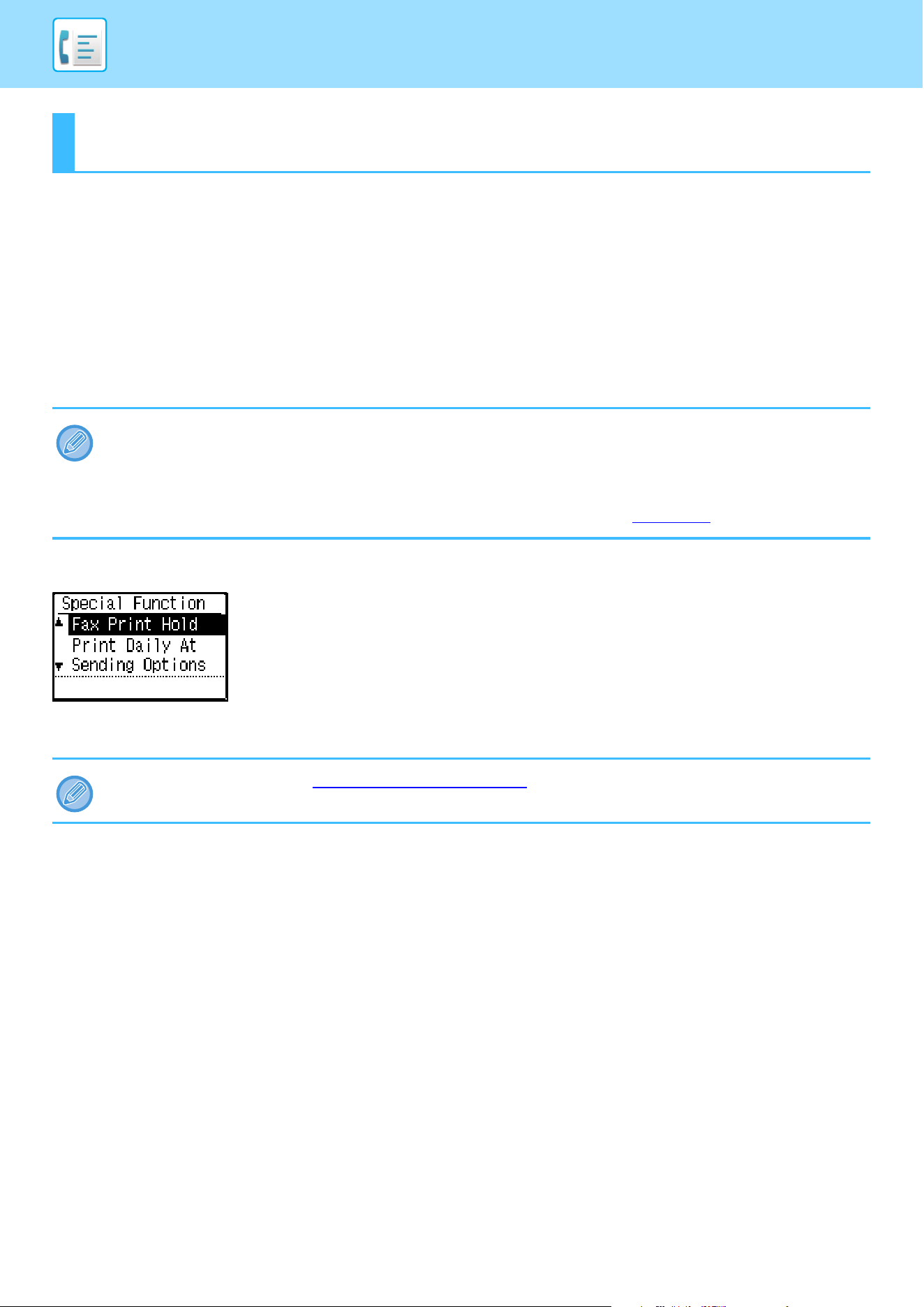
4-28
FACSIMILE►CONVENIENT FAX FUNCTIONS
FUNCTION KEY
This is the initial setting that appears when the [SPECIAL FUNCTION] key is pressed in fax mode.
FAX PRINT HOLD FUNCTION
Faxes are normally printed as soon as they are received.
This function is used to hold received faxes in memory rather than printing them as they are received.
Faxes held in memory are printed manually all at once.
Select the "Fax Print Hold" function.
Enabling fax print hold
Select "Setting ", and then select "On".
To disable fax print hold, select "Off".
Printing received faxes held in memory
Select "Fax print hold", and then select "Print".
CONVENIENT FAX FUNCTIONS
• When fax print hold is enabled and received faxes are held in memory, the DATA indicator above the [FAX] key on the
operation panel blinks and a message appears in the display. (When the received faxes are printed, the indicator stops
blinking and the message no longer appears.)
• If the remaining free memory reaches 0%, fax reception will no longer be possible. For this reason, it is important to
constantly make sure that sufficient free memory remains and frequently print received faxes.
The percentage of free memory remaining appears in the base screen of fax mode. (►page 4-4)
If fax print hold is prohibited using Disable Fax Print Hold (page 7-19) in the system settings, it will not be possible to enable
it.
4-29
FACSIMILE►CONVENIENT FAX FUNCTIONS
AUTOMATIC TRANSMISSION AT A SPECIFIED TIME
This feature enables you to set up a transmission or polling operation to be performed automatically at a specified time
up to a week in advance. This is convenient when you will be out of the office or for transmission at off-peak nighttime
rates. A combined total of 50 timer transmission and memory transmission jobs can be stored.
• After a timer transmission is performed, the information (image, destination, etc.) is automatically cleared from memory.
• To perform a timer transmission, the original must be scanned into memory. It is not possible to leave the original in the
document feeder or on the document glass and have it scanned at the specified time of transmission.
• The date and time is set in the machine using the system settings.
(See Date & Time Set (page 7-10)
.)
• Only one polling timer operation can be set up at a time. If you wish to set up multiple timer polling operations, combine the
machines to be polled into one serial polling operation with a timer setting (see Serial polling mode (page 4-33)
).
1
Select "Timer Mode" and press the [OK] key.
If a time has been specified, a checkmark appears in front of "Timer Mode". To cancel a specified time, press the
[LOGOUT] key ( ) in the above display with "Timer Mode" highlighted.
The current time appears in the screen. If the current time is not correct, press the [CA] key to cancel the operation and
see Date & Time Set (page 7-10)
to correct the time setting.
2
Select the day of the week with the [ ] or [ ] key.
The selected day is highlighted. If you select "No Select Days", the transmission will be performed
as soon as the specified time arrives. To return to the "Time Setting" display, press the [BACK] key.
• To cancel a timer operation after the above procedure has been completed, follow the procedure in CANCELING A
FAX TRANSMISSION (page 4-21).
• A timer job number is automatically assigned to the operation. This number can be used to cancel a stored job. (See
the note Canceling a stored transmission job screen (screen of step 3) on page 4-23
.)
• Other operations can be performed after a timer operation is set up. If another operation is in progress when the
specified time arrives, the timer transmission will begin when the job in progress is completed.
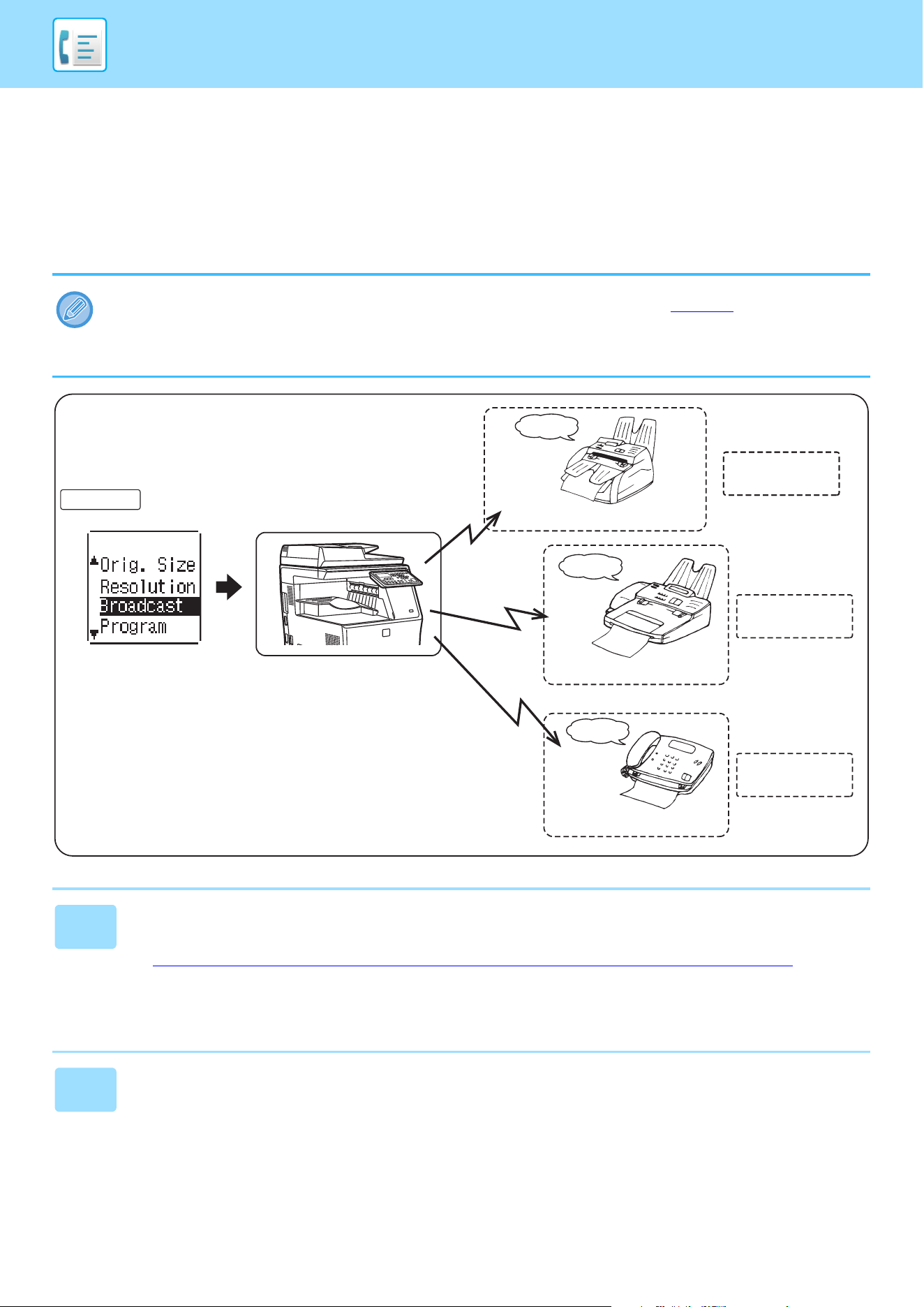
4-30
FACSIMILE►CONVENIENT FAX FUNCTIONS
SENDING THE SAME DOCUMENT TO MULTIPLE
DESTINATIONS IN A SINGLE OPERATION
This feature is used to send a fax to multiple destinations in a single operation. The original to be transmitted is scanned
into memory and then successively transmitted to the selected destinations. This feature is convenient for such
purposes as distributing a report to company branches. Up to 100 destinations can be selected.
When transmission to all destinations has been completed, the document is automatically cleared from memory.
• If you frequently use broadcasting to send faxes to the same group of destinations, it is convenient to program those
destinations into a group dial. The procedure for programming group dials is explained on page 4-37
.
• When a group dial is used to send a fax, the fax is broadcast (transmitted) to the destinations programmed in the group
dial. For example, if five destinations are programmed in a group dial and the key is pressed for a broadcast transmission,
the broadcast transmission will have five destinations.
1
Enter a full fax number with the numeric keys or press an auto-dial key
(Speed Dial number, or group key) to select the first destination.
► TRANSMISSION BY AUTO-DIALING (SPEED DIALING AND GROUP DIALING) (page 4-12)
The destination selection screen appears. To clear a mistake when entering a full number with the numeric keys, press
the [C] key to clear one digit at a time. A destination selected with a Speed Dial number, or group dial is indicated by an
icon and a number. To clear an entry, press the [C] key.
2
Press the [OK] key and then select the next destination by entering a full fax
number or pressing an auto-dial key.
After entering a full number with the numeric keys, press the [OK] key to complete the entry. If you pressed an auto-dial
key in step 1, it is not necessary to press the [OK] key. You can immediately press another auto-dial key for the next
destination. Repeat steps 1 and 2 to select the remaining destinations.
Destination A
(recipient)
Destination B
(recipient)
Destination C
(recipient)
Beep
Reception
Beep
Reception
Beep
Reception
Successive
transmission
The document is scanned
into memory
Sender
Select the broadcast
transmission function.
4-31
FACSIMILE►CONVENIENT FAX FUNCTIONS
• If you need to delete a number for which entry has already been completed by pressing the [OK] key, use the [ ] or
[ ] key to select the number and then press the [C] key.
• If the selected destinations exceed the display range of the message screen, press the [ ] or [ ] key to scroll
through and check the destinations.
• Destinations can also be selected using the address directory and the [REDIAL] key.
Note, however, that the [REDIAL] key can only be used to select the first destination (it must be used before any other
destinations are selected).
• If you use two group dials that have 50 stations each, the total number of destinations entered will be 100.
3
Continue from step 7 of BASIC PROCEDURE FOR SENDING FAXES (page
4-8).
After entering a full number with the numeric keys, press the [OK] key to complete the entry. If you pressed an auto-dial
key in step 1, it is not necessary to press the [OK] key. You can immediately press another auto-dial key for the next
destination. Repeat steps 1 and 2 to select the remaining destinations.
To cancel a broadcast transmission
To cancel a broadcast transmission when selecting destinations, press the [CA] key. To cancel transmission after the
transmission procedure has been completed, follow the procedure in CANCELING A FAX TRANSMISSION (page 4-21)
.
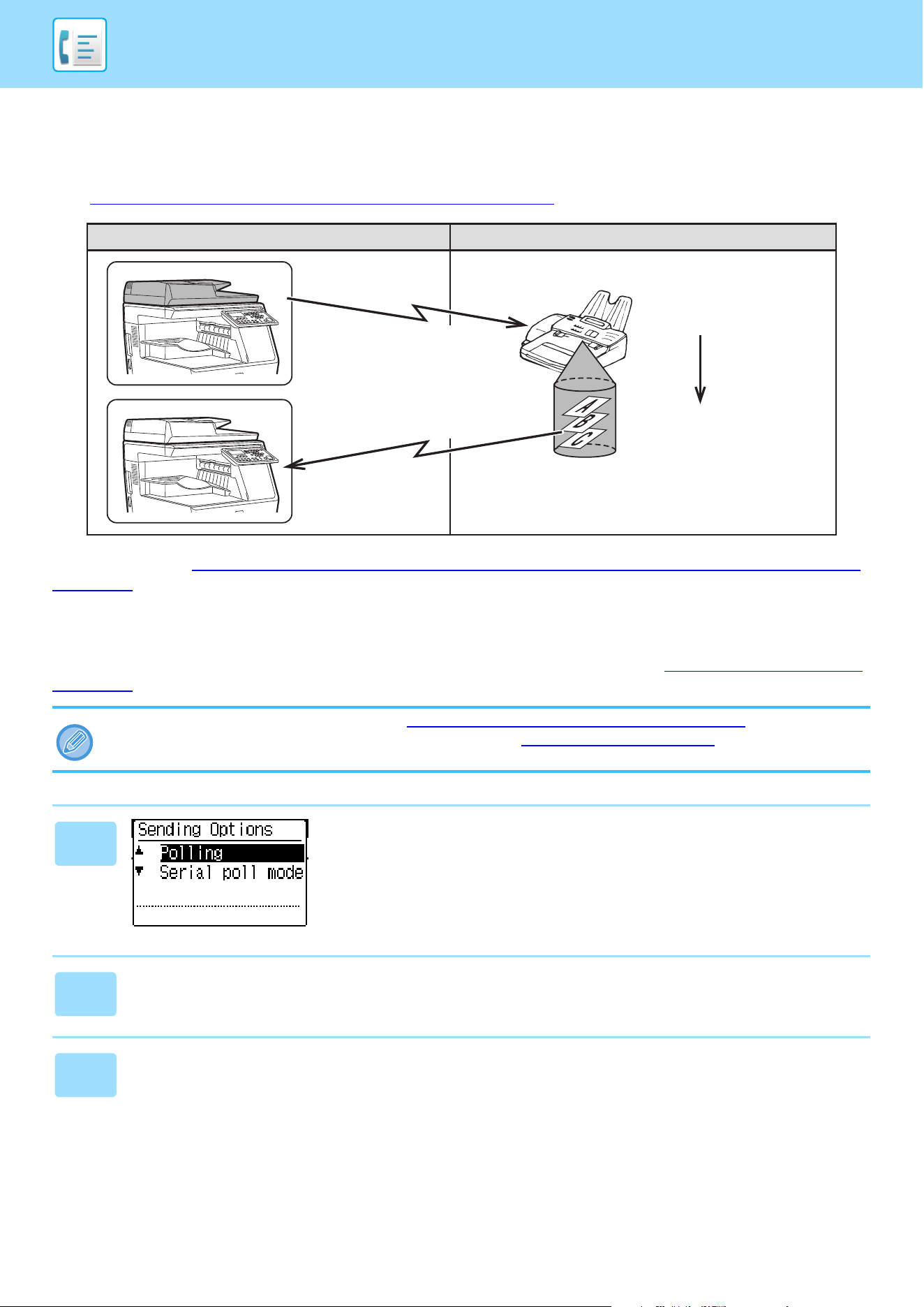
4-32
FACSIMILE►CONVENIENT FAX FUNCTIONS
SENDING OPTIONS
This function allows your machine to call another fax machine and initiate reception of a document in that machine. A
timer setting can also be specified to have the operation take place at night or at another specified time.
(See AUTOMATIC TRANSMISSION AT A SPECIFIED TIME (page 4-29)
.)
Group dials and the SENDING THE SAME DOCUMENT TO MULTIPLE DESTINATIONS IN A SINGLE OPERATION
(page 4-30) can be used to successively poll multiple fax machines in a single operation (this is called "serial polling").
Up to 100 machines can be polled.
In this case, the sequence of operations in the above diagram is successively repeated for each sending machine
selected.
When using the Public Box function, do not set the fax reception mode to "Manual". (See MANUAL FAX RECEPTION
(page 4-27).)
If the other machine is using polling security (see Restricting polling access (polling security) (page 4-36)), your fax number
(sender's number) must be programmed in the system settings (see Own Passcode Set (page 7-19)
) and your number must
also be programmed in the other machine.
1
Select "Sending Options".
2
Select "Polling".
3
Press the [OK] key and enter the fax number of the other machine with the
numeric keys specify a Speed Dial number (a group dial cannot be used).
The other machine
Your machin e
(2) Permits polling
(3) Document data previously
scanned into memory
(1) Polling (ask other machine to
send document)
(4) Document data is automatically
sent to your machine
4-33
FACSIMILE►CONVENIENT FAX FUNCTIONS
Serial polling mode
Setting for polling reception from multiple fax machines.
Select "Serial polling" steps 1 to 2 of the polling procedure SENDING OPTIONS (page 4-32)
.
Before pressing the [START] key in step 3, repeat steps 1 and 2 for each machine that you wish to poll.
4
Press the [OK] key. Press the [START] key.
"Polling reservation has been set." appears in the screen. After communicating with the other machine, your machine
prints the received fax.
To cancel the operation
During communication: Cancel as explained in Canceling a fax transmission (page 4-21).
While the job is stored: Cancel as explained in Canceling a stored transmission job (page 4-23)
.
The receiving machine bears the expense (phone charges) of polling transmission.
This function can only be used when the other machine is Super G3 or G3 compatible and has a polling function.
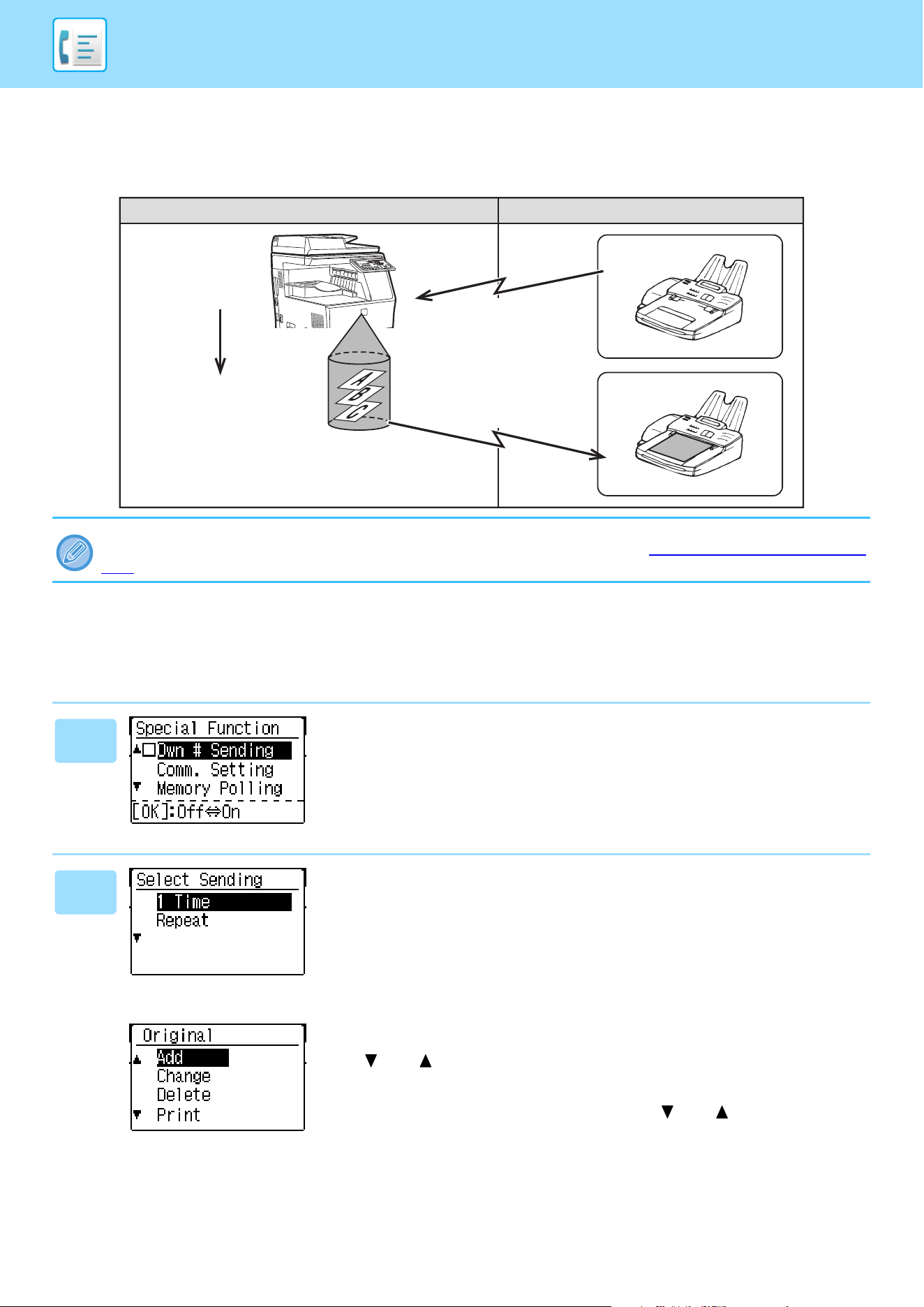
4-34
FACSIMILE►CONVENIENT FAX FUNCTIONS
POLLING MEMORY
This feature allows your machine to automatically send a document previously scanned into memory when another
machine calls and polls your machine.
Scanning a document into polling memory
This section explains how to scan a document into the polling memory. If other documents have already been stored in
the polling memory, the new document will be appended to those documents. If the previous documents are no longer
needed, they can be replaced.
The machine that requests transmission bears the expense (phone charges) of the call.
When using the Public Box function, do not set the fax reception mode to "Manual". (See MANUAL FAX RECEPTION (page
4-27).)
1
Select "Memory Polling".
2
Press the [OK] key and select "1 Time" or "Repeat".
If you select "1 Time", the document data is automatically cleared from memory after
your machine is polled once. If you select "Repeat", the document data in memory can
be used repeatedly.
• If there are no previously stored documents in the polling memory, the above screen
appears.
• If there are previously stored documents in the polling memory, a screen will appear
to let you select what action to take.
(1) If you wish to append the new document, select "Add" with the
[ ] or [ ] key, press the [OK] key, and then go to step 2.
(2) If you wish to replace the previous document with the new
document, select "Change" with the [ ] or [ ] key, press the
[OK] key, and then go to step 2.
The other machine
Your machin e
(1) Polling (request
transmission)
(4) Document data is
automatically sent to
other machine
(2) Permits polling
(3) Document data previously
scanned into memory
4-35
FACSIMILE►CONVENIENT FAX FUNCTIONS
3
Press the [OK] key and press the [START] key.
• Scanning begins.
• If you are scanning from the document glass and have another page to scan, change pages and press the [START]
key. Repeat until all pages have been scanned and then press the [READ END] key.
4
Make sure that the reception mode is set to auto reception. (Setting the
reception mode (page 4-27))
Transmission begins when the other machine calls and polls your machine.
To cancel scanning
To cancel scanning of a document while scanning is in progress, press the [CA] key. To erase the documents in the
Public Box, follow the procedure in Deleting documents from the polling memory (page 4-36)
.
4-36
FACSIMILE►CONVENIENT FAX FUNCTIONS
Printing documents in the polling memory
To check the document that is stored in the public box, follow these steps to print it out.
Deleting documents from the polling memory
This procedure is used to delete documents from the polling memory when they are no longer needed.
Restricting polling access (polling security)
If you wish to prevent unauthorized fax machines from polling your machine, enable the polling security function. When
this function is enabled, polling permission will only be granted if the fax number of the polling machine (programmed in
that machine as the sender's number) matches one of the fax numbers you have programmed in your machine as
passcode numbers. Up to 10 fax numbers can be programmed as passcode numbers.
To enable the polling security function and program passcode numbers, see Polling Passcode # Mode (page 7-22)
in
the system settings.
1
Follow steps 1 of Scanning a document into polling memory (page 4-34) and
then follow the steps below.
2
Select "Print" with the [ ] or [ ] key and press the [OK] key.
Printing begins automatically.
1
Select "Delete".
2
Press the [OK] key.
A screen appears asking you to confirm the deletion.
3
Select "Yes" with the [ ] or [ ] key and press the [OK] key.
The documents are deleted from the polling memory.
Deletion is not possible while the polling memory is being used.
• If you do not use the polling security function, the document will be sent to any fax machine that polls you.
• To use polling memory with polling security enabled, the sender's number of the polling machine must be programmed in
that machine and in your machine.
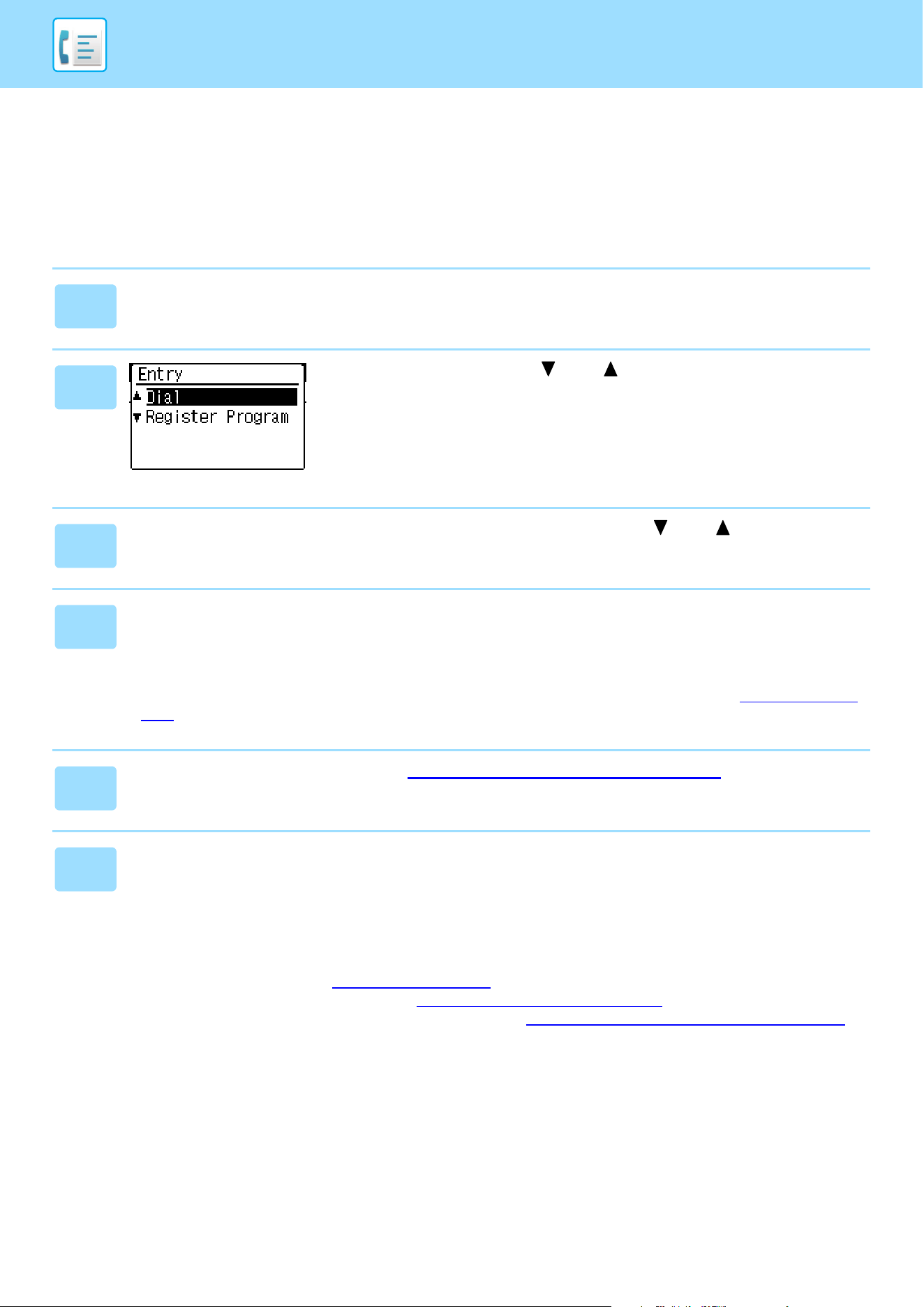
4-37
FACSIMILE►CONVENIENT FAX FUNCTIONS
STORING, EDITING, AND DELETING AUTO-DIAL
NUMBERS (SPEED DIAL NUMBERS, AND GROUP
DIALS)
Auto dial numbers are stored in the auto dial storing screen. Follow the steps below to display the auto dial storing
screen, and then store an auto dial number.
1
Select "Entry" and press the [OK] key.
2
Select "Dial" with the [ ] or [ ] keyand press the [OK]
key.
3
Select "Speed", "Group", or "Change/Delete" with the [ ] or [ ] key.
4
Press the [SPEED] key and enter the fax number of the destination with the
numeric keys.
• Enter the desired Speed Dial number (000 to 299) with the numeric keys.
• Up to 50 digits can be entered for the fax number. If you need to insert a pause between any of the digits, press the
[REDIAL/PAUSE] key. The pause appears as a hyphen (-). To set the duration of the pause, see Pause Time (page
7-19).
5
Enter search characters (see CHARACTER ENTRY (page 1-39)).
6
To finish the storing procedure, press the [START] key. If you wish to
program an option such as chain dialing, transmission speed, or
international transmission mode, press the [OK] key.
• If you pressed the [START] key, you will return to step 3. If you wish to store another or Speed Dial number, repeat
steps 3 to 6. If you have finished storing auto-dial numbers, press the [BACK] key.
• If you pressed the [OK] key, go to the appropriate page for the option that you wish to program.
• To select "CHAIN DIAL", go to Chain Dialing (page 4-38)
.
• To set the "TRANSMISSION SPEED", go to Transmission speed setting (page 4-38)
.
• To set the "INTERNATIONAL TRANSMISSION MODE", go to International transmission mode setting (page 4-39)
.
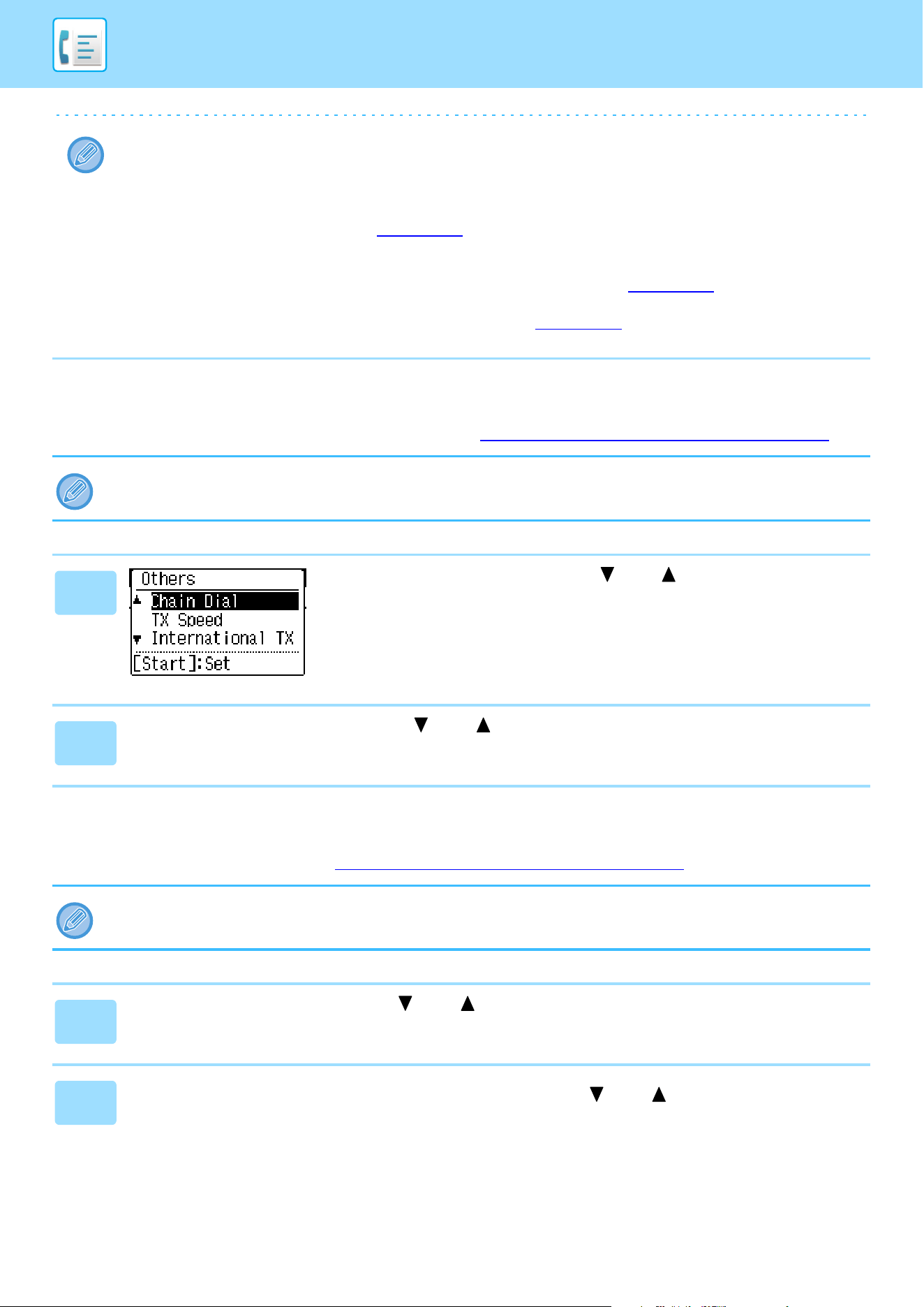
4-38
FACSIMILE►CONVENIENT FAX FUNCTIONS
Chain Dialing
To set an auto-dial number as a Chain Dial number, complete Editing and deleting auto-dial numbers (page 4-41).
Transmission speed setting
To set the transmission speed, complete Editing and deleting auto-dial numbers (page 4-41).
About the setting options
When storing and editing and Speed Dial numbers, you can also select the setting options below. Chain dialing cannot
be combined with any of the other setting options.
When you select a setting option, a checkmark appears in the setting option screen.
• Chain Dialing.......................................You can enable or disable Chain Dialing for a Rapid key or Speed Dial number.
(►page 4-38)
• Transmission speed ............................You can set the transmission speed to 33,600 bps (maximum speed), 14,400
bps (high speed), 9600 bps (middle speed), or 4800 bps (low speed). The initial
setting is 33,600 bps (maximum speed). (►page 4-38)
• International transmission mode .........The international transmission mode can be set to "Off" or one of modes 1 to 3.
The initial setting is "Off". (►page 4-39)
When a number is set as a Chain Dial number, the destination fax number can be up to 48 digits long.
1
Select "Chain Dial" with the [ ] or [ ] key and press the
[OK] key.
• If checkmark appears to the left of "Chain Dial", it is already selected.
• To exit, press the [START] key.
2
Select "On" or "Off" with the [ ] or [ ] key.
Set the transmission speed only when you know what speed is most suitable, such as when you are sending a fax to a
foreign country and telephone line conditions are bad. If you do not know the line conditions, do not change this setting.
1
Select "TX Speed" with the [ ] or [ ] key and press the [OK] key.
2
Select the desired transmission speed with the [ ] or [ ] key.
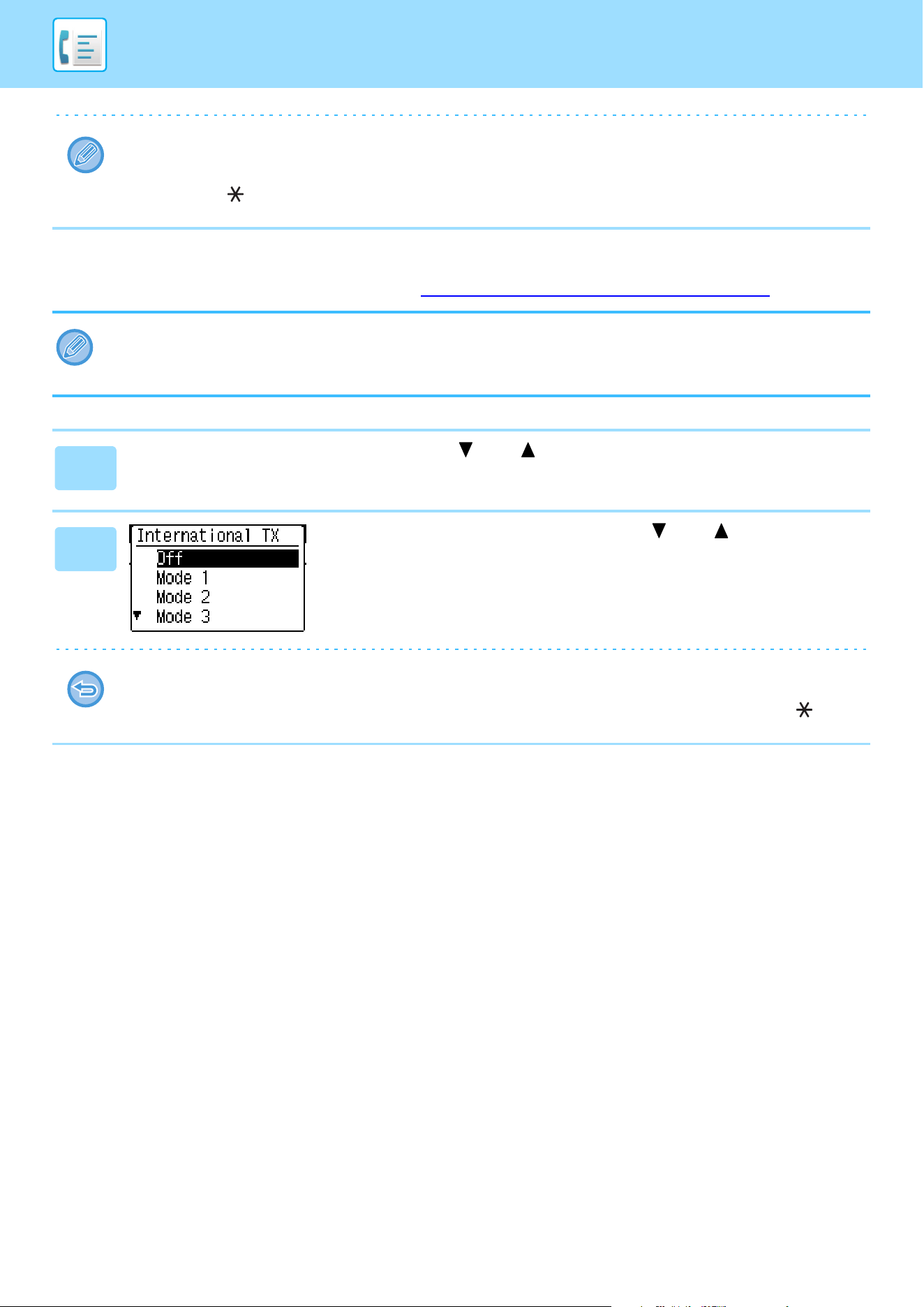
4-39
FACSIMILE►CONVENIENT FAX FUNCTIONS
International transmission mode setting
To set the international transmission mode, complete Editing and deleting auto-dial numbers (page 4-41).
If you select a speed other than 33,600 bps (maximum speed), a checkmark will appear next to "TX Speed" when you
return to the option setting screen. This setting is not effective for polling transmission.
To remove the checkmark and return the transmission speed setting to "33,600 bps (maximum speed)", press the
[LOGOUT]
key ( ).
• When sending a fax to a foreign country, telephone line conditions can sometimes distort the fax or interrupt the
transmission. Selecting the right international transmission mode can help alleviate these problems.
• If errors frequently occur when sending a fax to a foreign country, try each of modes 1 to 3 and select the mode that
enables the best transmission.
1
Select "International TX" with the [ ] or [ ] key press the [OK] key.
2
Select the desired mode with the [ ] or [ ] key.
If you select a setting other than "Off", a checkmark will appear next to "International TX" when you return to the option
setting screen.
To remove the checkmark and return the international transmission mode to "Off", press the [LOGOUT] key ( ).
4-40
FACSIMILE►CONVENIENT FAX FUNCTIONS
Storing a group dial
To store a group dial number, perform the steps below in the auto dial storing screen.
1
Press the [SPEED] key.
Enter the desired Group Dial number (000 to 299) with the numeric keys.
If you press a number that has already been stored, a warning message will appear.
Group key dialing is an automatic dialing function where by multiple destinations are programmed into a Rapid key. If
you frequently send faxes to the same group of destinations using broadcast transmission, which is used to send the
same document to multiple destinations in a single operation (►page 4-30)
, it is convenient to program those
destinations into a group key.
2
Enter a group name (see CHARACTER ENTRY (page 1-39)).
3
Store the destinations using Speed Dial numbers, and the numeric keys.
• To store a Speed Dial number, press the [SPEED] key and then enter the desired Speed Dial number (000 to 299)
with the numeric keys. If you press an incorrect key, press the [C] key and then press the correct key.
• Chain dialing, transmission speed, and international transmission mode options cannot be selected. If you need to
select an option for the destination, store the destination in Speed Dial number and then store the destination in the
group dial. Up to 50 digits can be entered for the fax number. If you need to insert a pause between any of the digits,
press the [REDIAL/PAUSE] key to enter a pause. The pause appears as a hyphen (-). To set the duration of the
pause, see Pause Time (page 7-19)
. When you have finished entering the fax number, press the [OK] key.
4
Repeat step 3 for all of the destinations that you wish to store in the group
dial, and press the [START] key.
Up to 100 destinations can be stored in a group dial.
4-41
FACSIMILE►CONVENIENT FAX FUNCTIONS
Editing and deleting auto-dial numbers
To edit or delete a stored number, perform the steps below in the auto dial storing screen.
Editing a Speed Dial number
Deleting a Speed Dial number
The Speed Dial number is being used in a transmission in progress or in a stored transmission, a Speed Dial number cannot
be edited or cleared.
1
Select "Speed" with the [ ] or [ ] key and Select "Change" with the [ ] or
[ ] key.
2
Press the [SPEED] key and edit the destination fax number with the numeric
keys.
• Press the [SPEED] key and then enter the Speed Dial number (000 to 299) that you wish to edit with the numeric
keys.
• Move the cursor to the digit(s) that you wish to edit with the [ ] or [ ] key, and then enter the correct digit(s) with the
numeric keys.
• To delete a digit, move the cursor to the digit that you wish to delete with the [ ] or [ ] key and then press the [C]
key.
3
To finish the storing procedure, press the [START] key. If you wish to
program an option such as chain dialing, transmission speed, or
international transmission mode, press the [OK] key. (See CHARACTER
ENTRY (page 1-39).)
1
Select "Delete" and press the [SPEED] key.
Press the [SPEED] key and then enter the Speed Dial number (000 to 299) that you wish to delete with the numeric
keys.
2
Select "Delete" with the [ ] or [ ] key.
If you select "No Delete", you can press the key to check the destination name. If you are deleting the destination, check
the destination name and then delete the destination.
4-42
FACSIMILE►CONVENIENT FAX FUNCTIONS
Editing and deleting group dials
To edit or delete a group dial, follow steps 1 through 3 on pages STORING, EDITING, AND DELETING AUTO-DIAL
NUMBERS (SPEED DIAL NUMBERS, AND GROUP DIALS) (page 4-37) and then follow the steps below.
Editing a group dial
Deleting a group dial
A group dial cannot be edited or deleted in the following cases.
• The group dial is stored in a program
1
Select "Group" with the [ ] or [ ] key and Select "Change" with the [ ] or
[ ] key.
2
Press the group dial number that you wish to edit, and edit the group name,
the search characters. (See CHARACTER ENTRY (page 1-39)
.)
3
When you have finished editing the destinations, press the [START] key.
1
Select "Delete" with the [ ] or [ ] key and press the group that you wish to
edit.
2
Select "Delete" with the [ ] or [ ] key.
If you select "No Delete", you can press the key to check the destination name. If you are deleting the destination, check
the destination name and then delete the destination.
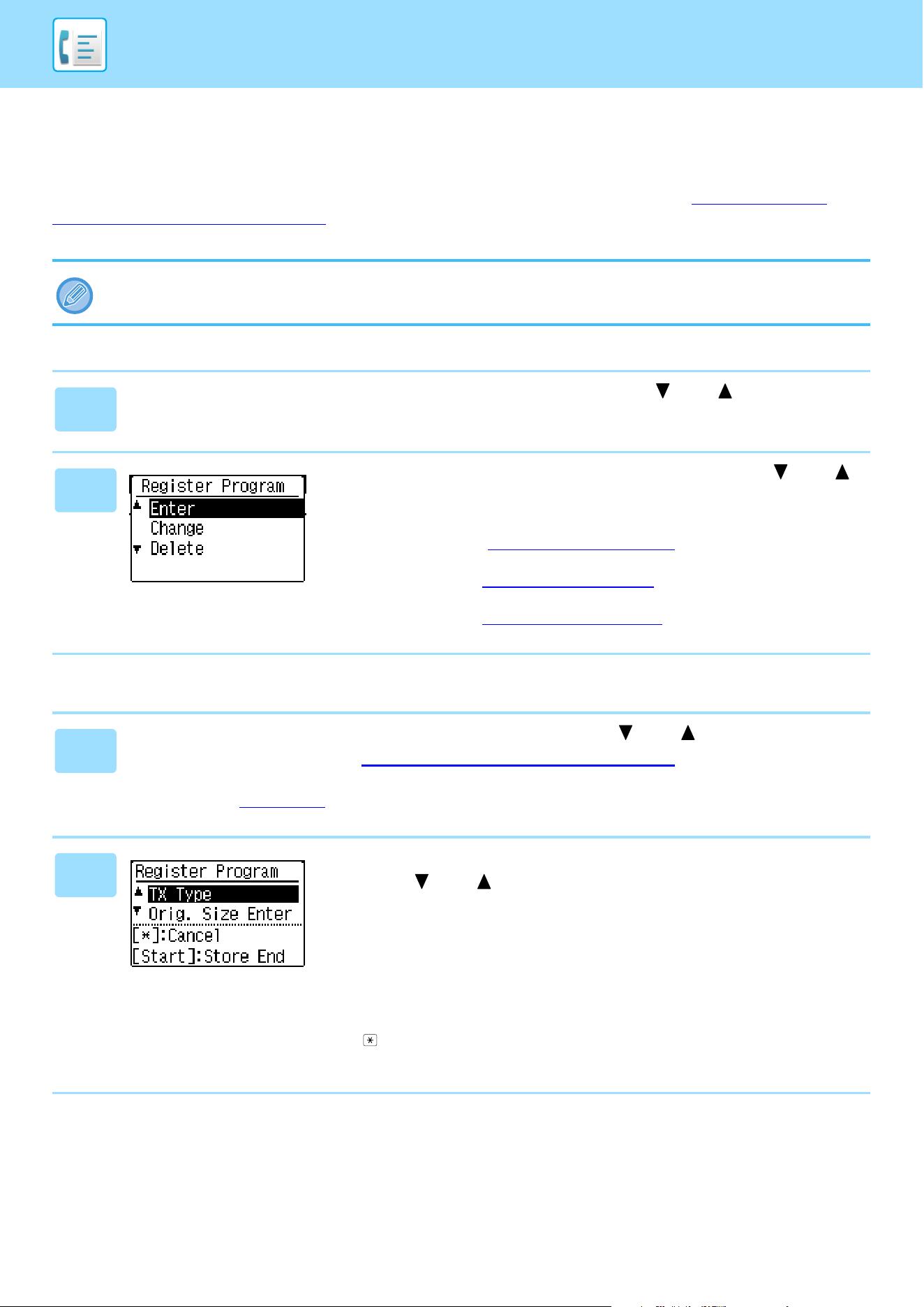
4-43
FACSIMILE►CONVENIENT FAX FUNCTIONS
STORING, EDITING AND DELETING PROGRAMS
You can store a address setting, transmission method*, original size enter, duplex scanning, resolution and exposure,
own number sending, transmission settings.
This will allow you to use the settings for a transmission by means of a simple operation (see USING SETTINGS
STORED AS A PROGRAM (page 4-49)).
* Transmission methods: normal transmission, broadcast transmission, polling, serial polling.
To register a program, perform the steps below in the auto dial storing screen.
Storing a program
A screen setting and timer transmission setting cannot be stored in a program.
1
Select "Entry" and select "Register Program" with the [ ] or [ ] key.
2
Select "Enter", "Change", or "Delete" with the [ ] or [ ]
key.
• To store a program, select "Enter" and press the [OK] key.
Continue from step 3 of Storing a program (page 4-43)
.
•
To edit a program, select "Change" and press the [OK] key.
Next, follow the steps in Editing programs (page 4-44)
.
•
To delete a program, select "Delete" and press the [OK] key.
Next, follow the steps in Deleting programs (page 4-44)
.
3
Select the program that you wish to store with the [ ] or [ ] key, and enter
the program name. (See CHARACTER ENTRY (page 1-39)
)
If you select a program that has already been stored, a message appears. Select a program that has not been stored, or
clear the program (►page 4-44)
and then select it.
4
Select the item that you wish to store in the program
with the [ ] or [ ] key.
• A transmission method, original size enter, dual pages, resolution/exposure settings,
sender's name, and transmission settings can be stored.
• A transmission method must be stored. The storing procedure cannot be completed
unless a transmission method is stored.
• For the procedures for selecting each of the settings, refer to the explanations of the
settings.
• To cancel a setting selection, select the setting that you wish to cancel and then press
the key.
• Some settings cannot be used in combination with others. If you select a prohibited
combination of settings, a message will appear in the display.
4-44
FACSIMILE►CONVENIENT FAX FUNCTIONS
Editing programs
If you need to edit a previously stored program, follow these steps.
Deleting programs
Before deleting a program, print the "Program List" to check the contents. (►page 4-45)
To delete a previously stored program, follow these steps.
3
Select the program that you wish to edit with the [ ] or [ ] key.
4
Edit the program name (see CHARACTER ENTRY (page 1-39)).
• See step 3 of Storing a program (page 4-43).
• If you do not wish to edit the program name, go to the next step.
5
Select the stored setting that you wish to edit with the [ ] or [ ] key.
• See steps 4 of Storing a program (page 4-43).
• If you do not wish to edit the stored settings, press the [START] key and then press the [BACK] key to exit.
3
Select the program that you wish to delete with the [ ] or [ ] key.
4
Select "Delete" with the [ ] or [ ] key.
4-45
FACSIMILE►CONVENIENT FAX FUNCTIONS
PRINTING LISTS OF PROGRAMMED
INFORMATION AND SETTINGS
You can print lists showing programmed information and settings.
The following lists can be printed.
• Destination Lists: Shows the destinations stored in auto dial numbers in the order of their search characters.
• Group List: Shows the destinations stored in each group dial number.
• Program List: Shows the operations stored in each program.
• Timer List: Shows timer transmissions and recall transmissions.
• Mem. Polling List: Shows the documents stored for memory polling.
For other lists that can be printed, refer to List Print (page 7-15)
.
1
Press the [SPECIAL FUNCTION] key.
2
Select "Data List Print" and select "Fax" with the [ ] or [ ] key.
3
Select the list that you wish to print with the [] or [] key.
See the explanation of the lists that can be printed above.
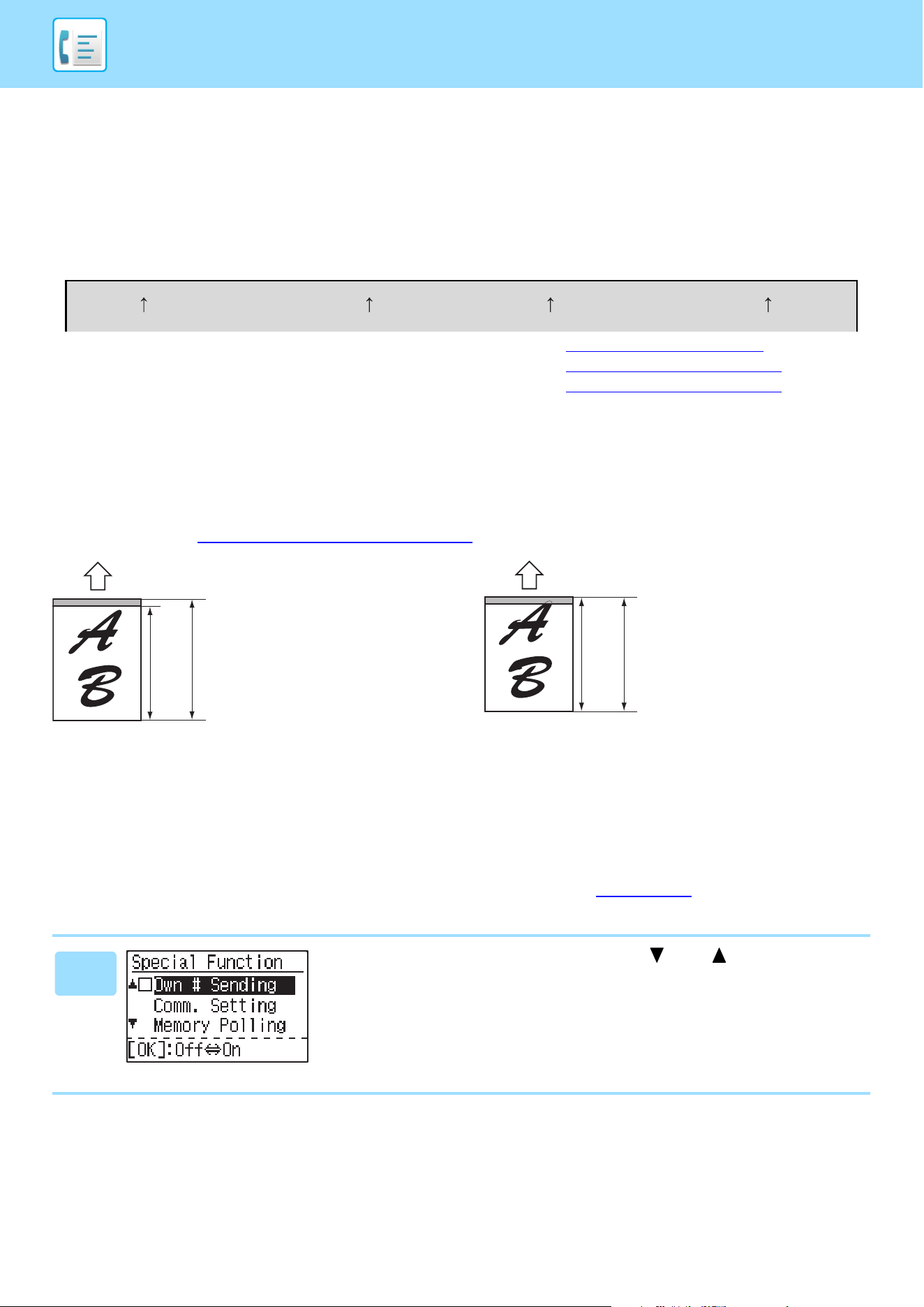
4-46
FACSIMILE►CONVENIENT FAX FUNCTIONS
INCLUDING SENDER INFORMATION ON FAXES (OWN
NUMBER SENDING)
This function prints the date, time, your programmed name, your programmed fax number, and the transmitted page
number at the top center of each page that you fax. All pages that you fax include this information.
Example of fax page printed out by the receiving machine
(1) Date and time: programmed in the system settings (see Date & Time Set (page 7-10)).
(2) Sender's name: programmed in the system settings (see Own Passcode Set (page 7-19)
).
(3) Sender' number: programmed in the system settings (see Own Passcode Set (page 7-19)
).
(4) Transmitted page number: 3-digit number appearing in the format, "page number/total pages".
(Only the page number appears if you use manual transmission, direct transmission,
or quick on-line transmission.)
Position of sender information
You can select whether the sender information is added outside the document data or inside the document data in the
system settings (see Print Station # In Rcvd Data (page 7-20)
). The factory default setting is outside the document data.
Outside the scanned data
(document data)
None of the transmitted
image is cut off; however,
the transmitted image is
longer than the scanned
image, and thus when both
the sender and the receiver
use the same size of paper, the printed fax may either be
reduced or split up and printed on two pages.
Inside the scanned data
(document data)
The top edge of the scanned
image will be cut off by the
sender's information;
however, when both the
sender and the receiver use
the same size of paper, the
printed fax will neither be reduced nor split up and
printed on two pages.
Sending without sender information
You can select whether or not sender information is added each time you send a fax. The procedure for sending one fax
without sender information when the system settings are set to add sender information to each fax transmission (factory
default setting) is explained here. (When performing a Broadcast Transmission (►page 4-30)
after configuring this
setting, the fax will be sent to all destinations without sender information.)
AP-1-2018-SUN 03:00 PM SHARP PLANNING DIV. FAX No. 0666211221 P. 001/001
(1) (2) (3) (4)
Direction of
transmission
Length of
scanned data
Length of
transmitted data
Direction of
transmission
Length of
scanned data
Length of
transmitted data
1
Select "Own # Sending" with the [ ] or [ ] key and
press the [OK] key.
When a checkmark appears in the “Own # Sending” checkbox, this function is enabled.
If you press [OK] with a checkmark in the checkbox, the function will be disabled.
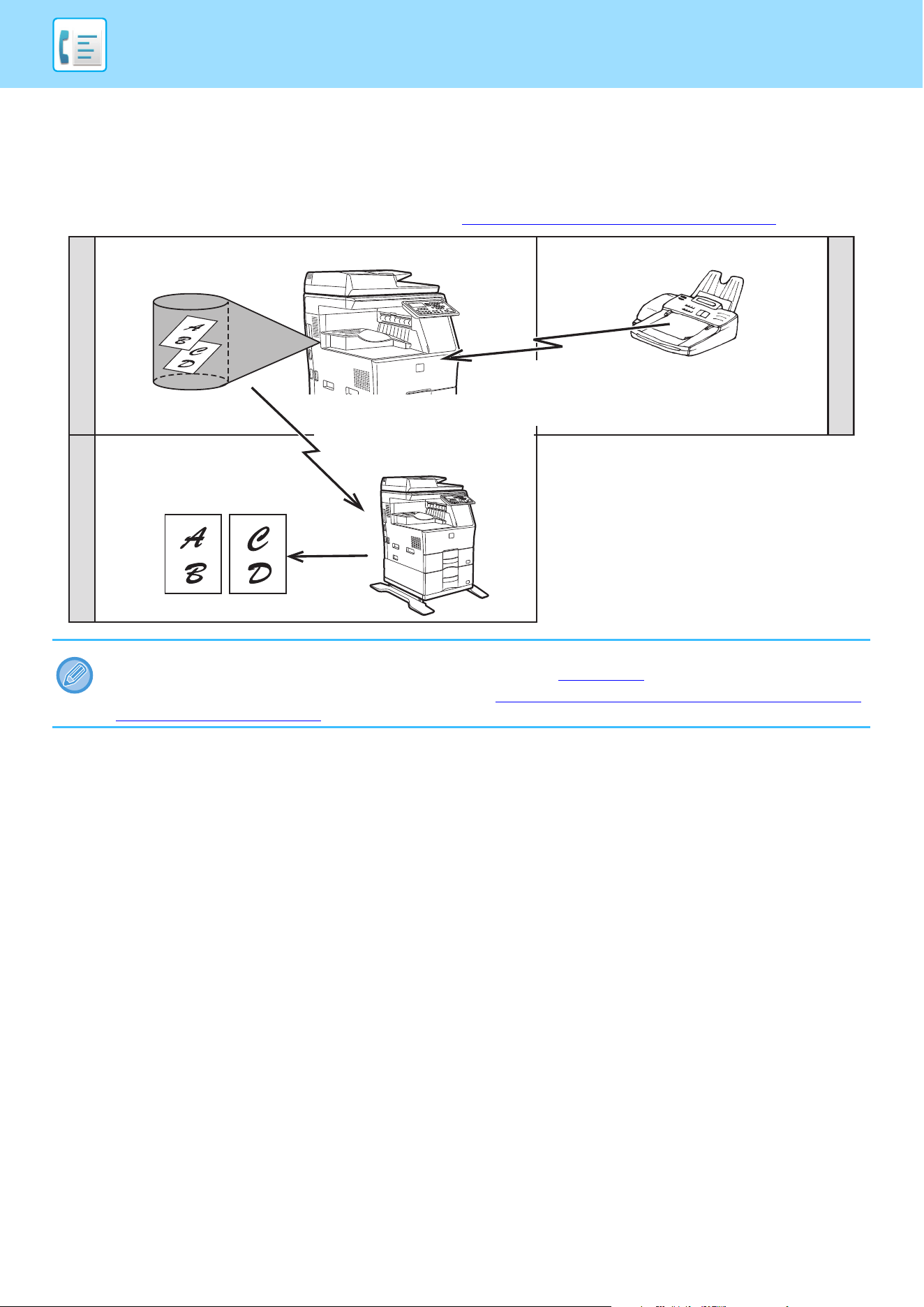
4-47
FACSIMILE►CONVENIENT FAX FUNCTIONS
FORWARDING FUNCTION
When printing is not possible because of a paper, toner, or other problem, you can forward received faxes to another fax
machine if that machine has been appropriately programmed in your machine. This function can be conveniently used in
an office or other workplace where there is another fax machine connected to a different phone line. When a fax has
been received to memory, the FAX [DATA] light blinks (see If received data cannot be printed (page 4-26)
).
• All received faxes are forwarded; a particular fax cannot be selected for forwarding.
• Faxes that have been received to memory by the fax print hold function (►page 4-28)
are also forwarded.
• The result of forwarding is indicated in the activity report (see REPORT AT REGULAR INTERVALS (COMMUNICATION
ACTIVITY REPORT) (page 4-60)).
Your machine
Transfer destination
(2) Printing not possible because
of paper or toner problem
(3) "Transfer" instruction
(5) Printing
(1) Fax transmission to your
machine
(4) Automatic dialing and
transmission to programmed
transfer destination
Other machine
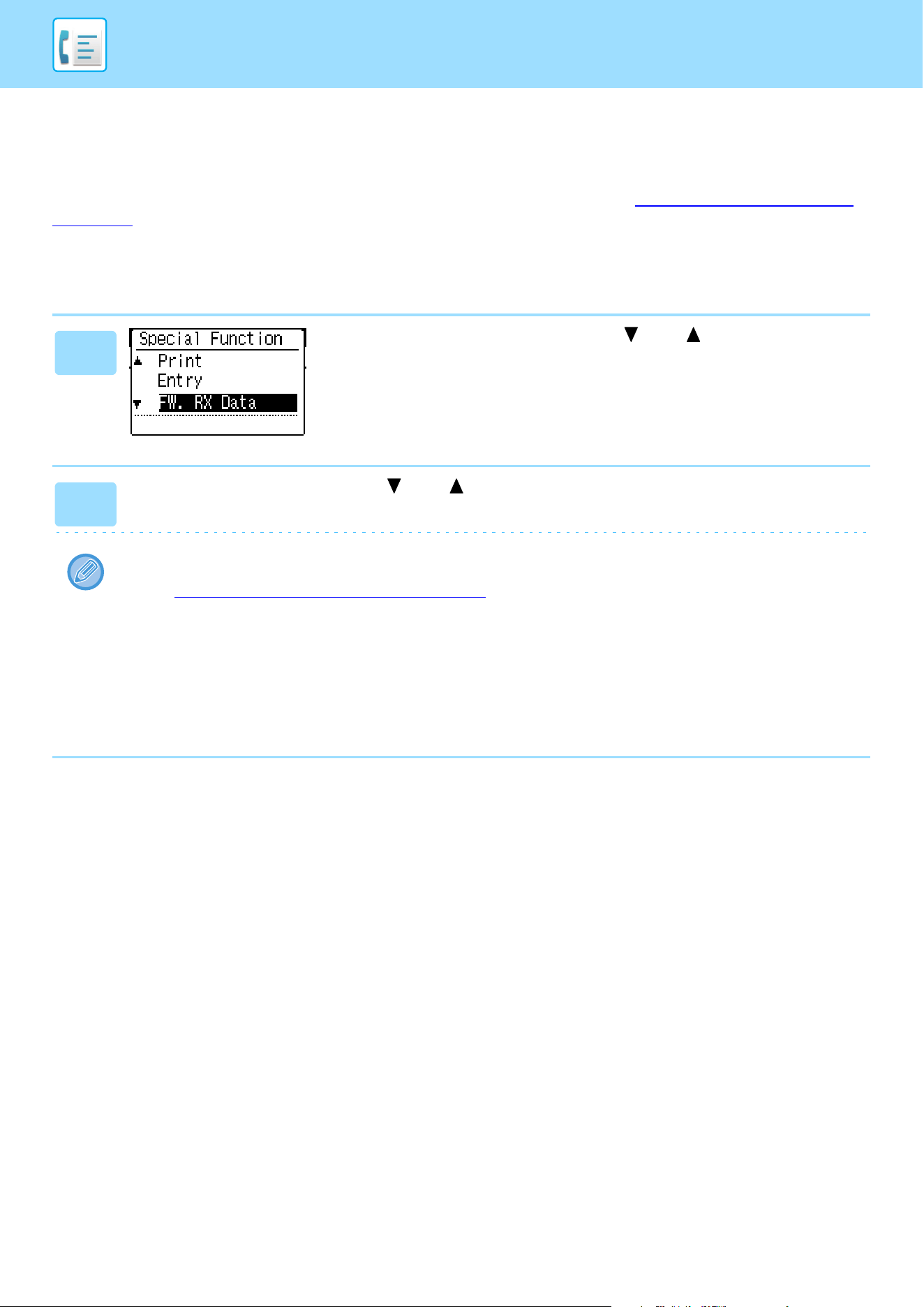
4-48
FACSIMILE►CONVENIENT FAX FUNCTIONS
USING THE FORWARDING FUNCTION
Programming the fax number of the forwarding destination
The number of the forwarding destination is programmed in the system settings (see Received Data FW. Station Set
(page 7-22)). Only one fax number can be programmed. The forwarding function cannot be used unless a number is
programmed.
Forwarding received faxes
1
Select "FW. RX Data" with the [ ] or [ ] key and press
the [OK] key.
2
Select "Transfer" with the [ ] or [ ] key and press the [OK] key.
To cancel a forwarding operation
• Press the [FAX STATUS] key, and then cancel forwarding in the same way as a regular fax transmission.
(See CANCELING A FAX TRANSMISSION (page 4-21)
.)
The fax(es) that was going to be forwarded will return to print standby status in your machine.
• If forwarding is not possible because the other machine is busy or a transmission error occurs, recall attempts will be
made according to the recall times setting. If forwarding is still not successful after the set number of recall attempts
are made, the fax(es) will return to print standby status in your machine.
• When forwarding is performed, all faxes that have been received in memory to that point are forwarded.
The page that was being printed when the problem occurred and all following pages will be forwarded.
• After a fax is forwarded, the fax data is automatically cleared from memory.
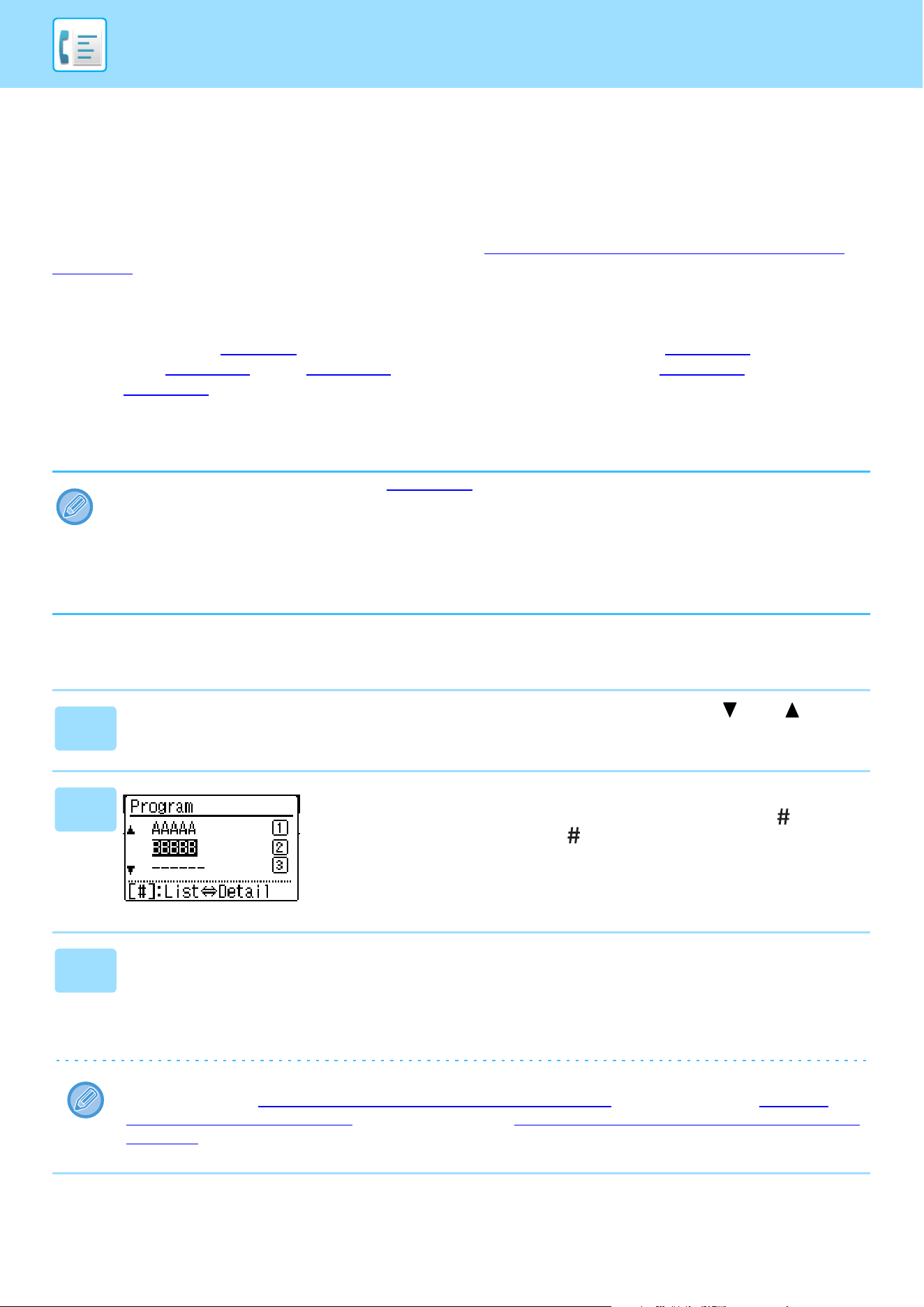
4-49
FACSIMILE►CONVENIENT FAX FUNCTIONS
USING SETTINGS STORED AS A PROGRAM
This function allows you to store the steps of an operation, including the destination and scanning settings, into a
program. This function is convenient when you frequently send documents, such as a daily report, to the same
destination. Up to 9 programs for fax transmission can be stored.
When storing a program, a name (maximum 36 letters) can be assigned to the program.
For information on storing, editing, and deleting programs, see STORING, EDITING AND DELETING PROGRAMS
(page 4-43).
The following settings can be stored in a program:
(1) Address setting
(2) Transmission method
Normal transmission ►page 4-8
, broadcast
transmission ►page 4-30
, polling ►page 4-32, serial
polling ►page 4-33
(3) Original Size Enter
(4) Duplex Scanning
(5) Resolution and exposure
(6) Own number sendings ►page 4-46
(7) Transmission settings ►page 4-15
When storing a broadcast transmission or serial polling operation in a program, up to 200 destination fax numbers can
be stored.
USING A PROGRAM
• A program differs from a timer transmission (►page 4-29) in that it is not cleared from memory after transmission takes
place. A program thus allows you to repeatedly perform the same type of transmission. Note, however, that programs do
not allow you to establish a timer setting for transmission.
• A setting that can be stored in a program cannot be changed at the time that a program is used for a transmission even if
the setting is not stored in the program.
• The only settings that can be selected when using a program are the original size enter, duplex scanning, and a timer
setting.
1
In fax mode, place the original and select "Program" with the [ ] or [ ] key.
2
Select the program that you wish to use.
If not all letters of the program name appear, press the [READ-END] key ( ) to display
all letters. Press the [READ-END] key ( ) once again to return to the original screen.
3
If needed, select the original size and other settings, and then press the
[START] key.
• Transmission takes place according to the program.
• If you selected a program that does not include a transmission method, set the transmission method and the
destinations to be dialed before pressing the [START] key.
Select settings that cannot be stored in a program before you press the [START] key in step 3. These settings include
the original size (see BASIC PROCEDURE FOR SENDING FAXES (page 4-8)
), duplex scanning (see FAXING A
TWO-SIDED ORIGINAL (page 4-14)), and a timer setting (see AUTOMATIC TRANSMISSION AT A SPECIFIED TIME
(page 4-29)).
4-50
FACSIMILE►CONVENIENT FAX FUNCTIONS
FORWARDING RECEIVED DATA TO A
NETWORK ADDRESS (INBOUND ROUTING
SETTINGS)
You can have received faxes automatically forwarded to a specified E-mail address or shared folder. As an example,
this function can be used to route received faxes to a specified E-mail address or a specified folder without printing the
faxes.
All Inbound Routing settings are configured in the Web page.
The following explanation assumes that the Web page has been accessed with administrator rights.
For the procedure for accessing the Web pages, see HOW TO ACCESS THE WEB PAGE (page 8-2)
.
To activate Inbound Routing, configure the basic settings before specifying the destination.
In the menu frame, click [Inbound Routing Settings]. Click the [Submit] button after
settings
CONFIGURING THE BASIC SETTINGS
Configure the basic settings of Inbound Routing.
Enabling the Inbound Routing function
Select [Enable] in [Inbound Routing].
Changing the print style of received data
Select a print style in [Print Style Setting].
Item Settings Description
Inbound Routing Enable, Disable Enable or disable the Inbound Routing function.
Print Style Setting Always Print, Print at Error Select a print style of received data.
4-51
FACSIMILE►CONVENIENT FAX FUNCTIONS
Set a file name for forwarding received data
Select from the pull-down menu of items used for the file name.
To add a desired text string, select the "Characters" and enter the string in "Preset of Character" using up to 64
characters.
Select the item to be used as the file name in "File Name Setting".
Setting whether to print the transaction report
Select whether to print the transaction report when forwarding received data.
Specify the print condition in "Transaction Report Print Select Setting".
Item Description
Serial Number Selecting Serial Number adds the unit serial number to the file name.
Sender Name Selecting Sender Name adds the sender name to the file name.
Date & Time Selecting Date & Time adds the date and time to the file name.
Session Page Counter Selecting Session Page Counter adds the counter to the file name.
Unique Identifier Selecting Unique Identifier adds the unique identifier to the file name.
Characters To add a character string to the file name, select this checkbox and enter the text string in
"Preset of Character" using up to 64 characters.
Preset of Character Enter a text string to be used in "Characters" using up to 64 characters.
Item Settings Description
Transaction Report Print
Select Setting
Always Print,
Print at Error, Do not Print
Select a print style of the transaction report.
4-52
FACSIMILE►CONVENIENT FAX FUNCTIONS
SETTINGS THE DESTINATION
Specify a sending source of received data and forwarding destination E-mail address or network folder to configure a
forwarding table.
Up to 10 forwarding tables can be configured.
For each forwarding table, set the following items:
• Forward Condition (enabling/disabling forwarding, and the conditions to determine forwarding)
• Sender number (fax number)
• Forwarding destinations (network folder)
• Forwarding destinations (E-mail address)
Viewing the destination list
Settings the destination
• The names of the destination number (Forward destination 1 to 10) cannot be changed.
• The E-mail address or the network folder can be specified for a forwarding destination. Scan to FTP, Scan to Desktop,
and fax number cannot be specified.
1
Click [Destination].
The destination list appears.
Item Description
Inbound Routing Displays whether Inbound Routing function is enabled.
Number Displays the forwarding destination number (Forward Destination 1 to 10).
Each of setup menu is displayed by clicking each number.
Forward Condition Displays the forward condition of the destination (enabling/disabling and determining the
destination setting).
[Delete] button To delete the forwarding condition stored in a destination number, select the "Number" checkbox
of the destination number and click the [Delete] button.
[Clear Checked] button Clicking this clears all "Number" checkboxes.
1
Click [Destination] and click the destination number to be set.
2
Select [Enable] in "Forward Condition" and select the determining condition
for forwarding.
Select [Forward (All)] or [Forward (Sender)].
3
If you wish to forward received data from a specific sender, enter the
sender's fax number in "Sender Number".
Enter the fax number using up to 20 digits. To enter the fax number from the fax addresses stored in the machine, click
the [Select from Address Book] button. The "Fax Destination" screen appears, and you can select the sender's number
from the fax address list.
4-53
FACSIMILE►CONVENIENT FAX FUNCTIONS
Forward Condition
Sender Number
Forward Destination (Max. 10)
4
Enter the destination E-mail address or network folder in "Forward
Destination (Max.10)".
Up to ten E-mail address or network folder can be specified as the destination.
Two types of methods are available for entering the destination. The set E-mail address or network folder are displayed
in "Forwarding Destination Settings".
• Entering an E-mail address or network folder directly
Click the [Direct Entry] button. When the "Forwarding Destination Settings (Direct Entry)" appears, enter an E-mail
address or network folder information ("Hostname or IP Address", "User Name", "Password", "E-mail", "E-mail
address"), and click the [Submit] button.
• Selecting an E-mail address or network folder from the address book
Click the [Select From Address Book] button. The "Destination List" screen appears, and you can select an
E-mail
address or
network folder from the list.
To delete a set E-mail address or network folder, select the checkbox at the left of the E-mail address or network folder
you wish to delete, and then click the [Delete] button.
Item Settings Description
Forward
Condition
Enable, Disable Enable or disable the destination to be set in this screen.
Forward (All),
Forward (Sender)
Select the determination condition for forwarding the received FAX data.
Item Description
Fax No. Enter the sender's fax number if you have selected "Forward (Sender)" in
"Forward Conditions" setting. Up to 20 digits can be entered.
[Select From Address Book] button Click this button to select the fax number from the fax addresses stored in
this machine.
Item Description
Forwarding Destination Settings Displays the stored destinations. If no destination is stored, "Not Set"
appears.
[Delete] button Deletes the selected destination.
[Direct Entry] button Click this button to enter an E-mail address or network folder directly.
[Select From Address Book] button Click this button to select an E-mail address or network folder from the
address list stored in the machine.
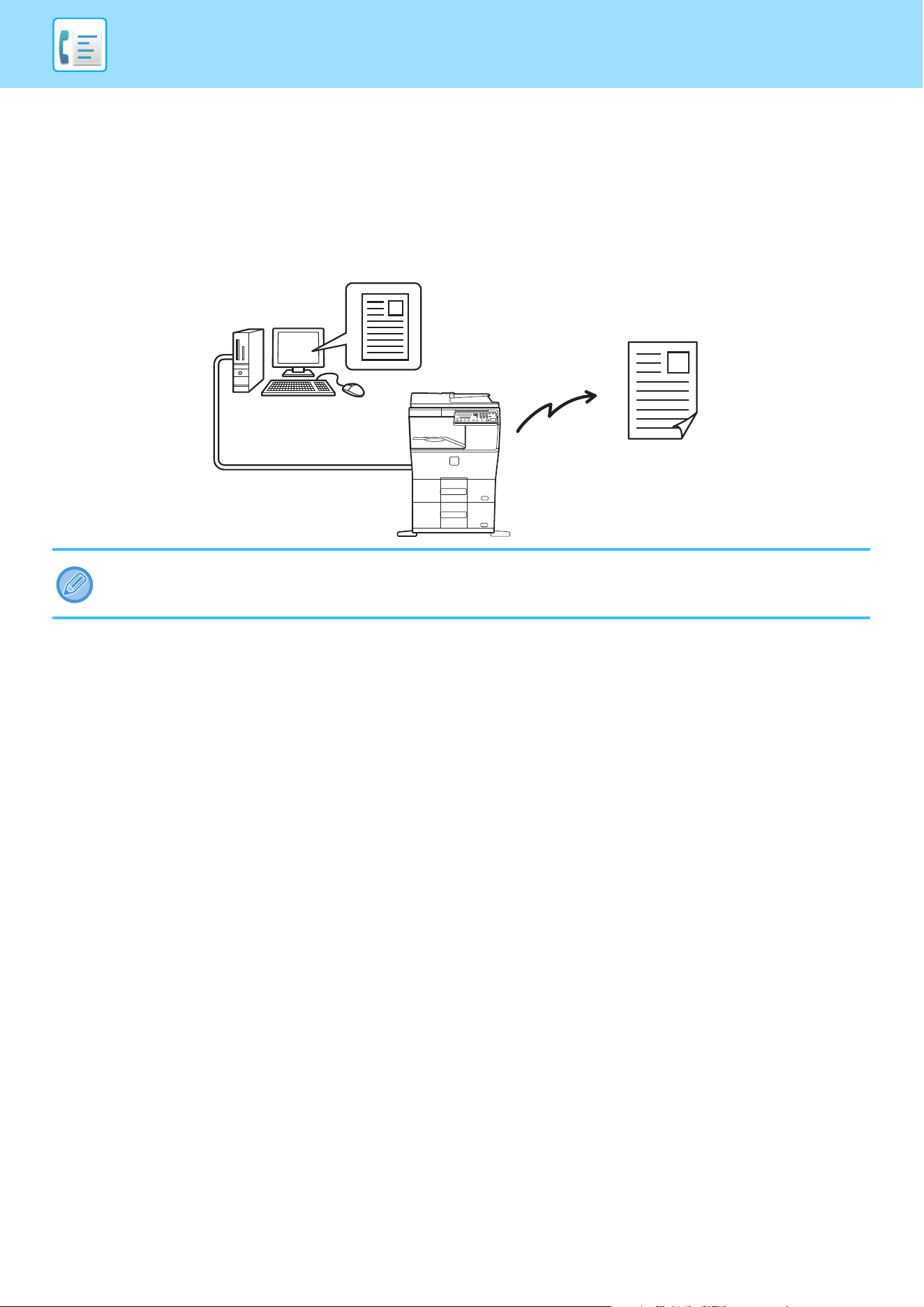
4-54
FACSIMILE►CONVENIENT FAX FUNCTIONS
SENDING A FAX DIRECTLY FROM A
COMPUTER (PC-Fax)
A document in a computer can be transmitted via the machine as a fax. Faxes are sent using the PC-Fax function in the
same way as documents are printed. Select the PC-Fax driver as the printer driver on your computer and then select the
Print command in the software application. Image data for transmission will be created and sent as a fax.
• To use the PC-Fax function, the PC-Fax driver must be installed. For more information, see the Software Setup Guide
• This function can only be used on a Windows computer.
• This function can only be used for transmission. Faxes cannot be received to your computer.
Fax transmission
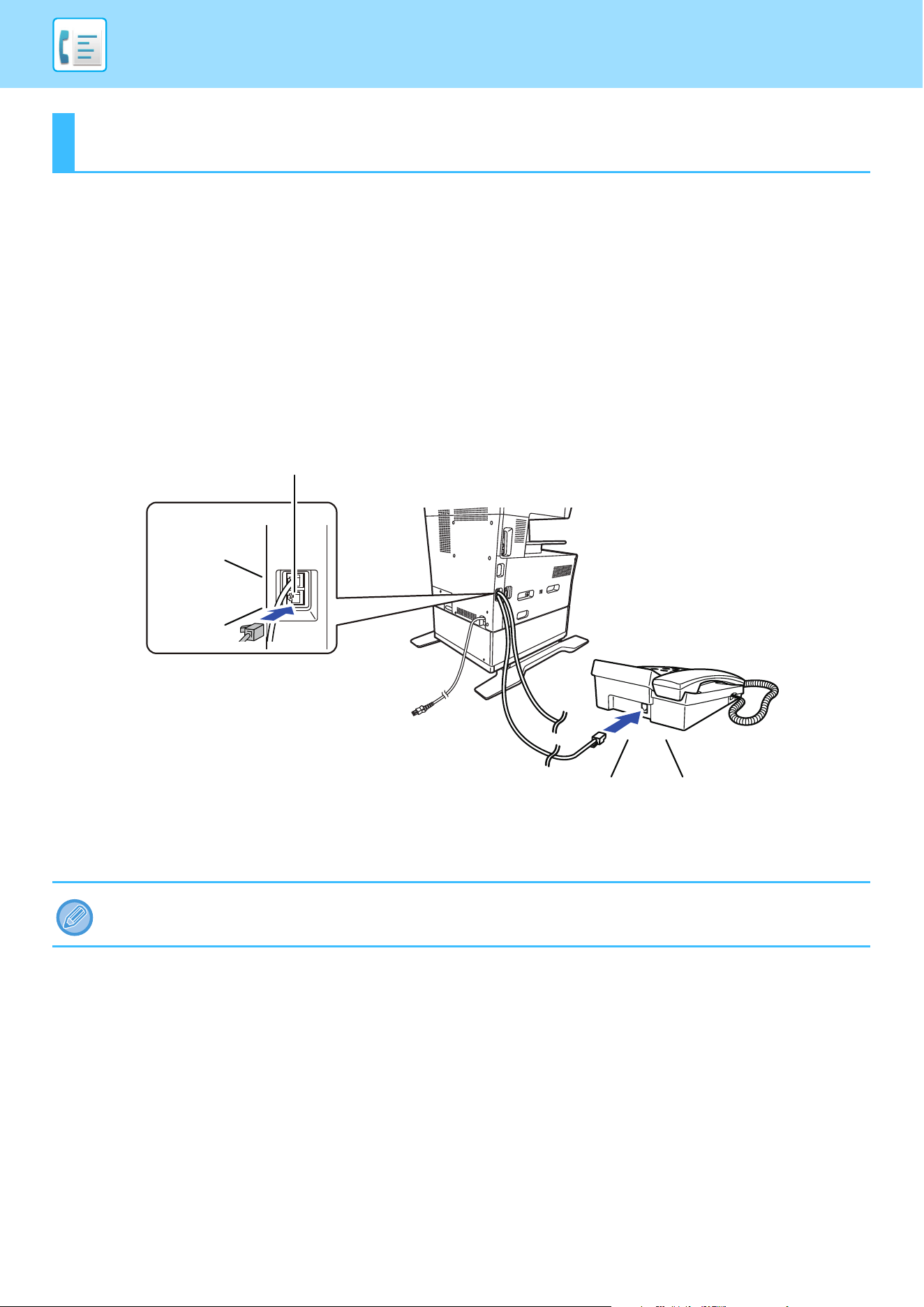
4-55
FACSIMILE►USING AN EXTENSION PHONE
CONNECTING AN EXTENSION PHONE
You can connect a telephone to the machine and use it as an extension phone to place and receive calls like any normal
phone. Fax reception can also be activated from an extension phone connected to the machine. (remote operation)
CONNECTING AN EXTENSION PHONE
Insert the end of the extension phone cord into the extension phone jack on the left
side of the machine.
Make sure you hear a "click" sound indicating that the cord is securely connected.
USING AN EXTENSION PHONE
Only use an extension telephone that can be connected to a modular jack.
If the shape of the cord plug is not compatible with the jack, consult your dealer or nearest Sharp customer service center.
Extension phone jack
Clicks
Clicks
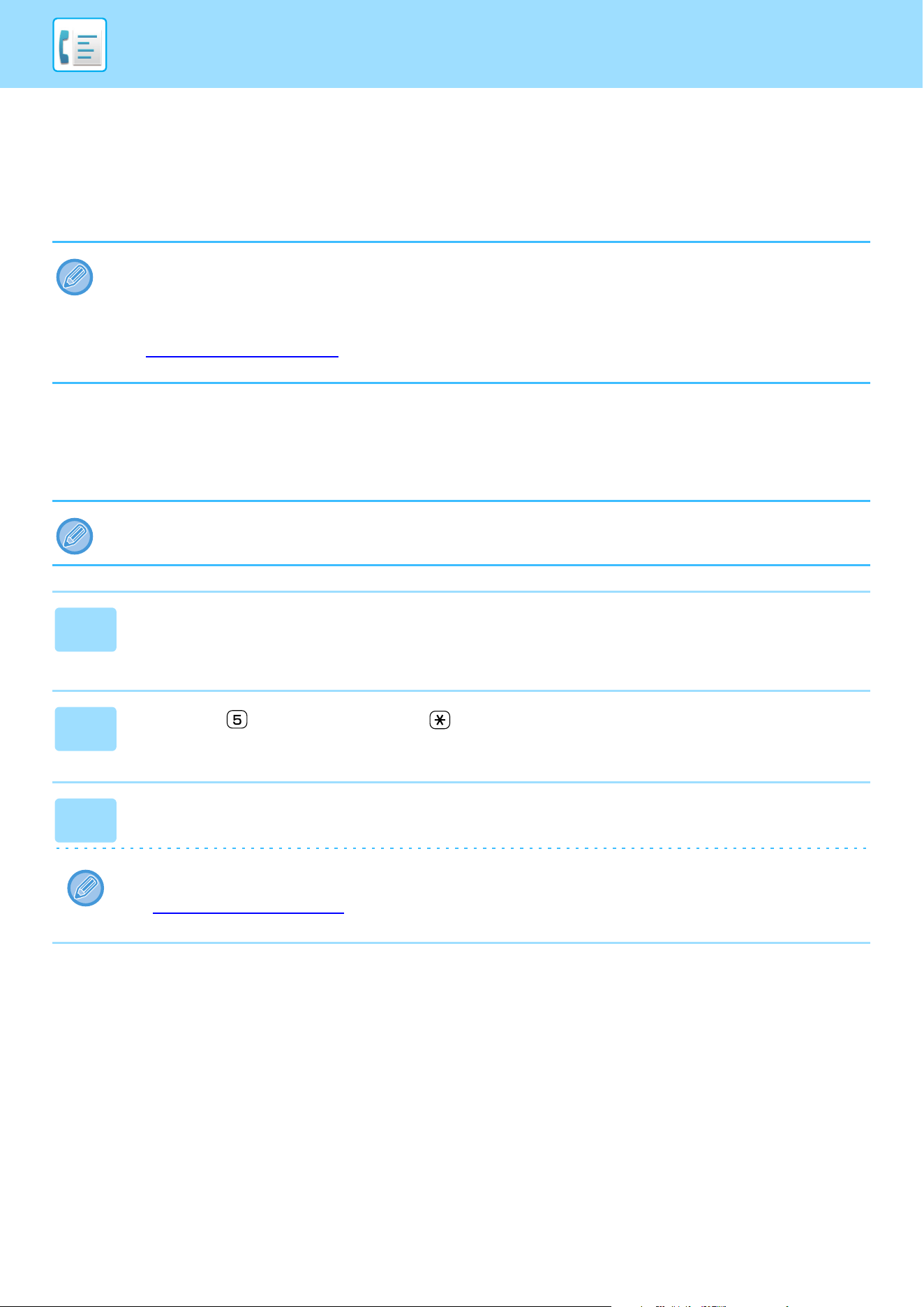
4-56
FACSIMILE►USING AN EXTENSION PHONE
USING AN EXTENSION PHONE
Using an extension phone for voice calls
An extension phone connected to the machine can be used to place and receive voice calls just like a normal phone.
An extension phone can be used while another mode is being used (copying, etc.).
Activating fax reception from an extension phone (remote reception)
After receiving a call on the extension phone, you can activate fax reception from the extension phone. This is called
"remote reception". After speaking, or when you hear a fax tone through the extension phone, perform the following
procedure with the extension phone still lifted. (If you made the call, remote reception will not be possible.)
• It may not be possible to make a call on your line during a power outage. This depends on the type of line (optical line,
etc.).
• If the fax reception mode is set to auto reception, you must lift the phone to answer a call before the machine automatically
begins reception. The machine is initially set to answer calls on two rings. The number of rings can be changed to any
number from 0 to 15 in the system settings.
► #Of Rings Man.RX
(page 7-21)
• A call cannot be placed on hold.
The following procedure is not possible if you are on a pulse dial line and your extension phone cannot produce tone signals.
To find out whether your extension phone can produce tone signals, refer to the manual for your extension phone.
1
If you are on a pulse dial line, set your phone to issue tone signals.
Refer to your phone's manual to set the phone to issue tone signals.
If your phone is already set to issue tone signals, proceed to the next step.
2
Press the key once and the key twice on the extension phone.
Fax reception is activated.
3
Replace the extension phone.
The one-digit number that is used to activate fax reception from an extension phone (initially set to "5") is called the
"remote reception number". You can change this number to any number from 0 to 9 in the system settings.
► Remote Reception
(page 7-19)
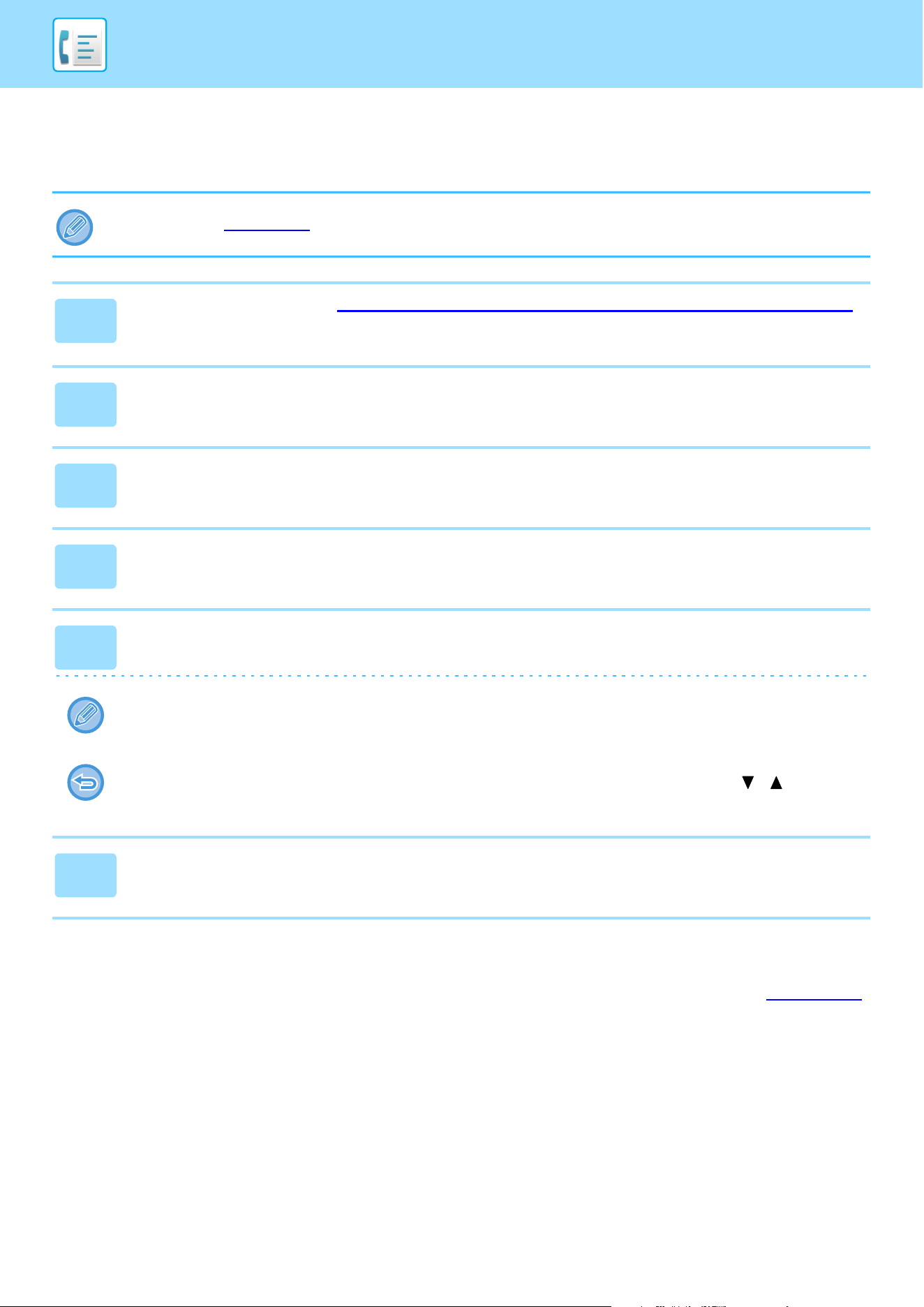
4-57
FACSIMILE►USING AN EXTENSION PHONE
Sending a fax after talking on the phone (Manual transmission)
If the other fax machine is set to manual reception, you can talk to the other party and then send a fax without breaking
the connection.
Receiving a fax after talking (Manual reception)
When an extension phone is connected to the machine and you have set the reception mode to Manual (►page 4-27),
you can talk to a person sending a fax manually and then begin fax reception without breaking the connection.
Automatic redialing (►page 4-18) will not take place if the line is busy.
1
Follow steps 1 to 4 of BASIC PROCEDURE FOR SENDING FAXES (page 4-8)
and then follow the steps below.
2
Lift the extension phone.
3
Dial the number of the other party.
4
Speak to the other party when they answer.
5
After the other party switches to fax reception, press your [START] key.
Transmission begins.
If you have loaded the original on the document glass, you can only send one page by manual transmission.
Canceling a fax transmission...
Press the [C] key. A screen appears asking you to cancel a fax transmission. Select "Yes" with the [ ] [ ] keys, and
press the [OK] key.
6
Replace the extension phone.
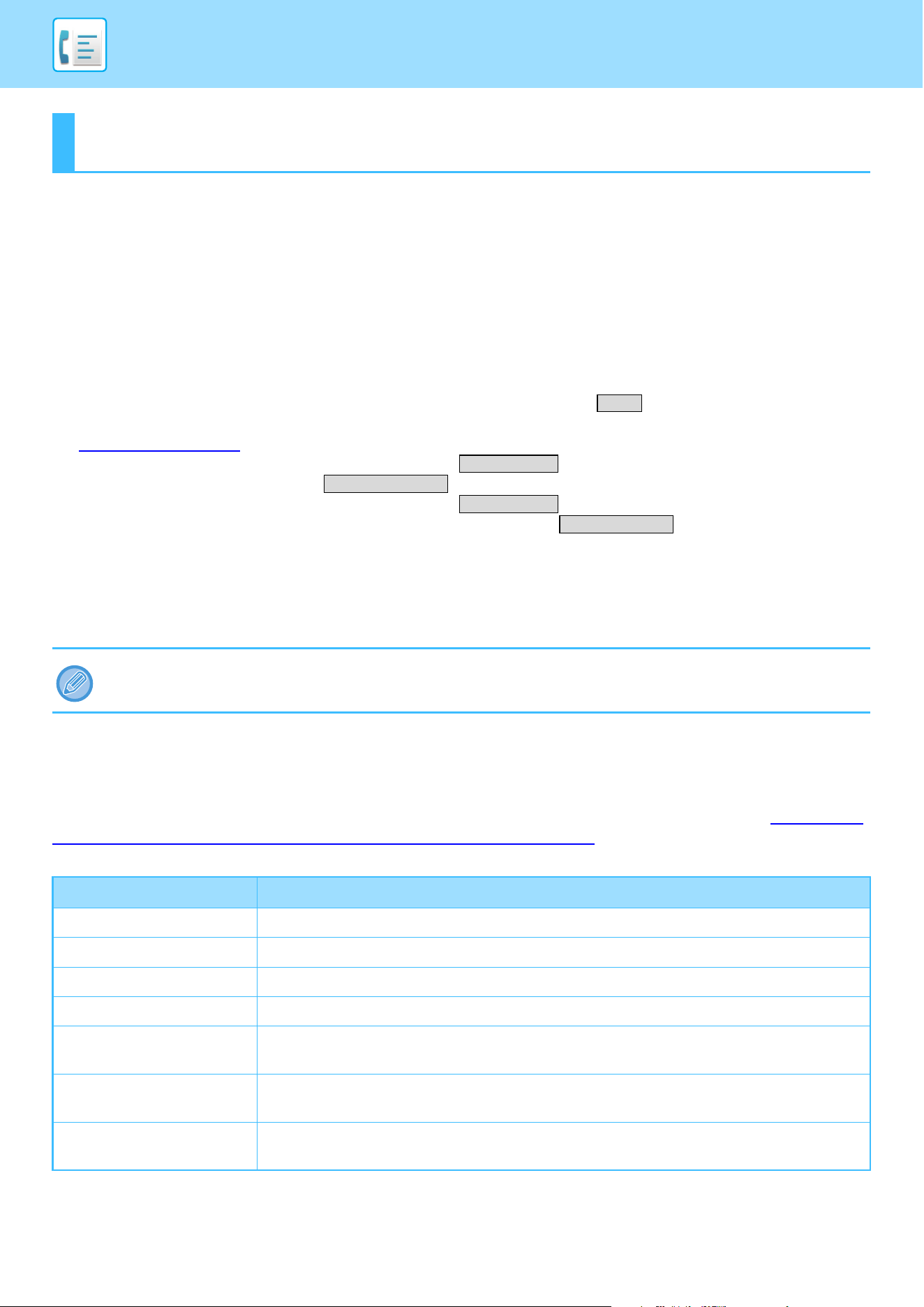
4-58
FACSIMILE►OTHER FUNCTIONS
WHEN A TRANSACTION REPORT IS
PRINTED
The machine has been set to automatically print a transaction report to notify you of the result when a transmission is
not successful or when the Broadcast transmission function is used.
When transmission is not successful and a transaction report similar to the following is printed,
"FOLLOWING DATA CANNOT BE SENT. PLEASE HAND THIS REPORT TO XXX.", read the report and take
appropriate action.
The transaction report is set at the factory to print at the times indicated in gray below, however, the times at
which the report is printed can be changed in the system settings.
► List Setting (page 7-18)
• Normal transmission: ALWAYS PRINTS / /NEVER PRINTS
• Broadcast transmission: /ERROR ONLY/NEVER PRINTS
• Original image print setting*: ALWAYS PRINTS / /NEVER PRINTS
• Reception: ALWAYS PRINTS /ERROR ONLY/
The Transaction Report shows the date of transmission, the time transmission began, the other party's name, the
duration of the operation, the number of pages, the type of transmission, the result, the department, and other
information.
* You can select whether or not part of the transmitted original is printed with transaction reports that are printed for
normal transmissions and broadcast transmissions.
INFORMATION APPEARING IN THE TYPE/NOTE
COLUMN
Information such as the type of transmission and type of error appears in the TYPE/NOTE column of the REPORT AT
REGULAR INTERVALS (COMMUNICATION ACTIVITY REPORT) (page 4-60).
The following notes may appear.
OTHER FUNCTIONS
The list count appears in the "#" column of the Transaction Report and a serial number appears in the FILE column. (These
numbers are not related to the transaction.)
Sending result Explanation
OK Transmission was completed successfully.
BUSY Transmission was not successful because the line was busy.
CANCEL A transmission was canceled while in progress or a stored transmission job was canceled.
P. FAIL The power was turned off or a power failure occurred.
NO RX POLL A polling request was denied because the polling machine did not have its own fax number
programmed.
PASS CODE # ERR A polling request was denied because the other machine's fax number had not been stored as a
polling passcode in your machine.
ORIG ERROR When you attempted to send a fax from the document feeder in direct transmission mode,
a misfeed occurred.
ERROR ONLY
ALWAYS PRINTS
ERROR ONLY
NEVER PRINTS
4-59
FACSIMILE►OTHER FUNCTIONS
ERRORXXXXXX Line conditions prevented the transmission from taking place normally.
A code used by service technicians appears.
XX-XX OK When group dialing or broadcast transmission was performed,
xxx- : Indicates total number of transmissions.
xxx OK: Indicates completed transmissions.
Reception result Explanation
OK Reception was completed successfully
P. FAIL The power was turned off or a power failure occurred.
MEMORY FULL The image memory became full during substitute reception to memory.
LENGTH OVER The transmitted document was over 800 mm long and therefore could not be received.
NO RX ROLL When polling was attempted,
Your fax number (sender's number) was not programmed in your machine.
Your fax number was not programmed as a polling passcode number in the other machine.
RX NO POLL When polling was attempted,
The other machine did not have a polling function.
The other machine did not have a document stored in polling memory.
ERRORXXXXXX Line conditions prevented the reception from taking place normally.
A code used by service technicians appears.
XX-XX OK When serial polling ended normally,
xxx- : Indicates total number of transmissions.
xxx OK: Indicates completed transmissions.
JUNK FAX ERR Fax reception was denied by the reception denial function.
Sending result Explanation
First two digits
Last four digits
First two digits
Last four digits
4-60
FACSIMILE►OTHER FUNCTIONS
REPORT AT REGULAR INTERVALS
(COMMUNICATION ACTIVITY REPORT)
Your machine keeps a record of the most recent 50 transactions (both transmissions and receptions) that were
performed. The record includes the date of the transaction, the other party's name, the duration, and result.
You can have the report automatically printed when the number of transactions exceeds 50, or at a specified time. This
allows you to check the machine's activity at regular intervals.
The machine is initially set (factory default setting) to not print the report. To have the report printed, change the setting
in the system settings.
► List Setting (page 7-18)
WHEN AN ALARM SOUNDS AND A
WARNING MESSAGE IS DISPLAYED
When an error occurs during a transaction, an alarm will sound and a message will appear in the display.
If one of the following messages appears, follow the instructions in the table.
If another messages appears, see INDICATORS AND DISPLAY MESSAGES
(page 6-12).
SELF-DIAGNOSTIC FUNCTION
The machine has a self-diagnostic function that automatically stops operation if a problem occurs in the machine. If a
problem occurs in fax mode, the following display appears.
• Refer to the table on WHEN A TRANSACTION REPORT IS PRINTED (page 4-58) for the notes that appear in the
TYPE/NOTE column.
• The activity report can also be printed out on demand.
► PRINTING LISTS OF PROGRAMMED
INFORMATION AND SETTINGS (page 4-45)
Message
(alarm sounds)
Meaning of message Solution Page
XXXXXX
Line error.
An error prevented completion of the
transaction.
Try the transaction again. –
Message display Action
Call for service.
code:xx xx.
Turn off the power and then turn it back on. If the error is not cleared, note the 2-digit main code
and the 2-digit sub-code and then contact your dealer.
Main code Sub code
4-61
FACSIMILE►OTHER FUNCTIONS
MESSAGES DURING NORMAL OPERATION
Message Meaning of message
SENT xx%
No.001 P-xxx
This appears when a direct transmission ends ("xx" indicates the number of pages).
READING xx%
No.001 P-xxx
The original is being scanned into memory (during memory transmission).
Stand-by. 100%
22 AUG FRI 10:25
The machine is in the standby state.
ENTER DIAL # This appears when the [SPEAKER] key has been pressed.
5-1
BEFORE USING THE MACHINE AS A
NETWORK SCANNER
ABOUT THE SCANNER FUNCTIONS . . . . . . . . . . 5-2
SCANNER SEQUENCE
THE BASE SCREEN OF SCANNER MODE . . . . . . 5-4
SENDING AN IMAGE. . . . . . . . . . . . . . . . . . . . . . . . 5-5
• BASIC TRANSMISSION PROCEDURE . . . . . . 5-5
• SELECTING A DESTINATION (USING THE
[ADDRESS] KEY) . . . . . . . . . . . . . . . . . . . . . . . 5-8
• TRANSMITTING A TWO-SIDED ORIGINAL. . . 5-10
STORING SCANNING SETTINGS. . . . . . . . . . . . . . 5-11
• SETTING THE SCANNING SIZE . . . . . . . . . . . 5-11
• SELECTING THE RESOLUTION . . . . . . . . . . . 5-12
• SELECTING THE FILE FORMAT . . . . . . . . . . . 5-13
• SELECTING THE COLOR MODE. . . . . . . . . . . 5-13
• ADJUSTING THE SCANNING EXPOSURE . . . 5-14
• ENABLING SCANNING MARGINS (VOID
AREA) . . . . . . . . . . . . . . . . . . . . . . . . . . . . . . . . 5-14
• ADJUSTING THE BACKGROUND BY MAKING
LIGHT AREAS OF THE ORIGINAL DARKER
OR LIGHTER (SUPPRESS BG) . . . . . . . . . . . . 5-15
• ADJUSTING THE SHARPNESS OF AN IMAGE
(SHARPNESS) . . . . . . . . . . . . . . . . . . . . . . . . . 5-16
• SCANNING BUSINESS CARDS (BUSINESS
CARD SCAN) . . . . . . . . . . . . . . . . . . . . . . . . . . 5-17
• IMAGE ORIENTATION AND STANDARD
ORIGINAL PLACEMENT ORIENTATION. . . . . 5-18
• STORING AND EDITING/DELETING A
PROGRAM . . . . . . . . . . . . . . . . . . . . . . . . . . . . 5-19
• USING STORED SETTINGS (PROGRAM) . . . 5-19
SCANNING FROM YOUR COMPUTER (PC
SCAN)
SCANNING FROM A TWAIN-COMPLIANT
APPLICATION . . . . . . . . . . . . . . . . . . . . . . . . . . . . .
5-20
SAVING IN USB MEMORY DEVICE
USB MEMORY SCAN . . . . . . . . . . . . . . . . . . . . . . . 5-24
• USING THE USB MEMORY SCAN FUNCTION 5-24
SCANNER
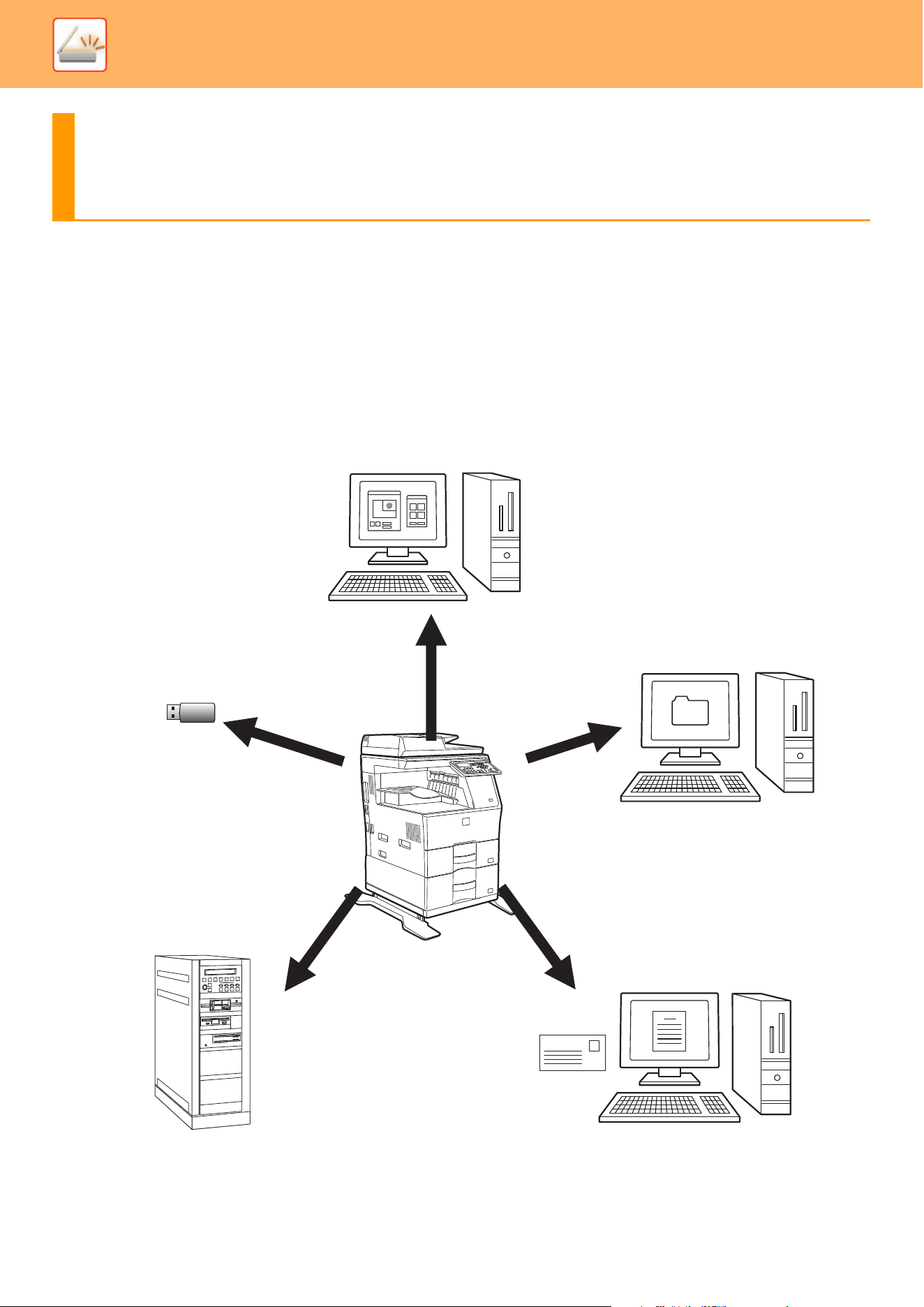
5-2
SCANNER►BEFORE USING THE MACHINE AS A NETWORK SCANNER
ABOUT THE SCANNER FUNCTIONS
With this machine a document or photo can be scanned into an image file.
You can then send the data file to the file server or your computer using the inter-corporate network (Intranet) or the
Internet. To send originals using the scanner function, specify the stored destination (delivery address information
name) from the operation panel (display) of the machine.
BEFORE USING THE MACHINE AS A
NETWORK SCANNER
1. Scanning from a TWAIN-compliant application
3. Sending the scanned data to FTP server
4. Sending the scanned data
to a computer connected to
the same network
2. Storing the scanned image
to a USB flash memory
5. Sending the scanned
data by E-mail

5-3
SCANNER►BEFORE USING THE MACHINE AS A NETWORK SCANNER
Scanning from a TWAIN-compliant application
A TWAIN-compliant application on a computer connected to the same network as the machine is used to scan a
document or image.
To use PC Scan, the scanner driver must be installed from the "Software CD-ROM" that accompanies the machine.
For more information on scanning from a TWAIN-compliant application, see SCANNING FROM YOUR COMPUTER
(PC SCAN) (page 5-20).
Storing the scanned image to a USB flash memory
The scanned image can be stored to a USB flash memory installed on the machine. This is called "USB Memory Scan"
in this manual. For more information on USB Memory Scan, see USB MEMORY SCAN
(page 5-24).
Sending the scanned data to FTP server
The scanned image can be sent to a memory storage device on a network (a designated directory on an FTP server).
(This is called "Scan to FTP" in this manual.)
Sending the scanned data to a computer connected to the same network
The scanned file is sent to a shared folder on a Windows computer on the same network as the machine. (This is called
"Scan to Network Folder" in this manual.)
The scanned file is sent to a specified folder on your computer. (This is called "Scan to Desktop" in this manual.)
For information on Scan to Desktop, which is used to send a scanned file to a specified folder of your computer, consult
your dealer.
Sending the scanned data by E-mail
The scanned image can be sent to an e-mail recipient. (This is called "Scan to E-mail" in this manual.)
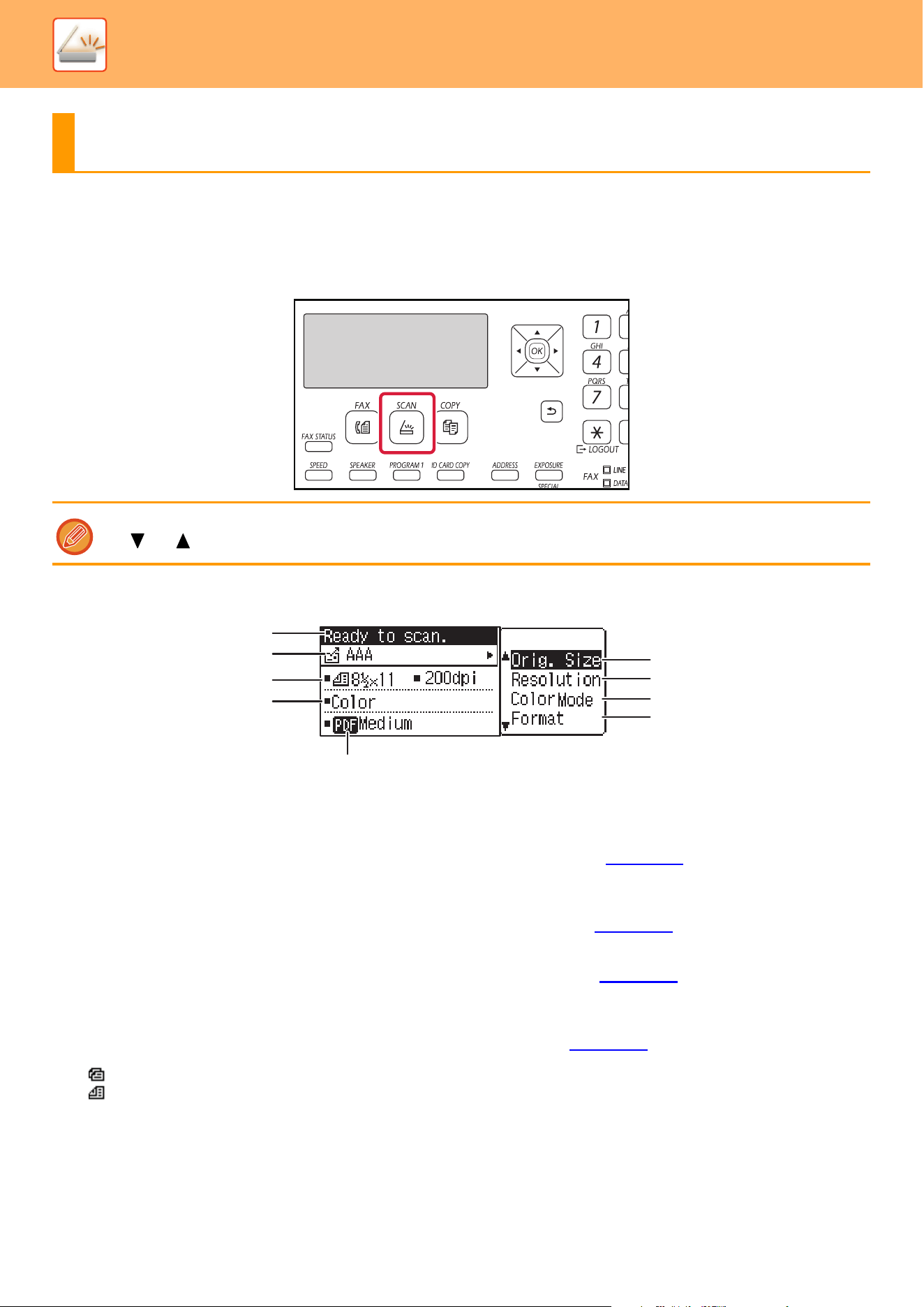
5-4
SCANNER►SCANNER SEQUENCE
THE BASE SCREEN OF SCANNER MODE
The base screen of scan mode is displayed by pressing the [SCAN] key from the base screen of copy mode or fax
mode.
Base screen of scan mode
(1) Message display
Messages appear here to indicate the current status of
the machine.
(2) Destination display
This shows the selected destination.
There are scanner transmission modes:
Scan to E-mail, Scan to Network Folder, Scan to FTP,
Scan to Desktop, and USB Memory Scan.
This shows the currently selected destination and
transmission mode.
(3) Original scanning mode / Original size display
Shows the currently selected original scanning mode and
scanning size.
: One-sided scanning in the document feeder.
: Two-sided scanning in the document feeder.
None: Document glass
(4) File format display
This shows the image data file type and file method to be
created.
(5) Resolution display
The shows the scanning resolution.
(6) Original size ►page 5-11
This is used to set the size of the original to be
transmitted.
(7) Resolution ►page 5-12
This is used to select the scanning resolution.
(8) Color Mode ►page 5-13
Set the color mode. Select full color, grayscale, and
Mono2.
(9) Format ►page 5-12
This is used to select the image data file type and file
method to be created.
SCANNER SEQUENCE
If a screen appears asking you what type of connection you are using after you press the [SCAN] key, select "Network" with
the [ ] or [ ] key and press the [OK] key.
(2)
(3)
(4)
(5)
(1)
(7)
(8)
(9)
(6)
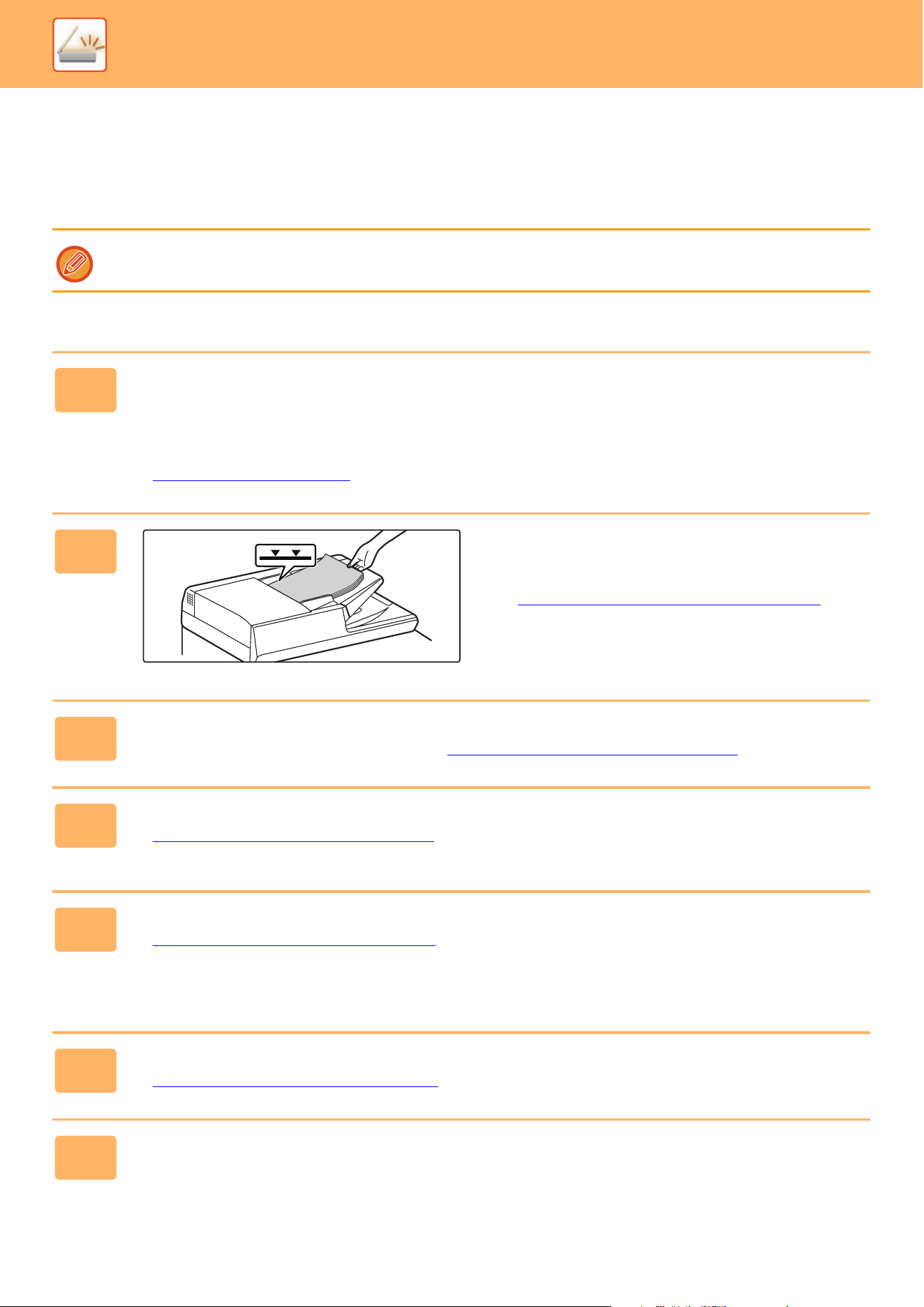
5-5
SCANNER►SCANNER SEQUENCE
SENDING AN IMAGE
BASIC TRANSMISSION PROCEDURE
Using the document feeder
Scanner transmission job cannot be accepted while printing a fax receiving data. Start scanning after the fax data printing is
finished.
1
Make sure the machine is in scan mode.
When the SCAN indicator is lit, the machine is in scan mode. If the indicator is not lit, press the [SCAN] key.
If auditing mode has been enabled for the scan function in the system settings, a message will appear prompting you to
enter your account number when you switch to scan mode. Enter your account number (five digits) with the numeric
keys.
► User Authentication (page 7-12)
2
Place the original(s).
Place the original in the document feeder tray of the
automatic document feeder.
► AUTOMATIC DOCUMENT FEEDER (page 1-30)
3
Check the original size.
To change the original size, change as explained in STORING SCANNING SETTINGS (page 5-11).
4
If needed, select the resolution setting.
► SELECTING THE RESOLUTION (page 5-12)
The initial factory setting is [200dpi].
5
If needed, select the format.
► SELECTING THE FILE FORMAT (page 5-13)
The initial factory setting
• Color / Grayscale : PDF M
• B/W : PDF G4
6
If you select "B/W", adjust the exposure in B/W mode if needed.
► SELECTING THE COLOR MODE (page 5-13)
7
Press the [ADDRESS] key.
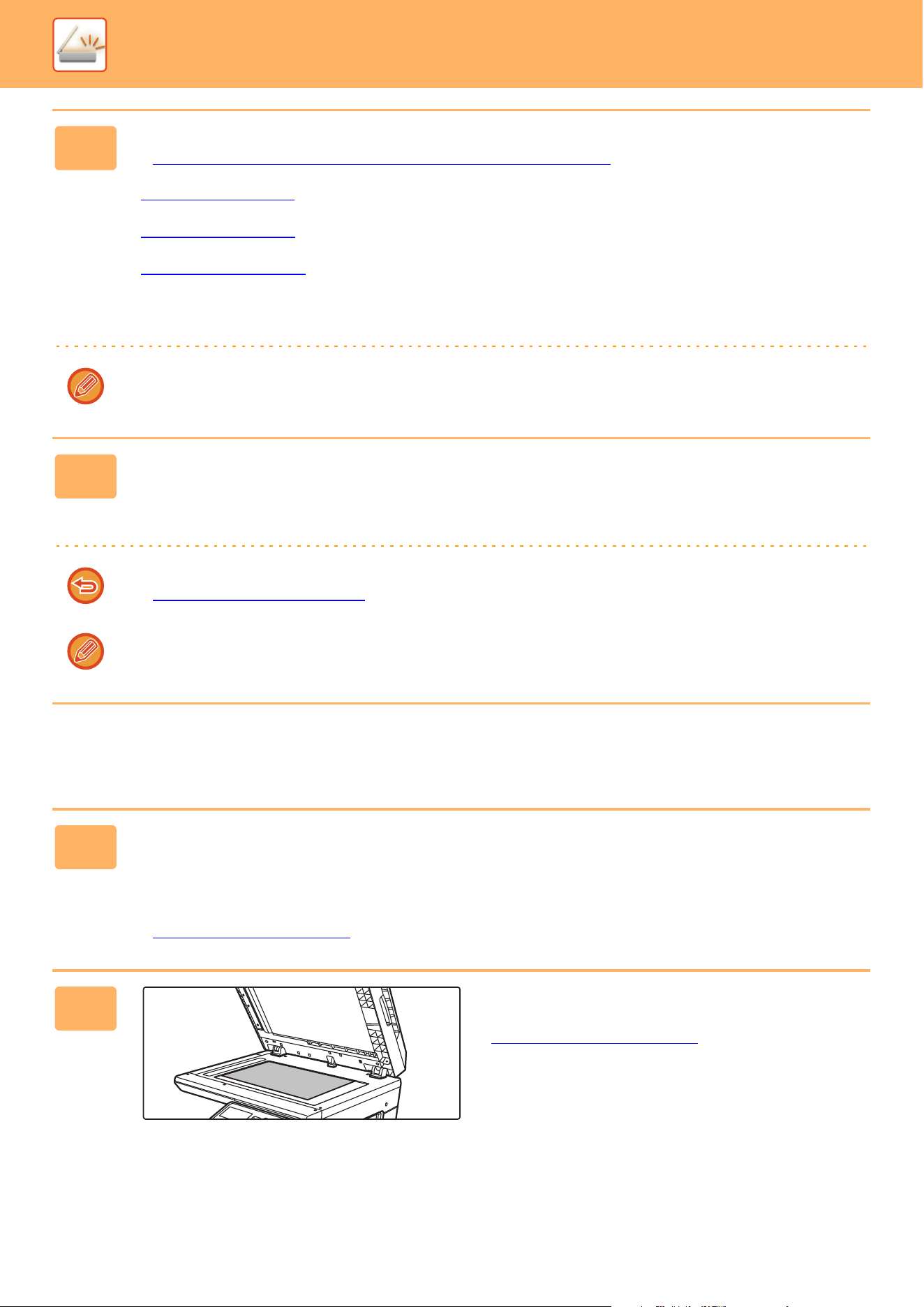
5-6
SCANNER►SCANNER SEQUENCE
Using the document glass
8
Select the destination selection method.
► SELECTING A DESTINATION (USING THE [ADDRESS] KEY) (page 5-8)
Select from the following three destination selection methods:
• Address book (page 5-8)
Select one of the stored destinations directly from the operation panel.
• Address entry (page 5-9)
Directly enter the e-mail address. (Only for Scan to E-mail.)
• Address search (page 5-9)
Access a directory data base on the Internet or your intranet and search for a destination e-mail address.
During a global address search, multiple addresses can be entered to perform a broadcast transmission.
When you have finished searching for the destination, you will return to the following base screen.
• Information on the destination can be stored in the Web page.
• The sender name is normally set to the name stored in "Reply E-mail Address" in "SMTP Setup" in the Web page.
9
Press the [START] key.
Scanning begins.
If scanning is completed normally, the following screen is appears briefly and then the display returns to the
base screen.
Canceling transmission
► Canceling transmission (page 5-8)
• If a misfeed occurs during scanning in scan mode, scanning will be canceled and the data scanned will be deleted.
Remove the misfed original and reload the originals from the beginning.
1
Make sure the machine is in scan mode.
When the SCAN indicator is lit, the machine is in scan mode. If the indicator is not lit, press the [SCAN] key.
If auditing mode has been enabled for the scan function in the system settings, a message will appear prompting you to
enter your account number when you switch to scan mode. Enter your account number (five digits) with the numeric
keys.
► User Authentication (page 7-12)
2
Place the original.
Place the original on the document glass.
DOCUMENT GLASS (page 1-32)
5-7
SCANNER►SCANNER SEQUENCE
3
Check the original size.
To change the original size, change as explained in STORING SCANNING SETTINGS (page 5-11).
4
If needed, select the resolution setting.
► SELECTING THE RESOLUTION (page 5-12)
The initial factory setting is [200dpi].
5
If needed, select the format.
► SELECTING THE FILE FORMAT (page 5-13)
The initial factory setting
• Color / Grayscale : PDF M
• B/W : PDF G4
6
If you select "B/W", adjust the exposure in B/W mode if needed.
► SELECTING THE COLOR MODE (page 5-13)
7
Press the [ADDRESS] key.
8
Select the destination selection method.
► SELECTING A DESTINATION (USING THE [ADDRESS] KEY) (page 5-8)
Select from the following three destination selection methods:
• Address book (page 5-8)
Select one of the stored destinations directly from the operation panel.
• Address entry (page 5-9)
Directly enter the e-mail address. (Only for Scan to E-mail.)
• Address search (page 5-9)
Access a directory data base on the Internet or your intranet and search for a destination e-mail address.
During a global address search, multiple addresses can be entered to perform a broadcast transmission.
When you have finished searching for the destination, you will return to the following base screen.
• Information on the destination can be stored in the Web page.
• The sender name is normally set to the name stored in "Reply E-mail Address" in "SMTP Setup" in the Web page.
9
Press the [START] key.
Scanning begins.
10
If you have another page to scan, change pages and then press [START] key.
• Repeat this sequence until all pages have been scanned.
• If no action is taken for one minute (the [START] key is not pressed), scanning automatically ends and transmission
begins.
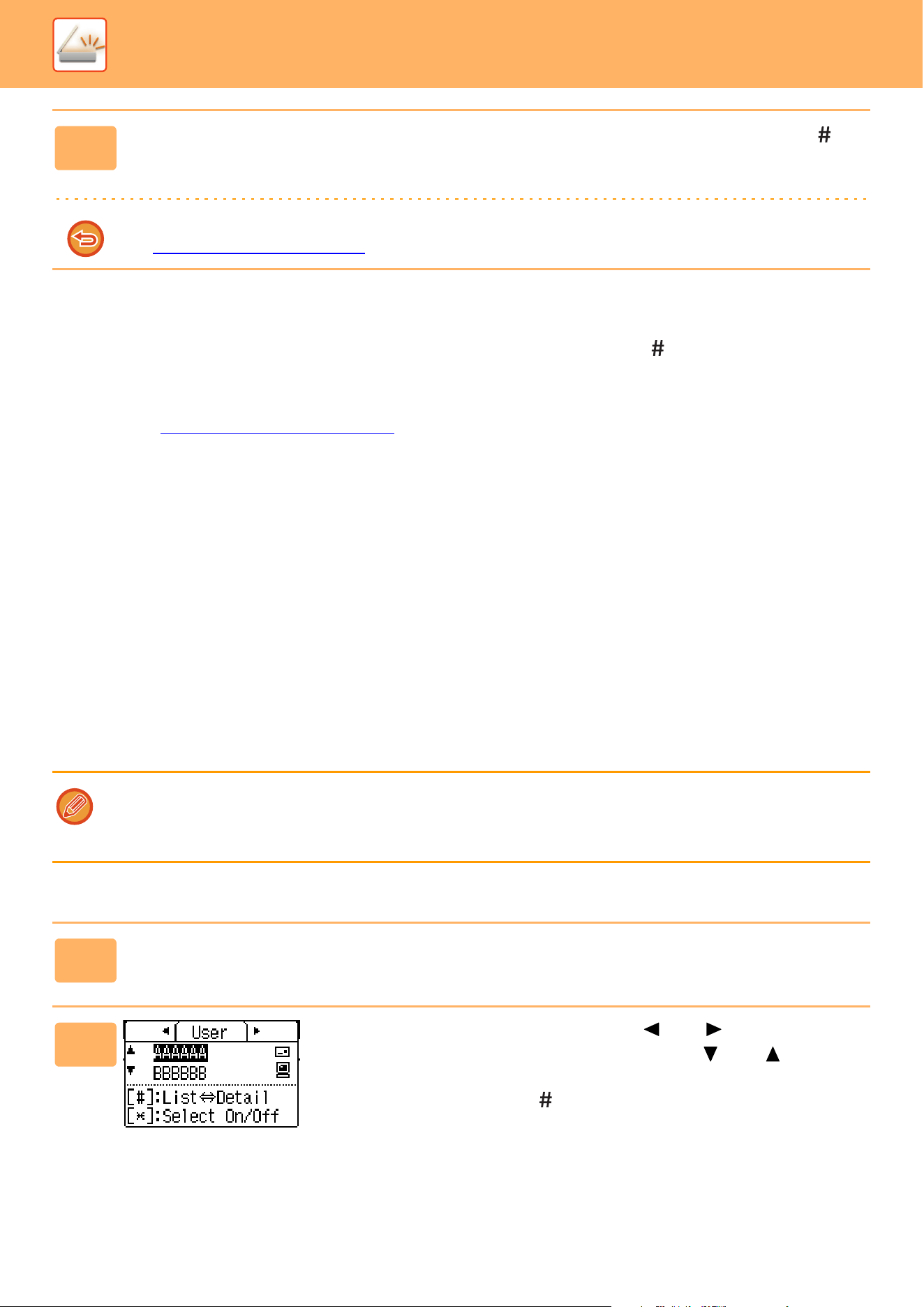
5-8
SCANNER►SCANNER SEQUENCE
Canceling transmission
• To cancel the transmission while "Reading" appears or before the [READ-END] key ( ) is pressed, press the [C] or
[CA] key.
• If the power is turned off or a power failure occurs while a document is being scanned in the document feeder, the
machine will stop and a document misfeed will occur. After the power is restored, remove the misfed original as
explained in "MISFEED REMOVAL (page 6-14)
".
• When performing a Scan to E-mail transmission, note the following points:
Be careful not to send image data files that are too large. Your mail server's system administrator may have placed a
limit on the amount of data that can be sent in one e-mail transmission. If this limit is exceeded, the e-mail will not be
delivered to the recipient. Even if there is no limit and your e-mail is successfully delivered, a large data file may take
a long time to be received and place a heavy burden on the recipient's network, depending on the recipient's network
(Internet) environment. If large image data files are repeatedly sent, the resulting burden on the network may slow
down the speed of other, unrelated data transmissions and in some cases, may even cause the mail server or
network to go down. In cases where you need to send a large file or multiple images, try lowering the resolution or
reducing the scanned original size.
SELECTING A DESTINATION (USING THE [ADDRESS]
KEY)
A destination can be selected using one of three methods: Selecting from "ADDRESS BOOK", using "ADDRESS
ENTRY", or "ADDRESS SEARCH".
Address book
11
When the final original page has been scanned, press the [READ-END] key ( ).
Open the document feeder and remove the document. When the original is removed or any key operation is performed,
the display returns to the base screen.
Canceling transmission
► Canceling transmission (page 5-8)
• Multiple destination scan be selected for a Scan to E-mail transmission. (E-mail and Group (E-mail) destinations can be
selected at the maximum of 20 destinations, which will consequently allow broadcasting up to 300 individual destinations
in total. )
• Only one destination can be selected for a Scan to Network, Scan to FTP or Scan to Desktop transmission.
1
Press the [ADDRESS] key, and select the "Address Book".
2
Change tabs as needed with the [ ] or [ ] key and
select the desired destination with the [ ] or [ ] key.
You can switch between information on the selected destination and the destination list
by pressing the [READ-END] key ( ).
5-9
SCANNER►SCANNER SEQUENCE
Address entry
Address search
3
Press the [READ-END] key ().
A checkmark appears by the selected destination. To cancel the selection, press the [READ-END] key ( ) once again
to remove the checkmark. To select multiple destinations, repeat steps.
1
Press the [ADDRESS] key, and select "Address Entry" with the [ ] key, and
press the [OK] key.
2
Enter the destination address.
3
Press the [OK] key.
1
Press the [ADDRESS] key, and select "Global Address Search" with the [ ]
key, and press the [OK] key.
2
Enter the search characters.
3
Select the desired destination with the [ ] or [ ] key.
4
Press the [OK] key.
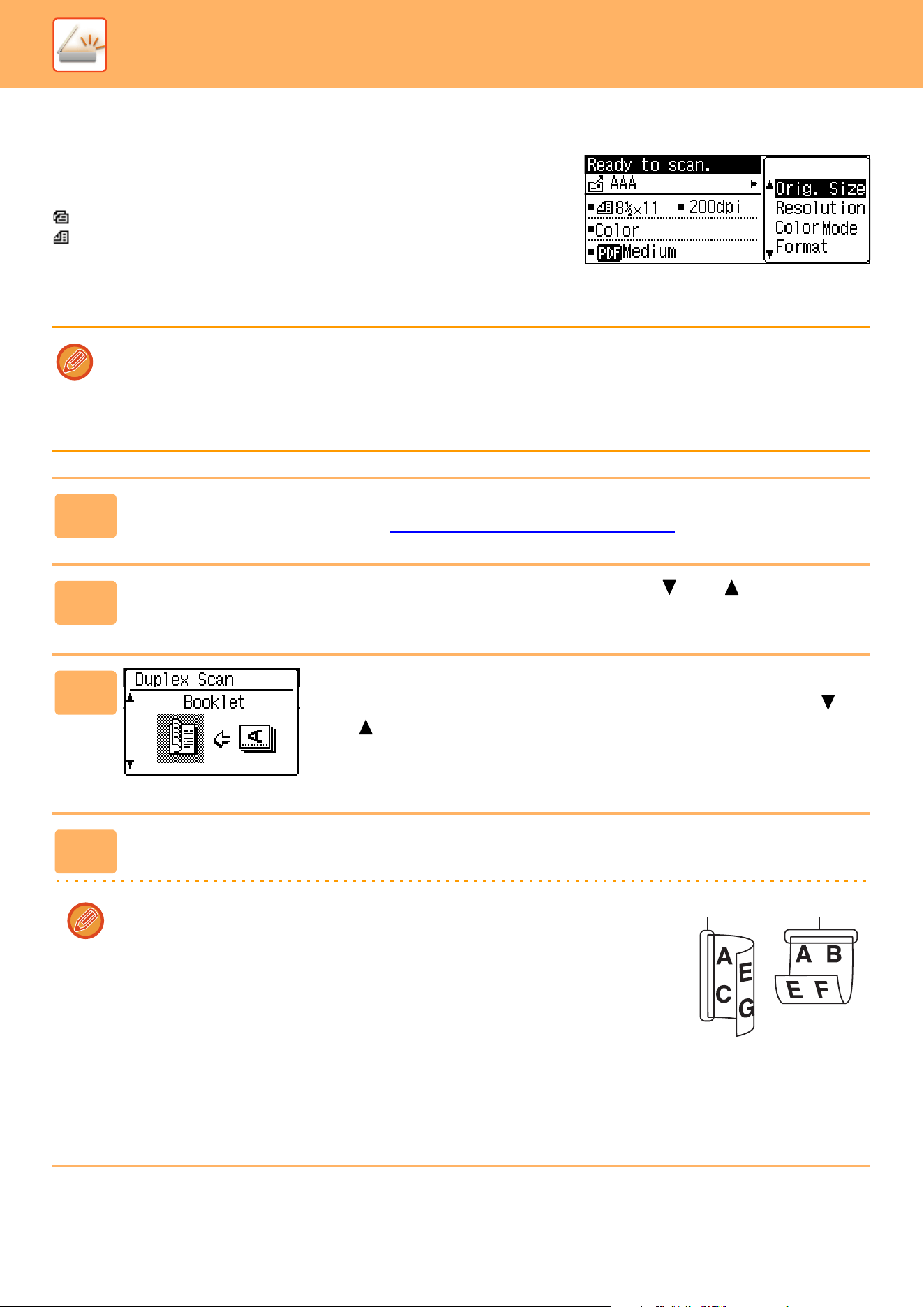
5-10
SCANNER►SCANNER SEQUENCE
TRANSMITTING A TWO-SIDED ORIGINAL
The original field of the display shows the original scanning size.
The current original scan mode setting is indicated by an icon.
: One-sided scanning in the document feeder.
: Two-sided scanning in the document feeder.
None: Document glass
Follow these steps to automatically transmit a two-sided original.
Only the following two-sided document sizes can be used:
Standard sizes
8-1/2" x 14", 8-1/2" x 13-1/2", 8-1/2" x 13-2/5", 8-1/2" x 13", 8-1/2" x 11", 5-1/2" x 8-1/2", A4, B5, A5
Non-standard sizes
Inch sizes X: 6-3/4 to 14 inches, Y: 5-1/2 to 8-1/2 inches
AB sizes X: 170 to 356 mm, Y: 140 to 216 mm
1
Place the original(s) in the document feeder tray, and check the original size.
For information on placing an original, see HOW TO PLACE THE ORIGINAL (page 1-30).
2
Press the [DUPLEX] key, and Select "2-Sided" with the [ ] or [ ] key, and
press the [OK] key.
3
Select "Portrait-Booklet", "Portrait-tablet",
"Landscape-Booklet", "Landscape-tablet" with the [ ]
or [ ] key, and press the [OK] key.
4
Press the [OK] key.
• Booklets and tablets Two-sided originals that are bound at the side are booklets, and
two-sided originals that are bound at the top are tablets.
• Duplex scanning is cancelled when the transmission is completed, or when the [CA]
key is pressed.
• Duplex scanning of two-sided originals is only possible when a Document feeder is
used. Automatic scanning of both sides of an original is not possible when the
document glass is used.
• The image of the back side of the original is rotated 180 degrees if needed at the time
of transmission, and thus there is no need to change the orientation at the receiving machine.
• To cancel duplex scanning, select "1-Sided" in step 1 and then press the [OK] key.
• Only the following two-sided document sizes can be used:
8-1/2
" x 14", 8-1/2" x 13-1/2", 8-1/2" x 13-2/5", 8-1/2" x 13", 8-1/2" x 11", A4
BOOKLET TABLET
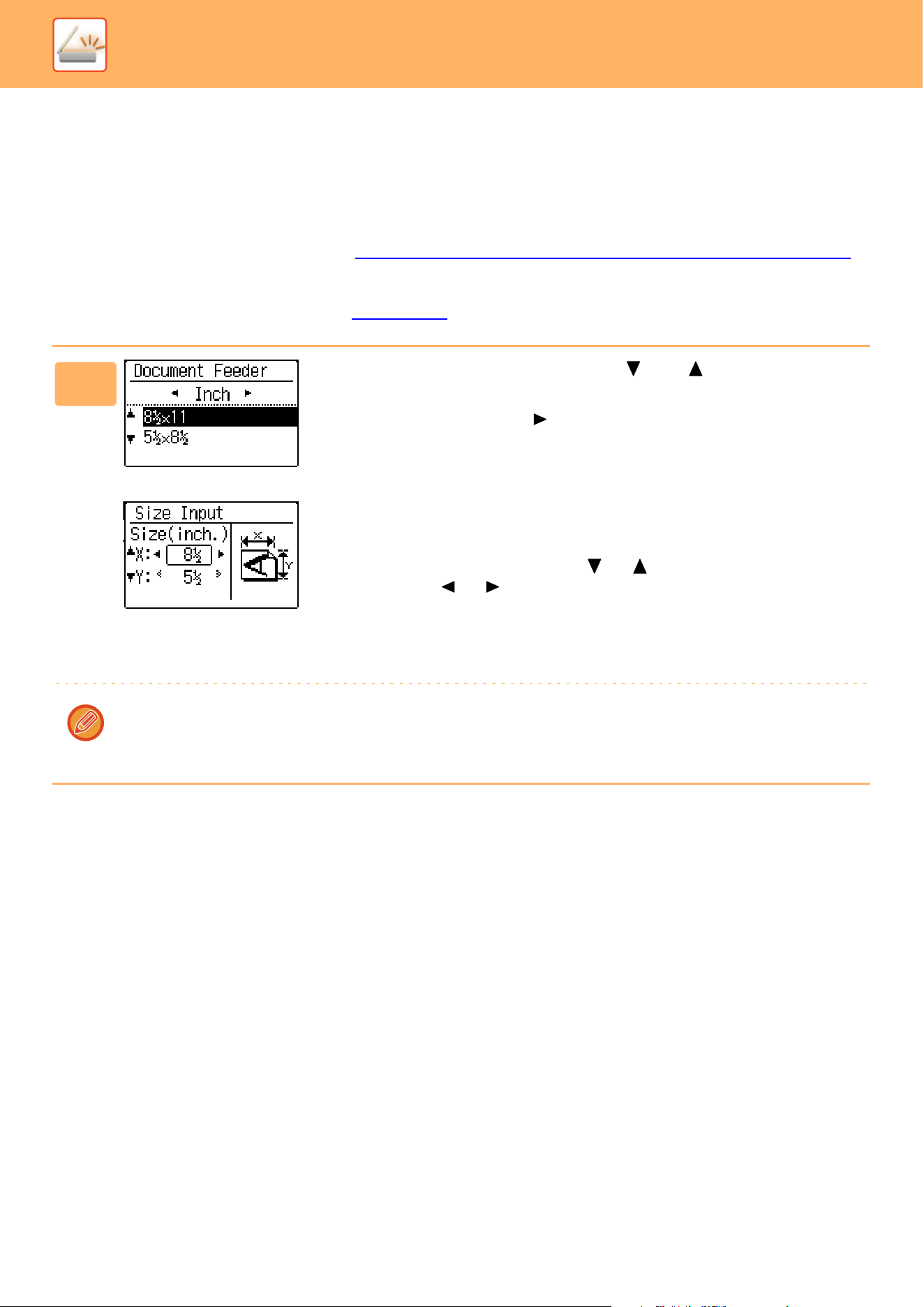
5-11
SCANNER►SCANNER SEQUENCE
STORING SCANNING SETTINGS
Sets of scanning settings (scan size, resolution, file type, etc.) can be changed for use in various scanning applications.
SETTING THE SCANNING SIZE
The default scanning size is 8-1/2" x 11". (If SCANNING BUSINESS CARDS (BUSINESS CARD SCAN) (page 5-17)
has been selected, the scanning size is set to business card size.)
If you change the original size, follow the steps below to change the setting after you have placed the original in the
document feeder or on the document glass (►page 1-30)
.
1
Select "Original Size" with the [ ] or [ ] key, and then
select the original size.
To select an inch size, press the [] key.
The original scanning size can be set manually.
In the Inch original size selection screen, select [Size Input] and press the [OK] key to
display the screen below.
Select the width (X) or the length (Y) with [ ] or [ ] key, and adjust in increments of
1/8" or 1 mm with [ ] or [ ] key.
Input range
X: 5-1/2" to 14" / 140 to 356 mm*
Y: 5-1/2" to 8-1/2" / 140 to 216 mm
* 5-1/2" x 11-5/8" / 140 to 297 mm when the document glass is used
To cancel a manual original size setting, press the [CA] key.
If it is not possible to select the actual original size, select a size that is larger than the actual original size.
If a smaller size is selected, part of the original will not be transmitted.
5-12
SCANNER►SCANNER SEQUENCE
SELECTING THE RESOLUTION
The scanning resolution can be selected. After selecting scan mode and placing the original (steps 1 to 3 on page 5-5),
perform the procedure below.
The factory default setting for the resolution is "200dpi".
If you need to change the resolution, follow these steps.
1
Select "Resolution" with the [ ] or [ ] key, and then select the resolution.
2
Press the [OK] key.
Resolution
• The default resolution setting is 200 dpi. For typical text documents, a resolution of 200 dpi or 300 dpi produces
sufficiently legible image data. (A resolution of 200 dpi corresponds to the generally used "Fine" in fax mode. For this
reason, the 600 dpi setting should only be used in cases where high-clarity image reproduction is required, such as an
original that includes photographs or illustrations.
• The default setting can be changed in the system settings. ►page 7-23
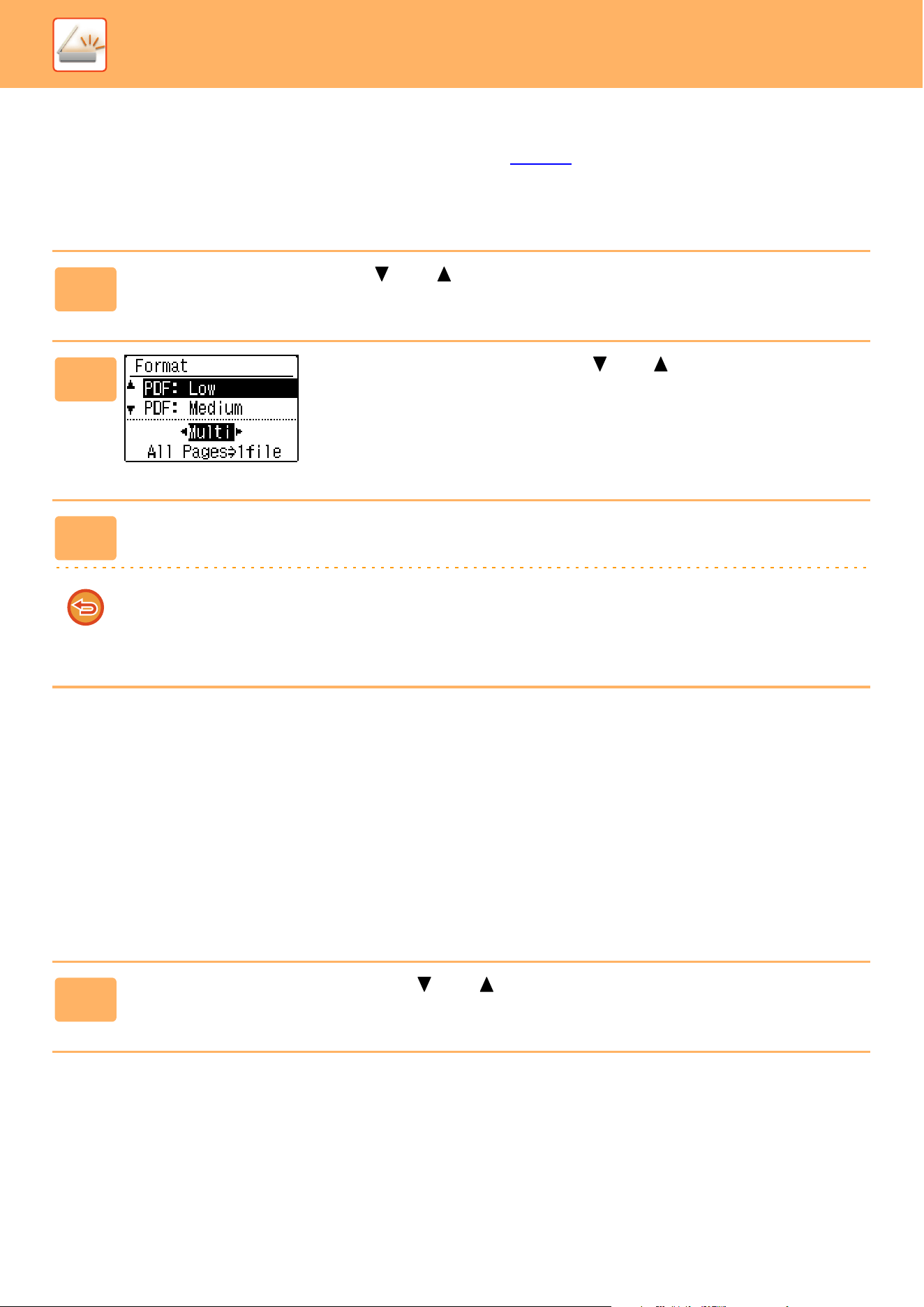
5-13
SCANNER►SCANNER SEQUENCE
SELECTING THE FILE FORMAT
After selecting scan mode and placing the original (steps 1 to 3 on page 5-5), perform the procedure below.
The factory default settings are "PDF" for the file type and "Multi" for the file creation method (multiple scanned images
are combined into one file).
If you need to change the file format, follow these steps.
SELECTING THE COLOR MODE
Change the color mode used to scan the original.
Select "Full color", "Mono2" or "Grayscale"
Full color
The original is scanned in full color.
Mono2
Colors in the original are scanned as black or white.
Grayscale
The colors in the original are scanned in black and white as shades of gray (grayscale).
1
Select "Format" with the [ ] or [ ] key, and select "Color / Grayscale" or
"Mono2", and press the [OK] key.
2
Select the file type with the [ ] or [ ] key, and select the
file creation method.
When "Single" is selected, a one-page file is created for the scanned image.
When "Multi" is selected, all scanned images can be combined into a single file.
3
Press the [OK] key.
• When the file type is set to "TIFF", the file creation method can only be select.
To open the scanned image without using the software program in the accompanied CD-ROM, the recipient must have
a viewer program that can open the image format (file type) that was selected as explained above.
If the recipient cannot open the image, try sending the image in a different format.
1
Select "Color Mode" with the [ ] or [ ] key, and select "Full Color",
"Grayscale", or "Mono2", and press the [OK] key.
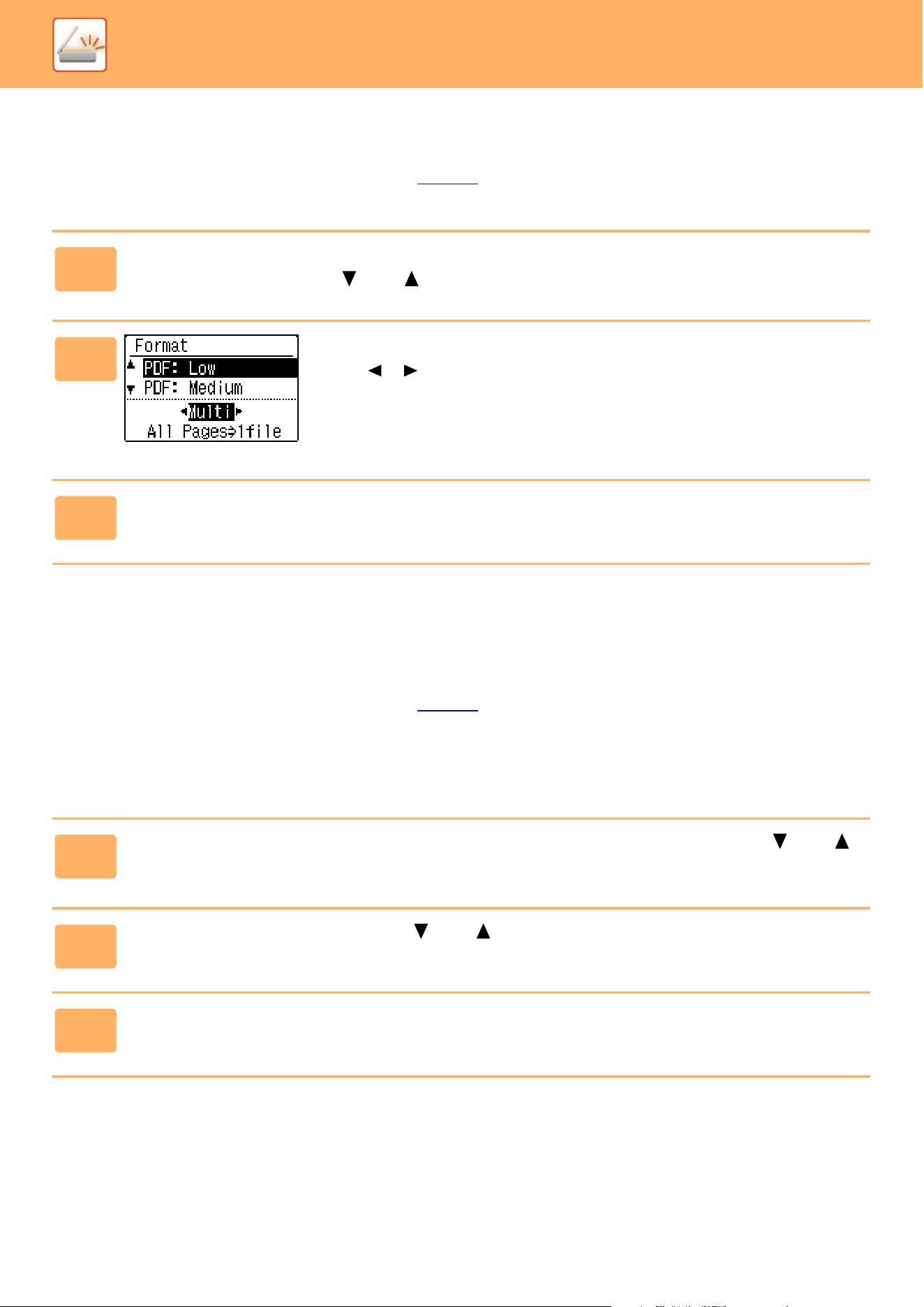
5-14
SCANNER►SCANNER SEQUENCE
ADJUSTING THE SCANNING EXPOSURE
The exposure for an image can be adjusted. The larger the value, the darker the image.
Select scan mode, place the original (steps 1 to 3 on page 5-5
), and then follow the procedure below.
The scanning exposure is set to "Txt/Prt Photo Auto" by factory default.
ENABLING SCANNING MARGINS (VOID AREA)
When this function is enabled, margins (void areas that are not scanned) are created around the edges of the machine's
maximum scanning area.
Select scan mode, place the original (steps 1 to 3 on page 5-5
), and then follow the procedure below.
The factory default setting for the void area is "Off" (disabled).
If you need to change the void area setting, follow these steps.
Void area: 7/64" (2.5 mm) from the top and bottom edges
1/8" (3.0 mm) from the left and right edges
1
Press [EXPOSURE] key, and select "Text", "Txt/Prt Photo", or "Photo" for the
original type with the [ ] or [ ] key.
2
To select, change the level (5 levels are available) with
the [ ] [ ] keys.
3
Press the [OK] key.
1
Press the [SPECIAL FUNCTION] key to select "Void Area" with the [ ] or [ ]
key and press the [OK] key.
2
Select "On" or "Off" with the [ ] or [ ] key.
3
Press the [OK] key.
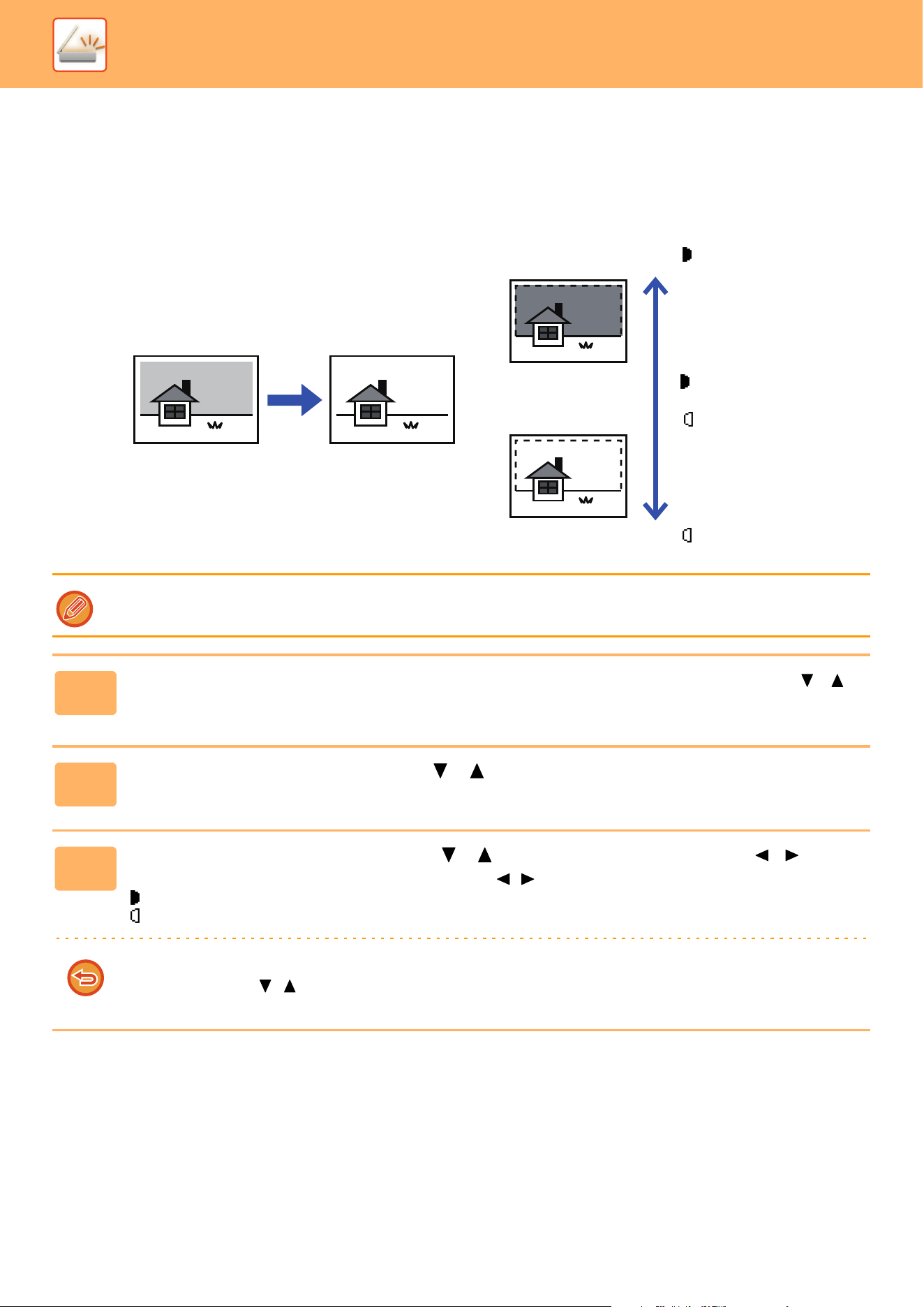
5-15
SCANNER►SCANNER SEQUENCE
ADJUSTING THE BACKGROUND BY MAKING LIGHT
AREAS OF THE ORIGINAL DARKER OR LIGHTER
(SUPPRESS BG)
You can adjust the background by making light areas of the original darker or lighter.
You must select Background Adjustment before scanning the original.
1
Press the [SPECIAL FUNCTION] key, select "Special Modes" with the [ ][ ]
keys, and press the [OK] key.
2
Select "Suppress BG" with the [ ] [ ] keys and press the [OK] key.
3
Select level adjustment with the [ ] [ ] keys, and adjust with the [ ][ ] keys.
To select, change the level (3 levels are available) with the [ ][ ] keys and press the [OK] key.
: Only light backgrounds are suppressed.
: Light to dark backgrounds are suppressed.
To cancel the Background Adjustment setting:
Select "Off" with the [ ][ ] keys and press the [OK] key.
Adjust light areas in this way.
Level [ ]
[ ] makes the
background darker.
[ ] makes the
background lighter.
Level [ ]
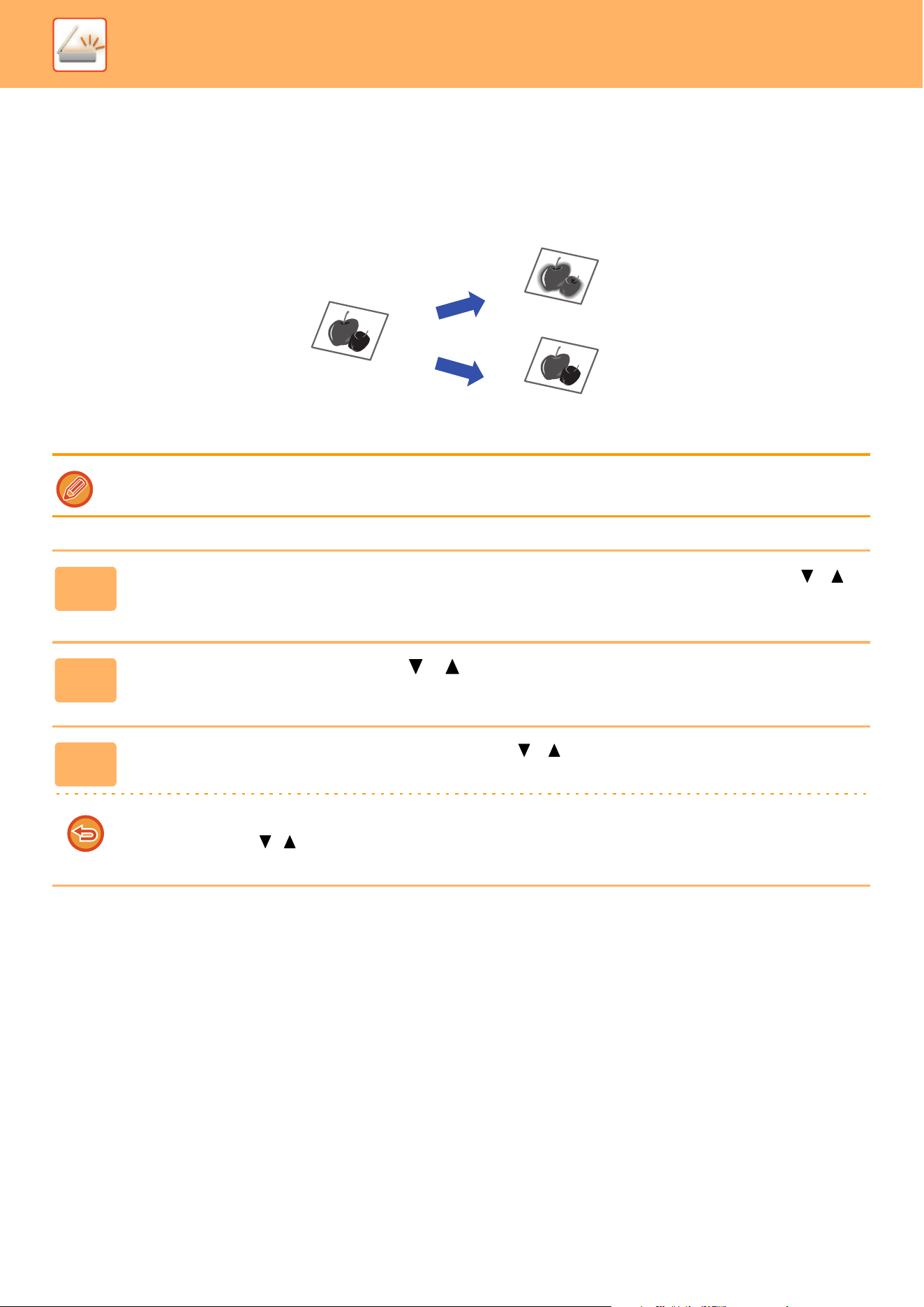
5-16
SCANNER►SCANNER SEQUENCE
ADJUSTING THE SHARPNESS OF AN IMAGE
(SHARPNESS)
This function adjusts the sharpness to make a sharper or softer image.
Sharpness must be specified before scanning the original.
1
Press the [SPECIAL FUNCTION] key, select "Special Modes" with the [ ][ ]
keys, and press the [OK] key.
2
Select "Sharpness" with the [ ] [ ] keys and press the [OK] key.
3
Select "Off", "Soft", or "Sharp" with the [ ][ ] keys and press the [OK] key.
To cancel the sharpness setting:
Select "Off" with the [ ][ ] keys and press the [OK] key.
Softer
Sharper
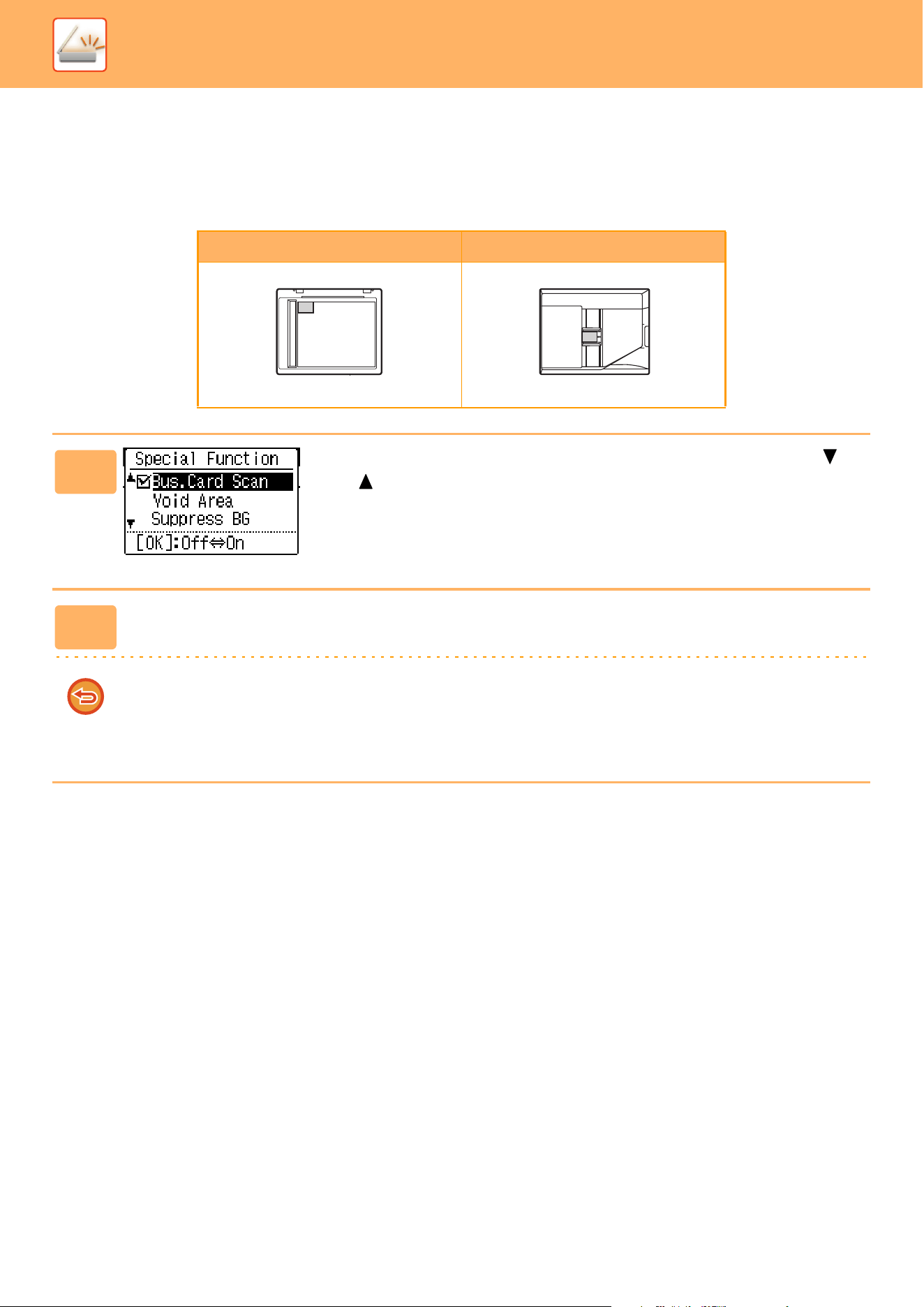
5-17
SCANNER►SCANNER SEQUENCE
SCANNING BUSINESS CARDS (BUSINESS CARD
SCAN)
Business cards can be scanned.
Only when using this feature, it is possible to read the business card from the automatic document feeder.
Original glass Document feeder tray
1
Press the [SPECIAL FUNCTION] key
, and press the [ ]
or [ ] key to select "Bus. Card Scan".
The original size is set to business card size (custom).
2
Press the [OK] key.
• When business card scan mode is selected, the original size cannot be changed.
• When business card scan mode is selected, duplex scanning cannot be used.
• When using the automatic document feeder, it may not be possible to feed or read the card correctly depending on its
condition/material/shape/processing method.
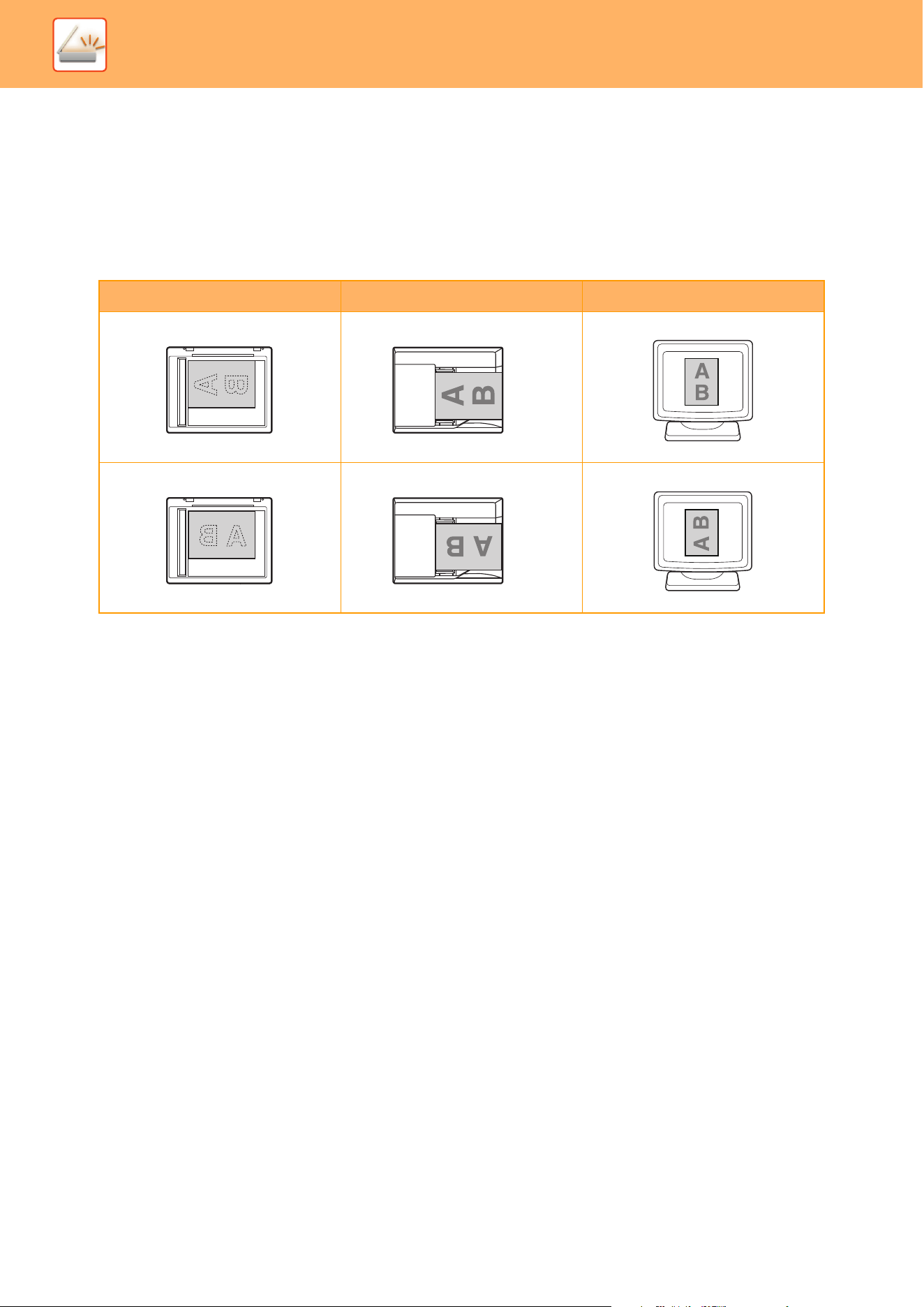
5-18
SCANNER►SCANNER SEQUENCE
IMAGE ORIENTATION AND STANDARD ORIGINAL
PLACEMENT ORIENTATION
When using the document glass, the original should be placed face down in the far left corner of the glass with the top
edge of the original at the left edge of the glass.
When using the document feeder, the original should be placed face up in the middle of the document feeder tray, with
the top of the original to the left.
Document glass Document feeder Scanning result
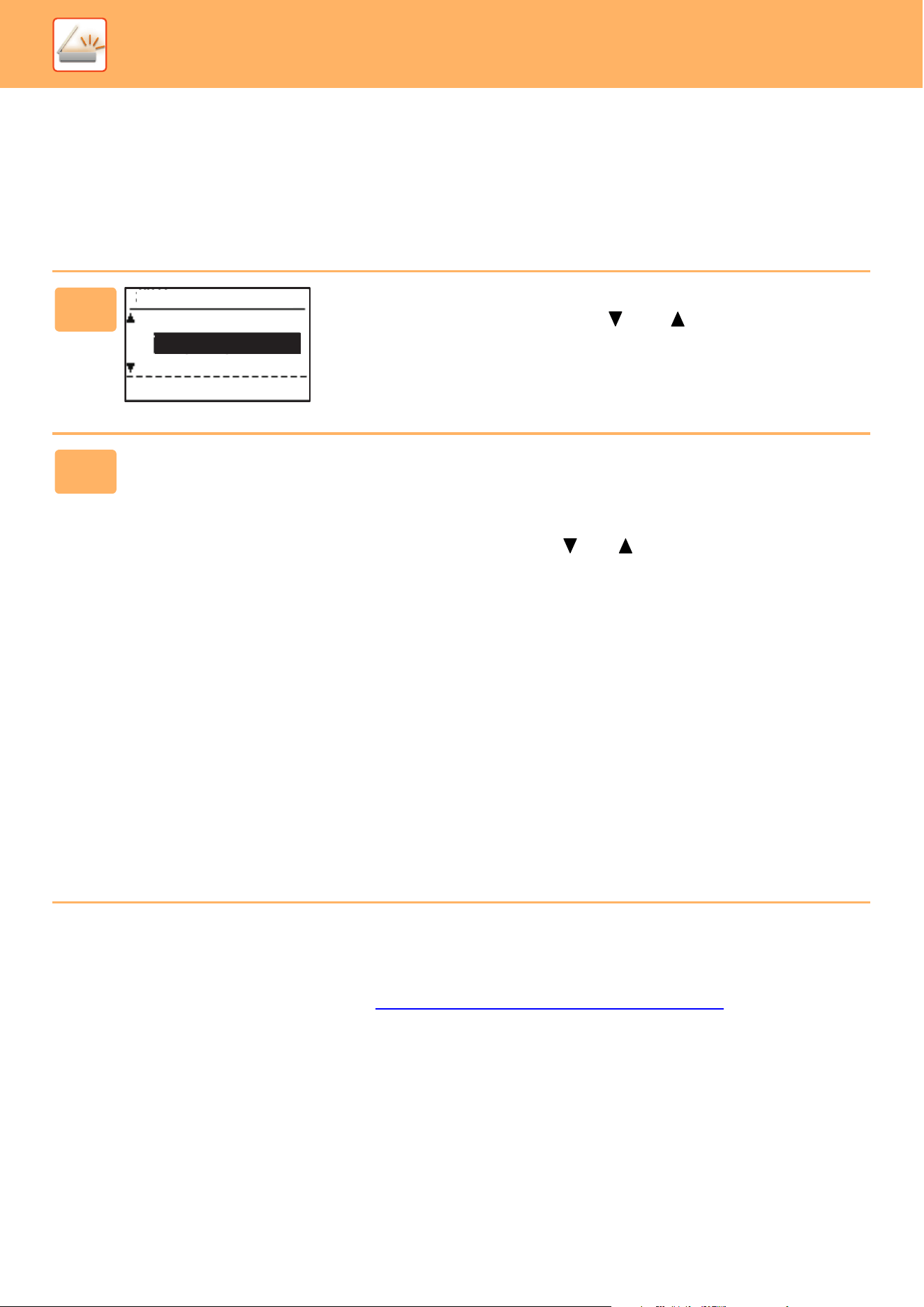
5-19
SCANNER►SCANNER SEQUENCE
STORING AND EDITING/DELETING A PROGRAM
This function lets you store a transmission address and scanning settings. The address and settings can be called up
when you scan a document, saving you the trouble of selecting the address and settings. Up to two programs can be
stored for scanning.
• Address Setting • Original Size • Resolution • Format • Exposure • Original scanning mode can be stored in a
program.
USING STORED SETTINGS (PROGRAM)
Press the [Program 1] or [Program 2] key. See BASIC TRANSMISSION PROCEDURE (page 5-5).
1
Press the [SPECIAL FUNCTION] key and select
"Register Program" with the [ ] or [ ] key, and press
the [OK] key.
The original size is set to business card size (custom).
2
Select "Enter", "Change", "Delete", and press the [OK] key.
● Register program
(1) Select "No Store", and press the [OK] key.
(2) Select the program you want to store with the [ ] or [ ] key, and press the [OK]
key.
Setting each screen will be displayed.
(3) Press the [OK] key to perform the required settings.
Return to step 2.
(4) Press the [START] key.
Programs are stored.
● Change program
(1) Select the program you want to change, and press the [OK] key.
Change the settings same operation as for registration.
● Delete program
(1) Select the program you want to delete, and press the [OK] key.
(2) Select "Delete", and press the [OK] key.
Special Function
Register Program
Sharpness
PC Scan
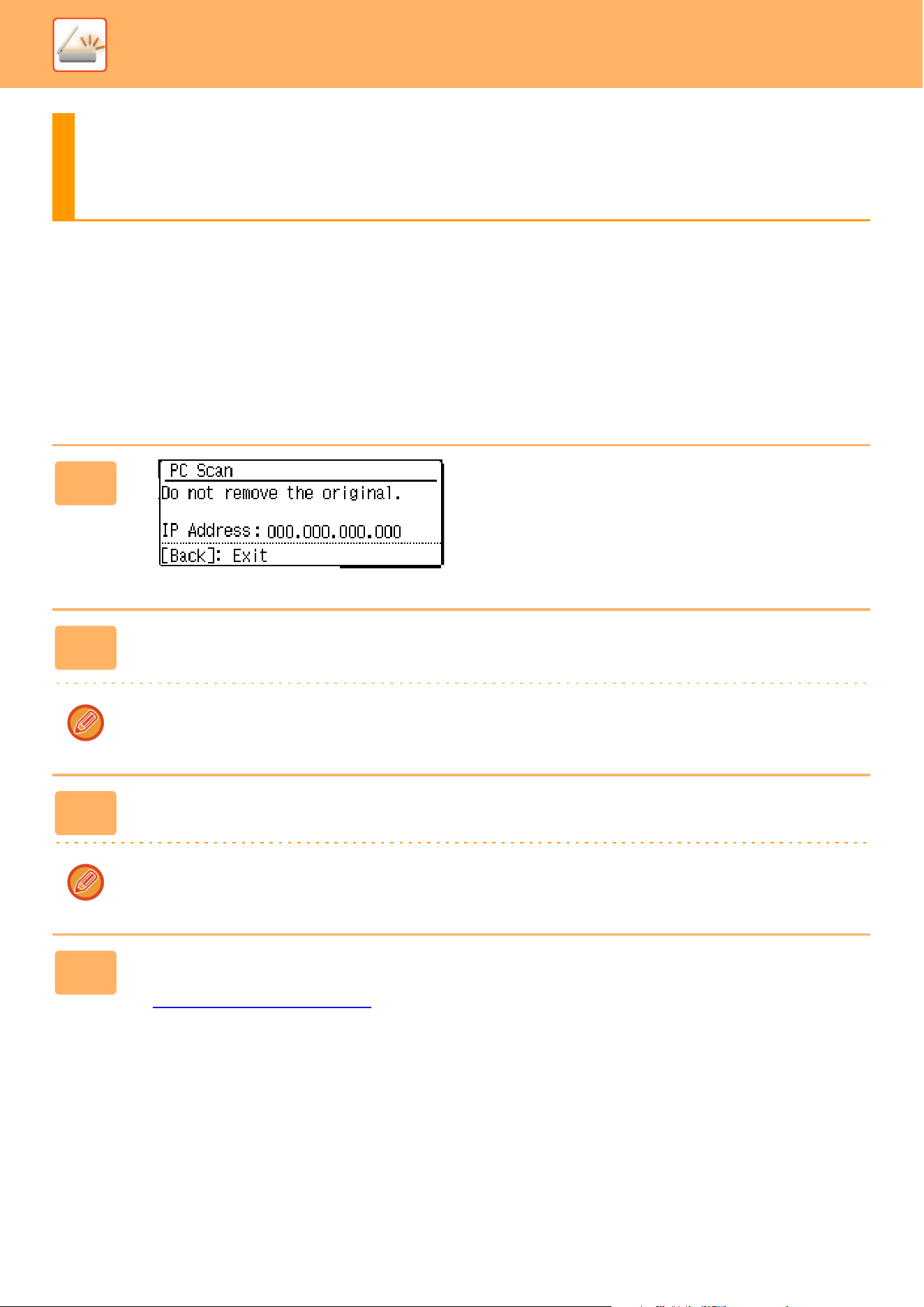
5-20
SCANNER►SCANNING FROM YOUR COMPUTER (PC SCAN)
SCANNING FROM A TWAIN-COMPLIANT
APPLICATION
The machine supports the TWAIN standard, making it possible to scan from TWAIN-compliant applications.
Scanning in PC scan mode is only possible when the scanner driver has been installed from the "Software CD-ROM"
using the integrated installer. For the procedures for installing the scanner driver and configuring settings, see the
Software Setup Guide.
SCANNING FROM YOUR COMPUTER
(PC SCAN)
1
Place the original(s) that you wish to
scan on the document glass/document
feeder. Press the [SPECIAL
FUNCTION] key, select "PC SCAN",
and press the [OK] key.
2
After starting TWAIN-compliant application, click the "File" menu and select
a menu to scan.
The method for accessing the menu to select the scanner depends upon the application.
For more information, refer to the manual or the help file of your application.
3
Select "SHARP MFP TWAIN V", and click the "Select" button.
Depending on your system, "SHARP MFP TWAIN V 1.0 (32-32)" may appear in the above "Select Source" screen.
4
Select the menu to acquire an image from the application’s "File" menu.
The scanner driver setup screen will appear.
► Scanner driver settings
(page 5-22)
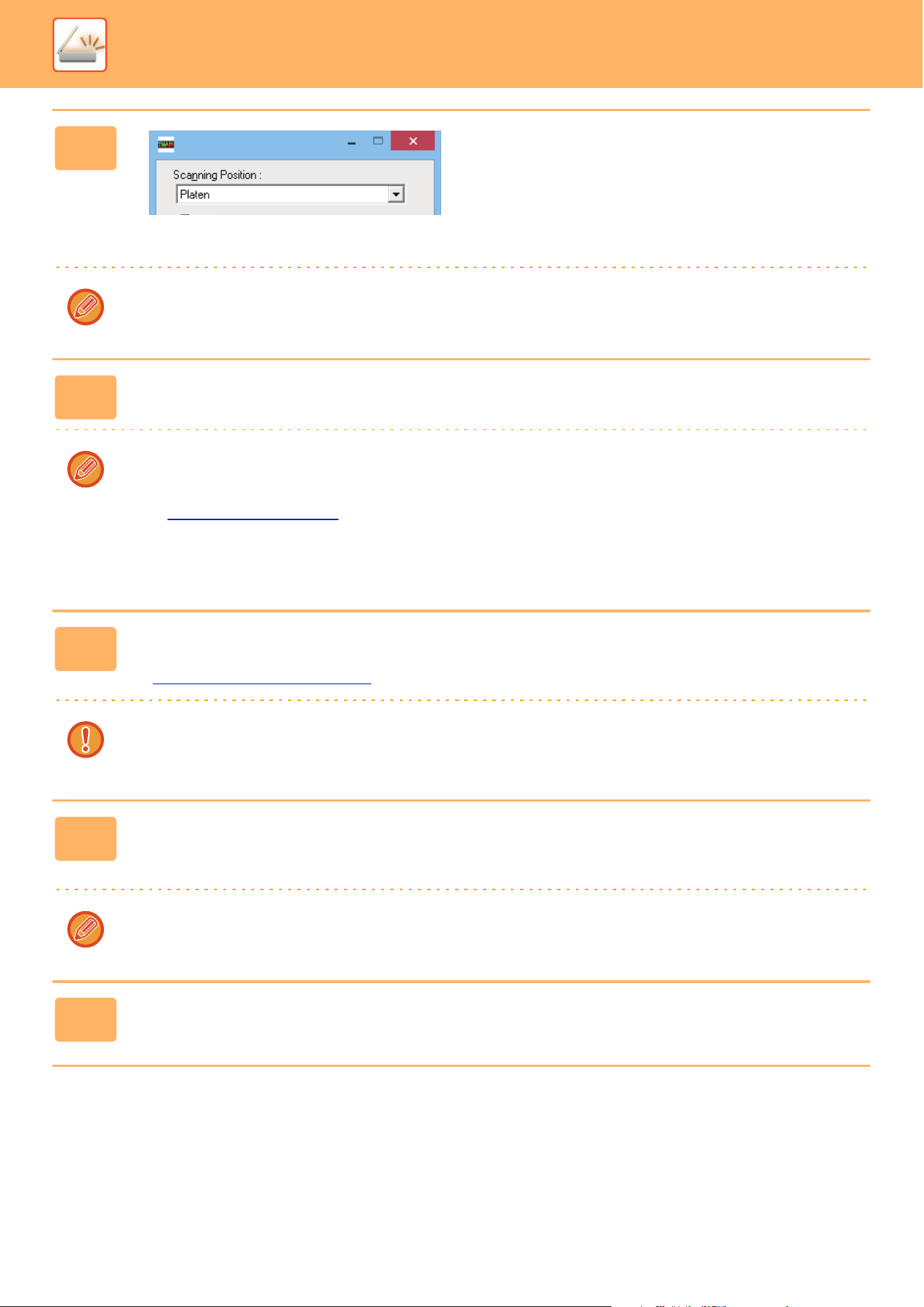
5-21
SCANNER►SCANNING FROM YOUR COMPUTER (PC SCAN)
5
In the "Scanning Source" menu, select
the location where you placed the
original in Step 1.
If you placed a two-sided original in the document feeder,
select "SPF (Duplex-Book)" or "SPF (Duplex-Tablet)"
according to the binding position of the original.
If you selected "SPF (Duplex-Book)" or "SPF (Duplex-Tablet)" in the "Scanning Source" menu, select whether the
orientation of the placed original is "Left edge is fed first" or "Top edge is fed first".
6
Click the "Preview" button.
The preview image will appear.
• If the angle of the image is not correct, reset the original, and click the "Preview" button again.
• If the preview image is not oriented correctly, click the "Rotate" button in the preview screen. This rotates the preview
image 90 degrees clockwise, allowing you to correct the orientation without resetting the original.
► Preview screen
(page 5-23)
• If you set multiple pages in the document feeder, the machine previews only the top page of the originals, and then
sends it to the original exit area. Return the previewed original to the document feeder before starting the scanning
job.
7
Specify the scanning area and set the scan preferences.
For information on specifying the scan area and setting the scan preferences, see scanner driver Help.
► Scanner driver settings
(page 5-22)
Scanning a large area at high resolution results in a large quantity of data and a prolonged scanning time.
It is recommended that you set appropriate scanning preferences for the type of original being scanned, i.e., Web page
(monitor), Photo, FAX, or OCR.
8
When you are ready to begin scanning, click the "Scan" button.
Scanning begins and the image is acquired into the application that you are using.
In the application, assign a file name and save the file.
To cancel a scanning job after the "Scan" button has been clicked, press the [Esc] key on your keyboard or the [C] key
or [CA] key on the operation panel.
9
Press the [BACK] key on the operation panel.
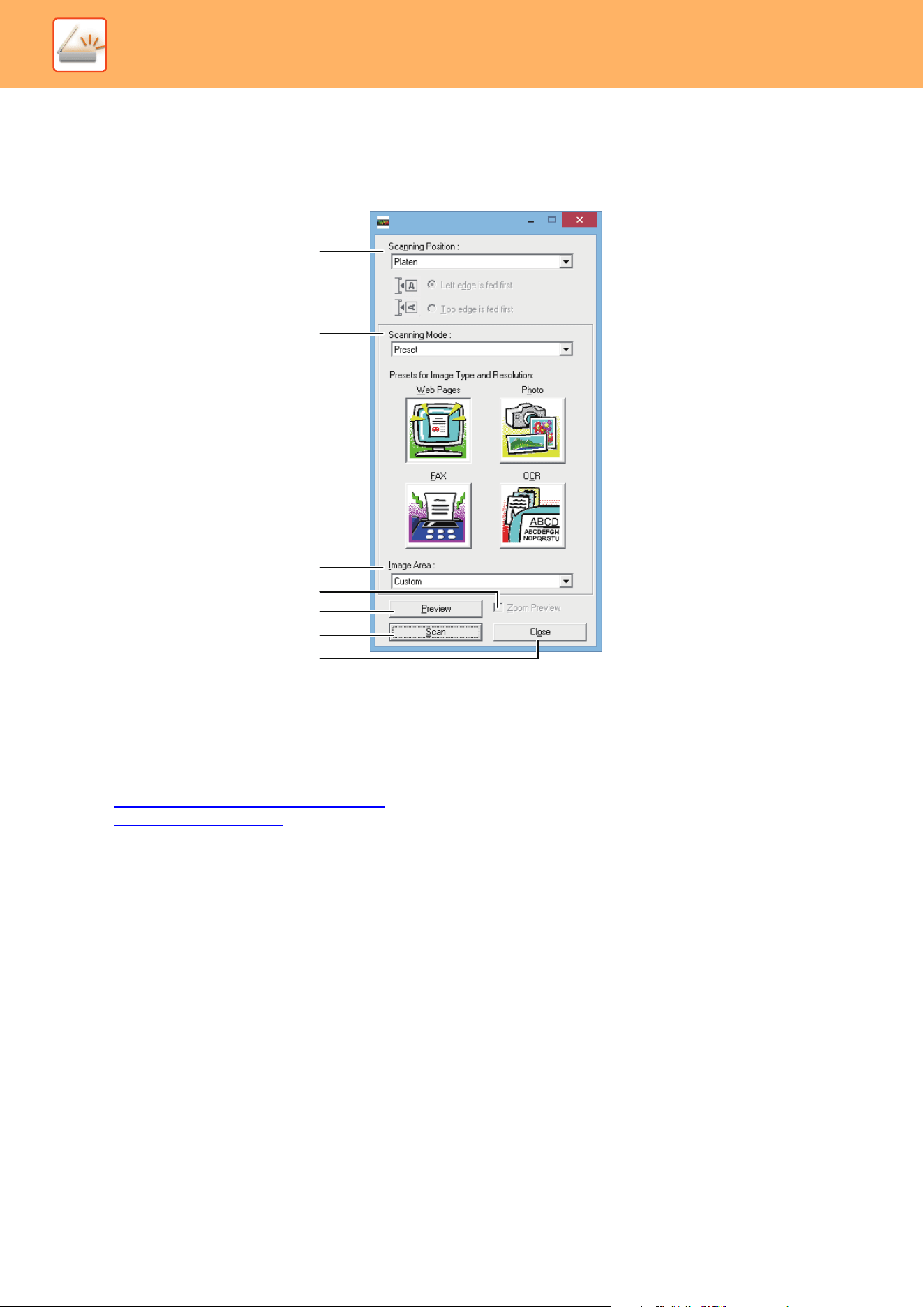
5-22
SCANNER►SCANNING FROM YOUR COMPUTER (PC SCAN)
Scanner driver settings
The scanner driver setup screen consists of the "Set-up screen", which lets you select scan settings, and the "Preview
screen", which shows the scanned image. For details on the scan settings, click the "Help" button in the preview screen
to display Help.
(1) "Scanning Position" menu
("Scanning Source" in some regions)
Select the location where the original is placed.
Selections are "Platen" (document glass), "SPF
(Simplex)", "SPF (Duplex-Book)" or "SPF
(Duplex-Tablet)".
► SCANNING FROM A TWAIN-COMPLIANT
APPLICATION (page 5-20)
(2) "Scanning Mode" menu
Select "Preset" or "Custom Settings" ("Standard" or
"Professional" in some regions) for the scanning mode.
The "Preset (or Standard)" screen lets you select the
original type as well as monitor, photo, fax, or OCR
according to the purpose of scanning.
If you wish to change the default settings for these four
buttons, or select custom settings such as the image type
and resolution before scanning, switch to the "Custom
Settings (or Professional)" screen.
For details on the settings, click the "Help" button in the
preview screen to display Help.
(3) "Image Area" menu
Set the scanning area. To scan the original size detected
by the machine, select "Auto".
The scanning area can also be specified as desired in
the preview window.
(4) "Zoom Preview" checkbox
When this is selected, the selected part of the preview
image will be enlarged when the "Preview" button is
clicked.
To return to the regular view, remove the checkmark.
[Zoom Preview] cannot be used when [SPF] is selected
in the "Scanning Position" menu.
(5) "Preview" button
Previews the document.
If [Preview] is canceled by immediately pressing the [Esc]
key on your keyboard, nothing will appear in the preview
screen.
(6) "Scan" button
("Scanning" in some regions)
Click to scan an original using the selected settings.
Before clicking the "Scan" button, make sure the settings
are correct.
To cancel a scanning job after the "Scan" button is
clicked, press the [Esc] key on your keyboard.
(7) "Close" button
Click to close the scanner driver setup screen.
(1)
(2)
(3)
(4)
(5)
(6)
(7)
Set-up screen
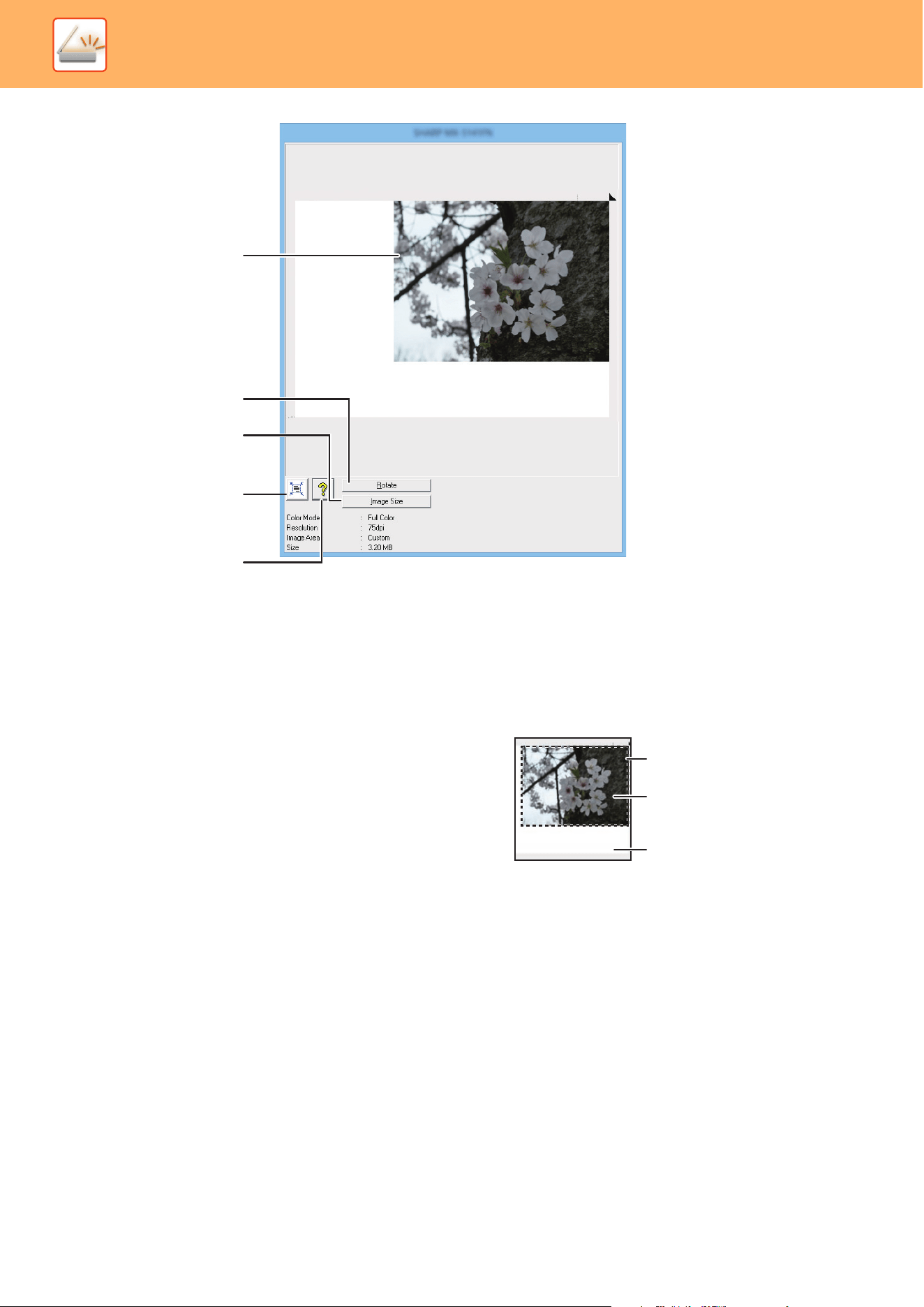
5-23
SCANNER►SCANNING FROM YOUR COMPUTER (PC SCAN)
(1) Preview screen
Click the "Preview" button in the Set-up screen to display
the scanned image. You can specify the scanning area
by dragging the mouse inside the window. The inside of
the frame that is created when you drag the mouse will
be the scanning area. To cancel a specified scanning
area and clear the frame, click anywhere outside the
frame.
(2) "Rotate" button
Click to rotate the preview image 90 degrees clockwise.
This allows the orientation to be corrected without
resetting the original. Upon scanning, the image file is
created in the orientation shown in the preview screen.
(3) "Image Size" button
Click to open a dialog box that allows you to specify the
scanning area by entering numbers. Pixels, mm, or
inches can be selected for the units of the numbers. By
initially specifying a scanning area, numbers can be
entered to change that area relative to the top left corner
as a fixed origin.
(4) "Auto Scan Area Judgement" button
Click when the preview screen is displayed to
automatically set the scanning area to the entire preview
image.
Click the "Auto Scan Area
Judgement" button to
automatically set the scanning
area to the entire preview image.
Preview image
Preview screen
(5) "Help" button
Click to display the help file for the scanner driver.
(1)
(2)
(3)
(4)
(5)
Preview screen
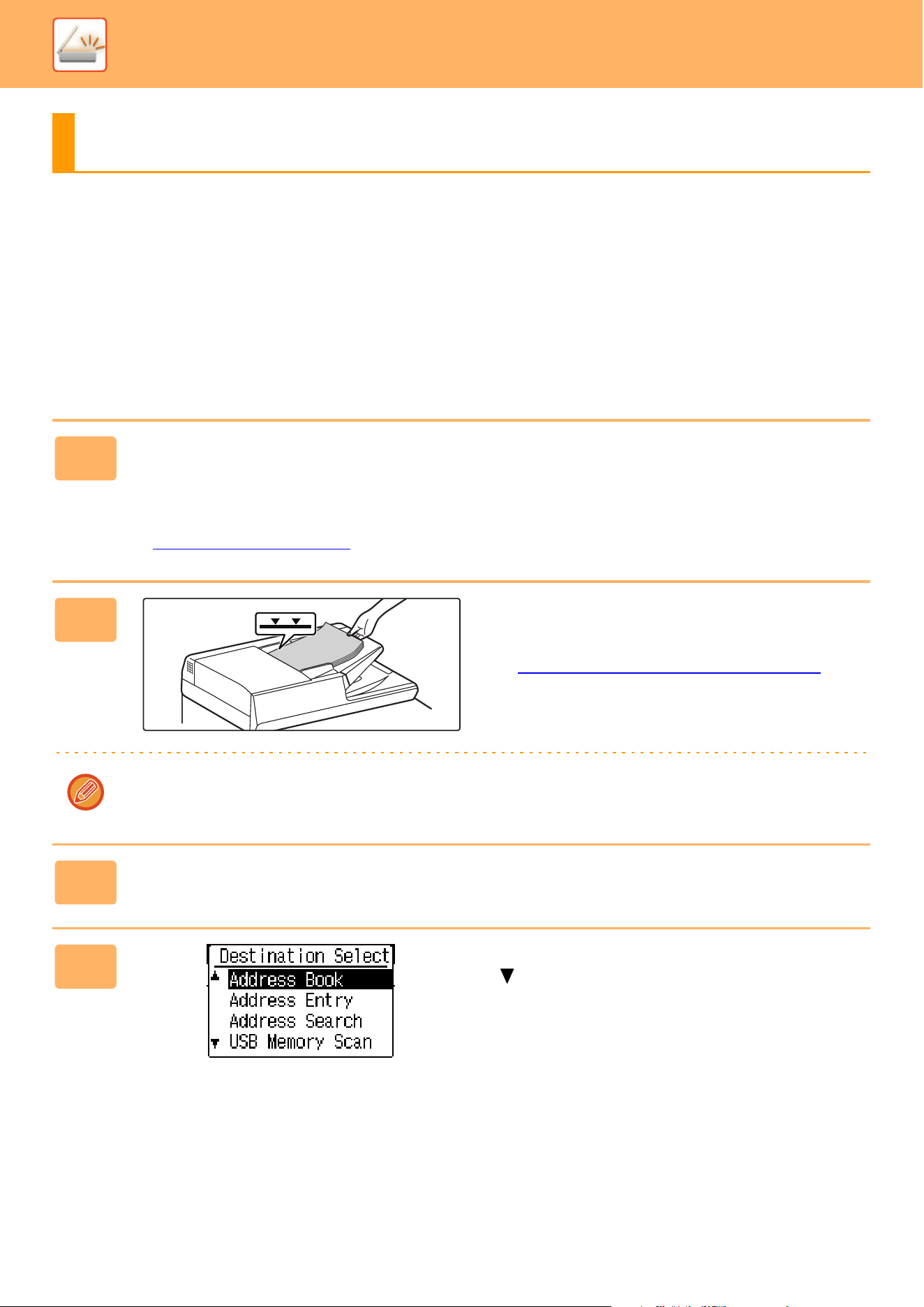
5-24
SCANNER►SAVING IN USB MEMORY DEVICE
USB MEMORY SCAN
USING THE USB MEMORY SCAN FUNCTION
A scanned image can be sent (save) to a commercially available USB flash memory that has been connected to the
machine.
Using the document feeder
SAVING IN USB MEMORY DEVICE
1
Make sure the machine is in scan mode.
When the SCAN indicator is lit, the machine is in scan mode. If the indicator is not lit, press the [SCAN] key.
If auditing mode has been enabled for the scan function in the system settings, a message will appear prompting you to
enter your account number when you switch to scan mode. Enter your account number (five digits) with the numeric
keys.
► User Authentication
(page 7-12)
2
Place the original(s).
Place the original in the document feeder tray of the
automatic document feeder.
► AUTOMATIC DOCUMENT FEEDER
(page 1-30)
You cannot place originals in both the document feeder tray and on the document glass and send them in a single
transmission.
3
Press the [ADDRESS] key.
4
Select "USB Memory Scan" using the
[ ] key, press the [OK] key.
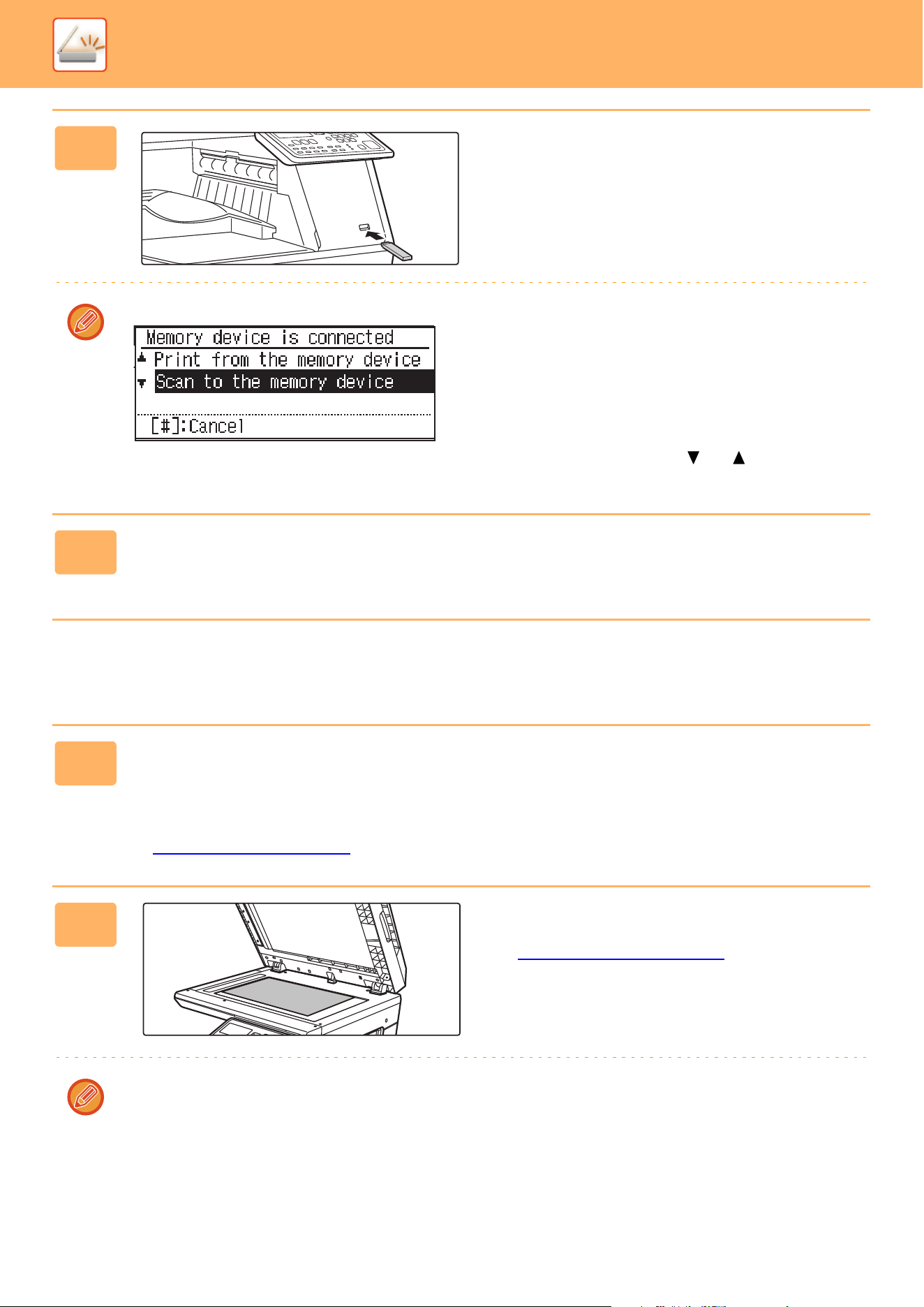
5-25
SCANNER►SAVING IN USB MEMORY DEVICE
Using the document glass
5
Connect the USB flash memory to the
machine.
If a USB flash memory is inserted into the machine prior to step 4, the following screen will appear.
Instead of performing steps 3 and 4, you can select "Scan to the memory device" with the [ ] or [ ] key in the above
screen and press the [OK] key to select theUSB flash memory as the destination.
6
Press the [START] key.
Scanning begins.
If scanning is completed normally, "Complete." is appears briefly and then the display returns to the base screen.
1
Make sure the machine is in scan mode.
When the SCAN indicator is lit, the machine is in scan mode. If the indicator is not lit, press the [SCAN] key.
If auditing mode has been enabled for the scan function in the system settings, a message will appear prompting you to
enter your account number when you switch to scan mode. Enter your account number (five digits) with the numeric
keys.
► User Authentication
(page 7-12)
2
Place the original.
Place the original on the document glass.
► DOCUMENT GLASS
(page 1-32)
You cannot place originals in both the document feeder tray and on the document glass and send them in a single
transmission.
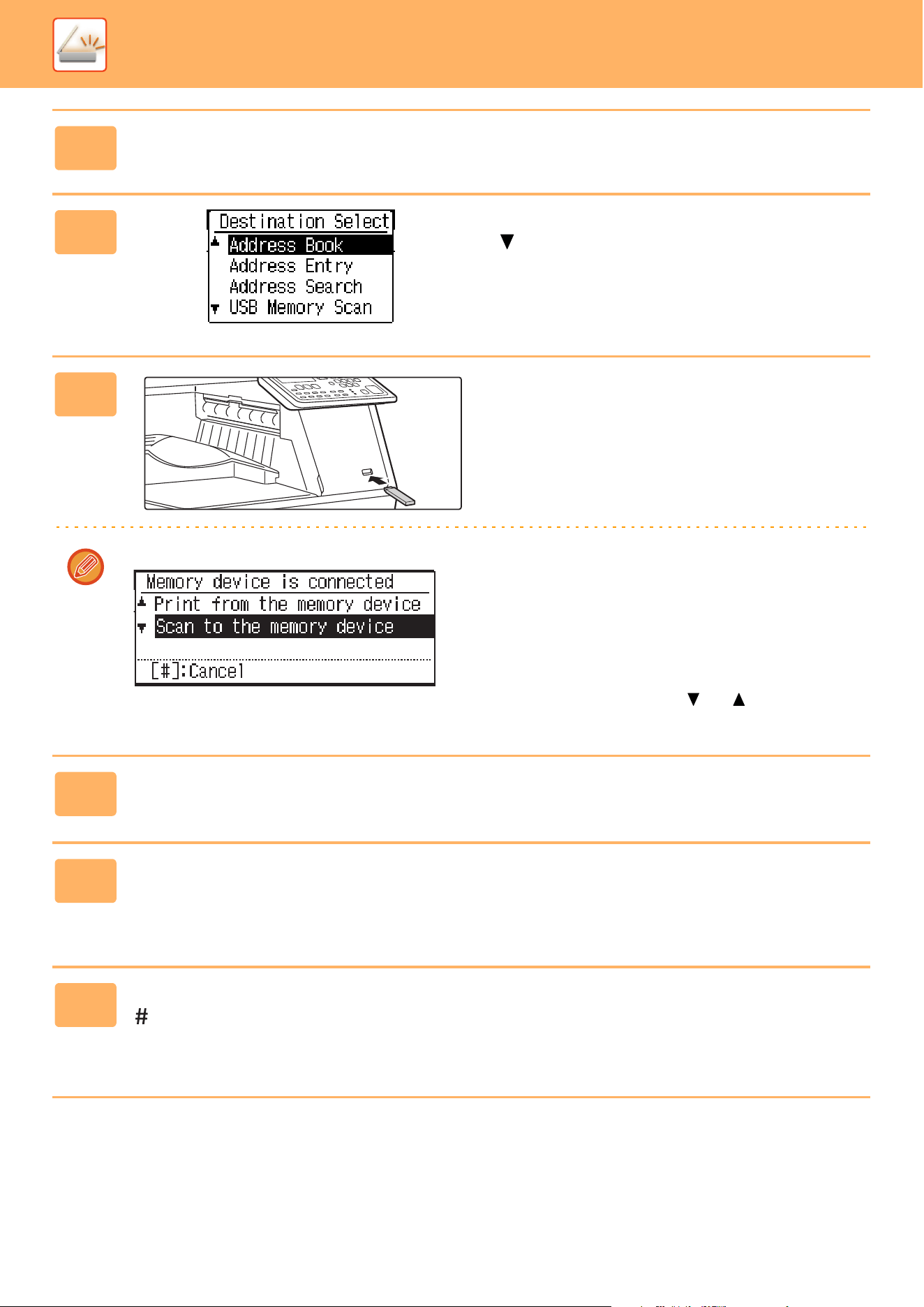
5-26
SCANNER►SAVING IN USB MEMORY DEVICE
3
Press the [ADDRESS] key.
4
Select "USB Memory Scan" using the
[ ] key, press the [OK] key.
5
Connect the USB flash memory to the
machine.
If a USB flash memory is inserted into the machine prior to step 4, the following screen will appear.
Instead of performing steps 3 and 4, you can select "Scan to the memory device" with the [ ] or [ ] key in the above
screen and press the [OK] key to select the USB flash memory as the destination.
6
Press the [START] key.
Scanning begins.
7
If you have another page to scan, change pages and then press [START] key.
• Repeat this sequence until all pages have been scanned.
• If no action is taken for one minute (the [START] key is not pressed), scanning automatically ends and transmission
begins.
8
When the final original page has been scanned, press the [READ-END] key
().
Open the document feeder and remove the document. When the original is removed or any key operation is performed,
the display returns to the base screen.

6-1
TROUBLESHOOTING
• NETWORK PROBLEMS . . . . . . . . . . . . . . . . . . 6-2
• MACHINE/COPYING PROBLEMS . . . . . . . . . . 6-3
• PRINTING AND SCANNING PROBLEMS . . . . 6-6
• FAX PROBLEMS. . . . . . . . . . . . . . . . . . . . . . . . 6-10
INDICATORS AND DISPLAY MESSAGES. . . . . . . 6-12
IF YOUR E-MAIL IS RETURNED. . . . . . . . . . . . . . . 6-13
PAPER JAM
MISFEED REMOVAL . . . . . . . . . . . . . . . . . . . . . . . . 6-14
• MISFEED IN THE DOCUMENT FEEDER. . . . . 6-14
• MISFEED IN THE BYPASS TRAY . . . . . . . . . . 6-16
• MISFEED IN THE MACHINE . . . . . . . . . . . . . . 6-17
• MISFEED IN THE PAPER TRAY 1 . . . . . . . . . . 6-21
• MISFEED IN THE PAPER TRAY 2 (Option) . . . 6-22
TROUBLESHOOTING
6-2
TROUBLESHOOTING►TROUBLESHOOTING
This chapter describes troubleshooting and misfeed removal.
If you encounter a problem when using the machine, check the following troubleshooting guide before calling for service.
If you cannot resolve the problem using the troubleshooting guide, turn off the main switch, disconnect the power cord
from the power outlet, and contact your dealer.
NETWORK PROBLEMS
TROUBLESHOOTING
If you experience difficulty using the machine, check the following troubleshooting guide before calling for service.
Many problems can be easily resolved by the user. If you are unable to solve the problem using the
troubleshooting guide, turn off the power switch and unplug the machine, and contact your SHARP Service
Department.
"**-**" represents a code consisting of numbers and letters. When contacting your dealer, inform your dealer of the
code that is displayed.
Problem Cause and solution Page
The machine does not connect to the
network.
The LAN cable is disconnected.
→ Make sure that he LAN cable is firmly inserted in the connectors
on the machine and your computer. To connect the cable, see the
"Software setup guide".
1-3
Is the machine configured for use on the same network as the
computer?
→ The machine cannot be used if it is not connected to the same
network as the computer, or if it is not configured for use on the
network.
For more information, consult your network administrator.
–
6-3
TROUBLESHOOTING►TROUBLESHOOTING
MACHINE/COPYING PROBLEMS
The following problems are related to the general operation of the machine and copying.
Problem Cause and solution Page
The machine does not operate.
The machine is not plugged into a power outlet.
→ Plug the machine into a grounded outlet.
–
Power switch OFF.
→ Turn the power switch ON.
1-11
The machine is warming up.
→ The machine requires some time to warm up after the power
switch is turned on. While the machine is warming up, copy
settings can be selected but copying is not possible. Wait until
"Ready to copy." appears.
1-11
The front cover or the side cover is not completely closed.
→ Close the front cover or the side cover.
–
The machine is in auto power shut-off mode.
→ When auto power shut-off mode has activated, only the
[ENERGY SAVE] indicator blinks; all other indicators and the
display are off. The machine returns to normal operation when the
[ENERGY SAVE] key is pressed, when a print job or fax is
received, or when scanning from a computer is started.
* Except when print hold for the fax function is enabled.
1-12
Misfeed occurs.
→ To remove the misfeed, see "MISFEED REMOVAL".
6-14
The tray is out of paper.
→ Load paper.
1-17
The power is on, but copying does not
take place.
→ Press the [COPY] key to select copy mode.
2-2
Copies are too dark or too light.
An appropriate exposure for the original has not been selected.
→ Select a suitable exposure mode with the [EXPOSURE] key and
set an appropriate exposure level with the [ ] or [ ] key.
→ If the copy is too light or too dark even though "AUTO" was
selected with the [EXPOSURE] key, adjust the automatic
exposure level.
2-8
The text is blurred when I make a
copy.
Select a suitable exposure for the original in the copy exposure
screen.
→ Change the exposure to "Text" with the [EXPOSURE] key.
2-8
Blank copies.
The original is not placed face up in the document feeder or face
down on the document glass.
→ Place the original face up in the document feeder or face down on
the document glass.
1-30
Part of the image is cut off or there is
too much blank space.
The original was not placed in the correct position.
→ Place the original correctly.
1-30
The size of paper loaded in the tray was changed without
changing the tray's paper size setting.
→ Be sure to change the tray's paper size setting whenever you
change the size of paper loaded in the tray.
1-29
6-4
TROUBLESHOOTING►TROUBLESHOOTING
Wrinkles appear in the paper or the
image disappears in places.
The paper is outside of the specified size and weight range.
→ Use copy paper within the specified range.
1-17
Paper curled or damp.
→ Do not use curled or crimped paper. Replace with dry copy paper.
During periods when the machine is not used for a long time,
remove the paper from the tray and store it in a dark place in a
bag to prevent moisture absorption.
–
The fusing unit pressure adjusting levers were not returned to
their original positions
→ If the fusing unit pressure adjusting levers are not returned, poor
toner adhesion, smudging, and lines may occur. Be sure to press
both levers down to return to their original positions.
1-26
Paper misfeed.
The paper is outside of the specified size and weight range.
→ Use copy paper within the specified range.
1-17
Paper curled or damp.
→ Do not use curled or crimped paper. Replace with dry copy paper.
During periods when the machine is not used for a long time,
remove the paper from the tray and store it in a dark place in a
bag to prevent moisture absorption.
–
Paper is not loaded properly.
→ Make sure the paper is properly installed.
1-17
Pieces of paper inside machine.
→ Remove all pieces of misfed paper.
6-14
Several sheets of paper stick together.
→ Fan the paper well before loading it.
–
A paper misfeed has occurred in the tray.
→ Turn the paper over and/or turn it around, and reload.
6-21
Too much paper is loaded in the tray.
→ If the stack of paper is higher than the indicator line on the tray,
remove some of the paper and reload so that the stack does not
exceed the line.
1-21
The guides on the bypass tray do not match the width of the
paper.
→ Adjust the guides to match the width of the paper.
If the paper guide presses too hard against the paper, a misfeed
may occur. Adjust the guide so that it lightly contacts the paper.
1-24
The bypass tray extension is not pulled out.
→ When loading paper, open the extension.
1-24
The bypass paper feed roller is dirty.
→ Clean the roller.
1-35
Copies are smudged or dirty.
The document glass or the underside of the document feeder is
dirty.
→ Clean regularly.
1-34
Original smudged or blotchy.
→ Use a clean original.
–
White or black lines appear on copies.
The scanner glass for the document feeder is dirty.
→ Clean the long, narrow scanning glass.
1-34
Problem Cause and solution Page
6-5
TROUBLESHOOTING►TROUBLESHOOTING
Paper size for a paper tray cannot be
set.
Press the [COPY] key to select copy mode.
2-2
Copying or printing is performed.
→ Set the paper size after copying or printing is complete.
–
The machine has stopped temporarily due to running out of
paper or a misfeed.
→ Load paper or remove the misfeed, and then set the paper size.
6-14
A copy job stops before it is finished.
The paper output tray is full.
→ Remove the output in the paper output tray to resume printing.
–
The tray is out of paper.
→ Load paper.
1-17
The display turns off.
Any other indicators turned off.
→ If other indicators are lit, the machine is in "Preheat mode". Press
any key on the operation panel to resume normal operation.
1-13
[ENERGY SAVE] indicator blinks.
→ The machine is in auto power shut-off mode. Press the [ENERGY
SAVE] key to resume normal operation.
1-12
Lighting fixture flickers.
The same power outlet being used is for the lighting fixture and
the machine.
→ Connect the machine to a power outlet which is not used for other
electric appliances.
–
Problem Cause and solution Page

6-6
TROUBLESHOOTING►TROUBLESHOOTING
PRINTING AND SCANNING PROBLEMS
In addition to this section, troubleshooting information can also be found in the README files for each of the software
programs. To view a README file, see "SOFTWARE SETUP GUIDE".
Problem Cause and solution Page
The machine does not print.
(DATA indicator does not blink.)
The machine is not correctly connected with your computer.
→ Check both ends of the printer cable and make sure you have a
solid connection. Try a known good cable. For information on
cables, see "SPECIFICATIONS (START GUIDE)".
1-3
Copy job is performed.
→ Wait until the copy job is complete.
–
Your machine is not selected correctly in the current application
for the print job.
→ When choosing "Print" from the "File" menu located in
applications, be sure you have selected "SHARP MX-XXXX"
(where XXXX is the model name of your machine) printer
displayed in the "Print" dialog box.
–
The printer driver has not been installed properly.
→ Follow these steps to check and see if the printer driver is
installed.
1 Click the "Start" button →"Settings" button →"Devices" →
"Printers and Scanner".
In Windows 7, click the"Start" button, click "Devices and
Printers".
2 If the "SHARP MX-XXXX" printer driver icon is shown but you
still cannot print, the printer driver may not have been installed
correctly. In this case, delete the software and then reinstall it.
–
The port setting is not correct.
→ Printing is not possible if the printer driver port setting is not
correct. Set the port correctly. For more information, see the
Software Setup Guide.
–
Printing is disabled.
→ If "CANCEL JOBS OF INVALID ACCOUNTS" is enabled in the
system settings, printing will not be possible. Consult the
administrator.
7-12
The machine does not print.
(DATA indicator was blinking.)
The tray size settings are not the same on the machine and in
the printer driver.
→ Make sure that the same tray paper size is set on the machine
and in the printer driver. To change the tray's paper size setting
on the machine, see TRAY SETTINGS (page 1-29)
or see
Software Setup Guide to change it in the printer driver.
3-7
3-14
The specified size of paper has not been loaded.
→ Load the specified size of paper in the paper tray.
1-17
Printing is slow.
Simultaneous use of two or more application software
programs.
→ Start printing after quitting all unused application software
programs.
–

6-7
TROUBLESHOOTING►TROUBLESHOOTING
The printed image is light and uneven.
The paper is loaded so that printing takes place on the back side
of the paper.
→ Some paper types have a front and back side. If the paper is
loaded so that printing takes place on the back side, toner will not
adhere well to the paper and a good image will not be obtained.
1-17
The printed image is dirty.
You are using paper that is outside the specified size and weight
range.
→ Use copy paper within the specified range.
1-17
Paper curled or damp.
→ Do not use curled or crimped paper. Replace with dry copy paper.
During periods when the machine is not used for a long time,
remove the paper from the tray and store it in a dark place in a
bag to prevent moisture absorption.
–
You did not set sufficient margins in the paper settings of your
application.
→ The top and bottom of the paper may be dirty if the margins are
set outside of the specified print quality area.
→ Set the margins in the software application within the specified
print quality area.
–
Black dots or smudges appear on the printed output.
→ Run fixing cleaning mode. The letter "V" is printed on a sheet of
paper and the fusing unit is cleaned.
7-13
The printed image is skewed or it runs
off the paper.
The paper loaded in the tray is not the same size as that
specified in the printer driver.
→ Check if the "Paper Size" options suit the size of the paper loaded
in the tray.
If the "Fit To Paper Size" setting is activated, make sure that the
paper size selected from the drop-down list is the same as the
size of the loaded paper.
–
The orientation of document setting is not correct.
→ Click the "Main" tab in the printer driver setup screen, and verify if
the "Image Orientation" option is set to your requirements.
–
Paper is not loaded properly.
→ Make sure the paper is properly loaded.
1-17
You did not correctly specify the margins for the application in
use.
→ Check the layout of the document margins and the paper size
settings for the application you are using. Also check if the print
settings are specified correctly to suit the paper size.
–
Problem Cause and solution Page

6-8
TROUBLESHOOTING►TROUBLESHOOTING
Poor scanning quality.
The document glass or the underside of the document feeder is
dirty.
→ Clean regularly.
1-34
Original smudged or blotchy.
→ Use a clean original.
–
You have not specified a suitable resolution.
→ Make sure that the resolution setting in the scanner driver is
appropriate for the original.
–
You have not specified a suitable value for the "B/W Threshold"
setting.
→ If you are scanning with a TWAIN-compliant application, make
sure that a suitable value is specified for the "B/W Threshold"
setting. A larger threshold value makes your output darker, while
a small threshold value makes it lighter. To adjust the threshold
automatically, click the "Auto Threshold" button on the "Image"
tab of the "Professional" screen.
–
The brightness and contrast settings are not suitable.
→ If you are scanning with a TWAIN-compliant application and the
resulting image has unsuitable brightness or contrast (for
example it is too bright), click the "Auto Brightness/Contrast
Adjustment" button on the "Color" tab of the "Professional"
screen. Click the "Brightness/Contrast" button to adjust the
brightness and the contrast while viewing the scanned output
image on the screen.
–
The original is not placed face up in the document feeder or face
down on the document glass.
→ Place the original face up in the document feeder or face down on
the document glass.
1-30
The original was not placed in the correct position.
→ Place the original correctly.
1-30
Unable to scan the image.
Your application is not TWAIN compliant.
→ If your application is not TWAIN compliant, scanning will not be
possible. Make sure your application is TWAIN compliant.
–
You have not selected the scanner driver of the machine in your
application.
→ Make sure that the machine’s scanner driver is selected in your
TWAIN-compliant application.
–
You have not specified all scanning preferences appropriately.
→ Scanning a large area at high resolution results in a large amount
of data and extended scanning times. The scanning preferences
should be set appropriately for type of original to be scanned, i.e.,
Text, Text/Graphics, Photograph.
–
The recipient does not receive a
transmitted data.
There is a mistake in the stored destination information or the
wrong destination was selected.
→ Make sure that the correct destination information is stored.
If there is a mistake, correct it.
* If delivery by e-mail (Scan to E-mail) is unsuccessful, an error
message such as "Undelivered Message" may be sent to the
designated administrator's e-mail address. This information may
help you determine the cause of the problem.
8-7
Problem Cause and solution Page
6-9
TROUBLESHOOTING►TROUBLESHOOTING
The recipient does not receive data
sent by e-mail (Scan to E-mail).
Check the Web page to see if a limit has been set for the size of
image files sent using Scan to E-mail (the factory default setting is
"Unlimited"). A limit can be set from 1 MB to 10 MB. Consult the
administrator of the Web page to select a suitable limit.
8-7
The amount of data that can be sent in one e-mail transmission is
sometimes limited by the administrator of the mail server. Even if the
file size is within the limit explained above, if it exceeds the limit set
by the administrator of the mail server, the file will not be delivered to
the recipient.
Decrease the amount of data sent in the e-mail transmission (reduce
the number of pages scanned). (Ask your mail server administrator
what the data limit is for one e-mail transmission.)
–
Transmission takes a long time.
When there is a large amount of image information, the data file is
also large and transmission takes a long time.
–
The [START] indicator is not lit in the
USB Memory Scan mode.
The USB flash memory is not recognized or not inserted, or any
device other than USB flash memory is inserted in the USB port.
→ Check the USB port.
–
"Check the USB memory." appears in
the display during USB Memory Scan.
Any device other than USB flash memory is inserted in the USB
port, the USB flash memory is write-protected, or it was taken off
during USB Memory Scan.
→ Check your USB flash memory and use it properly.
–
"Memory is full. Job is canceled."
appears in the display during USB
Memory Scan.
The memory of the USB flash memory became full.
→ Use the USB flash memory with sufficient memory.
–
Problem Cause and solution Page
6-10
TROUBLESHOOTING►TROUBLESHOOTING
FAX PROBLEMS
If you experience a problem with the fax function, first check the following table.
Problem Cause and solution Page
The machine does not operate.
Is the machine power switch turned on?
→ Turn the power switch ON.
1-11
Does the display show an error message?
→ Clear the error as instructed by the message.
4-60
Dialing is not possible.
Is the correct dial mode set for your line?
→ Check your line and set the correct dial mode.
7-19
Is the telephone line properly connected?
→ Check the connections.
4-2
Is the machine power switch turned on?
→ Turn the power switch ON.
1-11
Is the machine in fax mode?
→ Press the [FAX] key to set the machine to fax mode.
4-8
Cannot send a fax.
Does the receiving fax machine have paper?
→ Check with the operator of the receiving machine.
–
Is the receiving machine ready to receive?
→ Check with the operator of the receiving machine.
–
Are you using a transmittable original size?
→ Check the transmittable sizes.
1-30
Was the original size detected correctly?
→ Check size of the original.
1-30
The message "Reading canceled. Please retry sending
operation." appears.
→ If you attempt transmission while the message "Warming-up."
appears, the transmission may not take place correctly. Repeat
the transmission.
–
The transmitted image prints out
blank at the receiving side.
Was the original placed so that the correct side is scanned?
→ Make sure the original is placed so that the correct side is
scanned.
1-30
If the receiving machine is using thermal paper, was the thermal
paper loaded with the wrong side out?
→ Check with the operator of the receiving machine.
–
The transmitted image is distorted.
Were line conditions poor due to thunder or another reason?
→ Try the transmission again.
–
Were the resolution and exposure settings suitable?
→ Check the resolution and exposure settings.
–
White or black lines appear in the
transmitted image.
Is the document glass or the scanning glass for the document
feeder (the long, narrow glass) dirty?
→ Clean the document glass or the scanning glass for the document
feeder.
1-34
Transmission does not take place at
the specified time.
Is the machine's clock set to the correct time?
→ Set the clock to the correct time.
7-10
6-11
TROUBLESHOOTING►TROUBLESHOOTING
Printing does not take place after
reception.
Does an error message appear regarding adding paper,
replenishing toner, or a misfeed? (This means that printing is
not possible.)
→ Restore printing capability as instructed by the display message.
Printing will begin.
4-60
Is forwarding (Inbound Routing function) selected in the Web
page for a received fax?
→ If you need to print a received fax, ask your administrator.
When the Inbound Routing function is enabled in the Web pages,
received faxes are automatically forwarded to a specified
address. If "Print at Error" is selected when Inbound Routing is
enabled, received faxes will only be printed when an error occurs.
–
A received fax prints out blank.
Was the wrong side of the original scanned in the transmitting
machine?
→ Check with the operator of the transmitting machine.
–
The received image is faint.
Is the original faint?
→ Ask the other party to re-send the fax using a suitable exposure
setting.
–
The received image is distorted.
Were line conditions poor due to thunder or another reason?
→ Ask the other party to send the fax again.
–
Telephone
A dial tone is not heard through
the speaker.
Is the volume set to "low"?
→ Set the speaker volume to "middle" or "high".
7-19
The machine does not ring.
Has the ringer volume been turned off?
→ Set the ringer volume to "low", "middle", or "high".
7-19
Dialing is not possible.
Is the telephone line properly connected?
→ Check the connections.
4-2
Problem Cause and solution Page
6-12
TROUBLESHOOTING►TROUBLESHOOTING
INDICATORS AND DISPLAY MESSAGES
If one of the following messages appears in the display, take prompt action as instructed by the message.
< >: Tray number
< >: Size of paper that should be loaded
And if one of the following error codes appears in the display at communication error when sending the scanned image,
take corresponding solution as mentioned below.
Message Action
Maintenance It is time for regular maintenance. Contact your SHARP Service Department.
Maintenance required. Call for service. Maintenance required soon. Contact your SHARP Service Department.
Call for service. – Turn off the power and then turn it back on. If this does not clear the message, write
down the 2-digit main code and 2-digit sub-code (" - "), turn off the power, and
promptly contact your SHARP Service Department.
Toner Low.
(Do not replace cartridge
until requested.)
The toner cartridge must be replaced soon.
Check the toner cartridge. Check to see if the toner cartridge has been installed properly.
Change the toner cartridge. Replace the toner cartridge as explained in REPLACEMENT OF TONER
CARTRIDGE (page 1-36).
Remove paper from the center tray. The number of sheets in the output tray has reached the limit. Remove the paper.
Load < > paper into tray < >. The paper size specified for the tray is different from the actual size.
► LOADING PAPER (page 1-17)
Error
Code
Solution Page
CE-00
CE-01
Turn off the power and then turn it back on. Consult with your network administrator to make sure
that no problems exist on the network or in the server. If the error is not cleared after turning the
power off and on, turn off the power and contact your dealer.
–
CE-02
CE-04
The scanned image was not sent because a connection to the server could not be established.
Make sure that the SMTP server settings or Scan to FTP destination settings in the Web page are
correct.
The procedure for configuring the SMTP server is explained in "Configuring SMTP, DNS and LDAP
server settings", and the procedure for editing Scan to FTP destination information is explained in
"Editing and deleting programmed transmission destinations".
8-7
8-15
CE-03
The scanned image was not sent because the server was busy or there was too much traffic on line.
Wait briefly and then try again.
–
CE-05
The scanned image was not sent because the directory of the destination FTP server was not
correct. Make sure that the correct FTP server information is configured in the Web page.
8-7
CE-06
Scan data cannot be sent as E-mail address that is stored in the Destination List is not adequate.
Check if the stored destination information is correct.
8-7
CE-09
The size of the scanned image file exceeds the limit set in "Maximum Size of E-mail attachments" in
the Web page. Reduce the number of original pages scanned into the file, or change the limit set in
"Maximum Size of E-mail attachments". Or it may exceed the limit of the file size at the mail server.
Reduce the volume of the original, otherwise change the resolution or the color mode to make the
scanned file size smaller.
8-13
CE-11
The memory became full during scanning. Scan less pages, lower the resolution, or change the
color mode so that the file size is smaller, and try scanning again.
8-13
6-13
TROUBLESHOOTING►TROUBLESHOOTING
IF YOUR E-MAIL IS RETURNED
If a Scan to E-mail transmission is not successful, an e-mail informing you of this fact is sent to the return address
configured in the SMTP server. If this happens, read the e-mail and determine the cause of the error, and then repeat
the transmission.
CE-12
The maximum number of destinations of a global address search has been exceeded.
Increase the number of search characters to narrow the range of the global address search.
8-13
CE-14 Check if the USB flash memory is not set to write-protect. –
CE-15 Check that the USB flash memory has enough free space to accept the data size to be scanned. –
CE-16 Check that the USB flash memory has no problem. –
CE-17
Check that the file names in the USB flash memory do not exceed 256 characters per file, or check
that the USB flash memory has no problem.
–
Error
Code
Solution Page
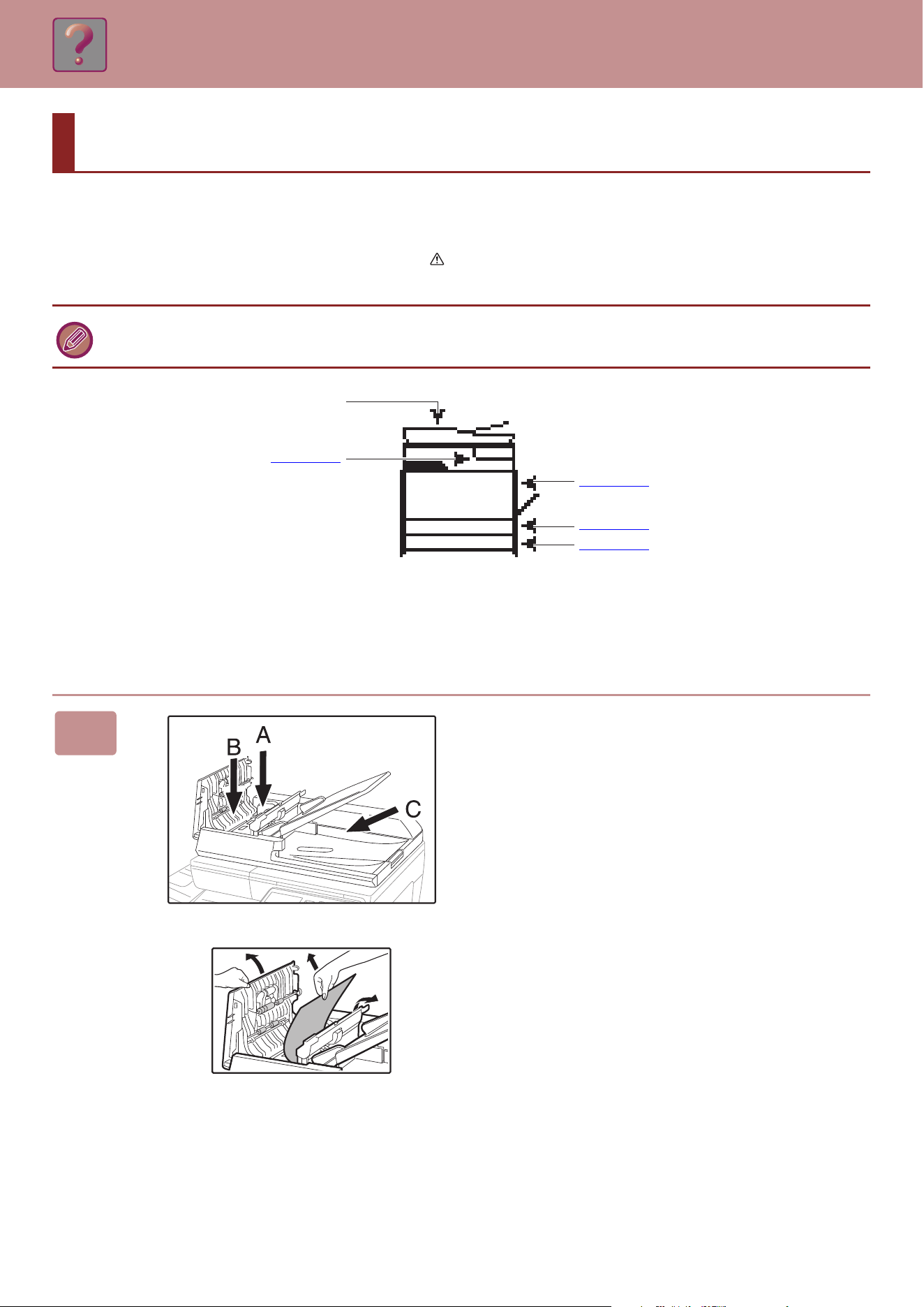
6-14
TROUBLESHOOTING►PAPER JAM
MISFEED REMOVAL
When a misfeed occurs during copying, the message " Clear paper path." and the location of the misfeed will appear.
Check the location and remove the misfeed.
MISFEED IN THE DOCUMENT FEEDER
PAPER JAM
The paper may tear when you remove a misfeed. In this event, be sure to remove all torn pieces of paper from the machine.
1
● Section A
Remove the misfed original.
Remove the original from the document feeder.
Check sections A, B, and C in the left shows the illustration
(see the next page), and remove the misfed original.
Push the release lever up, and remove the misfed original
from the document feeder tray. Pull down the release lever.
(See below)
page 6-17
page 6-17
page 6-22
page 6-16
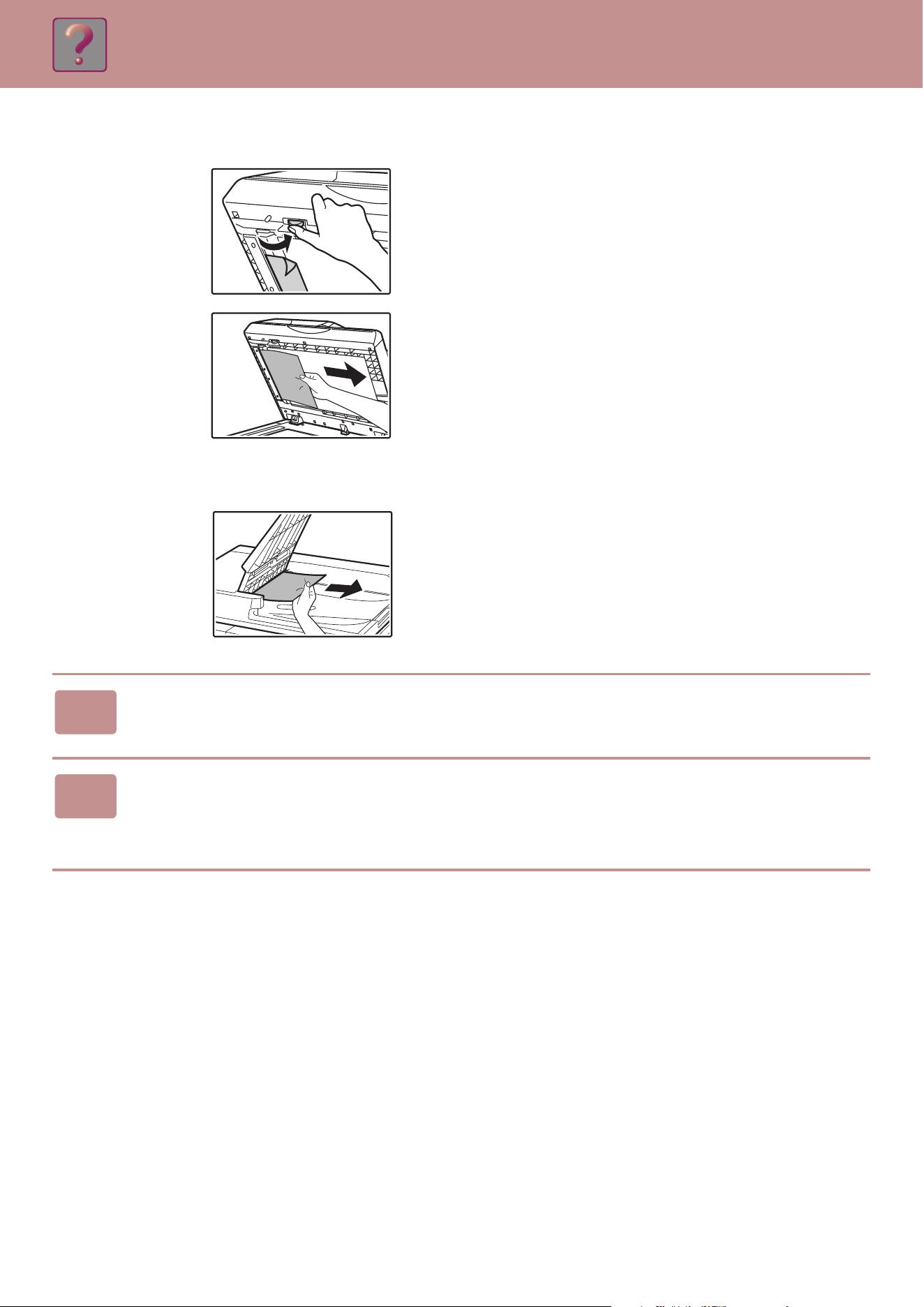
6-15
TROUBLESHOOTING►PAPER JAM
● Section B
Open the document feeder and rotate the release roller in
the direction of the arrow to feed the original out.
If you are unable to remove the original, remove from part C.
● Section C
Remove the misfed original from the exit area.
2
Press the [OK] key to make the misfeed location indicator stop blinking.
3
Return the originals indicated by the number in the display to the document
feeder tray and press the [START] key.
Copying will resume from the originals that still remained when the misfeed occurred.
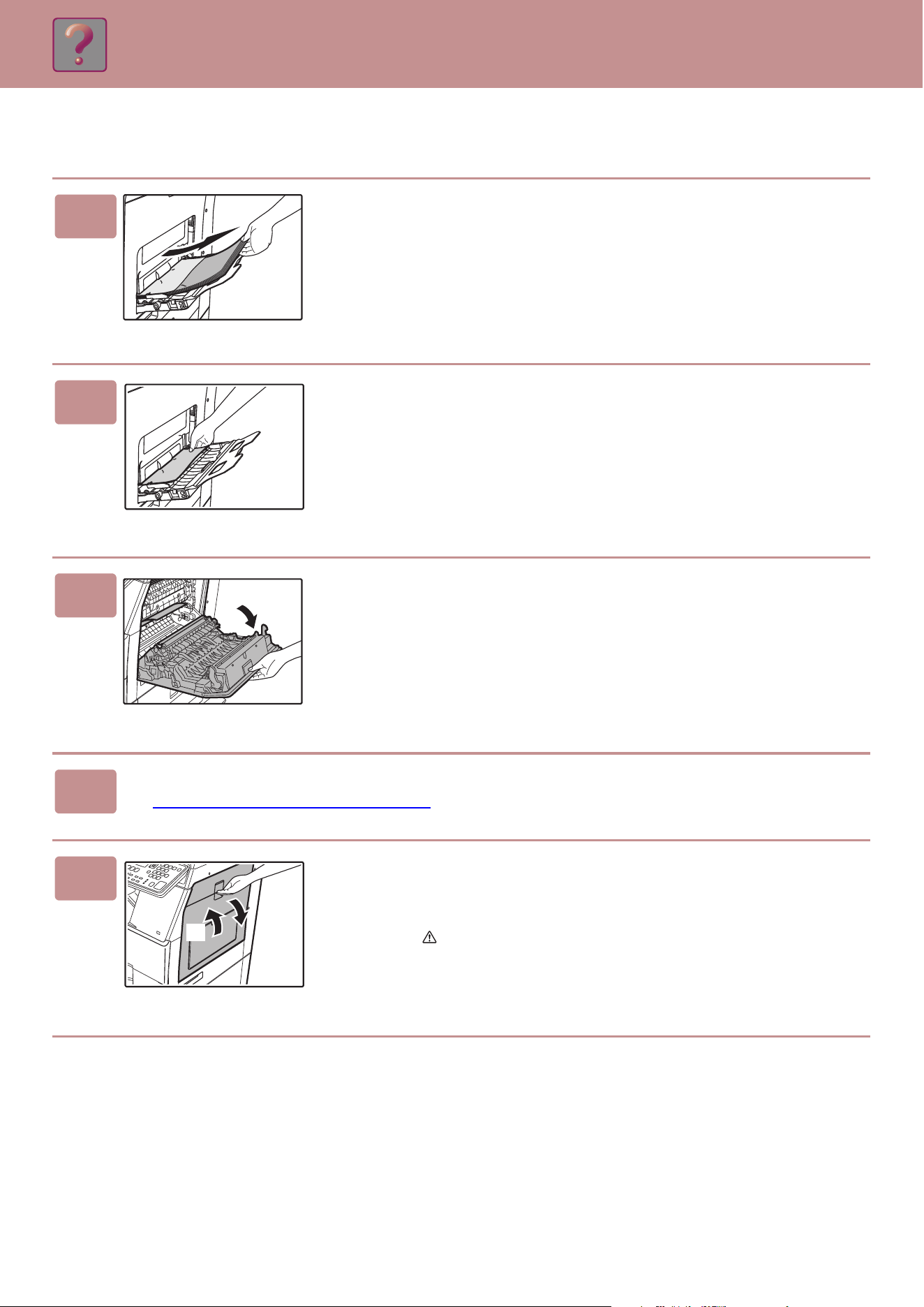
6-16
TROUBLESHOOTING►PAPER JAM
MISFEED IN THE BYPASS TRAY
1
Remove any paper remaining in the bypass tray.
2
Gently remove the misfed paper from the bypass tray.
3
Grasp the side cover open/close handle, and gently
open the side cover.
4
Turn the paper feed knob and feed out the paper that is inside.
► Misfeed in the paper feed area A (page 6-18)
5
Close the auxiliary tray and then the bypass tray, grasp
the side cover open/close handle, and gently open and
close the side cover.
The message " Clear paper path." will be cleared and copying will be possible.
(1)
(2)
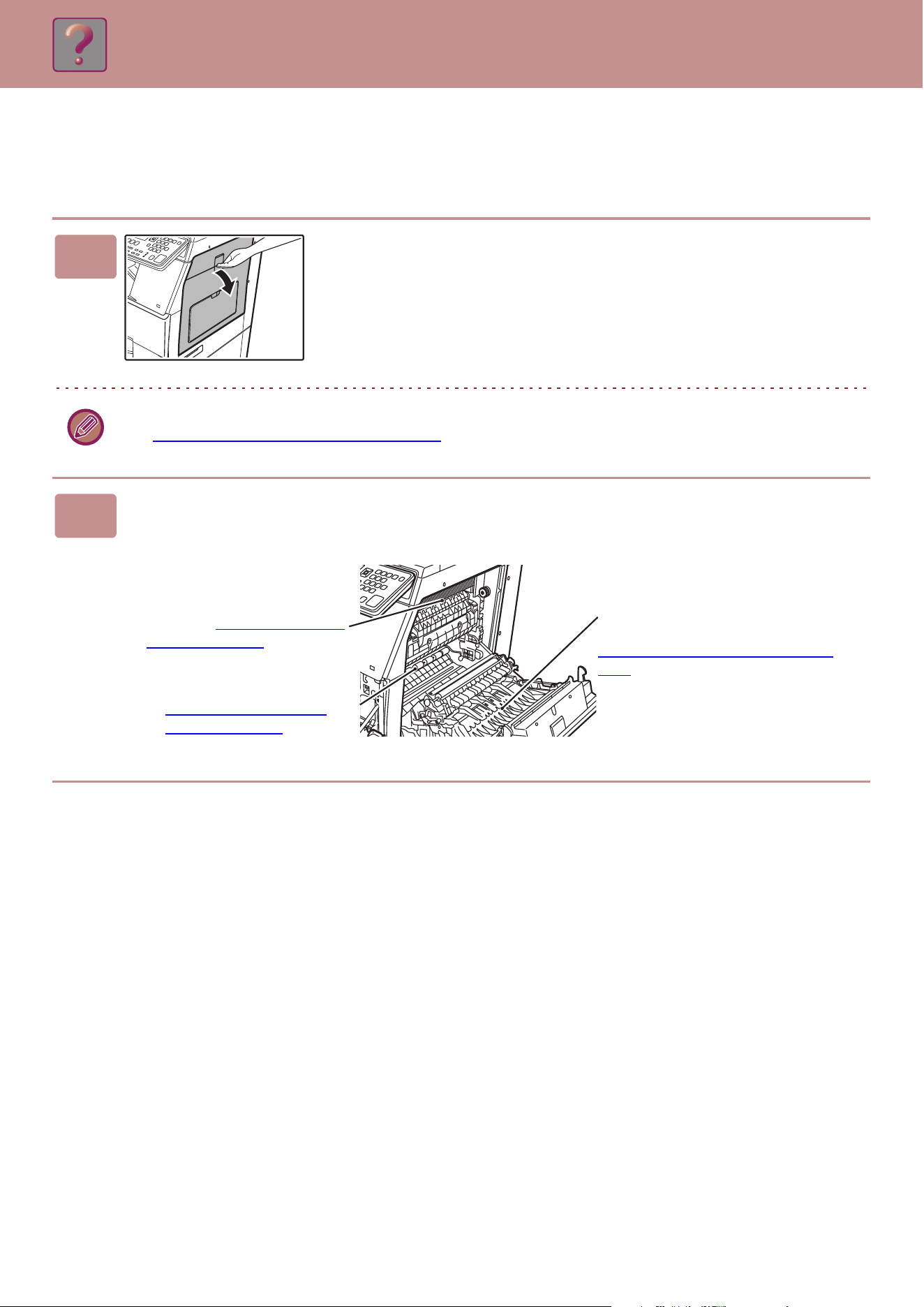
6-17
TROUBLESHOOTING►PAPER JAM
MISFEED IN THE MACHINE
To remove a misfeed from inside the machine, open the side cover, check whether the misfeed occurred in "A", "B", or
"C" below, and follow the misfeed removal procedure.
1
Open the bypass tray and the side cover.
If paper remains in the bypass tray, remove the paper.
► MISFEED IN THE BYPASS TRAY (page 6-16)
2
Check the misfeed location. Remove the misfed paper following the
instructions for each location in the illustration below.
If paper is misfed here, go to
Misfeed in the transport area C (page
6-20).
If paper is misfed here, go to
Misfeed in the paper feed
area A (page 6-18).
If the misfed paper is visible
here, go to Misfeed in the fusing
area B (page 6-19).
Area B
Area A
Area C
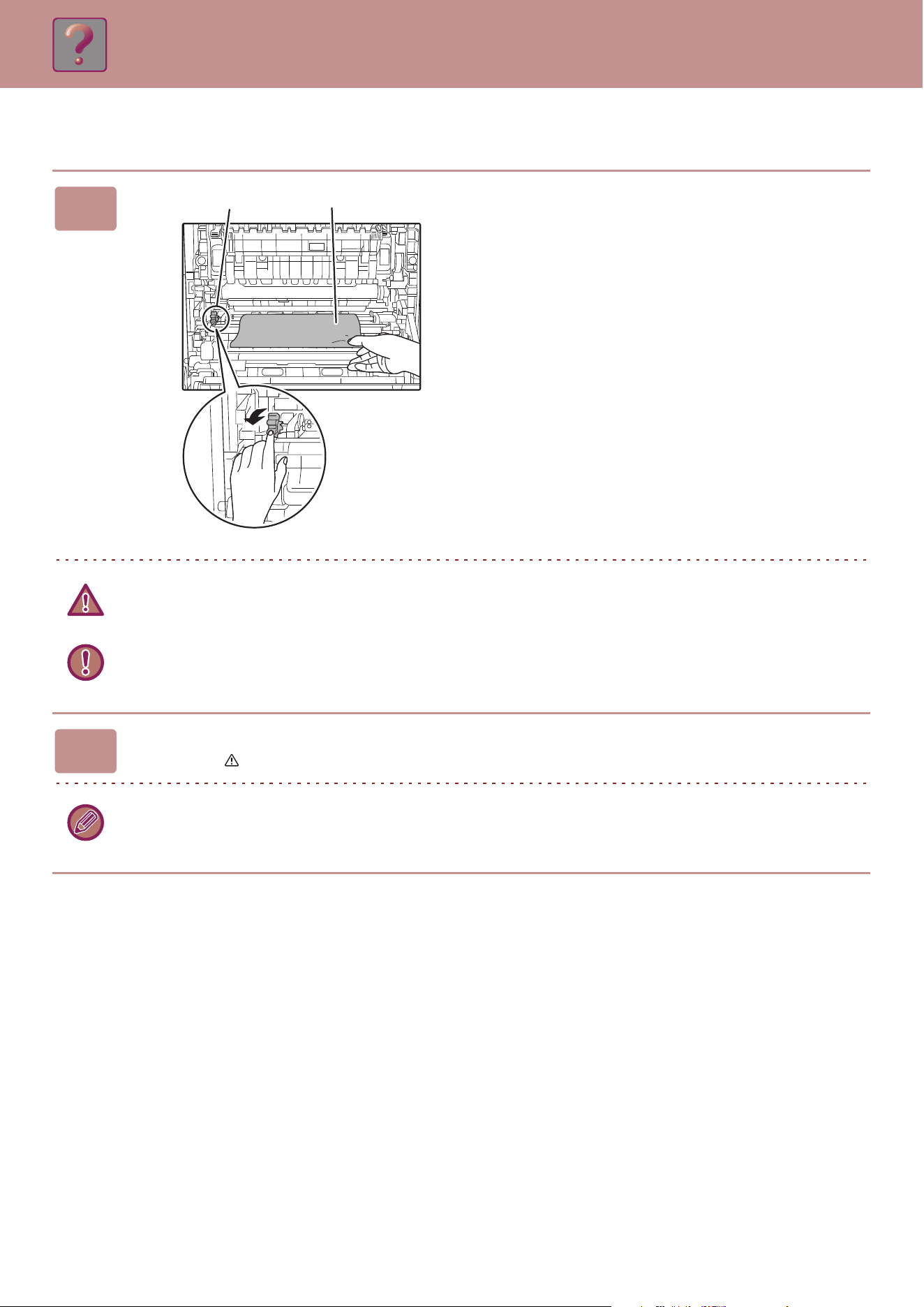
6-18
TROUBLESHOOTING►PAPER JAM
Misfeed in the paper feed area A
1
Carefully remove the misfed paper.
Turn the roller rotating knob in the
direction of the arrow to assist in
removing it.
Be careful not to tear the misfed paper during removal.
The fusing unit is hot. Do not touch the fusing unit when removing misfed paper. Doing so may cause a burn or
injury.
When removing misfed paper, do not touch or damage the photoconductive drum and the transfer roller.
2
Close the side cover.
The message " Clear paper path." will be cleared and copying will be possible.
• When closing the side cover, press on around the handle.
• If the message does not clear, check again to make sure that no pieces of paper remain.
Roller rotating knob
Fusing unit
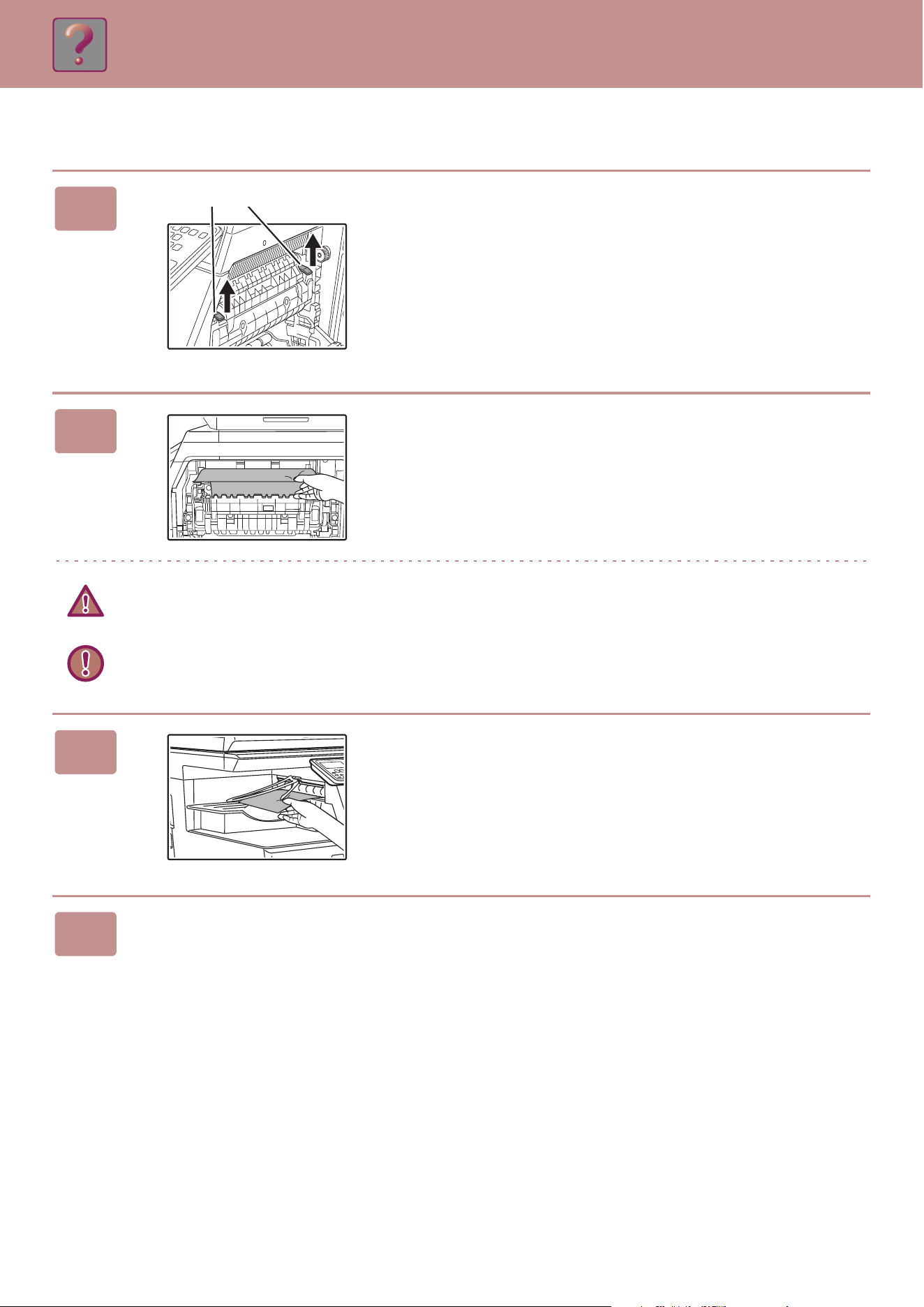
6-19
TROUBLESHOOTING►PAPER JAM
Misfeed in the fusing area B
1
Lift the fusing unit pressure adjusting levers to
allow easier removal.
2
Remove the misfed paper.
Be careful not to tear the misfed paper during removal.
The fusing unit is hot. Do not touch the fusing unit when removing misfed paper. Doing so may cause a burn or
injury.
• When removing misfed paper, do not touch or damage the photoconductive drum and the transfer roller.
• Be careful about unfixed toner on the misfed paper not to soil your hands or clothes.
3
If the misfed paper cannot be removed, remove
the paper by pulling it into the paper output
area.
Be careful not to tear the misfed paper during removal.
4
Lower the fusing unit pressure adjusting levers, to return them to their
operating positions.
Fusing unit pressure adjusting levers
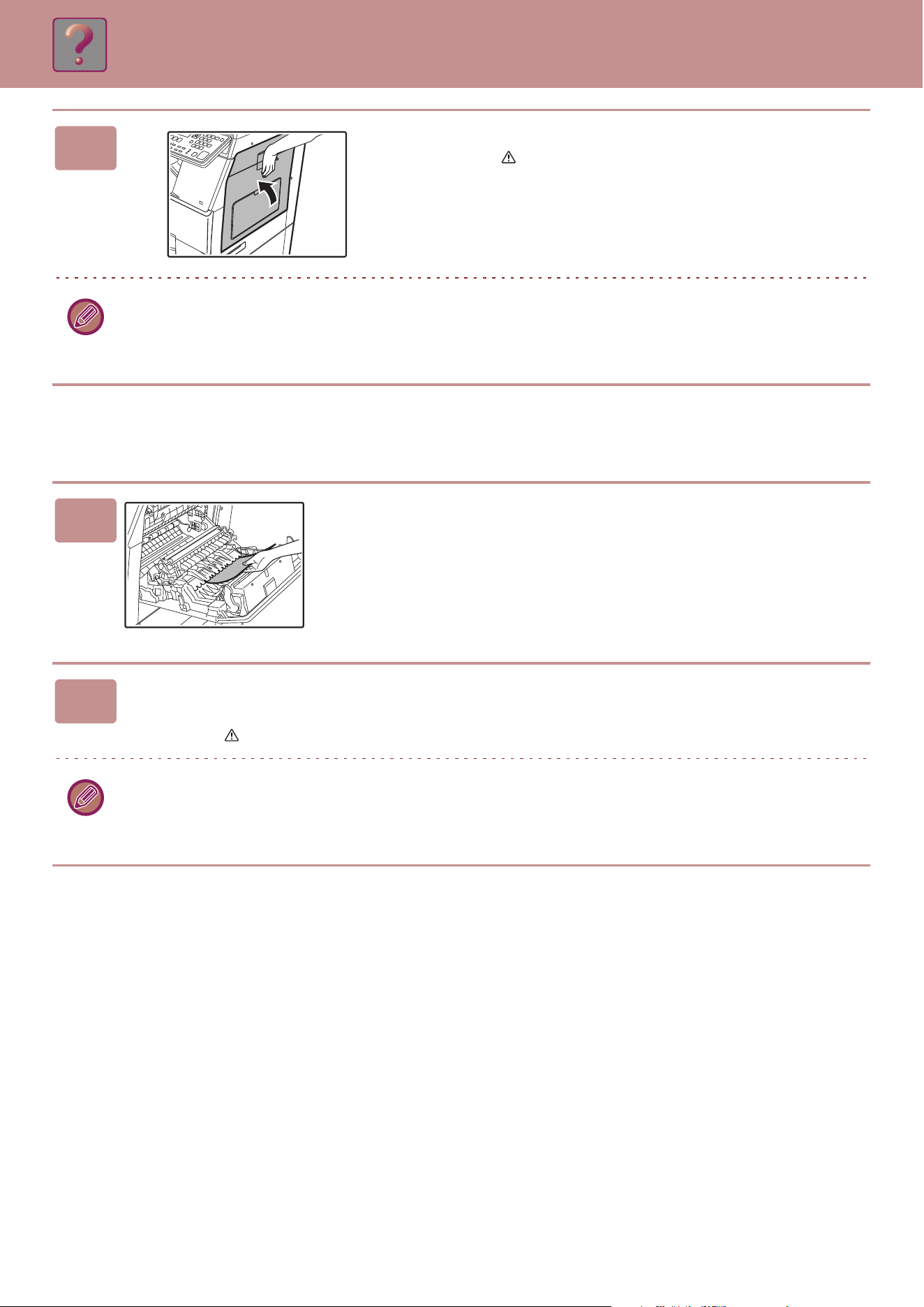
6-20
TROUBLESHOOTING►PAPER JAM
Misfeed in the transport area C
5
Close the side cover.
The message " Clear paper path." will be cleared and copying will be
possible.
• When closing the side cover, press on the handle.
• If the paper was torn, make sure that no torn pieces remain in the machine.
• If the message does not clear, check again to make sure that no pieces of paper remain.
1
Remove the misfed paper.
Be careful not to tear the misfed paper during removal.
2
Return the duplex conveyor lever to its original position and close the side
cover.
The message " Clear paper path." will be cleared and copying will be possible.
• When closing the side cover, press on around the handle.
• If the paper was torn, make sure that no torn pieces remain in the machine.
• If the message does not clear, check again to make sure that no pieces of paper remain.
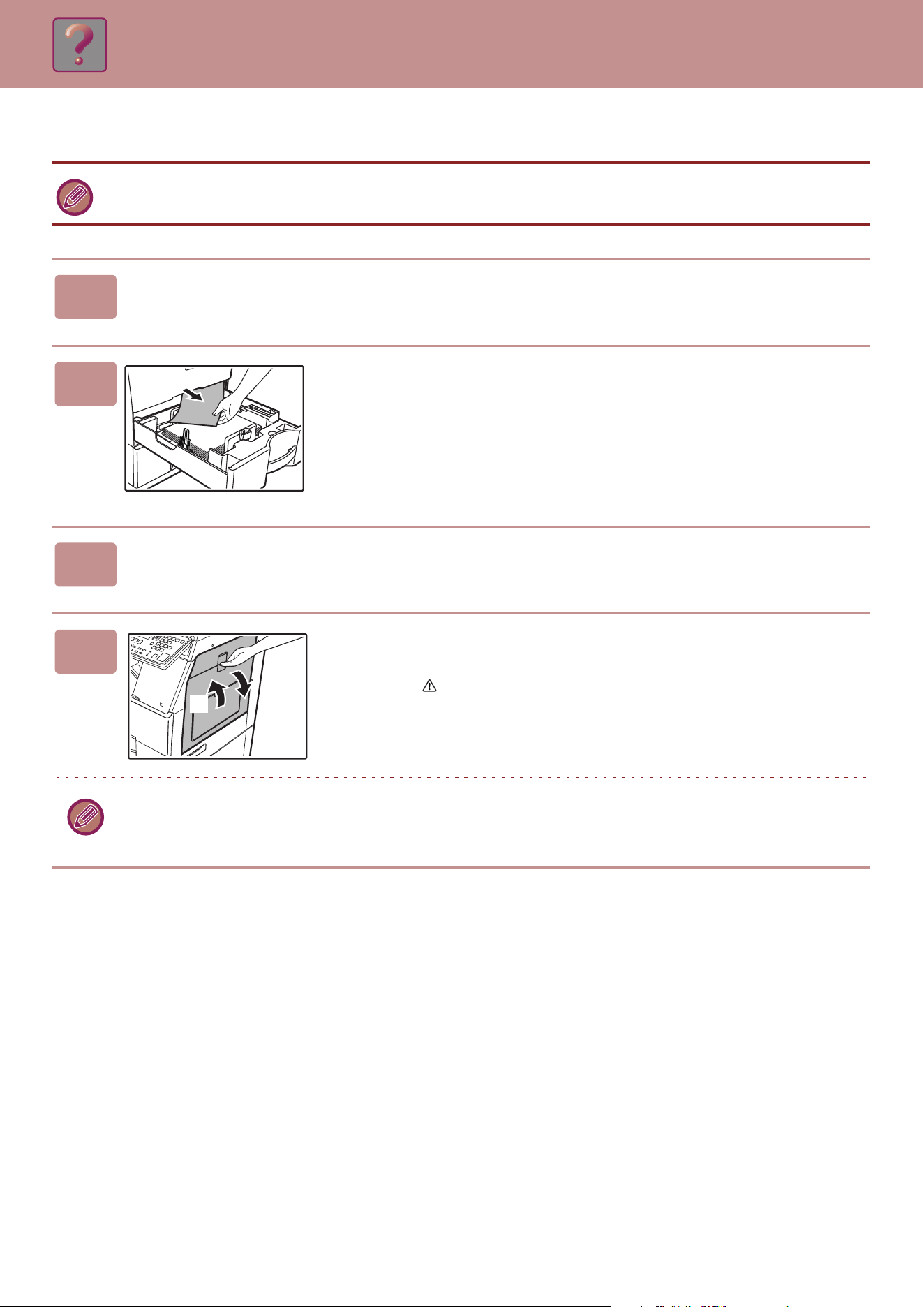
6-21
TROUBLESHOOTING►PAPER JAM
MISFEED IN THE PAPER TRAY 1
Make sure that there is no misfed paper in the tray before pulling it out.
► MISFEED IN THE MACHINE (page 6-17)
1
Open the side cover and remove the misfed paper.
► MISFEED IN THE MACHINE (page 6-17)
2
Lift and pull out the upper paper tray and remove the
misfed paper.
Be careful not to tear the misfed paper during removal.
3
Push the upper paper tray in completely.
Push the tray in completely.
4
Grasp the side cover open/close handle, and gently
open and close the side cover.
The message " Clear paper path." will be cleared and copying will be possible.
• When closing the side cover, press on the handle.
• If the message does not clear, check again to make sure that no pieces of paper remain.
(1)
(2)
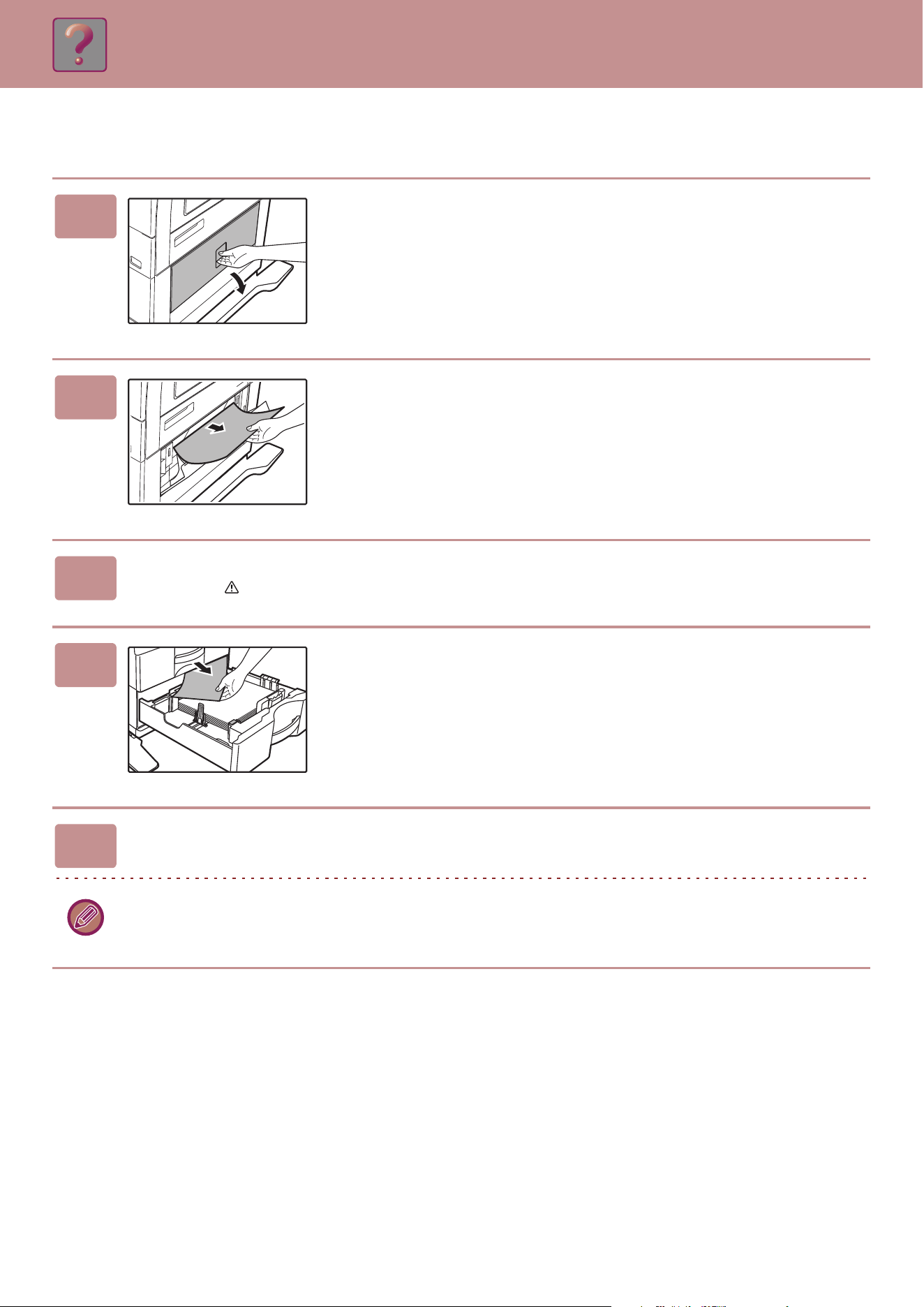
6-22
TROUBLESHOOTING►PAPER JAM
MISFEED IN THE PAPER TRAY 2 (Option)
1
Open the lower side cover.
Grasp the handle to open the lower side cover.
2
Remove the misfed paper.
Be careful not to tear the misfed paper during removal.
3
Close the lower side cover.
The message " Clear paper path." will be cleared and copying will be possible.
4
If the misfed paper is not seen in step 2, lift and pull out
the lower paper tray and remove the misfed paper.
Be careful not to tear the misfed paper during removal.
5
Close the lower paper tray.
Push the tray in completely.
If the message does not clear, check again to make sure that no pieces of paper remain.

7-1
PURPOSE OF THE SYSTEM SETTINGS
PROGRAMS RELATED TO ALL FUNCTIONS OF
THE MACHINE . . . . . . . . . . . . . . . . . . . . . . . . . . . . . 7-2
PROGRAMMING AN ADMINISTRATOR PIN
CODE . . . . . . . . . . . . . . . . . . . . . . . . . . . . . . . . . . . . 7-2
• PROGRAMMING AN ADMINISTRATOR PIN
CODE . . . . . . . . . . . . . . . . . . . . . . . . . . . . . . . . 7-2
SYSTEM SETTINGS LIST
USING THE SYSTEM SETTINGS
SYSTEM SETTINGS
• Change Admin PIN . . . . . . . . . . . . . . . . . . . . . . 7-10
• Initial Setting . . . . . . . . . . . . . . . . . . . . . . . . . . . 7-10
• Network . . . . . . . . . . . . . . . . . . . . . . . . . . . . . . . 7-10
• User Control. . . . . . . . . . . . . . . . . . . . . . . . . . . . 7-12
• Device Control . . . . . . . . . . . . . . . . . . . . . . . . . . 7-13
• Operation Setting. . . . . . . . . . . . . . . . . . . . . . . . 7-14
• Energy Save . . . . . . . . . . . . . . . . . . . . . . . . . . . 7-15
• List Print. . . . . . . . . . . . . . . . . . . . . . . . . . . . . . . 7-15
• Auto Calibration . . . . . . . . . . . . . . . . . . . . . . . . . 7-16
• Security Settings . . . . . . . . . . . . . . . . . . . . . . . . 7-16
• Copier . . . . . . . . . . . . . . . . . . . . . . . . . . . . . . . . 7-17
• Printer . . . . . . . . . . . . . . . . . . . . . . . . . . . . . . . . 7-17
• Fax. . . . . . . . . . . . . . . . . . . . . . . . . . . . . . . . . . . 7-18
• Scanner . . . . . . . . . . . . . . . . . . . . . . . . . . . . . . . 7-23
SYSTEM SETTINGS
7-2
SYSTEM SETTINGS►PURPOSE OF THE SYSTEM SETTINGS
The system settings are used by the administrator of the machine to enable or disable functions to suit the needs of your
workplace.
PROGRAMS RELATED TO ALL FUNCTIONS
OF THE MACHINE
These programs are used to enable user authentication mode, adjust power consumption, and manage peripheral
devices.
When user authentication mode is enabled for a function, a valid account number must be entered in order to use the
function. (If a valid account number is not entered, the function cannot be used.)
When user authentication mode is enabled for the printer function, an account number must be entered at the user's
computer when the print command is selected. (Depending on the system settings, a job may be printed even if an
incorrect account number is entered, and thus care must be taken when managing printer page counts.) If "Disable Print
by Inv. User" is enabled in the system settings, printing will be prohibited if an invalid account number is entered.)
PROGRAMMING AN ADMINISTRATOR PIN
CODE
The administrator PIN code is a 5-digit number that must be entered in order to access the system settings. The
administrator (administrator of the machine) should change the default administrator PIN code that was set at the factory
to a new 5-digit number. Be sure to remember the new administrator PIN code, as it must be entered each time the
system settings are subsequently used. (Only one administrator PIN code can be programmed.)
Refer to the Start Guide for the factory default administrator PIN code.
To change the administrator PIN code, see "PROGRAMMING AN ADMINISTRATOR PIN CODE
(page 7-2)".
PROGRAMMING AN ADMINISTRATOR PIN CODE
PURPOSE OF THE SYSTEM
SETTINGS
1
Press the [SPECIAL FUNCTION] key.
The special function screen will appear.
2
Select "System Settings" with the [ ] or [ ] key.
3
Press the [OK] key.
The administrator PIN code entry screen appears.
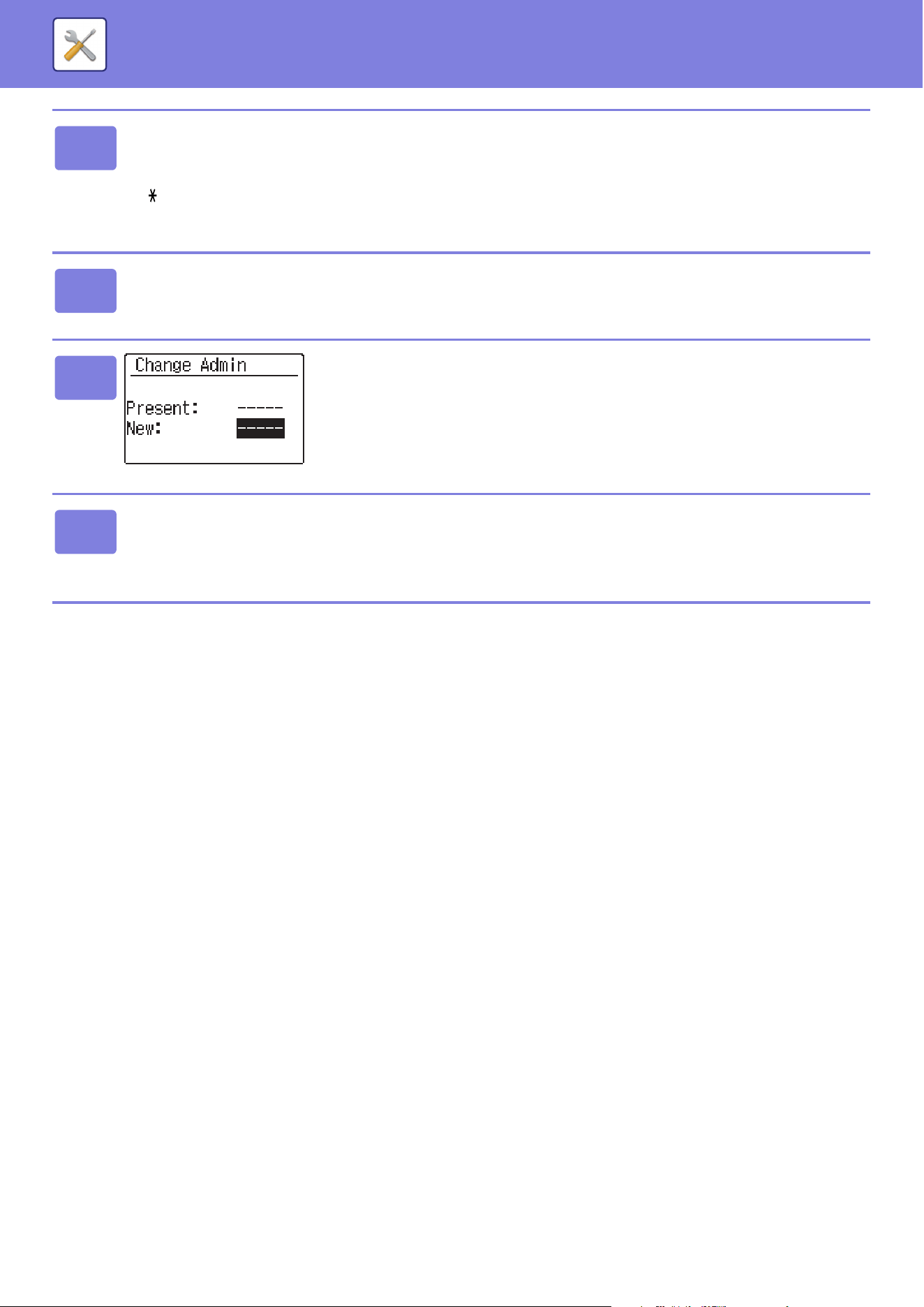
7-3
SYSTEM SETTINGS►PURPOSE OF THE SYSTEM SETTINGS
4
Use the numeric keys to enter the five-digit administrator PIN code.
• If this is the first time you are programming the administrator PIN code, enter the factory default code. (Refer to the
Start Guide)
• " " appears for each digit that you enter.
• The special modes screen will appear with "Change Admin PIN" selected.
5
Press the [OK] key.
The administrator PIN code change screen appears.
6
Enter the new 5-digit administrator PIN code with the
numeric keys.
Any 5 digits can be used for the administrator PIN code.
7
Press the [OK] key.
• The previously programmed administrator PIN code is replaced by the new administrator PIN code.
• Press the [CA] key to return to the base screen.
PIN
7-4
SYSTEM SETTINGS►SYSTEM SETTINGS LIST
Programs for general use of the machine
Programs for Copy Mode
Programs for Printer Mode
SYSTEM SETTINGS LIST
Program name
Page
Change Admin PIN
Change Admin PIN
7-10
Initial Setting
Date & Time Set
7-10
Daylight Saving Time
7-10
Network
Confirmation of Network
7-10
Connection Type
7-10
Wired settings
7-10
Wireless (Infrastructure)
7-11
Wireless (Access Point)
7-11
User Control
User Authentication
7-12
User Registration
7-12
Function Limit Setting
7-12
Account Limit Setting
7-12
User Count Display
7-12
User Count Reset
7-12
A Warning when Login Fails
7-12
Disable Print by Inv. User
7-12
Device Control
Paper Weight
7-13
Fusing Cleaning
7-13
Plain Paper Settings
7-13
Status Light Setting
7-13
Error Light Setting
7-13
Blink Setting for Received Data
7-13
Operation Setting
Auto Clear
7-14
Disable Display Timeout
7-14
Language Setting
7-14
Message Time
7-14
Key Touch Sound
7-14
Keys Touch Sound At Initial Point
7-14
Key Press Time
7-14
Disable Auto Key Repeat
7-14
Disable Paper Size Set
7-14
Energy Save
Auto Power Shut-Off
7-15
Auto Power Shut-Off Timer
7-15
Preheat Mode
7-15
Enter Auto Power Shut-Off after the
Remote Job
7-15
Toner Save Mode (Copy)
7-15
Toner Save Mode (Print)
7-15
List Print
Fax Settings
7-15
Inbound Routing
7-15
User Usage List
7-15
Activity Report
7-15
Junk Fax # List
7-15
User Info. Print
7-15
Auto Calibration
Auto Calibration
7-16
Security Settings
IPsec Settings
7-16
Initialize Private Data and Data in
Machine
7-16
Program name
Page
Copier
ID Card Setting
7-17
Card Shot Default
7-17
Default Tray Set
7-17
Default Exposure
7-17
Sort Auto Select
7-17
Limit Of Copies
7-17
Program name
Page
Printer
Notice Page
7-17
Program name
Page

7-5
SYSTEM SETTINGS►SYSTEM SETTINGS LIST
Programs for Fax Mode Programs for Scanner Mode
Program name
Page
Fax
List Setting
Print Selection
7-18
Auto Listing
7-18
Initial Setting
Dial Mode
7-19
Pause Time
7-19
Own Passcode Set
7-19
Set Volume
7-19
TX/RX End Sound
7-19
End Sound Length
7-19
Distinctive Ring
7-19
Remote Reception
7-19
Disable Fax Print Hold
7-19
Sending Function
Orig. Size Enter
7-20
Set Res. Con.
7-20
Send Mode
7-20
Quick On Line TX
7-20
Print Station # In Rcvd Data
7-20
Address Review
7-20
Recall Setting (Busy)
7-20
Recall Set (Err)
7-20
Ring Timeout In Auto TX
7-20
Rcv. Function
#Of Rings At. RX
7-21
#Of Rings Man.RX
7-21
Tray Selection
7-21
Received Data Print Condition
7-21
Auto Rcv Reduce To Regular Size
7-21
Duplex Reception
7-21
FW. RX Data
7-22
Received Data FW. Station Set
7-22
Anti Junk Fax
7-22
Enter Junk Fax #
7-22
Polling Security
Polling Security
7-22
Polling Passcode # Mode
7-22
Program name
Page
Scanner
7-23
Disable USB Scan
7-23
New Default
7-23
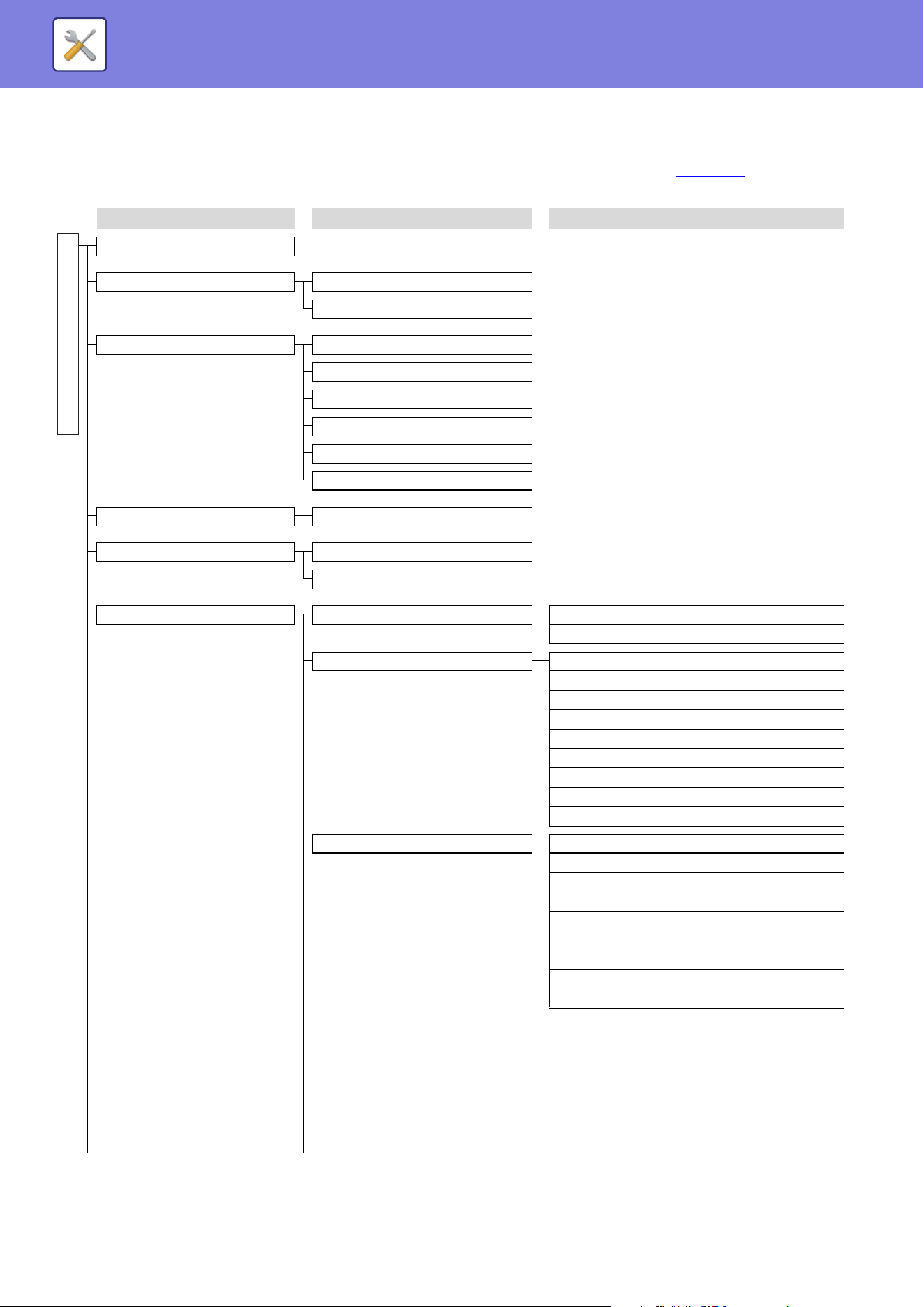
7-6
SYSTEM SETTINGS►SYSTEM SETTINGS LIST
Administrator settings menu
The system settings are accessed via the following menu structure.
Refer to this menu when enabling or disabling the settings that are explained beginning on page 7-10
.
Some settings contain an additional level of settings (a settings screen).
Level 1 Level 2 Level 3
Change Admin PIN
Initial Setting Date & Time Set
Daylight Saving Time
Copier ID Card Setting
Card Shot Default
Default Tray Set
Default Exposure
Sort Auto Select
Limit Of Copies
Printer Notice Page
Scanner Disable USB Scan
New Default
Fax List Setting Print Selection
Auto Listing
Initial Setting Dial Mode
Pause Time
Own Passcode Set
Set Volume
TX/RX End Sound
End Sound Length
Distinctive Ring
Remote Reception
Disable Fax Print Hold
Sending Function Orig. Size Enter
Set Res. Con.
Send Mode
Quick On Line TX
Print Station # In Rcvd Data
Address Review
Recall Setting (Busy)
Recall Set (Err)
Ring Timeout In Auto TX
Administrator PIN code
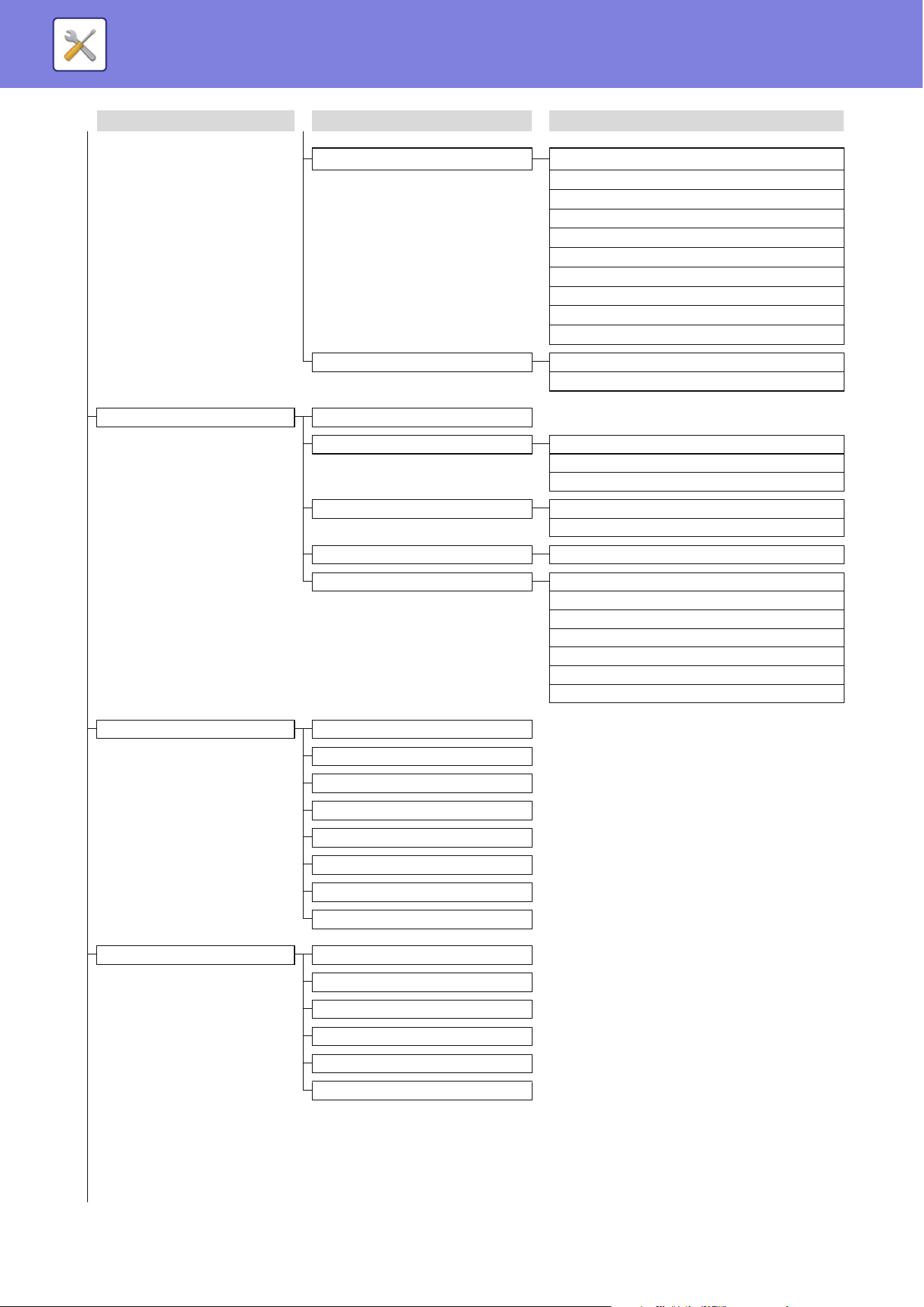
7-7
SYSTEM SETTINGS►SYSTEM SETTINGS LIST
Rcv. Function #Of Rings At. RX
#Of Rings Man.RX
Tray Selection
Received Data Print Condition
Auto Rcv Reduce To Regular Size
Duplex Reception
FW. RX Data
Received Data FW. Station Set
Anti Junk Fax
Enter Junk Fax #
Polling Security Polling Security
Polling Passcode # Mode
Network Confirmation of Network
Connection Type Wired
Wireless Infrastructure
Wired + Wireless AP
Wired settings IPv4 Settings
IPv6 Settings
Wireless (Infrastructure) Manual Input of SSID
Wireless (Access Point) Setting of SSID
Security Settings
Device IP Address Settings
Channel Settings
Sending Output Settings
Bandwidth Settings
IP Addr. Distribution Range
User Control User Authentication
User Registration
Function Limit Setting
Account Limit Setting
User Count Display
User Count Reset
A Warning when Login Fails
Disable Print by Inv. User
Device Control Paper Weight
Fusing Cleaning
Plain Paper Settings
Status Light Setting
Error Light Setting
Blink Setting for Received Data
Level 1 Level 2 Level 3
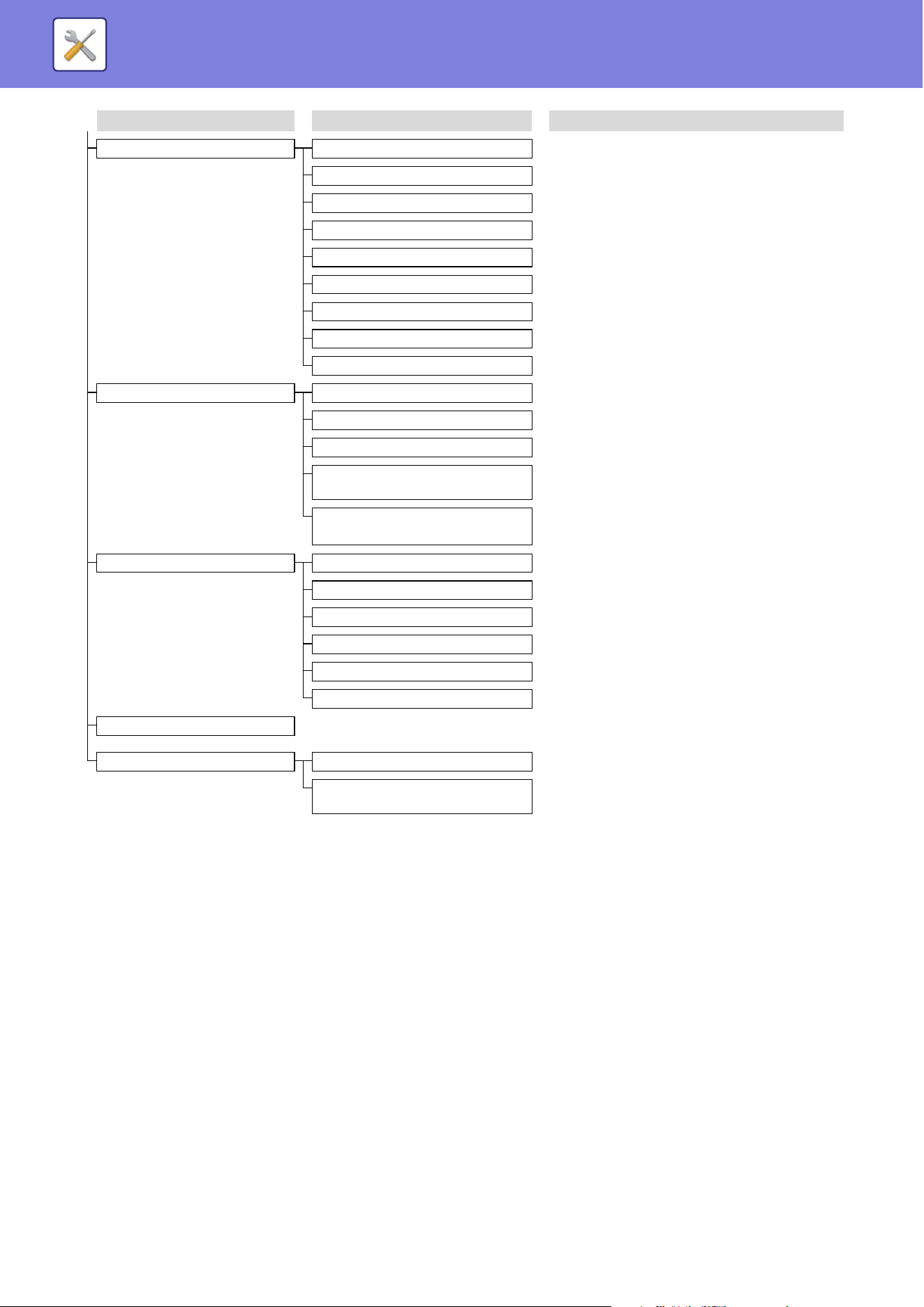
7-8
SYSTEM SETTINGS►SYSTEM SETTINGS LIST
Operation Setting Auto Clear
Disable Display Timeout
Language Setting
Message Time
Key Touch Sound
Keys Touch Sound At Initial Point
Key Press Time
Disable Auto Key Repeat
Disable Paper Size Set
Energy Save Auto Power Shut-Off
Auto Power Shut-Off Timer
Preheat Mode
Enter Auto Power Shut-Off after
the Remote Job
Toner Save Mode (Copy)
Toner Save Mode (Print)
List Print Fax Settings
Inbound Routing
User Usage List
Activity Report
Junk Fax # List
User Info. Print
Auto Calibration
Security Settings IPsec Settings
Initialize Private Data and Data in
Machine
Level 1 Level 2 Level 3
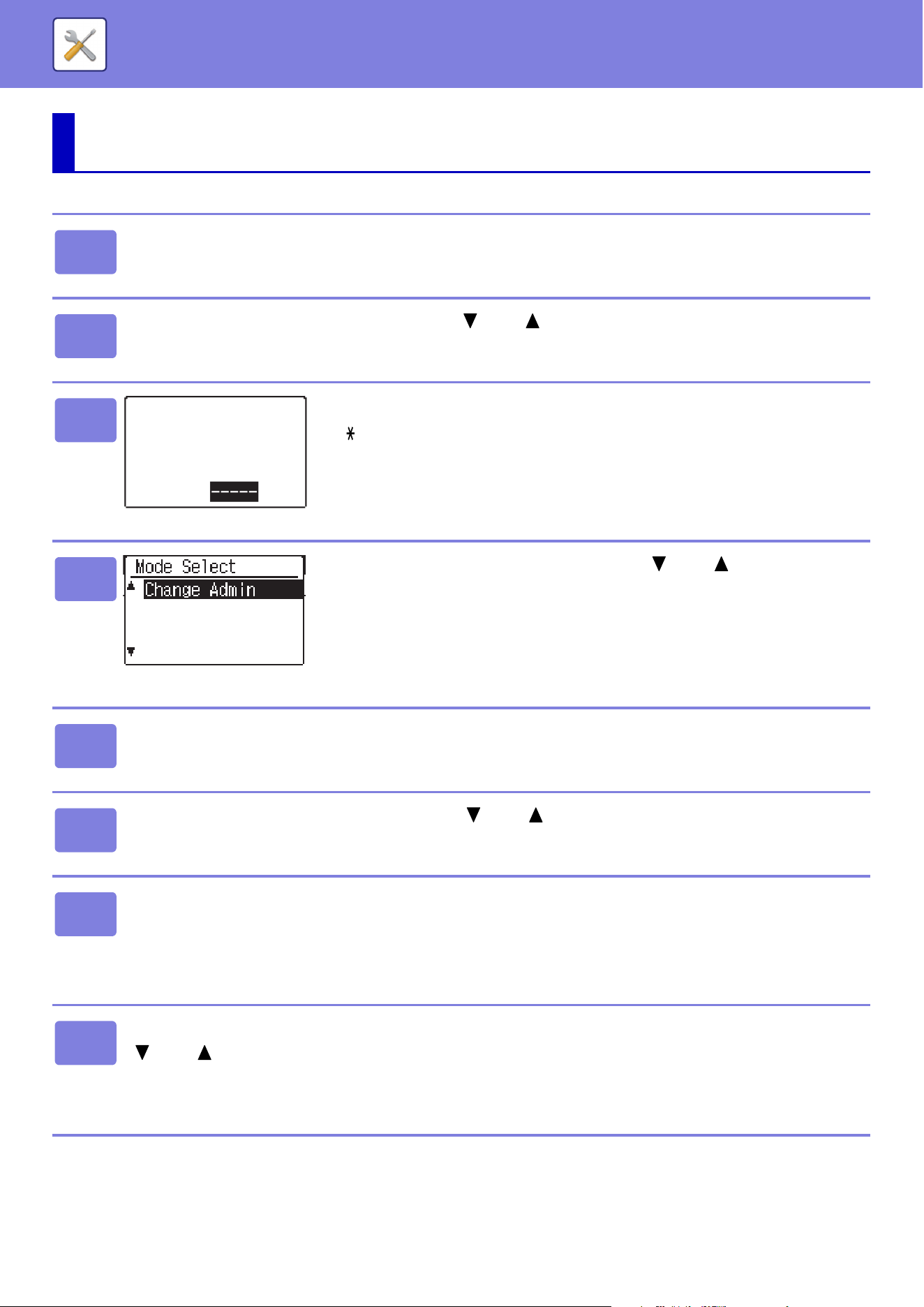
7-9
SYSTEM SETTINGS►USING THE SYSTEM SETTINGS
USING THE SYSTEM SETTINGS
1
Press the [SPECIAL FUNCTION] key.
2
Select "System Settings" with the [ ] or [ ] key and press the [OK] key.
3
Enter the administrator PIN code with the numeric keys.
• " " appears for each digit that you enter.
• The mode selection screen appears.
4
Select the desired mode with the [ ] or [ ] key.
5
Press the [OK] key.
6
Select the desired setting with the [ ] or [ ] key.
7
Press the [OK] key and follow the instructions in the setting screen.
Several settings will have checkboxes in front of them. To enable a function (make a checkmark appear),
press the [OK] key. To disable the setting, press the [OK] once again to remove the checkmark. To
configure a setting that has a checkbox, go to step 8.
8
To use another setting for the same mode, select the desired setting with the
[] or [] key.
To use a setting for a different mode, press the [BACK] key and select the desired mode. To exit the system settings,
press the [CA] key.
Enter admin
PIN Code.
Admin PIN Code:
PIN
Initial Setting
Copier
Printer
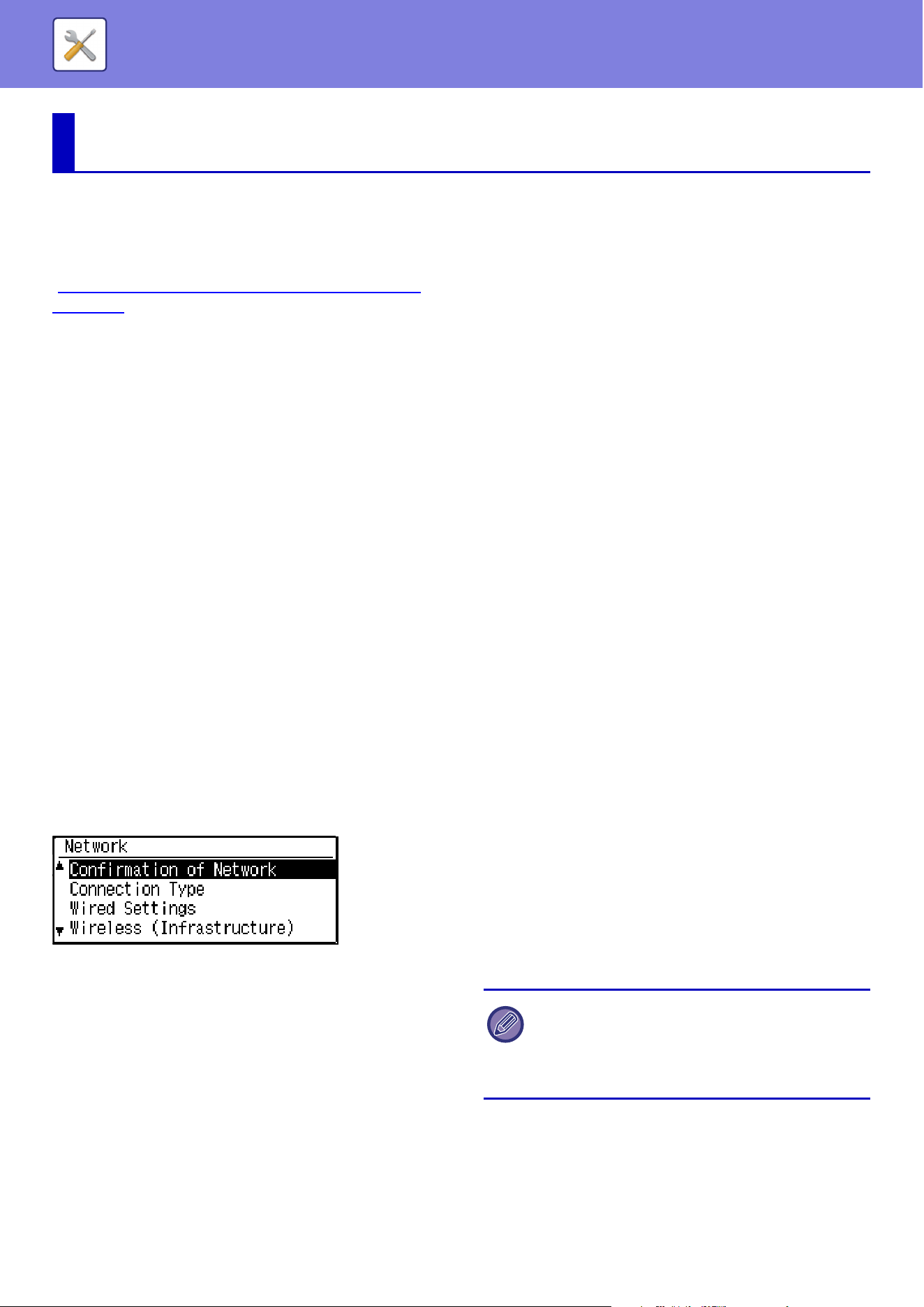
7-10
SYSTEM SETTINGS►SYSTEM SETTINGS
Change Admin PIN
Use this function to change administrator PIN code. To
change the administrator PIN code, see
"PROGRAMMING AN ADMINISTRATOR PIN CODE
(page 7-2)".
Initial Setting
The default settings for operation of the machine can be
configured. Select the [Initial Setting] to configure the
settings.
Date & Time Set
Use this to set the date and time in the machine's built-in
clock.
Daylight Saving Time
Enable daylight saving time.
Network
Network settings are described below.
Select the [Network] to configure the settings.
Confirmation of Network
Confirm network settings.
Connection Type
You can change the machine's network connection type.
Wired settings
IPv4 Settings
When using the machine on a TCP/IP (IPv4) network,
use this setting to configure the IP address of the
machine. The settings are shown below.
Enable DHCP
Use this setting to have the IP address obtained
automatically using DHCP (Dynamic Host Configuration
Protocol). When this setting is enabled, it is not
necessary to manually enter an IP address.
IPv4 Address
Enter the IP address of the machine.
Subnetmask
Entry the Subnetmask
Default Gateway
Enter the Default Gateway.
IPv6 Settings
When using the machine on a TCP/IP (IPv6) network,
use this setting to configure the IP address of the
machine.
The settings are shown below.
Enable IPv6 Protocol
Enable this setting.
Enable DHCPv6
Use this setting to have the IP address obtained
automatically using DHCP (Dynamic Host Configuration
Protocol). When this setting is enabled, it is not
necessary to manually enter an IP address.
Manual Address
Enter the IP address of the machine.
Prefix Length
Enter the prefix length (0 to 128).
Default Gateway
Enter the IP Gateway address.
SYSTEM SETTINGS
• If DHCP is used, the IP address assigned to the
machine may change automatically. If the IP
address changes, printing will not be possible.
• In an IPv6 environment, the machine can use LPD
protocol.
7-11
SYSTEM SETTINGS►SYSTEM SETTINGS
Wireless (Infrastructure)
(Only on models with wireless LAN)
This sets connection using wireless infrastructure mode.
Manual Input of SSID
Enter up to 32 half-width characters for the SSID.
• Security Type
Select the security type.
(none/WEP/WPA/WPA2-mixed Personal/WPA2
Personal)
• Setting of Encrypt
Select the encryption method based on the "Setting of
Security Type" setting.
(none, WEP, AES/TKIP, AES)
• Security Key Settings
Set the security key used for wireless connection.
Wireless (Access Point)
(Only on models with wireless LAN)
This sets connection using wireless access point mode.
Setting of SSID
Enter up to 32 half-width characters for the SSID.
Security Settings
• Security Type
Select the security type.
(none/WEP/WPA/WPA2-mixed Personal/WPA2
Personal)
• Setting of Encrypt
Select the encryption method based on the "Setting of
Security Type" setting.
(none, WEP, AES/TKIP, AES)
• Security Key Settings
Set the security key used for wireless connection.
Device IP Address Settings
Set the IP address of the access point.
Channel Settings
Set the channel used for the access point.
Sending Output Settings
Set the transmission output of the access point.
Bandwidth Settings
Set the frequency band of the access point.
IP Addr. Distribution Range
Set the lease range and lease period of the IP address
used for the access point.
WEP 5 half-width numeric digits,
10 hexadecimal (64 bit) digits,
13 half-width numeric digits,
or 26 hexadecimal (128 bit) digits
WPA/WPA2
-mixed
Personal
8 to 63 half-width numeric digits or 64
hexadecimal digits
WPA2
Personal
WEP 5 half-width numeric digits,
10 hexadecimal (64 bit) digits,
13 half-width numeric digits,
or 26 hexadecimal (128 bit) digits
WPA/WPA2
-mixed
Personal
8 to 63 half-width numeric digits or 64
hexadecimal digits
WPA2
Personal
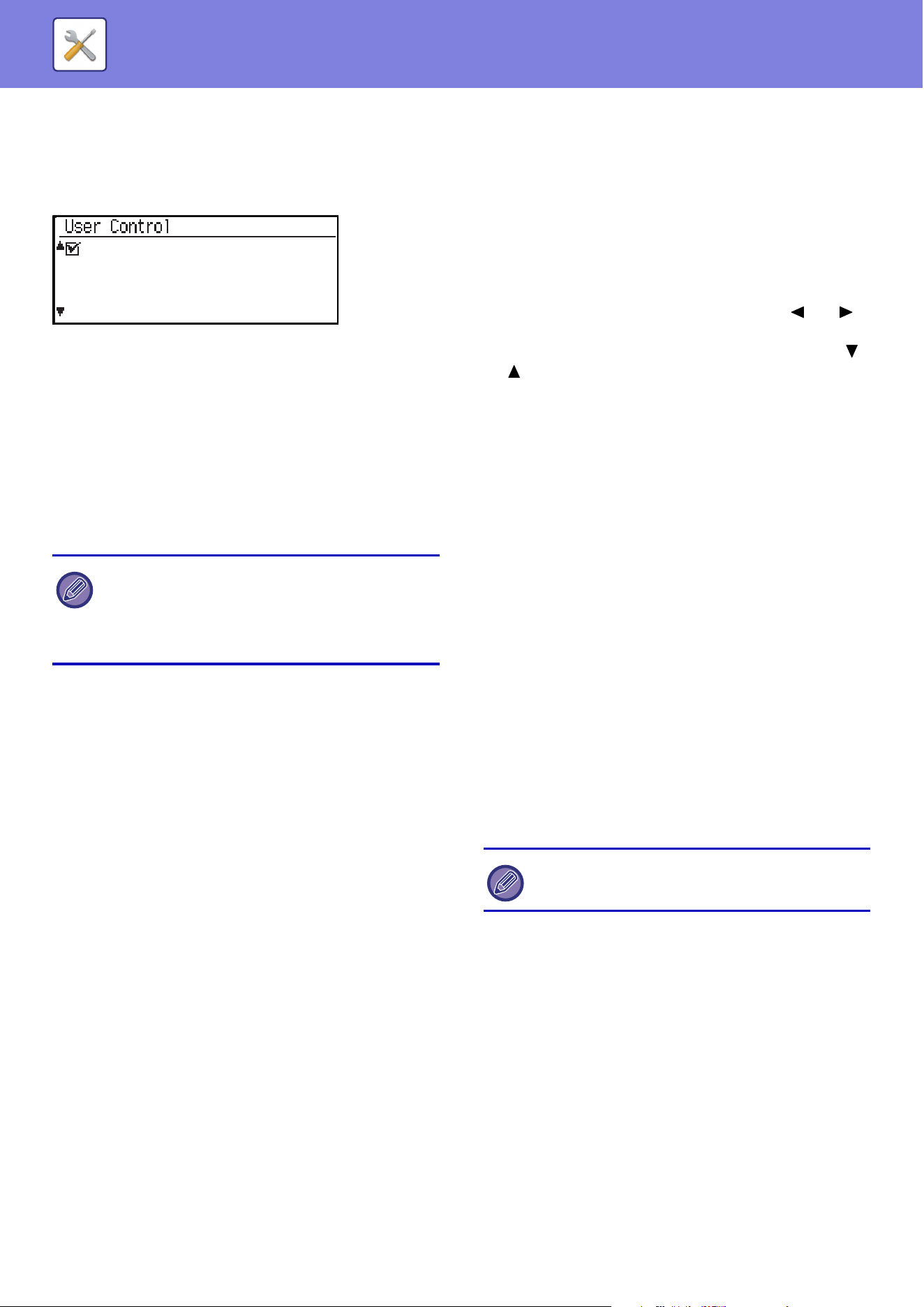
7-12
SYSTEM SETTINGS►SYSTEM SETTINGS
User Control
User Control is used to configure settings for user
authentication. Select the [User Control] to configure the
settings.
User Authentication
These settings enable or disable user authentication and
specify the authentication method.
When user authentication is enabled, each user of the
machine is registered. When a user logs in, settings for
that user are applied.
User Registration
Users can be added, deleted, and changed.
Function Limit Setting
Set functions that all users or a specific user can use.
• Copies
• Printer/USB Memory Direct Print
• Scanner
•Fax
Set the paper limits for copying and printing.
Account Limit Setting
Copying and printing paper limits can be set for all users
or specific users.
User Count Display
This setting is used to display the page counts of each
account in copy, print, and scan modes, and the usage
limits for copy and print modes. Misfed pages are not
included in the page counts.
For the network scanner function, the number of
transmitted pages is displayed.
Switch to the page counts in other modes for the same
account, as well as the page limits, with the [ ] or [ ]
key.
To change to a different account number, press the [ ]
or [ ] key.
User Count Reset
This setting is used to reset the copy, print, and scan
page counts of an individual account, or all accounts, to
zero.
A Warning when Login Fails
When this setting is enabled, the machine will not allow
operation for one minute if an incorrect account number
is entered three times in a row. During this time, "This
operation is disabled. Please contact your
administrator." will appear in the display.
This setting is only effective when "User Authentication"
has been enabled for print mode.
Disable Print by Inv. User
When enabled, this setting cancels a print job if no
account number is entered or an invalid account number
is entered. This setting is only effective when "User
Authentication" has been enabled for print mode.
The function is initially enabled (factory default setting).
• When entering a user number, the [OK] key is not
enabled until 5 digits have been entered.
• If the [Clear] key is pressed during entry of a user
number, the displayed user number changes to
"-----".
User Authentication
User Registration
Function Limit Setting
Account Limit Setting
Pages printed by invalid account numbers are added
to the page count of "Others" (account number).
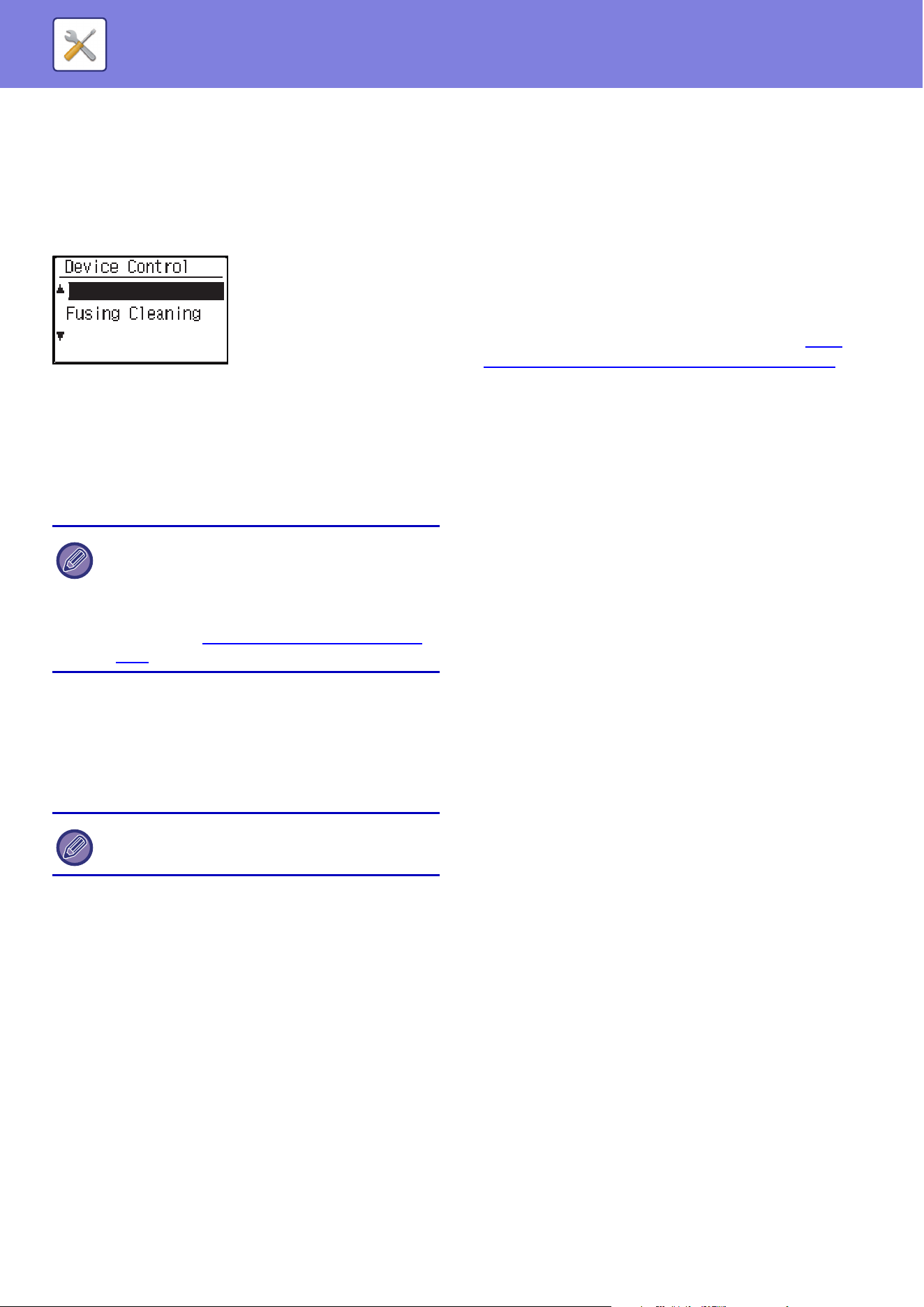
7-13
SYSTEM SETTINGS►SYSTEM SETTINGS
Device Control
These settings are used to configure settings for
hardware functions of the machine. To access one of
these settings, select "Device Control" in the mode
selection screen, select the desired setting in the device
control screen, and press the [OK] key.
Paper Weight
The temperature of toner fusing is controlled according
to the weight of the paper that is used.
Apply this setting to plain, recycled, punched,
pre-printed, letter head, colour, and user type paper.
Select from 60g/m2 - 79g/m2 and 80g/m2 - 105g/m2.
Fusing Cleaning
Use this function to clean the machine's fusing unit when
dots or other dirt appear on the printed side of the paper.
When this function is executed, "V" printed paper is
output and the fusing unit is cleaned.
Plain Paper Settings
In this machine, paper type is divided between plain
paper 1 and plain paper 2.
When printing on plain paper with a printer driver that is
not compatible with plain paper 1 and plain paper 2, you
can set which paper type to use for printing
Status Light Setting
Set the operation of the data notification indicator on the
machine. Select from "Pattern 1", "Pattern 2", or "Not
Use". For explanations of the patterns, refer to Data
notification indicator and error indicator (page 1-10).
Error Light Setting
Set the operation of the error indicator when an error
occurs on the machine. Select whether the indicator
lights or blinks depending on the error status, only blinks,
or is not used.
Blink Setting for Received Data
Set whether the data notification indicator blinks when
fax data has been received or received data is held.
• Be sure to use only paper that is in the same weight
range as the weight range set here. Do not mix in
other standard paper that differs from the set range.
• When settings are changed, the changes will take
effect after the machine is restarted. To restart the
machine, see TURNING ON THE POWER (page
1-11).
If improvement is not noticed after the first time you
use the function, try executing the function again.
Paper Weight
Plain Paper
Settings
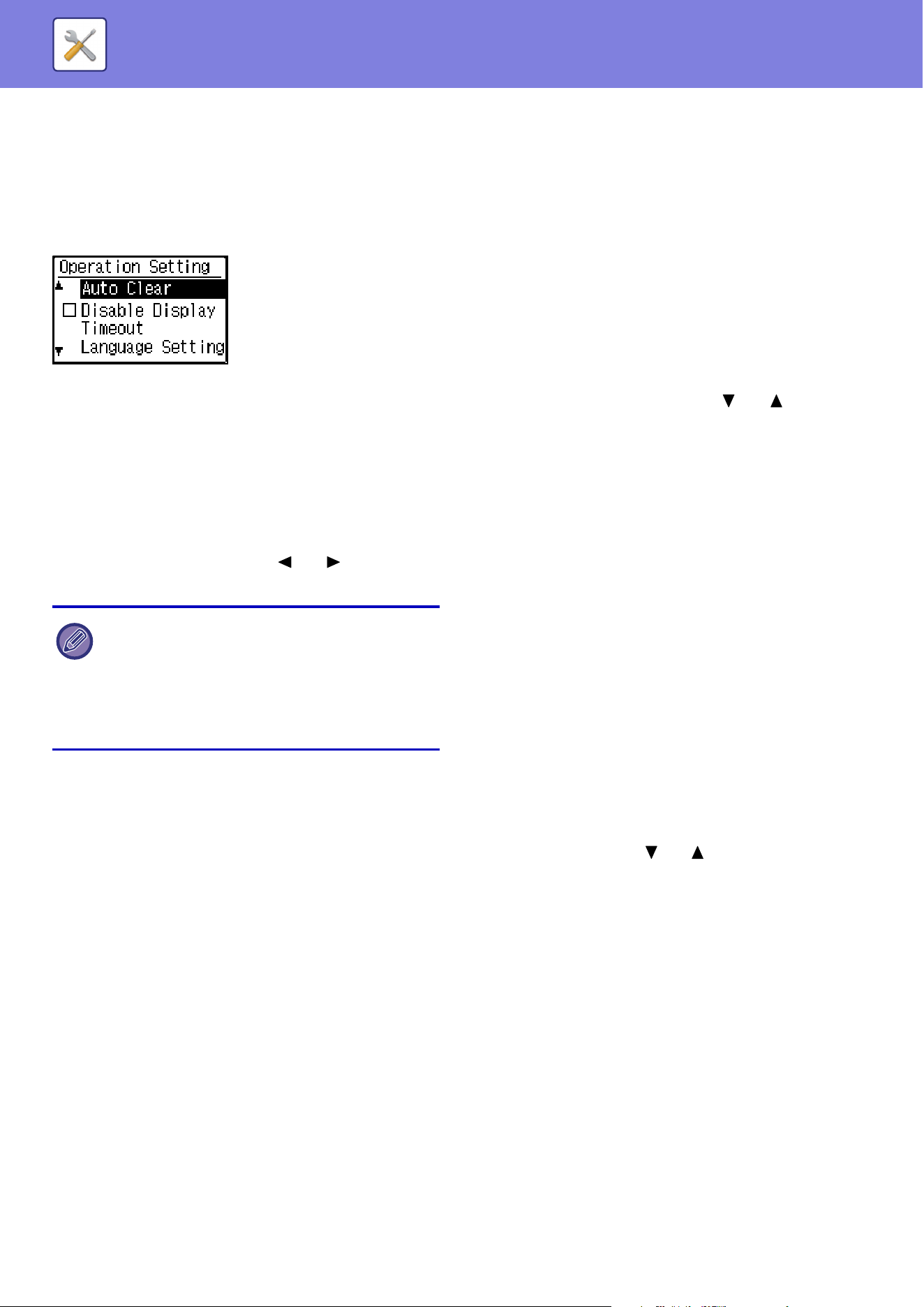
7-14
SYSTEM SETTINGS►SYSTEM SETTINGS
Operation Setting
These settings are used to configure various settings
related to the operation panel. To access one of these
programs, select "Operation Setting" in the mode
selection screen, select the desired setting in the
operation setting screen, and press the [OK] key.
Auto Clear
This function returns the copy settings to the default
settings if the operation panel is not used for the duration
of time set with this setting following the end of a copy
job. Time selections are "0 sec.", "10 sec.", "20 sec.", "60
sec.", "90 sec." and "120 sec.".
The factory default setting is 60 seconds.
Select the desired time with the [ ] or [ ] key.
If you do not want auto clear to operate, select "0".
Disable Display Timeout
This setting is used to select whether or not the display
will automatically return to the base screen if no keys are
pressed on the operation panel for the time set in the
above "Auto Clear" function setting in scan or fax mode.
The factory default setting is automatic return to the
base screen.
Language Setting
This setting is used to select the display language.
Message Time
This setting is used to set the length of time that
messages appear in the display (this applies to
messages that appear for a certain length of time and
then automatically disappear.)
Select from "Short (3 sec.)", "Normal (6 sec.)", or "Long
(9 sec.)".
The factory default setting is "Normal (6 sec.)".
Key Touch Sound
This setting is used to set the length of the key touch
sound that is heard each time a key is pressed.
The initial factory setting is "Short".
Select the desired length with the [ ] or [ ] key.
To turn the key touch sound off, select "Off".
Keys Touch Sound At Initial Point
This setting is used to select whether or not a beep will
sound at preset base settings as you press a key to
select a setting.
The factory default setting is no beep.
Key Press Time
This setting is used to set the duration of time that a key
must be pressed to take effect.
A longer setting can be selected to prevent keys pressed
accidentally from taking effect. Keep in mind, however,
that when a longer setting is selected more care is
required when pressing keys to ensure that the key input
is registered.
The initial factory setting is "Minimum".
Disable Auto Key Repeat
This setting is used to stop a setting from changing
continuously when the [ ] or [ ] key is held down, such
as when setting the zoom ratio or the original size (auto
key repeat will not operate). When this setting is
enabled, a key must be pressed repeatedly instead of
holding it down.
Auto key repeat is initially set to operate (factory default
setting).
Disable Paper Size Set
This setting is used to disable "Paper Size Set" in the
Special Modes menu. When disabled, "Paper Size Set"
cannot be used when the [Special Function] key is
pressed, which prevents users other than the
administrator from easily changing the paper size
setting.
"Disable Paper Size Set" is initially disabled (factory
default setting).
The Auto Clear function is disabled when scanned
data is stored under the following status: When the
last page has not been scanned during the 2-Up or
4-Up copy process (one page has been scanned for a
two-page set or three pages have been scanned in a
four-page set), or only one side has been scanned in
the ID card copy process.
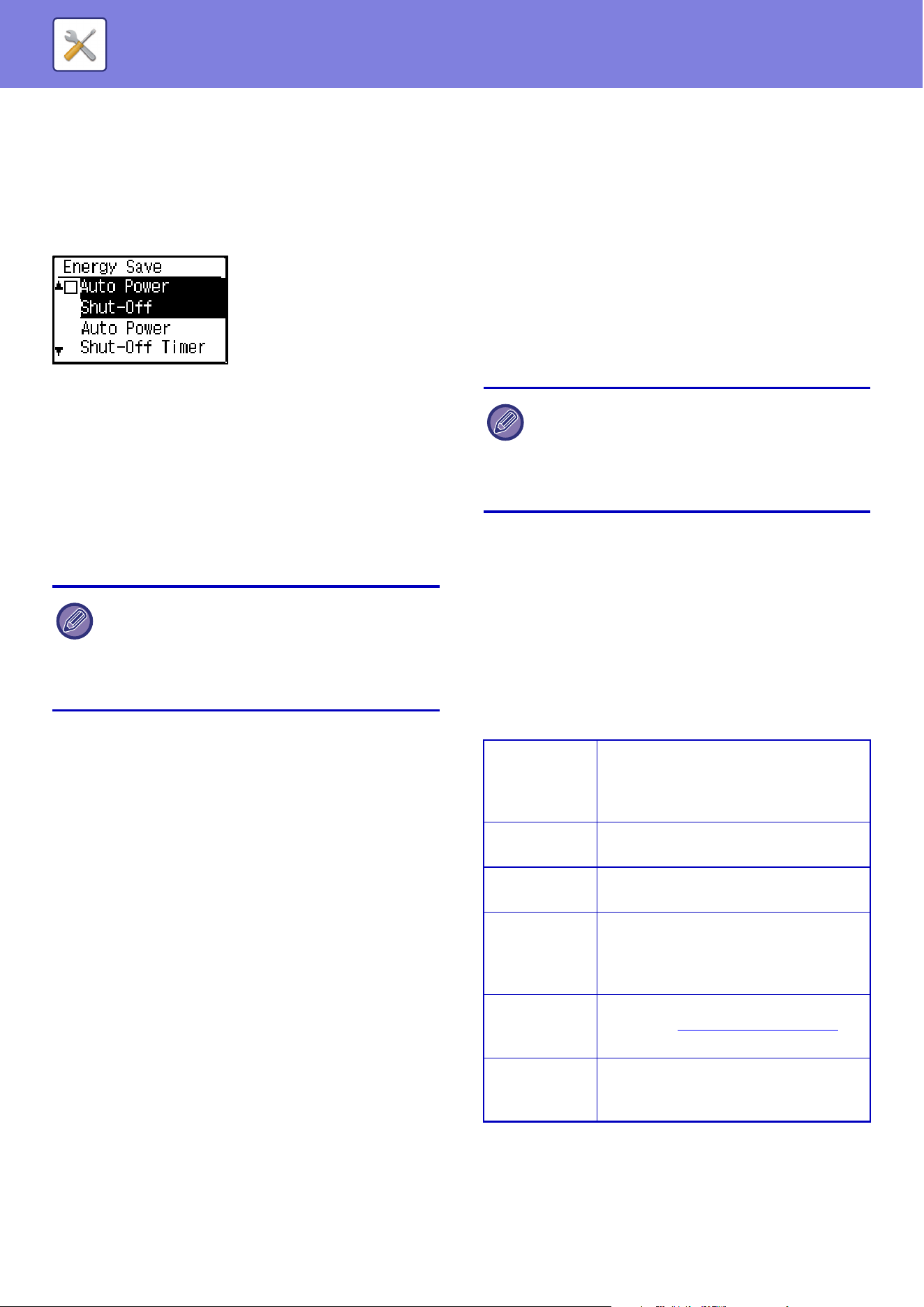
7-15
SYSTEM SETTINGS►SYSTEM SETTINGS
Energy Save
These settings are used to configure energy saving
settings. To access one of these settings, select "Energy
Save" in the mode selection screen, and select the
desired setting in the energy save screen, and then
press the [OK] key.
Auto Power Shut-Off
This setting is used to enable auto power shut-off mode,
which automatically turns off the power to the fusing unit
if the operation panel is not used for a certain duration of
time.
Enabling auto power shut-off mode helps conserve
energy, preserve natural resources, and reduce
environmental pollution.
The function is initially enabled.
Auto Power Shut-Off Timer
This setting is used to set the duration of time until auto
power shut-off mode activates when the operation panel
is not used. Using this function helps conserve energy,
preserve natural resources, and reduce environmental
pollution.
"1 min.", "3 min.", "5 min.", "10 min.", "15 min.",
"30 min.", "45 min.", "60 min.", "75 min.", "90 min.", "105
min." or "120 min." can be selected for the duration of
time. Select a setting that suits your work conditions.
The factory default setting is 1 minute.
Preheat Mode
This setting is used to set the duration of time until
preheat mode, which automatically lowers the fusing unit
temperature, activates when the operation panel is not
used. Using this function helps conserve energy,
preserve natural resources, and reduce environmental
pollution. "1 min.", "3 min.", "5 min.", "10 min.", "15 min.",
"30 min.", "45 min.", "60 min.", "75 min.", "90 min.", "105
min." or "120 min." can be selected for the duration of
time. Select a setting that suits your work conditions.
The factory default setting is 1 minute.
Enter Auto Power Shut-Off after
the Remote Job
This function works in Auto Power Shut-Off mode. When
the machine completes a print job received from the PC
or outputs received fax data, the machine immediately
returns to the Auto Power Shut-Off mode.
Toner Save Mode (Copy)
Toner Save Mode (Print)
You can reduce the amount of toner used for
copying/printing.
List Print
This is used to print lists and reports that are only for use
by the administrator of the machine.
Select [List Print] to choose the list and the report you
want to print.
Rather than disabling the auto power shut-off feature,
it is recommended that you first try lengthening the
time set in "Auto Power Shut-Off Timer" (see below).
In most cases a suitable timer setting will allow work to
proceed with minimal delay and still enable you to
enjoy the benefits of power conservation.
Toner Save Mode (Print) is only effective when the
machine's printer driver is not used. When the printer
driver is used, the printer driver setting takes
precedence.
This function may not operate in some applications
and operating systems.
Fax Settings Shows the current state of the system
settings, as well as the sender name,
sender number, polling passcode
numbers, and forwarding numbers.
Inbound
Routing
Shows the inbound routing settings for
routing received faxes on your network.
User Usage List Shows the communication time and
number of pages transmitted by each user.
Activity Report Shows a log of past communication
performed on the machine (date of
communication, name of other party, time
required, result, etc.).
Junk Fax # List Shows the stored fax numbers from which
reception in Anti Junk Fax (page 7-22)
is
blocked.
User Info. Print The user name, user number, paper used,
paper limits, and function permission
settings can be printed for each user.
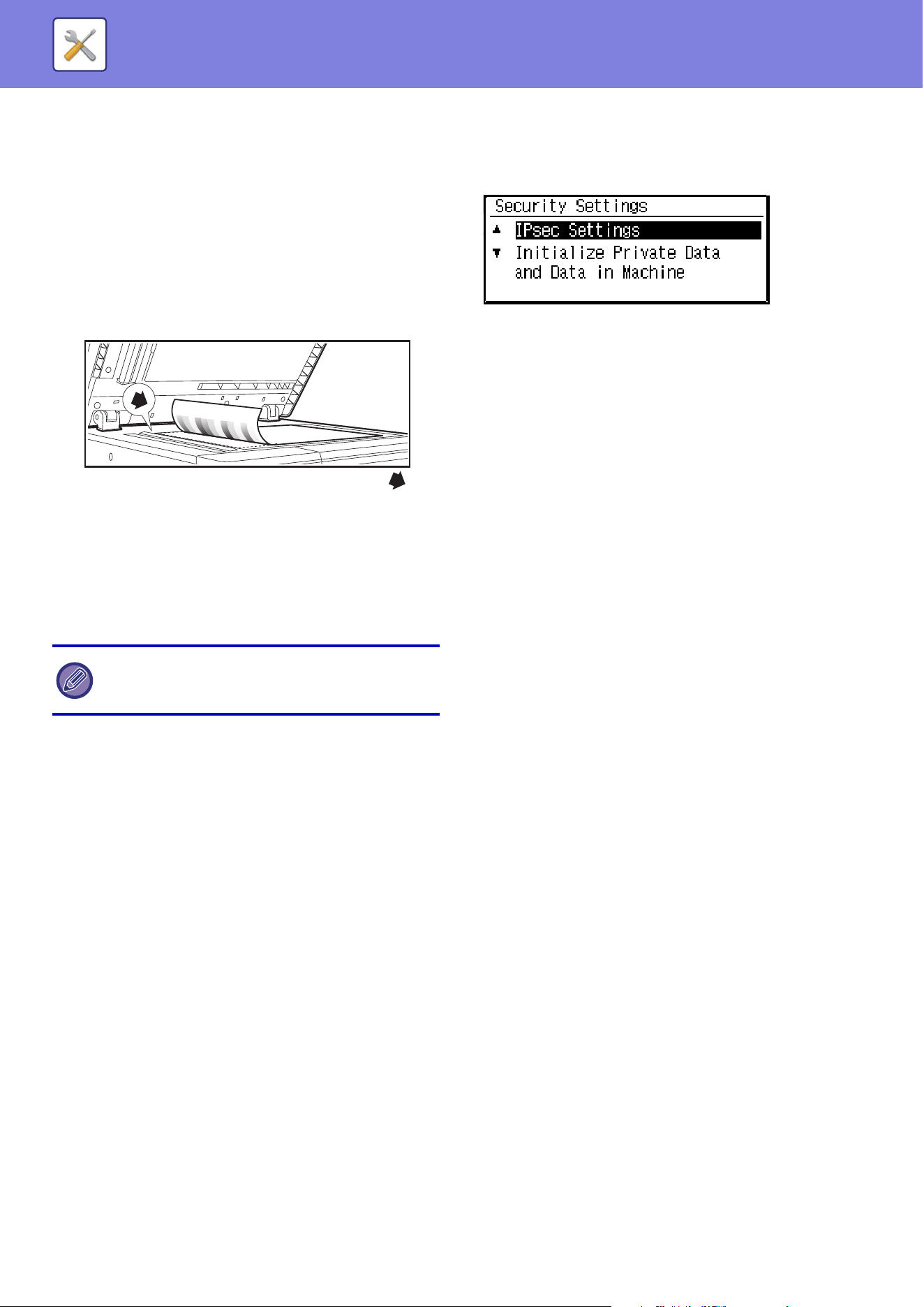
7-16
SYSTEM SETTINGS►SYSTEM SETTINGS
Auto Calibration
If the print tones are off, you can correct the tones. By
scanning the printed test pattern, tones can be
automatically corrected.
After the [OK] is selected and a test patch is printed, a
message appears prompting you to begin automatic
calibration. Place the test patch on the document glass
as shown below (so that the light patch at the edge of
the page is to the left).
Lay copy paper (about five sheets) that is the same size
as the test patch on top of the placed test patch, gently
close the automatic document feeder, and select the
[OK].
Security Settings
The following settings are related to security.
Select the [Security Settings] to configure the settings.
IPsec Settings
IPsec can be used for data transmission/reception on a network.
IKEv1 Settings
Configure the IKEv1 settings.
Enable IPsec
Specify whether or not IPsec is used for transmission.
IKEv1 Settings
Configure the IKEv1 settings.
Pre-Shared Key
Enter the Pre-Shared Key to be used for IKEv1.
SA Lifetime (time)
Set the SA lifetime.
IKE Lifetime
Set the IKE lifetime.
Initialize Private Data and Data in
Machine
The system-set values can be restored to the factory default
state after eliminating the data stored in the machine.
• All information displayed in the fax status
• Image data in memory boxes
• Unsent fax data
• Current values set for system settings
• Current values set for network settings
• User information > User registration information
• User information > Paper limits
• User information > Function usage restrictions
• User information > User counts
(Excluding default users)
• Fax / scanner addresses
•Groups
• User index (scanner)
• Programs
• Auto forwarding of received faxes
• Public box data
• Sender information
• Reception rejection numbers
• Forwarding information
• Product key
If the tones are still off after "Auto Calibration" is
performed, repeating Auto Calibration may provide
improvement.
Align the upper left corner of the original with the
mark.
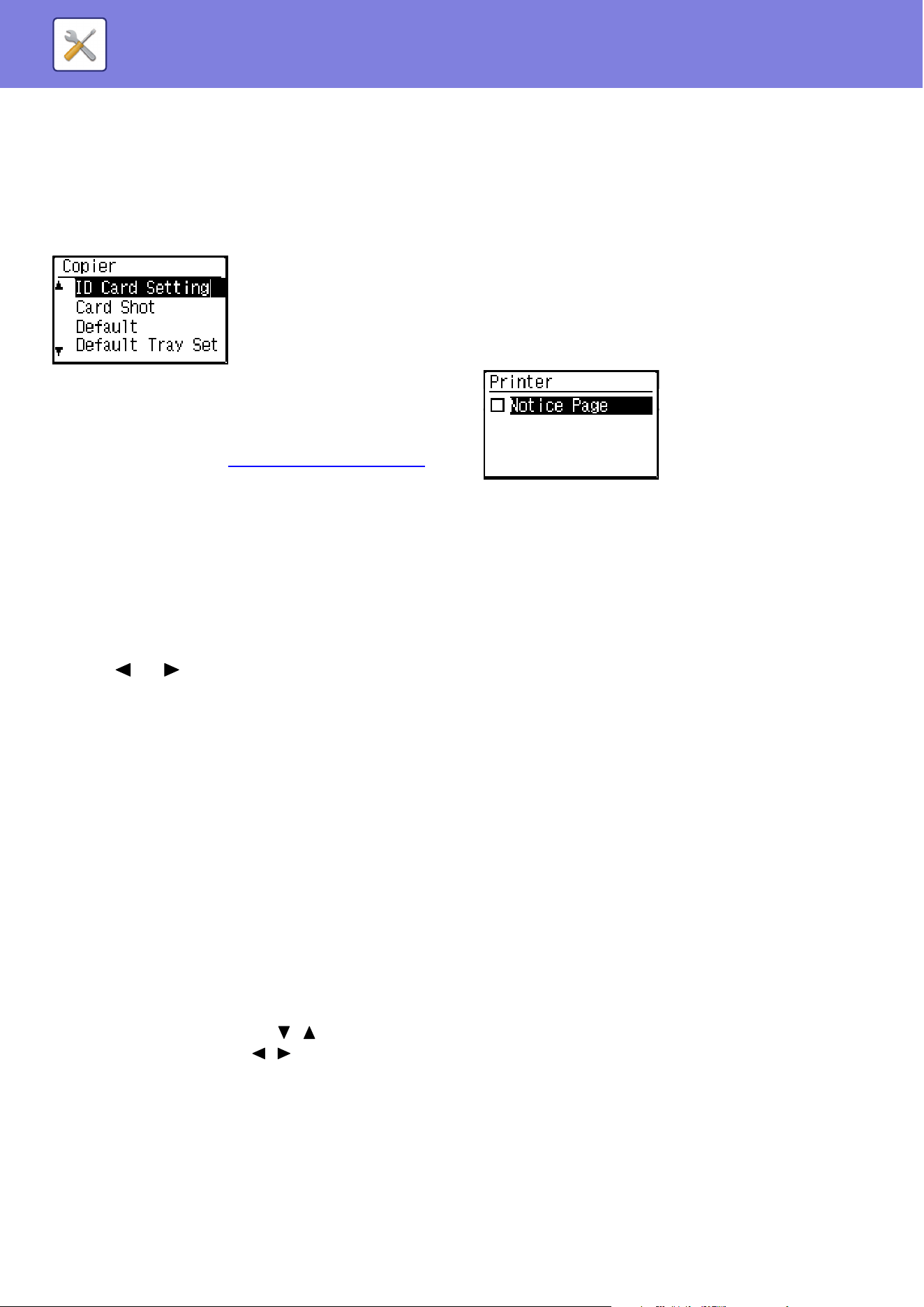
7-17
SYSTEM SETTINGS►SYSTEM SETTINGS
Copier
These settings are used to enable various copy
functions. To access one of these programs, select
"Copier" in the mode selection screen, select the desired
setting in the copy settings screen, and press the [OK]
key.
ID Card Setting
The layout pattern for copying of the ID card can be
changed during the ID card copy process.
Refer to the illustration in ID CARD COPY (page 2-17)
for the available layout patterns.
Card Shot Default
This setting is used to set the default dimensions that
appear when the card shot size entry screen is
displayed.
The factory default settings are 3-3/8" (86 mm) for the
width (X) and 2-1/8" (54 mm) for the length (Y).
Select X or Y and adjust the corresponding default value
with the [ ] or [ ] key.
Default Tray Set
This setting is used to set which tray is selected by
default.
Trays that appear for selection will vary depending on
the optional trays that have been installed.
The factory default setting is "Tray 1".
Default Exposure
This setting is used to select the original type and
exposure mode that is initially selected when the
[EXPOSURE] key is pressed.
Three exposure modes are available: "Text", "Text/Print
Photo" and "Photo".
Depending on the settings, set "Auto" or one of five
levels for the exposure.
Select the original type with the [ ][ ] keys, adjust the
exposure if needed with the [ ][ ] keys, and press the
[OK] key.
Sort Auto Select
This setting is used to select the default output mode
when the document feeder is used for copying.
The initial factory setting is "Sort".
Limit Of Copies
This setting is used to set the limit for the number of
copies that can be set (and that can appear in the
display) for one copy job.
The factory default setting is "999 copies".
Printer
Settings related to the printer function can be configured.
Select the [Printer] to configure the settings.
Notice Page
Set whether a notice page is printed when printing does
not take place due to an error such as memory full.
7-18
SYSTEM SETTINGS►SYSTEM SETTINGS
Fax
System settings for the fax function are explained below.
List Setting
This setting is used to print lists showing current system
settings and other programmed information.
Select the [List Setting] to configure the settings.
Print Selection
This setting is used to select the conditions for printing
out transaction reports for normal transmission,
broadcast transmission, original print and reception.
Normally the settings indicated by shading
above are selected.
"Transmission", "Broadcast", "Original Image Print
Setting", or "Reception" can be selected.
• If you selected "Transmission", select "Always Prints",
"Error Only", or "Never Prints".
• If you selected "Broadcast", select "Always Prints",
"Error Only", or "Never Prints".
• If you selected "Original Image Print Setting", select
"Always Prints", "Error Only", or "Never Prints".
• If you selected "Reception", select "Always Prints",
"Error Only", or "Never Prints".
Auto Listing
This setting is used to have the activity report that is
stored in the machine's memory printed out at regular
intervals.
You can choose to have the report automatically printed
each time the number of stored transactions exceeds 50,
or have the report printed at a specified time every day
(only once per day). You can also enable both print
methods.
The report is normally set to not print out. To have the
report automatically printed when the number of stored
transactions (the combined total of transmissions and
receptions) exceeds 50, select "Auto Print Rept At
Limit(50)".
To have the report printed at a specified time, enable
"Print Time Set" and enter the desired time.
• The setting is enabled and a checkmark appears in
the checkbox.
• If this procedure is performed when the setting is
enabled, the checkmark will be cleared and the setting
disabled.
Transmission Broadcast
Original Image
Print Setting
Always Prints Always Prints Always Prints
Error Only Error Only Error Only
Never Prints Never Prints Never Prints
Reception
Always Prints
Error Only
Never Prints
"Original Image Print Setting" is used to have part of
the first page of the transmitted document printed on
the transaction report. This setting is not effective
when the transaction report is set to not print out.
• To cancel a "Print Time Set" setting, select
"Cancel":
• Select "Cancel" with the [ ] or [ ] key and then
press the [OK] key.
• If "Auto Print Rept At Limit(50)" is not enabled and
the number of recorded transactions exceeds 50,
each new transaction will delete the oldest
transaction.
• The activity report can also be printed out on
demand. (See PRINTING LISTS OF
PROGRAMMED INFORMATION AND SETTINGS
(page 4-45).)
7-19
SYSTEM SETTINGS►SYSTEM SETTINGS
Initial Setting
These settings are used to change the default settings
(initially set at the factory) for the various fax functions to
settings that better meet your needs.
Select the [Initial Setting] to configure the settings.
Dial Mode
This setting is used to set the appropriate dial mode for
the line connected to the machine. Select tone for a tone
dial line or pulse for a pulse dial line.
Pause Time
This setting is used to select the duration of pauses that
are inserted in destination fax numbers.
Normally the setting is 2 seconds, which means that
each time the [PAUSE] key is pressed when dialing or
storing a fax number, a pause of 2 seconds is inserted.
The pause time can be set to any number of seconds
from 1 to 15.
Own Passcode Set
Use this setting to setting the fax number of the machine
and the name of the user. The programmed name and
number are printed at the top of each fax page you send.
The number is also used as a passcode when performing
polling reception SENDING OPTIONS (page 4-32)
".
You can check your programmed name and number by
printing out the List Print (page 7-15)
A maximum of 20 digits can be stored for the fax number.
• A maximum of 18 letters can be stored for the name.
Set Volume
This setting is used to adjust the on-hook volume, the
ringing volume, the line monitor volume, the TX/RX end
sound volume, and the original scanning end sound
volume.
• "High", "Middle" or "Low" can be selected for the on
hook volume.
• "High", "Middle", "Low" or "Off" can be selected for
volumes other than the on hook volume.
TX/RX End Sound
This setting is used to select the beep pattern that
signals the end of transmission or reception.
"Pattern 1", "Pattern 2" or "Pattern 3" can be selected.
Before pressing the [OK] key to store your selection, you
can press the key to listen to the selected pattern.
End Sound Length
This setting is used to select the length of the end sound
in seconds. Selections are "2.0 sec", "2.5 sec", "3.0 sec",
"3.5 sec", and "4.0 sec". "3.0 sec" is normally selected.
Distinctive Ring
If multiple telephone numbers have been assigned to
your telephone line, the number called can be identified
by its ringing pattern. By using one number for voice
calls and another number for faxes, you can tell which
type of call you are receiving by the ringing pattern. You
can set your machine to automatically receive faxes
when your fax number is called by setting the pattern
that corresponds to your fax number. Normally "Off" is
selected.
Remote Reception
(Only when an extension phone is connected)
When a call is received on an extension phone
connected to the machine, fax reception can be
activated by entering a 1-digit number and pressing
twice on the phone's keypad. This 1-digit number is
called the remote reception number, and you can set it to
any number from "0" to "9". Normally the remote
reception number is set to "5".
Disable Fax Print Hold
This setting is used to disable the fax print hold function,
which holds received faxes in memory instead of printing
them as they are received. ►page 4-28
Normally the fax print hold function is disabled.
• The setting (which disables fax print hold) is enabled
and a checkmark appears in the checkbox.
• If this procedure is performed when the setting is
enabled, the checkmark will be cleared and the setting
disabled (fax print hold is enabled).
To clear the programmed fax number and name,
follow these steps:
(1) Select "Delete" and then press the [OK] key.
(2) Select "Delete" with the [ ] or [ ] key and then
press the [OK] key.
Item Factory default setting
On Hook Volume Middle
Ringer Volume Low
Line Monitor Vol Off
TX/RX End Volume Low
Scan End Volume Middle
If a remote number has been previously stored, the
newly entered remote number overwrites the old
number.
7-20
SYSTEM SETTINGS►SYSTEM SETTINGS
Sending Function
These settings are used to change the default settings
(initially set at the factory) for the various fax
transmission functions to settings that better meet your
needs.
Select the [Sending Function] to configure the settings.
Orig. Size Enter
Set the size of originals scanned on the document glass.
Normally 8-1/2" x 11" is set.
Set Res. Con.
This setting is used to adjust the resolution and the
exposure level when scanning an original to be faxed.
The initial setting is standard resolution and auto
exposure mode.
Send Mode
This setting is used to select whether the default mode
for sending faxes is memory transmission or direct
transmission.
The initial setting is "Memory TX".
Quick On Line TX
This setting is used to select whether or not quick on-line
transmission (transmission while original pages are
being scanned into memory) takes place when a
memory transmission is performed.
If quick on-line transmission is disabled, transmission
will not begin until all original pages have been scanned
into memory.
Normally quick on-line transmission is enabled.
When this function is disabled, transmission will not
begin until all pages of the document have been
scanned. Note that this setting does not apply to manual
transmission. (See Storing transmission jobs (memory
transmission) (page 4-17).)
• Quick on-line is enabled and a checkmark appears in
the checkbox.
• If this procedure is performed when quick on-line is
enabled, the checkmark will be cleared and quick
on-line disabled.
Print Station # In Rcvd Data
This setting lets you select the position (inside or outside
the original image) of the date and sender's information
that are printed at the top of each fax page you send.
Normally outside the original image is selected. To have
your name and number printed inside the original image,
select "In Data".
For more detailed information on the position of each
setting, see INCLUDING SENDER INFORMATION ON
FAXES (OWN NUMBER SENDING) (page 4-46).
Address Review
You can specify whether a screen appears for
confirmation of the destination when sending a fax.
Recall Setting (Busy)
This setting is used to set the number of recall attempts
and the interval between recall attempts when a
transmission is not successful due to the line being busy
or other reason.
Normally the machine is set to make 2 recall attempts at
intervals of 3 minutes.
If you do not wish to have recalling take place, set the
number of attempts to "0".
Recall Set (Err)
When sending a fax, this setting is used to select
whether or not the machine will automatically re-attempt
the call if the transmission fails due to a line error.
Normally the machine is set to make 1 recall attempt at
intervals of 3 minutes.
If you do not wish to have recalling take place, set the
number of attempts to "0".
Ring Timeout In Auto TX
When sending a fax by automatic transmission (see
Storing transmission jobs (memory transmission) (page
4-17)), this setting lets you select the amount of time that
the machine waits before breaking the connection when
the other machine does not answer your machine's call.
If the other machine does not respond within this set
time, your machine will automatically break the
connection.
Time selections are "30 sec.", "45 sec." and "60 sec.".
Normally "45 sec." is selected.
When the "Only apply to direct entry" checkbox is
selected, the Address Review screen only appears
when the fax number is entered with the numeric keys
or the [REDIAL] key.
Even if this setting is enabled, the machine will not
re-attempt the call when a fax is sent by manual
transmission.
• If the recall interval is set to "0", the machine will
immediately call again after the connection is
broken due to the line error.
• Even if this setting is enabled, the machine will not
re-attempt the call when a fax is sent by manual
transmission.
7-21
SYSTEM SETTINGS►SYSTEM SETTINGS
Rcv. Function
These settings are used to change the default settings
(initially set at the factory) for the various fax reception
functions to settings that better meet your needs.
Select the [Rcv. Function] to configure the settings.
#Of Rings At. RX
When the reception mode is set to auto, this setting is
used to select the number of rings on which the machine
automatically receives a call and begins fax reception.
(See RECEIVING FAXES (page 4-25)
.)
• Any number of rings from 0 to 15 can be selected.*
Normally "2" is selected.
• If you make a mistake, move the cursor to the mistake
with the [ ] [ ] keys and reenter.
#Of Rings Man.RX
(This function may not be available in some regions)
You can set the number of rings on which the machine
changes to auto reception when there is an incoming fax
call in manual reception mode.
Tray Selection
This setting is used to select which output trays can be
used for received faxes. All output trays are initially
enabled.
• The selected tray is enabled and a checkmark
appears in the checkbox.
• If this procedure is performed when the tray is
enabled, the checkmark will be cleared and the tray
disabled.
Received Data Print Condition
This setting determines the selection condition for paper
when printing received documents. Select one of the
three conditions below. "Reduction" is normally selected.
• Reduction
Each received image is printed at actual size when
possible. When not possible, the image is
automatically reduced before printing.
• Division
Each received image is printed at actual size.
If necessary, the image is split onto multiple sheets of
paper.
• Actual Size
The received fax image is printed at its actual size
(without dividing it onto multiple sheets of paper).
If the same size of paper or larger paper is not loaded,
the fax will be received in memory and will not be
printed until a suitable size of paper is loaded.
Auto Rcv Reduce To Regular Size
When you receive a fax that includes the sender's name
and number, the received image is slightly larger than
the standard size*. This setting lets you select whether
or not the received image is automatically reduced
before printing to fit the standard size. Normally this
setting is enabled.
*Standard sizes are sizes such as 8-1/2" x 11" and
5-1/2" x 8-1/2".
Duplex Reception
This setting is used to select whether or not received
faxes are printed on both sides of the paper. When
two-sided printing is enabled and a fax that is two pages
or longer is received (the pages must be the same size),
the fax will be printed on both sides of the paper.
Even if the pages are in different orientations, the pages
are rotated appropriately to enable printing on both sides
of the paper.
• The setting is enabled (two-sided printing will take
place) and a checkmark appears in the checkbox.
• If the procedure is performed when the setting is
enabled, the checkmark will be cleared and the setting
disabled.
• If the number of rings is set to 0, the machine will
receive faxes without ringing.
• When the number of rings is set to 14 or 15,
reception may not be possible depending on the
functions and settings of the other machine.
• The trays that can be enabled will vary depending
on the options that are installed.
• The trays cannot all be disabled.
• If this setting is disabled (no reduction) and the
received data print condition is set to division, the
image may be clipped.
• If auto receive reduce is disabled, an image larger
than the standard size will be cut off. However, the
image will be clearer because it will be printed at the
same size as the original.
7-22
SYSTEM SETTINGS►SYSTEM SETTINGS
FW. RX Data
This setting is used to select whether or not received
faxes are forwarded to a fax machine programmed as
explained in Received Data FW. Station Set (page 7-22)
in the event that the machine cannot print the faxes. The
setting is initially disabled.
• The setting is enabled and a checkmark appears in
the checkbox.
• If the procedure is performed when the setting is
enabled, the checkmark will be cleared and the setting
disabled.
Received Data FW. Station Set
When a problem prevents the machine from printing a
received fax, the fax forwarding function ►page 4-47
can be used to forward the received fax to another fax
machine. Use this setting to setting the fax number of the
destination fax machine. Only one fax number can be
programmed (maximum of 50 digits).
Anti Junk Fax
When this setting is enabled, reception from fax
numbers programmed using the "Enter Junk Fax #
(page 7-22)" setting will be blocked.
This setting is normally disabled.
• The setting is enabled and a checkmark appears in
the checkbox.
• If this procedure is performed when the setting is
enabled, the checkmark will be cleared and the setting
disabled.
Enter Junk Fax #
This setting is used to program fax numbers from which
you wish to block reception. Up to 50 fax numbers can
be stored (maximum of 20 digits each). To block
reception from the programmed fax numbers, the "Anti
Junk Fax" setting must be enabled.
Polling Security
These settings are used for the public box.
Select the [Polling Security] to configure the settings.
Polling Security
When performing polling memory (see Restricting polling
access (polling security) (page 4-36)), this setting is
used to select whether any machine will be allowed to
poll your machine, or only machines that have been
programmed in your machine. Normally this setting is
enabled.
• The setting is enabled and a checkmark appears in
the checkbox.
• If this procedure is performed when the setting is
enabled, the checkmark will be cleared and the setting
disabled.
Polling Passcode # Mode
When "Polling Security" is enabled, use this setting to
program (or delete) the fax numbers of the machines
that are allowed to poll your machine. Programmed fax
numbers are called passcodes. Up to 10 fax numbers
can be programmed. To check the programmed
numbers, print the List Print (page 7-15)
.
If you make a mistake, move the cursor to the mistake
with the [ ] or [ ] keys and enter the correct number.
This setting only operates when the fax number of the
machine that is to receive the forwarded faxes is
programmed.
To delete the number, follow these steps:
(1) Select "Delete" and then press the [OK] key.
(2) Select "Delete" with the [ ] or [ ] key and then
press the [OK] key.
To delete a number, follow these steps: Before
deleting a number, use the List Setting (page 7-18)
to
check the control number that identifies the fax
number (01 to 50) that you wish to delete. The control
number must be entered to delete the fax number.
(The fax number will not appear in the display. If the
wrong control number is accidentally entered, a fax
number other than the fax number that you wish to
delete will be deleted.)
(1) Select "Delete" and then press the [OK] key.
(2) Select the 2-digit control number (01 to 50) that
identifies the fax number that you wish to delete
with the [ ] or [ ] key and then press the [OK]
key.
(3) Select "Delete" with the [ ] or [ ] key and then
press the [OK] key.
To clear a passcode number, follow these steps:
(1) Select "Delete" and then press the [OK] key.
(2) Enter the control number that identifies the
number you wish to clear, and then press the [OK]
key.
(3) Select "Delete" with the [ ] or [ ] key and then
press the [OK] key.

7-23
SYSTEM SETTINGS►SYSTEM SETTINGS
Scanner
System settings for the scanner function are explained
below.
Select the [Scanner] to configure the settings.
Disable USB Scan
Select whether or not scanning from a computer and
scanning from the machine are disabled when a USB
connection is used.
Default setting is "No" (disabled).
New Default
This is used to change the default settings for the
original size, resolution, color mode, and format. (For
details, see STORING SCANNING SETTINGS (page
5-11).)
• For details on each setting, see the pages below.
"Original Size Enter"►page 5-8
"Resolution"►page 5-8
"Color mode"►page 5-13
"Format"►page 5-13

8-1
WEB FUNCTIONS IN THE MACHINE
ABOUT THE WEB PAGES . . . . . . . . . . . . . . . . . . . 8-2
• HOW TO ACCESS THE WEB PAGE . . . . . . . . 8-2
ABOUT THE WEB PAGES (FOR USERS) . . . . . . . 8-3
CONFIGURING THE PRINTER CONDITION
SETTINGS . . . . . . . . . . . . . . . . . . . . . . . . . . . . . . . . 8-4
• HOW TO CONFIGURE THE SETTINGS . . . . . 8-4
• PRINTER CONDITION SETTING MENU . . . . . 8-5
• PRINTER CONDITION SETTINGS. . . . . . . . . . 8-5
CONFIGURING THE SCANNER CONDITION
SETTINGS . . . . . . . . . . . . . . . . . . . . . . . . . . . . . . . . 8-7
• STORING DESTINATIONS. . . . . . . . . . . . . . . . 8-7
• BASIC SETTINGS FOR NETWORK SCAN
(FOR THE ADMINISTRATOR) . . . . . . . . . . . . . 8-13
ABOUT THE WEB PAGES (FOR THE
ADMINISTRATOR). . . . . . . . . . . . . . . . . . . . . . . . . . 8-14
CONFIGURING SMTP, DNS AND LDAP SERVER
SETTINGS . . . . . . . . . . . . . . . . . . . . . . . . . . . . . . . . 8-15
PROTECTING INFORMATION PROGRAMMED IN
THE WEB PAGE ([Passwords]) . . . . . . . . . . . . . . . 8-16
ADMINISTRATOR SETTINGS. . . . . . . . . . . . . . . . . 8-17
• CONFIGURING A SETTING IN THE
ADMINISTRATOR SETTINGS . . . . . . . . . . . . . 8-17
• ADMINISTRATOR SETTINGS . . . . . . . . . . . . . 8-17
E-MAIL STATUS AND E-MAIL ALERT SETTINGS 8-19
• INFORMATION SETUP. . . . . . . . . . . . . . . . . . . 8-19
• SMTP SETUP . . . . . . . . . . . . . . . . . . . . . . . . . . 8-19
• STATUS MESSAGE SETUP. . . . . . . . . . . . . . . 8-20
WEB PAGES
8-2
WEB PAGES►WEB FUNCTIONS IN THE MACHINE
ABOUT THE WEB PAGES
The machine includes a built-in Web server. The Web server is accessed using a Web browser on your computer. The
Web pages include both pages for users and pages for the administrator. In the user Web pages, users can monitor the
machine, and select printer configuration settings. In the administrator Web pages, the administrator can configure the
machine's settings, and passwords. Only the administrator is allowed to configure these settings.
HOW TO ACCESS THE WEB PAGE
Use the following procedure to access the Web pages.
WEB FUNCTIONS IN THE MACHINE
1
Open the Web browser on your computer.
Recommended Web browsers:
Internet Explorer: 11 or later (Windows
®
)
Firefox (Windows
®
), Safari (Mac OS
®
),
Chrome (Windows
®
):
Latest version or immediately previous major release
2
In the "Address" field of your Web browser, enter the IP address that has
been configured in the machine.
When the connection is completed, the Web page will appear in your Web browser.
► ABOUT THE WEB PAGES (FOR USERS) (page 8-3)
3
When finished, close the Web pages.
When you have finished using the Web pages, click the (close) button in the top right corner of the page.
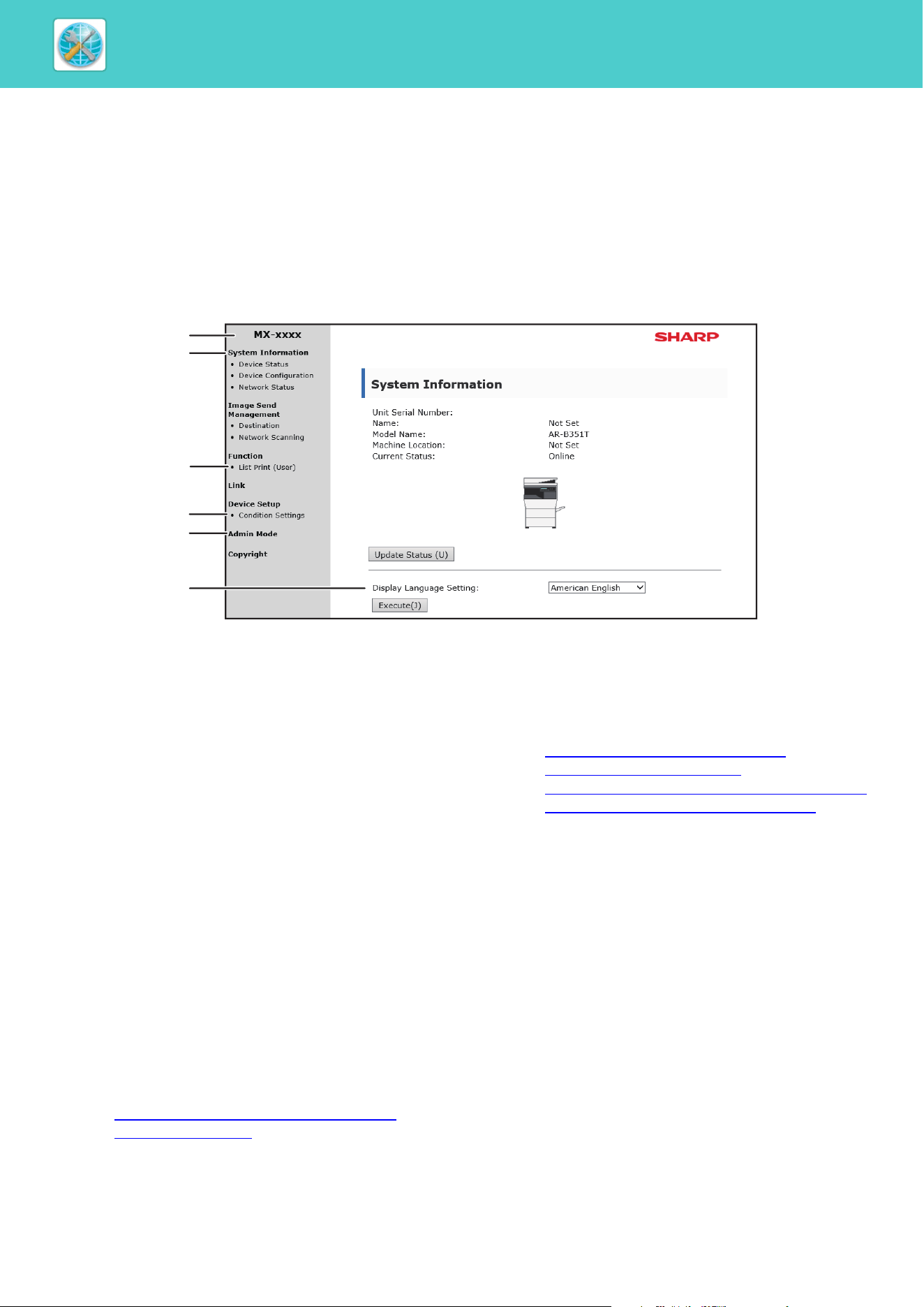
8-3
WEB PAGES►WEB FUNCTIONS IN THE MACHINE
ABOUT THE WEB PAGES
(FOR USERS)
When you access the user Web pages in the machine, the following page will appear in your browser.
A menu frame appears on the left side of the page. When you click an item in the menu, a screen appears in the right
frame that allows you to configure settings for that item.
(1) Menu frame
Click a setting in the menu to configure it.
(2) System Information
Shows the current status of the machine and model
name.
• Device Status
Shows the current status of the machine, paper trays,
output trays, toner and other supplies, and page
counts.
Out of paper and other warnings appear in red.
• Device Configuration
Shows what options are installed.
• Network Status
Shows the network status. Information on "General"
and "TCP/IP" is shown on the respective pages.
(3) List Print
You can print out the various settings that you have
selected.
(4) Condition Settings
Configure basic printer settings and printer language
settings.
► CONFIGURING THE PRINTER CONDITION
SETTINGS (page 8-4)
(5) Admin Mode
To open the Web pages for the administrator, click here
and then enter the administrator's user name and
password.
► ABOUT THE WEB PAGES (FOR THE
ADMINISTRATOR) (page 8-14)
► PROTECTING INFORMATION PROGRAMMED IN
THE WEB PAGE ([Passwords]) (page 8-16)
(6) Display Language Setting
Select the desired language setting from the pull-down
menu.
(6)
(2)
(1)
(3)
(4)
(5)
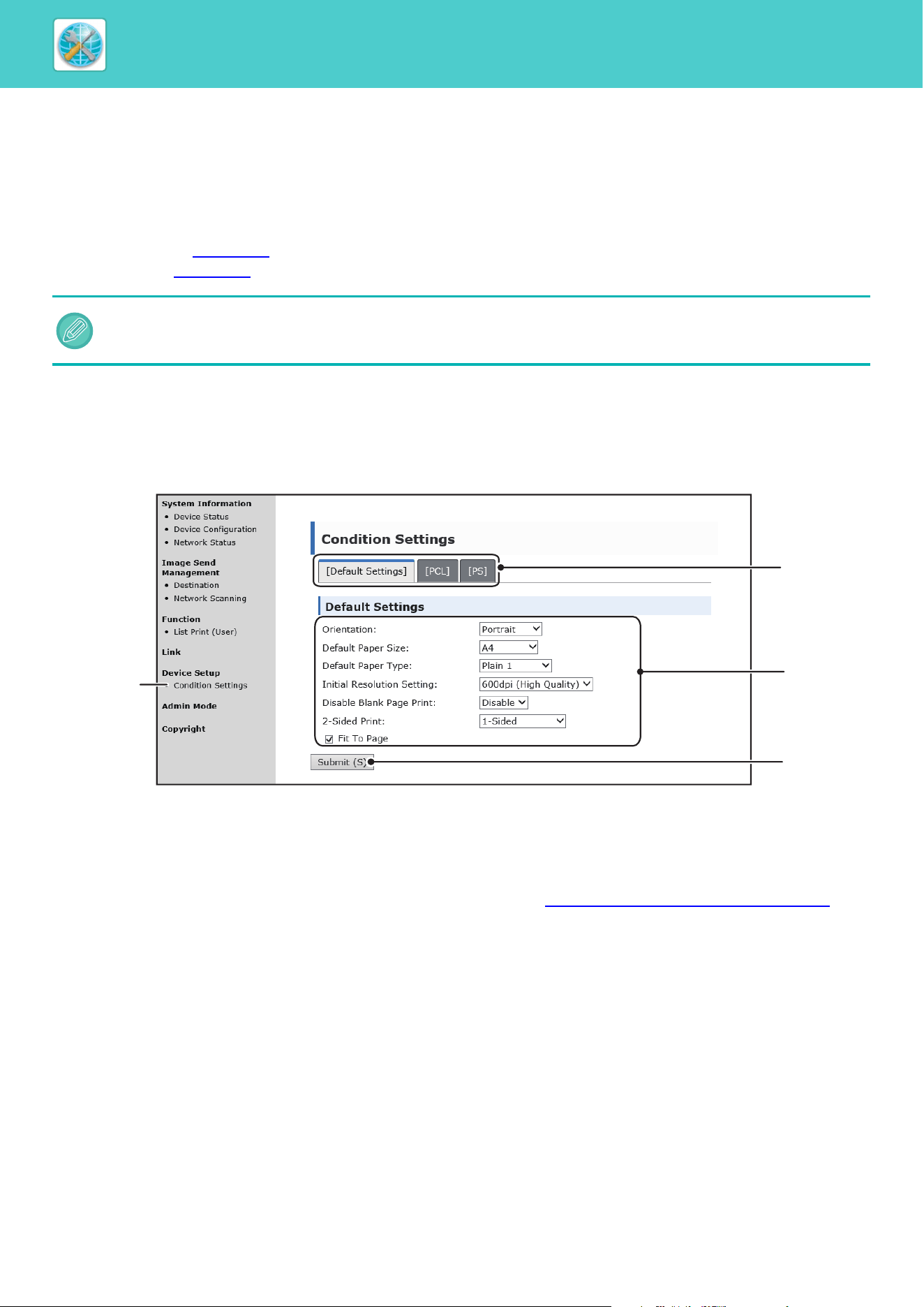
8-4
WEB PAGES►WEB FUNCTIONS IN THE MACHINE
CONFIGURING THE PRINTER CONDITION
SETTINGS
The printer condition settings allow basic printer settings to be configured. The following items can be set:
• "Default Settings" ►page 8-5
: Basic settings that are mainly used when the printer driver is not used.
• "PCL Settings" ►page 8-6
: PCL symbol set, font, line feed code, and other settings.
HOW TO CONFIGURE THE SETTINGS
To display the Condition Settings screen, click [Condition Settings] in the menu frame.
(1) Condition Settings
This displays the page for configuring the printer
condition settings.
(2) Default Settings/ PCL/PS
Select the type of condition settings that you wish to
configure.
(3) Settings
The factory default settings are displayed.
Change the settings as desired by selecting from
drop-down lists.
► PRINTER CONDITION SETTINGS (page 8-5)
(4) Submit
Click to store the Web page settings in the machine.
When the printer driver is used and the same settings are configured both in the printer driver and in the above screens, the
settings configured in the printer driver override the settings in the above screens. If a setting is available in the printer driver,
use the printer driver to configure the setting.
(2)
(3)
(4)
(1)
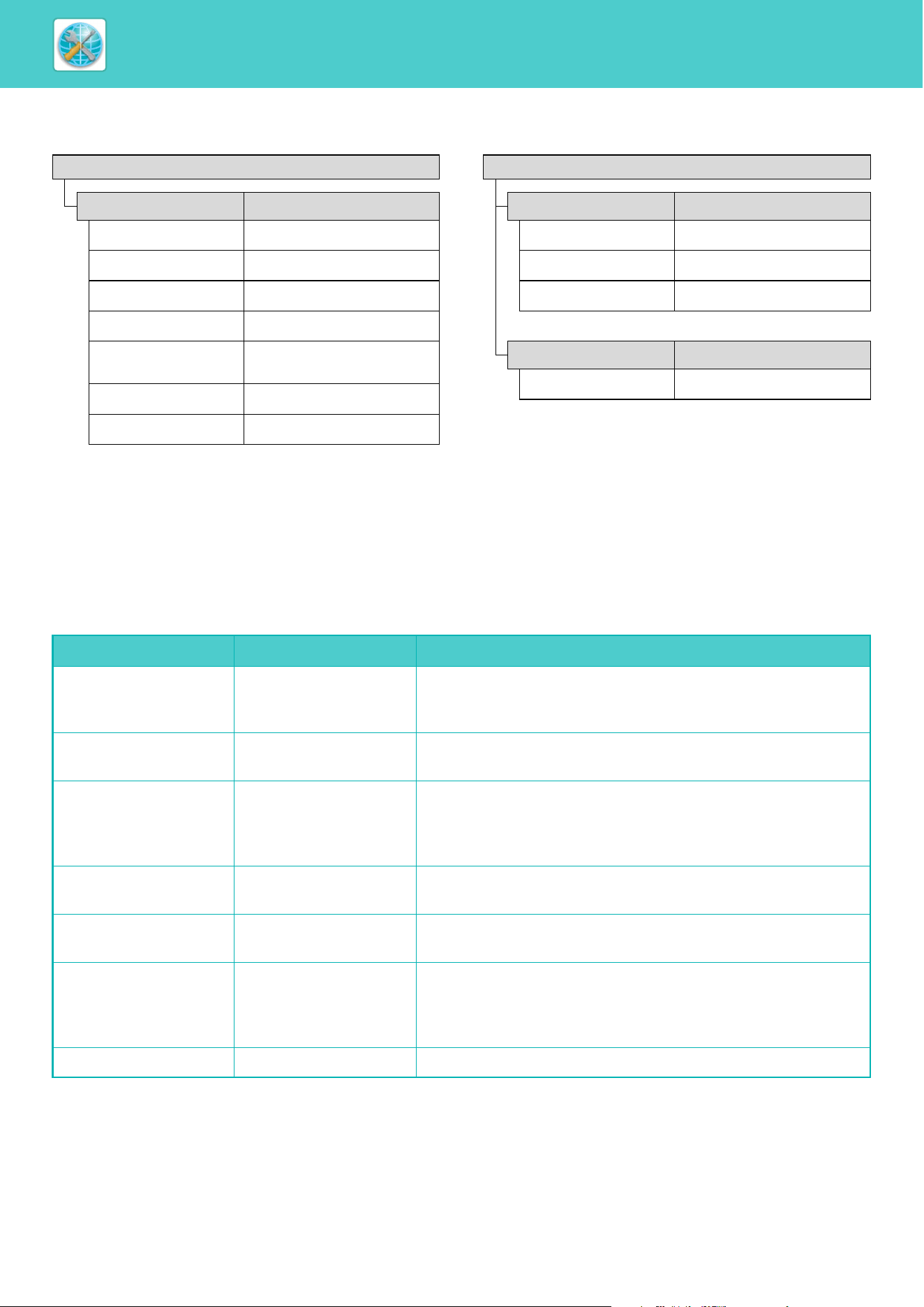
8-5
WEB PAGES►WEB FUNCTIONS IN THE MACHINE
PRINTER CONDITION SETTING MENU
PRINTER CONDITION SETTINGS
Factory default settings are indicated in bold.
Default Settings
Condition Settings
Default Settings Factory default settings
Orientation Portrait
Default Paper Size Letter
Default Paper Type Plain 1
Default Resolution 600dpi (High Quality)
Disable Blank Page
Print
Disable
2-Sided Print 2-Sided (Book)
Fit To Page ON
Condition Settings
PCL Settings Factory default settings
Symbol Set PC-8
Font 0: Courier (internal font)
Line Feed Code CR=CR; LF=LF; FF=FF
PS Settings Factory default settings
Print PS Errors Disable
Item Settings Description
Orientation Portrait, Landscape This sets the orientation of the printed page. Select [Portrait] when the
image is longer in the vertical direction, or [Landscape] when the
image is longer in the horizontal direction.
Default Paper Size Letter, Invoice,
Executive, A4, B5, A5,
Set the default paper size used for printing.
Default Paper Type Plain 1, Plain 2, Letter
head, Pre-printed,
Pre-punched, Recycled,
Color
Set the type of paper used for printing.
Default Resolution 600dpi,
600dpi (High Quality)
Set the printing resolution.
Disable Blank Page Print Enable, Disable When this is specified, blank pages with no print data will not be
printed.
2-Sided Print 1-Sided,
2-Sided (Book),
2-Sided (Tablet)
When [2-Sided (Book)] is selected, two-sided printing takes place so
as to allow binding at the left side. When [2-Sided (Tablet)] is
selected, two-sided printing takes place so as to allow binding at the
top. (Only for models that support two-sided printing.)
Fit To Page ON, OFF Set whether the printed image is fit to the size of the paper.
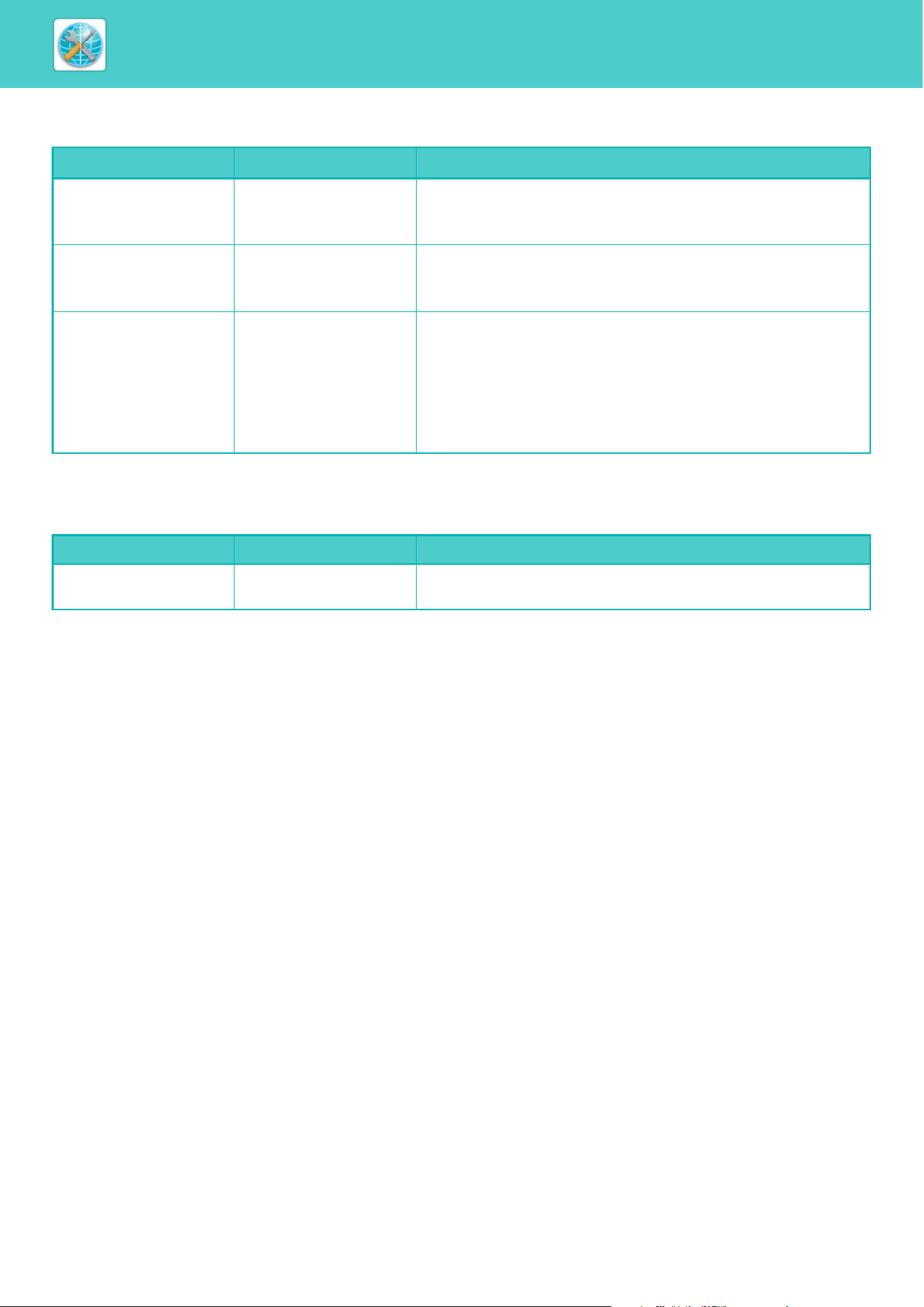
8-6
WEB PAGES►WEB FUNCTIONS IN THE MACHINE
PCL Settings
PostScript settings
Item Settings Description
Symbol Set Select one of 35 sets. This specifies which country's characters (PCL symbol set) are
assigned to certain of the symbols in the character code list.
The factory default setting is [PC-8].
Font Select one internal font. This specifies which PCL font to use for printing. One font can be
specified from among the internal fonts. The factory default setting is
[0: Courier].
Line Feed Code CR=CR; LF=LF; FF=FF,
CR=CR+LF; LF=LF;
FF=FF,
CR=CR; LF=CR+LF;
FF=CR+FF,
CR=CR+LF; LF=CR+LF;
FF=CR+FF
This specifies the line break code by means of a combination of the
"CR" (return) code, "LF" (line break) code, and "FF" (page break)
code. The factory default setting is printing based on the transmitted
code. The setting can be changed by selecting one of four
combinations.
Item Settings Description
Print PS Errors Enable, Disable When this setting is enabled, an error description is printed each time a
PostScript error occurs.
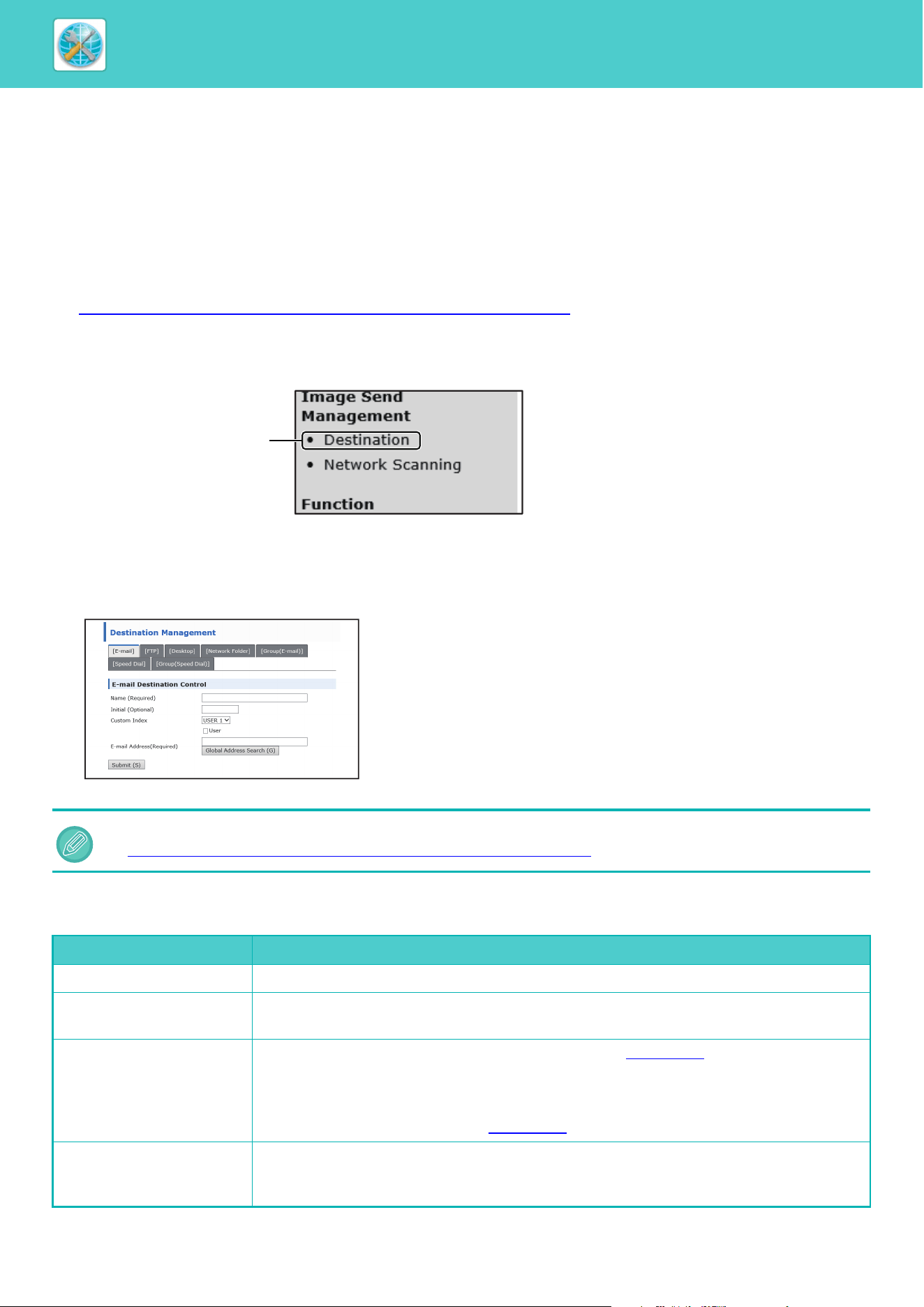
8-7
WEB PAGES►WEB FUNCTIONS IN THE MACHINE
CONFIGURING THE SCANNER CONDITION
SETTINGS
STORING DESTINATIONS
To store scanning destinations, click [Destination] in the Web page menu frame. This screen can also be used to edit or
delete stored destinations.
► Editing and deleting programmed transmission destinations (page 8-12)
A total of 200 destinations* can be stored, including E-mail, Network folder FTP, Desktop, and Group destinations.*
* Multiple e-mail addresses can be stored as a group (up to 100). Note that this may reduce the maximum number of
destinations (normally 200) that can be stored.
Storing destinations for Scan to E-mail
Click [E-mail], and enter the destination information.
For each setting, see the following table.
E-mail destination information
To perform Scan to E-mail, the SMTP server settings must first be established.
► CONFIGURING SMTP, DNS AND LDAP SERVER SETTINGS (page 8-15)
Item Description
Name (Required) Enter the name of the destination (up to 36 characters).
Initial (Optional) Enter initial text for the destination (maximum of 10 characters). When the destination list is
displayed in the destination control screen, the initial text is used to group the destinations.
Custom Index Names can be assigned to the custom indexes as desired (►page 8-3), allowing convenient
grouping of destinations.
Drop down list: Select a custom index for the destination to be stored.
User checkbox: When this is selected, the destination is stored in the user tab of the
address book. (►page 5-8)
E-mail Address (Required) Enter the e-mail address of the destination (up to 64 characters). If an LDAP server is being
used, you can click the [Global Address Search] button to search for an address on the LDAP
server.
Click here to store
destinations.
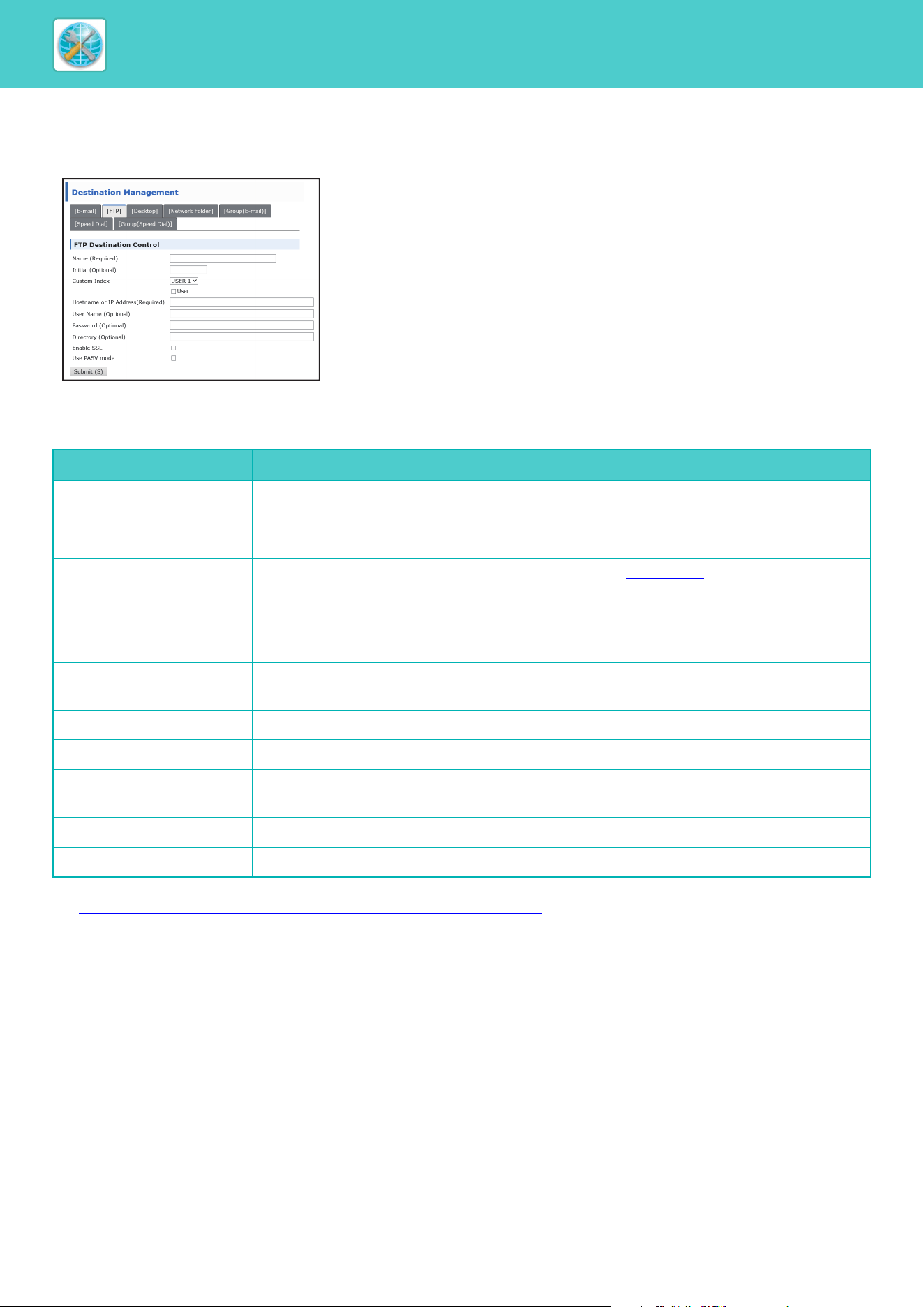
8-8
WEB PAGES►WEB FUNCTIONS IN THE MACHINE
Storing destinations for Scan to FTP
Click [FTP], and enter the destination information.
For the settings, see the following table.
FTP destination information
* If you entered a host name in "Hostname or IP Address", you will need to enter the DNS server settings.
► CONFIGURING SMTP, DNS AND LDAP SERVER SETTINGS (page 8-15)
Item Description
Name (Required) Enter the name of the destination (up to 36 characters).
Initial (Optional) Enter initial text for the destination (maximum of 10 characters). When the destination list is
displayed in the destination control screen, the initial text is used to group the destinations.
Custom Index Names can be assigned to the custom indexes as desired (►page 8-3), allowing convenient
grouping of destinations.
Drop down list: Select a custom index for the destination to be stored.
User checkbox: When this is selected, the destination is stored in the user tab of the
address book. (►page 5-8)
Hostname or IP Address
(Required)*
Enter the IP address or host name of the FTP server (maximum of 127 characters).
User Name (Optional) Enter the login user name for the FTP server (maximum of 32 characters).
Password (Optional) Enter the login password for the FTP server (maximum of 32 characters).
Directory (Optional) If you wish to specify a destination directory on the FTP server, enter the directory
(maximum of 200 characters).
Enable SSL Select this checkbox to use SSL communication.
Use PASV mode Select this checkbox to use PASV mode.
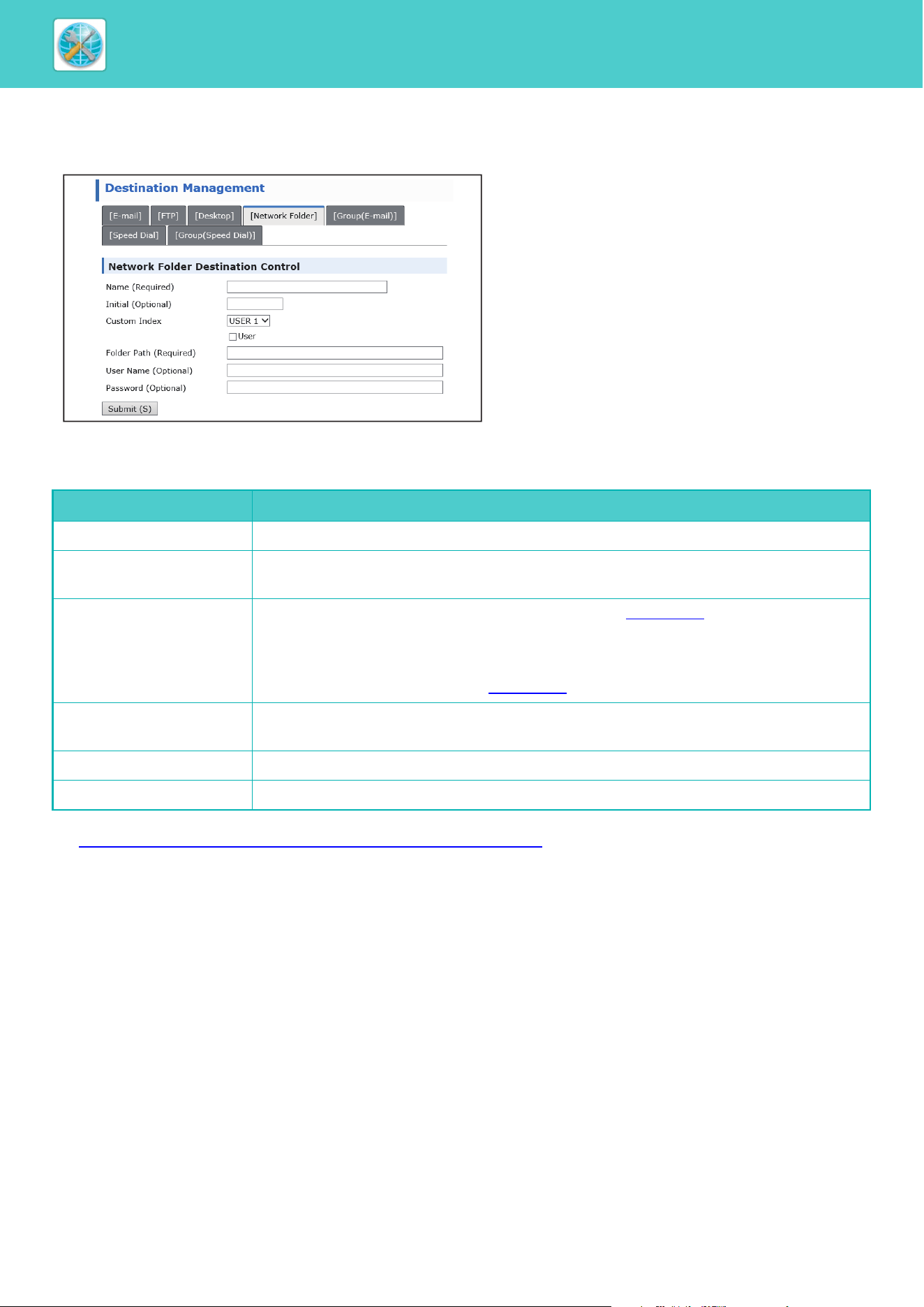
8-9
WEB PAGES►WEB FUNCTIONS IN THE MACHINE
Storing destinations for Network folder
Click [Network folder], and enter the destination information.
For the settings, see the following table.
Network folder destination information
* If you entered a host name in "Hostname or IP Address", you will need to enter the DNS server settings.
► CONFIGURING SMTP, DNS AND LDAP SERVER SETTINGS (page 8-15)
Item Description
Name (Required) Enter the name of the destination (up to 36 characters).
Initial (Optional) Enter initial text for the destination (maximum of 10 characters). When the destination list is
displayed in the destination control screen, the initial text is used to group the destinations.
Custom Index Names can be assigned to the custom indexes as desired (►page 8-3), allowing convenient
grouping of destinations.
Drop down list: Select a custom index for the destination to be stored.
User checkbox: When this is selected, the destination is stored in the user tab of the
address book. (►page 5-8)
Hostname or IP Address
(Required)*
Enter the IP address or host name of the network folder (maximum of 127 characters).
User Name (Optional) Enter the login user name for the network folder (maximum of 32 characters).
Password (Optional) Enter the login password for the network folder (maximum of 32 characters).
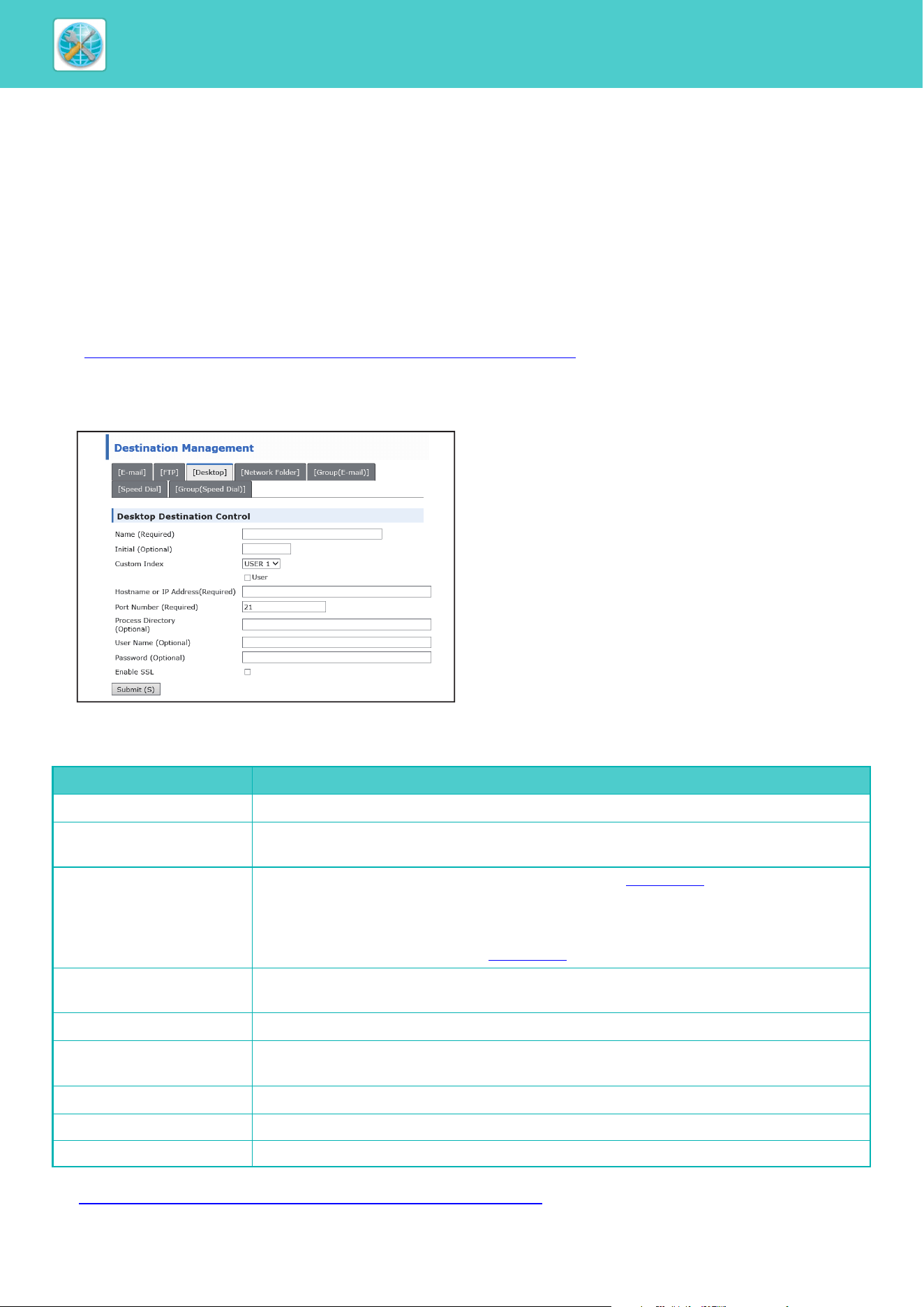
8-10
WEB PAGES►WEB FUNCTIONS IN THE MACHINE
Storing destinations for Scan to Desktop
The destination for Scan to Desktop is stored by the Sharp Network Scanner Tool Setup Wizard when "Network
Scanner Tool" is installed in your computer. For this reason, there is no need to store the Scan to Desktop destination in
the Web page. (Network Scanner Tool can be downloaded from the Sharp website.)
For information on Scan to Desktop system requirements, installing the Network Scanner Tool, and storing the
destination, see the "Sharpdesk installation guide".
Normally your computer is stored as the destination by the method indicated above.
The following page for storing Scan to Desktop destination information appears when [Destination] is selected in the
menu frame, followed by [Desktop]. This page is used mainly by the system administrator in the following circumstance.
• When another machine that also has the network expansion kit is added to your network and you wish to send an
image scanned on the new machine to a destination stored on the existing machine
See Editing and deleting programmed transmission destinations (page 8-12)
to select the Scan to Desktop destination
information that you wish to use on the new machine and enter the displayed information in this screen in the new
machine. (When you have completed all entries, click [Submit].)
If there are several destinations that you wish to use on the new machine, repeat this procedure as needed.
If the information entered here differs from the
information entered on the host computer,
transmission/reception will not be possible.
For the settings, see the following table.
Scan to Desktop destination information
* If you entered a host name in "Hostname or IP Address", you will need to enter the DNS server settings.
► CONFIGURING SMTP, DNS AND LDAP SERVER SETTINGS (page 8-15)
Item Description
Name (Required)
Enter the name of the destination (up to 36 characters).
Initial (Optional)
Enter initial text for the destination (maximum of 10 characters). When the destination list is
displayed in the destination control screen, the initial text is used to group the destinations.
Custom Index
Names can be assigned to the custom indexes as desired (►page 8-3), allowing convenient
grouping of destinations.
Drop down list: Select a custom index for the destination to be stored.
User checkbox: When this is selected, the destination is stored in the user tab of the
address book. (►page 5-8)
Hostname or IP Address
(Required)*
Enter the IP address or host name of the FTP server (maximum of 127 characters).
Port Number (Required)
Enter a port number from 0 to 65535 for the desktop network scanner tool.
Process Directory
(Optional)
Enter the destination directory name for the file (maximum of 200 characters). The file will be
processed in this directory after it is received.
User Name (Optional)
Enter the login user name for the network scanner tool (maximum of 32 characters).
Password (Optional) Enter the login password for the network scanner tool (maximum of 32 characters).
Enable SSL Select this checkbox to use SSL communication.
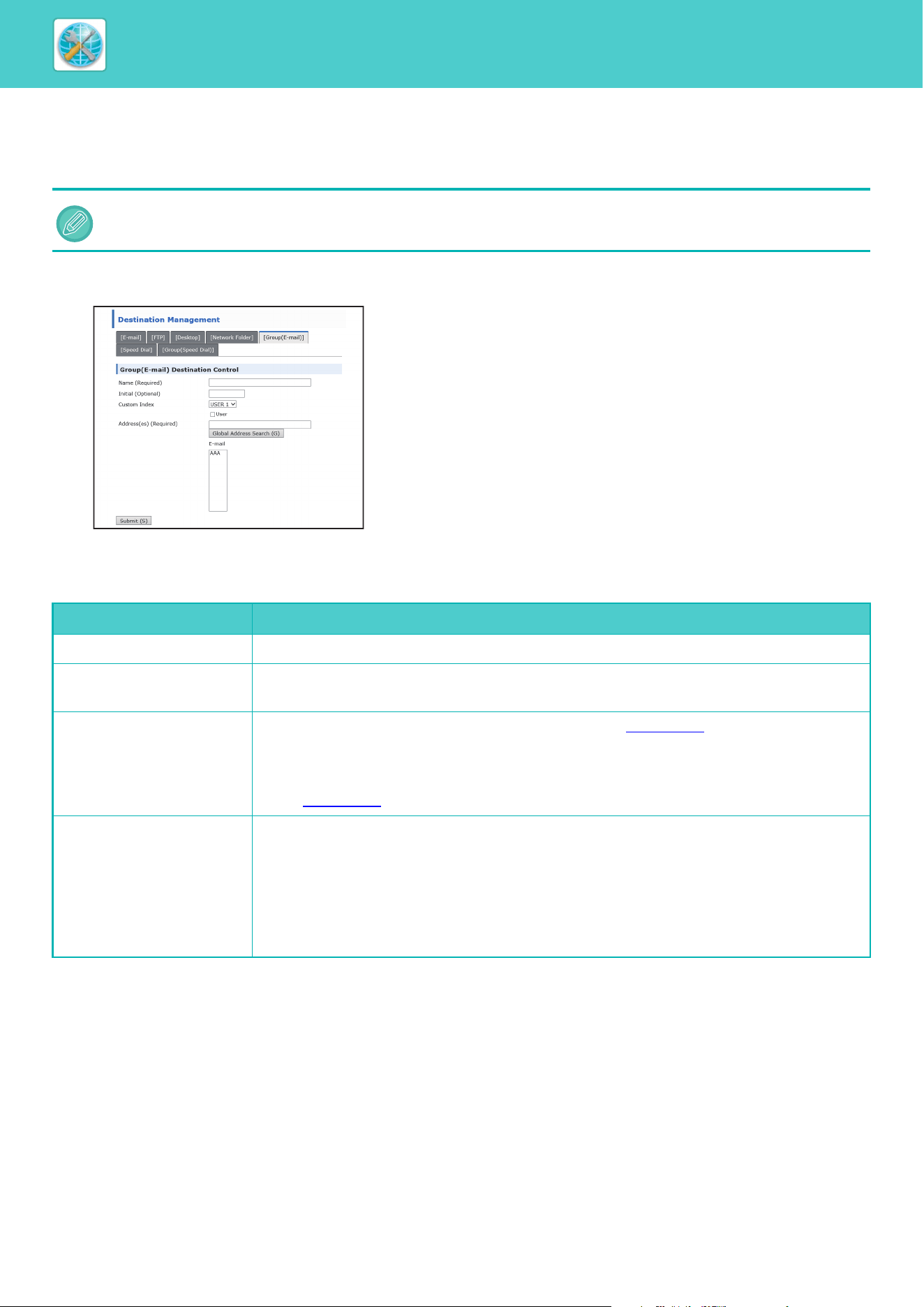
8-11
WEB PAGES►WEB FUNCTIONS IN THE MACHINE
Storing Groups (Scan to E-mail)
You can send a scanned image to multiple e-mail destinations in a single Scan to E-mail operation. If you frequently
transmit to a fixed group of destinations, you can store the destinations as a group.
Click [Group(E-mail)], and enter the destination information.
For the settings, see the following table.
Storing a group of destinations
Up to 100 destinations can be stored in one group.
Item Description
Name (Required) Enter a name for the group (up to 36 characters).
Initial (Optional) Enter initial text for the destinations (maximum of 10 characters). When the destination list is
displayed in the destination control screen, the initial text is used to group the destinations.
Custom Index Names can be assigned to the custom indexes as desired (►page 8-3), allowing convenient
grouping of destinations.
Drop down list:Select a custom index for the destination to be stored.
User checkbox:When this is selected, the destination is stored in the user tab of the address
book. (►page 5-8)
Address(es) (Required) Select the address of each destination from the "E-mail" list box. Programmed e-mail
destinations appear in each of the destination lists. To select multiple destinations, click each
address while holding down the [Ctrl] key on the keyboard. If you need to cancel an address that
has been selected, click the address again while holding down the [Ctrl] key.
If an LDAP server is being used, you can click the [Global Address Search] button to search for
an address on the LDAP server. Multiple e-mail addresses can be entered. Separate the e-mail
addresses with a comma (,), semi-colon (;), space ( ), or colon (:).
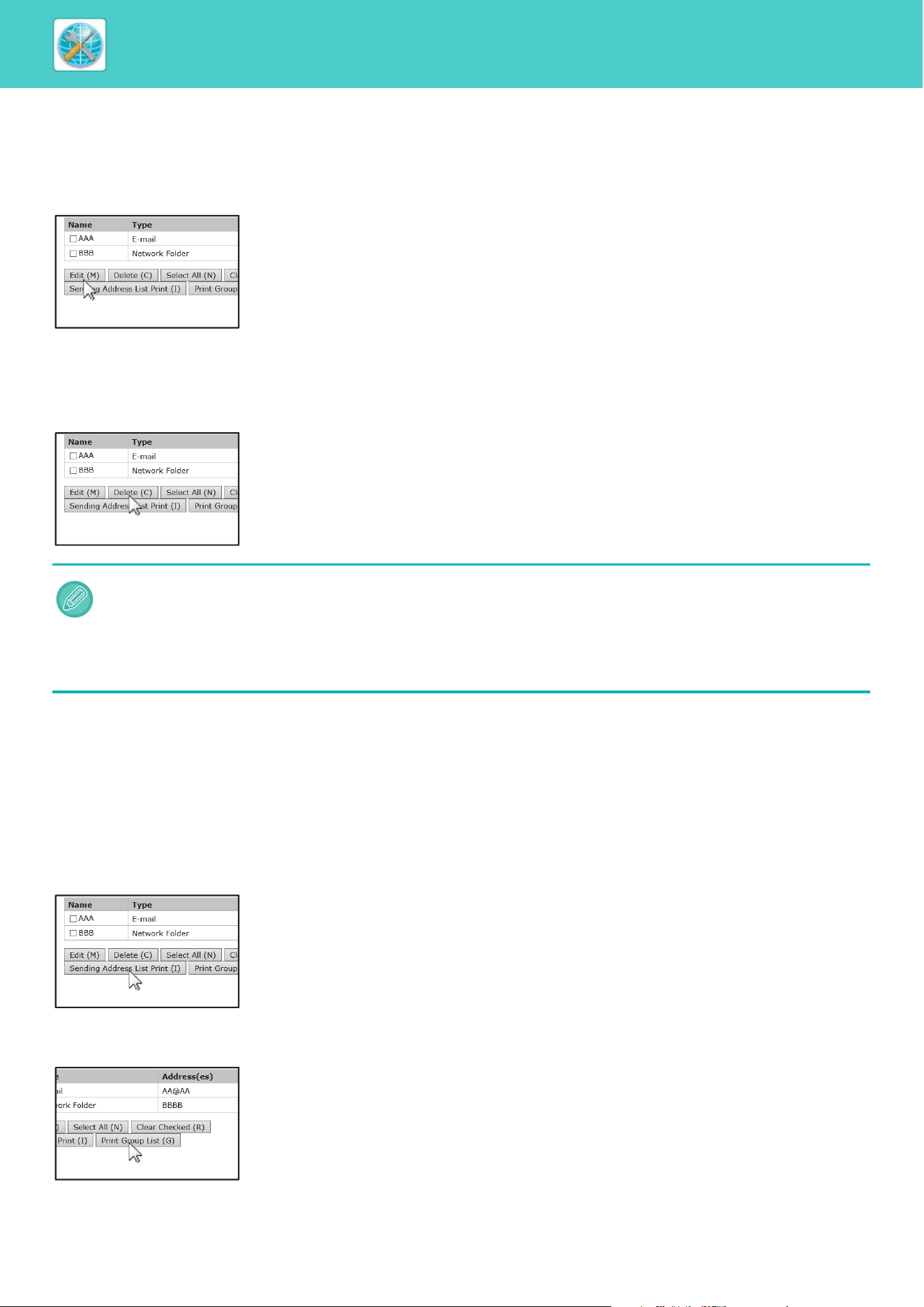
8-12
WEB PAGES►WEB FUNCTIONS IN THE MACHINE
Editing and deleting programmed transmission destinations
To edit or delete programmed destinations, click [Destination] in the menu frame of the Web page.
To edit the selected destination, click [Edit] at the bottom of the Destinations List.
The programming screen of the destination selected appears. Edit the information in the
same way as you initially stored it.
To delete the selected destination, click [Delete] at the bottom of the Destinations
List.
Printing lists of programmed destinations
You can print lists showing the destinations that have been programmed.
The following lists can be printed.
• Destination List: Shows the information programmed in e-mail, FTP, desktop, and group destinations.
• Print group list: Shows only the information programmed in group (e-mail) destinations.
To print the individual list, click [Sending Address List Print] at the bottom of the
destinations list.
To print the group list, click [Print Group List] at the bottom of the destinations list.
If you attempt to delete a programmed destination in the following situations, a warning message will appear and deletion will
not be possible.
• The destination is included in a group.
If the destination is being used for a current transmission, cancel the transmission or wait until it is completed and then
delete the destination. If the destination is included in a group, delete the destination from the group and then delete the
destination.
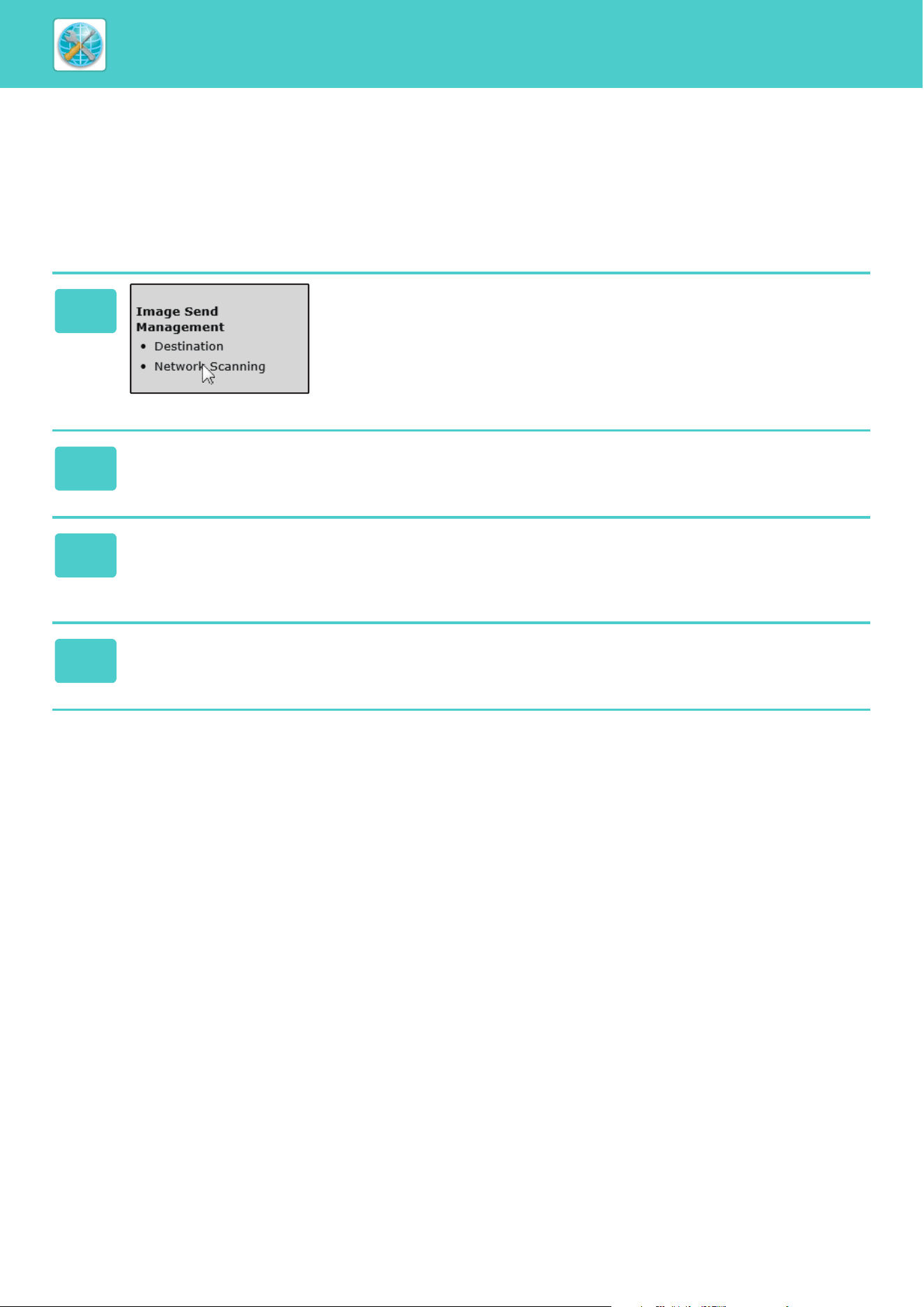
8-13
WEB PAGES►WEB FUNCTIONS IN THE MACHINE
BASIC SETTINGS FOR NETWORK SCAN
(FOR THE ADMINISTRATOR)
To use the Network Scan function, setting from the Web page is required.
Click the menu frame and configure the required settings. A password is required to access this screen.
These settings should only be configured by the network administrator.
1
Click [Network Scanning] in the menu frame.
The Network Scanning setup page appears.
2
Select the scanner mode.
In the "Enable Scanner Delivery to:" field, click the checkbox so that a checkmark appears in the checkbox.
3
Select the method for assigning a file name to a scanned image.
Select the method for assigning a file name to a scanned image. In "File Naming", click the items that you wish to use in
the file name. "Date & Time" is initially selected.
4
Click [Submit].
After entering the settings, be sure to click [Submit] to store them.
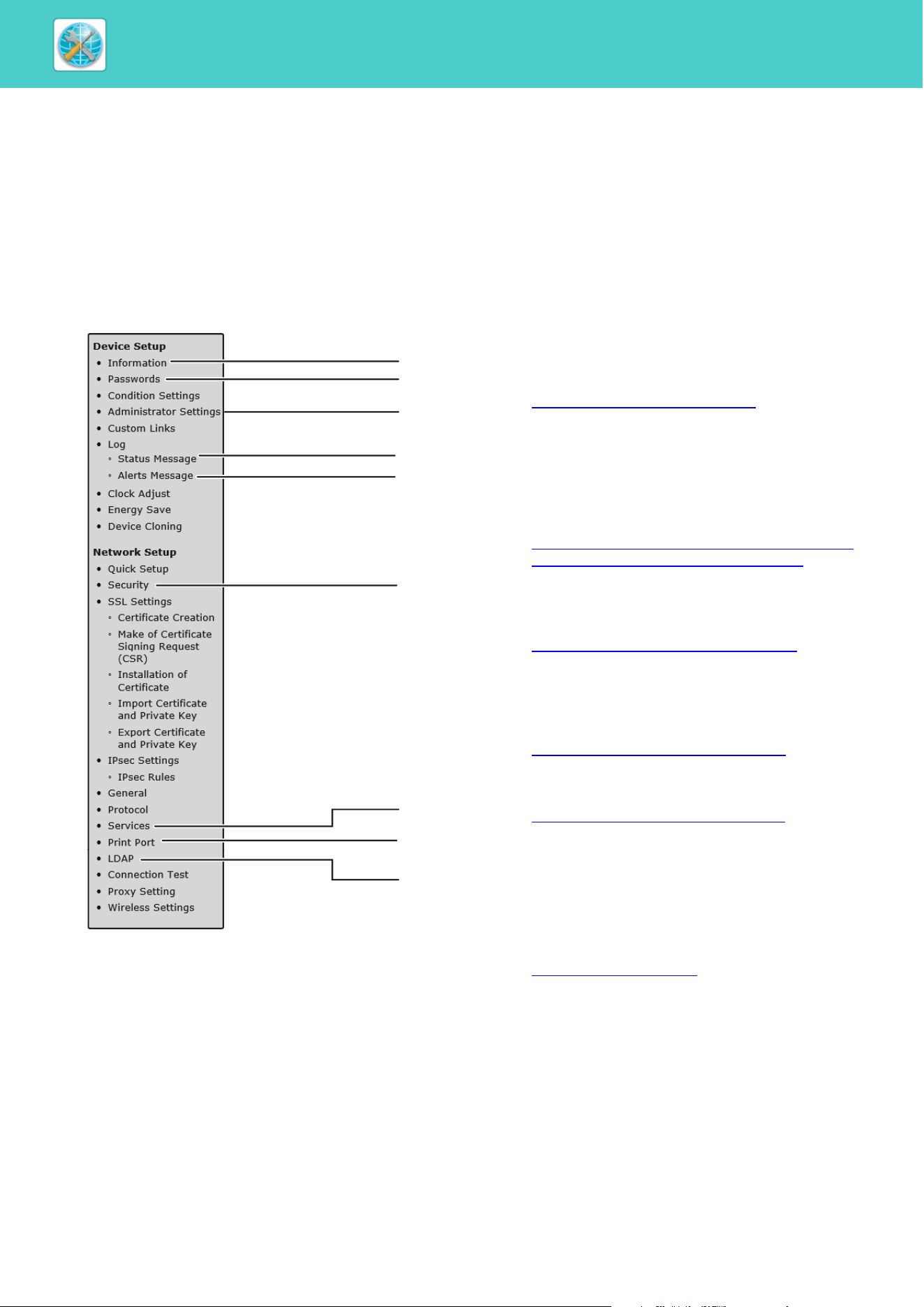
8-14
WEB PAGES►WEB FUNCTIONS IN THE MACHINE
ABOUT THE WEB PAGES
(FOR THE ADMINISTRATOR)
In addition to the menus that appear for users, other menus that can only be used by the administrator appear in the
administrator Web pages.
A menu frame appears on the left side of the page. When you click an item in the menu, a screen appears in the right
frame that allows you to configure settings for that item. Settings that can only be configured by the administrator are
explained here.
(1) Information
Configure machine identification information for the status
& alert E-mail function.
► INFORMATION SETUP (page 8-19)
(2) Passwords
To protect the Web site, the system administrator can
establish passwords. Enter a password that you would like
to establish and click the [Submit] button.
One password can be established for the administrator
and one password can be established for users.
► PROTECTING INFORMATION PROGRAMMED IN
THE WEB PAGE ([Passwords]) (page 8-16)
(3) Administrator Settings
Setting changes can be prohibited and interface settings
can be configured.
► ADMINISTRATOR SETTINGS (page 8-17)
(4) Status Message
Configure parameters required for sending status
messages, such as destination addresses and time
schedules.
► STATUS MESSAGE SETUP (page 8-20)
(5) Alerts Message
Store destination addresses for alert messages.
► ALERTS MESSAGE SETUP (page 8-20)
(6) Security
Unused ports can be disabled for greater security and port
numbers can be changed.
(7) Services
Configure information concerning the e-mail , DNS,
SNMP, Kerberos and mDNS system.
► SMTP SETUP (page 8-19)
(8) Print Port
Configure settings for LPD, Raw, WSD and FTP print.
(9) LDAP
Configure settings for LDAP.
(1)
(2)
(4)
(5)
(6)
(3)
(7)
(8)
(9)
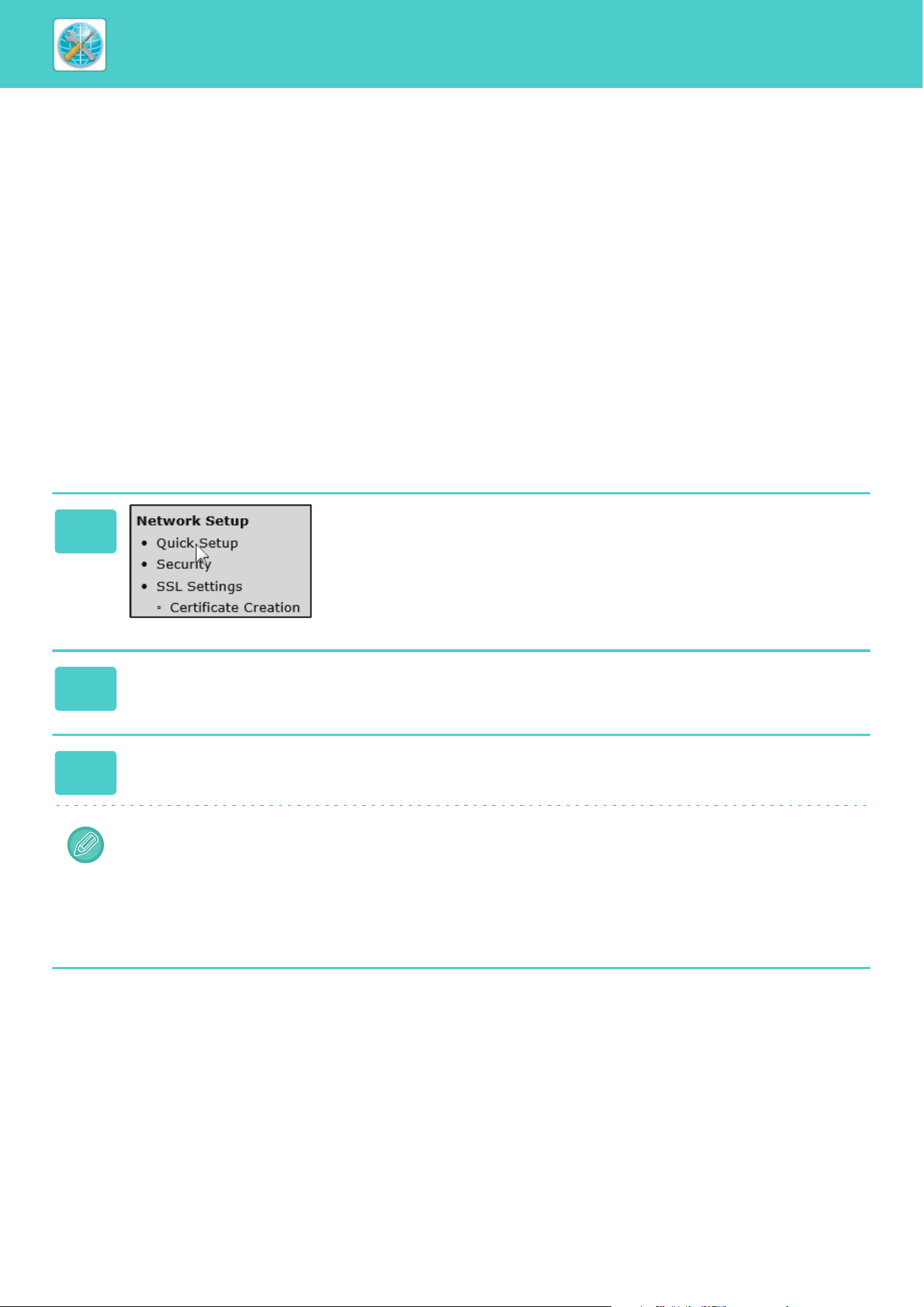
8-15
WEB PAGES►WEB FUNCTIONS IN THE MACHINE
CONFIGURING SMTP, DNS AND LDAP
SERVER SETTINGS
The procedures for using [Quick Setup] are explained here. [Quick Setup] is used to quickly configure only the required
settings for "SMTP", "DNS", and "LDAP" servers. These settings are normally configured first.
SMTP server: SMTP is used to transmit e-mail that is sent using Scan to E-mail.
To use these transmission methods, your SMTP server settings must be configured.
DNS server: If you entered a host name in "Primary SMTP Server" or "Secondary SMTP Server" of "SMTP", you
must also configure your DNS server settings.
You will also need to configure your DNS server settings if host names will be entered in "Hostname
or IP Address" when storing destinations for Scan to Desktop.
LDAP server: If mail addresses are managed on your network by an LDAP server, the e-mail addresses stored in
the LDAP server can be used for Scan to E-mail.
To allow the machine to use the e-mail addresses in the LDAP server, the LDAP server settings
must be configured in the Web page.
1
Click [Quick Setup] in the menu frame.
2
Enter the required information in "SMTP", "DNS" and "LDAP".
3
When you have completed all of the entries, click [Submit].
The entries will be stored.
If you need to configure advanced settings for the SMTP, DNS, and LDAP servers, follow the procedures below.
• Configuring SMTP and DNS server settings
Click [Services] in the menu frame to display the services setup screen. Select the desired server and then configure
the required parameters for that server.
• Configuring LDAP server settings
Click [LDAP] in the menu frame to display the LDAP setup screen. Configure the required parameters.
8-16
WEB PAGES►WEB FUNCTIONS IN THE MACHINE
PROTECTING INFORMATION
PROGRAMMED IN THE WEB PAGE
([Passwords])
Passwords can be set (click [Passwords] in the menu frame) to restrict Web page access and protect settings.
The administrator must change the password from the factory default setting. The administrator must also take care to
remember the new password. The next time the Web pages are accessed, the new password must be entered.
A password can be set for the administrator and a password can be set for users.
1
Click [Passwords] in the menu frame.
2
Enter the current password in "Admin Password".
When establishing a password for the first time, enter "admin" in "Admin Password".
Be sure to enter "admin" in lower case (passwords are case sensitive).
3
Enter passwords in "User Password" and "Admin Password".
• A maximum of 255 characters and/or numbers can be entered for each password (passwords are case sensitive).
• Be sure to enter the same password in "Confirm Password" as you did in "New Password".
4
When you have finished entering all items, click [Submit].
The entered password is stored.
After setting the password, turn the machine power off and then back on.
When prompted to enter a user name, a user should enter "users" and an administrator should enter "admin" in "User
Name". In "Password", the respective password for the entered user name should be entered.
8-17
WEB PAGES►WEB FUNCTIONS IN THE MACHINE
ADMINISTRATOR SETTINGS
The administrator settings are used to prohibit changes to the [Condition Settings] and to configure interface settings.
• "Default settings"
: Select the setting for which you wish to prohibit changes.
• "Paper Weight" : The temperature of toner fusing is controlled according to the weight of the paper that is used.
• "Interface settings"
: Enable monitoring of data sent to the network port and set restrictions.
CONFIGURING A SETTING IN THE ADMINISTRATOR
SETTINGS
ADMINISTRATOR SETTINGS
When "YES, NO" appears in the "Settings" column, "YES" is selected when a checkmark appears in the checkbox of the
item, and "NO" is selected when checkmark does not appear.
Default settings
1
Click [Administrator Settings] in the menu frame.
The "Default Settings" screen of the [Administrator Settings] will appear. If you wish to select a setting in the "Default
Settings" screen, go to step 3.
2
Click the desired setting, and make a selection for the setting in the screen
that appears.
See "ADMINISTRATOR SETTINGS (page 8-17)" for descriptions of the settings.
3
Click [Submit] to store the entered information.
Item Settings Description
Prohibit Test Page Printing YES, NO This setting is used to prohibit printing of a printer test page.
Disable Default Setting
Changes
YES, NO This setting is used to prohibit changes to the default condition settings.
A4/Letter Size Auto Change YES, NO When printing an 8-1/2" x 11" size image, this setting allows A4 size
paper to be used if 8-1/2" x 11" size paper is not loaded.
Enable Detected Paper Size
in Bypass Tray
YES, NO This is used to prohibit printing when the paper size specified for a print
job is different from the paper size inserted in the bypass tray.
Enable Selected Paper Type
in Bypass Tray
YES, NO This is used to prohibit printing when the paper type specified for a print
job is different from the paper type inserted in the bypass tray.
List Prints 1-Sided, 2-Sided
Print
When printing lists and reports, switch between 1-sided printing and
2-sided printing.
8-18
WEB PAGES►WEB FUNCTIONS IN THE MACHINE
Paper Weight
Plain Paper Settings
Interface settings
Item Settings Description
Paper Weight 16 - 24 lb
(60 - 89 g/m
2
)
24+ - 28 lb.
(90 - 105 g/m
2
)
These are used to control the toner fusing temperature according to the
weight of the paper.
Item Settings Description
Plain Paper Settings Plain 1,
Plain 2
Set the weight of the plain paper to be used. The weight of Plain Paper 1
is 16 - 24 lb. (60 - 89g/m
2
), and the weight of Plain Paper 2 is 24+ - 28 lb.
(90 - 105g/m
2
).
Item Settings Description
I/O Timeout 1- 60 - 999 (sec) During reception of a print job, if remaining data is not received after the
time set here elapses, the port connection is broken and the next print job
is begun.
Emulation Switching Auto, PostScript,
PCL
Select the printer language. When [Auto] is selected, the language is
automatically selected from the data sent to the printer. Unless errors
occur frequently, do not change the setting from [Auto] to another setting.
Port Switching Method Switch at End of
Job
, Switch after
I/O Timeout
Select the method for switching network ports.
8-19
WEB PAGES►WEB FUNCTIONS IN THE MACHINE
E-MAIL STATUS AND E-MAIL ALERT
SETTINGS
These functions send information on machine use (print count, copy count, etc.) and error conditions (paper misfeed,
out of paper, out of toner, etc.) via e-mail to the administrator of the machine or the dealer.
INFORMATION SETUP
Machine identification information for the status and alert e-mail functions is configured in the "Information Setup"
screen. The entered information will be included in status and alert e-mail messages.
SMTP SETUP
The Status and alert e-mail functions use SMTP (Simple Mail Transport Protocol) to send e-mail. The following
procedure is used to set up the e-mail environment. This must be done by the system administrator or other person
familiar with the network.
1
Click [Information] in the menu frame.
The "Information Setup" screen will appear.
2
Enter the machine information.
3
Click [Submit] to store the entered information.
1
Click [Services] in the menu frame.
The "Services Setup" screen will appear.
2
Click [SMTP].
3
Enter the information required to set up the e-mail environment.
4
Click [Submit] to store the entered information.
8-20
WEB PAGES►WEB FUNCTIONS IN THE MACHINE
STATUS MESSAGE SETUP
Use the status message function to send the current counter information, including the copy count, print count, and total
output count, based on the specified schedule. The destinations can be set for administrators and dealers respectively.
ALERTS MESSAGE SETUP
Use the alert message function to send alert information, such as empty toner and paper and trouble including paper misfeeds,
to specified destinations when such problems occur. The destinations can be set for administrators and dealers respectively.
To set up the alert message, follow the procedure below.
1
Click [Status Message] in the menu frame.
The "Status Message Setup" screen will appear.
2
Enter the required information, including the destination addresses and time
schedule.
3
Click [Submit] to store the entered information.
When the E-mail Status settings are completed, printer count information will be sent periodically by e-mail to the
specified e-mail addresses.
If you quit the browser before clicking [Submit], the settings will be canceled. To send printer information immediately to
the specified e-mail addresses, click [Send Now].
1
Click [Alerts Message] in the menu frame.
The "Alerts Message Setup" screen will appear.
2
Enter the destination addresses.
3
Click [Submit] to store the entered information.
If these parameters are set, event information for the printer will be transmitted to the specified addresses via E-mail
each time a specified event occurs. The meaning of each event item is shown below.
(Example)
Paper Jam: A paper misfeed has occurred.
Toner Low: Toner is low.
Toner Empty: Toner must be added.
Paper Empty: Paper must be loaded.
If you quit the browser before clicking [Submit], the settings will be canceled.

LICENSE INFORMATION
Information on the Software License for This Product
Software composition
The software included in this product is comprised of various software components whose individual copyrights are held
by SHARP or by third parties.
Software developed by SHARP and open source software
The copyrights for the software components and various relevant documents included with this product that were
developed or written by SHARP are owned by SHARP and are protected by the Copyright Act, international treaties, and
other relevant laws. This product also makes use of freely distributed software and software components whose
copyrights are held by third parties. These include software components covered by a GNU General Public License
(hereafter GPL), a GNU Lesser General Public License (hereafter LGPL) or other license agreement.
Obtaining source code
Some of the open source software licensors require the distributor to provide the source code with the executable
software components. GPL and LGPL include similar requirements. For information on obtaining the source code for the
open source software and for obtaining the GPL, LGPL, and other license agreement information, visit the following
website:
http://sharp-world.com/products/copier/source/download/index.html
We are unable to answer any questions about the source code for the open source software. The source code for the
software components whose copyrights are held by SHARP is not distributed.
Software Copyrights
Copyright (c) 2000 Carnegie Mellon University. All rights reserved.
Redistribution and use in source and binary forms, with or without modification, are permitted provided that the following
conditions are met:
1.Redistributions of source code must retain the above copyright notice, this list of conditions and the following
disclaimer.
2.Redistributions in binary form must reproduce the above copyright notice, this list of conditions and the following
disclaimer in the documentation and/or other materials provided with the distribution.
3.The name "Carnegie Mellon University" must not be used to endorse or promote products derived from this software
without prior written permission. For permission or any other legal details, please contact
Office of Technology Transfer Carnegie Mellon University 5000 Forbes Avenue Pittsburgh, PA 15213-3890
(412) 268-4387, fax: (412) 268-7395
tech-transfer@andrew.cmu.edu
4.Redistributions of any form whatsoever must retain the following acknowledgment:
"This product includes software developed by Computing Services at Carnegie Mellon University
(http://www.cmu.edu/computing/)."
CARNEGIE MELLON UNIVERSITY DISCLAIMS ALL WARRANTIES WITH REGARD TO THIS SOFTWARE,
INCLUDING ALL IMPLIED WARRANTIES OF MERCHANTABILITY AND FITNESS, IN NO EVENT SHALL CARNEGIE
MELLON UNIVERSITY BE LIABLE FOR ANY SPECIAL, INDIRECT OR CONSEQUENTIAL DAMAGES OR ANY
DAMAGES WHATSOEVER RESULTING FROM LOSS OF USE, DATA OR PROFITS, WHETHER IN AN ACTION OF
CONTRACT, NEGLIGENCE OR OTHER TORTIOUS ACTION, ARISING OUT OF OR IN CONNECTION WITH THE
USE OR PERFORMANCE OF THIS SOFTWARE.

Copyright (c) 1995 - 2008 Kungliga Tekniska Högskolan (Royal Institute of Technology,
Stockholm, Sweden). All rights reserved.
All rights reserved. Export of this software from the United States of America may require a specific license from the
United States Government. It is the responsibility of any person or organization contemplating export to obtain such a
license before exporting.
WITHIN THAT CONSTRAINT, permission to use, copy, modify, and distribute this software and its documentation for
any purpose and without fee is hereby granted, provided that the above copyright notice appear in all copies and that
both that copyright notice and this permission notice appear in supporting documentation, and that the name of M.I.T.
not be used in advertising or publicity pertaining to distribution of the software without specific, written prior permission.
Furthermore if you modify this software you must label your software as modified software and not distribute it in such a
fashion that it might be confused with the original MIT software. M.I.T. makes no representations about the suitability of
this software for any purpose. It is provided "as is" without express or implied warranty.
THIS SOFTWARE IS PROVIDED "AS IS" AND WITHOUT ANY EXPRESS OR IMPLIED WARRANTIES, INCLUDING,
WITHOUT LIMITATION, THE IMPLIED WARRANTIES OF MERCHANTIBILITY AND FITNESS FOR A PARTICULAR
PURPOSE.
Individual source code files are copyright MIT, Cygnus Support, OpenVision, Oracle, Sun Soft, FundsXpress, and
others.
Project Athena, Athena, Athena MUSE, Discuss, Hesiod, Kerberos, Moira, and Zephyr are trademarks of the
Massachusetts Institute of Technology (MIT). No commercial use of these trademarks may be made without prior written
permission of MIT.
"Commercial use" means use of a name in a product or other for-profit manner. It does NOT prevent a commercial firm
from referring to the MIT trademarks in order to convey information (although in doing so, recognition of their trademark
status should be given).
OpenSSL License
---------------
Copyright (c) 1998-2004 The OpenSSL Project. All rights reserved.
Redistribution and use in source and binary forms, with or without modification, are permitted provided that the following
conditions are met:
1.Redistributions of source code must retain the above copyright notice, this list of conditions and the following
disclaimer.
2.Redistributions in binary form must reproduce the above copyright notice, this list of conditions and the following
disclaimer in the documentation and/or other materials provided with the distribution.
3.All advertising materials mentioning features or use of this software must display the following acknowledgment: "This
product includes software developed by the OpenSSL Project for use in the OpenSSL Toolkit.
(http://www.openssl.org/)"
4.The names "OpenSSL Toolkit" and "OpenSSL Project" must not be used to endorse or promote products derived from
this software without prior written permission. For written permission, please contact openssl-core@openssl.org.
5.Products derived from this software may not be called "OpenSSL" nor may "OpenSSL" appear in their names without
prior written permission of the OpenSSL Project.
6.Redistributions of any form whatsoever must retain the following acknowledgment: "This product includes software
developed by the OpenSSL Project for use in the OpenSSL Toolkit. (http://www.openssl.org/
)"

THIS SOFTWARE IS PROVIDED BY THE OpenSSL PROJECT "AS IS" AND ANY EXPRESSED OR IMPLIED
WARRANTIES, INCLUDING, BUT NOT LIMITED TO, THE IMPLIED WARRANTIES OF MERCHANTABILITY AND
FITNESS FOR A PARTICULAR PURPOSE ARE DISCLAIMED. IN NO EVENT SHALL THE OpenSSL PROJECT OR
ITS CONTRIBUTORS BE LIABLE FOR ANY DIRECT, INDIRECT, INCIDENTAL, SPECIAL, EXEMPLARY, OR
CONSEQUENTIAL DAMAGES (INCLUDING, BUT NOT LIMITED TO, PROCUREMENT OF SUBSTITUTE GOODS
OR SERVICES; LOSS OF USE, DATA, OR PROFITS; OR BUSINESS INTERRUPTION) HOWEVER CAUSED AND
ON ANY THEORY OF LIABILITY, WHETHER IN CONTRACT, STRICT LIABILITY, OR TORT (INCLUDING
NEGLIGENCE OR OTHERWISE) ARISING IN ANY WAY OUT OF THE USE OF THIS SOFTWARE, EVEN IF
ADVISED OF THE POSSIBILITY OF SUCH DAMAGE.
This product includes cryptographic software written by Eric Young ([email protected]
). This product includes software
written by Tim Hudson (tjh@cryptsoft.com
).
Original SSLeay License
---------------
Copyright (C) 1995-1998 Eric Young ([email protected]) All rights reserved.
This package is an SSL implementation written by Eric Young ([email protected]). The implementation was written so
as to conform with Netscapes SSL.
This library is free for commercial and non-commercial use as long as the following conditions are aheared to. The
following conditions apply to all code found in this distribution, be it the RC4, RSA,lhash, DES, etc., code; not just the
SSL code. The SSL documentation included with this distribution is covered by the same copyright terms except that the
holder is Tim Hudson ([email protected]
).
Copyright remains Eric Young's, and as such any Copyright notices in the code are not to be removed. If this package is
used in a product, Eric Young should be given attribution as the author of the parts of the library used. This can be in the
form of a textual message at program startup or in documentation (online or textual) provided with the package.
Redistribution and use in source and binary forms, with or without modification, are permitted provided that the following
conditions are met:
1.Redistributions of source code must retain the copyright notice, this list of conditions and the following disclaimer.
2.Redistributions in binary form must reproduce the above copyright notice, this list of conditions and the following
disclaimer in the documentation and/or other materials provided with the distribution.
3.All advertising materials mentioning features or use of this software must display the following acknowledgement:
"This product includes cryptographic software written by Eric Young ([email protected]
)" The word 'cryptographic'
can be left out if the rouines from the library being used are not cryptographic related :-).
4.If you include any Windows specific code (or a derivative thereof) from the apps directory (application code) you must
include an acknowledgement: "This product includes software written by Tim Hudson (tjh@cryptsoft.com
)"
THIS SOFTWARE IS PROVIDED BY ERIC YOUNG "AS IS" AND ANY EXPRESS OR IMPLIED WARRANTIES,
INCLUDING, BUT NOT LIMITED TO, THE IMPLIED WARRANTIES OF MERCHANTABILITY AND FITNESS FOR A
PARTICULAR PURPOSE ARE DISCLAIMED. IN NO EVENT SHALL THE AUTHOR OR CONTRIBUTORS BE LIABLE
FOR ANY DIRECT, INDIRECT, INCIDENTAL, SPECIAL, EXEMPLARY, OR CONSEQUENTIAL DAMAGES
(INCLUDING, BUT NOT LIMITED TO, PROCUREMENT OF SUBSTITUTE GOODS OR SERVICES; LOSS OF USE,
DATA, OR PROFITS; OR BUSINESS INTERRUPTION) HOWEVER CAUSED AND ON ANY THEORY OF LIABILITY,
WHETHER IN CONTRACT, STRICT LIABILITY, OR TORT (INCLUDING NEGLIGENCE OR OTHERWISE) ARISING
IN ANY WAY OUT OF THE USE OF THIS SOFTWARE, EVEN IF ADVISED OF THE POSSIBILITY OF SUCH
DAMAGE.

The licence and distribution terms for any publically available version orderivative of this code cannot be changed. i.e.
this code cannot simply becopied and put under another distribution licence [including the GNU Public Licence.]
D3DES License
---------------
Copyright (c) 1988,1989,1990,1991,1992 by Richard Outerbridge. (GEnie : OUTER; CIS :
[71755,204]) Graven Imagery, 1992.
GNU GENERAL PUBLIC LICENSE
Version 2, June 1991
Copyright (C) 1989, 1991 Free Software Foundation, Inc., 51 Franklin Street, Fifth Floor, Boston, MA 02110-1301
USA Everyone is permitted to copy and distribute verbatim copies of this license document, but changing it is not
allowed.
Preamble
The licenses for most software are designed to take away your freedom to share and change it. By contrast, the GNU
General Public License is intended to guarantee your freedom to share and change free software--to make sure the
software is free for all its users. This General Public License applies to most of the Free Software Foundation's software
and to any other program whose authors commit to using it. (Some other Free Software Foundation software is covered
by the GNU Lesser General Public License instead.) You can apply it to your programs, too.
When we speak of free software, we are referring to freedom, not price. Our General Public Licenses are designed to
make sure that you have the freedom to distribute copies of free software (and charge for this service if you wish), that
you receive source code or can get it if you want it, that you can change the software or use pieces of it in new free
programs; and that you know you can do these things.
To protect your rights, we need to make restrictions that forbid anyone to deny you these rights or to ask you to
surrender the rights. These restrictions translate to certain responsibilities for you if you distribute copies of the software,
or if you modify it.
For example, if you distribute copies of such a program, whether gratis or for a fee, you must give the recipients all the
rights that you have. You must make sure that they, too, receive or can get the source code. And you must show them
these terms so they know their rights.
We protect your rights with two steps: (1) copyright the software, and (2) offer you this license which gives you legal
permission to copy, distribute and/or modify the software.
Also, for each author's protection and ours, we want to make certain that everyone understands that there is no
warranty for this free software. If the software is modified by someone else and passed on, we want its recipients to
know that what they have is not the original, so that any problems introduced by others will not reflect on the original
authors' reputations.

Finally, any free program is threatened constantly by software patents. We wish to avoid the danger that redistributors
of a free program will individually obtain patent licenses, in effect making the program proprietary. To prevent this, we
have made it clear that any patent must be licensed for everyone's free use or not licensed at all.
The precise terms and conditions for copying, distribution and modification follow.
GNU GENERAL PUBLIC LICENSE
TERMS AND CONDITIONS FOR COPYING, DISTRIBUTION AND MODIFICATION
0. This License applies to any program or other work which contains a notice placed by the copyright holder saying it
may be distributed under the terms of this General Public License. The "Program", below, refers to any such program or
work, and a "work based on the Program" means either the Program or any derivative work under copyright law: that is
to say, a work containing the Program or a portion of it, either verbatim or with modifications and/or translated into
another language. (Hereinafter, translation is included without limitation in the term "modification".) Each licensee is
addressed as "you".
Activities other than copying, distribution and modification are not covered by this License; they are outside its scope.
The act of running the Program is not restricted, and the output from the Program is covered only if its contents
constitute a work based on the Program (independent of having been made by running the Program). Whether that is
true depends on what the Program does.
1. You may copy and distribute verbatim copies of the Program's source code as you receive it, in any medium,
provided that you conspicuously and appropriately publish on each copy an appropriate copyright notice and disclaimer
of warranty; keep intact all the notices that refer to this License and to the absence of any warranty; and give any other
recipients of the Program a copy of this License along with the Program.
You may charge a fee for the physical act of transferring a copy, and you may at your option offer warranty protection in
exchange for a fee.
2. You may modify your copy or copies of the Program or any portion of it, thus forming a work based on the Program,
and copy and distribute such modifications or work under the terms of Section 1 above, provided that you also meet all
of these conditions:
a) You must cause the modified files to carry prominent notices stating that you changed the files and the date of any
change.
b) You must cause any work that you distribute or publish, that in whole or in part contains or is derived from the
Program or any part thereof, to be licensed as a whole at no charge to all third parties under the terms of this License.
c) If the modified program normally reads commands interactively when run, you must cause it, when started running
for such interactive use in the most ordinary way, to print or display an announcement including an appropriate
copyright notice and a notice that there is no warranty (or else, saying that you provide a warranty) and that users
may redistribute the program under these conditions, and telling the user how to view a copy of this License.
(Exception: if the Program itself is interactive but does not normally print such an announcement, your work based on
the Program is not required to print an announcement.)
These requirements apply to the modified work as a whole. If identifiable sections of that work are not derived from the
Program, and can be reasonably considered independent and separate works in themselves, then this License, and its
terms, do not apply to those sections when you distribute them as separate works. But when you distribute the same

sections as part of a whole which is a work based on the Program, the distribution of the whole must be on the terms of
this License, whose permissions for other licensees extend to the entire whole, and thus to each and every part
regardless of who wrote it.
Thus, it is not the intent of this section to claim rights or contest your rights to work written entirely by you; rather, the
intent is to exercise the right to control the distribution of derivative or collective works based on the Program.
In addition, mere aggregation of another work not based on the Program with the Program (or with a work based on the
Program) on a volume of a storage or distribution medium does not bring the other work under the scope of this License.
3. You may copy and distribute the Program (or a work based on it, under Section 2) in object code or executable form
under the terms of Sections 1 and 2 above provided that you also do one of the following:
a) Accompany it with the complete corresponding machine-readable source code, which must be distributed under
the terms of Sections 1 and 2 above on a medium customarily used for software interchange; or,
b) Accompany it with a written offer, valid for at least three years, to give any third party, for a charge no more than
your cost of physically performing source distribution, a complete machine-readable copy of the corresponding
source code, to be distributed under the terms of Sections 1 and 2 above on a medium customarily used for software
interchange; or,
c) Accompany it with the information you received as to the offer to distribute corresponding source code. (This
alternative is allowed only for noncommercial distribution and only if you received the program in object code or
executable form with such an offer, in accord with Subsection b above.)
The source code for a work means the preferred form of the work for making modifications to it. For an executable work,
complete source code means all the source code for all modules it contains, plus any associated interface definition
files, plus the scripts used to control compilation and installation of the executable. However, as a special exception, the
source code distributed need not include anything that is normally distributed (in either source or binary form) with the
major components (compiler, kernel, and so on) of the operating system on which the executable runs, unless that
component itself accompanies the executable.
If distribution of executable or object code is made by offering access to copy from a designated place, then offering
equivalent access to copy the source code from the same place counts as distribution of the source code, even though
third parties are not compelled to copy the source along with the object code.
4. You may not copy, modify, sublicense, or distribute the Program except as expressly provided under this License.
Any attempt otherwise to copy, modify, sublicense or distribute the Program is void, and will automatically terminate
your rights under this License. However, parties who have received copies, or rights, from you under this License will not
have their licenses terminated so long as such parties remain in full compliance.
5. You are not required to accept this License, since you have not signed it. However, nothing else grants you
permission to modify or distribute the Program or its derivative works. These actions are prohibited by law if you do not
accept this License. Therefore, by modifying or distributing the Program (or any work based on the Program), you
indicate your acceptance of this License to do so, and all its terms and conditions for copying, distributing or modifying
the Program or works based on it.
6. Each time you redistribute the Program (or any work based on the Program), the recipient automatically receives a
license from the original licensor to copy, distribute or modify the Program subject to these terms and conditions. You

may not impose any further restrictions on the recipients' exercise of the rights granted herein. You are not responsible
for enforcing compliance by third parties to this License.
7. If, as a consequence of a court judgment or allegation of patent infringement or for any other reason (not limited to
patent issues), conditions are imposed on you (whether by court order, agreement or otherwise) that contradict the
conditions of this License, they do not excuse you from the conditions of this License. If you cannot distribute so as to
satisfy simultaneously your obligations under this License and any other pertinent obligations, then as a consequence
you may not distribute the Program at all. For example, if a patent license would not permit royalty-free redistribution of
the Program by all those who receive copies directly or indirectly through you, then the only way you could satisfy both it
and this License would be to refrain entirely from distribution of the Program.
If any portion of this section is held invalid or unenforceable under any particular circumstance, the balance of the
section is intended to apply and the section as a whole is intended to apply in other circumstances.
It is not the purpose of this section to induce you to infringe any patents or other property right claims or to contest
validity of any such claims; this section has the sole purpose of protecting the integrity of the free software distribution
system, which is implemented by public license practices. Many people have made generous contributions to the wide
range of software distributed through that system in reliance on consistent application of that system; it is up to the
author/donor to decide if he or she is willing to distribute software through any other system and a licensee cannot
impose that choice.
This section is intended to make thoroughly clear what is believed to be a consequence of the rest of this License.
8. If the distribution and/or use of the Program is restricted in certain countries either by patents or by copyrighted
interfaces, the original copyright holder who places the Program under this License may add an explicit geographical
distribution limitation excluding those countries, so that distribution is permitted only in or among countries not thus
excluded. In such case, this License incorporates the limitation as if written in the body of this License.
9. The Free Software Foundation may publish revised and/or new versions of the General Public License from time to
time. Such new versions will be similar in spirit to the present version, but may differ in detail to address new problems
or concerns.
Each version is given a distinguishing version number. If the Program specifies a version number of this License which
applies to it and "any later version", you have the option of following the terms and conditions either of that version or of
any later version published by the Free Software Foundation. If the Program does not specify a version number of this
License, you may choose any version ever published by the Free Software Foundation.
10. If you wish to incorporate parts of the Program into other free programs whose distribution conditions are different,
write to the author to ask for permission. For software which is copyrighted by the Free Software Foundation, write to the
Free Software Foundation; we sometimes make exceptions for this. Our decision will be guided by the two goals of
preserving the free status of all derivatives of our free software and of promoting the sharing and reuse of software
generally.
NO WARRANTY
11. BECAUSE THE PROGRAM IS LICENSED FREE OF CHARGE, THERE IS NO WARRANTY FOR THE
PROGRAM, TO THE EXTENT PERMITTED BY APPLICABLE LAW. EXCEPT WHEN OTHERWISE STATED IN
WRITING THE COPYRIGHT HOLDERS AND/OR OTHER PARTIES PROVIDE THE PROGRAM "AS IS" WITHOUT
WARRANTY OF ANY KIND, EITHER EXPRESSED OR IMPLIED, INCLUDING, BUT NOT LIMITED TO, THE IMPLIED
WARRANTIES OF MERCHANTABILITY AND FITNESS FOR A PARTICULAR PURPOSE. THE ENTIRE RISK AS TO

THE QUALITY AND PERFORMANCE OF THE PROGRAM IS WITH YOU. SHOULD THE PROGRAM PROVE
DEFECTIVE, YOU ASSUME THE COST OF ALL NECESSARY SERVICING, REPAIR OR CORRECTION.
12. IN NO EVENT UNLESS REQUIRED BY APPLICABLE LAW OR AGREED TO IN WRITING WILL ANY
COPYRIGHT HOLDER, OR ANY OTHER PARTY WHO MAY MODIFY AND/OR REDISTRIBUTE THE PROGRAM AS
PERMITTED ABOVE, BE LIABLE TO YOU FOR DAMAGES, INCLUDING ANY GENERAL, SPECIAL, INCIDENTAL
OR CONSEQUENTIAL DAMAGES ARISING OUT OF THE USE OR INABILITY TO USE THE PROGRAM
(INCLUDING BUT NOT LIMITED TO LOSS OF DATA OR DATA BEING RENDERED INACCURATE OR LOSSES
SUSTAINED BY YOU OR THIRD PARTIES OR A FAILURE OF THE PROGRAM TO OPERATE WITH ANY OTHER
PROGRAMS), EVEN IF SUCH HOLDER OR OTHER PARTY HAS BEEN ADVISED OF THE POSSIBILITY OF SUCH
DAMAGES.
END OF TERMS AND CONDITIONS
How to Apply These Terms to Your New Programs
If you develop a new program, and you want it to be of the greatest possible use to the public, the best way to achieve
this is to make it free software which everyone can redistribute and change under these terms.
To do so, attach the following notices to the program. It is safest to attach them to the start of each source file to most
effectively convey the exclusion of warranty; and each file should have at least the "copyright" line and a pointer to
where the full notice is found.
<one line to give the program's name and a brief idea of what it does.> Copyright (C) <year> <name of author>
This program is free software; you can redistribute it and/or modify it under the terms of the GNU General Public
License as published by the Free Software Foundation; either version 2 of the License, or (at your option) any later
version.
This program is distributed in the hope that it will be useful, but WITHOUT ANY WARRANTY; without even the
implied warranty of MERCHANTABILITY or FITNESS FOR A PARTICULAR PURPOSE. See the GNU General
Public License for more details.
You should have received a copy of the GNU General Public License along with this program; if not, write to the Free
Software Foundation, Inc., 51 Franklin Street, Fifth Floor, Boston, MA 02110-1301 USA.
Also add information on how to contact you by electronic and paper mail.
If the program is interactive, make it output a short notice like this when it starts in an interactive mode:
Gnomovision version 69, Copyright (C) year name of author Gnomovision comes with ABSOLUTELY NO
WARRANTY; for details type `show w'. This is free software, and you are welcome to redistribute it under certain
conditions; type `show c' for details.
The hypothetical commands `show w' and `show c' should show the appropriate parts of the General Public License. Of
course, the commands you use may be called something other than `show w' and `show c'; they could even be
mouse-clicks or menu items--whatever suits your program.

You should also get your employer (if you work as a programmer) or your school, if any, to sign a "copyright disclaimer"
for the program, if necessary. Here is a sample; alter the names:
Yoyodyne, Inc., hereby disclaims all copyright interest in the program `Gnomovision' (which makes passes at
compilers) written by James Hacker.
<signature of Ty Coon>, 1 April 1989
Ty Coon, President of Vice
This General Public License does not permit incorporating your program into proprietary programs. If your program is a
subroutine library, you may consider it more useful to permit linking proprietary applications with the library. If this is
what you want to do, use the GNU Lesser General Public License instead of this License.
GNU LESSER GENERAL PUBLIC LICENSE
Version 2.1, February 1999
Copyright (C) 1991, 1999 Free Software Foundation, Inc. 51 Franklin Street, Fifth Floor, Boston, MA 02110-1301
USA Everyone is permitted to copy and distribute verbatim copies of this license document, but changing it is not
allowed.
[This is the first released version of the Lesser GPL. It also counts as the successor of the GNU Library Public
License, version 2, hence the version number 2.1.]
Preamble
The licenses for most software are designed to take away your freedom to share and change it. By contrast, the GNU
General Public Licenses are intended to guarantee your freedom to share and change free software--to make sure the
software is free for all its users.
This license, the Lesser General Public License, applies to some specially designated software packages--typically
libraries--of the Free Software Foundation and other authors who decide to use it. You can use it too, but we suggest
you first think carefully about whether this license or the ordinary General Public License is the better strategy to use in
any particular case, based on the explanations below.
When we speak of free software, we are referring to freedom of use, not price. Our General Public Licenses are
designed to make sure that you have the freedom to distribute copies of free software (and charge for this service if you
wish); that you receive source code or can get it if you want it; that you can change the software and use pieces of it in
new free programs; and that you are informed that you can do these things.
To protect your rights, we need to make restrictions that forbid distributors to deny you these rights or to ask you to
surrender these rights. These restrictions translate to certain responsibilities for you if you distribute copies of the library
or if you modify it.
For example, if you distribute copies of the library, whether gratis or for a fee, you must give the recipients all the rights
that we gave you. You must make sure that they, too, receive or can get the source code. If you link other code with the

library, you must provide complete object files to the recipients, so that they can relink them with the library after making
changes to the library and recompiling it. And you must show them these terms so they know their rights.
We protect your rights with a two-step method: (1) we copyright the library, and (2) we offer you this license, which
gives you legal permission to copy, distribute and/or modify the library.
To protect each distributor, we want to make it very clear that there is no warranty for the free library. Also, if the library
is modified by someone else and passed on, the recipients should know that what they have is not the original version,
so that the original author's reputation will not be affected by problems that might be introduced by others.
Finally, software patents pose a constant threat to the existence of any free program. We wish to make sure that a
company cannot effectively restrict the users of a free program by obtaining a restrictive license from a patent holder.
Therefore, we insist that any patent license obtained for a version of the library must be consistent with the full freedom
of use specified in this license.
Most GNU software, including some libraries, is covered by the ordinary GNU General Public License. This license, the
GNU Lesser General Public License, applies to certain designated libraries, and is quite different from the ordinary
General Public License. We use this license for certain libraries in order to permit linking those libraries into non-free
programs.
When a program is linked with a library, whether statically or using a shared library, the combination of the two is
legally speaking a combined work, a derivative of the original library. The ordinary General Public License therefore
permits such linking only if the entire combination fits its criteria of freedom. The Lesser General Public License permits
more lax criteria for linking other code with the library.
We call this license the "Lesser" General Public License because it does Less to protect the user's freedom than the
ordinary General Public License. It also provides other free software developers Less of an advantage over competing
non-free programs. These disadvantages are the reason we use the ordinary General Public License for many libraries.
However, the Lesser license provides advantages in certain special circumstances.
For example, on rare occasions, there may be a special need to encourage the widest possible use of a certain library,
so that it becomes a de-facto standard. To achieve this, non-free programs must be allowed to use the library. A more
frequent case is that a free library does the same job as widely used non-free libraries. In this case, there is little to gain
by limiting the free library to free software only, so we use the Lesser General Public License.
In other cases, permission to use a particular library in non-free programs enables a greater number of people to use a
large body of free software. For example, permission to use the GNU C Library in non-free programs enables many
more people to use the whole GNU operating system, as well as its variant, the GNU/Linux operating system.
Although the Lesser General Public License is Less protective of the users' freedom, it does ensure that the user of a
program that is linked with the Library has the freedom and the wherewithal to run that program using a modified version
of the Library.

The precise terms and conditions for copying, distribution and modification follow. Pay close attention to the difference
between a "work based on the library" and a "work that uses the library". The former contains code derived from the
library, whereas the latter must be combined with the library in order to run.
GNU LESSER GENERAL PUBLIC LICENSE
TERMS AND CONDITIONS FOR COPYING, DISTRIBUTION AND MODIFICATION
0. This License Agreement applies to any software library or other program which contains a notice placed by the
copyright holder or other authorized party saying it may be distributed under the terms of this Lesser General Public
License (also called "this License"). Each licensee is addressed as "you".
A "library" means a collection of software functions and/or data prepared so as to be conveniently linked with
application programs (which use some of those functions and data) to form executables.
The "Library", below, refers to any such software library or work which has been distributed under these terms. A "work
based on the Library" means either the Library or any derivative work under copyright law: that is to say, a work
containing the Library or a portion of it, either verbatim or with modifications and/or translated straightforwardly into
another language. (Hereinafter, translation is included without limitation in the term "modification".)
"Source code" for a work means the preferred form of the work for making modifications to it. For a library, complete
source code means all the source code for all modules it contains, plus any associated interface definition files, plus the
scripts used to control compilation and installation of the library.
Activities other than copying, distribution and modification are not covered by this License; they are outside its scope.
The act of running a program using the Library is not restricted, and output from such a program is covered only if its
contents constitute a work based on the Library (independent of the use of the Library in a tool for writing it). Whether
that is true depends on what the Library does and what the program that uses the Library does.
1. You may copy and distribute verbatim copies of the Library's complete source code as you receive it, in any medium,
provided that you conspicuously and appropriately publish on each copy an appropriate copyright notice and disclaimer
of warranty; keep intact all the notices that refer to this License and to the absence of any warranty; and distribute a copy
of this License along with the Library.
You may charge a fee for the physical act of transferring a copy, and you may at your option offer warranty protection
in exchange for a fee.
2. You may modify your copy or copies of the Library or any portion of it, thus forming a work based on the Library, and
copy and distribute such modifications or work under the terms of Section 1 above, provided that you also meet all of
these conditions:
a) The modified work must itself be a software library.
b) You must cause the files modified to carry prominent notices stating that you changed the files and the date of any
change.

c) You must cause the whole of the work to be licensed at no charge to all third parties under the terms of this
License.
d) If a facility in the modified Library refers to a function or a table of data to be supplied by an application program
that uses the facility, other than as an argument passed when the facility is invoked, then you must make a good faith
effort to ensure that, in the event an application does not supply such function or table, the facility still operates, and
performs whatever part of its purpose remains meaningful.
(For example, a function in a library to compute square roots has a purpose that is entirely well-defined independent
of the application. Therefore, Subsection 2d requires that any application-supplied function or table used by this
function must be optional: if the application does not supply it, the square root function must still compute square
roots.)
These requirements apply to the modified work as a whole. If identifiable sections of that work are not derived from the
Library, and can be reasonably considered independent and separate works in themselves, then this License, and its
terms, do not apply to those sections when you distribute them as separate works. But when you distribute the same
sections as part of a whole which is a work based on the Library, the distribution of the whole must be on the terms of
this License, whose permissions for other licensees extend to the entire whole, and thus to each and every part
regardless of who wrote it.
Thus, it is not the intent of this section to claim rights or contest your rights to work written entirely by you; rather, the
intent is to exercise the right to control the distribution of derivative or collective works based on the Library.
In addition, mere aggregation of another work not based on the Library with the Library (or with a work based on the
Library) on a volume of a storage or distribution medium does not bring the other work under the scope of this License.
3. You may opt to apply the terms of the ordinary GNU General Public License instead of this License to a given copy
of the Library. To do this, you must alter all the notices that refer to this License, so that they refer to the ordinary GNU
General Public License, version 2, instead of to this License. (If a newer version than version 2 of the ordinary GNU
General Public License has appeared, then you can specify that version instead if you wish.) Do not make any other
change in these notices.
Once this change is made in a given copy, it is irreversible for that copy, so the ordinary GNU General Public License
applies to all subsequent copies and derivative works made from that copy.
This option is useful when you wish to copy part of the code of the Library into a program that is not a library.
4. You may copy and distribute the Library (or a portion or derivative of it, under Section 2) in object code or executable
form under the terms of Sections 1 and 2 above provided that you accompany it with the complete corresponding
machine-readable source code, which must be distributed under the terms of Sections 1 and 2 above on a medium
customarily used for software interchange.
If distribution of object code is made by offering access to copy from a designated place, then offering equivalent
access to copy the source code from the same place satisfies the requirement to distribute the source code, even
though third parties are not compelled to copy the source along with the object code.
5. A program that contains no derivative of any portion of the Library, but is designed to work with the Library by being
compiled or linked with it, is called a "work that uses the Library". Such a work, in isolation, is not a derivative work of the
Library, and therefore falls outside the scope of this License.

However, linking a "work that uses the Library" with the Library creates an executable that is a derivative of the Library
(because it contains portions of the Library), rather than a "work that uses the library". The executable is therefore
covered by this License. Section 6 states terms for distribution of such executables.
When a "work that uses the Library" uses material from a header file that is part of the Library, the object code for the
work may be a derivative work of the Library even though the source code is not. Whether this is true is especially
significant if the work can be linked without the Library, or if the work is itself a library. The threshold for this to be true is
not precisely defined by law.
If such an object file uses only numerical parameters, data structure layouts and accessors, and small macros and
small inline functions (ten lines or less in length), then the use of the object file is unrestricted, regardless of whether it is
legally a derivative work. (Executables containing this object code plus portions of the Library will still fall under Section
6.)
Otherwise, if the work is a derivative of the Library, you may distribute the object code for the work under the terms of
Section 6. Any executables containing that work also fall under Section 6, whether or not they are linked directly with the
Library itself.
6. As an exception to the Sections above, you may also combine or link a "work that uses the Library" with the Library
to produce a work containing portions of the Library, and distribute that work under terms of your choice, provided that
the terms permit modification of the work for the customer's own use and reverse engineering for debugging such
modifications.
You must give prominent notice with each copy of the work that the Library is used in it and that the Library and its use
are covered by this License. You must supply a copy of this License. If the work during execution displays copyright
notices, you must include the copyright notice for the Library among them, as well as a reference directing the user to
the copy of this License. Also, you must do one of these things:
a) Accompany the work with the complete corresponding machine-readable source code for the Library including
whatever changes were used in the work (which must be distributed under Sections 1 and 2 above); and, if the work
is an executable linked with the Library, with the complete machine-readable "work that uses the Library", as object
code and/or source code, so that the user can modify the Library and then relink to produce a modified executable
containing the modified Library. (It is understood that the user who changes the contents of definitions files in the
Library will not necessarily be able to recompile the application to use the modified definitions.)
b) Use a suitable shared library mechanism for linking with the Library. A suitable mechanism is one that (1) uses at
run time a copy of the library already present on the user's computer system, rather than copying library functions into
the executable, and (2) will operate properly with a modified version of the library, if the user installs one, as long as
the modified version is interface-compatible with the version that the work was made with.
c) Accompany the work with a written offer, valid for at least three years, to give the same user the materials specified
in Subsection 6a, above, for a charge no more than the cost of performing this distribution.
d) If distribution of the work is made by offering access to copy from a designated place, offer equivalent access to
copy the above specified materials from the same place.
e) Verify that the user has already received a copy of these materials or that you have already sent this user a copy.

For an executable, the required form of the "work that uses the Library" must include any data and utility programs
needed for reproducing the executable from it. However, as a special exception, the materials to be distributed need not
include anything that is normally distributed (in either source or binary form) with the major components (compiler,
kernel, and so on) of the operating system on which the executable runs, unless that component itself accompanies the
executable.
It may happen that this requirement contradicts the license restrictions of other proprietary libraries that do not normally
accompany the operating system. Such a contradiction means you cannot use both them and the Library together in an
executable that you distribute.
7. You may place library facilities that are a work based on the Library side-by-side in a single library together with
other library facilities not covered by this License, and distribute such a combined library, provided that the separate
distribution of the work based on the Library and of the other library facilities is otherwise permitted, and provided that
you do these two things:
a) Accompany the combined library with a copy of the same work based on the Library, uncombined with any other
library facilities. This must be distributed under the terms of the Sections above.
b) Give prominent notice with the combined library of the fact that part of it is a work based on the Library, and
explaining where to find the accompanying uncombined form of the same work.
8. You may not copy, modify, sublicense, link with, or distribute the Library except as expressly provided under this
License. Any attempt otherwise to copy, modify, sublicense, link with, or distribute the Library is void, and will
automatically terminate your rights under this License. However, parties who have received copies, or rights, from you
under this License will not have their licenses terminated so long as such parties remain in full compliance.
9. You are not required to accept this License, since you have not signed it. However, nothing else grants you
permission to modify or distribute the Library or its derivative works. These actions are prohibited by law if you do not
accept this License. Therefore, by modifying or distributing the Library (or any work based on the Library), you indicate
your acceptance of this License to do so, and all its terms and conditions for copying, distributing or modifying the
Library or works based on it.
10. Each time you redistribute the Library (or any work based on the Library), the recipient automatically receives a
license from the original licensor to copy, distribute, link with or modify the Library subject to these terms and conditions.
You may not impose any further restrictions on the recipients' exercise of the rights granted herein. You are not
responsible for enforcing compliance by third parties with this License.
11. If, as a consequence of a court judgment or allegation of patent infringement or for any other reason (not limited to
patent issues), conditions are imposed on you (whether by court order, agreement or otherwise) that contradict the
conditions of this License, they do not excuse you from the conditions of this License. If you cannot distribute so as to
satisfy simultaneously your obligations under this License and any other pertinent obligations, then as a consequence
you may not distribute the Library at all. For example, if a patent license would not permit royalty-free redistribution of the
Library by all those who receive copies directly or indirectly through you, then the only way you could satisfy both it and
this License would be to refrain entirely from distribution of the Library.

If any portion of this section is held invalid or unenforceable under any particular circumstance, the balance of the
section is intended to apply, and the section as a whole is intended to apply in other circumstances.
It is not the purpose of this section to induce you to infringe any patents or other property right claims or to contest
validity of any such claims; this section has the sole purpose of protecting the integrity of the free software distribution
system which is implemented by public license practices. Many people have made generous contributions to the wide
range of software distributed through that system in reliance on consistent application of that system; it is up to the
author/donor to decide if he or she is willing to distribute software through any other system and a licensee cannot
impose that choice.
This section is intended to make thoroughly clear what is believed to be a consequence of the rest of this License.
12. If the distribution and/or use of the Library is restricted in certain countries either by patents or by copyrighted
interfaces, the original copyright holder who places the Library under this License may add an explicit geographical
distribution limitation excluding those countries, so that distribution is permitted only in or among countries not thus
excluded. In such case, this License incorporates the limitation as if written in the body of this License.
13. The Free Software Foundation may publish revised and/or new versions of the Lesser General Public License from
time to time. Such new versions will be similar in spirit to the present version, but may differ in detail to address new
problems or concerns.
Each version is given a distinguishing version number. If the Library specifies a version number of this License which
applies to it and "any later version", you have the option of following the terms and conditions either of that version or of
any later version published by the Free Software Foundation. If the Library does not specify a license version number,
you may choose any version ever published by the Free Software Foundation.
14. If you wish to incorporate parts of the Library into other free programs whose distribution conditions are
incompatible with these, write to the author to ask for permission. For software which is copyrighted by the Free
Software Foundation, write to the Free Software Foundation; we sometimes make exceptions for this. Our decision will
be guided by the two goals of preserving the free status of all derivatives of our free software and of promoting the
sharing and reuse of software generally.
NO WARRANTY
15. BECAUSE THE LIBRARY IS LICENSED FREE OF CHARGE, THERE IS NO WARRANTY FOR THE LIBRARY,
TO THE EXTENT PERMITTED BY APPLICABLE LAW. EXCEPT WHEN OTHERWISE STATED IN WRITING THE
COPYRIGHT HOLDERS AND/OR OTHER PARTIES PROVIDE THE LIBRARY "AS IS" WITHOUT WARRANTY OF
ANY KIND, EITHER EXPRESSED OR IMPLIED, INCLUDING, BUT NOT LIMITED TO, THE IMPLIED WARRANTIES
OF MERCHANTABILITY AND FITNESS FOR A PARTICULAR PURPOSE. THE ENTIRE RISK AS TO THE QUALITY
AND PERFORMANCE OF THE LIBRARY IS WITH YOU. SHOULD THE LIBRARY PROVE DEFECTIVE, YOU
ASSUME THE COST OF ALL NECESSARY SERVICING, REPAIR OR CORRECTION.
16. IN NO EVENT UNLESS REQUIRED BY APPLICABLE LAW OR AGREED TO IN WRITING WILL ANY
COPYRIGHT HOLDER, OR ANY OTHER PARTY WHO MAY MODIFY AND/OR REDISTRIBUTE THE LIBRARY AS
PERMITTED ABOVE, BE LIABLE TO YOU FOR DAMAGES, INCLUDING ANY GENERAL, SPECIAL, INCIDENTAL
OR CONSEQUENTIAL DAMAGES ARISING OUT OF THE USE OR INABILITY TO USE THE LIBRARY (INCLUDING
BUT NOT LIMITED TO LOSS OF DATA OR DATA BEING RENDERED INACCURATE OR LOSSES SUSTAINED BY

YOU OR THIRD PARTIES OR A FAILURE OF THE LIBRARY TO OPERATE WITH ANY OTHER SOFTWARE), EVEN
IF SUCH HOLDER OR OTHER PARTY HAS BEEN ADVISED OF THE POSSIBILITY OF SUCH DAMAGES.
END OF TERMS AND CONDITIONS
How to Apply These Terms to Your New Libraries
If you develop a new library, and you want it to be of the greatest possible use to the public, we recommend making it
free software that everyone can redistribute and change. You can do so by permitting redistribution under these terms
(or, alternatively, under the terms of the ordinary General Public License).
To apply these terms, attach the following notices to the library. It is safest to attach them to the start of each source file
to most effectively convey the exclusion of warranty; and each file should have at least the "copyright" line and a pointer
to where the full notice is found.
<one line to give the library's name and a brief idea of what it does.> Copyright (C) <year> <name of author>
This library is free software; you can redistribute it and/or modify it under the terms of the GNU Lesser General Public
License as published by the Free Software Foundation; either version 2.1 of the License, or (at your option) any later
version.
This library is distributed in the hope that it will be useful, but WITHOUT ANY WARRANTY; without even the implied
warranty of MERCHANTABILITY or FITNESS FOR A PARTICULAR PURPOSE. See the GNU Lesser General
Public License for more details.
You should have received a copy of the GNU Lesser General Public License along with this library; if not, write to the
Free Software Foundation, Inc., 51 Franklin Street, Fifth Floor, Boston, MA 02110-1301 USA
Also add information on how to contact you by electronic and paper mail.
You should also get your employer (if you work as a programmer) or your school, if any, to sign a "copyright disclaimer"
for the library, if necessary. Here is a sample; alter the names:
Yoyodyne, Inc., hereby disclaims all copyright interest in the library `Frob' (a library for tweaking knobs) written by
James Random Hacker.
<signature of Ty Coon>, 1 April 1990
Ty Coon, President of Vice
That's all there is to it!

GNU GENERAL PUBLIC LICENSE
Version 3, 29 June 2007
Copyright (C) 2007 Free Software Foundation, Inc. <http://fsf.org/>
Everyone is permitted to copy and distribute verbatim copies of this license document, but changing it is not allowed.
Preamble
The GNU General Public License is a free, copyleft license for software and other kinds of works.
The licenses for most software and other practical works are designed to take away your freedom to share and
change the works. By contrast, the GNU General Public License is intended to guarantee your freedom to share and
change all versions of a program--to make sure it remains free software for all its users. We, the Free Software
Foundation, use the GNU General Public License for most of our software; it applies also to any other work released this
way by its authors. You can apply it to your programs, too.
When we speak of free software, we are referring to freedom, not price. Our General Public Licenses are designed to
make sure that you have the freedom to distribute copies of free software (and charge for them if you wish), that you
receive source code or can get it if you want it, that you can change the software or use pieces of it in new free
programs, and that you know you can do these things.
To protect your rights, we need to prevent others from denying you these rights or asking you to surrender the rights.
Therefore, you have certain responsibilities if you distribute copies of the software, or if you modify it: responsibilities to
respect the freedom of others.
For example, if you distribute copies of such a program, whether gratis or for a fee, you must pass on to the recipients
the same freedoms that you received. You must make sure that they, too, receive or can get the source code. And you
must show them these terms so they know their rights.
Developers that use the GNU GPL protect your rights with two steps:
(1) assert copyright on the software, and (2) offer you this License giving you legal permission to copy, distribute and/or
modify it.
For the developers' and authors' protection, the GPL clearly explains that there is no warranty for this free software. For
both users' and authors' sake, the GPL requires that modified versions be marked as changed, so that their problems
will not be attributed erroneously to authors of previous versions.
Some devices are designed to deny users access to install or run modified versions of the software inside them,
although the manufacturer can do so. This is fundamentally incompatible with the aim of protecting users' freedom to
change the software. The systematic pattern of such abuse occurs in the area of products for individuals to use, which is
precisely where it is most unacceptable. Therefore, we have designed this version of the GPL to prohibit the practice for
those products. If such problems arise substantially in other domains, we stand ready to extend this provision to those
domains in future versions of the GPL, as needed to protect the freedom of users.
Finally, every program is threatened constantly by software patents. States should not allow patents to restrict
development and use of software on general-purpose computers, but in those that do, we wish to avoid the special
danger that patents applied to a free program could make it effectively proprietary. To prevent this, the GPL assures that
patents cannot be used to render the program non-free.
The precise terms and conditions for copying, distribution and modification follow.
TERMS AND CONDITIONS
0. Definitions.

"This License" refers to version 3 of the GNU General Public License.
"Copyright" also means copyright-like laws that apply to other kinds of works, such as semiconductor masks.
"The Program" refers to any copyrightable work licensed under this License. Each licensee is addressed as "you".
"Licensees" and "recipients" may be individuals or organizations.
To "modify" a work means to copy from or adapt all or part of the work in a fashion requiring copyright permission, other
than the making of an exact copy. The resulting work is called a "modified version" of the earlier work or a work "based
on" the earlier work.
A "covered work" means either the unmodified Program or a work based on the Program.
To "propagate" a work means to do anything with it that, without permission, would make you directly or secondarily
liable for infringement under applicable copyright law, except executing it on a computer or modifying a private copy.
Propagation includes copying, distribution (with or without modification), making available to the public, and in some
countries other activities as well.
To "convey" a work means any kind of propagation that enables other parties to make or receive copies. Mere
interaction with a user through a computer network, with no transfer of a copy, is not conveying.
An interactive user interface displays "Appropriate Legal Notices" to the extent that it includes a convenient and
prominently visible feature that (1) displays an appropriate copyright notice, and (2) tells the user that there is no
warranty for the work (except to the extent that warranties are provided), that licensees may convey the work under this
License, and how to view a copy of this License. If the interface presents a list of user commands or options, such as a
menu, a prominent item in the list meets this criterion.
1. Source Code.
The "source code" for a work means the preferred form of the work for making modifications to it. "Object code" means
any non-source form of a work.
A "Standard Interface" means an interface that either is an official standard defined by a recognized standards body,
or, in the case of interfaces specified for a particular programming language, one that is widely used among developers
working in that language.
The "System Libraries" of an executable work include anything, other than the work as a whole, that (a) is included in
the normal form of packaging a Major Component, but which is not part of that Major Component, and (b) serves only to
enable use of the work with that Major Component, or to implement a Standard Interface for which an implementation is
available to the public in source code form. A "Major Component", in this context, means a major essential component
(kernel, window system, and so on) of the specific operating system (if any) on which the executable work runs, or a
compiler used to produce the work, or an object code interpreter used to run it.
The "Corresponding Source" for a work in object code form means all the source code needed to generate, install, and
(for an executable work) run the object code and to modify the work, including scripts to control those activities.
However, it does not include the work's System Libraries, or general-purpose tools or generally available free programs
which are used unmodified in performing those activities but which are not part of the work. For example, Corresponding
Source includes interface definition files associated with source files for the work, and the source code for shared
libraries and dynamically linked subprograms that the work is specifically designed to require, such as by intimate data
communication or control flow between those subprograms and other parts of the work.
The Corresponding Source need not include anything that users can regenerate automatically from other parts of the
Corresponding Source.

The Corresponding Source for a work in source code form is that same work.
2. Basic Permissions.
All rights granted under this License are granted for the term of copyright on the Program, and are irrevocable provided
the stated conditions are met. This License explicitly affirms your unlimited permission to run the unmodified Program.
The output from running a covered work is covered by this License only if the output, given its content, constitutes a
covered work. This License acknowledges your rights of fair use or other equivalent, as provided by copyright law.
You may make, run and propagate covered works that you do not convey, without conditions so long as your license
otherwise remains in force. You may convey covered works to others for the sole purpose of having them make
modifications exclusively for you, or provide you with facilities for running those works, provided that you comply with the
terms of this License in conveying all material for which you do not control copyright. Those thus making or running the
covered works for you must do so exclusively on your behalf, under your direction and control, on terms that prohibit
them from making any copies of your copyrighted material outside their relationship with you.
Conveying under any other circumstances is permitted solely under the conditions stated below. Sublicensing is not
allowed; section 10 makes it unnecessary.
3. Protecting Users' Legal Rights From Anti-Circumvention Law.
No covered work shall be deemed part of an effective technological measure under any applicable law fulfilling
obligations under article 11 of the WIPO copyright treaty adopted on 20 December 1996, or similar laws prohibiting or
restricting circumvention of such measures.
When you convey a covered work, you waive any legal power to forbid circumvention of technological measures to the
extent such circumvention is effected by exercising rights under this License with respect to the covered work, and you
disclaim any intention to limit operation or modification of the work as a means of enforcing, against the work's users,
your or third parties' legal rights to forbid circumvention of technological measures.
4. Conveying Verbatim Copies.
You may convey verbatim copies of the Program's source code as you receive it, in any medium, provided that you
conspicuously and appropriately publish on each copy an appropriate copyright notice; keep intact all notices stating
that this License and any non-permissive terms added in accord with section 7 apply to the code; keep intact all notices
of the absence of any warranty; and give all recipients a copy of this License along with the Program.
You may charge any price or no price for each copy that you convey, and you may offer support or warranty protection
for a fee.
5. Conveying Modified Source Versions.
You may convey a work based on the Program, or the modifications to produce it from the Program, in the form of
source code under the terms of section 4, provided that you also meet all of these conditions:
a) The work must carry prominent notices stating that you modified it, and giving a relevant date.
b) The work must carry prominent notices stating that it is released under this License and any conditions added under
section
7. This requirement modifies the requirement in section 4 to "keep intact all notices".
c) You must license the entire work, as a whole, under this License to anyone who comes into possession of a copy.
This License will therefore apply, along with any applicable section 7 additional terms, to the whole of the work, and all
its parts, regardless of how they are packaged. This License gives no permission to license the work in any other way,
but it does not invalidate such permission if you have separately received it.

d) If the work has interactive user interfaces, each must display Appropriate Legal Notices; however, if the Program
has interactive interfaces that do not display Appropriate Legal Notices, your work need not make them do so.
A compilation of a covered work with other separate and independent works, which are not by their nature extensions
of the covered work, and which are not combined with it such as to form a larger program, in or on a volume of a storage
or distribution medium, is called an "aggregate" if the compilation and its resulting copyright are not used to limit the
access or legal rights of the compilation's users beyond what the individual works permit. Inclusion of a covered work in
an aggregate does not cause this License to apply to the other parts of the aggregate.
6. Conveying Non-Source Forms.
You may convey a covered work in object code form under the terms of sections 4 and 5, provided that you also
convey the machine-readable Corresponding Source under the terms of this License, in one of these ways:
a) Convey the object code in, or embodied in, a physical product (including a physical distribution medium),
accompanied by the Corresponding Source fixed on a durable physical medium customarily used for software
interchange.
b) Convey the object code in, or embodied in, a physical product (including a physical distribution medium),
accompanied by a written offer, valid for at least three years and valid for as long as you offer spare parts or customer
support for that product model, to give anyone who possesses the object code either (1) a copy of the Corresponding
Source for all the software in the product that is covered by this License, on a durable physical medium customarily used
for software interchange, for a price no more than your reasonable cost of physically performing this conveying of
source, or (2) access to copy the Corresponding Source from a network server at no charge.
c) Convey individual copies of the object code with a copy of the written offer to provide the Corresponding Source.
This alternative is allowed only occasionally and noncommercially, and only if you received the object code with such an
offer, in accord with subsection 6b.
d) Convey the object code by offering access from a designated place (gratis or for a charge), and offer equivalent
access to the Corresponding Source in the same way through the same place at no further charge. You need not require
recipients to copy the Corresponding Source along with the object code. If the place to copy the object code is a network
server, the Corresponding Source may be on a different server (operated by you or a third party) that supports
equivalent copying facilities, provided you maintain clear directions next to the object code saying where to find the
Corresponding Source. Regardless of what server hosts the Corresponding Source, you remain obligated to ensure that
it is available for as long as needed to satisfy these requirements.
e) Convey the object code using peer-to-peer transmission, provided you inform other peers where the object code
and Corresponding Source of the work are being offered to the general public at no charge under subsection 6d.
A separable portion of the object code, whose source code is excluded from the Corresponding Source as a System
Library, need not be included in conveying the object code work.
A "User Product" is either (1) a "consumer product", which means any tangible personal property which is normally
used for personal, family, or household purposes, or (2) anything designed or sold for incorporation into a dwelling. In
determining whether a product is a consumer product, doubtful cases shall be resolved in favor of coverage. For a
particular product received by a particular user, "normally used" refers to a typical or common use of that class of
product, regardless of the status of the particular user or of the way in which the particular user actually uses, or expects
or is expected to use, the product. A product is a consumer product regardless of whether the product has substantial
commercial, industrial or non-consumer uses, unless such uses represent the only significant mode of use of the
product.
"Installation Information" for a User Product means any methods, procedures, authorization keys, or other information
required to install and execute modified versions of a covered work in that User Product from a modified version of its

Corresponding Source. The information must suffice to ensure that the continued functioning of the modified object code
is in no case prevented or interfered with solely because modification has been made.
If you convey an object code work under this section in, or with, or specifically for use in, a User Product, and the
conveying occurs as part of a transaction in which the right of possession and use of the User Product is transferred to
the recipient in perpetuity or for a fixed term (regardless of how the transaction is characterized), the Corresponding
Source conveyed under this section must be accompanied by the Installation Information. But this requirement does not
apply if neither you nor any third party retains the ability to install modified object code on the User Product (for example,
the work has been installed in ROM).
The requirement to provide Installation Information does not include a requirement to continue to provide support
service, warranty, or updates for a work that has been modified or installed by the recipient, or for the User Product in
which it has been modified or installed. Access to a network may be denied when the modification itself materially and
adversely affects the operation of the network or violates the rules and protocols for communication across the network.
Corresponding Source conveyed, and Installation Information provided, in accord with this section must be in a format
that is publicly documented (and with an implementation available to the public in source code form), and must require
no special password or key for unpacking, reading or copying.
7. Additional Terms.
"Additional permissions" are terms that supplement the terms of this License by making exceptions from one or more of
its conditions. Additional permissions that are applicable to the entire Program shall be treated as though they were
included in this License, to the extent that they are valid under applicable law. If additional permissions apply only to part
of the Program, that part may be used separately under those permissions, but the entire Program remains governed by
this License without regard to the additional permissions.
When you convey a copy of a covered work, you may at your option remove any additional permissions from that copy,
or from any part of it. (Additional permissions may be written to require their own removal in certain cases when you
modify the work.) You may place additional permissions on material, added by you to a covered work, for which you
have or can give appropriate copyright permission.
Notwithstanding any other provision of this License, for material you add to a covered work, you may (if authorized by
the copyright holders of that material) supplement the terms of this License with terms:
a) Disclaiming warranty or limiting liability differently from the terms of sections 15 and 16 of this License; or
b) Requiring preservation of specified reasonable legal notices or author attributions in that material or in the
Appropriate Legal Notices displayed by works containing it; or
c) Prohibiting misrepresentation of the origin of that material, or requiring that modified versions of such material be
marked in reasonable ways as different from the original version; or
d) Limiting the use for publicity purposes of names of licensors or authors of the material; or
e) Declining to grant rights under trademark law for use of some trade names, trademarks, or service marks; or
f) Requiring indemnification of licensors and authors of that material by anyone who conveys the material (or modified
versions of it) with contractual assumptions of liability to the recipient, for any liability that these contractual assumptions
directly impose on those licensors and authors.
All other non-permissive additional terms are considered "further restrictions" within the meaning of section 10. If the
Program as you received it, or any part of it, contains a notice stating that it is governed by this License along with a term
that is a further restriction, you may remove that term. If a license document contains a further restriction but permits

relicensing or conveying under this License, you may add to a covered work material governed by the terms of that
license document, provided that the further restriction does not survive such relicensing or conveying.
If you add terms to a covered work in accord with this section, you must place, in the relevant source files, a statement
of the additional terms that apply to those files, or a notice indicating where to find the applicable terms.
Additional terms, permissive or non-permissive, may be stated in the form of a separately written license, or stated as
exceptions; the above requirements apply either way.
8. Termination.
You may not propagate or modify a covered work except as expressly provided under this License. Any attempt
otherwise to propagate or modify it is void, and will automatically terminate your rights under this License (including any
patent licenses granted under the third paragraph of section 11).
However, if you cease all violation of this License, then your license from a particular copyright holder is reinstated (a)
provisionally, unless and until the copyright holder explicitly and finally terminates your license, and (b) permanently, if
the copyright holder fails to notify you of the violation by some reasonable means prior to 60 days after the cessation.
Moreover, your license from a particular copyright holder is reinstated permanently if the copyright holder notifies you
of the violation by some reasonable means, this is the first time you have received notice of violation of this License (for
any work) from that copyright holder, and you cure the violation prior to 30 days after your receipt of the notice.
Termination of your rights under this section does not terminate the licenses of parties who have received copies or
rights from you under this License. If your rights have been terminated and not permanently reinstated, you do not
qualify to receive new licenses for the same material under section 10.
9. Acceptance Not Required for Having Copies.
You are not required to accept this License in order to receive or run a copy of the Program. Ancillary propagation of a
covered work occurring solely as a consequence of using peer-to-peer transmission to receive a copy likewise does not
require acceptance. However, nothing other than this License grants you permission to propagate or modify any
covered work. These actions infringe copyright if you do not accept this License. Therefore, by modifying or propagating
a covered work, you indicate your acceptance of this License to do so.
10. Automatic Licensing of Downstream Recipients.
Each time you convey a covered work, the recipient automatically receives a license from the original licensors, to run,
modify and propagate that work, subject to this License. You are not responsible for enforcing compliance by third
parties with this License.
An "entity transaction" is a transaction transferring control of an organization, or substantially all assets of one, or
subdividing an organization, or merging organizations. If propagation of a covered work results from an entity
transaction, each party to that transaction who receives a copy of the work also receives whatever licenses to the work
the party's predecessor in interest had or could give under the previous paragraph, plus a right to possession of the
Corresponding Source of the work from the predecessor in interest, if the predecessor has it or can get it with
reasonable efforts.
You may not impose any further restrictions on the exercise of the rights granted or affirmed under this License. For
example, you may not impose a license fee, royalty, or other charge for exercise of rights granted under this License,
and you may not initiate litigation (including a cross-claim or counterclaim in a lawsuit) alleging that any patent claim is
infringed by making, using, selling, offering for sale, or importing the Program or any portion of it.
11. Patents.

A "contributor" is a copyright holder who authorizes use under this License of the Program or a work on which the
Program is based. The work thus licensed is called the contributor's "contributor version".
A contributor's "essential patent claims" are all patent claims owned or controlled by the contributor, whether already
acquired or hereafter acquired, that would be infringed by some manner, permitted by this License, of making, using, or
selling its contributor version, but do not include claims that would be infringed only as a consequence of further
modification of the contributor version. For purposes of this definition, "control" includes the right to grant patent
sublicenses in a manner consistent with the requirements of this License.
Each contributor grants you a non-exclusive, worldwide, royalty-free patent license under the contributor's essential
patent claims, to make, use, sell, offer for sale, import and otherwise run, modify and propagate the contents of its
contributor version.
In the following three paragraphs, a "patent license" is any express agreement or commitment, however denominated,
not to enforce a patent (such as an express permission to practice a patent or covenant not to sue for patent
infringement). To "grant" such a patent license to a party means to make such an agreement or commitment not to
enforce a patent against the party.
If you convey a covered work, knowingly relying on a patent license, and the Corresponding Source of the work is not
available for anyone to copy, free of charge and under the terms of this License, through a publicly available network
server or other readily accessible means, then you must either (1) cause the Corresponding Source to be so available,
or (2) arrange to deprive yourself of the benefit of the patent license for this particular work, or (3) arrange, in a manner
consistent with the requirements of this License, to extend the patent license to downstream recipients. "Knowingly
relying" means you have actual knowledge that, but for the patent license, your conveying the covered work in a country,
or your recipient's use of the covered work in a country, would infringe one or more identifiable patents in that country
that you have reason to believe are valid.
If, pursuant to or in connection with a single transaction or arrangement, you convey, or propagate by procuring
conveyance of, a covered work, and grant a patent license to some of the parties receiving the covered work authorizing
them to use, propagate, modify or convey a specific copy of the covered work, then the patent license you grant is
automatically extended to all recipients of the covered work and works based on it.
A patent license is "discriminatory" if it does not include within the scope of its coverage, prohibits the exercise of, or is
conditioned on the non-exercise of one or more of the rights that are specifically granted under this License. You may
not convey a covered work if you are a party to an arrangement with a third party that is in the business of distributing
software, under which you make payment to the third party based on the extent of your activity of conveying the work,
and under which the third party grants, to any of the parties who would receive the covered work from you, a
discriminatory patent license (a) in connection with copies of the covered work conveyed by you (or copies made from
those copies), or (b) primarily for and in connection with specific products or compilations that contain the covered work,
unless you entered into that arrangement, or that patent license was granted, prior to 28 March 2007.
Nothing in this License shall be construed as excluding or limiting any implied license or other defenses to infringement
that may otherwise be available to you under applicable patent law.
12. No Surrender of Others' Freedom.
If conditions are imposed on you (whether by court order, agreement or otherwise) that contradict the conditions of this
License, they do not excuse you from the conditions of this License. If you cannot convey a covered work so as to satisfy
simultaneously your obligations under this License and any other pertinent obligations, then as a consequence you may
not convey it at all. For example, if you agree to terms that obligate you to collect a royalty for further conveying from
those to whom you convey the Program, the only way you could satisfy both those terms and this License would be to
refrain entirely from conveying the Program.
13. Use with the GNU Affero General Public License.

Notwithstanding any other provision of this License, you have permission to link or combine any covered work with a
work licensed under version 3 of the GNU Affero General Public License into a single combined work, and to convey the
resulting work. The terms of this License will continue to apply to the part which is the covered work, but the special
requirements of the GNU Affero General Public License, section 13, concerning interaction through a network will apply
to the combination as such.
14. Revised Versions of this License.
The Free Software Foundation may publish revised and/or new versions of the GNU General Public License from time
to time. Such new versions will be similar in spirit to the present version, but may differ in detail to address new problems
or concerns.
Each version is given a distinguishing version number. If the Program specifies that a certain numbered version of the
GNU General Public License "or any later version" applies to it, you have the option of following the terms and
conditions either of that numbered version or of any later version published by the Free Software Foundation. If the
Program does not specify a version number of the GNU General Public License, you may choose any version ever
published by the Free Software Foundation.
If the Program specifies that a proxy can decide which future versions of the GNU General Public License can be used,
that proxy's public statement of acceptance of a version permanently authorizes you to choose that version for the
Program.
Later license versions may give you additional or different permissions. However, no additional obligations are
imposed on any author or copyright holder as a result of your choosing to follow a later version.
15. Disclaimer of Warranty.
THERE IS NO WARRANTY FOR THE PROGRAM, TO THE EXTENT PERMITTED BY APPLICABLE LAW. EXCEPT
WHEN OTHERWISE STATED IN WRITING THE COPYRIGHT HOLDERS AND/OR OTHER PARTIES PROVIDE THE
PROGRAM "AS IS" WITHOUT WARRANTY OF ANY KIND, EITHER EXPRESSED OR IMPLIED, INCLUDING, BUT
NOT LIMITED TO, THE IMPLIED WARRANTIES OF MERCHANTABILITY AND FITNESS FOR A PARTICULAR
PURPOSE. THE ENTIRE RISK AS TO THE QUALITY AND PERFORMANCE OF THE PROGRAM IS WITH YOU.
SHOULD THE PROGRAM PROVE DEFECTIVE, YOU ASSUME THE COST OF ALL NECESSARY SERVICING,
REPAIR OR CORRECTION.
16. Limitation of Liability.
IN NO EVENT UNLESS REQUIRED BY APPLICABLE LAW OR AGREED TO IN WRITING WILL ANY COPYRIGHT
HOLDER, OR ANY OTHER PARTY WHO MODIFIES AND/OR CONVEYS THE PROGRAM AS PERMITTED ABOVE,
BE LIABLE TO YOU FOR DAMAGES, INCLUDING ANY GENERAL, SPECIAL, INCIDENTAL OR CONSEQUENTIAL
DAMAGES ARISING OUT OF THE USE OR INABILITY TO USE THE PROGRAM (INCLUDING BUT NOT LIMITED
TO LOSS OF DATA OR DATA BEING RENDERED INACCURATE OR LOSSES SUSTAINED BY YOU OR THIRD
PARTIES OR A FAILURE OF THE PROGRAM TO OPERATE WITH ANY OTHER PROGRAMS), EVEN IF SUCH
HOLDER OR OTHER PARTY HAS BEEN ADVISED OF THE POSSIBILITY OF SUCH DAMAGES.
17. Interpretation of Sections 15 and 16.
If the disclaimer of warranty and limitation of liability provided above cannot be given local legal effect according to their
terms, reviewing courts shall apply local law that most closely approximates an absolute waiver of all civil liability in
connection with the Program, unless a warranty or assumption of liability accompanies a copy of the Program in return
for a fee.

END OF TERMS AND CONDITIONS
How to Apply These Terms to Your New Programs
If you develop a new program, and you want it to be of the greatest possible use to the public, the best way to achieve
this is to make it free software which everyone can redistribute and change under these terms.
To do so, attach the following notices to the program. It is safest to attach them to the start of each source file to most
effectively state the exclusion of warranty; and each file should have at least the "copyright" line and a pointer to where
the full notice is found.
<one line to give the program's name and a brief idea of what it does.>
Copyright (C) <year> <name of author>
This program is free software: you can redistribute it and/or modify it under the terms of the GNU General Public
License as published by the Free Software Foundation, either version 3 of the License, or (at your option) any later
version.
This program is distributed in the hope that it will be useful, but WITHOUT ANY WARRANTY; without even the implied
warranty of MERCHANTABILITY or FITNESS FOR A PARTICULAR PURPOSE. See the GNU General Public License
for more details.
You should have received a copy of the GNU General Public License along with this program. If not, see
<http://www.gnu.org/licenses/>.
Also add information on how to contact you by electronic and paper mail.
If the program does terminal interaction, make it output a short notice like this when it starts in an interactive mode:
<program> Copyright (C) <year> <name of author>
This program comes with ABSOLUTELY NO WARRANTY; for details type `show w'.
This is free software, and you are welcome to redistribute it under certain conditions; type `show c' for details.
The hypothetical commands `show w' and `show c' should show the appropriate parts of the General Public License.
Of course, your program's commands might be different; for a GUI interface, you would use an "about box".
You should also get your employer (if you work as a programmer) or school, if any, to sign a "copyright disclaimer" for
the program, if necessary.
For more information on this, and how to apply and follow the GNU GPL, see <http://www.gnu.org/licenses/>.
The GNU General Public License does not permit incorporating your program into proprietary programs. If your
program is a subroutine library, you may consider it more useful to permit linking proprietary applications with the library.
If this is what you want to do, use the GNU Lesser General Public License instead of this License. But first, please read
<http://www.gnu.org/philosophy/why-not-lgpl.html>.

---------------------------------------------------------------------------libtiff---------------------------------------------------------------------------
Copyright (c) 1988-1997 Sam Leffler
Copyright (c) 1991-1997 Silicon Graphics, Inc.
Permission to use, copy, modify, distribute, and sell this software and its documentation for any purpose is hereby
granted without fee, provided that (i) the above copyright notices and this permission notice appear in all copies of the
software and related documentation, and (ii) the names of Sam Leffler and Silicon Graphics may not be used in any
advertising or publicity relating to the software without the specific, prior written permission of Sam Leffler and Silicon
Graphics.
THE SOFTWARE IS PROVIDED "AS-IS" AND WITHOUT WARRANTY OF ANY KIND, EXPRESS, IMPLIED OR
OTHERWISE, INCLUDING WITHOUT LIMITATION, ANY WARRANTY OF MERCHANTABILITY OR FITNESS FOR A
PARTICULAR PURPOSE.
IN NO EVENT SHALL SAM LEFFLER OR SILICON GRAPHICS BE LIABLE FOR ANY SPECIAL, INCIDENTAL,
INDIRECT OR CONSEQUENTIAL DAMAGES OF ANY KIND, OR ANY DAMAGES WHATSOEVER RESULTING
FROM LOSS OF USE, DATA OR PROFITS, WHETHER OR NOT ADVISED OF THE POSSIBILITY OF DAMAGE,
AND ON ANY THEORY OF LIABILITY, ARISING OUT OF OR IN CONNECTION WITH THE USE OR
PERFORMANCE OF THIS SOFTWARE.
--------------------------------------------------------------------------libjpeg--------------------------------------------------------------------------
This software is based in part on the work of the Independent JPEG Group.

SOFTWARE LICENSE
PLEASE READ THIS LICENSE CAREFULLY BEFORE USING THE SOFTWARE. BY USING THE SOFTWARE,
YOU ARE AGREEING TO BE BOUND BY THE TERMS OF THIS LICENSE.
1. License
The application, demonstration, system and other software accompanying this License, whether on disk, in read only
memory, or on any other media (the "Software") and related documentation are licensed to you by SHARP. You own
the disk on which the Software is recorded but SHARP and/or SHARP's Licensors retain title to the Software and
related documentation. This License allows you to use the Software on one or more computers connected to a single
printer and make one copy of the Software in machine-readable form for backup purposes only. You must reproduce
on such copy the SHARP copyright notice, the copyright notice of SHARP’s Licensors and any other proprietary
legends of SHARP and/or its Licensors that were on the original copy of the Software. You may also transfer all your
license rights in the Software, the backup copy of the Software, the related documentation and a copy of this License
to another party, provided the other party reads and agrees to the terms and conditions of this License.
2. Restrictions
The Software contains copyrighted material, trade secrets and other proprietary material which is owned by SHARP
and/or its Licensors and in order to protect them you may not decompile, reverse engineer, disassemble or otherwise
reduce the Software to a human-perceivable form. You may not modify, network, rent, lease, loan, distribute or create
derivative works based upon the Software in whole or in part. You may not electronically transmit the Software from
one computer to another or over a network.
3. Termination
This license is effective until terminated. You may terminate this License at any time by destroying the Software and
related documentation and all copies thereof. This License will terminate immediately without notice from SHARP
and/or SHARP’s Licensors if you fail to comply with any provision of this License. Upon termination you must destroy
the Software and related documentation and all copies thereof.
4. Export Law Assurances
You agree and certify that neither the Software nor any other technical data received from SHARP, nor the direct
product thereof, will be exported outside the United States except as authorized and as permitted by the laws and
regulations of the United States. If the Software has been rightfully obtained by you outside of the United States, you
agree that you will not re-export the Software nor any other technical data received from SHARP, nor the direct
product thereof, except as permitted by the laws and regulations of the United states and the laws and the regulation
of the jurisdiction in which you obtained the Software.
5. Government End Users
If you are acquiring the Software on behalf of any unit or agency of the United States Government, the following
provisions apply. The Government agrees:
(i) if the Software is supplied to the Department of Defense (DoD), the Software is classified as "Commercial
Computer Software" and the Government is acquiring only "restricted rights" in the Software and its
documentation as that term is defined in Clause 252.227-7013 (c)(1) (Oct., 1988) of the DFARS; and
(ii) if the Software is supplied to any unit or agency of the United States Government other than DoD, the Software is
classified as "Commercial" that term is defined at 48 C.F.R. 2.101 and as "Commercial Computer Software" that
term is defined in 48 C.F.R. 12.212, and the Government's rights in the Software and its documentation will be as
defined in Clause 52.227-19 (c)(2) of the FAR or, in the case of NASA, in Clause 18-52.227-86 (d) of the NASA
Supplement to the FAR.

6. Limited Warranty on Media.
SHARP warrants the disks on which the Software is recorded to be free from defects in materials and workmanship
under normal use for a period of ninety (90) days from the date of purchase as evidenced by a copy of the receipt.
The entire liability of SHARP and/or its Licensors and your exclusive remedy will be replacement of the disk which
fails to meet the limited warranty provided by this Clause 6. A disk will be replaced when it is returned to SHARP or a
SHARP authorized representative with a copy of the receipt. SHARP will have no responsibility to replace a disk
damaged by accident, abuse or misapplication.
ANY IMPLIED WARRANTIES ON THE DISKS, INCLUDING THE IMPLIED WARRANTIES OF MERCHANTABILITY
AND FITNESS FOR A PARTICULAR PURPOSE, ARE LIMITED IN DURATION TO NINETY (90) DAYS FROM THE
DATE OF DELIVERY. THIS WARRANTY GIVES YOU SPECIFIC LEGAL RIGHTS, AND YOU MAY ALSO HAVE
OTHER RIGHTS WHICH VARY FROM JURISDICTION TO JURISDICTION.
7. Disclaimer of Warranty on Software
You expressly acknowledge and agree that use of the Software is at your sole risk. The Software and related
documentation are provided "AS IS" and without warranty of any kind and SHARP and SHARP's Licensor(s) (for the
purpose of provisions 6 and 7, SHARP and SHARP's Licensor(s) shall be collectively referred to as "SHARP")
EXPRESSLY DISCLAIM ALL WARRANTIES, EXPRESS OR IMPLIED, INCLUDING, BUT NOT LIMITED TO, THE
IMPLIED WARRANTIES OF MERCHANTABILITY AND FITNESS FOR A PARTICULAR PURPOSE. SHARP DOES
NOT WARRANT THAT THE FUNCTIONS CONTAINED IN THE SOFTWARE WILL MEET YOUR REQUIREMENTS,
OR THAT THE OPERATION OF THE SOFTWARE WILL BE UNINTERRUPTED OR ERROR-FREE, OR THAT
DEFECTS IN THE SOFTWARE WILL BE CORRECTED. FURTHERMORE, SHARP DOES NOT WARRANT OR
MAKE ANY REPRESENTATIONS REGARDING THE USE OR THE RESULTS OF THE USE OF THE SOFTWARE
OR RELATED DOCUMENTATION IN TERMS OF THEIR CORRECTNESS, ACCURACY, RELIABILITY, OR
OTHERWISE. NO ORAL OR WRITTEN INFORMATION OR ADVICE GIVEN BY SHARP OR A SHARP
AUTHORIZED REPRESENTATIVE SHALL CREATE A WARRANTY OR IN ANY WAY INCREASE THE SCOPE OF
THIS WARRANTY. SHOULD THE SOFTWARE PROVE DEFECTIVE, YOU (AND NOT SHARP OR A SHARP
AUTHORIZED REPRESENTATIVE) ASSUME THE ENTIRE COST OF ALL NECESSARY SERVICING, REPAIR OR
CORRECTION, SOME JURISDICTIONS DO NOT ALLOW THE EXCLUSION OF IMPLIED WARRANTIES, SO THE
ABOVE EXCLUSION MAY NOT APPLY TO YOU.
8. Limitation of Liability
UNDER NO CIRCUMSTANCES INCLUDING NEGLIGENCE, SHALL SHARP BE LIABLE FOR ANY INCIDENTAL,
SPECIAL OR CONSEQUENTIAL DAMAGES THAT RESULT FROM THE USE OR INABILITY TO USE THE
SOFTWARE OR RELATED DOCUMENTATION, EVEN IF SHARP OR A SHARP AUTHORIZED
REPRESENTATIVE HAS BEEN ADVISED OF THE POSSIBILITY OF SUCH DAMAGES. SOME JURISDICTIONS
DO NOT ALLOW THE LIMITATION OR EXCLUSION OF LIABILITY FOR INCIDENTAL OR CONSEQUENTIAL
DAMAGES SO THE ABOVE LIMITATION OR EXCLUSION MAY NOT APPLY TO YOU.
In no event shall SHARP's total liability to you for all damages, losses, and causes of action (whether in contract, tort
(including negligence) or otherwise) exceed the amount paid by you for the Software.
9. Controlling Law and Severability
For a portion of the Software related with Apple Macintosh and Microsoft Windows, this license shall be governed by
and construed in accordance with the laws of the state of California and Washington, respectively. If for any reason a
court of competent jurisdiction finds any provision of this License, or portion thereof, to be unenforceable, that
provision of the License shall be enforced to the maximum extent permissible so as to effect the intent of the parties,
and the remainder of this License shall continue in full force and effect.
10. Complete Agreement
This License constitutes the entire agreement between the parties with respect to the use of the Software and
related documentation, and supersedes all prior or contemporaneous understandings or agreements, written or oral,
regarding such subject matter. No amendment to or modification of this License will be binding unless in writing and
signed by a duly authorized representative of SHARP.

2018D-US1

