Introduction Quick Start
Setup
Connections
Basic
Operation
Useful
Features
Appendix
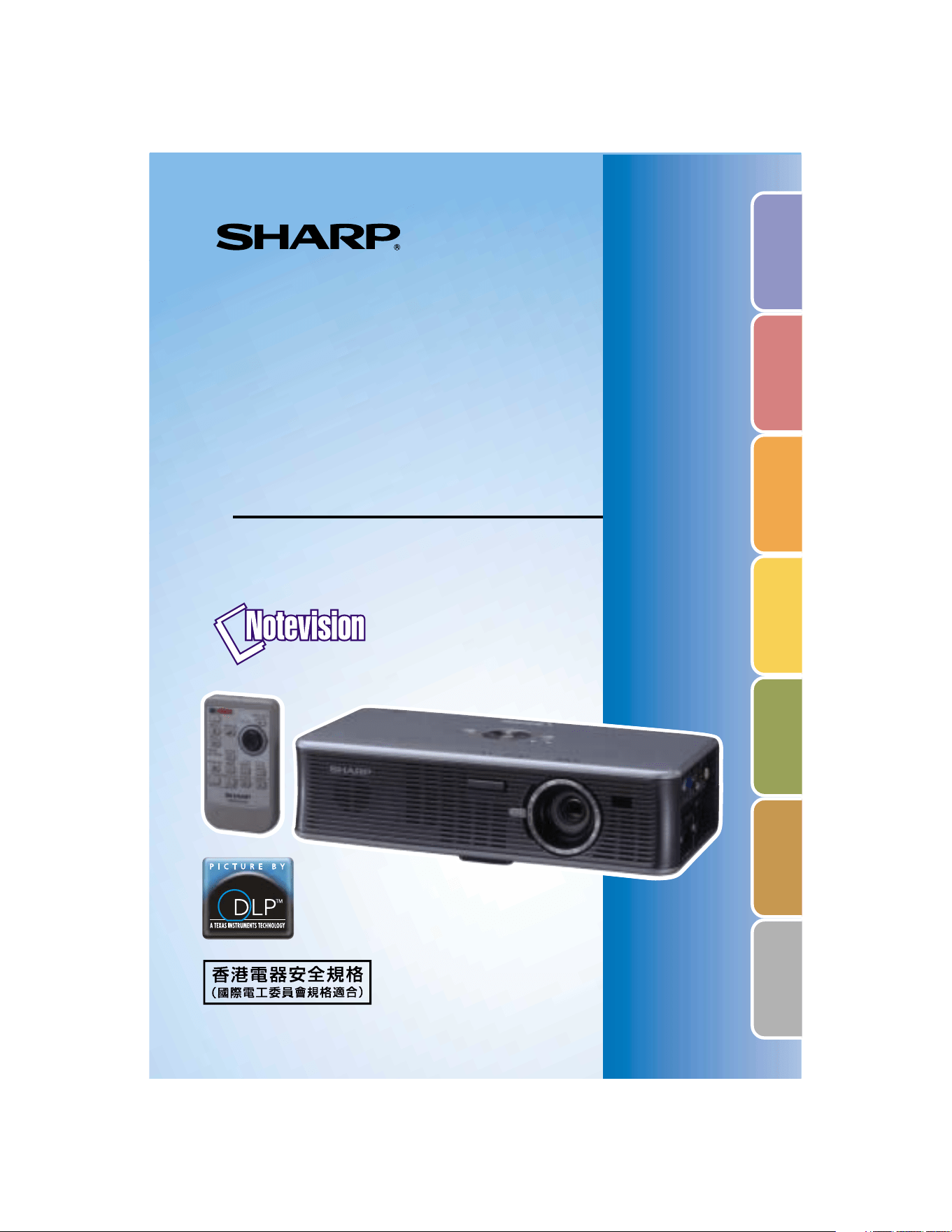
MULTIMEDIA PROJECTOR
MODEL
XR-1X
XR-1S
OPERATION MANUAL
(The picture shown above is of the XR-1S.)
IMPORTANT
For your assistance in reporting the loss or
theft of your Projector, please record the
Model and Serial Number located on the
bottom of the projector and retain this
information. Before recycling the packag-
ing, please be sure that you have checked
the contents of the carton thoroughly
against the list of “Supplied accessories”
on page 11.
Model No.:
Serial No.:
SPECIAL NOTE FOR USERS IN THE U.K.
The mains lead of this product is fitted with a non-rewireable (moulded) plug incorporat-
ing a 5A fuse. Should the fuse need to be replaced, a BSI or ASTA approved BS 1362
fuse marked
or and of the same rating as above, which is also indicated on the pin
face of the plug, must be used.
Always refit the fuse cover after replacing the fuse. Never use the plug without the fuse
cover fitted.
In the unlikely event of the socket outlet in your home not being compatible with the plug
supplied, cut off the mains plug and fit an appropriate type.
DANGER:
The fuse from the cut-off plug should be removed and the cut-off plug destroyed immedi-
ately and disposed of in a safe manner.
Under no circumstances should the cut-off plug be inserted elsewhere into a 5A socket
outlet, as a serious electric shock may occur.
To fit an appropriate plug to the mains lead, follow the instructions below:
WARNING:
THIS APPARATUS MUST BE EARTHED.
IMPORTANT:
The wires in this mains lead are coloured in accordance with the following code:
Green-and-yellow : Earth
Blue : Neutral
Brown : Live
As the colours of the wires in the mains lead of this apparatus may not correspond with the
coloured markings identifying the terminals in your plug proceed as follows:
• The wire which is coloured green-and-yellow must be connected to the terminal in the
plug which is marked by the letter E or by the safety earth symbol
or coloured green or
green-and-yellow.
• The wire which is coloured blue must be connected to the terminal which is marked with
the letter N or coloured black.
• The wire which is coloured brown must be connected to the terminal which is marked with
the letter L or coloured red.
IF YOU HAVE ANY DOUBT, CONSULT A QUALIFIED ELECTRICIAN.
The supplied CD-ROM contains operation instructions in English, German, French,
Swedish, Spanish, Italian, Dutch, Portuguese, Chinese (Traditional Chinese and Simpli-
fied Chinese) and Korean. Carefully read through the operation instructions before
operating the projector.
Die mitgelieferte CD-ROM enthält Bedienungsanleitungen in Englisch, Deutsch, Französisch,
Schwedisch, Spanisch, Italienisch, Niederländisch, Portugiesisch, Chinesisch (Traditionelles
Chinesisch und einfaches Chinesisch) und Koreanisch. Bitte lesen Sie die
Bedienungsanleitung vor der Verwendung des Projektors sorgfältig durch.
Le CD-ROM fourni contient les instructions de fonctionnement en anglais, allemand,
français, suédois, espagnol, italien, néerlandais, portugais, chinois (chinois traditionnel et
chinois simplifié) et coréen. Veuillez lire attentivement ces instructions avant de faire
fonctionner le projecteur.
Den medföljande CD-ROM-skivan innehåller bruksanvisningar på engelska, tyska,
franska, svenska, spanska, italienska, holländska, portugisiska, kinesiska (traditionell
kinesiska och förenklad kinesiska) och koreanska. Läs noga igenom bruksanvisningen
innan projektorn tas i bruk.
El CD-ROM suministrado contiene instrucciones de operación en inglés, alemán,
francés, sueco, español, italiano, holandés, portugués, chino (chino tradicional y chino
simplificado) y coreano. Lea cuidadosamente las instrucciones de operación antes de
utilizar el proyector.
Il CD-ROM in dotazione contiene istruzioni per l’uso in inglese, tedesco, francese,
svedese, spagnolo, italiano, olandese, portoghese, cinese (cinese tradizionale e cinese
semplificato) e coreano. Leggere attentamente le istruzioni per l’uso prima di usare il
proiettore.
De meegeleverde CD-ROM bevat handleidingen in het Engels, Duits, Frans, Zweeds,
Spaans, Italiaans, Nederlands, Portugees, Chinees (Traditioneel Chinees en
Vereenvoudigd Chinees) en Koreaans. Lees de handleiding zorgvuldig door voor u de
projector in gebruik neemt.
O CD-ROM fornecido contém instruções de operação em Inglês, Alemão, Francês,
Sueco, Espanhol, Italiano, Holandês, Português, Chinês, (Chinês Tradicional e Chinês
Simplificado) e Coreano. Leia cuidadosamente todas as instruções de operação antes
de operar o projetor.
1
Introduction
Before using the projector, please read this operation manual carefully.
There are two important reasons for prompt warranty registration of your new SHARP
Projector, using the REGISTRATION CARD packed with the projector.
1. WARRANTY
This is to assure that you immediately receive the full benefit of the parts, service
and labor warranty applicable to your purchase.
2. CONSUMER PRODUCT SAFETY ACT
To ensure that you will promptly receive any safety notification of inspection,
modification, or recall that SHARP may be required to give under the 1972
Consumer Product Safety Act, PLEASE READ CAREFULLY THE IMPORTANT
“LIMITED WARRANTY” CLAUSE.
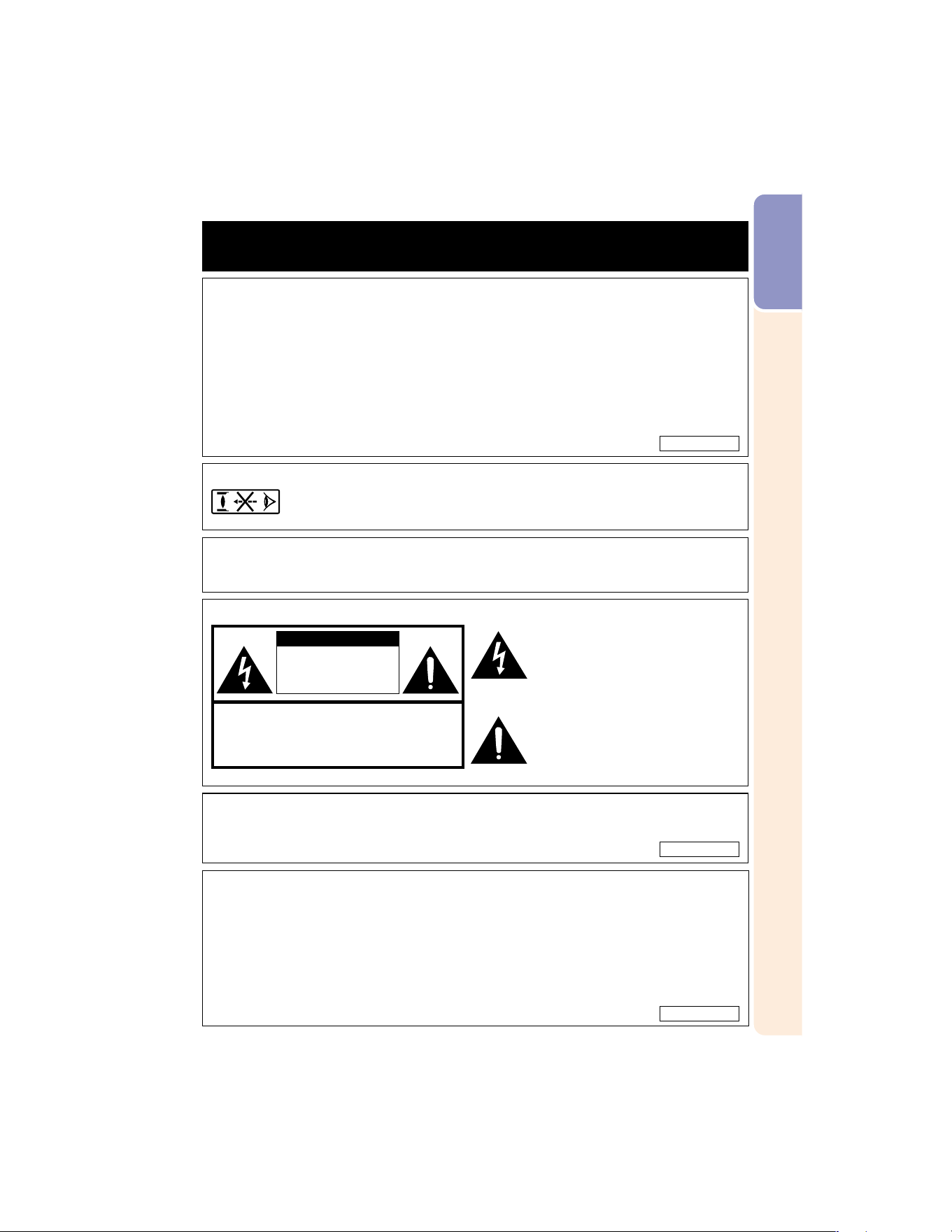
WARNING: High brightness light source. Do not stare into the beam of light, or view
directly. Be especially careful that children do not stare directly into the
beam of light.
WARNING: To reduce the risk of fire or electric shock, do not expose
this product to rain or moisture.
WARNING: FCC Regulations state that any unauthorized changes or modifications to
this equipment not expressly approved by the manufacturer could void
the user’s authority to operate this equipment.
The lightning flash with arrowhead sym-
bol, within an equilateral triangle, is in-
tended to alert the user to the presence
of uninsulated “dangerous voltage”
within the product’s enclosure that may
be of sufficient magnitude to constitute
a risk or electric shock to persons.
The exclamation point within a triangle
is intended to alert the user to the
presence of important operating and
maintenance (servicing) instructions in
the literature accompanying the product.
Introduction
ENGLISH
INFORMATION
This equipment has been tested and found to comply with the limits for a Class A digital
device, pursuant to Part 15 of the FCC Rules. These limits are designed to provide reasonable
protection against harmful interference when the equipment is operated in a commercial
environment. This equipment generates, uses, and can radiate radio frequency energy and,
if not installed and used in accordance with the operation manual, may cause harmful
interference to radio communications. Operation of this equipment in a residential area is
likely to cause harmful interference, in which case the user will be required to correct the
interference at his own expense.
See bottom of projector.
U.S.A. ONLY
U.S.A. ONLY
U.S.A. ONLY
CAUTION: TO REDUCE THE RISK OF ELECTRIC SHOCK,
DO NOT REMOVE COVER.
NO USER-SERVICEABLE PARTS EXCEPT LAMP UNIT.
REFER SERVICING TO QUALIFIED SERVICE
PERSONNEL.
CAUTION
RISK OF ELECTRIC SHOCK.
DO NOT REMOVE SCREWS
EXCEPT SPECIFIED USER
SERVICE SCREW.
2
WARNING:
The cooling fan in this projector continues to run for about 90 seconds after the projector enters
standby mode. During normal operation, when putting the projector into standby mode always
use the ON/STANDBY button on the projector or on the remote control. Ensure the cooling fan has
stopped before disconnecting the power cord.
DURING NORMAL OPERATION, NEVER TURN THE PROJECTOR OFF BY DISCONNECTING
THE POWER CORD. FAILURE TO OBSERVE THIS WILL RESULT IN PREMATURE LAMP FAILURE.
Caution Concerning Lamp Replacement
See “Replacing the Lamp” on page 55.
PRODUCT DISPOSAL
This projector utilizes tin-lead solder, and a pressurized lamp containing a small amount of
mercury. Disposal of these materials may be regulated due to environmental considerations.
For disposal or recycling information, please contact your local authorities or, if you are
located in the United States of America, the Electronic Industries Alliance: www.eiae.org .
AVERTISSEMENT A OBSERVER LORS
DU REMPLACEMENT DE LA LAMPE.
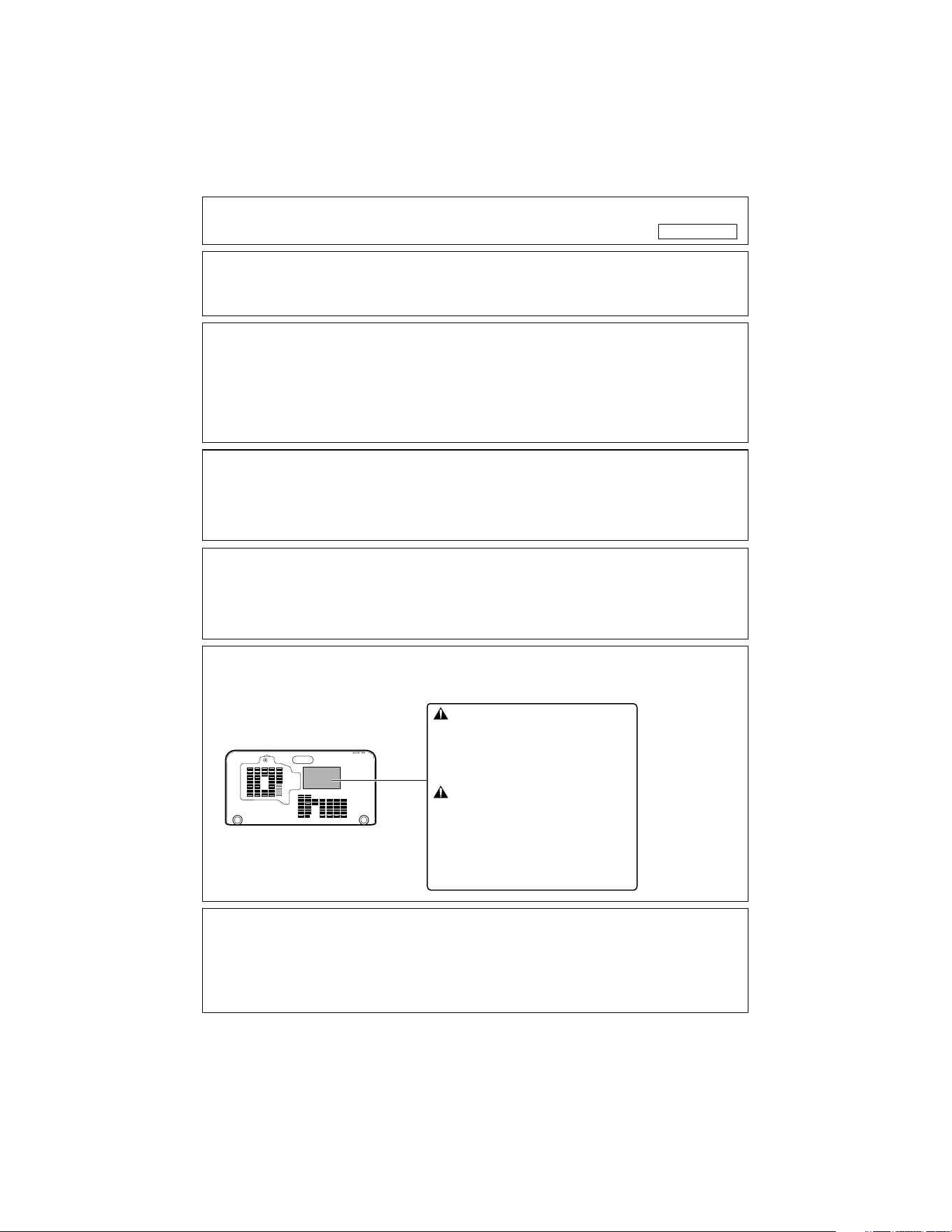
LAMP REPLACEMENT WARNING
BEFORE REMOVING THE SCREW, DISCONNECT POWER
CORD. HOT SURFACE INSIDE. ALLOW 1 HOUR TO COOL
BEFORE REPLACING THE LAMP. REPLACE WITH SAME
SHARP LAMP UNIT MODEL AN-XR1LP ONLY.
UV RADIATION : CAN CAUSE EYE DAMAGE. TURN OFF
LAMP BEFORE SERVICING.
HIGH PRESSURE LAMP : RISK OF EXPLOSION. POTENTIAL
HAZARD OF GLASS PARTICLES IF LAMP HAS RUPTURED.
HANDLE WITH CARE. SEE OPERATION MANUAL.
DEBRANCHER LE CORDON D’ALIMENTATION AVANT DE
RETIRER LES VIS. L’INTERIEUR DU BOITIER ETANT
EXTREMEMENT CHAUD, ATTENDRE 1 HEURE AVANT DE
PROCEDER AU REMPLACEMENT DE LA LAMPE.
NE REMPLACER QUE PAR UNE LAMPE SHARP DE MODÈLE
AN-XR1LP.
RAYONS ULTRAVIOLETS : PEUVENT ENDOMMAGER LES
YEUX. ETEINDRE LA LAMPE AVANT DE PROCEDER
A L’ENTRETIEN.
LAMPE A HAUTE PRESSION : RISQUE D’EXPLOSION.
DANGER POTENTIEL DE PARTICULES DE VERRE EN CAS
D’ECLATEMENT DE LA LAMPE. A MANIPULER AVEC
PRECAUTION, SE REPORTER AU MODE D’EMPLOI.
This SHARP projector uses a DMD panel. This very sophisticated panel contains 786,432 (XR-
1X) / 480,000 (XR-1S) pixels micromirrors. As with any high technology electronic equipment
such as large screen TVs, video systems and video cameras, there are certain acceptable
tolerances that the equipment must conform to.
This unit has some inactive pixels within acceptable tolerances which may result in inactive dots
on the picture screen. This will not affect the picture quality or the life expectancy of the unit.
WARNING:
This is a Class A product. In a domestic environment this product may cause radio
interference in which case the user may be required to take adequate measures.
The enclosed computer cable must be used with the device. The cable is provided to
ensure that the device complies with FCC Class A verification.
U.S.A. ONLY
CAUTION ON LITHIUM BATTERY (for Remote Control unit)
If a battery is reversed (positive end where the negative end belongs and vice versa), it can
overheat and rupture. This has happened when young children install batteries backwards.
Warn children
not
to take out batteries or install them.
Parents should install the lithium
battery in the remote control.
3
Introduction
36
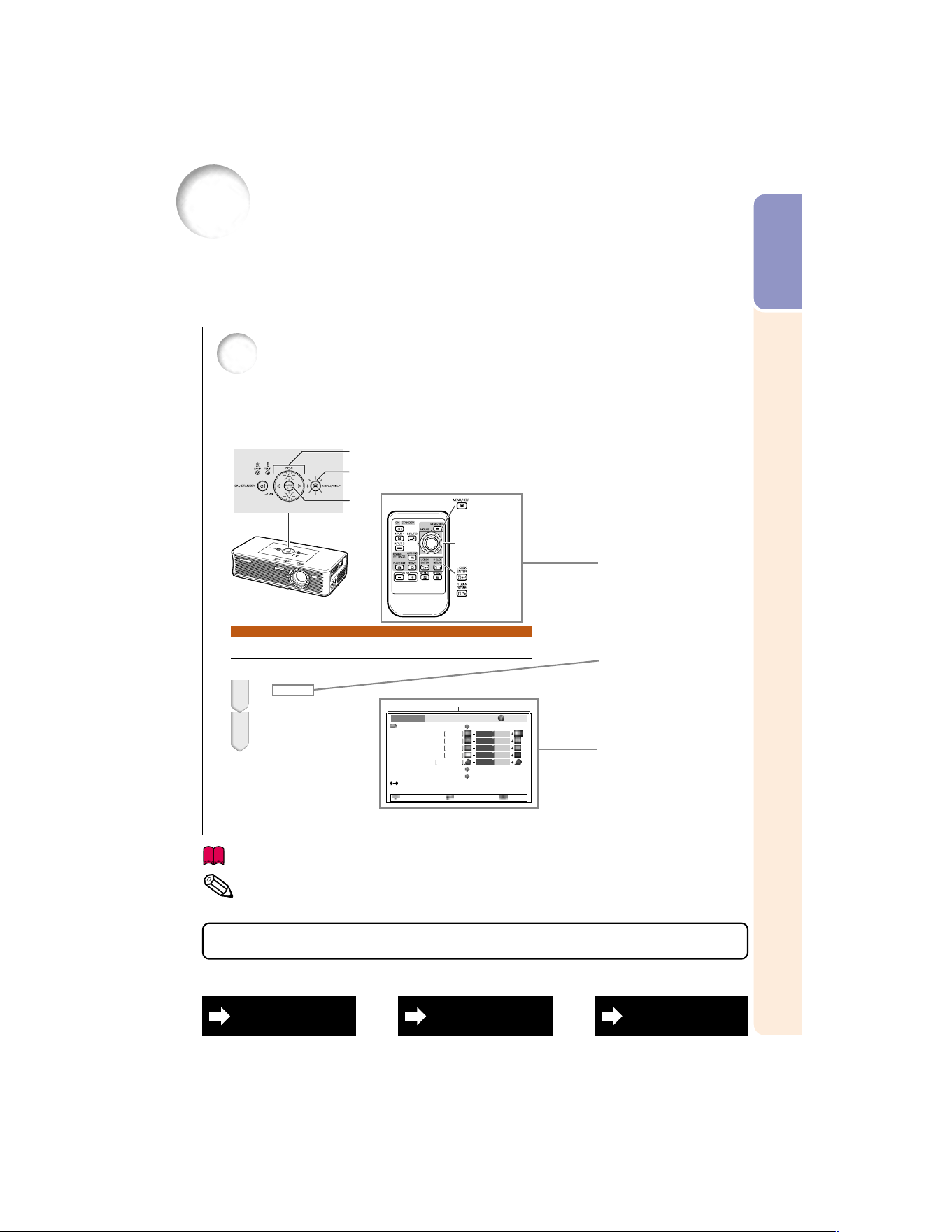
Using the Menu Screen
Menu Selections (Adjustments)
The menu can be operated to achieve two functions, adjustment and setting. (For setting the menu
items, see pages 38 and 39.)
Example: Adjusting “Bright”.
• This operation can also be performed by using the buttons on the projector.
Press BMENU.
• The “Picture” menu screen for the se-
lected input mode is displayed.
MOUSE Adjustment
button (P/R/O/Q)
Example: “Picture” screen menu for INPUT 1
(RGB) mode
Press Q or O to display the other
menu screen.
• The selected menu item is highlighted.
1
2
ENTER button
RETURN button
Menu item
Picture
Picture Mode
Contrast 0
0
0
0
K7500
SCR - ADJ PRJ - ADJ Help
Bright
Red
Blue
CLR Temp
Bright Boost
sRGB
Off
Standard
Off
Reset
SEL./ADJ. ENTER END
MENU/HELP
button
Operating with the projector
When “PRJ - ADJ” - “Guide LEDs” is set to “On”, the buttons used for menu adjustment on the
projector light up.
Example: When W, Y and the MENU/HELP button light up on the projector, you can use those
buttons for operation.
Adjustment buttons (W/Y/V/X)
MENU/HELP button
ENTER button
How to Read this Operation Manual
■ The specifications of the XR-1X are slightly different from those of the XR-1S, however, you can
connect and operate both models in the same manner. This operation manual uses the XR-1S
for the purpose of explanation.
• In this operation manual, the illustration and the screen display are simplified for explanation, and
may differ slightly from actual display.
Info
........Indicates safeguards for using the projector.
For Future Reference
Buttons used in
this operation
On-screen
display
Button used in
this step
Note
.........Indicates additional information for setting up and operating the
projector.
IndexMaintenance Troubleshooting
P. 6 5P. 5 2
PP. 60 and 61
4
Contents
Preparing
Introduction
How to Read this Operation Manual .... 3
Contents ............................................... 4
IMPORTANT SAFEGUARDS ............... 6
How to Access the PDF Operation
Manuals ............................................ 10
Accessories ........................................ 11
Part Names and Functions ................. 12
Inserting the Lithium Battery ................ 14
Usable Range ...................................... 15
Quick Start
Quick Start .......................................... 16
Using
Basic Operation
Turning the Projector On/Off .............. 26
Turning the Projector on ....................... 26
Turning the Power off (Putting the
Projector into Standby Mode) ........... 26
Image Projection................................. 27
About the Setup Guide ........................ 27
Adjusting the Projected Image ............ 27
Switching the Input Mode .................... 29
Adjusting the Volume ........................... 29
Displaying the Black Screen and Turning
off the Sound Temporarily ................. 29
Resize Mode ......................................... 30
Useful Features
Adjusting/Operating with the
Remote Control ................................ 32
Auto Sync (Auto Sync Adjustment) ..... 32
Freezing a Moving Image .................... 32
Selecting the Picture Mode .................. 32
Using Mouse Function ......................... 33
Menu Items ......................................... 34
Using the Menu Screen ...................... 36
Menu Selections (Adjustments) ........... 36
Menu Selections (Settings) .................. 38
Setup
Setting up the Projector ...................... 18
Setting up the Projector ....................... 18
Standard Setup (Front Projection) ....... 18
Projecting a Reversed Image .............. 18
Screen Size and Projection Distance
(XR-1X) ............................................... 19
Screen Size and Projection Distance
(XR-1S) ............................................... 20
Connections
Connections ........................................ 21
Samples of Cables for Connection .... 22
Connecting to a Computer ................. 23
Connecting to Video Equipment......... 24
Connecting the Power Cord ............... 25
Picture Adjustment (“Picture” menu) .. 40
Selecting the Picture mode .................. 40
Adjusting the Image ............................. 40
Adjusting the Color Temperature ......... 41
Emphasizing the Contrast .................... 41
Progressive ........................................... 42
sRGB Setting ........................................ 42
Adjusting the Projected Image
(“SCR - ADJ” menu) ......................... 43
Setting the Resize Mode ...................... 43
Adjusting the Image Position ............... 43
Keystone Correction ............................ 44
Setting On-screen Display ................... 44
Selecting the Background Image ........ 45
Setting the Setup Guide ....................... 45
Reversing/Inverting Projected
Images ............................................... 46
Selecting the On-screen Display
Language ........................................... 46
Setting the Projector Function
(“PRJ - ADJ” menu) .......................... 47
Eco/Quiet Mode ................................... 47
Auto Search Function ........................... 47
Auto Power Off Function ...................... 48
Setting the Guide LEDs ........................ 48
System Lock Function .......................... 49
Setting/Changing the keycode ............ 49
Setting the Confirmation Sound ........... 50
Checking the Lamp Life Status ........... 50
Troubleshooting with “Help” menu ..... 51
Displaying “Help” menu screen .......... 51
5
Introduction
Reference
Appendix
Maintenance ....................................... 52
Maintenance Indicators ...................... 53
Regarding the Lamp ........................... 55
Lamp ..................................................... 55
Caution Concerning the Lamp ............ 55
Replacing the Lamp ............................. 55
Removing and Installing
the Lamp Unit .................................... 56
Resetting the Lamp Timer .................... 57
Connecting Pin Assignments ............. 58
Computer Compatibility Chart ............ 59
Troubleshooting .................................. 60
For SHARP Assistance ....................... 62
Specifications ..................................... 63
Dimensions ......................................... 64
Index ................................................... 65

6
1. Read Instructions
All the safety and operating instructions should
be read before the product is operated.
2. Retain Instructions
The safety and operating instructions should be
retained for future reference.
3. Heed Warnings
All warnings on the product and in the operating
instructions should be adhered to.
4. Follow Instructions
All operating and use instructions should be
followed.
5. Cleaning
Unplug this product from the wall outlet before
cleaning. Do not use liquid cleaners or aerosol
cleaners. Use a damp cloth for cleaning.
6. Attachments
Do not use attachments not recommended by the
product manufacturer as they may cause hazards.
7. Water and Moisture
Do not use this product near water–for example,
near a bath tub, wash bowl, kitchen sink, or
laundry tub; in a wet basement; or near a
swimming pool; and the like.
8. Accessories
Do not place this product on an unstable cart,
stand, tripod, bracket, or table. The product may
fall, causing serious injury to a child or adult, and
serious damage to the product. Use only with a
cart, stand, tripod, bracket, or table
recommended by the manufacturer, or sold with
the product. Any mounting of the product should
follow the manufacturer’s instructions, and should
use a mounting accessory recommended by the
manufacturer.
9. Transportation
A product and cart
combination should be
moved with care. Quick
stops, excessive force,
and uneven surfaces may
cause the product and cart
combination to overturn.
IMPORTANT SAFEGUARDS
10. Ventilation
Slots and openings in the cabinet are provided
for ventilation to ensure reliable operation of the
product and to protect it from overheating, and
these openings must not be blocked or covered.
The openings should never be blocked by placing
the product on a bed, sofa, rug, or other similar
surface. This product should not be placed in a
built-in installation such as a bookcase or rack
unless proper ventilation is provided or the
manufacturer’s instructions have been adhered
to.
11. Power Sources
This product should be operated only from the
type of power source indicated on the marking
label. If you are not sure of the type of power
supply to your home, consult your product dealer
or local power company. For products intended
to operate from battery power, or other sources,
refer to the operating instructions.
12. Grounding or Polarization
This product is provided with one of the following
types of plugs. If the plug should fail to fit into the
power outlet,
please contact your electrician.
Do not defeat the safety purpose of the plug.
a. Two-wire type (mains) plug.
b. Three-wire grounding type (mains) plug with
a grounding terminal.
This plug will only fit into a grounding type
power outlet.
13. Power-Cord Protection
Power-supply cords should be routed so that they
are not likely to be walked on or pinched by items
placed upon or against them, paying particular
attention to cords at plugs, convenience
receptacles, and the point where they exit from
the product.
14. Lightning
For added protection for this product during a
lightning storm, or when it is left unattended and
unused for long periods of time, unplug it from
the wall outlet and disconnect the cable system.
This will prevent damage to the product due to
lightning and power-line surges.
CAUTION: Please read all of these instructions before you operate this product
and save these instructions for later use.
Electrical energy can perform many useful functions. This product has been engineered
and manufactured to assure your personal safety. BUT IMPROPER USE CAN RESULT IN
POTENTIAL ELECTRICAL SHOCK OR FIRE HAZARDS. In order not to defeat the
safeguards incorporated in this product, observe the following basic rules for its installation,
use and servicing.
7
Introduction
15. Overloading
Do not overload wall outlets, extension cords, or
integral convenience receptacles as this can
result in a risk of fire or electric shock.
16. Object and Liquid Entry
Never push objects of any kind into this product
through openings as they may touch dangerous
voltage points or short-out parts that could result
in a fire or electric shock. Never spill liquid of any
kind on the product.
17. Servicing
Do not attempt to service this product yourself as
opening or removing covers may expose you to
dangerous voltage or other hazards. Refer all
servicing to qualified service personnel.
18. Damage Requiring Service
Unplug this product from the wall outlet and refer
servicing to qualified service personnel under the
following conditions:
a. When the power-supply cord or plug is
damaged.
b. If liquid has been spilled, or objects have fallen
into the product.
c. If the product has been exposed to rain or
water.
d. If the product does not operate normally by
following the operating instructions. Adjust only
those controls that are covered by the
operating instructions, as an improper
adjustment of other controls may result in
damage and will often require extensive work
by a qualified technician to restore the product
to normal operation.
e. If the product has been dropped or damaged
in any way.
f. When the product exhibits a distinct change
in performance, this indicates a need for
service.
• DLP\ (Digital Light Processing) and DMD\ (Digital Micromirror Device) are trademarks
of Texas Instruments, Inc.
• Microsoft and Windows are registered trademarks of Microsoft Corporation in the United
States and/or other countries.
• PC/AT is a registered trademark of International Business Machines Corporation in the
United States.
• Adobe Reader is a trademark of Adobe Systems Incorporated.
• Macintosh is a registered trademark of Apple Computer, Inc. in the United States and/or
other countries.
• All other company or product names are trademarks or registered trademarks of their
respective companies.
19. Replacement Parts
When replacement parts are required, be sure
the service technician has used replacement
parts specified by the manufacturer or have the
same characteristics as the original part.
Unauthorized substitutions may result in fire,
electric shock, or other hazards.
20. Safety Check
Upon completion of any service or repairs to this
product, ask the service technician to perform
safety checks to determine that the product is in
proper operating condition.
21. Heat
This product should be situated away from heat
sources such as radiators, heat registers, stoves,
or other products (including amplifiers) that
produce heat.
8
Be sure to read the following safeguards when setting
up your projector.
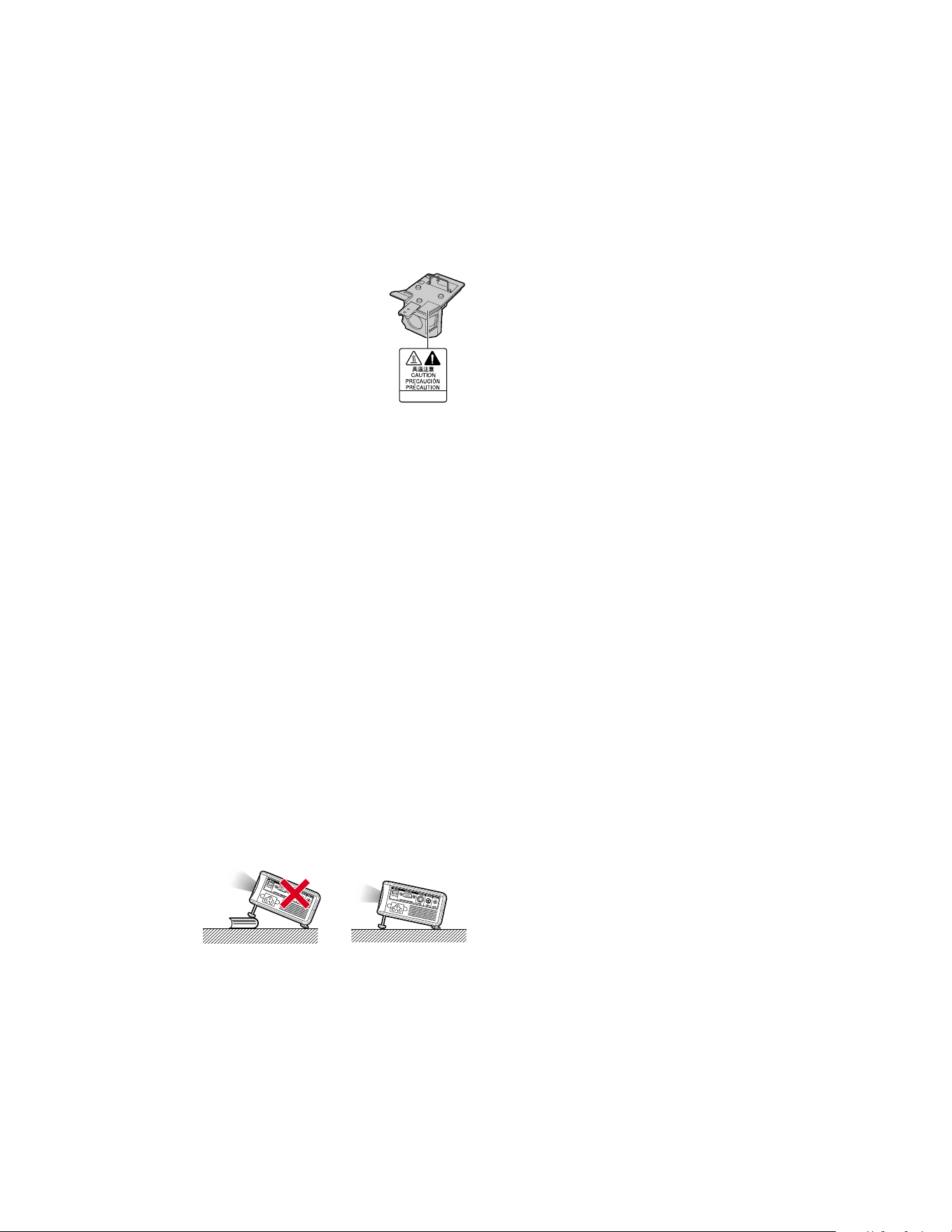
Caution concerning the lamp unit
■ Potential hazard of glass par-
ticles if lamp ruptures. In case
of lamp rupture, contact your
nearest Sharp Authorized
Projector Dealer or Service
Center for a replacement.
See “Replacing the Lamp” on
page 55.
Caution concerning the setup of the pro-
jector
■ For minimal servicing and to maintain high
image quality, SHARP recommends that this
projector be installed in an area free from
humidity, dust and cigarette smoke. When the
projector is subjected to these environments,
the vents and lens must be cleaned more of-
ten. As long as the projector is regularly
cleaned, use in these environments will not
reduce the overall operation life of the unit.
Internal cleaning should only be performed
by a Sharp Authorized Projector Dealer or
Service Center.
Do not set up the projector in places ex-
posed to direct sunlight or bright light.
■ Position the screen so that it is not in direct
sunlight or room light. Light falling directly on
the screen washes out the colors, making
viewing difficult. Close the curtains and dim
the lights when setting up the screen in a
sunny or bright room.
Caution regarding placing of the projec-
tor.
■ Place the projector on a level site within the
adjustment range of the adjustment foot.
Do not turn the projector upside down
immediately after putting into standby
mode.
■ This may cause burns due to rise in tempera-
ture of the lamp unit cover.
Warning about placing the projector in
a high position
■ When placing the projector in a high position,
be sure to secure it carefully to avoid per-
sonal injury caused by the projector falling
down.
Do not subject the projector to hard im-
pact and/or vibration.
■ Take care with the lens so as not to hit or
damage the surface of the lens.
Rest your eyes occasionally.
■ Continuously watching the screen for long
hours will cause eye strain. Be sure to occa-
sionally rest your eyes.
Avoid locations with extremes of tem-
perature.
■ The operating temperature of the projector is
from 41°F to 95°F (+5°C to +35°C).
■ The storage temperature of the projector is
from –4°F to 140°F (–20°C to +60°C).
Do not block the exhaust and intake
vents.
■ Allow at least 11
13
/16 inches (30 cm) of space
between the exhaust vent and the nearest
wall or obstruction.
■ Be sure that the intake vent and the exhaust
vent are not obstructed.
■ If the cooling fan becomes obstructed, a pro-
tection circuit will automatically put the pro-
jector into standby mode to prevent overheat
damage. This does not indicate a malfunc-
tion. (See pages 53 and 54.) Remove the pro-
jector power cord from the wall outlet and wait
at least 10 minutes. Place the projector where
the intake and exhaust vents are not blocked,
plug the power cord back in and turn on the
projector. This will return the projector to the
normal operating condition.
■ When turning off the projector, the cooling fan
runs to decrease the internal temperature for
a while. Unplug the power cord after the cool-
ing fan stops. The period the cooling fan runs
will vary, depending on the circumstances and
the internal temperature.
AN-XR1LP
9
Introduction
Caution regarding transportation of the
projector
■ When transporting the projector, be sure not
to subject it to hard impact and/or vibration,
as this can result in damage. Take extra care
with the lens. Before moving the projector,
be sure to unplug the power cord from the
wall outlet, and disconnect any other cables
connected to it.
■ Do not carry the projector by holding the lens.
■ When transporting the projector, be sure to
place the projector in the supplied soft case.
(See page 11.)
Other connected equipment
■ When connecting a computer or other audio-
visual equipment to the projector, make the
connections AFTER unplugging the power
cord of the projector from the AC outlet and
turning off the equipment to be connected.
■ Please read the operation manuals of the pro-
jector and the equipment to be connected for
instructions on how to make the connections.
Using the projector in other countries
■ The power supply voltage and the shape of
the plug may vary depending on the region
or country you are using the projector in.
When using the projector overseas, be sure
to use an appropriate power cord for the coun-
try you are in.
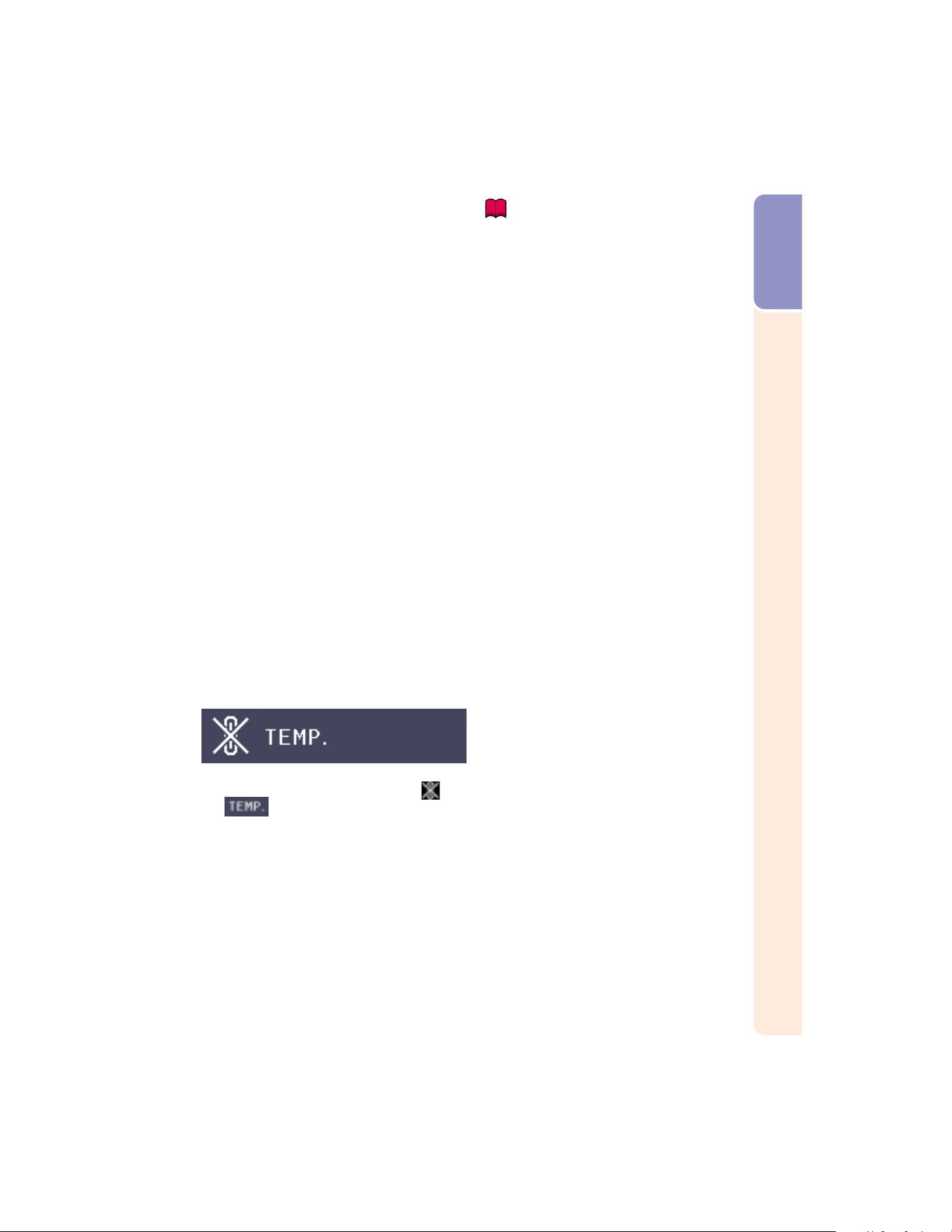
Temperature monitor function
■
If the projector starts to overheat due to setup
problems or blockage of the air vents, “ ” and
“ ” will illuminate in the lower left corner
of the picture. If the temperature continues to
rise, the lamp will turn off, the temperature warn-
ing indicator on the projector will blink, and af-
ter a 90-second cooling-off period the projector
will enter standby mode. Refer to “Maintenance
Indicators” on page 53 for details.
Info
• The cooling fan regulates the internal tem-
perature, and its performance is automatically
controlled. The sound of the fan may change
during projector operation due to changes in
the fan speed. This does not indicate malfunc-
tion.
• Do not unplug the power cord during projec-
tion or cooling fan operation. This can cause
damage due to rise in internal temperature,
as the cooling fan also stops.

10
PDF operation manuals in several languages are included in the CD-ROM,
so that you can work with the projector, even if you do not have this manual.
To utilize these manuals, you need to install Adobe Reader on your com-
puter (Windows or Macintosh).
Please download Adobe Reader from the Internet (http://www.adobe.com).
Accessing the PDF Manuals
For Windows:
1 Insert the CD-ROM in the CD-ROM
drive.
2 Double click the “My Computer” icon.
3 Double click the “CD-ROM” drive.
4 Double click the language (name of the
folder) that you want to view.
5 Double click the “XR1” pdf file to access
the projector manuals.
• If the desired pdf file cannot be opened by double clicking the mouse, start Adobe
Reader first, then specify the desired file using the “File”, “Open” menu.
For Macintosh:
1 Insert the CD-ROM in the CD-ROM
drive.
2 Double click the “CD-ROM” icon.
3 Double click the language (name of the
folder) that you want to view.
4 Double click the “XR1” pdf file to access
the projector manuals.
How to Access the PDF Operation Manuals
Note
11
Introduction
Accessories
Remote control
RRMCGA256WJSA
Lithium battery
(CR2025)
UBATL0011TAZZ
Power cord*
RGB/USB cable
(6' (1.8 m))
QCNWGA047WJPZ
Soft case
GCASNA011WJZZ
• Projector manual CD-ROM
UDSKAA045WJN1
• Operation manual (this manual)
Optional accessories
■ 3 RCA to 15-pin D-sub cable (9n10o (3.0 m))
■ Lamp unit
AN-C3CP
AN-XR1LP
Supplied accessories
For U.S., Canada,
etc.
(6' (1.8 m))
QACCDA029WJPZ
For Europe, except
U.K.
(6' (1.8 m))
QACCVA006WJPZ
For U.K., Hong Kong
and Singapore
(6' (1.8 m))
QACCBA015WJPZ
For Australia, New
Zealand and Oceania
(6' (1.8 m))
QACCLA024WJPZ
(1) (2) (3) (4)
* Use the power cord that corresponds to the wall outlet in your country.
• Some of the optional accessories may not be available depending on the region. Please check with
your nearest Sharp Authorized Projector Dealer or Service Center.
Note
Cable tieK2
UBNDTA015WJZZ
• For the RGB/USB
cable
• For the power cord
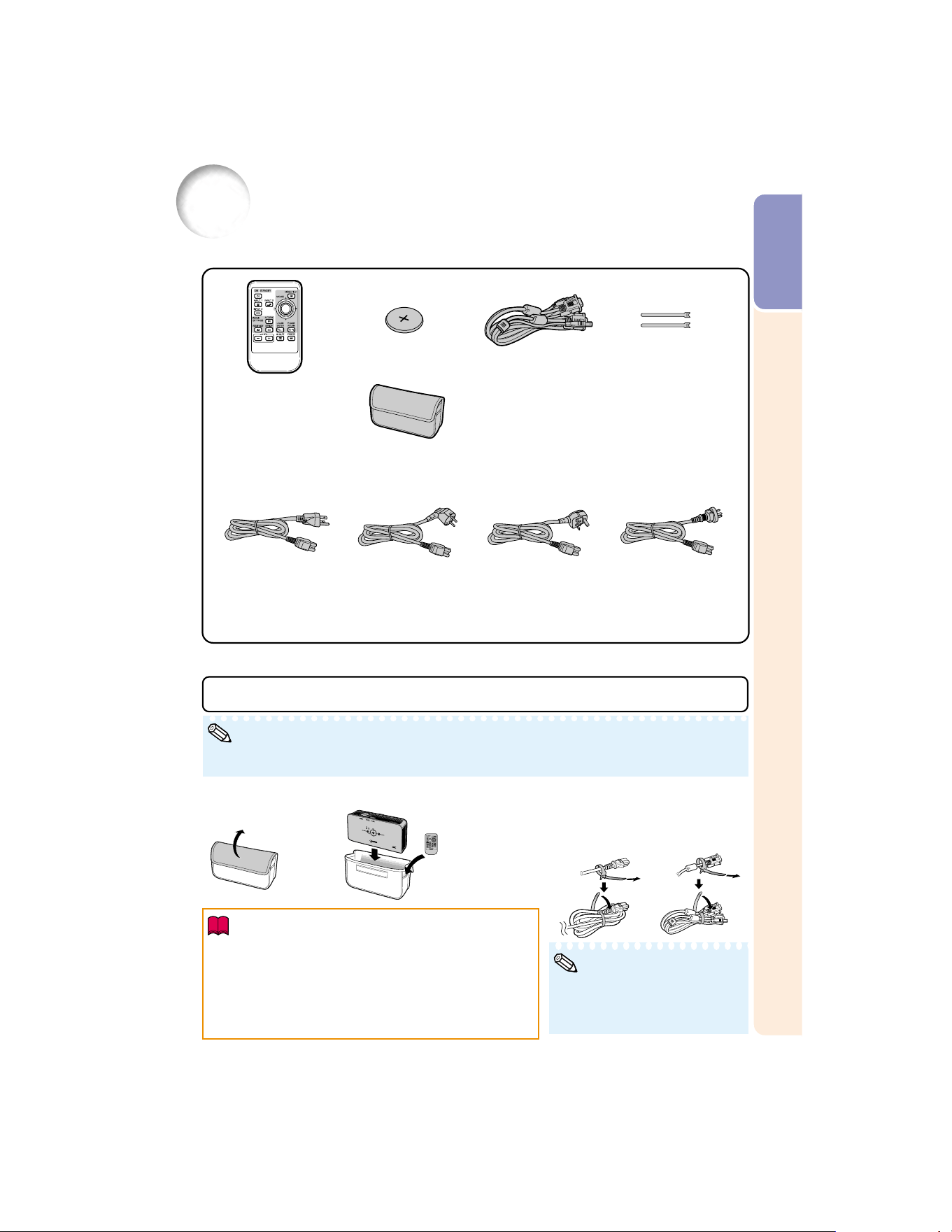
Carrying the Projector
Using the Soft Case
Tying the Cables
Power cord RGB/USB cable
• You cannot store the supplied
cables within the soft case. When
transporting the projector, pre-
pare a bag for these cables.
Note
• Be sure the projector has cooled down sufficiently before
placing it in the case.
• This soft case is only for storing and carrying the projector.
• Shipping the projector in the soft case as a parcel may cause
damage to the projector. If you send the projector in the carry-
ing case as a parcel, be sure to place it in a sturdy case and
with enough shock absorbing material to avoid any damage.
Info
Tie the cable using the supplied
cable ties.
12
36
36
54
54
36
51
29
28
28
27
15
27
26
54
29
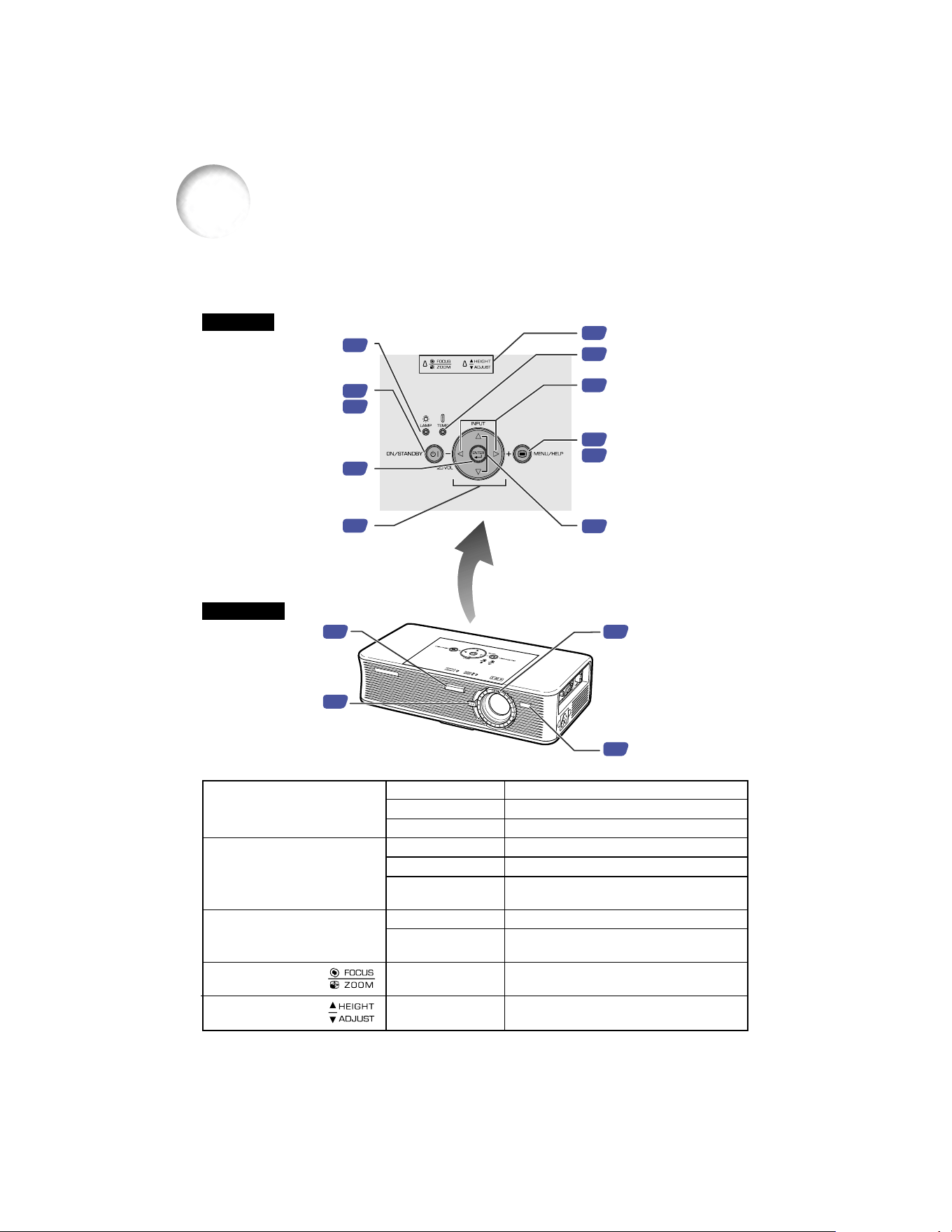
Top View
ON/STANDBY button
For turning the power
on and putting the
projector into standby
mode.
Lamp indicator
Temperature warning
indicator
Adjustment buttons
(W/Y/V/X)
For selecting menu
items.
Volume buttons (V/X)
For adjusting the
speaker sound level.
ENTER button
For setting items
selected or adjusted
on the menu.
MENU/HELP button
For displaying
adjustment and
setting screens, and
help screen.
Front View
Focus ring
For adjusting the
focus.
Zoom knob
For enlarging/
reducing the
picture.
INPUT button (W/Y)
For switching input mode
1, 2 or 3.
Remote control sensor
HEIGHT ADJUST
button
Numbers in Z refer to the main pages in this operation manual where the topic
is explained.
Part Names and Functions
Projector
Lamp indicator
Red on
ON/STANDBY button
Indicators on the Projector
Green on
Normal (Standby)
Normal (Power on)
Green on
Green blinks
Normal
The lamp is warming up or shutting down.
Temperature warning
indicator
Off
Red on
Normal
The internal temperature is abnormally
high. (See page 54.)
HEIGHT ADJUST
indicator
Orange blinks
FOCUS/ZOOM
indicator
Orange blinks
“1 FOCUS” or “3 ZOOM” is highlighted on
the Setup Guide. (See page 27.)
“2 HEIGHT ADJUST” is highlighted on the
Setup Guide. (See page 27.)
Red blinks Abnormal (See page 54.)
Red on The lamp is shut down abnormally or
requires to be changed. (See page 54.)
Setup Guide indicators
13
Introduction
33
52
15
23
23
24
25
24
25
25
28
52
Numbers in Z refer to the main pages in this operation manual where the topic
is explained.
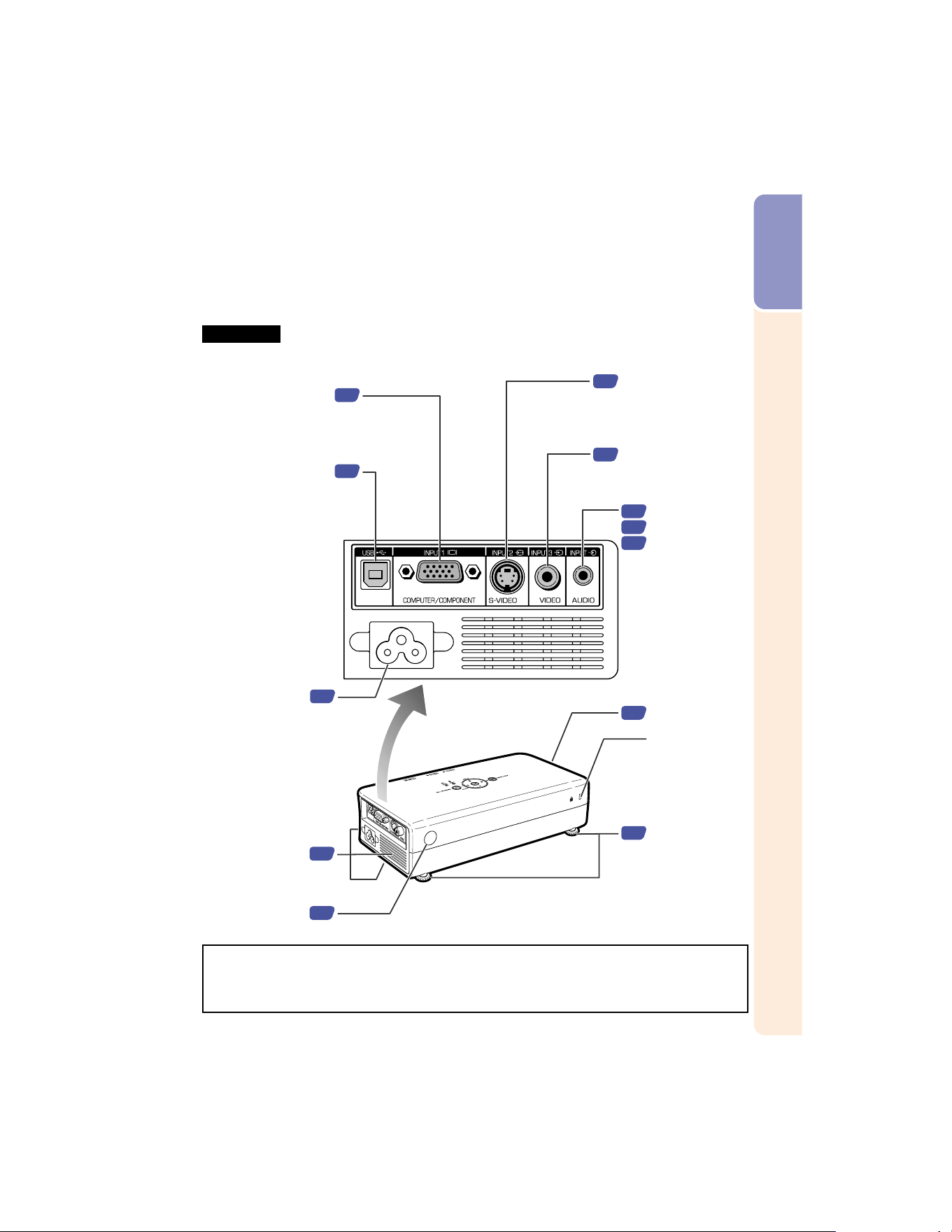
Terminals
Side View
Refer to “INPUT Terminals and Connectable Main Equipment” on page 21.
INPUT 1 terminal
Terminal for computer
RGB and component
signals.
AUDIO INPUT
terminal
INPUT 2 terminal
Terminal for connect-
ing video equipment
with an S-video
terminal.
INPUT 3 terminal
Terminal for connect-
ing video equipment.
Intake vent
Rear adjust-
ment foot
Kensington
Security
Standard
connector
AC socket
Connect the
supplied Power
cord.
Using the Kensington Lock
• This projector has a Kensington Security Standard connector for use with a Kensington
MicroSaver Security System. Refer to the information that came with the system for
instructions on how to use it to secure the projector.
USB terminal
Terminal connecting
with the USB
terminal on the
computer for using
the supplied remote
control as the
computer mouse.
Remote control
sensor
Exhaust vent
14
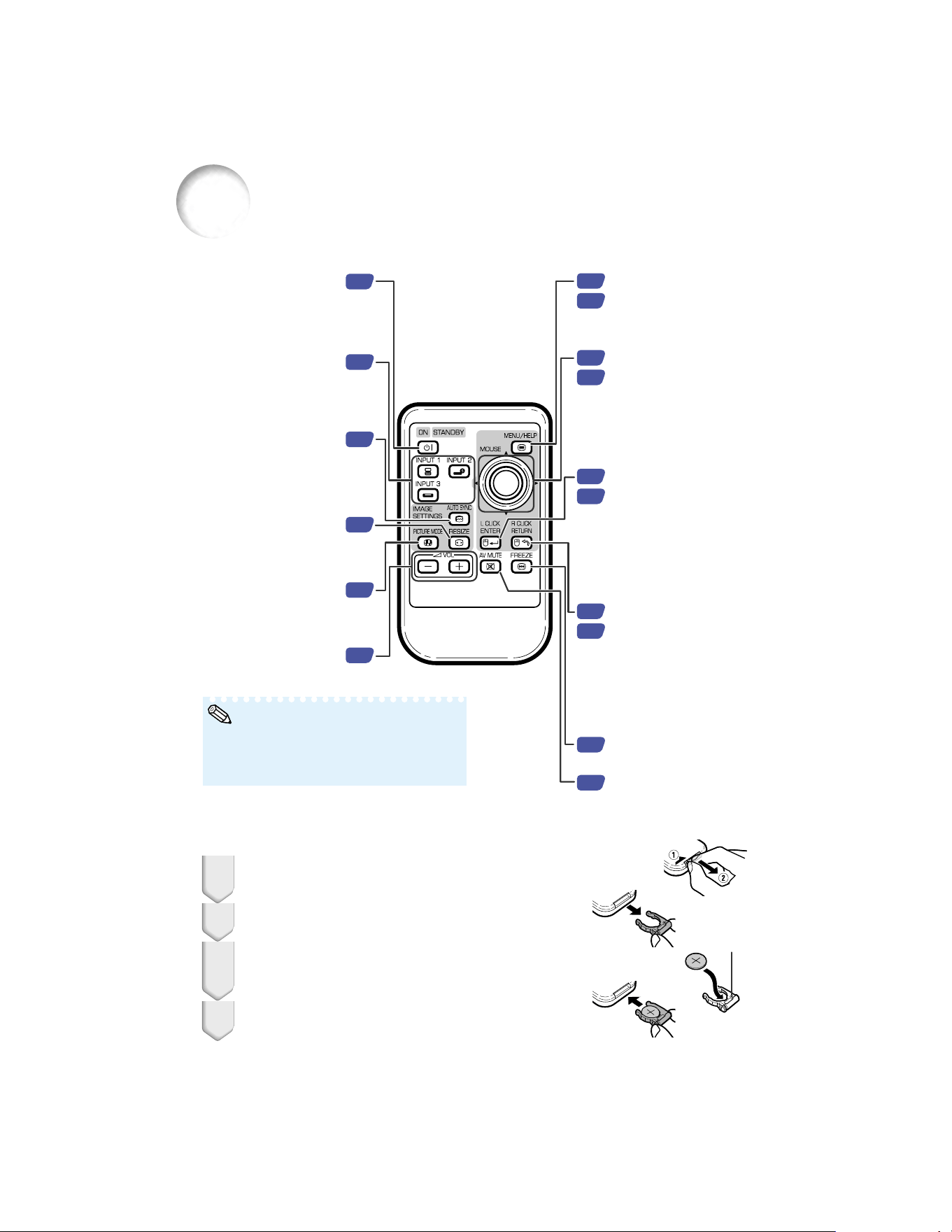
Inserting the Lithium Battery
Insert the battery holder into the remote control.
Insert the supplied lithium battery (CR2025).
• Insert the lithium battery with the + side of the battery facing the
+ mark of the battery holder.
Pull the battery holder.
While pressing the tab (1), pull the battery holder
(2).
1
2
3
29
32
30
32
29
33
29
26
36
33
33
51
36
36
36
32
Part Names and Functions (Continued)
MOUSE/Adjustment
buttons (P/R/O/Q)
• For moving the computer
cursor when connecting
the projector USB terminal
to the computer with RGB/
USB cable.
• For selecting menu items.
L CLICK/ENTER button
• For the Left click when
connecting the projector
USB terminal to the
computer with RGB/USB
cable.
• For setting items selected
or adjusted on the menu.
AV MUTE button
For temporarily display-
ing the black screen and
turning off the sound.
RESIZE button
For switching the
screen size (NORMAL,
BORDER, etc.).
FREEZE button
For freezing images.
INPUT 1, 2, and 3
buttons
For switching to the
respective input
modes.
Volume buttons
For adjusting the
speaker sound level.
AUTO SYNC button
For automatically
adjusting images when
connected to a com-
puter.
R CLICK/RETURN button
• For the Right click when
connecting the projector
USB terminal to the
computer with RGB/USB
cable.
• For undoing an operation
or returning to the previous
display.
MENU/HELP button
For displaying adjustment
and setting screens, and
help screen.
ON/STANDBY button
For turning the power
on and putting the
projector into standby
mode.
Numbers in Z refer to the main pages in this operation manual where the topic is explained.
PICTURE MODE
buttons
For switching the
picture mode.
• All the buttons on the remote control, except
the MOUSE/Adjustment button, are made of
luminous rubber, that is visible in the dark. (The
luminous light weakens over time.)
Note
4
+ mark
15
Introduction
Notes the Use of the Lithium Battery
• The signal from the remote control can be re-
flected off a screen for easy operation. How-
ever, the effective distance of the signal may
differ depending on the screen material.
When using the remote control
• Be sure not to drop, expose to moisture or
high temperature.
• The remote control may malfunction under a
fluorescent lamp. In this case, move the pro-
jector away from the fluorescent lamp.
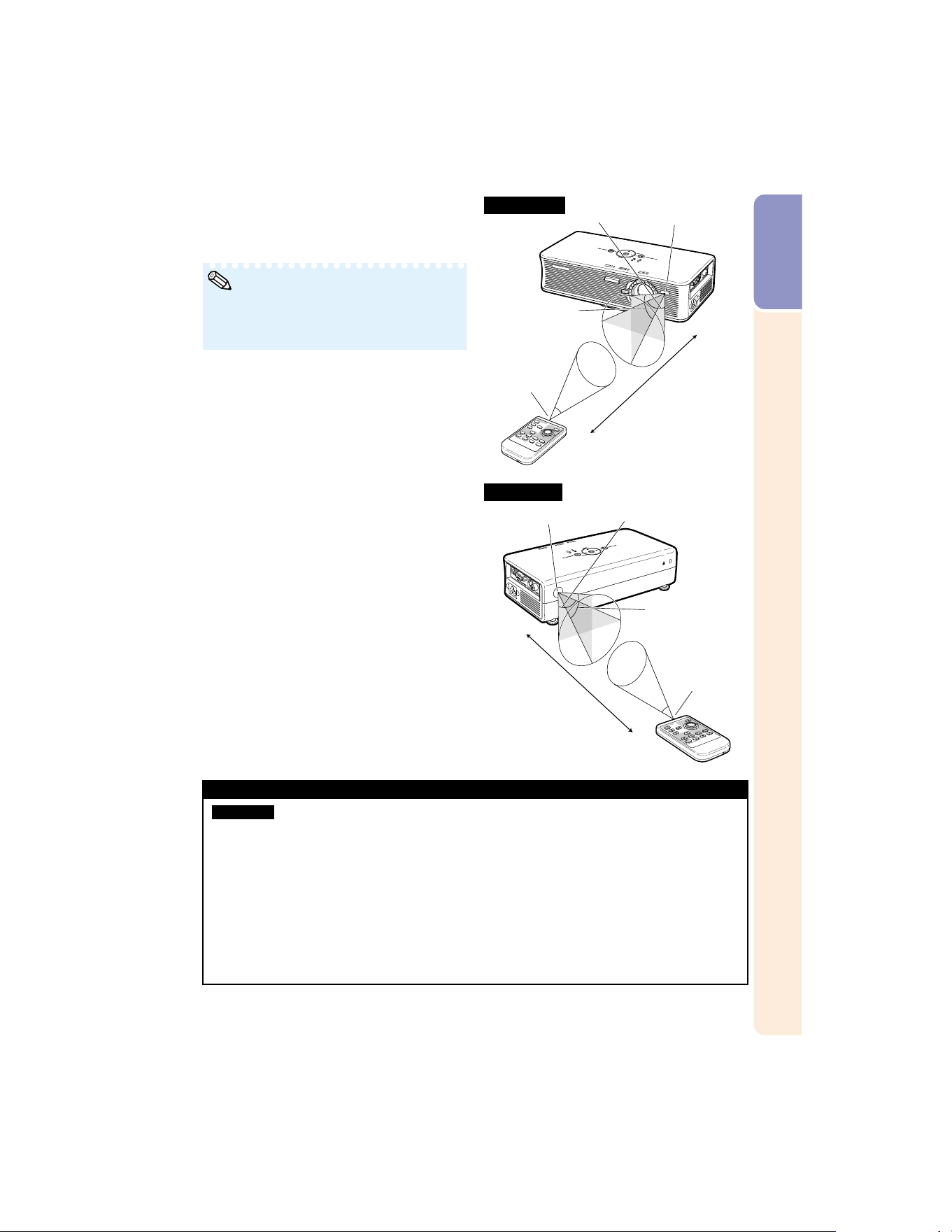
Usable Range
The remote control can be used to control the
projector within the ranges shown in the illustra-
tion.
Remote control sensor
Remote
control signal
transmitters
Remote control
13n (4 m)
30°
30°
30°
Note
Replacement of lithium battery
• Replace with a new battery (CR2025) if remote control operation often fails.
• When disposing the battery, follow the recycling or disposal regulations in your community.
CAUTION The battery used in this device may present a risk of fire of chemical burn if mis-
treated. Do not recharge, disassemble, heat above 212°F (100°C) , or incinerate. Replace bat-
tery with the type CR2025 only. Use of another battery may present a risk of fire or explosion.
Dispose of used battery promptly. Keep away from children. Do not disassemble and do not
dispose of in fire.
• See page 2 for caution on the lithium battery.
• Do not short-circuit, recharge, disassemble, or heat the lithium battery.
• Should the lithium battery leak, wipe the battery compartment clean, and then insert a new
battery.
Front view
Rear view
Remote control sensor
Remote control
signal
transmitters
13n (4 m)
30°
30°
30°
16
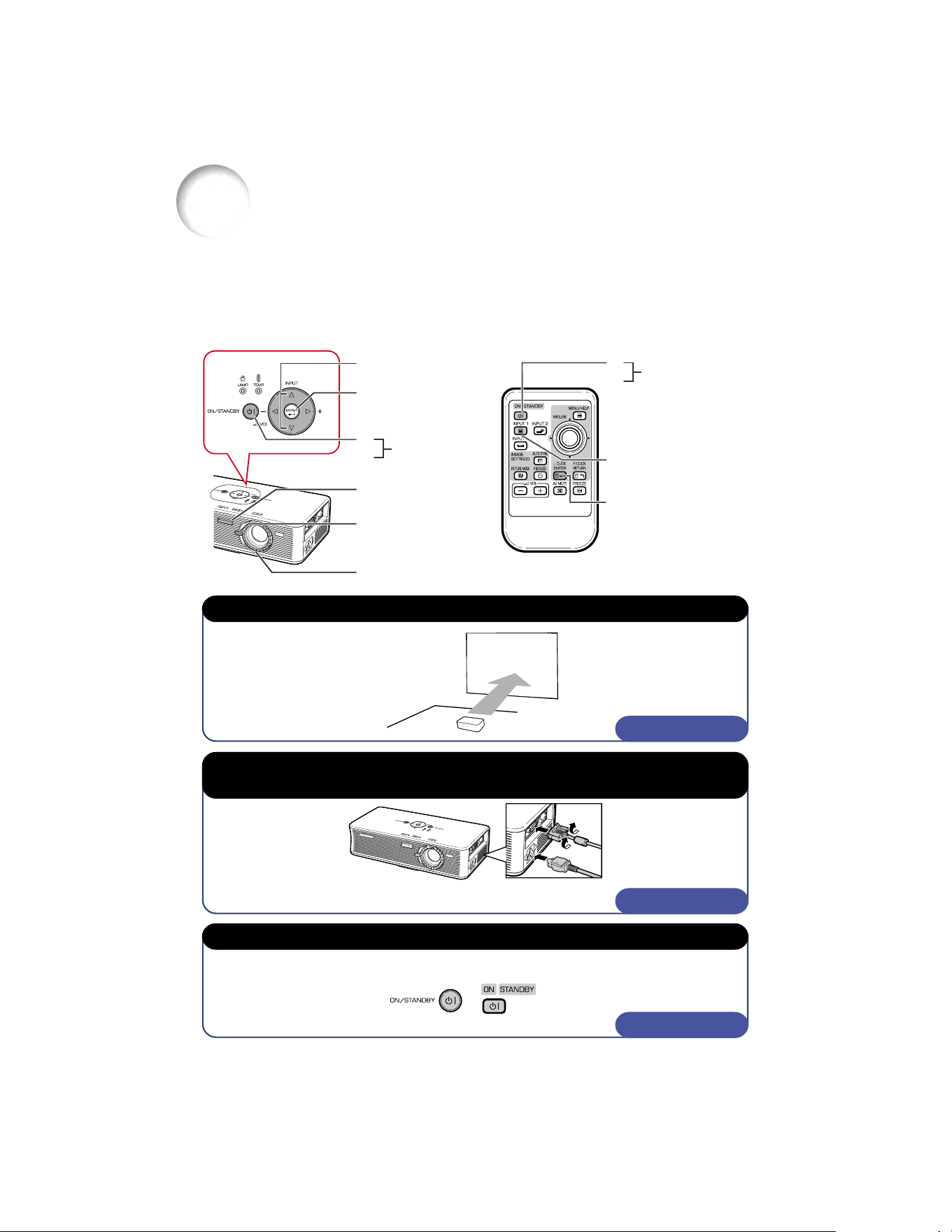
1. Place the projector facing a wall or a screen
Quick Start
This section shows the basic operation (projector connecting with the computer). For details, see
the page described below for each step.
Setup and Projection
In this section, connection of the projector and the computer is explained using one example.
When connecting equipment other than the computer, see
pages 24 and 25.
3. Press the ON/STANDBY button to turn the projector on
2. Connect the projector to the computer and plug the power cord
into the AC socket of the projector
On the projector On the remote control
INPUT 1 button
INPUT button
ON/STANDBY
button
HEIGHT
ADJUST button
Focus ring
Zoom knob
ON/STANDBY
button
_P. 18
_PP. 21–25
_P. 26
ENTER button
ENTER button
5
4
3
6
4
4
4
3
6
5
4
17
Quick Start
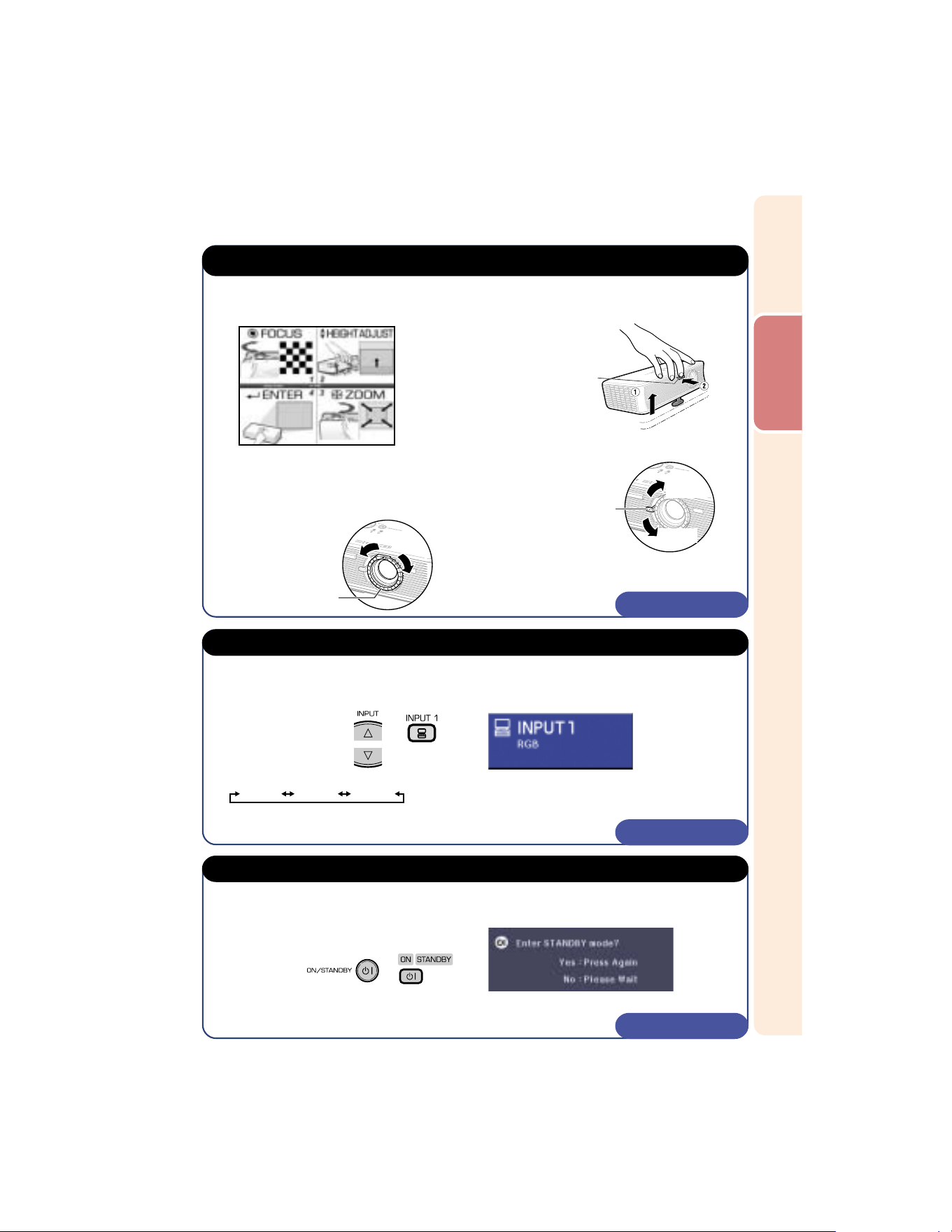
5 After adjusting the focus, height and screen
size, press TENTER to finish the Setup
Guide.
4. Adjust the projected image with the Setup Guide
2
Focus (See page 27.)
• Bring the projected
image into focus
using the focus ring.
4 Zoom (See page 28.)
• Adjust the projected image size using the
zoom knob.
3 Angle (See page 28.)
• Adjust the projector angle using the
HEIGHT ADJUST button.
Select the “INPUT 1” using the INPUT button on the projector or C INPUT 1 on the remote
control.
5. Select the INPUT mode
• When pressing the INPUT button on the projector, input mode switches in order of
INPUT1 INPUT2 INPUT3
.
• When using the remote control, press the CINPUT 1/DINPUT 2/EINPUT 3 button to
switch the INPUT mode.
6. Turn the Power off
Press the ON/STANDBY button, then press that button again while the confirmation message is
displayed, to put the projector into standby mode.
• While the cooling fan is running, the Adjustment buttons blinks. (When
“Guide LEDs” is set to “On”. n page 48)
• Unplug the power cord from the AC outlet after the cooling fan stops.
On-screen Display
On the
projector
On the remote
control
On the
projector
On the remote
control
zoom
in
On-screen display (RGB)
_P. 26
_P. 29
_P. 27
zoom
out
Focus ring
1 After the projector turns on, the Setup
Guide appears. (When “Setup Guide” is set
to “On”. n page 45)
Zoom knob
HEIGHT ADJUST
button
• Refer to the Setup Guide screen to adjust
the focus, angle and zoom.
• Press TENTER to finish the Setup Guide.
18
Projecting a Reversed Im-
age
Setting up the Projector
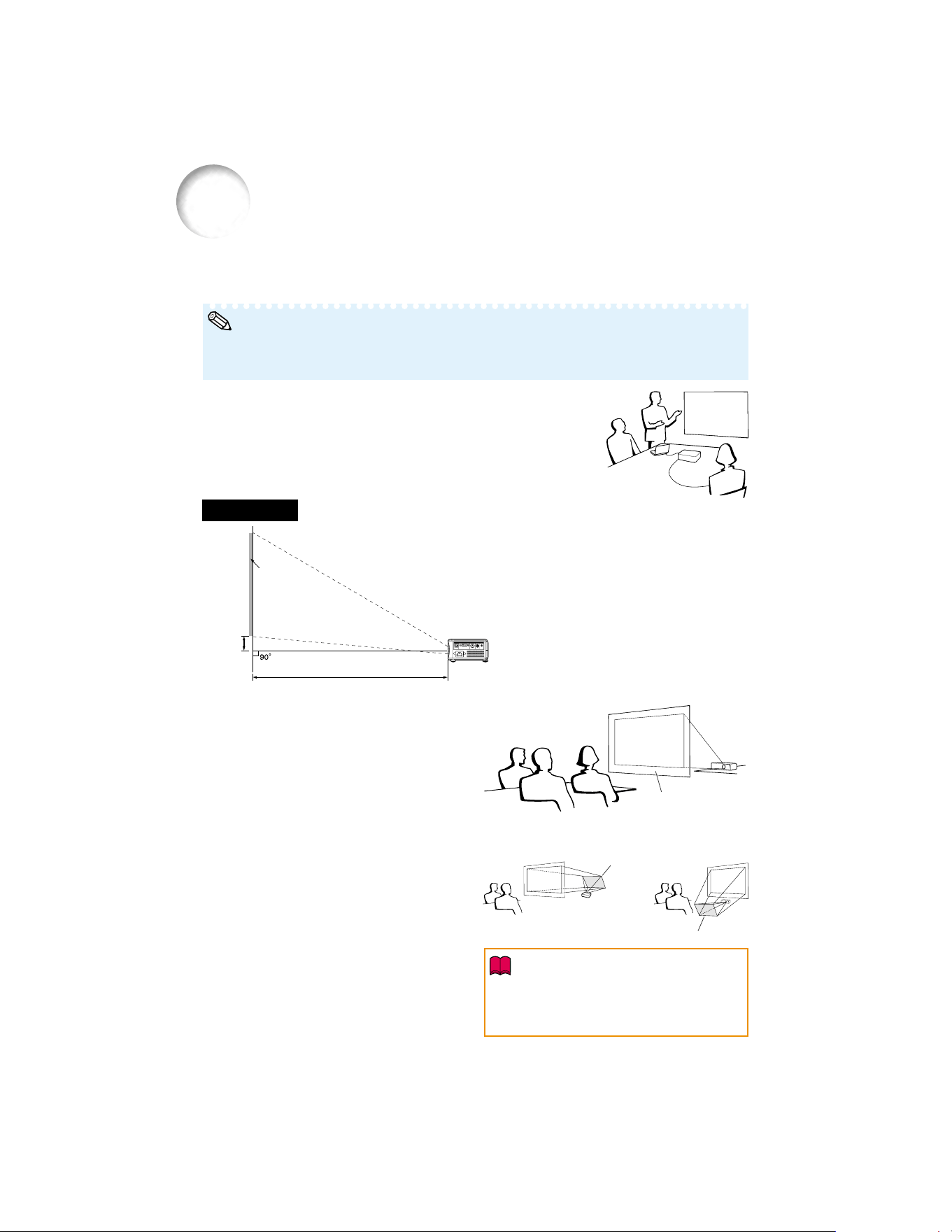
Position the projector perpendicular to the screen with the projector’s feet flat and level to achieve
an optimal image.
• For an optimal image, position the screen so that it is not in direct sunlight or room light. Light falling
directly on the screen washes out the colors, making viewing difficult. Close the curtains and dim
the lights when setting up the screen in a sunny or bright room.
Side View
Standard Setup (Front Projection)
■ Place the projector at the required distance from the screen according
to the desired picture size. (See page 19.)
Example of standard setup
Screen
Lens center
Setting up the Projector
Projection from behind the
Screen
■ Place a translucent screen between the pro-
jector and the audience.
■ Reverse the image by setting “Rear” in the
“PRJ Mode” menu. (See page 46.)
Projection Using a Mirror
■ Place a mirror (normal flat type) in front of
the lens.
■ When the translucent screen is placed be-
tween the mirror and audience, set to “Front”
in the “PRJ Mode” menu. (See page 46.)
■ When the mirror is placed on the audience
side, set to “Rear” in the “PRJ Mode” menu.
(See page 46.)
Mirror
Translucent screen
Audience
Set to “Front”
Translucent
screen
Mirror
Audience
Set to “Rear”
Audience
Note
H
L
Info
• When using a mirror, be sure to carefully posi-
tion both the projector and the mirror so the
light does not shine into the eyes of the audi-
ence.
19
Setup
270⬙ (686 cm)
250⬙ (635 cm)
200⬙ (508 cm)
150⬙ (381 cm)
100⬙ (254 cm)
84⬙ (213 cm)
72⬙ (183 cm)
60⬙ (152 cm)
40⬙ (102 cm)
30⬙ (76 cm)
549 cm (216⬙)
508 cm (200⬙)
406 cm (160⬙)
305 cm (120⬙)
203 cm (80⬙)
171 cm (67⬙)
146 cm (58⬙)
122 cm (48⬙)
81 cm (32⬙)
61 cm (24⬙)
ⳮ50.9 cm
ⳮ47.1 cm
ⳮ37.7 cm
ⳮ28.3 cm
ⳮ18.9 cm
ⳮ15.8 cm
ⳮ13.6 cm
ⳮ11.3 cm
ⳮ7.5 cm
ⳮ5.7 cm
(ⳮ20
3
/
64
⬙)
(ⳮ18
9
/
16
⬙)
(ⳮ14
27
/
32
⬙)
(ⳮ11
9
/
64
⬙)
(ⳮ7
27
/
64
⬙)
(ⳮ6
15
/
64
⬙)
(ⳮ5
11
/
32
⬙)
(ⳮ4
29
/
64
⬙)
(ⳮ2
31
/
32
⬙)
(ⳮ2
15
/
64
⬙)
411 cm (162⬙)
381 cm (150⬙)
305 cm (120⬙)
229 cm (90⬙)
152 cm (60⬙)
128 cm (50⬙)
110 cm (43⬙)
91 cm (36⬙)
61 cm (24⬙)
46 cm (18⬙)
9.9 m (32⬘ 5⬙)
9.1 m (30⬘ 0⬙)
7.3 m (24⬘ 0⬙)
5.5 m (18⬘ 0⬙)
3.7 m (12⬘ 0⬙)
3.1 m (10⬘ 1⬙)
2.6 m (8⬘ 8⬙)
2.2 m (7⬘ 2⬙)
1.5 m (4⬘ 10⬙)
1.1 m (3⬘ 7⬙)
8.5 m (28⬘ 0⬙)
6.4 m (21⬘ 0⬙)
4.3 m (14⬘ 0⬙)
3.6 m (11⬘ 9⬙)
3.1 m (10⬘ 1⬙)
2.6 m (8⬘ 5⬙)
1.7 m (5⬘ 7⬙)
1.3 m (4⬘ 2⬙)
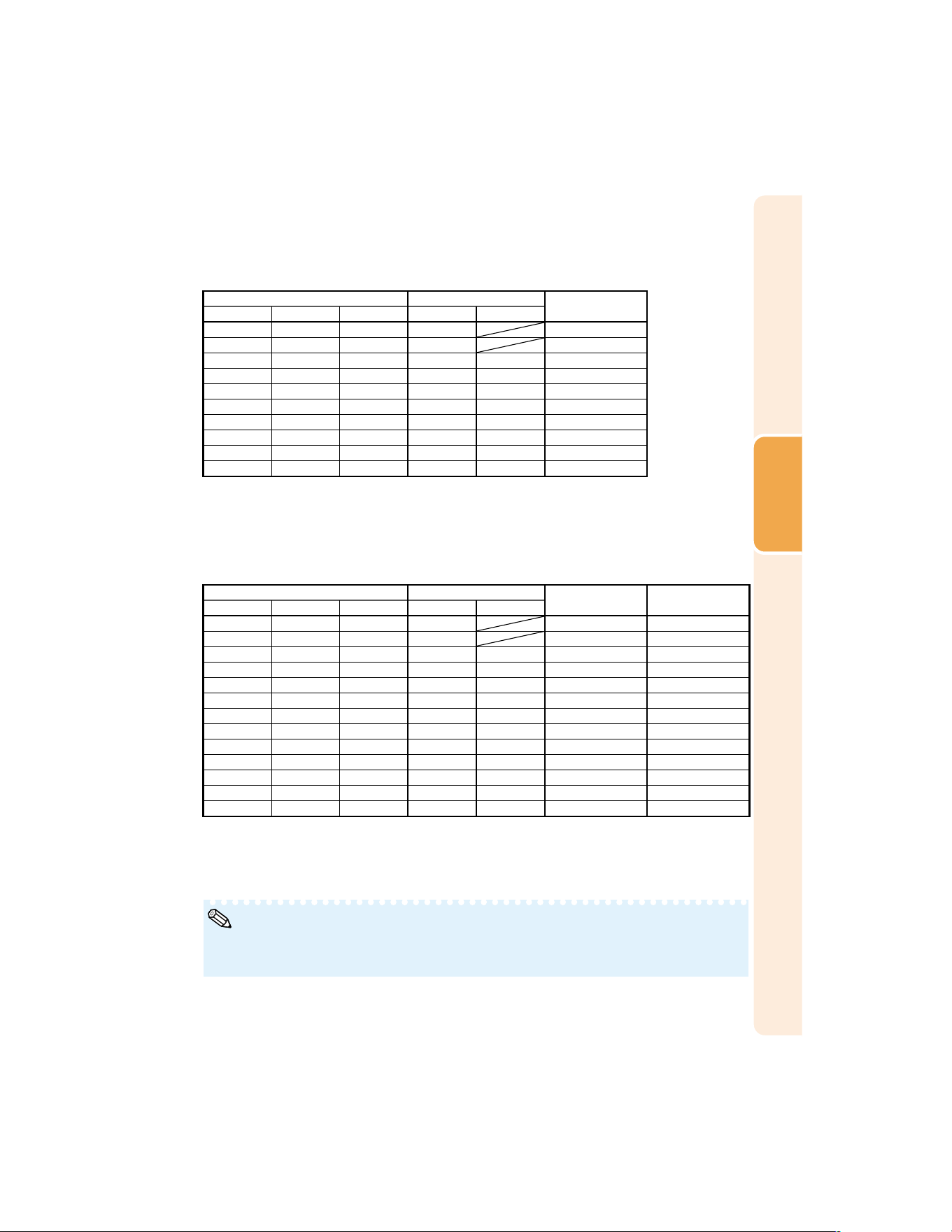
The formula for picture size and projection distance
[m/cm]
L1 (m) = 0.03985
χ
L2 (m) = 0.04649
χ
H (cm) = - 0.41299
χ
S (cm) = ±0.20754
χ
Screen Size and Projection Distance (XR-1X)
• There may be an error of ±3% in the above values.
• Values with a minus (-) sign indicate that the lens center is lower than the bottom of the projected
image.
NORMAL Mode (4:3)
Picture (Screen) size
The formula for picture size and projection distance
[m/cm]
L1 (m) = 0.03658
χ
L2 (m) = 0.04267
χ
H (cm) = - 0.18857
χ
χ
: Picture size (diag.) (in/cm)
L: Projection distance (m/ft)
L1: Minimum projection distance (m/ft)
L2: Maximum projection distance (m/ft)
H: Distance from the bottom of the image to the lens center (cm/in)
χ
: Picture size (diag.) (in/cm)
L: Projection distance (m/ft)
L1: Minimum projection distance (m/ft)
L2: Maximum projection distance (m/ft)
H: Distance from the bottom of the image to the lens center (cm/in)
S: Adjustable range of image position (cm/in) See page 43.
Projection distance [L]
Diag. [
χ
] Width Height
Minimum [L1] Maximum [L2]
STRETCH Mode (16:9)
250⬙ (635 cm)
225⬙ (572 cm)
200⬙ (508 cm)
150⬙ (381 cm)
133⬙ (338 cm)
106⬙ (269 cm)
100⬙ (254 cm)
92⬙ (234 cm)
84⬙ (213 cm)
72⬙ (183 cm)
60⬙ (152 cm)
40⬙ (102 cm)
30⬙ (76 cm)
553 cm (218⬙)
498 cm (196⬙)
443 cm (174⬙)
332 cm (131⬙)
294 cm (116⬙)
235 cm (92⬙)
221 cm (87⬙)
204 cm (80⬙)
186 cm (73⬙)
159 cm (63⬙)
133 cm (52⬙)
89 cm (35⬙)
66 cm (26⬙)
ⳮ103.2 cm
ⳮ92.9 cm
ⳮ82.6 cm
ⳮ61.9 cm
ⳮ54.9 cm
ⳮ43.8 cm
ⳮ41.3 cm
ⳮ38.0 cm
ⳮ34.7 cm
ⳮ29.7 cm
ⳮ24.8 cm
ⳮ16.5 cm
ⳮ12.4 cm
(ⳮ40
21
/
32
⬙)
(ⳮ36
37
/
64
⬙)
(ⳮ32
33
/
64
⬙)
(ⳮ24
25
/
64
⬙)
(ⳮ21
5
/
8
⬙)
(ⳮ17
15
/
64
⬙)
(ⳮ16
17
/
64
⬙)
(ⳮ14
61
/
64
⬙)
(ⳮ13
21
/
32
⬙)
(ⳮ11
45
/
64
⬙)
(ⳮ9
3
/
4
⬙)
(ⳮ6
1
/
2
⬙)
(ⳮ4
7
/
8
⬙)
Ⳳ51.9 cm
Ⳳ46.7 cm
Ⳳ41.5 cm
Ⳳ31.1 cm
Ⳳ27.6 cm
Ⳳ22.0 cm
Ⳳ20.8 cm
Ⳳ19.1 cm
Ⳳ17.4 cm
Ⳳ14.9 cm
Ⳳ12.5 cm
Ⳳ8.3 cm
Ⳳ6.2 cm
(Ⳳ20
27
/
64
⬙)
(Ⳳ18
25
/
64
⬙)
(Ⳳ16
11
/
32
⬙)
(Ⳳ12
1
/
4
⬙)
(Ⳳ10
7
/
8
⬙)
(Ⳳ8
21
/
32
⬙)
(Ⳳ8
11
/
64
⬙)
(Ⳳ7
33
/
64
⬙)
(Ⳳ6
55
/
64
⬙)
(Ⳳ5
57
/
64
⬙)
(Ⳳ4
29
/
32
⬙)
(Ⳳ3
17
/
64
⬙)
(Ⳳ2
29
/
64
⬙)
311 cm (123⬙)
280 cm (110⬙)
249 cm (98⬙)
187 cm (74⬙)
166 cm (65⬙)
132 cm (52⬙)
125 cm (49⬙)
115 cm (45⬙)
105 cm (41⬙)
90 cm (35⬙)
75 cm (29⬙)
50 cm (20⬙)
37 cm (15⬙)
10.0 m (32⬘ 8⬙)
9.0 m (29⬘ 5⬙)
8.0 m (26⬘ 2⬙)
6.0 m (19⬘ 7⬙)
5.3 m (17⬘ 5⬙)
4.2 m(13⬘10⬙)
4.0 m (13⬘ 1⬙)
3.7 m (12⬘ 0⬙)
3.3 m (11⬘ 0⬙)
2.9 m (9⬘ 5⬙)
2.4 m (7⬘10⬙)
1.6 m (5⬘ 3⬙)
1.2 m (3⬘11⬙)
9.3 m (30⬘ 6⬙)
7.0 m(22⬘11⬙)
6.2 m (20⬘ 3⬙)
4.9 m (16⬘ 2⬙)
4.6 m (15⬘ 3⬙)
4.3 m (14⬘ 0⬙)
3.9 m(12⬘10⬙)
3.3 m (11⬘ 0⬙)
2.8 m (9⬘ 2⬙)
1.9 m (6⬘ 1⬙)
1.4 m (4⬘ 7⬙)
Note
Distance from the bottom of the
image to the lens center [H]
Picture (Screen) size
Projection distance [L]
Diag. [
χ
] Width Height
Minimum [L1] Maximum [L2]
Distance from the bottom of the
image to the lens center [H]
Adjustable range of
image position [S]
[Feet/inches]
L1 (ft) = 0.03658
χ
/ 0.3048
L2 (ft) = 0.04267
χ
/ 0.3048
H (in) = - 0.18857
χ
/ 2.54
[Feet/inches]
L1 (ft) = 0.03985
χ
/ 0.3048
L2 (ft) = 0.04649
χ
/ 0.3048
H (in) = - 0.41299
χ
/ 2.54
S (in) = ±0.20754
χ
/ 2.54
20
280⬙ (711 cm)
250⬙ (635 cm)
200⬙ (508 cm)
150⬙ (381 cm)
100⬙ (254 cm)
84⬙ (213 cm)
72⬙ (183 cm)
60⬙ (152 cm)
40⬙ (102 cm)
30⬙ (76 cm)
569 cm (224⬙)
508 cm (200⬙)
406 cm (160⬙)
305 cm (120⬙)
203 cm (80⬙)
171 cm (67⬙)
146 cm (58⬙)
122 cm (48⬙)
81 cm (32⬙)
61 cm (24⬙)
ⳮ61.5 cm
ⳮ54.9 cm
ⳮ43.9 cm
ⳮ33.0 cm
ⳮ22.0 cm
ⳮ18.5 cm
ⳮ15.8 cm
ⳮ13.2 cm
ⳮ8.8 cm
ⳮ6.6 cm
(ⳮ24
7
/32⬙)
(ⳮ21
5
/8⬙)
(ⳮ17
19
/64⬙)
(ⳮ12
31
/32⬙)
(ⳮ8
21
/32⬙)
(ⳮ7
17
/64⬙)
(ⳮ6
15
/64⬙)
(ⳮ5
3
/16⬙)
(ⳮ3
29
/64⬙)
(ⳮ2
19
/32⬙)
427 cm (168⬙)
381 cm (150⬙)
305 cm (120⬙)
229 cm (90⬙)
152 cm (60⬙)
128 cm (50⬙)
110 cm (43⬙)
91 cm (36⬙)
61 cm (24⬙)
46 cm (18⬙)
9.8 m (32⬘ 2⬙)
8.8 m (28⬘ 9⬙)
7.0 m (23⬘ 0⬙)
5.3 m (17⬘ 3⬙)
3.5 m (11⬘ 6⬙)
2.9 m (9⬘ 8⬙)
2.5 m (8⬘ 3⬙)
2.1 m (6⬘ 11⬙)
1.4 m (4⬘ 7⬙)
1.1 m (3⬘ 5⬙)
8.1 m (26⬘ 8⬙)
6.1 m (20⬘ 0⬙)
4.1 m (13⬘ 4⬙)
3.4 m (11⬘ 2⬙)
2.9 m (9⬘ 7⬙)
2.4 m (8⬘ 0⬙)
1.6 m (5⬘ 4⬙)
1.2 m (4⬘ 0⬙)
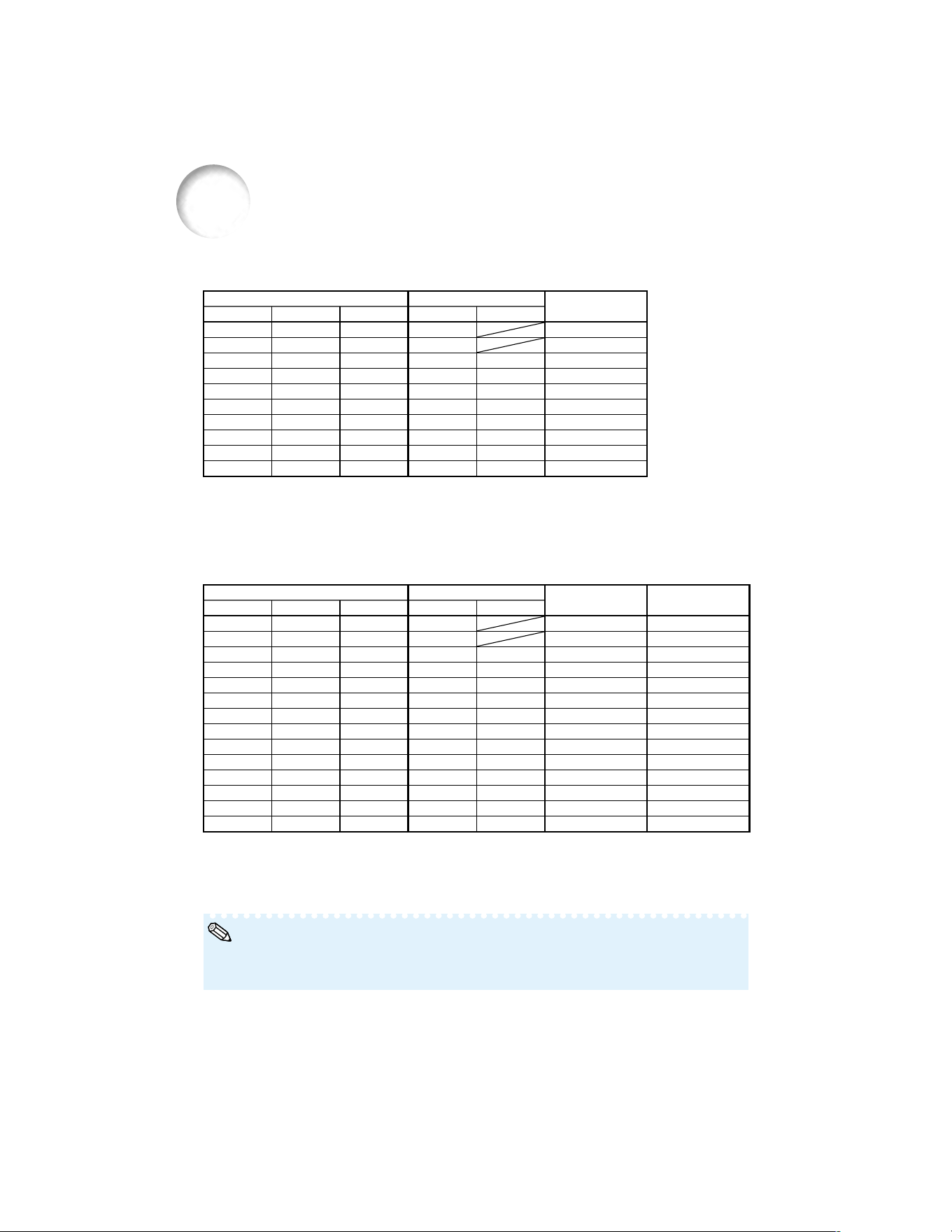
The formula for picture size and projection distance
[m/cm]
L1 (m) = 0.038169
χ
L2 (m) = 0.044276
χ
H (cm) = - 0.44691
χ
S (cm) = ±0.20754
χ
Screen Size and Projection Distance (XR-1S)
• There may be an error of ±3% in the above values.
• Values with a minus (-) sign indicate that the lens center is lower than the bottom of the projected
image.
NORMAL Mode (4:3)
Picture (Screen) size
The formula for picture size and projection distance
[m/cm]
L1 (m) = 0.03503
χ
L2 (m) = 0.04064
χ
H (cm) = - 0.21971
χ
χ
: Picture size (diag.) (in/cm)
L: Projection distance (m/ft)
L1: Minimum projection distance (m/ft)
L2: Maximum projection distance (m/ft)
H: Distance from the bottom of the image to the lens center (cm/in)
χ
: Picture size (diag.) (in/cm)
L: Projection distance (m/ft)
L1: Minimum projection distance (m/ft)
L2: Maximum projection distance (m/ft)
H: Distance from the bottom of the image to the lens center (cm/in)
S: Adjustable range of image position (cm/in) See page 43.
Projection distance [L]
Diag. [
χ
] Width Height
Minimum [L1] Maximum [L2]
STRETCH Mode (16:9)
260⬙ (660 cm)
250⬙ (635 cm)
225⬙ (572 cm)
200⬙ (508 cm)
150⬙ (381 cm)
133⬙ (338 cm)
106⬙ (269 cm)
100⬙ (254 cm)
92⬙ (234 cm)
84⬙ (213 cm)
72⬙ (183 cm)
60⬙ (152 cm)
40⬙ (102 cm)
30⬙ (76 cm)
576 cm (227⬙)
553 cm (218⬙)
498 cm (196⬙)
443 cm (174⬙)
332 cm (131⬙)
294 cm (116⬙)
235 cm (92⬙)
221 cm (87⬙)
204 cm (80⬙)
186 cm (73⬙)
159 cm (63⬙)
133 cm (52⬙)
89 cm (35⬙)
66 cm (26⬙)
ⳮ116.2 cm
ⳮ111.7 cm
ⳮ100.6 cm
ⳮ89.4 cm
ⳮ67.0 cm
ⳮ59.4 cm
ⳮ47.4 cm
ⳮ44.7 cm
ⳮ41.1 cm
ⳮ37.5 cm
ⳮ32.2 cm
ⳮ26.8 cm
ⳮ17.9 cm
ⳮ13.4 cm
(ⳮ45
3
/
4
⬙)
(ⳮ43
63
/
64
⬙)
(ⳮ39
19
/
32
⬙)
(ⳮ35
3
/
16
⬙)
(ⳮ26
25
/
64
⬙)
(ⳮ23
13
/
32
⬙)
(ⳮ18
21
/
32
⬙)
(ⳮ17
19
/
32
⬙)
(ⳮ16
3
/
16
⬙)
(ⳮ14
25
/
32
⬙)
(ⳮ12
43
/
64
⬙)
(ⳮ10
9
/
16
⬙)
(ⳮ7
1
/
32
⬙)
(ⳮ5
9
/
32
⬙)
Ⳳ54.0 cm
Ⳳ51.9 cm
Ⳳ46.7 cm
Ⳳ41.5 cm
Ⳳ31.1 cm
Ⳳ27.6 cm
Ⳳ22.0 cm
Ⳳ20.8 cm
Ⳳ19.1 cm
Ⳳ17.4 cm
Ⳳ14.9 cm
Ⳳ12.5 cm
Ⳳ8.3 cm
Ⳳ6.2 cm
(Ⳳ21
1
/
4
⬙)
(Ⳳ20
27
/
64
⬙)
(Ⳳ18
25
/
64
⬙)
(Ⳳ16
11
/
32
⬙)
(Ⳳ12
1
/
4
⬙)
(Ⳳ10
7
/
8
⬙)
(Ⳳ8
21
/
32
⬙)
(Ⳳ8
11
/
64
⬙)
(Ⳳ7
33
/
64
⬙)
(Ⳳ6
55
/
64
⬙)
(Ⳳ5
57
/
64
⬙)
(Ⳳ4
29
/
32
⬙)
(Ⳳ3
17
/
64
⬙)
(Ⳳ2
29
/
64
⬙)
324 cm (127⬙)
311 cm (123⬙)
280 cm (110⬙)
249 cm (98⬙)
187 cm (74⬙)
166 cm (65⬙)
132 cm (52⬙)
125 cm (49⬙)
115 cm (45⬙)
105 cm (41⬙)
90 cm (35⬙)
75 cm (29⬙)
50 cm (20⬙)
37 cm (15⬙)
9.9 m (32⬘ 7⬙)
9.5 m (31⬘ 4⬙)
8.6 m (28⬘ 2⬙)
7.6 m (25⬘ 1⬙)
5.7 m (18⬘ 9⬙)
5.1 m (16⬘ 8⬙)
4.0 m (13⬘ 3⬙)
3.8 m (12⬘ 6⬙)
3.5 m (11⬘ 6⬙)
3.2 m (10⬘ 6⬙)
2.7 m (9⬘ 0⬙)
2.3 m (7⬘ 6⬙)
1.5 m (5⬘ 0⬙)
1.1 m (3⬘ 9⬙)
10.0 m (32⬘ 8⬙)
8.9 m (29⬘ 1⬙)
6.6 m (21⬘ 9⬙)
5.9 m (19⬘ 4⬙)
4.7 m (15⬘ 5⬙)
4.4 m (14⬘ 6⬙)
4.1 m (13⬘ 4⬙)
3.7 m (12⬘ 2⬙)
3.2 m (10⬘ 6⬙)
2.7 m (8⬘ 9⬙)
1.8 m (5⬘ 10⬙)
1.3 m (4⬘ 4⬙)
Note
Distance from the bottom of the
image to the lens center [H]
Picture (Screen) size
Projection distance [L]
Diag. [
χ
] Width Height
Minimum [L1] Maximum [L2]
Distance from the bottom of the
image to the lens center [H]
Adjustable range of
image position [S]
[Feet/inches]
L1 (ft) = 0.03503
χ
/ 0.3048
L2 (ft) = 0.04064
χ
/ 0.3048
H (in) = - 0.21971
χ
/ 2.54
[Feet/inches]
L1 (ft) = 0.038169
χ
/ 0.3048
L2 (ft) = 0.044276
χ
/ 0.3048
H (in) = - 0.44691
χ
/ 2.54
S (in) = ±0.20754
χ
/ 2.54
Setting up the Projector (Continued)
21
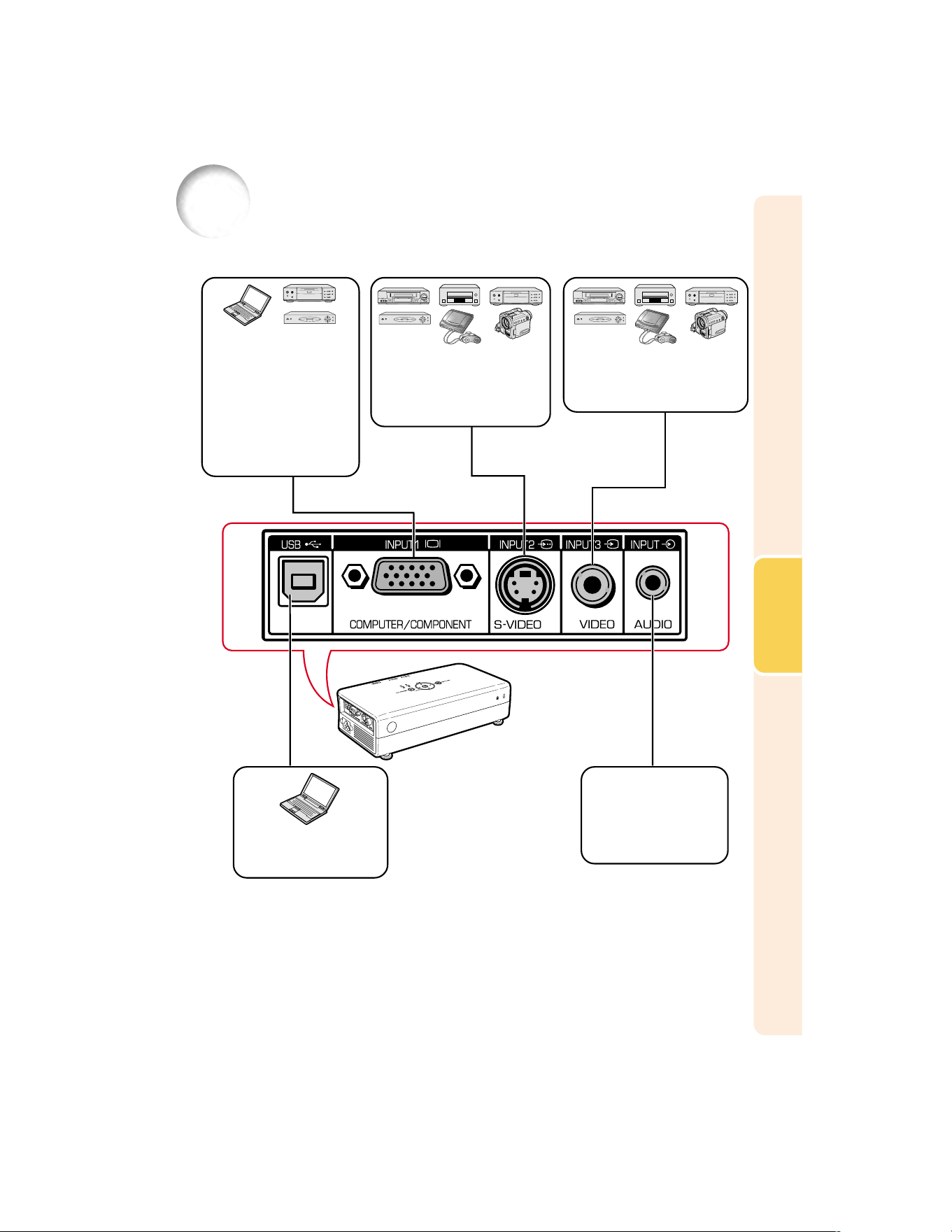
Connections
Connections
INPUT Terminals and Connectable Main Equipment
INPUT 1 terminal
■
Connecting the com-
puter. (See page 23.)
■ Connecting video
equipment with
component output
terminal (DVD player,
DTV decoder, DVD
recorder with hard disc,
etc.). (See page 24.)
INPUT 2 terminal
Connecting video equipment
with S-video output terminal
(VCR, DVD player, etc.). (See
page 24.)
INPUT 3 terminal
Connecting video equipment
without S-video output
terminal. (See page 25.)
USB terminal
Connecting the computer.
(See page 33.)
AUDIO INPUT terminal
Connecting an audio
cable (Shared audio
input terminal for INPUT
1, 2 and 3.) (See pages
23, 24 and 25.)
22
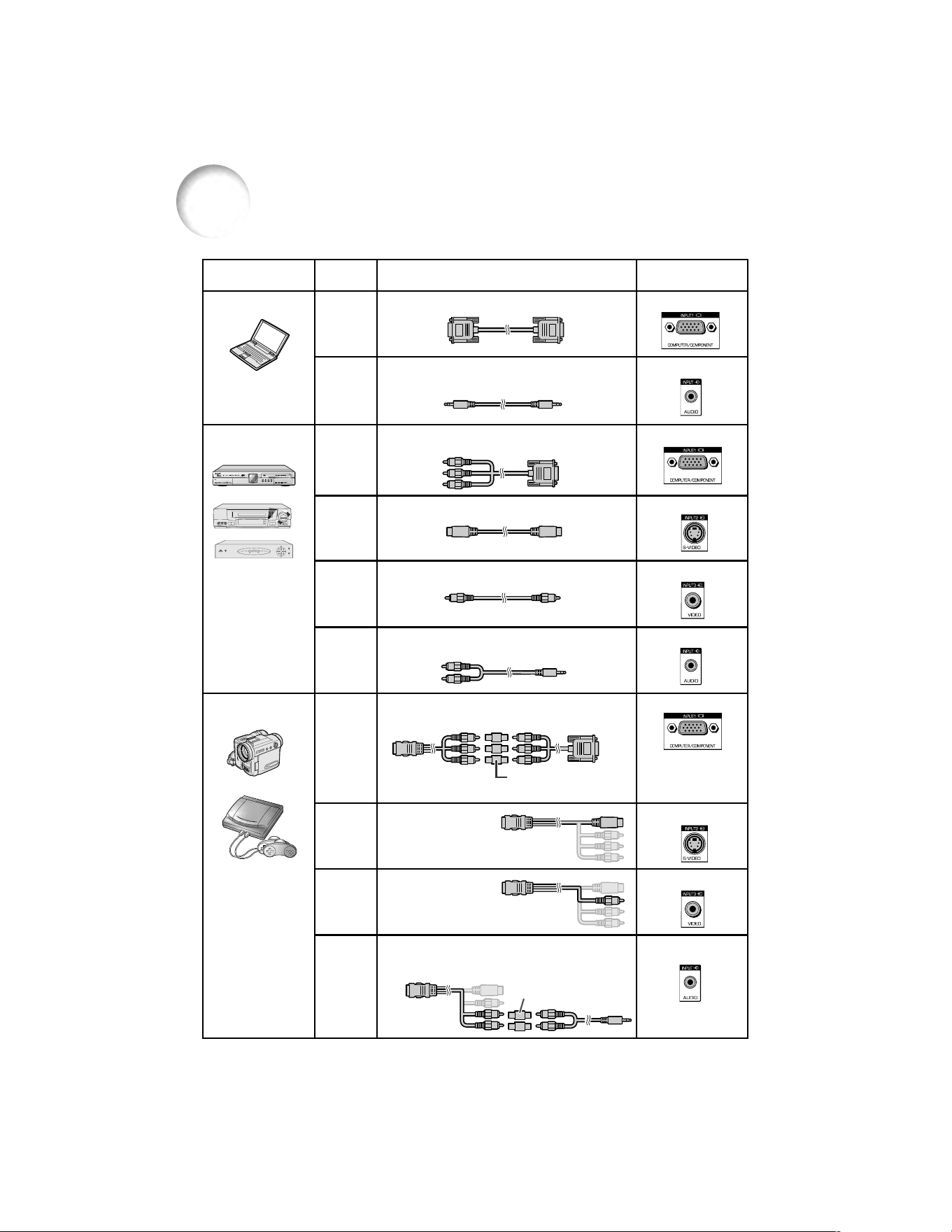
Samples of Cables for Connection
Cables for a camera
or a video game
Equipment
Input
Signal
Cable
Terminal on the
projector
ø3.5 mm stereo audio cable
RGB/USB cable (supplied)
S-video cable (commercially available)
Video cable (commercially available)
Computer
Audio-visual
equipment
Camera/video
game
RGB
video
Computer
audio
S-video
S-video
Compo-
nent
video
Video
Audio
Cables for a camera or a video game/3 RCA
(Component) to 15-pin D-sub cable (optional,
AN-C3CP)
ø3.5 mm minijack to RCA audio cable
(commercially available)
INPUT1
AUDIO INPUT
INPUT2
INPUT3
AUDIO INPUT
INPUT1
INPUT2
Video
Audio
Cables for a camera
or a video game
Cables for a camera or a video game/ø3.5
mm minijack to RCA audio cable (commer-
cially available)
INPUT3
AUDIO INPUT
3 RCA (Component) to 15-pin D-sub cable
(optional, AN-C3CP)
Compo-
nent
video
INPUT1
•
For more details of connection and cables, refer to the opeation manual of the connecting equipment.
• You may need other cables or connectors not listed above.
Cable adapter (com-
mercially available)
Cable adapter (com-
mercially available)
23
Connections
■ This projector is compatible with VESA-standard DDC 1/DDC 2B. The projector and a VESA
DDC compatible computer will communicate their setting requirements, allowing for quick
and easy setup.
■ Before using the “Plug and Play” function, be sure to turn on the projector first and the
connected computer last.
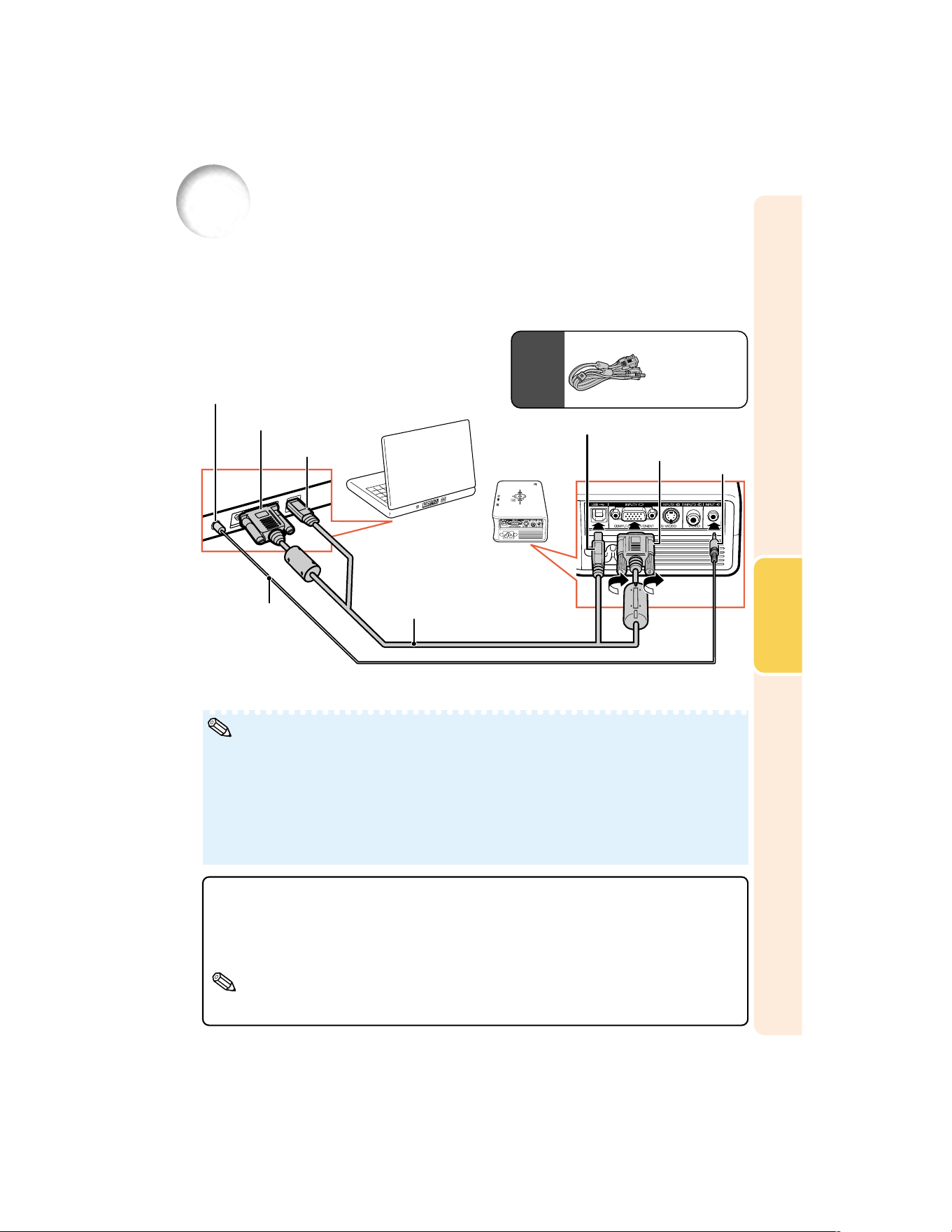
Supplied
accessory
“Plug and Play” function (when connecting to a 15-pin terminal)
Connecting to a Computer
• The DDC “Plug and Play” function of this projector operates only when used in conjunction with a
VESA DDC compatible computer.
Note
To RGB output terminal
To audio output terminal
RGB/USB Cable
* ø3.5 mm stereo or
mono audio cable
(commercially
available or
available as Sharp
service part
QCNWGA038WJPZ)
RGB/USB Cable
Before connecting, be sure to unplug the power cord of the projector from the AC outlet and
turn off the devices to be connected. After making all connections, turn on the projector
and then the other devices. When connecting a computer, be sure that it is the last device to
be turned on after all the connections are made.
Be sure to read the operation manuals of the devices to be connected before making connections.
* When using the ø3.5 mm mono audio cable, the volume level will be half of
when using the ø3.5 mm stereo audio cable.
• When connecting with USB cable, you can use the remote control as a mouse for controlling cursor.
See page 33.
• See page 59 “Computer Compatibility Chart” for a list of computer signals compatible with the projec-
tor. Use with computer signals other than those listed may cause some of the functions to not work.
• A Macintosh adaptor may be required for use with some Macintosh computers. Contact your near-
est Macintosh Dealer.
• Depending on the computer you are using, an image may not be projected unless the signal
output setting of the computer is switched to the external output. Refer to the computer opera-
tion manual for switching the computer signal output settings.
Note
To USB terminal
To INPUT1
terminal
To USB terminal
To AUDIO
INPUT terminal
24
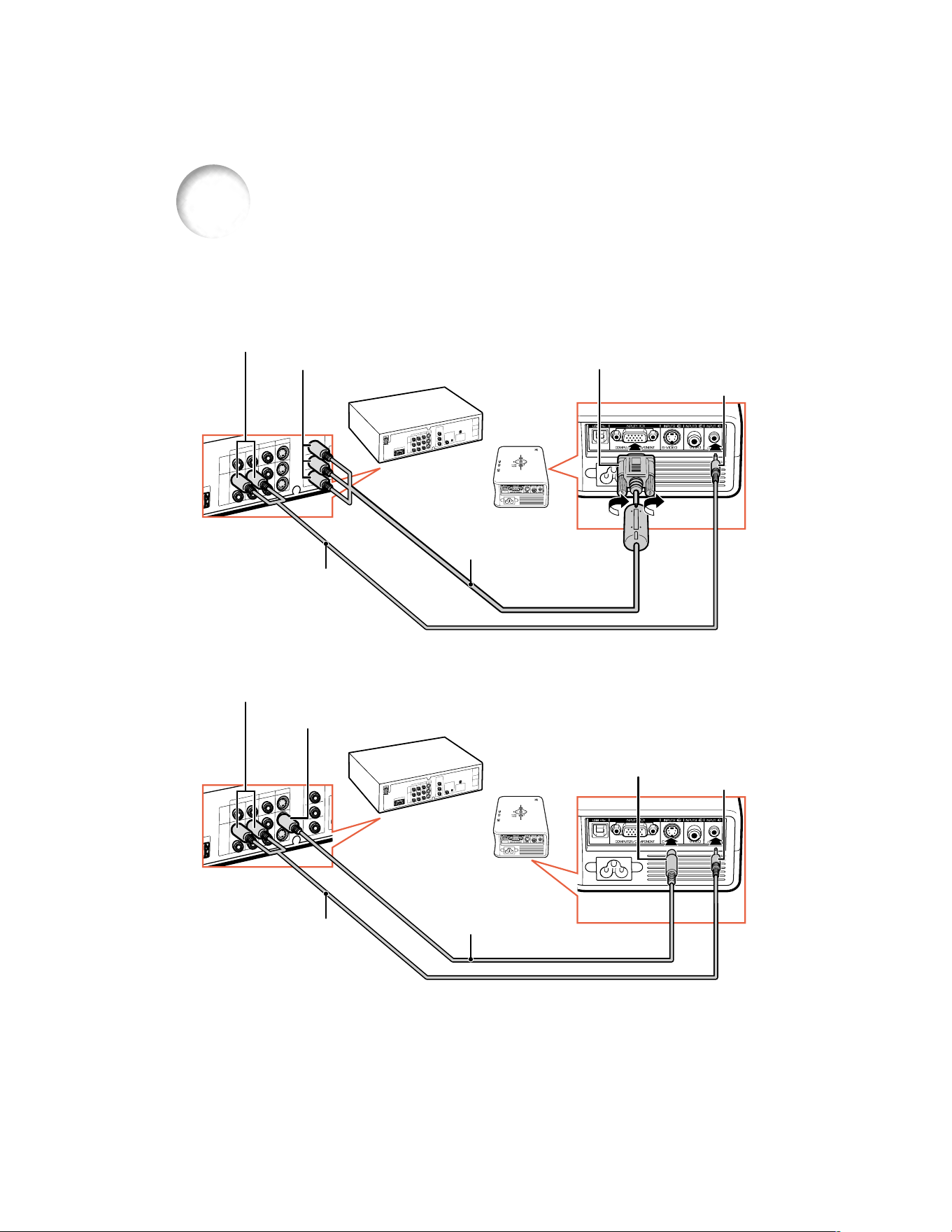
Connecting to Video Equipment
The projector has a COMPUTER/COMPONENT terminal, an S-VIDEO terminal and a VIDEO ter-
minal for video input. See the illustration below to connect with the audio-visual equipment.
The image quality is highest in order of the component signal, the S-video signal and the video
signal. If your audio-visual equipment has a component output terminal, use the COMPUTER/
COMPONENT terminal (INPUT1) on the projector for video connection.
When using an S-video cable
To S-video output terminal
To audio output terminal
S-video cable
(commercially available)
ø3.5 mm minijack to RCA
audio cable (commercially
available)
When using a 3 RCA (Component) to 15-pin D-sub cable
3 RCA (Component) to
15-pin D-sub cable
(optional: AN-C3CP)
To AUDIO
INPUT terminal
To audio output terminal
ø3.5 mm minijack to RCA
audio cable (commercially
available)
To component output (Y, CB/PB, CR/PR) terminal
To INPUT1
terminal
To AUDIO
INPUT terminal
To INPUT2
terminal
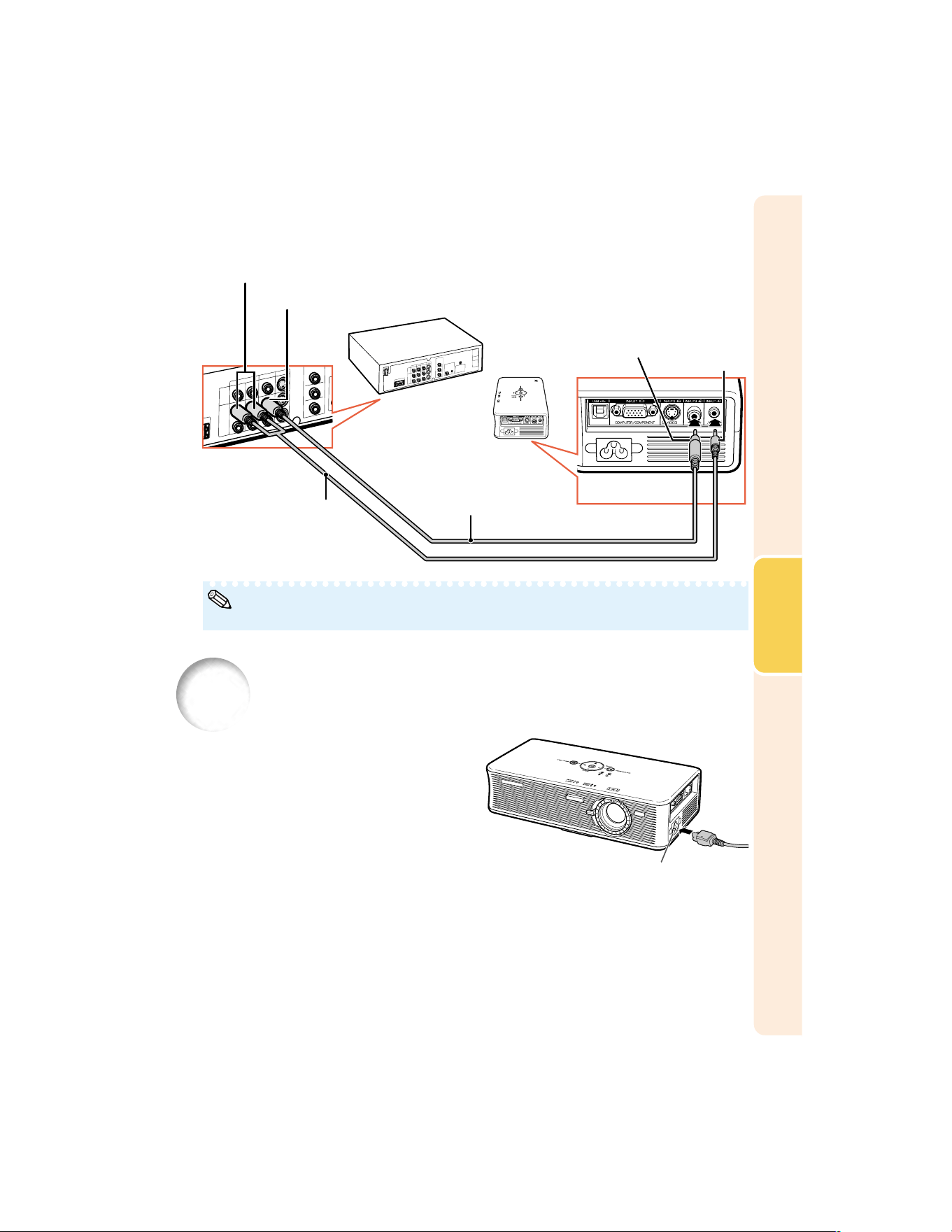
25
Connections
To video output terminal
When using a composite video cable
To audio output terminal
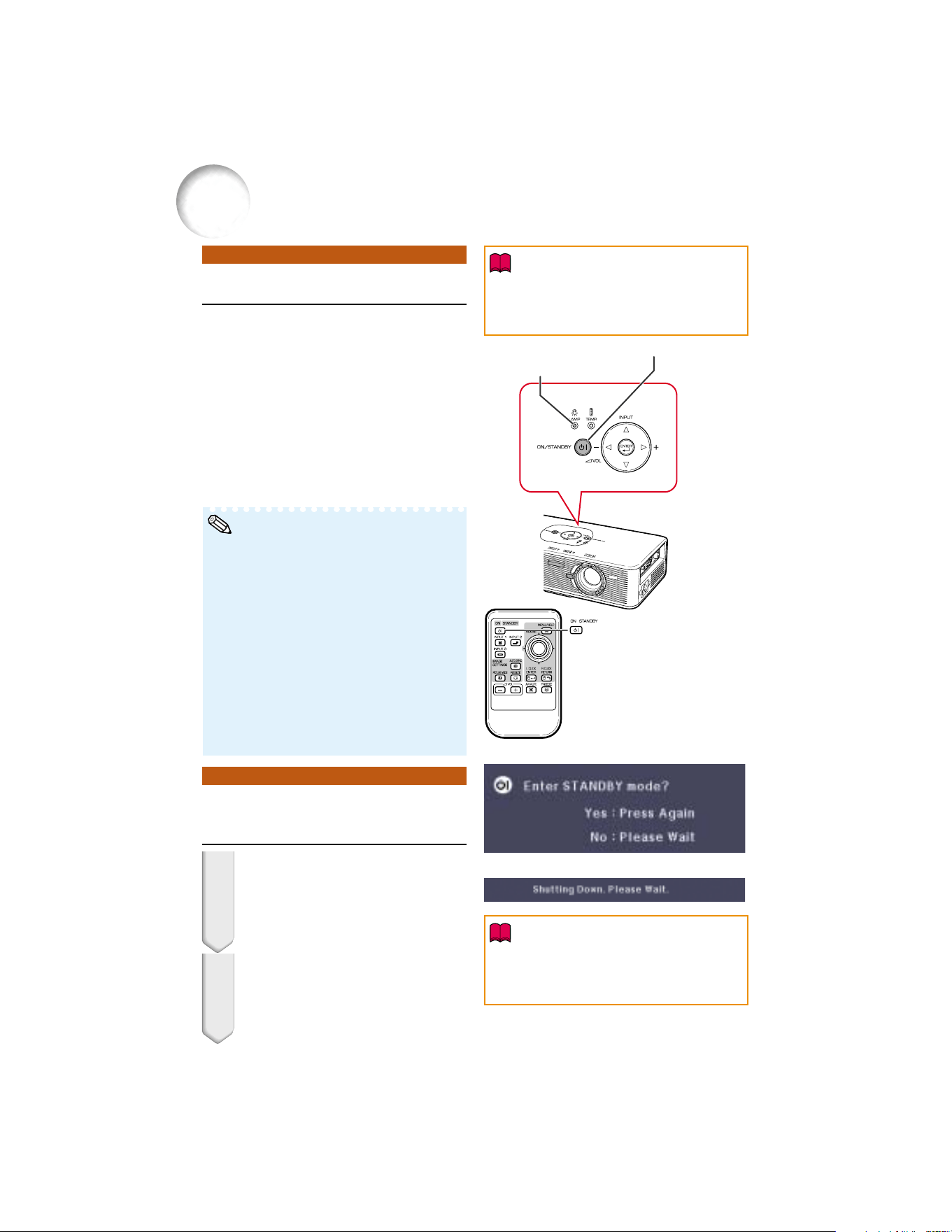
Connecting the Power Cord
Plug the supplied power cord into the
AC socket on the side of the projector.
AC socket
• ø3.5 mm minijack to RCA audio cable (commercially available) is required for audio input.
Note
Composite video cable
(commercially available)
ø3.5 mm minijack to RCA
audio cable (commercially
available)
To AUDIO
INPUT terminal
To INPUT3
terminal
26
Turning the Projector On/Off
Turning the Projector on
Before performing the steps in this section,
connect any equipment that you use with
the projector. (See pages 23, 24 and 25.)
Also connect the power cord to the projec-
tor. (See page 25.)
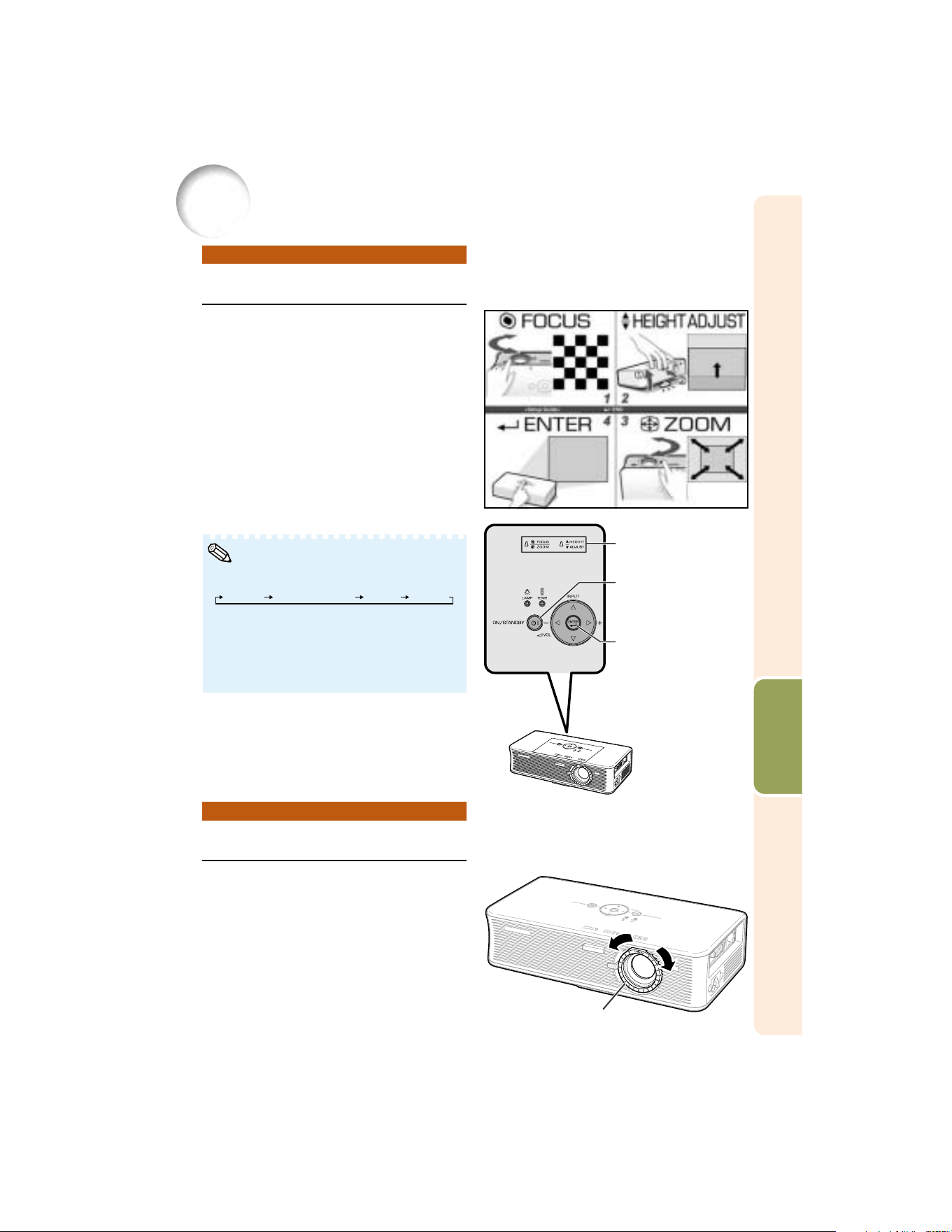
Press SON/STANDBY on the projector or
AON/STANDBY on the remote control.
• When the lamp is warming up, the Adjustment but-
tons blink in a clockwise direction. (When “Guide
LEDs” is set to “On”. n page 48)
• When System Lock is set, the keycode input box
appears. Enter the right keycode to start projec-
tion. See page 49 for details.
• About the Lamp Indicator
The lamp indicator lights up or blinks, indicating the sta-
tus of the lamp.
Green: The lamp is ready.
Blinking in green: The lamp is warming up or shut-
ting down.
Red: The lamp is shut down abnormally or the
lamp should be replaced.
• When switching on the projector, a slight flickering of the
image may be experienced within the first minute after the
lamp has been illuminated. This is normal operation as the
lamp’s control circuitry is stabilising the lamp output char-
acteristics. It should not be regarded as faulty operation.
• If the projector is put into standby mode and immediately
turned on again, the lamp may take some time to start pro-
jection.
On-screen Display (confirmation message)
ON/STANDBY button
1
2
Turning the Power off (Putting
the Projector into Standby Mode)
Press SON/STANDBY on the pro-
jector or AON/STANDBY on the
remote control, then press that but-
ton again while the confirmation
message is displayed, to put the
projector into standby mode.
Unplug the power cord from the AC
outlet after the cooling fan stops.
• When the projector is turned off, the Ad-
justment buttons blink in a counterclock-
wise direction. (When “Guide LEDs” is set
to “On”. n page 48)
• Do not unplug the power cord during projection
or cooling fan operation. This can cause dam-
age due to rise in internal temperature, as the
cooling fan also stops.
Note
Lamp indicator
Info
• English is the factory default language. If you
want to change the on-screen display to another
language, change the language according to
the procedure on page 46.
Info
R
ON/STANDBY
button
27
Basic
Operation
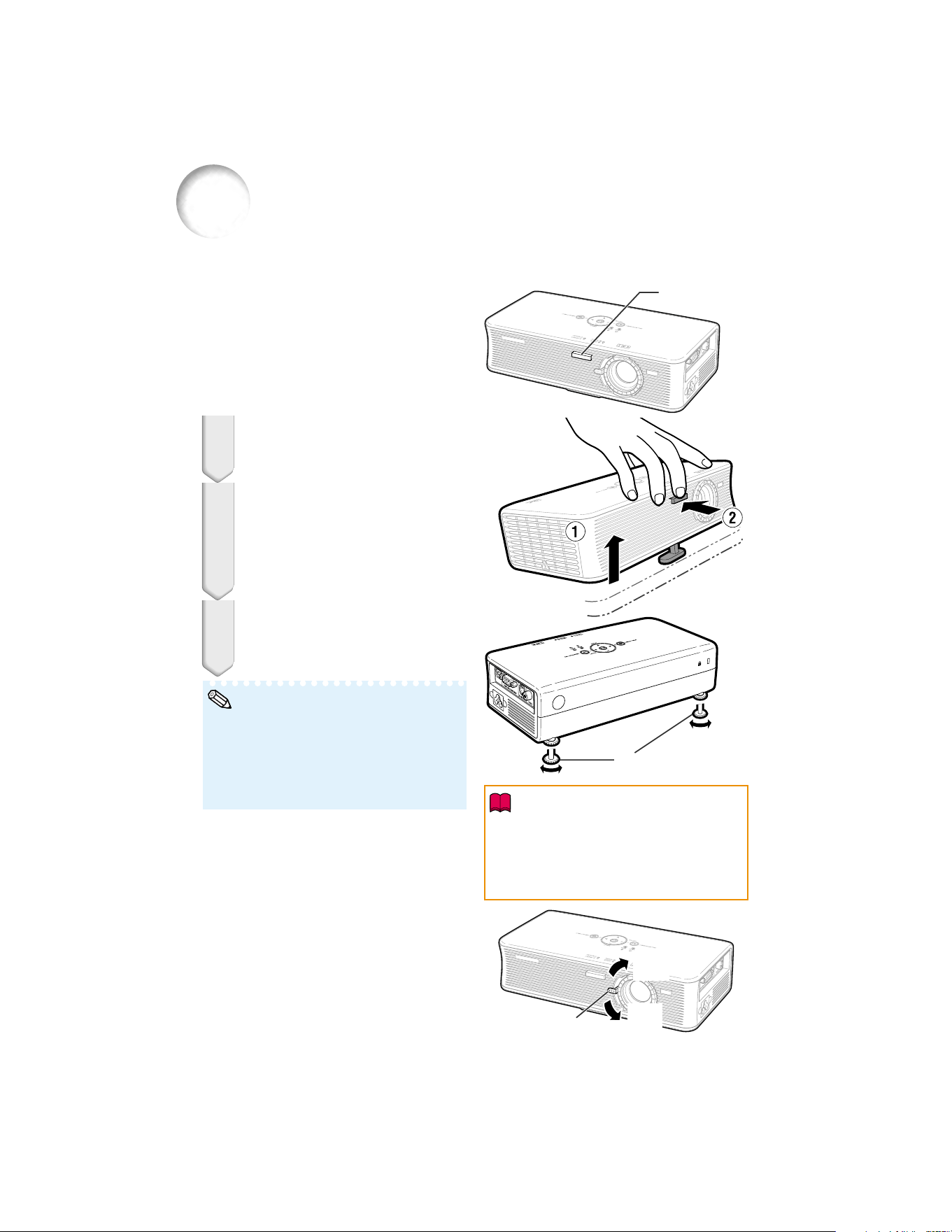
About the Setup Guide
After turning on the projector, the Setup
Guide screen appears to assist you with
projector setup.
Adjust the projector by following the il-
luminated buttons or Setup Guide indi-
cators.
Press TENTER to turn off the Setup
Guide screen.
Guidance items
1 FOCUS
2 HEIGHT ADJUST
3 ZOOM
ON/STANDBY
button
ENTER button
1 Adjusting the Focus
You can adjust the focus with the focus
ring on the projector.
Image Projection
Rotate the focus ring to adjust the fo-
cus while watching the projected image.
Setup Guide screen
• The Setup Guide screen automatically high-
lights the items in order of
1 FOCUS 3 ZOOM 4 ENTER2 HEIGHT ADJUST
.
• You can adjust the focus, height or zoom any-
time you want, regardless of the selection on
the Setup Guide.
• If you do not want to display the Setup Guide
for the next time, set “Menu” - “SCR - ADJ” -
“Setup Guide” to “Off”. (See page 45.)
Note
Focus ring
Adjusting the Projected Image
Setup Guide
indicator
28
2 Adjusting the Height
The height of the projector can be ad-
justed using the adjustment feet at the
front and rear of the projector.
When the screen is in a higher position
than the projector, the projection image
can be made higher by adjusting the
projector.
1
2
3
• Do not apply too much pressure on the pro-
jector when the front adjustment foot comes
out.
• When lowering the projector, be careful not to
get your fingers caught in the area between
the adjustment foot and the projector.
Use the rear adjustment foot to
make the projector level.
• The projector is adjustable ±1 degree
from the standard position.
Remove your hands from the
HEIGHT ADJUST button of the
projector after its height has been
finely adjusted.
• The angle of projection is adjustable up
to 7.5 degrees from the surface on which
the projector is placed.
Lift the projector to adjust its
height while pressing the HEIGHT
ADJUST button.
HEIGHT
ADJUST button
Info
Rear adjustment foot
3 Adjusting the Screen Size
You can adjust the screen size using
the zoom knob on the projector.
• When adjusting the height of the projector,
trapezoidal distortion occurs. When “Auto
Keystone” is set to “On”, keystone correction
functions automatically to correct trapezoidal
distortion. When you want to adjust the auto-
matically corrected image, use the manual
keystone correction. (See page 44.)
Note
zoom
in
zoom
out
Zoom Knob
Image Projection (Continued)
29
Basic
Operation
Displaying the Black Screen
and Turning off the Sound
Temporarily
Adjusting the Volume
Switching the Input Mode
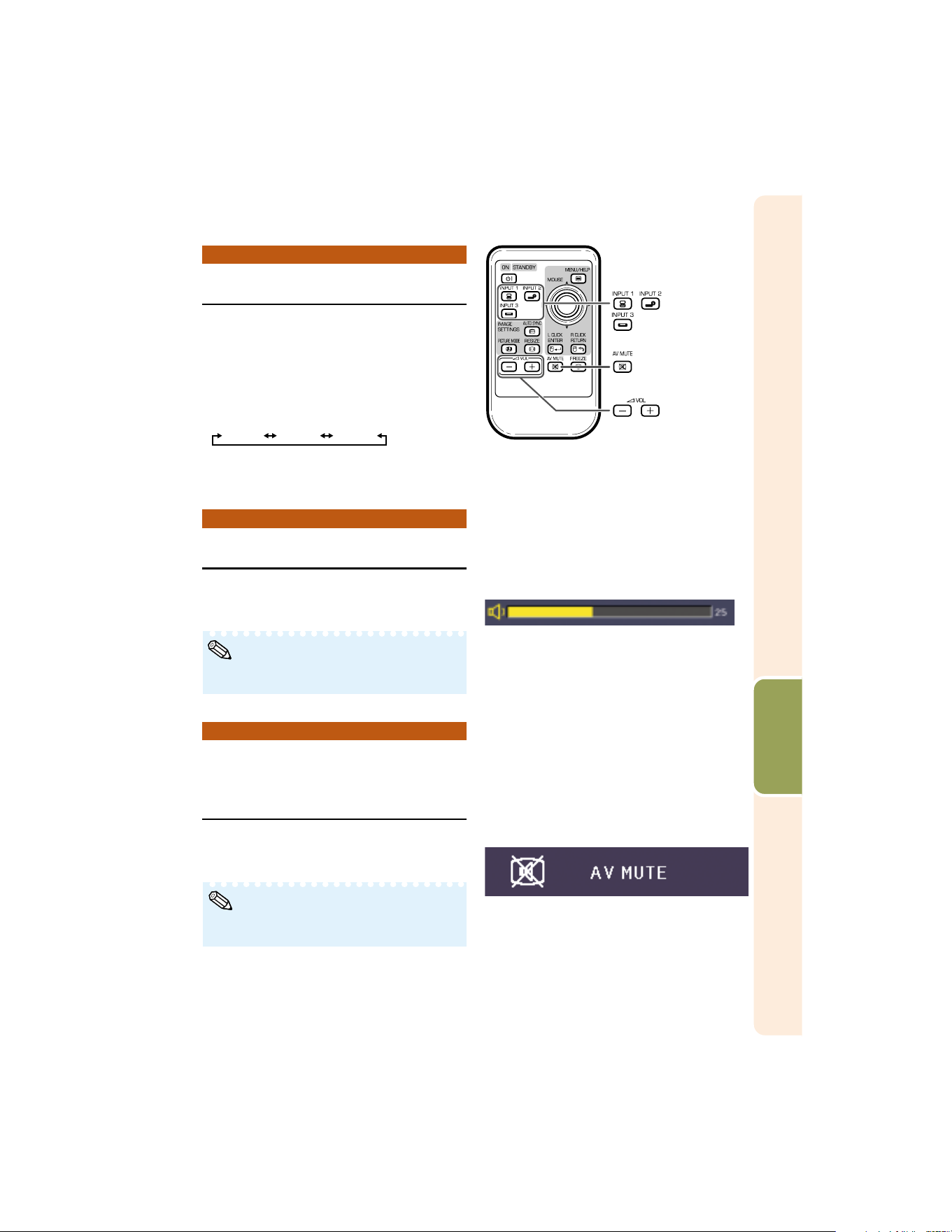
PressC INPUT 1, D INPUT 2 or
EINPUT 3 on the remote control to se-
lect the input mode.
• When pressing INPUT (W/Y) on the projector,
input mode switches in order of
INPUT1 INPUT2 INPUT3
.
• When “Auto Search” is set to “On”, INPUT (W/
Y) on the projector functions as the Auto Search
buttons. (See page 47.)
Select the appropriate input mode for
the connected equipment.
Press K/L on the remote control or
V/X on the projector to adjust the vol-
ume.
• Pressing K/V will lower the volume.
• Pressing L/X will raise the volume.
On-screen Display
Press MAV MUTE on the remote con-
trol to temporarily display a black
screen and turn off the sound.
• Pressing MAV MUTE again will turn the pro-
jected image back on.
Volume buttons
INPUT
buttons
AV MUTE button
On-screen Display
Note
Note
30
XR-1X XR-1S
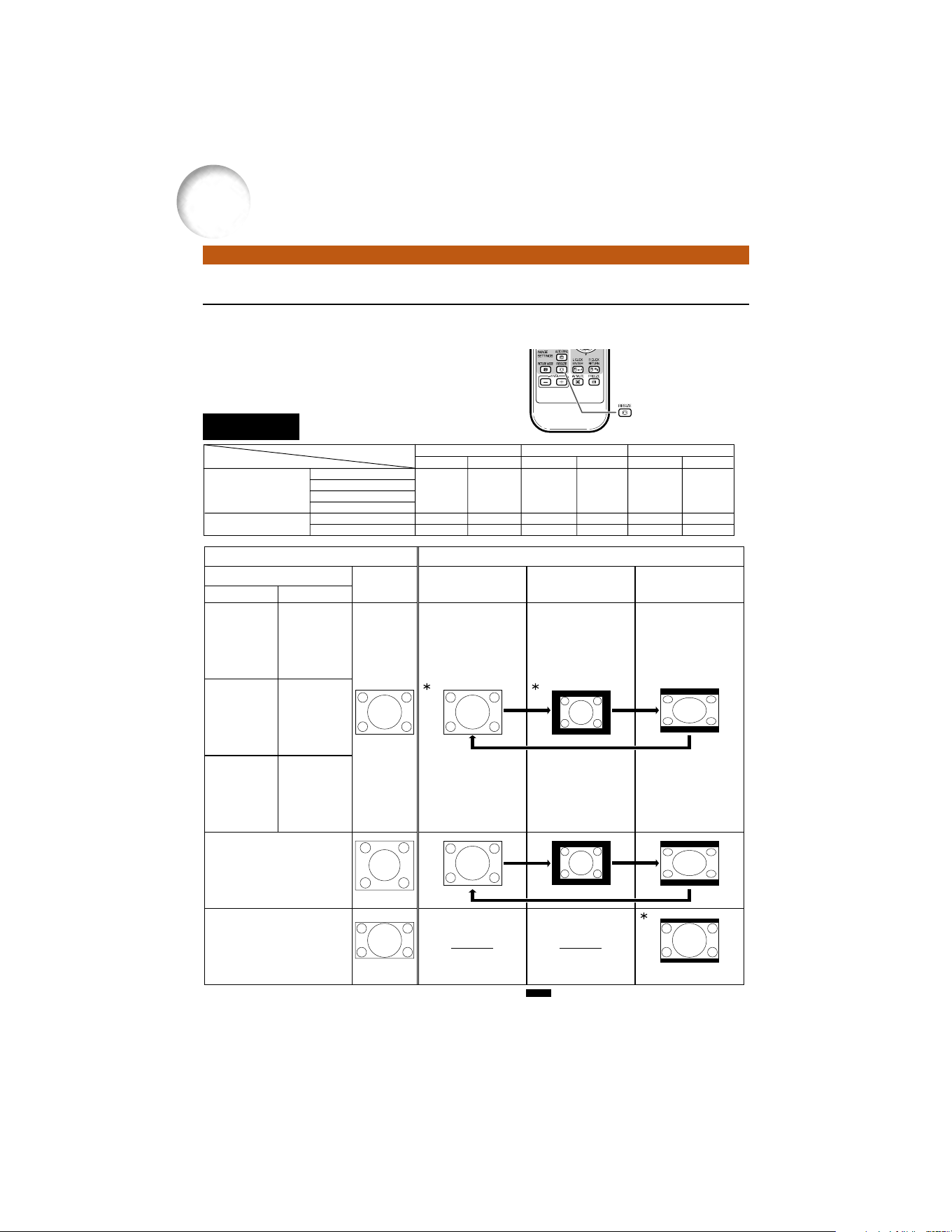
Resize Mode
This function allows you to modify or customize the resize mode to enhance the input image. De-
pending on the input signal, you can choose “NORMAL”, “BORDER” or “STRETCH” image.
Press HRESIZE.
• See page
43
for setting on menu screen.
Computer
Input Signal
NORMAL
Output screen image
Computer
Image type BORDER STRETCH
SXGA
(1280K1024)
Resolution
lower than
SVGA
SVGA
Resolution
higher than
SVGA
1280K720
4:3 aspect ratio
5:4 aspect ratio
16:9 aspect ratio
* Mode for projecting an image with the original
aspect ratio without cutting any portions.
RESIZE button
SVGA (800 K 600)
XGA (1024 K 768)
SXGA (1280 K 960)
SXGA L (1400
K
1050)
SXGA (1280
K
1024)
1280 K 720
1024
K
768 800
K
600
JJ
768
K
576 600
K
450
JJ
1024
K
576 800
K
450
XR-1X XR-1S XR-1X XR-1S XR-1X XR-1S
1024
K
576 800
K
450
800
K
6001024
K
768 600
K
450768
K
576 1024
K
576 800
K
450
NORMAL
BORDER
STRETCH
Other aspect ratios
4:3 aspect ratio
:
Cutout area on which images cannot be projected.
Image Projection (Continued)
Resolution
lower than
XGA
XGA
Resolution
higher than
XGA
31
Basic
Operation
VIDEO
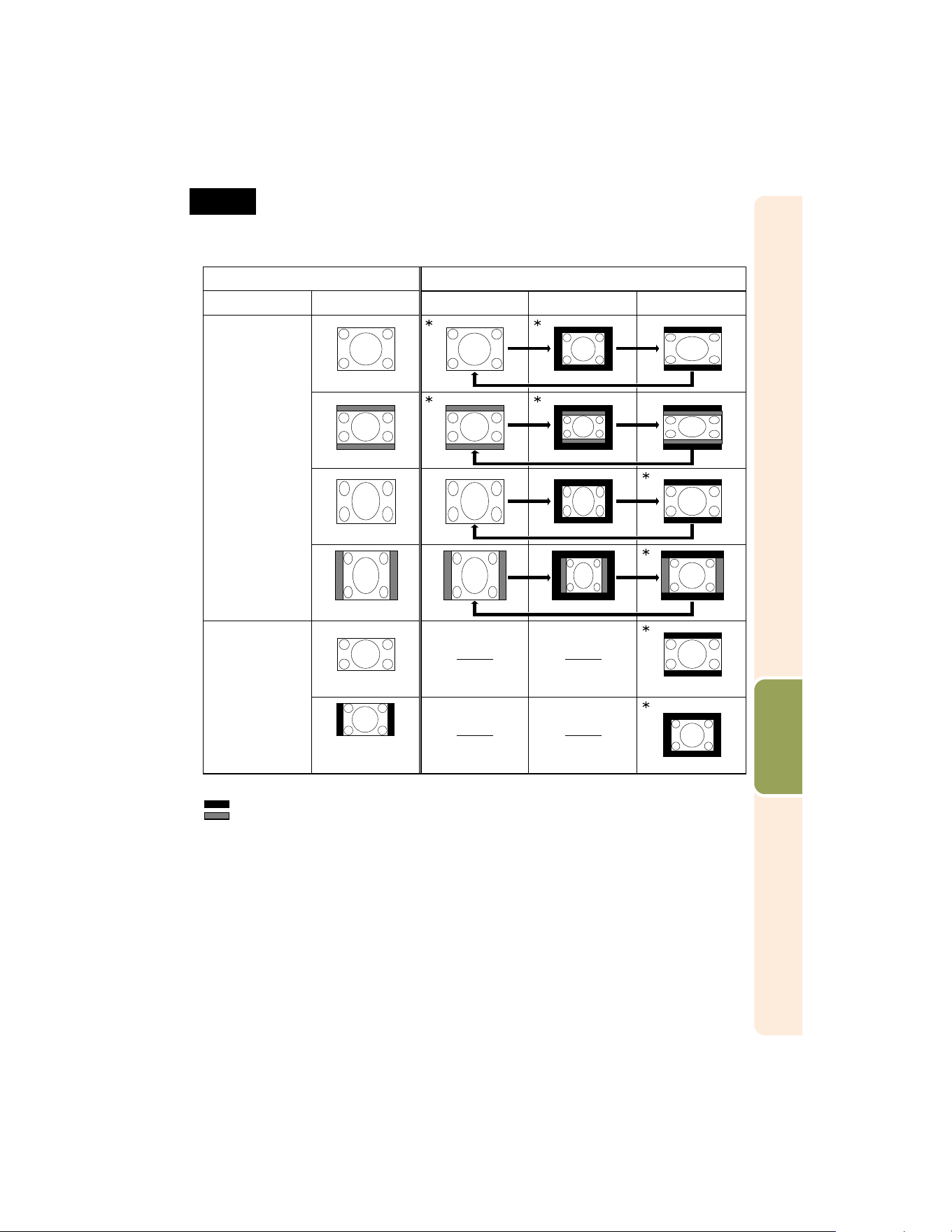
• “STRETCH” is fixed when 540P, 720P or 1080I signals are entered.
: Cutout area on which images cannot be projected.
: Area on which the image is not included in the original signals.
Input Signal
DVD / Video Image type
Output screen image
NORMAL BORDER STRETCH
480I, 480P, NTSC,
PAL, SECAM
540P, 720P, 1080I
(16:9)
4:3 aspect ratio
Letter box
Squeezed 16:9 image
Squeezed 4:3 image
16:9 aspect ratio
16:9 aspect ratio
(4:3 aspect ratio in
16:9 screen)
* Mode for projecting an image with the original aspect ratio without cutting any portions.
32
Auto Sync (Auto Sync Ad-
justment)
Adjusting/Operating with the Remote Control
Freezing a Moving Image
• When the optimum image cannot be achieved
with Auto Sync adjustment, use the help menu
for manual adjustments. (See page 51.)
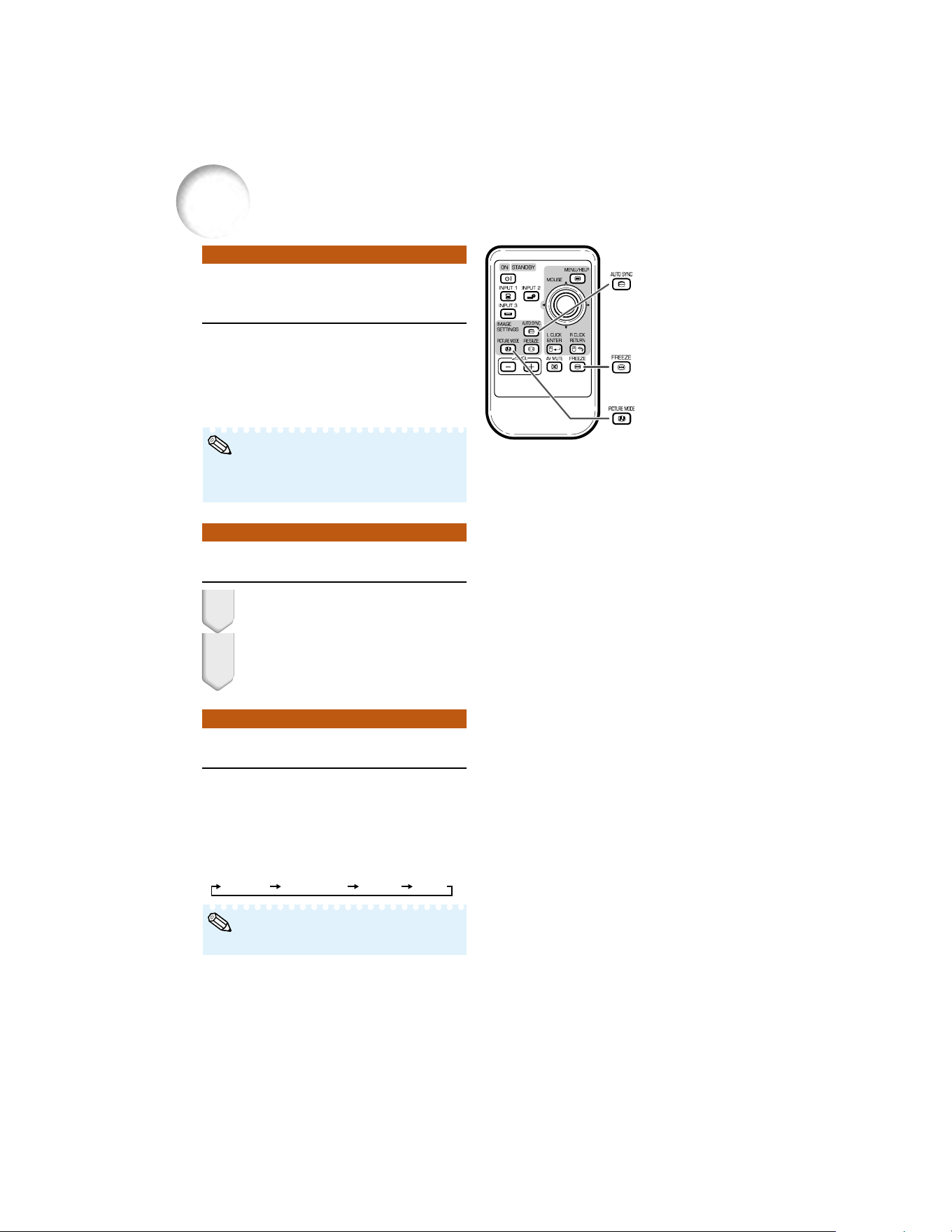
Auto Sync function works when detect-
ing input signal after the projector turns
on.
Press FAUTO SYNC to manually ad-
just with Auto Sync function.
Press NFREEZE.
• The projected image is frozen.
Press NFREEZE again to return
to the moving image from the cur-
rently connected device.
1
2
Note
FREEZE button
PICTURE MODE
button
Selecting the Picture Mode
Press GPICTURE MODE.
• When pressing GPICTURE MODE, the picture
mode changes in order of
Standard Presentation Cinema Game
.
You can select the suitable picture
mode for the projected image, such as
movie or video game.
AUTO SYNC
button
• See page 40 for details on the picture mode.
Note
33
Useful
Features
Using Mouse Function
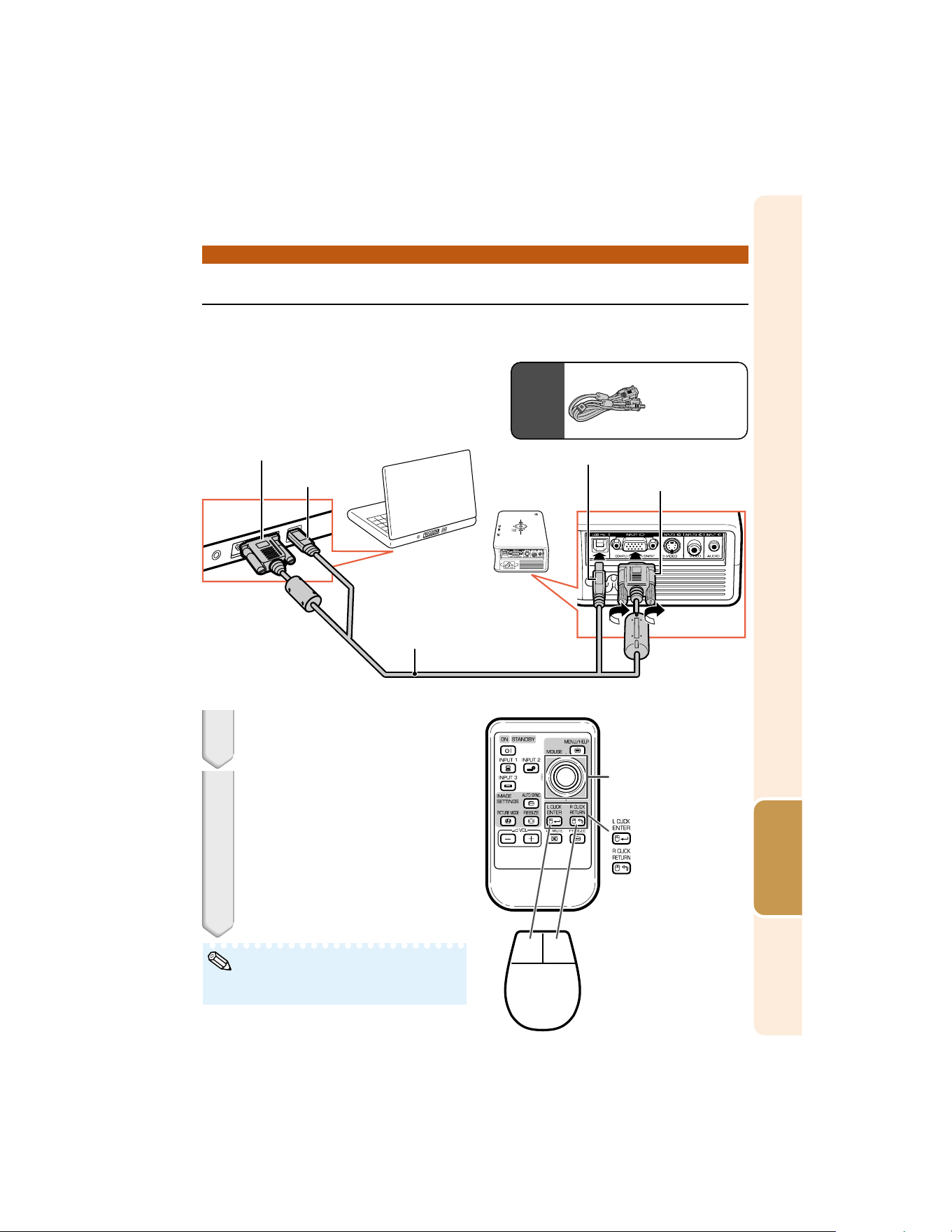
When connecting the projector and computer with the USB terminals, you can
use the remote control as the computer mouse.
Note
MOUSE/Adjuatment
button (P/R/O/Q)
Connect the projector and the
computer with the supplied RGB/
USB cable.
1
2
Use the mouse functions.
• MOUSE/Adjustment button (P/R/O/Q)
functions to move cursor.
• IL CLICK button functions as the left
click.
• JR CLICK button functions as the right
click.
• IL CLICK and JR CLICK have com-
mon function when your computer sup-
ports only a one-click mouse, such as
Macintosh.
To RGB output terminal
To USB terminal
RGB/USB Cable
• you can not use this function when displaying
the menu screen.
L CLICK button
R CLICK button
Computer mouse
To USB terminal
To INPUT1 terminal
Supplied
accessory
RGB/USB Cable
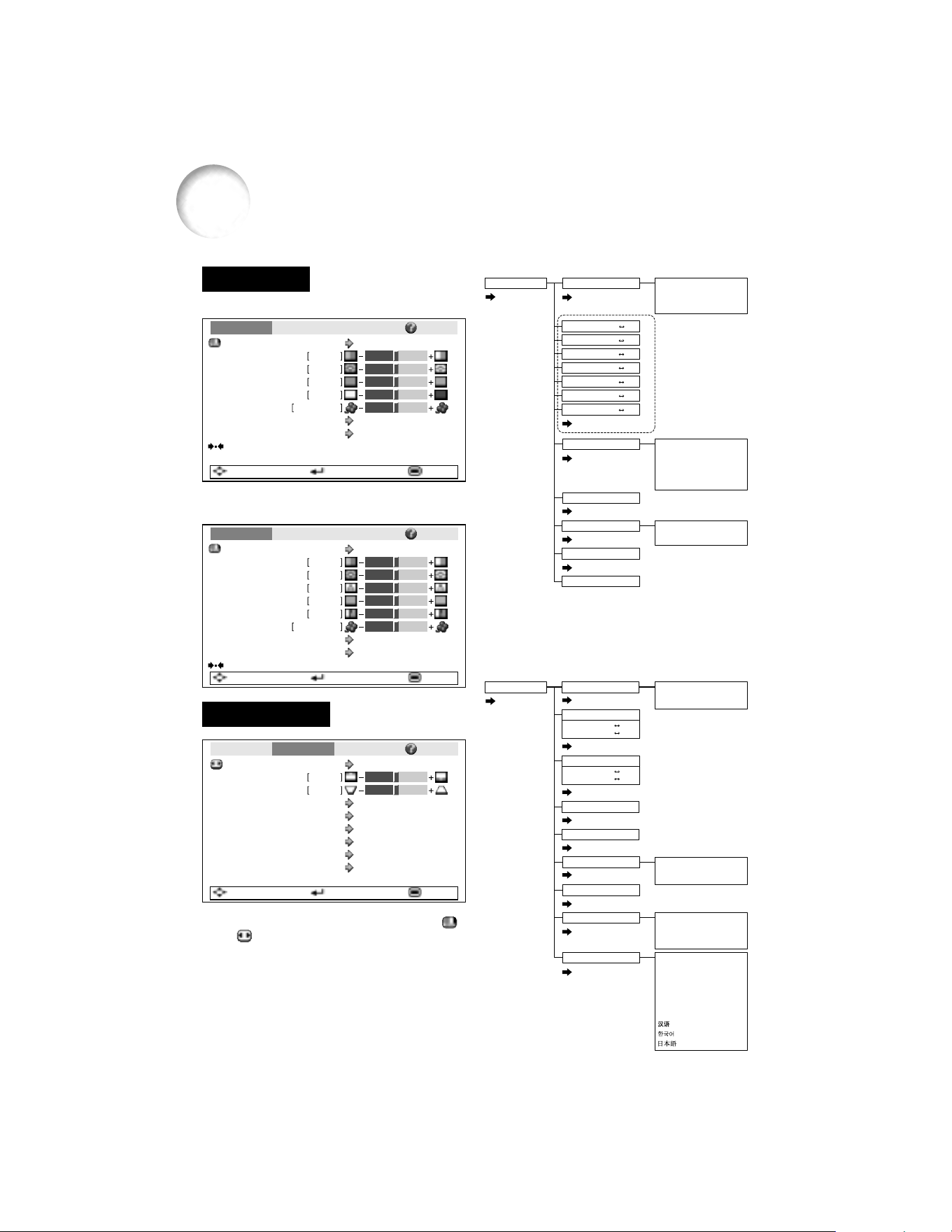
34
The following shows the items that can be set in the projector.
Menu Items
“SCR - ADJ” menu
INPUT 1 (Component)/INPUT 2/INPUT 3
INPUT 1 (RGB)
“Picture” menu
Picture
Picture Mode
Contrast 0
0
0
0
K7500
SCR - ADJ PRJ - ADJ Help
Bright
Red
Blue
CLR Temp
Bright Boost
sRGB
Off
Standard
Off
Reset
SEL./ADJ. ENTER END
Picture
Picture Mode
Contrast 0
0
0
0
K7500
SCR - ADJ PRJ - ADJ Help
Bright
Color
Tint
0Sharp
CLR Temp
Bright Boost
Progressive
Off
3D Progressive
Standard
Reset
SEL./ADJ. ENTER END
Picture
Resize
Image Shift 0
0
SCR - ADJ PRJ - ADJ Help
Keystone
Auto Keystone
OSD Display
Background
Setup Guide
PRJ Mode
Language
Front
English
On
Logo
On
Off
Normal
SEL./ADJ. ENTER END
Main menu Sub menu
Picture
Page 40
+30-30
Contrast
+30-30
+30-30
+30-30
+30-30
+30-30
+30-30
Tint
Color
Sharp
Bright
Red
Blue
*2
*2
*2
*1
*1
Progressive
sRGB [On/Off]
*2
*1
Reset
5500K
6500K
7500K
8500K
9300K
10500K
2D Progressive
3D Progressive
Film Mode
CLR Temp
Bright Boost [On/Off]
Page 40
Page 40
Page 41
Page 41
Page 42
Page 42
Standard
Presentation
Cinema
Game
Picture Mode
Main menu Sub menu
SCR - ADJ
Page 43
Language
Image Shift
Resize
Page 43
Page 43
Page 44
Page 44
Page 44
Page 45
Page 45
Page 46
Page 46
Keystone
Auto Keystone [On/Off]
OSD Display [On/Off]
Background
Setup Guide
[On/Off]
PRJ Mode
Normal
Border
Stretch
Logo
Blue
None
Front
Front + Rotate
Rear
Rear + Rotate
English
Deutsch
Español
Nederlands
Français
Italiano
Svenska
Português
[XR-1X]
+127-127
[XR-1S]
+100-100
[XR-1X]
+96-96
[XR-1S]
+75-75
*
1
Items when inputting RGB signal through
INPUT 1
*
2
Items when inputting component signal
through INPUT 1, or when selecting INPUT
2 or INPUT 3
• You can adjust the menu items with icons (
and ) using the respective buttons on the
remote control.
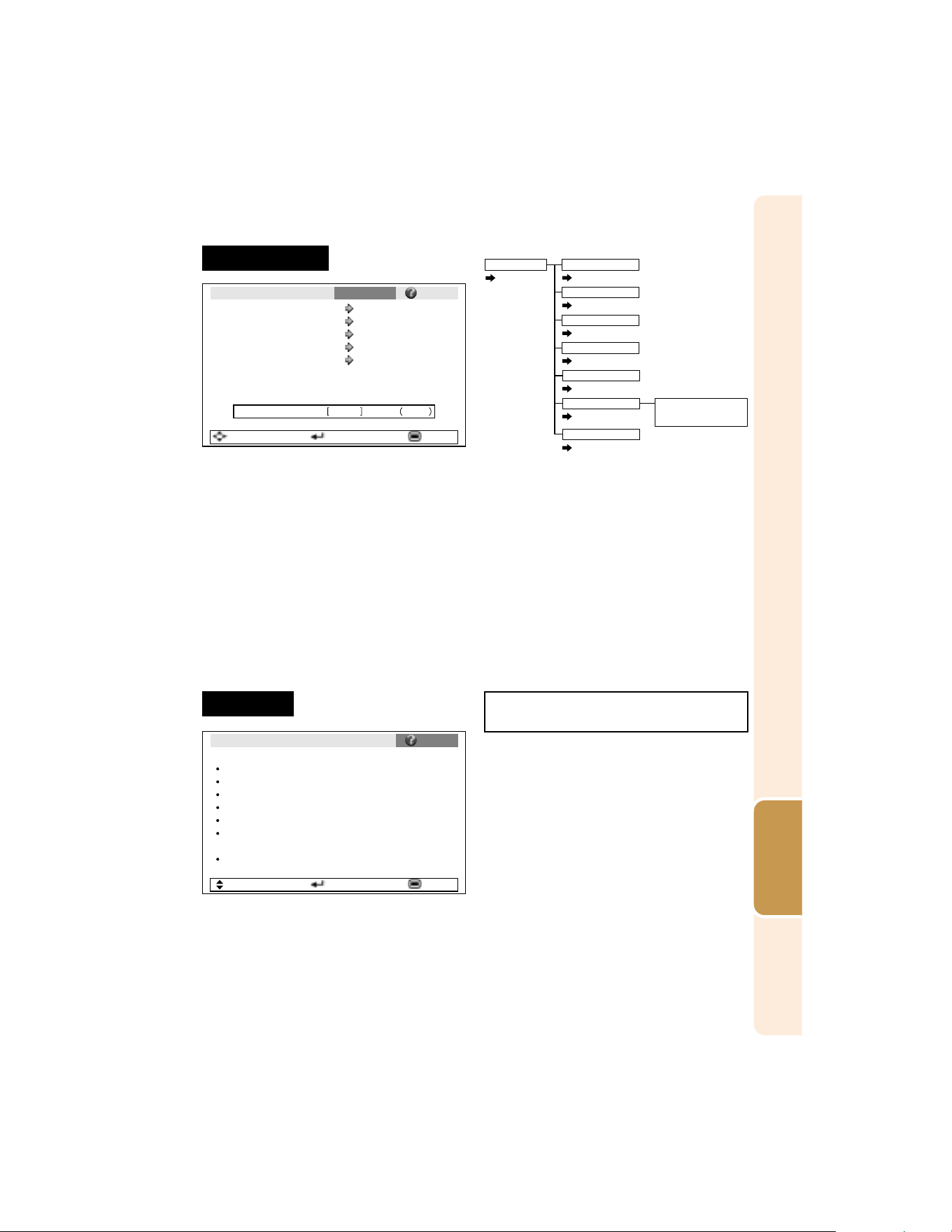
35
Useful
Features
“PRJ - ADJ” menu
Picture
Eco/Quiet Mode
SCR - ADJ PRJ - ADJ Help
Auto Search
Auto Power Off
Guide LEDs
System Sound
System Lock
On
h
On
On
On
On
SEL./ADJ. ENTER END
0Lamp Timer(Life) 100%
Picture
There is no picture or audio
SCR - ADJ PRJ - ADJ Help
Vertical stripes or flickering image appear
Data image is not centered
Color is faded or poor
Picture is dark
The image is distorted
Reset all adjustments to default settings
SEL. ENTER END
Main menu Sub menu
PRJ - ADJ
Page 47
Eco/Quiet Mode
[On/Off]
Auto Search
[On/Off]
Auto Power Off [On/Off]
Guide LEDs [On/Off]
System Sound [On/Off]
System Lock
Lamp Timer(Life)
Page 47
Page 47
Page 48
Page 48
Page 50
Page 49
Page 50
Old Code
New Code
Reconfirm
“Help” menu
The items you can set with “Help”
menu
“Help” menu n Page 51
• Vertical stripes or flickering image appear
Auto Sync
Adjust vertical noise
Adjust horizontal noise
• Data image is not centered
Auto Sync
H-Pos
V-Pos
• Color is faded or poor
INPUT 1
Signal type: Auto/RGB/Component
INPUT 2 or INPUT 3
Video System: Auto/PAL/SECAM/
NTSC3.58/NTSC4.43/PAL-
M/PAL-N/PAL-60
* The selectable items vary depending on the in-
put signal and the selected input mode.
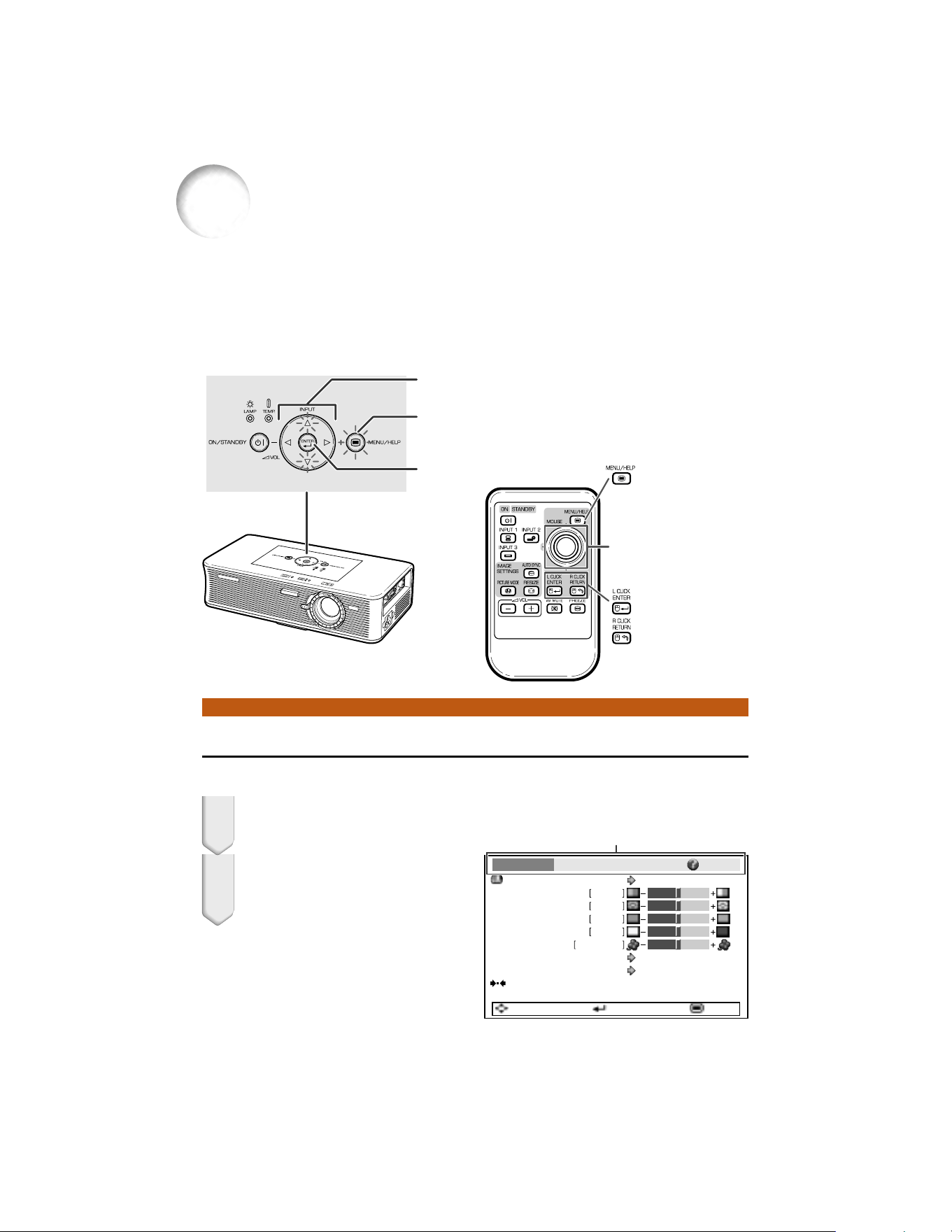
36
Using the Menu Screen
Menu Selections (Adjustments)
The menu can be operated to achieve two functions, adjustment and setting. (For setting the menu
items, see pages 38 and 39.)
Example: Adjusting “Bright”.
• This operation can also be performed by using the buttons on the projector.
Press BMENU.
• The “Picture” menu screen for the se-
lected input mode is displayed.
MOUSE Adjustment
button (P/R/O/Q)
Example: “Picture” screen menu for INPUT 1
(RGB) mode
Press Q or O to display the other
menu screen.
• The selected menu item is highlighted.
1
2
ENTER button
RETURN button
Menu item
Picture
Picture Mode
Contrast 0
0
0
0
K7500
SCR - ADJ PRJ - ADJ Help
Bright
Red
Blue
CLR Temp
Bright Boost
sRGB
Off
Standard
Off
Reset
SEL./ADJ. ENTER END
MENU/HELP
button
Operating with the projector
When “PRJ - ADJ” - “Guide LEDs” is set to “On”, the buttons used for menu adjustment on the
projector light up.
Example: When W, Y and the MENU/HELP button light up on the projector, you can use those
buttons for operation.
Adjustment buttons (W/Y/V/X)
MENU/HELP button
ENTER button
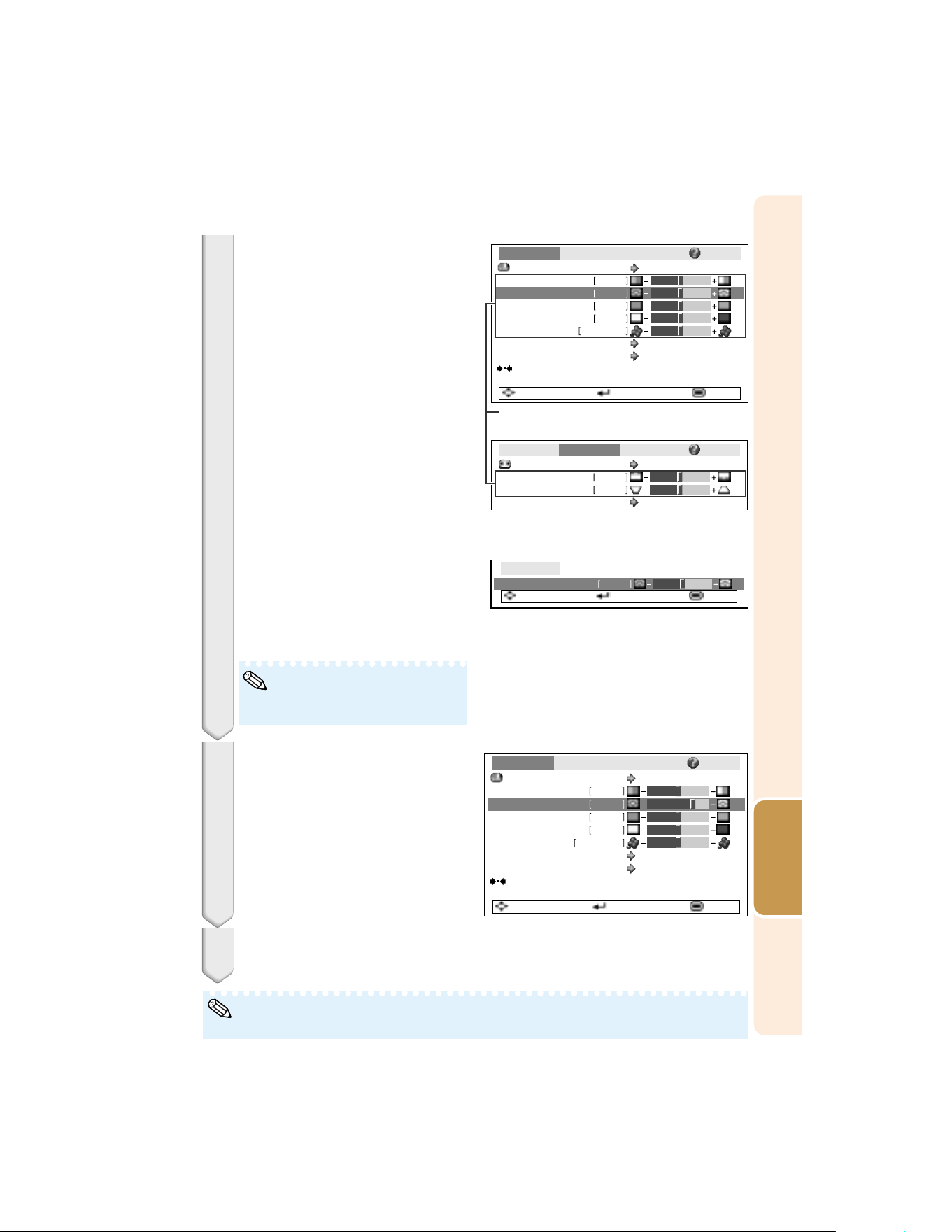
37
Useful
Features
Press P or R to select the item you
want to adjust.
• The selected item is highlighted.
• Press IENTER to return to the previ-
ous screen.
Press O or Q to adjust the item
selected.
• The adjustment is stored.
Press BMENU.
• The menu screen will disappear.
3
4
5
0Bright
Picture
SEL./ADJ. Rtn. Menu END
Picture
Picture Mode
Contrast 0
15
0
0
K7500
SCR - ADJ PRJ - ADJ Help
Bright
Red
Blue
CLR Temp
Bright Boost
sRGB
Off
Standard
Off
Reset
SEL./ADJ. Single ADJ END
Note
Picture
Picture Mode
Contrast 0
0
0
0
K7500
SCR - ADJ PRJ - ADJ Help
Bright
Red
Blue
CLR Temp
Bright Boost
sRGB
Off
Standard
Off
Reset
SEL./ADJ. Single ADJ END
Picture
Resize
Image Shift 0
0
SCR - ADJ PRJ - ADJ Help
Keystone
Auto Keystone Off
Normal
Single adjustment items
• Press IRETURN to return to the previous screen when the menu is displayed.
Note
To adjust the projected
image while watching it
Press IENTER.
• The selected single adjustment item (e.g.
“Bright”) appears instead of the menu.
• When pressing P or R, the following item
(“Red” after “Bright”) will be displayed.
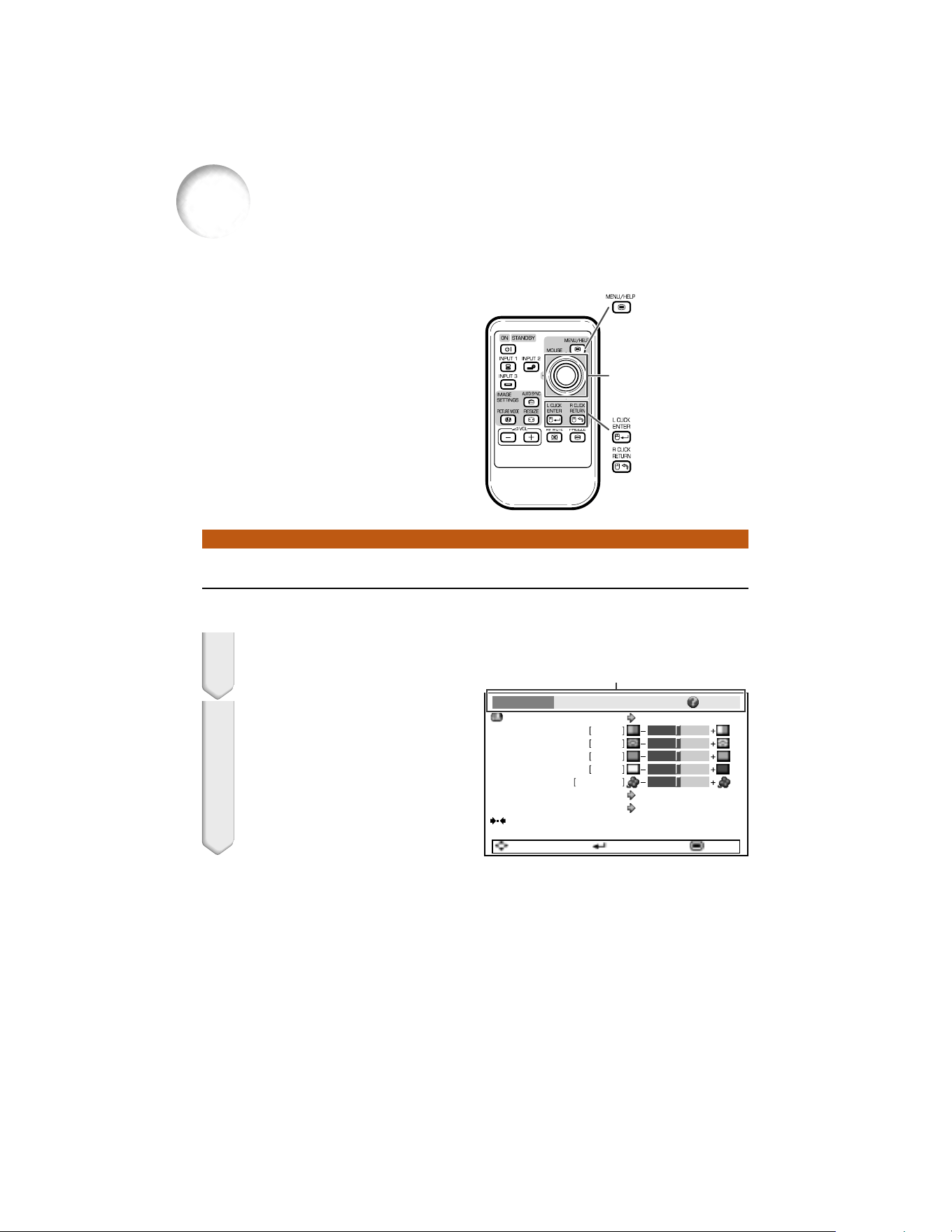
38
Using the Menu Screen (Continued)
Menu Selections (Settings)
Example: Setting “Background”.
•This operation can also be performed by using the buttons on the projector.
Press BMENU.
• The “Picture” menu screen for the se-
lected input mode is displayed.
Press O or Q to display the other
menu screen.
• The selected menu item is highlighted.
1
2
Picture
Picture Mode
Contrast 0
0
0
0
K7500
SCR - ADJ PRJ - ADJ Help
Bright
Red
Blue
CLR Temp
Bright Boost
sRGB
Off
Standard
Off
Reset
SEL./ADJ. ENTER END
Menu item
The menu can be operated to achieve two functions, adjustment and setting. (For adjusting the
menu items, see pages 36 and 37.)
MOUSE Adjustment
button (P/R/O/Q)
Example: “Picture” screen menu for INPUT 1
(RGB) mode
ENTER button
RETURN button
MENU/HELP
button
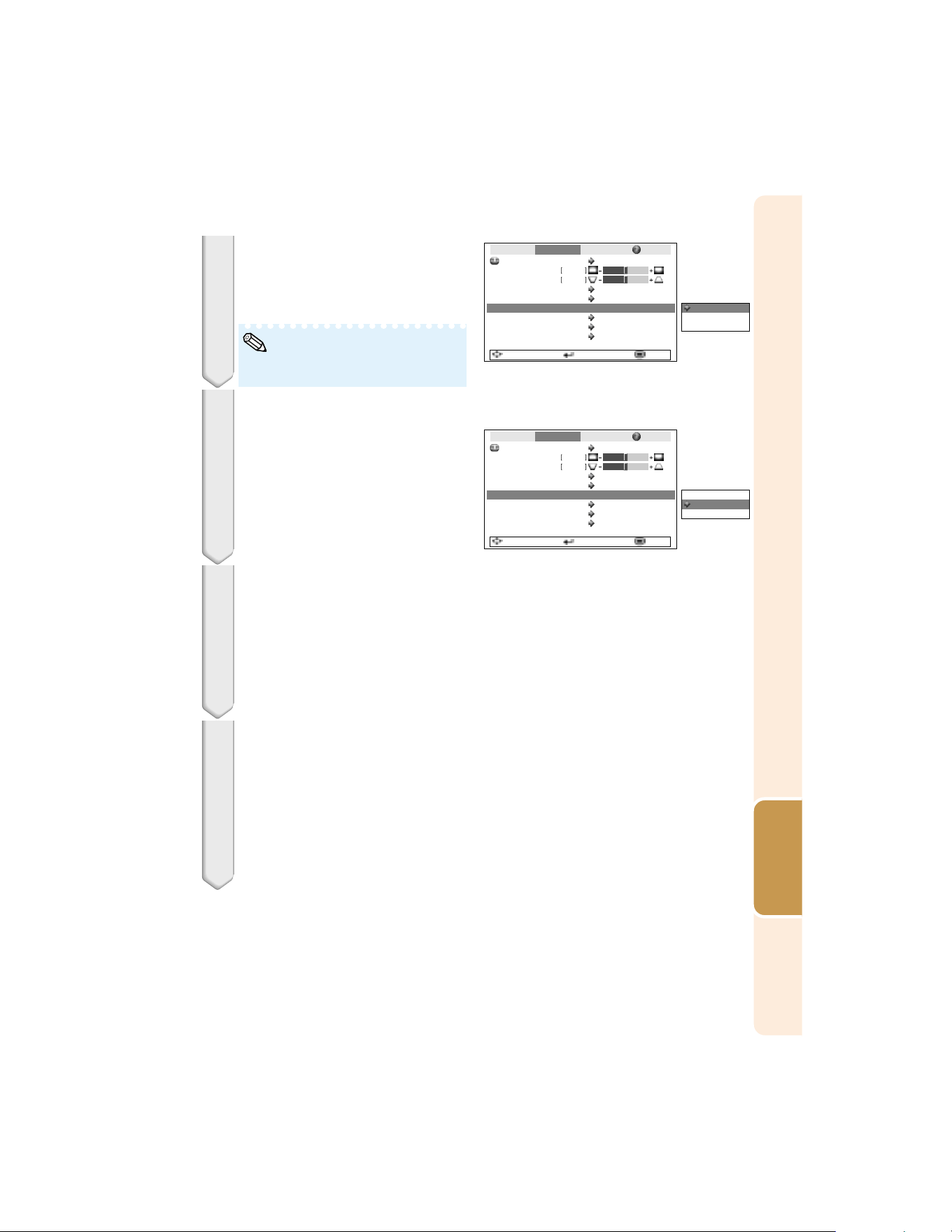
39
Useful
Features
Press BMENU.
• The menu screen will disappear.
Press P or R to select the item you
want to set, and then press
IENTER or Q to display the sub
menu.
•The selected item is highlighted.
• Press JRETURN or O to return to the
previous screen.
Press P or R select the setting of
the item displayed in the sub
menu.
Press IENTER.
3
4
5
Picture
Resize
Image Shift 0
0
SCR - ADJ PRJ - ADJ Help
Keystone
Auto Keystone
OSD Display
Background
Setup Guide
PRJ Mode
Language
Front
English
On
On
Off
Normal
SEL./ADJ. ENTER END
Logo
Blue
None
Picture
Resize
Image Shift 0
0
SCR - ADJ PRJ - ADJ Help
Keystone
Auto Keystone
OSD Display
Background
Setup Guide
PRJ Mode
Language
Front
English
On
On
Off
Normal
SEL./ADJ. ENTER END
Logo
Blue
None
Note
6
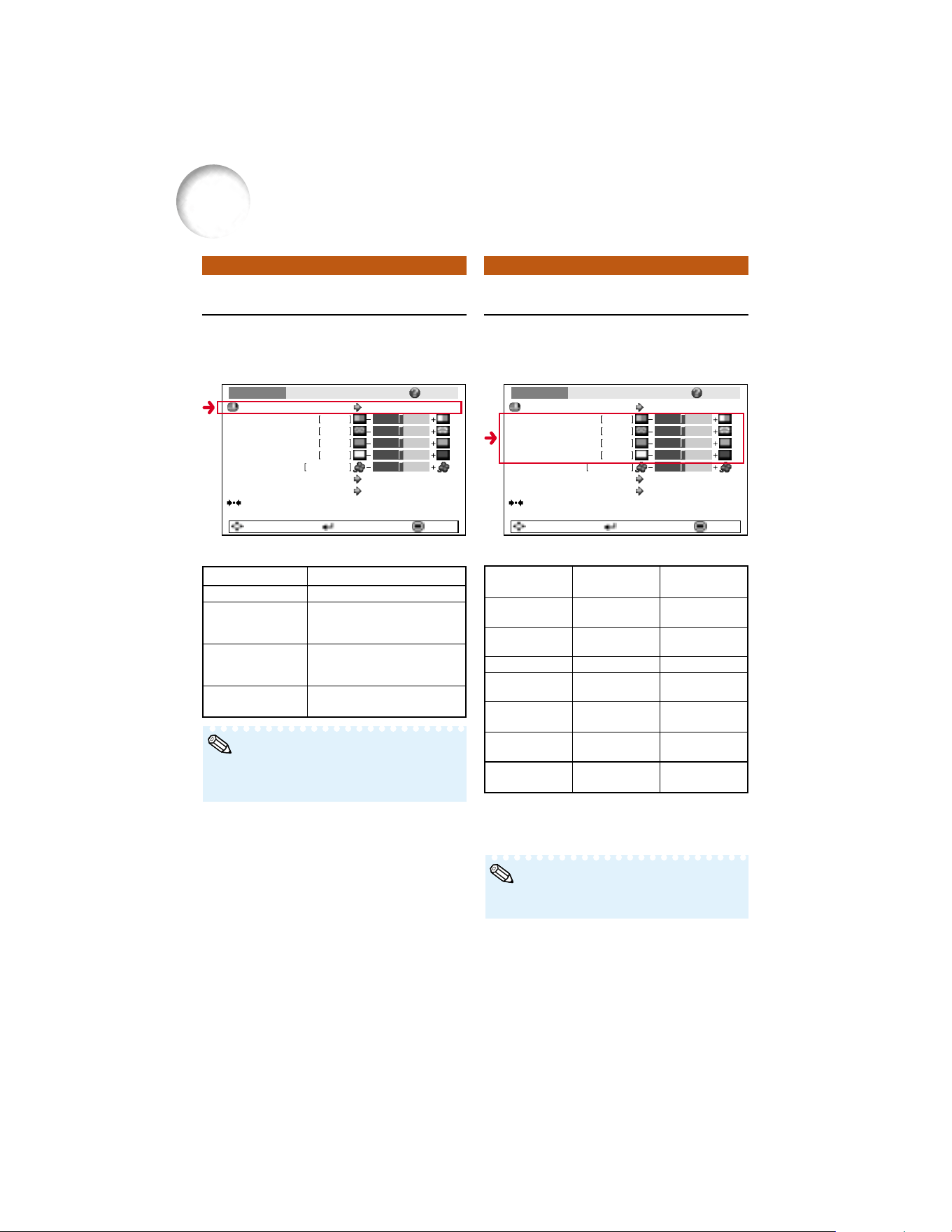
40
Adjusting the Image
Picture Adjustment (“Picture” menu)
You can adjust the projector’s picture to your preferences using the “Picture” menu.
Selecting the Picture mode
Menu operation n Page 38
Selectable items
Standard
Presentation
Cinema
Game
Menu operation n Page 36
Q Example: “Picture” screen menu for
INPUT 1 (RGB) mode
Q Example: “Picture” screen menu for
INPUT 1 (RGB) mode
*1 Not adjustable/selectable when you set “sRGB”
menu item to “On”, or the input signal is
component.
*2 Not displayed in the RGB input mode.
Picture
Picture Mode
Contrast 0
0
0
0
K7500
SCR - ADJ PRJ - ADJ Help
Bright
Red
Blue
CLR Temp
Bright Boost
sRGB
Off
Standard
Off
Reset
SEL./ADJ. ENTER END
Description
For standard image
Brightens darker portions of
image for more enhanced
presentations.
Gives greater depth to darker
portions of image for a more
exciting theater experience.
For natural color gradation for
playing a game, etc.
Q button
For more
contrast.
For more
brightness.
For stronger red.
For stronger
blue.
For more color
intensity.
For making skin
tones greenish.
For more
sharpness.
Adjustment
Items
Contrast
Bright
Red*
1
Blue*
1
Color*
2
Tint*
2
Sharp*
2
O button
For less
contrast.
For less
brightness.
For weaker red.
For weaker
blue.
For less color
intensity.
For making skin
tones purplish.
For less
sharpness.
Description of Adjustment Items
Picture
Picture Mode
Contrast 0
0
0
0
K7500
SCR - ADJ PRJ - ADJ Help
Bright
Red
Blue
CLR Temp
Bright Boost
sRGB
Off
Standard
Off
Reset
SEL./ADJ. ENTER END
Note
Description of Items
• You can also press GPICTURE MODE on the
remote control to select the picture mode. (See
page 32.)
Note
• To reset all adjustment items, select “Reset”
and press IENTER.
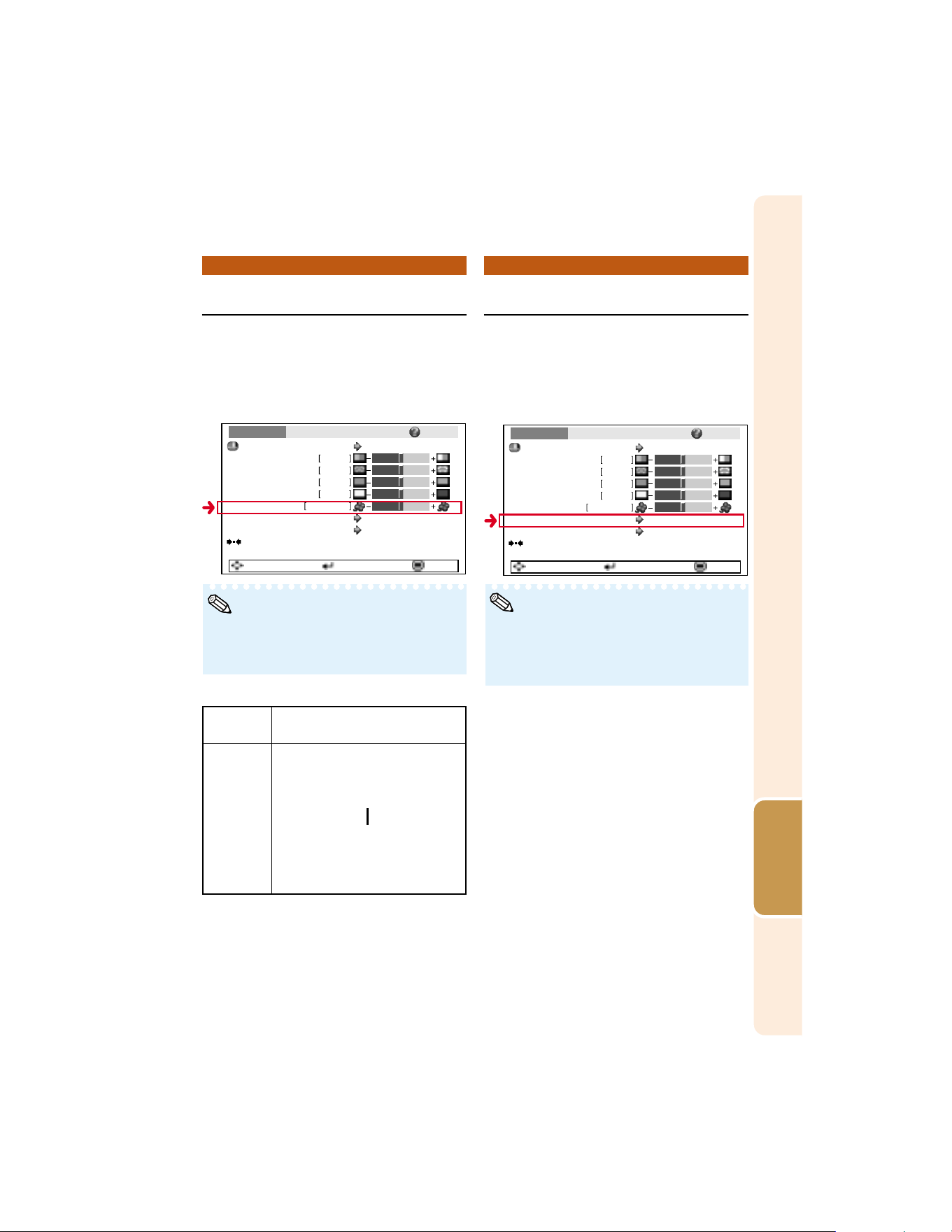
41
Useful
Features
Emphasizing the Contrast
Adjusting the Color Temperature
Menu operation n Page 36
Q Example: “Picture” screen menu for
INPUT 1 (RGB) mode
• Values on “CLR Temp” are only for general
standard purposes.
• “CLR Temp” cannot be set when “sRGB” is
set to “On”.
This function emphasizes the bright portions of
images to obtain a higher contrast image.
Menu operation n Page 38
Q Example: “Picture” screen menu for
INPUT 1 (RGB) mode
Note
Picture
Picture Mode
Contrast 0
0
0
0
K7500
SCR - ADJ PRJ - ADJ Help
Bright
Red
Blue
CLR Temp
Bright Boost
sRGB
Off
Standard
Off
Reset
SEL./ADJ. ENTER END
Picture
Picture Mode
Contrast 0
0
0
0
K7500
SCR - ADJ PRJ - ADJ Help
Bright
Red
Blue
CLR Temp
Bright Boost
sRGB
Off
Standard
Off
Reset
SEL./ADJ. ENTER END
Description of Items
Selectable
items
5500K
6500K
7500K
8500K
9300K
10500K
Description
For lower color temperature for
warmer, reddish incandescent-like
images.
For higher color temperature for
cooler, bluish, fluorescent-like images.
P
R
• When using this function, the image color may
become pale or the tint may be inappropri-
ate.
• “Bright Boost” cannot be set when “sRGB” is
set to “On”.
Note
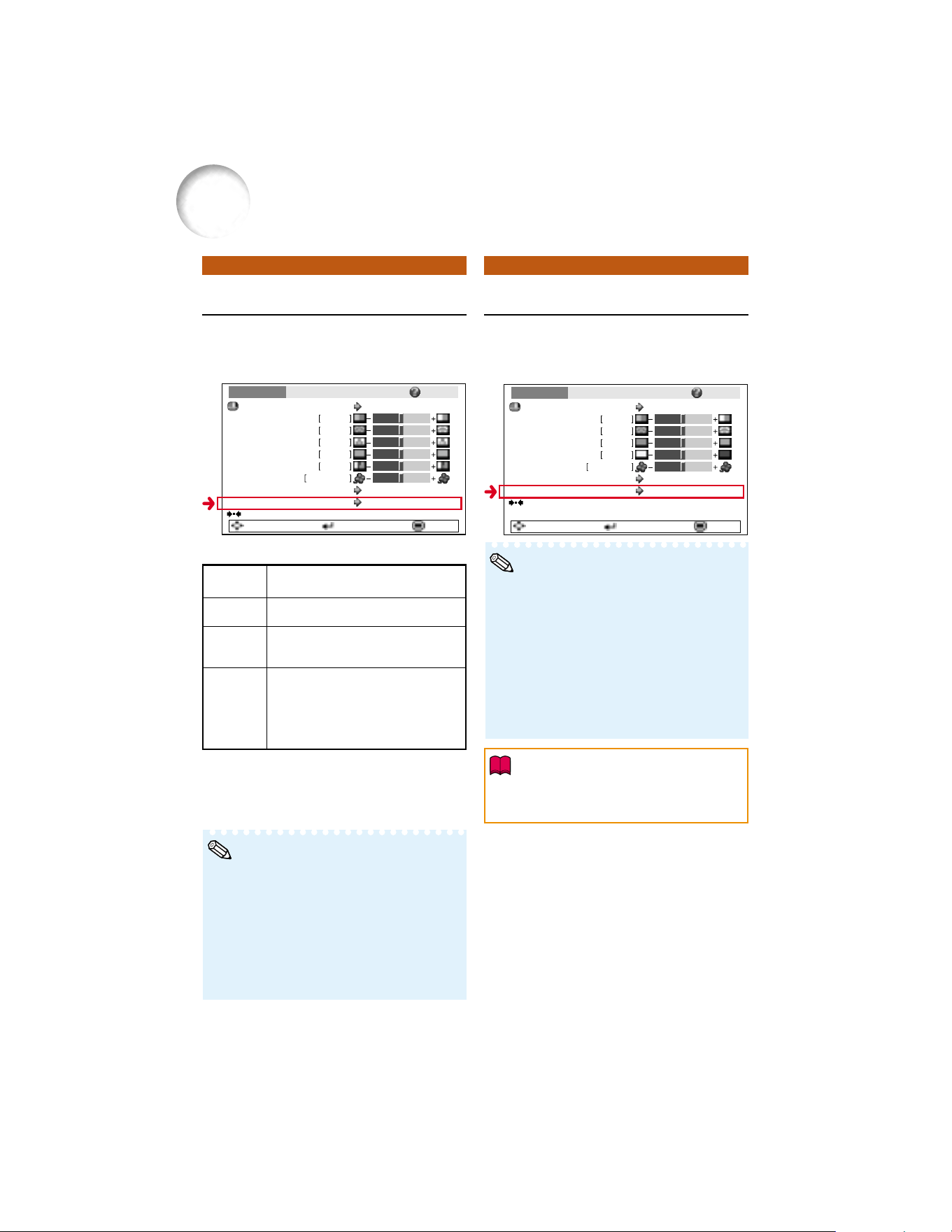
42
Progressive sRGB Setting
Q Example: “Picture” screen menu for
INPUT 2 mode
• In NTSC or PAL60Hz, even if the 3D Progres-
sive mode has been set, the three-two pull
down enhancement will be enabled automati-
cally when the film source has been entered.
• When the image is blurred or noisy, switch to
the optimal mode.
• When using progressive inputs, inputs are di-
rectly displayed so that 2D Progressive, 3D
Progressive and Film Mode cannot be se-
lected.
Menu operation n Page 38
Q Example: “Picture” screen menu for
INPUT 1 (RGB) mode
• When “sRGB” is set to “On”, the projected
image may become dark, but this does not
indicate a malfunction.
Menu operation n Page 38
Picture
Picture Mode
Contrast 0
0
0
0
K7500
SCR - ADJ PRJ - ADJ Help
Bright
Color
Tint
0Sharp
CLR Temp
Bright Boost
Progressive
Off
3D Progressive
Standard
Reset
SEL./ADJ. ENTER END
Picture
Picture Mode
Contrast 0
0
0
0
K7500
SCR - ADJ PRJ - ADJ Help
Bright
Red
Blue
CLR Temp
Bright Boost
sRGB
Off
Standard
Off
Reset
SEL./ADJ. ENTER END
Description of Items
* The film source is a digital video recording with the
original encoded as is at 24 frames/second. The
projector can convert this film source to progres-
sive video at 60 frames/second with NTSC and
PAL60Hz or at 50 frames/second with PAL50Hz
and SECAM to play back a high-definition image.
Selectable
items
2D
Progressive
3D
Progressive
Film Mode
Description
Useful to display fast-moving images
such as sports and action films.
Useful to display relatively slow-
moving images such as drama and
documentary more clearly.
Reproduces the image of film source*
clearly. Displays the optimized image of
film transformed with three-two pull down
(NTSC and PAL60Hz) or two-two pull
down (PAL50Hz and SECAM) enhance-
ment to progressive mode images.
Note
Info
Picture Adjustment (“Picture” menu) (Continued)
• An international standard of color reproduc-
tion regulated by the IEC (International
Electrotechnical Commission). As the fixed
color area has been decided by the IEC, the
images are displayed in a natural tint based
on an original image, when “sRGB” is set to
“ON”.
• For additional information about the sRGB
function, visit “http://www.srgb.com/”.
• You cannot set the items, “Red”, “Blue”, “CLR
Temp”, “Bright Boost”, when “sRGB” is set to
“On”.
Note
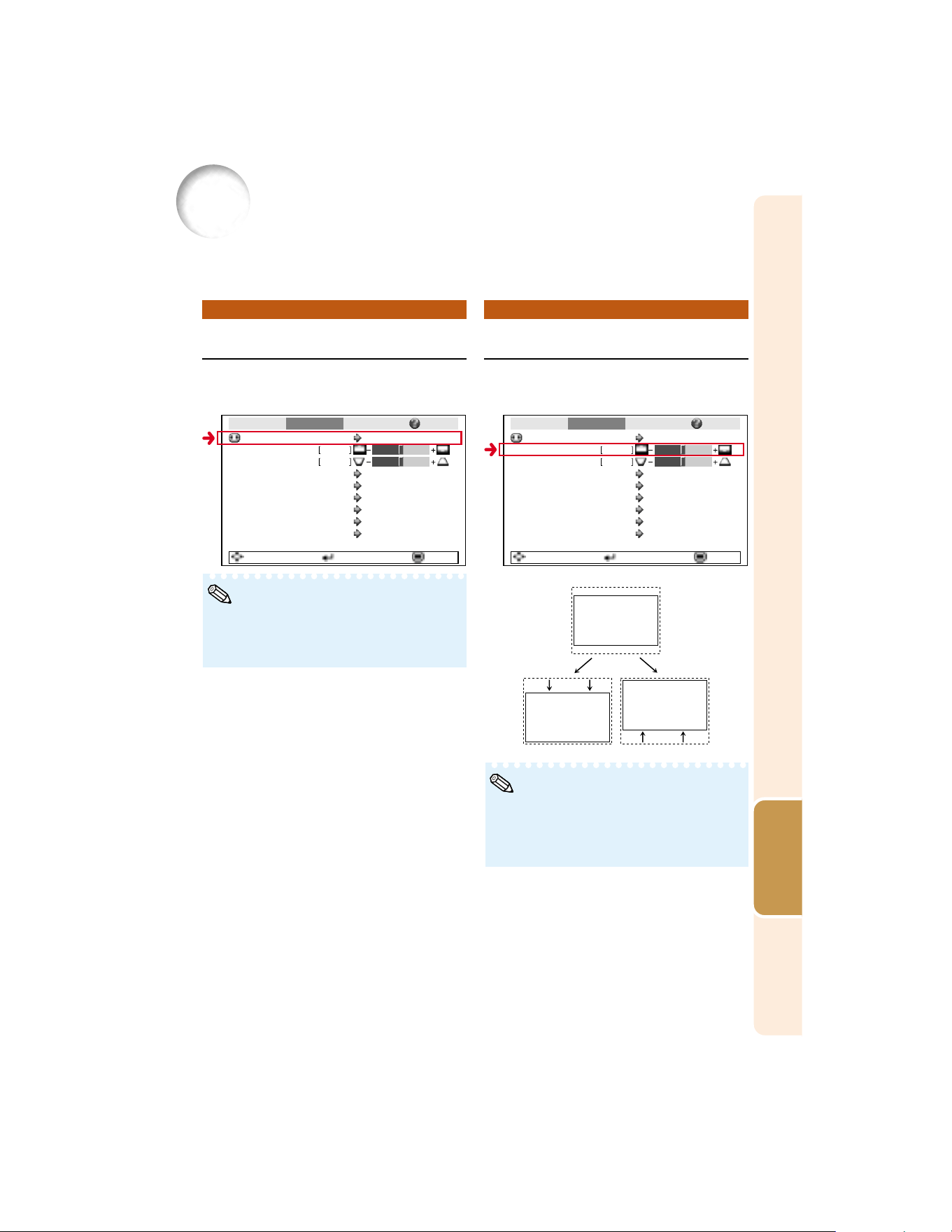
43
Useful
Features
Adjusting the Projected Image
(“SCR - ADJ” menu)
Setting the Resize Mode
You can adjust the projected image and on-screen display to your preferences using the “SCR -
ADJ” menu.
Adjusting the Image Position
Menu operation n Page 38
• For details of the Resize mode, see pages 30
and 31.
• You can also press HRESIZE on the remote
control to set the resize mode. (See page 30.)
You can move the projected image vertically.
Menu operation n Page 36
• You cannot set this item when “Resize” is set
to “Normal”.
• To reset this function, select “0”.
• When adjusting the image shift, “Keystone” is
set to “0” and “Auto Keystone” is set to “Off”.
Picture
Resize
Image Shift 0
0
SCR - ADJ PRJ - ADJ Help
Keystone
Auto Keystone
OSD Display
Background
Setup Guide
PRJ Mode
Language
Front
English
On
Logo
On
Off
Normal
SEL./ADJ. ENTER END
Picture
Resize
Image Shift 0
0
SCR - ADJ PRJ - ADJ Help
Keystone
Auto Keystone
OSD Display
Background
Setup Guide
PRJ Mode
Language
Front
English
On
Logo
On
Off
Stretch
SEL./ADJ. ENTER END
Note
Note
O button Q button
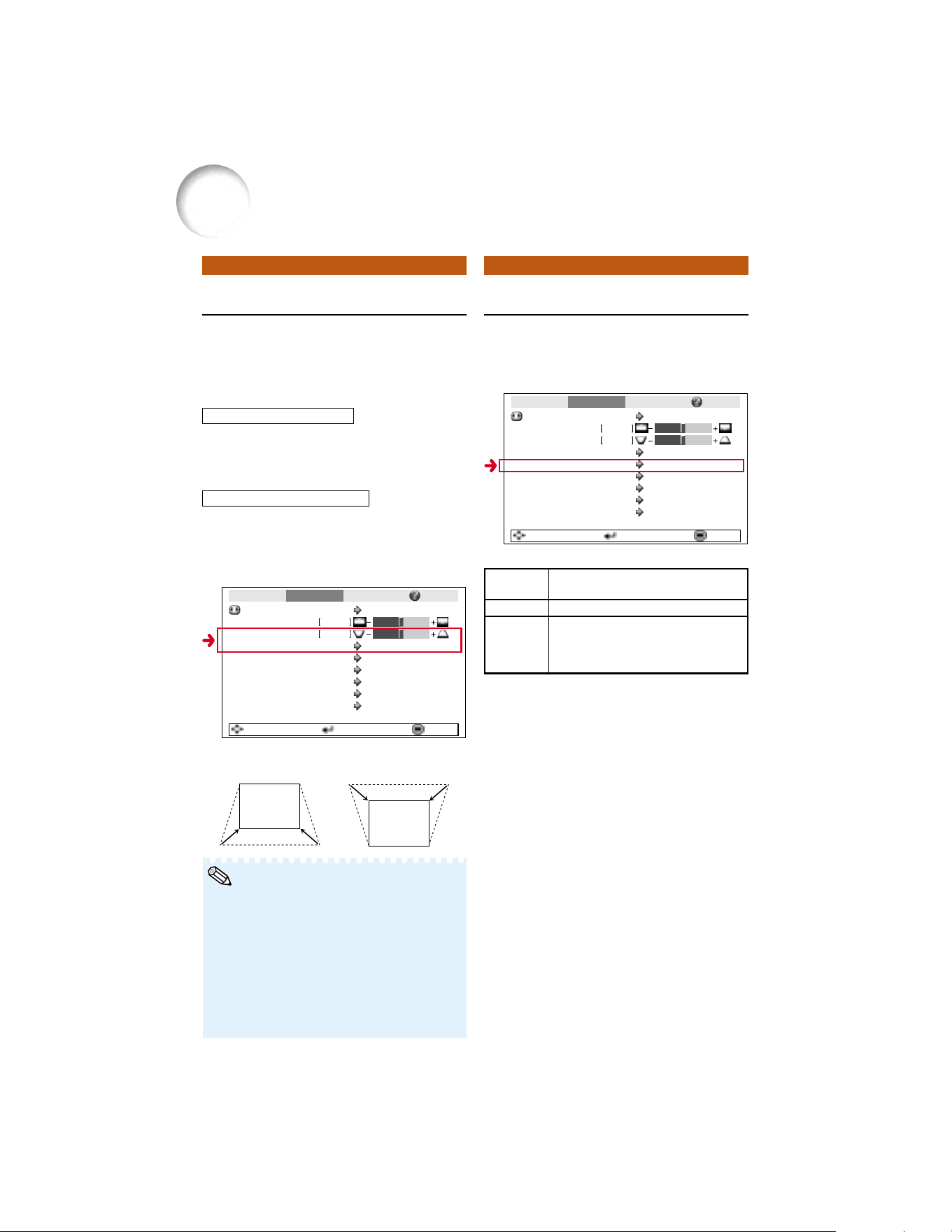
44
Setting On-screen DisplayKeystone Correction
• The Keystone Correction can be adjusted up
to an angle of approximately ±13 degrees with
the “Auto Keystone” and up to an angle of
approximately ±15 degrees with the manual
“Keystone”.
(when “Resize” is set to “Normal”)
• When the screen is slanting or the image is
deteriorated, set “Auto Keystone” to “Off”.
• When adjusting the keystone or when “Auto
Keystone” is set to “On”, “Image Shift” is au-
tomatically set to “0”.
Manual Keystone Correction
Set “Auto Keystone” on the “SCR - ADJ”
menu to “Off”, and select “Keystone”,
then adjust with the slide bar.
Menu operation n Page 36
Auto Keystone Correction
Set “Auto Keystone” on the “SCR - ADJ”
menu to “On”.
Menu operation n Page 38
This function allows you to turn the on-screen
messages on or off.
When the image is projected either from the top
or from the bottom towards the screen at an
angle, the image becomes distorted
trapezoidally. The function for correcting trap-
ezoidal distortion is called Keystone Correction.
Picture
Resize
Image Shift 0
0
SCR - ADJ PRJ - ADJ Help
Keystone
Auto Keystone
OSD Display
Background
Setup Guide
PRJ Mode
Language
Front
English
On
Logo
On
Off
Normal
SEL./ADJ. ENTER END
Picture
Resize
Image Shift 0
0
SCR - ADJ PRJ - ADJ Help
Keystone
Auto Keystone
OSD Display
Background
Setup Guide
PRJ Mode
Language
Front
English
On
Logo
On
Off
Normal
SEL./ADJ. ENTER END
Selectable
items
On
Off
Description
All On-screen Displays are displayed.
INPUT/VOLUME/AV MUTE/FREEZE/
AUTO SYNC/RESIZE/PICTURE MODE/
“An invalid button has been pressed.”
are not displayed.
Description of Items
Note
O button Q button
Manual Correction
Adjusting the Projected Image (“SCR - ADJ” menu) (Continued)
Menu operation n Page 38
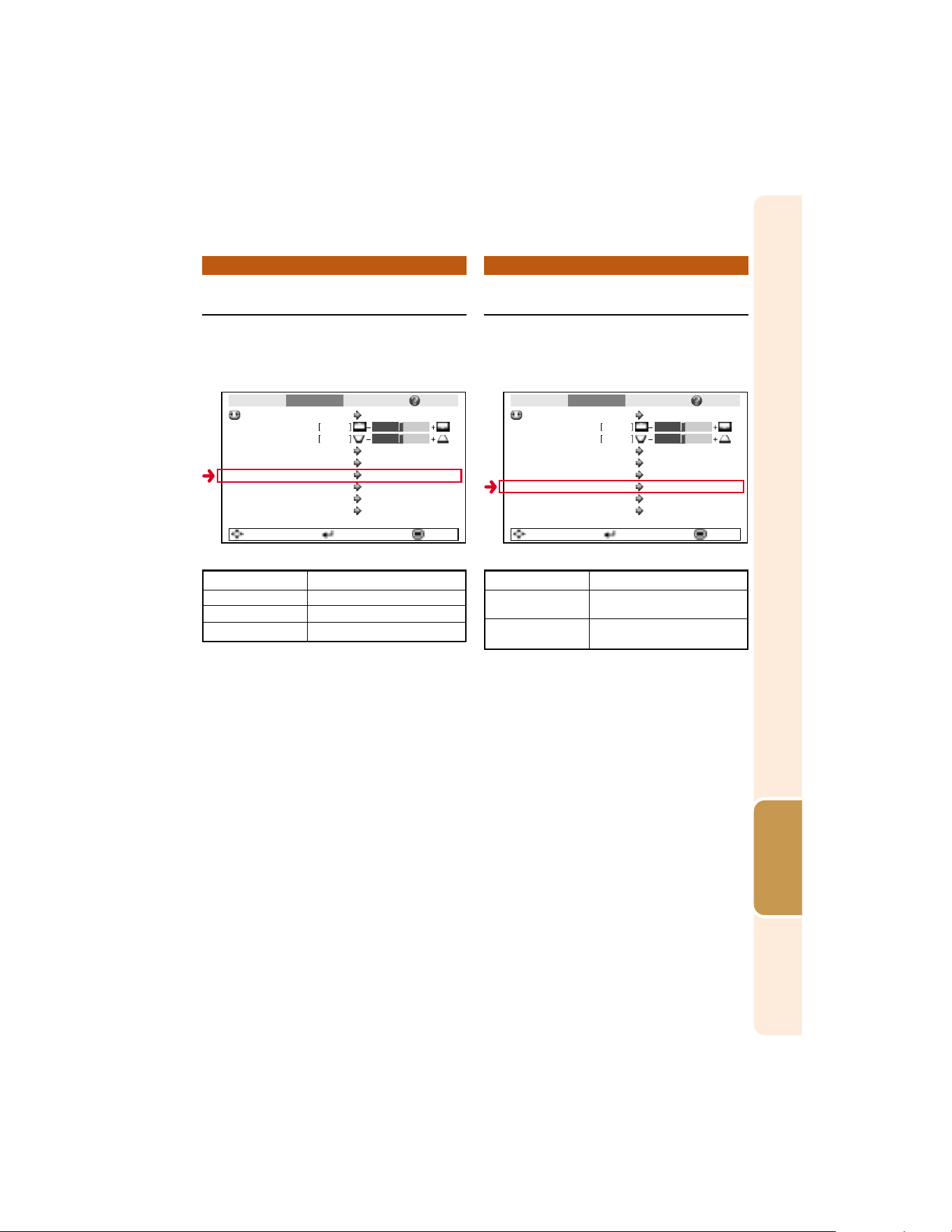
45
Useful
Features
Setting the Setup Guide
Selecting the Background Image
Description of Items
Menu operation n Page 38
You can set the Setup Guide screen during the
projector startup.
Menu operation n Page 38
Picture
Resize
Image Shift 0
0
SCR - ADJ PRJ - ADJ Help
Keystone
Auto Keystone
OSD Display
Background
Setup Guide
PRJ Mode
Language
Front
English
On
Logo
On
Off
Normal
SEL./ADJ. ENTER END
Picture
Resize
Image Shift 0
0
SCR - ADJ PRJ - ADJ Help
Keystone
Auto Keystone
OSD Display
Background
Setup Guide
PRJ Mode
Language
Front
English
On
Logo
On
Off
Normal
SEL./ADJ. ENTER END
Selectable items
Logo
Blue
None
Description
Sharp logo screen
Blue screen
—
Description of Items
Selectable items
On
Off
Description
Displaying the Setup Guide
when turning the projector on.
Not displaying the Setup
Guide.
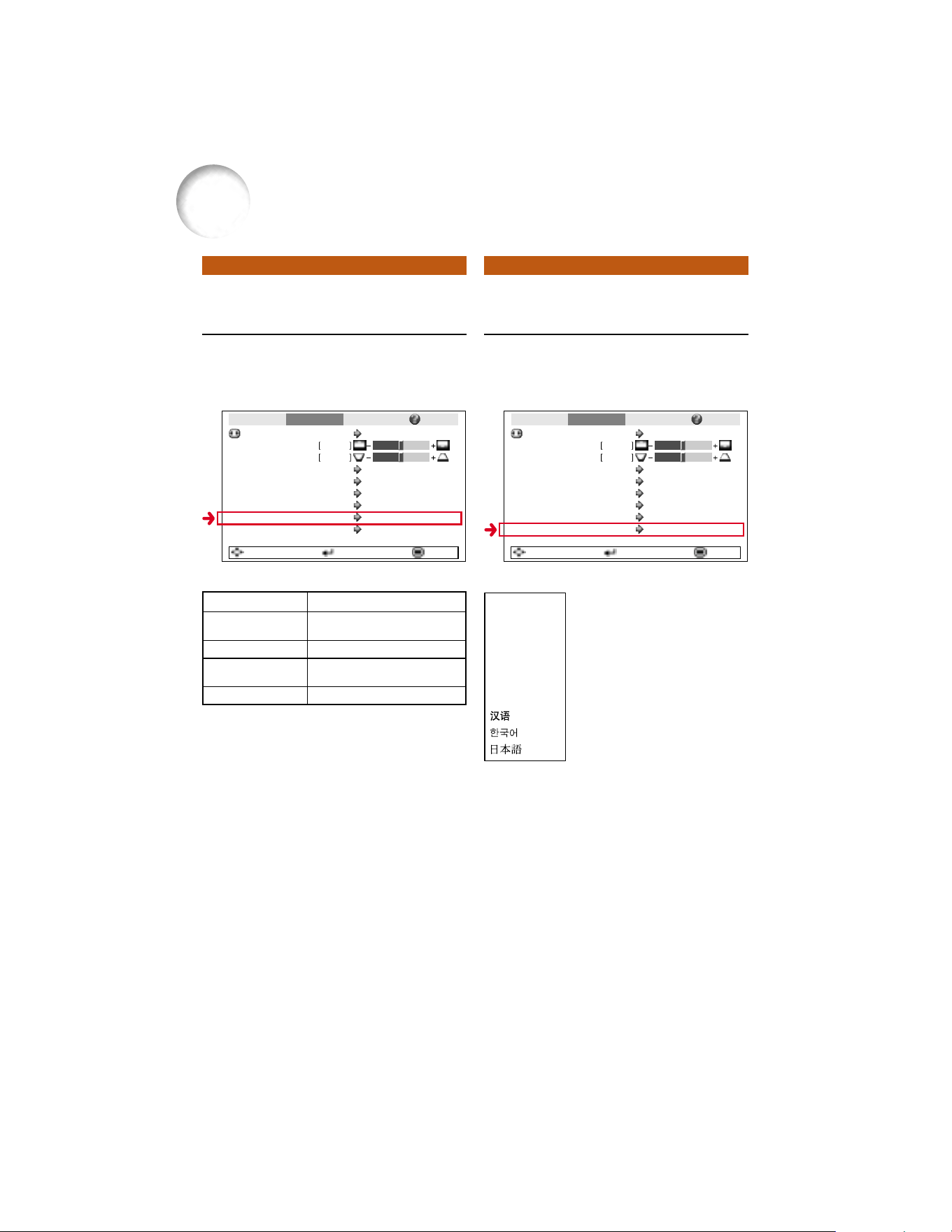
46
Selecting the On-screen Display
Language
Reversing/Inverting Projected
Images
Menu operation n Page 38 Menu operation n Page 38
The projector can switch the on-screen display
language among 11 languages.
Picture
Resize
Image Shift 0
0
SCR - ADJ PRJ - ADJ Help
Keystone
Auto Keystone
OSD Display
Background
Setup Guide
PRJ Mode
Language
Front
English
On
Logo
On
Off
Normal
SEL./ADJ. ENTER END
Picture
Resize
Image Shift 0
0
SCR - ADJ PRJ - ADJ Help
Keystone
Auto Keystone
OSD Display
Background
Setup Guide
PRJ Mode
Language
Front
English
On
Logo
On
Off
Normal
SEL./ADJ. ENTER END
Adjusting the Projected Image (“SCR - ADJ” menu) (Continued)
Description of Items
Selectable items
Front
Front + Rotate
Rear
Rear + Rotate
Description
Projecting from the front of the
screen
Projecting with a mirror
Projecting from the rear of the
screen or with a mirror
Projecting with a mirror
English
Deutsch
Español
Nederlands
Français
Italiano
Svenska
Português
Selectable items
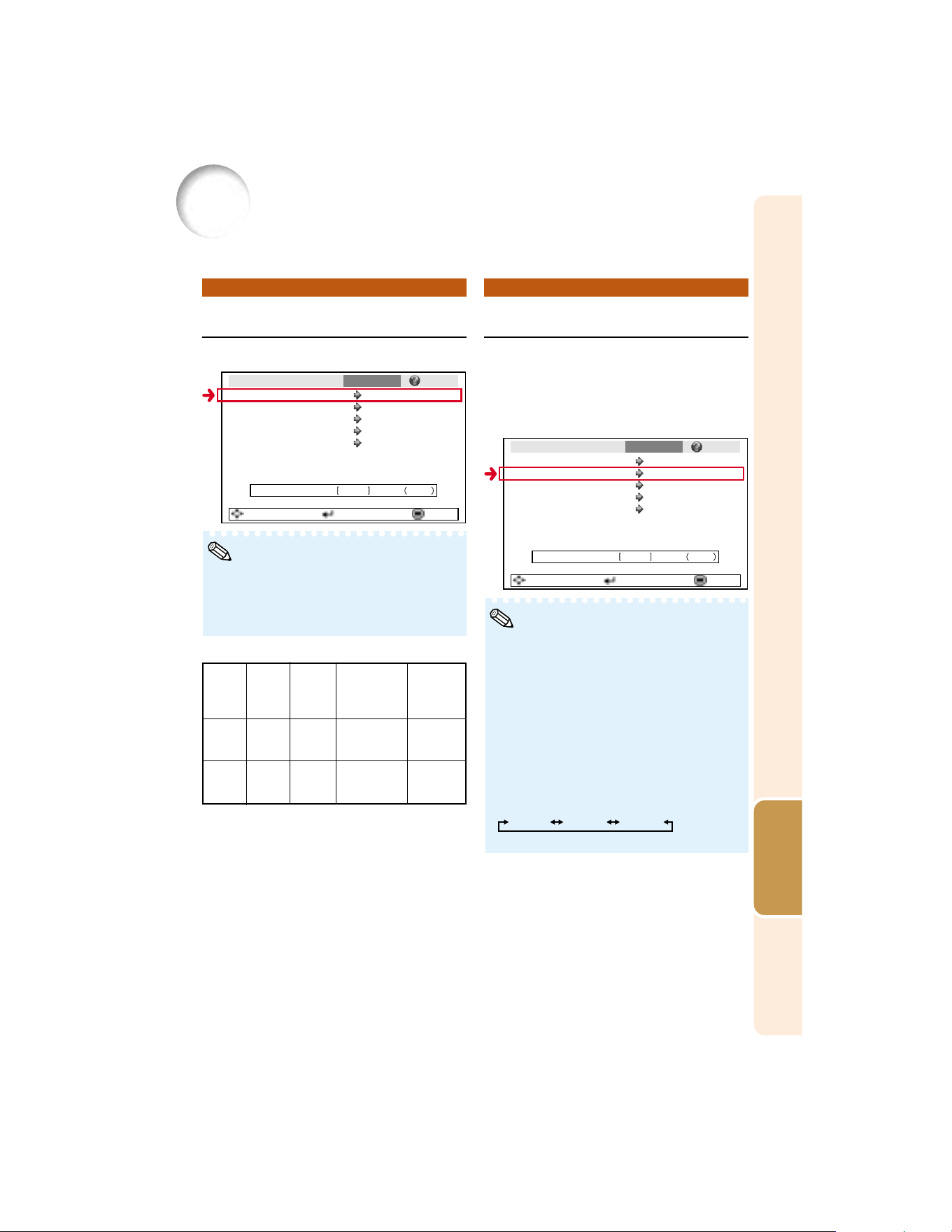
47
Useful
Features
Auto Search FunctionEco/Quiet Mode
Setting the Projector Function
(“PRJ - ADJ” menu)
You can use the “PRJ - ADJ” menu to enhance the usage for the projector.
• This function is factory preset to “Off”.
• When “Eco/Quiet Mode” is set to “On”, the
power consumption will decrease and the
lamp life will extend. (Projection brightness
decreases 10%.)
Menu operation n Page 38
Menu operation n Page 38
This function automatically searches for and
switches to the input mode in which signals are
being received, when the projector is turned on,
or when the INPUT button is pressed.
When “Auto Search” is set to “On”
• The projector automatically selects the avail-
able input source.
• If two or more input signals are found, the pro-
jector selects the input source in the order of
INPUT 1 n INPUT 2 n INPUT 3 when you
press INPUT (W/Y) on the projector.
• While “Auto Search” is set to “On”, press
CINPUT 1, DINPUT 2 or EINPUT 3 on
the remote control to select an input mode
other than the input mode selected by the pro-
jector.
• When “Auto Search” is set to “Off”, input mode
switches in order of
INPUT1 INPUT2 INPUT3
by press-
ing INPUT (W/Y) on the projector.
Picture
Eco/Quiet Mode
SCR - ADJ PRJ - ADJ Help
Auto Search
Auto Power Off
Guide LEDs
System Sound
System Lock
On
h
On
On
On
On
SEL./ADJ. ENTER END
0Lamp Timer(Life) 100%
Picture
Eco/Quiet Mode
SCR - ADJ PRJ - ADJ Help
Auto Search
Auto Power Off
Guide LEDs
System Sound
System Lock
On
h
On
On
On
On
SEL./ADJ. ENTER END
0Lamp Timer(Life) 100%
Description of items
Select-
able
items
On
Off
Bright-
ness
Approx.
90%
100%
Note
Power
consumption
(When using
AC 100V)
177W
195W
Lamp Life
Approx.
4,000
hours
Approx.
3,000
hours
Note
Fan
sound
Low
Stan-
dard
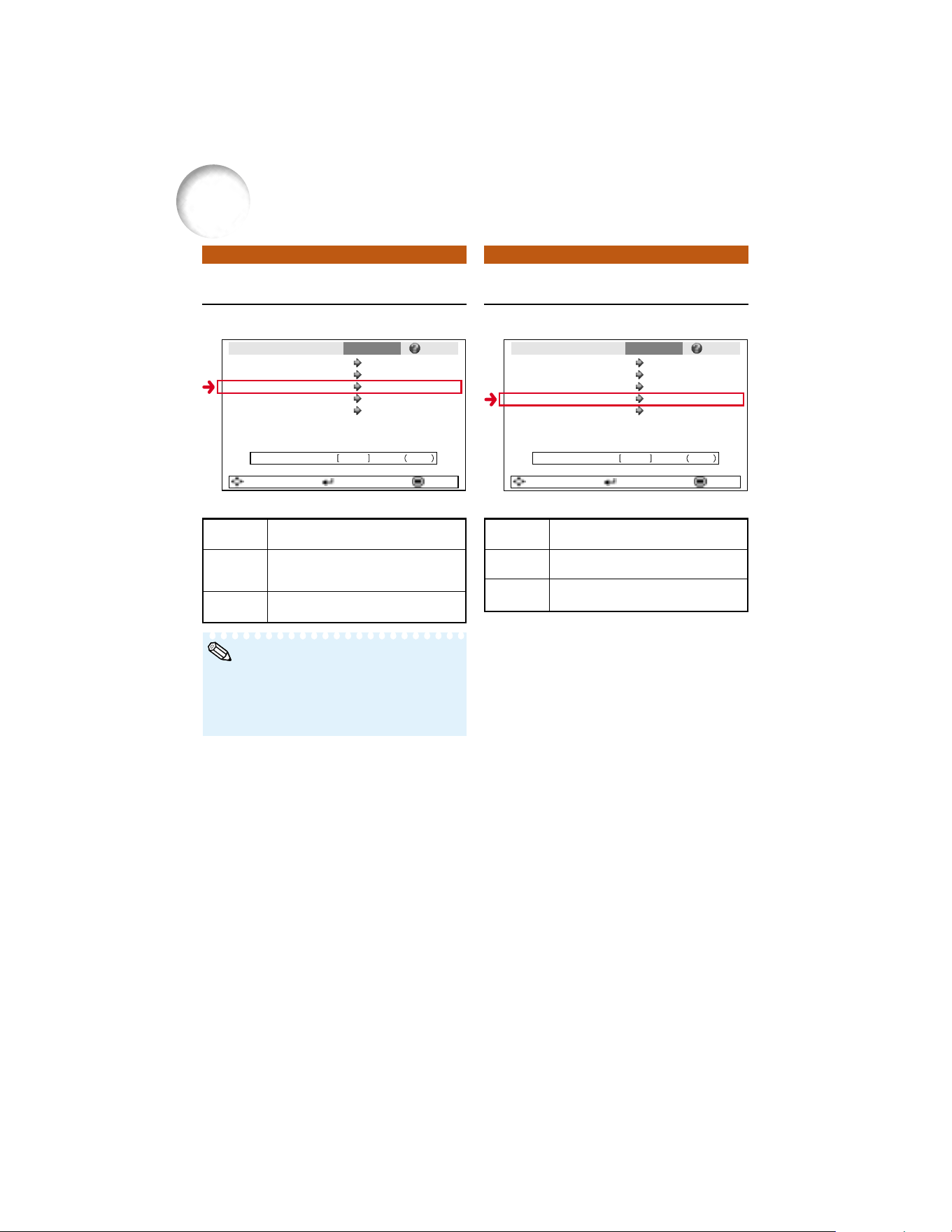
48
Setting the Guide LEDsAuto Power Off Function
Description of items
• When the Auto Power Off function is set to
“On”, 5 minutes before the projector enters
standby mode, the message “Enter STANDBY
mode in X min.” will appear on the screen to
indicate the remaining minutes.
Menu operation n Page 38 Menu operation n Page 38
Picture
Eco/Quiet Mode
SCR - ADJ PRJ - ADJ Help
Auto Search
Auto Power Off
Guide LEDs
System Sound
System Lock
On
h
On
On
On
On
SEL./ADJ. ENTER END
0Lamp Timer(Life) 100%
Picture
Eco/Quiet Mode
SCR - ADJ PRJ - ADJ Help
Auto Search
Auto Power Off
Guide LEDs
System Sound
System Lock
On
h
On
On
On
On
SEL./ADJ. ENTER END
0Lamp Timer(Life) 100%
Selectable
items
On
Off
Description
When no input signal is detected for
more than 15 minutes, the projector will
automatically enter standby mode.
The Auto Power Off function will be
disabled.
Note
Description of items
Selectable
items
On
Off
Description
The indicators for operation guidance
and the buttons for operation light up.
No indicators or buttons for operation
guidance blinks or lights up.
Setting the Projector Function (“PRJ - ADJ” menu) (Continued)
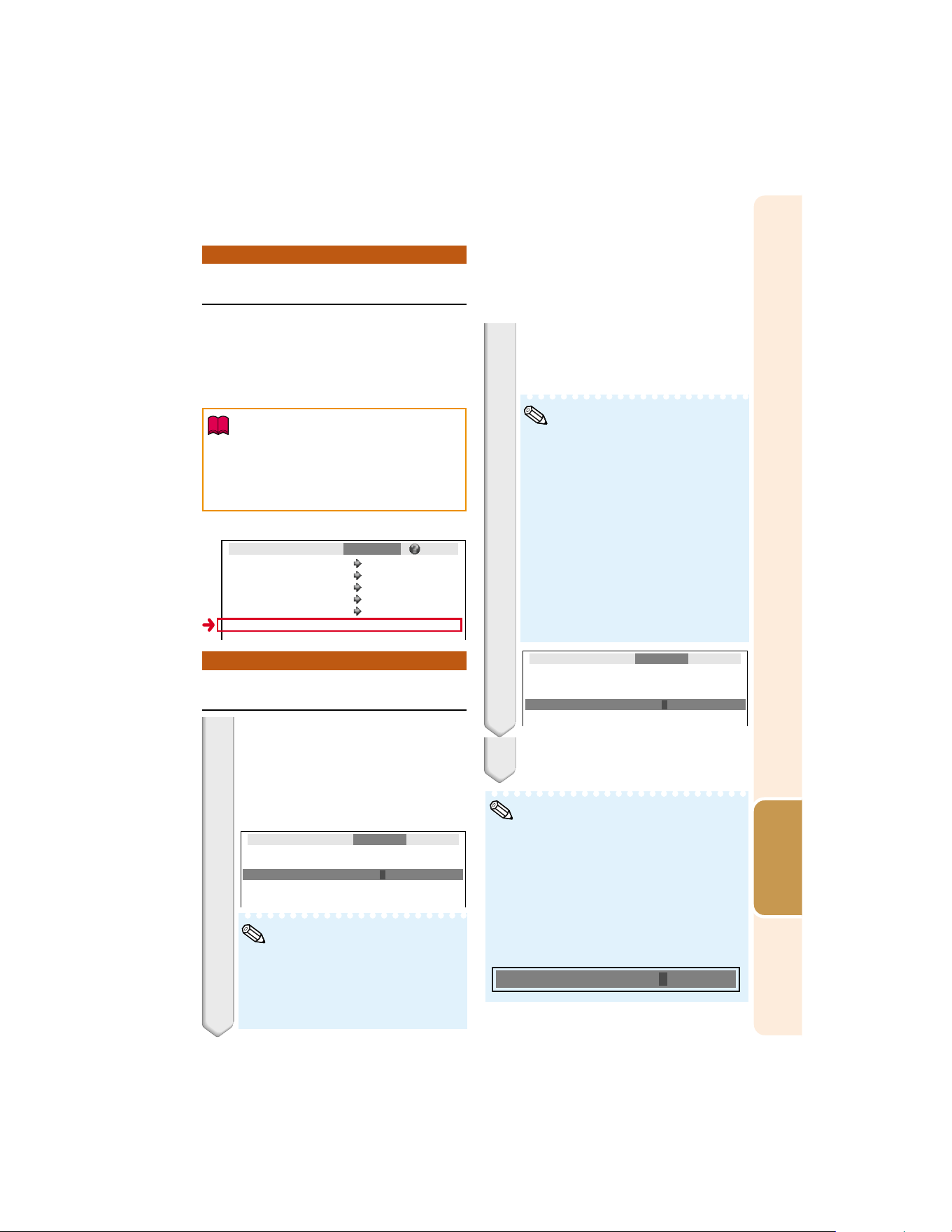
49
Useful
Features
Note
Info
System Lock Function
This function prevents unauthorized use of the
projector. Once this function is activated, users
must enter the correct keycode each time the
projector is turned on. We suggest you record
the keycode in a safe place where only au-
thorized users have access.
Input screen for keycode
• If you lose or forget your keycode, contact your
nearest Sharp Authorized Projector Dealer or
Service Center (see page 62). Even if the prod-
uct warranty is valid, the keycode reset will
incur a charge.
Not displaying the keycode input screen
when turning the projector on
• Press Y on the projector for four times in steps
2 and 3 above.
When the System Lock is set
• When System Lock is set, the keycode input
screen appears after the power is turned on.
When it appears, enter the right keycode to
start projection.
Enter the same keycode in “Re-
confirm”.
• You can not use the following buttons for
keycode:
•
AON/STANDBY
•
I
ENTER
•
J
RETURN
•
B
MENU/HELP
• System lock function recognizes each
button on the remote control or on the
projector as an individual button, even
if they share the same button name. If
you set the keycode with the buttons
on the projector, use only those but-
tons on the projector. If you set the
keycode with the buttons on the re-
mote control, use only those buttons
on the remote control.
Press the 4 buttons on the remote
control or on the projector to en-
ter the new keycode in “New
code”.
Press the 4 buttons on the remote
control or on the projector to en-
ter the preset keycode in “Old
Code”.
• When setting the keycode for the first
time, press Y on the projector for four
times.
Menu operation n Page 38
Setting the System Lock
PRJ - ADJ
Old Code
New Code
Reconfirm
––––
––––
––––
Setting the System Lock
PRJ - ADJ
Old Code
New Code
Reconfirm
****
– –––
––––
Picture
Eco/Quiet Mode
SCR - ADJ PRJ - ADJ Help
Auto Search
Auto Power Off
Guide LEDs
System Sound
System Lock
On
On
On
On
On
System Lock
––––
1
2
3
Note
Setting/Changing the keycode
• If you input a wrong keycode, the cursor
returns to the first point of the “Old Code”.
• The preset keycode is 4 Y buttons on
the projector. When this keycode is set,
the keycode input screen does not ap-
pear.
Note
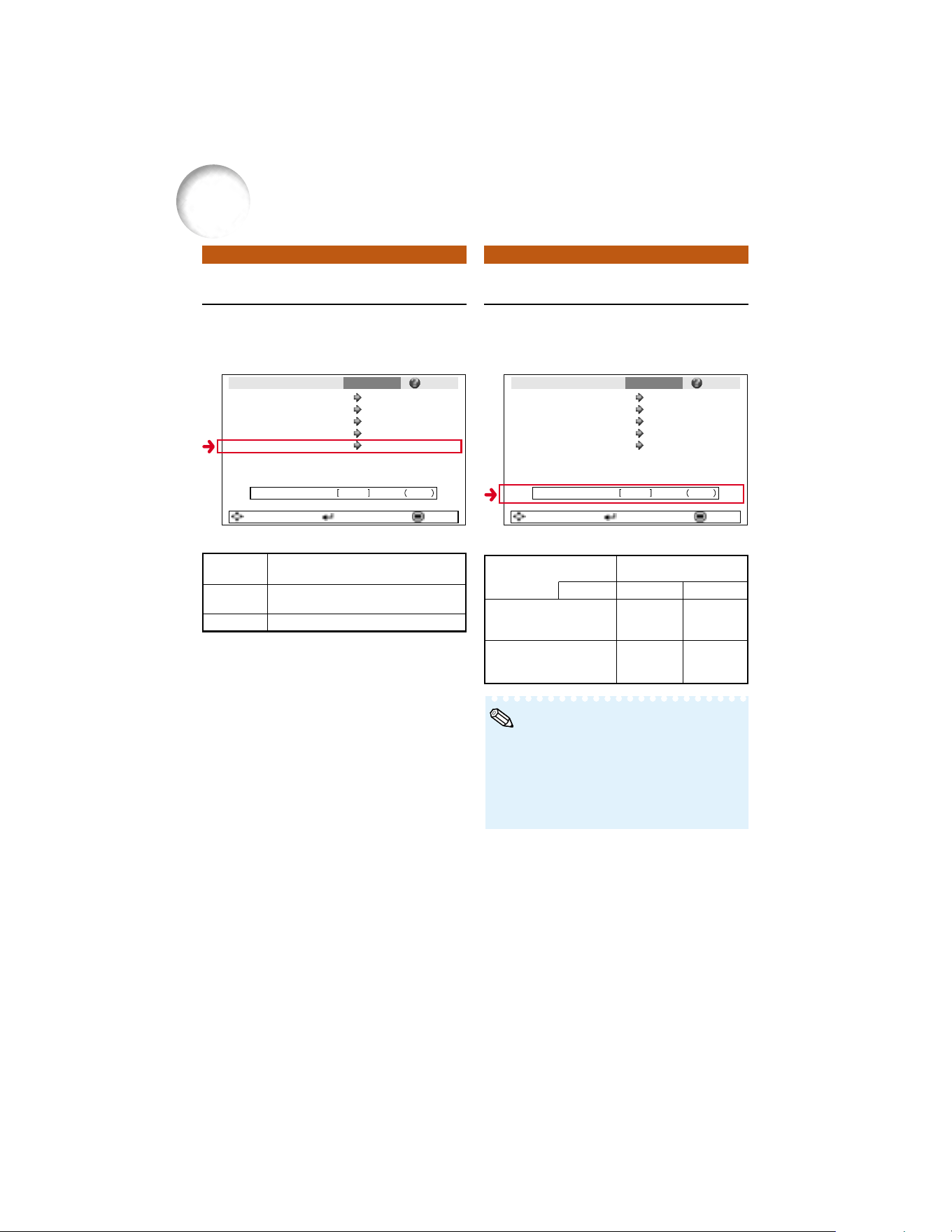
50
Checking the Lamp Life Status
• It is recommended that the lamp be changed
when the remaining lamp life becomes 5%.
For lamp replacement, contact your nearest
Sharp Authorized Projector Dealer or Service
Center.
• The lamp life may vary depending on the us-
age condition.
Menu operation n Page 36
You can confirm the cumulative lamp usage time
and the remaining lamp life (percentage).
Picture
Eco/Quiet Mode
SCR - ADJ PRJ - ADJ Help
Auto Search
Auto Power Off
Guide LEDs
System Sound
System Lock
On
h
On
On
On
On
SEL./ADJ. ENTER END
0Lamp Timer(Life) 100%
Lamp usage condition
Operated exclusively in
Eco/Quiet Mode “On”
Operated exclusively in
Eco/Quiet Mode “Off”
100%
Approx.
4,000
hours
Approx.
3,000
hours
Description of Lamp Life
5%
Approx.
200 hours
Approx.
150 hours
Remaining lamp life
Note
Setting the Confirmation Sound
Description of items
Menu operation n Page 38
Picture
Eco/Quiet Mode
SCR - ADJ PRJ - ADJ Help
Auto Search
Auto Power Off
Guide LEDs
System Sound
System Lock
On
h
On
On
On
On
SEL./ADJ. ENTER END
0Lamp Timer(Life) 100%
Selectable
items
On
Off
Description
A confirmation sound is made when
the projector turns on/off.
No confirmation sound is made.
“Life”
Setting the Projector Function (“PRJ - ADJ” menu) (Continued)
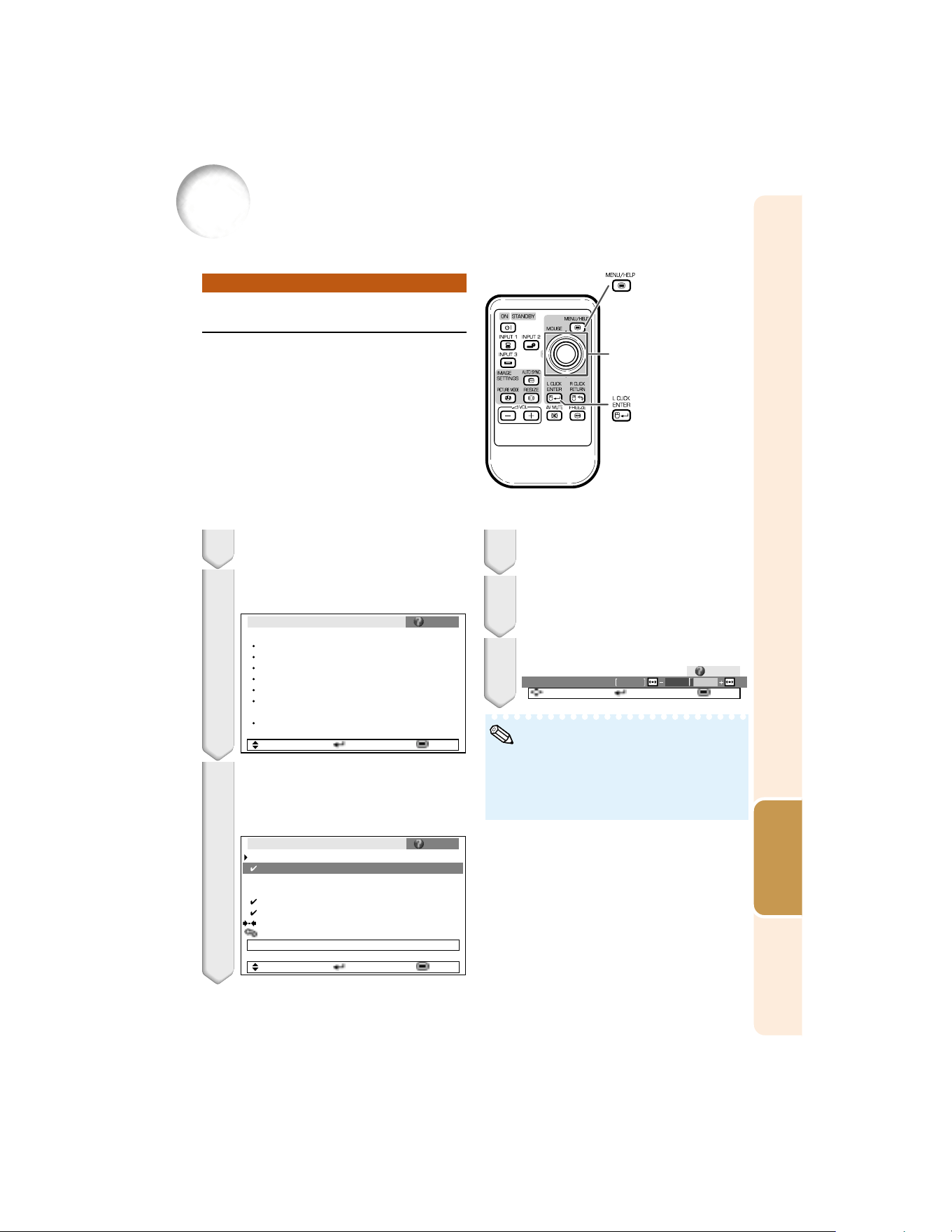
51
Useful
Features
Troubleshooting with “Help” menu
Displaying “Help” menu screen
This function advises you to solve the problems during usage.
• You can adjust the items with check marks (✔).
• Some items in the Help menu may not appear,
depending on the projected image.
• If the problem is not solved, refer to
“Troubleshooting”. (see pages 60 and 61)
Press O or Q to adjust.
If the image is not improved, se-
lect “Adjust horizontal noise.”,
then press IENTER.
Select “Initiate “Auto Sync” Ad-
justments”, then press IENTER.
Press P or R to select “Vertical
stripes or flickering image ap-
pears” on Help menu, then press
IENTER.
Example: When image flickering appears
Operation to solve image flickering when pro-
jecting the computer RGB signal.
3
4
5
6
Picture
There is no picture or audio
SCR - ADJ PRJ - ADJ Help
Vertical stripes or flickering image appear
Data image is not centered
Color is faded or poor
Picture is dark
The image is distorted
Reset all adjustments to default settings
SEL. ENTER END
If there is no change after performing "Auto Sync"
adjustments, adjust the following items.
Initiate "Auto Sync" Adjustments.
Help
Vertical stripes or flickering image appear
Adjust vertical noise
Adjust horizontal noise
Reset the 2 items above
Return
Cur. sig. freq: H 43 kHz / V 60 Hz
SEL. ENTER END
Note
Press BMENU/HELP.
1
2
Press O or Q to select “Help”, then
press IENTER.
Adjuatment button
(P/R/O/Q)
ENTER button
MENU/HELP
button
0Phase
SEL./ADJ. Rtn. Menu END
Help
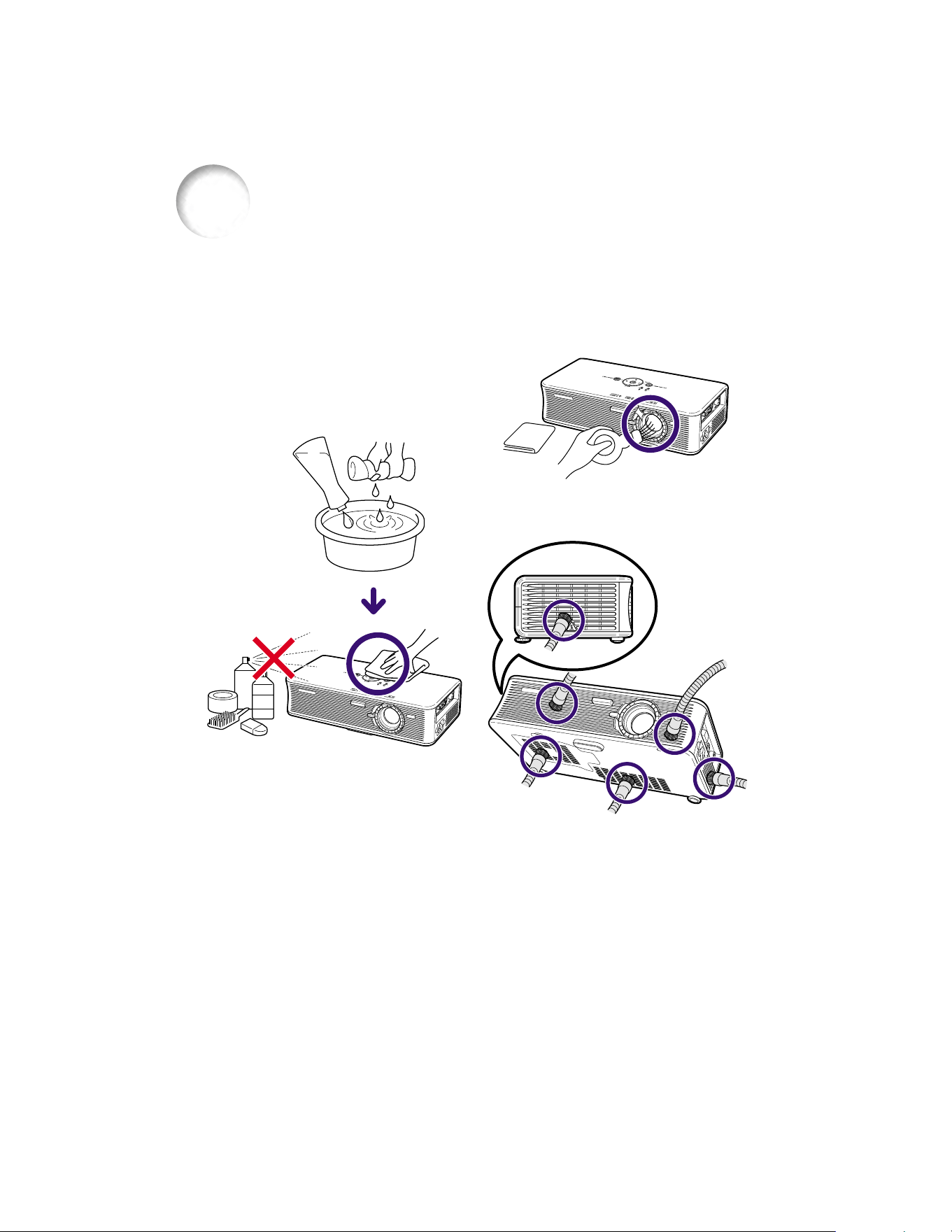
52
Cleaning the lens
■ Use a commercially available blower or lens
cleaning paper (for glasses and camera lenses)
for cleaning the lens. Do not use any liquid type
cleaning agents, as they may wear off the
coating film on the surface of the lens.
■ As the surface of the lens can easily get
damaged, be sure not to scrape or hit the lens.
Cleaning the exhaust and intake vents
■ Use a vacuum cleaner to clean dust from the
exhaust vent and the intake vent.
Cleaning the projector
■ Be sure to unplug the power cord before
cleaning the projector.
■ The cabinet as well as the operation panel is
made of plastic. Avoid using benzene or
thinner, as these can damage the finish on the
cabinet.
■ Do not use volatile agents such as insecticides
on the projector.
Do not attach rubber or plastic items to the
projector for long periods.
The effects of some of the agents in the plastic
may cause damage to the quality or finish of the
projector.
■ Wipe off dirt gently with a soft flannel cloth.
■ When the dirt is hard to remove, soak a cloth in
a mild detergent diluted with water, wring the
cloth well and then wipe the projector.
Strong cleaning detergents may discolor, warp
or damage the coating on the projector. Make
sure to test on a small, inconspicuous area on
the projector before use.
Maintenance
Thinner
Wax
Mild detergent
Mild detergent diluted
with water
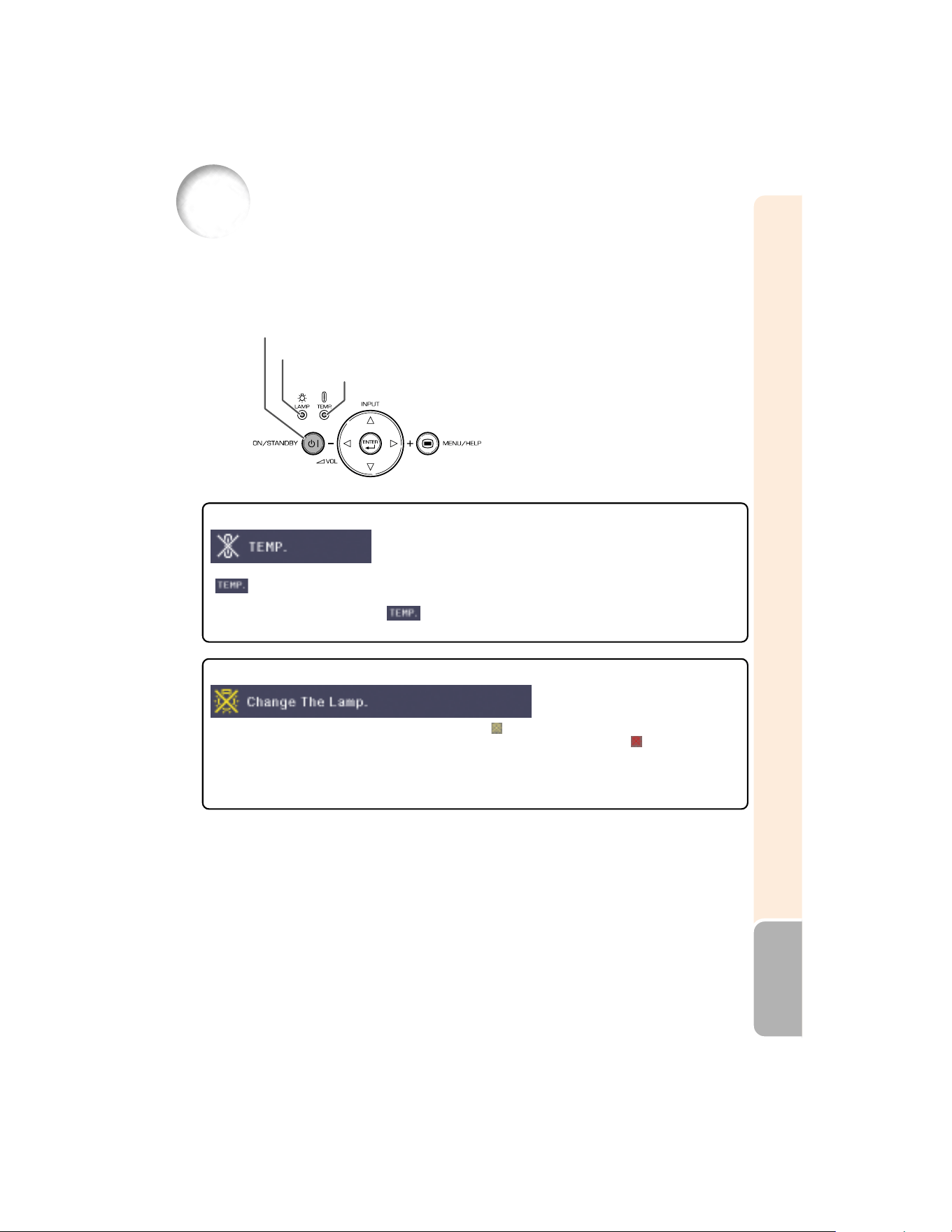
53
Appendix
Maintenance Indicators
About the lamp indicator
■ When the remaining lamp life becomes 5% or less, (yellow) and “Change The Lamp” will be
displayed on the screen. When the percentage becomes 0%, it will change to (red), the lamp will
automatically turn off and then the projector will automatically enter standby mode. At this time, the
lamp indicator will illuminate in red.
■ If you try to turn on the projector a fourth time without replacing the lamp, the projector will
not turn on.
About the temperature warning indicator
If the temperature inside the projector increases, due to blockage of the air vents, or the setting location,
“ ” will illuminate in the lower left corner of the picture. If the temperature keeps on rising, the lamp
will turn off and the temperature warning indicator will blink, the cooling fan will run, and then the projec-
tor will enter standby mode. After “ ” appears, be sure to perform the measures described on page
54.
Lamp indicator
■ The warning lights (ON/STANDBY button, lamp indicator and temperature warning indicator) on
the projector indicate problems inside the projector.
■ If a problem occurs, either the temperature warning indicator or the lamp indicator will illuminate
red, and the projector will enter standby mode. After the projector has entered standby mode,
follow the procedures given below.
Temperature warning indicator
ON/STANDBY button
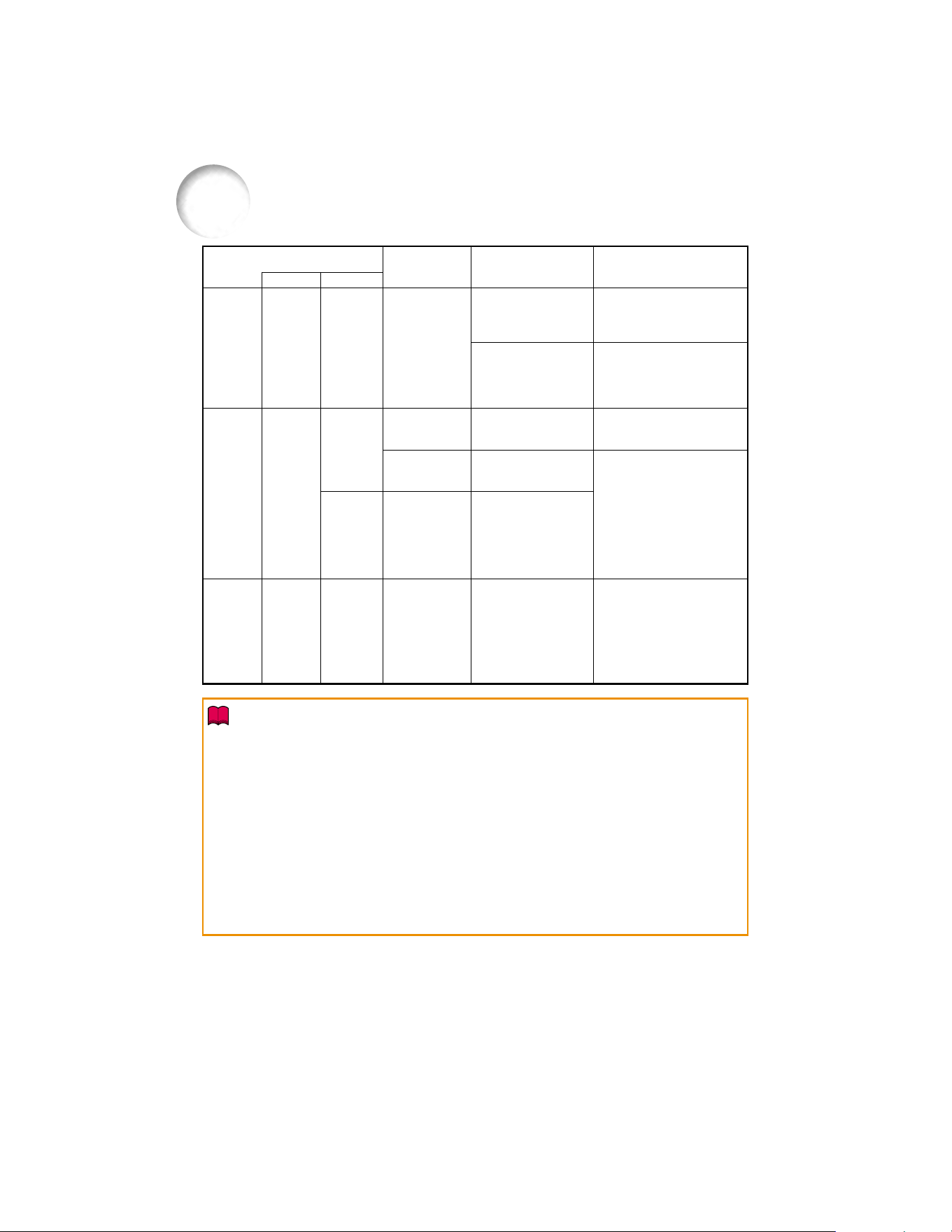
54
• If the temperature warning indicator illuminates, and the projector enters standby mode, follow the
possible solutions above and then wait until the projector has cooled down completely before plug-
ging in the power cord and turning the power back on. (At least 10 minutes.)
• If the power is turned off for a brief moment due to power outage or some other cause while using
the projector, and the power supply recovers immediately after that, the lamp indicator will illumi-
nate in red and the lamp may not be lit. In this case, unplug the power cord from the AC outlet,
replace the power cord in the AC outlet and then turn the power on again.
• If you want to clean the air vents during projector operation, be sure to press SON/STANDBY on
the projector or AON/STANDBY on the remote control and put the projector into standby mode.
After the cooling fan has stopped, clean the vents.
• The cooling fan keeps the internal temperature of the projector constant and this function is con-
trolled automatically. The sound of the cooling fan may change during operation because the fan
speed may change and this is not a malfunction.
• Do not unplug the power cord after the projector has entered standby mode and while the cooling
fan is running. The cooling fan runs for about 90 seconds.
Maintenance indicator
Problem
The internal
temperature is
abnormally
high.
The lamp does
not illuminate.
Time to change
the lamp.
The lamp does
not illuminate.
The power
indicator blinks
in red when the
projector is on.
Cause
• Blocked air intake
• Cooling fan
breakdown
• Internal circuit
failure
• Clogged air intake
• The lamp is shut
down abnormally.
• Remaining lamp life
becomes 5% or
less.
• Burnt-out lamp
• Lamp circuit failure
• The lamp unit cover
is open.
Possible Solution
• Relocate the projector to
an area with proper
ventilation. (see page 8)
• Take the projector to your
nearest Sharp Authorized
Projector Dealer or Service
Center (see page 62) for
repair.
• Disconnect the power cord
from the AC outlet, and
then connect it again.
• Carefully replace the lamp.
(See page 56.)
• Take the projector to your
nearest Sharp Authorized
Projector Dealer or Service
Center (see page 62) for
repair.
• Please exercise care when
replacing the lamp.
• Securely install the cover.
• If the power indicator blinks
in red even when the lamp
unit cover is securel
installed, contact your
nearest Sharp Authorized
Projector Dealer or Service
Center (see page 62) for
advice.
Abnormal
Red on
(Standby)
Red on
Red on
(Standby)
Red
blinks
Tempera-
ture
warning
indicator
Lamp
indicator
Power
button
Normal
Off
Green on
(Green
blinks
when the
lamp is
warming
up.)
Green on/
Red on
Info
Maintenance Indicators (Continued)
55
Appendix
Regarding the Lamp
Lamp
■ It is recommended that the lamp (sold separately) be replaced when the remaining lamp life becomes
5% or less, or when you notice a significant deterioration in the picture and color quality. The lamp life
(percentage) can be checked with the on-screen display. (see page 50)
■ Purchase a replacement lamp of type AN-XR1LP from your place of purchase, nearest Sharp Projector
Dealer or Service Center.
Caution Concerning the Lamp
■ This projector utilizes a pressurized mercury lamp. A loud sound may indicate lamp failure. Lamp
failure can be attributed to numerous sources such as: excessive shock, improper cooling, surface
scratches or deterioration of the lamp due to a lapse of usage time.
The period of time up to failure largely varies depending on the individual lamp and/or the condition
and the frequency of use. It is important to note that failure can often result in the bulb cracking.
■ When the lamp replacement indicator and on-screen display icon are illuminated, it is recommended
that the lamp be replaced with a new one immediately, even if the lamp appears to be operating
normally.
■ Should the lamp break, there is also a possibility that glass particles may spread inside of the
projector. In such a case, it is recommended you contact your nearest Sharp Authorized Projector
Dealer or Service Center to assure safe operation.
■ Should the lamp break, the glass particles may spread inside the lamp cage or gas contained in the
lamp may be vented into the room from the exhaust vent. Because the gas in this lamp includes
mercury, ventilate the room well if the lamp breaks and avoid all exposure to the released gas. In case
of exposure to the gas, consult a doctor as soon as possible.
Replacing the Lamp
• Do not remove the lamp unit from the projector right after use. The lamp will be very hot and may
cause burn or injury.
■ Carefully change the lamp by following the instructions described in this section. * If you wish,
you may have the lamp replaced at your nearest Sharp Authorized Projector Dealer or Service
Center.
* If the new lamp does not light after replacement, take your projector to the nearest Sharp Authorized
Projector Dealer or Service Center for repair.
IMPORTANT NOTE TO U.S. CUSTOMERS:
The lamp included with this projector is backed by a 90-day parts and labor limited
warranty. All service of this projector under warranty, including lamp replacement,
must be obtained through a Sharp Authorized Projector Dealer or Service Center.
For the name of the nearest Sharp Authorized Projector Dealer or Service Center,
please call toll-free: 1-888-GO-SHARP (1-888-467-4277).
Hg LAMP CONTAINS MERCURY For State Lamp Disposal
Information
www.lamprecycle.org or 1-800-BE-SHARP
U.S.A. ONLY
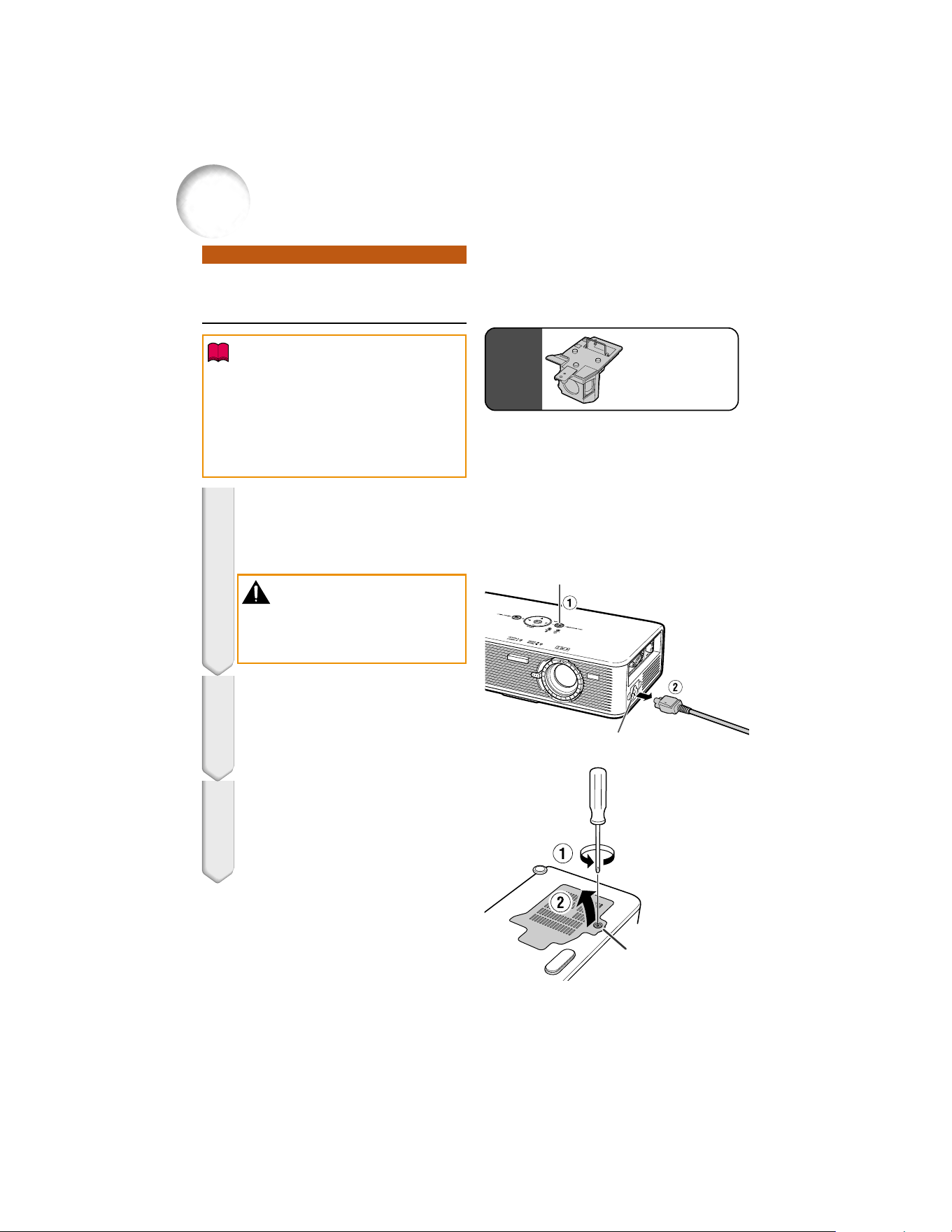
56
Removing and Installing the
Lamp Unit
• Be sure to remove the lamp unit using the
handle. Be sure not to touch the glass surface
of the lamp unit or the inside of the projector.
• To avoid injury to yourself and damage to the
lamp, be sure to carefully follow the steps
below.
• Do not loosen other screws except for the
lamp unit cover and lamp unit.
Press SON/STANDBY on the pro-
jector or AON/STANDBY on the
remote control to put the projector
into standby mode.
• Wait until the cooling fan stops.
Warning!
• Do not remove the lamp unit from the
projector right after use. The lamp and
parts around the lamp will be very hot
and may cause burns or injury.
Disconnect the power cord.
• Unplug the power cord from the AC
socket.
• Leave the lamp until it has fully cooled
down (about 1 hour).
Remove the lamp unit cover.
• Turn the projector over. Loosen the user
service screw (1) that secures the lamp
unit cover. Remove the lamp unit cover
(2).
Lamp unit
AN-XR1LP
Info
Optional
accessory
AC socket
User service screw
(for lamp unit cover)
1
2
3
Regarding the Lamp (Continued)
ON/STANDBY button
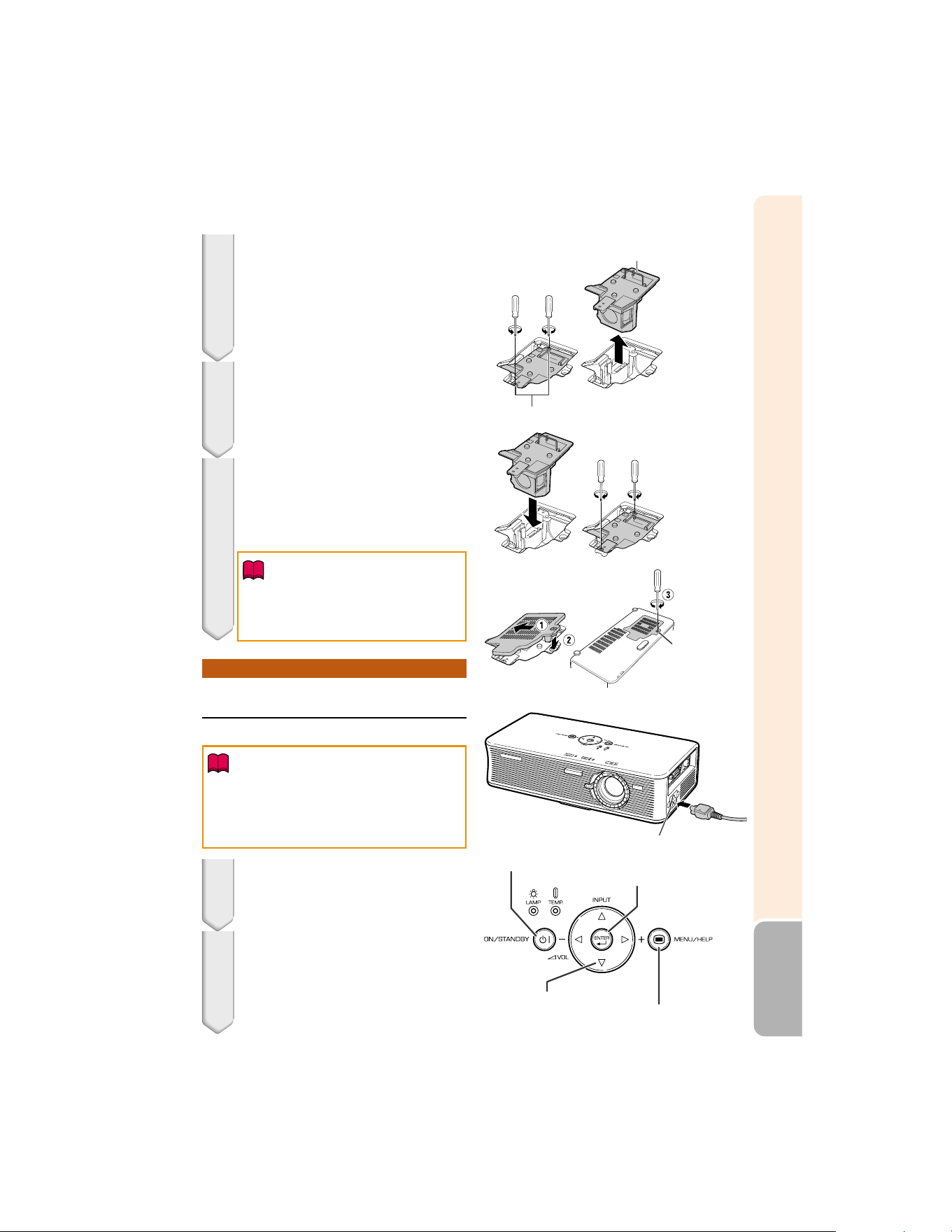
57
Appendix
Remove the lamp unit.
• Loosen the securing screws from the
lamp unit. Hold the lamp unit by the
handle and pull it in the direction of the
arrow. At this time, keep the lamp
unithorizontal and do not tilt it.
Resetting the Lamp Timer
Reset the lamp timer after replacing the lamp.
Insert the new lamp unit.
• Press the lamp unit firmly into the lamp
unit compartment. Fasten the securing
screws.
Replace the lamp unit cover.
• Align the tab on the lamp unit cover
(1)and place it while pressing the tab
(2) to close it. Then tighten the user ser-
vice screw (3) to secure the lamp unit
cover.
4
5
6
Connect the power cord.
• Plug the power cord into the AC socket
of the projector.
Reset the lamp timer.
• While simultaneously holding down
UMENU, TENTER and Y on the pro-
jector, press and SON/STANDBY on the
projector.
• “LAMP 0000H” is displayed, indicating
that the lamp timer is reset.
• Make sure to reset the lamp timer only when
replacing the lamp. If you reset the lamp timer
and continue to use the same lamp, this may
cause the lamp to become damaged or ex-
plode.
1
2
Info
AC socket
Securing screws
Handle
User service
screw (for
lamp unit
cover)
ON/STANDBY button
ENTER button
MENU button
Y button
• If the lamp unit and lamp unit cover are
not correctly installed, the power will not
turn on, even if the power cord is con-
nected to the projector.
Info
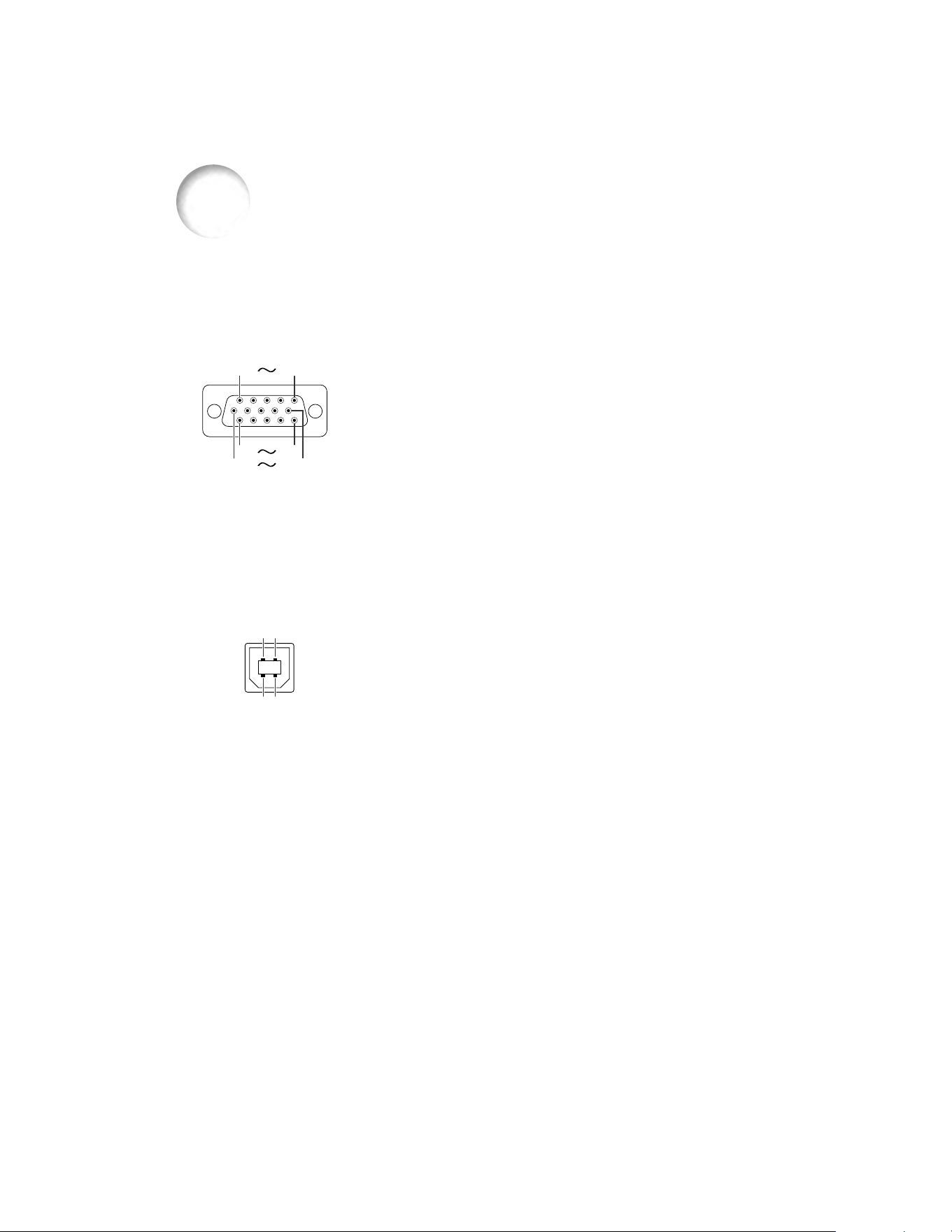
58
Connecting Pin Assignments
RGB Input
INPUT 1 RGB Signal Terminal: 15-pin Mini D-sub female connector
1. Video input (red)
2. Video input (green/sync on green)
3. Video input (blue)
4. Not connected
5. Not connected
6. Earth (red)
7. Earth (green/sync on green)
8. Earth (blue)
9. Not connected
10. GND
11. Not connected
12. Bi-directional data
13. Horizontal sync signal: TTL level
14. Vertical sync signal: TTL level
15. Data clock
USB Terminal: 4-pin B-type USB female connector
Component Input
5
10
15
1
11
6
3 4
12
1. PR (CR)
2. Y
3. PB (CB)
4. Not connected
5. Not connected
6. Earth (PR)
7. Earth (Y)
8. Earth (PB)
9. Not connected
10. Not connected
11. Not connected
12. Not connected
13. Not connected
14. Not connected
15. Not connected
1. SG
2. USB+
3. VCC
4. USB–
Signal
GND
USB data+
USB power
USB data–
Signal name
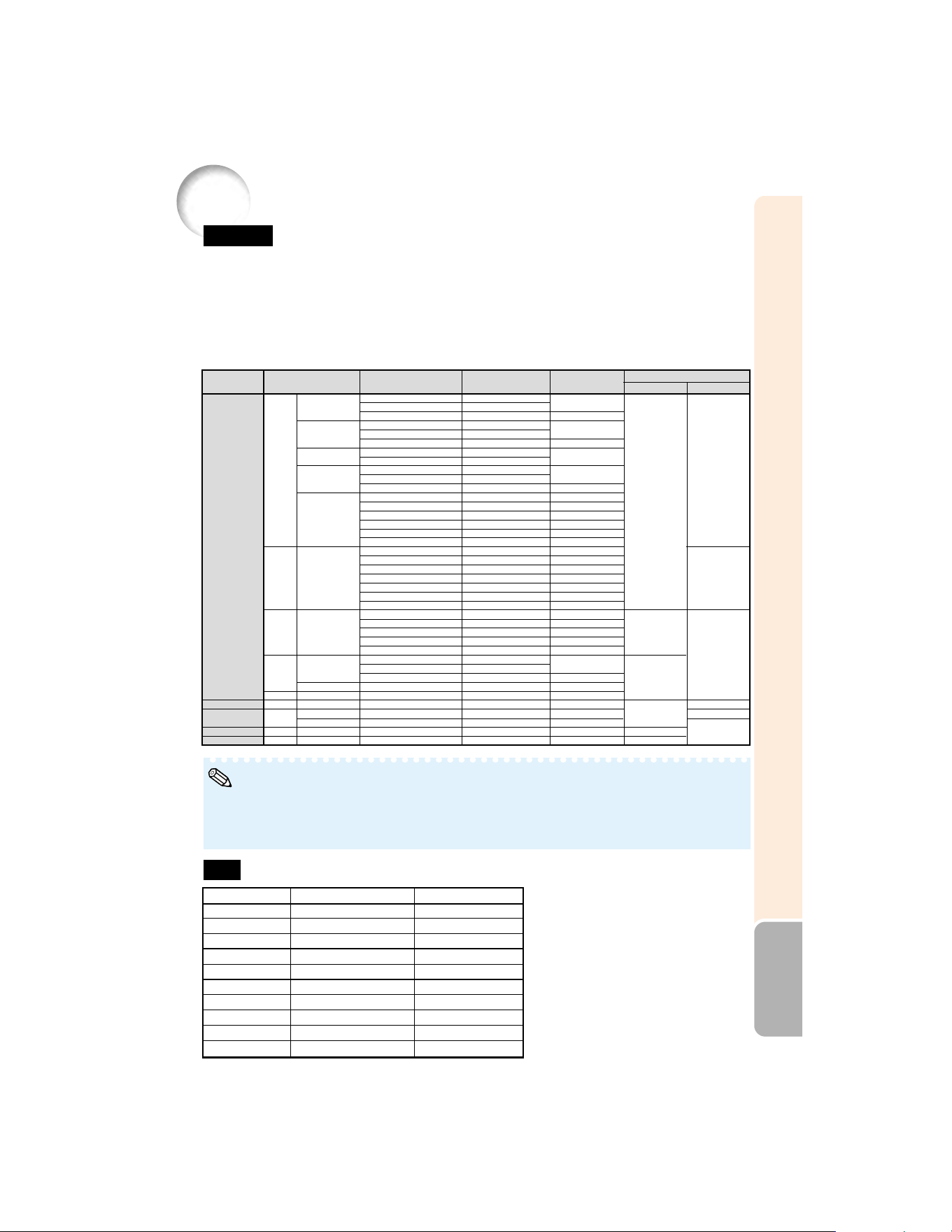
59
Appendix
DTV
• This projector may not be able to display images from notebook computers in simultaneous (CRT/LCD) mode. Should this
occur, turn off the LCD display on the notebook computer and output the display data in “CRT only” mode. Details on how to
change display modes can be found in your notebook computer’s operation manual.
• When this projector receives 640K350 VESA format VGA signals, “640K400” appears on the screen.
Computer
Computer Compatibility Chart
• Multiple signal support
Horizontal Frequency: 15-70 kHz,
Vertical Frequency: 45-85 Hz,
Pixel Clock: 12-108 MHz
Sync signal:Compatible with TTL level
• Compatible with sync on green signal
The following is a list of modes that conform to VESA. However, this projector supports other
signals that are not VESA standards.
27.0
31.5
37.5
27.0
31.5
37.9
27.0
31.5
27.0
31.5
37.9
26.2
31.5
34.7
37.9
37.5
43.3
31.4
35.1
37.9
46.6
48.1
46.9
53.7
40.3
48.4
56.5
60.0
68.7
55.0
66.2
67.5
64.0
64.0
34.9
37.8
49.7
60.2
68.7
60
70
85
60
70
85
60
70
60
70
85
50
60
70
72
75
85
50
56
60
70
72
75
85
50
60
70
75
85
60
70
75
60
60
67
60
75
75
75
640 × 350
640 × 400
720 × 350
720 × 400
640 × 480
800 × 600
1,024 × 768
1,152 × 864
1,280 × 1,024
1,400 × 1,050
640 × 480
800 × 600
832 × 624
1,024 × 768
1,152 × 870
MAC 13"
MAC 16"
PC
VGA
SVGA
XGA
SXGA
SXGA+
VGA
XGA
SXGA
✔
✔
✔
✔
✔
✔
✔
✔
✔
✔
✔
✔
✔
✔
✔
✔
✔
✔
XR-1X XR-1S
PC/MAC
MAC 19"
MAC 21"
SVGA
Signal
480I
480P
540P
576I
576P
720P
1035I
1035I
1080I
1080I
Horizontal Frequency (kHz)
15.7
31.5
33.8
15.6
31.3
45.0
28.1
33.8
28.1
33.8
Vertical Frequency (Hz)
60
60
60
50
50
60
50
60
50
60
Note
• Compatible with the signals below in
intelligent compression
XR-1X: SXGA, SXGA+
XR-1S: XGA, SXGA, SXGA+
• Intelligent Compression and Expansion
System resizing technology
Resolution
Horizontal Frequency
(kHz)
Vertical Frequency
(Hz)
VESA Standard
Display
Upscale
Tru e
Intelligent
Compression
Upscale
Intelligent Compression
True
Upscale
Tru e
Intelligent
Compression
Intelligent
Compression
Upscale
Tru e
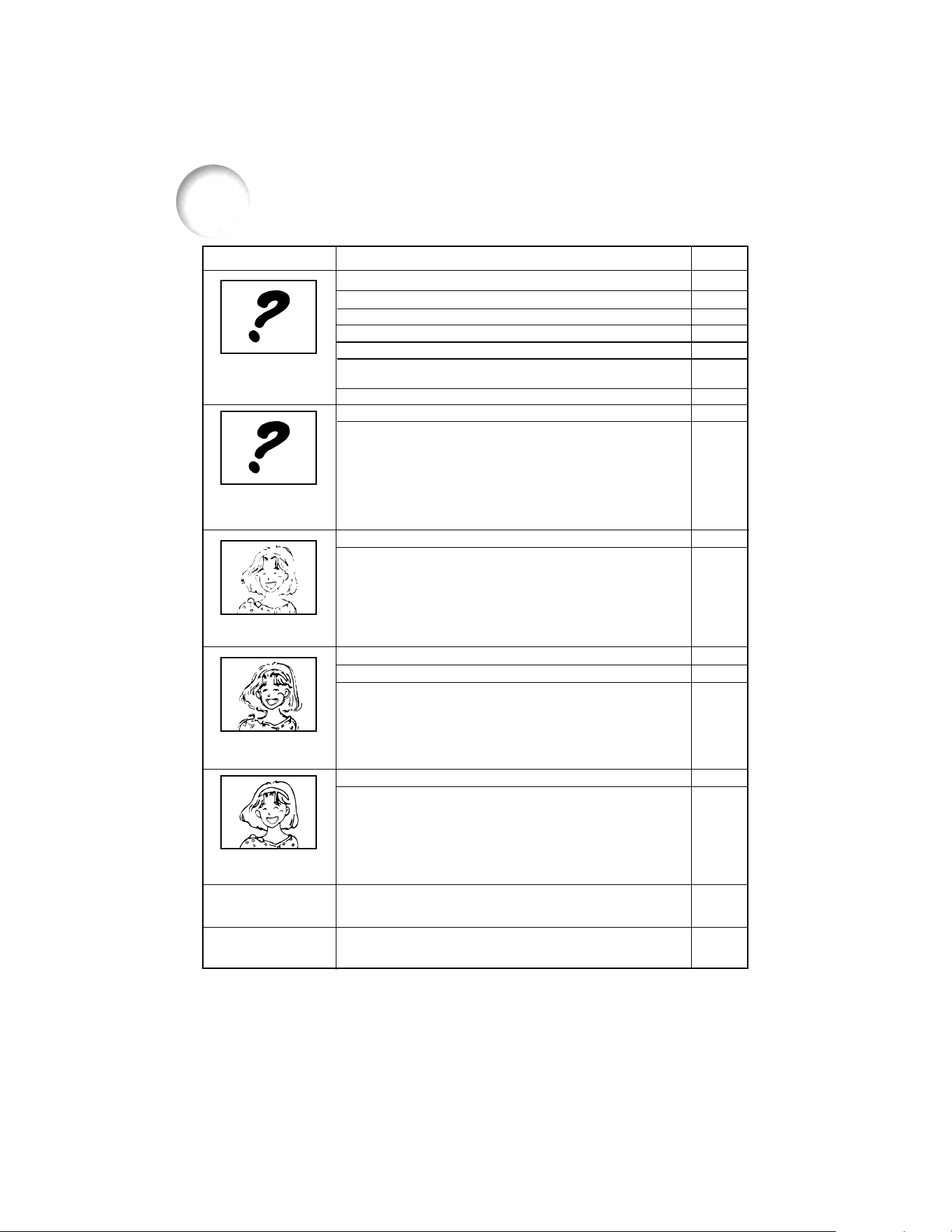
60
Troubleshooting
No picture and no sound
or projector does not
start.
Sound is heard but no
picture appears (or picture
is dark).
Color is faded or poor.
Picture is blurred;
noise appears.
Picture appears but no
sound is heard.
An unusual sound is
occasionally heard from
the cabinet.
Maintenance indicator on
the projector illuminates
or blinks in red.
Problem Check
• Projector power cord is not plugged into the wall outlet.
• Power to the external connected devices is off.
• The selected input mode is wrong.
• Cables incorrectly connected to the projector.
• Remote control battery has run out.
• External output has not been set when connecting notebook
computer.
• The lamp unit cover is not installed correctly.
• Cables incorrectly connected to the projector.
• “Bright” is set to minimum position.
• Image adjustments are incorrectly set.
(Video Input only)
• Video input system is incorrectly set.
• Adjust the focus.
• The projection distance exceeds the focus range.
(Computer Input only)
• Perform “Fine Sync” Adjustments (“Clock” Adjustment)
• Perform “Fine Sync” Adjustments (“Phase” Adjustment)
• Noise may appear depending on the computer.
• Cables incorrectly connected to the projector.
• Volume is set to minimum.
• If the picture is normal, the sound is due to cabinet shrinkage
caused by room temperature changes. This will not affect operation
or performance.
• See “Maintenance Indicators”.
Page
25
–
29
23, 24, 25
14, 15
23
56, 57
23, 24, 25
40
40
51
27
19
51
51
–
23, 24, 25
29
–
54
61
Appendix
Problem
Picture is green on
INPUT 1 COMPONENT.
Picture is pink (no green)
on INPUT 1 RGB.
Picture is too bright and
whitish.
The cooling fan becomes
noisy.
The lamp does not light
up even after the
projector turns on.
The lamp suddenly turns
off during projection
The image sometimes
flickers.
The lamp needs much
time to turn on.
Picture is dark.
Check
• Change the input signal type setting.
• Image adjustments are incorrectly set.
• When temperature inside the projector increases, the cooling fan
runs faster.
• The lamp indicator is illuminating in red.
Replace the lamp.
• Cables incorrectly connected to the projector or the connected
equipment works improperly.
• If this happens frequently, replace the lamp.
• The lamp will eventually need to be changed.
While the remaining lamp life draws to a close, replace the lamp.
Page
51
40
–
53
23, 24,
25, 51, 56
56
This unit is equipped with a microprocessor. Its performance could be adversely affected by incorrect operation
or interference. If this should happen, unplug the Unit and plug it in again after more than 30 seconds.

62
For SHARP Assistance
If you encounter any problems during setup or operation of this projector, first
refer to the “Troubleshooting” section on pages 60 and 61. If this operation manual
does not answer your question, please contact the SHARP Service departments
listed below.
U.S.A. Sharp Electronics Corporation
1-888-GO-SHARP (1-888-467-4277)
lcdsuppor[email protected]
http://www.sharplcd.com
Canada Sharp Electronics of Canada Ltd.
(905) 568-7140
http://www.sharp.ca
Mexico Sharp Electronics Corporation
Mexico Branch
(525) 716-9000
http://www.sharp.com.mx
Latin America Sharp Electronics Corp. Latin
American Group
(305) 264-2277
www.servicio@sharpsec.com
http://www.siempresharp.com
Germany Sharp Electronics (Europe) GMBH
01805-234675
http://www.sharp.de
U.K. Sharp Electronics (U.K.) Ltd.
0161-205-2333
http://www.sharp.co.uk
Italy Sharp Electronics (Italy) S.P.A.
(39) 02-89595-1
http://www.sharp.it
France Sharp Electronics France
01 49 90 35 40
http://www.sharp.fr
Spain Sharp Electronica Espana, S.A.
93 5819700
[email protected]p-eu.com
http://www.sharp.es
Switzerland Sharp Electronics (Schweiz) AG
0041 1 846 63 11
http://www.sharp.ch
Sweden Sharp Electronics ( Nordic ) AB
(46) 8 6343600
vision.suppor[email protected]p-eu.com
http://www.sharp.se
Austria Sharp Electronics (Europe) GMBH
Branch Office Austria
0043 1 727 19 123
http://www.sharp.at
Benelux SHARP Electronics Benelux BV
0900-SHARPCE (0900-7427723)
Nederland
9900-0159 Belgium
http://www.sharp.nl
http://www.sharp.be
http://www.sharp.lu
Australia Sharp Corporation of Australia Pty.
Ltd.
1300-135-022
http://www.sharp.net.au
New Zealand Sharp Corporation of New Zealand
(09) 634-2059, (09) 636-6972
http://www.sharpnz.co.nz
Singapore Sharp-Roxy Sales (S) Pte. Ltd.
65-226-6556
ckng@srs.global.sharp.co.jp
http://www.sharp.com.sg
Hong Kong Sharp-Roxy (HK) Ltd.
(852) 2410-2623
[email protected]p.co.jp
http://www.sharp.com.hk
Taiwan Sharp Corporation (Taiwan)
0800-025111
http://www.sharp-scot.com.tw
Malaysia Sharp-Roxy Sales & Service Co.
(60) 3-5125678
U.A.E. Sharp Middle East Fze
971-4-81-5311
Thailand Sharp Thebnakorn Co. Ltd.
02-236-0170
http://www.sharp-th.com
Korea Sharp Electronics Incorporated of
Korea
(82) 2-3660-2002
http://www.sharpkorea.co.kr
India Sharp Business Systems (India)
Limited
(91) 11- 6431313
service@sharp-oa.com

63
Appendix
Specifications
Projector
XR-1X / XR-1S
NTSC3.58/NTSC4.43/PAL/PAL-M/PAL-N/PAL-60/SECAM/DTV480I/DTV480P/
DTV540P/DTV576I/DTV576P/DTV720P/DTV1035I/DTV1080I/DTV1080I-50
Single Chip Digital Micromirror Device
TM
(DMD
TM
) by Texas Instruments
Panel size: [XR-1X] 0.7" (17.5 mm) (10.5 [H] × 14.0 [W] mm), 1 chip XGA DMD
[XR-1S] 0.55" (13.7 mm) (8.2 [H] × 10.9 [W] mm), 1 chip SVGA DMD
No. of dots: [XR-1X] 786,432 dots (1,024 [H] × 768 [V])
[XR-1S] 480,000 dots (800 [H] × 600 [V])
[XR-1X] 1–1.16 × zoom lens, F2.80–3.10, f = 25.8–30.0 mm
[XR-1S] 1–1.16 × zoom lens, F2.60–2.84, f = 19.3–22.6 mm
150 W DC lamp
15-pin mini D-sub connector
Y: 1.0 Vp-p, sync negative, 75 Ω terminated
P
B
: 0.7 Vp-p, 75 Ω terminated
P
R
: 0.7 Vp-p, 75 Ω terminated
[XR-1X] 700 TV lines (DTV720P)
[XR-1S] 520 TV lines (DTV720P)
15-pin mini D-sub connector
RGB separate/sync on green type analog input: 0–0.7 Vp-p, positive, 75 Ω terminated
HORIZONTAL SYNC. SIGNAL: TTL level (positive/negative)
VERTICAL SYNC. SIGNAL: Same as above
4-pin mini DIN connector
Y (luminance signal): 1.0 Vp-p, sync negative, 75 Ω terminated
C (chrominance signal): Burst 0.286 Vp-p, 75 Ω terminated
RCA connector: VIDEO, composite video, 1.0 Vp-p, sync negative, 75 Ω
terminated
12–108 MHz
45–85 Hz
15–70 kHz
ø3.5 mm minijack: AUDIO, 0.5 Vrms, more than 22 kΩ (stereo)
2.8 cm round × 1
AC 100–240 V
2.0 A
50/60 Hz
195 W (Standard mode)/177 W (Eco/Quiet mode “On”) with AC 100 V
190 W (Standard mode)/167 W (Eco/Quiet mode “On”) with AC 240 V
4 W (AC 100 V) – 5 W (AC 240 V)
730 BTU/hour (Standard mode)/660 BTU/hour (Eco/Quiet mode “On”) with AC 100 V
710 BTU/hour (Standard mode)/630 BTU/hour (Eco/Quiet mode “On”) with AC 240 V
41°F to 95°F (+5°C to +35°C)
–4°F to 140°F (–20°C to +60°C)
Plastic
38 kHz
9
47
/64" × 2
17
/32" × 4
13
/16" (247 (W) × 64 (H) × 122 (D) mm) (main body only)
9
47
/64" × 2
23
/32" × 4
13
/16" (247 (W) × 69 (H) × 122 (D) mm) (including adjustment
foot and projecting parts)
3.20 lbs. (1.45 kg)
Remote control, Lithium battery, Power cord for U.S., Canada etc. (6', 1.8 m),
Power cord for Europe, except U.K. (6', 1.8 m), Power cord for U.K., Hong Kong
and Singapore (6', 1.8 m), Power cord for Australia, New Zealand and Oceania
(6', 1.8 m), RGB/USB cable (6', 1.8 m), Cable tie × 2, Soft case, Projector
manual CD-ROM, Operation manual
Lamp unit (Lamp/cage module) (AN-XR1LP), Remote control
(RRMCGA256WJSA), Lithium battery, Power cord for U.S., Canada etc.
(QACCDA029WJPZ), Power cord for Europe, except U.K. (QACCVA006WJPZ),
Power cord for U.K., Hong Kong and Singapore (QACCBA015WJPZ), Power
cord for Australia, New Zealand and Oceania (QACCLA024WJPZ), RGB/USB
cable (QCNWGA047WJPZ), Cable tie (UBNDTA015WJZZ), Soft case
(GCASNA011WJZZ), Projector manual CD-ROM (UDSKAA045WJN1), Opera-
tion manual (TINS-B148WJN1)
Product type
Model
Video system
Display method
DMD panel
Lens
Projection lamp
Component input signal
(INPUT1)
Horizontal resolution
Computer RGB input
signal (INPUT 1)
S-video input signal
(INPUT 2)
Video input signal
(INPUT 3)
Pixel clock
Vertical frequency
Horizontal frequency
Audio input signal
Speaker system
Rated voltage
Input current
Rated frequency
Power consumption
Power consumption (standby)
Heat dissipation
Operating temperature
Storage temperature
Cabinet
I/R carrier frequency
Dimensions (approx.)
Weight (approx.)
Supplied accessories
Replacement parts
As a part of policy of continuous improvement, SHARP reserves the right to make
design and specification changes for product improvement without prior notice.
The performance specification figures indicated are nominal values of production
units. There may be some deviations from these values in individual units.
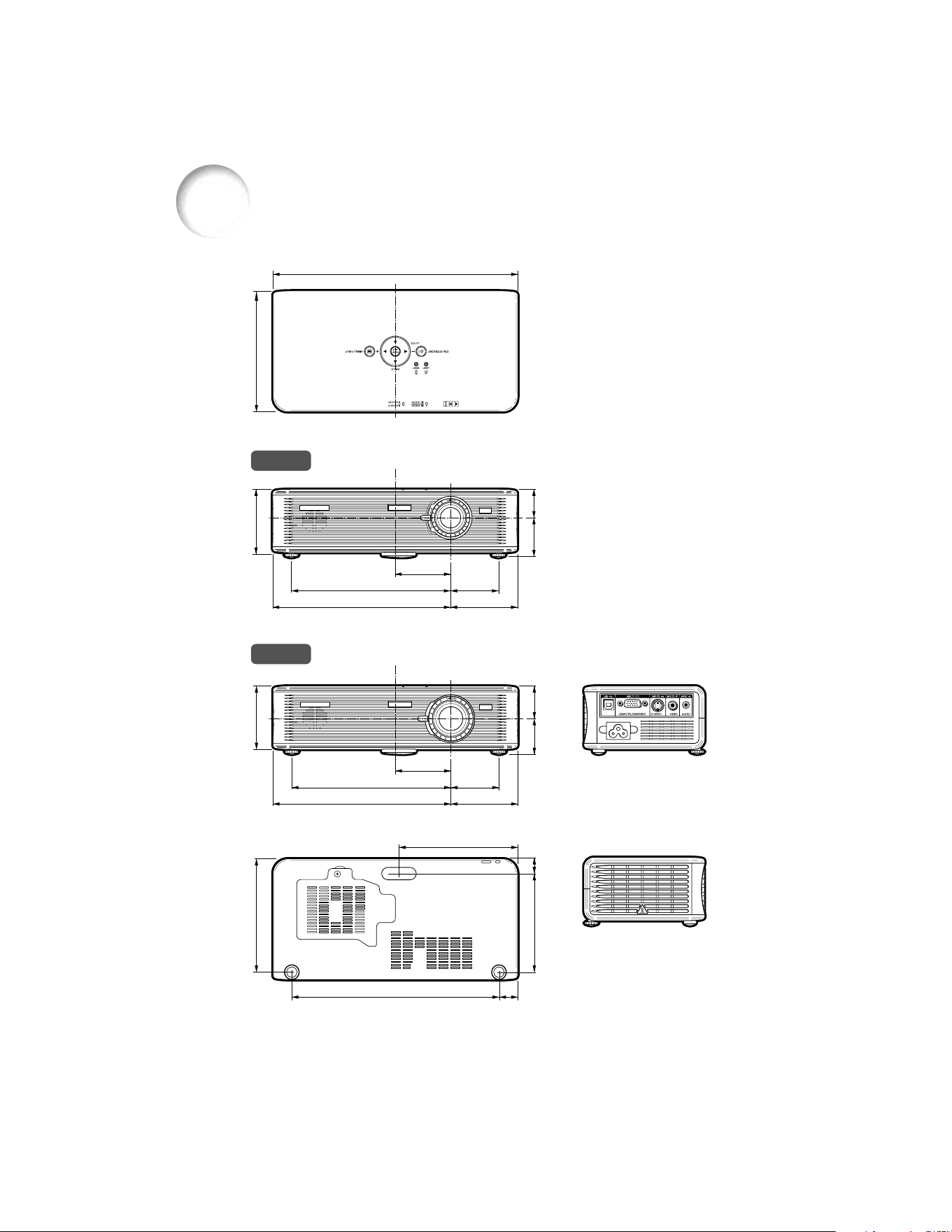
64
Dimensions
Units: inches (mm)
4
13
/
16
(122)
9
47
/
64
(247)
4
47
/
64
(120)
8
9
/
32
(210)
47
/
64
(18.5)
4
1
/
2
(114.3)
2
17
/
32
(64)
2
7
/
32
(56)
7
5
/
64
(179.5) 2
43
/
64
(67.5)
1
15
/
16
(49)6
11
/
32
(161)
1
5
/
16
(33)1
27
/
64
(36)
19
/
32
(15)3
59
/
64
(99.3)
2
17
/
32
(64)
2
7
/
32
(56)
7
5
/
64
(179.5) 2
43
/
64
(67.5)
1
15
/
16
(49)6
11
/
32
(161)
1
19
/
32
(40.3) 1
9
/
64
(28.7)
XR-1X
XR-1S

65
Appendix
AC socket .................................................. 25
Accessories .............................................. 11
Adjustment buttons ................................... 36
Adjust vertical noise ........................... 35, 51
Aspect ratio ............................................... 30
AUDIO INPUT terminal................. 23, 24, 25
Auto Keystone Correction ........................ 44
Auto Power Off ......................................... 48
Auto Search .............................................. 47
Auto Sync
(Auto Sync adjustment).............. 32, 35, 51
AUTO SYNC button.................................. 32
AV MUTE button ....................................... 29
Background............................................... 45
Blue ........................................................... 40
BORDER............................................. 30, 31
Bright......................................................... 40
Bright Boost .............................................. 41
Clock ......................................................... 51
CLR Temp (Color Temperature) ............... 41
Color ......................................................... 40
Contrast .................................................... 40
Eco/Quiet Mode ........................................ 47
ENTER button........................................... 36
Exhaust vent ............................................. 13
Fine Sync .................................................. 51
Focus ring ................................................. 27
FREEZE button ........................................ 32
Front adjustment foot ............................... 28
Guide LEDs .............................................. 48
H-Pos .................................................. 35, 51
HEIGHT ADJUST button .......................... 28
Help ........................................................... 51
Image shift ................................................ 43
INPUT 1 terminal ................................ 23, 24
INPUT 1 – 3 modes .................................. 29
INPUT 2 terminal ...................................... 24
INPUT 3 terminal ...................................... 25
INPUT button ............................................ 29
Intake vent .......................................... 13, 52
Kensington Security
Standard connector ................................ 13
Keycode .................................................... 49
Keystone Correction ................................. 44
L CLICK/ENTER button ............................ 33
Lamp ......................................................... 55
Lamp indicator .......................................... 53
Index
Lamp Timer (Life) ..................................... 50
Lamp unit .................................................. 56
Language
(on-screen display language)................. 46
Lithium Battery.................................... 14, 15
MENU/HELP button ............................ 36, 51
MOUSE/Adjustment buttons .................... 33
Mouse function ......................................... 33
NORMAL............................................. 30, 31
ON/STANDBY button ............................... 26
Optional accessories ................................ 11
OSD Display ............................................. 44
PDF ........................................................... 10
Phase ........................................................ 51
Picture Adjustment.................................... 40
Picture Mode............................................. 40
Power cord................................................ 25
PRJ - ADJ ................................................. 47
PRJ Mode ................................................. 46
Progressive ............................................... 42
R CLICK/RETURN button ........................ 33
Rear adjustment foot ................................ 28
Red ........................................................... 40
Remote control ......................................... 14
Remote control sensor ............................. 15
Replacing the lamp ................................... 55
Resize ....................................................... 43
RESIZE button .......................................... 30
RETURN button ........................................ 37
RGB/USB cable ........................................ 23
SCR - ADJ ................................................ 43
Screen Size and Projection Distance (XR-1S) ...
20
Screen Size and Projection Distance (XR-1X) ...
19
Setup Guide .............................................. 27
Sharp ........................................................ 40
Soft case ................................................... 11
sRGB ........................................................ 42
STRETCH ........................................... 30, 31
Supplied accessories ............................... 11
System Lock ............................................. 49
Temperature warning indicator ................. 53
Tint ............................................................ 40
USB terminal............................................. 23
Video System............................................ 35
Volume buttons ......................................... 29
V-Pos .................................................. 35, 51
Zoom knob ................................................ 28

SHARP CORPORATION