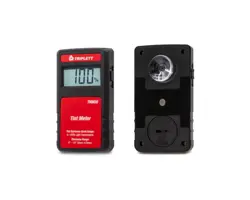
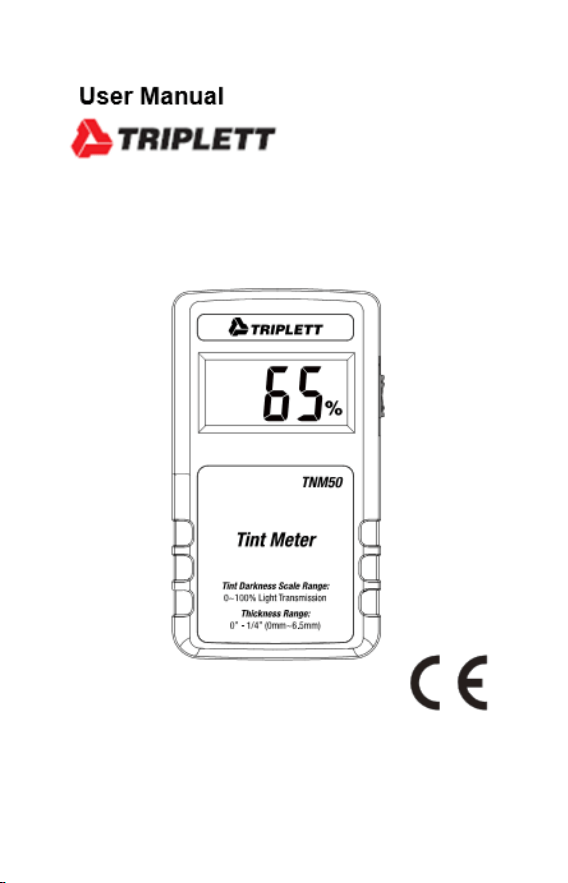
TNM50
Tint Meter


Table of contents
1 Application........................................................... 2
2 Accessories ......................................................... 2
3 Safety Precaution ................................................ 2
4 Instrument Description ........................................ 3
4.1 Feature and function ........................................ 3
4.2 Indication on the LCD display .......................... 4
5 General Specifications ........................................ 4
6 Electrical Specification ........................................ 5
7 Operation ............................................................ 5
7.1 ................................................................... 6
7.2 Continuous use: ............................................... 6
7.3 Automatic shutdown and automatic lock reading . 7
7.4 Calibtation ........................................................ 7
8 Maintenance or Repair ....................................... 7
9 Battery Replacement .......................................... 8
10 Product Disposal ................................................. 8
2
1 Application
The separate Tint Meter measures the transmittance for
use on all automotive windows, including insulation paper,
organic material, painting, coating material, film, glass, and
plastic sheet. This meter also has the ability to measure the
sun blocking capabilities of window curtains. The police
and inspection stations can use it to measure the total
visible light transmittance (VLT).
2 Accessories
1
Tint Meter (receiver + transmitter)
1
User’s Manual
2
Standard transmittance sheet
1
Plastic pocket for transmittance sheet
1
Carrying case
3 Safety Precaution
Caution! Please refer to this manual.
Improper use may damage the meter and
its components.
Complies with European Directive.
⚫ Do not operate in environments with flammable gas or
humid environments.
⚫ Operating altitude: up to 2000M.
⚫ Operating environment: Indoor use; Pollution degree 2.
⚫ Clean with soft cloth when dirty, such as glasses cloth. Do
not clean with chemicals and other solvents.
EMC: EN61326-1:CISPR 11:Group 1, Class B
Class B – Equipment for use in all establishments other
than domestic.
Group 1 – RF energy generated is needed for internal
functioning.
3
4 Instrument Description
4.1 Feature and function
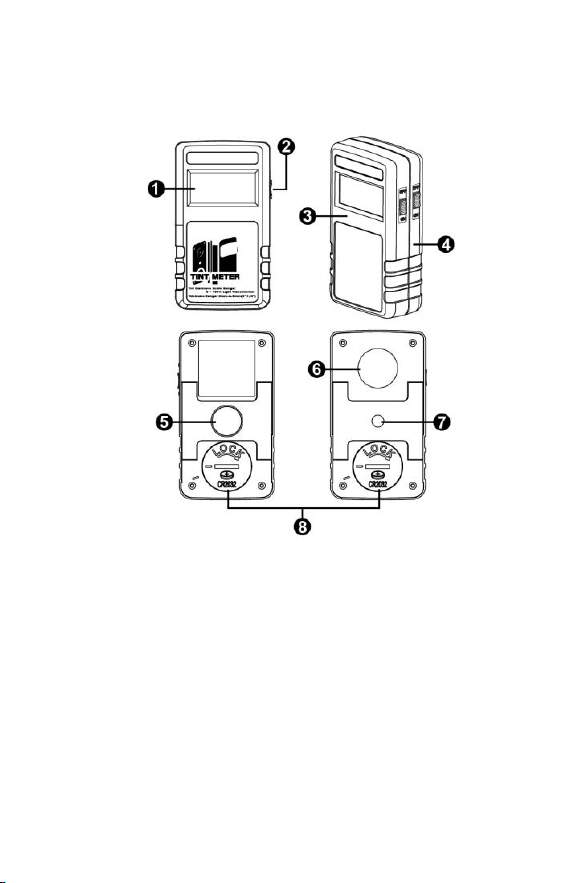
1. LCD
2. Power switch
3. Receiver
4. Transmitter
5. Light sensor
6. Window Mount
7. LED light source
8. Battery cover
4
4.2 Indication on the LCD display
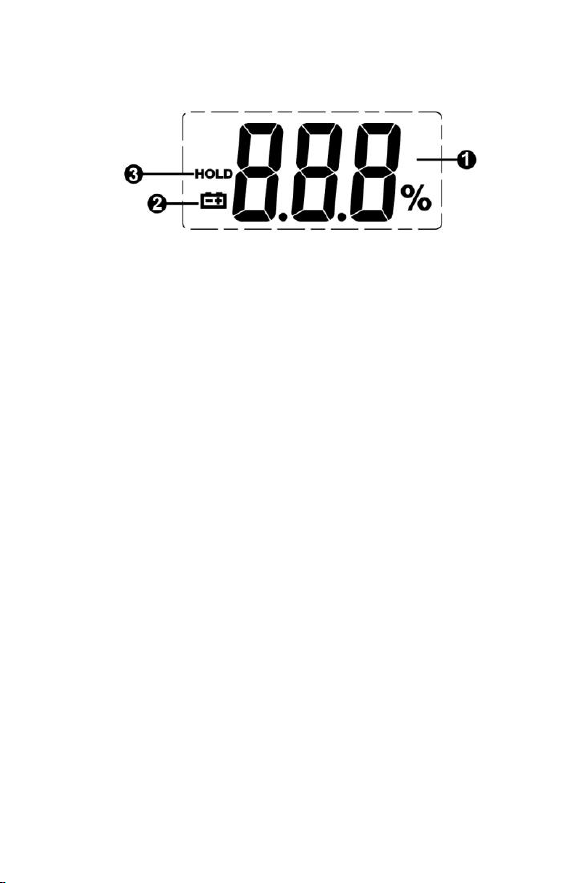
1. Read value display
2. Low battery
3. Data hold
5 General Specifications
◼ Display: 3-digit LCD.
◼ Auto power off: the transmitter auto-power off in 60 seconds,
and the receiver auto-shutdown in 90 seconds.
◼ Battery life: 4000 continuous measurements.
◼ Continuous use function.
◼ Auto data hold function.
◼ Dimension: 107x60x30mm
◼ Weight: Approximately 135g(batteries not included).
◼ Battery: 3V CR2032 X 2.( one per each device)
◼ Operation temperature and humidity: 0
o
C to 50
o
C, <80%RH
(No condensation)
◼ Storage temperature and humidity: -70ºC to 50ºC, <80%RH
5
6 Electrical Specification
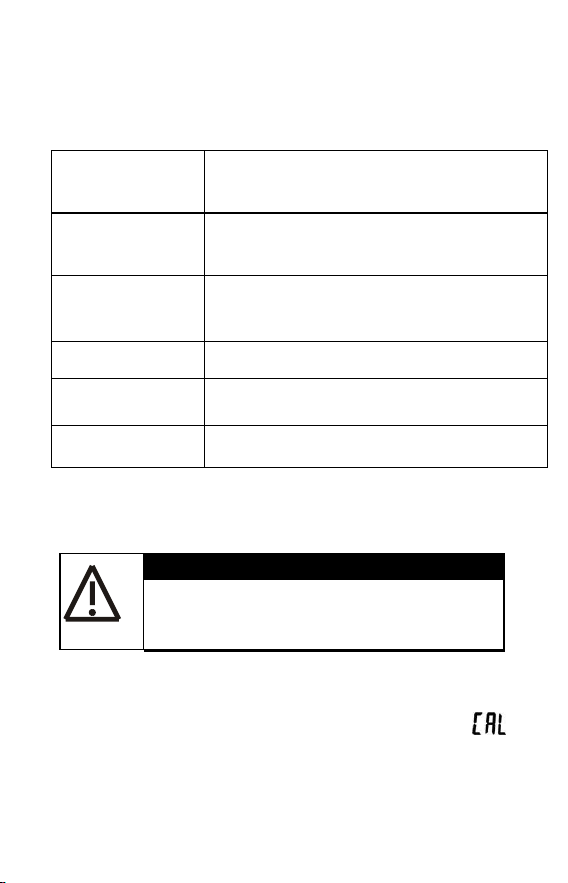
Accuracy is indicated as [% rdg + dgt] . Environmental
conditions at 23°C ± 5°C with RH < 80%.
Measurement
Range of
Transmittance
0% -100%
Measurement
Range of
Thickness
0mm-6.5mm(0"-1/4")
Accuracy
±2% (Calibration and traceable light
source A 2856˚K )
Repeatability
±1%
Response time
4 seconds
Resolution
1%
7 Operation
1. Close the transmitter and receiver, push down the upper
and lower switches on the right side to the ON position, then
the calibration will be performed automatically, and will
be displayed until the LCD displays 100%.
Caution
Please wipe and clean the glass
before testing for a correct
reading.
6
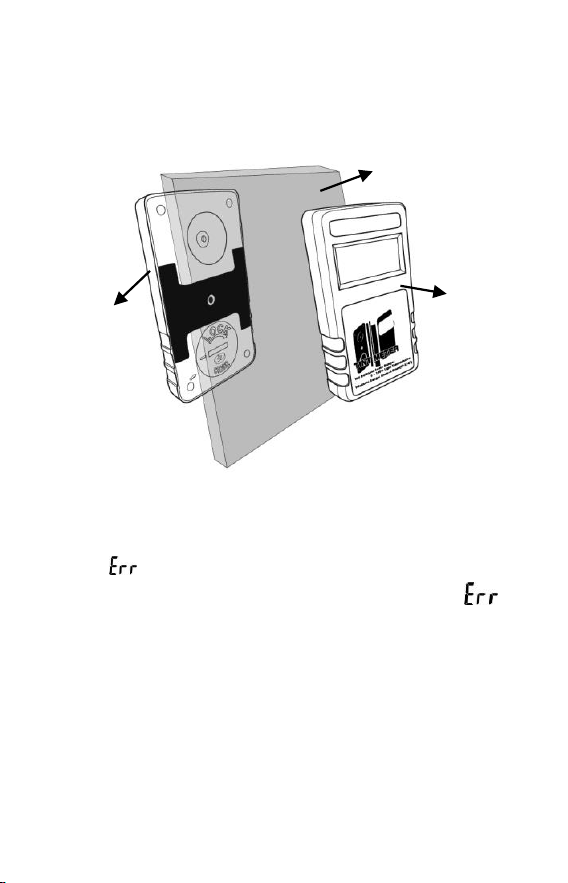
2. Place the window mount of the transmitter of the glass to be
measured and place the receiver on the other side of the
glass. The measured percentage will be displayed on the
LCD. (Figure 1.)
3. Push the switch to OFF and then redo steps 1 and 2 to
restart the measurement after auto-shutdown.
7.1
If the receiver and the transmitter are separated,
displays.
7.2 Continuous use:
If the receiver and transmitter are separated and then
realigned for the second measurement within 60 seconds,
the auto-shutdown time will be reset for the count. The
active status continues for the following measurement
providing that the restart timing is within 60 seconds.
Light Transmissible
glass
Transmitter
Receiver
Fig.1

7
7.3 Automatic shutdown and automatic lock reading
The transmitter will begin the auto-shut down process after
the last operation, taking 60 seconds to complete. Then, the
receiver locks the reading for 30 seconds, displays for
1 second, followed by the shutdown.
7.4 Calibtation
There are two high-transmission and low-transmission
standard transmittance sheets in the accessories, and the
standard VLT values are marked on each standard
transmittance sheet. It can be verified that the VLT value
measured by your meter is within +/- 2% error.
8 Maintenance or Repair
1. appearing on the LCD display indicates the battery
low. Please replace the battery immediately to ensure
the accuracy.
2. Please use a soft cloth, such as glasses cloth, to wipe
the meter for the dirt and not use chemical solvents.
3. Remember to turn off the power after usage; remove the
battery if not used for a long period of time (1 month) in
order to prevent battery leakage and causing damages
to internal components.
4. When the Forehead thermometer failure, only by the
authorized service provider or return the original repair.
8
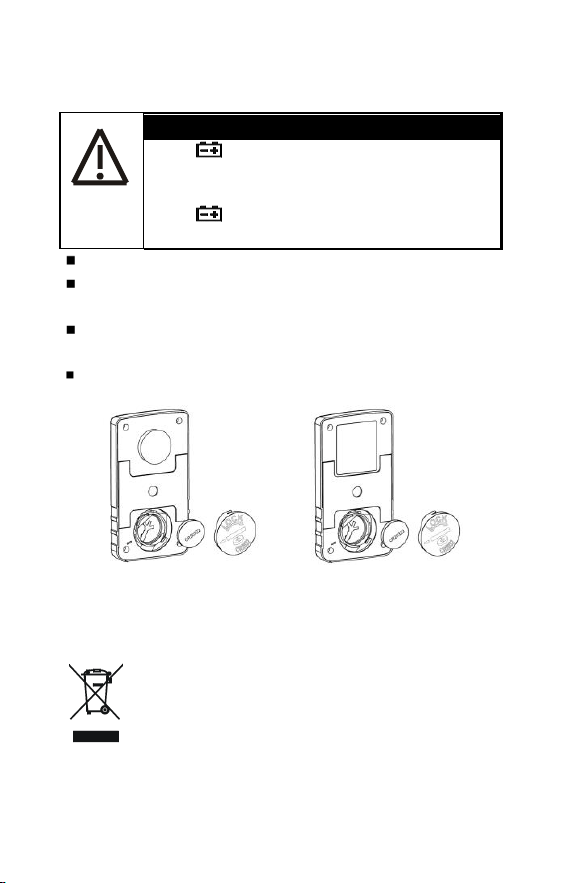
9 Battery Replacement
Turn off the power.
Please open the battery cover on the back of the
meter and remove the battery.
Install the CR2032 batteries and ensure the correct
polarity.
Place back the battery cover and the bracket back.
fig.1
fig.2
10 Product Disposal
Note: This symbol indicates that the
meter and its accessories must be
separated and processed properly.
Caution
If the ”
+Err”symbol appears on the LCD,
please
replace the transmitter bettery (see
fig.1)
If the ” ”symbol appears on the LCD
,
please replace the receiver battery
(see
fig.2)
Transmitter
Receiver