WARNING! Ensure Health & Safety, local authority and general workshop practice regulations are adhered to when using this
equipment.
Read instructions thoroughly to ensure safe and effective use. Important! Read instructions in conjunction with vehicle or
equipment manufacturer's workshop manual.
Maintain the apparatus in good condition (use an authorised service agent). Before each use check condition of each component. If any
component is damaged, replace immediately. Use genuine parts only. Unauthorised parts may not function correctly and will invalidate
the warranty.
Use in a suitable work area. Keep area free from unrelated materials and ensure that there is adequate lighting.
WARNING! Always wear approved eye (or face) and hand protection when pressure leakage testing.
Keep children and unauthorised persons away from the working area.
DO NOT operate the leakage tester when you are tired or under the influence of alcohol, drugs or intoxicating medication.
DO NOT clean the equipment with solvents or other harsh chemicals.
DO NOT use the leakage tester for any purpose other than that for which it is designed.
When not in use return parts to the case, and store it in a safe, dry, childproof location.
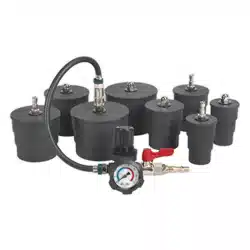
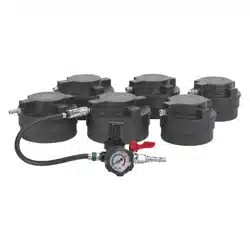
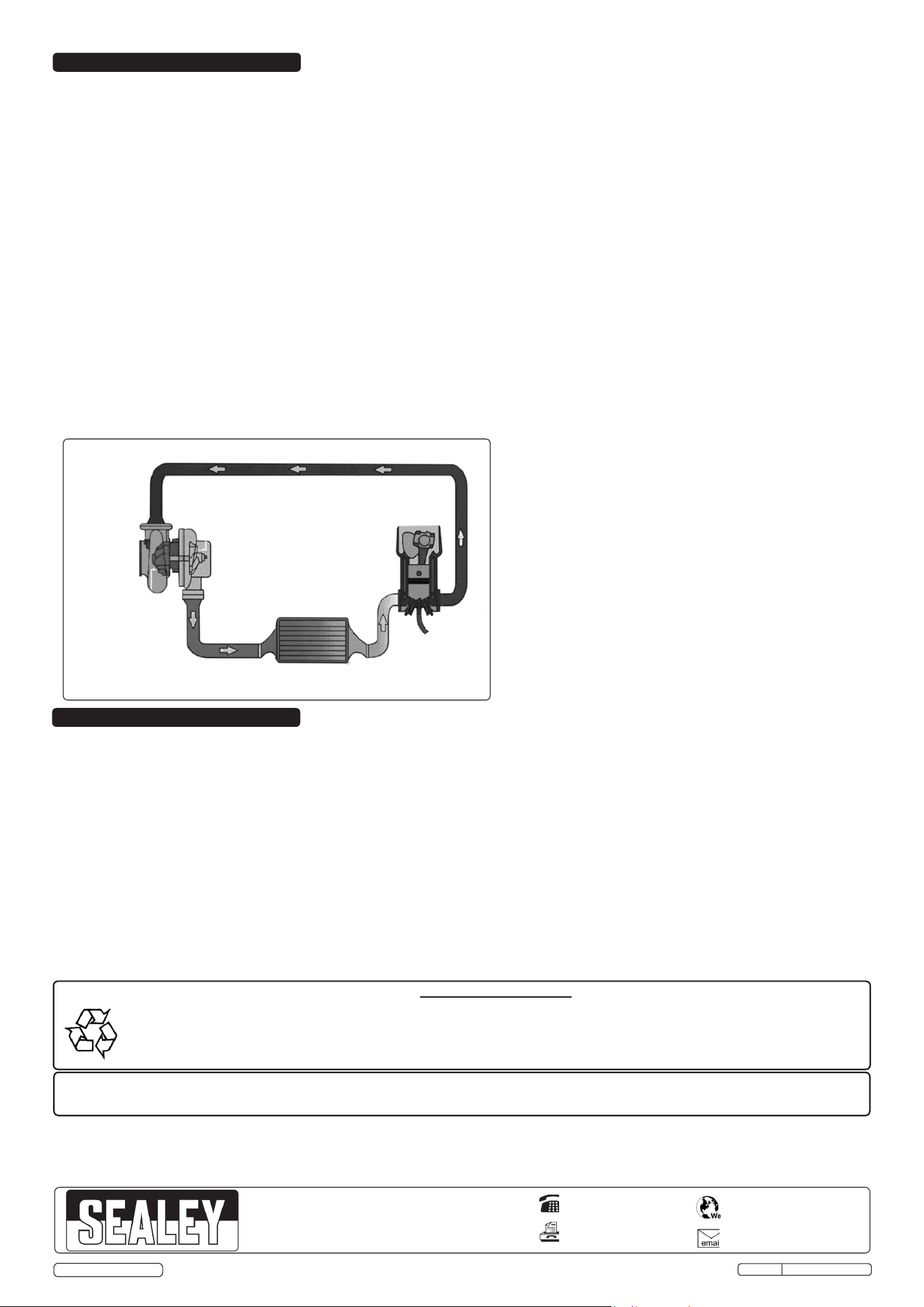
Designed to charge the turbo/intercooler system with a low pressure of regulated workshop air to show the presence of leaks
within the system. Kit supplied with three pairs of stepped adaptors to fit most sizes of hose found on commercial vehicles. Features a pressure
gauge, shut off valve and pressure relief valve. Supplied in storage case.
Original Language Version
CV2030 Issue: 1 - 15/08/14
© Jack Sealey Limited
INSTRUCTIONS FOR:
TURBO SYSTEM LEAKAGE TESTER - HGV
MODEL No: CV2030
IMPORTANT: PLEASE READ THESE INSTRUCTIONS CAREFULLY. NOTE THE SAFE OPERATIONAL REQUIREMENTS, WARNINGS & CAUTIONS. USE THE
PRODUCT CORRECTLY AND WITH CARE FOR THE PURPOSE FOR WHICH IT IS INTENDED. FAILURE TO DO SO MAY CAUSE DAMAGE AND/OR PERSONAL
INJURY AND WILL INVALIDATE THE WARRANTY. KEEP THESE INSTRUCTIONS SAFE FOR FUTURE USE.
Thank you for purchasing a Sealey product. Manufactured to a high standard, this product will, if used according to these instructions,
and properly maintained, give you years of trouble free performance.
1. SAFETY
2. INTRODUCTION
3. SPECIFICATION
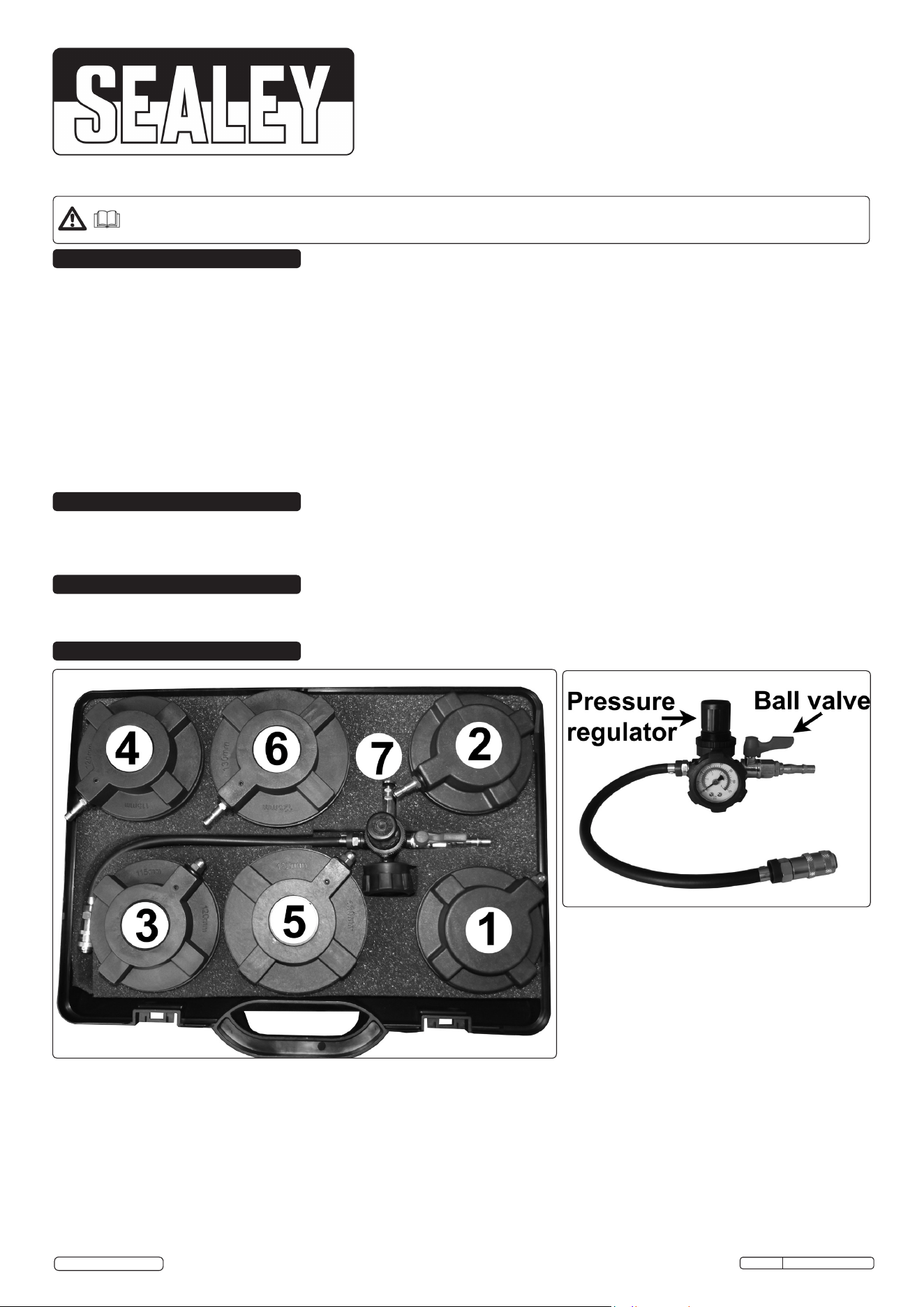
4. CONTENTS
Model No: ...................................CV2030
Adaptor Sizes: ................................105-110mm, 115-120mm, 125-130mm
No: Part No: Description
1 CV2030.01 105/110mm Adaptor Air Coupling
2 CV2030.02 105/110mm Adaptor Blank End
3 CV2030.03 115/120mm Adaptor Air Coupling
4 CV2030.04 115/120mm Adaptor Blank End
5 CV2030.05 125/130mm Adaptor Air Coupling
6 CV2030.06 125/130mm Adaptor Blank End
7 CV2030.07 Pressure Regulator
Original Language Version
CV2030 Issue: 1 - 15/08/14
© Jack Sealey Limited
6.1. Always keep the plastic adaptors clean and free of oil and grease. Clean them regularly with a non-aggressive cleaner.
5.1. Follow the manufacturer's instructions for the removal, if required, of the device or hose to be tested. Use gloves and arm protection if
the system is known to be hot.
5.2. Connect an air line with known air pressure to the regulator of the tester with the ball valve shut (operating lever at 90° to hose axis).
IMPORTANT! Regulate air pressure in tester to 25psi maximum. Refer to manufacturer's manual relating to the maximum air
pressure of the turbo or other system being tested. Over pressurisation may damage system components.
5.3. Method
5.3.1. Select the correct air inlet adaptor and plug adaptor by first measuring the aperture diameter and then couple the tester hose to the
selected air inlet adaptor.
5.3.2. Set regulator of tester to 5psi to check for large leaks with valve shut (operating lever at 90° to hose axis).
5.3.3. Plug the exit aperture of the system with the plug adaptor.
5.3.4. Connect the inlet adaptor set at 5psi to the entry aperture of the system.
5.3.5. Open valve fully (operating lever in line with hose axis) to check for leaks and or pressurisation up to pre-set (5psi). If a leak is found, by
listening or if the pointer falls. Repair the leak and retest.
5.3.6. If no leaks are evident, regulate pressure to 10psi and check for leaks and or pressurisation up to pre-set (10psi). If a leak is found, by
listening or if the pointer falls, it indicates that the system has a leak resulting in loss of pressure. Repair the leak and retest.
5.3.7. If no leaks evident, regulate pressure to a maxmum of 15psi or to the manufacturer's maximum pressure and retest. If a leak is found, by
listening or if the pointer falls. Repair the leak and retest. If the gauge pointer remains stationary for one minute it will indicate that the
system is in good working order.
5.3.8. Release pressurised system by rotating the ball valve lever to align with hose axis.
5.3.9. Disconnect the quick coupler, clean and return all items to carry case.
Intercooler
coil
Turbo
Engine
System schematic
NOTE: It is our policy to continually improve products and as such we reserve the right to alter data, specifications and component parts without prior notice.
IMPORTANT: No liability is accepted for incorrect use of this product.
WARRANTY: Guarantee is 12 months from purchase date, proof of which will be required for any claim.
INFORMATION: For a copy of our latest catalogue and promotions call us on 01284 757525 and leave your full name and address, including postcode.
01284 757500
01284 703534
sales@sealey.co.uk
Sole UK Distributor, Sealey Group,
Kempson Way, Suffolk Business Park,
Bury St. Edmunds, Suffolk,
IP32 7AR
www.sealey.co.uk
Parts support is available for this product. To obtain a parts listing and/or diagram, please log on to www.sealey.co.uk,
email sales@sealey.co.uk or telephone 01284 757500.
Environmental Protection
Recycle unwanted materials instead of disposing of them as waste. All tools, accessories and packaging should be sorted,
taken to a recycling centre and disposed of in a manner which is compatible with the environment.
When the product becomes completely unserviceable and requires disposal, drain off any fluids (if applicable)
into approved containers and dispose of the product and the fluids according to local regulations.
5. OPERATION
6. MAINTENANCE