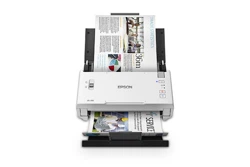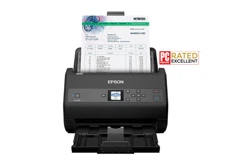

ES-865 User's Guide


3
Contents
ES-865 User's Guide.................................................................................................................................... 7
Scanner Basics............................................................................................................................................ 8
Using the Control Panel ....................................................................................................................... 8
Control Panel Buttons and Lights .................................................................................................... 8
The LCD Screen ......................................................................................................................... 9
Viewing Animations................................................................................................................... 10
Setting User Access Restrictions (Access Control)................................................................... 11
Status Icon Information ............................................................................................................. 13
Adjusting the Screen Brightness.................................................................................................... 13
Changing LCD Screen Language.................................................................................................. 14
Changing Regular Cleaning Alert Settings .................................................................................... 15
Scanner Parts Locations .................................................................................................................... 16
Scanner Parts................................................................................................................................ 17
User Replaceable Epson Scanner Parts ....................................................................................... 19
Using Power Saving Settings ............................................................................................................. 20
Changing the Sleep Timer Settings ............................................................................................... 20
Changing the Power Off Timer Settings ........................................................................................ 21
Loading Originals...................................................................................................................................... 23
Loading Originals in the Input Tray..................................................................................................... 23
Loading Multiple Sizes of Originals in the Input Tray ..................................................................... 31
Original Document Specifications.................................................................................................. 33
Loading Plastic and Laminated Cards in the Input Tray ..................................................................... 36
Plastic and Laminated Card Specifications ................................................................................... 39
Loading Special Originals................................................................................................................... 40
Special Original Specifications ...................................................................................................... 47
Scanning .................................................................................................................................................... 49
Scanning a Document in Epson ScanSmart....................................................................................... 49
Saving a Scan ............................................................................................................................... 52
Attaching a Scan to Email.............................................................................................................. 53
Sending a Scan to a Cloud Service ............................................................................................... 54

4
Printing a Scan .............................................................................................................................. 55
Saving a Scan as a Microsoft Office Format File ........................................................................... 56
Selecting Epson ScanSmart Settings................................................................................................. 57
Changing the Scanner................................................................................................................... 57
Changing the Scan Settings .......................................................................................................... 59
Changing the File Name Settings .................................................................................................. 61
Changing the Save Settings .......................................................................................................... 62
Save Settings ................................................................................................................................ 64
Customizing Action Icons .............................................................................................................. 66
Scanning Using Invoice/Receipt Manager.......................................................................................... 68
Starting a Free Trial....................................................................................................................... 69
Hiding the Invoice/Receipt Manager Trial Icons........................................................................ 73
Activating Invoice/Receipt Manager .............................................................................................. 74
Scanning Invoices and Receipts and Using Invoice/Receipt Manager .......................................... 77
Exporting Invoices or Receipts to QuickBooks Online .............................................................. 81
Exporting Invoices or Receipts to QuickBooks Desktop............................................................ 82
Saving or Exporting Receipts to Quicken.................................................................................. 83
Saving Receipt Data as a TurboTax File................................................................................... 84
Saving Invoice or Receipt Data as a CSV File .......................................................................... 85
Scanning Invoices or Receipts as an Image File....................................................................... 85
Selecting Invoice/Receipt Manager Settings...................................................................................... 86
Exporting or Importing the Invoice/Receipt Database.................................................................... 86
Changing Column Settings............................................................................................................ 87
Changing Currency and Language Settings.................................................................................. 88
Importing Categories from QuickBooks or Quicken....................................................................... 90
Scan Resolution Guidelines ............................................................................................................... 92
Using the Optional Flatbed Scanner Dock - Windows ........................................................................... 94
Flatbed Scanner Dock Parts .............................................................................................................. 94
Scanning from the Flatbed Scanner Dock.......................................................................................... 95
Scanning from the Docked Flatbed Scanner ................................................................................. 95
Scanning from the ADF with the Flatbed Scanner Dock Attached................................................. 99
Cleaning the Flatbed Scanner Dock................................................................................................. 103
Transporting the Flatbed Scanner Dock........................................................................................... 104

5
Cleaning and Transporting Your Scanner............................................................................................. 107
Cleaning Your Scanner .................................................................................................................... 107
Cleaning Inside Your Scanner.......................................................................................................... 107
Checking the Scanner Roller Counter .............................................................................................. 119
Replacing the Scanner Rollers......................................................................................................... 120
Resetting the Scanner Roller Counter ......................................................................................... 126
Transporting Your Scanner .............................................................................................................. 126
Solving Problems .................................................................................................................................... 129
Product Status Messages ................................................................................................................ 129
Solving Scanning Problems ............................................................................................................. 130
Scanner Does Not Turn On or Turns Off Unexpectedly............................................................... 130
Scanner Button Does Not Work as Expected .............................................................................. 131
Scanning Software Does Not Operate Correctly ......................................................................... 131
Original Feeds Incorrectly in Scanner.......................................................................................... 132
Original Jams in Scanner............................................................................................................. 132
Scanning is Slow ......................................................................................................................... 135
Solving Scanned Image Quality Problems ....................................................................................... 135
Back of Original Image Appears in Scanned Image .................................................................... 136
Scanned Characters are Blurry ................................................................................................... 136
Characters are Not Recognized During Conversion to Editable Text (OCR)............................... 136
Ripple Patterns Appear in an Image ............................................................................................ 137
Spots or Lines Appear in All Scanned Images............................................................................. 138
Scanned Image is Cropped ......................................................................................................... 138
Solving Flatbed Scanner Dock Problems ......................................................................................... 139
Scanned Image Edges are Cropped ........................................................................................... 139
Line of Dots Appears in All Scanned Images............................................................................... 139
Binding Margins on a Scanned Booklet are Blurry....................................................................... 139
Back of Original Image Appears in Scanned Document .............................................................. 140
Uninstall Your Scanner Software...................................................................................................... 140
Uninstalling Scanner Software - Windows................................................................................... 140
Uninstalling Scanner Software - Mac........................................................................................... 141
Where to Get Help............................................................................................................................ 141

6
Technical Specifications ........................................................................................................................ 143
Windows System Requirements ...................................................................................................... 143
Mac System Requirements .............................................................................................................. 143
General Specifications ..................................................................................................................... 144
Dimension Specifications ................................................................................................................. 145
Electrical Specifications ................................................................................................................... 146
Environmental Specifications ........................................................................................................... 146
Flatbed Scanner Dock Specifications............................................................................................... 147
Safety and Approvals Specifications ................................................................................................ 147
Notices ..................................................................................................................................................... 149
Important Safety Instructions............................................................................................................ 149
Restrictions on Copying ................................................................................................................... 151
Default Delay Times for Power Management for Epson Products.................................................... 152
Binding Arbitration and Class Waiver ............................................................................................... 152
Trademarks...................................................................................................................................... 155
Copyright Notice............................................................................................................................... 156
libTIFF Software Acknowledgment.............................................................................................. 156
A Note Concerning Responsible Use of Copyrighted Materials................................................... 157
Copyright Attribution.................................................................................................................... 157

7
ES-865 User's Guide
Welcome to the ES-865 User's Guide.
For a printable PDF copy of this guide, click here.
8
Scanner Basics
See these sections to learn about the basic features of your scanner.
Using the Control Panel
Scanner Parts Locations
Using Power Saving Settings
Using the Control Panel
See these sections to learn about the control panel and select control panel settings.
Control Panel Buttons and Lights
Adjusting the Screen Brightness
Changing LCD Screen Language
Changing Regular Cleaning Alert Settings
Parent topic: Scanner Basics
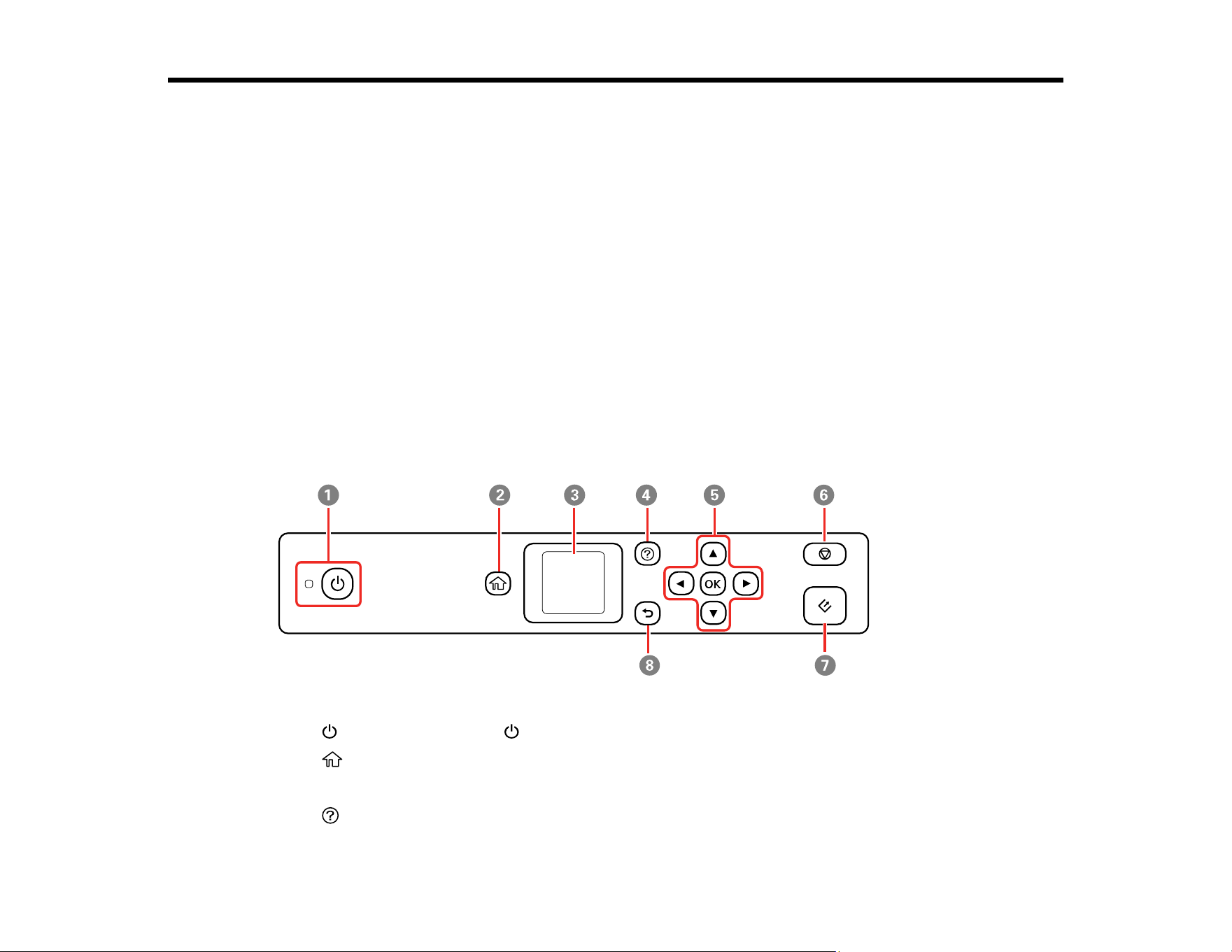
Control Panel Buttons and Lights
1
power button and the power light
2
home button
3 LCD screen
4
help button
9
5 Navigation arrows and the OK button
6
stop button
7 start button
8 back button
The LCD Screen
Viewing Animations
Setting User Access Restrictions (Access Control)
Status Icon Information
Parent topic: Using the Control Panel
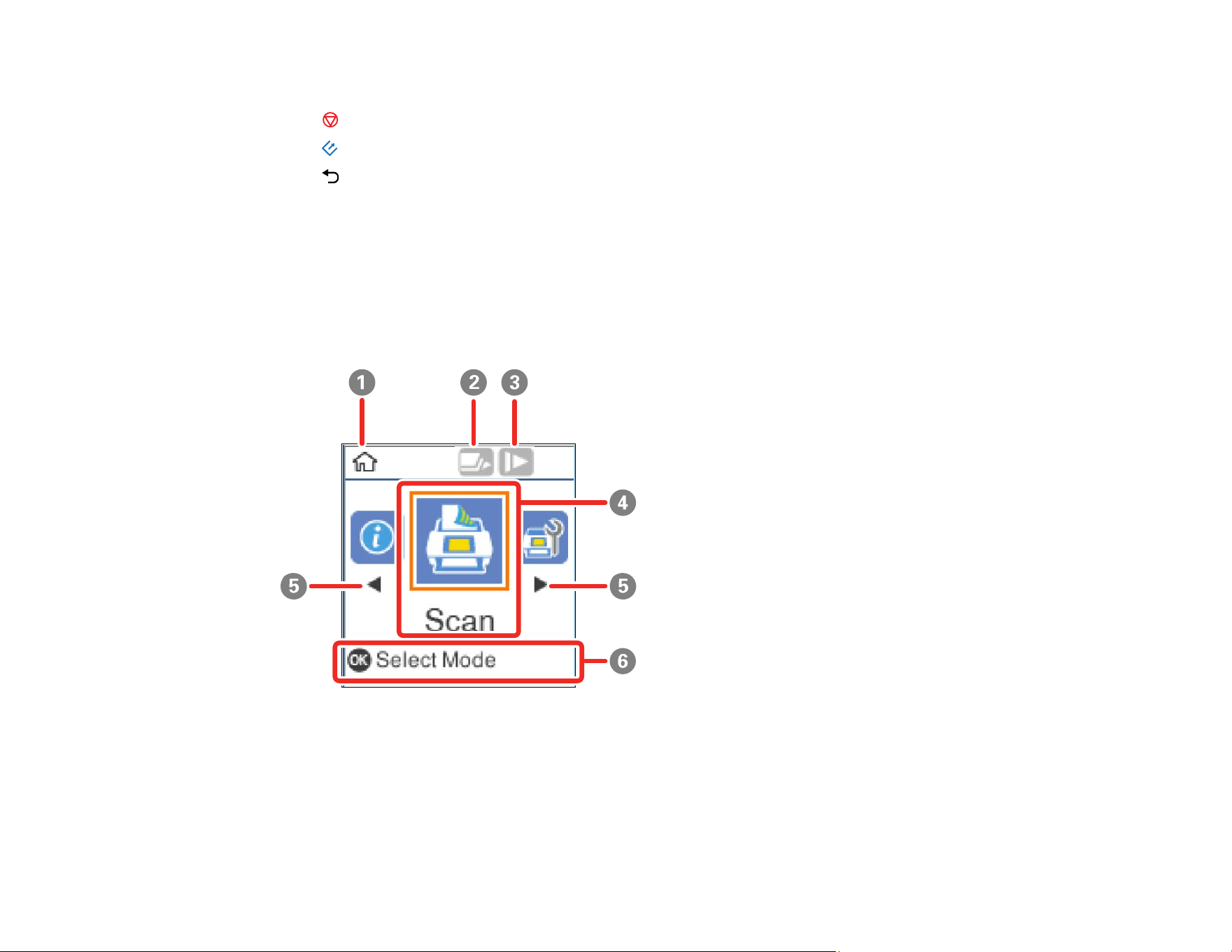
The LCD Screen
1 Home screen indicator
2 Double Feed Detection Skip (DFDS) is enabled (blue) or disabled. Select the DFDS Function
option in the Scanner Settings menu to change the setting.
3 Slow mode is enabled (blue) or disabled. Select the Slow option in the Scanner Settings menu to
change the setting.
10
4 Displays available menus
5 Press the arrow button to scroll through available menus
6 Displays available button actions
Parent topic: Control Panel Buttons and Lights
Viewing Animations
You can view animations on the LCD screen to help guide you with a procedure or to troubleshoot a
problem.
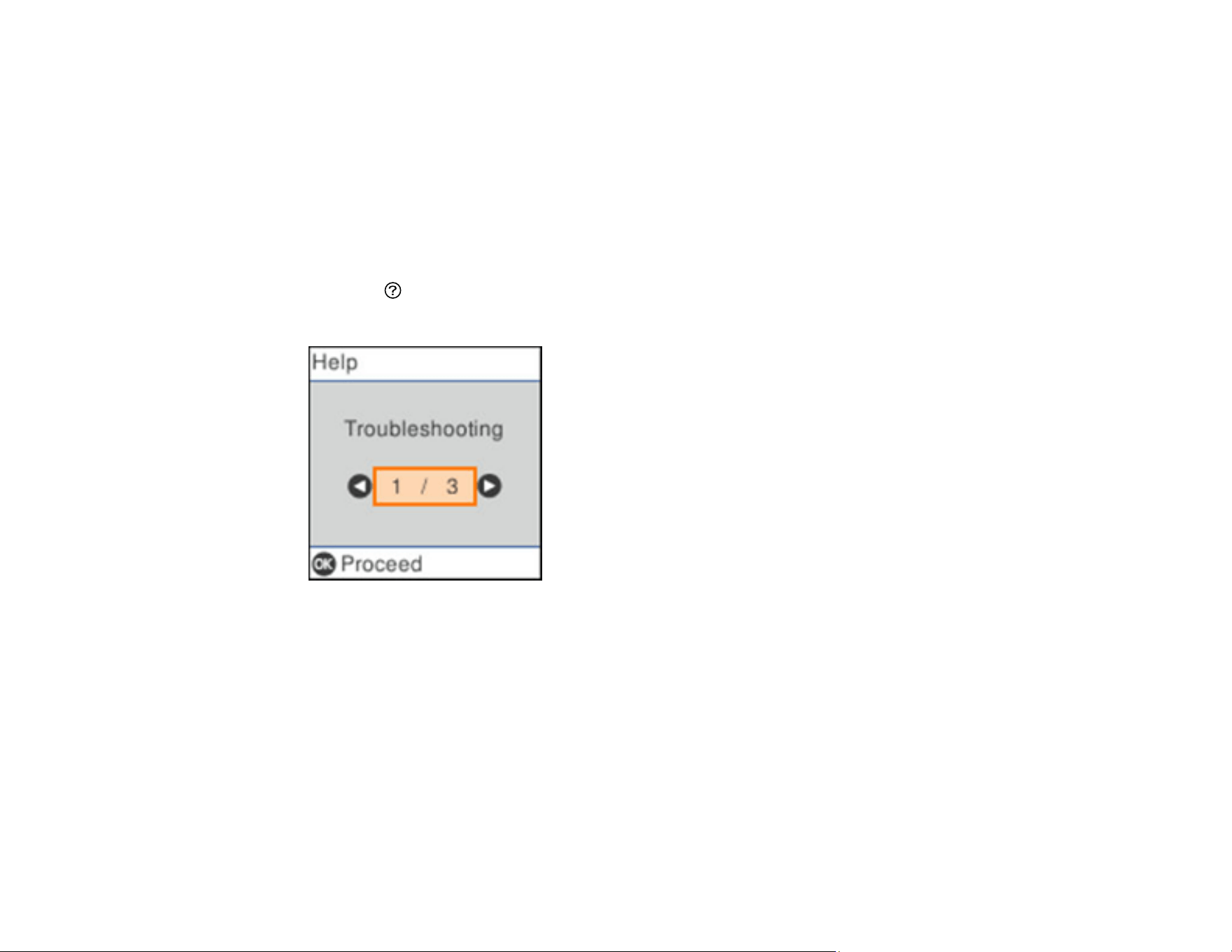
1. Press the help button to display the Help screen.
You see a screen like this:
2. Select Troubleshooting if you are experiencing a problem or How To to view instructions on
common procedures.
3. Select a topic from the list of available topics and follow the on-screen instructions.
11
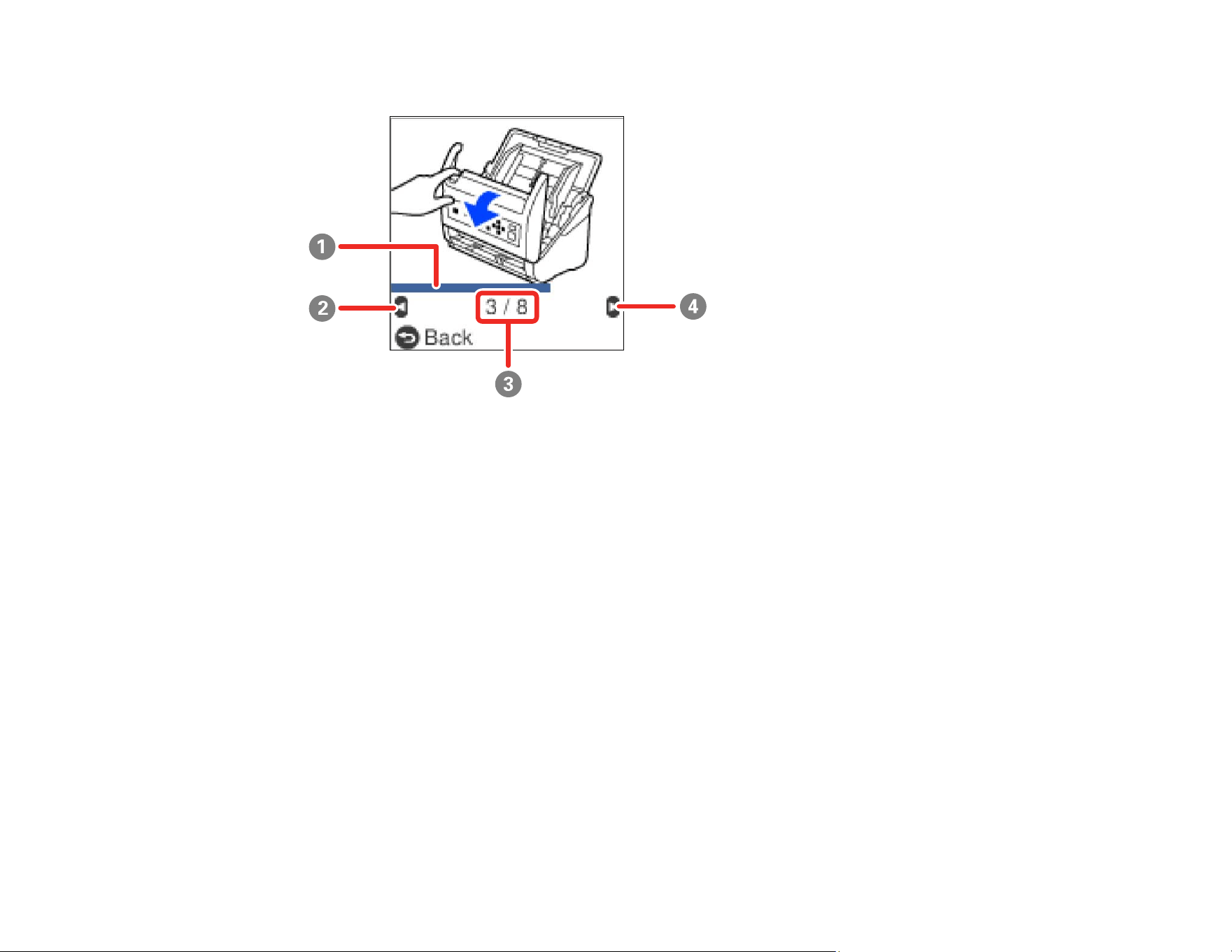
While viewing the topics, you may see screens like this:
1 Indicates your overall progress through the animation
2 Press the left arrow button to view the previous step
3 Displays the current step number and the total number of steps
4 Press the right arrow button to view the next step
Parent topic: Control Panel Buttons and Lights
Setting User Access Restrictions (Access Control)
You can restrict user access for the following control panel settings to prevent unauthorized use of the
product.
• Number of Scans After Replacing Roller
• Number of Scans After Regular Cleaning
• Paper Protection
• Detect Glass Dirt
• Ultrasonic Double Feed Detection
• Sleep Timer
• Power Off Timer
12
• Language
• Regular Cleaning Alert Settings
• System Administration
Note: If your system has an administrator, contact your administrator before enabling restricted access.
1. Press the home button, if necessary.
2. Select Settings and press the OK button.
3. Use the arrow buttons to select System Administration and press the OK button.
4. Press the OK button to select Restrict User Access.
5. Select On and press the OK button.
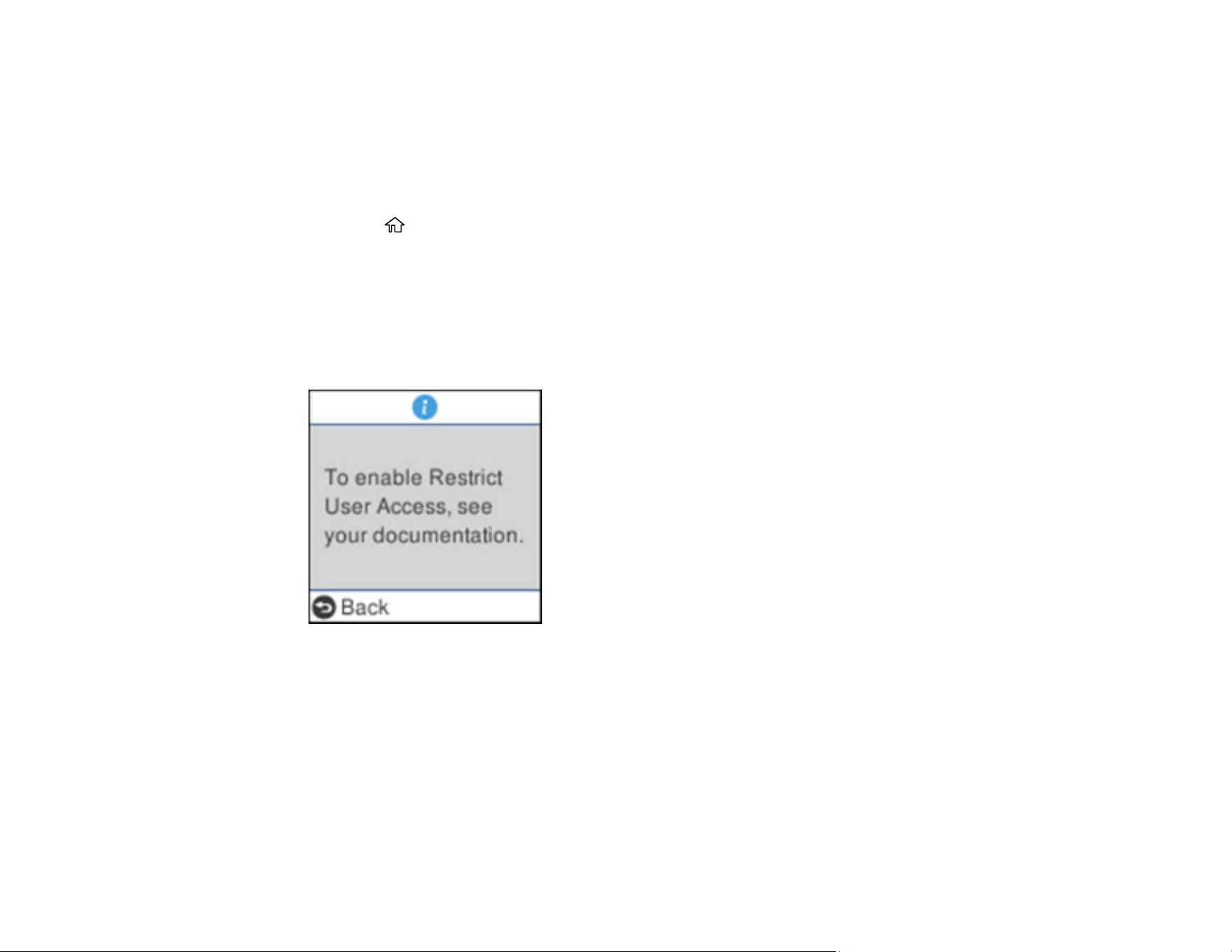
You see a screen like this:
6. Press and hold the up and down arrow buttons simultaneously.
You return to the Settings screen.
7. Press the OK button to confirm that access restriction is enabled.
To disable access restriction, select Settings > System Administration and press the OK button.
When you see the Restrict User Access is enabled screen, press and hold the up and down arrow
buttons simultaneously. Then press the OK button, select Off, and press the OK button again.
Parent topic: Control Panel Buttons and Lights
13
Status Icon Information
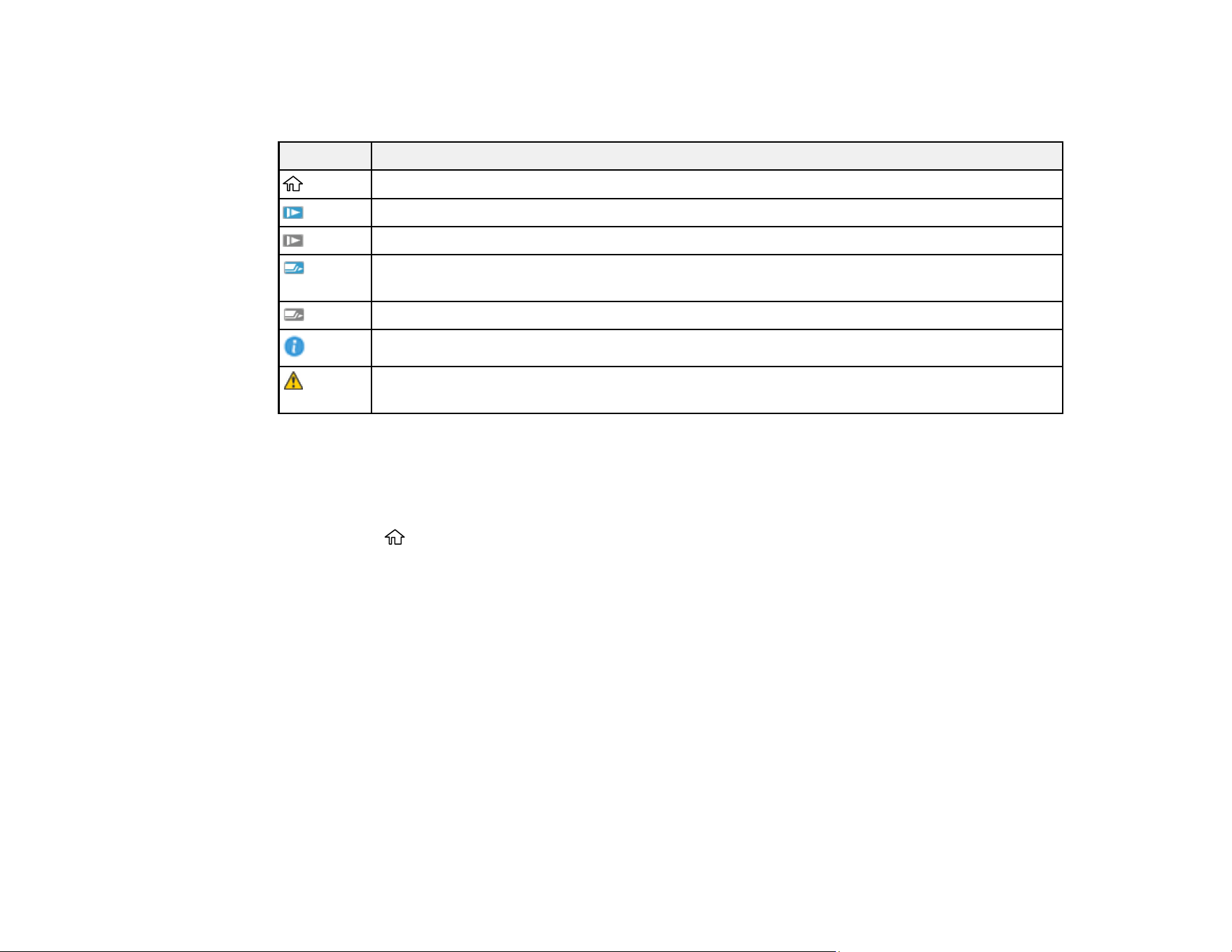
Your product displays status icons on the LCD screen for certain product status conditions.
Icons Description
Indicates that you are on the home screen.
Slow mode is enabled. Paper feeding speed is reduced during scanning.
Slow mode is disabled.
Double Feed Detection Skip (DFDS) is enabled. Double feed detection is skipped once
during scanning.
Double Feed Detection Skip (DFDS) is disabled.
Displays additional information or instructions.
There is a problem with the indicated setting. See the Device Information menu to resolve
the problem.
Parent topic: Control Panel Buttons and Lights
Adjusting the Screen Brightness
You can adjust the brightness of the LCD screen.
1. Press the home button, if necessary.
2. Use the arrow buttons to select Settings and press the OK button.
14
You see a screen like this:
3. Use the arrow buttons to select LCD Brightness and press the OK button.
4. Use the arrow buttons to decrease or increase the brightness.
5. Press the OK button to exit.
Parent topic: Using the Control Panel
Changing LCD Screen Language
You can change the language used on the LCD screen.
Note: This setting can be locked by an administrator. If you cannot access or change this setting,
contact your administrator for assistance.
1. Press the home button, if necessary.
2. Use the arrow buttons to select Settings and press the OK button.
15
You see a screen like this:
3. Use the arrow buttons to select Language and press the OK button.
4. Select a language and press the OK button to exit.
Parent topic: Using the Control Panel
Changing Regular Cleaning Alert Settings
You can set an alert to appear to remind you to perform regular cleaning after a certain number of scans.
Note: This setting can be locked by an administrator. If you cannot access or change this setting,
contact your administrator for assistance.
1. Press the home button, if necessary.
2. Use the arrow buttons to select Settings and press the OK button.
16
You see a screen like this:
3. Use the arrow buttons to select Regular Cleaning Alert Settings and press the OK button.
4. Do the following:
• Set the Warning Alert Setting to On to receive a notification when it is time to clean inside the
scanner.
• On the Count Alert Setting screen, use the arrow buttons to change the number of scans before
the notification appears.
5. Press the OK button to exit.
Parent topic: Using the Control Panel
Scanner Parts Locations
See these sections to identify the parts on your scanner.
Scanner Parts
User Replaceable Epson Scanner Parts
Parent topic: Scanner Basics
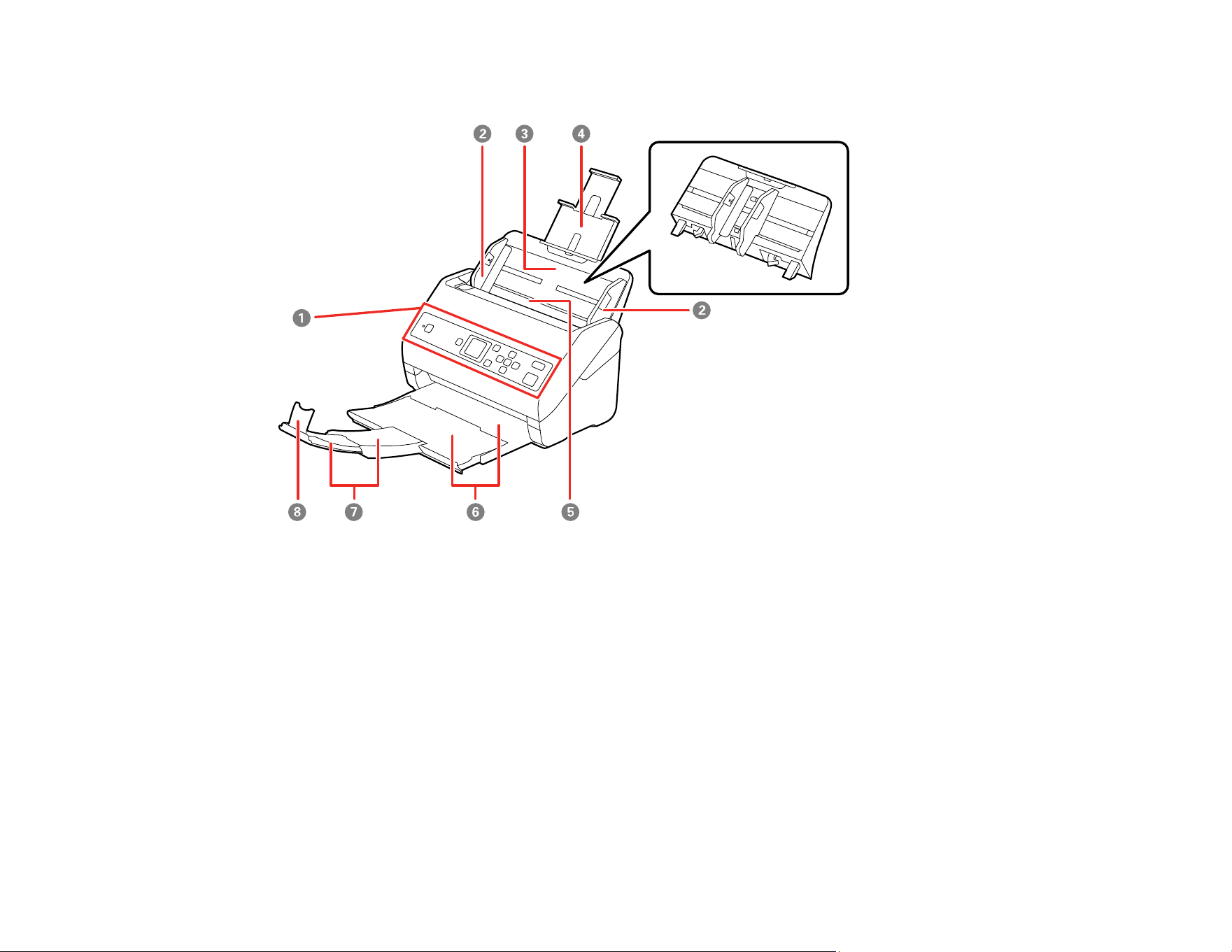
17
Scanner Parts
1 Control panel
2 Edge guides
3 Input tray
4 Input tray extension
5 ADF (Automatic Document Feeder)
6 Output tray
7 Output tray extensions
18
8 Stopper
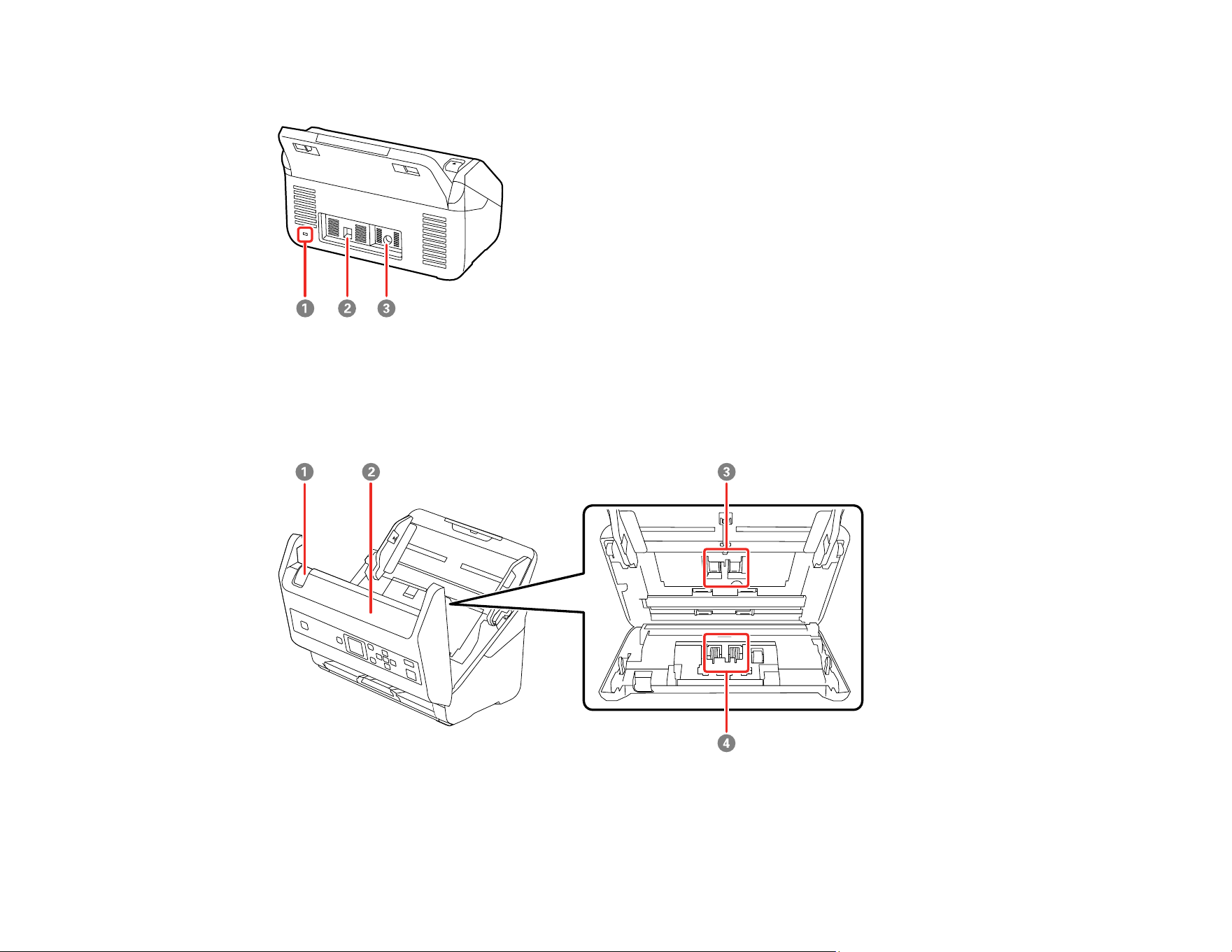
1 Kensington security slot
2 USB port
3 Power inlet
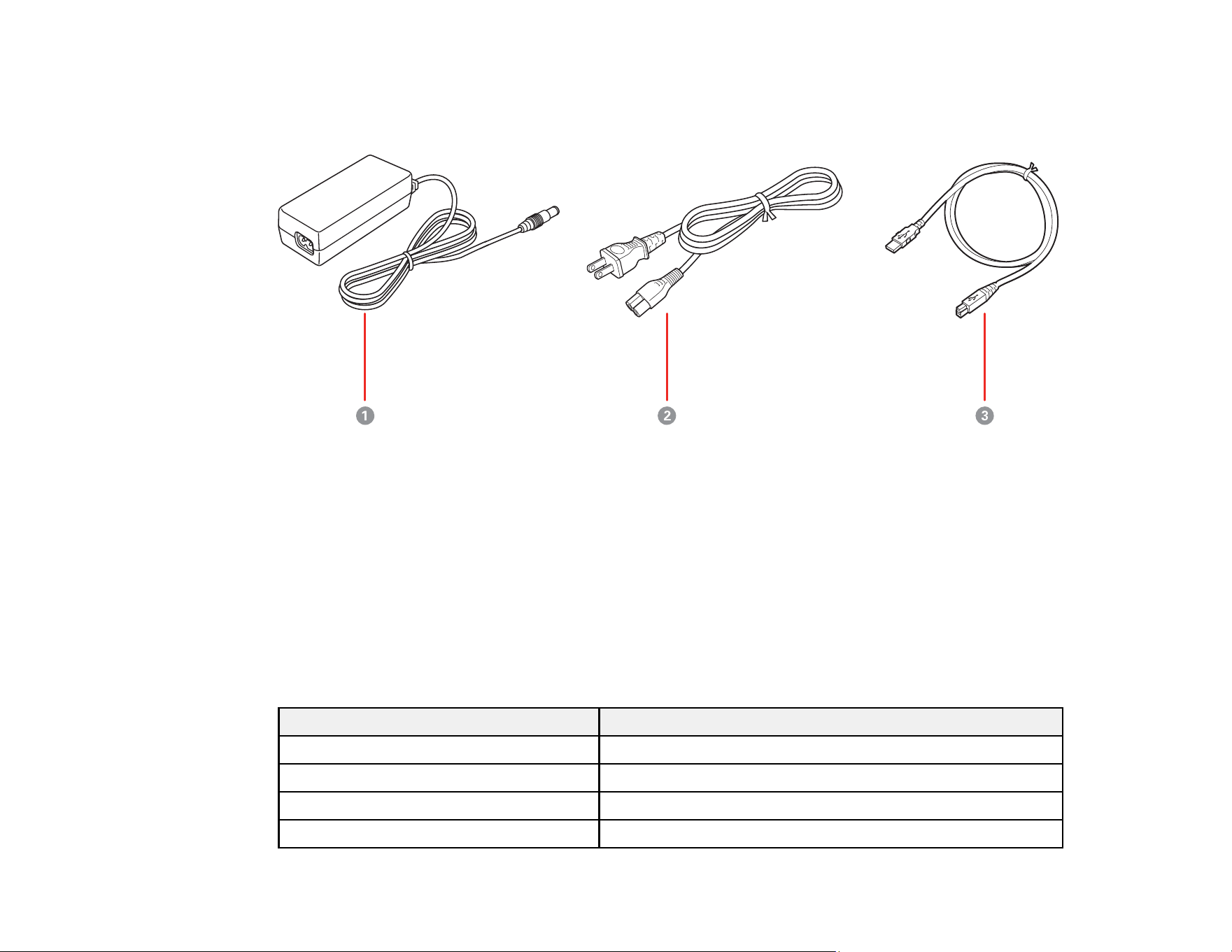
1 Cover open lever
2 Scanner cover
19
3 Pickup rollers
4 Separation rollers
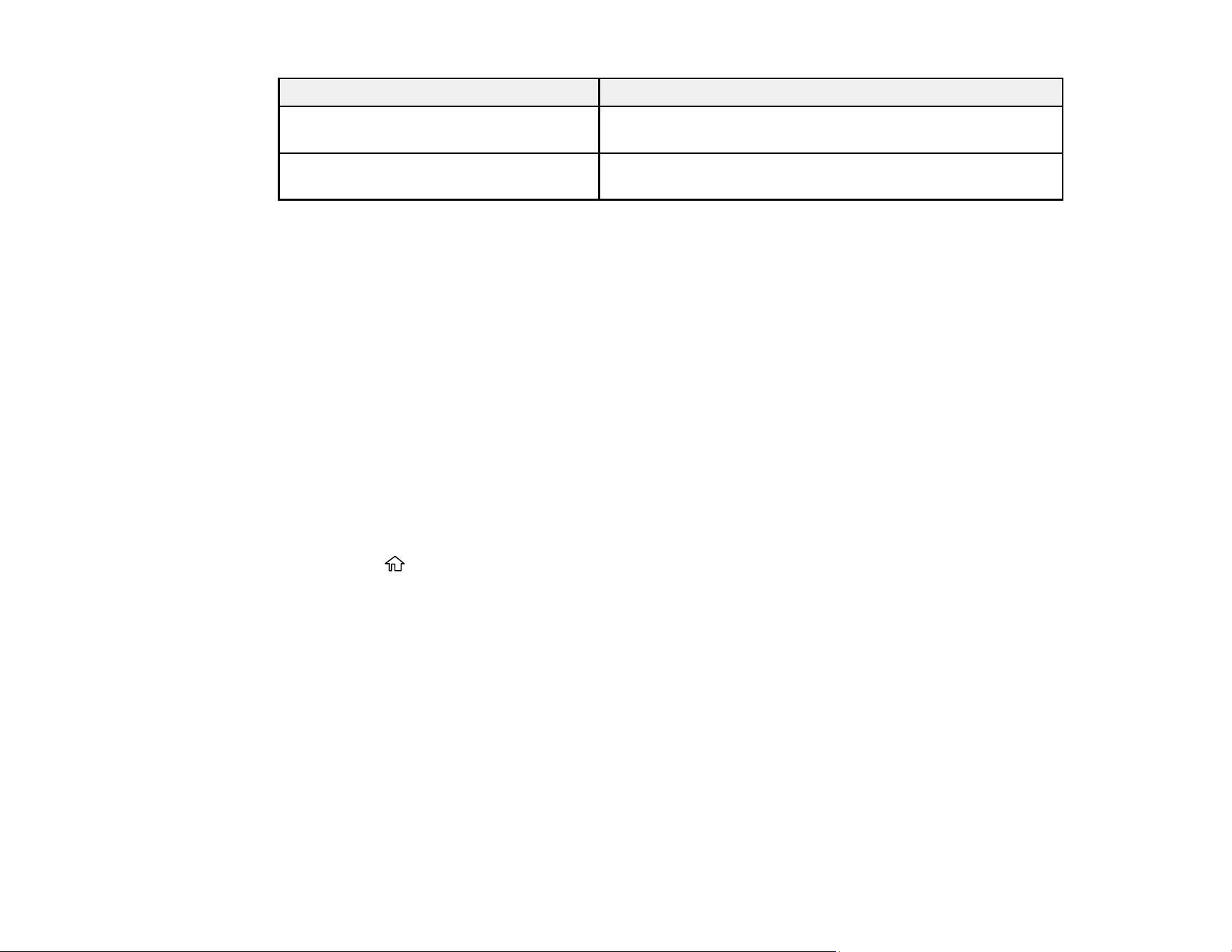
1 AC adapter
2 Power cord
3 USB 3.0 cable
Parent topic: Scanner Parts Locations
User Replaceable Epson Scanner Parts
You can purchase genuine Epson accessories at epson.com (U.S. sales), epson.ca (Canadian sales), or
epson.com.jm (Caribbean sales). You can also purchase accessories from an Epson authorized reseller.
To find the nearest one, call 800-GO-EPSON (800-463-7766) in the U.S. or 800-807-7766 in Canada.
Part Part number
Carrier sheet B12B819051
Roller assembly kit B12B819031
Cleaning kit B12B819291
Flatbed scanner dock (Windows only) B12B819011
20
Part Part number
Epson Perfection V19 (for use with
scanner dock)
B11B231201
Epson Perfection V39 (for use with
scanner dock)
B11B232201
Parent topic: Scanner Parts Locations
Using Power Saving Settings
Your scanner enters sleep mode automatically and turns off the LCD screen if it is not used for a period
of time. You can make the time period shorter to save energy and resources.
Changing the Sleep Timer Settings
Changing the Power Off Timer Settings
Parent topic: Scanner Basics
Changing the Sleep Timer Settings
You can adjust the time period before your product enters sleep mode and turns off the LCD screen.
Note: This setting can be locked by an administrator. If you cannot access or change this setting,
contact your administrator for assistance.
1. Press the home button, if necessary.
2. Use the arrow buttons to select Settings and press the OK button.
21
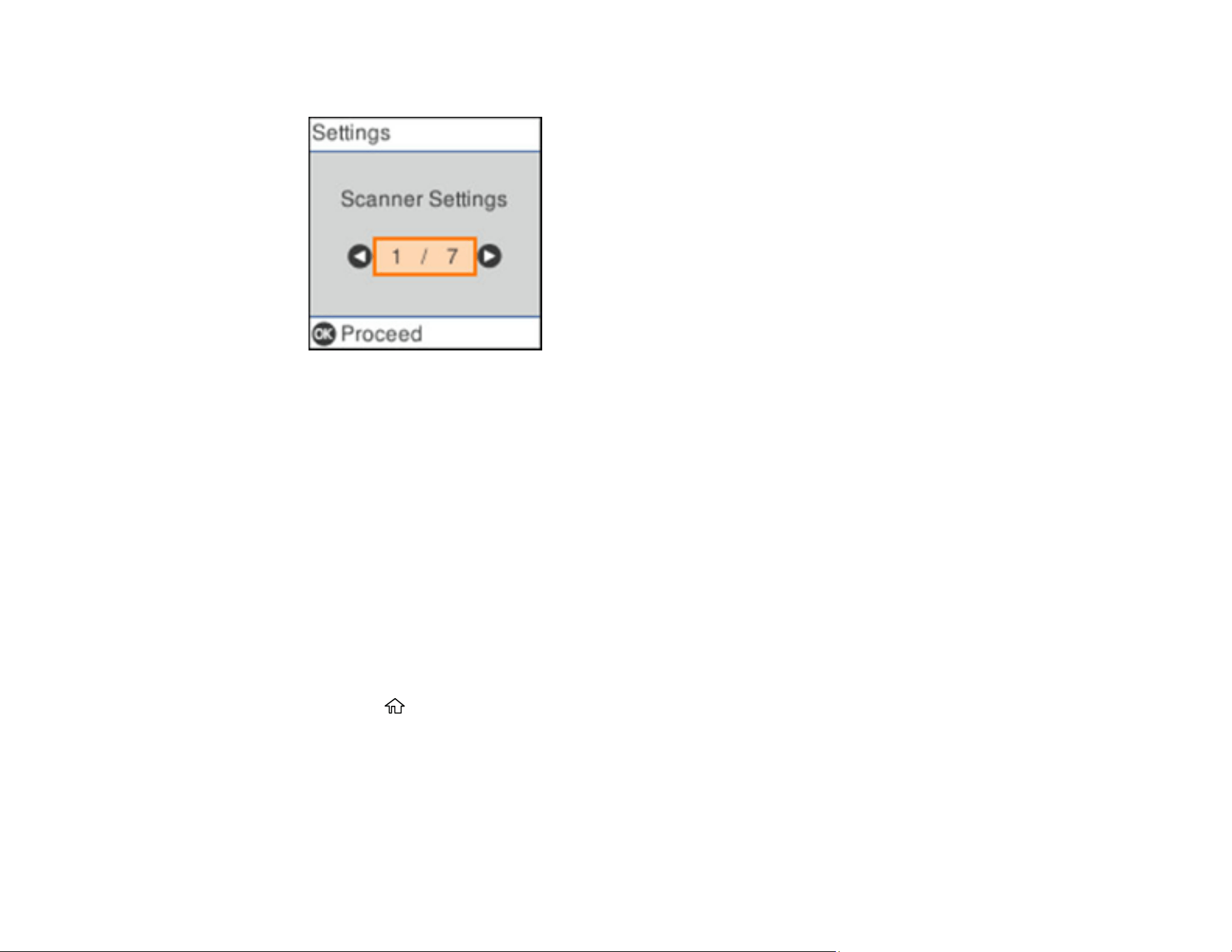
You see a screen like this:
3. Use the arrow buttons to select Sleep Timer and press the OK button.
4. Do one of the following:
• Press the up or down arrow buttons to decrease or increase the number of minutes.
• Press the left and right arrow buttons to move to the previous or next character.
5. Press the OK button to exit.
Parent topic: Using Power Saving Settings
Changing the Power Off Timer Settings
You can have the product turn off automatically if it is not used for a specified period of time.
Note: This setting can be locked by an administrator. If you cannot access or change this setting,
contact your administrator for assistance.
1. Press the home button, if necessary.
2. Use the arrow buttons to select Settings and press the OK button.
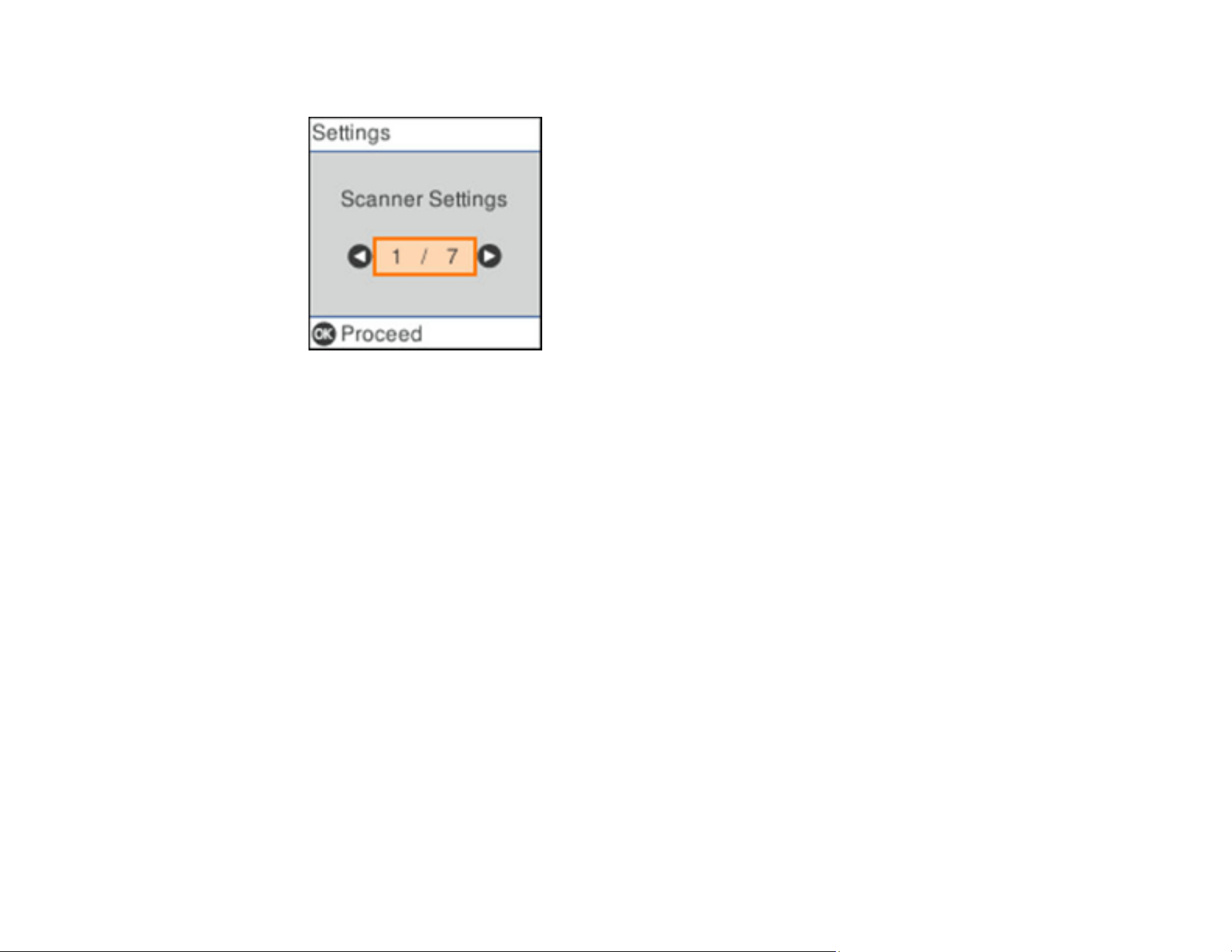
23
Loading Originals
Follow the instructions here to load your originals into the scanner.
Loading Originals in the Input Tray
Loading Plastic and Laminated Cards in the Input Tray
Loading Special Originals
Loading Originals in the Input Tray
You can load originals that meet the document specifications in the input tray.
Caution: Do not load photos, or valuable original documents or artwork, directly into the input tray. This
may wrinkle or damage the original. Load these originals using an optional carrier sheet.
The steps below describe loading originals of the same size. To load originals of multiple sizes at once,
see the link at the end of these steps.
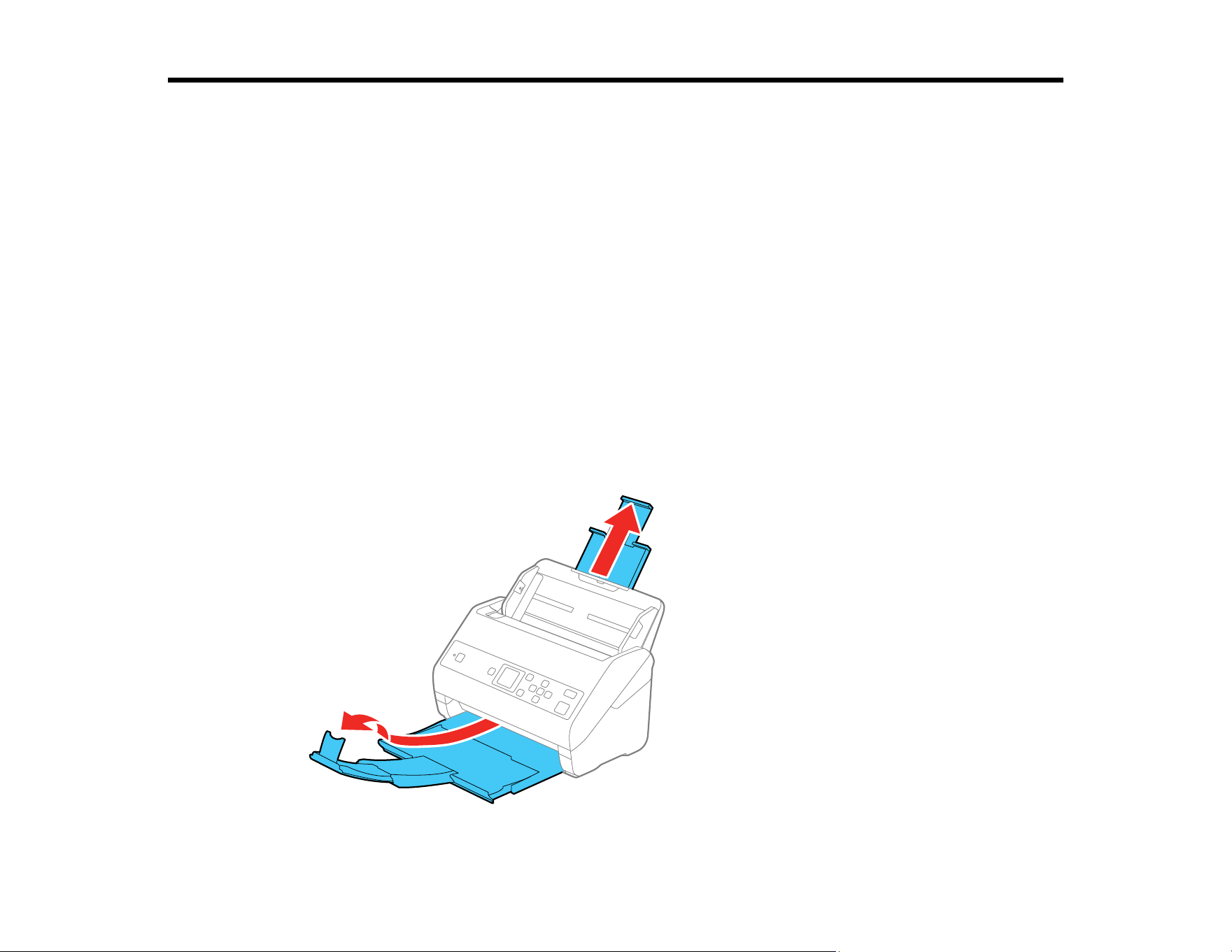
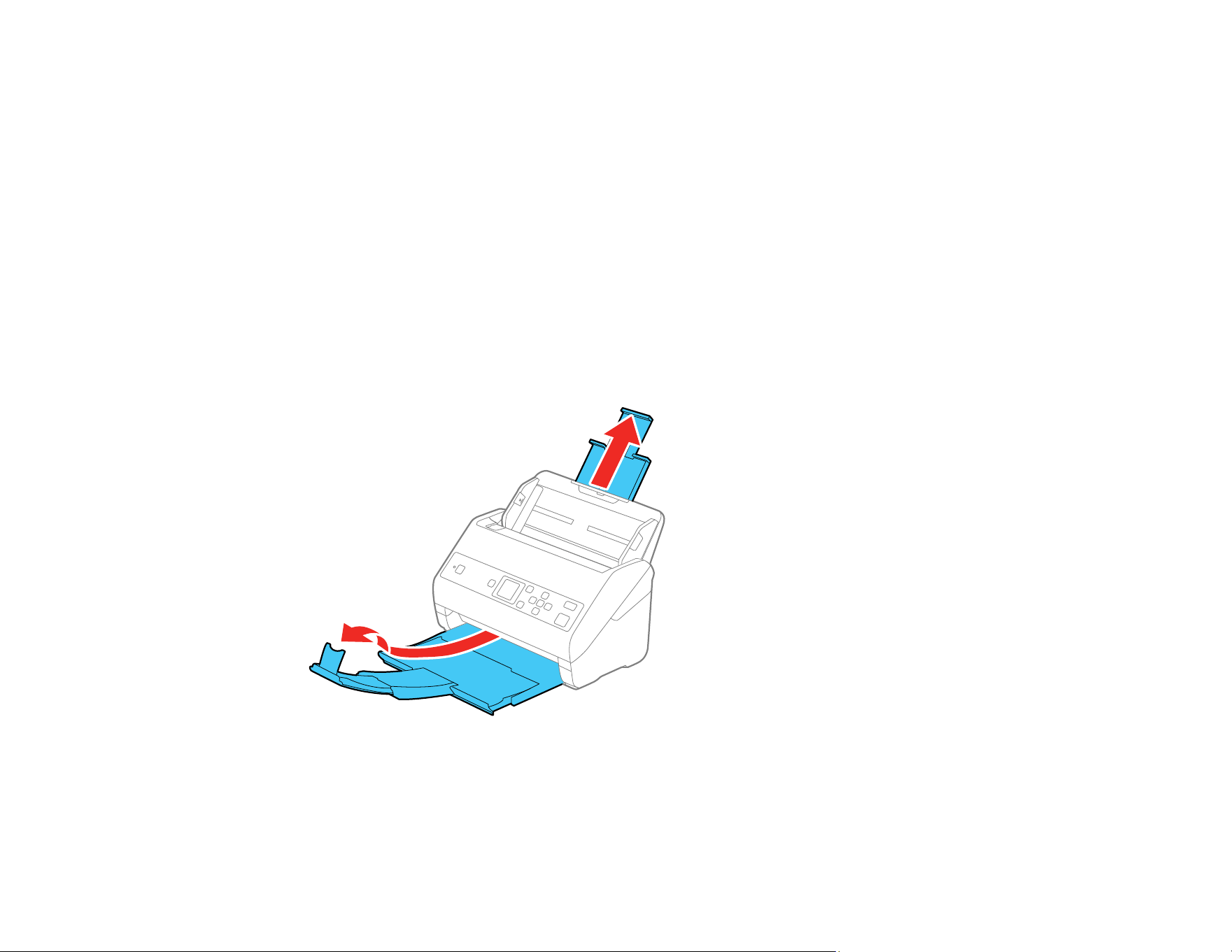
1. Pull up the input tray extension.
2. Pull out the output tray and its extension, and open the stopper.
24
Note: If you are loading an original that is 15.5 inches (393.8 mm) or longer, do not pull out the input
or output tray extensions and do not open the stopper.
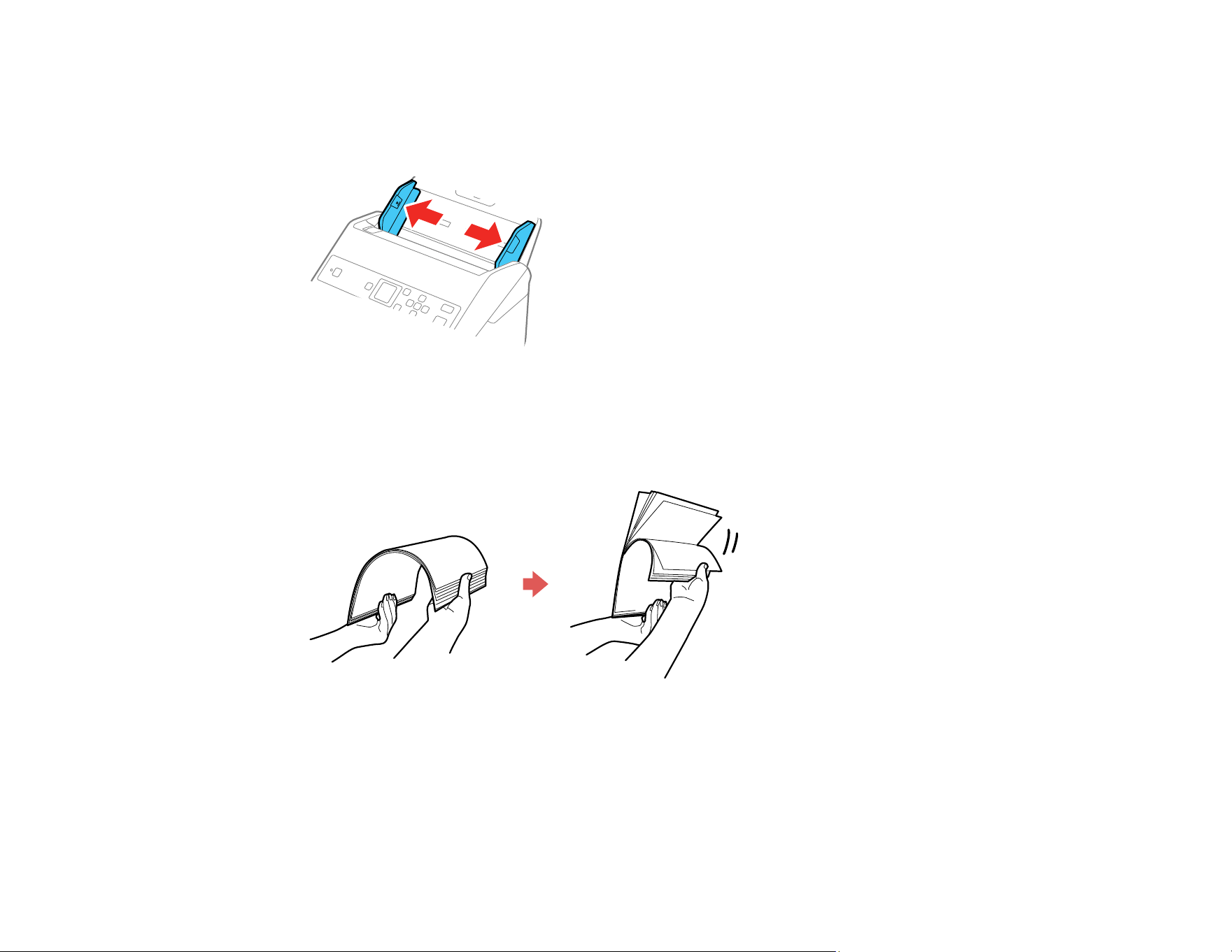
3. Slide the input tray edge guides all the way out.
4. If you are loading a multi-page original, fan your stack of originals.
Note: If you are loading an original that is 15.5 inches (393.8 mm) or longer, load only one sheet at a
time.
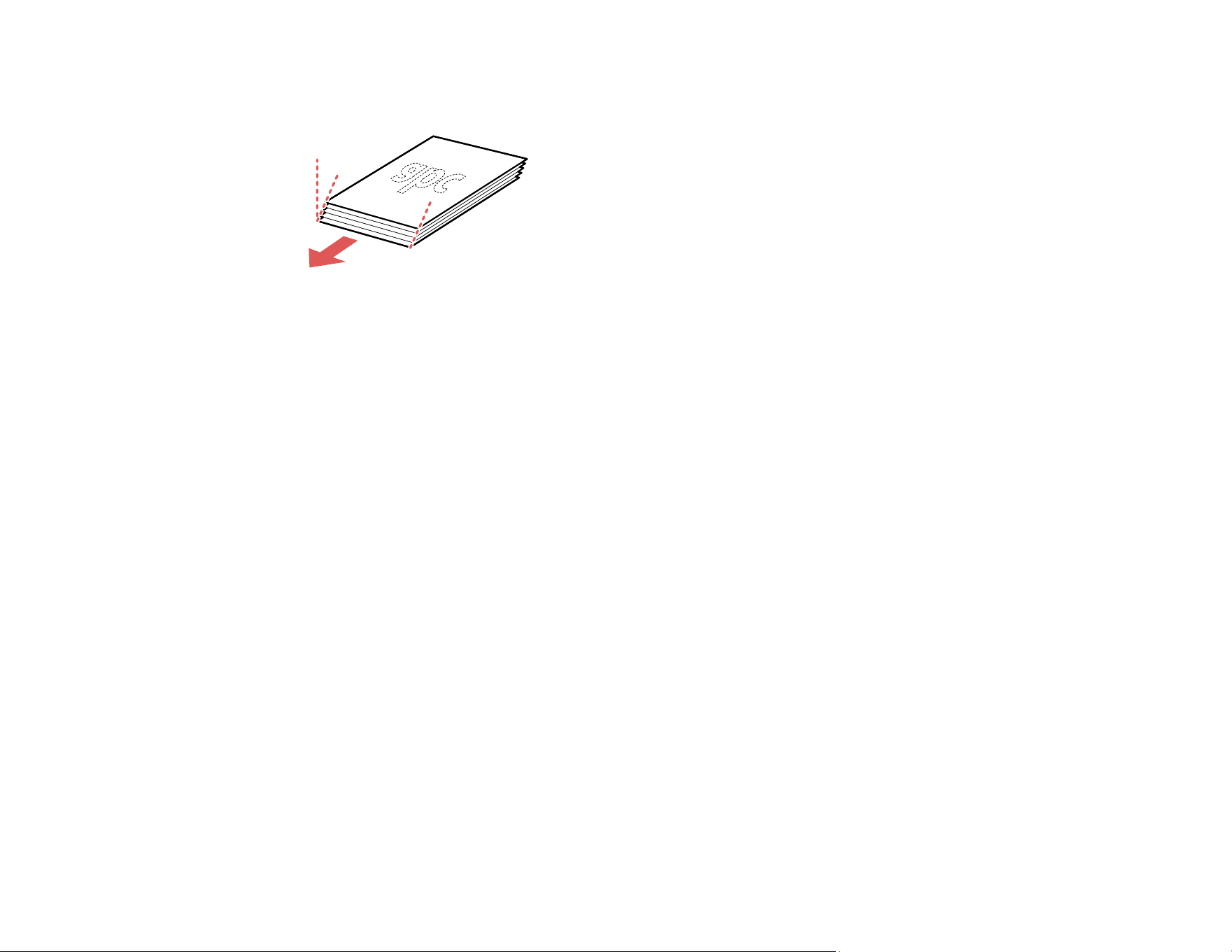
25
5. Stack the originals with the printed side facing down and slide the stack so the leading edge is at an
angle as shown.
26
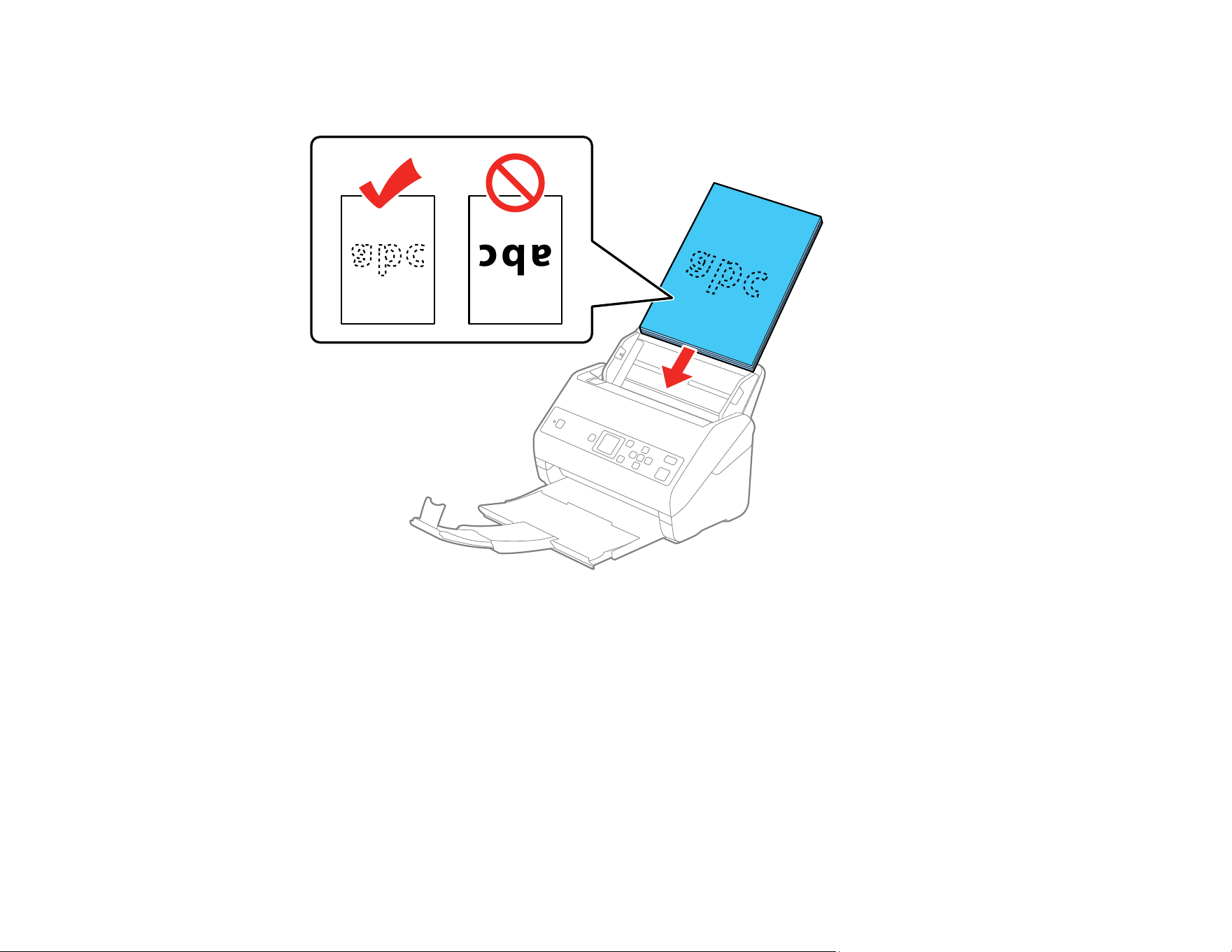
6. Load standard originals into the input tray printed side down and top edge first, and guide them in
until they meet resistance.
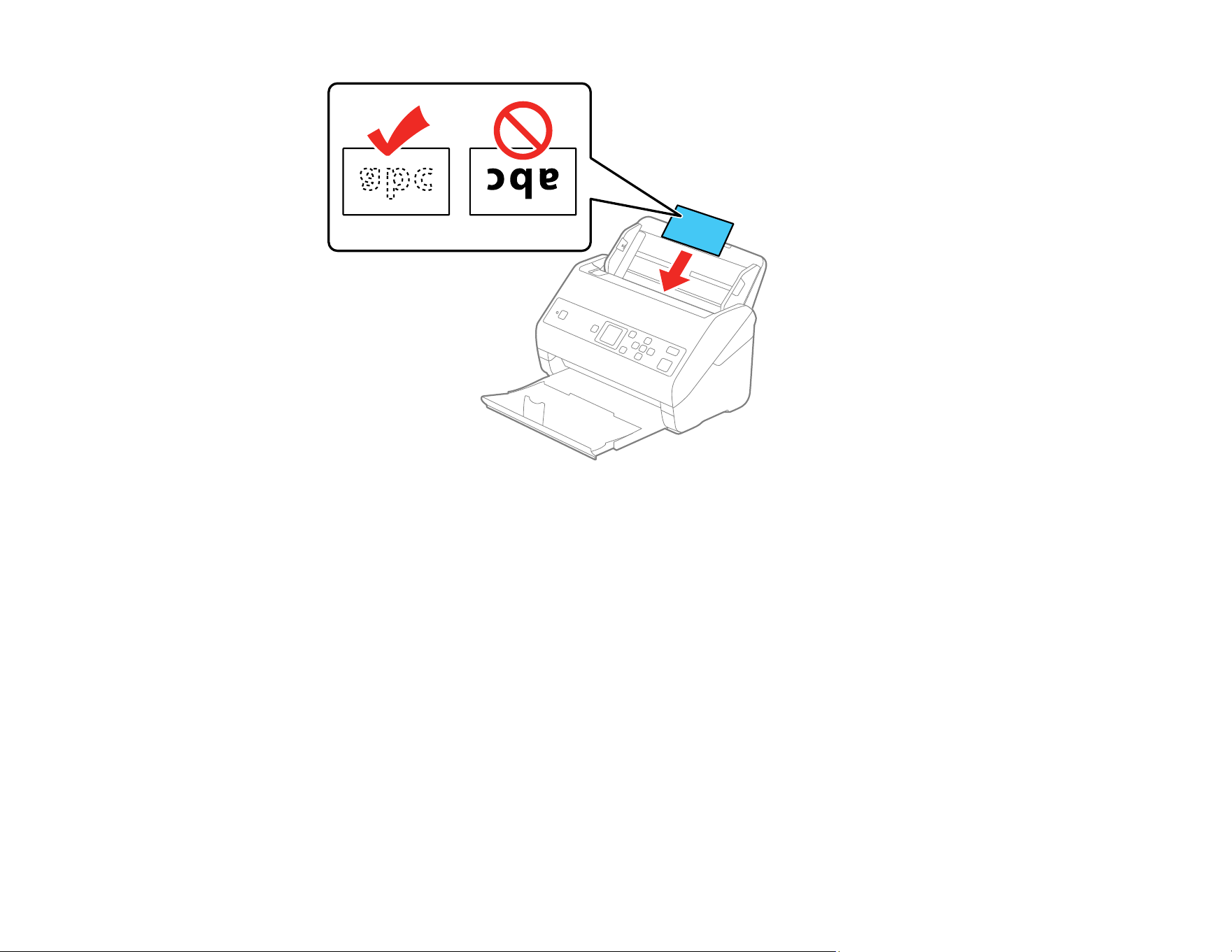
• If you are loading paper business cards, load up to 30 cards (printed side down and long edge
first) into the input tray horizontally, and slide them in until they meet resistance.
27
28
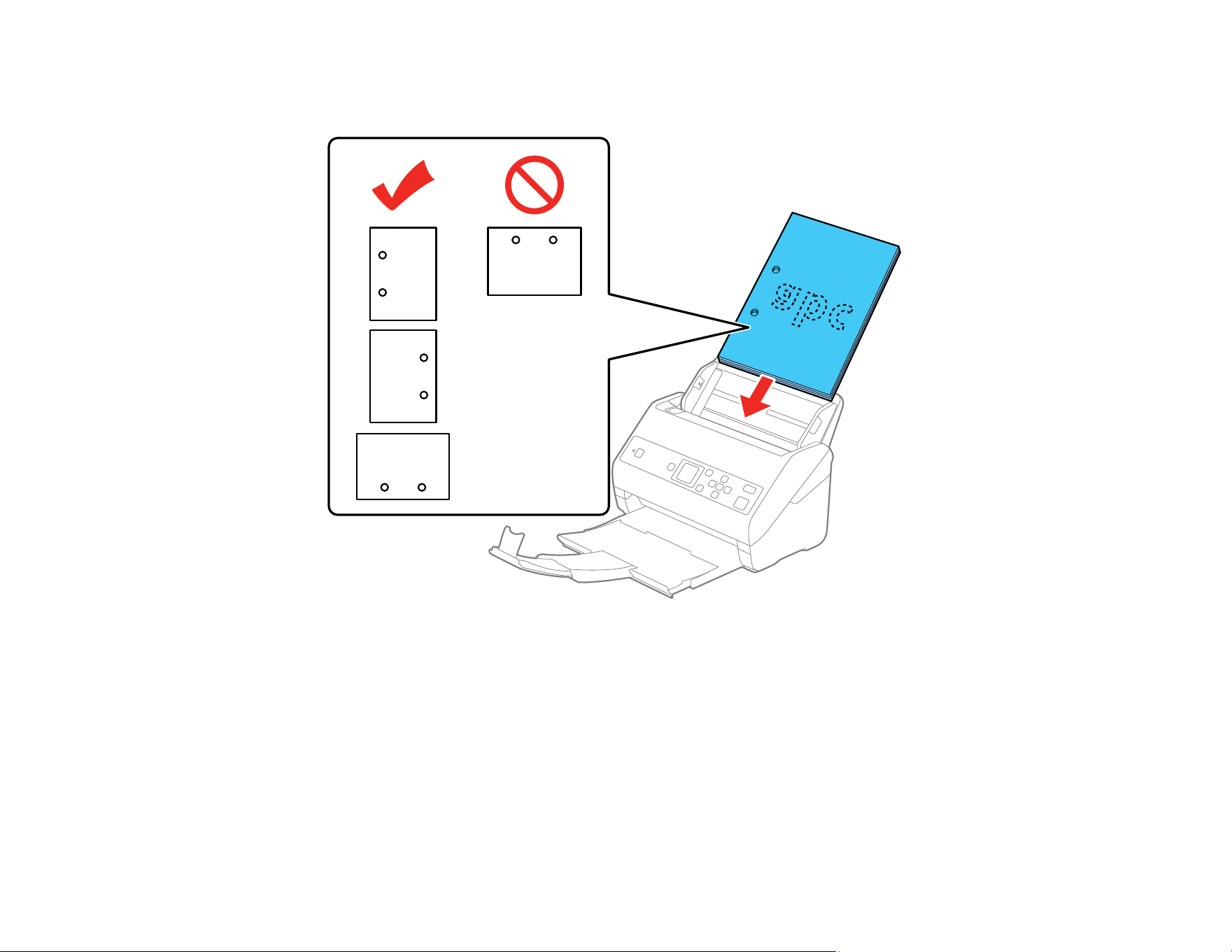
• If you are loading hole-punched originals, load them with the holes facing down or to the side as
shown. The holes must be within 1.2 inches (30 mm) of the edge of the originals.
29
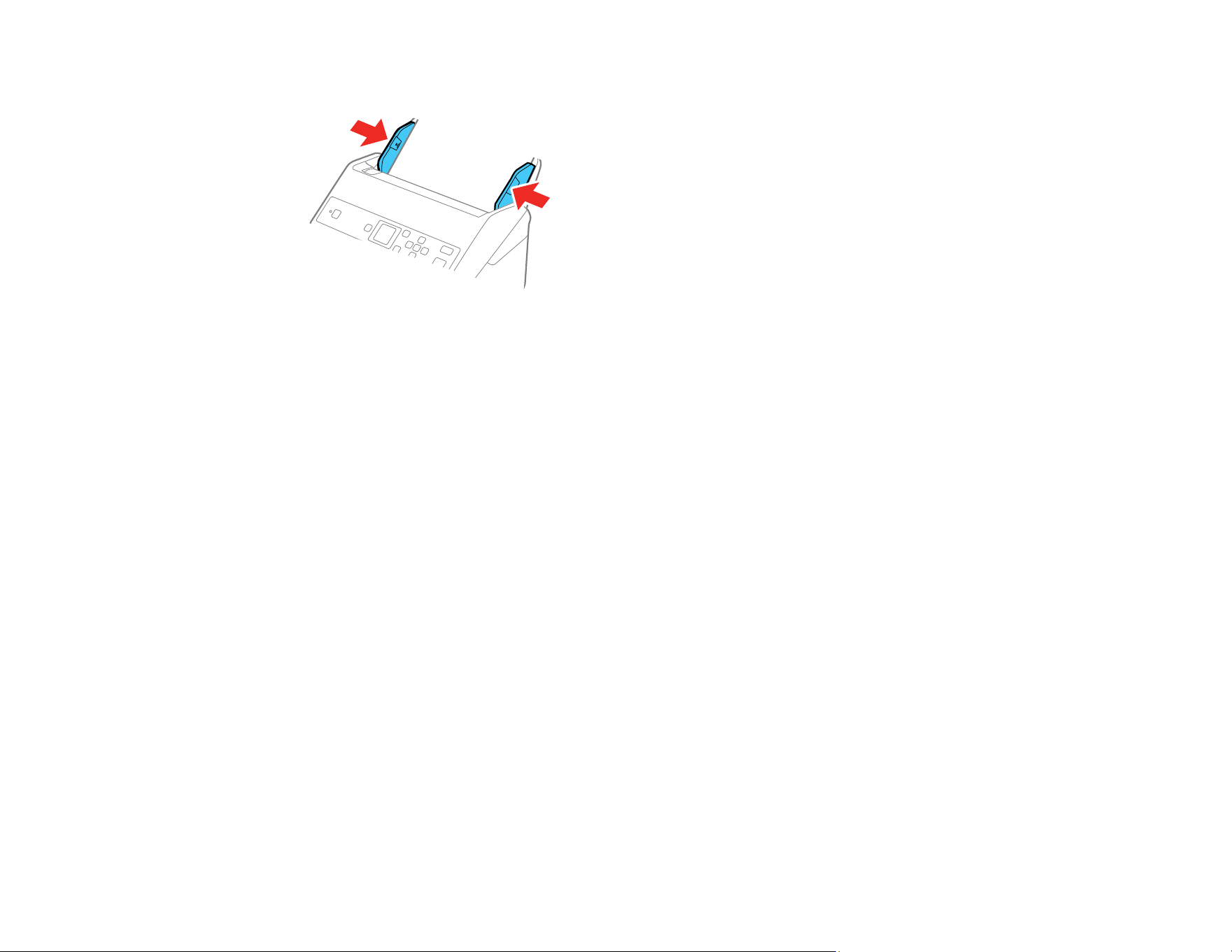
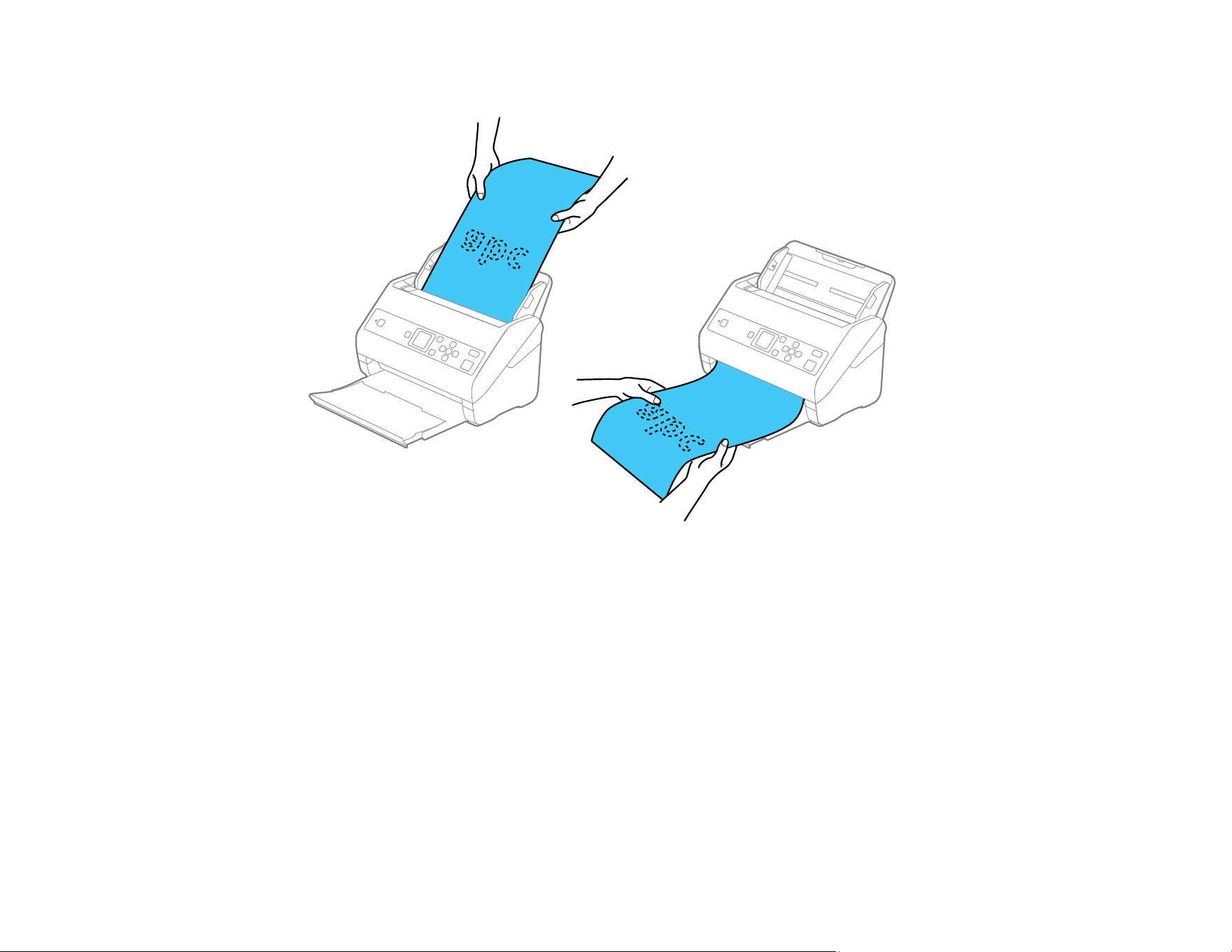
7. Slide the edge guides against the edges of the original.
Note: If you are scanning originals that are 15.5 inches (393.8 mm) or longer, support the original as
it enters into and ejects from the scanner as shown and use the following resolutions:
• 15.5 to 53 inches (393.8 to 1346.2 mm): 600 dpi or less
• 53 to 215 inches (1346.3 to 5461 mm): 300 dpi or less
30
• 215 to 240 inches (5461.1 to 6096 mm): 200 dpi or less
8. If necessary during scanning, adjust the position of the stopper on the output tray extension to fit the
ejected originals.
Note: If thicker paper does not eject properly or falls from the output tray, push in the output tray and
allow the originals to eject freely onto the surface below the scanner. If the scanned images are
affected by the originals ejecting below the scanner, try placing the scanner on the edge of a table
where the ejected originals can drop freely.
If scanning thin or wrinkled paper causes paper jams, slow down the feeding speed by selecting
Settings > Scanner Settings > Slow > On on the LCD screen.
Loading Multiple Sizes of Originals in the Input Tray
Original Document Specifications
Parent topic: Loading Originals
31
Related references
Original Document Specifications
Related topics
Scanning
Loading Multiple Sizes of Originals in the Input Tray
You can load originals of different sizes, paper types, and thicknesses at one time in the input tray. Just
make sure they meet the original document specifications.
Caution: Do not load photos, or valuable original documents or artwork, directly into the input tray. This
may wrinkle or damage the original. Load these originals using an optional carrier sheet.
1. Pull up the input tray extension.
2. Pull out the output tray and its extension, and open the stopper.
Note: If you are loading originals that are 15.5 inches (393.8 mm) or longer, do not pull out the input
or output tray extensions and do not open the stopper.
32
3. Slide the input tray edge guides all the way out.
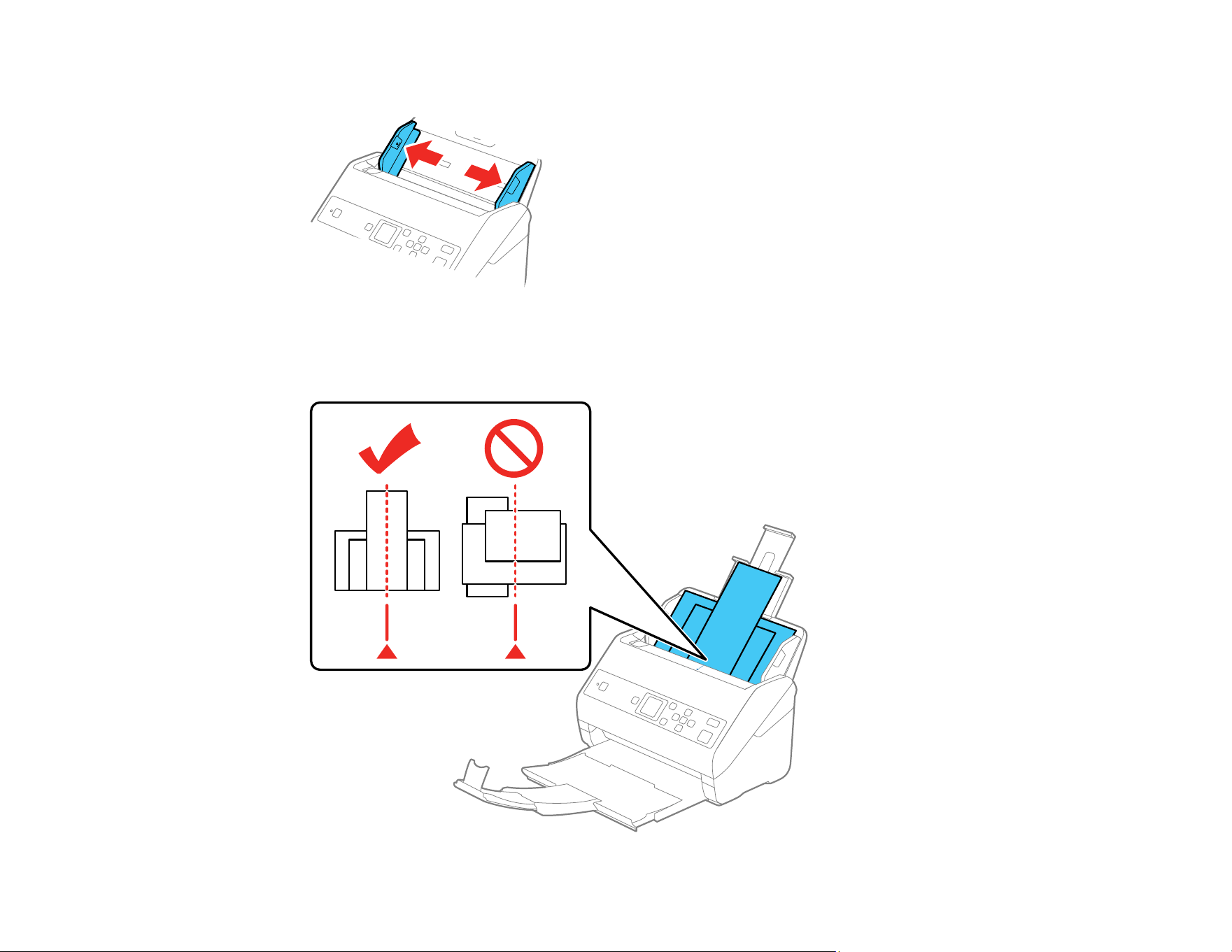
4. Load the originals in the center of the input tray in descending order of paper size with the widest at
the back and the narrowest at the front. Slide them in until they meet resistance. Make sure the
printed sides are facedown and the top edges are slightly angled in the input tray.

33
5. Slide the edge guides against the edges of the widest original.
6. If necessary during scanning, adjust the position of the stopper on the output tray extension to fit the
ejected originals.
Note: If thicker paper does not eject properly or falls from the output tray, push in the output tray and
allow the originals to eject freely onto the surface below the scanner. If the scanned images are
affected by the originals ejecting below the scanner, try placing the scanner on the edge of a table
where the ejected originals can drop freely.
If scanning thin or wrinkled paper causes paper jams, slow down the feeding speed by selecting
Settings > Scanner Settings > Slow > On on the LCD screen.
You can also scan originals of multiple sizes by loading them one by one using the Automatic Feeding
Mode setting in Epson Scan 2.
Parent topic: Loading Originals in the Input Tray
Original Document Specifications
You can load original documents that meet these specifications in your scanner.
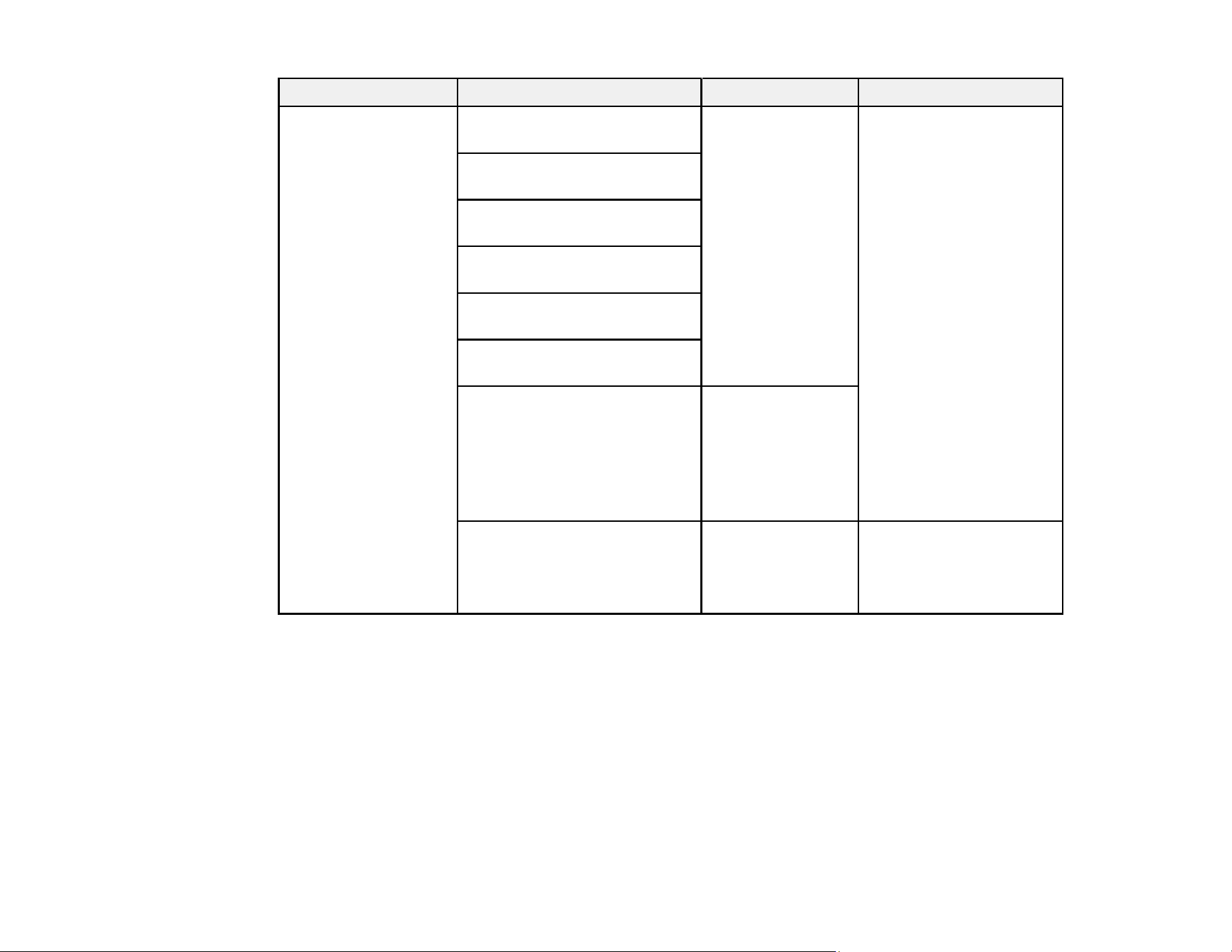
34
Paper type Paper size Paper weight Loading capacity
Plain paper
Fine paper
Recycled paper
Letter (8.5 × 11 inches
[216 × 279 mm])
7 to 110 lb
(27 to 413 g/m²)
21 lb (80 g/m²): 100
sheets
24 lb (90 g/m²): 86 sheets
28 lb (104 g/m²): 74
sheets
34 lb (127 g/m²): 62
sheets
42 lb (157 g/m²): 50
sheets
56 lb (209 g/m²): 38
sheets
68 lb (256 g/m²): 30
sheets
110 lb (413 g/m²): 18
sheets
Loading capacity may
vary depending on the
paper type.
A4 (8.3 × 11.7 inches
[210 × 297 mm])
A5 (5.8 × 8.2 inches
[148 × 210 mm])
A6 (4.1 × 5.8 inches
[105 × 148 mm])
B5 (7.2 × 10.1 inches
[182 × 257 mm])
B6 (5 × 7.2 inches
[128 × 182 mm])
A8 (2.1 × 2.9 inches
[52 × 74 mm])
34 to 110 lb
(127 to 413 g/m²)
Width: 2.0 to 8.5 inches (50.8
to 215.9 mm)
Height: 15.5 to 240 inches
(393.8 to 6096 mm)
13 to 35 lb
(50 to 130 g/m²)
1 sheet
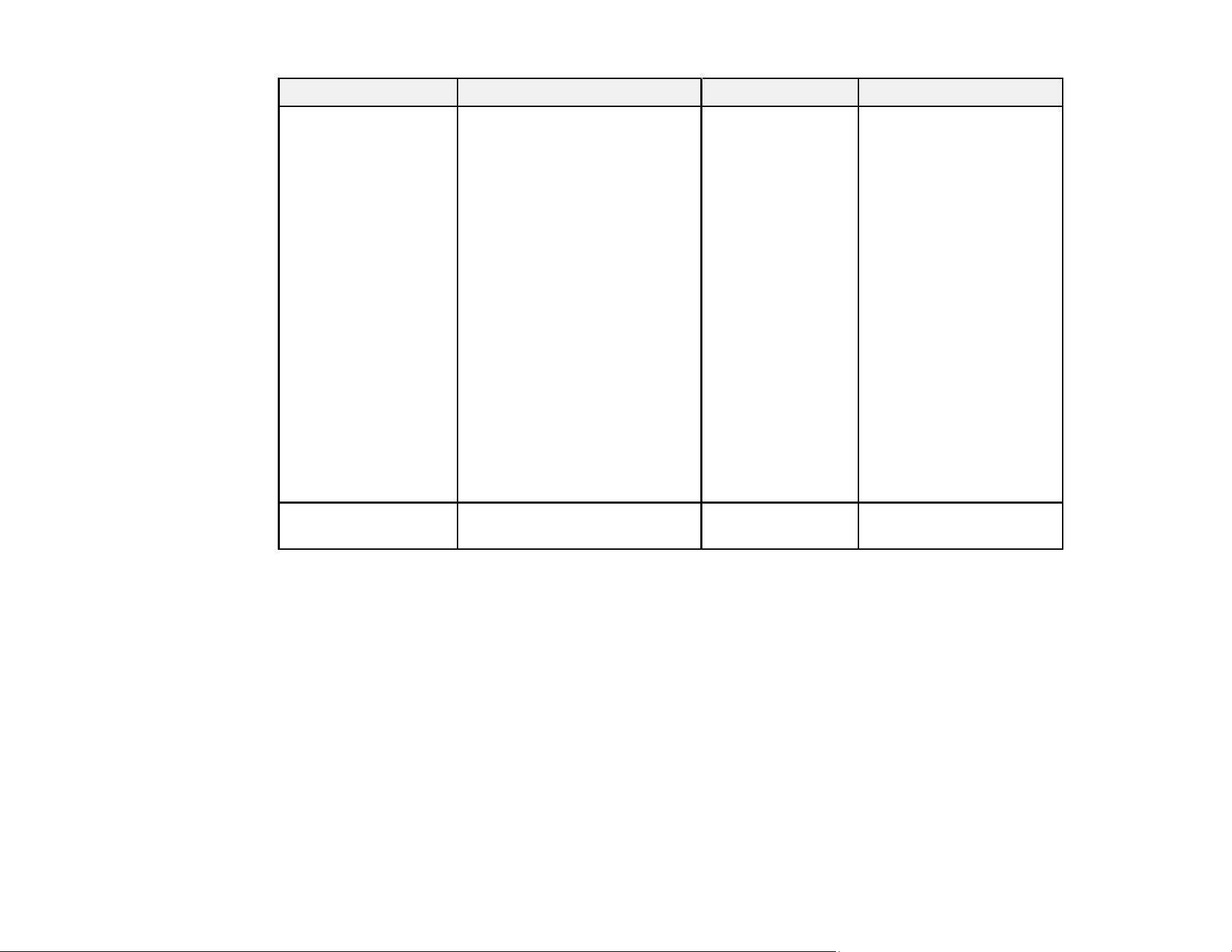
35
Paper type Paper size Paper weight Loading capacity
Plain paper
Fine paper
Recycled paper
Legal (8.5 × 14 inches
[216 × 356 mm])
7 to 110 lb
(27 to 413 g/m²)
21 lb (80 g/m²): 80 sheets
24 lb (90 g/m²): 69 sheets
28 lb (104 g/m²): 59
sheets
34 lb (127 g/m²): 50
sheets
42 lb (157 g/m²): 40
sheets
56 lb (209 g/m²): 30
sheets
68 lb (256 g/m²): 24
sheets
110 lb (413 g/m²): 14
sheets
Loading capacity may
vary depending on the
paper type.
Paper business cards Business cards Up to 56 lb
(210 g/m²)
30 cards loaded
horizontally
Note: You can load originals of different sizes, paper types, and thicknesses up to this size: Letter
(8.5 × 11 inches [216 × 279 mm]).
Caution: Do not load the following types of originals directly in the scanner, or they may be damaged or
may damage the scanner:
• Thermal paper
• Coated paper
• Originals with uneven surfaces, such as embossed documents
• Photos
• Originals with wet ink
• Ripped, curled, or wrinkled originals
36
• Originals containing staples or paper clips
• Originals with holes on the bottom of them
• Originals that are bound
• Originals with carbon paper backing
• Transparencies
• Glossy originals
• Carbon-less paper
• Perforated originals
• Originals with labels, stickers, or glue
• Fabric or other non-paper originals
Parent topic: Loading Originals in the Input Tray
Loading Plastic and Laminated Cards in the Input Tray
You can load plastic and laminated cards that meet the card specifications in the input tray.
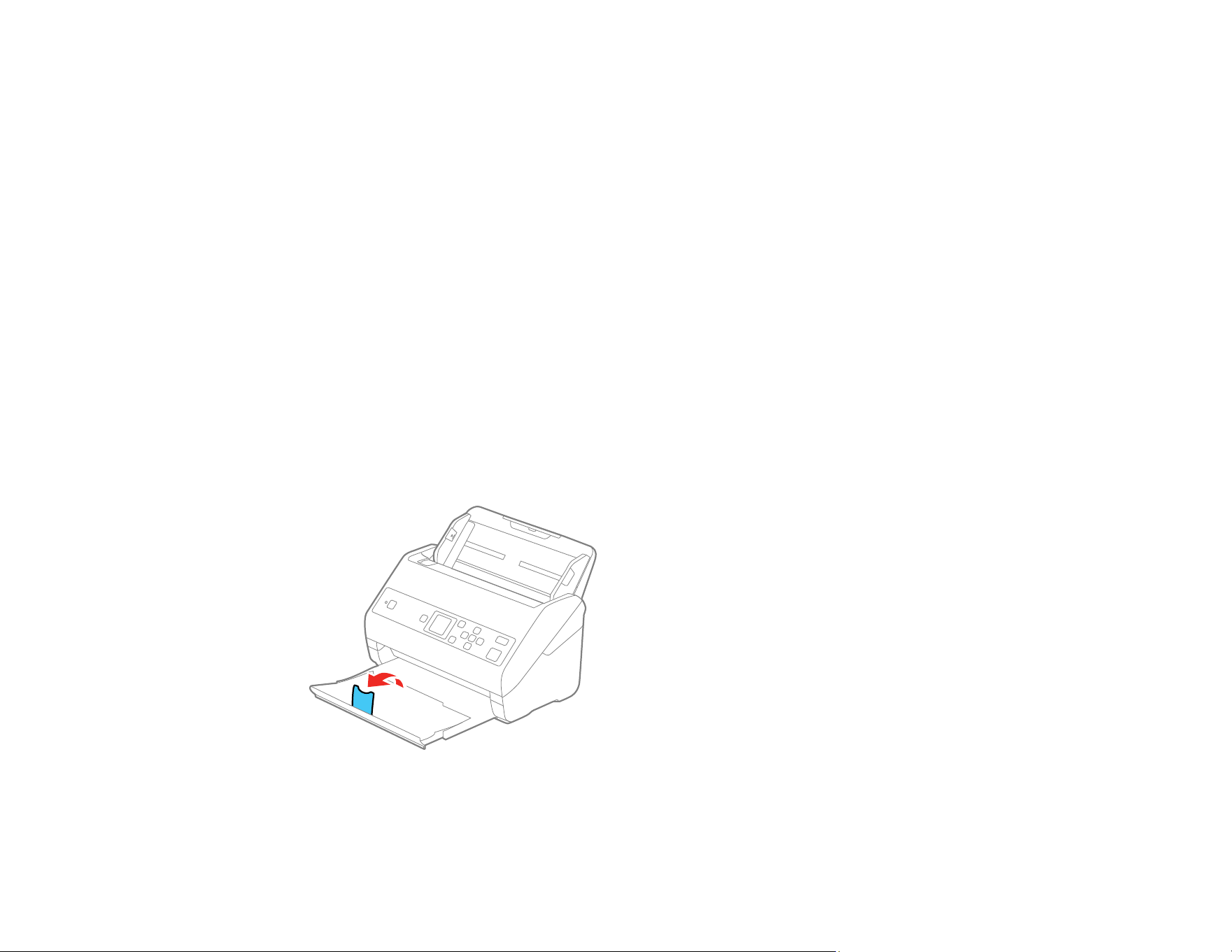
1. Pull out the output tray and open the stopper. Do not pull out the extensions.
37
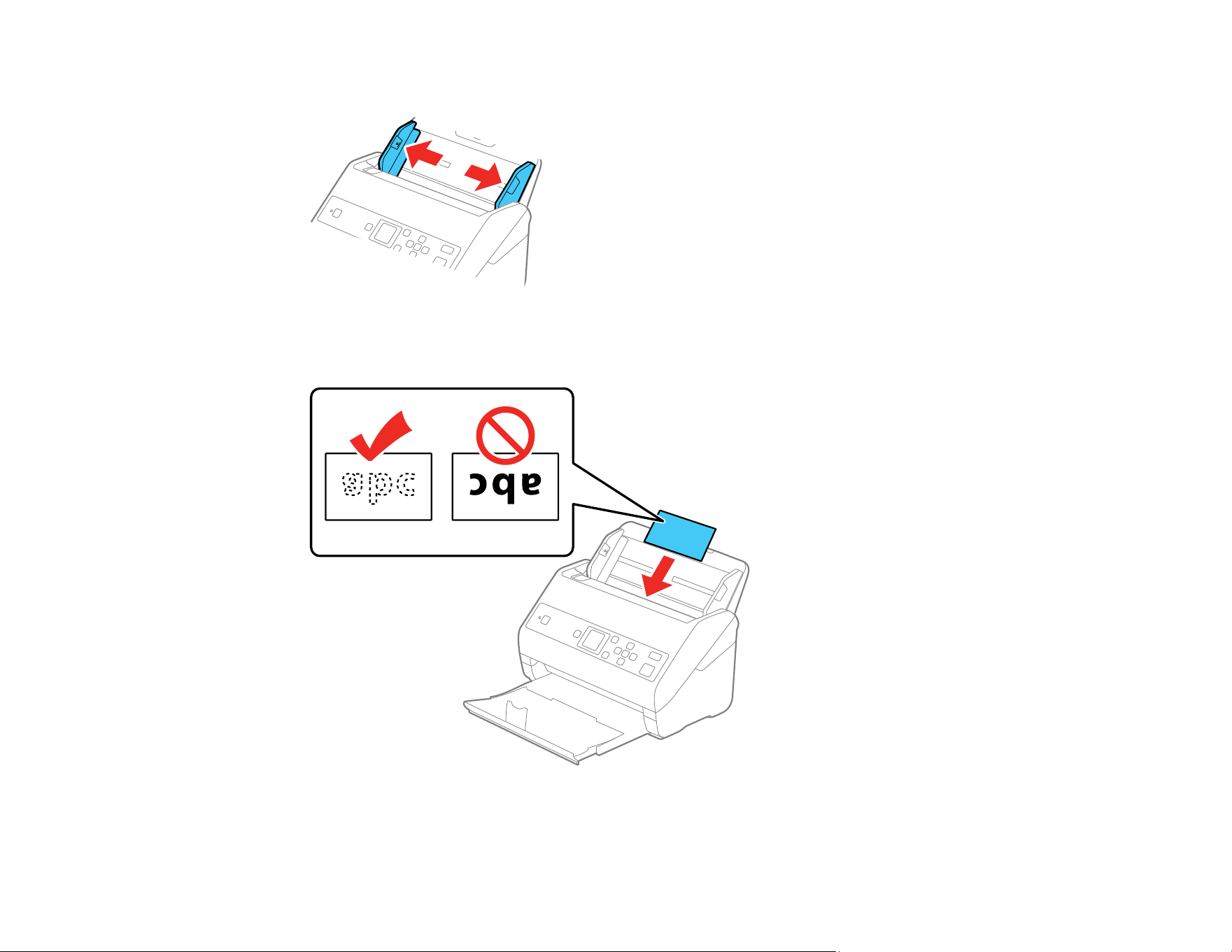
2. Slide the input tray edge guides all the way out.
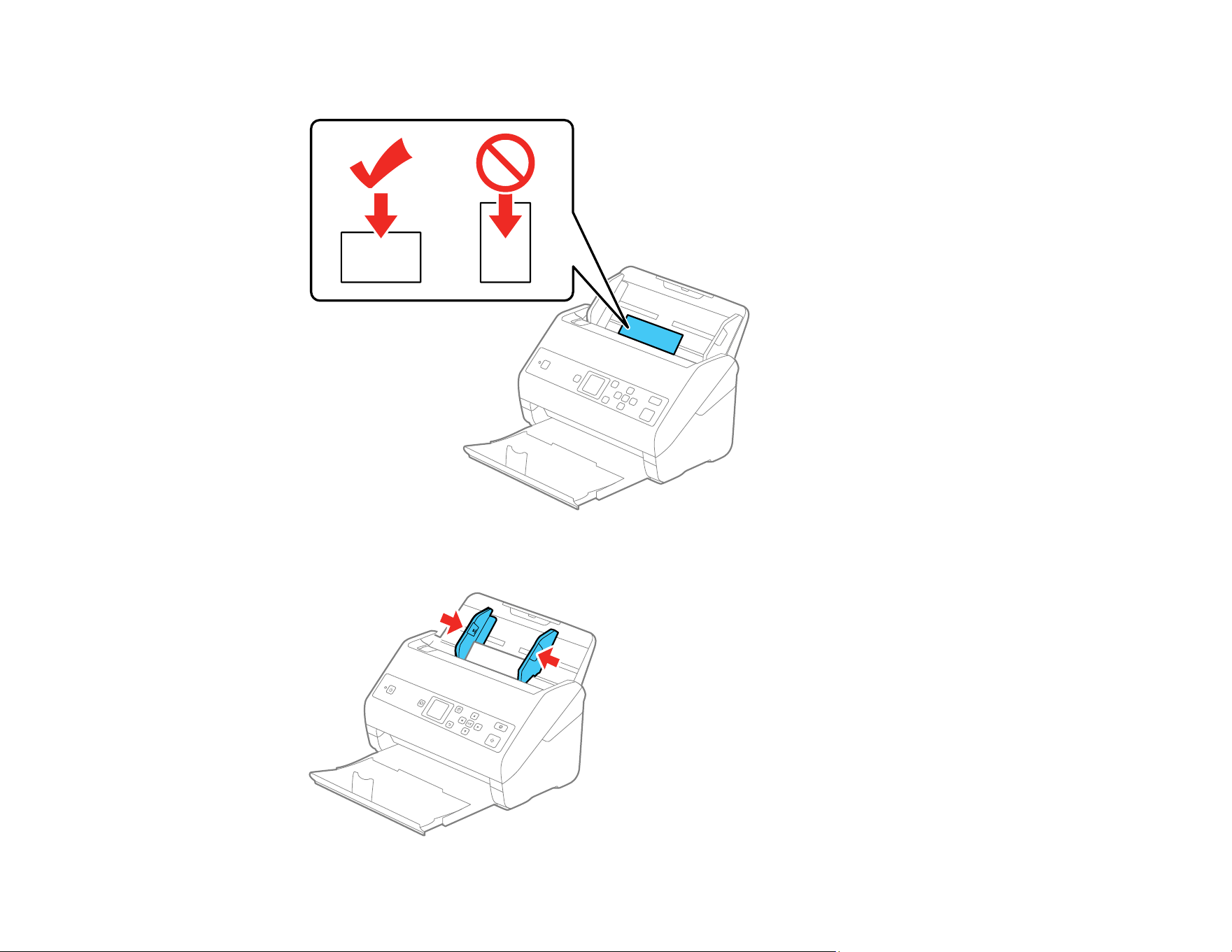
3. Load plastic or laminated cards (printed side down and long edge first) into the input tray
horizontally, and slide them in until they meet resistance.
38
Note: Do not load plastic cards vertically.
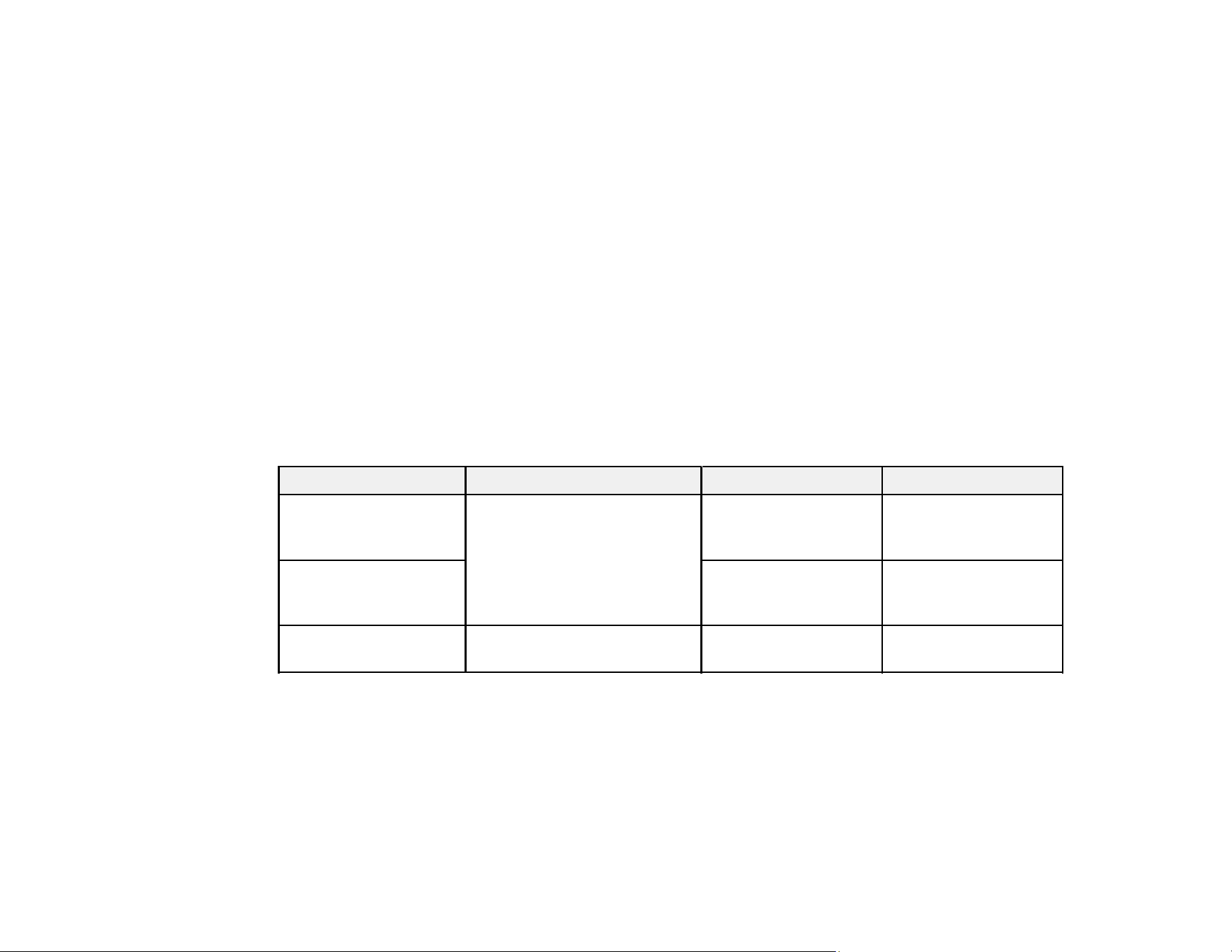
4. Slide the edge guides against the edges of the card.
39
5. Turn off the Detect Double Feed setting on the Main Settings tab in Epson Scan 2 when scanning
the cards.
Note: If you do not disable the Detect Double Feed setting and a double feed error occurs, remove
the plastic or laminated card from the input tray and reload it. Press the down arrow button on the
control panel, and select DFDS Function > On to disable the Detect Double Feed setting for the
next scan. The DFDS Function setting only disables the Detect Double Feed setting for one scan.
Plastic and Laminated Card Specifications
Parent topic: Loading Originals
Related references
Plastic and Laminated Card Specifications
Related topics
Scanning
Plastic and Laminated Card Specifications
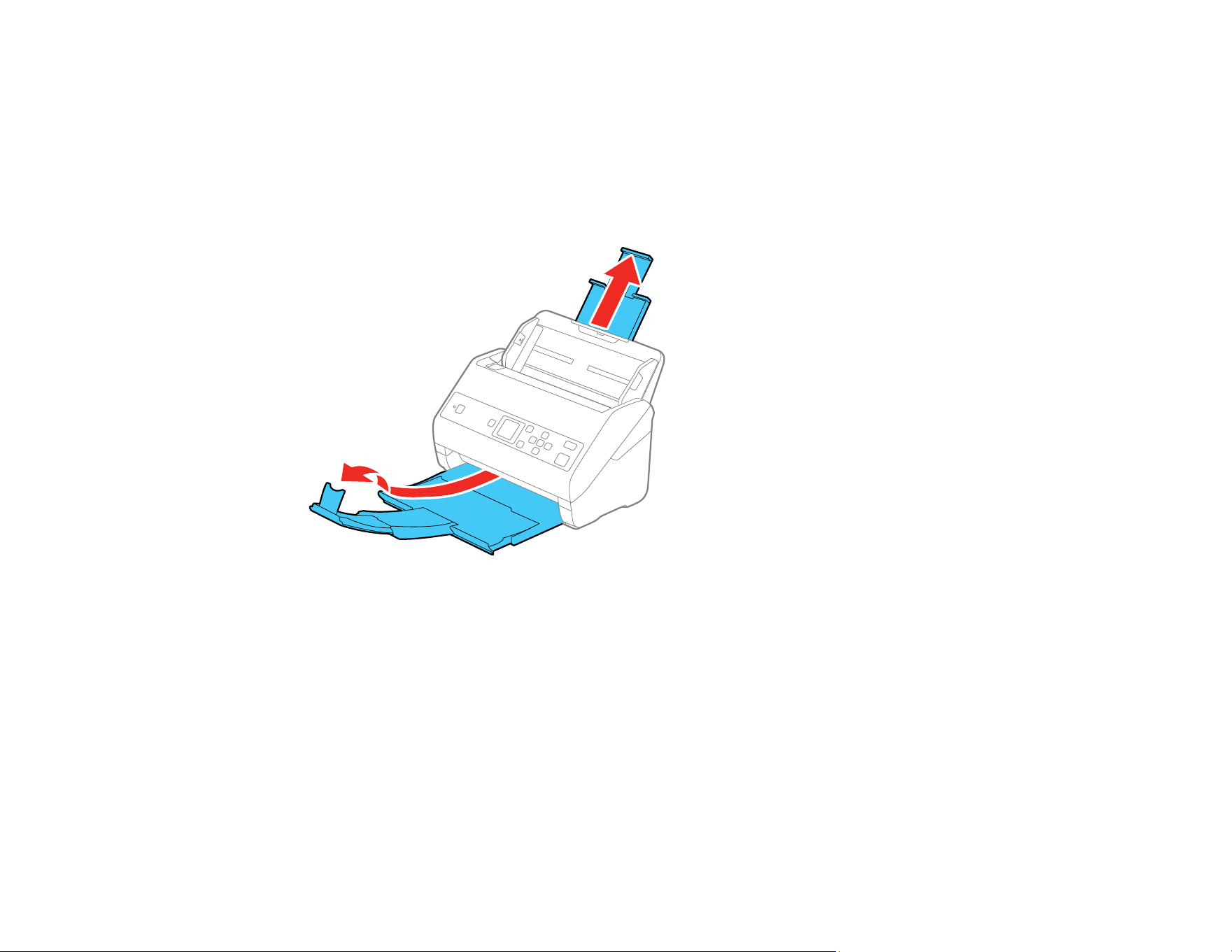
You can load original plastic and laminated cards that meet these specifications in your scanner.
Paper type Paper size Paper thickness Loading capacity
Plastic cards,
embossed (ISO7810
ID-1 compliant)
2.1 × 3.3 inches
(54 × 85.6 mm)
0.05 inch (1.24 mm)
maximum
1 card (horizontal)
Plastic cards, standard
(ISO7810 ID-1
compliant)
0.04 inch (1.1 mm)
maximum
5 cards (horizontal)
Laminated cards 4.7 × 5.9 inches (120
× 150 mm) or smaller
0.03 inch (0.8 mm)
maximum
1 card
Note: Plastic cards with glossy surfaces may not scan properly.
Parent topic: Loading Plastic and Laminated Cards in the Input Tray
40
Loading Special Originals
You can load photos or large, thick, or folded originals in the input tray using one or more carrier sheets.
You can also load envelopes. Make sure the originals meet the specifications for special originals before
loading them.
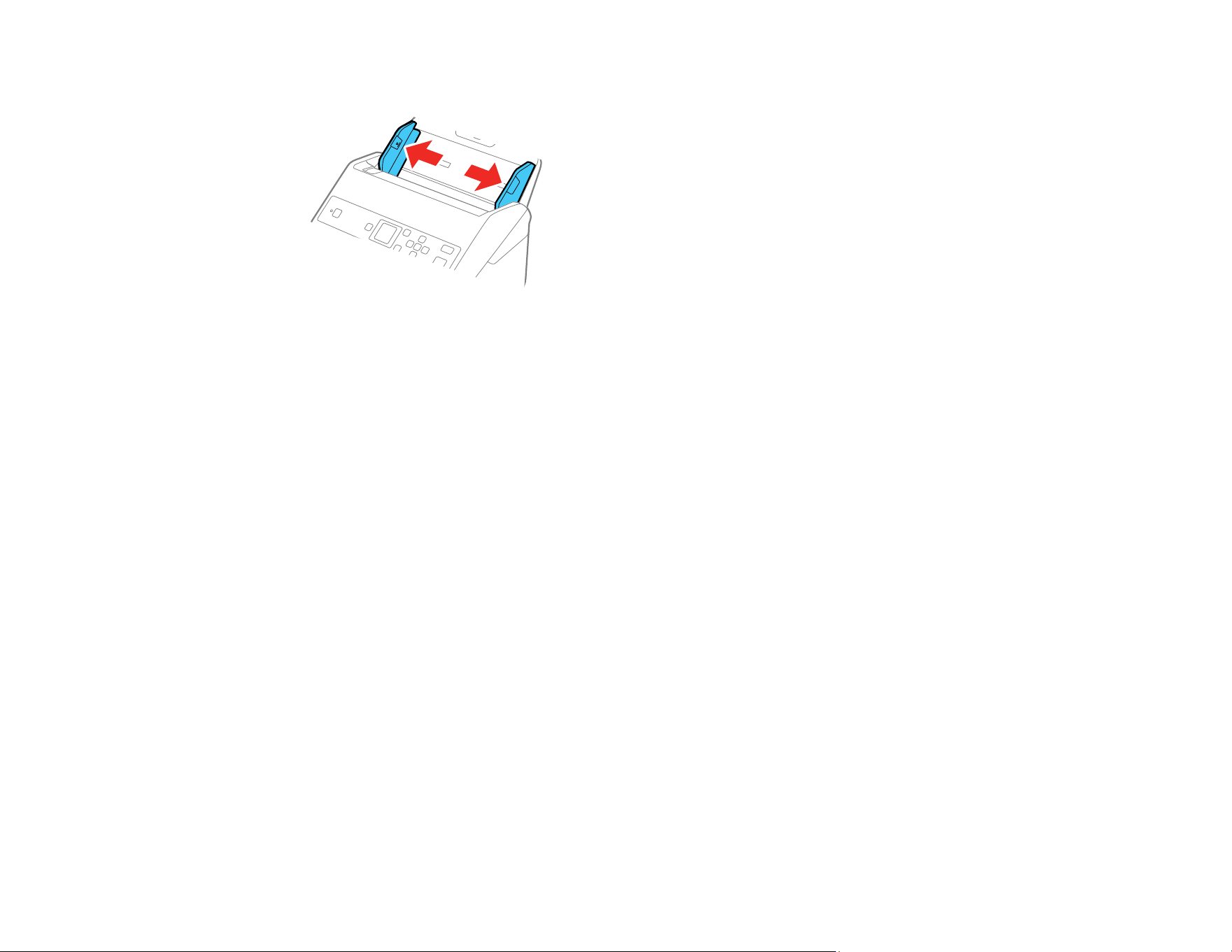
1. Pull up the input tray extension.
2. Pull out the output tray and its extension, and open the stopper.
Note: If you are loading originals that are 15.5 inches (393.8 mm) or longer, do not pull out the input
or output tray extensions and do not open the stopper.
41
3. Slide the input tray edge guides all the way out.
42
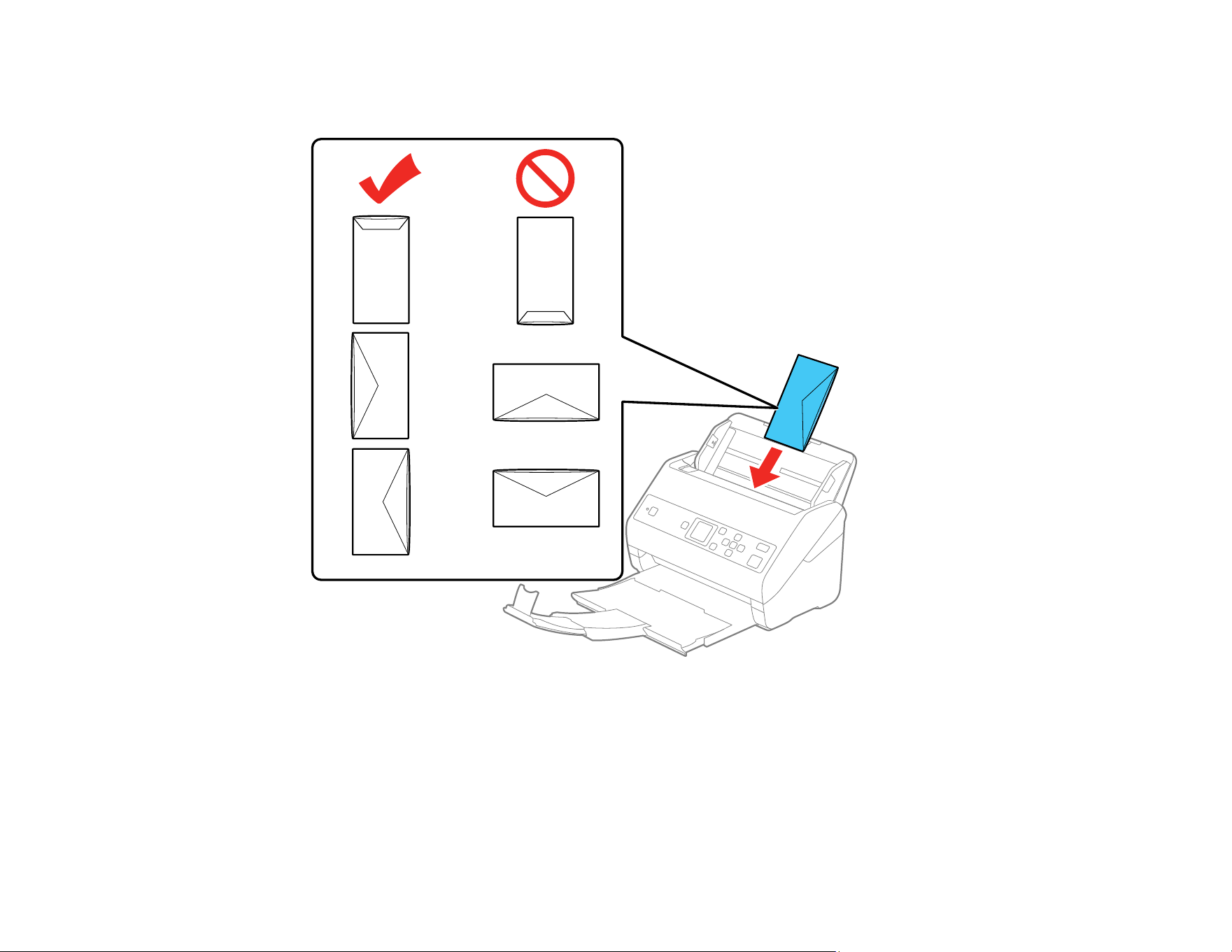
4. Load envelopes vertically in the input tray with the printed side down and the flap facing as shown.
Slide in the envelopes until they meet resistance. Skip to step 7.
5. Do one of the following to load photos, or folded or irregularly shaped originals using a carrier sheet:
Note: Use only the carrier sheet designed for your scanner. The carrier sheet is automatically
recognized by the scanner by the two small rectangular holes on the front edge, as shown. Keep the
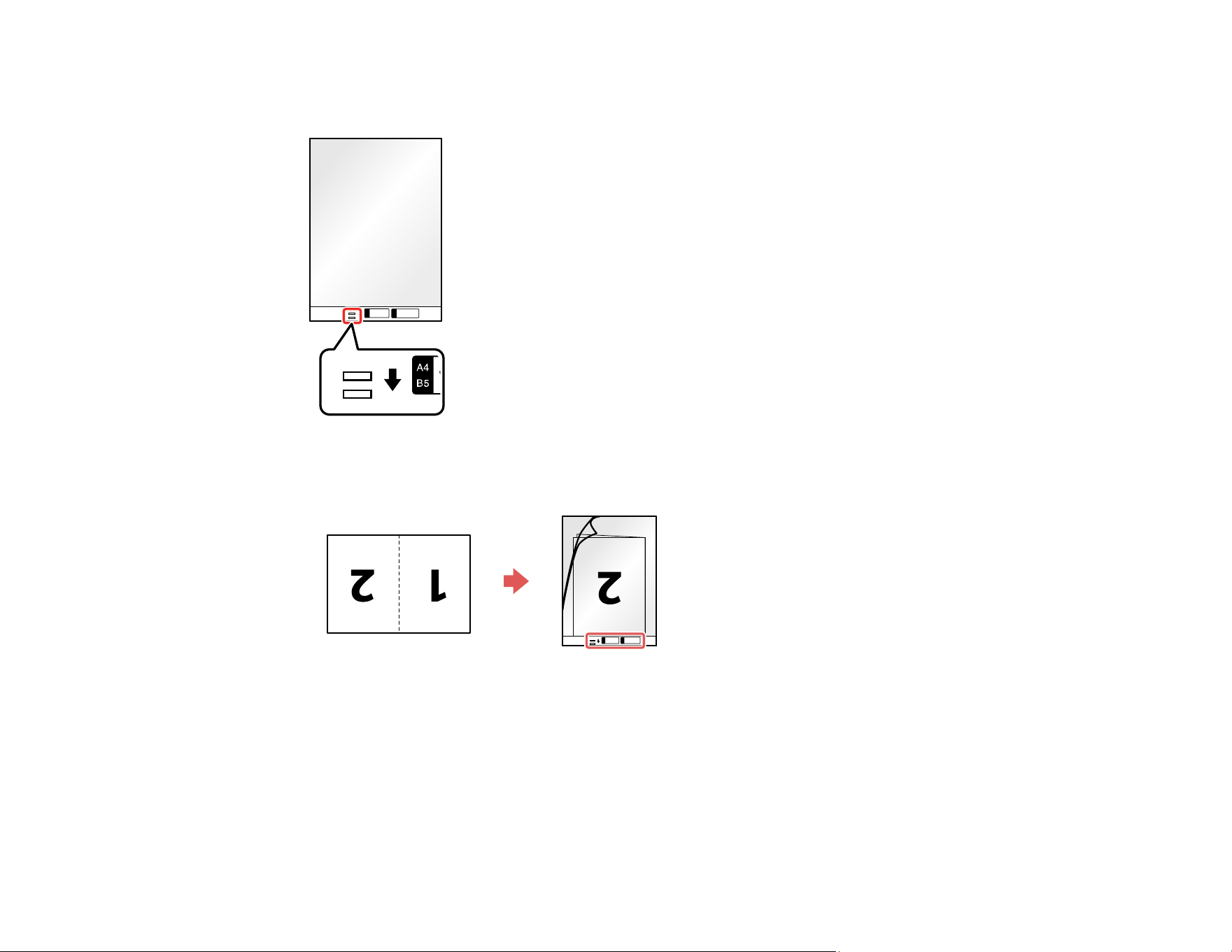
43
holes clean and not covered. Do not load a carrier sheet that has scratches on it or one that has
been scanned more than 3,000 times.
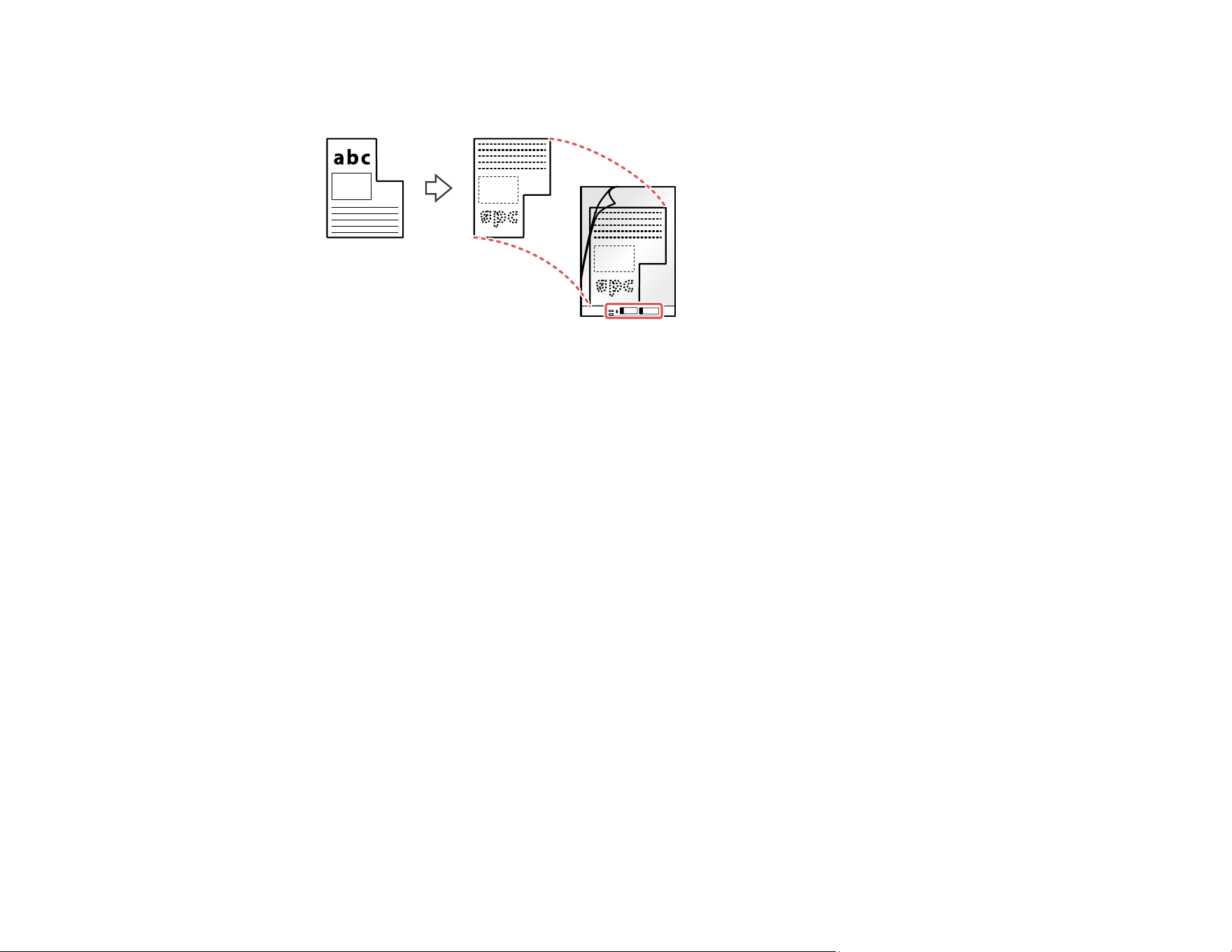
• For a Letter- or A4-size or larger original, fold it as shown and place it in the center of an optional
carrier sheet. Make sure the illustration on the front edge of the carrier sheet is facing up.
To scan both sides and stitch them together, set the appropriate setting in Epson Scan 2.
• For a photo or an irregularly shaped original, load it in the center of an optional carrier sheet with
the printed side face down. Make sure the illustration on the front edge of the carrier sheet is
facing up. If you are loading originals that are 11.7 inches (297 mm) or shorter, place the leading
44
edge of the original against the binding of the carrier sheet, as shown. Otherwise, the scanner
may not detect the correct length of the original.
45
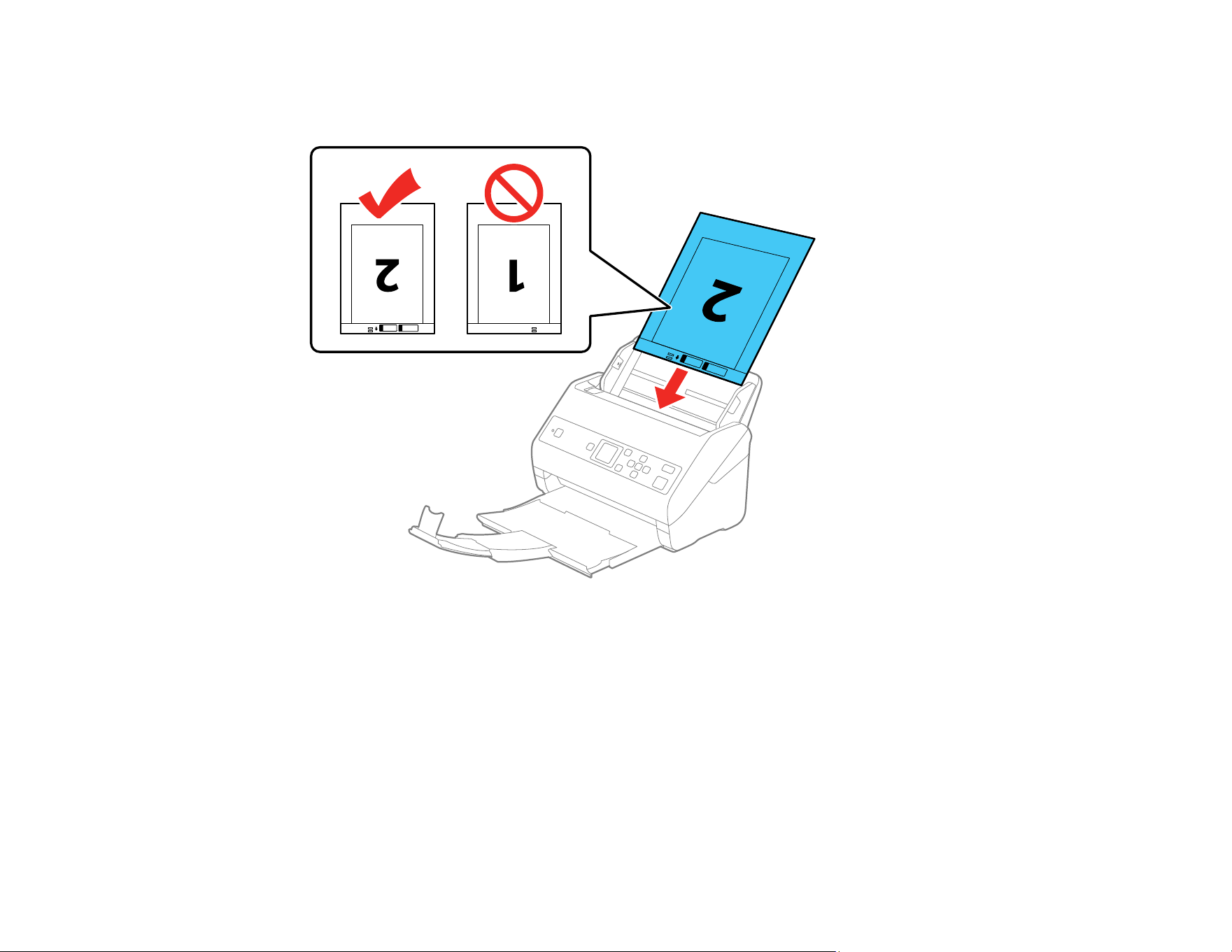
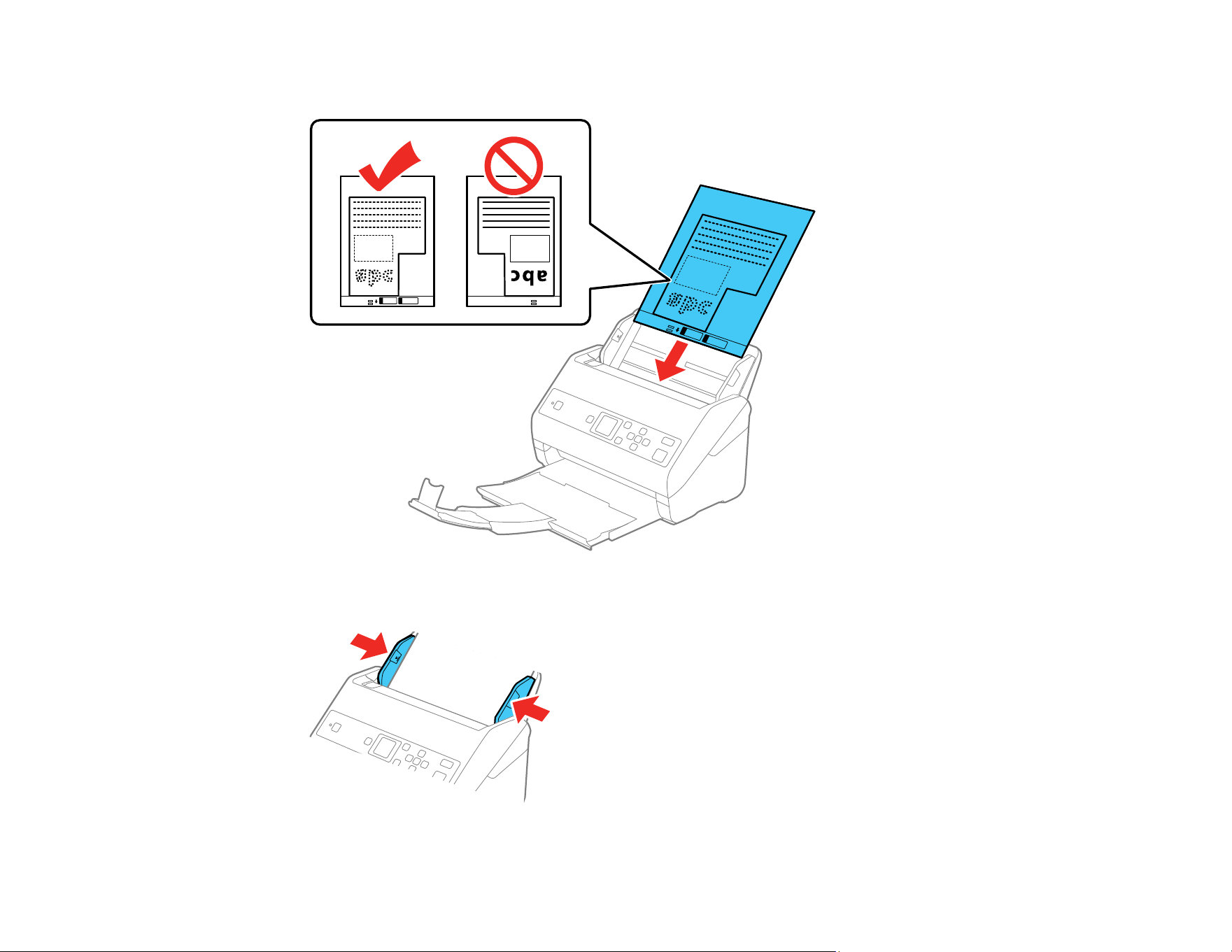
6. Load the carrier sheet in the input tray as shown until it meets resistance.
Folded original
46
Photo or irregularly shaped original
7. Slide the edge guides against the edges of the envelope or carrier sheet.

47
8. Turn off the Detect Double Feed setting on the Main Settings tab in Epson Scan 2 when scanning
special originals.
Note: If the Document Size setting on the Main Settings tab in Epson Scan 2 is set to Auto Detect,
Paper Skew is automatically selected as the Correct Document Skew setting.
9. If necessary during scanning, adjust the position of the stopper on the output tray extension to fit the
ejected originals.
Note: If thicker paper does not eject properly or falls from the output tray, push in the output tray and
allow the originals to eject freely onto the surface below the scanner. If the scanned images are
affected by the originals ejecting below the scanner, try placing the scanner on the edge of a table
where the ejected originals can drop freely.
Special Original Specifications
Parent topic: Loading Originals
Related references
Special Original Specifications
User Replaceable Epson Scanner Parts
Related topics
Scanning
Special Original Specifications
You can load photos, envelopes, or large, thick, or folded originals that meet these specifications in your
scanner.

48
Paper type Paper size Paper thickness Loading capacity
Large originals (plain
paper, fine paper, or
recycled paper)
(load only in a carrier
sheet)
Up to this size: A3 (11.7 × 16.5
inches [297 × 420 mm])
B4 (13.9 × 9.84 inches
[353 × 250 mm])
Legal (8.5 × 14 inches
[216 × 356 mm]); only load
above sizes if folded in half
Custom sizes up to 17 inches
(431.8 mm) wide and 11.7
inches (297 mm) long;
originals wider than 8.5 inches
(215.9 mm) must be folded in
half
0.012 inch (0.3 mm)
maximum
(excluding the
thickness of the carrier
sheet)
10 carrier sheets
Photos
(load only in a carrier
sheet)
Up to this size: A4 (8.3 × 11.7
inches [210 × 297 mm])
0.012 inch (0.3 mm)
maximum
(excluding the
thickness of the carrier
sheet)
10 carrier sheets
Envelopes 4.49 × 6.38 inches (114
× 162 mm)
4.33 × 8.66 inches (110
× 220 mm)
0.015 inch (0.38 mm)
maximum
10 envelopes
Irregularly shaped
originals
(load only in a carrier
sheet)
Up to this size: A4 (8.3 × 11.7
inches [210 × 297 mm])
0.012 inch (0.3 mm)
maximum
(excluding the
thickness of the carrier
sheet)
10 carrier sheets
Parent topic: Loading Special Originals
49
Scanning
You can scan your originals and save them as digital files.
Scanning a Document in Epson ScanSmart
Selecting Epson ScanSmart Settings
Scanning Using Invoice/Receipt Manager
Selecting Invoice/Receipt Manager Settings
Scan Resolution Guidelines
Scanning a Document in Epson ScanSmart
You can scan and review documents in Epson ScanSmart.
Note: The images show Windows screens; Mac screens may be slightly different.
Note: Receipt Manager is available for select scanner models. Availability varies by country.
1. Load your original into the scanner.
2. Start the scan by doing one of the following:
• Press the start button on the scanner. Epson ScanSmart automatically opens on your computer
and the scan job begins. (The default is double-sided scanning.)
Note: You can change the scanning button default in the Settings menu.
• Open Epson ScanSmart on your computer. Do one of the following:
• Windows 10: Click > Epson Software > Epson ScanSmart.
• Windows 8.x: Navigate to the Apps screen and select Epson ScanSmart.
• Windows (other versions): Click or Start, and select All Programs or Programs. Select
Epson Software > Epson ScanSmart.
• Mac: Open the Applications folder, open the Epson Software folder, and select Epson
ScanSmart.
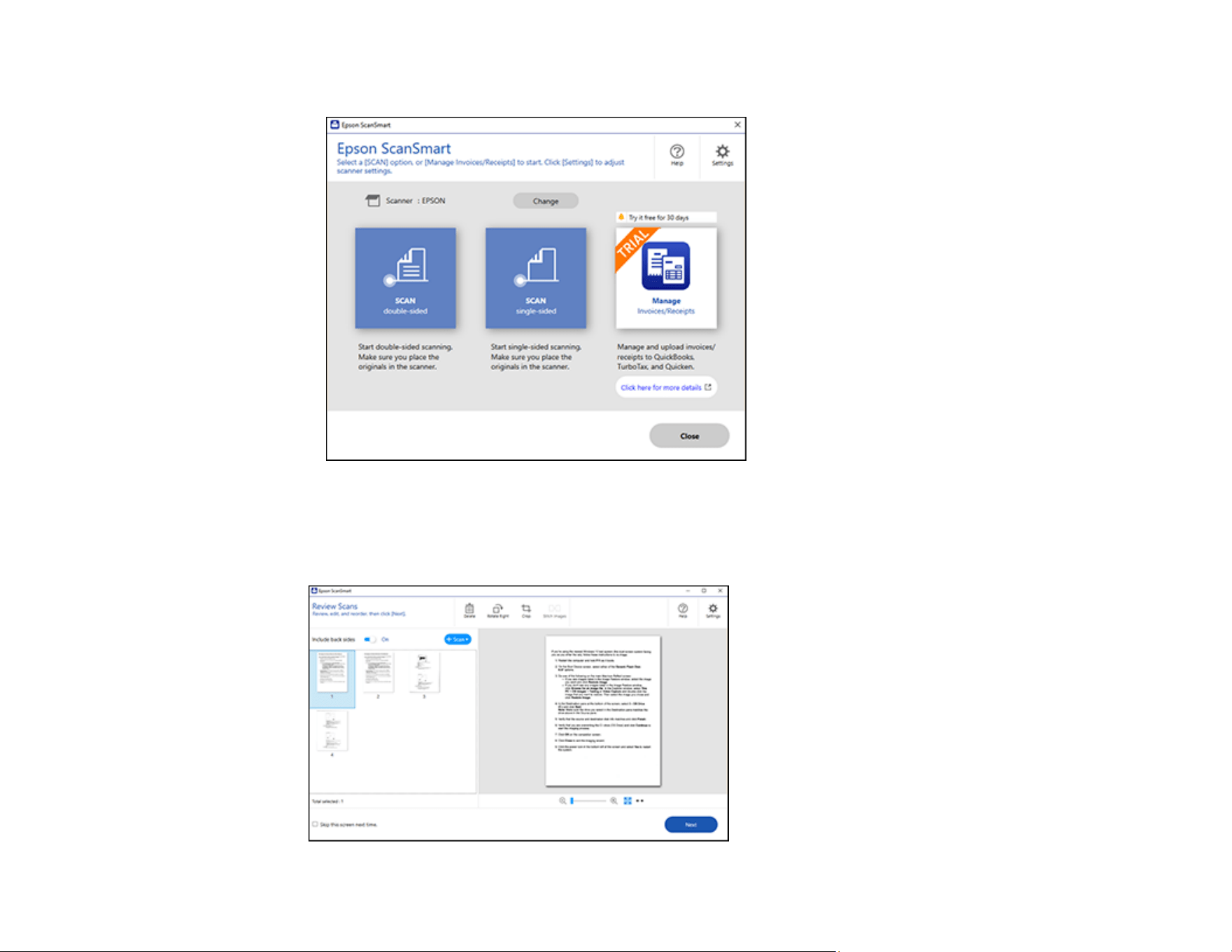
50
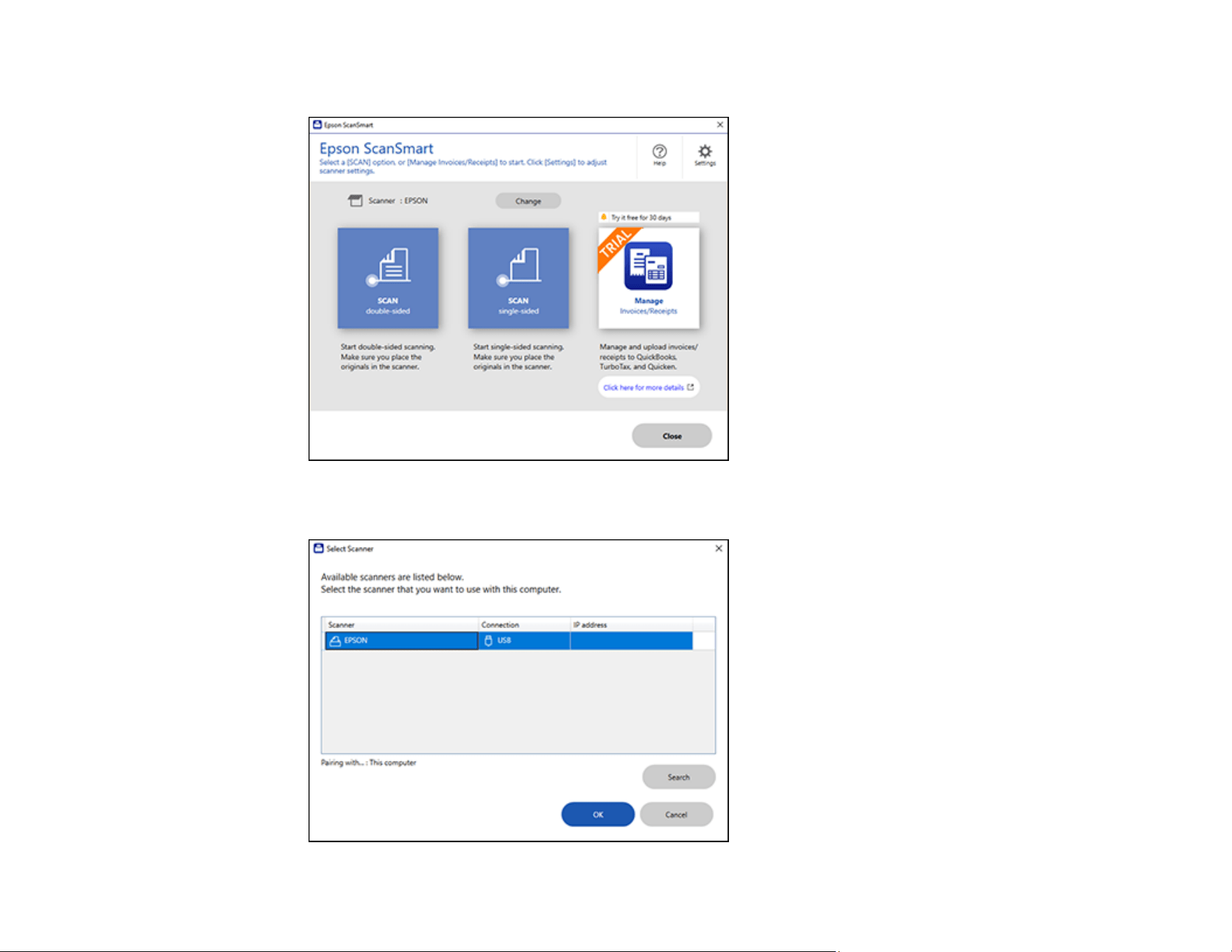
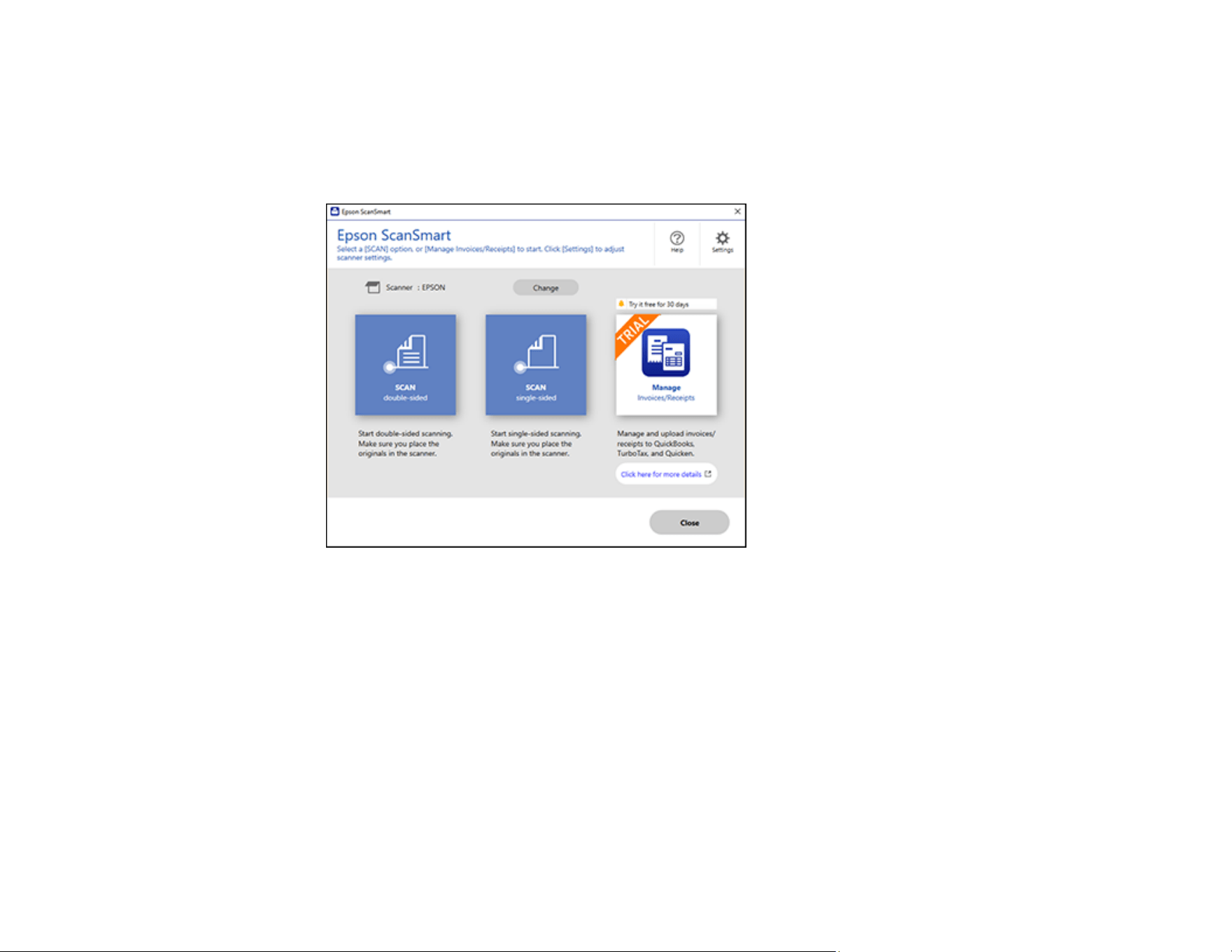
You see a screen like this:
3. Select a scan option.
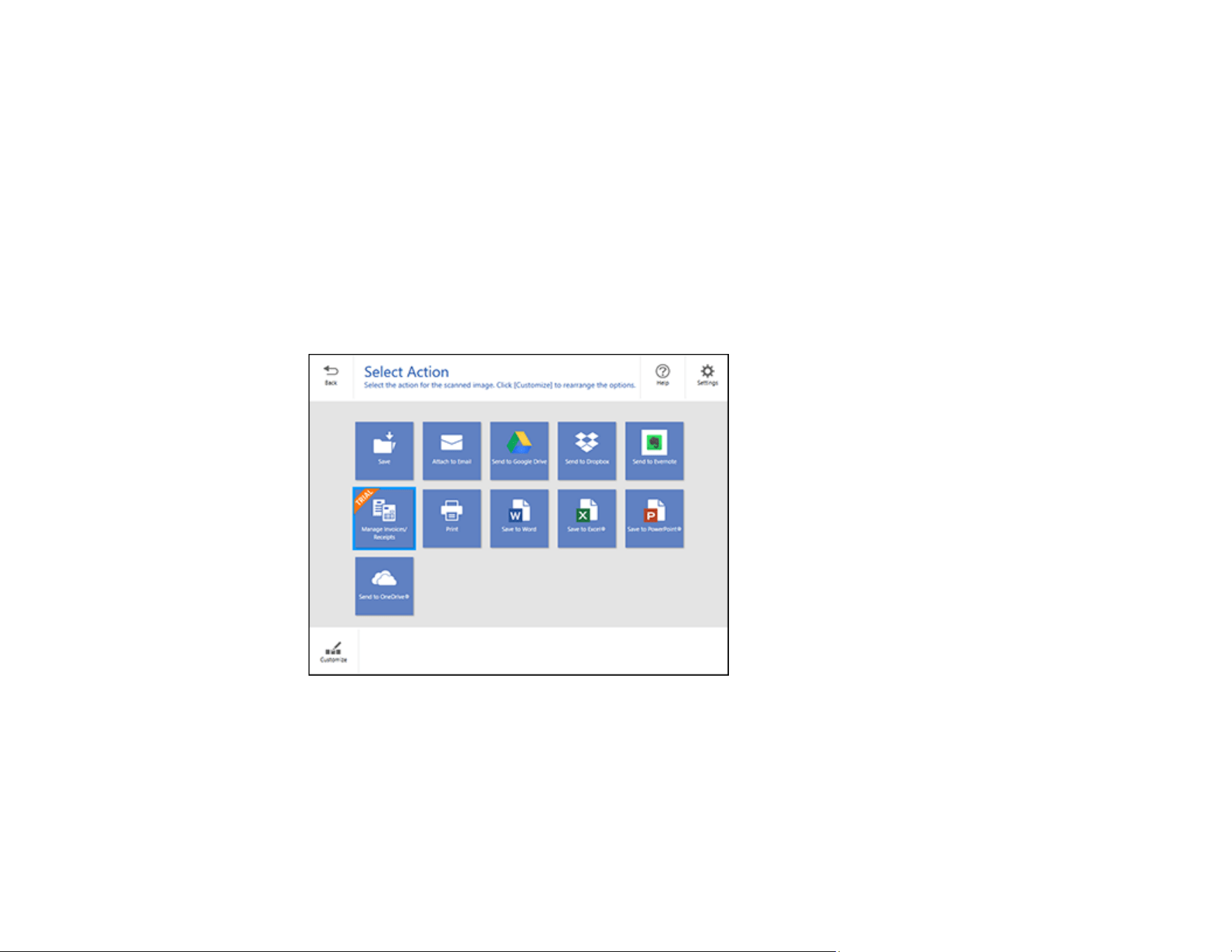
The scan job begins and your original feeds through the scanner. When scanning is complete, you
see a screen like this:
51
4. You can review, edit, or reorder the scanned images as follows:
• Select Scan to scan more originals.
• Select Delete to delete selected scanned images.
• Select Rotate Right to rotate each scanned image.
• Select Crop to crop the selected image.
• Select Stitch Images to combine two selected images into one image.
• If you scanned double-sided, select On or Off for Include back sides if you want to keep or
discard the back sides of scanned images.
5. When you are finished reviewing the scanned images, click Next.
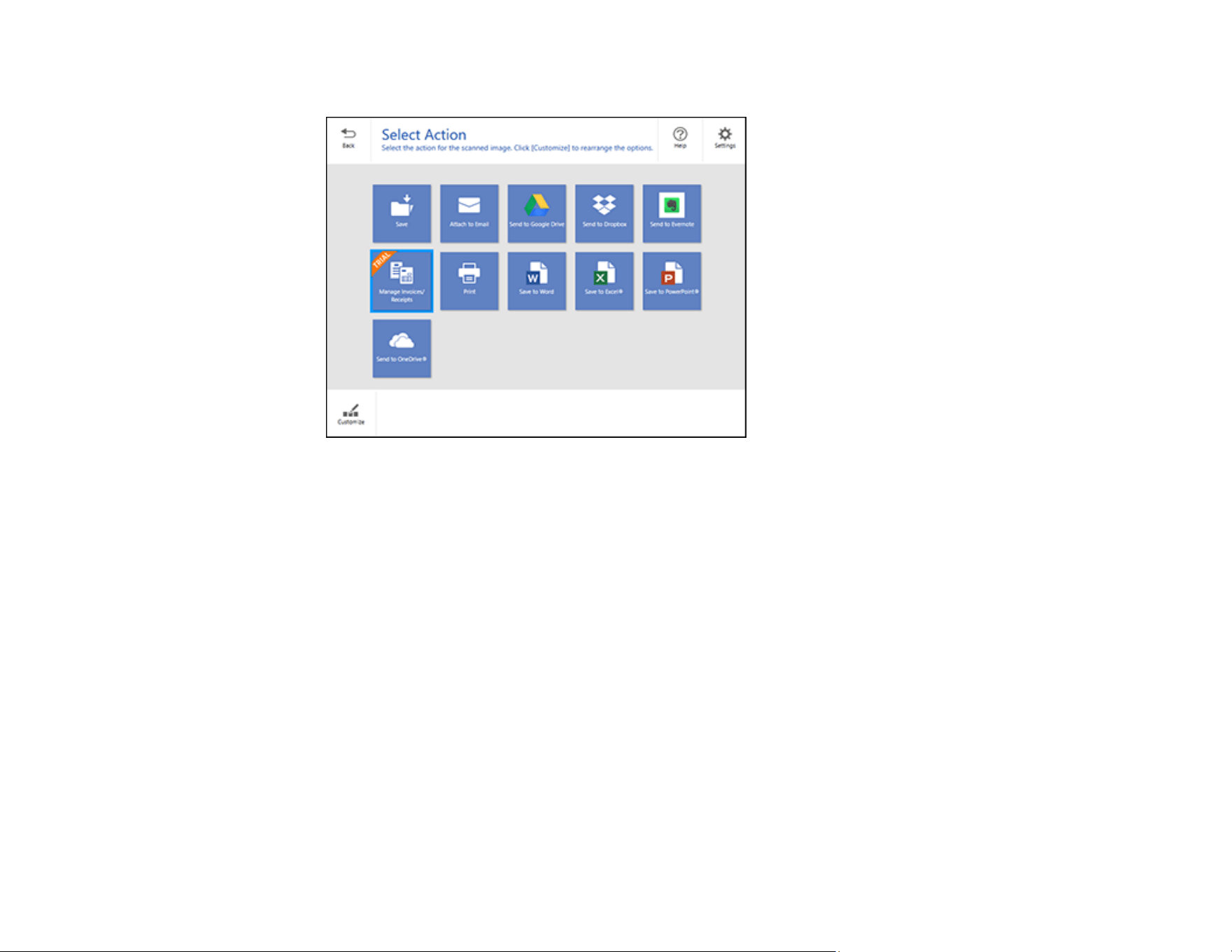
You see a screen like this:
6. Select an option to save, send, or print the scanned images. See the links below.
Saving a Scan
Attaching a Scan to Email
Sending a Scan to a Cloud Service
Printing a Scan
52
Saving a Scan as a Microsoft Office Format File
Parent topic: Scanning
Related tasks
Loading Originals in the Input Tray
Customizing Action Icons
Changing the Scanner
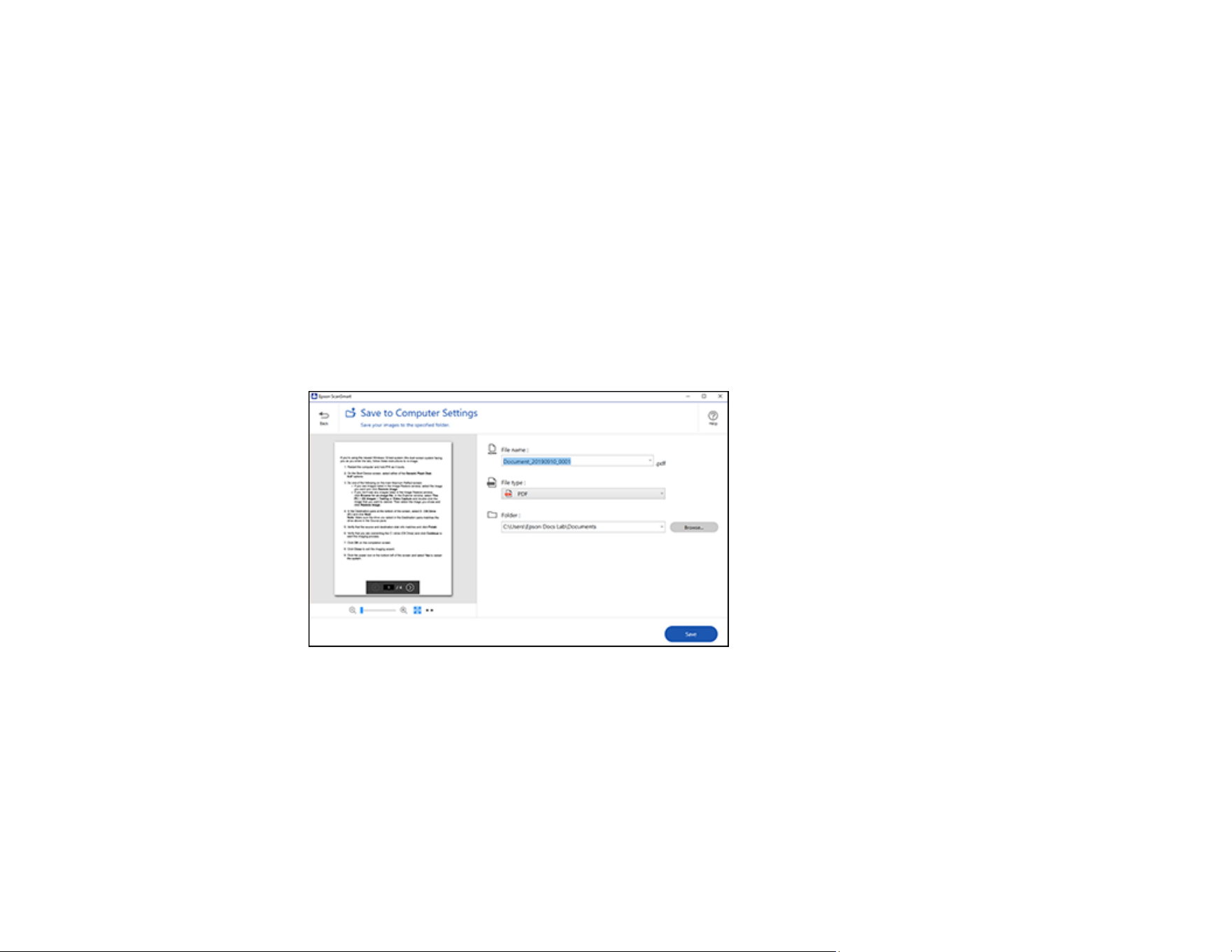
Saving a Scan
You can save a scanned image to your computer in a variety of formats.
1. Make sure your originals are scanned and reviewed. See the link below.
2. In the Select Action window, click Save.
You see a screen like this:
3. Change the settings as follows:
• The document type and scan date for the file name are automatically detected. You can change
them as necessary.
• You can save the scanned image in a variety of formats. If you select Searchable PDF as the File
type setting, you can select the OCR (Optical Character Recognition) language.
• Select the folder on your computer in which to save the file.
53
4. Click Save.
Parent topic: Scanning a Document in Epson ScanSmart
Attaching a Scan to Email
You can attach a scanned image to an email as a file attachment.
Note: Your email app and account settings should be configured before scanning. You must install a
MAPI-type email program such as Outlook Express, Windows Live Mail, Entourage, or Mac Mail. Web-
based email services such as Gmail are not supported. If you do not have a supported email program,
you see an error message.
1. Make sure your originals are scanned and reviewed. See the link below.
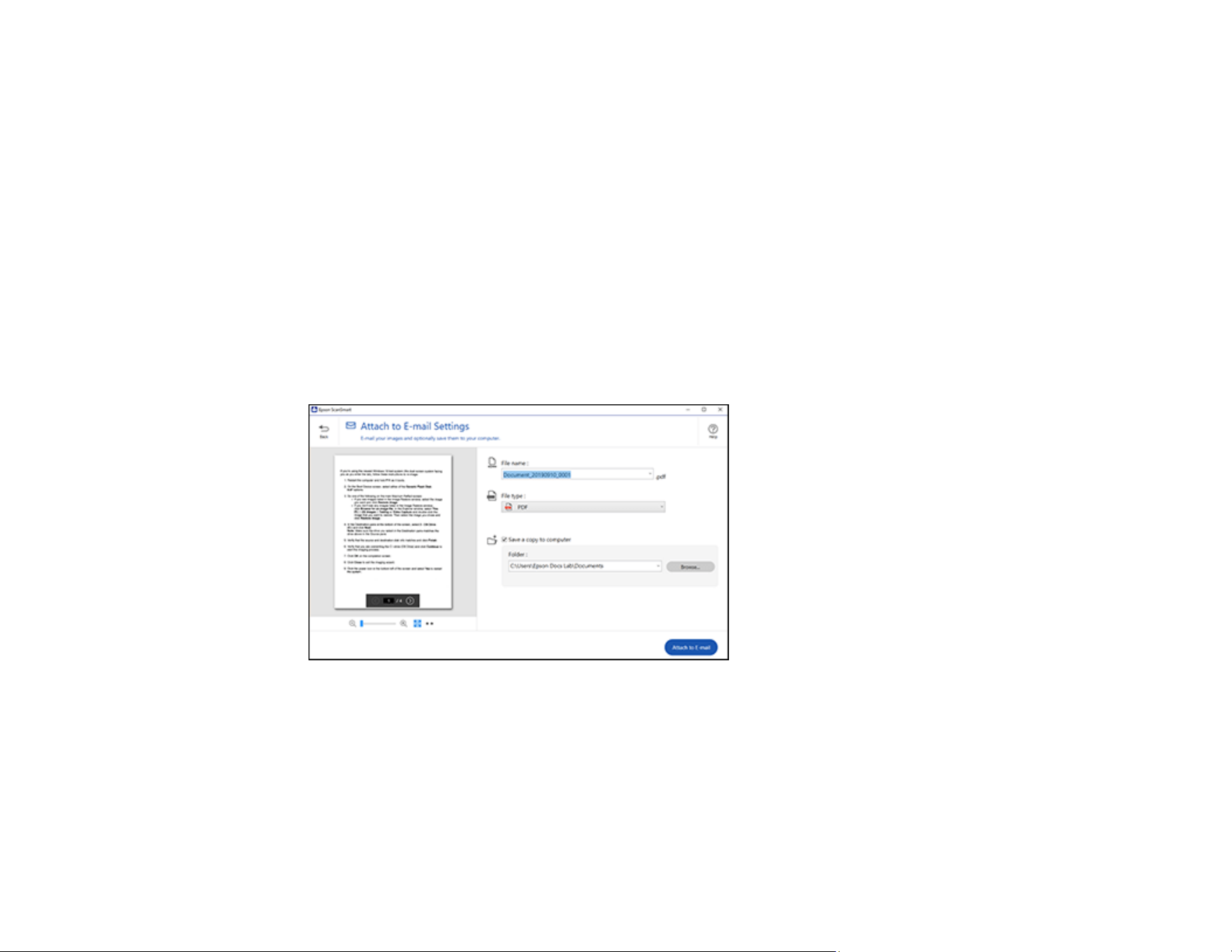
2. In the Select Action window, click Attach to Email.
You see a screen like this:
3. Change the settings as follows:
• The document type and scan date for the file name are automatically detected. You can change
them as necessary.
• You can save the scanned image in a variety of formats. If you select Searchable PDF as the File
type setting, you can select the OCR (Optical Character Recognition) language.
54
• If you also want to save a copy of the scanned image to your computer, make sure the checkbox
is selected and select the folder on your computer in which to save the file.
4. Click Attach to E-mail.
Your email program opens with the file attached to a new email.
Parent topic: Scanning a Document in Epson ScanSmart
Sending a Scan to a Cloud Service
You can upload scanned images to a cloud service.
1. Make sure your originals are scanned and reviewed. See the link below.
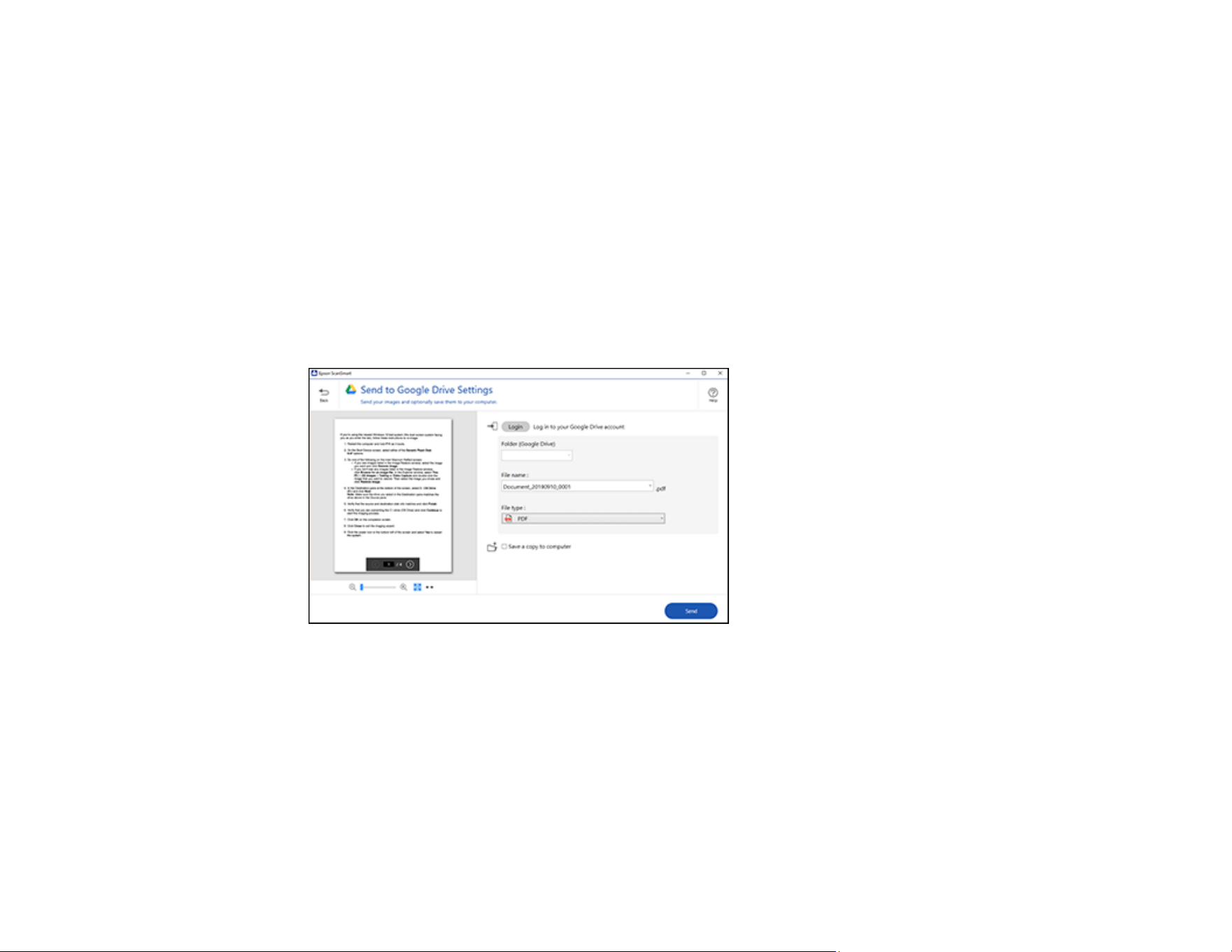
2. In the Select Action window, click one of the cloud service send options.
You see a screen like this:
3. Log in to your account.
Note: You may need to allow Epson ScanSmart access to your account. The first time you log in,
you may be prompted to enter an authentication code.
4. Change the settings as follows:
• Select the folder in your account where you want to send the document.
55
• The document type and scan date for the file name are automatically detected. You can change
them as necessary.
• You can save the scanned image in a variety of formats. If you select Searchable PDF as the File
type setting, you can select the OCR (Optical Character Recognition) language.
• If you also want to save a copy of the scanned image to your computer, click the checkbox.
5. Click Send.
Parent topic: Scanning a Document in Epson ScanSmart
Printing a Scan
You can print your scanned image and save the scanned file to your computer.
Note: Printing scanned images is available only with Epson printers.
1. Make sure your originals are scanned and reviewed. See the link below.
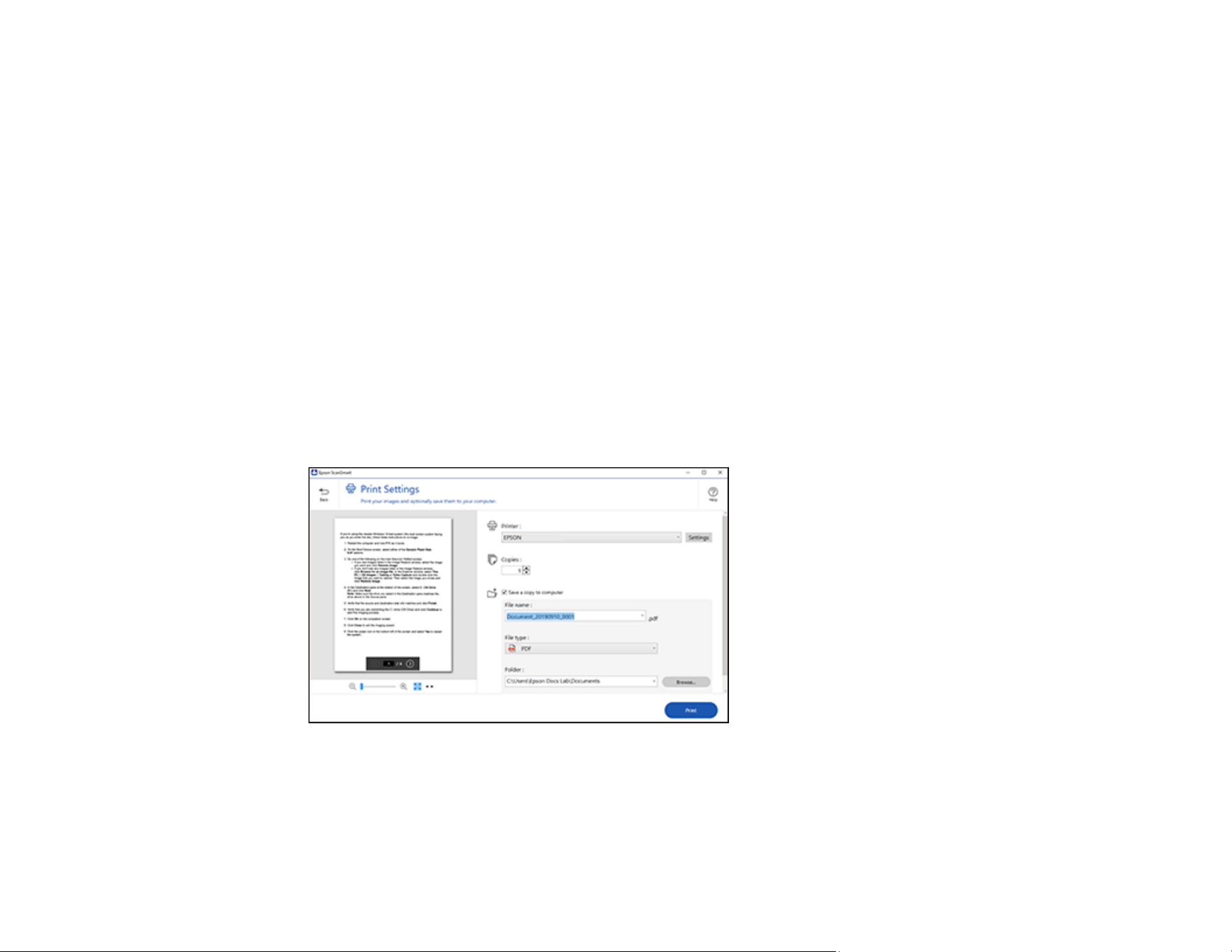
2. In the Select Action window, click Print.
You see a screen like this:
3. Change the settings as follows:
• Select the Epson printer and change the print settings, if necessary.
• Select the number of copies you want to print.
56
• If you also want to save a copy of the scanned image to your computer, click the checkbox.
• The document type and scan date for the file name are automatically detected. You can change
them as necessary.
• You can save the scanned image in a variety of formats. If you select Searchable PDF as the File
type setting, you can select the OCR (Optical Character Recognition) language.
• Select the folder on your computer in which to save the file.
4. Click Print.
Parent topic: Scanning a Document in Epson ScanSmart
Saving a Scan as a Microsoft Office Format File
You can save your scans in one of the following editable Microsoft Office file formats: Microsoft Word
(.docx), Microsoft Excel (.xlsx), or Microsoft PowerPoint (.pptx).
Note: The Save to PowerPoint option is only available for Windows.
1. Make sure your originals are scanned and reviewed. See the link below.
2. In the Select Action window, click one of the save to options.
Note: A first-time prompt may appear asking you to download a Microsoft Office plug-in. Click Yes
and follow any on-screen instructions.
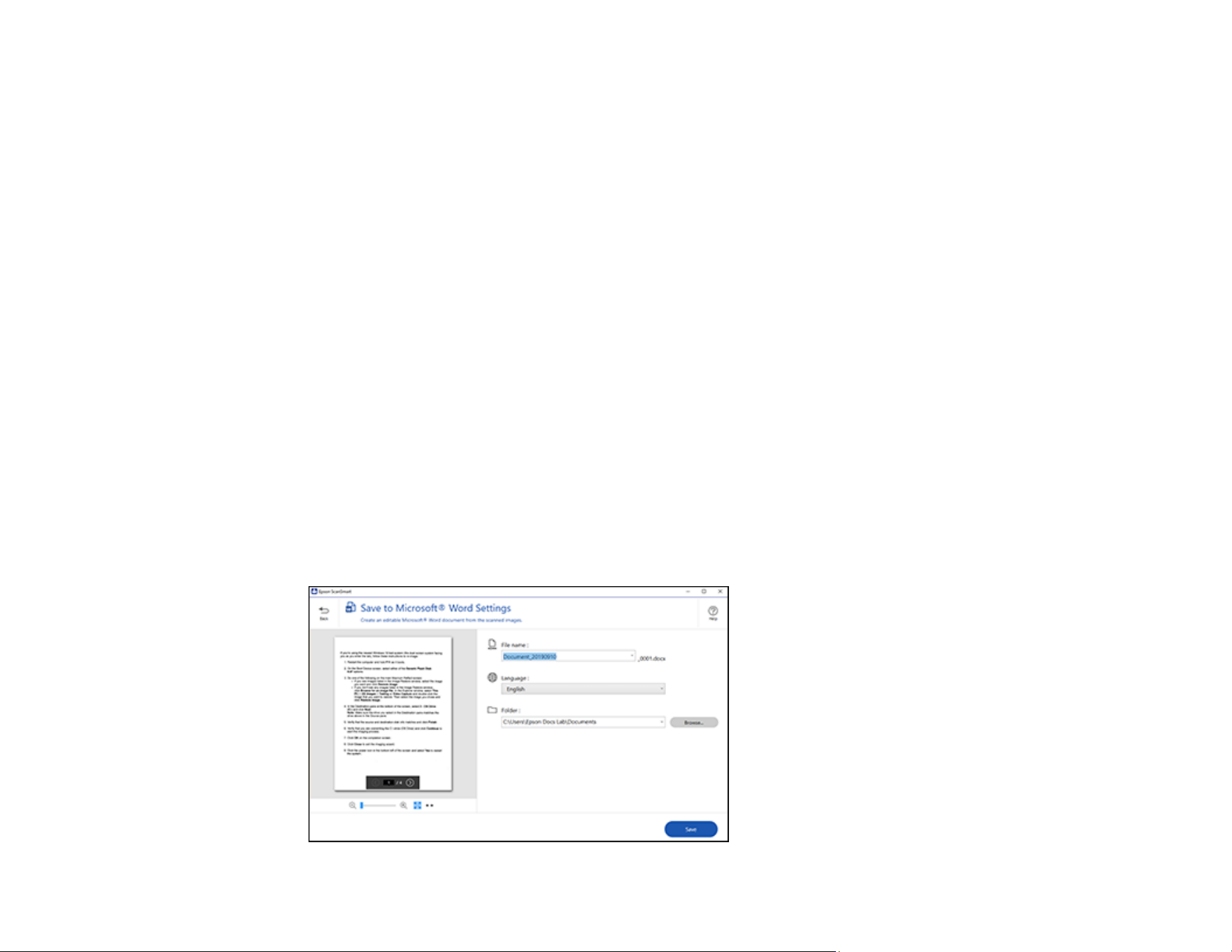
You see a screen like this:

57
3. Change the settings as follows:
• The document type and scan date for the file name are automatically detected. You can change
them as necessary.
• Select the OCR language (the default is English).
• Select the folder on your computer in which to save the file.
4. Click Save.
Parent topic: Scanning a Document in Epson ScanSmart
Selecting Epson ScanSmart Settings
After starting Epson ScanSmart, you can change various scanning settings.
Changing the Scanner
Changing the Scan Settings
Changing the File Name Settings
Changing the Save Settings
Save Settings
Customizing Action Icons
Parent topic: Scanning
Changing the Scanner
If you are using more than one scanner, you can change the scanner that you are using with your
computer.
58
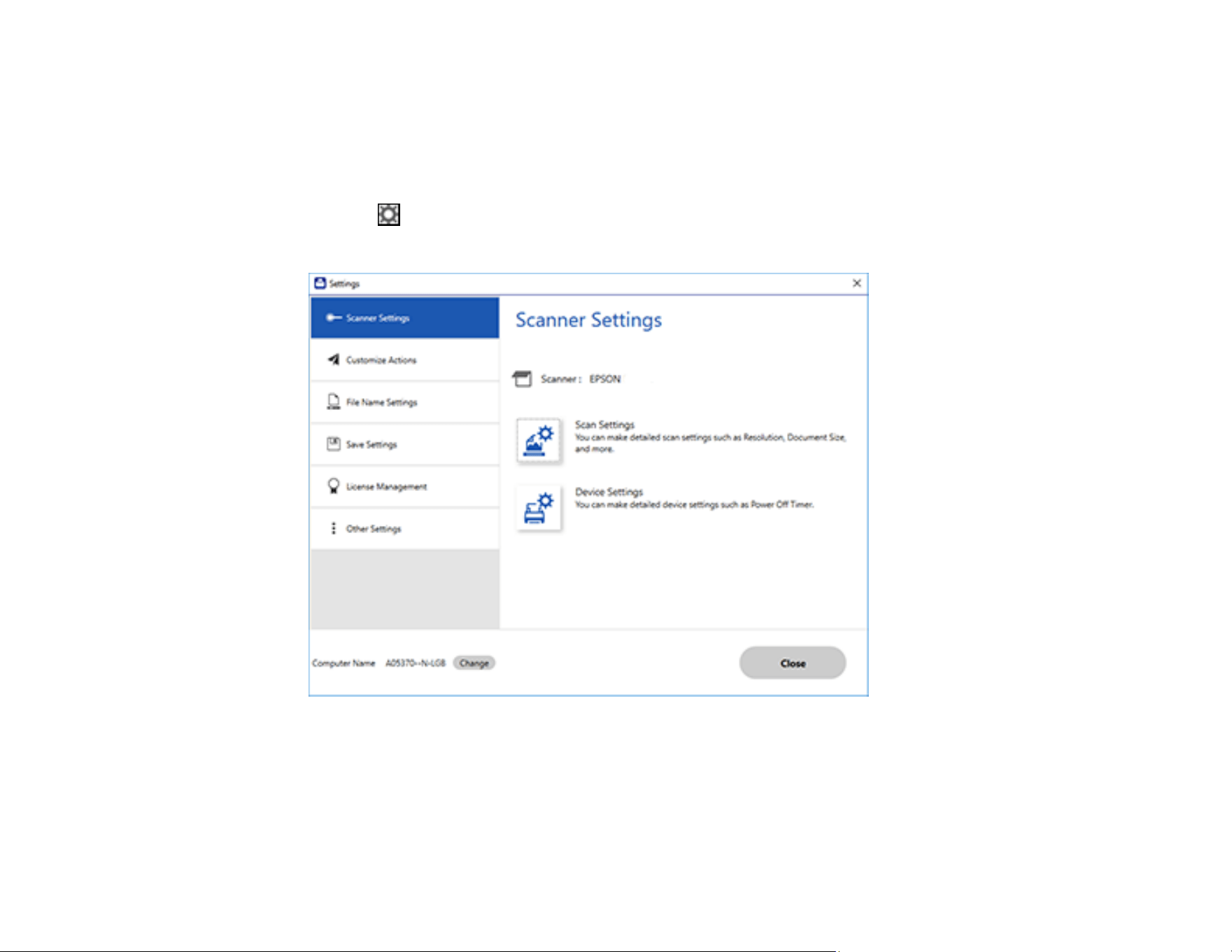
1. On the main Epson ScanSmart screen, click Change.
You see a screen like this:
59
2. Select the scanner you want to use with your computer and click OK.
Parent topic: Selecting Epson ScanSmart Settings
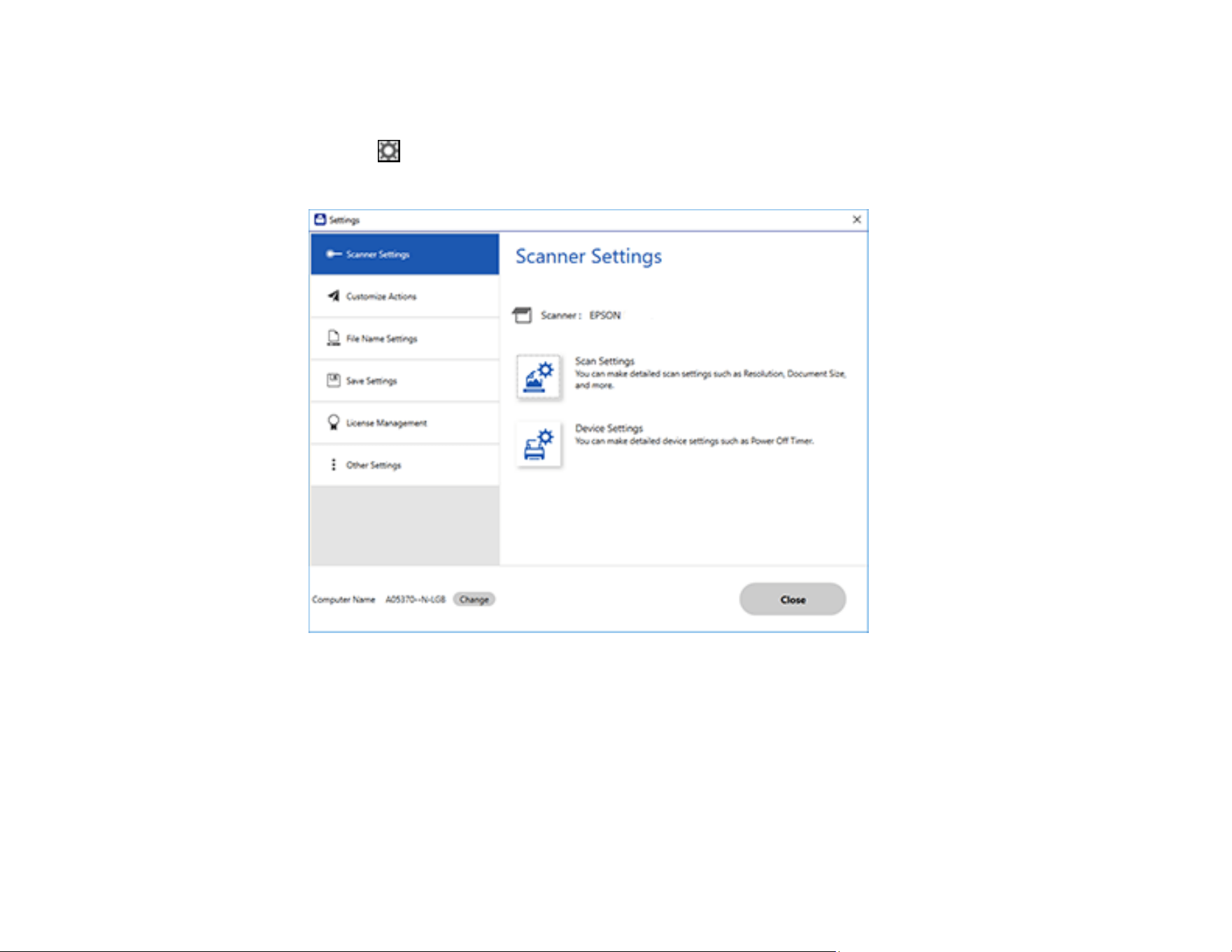
Changing the Scan Settings
You can change detailed scan settings such as the resolution, document size, and more.
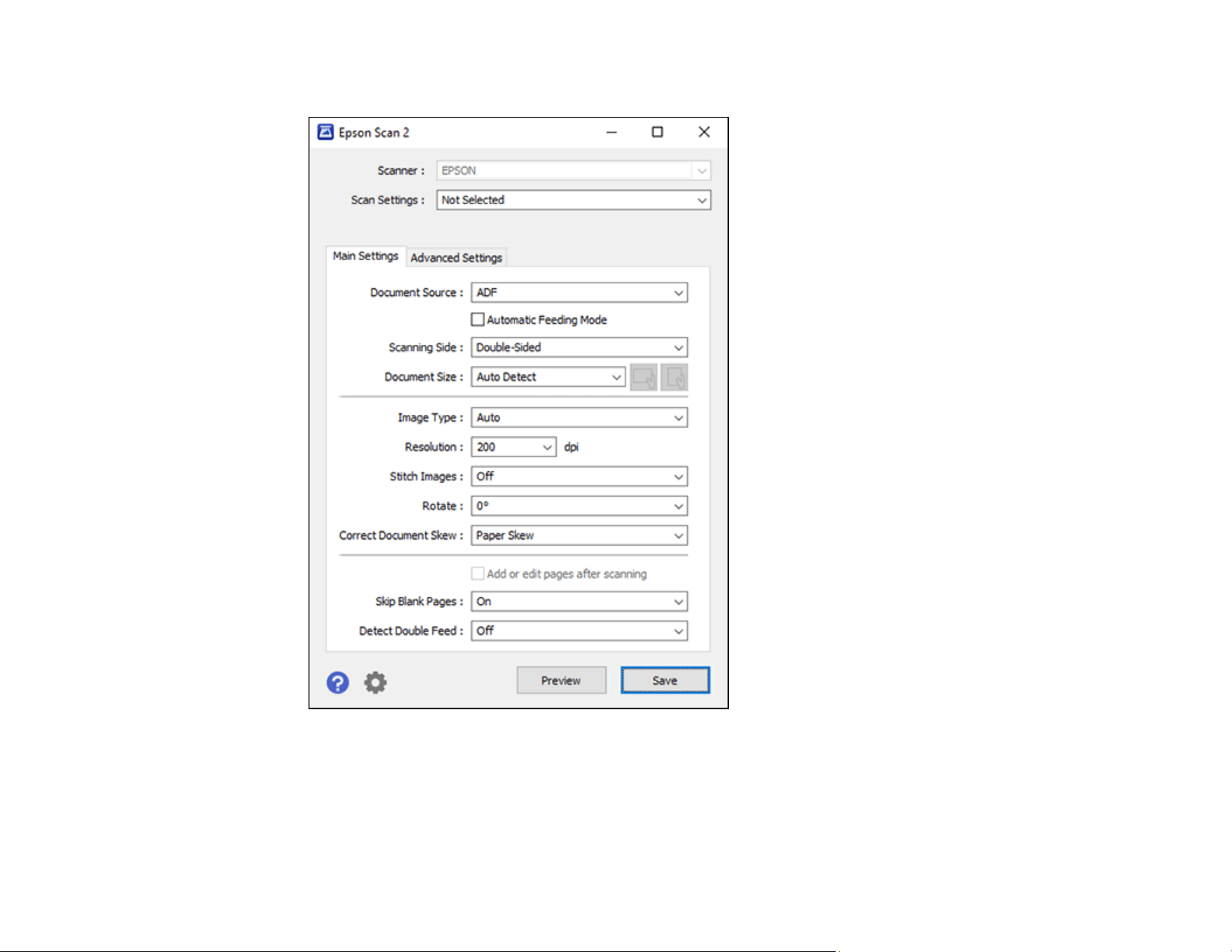
1. Click the Settings button.
You see a screen like this:
2. On the Scanner Settings tab, click Scan Settings.
61
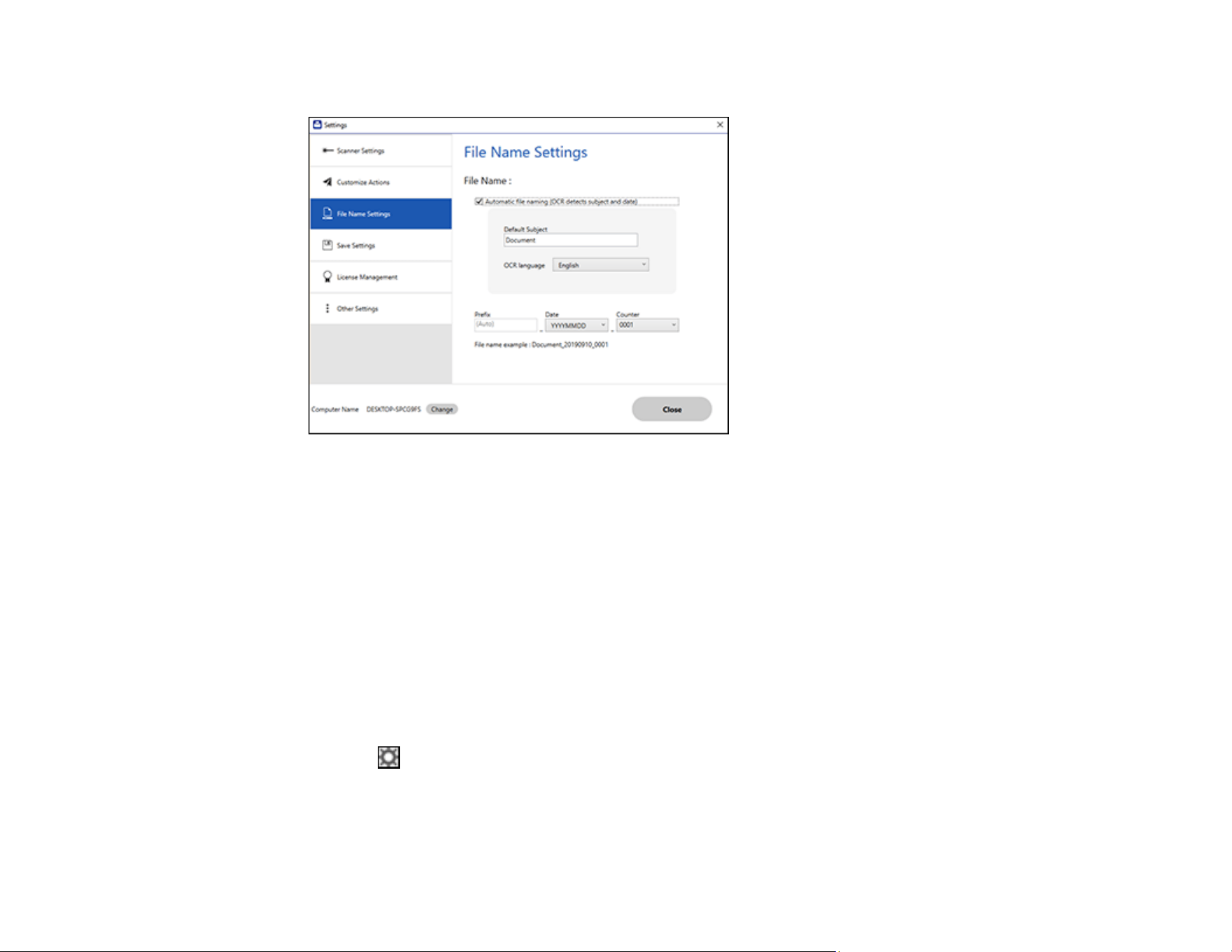
Changing the File Name Settings
You can change the default file naming method for your scans.
1. Click the Settings button.
You see a screen like this:
2. Click the File Name Settings tab.
62
You see a screen like this:
3. Change the settings as necessary:
• Make sure the Automatic file naming checkbox is selected if you want OCR to automatically
detect the subject and date and add them to the file name. You can enter a default file name that
will be used if OCR cannot detect the subject.
• Select the OCR language.
• Select the date format.
4. Click Close.
Parent topic: Selecting Epson ScanSmart Settings
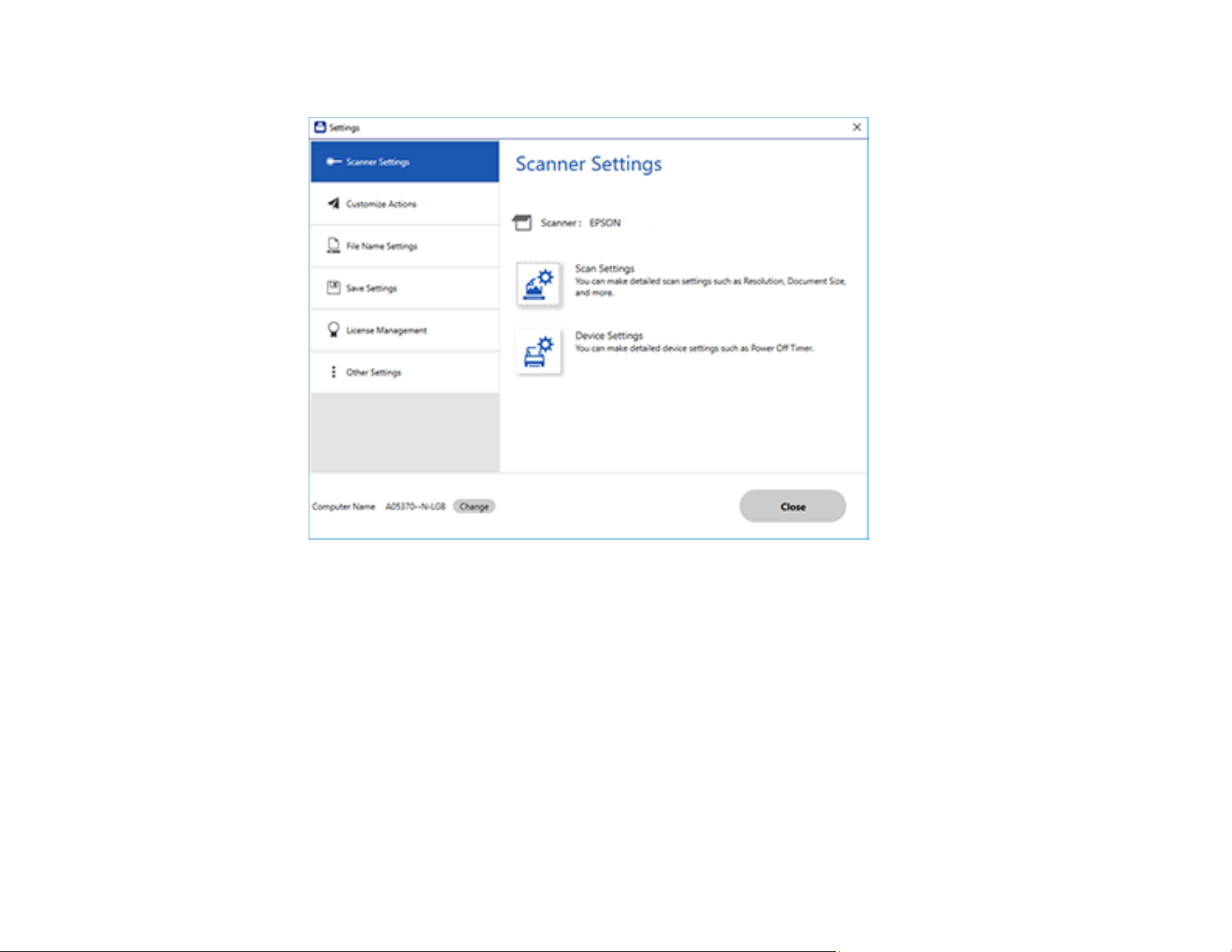
Changing the Save Settings
You can change the file type options for saving your scans.
1. Click the Settings button.
63
You see a screen like this:
2. Click the Save Settings tab.
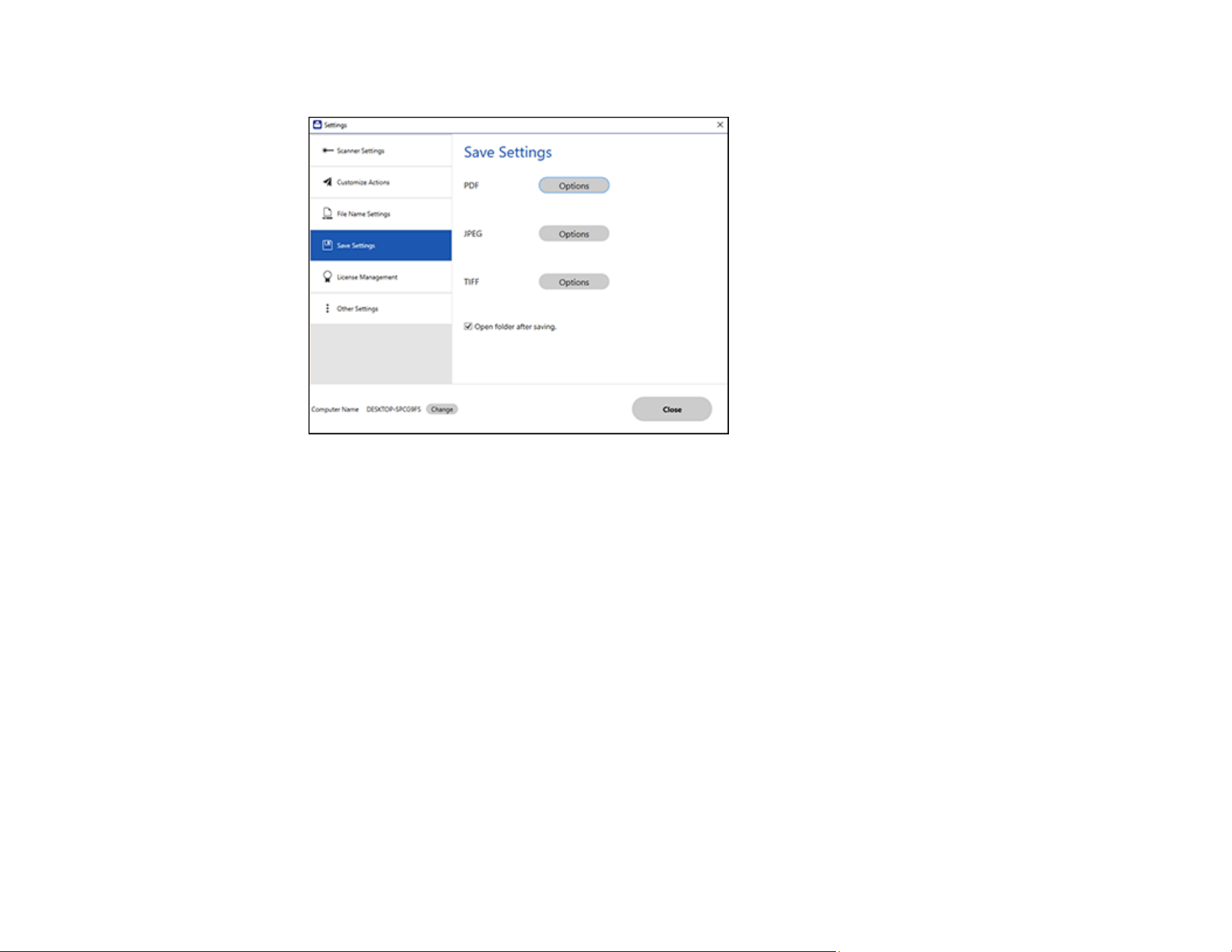
64
You see a screen like this:
3. Click Options for a file format and change the settings as necessary.
Note: If you want the folder to open after the file is saved, click the checkbox.
4. Click Close.
Parent topic: Selecting Epson ScanSmart Settings
Save Settings
You can change the settings for how scanned images are saved as PDFs or JPEGs.
PDF Options
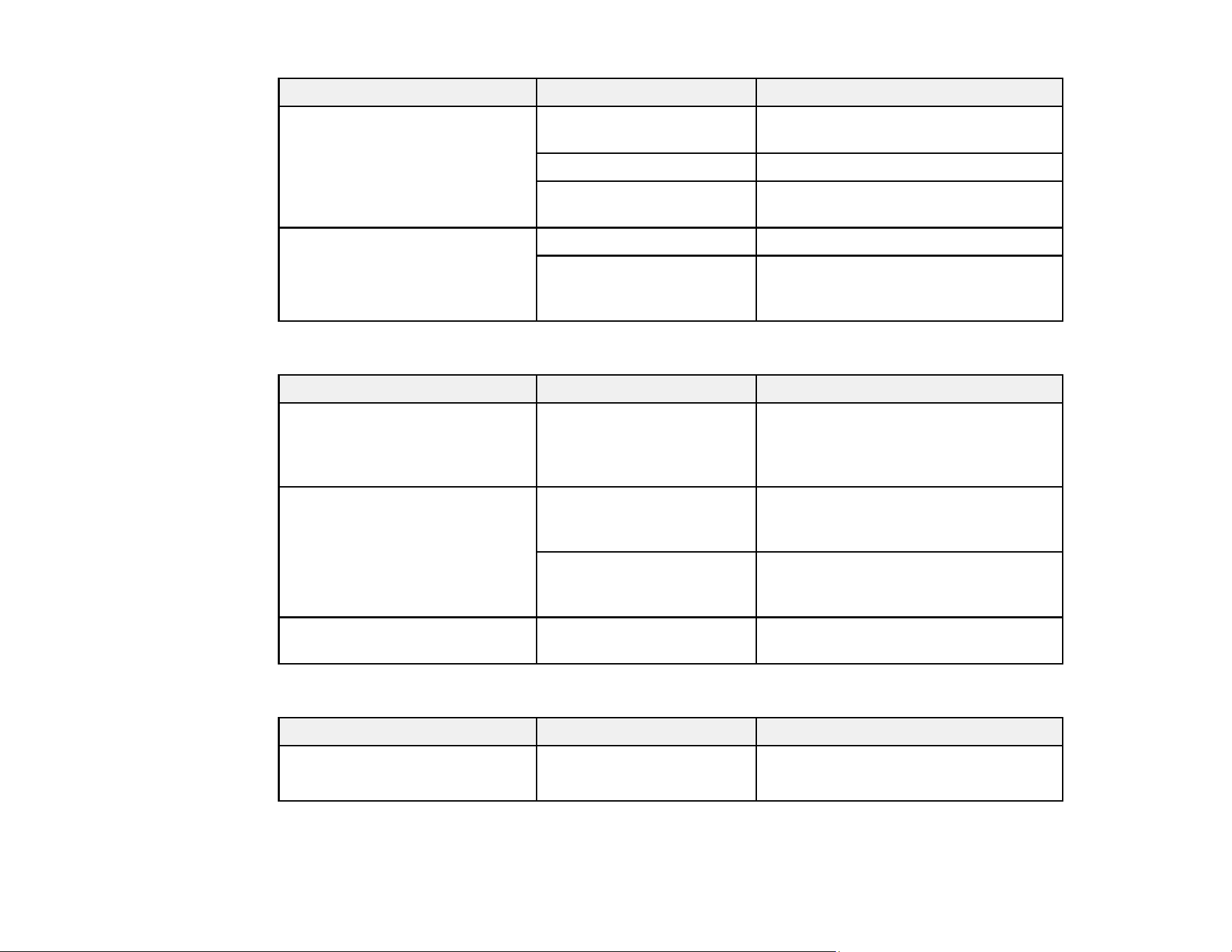
65
Setting Options Description
General Generate PDF/A File Creates a PDF that conforms to
PDF/A-1 standards
Create file with all pages Saves all pages as one file
Compression Level Selects the compression level for color
or grayscale images
Security Open File Password Set a password to open the file
Protect Property Settings Sets a password to protect file
properties and allows for restrictions on
file editing and printing
JPEG Options
Setting Options Description
Image Quality Options — Sets a compression level by moving a
slider or entering a value. File size
increases when high resolution is
selected.
Encoding (Windows only) Standard Images load from top to bottom in a
web browser. It takes longer to load the
entire image.
Progressive Images first load completely at low
resolution and then adjust to high
resolution in a web browser
Embed ICC Profile (Windows
only)
— Allows you to add ICC profiles to the
image
TIFF Options
Setting Options Description
Byte Order Windows
Macintosh
Specifies the operating system format
in which the scanned image is saved
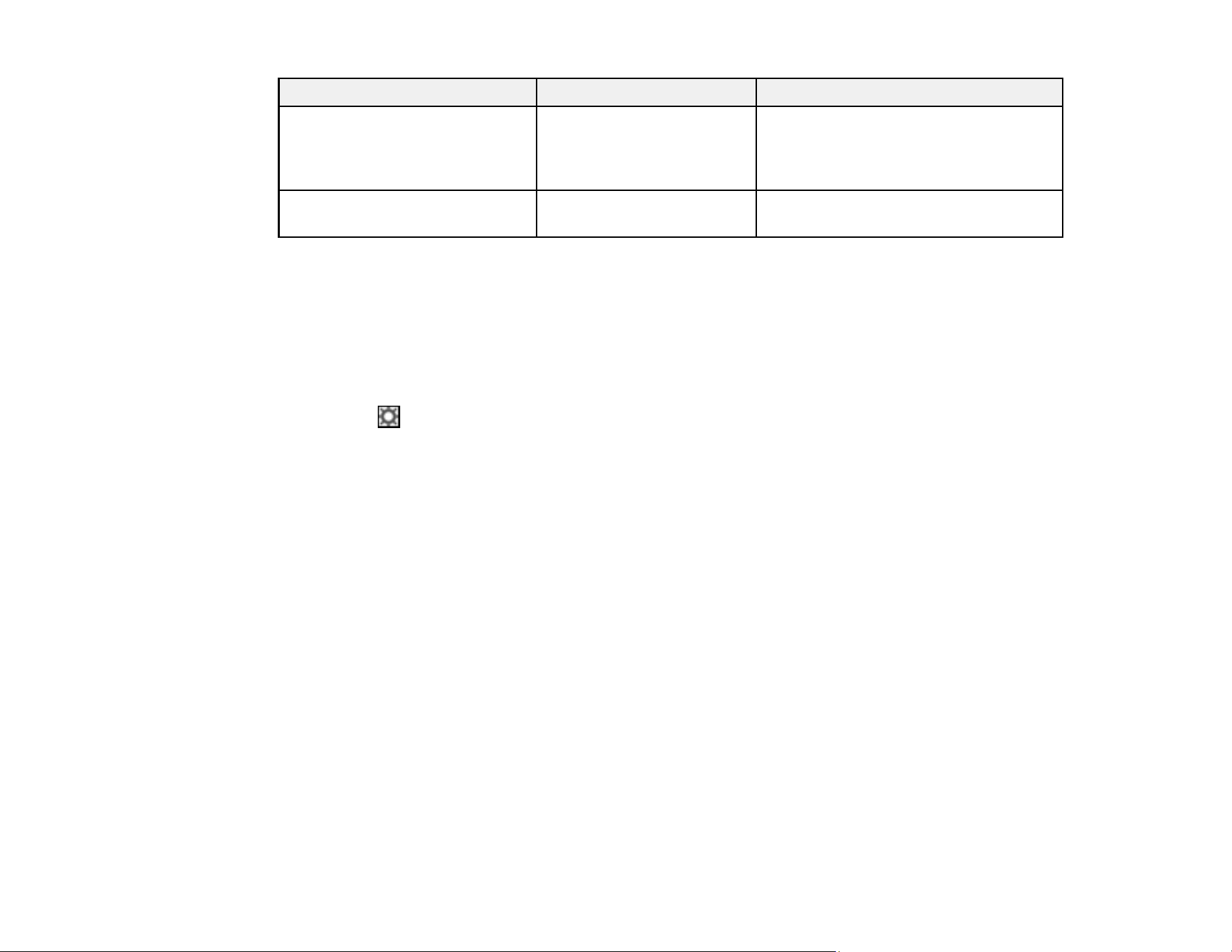
66
Setting Options Description
Compression (Windows only) — Specifies the compression format and
level for Color/Grayscale and B&W
images. File size increases with higher
quality.
Embed ICC Profile (Windows
only)
— Allows you to add ICC profiles to the
image
Parent topic: Selecting Epson ScanSmart Settings
Customizing Action Icons
You can customize how the scan action icons are displayed on the Select Action screen.
Note: You can also customize them by clicking the Customize icon on the Select Action screen.
1. Click the Settings button.
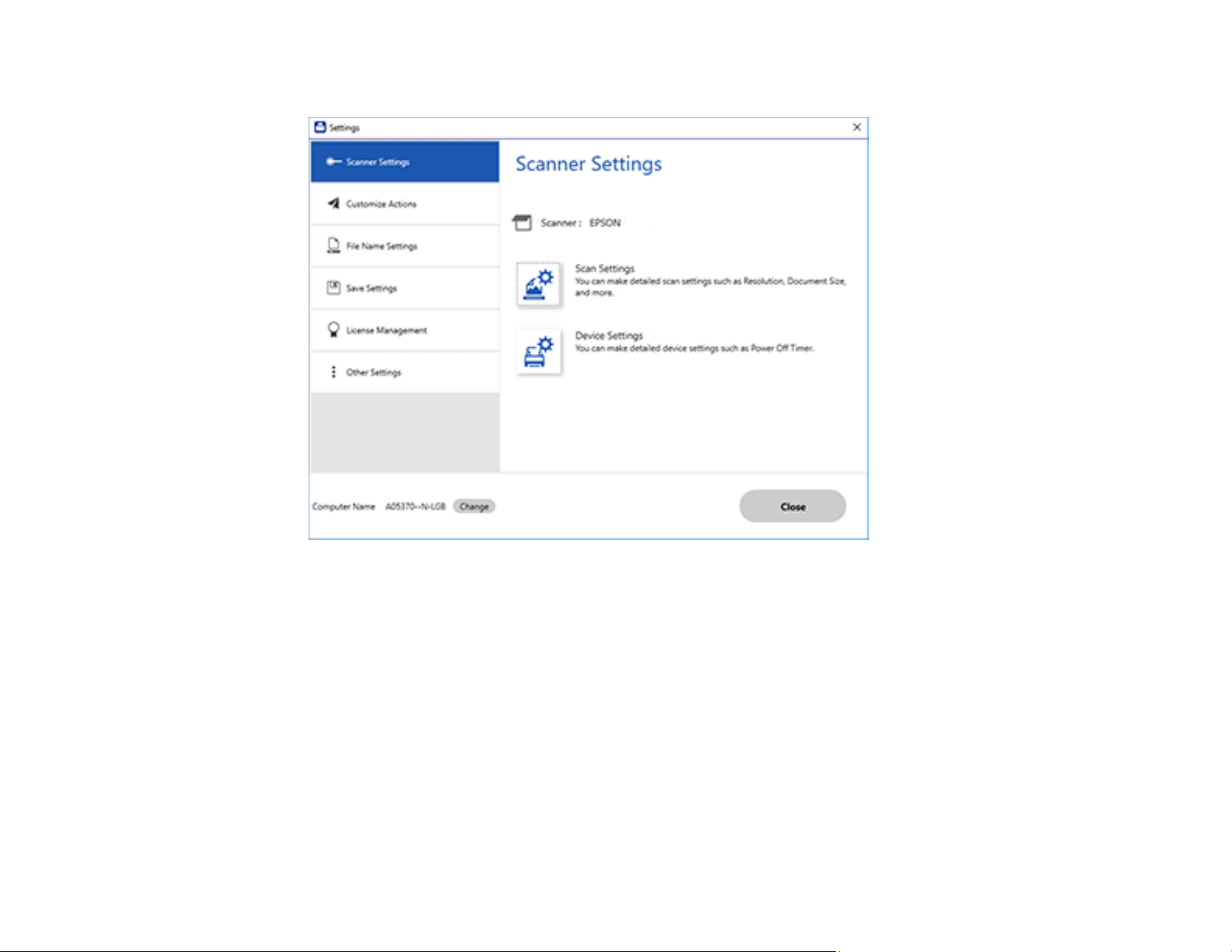
67
You see a screen like this:
2. Click the Customize Actions tab.
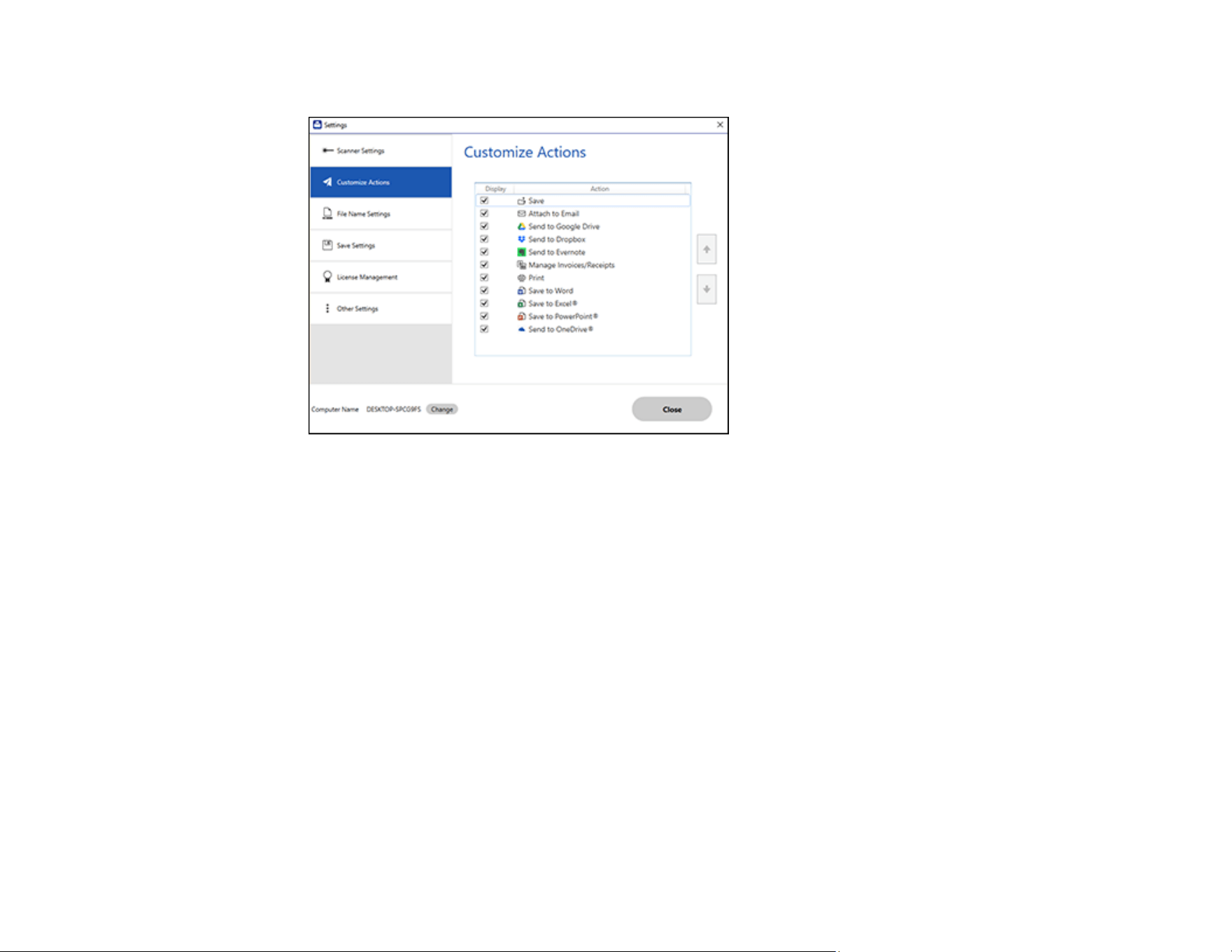
68
You see a screen like this:
3. Choose which action icons to display by selecting or deselecting each checkbox. Click the arrow
icons to move the icons up or down in the display order you want.
4. Click Close.
Parent topic: Selecting Epson ScanSmart Settings
Scanning Using Invoice/Receipt Manager
See these sections to activate Invoice/Receipt Manager software and start scanning invoices and
receipts.
Starting a Free Trial
Activating Invoice/Receipt Manager
Scanning Invoices and Receipts and Using Invoice/Receipt Manager
Parent topic: Scanning
Related references
Characters are Not Recognized During Conversion to Editable Text (OCR)
69
Starting a Free Trial
You can start a 30-day free trial of Invoice/Receipt Manager.
1. Do one of the following to start your free trial:
• Click the Manage Invoices/Receipts trial icon on the main Epson ScanSmart screen.
70
• Click the Manage Invoices/Receipts trial icon on the Select Action screen.
71
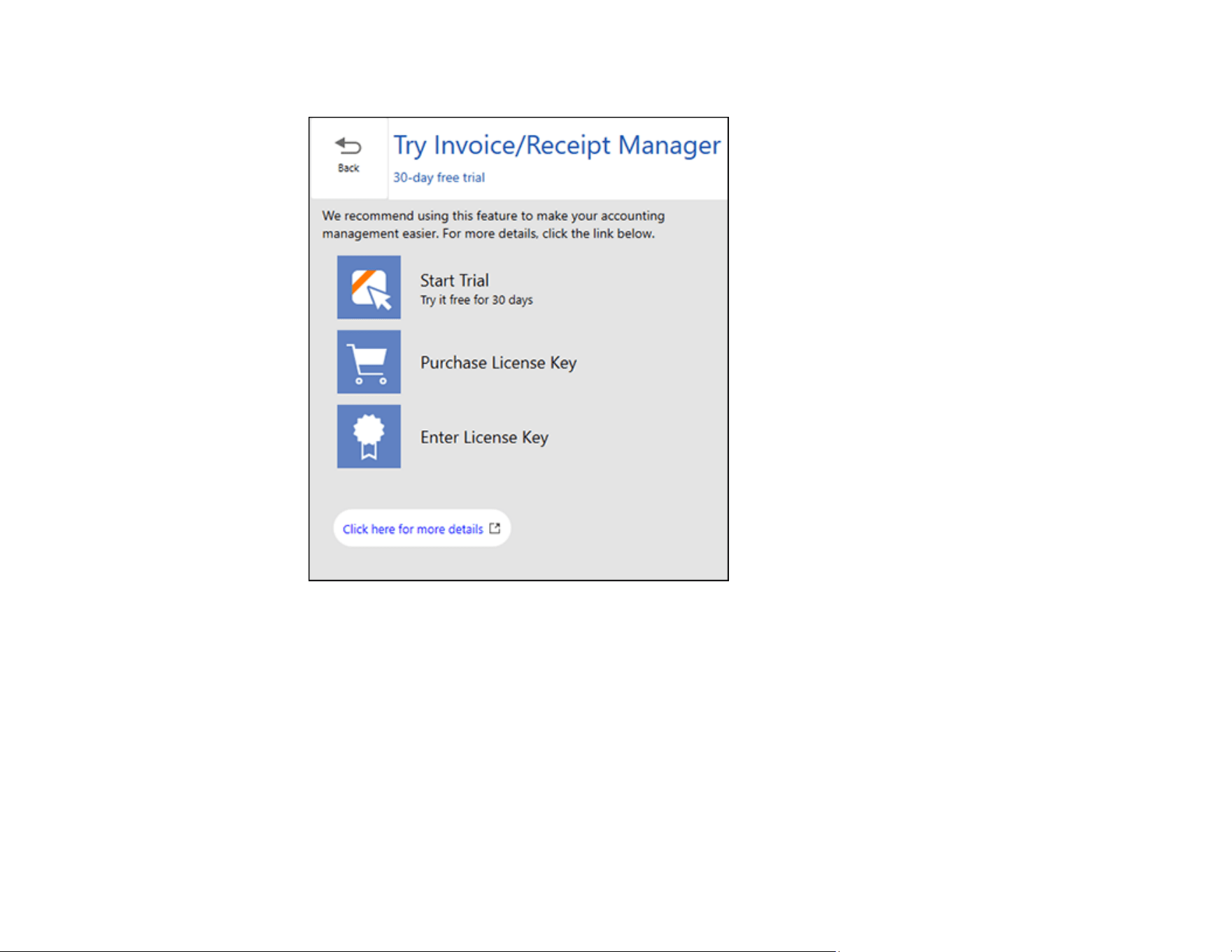
2. Select Start Trial.
Note: If you are ready to purchase a license key now, click Purchase License Key. The Epson
product page opens in your web browser. Complete the checkout process and make sure you enter
a valid email address where the license key will be sent to you. When you receive the license key,
click Enter License Key and enter it on the screen that appears, then click Activate. You can also
click the link below for instructions on activating Invoice/Receipt Manager from the Settings menu.
72
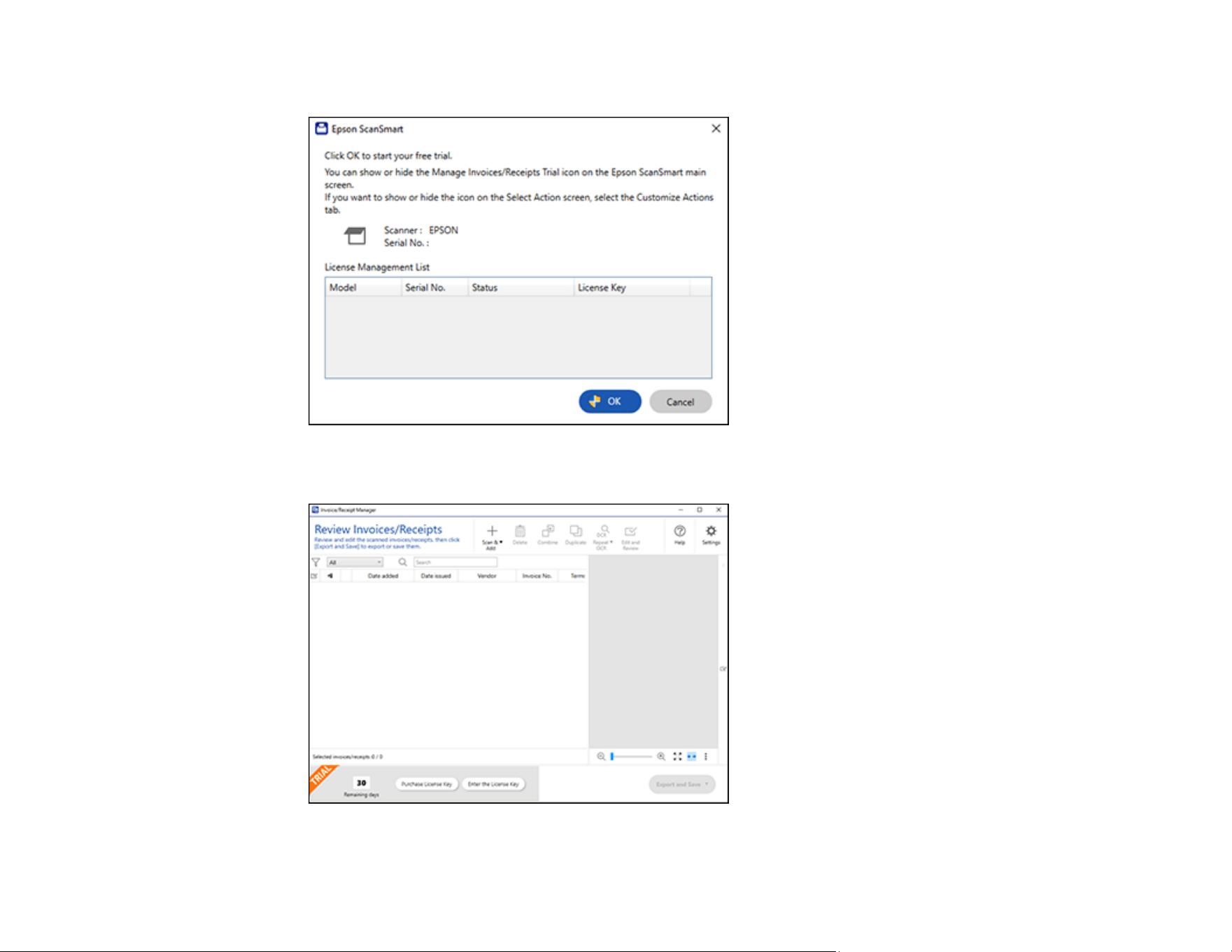
3. Make sure the scanner and serial number listed match your product and click OK.
4. Invoice/Receipt Manager opens and you can begin using its features.
73
When the 30-day trial expires, you can purchase a license key to continue using Invoice/Receipt
Manager features.
Hiding the Invoice/Receipt Manager Trial Icons
Parent topic: Scanning Using Invoice/Receipt Manager
Hiding the Invoice/Receipt Manager Trial Icons
You can hide the Invoice/Receipt Manager trial icons from the Epson ScanSmart screens.
1. Click the Settings button in Epson ScanSmart.
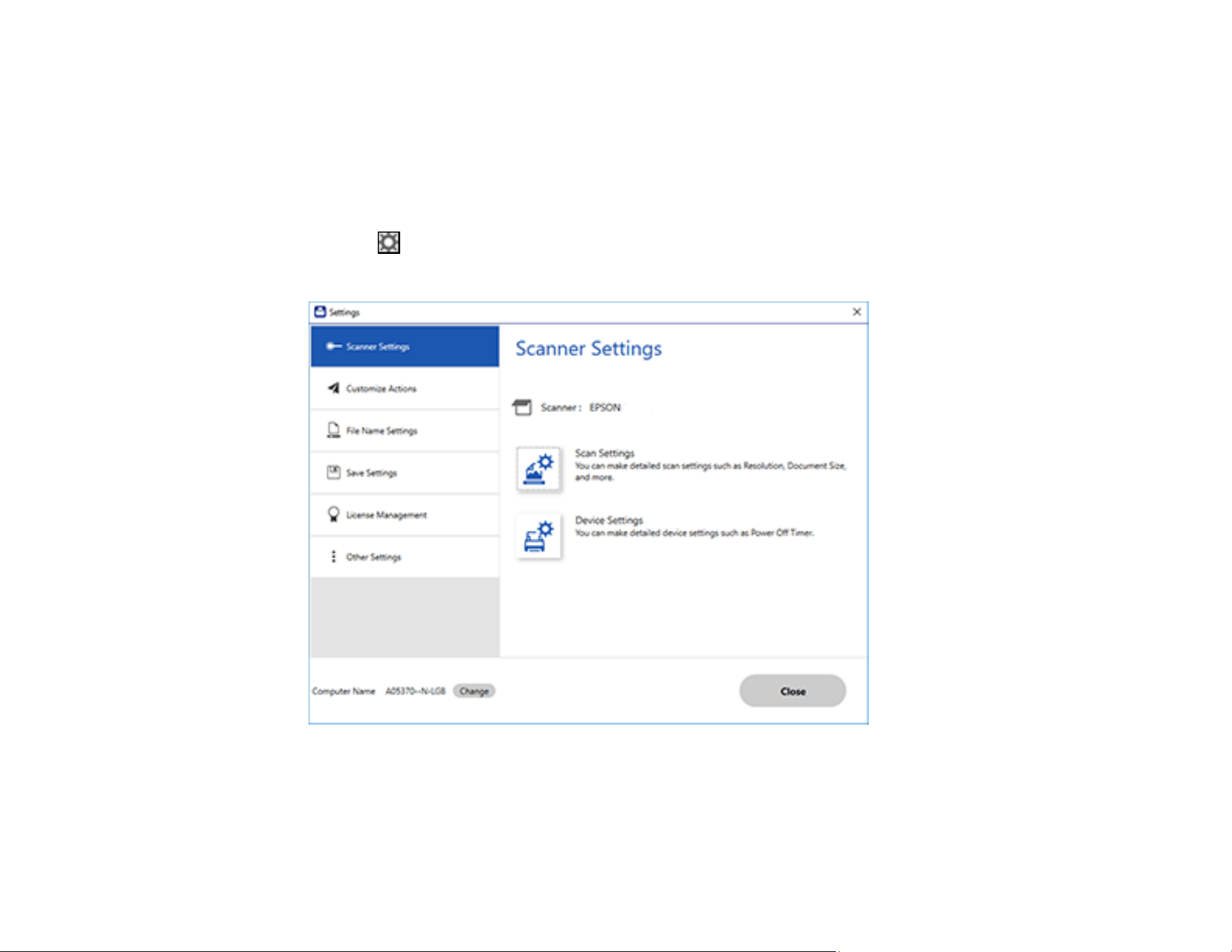
You see a screen like this:
2. Click the Other Settings tab.
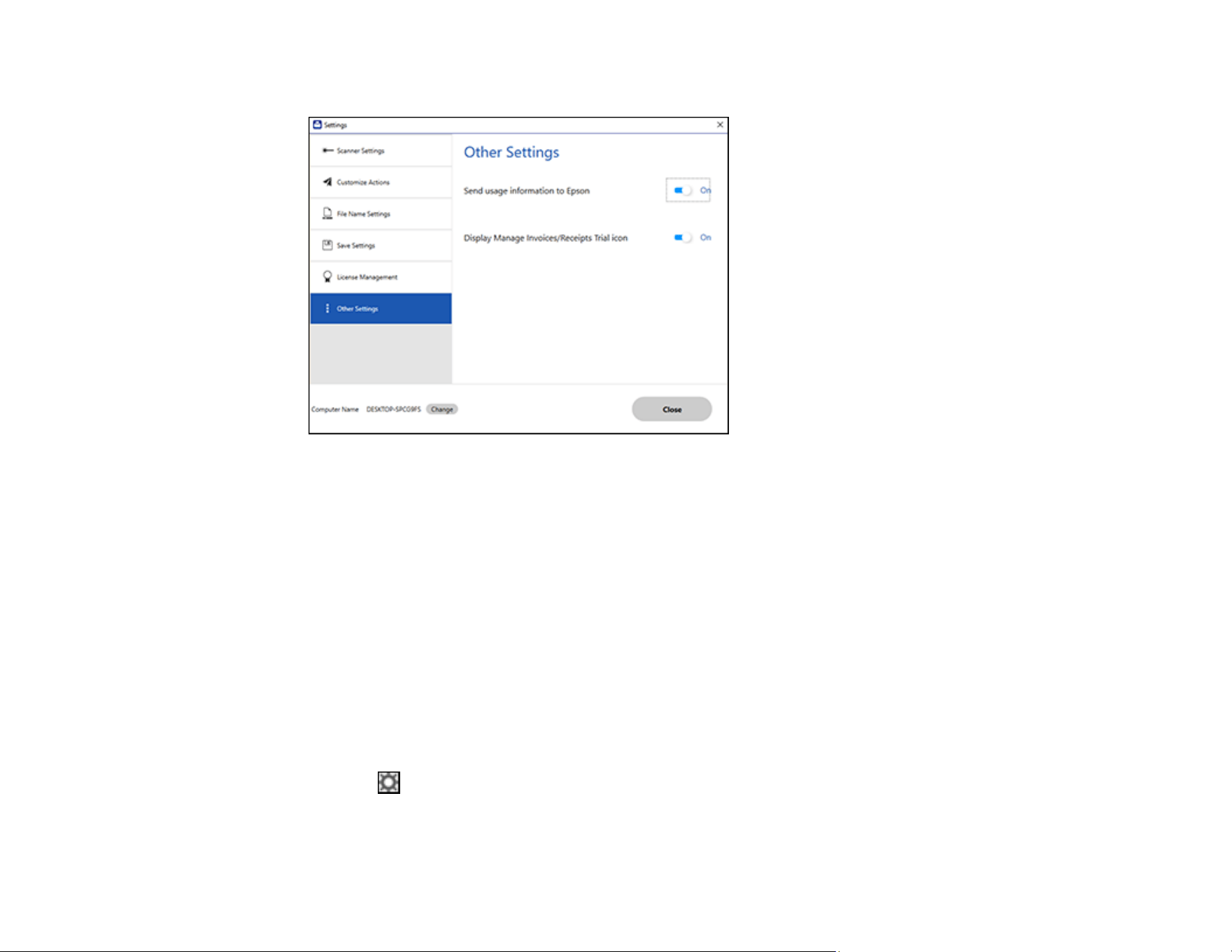
74
You see a screen like this:
3. Click the Display Manage Invoices/Receipts icon toggle button to hide or display the trial icon on
the main Epson ScanSmart screen.
Note: You can also hide or display the trial icon from the Select Action screen on the Customize
Actions tab.
4. Click Close.
Parent topic: Starting a Free Trial
Activating Invoice/Receipt Manager
You can purchase a license key to activate Invoice/Receipt Manager. An internet connection is required.
Note: The license key can only activate one scanner.
1. Click the Settings button in Epson ScanSmart.
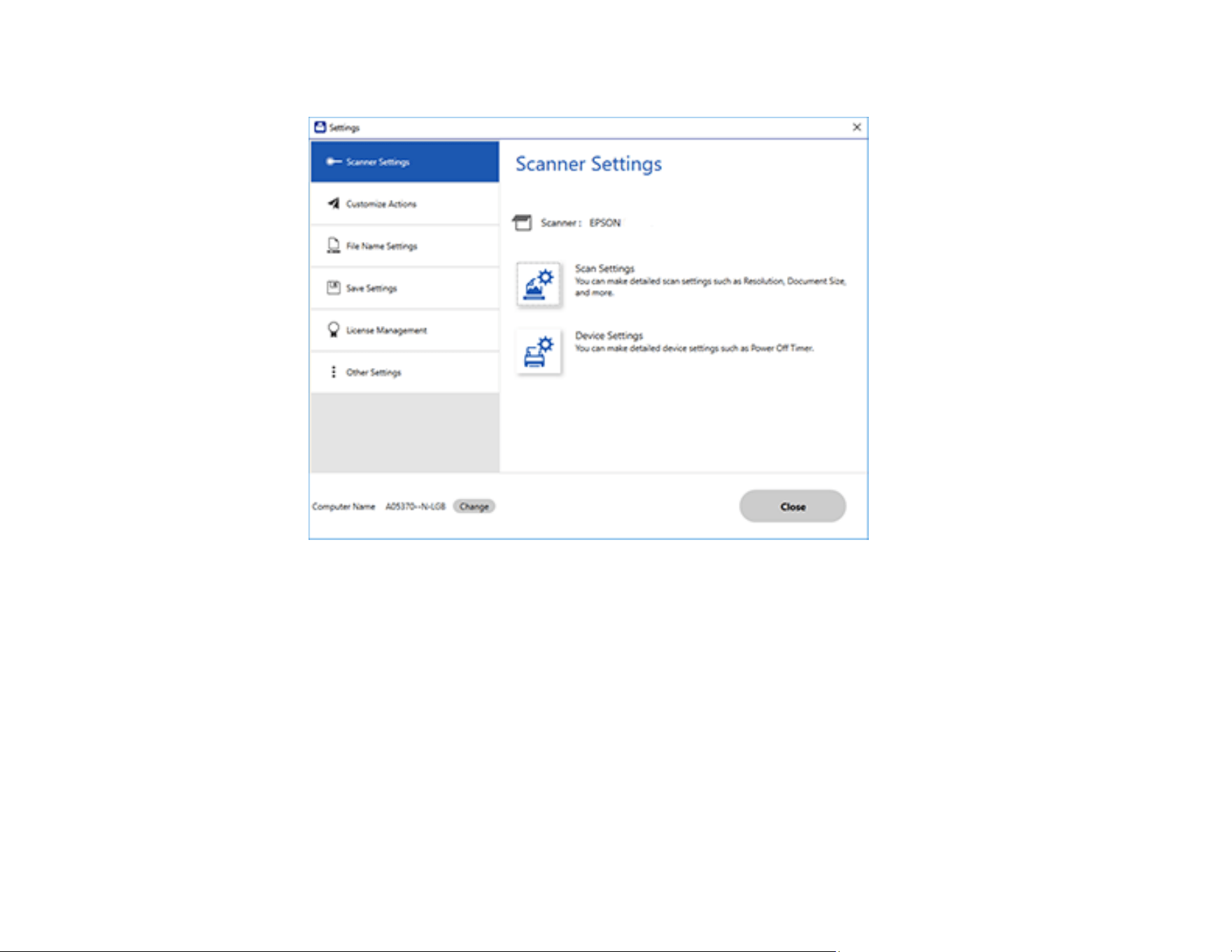
75
You see a screen like this:
2. Click the License Management tab.
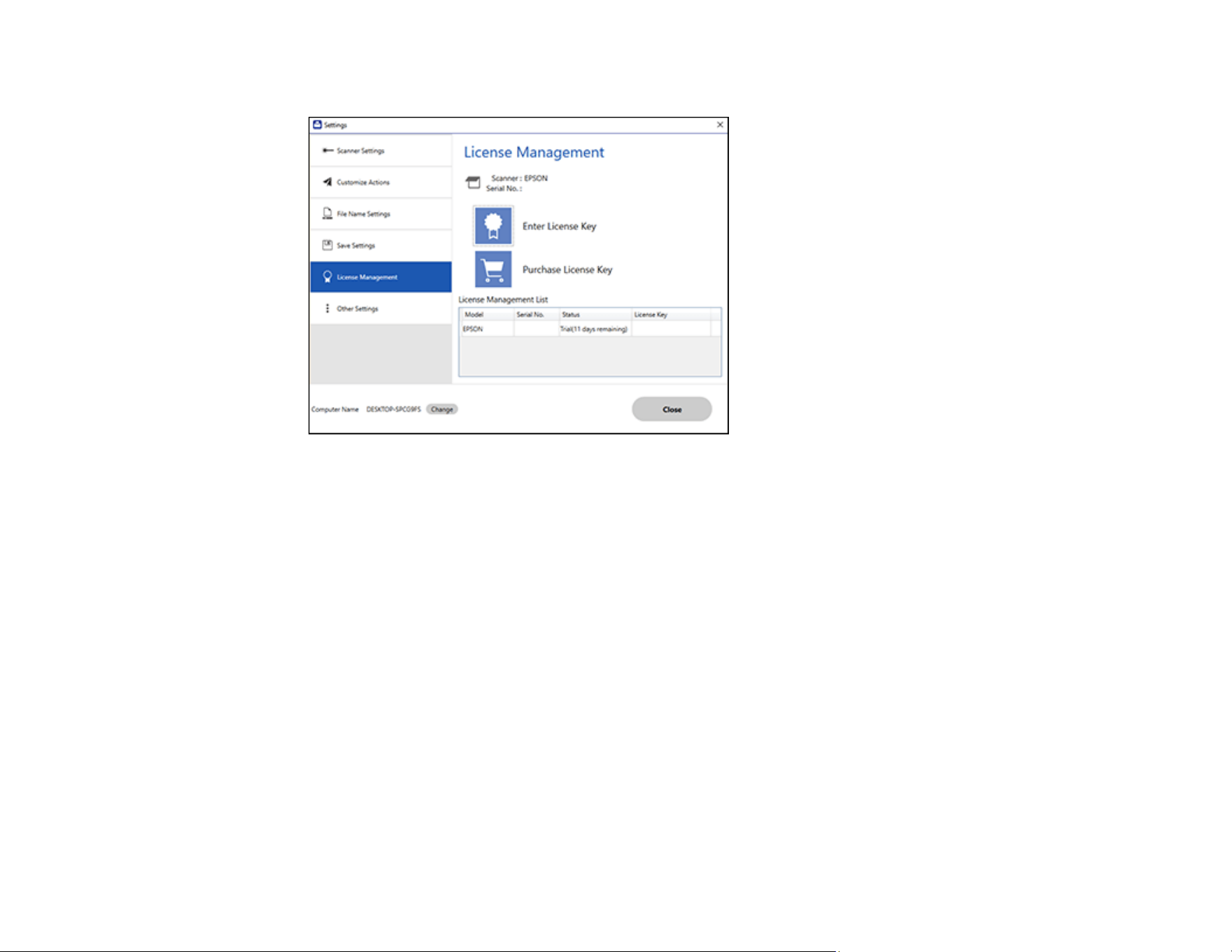
76
You see a screen like this:
3. To purchase a new license key, click Purchase License Key.
The Epson product page opens in your web browser where you can purchase the license key. If you
already have a license key, go to step 4.
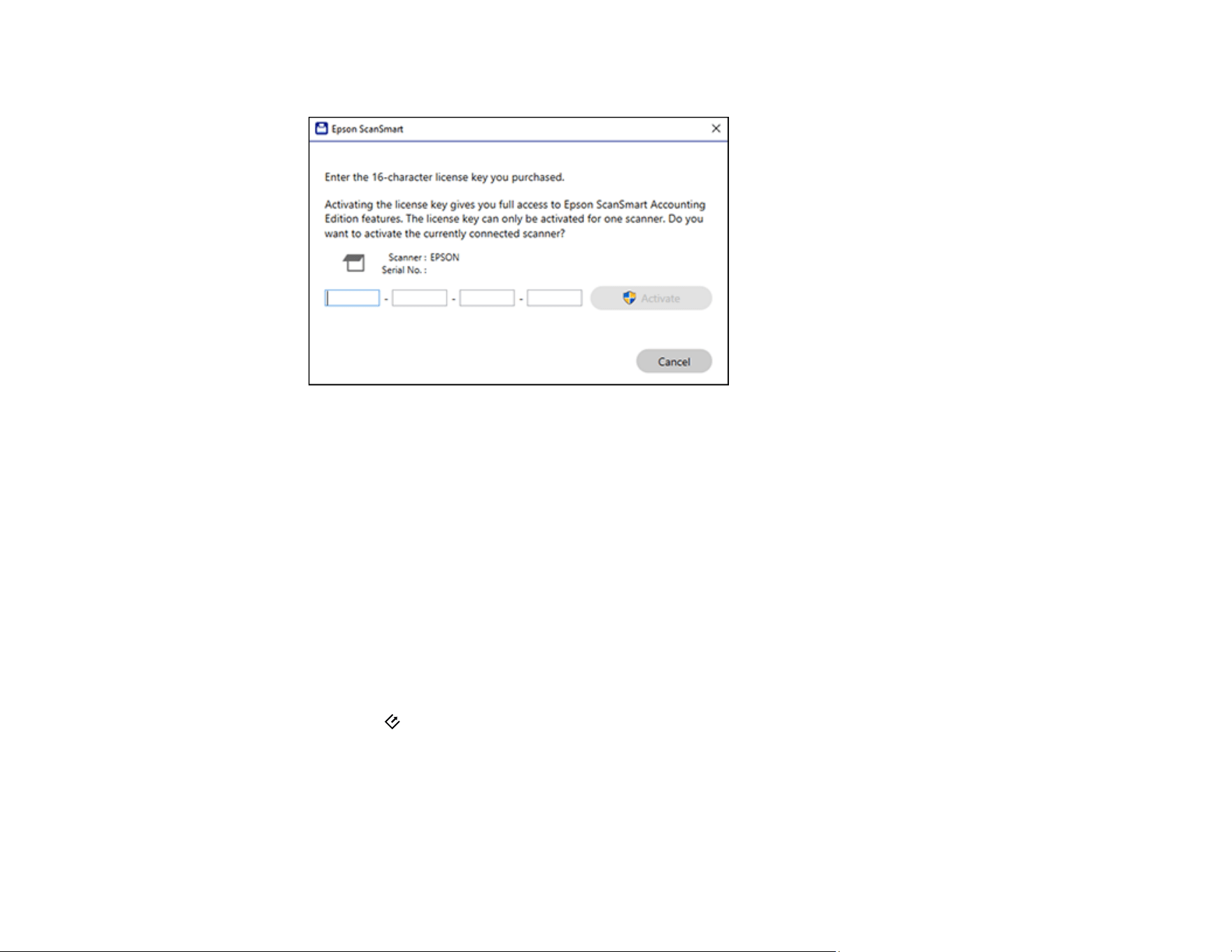
4. Make sure the scanner you want to activate the license key for is displayed at the top of the screen.
5. Click Enter License Key.
77
You see a screen like this:
6. Enter the license key you purchased and click Activate.
7. Click Yes on the next screen (Windows only).
8. When you see a message indicating that activation was successful, click OK.
The activated scanner and license key appear in the License Management List.
Parent topic: Scanning Using Invoice/Receipt Manager
Scanning Invoices and Receipts and Using Invoice/Receipt Manager
You can scan invoices and receipts and manage the data in Invoice/Receipt Manager.
Note: Invoice/Receipt Manager is available for select scanner models. Availability varies by country.
1. Load your original invoices or receipts into the scanner.
2. Press the start button on the scanner.
78
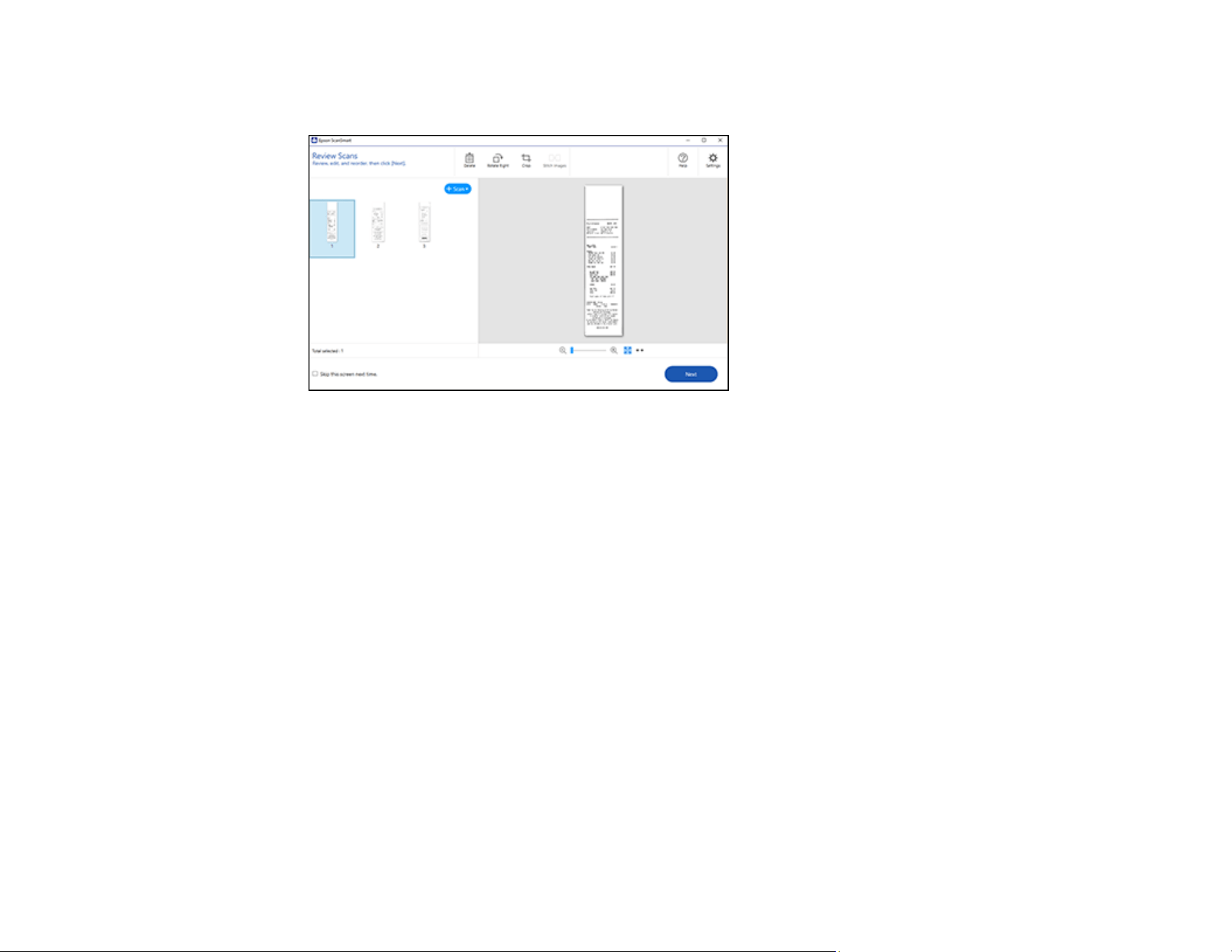
Epson ScanSmart automatically opens on your computer and the scan job begins. The invoices or
receipts feed through the scanner. When scanning is complete, you see a screen like this:
Note: You can also click Manage Invoices/Receipts from the main Epson ScanSmart screen to
open Invoice/Receipt Manager and begin scanning invoices and receipts.
3. You can review or reorder the scanned images as follows:
• Select Scan to scan more receipts.
• Select Delete to delete selected scanned images.
• Select Rotate Right to rotate scanned images.
• Select Crop to crop the selected image.
• Select Stitch Images to combine two selected images into one image.
• If you scanned double-sided, select On or Off for Include back sides if you want to keep or
discard the back sides of scanned images.
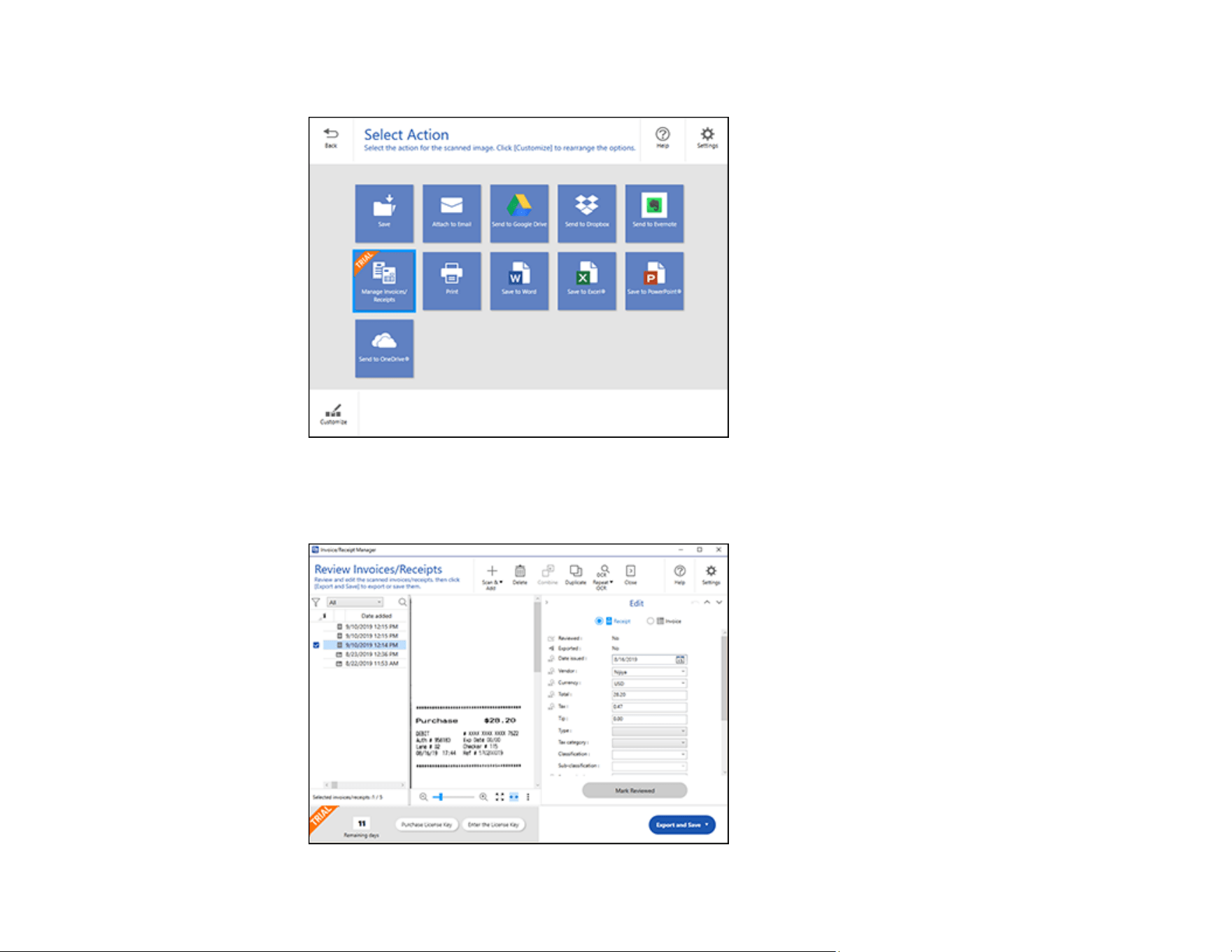
4. When you are finished reviewing the scanned images, click Next.
79
You see a screen like this:
5. Click Manage Invoices/Receipts.
You see a screen like this:

80
Note: If you are using the trial version of Invoice/Receipt Manager, you must click Continue Trial
each time you click Manage Invoices/Receipts.
6. In the Edit window, review the data against the scanned image and make sure it is correct. You can
also choose the following options:
• Select Scan & Add to scan more invoices or receipts.
• Select Delete to delete selected scanned images. Make sure the blue checkboxes are selected
for the invoices or receipts you want to delete.
• Select Combine to combine invoice or receipt data. Make sure the blue checkboxes are selected
for the invoices or receipts you want to combine.
Note: You cannot separate invoices or receipts once they are combined. You must delete and re-
scan them if you need to separate them.
• Select Duplicate to duplicate invoices or receipts. You can only duplicate one invoice or receipt at
a time. Make sure the invoice or receipt you want to duplicate is selected.
• Select Repeat OCR and select a language if the data fields were not populated.
Note: Some fields may need to be entered manually.
7. When you are finished reviewing the data for the first invoice or receipt, click Mark Reviewed.
The next invoice or receipt appears and you can review the data. Repeat for each invoice or receipt.
Note: Make sure the blue checkboxes are selected for the invoices or receipts you want to export or
save.
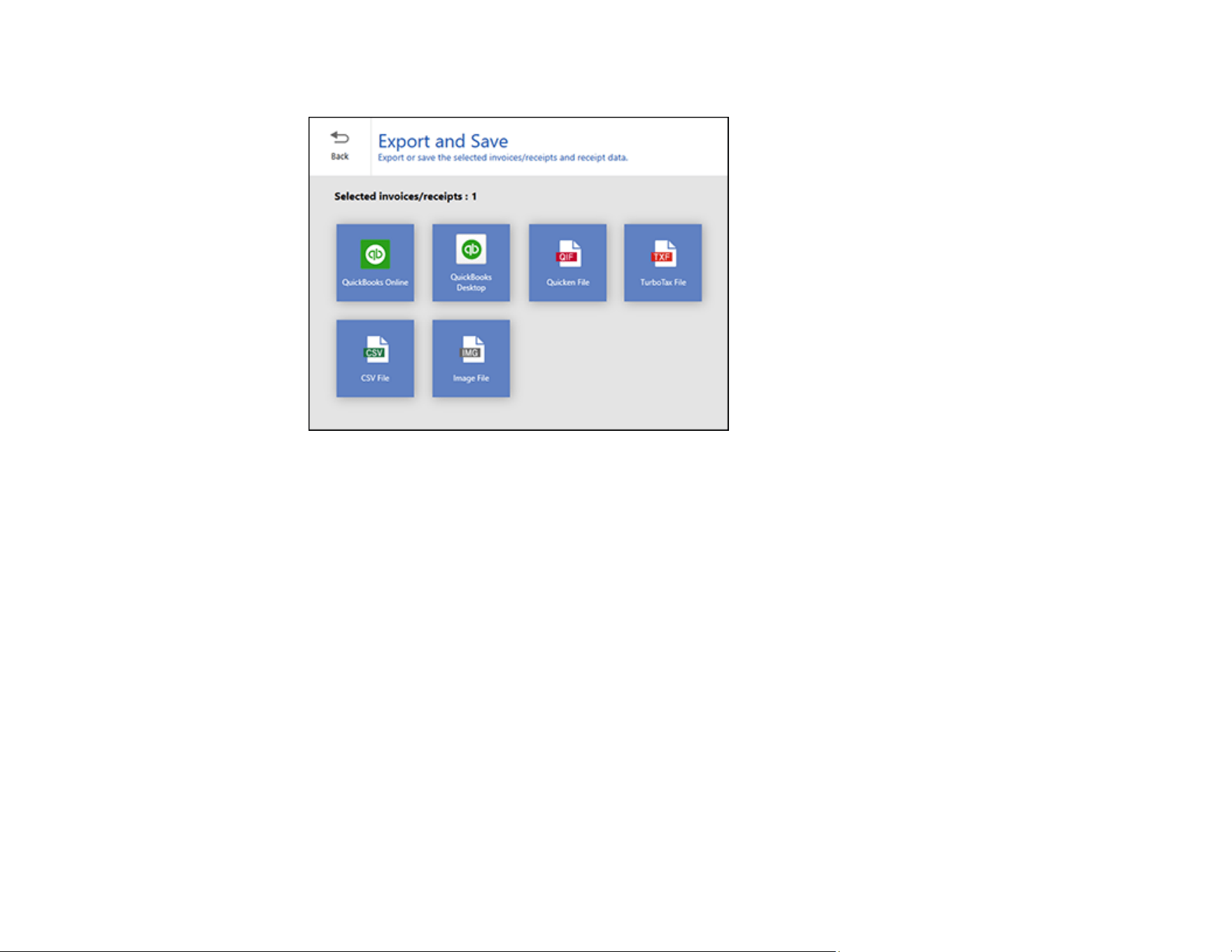
8. When you have finished reviewing data for all invoices or receipts, click Export and Save.
81
You see a screen like this:
9. Select an option. See the links below.
Exporting Invoices or Receipts to QuickBooks Online
Exporting Invoices or Receipts to QuickBooks Desktop
Saving or Exporting Receipts to Quicken
Saving Receipt Data as a TurboTax File
Saving Invoice or Receipt Data as a CSV File
Scanning Invoices or Receipts as an Image File
Parent topic: Scanning Using Invoice/Receipt Manager
Exporting Invoices or Receipts to QuickBooks Online
You can export invoice or receipt data to QuickBooks Online.
Note: Make sure you have a current QuickBooks account and your login information is available.
1. Make sure your invoices or receipts are scanned and reviewed. See the link below.
2. In the Export and Save window, click QuickBooks Online.
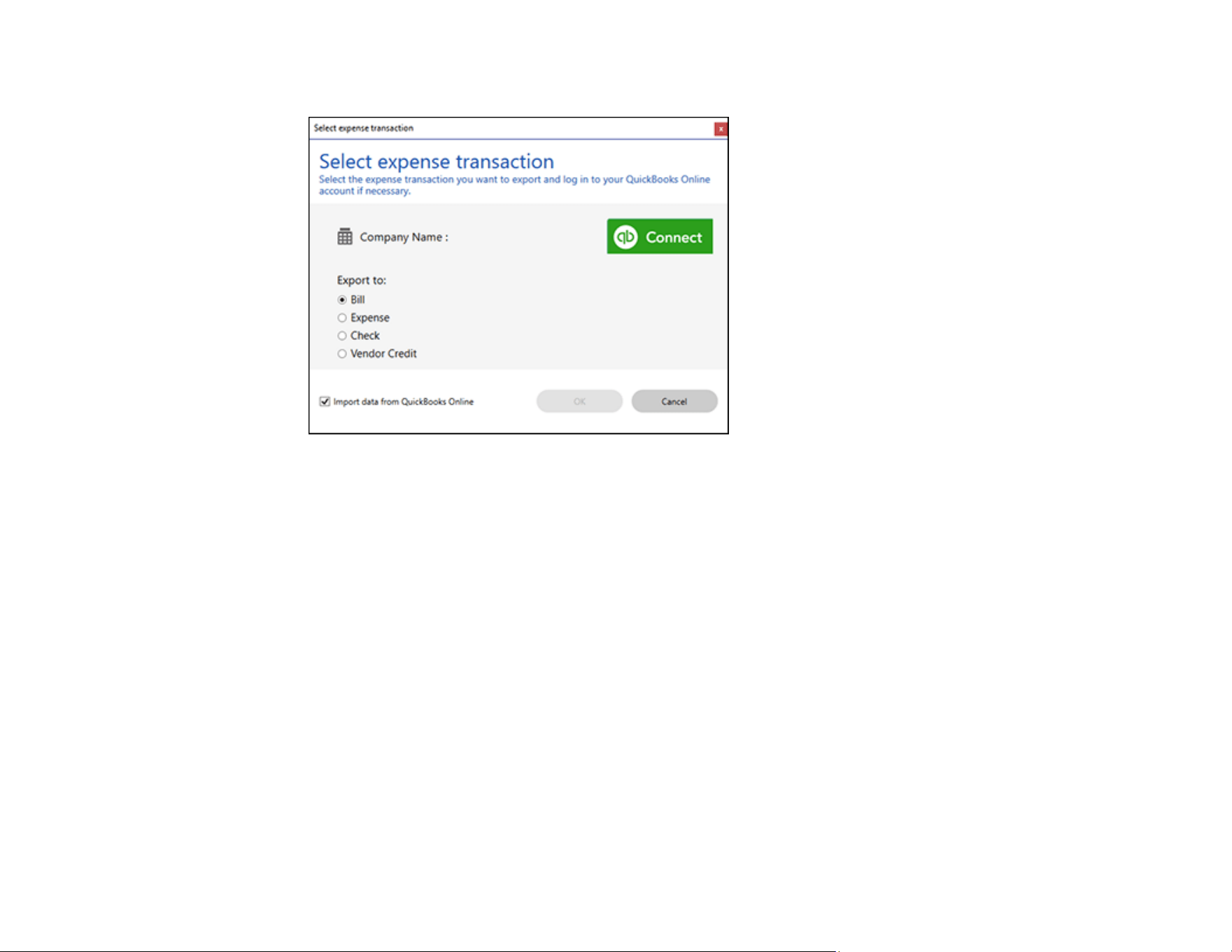
82
You see a screen like this:
3. Click Connect and enter your QuickBooks Online information.
4. Select the expense transaction you want to export the data to and click OK.
Note: If you want to import data such as vendors, categories, or payment methods from QuickBooks
Online into Invoice/Receipt Manager, select the checkbox.
The invoice or receipt data is exported to QuickBooks Online.
Parent topic: Scanning Invoices and Receipts and Using Invoice/Receipt Manager
Exporting Invoices or Receipts to QuickBooks Desktop
You can export invoice or receipt data to QuickBooks Desktop (Windows only).
Note: Make sure the QuickBooks Desktop software is installed and opened on your computer.
1. Make sure your invoices or receipts are scanned and reviewed. See the link below.
2. In the Export and Save window, click QuickBooks Desktop.
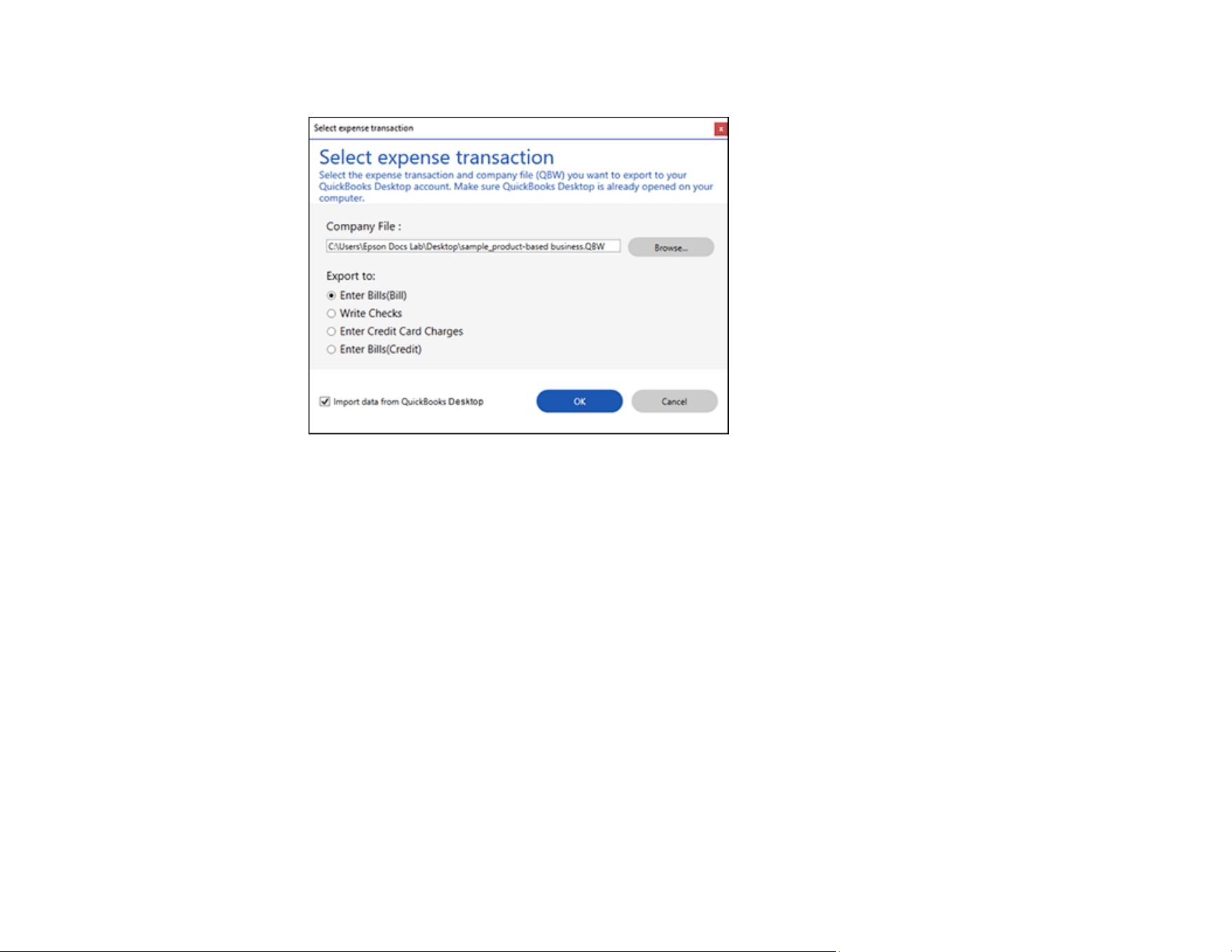
83
You see a screen like this:
3. Click Browse and select the QBW company file that you want to export the data to.
Note: The QBW company file must already be created.
4. Select the expense transaction you want to export the data to and click OK.
Note: If you want to import data such as vendors or payment methods from QuickBooks Desktop
into Invoice/Receipt Manager, select the checkbox.
The invoice or receipt data is exported to QuickBooks Desktop.
Parent topic: Scanning Invoices and Receipts and Using Invoice/Receipt Manager
Saving or Exporting Receipts to Quicken
You can save receipt data as a QIF file or export it for use in Quicken.
Note: Invoice data cannot be saved or exported in Quicken.
1. Make sure your receipts are scanned and reviewed. See the link below.
84
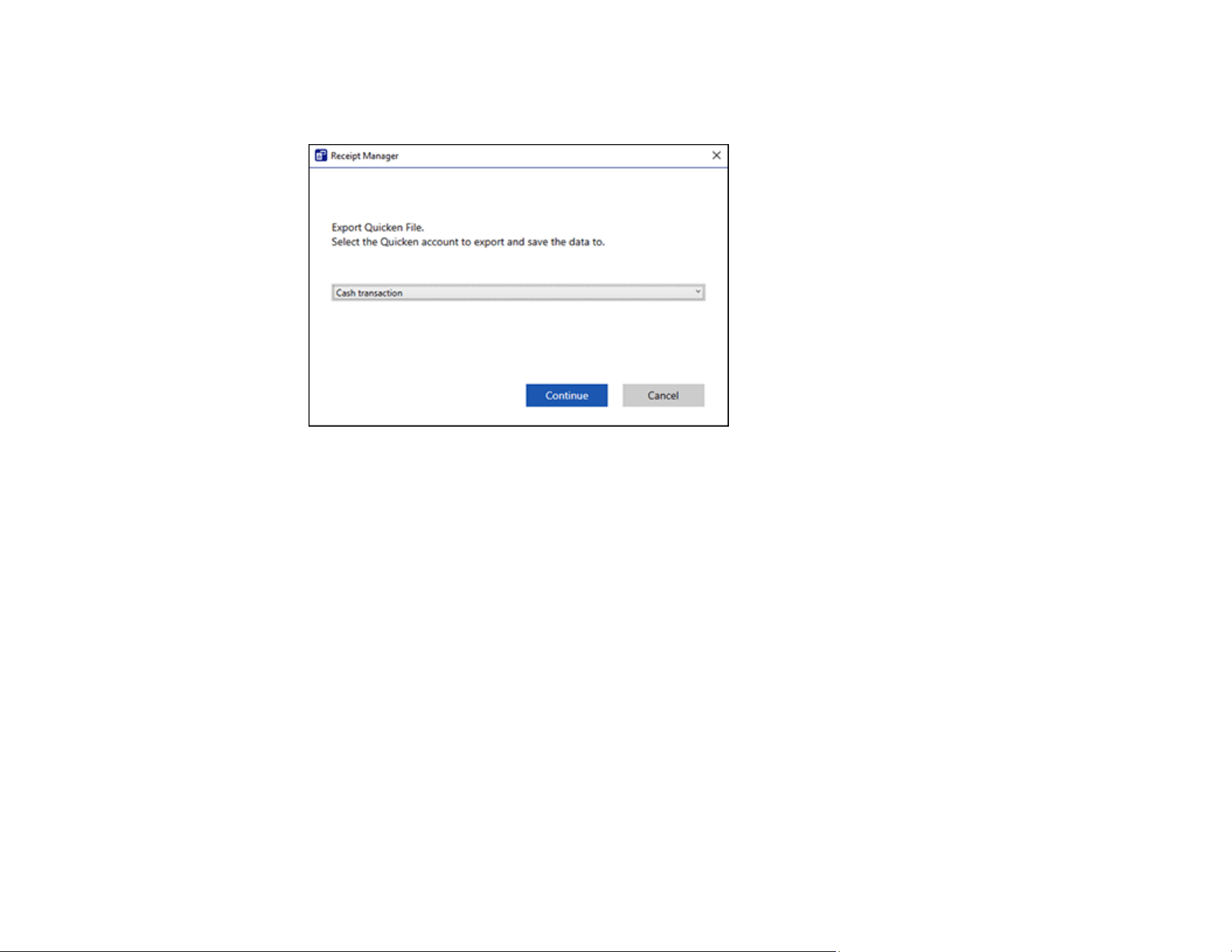
2. In the Export and Save window, click Quicken File.
You see a screen like this:
3. Do one of the following:
• Select Cash transaction and click Continue to save the receipt data as a QIF file.
• Select Select the Quicken account and click Continue to export the receipt data to a QIF file
previously saved on your computer.
The scanned receipt data is saved or exported.
Parent topic: Scanning Invoices and Receipts and Using Invoice/Receipt Manager
Saving Receipt Data as a TurboTax File
You can save receipt data as a TurboTax file.
Note: Invoice data cannot be saved or exported in TurboTax.
1. Make sure your receipts are scanned and reviewed. See the link below.
Note: The tax category needs to be selected for each receipt to be recognized by TurboTax.
2. In the Export and Save window, click TurboTax File.
85
3. Save the file as a TXF file to your computer.
Parent topic: Scanning Invoices and Receipts and Using Invoice/Receipt Manager
Saving Invoice or Receipt Data as a CSV File
You can save invoice or receipt data as a CSV file to use in a spreadsheet program such as Microsoft
Excel.
1. Make sure your invoices or receipts are scanned and reviewed. See the link below.
2. In the Export and Save window, click CSV File.
3. Choose the folder on your computer where you want to save the CSV file.
Parent topic: Scanning Invoices and Receipts and Using Invoice/Receipt Manager
Scanning Invoices or Receipts as an Image File
You can save scanned invoices or receipts as an image file.
1. Make sure your invoices or receipts are scanned and reviewed. See the link below.
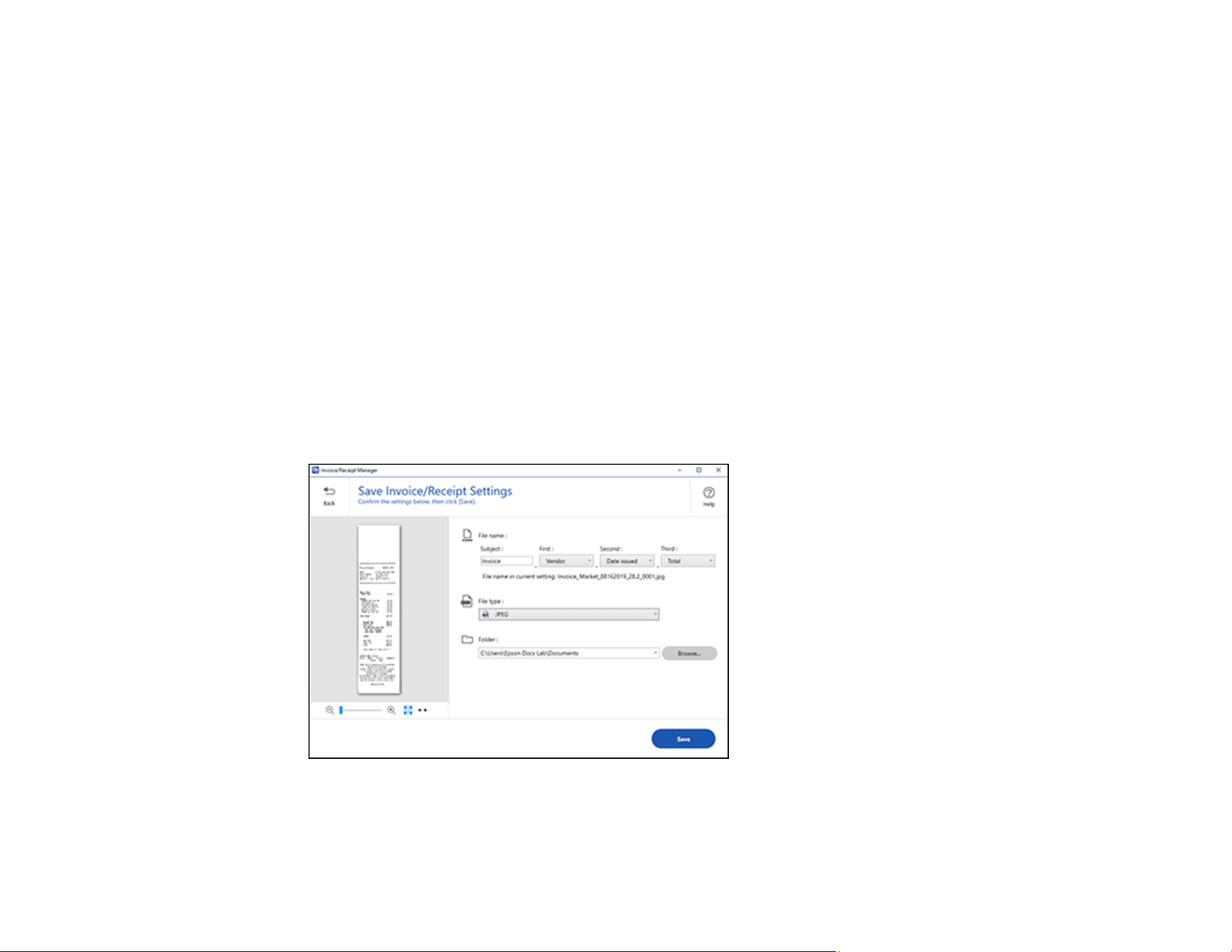
2. In the Export and Save window, click Image File.
You see a screen like this:
3. Review the file naming fields, select the file type (JPEG or PDF), select the destination folder, and
click Save.
86
Parent topic: Scanning Invoices and Receipts and Using Invoice/Receipt Manager
Selecting Invoice/Receipt Manager Settings
After starting Invoice/Receipt Manager, you can export or import the database and change various
settings.
Exporting or Importing the Invoice/Receipt Database
Changing Column Settings
Changing Currency and Language Settings
Importing Categories from QuickBooks or Quicken
Parent topic: Scanning
Exporting or Importing the Invoice/Receipt Database
You can export or import the invoice/receipt database. This is useful if you change computers.
Note: Make sure each computer has the same version of Epson ScanSmart installed.
1. Click the Settings button in Invoice/Receipt Manager.
You see a screen like this:
87
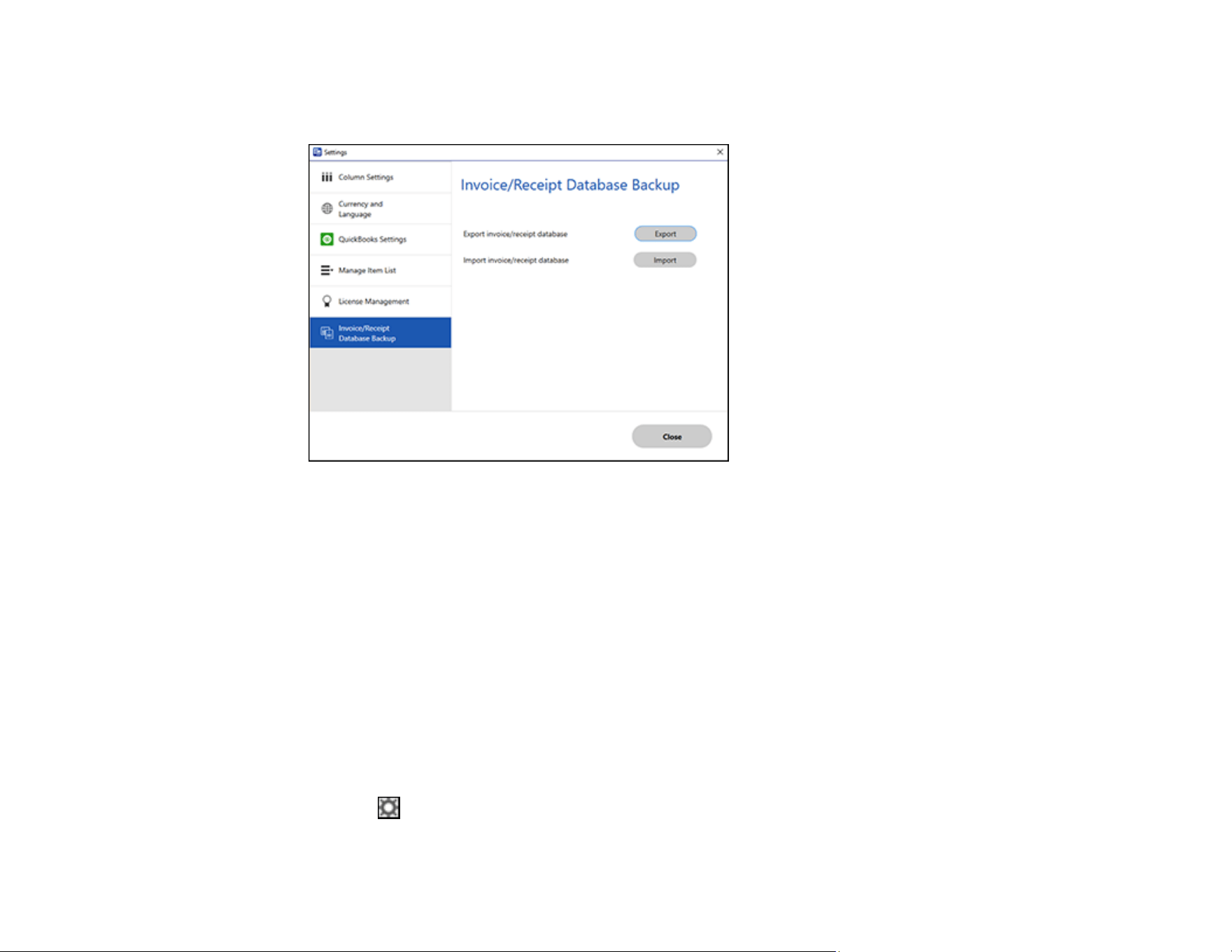
2. Select the Invoice/Receipt Database Backup tab.
You see a screen like this:
3. Choose one of these options:
• Click Export to export the invoice/receipt database. A file is created that can be saved to a folder
on your computer.
• Click Import to import an invoice/receipt database. Choose the file that was created when you
exported the database. The current database is overwritten.
4. Click Close.
Parent topic: Selecting Invoice/Receipt Manager Settings
Related tasks
Scanning Invoices and Receipts and Using Invoice/Receipt Manager
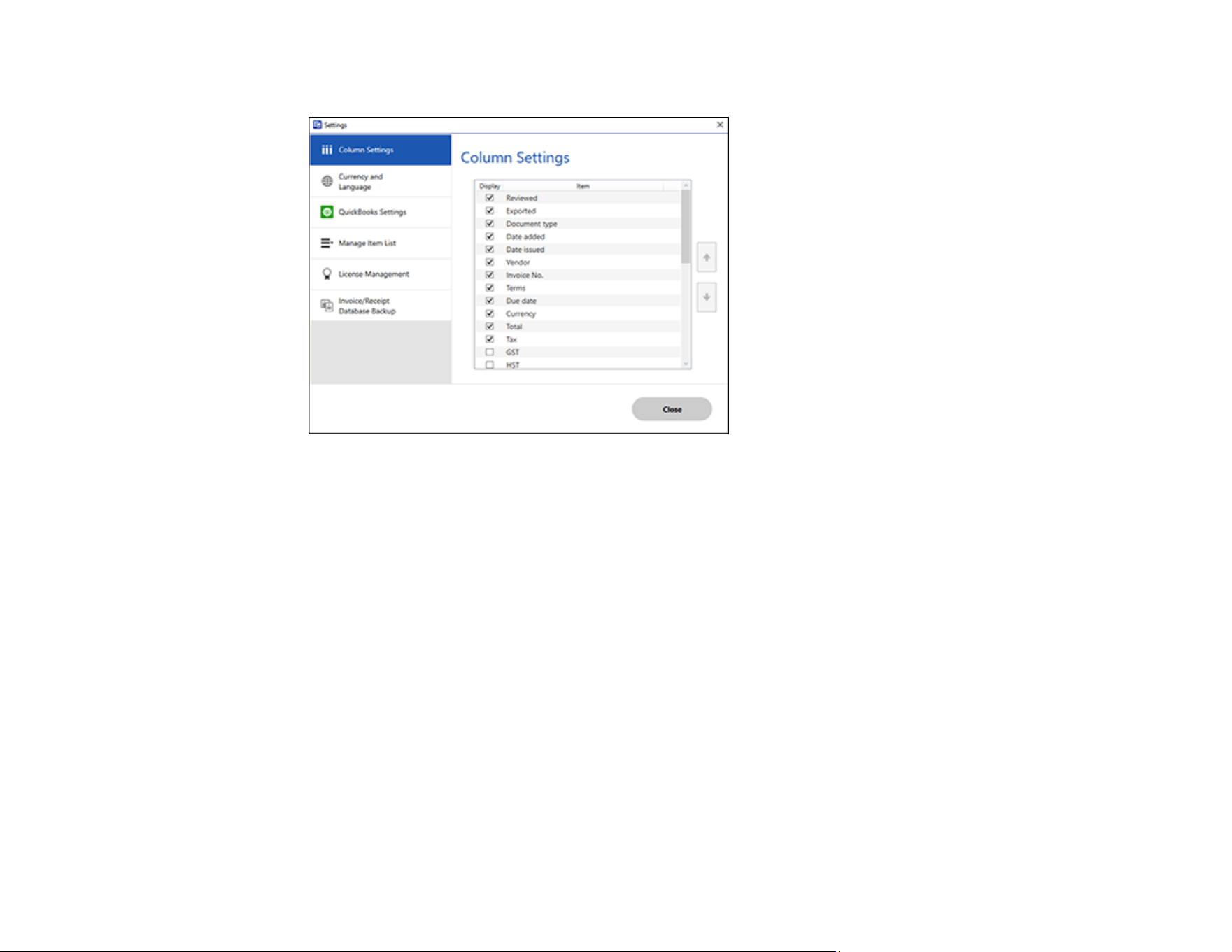
Changing Column Settings
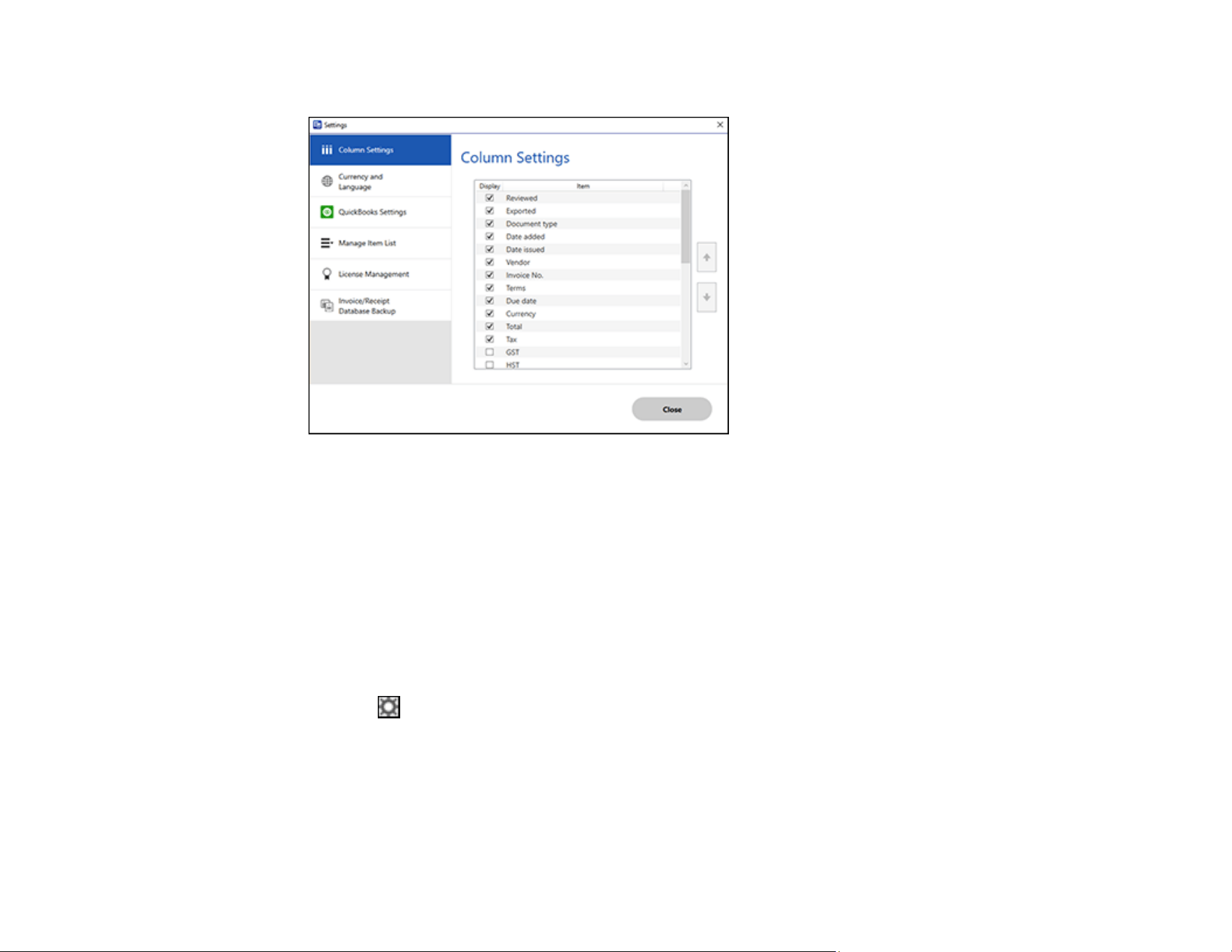
You can choose which columns are displayed in the receipt list.
1. Click the Settings button in Invoice/Receipt Manager.
88
You see a screen like this:
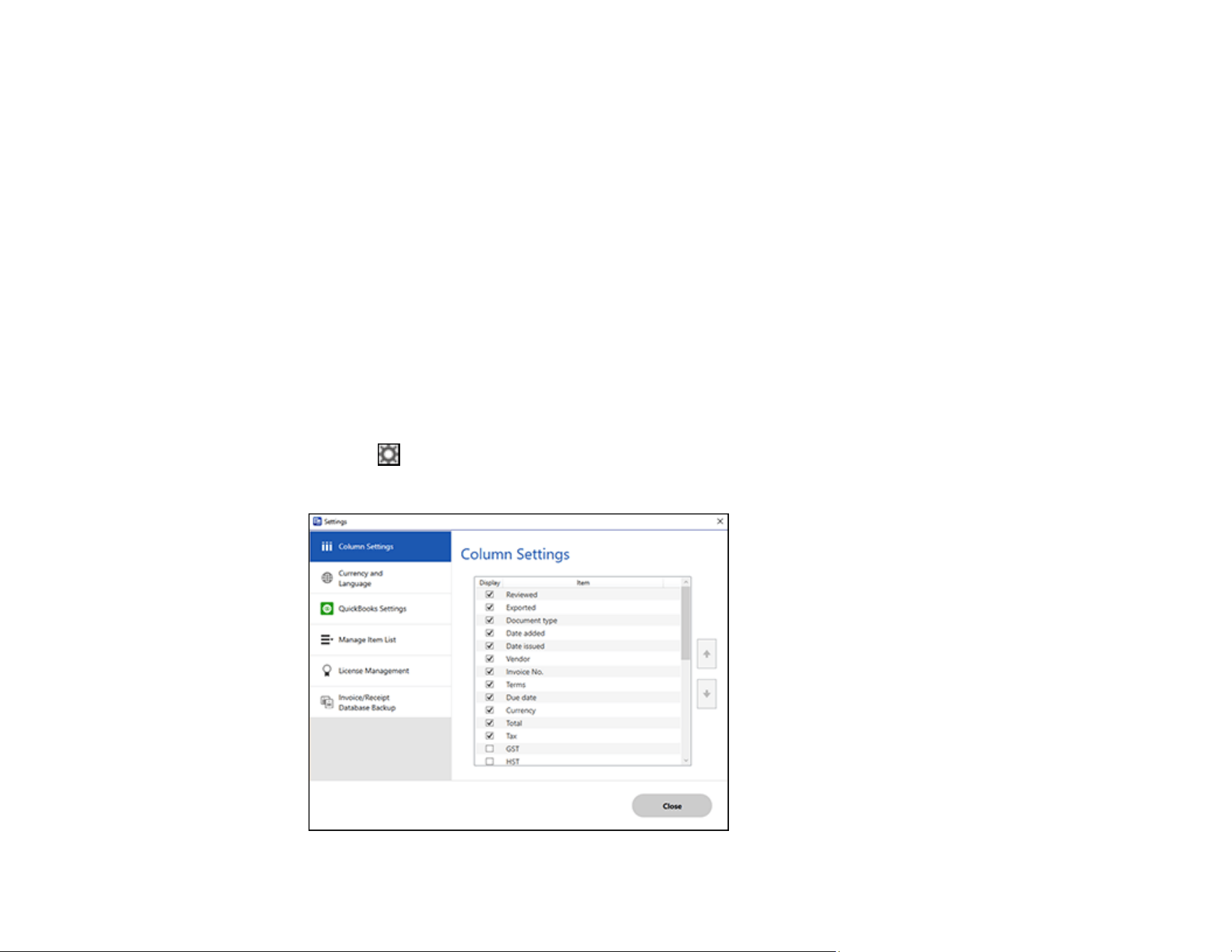
2. Choose which columns to display by selecting or deselecting each checkbox. Click the arrow icons
to move the items up or down in the display order you want.
3. Click Close.
Parent topic: Selecting Invoice/Receipt Manager Settings
Related tasks
Scanning Invoices and Receipts and Using Invoice/Receipt Manager
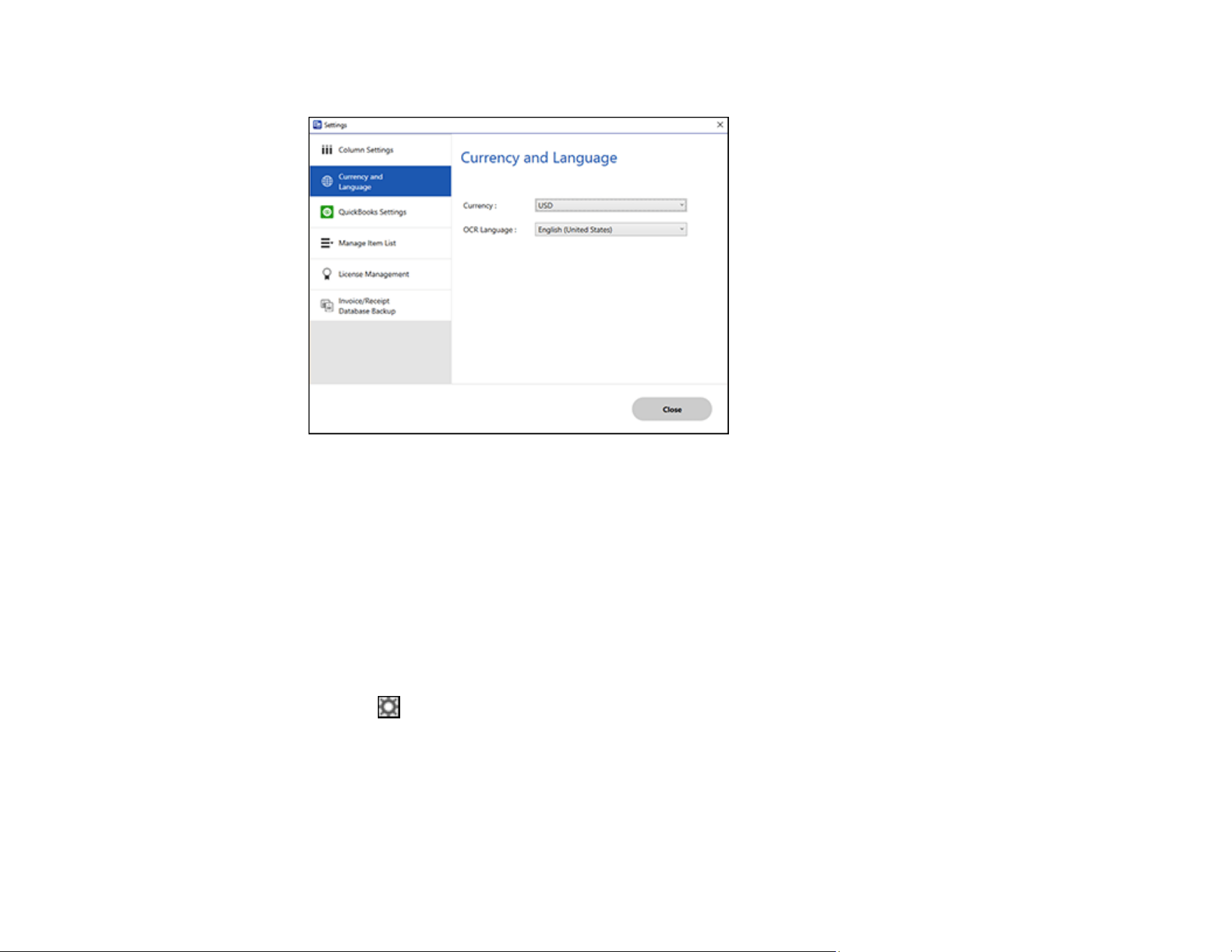
Changing Currency and Language Settings
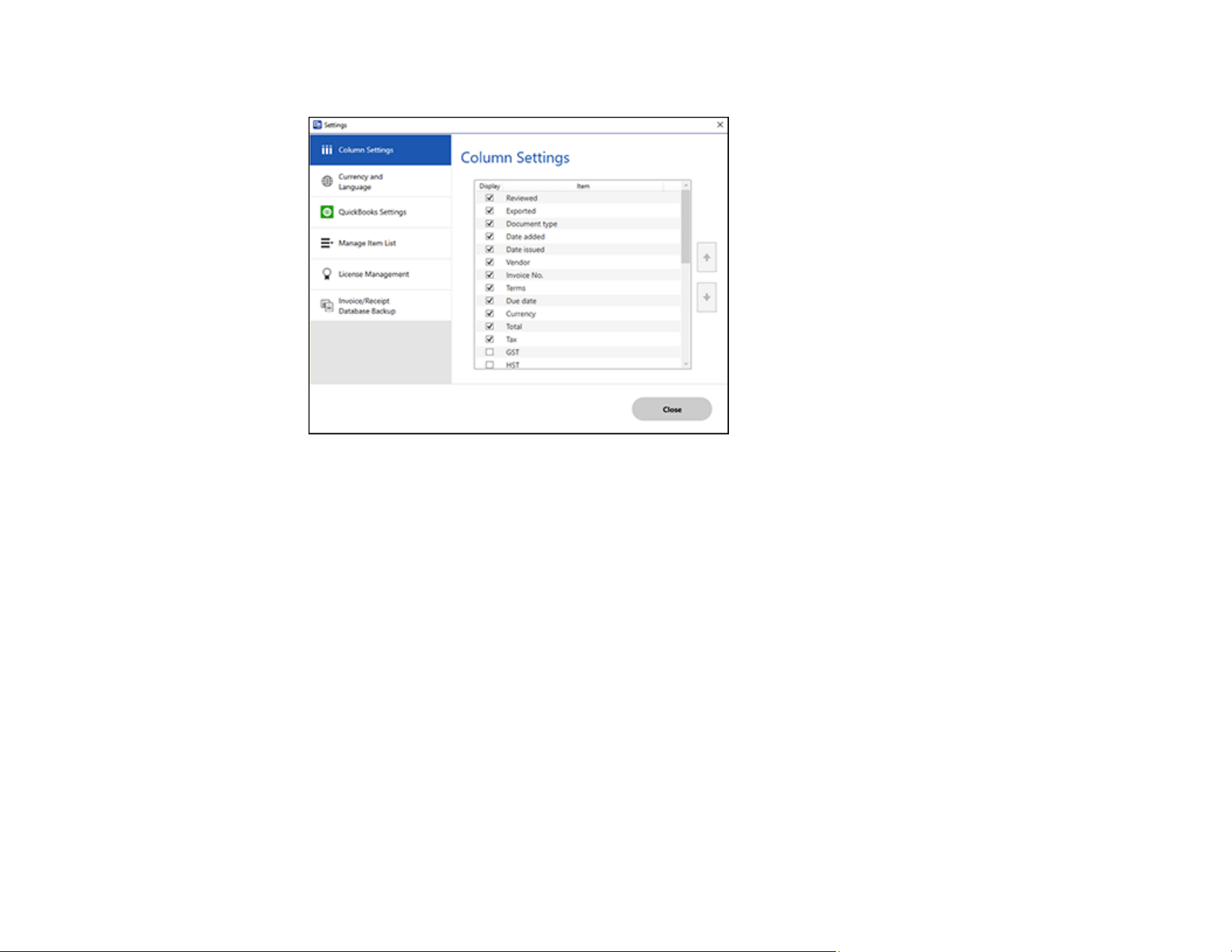
You can change the currency and OCR language for data in Invoice/Receipt Manager.
1. Click the Settings button in Invoice/Receipt Manager.
89
You see a screen like this:
2. Click the Currency and Language tab.
90
You see a screen like this:
3. Select a currency type and OCR language.
4. Click Close.
Parent topic: Selecting Invoice/Receipt Manager Settings
Related tasks
Scanning Invoices and Receipts and Using Invoice/Receipt Manager
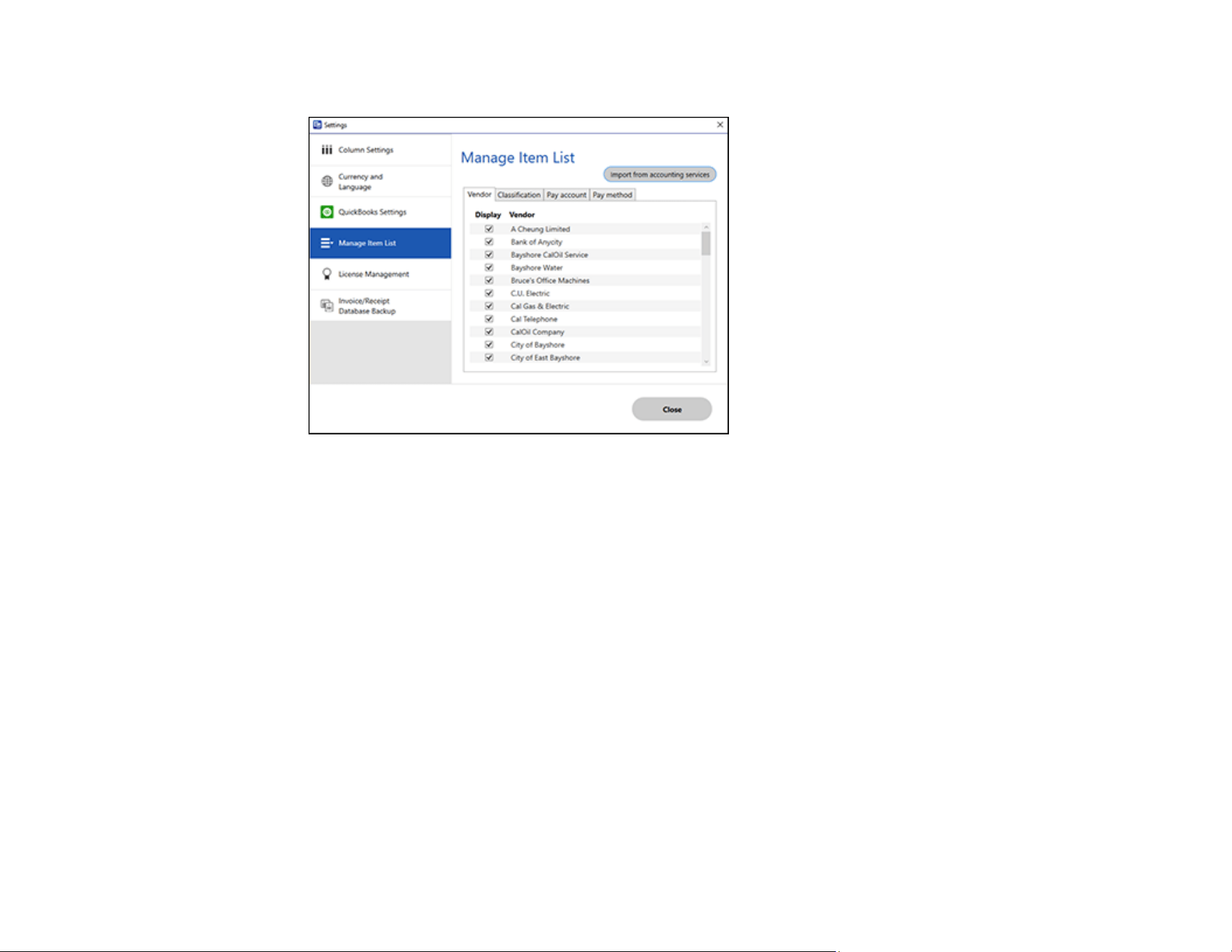
Importing Categories from QuickBooks or Quicken
You can import categories from QuickBooks Online, QuickBooks Desktop, or Quicken to use in
Invoice/Receipt Manager.
1. Click the Settings button in Invoice/Receipt Manager.
91
You see a screen like this:
2. Click the Manage Item List tab.
92
You see a screen like this:
3. Click Import from accounting services.
4. Select one of the import options and follow the on-screen instructions.
5. Click the checkboxes for the categories that you want to be displayed in the Invoice/Receipt
Manager Edit window and click Close.
Note: Imported items depend on the selected accounting service.
Parent topic: Selecting Invoice/Receipt Manager Settings
Scan Resolution Guidelines
The resolution setting in your scanning software, measured in dpi (dots per inch), controls the amount of
detail captured in your scans. Increasing the resolution raises the amount of detail captured but comes
with the following disadvantages:
• Larger file sizes
• It takes longer to scan your originals, send/receive your scans by email or fax, and to print your scans
• The image may become too large to fit on your display or print on paper

93
If you plan to enlarge a scanned image so you can print it at a larger size, you may need to increase the
resolution from the default resolution set by the software. Follow these guidelines to determine the
resolution setting you need:
• You will scan the image at its original size but enlarge it later in an image-editing program.
Increase the resolution setting in your scanning software. Increase the resolution by the same amount
you will increase the image size to retain a high image quality. For example, if the resolution is 300 dpi
(dots per inch) and you will double the image size later, change the resolution setting to 600 dpi.
• You will scan the image at 100% or smaller size.
Select the resolution setting based on how you will use the scanned image:
• Email/view on a computer screen/post on the web: 96 to 200 dpi
• Print/fax/convert to editable text (OCR)/create searchable PDF: 200 to 300 dpi
• You will scan a long original.
Scan paper up to 240 inches (6096 mm) in length with a maximum resolution of 300 dpi or less.
Parent topic: Scanning
94
Using the Optional Flatbed Scanner Dock - Windows
The optional flatbed scanner dock combines your document scanner with a flatbed scanner into a single
unit. This allows you to scan thick or over-sized originals, such as cardboard and books, that won't fit into
the document scanner's ADF.
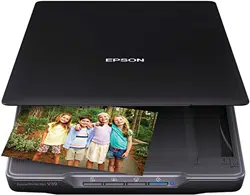
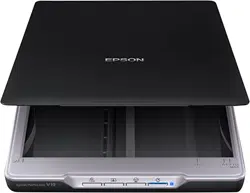
You must purchase a flatbed scanner (Epson Perfection V19/V39) to use the optional flatbed scanner
dock. To attach the flatbed scanner and dock to your document scanner, follow the installation
instructions that came with your flatbed scanner dock.
See these sections to learn about the flatbed scanner dock option.
Flatbed Scanner Dock Parts
Scanning from the Flatbed Scanner Dock
Cleaning the Flatbed Scanner Dock
Transporting the Flatbed Scanner Dock
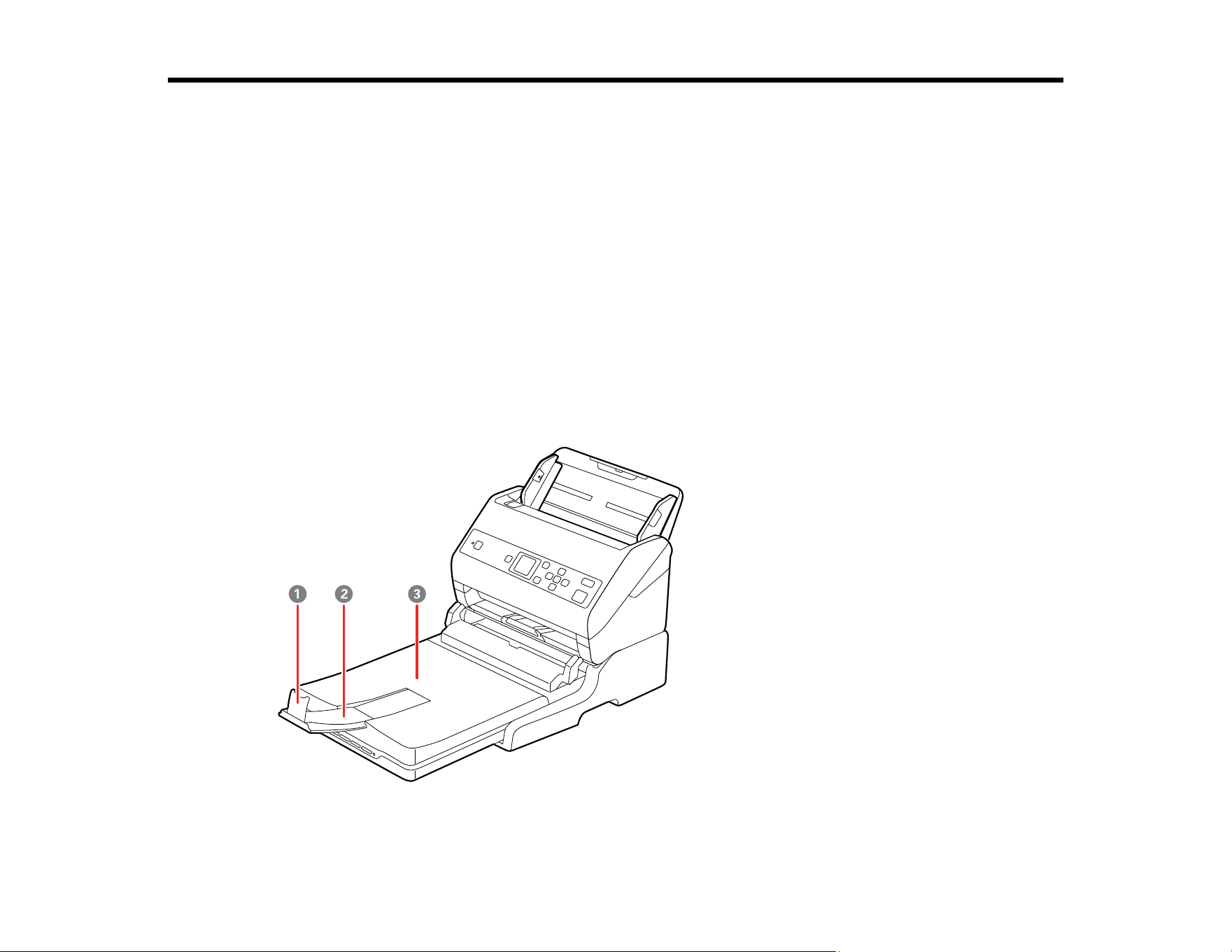
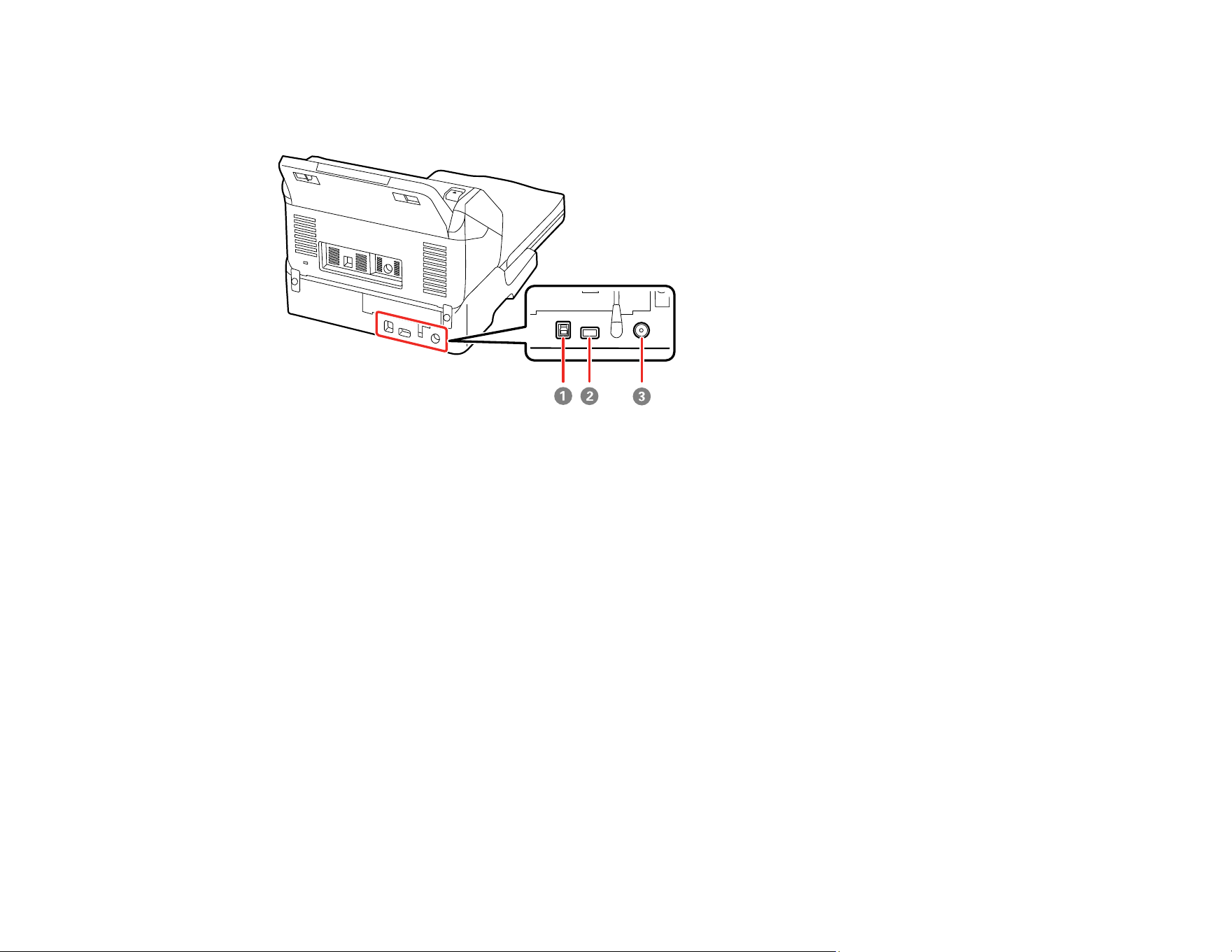
Flatbed Scanner Dock Parts
1 Stopper
95
2 Output tray extension
3 Scanner cover/output tray
1 USB port 1 (for connecting flatbed dock to computer)
2 USB port 2 (for connecting flatbed dock to document scanner)
3 Power inlet
Parent topic: Using the Optional Flatbed Scanner Dock - Windows
Scanning from the Flatbed Scanner Dock
See these sections to scan when using the optional flatbed scanner dock.
Scanning from the Docked Flatbed Scanner
Scanning from the ADF with the Flatbed Scanner Dock Attached
Parent topic: Using the Optional Flatbed Scanner Dock - Windows
Scanning from the Docked Flatbed Scanner
You can place originals directly on the scanner glass of the flatbed scanner attached to the optional
flatbed scanner dock.
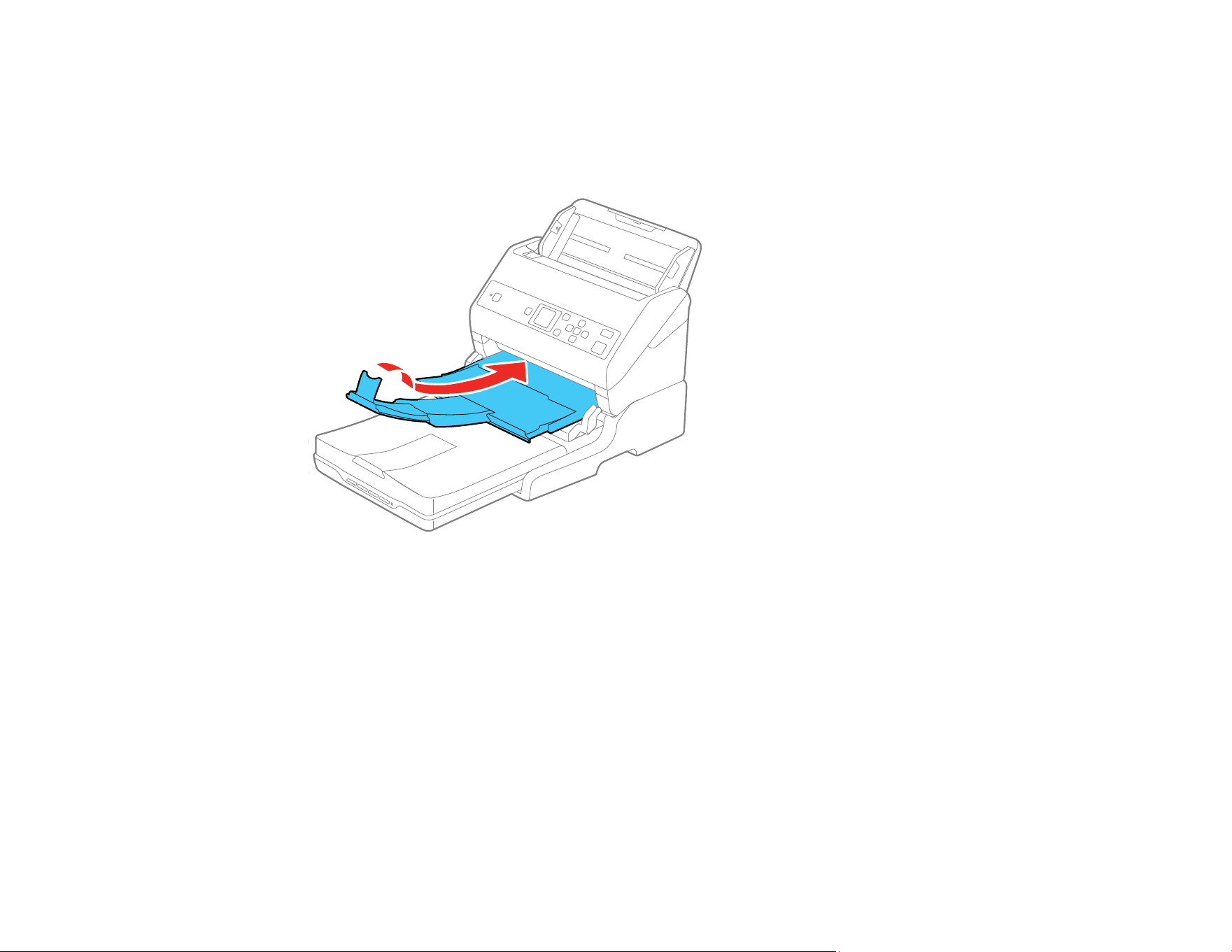
96
Caution: Make sure the scanner is placed on a flat surface. Do not place heavy objects on the scanner
glass and do not press on the glass with too much force, or it may damage the scanner. Do not leave
photos on the scanner glass for an extended period, or they may stick to the glass.
1. Close the document scanner's output tray.
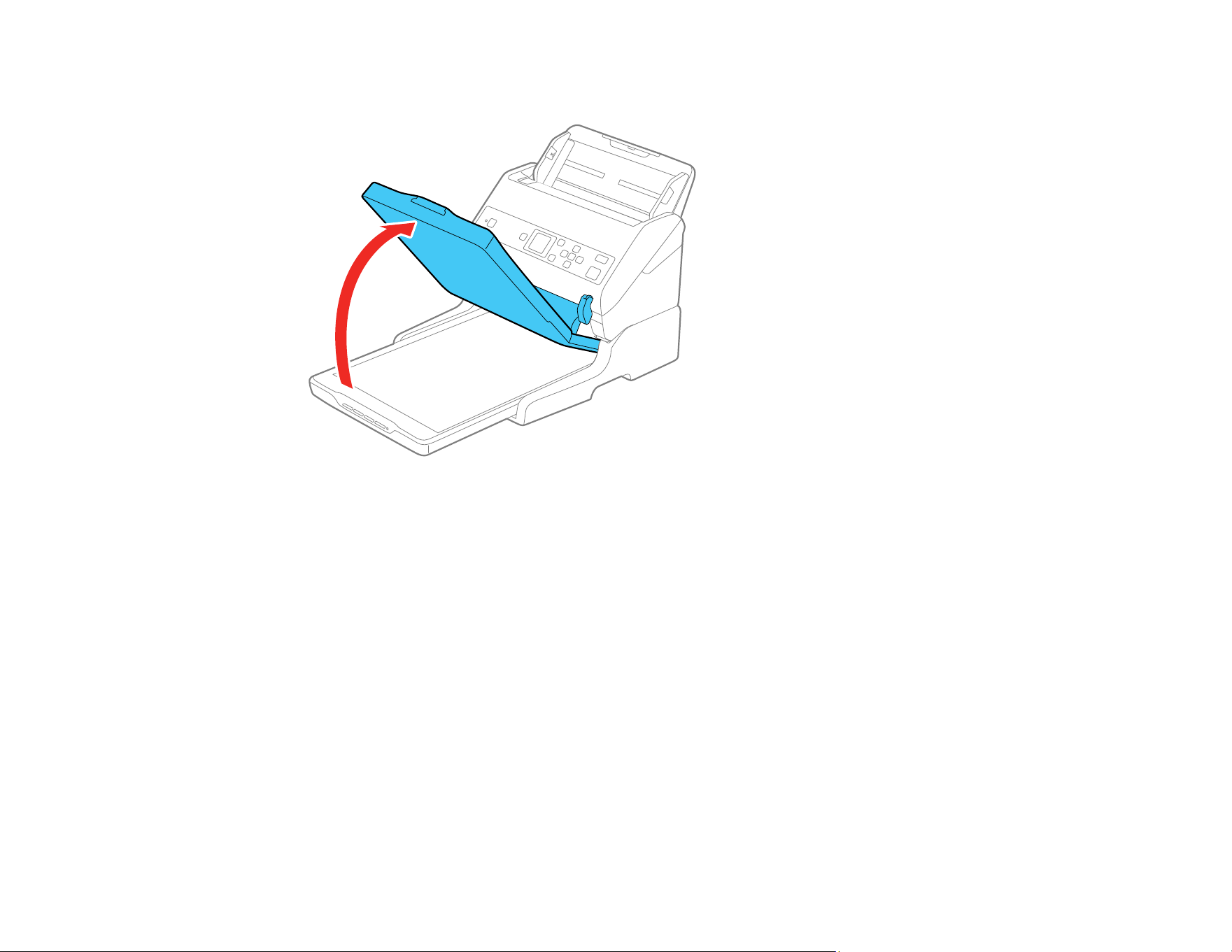
97
2. Open the flatbed scanner cover.
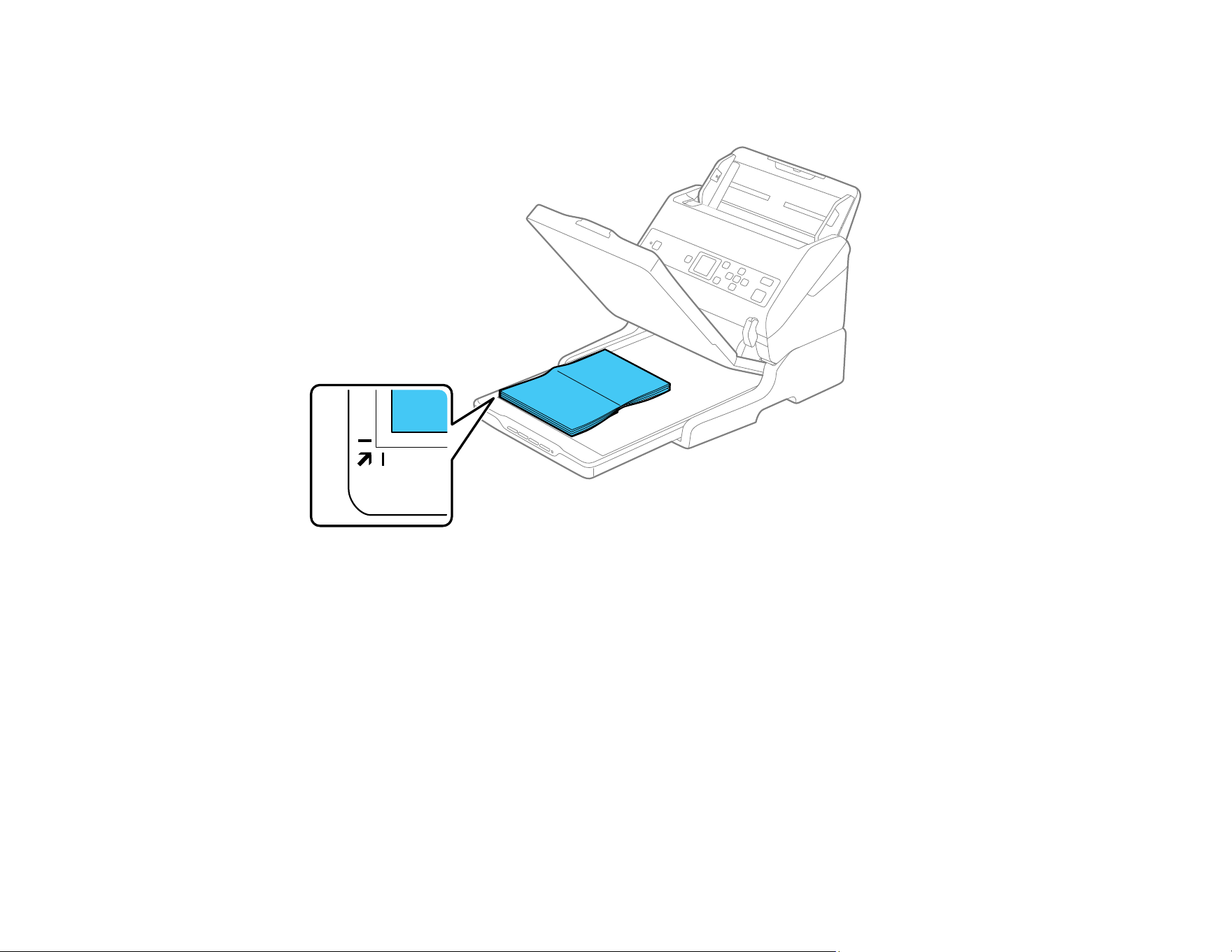
98
3. Place your original facedown on the scanner glass with the top edge facing as shown. Slide the
original to the edges of the indicated corner.
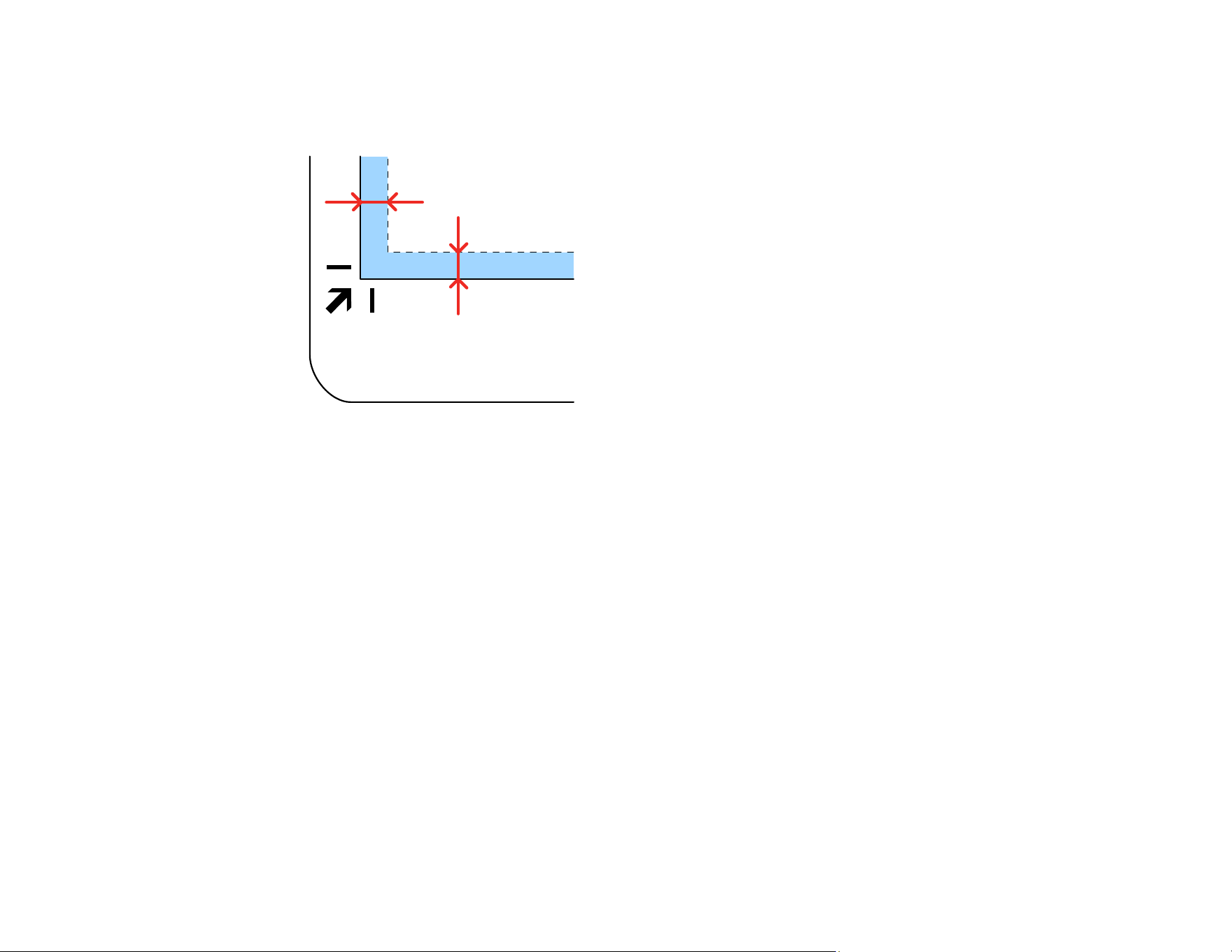
99
Note: Place your original 0.1 inch (2.5 mm) from the top and side edges of the scanner glass as
shown in order to avoid cropping. If you are scanning multiple photos at once, place them at least
0.8 inch (20 mm) apart from each other.
4. Close the flatbed scanner cover gently to keep your original in place. If you are scanning a book or
other thick document, hold the scanner cover down as you scan.
5. Start Epson Scan 2.
6. Select Scanner Glass as the Document Source setting.
7. Select other scan settings as necessary.
8. Click Scan.
Parent topic: Scanning from the Flatbed Scanner Dock
Scanning from the ADF with the Flatbed Scanner Dock Attached
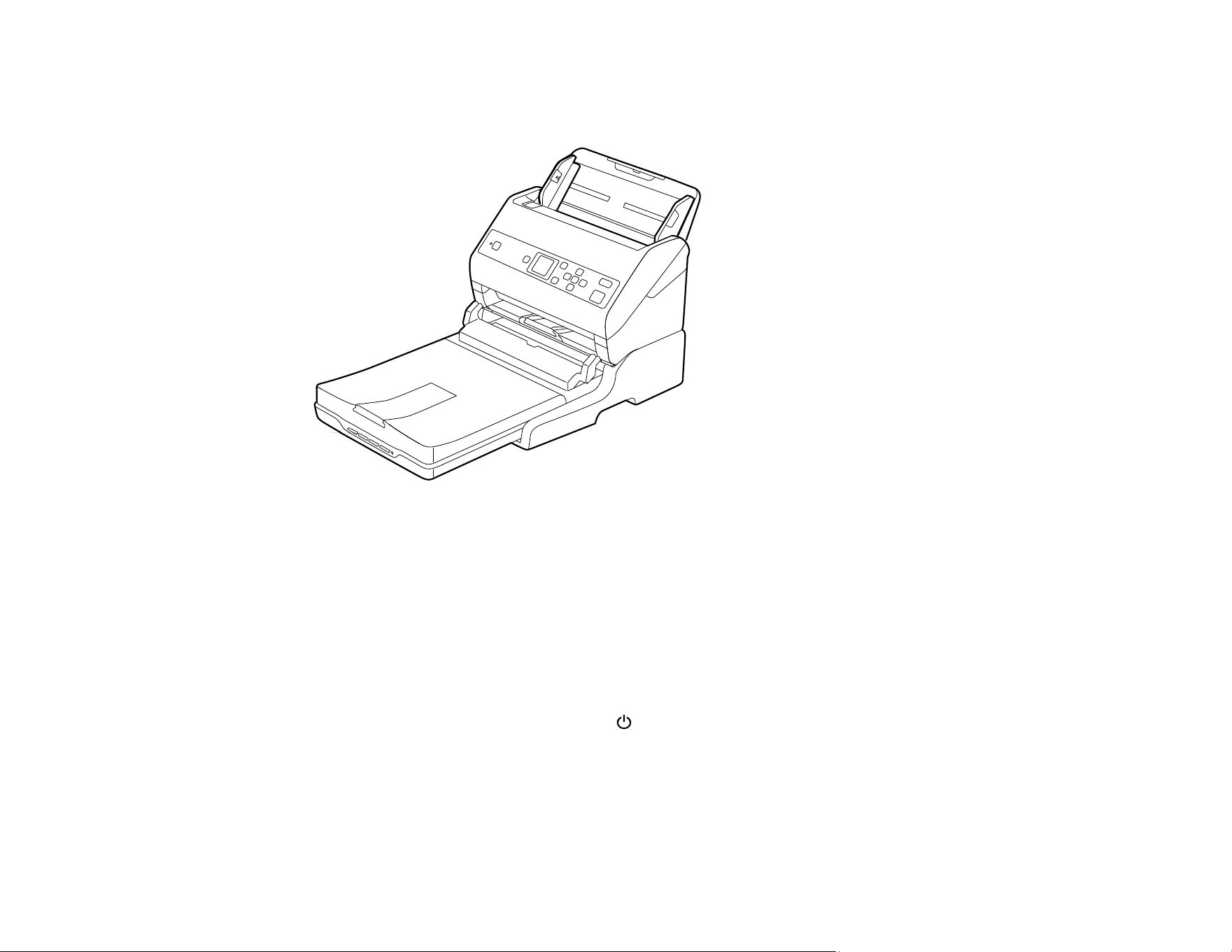
Depending on the length of your originals, you may need to adjust the position of the input tray, output
tray, and stopper when scanning from the document scanner's ADF with the optional flatbed scanner
dock attached.
For originals shorter than 8.2 inches (210 mm) long:
• Pull out the scanner's output tray and output tray extension and open the stopper.
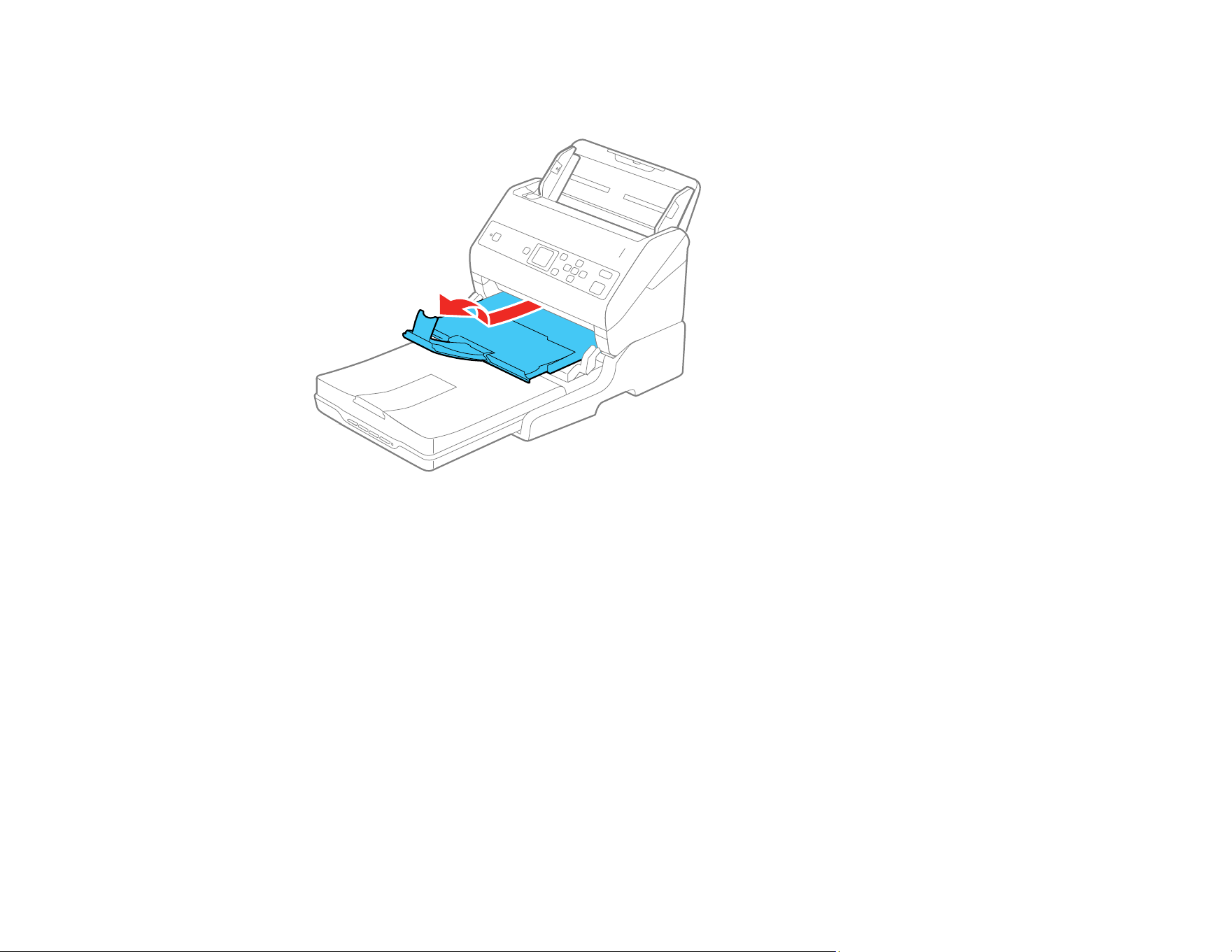
100
• Extend the output tray a little longer than the length of the original and move the stopper forward or
backward as necessary.
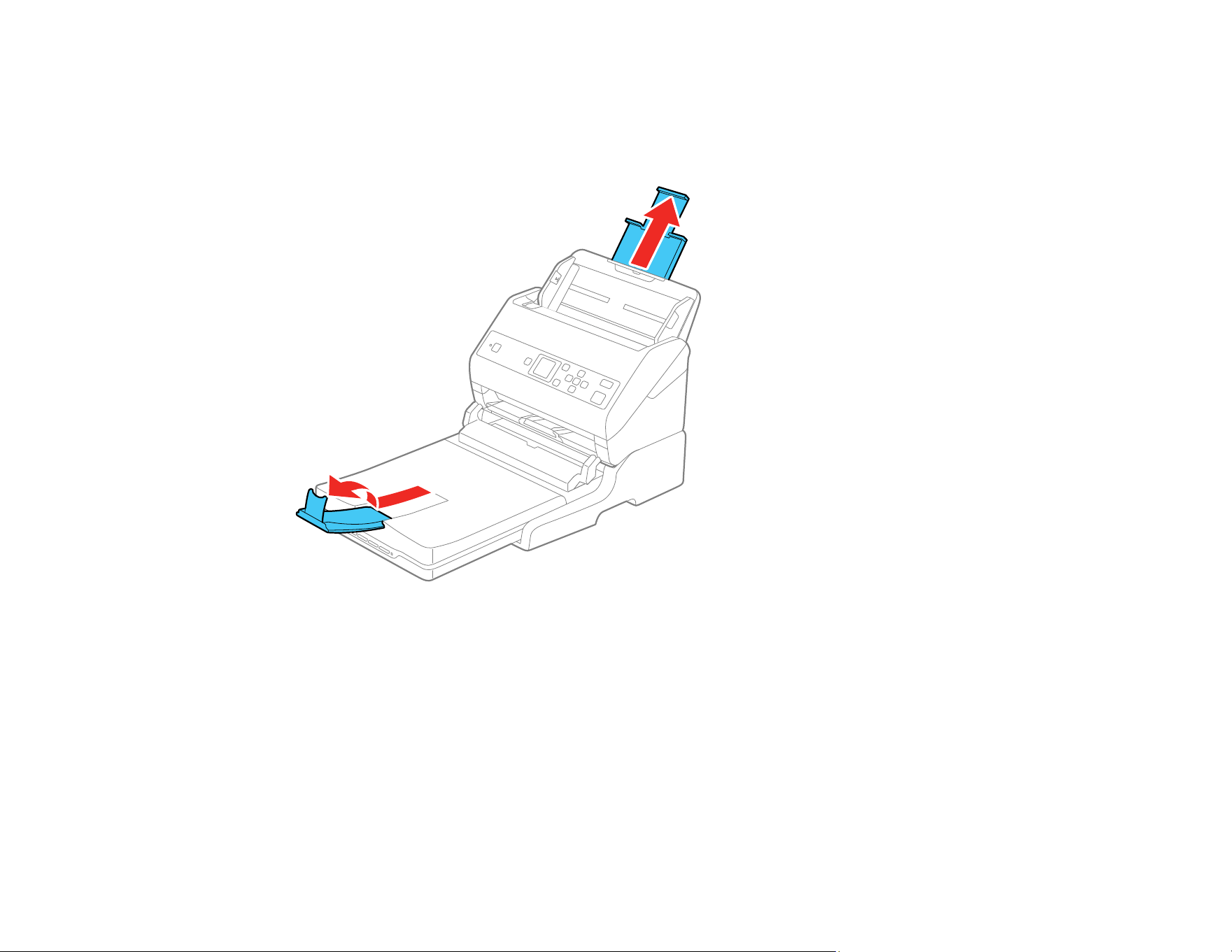
101
For originals between 8.2 inches (210 mm) and 11.7 inches (297 mm) long:
• Extend the document scanner's input tray, open the scanner dock's stopper, and slide the stopper
forward or backward so that it is a little longer than the length of the original. (Do not open the output
tray on the document scanner.)
For originals between 11.7 inches (297 mm) and 14 inches (356 mm) long:
• Extend the document scanner's input tray, pull out the scanner dock's output tray and output tray
extension, and open the stopper.
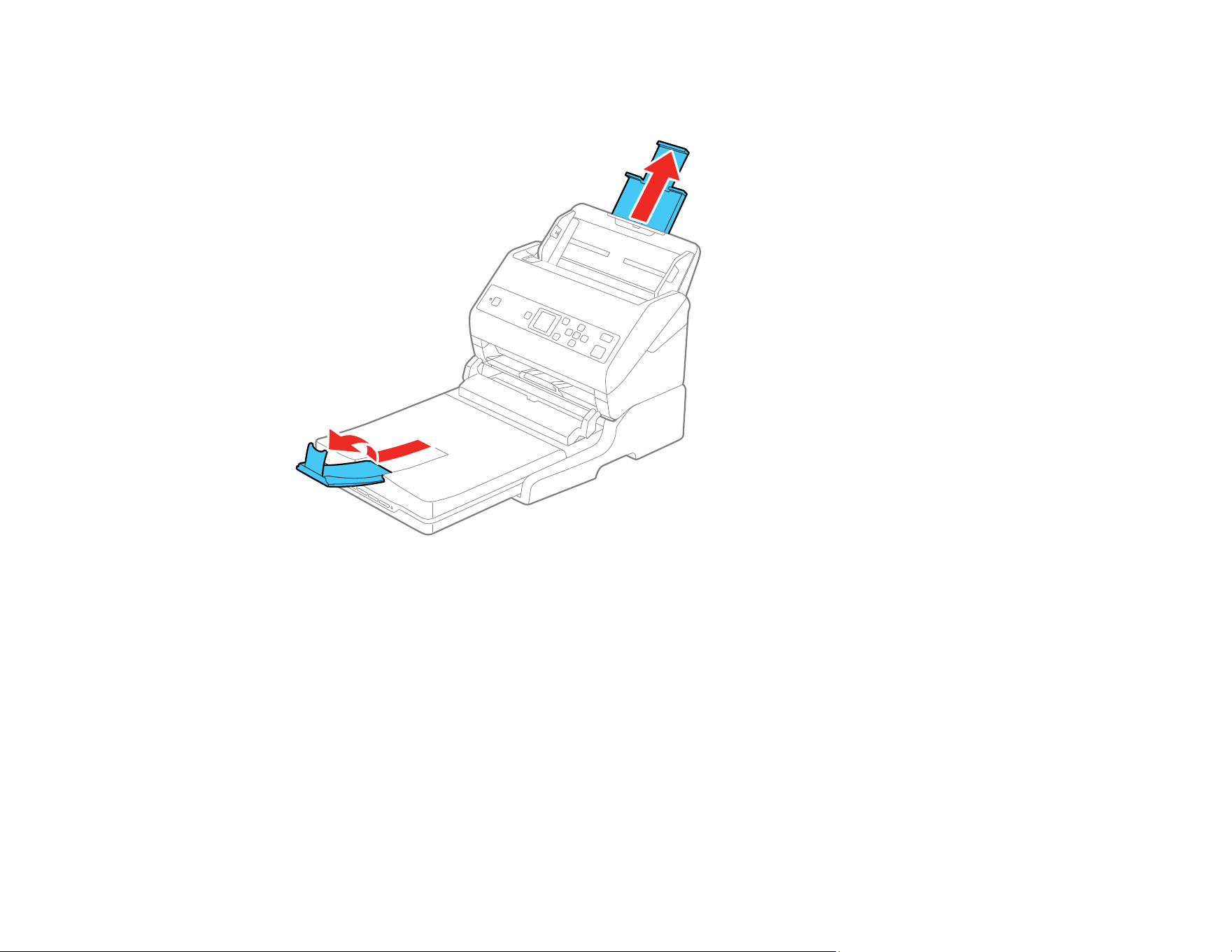
102
• Extend the output tray a little longer than the length of the original and move the stopper forward or
backward as necessary.
103
For originals that are 14 inches (356 mm) or longer:
• Leave the document scanner's output tray closed and close the scanner dock's stopper.
Parent topic: Scanning from the Flatbed Scanner Dock
Cleaning the Flatbed Scanner Dock
To keep your product working at its best, you should clean it several times a year.
Caution: Do not use a hard brush, alcohol, or paint thinner to clean the product or you may damage it.
Do not use oil or other lubricants inside the product or let water get inside it. Do not open the product
case.
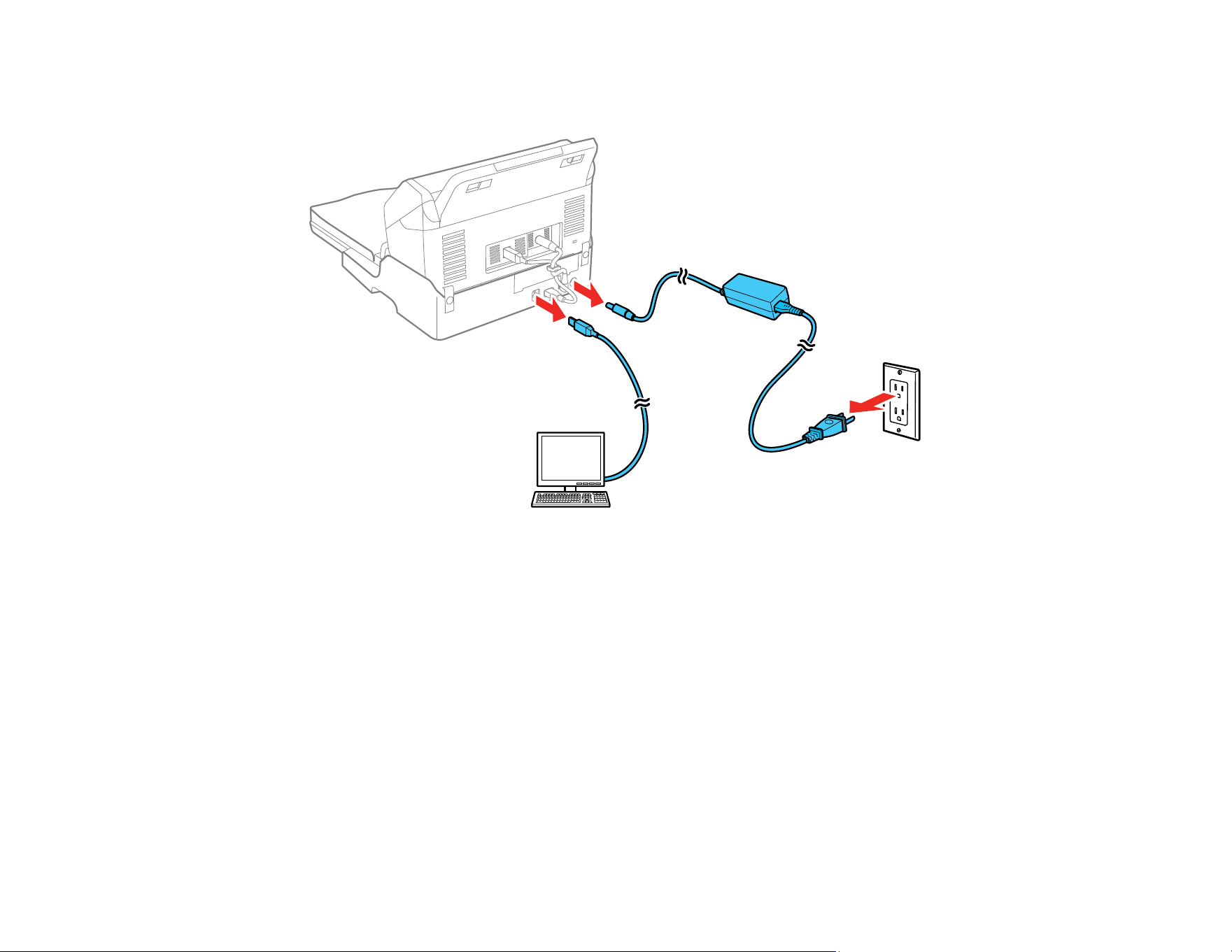
1. Turn off the document scanner using the power button.
Note: There is no power button on the scanner dock.
104
2. Unplug the AC power cord and disconnect the USB cable that connects the flatbed scanner dock to
the computer.
3. Clean the outer case with a cloth dampened with mild detergent and water.
4. If the scanner glass is dirty, clean it with a soft dry cloth. If the glass surface is stained with grease or
some other hard-to-remove material, use a small amount of glass cleaner on a soft cloth to remove
it. Wipe off all remaining liquid.
Caution: Do not spray glass cleaner directly on the scanner glass. Do not press the surface of the
scanner glass with any force and be careful not to scratch or damage the scanner glass. A damaged
glass surface can decrease the scan quality.
Parent topic: Using the Optional Flatbed Scanner Dock - Windows
Transporting the Flatbed Scanner Dock
If you need to ship your product, transport it a long distance, or store it for an extended period, prepare it
for transportation as described here.
105
Note: If you are transporting only the flatbed scanner dock (without the document scanner), follow the
installation instructions that came with the flatbed scanner dock in reverse to remove the flatbed scanner
and dock from the document scanner.
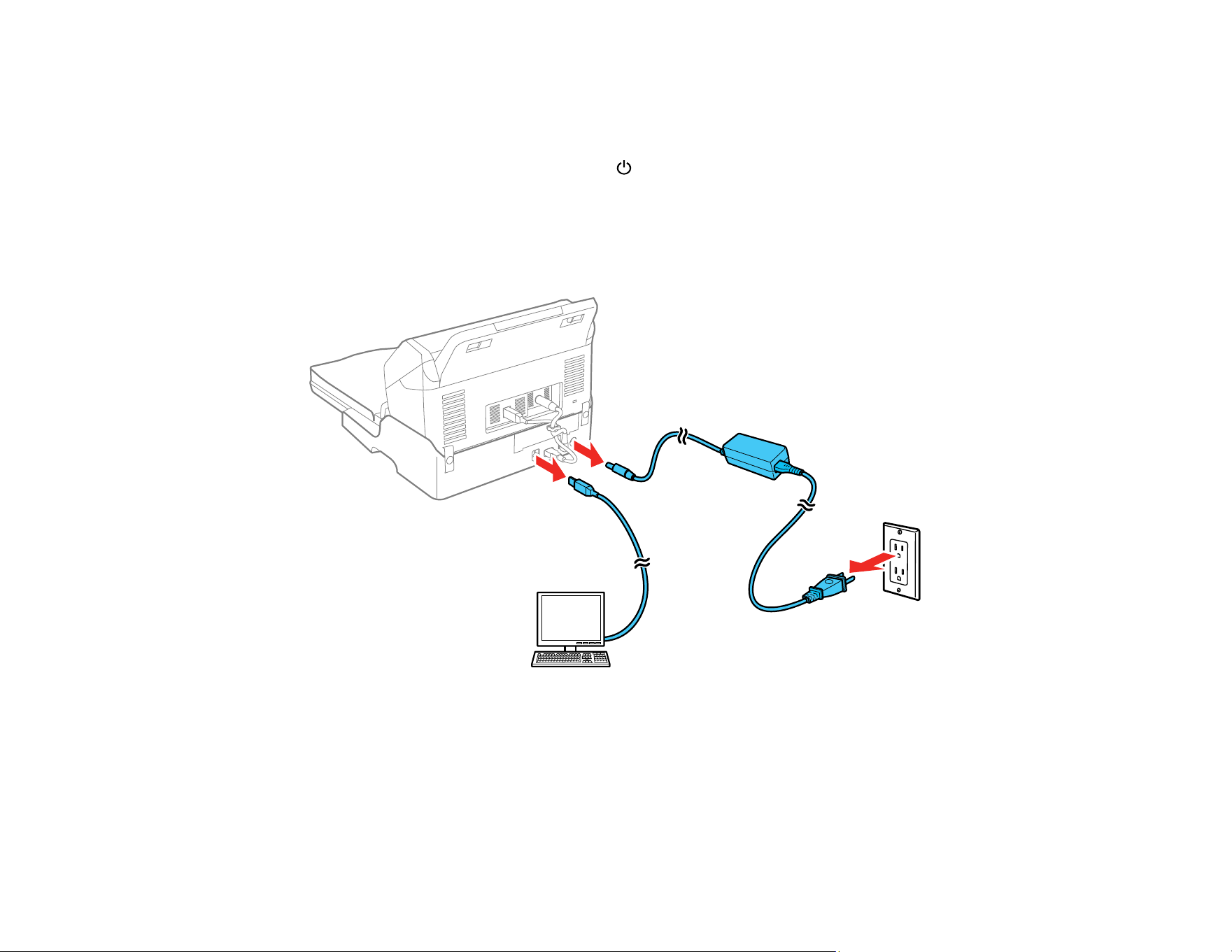
1. Turn off the document scanner using the power button.
Note: There is no power button on the flatbed scanner.
2. Unplug the AC power cord and disconnect the USB cable that connects the flatbed scanner dock to
the computer.
106
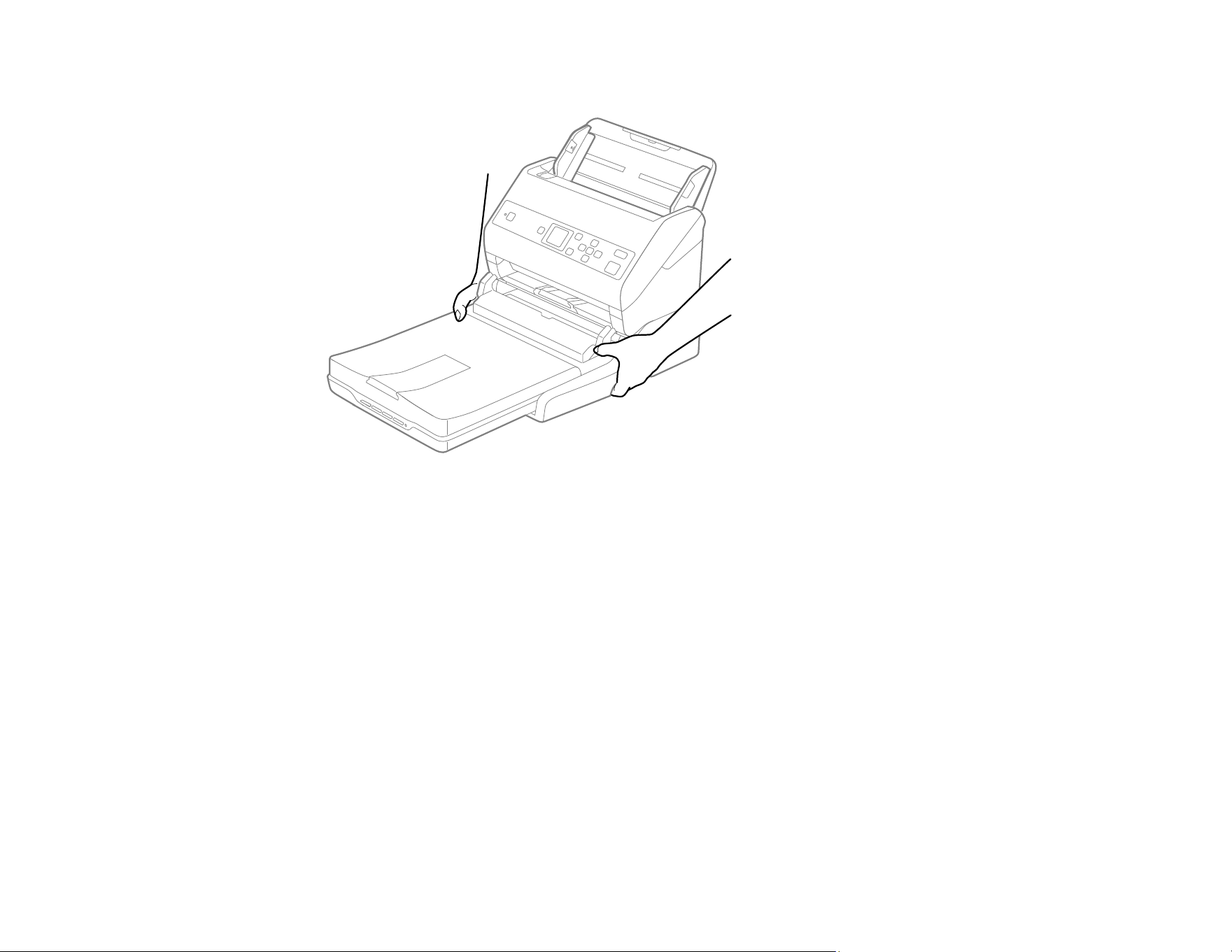
3. Lift the entire scanner unit as shown, making sure to keep it level during transport.
4. Place the scanner unit in its original packing materials if possible, or use equivalent materials with
cushioning around the scanner.
Caution: Avoid turning the scanner upside down when transporting it or you may damage the
scanner.
Parent topic: Using the Optional Flatbed Scanner Dock - Windows

107
Cleaning and Transporting Your Scanner
See these sections if you need to clean or transport your scanner.
Cleaning Your Scanner
Cleaning Inside Your Scanner
Checking the Scanner Roller Counter
Replacing the Scanner Rollers
Transporting Your Scanner
Cleaning Your Scanner
To keep your product working at its best, you should clean it several times a year.
Caution: Do not use a hard brush, alcohol, or paint thinner to clean the product or you may damage it.
Do not use oil or other lubricants inside the product or let water get inside it. Do not open the product's
outer case.
1. Turn off the scanner and unplug the AC adapter.
2. Disconnect any connected cables.
3. Clean the outer case with a soft, dry cloth. Do not use liquid or chemical cleansers.
Note: If the outer case still requires additional cleaning, use a slightly damp cloth to wipe the outer
case. Then wipe the case with a soft, dry cloth.
4. Clean the LCD screen with a soft, dry cloth.
Parent topic: Cleaning and Transporting Your Scanner
Cleaning Inside Your Scanner
Clean your scanner regularly to make sure that no dust builds up on the glass scanning surfaces. Dust
can cause spots or lines in your scanned images.
Caution: Do not use a hard brush, alcohol, or paint thinner to clean the product or you may damage it.
Do not use oil or other lubricants inside the product or let water get inside it.
1. Turn off the scanner and unplug the AC adapter.
108
2. Disconnect any connected cables.
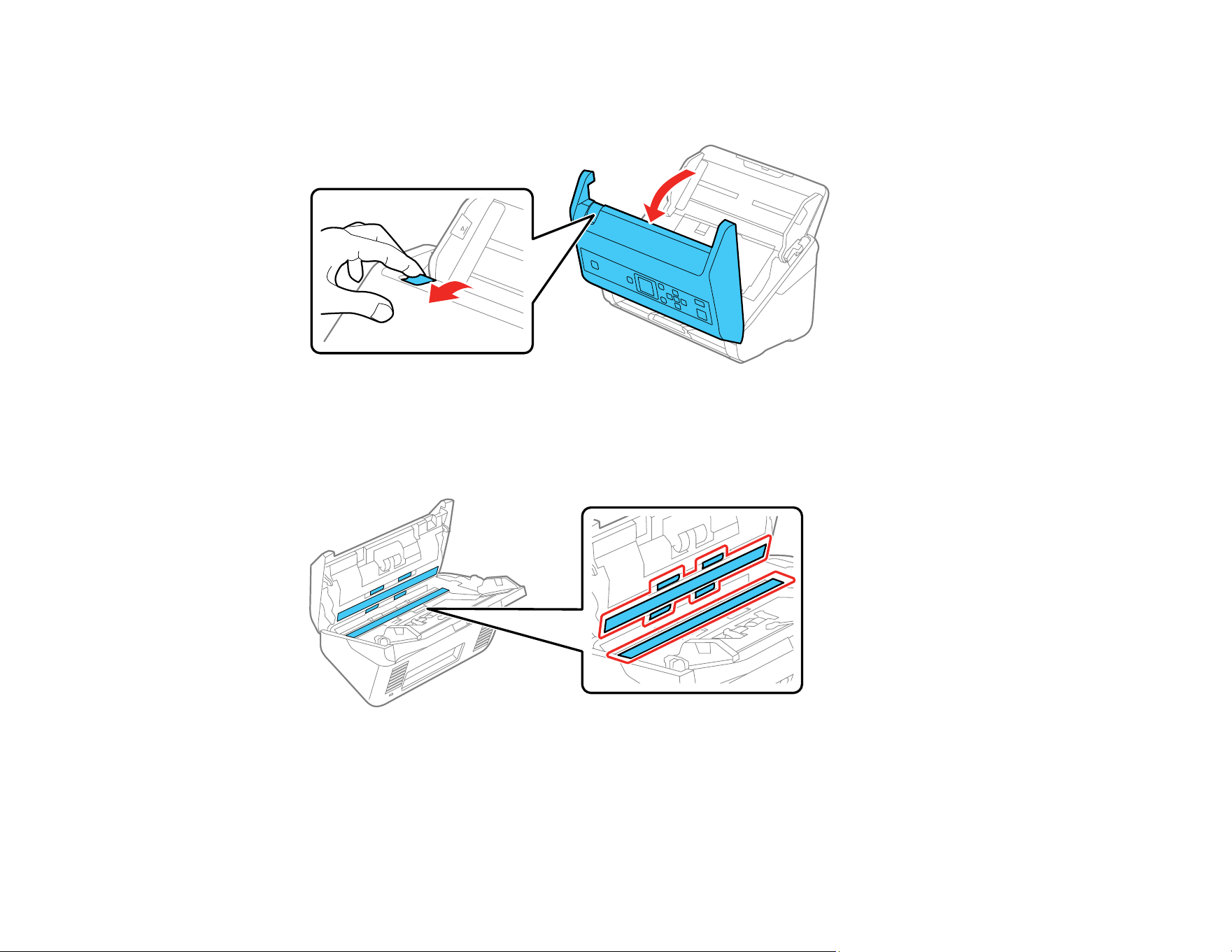
3. Pull down on the cover open lever and open the scanner cover.
4. Use a genuine Epson cleaning kit or a soft, moist cloth to wipe off any dust or dirt on the glass
scanning surfaces and the rollers inside the scanner cover. If the glass surface is stained with
grease or some other hard-to-remove material, use a genuine Epson cleaning kit. Use a small
amount of cleaner on the cleaning cloth to remove the stains. Be sure to wipe off all remaining liquid.
Caution: Do not spray glass cleaner directly on the scanning surfaces. Be careful not to place too
much force on the glass.
109
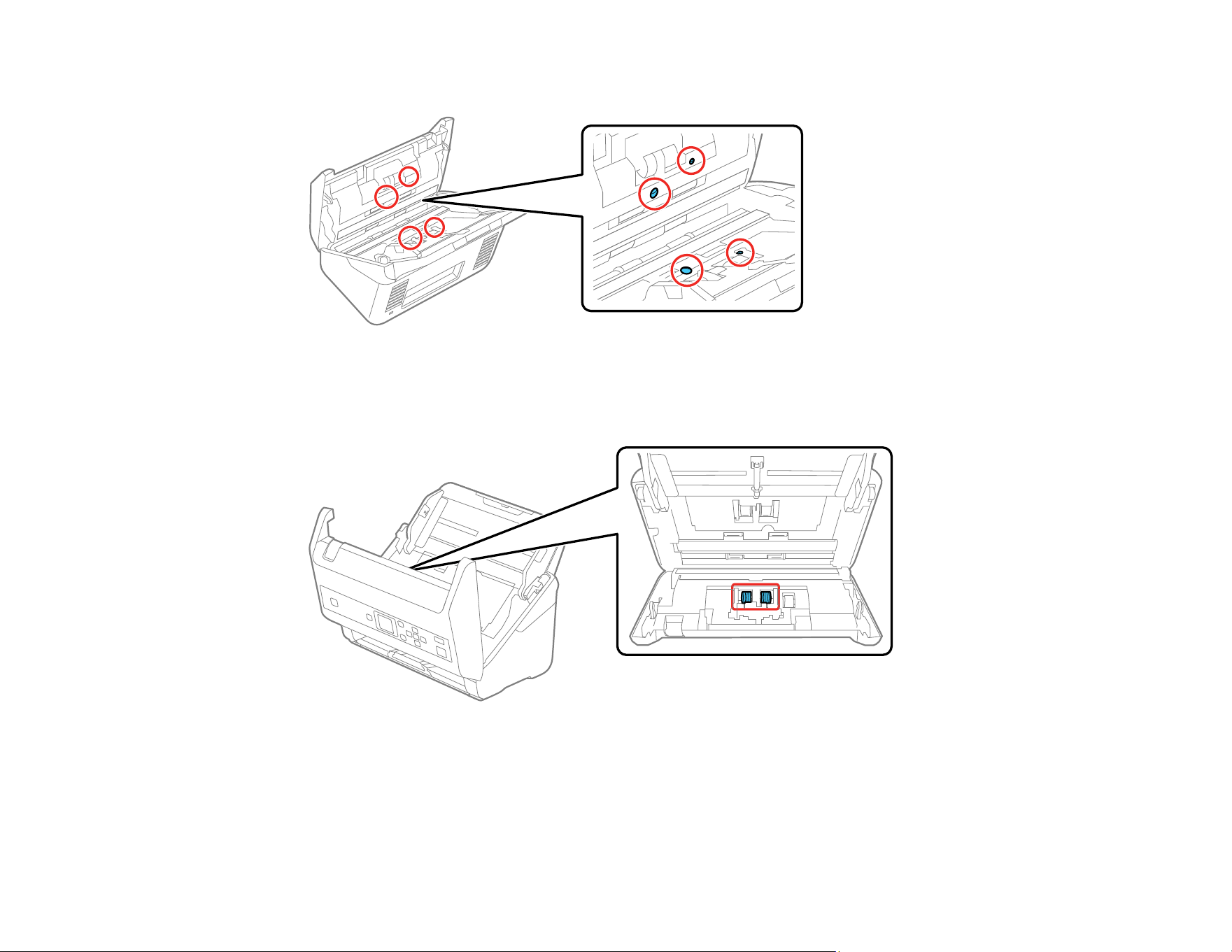
5. Use a cotton swab to wipe off any dust or dirt on the sensors shown here.
Caution: Do not use liquid or glass cleaner on the cotton swab.
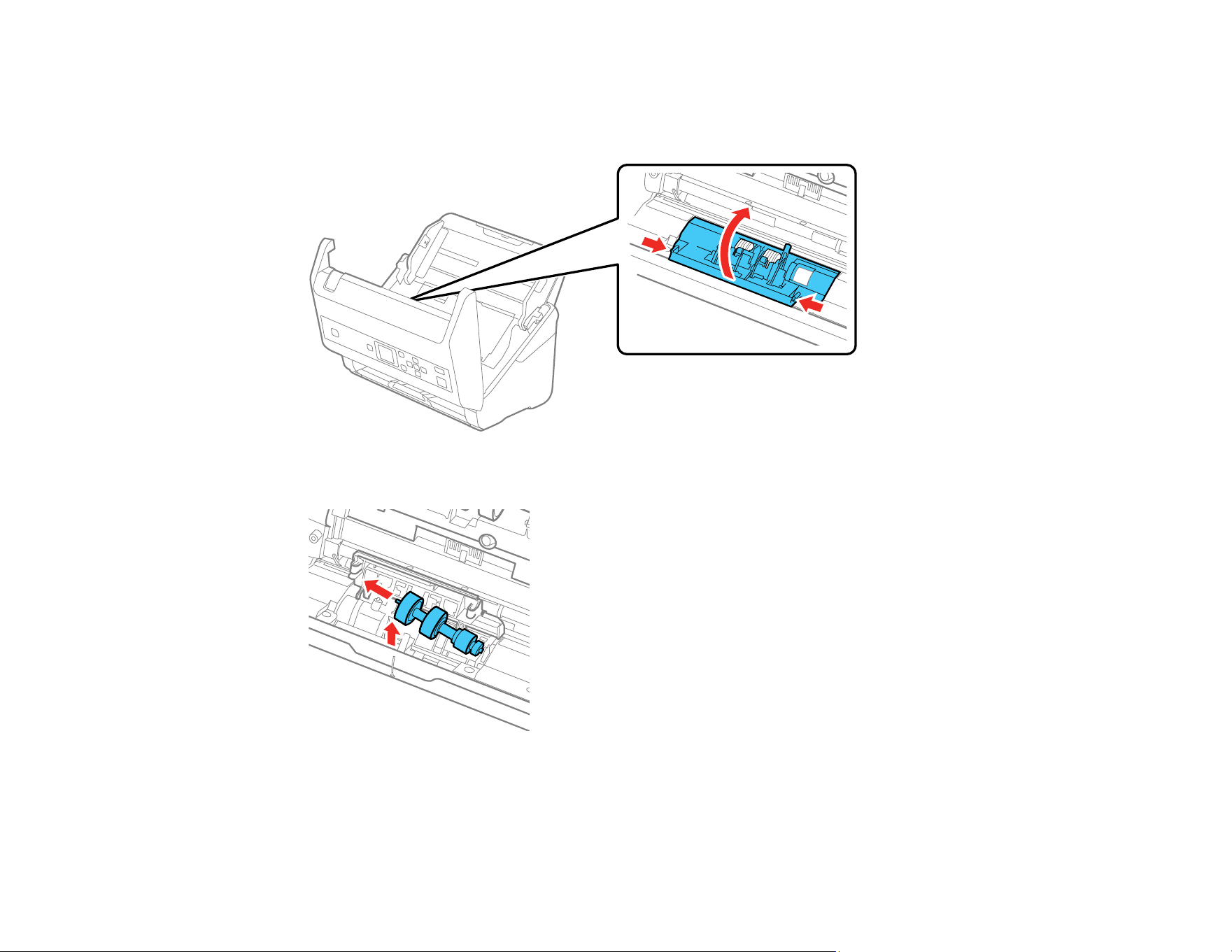
6. Locate the separation roller.
110
7. Squeeze the tabs on the sides of the separation roller cover and open the cover.
Caution: Be careful not to apply too much force when opening the cover.
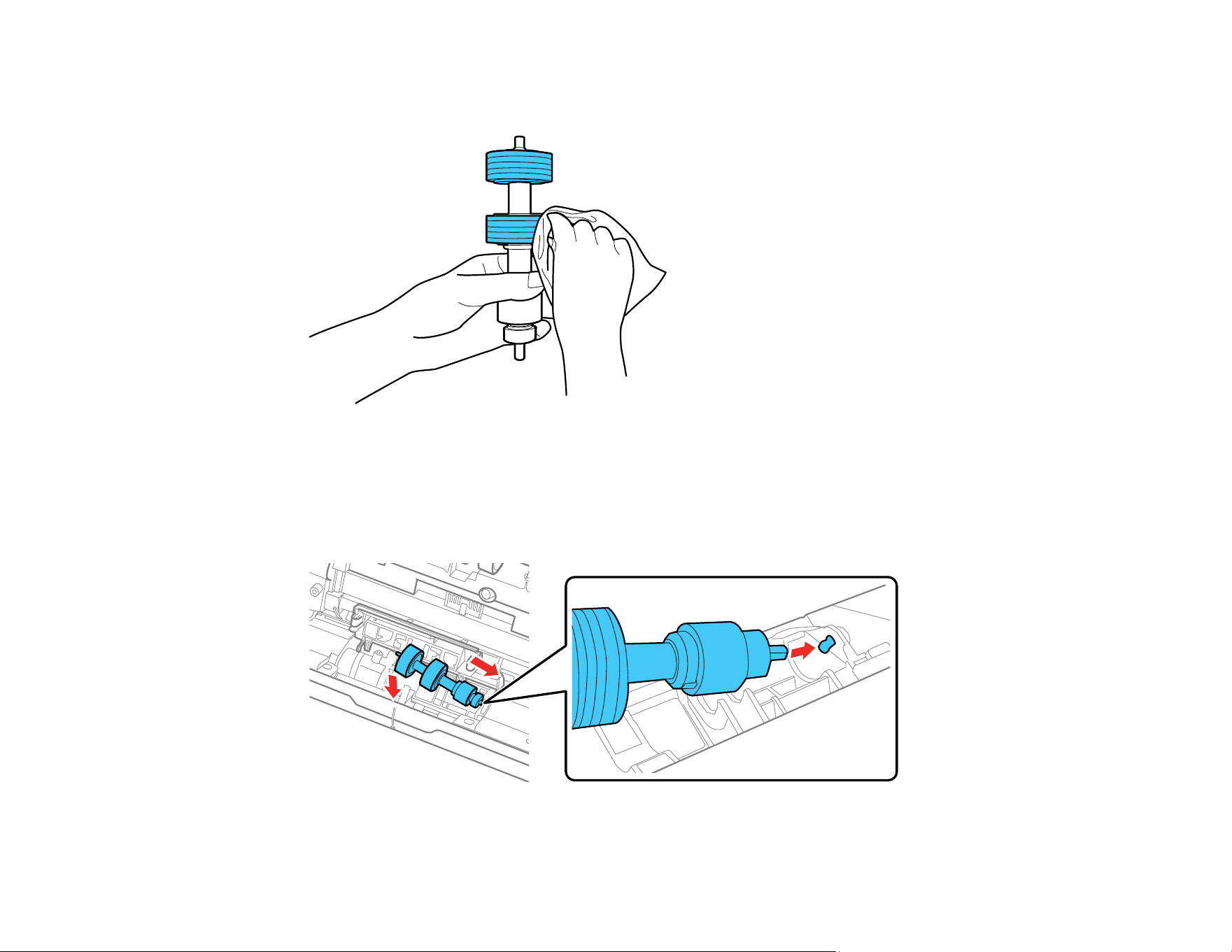
8. Slide the separation roller to the left and remove it.
111
9. Wipe off any dust or dirt on the separation roller using a genuine Epson cleaning kit or a soft, moist
cloth.
Caution: Use only a genuine Epson cleaning kit or soft, moist cloth to clean the roller; using a dry
cloth may damage the surface of the roller.
10. To replace the separation roller, insert the end of the roller into the hole on the right side and lower
the other end of the roller into place.
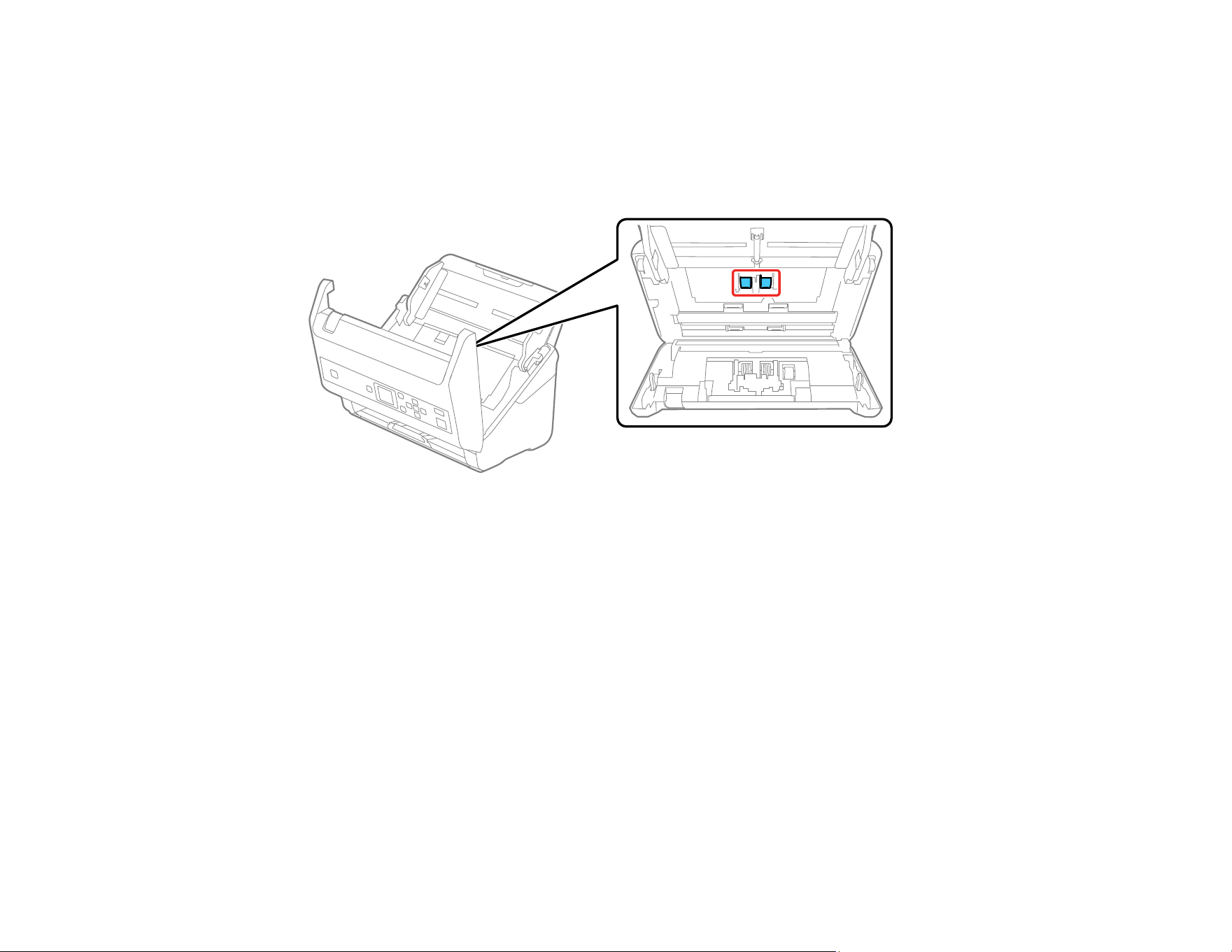
112
11. Close the separation roller cover until you hear it click into place.
Note: If you are not able to close the cover, the roller is not installed correctly. Remove the roller and
reinstall it, then try to close the cover again.
12. Locate the pickup roller.
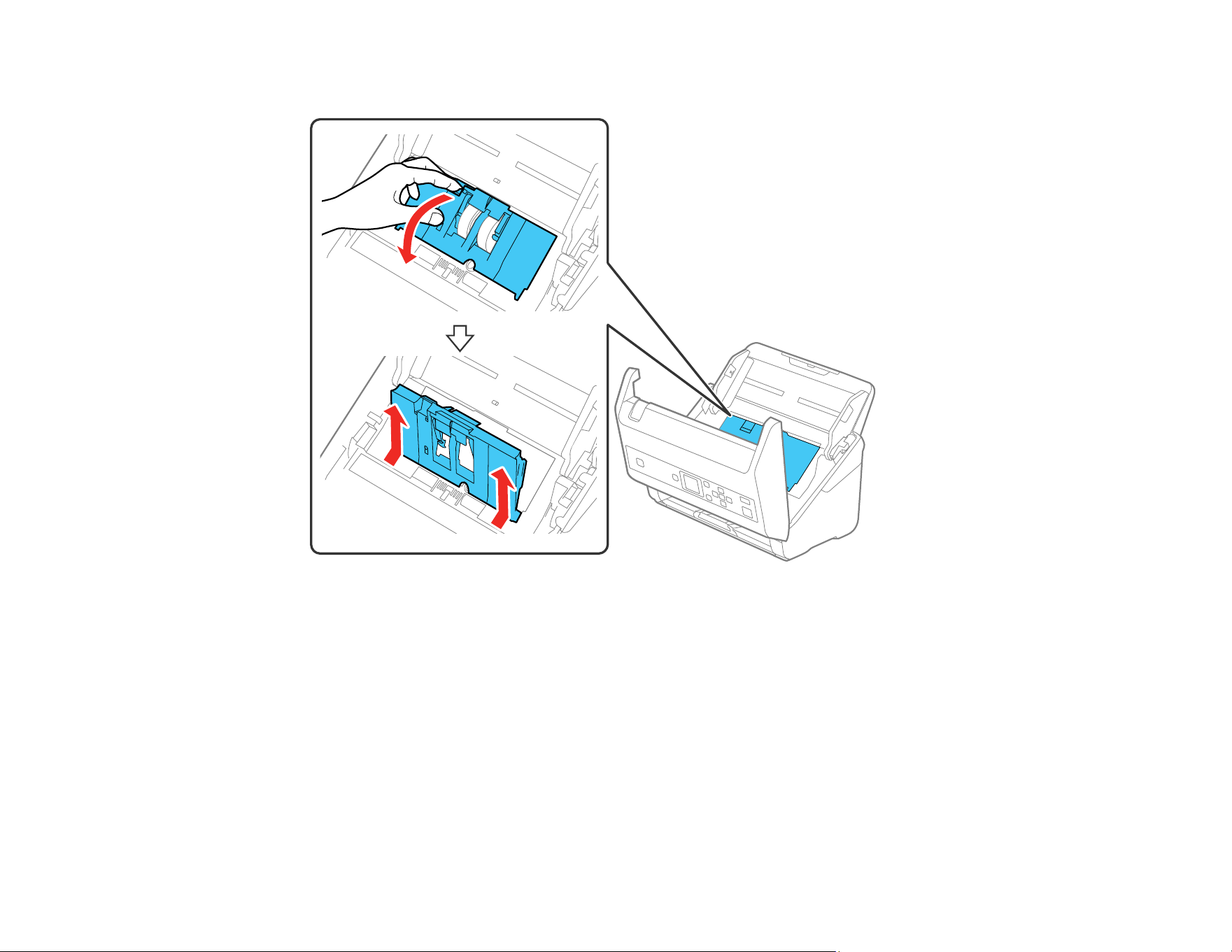
113
13. Press down on the pickup roller cover latch and pull up the cover to remove it.
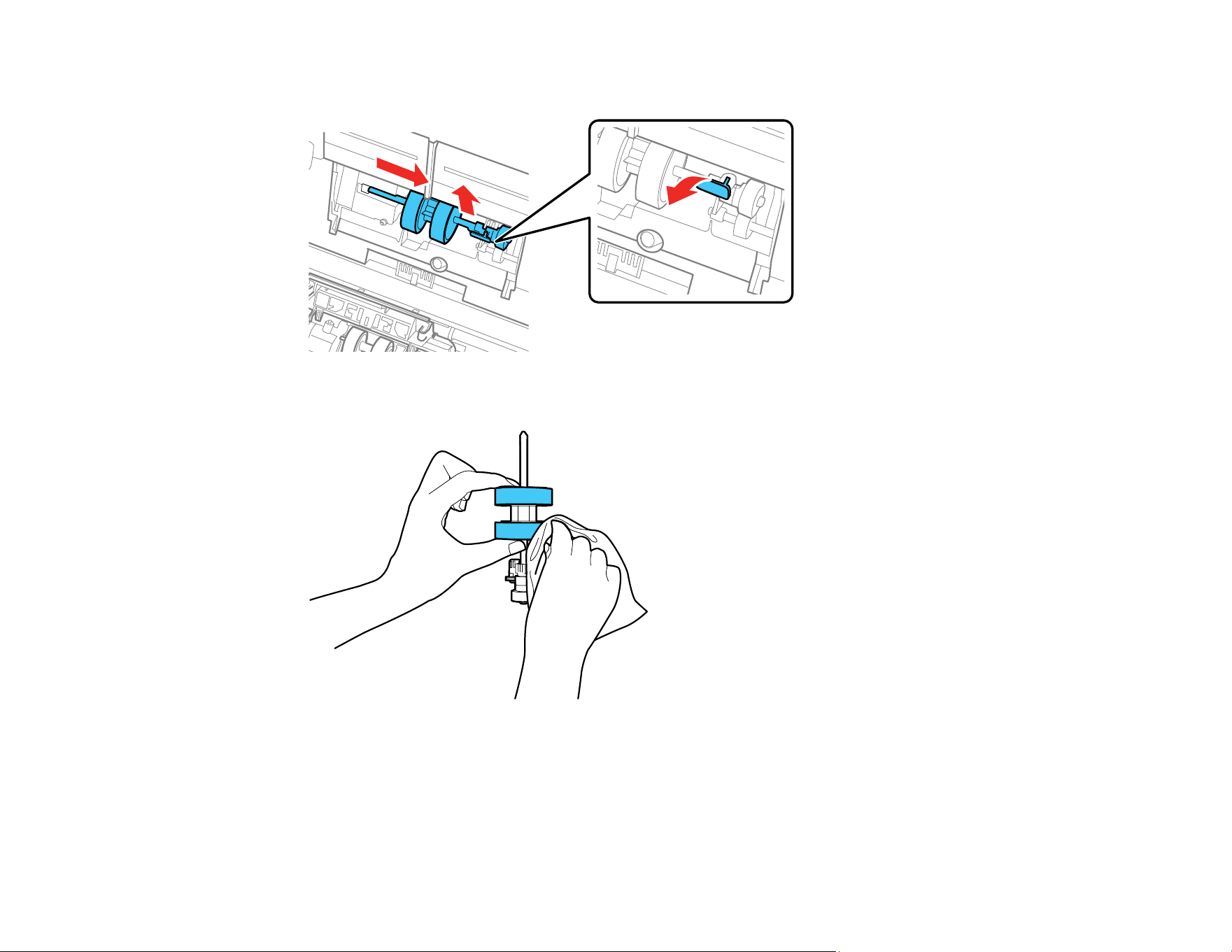
114
14. Pull down the tab on the pickup roller and slide the roller to the right to remove it.
15. Wipe off any dust or dirt on the pickup roller using a genuine Epson cleaning kit or a soft, moist cloth.
Caution: Use only a genuine Epson cleaning kit or soft, moist cloth to clean the roller; using a dry
cloth may damage the surface of the roller.
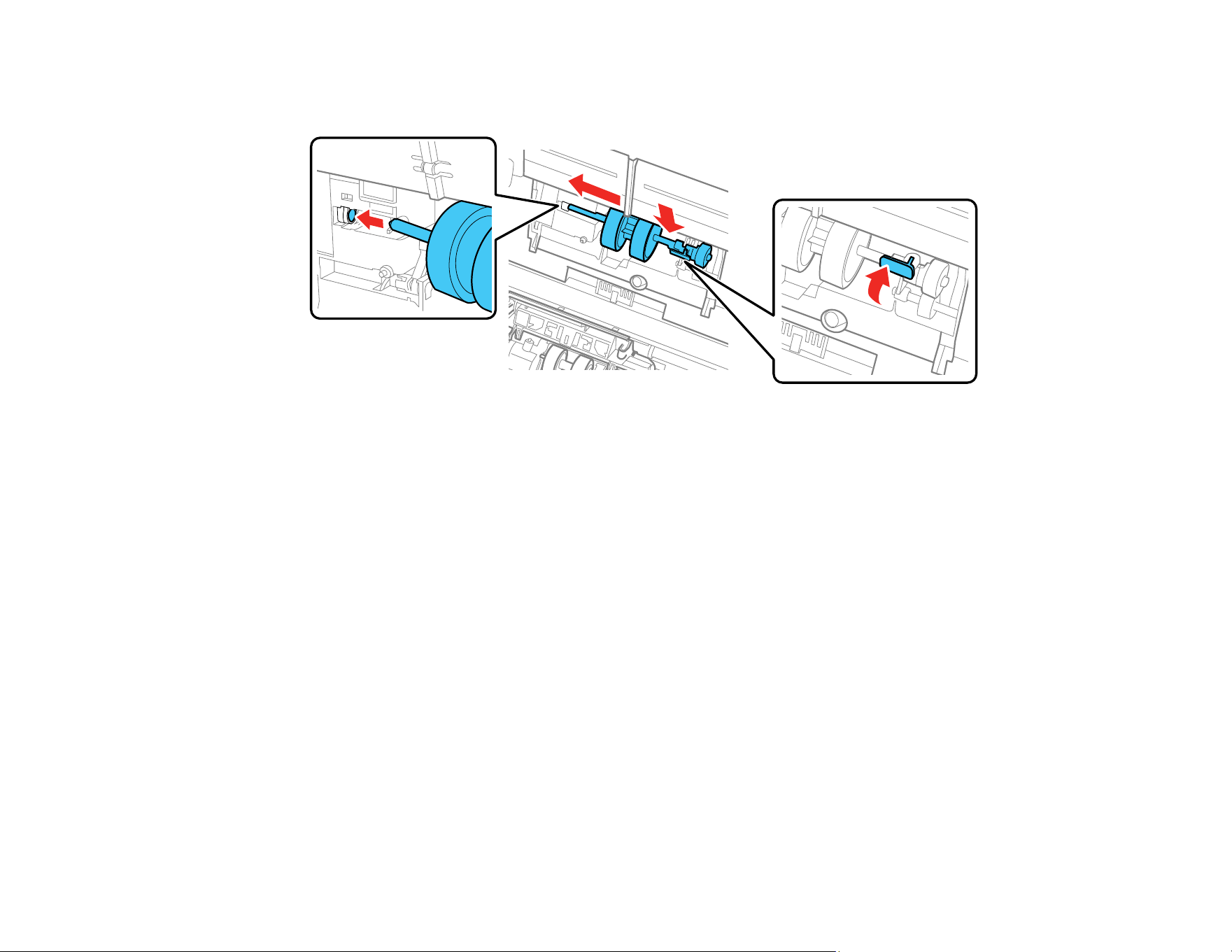
115
16. To replace the pickup roller, align the notches on the roller unit and slide it to the left. Press up on the
tab to secure the roller.
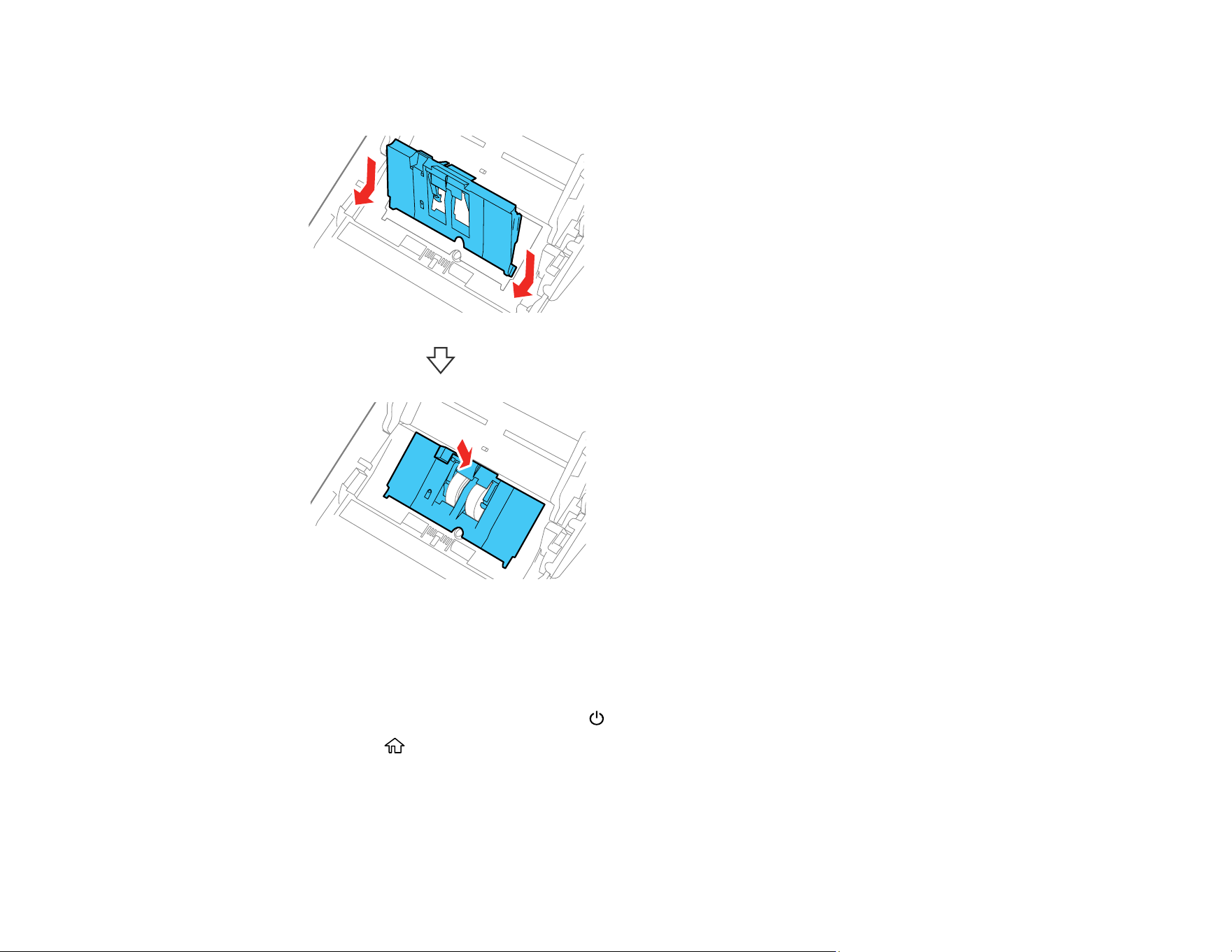
116
17. Align the bottom edge of the pickup roller cover into the notches as shown and press it down until it
clicks into place.
Note: If you are not able to close the cover, the roller is not installed correctly. Remove the roller unit
and reinstall it, then try to close the cover again.
18. Close the scanner cover.
19. Plug in the AC adapter and press the power button to turn on the scanner.
20. Press the home button, if necessary, select Scanner Maintenance, and press the OK button.
21. Select Roller Cleaning and press the OK button.
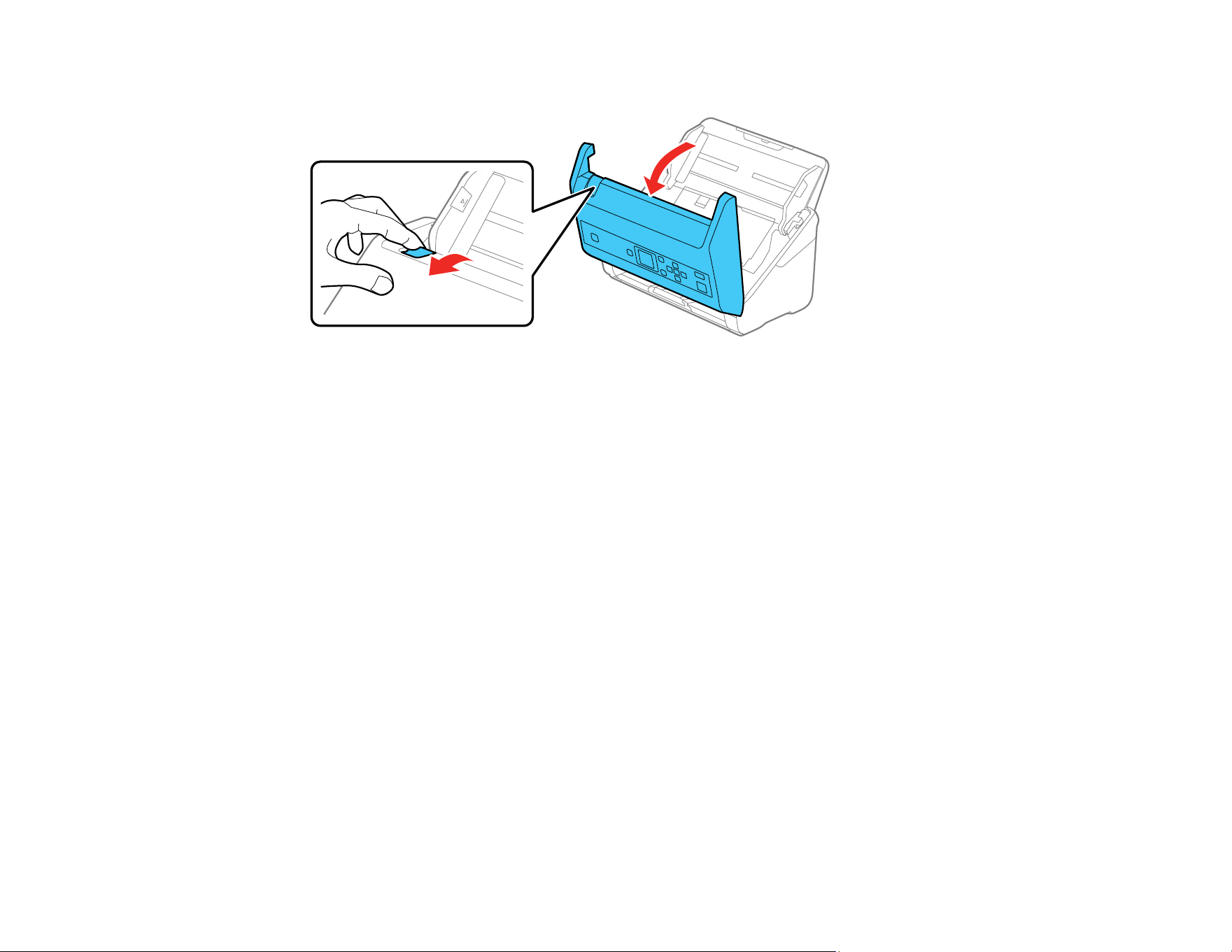
117
22. Pull down on the cover open lever and open the scanner cover.
The scanner enters roller cleaning mode.
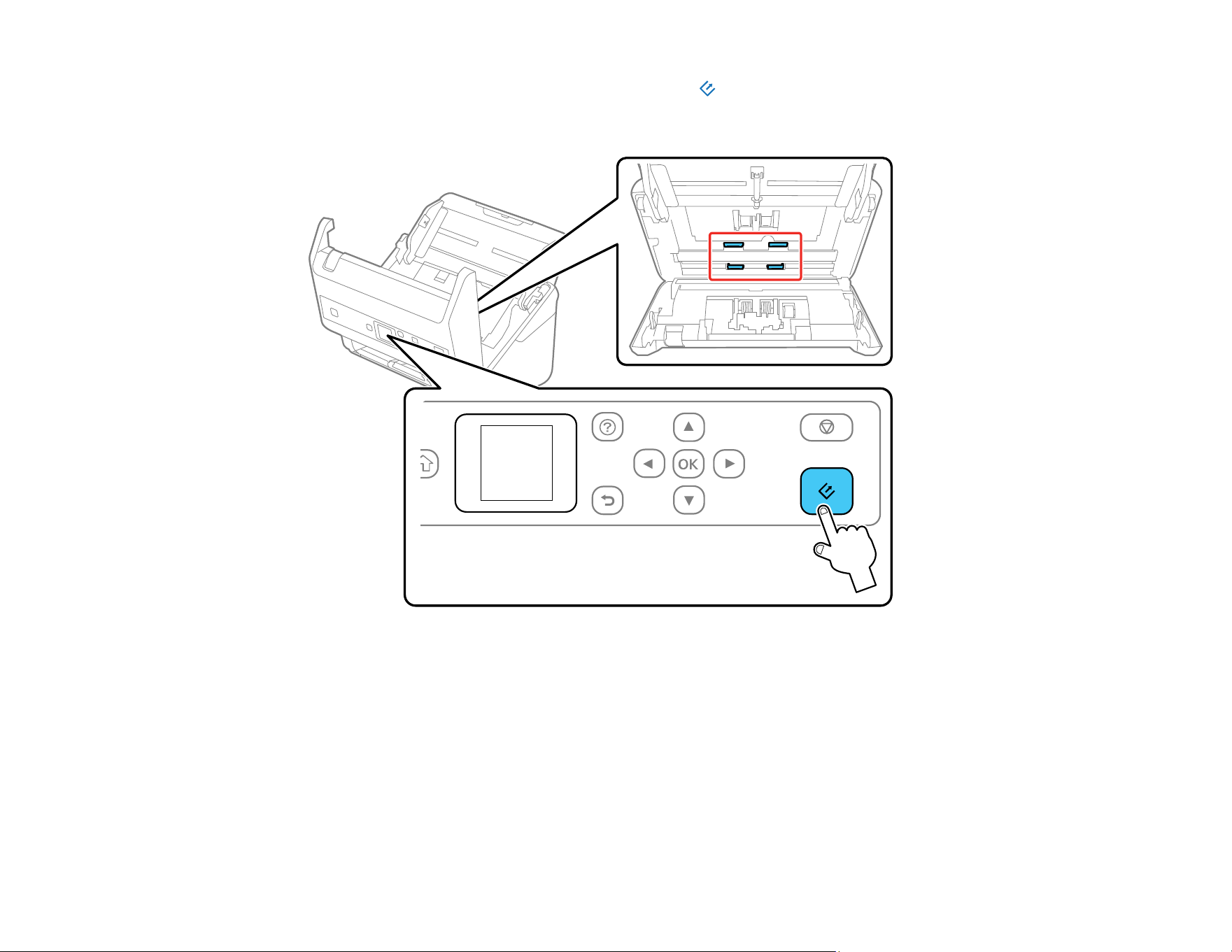
118
23. Slowly rotate the rollers shown here by pressing the start button. Use a genuine Epson cleaning
kit or a soft, moist cloth to wipe off any dust or dirt on the rollers as they rotate. Repeat this step until
the rollers are clean.
Caution: Be careful not to get your hands or hair caught in the rollers as they rotate.
24. Close the scanner cover.
Parent topic: Cleaning and Transporting Your Scanner
Related references
User Replaceable Epson Scanner Parts
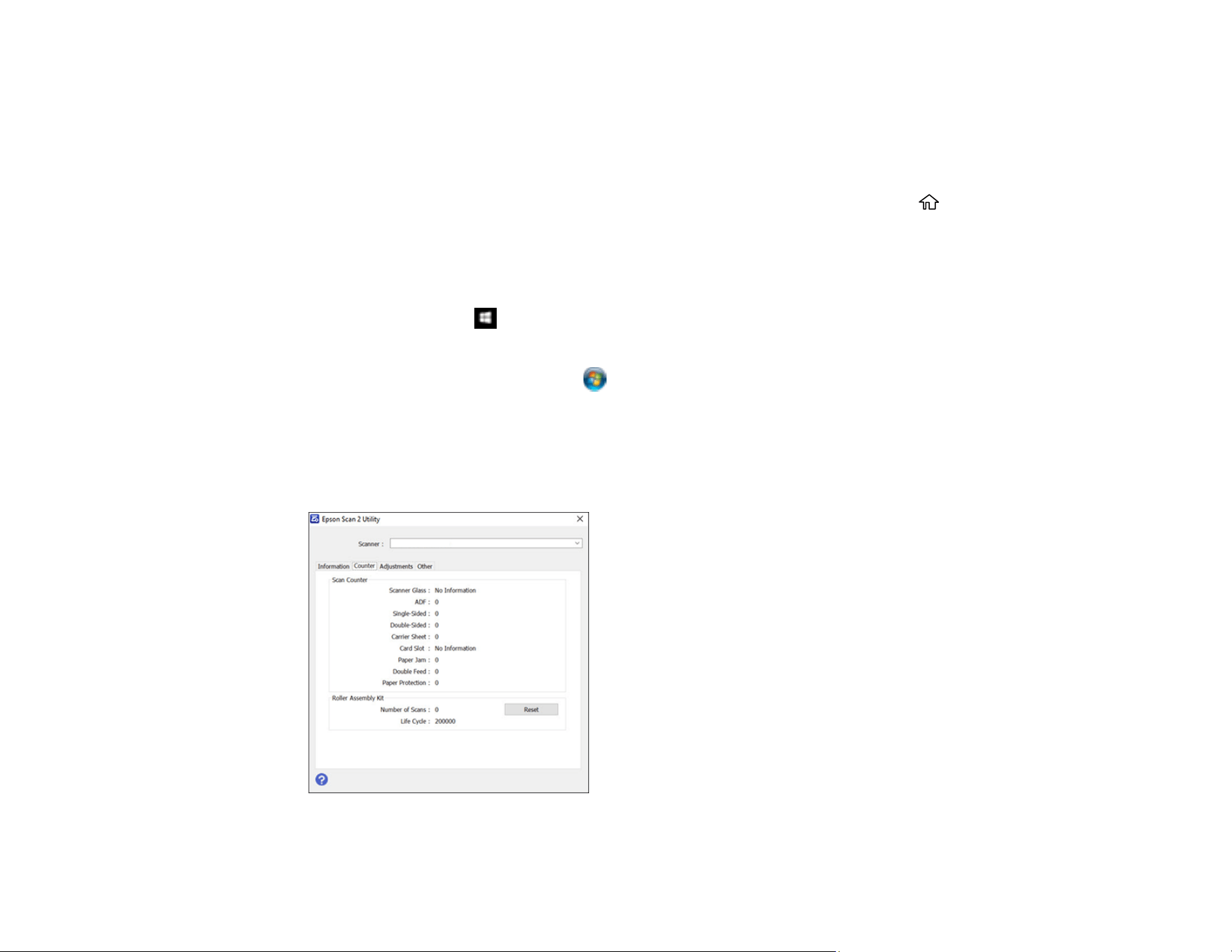
119
Checking the Scanner Roller Counter
Check the scanner roller counter to determine when your rollers need to be replaced. When you replace
the scanner rollers, reset the scanner roller counter so you know when you may need to replace the
rollers again.
Note: To check the scanner roller counter from the scanner's control panel, press the home button
and select Scanner Maintenance > Roller Replacement and press the down arrow button.
1. Make sure the scanner is turned on and connected to your computer.
2. Do one of the following to open the Epson Scan 2 Utility:
• Windows 10: Click and select EPSON > Epson Scan 2 Utility.
• Windows 8.x: Navigate to the Apps screen and select Epson Scan 2 Utility.
• Windows (other versions): Click or Start > All Programs or Programs > EPSON > Epson
Scan 2 > Epson Scan 2 Utility.
• Mac: Open the Applications folder, click Epson Software, and click Epson Scan 2 Utility.
3. Click the Counter tab.
You see a screen like this:
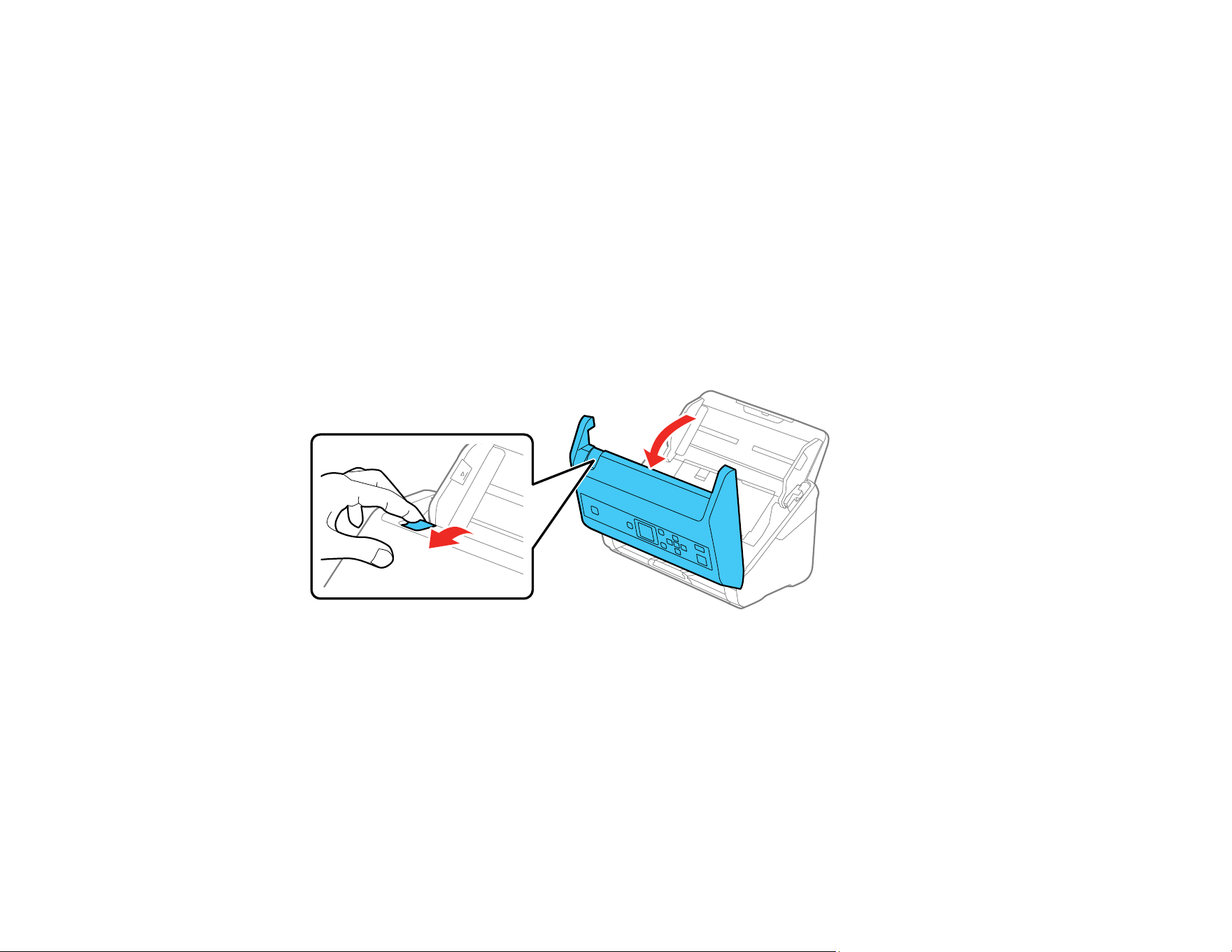
120
4. If the number in the Number of Scans field exceeds the number displayed as the Life Cycle of the
rollers, it is time to replace the rollers.
5. Close the Epson Scan 2 Utility.
Parent topic: Cleaning and Transporting Your Scanner
Replacing the Scanner Rollers
Replace the scanner rollers when the number of scans exceeds the life cycle of the rollers. Check the
scanner roller counter to see when you need to replace the rollers.
1. Turn off the scanner.
2. Unplug the AC adapter.
3. Disconnect any connected cables.
4. Pull down on the cover open lever and open the scanner cover.
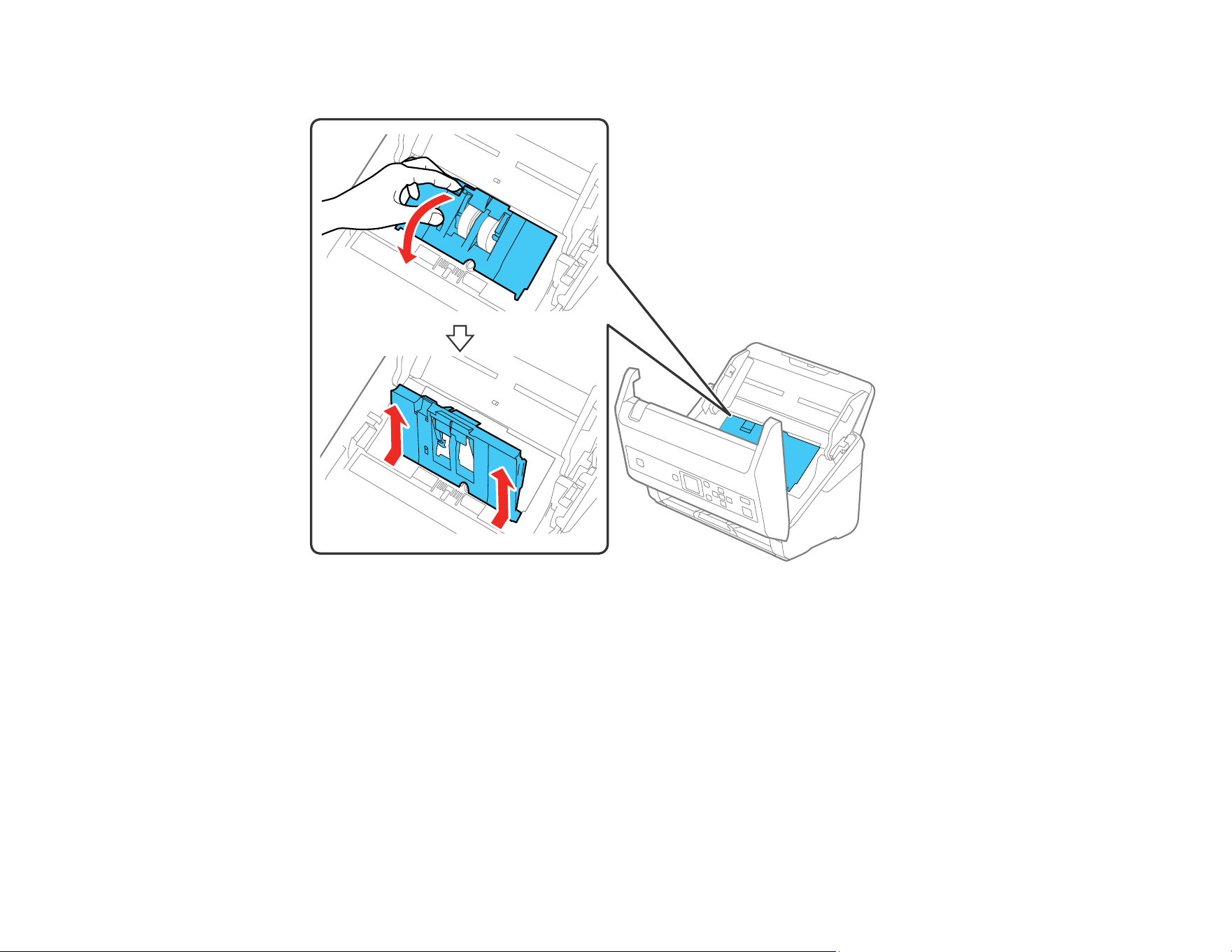
121
5. Press down on the pickup roller cover latch and pull up the cover to remove it.
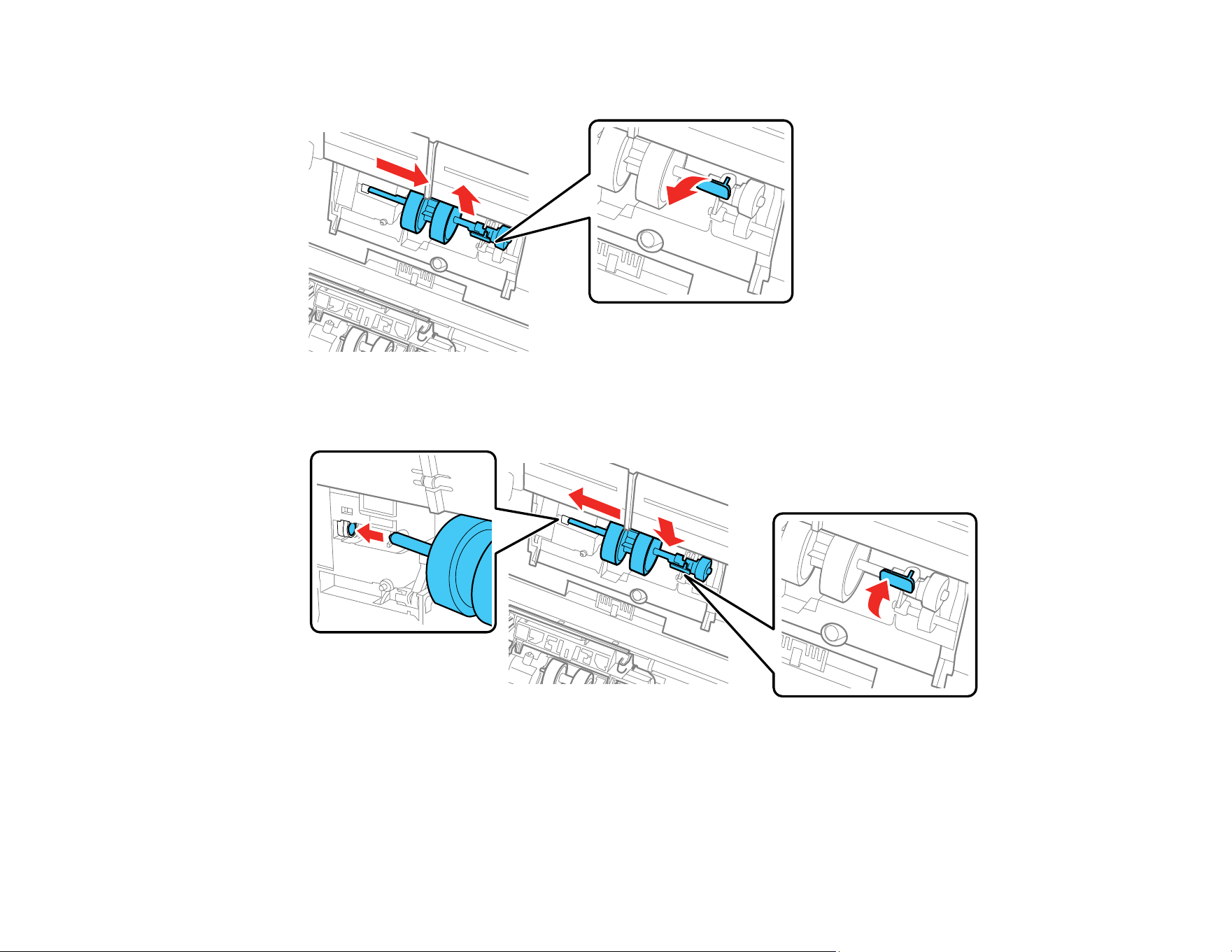
122
6. Pull down the tab on the pickup roller and slide the roller to the right to remove it.
7. To install the new pickup roller, align the notches on the roller unit and slide it to the left. Press up on
the tab to secure the roller.
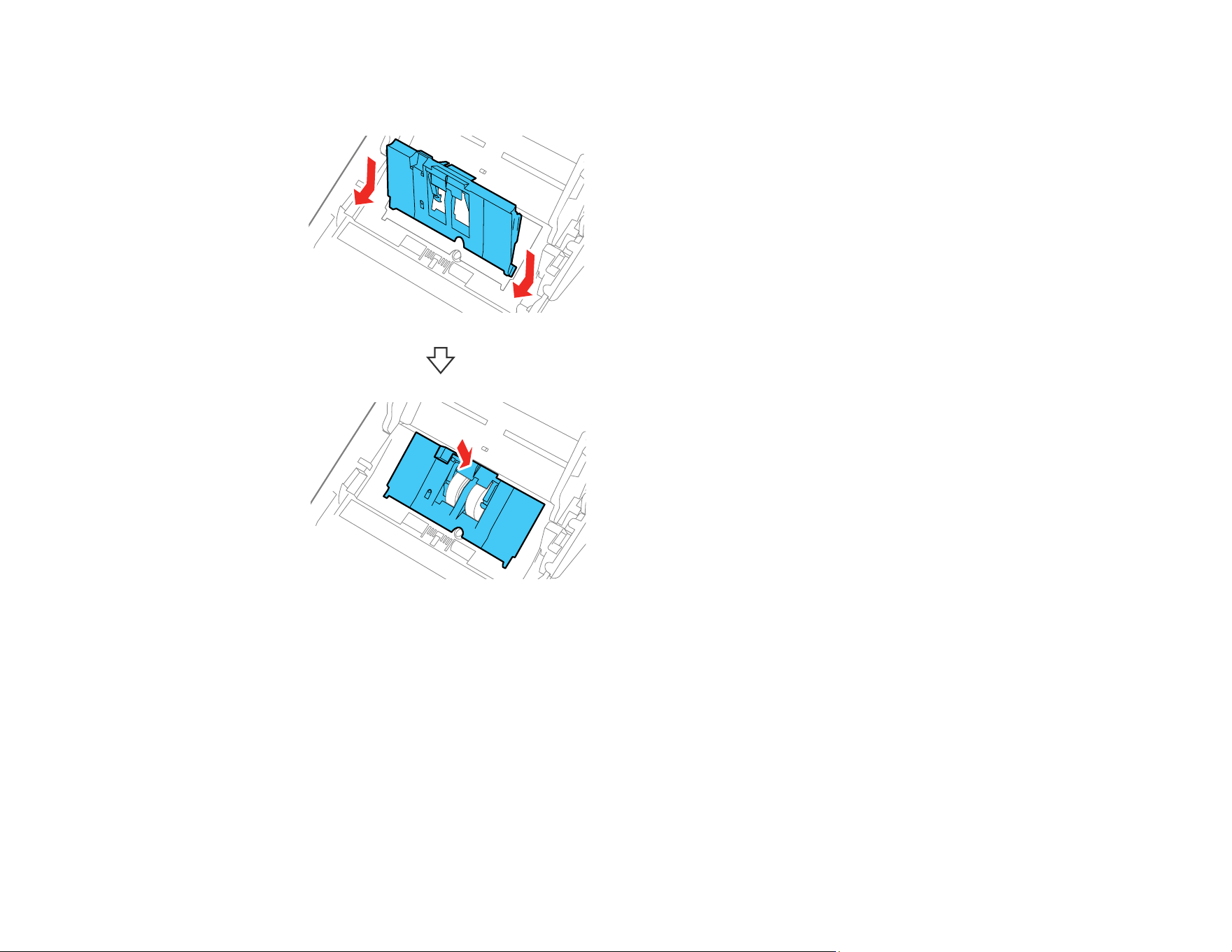
123
8. Align the bottom edge of the pickup roller cover into the notches as shown and press it down until it
clicks into place.
Note: If you are not able to close the cover, the pickup roller is not installed correctly. Remove the
pickup roller and reinstall it, then try to close the cover again.
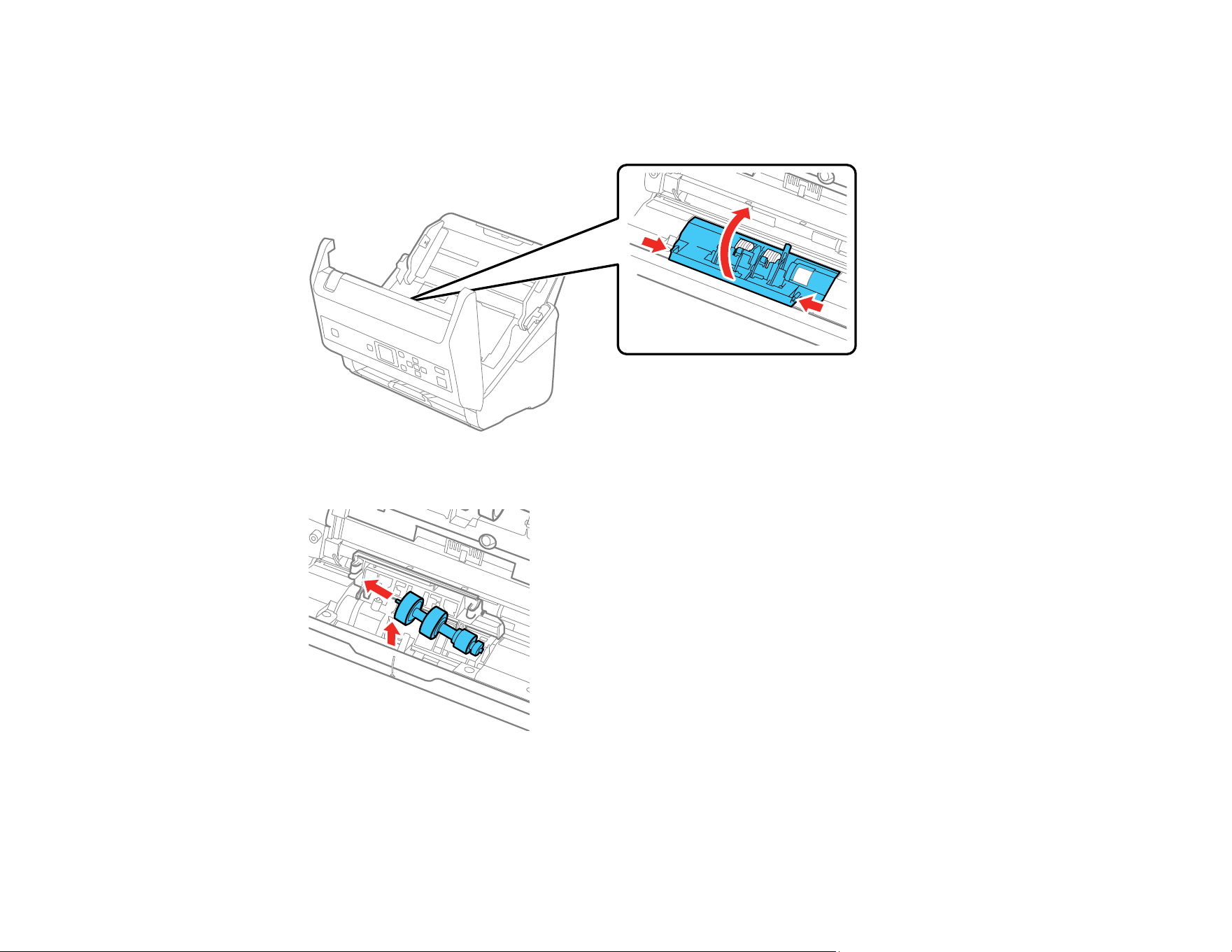
124
9. Squeeze the tabs on the sides of the separation roller cover and open the cover.
Caution: Be careful not to apply too much force when opening the cover.
10. Slide the separation roller to the left and remove it.
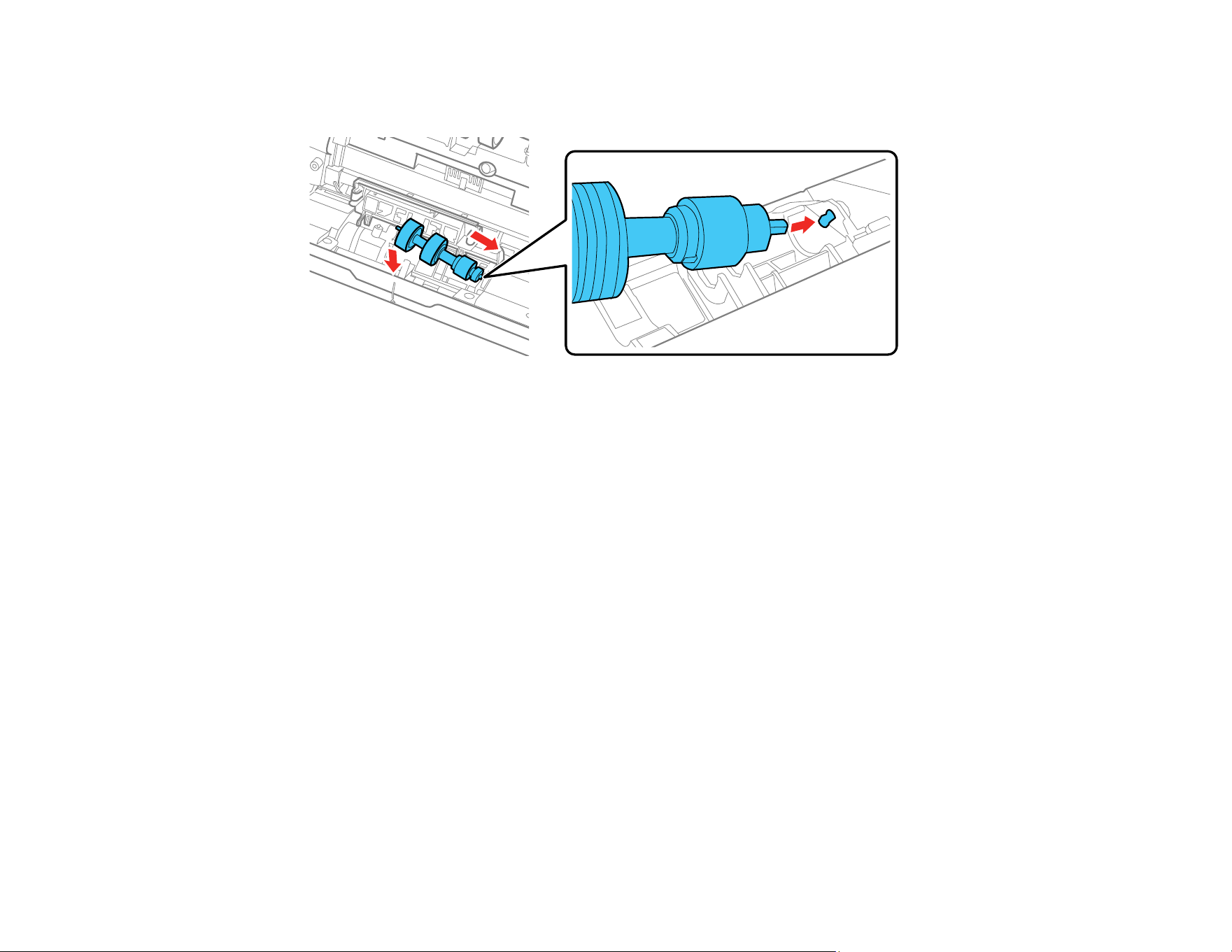
125
11. To install a new separation roller, insert the end of the roller into the hole on the right side and lower
the other end of the roller into place.
12. Close the separation roller cover until you hear it click into place.
Note: If you are not able to close the cover, the roller is not installed correctly. Remove the roller and
reinstall it, then try to close the cover again.
13. Close the scanner cover.
14. Connect any disconnected cables.
15. Plug in the AC adapter and turn on the scanner.
16. Reset the roller counter.
Resetting the Scanner Roller Counter
Parent topic: Cleaning and Transporting Your Scanner
Related references
User Replaceable Epson Scanner Parts
Related tasks
Checking the Scanner Roller Counter
Resetting the Scanner Roller Counter
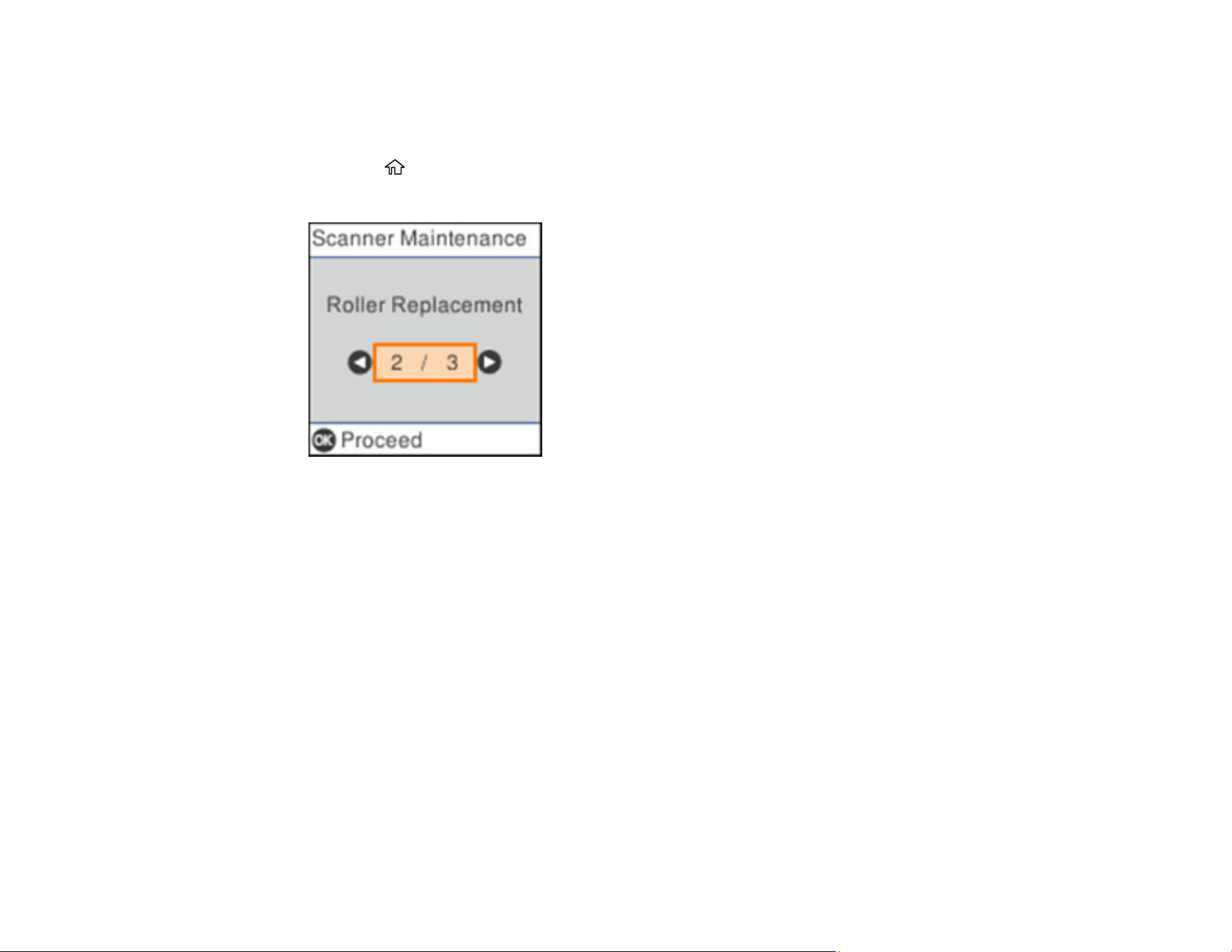
126
Resetting the Scanner Roller Counter
When you replace the scanner rollers, reset the scanner roller counter so you know when you may need
to replace the rollers again.
1. Press the home button, if necessary, select Scanner Maintenance, and press the OK button.
2. Select Roller Replacement and press the OK button.
3. Press the down arrow button to select Reset Counter and press the OK button.
4. Select Yes.
Note: You can also reset the roller counter from your computer using the Epson Scan 2 Utility.
Select the Counter tab and click Reset.
Parent topic: Replacing the Scanner Rollers
Related tasks
Checking the Scanner Roller Counter
Transporting Your Scanner
If you need to ship your product, transport it a long distance, or store it for an extended period, prepare it
for transportation as described here.
1. Turn off the scanner and unplug the AC adapter.
2. Disconnect any connected cables.
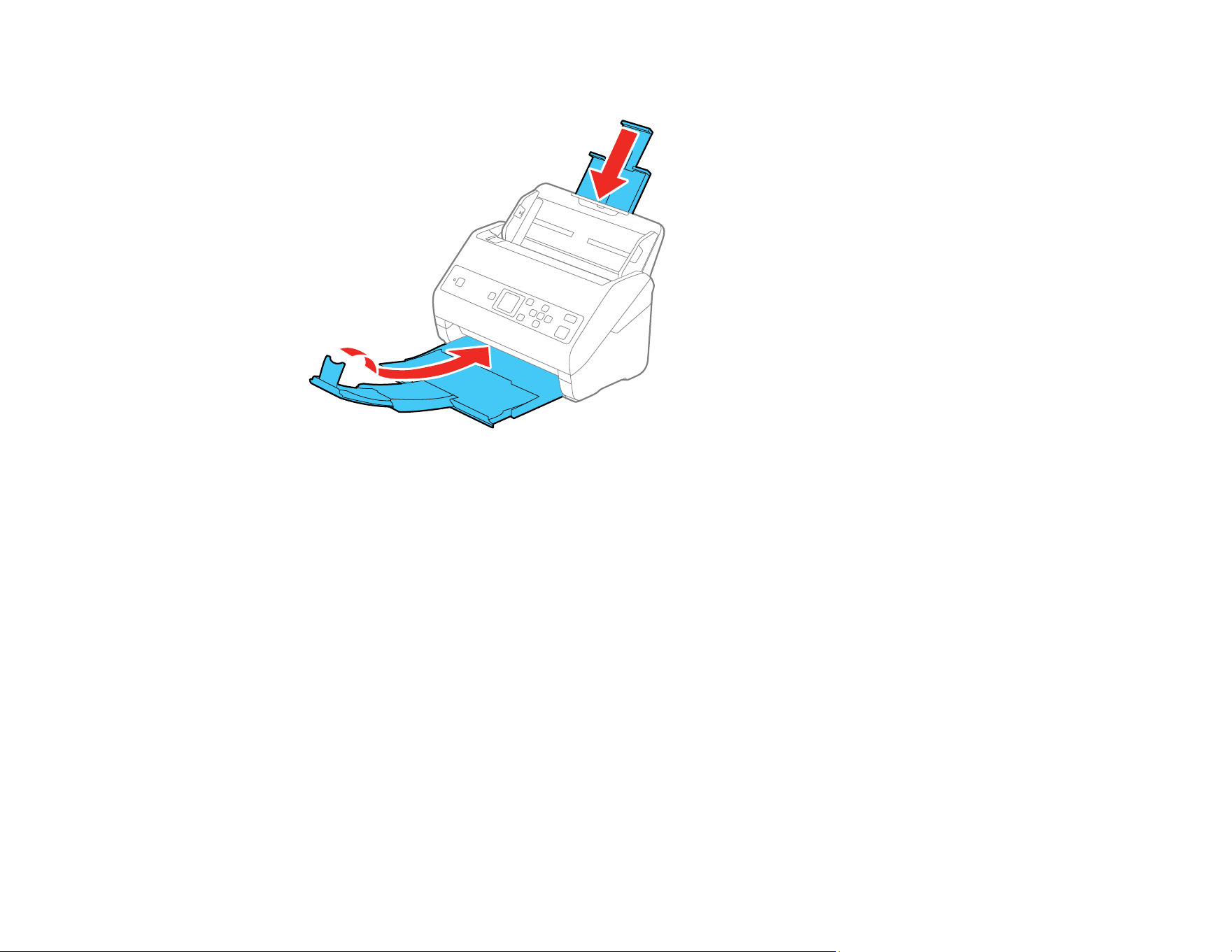
127
3. Close the input tray extension and the output tray.
Note: Make sure the output tray is securely closed.
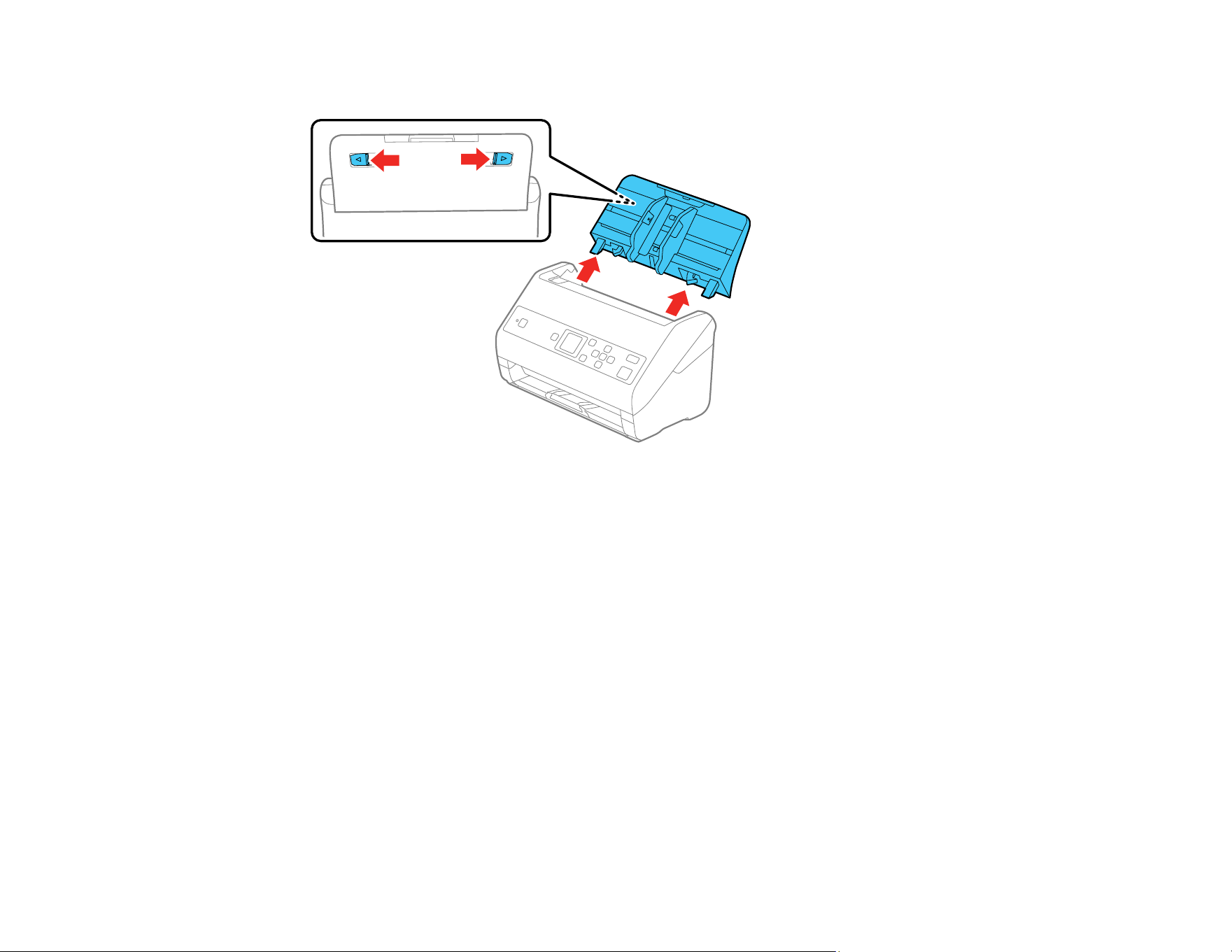
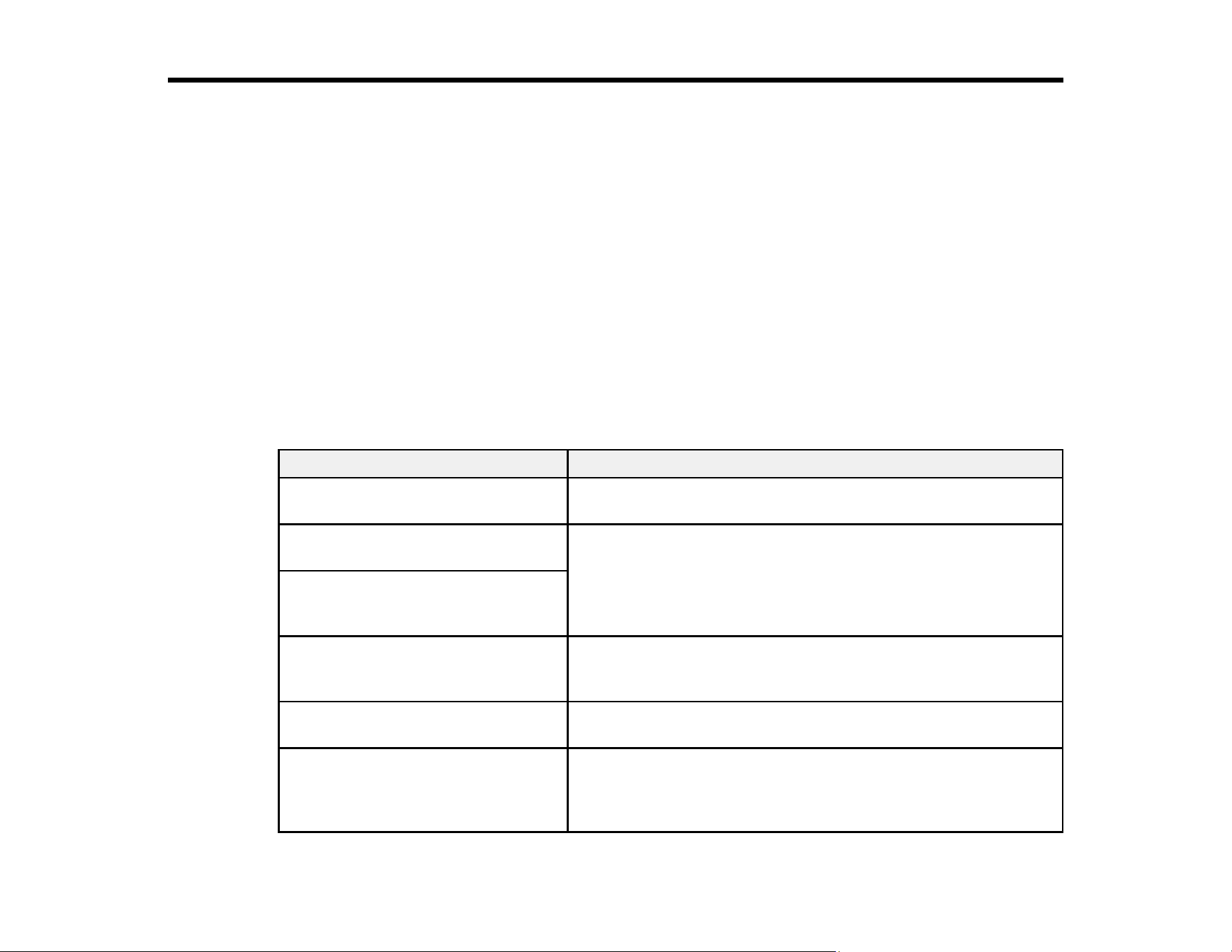
129
Solving Problems
Check these sections for solutions to problems you may have using your product.
Product Status Messages
Solving Scanning Problems
Solving Scanned Image Quality Problems
Solving Flatbed Scanner Dock Problems
Uninstall Your Scanner Software
Where to Get Help
Product Status Messages
You can often diagnose problems with your product by checking the messages and status icons on its
LCD screen.
Note: If the LCD screen is dark, press any button to wake the product from sleep mode.
LCD screen message Condition/solution
Prepare the rollers for a replacement.
For details, see your documentation.
You need to replace the roller inside your scanner.
To enable Restrict User Access, see
your documentation.
You need to modify the user access restrictions on your scanner
control panel.
Restrict User Access is enabled. For
more details, see your
documentation.
Clean inside the scanner. For details,
see your documentation.
It is time to clean inside your scanner. If you want to change the
alerts, modify the Regular Cleaning Alert setting on your
scanner control panel.
Scanner error. For details, see your
documentation.
Turn the scanner off and on again. If the error continues, contact
Epson for support.
RECOVERY MODE An error has occurred during firmware updating. Connect your
product using a USB cable and try downloading the Firmware
Update from the Epson support site. If you still need help,
contact Epson for support.

130
Parent topic: Solving Problems
Related references
Original Jams in Scanner
Where to Get Help
Related tasks
Replacing the Scanner Rollers
Setting User Access Restrictions (Access Control)
Scanning a Document in Epson ScanSmart
Loading Originals in the Input Tray
Cleaning Inside Your Scanner
Changing Regular Cleaning Alert Settings
Solving Scanning Problems
Check these solutions if you have problems scanning with your product.
Scanner Does Not Turn On or Turns Off Unexpectedly
Scanner Button Does Not Work as Expected
Scanning Software Does Not Operate Correctly
Original Feeds Incorrectly in Scanner
Original Jams in Scanner
Scanning is Slow
Parent topic: Solving Problems
Scanner Does Not Turn On or Turns Off Unexpectedly
If the scanner does not turn on or if it turns off unexpectedly, try these solutions:
• Make sure the AC adapter is securely connected to the scanner and to a working electrical outlet.
• You may need to adjust the Sleep Timer and Power Off Timer settings on the control panel.
Parent topic: Solving Scanning Problems
Related tasks
Changing the Sleep Timer Settings
Changing the Power Off Timer Settings

131
Scanner Button Does Not Work as Expected
If pressing the start button on your scanner does not start a scan, try these solutions:
• Restart your computer.
• Make sure your scanner is turned on and any interface cables are securely connected at both ends.
• Use only the USB cable that came with the scanner. Make sure it is connected directly to your
computer and not to a USB hub.
• In Windows, be sure that the scanner is listed under Imaging Devices in the Device Manager.
• Make sure you have assigned the correct job to the scanner button and change it, if necessary.
• Check the status of the lights and make sure the scanner is ready to scan.
• Make sure Epson ScanSmart and Epson Scan 2 are installed correctly. Reinstall the software, if
necessary.
Parent topic: Solving Scanning Problems
Related references
Product Status Messages
Related tasks
Customizing Action Icons
Scanning Software Does Not Operate Correctly
If your scanning software does not operate correctly, try these solutions:
• Make sure your computer has adequate memory and meets the system requirements for your
operating system.
• Make sure your computer is not running in a power-saving mode, such as sleep or standby. If so,
wake your system and restart your scanning software.
• Make sure the scanner is turned on.
• Make sure the connection between the scanner and your computer is secure.
• If you upgraded your operating system but did not reinstall your scanning software, try reinstalling it.
• In Windows, be sure that the scanner is listed under Imaging Devices in the Device Manager.
• Check that the correct setting is assigned to the scanner button in Epson ScanSmart.
• Make sure the scanning software is installed.
• Use the USB cable that came with the scanner.

132
• Connect the scanner directly to the computer. The scanner may not work properly when connected
through a USB hub.
• If you are using a TWAIN-compliant program, make sure that the correct product is selected as the
Scanner or Source setting.
• Make sure the power light stops flashing, indicating that the scanner is ready to scan.
Parent topic: Solving Scanning Problems
Original Feeds Incorrectly in Scanner
If you have problems feeding originals in your scanner, try these solutions:
• Load only an original that meets the specifications for your scanner.
• Clean inside the scanner using a cleaning sheet.
• If multiple pages feed at once, try the following:
• Remove the originals, fan the edges to separate the sheets, if necessary, and reload them.
• Load fewer originals at a time.
• Load only originals that meet the specifications for your scanner.
• Clean inside the scanner and replace the roller assembly kit, if necessary.
• Select Slow on the scanner control panel to slow down the scanning speed.
• Use the optional carrier sheet for thin, folded, or irregularly shaped originals.
Parent topic: Solving Scanning Problems
Original Jams in Scanner
If an original has jammed inside the scanner, follow these steps:
1. Turn off your scanner.
2. Remove all originals from the input tray.
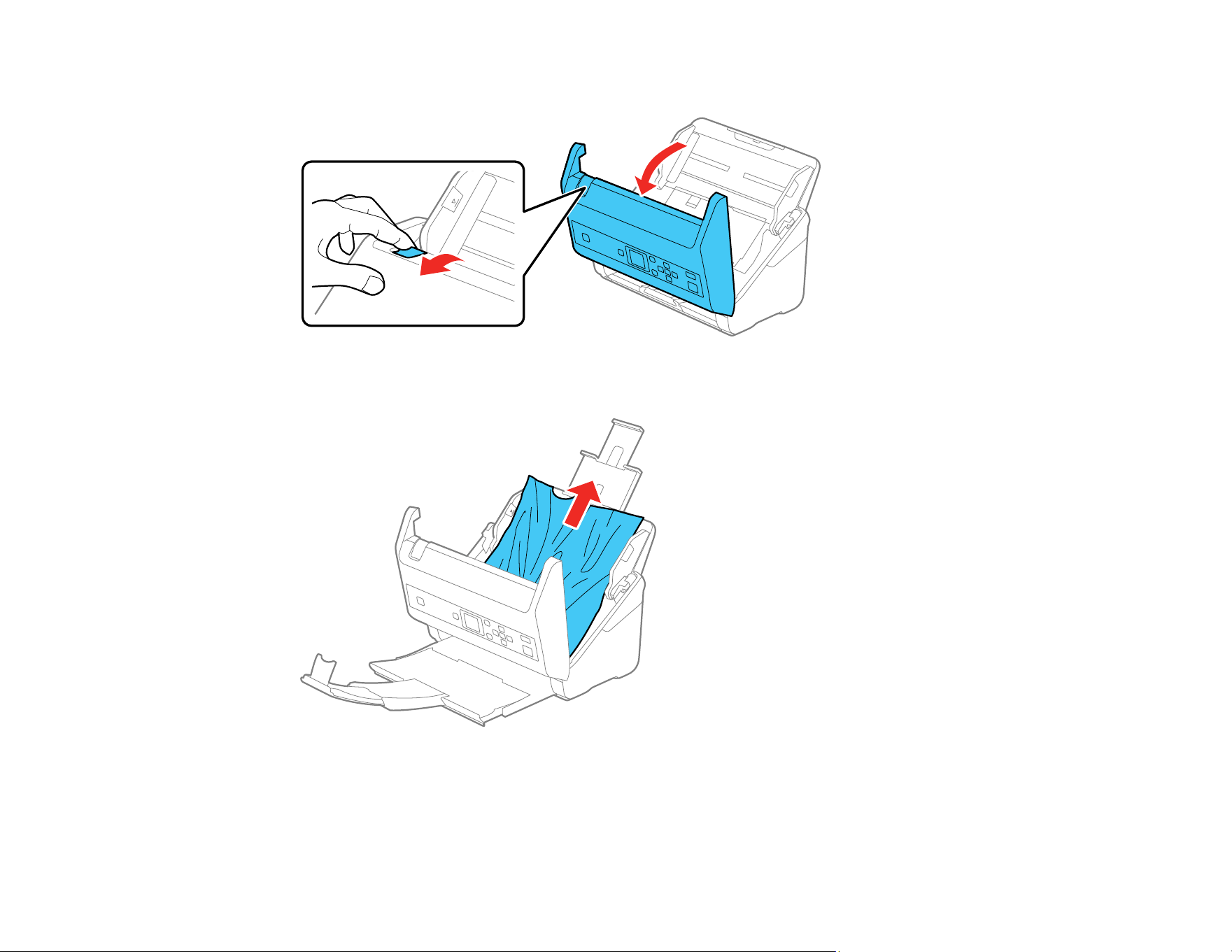
133
3. Pull down the cover open lever and open the scanner cover.
4. Gently pull out any jammed originals from inside the scanner.
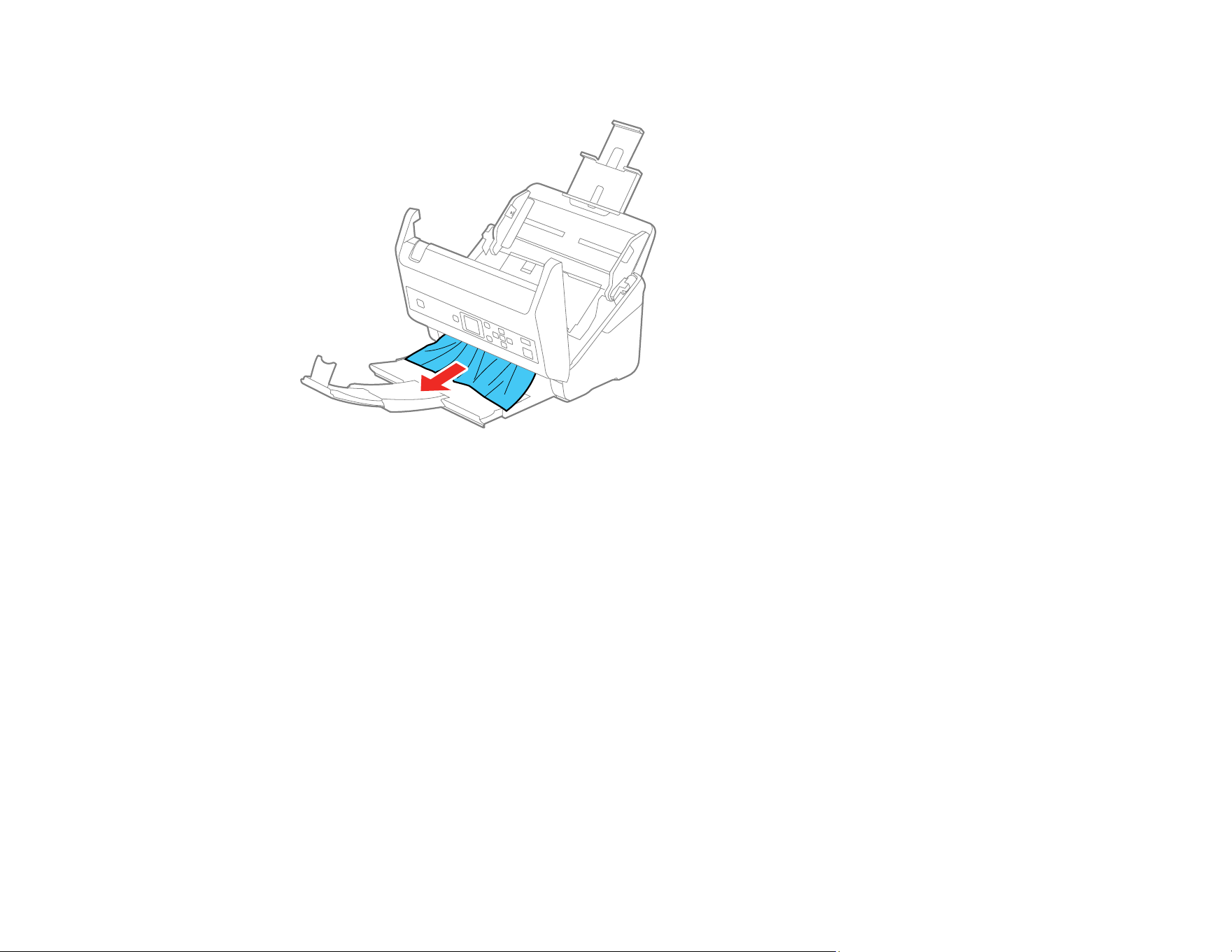
134
5. Gently pull out any jammed originals from the output tray.
6. Close the scanner cover.
7. Carefully follow all loading instructions when you reload originals.
If originals jam in the scanner frequently, try the following:
• Select Slow on the scanner control panel to slow down the scanning speed.
• Turn off the Detect Double Feed setting.
• Clean inside the scanner and clean the rollers.
• Close the output tray and let the originals fall freely onto the surface below the scanner.
• If the roller counter is nearing end of life, replace the roller assembly kit.
Parent topic: Solving Scanning Problems
Related references
Original Document Specifications
Plastic and Laminated Card Specifications
Special Original Specifications
Where to Get Help

135
Related tasks
Cleaning Inside Your Scanner
Loading Originals in the Input Tray
Scanning is Slow
If scanning becomes slow, try these solutions:
• Scan your original at a lower resolution, if possible.
• Make sure your system meets the requirements for your operating system. If you are scanning a high-
resolution image, you may need more than the minimum requirements. If necessary, increase your
system's memory or reduce the resolution.
• If scanning becomes slower after scanning continuously with the ADF for a long time, the scanner may
have automatically slowed down to protect the scanner mechanism from overheating or becoming
damaged. Let the scanner rest with the power on for 30 minutes, then try scanning again.
• Make sure Slow is set to Off on the scanner control panel.
• If you are running virus protection or other security software, exclude the TWAIN.log files from
monitoring or set the TWAIN.log file as read only. See your virus protection or security software
instructions for details. The TWAIN.log file is saved in C:\Users\(user name)\AppData\Local\Temp.
Note: You may need to unhide system folders to view files in that location.
• Computers with USB 3.0 (SuperSpeed) or USB 2.0 (Hi-Speed) ports can scan faster than those with
USB 1.1 ports. If you are using a USB 3.0 or 2.0 port with the scanner, make sure it meets the system
requirements.
Parent topic: Solving Scanning Problems
Solving Scanned Image Quality Problems
Check these sections if a scanned image on your computer screen has a quality problem.
Back of Original Image Appears in Scanned Image
Scanned Characters are Blurry
Characters are Not Recognized During Conversion to Editable Text (OCR)
Ripple Patterns Appear in an Image
Spots or Lines Appear in All Scanned Images
Scanned Image is Cropped
Parent topic: Solving Problems

136
Back of Original Image Appears in Scanned Image
If an image from the back of a thin original appears in your scanned image, select Settings > Scan
Settings in Epson ScanSmart and try these solutions:
• On the Main Settings tab, make sure you select the correct Image Type for your original.
• On the Advanced Settings tab, select Text Enhancement and choose a setting.
• On the Advanced Settings tab, select Remove Background and choose a setting.
Note: The Text Enhancement and Remove Background settings depend on the selected Image
Type.
Parent topic: Solving Scanned Image Quality Problems
Scanned Characters are Blurry
If characters in your scanned images are blurry, try these solutions:
• Make sure you do not move the scanner or original while scanning.
• Operate the scanner on a flat, stable surface.
• Make sure the originals are ejecting properly.
• In Epson ScanSmart, click Settings > Scan Settings and try adjusting these settings and scanning
again:
• On the Main Settings tab, make sure you select the correct Image Type for your original.
• On the Main Settings tab, try increasing the Resolution setting.
• On the Advanced Settings tab, select Text Enhancement and choose a setting.
Note: The Text Enhancement setting depends on the selected Image Type.
• If the Image Type is set to Black & White, adjust the Threshold setting on the Advanced Settings
tab. (The Image Option must be set to None.)
Parent topic: Solving Scanned Image Quality Problems
Characters are Not Recognized During Conversion to Editable Text (OCR)
If characters in your scanned images are not recognized during OCR conversion, try these solutions:
• Make sure your original is loaded straight on your product.

137
• Use an original with clear text.
• Receipts made of thermal paper may deteriorate faster. Scan them as soon as possible.
• When saving scanned images as searchable PDFs, make sure the correct OCR language is selected.
• In Epson ScanSmart, select Settings > Scan Settings, adjust the following settings, and try scanning
again:
• On the Main Settings tab, make sure you select the correct Image Type for your original.
• On the Main Settings tab, set the Resolution between 200 and 600 dpi.
• On the Advanced Settings tab, select Text Enhancement and choose a setting.
Note: The Text Enhancement setting depends on the selected Image Type.
• If the Image Type is set to Black & White, adjust the Threshold setting on the Advanced Settings
tab. (The Image Option must be set to None.)
• Set the Image Type to Grayscale.
• If the original document is in landscape mode, set the Rotate setting to Auto.
• If you are using OCR software, check the manual for any additional adjustments.
• Scan thermal paper receipts as soon as possible. They may deteriorate due to age or friction.
• When saving to Microsoft Office or Searchable PDF files, check that the correct languages are
selected. Check the language in each save setting window.
Parent topic: Solving Scanned Image Quality Problems
Ripple Patterns Appear in an Image
You may see a ripple pattern (called a moiré) in scanned images of printed documents. This is caused
by interference from differing pitches in the scanner's screen and your original's halftone screen. To
reduce this effect, select Settings > Scan Settings in Epson ScanSmart and try adjusting these settings
and scanning again:
• On the Main Settings tab, try decreasing the Resolution setting.
• On the Advanced Settings tab, select the Descreening setting.
Parent topic: Solving Scanned Image Quality Problems

138
Spots or Lines Appear in All Scanned Images
If spots or lines appear in all your scanned images, try these solutions:
• Make sure the surface of your original is clean.
• Make sure there is no debris or dirt inside the ADF.
• Disconnect any connected cables and clean inside the scanner.
• Enable the Detect Glass Dirt setting on the control panel. (Press the home button, select Settings
> Scanner Settings > Detect Glass Dirt, and select On-Low, if the alert displays a misdetection, or
On- High if dirt is not detected.) When an alert displays on the control panel, clean the glass scanning
surfaces inside your scanner using a genuine Epson cleaning kit or a soft, moist cloth.
Note: If there are scratches on the glass surface, the alert screen may continue to appear even after
cleaning the glass. Contact Epson for information about replacing the glass.
• Avoid scanning in direct sunlight.
Parent topic: Solving Scanned Image Quality Problems
Related tasks
Cleaning Inside Your Scanner
Scanned Image is Cropped
If the edges of a scanned image are cropped, select Settings > Scan Settings, adjust the following
settings, and try scanning again:
• On the Main Settings tab, set the Document Size setting to Auto Detect or Auto Detect (Long
Paper).
• If the document size is not detected correctly using the Auto Detect setting, select the size of your
original from the Document Size list.
Note: If the size you want to scan is not on the list, select Customize to create it manually (Windows
only).
• You can also select Document Size > Settings and adjust the cropping area shown in the Crop
Margins for Size "Auto" setting.
• On the Advanced Settings tab, set the Edge Fill setting to None.
Parent topic: Solving Scanned Image Quality Problems

139
Solving Flatbed Scanner Dock Problems
Check these solutions if you have problems scanning with the optional flatbed scanner dock.
Scanned Image Edges are Cropped
Line of Dots Appears in All Scanned Images
Binding Margins on a Scanned Booklet are Blurry
Back of Original Image Appears in Scanned Document
Parent topic: Solving Problems
Scanned Image Edges are Cropped
If the edges of a scanned image are cropped, make sure your original is placed correctly for scanning. If
necessary, move your original away from the edges of the scanner glass slightly.
Parent topic: Solving Flatbed Scanner Dock Problems
Line of Dots Appears in All Scanned Images
If a line of dots appears in all your scanned images, try these solutions:
• Clean the scanner glass with a soft, dry, lint-free cloth or use a small amount of glass cleaner on the
cloth, if necessary. Paper towels are not recommended.
Caution: Do not spray glass cleaner directly on the scanner glass.
• Make sure any interface cables are securely connected at both ends.
Parent topic: Solving Flatbed Scanner Dock Problems
Binding Margins on a Scanned Booklet are Blurry
When scanning a booklet on the scanner glass, characters may appear distorted or blurred on the
binding margin. If this occurs, the characters may not be recognized correctly when you save the
scanned image as a searchable PDF.
To decrease distortion or blurring, gently press down on the document cover to flatten the booklet while
scanning.
Caution: Do not press down on the document cover with too much force, or you may damage the
booklet or scanner.
Parent topic: Solving Flatbed Scanner Dock Problems

140
Back of Original Image Appears in Scanned Document
If an image from the back of a thin original appears in your scanned image, try the following solutions:
• Place a piece of black paper on the back of the original and scan it again.
• Make sure you selected the correct Image Type setting for your original and select the Text
Enhancement setting in Epson Scan 2. You can also select the Remove Background setting in
Epson Scan 2.
• Select a lower level for Edge Enhancement or a higher level for Noise Reduction Level in Epson
Scan 2.
Parent topic: Solving Flatbed Scanner Dock Problems
Uninstall Your Scanner Software
If you have a problem that requires you to uninstall and re-install your software, follow the instructions for
your operating system.
Uninstalling Scanner Software - Windows
Uninstalling Scanner Software - Mac
Parent topic: Solving Problems
Uninstalling Scanner Software - Windows
You can uninstall and then re-install your scanner software to solve certain problems.
1. Exit all applications currently running on your computer.
2. Turn off the scanner.
3. Disconnect any interface cables.
4. Do the following to uninstall each of your scanning software programs and follow any on-screen
instructions:
• Windows 10: Click and select (Settings) > Apps > Apps & features. Select the scanner
software program and click Uninstall.
• Windows 8.x: Navigate to the Apps screen and select Control Panel > Programs > Programs
and Features. Select the scanner software program and click Uninstall/Change.
• Windows 7: Open the Windows Control Panel utility. Select Programs and Features. (In
Classic view, select Programs and click Uninstall a program.) Select the scanner software
program and click Uninstall/Change.
5. Restart your computer, then see the Start Here sheet to re-install your software.

141
Note: If you find that re-installing your scanner software does not solve a problem, contact Epson.
Parent topic: Uninstall Your Scanner Software
Uninstalling Scanner Software - Mac
In most cases, you do not need to uninstall your scanner software before re-installing it. However, you
can download the Uninstaller utility from the Epson support website to uninstall your scanner software as
described here.
1. To download the Uninstaller utility, visit epson.com/support (U.S.), epson.ca/support (Canada), or
epson.com.jm/support (Caribbean) and select your product.
2. Follow the instructions on the screen to install the Uninstaller utility.
3. Quit all applications currently running on your Mac.
4. Double-click the Uninstaller icon.
5. In the Epson Uninstaller screen, select the checkbox for each software program you want to
uninstall.
6. Click Uninstall.
7. Follow the on-screen instructions to uninstall the software.
8. To reinstall your scanner software, see the Start Here sheet for instructions.
Note: If you find that re-installing your scanner software does not solve a problem, contact Epson.
Parent topic: Uninstall Your Scanner Software
Where to Get Help
If you need to contact Epson for technical support services, use the following support options.
Internet Support
Visit Epson's support website at epson.com/support (U.S.), epson.ca/support (Canada), or
epson.com.jm/support (Caribbean) and select your product for solutions to common problems with your
product. You can download utilities and documentation, get FAQs and troubleshooting advice, or e-mail
Epson with your questions.

142
Speak to a Support Representative
Before you call Epson for support, please have the following information ready:
• Product name
• Product serial number (located on a label on the product)
• Proof of purchase (such as a store receipt) and date of purchase
• Computer configuration
• Description of the problem
Then call:
• U.S.: (562) 276-4382, 6 AM to 8 PM, Pacific Time, Monday through Friday, and 7 AM to 4 PM, Pacific
Time, Saturday
• Canada: (905) 709-3839, 6 AM to 8 PM, Pacific Time, Monday through Friday, and 7 AM to 4 PM,
Pacific Time, Saturday
Days and hours of support are subject to change without notice. Toll or long distance charges may
apply.
Note: For help using any other software on your system, see the documentation for that software for
technical support.
Purchase Supplies and Accessories
You can purchase genuine Epson accessories at epson.com (U.S. sales), epson.ca (Canadian sales), or
epson.com.jm (Caribbean sales). You can also purchase accessories from an Epson authorized reseller.
To find the nearest one, call 800-GO-EPSON (800-463-7766) in the U.S. or 800-807-7766 in Canada.
Parent topic: Solving Problems

143
Technical Specifications
These sections list the technical specifications for your scanner.
Note: Epson offers a recycling program for end of life Epson products. Please go to this site (U.S) or this
site (Canada) for information on how to return your Epson products for proper disposal.
Windows System Requirements
Mac System Requirements
General Specifications
Dimension Specifications
Electrical Specifications
Environmental Specifications
Flatbed Scanner Dock Specifications
Safety and Approvals Specifications
Windows System Requirements
To use your product and its software, your computer should use one of these Microsoft operating
systems:
• Windows 10
• Windows 8.x
• Windows 7
Note: For the latest product software available for your operating system, visit the Epson support site at
epson.com/support (U.S.), epson.ca/support (Canada), or epson.com.jm/support (Caribbean), select
your product, and select Downloads.
Parent topic: Technical Specifications
Mac System Requirements
To use your product and its software, your Mac should use one of these operating systems:
• macOS 10.15.x
• macOS 10.14.x

144
• macOS 10.13.x
• macOS 10.12.x
• OS X 10.11.x
• OS X 10.10.x
• OS X 10.9.x
• OS X 10.8.x
• OS X 10.7.x
• OS X 10.6.8
Note: The UNIX File System (UFS) and Fast User Switching for macOS is not supported.
Note: For the latest product software available for your operating system, visit the Epson support site at
epson.com/support (U.S.), epson.ca/support (Canada), or epson.com.jm/support (Caribbean), select
your product, and select Downloads.
Parent topic: Technical Specifications
General Specifications
Scanner type Sheet feed, one pass duplex, color scanner
Photoelectric device CIS
Effective pixels 5100 × 9300 pixels at 600 dpi
2550 × 64500 pixels at 300 dpi
Document size Maximum: 8.5 × 240 inches (215.9 × 6096 mm)
Minimum: 2 × 2 inches (50.8 × 50.8 mm)
Paper input Facedown loading
Paper output Facedown ejection
Paper capacity 100 sheets of paper at 21 lb (80 g/m
2
) weight
Light source RGB LED
Scanning resolution 600 dpi (main scan)
600 dpi (sub scan)

145
Output resolution 50 to 1200 dpi (in 1 dpi increments)
Long paper scanning in the following resolution ranges:
• 15.5 to 53 inches (393.8 to 1346.2 mm) long : 50 to 600 dpi
• 53 to 215 inches (1346 to 5461 mm) long: 50 to 300 dpi
• 215 to 240 inches (5461.1 to 6096 mm) long: 50 to 200 dpi
Image data Color:
30 bits per pixel internal (10 bits per pixel per color internal)
24 bits per pixel external (8 bits per pixel per color external)
Grayscale:
10 bits per pixel internal
8 bits per pixel external
Black and white:
10 bits per pixel internal
1 bits per pixel external
Interface SuperSpeed USB
Parent topic: Technical Specifications
Dimension Specifications
Height 6.6 inches (167 mm)
Width 11.7 inches (296 mm)
Depth 6.7 inches (169 mm)
Weight 7.9 lb (3.6 kg)
Note: Dimensions do not include projecting parts or the input tray.
Parent topic: Technical Specifications

146
Electrical Specifications
Scanner
Note: Check the label on the scanner and the AC adapter for voltage information. Power consumption
varies depending on operating conditions or whether an option is installed.
Rated DC input voltage DC 24V
Rated DC input current 2 A
Power consumption Operating: 18 W
Ready mode: 8.5 W
Sleep mode: 1.4 W
Power off mode: 0.1 W
AC Adapter
AC adapter model AC 100 to 240 V model: A471H
AC 220 to 240 V model: A472E
Rated input current 1.2 A
Rated frequency range 50 to 60 Hz
Rated output power supply
voltage
DC 24 V
Rated output current 2 A
Parent topic: Technical Specifications
Environmental Specifications
Temperature Operating: 41 to 95 °F (5 to 35 °C)
Storage: –13 to 140 °F (–25 to 60 °C)
Humidity
(non-condensing)
Operating: 15 to 80% RH
Storage: 15 to 85% RH

147
Operating conditions Ordinary office or home conditions
Note: Avoid operating the scanner in direct sunlight, near a strong light source, or in extremely dusty
conditions.
Parent topic: Technical Specifications
Flatbed Scanner Dock Specifications
Interface Hi-Speed USB
Rated DC input power supply
voltage
DC 24 V
Dimensions
(when assembled with a sheet
feed scanner and a flatbed
scanner)
Width: 11.8 in (300 mm)
Depth: 18.9 in (481 mm)
Height 9.6 in (245 mm)
Weight Approximately 2.4 lb (1.1 kg)
Temperature Operating: 50 to 95 °F (10 to 35 °C)
Storage: –4 to 140 °F (–20 to 60 °C)
Humidity
(non-condensing)
Operating: 20 to 80%
Storage: 20 to 85%
Parent topic: Technical Specifications
Safety and Approvals Specifications
Scanner
United States EMC: FCC part 15 Subpart B class B
Canada EMC: CAN/CSA-CEI/IEC CISPR 22 Class B


149
Notices
Check these sections for important notices about your scanner.
Note: Epson offers a recycling program for end of life Epson products. Please go to this site (U.S) or this
site (Canada) for information on how to return your Epson products for proper disposal.
Important Safety Instructions
Restrictions on Copying
Default Delay Times for Power Management for Epson Products
Binding Arbitration and Class Waiver
Trademarks
Copyright Notice
Important Safety Instructions
Follow these safety instructions when setting up and using the scanner:
• Read all these instructions, and follow all warnings and instructions marked on the scanner.
• Place the scanner close enough to the computer for the interface cable to reach it easily.
• Do not use with wet hands.
• When connecting this product to a computer or other device with a cable, ensure the correct
orientation of the connectors. Each connector has only one correct orientation. Inserting a connector
in the wrong orientation may damage both devices connected by the cable.
• Do not insert objects into any opening as they may touch dangerous voltage points or short out parts.
Beware of electrical shock hazards.
• Place the product on a flat, stable surface that extends beyond the base of the product in all directions.
If you place the product by the wall, leave at least 3.9 inches (10 cm) between the back of the product
and the wall.
• After replacing consumable parts, dispose of them correctly following the rules of your local authority.
Do not disassemble them.
• Do not place or store the scanner outdoors, in a car, near excessive dirt or dust, water, heat sources,
or in locations subject to shocks, vibrations, condensation, high temperature or humidity, direct
sunlight, strong light sources, or rapid changes in temperature or humidity.

150
• Never disassemble, modify, or attempt to repair the scanner or a scanner option by yourself except as
specifically explained in this guide.
AC Adapter
• Do not place or store the AC adapter outdoors, in a car, near excessive dirt or dust, water, heat
sources, or in locations subject to shocks, vibrations, condensation, high temperature or humidity,
direct sunlight, strong light sources, or rapid changes in temperature or humidity.
• Place the scanner and the AC adapter near an electrical outlet where the adapter can be easily
unplugged.
• The AC power cord should be placed to avoid abrasions, cuts, fraying, crimping, and kinking.
• Do not place objects on top of the AC power cord and do not allow the AC adapter or the power cord
to be stepped on or run over. Be particularly careful to keep the AC power cord straight at the end and
the point where it enters the AC adapter.
• Use only the AC adapter that comes with your scanner. Using any other adapter could cause fire,
electrical shock, or injury.
• The AC adapter is designed for use with the scanner with which it was included. Do not attempt to use
it with other electronic devices unless specified.
• Use only the type of power source indicated on the AC adapter's label, and always supply power
directly from a standard domestic electrical outlet with the AC adapter that meets the relevant local
safety standards.
• Avoid using outlets on the same circuit as photocopiers or air control systems that regularly switch on
and off.
• If you use an extension cord with the scanner, make sure the total ampere rating of the devices
plugged into the extension cord does not exceed the cord's ampere rating. Also, make sure the total
ampere rating of all devices plugged into the wall outlet does not exceed the wall outlet's ampere
rating.
• Never disassemble, modify, or attempt to repair the AC adapter by yourself except as specifically
explained in the scanner's guides.
• If damage occurs to the plug, replace the cord set or consult a qualified electrician. If there are fuses in
the plug, make sure you replace them with fuses of the correct size and rating.
• Unplug the scanner and the AC adapter, and refer servicing to qualified service personnel under the
following conditions: The AC adapter or plug is damaged; liquid has entered the scanner or the AC
adapter; the scanner or the AC adapter has been dropped or the case has been damaged; the
scanner or the AC adapter does not operate normally or exhibits a distinct change in performance. (Do
not adjust controls that are not covered by the operating instructions.)

151
• Unplug the scanner and the AC adapter before cleaning. Clean with a damp cloth only. Do not use
liquid or aerosol cleaners.
• If you are not going to use the scanner for a long period, be sure to unplug the AC adapter from the
electrical outlet.
LCD Screen
• The LCD screen may have uneven brightness or a few small bright or dark spots. This is normal and
does not indicate damage.
• Use only a dry, soft cloth to clean the LCD screen. Do not use liquid or chemical cleansers.
• If the LCD screen is damaged, contact Epson. If the liquid crystal solution gets on your hands, wash
them thoroughly with soap and water. If the liquid crystal solution gets into your eyes, flush them
immediately with water. If discomfort or vision problems remain after a thorough flushing, see a doctor
immediately.
• Do not press too hard on the LCD screen or subject it to heavy impacts.
• Do not use a pointy or sharp object, such as a pen or your fingernail, to operate the LCD screen.
• If the LCD screen chips or cracks, do not touch or attempt to remove the broken pieces; contact Epson
for support.
• Do not subject your product to sudden changes in temperature or humidity; this may cause
condensation to develop inside the LCD screen and degrade its performance.
Parent topic: Notices
Restrictions on Copying
Observe the following restrictions to ensure responsible and legal use of your scanner.
Copying of the following items is prohibited by law:
• Bank bills, coins, government-issued marketable securities, government bond securities, and
municipal securities
• Unused postage stamps, pre-stamped postcards, and other official postal items bearing valid postage
• Government-issued revenue stamps, and securities issued according to legal procedure
Exercise caution when copying the following items:
• Private marketable securities (stock certificates, negotiable notes, checks, etc.), monthly passes,
concession tickets, etc.
• Passports, driver's licenses, warrants of fitness, road passes, food stamps, tickets, etc.

152
Note: Copying these items may also be prohibited by law.
Restriction on disassembling and decompiling
You may not disassemble, decompile, or otherwise attempt to derive the source code of any software
included with this product.
Parent topic: Notices
Default Delay Times for Power Management for Epson Products
This product will enter sleep mode after a period of nonuse. This is to ensure that the product meets
Energy Star standards of energy efficiency. More energy savings can be achieved by setting the time to
sleep to a shorter interval.
Parent topic: Notices
Binding Arbitration and Class Waiver
1. DISPUTES, BINDING INDIVIDUAL ARBITRATION, AND WAIVER OF CLASS ACTIONS AND
CLASS ARBITRATIONS
1.1 Disputes. The terms of this Section 1 shall apply to all Disputes between you and Epson. The term
"Dispute" is meant to have the broadest meaning permissible under law and includes any dispute, claim,
controversy or action between you and Epson arising out of or relating to this Agreement, Epson
branded products (hardware and including any related software), or other transaction involving you and
Epson, whether in contract, warranty, misrepresentation, fraud, tort, intentional tort, statute, regulation,
ordinance, or any other legal or equitable basis. "DISPUTE" DOES NOT INCLUDE IP CLAIMS, or more
specifically, a claim or cause of action for (a) trademark infringement or dilution, (b) patent infringement,
(c) copyright infringement or misuse, or (d) trade secret misappropriation (an "IP Claim"). You and Epson
also agree, notwithstanding Section 1.6,that a court, not an arbitrator, may decide if a claim or cause of
action is for an IP Claim.
1.2 Binding Arbitration. You and Epson agree that all Disputes shall be resolved by binding arbitration
according to this Agreement. ARBITRATION MEANS THAT YOU WAIVE YOUR RIGHT TO A JUDGE
OR JURY IN A COURT PROCEEDING AND YOUR GROUNDS FOR APPEAL ARE LIMITED.
Pursuant to this Agreement, binding arbitration shall be administered by JAMS, a nationally recognized
arbitration authority, pursuant to its code of procedures then in effect for consumer related disputes, but
excluding any rules that permit joinder or class actions in arbitration (for more detail on procedure, see
Section 1.6 below). You and Epson understand and agree that (a) the Federal Arbitration Act (9 U.S.C.
§1, et seq.) governs the interpretation and enforcement of this Section 1, (b) this Agreement
memorializes a transaction in interstate commerce, and (c) this Section 1 shall survive termination of this
Agreement.

153
1.3 Pre-Arbitration Steps and Notice. Before submitting a claim for arbitration, you and Epson agree to
try, for sixty (60) days, to resolve any Dispute informally. If Epson and you do not reach an agreement to
resolve the Dispute within the sixty (60) days), you or Epson may commence an arbitration. Notice to
Epson must be addressed to: Epson America, Inc., ATTN: Legal Department, 3840 Kilroy Airport Way,
Long Beach, CA 90806 (the "Epson Address"). The Dispute Notice to you will be sent to the most recent
address Epson has in its records for you. For this reason, it is important to notify us if your address
the Dispute shall include the sender's name, address and contact information, the facts giving rise to the
Dispute, and the relief requested (the "Dispute Notice"). Following receipt of the Dispute Notice, Epson
and you agree to act in good faith to resolve the Dispute before commencing arbitration.
1.4 Small Claims Court. Notwithstanding the foregoing, you may bring an individual action in the small
claims court of your state or municipality if the action is within that court's jurisdiction and is pending only
in that court.
1.5 WAIVER OF CLASS ACTIONS AND CLASS ARBITRATIONS. YOU AND EPSON AGREE THAT
EACH PARTY MAY BRING DISPUTES AGAINST THE OTHER PARTY ONLY IN AN INDIVIDUAL
CAPACITY, AND NOT AS A PLAINTIFF OR CLASS MEMBER IN ANY CLASS OR
REPRESENTATIVE PROCEEDING, INCLUDING WITHOUT LIMITATION FEDERAL OR STATE
CLASS ACTIONS, OR CLASS ARBITRATIONS. CLASS ACTION LAWSUITS, CLASS-WIDE
ARBITRATIONS, PRIVATE ATTORNEY-GENERAL ACTIONS, AND ANY OTHER PROCEEDING
WHERE SOMEONE ACTS IN A REPRESENTATIVE CAPACITY ARE NOT ALLOWED.
ACCORDINGLY, UNDER THE ARBITRATION PROCEDURES OUTLINED IN THIS SECTION, AN
ARBITRATOR SHALL NOT COMBINE OR CONSOLIDATE MORE THAN ONE PARTY'S CLAIMS
WITHOUT THE WRITTEN CONSENT OF ALL AFFECTED PARTIES TO AN ARBITRATION
PROCEEDING.
1.6 Arbitration Procedure. If you or Epson commences arbitration, the arbitration shall be governed by
the rules of JAMS that are in effect when the arbitration is filed, excluding any rules that permit arbitration
on a class or representative basis (the "JAMS Rules"), available at http://www.jamsadr.com or by calling
1-800-352-5267, and under the rules set forth in this Agreement. All Disputes shall be resolved by a
single neutral arbitrator, and both parties shall have a reasonable opportunity to participate in the
selection of the arbitrator. The arbitrator is bound by the terms of this Agreement. The arbitrator, and not
any federal, state or local court or agency, shall have exclusive authority to resolve all disputes arising
out of or relating to the interpretation, applicability, enforceability or formation of this Agreement,
including any claim that all or any part of this Agreement is void or voidable. Notwithstanding this broad
delegation of authority to the arbitrator, a court may determine the limited question of whether a claim or
cause of action is for an IP Claim, which is excluded from the definition of "Disputes" in Section 1.1
above. The arbitrator shall be empowered to grant whatever relief would be available in a court under
law or in equity. The arbitrator may award you the same damages as a court could, and may award
declaratory or injunctive relief only in favor of the individual party seeking relief and only to the extent
necessary to provide relief warranted by that party's individual claim. In some instances, the costs of

154
arbitration can exceed the costs of litigation and the right to discovery may be more limited in arbitration
than in court. The arbitrator's award is binding and may be entered as a judgment in any court of
competent jurisdiction.
You may choose to engage in arbitration hearings by telephone. Arbitration hearings not conducted by
telephone shall take place in a location reasonably accessible from your primary residence, or in Orange
County, California, at your option.
a) Initiation of Arbitration Proceeding. If either you or Epson decides to arbitrate a Dispute, both parties
agree to the following procedure:
(i) Write a Demand for Arbitration. The demand must include a description of the Dispute and the amount
of damages sought to be recovered. You can find a copy of a Demand for Arbitration at
http://www.jamsadr.com ("Demand for Arbitration").
(ii) Send three copies of the Demand for Arbitration, plus the appropriate filing fee, to: JAMS, 500 North
State College Blvd., Suite 600 Orange, CA 92868, U.S.A.
(iii) Send one copy of the Demand for Arbitration to the other party (same address as the Dispute
Notice), or as otherwise agreed by the parties.
b) Hearing Format. During the arbitration, the amount of any settlement offer made shall not be disclosed
to the arbitrator until after the arbitrator determines the amount, if any, to which you or Epson is entitled.
The discovery or exchange of non-privileged information relevant to the Dispute may be allowed during
the arbitration.
c) Arbitration Fees. Epson shall pay, or (if applicable) reimburse you for, all JAMS filings and arbitrator
fees for any arbitration commenced (by you or Epson) pursuant to provisions of this Agreement.
d) Award in Your Favor. For Disputes in which you or Epson seeks $75,000 or less in damages exclusive
of attorney's fees and costs, if the arbitrator's decision results in an award to you in an amount greater
than Epson's last written offer, if any, to settle the Dispute, Epson will: (i) pay you $1,000 or the amount
of the award, whichever is greater; (ii) pay you twice the amount of your reasonable attorney's fees, if
any; and (iii) reimburse you for any expenses (including expert witness fees and costs) that your attorney
reasonably accrues for investigating, preparing, and pursuing the Dispute in arbitration. Except as
agreed upon by you and Epson in writing, the arbitrator shall determine the amount of fees, costs, and
expenses to be paid by Epson pursuant to this Section 1.6d).
e) Attorney's Fees. Epson will not seek its attorney's fees and expenses for any arbitration commenced
involving a Dispute under this Agreement. Your right to attorney's fees and expenses under Section
1.6d) above does not limit your rights to attorney's fees and expenses under applicable law;
notwithstanding the foregoing, the arbitrator may not award duplicative awards of attorney's fees and
expenses.
1.7 Opt-out. You may elect to opt-out (exclude yourself) from the final, binding, individual
arbitration procedure and waiver of class and representative proceedings specified in this

155
Agreement by sending a written letter to the Epson Address within thirty (30) days of your assent
to this Agreement (including without limitation the purchase, download, installation of the
Software or other applicable use of Epson Hardware, products and services) that specifies (i)
your name, (ii) your mailing address, and (iii) your request to be excluded from the final, binding
individual arbitration procedure and waiver of class and representative proceedings specified in
this Section 1. In the event that you opt-out consistent with the procedure set forth above, all
other terms shall continue to apply, including the requirement to provide notice prior to litigation.
1.8 Amendments to Section 1. Notwithstanding any provision in this Agreement to the contrary, you
and Epson agree that if Epson makes any future amendments to the dispute resolution procedure and
class action waiver provisions (other than a change to Epson's address) in this Agreement, Epson will
obtain your affirmative assent to the applicable amendment. If you do not affirmatively assent to the
applicable amendment, you are agreeing that you will arbitrate any Dispute between the parties in
accordance with the language of this Section 1 (or resolve disputes as provided for in Section 1.7, if you
timely elected to opt-out when you first assented to this Agreement).
1.9 Severability. If any provision in this Section 1 is found to be unenforceable, that provision shall be
severed with the remainder of this Agreement remaining in full force and effect. The foregoing shall not
apply to the prohibition against class or representative actions as provided in Section 1.5. This
means that if Section 1.5 is found to be unenforceable, the entire Section 1 (but only Section 1)
shall be null and void.
Parent topic: Notices
Trademarks
EPSON
®
is a registered trademark and EPSON Exceed Your Vision is a registered logomark of Seiko
Epson Corporation.
Windows is a registered trademark of Microsoft Corporation in the United States and/or other countries.
Apple, macOS, and OS X are trademarks of Apple Inc., registered in the U.S. and other countries.
General Notice: Other product names used herein are for identification purposes only and may be
trademarks of their respective owners. Epson disclaims any and all rights in those marks.
Parent topic: Notices

156
Copyright Notice
All rights reserved. No part of this publication may be reproduced, stored in a retrieval system, or
transmitted in any form or by any means, electronic, mechanical, photocopying, recording, or otherwise,
without the prior written permission of Seiko Epson Corporation. The information contained herein is
designed only for use with this Epson product. Epson is not responsible for any use of this information as
applied to other products.
Neither Seiko Epson Corporation nor its affiliates shall be liable to the purchaser of this product or third
parties for damages, losses, costs, or expenses incurred by purchaser or third parties as a result of:
accident, misuse, or abuse of this product or unauthorized modifications, repairs, or alterations to this
product, or (excluding the U.S.) failure to strictly comply with Seiko Epson Corporation's operating and
maintenance instructions.
Seiko Epson Corporation shall not be liable for any damages or problems arising from the use of any
options or any consumable products other than those designated as Original Epson Products or Epson
Approved Products by Seiko Epson Corporation.
Seiko Epson Corporation shall not be held liable for any damage resulting from electromagnetic
interference that occurs from the use of any interface cables other than those designated as Epson
approved Products by Seiko Epson Corporation.
This information is subject to change without notice.
libTIFF Software Acknowledgment
A Note Concerning Responsible Use of Copyrighted Materials
Copyright Attribution
Parent topic: Notices
libTIFF Software Acknowledgment
Copyright © 1988-1997 Sam Leffler
Copyright © 1991-1997 Silicon Graphics, Inc.
Permission to use, copy, modify, distribute, and sell this software and its documentation for any purpose
is hereby granted without fee, provided that (I) the above copyright notices and this permission notice
appear in all copies of the software and related documentation, and (ii) the names of Sam Leffler and
Silicon Graphics may not be used in any advertising or publicity relating to the software without the
specific, prior written permission of Sam Leffler and Silicon Graphics.
THE SOFTWARE IS PROVIDED "AS-IS" AND WITHOUT WARRANTY OF ANY KIND, EXPRESS,
IMPLIED OR OTHERWISE, INCLUDING WITHOUT LIMITATION, ANY WARRANTY OF
MERCHANTABILITY OR FITNESS FOR A PARTICULAR PURPOSE.

157
IN NO EVENT SHALL SAM LEFFLER OR SILICON GRAPHICS BE LIABLE FOR ANY SPECIAL,
INCIDENTAL, INDIRECT OR CONSEQUENTIAL DAMAGES OF ANY KIND, OR ANY DAMAGES
WHATSOEVER RESULTING FROM LOSS OF USE, DATA OR PROFITS, WHETHER OR NOT
ADVISED OF THE POSSIBILITY OF DAMAGE, AND ON ANY THEORY OF LIABILITY, ARISING OUT
OF OR IN CONNECTION WITH THE USE OR PERFORMANCE OF THIS SOFTWARE.
Parent topic: Copyright Notice
A Note Concerning Responsible Use of Copyrighted Materials
Epson encourages each user to be responsible and respectful of the copyright laws when using any
Epson product. While some countries' laws permit limited copying or reuse of copyrighted material in
certain circumstances, those circumstances may not be as broad as some people assume. Contact your
legal advisor for any questions regarding copyright law.
Parent topic: Copyright Notice
Copyright Attribution
© 2020 Epson America, Inc.
1/20
CPD-58317
Parent topic: Copyright Notice