ada
Use and care
GUIDE
Dishwasher DWHD660EFM
THERMADOR.COM
en-us
2
Further information and explanations are available online:
Table of contents
1 IMPORTANT SAFETY INSTRUCTIONS.................... 3
1.1 Safety definitions....................................................... 3
1.2 General information................................................... 3
1.3 Intended use ............................................................. 3
1.4 Restrictive use .......................................................... 3
1.5 Grounding instructions .............................................. 3
1.6 Safe use.................................................................... 3
1.7 Risk to children ......................................................... 4
1.8 State of California Proposition 65 Warnings .............. 5
2 Preventing material damage .................................... 6
3 Environmental protection and energy-saving ........ 6
3.1 Saving energy ........................................................... 6
3.2
Zeolite drying ....................................................... 6
3.3 Sensors..................................................................... 6
4 Familiarizing yourself with your appliance ............. 7
4.1 Appliance .................................................................. 7
4.2 Controls .................................................................... 8
5 Dishwasher Cycles ................................................. 10
5.1 Energy Guide .......................................................... 11
5.2
Favorite ................................................... 11
6 Options .................................................................... 11
7 Features................................................................... 12
7.1 Upper rack .............................................................. 12
7.2 Cup shelf................................................................. 13
7.3 Lower rack .............................................................. 13
7.4 Flip tines ................................................................. 13
7.5 Silverware Basket ................................................... 14
7.6 Silverware drawer ................................................... 14
7.7 Rack heights ........................................................... 15
8 Before using for the first time ................................ 15
8.1 Initial use................................................................. 15
9 Rinse aid system..................................................... 16
9.1 Rinse aid................................................................. 16
9.2 Setting the amount of rinse aid................................ 16
9.3 Switching the rinse aid system off ........................... 16
10 Dishware................................................................ 16
10.1 Damage to glass and dishware ............................. 17
10.2 Loading dishware.................................................. 17
10.3 Removing dishware............................................... 18
10.4 Loading patterns ................................................... 18
11 Basic Operation .................................................... 19
11.1 Protection against unintentional operation............. 19
11.2 Switching on the appliance..................................... 19
11.3 Setting the time delay............................................. 19
11.4 Starting the wash cycle .......................................... 19
11.5 Interrupting the wash cycle..................................... 20
11.6 Terminating the wash cycle .................................... 20
11.7 Switching off the appliance..................................... 20
12 Basic settings......................................................... 20
12.1 Changing the basic settings ................................... 20
12.2 Overview of the basic settings................................ 20
13 HomeConnect® .................................................... 22
13.1 Setting up the HomeConnect® app ....................... 22
13.2 Setting upHomeConnect®.................................... 22
13.3
Remote Start ...................................................... 22
14 Cleaning and maintenance.................................... 22
14.1 Filter system........................................................... 22
14.2 Cleaning spray arms .............................................. 23
15 Troubleshooting..................................................... 24
15.1 Clean drain pump................................................... 27
16 Transportation, storage and disposal................... 28
16.1 Transporting the appliance ..................................... 28
16.2 Vacation and Storage............................................. 28
16.3 Disposal of your old appliance................................ 28
17 Customer Service................................................... 28
17.1 Model number (E-Nr.), production number (FD)
and consecutive numbering (Z-Nr.) ........................ 29
18 Technical specifications........................................ 30
18.1 Information regarding Free and Open Source
Software................................................................. 30
en-us
3
Read all of the instructions carefully before using the
appliance. In order to reduce the risk of fire, electric
shocks and personal injuries when using the appliance,
follow the basic safety precautions, including the following
safety instructions.
1.1 Safety definitions
Here you can find explanations of the safety signal words
used in this manual.
WARNING
This indicates that death or serious injuries may occur as
a result of non-observance of this warning.
CAUTION
This indicates that minor or moderate injuries may occur
as a result of non-observance of this warning.
NOTICE:
This indicates that damage to the appliance or property
may occur as a result of non-compliance with this
advisory.
Note:This alerts you to important information and/or tips.
1.2 General information
To reduce the risk of fire, electrical shock, or serious
injury, observe the following.
¡ Read and understand all instructions before using the
appliance.
¡ Keep the provided documents in a safe place for future
reference or for the next owner.
¡ Do not connect the appliance if it has been damaged in
transit.
¡ Product damage and/or injury could result from the use
of unqualified service technicians or non-original parts.
All repairs should be performed by an authorized
service provider using only original equipment factory
replacement parts.
¡ NSF/ANSI 184 Certified residential dishwashers are not
intended for licensed food establishments.
1.3 Intended use
Only use this appliance:
¡ for cleaning household dishware.
¡ for normal household use and in enclosed spaces in a
residential environment.
¡ Up to an altitude of 8200 ft (2500 m) above sea level.
1.4 Restrictive use
This appliance is not intended for use by persons
(including children) with reduced physical, sensory or
mental capabilities, or lack of experience and knowledge,
unless they have been given supervision or instruction
concerning use of the appliance by a person responsible
for their safety.
1.5 Grounding instructions
This appliance must be grounded to a metal, permanent
wiring system or an equipment grounding conductor must
be run with the circuit conductors and connected to the
equipment grounding terminal or lead on the dishwasher.
See the Installation Instructions included with this
dishwasher for more information on electrical
requirements.
WARNING
Improper connection of the equipment grounding
conductor can result in risk of electric shock.
▶ This appliance must be grounded. In the event of a
malfunction or breakdown, grounding will reduce the
risk of electric shock by providing a path of least
resistance for electric current. This appliance is
equipped with a cord having an equipment-grounding
conductor. Check with a qualified electrician or
authorized service representative if you are in doubt
whether the appliance is properly grounded.
1.6 Safe use
Follow these safety instructions when using the appliance.
WARNING
To reduce the risk of serious injury, observe the following.
▶ Read all instructions before using this dishwasher.
▶ Use this dishwasher only for its intended function,
which is the washing of household dishware and
kitchenware rated as dishwasher safe.
▶ Only use detergents or rinsing agents recommended
for use in a dishwasher, and keep them out of the reach
of children.
▶ Do not abuse, sit or stand on the door or dish racks of
the dishwasher.
IMPORTANT SAFETY INSTRUCTIONS
READ AND SAVE THESE INSTRUCTIONS

en-us
4
WARNING
Under certain conditions, hydrogen gas may be produced
in a hot water system that has not been used for two
weeks or more. Hydrogen gas is explosive.
▶ Before using a dishwasher that is connected to a hot
water system that has been unused for two weeks or
longer, turn on all hot water faucets and let the water
flow from each for several minutes. This will release
any accumulated hydrogen gas. As the gas is
explosive, do not smoke or use an open flame during
this time.
WARNING
To avoid risk of electric shock, observe the following.
▶ Only use the appliance in enclosed residential space
according to the installation manual.
▶ Never expose the appliance to intense heat or humidity.
▶ Do not use any steam cleaners or high-pressure
cleaners to clean this appliance. If not followed, excess
moisture can accumulate.
WARNING
The outlet opening of the Zeolite container becomes hot
and can cause burns.
▶ Never touch the outlet opening of the Zeolite container.
WARNING
To avoid risk of injury, when loading items to be washed,
observe the following.
▶ Locate sharp items so they are not likely to damage the
door seal.
▶ Load knives and other sharp utensils with their handles
up to reduce the risk of cut-type injuries.
▶ Do not wash plastic items unless they are marked
"dishwasher safe" or the equivalent. For plastic items
not so marked, check the manufacturer's
recommendations.
▶ Do not operate your dishwasher unless all enclosure
panels are in place.
▶ Do not tamper with or override controls and interlocks.
WARNING
Highly caustic alkaline or highly acidic cleaning agents in
conjunction with aluminum parts in the interior of the
appliance may cause explosions.
▶ Never use highly caustic alkaline or highly acidic
cleaning agents, in particular commercial or industrial
products, in conjunction with aluminum items (e.g.
grease filters of vent hoods or aluminum pans).
WARNING
For safe care and operation of your appliance, observe
the following.
▶ Follow the safety instructions and directions for use on
the detergent and rinse aid product labels.
▶ Do not use harsh chemicals such as bleach-based
products to clean your dishwasher. Some bleach-based
products can damage your dishwasher and may
present health hazards!
▶ Always use caution when opening the door during or
following a wash cycle as hot water or steam may
escape. Do not fully open the door until water noises
have stopped and steam has subsided.
▶ To avoid floor damage and possible mold growth, do
not allow wet areas to remain around or under the
dishwasher.
NOTICE:
Water and power shut off
▶ It is highly recommended for the end user to become
familiar with the procedure to shut off the incoming
water supply and the procedure to shut off the incoming
power supply. See the installation instructions or
contact your installer for more information.
1.7 Risk to children
Follow these safety instructions if there are children in
your home.
WARNING
To reduce risk of injury to children, observe the following.
▶ Do not allow children to play in or on the dishwasher.
▶ When children become old enough to operate the
appliance, it is the responsibility of the parents/legal
guardians to ensure the children are instructed in safe
practices by qualified persons.
▶ Remove the dishwasher door to the washing
compartment when removing an old dishwasher for
service or discarding.
IMPORTANT SAFETY INSTRUCTIONS
READ AND SAVE THESE INSTRUCTIONS
en-us
5
1.8 State of California Proposition 65
Warnings
This product may contain a chemical known to the State
of California, which can cause cancer or reproductive
harm. Therefore, the packaging of your product may bear
the following label as required by California:
IMPORTANT SAFETY INSTRUCTIONS
READ AND SAVE THESE INSTRUCTIONS
en-us Preventing material damage
6
Preventing material damage
2 Preventing material damage
Preventing material damage
NOTICE:
Harsh chemicals such as bleach-based products can
damage your dishwasher.
▶ Do not use harsh chemicals such as bleach-based
products to clean your dishwasher.
Certain cleaning products may damage the appliance.
▶ Do not use a steam cleaner.
▶ So as not to scratch the finish on the appliance, do not
use sponges with a rough surface or abrasive cleaning
agents.
Avoid stainless steel polish
▶ Do not use stainless steel polish on an anti-fingerprint
finish or a black stainless finish.
Escaping water vapor can damage cabinetry.
▶ When the program ends, let the appliance cool down a
bit before opening the door.
Protect your appliance from the elements.
▶ Protect against freezing to avoid possible damage to
the fill valve. Damage caused by freezing is not covered
by the warranty.
Avoid dishwasher damage
▶ Do not load the dishwasher with paper products, plastic
bags, packing materials or anything other than normal,
dishwasher safe dishware and kitchenware.
Environmental protection and energy-saving
3 Environmental protection and
energy-saving
Environmental protection and energy-saving
3.1 Saving energy
If you follow these instructions, your appliance will use
less power and water.
Use the Normal program.
a
The Normal program uses less energy and is easier on
the environment.
→
"Dishwasher Cycles", Page10
Change the sensor setting to the default.
a
Consumption is reduced.
→
"Sensors", Page6
Zeolite drying automatically helps to save energy.
a
→
"Zeolite drying ", Page6
3.2 Zeolite drying
The appliance features a Zeolite container. Zeolite drying
lets you save energy.
Zeolite is a mineral that can store moisture and energy
and then release them again.
During dishwashing energy is used to heat up the washing
water and dry the mineral.
During the drying phase, moisture from the interior of the
dishwasher is stored in the mineral and heat is released.
The heat is blown out into the interior of the dishwasher
with dry air. This speeds up and improves drying.
Therefore, Zeolite drying is very efficient.
Note:To avoid impairing Zeolite drying performance, do
not position dishware parts directly in front of the intake
opening or the outlet opening of the Zeolite container.
Do not position heat-sensitive dishware parts directly in
front of the outlet opening of the Zeolite container.
→
"Appliance", Page7
3.3 Sensors
The sensors adjust the cycle sequence and strength in the
Auto cycles depending on the level and type of soiling.
The sensor has different sensitivity levels that can be
changed in the basic settings.
→
"Changing the basic settings", Page20
Sensor setting Description
SE:00 Optimal setting for mixed loads
and heavily soiled dishware.
Saves both energy and water.
SE:01 Adjusts the cycle strength for
effective removal of food
remnants even with low soiling
levels. Energy and water
consumption are adjusted
accordingly.
SE:02 Adjusts the cycle strength for
difficult conditions of use, e.g.
stubborn dried-on food remnants.
Recommended setting when
using organic or ecological
detergents containing low levels
of active agents. Energy and
water consumption are adjusted
accordingly.
Familiarizing yourself with your appliance en-us
7
Familiarizing yourself with your appliance
4 Familiarizing yourself with your appliance
Familiarizing yourself with your appliance
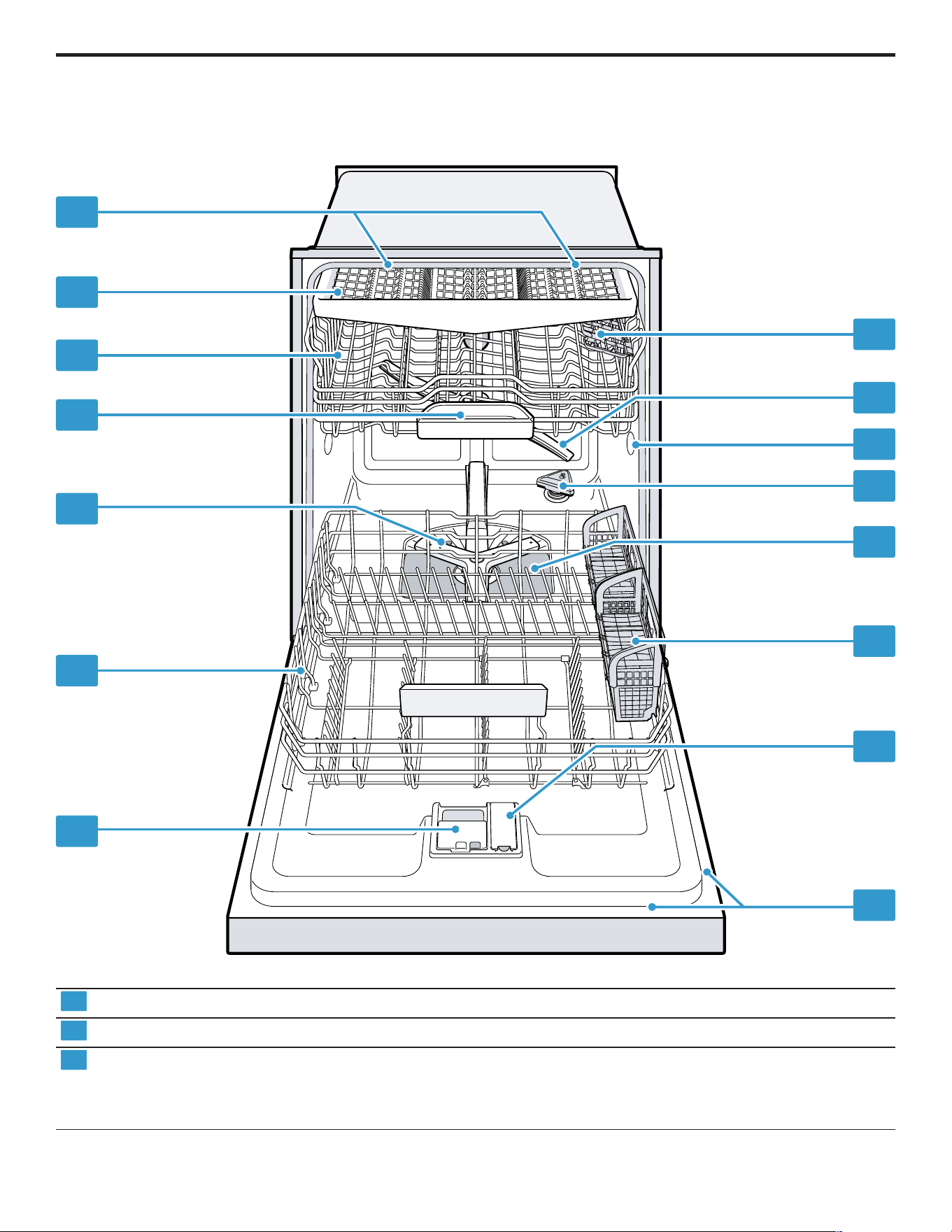
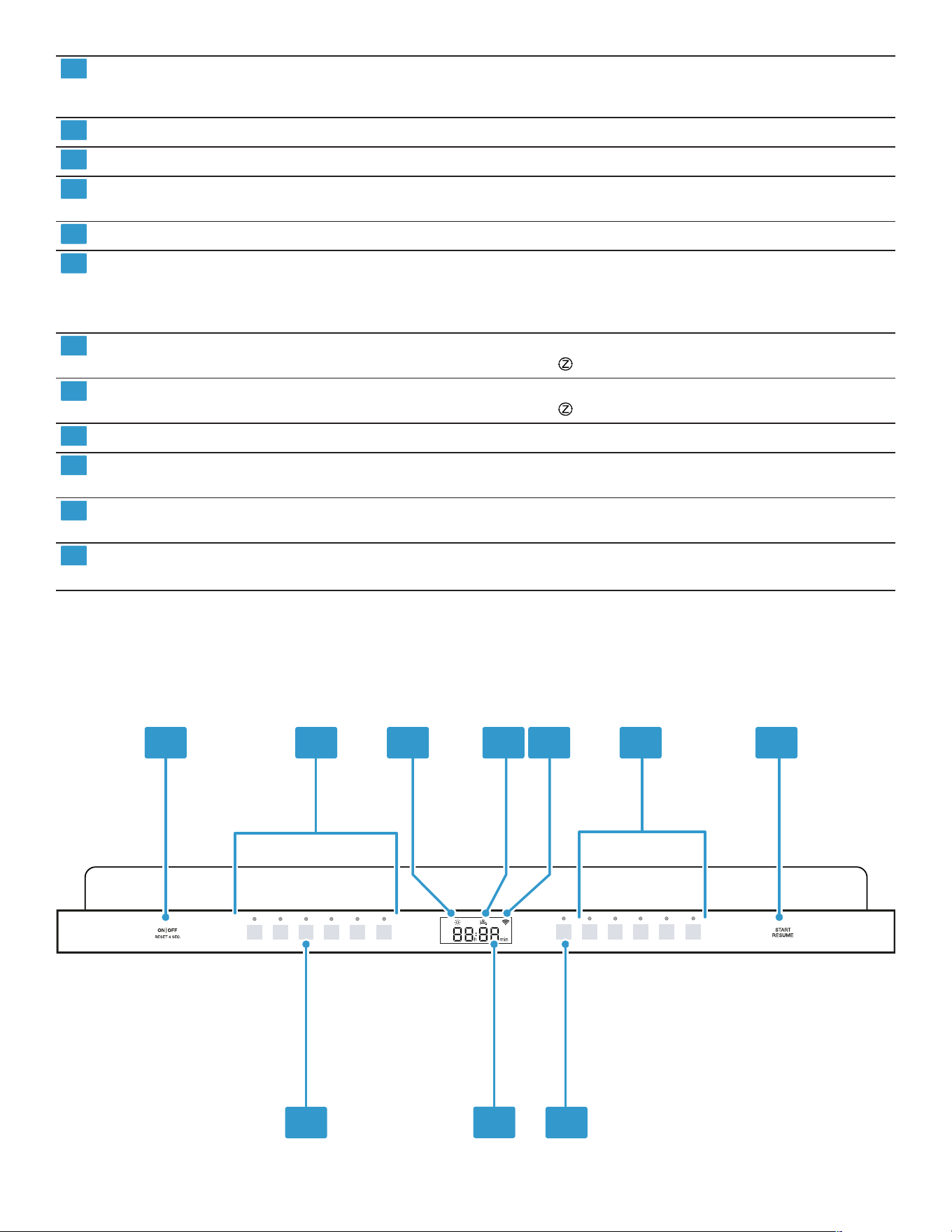
4.1 Appliance
1
2
4
5
6
7
9
10
11
12
13
14
3
8
15
1
Detergent dispenser Add detergent to the detergent dispenser.
2
Lower rack
Lower rack →
Page13
3
Lower spray arm The lower spray arm washes the dishware in the lower rack.
If the dishware has not been washed properly, clean the spray
arms.
→
"Cleaning spray arms", Page23
1
Depending on the appliance specifications
en-us Familiarizing yourself with your appliance
8
4
Detergent tab collecting tray During the wash cycle, detergent tabs automatically drop out of
the detergent dispenser into the tab collecting tray, where they
can dissolve fully.
5
Upper rack
Upper rack →
Page12
6
Silverware drawer
Silverware drawer →
Page14
7
emotionLight Interior lighting of the appliance.
→
"Overview of the basic settings", Page20
8
Cup shelf
1
Cup shelf →
Page13
9
Upper spray arm The upper spray arm washes the dishware in the upper rack.
If the dishware has not been washed properly, clean the spray
arms.
→
"Cleaning spray arms", Page23
10
Intake opening of the Zeolite container The intake opening is required for Zeolite drying.
→
"Zeolite drying ", Page6
11
Outlet opening of the Zeolite container The outlet opening is required for Zeolite drying.
→
"Zeolite drying ", Page6
12
Filter system
Filter system →
"Filter system", Page22
13
Silverware basket Silverware basket
→
"Silverware Basket", Page14
14
Dispenser for rinse aid Rinse aid is added to the dispenser for rinse aid.
→
"Rinse aid system", Page16
15
Rating plate
Rating plate with E number and FD number →
Page29
.
You will need this data to contact Customer service →
Page28
.
1
Depending on the appliance specifications
4.2 Controls
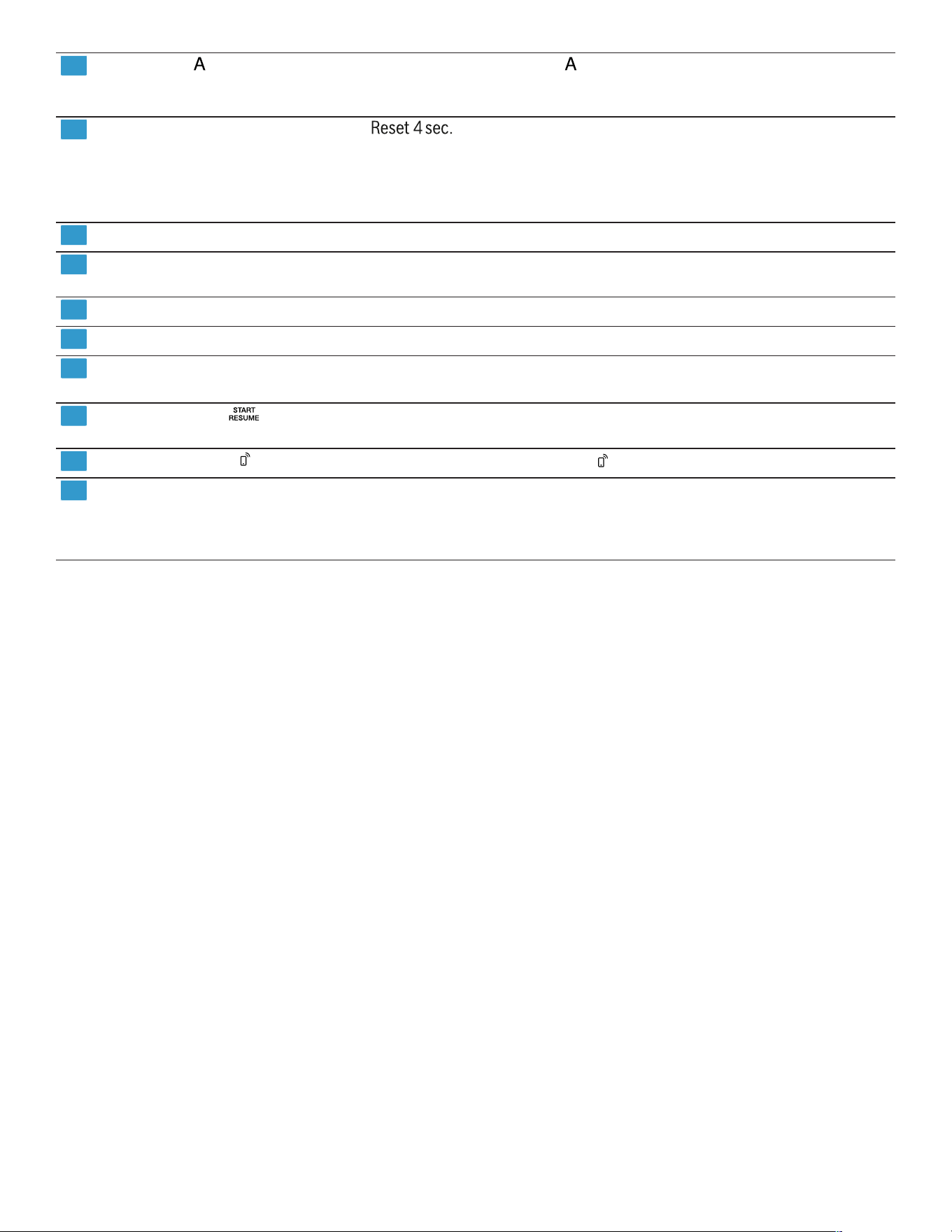
You can use the control panel to configure all functions of your appliance and to obtain information about the operating
status.
With some buttons you can perform different functions.
1 2 3 4 5 7
9
6
8A
Familiarizing yourself with your appliance en-us
9
A
Button If you press for approx. 3 seconds, you can open the
basic settings.
→
"Changing the basic settings", Page20
1
ON/OFF button and reset button
Switching on the appliance →
"Switching on the appliance",
Page19
Switching off the appliance →
"Switching off the appliance",
Page20
Terminating the cycle →
Page20
2
Cycle buttons
Cycles →
"Dishwasher Cycles", Page10
3
Rinse aid refill indicator Rinse aid system
→
"Adding rinse aid", Page16
4
Water supply display Display for water supply
5
Display wireless network
Home Connect →
Page22
6
Options and cycle buttons
1
Options →
Page11
Cycles →
Page10
7
Start button Starting the wash cycle
→
"Starting the wash cycle", Page19
8
Remote Start
→
"Remote Start ", Page22
9
Display The display shows information about the remaining run
time or basic settings. You can change the basic settings
via the display and the setting buttons.
→
"Changing the basic settings", Page20
1
Depending on the appliance specifications
en-us Dishwasher Cycles
10
Dishwasher Cycles
5 Dishwasher Cycles
Dishwasher Cycles
Below is an overview of the different cycles available on your dishwasher.
The running time may vary depending on the cycle selected. The running time depends on the water temperature, the
quantity of dishware, the level of dirt and the option selected. The running time will change if the rinse aid system is
switched off or rinse aid needs to be added. The consumption values relate to normal conditions and a water hardness of
16 - 20 °E. Different influencing factors such as water temperature or pipe pressure may result in deviations.
Cycle Purpose Cycle sequence Usage
1) Hour/min.
2) Electrical/kWH
3) Water/gal
Pots & Pans Dishware:
¡ Washing pots and pans,
non-fragile dishware and
silverware
Level of soiling:
¡ Removing stubborn burned
or dried on food remnants
containing starch and
protein.
Intensive
¡ Pre-Rinse
¡ Cleaning 151 °F – 160 °F
¡ Intermediate rinse
¡ Final rinse 151 °F
¡ Drying
¡ 1) 2:05-2:20
¡ 2) 1.110-1.140
¡ 3) 4.9-6.4
Auto Dishware:
¡ Cleaning mixed dishware
and silverware.
Level of soiling:
¡ Removing common
household food remnants
lightly dried-on.
Sensor controlled:
¡ Optimized by sensors depending on
the soiling of the rinse water.
¡ More intensive washing in the back
half of the lower rack.
¡ 1) 1:45-2:05
¡ 2) 0.820-0.860
¡ 3) 3.4-5.4
Note:The displayed cycle
time indicates an average
value.
Normal Dishware:
¡ Cleaning mixed dishware
and silverware.
Level of soiling:
¡ Removing common
household food remnants
lightly dried-on.
Most economical cycle:
¡ Pre-Rinse
¡ Cleaning 127 °F – 136 °F
¡ Intermediate rinse
¡ Final rinse 113 °F
¡ Drying
¡ 1) 2:10 -2:15
¡ 2) 0.780 -0.850
¡ 3) 2.3 -5.5
Hand Wash Dishware:
¡ Cleaning delicate dishware,
silverware, temperature-
sensitive plastics, glasses
and stemware in the
stemware holder.
Level of soiling:
¡ Removing common
household food remnants
lightly dried-on.
Particularly gentle:
¡ Pre-Rinse
¡ Cleaning 113 °F - 122 °F
¡ Intermediate rinse
¡ Final rinse 122 °F
¡ Drying
¡ 1) 1:20-1:30
¡ 2) 0.550-0.560
¡ 3) 2.5-3.9
Quick Dishware:
¡ Cleaning delicate dishware,
silverware, temperature-
sensitive plastics and
glasses.
Level of soiling:
¡ Removing lightly adhering
fresh food remnants.
Time-optimized:
¡ Cleaning 113 °F
¡ Intermediate rinse
¡ Final rinse 126 °F
¡ 1) 0:35
¡ 2) 0.560
¡ 3) 2.8
Favorite - - ¡ 1) 1:45-2:05
¡ 2) 0.820-0.860
¡ 3) 3.4-5.4
Options en-us
11
5.1 Energy Guide
The Energy Guide label was based on the Normal soil
sensing cycle.
The unit was tested without any rinse aid (liquid) in the
rinse aid dispenser. A single dose of detergent was
inserted into the detergent dispenser, with no detergent
being used in the prewash. The unit was not subjected to
truncated testing per the definitions in the test procedure.
We recommend that dish loads such as the one in the
energy certification test have the rack position set in the
highest position. Recommended for daily, regular or
typical use to completely wash a full load of normally
soiled dishes.
5.2 Favorite
With this function, you can save a combination of a Cycle
and an Option.
You can save the selected Cycle and Option combination
via the Home Connect app or on the appliance.
Tip:You can use the Home Connect app to access
additional Cycles and Options and save them.
1
Save Favorite on the appliance
1. Open the appliance door.
2. Press .
3. Press the right cycle button.
4. Press the button for the relevant options.
a The program combination is saved.
Tip:To reset the cycle, either use the Home Connect app
or reset your appliance back to the factory settings.
→
"HomeConnect® ", Page22
Options
6 Options
Options
Here is an overview of the different options available on
your dishwasher.
Option Use
Star Dry
Patented Zeolite technology
thoroughly dries dishes and
dishwasher safe plastics. Natural
minerals transform moisture into
heat up to 176F/80C to get dishes,
even plastics, 60% drier.
Extends drying time.
front
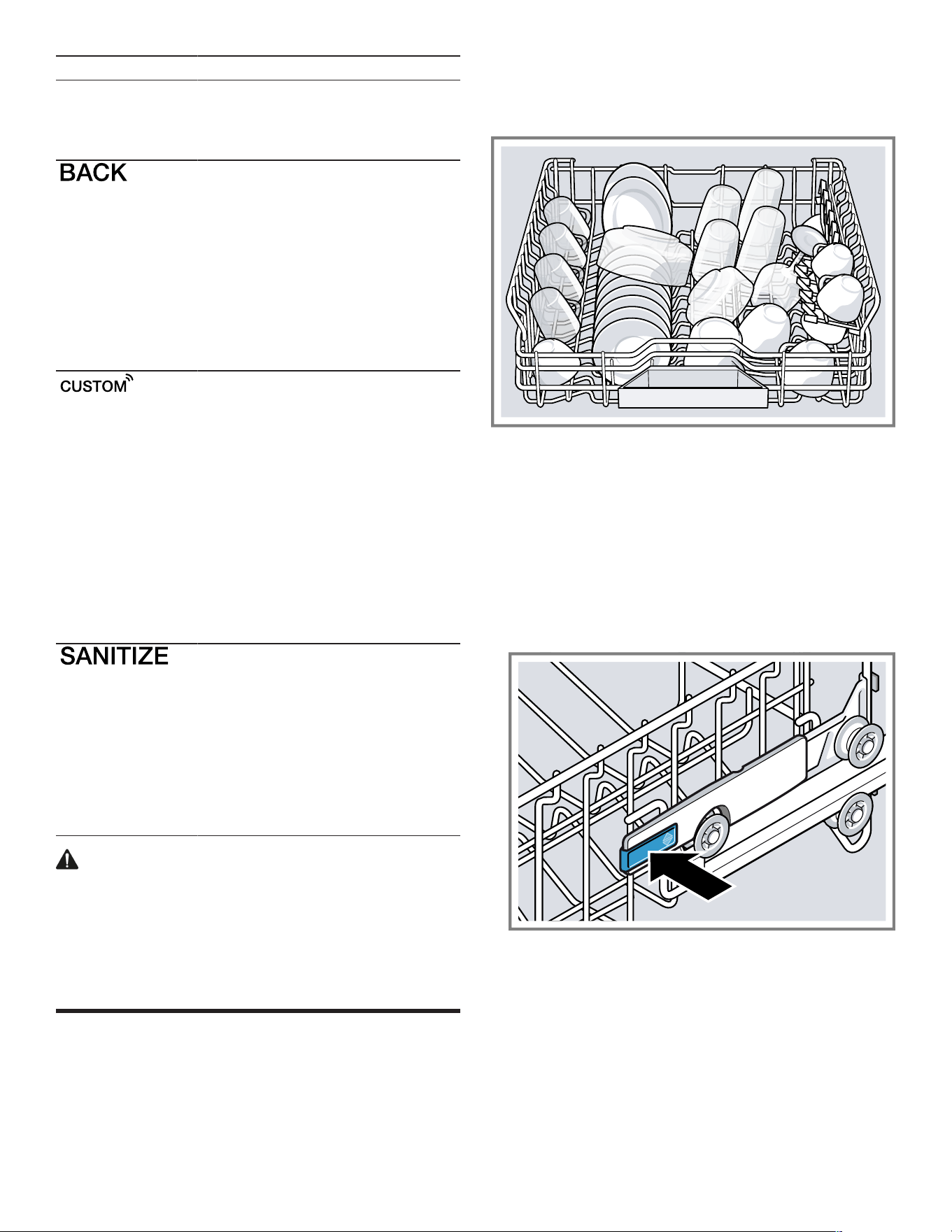
¡ The lower spray arm provides
intensive cleaning for dishware in
the front of the lower rack.
¡ Place dirty, hard to clean
dishware in the front of the lower
rack, e.g. casserole dishes, pots
and pans.
1
Depending on the appliance specifications
en-us Features
12
Option Use
¡ This intensive cleaning may
increase water and energy
consumption.
¡ The run time is extended.
back
¡ The lower spray arm provides
intensive cleaning for dishware in
the back of the lower rack.
¡ Place dirty, hard to clean
dishware in the back of the lower
rack, e.g. casserole dishes, pots
and pans.
¡ This intensive cleaning may
increase water and energy
consumption.
¡ The run time is extended.
custom
¡ Using the HomeConnect® app,
customize the 4 zones and the
cleaning intensity level.
¡ Maximum 3 light wash zones
recommended.
The settings made for this function
remain saved until you redefine the
zones in the bottom basket via the
HomeConnect® app.
If you do not specify any zone via
the HomeConnect® app, all 4
zones in the lower rack will then be
activated with the lower spray arm
for efficient and intensive cleaning.
Sanitize
¡ Increases the temperature and
cycle length to achieve sanitation.
¡ This option is ideal for cleaning
items such as chopping boards
and baby bottles.
¡ Using this option may also
improve drying. There is a slight
increase in energy consumption.
¡ When the cycle has ended, the
display shows "SAnI".
WARNING
Concerning dishware sanitation, be aware of the following.
▶ Only sanitizing cycles have been designed to meet the
requirements for soil removal and sanitation efficacy.
There is no intention, either directly or indirectly, to
imply that all cycles on a certified machine have passed
the sanitization performance test.
Features
7 Features
Features
You can find an overview of the possible features of your
appliance and how to use them here.
These features depend on your appliance model.
7.1 Upper rack
Arrange cups, glasses, and small tableware items in the
top rack.
You can adjust the height of the upper rack to make room
for larger items.
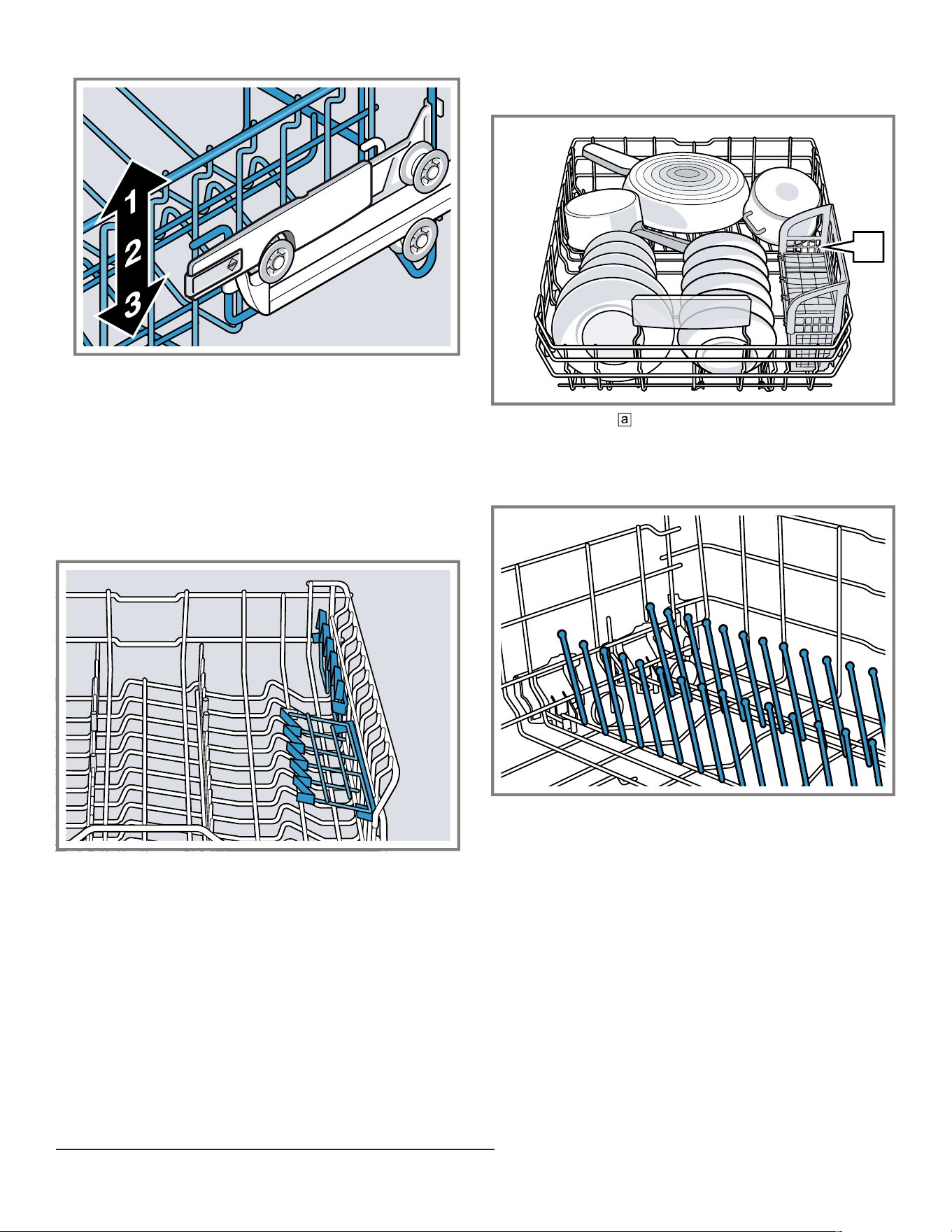
Adjusting upper rack with the side levers
To wash large items in the racks, adjust the shelf height of
the upper rack.
1. Pull out the upper rack.
2. To prevent the rack from suddenly dropping down, hold
the side of the rack by the top edge.
3. Press in the right and left hand levers on the outside of
the rack.
Features en-us
13
4. Raise or lower the rack evenly to the right level.
Check that the rack is level on both sides.
5. Release the levers.
a The rack clicks into position.
6. Slide the rack in.
7.2 Cup shelf
Use the cup shelf and the space underneath for small
cups and glasses or for large items of silverware, e.g.
cooking spoons or serving cutlery.
If you do not need the cup shelf, you can fold it up.
7.3 Lower rack
Arrange pans and plates in the lower rack.
a
Silverware basket
1
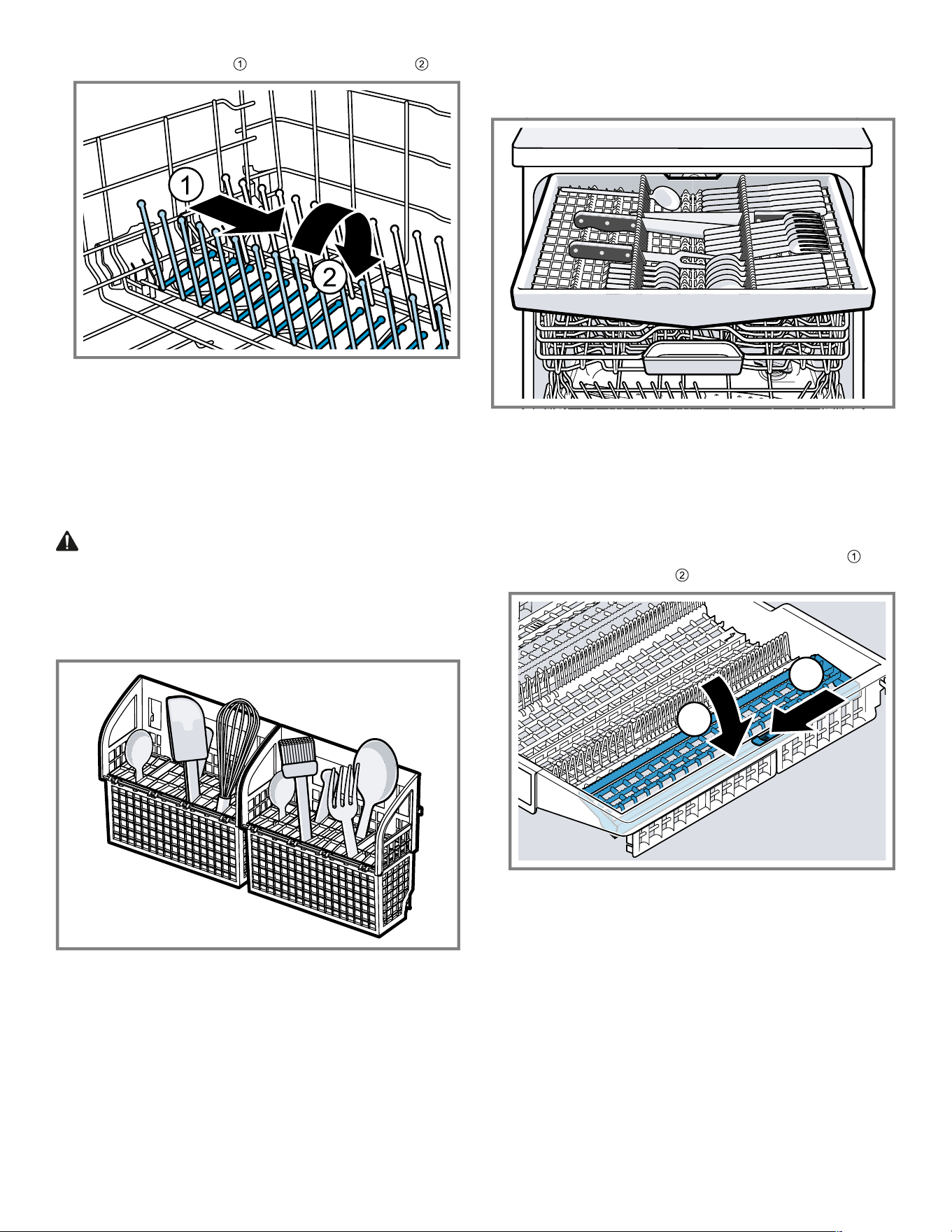
7.4 Flip tines
Use the flip tines to position dishware securely, e.g. plates.
You can fold the tines down to arrange pans, bowls and
glasses better.
1
Folding down the tines
1
If you do not need the tines, fold them down.
1
Depending on the appliance specifications
en-us Features
14
1. Push the lever forward and fold down the tines .
2. To use the tines again, fold them back up.
a The tines click into position.
7.5 Silverware Basket
Arrange the silverware in the silverware basket, ensuring
that the items are not nestled together and with the sharp
points down.
WARNING
The sharp points and edges of knives and other sharp
utensils can cause serious injury.
▶ Load knives and other sharp utensils with edges down.
Do not allow children to handle or play near knives and
sharp utensils
7.6 Silverware drawer
Arrange silverware in the silverware drawer.
Arrange silverware with the points and sharp edges down.
You can reorganize the silverware drawer to make more
space for longer or wider utensils.
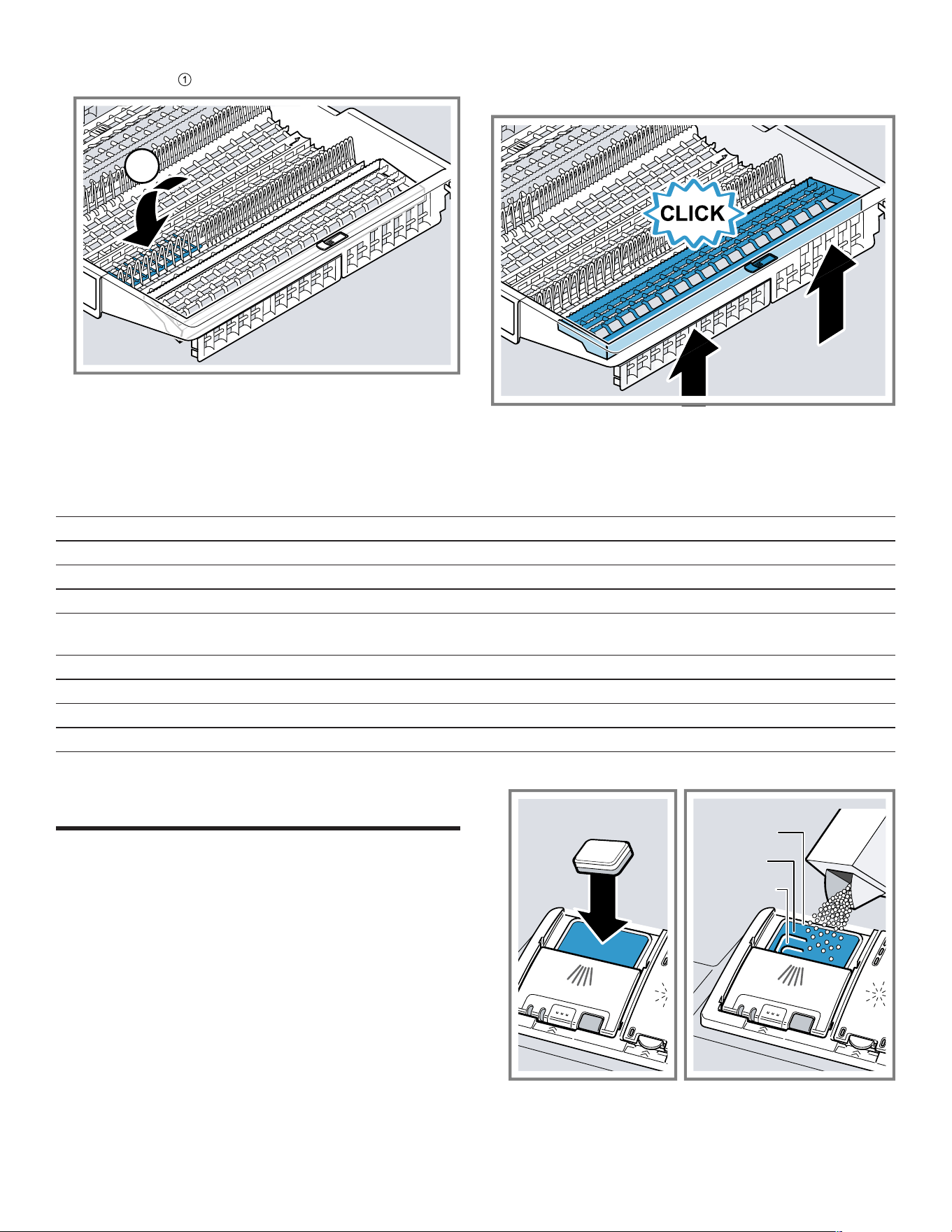
Reorganizing the silverware drawer
Fold down the side shelves and tines to make more space
for longer or wider silverware items.
1. To fold down a side shelf, push the lever forward and
fold down the side shelf .
1
2
Before using for the first time en-us
15
2. To fold down the tines, push the lever forward and fold
down the tines .
1
Tip
If you want to return the cutlery tray to its original position,
fold the side shelf upward until it clicks into position.
7.7 Rack heights
Set the racks at the right height.
Appliance height 34" with silverware basket
Setting Upper rack Lower rack
1 max. ø 24cm / 9.5" 33cm / 13"
2 max. ø 26.5cm / 10.5" 30.5cm / 12"
3 max. ø 29cm / 11.5" 28cm / 11"
Appliance height 34" with silverware drawer
Setting Upper rack Lower rack
1 max. ø 18cm / 7" 33cm / 13"
2 max. ø 20.5cm / 8" 30.5cm / 12"
3 max. ø 23cm / 9" 28cm / 11"
Tip:If you remove the 3rd rack, you can place large items
of dishware in the lower rack.
Before using for the first time
8 Before using for the first time
Before using for the first time
8.1 Initial use
Note:Connect your appliance to the HomeConnect®
app. You can conveniently adjust the settings and
download additional cycles and options with the app.
→
"HomeConnect® ", Page22
1.
Add rinse aid. →
Page16
For optimum drying results, always use rinse aid.
2. Add detergent.
3 tbsp (45 ml)
1.75 tbsp
(25 ml)
1 tbsp (15 ml)
Only use detergents intended for dishwashers.
3.
Turn on the appliance. →
Page19
4.
Set the amount of rinse aid. →
Page16
en-us Rinse aid system
16
5. Start the Cycle with the highest cleaning temperature
→
Page10
without dishware.
Operate the appliance without dishware before using it
for the first time in order to remove any marks from
water or other residues.
Tip:You can change the Basic settings →
Page20
at
any time.
Rinse aid system
9 Rinse aid system
Rinse aid system
9.1 Rinse aid
For optimum drying results, use rinse aid.
Only use rinse aid intended for household dishwashers.
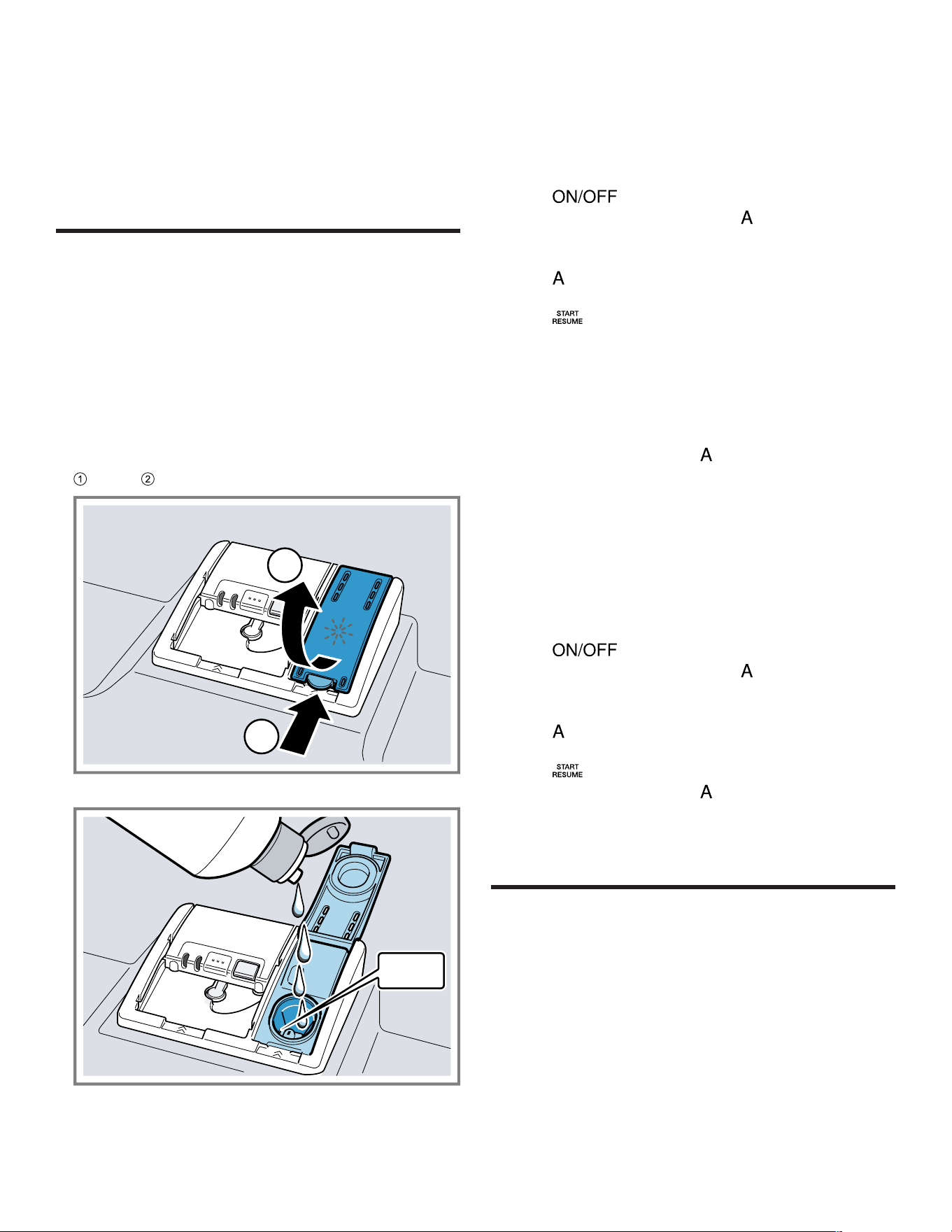
Adding rinse aid
If the rinse aid refill indicator lights up, fill the dispenser
with rinse aid. Only use rinse aid intended for household
dishwashers.
1. Press the catch on the lid of the dispenser for rinse aid
and lift .
1
2
2. Add rinse aid up to the max mark.
max
3. If rinse aid spills out, remove it from the tub.
Spilled rinse aid can cause excessive frothing during
the wash cycle.
4. Close the lid of the dispenser for rinse aid.
a The lid clicks into position.
9.2 Setting the amount of rinse aid
If there are streaks or water spots on dishware, change
the amount of rinse aid.
1. Press .
2. To open the basic settings, press button and hold for
3 seconds.
→
"Controls", Page8
3. Press repeatedly until the display shows the value
r:05 set at the factory.
4. Press repeatedly until the right amount of rinse aid
has been set.
– A low setting adds less rinse aid during the wash
cycle and reduces streaking on dishware.
– A higher setting adds more rinse aid during the wash
cycle, reduces water spots and improves the drying
result.
5. To store the settings, press button and hold for 3
seconds.
9.3 Switching the rinse aid system off
If you choose not to use rinse aid, you can turn the rinse
aid system off.
Tip:Rinse aid within a combination detergent has limited
effectiveness. You will generally get better results using a
separate rinse aid.
1. Press .
2. To open the basic settings, press button and hold for
3 seconds.
→
"Controls", Page8
3. Press repeatedly until the display shows the value
r:05 set at the factory.
4. Press repeatedly until the display shows r:00.
5. To store the settings, press button and hold for 3
seconds.
a The rinse aid system is switched off and the rinse aid
refill indicator is deactivated.
Dishware
10 Dishware
Dishware
Only wash dishware that is suitable for dishwashers.
Note:Decorated glassware and parts made of aluminum
or silver may fade or discolor with dishwashing. Delicate
types of glass may turn cloudy after a few wash cycles.
Dishware en-us
17
10.1 Damage to glass and dishware
Only put glasses and china in the dishwasher if they are
labeled dishwasher-safe. Avoid damage to glass and
dishware.
Cause Recommendation
The following types of
dishes are not dishwasher-
safe:
¡ Wooden utensils and
dishes
¡ Decorative glassware,
antique dishes and
artistic hand-made
pottery
¡ Plastic parts that are not
heat-resistant
¡ Dishes made from
copper or tin
¡ Dishes soiled with ash,
wax, grease or paint
¡ Very small items of
dishware
Only put dishes in the
dishwasher if they are
labeled dishwasher-safe.
The chemical composition
of the detergent causes
damage.
Use a detergent labeled as
gentle to dishes.
The water temperature of
the cycle is too high.
Select a cycle with lower
temperatures.
After the cycle has ended,
take glassware and
silverware out of the
appliance without delay.
The water temperature of
the cycle is too high and the
water is too soft.
Select a cycle with lower
temperatures.
Use detergent with glass
protection.
10.2 Loading dishware
Arrange dishware correctly to optimize the dishwashing
result and prevent damage to both dishware and the
appliance. The noise level may also vary depending on
the items placed in your dishwasher.
WARNING
The sharp points and edges of knives and other sharp
utensils can cause serious injury.
▶ Load knives and other sharp utensils with edges down.
Do not allow children to handle or play near knives and
sharp utensils
WARNING
Highly caustic alkaline or highly acidic cleaning agents in
conjunction with aluminum parts in the interior of the
appliance may cause explosions.
▶ Never use highly caustic alkaline or highly acidic
cleaning agents, in particular commercial or industrial
products, in conjunction with aluminum items (e.g.
grease filters of vent hoods or aluminum pans).
NOTICE:
Avoid dishwasher damage
▶ Do not load the dishwasher with paper products, plastic
bags, packing materials or anything other than normal,
dishwasher safe dishware and kitchenware.
Tips
¡ Using the appliance allows you to save energy and
water compared to doing dishes by hand.
¡ See our website for examples of how to load your
appliance efficiently.
¡ To save energy and water, load the machine with the
number of place settings specified (standard load with
dishes and silverware).
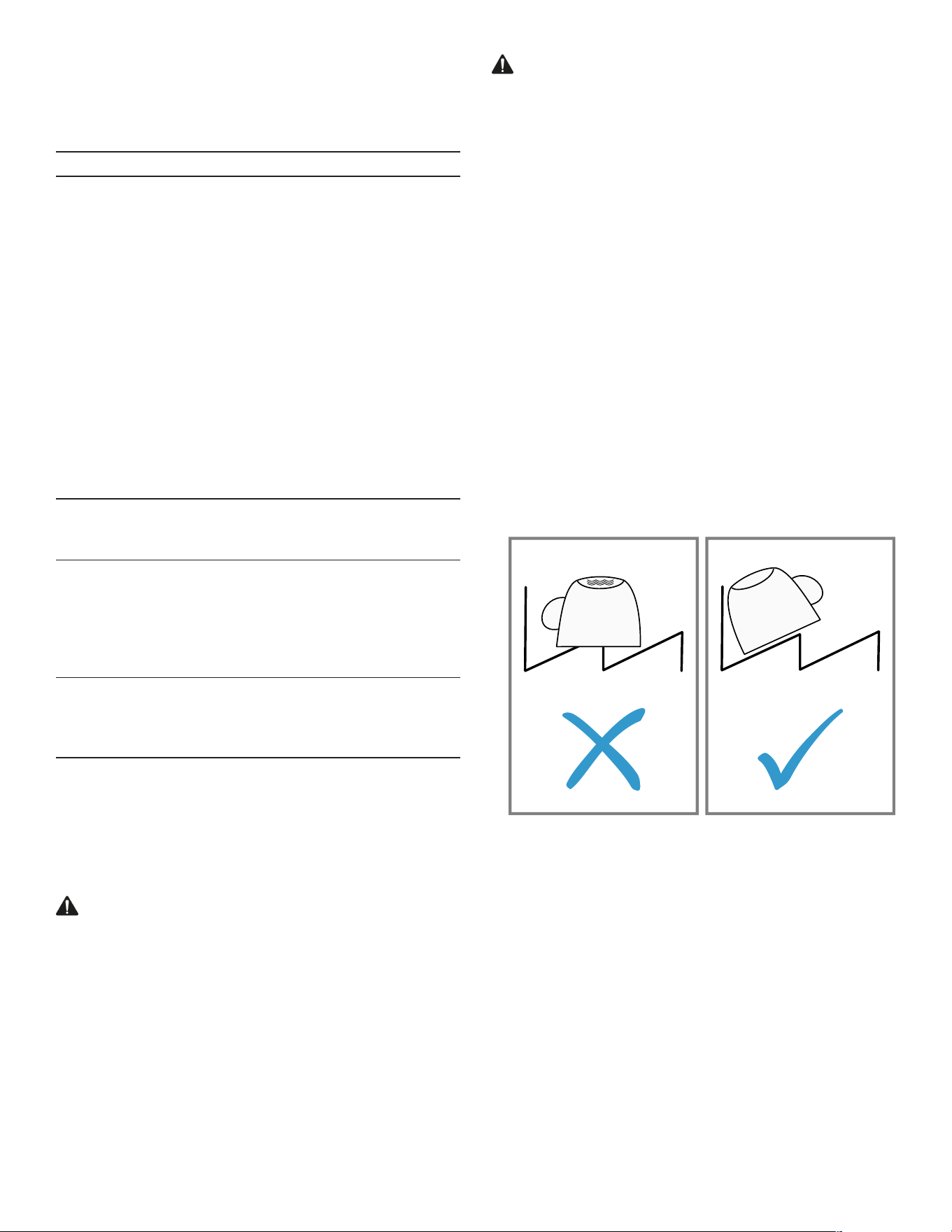
¡ For better washing and drying results, position items
with curves or recesses at an angle so water can run
off.
1. Remove large remnants of food from dishware.
To save resources, do not pre-rinse dishware under
running water.
2. Observe the following when arranging dishware:
– Put heavily soiled dishware in the lower rack, e.g.
pans. The more powerful spray jet ensures that the
dishwashing result will be better.
– To avoid damage to dishware, arrange it so it is
stable and cannot tip over.
– To avoid injury, arrange silverware with the points
and sharp edges facing down.
– Position containers with the openings facing down so
no water can collect in them.
– Do not block the spray arms - make sure that they
can turn freely.
– Do not place small parts in the collecting tray and do
not block it with dishware so as not to obstruct the lid
of the detergent dispenser.
en-us Dishware
18
10.3 Removing dishware
CAUTION
Dishes can be very hot immediately after the cycle ends.
▶ Open the door slightly and allow dishes to cool for a few
minutes before unloading.
1. To prevent water dripping onto dishware, unload it
starting at the bottom and working up.
2. Check the washing tank and accessories for soiling and
clean if necessary.
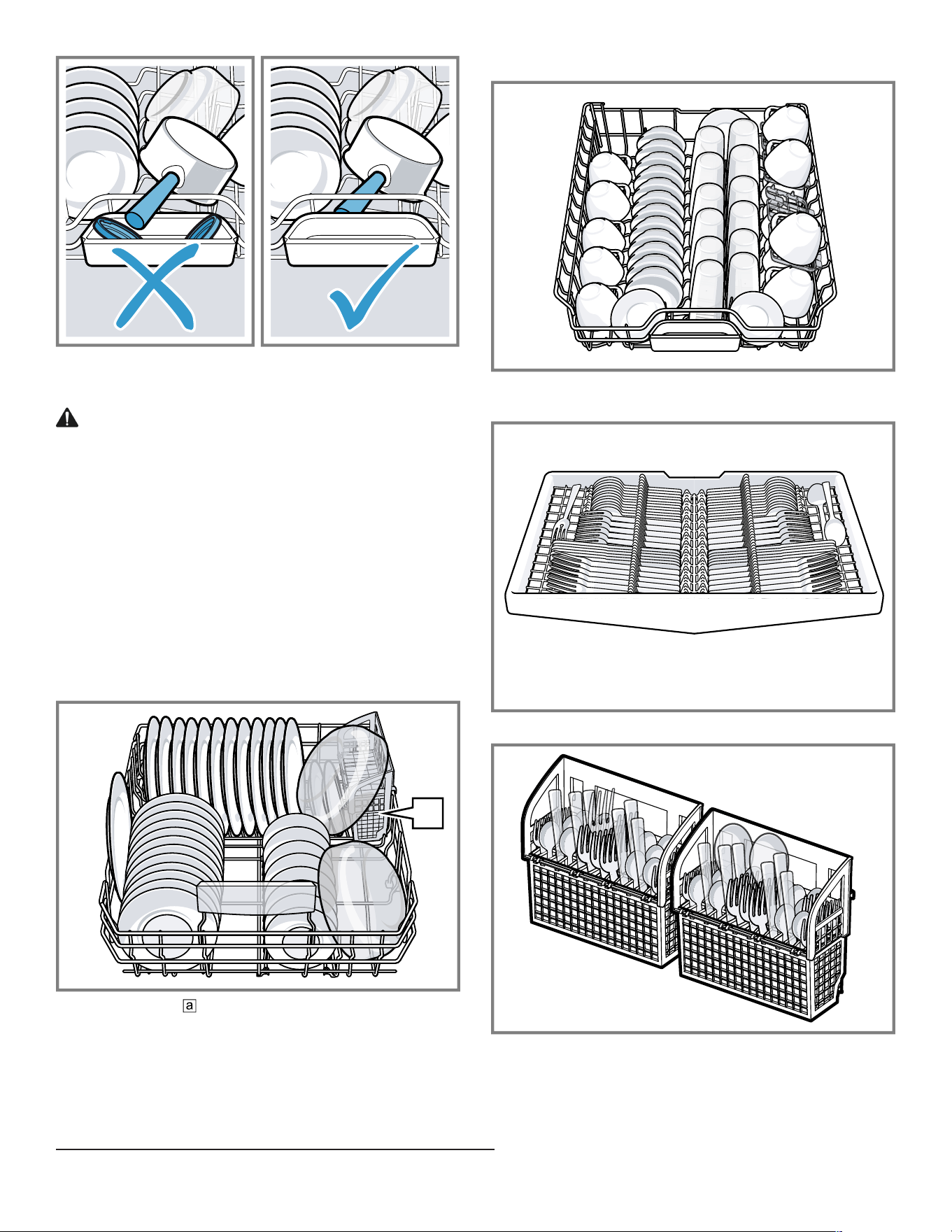
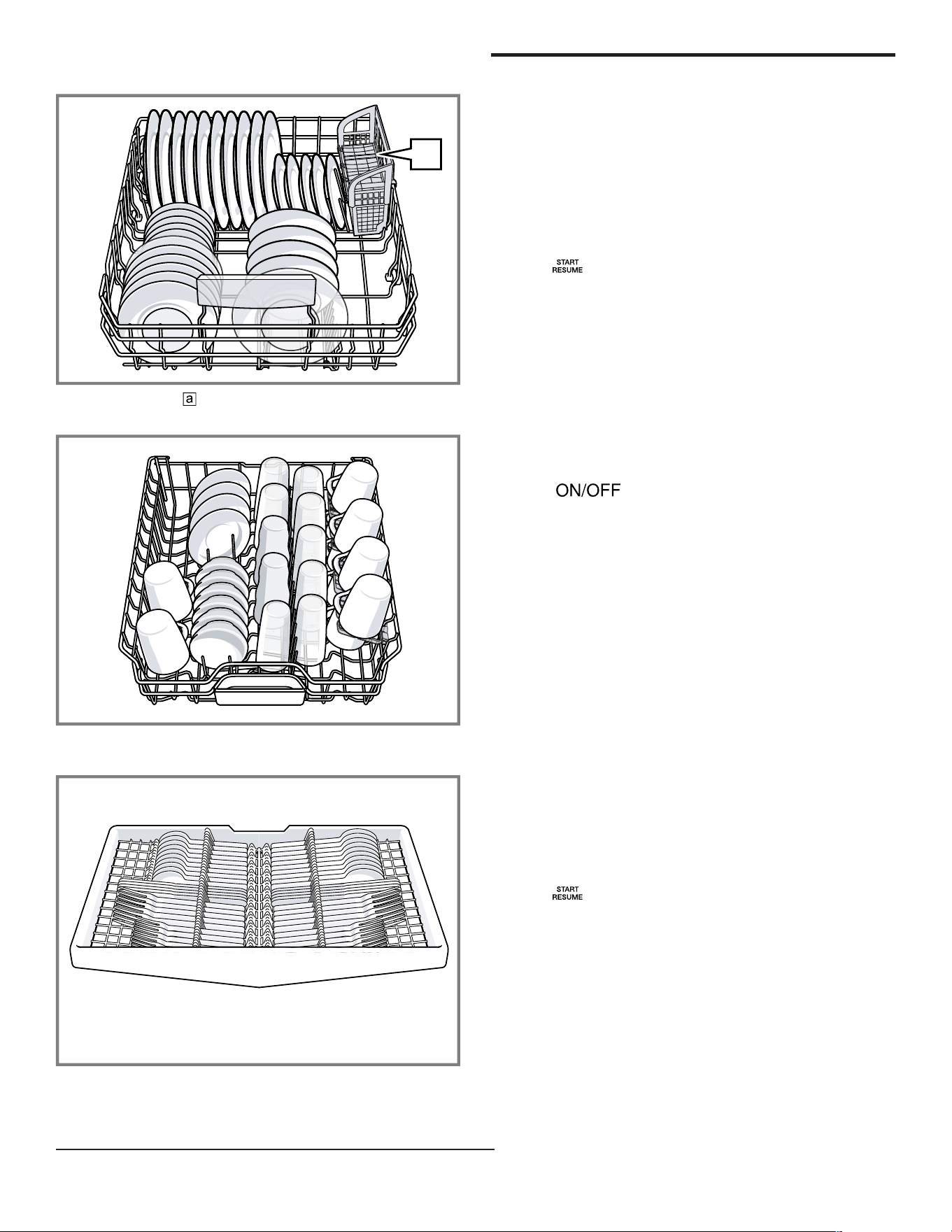
10.4 Loading patterns
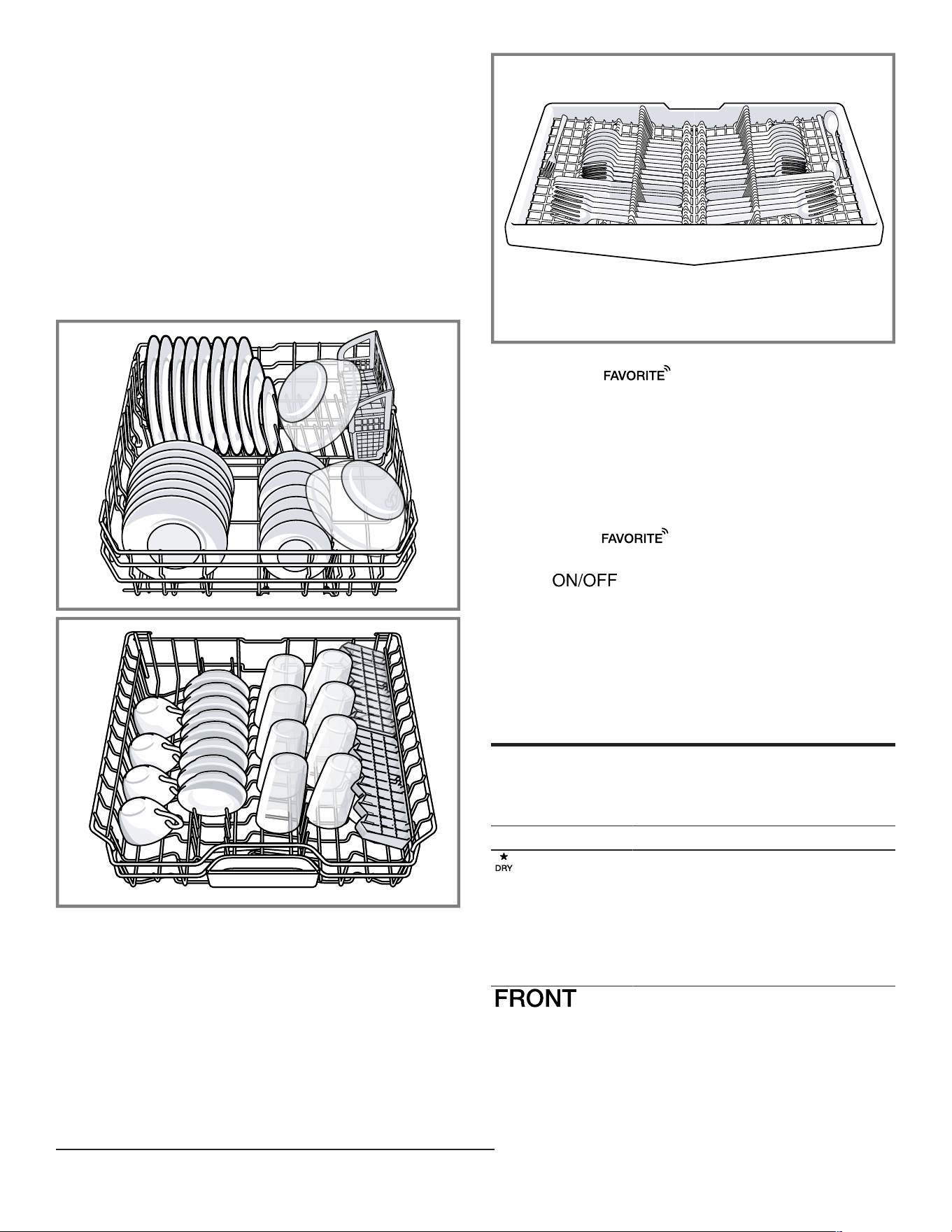
Recommended loading patterns.
12 place settings:
Lower rack
a
Silverware basket
1
Upper rack
Third rack
1
Depending on the appliance specifications
Basic Operation en-us
19
Additional loading patterns for 10 place settings:
Lower rack
a
Silverware basket
1
Upper rack
Third rack
Basic Operation
11 Basic Operation
Basic Operation
11.1 Protection against unintentional
operation
Your dishwasher has a built in feature to help prevent
unintentional operation, e.g. by children. After starting the
appliance, the door has to be closed within 4 seconds,
otherwise the operation will be paused. If this occurs,
follow the steps below to restart your dishwasher.
▶ Press and close the door.
a The wash cycle will resume.
Note
Unintentional operation is activated when:
¡ Pressing Start to begin a wash cycle
¡ Setting Delay time and pressing Start
¡ Opening the door while Delay time is active
¡ Opening the door during a wash cycle.
¡ This feature cannot be deactivated.
11.2 Switching on the appliance
▶ Touch with a short 1 second touch.
The cycle last selected and the option last selected will
be set by default.
The buttons on the appliance are touch sensitive and
only require a quick, gentle touch.
Note:If you do not perform any actions on the appliance
for 10 minutes, it will automatically switch off. This feature
cannot be deactivated.
11.3 Setting the time delay
You can delay the start of the wash cycle via the
HomeConnect® app.
▶ Open the HomeConnect® app and select the
appliance.
In the settings, you can use the time delay function to
delay the start of the wash cycle.
→
"HomeConnect® ", Page22
11.4 Starting the wash cycle
▶ Press .
a The wash cycle has ended when the display shows
"00h:00m".
Notes
¡ If you want to add more dishware while the appliance is
running, do not use the collecting tray as a handle for
the upper rack. You might touch the partially dissolved
tablet.
¡ You can only change a cycle in progress if you can
cancel it first.
→
"Terminating the wash cycle", Page20
1
Depending on the appliance specifications
en-us Basic settings
20
¡ To save energy, the appliance switches off
automatically 10minutes after the end of the wash
cycle. If you open the appliance door immediately after
the wash cycle has ended, the appliance will switch off
after 4 seconds.
11.5 Interrupting the wash cycle
1. Press On/Off.
The program is saved and the appliance switches off.
2. Press On/Off.
3. Press to resume the wash cycle.
11.6 Terminating the wash cycle
To end a cycle early or to switch from one that has already
started, you will need to cancel it first.
1. Open the appliance door.
2. Press for approx. 4seconds.
3. Close the appliance door.
a All displays light up.
a As soon as the displays are off, the display shows
"00h:01m" and the residual water is pumped out.
a The cycle is cancelled and ends after approx. 1minute.
11.7 Switching off the appliance
CAUTION
To avoid risk of injury, always use caution when opening
the door during or following a wash cycle as hot water or
steam may escape.
▶ Do not fully open the door until water noises have
stopped and steam has subsided.
1. Please note the information on Preventing Material
Damage →
Page6
.
2. Press On/Off.
Basic settings
12 Basic settings
Basic settings
You can configure the basic settings for your appliance to
meet your needs.
12.1 Changing the basic settings
Tip:Connect your appliance to a mobile device. You can
conveniently change all settings using the
HomeConnect® app.
→
"HomeConnect® ", Page22
1. Open the appliance door.
2. Press .
3. To open the basic settings, press button and hold for
3 seconds.
→
"Controls", Page8
4. Press the button repeatedly until the display shows
the required setting.
5. Press repeatedly until the display shows the right
value.
You can change one or more settings.
6. To store the settings, press button and hold for 3
seconds.
7. Close the appliance door.
Tip:You can reset the changed settings back to the
factory settings at any time.
→
"Overview of the basic settings", Page20
12.2 Overview of the basic settings
The basic settings depend on the features of your appliance.
Basic setting Display text Selection Description
Rinse aid disp. r:05
1
r:00 - r:06 Set the amount of rinse aid.
→
"Setting the amount of rinse aid", Page16
Switch the rinse aid system off with level
r:00.
Sensor setting SE:00
1
SE:00 - SE:02 Set the water sensor for identifying soiling.
→
"Sensors", Page6
Extra Dry d:00
1
d:00 - d:01 The temperature is increased during the final
rinse, which improves the drying result. This
may increase the run time slightly.
Note:Not suitable for delicate items of
dishware.
Switch Extra Dry on "d:01" or off "d:00".
1
Factory setting (may vary according to model)
Basic settings en-us
21
Basic setting Display text Selection Description
EmotionLight EL:02
1
EL:00 - EL:02 Interior lighting.
¡ With the setting "EL:00", the interior
lighting is switched off.
¡ With the setting "EL:01", the interior
lighting can be activated via the ON/OFF
button.
¡ With the setting "EL:02", the interior
lighting goes on when you open the
appliance door.
When the appliance door is opened, the
interior lighting switches off automatically
after 10 minutes.
infoLight® I:01
1
I:00 - I:01 Switch InfoLight on or off.
While the program is running, a spot of light
is projected onto the floor below the
appliance door. This light will not be visible if
the appliance is installed at eye level with
the cabinet front fitted flush. If the appliance
door is not completely closed, the spot of
light will flash. The program has ended when
the spot of light is no longer visible on the
floor.
Level "I:00" switches InfoLight off.
Start cycle SP:00
1
SP:00 - SP:01 Set a default cycle for when the appliance is
switched on.
¡ With the setting "SP:00", the last cycle
selected and the last additional function
selected are set by default when the
appliance is switched on.
¡ With the setting "SP:01", the standard
cycle is set by default when the appliance
is switched on.
Signal volume SL:02
1
SL:00 -SL:03 Adjusting the signal volume.
Level "SL:00" switches the signal tone off.
Button volume bL:02
1
bL:00 - bL:03 Set the button volume during operation.
Level "bL:00" switches the button tones off.
Wi-Fi Cn:00 Cn:00 - Cn:01 Switch the wireless network connection on
or off.
Level "Cn:00" switches the wireless network
connection off.
The basic setting is not available until you
have connected the appliance with the
HomeConnect® app.
→
"HomeConnect® ", Page22
1
Factory setting (may vary according to model)
en-us HomeConnect®
22
Basic setting Display text Selection Description
Remote Start rc:01 rc:00 - rc:02 Activate or deactivate remote start.
→
"Remote Start ", Page22
The following settings are possible:
¡ With the setting "rc:00", the option is
permanently deactivated.
¡ With the setting "rc:01", the option can be
selected via the button.
¡ With the setting "rc:02", the option is
permanently activated.
The basic setting is not available until you
have connected the appliance with the
HomeConnect® app.
→
"HomeConnect® ", Page22
Factory setting rE: Starting with
Y:ES
Confirming with
Restore changed settings to the factory
settings.
The settings for initial use must be
configured.
→
"Initial use", Page15
1
Factory setting (may vary according to model)
HomeConnect®
13 HomeConnect®
HomeConnect®
This appliance is network-capable. Connecting your
appliance to a mobile device lets you control its functions
via the HomeConnect® app.
Note:Also note the safety information in this instruction
manual and ensure that it is also observed when operating
the appliance using the HomeConnect® app.
13.1 Setting up the HomeConnect® app
1. Install the HomeConnect® app on your mobile device.
2. Start the HomeConnect® app and set up access for
HomeConnect®.
The HomeConnect® app guides you through the entire
registration process.
13.2 Setting upHomeConnect®
Requirements
¡ The HomeConnect®app is installed on your mobile
device.
¡ The appliance receives signals from the WLAN home
network (Wi-Fi) at its installation location.
¡ The appliance door is closed.
1. Open the HomeConnect® app and scan the following
QR code.
2. Follow the instructions in the HomeConnect® app.
13.3 Remote Start
You can use the HomeConnect® app to start the
appliance with your mobile device.
Tip:If you select "rc:02" in the Basic settings →
Page22
of this function, the function is permanently activated, and
you can start your appliance with a mobile device at any
time.
Cleaning and maintenance
14 Cleaning and maintenance
Cleaning and maintenance
To keep your appliance working efficiently for a long time,
it is important to clean and maintain it carefully.
Note:The Statement of Limited Product Warranty covers
defects in materials and workmanship. Cleaning and
maintenance is not covered by the warranty and a charge
will apply. See the Statement of Limited Product Warranty
for more details.
14.1 Filter system
1. Check the filters for residues after each dishwashing
cycle.
2. To see how to clean the filters, scan the following QR
code.

Cleaning and maintenance en-us
23
14.2 Cleaning spray arms
▶ To see how to clean the spray arms, scan the following
QR code.
en-us Troubleshooting
24
Troubleshooting
15 Troubleshooting
Troubleshooting
You can eliminate minor issues on your appliance
yourself. Please read the information on eliminating issues
before contacting Customer Service. This may avoid
unnecessary repair costs.
Tip:You can find further information and explanations on
troubleshooting online by scanning the QR code in the
table of contents and on our website www.thermador.com.
Issue Cause and troubleshooting
E:20-60 lights up alternately. Appliance has detected that the heating element is calcified.
1. Descale the appliance.
2. Operate the appliance with the Water softening system.
1
E:21-30 lights up alternately. Intake opening of Zeolite container is covered by items of dishware.
▶ Rearrange the dishware in the appliance so the Intake opening of the Zeolite
container →
Page7
is no longer obstructed.
E:30-00 lights up alternately. Water protection system is activated.
1. Close the water supply valve.
2.
Contact customer service →
Page28
.
E:31-00 lights up alternately. Water protection system is activated.
1. Close the water supply valve.
2.
Contact customer service →
Page28
.
E:32-00 lights up alternately or
indicator for water supply lights up.
Water supply valve is closed.
1. Open the water supply valve.
2. Terminate the wash cycle.
→
"Terminating the wash cycle", Page20
3. Start a wash cycle.
→
"Starting the wash cycle", Page19
4. If the problem occurs again:
‒ Contact the customer service.
→
"Customer Service", Page28
Inlet hose is kinked or blocked.
▶ Contact customer service.
→
"Customer Service", Page28
Water supply valve is jammed or clogged up.
1. Open the water supply valve.
The flow rate must be at least 10 l/min when the water supply is open.
2. If the problem occurs again:
‒ Contact customer service.
→
"Customer Service", Page28
E:34-00 lights up alternately. Water is continuously running into the appliance.
1. Close the water supply valve.
2.
Contact customer service →
Page28
.
1
Depending on the appliance specifications
Troubleshooting en-us
25
Issue Cause and troubleshooting
E:61-02 lights up alternately. Not an appliance error. The drain pump cover is loose or a foreign object is blocking
the pump.
▶ Secure the cover of the drain pump so it clicks into place or clean the drain
pump.
E:61-03 lights up alternately.
Water is not draining.
Not an appliance error. Garbage disposal is still plugged or the drain hose is kinked.
▶ Check that the garbage disposal plug is removed and that the drain hose is not
kinked.
Not an appliance error. The drain pump cover is loose or a foreign object is blocking
the pump.
▶ Secure the cover of the drain pump so it clicks into place or clean the drain
pump.
Not an appliance error. High loop is missing and/or debris flushed back into drain
hose and blocked it.
▶ Be sure there is a high loop in the drain hose and that no debris has flushed back
into the hose.
E:61-60 lights up alternately. There is a technical error.
▶ Contact customer service.
→
"Customer Service", Page28
E:90-01 lights up alternately. Power voltage is too low.
There is no problem with the appliance.
1. Call an electrician.
2. Have the power voltage and electrical installation checked by an electrician.
E:92-10 lights up alternately. Spray arm rotation of the lower spray arm is blocked.
▶ Arrange the dishware so that it does not obstruct spray arm rotation of the lower
spray arm.
Lower spray arm is not correctly fitted.
▶ Fit the lower spray arm correctly.
en-us Troubleshooting
26
Issue Cause and troubleshooting
E:92-10 lights up alternately.
E:92-40 lights up alternately. Filters are soiled or blocked.
▶ Clean the filters.
→
"Filter system", Page22
All LEDs light up or flash. A software update is possibly installing.
1. Wait until the software update has been installed.
This process can take approx. 30minutes.
2. If the appliance is not ready to use after 30minutes, perform a reset.
‒ Press the main switch button for approx. 4seconds.
a Your appliance is resetting.
Electronics have detected a fault.
1. Press the main switch button for approx. 4seconds.
The appliance is reset and restarted.
2. If the problem occurs again:
‒ Switch off the appliance.
‒ Unplug the power plug or switch off the circuit breaker in the fuse box.
‒ Wait at least 2minutes.
‒ Switch on the circuit breaker in the fuse box or plug in the power plug.
‒ Switch on the appliance.
3. If the problem occurs again:
‒ Contact customer service.
→
"Customer Service", Page28
Food remnants on dishware. Dishware was placed too close together or rack is overfilled.
1. Arrange dishware with sufficient space in between.
The spray jets must reach the surfaces of the dishware.
2. Avoid points of contact.
Spray arm rotation is blocked.
▶ Arrange dishware so it does not obstruct spray arm rotation.
Spray arm nozzles are blocked.
▶ Clean the spray arms.
→
"Cleaning spray arms", Page23
Filters are dirty.
▶ Clean the filters.
→
"Filter system", Page22
Filters are inserted incorrectly and/or not engaged.
1. Insert the filters properly.
→
"Filter system", Page22
2. Twist filters into place.
Selected wash cycle is too light.
▶ Select a more intensive wash program.
▶ Adjust the sensitivity of the sensors.
→
"Sensors", Page6
Dishware has been precleaned too intensively. Then the sensors choose a lighter
cycle. Stubborn remnants cannot be entirely removed.
▶ Only remove large remnants of food and do not pre-rinse dishware.
Troubleshooting en-us
27
Issue Cause and troubleshooting
Food remnants on dishware. ▶ Adjust the sensitivity of the sensors.
→
"Sensors", Page6
Tall narrow containers in corner areas are not rinsed out adequately.
▶ Do not position tall narrow containers at too great an angle or in corner areas.
Upper rack on right and left not set to same height.
▶ Set the upper rack on the left and right to the same height.
→
"Upper rack", Page12
There are removable streaks on
glasses, glassware with a metallic
appearance and silverware.
Amount of rinse aid to be dispensed is set too high.
▶ Set the rinse aid system to a lower setting.
→
"Setting the amount of rinse aid", Page16
No rinse aid has been added.
▶ Add rinse aid.
→
"Adding rinse aid", Page16
There is detergent residue in the final rinse. Lid of detergent dispenser is blocked by
dishware and will not open fully.
1. Arrange dishware in the upper rack so the tab collecting tray is not obstructed by
dishware.
Items of dishware are blocking the dispenser lid.
2. Do not place dishware or fragrance dispensers in the tab collecting tray.
Dishware has been precleaned too intensively. Then the sensors choose a lighter
cycle. Stubborn remnants cannot be entirely removed.
▶ Only remove large remnants of food and do not pre-rinse dishware.
▶ Adjust the sensitivity of the sensors.
→
"Sensors", Page6
Rust spots on silverware. Silverware is not sufficiently rust-resistant. Knife blades are often more severely
affected.
▶ Use rust-resistant dishware.
Silverware may also rust if washed together with rusting items.
▶ Do not wash rusting items.
Detergent residue is present in the
detergent dispenser or the tab
collecting tray.
Spray arms were blocked by dishware so detergent was not rinsed out.
▶ Check that the spray arms are not blocked and can rotate freely.
Detergent dispenser was damp when detergent was added.
▶ Only add detergent to the detergent dispenser when dry.
Display shows SAnl. Not an appliance error. Dishware is sanitized.
▶ See description for option sanitize.
15.1 Clean drain pump
Large food remnants or foreign objects can block the drain
pump. As soon as the dishwashing water no longer drains
properly, the drain pump must be cleaned.
CAUTION
There may be some sharp debris, such as glass
fragments, blocking the drain pump.
▶ Use caution when removing parts for cleaning.
1. Disconnect the appliance from the power supply.
2. Remove the upper and lower rack.
3. Remove the filter system.
4. Scoop out any water.
Use a sponge if necessary.
en-us Transportation, storage and disposal
28
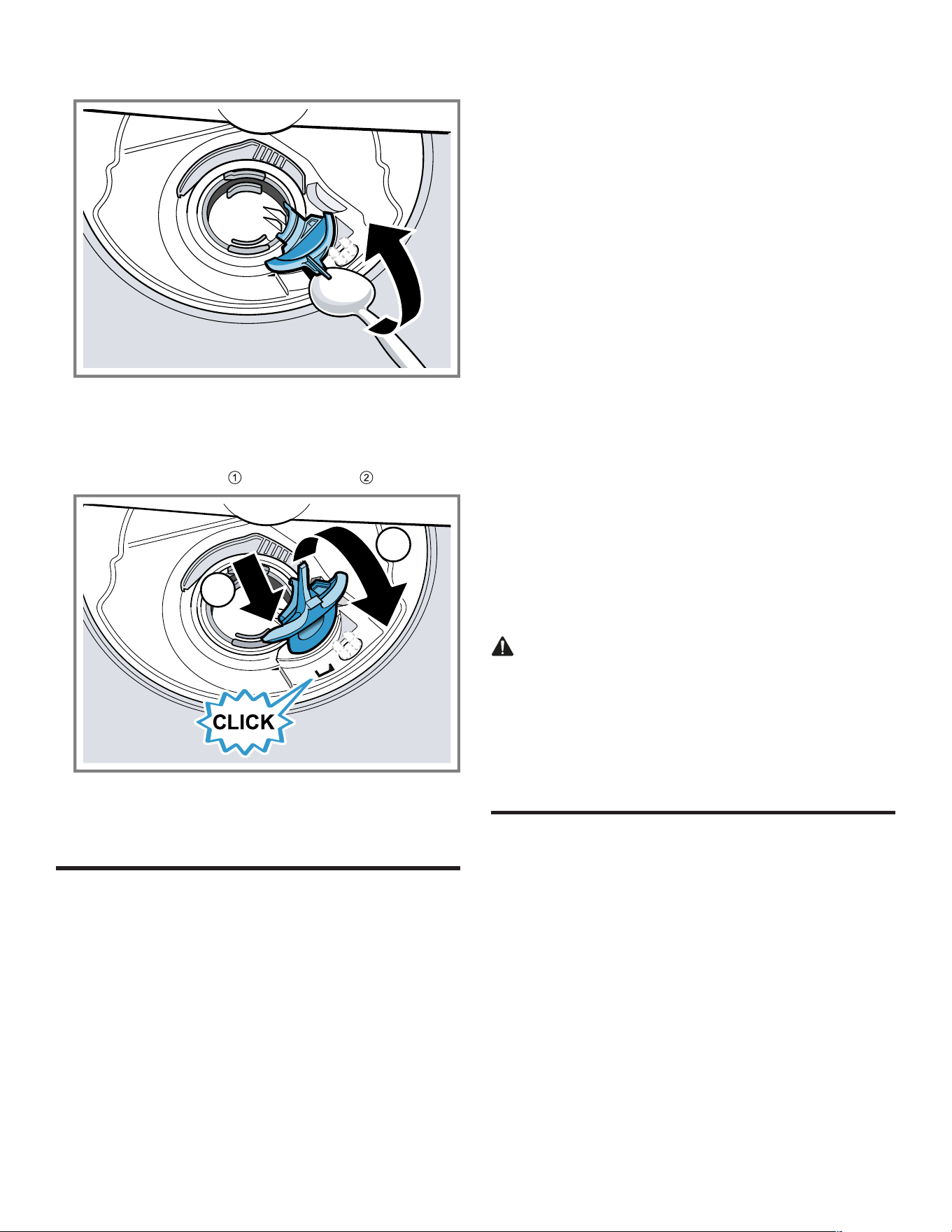
5. Pry the pump cover off using a spoon and grip it by the
crosspiece.
6. Lift the pump cover diagonally inward and take it out.
a Now you can reach the impeller with your hand.
7. Remove any food remnants or foreign objects in the
area of the impeller.
8. Insert the pump cover and press down .
1
2
a The pump cover clicks into position.
9. Install the filter system.
10.Insert the upper and lower rack.
Transportation, storage and disposal
16 Transportation, storage and
disposal
Transportation, storage and disposal
16.1 Transporting the appliance
To avoid damage to the appliance, empty it before
transporting.
Note:Always transport the appliance upright to prevent
residual water getting into the machine's controls and
damaging the appliance.
1. Remove dishware from the appliance.
2. Secure loose parts.
3. Open the water supply valve.
4. Switch on the appliance.
5. Select the cycle with the highest temperature.
6. Start the cycle.
7. To drain the appliance, terminate the cycle after approx.
4minutes.
→
"Terminating the wash cycle", Page20
8. Switch off the appliance.
9. Close the water supply valve.
10.To empty the residual water out of the appliance,
detach the supply hose and let the water drain out.
16.2 Vacation and Storage
NOTICE:
Preparing your appliance for vacation
▶ Before leaving for vacation during warmer weather,
besides turning off the main valve, also turn off water
supply at the nearest point to the dishwasher. During
colder weather, please follow the instructions for
winterizing your appliance below.
Winterizing your appliance
▶ If your dishwasher will be unused for an extended
period of time in a location that experiences freezing
temperatures (vacation home or through a vacation
period), have your dishwasher winterized by a
professional service.
16.3 Disposal of your old appliance
Environmentally sound disposal allows valuable raw
materials to be recycled.
WARNING
Avoid a risk of entrapment upon disposal.
▶ Unplug the appliance from the power outlet.
▶ Cut the power cord and remove the door upon
discarding the appliance.
▶ Check your local area for large appliance recycling
programs.
Customer Service
17 Customer Service
Customer Service
With any warranty repair, we will make sure your
appliance is repaired by an authorized service provider
using genuine replacement parts. We use only genuine
replacement parts for all repairs.
Detailed information on the warranty period and terms of
warranty can be found in the Statement of Limited Product
Warranty, from your retailer, or on our website.
If you contact Customer Service, you will need the model
number (E-Nr.), the production number (FD) and the
consecutive numbering (Z-Nr.) of your appliance.
USA:
1-800-735-4328
www.thermador.com/support
www.thermador.com/us/accessories
CA:
1-800-735-4328
www.thermador.ca

Customer Service en-us
29
www.thermador.ca/en/support/filters-cleaners-accessories
For assistance with connecting to HomeConnect®, you
can also view instructions here:
www.home-connect.com/us/en/help-support/set-up
17.1 Model number (E-Nr.), production
number (FD) and consecutive
numbering (Z-Nr.)
You can find the model number (E-Nr.), the production
number (FD) and the consecutive numbering (Z-Nr.) on
the appliance's rating plate.
The rating plate is located inside the appliance door.
→
"Familiarizing yourself with your appliance", Page7
Making a note of your appliance's details and the
Customer Service telephone number will enable you to
find them again quickly.
en-us Technical specifications
30
Technical specifications
18 Technical specifications
Technical specifications
Weight Max.: 60kg/132lbs
Voltage 120V, 60Hz
Power rating 1440W
Fuse 12A
Water pressure ¡ Min. 7.25 psi (50 kPa)
¡ Max. 145 psi (1000 kPa)
Inlet rate Min. 2.6gal/min
Water temperature Cold water.
Hot water max.: 140°F/ (60°C)
Load capacity 16place settings
18.1 Information regarding Free and Open
Source Software
This product includes software components that are
licensed by the copyright holders as free or open source
software.
The applicable license information is stored on your home
appliance. You can also access the applicable license
information via your HomeConnect® app: "Profile ->
Legal information -> License Information".
1
You can
download the license information on the brand product
website. (Please search on the product website for your
appliance model and additional documents). Alternatively,
you can request the relevant information from
[email protected] or BSH Hausgeräte GmbH, Carl-
Wery-Str. 34, 81739 Munich, Germany.
The source code will be made available to you on request.
Please send your request to [email protected] or
BSH Hausgeräte GmbH, Carl-Wery-Str.34, 81739 Munich,
Germany.
Subject: „OSSREQUEST“
The cost of performing your request will be charged to
you. This offer is valid for three years from the date of
purchase or at least as long as we offer support and spare
parts for the relevant appliance.
1
Depending on the appliance specifications
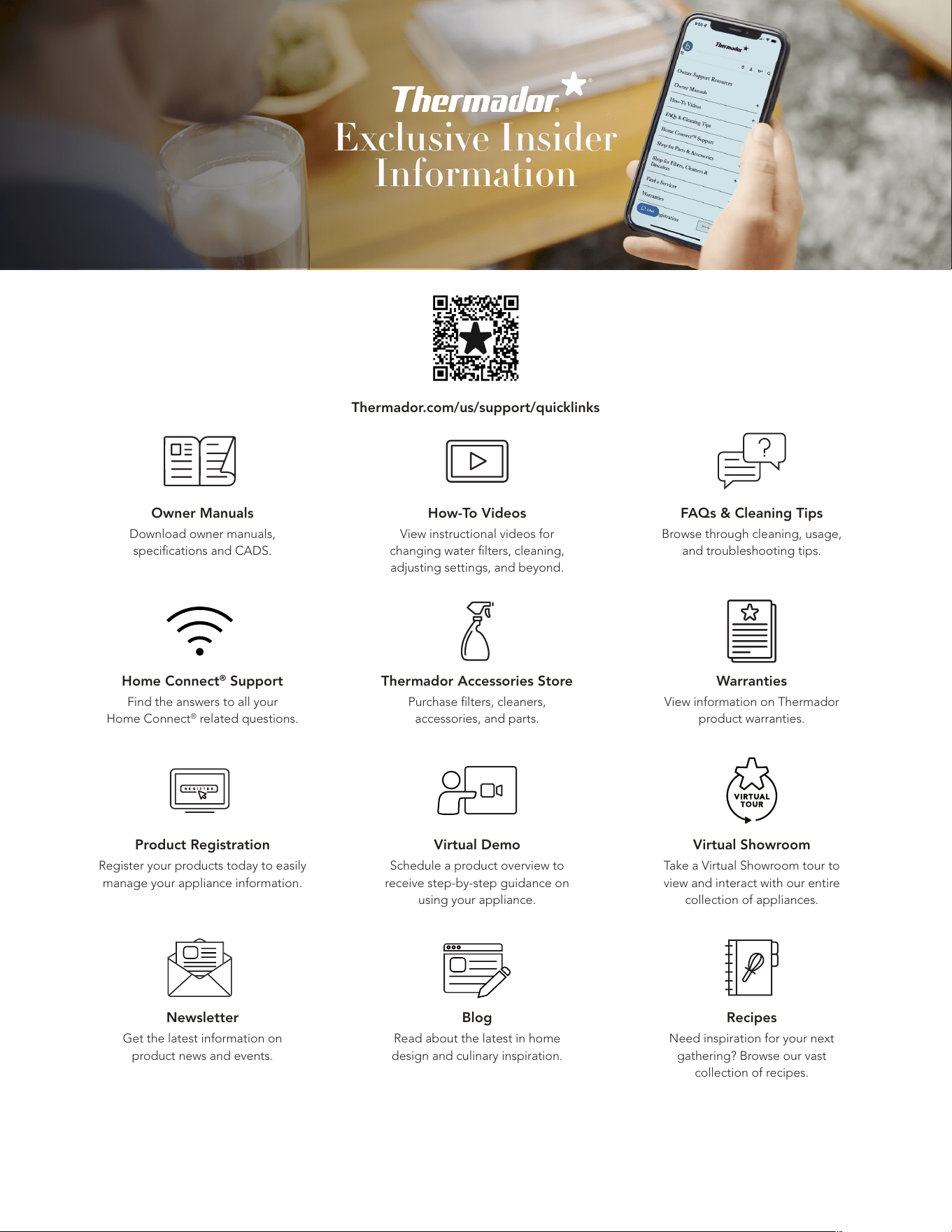
Exclusive Insider
Information
Thermador.com/us/support/quicklinks
Newsletter
Get the latest information on
product news and events.
Blog
Read about the latest in home
design and culinary inspiration.
Recipes
Need inspiration for your next
gathering? Browse our vast
collection of recipes.
Home Connect
®
Support
Find the answers to all your
Home Connect
®
related questions.
Thermador Accessories Store
Purchase lters, cleaners,
accessories, and parts.
Warranties
View information on Thermador
product warranties.
Owner Manuals
Download owner manuals,
specications and CADS.
How-To Videos
View instructional videos for
changing water lters, cleaning,
adjusting settings, and beyond.
FAQs & Cleaning Tips
Browse through cleaning, usage,
and troubleshooting tips.
Product Registration
Register your products today to easily
manage your appliance information.
Virtual Demo
Schedule a product overview to
receive step-by-step guidance on
using your appliance.
Virtual Showroom
Take a Virtual Showroom tour to
view and interact with our entire
collection of appliances.
1901 MAIN STREET, SUITE 600 IRVINE, CA 92614 USA // 1-800-735-4328 // WWW.THERMADOR.COM
© 2024 BSH HOME APPLIANCES CORPORATION
9001862916 // en-us // 040617
*9001862916*