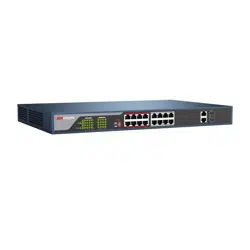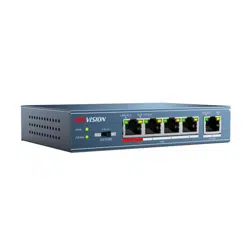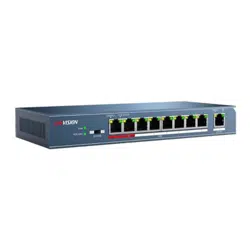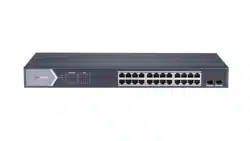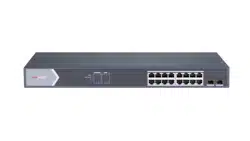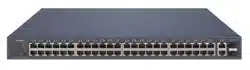

PoE Switch
Quick Start Guide
PoE Switch Quick Start Guide
ii
About this Manual
The Manual includes instructions for using and managing the Product. Pictures, charts, images and
all other information hereinafter are for description and explanation only. The information
contained in the Manual is subject to change, without notice, due to firmware updates or other
reasons. Please find the latest version of this Manual at the Hikvision website ( https://
www.hikvision.com/ ).
Please use this Manual with the guidance and assistance of professionals trained in supporting the
Product.
Applicable Models
This manual is applicable to switches.
Symbol Conventions
The symbols that may be found in this document are defined as follows.
Symbol
Description
Danger
Indicates a hazardous situation which, if not avoided, will or could
result in death or serious injury.
Caution
Indicates a potentially hazardous situation which, if not avoided, could
result in equipment damage, data loss, performance degradation, or
unexpected results.
Note
Provides additional information to emphasize or supplement
important points of the main text.
•
PoE Switch Quick Start Guide
1
Chapter 1 Introduction
1.1
Product Introduction
DS-3E1552P series switches (hereinafter referred to as "the device") are layer 2 PoE switches,
providing advanced PoE power supply technology on the basis of high-performance access. The
switches support client management, network topology management, link aggregation, port
management and so on. The switches are suitable for small-scale LAN device access.
1.2
Packing List
Items
Quantity
Switch
× 1
Power Adapter
× 1
AC Power Cord
× 1
Screw
× 6
L-Shaped Bracket
× 1
Quick Start Guide
× 1
1.3
Appearance
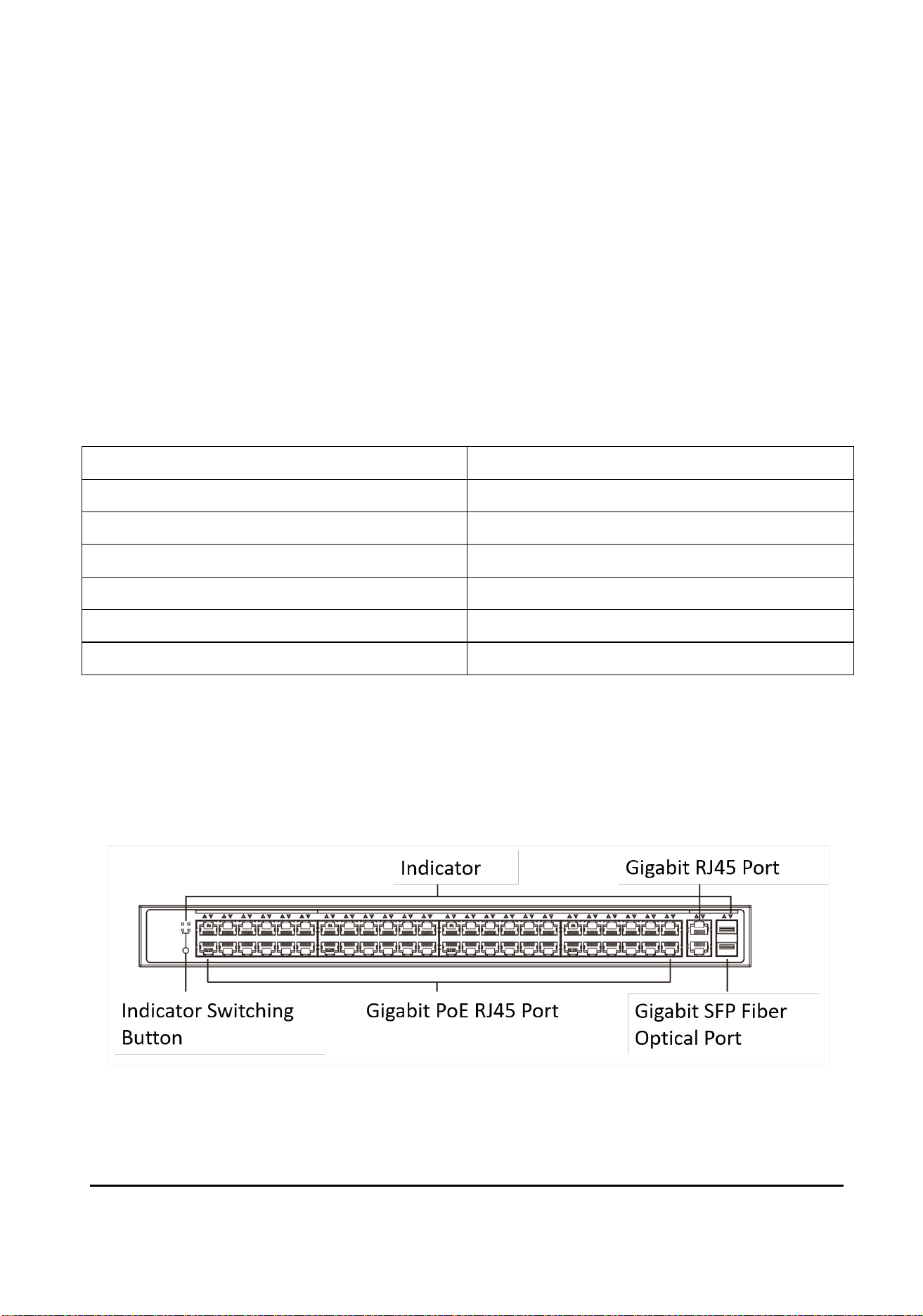
Different models of devices may have different appearances. The following pictures are only for
illustration.
Front Panel
Figure 1-1 DS-3E1552P Series
PoE Switch Quick Start Guide
2
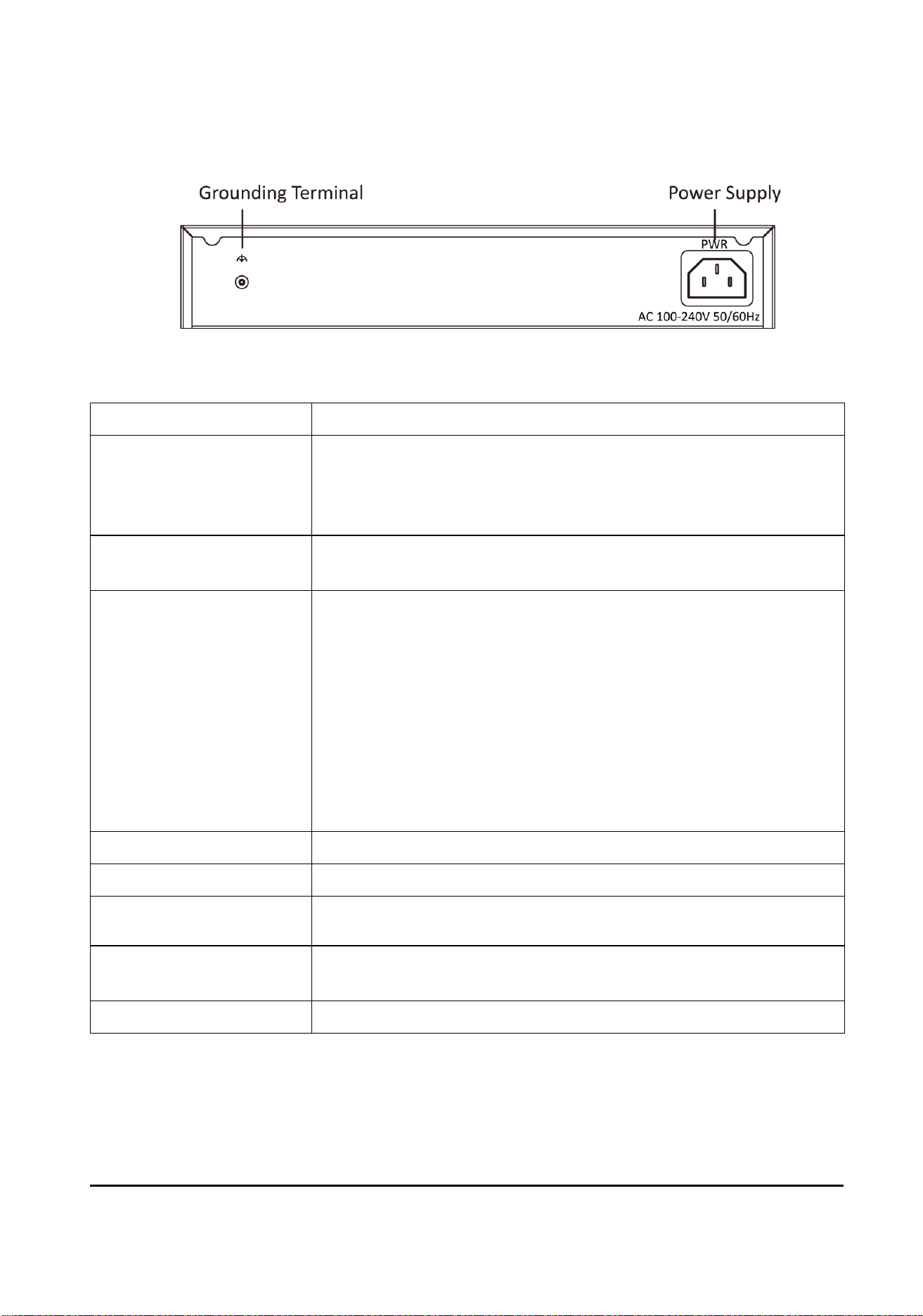
Rear Panel
Figure 1-2 DS-3E1552P Series
Port/Indicator Description
Indicator/Port
Description
PoE-MAX Indicator
• Solid /Flashing: The output power of the switch will reach the
upper limit. The power supply may be abnormal if more devices
are connected.
• Unlit: The switch provides power supply to PD normally.
PWR Indicator
• Solid: The switch is powered on normally.
• Unlit: No power supply connected or power supply is abnormal.
Indicator Switching Button
Press on it until LINK/ACT indicator lighting, which shows ports data
transmission status.
• Solid: The port is connected.
• Flashing: The port is transmitting data.
• Unlit: The port is disconnected or connection is abnormal.
Press on it until PoE indicator lighting, which shows port power
provide status.
• Solid: The switch provides power supply to PD normally.
• Unlit: The switch is disconnected to PD, or provides power supply
to PD abnormally.
Gigabit PoE RJ45 Port
Used for PD devices connection via network cables.
Gigabit RJ45 Port
Used for other devices connection via network cables.
Gigabit SFP Fiber Optical
Port
Used for optical module connection via optical fiber.
Grounding Terminal
Used for connecting to the grounding cable to protect the switch
from lightning.
Power Supply
Use the attached power cord to connect the switch to socket.
PoE Switch Quick Start Guide
3
Chapter 2 Installation
Please select the appropriate installation method according to the actual needs.
Before You Start
• Ensure that the desktop or rack is stable and firm enough.
• Keep the room well-ventilated. Keep at least 10 cm distance around the device for heat
dissipation.
• Keep at least 1.5 cm vertical distance between two adjacent devices for rack-mount installation.
2.1
Desk-Mounted Installation
Place the device on the desk.
2.2
Rack-Mounted Installation
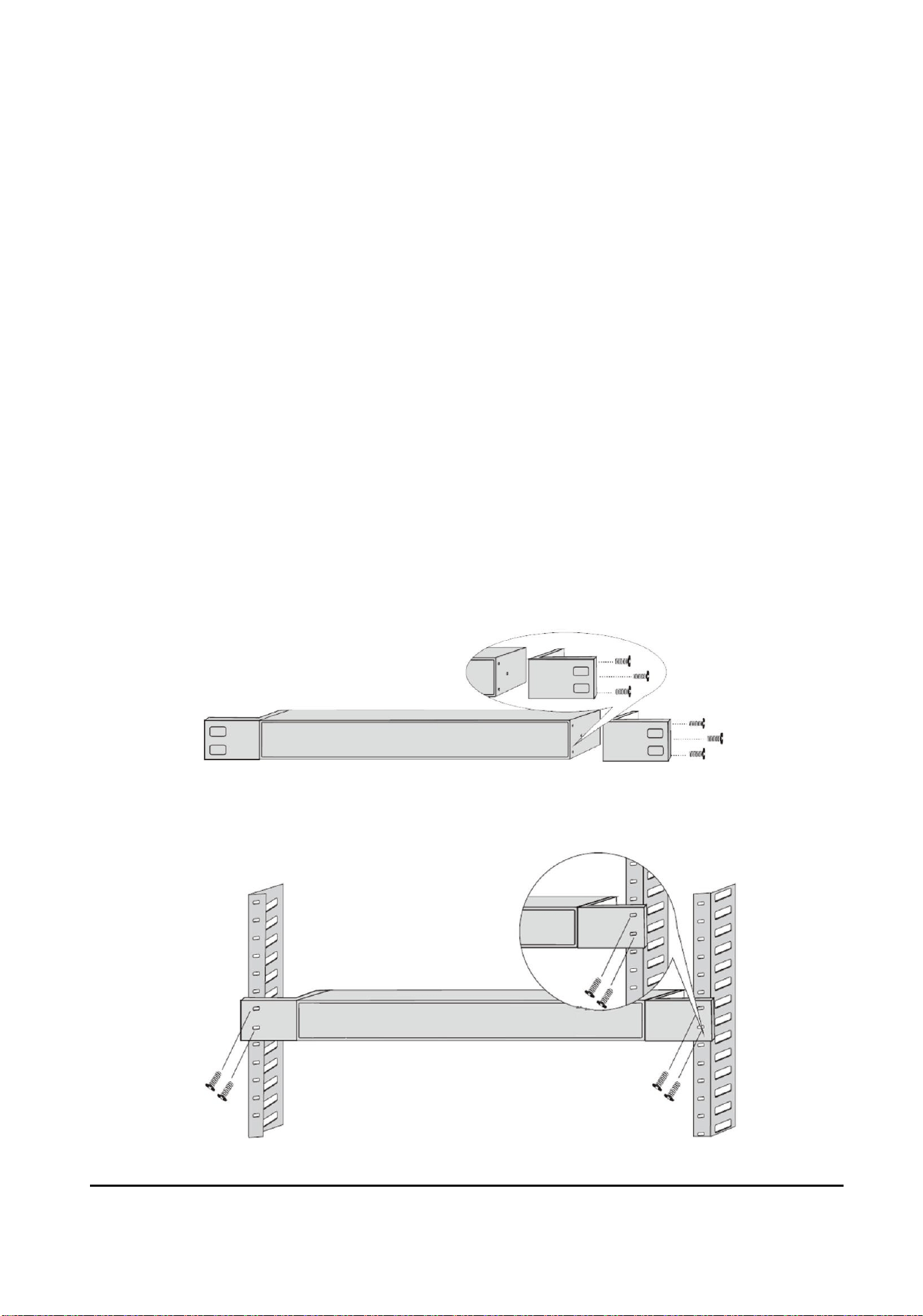
Steps
1. Check the grounding and stability of the rack.
2. Use the attached screws to fix the two L-shaped brackets to the sides of the switch.
Figure 2-1 Fix L-Shaped Brackets
3. Place your switch on the rack, fix it to the rack with self-prepared screws to stably install your
switch.
Figure 2-2 Fix to the Rack
PoE Switch Quick Start Guide
4
Chapter 3 Grounding
3.1 Connecting the Grounding Cable
Grounding is used to quickly release overvoltage and overcurrent induced by lightening for switch,
and to protect personal safety. Select the appropriate grounding method according to your needs.
3.1.1 With Grounding Bar
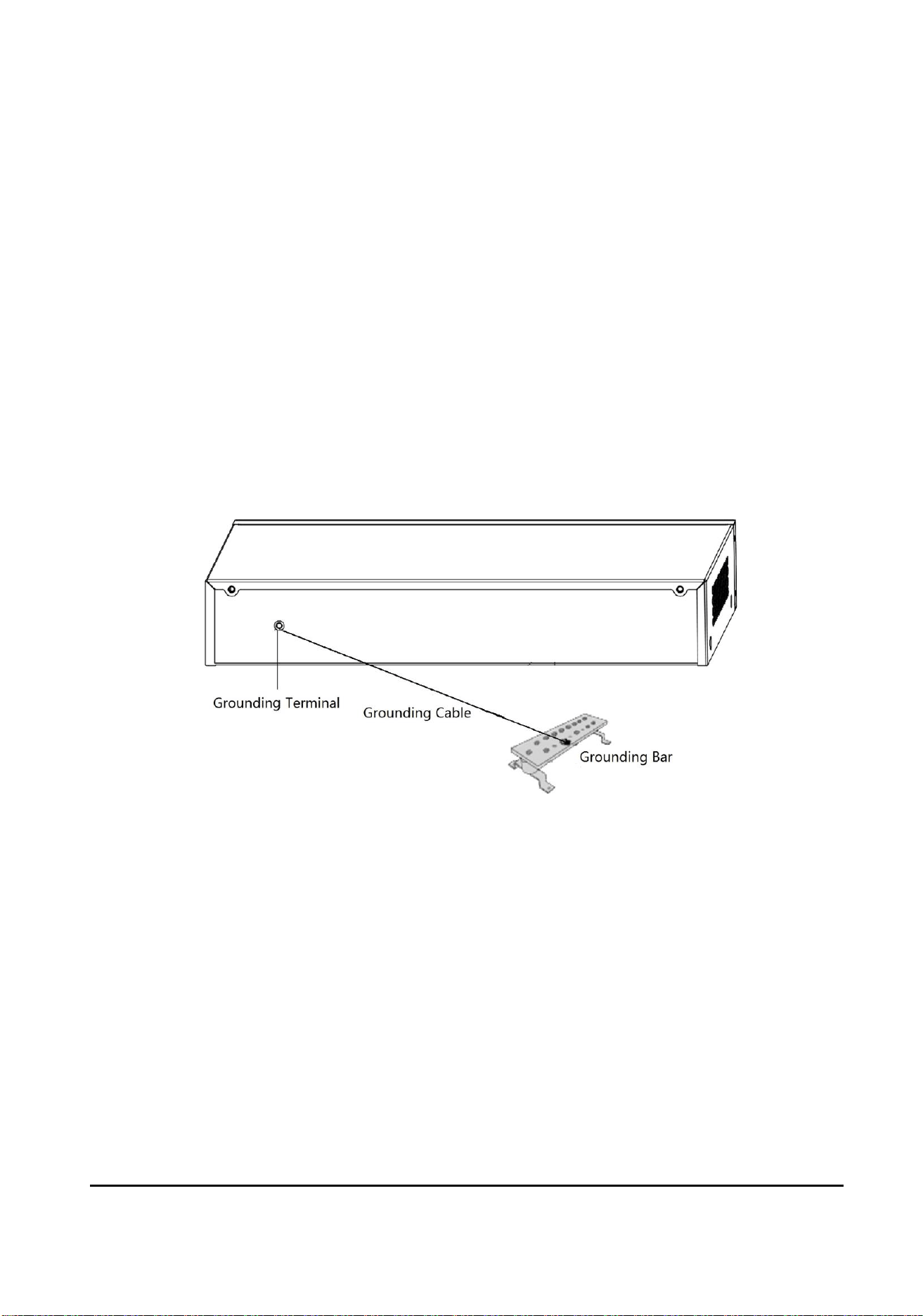
If a grounding bar is available at the installation site, follow the steps below.
Steps
1. Connect one end of the grounding cable to the binding post on the grounding bar.
2. Connect the other end of the grounding cable to the grounding terminal of the device and fix
the screw.
Figure 3-1 Grounding with Grounding Bar
3.1.2 Without Grounding Bar
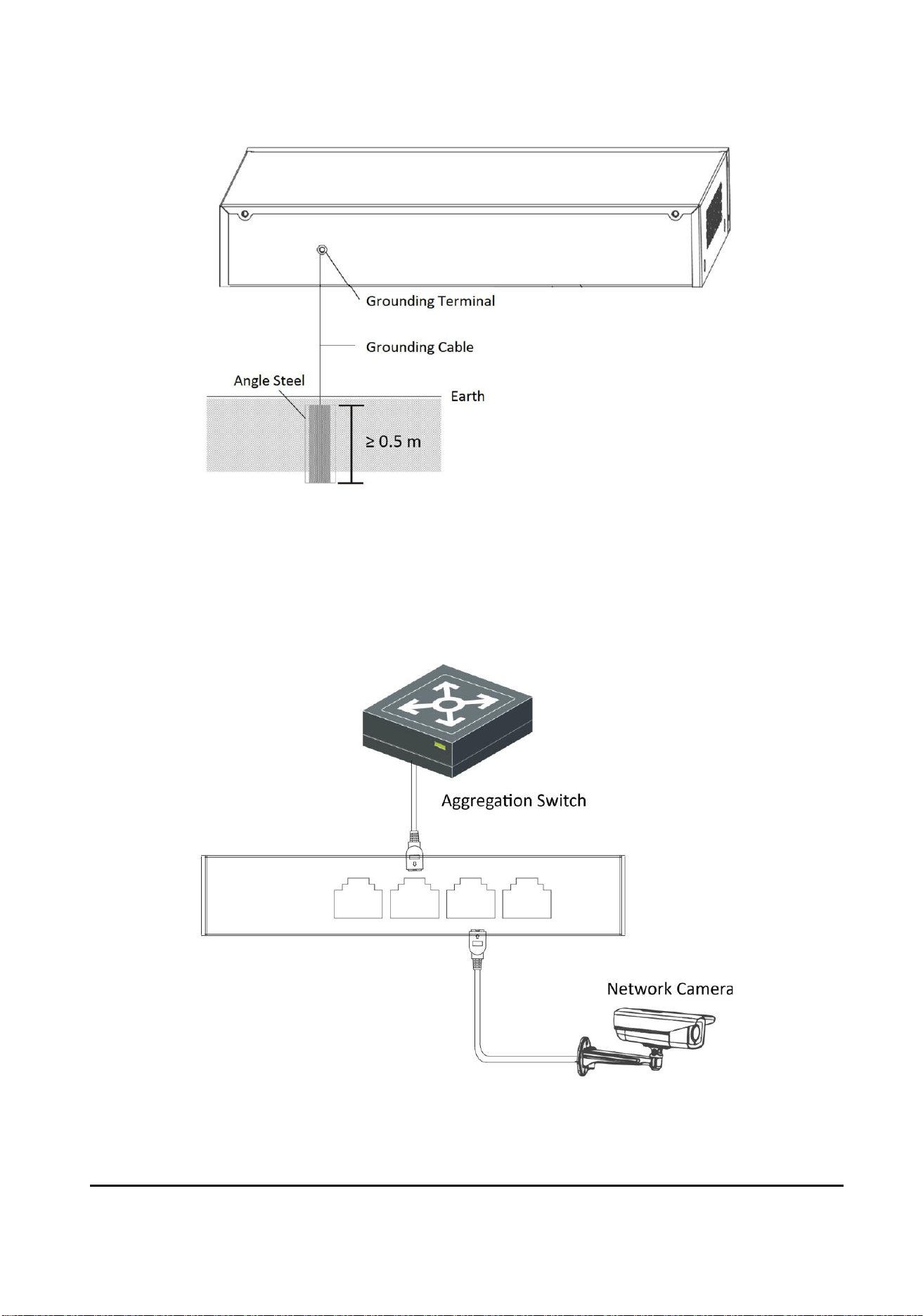
If there is no grounding bar but the earth is nearby and the grounding body is allowed to be
buried, follow the steps below.
Steps
1. Bury an angle steel or steel pipe (≥ 0.5 m) into the mud land.
2. Weld one end of the grounding cable to the angle steel or steel pipe and embalm the welding
point via electroplating or coating.
3. Connect the other end of the grounding cable to the grounding terminal.
PoE Switch Quick Start Guide
5
Figure 3-2 Grounding with Angle Steel
3.2 Connecting RJ45 Port
Use a network cable to connect the device to the RJ45 port of a peer device such as network
camera, NVR, switch, etc.
Figure 3-3 RJ45 Port Connection

PoE Switch Quick Start Guide
6
3.3 Connecting SFP Optical Module
Connecting SFP optical module is supported when the device has a fiber optic port or a combo.
When connected to a network cable, the combo is a RJ45 port. When plugged into with an optical
module and connected to an optical fiber, the combo functions as a fiber optic port.
When connected to both the network cable and optical fiber at the same time, the port works as a
fiber optic port.
Steps
• Single-Mode optical module needs to be paired.
• Do not bend fiber optic (curvature radius ≥ 10 cm) overly.
• Do not look directly at fiber optic connector because the laser is harmful to eyes.
1.
Connect the two paired SFP optical modules with an optical fiber.
2.
Hold the SFP optical module from one side, and smoothly plug it into the device along with the
SFP port slot until the optical module and the device are closely attached.
3.
After powering on the device, check the status of LINK/ACT indicator. If the indicator is lit, the
link is connected. If the indicator is unlit, the link is disconnected. Check the line, and make sure
peer devices have been started.
Caution

PoE Switch Quick Start Guide
7
Chapter 4 Powering on the Device
Please use the attached power cord in package to power on the device.
Before powering your switch, make sure that:
• The operating power supply is compliant with rated input standard.
• Port cables and grounding cables are correctly connected.
• If there is outdoor cabling, connect a lightning rod and lightening arrester to the cable.
PoE power supply line and strong wire cannot be wired together, otherwise PD equipment or
switch ports will be burnt.
Caution

PoE Switch Quick Start Guide
8
Chapter 5 Device Management
The device can be configured and managed through iVMS-4200 software, mainly including network
parameter configuration, port configuration, link aggregation configuration, network topology
display and so on.
• This chapter will briefly introduce the device management through iVMS-4200 software. For
other functions, please refer to User Manual of iVMS-4200 Software.
• All pictures in this manual are for illustration only, and the specific interface is subject to the
actual interface.
5.1
Activating Devices
For the inactive devices, you are required to create a password to activate them before they can be
added to the software and work properly.
Before You Start
Make sure the device to be activated is connected to the network and is in the same subnet with
the PC running the client.
Step
1. Enter the Device Management page.
2. Click Device tab on the top of the right panel.
3. Click Online Device to show the online device area at the bottom of the page.
The searched online devices are displayed in the list.
4. Check the device status (shown on Security Level column) and select an inactive device.
Figure 5-1 Online Inactive Device
5. Click Activate to open the Activation dialog.
6. Create a password in the password field, and confirm the password.
Note

PoE Switch Quick Start Guide
9
The password strength of the device can be automatically checked. We highly recommend you
change the password of your own choosing (using a minimum of 8 characters, including at least
three kinds of following categories: upper case letters, lower case letters, numbers, and special
characters) in order to increase the security of your product. And we recommend you change
your password regularly, especially in the high security system, changing the password monthly
or weekly can better protect your product.
Proper configuration of all passwords and other security settings is the responsibility of the
installer and/or end-user.
7. Click OK to activate the device.
5.2
Adding Devices
The client provides various device adding modes including IP/domain, IP segment, cloud P2P, ISUP
protocol, and HiDDNS. The client also supports importing multiple devices in a batch when there
are large amount of devices to be added. The section only introduces one mode, namely, adding a
detected online device.
Steps
1. Enter the Device Management module.
2. Click Device tab on the top of the right panel.
3. Click Online Device to show the online device area.
The searched online devices are displayed in the list.
4. Select an online device in the Online Device area, and click Add to open the device adding
window.
For the inactive device, you need to create the password for it before you can add the device
properly. For detailed steps, refer to Activating Devices .
5. Enter the required information.
Name
Enter a descriptive name for the device.
IP Address
Enter the device's IP address. The IP address of the device is obtained automatically in this
adding mode.
Port
You can customize the port number. The port number of the device is obtained automatically
in this adding mode.
User Name
Caution
Note

PoE Switch Quick Start Guide
10
By default, the user name is admin.
Password
Enter the device password.
The password strength of the device can be automatically checked. We highly recommend
you change the password of your own choosing (using a minimum of 8 characters, including
at least three kinds of following categories: upper case letters, lower case letters, numbers,
and special characters) in order to increase the security of your product. And we recommend
you change your password regularly, especially in the high security system, changing the
password monthly or weekly can better protect your product.
Proper configuration of all passwords and other security settings is the responsibility of the
installer and/or end-user.
6. Check Synchronize Time to synchronize the device time with the PC running the client after
adding the device to the client.
7. Click Add.
Caution

PoE Switch Quick Start Guide
11
Chapter 6 Get More Information
iVMS-4200 Management
Scan the QR code below for iVMS-4200 software operations.
Hik-ProConnect Management
Go to http://hik-proconnect.com or scan the QR code below for Hik-ProConnect operations.
Hik-ProConnect for Installers Hik-Connect for Users

UD31402B