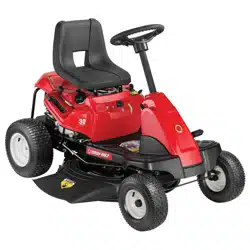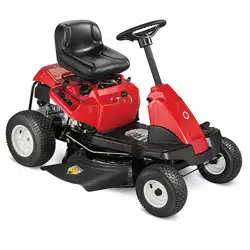
TROY-BILT LLC, P.O. BOX 361131 CLEVELAND, OHIO 44136-0019
Printed In USA
OperatOr’s Manual
Safe Operation Practices • Set-Up • Operation • Maintenance • Service • Troubleshooting • Warranty
WARNING
READ AND FOLLOW ALL SAFETY RULES AND INSTRUCTIONS IN THIS MANUAL
BEFORE ATTEMPTING TO OPERATE THIS MACHINE.
FAILURE TO COMPLY WITH THESE INSTRUCTIONS MAY RESULT IN PERSONAL INJURY.
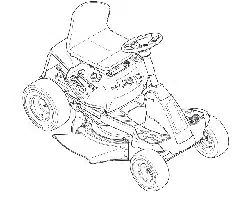
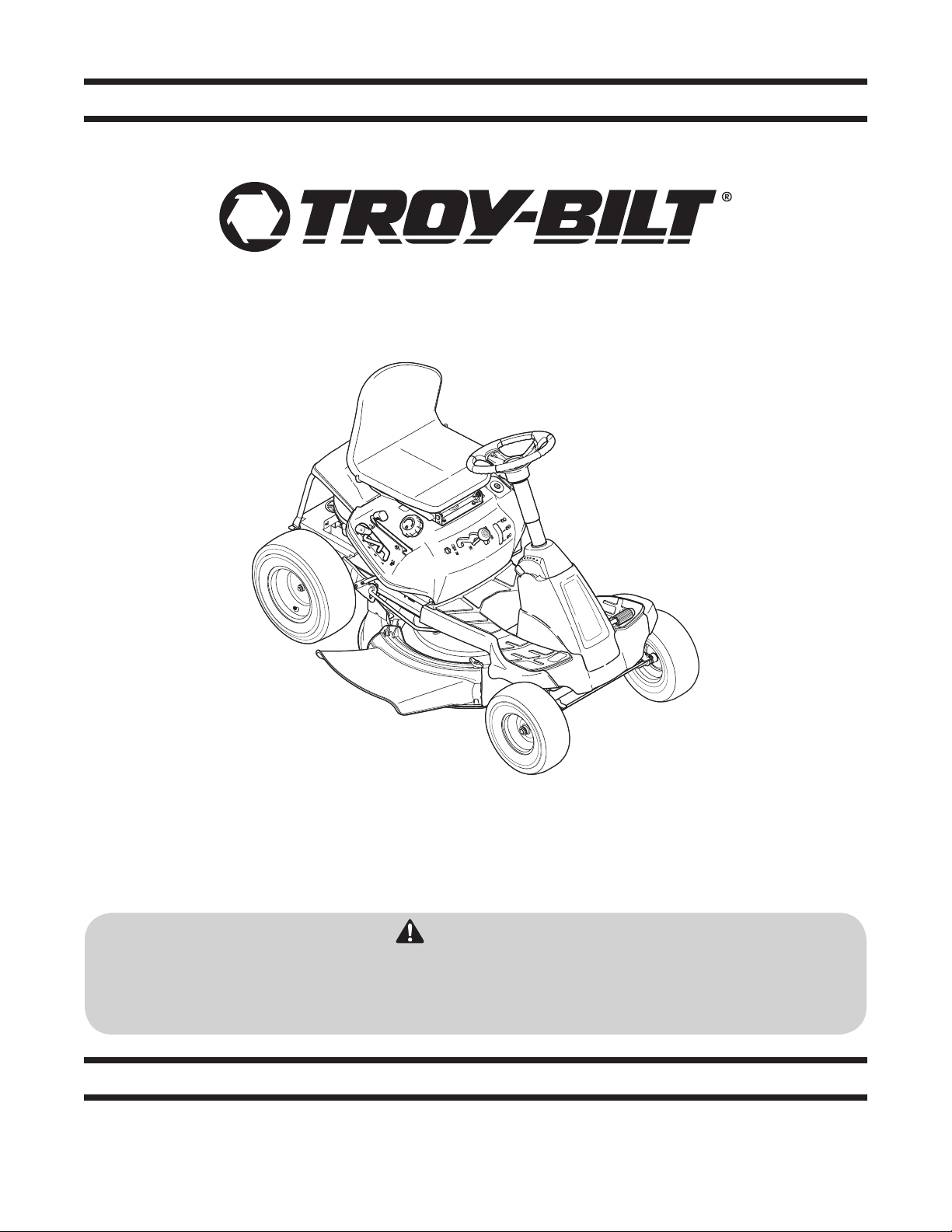
Lawn Tractor — 26J Mini-Rider
Form No. 769-07598
(January 12, 2012)

Customer Support
Please do NOT return the machine to the retailer or dealer without first contacting our Customer Support Department.
If you have difficulty assembling this product or have any questions regarding the controls, operation, or maintenance of
this machine, you can seek help from the experts. Choose from the options below:
◊ Visit us on the web at www.troybilt.com
See How-to Maintenance and Parts Installation Videos at www.troybilt.com/tutorials
◊ Call a Customer Support Representative at (800) 828-5500 or (330) 558-7220
◊ Write us at Troy-Bilt LLC • P.O. Box 361131 • Cleveland, OH • 44136-0019
Thank you for purchasing a lawn tractor manufactured by
Troy-Bilt LLC. It was carefully engineered to provide excellent
performance when properly operated and maintained.
Please read this entire manual prior to operating the equipment.
It instructs you how to safely and easily set up, operate and
maintain your machine. Please be sure that you, and any other
persons who will operate the machine, carefully follow the
recommended safety practices at all times. Failure to do so could
result in personal injury or property damage.
All information in this manual is relative to the most recent
product information available at the time of printing. Review
this manual frequently to familiarize yourself with the machine,
its features and operation. Please be aware that this Operator’s
Manual may cover a range of product specifications for various
models. Characteristics and features discussed and/or illustrated
in this manual may not be applicable to all models. Troy-Bilt LLC
reserves the right to change product specifications, designs and
equipment without notice and without incurring obligation.
If applicable, the power testing information used to establish
the power rating of the engine equipped on this machine can be
found at www.opei.org or the engine manufacturer’s web site.
If you have any problems or questions concerning the machine,
phone a authorized Troy-Bilt service dealer or contact us directly.
Troy-Bilt’s Customer Support telephone numbers, website
address and mailing address can be found on this page. We want
to ensure your complete satisfaction at all times.
Throughout this manual, all references to right and left side of the
machine are observed from the operating position
The engine manufacturer is responsible for all engine-related
issues with regards to performance, power-rating, specifications,
warranty and service. Please refer to the engine manufacturer’s
Owner’s/Operator’s Manual, packed separately with your
machine, for more information.
Thank You
Record Product Information
Before setting up and operating your new equipment, please
locate the model plate on the equipment and record the
information in the provided area to the right. You can locate the
model plate by looking beneath the seat. This information will
be necessary, should you seek technical support via our web site,
Customer Support Department, or with a local authorized service
dealer.
Model NuMber
Serial NuMber
To The Owner
1
2
Safe Operation Practices ........................................ 3
Assembly & Set-Up .................................................. 9
Controls & Features ................................................ 12
Operation ................................................................15
Maintenance & Adjustment .................................18
Service .................................................................... 22
Troubleshooting .................................................... 26
Replacement Parts ................................................ 27
Attachments & Accessories .................................. 28
Emissions Statement ............................................. 29
Warranty .................................................................31
Español ................................................................... 32
Table of Contents
Important Safe Operation Practices
2
3
General Operation
1. Read, understand, and follow all instructions on the
machine and in the manual(s) before attempting to
assemble and operate. Keep this manual in a safe place for
future and regular reference and for ordering replacement
parts.
2. Be familiar with all controls and their proper operation.
Know how to stop the machine and disengage them
quickly.
3. Never allow children under 14 years of age to operate this
machine. Children 14 and over should read and understand
the instructions and safe operation practices in this manual
and on the machine and should be trained and supervised
by an adult.
4. Never allow adults to operate this machine without proper
instruction.
5. To help avoid blade contact or a thrown object injury,
keep bystanders, helpers, children and pets at least 75 feet
from the machine while it is in operation. Stop machine if
anyone enters the area.
6. Thoroughly inspect the area where the equipment is to be
used. Remove all stones, sticks, wire, bones, toys, and other
foreign objects which could be picked up and thrown by
the blade(s). Thrown objects can cause serious personal
injury.
7. Plan your mowing pattern to avoid discharge of material
toward roads, sidewalks, bystanders and the like. Also,
avoid discharging material against a wall or obstruction
which may cause discharged material to ricochet back
toward the operator.
8. Always wear safety glasses or safety goggles during
operation and while performing an adjustment or repair
to protect your eyes. Thrown objects which ricochet can
cause serious injury to the eyes.
9. Wear sturdy, rough-soled work shoes and close-fitting
slacks and shirts. Loose fitting clothes and jewelry can be
caught in movable parts. Never operate this machine in
bare feet or sandals.
10. Be aware of the mower and attachment discharge direction
and do not point it at anyone. Do not operate the mower
without the discharge cover or entire grass catcher in its
proper place.
11. Do not put hands or feet near rotating parts or under the
cutting deck. Contact with the blade(s) can amputate
hands and feet.
WARNING! This symbol points out important safety instructions which, if not followed,
could endanger the personal safety and/or property of yourself and others. Read and follow
all instructions in this manual before attempting to operate this machine. Failure to comply
with these instructions may result in personal injury.
When you see this symbol. HEED ITS WARNING!
DANGER! This machine was built to be operated according to the safe operation practices in
this manual. As with any type of power equipment, carelessness or error on the part of the
operator can result in serious injury. This machine is capable of amputating hands and feet
and throwing objects. Failure to observe the following safety instructions could result in
serious injury or death.
CALIFORNIA PROPOSITION 65
WARNING! Engine Exhaust, some of its constituents, and certain vehicle components
contain or emit chemicals known to State of California to cause cancer and birth defects
or other reproductive harm.
WARNING! Battery posts, terminals, and related accessories contain lead and lead
compounds, chemicals known to the State of California to cause cancer and reproductive
harm. Wash hands after handling

4 Section 2 — important Safe operation practiceS
12. A missing or damaged discharge cover can cause blade
contact or thrown object injuries.
13. Stop the blade(s) when crossing gravel drives, walks, or
roads and while not cutting grass.
14. Watch for traffic when operating near or crossing
roadways. This machine is not intended for use on any
public roadway.
15. Do not operate the machine while under the influence of
alcohol or drugs.
16. Mow only in daylight or good artificial light.
17. Never carry passengers.
18. Disengage blade(s) before shifting into reverse. Back up
slowly. Always look down and behind before and while
backing to avoid a back-over accident.
19. Slow down before turning. Operate the machine smoothly.
Avoid erratic operation and excessive speed.
20. Disengage blade(s), set parking brake, stop engine and wait
until the blade(s) come to a complete stop before removing
grass catcher, emptying grass, unclogging chute, removing
any grass or debris, or making any adjustments.
21. Never leave a running machine unattended. Always turn
off blade(s), place transmission in neutral, set parking
brake, stop engine and remove key before dismounting.
22. Use extra care when loading or unloading the machine into
a trailer or truck. This machine should not be driven up or
down ramp(s), because the machine could tip over, causing
serious personal injury. The machine must be pushed
manually on ramp(s) to load or unload properly.
23. Muffler and engine become hot and can cause a burn. Do
not touch.
24. Check overhead clearances carefully before driving under
low hanging tree branches, wires, door openings etc.,
where the operator may be struck or pulled from the
machine, which could result in serious injury.
25. Disengage all attachment clutches, depress the brake
pedal completely and shift into neutral before attempting
to start engine.
26. Your machine is designed to cut normal residential grass of
a height no more than 10”. Do not attempt to mow through
unusually tall, dry grass (e.g., pasture) or piles of dry leaves.
Dry grass or leaves may contact the engine exhaust and/
or build up on the mower deck presenting a potential fire
hazard.
27. Use only accessories and attachments approved for this
machine by the machine manufacturer. Read, understand
and follow all instructions provided with the approved
accessory or attachment.
28. Data indicates that operators, age 60 years and above, are
involved in a large percentage of riding mower-related
injuries. These operators should evaluate their ability
to operate the riding mower safely enough to protect
themselves and others from serious injury.
29. If situations occur which are not covered in this manual, use
care and good judgment. Contact your customer service
representative for assistance.
Slope Operation
Slopes are a major factor related to loss of control and tip-over
accidents which can result in severe injury or death. All slopes
require extra caution. If you cannot back up the slope or if you
feel uneasy on it, do not mow it.
For your safety, use the slope gauge included as part of this
manual to measure slopes before operating this machine on
a sloped or hilly area. If the slope is greater than 12 degrees as
shown on the slope gauge, do not operate this machine on that
area or serious injury could result.
Do:
1. Mow up and down slopes, not across. Exercise extreme
caution when changing direction on slopes.
2. Watch for holes, ruts, bumps, rocks, or other hidden
objects. Uneven terrain could overturn the machine. Tall
grass can hide obstacles.
3. Use slow speed. Choose a low enough speed setting so
that you will not have to stop or shift while on the slope.
Tires may lose traction on slopes even though the brakes
are functioning properly. Always keep machine in gear
when going down slopes to take advantage of engine
braking action.
4. Follow the manufacturer’s recommendations for wheel
weights or counterweights to improve stability.
5. Use extra care with grass catchers or other attachments.
These can change the stability of the machine.
6. Keep all movement on the slopes slow and gradual. Do
not make sudden changes in speed or direction. Rapid
engagement or braking could cause the front of the
machine to lift and rapidly flip over backwards which could
cause serious injury.
7. Avoid starting or stopping on a slope. If tires lose traction,
disengage the blade(s) and proceed slowly straight down
the slope.
Do Not:
1. Do not turn on slopes unless necessary; then, turn slowly
and gradually downhill, if possible.
2. Do not mow near drop-offs, ditches or embankments. The
mower could suddenly turn over if a wheel is over the edge
of a cliff, ditch, or if an edge caves in.
3. Do not try to stabilize the machine by putting your foot on
the ground.
4. Do not use a grass catcher on steep slopes.
5. Do not mow on wet grass. Reduced traction could cause
sliding.
6. Do not shift to neutral and coast downhill. Over-speeding
may cause the operator to lose control of the machine
resulting in serious injury or death.
7. Do not tow heavy pull behind attachments (e.g. loaded
dump cart, lawn roller, etc.) on slopes greater than 5
degrees. When going down hill, the extra weight tends
to push the tractor and may cause you to loose control
(e.g. tractor may speed up, braking and steering ability are
reduced, attachment may jack-knife and cause tractor to
overturn).

5Section 2 — important Safe operation practiceS
Children
1. Tragic accidents can occur if the operator is not alert to the
presence of children. Children are often attracted to the
machine and the mowing activity. They do not understand
the dangers. Never assume that children will remain where
you last saw them.
a. Keep children out of the mowing area and in
watchful care of a responsible adult other than the
operator.
b. Be alert and turn machine off if a child enters the
area.
c. Before and while backing, look behind and down for
small children.
d. Never carry children, even with the blade(s) shut off.
They may fall off and be seriously injured or interfere
with safe machine operation.
e. Use extreme care when approaching blind corners,
doorways, shrubs, trees or other objects that may
block your vision of a child who may run into the
path of the machine.
f. To avoid back-over accidents, always disengage
the cutting blade(s) before shifting into Reverse.
If equipped, the “Reverse Caution Mode” should
not be used when children or others are around.
g. Keep children away from hot or running engines.
They can suffer burns from a hot muffler.
h. Remove key when machine is unattended to
prevent unauthorized operation.
2. Never allow children under 14 years of age to operate this
machine. Children 14 and over should read and understand
the instructions and safe operation practices in this manual
and on the machine and should be trained and supervised
by an adult.
Towing
1. Tow only with a machine that has a hitch designed for
towing. Do not attach towed equipment except at the
hitch point.
2. Follow the manufacturers recommendation for weight
limits for towed equipment and towing on slopes.
3. Never allow children or others in or on towed equipment.
4. On slopes, the weight of the towed equipment may cause
loss of traction and loss of control.
5. Always use extra caution when towing with a machine
capable of making tight turns (e.g. “zero-turn” ride-on
mower). Make wide turns to avoid jack-knifing.
6. Travel slowly and allow extra distance to stop.
7. Do not shift to neutral and coast downhill.
Service
Safe Handling of Gasoline:
1. To avoid personal injury or property damage use extreme
care in handling gasoline. Gasoline is extremely
flammable and the vapors are explosive. Serious
personal injury can occur when gasoline is spilled on
yourself or your clothes which can ignite. Wash your skin
and change clothes immediately.
a. Use only an approved gasoline container.
b. Never fill containers inside a vehicle or on a truck
or trailer bed with a plastic liner. Always place
containers on the ground away from your vehicle
before filling.
c. When practical, remove gas-powered equipment
from the truck or trailer and refuel it on the ground.
If this is not possible, then refuel such equipment on
a trailer with a portable container, rather than from a
gasoline dispenser nozzle.
d. Keep the nozzle in contact with the rim of the fuel
tank or container opening at all times until fueling is
complete. Do not use a nozzle lock-open device.
e. Extinguish all cigarettes, cigars, pipes and other
sources of ignition.
f. Never fuel machine indoors.
g. Never remove gas cap or add fuel while the engine
is hot or running. Allow engine to cool at least two
minutes before refueling.
h. Never over fill fuel tank. Fill tank to no more than ½
inch below bottom of filler neck to allow space for
fuel expansion.
i. Replace gasoline cap and tighten securely.
j. If gasoline is spilled, wipe it off the engine and
equipment. Move machine to another area. Wait 5
minutes before starting the engine.
k. To reduce fire hazards, keep machine free of grass,
leaves, or other debris build-up. Clean up oil or fuel
spillage and remove any fuel soaked debris.
l. Never store the machine or fuel container inside
where there is an open flame, spark or pilot light
as on a water heater, space heater, furnace, clothes
dryer or other gas appliances.
m. Allow a machine to cool at least five minutes before
storing.
General Service
1. Never run an engine indoors or in a poorly ventilated area.
Engine exhaust contains carbon monoxide, an odorless,
and deadly gas.
2. Before cleaning, repairing, or inspecting, make certain the
blade(s) and all moving parts have stopped. Disconnect the
spark plug wire and ground against the engine to prevent
unintended starting.

6 Section 2 — important Safe operation practiceS
3. Periodically check to make sure the blades come to
complete stop within approximately (5) five seconds after
operating the blade disengagement control. If the blades
do not stop within the this time frame, your machine
should be serviced professionally by an authorized MTD
Service Dealer.
4. Check brake operation frequently as it is subjected to wear
during normal operation. Adjust and service as required.
5. Check the blade(s) and engine mounting bolts at frequent
intervals for proper tightness. Also, visually inspect blade(s)
for damage (e.g., excessive wear, bent, cracked). Replace
the blade(s) with the original equipment manufacturer’s
(O.E.M.) blade(s) only, listed in this manual. “Use of parts
which do not meet the original equipment specifications
may lead to improper performance and compromise
safety!”
6. Mower blades are sharp. Wrap the blade or wear gloves,
and use extra caution when servicing them.
7. Keep all nuts, bolts, and screws tight to be sure the
equipment is in safe working condition.
8. Never tamper with the safety interlock system or other
safety devices. Check their proper operation regularly.
9. After striking a foreign object, stop the engine, disconnect
the spark plug wire(s) and ground against the engine.
Thoroughly inspect the machine for any damage. Repair
the damage before starting and operating.
10. Never attempt to make adjustments or repairs to the
machine while the engine is running.
11. Grass catcher components and the discharge cover are
subject to wear and damage which could expose moving
parts or allow objects to be thrown. For safety protection,
frequently check components and replace immediately
with original equipment manufacturer’s (O.E.M.) parts only,
listed in this manual. “Use of parts which do not meet the
original equipment specifications may lead to improper
performance and compromise safety!”
12. Do not change the engine governor settings or over-speed
the engine. The governor controls the maximum safe
operating speed of the engine.
13. Maintain or replace safety and instruction labels, as
necessary.
14. Observe proper disposal laws and regulations for gas, oil,
etc. to protect the environment.
15. According to the Consumer Products Safety Commission
(CPSC) and the U.S. Environmental Protection Agency (EPA),
this product has an Average Useful Life of seven (7) years,
or 270 hours of operation. At the end of the Average Useful
Life have the machine inspected annually by an authorized
service dealer to ensure that all mechanical and safety
systems are working properly and not worn excessively.
Failure to do so can result in accidents, injuries or death.
Do not modify engine
To avoid serious injury or death, do not modify engine in any
way. Tampering with the governor setting can lead to a runaway
engine and cause it to operate at unsafe speeds. Never tamper
with factory setting of engine governor.
Notice Regarding Emissions
Engines which are certified to comply with California and federal
EPA emission regulations for SORE (Small Off Road Equipment)
are certified to operate on regular unleaded gasoline, and
may include the following emission control systems: Engine
Modification (EM), Oxidizing Catalyst (OC), Secondary Air
Injection (SAI) and Three Way Catalyst (TWC) if so equipped.
When required, models are equipped with low permeation fuel
lines and fuel tanks for evaporative emission control. California
models may also include a carbon canister. Please contact
Customer Support for information regarding the evaporative
emission control configuration for your model.
Spark Arrestor
WARNING! This machine is equipped with an
internal combustion engine and should not be used
on or near any unimproved forest-covered,
brushcovered or grass-covered land unless the
engine’s exhaust system is equipped with a spark
arrestor meeting applicable local or state laws (if
any).
If a spark arrestor is used, it should be maintained in effective
working order by the operator. In the State of California the
above is required by law (Section 4442 of the California Public
Resources Code). Other states may have similar laws. Federal laws
apply on federal lands.
A spark arrestor for the muffler is available through your
nearest engine authorized service dealer or contact the service
department, P.O. Box 361131 Cleveland, Ohio 44136-0019.
WARNING! Your Responsibility—Restrict the use of this power machine to persons who read, understand and
follow the warnings and instructions in this manual and on the machine.
SAVE THESE INSTRUCTIONS!
7Section 2 — important Safe operation practiceS
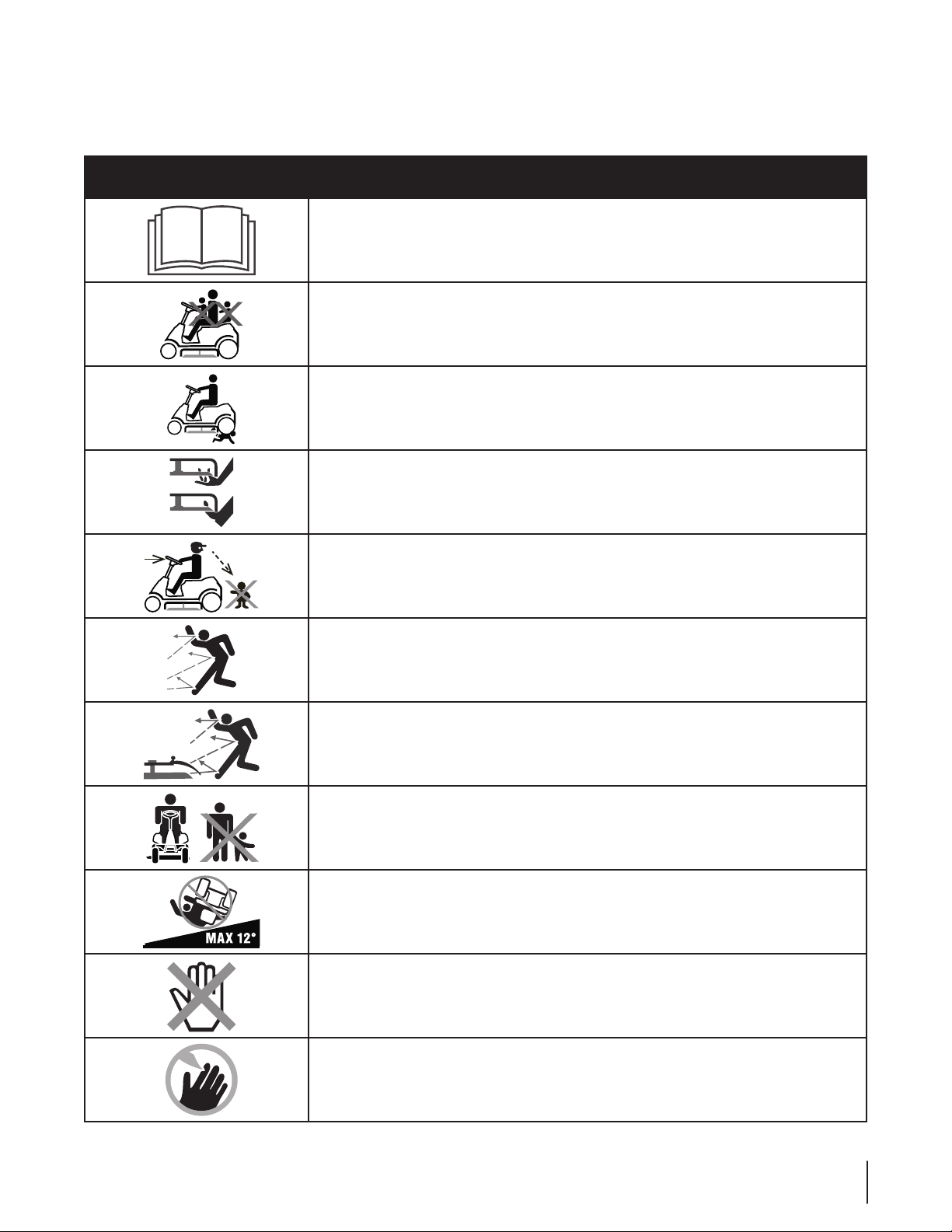
Safety Symbols
This page depicts and describes safety symbols that may appear on this product. Read, understand, and follow all instructions on the
machine before attempting to assemble and operate.
Symbol Description
READ THE OPERATOR’S MANUAL(S)
Read, understand, and follow all instructions in the manual(s) before attempting to
assemble and operate
DANGER— ROTATING BLADES
Never carry passengers. Never carry children, even with the blades off.
DANGER— ROTATING BLADES
To avoid a back-over accident, keep children away from the machine while it is in operation.
WARNING— ROTATING BLADES
Do not put hands or feet near rotating parts or under the cutting deck. Contact with the
blade(s) can amputate hands and feet.
DANGER— ROTATING BLADES
Always look down and behind before and while backing to avoid a back-over accident.
WARNING—THROWN OBJECTS
This machine may pick up and throw and objects which can cause serious personal injury.
WARNING—THROWN OBJECTS
This machine may pick up and throw and objects which can cause serious personal injury.
BYSTANDERS
Keep bystanders, helpers, children and pets at least 75 feet from the machine while it is in
operation.
WARNING— SLOPE OPERATION
Do not operate this machine on a slope greater than 12 degrees.
WARNING— HOT SURFACE
Engine parts, especially the muffler, become extremely hot during operation. Allow engine
and muffler to cool before touching.
DANGER — ROTATING BLADES
To reduce the risk of injury, keep hands and feet away. Do not operate unless discharge cover
or grass catcher is in its proper place. If damaged, replace immediately.
8 Section 2 — important Safe operation practiceS
Symbol Description
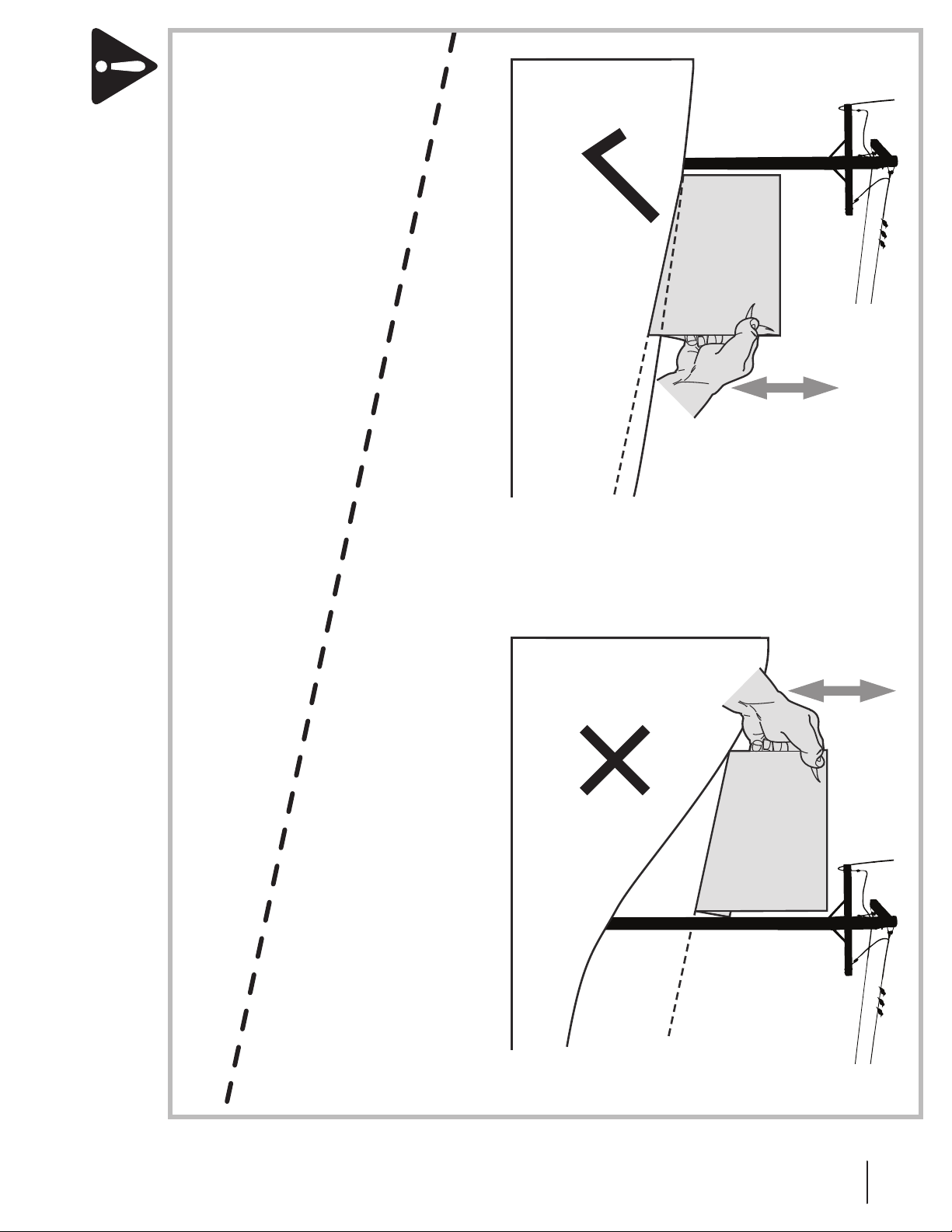
WARNING—GASOLINE IS FLAMMABLE
Allow the engine to cool at least two minutes before refueling.
WARNING— CARBON MONOXIDE
Never run an engine indoors or in a poorly ventilated area. Engine exhaust contains carbon
monoxide, an odorless and deadly gas.
DANGER— ROTATING BLADES
Do not step on the cutting deck.
9Section 2 — important Safe operation practiceS
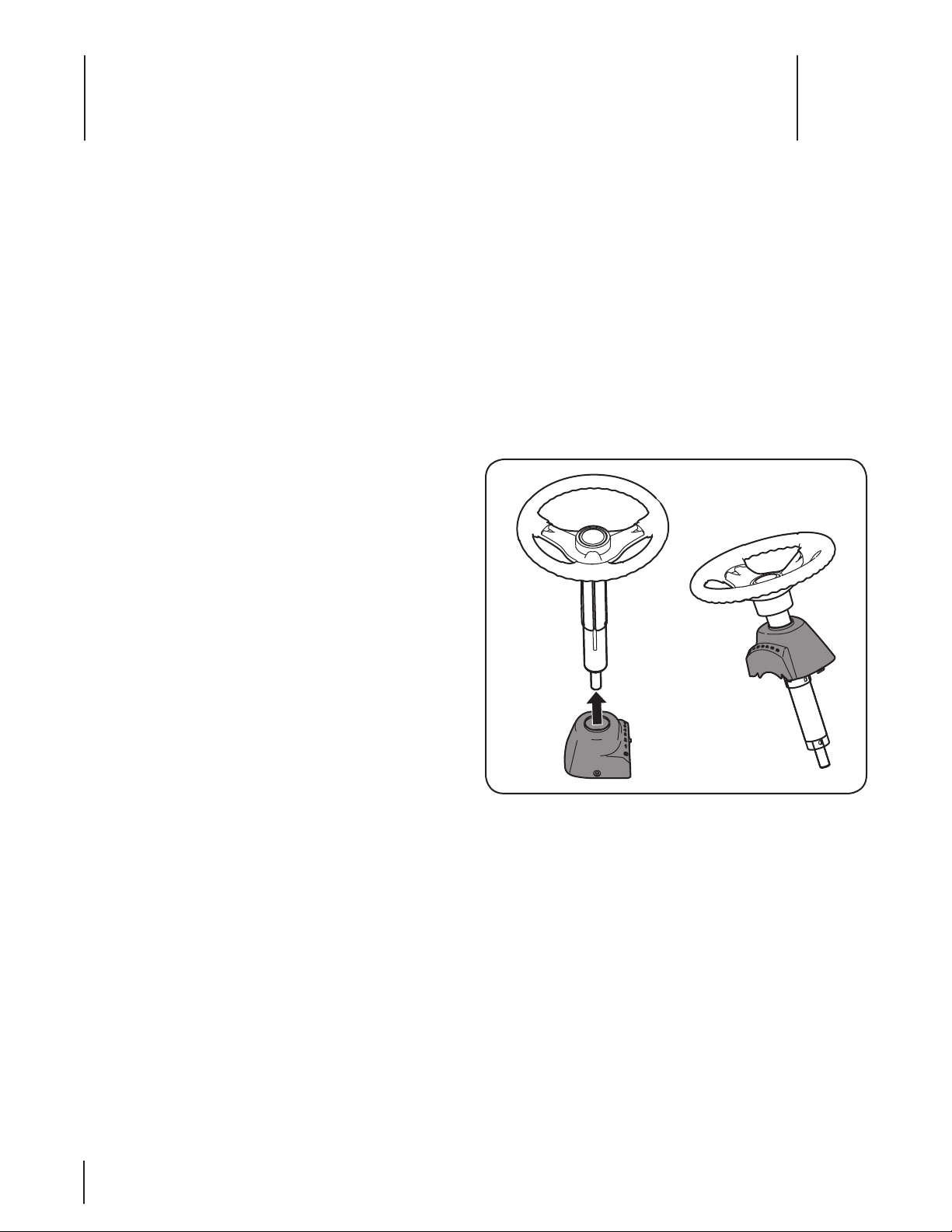
(OK) (TOO STEEP)
USE THIS SLOPE GAUGE TO DETERMINE
IF A SLOPE IS TOO STEEP FOR SAFE OPERATION!
To check the slope, proceed as follows:
1. Remove this page and fold along the dashed line.
2. Locate a vertical object on or behind the slope (e.g. a pole, building, fence, tree, etc.)
3. Align either side of the slope gauge with the object (See Figure 1 and Figure 2 ).
4. Adjust gauge up or down until the left corner touches the slope (See Figure 1 and Figure 2).
5. If there is a gap below the gauge, the slope is too steep for safe operation (See Figure 2 above).
12° dashed line
Slope Gauge
Figure 2Figure 1
12° Slope
12° Slope
WARNING! Slopes are a major factor related to tip-over and roll-over accidents which can result in severe injury or death.
Do not operate machine on slopes in excess of 12 degrees. All slopes require extra caution. If you cannot back up the slope
or if you feel uneasy on it, do not mow it. Always mow up and down slopes, never across the face of slopes.
Assembly & Set-Up
3
10
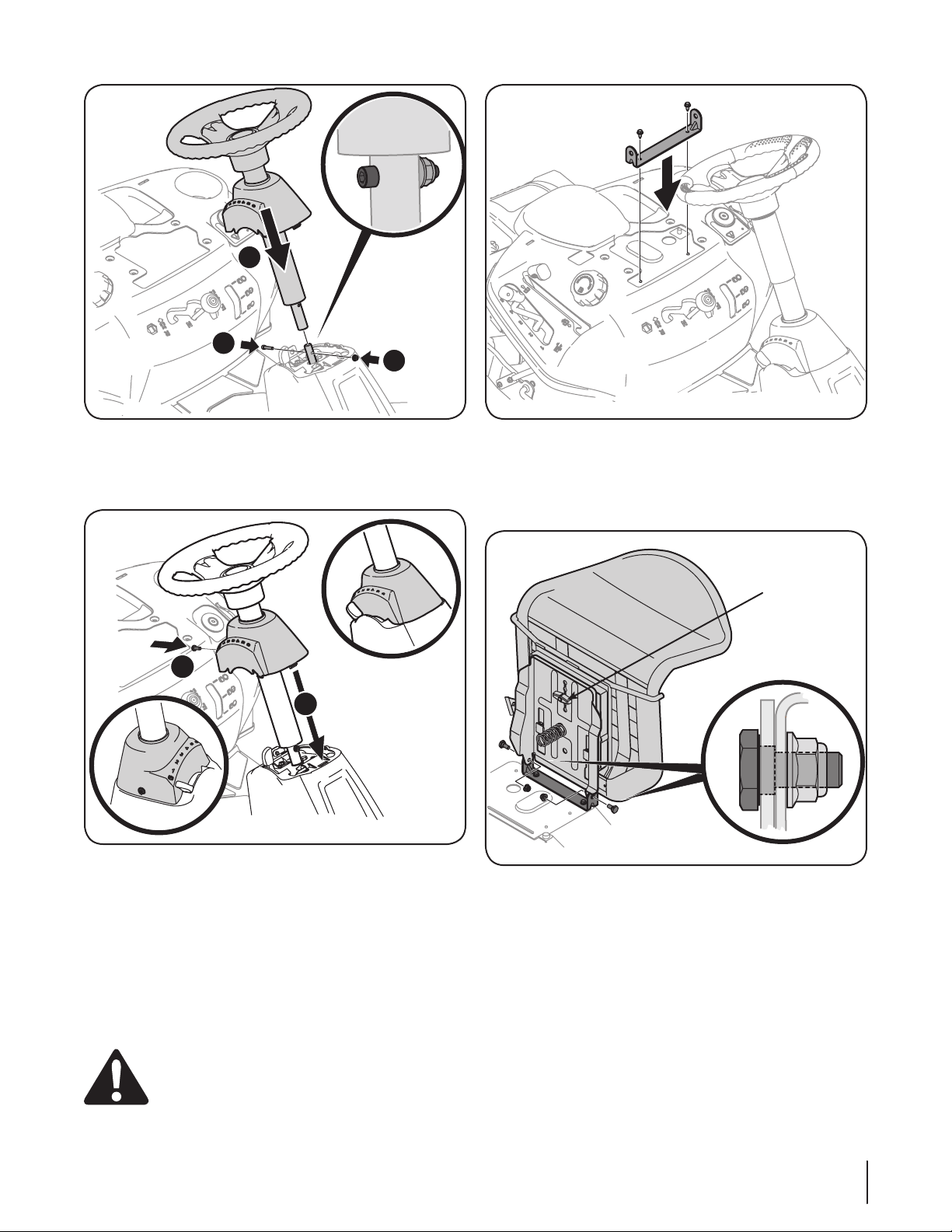
Installing The Steering Wheel Assembly
If the steering wheel assembly for your tractor did not come
alredy installed, follow the steps below:
1. Slide the pedestal cap onto the steering shaft so that when
the steering shaft is installed on the tractor, the pedestal
cap will be upright as shown in Figure 3-1.
Figure 3-1
2. Remove the socket head screw and lock nut from the
steering shaft and retain for later steps.
3. With the steering wheel assembly upright and positioned
over the lower steering shaft on the tractor, align the
steering wheel so that with the tractor wheels straight, the
large opening on the steering wheel is facing forward.
4. Lower the steering wheel assembly onto the lower steering
shaft and secure with the socket head screw and lock nut
previously removed. See Figure 3-2.
NOTE: Be sure to align the socket head screw so that the
head of the screw fits into the larger hole provided on the
upper steering shaft once tightened.
5. Tighten the socket head screw and lock nut using provided
hex key and a /” wrench or ratchet.
Contents of Hardware Pack
Before beginning installation, remove all the contents from the
crate and all the hardware from the pack from to make sure
everything is present. Hardware is listed below. Part numbers are
shown in parentheses.
• Two /-18 x /” Screws — Hitch Plate (710-3008)
• Two /-18 Lock Nuts — Hitch Plate (712-04063)
• Two /-15 x 1” Screws — Engine Rear Cover (710-1241)
• Two Shoulder Bolts — Seat Pivot Bracket (738-0140)
• Two /-18 Lock Nuts— Seat Pivot Bracket (712-04063)
• One /-20 x /” Screw — Steering Pedestal (710-0924)
• One / Hex Key — Steering Shaft (710-05046)
Recommended Tools for Assembly
• 3/16” Hex Key (included in hardware pack)
• 1/4” Drive Ratchet
• 3/16” Wrench (or adjustable wrench)
• 3/8” Wrench (or adjustable wrench)
• 1/2” Wrench (or adjustable wrench)
• 5/8” Wrench (or adjustable wrench)
• 3/8” Socket wrench
• 1/2” Socket wrench
Contents of Crate
• One Riding Mower • One Seat Assembly • One Steering Pedestal Cap
• One Steering Wheel/Shaft Assembly • One Rear Engine Cover • One Discharge Chute Assembly
• One Rear Hitch Plate • One Oil Drain Sleeve • One Hardware Pack
• One Riding Mower Operator’s
Manual
• One Engine Operator’s Manual • One Product Registration Card
Assembly & Set-Up
3
10
11Section 3 — ASSembly & Set-Up
Figure 3-4
3. Position the seat assembly over the seat mounting bracket,
aligning the holes provided.
4. Install two shoulder bolts included with your hardware
pack and secure with two lock nuts. See Figure 3-5.
Figure 3-5
Wing Knob
Note: Make sure that the bolt’s shoulder is completely
recessed into the seat bracket when securing the lock nut.
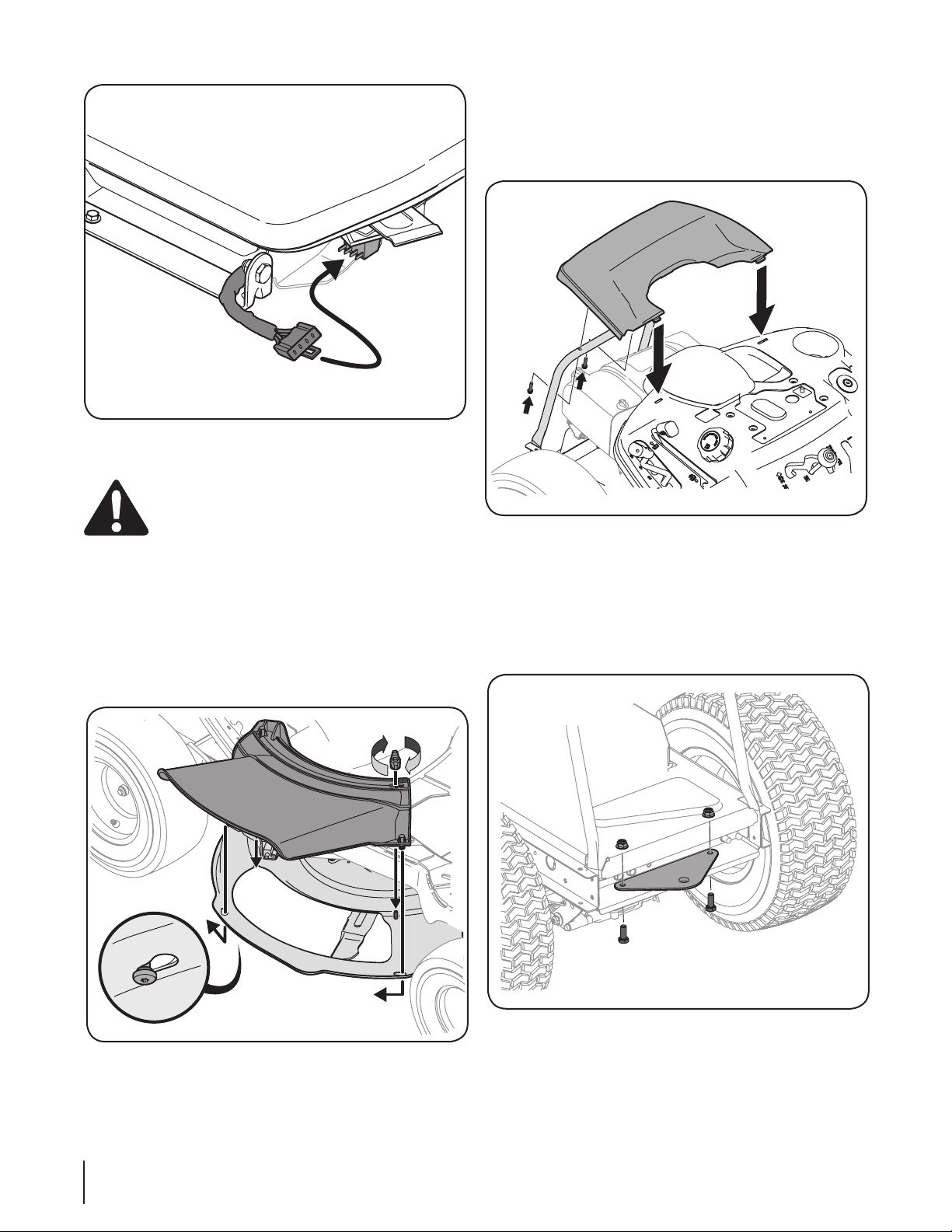
5. Plug the safety harness on the seat, into the wiring harness
on the unit as shown in Fig. 3-6.
Note: Route the unit’s wiring harness out through the front
of the seat mounting bracket as shown in Fig. 3-6.
6. To adjust the position of the seat, remove the wing knob on
the bottom of the seat. Slide the seat forward or backward
as desired. Reinstall the wing knob. Refer to Fig. 3-5.
1
2
2
Figure 3-2
6. Slide the Pedestal cap down onto the tractor (1) and clip
into place. Secure the pedestal with the hex screw (2) from
the hardware pack. See Figure 3-3.
1
2
Figure 3-3
Attaching The Seat
If the seat for your tractor was not attached at the factory, follow
the applicable instructions below to attach it.
1. Remove the two self-tapping bolts factory installed on the
tractor and place the seat bracket in place over the holes.
See Figure 3-4.
2. Using a /-inch drive ratchet with a /” socket, secure the
seat bracket with the self-tapping bolts.
CAUTION: Do not use any type of power tool (e.g.
impact gun or electric drill with nut driver attached)
when tightening the self-tapping bolts to attach the
seat bracket.
11
12 Section 3— ASSembly & Set-Up
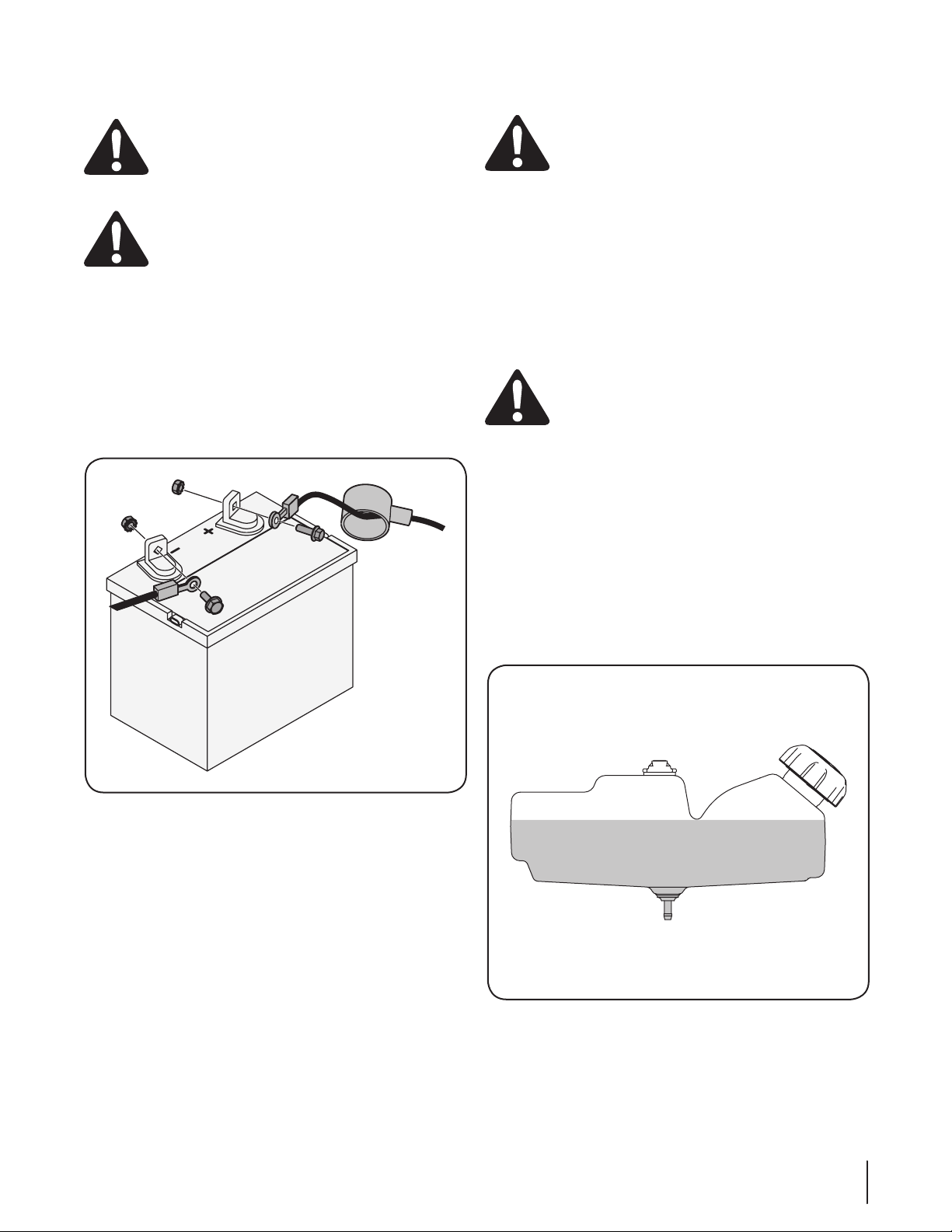
Install The Rear Engine Cover
1. Install the rear engine cover by positioning it in place as
shown in Figure 3-8. Tip the engine cover forward to fit it
into the slots provided, then rotate it backwards to align
the mounting holes.
Figure 3-8
2. Secure the cover with the two screws included in the
hardware pack. Do not to over-tighten.
Installing the Hitch Plate
1. Position the hitch plate with the flat side up, as shown in
Fig. 3-9. Secure using two bolts and hex nuts included in
the hardware pack.
Figure 3-9
Figure 3-6
Installing The Deck Chute
WARNING! NEVER operate this tractor without
either the mulch plug or deck chute installed.
1. Remove the wing knob installed on the mowing deck and
retain for later installation.
2. Install the deck chute assembly by inserting the two pegs
on the bottom of the deck chute into the lock-holes on the
mower deck. Slide the deck chute assembly rearward to
lock it into place.
3. Reinstall the wing knob and hand-tighten to secure. See
Fi gure 3-7.
Figure 3-7
12
13Section 3 — ASSembly & Set-Up
Connecting the Battery Cables
CALIFORNIA PROPOSITION 65 WARNING:
Battery posts, terminals, and related accessories
contain lead and lead compounds, chemicals known
to the State of California to cause cancer and
reproductive harm. Wash hands after handling.
CAUTION: When attaching battery cables, always
connect the POSITIVE (Red) wire to its terminal first,
followed by the NEGATIVE (Black) wire.
For shipping reasons, both battery cables on your equipment
may have been left disconnected from the terminals at the
factory. To connect the battery cables, proceed as follows:
NOTE: The positive battery terminal is marked Pos. (+). The
negative battery terminal is marked Neg. (–).
1. Remove the plastic cover, if present, from the positive
battery terminal and attach the red cable to the positive
battery terminal (+) with the bolt and hex nut using a /
inch wrench or socket wrench. See Figure 3-10.
Figure 3-10
2. Remove the plastic cover, if present, from the negative
battery terminal and attach the black cable to the negative
battery terminal (–) with the bolt and hex nut / inch
wrench or socket wrench. See Fig. 3-10.
3. Position the red rubber boot over the positive battery
terminal to help protect it from corrosion.
NOTE: If the battery is put into service after the date shown
on top/side of battery, charge the battery as instructed in the
Maintenance section your Operator’s Manual prior to operating
the tractor.
Tire Pressure
WARNING! Equal tire pressure should be
maintained at all times. Never exceed the maximum
inflation pressure shown on the sidewall of the tire.
The recommended operating tire pressure is:
• Approximately 10 psi for the rear tires
• Approximately 14 psi for the front tires
IMPORTANT: Refer to the tire sidewall for exact tire
manufacturer’s recommended or maximum psi. Do not
overinflate. Uneven tire pressure could cause the cutting deck to
mow unevenly.
Gas and Oil Fill-up
The gasoline tank is located under the fender. Do not overfill.
WARNING! Use extreme care when handling
gasoline. Gasoline is extremely flammable and the
vapors are explosive. Never fuel machine indoors or
while the engine is hot or running. Extinguish
cigarettes, cigars, pipes, and other sources of ignition.
IMPORTANT: Your tractor is shipped with motor oil in the
engine. However, you MUST check the oil level before
operating. Be careful not to overfill.
Service and check the engine oil as instructed in the separate
Engine Operator/Owner Manual packed with your tractor. Read
the instructions carefully.
IMPORTANT: It is important to NOT top off your fuel tank when
filling with fuel. Leave an expansion area available inside the fuel
tank to allow for the fuel to expand and for proper ventilation.
Otherwise the unit may not run properly. Fill the tank in
accordance with Figure 3-11.
Figure 3-11
11
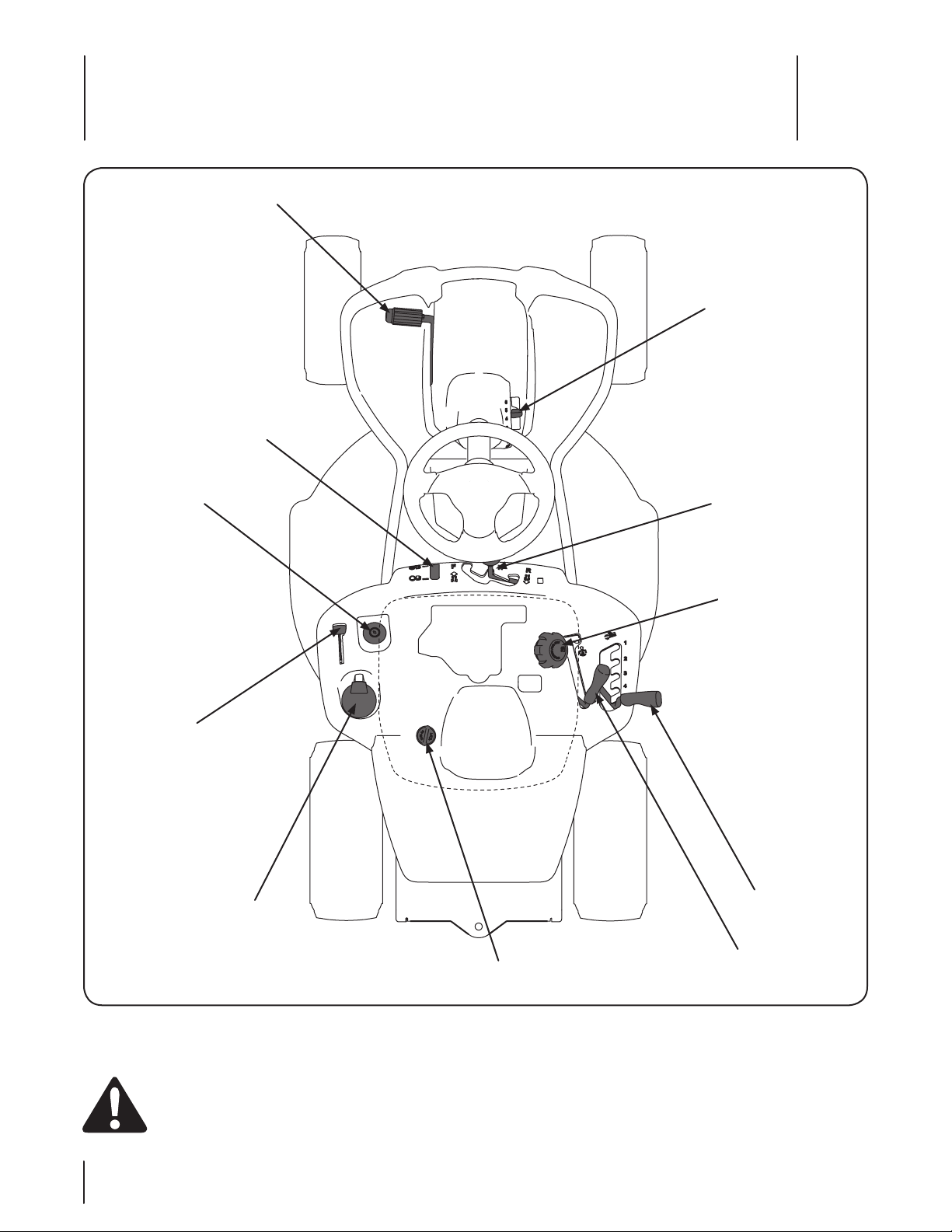
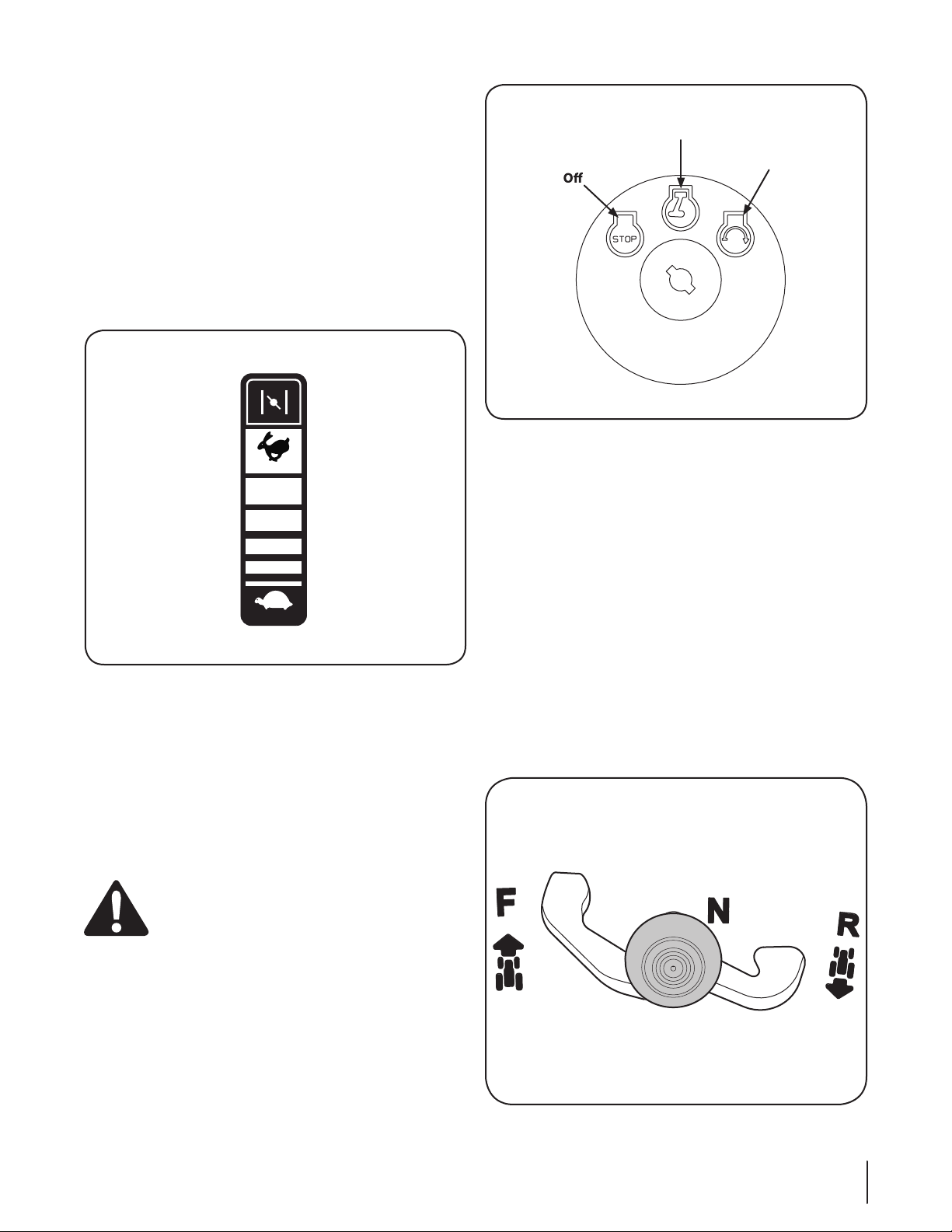
Figure 4-1
Clutch/Brake Pedal
Speed Control &
Parking Brake Lever
Shift Lever
Cup Holder
Throttle/Choke Lever
Ignition Switch
Deck Lift Lever
PTO (Blade Engage) Lever
Oil Fill Cap
Fuel Fill Cap
Fuel Level Indicator
Controls & Features
4
14
Lawn Tractor controls and features are illustrated in Fig 4-1 and described on the following pages.
WARNING! Read and follow all safety rules and instructions in this manual, including the entire Operation section,
before attempting to operate this machine. Failure to comply with all safety rules and instructions may result in personal
injury.
Throttle / Choke Control
The throttle control lever is located on the left fender of the
tractor seated in the operator’s position, see Fig. 4-1. This lever
controls the speed of the engine, as well as the choke when it
is pushed all the way forward. When set in a given position, the
throttle will maintain a uniform engine speed.
IMPORTANT: When operating the tractor with the cutting deck
engaged, be certain that the throttle lever is always in the FAST
(rabbit) position.
Moving the throttle lever all the way forward activates the
engine’s choke control. See Figure 4-2. Activating the choke
control closes the choke plate on the carburetor and aids in
starting the engine.
Refer to Starting The Engine in the Operation section of this
manual for detailed starting instructions.
Ignition Switch
The ignition switch is located on the left fender of the tractor
seated in the operator’s position, adjacent to the Throttle/
Choke Control. Activate the Ignition Switch to start the engine
by inserting the key into the ignition switch and turn clockwise
to the START position. Release the key into the ON position once
engine has fired. See Fig. 4-3.
WARNING! Never leave a running machine
unattended. Always disengage PTO, move shift lever
into neutral position, set parking brake, stop engine
and remove key to prevent unintended starting.
IMPORTANT: Prior to operating the tractor, refer to both Safety
Interlock Switches and Starting The Engine in the Operation section
of this manual for detailed instructions regarding the Ignition Switch
Module.
Clutch-Brake Pedal
The clutch-brake pedal is located on the left side of the lawn
tractor, along the running board. Depress the clutch-brake pedal
part way down when slowing the tractor by changing speeds
(Refer to Speed Control Lever). Depress the pedal all the way down
to engage the disc brake and bring the tractor to a complete stop.
NOTE: The clutch-brake pedal must be completely depressed
to start the engine. Refer to Safety Interlock Switches in the
Operation section of this manual.
Shift Lever
The shift lever is located on the control panel just below the seat,
in the center of the tractor. It has three positions, FORWARD,
NEUTRAL and REVERSE. The brake pedal must be depressed and
the tractor must not be in motion when moving the shift lever.
See Figure 4-4.
IMPORTANT: Never force the shift lever. Doing so may result in
serious damage to the tractor’s transmission.
FAST
SL OW
Figure 4-2
On/Lights
Start
Figure 4-3
Figure 4-4
15Section 4 — controlS & FeatureS
Speed Control Lever
The speed control lever, located on the right side of the tractor’s
steering console, allows you to regulate the ground speed of the
lawn tractor.
To use, depress the clutch-brake pedal and move the lever out
of the parking brake notch and forward to increase the tractor’s
ground speed. When a desired speed has been reached, release
the lever into an appropriate notch to maintain that speed.
To slow the tractor’s ground speed, depress the clutch-brake
pedal and move the speed control lever rearward and release it
into a notch.
Parking Brake
To set the parking brake, fully depress the clutch-brake pedal.
Move the speed control lever all the way down and into the
parking brake position. Release the clutch-brake pedal to allow
the parking brake to engage.
To release the parking brake, depress the clutch-brake pedal and
move the speed control lever out of the parking brake position
into the desired position. Release the clutch-brake pedal.
NOTE: The parking brake must be set if the operator leaves the
seat with the engine running or the engine will automatically
shut off.
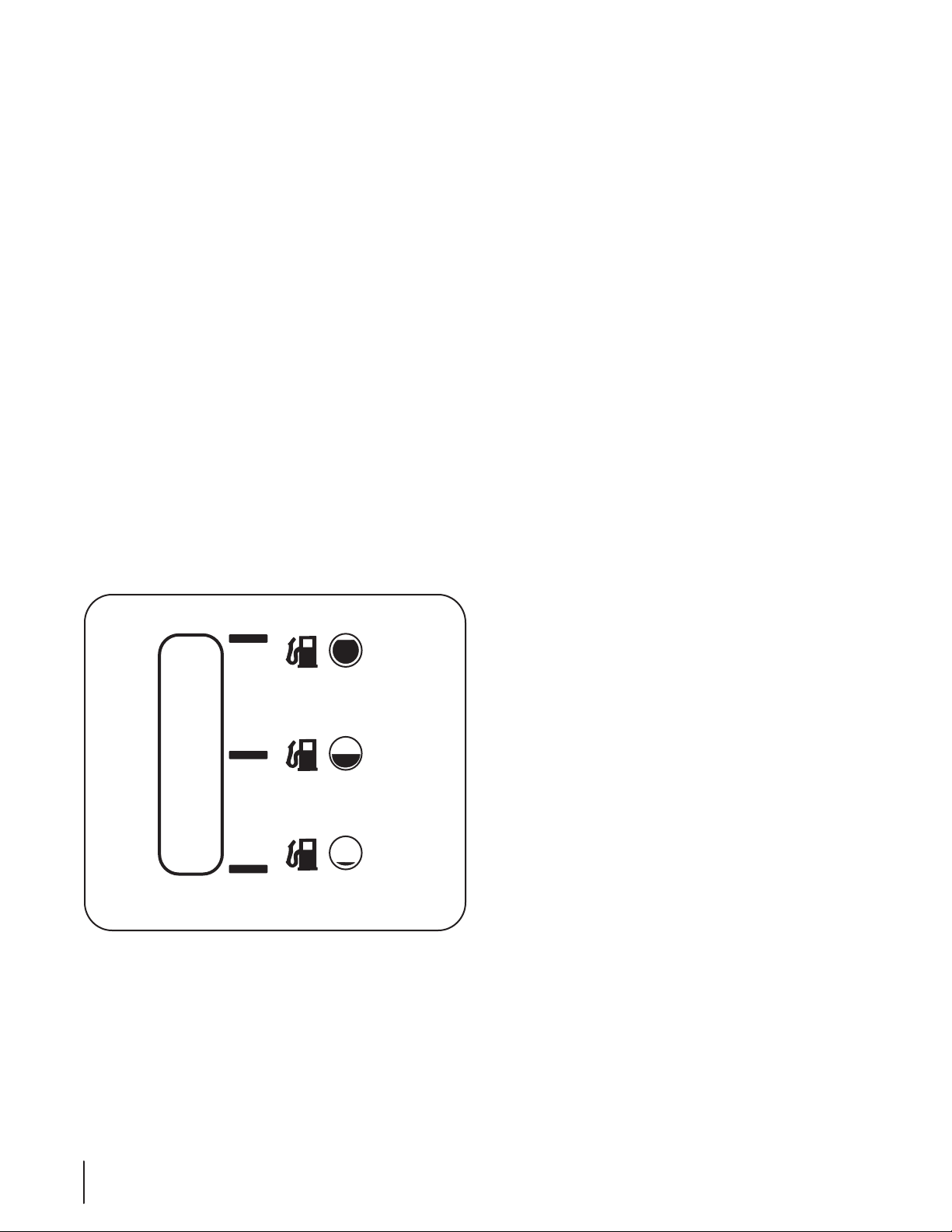
Fuel Lever Indicator
The Fuel Lever Indicator is located below the seat on the left
hand side from the operator’s position in the controls panel. Use
this window to identify the tractor’s fuel needs. See Figure 4-5.
Figure 4-5
Deck Lift Lever
Found on your tractor’s right fender, the deck lift lever is used to
change the height of the cutting deck. To use, move the lever to
the left, then place in the notch best suited for your application.
PTO (Blade Engage) Lever
Found on the tractor’s right fender, the PTO (blade engage)
lever is used to engage power to the cutting deck. To operate,
move the lever all the way forward. Moving the lever all the way
rearward into the PTO OFF position disengages power to the
cutting deck.
NOTE: The PTO (blade engage) lever must be in the disengaged
(PTO OFF) position when starting the engine.
Fuel Fill Cap
The Fuel Fill Cap is located below the seat. Refer to the Set-up
section in this manual for instructions on fueling this tractor.
Oil Fill Cap
The Oil Fill Cap is located below the seat. Refer to the Set-up
section in this manual for instructions on checking and adding
oil to this tractor.
16 Section 4— controlS & FeatureS
Operation
5
17
Operation
5
17
WARNING
Avoid Serious Injury or Death
• Knowlocationandfunctionofallcontrols.
• Removeobjectswhichcouldbethrownbytheblades.
• Goupanddownslopes,notacross.
• Useextracautiononslopes.Donotmowslopesgreater
than12degrees.Avoidsuddenturns.Uselowspeed.
• Donotoperatemachinewhereitcouldtiporslip.
• Ifmachinestopsgoinguphill,stopbladesandbackdown
slowly.
• Beforeleavingoperator’sposition,disengageblades,
engageparkingbrake,shutoffandremovekey.
• Besurebladesandenginearestoppedbeforeplacing
handsorfeetnearblades.
• Keepsafetydevices(guards,shields,switches,etc.)in
placeandworking.
• Keepbystandersaway.
• Allowmachinetocoolbeforefuelingorstoring.
• Keepmachinefreeofdebris.
Read Operator’s Manual
Safety Interlock Switches
This tractor is equipped with a safety interlock system for the
protection of the operator. If the interlock system should ever
malfunction, do not operate the tractor. Contact an authorized
MTD service dealer.
• The safety interlock system prevents the engine from
cranking or starting unless the parking brake is engaged,
and the PTO (Blade Engage) lever is in the disengaged (OFF)
position.
• The engine will automatically shut off if the operator leaves
the seat before engaging the parking brake.
• The engine will automatically shut off if the operator leaves
the tractor’s seat with the PTO (Blade Engage) lever in the
engaged (ON) position, regardless of whether the parking
brake is engaged.
• The engine will automatically shut off if the PTO (Blade
Engage) lever is moved into the engaged (ON) position with
the shift lever in Reverse.
WARNING! Do not operate the tractor if the
interlock system is malfunctioning. This system was
designed for your safety and protection.
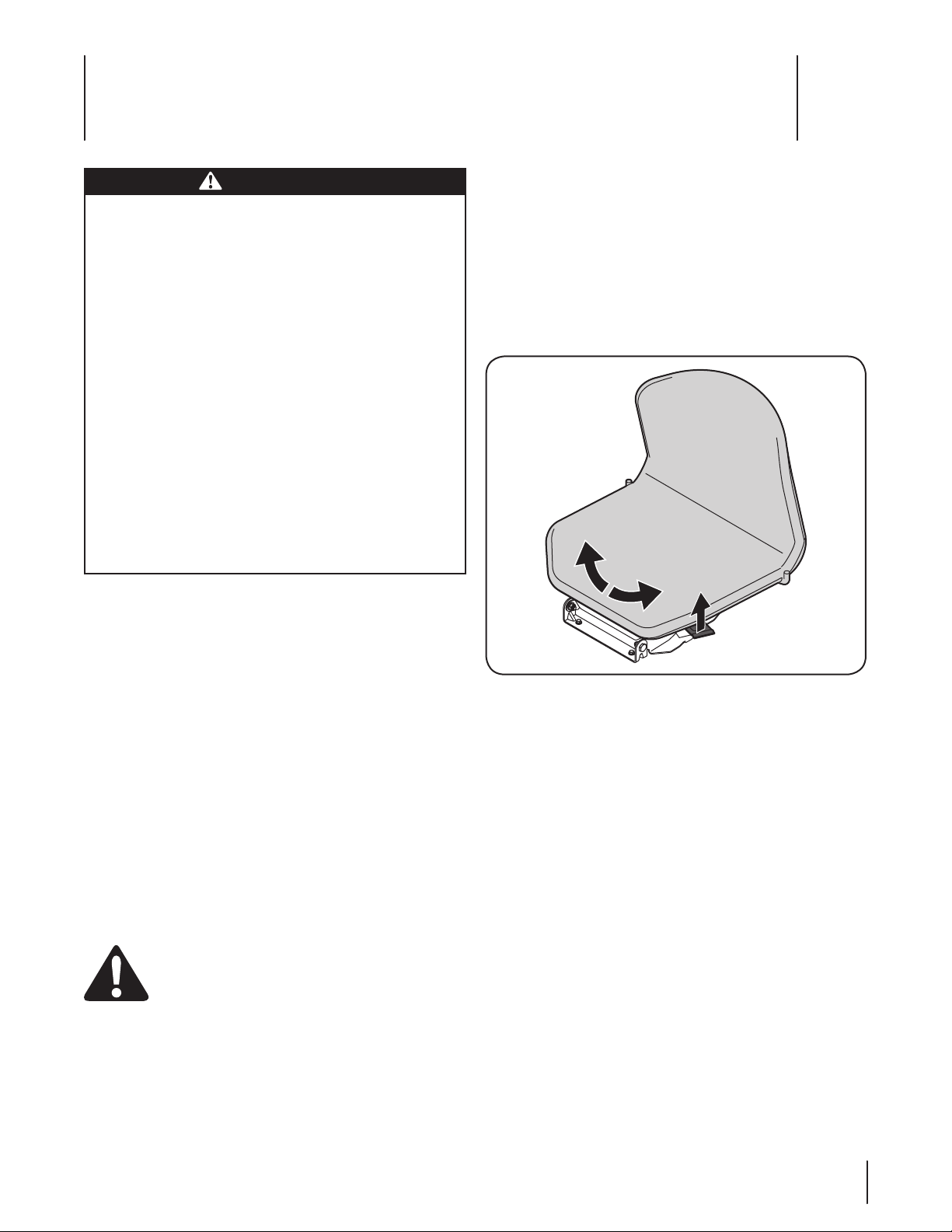
Swivel Seat
This unit is equipped with a swivel seat feature, which aids the
operator in mounting and dismounting the unit.
Note: The seat must be facing forward in the operating position
for the unit to start.
To operate the swivel seat:
1. If the seat is facing forward, lift up on the seat lever on
the left hand side of the seat and pivot the seat to the left.
Release the seat lever. See Fig. 5-1.
Figure 5-1
2. Sit in the seat, lift the seat lever and swivel the seat to the
right into the operating position.
3. Release the seat lever.
Note: See Attaching the Seat in the Assembly & Set-Up
section of this manual for instructions on adjusting the
position of the seat.
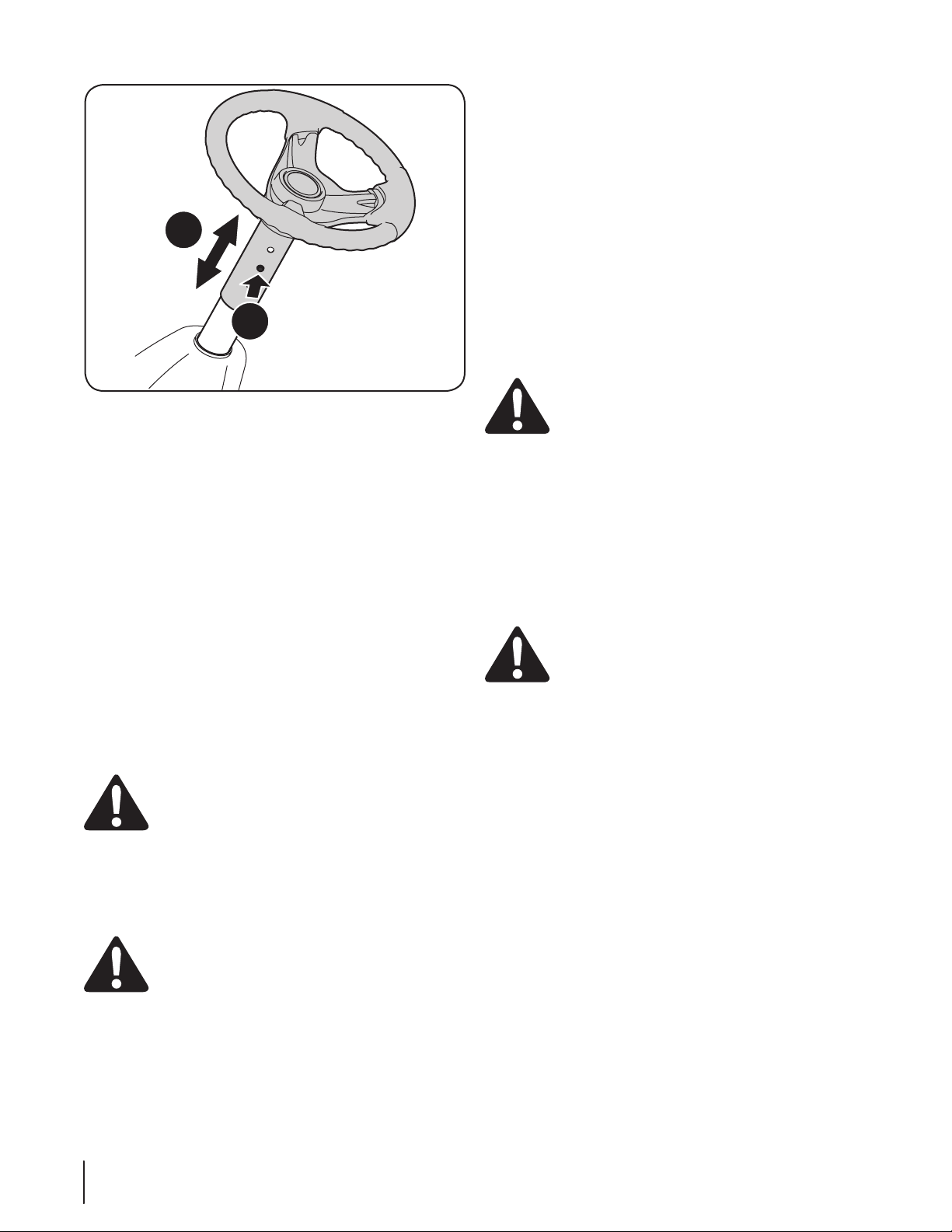
Steering Wheel Height Adjustment (if equipped)
If equipped, this unit has a telescoping steering column. To
adjust the height of the steering wheel:
1. Sit in the operator’s seat and place your hands on the
steering wheel.
2. Push the button (a) on the steering column and raise or
lower the steering wheel (b) to the desired position. See
Figure 5-2.
NOTE: Once the desired position is achieved, lift up and
down on the steering wheel to make sure it locks into
place and the button (a) on the steering column releases
into a locked position. Do not operate this unit unless the
steering column is in a locked position.
18 Section 5— operation18 Section 5— operation
a
b
Figure 5-2
Engaging the Parking Brake
To engage the parking brake:
1. Fully depress the brake pedal and hold it down with your
foot.
2. Move the parking brake lever down into the parking brake
position.
3. Release the brake pedal to allow the parking brake to
engage.
To release the parking brake:
1. Depress the brake pedal and move the parking brake lever
out of the parking brake position.
Setting the Cutting Height
1. Select the height position of the cutting deck by placing
the deck lift lever in any of the different cutting height
notches on the right side of the fender.
WARNING! Keep hands and feet away from the
discharge opening of the cutting deck.
Refer to Leveling the Deck in the Maintenance & Adjustments
section of this manual for more detailed instructions regarding
various deck adjustments.
Starting the Engine
WARNING! Do not operate the tractor if the
interlock system is malfunctioning. This system was
designed for your safety and protection.
NOTE: Refer to the Assembly & Set-Up section of this manual for
gasoline and oil fill-up instructions.
1. Insert the tractor key into the ignition switch.
2. Place the PTO (Blade Engage) lever in the disengaged (OFF)
position.
3. Engage the tractor’s parking brake.
4. Activate the choke control.
5. Turn the ignition key clockwise to the START position. After
the engine starts, release the key. It will return to the ON
position.
IMPORTANT: Do NOT hold the key in the START position
for longer than ten seconds at a time. Doing so may cause
damage to your engine’s electric starter.
6. After the engine starts, deactivate the choke control by
placing the throttle control into the FAST position.
NOTE: Do NOT operate this unit with the Choke control
activated. Doing so will result in a “rich” fuel mixture and can
cause the engine to run poorly.
Stopping the Engine
WARNING! If you strike a foreign object, stop the
engine, disconnect the spark plug wire and ground
against the engine. Thoroughly inspect the machine
for any damage. Repair the damage before
restarting and operating.
1. If the blades are engaged, place the PTO (Blade Engage)
lever in the disengaged (OFF) position.
2. Turn the ignition key counterclockwise to the STOP
position.
3. Remove the key from the ignition switch to prevent
unintended starting.
Driving The Tractor
WARNING! Avoid sudden starts, excessive speed
and sudden stops.
WARNING! Do not leave the seat of the tractor
without first placing the PTO (Blade Engage) lever in
the disengaged (OFF) position, depressing the brake
pedal and engaging the parking brake. If leaving
the tractor unattended, also turn the ignition key off
and remove the key.
WARNING! Always look down and behind before
and while backing up to avoid a back-over accident.
1. Depress the brake pedal and move the speed control lever
out of the parking brake position,then let the pedal release.
2. Move the throttle lever into the FAST (rabbit) position.
3. Place the shift lever in either the FORWARD or REVERSE
position.
IMPORTANT: Do NOT use the shift lever to change the
direction of travel when the tractor is in motion. Always use
the brake pedal to bring the tractor to a complete stop before
shifting.
4. Release the parking brake by depressing the clutch-brake
pedal and positioning the speed control lever in desired
position.
IMPORTANT: First-time operators should use speed positions 1
or 2. Become completely familiar with the tractor’s operation and
controls before operating the tractor in higher speed positions.
5. Release clutch-brake pedal slowly to put unit into motion.

19Section 5 — operation 19Section 5 — operation
6. The lawn tractor is brought to a stop by depressing the
clutch-brake pedal.
NOTE: When operating the unit initially, there will be little
difference between the highest two speeds until after the belts
have seated themselves into the pulleys during the break-in
period.
WARNING! Before leaving the operator’s position
for any reason, disengage the blades, place the shift
lever in neutral, engage the parking brake, shut
engine off and remove the key.
IMPORTANT: When stopping the tractor for any reason while
on a grass surface, always:
1. Place the shift lever into neutral.
2. Engage the parking brake,
3. Shut the engine off and remove the key. Doing so will
minimize the possibility of having your lawn ‘‘browned’’ by
hot exhaust from your tractor’s running engine.
If unit stalls with speed control in high speed, or if unit will
not operate with speed control lever in a low speed position,
proceed as follows:
1. Place shift lever in NEUTRAL.
2. Restart engine.
3. Place speed control lever in highest speed position.
4. Release clutch-brake pedal fully.
5. Depress clutch-brake pedal.
6. Place speed control lever in desired position.
7. Place shift lever in either FORWARD or REVERSE, and follow
normal operating procedures.
Driving On Slopes
Refer to the SLOPE GAUGE in the Important Safe Operation
Practices section in the front of this manual to help determine
slopes where you may operate the tractor safely.
WARNING! Do not mow on inclines with a slope in
excess of 12 degrees (a rise of approximately 2 feet for
every 10 feet). The tractor could overturn and cause
serious injury.
• Mow up and down slopes, NEVER across.
• Exercise extreme caution when changing direction on
slopes.
• Watch for holes, ruts, bumps, rocks, or other hidden
objects. Uneven terrain could overturn the machine. Tall
grass can hide obstacles.
• Avoid turns when driving on a slope. If a turn must be
made, turn down the slope. Turning up a slope greatly
increases the chance of a roll over.
• Avoid stopping when driving up a slope. If it is necessary
to stop while driving up a slope, start up smoothly and
carefully to reduce the possibility of flipping the tractor
over backward.
Engaging the Blades
Engaging the PTO (Blade Engage) transfers power to the cutting
deck. To engage the blades, proceed as follows:
1. Move the throttle control lever to the FAST (rabbit)
position.
2. Grasp the PTO (Blade Engage) lever and pivot it all the way
forward into the engaged (ON) position.
3. Keep the throttle lever in the FAST (rabbit) position for the
most efficient use of the cutting deck.
IMPORTANT: The PTO (Blade Engage) lever must be in the
disengaged (OFF) position when starting the engine, when
traveling in reverse, and if the operator leaves the seat. Refer to
Safety Interlock Switches in the Operation section of this manual.
Mulching
A mulch kit is available as an attachment. Mulching is a process
of recirculating grass clippings repeatedly beneath the cutting
deck. The ultra-fine clippings are then forced back into the
lawn where they act as a natural fertilizer. A mulch kit can be
purchased. See the Attachments & Accessories section in this
manual for more information on purchasing a mulch kit.
Using the Deck Lift Lever
To raise the cutting deck, move the deck lift lever to the left, then
place it in the notch best suited for your application. Refer to
Setting The Cutting Height earlier in this section.
Mowing
WARNING! To help avoid blade contact or a
thrown object injury, keep bystanders, helpers,
children and pets at least 75 feet from the machine
while it is in operation. Stop machine if anyone
enters the area.
The following information will be helpful when using the cutting
deck with your tractor:
WARNING! Plan your mowing pattern to avoid
discharge of materials toward roads, sidewalks,
bystanders and the like. Also, avoid discharging
material against a wall or obstruction which may
cause discharged material to ricochet back toward
the operator.
• Do not mow at high ground speed, especially if a mulch kit
or grass collector is installed.
• For best results it is recommended that the first two laps be
cut with the discharge thrown towards the center. After the
first two laps, reverse the direction to throw the discharge
to the outside for the balance of cutting. This will give a
better appearance to the lawn.
• Do not cut the grass too short. Short grass invites weed
growth and yellows quickly in dry weather.
• Mowing should always be done with the engine at full
throttle.
• Under heavier conditions it may be necessary to go back
over the cut area a second time to get a clean cut.
• Do NOT attempt to mow heavy brush and weeds and
extremely tall grass. Your tractor is designed to mow lawns,
NOT clear brush.
• Keep the blades sharp and replace the blades when worn.
Refer to Cutting Blades in the Service section of this manual
for proper blade sharpening instructions.
Maintenance
WARNING: Before performing any maintenance or
repairs, disengage PTO, move shift lever into neutral
position, set parking brake, stop engine and remove
key to prevent unintended starting.
Engine
Refer to the Engine Owner’s Manual for engine maintenance
instructions.
Check engine oil level before each use as instructed in the Engine
Owner’s Manual packed with your unit. Follow the instructions
carefully.
Changing Engine Oil
For draining oil from the engine’s crankcase, proceed as follows:
1. Run the engine for a few minutes to allow the oil in the
crankcase to warm up. Warm oil will flow more freely and
carry away more of the engine sediment which may have
settled at the bottom of the crankcase. Use care to avoid
burns from hot oil.
2. Locate the oil drain valve on the right side of the engine
and the oil fill cap on the topside of the engine.
3. Unscrew the oil fill cap and remove the dipstick from the oil
fill tube.
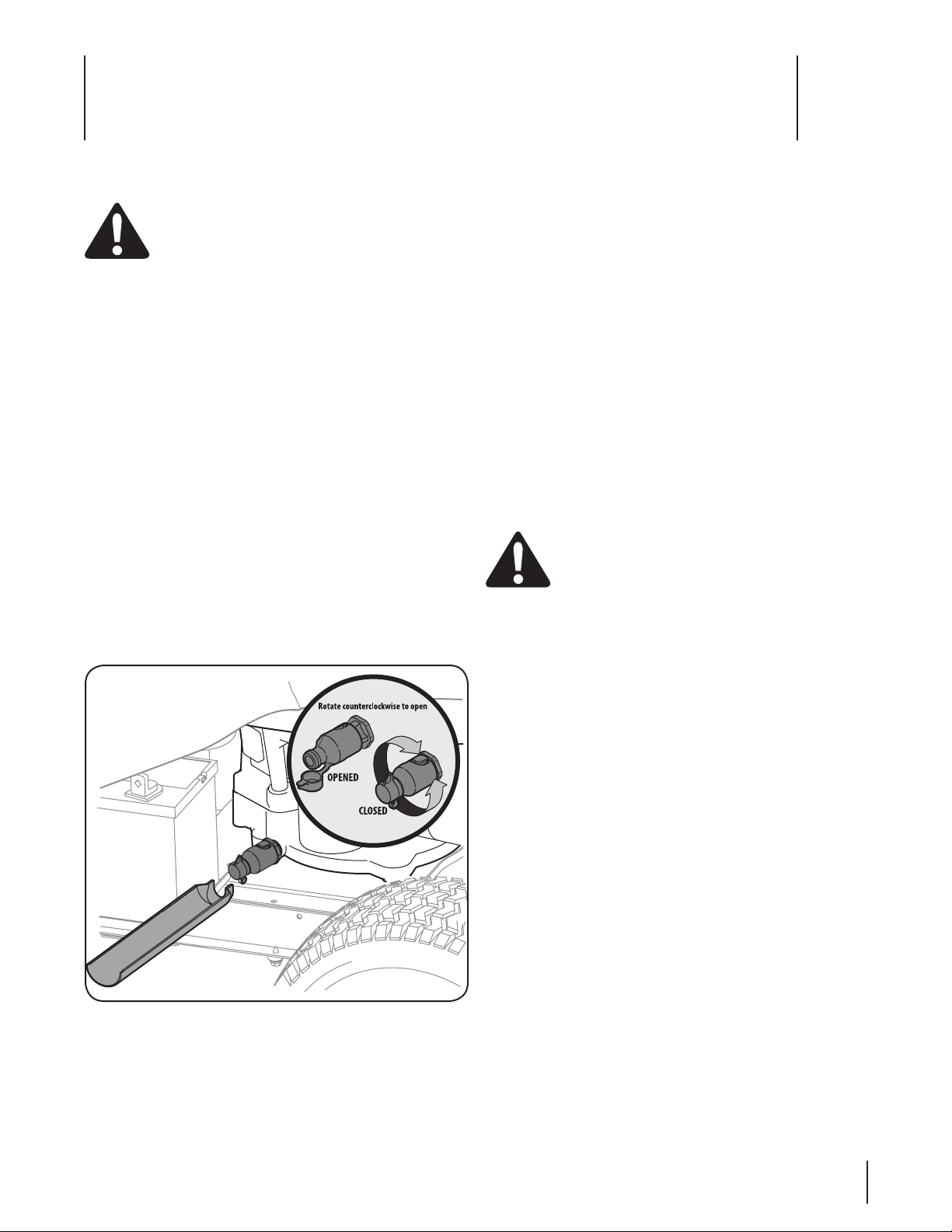
4. Snap the small end of oil drain sleeve onto the space
provide around the oil drain valve. See Fig. 6-1.
Figure 6-1
5. Open the cap on the oil drain valve as shown in Fig. 6-1.
6. Rotate the oil drain valve counterclockwise to open the
valve and begin the flow of oil. Drain oil into a suitable
container with a capacity of no less than 64 oz.
7. Close the oil drain valve by rotating it clockwise, then
reinstall the cap
4. Refill the engine with new motor oil as instructed in the
Engine Owner’s Manual packed with your unit.
IMPORTANT: Refer to the Engine Owner’s Manual packed with
your unit for information regarding the quantity and proper
viscosity of motor oil.
Air Cleaner
Service the pre-cleaner (if equipped) and cartridge/air cleaner
element as instructed in the Engine Owner’s Manual packed with
your unit.
Spark Plug
The spark plug should be cleaned and the gap reset once a
season. Spark plug replacement is recommended at the start of
each mowing season. Refer to the Engine Owner’s Manual for
correct plug type and gap specifications.
Lubrication
WARNING: Before lubricating, repairing, or
inspecting, always disengage PTO, move shift lever
into neutral position, set parking brake, stop engine
and remove key to prevent unintended starting.
Engine
Lubricate the engine with motor oil as instructed in the Engine
Owner Manual packed with your unit.
Pivot Points & Linkage
Lubricate all the pivot points on the drive system, parking brake
and lift linkage at least once a season with light oil.
Rear Wheels
The rear wheels should be removed from the axles once a
season. Lubricate the axles and the rims well with an all-purpose
grease before re-installing them.
Front Axles
Each end of the tractor’s front pivot bar may be equipped with a
grease fitting. Lubricate with a grease gun after every 25 hours of
tractor operation.
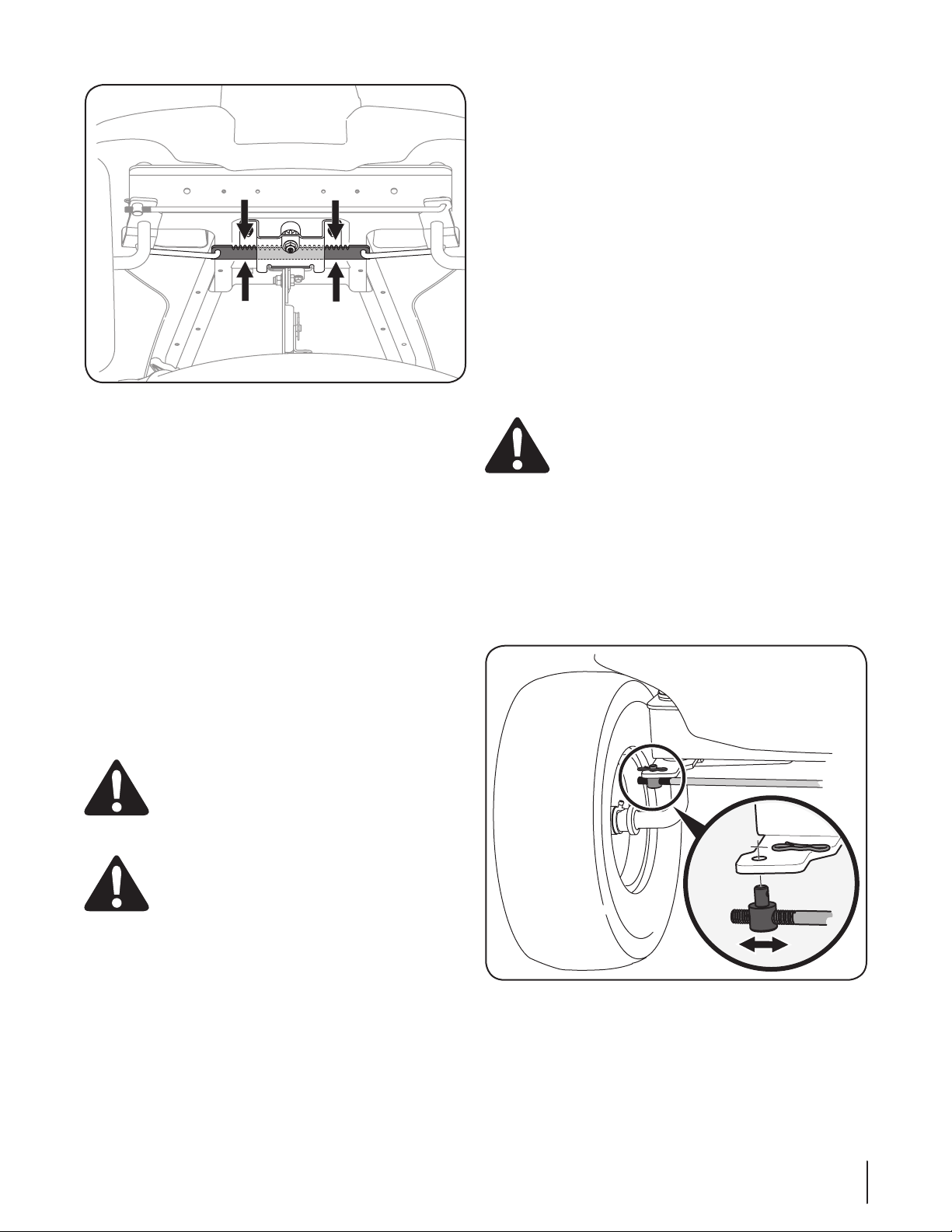
Steering Rack & Pinion
Once per season, or every 25 hours of operation, it will be
necessary to lubricate the steering rack and pinion gear located
under the front of the unit. Using standard automotive grease,
apply grease to the front side and rear side of the steering rack,
as indicated in Fig. 6-2.
Maintenance & Adjustments
6
20
• Always keep the rubber boot positioned over the positive
terminal to prevent shorting.
IMPORTANT: If removing the battery for any reason,
disconnect the NEGATIVE (Black) wire from it’s terminal first,
followed by the POSITIVE (Red) wire. When re-installing the
battery, always connect the POSITIVE (Red) wire its terminal
first, followed by the NEGATIVE (Black) wire. Be certain that the
wires are connected to the correct terminals; reversing them
could change the polarity and result in damage to your engine’s
alternating system.
Cleaning Battery
Clean the battery by removing it from the tractor and washing
with a baking soda and water solution. If necessary, scrape the
battery terminals with a wire brush to remove deposits. Coat
terminals and exposed wiring with grease or petroleum jelly to
prevent corrosion.
Adjustments
WARNING: Never attempt to make any
adjustments while the engine is running, except
where specified in the operator’s manual.
Steering Adjustment
If the tractor turns tighter in one direction than the other, or if
the front tie rod is being replaced due to damage or wear, the
steering will need to be adjusted.
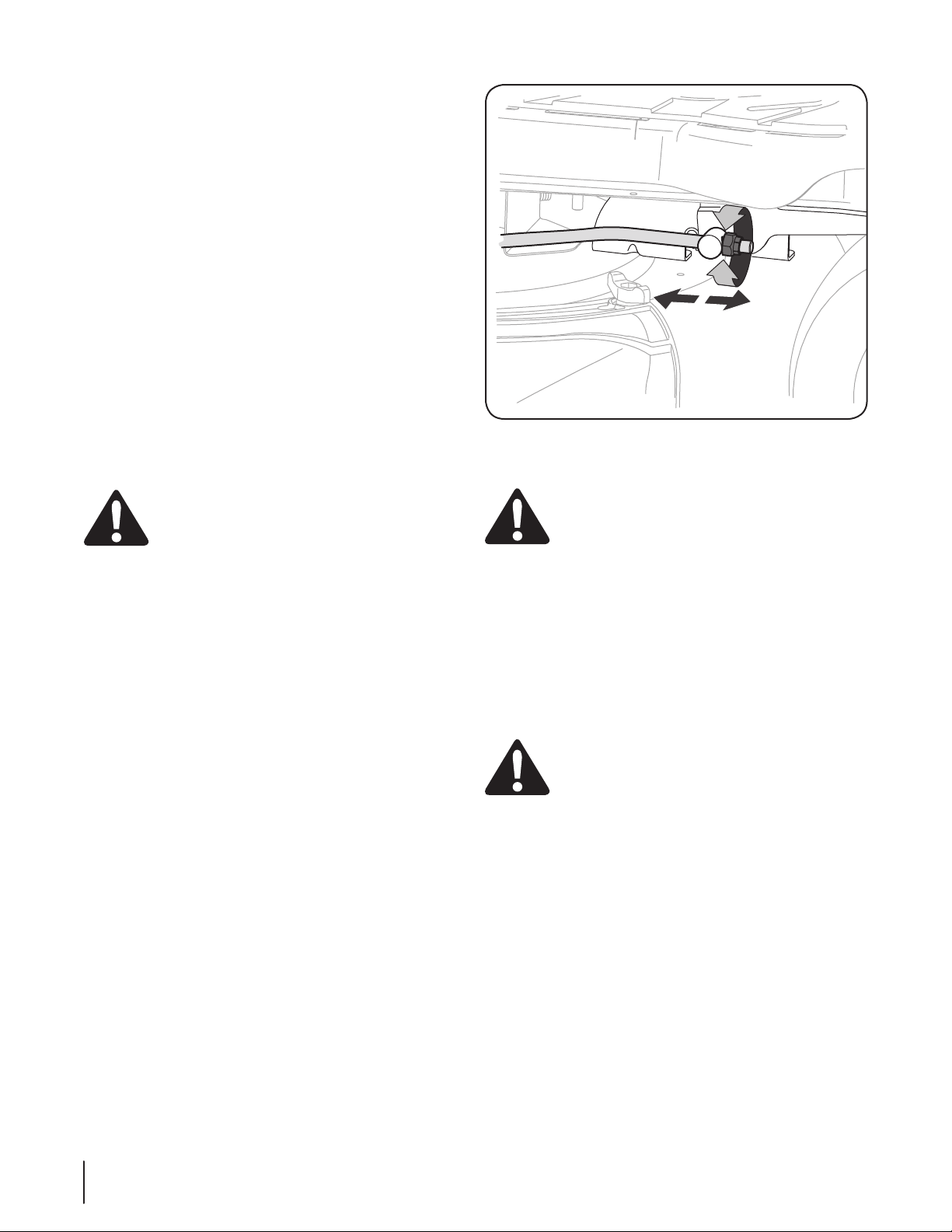
To Adjust the toe in/out of the front wheels:
1. Remove the bow-tie clip securing the tie-rod ferrule to the
right front axle assembly, and drop the tie-rod down to
adjust. See Fig. 6-3.
Figure 6-3
2. Thread the ferrule inward to “toe-in” the wheels, or
outward to “toe-out” the wheels.
3. Reinsert the tie-rod ferrule into the right side axle assembly
and secure with the bow-tie cotter pin removed in Step 1.
Figure 6-2
Cleaning the Engine And Deck
If the engine has been running, allow it to cool for at least half
an hour before cleaning. Periodically remove dirt build-up from
engine. Clean cooling fins every 25 hours. Clean with a brush or
compressed air.
IMPORTANT: Do not spray engine with water to clean because
water could contaminate fuel. Using a garden hose or pressure
washing equipment can also force water into the air cleaner or
muffler opening. Water in the air cleaner will soak the paper
element, and water that passes through the element or muffler
can enter the cylinder, causing damage.
Any fuel or oil spilled on the machine should be wiped off
promptly. Do NOT allow debris to accumulate around the cooling
fins of the engine or on any other part of the machine.
IMPORTANT: The use of a pressure washer to clean your
tractor is NOT recommended. It may cause damage to electrical
components, spindles, pulleys, bearings or the engine.
WARNING! Accumulation of debris around muffler
could cause a fire. Inspect and clean before every
use.
Muffler
WARNING! Temperature of muffler and nearby
engine areas may exceed 150˚ F (65˚C). Avoid
contact with these areas.
Inspect muffler periodically, and replace if necessary.
Replacement parts for the muffler must be the same and
installed in the same position as the original parts.
Battery
The battery is sealed and is maintenance-free. Acid levels cannot
be checked.
• Always keep the battery cables and terminals clean and
free of corrosive build-up.
• After cleaning the battery and terminals, apply a light coat
of petroleum jelly or grease to both terminals.
21Section 6 — Maintenance & adjuStMentS
NOTE: Threading the ferrule too far onto the tie-rod will
cause the front tires to “toe-in” too far. Proper toe-in is
between /” and /”.
Front tire toe-in can be measured as follows:
1. Place the steering wheel in position for straight ahead
travel.
2. In front of the axle, measure the distance horizontally from
the inside of the left rim to the inside of the right rim. Note
the distance.
3. Behind the axle, measure the distance horizontally from
the inside of the left rim to the inside of the right rim. Note
the distance.
4. The measurement taken in front of the axle should be
between /” and /” less than the measurement taken
behind the axle. Adjust if necessary.
Seat Adjustment
Refer to the Set-Up and Assembly section of this manual for seat
adjustment instructions.
Parking Brake Adjustment
WARNING: Never attempt to adjust the brakes
while the engine is running. Always disengage PTO,
move shift lever into neutral position, stop engine
and remove key to prevent unintended starting.
If the tractor does not come to a complete stop when the brake
pedal is completely depressed, or if the tractor’s rear wheels
can roll with the parking brake applied, the brake is in need of
adjustment. See an authorized Troy-bilt Service Dealer to have
your brakes properly adjusted.
Leveling the Deck
NOTE: Check the tractor’s tire pressure before performing any
deck leveling adjustments. Refer to Tires, later in this section of
this manual for more information regarding tire pressure.
Front To Rear
It is possible to adjust the pitch of the cutting deck. The front of
the deck should be between 0” (level) and 1⁄4” lower than the
rear of the deck. Adjust if necessary as follows:
1. With the tractor parked on a firm, level surface, place the
lever for lifting the platform in the middle position and
rotate the blade so that it is aligned with the front and rear
of the tractor.
2. Measure the distance from the front of the blade tip to the
ground and the rear of the blade tip to the ground. The
first measurement taken should be between 0” (level) and
1⁄4” less than the second measurement. Determine the
approximate distance necessary for proper adjustment and
proceed, if necessary, to the next step.
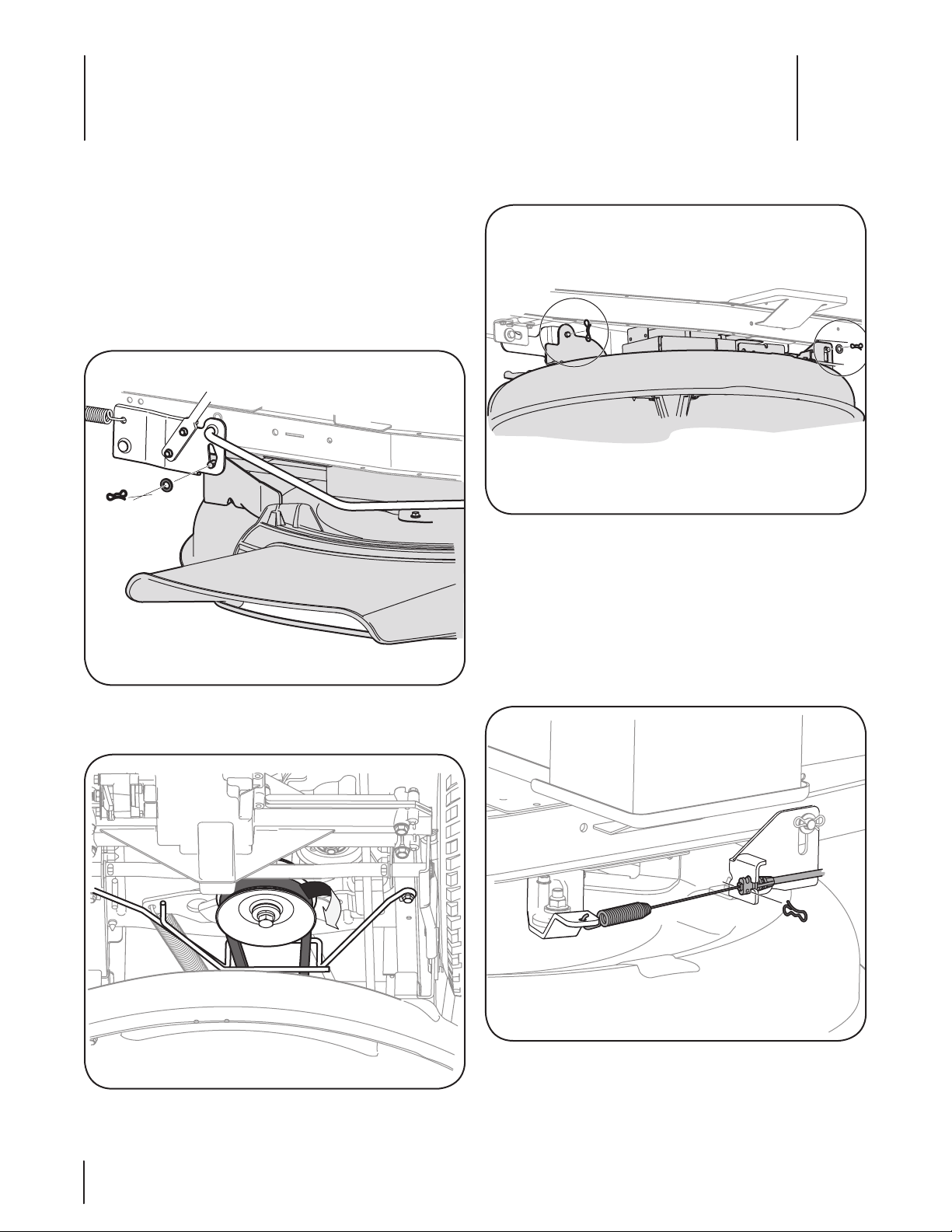
3. Locate the flange lock nut on the front end of the PTO Lift
Rod. See Fig. 6-4.
• Tighten the flange lock nut to raise the front of the
deck;
• Loosen the flange lock nut to lower the front of the
deck.
Figure6-4
Tires
WARNING! Never exceed the maximum inflation
pressure shown on the sidewall of the tire.
The recommended operating tire pressure is:
• Approximately 10 psi for the rear tires
• Approximately 14 psi for the front tires
IMPORTANT: Refer to the tire sidewall for exact tire
manufacturer’s recommended or maximum psi. Do not
overinflate. Uneven tire pressure could cause the cutting deck to
mow unevenly.
Off Season Storage
WARNING! Never store lawn tractor with fuel in
tank indoors or in poorly ventilated areas where fuel
fumes may reach an open flame, spark, or pilot light
as on a furnace, water heater, clothes dryer, or gas
appliance.
Preparing the Engine
IMPORTANT: Fuel left in the fuel tank during warm weather
deteriorates and will cause serious starting problems.
To prevent gum deposits from forming inside the engine’s
carburetor and causing possible malfunction of the engine, the
fuel system must be either completely emptied, or the gasoline
must be treated with a stabilizer to prevent deterioration.
1. If using a fuel stabilizer:
• Read the product manufacturer’s instructions and
recommendations.
• Add to clean, fresh gasoline the correct amount of
stabilizer for the capacity of the fuel system.
• Fill the fuel tank with treated fuel and run the
engine for 2-3 minutes to get stabilized fuel into the
carburetor.
22 Section 6— Maintenance & adjuStMentS

Maintenance Schedule
Before
Each use
Every
10 Hours
Every
25 Hours
Every
50 Hours
Every
100 Hours
Prior
to Storing
Check Engine Oil Level
P P
Check Air Filter for Dirty, Loose or Damaged Parts
P
Clean and Re-oil Air Filter’s Foam Pre-cleaner
(if Equipped)
P
Replace Air Filter Element
P
Change Engine Oil and Replace Oil Filter
(if Equipped)
P
Clean Battery Terminals
P P
Lube Front Axles and Rims
P P
Clean Engine Cooling Fins
P P
Check Spark Plug Condition & Gap
P P
Replace Fuel Filter
P
IMPORTANT: It is important to consult the specific engine operator’s manual included with this machine for detailed engine
maintenance procedures and intervals.
2. If emptying the fuel system:
• Do not drain fuel when the engine is hot. Allow the
engine adequate time to cool. Drain fuel into an
approved container outdoors, away from open flame.
• Drain any large volume of fuel from the tank by
disconnecting the fuel line from the in-line fuel filter
near the engine. See the complete instructions for
Draining The Fuel later in this section.
WARNING! Gasoline is extremely flammable and
can be explosive under certain conditions. Drain
gasoline before storing the equipment for extended
periods. Drain fuel only into an approved container
outdoors, away from an open flame. Allow engine to
cool. Extinguish cigarettes, cigars, pipes, and other
sources of ignition prior to draining fuel. Store
gasoline in an approved container in safe location.
• Reconnect the fuel line and run the engine until it starts
to falter, then use the choke to keep the engine running
until all fuel in the carburetor has been exhausted.
• Disconnect the fuel line and drain any remaining
gasoline from the system.
WARNING! Gasoline is a toxic substance. Dispose
of gasoline properly. Contact your local authorities
for approved disposal methods.
• Remove the spark plug and pour one (1) ounce of
engine oil through the spark plug hole into the
cylinder. Crank the engine several times to distribute
the oil. Replace the spark plug.
Draining the fuel
1. Locate the fuel filter, which is located on the left side of the
engine, and may be attached to the engine with a tie strap.
2. Cut the tie strap, if present, then pinch the in-line clamp
on the fuel filter with a pair of pliers, slide the clamp up the
fuel line.
3. Pull the fuel line free from the filter and place the open end
of the line into an approved container to drain the fuel.
Preparing the Lawn Tractor
1. Clean and lubricate tractor thoroughly as described in the
lubrication instructions.
2. Do not use a pressure washer or garden hose to clean your
unit.
3. Store mower in a dry, clean area. Do not store next to
corrosive materials, such as fertilizer.
21Section 6 — Maintenance & adjuStMentS
Service
7
24
Service
7
24
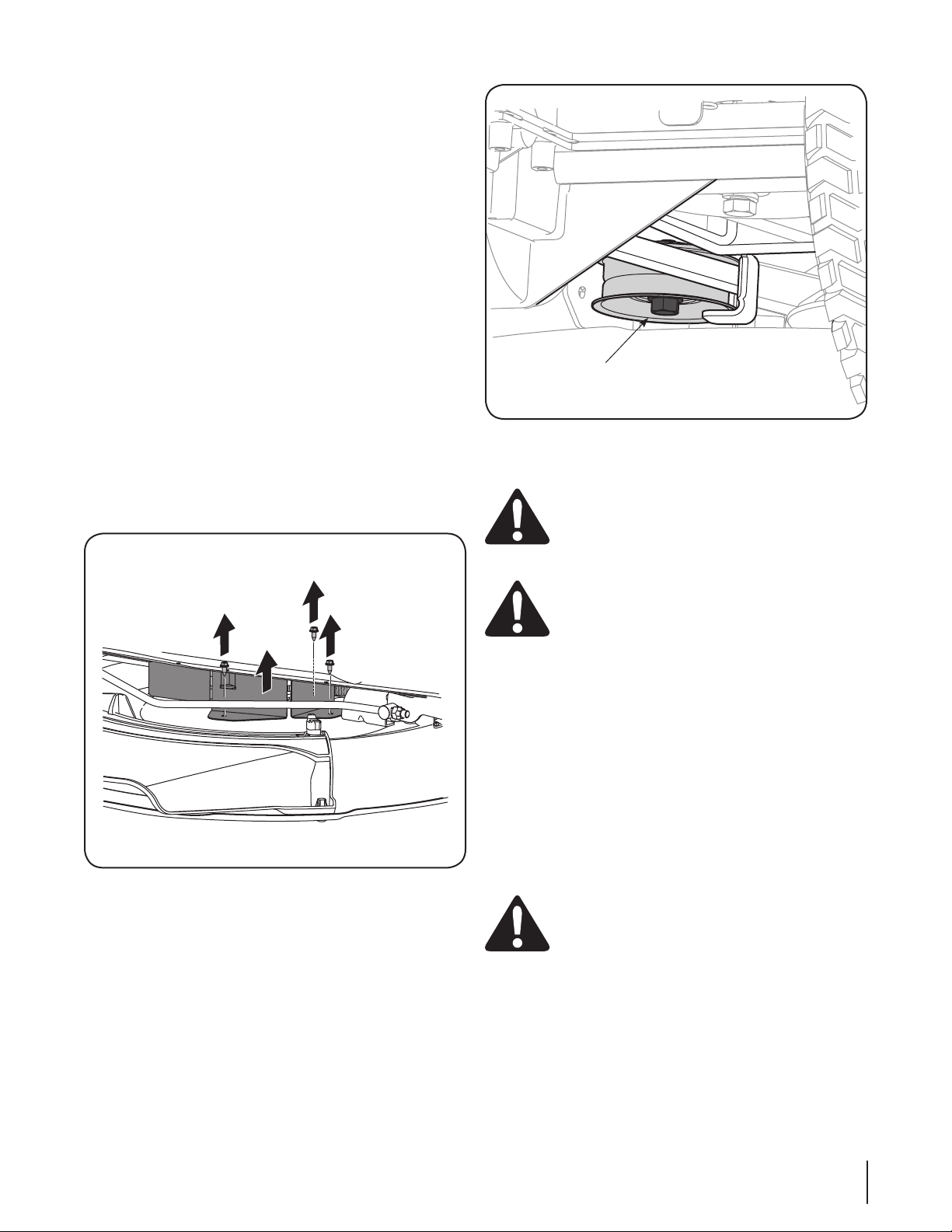
5. Remove the remaining bow-tie cotter pins securing the
deck to the unit, as shown in Fig. 7-3.
Figure 7-3
NOTE: The bow-tie clips should be re-installed from the top
down.
6. Unplug the wire pigtail from the deck switch.
7. Move the deck lift lever into the top notch on the right
fender to raise the deck lift arms up and out of the way.
8. Carefully remove the PTO cable from the rear of the cutting
deck by removing the bow-tie cotter pin which secures it.
Remove the spring from the deck idler bracket. See Fig. 7-4.
Figure 7-4
9. Gently slide the cutting deck (from the left side) out from
underneath the tractor.
Cutting Deck Removal
To remove the cutting deck, proceed as follows:
1. Place the PTO (Blade Engage) lever in the disengaged (OFF)
position and engage the parking brake.
2. Lower the deck by moving the deck lift lever into the
bottom notch on the right fender.
3. Remove the bow-tie cotter pin and flat washer from the
deck lift assembly, and retain for reinstallation later. See
Fig. 7-1.
Figure 7-1
4. Remove the belt from around the tractor’s PTO pulley. See
Fig. 7-2.
Figure 7-2
25Section 7 — Service 25Section 7 — Service
Changing the Deck Belt
NOTE: It is possible to change the deck belt with the cutting
deck still installed on the tractor, however it is much easier to
remove the deck first, change the deck belt, then reinstall the
cutting deck.
To change the cutting deck belt, proceed as follows:
1. It is easiest to change the deck belt by first removing the
cutting deck as instructed earlier in this section first. Skip
this step if deciding to change the deck belt with the
mowing deck still installed on the unit. Otherwise, remove
the cutting deck now.
2. If changing the deck belt with the cutting deck still
installed on the unit, lower the deck to the lowest mowing
position.
3. Remove the deck belt from around the unit’s PTO drive
pulley as shown in Fig. 7-2. Simply roll one side of the
belt off of the pulley and then work it off the pulley by
continuing around the pulley until the belt is off of the
pulley.
4. Pull the belt towards the rear of the unit, pulling it through
and out of the belt keeper bracket, shown in Fig. 7-2.
5. Remove the deck belt cover by removing the three hex
bolts that secure it. See Fig. 7-5.
Figure 7-5
6. Remove the idler pulley by removing the hex bolt on the
bottom side of the pulley. See Fig. 7-6.
7. Change the belt then reinstall the all the components
removed in the reverse order beginning with the idler
pulley, and then belt cover.
8. Feed the deck belt through the belt keeper bracket and
work it around and onto the PTO drive pulley as shown in
Fig. 7-2.
Remove hex bolt to remove pulley allowing
belt to move past the belt keeper.
Figure 7-6
Battery
CALIFORNIA PROPOSITION 65 WARNING!
Battery posts, terminals, and related accessories
contain lead and lead compounds, chemicals known
to the State of California to cause cancer and
reproductive harm. Wash hands after handling.
CAUTION: If removing the battery, disconnect the
NEGATIVE (Black) wire from it’s terminal first,
followed by the POSITIVE (Red) wire. When re-
installing the battery, always connect the POSITIVE
(Red) wire its terminal first, followed by the
NEGATIVE (Black) wire.
Battery Failures
Some common causes for battery failure are:
• Incorrect initial activation
• Overcharging
• Freezing
• Undercharging
• Corroded connections
These failures are NOT covered by your tractor’s warranty.
Jump Starting
WARNING! Never jump start a damaged or frozen
battery. Be certain the vehicles do not touch, and
ignitions are off. Do not allow cable clamps to touch.
1. Connect positive (+) cable to positive post (+) of your
tractor’s discharged battery.
2. Connect the other end of the cable to the (positive +) post
of the jumper battery.
3. Connect the second cable (negative –) to the other post of
the jumper battery.
4. Make the final connection on the engine block of the
tractor, away from the battery. Attach to a unpainted part
to assure a good connection.
26 Section 7— Service26 Section 7— Service
CAUTION: If the jumper battery is installed on a
vehicle (i.e. car, truck), do NOT start the vehicle’s
engine when jump starting your tractor.
5. Start the tractor as instructed in the Operation section of
this manual.
6. Set the tractor’s parking brake before removing the jumper
cables, in reverse order of connection.
Charging
WARNING! Batteries give off an explosive gas
while charging. Charge the battery in a well
ventilated area and keep away from an open flame
or pilot light as on a water heater, space heater,
furnace, clothes dryer or other gas appliances.
CAUTION: When charging your tractor’s battery,
use only a charger designed for 12V lead-acid
batteries. Read your battery charger’s Owner’s
Manual prior to charging your tractor’s battery.
Always follow its instructions and heed its warnings.
If your tractor has not been put into use for an extended period
of time, charge the battery as follows:
1. Set your battery charger to deliver a max of 10 amperes.
If your battery charger is automatic, charge the battery until the
charger indicates that charging is complete. If the charger is not
automatic, charge for no fewer than eight hours.
Fuse
One 15 AMP fuse is installed in your tractor’s wiring harness
located just above the battery, under the left fender, to protect
the tractor’s electrical system from damage caused by excessive
amperage.
If the electrical system does not function, or your tractor’s engine
will not crank, first check to be certain that the fuse has not
blown. It can be found at the rear of the unit, underneath the
fender located by the battery.
WARNING! Always use a fuse with the same
amperage capacity for replacement.
Cutting Blade
WARNING! Shut the engine off and remove
ignition key before removing the cutting blade(s) for
sharpening or replacement. Protect your hands by
using heavy gloves when grasping the blade.
WARNING! Periodically inspect the blade spindles
for cracks or damage, especially if you strike a
foreign object. Replace immediately if damaged.
The blades may be removed as follows.
NOTE: It may be easier to change the blade by first
removing the deck from beneath the tractor, (refer to
Cutting Deck Removal earlier in this section) then gently
flip the deck over to expose its underside. It is possible to
change the blade, however, with the deck still attached to
the tractor. If attempting to change the blade with the deck
still installed on the tractor, first move the deck lift lever to
its highest cutting position.
1. Remove the mulch plug, deck chute or bagging chute, if
equipped, exposing the deck chute opening.
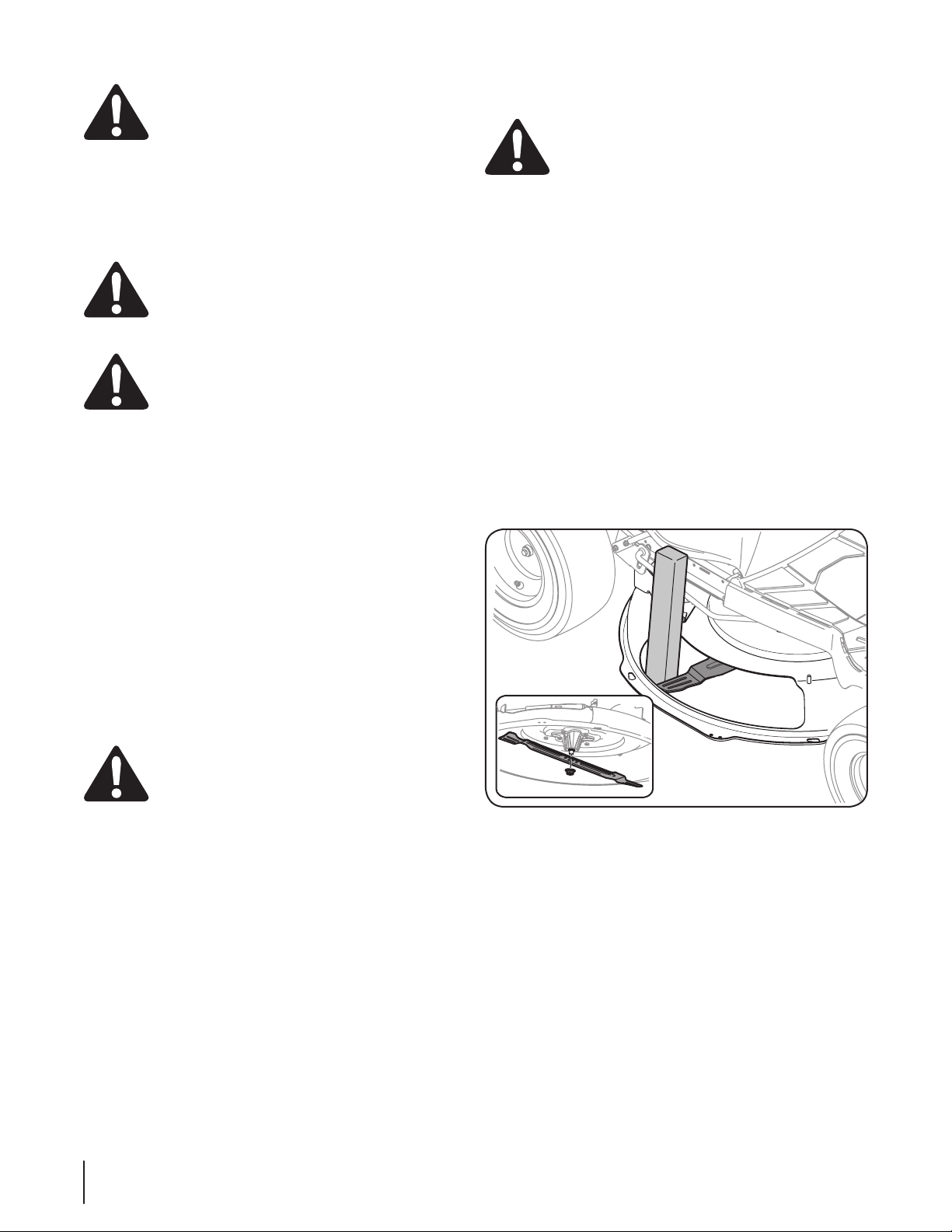
2. Using a block of wood or 2 x 4, insert it into the deck
opening and rotate the blade around until it wedges the
wood between the deck opening and the cutting blade, as
shown in Fig. 7-7.
Figure 7-7
3. Remove the hex flange nut that secures the blade to the
spindle assembly. See the Inset of Fig. 7-7.
NOTE: The deck spindle has a normal thread. To loosen,
rotate the flange lock nut counter clockwise.
4. To properly sharpen the cutting blades, remove equal
amounts of metal from both ends of the blades along the
cutting edges, parallel to the trailing edge, at a 25°- to 30°
angle. Always grind each cutting blade edge equally to
maintain proper blade balance. See Fig. 7-8.
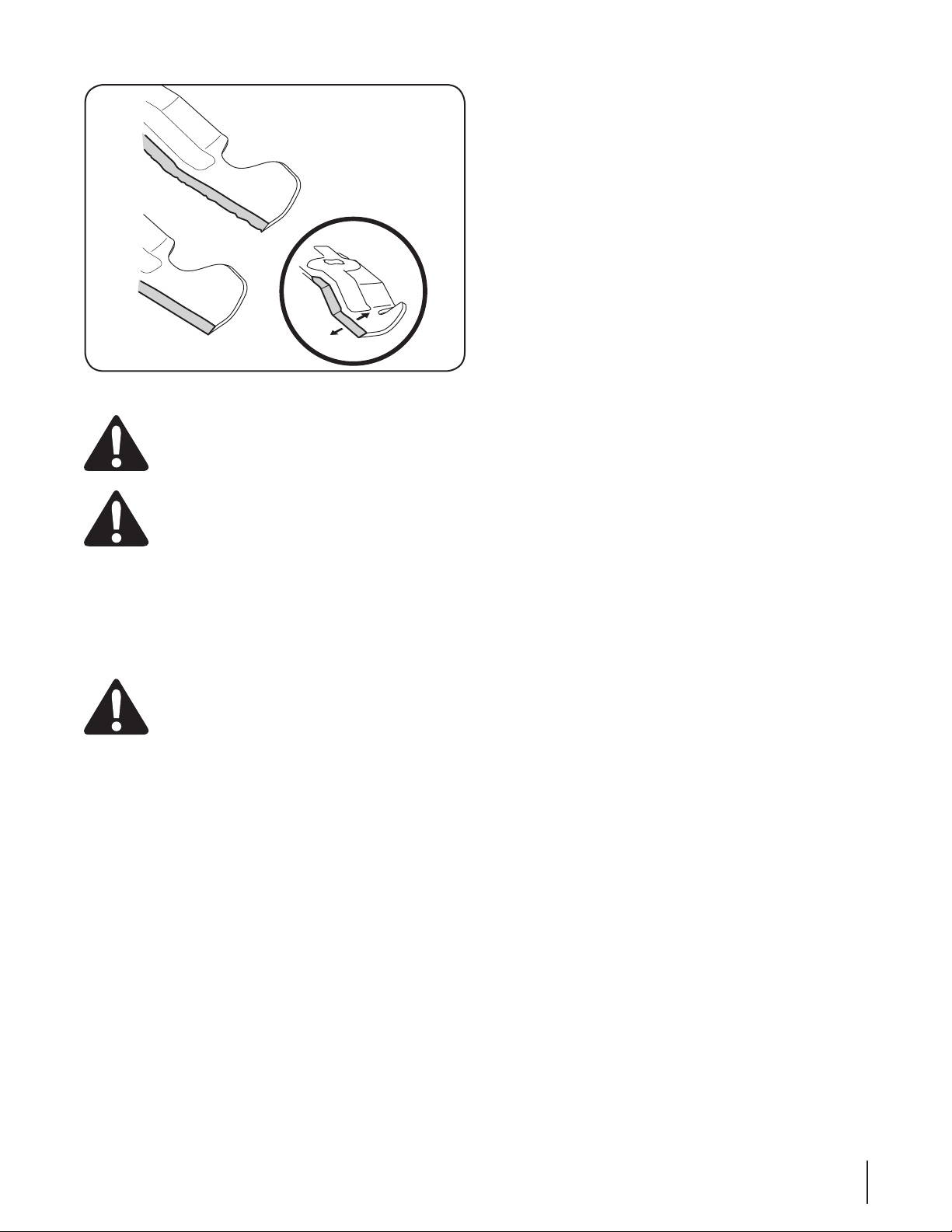
25Section 7 — Service 27Section 7 — Service
Figure 7-8
WARNING! If the cutting edge of the blade has
previously been sharpened, or if any metal
separation is present, replace the blades with new
ones.
WARNING! A poorly balanced blade will cause
excessive vibration, may cause damage to the
tractor and/or result in personal injury.
5. Test the blade’s balance using a blade balancer. Grind
metal from the heavy side until it balances evenly.
NOTE: When replacing the blade, be sure to install the
blade with the side of the blade marked ‘‘Bottom’’ (or with
a part number stamped in it) facing the ground when the
mower is in the operating position.
CAUTION! Use a torque wrench to tighten the
blade spindle hex flange nut to between 70 lbs-ft
and 90 lbs-ft.
Changing the Transmission Drive Belt
NOTE: Several components must be removed and special tools
(i.e. air/impact wrench) in order to change the tractor’s drive belt.
See an authorized Troy-bilt Service Dealer to have your drive belt
replaced or phone Customer Support as instructed on page 2 for
information on ordering a Service Manual.

Problem Cause Remedy
Engine fails to start 1. PTO/Blade engaged
2. Spark plug wire disconnected
3. Fuel tank empty, or stale fuel
4. Choke not activated
5. Faulty spark plug
6. Blown fuse
7. Engine flooded
8. Parking brake not engaged
9. Swivel seat not facing forward
1. Place blade engage lever in disengaged
(OFF) position.
2. Connect wire to spark plug.
3. Fill tank with clean, fresh (less than 30 days
old) gas.
4. Place the throttle control in CHOKE position.
5. Clean, adjust gap or replace plug.
6. Replace fuse(s)
7. Crank engine with throttle in FAST position.
8. Engage parking brake.
9. Pivot the seat forward into the operating
position
Engine runs erratic 1. Unit running with CHOKE activated.
2. Spark plug wires loose.
3. Blocked fuel line or stale fuel.
4. Vent in gas cap plugged.
5. Water or dirt in fuel system.
6. Dirty air cleaner.
1. Move the throttle contol out of the CHOKE
position.
2. Connect and tighten spark plug wire.
3. Clean fuel line; fill tank with clean, fresh
gasoline and replace fuel filter
4. Clear vent or replace cap if damaged.
5. Drain fuel tank. Refill with clean, fresh
gasoline.
6. Replace air cleaner paper element or clean
foam precleaner.
Engine overheats 1. Engine oil level low.
2. Air flow restricted.
1. Fill crankcase with proper amount and
weight of oil.
2. Clean grass clippings and debris from around
the engine’s cooling fins and blower housing.
Engine hesitates at high
RPM
1. Spark plug gap too close. 1. Remove spark plug and reset the gap.
Engine Idles rough 1. Spark plug fouled, faulty or gap too wide.
2. Dirty air cleaner.
1. Replace spark plug. Set plug gap.
2. Replace air cleaner element and/or clean
pre-cleaner.
Excessive vibration 1. Cutting blade loose or unbalanced.
2. Damaged or bent cutting blade.
1. Tighten blade and spindle. Balance blade.
2. Replace blade.
Mower will not mulch grass 1. Engine speed too low.
2. Wet grass.
3. Excessively high grass.
4. Dull blade.
1. Place throttle in FAST (rabbit) position.
2. Do not mulch when grass is wet.
3. Mow once at a high cutting height, then
mow again at desired height or make a
narrower cutting swath.
4. Sharpen or replace blade.
Uneven cut 1. Deck not leveled properly.
2. Dull blade.
3. Uneven tire pressure.
1. Perform side-to-side deck adjustment.
2. Sharpen or replace blade.
3. Check tire pressure in all four tires.
Trouble sho oting
8
28
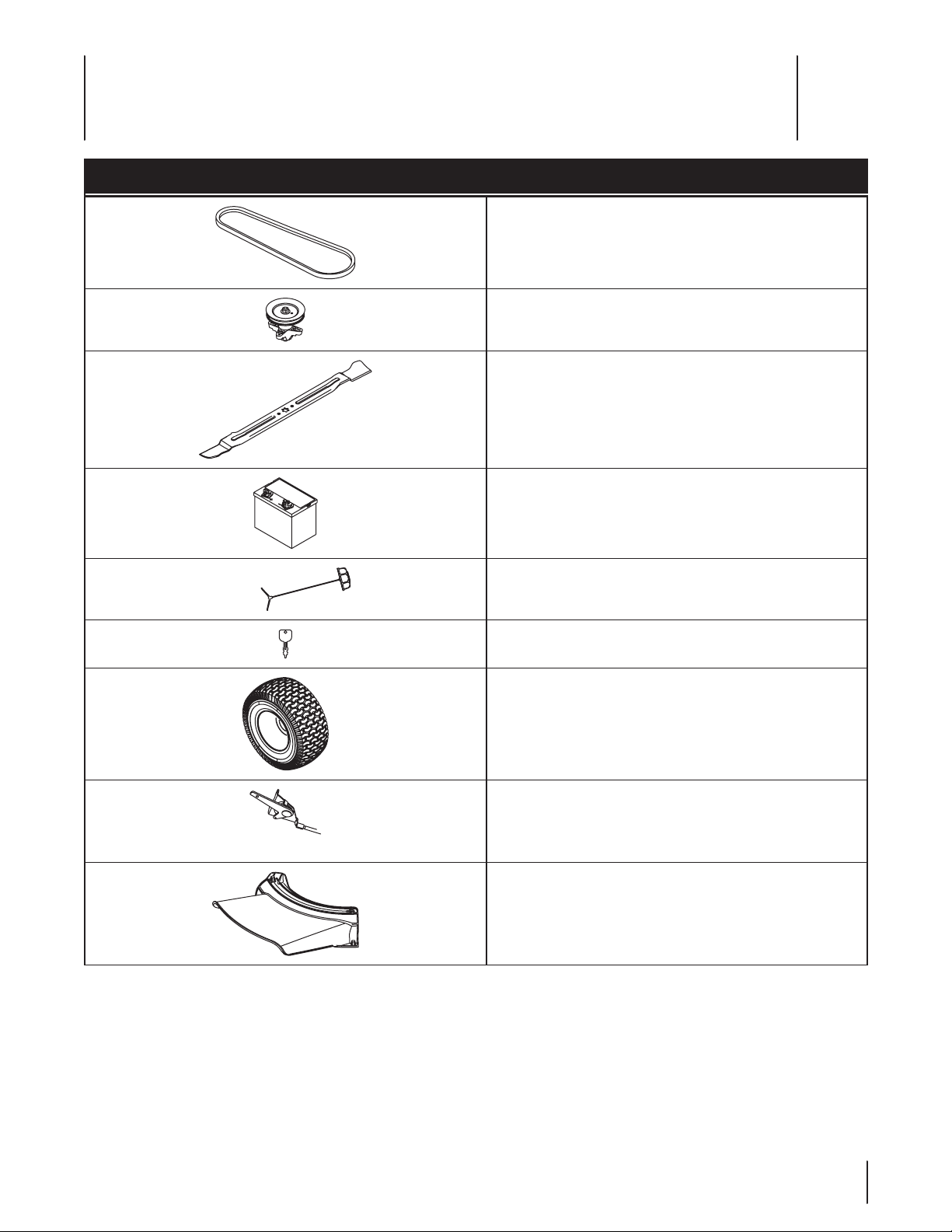
Component Part Number and Description
954-04318 Drive Belt (Mowing Deck)
918-04822A Deck Spindle
942-04385 Cutting Blade (30”)
925-1707D Battery
951-12179A Fuel Tank Cap
925-1745A Key
734-04641 Tire (Rear) 16 x 6.5 x 8
746-04829 Throttle Control/Cable
931-04633 Discharge Chute Assembly
NOTE: Download a complete Parts Manual free of charge at www.troybilt.com or phone (800) 828-5500 to purchase a Parts Manual.
Be sure to have your model number and serial number ready. These can be found on the model plate located under the seat. Refer to
page 2 for more information regarding locating your model and serial numbers.
Replacement Parts
9
29
The following attachments and accessories are compatible for the Troy-bilt Lawn Tractor. See the retailer from which you
purchased your tractor, an authorized Troy-bilt Service Dealer or phone (800) 828-5500 for information regarding price
and availability.
CAUTION: This Troy-Bilt Lawn Tractor is NOT designed for use with any type of ground-engaging
attachments (e.g. tiller or plow). Use of this type of equipment WILL void the tractor’s warranty.
Model Number Description
19A 30011O EM Twin Bagger Kit
19A30012OEM Deck Mulch Kit
490-850-0005 Blade Removal Tool
490-850-0008 Oil Siphon
Attachments & Accessories
10
30

Notes
11
31

32 Section 11— noteS

33Section 11 — noteS

FEDERAL and/or CALIFORNIA EMISSION CONTROL WARRANTY STATEMENT
YOUR WARRANTY RIGHTS AND OBLIGATIONS
MTDConsumerGroupInc,theUnitedStatesEnvironmentalProtectionAgency(EPA),and,forthoseproductscertifiedforsaleinthestateofCalifornia,the
CaliforniaAirResourcesBoard(CARB)arepleasedtoexplaintheemission(evaporativeand/orexhaust)controlsystem(ECS)warrantyonyouroutdoor2006
andlatersmalloff-roadspark-ignitedengineandequipment(outdoorequipmentengine)InCalifornia,newoutdoorequipmentenginesmustbedesigned,builtand
equippedtomeettheState’sstringentanti-smogstandards(inotherstates,1997andlatermodelyearequipmentmustbedesigned,built,andequippedtomeet
theU.S.EPAsmalloff-road,sparkignitionengineregulations.MTDConsumerGroupIncmustwarranttheECSonyouroutdoorequipmentenginefortheperiodof
timelistedbelowprovidedtherehasbeennoabuse,neglectorimpropermaintenanceofoutdoorequipmentengine.
YourECSmayincludepartssuchasthecarburetor,fuel-injectionsystem,theignitionsystem,catalyticconverter,fueltanks,fuellines,fuelcaps,valves,canisters,
filters,vaporhoses,clamps,connectors,andotherassociatedemission-relatedcomponents.
Whereawarrantableconditionexists,MTDConsumerGroupIncwillrepairyouroutdoorequipmentengineatnocosttoyouincludingdiagnosis,partsandlabor.
MANUFACTURER’S WARRANTY COVERAGE:
Thisemissioncontrolsystemiswarrantedfortwoyears.Ifanyemission-relatedpartonyouroutdoorequipmentengineisdefective,thepartwillberepairedor
replacedbyMTDCONSUMERGROUPINC.
OWNER’S WARRANTY RESPONSIBILITIES:
Astheoutdoorequipmentengineowner,youareresponsibleforperformanceoftherequiredmaintenancelistedinyourowner’smanual.MTDConsumerGroup
Increcommendsthatyouretainallreceiptscoveringmaintenanceonyouroutdoorequipmentengine,butMTDConsumerGroupInccannotdenywarrantysolely
forthelackofreceipts.
Astheoutdoorequipmentengineowner,youshouldhoweverbeawarethatMTDConsumerGroupIncmaydenyyouwarrantycoverageifyouroutdoorequipment
engineoraparthasfailedduetoabuse,neglect,orimpropermaintenanceorunapprovedmodifications.
YouareresponsibleforpresentingyouroutdoorequipmentenginetoMTDConsumerGroupInc’sdistributioncenterorservicecenterassoonastheproblem
exists.Thewarrantyrepairsshouldbecompletedinareasonableamountoftime,nottoexceed30days.Ifyouhaveaquestionregardingyourwarrantycoverage,
youshouldcontacttheMTDConsumerGroupIncServiceDepartmentat1-800-800-7310orviaemailathttp://support.mtdproducts.com
GENERAL EMISSIONS WARRANTY COVERAGE:
MTDConsumerGroupIncwarrantstotheultimatepurchaserandeachsubsequentpurchaserthattheoutdoorequipmentengineis:Designed,builtandequipped
soastoconformwithallapplicableregulations;andfreefromdefectsinmaterialsandworkmanshipthatcausethefailureofawarrantedparttobeidenticalinall
materialrespectstothatpartasdescribedinMTDConsumerGroupInc’sapplicationforcertification.
Thewarrantyperiodbeginsonthedatetheoutdoorequipmentengineisdeliveredtoanultimatepurchaserorfirstplacedintoservice.Thewarrantyperiodistwo
years.
Subjecttocertainconditionsandexclusionsasstatedbelow,thewarrantyonemission-relatedpartsisasfollows:
1. Anywarrantedpartthatisnotscheduledforreplacementasrequiredmaintenanceinthewritteninstructionssupplied,iswarrantedforthewarrantyperiod
statedabove.Ifthepartfailsduringtheperiodofwarrantycoverage,thepartwillberepairedorreplacedbyMTDConsumerGroupIncaccordingtosubsection
(4)below.Anysuchpartrepairedorreplacedunderwarrantywillbewarrantedfortheremainderoftheperiod.
2. Anywarrantedpartthatisscheduledonlyforregularinspectioninthewritteninstructionssuppliediswarrantedforthewarrantyperiodstatedabove.Anysuch
partrepairedorreplacedunderwarrantywillbewarrantedfortheremainingwarrantyperiod.
3. Anywarrantedpartthatisscheduledforreplacementasrequiredmaintenanceinthewritteninstructionssuppliediswarrantedfortheperiodoftimebeforethe
firstscheduledreplacementdateforthatpart.Ifthepartfailsbeforethefirstscheduledreplacement,thepartwillberepairedorreplacedbyMTDConsumer
GroupIncaccordingtosubsection(4)below.Anysuchpartrepairedorreplacedunderwarrantywillbewarrantedfortheremainderoftheperiodpriortothe
firstscheduledreplacementpointforthepart.
4. Repairorreplacementofanywarrantedpartunderthewarrantyprovisionshereinmustbeperformedatawarrantystationatnochargetotheowner.
5. Notwithstandingtheprovisionsherein,warrantyservicesorrepairswillbeprovidedatallofourdistributioncentersthatarefranchisedtoservicethesubject
enginesorequipment.
6. Theoutdoorequipmentengineownerwillnotbechargedfordiagnosticlaborthatisdirectlyassociatedwithdiagnosisofadefective,emission-relatedwar-
rantedpart,providedthatsuchdiagnosticworkisperformedatawarrantystation.
7. MTDConsumerGroupIncisliablefordamagestootherengineorequipmentcomponentsproximatelycausedbyafailureunderwarrantyofanywarranted
part.
8. Throughouttheoff-roadengineandequipmentwarrantyperiodstatedabove,MTDConsumerGroupIncwillmaintainasupplyofwarrantedpartssufficientto
meettheexpecteddemandforsuchparts.
9. Anyreplacementpartmaybeusedintheperformanceofanywarrantymaintenanceorrepairsandmustbeprovidedwithoutchargetotheowner.Suchusewill
notreducethewarrantyobligationsofMTDConsumerGroupInc.
10.Add-onormodifiedpartsthatarenotexemptedbytheAirResourcesBoardmaynotbeused.Theuseofanynon-exemptedadd-onormodifiedpartsbythe
ultimatepurchaserwillbegroundsfordisallowingawarrantyclaims.MTDConsumerGroupIncwillnotbeliabletowarrantfailuresofwarrantedpartscaused
bytheuseofanon-exemptedadd-onormodifiedpart.

GDOC-100223Rev.A
WARRANTED PARTS:
TherepairorreplacementofanywarrantedpartotherwiseeligibleforwarrantycoveragemaybeexcludedfromsuchwarrantycoverageifMTDConsumerGroup
Incdemonstratesthattheoutdoorequipmentenginehasbeenabused,neglected,orimproperlymaintained,andthatsuchabuse,neglect,orimpropermainte-
nancewasthedirectcauseoftheneedforrepairorreplacementofthepart.Thatnotwithstanding,anyadjustmentofacomponentthathasafactoryinstalled,
andproperlyoperating,adjustmentlimitingdeviceisstilleligibleforwarrantycoverage.Further,thecoverageunderthiswarrantyextendsonlytopartsthatwere
presentontheoff-roadengineandequipmentpurchased.
Thefollowingemissionwarrantypartsarecovered(ifapplicable):
(1)FuelMeteringSystem
• Coldstartenrichmentsystem(softchoke)
• Carburetorandinternalparts(orfuelinjectionsystem)
• Fuelpump
• Fueltank
(2)AirInductionSystem
• Aircleaner
• Intakemanifold
(3)IgnitionSystem
• Sparkplug(s)
• Magnetoignitionsystem
(4)ExhaustSystem
• Catalyticconverter
• SAI(Reedvalve)
(5)MiscellaneousItemsUsedinAboveSystem
• Vacuum,temperature,position,timesensitivevalvesandswitches
• Connectorsandassemblies
(6)EvaporativeControl
• Fuelhose
• Fuelhoseclamps
• Tetheredfuelcap
• Carboncanister
• Vaporlines

MANUFACTURER’S LIMITED WARRANTY FOR
GDOC-100020 REV. A
The limited warranty set forth below is given by Troy-Bilt LLC with
respect to new merchandise purchased and used in the United States
and/or its territories and possessions, and by MTD Products Limited
with respect to new merchandise purchased and used in Canada and/
or its territories and possessions (either entity respectively, “Troy-
Bilt”).
“Troy-Bilt” warrants this product (excluding its Normal Wear Parts
and Attachments as described below) against defects in material and
workmanship for a period of two (2) years commencing on the date
of original purchase and will, at its option, repair or replace, free of
charge, any part found to be defective in materials or workmanship.
This limited warranty shall only apply if this product has been
operated and maintained in accordance with the Operator’s Manual
furnished with the product, and has not been subject to misuse,
abuse, commercial use, neglect, accident, improper maintenance,
alteration, vandalism, theft, fire, water, or damage because of other
peril or natural disaster. Damage resulting from the installation or use
of any part, accessory or attachment not approved by Troy-Bilt for use
with the product(s) covered by this manual will void your warranty as
to any resulting damage.
Normal Wear Parts are warranted to be free from defects in material
and workmanship for a period of thirty (30) days from the date of
purchase. Normal wear parts include, but are not limited to items
such as: batteries, belts, blades, blade adapters, tines, grass bags,
wheels, rider deck wheels, seats, snow thrower skid shoes, friction
wheels, shave plates, auger spiral rubber and tires.
Attachments — Troy-Bilt warrants attachments for this product
against defects in material and workmanship for a period of one (1)
year, commencing on the date of the attachment’s original purchase
or lease. Attachments include, but are not limited to items such as:
grass collectors and mulch kits.
HOW TO OBTAIN SERVICE: Warranty service is available, WITH
PROOF OF PURCHASE, through your local authorized service dealer.
To locate the dealer in your area:
In the U.S.A.
Check your Yellow Pages, or contact Troy-Bilt LLC at P.O. Box 361131,
Cleveland, Ohio 44136-0019, or call 1-866-840-6483,
1-330-558-7220 or log on to our Web site at www.troybilt.com.
In Canada
Contact MTD Products Limited, Kitchener, ON N2G 4J1, or call 1-800-
668-1238 or log on to our Web site at www.mtdcanada.com.
This limited warranty does not provide coverage in the following
cases:
a. The engine or component parts thereof. These items may carry a
separate manufacturer’s warranty. Refer to applicable manufac-
turer’s warranty for terms and conditions.
b. Log splitter pumps, valves, and cylinders have a separate one-
year warranty.
c. Routine maintenance items such as lubricants, filters, blade
sharpening, tune-ups, brake adjustments, clutch adjustments,
deck adjustments, and normal deterioration of the exterior finish
due to use or exposure.
d. Service completed by someone other than an authorized service
dealer.
e. Troy-Bilt does not extend any warranty for products sold or
exported outside of the United States and/or Canada, and their
respective possessions and territories, except those sold through
Troy-Bilt’s authorized channels of export distribution.
f. Replacement parts that are not genuine Troy-Bilt parts.
g. Transportation charges and service calls.
h. Troy-Bilt does not warrant this product for commercial use.
No implied warranty, including any implied warranty of
merchantability or fitness for a particular purpose, applies after
the applicable period of express written warranty above as to the
parts as identified. No other express warranty, whether written or
oral, except as mentioned above, given by any person or entity,
including a dealer or retailer, with respect to any product, shall
bind Troy-Bilt. During the period of the warranty, the exclusive
remedy is repair or replacement of the product as set forth above.
The provisions as set forth in this warranty provide the sole and
exclusive remedy arising from the sale. Troy-Bilt shall not be liable
for incidental or consequential loss or damage including, without
limitation, expenses incurred for substitute or replacement lawn
care services or for rental expenses to temporarily replace a
warranted product.
Some states do not allow the exclusion or limitation of incidental
or consequential damages, or limitations on how long an implied
warranty lasts, so the above exclusions or limitations may not apply
to you.
In no event shall recovery of any kind be greater than the amount of
the purchase price of the product sold. Alteration of safety features of
the product shall void this warranty. You assume the risk and liability
for loss, damage, or injury to you and your property and/or to others
and their property arising out of the misuse or inability to use the
product.
This limited warranty shall not extend to anyone other than the
original purchaser or to the person for whom it was purchased as a
gift.
HOW STATE LAW RELATES TO THIS WARRANTY: This limited
warranty gives you specific legal rights, and you may also have other
rights which vary from state to state.
IMPORTANT: Owner must present Original Proof of Purchase to
obtain warranty coverage.
Troy-Bilt LLC, P.O. BOX 361131 CLEVELAND, OHIO 44136-0019; Phone: 1-866-840-6483, 1-330-558-7220
MTD Canada Limited - KITCHENER, ON N2G 4J1; Phone 1-800-668-1238