

i
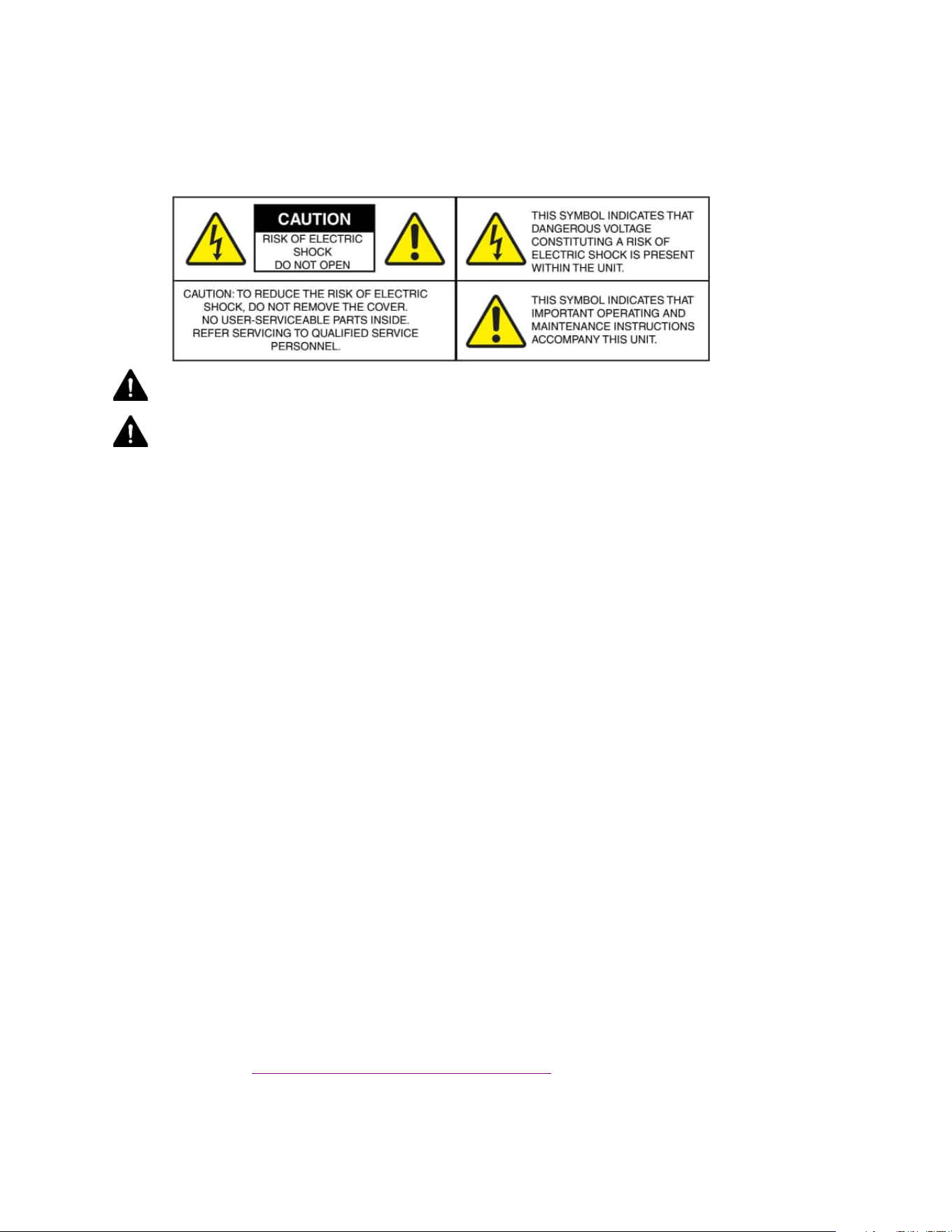
Cautions and Warnings
WARNING Installation and servicing should be performed only by qualified and
experienced technicians to conform to all local codes and to maintain your warranty.
WARNING Use only with the supplied power cable. Power output: 120W for 8 channels /
200W for 16 channels (1-8 channels cannot be exceeded 100W and 9-16 channels cannot be
exceeded 100W) PoE 802.3at in total.
CAUTION The Honeywell product uses a 3.0V CR1220 lithium battery as the power
supply for its internal real-time clock (RTC). Low battery power affects the operation of the
RTC, causing it to reset at every power-up.
Risk of explosion if the battery is incorrectly replaced.
Dispose of used batteries according to local regulations or the battery manufacturer's
instructions.
Replace only with an identical battery or a battery which is recommended by Honeywell.
Regulatory Statements
FCC Compliance Statement
Information to the User: This equipment has been tested and found to comply with the limits
for a Class A digital device, pursuant to part 15 of the FCC Rules. These limits are designed to
provide reasonable protection against harmful interference when the equipment is operated in
a commercial environment. This equipment generates, uses, and can radiate radio frequency
energy and, if not installed and used in accordance with the instruction manual, may cause
harmful interference to radio communications. Operation of this equipment in a residential
area is likely to cause harmful interference in which case the user will be required to correct the
interference at his own expense. Changes or modifications not expressly approved by the party
responsible for compliance could void the user's authority to operate the equipment.
CAUTION: This is a Class A product. In a domestic environment, this product may cause radio
interference in which case the user may be required to take adequate measures.
This Class A digital apparatus complies with Canadian ICES-003.
Please visit https://mywebtech.honeywell.com/Home
to check the complete FCC documents.
ii
Manufacturer’s Declaration of Conformance
North America
The equipment supplied with this guide conforms to UL 62368-1 and CSA C22.2 No. 62368-1.
Europe
The manufacturer declares that the equipment supplied is compliant with the European
Parliament and Council Directive on the restriction of the use of certain hazardous substances
in electrical and electronic equipment (2015/863/EU), the Low Voltage Directive
(2014/35/EU) and the essential requirements of the EMC directive (2014/30/EU),conforming
to the requirements of standards EN 55032 for emissions, EN 50130-4 for immunity, and EN
62368-1 for electrical equipment safety.
Waste Electrical and Electronic Equipment (WEEE)
Correct Disposal of this Product (applicable in the European
Union and other European countries with separate collection
systems).
This product should be disposed of, at the end of its useful life,
as per applicable local laws, regulations, and procedures.
Eurasian Conformity (EAC) RoHS
General Data Protection Regulation
Please be aware that this product can store personal data.
Personal data is protected by the General Data Protection Regulation (2016/679) in Europe
and therefore the owners of personal data have obtained certain rights thanks to this
regulation.
We strongly advise you to be fully aware of these owner (“data subjects”) rights as well as which
limitations you have to obey regarding the use and distribution of this data.
Further details can be found on the GDPR website of the EU:
https://ec.europa.eu/commission/priorities/justice-and-fundamental-rights/data-
protection/2018-reform-eu-data-protection-rules_en
Important Safeguards
Read and keep these instructions.
• Please ensure that your installation area can safely support the weight of the unit.

iii
• Do not drop the unit or subject it to physical shock.
• Avoid operating or storing the unit in extremely humid, dusty, hot/cold environments,
where the operating temperature is outside the recommended range of 14°F to 131° F (-
10°C to 55°C). HN300802xxE/HN301602xxE: 14°F to 113°F (-10°C to 45°C).
• Avoid operating the unit close to sources of powerful electromagnetic radiation, such as
radio or TV transmitters.
• Ensure to connect the power cord to a socket-outlet with earthing connection, or
equivalent.
• The product is only to be connected to PoE network without routing to outside plant.
Safety Instructions
Before installing or operating the unit, read and follow all instructions. After installation,
retain the safety and operating instructions for future reference.
1.
HEED WARNINGS - Adhere to all warnings on the unit and in the operating instructions.
2.
INSTALLATION
• Install in accordance with the manufacturer’s instructions.
• Installation and servicing should be performed only by qualified and experienced
technicians to conform to all local codes and to maintain your warranty.
• Any wall or ceiling mounting of the product should follow the manufacturer’s
instructions and use a mounting kit approved or recommended by the manufacturer.
3.
POWER SOURCES - This product should be operated only from the type of power source
indicated on the marking label. If you are not sure of the type of power supplied to your
facility, consult your product dealer or local power company.
4.
MOUNTING SYSTEM - Use only with a mounting system recommended by the
manufacturer or sold with the product.
5.
ATTACHMENTS/ACCESSORIES - Do not use attachments/accessories not
recommended by the product manufacturer as they may result in the risk of fire, electric
shock, or injury to persons.
6.
CLEANING - Do not use liquid cleaners or aerosol cleaners. Use a damp cloth for cleaning.
7.
SERVICING - Do not attempt to service this unit yourself. Refer all servicing to qualified
service personnel.
8.
REPLACEMENT PARTS - When replacement parts are required, be sure the service
technician has used replacement parts specified by the manufacturer or have the same
characteristics as the original part. Unauthorized substitutions may result in fire, electric
shock or other hazards. Using replacement parts or accessories other than the original
manufacturers may invalidate the warranty.
iv
Warranty and Service
Subject to the terms and conditions listed on the product warranty, during the warranty period
Honeywell will repair or replace, at its sole option, free of charge, any defective products
returned prepaid.
In the event you have a problem with any Honeywell product, please call Customer Service for
assistance or to request a Return Merchandise Authorization (RMA) number.
Be sure to have the model number, serial number, and the nature of the problem available for
the technical service representative.
Prior authorization must be obtained for all returns, exchanges, or credits. Items shipped to
Honeywell without a clearly identified Return Merchandise Authorization (RMA) number
may be refused.
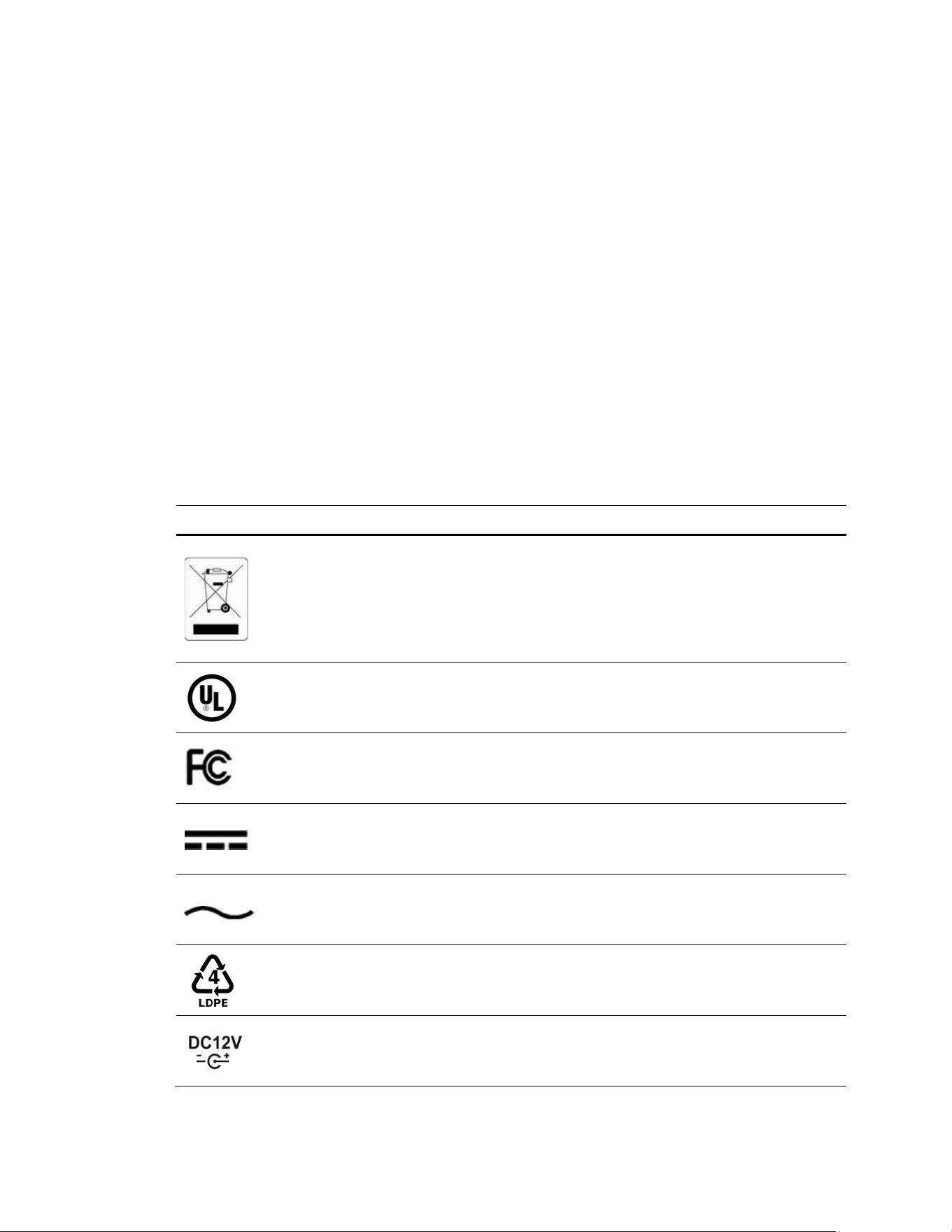
List of Symbols
The following is a list of symbols that might appear on the NVR.
Symbol Explanation
The WEEE symbol.
This symbol indicates that when the end-user wishes to discard this
product, it must be sent to separate collection facilities for recovery
and recycling. By separating this product from other household-
type waste, the volume of waste sent to incinerators or landfills will
be reduced, and thus natural resources will be conserved.
The UL compliance logo.
This logo indicates that the product has been tested and is listed by
the Underwriters Laboratories.
The FCC compliance logo.
This logo indicates that the product conforms to Federal
Communication’s Commission compliance standards.
The direct current symbol.
This symbol indicates that the power input/output for the product is
direct current.
The alternating current symbol.
This symbol indicates that the power input/output for the product is
alternating current.
The LDPE symbol.
This symbol indicates that this product is made of Low-Density
Polyethylene (LDPE).
The Direct Current symbol.
This symbol indicates that the product operates from a 12 V direct
current.
v
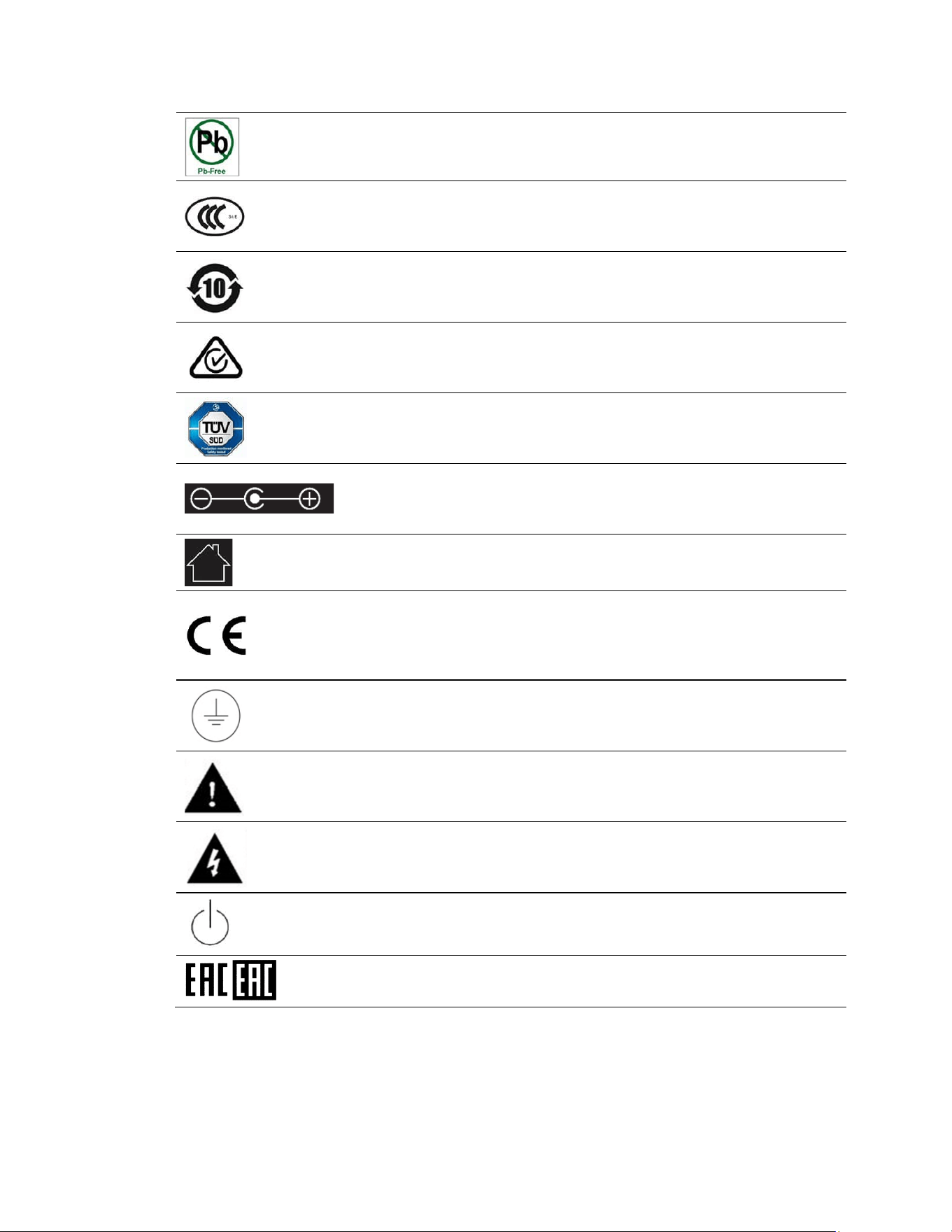
The Lead-free symbol.
This symbol indicates that the product does not contain lead (Pb).
The CCC compliance logo.
This logo indicates that the product conforms with the China
Compulsory Certification guidelines.
The Environment Friendly Use-period symbol.
This symbol indicates the length of time that this electronic product
can used without harming the environment.
The RCM Compliance symbol.
This symbol indicates that the product conforms with the Australian
RCM guidelines.
The TVU Lab symbol.
This symbol indicates that the product has been safety tested by
the TUV Lab.
The Direct Current symbol.
This Direct Current symbol indicates that the product operates
direct current.
This symbol indicates that the product is to be used indoors.
The CE Compliance logo.
This logo indicates that the product conforms to the relevant
guidelines/standards for the European Union harmonization
legislation.
The Protective Earth symbol.
This symbol indicates that the marked terminal is intended for
connection to the protective earth/grounding conductor.
This symbol is used to direct attention to important information.
This symbol warns that the corresponding action could result in an
electric shock.
This symbol indicates On/Standby functionality of the
corresponding control/button/switch.
Eurasian Conformity (EAC) RoHS

vi
Regulatory Information
The regulatory information herein might vary according to the model you purchased. Some
information is only applicable for the country or region where the product is sold.
FCC Information
CAUTION
Changes or modifications not expressly approved by the party responsible for compliance
could void the user's authority to operate the equipment.
FCC conditions
This device complies with part 15 of the FCC Rules. Operation is subject to the following two
conditions:
• This device may not cause harmful interference.
• This device must accept any interference received, including interference that may cause
undesired operation.
FCC compliance
This equipment has been tested and found to comply with the limits for a digital device,
pursuant to part 15 of the FCC Rules. This equipment generates, uses, and can radiate radio
frequency energy and, if not installed and used in accordance with the instructions, may cause
harmful interference to radio communication.
• For class A device, these limits are designed to provide reasonable protection against
harmful interference in a commercial environment. Operation of this equipment in a
residential area is likely to cause harmful interference in which case the user will be required
to correct the interference at his own expense.
• For class B device, these limits are designed to provide reasonable protection against
harmful interference in a residential installation. However, there is no guarantee that
interference will not occur in a particular installation. If this equipment does cause harmful
interference to radio or television reception, which can be determined by turning the
equipment off and on, the user is encouraged to try to correct the interference by one or
more of the following measures:
• Reorient or relocate the receiving antenna.
• Increase the separation between the equipment and receiver.
• Connect the equipment into an outlet on a circuit different from that to which the
receiver is connected.
• Consult the dealer or an experienced radio / TV technician for help.
Privacy Protection Notice
As the device user or the data controller, you might collect personal data or others such as
face, fingerprints, car plate number, Email address, phone number and GPS and so on. You
need to be in compliance with the local privacy protection laws and regulations to protect the
legitimate right and interest of other people by implementing measures include but not limited
to: providing clear and visible identification to inform data subject the existence of surveillance
area and providing related contact.

vii
Table of Contents
About This Document .................................................................................................................................................. x
Overview of Contents ......................................................................................................................................................... x
Special Fonts and Symbols ............................................................................................................................................. x
How to Use This Document ............................................................................................................................................ x
1 Introduction ......................................................................................................................................................... 1
Overview of the Network Video Recorder ................................................................................................................. 1
Features of the Network Video Recorder ................................................................................................................. 1
Network Video Recorder Components ..................................................................................................................... 2
Using the On-screen Keyboard............................................................................................................................ 4
2 Getting Started .................................................................................................................................................... 5
Connecting External Devices ........................................................................................................................................ 5
Devices Connection .................................................................................................................................................. 6
Starting and Shutting Down the NVR ....................................................................................................................... 6
Starting the NVR ......................................................................................................................................................... 6
Shutting Down/Reboot the NVR ......................................................................................................................... 6
Device Initialization ............................................................................................................................................................ 7
3 Viewing Live Video .......................................................................................................................................... 12
About Live View .................................................................................................................................................................. 12
Live View Window .............................................................................................................................................................. 13
Toolbars ................................................................................................................................................................................. 13
Shortcut Menu ................................................................................................................................................................... 15
Working with the PTZ Control Panel (If applicable) ......................................................................................... 16
Configuring PTZ Settings.............................................................................................................................................. 17
4 Recording Video ............................................................................................................................................... 18
Manual Recording ............................................................................................................................................................ 18
Scheduled Recording ...................................................................................................................................................... 18
5 Playing Back and Search Videos ................................................................................................................ 20
Playing Recording Clips ................................................................................................................................................. 20
Searching Videos .............................................................................................................................................................. 21
Timeline Bar ......................................................................................................................................................................... 23
Backing Up Video .............................................................................................................................................................. 24
To Back Up Using the Playback Timeline Bar ............................................................................................. 24
To Back Up Using the Main Tool Bar .............................................................................................................. 25
6 Settings ............................................................................................................................................................... 27
Setting-Camera-Management .................................................................................................................................. 27
Change Password .................................................................................................................................................... 27
Adding a Camera ...................................................................................................................................................... 29
Removing a Camera ................................................................................................................................................ 29

viii
Network ......................................................................................................................................................................... 30
Camera Position ........................................................................................................................................................ 31
Setting-Camera-Media .................................................................................................................................................. 32
Stream Management .............................................................................................................................................. 32
Video ............................................................................................................................................................................... 34
Audio ............................................................................................................................................................................... 35
Setting-Camera-Schedule ........................................................................................................................................... 35
Recording Options ................................................................................................................................................... 35
Schedule ....................................................................................................................................................................... 36
Setting-Camera-Image .................................................................................................................................................. 38
Display ........................................................................................................................................................................... 38
Image Adjustment .................................................................................................................................................... 38
Setting-Camera-Motion Detection .......................................................................................................................... 39
Setting-Camera-PTZ settings ..................................................................................................................................... 40
Setting-Event-Event ........................................................................................................................................................ 41
Creating an Event ..................................................................................................................................................... 41
Removing an Event .................................................................................................................................................. 46
Setting-Event-Email ........................................................................................................................................................ 46
Setting-System-Information ....................................................................................................................................... 47
Setting-System-Maintenance .................................................................................................................................... 48
Setting-System-Display ................................................................................................................................................. 50
Setting-System-Log ........................................................................................................................................................ 51
Setting-User ........................................................................................................................................................................ 51
Creating a User .......................................................................................................................................................... 52
Removing a User ....................................................................................................................................................... 54
Setting-Login/Logout .................................................................................................................................................... 54
Setting-Storage ................................................................................................................................................................. 54
Creating a Volume .................................................................................................................................................... 54
Verify ............................................................................................................................................................................... 57
Settings-Network-IP ........................................................................................................................................................ 57
Settings-Network-Service ............................................................................................................................................. 58
Settings-Network-P2P ................................................................................................................................................... 59
7 Management over a Web Console ............................................................................................................. 60
Before Getting Started .................................................................................................................................................... 60
Login ....................................................................................................................................................................................... 61
Live View Screen ................................................................................................................................................................ 62
Camera List ................................................................................................................................................................. 63
Layout ............................................................................................................................................................................ 64
Layout Contents ....................................................................................................................................................... 64
Time & Log out ........................................................................................................................................................... 65
Live View Window ..................................................................................................................................................... 65
PTZ Panel...................................................................................................................................................................... 66
Event Panel .................................................................................................................................................................. 67
Search Recording Clips Screen .................................................................................................................................. 68
Camera List ................................................................................................................................................................. 69

ix
Layout ............................................................................................................................................................................ 70
Playback Panel .......................................................................................................................................................... 70
Event Panel .................................................................................................................................................................. 71
Settings Screen .................................................................................................................................................................. 72

x
About This Document
This document introduces the Honeywell 30 Series Network Video Recorder. It explains how to
operate the Network Video Recorder.
This document is intended for installers and users.
Overview of Contents
This document contains the following chapters:
• Chapter 1, Introduction, describes the features, front and rear panel layout of the NVR.
• Chapter 2, Getting Started, describes how to connect the NVR and log on to its user
interface.
• Chapter 3, Viewing Live Video, describes the NVR’s real-time monitoring mode and
associated NVR operations, including controlling a PTZ camera (if connected).
• Chapter 4, Recording Video, describes how to manually record a video clip and how to set
up automatic recording.
• Chapter 5, Playing Back and Search Videos, describes how to search for and play back
recorded video, and how to save recorded files to an external storage device.
• Chapter 6, Settings, describes how to configure NVR settings.
• Chapter 7, Management over a Web Console, describes how to operate the NVR’s through
web client.
Special Fonts and Symbols
Italic
Indicates referenced chapter, figure number, page number, etc. In
the electronic version,
click on italicized text to switch to the
corresponding page.
Bold
Indicates a button
, or menu item.
Note
Alerts the user to the presence of important operating and
maintenance (servicing) instructions in the literature accompanying
the product.
How to Use This Document
• Pictures in this manual are for reference only, please see the actual items for details.

xi
• This product is subject to updates or changes without prior notice.
• Please familiarize yourself with this manual before operation and ensure its accessibility
for future use.
• The manual has been reviewed and its accuracy is guaranteed. If there is any uncertainty
or controversy, please refer to the final explanation of Honeywell. Honeywell does not take
any responsibility for any consequences caused by the misunderstanding of the manual or
incorrect operations by the user.


Introduction
1
1 Introduction
This chapter contains the following sections:
• Overview of the Network Video Recorder on page 1.
• Features of the Network Video Recorder on page 1.
• Network Video Recorder Components on page 2.
Overview of the Network Video Recorder
The 30 Series Network Video Recorder is a high-performance network video recorder. It
supports:
• Local Live View
• Multiple-window display
• Local recorded file storage
• Mouse shortcut menu operation
The 30 Series Network Video Recorder also features multiple storage options:
• USB storage
• Front-end storage: The NVR’s HDD storage
Because of the flexibility of its design, the 30 Series Network Video Recorder can be used in a
variety of applications, such as public security, water conservancy, transportation, and
education.
Features of the Network Video Recorder
User Management
• Different user rights for each group; each user belongs to a specific group.
• User rights cannot exceed Group rights.
Storage
• Supports central server backup that follows your configuration and setup in Alarm or
Schedule settings.
• Supports recording through the Internet. The recorded files are stored on the client’s PC.
Alarm
• Responds to external alarms almost instantly, based on your pre-defined relay setup. You
can also configure a buzzer prompt upon alarm detection.
30 Series Network Video Recorder User Guide
2
Network Monitor
• The NVR supports the transmission of audio/video data that is compressed by an IP
camera, which is then decoded for display. The delay time is more than 500 ms (sufficient
network bandwidth support is required).
• Compatible to broadcast audio/video with the following transmission protocols: HTTP,
HTTPS, TCP, RTP/RTCP.
• Transmits some alarm data or alarm information through SMTP.
• Supports Internet access through the WAN.
Window Split
Video compression plus a digital process allows the NVR to split the monitor screen to show
up to 8 video channels (HN300802xxx)/16 video channels(HN301602xxx) at the same time.
Recording
Supports a schedule for recording. The recorded files can be saved in the HDD. You can
search and view the recorded video that is stored locally or through the Internet connection.
Backup
Supports backing up video to a USB device on local side or to PC client on web side.
Network Management
• Supports NVR configuration and management through the Internet.
• Supports device management through the Internet.
Auxiliary
• Supports viewing real-time system resources information and running statistics display.
• Supports log file.
• Supports local GUI output and shortcut menu operation with a computer mouse and
keyboard.
• Supports setting up the configuration of a camera.
Network Video Recorder Components
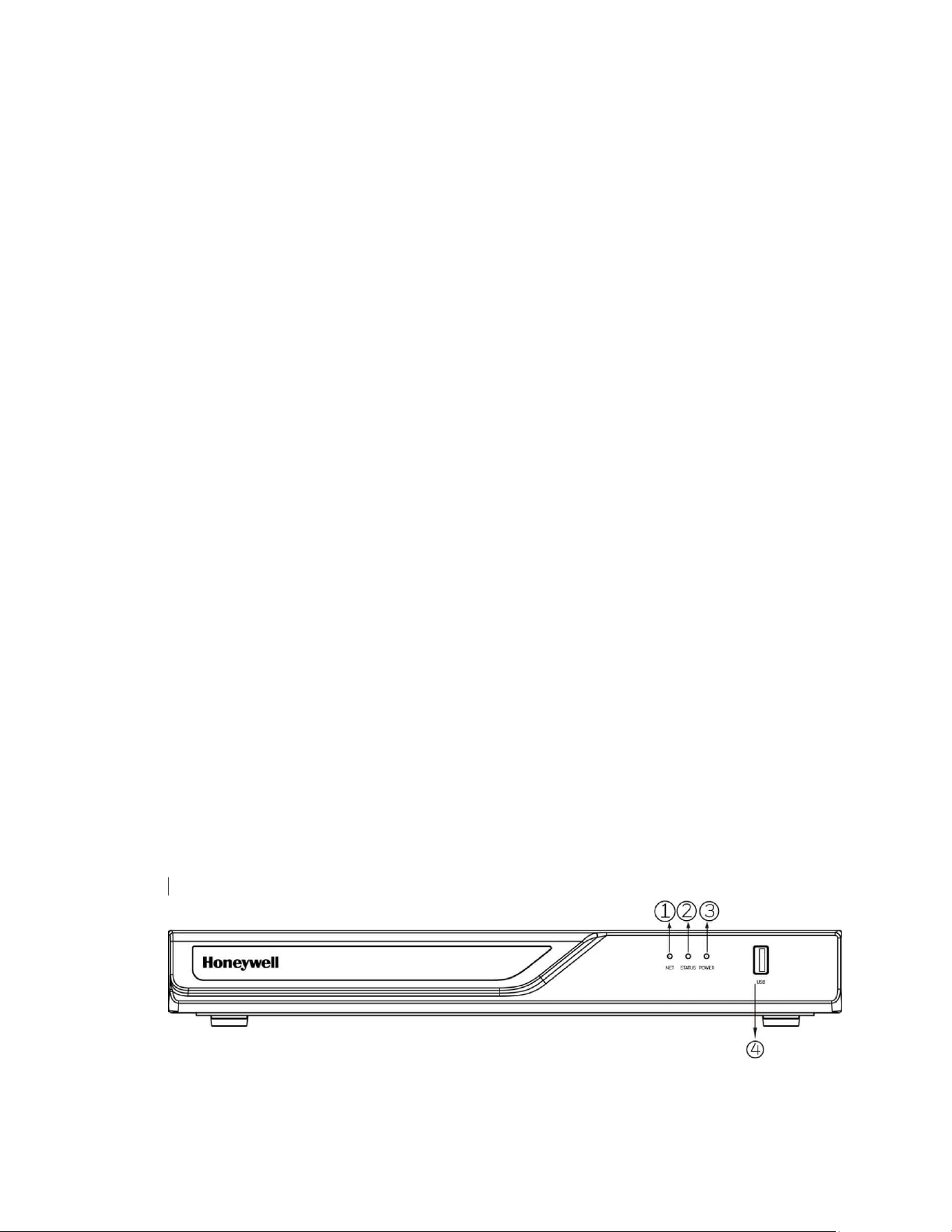
Figure 1-1 NVR Front Panel
Introduction
3
Table 1-1 NVR Front Panel Description
Name Behavior Definitions
1. Network uplink
status/activity LED
Blinking Green Data is being transmitted or received.
OFF The Ethernet uplink is disconnected.
2. System status LED
Constant Green System ready.
Blinking Green every
1 second
Updating firmware or device pack.
Constant Red
1. S.M.A.R.T.-related disk errors.
2. A configured HDD is missing.
3. HDD is full. Buzzer will also be
sounded. When buzzer is turned off,
LED will return normal.
3. Power status LED
Solid Green The NVR is powered on.
OFF The NVR is powered off.
4. USB port
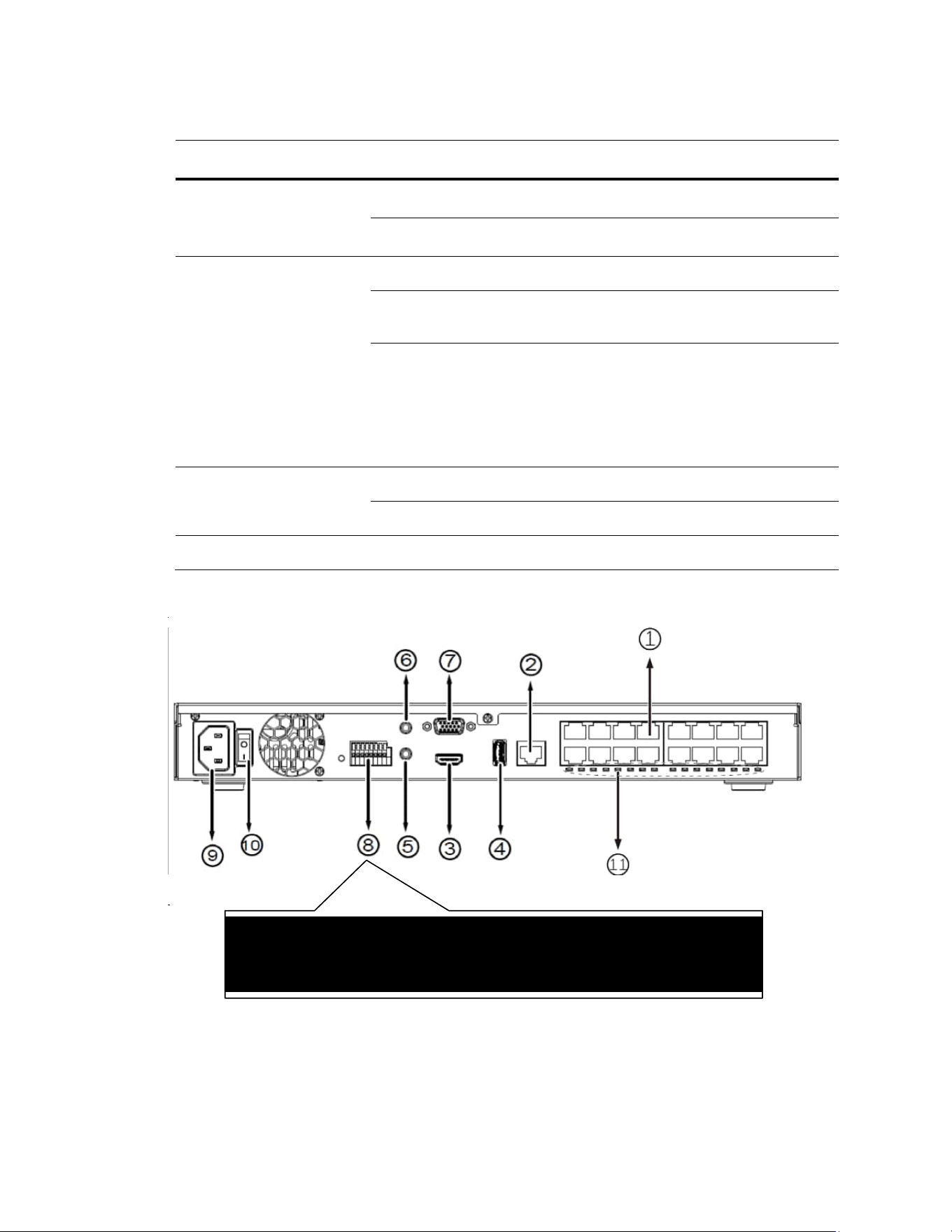
Figure 1-2 NVR Back Panel
ALARM OUT
ALARM IN
GND
NO COM IN 1 IN 2 IN 3 IN 4 IN 1/2 IN 3/4
30 Series Network Video Recorder User Guide
4
Table 1-2 NVR Back Panel Description
1
HN300802xxx: PoE ports # 1 to #8 for
connecting to cameras directly.
HN301602xxx:
PoE ports # 1 to #16 for
connecting to cameras directly.
7 VGA
2 RJ45 port - GbE uplink 8 Alarm In/Alarm Out terminal block
3 HDMI 9 Power socket (110/240V AC)
4 USB port 10 Power Switch
5 Audio IN (Reserved) 11
Channel LED: 1 to 8 / 16 (from left
to right)
6 Audio OUT
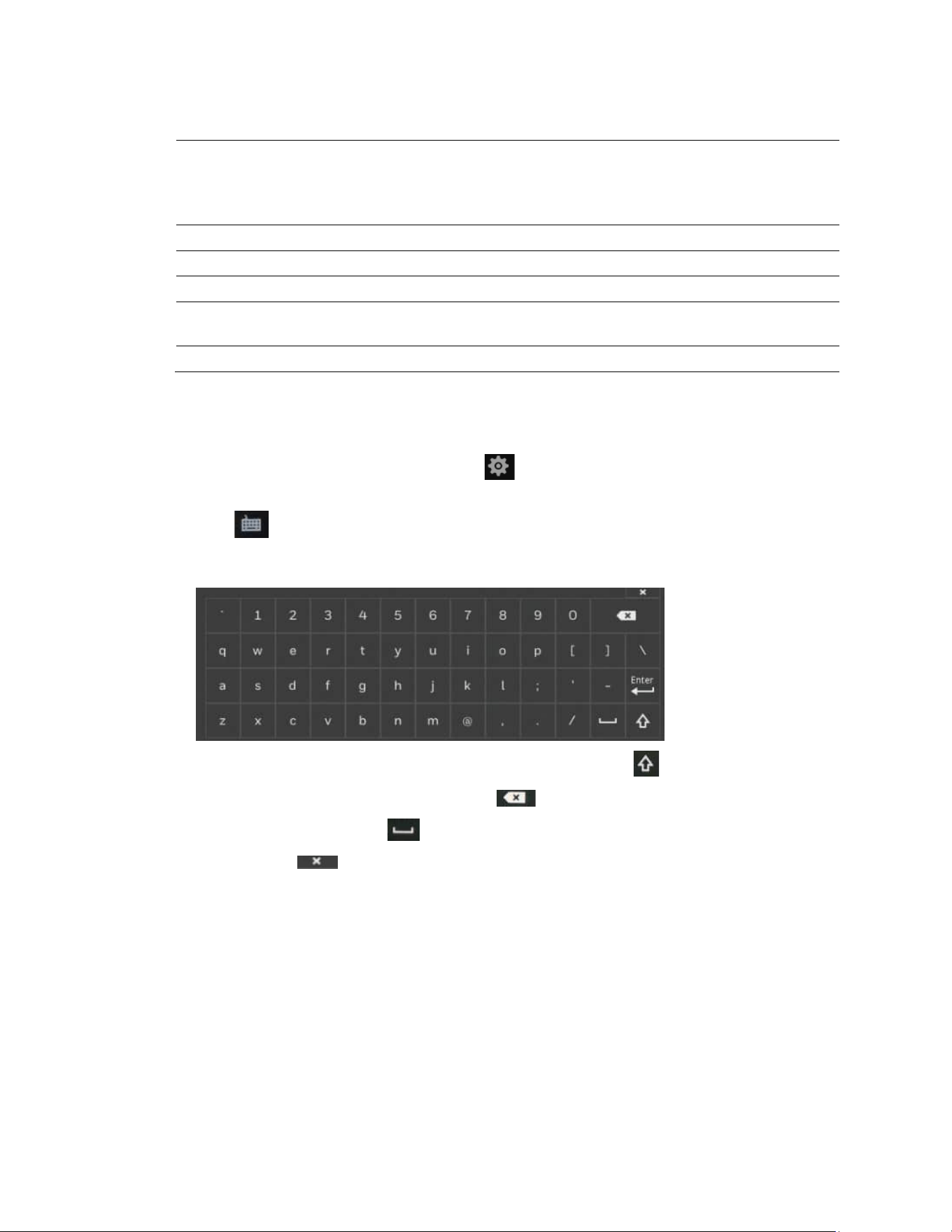
Using the On-screen Keyboard
1.
To display the on-screen keyboard, click on the main toolbar (see Figure 3-3 Main
Toolbar) in live view screen to go to the settings screen.
2.
Click on the menu to expand the on-screen keyboard.
Figure 1-3 On-screen Keyboard
• To switch between lowercase and uppercase letters, click .
• To delete the previous character, click .
• To insert a space, click
.
3.
Click Enter or to close the on-screen keyboard.

Getting Started
5
2 Getting Started
This chapter contains the following sections:
• Connecting External Devices on page 5.
• Starting and Shutting Down the NVR on page 6.
• Device Initialization on page 7.
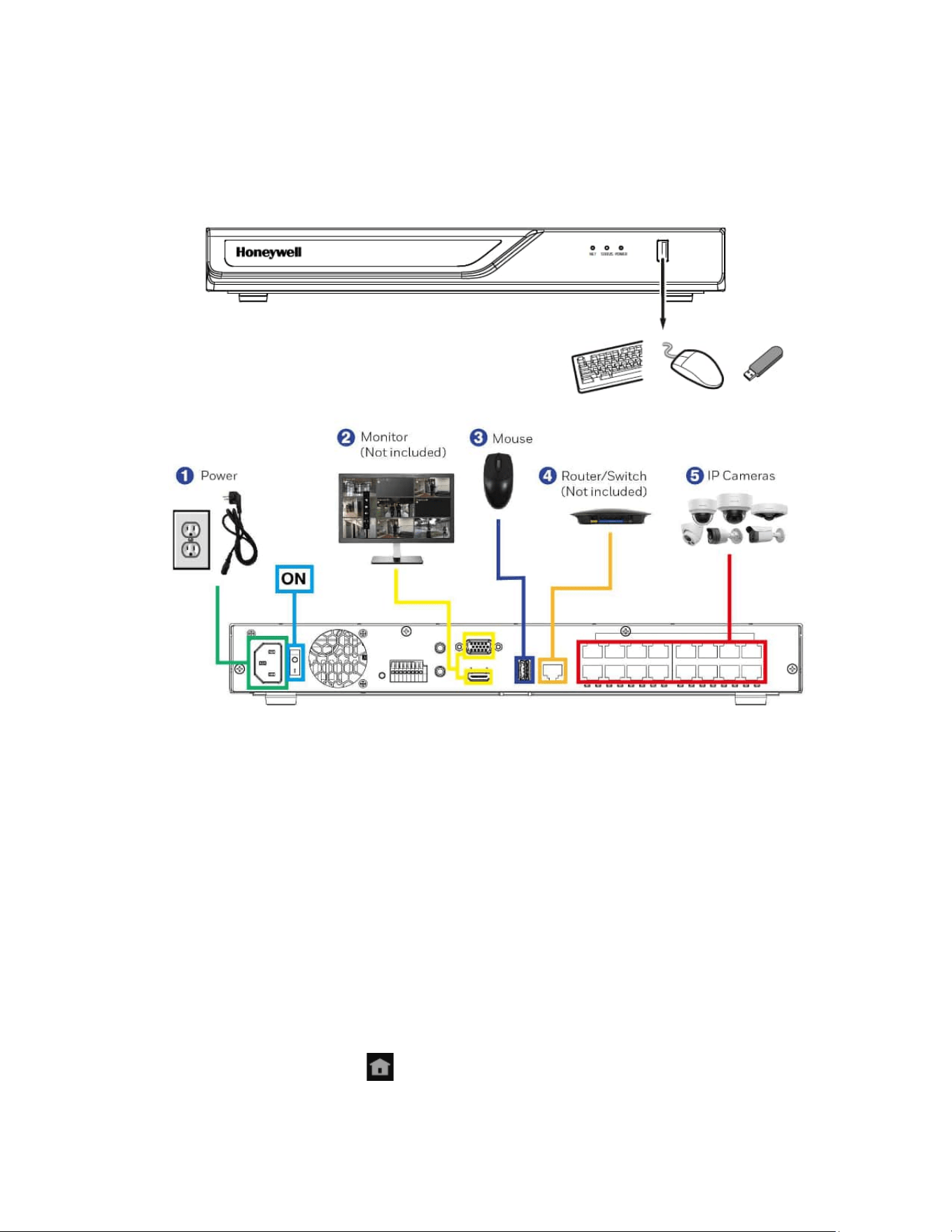
Connecting External Devices
• Connect the cameras
Connect the RJ45 network cables from the cameras to PoE ports.
• Connect the monitor
Connect a VGA cable (not supplied) to the VGA interface and/or an HDMI cable (not supplied)
to the HDMI interface. Connect the other end to a monitor (do not use a TV). Simultaneous
VGA and HDMI output is supported.
• Connect the mouse
Connect the supplied USB mouse to the USB port.
• Connect the Ethernet cable
Connect the supplied CAT5e Ethernet cable to the network port. Connect the other end to a
router on your network.
• Connect audio devices (if applicable)
To record audio, connect the audio sources to the AUDIO IN connectors. To play audio,
connect an audio output device (low-impedance headphones, speaker, or amplifier) to the
AUDIO OUT connector (200 mV / 1 kilohm).
• Connect alarm devices (if applicable)
Connect alarm devices to the alarm in/out interface. If the alarm inputs use external power,
the device must have the same ground as the NVR.
• Connect a PTZ camera (if applicable)
Your embedded NVR communicates with PTZ cameras through the Network. Ensure that your
camera is correctly connected to the Network.
• Connect the power cable
Use only with the supplied power cable. Power output: 120W for 8 channels / 200W for 16
channels. PoE 802.3at in total. Use of an uninterruptible power supply (UPS) is strongly
recommended.
30 Series Network Video Recorder User Guide
6
Devices Connection
The following diagram shows a typical NVR connection:
Figure 2-1 Devices Connection
Starting and Shutting Down the NVR
Starting the NVR
1. Verify that the NVR is connected to an appropriate power source.
2. Turn on the power switch (See No. 11 in Figure 1-2) on the back panel to start the NVR.
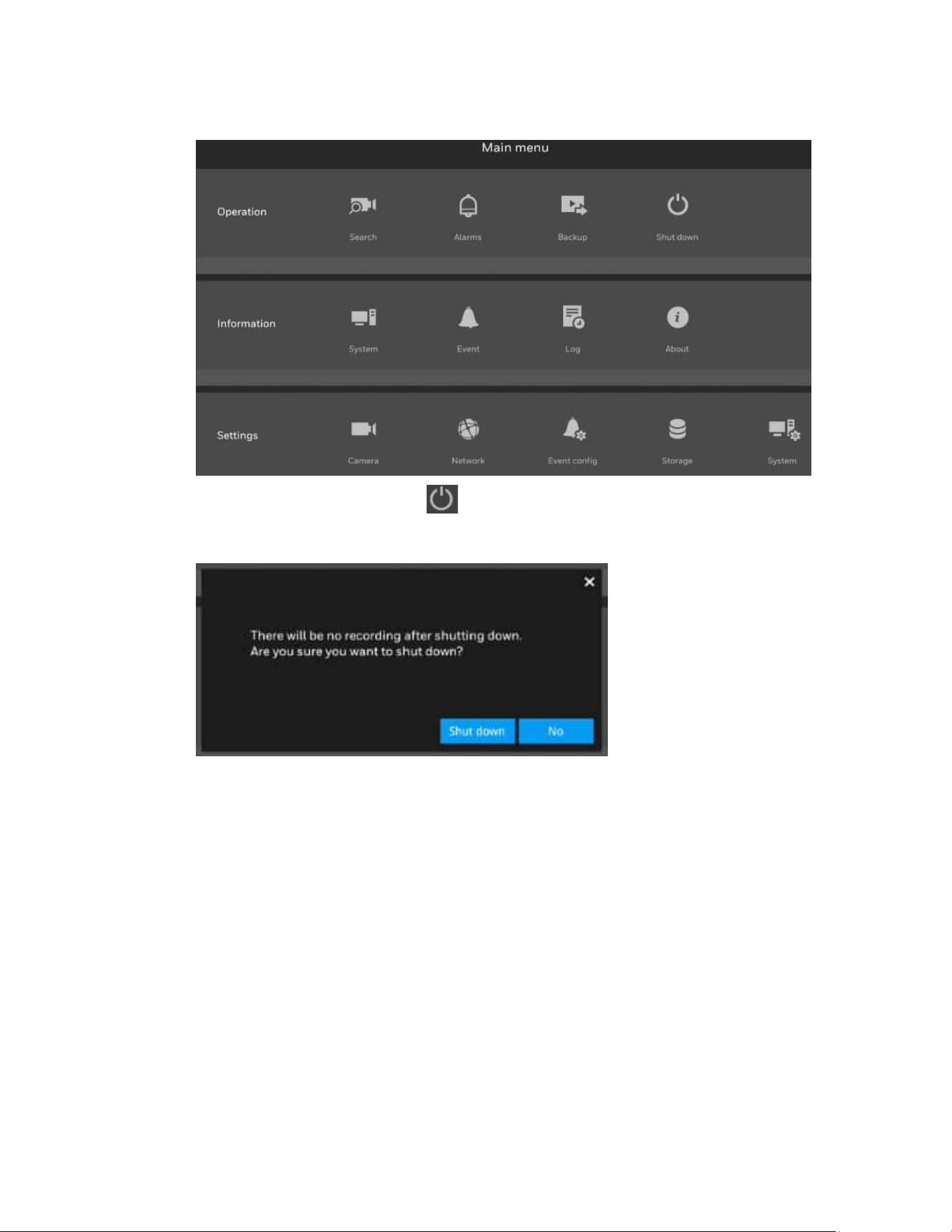
Shutting Down/Reboot the NVR
To prevent damage to the hard drive, follow these steps to shut down the NVR:
1. In live view screen, click (Main Menu) on the main toolbar (see Figure 3-3 Main
Toolbar).
Getting Started
7
Figure 2-2 Main Menu
2. In the Main Menu window, click Shut down.
Figure 2-3 Shutdown
3. Click Shut down button.
Device Initialization
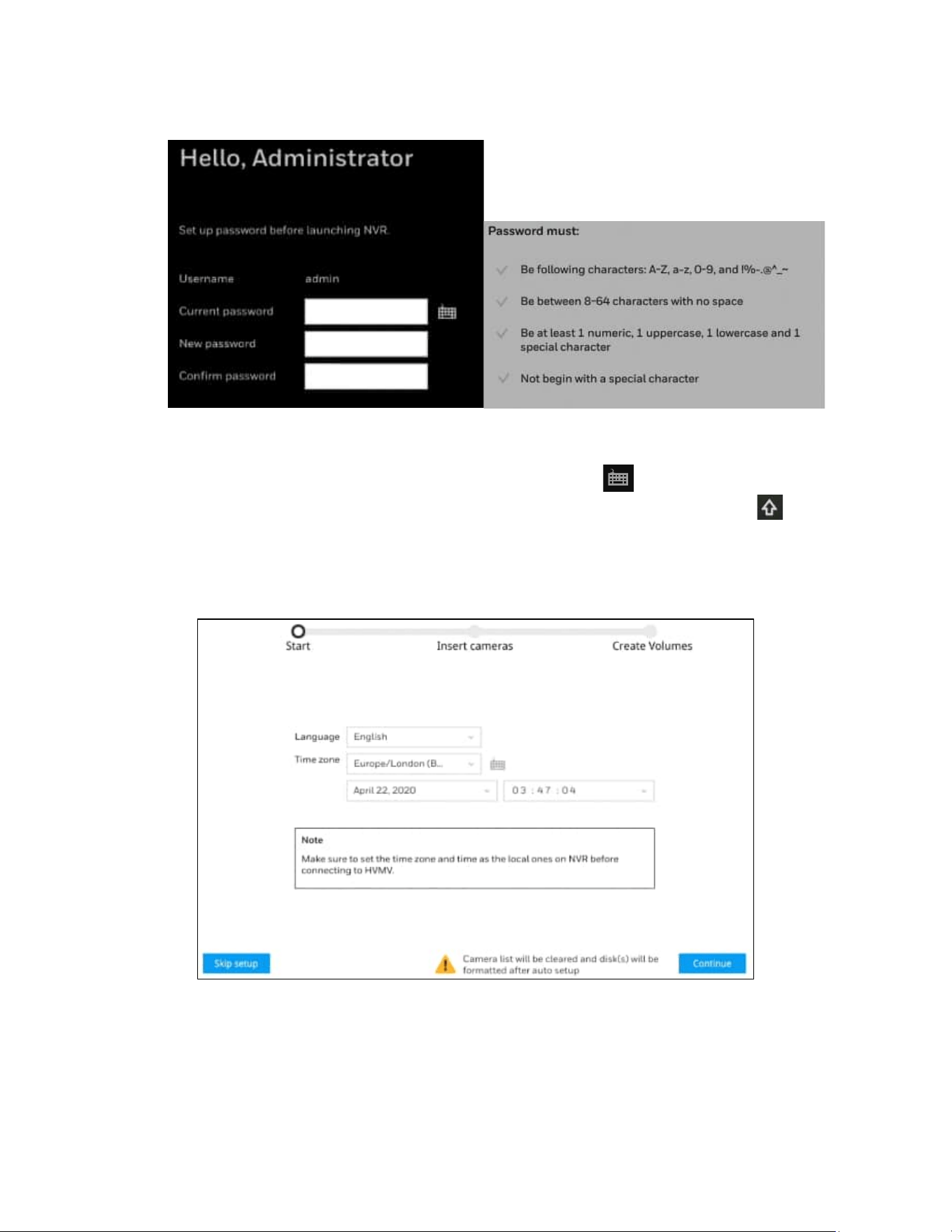
When the NVR has booted up, set password before launching NVR.
30 Series Network Video Recorder User Guide
8
Figure 2-4 Device Initialization –Password Setup
1. Enter the current password “1234” and set the new password according to the password
requirements. The default username is admin.
You can use the USB mouse to input the password. Click to expand the on-screen
keyboard to switch the input mode between numbers and English letters; click to
change between lowercase and uppercase.
2. When the password setup is completed, click Apply and the following window is displayed:
Figure 2-5 Device Initialization-Language and Time Zone
Select the language and time zone from the dropdown list and set date and time.
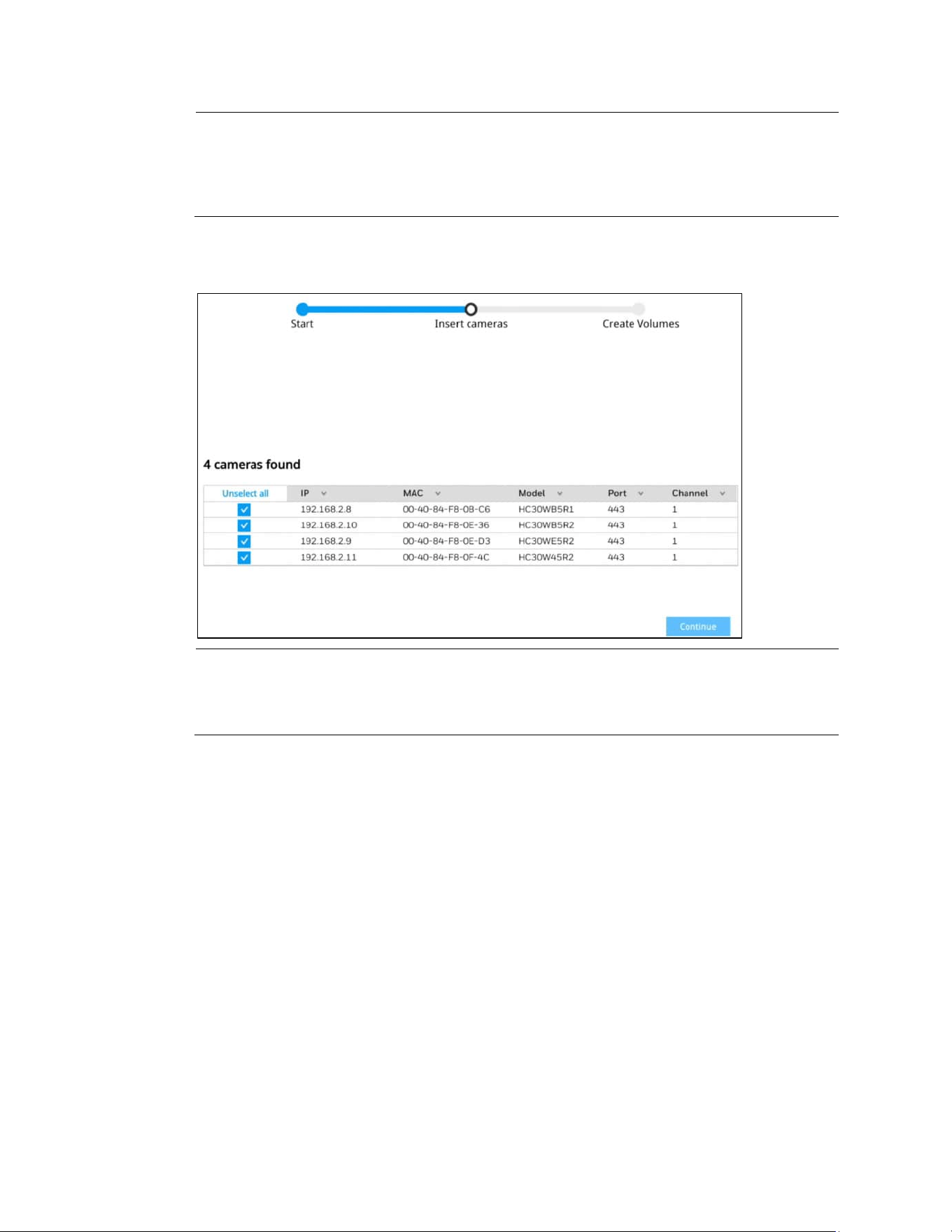
Getting Started
9
Note
• See Creating a Volume on page 54 to manually create the volume if you
click Skip setup to skip this auto setup.
• After the hardware is reset, skipping setup is required to ensure the hard
disk is not formatted.
3. Click Continue and cameras that have been searched within the LAN will be listed:
Figure 2-6 Device Initialization-Search for Cameras
Note
•
This step will not be stayed for long if the cameras are accessed by
default password.
•
30 series Camera FW version is V19.12.13 or later.
4. Click Continue and the following windows is displayed:
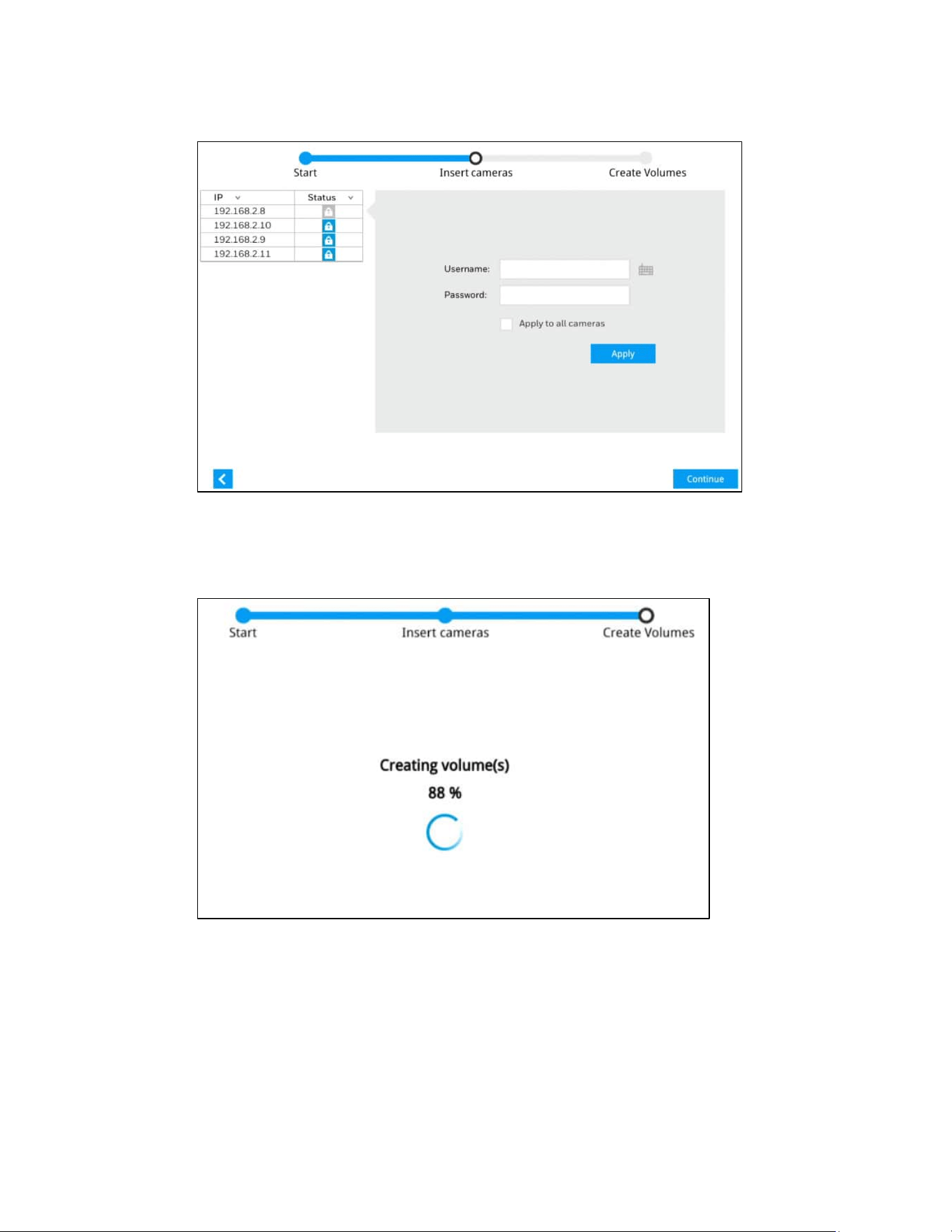
30 Series Network Video Recorder User Guide
10
Figure 2-7 Device Initialization-Insert Cameras
Enter the username and password of the camera.
5. Click Continue and the following window is displayed:
Figure 2-8 Device Initialization-Creating Disks
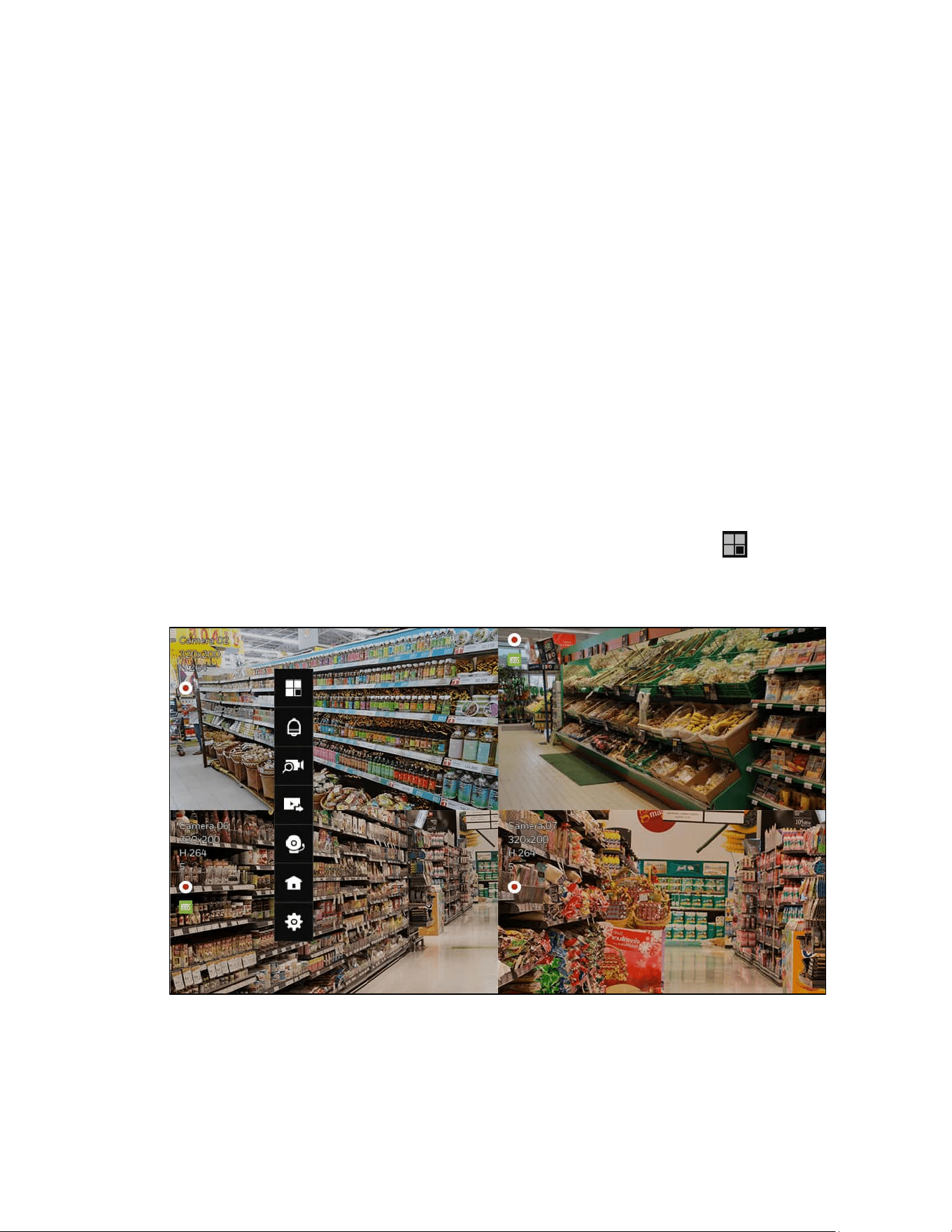
When the initialization is completed, the live view screen is displayed:
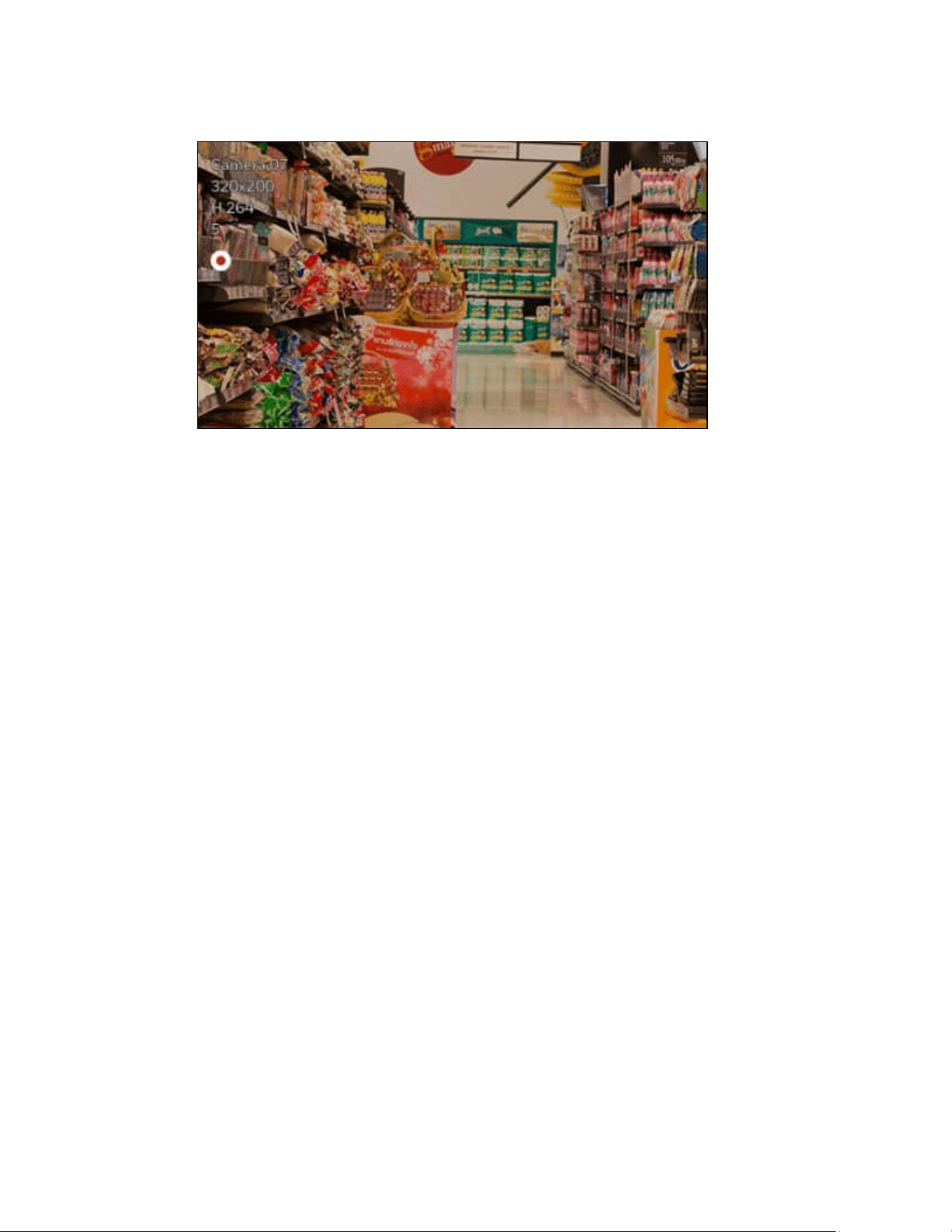
Getting Started
11
Figure 2-9 Live View Screen
30 Series Network Video Recorder User Guide
12
3 Viewing Live Video
This chapter contains the following sections:
• About Live View on page 12.
• Live View Window on page 13.
• Toolbars on page 13.
• Shortcut Menu on page 15.
• Working with the PTZ Control Panel on page 16.
• Configuring PTZ Settings on page 17.
About Live View
Live view screen is the NVR’s default screen. When the NVR is started, live video from the
connected cameras is displayed on the screen. Change the window layout via on the main
toolbar.
Figure 3-1 Live View Screen
Viewing Live Video
13
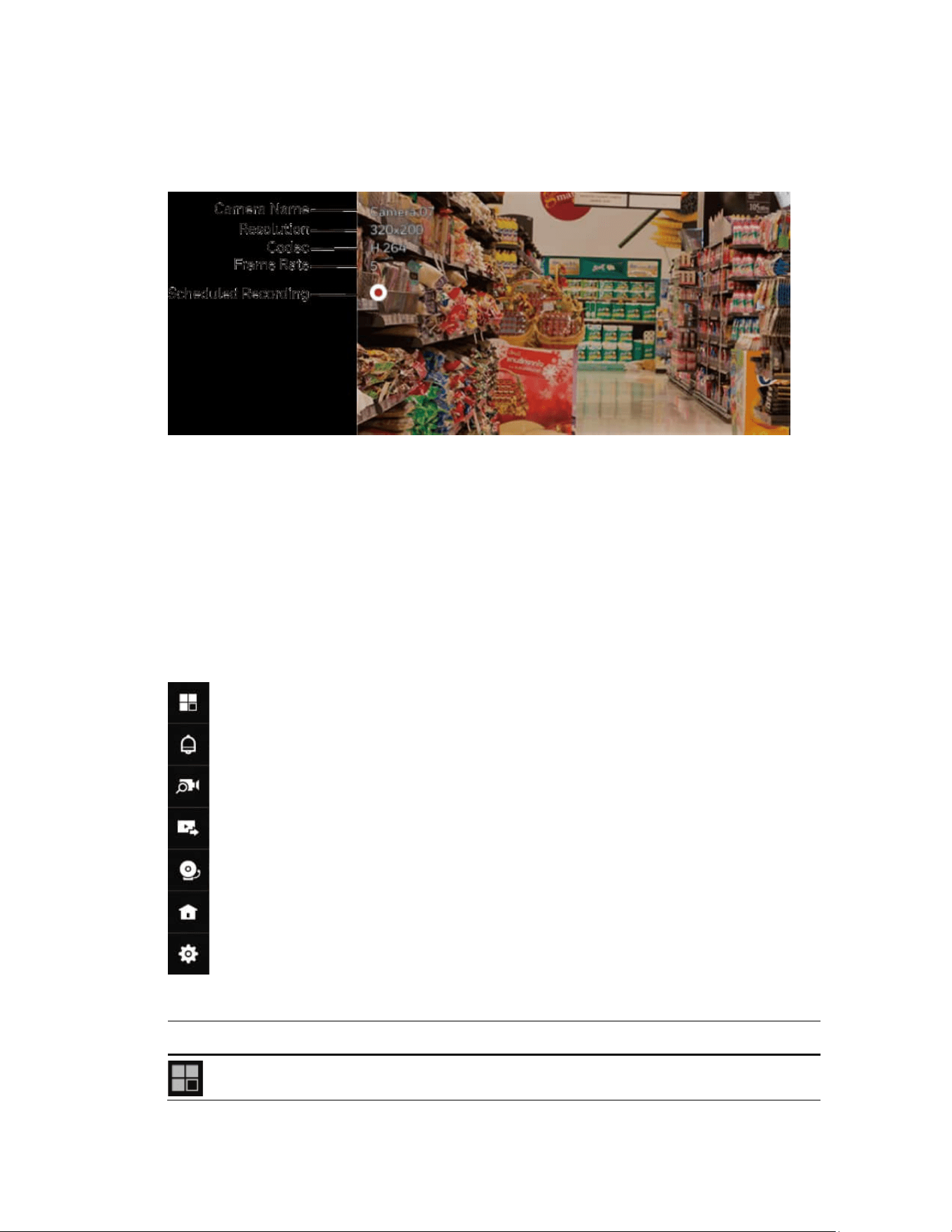
Live View Window
Figure 3-2
Toolbars
There are two toolbars (the main toolbar and the camera toolbar) that appear in front of the
live view screen. Make sure a mouse is attached to your NVR. Move your mouse cursor on live
view screen, and the Main Toolbar will appear. Click to select a view window, the Camera
Toolbar will appear. Toolbars can be dragged to desirable place using mouse.
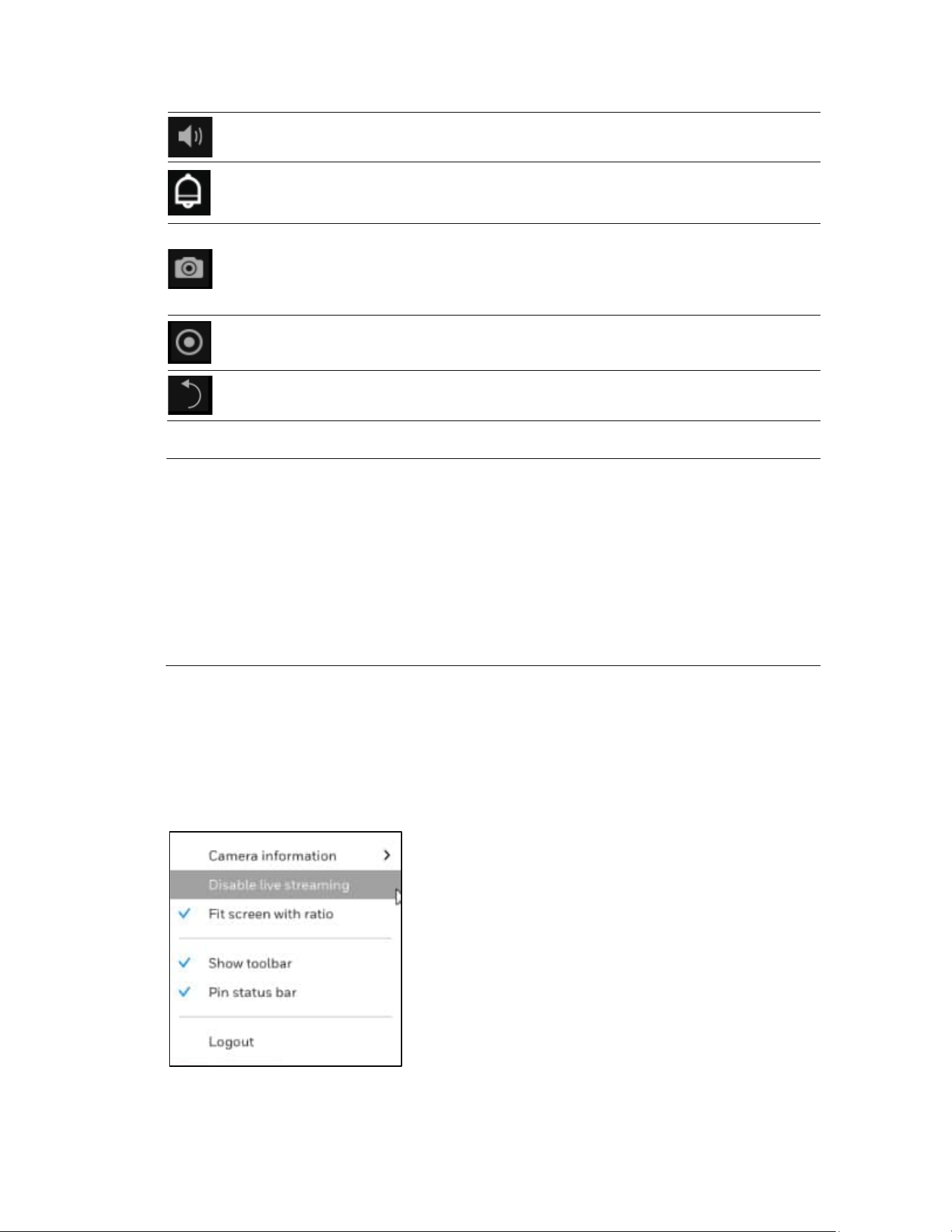
To hide the toolbar, right click the mouse on the window and deselect “Show toolbar”.
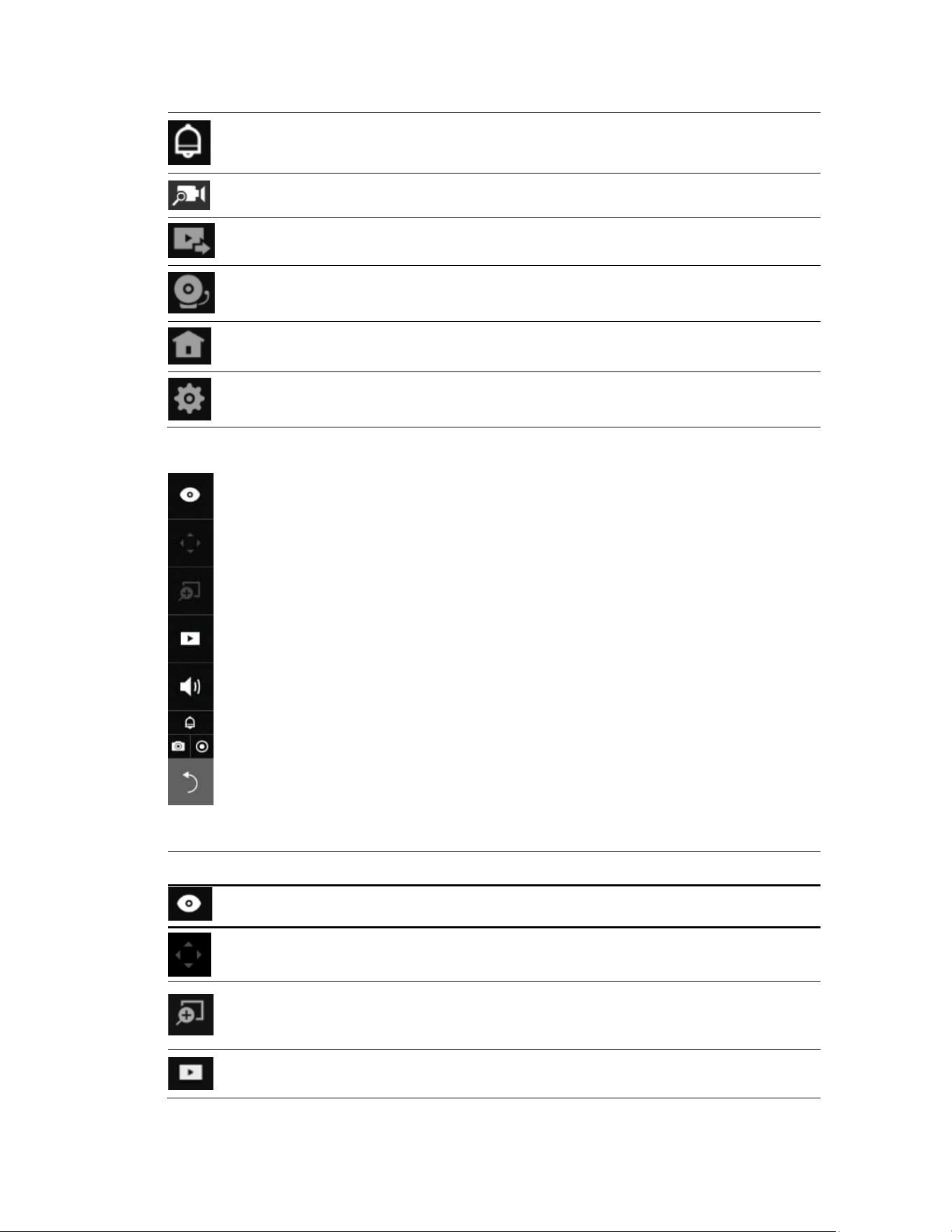
Figure 3-3 Main Toolbar
Table 3-1 Main Toolbar
Icon
Name
Function
Layout
Select screen layout format and rotation.
30 Series Network Video Recorder User Guide
14
Alarm In/ Out
Set the Alarm in /out.
Search
Search for the recording clips.
Backup
Export recordings.
Stop buzzer
Stop buzzer.
Main Menu
Open the main menu window.
Settings
Open the settings interface.
Figure 3-4 Camera Toolbar
Table 3-2 Camera Toolbar
Icon
Name
Function
Fisheye
Expand the fisheye display mode.
PTZ
Expand the PTZ control panel. It is only activated
with a camera that supports mechanical PTZ.
Digital zoom
This applies when a camera is displaying the full
of its field of view. Click it to zoom in on the field
of view.
Play recording clip
Search for the recording clips.
Viewing Live Video
15
Audio
Adjust the volume or mute the audio.
Alarm In/ Out
Set the Alarm in /out.
Snapshot
Click to take a snapshot from the camera
currently selected.
Note: this function only saves the snapshot (in
JPEG) to a USB thumb drive.
Manual recording
Click to start a manual recording from a selected
camera. Click again to stop the recording.
Deselect camera
Click to return to the Live View window.
Note
• Live view: if no management activities occur for a period, the tool
bars disappear from screen. When in the idle mode, mouse cursor
and tool bars will disappear. Moving the mouse cursor will re-
activate the screen.
• Settings page: If left unattended for a period, system will
automatically log out. The system will prompt for user credentials if a
user tries to access the Settings page again.
• Search recording clips window: If currently there is a video
playback, the system will not enter the idle mode.
Shortcut Menu
The shortcut menu is displayed by right-clicking on the selected window.
Figure 3-5 Shortcut Menu
30 Series Network Video Recorder User Guide
16
Working with the PTZ Control Panel (If applicable)
You can control a PTZ camera connected to the NVR through a network connection using the
on-screen PTZ control panel on the camera tool bar.
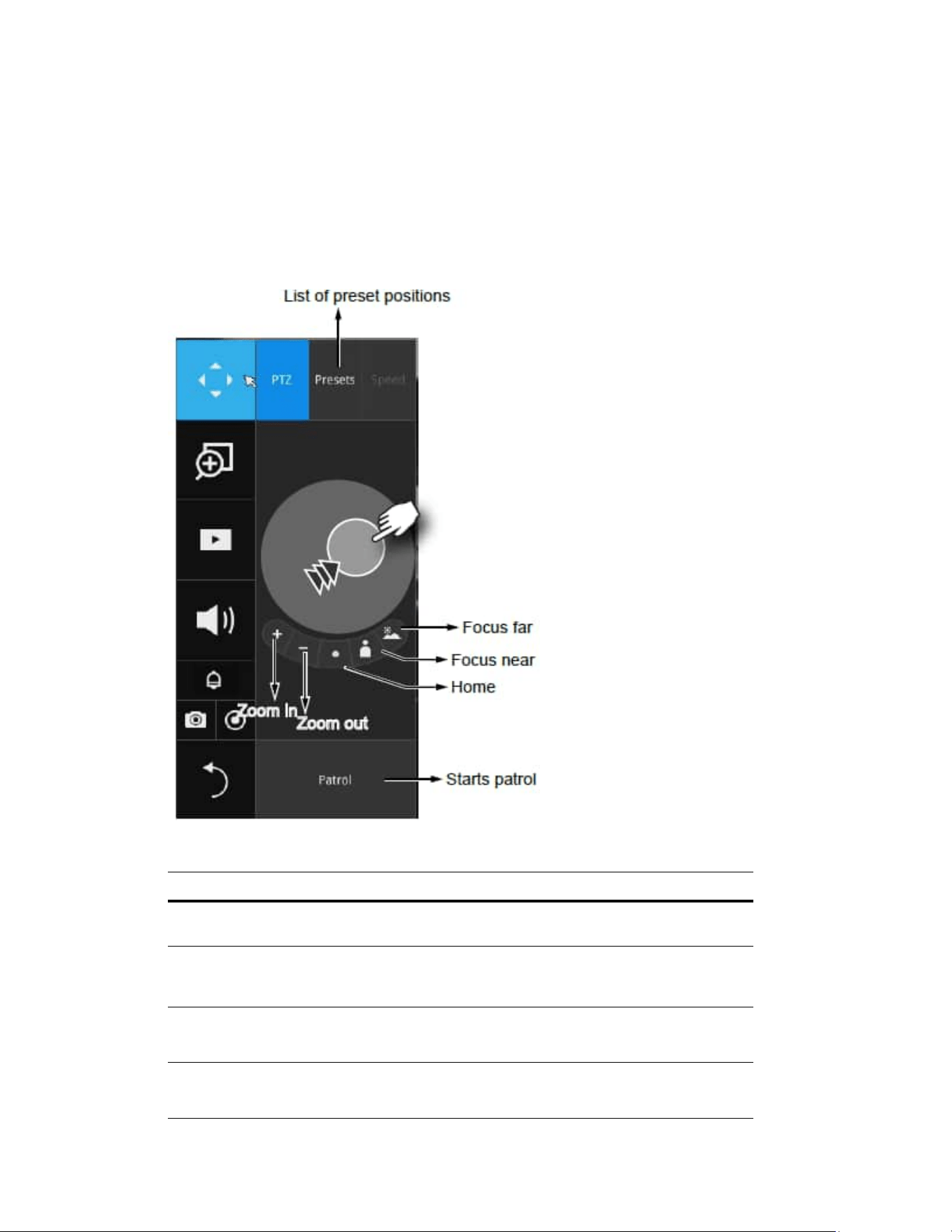
PTZ Control Panel
Figure 3-6 PTZ Control Panel
Table 3-3 PTZ Controls
Name Function
PTZ control
Click and drag the circle in the center towards the direction
you wish to move to.
Focus
Click the Focus near and Focus far buttons to adjust camera
focus.
Home
Click to move the camera lens towards the default home
position.
Zoom
Use the Zoom in and Zoom out buttons to adjust the camera's
zoom ratio.
Viewing Live Video
17
Preset
If you configured preset positions, click this button, a list of
preset positions will appear.
Patrol
If you configured preset positions into a patrolling tour, click
this button and the camera will proceed with patrolling
through preset points.
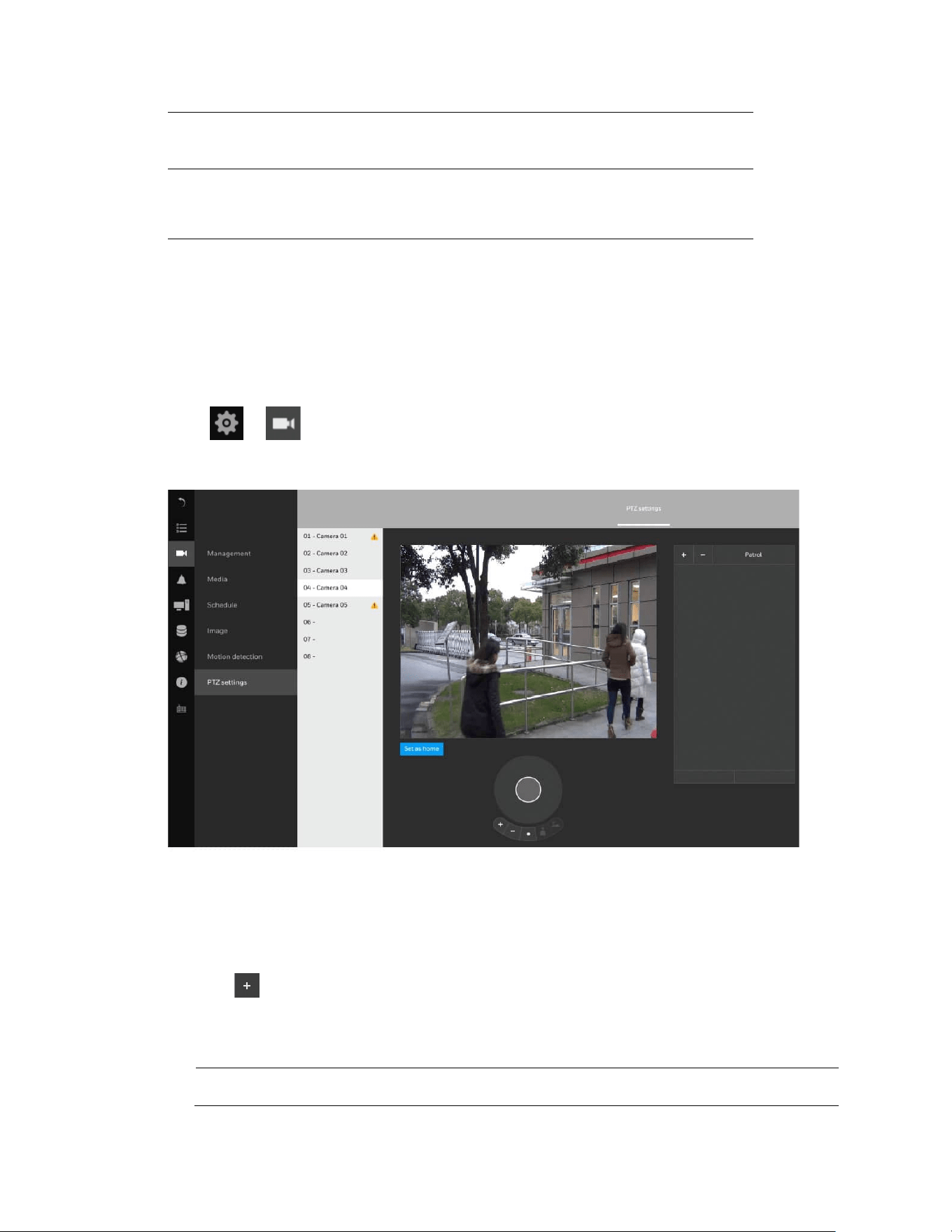
Configuring PTZ Settings
You can configure presets, tours, patterns, and borders using the PTZ control panel.
Configuring PTZ Presets
Go to PTZ settings:
Figure 3-7 PTZ Settings
• Select a PTZ camera.
• Use the PTZ panel to move to a field of view where you want to designate as a preset
position.
• Click , and enter a name for the position. Press Enter to proceed.
• Repeat the configuration to create more positions.
• Click Apply for the configuration to take effect.
Note The PTZ panel can vary with different PTZ cameras.
30 Series Network Video Recorder User Guide
18
4 Recording Video
This chapter contains the following sections:
• Manual Recording on page 18.
• Scheduled Recording on page 18.
Manual Recording
In live view window, select a window and click on the camera tool bar to start a manual
recording. The manual recording icon will appear on the window. Click again to
stop the manual recording.
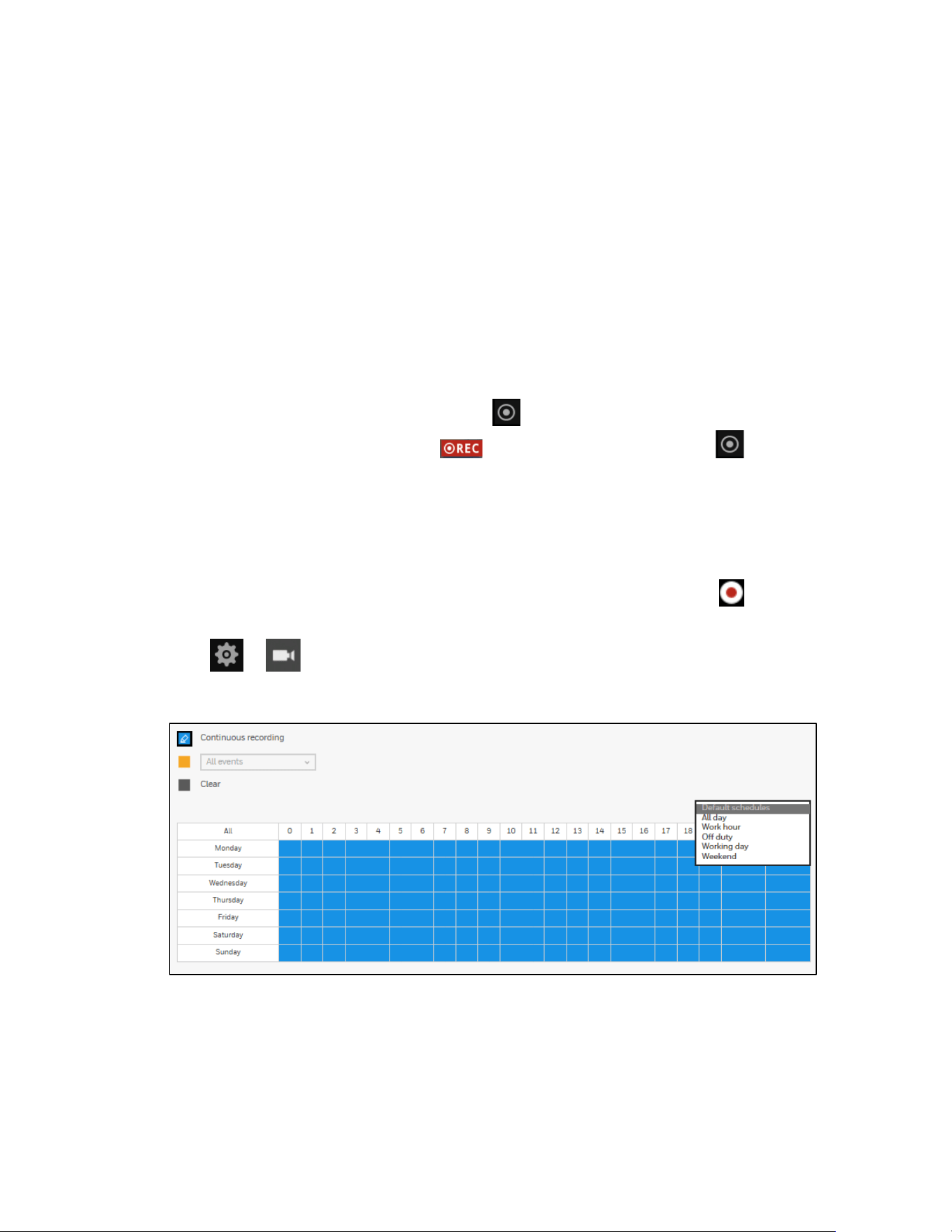
Scheduled Recording
By default, all video feeds from cameras are recorded at all time with the icon appeared on
the window. You can modify the recording task using the schedule tool:
Go to Schedule.
Figure 4-1 Scheduled Recording
1. Select a camera and click to select a recording condition's checkbox–Continuous
recording, Event recording and Clear (no recording).
2. Click and drag on the cells on the time table. For example, to stop the recording during a
period, select the Clear checkbox and move the cursor across the time table. The
minimum unit on the table is half an hour.
3. You may also use the scheduler tool on the right to facilitate the process.
Recording Video
19
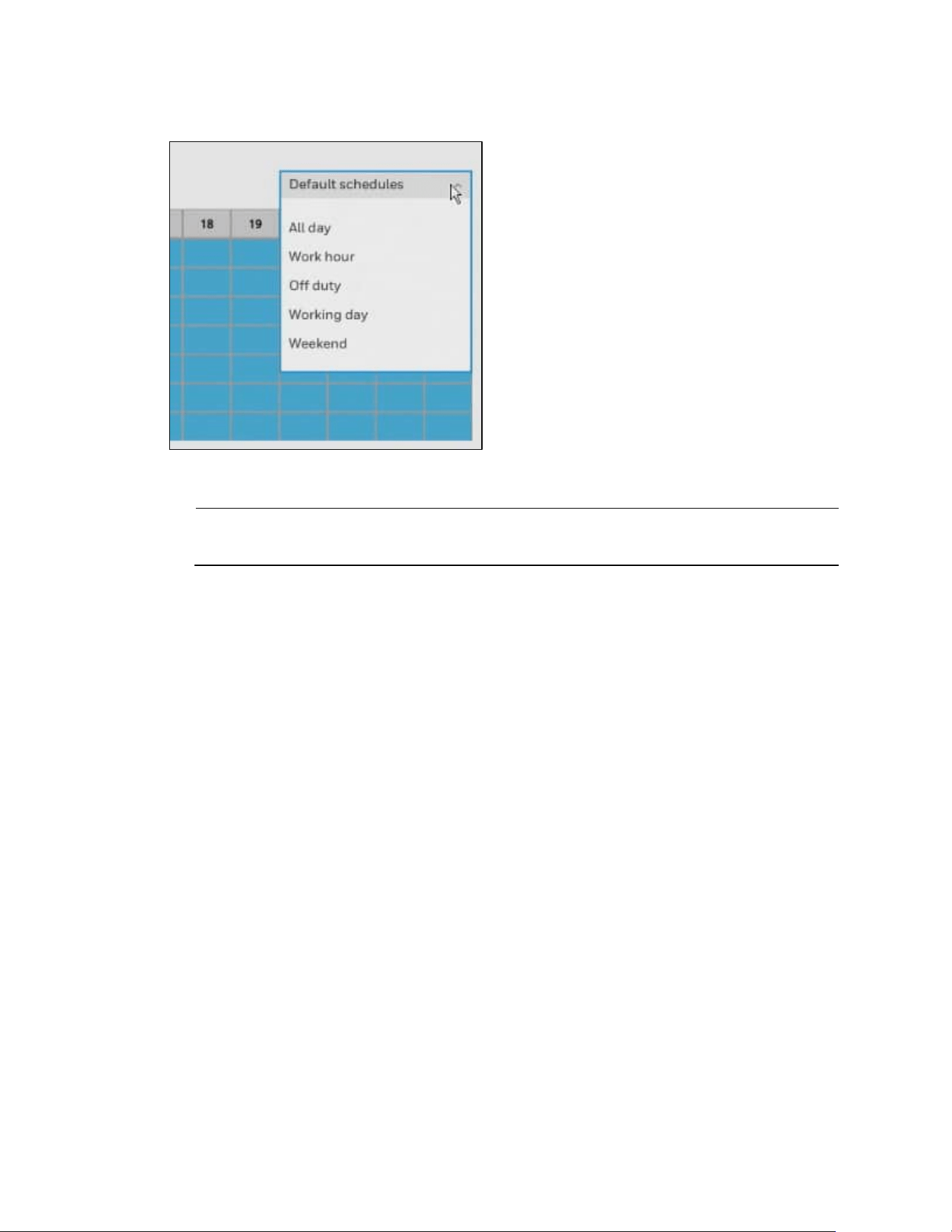
Figure 4-2 Scheduled Recording
a) Select a condition checkbox, and then select the All day, Work hour, Off duty,
Working day, Weekend options to apply a time selection.
Note
Make sure to deselect the “All day” option before selecting the “Work hour”,
“Off duty”, “Working day” and “Weekend” options.
b) Repeat the process on individual cameras or click Apply to all cameras at the right
bottom if the schedule can apply to all cameras.
4. When the configuration is completed, click Apply.
30 Series Network Video Recorder User Guide
20
5 Playing Back and Search
Videos
This chapter contains the following sections:
• Playing Recording Clips on page 20.
• Searching Videos on page 21.
• Timeline Bar on page 23.
• Backing Up Video on page 24.
Playing Recording Clips
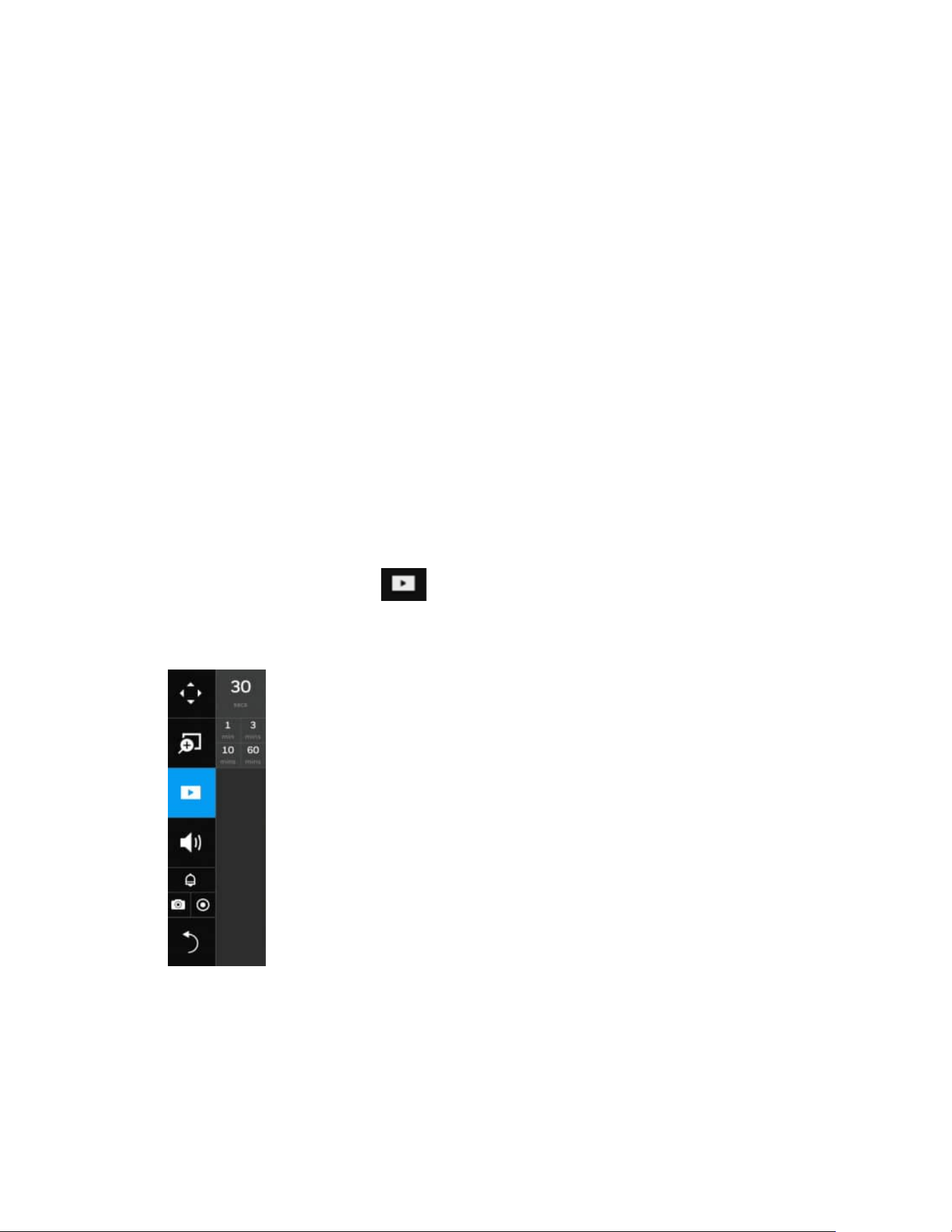
The Play Recording Clips function provides a shortcut to the latest recordings on the system.
You can select 30 secs, 1 min, 3 mins, 10 mins, and 60 mins for an immediate playback.
1. Select a camera and click on the camera toolbar and select a period you want to
playback for.
Figure 5-1 Camera Toolbar-Playing Recording Clips
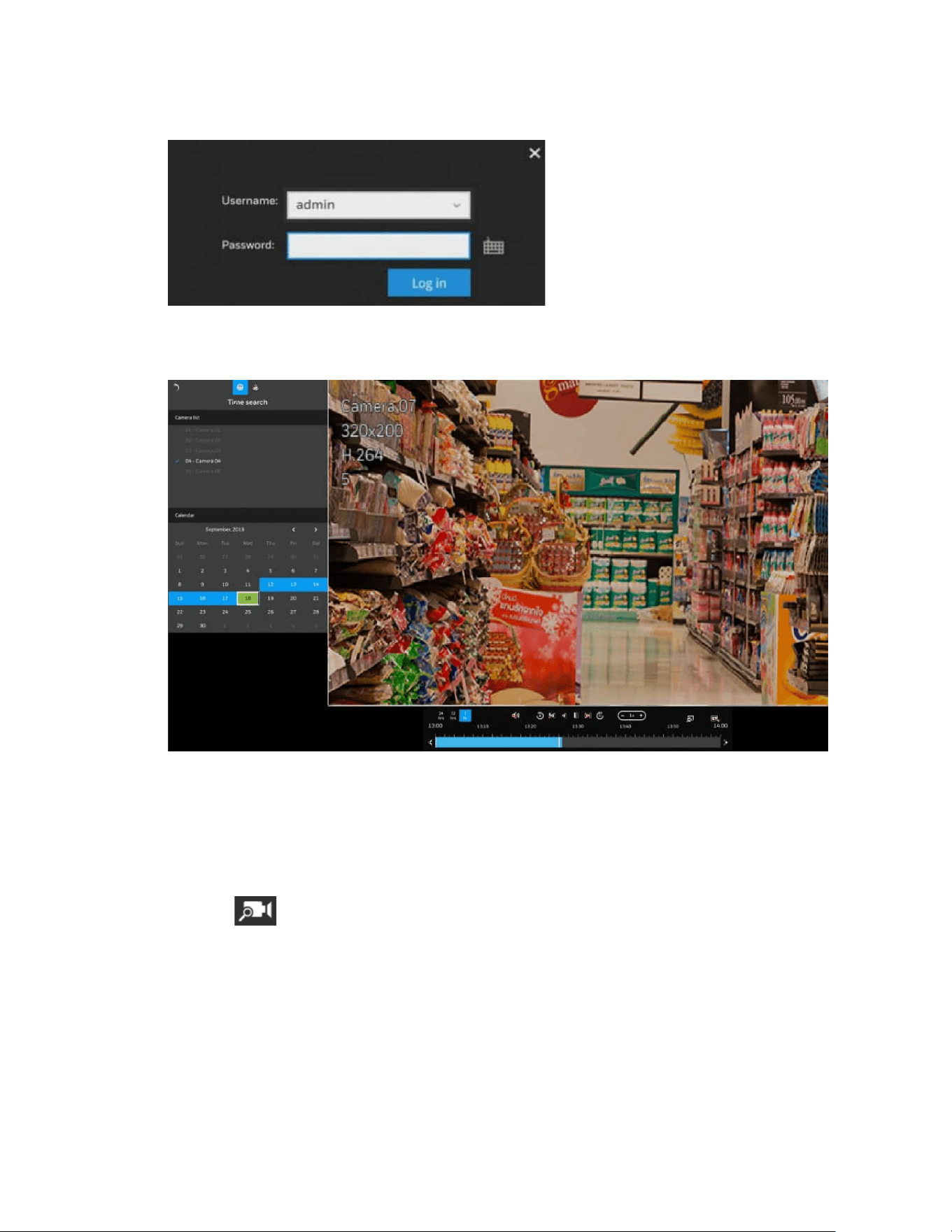
2. A confirm window is displayed: (If left unattended for a period, system will automatically
log out)
Playing Back and Search Videos
21
Figure 5-2 Credentials
3. Enter the username and password. Click Log in and the playback interface is displayed:
Figure 5-3 Playback Interface
The playback begins from the point in time you selected, e.g., 30 seconds ago. This function
allows you to quickly review what has just happened.
Searching Videos
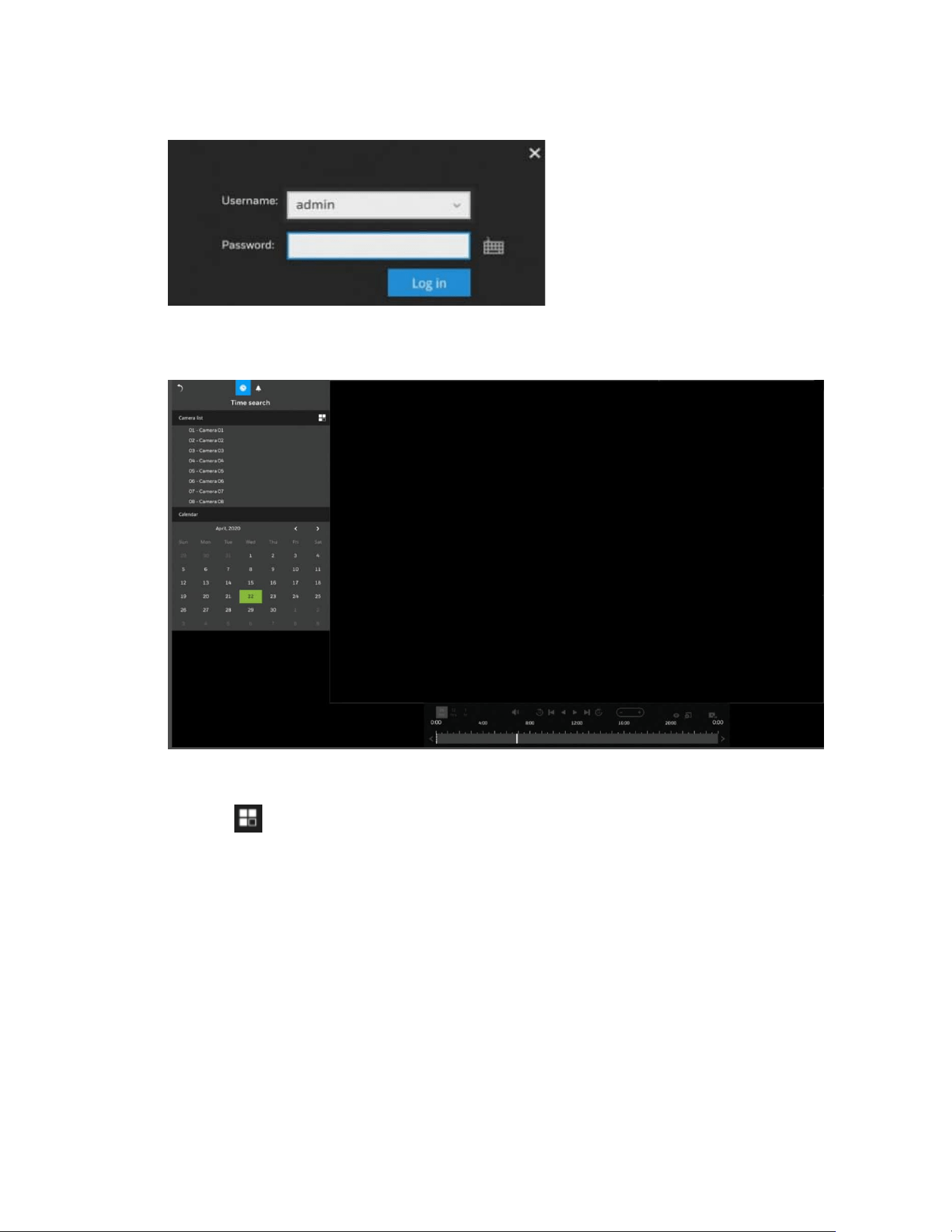
1. Click on the main toolbar and a confirm window is displayed: (If left unattended for
a period, system will automatically log out)
30 Series Network Video Recorder User Guide
22
Figure 5-4 Credentials
2. Enter the username and password. Click Log in and the search interface is displayed:
Figure 5-5 Search
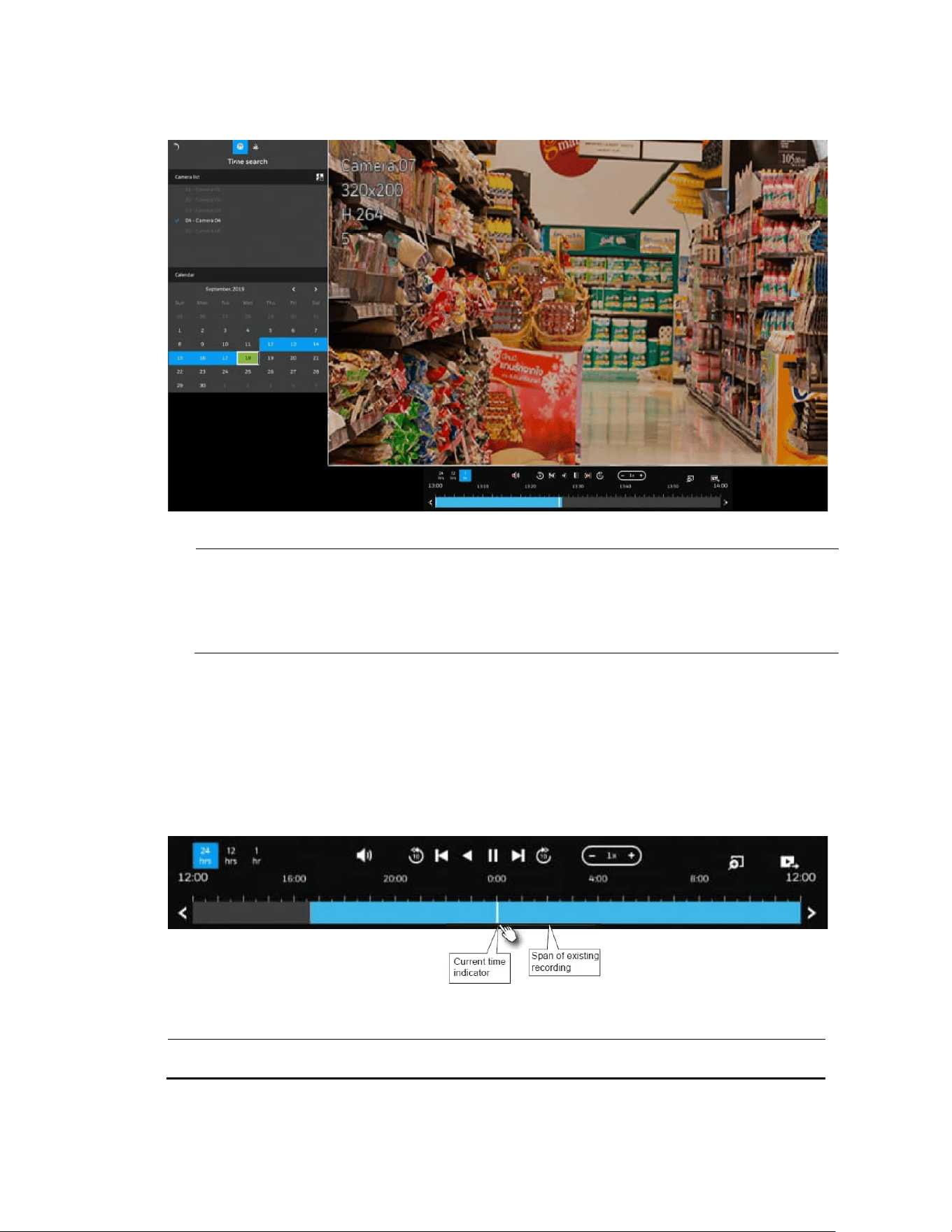
3. Select cameras (up to 4 cameras) in the camera list and the days with recorded clips will
be highlighted in blue. The date highlighted in green indicates today.
4. Click to set up the layout when more than one cameras are played back
simultaneously.
5. Double-click on a day to begin playback and search.
Playing Back and Search Videos
23
Figure 5-6 Search and Playback
6. Click the camera again to deselect it and select another one to playback if needed.
Note
• If a camera is deleted from the NVR, the recorded videos cannot be
searched until it is added to the NVR.
• In case of four cameras playback simultaneously, the maximum
resolution of each camera is 1080P.
Timeline Bar
By default, the playback starts from the beginning of a day's recording. While playing the
recorded video, click on the timeline to replay a point in time in the video.
Figure 5-7
Table 5-1 Timeline Bar
Buttons Description
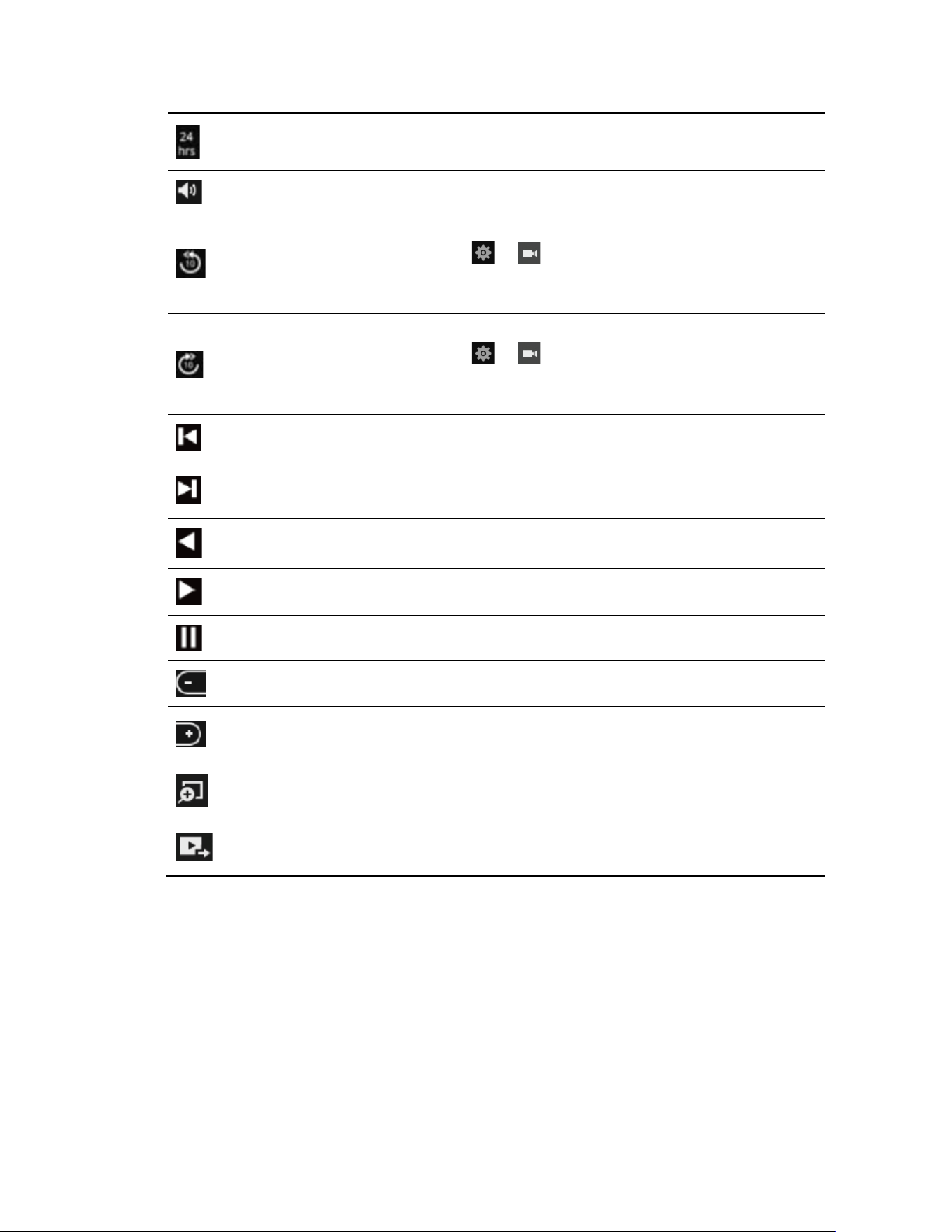
30 Series Network Video Recorder User Guide
24
Time scale selector. Use the buttons to select the span of time displayed on
the tool bar.
Audio volume tuner.
Play back from 10 seconds ago. (Suggest disabling the Dynamic Intra
Frame period (DIF) setting ( Media Video) when perform this
function as the time interval may not be 10 seconds while Dynamic Intra
Frame period (DIF) is enabled.)
Play back from 10 seconds after. (Suggest disabling the Dynamic Intra
Frame period (DIF) setting ( Media Video) when perform this
function as the time interval may not be 10 seconds while Dynamic Intra
Frame period (DIF) is enabled.)
Previous frame. (I-frame only)
Next frame. (I-frame only) After you paused a playback, use this button to
browse video frame by frame.
Play backwards.
Play. This button is available after you paused a playback.
Pause
Each click on it speeds down by 1/2. The slowest speed is 1/16.
Each click on it speeds up by 2x. The fastest speed is 16 times. The current
playback status is indicated on the screen.
Digital zoom. This applies when a camera is displaying the full of its field of
view. You can use the Digital zoom function to zoom in on the field of view.
Export clips. Use this function to select a span of time you want to export to
other medias.
Backing Up Video
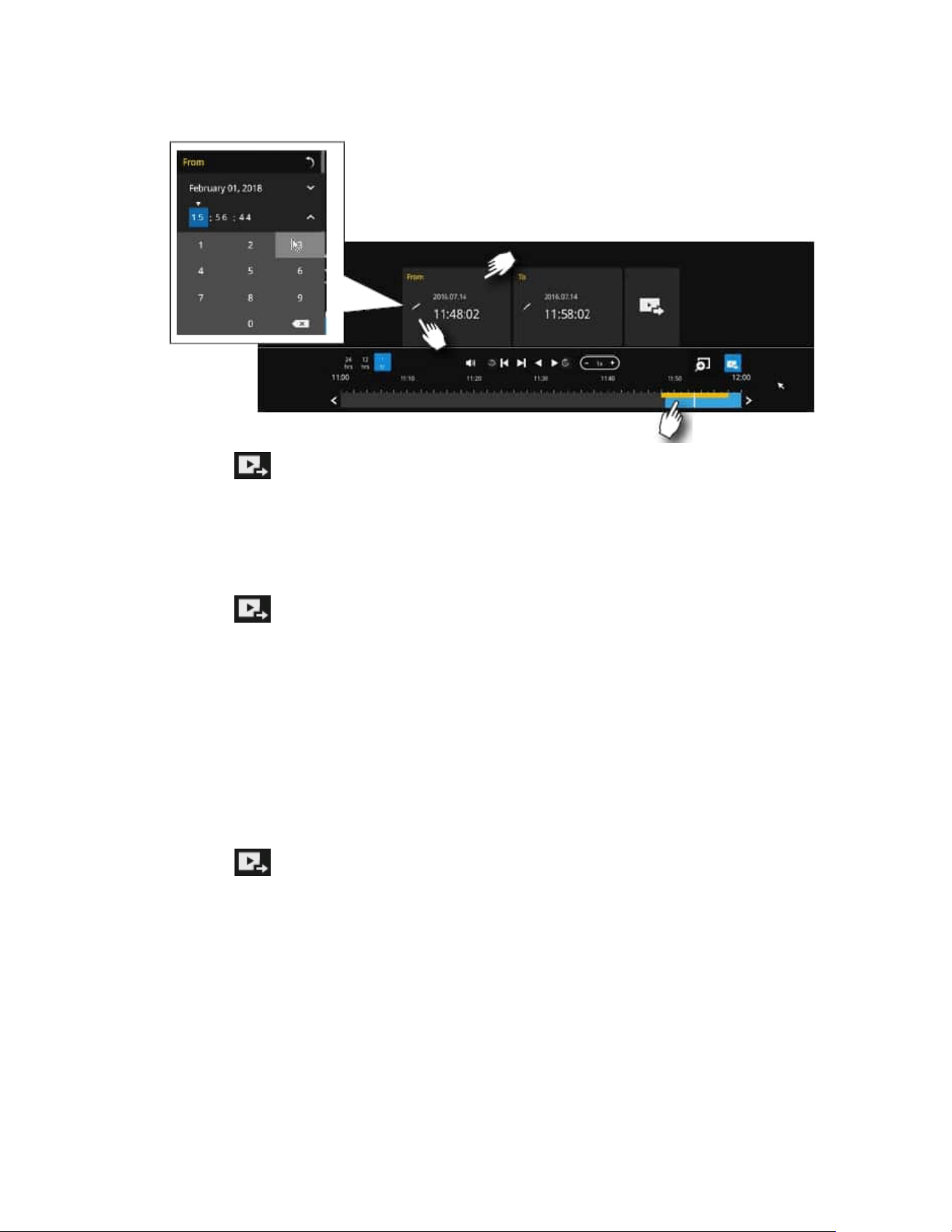
To Back Up Using the Playback Timeline Bar
Maximum 10 minutes of clips length for export via this method.
1. Insert a USB storage device (such as a USB flash drive) into one of the USB ports on the
NVR.
Playing Back and Search Videos
25
Figure 5-8 Backup Clips
2. Click on timeline bar.
3. Select the "From time" by clicking on the timeline. You can also manually enter the "From
time" and the "To time."
4. Click the "From time" tab using a single click.
5. Repeat steps 3 and 4 to configure the “To time”.
6. Click .
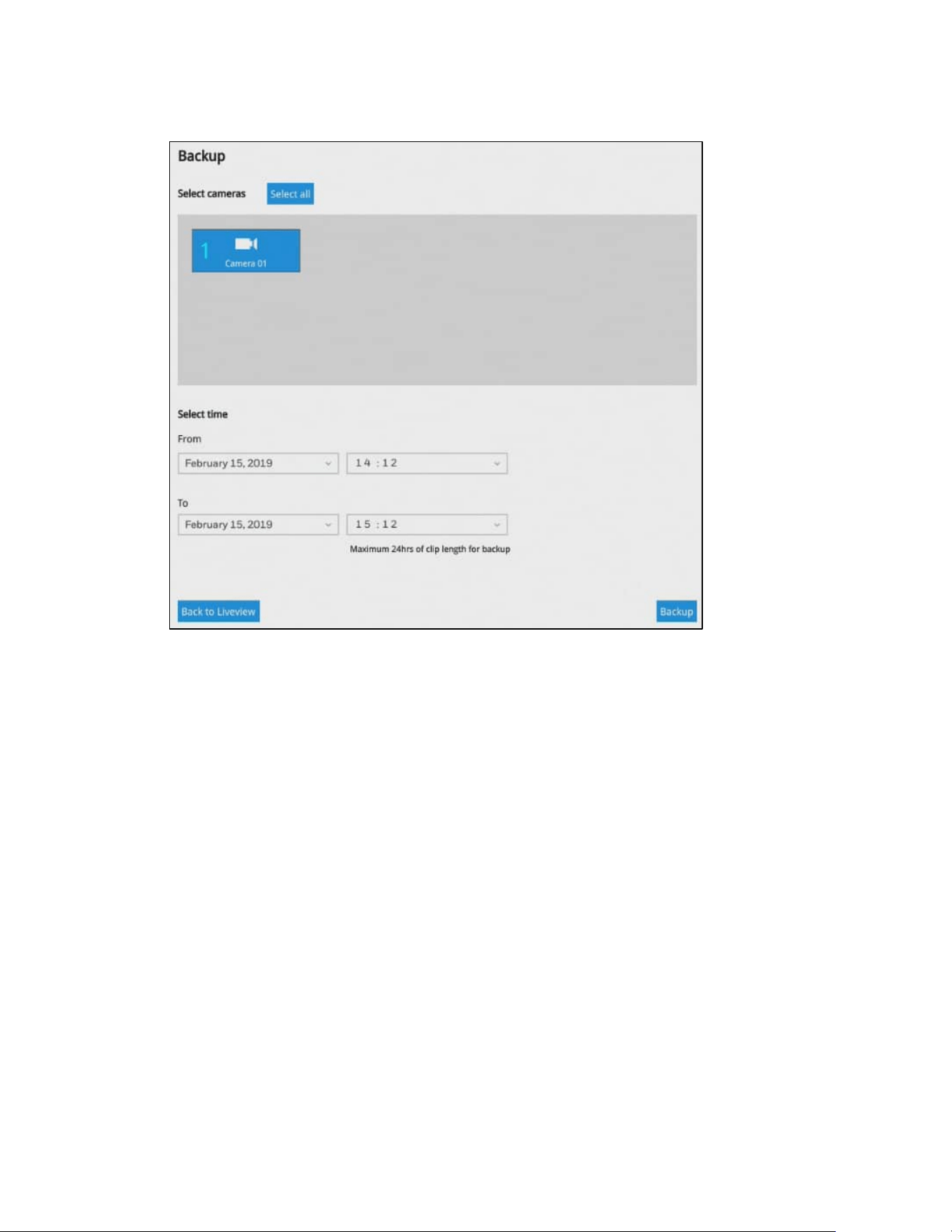
To Back Up Using the Main Tool Bar
The Export recordings button allows users to directly select a piece of recordings by a specific
camera, and export that to a USB thumb drive. Users can select one or multiple cameras,
select a period in which the recording took place, and then click Export.
The maximum length of recording export is 24 hours.
1. Insert a USB storage device (such as a USB flash drive) into one of the USB ports on the
NVR.
2. Click on main tool bar and the following window is displayed:
30 Series Network Video Recorder User Guide
26
Figure 5-9 Backup Video
3. Select one or multiple cameras from the camera list.
4. Select the start time of the period of recording time and the end time of the period of
recoding time.
5. Click Backup.

Settings
27
6 Settings
This chapter contains the following sections:
• Setting-Camera-Management on page 27.
• Setting-Camera- on page 35
• Setting-Camera-Media on page 32.
• Setting-Camera-Image on page 38.
• Setting-Camera-Motion Detection on page 39.
• Setting-Camera-PTZ settings on page 40.
• Setting-Event-Event on page 41.
• Setting-Event-Email on page 46.
• Setting-System-Information on page 47.
• Setting-System-Maintenance on page 48.
• Setting-System-Display on page 50.
• Setting-System-Log on page 51.
• Setting-User on page 51.
• Setting-Storage on page 54.
• Settings-Network-IP on page 57.
• Settings-Network-Service on page 58.
• Settings-Network-P2P on page 59.
Setting-Camera-Management
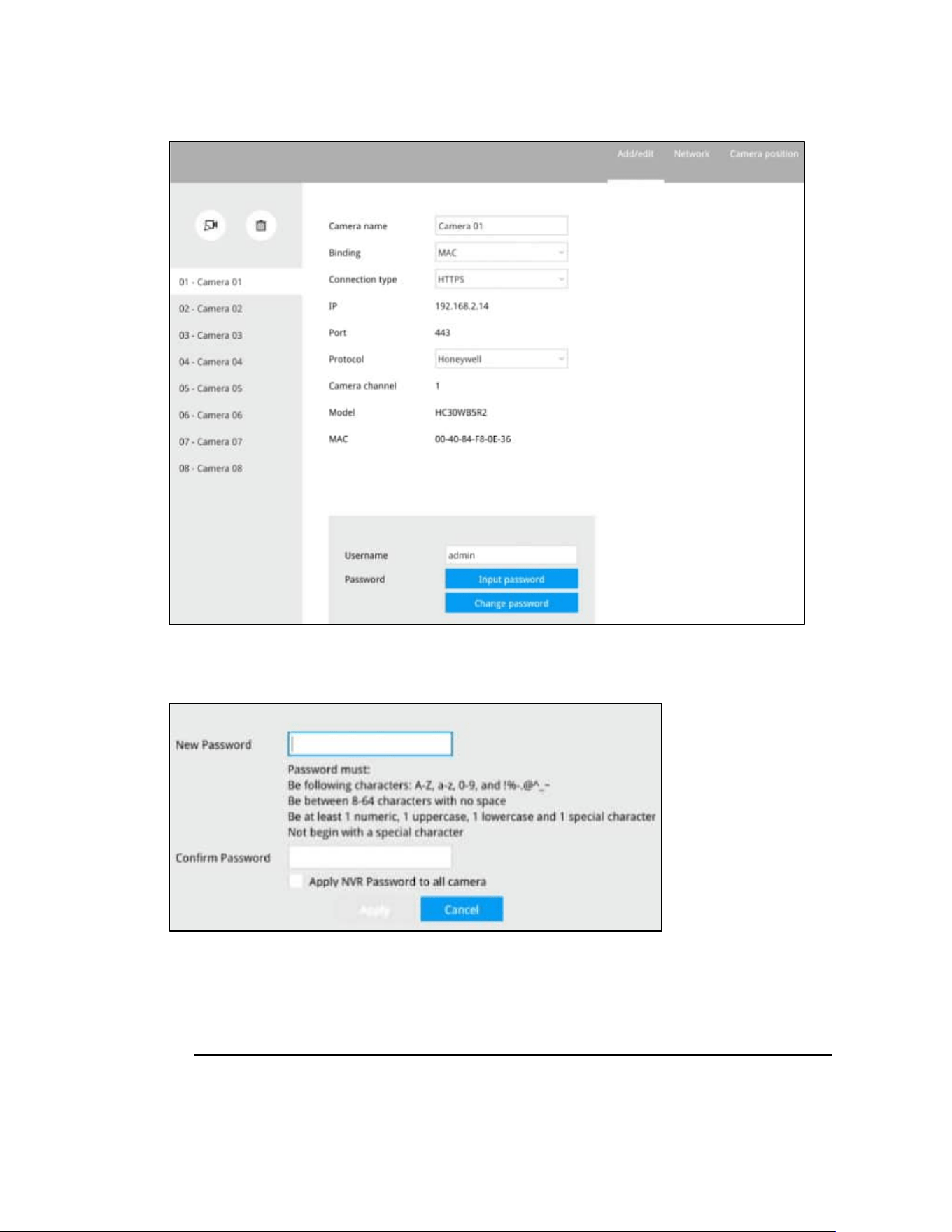
Change Password
Go to ManagementAdd/edit.
30 Series Network Video Recorder User Guide
28
Figure 6-1 Management
1. Click Change Password.
Figure 6-2 Set New Password
2. Input the new password and confirm it.
3. Click Apply.
Note
Camera’s password can only be changed at local client, not available at
web client.
Settings
29
Adding a Camera
Go to ManagementAdd/edit.
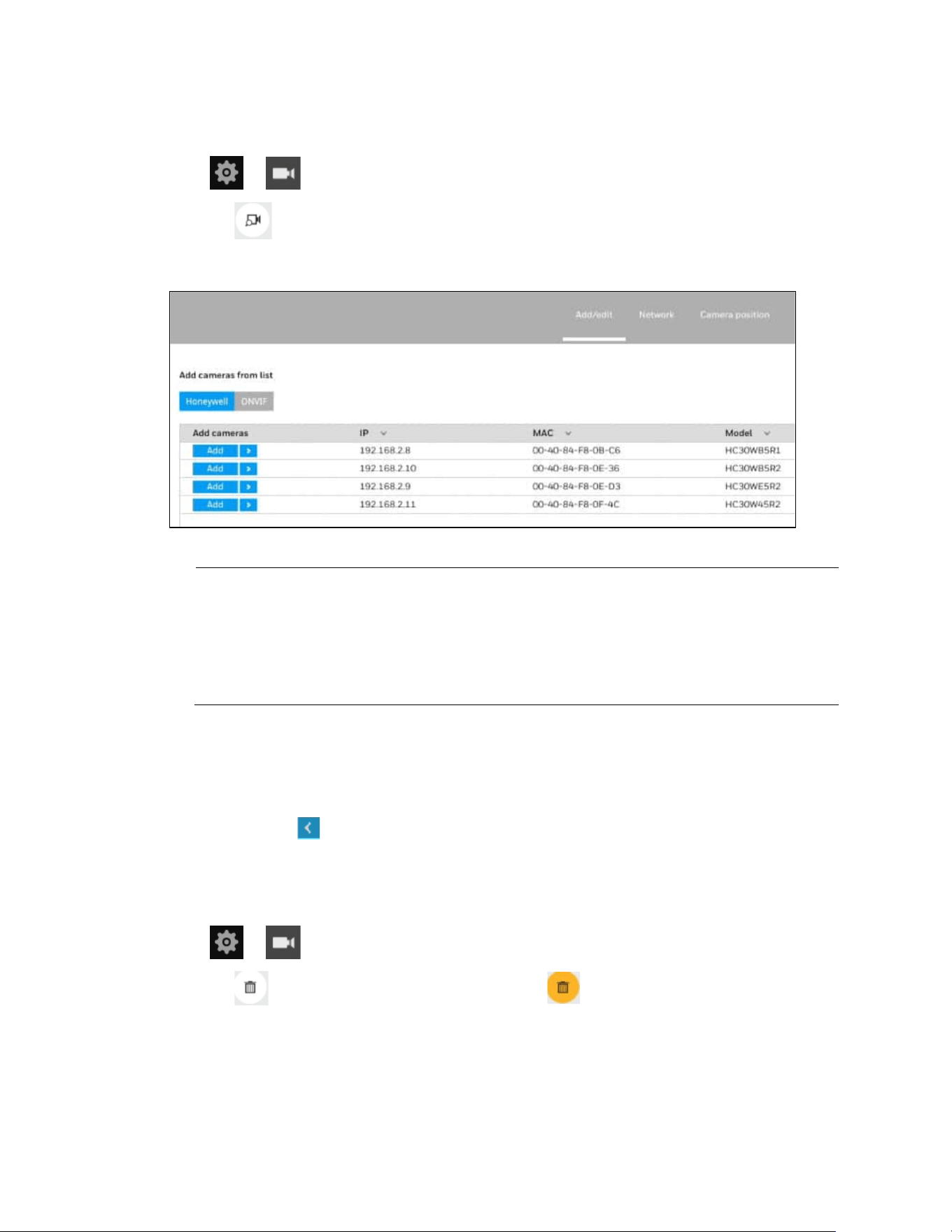
4. Click and a list of cameras in the same subnet will appear:
Figure 6-3 Adding a Camera
5. Click Honeywell or ONVIF to select the camera protocol.
Note
30 series cameras that support the Honeywell protocol:
HC30W42R3
HC30W45R3
HC30W45R2
HC30WB2R1
HC30WB5R1
HC30WB5R2
HC30WE2R3
HC30WE5R3
HC30WE5R2
HC30WF5R1
HC60W35R2
HC60W35R4
HC60W45R2
HC60W45R4
HC60WB5R2
HC60WB5R5
HC60WZ2E30
6. Click Add and the camera will be placed at an unoccupied position. You may also expand
the menu on the side of the Add button to select a position number.
7. When a camera is added, it should appear on the graphical placement below.
8. Click Apply after you added cameras.
9. You may click to return to the previous window.
Removing a Camera
Go to ManagementAdd/edit.
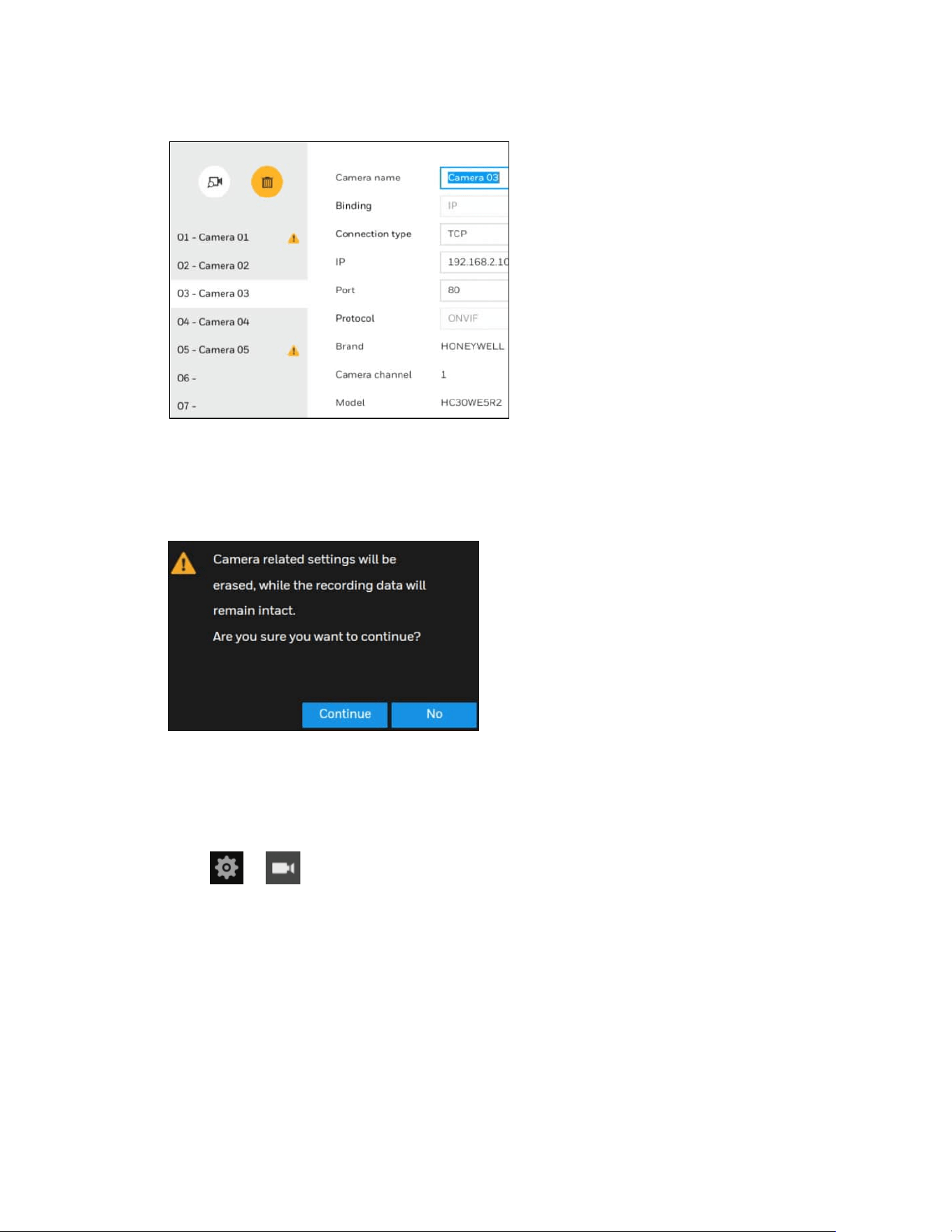
1. Click and the remove button will turn yellow .
30 Series Network Video Recorder User Guide
30
Figure 6-4 Removing a Camera
2. Mouse over to the camera you want to remove, and its entry will display the Remove
message.
3. Click the Remove message and a confirm window prompted:
Figure 6-5 Confirm Message
4. Click Continue to remove the camera.
Network
Go to ManagementNetwork.
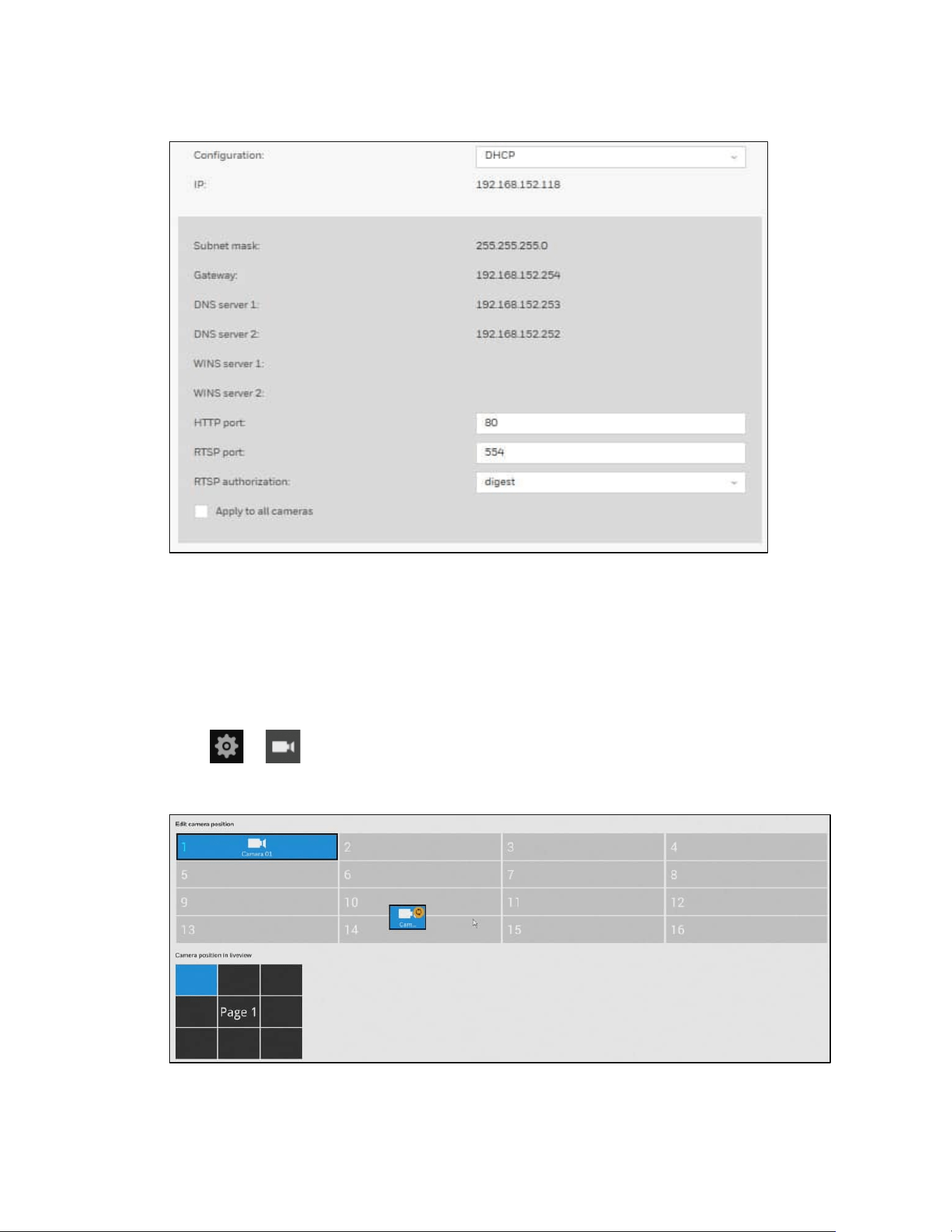
Here you can configure the network type, IP address, and the connection ports for video
streaming.
Settings
31
Figure 6-6 Camera Network
You can select DHCP as the method for cameras to acquire IP addresses, or you can manually
configure static IPs for a single or all cameras.
It is usually not necessary to change port numbers for the HTTP and RTSP ports unless there
is a conflict in your network environment.
Camera Position
Go to ManagementCamera position.
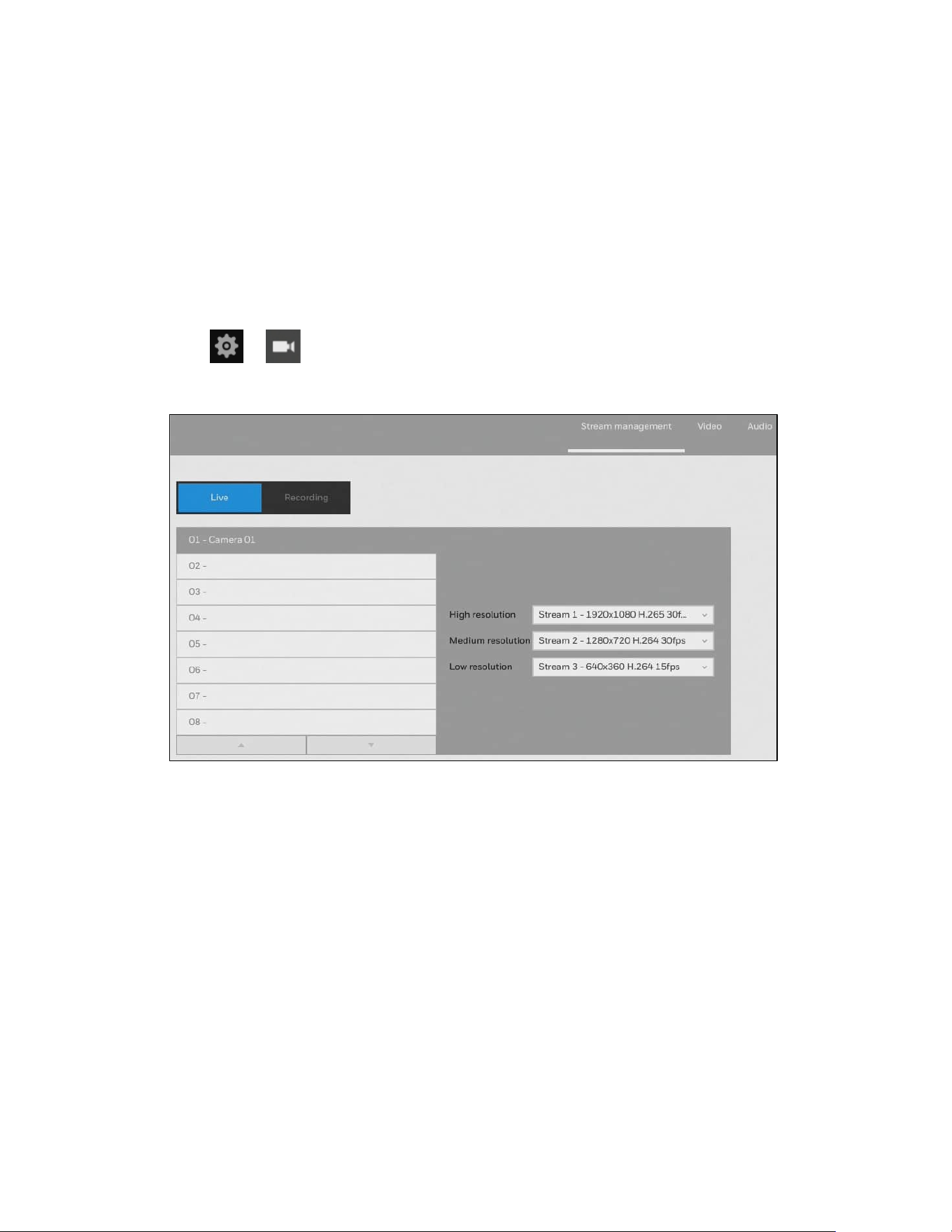
Figure 6-7 Edit Camera Position
30 Series Network Video Recorder User Guide
32
To change a camera's position on the Liveview layout, click and drag a camera to a desired
position. Click Apply for the configuration change to take effect. The position screen displays
the current layout on the Liveview screen.
Setting-Camera-Media
Stream Management
Go to Media Stream management.
Figure 6-8 Media-Stream Management-Live
Click Live and you can manually select High, Medium, or Low resolution streams from the
pre-configured video streams of a camera for live view.
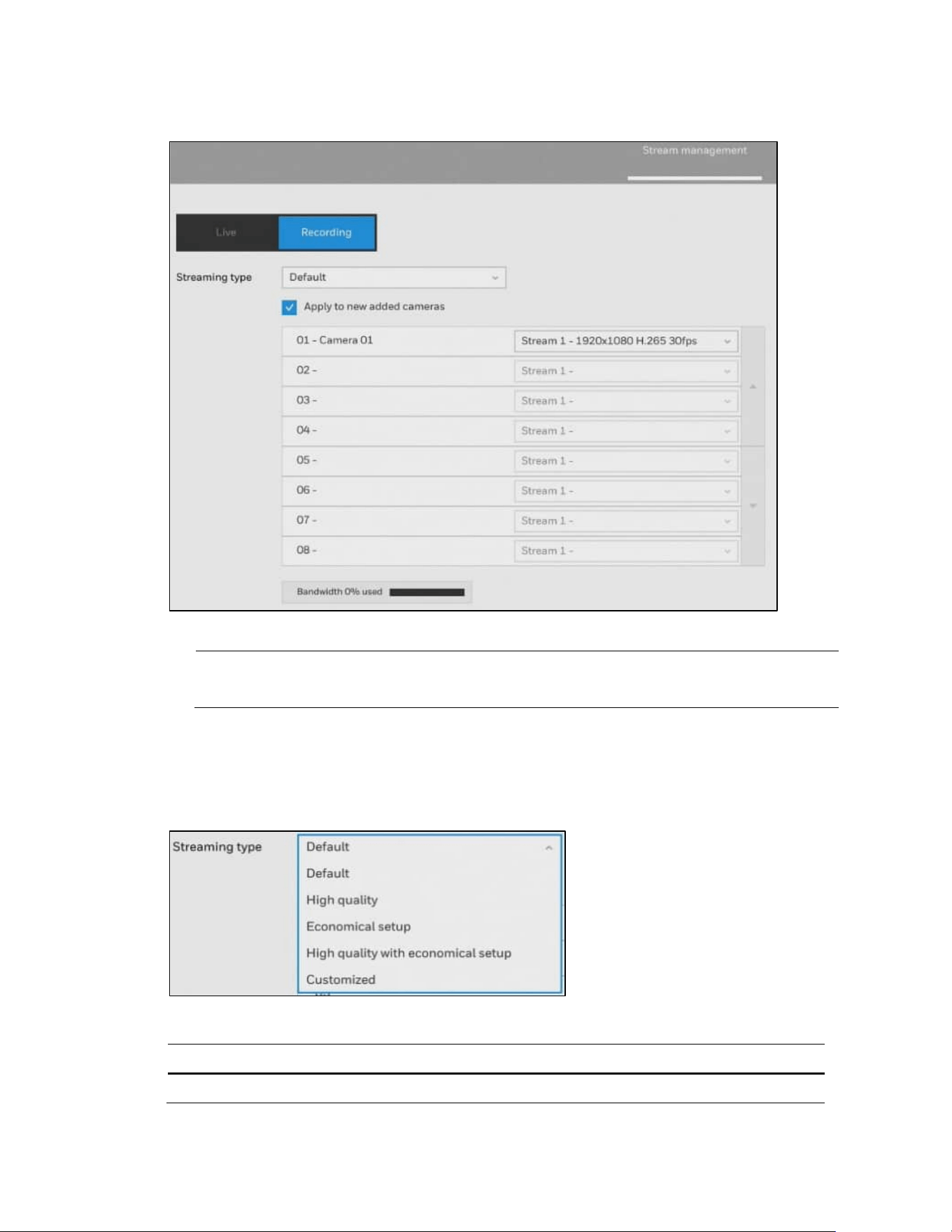
Settings
33
Figure 6-9 Media-Stream Management-Recording
Note
Select MJPEG as codec
and the maximum size of the frame size is
1920*1920
.
Click Recording and you can use these preset conditions to configure the resolution, image
quality, frame rate, and the bandwidth consumption of the recording stream on this window.
Figure 6-10 Streaming Type
Table 6-1 Recording Stream Type
Recommended setting Configuration
Default Medium resolution; full frame rate.
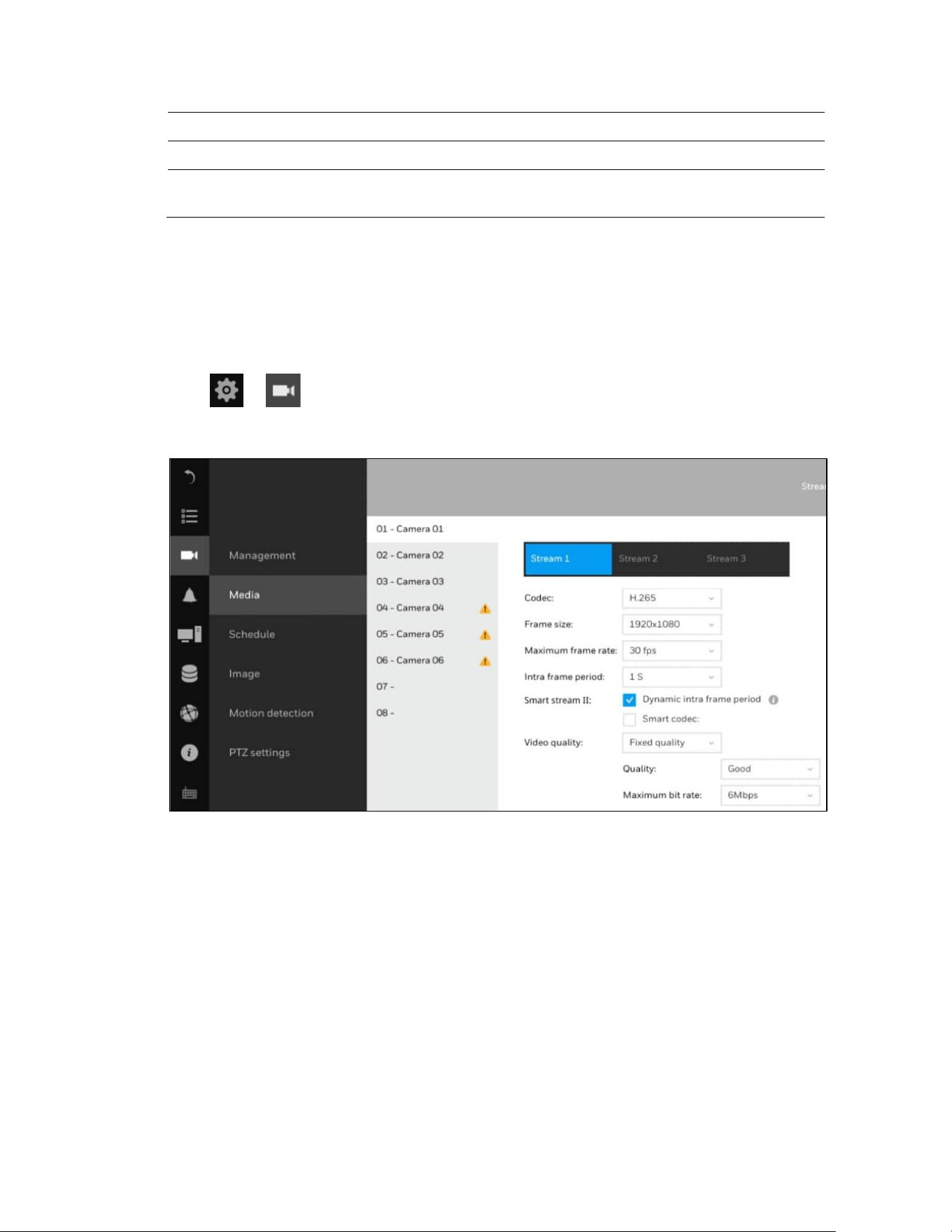
30 Series Network Video Recorder User Guide
34
High Quality Guaranteed video quality set as Good; full frame rate.
Economical setup Medium to low resolution; frame rate at 5fps.
High quality with
economical setup
High resolution, Good image quality; frame rate at 5fps.
With each recommended configuration applied, the estimated bandwidth consumption value
is immediately calculated and displayed at the lower screen.
Click Apply for the configuration change to take effect.
Video
Go to Media Video.
Figure 6-11 Media-Video
The Video window allows you to configure all video streams (the no. of stream available can be
different for different models). You can configure the following:
Codec: video compression codec in H.264, H265 or MJPEG.
Frame size: video resolution.
Maximum frame rate: the highest frame rate.
Intra frame period: how often an I-frame will be inserted into the video stream.
Smart Stream II: some newer camera models come with Smart Stream features. Please refer
to the next page for detailed information.
Video quality: you may either select Constant bit rate or Fixed quality as the defining rules
for video transmission:
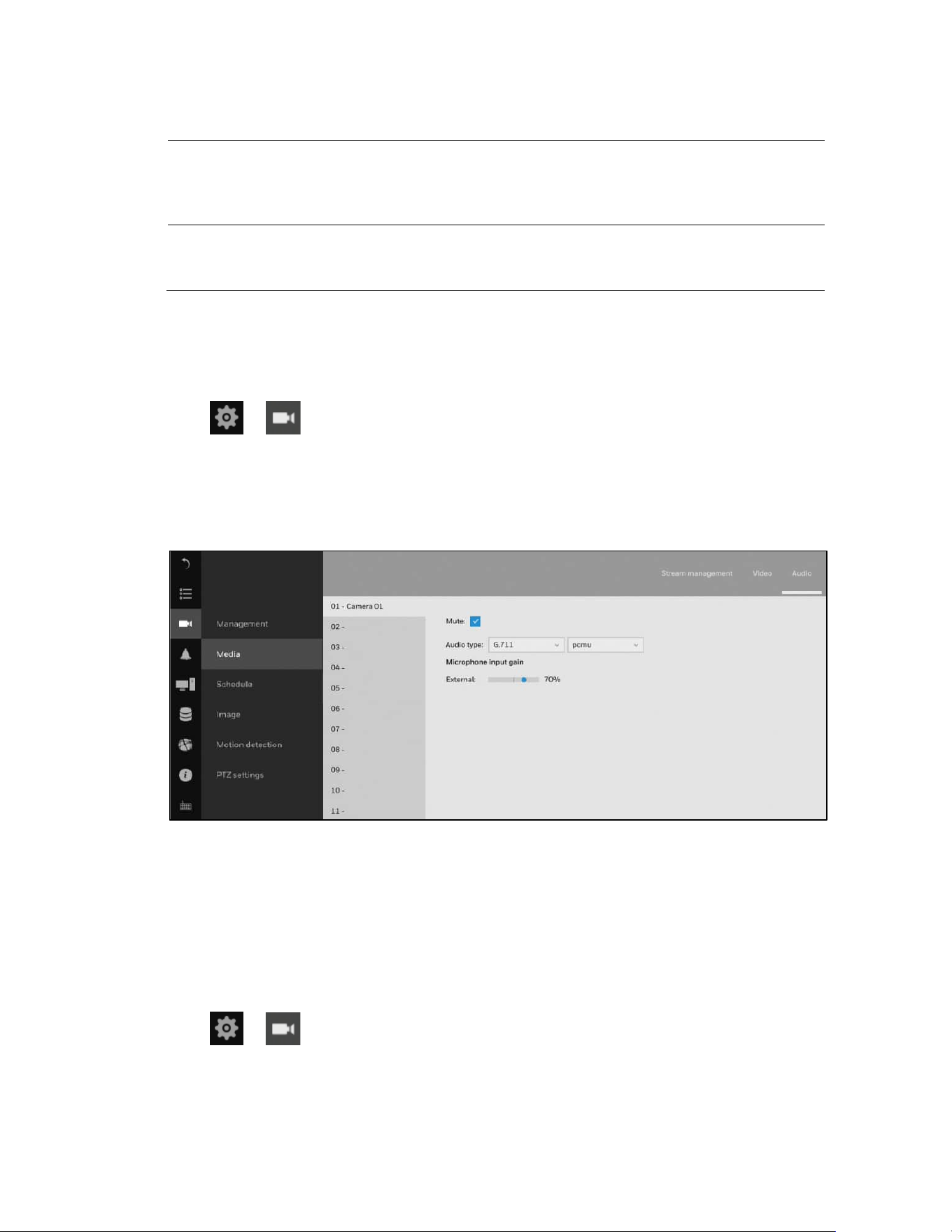
Settings
35
Table 6-2 Video Quality
Constant bit rate
Places a packet size threshold on video frames; This
guarantees the frame rate per second performance, yet
image quality can be compromised if bandwidth is not
sufficient in your network environment.
Fixed quality
Guaranteed video quality, and to ensure image quality,
some frames may be dropped when bandwidth is not
sufficient.
When the configuration is completed, click Apply.
Audio
Go to Media Audio.
The Audio window allows you to configure all audio codec, sampling rate, and Microphone
input gains. Depending on design of the camera models, some codecs may not be available.
Also, there are cameras that come without embedded microphones.
Figure 6-12 Audio
Setting-Camera-Schedule
Recording Options
Go to ScheduleRecording options.
30 Series Network Video Recorder User Guide
36
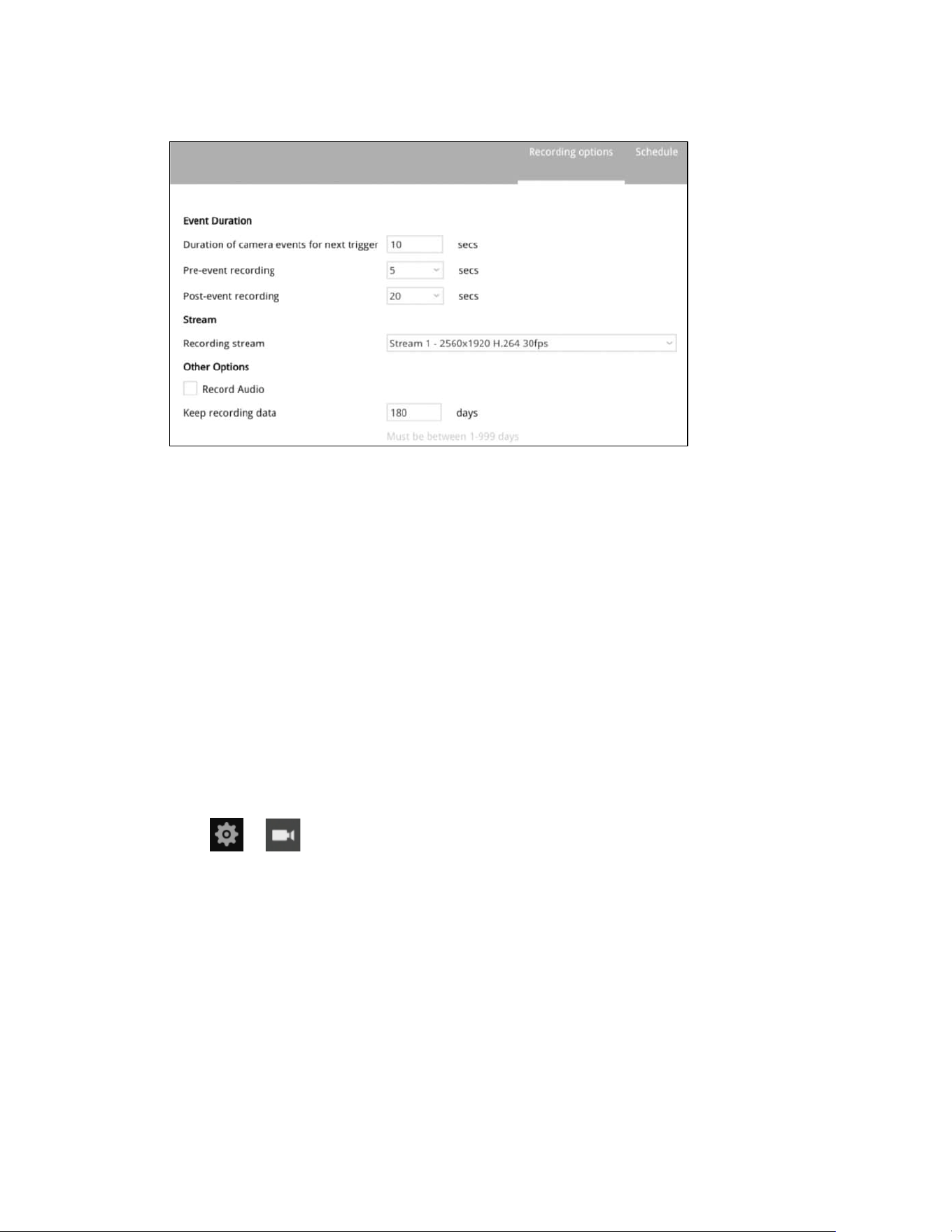
Figure 6-13 Recording Options
On the Recording options page, you can configure the following:
Event Duration: Configure the duration of camera events, for the concern that camera can be
too frequently triggered.
Pre- event recording/ Post-event recording: Enter the Pre-and Post-event recording time.
The triggering events can be DI, DO, Motion detection, PIR, or Tampering detection. A
recording length of 10 seconds of pre-event and up to 300 seconds of post-event can be
configured.
Stream: The default recording stream is Stream 1, and the system automatically adjusts the
frame rate, resolution, etc. for optimum performance. However, you can still change the
streaming characteristics. Note that you cannot assign the recording task to other video
stream.
Other options: Enable or disable audio recording. Note that audio transmission through
HDMI cable is currently not available. Change the life expectancy of the recording data.
Schedule
Go to ScheduleSchedule.
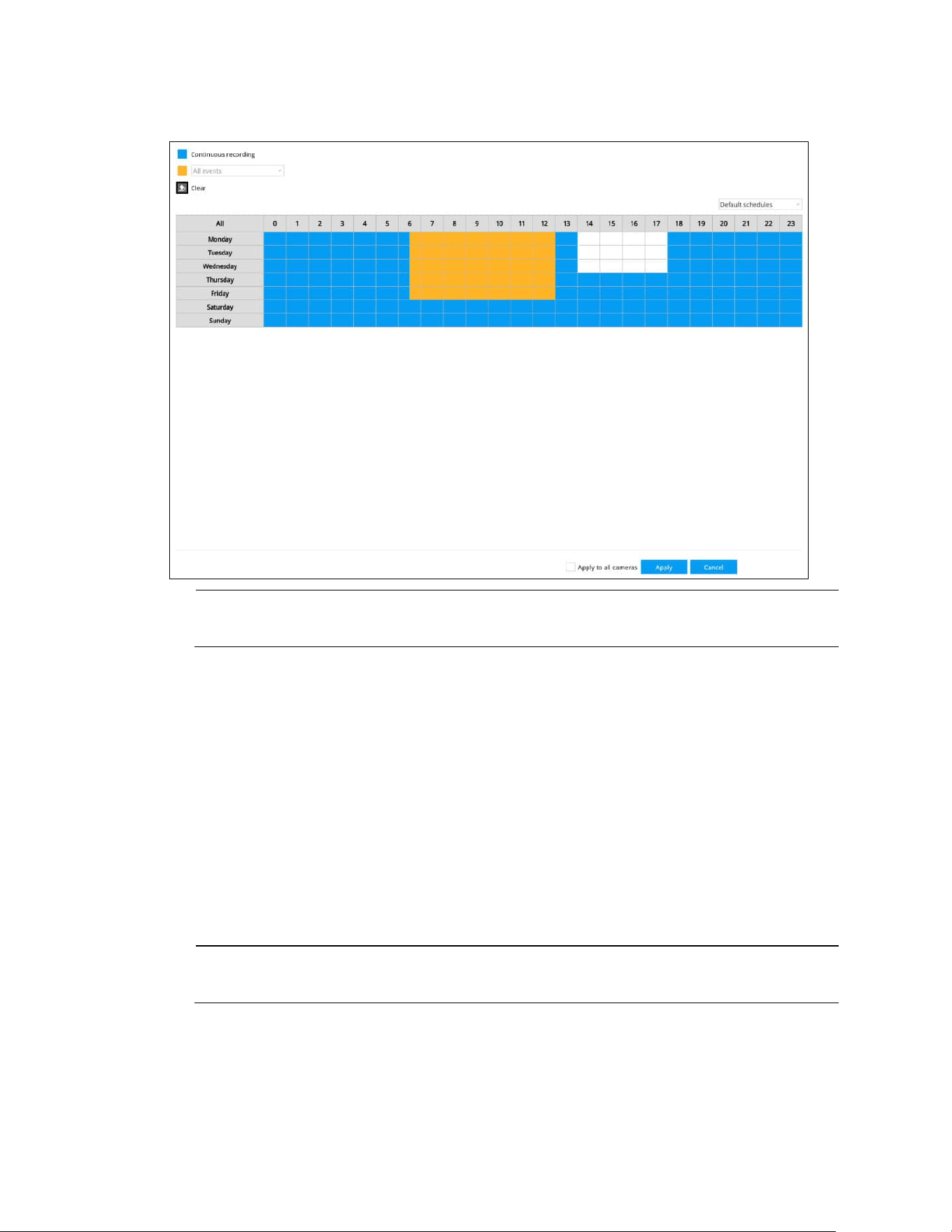
Settings
37
Figure 6-14 Schedule
Note
By default, all video feeds from cameras are recorded at all time
(highlighted in blue).
You can modify the recording task using the schedule tool:
1. Select a camera and click to select a recording condition's checkbox–Continuous
recording, Event recording and Clear (no recording).
2. Click and drag on the cells on the time table. For example, to stop the recording during a
period, select the Clear checkbox and move the cursor across the time table. The
minimum unit on the table is half an hour.
3. You may also use the scheduler tool on the right to facilitate the process.
a. Select a condition checkbox, and then select the All day, Work hour, Off duty,
Working day, Weekend options to apply a time selection.
b. Repeat the process on individual cameras or select the Apply to all cameras if the
schedule can apply to all cameras.
4. When the configuration is completed, click Apply.
Note
Event-triggered recording and continuous recording cannot be taking
place at the same time.
30 Series Network Video Recorder User Guide
38
Setting-Camera-Image
Display
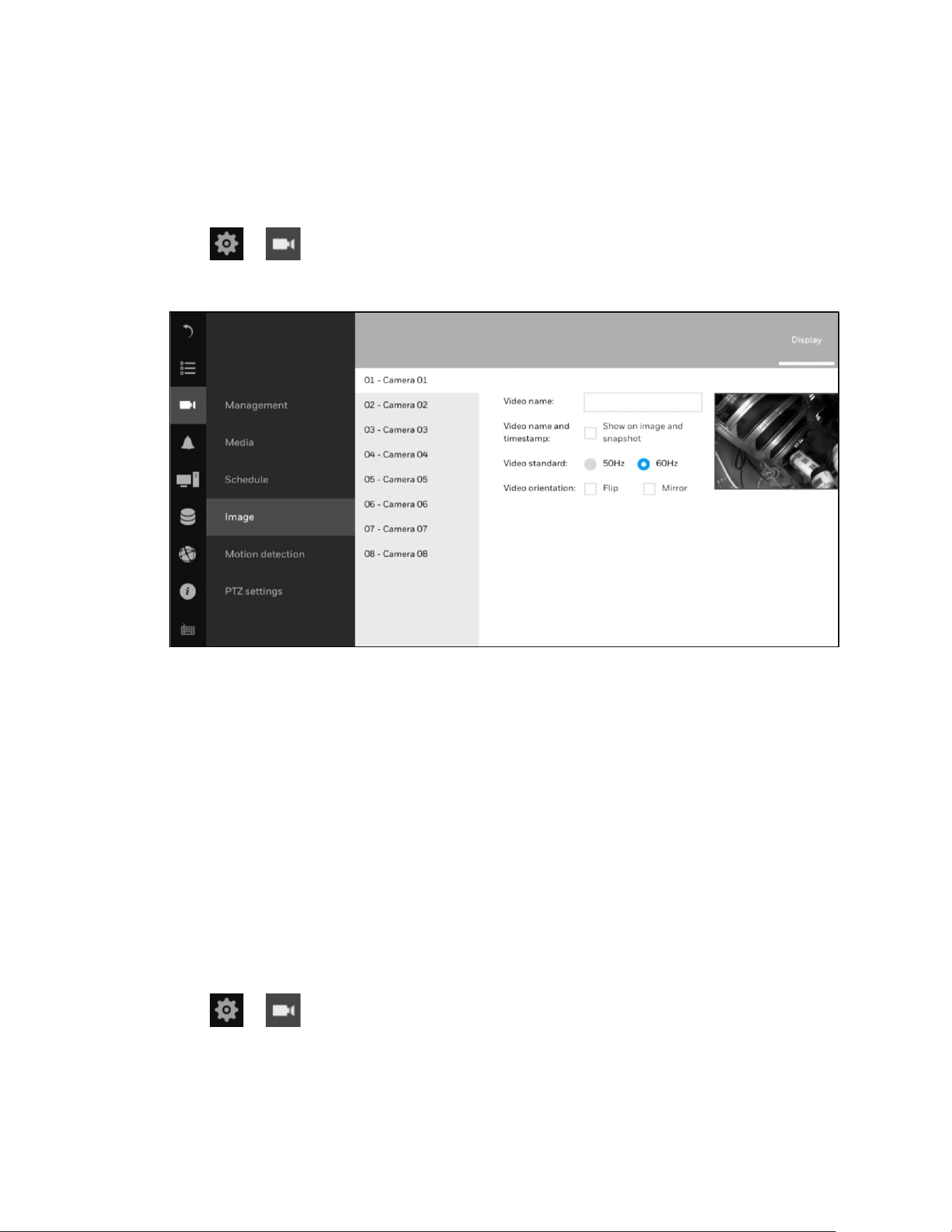
Go to Image Display.
Figure 6-15 Image-Display
The Display window allows users to tune the image display options:
Video name: The video name is displayed on the title bar that is displayed on each view cell.
The screen shot below shows a name as "Speed dome."
Video name and timestamp: Default is enabled. If enabled, the video name and time is
displayed on the view cell.
Video Standard: Depending on power line frequency of your country, select a matching
option, NTSC 60Hz or PAL 50Hz, to avoid image flickering due to unmatched electricity.
Video orientation: Select these options if the image from camera needs to be vertically or
horizontally flipped.
Click Restore to poll for the original settings or click Apply to finish the process.
Image Adjustment
Go to Image Image Adjustment.
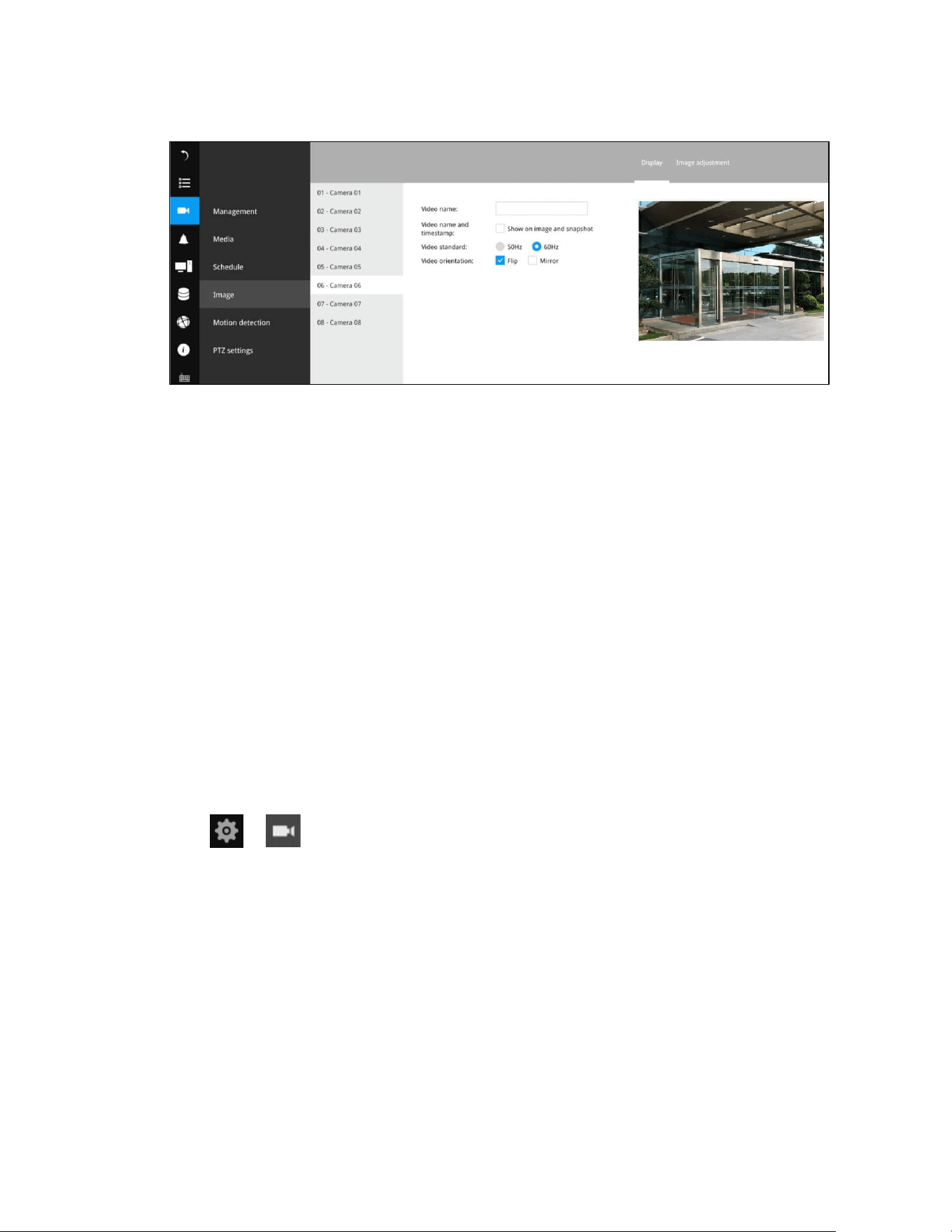
Settings
39
Figure 6-16 Image-Adjustment
The Image adjustment window allows users to tune the basics about image display options:
• Color
• Brightness
• Saturation
• Contrast
• Sharpness
High TV line, Gamma curve, low light compensation, etc. The rest of the options depend on
the lens and image sensor type of each individual camera. Therefore, the options here can
vary. For unique options coming with each individual camera, please refer to their User
Manuals for more information.
Click Restore to poll for the original settings or click Apply to finish the process. For features
common among cameras, you may select the Apply to all cameras checkbox.
Setting-Camera-Motion Detection
The Motion detection page allows you to set up a motion detection area.
Go to Motion detection.
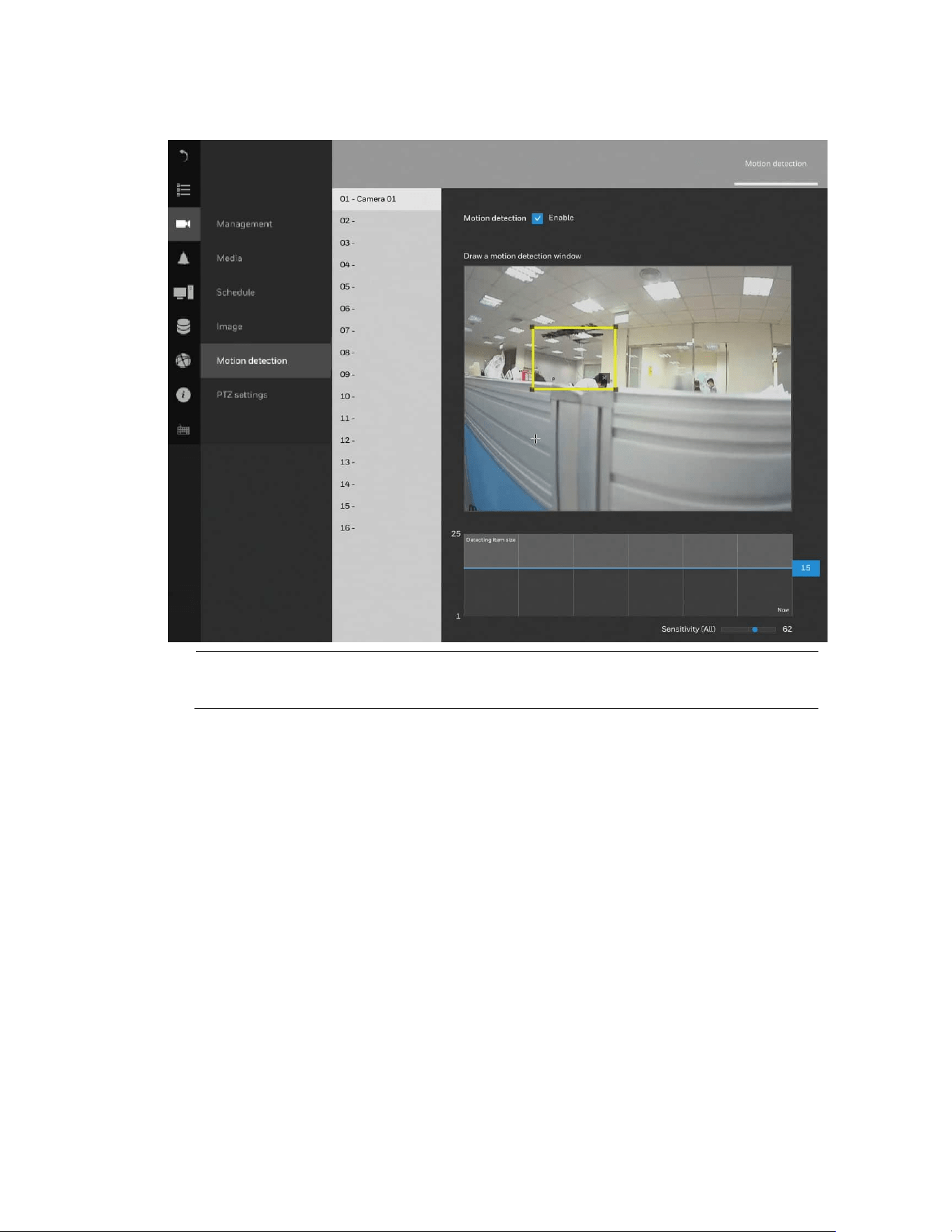
30 Series Network Video Recorder User Guide
40
Figure 6-17 Motion Detection
Note Up to 5 ROI windows can be created for a camera.
To set up a detection window:
1. Select a camera by a single click in the camera list.
2. Click and drag to draw a rectangular detection window.
3. Pull the detection area level up to a preferred position. An object must be larger than the
detection area to trigger an alarm.
4. Select a Sensitivity level using the slide bar.
5. Click Apply for the configuration to take effect.
Setting-Camera-PTZ settings
Please see Configuring PTZ Settings on page 17.
Settings
41
Setting-Event-Event
The events reported from individual cameras’ alarm in /alarm out, and motion detection can
be accommodated in the NVR system's alarm settings. These events will then be reported or
trigger corresponding actions as follows:
• Record the video by the time the event is triggered.
• Reporting events via Email with snapshots attached.
• Sound the onboard buzzer.
• Triggering video snapshot and text message by the occurrences of events to an FTP site.
• Triggering a camera's alarm out.
• Triggering a PTZ camera(s) for its lens to move to a preset position.
• Sending notification to the HVMV for MS Window software.
• Sending a full screen live view on the connected monitor.
When an alarm is triggered, a message prompt will appear on the Liveview or any
configuration window.
Figure 6-18 Event
Creating an Event
Go to Event.
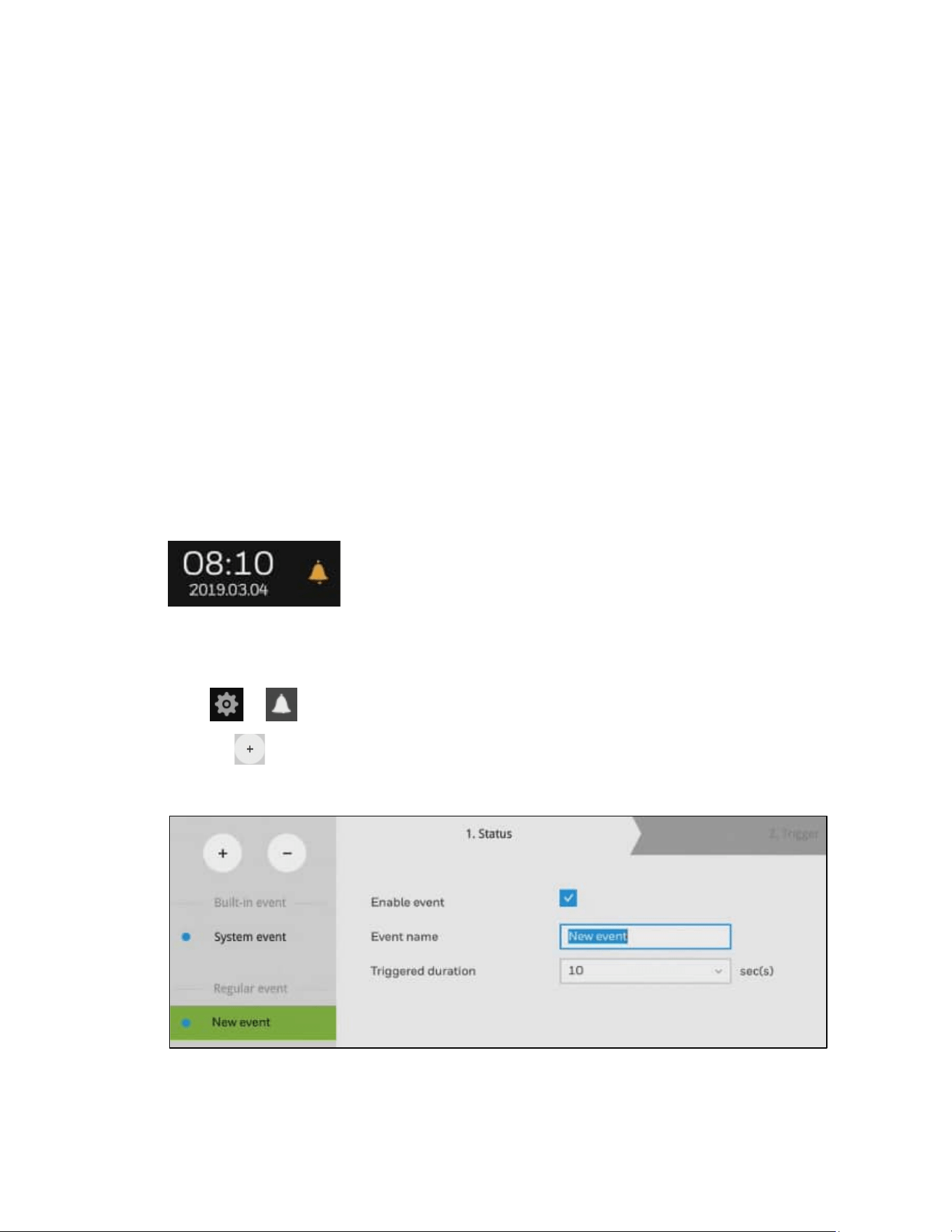
1. Click and the following window is displayed:
Figure 6-19 Create a New Event-Status
2. Manually enter a name. Up to 16 numeric or alphabetic characters is supported for the
name, including symbols such as [0-9] [a-z] [A-Z] [_] []. And then designate the interval
30 Series Network Video Recorder User Guide
42
between one alarm and the next triggered alarm to avoid the situation that the alarms can
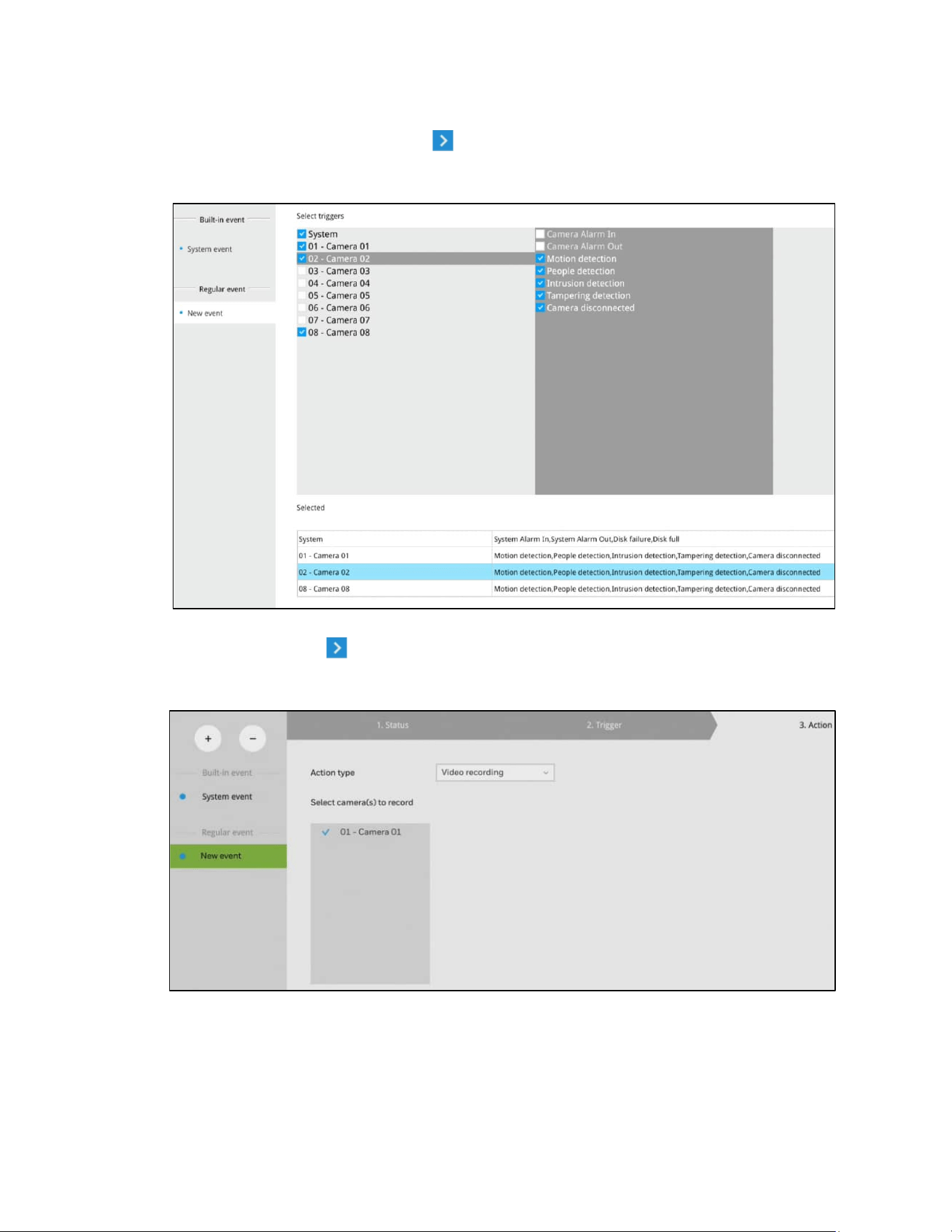
be too frequently triggered. Click and the following window is displayed:
Figure 6-20 Create a New Event-Trigger
3. Select system triggering conditions, or one or more cameras by selecting their
checkboxes. Click and the following window is displayed:
Figure 6-21 Create a New Event-Action
4. Select the Action type from a drop-down menu which includes:
Video recording - When an event is triggered, the selected camera will record a video
footage of the length defined by the pre-/post-event setting, to the NVR system.
Send email – When an event is triggered, it sends an Email to the administrator along
with a snapshot of the event.
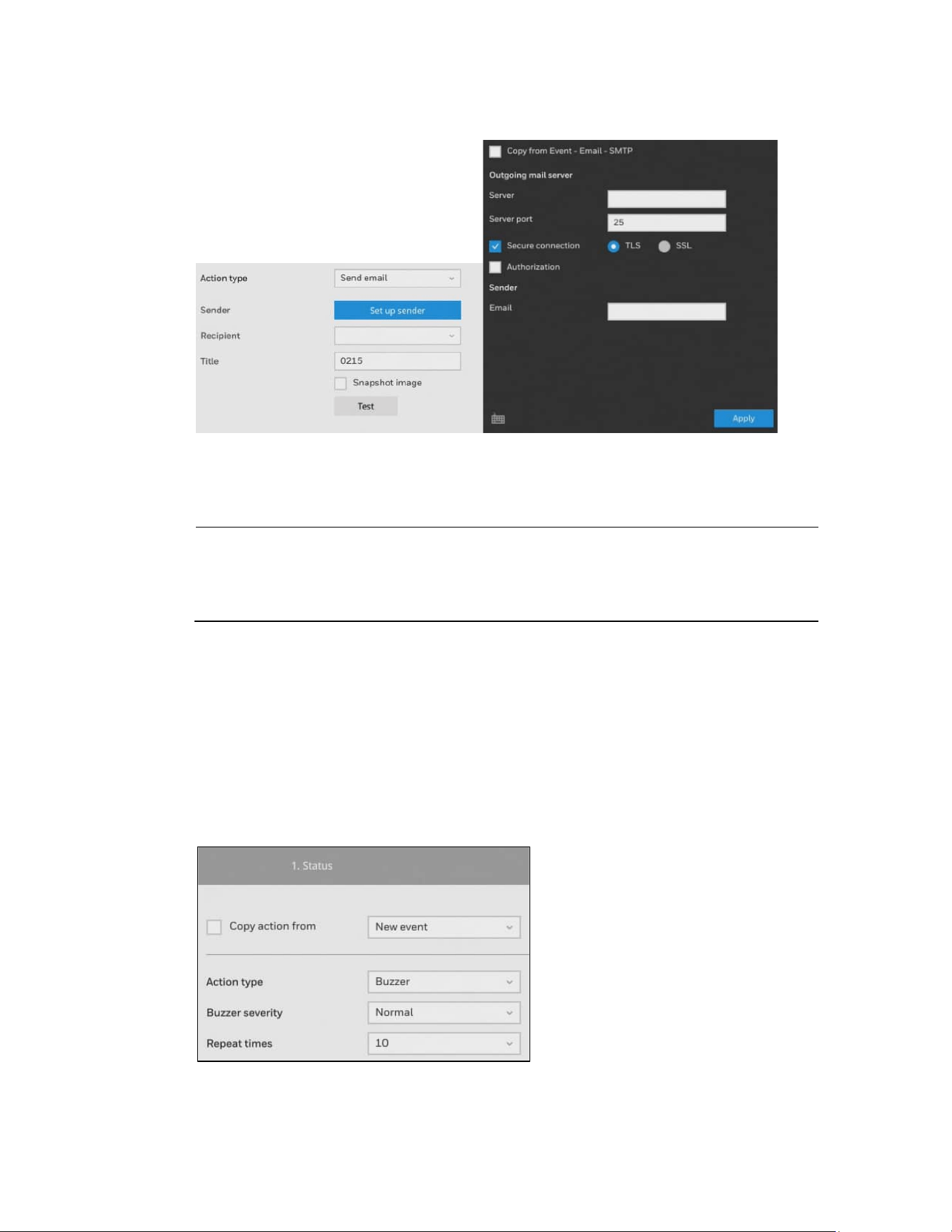
Settings
43
Figure 6-22 Email Setup
To configure Email notification, enter valid Email addresses as the Sender and Recipient
addresses, an Email subject, and the SMTP server address through which the Email will
be delivered. If you need to log in to SMTP server to deliver an Email, enter the User name
and password for access to that account.
Note
The Email subject and addresses can be composed of 254 characters in
numeric or alphabetic characters including: [0-9] [a-z] [A-Z] [_]
[ ][-][.][,][@]. You can enter the addresses of multiple recipients. Use
semicolons, (;), to separate the addresses of multiple recipients.
Buzzer - The buzzer is sounded on the occurrence of the event. The buzzer tones are
categorized into: Critical (1 long, 1 sec interval) Major (1 long 2 shorts, 1 sec interval),
Normal (3 shorts, 2 sec interval), Minor (2 shorts, 2 sec interval), and Notify (2 very
shorts) depending on the importance of an event. Select a Buzzer modulation from the
drop-down list.
A long tone has a duration of 1 second, while a short tone 0.5 second. A very short tone
lasts only for 0.1 second.
Select how many times the buzzer tones will be repeated on the occurrence of an event.
Figure 6-23 Buzzer Options
If events of different importance are issued at the same time, e.g., one major and one
minor event, system will ignore the minor event and sound the buzzer tone for the major
30 Series Network Video Recorder User Guide
44
event only. The buzzer can be sounded either by the Alarm actions or the system events. If
Alarm actions and system service events occur at the time, Alarm actions have the higher
priority.
If multiple Alarm actions occur, the currently-sounded events can be depleted by the new
event.
There are conditions that the system will sound the buzzer, and the conditions are not
configurable.
• Disk failure - missing drives or SMART detected failures.
• Disk full - the free space is too small for recording tasks.
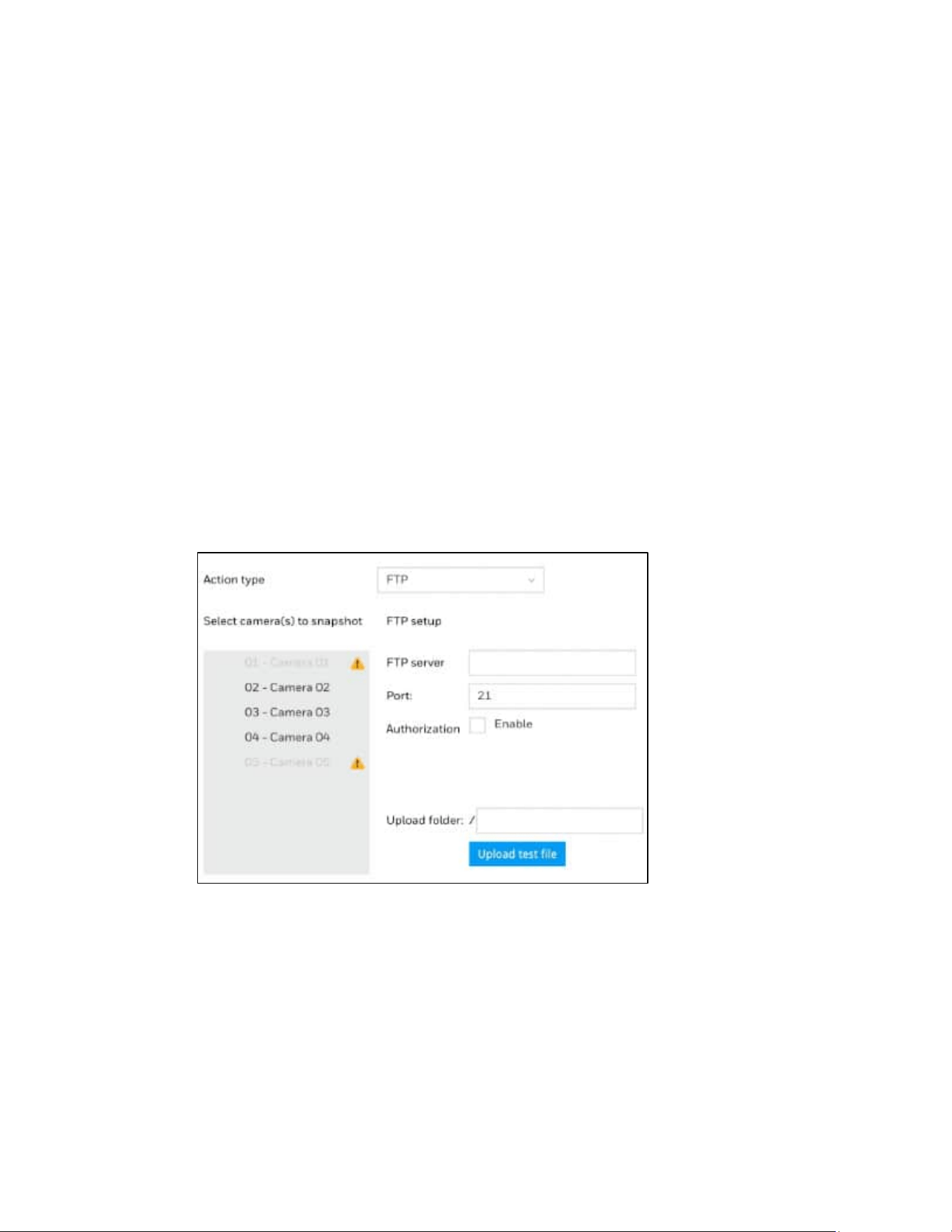
FTP–Snapshots from specified cameras can be uploaded to an FTP site on the
occurrence of an event. Enter the FTP site address in the dotted-decimal notation, e.g.,
159.22.151.20. Enter the login name and password for the user account. You can enter a
directory name you prefer on the FTP site. The server port default is 21, a different number
between 1025 and 65535 can also be assigned.
The snapshot thus delivered has a size of 320x240 pixels. If authentication is not applied,
login will proceed using the [anonymous] account. The file names of the snapshot jpeg.
files will look like this: [MAC]_[DATE]_[TIME]_[CAMERA_INDEX].jpg - If similar files
already exist, an additional index number will be added to the end of file name.
Figure 6-24 FTP Setup
Camera Alarm Out - A triggered alarm triggers a camera's alarm out, e.g., an alarm siren.
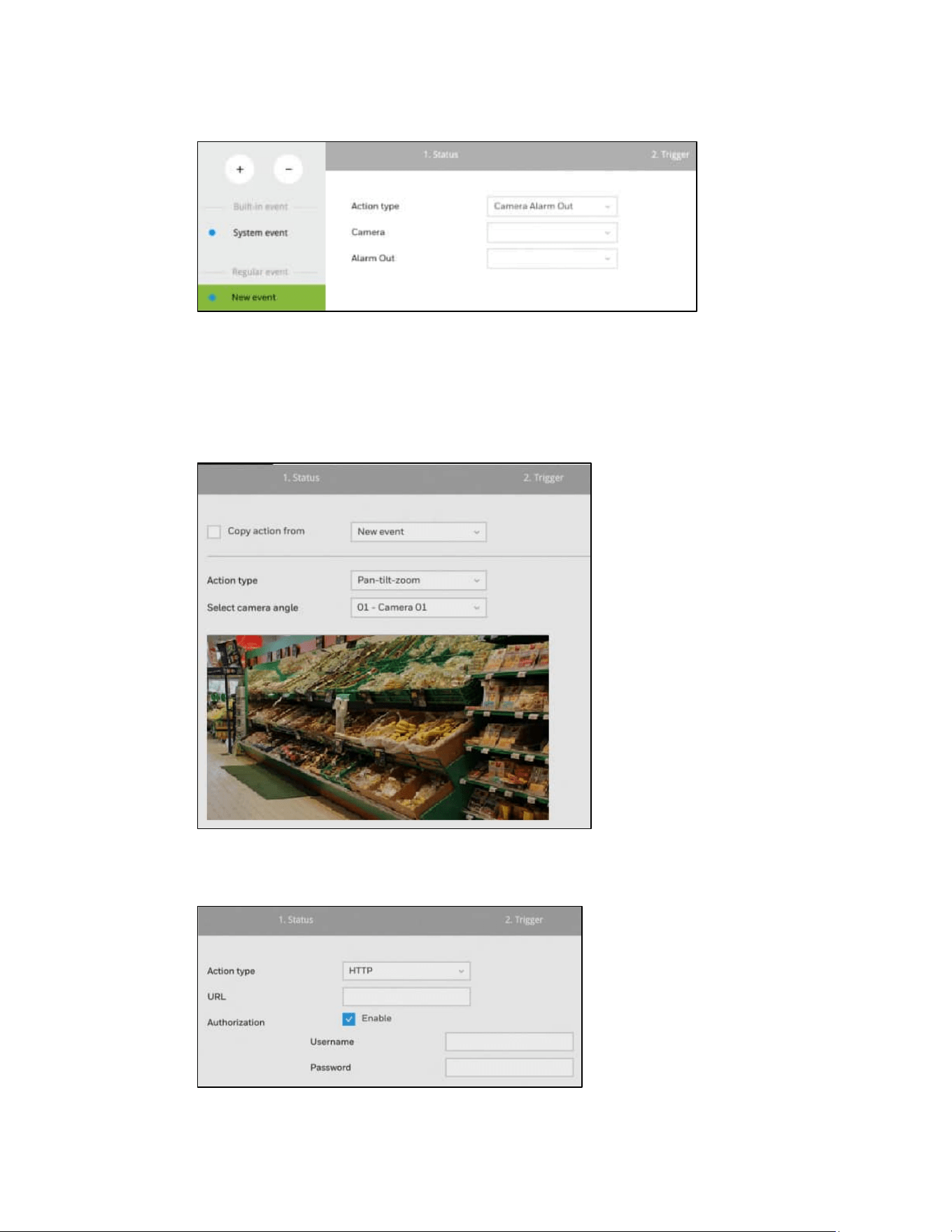
Settings
45
Figure 6-25 Camera Alarm Out Setup
Pan-tilt-zoom - A PTZ capable camera can move its lens to the preset position in case of
a triggered alarm. For example, a triggered sensor may indicate an area of interest has
been intruded, and a camera's field of view should be moved to cover that area. The
precondition is that you properly set up preset positions on your PTZ cameras using a
local or a web console.
Figure 6-26 Pan-tilt-zoom setup
HTTP - Select to send the media files to an HTTP server when a trigger is activated.
Figure 6-27 HTTP Setup
30 Series Network Video Recorder User Guide
46
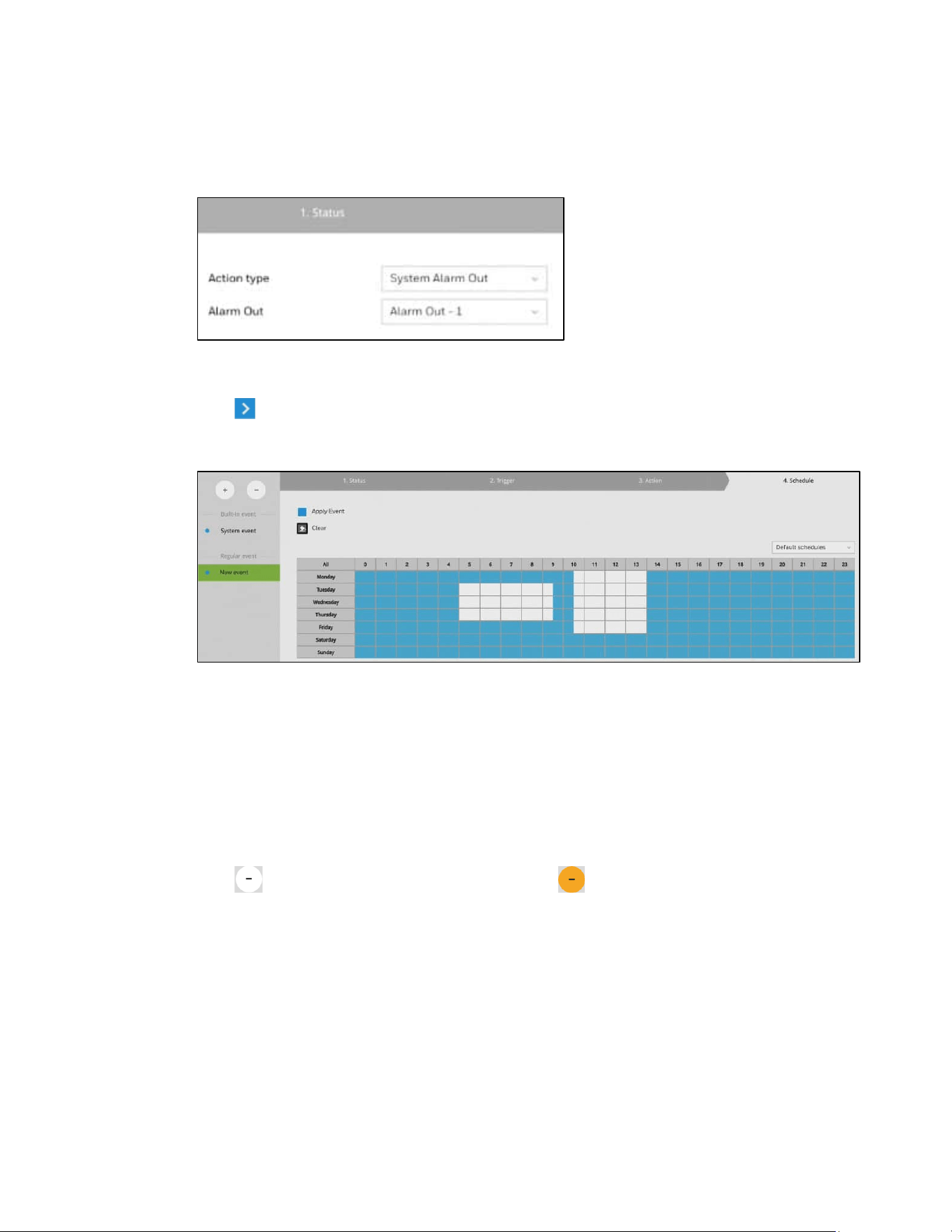
System Alarm Out - A triggered alarm can be used to toggle the NVR's alarm out, e.g., to
sound an alarm siren.
Figure 6-28 System Alarm Out
Send to HVMV–An event message will display on your HVMV software. (An event should
be first setup in HVMV and select Sound the event as action.)
5. Click and the following window is displayed:
Figure 6-29 Event Schedule
6. Click and drag the mouse to activate or de-activate alarm triggers throughout a specific
timeline.
7. Click Finish to end the configuration.
8. Repeat the process above to create more alarms according to the needs in your
surveillance deployment.
Removing an Event
1. Click in and the remove button will turn yellow .
2. Mouse over to the event you want to remove, and its entry will display the Remove
message.
3. Click the Remove message.
Setting-Event-Email
This page provides an interface where you can configure the connection to a Mail server. via
the Mail server, the system can deliver Emails containing system alarm messages to multiple
Settings
47
receivers. A reachable Mail server and Email accounts must be provided before you can apply
the settings.
Go to Email.
The configuration options are identical to those found in the Email configuration in Settings -
Event window. See Email Setup on page 43.
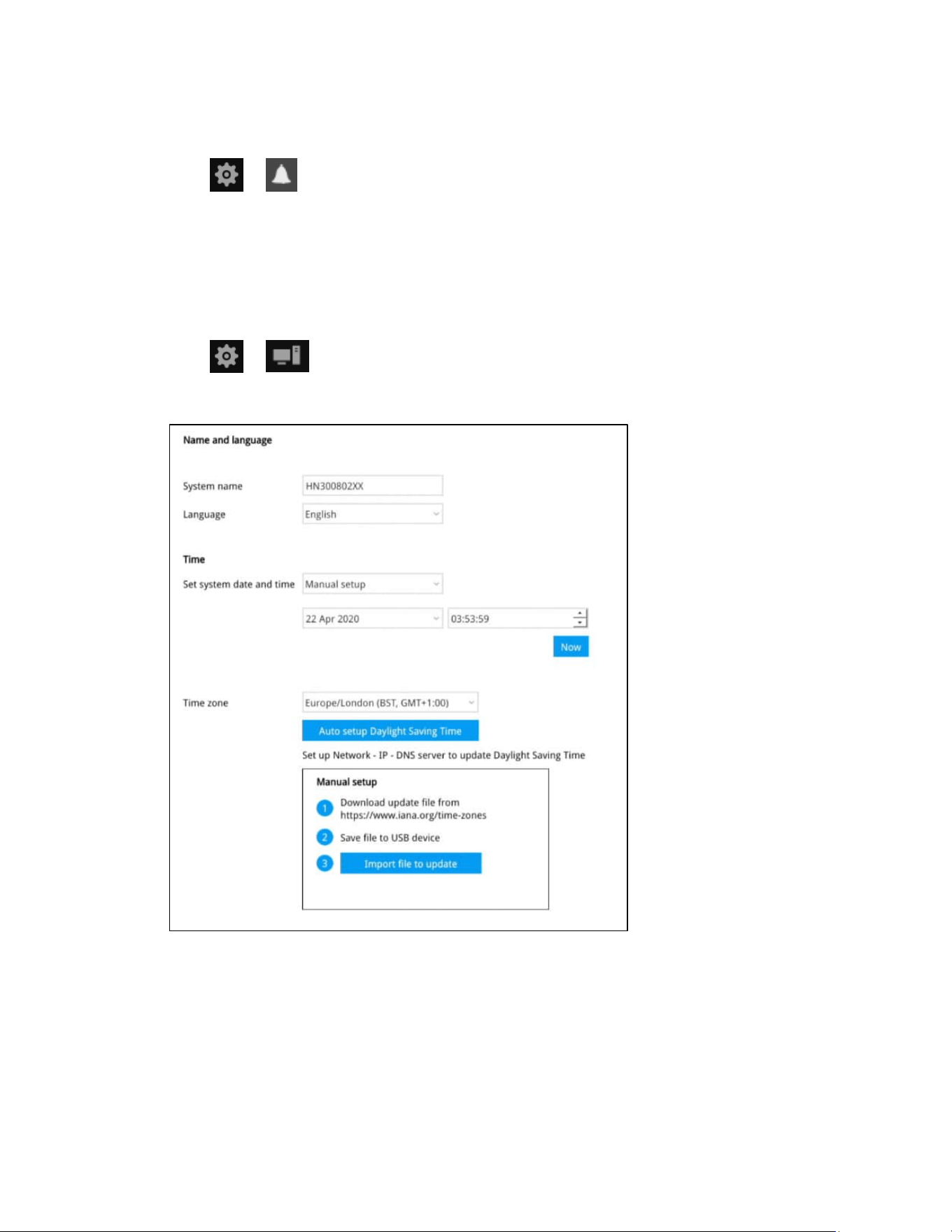
Setting-System-Information
Go to Information.
Figure 6-30 System-Information
On this window, you can configure the following:
• Change the system name. Using a name in different languages is supported via a web
console.
• Select the UI text language.
• Configure system time, time zone, and if you are connected to a DNS server where Auto
Daylight Saving time can be applied, you can acquire the associated setting from a server
30 Series Network Video Recorder User Guide
48
within your network. You can use the Auto Setup button to automatically update the
daylight-saving configuration. A system reboot is required.
• Manually update the daylight-saving profile in the GZ format using the Import file button
below.
Click Apply for the configuration to take effect.
Note
If the NTP
time server configuration (Auto) is preferred, the
system will automatically configure all cameras to be listening
to the system, and therefore to the same time server.
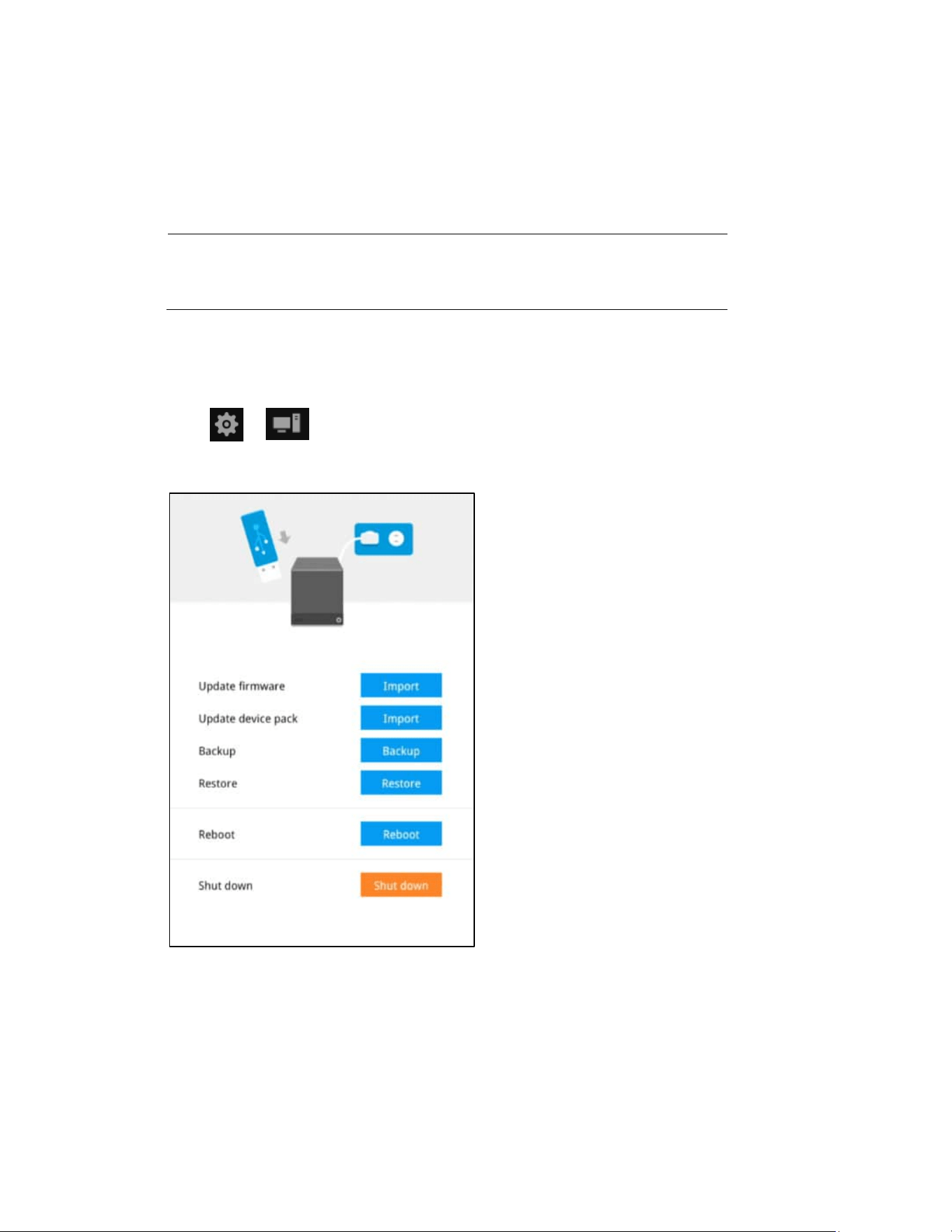
Setting-System-Maintenance
Go to Maintenance.
Figure 6-31 Maintenance
On this window, you can perform 4 maintenance tasks:
• Update firmware –Download firmware and save it to a USB drive in the FAT format, attach
the USB device to the NVR for firmware upgrade.
• Update device pack–A device pack allows you to import associated configurations and
parameters for new camera models so that these cameras can be integrated into your
NVR configuration. The information in the device pack is related to some tunable
parameters.
Settings
49
• Backup –You can back up your system configuration using the Backup function. Click
Backup, a message window will prompt. Click Save to preserve your system
configurations.
Select a location for your backup file, then click Save to complete the process. If you back
up to a USB thumb drive, that thumb drive must be formatted using the FAT format.
Note
The backup action does not involve the following:
• Recorded videos and database.
• Alarm records
• Restore–If you have a previously-saved profile, you can restore your previous
configuration. Click Restore. A file location window will prompt. Locate the backup file and
click Open. The Restore process will take several minutes to complete, and system
operation will be interrupted during the process.
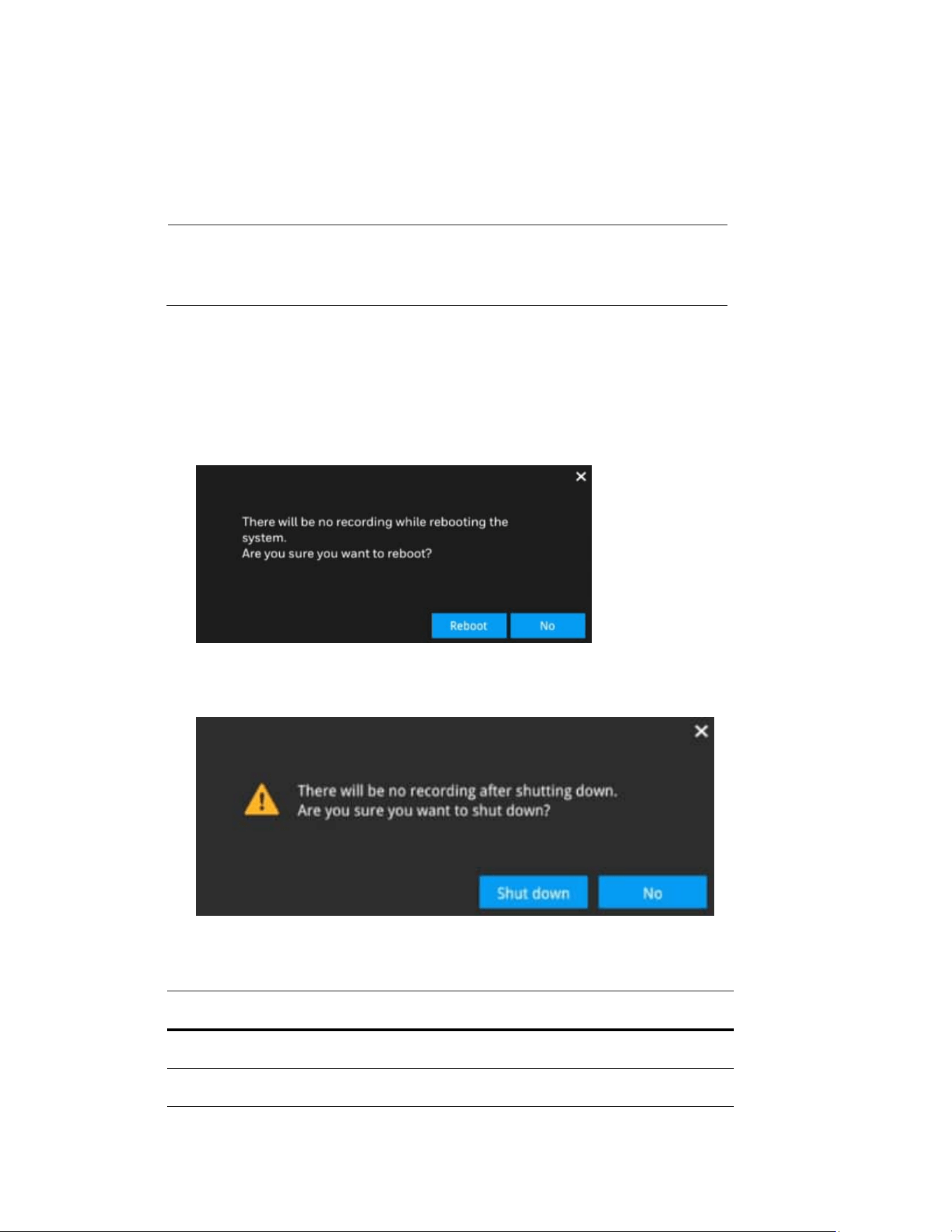
• Reboot – Click the button to reboot NVR.
Figure 6-32 Reboot
• Shutdown – Click the button to shutdown NVR.
Figure 6-33 Shutdown
Refer to the following table for detailed information on compatible USBs.
Table 6-3 Compatible USB Table
Brand Specification
Transcend TS8GJF370 8GB, USB2.0, Pen Drive, Classic, White
SanDisk SDCZ73-032G-G46, SanDisk Ultra Flair USB 3.0 32GB
30 Series Network Video Recorder User Guide
50
SDCZ600-032G-G35, SanDisk Cruzer Glide 3.0 32GB
Sony USM16GL, microvault USB2.0 16GB
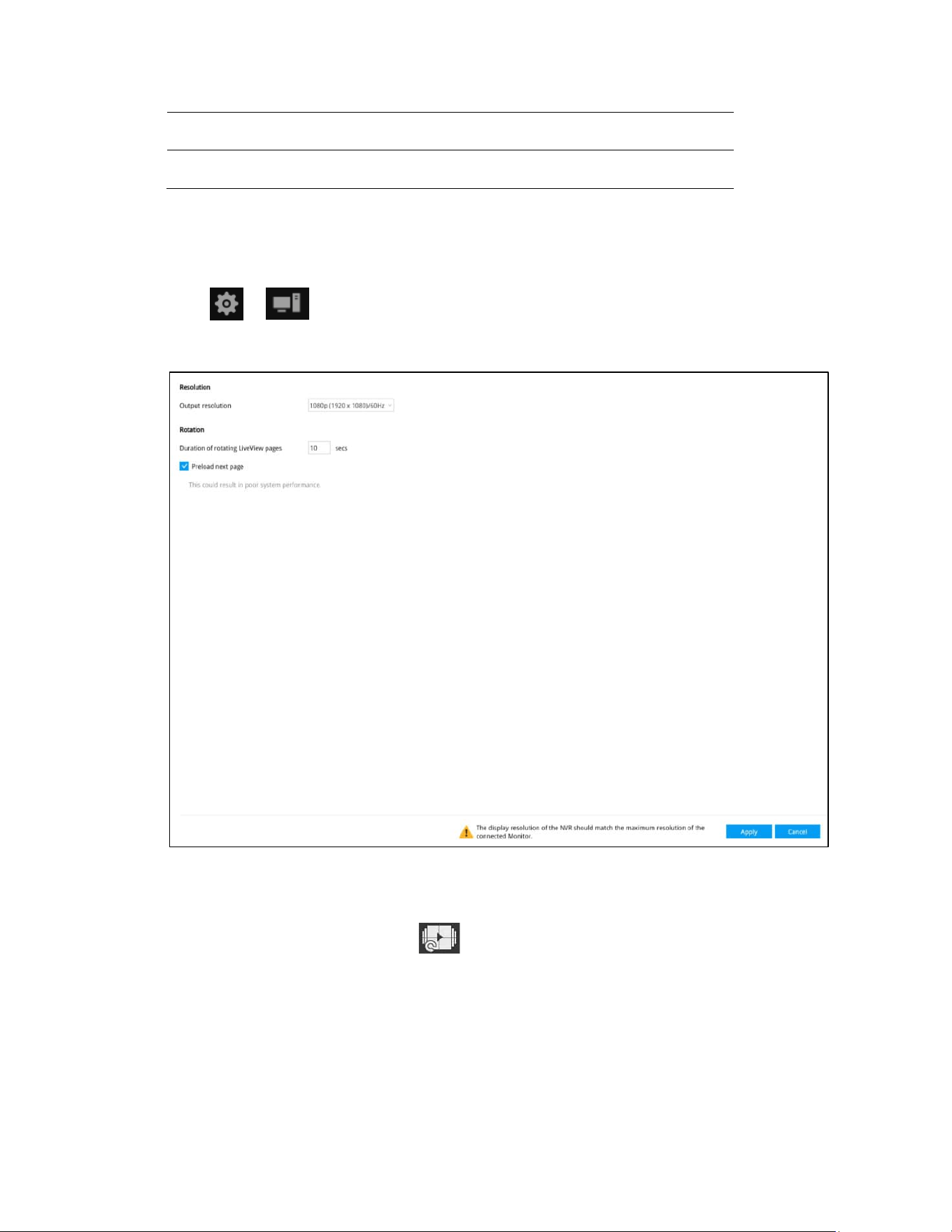
Setting-System-Display
Go to Display.
Figure 6-34 Display
On this page, you can configure the system to consecutively display (rotate) cameras' view
cells on the Liveview window. For example, if you have 8 cameras in 2 2x2 layouts, the rotation
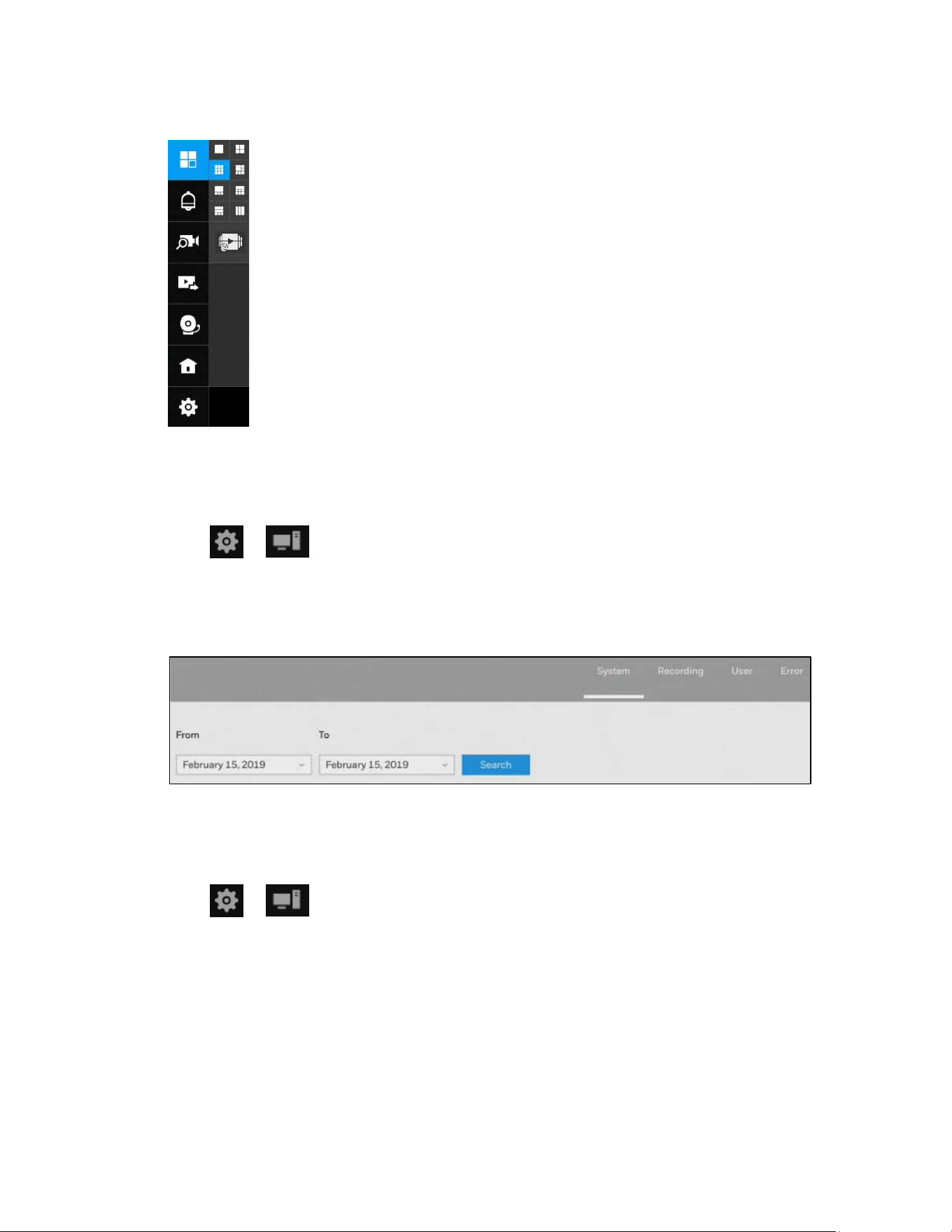
can let you see the live views of all cameras by every few seconds.
To enable the rotate function, click on the layout panel.
Settings
51
Figure 6-35 Layout
Setting-System-Log
Go to Log.
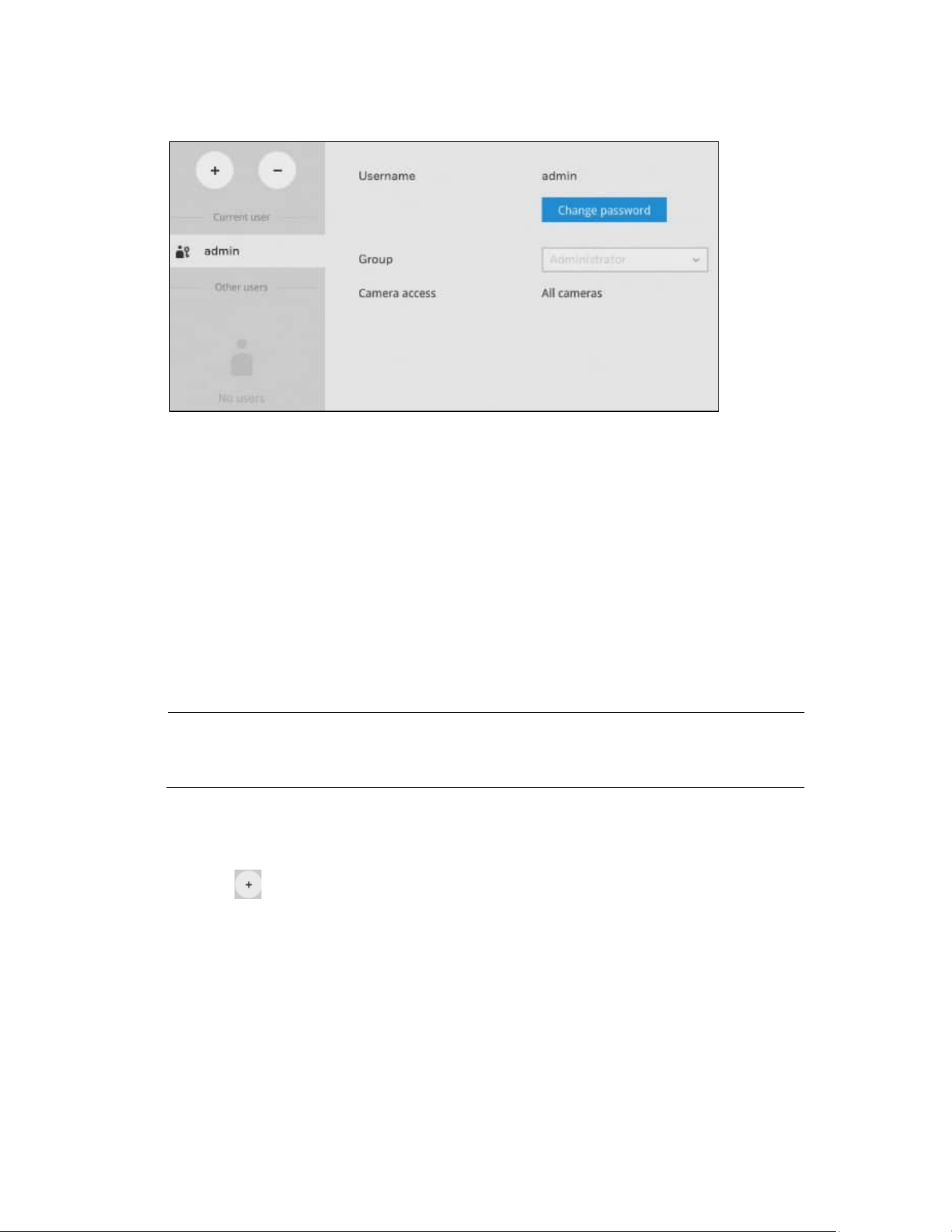
System logs are categorized as System, Recording, User, and Error. You can search for past
logs in each category window by selecting a range of time and clicking Search
Figure 6-36 Log
Setting-User
Go to User.
30 Series Network Video Recorder User Guide
52
Figure 6-37 User
The User page allows you to create more users, to change user password, and place
limitations on users' privileges and administration rights. Up to 16 users can be created,
including the default administrator.
By default, there are two user groups: Administrator and Regular user.
• The administrator users can access all cameras recruited in the configuration; while the
regular users can be configured to have access to some or all cameras.
• The regular users cannot access the Settings window, meaning that regular users cannot
add or remove cameras, make changes to alarm, network, and all other system settings.
When users try to access the Settings window, the login window prohibits regular users to
log in.
The system blocks out the video feeds from users who are denied of the access to particular
cameras. The alarms and the alarm-triggered recordings from those cameras will also be
inaccessible for unauthorized users.
Note
The default name and password for administrator group are admin and
admin. It is highly recommended to change the default password to
prevent unauthorized access to the system.
Creating a User
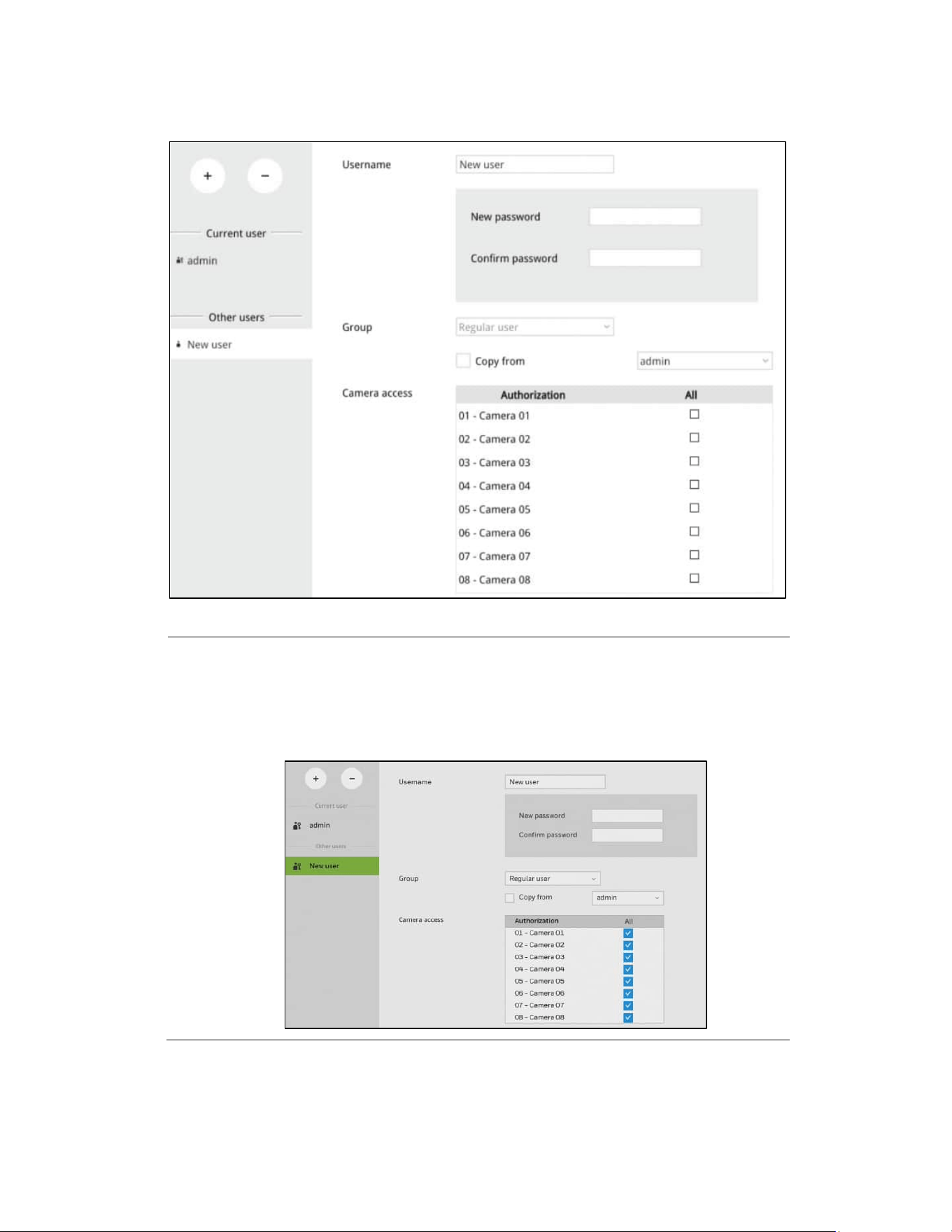
1. Click in Figure 6-36 and the following window is displayed:
Settings
53
Figure 6-38 Create a User
2. Enter user name, password and select a group from the dropdown menu.
Note
• The maximum number of characters for a user name is 64, with
alphabetic and numeric characters including [0-9] [a-z] [A-Z] [_] [ ]
[-] [.][,][@]. The maximum number for password is also 64.
• If you are creating a regular user with limited access to cameras,
deselect the checkboxes by the cameras to deny the user access.
3. Click Apply to close the configuration window. Repeat the process to create more users.
30 Series Network Video Recorder User Guide
54
Removing a User
1. Click in Figure 6-36 and the remove button will turn yellow .
2. Mouse over to the user you want to remove, and its entry will display the Remove
message.
3. Click on the Remove message.
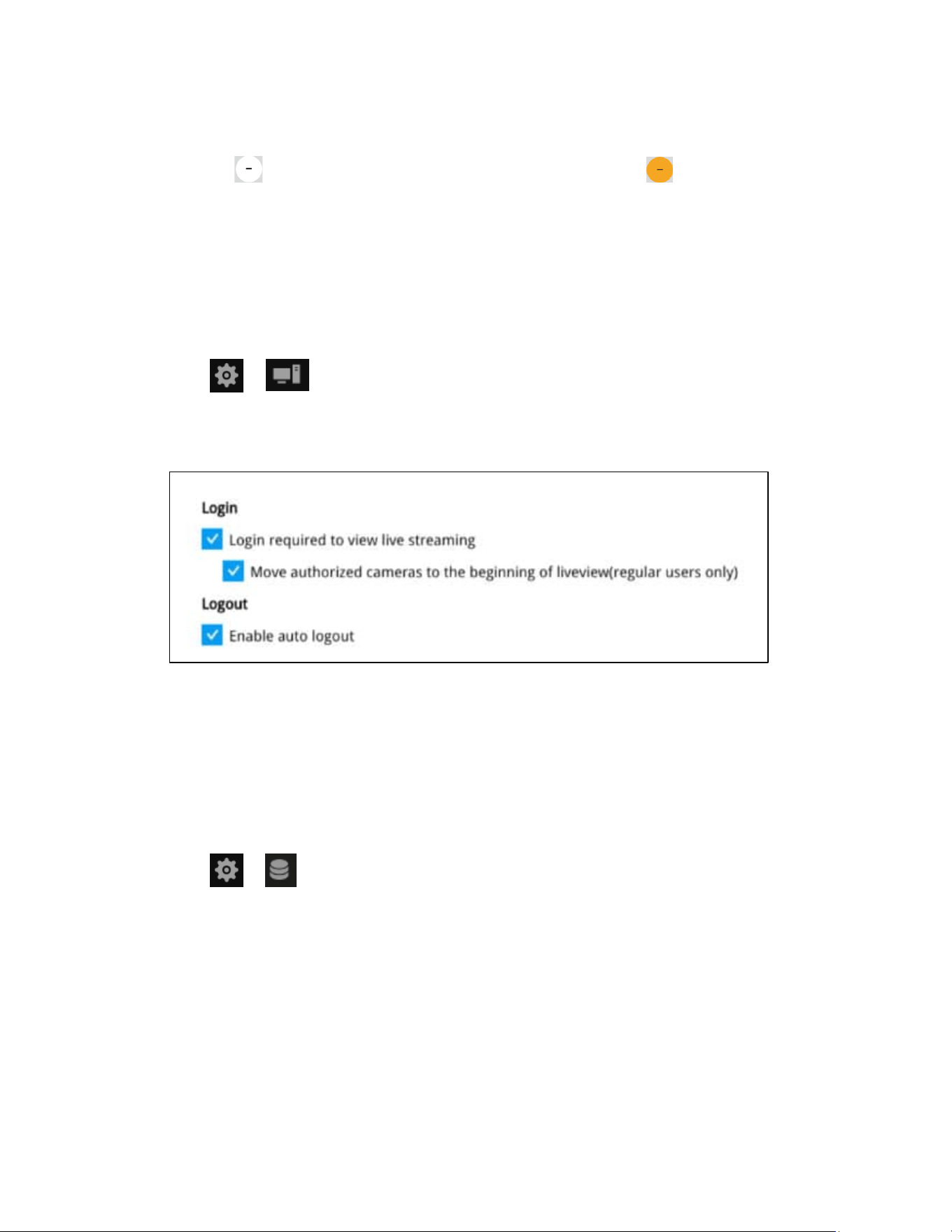
Setting-Login/Logout
Go to User.
Select related settings of login/logout.
Figure 6-39 Login/Logout
Setting-Storage
Creating a Volume
Before creating the volume, make sure the HDDs have been properly installed.
Go to Storage.
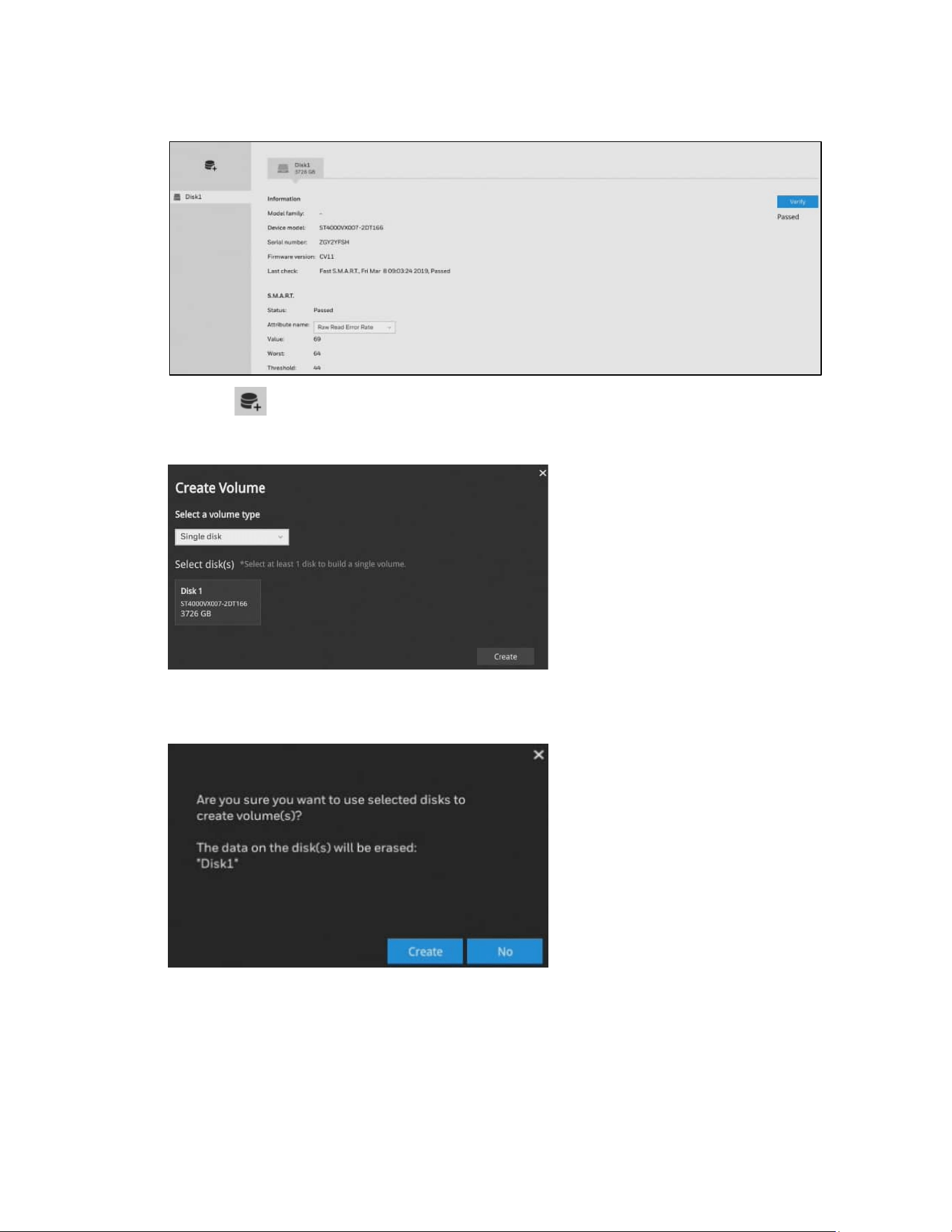
Settings
55
Figure 6-40 Setting-Storage
1. Click and the following window is displayed:
Figure 6-41 Select Disk
2. Click a disk that you want to use and click Create. A confirm message prompted as below:
Figure 6-42 Confirm
3. Click Create to proceed.
30 Series Network Video Recorder User Guide
56
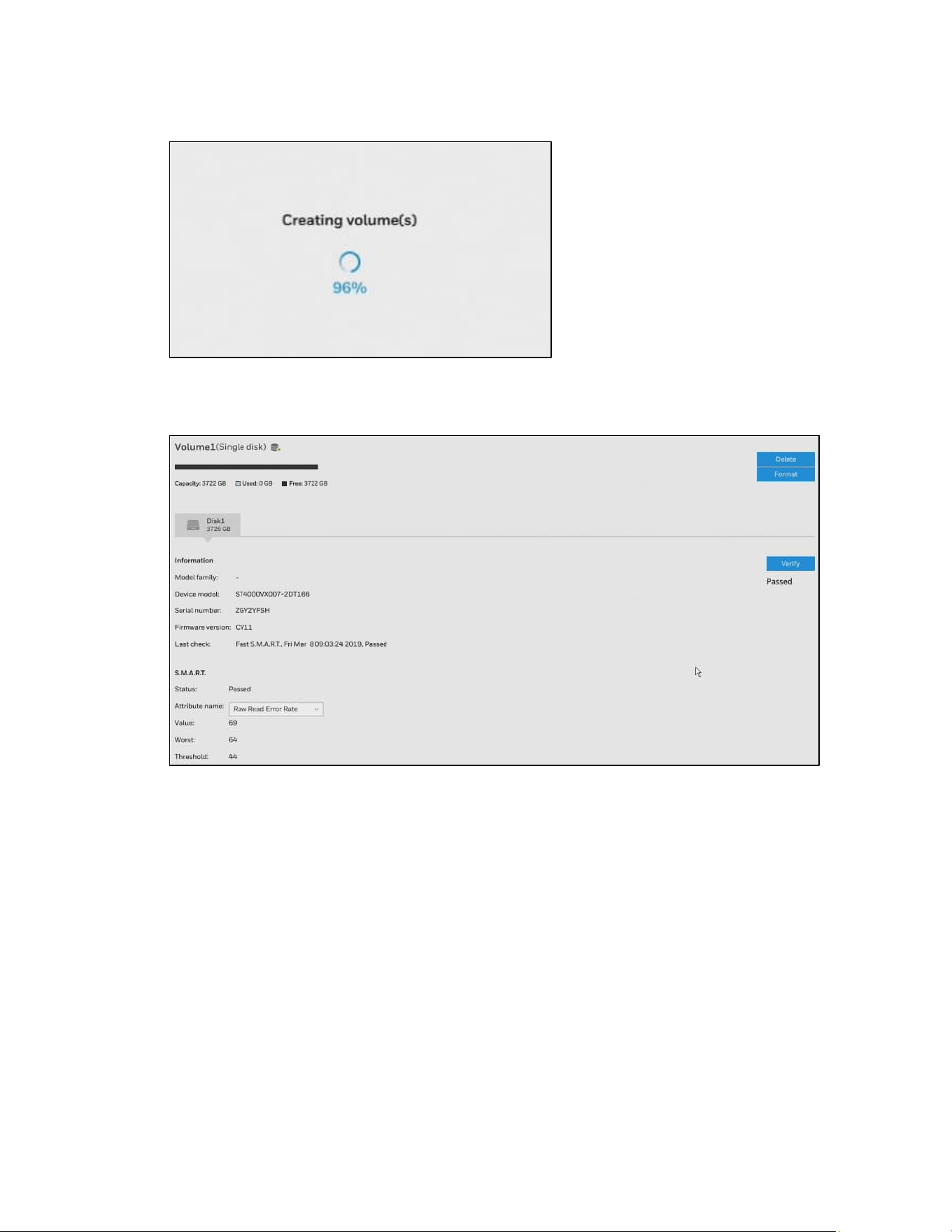
Figure 6-43 Creating Volume
When the creating is completed, the following window is displayed:
Figure 6-44 Volume
Repeat the above steps to create a new volume when you installed another disk.
The storage page displays the volume information including physical position, total capacity,
used and free space, and associated commands such as Format and Delete. Since each
volume contains only 1 hard drive, detailed information about the hard drive is also displayed
on this page.
You can format an existing storage volume in situations such as when you need to re-deploy
the system elsewhere.
Disk Information
Model family: The brand name of the HDD manufacturer.
Device model: The disk model name.
Serial number: Serial number assigned to the disk drive.
Firmware version: The version of firmware running on this disk drive.
Last check: The bad block check or S.M.A.R.T. test previously executed on this drive.
Settings
57
Status: S.M.A.R.T. status polled from the disk drive. This is not the results from a manually-
executed S.M.A.R.T. test.
Attribute name: The various attributes can vary from different HDD manufacturers. Value:
Value for the currently selected attribute.
Worst: Worst value acquired for that attribute.
Threshold: A predefined threshold or triggering value. The threshold below which the
normalized value will be considered exceeding specifications.
Raw value: The detected parameters for that attribute.
Status: The judgement made to deem the current reading as OK or failed.
Verify
Click Verify on Figure 6-42 to check the disk status. Three types of check disk actions can be
initiated through this button.
Bad block: Performs read/write test to drive sectors to locate bad blocks. This action may take
several hours to complete.
Fast S.M.A.R.T.: Tests the electronic and mechanical performance and disk read performance,
including those on disk buffer, read head, seek time, and integrity of drive sectors. The short
test is performed on a small section of disk platters, and takes about 2 minutes to complete.
S.M.A.R.T.: The long test is more thoroughly and is performed to all drive sectors. The actual
completion time depends on drive sizes and the attributes put to test.
The Check disk functions mentioned above, when performed during active I/Os, can consume
system resources and cause dropped frames with the recording tasks.
Note
Disk verify function requires a volume to be temporarily
disabled; namely, the video recording will be stopped before disk
verify can be performed.
Settings-Network-IP
Go to IP.
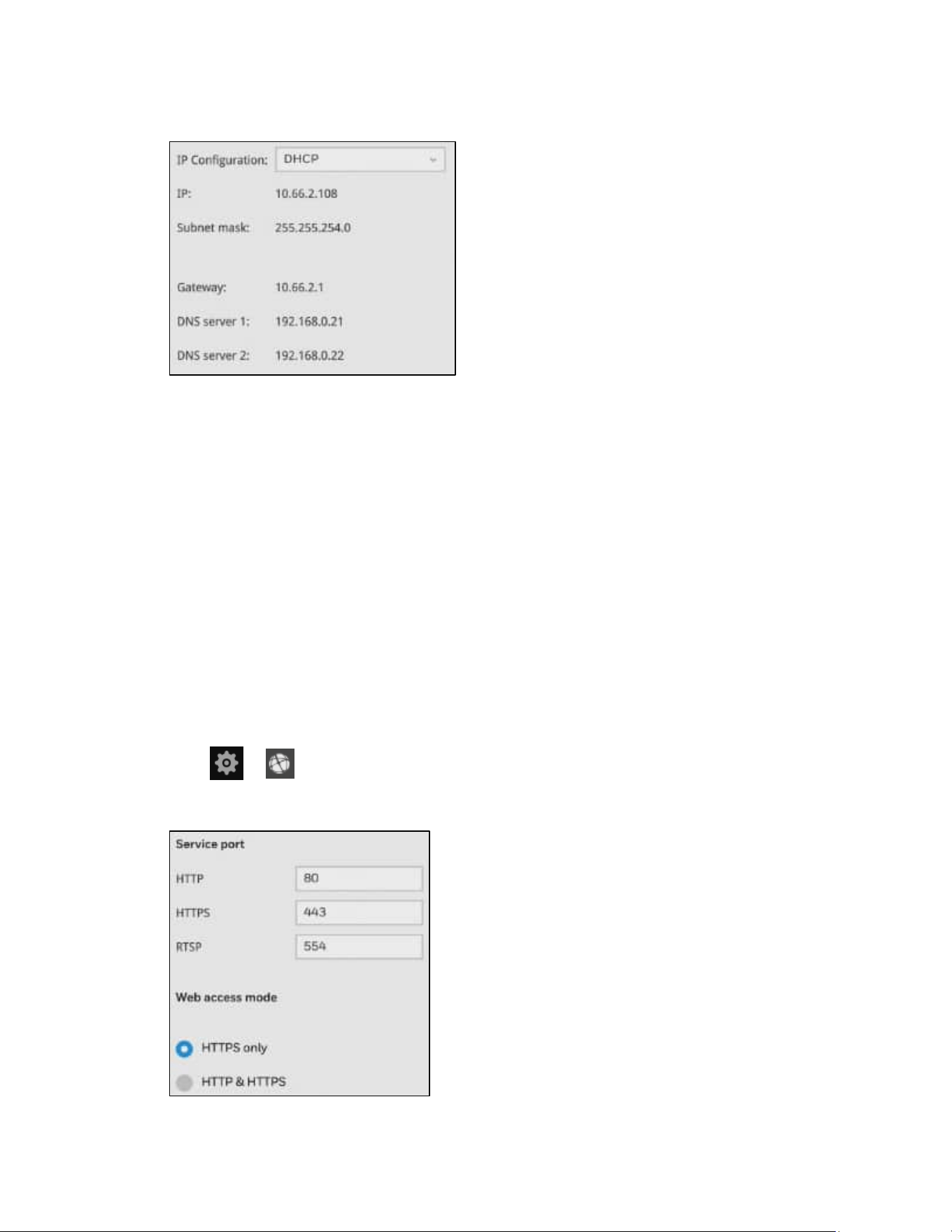
30 Series Network Video Recorder User Guide
58
Figure 6-45 IP
DHCP: Default is selected, the server obtains an available dynamic IP address assigned by the
DHCP server each time the system is connected to the LAN.
Manual setup: Select this option to manually assign a static IP address to the NVR. Enter the
Static IP, Subnet mask, Default router, and Primary DNS provided by your ISP.
Subnet mask: This is used to determine if the destination is in the same subnet. The default
value is “255.255.255.0”.
Default router: This is the gateway used to forward frames to destinations in a different
subnet. Invalid router setting will fail the transmission to destinations in different subnet.
Primary DNS: The primary domain name server that translates hostnames into IP addresses.
Secondary DNS: Secondary domain name server that backups the Primary DNS.
When finished with the network settings, click Apply.
Settings-Network-Service
Go to Service.
Figure 6-46 Service
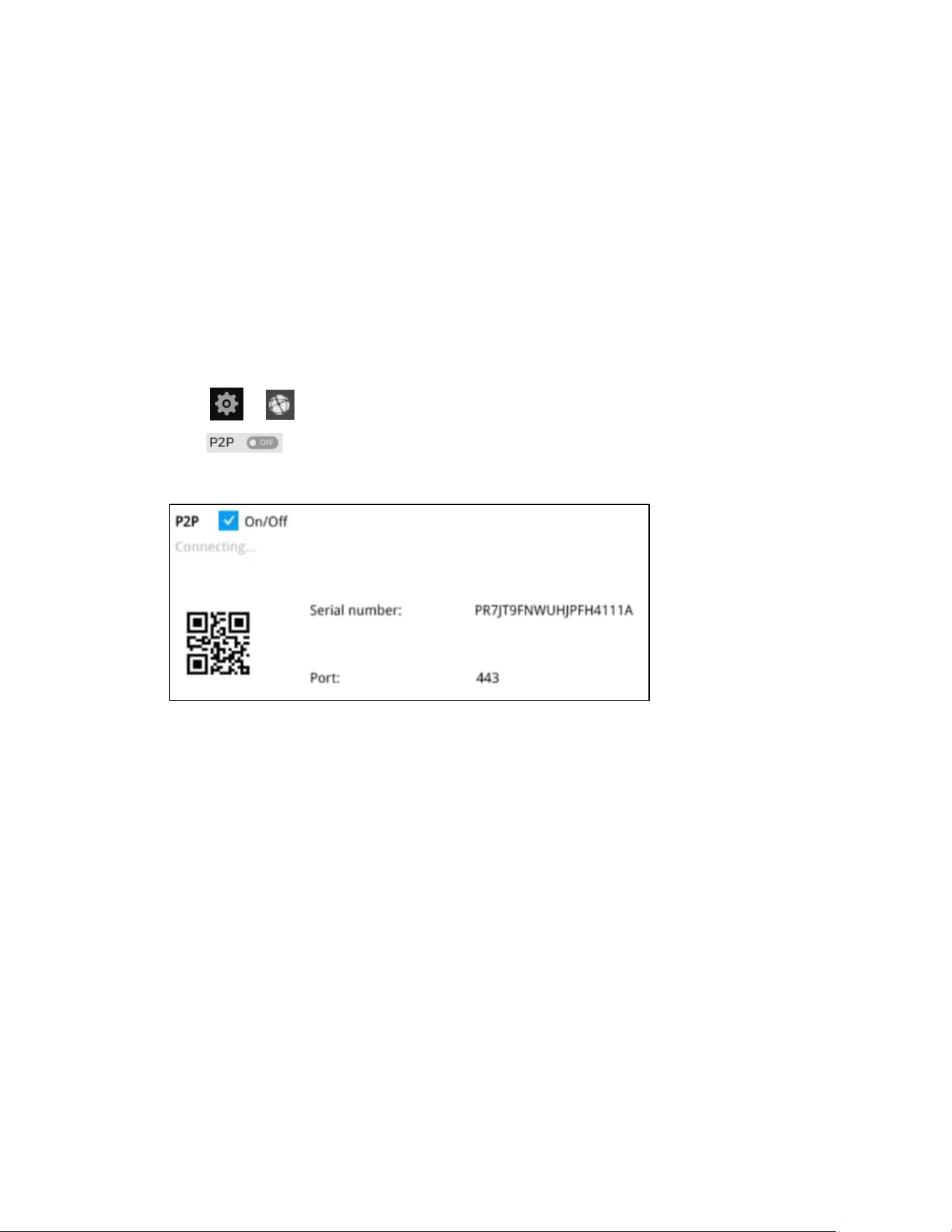
Settings
59
By default, the NVR service and video streaming are accessed via HTTP port 80 and RTSP port
554. You can designate a different port number if the need arises. Usually it is not necessary
to change these ports. HTTPS encrypted connection is enabled by default.
Settings-Network-P2P
You can easily connect to the unit using a mobile device with the HVMV APP using the P2P
screen. To use this option, you will need the HVMV APP downloaded, installed, and have
registered/created an account. When the APP is setup, go to Device Management
P2P and
use the camera to view the QR code on the P2P screen. The device’s information and
connection will automatically be downloaded to the APP and you can now connect to the NVR
using your mobile device.
Go to P2P.
Click to enable this option.
Figure 6-47 P2P Setting
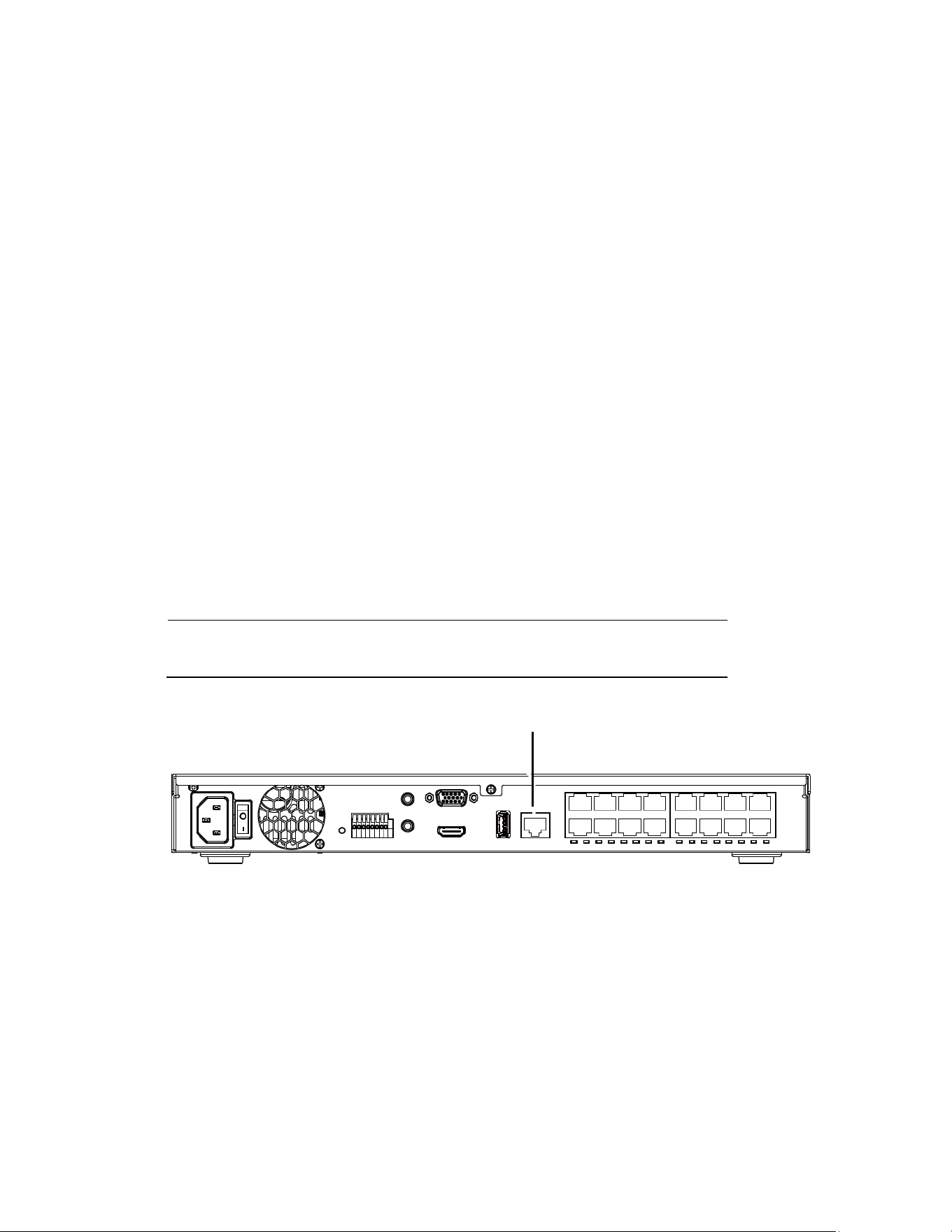
30 Series Network Video Recorder User Guide
60
7 Management over a Web
Console
This chapter contains the following sections:
• Before Getting Started on page 60.
• Login on page 61.
• Live View Screen on page 62.
• Search Recording Clips Screen on page 68.
• Settings on page 72.
There are two different interfaces on the system:
• One is connecting mouse and keyboard, and an HDMI cable to a TV screen or monitor.
The local management thus made is described in Section One of this manual.
• The other is accessed through the Ethernet connection. Management via a web console
will be described in this chapter of this manual.
Note
When accessed over the network, the total streaming
throughput is 128Mbps.
WAN/LAN
Before Getting Started
• Before operating the NVR, make sure you have properly installed hard drives and
configured the storage volumes. Otherwise, you will not be able to operate some of the
system's functionality.
• When you log in to the Liveview or Playback interface to stream a live or recorded video,
install the ActiveX plug-ins. If it does not prompt when you log in, install plug-ins when
you try to playback a recorded video. You may then need to re-start the IE browser
console.
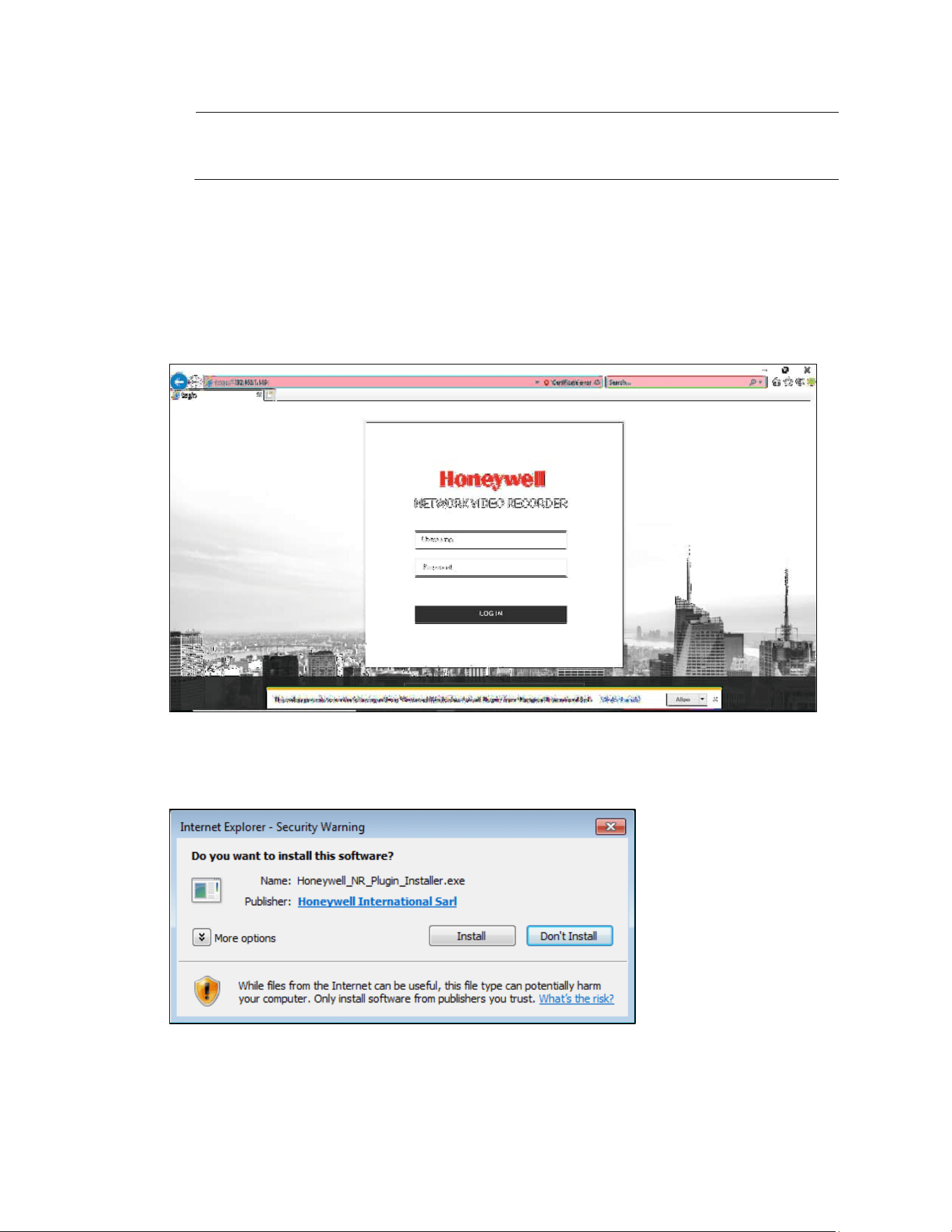
Management over a Web Console
61
Note
• Chrome doesn't require plug-ins.
• Chrome only supports streaming with H.264.
Login
1. Enter the IP address of NVR in the address field of a web browser and click search, the
following screen is displayed:
Figure 7-1 Web Client Log in
2. Click Install in the ActiveX plug-ins window at the bottom of the screen and the following
window is displayed:
Figure 7-2 Plugin Install
3. Click Install and wait till the login window shows again. For the first login, the default
username is “admin” and the password is “1234”.
4. Enter the username and the password and click LOG IN to enter the live view screen.
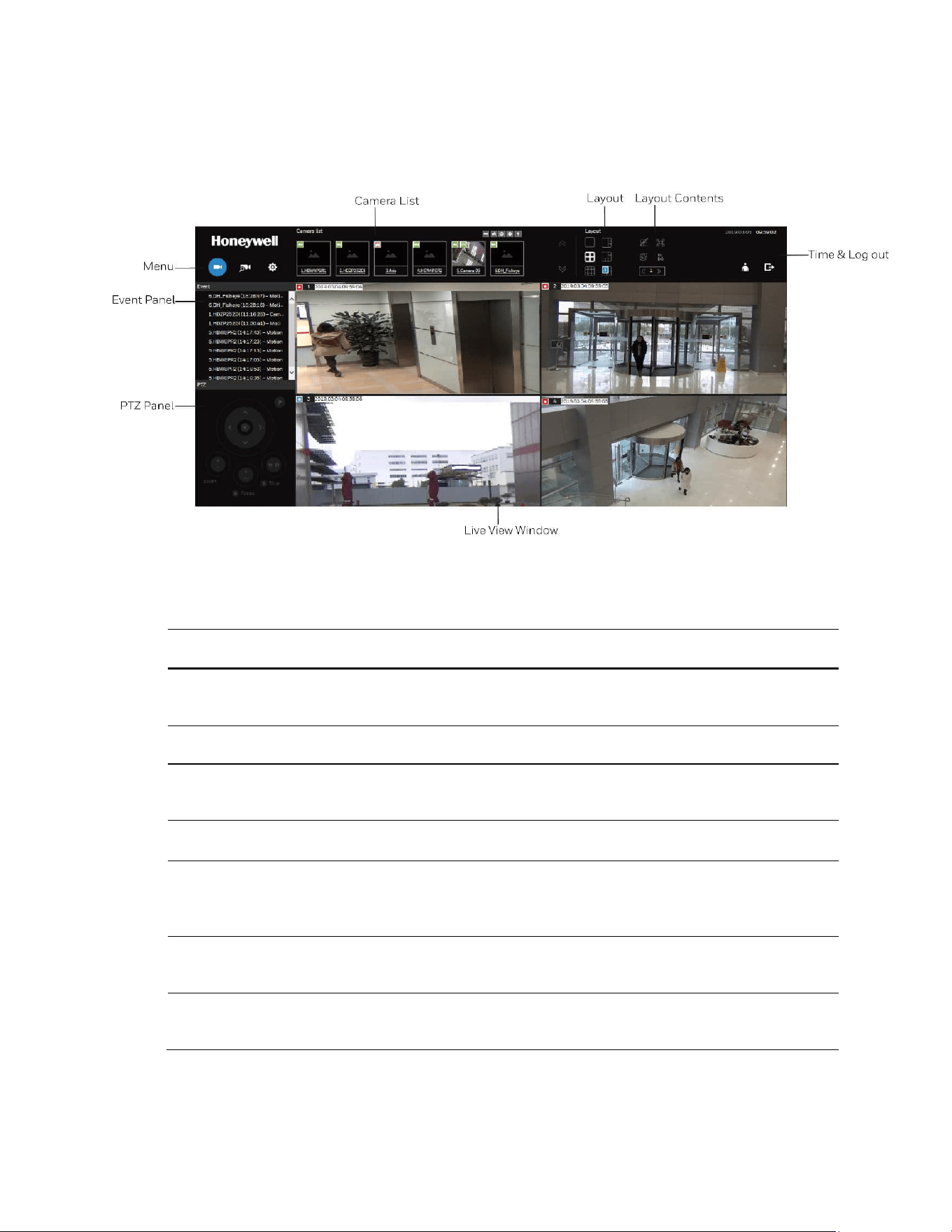
30 Series Network Video Recorder User Guide
62
Live View Screen
Figure 7-3 Live View Screen
Once you log in, the system defaults to the Liveview screen, which provides access to other
configuration entry. The screen elements are described as follows:
Table 7-1 Web Live View Screen
Name Description
Camera List
Provides a glimpse of all cameras inserted into your configuration.
Basic information is also provided along with a screenshot.
Layout Provides access to various layouts.
Layout contents
Provides functions to extend, rotate, and redo the layout. System Alarm
In /Alarm Out are also shown in here.
Time & Log out Shows the time and logout function.
Live View
Window
Displays video streams from one or multiple cameras. Snapshot,
streaming, bookmark, and audio control functions are also available on
individual view cells.
PTZ Panel
Exerts Pan/Tilt control on a selected view cell if the camera comes with
mechanical PTZ mechanism.
Event panel
Reports events transmitted via cameras' Alarm In connections or those
by the Motion Detection, Tampering, etc.
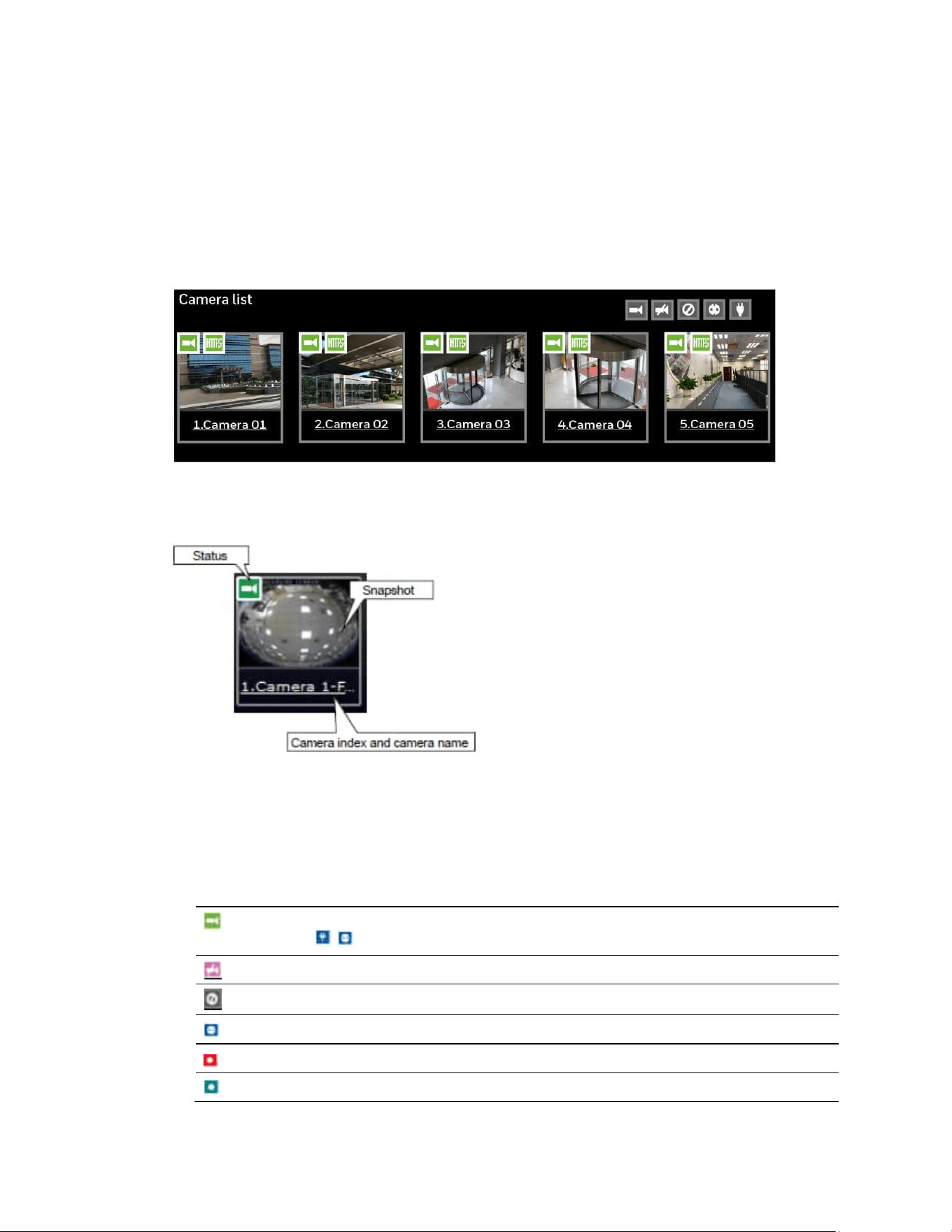
Management over a Web Console
63
Camera List
The camera list displays the recruited cameras by the sequential numbering order you
configured in the System Settings utility.
To arrange a view window layout, click and drag a camera from the camera list to a view
window.
Figure 7-4 Camera List
Depending on the size and screen resolution of your monitor, the snapshots of 6 cameras are
displayed in this panel. If a user logged in using a credential of a limited access, he may only
see cameras that he can access instead of all the cameras.
• Snapshot: the camera's image snapshot is replenished every 5 minutes. If a camera is
disconnected, the last image taken will be used to represent a camera.
• Camera index & Camera name: Placing the mouse cursor on top of a camera text
displays the camera index number and the camera name. Click on the camera index to
display the information box.
• Status:
Online: the online status can be accompanied by the Alarm In/Alarm Out
icon .
Offline: camera is disconnected.
An unconfigured camera instance.
Alarm input is triggered.
Connected and recording video to system storage.
Connected with live streaming.
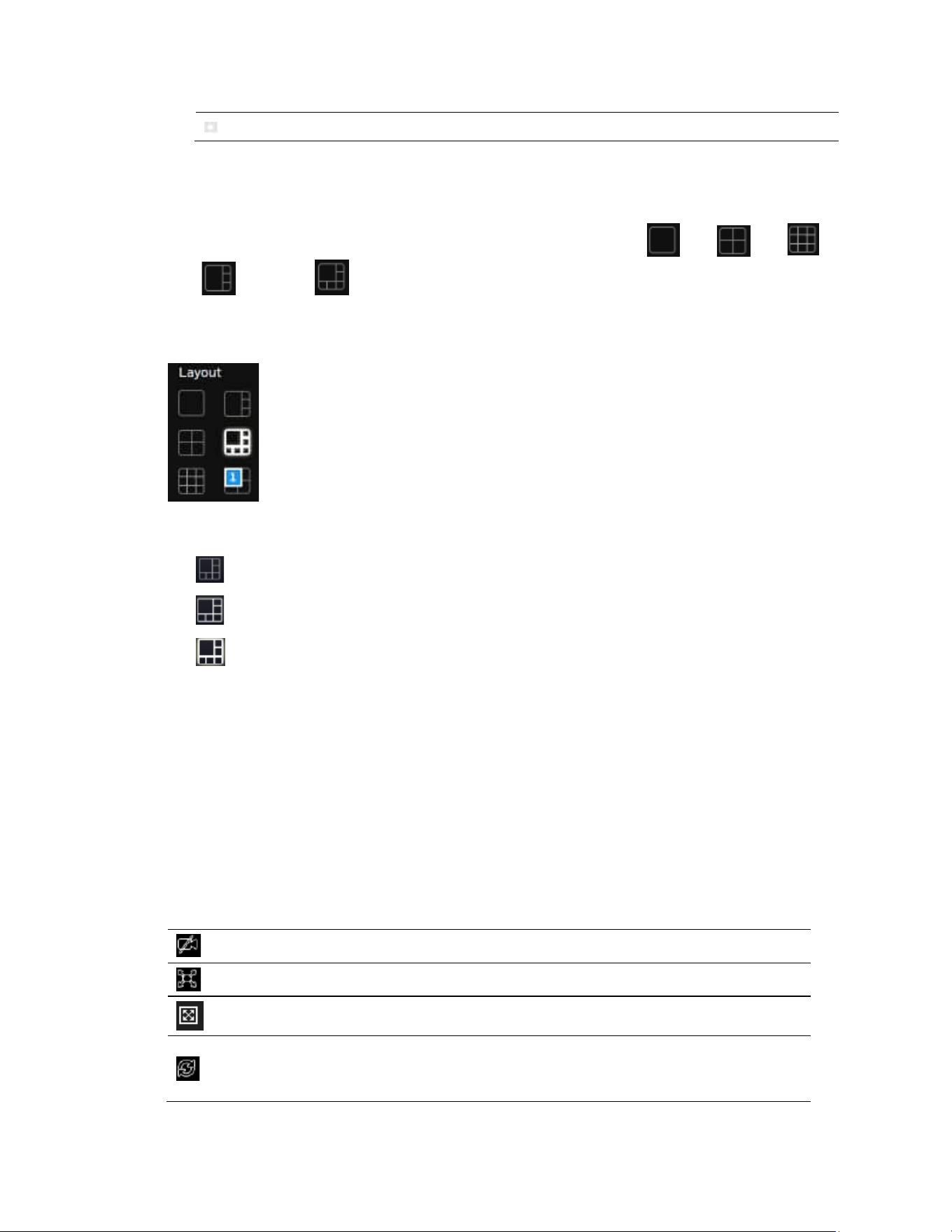
30 Series Network Video Recorder User Guide
64
Disconnected or trying to establish a connection.
Layout
By default, 5 typical layouts are provided for the user. They include: 1x1, 2x2,
3x3, 1V+3, and 1M+5. System default is the 2x2 layout. Cameras that do not fit into
the first page of a layout, say, a 3x3 layout, will be displayed on the succeeding layout pages.
Figure 7-5 Layout
Each functional button on the screen is activated by a mouse hover. For example, the below
states designate user's operation on a button:
• : not selected.
• : moused over and is ready for selection.
• : selected and is taking effects.
There are another 4 user layouts that can be individually configured. An administrator can
insert camera views into these layouts and save the configuration. These user layouts can be
seen by all users.
If you click the Rotate button before the configuration changes can be saved, your
configuration changes will be lost.
Layout Contents
A few functional buttons are available on the Layout contents page.
Table 7-2 Layout Contents
Clears all view cells on the current layout.
Full view: extends the view cells on the current layout to the full of the screen.
Exit full view. It is showed at the left side of the full view window.
Rotate: the rotate function lets system display successive layout pages by
the intervals of 10 seconds. The layout page that does not contain camera
views will be skipped.
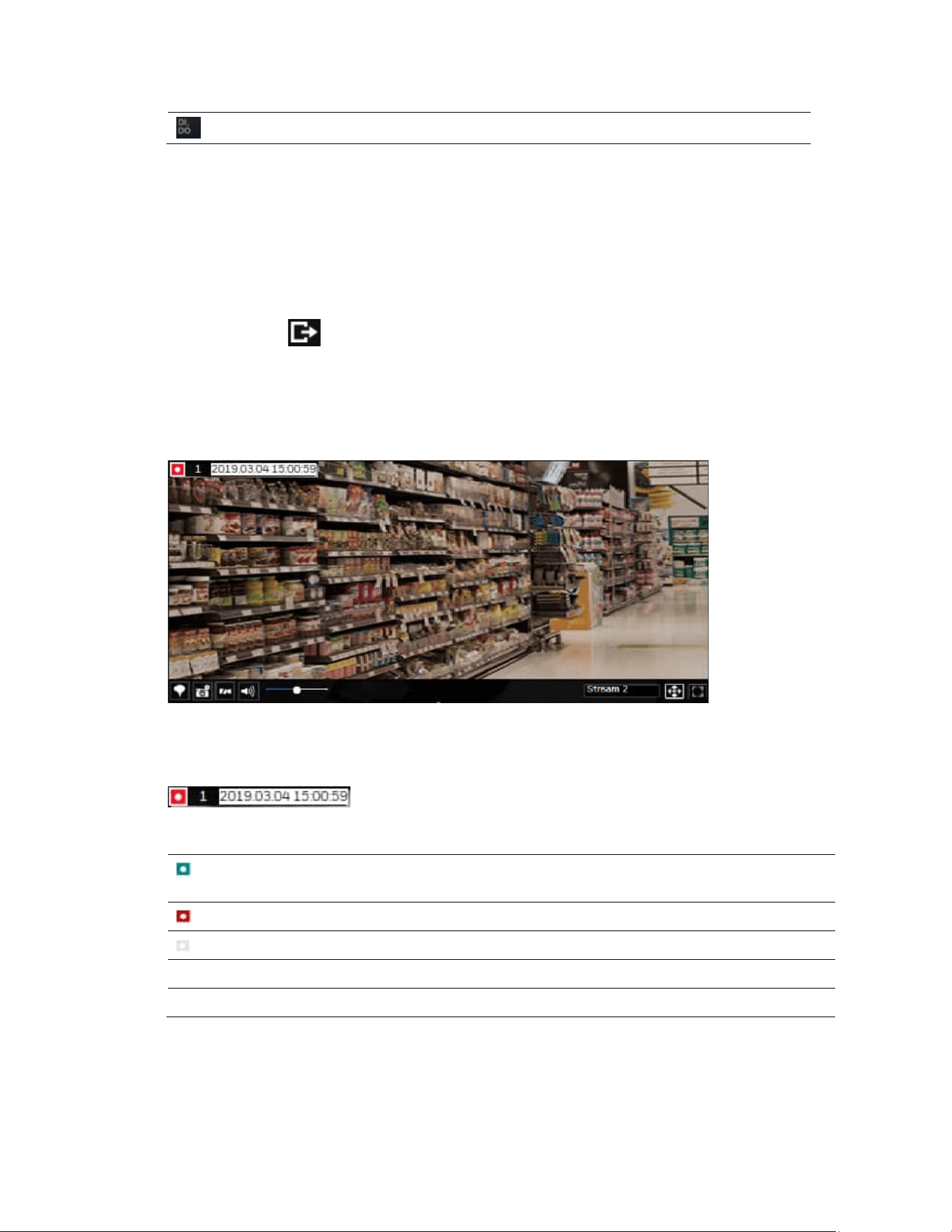
Management over a Web Console
65
Click to display the NVR's Alarm In/Alarm Out statuses.
Time & Log out
The system date and time refers to the date and time kept on the NVR system's real time
clock.
Due to the limited space for the user name, user name may be partially displayed until you
hover your mouse cursor.
To Log out, click .
Live View Window
Figure 7-6 Live View Window
Information Bar
Figure 7-7 Information Bar
Table 7-3 Information Bar
Connected with live streaming; a single click on this icon can trigger a
manual recording.
Connected and recording video to system storage.
Disconnected or trying to establish a connection.
15:00:59 Video time
2019.03.04 Date
Tool Bar
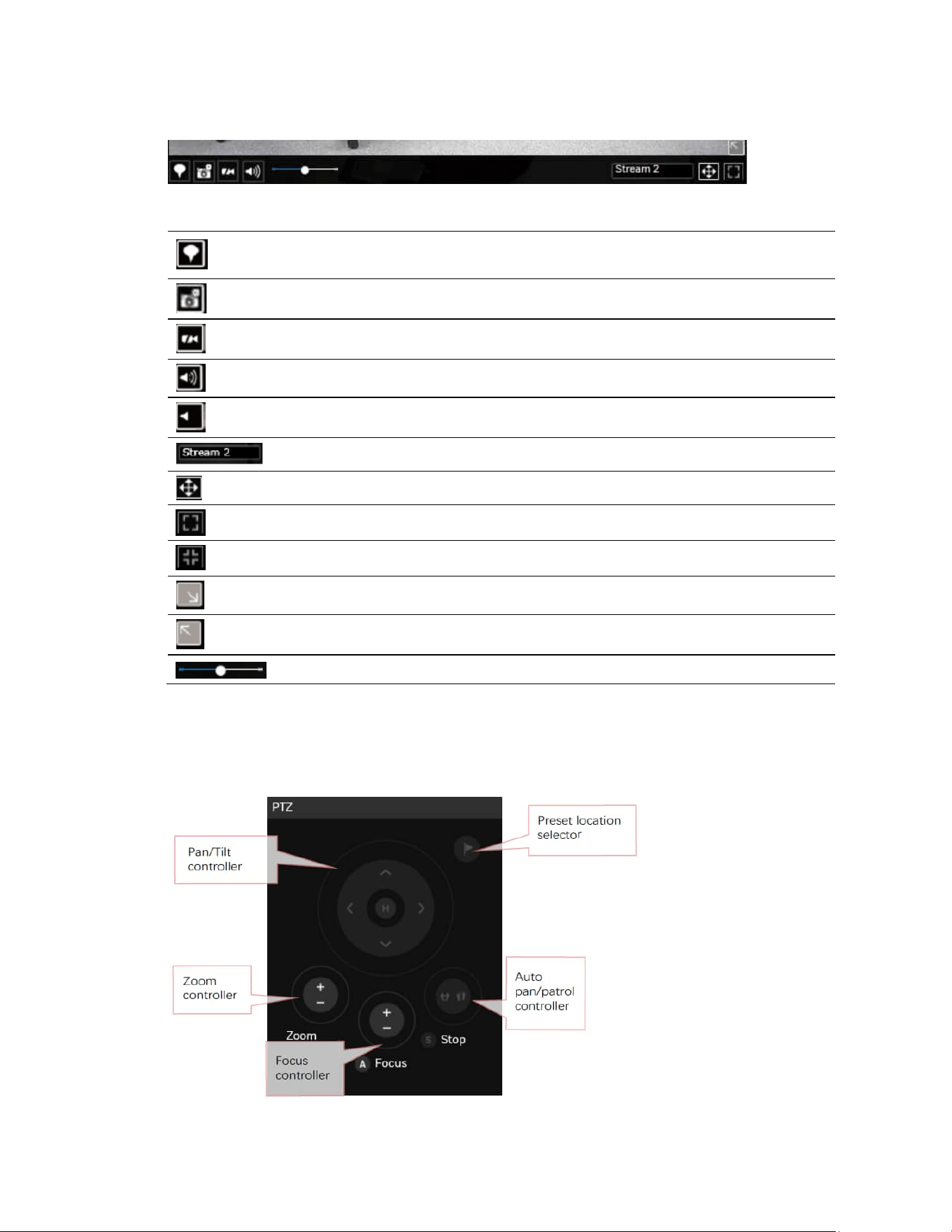
30 Series Network Video Recorder User Guide
66
Figure 7-8 Tool Bar
Table 7-4 Tool Bar
Add a Bookmark (that saves a short description and a one-minute footage
from the current feed).
Take a snapshot.
Remove camera from the view cell.
Mute (if there is audio input from the camera.)
Unmute
Stream selector.
Fit screen with ratio.
Maximize the size of current view cell.
Restore the size of current view cell.
Disable digital zoom.
Enable digital zoom.
Volume controller.
PTZ Panel
Figure 7-9 PTZ Panel
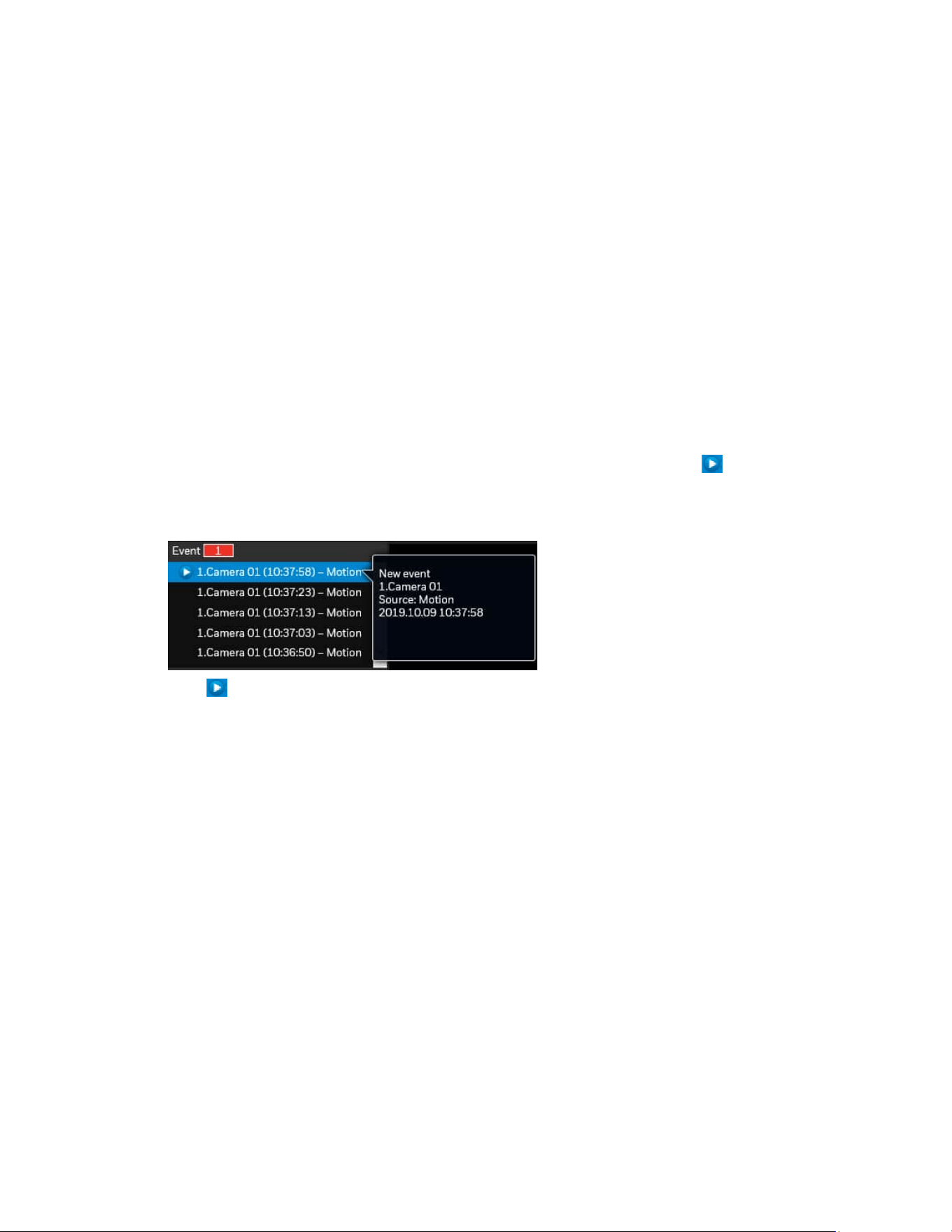
Management over a Web Console
67
The PTZ panel takes effect for cameras that come with mechanical PTZ functions. It does not
support digital PTZ functions. To utilize its functions, select a view cell populated by a PTZ
camera, such as a speed dome.
Depending on the individual functions that come with PTZ cameras, some functions will not
be available for every camera. For example, the zoom controller will not apply for a PTZ camera
that comes without a mechanized zoom module
Event Panel
The event panel keeps up to 200 events and displays the latest 10 event entries with the
latest alarm on top of the list. Older events will be erased if the number exceeds 200.
It is polled every 10 seconds. A mouse hover on an alarm entry displays full information of the
event.
Note that multiple alarms can be triggered by one incident. See Setting-Event-Event on page
41 for how to configure the event settings.
If an event is configured with a recording action, there will be a play button to the left of
the alarm message.
Figure 7-10 Event Panel 2
Click and the event playback window will begin playback of a footage taken 10 seconds
before the occurrence of an alarm. The playback of an alarm-triggered recording will normally
last for one minute. If, however, you configured a shorter pre- and post-alarm recording time,
your alarm recording may be slightly shorter. The default for pre- and post-alarm buffer time
are 5 seconds and 20 seconds.
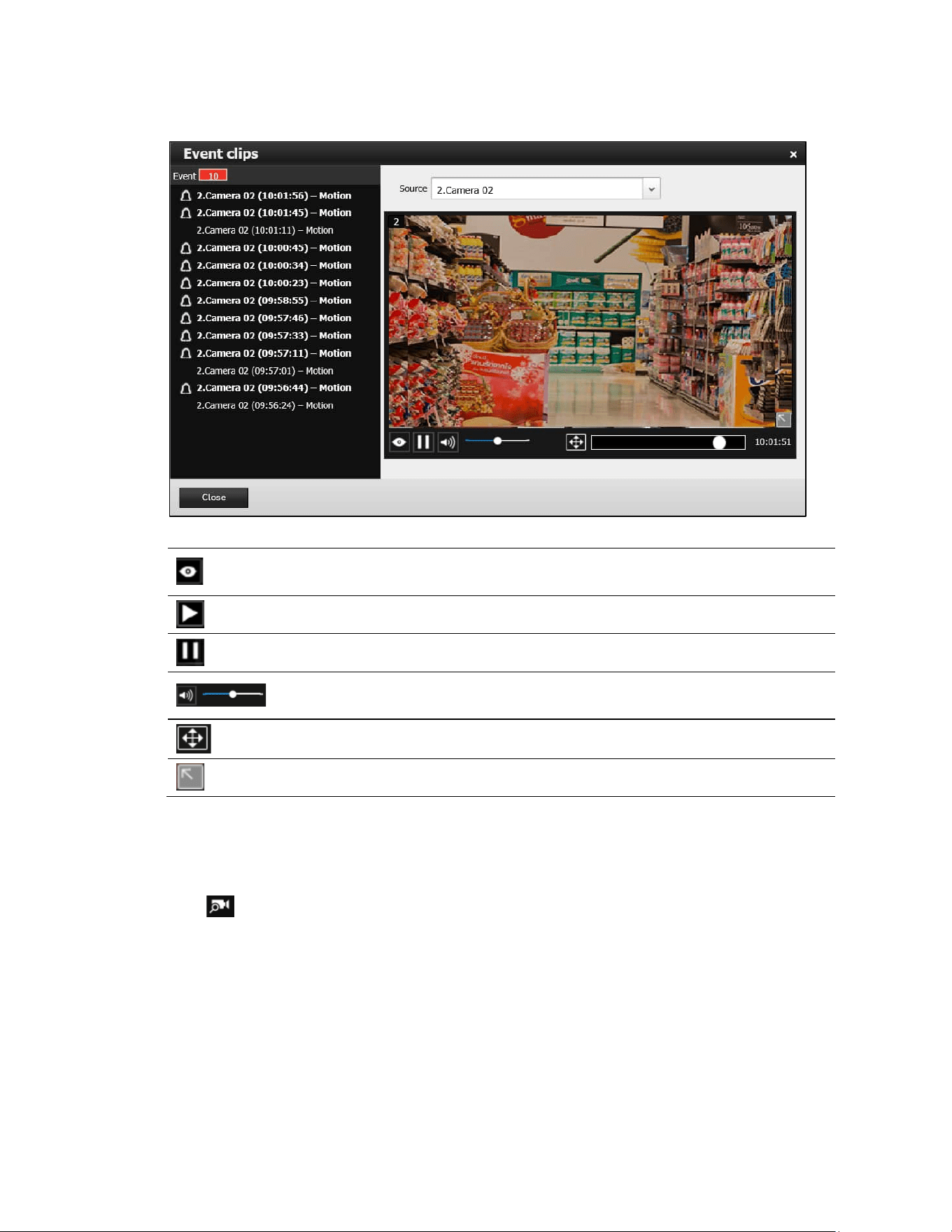
30 Series Network Video Recorder User Guide
68
Figure 7-11 Event Clips
View live video: displays the live view streaming instead of the alarm
recording.
Begin the event playback.
Pause the current playback.
Mute or unmute the audio with the current playback. Drag the controller to
change the audio volume level.
Fit screen with ratio.
Click to enable the digital zoom function.
Search Recording Clips Screen
Click on Figure 7-3 and the following screen is displayed:
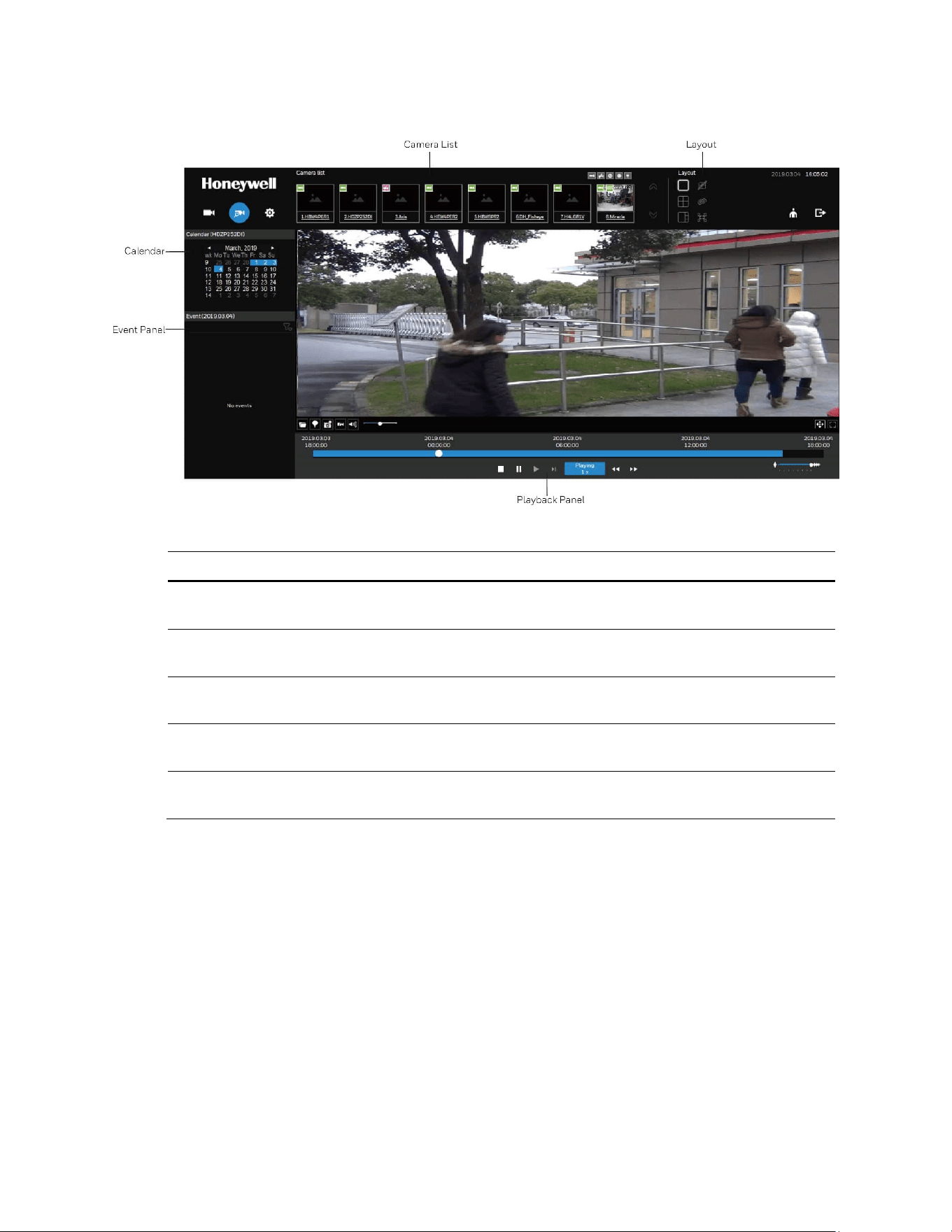
Management over a Web Console
69
Figure 7-12 Search Recording Clips Screen
Table 7-5 Search Recording Clips Screen
Name Description
Camera List
Provides a glimpse of all cameras that have recorded data. Basic
information is also provided along with a screenshot.
Layout
Provides functions to extend, rotate, redo the layout, and the synchronous
playback.
Playback
panel
Displays the playback functions. Snapshot, bookmark, and export
functions are also available on individual view cells.
Event panel
Reports events transmitted via cameras' DI connections or those by the
Motion Detection, etc.
Calendar
Shows when the recording took place, and thus enables users to quickly
locate a specific part of recording in history.
Camera List
The camera list displays the 8 added cameras by the sequential numbering order you
configured in the System Settings window. The elements in the Camera list on a Search
recording clips window are identical to those on a Liveview window.
To begin playback and search for past recordings:
1. Double-click on a camera in the camera list. The Calendar panel will display the days
video recording actually took place. And those days will be highlighted by a blue
background.
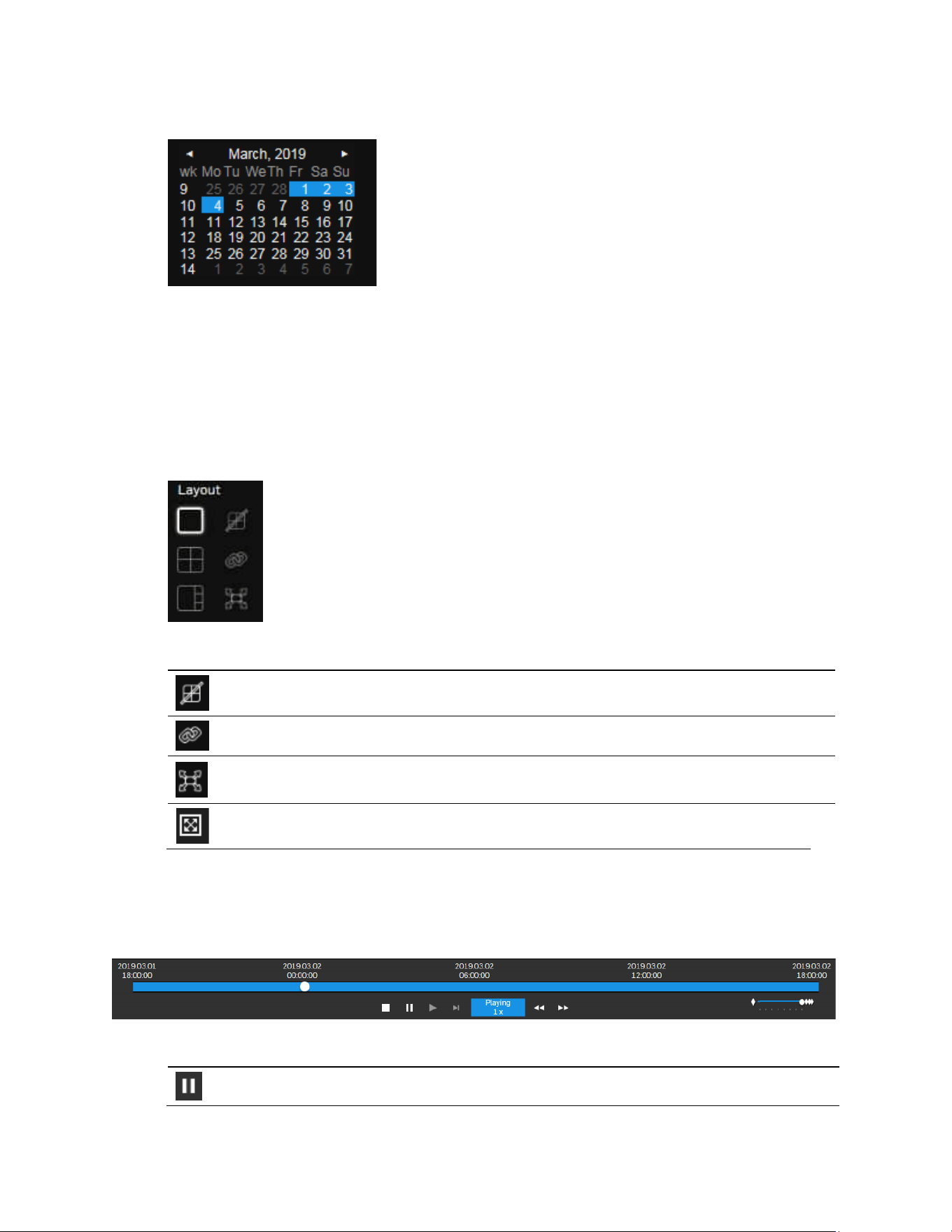
30 Series Network Video Recorder User Guide
70
Figure 7-13 Calendar
2. Click the date that marked in blue.
Layout
3 types of layouts are provided for the Search recording clips window: 1x1, 2x2, and 1+3.
Users can simultaneously playback up to 4 recorded videos.
Figure 7-14 Layout
Table 7-6 Layout
Clears layout content.
Starts or stops the Synchronous playback.
Full view: extends the view cells on the current layout to the full of the
screen.
Exit full view. It is showed at the left side of the full view window.
Playback Panel
Figure 7-15 Playback Panel
Table 7-7 Playback Panel
Pause
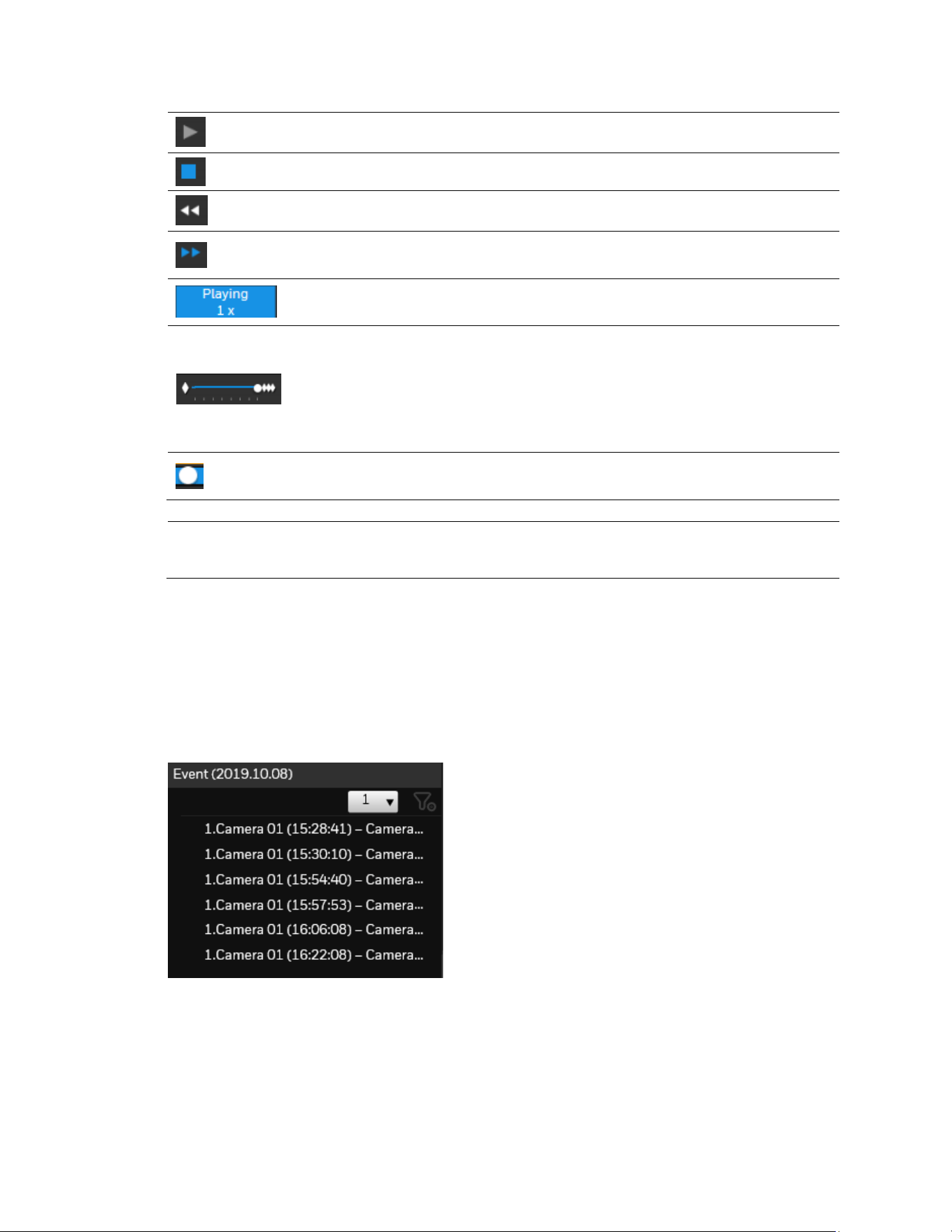
Management over a Web Console
71
Play. This button is available after you manually pause a playback.
Stop the current playback.
Speed down by 1/2. The slowest speed is 1/8.
Speed up. Increases the playback speed, to 2x, 4x, 8x, 16x, and then to a
maximum of 32x.
Display the current playback status, such as Playing, Pause, play speed, or
Stop.
Timeline zoomer. Use the zoomer to zoom in for more precise skimming.
You can use the timeline zoomer to scale down the span of time. For
example, if the time span is reduced to 1 hour, then each section on the
time line represents 15 minutes of recording. The total time span of a
timeline starts from the minimal of 4 minutes, 20 minutes, 40 minutes, 1
hour, and up to a maximum of 24 hours.
Timeline slider thumb. Click and drag this thumb button to move along
and reach a specific point in time. A click on the time line will also work.
Note
In the Synchronous play mode, a change to the zoomer will be reflected by all
synchronously playing view cells.
Event Panel
The event panel displays the events or bookmarks recorded by the day of recording. Two
additional buttons are available: Page selector and Event filter. See Creating an Event on
page 41 for how to create an event.
Figure 7-16 Event Panel
• A playback button will be available with an event-triggered recording. The event panel in
the Playback window also supports the List mode and Icon mode that are similar to that
in the Liveview window.
• There can be numerous alarms occurring in a day. Use the page selector to display
different pages of event entries. Up to 200 entries can appear on one page. Note that the
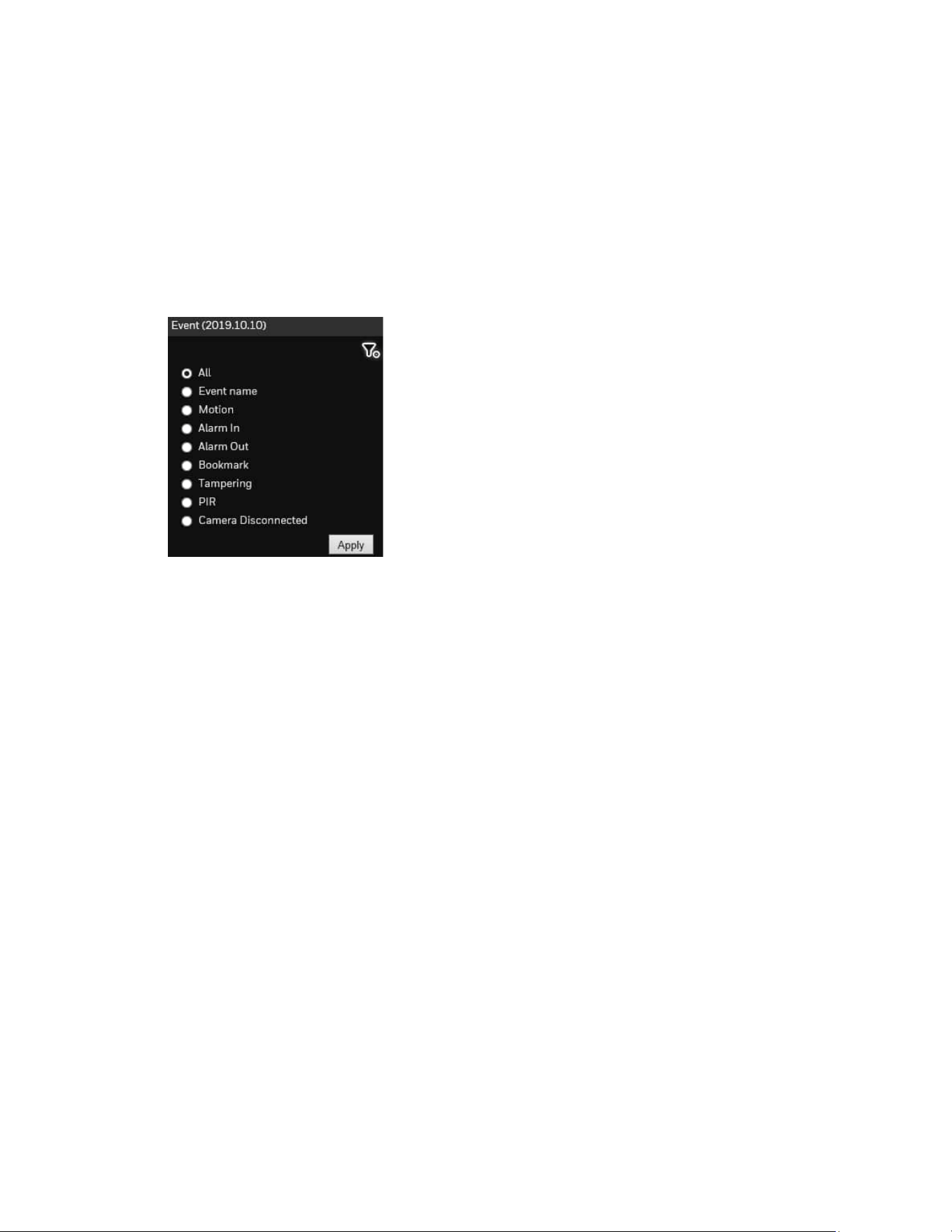
30 Series Network Video Recorder User Guide
72
new events that occurred seconds or minutes ago may not be instantaneously listed on
the page.
Event Filter
Use the event filter to find out specific events. Use the check circles below to narrow down
your search criteria by event name or event type by Motion detection, Alarm input, Alarm
output, Tampering, PIR, or those manually marked down as Bookmarks.
Figure 7-17 Event Filter
Settings Screen
The settings screen is identical to those found in the local settings. See Settings on page 27
for more information.

© 2019 Honeywell International Inc. All rights reserved. No part of this publication may be reproduced by any means without written permission from
Honeywell. The information in this publication is believed to be accurate in all respects. However, Honeywell cannot assume responsibility for any
consequences resulting from the use thereof. The information contained herein is subject to change without notice. Revisions or new editions to this
publication may be issued to incorporate such changes. For patent information, see www.honeywell.com/patents.
Honeywell Building Technologies – Security Americas (Head Office)
Honeywell Commercial Security
715 Peachtree St. NE
Atlanta, GA 30308
www.security.honeywell.com/
+1 800 323 4576
Honeywell Building Technologies – Security Mexico
Mexico: Av. Santa Fe 94, Torre A, Piso 1, Col. Zedec,
CP 0121, CDMX, Mexico.
Colombia: Edificio Punto 99, Carrera 11a.
98-50, Piso 7, Bogota, Colombia.
clarsupport@honeywell.com
www.honeywell.com
01.800.083.59.25
Honeywell Colombia SAS
Carrera 11A # 98-50, Edificio Punto 99, Piso 7
Bogotá DC, Colombia
Honeywell Building Technologies – Security Middle East/N. Africa
Emaar Business Park, Sheikh Zayed Road
Building No. 2, 2nd floor, 201
Post Office Box 232362
Dubai, United Arab Emirates
www.honeywell.com/security/me
+971 44541704
Honeywell Building Technologies – Security Europe/South Africa
Aston Fields Road, Whitehouse Industrial Estate
Runcorn, WA7 3DL, United Kingdom
www.honeywell.com/security/uk
08448 000 235
Honeywell Building Technologies – Security Northern Europe
Stationsplein Z-W 961, 1117 CE Schiphol-Oost, The Netherlands
www.security.honeywell.com/nl
+31 (0) 299 410 200
Honeywell Building Technologies – Security
Deutschland
Johannes-Mauthe-Straße 14 72458 Albstadt, Germany
www.security.honeywell.de
+49 (0) 7431 801-0
Honeywell Building Technologies – Security France
Immeuble Lavoisier
Parc de Haute Technologie 3-7 rue Georges Besse
92160 Antony, France
www.security.honeywell.com/fr
+33 (0) 1 40 96 20 50
Honeywell Building Technologies – Security Italia SpA
Via
Achille Grandi 22, 20097 San Donato Milanese (MI),
ITALY
www.security.honeywell.com/it
Honeywell Building Technologies – Security España
Josefa Valcárcel, 2428027 – Madrid, España
www.honeywell.com
+34 902 667 800
Honeywell Building Technologies – Security Россия и СНГ
121059 Moscow, UI, Kiev 7 Russia
www.security.honeywell.com/ru
+7 (495) 797-93-71
Honeywell Building Technologies – Security Asia Pacific
Building #1, 555 Huanke Road, Zhang Jiang Hi-Tech Park
Pudong New Area, Shanghai, 201203, China
www.asia.security.honeywell.com
400 840 2233
Honeywell Building Technologies – Security and Fire
(ASEAN)
Honeywell International Sdn Bhd
Level 25, UOA Corp Tower, Lobby B, Avenue 10, The Vertical,
Bangsar South City, 59200, Kuala Lumpur, Malaysia
Visit Partner Connect:
www.partnerconnect.honeywell.com
Email: build[email protected]
Technical support (Small & Medium
Business):
Vietnam: +84 4 4458 3369
Thailand: +66 2 0182439
Indonesia: +62 21 2188 9000
Malaysia: +60 3 7624 1530
Singapore: +65 3158 6830
Philippines: +63 2 231 3380
Honeywell Home and Building Technologies (India)
HBT India Buildings
Unitech Trade Centre, 5th Floor,
Sector – 43, Block C, Sushant Lok Phase – 1,
Gurgaon – 122002, Haryana, India
Visit Partner Connect:
www.partnerconnect.honeywell.com
Email: HBT-IndiaBuildings@honeywell.com
Toll Free No: 1-800-103-0339
+91 124 4975000
Honeywell Building Technologies – Security and
Fire (Korea)
Honeywell Co., Ltd. (Korea)
5F SangAm IT Tower,
434, Worldcup Buk-ro, Mapo-gu,
Seoul 03922, Korea
Visit: http://www.honeywell.com
Email: info.security@honeywell.com
Customer support: HSG-CS-KR@honeywell.com; +82 1522-8779
+82-2-799-6114
Honeywell Building Technologies – Security & Fire (Pacific)
Honeywell Ltd
9 Columbia Way
BAULKHAM HILLS NSW 2153
Visit: www.honeywellsecurity.com.au
Email: hsf.comms.pacific@Honeywell.com
Technical support:
Australia: 1300 220 345
New Zealand: +64 9 623 5050
Honeywell
www.honeywell.com/security
+1 800 323 4576 (North America only)
https://www.honeywellsystems.com/ss/techsupp/index.html
Document 800-25988 – Rev C – 05/2020