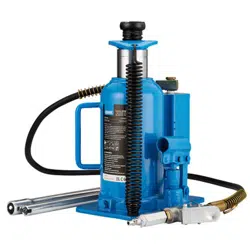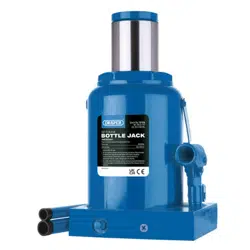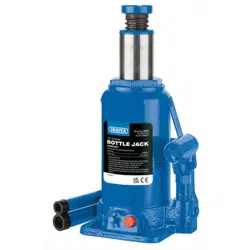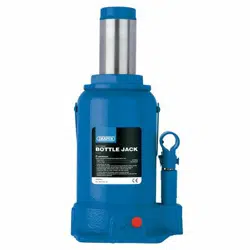
LOW PROFILE
BOTTLE JACK
08554
EN
Original Instructions
Version 1 – July2023
10 TONNE
1.1 Product Reference
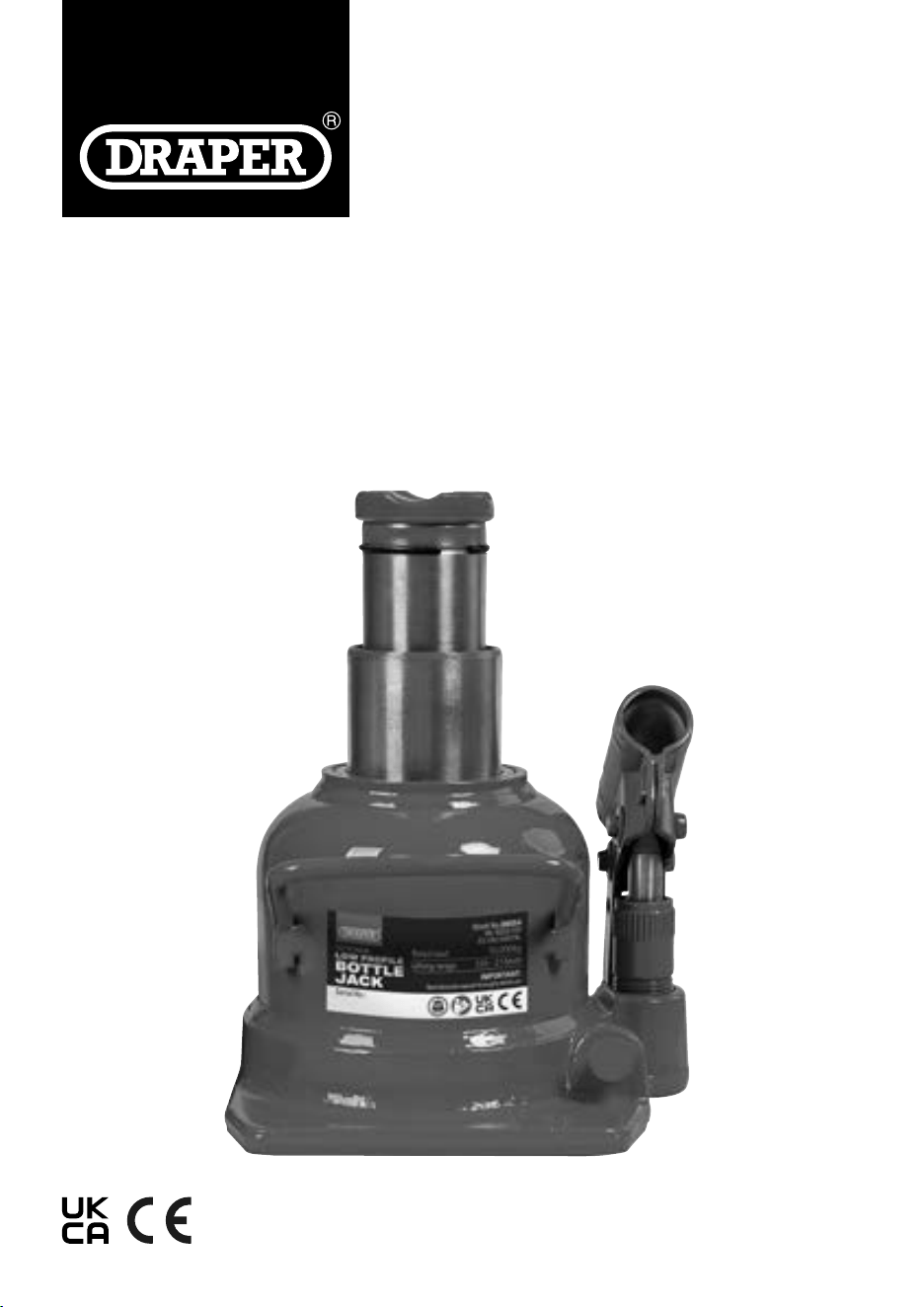
User Manual for: Draper 10 Tonne, Low Prole
Bottle Jack
Stock No: 08554
Part No: BJ10LP
1.2 Revisions
Version 1: July 2023
First release
For the latest version of this manual and the associated
parts list, if applicable, please visit
drapertools.com/manuals
1.3 Understanding the Safety Content of
This Manual
WARNING!
– Situations or actions that may result
in personal injury or death.
CAUTION! – Situations or actions that may result
in damage to the product or surroundings.
Important: – Information or instructions of particular
importance.
1.4 Copyright © Notice
Copyright © Draper Tools Limited.
Permission is granted to reproduce this manual for
personal and educational use ONLY. Commercial
copying, redistribution, hiring or lending is strictly
prohibited.
No part of this manual may be stored in a retrieval system
or transmitted in any other form or means without written
permission from Draper Tools Limited.
In all cases, this copyright notice must remain intact.
1. Preface
– 2 –
These are the original product instructions. This
document is part of the product; retain it for the life
of the product, passing it on to subsequent holders.
Read this manual in full before attempting to
assemble, operate or maintain this product.
This Draper Tools manual describes the purpose
of the product and contains all the necessary
information to ensure its correct and safe use.
Following all the instructions and guidance in
this manual will ensure the safety of both the
product and the operator and increase the
lifespan of the product.
All photographs and drawings within this manual are
supplied by Draper Tools to help illustrate correct
operation of the product.
Every eort has been made to ensure the
information contained in this manual is accurate.
However, Draper Tools reserves the right to amend
this document without prior warning. Always use the
latest version of the product manual.
2. Contents
– 3 –
EN
1. Preface 2
1.1 Product Reference 2
1.2 Revisions 2
1.3 Understanding the Safety Content of This
Manual 2
1.4 Copyright © Notice 2
2. Contents 3
3. Product Introduction 4
3.1 Scope 4
3.2 Specication 4
4. Health and Safety Information 5
4.1 General Health and Safety 5
4.2 Preparing the Vehicle to be Lifted 5
4.3 Correct Use of the Jack 6
5. Identication and Unpacking 7
5.1 Product Overview 7
5.2 What’s in the Box? 8
5.3 Packaging 8
6. Preparation Instructions 9
6.1 Preparing the Jack 9
7. Operating Instructions 10
7.1 Raising a Load 10
7.2 Lowering a Load 10
8. Maintenance and Troubleshooting 11
8.1 General Maintenance 11
8.2 Checking and Replacing the Oil 11
8.3 Storing the Jack 11
8.4 Troubleshooting 12
9. Spares, Returns and Disposal 13
10. Warranty 13
11. Explanation of Symbols 14
Notes 15
3. Product Introduction
– 4 –
3.1 Scope
This jack is designed for use in lifting vehicles up to the
maximum stated weight limit. It is manufactured and
tested in accordance with the required standard. Any
other application beyond the conditions established for
use will be considered misuse. Draper Tools accepts no
responsibility for improper use of this product.
WARNING! This product is not a toy and
must be respected.
Read this manual in full before attempting to assemble,
operate or maintain the product, and retain it for later
use.
3.2 Specication
Stock No. 08554
Part No. BJ10LP
Lift capacity: 10,000kg
Min. height: 125mm
Max. height: 215mm
Saddle diameter: 47mm
Net weight: 7.7kg
4. Health and Safety Information
Important: Read all Health and Safety instructions
before attempting to operate, maintain or repair this
product. Non-compliance with these instructions may
result in injury or damage to the user, the product or the
vehicle to be lifted. Draper Tools accepts no
responsibility for improper use of this jack.
4.1 General Health and Safety
Precautions
• Only authorised personnel who have carefully read
and understood this manual should operate this
product.
• Always wear adequate protective footwear when using
the jack.
• Always ensure that the working area is well
illuminated and free from obstructions.
• Keep bystanders at a safe distance during operation.
• Allow a minimum distance of 0.5m between the
vehicle and surrounding objects to allow the vehicle
to tip when lifted.
• Care must be taken when handling and lifting.
− Dropping the jack may result in damage to the
product or personal injury.
• DO NOT modify this product in any way.
• Stay alert to external interference that may cause the
raised load to rock during preparation and operation.
• When not in use, lower the lifting arm, put the pump
handle into an upright position and twist it clockwise
until strong resistance is felt.
− This prevents the pump handle from creating a
trip hazard and holds it in the upright position.
− Alternatively, lower the lifting arm, remove the
pump handle and lay it at on the oor.
• This jack does not emit noise that exceeds a level of
70dB(A) during operation.
4.2 Preparing the Vehicle to be Lifted
WARNING! DO NOT lift the vehicle if it may
result in the spillage of dangerous substances,
including fuel or battery acid.
• Ensure that there is no one inside the vehicle.
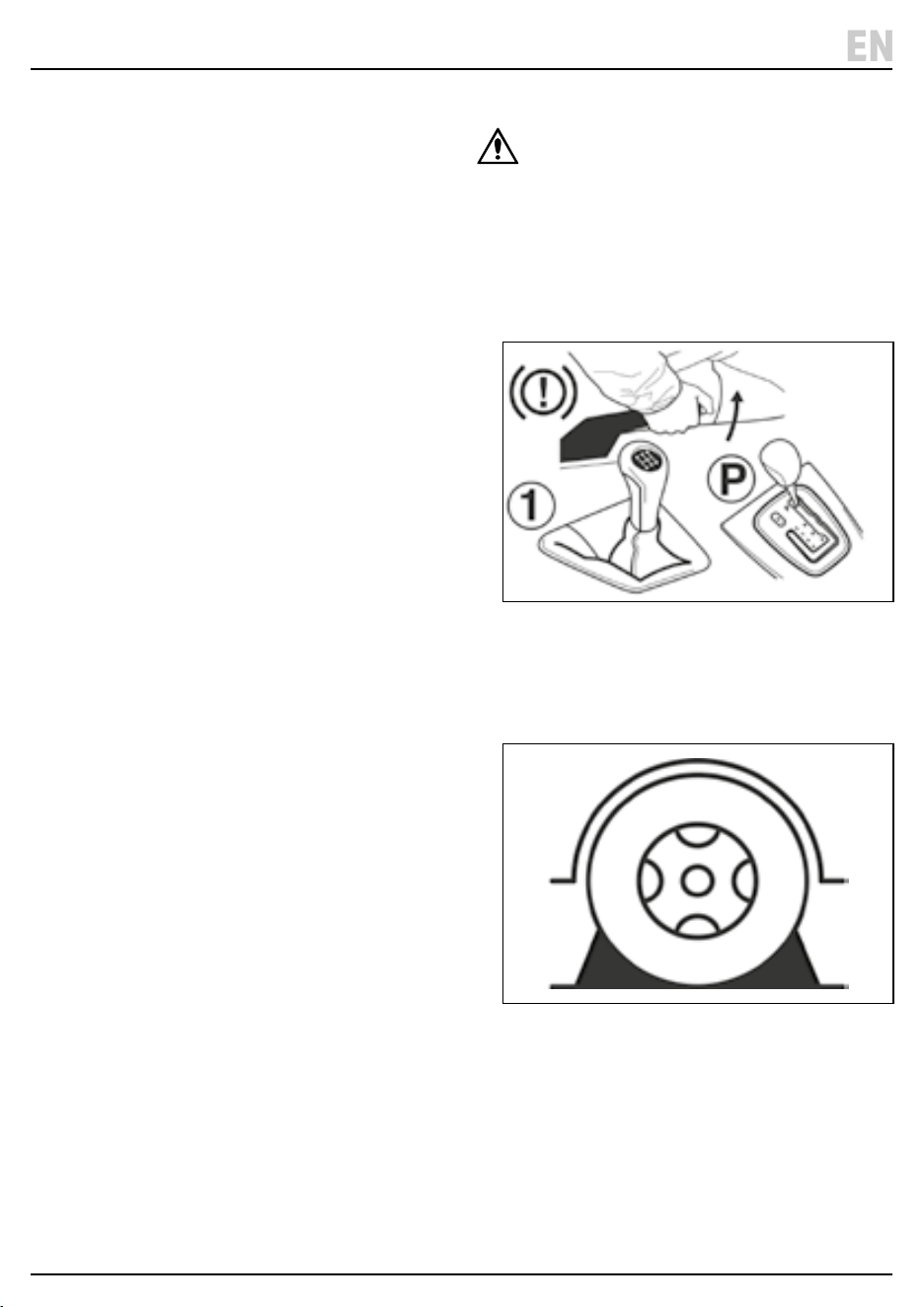
• Switch o the engine and apply the handbrake.
Put the vehicle into gear (for manual transmission) or
"Park" (for automatic transmission).
1 Fig.
• Take any necessary precautions to prevent the vehicle
from sliding.
• Grounded wheels should be securely blocked with
wheel chocks (Stock No. 54500).
2 Fig.
– 5 –
EN
4. Health and Safety Information
4.3 Correct Use of the Jack
Important: The jack is a lifting device ONLY and should
never be used to move the vehicle. The vehicle to be
lifted should never exceed the rated capacity of the jack.
• ALWAYS bleed the jack piston before use.
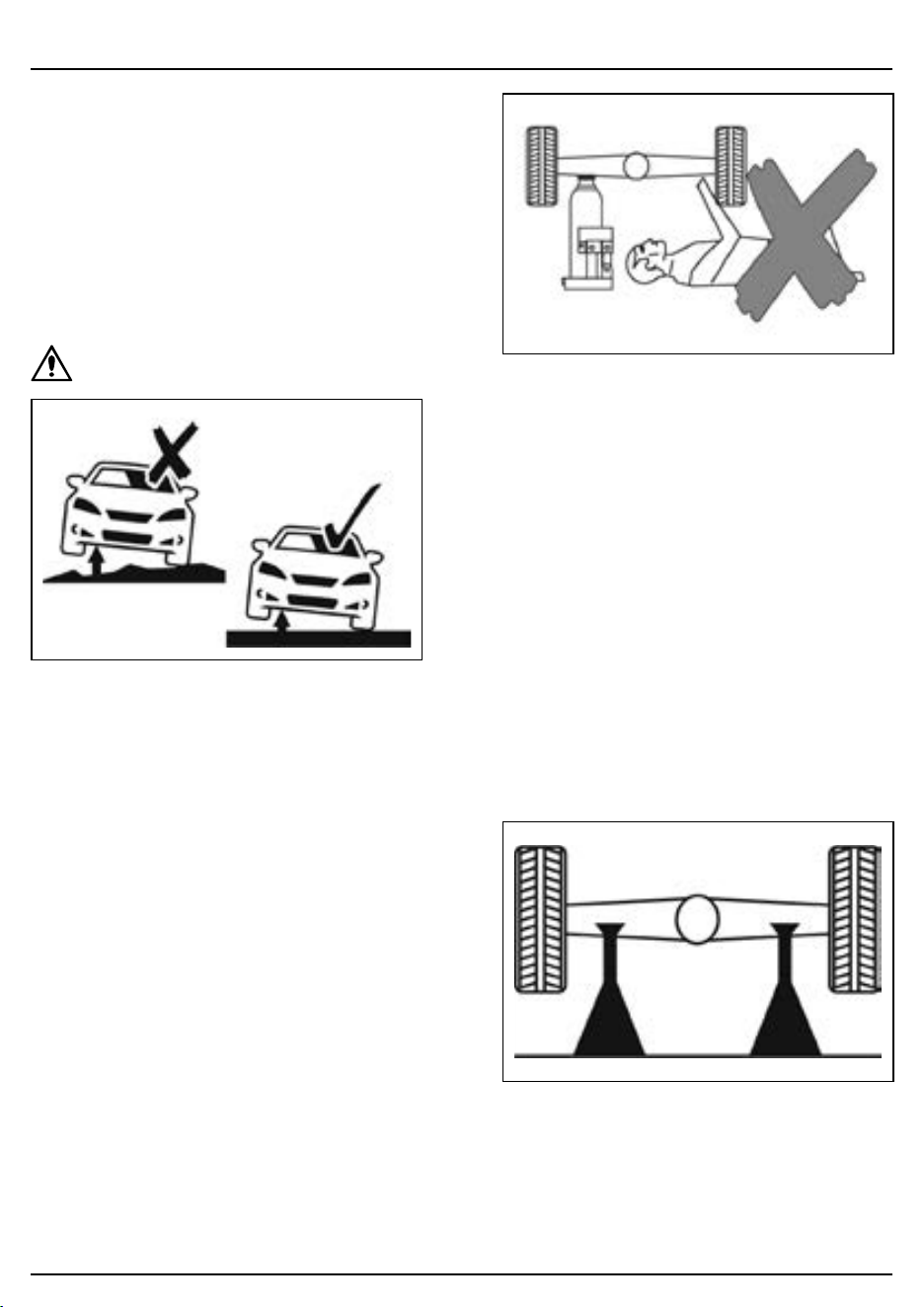
• ONLY operate the jack on solid, level and horizontal
surfaces.
− A concrete surface is recommended, where
possible.
WARNING! Never use the jack on any surface
that is slippery or may sink or rock.
3 Fig.
• When positioning the jack, ALWAYS use the
manufacturer's recommended lifting point.
− These points vary between vehicles; consult the
manufacturer's manual or the Haynes workshop
manual for the specic vehicle information.
• Ensure that the lifting point is not dirty, greasy or
corroded.
• The lifting point must remain centred over the saddle
during raising and lowering; o-centred loads may
slip and cause injury.
• Position the jack so that no part of the operator is
required to be underneath the vehicle at any time
during lifting or lowering.
4 Fig.
• To prevent overloading, the jack is tted with an
overload valve set at the factory.
Important: The overload valve should not be adjusted
under any circumstances. If the capacity of the jack is
exceeded, the valve will prevent the lifting operation.
• Take all precautions to prevent movement of the
vehicle during raising and lowering.
− Be aware that trac and other external forces may
cause the load to rock if used at the roadside.
• Remain alert and observe the load at all times during
operation.
− Should any dangerous conditions occur, including
unexpected movement of the vehicle, cease all
operation until these conditions have been
rectied.
• NEVER work under a raised vehicle without using the
correct axle supports or other appropriate supporting
methods.
5 Fig.
• DO NOT enter the vehicle or start the engine while it is
supported on the jack or axle stand.
• NEVER leave the jack unattended when in use.
• ALWAYS ensure that there are no persons or
obstacles beneath the vehicle before lowering.
– 6 –
– 7 –
5. Identication and Unpacking
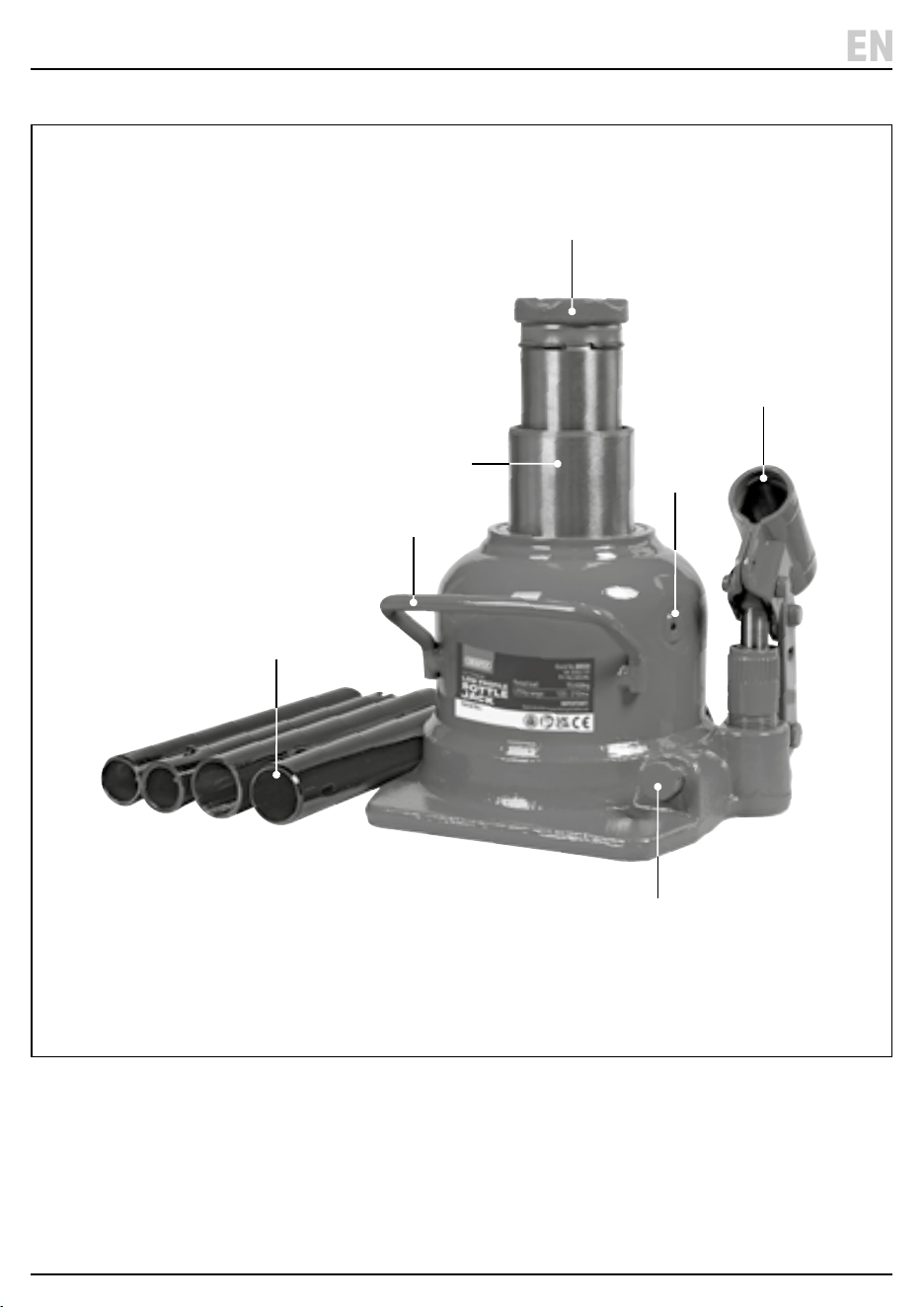
5.1 Product Overview
(1) Pump handle
(2) Saddle
(4) Ram
(5) Oil ll plug
(6) Carry handle
(7) Handle socket
(8) Release valve
(8)
(2)
(7)
(5)
(6)
(1)
(4)
EN
– 8 –
5. Identication and Unpacking
5.3 Packaging
Keep the product packaging for the duration of the
warranty period for reference should the product need to
be returned for repair.
WARNING! Keep packaging materials out of
reach of children. Dispose of packaging
correctly and responsibly and in accordance
with local regulations.
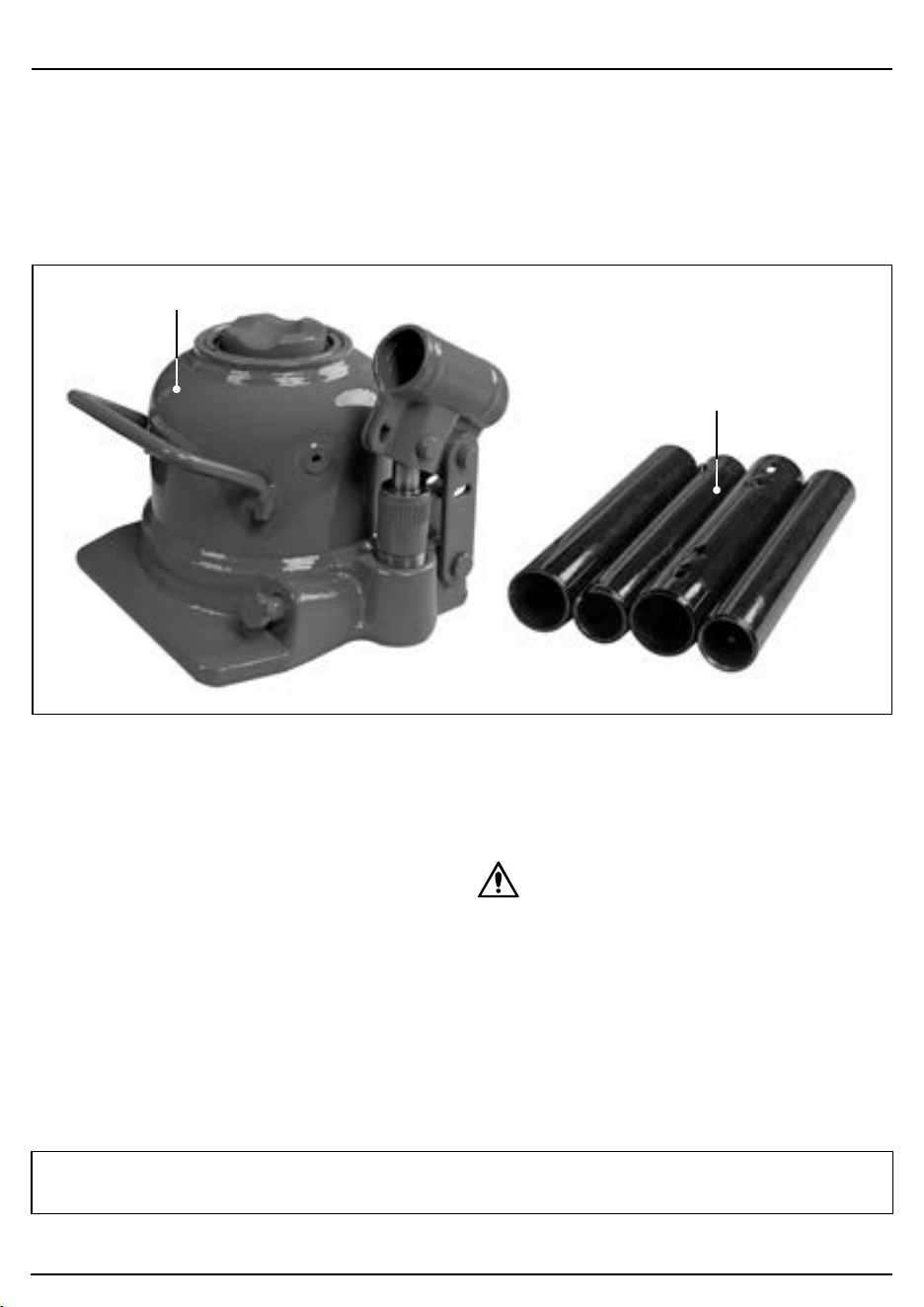
(A) Bottle jack
(B) Handle
Please visit drapertools.com for our full range of accessories and consumables.
– 8 –
5.2 What’s in the Box?
Carefully remove the product from the packaging and
examine it for any signs of damage that may have
occurred during shipment.
Before assembling the product, lay the contents out and
check them against the parts shown below. If any part is
damaged or missing, do not attempt to use the product.
Please contact the Draper Helpline; contact details can
be found at the back of this manual.
(A)
(B)
6. Preparation Instructions
6.1 Preparing the Jack
Prepare the jack correctly before each use:
1. Check the jack for bent. broken, cracked or loose
parts, and oil leaks.
WARNING! DO NOT use the product if
defects are present. If it is suspected that the
jack has been subjected to abnormal loads or
has suered any knocks, withdraw it from
service until the product has been repaired.
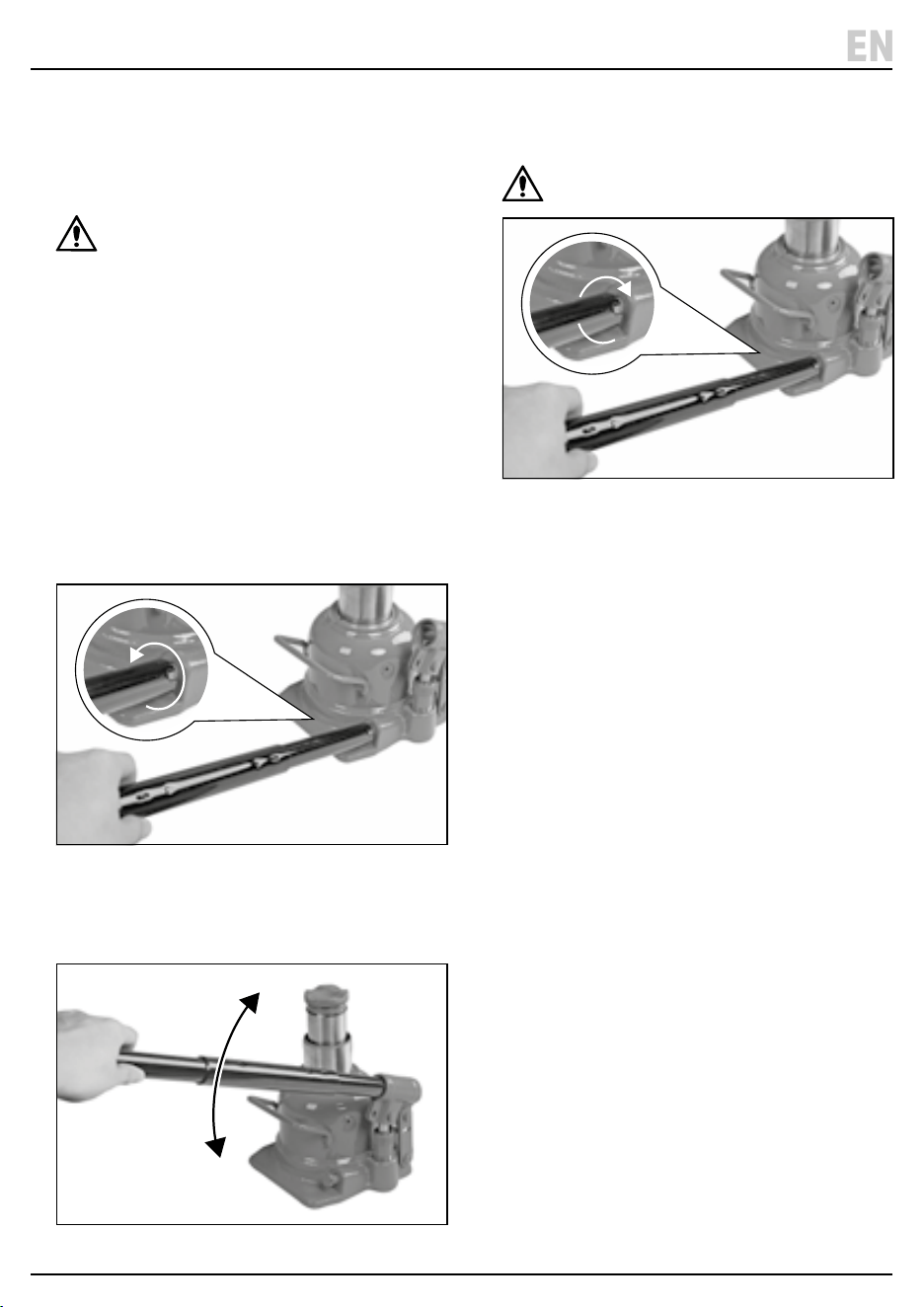
2. Bleed the jack piston:
a. Assemble the handle, ensuring that all locking pins
locate securely in place.
b. Place the grooved end of the handle over the
release valve.
c. Carefully twist the release handle anticlockwise to
open the release valve and allow the ram to drop.
Important: If the ram does not fully retract, use
your foot to force it into its lowest position and
drive any air from the piston.
6 Fig.
d. Insert the handle into the handle socket.
e. Pump the handle down and up at least 15 times to
lubricate the piston and expel any accumulated air.
7 Fig.
f. Place the handle over the release valve and twist
clockwise until strong resistance is met, closing
the valve.
CAUTION! DO NOT overtighten the valve as
this may damage the seal.
8 Fig.
3. Test the jack:
a. Pump the handle down and up to raise the lifting
arm to its highest position.
b. Observe the saddle to check that it does not drop.
4. If the piston begins to drop without intervention:
a. Open the release valve anticlockwise and return
the piston to its lowest position.
b. Insert a long, narrow, plain-slot screwdriver into
the oil ll plug opening (5) and carefully push the
top of the ll plug downwards to break the seal.
Important: DO NOT attempt to pierce the ll plug
or press it deeper into the opening as this may
damage the plug.
c. Tighten the piston chamber ll plug.
5. Test the jack again by raising the piston and ensuring
that it does not drop without intervention. Escaping
air will hiss as it leaves the chamber.
Repeat this process if necessary. If the issue is not
resolved after several attempts, contact Draper Tools for
assistance.
– 9 –
EN
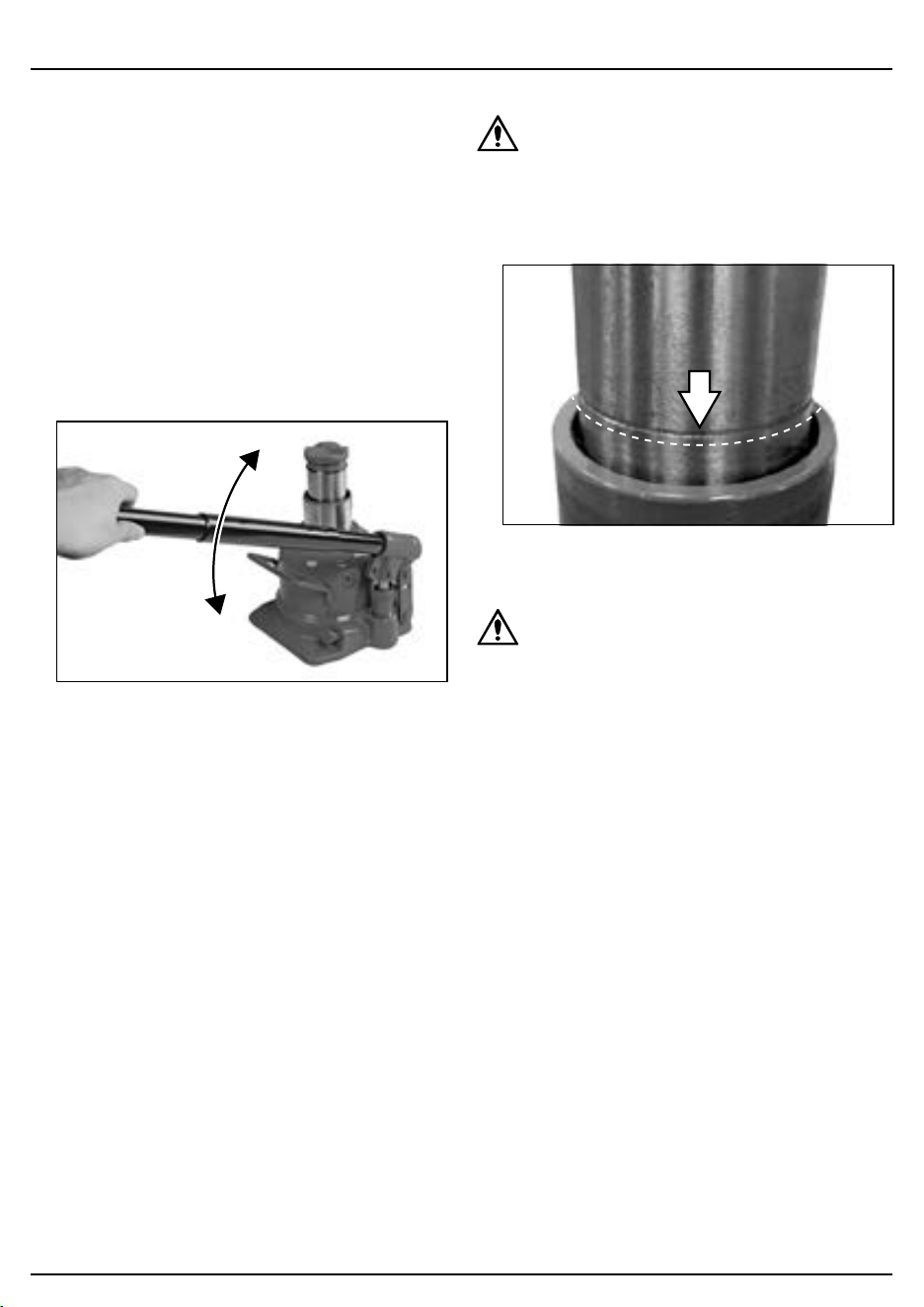
7.1 Raising a Load
1. Position the jack directly beneath the
approvedvehicle lifting point. See the vehicle
manufacturer information for the approved lifting
points.
2. Twist the release valve (8) clockwise until strong
resistance is felt.
3. Insert the handle into the handle socket and pump it
down and up to lift vehicle to desired height.
− Use the full stroke range to lift more quickly.
Important: If the jack drops under load, safely lower
the load (see 7.3) and bleed the piston (see 7.1).
9
Fig.
4. Immediately secure the raised vehicle with an
appropriate axle stand, placing it as instructed in the
manufacturer information.
WARNING! For high lift jacks, please observe
the following:
− DO NOT lift to full height without load.
− DO NOT take lift above the safety collar marking
on the inner ram.
10 Fig.
7.2 Lowering a Load
WARNING! Always ensure that there are no
persons or obstacles beneath the vehicle before
lowering.
1. Gently pump the handle (1) to raise the vehicle
slightly and allow the axle stand to be removed safely.
2. When the axle stand is clear, place the large end of
the handle over the release valve and carefully twist
anticlockwise to lower the load.
Important: The lowering speed is controlled by the
release valve. Grip the handle rmly and open the
valve slowly to maintain control of the load.
3. When the vehicle is fully lowered, remove the jack.
4. Once clear of the vehicle, ensure that the ram is fully
retracted.
– 10 –
7. Operating Instructions
8. Maintenance and Troubleshooting
– 11 –
Important: Maintenance and repair of the jack must only
be performed by qualied personnel with sucient
knowledge of the hydraulics systems used in these
devices.
8.1 General Maintenance
• Keep the jack clean and regularly lubricate all moving
parts.
− Dust and debris may cause components to
become clogged or jammed and the product may
not perform at its best.
• Protect the jack and its components from adverse
environmental and weather conditions, both during
use and when stored.
− The components may rust if exposed to damp air
for prolonged periods.
− When the jack is not in use, make sure the ram is
fully retracted to avoid corrosion.
• Use only spare parts supplied by Draper Tools.
• Before each use, check the jack for signs of damage or
disrepair.
8.2 Checking and Replacing the Oil
To extend the working life of the product. keep the oil at
an appropriate level and replace it after periods of
prolonged intensive use.
CAUTION! Use AW 22 hydraulic oil. Never use
brake or engine oil.
WARNING! Oil spillage may cause the operating
surface to become slippery. DO NOT operate the
jack on oily surfaces.
To check, drain and rell the oil capsule:
1. Fully lower the ram and leave the release valve (8) in
its open position.
2. Place the jack on its side so that the oil ll plug
opening (5) is at the top.
Important: The jack MUST be level when checking
the oil.
3. Insert a long, narrow, plain-slot screwdriver into the
oil ll plug opening and manoeuvre it reaches behind
the oil ll plug.
4. With the screwdriver head behind the oil ll plug,
hook it outwards to remove the plug from the
opening.
Important: This process requires patience and a
steady hand. DO NOT attempt to pierce the oil ll
plug or grip the front of the plug and pull it outwards
as this will only damage the plug.
5. When the oil ll plug has been removed, clean the
end of the screwdriver and insert it into the opening
so that it rests on the piston ram.
6. Remove screwdriver from the opening and inspect
the oil level on the head.
The oil level should register approximately 2mm up
from the bottom of the screwdriver head.
7. Top up the oil level as appropriate.
8. If the oil is dirty or needs replacing:
a. Manoeuvre the jack so that the oil can ow freely
out of the oil ll plug opening into a suitable
container.
b. Rell the oil capsule to the correct level as
required, keeping the oil free of dirt.
CAUTION! Excessive quantities of oil may
render the jack inoperable.
9. Lubricate the oil ll plug and insert it back into the ll
plug opening.
Important: This process requires patience and a
steady hand. Take care not to damage the ll plug
when inserting it back into the opening.
10. Test the jack to ensure that the ll plug has created an
airtight seal.
8.3 Storing the Jack
When the jack is not in use:
• When the jack is not in use, make sure the ram is fully
retracted to avoid corrosion.
• Store the jack in a clean and dry location, out of reach
of children.
EN

– 12 –
8. Maintenance and Troubleshooting
8.4 Troubleshooting
Problem Possible cause Remedy
The ram does not raise when the
handle is pumped.
The valve is not fully closed. Use the handle to twist the
releasevalve clockwise until strong
resistance is felt and bleed the piston if
necessary
The maximum load has been
exceeded.
Use an appropriately rated jack or
reduce the weight of the load. DO NOT
adjust the overload valve.
The piston system is corroded. DO NOT use the jack. Contact Draper
Tools to discuss repair or replacement
options.
The saddle drops once lifted. The piston valve is not fully closed. Use the handle to twist the release
valve clockwise until strong resistance
is felt and bleed the piston if
necessary.
The hydraulics mechanism is
damaged.
DO NOT use the jack. Contact Draper
Tools to discuss repair or replacement
options.
Dirt or other contaminants may be
present in the mechanism.
Drain and replace the oil.
The ram will not raise or drops under
load even after bleeding the jack.
Air may still be trapped in the
mechanism.
Lower the saddle and close the release
valve. Manually lift the saddle several
inches, open the release valve and
then force the saddle to lower as
rapidly as possible.

– 13 –
For spare parts, servicing, and repair and replacement
options, please contact the Draper Tools Product
Helpline for details of your nearest authorised agent.
Draper Tools will endeavour to hold any spare parts, if
applicable, for seven years from the date that it sells the
nal matching stock item.
Any servicing or repairs carried out by unauthorised
personnel or installation of spare parts not supplied by
Draper Tools will invalidate your warranty.
Important: For safety, ALWAYS drain and clean the
product of any oil, fuel, chemicals or other substances
before returning it to Draper Tools or its authorised
agent. Store these materials in suitable containers and
dispose of them in accordance with local regulations.
Draper Tools and its agents cannot be responsible for the
disposal of these substances.
At the end of its working life, dispose of the product
responsibly and in line with local regulations. Recycle
where possible.
Dispose of oil separately and in accordance with local
regulations; DO NOT abandon it in the environment.
9. Spares, Returns and Disposal
10. Warranty
Draper Tools products are carefully tested and inspected
before shipment and are guaranteed to be free from
defective materials and workmanship.
Should the tool develop a fault, return the complete tool
to your nearest distributor or contact Draper Tools
directly. Contact information can be found at the back of
this manual.
Proof of purchase must be provided.
If, upon inspection, it is found that the fault occurring is
due to defective materials or workmanship, repairs will
be carried out free of charge. This warranty period covers
parts and labour for 12 months from the date of
purchase. Where tools have been hired out, the warranty
period covers 90 days from the date of purchase.
This warranty does not apply to any consumable parts,
batteries or normal wear and tear, nor does it cover any
damage caused by misuse, careless or unsafe handling,
alterations, accidents, or repairs attempted or made by
any personnel other than the authorised Draper Tools
repair agent.
In all cases, to make a claim for faulty workmanship or
materials within the standard warranty period, please
contact or return the product to the place of purchase.
Proof of purchase may be required.
If the place of purchase is no longer trading or if you
experience any diculties with your warranty, please
contact Customer Services with the product details and
your proof of purchase. Contact details can be found at
the back of this manual.
If the tool is not covered by the terms of this warranty,
repairs and carriage charges will be quoted and charged
accordingly.
This warranty supersedes any other guarantees
expressed or implied and variations of its terms are not
authorised.
Your Draper Tools guarantee is not eective until you can
produce, upon request, a dated receipt or invoice to
verify your purchase within the guarantee period.
Please note that this warranty is an additional benet
and does not aect your statutory rights.
Draper Tools Limited
EN
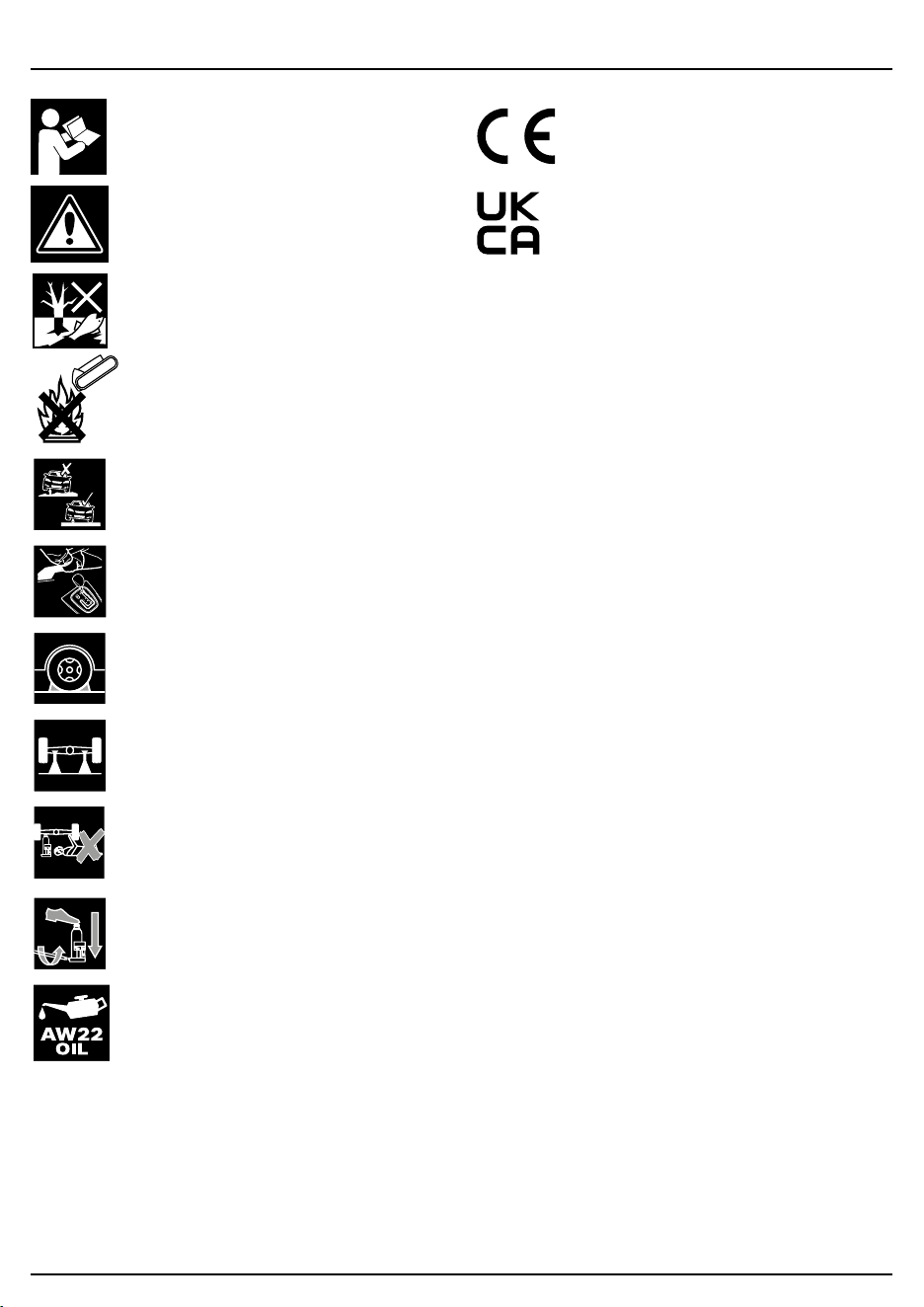
11. Explanation of Symbols
– 14 –
Read the instruction manual
Warning!
Do not abandon in the environment
Do not incinerate or throw onto re
Use only on level surfaces
Apply the handbrake and put the
vehicle in gear
Chock all grounded wheels
Support raised vehicles with axle stands
Do not work under vehicles when
supported only by a jack
Bleed the jack belore every use
Use AW22 hydraulic oil
European conformity
UK Conformity Assessed

Notes
– 15 –
EN

© Published by Draper Tools Limited© Published by Draper Tools Limited
Delta International
Delta International BV
Oude Graaf 8
6002 NL
Weert
Netherlands
Contact Details
Draper Tools
Draper Tools Limited
Hursley Road
Chandler’s Ford
Eastleigh
Hampshire
SO53 1YF
UK
Website: drapertools.com
Email: [email protected]
Product Helpline: +44 (0) 23 8049 4344
Telephone Sales Desk: +44 (0) 23 8049 4333
General Enquiries: +44 (0) 23 8026 6355
General Fax: +44 (0) 23 8026 0784
Please contact the Draper Tools Product Helpline for repair and servicing enquiries.