
ESPAÑOL
Para consultar una version en
español de este manual de
instrucciones, visite nuestro sitio de
internet GEAppliances.com.
OWNER’S MANUAL
49-2000884 Rev. 2 03-24 GEA
GE is a trademark of the General Electric Company. Manufactured under trademark license.
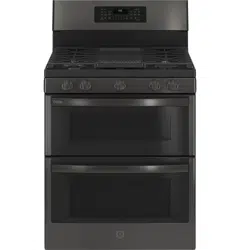
PGB965
Write the model and serial
numbers here:
Model # _________________
Serial # _________________
You can find the rating label on a
metal flag behind the rear control
panel. From the front of the range,
reach behind the middle of the rear
control panel and rotate the rating
label up.
RANGES
Self-Cleaning Gas
SAFETY INFORMATION .......... 3
USING THE RANGE
In Case of a Power Failure ............... 8
Surface Burners ........................ 8
Griddle ................................10
Oven Controls ..........................11
WiFi Connect ..........................12
Special Features ........................13
Sabbath Mode - Standard ................14
Oven Racks ............................15
Aluminum Foil and Oven Liners ...........15
Oven Cooking Modes ...................16
Oven Air Vents .........................17
Oven Cooking Guide ....................18
Air Fry Cooking Guide ...................19
CARE AND CLEANING
Range – Exterior .......................20
Range – Interior ........................21
Cooktop .............................. 22
Oven Door ............................24
Oven Light ............................26
TROUBLESHOOTING TIPS ....... 27
LIMITED WARRANTY ............30
ACCESSORIES .....................31
CONSUMER SUPPORT ........... 32

2 49-2000884 Rev. 2
THANK YOU FOR MAKING GE APPLIANCES A PART OF YOUR HOME.
Whether you grew up with GE Appliances, or this is your first, we’re happy to have you in the family.
We take pride in the craftsmanship, innovation and design that goes into every GE Appliances
product, and we think you will too. Among other things, registration of your appliance ensures that we
can deliver important product information and warranty details when you need them.
Register your GE appliance now online. Helpful websites and phone numbers are available in the
Consumer Support section of this Owner’s Manual. You may also mail in the pre-printed registration
card included in the packing material.
49-2000884 Rev. 2 3
READ AND SAVE THESE INSTRUCTIONS
IMPORTANT SAFETY INFORMATION
READ ALL INSTRUCTIONS BEFORE USING THE APPLIANCE
SAFETY INFORMATION
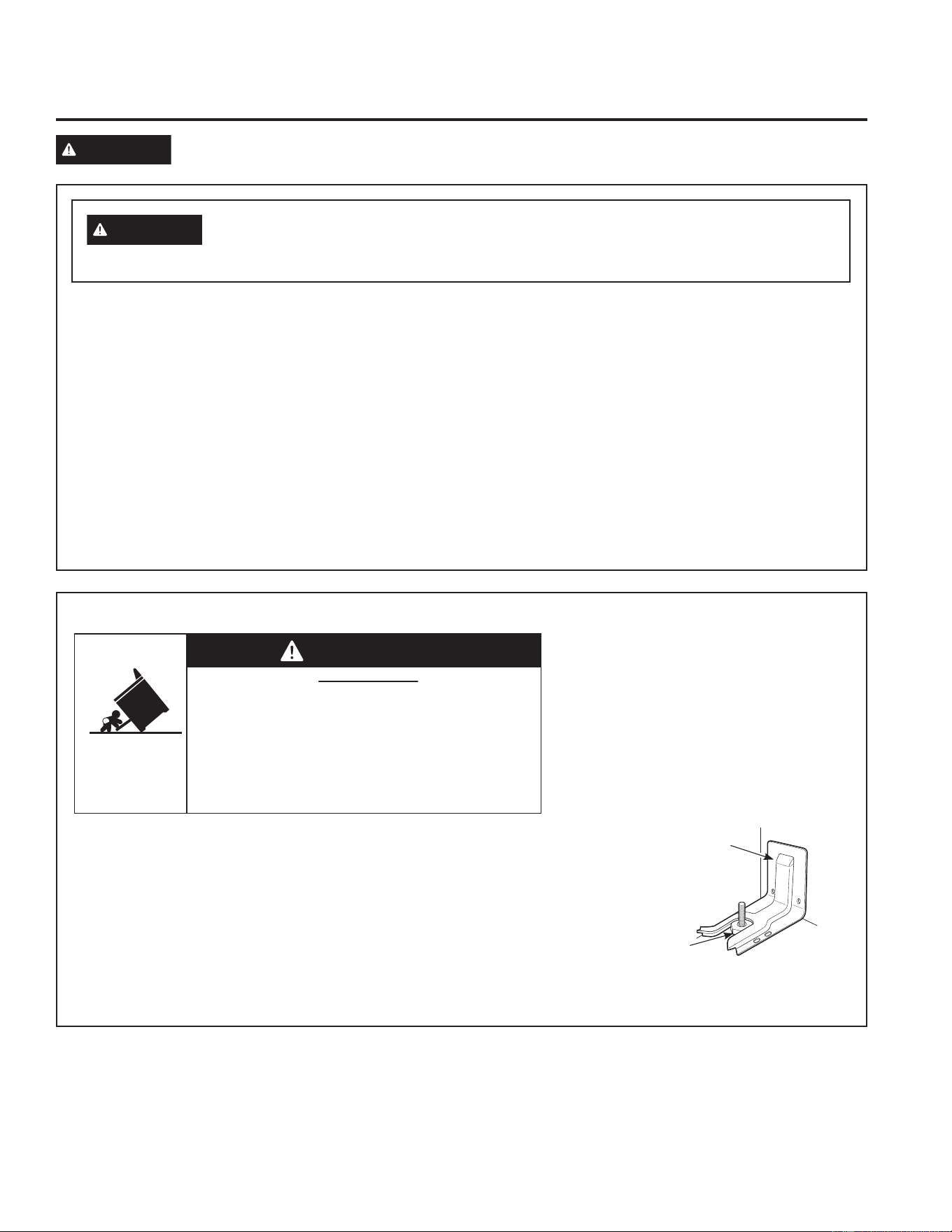
ANTI-TIP DEVICE
To reduce the risk of tipping the range,
the range must be secured by a properly
installed anti-tip bracket. See installation
instructions shipped with the bracket for
complete details before attempting to
install.
For Free-Standing and Slide-In Ranges
To check if the bracket is installed and
engaged properly, look underneath the
range to see that the rear leveling leg is engaged in the bracket. On
some models, the storage drawer or kick panel can be removed for easy
inspection. If visual inspection is not possible, slide the range forward,
confirm the anti-tip bracket is securely attached to the floor or wall, and
slide the range back so the rear leveling leg is under the anti-tip bracket.
If the range is pulled from the wall for any reason, always repeat this
procedure to verify the range is properly secured by the anti-tip bracket.
Never completely remove the leveling legs or the range will not be secured
to the anti-tip device properly.
WARNING
If the information in this manual is not followed exactly, a fire or
explosion may result, causing property damage, personal injury or death.
- Do not store or use gasoline or other flammable vapors and liquids in the vicinity of
this or any other appliance.
- WHAT TO DO IF YOU SMELL GAS
Ŷ 'RQRWWU\WROLJKWDQ\DSSOLDQFH
Ŷ 'RQRWWRXFKDQ\HOHFWULFDOVZLWFKGRQRWXVHDQ\SKRQHLQ\RXUEXLOGLQJ
Ŷ,PPHGLDWHO\FDOO\RXUJDVVXSSOLHUIURPDQHLJKERU¶VSKRQH)ROORZWKHJDV
VXSSOLHU¶VLQVWUXFWLRQV
Ŷ ,I\RXFDQQRWUHDFK\RXUJDVVXSSOLHUFDOOWKHILUHGHSDUWPHQW
- Installation and service must be performed by a qualified installer, service agency or
the gas supplier.
WARNING
Read all safety instructions before using the product. Failure to follow these instructions may result
in fire, electrical shock, serious injury or death.
Anti-Tip
Bracket
Leveling Leg
Free-Standing and Slide-In Ranges
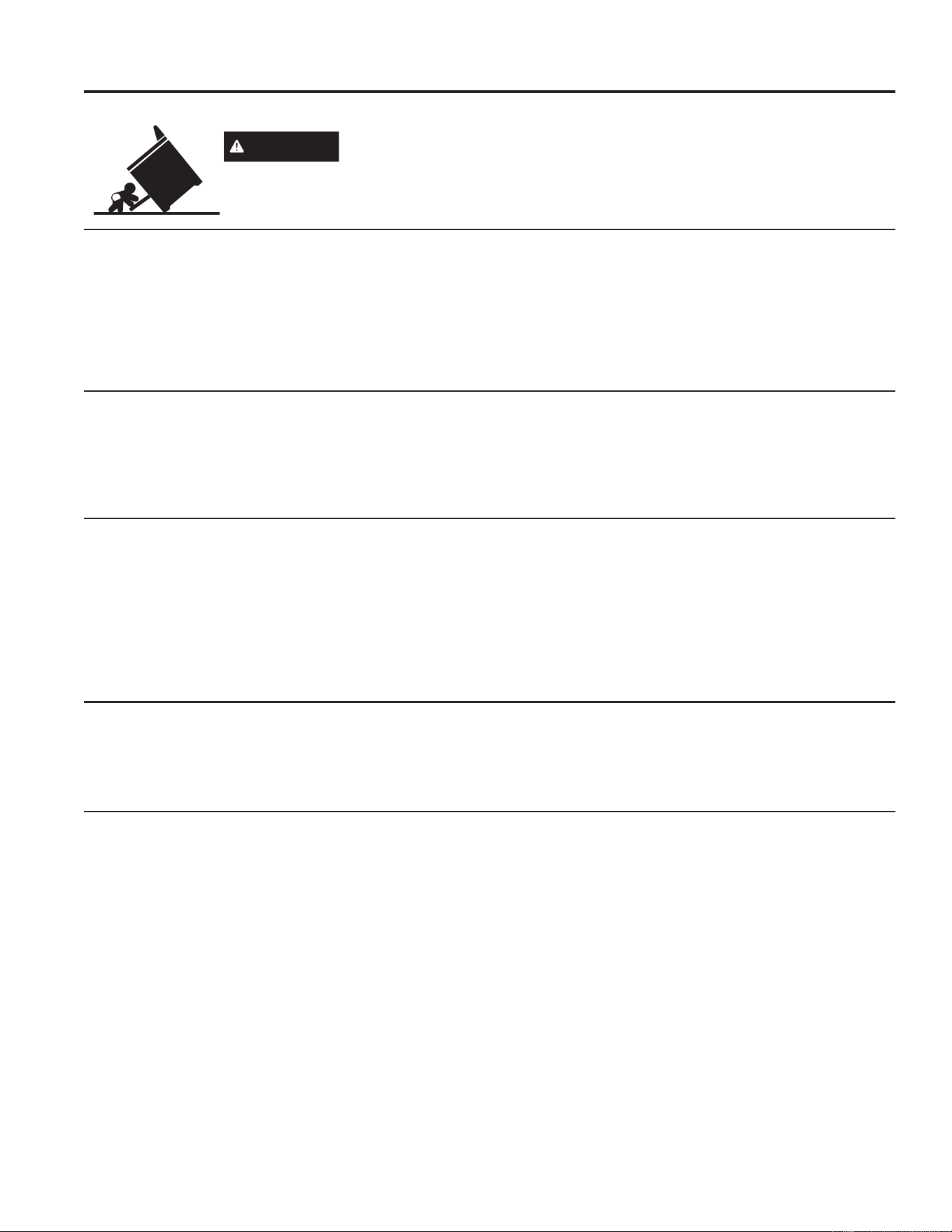
• A child or adult can tip the range and be killed.
• Install the anti-tip bracket to the wall or floor.
• Engage the range to the anti-tip bracket by sliding the
range back such that the foot is engaged.
• Re-engage the anti-tip bracket if the range is moved.
• Failure to do so can result in death or serious burns
to children or adults.
Tip-Over Hazard
WARNING
4 49-2000884 Rev. 2
SAFETY INFORMATION
READ AND SAVE THESE INSTRUCTIONS
IMPORTANT SAFETY INFORMATION
READ ALL INSTRUCTIONS BEFORE USING THE APPLIANCE
WARNING
GENERAL SAFETY INSTRUCTIONS
WARNING
NEVER use this appliance as a
space heater to heat or warm the room. Doing
so may result in carbon monoxide poisoning
and overheating of the oven.
Ŷ 8VHWKLVDSSOLDQFHIRULWVLQWHQGHGSXUSRVHDV
described in this owner’s manual.
Ŷ +DYH\RXUUDQJHLQVWDOOHGDQGSURSHUO\JURXQGHGE\
a qualified installer in accordance with the provided
installation instructions.
Ŷ $Q\DGMXVWPHQWDQGVHUYLFHVKRXOGEHSHUIRUPHG
only by a qualified gas range installer or service
technician. Do not attempt to repair or replace
any part of your range unless it is specifically
recommended in this manual.
Ŷ <RXUUDQJHLVVKLSSHGIURPWKHIDFWRU\VHWIRUXVH
with natural gas. It can be converted for use with
propane gas. If required, these adjustments must be
made by a qualified technician in accordance with
the installation instructions and local codes. The
agency performing this work assumes responsibility
for the conversion.
Ŷ +DYHWKHLQVWDOOHUVKRZ\RXWKHORFDWLRQRIWKH
range gas shut-off valve and how to turn it off if
necessary.
Ŷ 3OXJ\RXUUDQJHLQWRDYROWJURXQGHGRXWOHW
only. Do not remove the round grounding prong
from the plug. If in doubt about the grounding of the
home electrical system, it is your responsibility and
obligation to have an ungrounded outlet replaced
with a properly grounded, three prong outlet in
accordance with the National Electrical Code. Do
not use an extension cord with this appliance.
Ŷ %HIRUHSHUIRUPLQJDQ\VHUYLFHXQSOXJWKHUDQJH
or disconnect the power supply at the household
distribution panel by removing the fuse or switching
off the circuit breaker.
Ŷ %HVXUHDOOSDFNLQJPDWHULDOVDUHUHPRYHGIURPWKH
range before operating to prevent ignition of these
materials.
Ŷ $YRLGVFUDWFKLQJRULPSDFWLQJJODVVGRRUV
cooktops, or control panels. Doing so may lead
to glass breakage. Do not cook on a product with
broken glass. Shock, fire, or cuts may occur.
Ŷ 'RQRWOHDYHFKLOGUHQDORQHRUXQDWWHQGHGLQDQ
area where an appliance is in use. They should
never be allowed to climb, sit or stand on any part
of the appliance.
Ŷ
CAUTION
Do not store items of interest
to children in cabinets above an oven - children
climbing on the oven to reach items could be
seriously injured.
Ŷ 1HYHUEORFNWKHYHQWVDLURSHQLQJVRIWKHUDQJH
They provide the air inlets and outlets that are
necessary for the range to operate properly with
correct combustion. Air openings are located at the
rear of the cooktop, at the top and bottom of the
oven door, and at the bottom of the range under the
drawer, lower oven drawer or kick panel.
Ŷ 8VHRQO\GU\SRWKROGHUV²PRLVWRUGDPSSRW
holders on hot surfaces may result in burns from
steam. Do not let pot holders touch surface burners,
burner grate, or oven heating element. Do not use a
towel or other bulky cloth in place of pot holders.
Ŷ 'RQRWWRXFKWKHKHDWLQJHOHPHQWVRUWKHLQWHULRU
surface of the oven. These surfaces may be hot
enough to burn even though they are dark in color.
During and after use, do not touch, or let clothing
or other flammable materials contact any interior
area of the oven; allow sufficient time for cooling
first. Other surfaces of the appliance may become
KRWHQRXJKWRFDXVHEXUQV3RWHQWLDOO\KRWVXUIDFHV
include the burners, grates, oven vent opening,
surfaces near the opening, and crevices around the
oven door.
Ŷ 'RQRWKHDWXQRSHQHGIRRGFRQWDLQHUV3UHVVXUH
could build up and the container could burst,
causing an injury.
Ŷ &RRNIRRGWKRURXJKO\WRKHOSSURWHFWDJDLQVW
foodborne illness. Minimum safe food temperature
recommendations can be found at
IsItDoneYet.gov and fsis.usda.gov8VHDIRRG
thermometer to take food temperatures and check
several locations.
Ŷ 'RQRWDOORZDQ\RQHWRFOLPEVWDQGRUKDQJRQWKH
oven door, drawer or cooktop. They could damage
the range or tip it over causing severe injury or death.
49-2000884 Rev. 2 5
WARNING
KEEP FLAMMABLE MATERIALS AWAY FROM THE RANGE
Failure to do so may result in fire or personal injury.
Ŷ 'RQRWVWRUHRUXVHIODPPDEOHPDWHULDOVLQDQRYHQ
or near the cooktop, including paper, plastic, pot
holders, linens, wall coverings, curtains, drapes and
gasoline or other flammable vapors and liquids.
Ŷ 1HYHUZHDUORRVHILWWLQJRUKDQJLQJJDUPHQWVZKLOH
using the appliance. These garments may ignite if
they contact hot surfaces causing severe burns.
Ŷ 'RQRWOHWFRRNLQJJUHDVHRURWKHUIODPPDEOH
materials accumulate in or near the range. Grease
in the oven or on the cooktop may ignite.
WARNING
IN THE EVENT OF A FIRE, TAKE THE FOLLOWING
STEPS TO PREVENT INJURY AND FIRE SPREADING
Ŷ 'RQRWXVHZDWHURQJUHDVHILUHV1HYHUSLFNXS
a flaming pan. Turn the controls off. Smother a
flaming pan on a surface unit by covering the pan
completely with a well-fitting lid, cookie sheet or flat
WUD\8VHDPXOWLSXUSRVHGU\FKHPLFDORUIRDPW\SH
fire extinguisher.
Ŷ ,IWKHUHLVDILUHLQWKHRYHQGXULQJEDNLQJVPRWKHU
the fire by closing the oven door and turning the
oven off or by using a multi-purpose dry chemical or
foam-type fire extinguisher.
Ŷ ,IWKHUHLVDILUHLQWKHRYHQGXULQJVHOIFOHDQWXUQ
the oven off and wait for the fire to go out. Do not
force the door open. Introduction of fresh air at self-
clean temperatures may lead to a burst of flame
from the oven. Failure to follow this instruction may
result in severe burns.
SAFETY INFORMATION
IMPORTANT SAFETY INFORMATION
READ ALL INSTRUCTIONS BEFORE USING THE APPLIANCE
READ AND SAVE THESE INSTRUCTIONS
WARNING
COOKTOP SAFETY INSTRUCTIONS
WARNING
NEVER Operate the
Top Surface Cooking Section of this
Appliance Unattended.
• Failure to follow this warning
statement could result in fire,
explosion, or burn hazard that could
cause property damage, personal
injury, or death.
• If a fire should occur, keep away from
the appliance and immediately call
your fire department.
DO NOT ATTEMPT TO EXTINGUISH
AN OIL/GREASE FIRE WITH WATER.
Ŷ 1HYHUOHDYHWKHVXUIDFHEXUQHUVXQDWWHQGHG)RRGV
especially oily foods, may ignite resulting in fire that
could spread to surrounding cabinets.
Ŷ 1HYHUOHDYHRLOXQDWWHQGHGZKLOHIU\LQJ,IDOORZHG
to heat beyond its smoking point, oil may ignite
resulting in fire that may spread to surrounding
FDELQHWV8VHDGHHSIDWWKHUPRPHWHUZKHQHYHU
possible to monitor oil temperature.
Ŷ 7RDYRLGRLOVSLOORYHUDQGILUHXVHWKHPLQLPXP
amount of oil when using a shallow pan-frying
and avoid cooking frozen foods with excessive
amounts of ice.
Ŷ 8VHSURSHUSDQVL]HDQGDYRLGSDQVWKDWDUH
unstable or easily tipped. Select cookware that is
matched to the size of the burner. Burner flames
should be adjusted so that they do not extend
beyond the bottom of the pan. Excessive flame may
be hazardous.
Ŷ $OZD\VXVHWKH/,7(SRVLWLRQZKHQLJQLWLQJWKHWRS
burners and make sure the burners have ignited.
Ŷ :KHQXVLQJJODVVFHUDPLFFRRNZDUHPDNHVXUHLW
is suitable for cooktop service; others may break
because of sudden change in temperature.
6 49-2000884 Rev. 2
SAFETY INFORMATION
IMPORTANT SAFETY INFORMATION
READ ALL INSTRUCTIONS BEFORE USING THE APPLIANCE
WARNING
OVEN SAFETY INSTRUCTIONS
WARNING
NEVER cover any slots,
holes, or passages in the oven bottom or
cover an entire rack with materials such as
aluminum foil or oven liners. Doing so blocks
air flow through the oven and may cause
carbon monoxide poisoning. Never place foil
or oven liners on the oven bottom. They can
trap heat causing risk of smoke or fire.
Ŷ 6WDQGDZD\IURPWKHUDQJHZKHQRSHQLQJWKHRYHQ
door. Hot air or steam which escapes can cause
EXUQVWRKDQGVIDFHDQGRUH\HV
Ŷ 1HYHUSODFHFRRNLQJXWHQVLOVSL]]DRUEDNLQJVWRQHV
or any type of foil or liner on the oven floor. These
items can trap heat or melt, resulting in damage to
the product and risk of shock, smoke or fire.
Ŷ 3ODFHRYHQUDFNVLQGHVLUHGORFDWLRQZKLOHRYHQLV
cool. If rack must be moved while oven is hot, be
careful to avoid touching hot surfaces.
Ŷ 'RQRWOHDYHLWHPVVXFKDVSDSHUFRRNLQJXWHQVLOV
or food in the oven when not in use. Items stored in
an oven can ignite.
Ŷ 'RQRWOHDYHLWHPVRQWKHFRRNWRSQHDUWKHRYHQ
vent. Items may overheat resulting in a risk of fire or
burns.
Ŷ 1HYHUEURLOZLWKGRRURSHQ2SHQGRRUEURLOLQJLV
not permitted due to overheating of control knobs.
WARNING
COOKTOP SAFETY INSTRUCTIONS
Ŷ 7RPLQLPL]HWKHSRVVLELOLW\RIEXUQVLJQLWLRQRI
flammable materials and spillage, the handle of a
container should be turned toward the center of the
range without extending over nearby burners.
Ŷ 'RQRWXVHDZRNZLWKDURXQGPHWDOVXSSRUWULQJ
The ring may trap heat and block air to the burner
resulting in a carbon monoxide hazard.
Ŷ 'RQRWDWWHPSWWROLIWWKHFRRNWRS'RLQJVRPD\
damage the gas tubing to the surface burners
resulting in a gas leak and risk of fire.
Ŷ :KHQGLVDEOLQJ/RFN&RQWUROPDNHVXUHWKH
surface controls are set to the OFF position. This
will prevent unintended gas flow from the burners.
Ŷ 'RQRWXVHDOXPLQXPIRLOWRFRYHUWKHJUDWHVRU
line any part of the cooktop. Doing so may result
in carbon monoxide poisoning, overheating of the
cooktop surfaces, or a potential fire hazard.
WARNING
SELF-CLEANING OVEN SAFETY INSTRUCTIONS
The self-cleaning feature operates the oven at temperatures high enough to burn away food soils in the oven.
Follow these instructions for safe operation.
Ŷ 'RQRWWRXFKRYHQVXUIDFHVGXULQJVHOIFOHDQ
operation. Keep children away from the oven during
self-cleaning. Failure to follow these instructions
may cause burns.
Ŷ %HIRUHRSHUDWLQJWKHVHOIFOHDQF\FOHUHPRYHSDQV
shiny metal oven racks, and other utensils from the
oven. Only porcelain-coated oven racks may be left
in the oven.
Ŷ %HIRUHRSHUDWLQJWKHVHOIFOHDQF\FOHZLSHJUHDVH
and food soils from the oven. Excessive amount
of grease may ignite leading to smoke damage to
your home.
Ŷ ,IWKHVHOIFOHDQLQJPRGHPDOIXQFWLRQVWXUQWKH
oven off and disconnect the power supply. Have it
serviced by a qualified technician.
Ŷ 'RQRWXVHRYHQFOHDQHUV1RFRPPHUFLDORYHQ
cleaner or oven liner protective coating of any kind
should be used in or around any part of the oven.
Ŷ 'RQRWFOHDQWKHGRRUJDVNHW7KHGRRUJDVNHWLV
essential for a good seal. Care should be taken not
to rub, damage or move the gasket.
Ŷ IMPORTANT: The health of some birds is
extremely sensitive to the fumes given off during
the self-cleaning cycle of any range. Move birds to
another well-ventilated room.
READ AND SAVE THESE INSTRUCTIONS

49-2000884 Rev. 2 7
How to Remove Protective Shipping Film and Packaging Tape
Carefully grasp a corner of the protective shipping film
with your fingers and slowly peel it from the appliance
surface. Do not use any sharp items to remove the film.
Remove all of the film before using the appliance for the
first time.
To assure no damage is done to the finish of the
product, the safest way to remove the adhesive from
packaging tape on new appliances is an application of
a household liquid dishwashing detergent. Apply with a
soft cloth and allow to soak.
NOTE: The adhesive must be removed from all parts. It
cannot be removed if it is baked on.
Consider recycling options for your appliance packaging
material.
SAFETY INFORMATION
IMPORTANT SAFETY INFORMATION
READ ALL INSTRUCTIONS BEFORE USING THE APPLIANCE
Remote Enable Equipment
7KLVGHYLFHFRPSOLHVZLWKSDUWRIWKH)&&5XOHV
2SHUDWLRQLVVXEMHFWWRWKHIROORZLQJWZRFRQGLWLRQV
This device may not cause harmful interference, and
WKLVGHYLFHPXVWDFFHSWDQ\LQWHUIHUHQFHUHFHLYHG
including interference that may cause undesired operation.
The wireless communication equipment installed on this
range has been tested and found to comply with the
OLPLWVIRUD&ODVV%GLJLWDOGHYLFHSXUVXDQWWRSDUWRI
the FCC Rules. These limits are designed to:
(a) provide reasonable protection against harmful
interference in a residential installation. This equipment
generates, uses, and can radiate radio frequency energy
and, if not installed and used in accordance with the
instructions, may cause harmful interference to radio
communications. However, there is no guarantee that
interference will not occur in a particular installation. If
this equipment does cause harmful interference to radio
or television reception, which can be determined by
turning the equipment off and on, the user is encouraged
to try to correct the interference by one or more of the
following measures:
Ŷ5HRULHQWRUUHORFDWHWKHUHFHLYLQJDQWHQQD
Ŷ,QFUHDVHWKHVHSDUDWLRQEHWZHHQWKHHTXLSPHQWDQG
receiver.
Ŷ&RQQHFWWKHHTXLSPHQWLQWRDQRXWOHWRQDFLUFXLW
different from that to which the receiver is connected.
Ŷ&RQVXOWWKHGHDOHURUDQH[SHULHQFHGUDGLR79
technician for help.
(b) accept any interference received, including interference
that may cause undesired operation of the device.
Note that any changes or modifications to the wireless
communication device installed on this oven that are not
expressly approved by the manufacturer could void the
user’s authority to operate the equipment.
READ AND SAVE THESE INSTRUCTIONS
PROPER DISPOSAL OF YOUR APPLIANCE
Dispose of or recycle your appliance in accordance with Federal and Local Regulations. Contact your local
authorities for the environmentally safe disposal or recycling of your appliance.
8 49-2000884 Rev. 2
USING THE RANGE: ,Q &DVH RI D 3RZHU )DLOXUH 6XUIDFH %XUQHUV
In Case of a Power Failure
Types of Surface Burners
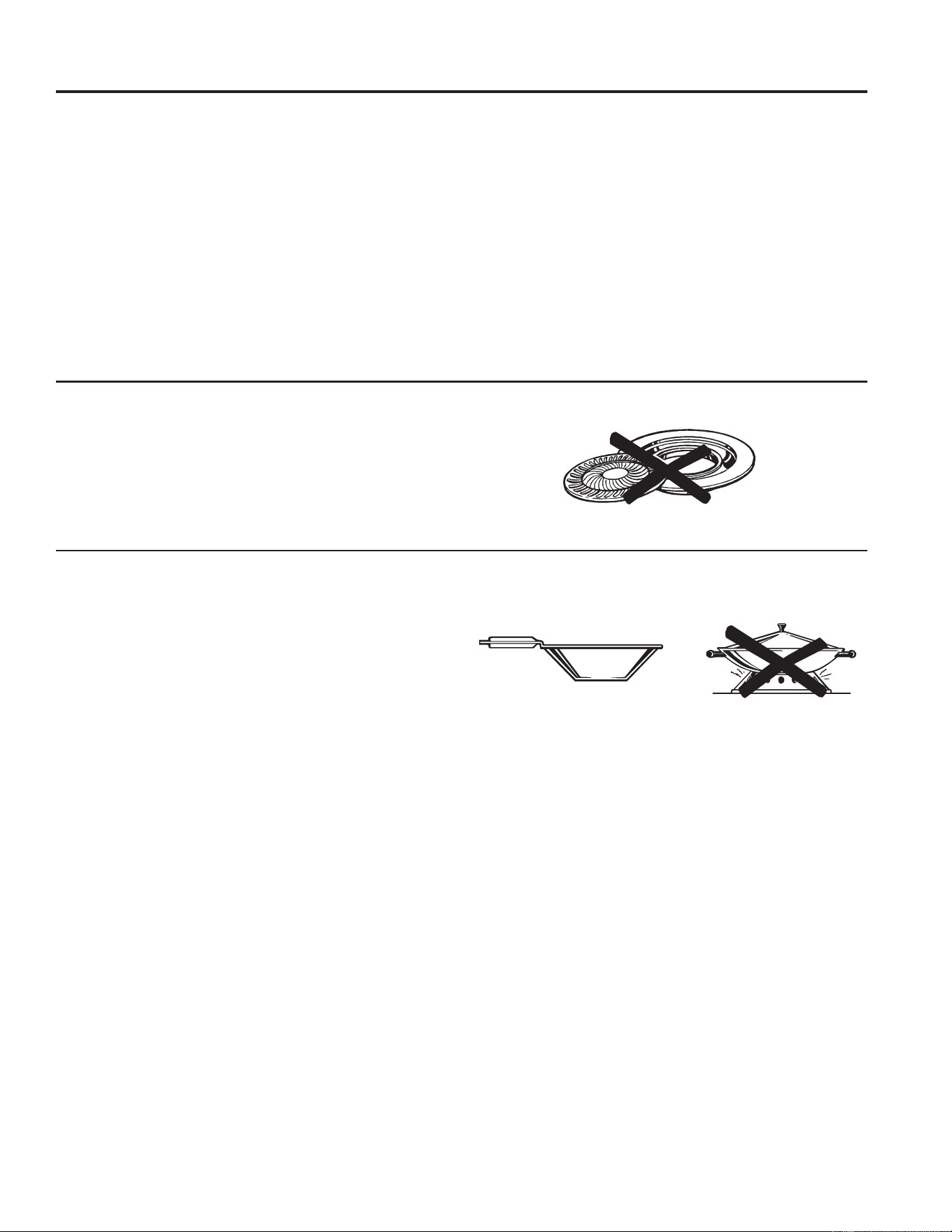
Round Burner
8VH WKLV EXUQHU IRU JHQHUDO
cooking purposes. Size cookware
appropriately to the flames.
Surface Burners
In the event of a power failure, the oven is inoperable
and no attempt should be made to operate it. However,
WKH VXUIDFH EXUQHUV PD\ EH OLW ZLWK D PDWFK 8VLQJ
extreme caution, hold a lit match near the ports beneath
the surface burner cap, then slowly turn the knob to the
LITE position. Once lit, surface burners will continue to
operate normally.
Lighting a Surface Burner
WARNING
Burners should be operated only
when covered by cookware. Burner flames not
covered by cookware present a risk of fire or
clothing ignition. Never let flames extend beyond the
sides of the cookware. Failure to comply may result
in serious injury.
Make sure all burners are in their correct locations and
fully assembled before attempting to operate any burner.
6HOHFW D EXUQHU DQG ILQG LWV FRQWURO NQRE 3XVK WKH NQRE
in and turn it to the LITE position.
<RX ZLOO KHDU D FOLFNLQJ QRLVH²
the sound of the electric spark
igniting the burner. When one
burner is turned to LITE, all
burners will spark. Sparking will
continue as long as the knob
remains at LITE. Once gas is
ignited, turn the knob to adjust
the flame size.
Using the Surface Burners
NOTES:
Ŷ 'R QRW RSHUDWH WKH EXUQHU IRU DQ H[WHQGHG SHULRG RI
time without cookware on the grate. The finish on
the grate may discolor or chip without cookware to
absorb the heat.
Ŷ 'R QRW DWWHPSW WR GLVDVVHPEOH DQ\ EXUQHU ZKLOH DQRWKHU
burner is on. Damage to the product may occur.
Ŷ %H VXUH WKH EXUQHUV DQG JUDWHV DUH FRRO EHIRUH \RX
place your hand, a pot holder or cleaning materials
on them.
Your rangetop has sealed gas burners that offer
convenience, cleanability and flexibility for a wide range
of cooking applications.
The smallest burner is the simmer burner. A simmer
burner turned down to LO provides precise cooking
performance for foods such as delicate sauces that
require low heat for a long cooking time.
The extra-large burner is designed to quickly bring
large amounts of liquid to a boil. Some models have a
32:(5 %2,/ VHWWLQJ HVSHFLDOO\ GHVLJQHG IRU XVH ZLWK
FRRNZDUH ZLWK D GLDPHWHU RI LQFKHV RU ODUJHU
Selecting a Flame Size
Watch the flame, not the knob, as you adjust heat. When
rapid heating is desired, the flame size should match the
size of the cookware you are using. Flames larger than
the bottom of the cookware will not heat faster and may
be hazardous.
3XVK WKH FRQWURO NQRE LQ DQG
turn it to the LITE position.
These flames are too large for the pot
Oval Burner
8VH WKLV EXUQHU WR FRRN RQ WKH JULGGOH
Multi-Ring Burner
8VH WKLV EXUQHU IRU ODUJH
cookware or for simmering
applications.
49-2000884 Rev. 2 9
Surface Burners (Cont.)
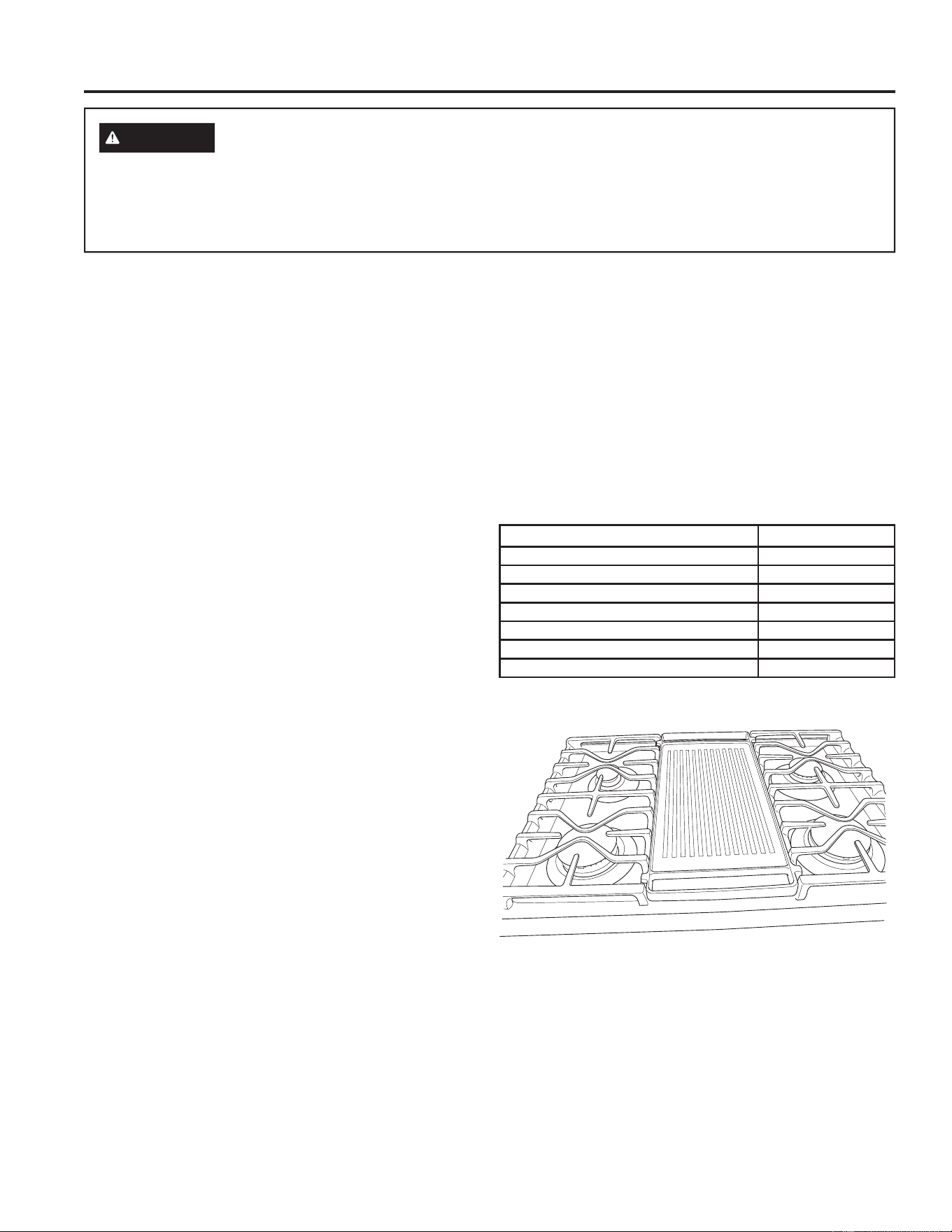
Stove Top Grills
Do not use an after-market stove top grill on your
gas surface burners. A stove top grill will cause
incomplete combustion resulting in carbon monoxide
levels above allowable standards. This could be
hazardous to your health.
Using a Wok
8VHRQO\DIODWERWWRPHGZRNZLWKDGLDPHWHURILQFKHV
or less. Make sure the wok bottom sits flat on the grate.
'RQRWXVHDZRNVXSSRUWULQJ3ODFLQJWKHULQJRYHUWKH
burner or grate may cause the burner to work improperly,
resulting in carbon monoxide levels above allowable
standards. This could be hazardous to your health.
8VHDIODWERWWRPHGZRN
Do not use stove top grills
Top-of-Range Cookware
Aluminum: Medium-weight cookware is recommended
because it heats quickly and evenly. Most foods brown
HYHQO\LQDQDOXPLQXPVNLOOHW8VHVDXFHSDQVZLWKWLJKW
fitting lids when cooking with minimum amounts of water.
Stainless Steel: This metal alone has poor heating
properties and is usually combined with copper,
aluminum or other metals for improved heat distribution.
Combination metal skillets usually work satisfactorily if
they are used with medium heat or as the manufacturer
recommends.
Cast-Iron: If heated slowly, most skillets will give
satisfactory results.
Enamelware:8QGHUVRPHFRQGLWLRQVWKHHQDPHO
of some cookware may melt. Follow the cookware
manufacturer’s recommendations for cooking methods.
Glass:7KHUHDUHWZRW\SHVRIJODVVFRRNZDUH²WKRVH
for oven use only and those for top-of-range cooking
VDXFHSDQVFRIIHHDQGWHDSRWV*ODVVFRQGXFWVKHDW
very slowly.
Heatproof Glass Ceramic: Can be used for either
surface or oven cooking. It conducts heat very slowly and
cools very slowly. Check the cookware manufacturer’s
directions to be sure it can be used on gas ranges.
USING THE RANGE: Surface Burners
49-2000884 Rev. 2
USING THE RANGE: Griddle
Griddle
Positioning Your Griddle
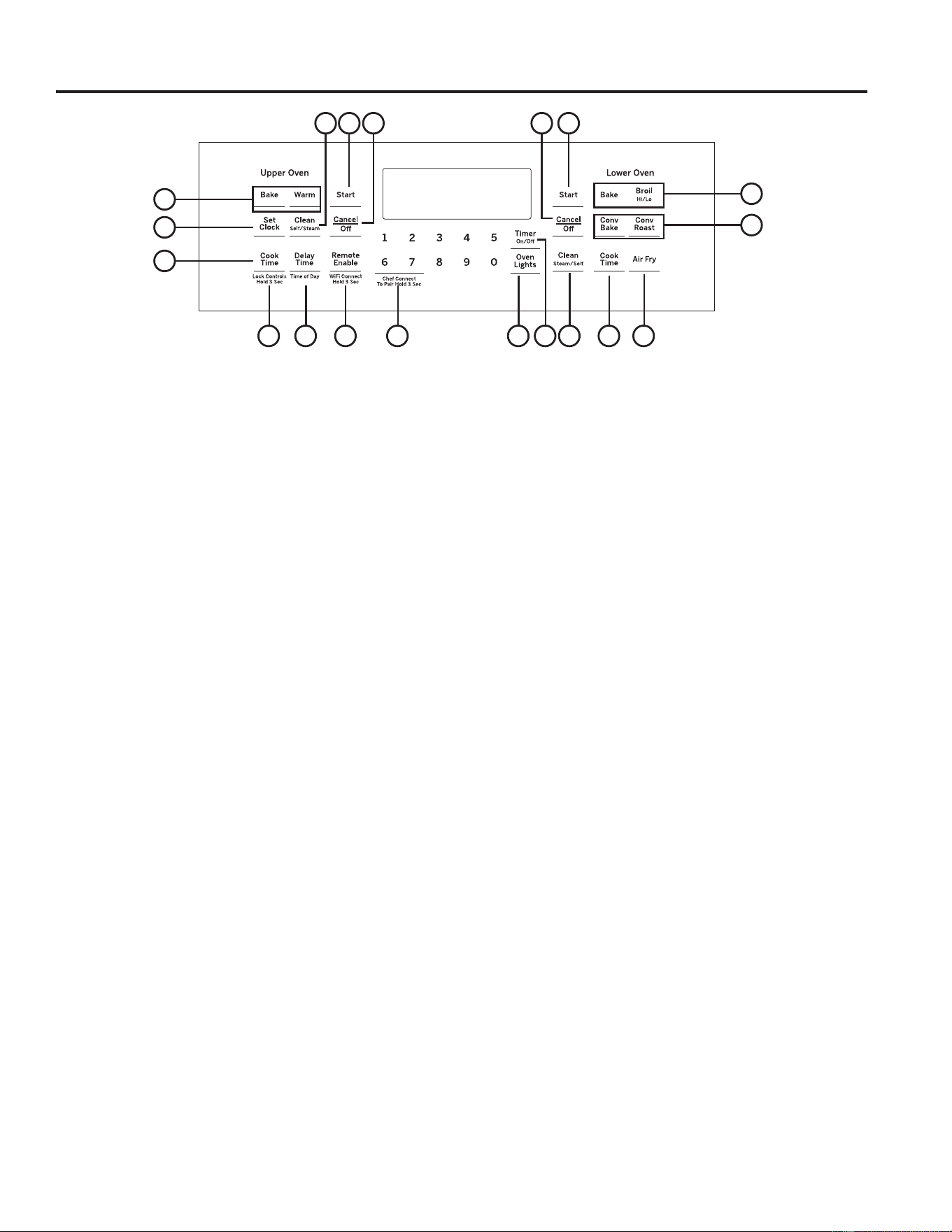
The reversible cast-iron griddle can only be used over the center burner of the rangetop. To position the griddle,
UHPRYH WKH FHQWHU JUDWH LI SUHVHQW DQG UHSODFH LW ZLWK WKH JULGGOH 'R QRW WXUQ RQ WKH FHQWHU EXUQHU XQWLO \RX DUH
certain the griddle has been positioned correctly.
Preheating Your Griddle
If your center burner is a single oval burner, preheat your griddle for 2-5 minutes on Hi before placing food on the
JULGGOH ,I \RXU FHQWHU EXUQHU LV D GXDO RYDO EXUQHU SUHKHDW \RXU JULGGOH IRU PLQXWHV RQ +L EHIRUH SODFLQJ IRRG RQ
the griddle. Once the griddle is preheated, turn the heat down to the cook setting outlined in the table corresponding
to your griddle. To determine the type of burner you have, see the Types of Surface Burners section.
Using Your Reversible Cast-Iron Griddle
The ribbed side of the reversible griddle can be used for
food normally grilled.
Your griddle provides an extra-large cooking surface for
meats, pancakes and other foods usually prepared in
a skillet. Before first use, rinse with hot water and dry
WKRURXJKO\ 3UHSDUH WKH VXUIDFH ZLWK FRRNLQJ VSUD\ RU
vegetable oil.
Griddle Precautions:
Ŷ 'R QRW SODFH WKH JULGGOH LQ D PLFURZDYH RYHQ
Ŷ 'R QRW FOHDQ \RXU JULGGOH LQ WKH GLVKZDVKHU
Ŷ ,I VRPHWKLQJ KDV VSLOOHG XQGHU WKH JULGGOH LW VKRXOG EH
cleaned up as soon as possible to prevent “baked on”
food soil.
Ŷ 'R QRW DOORZ JUHDVH WR DFFXPXODWH XQGHU WKH JULGGOH
as it can be a fire hazard. Clean under the griddle with
hot, soapy water as soon as it is cool.
WARNING
Fire Hazard
Ŷ 8VH FDUH ZKHQ FRRNLQJ JUHDV\ IRRGV 6SLOOHG JUHDVH PD\ UHVXOW LQ ILUH
Ŷ 1HYHU SODFH DQ\ LWHPV RQ WKH JULGGOH ZKHQ LW LV QRW LQ XVH +HDW IURP VXUURXQGLQJ EXUQHUV FDQ KHDW
the griddle and may result in fire.
Ŷ 3ODFH DQG UHPRYH WKH JULGGOH RQO\ ZKHQ JULGGOH LV FRRO DQG DOO VXUIDFH EXUQHUV DUH WXUQHG 2))
Type of Food Cook Setting
Bacon Med
Breakfast Sausage Links Med
Eggs Lo
Grilled Cheese Med-Lo
Hamburgers Med-Lo
3DQFDNHV Med-Lo
Warming Tortillas Lo
Cook settings may need to be reduced if the griddle is used for an
extended time.
Preseasoned Reversible Cast-Iron Griddle
5HSODFH WKH FHQWHU JUDWH LI SUHVHQW ZLWK WKH
3UHVHDVRQHG &DVW,URQ 5HYHUVLEOH *ULGGOH
49-2000884 Rev. 2
Oven Controls
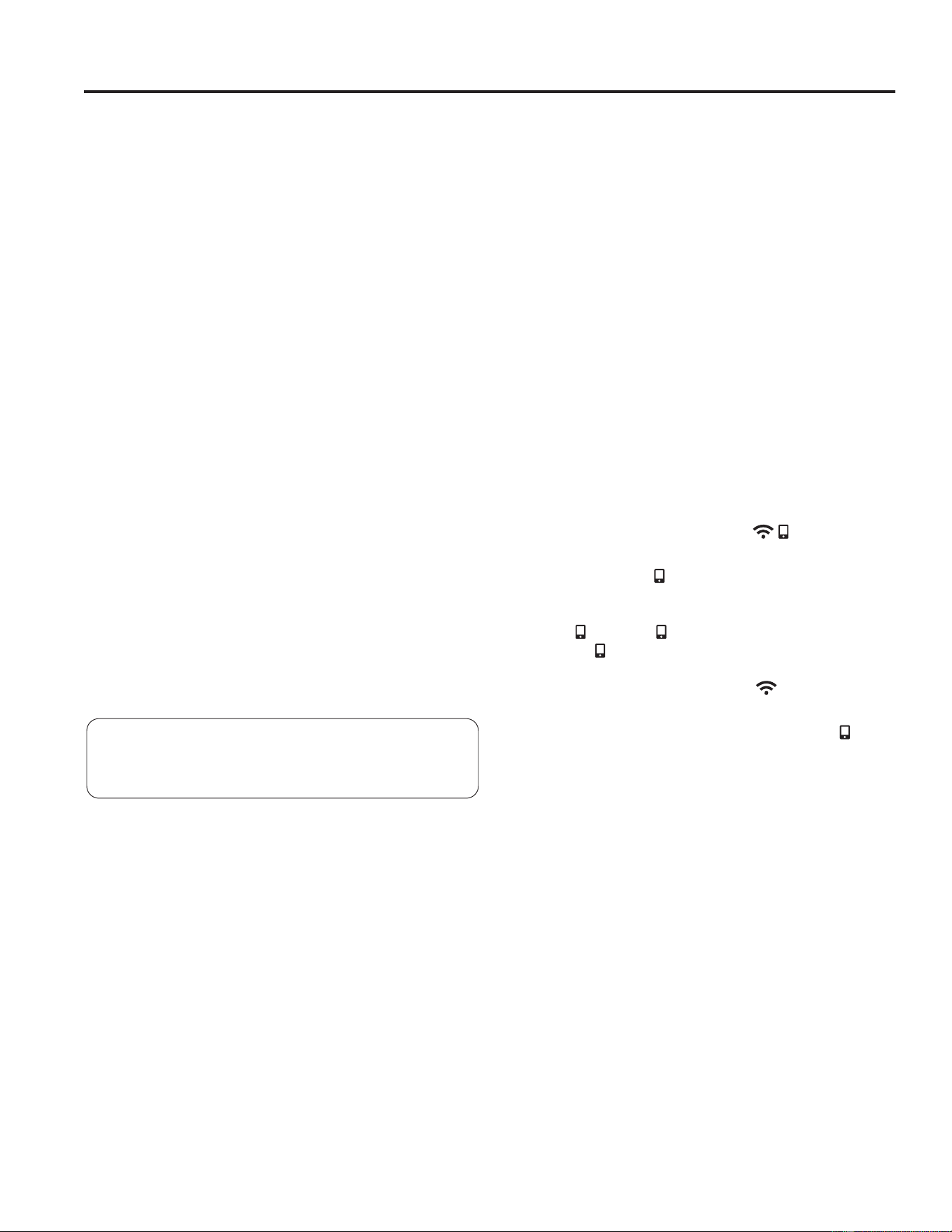
1. Traditional Cooking Modes: Your oven has the
following traditional cooking modes: Bake, Broil and
Warm. See the Oven Cooking Modes section for
more information.
2. Convection Cooking Modes: Convection cooking
mode uses increased air circulation to improve
performance. See the Oven Cooking Modes section
for more information.
3. Clean: Your oven has two cleaning modes: Self
Clean and Steam Clean. See the Cleaning the Oven
section for important information about using these
modes.
4. Start: Must be pressed to start any cooking,
cleaning, or timed function.
NOTE: If your display and keys dim, opening
the oven door or pressing any key will wake and
illuminate the control.
5. Cancel/Off: Cancels ALL oven operations except
the clock and timer.
6. Timer: :RUNVDVDFRXQWGRZQWLPHU3UHVVWKH
Timer pad and use the number pads to program
WKHWLPHLQKRXUVDQGPLQXWHV3UHVVWKHStart pad.
The oven will continue to operate when the timer
countdown is complete. To turn the timer off, press
the Timer pad.
7. Cook TIme: Counts down cooking time and turns
off the oven when the cooking time is complete.
6HOHFWDGHVLUHGFRRNLQJPRGH8VHWKHQXPEHU
SDGVWRSURJUDPDEDNLQJWHPSHUDWXUH3UHVV
the Cook Time pad and use the number pads
to program a cooking time in hours and minutes.
Then press Start. This can only be used with Bake,
Convection Bake, Convection Roast, and Air Fry.
8. Delay Time: 'HOD\VZKHQWKHRYHQZLOOWXUQRQ8VH
this to set a time when you want the oven to start.
6HOHFWDGHVLUHGFRRNLQJPRGH8VHWKHQXPEHU
SDGWRSURJUDPDEDNLQJWHPSHUDWXUH3UHVVWKH
Delay Time SDG8VHWKHQXPEHUSDGVWRSURJUDP
the time of day for the oven to turn on, and then
press Start.
NOTE: When using the Delay Time feature, foods
that spoil easily – such as milk, eggs, fish, stuffing,
poultry, and pork – should not be allowed to sit for
PRUHWKDQKRXUEHIRUHRUDIWHUFRRNLQJ5RRP
temperature promotes the growth of harmful
bacteria. Be sure that the oven light is off because
heat from the bulb will speed harmful bacteria
growth.
9. Lock Controls: Locks out the control so that
pressing the pads does not activate the controls.
3UHVVDQGKROGWKHLock Controls pad, for three
seconds to lock or unlock the control. Cancel/Off is
always active, even when the control is locked.
10. Oven Lights: Turns the oven lights on or off.
11. Air Fry: The Air Fry mode is designed to produce
foods with a crispier exterior than traditional oven
cooking. See the Oven Cooking Modes section for
more information.
12. Set Clock: 6HWWKHRYHQFORFNWLPH3UHVVWKHSet
ClockSDG8VHWKHQXPEHUSDGVWRSURJUDPWKH
FORFN3UHVVStart to save the time.
13. Remote Enable: Allows you to control your oven
remotely. To be able to start the oven remotely,
press the Remote Enable pad, and “Remote” will
be lit in the display. The oven can now be remotely
started with a connected device. This appliance
is configurable to allow remote operation at any
time. Do not store any flammable materials or
temperature sensitive items inside, on top or near
the surface units of the appliance. If “Remote” is not
shown in the display, you are still able to change the
oven settings or turn the oven off. After using the
oven, remember to verify that the “Remote” icon is
displayed if you wish to start the oven remotely in
the future. For instructions on how to connect your
oven, see the WiFi Connect section of this manual.
14. Chef Connect: This is a Bluetooth
®
pairing feature
for use with other compatible Chef Connect enabled
products like an over-the-range microwave oven or
range hood. To pair those products to the range,
press and hold the 6 and 7 pads for 3 seconds
and follow the corresponding instructions included
with the mating Chef Connect enabled product if
needed. The range will cancel pairing mode after
two minutes if no mating device is detected.
USING THE RANGE: Oven Controls
1
12
7
345 45
39 8 13 14 11710 6
1
2
49-2000884 Rev. 2
Your oven is designed to provide you with two-way
communication between your appliance and smart
device. By using the WiFi Connect features, you will
be able to control essential oven operations such as
temperature settings, timers and cooking modes using
your smartphone or tablet.*
Select Settings then Wifi - follow the instructions on your
oven display and phone app. It is necessary to turn on
WiFi before using SmartHQ App on your oven.
Connecting your WiFi Connect Enabled Oven
What you will need
Your GE Appliances oven uses your existing home WiFi
network to communicate between the appliance and
your smart device. In order to setup your GE Appliances
oven, you will need to gather some information:
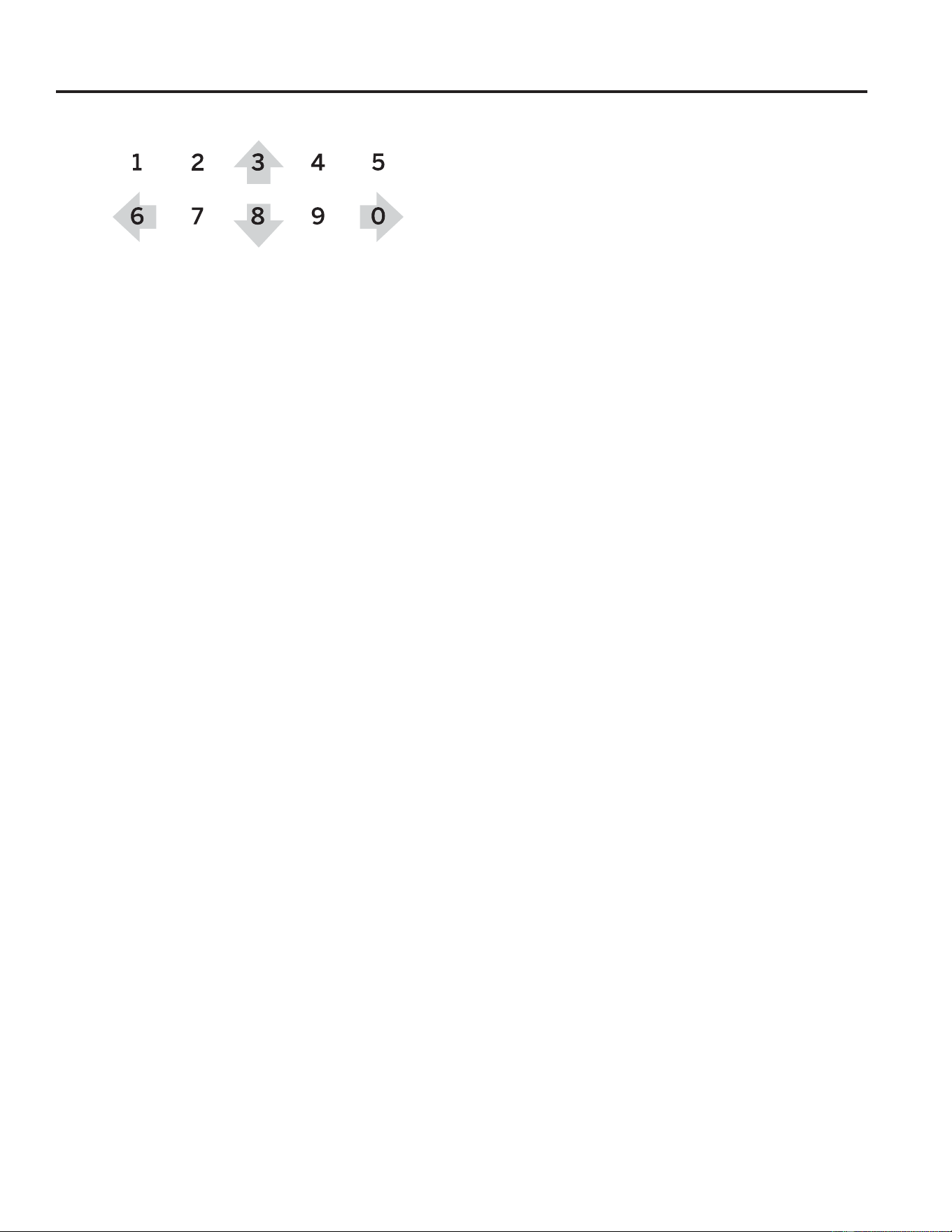
(DFK*($SSOLDQFHVRYHQKDVDFRQQHFWHGDSSOLDQFH
information label that includes an Appliance Network
1DPHDQG3DVVZRUG7KHVHDUHWKHWZRLPSRUWDQW
details that you will need to connect to the appliance.
The label is typically located inside the door of the
oven or drawer. In some cases, you can find the
rating label on a metal flag behind the rear control
panel. From the front of the range, reach behind the
middle of the rear control panel and rotate the rating
label up.
2. Have your smart phone or tablet ready with the ability
to access the internet and download apps.
3. You will need to know the password of your home
WiFi router. Have this password ready while you are
setting up your GE Appliances oven.
Connect your GE Appliances oven
2Q\RXUVPDUWSKRQHRUWDEOHWYLVLW
GEAppliances.com/connect to learn more about
connected appliance features and to download the
SmrtHQ App.
2. Follow the app onscreen instructions to connect your
GE Appliances oven.
3. Once the process is complete, the connection light
located on your GE Appliances oven display will stay
on solid and the app will confirm you are connected.
4. If the connection light does not turn on or is blinking,
follow the instructions on the app to reconnect. If
issues continue, please call the Connected Call
&HQWHUDQGDVNIRUDVVLVWDQFH
regarding oven wireless connectivity.
7RFRQQHFWDGGLWLRQDOVPDUWGHYLFHVUHSHDWVWHSVDQG
Note that any changes or modifications to the remote
enable device installed on this oven that are not
expressly approved by the manufacturer could void the
user’s authority to operate the equipment.
REMOTE STARTING YOUR OVEN
To be able to start the oven remotely once connected
to WiFi, make sure the icon is visible in the display.
The oven can now be remotely started with a connected
device. Opening an oven door or turning off the oven will
turn off the icon. The icon must be lit to start the oven
remotely. The icon is not required to change the oven
temperature while it is running, set a timer or to turn the
oven off from the phone app while the icon shows it is
Wifi Connected.
After using the oven, remember to verify that the icon
is lit if you wish to start the oven remotely in the future.
NOTE: )RRGVWKDWVSRLOHDVLO\²VXFKDVPLONHJJVILVK
VWXIILQJVSRXOWU\DQGSRUN²VKRXOGQRWEHDOORZHGWR
VLWIRUPRUHWKDQKRXUEHIRUHRUDIWHUFRRNLQJ5RRP
temperature promotes the growth of harmful bacteria. Be
sure that the oven light is off because heat from the bulb
will speed harmful bacteria growth.
* Compatible Apple or Android devices and home WiFi network required.
WiFi Connect
FCC: ZKJ-WCATA001
Network: GE_XXXXXX_XXXX
Password: XXXXXXXX
PT. NO. 229C6272G001-0
IC: 10229A-WCATA001
MAC ID: XX - XX - XX - XX - XX - XX
Connected Appliance Information
Sample Label
USING THE RANGE: WiFi Connect
49-2000884 Rev. 2
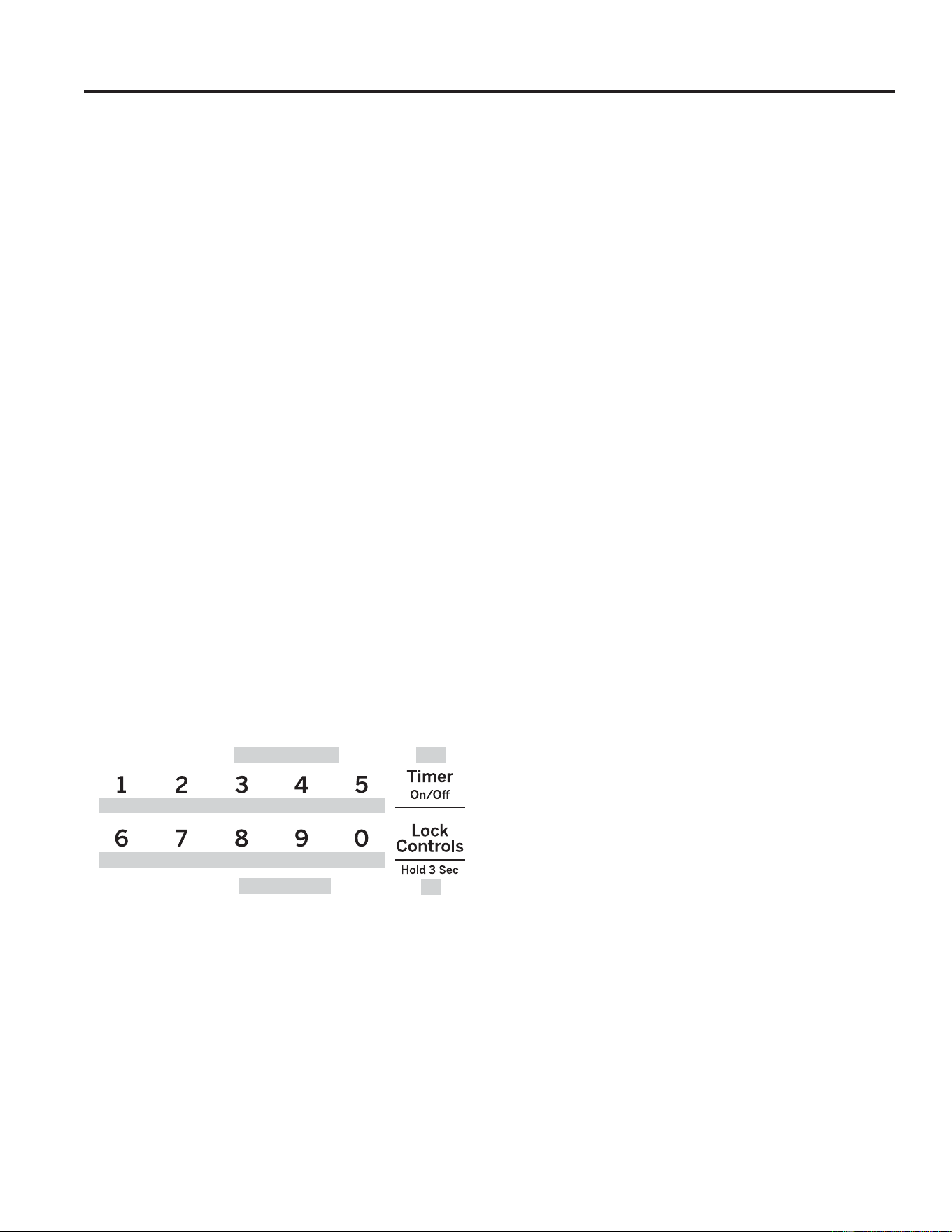
There are several different special features on your range. To change the settings of these special features:
Ŷ 3UHVV WKH 8SSHU 2YHQ Bake and Warm pads at the same time and hold until the special features menu is
displayed.
Ŷ 8VH WKH 3 or 8 number pads to scroll through the special features until the desired feature is displayed.
Ŷ
3UHVV WKH 0 number pad to enter into the feature’s menu and use the 3 or 8 number pads to scroll through the options.
Ŷ 2QFH WKH GHVLUHG RSWLRQ LV GLVSOD\HG SUHVV WKH 0 pad to save the setting and the 6 pad to exit the menu.
Adjust the Oven Temperature
This feature allows the oven baking temperature to be
DGMXVWHG XS WR KRWWHU RU GRZQ WR FRROHU 8VH WKLV
feature if you believe your oven temperature is too hot or
too cold and wish to change it. This adjustment affects
every cooking mode except broil.
Enter into the special features menu as outlined above.
Scroll through the features until “Lo offset” is displayed
WR DGMXVW WKH ORZHU RYHQ WHPSHUDWXUH RU ³8S RIIVHW´
is displayed to adjust the upper oven temperature
WKHQ SUHVV 8VH WKH 3 pad to increase the adjusted
temperature or use the 8 pad to decrease the adjusted
temperature. Save and exit the special features menu.
End of Timer Signals
This is the tone that signals the end of a timer. The
WRQH FDQ EH HLWKHU FRQWLQXRXV &RQW RU VLQJOH E((S
7KH FRQWLQXRXV VHWWLQJ &RQW ZLOO UHSHDWHGO\ VRXQG D
tone every few seconds until a button on the control
LV SUHVVHG $ VLQJOH VHWWLQJ E((S ZLOO VRXQG MXVW D
single tone at the end of the timer. Enter into the special
features menu as outlined above. Scroll through the
options until “End tonE” is displayed and press 0. Scroll
through the options until the desired setting is displayed.
3UHVV 0 to save the setting and then 6 to exit the menu.
Fahrenheit or Celsius Temperature
Display
The oven control is set to use Fahrenheit temperatures
) EXW \RX FDQ FKDQJH LW WR XVH &HOVLXV WHPSHUDWXUHV
& (QWHU LQWR WKH VSHFLDO IHDWXUHV PHQX DV RXWOLQHG
DERYH 6FUROO WKURXJK WKH RSWLRQV XQWLO ³GHJ 8QLW´ LV
displayed and press 0. Scroll through the options until
WKH GHVLUHG VHWWLQJ LV GLVSOD\HG 3UHVV 0 to save the
setting and then 6 to exit the menu.
Clock Display
7KLV IHDWXUH 2Q2II VSHFLILHV LI WKH WLPH RI GD\ LV
displayed. Enter into the special features menu as
outlined above. Scroll through the options until “Cloc
GL63´ LV GLVSOD\HG DQG SUHVV 0. Scroll through the
RSWLRQV XQWLO WKH GHVLUHG VHWWLQJ LV GLVSOD\HG 3UHVV 0 to
save the setting and then 6 to exit the menu.
Clock Configuration
This feature specifies how the time of day will be
GLVSOD\HG <RX FDQ VHOHFW D VWDQGDUG KRXU FORFN
or 24-hour military time display. Enter into the special
features menu as outlined above. Scroll through the
options until “Cloc cFg” is displayed and press 0. Scroll
through the options until the desired setting is displayed.
3UHVV 0 to save the setting and then 6 to exit the menu.
Sound Volume
This feature allows the oven tone volume to be adjusted
EHWZHHQ KLJK +L PHGLXP UHJ ORZ /R DQG RII R))
Enter into the special features menu as outlined above.
Scroll through the options until “sound” is displayed
and press 0. Scroll through the options until the desired
VHWWLQJ LV GLVSOD\HG 3UHVV 0 to save the setting and then
6 to exit the menu. The selected sound option will play
once 0 is pressed.
Auto Recipe Conversion
7KLV IHDWXUH 2Q2II DXWRPDWLFDOO\ DGMXVWV WKH
programmed recipe temperature in Convection Multi-
Bake mode. Enter into the special features menu as
outlined above. Scroll through the options until “Auto
U(FL3(´ LV GLVSOD\HG 6FUROO WKURXJK WKH RSWLRQV XQWLO WKH
GHVLUHG VHWWLQJ LV GLVSOD\HG 3UHVV 0 to save the setting
and then 6 to exit the menu.
NOTE: This option does not convert baking time, only
temperatures. This option does not adjust temperatures
for Convection Roast mode.
&DQFHO%DFN 8S 'RZQ 6DYH)RUZDUG
Special Features
USING THE RANGE: Special Features
49-2000884 Rev. 2
Sabbath Mode - Standard
This range offers a standard Sabbath mode*. Some of the Sabbath mode features that will be noticed by the
FRQVXPHU LQFOXGH WKH GLVDEOLQJ RI WRQHV GLVDEOLQJ RI RYHQ OLJKWV DQG GHOD\V RI DERXW VHFRQGV WR RQH PLQXWH
between a request for a temperature change and its implementation. Only continuous baking or timed baking is
allowed in the Sabbath mode. Cooking in the Sabbath mode is a two-step process, first the Sabbath mode must
be set and then the bake mode must be set. For double ovens, each oven can be set independently by using the
corresponding upper or lower bake pad.
Setting the Sabbath Mode
3UHVV WKH 8SSHU 2YHQ Bake and Warm pads at the
same time and hold until the special features menu is
displayed.
8VH WKH 3 or 8 number pads to scroll through the
special features until “SAbbAth” is displayed and then
press 0. Refer to the graphic in the Special Features
section to see how the number keys are mapped.
8VH WKH 3 or 8 number pads to scroll through the
options until “On” is shown in the display, then press
the 0 QXPEHU SDG WR VDYH WKH VHWWLQJ 3UHVV 6 to exit
the Special Features menu. A single bracket “]” will
appear in the display indicating that the Sabbath mode
is set. The clock will not be displayed. Continuous
bake or timed bake can now be programmed.
Starting a Continuous Bake
3UHVV WKH Bake pad.
,I WKH GHVLUHG WHPSHUDWXUH LV ) SUHVV Start. If
a different cooking temperature is desired, use the
1 through 5 number pads or Timer pad to select a
preset cooking temperature, then press Start. Refer
to the graphic below to determine which pad sets the
desired cooking temperature.
After a delay, a second bracket “] [“ will appear in the
display indicating that the oven is baking.
Adjusting the Temperature
3UHVV Bake, use the 1 through 5 number pads and
the Timer pad to select a different preset cooking
temperature, and press Start.
2. Since no feedback is given during temperature
change, an oven thermometer can be used to confirm
temperature changes.
Starting a Timed Bake
3UHVV WKH Bake pad.
,I WKH GHVLUHG WHPSHUDWXUH LV ) XVH WKH 6
through 0 number pads or the Lock Control pad to
select a cooking time. If a cooking temperature other
WKDQ ) LV GHVLUHG XVH WKH 1 through 5 number
pads or the Timer pad to select a preset cooking
temperature, then select the cooking time. Refer to
the graphic on this page to determine which pad sets
the desired cooking temperature and cooking time.
3UHVV Start.
After a delay, a second bracket “] [“ will appear in the
display indicating that the oven is baking. When the cook
time expires, the display will change back to a single
bracket “]” indicating that the oven is no longer baking.
No tone will sound when the cook time is complete.
Exit the Sabbath Mode
Exiting the Sabbath mode should be done after the
Sabbath is over.
3UHVV Cancel/Off to end any bake mode that may be
running.
3UHVV Bake and Warm pads at the same time and
hold until the Special Features menu is displayed.
8VH WKH 3 or 8 number pads to scroll through the
special features until “SAbbAth” is displayed, then
press 0.
8VH WKH 3 or 8 number pads to scroll through the
options until “OFF” is displayed and press 0 to save
WKH VHWWLQJ 3UHVV WKH 6 number pad to exit the
Special Features menu.
Sabbath Mode Power Outage Note
If a power outage occurs while the oven is in Sabbath
Mode, the unit will return to Sabbath Mode when power
is restored, however the oven will return to the off state
even if it was in the middle of a bake cycle when the
power outage occurred.
) ) ) ) ) 7LPHU )
6 = 2 hours, 7 = 2.5 hours, 8 = 3 hours, 9 = 3.5 hours,
KRXUV /RFN &RQWUROV KRXUV
7HPSHUDWXUH )
7LPH KRXUV
6h
2h
2.5h
3h
3.5h
325
4h
7KH VWDQGDUG 6DEEDWK PRGH KDV QRW EHHQ UHYLHZHG RU DSSURYHG E\ 2UWKRGR[ 8QLRQ
USING THE RANGE: Sabbath Mode - Standard
49-2000884 Rev. 2
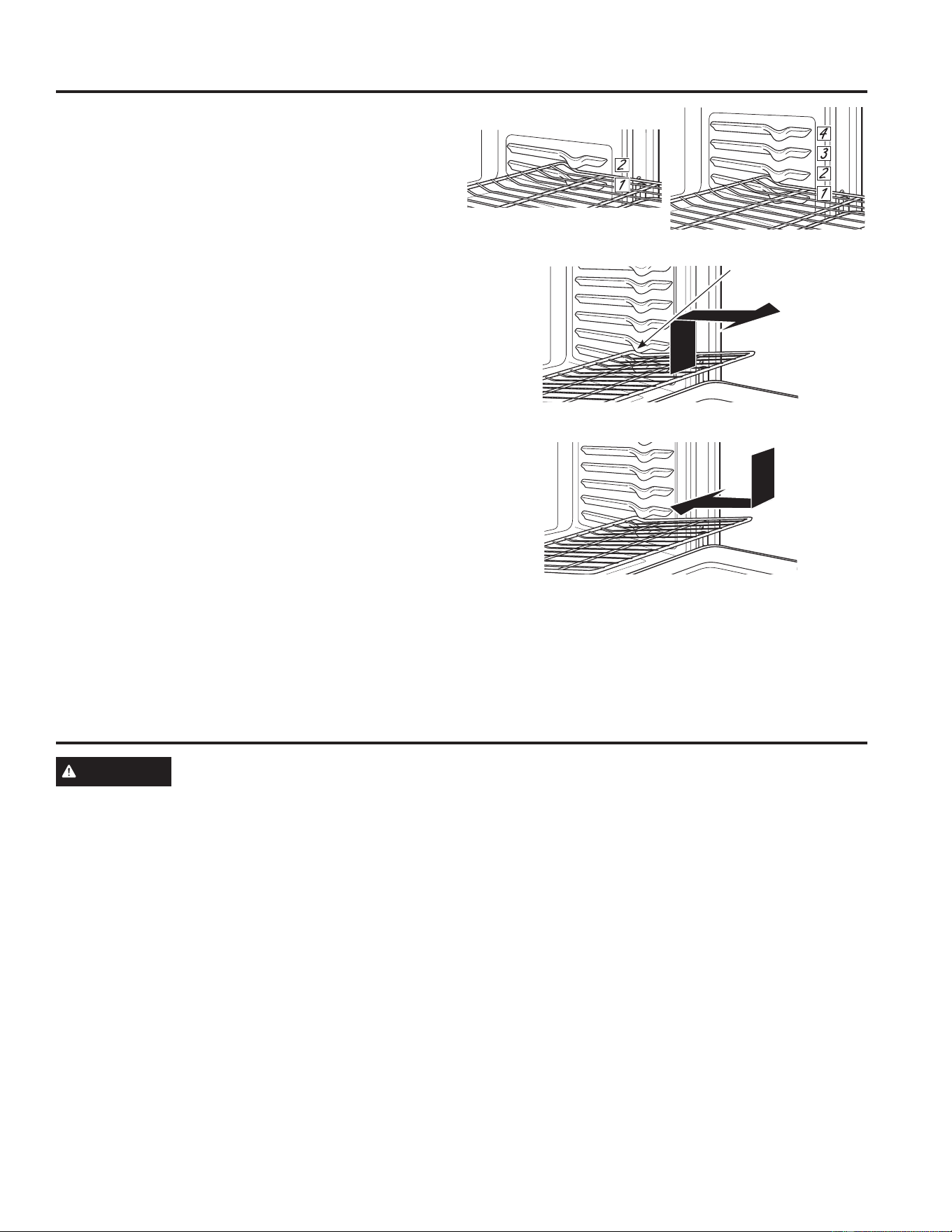
Rack Positions
Your oven has two rack positions in the upper oven
$%DQGIRXUUDFNSRVLWLRQVLQWKHORZHURYHQ5
5HFRPPHQGHGUDFNSRVLWLRQVIRUYDULRXVW\SHV
of foods are provided in the Cooking Guide. Adjusting
rack position is one way to impact cooking results. For
example, if you would prefer darker tops on cakes,
muffins, or cookies, try moving food one rack position
higher. If you find foods are too brown on top try moving
them down next time.
When baking with multiple pans and on multiple racks,
ensure there is sufficient space between pans to allow
air to flow. This may improve cooking evenness.
Removing and Replacing Flat Racks
When placing and removing cookware, pull the rack out
WRWKHEXPSVWRSSRVLWLRQRQWKHUDFNVXSSRUW
To remove a rack, pull it toward you until it reaches the
stop position, tilt up the front of the rack and pull it out.
To replace a rack, place the curved end of the rack onto
the rack supports. Tilt up the front of the rack and push
the rack in until it stops. Then lay the rack flat and push
it in until it is all the way into the oven.
Racks may become difficult to slide, especially after a
self-clean cycle. To improve sliding conditions, use a soft
cloth or paper towel to rub vegetable oil on the left and
ULJKWHGJHVRIWKHUDFNVDQGRUUDFNVXSSRUWV
NOTE: Remove unused racks when using the oven for
faster preheat, improved efficiency, and optimal cooking
performance.
Oven Racks
CAUTION
Do not use any type of foil or oven liner to cover the oven bottom. These items can trap heat
or melt, resulting in damage to the product and risk of shock, smoke or fire. Damage from improper use of
these items is not covered by the product warranty.
Foil may be used to catch spills by placing a sheet on a lower rack, several inches below the food. Do not use more
IRLOWKDQQHFHVVDU\DQGQHYHUHQWLUHO\FRYHUDQRYHQUDFNZLWKDOXPLQXPIRLO.HHSIRLODWOHDVW´IURPRYHQZDOOV
to prevent poor heat circulation.
Aluminum Foil and Oven Liners
Removing racks
Replacing racks
Rack stop
position
8SSHU2YHQ
Lower Oven
USING THE RANGE:2YHQ5DFNV$OXPLQXP)RLO

49-2000884 Rev. 2
Oven Cooking Modes
Your new oven has a variety of cooking modes to help you get the best results. These modes are described below.
Refer to the Cooking Guide section for rack position and other recommendations for specific modes and foods.
Bake
The traditional bake mode is intended for single rack
cooking. This mode uses heat primarily from the lower
element but also from the upper element to cook food.
3UHKHDWLQJLVJHQHUDOO\UHFRPPHQGHGZKHQXVLQJWKLV
mode. To use this mode press the Bake pad, enter a
temperature with the number pads, and then press Start.
Convection Bake
This mode is intended for single rack baking when
additional airflow is desired to enhance evenness.
3UHKHDWLQJLVJHQHUDOO\UHFRPPHQGHGZKHQXVLQJWKLV
mode. To use this mode press the Conv Bake pad,
enter a temperature with number pads, and then press
Start.
Convection Roast
This mode is intended for roasting whole cuts of meat
on a single rack. The utilization of all three elements and
direct airflow down from the top of the oven improves
browning and reduces cooking time. Check food earlier
than the recipe suggests when using this mode. To
use this mode press the Conv Roast pad, enter a
temperature with number pads, and then press Start.
Broiling Modes
Always broil with the door closed. The broil element in
this oven is very powerful. Monitor food closely while
EURLOLQJ8VHFDXWLRQZKHQEURLOLQJRQXSSHUUDFN
positions as placing food closer to the broil element
increases smoking, spattering, and the possibility of fats
igniting. Broiling on rack position 6 is not recommended.
Broiling can be used for foods that would typically be
grilled.
Adjust the rack position in order to vary the intensity
RIWKHKHDWWRWKHIRRG3ODFHIRRGVFORVHUWRWKHEURLO
element when a seared surface and rare interior are
desired. For best performance center the food below the
broil heating element.
3UHVVWKH%URLOSDGWZLFHIRU+LJKRURQFHIRU/RZ
depending on the amount of searing and the internal
temperature that is preferred. The High setting is best for
WKLQQHUFXWVRIPHDWDQGRUIRRGV\RXSUHIHUOHVVGRQH
on the interior. The Low setting is preferred for thicker
cuts of meat and foods you liket o be cooked all the way
through. It is not necessary to preheat the oven for these
modes. Then press Start.
Air Fry
Air Fry is a special, no-preheat, cooking mode that is
designed to produce foods with a crispier exterior than
traditional oven cooking. The Air Fry mode is intended
for single rack cooking only. Select Air Fry, then input
the desired set temperature and press Start. The
WHPSHUDWXUHFDQEHVHWEHWZHHQ)DQG)
3UHKHDWLQJLVQRWUHFRPPHQGHGIRUWKLVPRGH)ROORZ
traditional oven recipe or package guidelines for set
temperatures and cook times; adjust cook time to
achieve your desired crispness. Additional guidelines for
using this mode can be found in the Cooking Guide.
Warm
Warm mode is designed to keep hot foods at a higher
WHPSHUDWXUHIRUXSWRKRXUV3UHKHDWLQJLVQRWUHTXLUHG
Do not use warm to heat cold food other than crisping
crackers, chips, or dry cereal. It is also recommended
WKDWIRRGQRWEHNHSWZDUPIRUPRUHWKDQKRXUV3UHVV
the Warm pad and then press Start.
USING THE RANGE: Oven Cooking Modes
49-2000884 Rev. 2
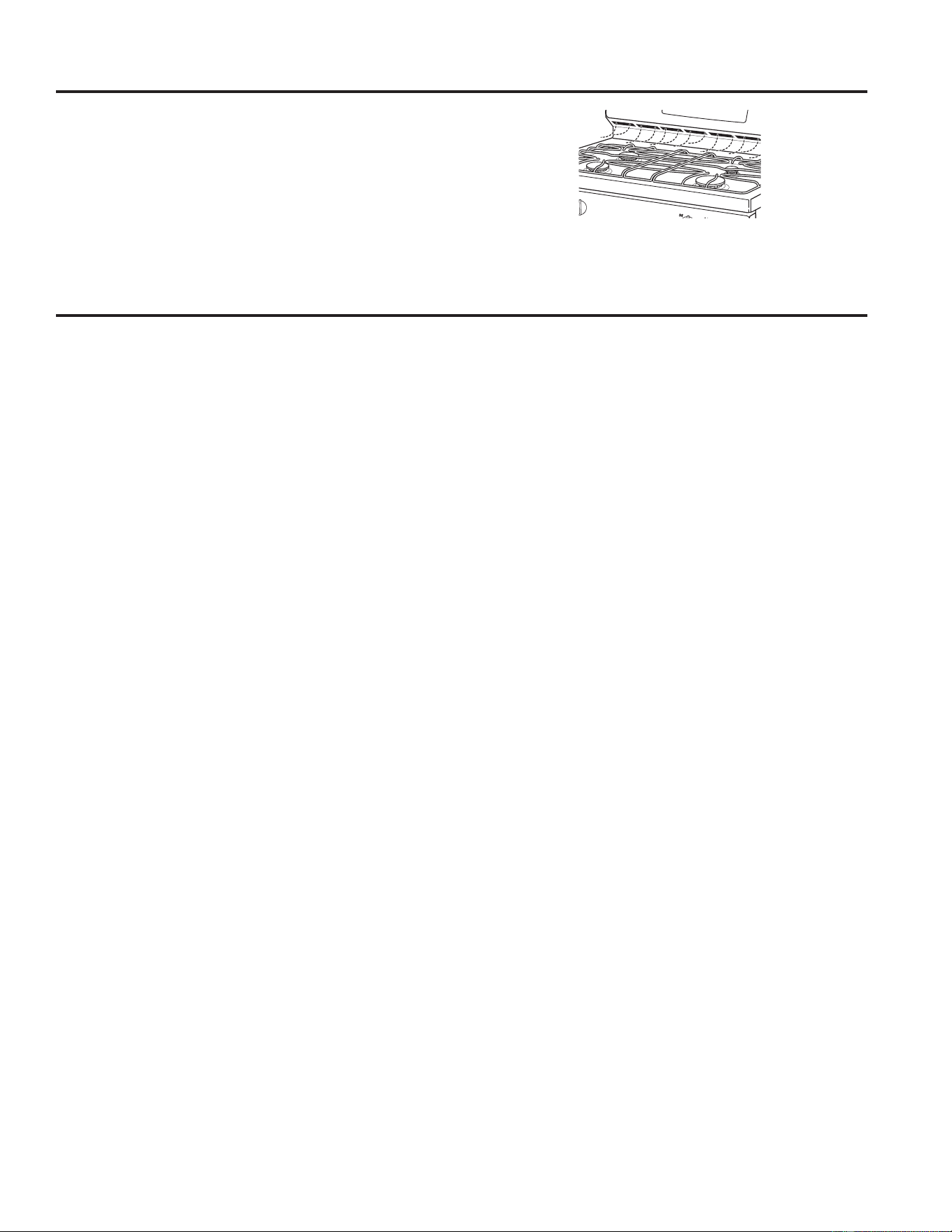
Oven Air Vents
1HYHUEORFNWKHYHQWVDLURSHQLQJVRIWKHUDQJH7KH\
provide the air inlet and outlet that are necessary for the
range to keep cool and operate properly with correct
combustion.
Air openings are located at the rear of the cooktop, at
the top and bottom of the oven door, and at the bottom
of the range.
9HQWDSSHDUDQFHDQGORFDWLRQYDU\
Oven Cooking Guide
Cook food thoroughly to help protect against food borne illness. Minimum safe food temperature recommendations
for food safety can be found at IsItDoneYet.gov8VHDIRRGWKHUPRPHWHUWRPHDVXUHIRRGWHPSHUDWXUHV
Oven Cookware Guidelines
The material, finish, and size of cookware affect baking
performance.
Dark, coated and dull pans absorb heat more readily
WKDQOLJKWVKLQ\SDQV3DQVWKDWDEVRUEKHDWPRUH
readily can result in a browner, crisper, and thicker crust.
If using dark and coated cookware check food earlier
than minimum cook time. If undesirable results are
obtained with this type of cookware consider reducing
RYHQWHPSHUDWXUHE\)QH[WWLPH
Shiny pans can produce more evenly cooked baked
goods such as cakes and cookies.
Glass and ceramic pans heat slowly but retain heat well.
These types of pans work well for dishes such as pies
and custards.
Air insulated pans heat slowly and can reduce bottom
browning.
Keep cookware clean to promote even heating.
Stoneware heats slowly and retains heat well. It is
recommended to preheat this type of cookware if
possible. Additional cook time may be required.
Cookware used in broil modes and air fry must be broil-
safe.
USING THE RANGE:2YHQ$LU9HQWV2YHQ&RRNLQJ*XLGH
49-2000884 Rev. 2
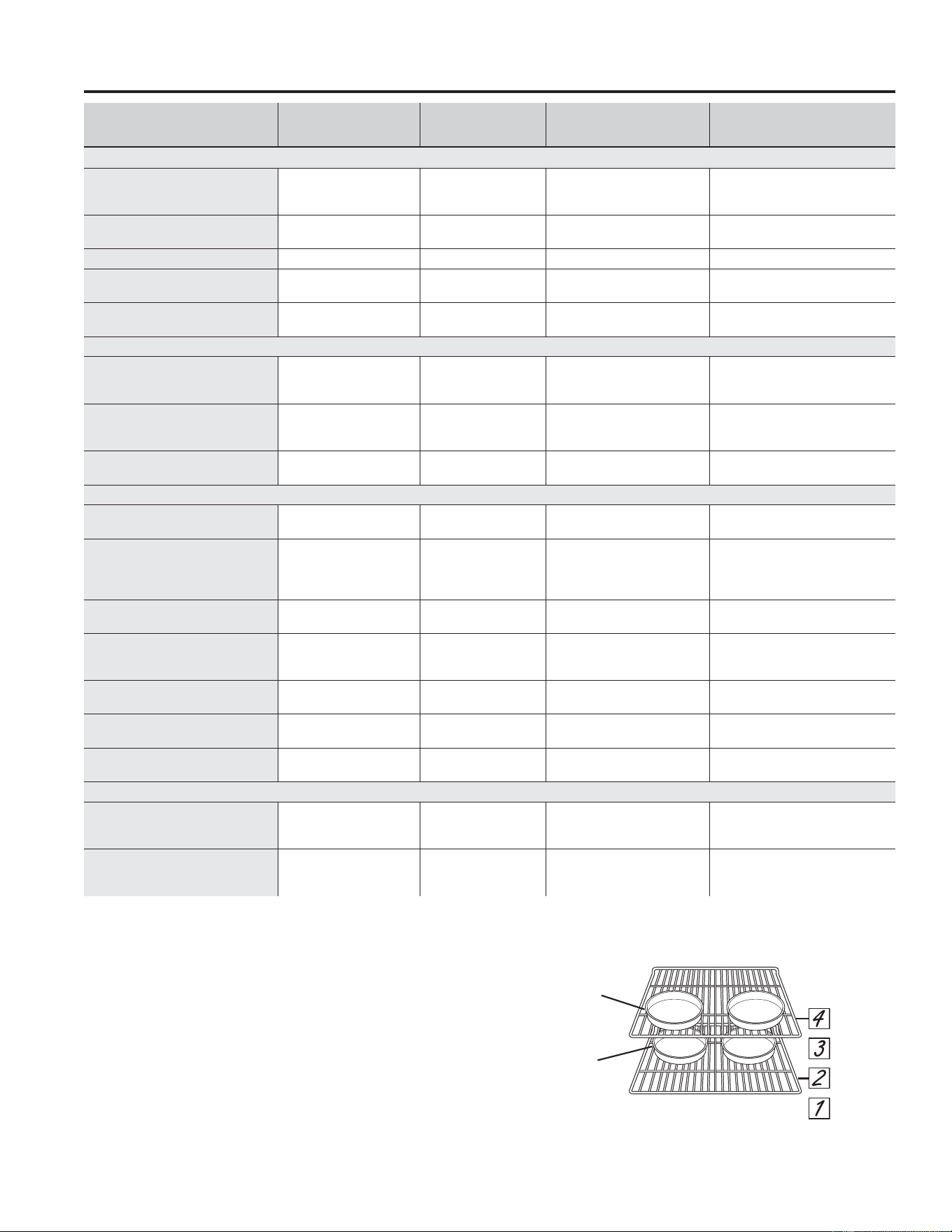
Oven Cooking Guide
*When baking four cake layers at a time, stagger the
pans as shown so that one pan is not directly above
another.
Cook food thoroughly to help protect against food
borne illness. Minimum safe food temperature
recommendations for food safety can be found at
IsItDoneYet.gov. Make sure to use a food thermometer
to take food temperatures.
NOTE: Remove unused racks when using the oven for
faster preheat, improved efficiency and optimal cooking
performance.
Front
3ODFHPHQW
Rear
3ODFHPHQW
FOOD TYPE
RECOMMENDED
MODE(S)
OVEN
(Upper/Lower)
RECOMMENDED
RACK POSITION(S)
ADDITIONAL
SUGGESTIONS
Baked Goods
Layer cakes, sheet cakes, bundt
cakes, muffins, quick breads,
biscuits, scones on a Single Rack
Bake
Lower
8SSHU
3
2
8VHVKLQ\FRRNZDUH
Layer cakes* on Multiple Racks Convection Bake Bake Lower 2 and 4
Ensure adequate airflow
VHHLOOXVWUDWLRQEHORZ
&KLIIRQFDNHVDQJHOIRRG Bake Lower 2 8VHVKLQ\FRRNZDUH
Cookies, biscuits, scones on a
Single Rack
Bake
Lower
8SSHU
3
2
8VHVKLQ\FRRNZDUH
Cookies, biscuits, scones on
Multiple Racks
Convection Bake
Bake
Lower 2 and 4 Ensure adequate airflow.
Beef & Pork
Hamburgers Broil Hi 8SSHU 2
8VHDEURLOSDQPRYHIRRGGRZQ
IRUPRUHGRQHQHVVOHVVVHDULQJ
Watch food closely when broiling.
Steaks & Chops Broil Hi 8SSHU 2
8VHDEURLOSDQPRYHIRRGGRZQ
IRUPRUHGRQHQHVVOHVVVHDULQJ
Watch food closely when broiling.
Roasts
Convection Roast
Bake
Lower RU
Leave uncovered, use a low sided
pan such as a broil pan.
Poultry
Whole chicken
Convection Roast
Bake
Lower RU
Leave uncovered, use a low sided
pan such as a broil pan.
Bone-in chicken breasts, legs,
thighs
Broil Lo
Bake
8SSHU
Lower
3
If breaded or coated in sauce
avoid Broil Hi modes. Broil skin
side down first. Watch food closely
when broiling.
Boneless chicken breasts
Broil Lo
Bake
8SSHU
Lower
3
Watch food closely when broiling.
Whole turkey
Convection Roast
Bake
Lower RU
Leave uncovered, use a low sided
pan such as a broil pan. Watch
food closely when broiling.
Turkey Breast Bake Lower 3
Leave uncovered, use a low sided
pan such as a broil pan.
Fish
Broil Lo
Bake
8SSHU
Lower
3
Watch food closely when broiling.
Casseroles Bake
Lower
8SSHU
3
2
Frozen Convenience Foods
3L]]DSRWDWRSURGXFWVFKLFNHQ
nuggets, appetizers on a Single
Rack
Bake
Lower
8SSHU
3
2
8VHVKLQ\FRRNZDUH
3L]]DSRWDWRSURGXFWVFKLFNHQ
nuggets, appetizers on Multiple
Racks
Convection Bake
Bake
Lower 2 and 4 8VHVKLQ\FRRNZDUH
USING THE RANGE: Oven Cooking Guide
49-2000884 Rev. 2
Oven Cooking Guide
Air Fry Cooking Guide
Air Fry is a special, no-preheat, cooking mode that
is designed to produce foods with a crispier exterior
than traditional oven cooking. Select Air Fry, then
input the desired set temperature and press Start. The
WHPSHUDWXUH FDQ EH VHW EHWZHHQ ) DQG )
Air Fry Cookware Guidelines
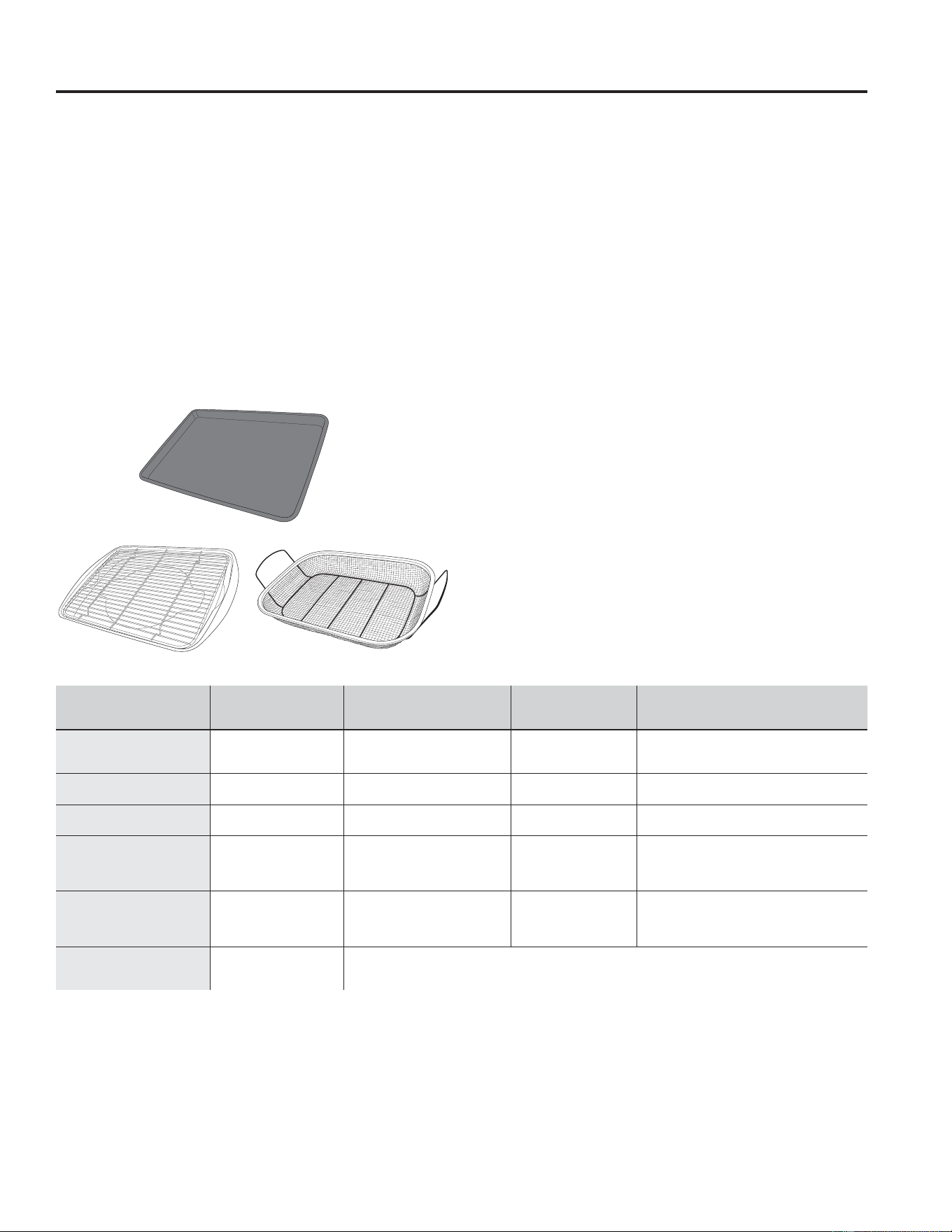
• Only use broil safe cookware when using Air Fry mode.
• A dark sheet pan is recommended. A dark pan
promotes better browning and crisping.
• Oven baking baskets and baking grids can also be
used. A sheet pan should be placed on the rack below
the foods to catch any drippings when using a baking
basket.
General Tips for Air Fry Mode
• The Air Fry mode is designed for cooking on a single
rack.
• The Air Fry mode is designed to be used without
preheating.
5DFN SRVLWLRQ LV UHFRPPHQGHG IRU PRVW IRRGV 8VH
rack position 3 for thicker foods.
• Foods may cook faster than expected if the oven is
already hot when food is placed in the oven.
• When air frying foods with sauce, it is recommended to
apply the sauce at the end of cooking.
• If foods are browning too quickly, try a lower rack
position or lower oven set temperature.
• For packaged foods, use traditional oven cooking
instructions for set temperature and expected cook
time.
• It is not necessary to flip or stir food during cooking
• Arrange food in a single layer on the pan, do not
overload the pan.
• Always check internal food temperature to confirm
minimum safe temperatures have been reached.
Minimum safe food temperatures can be found on
packages and at IsItDoneYet.gov.
FOOD TYPE
RECOMMENDED
RACK POSITION(S)
RECOMMENDED
SET TEMPERATURES (F)
RECOMMENDED
COOK TIME (MIN) NOTES
Fresh boneless fish or
poultry pieces, breaded such
as nuggets, tenders, fillets
4
8VHU ORZHU VHW WHPSHUDWXUHV IRU ODUJHU SLHFHV
8VH VKLQ\ FRRNZDUH
Fresh bone in
chicken wings
4
Salt wings or coat in a dry rub, if using sauce
apply after cooking or toward the end of cooking
Fresh bone in chicken
drumsticks or thighs
3 or 4 8VHU ORZHU VHW WHPSHUDWXUHV IRU ODUJHU SLHFHV
Fresh French fries,
WKLQ ò LQFK
4
3DUFKPHQW SDSHU LV UHFRPPHQGHG ZKHQ
preparing fresh French fries. For crispier fries,
toss fries in corn starch or rice flour before
cooking.
Fresh French fries,
WKLFN ! ò LQFK
3 or 4
3DUFKPHQW SDSHU LV UHFRPPHQGHG ZKHQ
preparing fresh French fries. For crispier fries,
toss fries in corn starch or rice flour before
cooking.
Frozen packaged
foods
3 or 4
XVH UDFN SRVLWLRQ IRU
WKLFNHU IRRGV
8VH WUDGLWLRQDO RYHQQRW $LU )U\ FRRNLQJ LQVWUXFWLRQV DV D JXLGHOLQH IRU VHW WHPSHUDWXUH DQG FRRN WLPH$GGLWLRQDO
cook time beyond recommended package time may be required for some foods. If oven is hot when starting, food
may cook faster than the minimum package time.
3ULPDU\ UHFRPPHQGHG FRRNZDUH
Alternate cookware options
USING THE RANGE: Oven Cooking Guide
49-2000884 Rev. 2
Range – Exterior
WARNING
If your range is removed for cleaning, servicing or any reason, be sure the
anti-tip device is reengaged properly when the range is replaced. Failure to
take this precaution could result in tipping of the range and can result in death
or serious burns to children or adults.
Be sure all controls are off and all surfaces are cool before cleaning any part of the range.
Control Lockout
If desired, the touch pads may be deactivated before
cleaning.
See Lock Controls in the Oven Controls section in this
manual.
Clean up splatters with a damp cloth.
You may also use a glass cleaner.
Remove heavier soil with warm, soapy water. Do not use
abrasives of any kind.
Reactivate the touch pads after cleaning.
Control Panel
It’s a good idea to wipe the control panel after each use.
Clean with mild soap and water or vinegar and water,
rinse with clean water and polish dry with a soft cloth.
Do not use abrasive cleansers, strong liquid cleansers,
plastic scouring pads or oven cleaners on the control
SDQHO²WKH\ZLOOGDPDJHWKHILQLVKLQFOXGLQJ%ODFN
Stainless Steel.
Oven Exterior
Do not use oven cleaners, abrasive cleansers, strong
liquid cleansers, steel wool, plastic scouring pads, or
cleaning powders on the interior or exterior of the oven.
Clean with a mild soap and water or vinegar and water
solution. Rinse with clean water and dry with a soft cloth.
When cleaning surfaces, make sure that they are at
room temperature and not in direct sunlight.
If stain on the door vent trim is persistent, use a mild
abrasive cleaner and a sponge-scrubber for best results.
Spillage of marinades, fruit juices, tomato sauces and
basting liquids containing acids may cause discoloration
and should be wiped up immediately. Let hot surfaces
cool, then clean and rinse.
Painted Surfaces
3DLQWHGVXUIDFHVLQFOXGHWKHVLGHVRIWKHUDQJHDQGWKH
door, top of control panel and the drawer front. Clean
these with soap and water or a vinegar and water solution.
Do not use commercial oven cleaners, cleaning
powders, steel wool or harsh abrasives on any painted
surface, including Black Stainless Steel.
Stainless Steel excluding Black Stainless Steel (on some models)
Do not use a steel wool pad; it will scratch the surface.
Cleaners with oxalic acid such as Bar Keepers Friend
6RIW&OHDQVHUZLOOUHPRYHVXUIDFHUXVWWDUQLVKDQG
VPDOOEOHPLVKHV8VHRQO\DOLTXLGFOHDQVHUIUHHRIJULW
and rub in the direction of the brush lines with a damp,
soft sponge.
To clean the stainless steel surface, use warm sudsy
water or a stainless steel cleaner or polish. Always wipe
the surface in the direction of the grain. Follow the cleaner
instructions for cleaning the stainless steel surface.
To inquire about purchasing cleaning products including
stainless steel appliance cleaner or polish, see the
Accessories and Consumer Support sections at the end
of this manual.
CARE AND CLEANING: Range – Exterior

49-2000884 Rev. 2
The interior of your new oven can be cleaned manually or by using Steam Clean or Self Clean modes.
Spillage of marinades, fruit juices, tomato sauces and basting liquids containing acids may cause discoloration and
should be wiped up immediately. Let hot surfaces cool, then clean and rinse.
Manual Cleaning
Do not use oven cleaners, strong liquid cleansers, steel
wool, or scouring pads on the interior of the oven. For
soils on the oven bottom and other enameled surfaces,
use a gentle abrasive containing oxalic acid, such as
Bar Keepers Friend
®
, with a non-scratch sponge. Take
care not to apply any abrasive cleaners or sponges to
the door glass, as it will scratch the reflective coating.
The oven interior and door glass may be cleaned using
a soft cloth with a mild soap and water, or vinegar and
water solution. After cleaning, rinse with clean water and
dry with a soft cloth.
Range – Interior
Steam Clean Mode
The Steam Clean feature is for cleaning light soil from
your oven at a lower temperature than Self Clean.
To use the Steam Clean feature:
6WDUWZLWKWKHRYHQDWURRPWHPSHUDWXUH
2. Wipe excess grease and soils from the oven.
3RXURQHFXSRIZDWHURQWRWKHERWWRPRIWKHRYHQ
4. Close the door.
3UHVVWKHClean pad, select Steam Clean and
then press Start.
'RQRWRSHQWKHGRRUGXULQJWKHPLQXWH6WHDP&OHDQ
cycle. At the end of the Steam Clean cycle, soak up the
remaining water, and wipe the moisture-softened soil
from the oven walls and door.
Self Clean Mode
Read Self-Cleaning Oven Safety Instructions at the
beginning of this manual before using the Self Clean
Mode. Self Clean uses very high temperatures to clean
the oven interior. For a moderately soiled oven, run a
3 hour self-clean cycle. For a heavily soiled oven, run
DKRXUVHOIFOHDQF\FOH2QO\VHOIFOHDQEODFNUDFNV
and grates may remain in the oven during the self-clean
F\FOH$OORWKHULWHPVLQFOXGLQJQLFNHOSODWHGVLOYHU
UDFNVVKRXOGEHUHPRYHG,IQLFNHOSODWHGVLOYHUUDFNV
are left in the oven during a self-clean cycle, the racks
will tarnish. If either type of rack is left in the oven during
a self-clean cycle, the rack may become difficult to slide.
See the Oven Racks section for instructions on how to
improve.
IMPORTANT: The health of some birds is extremely
sensitive to the fumes given off during the self-cleaning
cycle of any range. Move birds to another well-ventilated
room.
To use the Self Clean feature:
6WDUWZLWKWKHRYHQDWURRPWHPSHUDWXUH
2. Wipe excess grease and soils from the oven and
interior door.
5HPRYHDOOLWHPVRWKHUWKDQVHOIFOHDQEODFN
racks and grates, if desired. See Cleaning the
Cooktop to determine if your grates may be self-
cleaned and for important details regarding grate
placement.
4. Close the door.
3UHVVWKHClean pad, select Self Clean and then
press Start.
You cannot open the door during the self-clean cycle.
The door will remain locked after the self-clean cycle
until the oven cools below the unlocking temperature.
At the end of the self-clean cycle, allow the oven to cool
and wipe any ash out of the oven.
Racks
All racks can be washed with warm, soapy water.
(QDPHOHGQRWVKLQ\UDFNVFDQEHOHIWLQWKHFDYLW\
during self clean.
Racks may be more difficult to slide, especially after
DVHOIFOHDQ3XWVRPHYHJHWDEOHRLORQDVRIWFORWKRU
paper towel and rub onto the left and right edges.
CARE AND CLEANING: Range – Interior
22 49-2000884 Rev. 2
CARE AND CLEANING: Cooktop
Removal of Surface Burners for Cleaning
Turn all controls OFF. Allow cooktop to cool before removing grates and burner parts. When removing the burner
caps and heads, remember their size and location. Replace them in the same location after cleaning.
CAUTION
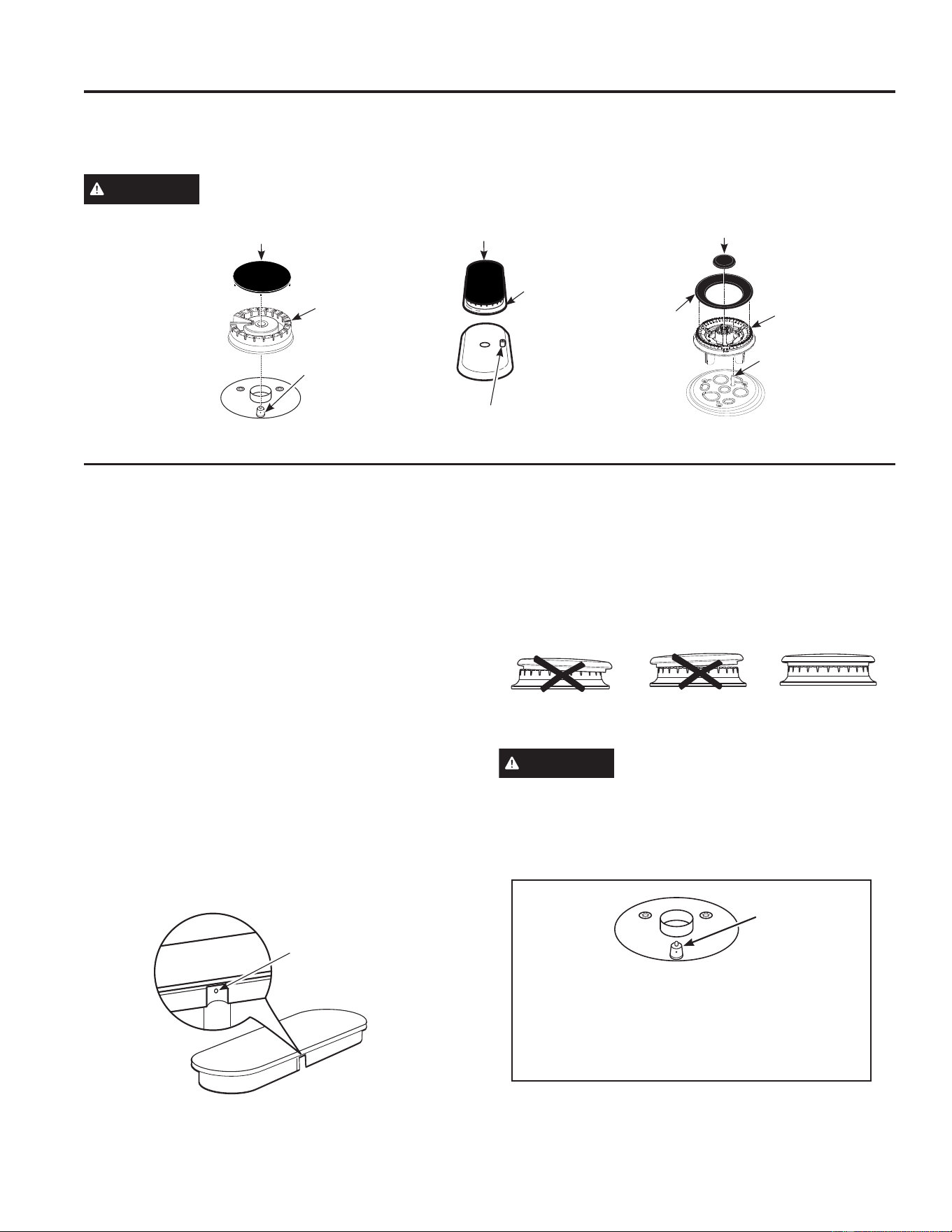
Do not attempt to remove oval burner cap from the burner heads.
Cooktop
Round Burner
Round Burner Cap
5HPRYDEOH
Electrode
Round
Burner
Head
Cleaning the Surface Burners
Cleaning the Burner Caps
Wash burner caps in hot, soapy water and rinse with
clean water. You may scour with a plastic scouring pad
to remove burned-on food particles. The round burner
caps may also be cleaned in your dishwasher.
Cleaning the Burner Heads
Wash the burner heads routinely, especially after bad
spillovers which could clog the burner openings. Lift
burners off when cool. Wash with hot, soapy water. Rinse
with clean water. For more stubborn stains, use a brush
with plastic bristles.
NOTE: Do not use steel wool or scouring pads to clean
the burner parts as these may clog the openings. Never
wash burner heads in your dishwasher as dishwasher.
Doing so may cause them to discolor.
The ports in the burner heads must be kept clean at all
times for an even, unhampered flame.
Clogged or dirty burner ports or electrodes will not allow
the burner to operate properly.
Replacing Surface Burners
Before replacingWKHEXUQHUFDSVKHDGVDQGRYDOKHDG
cap assembly, shake out excess water and allow them to
dry thoroughly.
Replace burner heads in the correct locations according
to size. Ensure each cap is properly seated on the
burner head, as pictured below.
CAUTION
Do not operate the cooktop without
all burner parts and grates in place.
Any spill on or around an electrode must be carefully
cleaned. Avoid hitting the electrode with anything hard or
it could be damaged.
The electrode of the spark igniter is exposed
when the burner head is removed. When one
burner is turned to LITE, all the burners spark.
Do not attempt to disassemble or clean around
any burner while another burner is on.
Electrode
Oval Burner
Oval Burner Cap
1RQ5HPRYDEOH
Oval
Burner
Head
Electrode
Burner cap is
properly seated.
Burner cap is
NOT properly
seated.
Burner cap is
NOT properly
seated.
Round hole in
burner head must
be kept clear
Multi-Ring Burner
Inner Burner Cap
5HPRYDEOH
Outer Burner Cap
5HPRYDEOH
Round
Burner
Head
Electrode
49-2000884 Rev. 2 23
Cooktop (Cont.)
Griddles
Aluminum and Reversible Cast-Iron: Clean your
reversible cast-iron griddle with a stiff brush and hot
ZDWHU8VLQJVRDSLVQRWUHFRPPHQGHGDQGKDUVK
detergents should never be used as they will remove
the seasoning. Rinse with hot water and dry thoroughly.
After rinsing, preseason the griddle by applying a light
coat of cooking oil to the griddle surface. Wipe off
excess oil with a paper towel.
Store in a cool, dry place.
Griddle Precautions:
Ŷ If something has spilled under the griddle, it should
be cleaned up as soon as possible to prevent the
spill from getting baked onto the cooktop.
Ŷ Do not allow grease to accumulate under the griddle
as it can be a fire hazard. Clean under the griddle
with hot, soapy water as soon as it is cool.
Ŷ Do not wash your griddle in the dishwasher.
Ŷ 'RQRWFOHDQWKHJULGGOHLQWKHVHOIFOHDQLQJRYHQ
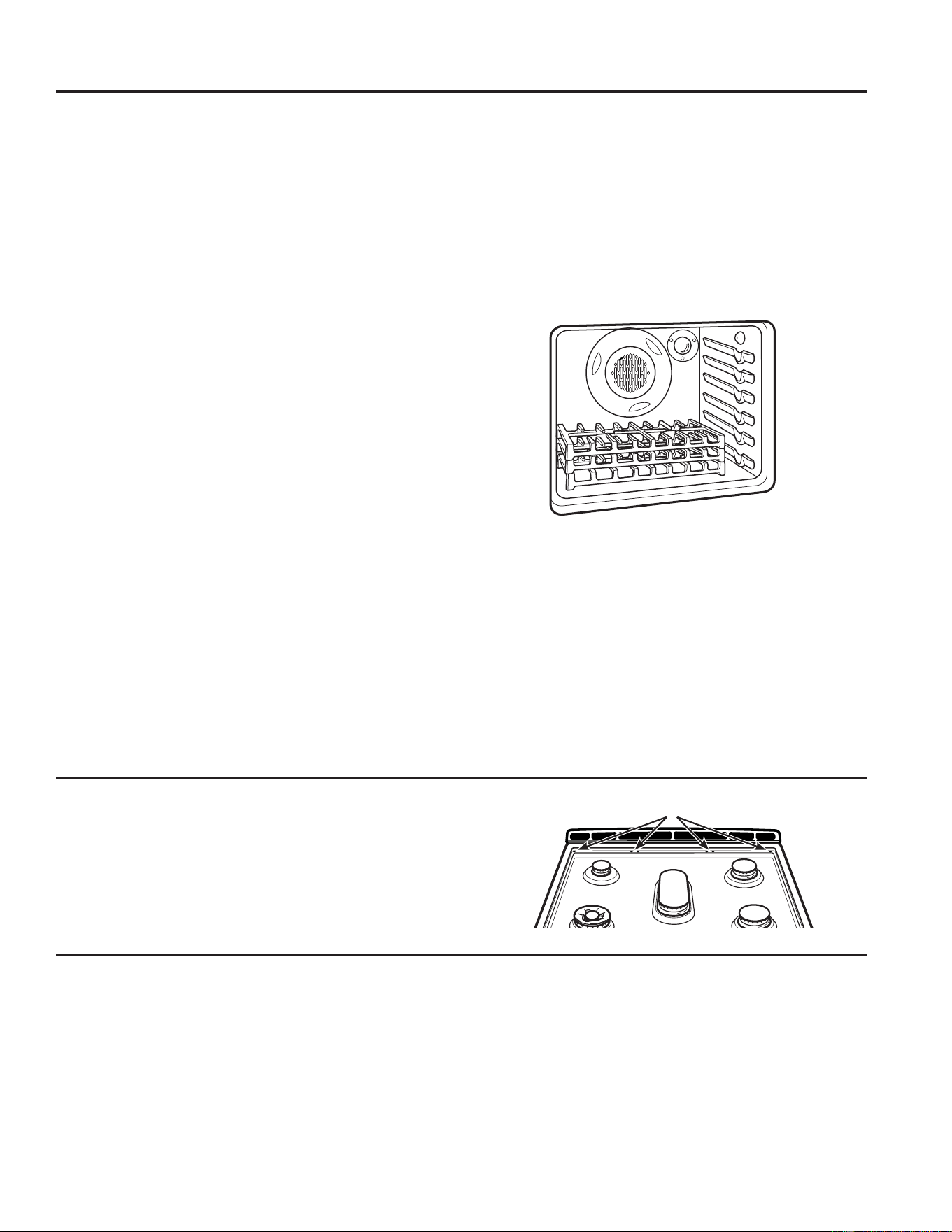
Grate Support Bumpers
If any of the rubber grate support bumpers in the cooktop
are missing or damaged, replacement parts can be
REWDLQHGE\FDOOLQJ*($SSOLDQFHVDW*(&$5(6
To insert the new bumpers, simply place the cone-
shaped end of the bumper into the hole in the cooktop
and push down while gently twisting the bumper.
Grate Support Bumpers
Burner Grates
Manual Cleaning
Grates should be washed in hot, soapy water and
rinsed with clean water. To soften burned-on food,
place grates in a solution containing ¼-cup of
household ammonia for several hours. Afterward, scrub
grates with a plastic scouring pad soaked in hot, soapy
water. Rinse well and dry.
Self Clean Mode
If your grates do not have rubber bumpers on their
bottom surface, they may be cleaned in the oven using
the self-clean cycle. Do not attempt to clean your grates
in the oven if your grates have rubber bumpers. Doing
so will destroy the rubber bumpers and may affect the
function of your surface burners.
3RUFHODLQFRDWHGJUDWHVPD\JUDGXDOO\GXOOLIFRQWLQXDOO\
exposed to self-clean temperatures.
,I\RXURYHQLVHTXLSSHGZLWKVHOIFOHDQEODFNUDFNV
it is recommended to follow the instructions for placing
grates on racks. If your oven is equipped with nickel-
SODWHGVLOYHUUDFNVLWLVUHFRPPHQGHGWRIROORZWKH
instructions for placing grates on the oven bottom.
Nickel-plated racks should not remain in the oven during
the self clean cycle. Doing so will tarnish the racks. If
either type of rack is left in the oven during a self-clean
cycle, the rack may become difficult to slide.
NOTE: When placing or removing grates from the oven,
do not slide the grates on the racks or oven bottom.
Doing so could damage the enamel on the racks or oven
bottom.
To self-clean your grates on self-clean racks:
,QVHUWUDFNVLQSRVLWLRQVDQGRUSRVLWLRQVDQG
2. Gently place one grate on each rack.
NOTE: DO NOT operate your cooktop during the
Self Clean Mode because the Self Clean cycle will be
canceled.
To self clean your grates on the oven bottom:
5HPRYHDOORYHQUDFNV
2. Gently place one grate on the center of the oven
bottom with the grate oriented in the upright position.
6WDFNUHPDLQLQJJUDWHVDVVKRZQEHORZ'RQRW
place or stack grates in any other configuration or in
the upper oven.
Once the grates are placed in the oven, operate the self-
clean cycle per the instruction in the Cleaning the Oven
section.
NOTE:8VHFDXWLRQZKHQUHPRYLQJWKHJUDWHVIURPWKH
oven after the self-clean cycle has ended. The grates
may still be hot.
Once the self-clean cycle is complete, the grates may
carefully be removed. You may notice a white residue on
the grates. Wipe it off with a damp sponge. If white spots
SHUVLVWZHWWKHVSRQJHZLWKDVROXWLRQRIYLQHJDU
and water and wipe the grates again.
When replacing the grates on the cooktop, be sure to locate
them correctly. Grates should fit securely into the cooktop.
CARE AND CLEANING: Cooktop
24 49-2000884 Rev. 2
CARE AND CLEANING: Oven Door
Cleaning the Oven Door
Cleaning the Door Interior
Do not allow excess water to run into any holes or slots
in the door.
Wipe dish soap over any baked-on spatters on the glass.
8VH D VLQJOH VLGHG VDIHW\ UD]RU EODGH WR FOHDQ LW RII 7KHQ
wipe over the glass with a soapy cloth to remove any
residue and dry off.
The area outside the gasket can be cleaned with a soap-
filled plastic scouring pad. Do not rub or clean the door
gasket - it has an extremely low resistance to abrasion.
If you notice the gasket becoming worn, frayed or
damaged in any way or if it has become displaced on the
door, you should have it replaced.
Cleaning the Door Exterior
If a stain on the door vent trim is persistent, use a mild
abrasive cleaner and a sponge-scrubber for best results.
Do not use this method on any other surface.
Stainless Steel Surfaces
Do not use a steel wool pad; it will scratch the surface.
To clean the stainless steel surface, use warm sudsy
water or a stainless steel cleaner or polish. Always wipe
the surface in the direction of the grain. Follow the cleaner
instructions for cleaning the stainless steel surface.
To inquire about purchasing cleaning products
including stainless steel appliance cleaner or polish,
see the Accessories and Consumer Support sections
at the end of this manual.
Oven Door
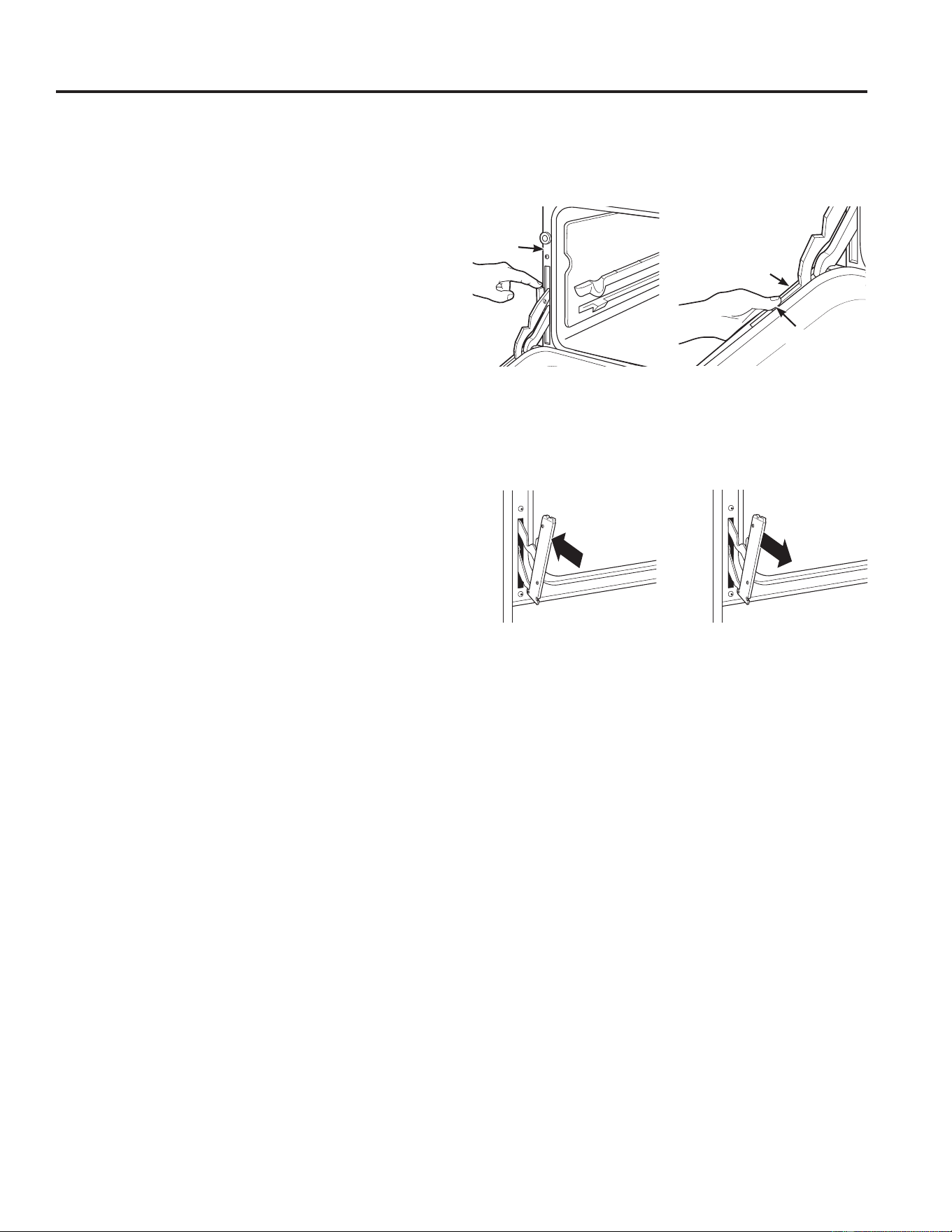
Lift-Off Lower Oven Door
The door is very heavy. Be careful when removing and lifting the door. Do not lift door by the handle.
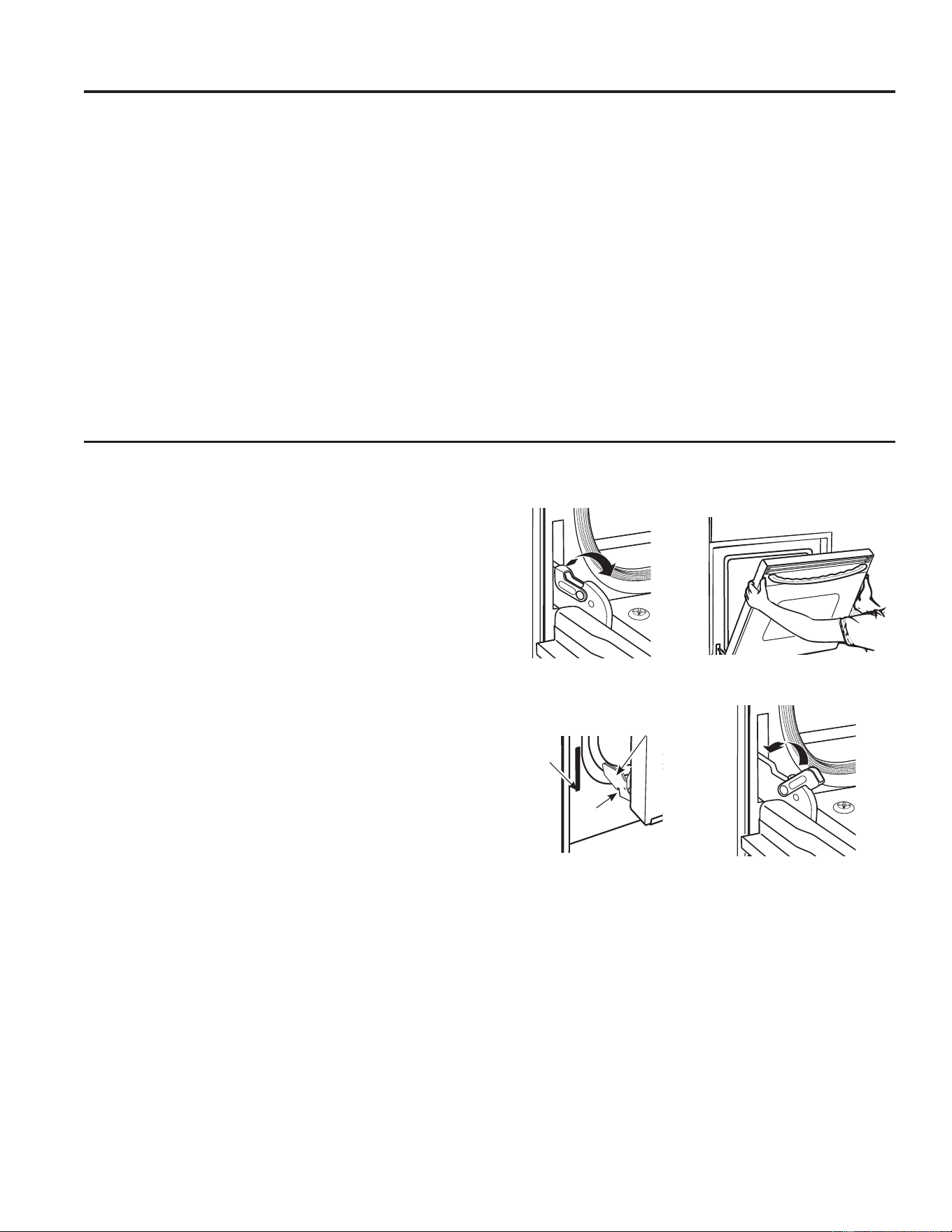
To Remove the Door:
)XOO\ RSHQ WKH GRRU
3XOO WKH KLQJH ORFNV XS DQG DZD\ IURP WKH UDQJH
frame to the unlocked position.
3. Firmly grasp both sides of the door near the top.
4. Close door until the top of the door is approximately
6” from the range frame.
5. Lift door up and away from the range until both hinge
arms are clear of the slots in the range frame.
To Replace the Door:
)LUPO\ JUDVS ERWK VLGHV RI WKH GRRU QHDU WKH WRS
2. With the door at the same angle as the removal
position, rest the notch on the underside of the left
hinge arm on the bottom edge of the left hinge slot.
The notch in the hinge arm must be fully seated into
the bottom of the slot. Repeat for the right side.
3. Fully open the door. If the door will not fully open, the
notches in the bottoms of the hinge arms have not
seated correctly in the bottom edge of the slot. Lift the
door off the range and repeat previous step.
3XVK WKH KLQJH ORFNV WRZDUG WKH UDQJH FDYLW\ DQG
down to the locked position.
5. Close the oven door.
Removal position3XOO KLQJH ORFNV XS WR XQORFN
3XVK KLQJH ORFNV GRZQ WR ORFNRest notch on bottom edge
of hinge slot
Notch
Bottom
edge of
slot
Hinge arm
49-2000884 Rev. 2 25
Oven Door
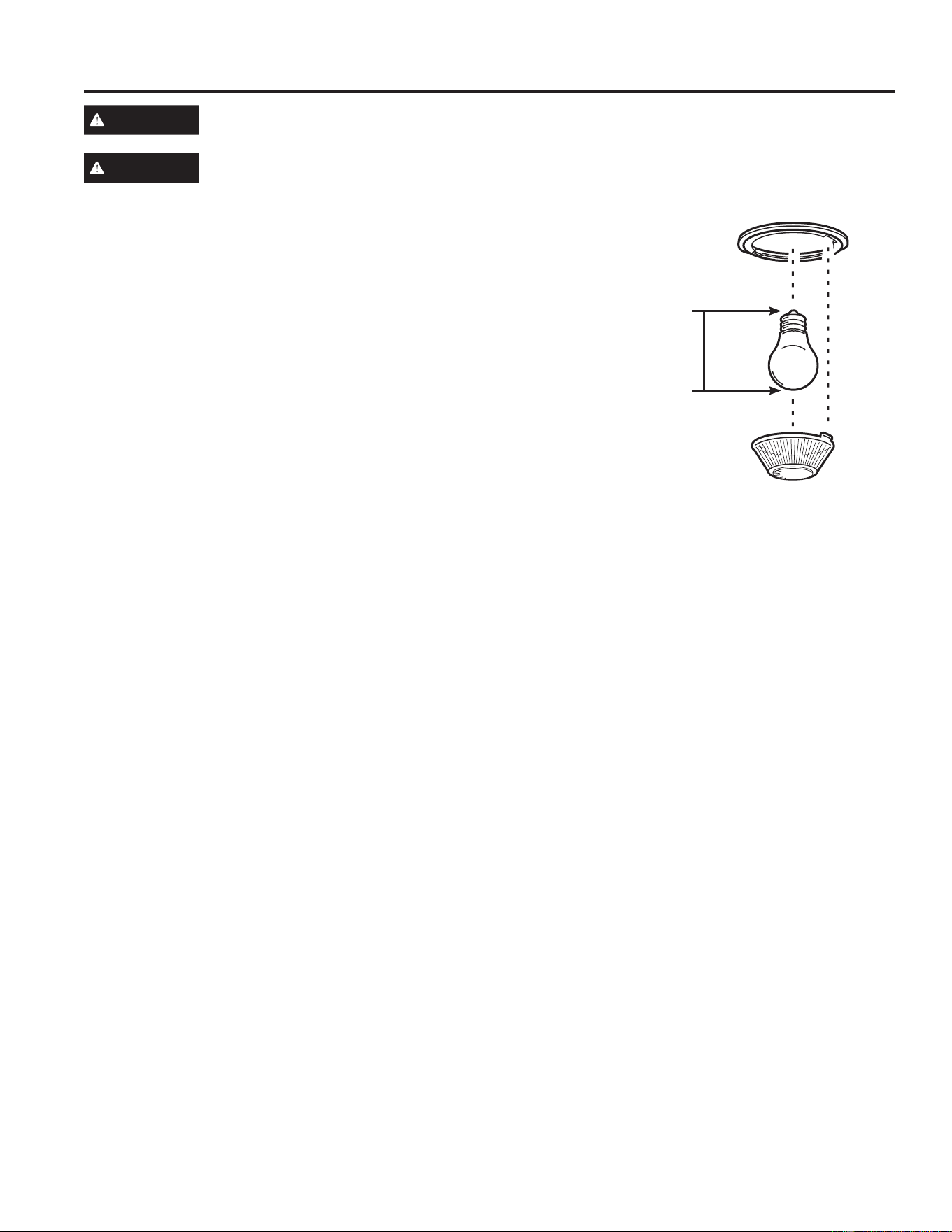
Lift-Off Upper Oven Door
The door is very heavy. Be careful when removing and lifting the door. Do not lift door by the handle.
To Remove the Door:
)XOO\RSHQWKHGRRU
2. Lift up on the hinge lock toward the oven frame until
they stop.
&ORVHWKHGRRUWRGHJUHHV\RXZLOOIHHOWKHGRRU
VWRS7KHKLQJHORFNZLOOFRQWDFWWKHRYHQIUDPH
4. On both sides of the door, press down on the release
buttons on each hinge.
5. Lift door up until it is clear of the hinge.
3XOORQKLQJHDUPVVOLJKWO\WRUHOLHYHSUHVVXUHRQWKH
locking tabs.
3XVKWKHKLQJHORFNVGRZQRQWR
the hinge.
3XVKWKHKLQJHVLQWRZDUGWKHXQLW
so they are closed.
To Replace the Door:
3XOOWKHKLQJHVGRZQDZD\IURPWKHRYHQIUDPHWR
the fully open position.
2. Lift up on the hinge locks toward the oven frame until
they stop.
3. The hinges will release to the 45-degree position. The
hinge locks will contact the oven frame.
4. Slide the door back onto the hinges. Make sure the
buttons pop back out.
5. Fully open the door.
3XVKWKHKLQJHORFNVGRZQRQWRWKHKLQJH
7. Close the oven door.
Oven
frame
Door
frame
Release
buttons
3XOOGRZQ
3XVKLQ
CARE AND CLEANING: Oven Door
26 49-2000884 Rev. 2
NOTE: The glass cover should be removed only when
cold. Wearing latex gloves may offer a better grip.
Before replacing the bulb, disconnect electrical power to
the oven at the main fuse or circuit breaker panel. Let
the bulb cool completely before removing it. For your
safety do not touch a hot bulb with a damp cloth. If you
do the bulb may break.
To remove:
7XUQ WKH JODVV FRYHU FRXQWHUFORFNZLVH WXUQ XQWLO WKH
tabs of the glass cover clear the grooves of the socket
and pull the cover off. Remove the bulb.
To replace:
3XW LQ D QHZ ZDWW DSSOLDQFH EXOE 3ODFH WKH WDEV RI
the glass cover into the grooves of the socket. Turn the
JODVV FRYHU FORFNZLVH WXUQ
NOTE:
Ŷ $ ZDWW DSSOLDQFH
bulb is smaller than
D VWDQGDUG ZDWW
household bulb.
Ŷ 5HFRQQHFW HOHFWULFDO
power to the oven
once the new bulb is
installed.
Ŷ )RU LPSURYHG OLJKWLQJ
inside the oven,
clean the glass cover
frequently using a wet
cloth. This should be
done when the oven is
completely cool.
WARNING
SHOCK OR BURN HAZARD: Before replacing oven light bulb, disconnect the electrical power to the
range at the main fuse or circuit breaker panel. Failure to do so may result in electric shock or burn.
CAUTION
BURN HAZARD: The glass cover and bulb should be removed when cool. Touching hot glass with
bare hands or a damp cloth can cause burns.
Oven Light
Bulb
Socket
Tab
3
»
2
”
Max
length
Glass cover
CARE AND CLEANING: Oven Light
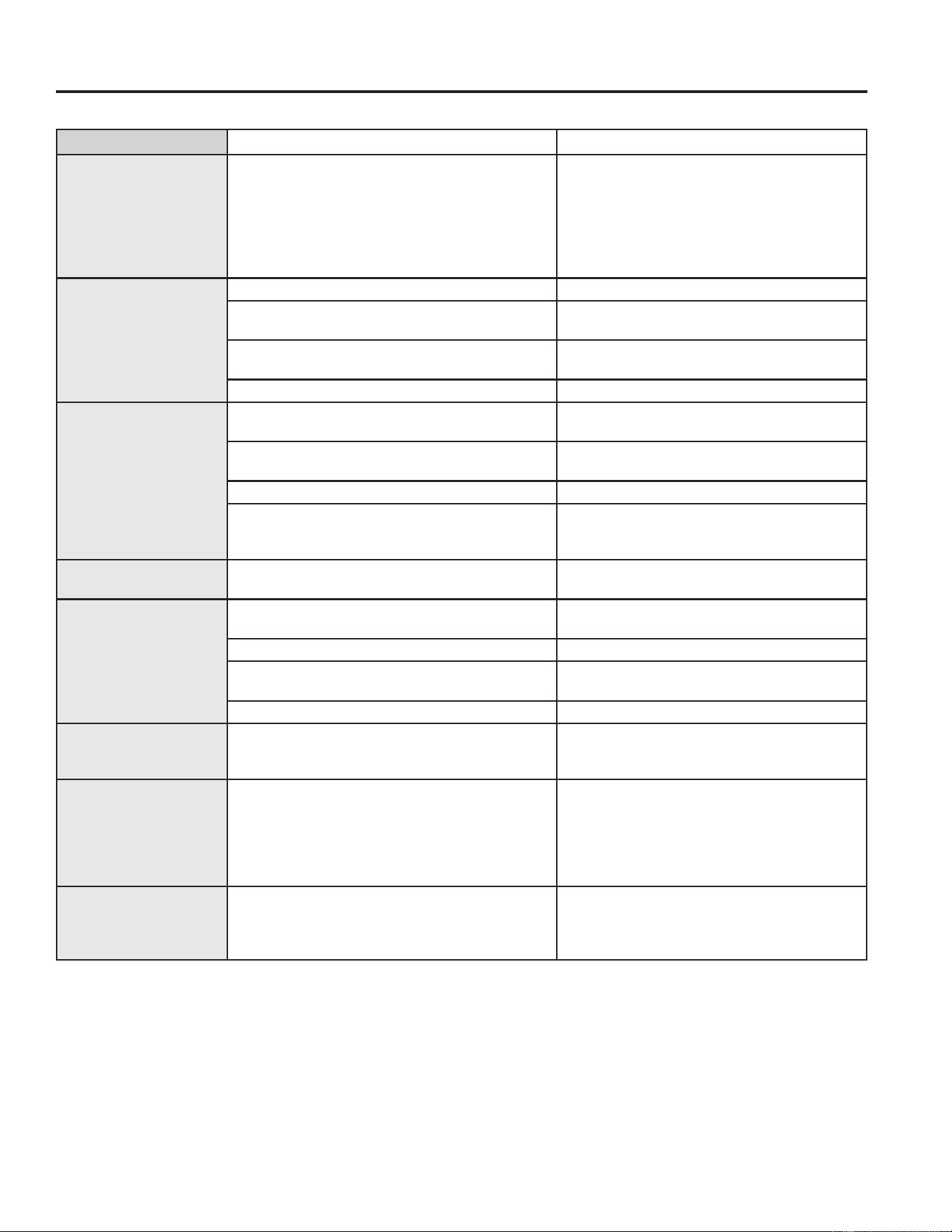
49-2000884 Rev. 2 27
Problem Possible Cause What To Do
My new oven doesn't
cook like my old one.
Is something wrong
with the temperature
settings?
Your new oven has a different cooking system
from your old oven and therefore may cook
differently than your old oven.
For the first few uses, follow your recipe times
and temperatures carefully and use rack
positions recommended in the Cooking Guide.
If you still think your new oven is too hot or too
cold, you can adjust the temperature yourself
to meet your specific cooking preference. See
the Settings section.
Food does not bake
properly
Oven controls improperly set. See the Cooking Modes section.
Rack position is incorrect or rack is not level. See the Cooking Modes section and Cooking
Guide.
Incorrect cookware or cookware of improper
size being used.
See the Cookware section.
Oven temperature needs adjustment. See the Settings section.
Food does not broil
properly
Oven controls improperly set. Make sure you select the appropriate broil
mode.
Improper rack position being used. See Cooking Guide for rack location
suggestions.
Cookware not suited for broiling. 8VHDSDQVSHFLILFDOO\GHVLJQHGIRUEURLOLQJ
Aluminum foil on the broil pan has not been
fitted properly or slit to drain grease.
If using aluminum foil on broil pan, wrap tightly
and add slits conforming to those in the pan to
allow grease to drain.
Oven temperature too
hot or too cold
Oven temperature needs adjustment. See the Oven Controls section.
Oven and/or display
appears not to work
A fuse in your home may be blown or the
circuit breaker tripped.
Replace the fuse or reset the circuit breaker.
Oven controls improperly set. 6HHWKH8VLQJWKH2YHQVHFWLRQ
Oven is in Sabbath Mode. 9HULI\WKDWWKHRYHQLVQRWLQ6DEEDWK0RGH
See the Sabbath Mode section.
The clock is turned off. See the Settings section.
“Crackling” or
“popping” sound
This is the sound of the metal heating and
cooling during both the cooking and cleaning
functions.
This is normal.
Why is my range
making a "clicking"
noise when using my
oven?
Your range has been designed to maintain a
tighter control over your oven's temperature.
You may hear your oven's heating elements
"click" on and off more frequently than in
older ovens to achieve better results during
baking, broiling, and self-clean cycles.
This is normal.
Sometimes the
oven takes longer to
preheat to the same
temperature
Cookware, food, and/or number of racks in
oven.
Cookware, food, and racks in the oven will
cause differences in preheat times. Remove
excess items to reduce preheat time.
Troubleshooting Tips ... Before you call for service
Save time and money! Review the charts on the following pages first and you may not need to call for service.
TROUBLESHOOTING TIPS
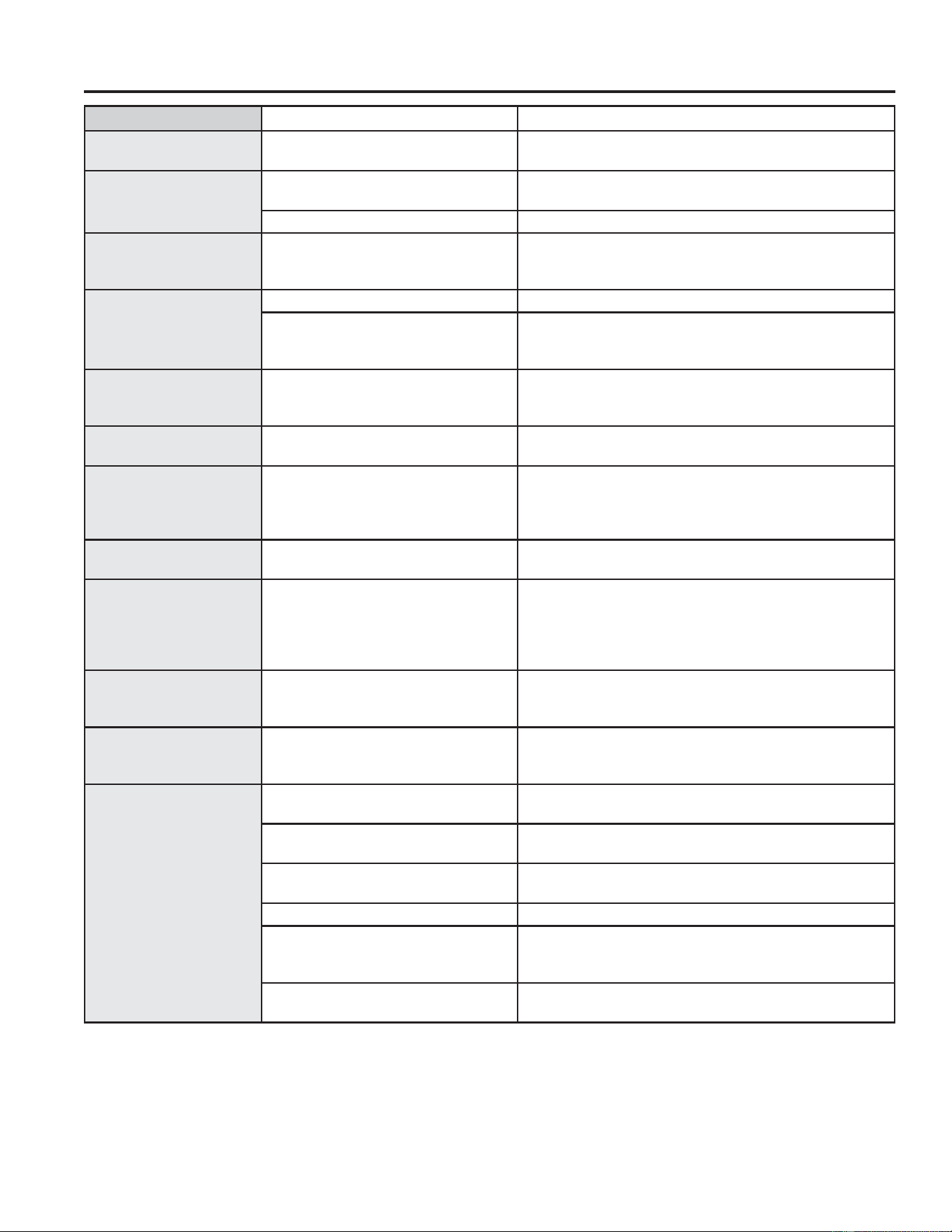
28 49-2000884 Rev. 2
TROUBLESHOOTING TIPS
Troubleshooting Tips ... Before you call for service
Problem Possible Cause What To Do
Oven light does not
work
Light bulb is loose or defective. Tighten or replace bulb. See the Maintenance section for
instructions on how to replace the bulb.
Oven will not self-clean The temperature is too high to set
a self-clean operation.
Allow the oven to cool and reset the controls.
Oven controls improperly set. See the Cleaning the Oven section.
Excessive smoking
during clean cycle
Excessive soil or grease. 3UHVVWKH Cancel/Off pad. Open the windows to rid the
room of smoke. Wait until the LOCKED light goes off.
Wipe up the excess soil and reset the clean cycle.
Oven not clean after a
clean cycle
Oven controls improperly set. See the Cleaning the Oven section.
Oven was heavily soiled. Clean up heavy spillovers before starting the clean cycle.
Heavily soiled ovens may need to self-clean again or for
a longer period of time.
Strong “burning” or
“oily” odor emitting
from the vent
This is normal in a new oven and
will disappear in time.
To speed the process, set a self-clean cycle for a
minimum of 3 hours. See the Cleaning the Oven section.
This is temporary.
Excessive smoking
during broiling
Food too close to burner element. Lower the rack position of the food.
Oven door will not open
or LOCKED light is on
when you want to cook.
The oven door is locked because
the temperature inside the oven
has not dropped below the locking
temperature.
3UHVVWKHCancel/Off pad. Allow the oven to cool below
the locking temperature.
"LOCK DOOR" flashes
in the display
The self-clean cycle has been
selected but the door is not closed.
Close the oven door.
“F— and a number
or letter” flash in the
display
You have a function error code. 3UHVVWKHCancel/Off pad. Allow the oven to cool for one
KRXU3XWWKHRYHQEDFNLQWRRSHUDWLRQ,IWKHIXQFWLRQFRGH
UHSHDWVGLVFRQQHFWDOOSRZHUWRWKHRYHQIRUDWOHDVW
seconds and then reconnect power. If the function error code
repeats again, call for service.
Power outage, clock
flashes
Power outage or surge Reset the clock. If the oven was in use, you must reset
it by pressing the Cancel/Off pad, setting the clock and
resetting any cooking function.
Lock Controls or
Control Lockout feature
is activated
If LOC ON appears in the display, the range control is
locked. Turn this feature off to use the range. See the
Lock Control feature in the Oven Controls section.
Burners do not light Plug on range is not completely
inserted in the electrical outlet.
Make sure electrical plug is plugged into a live, properly
grounded outlet.
Gas supply not connected or
turned on.
See the Installation Instructions that came with your
range.
A fuse in your home may be blown
or the circuit breaker tripped.
Replace the fuse or reset the circuit breaker.
Burner parts not replaced correctly. See the Care and Cleaning of the range section.
Burner slots near the electrode, or
the round lighter port on the oval
burner, may be clogged.
Remove the burners and clean them. Check the
electrode area for burned-on food or grease. See the
Care and Cleaning of the range section.
Food residue on electrode Lightly polish flat tip of electrode with nail file or
sandpaper until shiny.
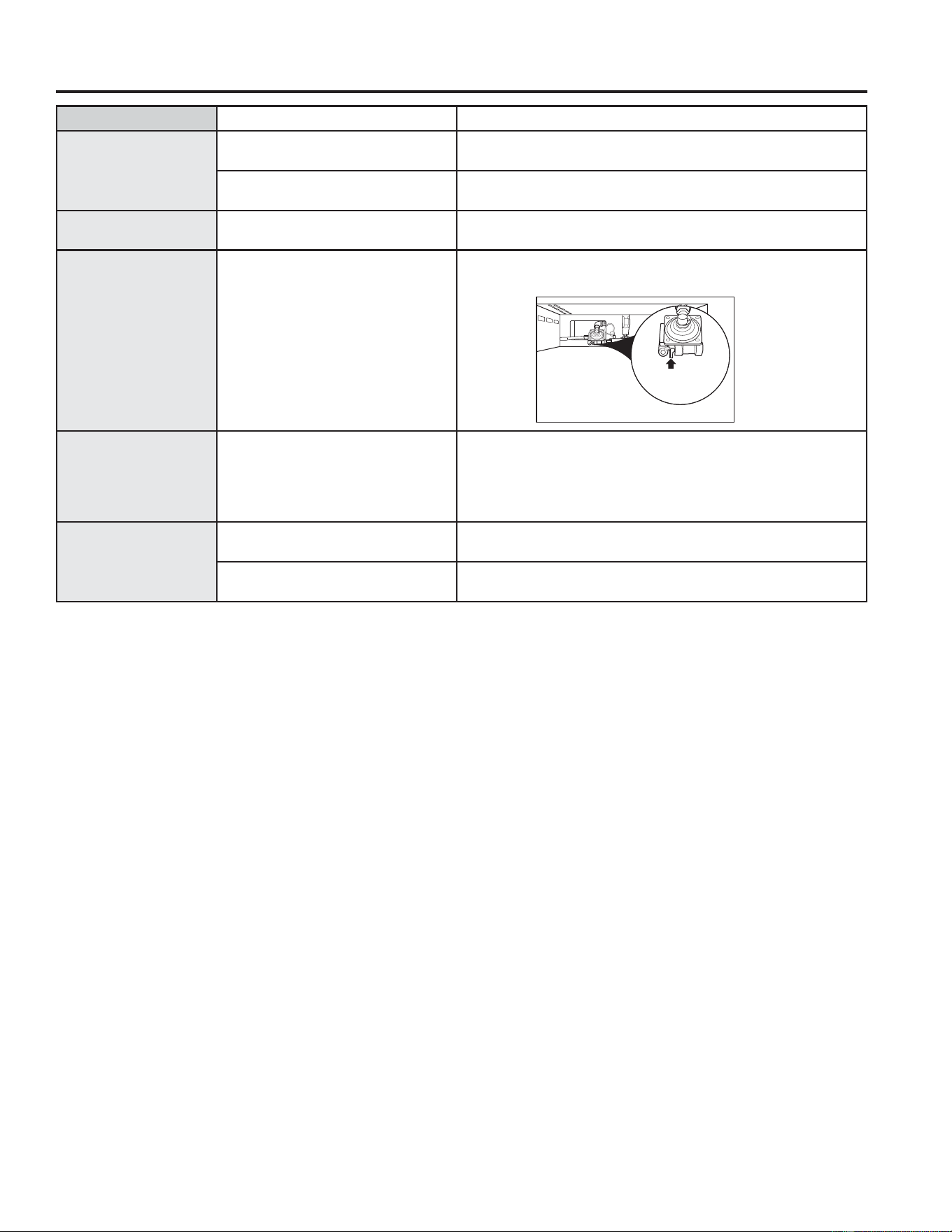
49-2000884 Rev. 2 29
Troubleshooting Tips ... Before you call for service
Problem Possible Cause What To Do
Top burners do not
burn evenly
Improper burner assembly. Make sure the burner caps are seated correctly. See the Care and
Cleaning of the range section.
Burner slots on the side of the
burner may be clogged.
Remove the burners for cleaning. See the Care and Cleaning of
the range section.
Burner flames are
very large or yellow
Improper air to gas ratio. ,IUDQJHLVFRQQHFWHGWR3URSDQHJDVFRQWDFWWKHWHFKQLFLDQ
who installed your range or made the conversion.
Surface burners light
but bake and broil
burners do not.
Gas to the oven burners may
have been shut off.
The oven gas shut-off is located on the gas regulator near the
gas line attachment to your range. Locate it and flip the lever.
My oven door glass
appears to be
"tinted" or have a
"rainbow" color.
The inner oven glass is coated
with a heat barrier to reflect
the heat back into the oven to
prevent heat loss and keep the
outer door cool while baking.
7KLVLVQRUPDO8QGHUFHUWDLQOLJKWRUDQJOHV\RXPD\VHHWKLV
tint or rainbow color.
Drawer does not slide
smoothly or drags
The drawer is out of alignment. Fully extend the drawer and push it all the way in. See the Care
and Cleaning of the range section.
Drawer is over-loaded or load is
unbalanced.
Reduce weight or redistribute drawer contents.
Lever is
shown closed.
38//7223(1
Sealed burner models
TROUBLESHOOTING TIPS
49-2000884 Rev. 2
GEAppliances.com
All warranty service is provided by our Factory Service Centers, or an authorized Customer Care
®
technician. To schedule
service online, visit us at geappliances.com/serviceRUFDOO*($SSOLDQFHVDW*(&$5(63OHDVH
have your serial number and your model number available when calling for service.
Servicing your appliance may require the use of the onboard data port for diagnostics. This gives a GE Appliances factory
service technician the ability to quickly diagnose any issues with your appliance and helps GE Appliances improve its
products by providing GE Appliances with information on your appliance. If you do not want your appliance data to be
sent to GE Appliances, please advise your technician not to submit the data to GE Appliances at the time of service.
What GE Appliances will not cover:
Ŷ Service trips to your home to teach you how to use
the product.
Ŷ ,PSURSHULQVWDOODWLRQGHOLYHU\RUPDLQWHQDQFH
Ŷ )DLOXUHRIWKHSURGXFWLILWLVDEXVHGPLVXVHG
modified, or used for other than the intended purpose
or used commercially.
Ŷ 5HSODFHPHQWRIKRXVHIXVHVRUUHVHWWLQJRIFLUFXLW
breakers.
Ŷ 'DPDJHWRWKHSURGXFWFDXVHGE\DFFLGHQWILUH
floods, or acts of God.
Ŷ 'DPDJHWRILQLVKVXFKDVVXUIDFHUXVWWDUQLVKRU
small blemishes not reported within 48 hours of
delivery.
Ŷ ,QFLGHQWDORUFRQVHTXHQWLDOGDPDJHFDXVHGE\
possible defects with this appliance.
Ŷ 'DPDJHFDXVHGDIWHUGHOLYHU\
Ŷ 3URGXFWQRWDFFHVVLEOHWRSURYLGHUHTXLUHGVHUYLFH
Ŷ 6HUYLFHWRUHSDLURUUHSODFHOLJKWEXOEVH[FHSWIRU/('
lamps.
EXCLUSION OF IMPLIED WARRANTIES
Your sole and exclusive remedy is product repair as provided in this Limited Warranty. Any implied warranties,
including the implied warranties of merchantability or fitness for a particular purpose, are limited to one year or
the shortest period allowed by law.
This limited warranty is extended to the original purchaser and any succeeding owner for products purchased for home
XVHZLWKLQWKH86$,IWKHSURGXFWLVORFDWHGLQDQDUHDZKHUHVHUYLFHE\D*($SSOLDQFHV$XWKRUL]HG6HUYLFHULVQRW
available, you may be responsible for a trip charge or you may be required to bring the product to an Authorized GE
Appliances Service location for service. In Alaska, the limited warranty excludes the cost of shipping or service calls to
your home.
Some states do not allow the exclusion or limitation of incidental or consequential damages. This
limited
warranty
gives you specific legal rights, and you may also have other rights which vary from state to state. To know what your
legal rights are, consult your local or state consumer affairs office or your state’s Attorney General.
Warrantor: GE Appliances, a Haier company
Louisville, KY 40225
Extended Warranties:3XUFKDVHD*($SSOLDQFHVH[WHQGHGZDUUDQW\DQGOHDUQDERXWVSHFLDOGLVFRXQWVWKDWDUH
available while your warranty is still in effect. You can purchase it online anytime at
geappliances.com/extended-warranty
RUFDOOGXULQJQRUPDOEXVLQHVVKRXUV*($SSOLDQFHV6HUYLFHZLOOVWLOOEHWKHUHDIWHU\RXUZDUUDQW\H[SLUHV
For the period of GE Appliances will replace
One year
From the date
of the original
purchase
Any part of the range which fails due to a defect in materials or workmanship. During this
limited one-year warranty, GE Appliances will provide, free of charge, all labor and in-home
service to replace the defective part.
6WDSOH\RXUUHFHLSWKHUH3URRIRIWKHRULJLQDOSXUFKDVH
date is needed to obtain service under the warranty.
LIMITED WARRANTY
GE Appliances Gas Range Limited Warranty

49-2000884 Rev. 2
ACCESSORIES
Looking For Something More?
GE Appliances offers a variety of accessories to
improve your cooking and maintenance experiences!
Refer to the Consumer Support page for phone numbers
and website information.
The following products and more are available:
Accessories
Accessories
Nickel Flat Rack
Reinforced Nickel Flat Rack
Self Clean Flat Rack
Nickel Extension Rack
Self Clean Extension Rack
%URLOHU3DQô´[ó´[ò³
Roasting Rack Accessory
Cooktop Center Grate
Nonstick Aluminum Griddle
Reversible Cast-Iron Griddle
Cleaning Supplies
&LWUX6KLQH6WDLQOHVV6WHHO:LSHV
6WDLQOHVV6WHHO3ROLVKLQJ&ORWK
Burnt-On Grease Remover

32 49-2000884 Rev. 2
Consumer Support
GE Appliances Website
Have a question or need assistance with your appliance? Try the GE Appliances Website 24 hours a day, any day
of the year! You can also shop for more great GE Appliances products and take advantage of all our on-line support
VHUYLFHVGHVLJQHGIRU\RXUFRQYHQLHQFH,QWKH86GEAppliances.com
Register Your Appliance
Register your new appliance on-line at your convenience! Timely product registration will allow for enhanced
communication and prompt service under the terms of your warranty, should the need arise. You may also mail in
WKHSUHSULQWHGUHJLVWUDWLRQFDUGLQFOXGHGLQWKHSDFNLQJPDWHULDO,QWKH86GEAppliances.com/register
Schedule Service
Expert GE Appliances repair service is only one step away from your door. Get on-line and schedule your service at
\RXUFRQYHQLHQFHDQ\GD\RIWKH\HDU,QWKH86GEAppliances.com/service
RUFDOOGXULQJQRUPDOEXVLQHVVKRXUV
Extended Warranties
3XUFKDVHD*($SSOLDQFHVH[WHQGHGZDUUDQW\DQGOHDUQDERXWVSHFLDOGLVFRXQWVWKDWDUHDYDLODEOHZKLOH\RXU
warranty is still in effect. You can purchase it on-line anytime. GE Appliances Services will still be there after your
ZDUUDQW\H[SLUHV,QWKH86GEAppliances.com/extended-warranty
RUFDOOGXULQJQRUPDOEXVLQHVVKRXUV
Remote Connectivity
)RUDVVLVWDQFHZLWKZLUHOHVVQHWZRUNFRQQHFWLYLW\IRUPRGHOVZLWKUHPRWHHQDEOH
visit our website at GEAppliances.com/connectRUFDOOLQWKH86
Parts and Accessories
Individuals qualified to service their own appliances can have parts or accessories sent directly to their homes
9,6$0DVWHU&DUGDQG'LVFRYHUFDUGVDUHDFFHSWHG2UGHURQOLQHWRGD\KRXUVHYHU\GD\
,QWKH86GEApplianceparts.com or by phone at 877.959.8688 during normal business hours.
Instructions contained in this manual cover procedures to be performed by any user. Other servicing
generally should be referred to qualified service personnel. Caution must be exercised, since improper
servicing may cause unsafe operation.
Contact Us
If you are not satisfied with the service you receive from GE Appliances, contact us on our Website with all the
details including your phone number, or write to:
,QWKH86*HQHUDO0DQDJHU&XVWRPHU5HODWLRQV_*($SSOLDQFHV$SSOLDQFH3DUN_/RXLVYLOOH.<
GEAppliances.com/contact
3ULQWHGLQ0H[LFR
CONSUMER SUPPORT

PGB965
INFORMACIÓN DE SEGURIDAD ..... 3
USO DE LA ESTUFA
En Caso de Corte de Corriente ................ 8
Quemadores ................................ 8
Plancha .....................................10
Controles del Horno ..........................11
Conexión WiFi ..............................12
Funciones Especiales .........................13
Modo Sabático - Estándar ....................14
Estantes del Horno ...........................15
Papel de Aluminio y Cobertores del Horno ......15
Modos de Cocción al Horno ...................16
Ventilaciones de Aire del Horno ...............17
Guía de Cocción .............................18
Modo de Cocción para Freír con Aire ..........19
CUIDADO Y LIMPIEZA
Estufa - Exterior ............................20
Estufa - Interior ..............................21
Placa de Cocción ........................... 22
Puerta del Horno ...........................24
Luz del Horno .............................. 26
CONSEJOS PARA LA
SOLUCIÓN DE PROBLEMAS ........ 27
GARANTÍA LIMITADA ................ 30
ACCESORIOS ...........................31
SOPORTE PARA
EL CONSUMIDOR ..................... 32
ESTUFAS
a Gas con Función de Auto Limpieza
MANUAL DEL
PROPIETARIO
Escriba los números de modelo y de
serie aquí:
Nº de Modelo ____________
Nº de Serie ______________
Encontrará la etiqueta de calificación en
una bandera metálica detrás del panel
de control trasero. Desde el frente de
la estufa, ubique la parte trasera en el
medio del panel de control trasero y gire
la etiqueta de calificación hacia arriba.
GE es una marca registrada de General Electric Company. Fabricado bajo licencia de marca.
49-2000884 Rev. 2 03-24 GEA

2 49-2000884 Rev. 2
GRACIAS POR HACER QUE GE APPLIANCES SEA PARTE DE SU HOGAR.
Ya sea que haya crecido usando GE Appliances, o que ésta es su primera vez, nos complace
tenerlo en la familia.
Sentimos orgullo por el nivel de arte, innovación y diseño de cada uno de los electrodomésticos de
GE Appliances, y creemos que usted también. Entre otras cosas, el registro de su electrodoméstico
asegura que podamos entregarle información importante del producto y detalles de la garantía
cuando los necesite.
Registre su electrodoméstico GE ahora a través de Internet. Sitios Web y números telefónicos útiles
están disponibles en la sección de Soporte para el Consumidor de este Manual del Propietario.
También puede enviar una carta en la tarjeta de inscripción preimpresa que se incluye con
el material embalado.
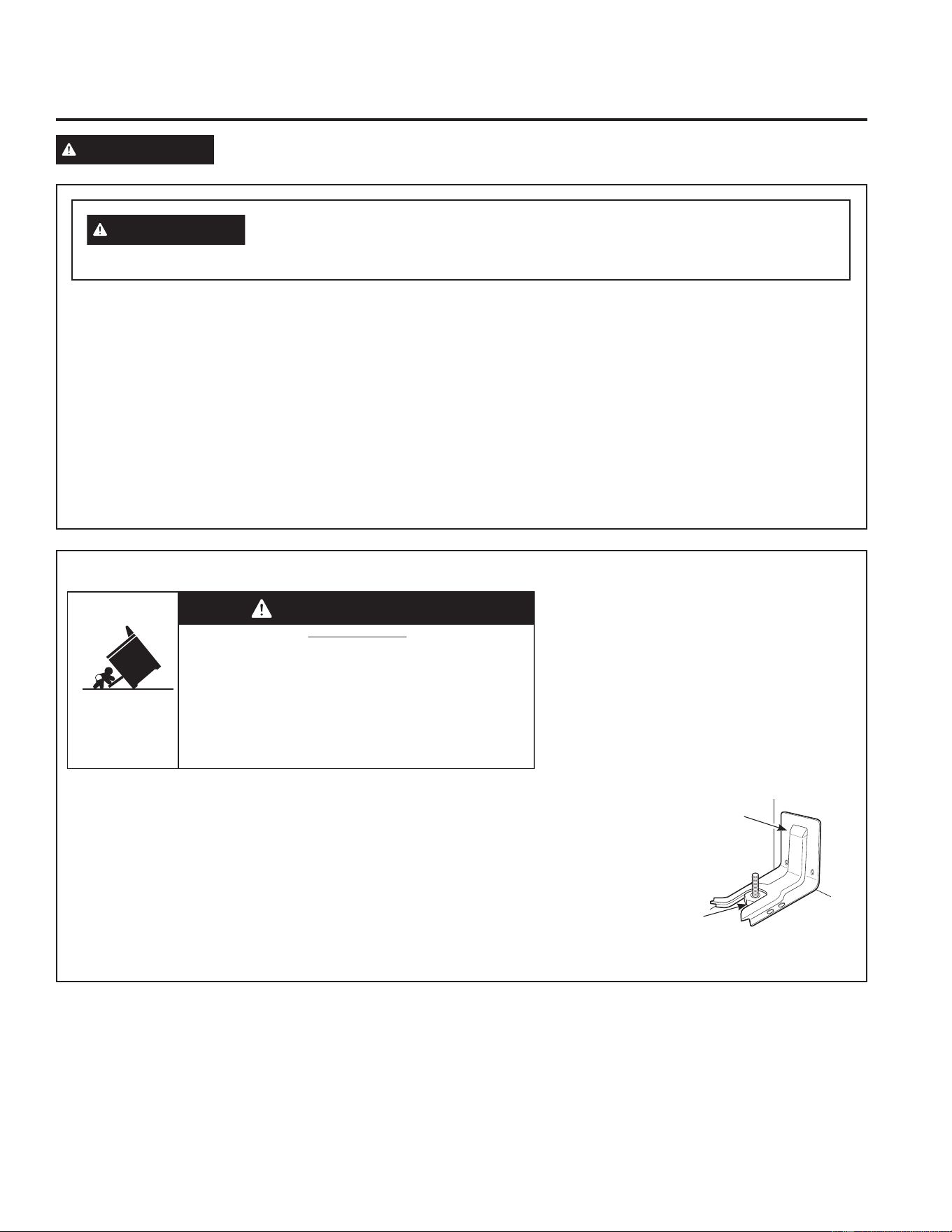
49-2000884 Rev. 2 3
DISPOSITIVO ANTI-VOLCADURAS
Para reducir el riesgo de volcar la estufa,
ésta debe sujetarse mediante un soporte anti-
volcaduras con una adecuada instalación. Ver
las instrucciones de instalación enviadas con el
soporte para obtener detalles completos antes
de iniciar la instalación.
Para Estufas Sin Apoyo y Deslizabless
Para controlar si el soporte es instalado y
ajustado de forma apropiada, mire que debajo
de la estufa la pata niveladora trasera esté
ajustada al soporte. En algunos modelos, el
cajón de almacenamiento o el panel de protección se pueden retirar para una fácil
inspección. Si no es posible realizar una inspección visual, deslice la estufa hacia
adelante, confirme que el soporte anti-volcaduras esté ajustado de forma segura al
piso o la pared, y deslice la estufa hacia atrás de modo que la pata niveladora trasera
se encuentre debajo del soporte anti-volcaduras.
Si la estufa es expulsada de la pared por alguna razón, siempre repita este
procedimiento a fin de verificar que esté asegurado de forma correcta con un soporte
anti volcaduras.
Nunca quite las patas de nivelación por completo ya que la estufa no quedará bien
sujeta al dispositivo anti-volcaduras.
Soporte
Anti-Volcaduras
Pata
Niveladora
Estufas Sin Apoyo y Deslizables
ADVERTENCIA
Lea todas las instrucciones de seguridad antes de utilizar este producto. No seguir estas instrucciones
puede generar un incendio, una descarga eléctrica, lesiones corporales o la muerte.
LEA Y GUARDE ESTAS INSTRUCCIONES
INFORMACIÓN IMPORTANTE DE SEGURIDAD
LEA TODAS LAS INSTRUCCIONES ANTES DE USAR ESTE ELECTRODOMÉSTICO
INFORMACIÓN DE SEGURIDAD
ADVERTENCIA
Si la información de este manual no se sigue exactamente, se podrá
producir un incendio o explosión, ocasionando daños sobre la propiedad, lesiones o la muerte.
- No guarde ni use gasolina u otros vapores inflamables y líquidos cerca de este ni de otros
electrodomésticos.
- QUÉ DEBE HACER SI HUELE GAS
Ŷ 1RLQWHQWHLOXPLQDUQLQJ~QHOHFWURGRPpVWLFR
Ŷ 1RWRTXHQLQJ~QLQWHUUXSWRUHOpFWULFRQRXVHWHOpIRQRVHQVXHGLILFLR
Ŷ'HLQPHGLDWROODPHDVXSURYHHGRUGHJDVGHVGHHOWHOpIRQRGHXQYHFLQR
Ŷ 6LQRVHSXHGHFRPXQLFDUFRQVXSURYHHGRUGHJDVOODPHDOGHSDUWDPHQWRGHERPEHURV
- La instalación y las reparaciones deberán ser realizadas por un instalador calificado, agencia
de servicios o el proveedor de gas.
• Un niño o adulto pueden volcar la estufa y morir.
• Instale el soporte anti-volcaduras sobre la pared o el piso.
•
Asegúrese la estufa al soporte anti-volcaduras deslizando
la unidad hacia atras de tal manera que la pata niveladora
sea enganchada.
• Vuelva a adherir el soporte anti-volcaduras si la estufa
se mueve de lugar.
• Si esto no se hace, se podrá producir la muerte o
quemaduras graves en niños o adultos.
Riesgo de Caída
ADVERTENCIA
4 49-2000884 Rev. 2
LEA Y GUARDE ESTAS INSTRUCCIONES
INFORMACIÓN DE SEGURIDAD
INFORMACIÓN IMPORTANTE DE SEGURIDAD
LEA TODAS LAS INSTRUCCIONES ANTES DE USAR ESTE ELECTRODOMÉSTICO
ADVERTENCIA
INSTRUCCIONES GENERALES DE SEGURIDAD
ADVERTENCIA
NUNCA use este
electrodoméstico para calentar el ambiente.
Como consecuencia de esto, se podrá producir
envenenamiento con monóxido de carbono y el
sobrecalentamiento del horno.
Ŷ 8VHHVWHHOHFWURGRPpVWLFRVyORSDUDVXSURSyVLWRRULJLQDO
como se describe en el manual del propietario.
Ŷ 6ROLFLWHTXHXQLQVWDODGRUFDOLILFDGRLQVWDOHVXHVWXID\
que esté correctamente conectada a tierra, de acuerdo
con las instrucciones de instalación provistas.
Ŷ &XDOTXLHUDMXVWH\WUDEDMRGHVHUYLFLRWpFQLFRGHEHUi
ser realizado únicamente por instaladores calificados de
estufas a gas o técnicos del servicio. No intente reparar o
reemplazar ninguna parte de la estufa, a menos que esto
se recomiende específicamente en este manual.
Ŷ 6XHVWXIDHVHQYLDGDGHVGHODIiEULFDSDUDXVRFRQJDV
natural. Puede ser convertida para uso con gas propano.
Si se requieren, estos ajustes deben ser realizados por
un técnico calificado de acuerdo con las instrucciones de
instalación y códigos locales. La agencia que realiza este
trabajo asume la responsabilidad de la conversión.
Ŷ 6ROLFLWHTXHHOLQVWDODGRUOHPXHVWUHODXELFDFLyQGHOD
válvula de cierre de la estufa a gas y cómo apagarla en
caso de ser necesario.
Ŷ (QFKXIHODHVWXIDHQXQWRPDFRUULHQWHFRQFRQH[LyQ
a tierra de 120 voltios únicamente. No retire la pata
redonda de conexión a tierra del enchufe. Si tiene
dudas sobre la conexión a tierra del sistema eléctrico
para hogar, es su responsabilidad y obligación contar
con el reemplazo de un tomacorriente sin conexión a
tierra por un tomacorriente de tres patas correctamente
conectado a tierra, de acuerdo con el Código Nacional
de Electricidad. No use prolongadores con este
electrodoméstico.
Ŷ $QWHVGHUHDOL]DUFXDOTXLHUVHUYLFLRWpFQLFRGHVHQFKXIH
la estufa o desconecte el suministro de corriente desde
el panel de distribución del hogar, retirando el fusible o
desconectando el disyuntor.
Ŷ $VHJ~UHVHGHTXHWRGRVORVPDWHULDOHVGHHPEDODMHVHDQ
retirados de la estufa antes de su uso, a fin de evitar que
estos materiales se incendien.
Ŷ (YLWHUDOODGXUDVRLPSDFWRVVREUHODVSXHUWDVGHPHWDO
estufas o paneles de control. Hacer esto podrá producir la
rotura de vidrios. No cocine un producto con un vidrio roto.
Es posible que se produzcan descargas, incendio o cortes.
Ŷ 1RGHMHDORVQLxRVVRORVRIXHUDGHVXUDGLRGHDWHQFLyQ
en el área donde el electrodoméstico se encuentre en
uso. Nunca se les deberá permitir trepar, sentarse o
pararse sobre ninguna parte del electrodoméstico.
Ŷ
ADVERTENCIA
No coloque artículos de interés
para los niños sobre los gabinetes que están sobre un
horno – si los niños se trepan sobre el horno para llegar
a estos artículos podrían sufrir lesiones graves.
Ŷ 1XQFDEORTXHHODVYHQWLODFLRQHVDEHUWXUDVGHDLUHGHOD
estufa. Las mismas brindan las entradas y salidas de aire
que son necesarias para que la estufa opere de forma
correcta con la combustión adecuada. Las aberturas de
aire están ubicadas en la parte trasera de la estufa, en
la parte superior e inferior de la puerta del horno, y en la
parte inferior de la estufa debajo del cajón calentador, del
cajón del horno inferior o del panel de protección.
Ŷ 8VHVyORVRVWHQHGRUHVGHROODVVHFRV±ORVVRVWHQHGRUHV
húmedos sobre superficies calientes pueden producir
quemaduras debido al vapor. No permita que los
sostenedores de ollas tengan contacto con los quemadores
superficiales, la parrilla de los quemadores, o el elemento
de calefacción del horno. No use una toalla u otra tela
voluminosa para reemplazar el mango de las cacerolas.
Ŷ 1RWRTXHHOHOHPHQWRFDOHQWDGRUQLODVXSHUILFLHLQWHULRU
del horno. Es posible que estas superficies estén
demasiado calientes como para quemar, aunque su
color sea oscuro. Durante y después del uso, no toque ni
permita que telas u otros materiales inflamables toquen
cualquier área interior del horno; espere a que haya
pasado un tiempo suficiente para que se enfríen. Otras
superficies del electrodoméstico se podrán calentar lo
suficiente como para ocasionar lesiones. Las superficies
potencialmente calientes incluyen la abertura de la
ventilación del horno, superficies cercanas a la abertura y
grietas alrededor de la puerta del horno.
Ŷ 1RFDOLHQWHHQYDVHVGHFRPLGDTXHQRKD\DQVLGR
abiertos. Se podría acumular presión y el envase podría
explotar, ocasionando una lesión.
Ŷ &RFLQHODFRPLGDFRPSOHWDPHQWHSDUDHYLWDUTXHVH
produzcan enfermedades a partir de la comida. Puede
encontrar recomendaciones de seguridad mínima sobre
la temperatura de la comida en www.IsItDoneYet.gov y
ZZZIVLVXVGDJRY8WLOLFHXQWHUPyPHWURSDUDWRPDUOD
temperatura de la comida y haga controles en diferentes
ubicaciones.
Ŷ 1RSHUPLWDTXHQDGLHVHWUHSHSDUHRFXHOJXHGHOD
puerta del horno, del cajón o la estufa. Se podrá dañar la
estufa o provocar su caída, ocasionando lesiones graves
o la muerte.
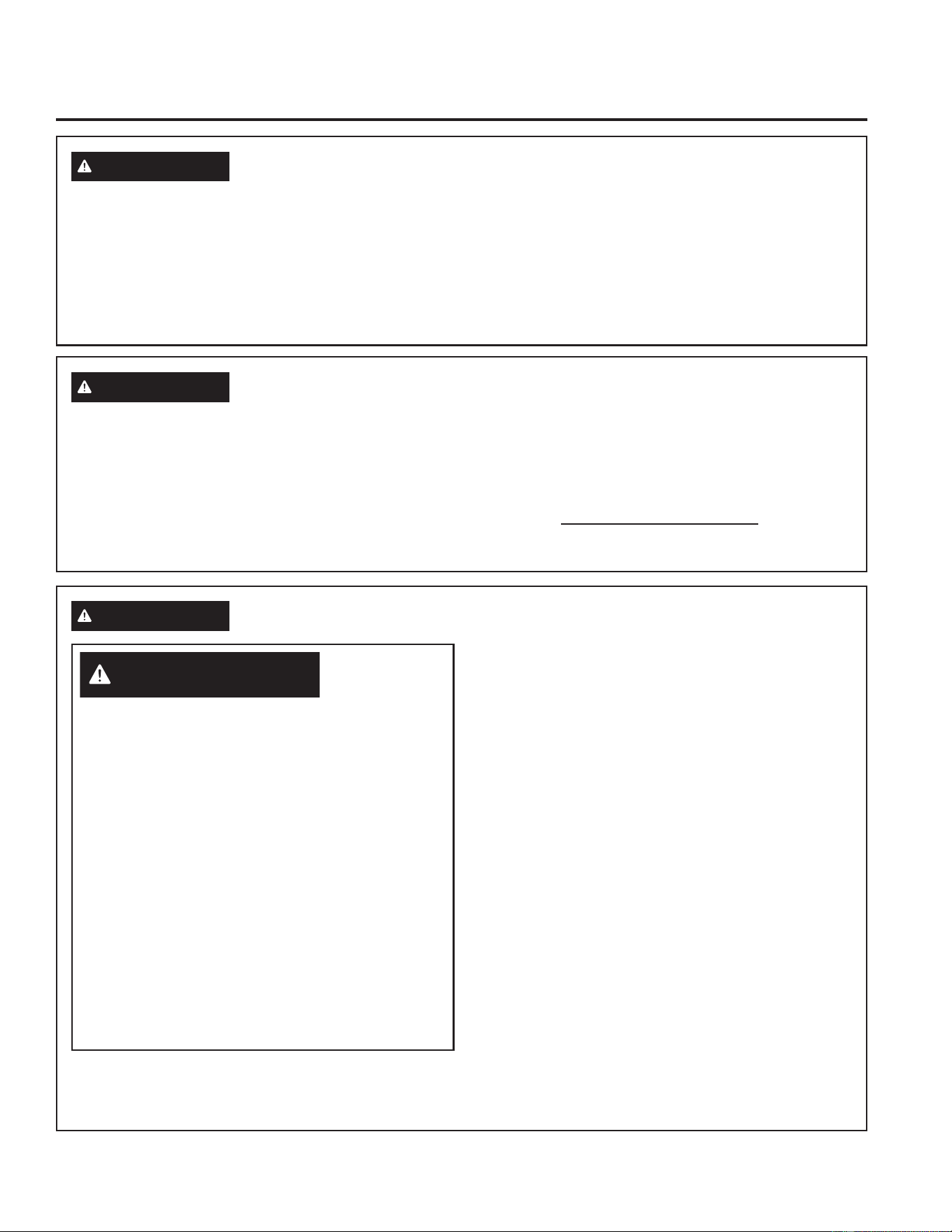
49-2000884 Rev. 2 5
LEA Y GUARDE ESTAS INSTRUCCIONES
INFORMACIÓN DE SEGURIDAD
INFORMACIÓN IMPORTANTE DE SEGURIDAD
LEA TODAS LAS INSTRUCCIONES ANTES DE USAR ESTE ELECTRODOMÉSTICO
ADVERTENCIA
INSTRUCCIONES DE SEGURIDAD DE LA PARTE SUPERIOR DE LA
ESTUFA
ADVERTENCIA
NUNCA
Pierda de Vista la Sección Superior
de la Superficie de Cocción de este
Electrodoméstico.
• No seguir esta advertencia podrá
resultar en incendio, explosión, o
riesgos de quemaduras que podrán
ocasionar daños sobre la propiedad,
lesiones personales o la muerte.
• Si se produce un incendio,
manténgase alejado del
electrodoméstico y de inmediato
llame al departamento de bomberos.
NO INTENTE EXTINGUIR CON AGUA
UN INCENDIO PRODUCIDO CON
COMBUSTIBLE/ GRASA.
Ŷ 1XQFDSLHUGDGHYLVWDORVTXHPDGRUHV/DVFRPLGDV
especialmente las que se preparan con aceite, se pueden
incendiar, lo cual puede ocasionar un incendio que se
propague a los gabinetes próximos.
Ŷ 1XQFDSLHUGDGHYLVWDHODFHLWHFXDQGRHVWpIULHQGR6L
se calienta más allá de su punto de cocción, el aceite
se puede quemar y provocar un incendio que se puede
SURSDJDUDORVJDELQHWHVSUy[LPRV8VHXQWHUPyPHWUR
para grasas profundas siempre que sea posible, a fin de
monitorear la temperatura del aceite.
Ŷ 3DUDHYLWDUGHUUDPHVHLQFHQGLRVXVHXQDFDQWLGDG
mínima de aceite al usar una sartén poco profunda y
evite la cocción de comidas congeladas con cantidades
excesivas de hielo.
Ŷ 8VHHOWDPDxRGHROODDGHFXDGRSDUDHYLWDUTXHVHDQ
inestables o que sufran caídas fácilmente. Seleccione
utensilios que coincidan con el tamaño del quemador. Las
llamas del quemador se deberán ajustar de modo que no
VHH[WLHQGDQPiVDOOiGHODSDUWHLQIHULRUGHODROOD8QD
cantidad excesiva de llama puede representar un riesgo.
Ŷ 6LHPSUHXVHODSRVLFLyQ/,7(DOHQFHQGHUORV
quemadores superiores y asegúrese de que estos se
hayan encendido.
Ŷ $OXVDUXWHQVLOLRVGHYLGULRFHUiPLFDDVHJ~UHVHGHTXH
sean adecuados para el servicio de estufa; otros se podrán
romper debido a un cambio repentino de temperatura.
Ŷ $ILQGHPLQLPL]DUSRVLEOHVTXHPDGXUDVLQFHQGLRGH
materiales inflamables y derrames, la manija de un
envase deberá ser inclinada hacia el centro de la estufa
sin que se extienda sobre los quemadores cercanos.
ADVERTENCIA
MANTENGA LOS MATERIALES INFLAMABLES ALEJADOS DE LA ESTUFA
Si esto no se cumple, se podrán sufrir lesiones personales graves o incendios.
Ŷ 1RJXDUGHQLXVHPDWHULDOHVLQIODPDEOHVHQXQKRUQR
o cerca de la parte superior de la estufa, incluyendo
papel, plástico, sostenedores de ollas, trapos, cobertores
de pared, cortinas, paños y gasolina u otros vapores y
líquidos inflamables.
Ŷ 1XQFDXVHSUHQGDVKROJDGDVRTXHFXHOJXHQPLHQWUDV
usa el electrodoméstico. Evite acumular artículos
comúnmente usados en gabinetes sobre la estufa, y
tenga cuidado al extender la mano sobre la estufa.
La ropa que se encuentre cerca de los quemadores o
superficies calientes se podrá encender, ocasionando
quemaduras graves.
Ŷ 1RSHUPLWDTXHODJUDVDGHODFRFFLyQXRWURVPDWHULDOHV
inflamables se acumulen en o cerca de la estufa. La
grasa del horno o sobre la estufa se podrá incendiar.
ADVERTENCIA
EN CASO DE INCENDIO, SIGA LOS SIGUIENTES PASOS
PARA EVITAR LA PROPAGACIÓN DEL FUEGO
Ŷ 1RXVHDJXDVREUHHOIXHJRGHODJUDVD1XQFDWRPH
una olla que se esté incendiando. Apague los controles.
Extinga la olla que se esté incendiando sobre un
quemador superficial, cubriendo la olla completamente
con su tapa correspondiente, una hoja metálica de
galletas o una bandeja plana. Si es necesario, use un
químico seco multiuso o un extintor de chorro de espuma.
Ŷ 6LKD\XQLQFHQGLRHQHOKRUQRGXUDQWHHOKRUQHDGR
ahogue el fuego cerrando la puerta del horno y apagando
el mismo o usando un químico seco multipropósito o un
extintor de incendio con espuma.
Ŷ (QFDVRGHTXHKD\DIXHJRHQHOKRUQRGXUDQWHHOSHUtRGR
de auto limpieza, apague el horno y espere a que el fuego
se extinga. No fuerce la puerta para abrirla. La entrada de
aire fresco sobre las temperaturas de auto limpieza podrá
conducir a la producción de llamas en el horno.
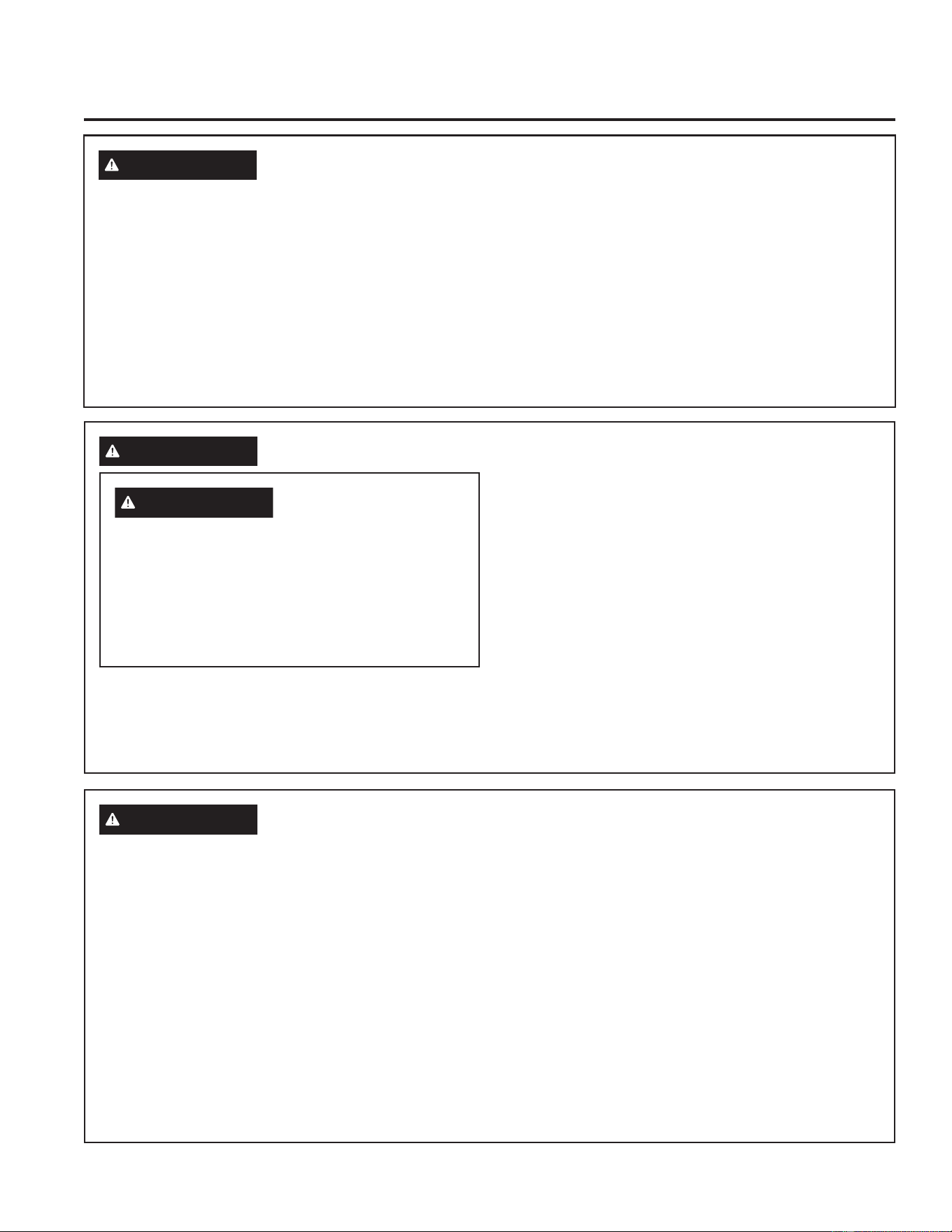
6 49-2000884 Rev. 2
LEA Y GUARDE ESTAS INSTRUCCIONES
INFORMACIÓN DE SEGURIDAD
INFORMACIÓN IMPORTANTE DE SEGURIDAD
LEA TODAS LAS INSTRUCCIONES ANTES DE USAR ESTE ELECTRODOMÉSTICO
ADVERTENCIA
INSTRUCCIONES DE SEGURIDAD DEL HORNO CON FUNCIÓN DE
AUTO LIMPIEZ
La función de auto limpieza usa el horno en temperaturas lo suficientemente altas como para consumir restos de comida
que haya dentro del mismo. Para un funcionamiento seguro, siga estas instrucciones.
Ŷ 1RWRTXHODVVXSHUILFLHVGHOKRUQRGXUDQWHHOFLFORGH
limpieza automática. Mantenga a los niños alejados del
horno durante la limpieza automática. Si no se siguen
estas instrucciones, se podrán producir quemaduras.
Ŷ $QWHVGHXWLOL]DUHOFLFORGHDXWROLPSLH]DUHWLUHODV
ollas, estantes de metal brillante del horno y otros
utensilios que haya dentro del mismo. Sólo se pueden
dejar dentro del horno los estantes para horno con
recubrimiento de porcelana.
Ŷ $QWHVGHXWLOL]DUHOFLFORGHDXWROLPSLH]DOLPSLHODJUDVD
\UHVWRVGHFRPLGDTXHKD\DHQHOKRUQR8QDFDQWLGDG
excesiva de grasa se puede incendiar, lo cual puede
producir daños con humo en su hogar.
Ŷ 6LHOPRGRGHDXWROLPSLH]DIXQFLRQDGHIRUPDLQFRUUHFWD
apague el horno y desconecte el suministro de corriente.
Solicite el servicio de un técnico calificado.
Ŷ 1RXVHOLPSLDGRUHVSDUDKRUQR1RVHGHEHUiXVDU
limpiador para hornos comerciales ni revestimientos de
protección para hornos de ningún tipo en o alrededor de
cualquier parte del horno.
Ŷ 1ROLPSLHODMXQWDGHODSXHUWD/DMXQWDGHODSXHUWDHV
esencial para un buen sellado. Se debe tener cuidado de
no frotar, dañar ni mover la junta.
Ŷ IMPORTANTE: La salud de algunas aves es
extremadamente sensible a los humos emitidos durante
el ciclo de limpieza automática de cualquier estufa.
Coloque las aves en otra habitación bien ventilada.
ADVERTENCIA
INSTRUCCIONES DE SEGURIDAD
ADVERTENCIA
NUNCA cubra ninguna
ranura, agujeros o pasajes en el fondo del horno ni
cubra un estante entero con materiales tales como
papel de aluminio o cobertores de horno. Hacer esto
bloquea el flujo de aire a través del horno y puede
ocasionar envenenamiento con monóxido de carbono.
Nunca coloque papel de aluminio o cobertores de
horno en el fondo del horno. Podrán atrapar el calor,
ocasionando riesgos de humo o incendio.
Ŷ 0DQWpQJDVHDOHMDGRGHODHVWXIDDODEULUODSXHUWDGHO
horno. El aire caliente o el vapor que sale puede causar
TXHPDGXUDVHQODVPDQRVURVWUR\XRMRV
Ŷ 1XQFDFRORTXHORVXWHQVLOLRVGHHVWXIDSLHGUDVSDUD
pizza u horneado o cualquier otro tipo de aluminio
o cobertor en la base del horno. Este ítems pueden
atrapar el calor o derretirse, ocasionando daños sobre el
producto y el riesgo de descargas, humo o incendios.
Ŷ &RORTXHORVHVWDQWHVGHOKRUQRHQODXELFDFLyQ
correspondiente mientras éste se encuentra frío. Si
es necesario retirar el estante mientras el horno se
encuentra caliente, evite tocar las superficies calientes.
Ŷ 1RGHMHSURGXFWRVWDOHVFRPRSDSHOXWHQVLOLRVGHHVWXID
ni comida en el horno cuando no esté en uso. Los
artículos guardados en el horno se pueden incendiar.
Ŷ 1RGHMHQLQJ~QSURGXFWRVREUHODVXSHUILFLHGHFRFFLyQ
cerca de la ventilación del horno. Los artículos se pueden
sobrecalentar, y existe riesgo de incendio o quemaduras.
Ŷ 1XQFDDVHFRQODSXHUWDDELHUWD6HSURKtEHDVDUFRQ
la puerta abierta debido al sobrecalentamiento de las
perillas de control.
ADVERTENCIA
INSTRUCCIONES DE SEGURIDAD DE LA PARTE SUPERIOR DE LA
ESTUFA
Ŷ 3DUDPLQLPL]DUODSRVLELOLGDGGHTXHPDGXUDVHO
encendido de materiales inflamables y los derrames, la
manija de los recipientes deben girarse hacia el centro
de la estufa sin extenderse sobre ninguna unidad de
superficie cercana.
Ŷ 1RXVHXQZRNFRQXQDQLOORFRQVRSRUWHGHPHWDO
redondo. El anillo podrá atrapar calor y bloquear el aire
hacia el quemador, produciendo el riesgo de emisión de
monóxido de carbono.
Ŷ 1RLQWHQWHHOHYDUODHVWXID+DFHUHVWRSRGUtDGDxDU
la tubería de gas hasta los quemadores superficiales,
ocasionando una pérdida de gas y riesgo de incendio.
Ŷ $OLQKDELOLWDUHO%ORTXHRGHO&RQWUROGH*DVDVHJ~UHVH
de que los controles de superficie se encuentren en la
SRVLFLyQ2))$SDJDGR(VWRHYLWDUiTXHKD\DXQIOXMR
de gas no intencional desde los quemadores.
Ŷ 1RXVHSDSHOGHDOXPLQLRSDUDFXEULUUHMLOODV
cualquier parte de la estufa. Si se hace esto se podrá
producir envenenamiento con monóxido de carbono,
sobrecalentamiento de las superficies de la estufa o un
posible riesgo de incendio.

49-2000884 Rev. 2 7
LEA Y GUARDE ESTAS INSTRUCCIONES
INFORMACIÓN IMPORTANTE DE SEGURIDAD
LEA TODAS LAS INSTRUCCIONES ANTES DE USAR ESTE ELECTRODOMÉSTICO
Cómo Retirar la Película Protectora de Envío y la Cinta de Embalaje
Con cuidado tome un extremo de la película protectora
de envío con los dedos y lentamente retire la misma de la
superficie del electrodoméstico. No utilice ningún producto
filoso para retirar la película. Retire toda la película antes de
usar el electrodoméstico por primera vez.
Para asegurar que no haya daños sobre el acabado del
producto, la forma más segura de retirar el adhesivo de la cinta
de embalaje en electrodomésticos nuevos es aplicando un
detergente líquido hogareño para lavar platos. Aplique con una
tela suave y deje que se seque.
NOTA: El adhesivo deberá ser eliminado de todas las partes.
No se puede retirar si se hornea con éste dentro.
Tenga en cuenta las opciones de reciclaje del material de
embalaje de su electrodoméstico.
INFORMACIÓN DE SEGURIDAD
Equipo de Acceso Remoto Instalado
Este dispositivo cumple con la Parte 15 de la Normativa de
la FCC. Su funcionamiento está sujeto a las dos condiciones
VLJXLHQWHV(VWHGLVSRVLWLYRQRSRGUiRFDVLRQDU
LQWHUIHUHQFLDVQRFLYDV\HVWHGLVSRVLWLYRGHEHDFHSWDU
cualquier interferencia recibida, incluyendo interferencias que
puedan ocasionar un funcionamiento no deseado.
El equipo de comunicación inalámbrica instalado en esta
estufa fue probado y cumple con los límites establecidos
SDUDXQGLVSRVLWLYRGLJLWDOGH&ODVH%VHJ~QODSDUWHGHOD
Normativa de la FCC. Estos límites fueron diseñados para:
(a) brindar una protección razonable contra interferencias
nocivas en una instalación residencial. Este equipo genera,
usa y puede emitir energía de radiofrecuencia y, si no se
instala y utiliza de acuerdo con las instrucciones, puede
ocasionar interferencias perjudiciales en las comunicaciones
de radio. Sin embargo, no se garantiza que no se presenten
interferencias en una instalación en particular. Si el equipo
provoca interferencias perjudiciales para la recepción de radio
o televisión, lo cual puede comprobar encendiendo y apagando
el equipo, se aconseja al usuario que intente corregir la
interferencia con una de las siguientes medidas:
Ŷ 5HRULHQWHRUHXELTXHODDQWHQDUHFHSWRUD
Ŷ $XPHQWHODVHSDUDFLyQHQWUHHOHTXLSR\HOUHFHSWRU
Ŷ &RQHFWHHOHTXLSRDXQWRPDFRUULHQWHGHXQFLUFXLWRGLIHUHQWH
del tomacorriente al que se encuentra conectado el receptor.
Ŷ 3DUDVROLFLWDUD\XGDFRQVXOWHFRQHOSURYHHGRUPLQRULVWDRD
XQWpFQLFRH[SHULPHQWDGRGHUDGLR79
(b) tolerar cualquier interferencia recibida, incluyendo las
interferencias que puedan provocar un funcionamiento no
deseado del dispositivo.
Observe que todos los cambios o modificaciones sobre el
dispositivo de comunicación inalámbrico instalado en este
horno que no estén expresamente aprobados por el fabricante
podrían anular la autoridad del usuario para operar el
equipamiento.
FORMA ADECUADA DE DESCARTAR SU ELECTRODOMÉSTICO
Descarte o recicle su electrodoméstico de acuerdo con las Regulaciones Federales y Locales. Comuníquese con las
autoridades locales para descartar o reciclar su electrodoméstico de forma ambientalmente segura.
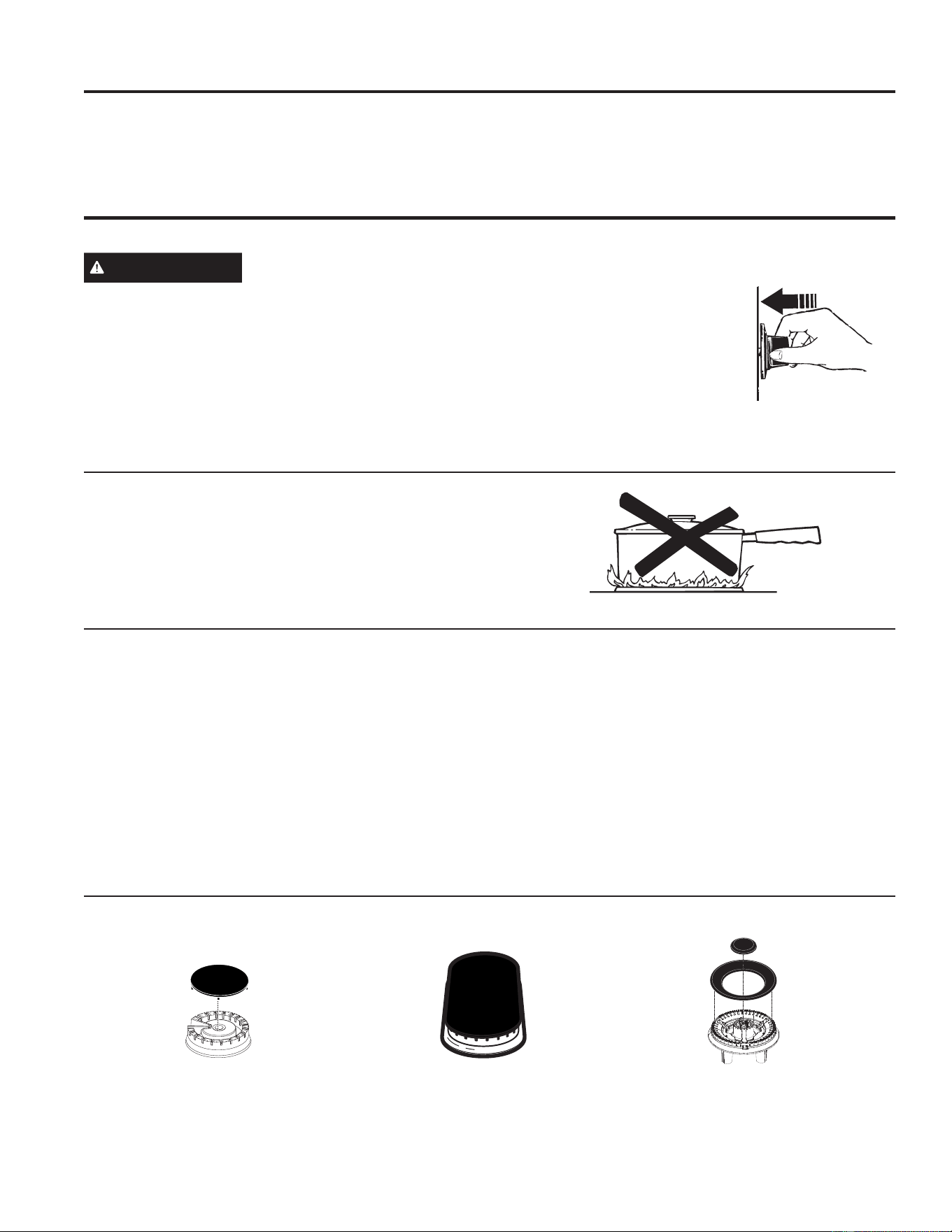
8 49-2000884 Rev. 2
USO DE LA ESTUFA: (Q &DVR GH &RUWH GH &RUULHQWH 4XHPDGRUHV
En Caso de Corte de Corriente
Tipos de Quemadores Superficiales
Quemadores
En el caso de un corte de luz, el horno quedará inoperable y
no se deberá intentar usarlo. Sin embargo, los quemadores
superficiales se podrán encender con un fósforo. Con
extremo cuidado, sostenga un fósforo encendido cerca de los
puertos debajo de la tapa del quemador superficial; luego de
IRUPD OHQWD JLUH OD SHULOOD KDVWD OD SRVLFLyQ /,7( %DMR 8QD
vez encendidos, los quemadores superficiales continuarán
funcionando normalmente.
Iluminación de un Quemador Superficial
ADVERTENCIA
Los quemadores sólo deben ser
usados cuando estén cubiertos por los utensilios. Las
llamas de los quemadores que no estén cubiertas por el
utensilio presentan un riesgo de incendio o incendio de
telas. Nunca permita que las llamas se extiendan más allá
de los costados del utensilio. Si esto no se cumple, se
podrán producir lesiones graves.
Asegúrese de que todos los quemadores estén en sus
ubicaciones correspondientes y que estén totalmente
ensamblados antes de usar cualquiera de estos.
Seleccione un quemador y busque su perilla de control.
Empuje y gire la perilla hasta la
posición LITE.
Escuchará un ruido de clic – el
sonido de la chispa eléctrica que
enciende el quemador. Cuando un
quemador se gire a LITE, todos los
quemadores generarán chispas.
El chispeo continuará mientras la
SHULOOD SHUPDQH]FD HQ /,7( 8QD
vez encendido el gas, gire la perilla
para ajustar el tamaño de la llama.
Uso de los Quemadores
NOTAS:
Ŷ No utilice el quemador durante un período de tiempo
prolongado sin un utensilio de estufa sobre la parrilla. El
acabado de la parrilla se puede resquebrajar si no hay un
utensilio de estufa que absorba el calor.
Ŷ No intente desensamblar un quemador mientras otro
quemador está encendido. Es posible que se produzca una
descarga eléctrica, lo cual podría hacer que vuelque un
utensilio de estufa caliente.
Ŷ Asegúrese de que los quemadores y las parrillas estén
fríos antes de colocar la mano, tomar el mango de una olla,
trapos de limpieza u otros materiales sobre estos.
Su horno cuenta con quemadores de gas sellados que ofrecen
conveniencia, higiene y flexibilidad para una amplia variedad
de aplicaciones de cocción.
(O TXHPDGRU PiV SHTXHxR HV SDUD IXHJR OHQWR 8Q TXHPDGRU
GH IXHJR OHQWR TXH VH FRORTXH HQ /2 %DMR EULQGD XQD
cocción precisa para comidas tales como salsas delicadas que
requieren poco calor durante un tiempo de cocción prolongado.
El quemador extra grande está diseñado para llevar
rápidamente grandes cantidades de líquido a punto de hervor.
Algunos modelos cuentan con una configuración de
32:(5 %2,/ HVSHFLDOPHQWH GLVHxDGD SDUD XVDU FRQ
utensilios de un diámetro de 11 pulgadas o más.
Selección del Tamaño de la Llama
Observe la llama, no la perilla, a medida que reduce el calor.
Cuando se desee calentar de forma rápida, el tamaño de la
llama de un quemador deberá ser equivalente al tamaño del
utensilio de estufa que esté usando. Cuando las llamas sean
más grandes que la parte inferior del utensilio de estufa, no
calentarán el utensilio más rápido y podrían ser riesgosas.
Empuje el mango de
control y gire el mismo
hasta la posición LITE.
Quemador Redondo
8VH HVWH TXHPDGRU SDUD
propósitos de cocción
general. Olla de tamaño
adecuado a las llamas.
Estas llamas son demasiado grandes para la olla.
Quemador Oval
8VH HVWH TXHPDGRU SDUD HVWXIDU HQ OD SODQFKD
4XHPDGRU GH 0~OWLSOHV $QLOORV
8VH HVWH TXHPDGRU SDUD ROODV
grandes o para aplicaciones de
cocción a fuego lento.
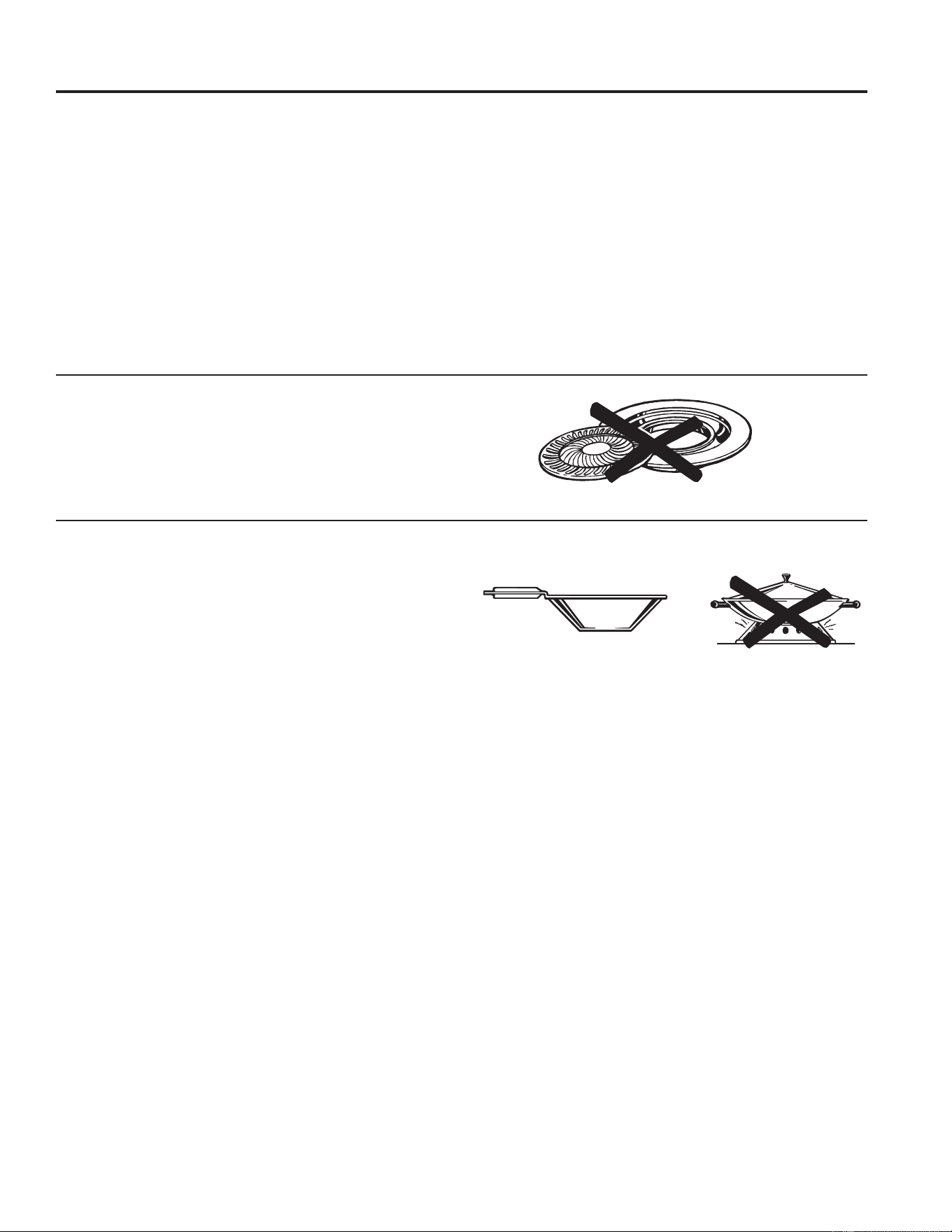
49-2000884 Rev. 2 9
4XHPDGRUHV&RQWLQ~D
Utensilio sobre la Estufa
Aluminio: Se recomienda un utensilio de peso mediano,
ya que calienta de forma rápida y pareja. La mayoría de las
comidas se doran de forma pareja en un sartén de aluminio.
8VHFDFHURODVFRQWDSDKHUPpWLFDFXDQGRFRFLQHFRQ
cantidades mínimas de agua.
Acero Inoxidable: Este metal posee propiedades de
calentamiento limitadas y normalmente se combina con cobre,
aluminio u otros materiales para una mejor distribución del
calor. Los sartenes con combinación de metales normalmente
funcionan de forma satisfactoria si se usan con calor medio,
como lo recomienda el fabricante.
Hierro Forjado: Si cocinará de forma lenta, la mayoría de los
sartenes le darán resultados satisfactorios.
Utensilios de esmalte:%DMRFLHUWDVFRQGLFLRQHVHOHVPDOWH
de algunos utensilios de estufa se pueden derretir. Siga las
recomendaciones sobre métodos de cocción del fabricante de
utensilios de estufa.
Vidrio: Existen dos tipos de utensilios de estufa de vidrio –
aquellos para uso con el horno únicamente y aquellos para
ODFRFFLyQHQODSDUWHVXSHULRUGHODHVWXIDFDFHURODVFDIp\
WHWHUDV/RVFRQGXFWRUHVGHYLGULRFDOLHQWDQGHIRUPDPX\OHQWD
Cerámica de Vidrio Resistente al Calor: Se pueden usar para
cualquier superficie o para cocción en el horno. Conduce el calor
de forma muy lenta y se enfría de forma muy rápida. Consulte
las instrucciones del fabricante de utensilios de estufa para saber
con seguridad si se puede usar con estufas a gas.
Parrillas para la Parte Superior de la Estufa
No use cualquier repuesto de rejilla para la parte superior de
la estufa con sus quemadores de gas, ya que realizará una
combustión incompleta, generando niveles de monóxido de
carbono superiores a los estándares permitidos. Esto puede
ser peligroso para su salud.
Cómo Usar un Wok
8VHVyORZRNVFRQEDVHSODQDGHXQGLiPHWURGHSXOJDGDV
RPHQRV$VHJ~UHVHGHTXHHOIRQGRGHOZRNVHDSR\HGH
forma plana sobre la rejilla.
1RXVHXQDQLOORGHVRSRUWHSDUDZRN&RORFDUHODQLOORVREUH
el quemador o parrilla podrá hacer que el quemador funcione
de forma inadecuada, produciendo niveles de monóxido de
carbono que superan los estándares permitidos. Esto puede
ser peligroso para su salud.
8VHXQZRNFRQIRQGRSODQR
No use rejillas para la parte superior de la estufa.
USO DE LA ESTUFA: 4XHPDGRUHV
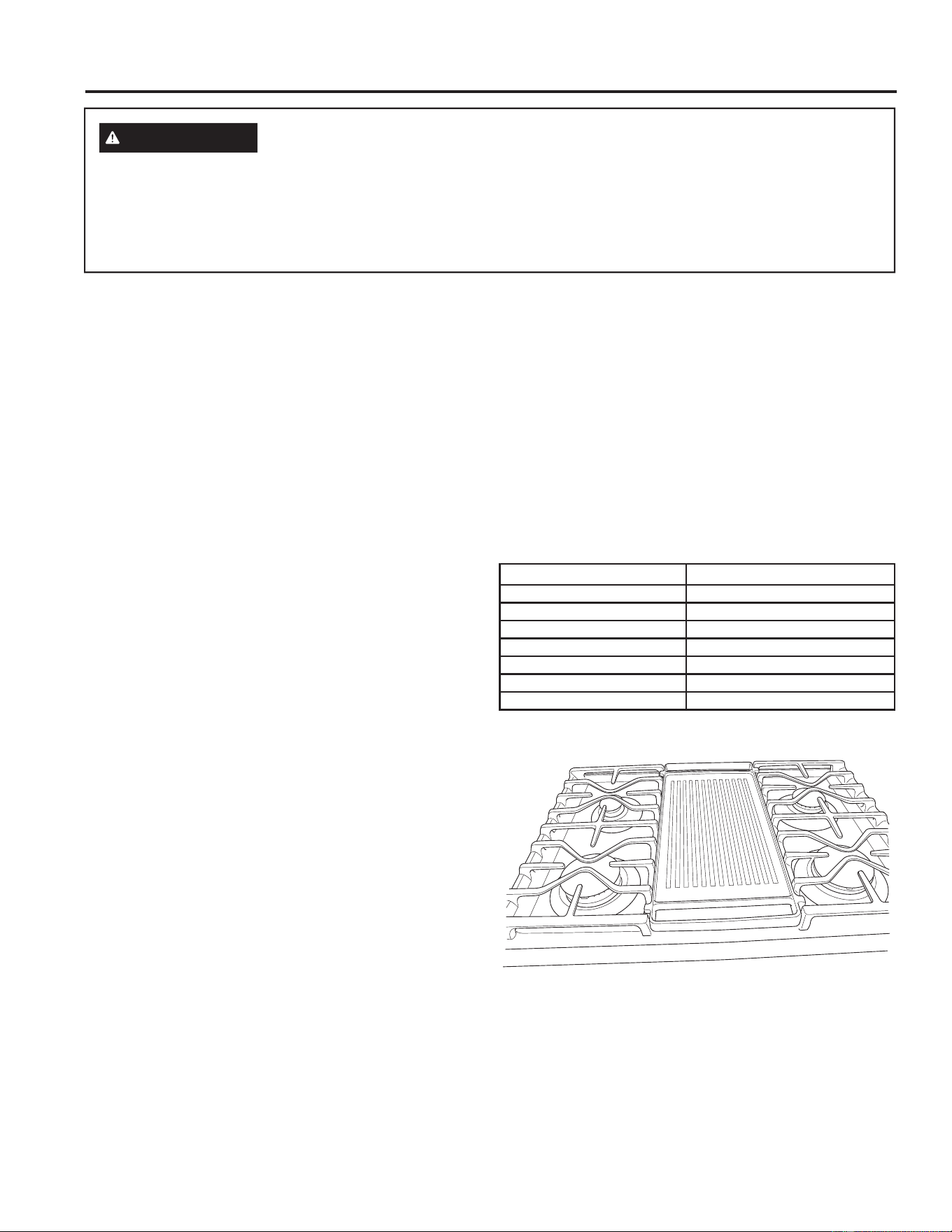
10 49-2000884 Rev. 2
USO DE LA ESTUFA: Plancha
Plancha
Posicionamiento de la Plancha
La plancha de hierro forjado reversible sólo pueden ser usadas sobre el quemador central de la parte superior de la estufa. Para
SRVLFLRQDU OD SODQFKD UHWLUH OD UHMLOOD FHQWUDO VL HVWi SUHVHQWH \ UHHPSODFH OD PLVPD SRU OD SODQFKD 1R HQFLHQGD HO TXHPDGRU
central hasta que esté seguro de que la plancha se posicionó correctamente.
Precalentamiento de la Plancha
6L HO TXHPDGRU FHQWUDO HV XQ TXHPDGRU RYDO VLPSOH SUHFDOLHQWH OD SODQFKD HQWUH \ PLQXWRV HQ +L $OWR DQWHV GH FRORFDU OD
comida sobre la plancha. Si el quemador central es un quemador oval dual, precaliente la plancha entre 5 y 10 minutos en Hi
$OWR DQWHV GH FRORFDU OD FRPLGD VREUH OD SODQFKD 8QD YH] SUHFDOHQWDGD OD SODQFKD EDMH HO FDORU D OD FRQILJXUDFLyQ GH FRFFLyQ
indicada en la tabla correspondiente a su plancha. A fin de determinar qué tipo de quemador posee, consulte la sección de Tipos
GH 4XHPDGRUHV
Uso de la Plancha de Hierro Fundido Reversible
El lado acanalado de la plancha reversible puede ser usado
para comidas normalmente cocinadas a la plancha.
Su plancha le brinda una superficie de cocción extra grande
para carnes, panqueques y otras comidas normalmente
preparadas en una sartén. Antes del primer uso, enjuague la
misma con agua caliente y séquela completamente. Prepare la
superficie con espray de estufa o aceite vegetal.
Precauciones de la Plancha:
Ŷ 1R FRORTXH OD SODQFKD HQ XQ KRUQR PLFURRQGDV
Ŷ 1R ODYH OD SODQFKD HQ HO ODYDYDMLOODV
Ŷ 6L DOJR VH GHUUDPy GHEDMR GH OD SODQFKD VH GHEHUi OLPSLDU
tan pronto como sea posible para evitar la suciedad de la
comida “horneada”.
Ŷ 1R SHUPLWD TXH VH DFXPXOH JUDVD GHEDMR GH OD SODQFKD \D
que puede haber riesgo de incendio. Limpie debajo de la
plancha con agua caliente y jabón en cuanto esté fría.
ADVERTENCIA
Riesgo de Incendio
Ŷ 7HQJD FXLGDGR DO FRFLQDU FRPLGDV FRQ JUDVD /D JUDVD HVSDUFLGD SXHGH SURYRFDU XQ LQFHQGLR
Ŷ 1XQFD FRORTXH QL JXDUGH XQ DUWtFXOR HQ OD SODQFKD LQFOXVR FXDQGR QR HVWp HQ XVR (O FDORU GH ORV GHPiV
quemadores puede calentar la plancha y provocar un incendio.
Ŷ &RORTXH \ UHWLUH OD SODQFKD VyOR FXDQGR WRGDV ODV SDUULOODV \ OD SODQFKD HVWpQ IUtDV \ WRGDV ODV XQLGDGHV
superficiales estén en OFF (Apagado).
Es posible que sea necesario ajustar las configuraciones de la plancha
si se usará por un período prolongado.
Plancha Precurada de Hierro Fundido Reversible
5HHPSODFH OD UHMLOOD VL HVWi SUHVHQWH FHQWUDO SRU OD 3ODQFKD
Precurada de Hierro Fundido Reversible
Tipo de Comida Configuración de Cocción
Panceta Med
Embutidos para el Desayuno Med
Huevos %DMR /R
4XHVR D OD 3ODQFKD 0HG%DMR 0HG/R
Hamburguesas 0HG%DMR 0HG/R
Panqueques 0HG%DMR 0HG/R
Cómo Calentar Tortillas %DMR /R
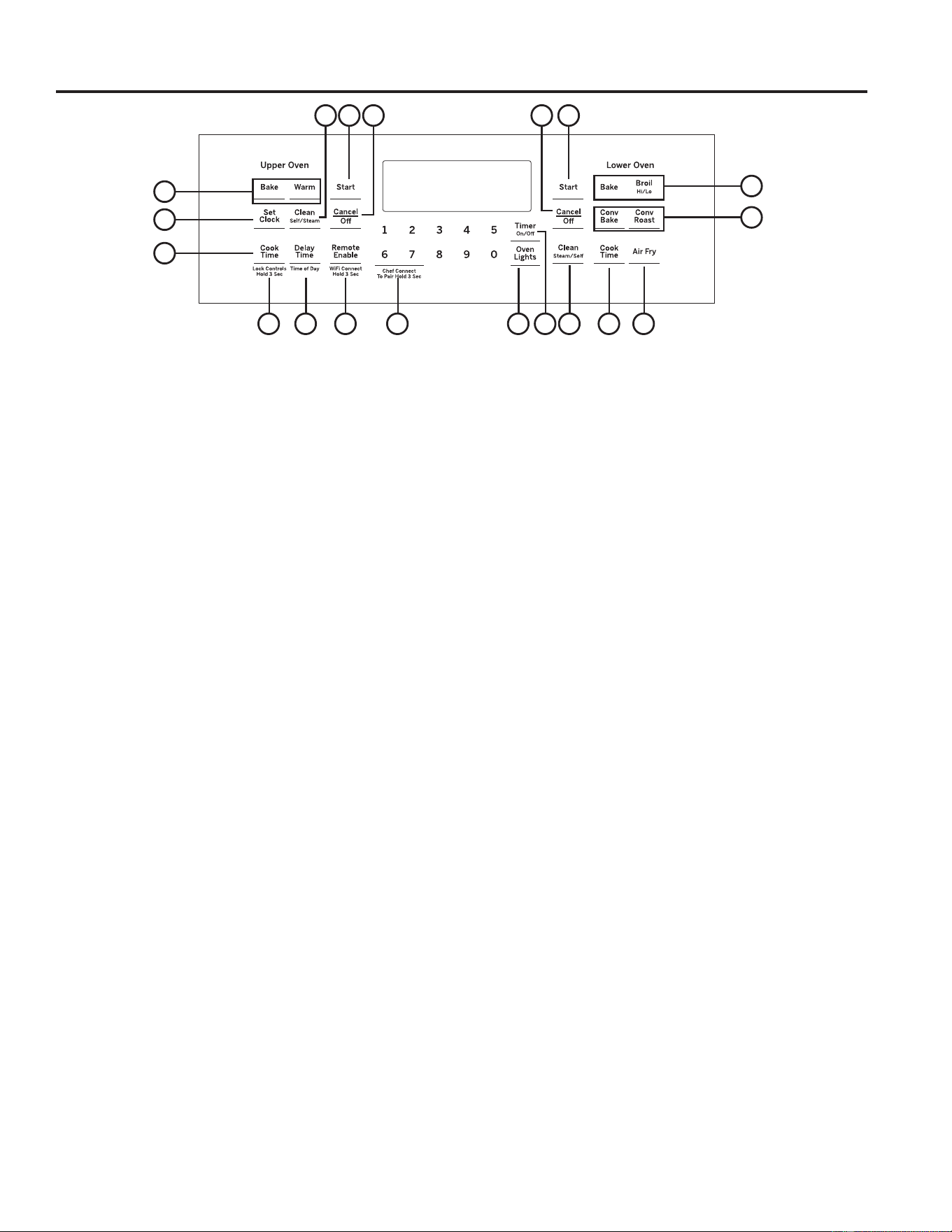
49-2000884 Rev. 2 11
Controles del Horno
1. Traditional Cooking Modes (Modos de Cocción
Tradicionales): Su horno cuenta con los siguientes
PRGRVGHFRFFLyQWUDGLFLRQDOHV%DNH+RUQHDU%URLO
$VDUDQG:DUP&DOHQWDU3DUDPiVLQIRUPDFLyQ
consulte la sección de Modos de Cocción al Horno.
2. Convection Cooking Modes (Modos de Cocción por
Convección): Los modos de cocción por convección
utilizan una circulación de aire incrementada para mejorar
el rendimiento. Para más información, consulte la sección
de Modos de Cocción al Horno.
3. Clean (Limpieza): El horno cuenta con dos modos de
OLPSLH]D6HOI&OHDQ/LPSLH]D$XWRPiWLFD\6WHDP
&OHDQ/LPSLH]DFRQ9DSRU3DUDDFFHGHUDLQIRUPDFLyQ
importante sobre el uso de estos modos, consulte la
sección de Limpieza del Horno.
4. Start (Iniciar/ Ingresar): Se deberá presionar para
comenzar cualquier función de cocción, limpieza o por
tiempo. NOTA: Si la pantalla y las teclas se atenúan, abrir
la puerta del horno o presionar cualquier tecla activarán e
iluminarán el control.
5. Cancel/Off (Cancelar/ Apagar): Cancela TODAS las
funciones del horno, excepto el relo y, el temporizador.
6. Timer (Temporizador): Funciona como un temporizador
con cuenta regresiva. Presione la tecla Timer
(Temporizador) y utilice las teclas numéricas para
programar el tiempo en horas y minutos. Presione la tecla
Start (Iniciar/ Ingresar). El horno continuará funcionando
cuando la cuenta regresiva del temporizador se haya
completado. Para apagar el temporizador, presione la
tecla Timer (Temporizador).
7. Tiempo de Cocción: Cuenta el tiempo de cocción en
forma regresiva y apaga el horno cuando el tiempo de
cocción es completado. Seleccione un modo de cocción
GHVHDGR8VHODVWHFODVQXPpULFDVSDUDSURJUDPDUXQD
temperatura de horneado. Presione la tecla Cook Time
(Tiempo de Cocción) y utilice las teclas numéricas para
programar un tiempo de cocción en horas y minutos.
Luego presione Start (Iniciar). Esto sólo puede ser usado
con las funciones Bake (Hornear), Convection Bake
(Hornear por Convección), Convection Roast (Dorar
por Convección), y Air Fry (Freír con Aire).
8. Delay Time (Tiempo de Retraso): Genera un retraso
FXDQGRHOKRUQRHVHQFHQGLGR8VHHVWDWHFODSDUD
configurar el momento en que desee que el horno se
LQLFLH6HOHFFLRQHXQPRGRGHFRFFLyQGHVHDGR8VH
la tecla numérica para programar una temperatura de
horneado. Presione la tecla Delay Time7LHPSRGH
5HWUDVR8VHODVWHFODVQXPpULFDVSDUDSURJUDPDUOD
hora del día en que desee que el horno se encienda, y
luego presione Start,QLFLDU,QJUHVDU
NOTA: $OXVDUODIXQFLyQ'HOD\7LPH7LHPSR
GH5HWUDVRODVFRPLGDVTXHVHHFKDQDSHUGHU
rápidamente, tales como leche, huevo, pescado, rellenos,
ave y cerdo, no se deberán dejar reposar por más de
1 hora antes o después de la cocción. La temperatura
ambiente estimula el desarrollo de bacterias nocivas.
Asegúrese de que la luz del horno esté apagada, ya
que el calor de la lámpara acelerará el crecimiento de
bacterias nocivas
9. Lock Controls (Controles de Bloqueo) : %ORTXHDQHO
control de modo que al presionar las teclas no se activen
los controles. Mantenga presionada la tecla Lock Controls
(Controles de Bloqueo) durante tres segundos para
bloquear o desbloquear el control. Cancel/Off (Cancelar/
Apagar) siempre está activa, incluso cuando el control está
bloqueado.
10. Oven Lights (Luzes del Horno) : Enciende o apaga la
OX]HVGHOKRUQR
11. Freír con Aire: (OPRGR$LU)U\)UHtUFRQ$LUHIXH
diseñado para producir comidas con un exterior más
crocante que en la cocción de horno tradicional. Para
más información, consulte la sección de Modos de
Cocción en Horno
12. Configuración del Reloj: Configure del tiempo del reloj
del horno. Presione la tecla Set Clock (Configurar
Reloj)8VHODVWHFODVQXPpULFDVSDUDSURJUDPDUHOUHORM
Presione Start (Iniciar) para guardar la configuración de
la hora.
13. Remote Enable (Acceso Remoto): Le permite
controlar el horno de forma remota. Para poder iniciar
el horno de forma remota, presione la tecla Remote
(QDEOH$FFHVR5HPRWR\³5HPRWH´5HPRWRVH
encenderá en la pantalla. El horno puede ser iniciado
ahora en forma remota con un dispositivo conectado.
Este electrodoméstico permite su configuración para
un funcionamiento remoto en cualquier momento. No
guarde ningún material inflamable o ítems sensibles a la
temperatura dentro, sobre o cerca de las unidades de la
VXSHUILFLHGHOHOHFWURGRPpVWLFR6L³5HPRWH´5HPRWR
no aparece en la pantalla, usted aún puede cambiar las
configuraciones del horno o apagar el horno. Luego de
usar el horno, recuerde verificar que el ícono “Remote”
5HPRWRVHDPRVWUDGRVLGHVHDLQLFLDUHOKRUQRGH
forma remota en el futuro. Para acceder a instrucciones
sobre cómo conectar el horno, consulte la sección de
Conexión WiFi de este manual.
14. Chef Connect:
Ésta es una función de emparejamiento
%OXHWRRWK
®
para uso con otros productos autorizados de
Chef Connect tales como microondas sobre la estufa o la
campana de la estufa. Para emparejar estos productos con
la estufa, mantenga presionada la tecla 6 y 7 durante 3
segundos y siga las instrucciones correspondientes incluidas
con el producto emparejado autorizado por Chef Connect,
si es necesario. La estufa cancelara el modo de
emparejamiento luego de dos minutos si ningún dispositivo
de emparejamiento es detectado.
USO DE LA ESTUFA: Controles del Horno
1
12
7
345 45
39 8 13 14 11710 6
1
2
12 49-2000884 Rev. 2
* Se requiere el uso de dispositivos y de una red WiFi hogareña que sean compatibles con Apple o Android.
Su horno de está diseñado para brindarle una comunicación
recíproca entre su electrodoméstico y dispositivos inteligentes.
Mediante el uso de las funciones WiFi Connect, usted podrá
controlar funciones esenciales de su horno tales como las
configuraciones de temperatura, temporizadores y modos de
cocción, utilizando su teléfono inteligente o tableta*.
Seleccione las Settings (Configuraciones) y luego WiFi – siga
las instrucciones de la pantalla de su horno y de la aplicación
de su teléfono. Es necesario activar la función WiFi antes de
XVDU6PUW+4$SSHQVXKRUQR
Conexión de su Horno con Opción de WiFi Connect
Qué necesitará
Su horno de GE Appliances utiliza su red de WiFi
hogareña existente para realizar la comunicación entre el
electrodoméstico y su dispositivo inteligente. A fin de configurar
su horno de GE Appliances, usted necesitará reunir cierta
información:
1. Cada horno de GE Appliances cuenta con una etiqueta
informativa del electrodoméstico conectado, que incluye
un Nombre y Contraseña de Red del Electrodoméstico.
Estos son los dos detalles importantes que necesitará para
conectar el electrodoméstico. La etiqueta está ubicada
normalmente dentro de la puerta del horno o en el cajón.
En algunos casos, usted podrá encontrar la etiqueta de
especificaciones técnicas sobre una placa metálica detrás
del panel de control trasero. Desde el frente de la estufa,
alcance la parte intermedia del panel de control trasero y
gire la etiqueta de especificaciones técnicas hacia arriba.
2. Su teléfono inteligente o tableta deben estar preparados
con la capacidad de acceder a Internet y descargar
aplicaciones.
8VWHGGHEHUiFRQRFHUODFRQWUDVHxDGHOHQUXWDGRU:L)LGH
su hogar. Tenga esta contraseña a mano al configurar el
horno de GE Appliances.
Conexión de su horno de GE Appliances
1. A través de su teléfono inteligente o tableta, visite
GEAppliances.com/connect para aprender más sobre las
funciones del electrodoméstico conectado y para descargar
OD6PUW+4$SS
2. Siga las instrucciones en pantalla de la aplicación para
conectar su horno de GE Appliances.
8QDYH]TXHHOSURFHVRVHKD\DFRPSOHWDGRODOX]
de conexión ubicada en la pantalla de su horno GE
Appliances, permanecerá en sólido y la aplicación
confirmará que usted está conectado.
4. Si la luz de conexión no se enciende o está titilando, siga
las instrucciones en la aplicación para volver a realizar
la conexión. Si los problemas continúan, comuníquese al
&RQQHFWHG&DOO&HQWHU&HQWURGH&RQH[LyQGH/ODPDGDV
al 1.800.220.6899 y solicite asistencia en relación a la
conectividad inalámbrica del horno.
Para conectar dispositivos inteligentes adicionales, repita los
pasos 1 y 2.
Observe que todos los cambios o modificaciones al dispositivo
de acceso remoto instalado en este horno que no están
expresamente aprobados por el fabricante podrían anular la
autoridad del usuario para operar el equipamiento.
INICIO DEL HORNO EN FORMA REMOTA
Para poder iniciar el horno de forma remota una vez conectado
a WiFi, asegúrese de que el ícono icon se encuentre
visible en la pantalla. El horno puede ser iniciado ahora de
forma remota con un dispositivo conectado. Abrir una puerta
del horno o apagar el horno hará que se apague el ícono
. El ícono deberá estar iluminado para iniciar el horno de
forma remota. No se requiere el ícono para modificar la
temperatura del horno mientras esté funcionando, configurar
un temporizador o apagar el horno desde la aplicación del
teléfono mientras el ícono muestre que está Conectado a
WiFi.
Luego de usar el horno, recuerde verificar que el ícono esté
iluminado, si desea iniciar el horno de forma remota en el futuro.
NOTA: Las comidas que se echan a perder rápidamente,
tales como leche, huevos, pescado, rellenos, ave y cerdo, no
se deberán dejar reposar por más de 1 hora antes y después
de la cocción. La temperatura ambiente estimula el desarrollo
de bacterias nocivas. Asegúrese de que la luz del horno esté
apagada, ya que el calor de la lámpara acelerará el crecimiento
de bacterias nocivas.
FCC: ZKJ-WCATA001
Network: GE_XXXXXX_XXXX
Password: XXXXXXXX
PT. NO. 229C6272G001-0
IC: 10229A-WCATA001
MAC ID: XX - XX - XX - XX - XX - XX
Connected Appliance Information
Ejemplo de Etiqueta
Conexión WiFi
USO DE LA ESTUFA: Conexión WiFi
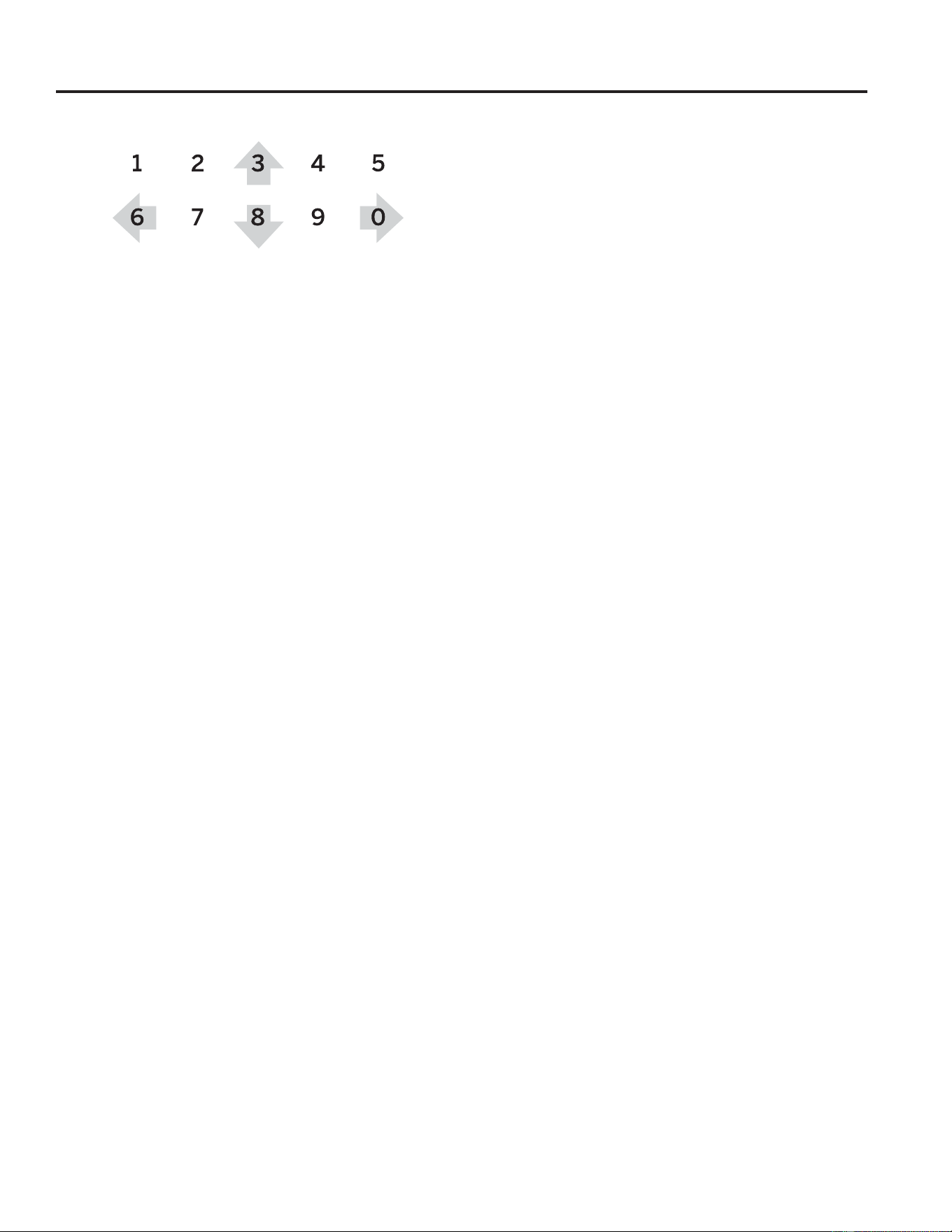
49-2000884 Rev. 2 13
Funciones Especiales
Su estufa cuenta con varias funciones especiales diferentes. Para modificar las configuraciones de estas funciones especiales:
Ŷ 0DQWHQJD SUHVLRQDGDV ODV WHFODV Upper Oven Bake (Hornear en Horno Alto) y Warm (Calentar) al mismo tiempo hasta que
se exhiba el menú de funciones especiales.
Ŷ 8VH ODV WHFODV QXPpULFDV 3 o 8 para alternar entre las funciones especiales, hasta que la función deseada sea exhibida.
Ŷ 3UHVLRQH OD WHFOD Q~PHUR SDUD LQJUHVDU DO PHQ~ GH IXQFLRQHV \ XVH ODV WHFODV Q~PHUR X SDUD DOWHUQDU HQWUH ODV RSFLRQHV
Ŷ 8QD YH] H[KLELGD OD RSFLyQ GHVHDGD SUHVLRQHV OD WHFOD 0 para guardar la configuración y la tecla 6 para salir del menú.
Ajuste de la Temperatura del Horno
Esta función permite que la temperatura de horneado del
horno sea ajustada hasta 35
º
más caliente o 35
º
PiV IUtD 8VH
esta función si piensa que la temperatura de su horno está
demasiado caliente o demasiado fría y desea modificarla. Este
ajuste afecta cada modo de cocción excepto el de asar.
Ingrese en el menú de funciones especiales, como se detalla
más arriba. Pase a través de las funciones hasta que se
H[KLED ³/R RIIVHW´ &RPSHQVDFLyQ %DMD D ILQ GH DMXVWDU OD
WHPSHUDWXUD GHO KRUQR EDMR R KDVWD TXH VH H[KLED ³8S RIIVHW´
&RPSHQVDFLyQ $OWD D ILQ GH DMXVWDU OD WHPSHUDWXUD GHO KRUQR
alto, y luego presione 0
. 8VH OD WHFOD 3 para incrementar
la temperatura ajustada o use la tecla 8 para reducir la
temperatura ajustada. Guarde y salga del menú de funciones
especiales.
Sonido de Finalización del Temporizador
Se trata de un tono que indica la finalización de un
WHPSRUL]DGRU (O WRQR SXHGH VHU FRQWLQXR &RQW R VLPSOH
E((S /D FRQILJXUDFLyQ FRQWLQXD &RQW KDUi VRQDU GH IRUPD
repetida un tono cada pocos segundos, hasta que el botón
GHO FRQWURO VHD SUHVLRQDGR 8QD FRQILJXUDFLyQ VLPSOH E((S
hará sonar sólo un tono simple cuando el temporizador finalice.
Ingrese en el menú de funciones especiales, como se detalla
más arriba. Alterne entre las opciones hasta que la función “End
Tone” sea exhibida y presione 0. Alterne entre las opciones
hasta que la configuración deseada sea exhibida. Presione 0
para guardar la configuración y luego 6 para salir del menú.
Selección de Temperatura Fahrenheit o
Celsius
El control del horno está configurado para su uso con
WHPSHUDWXUDV )DKUHQKHLW ) SHUR OR SXHGH PRGLILFDU D
WHPSHUDWXUDV &HOVLXV & 3UHVLRQH ODV WHFODV Broil (Asar)
y Cook Time (Tiempo de Cocción) al mismo tiempo para
visualizar la configuración actual; presione nuevamente
para modificar la configuración. Ingrese en el menú de
funciones especiales, como se detalla más arriba. Alterne
HQWUH ODV RSFLRQHV KDVWD TXH OD IXQFLyQ ³GHJ 8QLW´ VHD
exhibida y presione 0. Alterne entre las opciones hasta que la
configuración deseada sea exhibida. Presione 0 para guardar
la configuración y luego 6 para salir del menú.
Pantalla del Reloj
(VWD )XQFLyQ (QFHQGHU $SDJDU HVSHFLILFD VL OD KRUD GHO
día es exhibida. Ingrese en el menú de funciones especiales,
como se detalla más arriba. Alterne entre las opciones hasta
que la función “Cloc diSP” sea exhibida y presione 0. Alterne
entre las opciones hasta que la configuración deseada sea
exhibida. Presione 0 para guardar la configuración y luego 6
para salir del menú.
Configuración del Reloj
Esta función especifica cómo se exhibirá la hora del día. Puede
VHOHFFLRQDU HO UHORM HVWiQGDU GH KRUDV R HO UHORM PLOLWDU
de 24 horas. Ingrese en el menú de funciones especiales,
como se detalla más arriba. Alterne entre las opciones hasta
que la función “Cloc cFg” sea exhibida y presione 0. Alterne
entre las opciones hasta que la configuración deseada sea
exhibida. Presione 0 para guardar la configuración y luego 6
para salir del menú.
Volumen del Sonido
Esta función permite que el volumen del tono del horno sea
DMXVWDGR HQWUH DOWR +L PHGLR UHJ SRU RPLVLyQ EDMR /R R
DSDJDGR R)) Ingrese en el menú de funciones especiales,
como se detalla más arriba. Alterne entre las opciones hasta
que la función “sound” sea exhibida y presione 0. Alterne entre
las opciones hasta que la configuración deseada sea exhibida.
Presione 0 para guardar la configuración y luego 6 para salir
del menú. La opción de sonido seleccionada sonará una vez
cuando 0 sea presionado.
Conversión de Auto Recipe
(VWD IXQFLyQ (QFHQGHU $SDJDU GH IRUPD DXWRPiWLFD DMXVWD OD
temperatura programada de la receta en el modo Convection
0XOWL%DNH +RUQHDGR 0~OWLSOH SRU &RQYHFFLyQ Ingrese en el
menú de funciones especiales, como se detalla más arriba.
Alterne entre las opciones hasta que la función “Auto rEciPE”
5HFHWD $XWRPiWLFD VHD PRVWUDGD Alterne entre las opciones
hasta que la configuración deseada sea exhibida. Presione 0
para guardar la configuración y luego 6 para salir del menú.
NOTA: Esta opción no convierte el tiempo de horneado; sólo
las temperaturas. Esta opción no ajusta las temperatura del
PRGR &RQYHFWLRQ 5RDVW 'RUDU SRU &RQYHFFLyQ
&DQFHO%DFN &DQFHODU $WUiV 8S $UULED 'RZQ $EDMR
6DYH)RUZDUG *XDUGDU $GHODQWH
USO DE LA ESTUFA: Funciones Especiales
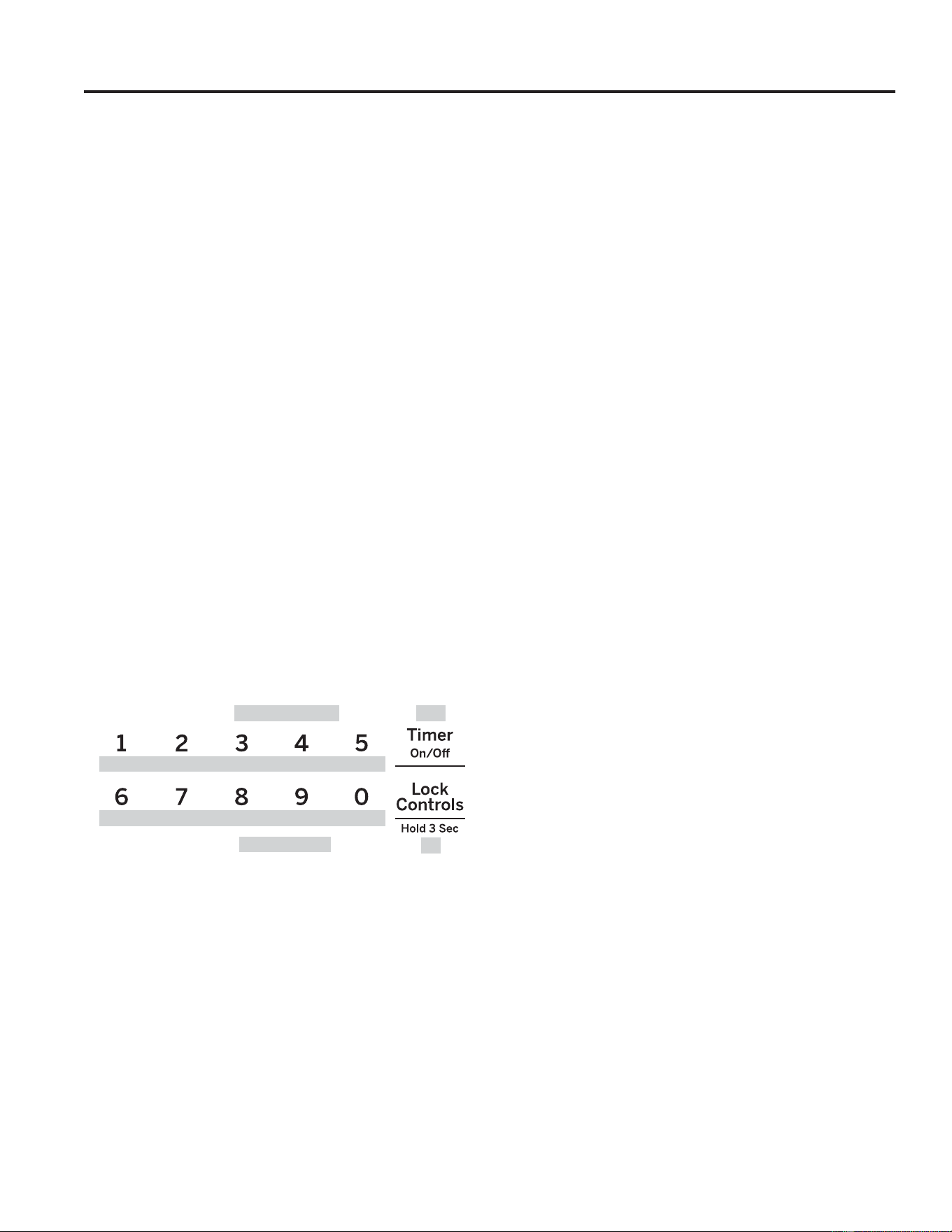
14 49-2000884 Rev. 2
(VWD HVWXID RIUHFH XQ PRGR 6DEEDWK 6DEiWLFR HVWiQGDU $OJXQDV GH ODV IXQFLRQHV GHO PRGR 6DEEDWK 6DEiWLFR REVHUYDGDV
por el consumidor incluirán la desactivación de tonos, desactivación de las luces del horno, y retrasos de hasta 30 segundos
hasta un minuto entre una solicitud de cambio de temperatura y su implementación. Sólo el horneado continuo y el horneado
por tiempo están permitidos en el modo sabático. La cocción en el modo sabático es un proceso de dos pasos; primero el
modo sabático debe ser configurado y luego el modo hornear debe ser configurado. En los hornos dobles, cada horno se podrá
configurar de forma independiente usando la tecla de horneado superior o inferior correspondiente.
Configuración del Modo Sabático
0DQWHQJD SUHVLRQDGDV ODV WHFODV 8pper Oven Bake
(Hornear en Horno Alto) y Warm (Calentar) al mismo
tiempo hasta que se exhiba el menú de funciones
especiales.
8VH ODV WHFODV QXPpULFDV 3 u 8 para pasar a través de las
funciones especiales, hasta que “SAbbAth” sea exhibido
y luego presione 0. Consulte el gráfico en la sección de
Funciones Especiales para ver cómo las teclas numéricas
están mapeadas.
8VH ODV WHFODV QXPpULFDV 3 u 8 para pasar a través de
ODV RSFLRQHV KDVWD TXH DSDUH]FD ³RQ´ HQFHQGHU HQ OD
pantalla; luego presione la tecla numérica 0 para guardar la
configuración. Presione 6 para salir del menu de Funciones
(VSHFLDOHV 8Q VROR FRUFKHWH ³@´ DSDUHFHUi HQ OD SDQWDOOD
indicando que el modo sabático fue configurado. El reloj no
aparecerá. El horneado continuo o el horneado por tiempo
no pueden ser configurados.
Inicio del Horneado Continuo
1. Presione la tecla Bake (Hornear).
2. Si la temperatura deseada es 350ºF, presione Start
(Iniciar). Si se desea una temperatura de cocción diferente,
use las teclas numéricas de 1 a 5 o la tecla Timer
(Temporizador) para seleccionar una temperatura de
cocción predeterminada, y luego presione Start (Iniciar).
Consulte el siguiente gráfico para determinar qué tecla
configura la temperatura de cocción deseada.
/XHJR GH XQD GHPRUD XQ VHJXQGR FRUFKHWH ³@ >³ DSDUHFHUi HQ
la pantalla, indicando que el horno está horneando.
Ajuste de Temperatura
1. Presione Bake (Hornear), use las teclas numéricas de 1
a 5 y la tecla Timer (Temporizador) para seleccionar una
temperatura de cocción actual diferente, y presione Start
(Iniciar).
2. Debido a que no hay ninguna indicación durante el cambio
de temperatura, se puede usar un termómetro para horno
para confirmar los cambios de temperatura.
Inicie un Horneado por Tiempo
1. Presione la tecla Bake (Hornear).
2. Si la temperatura deseada es de 350ºF, use las teclas
numéricas de 6 a 0 o la tecla Lock Control (Control
de Bloqueo) para seleccionar un tiempo de cocción.
Si se desea una temperatura de cocción diferente a
350ºF, use las teclas numéricas de 1 a 5 o la tecla Timer
(Temporizador) para seleccionar una temperatura de
cocción predeterminada, y luego seleccione el tiempo
de cocción. Consulte el gráfico en esta página para
determinar qué tecla configura la temperatura de cocción
deseada y el tiempo de cocción.
3. Presione Start (Iniciar).
/XHJR GH XQD GHPRUD XQ VHJXQGR FRUFKHWH ³@ >³ DSDUHFHUi
en la pantalla, indicando que el horno está horneando.
Cuando el tiempo de cocción finalice, la pantalla volverá a
FDPELDU D XQ VROR FRUFKHWH ³@´ LQGLFDQGR TXH HO KRUQR \D QR
está horneando. No sonará ningún tono cuando el tiempo de
cocción se haya completado.
Salir del Modo Sabático
Sólo se deberá salir del modo sabático una vez finalizado el
mismo.
1. Presione Cancel/Off (Cancelar/ Apagar) para finalizar
cualquier ciclo de horneado que pueda estar funcionando.
2. Presione las teclas Bake (Hornear) y Warm (Calentar)
al mismo tiempo y espere a que el menú de Funciones
Especiales sea exhibido.
8VH ODV WHFODV QXPpULFDV 3 u 8 para pasar a través de las
IXQFLRQHV HVSHFLDOHV KDVWD TXH ³6$EE$WK´ 6DEiWLFR VHD
exhibido, y luego presione 0.
8VH ODV WHFODV QXPpULFDV 3 u 8 para pasar a través de
ODV RSFLRQHV KDVWD TXH ³2))´ $SDJDGR VHD H[KLELGR \
presione 0 para guardar la configuración. Presione la tecla
numérica 6 para salir del menú de Funciones Especiales.
Aviso de Corte de Corriente durante el
Modo Sabático
Si se produce un corte de corriente mientras el horno se
HQFXHQWUD HQ 6DEEDWK 0RGH 0RGR 6DEiWLFR OD XQLGDG
UHJUHVDUi D 6DEEDWK 0RGH 0RGR 6DEiWLFR FXDQGR HO
suministro sea reestablecido; sin embargo, el horno regresará
al estado de apagado incluso cuando haya estado en un ciclo
de horneado en el momento del corte de corriente.
1 = 170° F, 2 = 200° F, 3 = 250° F, 4 = 300° F, 5 = 325° F, Temporizador = 400° F
6 = 2 horas, 7 = 2.5 horas, 8 = 3 horas, 9 = 3.5 horas,
KRUDV &RQWUROHV GH %ORTXHR KRXUV
7HPSHUDWXUD ) 400
7LHPSR KRUDV
6h
170
2h
200
2.5h
250
3h
300
3.5h
325
4h
(O PRGR 6DEEDWK 6DEiWLFR HVWiQGDU QR IXH UHYLVDGR R DSUREDGR SRU 2UWKRGR[ 8QLRQ 8QLyQ 2UWRGR[D
Modo Sabático - Estándar
USO DE LA ESTUFA: Modo Sabático - Estándar
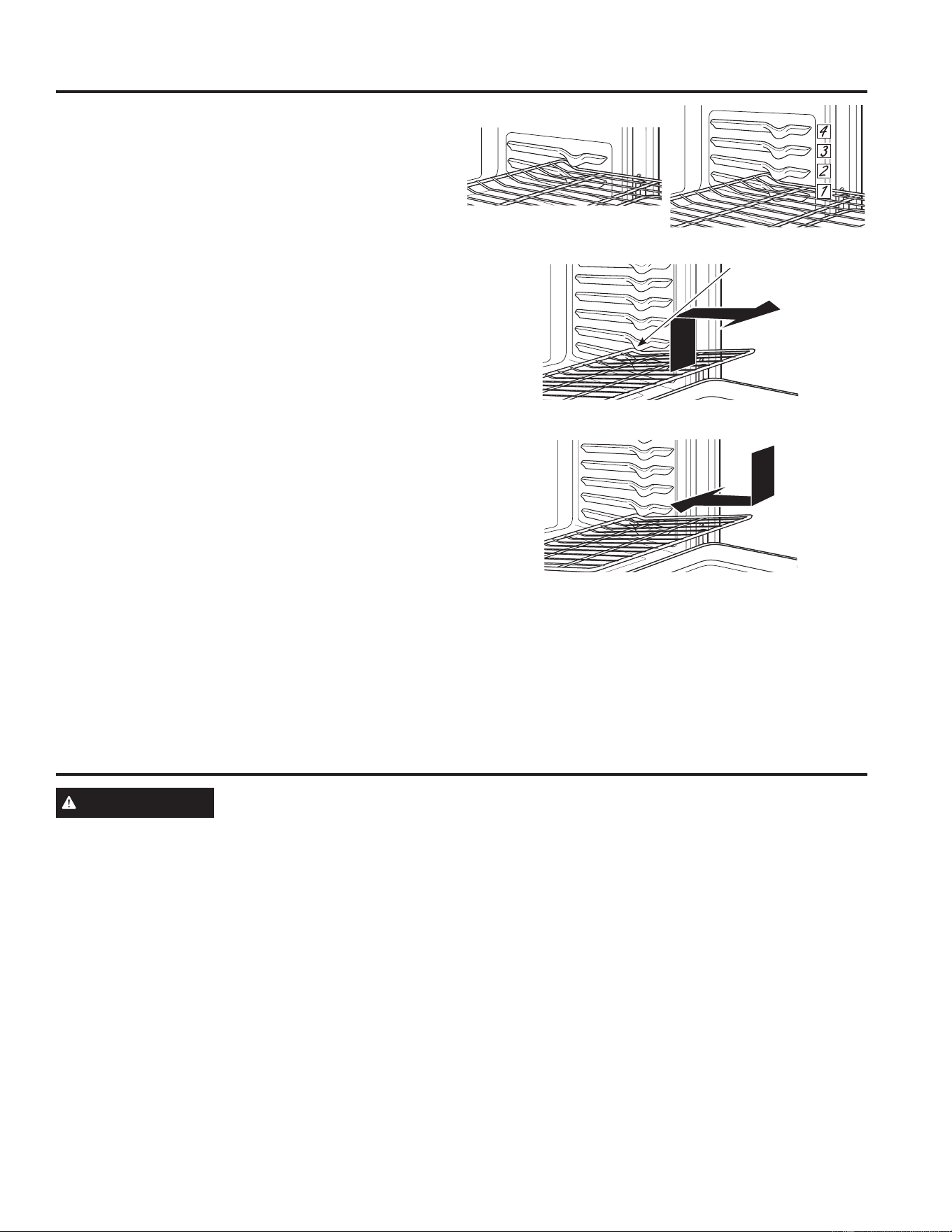
49-2000884 Rev. 2 15
USO DE LA ESTUFA:(VWDQWHVGHO+RUQR3DSHOGH$OXPLQLR
Posiciones de los Estantes
Su horno cuenta con seis posiciones de estantes en el horno
principal. En la Guía de Cocción, se brindan recomendaciones
de posiciones de los estantes para diferentes tipos de
comidas. Se ajusta un estante en una dirección para afectar
los resultados de cocción. Por ejemplo, si se prefieren partes
superiores más oscuras en tartas, panecillos o galletas,
pruebe moviendo la comida a un estante que se encuentre
una posición más arriba. Si encuentra que las comidas están
demasiado doradas en la parte superior, pruebe moviendo las
mismas más abajo la próxima vez.
Al hornear con múltiples ollas y en múltiples estantes, asegúrese
de que haya suficiente espacio entre las ollas para que fluya el
aire. Esto puede mejorar la cocción haciéndola más pareja.
Retiro y Reemplazo de los Estantes Planos
Al colocar y retirar utensilios de estufa, empuje el estante hacia
DIXHUDGHOWRSHSRVLFLyQGHGHWHQFLyQVREUHHOVRSRUWHGHOHVWDQWH
Para retirar un estante, empuje el mismo hacia usted hasta
alcanzar la posición donde se detiene, incline el frente hacia
arriba y empuje hacia afuera.
Para reemplazar un estante, coloque el extremo curvado del
mismo sobre los soportes de los estantes. Incline el frente del
estante hacia arriba y empuje el mismo hasta que se detenga.
Luego apoye el estante y empuje el mismo hasta que entre
completamente en el horno.
Es posible que resulte difícil deslizar los estantes,
especialmente luego de un ciclo de limpieza automática. Para
mejorar las condiciones de deslizamiento, use una tela suave
o una toalla de papel para frotar aceite vegetal sobre los
H[WUHPRVL]TXLHUGR\GHUHFKRGHORVHVWDQWHV\RVREUHORV
soportes del estante.
NOTA: Retire los estantes en desuso al usar el horno para
un precalentamiento más rápido, mayor eficiencia y un
rendimiento óptimo de la cocción.
Estantes del Horno
PRECAUCIÓN
1RXVHQLQJ~QWLSRGHDOXPLQLRRFREHUWRUGHKRUQRSDUDFXEULUHOIRQGRGHOKRUQR(VWRVtWHPV
pueden atrapar el calor o derretirse, ocasionando daños sobre el producto y el riesgo de descargas, humo o incendios.
Los daños por uso inadecuado de estos ítems no están cubiertos por la garantía del producto.
Se podrá usar aluminio para evitar derrames, colocando una hoja sobre un estante inferior varias pulgadas debajo de la comida.
No use más aluminio que el necesario y nunca cubra totalmente el estante de un horno con papel de aluminio. Mantenga el
DOXPLQLRDSRUORPHQRV´GHODVSDUHGHVGHOKRUQRSDUDHYLWDUXQDFLUFXODFLyQGHILFLHQWHGHOFDORU
Papel de Aluminio y Cobertores del Horno
Retiro de los estantes
Reemplazo de los estantes
Posición de detención
del estante
Horno Superior
Horno Inferior

16 49-2000884 Rev. 2
Su horno posee una variedad de modos de cocción para que pueda obtener los mejores resultados. Estos modos se describen a
continuación. Para acceder a recomendaciones para comidas específicas, consulte la sección de la Guía de Cocción. Recuerde
que es posible que su nuevo horno funcione de manera diferente que aquel que está reemplazando.
Bake (Hornear)
El modo de horneado tradicional fue diseñado para la cocción
en un solo estante. Este modo usa el calor principalmente
desde el elemento inferior, pero también desde el elemento
superior para cocinar la comida. Generalmente se recomienda
realizar el calentamiento previo al usar este modo. Para usar
este modo, presione la tecla Bake (Hornear), ingrese una
temperatura con las teclas numéricas, y luego presione Start
(Iniciar/ Ingresar).
Horneado por Convección
Este modo está pensado para el horneado en un estante
simple cuando se desee un flujo de aire adicional para mejorar
la uniformidad. Generalmente se recomienda realizar el
calentamiento previo al usar este modo.
Convection Roast (Dorar por Convección)
Este modo está pensado para dorar cortes enteros de carne
en un solo estante. La utilización de los tres elementos y el
flujo de aire directo desde la parte superior del horno mejoran
el nivel de dorado y reducen el tiempo de cocción. Controle
la comida antes de lo sugerido por la receta al utilizar este
modo. Para usar este modo, presione la tecla Conv Roast
(Dorar por Convección), e ingrese una temperatura con las
teclas numéricas, y luego presione Start (Iniciar/ Ingresar).
Modo para Asar
Siempre ase con la puerta cerrada. El elemento para asar en
el horno es muy potente. Monitoree la comida de cerca al asar.
Tenga cuidado al asar en estantes de posiciones superiores,
ya que colocar la comida más cerca del elemento para asar
incrementa el humo, salpicaduras y la posibilidad de que se
incendien las grasas. No se recomienda asar en el estante de
la posición 6.
La función para asar puede ser usada en comidas que
típicamente serían a la parrilla.
Ajuste la posición del estante para variar la intensidad del
calor que llega a la comida. Coloque la comida más cerca
del elemento para asar, cuando se desee una superficie más
soasada y un interior poco cocido. Para un mejor rendimiento,
centre la comida debajo del elemento que emite calor para
asar.
3UHVLRQHODWHFOD%URLO$VDUGRVYHFHVSDUDFRQILJXUDU+LJK
$OWD\XQDYH]SDUD/RZ%DMDGHSHQGLHQGRGHODFDQWLGDG
de dorado y de la temperatura interior que se prefieran. La
FRQILJXUDFLyQ+LJK$OWDHVPHMRUSDUDFRUWHVPiVGHOJDGRV
GHFDUQH\RFRPLGDVTXHSUHILHUDTXHTXHGHQPHQRVFRFLGDV
HQVXLQWHULRU/DFRQILJXUDFLyQ/RZ%DMDHVSUHIHULGDSDUD
cortes más gruesos de carne y comidas que desea que sean
cocinadas completamente. No es necesario precalentar el
KRUQRHQHVWRVPRGRV/XHJRSUHVLRQH6WDUW,QLFLDU
Air Fry (Freír con Aire)
$LU)U\)UHtUFRQ$LUHHVXQPRGRGHFRFFLyQHVSHFLDO
sin precalentamiento, que fue diseñado para producir
comidas que en su exterior queden más crocantes que en
ODFRFFLyQHQKRUQRVWUDGLFLRQDOHV(OPRGR$LU)U\)UHtU
FRQ$LUHIXHGLVHxDGRSDUDODFRFFLyQHQXQVRORHVWDQWH
~QLFDPHQWH6HOHFFLRQH$LU)U\)UHtUFRQ$LU\OXHJRLQJUHVH
la configuración de temperatura deseada y presione Start
,QLFLDU/DWHPSHUDWXUDVHSRGUiFRQILJXUDUHQWUH)\
500°F. No es necesario precalentar en este modo. Siga las
pautas de la receta tradicional para horno o del paquete en
relación a los ajustes de temperatura y tiempos de cocción;
ajuste el tiempo de cocción para lograr la textura crocante
deseada. Se podrán encontrar pautas adicionales para utilizar
este modo en la Guía de Cocción.
Warm (Calentar)
(OPRGR:DUP&DOHQWDUIXHGLVHxDGRSDUDPDQWHQHU
comidas calientes en una temperatura más alta hasta durante
3 horas. No se requiere precalentar las mismas. No use la
IXQFLyQ:DUP&DOHQWDUSDUDFDOHQWDUFRPLGDIUtDH[FHSWR
galletas crocantes, papas fritas o cereales secos. También
se recomienda que la comida no se mantenga caliente por
más de 2 horas. Presione la tecla Warm (Calentar) y luego
presione Start (Iniciar).
Modos de Cocción en Horno
USO DE LA ESTUFA: Modos de Cocción en Horno
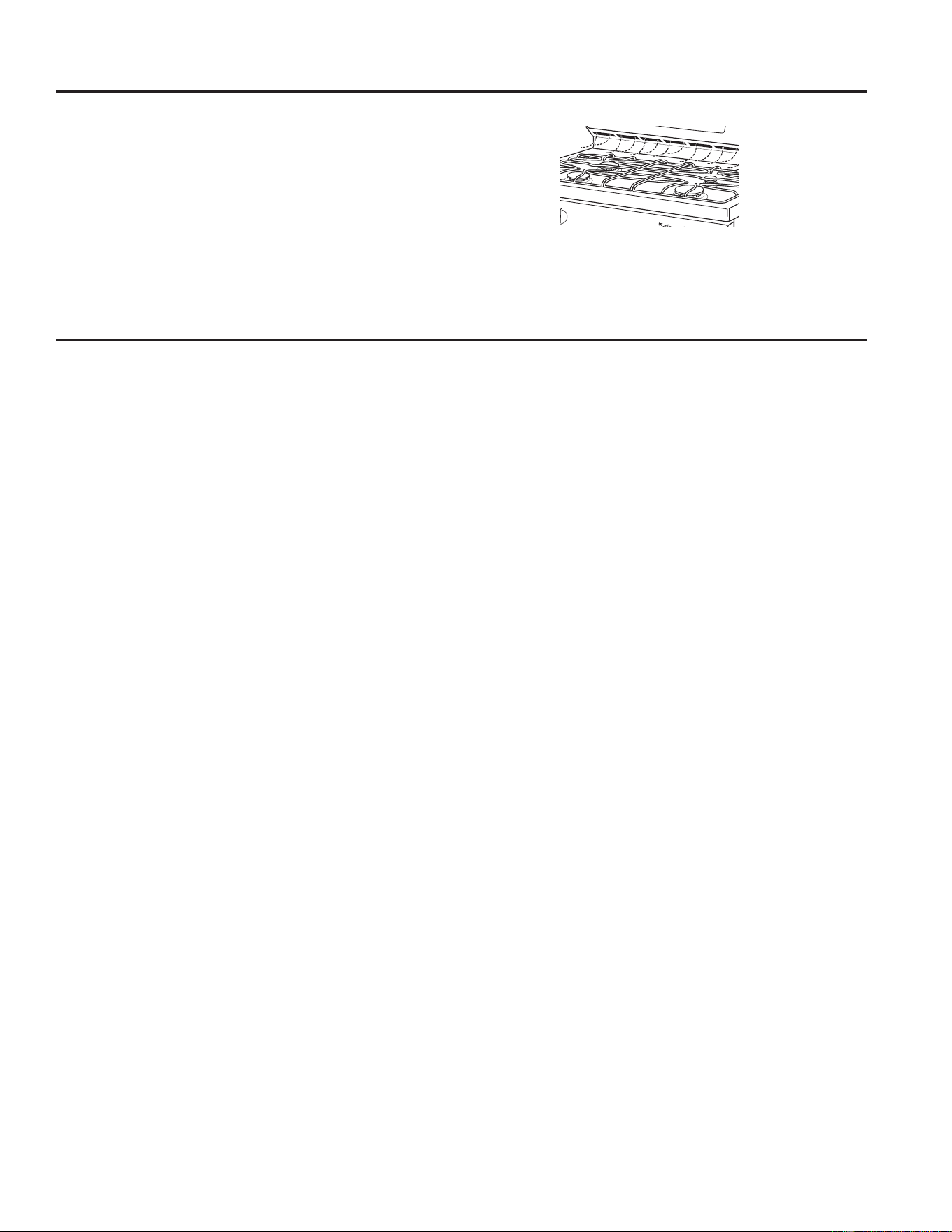
49-2000884 Rev. 2 17
Ventilaciones de Aire del Horno
1XQFDEORTXHHODVYHQWLODFLRQHVDEHUWXUDVGHDLUHGHOD
estufa. Las mismas brindan las entradas y salidas de aire
que son necesarias para que la estufa se mantenga fresca y
funcione de forma correcta con la combustión adecuada.
Las aberturas de aire se encuentran ubicadas en la parte
trasera de la estufa, en la parte superior e inferior de la puerta
del horno, y en la parte inferior de la estufa.
La apariencia y la ubicación
de la ventilación varían.
Guía de Cocción del Horno
Cocine la comida completamente para evitar que se produzcan enfermedades a partir de la comida. Puede encontrar
recomendaciones sobre temperatura mínima para cocinar de forma segura en IsItDoneYet.gov8VHXQWHUPyPHWURGHFRPLGDSDUD
medir las temperaturas de la comida.
Pautas de Uso de Utensilios
El material, el acabado y el tamaño de los utensilios afectan el
horneado.
Las ollas oscuras, revestidas y opacas absorben el calor más
rápidamente que las ollas claras y brillantes. Al usar ollas
que absorben el calor más rápidamente, las comidas podrán
resultar más doradas, crocantes y con una capa más gruesa.
Si utiliza utensilios oscuros y revestidos, controle la comida
antes del tiempo mínimo de cocción. Si se obtienen resultados
no deseados con este tipo de utensilios, considere la posibilidad
de reducir la temperatura del horno en 25°F la próxima vez.
Las ollas brillantes pueden producir resultados de horneado
más parejos en tortas y galletas.
Las ollas de vidrio y cerámica calientan con lentitud, pero
retienen bien el calor.
Estos tipos de ollas funcionan bien con platos tales como
tartas y postres con natilla.
Las ollas con aislante de aire calientan lentamente y pueden
producir fondos dorados.
Mantenga los utensilios limpios para una cocción más pareja.
La cerámica calienta de forma lenta y retiene bien el calor. Si
es posible, se recomienda precalentar este tipo de utensilios.
Se podrá requerir tiempo de cocción adicional.
El utensilio usado en los modos para asar y freír con aire
deberá ser de uso seguro para asar.
USO DE LA ESTUFA:9HQWLODFLRQHVGH$LUH*XtDGH&RFFLyQGHO+RUQR
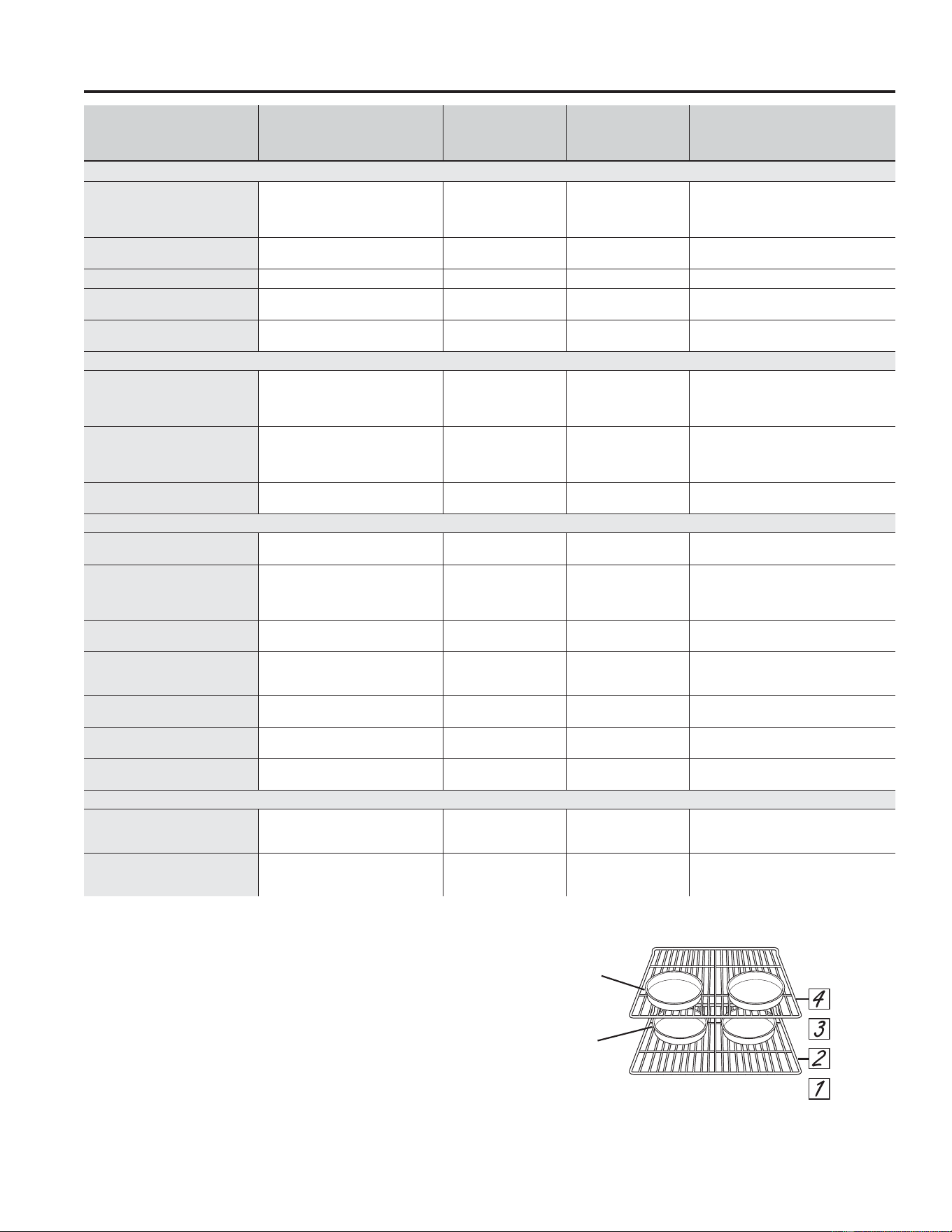
18 49-2000884 Rev. 2
Guía de Cocción del Horno
*Al hornear cuatro capas de torta a la vez, mueva las
bandejas como se muestra, de modo que no quede una
encima de la otra.
Cocine la comida completamente para evitar que se
produzcan enfermedades a partir de la comida. Puede
encontrar recomendaciones sobre temperatura mínima
para cocinar de forma segura en www.IsItDoneYet.gov.
Asegúrese de usar un termómetro de comidas para medir la
temperatura de las mismas.
NOTA: Retire los estantes en desuso al usar el horno para
un precalentamiento más rápido, mayor eficiencia y un
rendimiento óptimo de la cocción.
8ELFDFLyQ
Frontal
8ELFDFLyQ
Trasera
TIPO DE COMIDA
MODO(S)
RECOMENDADO(S)
HORNO
(Superior/
Inferior)
POSICIÓN(ES)
DE ESTANTES
RECOMENDADA
SUGERENCIAS
ADICIONALES
Productos Horneados
Tortas con capas, tortas
rectangulares, roscas,
panecillos, pan rápido en un
Solo Estante
Hornear
Inferior
Superior
3
2
8VHXWHQVLOLRVEULOODQWHV
Tortas con capas* en Múltiples
Estantes
Hornear por Convección
Hornear
Inferior 2 y 4
Asegúrese de que haya un flujo de aire
DGHFXDGR9HDODLOXVWUDFLyQ
7RUWDVGHJUDVDSDVWHOGHiQJHO Hornear Inferior 2 8VHXWHQVLOLRVEULOODQWHV
Galletas, galletitas, bizcochitos
en un Solo Estante
Hornear
Inferior
Superior
3
2
8VHXWHQVLOLRVEULOODQWHV
Galletas, galletitas, bizcochitos
en Múltiples Estantes
Hornear por Convección
Hornear
Inferior 2 y 4
Asegúrese de que haya un flujo de aire
adecuado.
Bife y Cerdo
Hamburguesas Asar Alto Superior 2
8VHXQDEDQGHMDSDUDDVDUPXHYDOD
comida más abajo para que quede más
preparada y menos soasada. Preste
atención a la comida al asarla.
%LIHV\&KXOHWDV Asar Alto Superior 2
8VHXQDEDQGHMDSDUDDVDUPXHYDOD
comida más abajo para que quede más
preparada y menos soasada. Preste
atención a la comida al asarla.
Dorados
Dorado por Convección
Hornear
Inferior 1 o 2
Deje sin cubrir, use una olla chata tal como
una olla para asar.
Ave
Pollo entero
Dorado por Convección
Hornear
Inferior 1 o 2
Deje sin cubrir, use una olla chata tal como
una olla para asar.
Pechugas, patas, muslos con
huesos
$VDGR%DMR
Hornear
Superior
Inferior
1
3
Si se empanó o cubrió con salsa, evite los
PRGRV%URLO+L$VDU$OWR$VHGHOODGRGH
la piel hacia abajo primero. Preste atención
a la comida al asarla.
Pechugas de pollo deshuesadas
$VDGR%DMR
Hornear
Superior
Inferior
1
3
Preste atención a la comida al asarla.
Pavo entero
Dorado por Convección
Hornear
Inferior 1 o 2
Deje sin cubrir, use una olla chata tal como
una olla para asar. Preste atención a la
comida al asarla.
Pechuga de Pavo Hornear Inferior 3
Deje sin cubrir, use una olla chata tal como
una olla para asar.
Pescado
$VDGR%DMR
Hornear
Superior
Inferior
1
3
Preste atención a la comida al asarla.
Cazuelas Hornear
Inferior
Superior
3
2
Comidas Congeladas a Conveniencia
Pizza, productos con papas,
patitas de pollo fritas, aperitivos
en un Solo Estante
Hornear
Inferior
Superior
3
2
8VHXWHQVLOLRVEULOODQWHV
Pizza, productos con papas,
patitas de pollo fritas, aperitivos
en Múltiples Estantes
Hornear por Convección
Hornear
Inferior 2 y 4 8VHXWHQVLOLRVEULOODQWHV
USO DE LA ESTUFA: Guía de Cocción del Horno
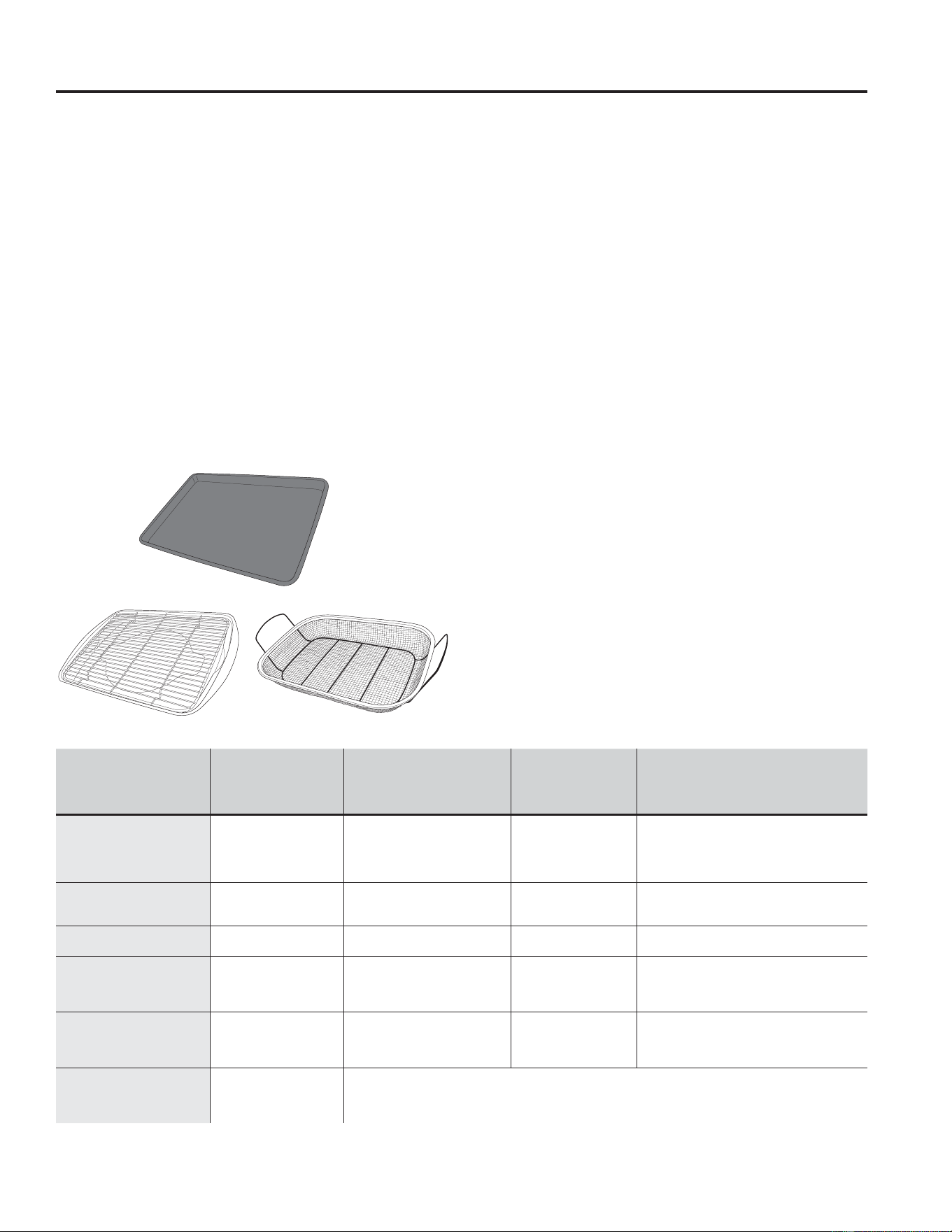
49-2000884 Rev. 2 19
USO DE LA ESTUFA: Guía de Cocción del Horno
Guía de Cocción del Horno
Pautas sobre Utensilios para Freír con Aire
$LU )U\ )UHtU FRQ $LUH HV XQ PRGR GH FRFFLyQ HVSHFLDO VLQ
precalentamiento, que fue diseñado para producir comidas
que en su exterior queden más crocantes que en la cocción en
KRUQRV WUDGLFLRQDOHV 6HOHFFLRQH $LU )U\ )UHtU FRQ $LU \ OXHJR
ingrese la configuración de temperatura deseada y presione
6WDUW ,QLFLDU /D WHPSHUDWXUD VH SXHGH FRQILJXUDU HQWUH )
and 500°F.
Pautas sobre Utensilios para Freír con Aire
8VH XWHQVLOLRV GH XVR VHJXUR SDUD DVDU DO XWLOL]DU HO PRGR $LU
)U\ )UHtU FRQ $LUH
6H UHFRPLHQGD HO XVR GH XQD ROOD GH OiPLQD RVFXUD 8QD
bandeja oscura promueve un mejor dorado y logra que la
comida quede más crocante.
• También se podrán usar canastas de horneado en el horno
y rejillas de horneado. Se deberá colocar una bandeja plana
sobre el estante debajo de las comidas, a fin de atrapar
cualquier goteo al usar la canasta de horneado.
Consejos Generales sobre el Modo para
Freír con Aire
(O PRGR $LU )U\ )UHtU FRQ $LUH IXH GLVHxDGR SDUD FRFLQDU HQ
un solo estante.
(O PRGR $LU )U\ )UHtU FRQ $LUH IXH GLVHxDGR SDUD XQ XVR VLQ
precalentamiento.
• Se recomienda la posición del estante 4 para la mayoría de
ODV FRPLGDV 8VH OD SRVLFLyQ GHO HVWDQWH SDUD FRPLGDV PiV
gruesas.
• Las comidas se podrán cocinar más rápido de lo esperado si
el horno ya está caliente al colocar la comida en el mismo.
• Al freír con aire comidas con salsa, se recomienda incorporar
la salsa al final de la cocción.
• Si la comida se dora demasiado rápido, intente colocar la
misma en un estante que se encuentre en un posición más
baja o en una configuración de temperatura de horno más
baja.
• En el caso de comidas empaquetadas, utilice las
instrucciones de cocción tradicionales para horno en relación
a configuración de temperatura y tiempos de cocción
esperados.
• No es necesario voltear o revolver la comida durante la
cocción.
8ELTXH OD FRPLGD HQ XQD VROD FDSD VREUH OD EDQGHMD VLQ
sobrecargar la misma.
• Siempre controle la temperatura interior de la comida, a fin de
confirmar que se hayan alcanzado las temperaturas mínimas
seguras. Las temperaturas mínimas seguras de la comida se
podrán encontrar en los paquetes y en IsItDoneYet.gov.
8WHQVLOLR SULQFLSDO UHFRPHQGDGR
Opciones de utensilios alternativos
TIPO DE COMIDA
POSICIÓN(ES)
DE ESTANTES
RECOMENDADAS
CONFIGURACIÓN
DE TEMPERATURA
RECOMENDADA (°F)
TIEMPO DE
COCCIÓN
RECOMENDADO
(MÍN.) NOTAS
Trozos de pescado
fresco deshuesado o ave,
empanados en forma de
patitas, frituras crocantes,
filetes
4 375-400 15-30
8VH FRQILJXUDFLRQHV GH WHPSHUDWXUD PiV
EDMDV SDUD SLH]DV PiV JUDQGHV 8VH XWHQVLOLRV
brillantes.
Huesos frescos de alitas
de pollo
4 375-400 25-40
Sale las alitas o cubra las mismas con un roce
en seco si usará salsa luego de la cocción o
hacia el final de la cocción.
Huesos frescos de patas o
muslos de pollo
3 o 4 375-400 30-55
8VH FRQILJXUDFLRQHV GH WHPSHUDWXUD PiV EDMDV
para piezas más grandes.
Papas fritas frescas y
GHOJDGDV ò SXOJDGD
4 400-425 15-30
Se recomienda el uso de papel para hornear al
preparar papas fritas frescas. Para frituras más
crocantes, mezcle las papas fritas con almidón
de maíz o harina de arroz antes de la cocción.
Papas fritas frescas y
GHOJDGDV ò SXOJDGD
3 o 4 375-400 20-35
Se recomienda el uso de papel para hornear al
preparar papas fritas frescas. Para frituras más
crocantes, mezcle las papas fritas con almidón
de maíz o harina de arroz antes de la cocción.
Comidas envasadas
congeladas
3 o 4
XVH OD SRVLFLyQ GH HVWDWH
3 para comidas más
JUXHVDV
8VH ODV LQVWUXFFLRQHV GH FRFFLyQ SDUD KRUQR WUDGLFLRQDO QR SDUD )UHtU FRQ $LUH FRPR JXtD GH FRQILJXUDFLyQ GH
temperatura y tiempo de cocción. Con algunas comidas, se podrá requerir un tiempo de cocción adicional diferente
al tiempo recomendado en el paquete. Si el horno está caliente al iniciar la cocción, la comida se podrá cocinar
más rápido que el tiempo mínimo que figura en el paquete.
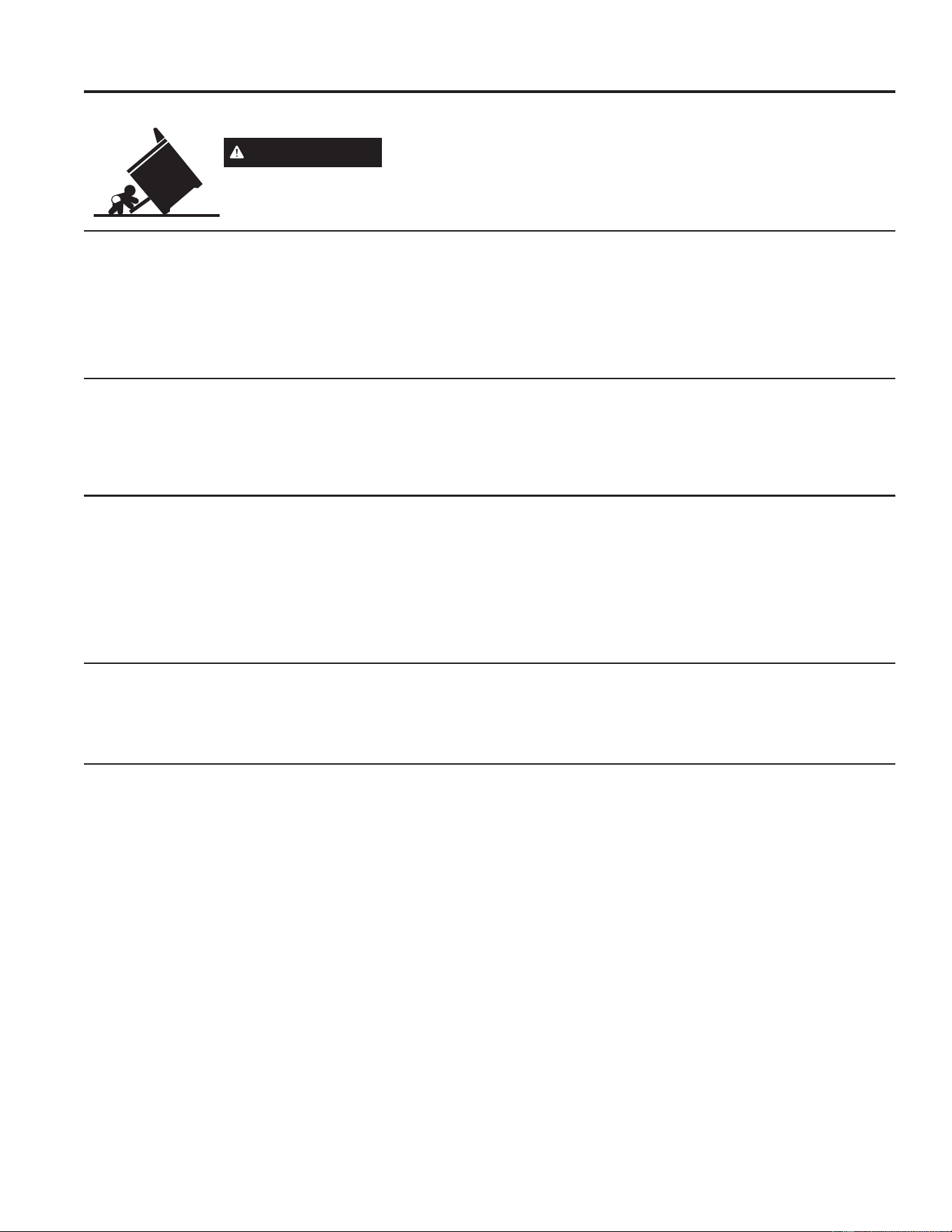
20 49-2000884 Rev. 2
Estufa - Exterior
ADVERTENCIA
Si se quita la estufa para efectuar una limpieza, reparaciones o cualquier
otra razón, verifique que el dispositivo anti-volcaduras se coloque de manera
adecuada cuando vuelva a instalarse la estufa. Si no toma esta precaución, la
estufa puede volcarse y provocar lesiones.
Asegúrese de que todos los controles estén apagados y que las superficies estén frías antes de limpiar cualquier parte de la estufa.
Bloqueo del Control
Si así lo desea, puede desactivar los botones de toque antes
de la limpieza.
&RQVXOWH/RFN&RQWUROV&RQWUROHVGH%ORTXHRHQODVHFFLyQ
2YHQ&RQWUROV&RQWUROHVGHO+RUQRHQHVWHPDQXDO
Limpie los derrames con un paño húmedo.
También puede utilizar un limpiador de vidrios.
4XLWHVXFLHGDGHVPiVUHEHOGHVFRQDJXDWLELDMDERQRVD1R
utilice abrasivos de ninguna clase.
Vuelva a activar los botones de toque después de la limpieza.
Panel de control
8QDEXHQDLGHDHVOLPSLDUHOSDQHOGHFRQWUROOXHJRGHFDGD
uso. Limpie con un jabón suave y agua o vinagre y agua,
enjuague con agua limpia y pula en seco con una tela suave.
No use limpiadores abrasivos, limpiadores líquidos fuertes,
almohadillas para fregar de plástico ni limpiadores de horno en
el panel de control; dañarán el acabado, incluyendo el Acero
Inoxidable Negro.
Exterior del Horno
No use limpiadores de horno, limpiadores abrasivos,
limpiadores líquidos fuertes, estropajos de acero, almohadillas
para fregar de plástico, ni polvos limpiadores en el interior
o el exterior del horno. Limpie el mismo con agua y jabón o
una solución de vinagre y agua. Enjuague con agua limpia y
seque con una tela seca. Al limpiar supeficies, asegúrese de
que estén a temperatura ambiente y fuera del contacto con
la luz solar. Si las manchas en el borde de la ventana de la
puerta son persistentes, use un limpiador abrasivo suave o
una esponja con estropajo para obtener un mejor resultado. El
derrame de adobo, jugos de fruta, salsas de tomate y líquidos
para humedecer que contengan ácidos pueden ocasionar
descoloración y se deberán limpiar de inmediato. Deje que las
superficies calientes se enfríen, y luego limpie y enjuague.
Superficies pintadas
Las superficies pintadas incluyen los lados de la estufa y la
puerta, la parte superior del panel de control y el frente del cajón.
Límpielas con jabón y agua o con una solución de agua y vinagre.
No utilice limpiadores de horno comerciales, polvos limpiadores,
esponjillas de acero o abrasivos potentes sobre cualquier
superficie pintada, incluyendo el Acero Inoxidable Negro.
Acero Inoxidable excluyendo el Acero Inoxidable Negro (en algunos modelos)
No use virutas de acero; éstas dañarán la superficie.
/RVOLPSLDGRUHVFRQiFLGRR[iOLFRWDOHVFRPR%DU.HHSHUV
)ULHQG6RIW&OHDQVHUHOLPLQDUiQHOy[LGRGHVOXVWUHV\
SHTXHxDVPDQFKDVVREUHODVXSHUILFLH8VHVyORXQOLPSLDGRU
líquido libre de material abrasivo y frote en la dirección de las
líneas del cepillo con una esponja suave y húmeda.
Para limpiar la superficie de acero inoxidable, use agua tibia
con jabón o un limpiador o pulidor para acero inoxidable.
Siempre limpie la superficie en la dirección del veteado. Siga
las instrucciones del limpiador para limpiar la superficie de
acero inoxidable.
Para realizar consultas sobre la adquisición de productos,
incluyendo limpiadores o pulidores para electrodomésticos
de acero inoxidable, consulte las secciones de Accesorios y
Soporte al Consumidor al final de este manual.
CUIDADO Y LIMPIEZA: Estufa - Exterior

49-2000884 Rev. 2 21
CUIDADO Y LIMPIEZA: Estufa - Interior
Estufa - Interior
(OLQWHULRUGHVXQXHYRKRUQRSXHGHVHUOLPSLDGRGHIRUPDPDQXDORXWLOL]DQGRORVPRGRV6WHDP&OHDQ/LPSLH]DFRQ9DSRUR
6HOI&OHDQ/LPSLH]D$XWRPiWLFD
El derrame de adobo, jugos de fruta, salsas de tomate y líquidos para humedecer que contengan ácidos pueden ocasionar
descoloración y se deberán limpiar de inmediato. Espere a que las superficies calientes se enfríen, y luego limpie y enjuague.
Limpieza Manual
No use limpiadores de horno, limpiadores líquidos fuertes,
estropajos de acero, ni almohadillas para fregar en el interior
del horno. Para la suciedad de la parte inferior del horno y
otras superficies esmaltadas, use un abrasivo suave que
FRQWHQJDiFLGRR[iOLFRWDOFRPR%DU.HHSHUV)ULHQG
®
, con
una esponja antirayaduras. Tenga cuidado de no aplicar
limpiadores abrasivos o esponjas sobre la puerta de vidrio, ya
que estos rayarán el revestimiento reflectante. El interior del
horno y la puerta de vidrio podrán ser limpiados con una tela
suave, jabón suave y agua, o con vinagre y una solución de
agua. Luego de la limpieza, enjuague con agua limpia y seque
con una tela seca.
Modo de Limpieza con Vapor
/DILQDOLGDGGHODIXQFLyQ6WHDP&OHDQ/LPSLH]DFRQ9DSRU
es usar agua para limpiar la suciedad leve de su horno en una
WHPSHUDWXUDLQIHULRUDODGH6HOI&OHDQ/LPSLH]D$XWRPiWLFD
3DUDXVDUODIXQFLyQ6WHDP&OHDQ/LPSLH]DFRQ9DSRU
1. Comience con el horno a temperatura ambiente.
2. Limpie la grasa excesiva y la suciedad del horno.
3. Vierta una taza de agua en la parte inferior del horno.
4. Cierre la puerta.
3UHVLRQHODWHFOD&OHDQ/LPSLDUVHOHFFLRQH6WHDP
&OHDQ/LPSLH]DFRQ9DSRU\OXHJRSUHVLRQH6WDUW
,QLFLDU,QJUHVDU
1RDEUDODSXHUWDGXUDQWHHOFLFOR6WHDP&OHDQ/LPSLH]DDO
9DSRUGHPLQXWRV$OILQDOL]DUHOFLFORGH6WHDP&OHDQ
/LPSLH]DFRQ9DSRUDEVRUEDHODJXDUHVWDQWH\OLPSLHOD
suciedad ablandada por la humedad de las paredes y la puerta
del horno.
Modo de Limpieza Automática
Lea las Instrucciones de Seguridad del Horno con Limpieza
Automática, en el comienzo de este manual, antes de usar
HOPRGR6HOI&OHDQ/LPSLH]D$XWRPiWLFD(VWHPRGRXVD
temperaturas muy altas para limpiar el interior del horno. Para
un horno moderadamente sucio, use un ciclo de limpieza
automática de 3 horas. Sólo los estantes del horno de limpieza
DXWRPiWLFDQHJURV\ODVUHMLOODVSRGUiQSHUPDQHFHUHQHO
horno durante el ciclo de limpieza automática. Todos los
GHPiVtWHPVLQFOX\HQGRORVHVWDQWHVQLTXHODGRVSODWHDGRV
GHEHUiQVHUUHWLUDGRV6LORVHVWDQWHVQLTXHODGRVSODWHDGRV
se dejan dentro del horno durante un ciclo de limpieza
automática, los estantes sufrirán deslustre. Si cualquier tipo
de estante es dejado en el horno durante el ciclo de limpieza
automática, es posible que se vuelva difícil deslizar el estante.
Para acceder a instrucciones sobre cómo mejorar esto,
consulte la sección de Estantes del Horno.
IMPORTANTE: Las emanaciones producidas por el ciclo de
autolimpieza de cualquier horno afectan la salud de algunas
aves de manera notoria. Procure llevar sus aves a otra
habitación bien ventilada.
3DUDXVDUODIXQFLyQ6HOI&OHDQ/LPSLH]D$XWRPiWLFD
1. Comience con el horno a temperatura ambiente.
2. Limpie la grasa excesiva y las suciedades del horno y
del interior de la puerta.
3. Retire cualquier ítem que no sean los estantes y
UHMLOODVGHOLPSLH]DDXWRPiWLFDQHJURVVLORGHVHD
Consulte sobre la Limpieza de la Superficie de Cocción
para determinar si sus rejillas pueden ser limpiadas
automáticamente y para detalles importantes en relación
a la colocación de las rejillas.
4. Cierre la puerta.
5. Presione la tecla Clean (Limpiar), seleccione Self
Clean (Limpieza Automática) y luego presione
Start (Iniciar/ Ingresar).
No podrá abrir la puerta durante el ciclo de limpieza automática.
La puerta permanecerá bloqueada luego del ciclo de limpieza
automática hasta que el horno se enfríe y se alcance la
temperatura de desbloqueo. Al finalizar el ciclo de limpieza
automática, deje que el horno se enfríe, destrabe la puerta, y
limpie cualquier ceniza que haya quedado en el horno.
Estantes
Todos los estantes se pueden lavar con agua caliente y jabón.
/RVHVWDQWHVHVPDOWDGRVQREULOORVRVVHSXHGHQGHMDUHQOD
cavidad durante el ciclo de limpieza automática.
Es posible que resulte más difícil deslizar los estantes,
especialmente luego de la limpieza automática. Coloque aceite
vegetal en una tela húmeda o toalla de papel y frote sobre los
extremos izquierdo y derecho.
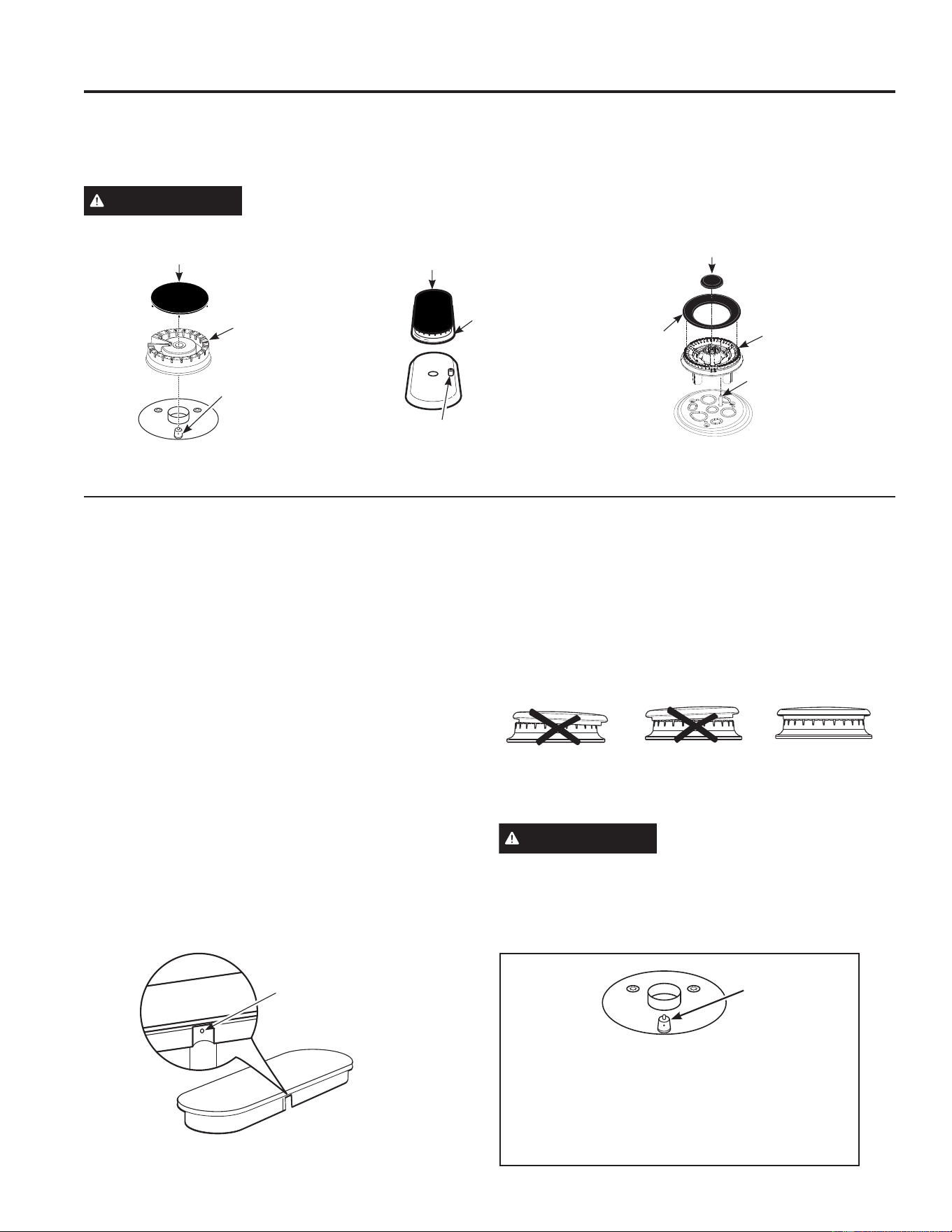
22 49-2000884 Rev. 2
Retiro de los Quemadores Superficiales para su Limpieza
Apague todos los controles. Espere a que la placa de cocción se enfríe antes de retirar las rejillas y las partes del quemador. Al
retirar las tapas y cabezas de los quemadores, recuerde su tamaño y ubicación. Vuelva a colocarlos en la misma ubicación luego
de la limpieza.
PRECAUCIÓN
No intente retirar las tapas del quemador oval de las cabezas de los quemadores.
Quemador
Redondo
7DSDGHO4XHPDGRU
5HGRQGR([WUDtEOH
Electrodo
Cabeza del
4XHPDGRU
Redondo
Placa de Cocción
Limpieza de los Quemadores Superficiales
Limpieza de las Tapas de los Quemadores
Lave las tapas de los quemadores en agua caliente con jabón
y enjuague con agua limpia. Puede fregar con u na base de
fregado plástica para eliminar partículas de comida quemadas.
Las tapas redondas de los quemadores también se pueden
limpiar en un lavavajillas.
Limpieza de las Cabezas de los Quemadores
Limpie las cabezas de los quemadores de forma rutinaria,
especialmente luego de derrames importantes, que podrían
bloquear las aberturas del quemador. Retire los quemadores
cuando estén fríos. Lave los mismos con agua caliente y
jabón. Enjuague con agua limpia. Para eliminar las manchas
más rebeldes, use un cepillo con cerda plástica.
NOTA: No use lana de acero ni estropajos para limpiar las
partes del quemador, ya que podrán bloquear las aberturas.
Nunca lave las cabezas de los quemadores en el lavavajillas.
Esto podrá hacer que se descoloren.
Las hendiduras de las cabezas de los quemadores se deben
mantener limpias en todo momento para obtener una llama
pareja y sin obstrucción.
Las partes bloqueadas o sucias de los quemadores o los
electrodos no permitirán que el quemador funcione de forma
correcta.
Reemplazo de los Quemadores Superficiales
Antes de colocar las tapas y cabezas de los quemadores y el
HQVDPEOHGHODFDEH]DWDSDQXHYDPHQWHHVFXUUDHOH[FHVR
de agua y luego seque las mismas totalmente.
Vuelva a colocar las cabezas de los quemadores en las
ubicaciones correctas, de acuerdo con sus tamaños.
Asegúrese de que cada tapa quede correctamente apoyada
sobre la cabeza del quemador, como se muestra a
continuación.
PRECAUCIÓN
No use la parte superior de la
estufa sin que todas las partes de los quemadores y las
parrillas estén en sus respectivos lugares.
Cualquier derrame en o alrededor de un electrodo se deberá
limpiar de forma cuidadosa. Evite golpear el electrodo con
cualquier cosa dura, ya que podrá ser dañado.
El electrodo del encendedor de la chispa es
expuesto cuando la cabeza del quemador es
retirada. Cuando un quemador se gira a LITE,
todos los quemadores hacen chispa. No intente
desensamblar ni limpiar un quemador mientras
otro quemador está encendido.
Electrodo
La tapa del
quemador está
correctamente
colocada.
La tapa del
quemador NO está
correctamente
colocada.
La tapa del
quemador NO está
correctamente
colocada.
Quemador Oval
Ensamble de la Cabeza y de
OD7DSDGHO4XHPDGRU2YDO
1R([WUDtEOH
Cabeza del
4XHPDGRU
Oval
Electrodo
El agujero redondo en la
cabeza del quemador se
deberá mantener limpio.
4XHPDGRUGHP~OWLSOHVDQLOORV
7DSDGHO4XHPDGRU
5HGRQGR([WUDtEOH
Cabeza del
4XHPDGRU
Redondo
Electrodo
7DSDGHO4XHPDGRU
([WHUQRExtraíble
CUIDADO Y LIMPIEZA: Placa de Cocción
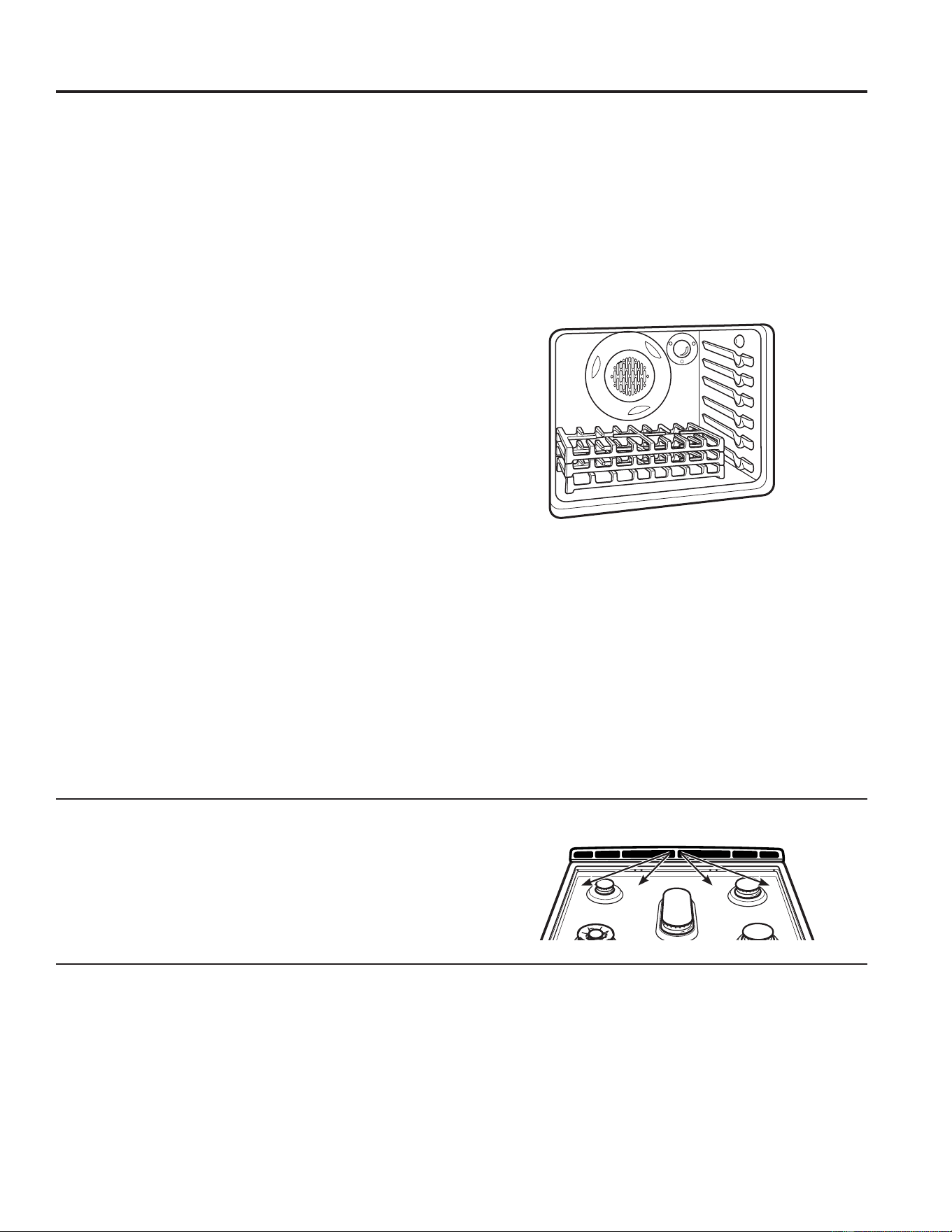
49-2000884 Rev. 2 23
CUIDADO Y LIMPIEZA: Placa de Cocción
3ODFDGH&RFFLyQ&RQWLQ~D
Plancha
Aluminio y Hierro Forjado Reversible: Limpie su plancha
de hierro fundido reversible o del chef con un cepillo duro y
agua caliente. No se recomienda el uso de jabón, y nunca
se deben usar detergentes potentes, ya que eliminarán el
curado. Enjuague la misma con agua caliente y séquela
cuidadosamente. Luego del enjuague, presazone la plancha
aplicando una capa suave de aceite de estufa sobre su
superficie. Limpie el exceso de aceite con una toalla de papel.
Guarde en un lugar frío y seco.
Precauciones de la Plancha:
Ŷ Si algo se derramó debajo de la plancha, se deberá limpiar
tan pronto como sea posible para evitar que sea horneado
en la placa de cocción.
Ŷ No permita que se acumule grasa debajo de la plancha,
ya que puede haber riesgo de incendio. Limpie debajo de
la plancha con agua caliente y jabón, tan pronto como sea
posible.
Ŷ No lave la plancha en el lavavajillas.
Ŷ No limpie la plancha en el horno de limpieza automática.
Protectores de Soportes de Rejillas
Si uno de los protectores de goma de la rejilla de la placa
de cocción se pierde o daña, se podrán obtener piezas de
repuesto llamando al 1.800.GE.CARES.
Para insertar los nuevos protectores, simplemente coloque
el extremo del protector con forma cónica en el agujero de
la placa de cocción y empuje hacia abajo de forma suave,
doblando el protector.
Protectores para Soportes de Rejillas
Parrillas de Quemadores
Limpieza Manual
Las rejillas se deberán lavar con agua caliente y jabón y
deberán ser enjuagadas con agua limpia. Para ablandar la
comida quemada, coloque las rejillas en una solución con ¼
de taza de amoníaco hogareño durante varias horas. Luego,
friegue las rejillas con un estropajo de plástico con agua
caliente y jabón. Enjuague a fondo y seque.
Modo Self Clean (Limpieza Automática)
Si las rejillas no cuentan con protectores de goma en la
superficie inferior, podrán ser limpiadas en el horno usando
el ciclo de limpieza automática. No intente limpiar las rejillas
en el horno si las mismas cuentan con protectores de goma.
Hacer esto destruirá los protectores de goma, afectando el
funcionamiento de los quemadores.
Las rejillas cubiertas de porcelana se podrán volver
gradualmente ásperas si son expuestas de forma continua a
las temperaturas de limpieza automática.
Si su horno está equipado con estantes de limpieza automática
QHJURVVHUHFRPLHQGDVHJXLUODVLQVWUXFFLRQHVSDUDOD
colocación de parrillas en los estantes. Si su horno está
equipado con estantes niquelados, se recomienda seguir
las instrucciones para la colocación de rejillas en el fondo
GHOKRUQR/RVHVWDQWHVFXELHUWRVGHQtTXHOSODWHDGRVQR
deben permanecer en el horno durante el ciclo de limpieza
automática. Hacer esto deslustrará los estantes. Si cualquier
tipo de estante es dejado en el horno durante el ciclo de
limpieza automática, es posible que se vuelva difícil deslizar el
estante. Para acceder a instrucciones de lubricación, consulte
la sección de Estante del Horno.
NOTA: Al colocar o retirar rejillas del horno, no deslice las
mismas sobre los estantes ni sobre el fondo del horno. Hacer
esto podría dañar el esmalte de los estantes o el fondo del horno.
Para realizar la limpieza automática de sus parrillas en los
estantes de limpieza automática:
1. Inserte los estantes en las posiciones 1, 3 y 5 o en las
posiciones 2 y 4.
2. De forma suave, coloque una rejilla en cada estante.
NOTA: O utilice la superficie de cocción durante el modo
6HOI&OHDQ/LPSLH]D$XWRPiWLFD\DTXHHVWH~OWLPRVHUi
cancelado.
Para realizar la limpieza automática de sus rejillas en el
fondo del horno:
1. Retire todos los estantes del horno.
2. De forma suave, coloque una rejilla en el centro del fondo
del horno con la rejilla orientada en la posición erguida.
$SLOHODUHMLOODVUHVWDQWHFRPRVHPXHVWUDDFRQWLQXDFLyQ
'RQRWSODFHRUVWDFNJUDWHVLQDQ\RWKHUFRQILJXUDWLRQRULQ
the upper oven.
8QDYH]TXHODVUHMLOODVIXHURQFRORFDGDVHQHOKRUQRXVHHO
ciclo de limpieza automática siguiendo las instrucciones de la
sección de Limpieza del Horno.
NOTA: Tenga cuidado al retirar las parrillas del horno superior
una vez que el ciclo de auto limpieza haya finalizado. Es
posible que las parrillas aún estén calientes.
8QDYH]FRPSOHWDGRHOFLFORGHOLPSLH]DDXWRPiWLFDODVUHMLOODV
pueden ser retiradas de forma cuidadosa. Es posible que
observe un residuo blanco en las rejillas. Limpie el mismo con
una esponja húmeda. Si las manchas blancas persisten, moje
la esponja con una solución mitad de vinagre y mitad de agua
y vuelva a limpiar las rejillas.
Al reemplazar las rejillas en la superficie de cocción, asegúrese
de ubicarlas de forma correcta. Las rejillas se deben poder
posicionar de forma segura en la superficie de cocción.
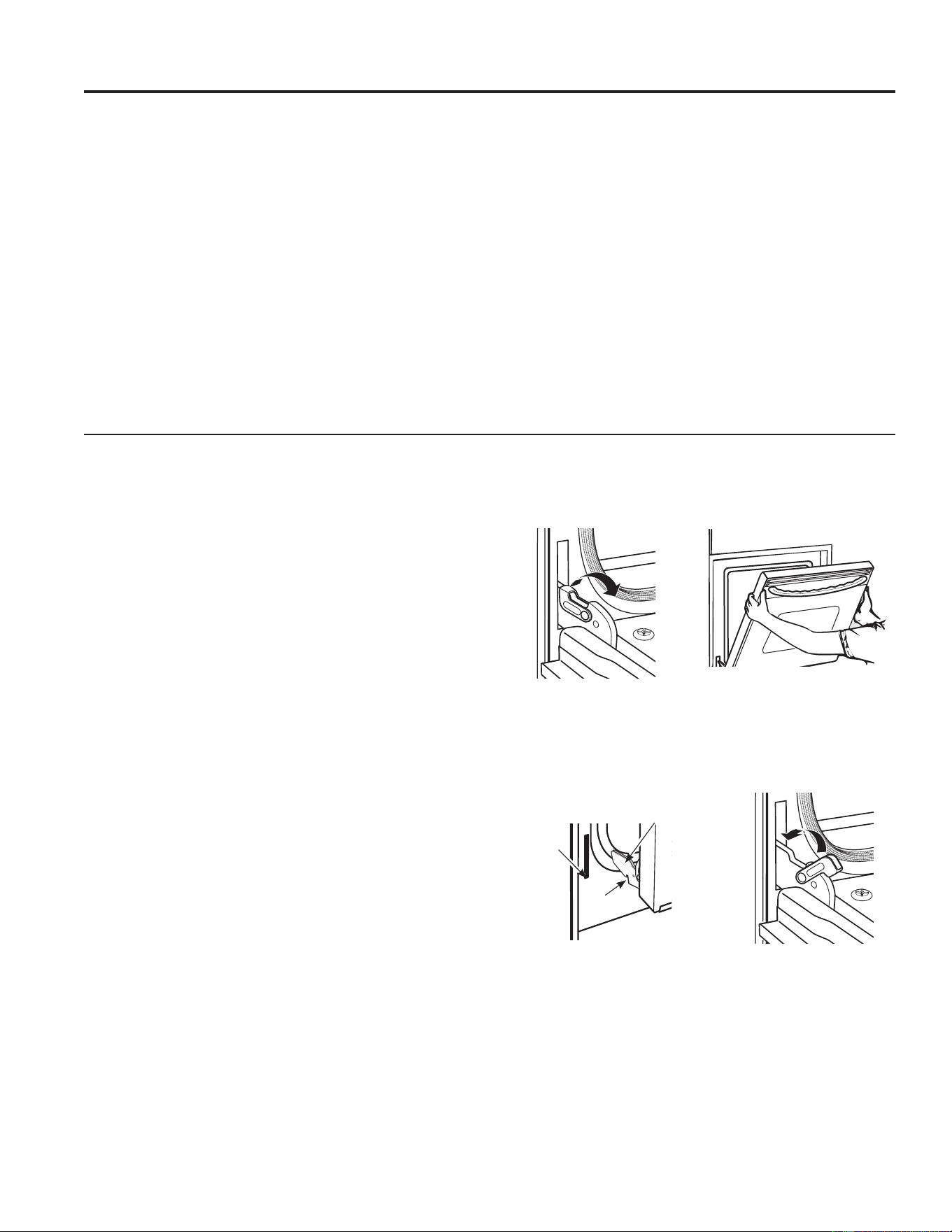
24 49-2000884 Rev. 2
Limpieza de la Puerta del Horno
Limpieza del Interior de la Puerta
No permita que el excedente de agua entre a ningún agujero o
ranuras de la puerta.
Aplique detergente para lavar platos sobre cualquier
VDOSLFDGXUD TXH KD\D VREUH HO YLGULR GHELGR DO KRUQHDGR 8VH
el filo de una navaja del lado seguro para despejarlo. Luego
limpie el vidrio con una tela con jabón para eliminar cualquier
residuo y seque.
El área que está fuera de la junta se puede limpiar con un
estropajo de plástico con jabón. No frote ni limpie la junta de
la puerta; posee una resistencia extremadamente baja a la
abrasión.
Si observa que la junta se empieza a gastar, se deshilacha o
daña de cualquier forma y si quedó fuera de la puerta, deberá
reemplazar la misma.
Limpieza del Exterior de la Puerta
Si las manchas en el borde de la ventana de la puerta son
persistentes, use un limpiador abrasivo suave o una esponja
con estropajo para obtener un mejor resultado. No use este
método sobre ninguna otra superficie.
Superficies de Acero Inoxidable (en algunos modelos)
No use virutas de acero; éstas dañarán la superficie.
Para limpiar la superficie de acero inoxidable, use agua tibia
con jabón o un limpiador o pulidor para acero inoxidable.
Siempre limpie la superficie en la dirección del veteado. Siga
las instrucciones del limpiador para limpiar la superficie de
acero inoxidable.
Para realizar consultas sobre la adquisición de productos,
incluyendo limpiadores o pulidores para electrodomésticos
de acero inoxidable, consulte las secciones de Accesorios y
Soporte al Consumidor al final de este manual.
Puerta del Horno
Puerta del Horno Inferior Desmontable
La puerta es muy pesada. Tenga cuidado al retirar y levantar la puerta. No levante la puerta usando la manija.
Para retirar la puerta:
1. Abra la puerta totalmente.
2. Empuje los bloqueos de la bisagra hacia arriba y afuera de
la estructura de la estufa, hasta la posición de desbloqueo.
3. Firmemente tome ambos lados de la puerta por la parte
superior.
4. Cierre la puerta hasta que la parte superior de la misma
quede a aproximadamente 6” de la estructura de la estufa.
5. Levante la puerta hacia arriba y afuera de la estufa, hasta
que ambos brazos de las bisagras estén fuera de las
ranuras de la estructura de la estufa.
Para reemplazar la puerta:
1. Firmemente tome ambos lados de la puerta por la parte
superior.
2. Con la puerta en el mismo ángulo que en la posición de
retiro, apoye la abertura sobre el fondo del brazo de la
bisagra izquierda en el extremo inferior de la ranura de la
bisagra izquierda. La abertura en el brazo de la bisagra
deberá estar totalmente apoyada en la parte inferior de la
ranura. Repita el procedimiento del lado derecho.
3. Abra la puerta totalmente. Si la puerta no se abre
completamente, las aberturas en las partes inferiores de los
brazos de las bisagras no se apoyaron de forma correcta
sobre el extremo inferior de la ranura. Retire la puerta de la
estufa y repita el paso anterior.
4. Empuje los bloqueos de las bisagras hacia la cavidad de la
estufa y hacia abajo hasta la posición de bloqueo.
5. Cierre la puerta del horno.
Posición de retiroEmpuje los bloqueos de las
bisagras hacia arriba para
desbloquearlos
Empuje trabas de la bisagra
hacia abajo para bloquear.
Apoye la abertura en el extremo
inferior de la ranura de la bisagra
Abertura
Empuje el
bloqueo de
la bisagra
hacia arriba
hasta que
quede
bloqueado
%UD]R GH OD ELVDJUD
CUIDADO Y LIMPIEZA: Puerta del Horno
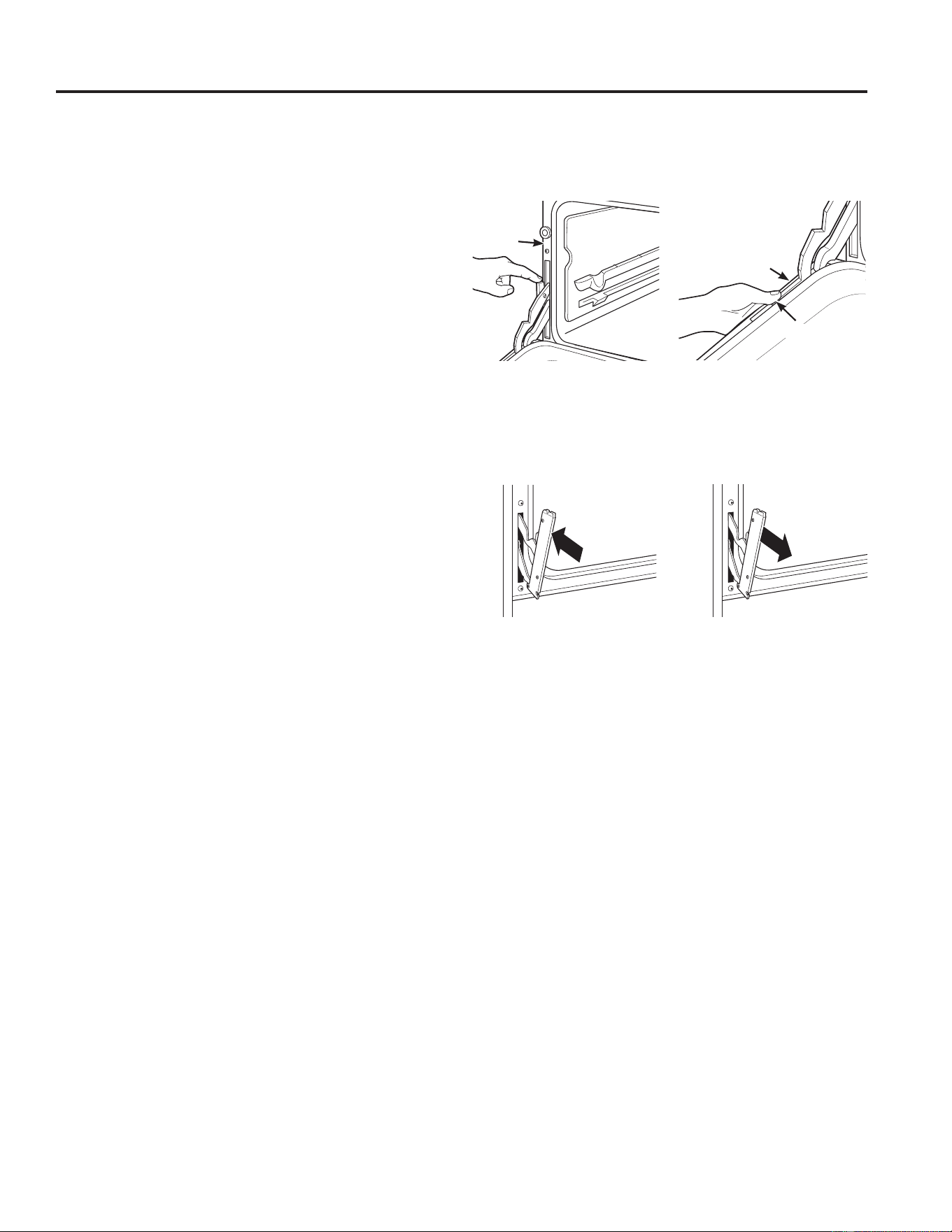
49-2000884 Rev. 2 25
CUIDADO Y LIMPIEZA: Puerta del Horno
Puerta del Horno
Levante la Puerta del Horno Superior
La puerta es muy pesada. Tenga cuidado al retirar y levantar la puerta. No levante la puerta usando la manija.
Para retirar la puerta:
1. Abra la puerta totalmente.
2. Levante el bloqueo de las bisagras hacia el marco del
horno hasta que se detenga.
&LHUUHODSXHUWDDJUDGRVVHQWLUiTXHODSXHUWDVH
GHWLHQH(OEORTXHRGHODVELVDJUDVKDUiFRQWDFWRFRQHO
marco del horno.
4. A ambos lados de la puerta, presione los botones para
liberar cada bisagra.
5. Levante la puerta hasta que se libere de las bisagras.
6. Tire de los brazos de las bisagras para liberar la presione
sobre las lengüetas de bloqueo.
7. Empuje los bloqueos de las bisagras hacia abajo sobre las
bisagras.
8. Presione las bisagras hacia la unidad, de modo que se
cierren.
Para reemplazar la puerta:
1. Empuje las bisagras hacia afuera del marco del horno
hasta la posición completamente abierta.
2. Levante los bloqueos de las bisagras hacia el marco del
horno hasta que se detengan.
3. Levante los bloqueos de las bisagras hacia el marco del
horno hasta que se detengan.
4. Deslice la puerta hacia atrás sobre las bisagras. Asegúrese
de que los botones se vuelvan a levantar.
5. Abra la puerta totalmente.
6. Empuje los bloqueos de las bisagras hacia abajo sobre las
bisagras.
7. Cierre la puerta del horno.
Marco del
horno
Marco de
la puerta
%RWRQHV
para liberar
Empuje
hacia
abajo
Empuje
hacia
adentro
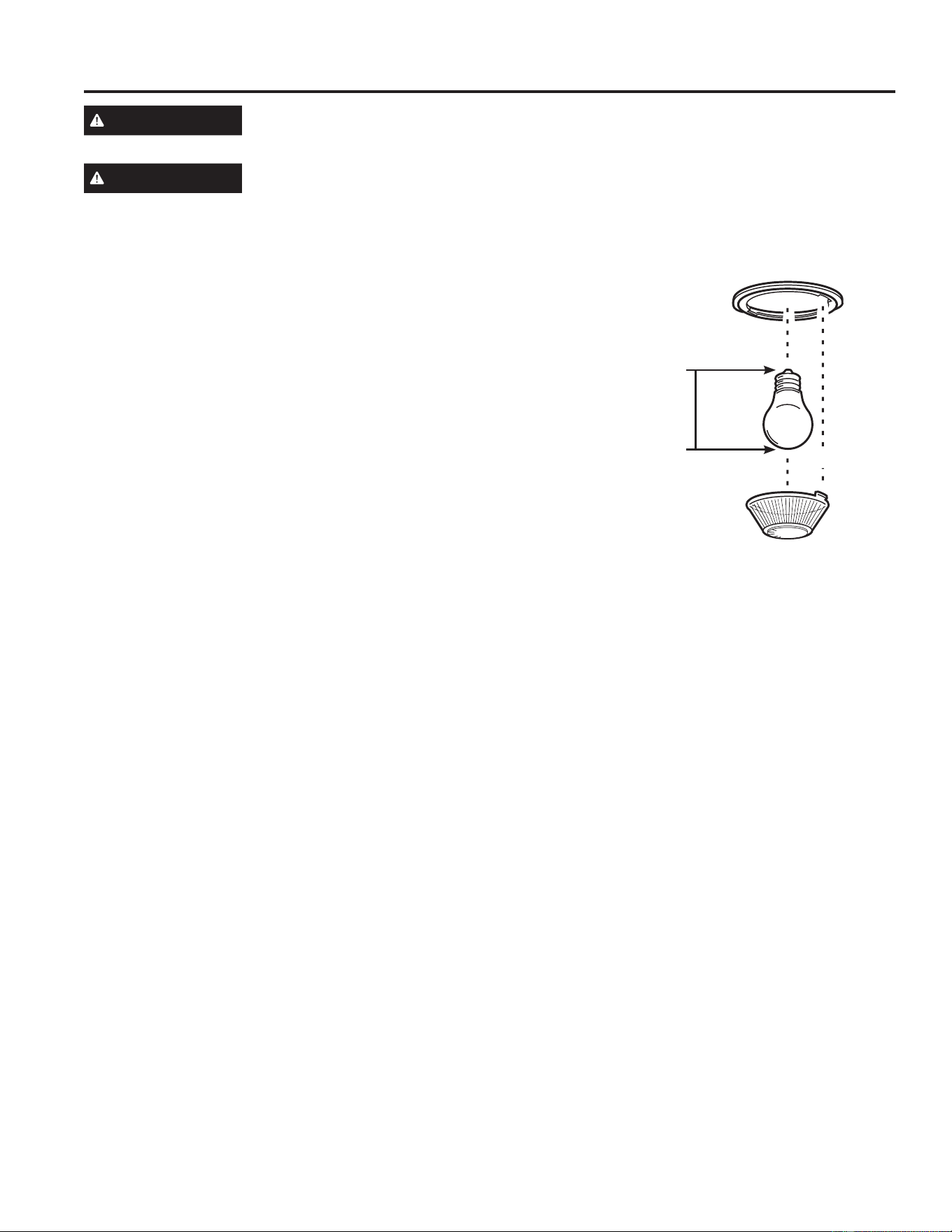
26 49-2000884 Rev. 2
NOTA: La tapa de vidrio deberá ser retirada sólo cuando esté
fría. Si usa guantes de látex, tendrá un mejor agarre.
Antes de reemplazar la lámpara, desconecte la conexión
eléctrica del horno del fusible principal o del panel del disyuntor.
Deje que la lámpara se enfríe completamente antes de retirar la
misma. Para su seguridad, no toque una lámpara caliente con
una tela húmeda. Si lo hace, la lámpara se podrá romper.
Para retirar:
Dé a la tapa de vidrio en contra de las agujas del reloj un
cuarto de giro hasta que las lengüetas de la tapa de vidrio
queden fuera de las ranuras de la ficha y empuje la tapa hacia
fuera. Retire la lámpara.
Para reemplazar:
Coloque una lámpara nueva de 40 watts para
electrodomésticos. Coloque las lengüetas de la tapa de vidrio
en las ranuras de la ficha. Dé a la tapa de vidrio un cuarto de
giro en dirección de las agujas del reloj.
NOTA:
Ŷ /DV OiPSDUDV SDUD HOHFWURGRPpVWLFR GH ZDWWV VRQ
más pequeñas que las lámparas hogareñas de 40
watts.
Ŷ 9XHOYD D FRQHFWDU HO
horno una vez que la
lámpara nueva esté
instalada.
Ŷ 3DUD XQD PHMRU
iluminación dentro del
horno, limpie la tapa
del vidrio en forma
frecuente utilizando
una tela húmeda.
Esto se deberá hacer
cuando el horno esté
completamente frío.
ADVERTENCIA
PELIGRO DE DESCARGA ELÉCTRICA O QUEMADURAS: Antes de reemplazar la bombilla del
horno, desconecte la alimentación de energía al horno desde el panel principal de fusibles o del
interruptor de circuitos. No hacerlo puede provocar una descarga eléctrica o una quemadura.
PRECAUCIÓN
RIESGO DE INCENDIO: La tapa de vidrio y la lámpara de luz se deberán retirar cuando estén frías. Tocar
el vidrio caliente sin protección en las manos o con un trapo húmedo puede ocasionar quemaduras.
Luzes del Horno
Lámpara
Ficha
Lengüeta
Longitud
máxima
de 3
1
»2”
Tapa de vidrio
CUIDADO Y LIMPIEZA: Luzes del Horno
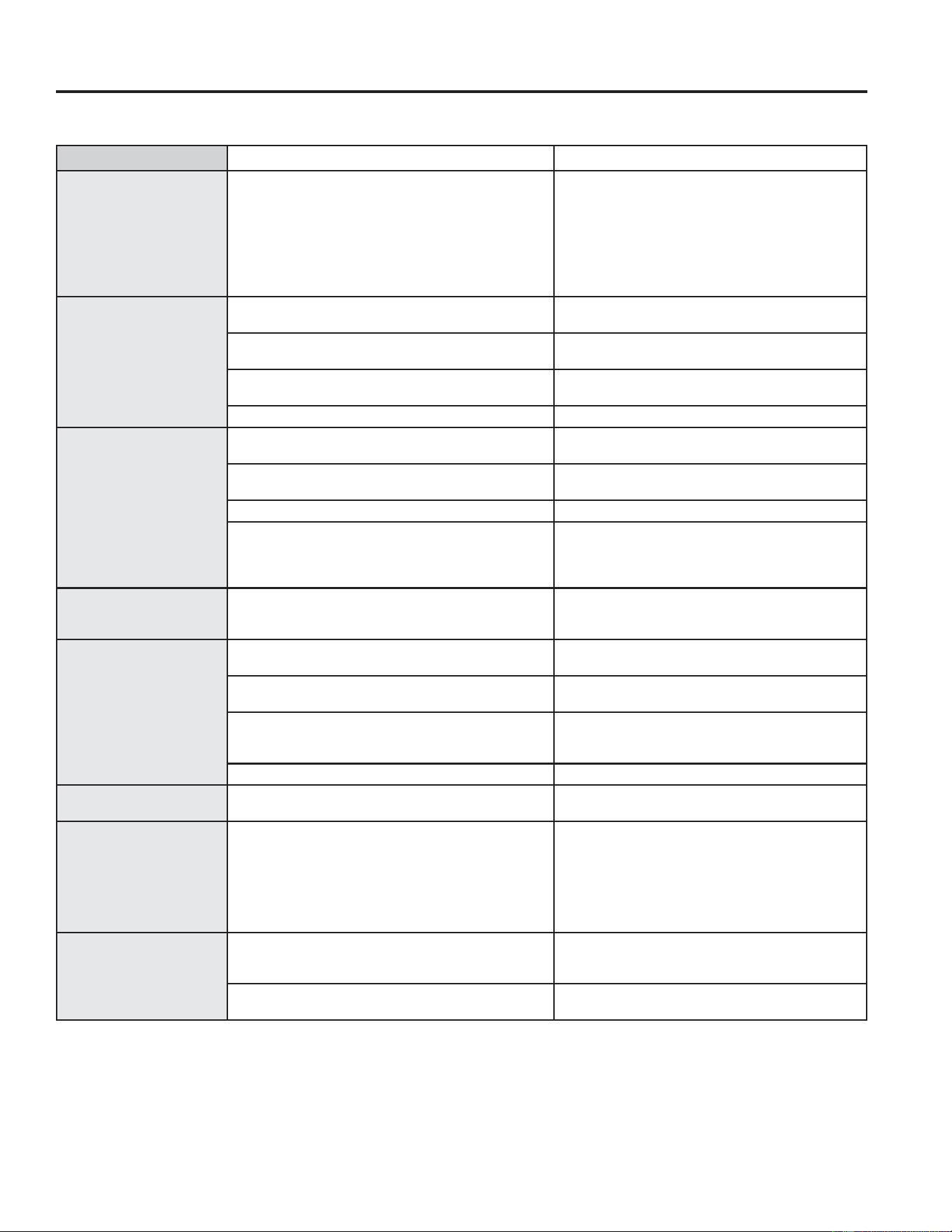
49-2000884 Rev. 2 27
Problema Causa Posible Qué Hacer
Mi horno nuevo no estufa
como el anterior. ¿Hay
DOJ~QSUREOHPDFRQ
las configuraciones de
temperatura?
Su horno nuevo cuenta con un sistema de cocción
diferente con relación al anterior y, por lo tanto, es
posible que cocine de forma diferente.
Durante los primeros usos, siga los tiempos y
temperaturas de sus recetas atentamente y use
las posiciones de los estantes recomendadas en la
Guía de Cocción. Si aún piensa que su horno nuevo
estufa con demasiado calor o demasiado frío, podrá
ajustar el termostato usted mismo para aplicar su
preferencia de cocción específica. Consulte la sección
de Configuraciones.
La comida no se hornea
de forma apropiada
Controles del horno configurados de forma incorrecta. Consulte la sección Modos de Cocción.
La posición del estante es incorrecta o el estante no
está nivelado.
Consulte la sección Modos de Cocción y la Guía de
Cocción.
8VRGHXQDFDFHURODLQFRUUHFWDRGHXQDFDFHURODGH
tamaño incorrecto.
&RQVXOWHODVHFFLyQ8WHQVLOLRV
La temperatura del horno debe ser ajustada. Consulte la sección Configuraciones.
La comida no asa de
forma apropiada
Controles del horno configurados de forma incorrecta. Asegúrese de seleccionar el modo correcto para
asar.
Se usó una posición incorrecta del estante. Para acceder a sugerencias de ubicación de
estantes, consulte la Guía de Cocción.
8WHQVLOLRGHHVWXIDLQDGHFXDGRSDUDDVDU 8VHXQDROODHVSHFtILFDPHQWHGLVHxDGDSDUDDVDU
El papel de aluminio sobre la olla para asar
no fue ajustado de forma apropiada ni cortado
apropiadamente para drenar la grasa.
Si usará papel de aluminio en la olla para asar,
envuelva de forma ajustada y agregue cortes
conforme con aquellos en la olla para permitir que la
grasa sea drenada.
La temperatura del horno
es demasiado caliente o
demasiado fría
La temperatura del horno debe ser ajustada. Consulte la sección Controles del Horno.
El horno y/o la pantalla
parecen no estar
funcionando
Es posible que un fusible de su hogar se haya
quemado o que el disyuntor se haya desconectado.
Reemplace el fusible o reinicie el disyuntor.
Controles del horno configurados de forma incorrecta. &RQVXOWHODVHFFLyQ8VRGHO+RUQR
(OKRUQRVHHQFXHQWUDHQ6DEEDWK0RGH0RGR
6DEiWLFR
Verifique que el horno no esté en Sabbath Mode
0RGR6DEiWLFR&RQVXOWHODVHFFLyQ6DEEDWK0RGH
0RGR6DEiWLFR
El reloj está apagado. &RQVXOWHODVHFFLyQ6HWWLQJV&RQILJXUDFLRQHV
Sonido de “chisporroteo”
o “traqueo”
Éste es el sonido de metal calentándose o enfriándose
durante las funciones de cocción y limpieza.
Esto es normal.
¿Por qué la estufa hace
un sonido de “clic”
cuando uso el horno?
Su estufa fue diseñada para mantener un control más
ajustado sobre la temperatura del horno. Es posible
que escuche que los elementos de calentamiento del
horno hagan sonidos de “clic” con mayor frecuencia
que con hornos más antiguos para lograr mejores
resultados durante los ciclos de horneado, asado,
convección y limpieza automática.
Esto es normal.
A veces el horno tarda
más en precalentarse a la
misma temperatura
8WHQVLOLRRFRPLGDHQHOKRUQR El utensilio o la comida en el horno hará que éste
tarde más en precalentarse. Retire estos artículos para
reducir el tiempo de precalentamiento.
Número de estantes en el horno Agregar más estantes al horno hará que éste tarde
más en precalentarse. Retire algunos estantes.
¡Ahorre tiempo y dinero! Primero revise los cuadros que aparecen en las siguientes páginas y es posible que no necesite solicitar
reparaciones.
Consejos para la Solución de Problemas... Antes de solicitar el servicio técnico
CONSEJOS PARA LA SOLUCIÓN DE PROBLEMAS
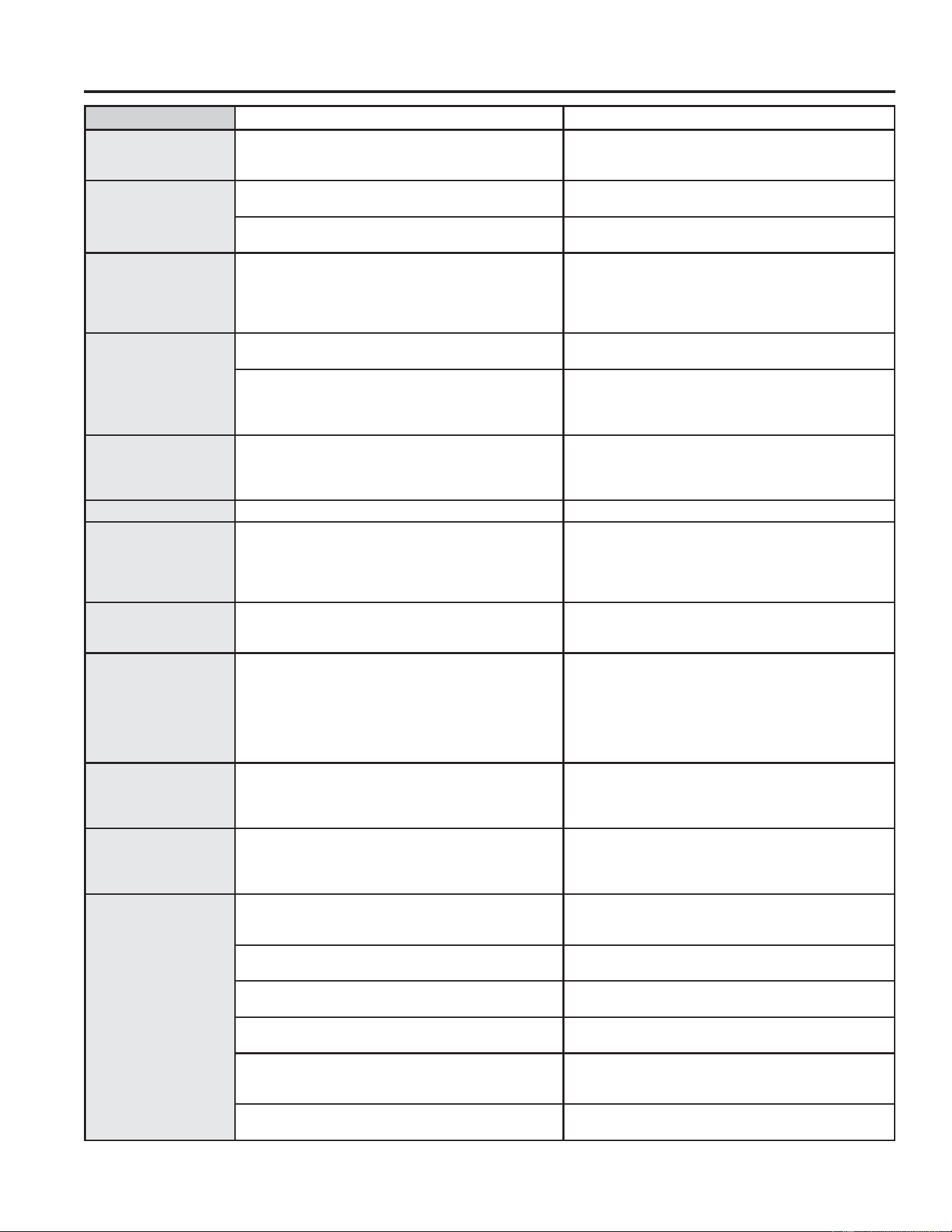
28 49-2000884 Rev. 2
Consejos para la Solución de Problemas... Antes de solicitar el servicio técnico
Problema Causa Posible Qué Hacer
La luz del horno no
funciona
La lámpara está floja o presenta defectos. Ajuste o reemplace la lámpara. Para acceder a
instrucciones sobre cómo reemplazar la lámpara,
consulte la sección de Mantenimiento.
El modo de limpieza
automática del horno
no funciona
La temperatura del horno es demasiado caliente como
para configurar la limpieza automática.
Espere a que el horno se enfríe y reinicie los controles.
Los controles del horno están configurados de forma
incorrecta.
Consulte la sección de Limpieza del Horno.
Exceso de humo
durante un ciclo de
limpieza
Suciedad o grasa excesiva. Presione la tecla Cancel/Off (Cancelar/ Apagar) Abra
las ventanas para liberar el humo en la habitación.
Espere hasta que la luz de la función LOCKED
(Bloqueado) desaparezca. Limpie el exceso de
suciedad y reinicie el ciclo de limpieza.
El horno no limpia
luego de un ciclo de
limpieza
Los controles del horno están configurados de forma
incorrecta.
Consulte la sección de Limpieza del Horno.
El horno estaba demasiado sucio. Limpie derrames excesivos antes de iniciar el ciclo de
limpieza. Es posible que, en hornos con mucha suciedad,
sea necesario usar la limpieza automática nuevamente o
usarla durante un período de tiempo más prolongado.
Fuerte olor a
“quemado” o a
“aceite” desde la
ventilación
Esto es normal en un horno nuevo y desaparecerá con
el tiempo.
Para acelerar el proceso, configure un ciclo de limpieza
automática por un mínimo de 3 horas. Consulte la
sección de Limpieza del Horno.
Humo excesivo al asar La comida está demasiado cerca del quemador. %DMHODSRVLFLyQGHOHVWDQWHFRQFRPLGD
La puerta del horno
no se abre o la luz
LOCKED (Bloqueado)
está encendida
cuando desea cocinar.
La puerta del horno está bloqueada debido a que la
temperatura interior del horno no descendió por debajo
de la temperatura de bloqueo.
Presione la tecla Cancel/Off (Cancelar/ Apagar).
Espere a que el horno se enfríe por debajo de la
temperatura de bloqueo.
“TRABA DE LA
PUERTA” titila en la
pantalla.
El ciclo de limpieza automática fue seleccionado pero la
puerta no está cerrada.
Cierre la puerta del horno.
³)±\XQQ~PHUR
o letra” titila en la
pantalla
Tiene un código de error de función. Presione la tecla Cancel/Off (Cancelar/ Apagar)
Permita que el horno se enfríe durante una hora. Vuelva
a poner el horno en funcionamiento. Si el código de la
función se repite, desconecte totalmente la corriente
del horno durante por lo menos 30 minutos y vuelva a
conectar la misma. Si el código de error de función se
repite, llame al servicio técnico.
Corte de corriente, el
reloj titila
Corte o exceso de corriente Reinicie el reloj. Si el horno estuvo en uso, deberá
reiniciar el mismo presionando la tecla Cancel/ Off
(Cancelar/ Apagar) configurando el reloj y reiniciando
cualquier función de cocción.
Controles de Bloqueo
o Control La función
de bloqueo está
activada.
Si aparece LOC ON en la pantalla, el control de la estufa
está bloqueado. Apague esta función para usar la estufa.
&RQVXOWHODIXQFLyQ/RFN&RQWURO&RQWUROGH%ORTXHRHQ
la sección de Controles del Horno.
El quemador no se
enciende
El enchufe en la estufa no está completamente
insertado en el tomacorriente eléctrico.
Asegúrese de que el cable de electricidad esté
enchufado en un tomacorriente correctamente conectado
a tierra.et.
El suministro de gas no fue conectado o encendido. Consulte las Instrucciones de Instalación provistas con
su estufa.
Es posible que un fusible de su hogar se haya quemado
o que el disyuntor se haya desconectado.
Reemplace el fusible o reinicie el disyuntor.
Las piezas del quemador no fueron reemplazadas
correctamen.
Lea la sección Cuidado y limpieza de la estufa.
Es posible que las hendiduras de los quemadores, o el
puerto del encendedor redondo en el quemador oval,
estén atascados.
Retire los quemadores o limpie los mismos. Controle que
no haya comida quemada ni grasa en el área del electrodo.
Lea la sección de Cuidado y Limpieza de la estufa.
Residuos de comida en el electrodo Suavemente pula el extremo plano del electrodo con una
lima de uñas o con una lija hasta que quede brilloso.
CONSEJOS PARA LA SOLUCIÓN DE PROBLEMAS
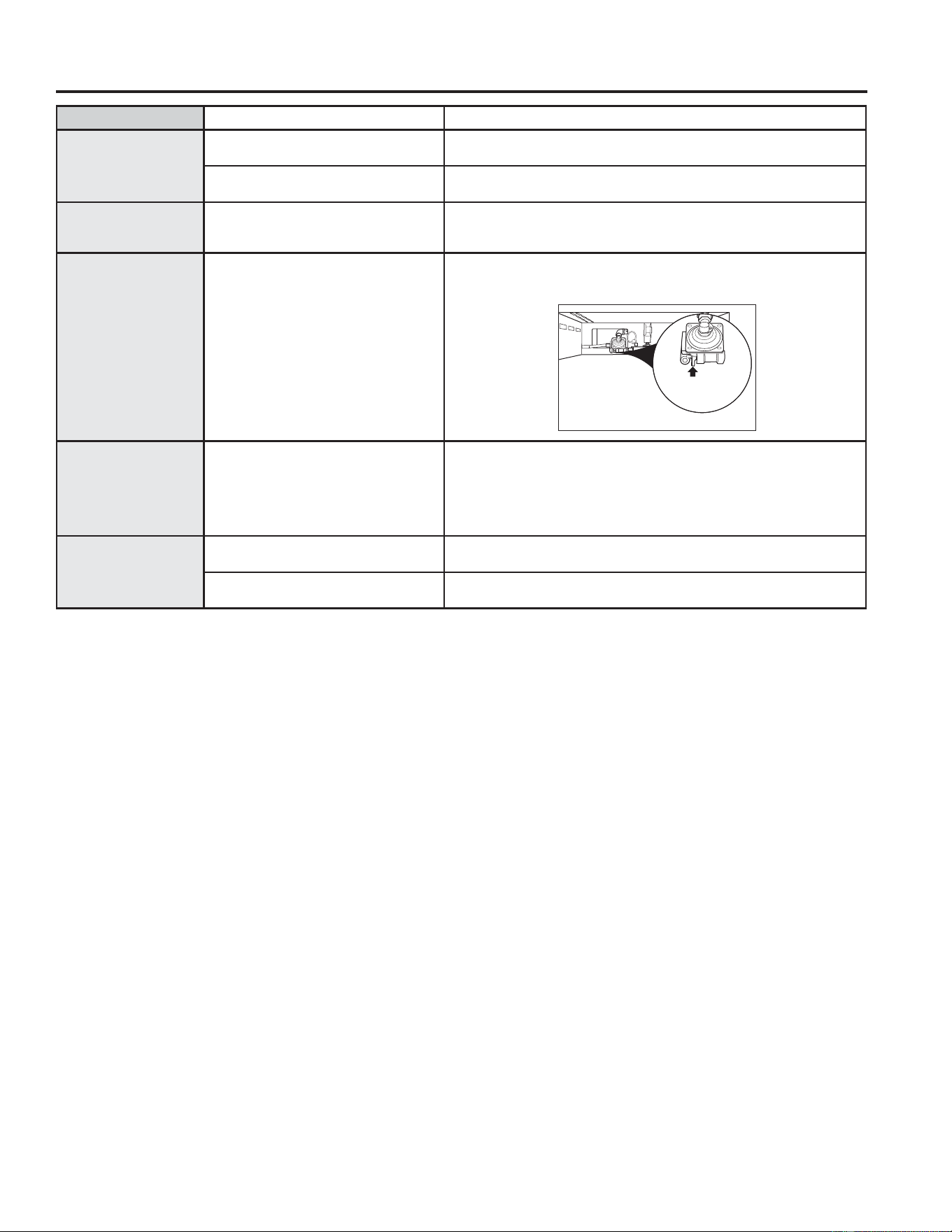
49-2000884 Rev. 2 29
CONSEJOS PARA LA SOLUCIÓN DE PROBLEMAS
Consejos para la Solución de Problemas... Antes de solicitar el servicio técnico
Problema Causa Posible Qué Hacer
Los quemadores
superiores no queman
de forma pareja
Ensamble del quemador inapropiado. Asegúrese de que las tapas de los quemadores estén instaladas
correctamente. Consulte Cuidado y limpieza en la sección de la estufa.
Las hendiduras al costado del quemador
se podrán atascar.
Retire los quemadores para su limpieza. Consulte la sección de Cuidado
y limpieza de la estufa.
Llamas de los
quemadores son muy
grandes o amarillas
Promedio inadecuado de aire a gas. Si la estufa es conectada a gas Propano, contacte al técnico que instaló
la estufa o que hizo la conversión.
Los quemadores
superficiales se
iluminan pero los
quemadores para
hornear y asar no.
Es posible que los quemadores de gas
del horno hayan sido apagados.
El apagado del gas del horno está ubicado en el regulador de gas cerca
GHODDGKHUHQFLDGHODWXEHUtDGHJDVDODHVWXID8ELTXHODPLVPD\Gp
vuelta la palanca.
La puerta de vidrio
del horno parece
estar “teñida” o tener
un color “arcoíris”.
El vidrio del horno interno está cubierto
con una barrera de calor que refleja
este último nuevamente hacia el horno,
a fin de evitar la pérdida de calor y de
mantener fría la puerta externa mientras
se hornea.
(VWRHVQRUPDO%DMRFLHUWDVOXFHV\iQJXORVHVSRVLEOHTXHYLVXDOLFH
esta tinta o arcoíris.
El cajón no se desliza
de forma pareja o se
arrastra
El cajón está desalineado. Extienda totalmente el cajón y empuje el mismo totalmente hacia
adentro. Consulte la sección Cuidado y limpieza de la estufa.
El cajón está sobrecargado o la carga
está des balanceada.
Reduzca peso o redistribuya los contenidos de los cajones.
La palanca se
muestra cerrada.
(038-(3$5$$%5,5
Modelos con quemador sellado
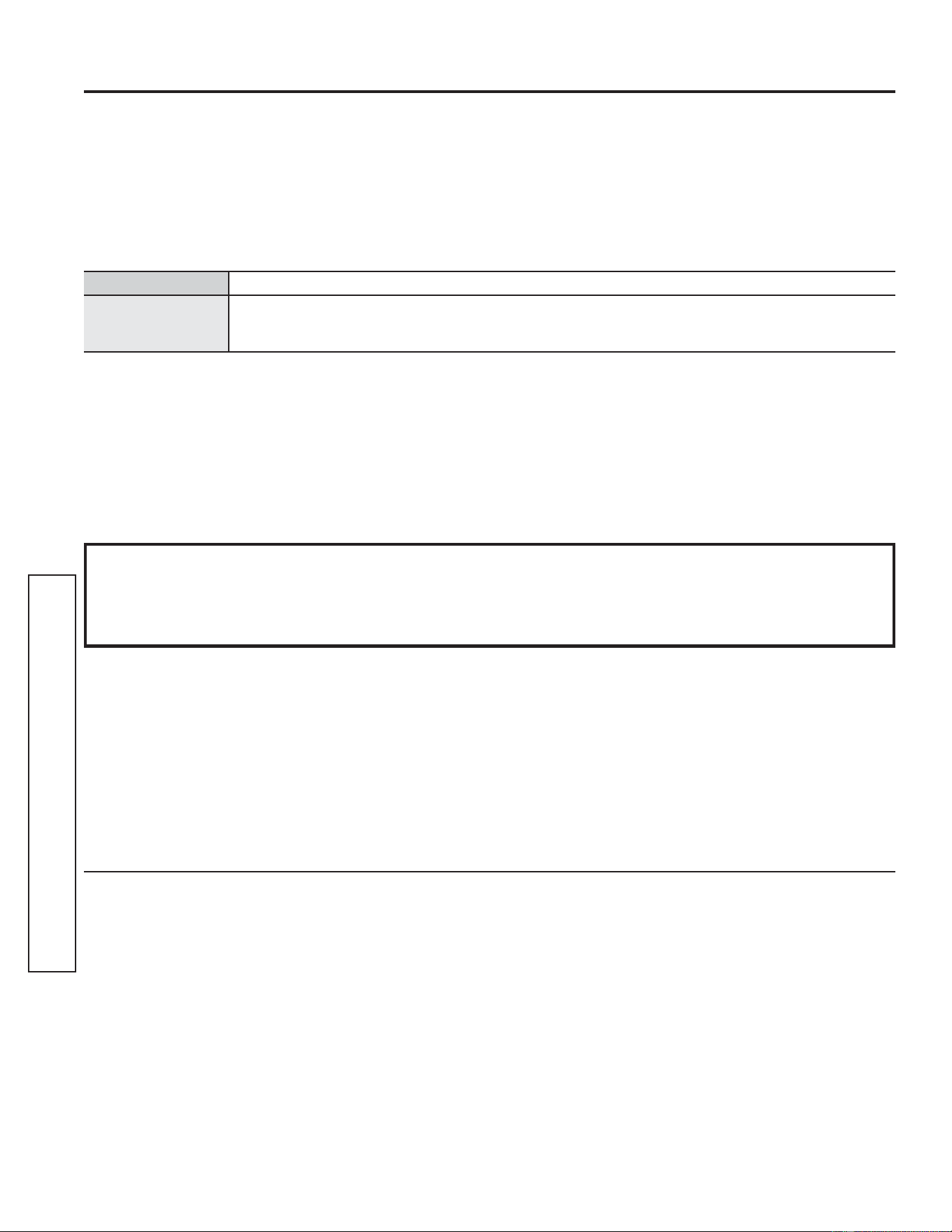
30 49-2000884 Rev. 2
Abroche su recibo aquí. Para acceder al servicio técnico de acuerdo con
la garantía deberá contar con la prueba de la fecha original de compra.
GEAppliances.com
Todo el servicio de garantía es provisto por nuestros Centros de Servicio de Fabricación, o un técnico autorizado de Customer Care
®
.
Para programar una visita del servicio técnico a través de Internet, visítenos en geappliances.com/service,, o llame a GE Appliances
al 800.GE.CARES. Cuando llame para solicitar el servicio, tenga los números de serie y modelo disponibles.
Para realizar el servicio técnico de su electrodoméstico, se podrá requerir el uso de datos del puerto de abordaje para su diagnóstico.
Esto da al técnico del servicio de fábrica de GE Appliances la habilidad de diagnosticar de forma rápida cualquier problema con
su electrodoméstico, y de ayudar a GE Appliances a mejorar sus productos al brindarle a GE Appliances la información sobre su
electrodoméstico. Si no desea que los datos de su electrodoméstico sean enviados a GE Appliances, solicitamos que le indique a su
técnico no entregar los datos a GE Appliances en el momento del servicio.
Qué no cubrirá GE Appliances:
Ŷ 9LDMHVGHOWpFQLFRGHOVHUYLFLRDVXKRJDUSDUDHQVHxDUOH
sobre cómo usar el producto.
Ŷ ,QVWDODFLyQHQWUHJDRPDQWHQLPLHQWRLQDGHFXDGRV
Ŷ )DOODVGHOSURGXFWRHQFDVRGHDEXVRPDOXVRPRGLILFDFLyQ
o uso para propósitos diferentes al original o uso comercial.
Ŷ 5HHPSOD]RGHIXVLEOHVGHODFDVDRUHLQLFLRGHGLV\XQWRUHV
Ŷ 'DxRVRFDVLRQDGRVVREUHHOSURGXFWRSRUDFFLGHQWH
incendio, inundaciones o catástrofes naturales.
Ŷ 'DxRVLQFLGHQWDOHVRFRQVHFXHQWHVFDXVDGRVSRUSRVLEOHV
defectos sobre este producto.
Ŷ 'DxRVVREUHHODFDEDGRWDOHVFRPRy[LGRVREUHOD
superficie, deslustres o manchas pequeñas no informadas
dentro de las 48 horas luego de la entrega.
Ŷ 'DxRFDXVDGRGHVSXpVGHODHQWUHJD
Ŷ 3URGXFWRQRDFFHVLEOHSDUDEULQGDUHOVHUYLFLRUHTXHULGR
Ŷ 6ROLFLWHHOVHUYLFLRWpFQLFRSDUDUHSDUDURUHHPSOD]DUODV
lámparas, excepto las lámparas LED.
GARANTÍA LIMITADA
Garantía Limitada de la Estufa a Gas
EXCLUSIÓN DE GARANTÍAS IMPLÍCITAS
Su única y exclusiva alternativa es la reparación del producto, como se indica en la Garantía Limitada. Las
garantías implícitas, incluyendo garantías implícitas de comerciabilidad o conveniencia sobre un propósito
particular, se limitan a un año o al período más corto permitido por la ley.
Esta garantía limitada se extiende al comprador original y a cualquier dueño subsiguiente de productos comprados
SDUDXVRKRJDUHxRGHQWURGH((886LHOSURGXFWRHVWiHQXQiUHDGRQGHQRVHHQFXHQWUDGLVSRQLEOHXQ3URYHHGRU
Autorizado del Servicio Técnico de GE Appliances, usted será responsable por el costo de un viaje o se podrá
requerir que traiga el producto a una ubicación del Servicio Técnico de GE Appliances autorizado para recibir el
VHUYLFLR(Q$ODVNDODJDUDQWtDOLPLWDGDH[FOX\HHOFRVWRGHHQYtRROODPDGDVGHOVHUYLFLRDVXKRJDU$OJXQRVHVWDGRV
no permiten la exclusión o limitación de daños fortuitos o consecuentes. Esta garantía limitada le da derechos legales
específicos y es posible que tenga otros derechos legales que varían entre un estado y otro. Para conocer cuáles son
sus derechos legales, consulte a la oficina de asuntos del consumidor local o estatal o al Fiscal de su estado.
Garante: GE Appliances, a Haier company
/RXLVYLOOH.<
Garantías Extendidas: Adquiera una garantía extendida de GE Appliances y conozca los descuentos especiales que
están disponibles mientras su garantía aún está vigente. Puede acceder a la misma a través de Internet en cualquier
momento en
geappliances.com/extended-warranty
o llamando al 800.626.2224 durante el horario comercial. Los Servicios para los GE Appliances aún estarán
disponibles cuando su garantía caduque.
Por el Período de GE Appliances reemplazará
Un Año
Desde la fecha de la
compra original
Cualquier parte de la estufa que falle debido a un defecto en los materiales o la fabricación. Durante
esta garantía limitada de un año, GE Appliances también proveerá, sin costo, todo el trabajo y el
servicio en el hogar para reemplazar la parte que presente defectos.

49-2000884 Rev. 2 31
ACCESORIOS
¿Busca Algo Más?
¡GE Appliances ofrece una variedad de accesorios para
mejorar sus experiencias de cocción y mantenimiento!
Para acceder a números telefónicos e información de sitios
Web, consulte la página de Soporte para el Consumidor.
Estos y otros productos están disponibles:
Accesorios
Accesorios
Estante Plano de Níquel
Estante Plano Reforzado de Níquel
Estante Plano con Limpieza Automática
Estante Extensible de Níquel
Estante Extensible con Limpieza Automática
2OODSDUD$VDUô´[ó´[ò´
Accesorio del Estante para Dorar
Rejilla Central de la Superficie de Cocción
Plancha de Aluminio No Adherente
Plancha de Hierro Forjado Reversible
Suministros de Limpieza
Limpiadores de Acero Inoxidable CitriShine
Paño de Pulido de Acero Inoxidable
5HPRYHGRUGH*UDVD4XHPDGD

32 49-2000884 Rev. 2
Soporte para el Consumidor
SOPORTE PARA EL CONSUMIDOR
Sitio Web de GE Appliances
¿Desea realizar una consulta o necesita ayuda con su electrodoméstico? ¡Intente a través del Sitio Web de GE Appliances las
KRUDVGHOGtDFXDOTXLHUGtDGHODxR8VWHGWDPELpQSXHGHFRPSUDUPiVHOHFWURGRPpVWLFRVPDUDYLOORVRVGH*($SSOLDQFHV\
aprovechar todos nuestros servicios de soporte a través de Internet, diseñados para su conveniencia.
(Q((88GEAppliances.com
Registre su Electrodoméstico
£5HJLVWUHVXHOHFWURGRPpVWLFRQXHYRDWUDYpVGH,QWHUQHWVHJ~QVXFRQYHQLHQFLD8QUHJLVWURSXQWXDOGHVXSURGXFWRSHUPLWLUi
una mejor comunicación y un servicio más puntual de acuerdo con los términos de su garantía, en caso de surgir la necesidad.
También puede enviar una carta en la tarjeta de inscripción preimpresa que se incluye con el material embalado.
(Q((88GEAppliances.com/register
Servicio Programado
El servicio de reparación de expertos de GE Appliances está a sólo un paso de su puerta. Conéctese a través de Internet y programe
VXVHUYLFLRDVXFRQYHQLHQFLDFXDOTXLHUGtDGHODxR(Q((88GEAppliances.com/service
o comuníquese al 800.432.2737 durante el horario de atención comercial.
Garantías Extendidas
Adquiera una garantía extendida de GE Appliances y conozca los descuentos especiales que están disponibles mientras su
garantía aún está vigente. La puede adquirir en cualquier momento a través de Internet. Los servicios de GE Appliances aún
estarán allí cuando su garantía caduque.
(Q((88GEAppliances.com/extended-warranty
o comuníquese al 800.626.2224 durante el horario de atención comercial.
Conectividad Remota
3DUDVROLFLWDUDVLVWHQFLDSDUDODFRQHFWLYLGDGGHUHGLQDOiPEULFDSDUDPRGHORVFRQDFFHVRUHPRWR
visite nuestro sitio web en GEAppliances.com/connectRFRPXQtTXHVHDOHQ((88
Piezas y Accesorios
Aquellos individuos calificados para realizar el servicio técnico de sus propios electrodomésticos podrán solicitar el envío de
SLH]DVRDFFHVRULRVGLUHFWDPHQWHDVXVKRJDUHVVHDFHSWDQODVWDUMHWDV9,6$0DVWHU&DUG\'LVFRYHU2UGHQHKR\DWUDYpVGH
,QWHUQHWGXUDQWHODVKRUDVWRGRVORVGtDV(Q((88GEApplianceparts.com o de forma telefónica al 877.959.8688 durante
el horario de atención comercial.
Las instrucciones que figuran en este manual cubren los procedimientos que serán realizados por cualquier usuario.
Otros servicios técnicos generalmente deben ser derivados a personal calificado del servicio. Se deberá tener cuidado,
ya que una reparación indebida podrá hacer que el funcionamiento no sea seguro.
Contáctenos
Si no se encuentra satisfecho con el servicio que recibió de GE Appliances, comuníquese con nosotros a través de nuestro sitio
Web con todos los detalles, incluyendo su número telefónico, o escriba a:
(Q((88*HQHUDO0DQDJHU&XVWRPHU5HODWLRQV_*($SSOLDQFHV$SSOLDQFH3DUN_/RXLVYLOOH.<
GEAppliances.com/contact

