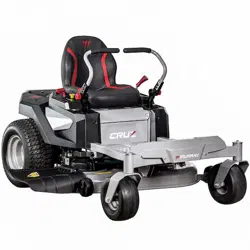

CRUZ ZERO
TURN MOWER
Model #MYZ4219000
Operator’s Manual
Customer Service Number: 855-693-2582 | www.murray.com
5022993

2
TABLE OF CONTENTS
3
CRUZ ZERO TURN MOWER CRUZ ZERO TURN MOWER
1. General Information
Environmental Disposal
Recycle all packaging, used oil, and batteries according to
applicable government regulations.
Reference
All references in this manual to the left side or right side
and front or back of the machine are from the operator’s
position. All language translations of this document derive
from the initial English source file.
SECTION 1
General Information ................................3
SECTION 2
Operator Safety........................................4
..................................4
...............................................6
Save These Instructions
.............................5
Slope Identification Guide
.............4
Safety Alert Symbol and Signal Words
Safety Decals
Safety Instructions
........................................7
SECTION 3
Assembly Instructions............................
Install Hitch
Assemble Drive Control Lever
Assemble the Seat
......................................11
.......................12
...............................................14
10
Connecting the Battery
...............................14
Driving the Mower
Adjusting the Mower Cutting Height
....................................24
...........27
Adjusting Deck Anti-scalp Wheel.
..................27
Mowing
....................................................28
Check/Adjust the Tire Pressure
Operation Instructions.
Using the Throttle/Choke Lever.
Stop the Engine
Fuel Recommendations
Safety Interlock System Tests
Engine
Features and Controls
SECTION 4
Operating the Mower
SECTION 5
.....................15
..........................16
...........................19
.......................20
.....................................................20
..............................21
................................22
....................23
.........................................23
SECTION 6
Maintenance...........................................31
Cleaning the Mower Deck
...........................33
Leveling the Cutting Deck
...........................34
Removing the Cutting Deck
.........................35
Changing the Deck Belt
..............................36
Changing the Drive Belt
..............................37
Replacing the Cutting Blades
.......................38
Sharpening the Blade
Checking the Tire Pressure
Cleaning the Mower
...................................32
.................................39
...........................40
Battery Maintenance
..................................40
Checking the Mower Blade Stop Time
Changing the Engine Oil and Oil Filter
...........42
..........42
Checking the Engine Oil Level
......................43
Changing the Air Filter
................................43
Checking the Spark Plug
.............................44
Pushing the Mower By Hand
Towing with the Mower
.......................45
45.............................
................................................. Transport
Storage
Troubleshooting
SECTION 7
SECTION 8
SECTION 9
46
.....................................................47
.....................................48
.........................................50
SECTION 11
Disposal
SECTION 12
Warranty
SECTION 10
Specifications
............................
...................................................
52
53
.................................................54
Power Ratings Disclaimer
L
R
2
TABLE OF CONTENTS
3
CRUZ ZERO TURN MOWER CRUZ ZERO TURN MOWER
1. General Information
Environmental Disposal
Recycle all packaging, used oil, and batteries according to
applicable government regulations.
Reference
All references in this manual to the left side or right side
and front or back of the machine are from the operator’s
position. All language translations of this document derive
from the initial English source file.
SECTION 1
General Information ................................3
SECTION 2
Operator Safety........................................4
..................................4
...............................................6
Save These Instructions
.............................5
Slope Identification Guide
.............4
Safety Alert Symbol and Signal Words
Safety Decals
Safety Instructions
........................................7
SECTION 3
Assembly Instructions............................
Install Hitch
Assemble Drive Control Lever
Assemble the Seat
......................................11
.......................12
...............................................14
10
Connecting the Battery
...............................14
Driving the Mower
Adjusting the Mower Cutting Height
....................................24
...........27
Adjusting Deck Anti-scalp Wheel.
..................27
Mowing
....................................................28
Check/Adjust the Tire Pressure
Operation Instructions.
Using the Throttle/Choke Lever.
Stop the Engine
Fuel Recommendations
Safety Interlock System Tests
Engine
Features and Controls
SECTION 4
Operating the Mower
SECTION 5
.....................15
..........................16
...........................19
.......................20
.....................................................20
..............................21
................................22
....................23
.........................................23
SECTION 6
Maintenance...........................................31
Cleaning the Mower Deck
...........................33
Leveling the Cutting Deck
...........................34
Removing the Cutting Deck
.........................35
Changing the Deck Belt
..............................36
Changing the Drive Belt
..............................37
Replacing the Cutting Blades
.......................38
Sharpening the Blade
Checking the Tire Pressure
Cleaning the Mower
...................................32
.................................39
...........................40
Battery Maintenance
..................................40
Checking the Mower Blade Stop Time
Changing the Engine Oil and Oil Filter
...........42
..........42
Checking the Engine Oil Level
......................43
Changing the Air Filter
................................43
Checking the Spark Plug
.............................44
Pushing the Mower By Hand
Towing with the Mower
.......................45
45.............................
................................................. Transport
Storage
Troubleshooting
SECTION 7
SECTION 8
SECTION 9
46
.....................................................47
.....................................48
.........................................50
SECTION 11
Disposal
SECTION 12
Warranty
SECTION 10
Specifications
............................
...................................................
52
53
.................................................54
Power Ratings Disclaimer
L
R
4
2. Operator Safety
Save These Instructions
Save these instructions for future reference. This manual
contains safety information to make you aware of the
hazards and risks associated with the product and how to
avoid them. It also contains important instructions that must
be obeyed during the initial set-up, operation, and mainte-
nance of the product.
This product is designed and intended for cutting well
maintained grass and is not intended for other purposes.
It is important that you read and understand these instruc-
tions before you attempt to start or operate this equipment.
Make sure that you are fully familiar with the controls and
the correct use of the product.
Know how to stop the unit and disengage controls quickly.
Safety Alert Symbol and
Signal Words
The safety alert symbol in this manual identifies safety
information about hazards that can result in personal injury.
The use of IMPORTANT, NOTE, and NOTICE in the text shows
clarifications, exceptions, or alternatives to the procedures.
A signal word (DANGER, WARNING, or CAUTION) is used
with the alert symbol to indicate the likelihood and the
potential severity of injury. In addition, a hazard symbol
may be used to represent the type of hazard.
5
DANGER: Indicates an immediately hazardous
situation which, if not avoided, will result in death or
serious injury.
WARNING: Indicates a potentially hazardous
situation which, if not avoided, could result in death or
serious injury.
CAUTION: Indicates a potentially hazardous
situation which, if not avoided, may result in minor or
moderate injury.
CRUZ ZERO TURN MOWER CRUZ ZERO TURN MOWER
Fig. 1
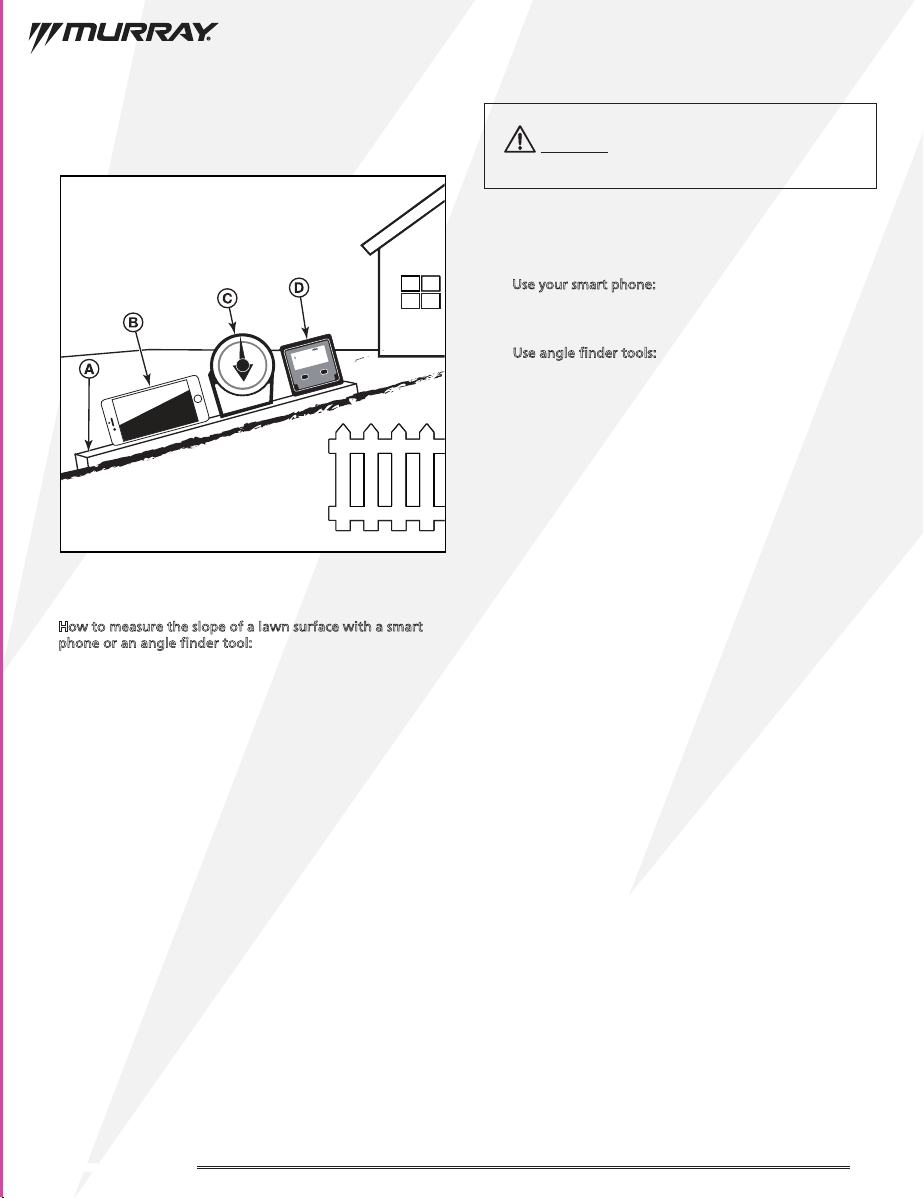
How to measure the slope of a lawn surface with a smart
phone or an angle finder tool:
1. Use a straight edge at least two (2) feet long (A, Fig. 1).
A 2x4 or a straight piece of metal works as well.
2. Angle finder tools:
a.
Use your smart phone: Many smart phones (B, Fig. 1)
have an in-clinometer (angle finder) located under the
compass application (app). Alternatively, you can search
your phone’s app store for an in-clinometer app.
b.
Use angle finder tools: Angle finder tools (C and D,
Fig. 1) are available at local hardware stores or online
(also called in-clinometer, protractor, angle meter, or
angle gauge). Dial type (C) or digital type (D) work,
others may not. Read and obey the user instructions
supplied with the angle finder tool.
3. Put the two (2) feet long straight edge along the steepest
part of the lawn slope. Put the board up and down the
slope.
4. Lay the smart phone or angle finder tool on the straight
edge and read the angle in degrees. This is the slope of
your lawn.
WARNING: Do not operate on slopes greater than
15 degrees.
Slope Identification Guide
4
2. Operator Safety
Save These Instructions
Save these instructions for future reference. This manual
contains safety information to make you aware of the
hazards and risks associated with the product and how to
avoid them. It also contains important instructions that must
be obeyed during the initial set-up, operation, and mainte-
nance of the product.
This product is designed and intended for cutting well
maintained grass and is not intended for other purposes.
It is important that you read and understand these instruc-
tions before you attempt to start or operate this equipment.
Make sure that you are fully familiar with the controls and
the correct use of the product.
Know how to stop the unit and disengage controls quickly.
Safety Alert Symbol and
Signal Words
The safety alert symbol in this manual identifies safety
information about hazards that can result in personal injury.
The use of IMPORTANT, NOTE, and NOTICE in the text shows
clarifications, exceptions, or alternatives to the procedures.
A signal word (DANGER, WARNING, or CAUTION) is used
with the alert symbol to indicate the likelihood and the
potential severity of injury. In addition, a hazard symbol
may be used to represent the type of hazard.
5
DANGER: Indicates an immediately hazardous
situation which, if not avoided, will result in death or
serious injury.
WARNING: Indicates a potentially hazardous
situation which, if not avoided, could result in death or
serious injury.
CAUTION: Indicates a potentially hazardous
situation which, if not avoided, may result in minor or
moderate injury.
CRUZ ZERO TURN MOWER CRUZ ZERO TURN MOWER
Fig. 1
How to measure the slope of a lawn surface with a smart
phone or an angle finder tool:
1. Use a straight edge at least two (2) feet long (A, Fig. 1).
A 2x4 or a straight piece of metal works as well.
2. Angle finder tools:
a.
Use your smart phone: Many smart phones (B, Fig. 1)
have an in-clinometer (angle finder) located under the
compass application (app). Alternatively, you can search
your phone’s app store for an in-clinometer app.
b.
Use angle finder tools: Angle finder tools (C and D,
Fig. 1) are available at local hardware stores or online
(also called in-clinometer, protractor, angle meter, or
angle gauge). Dial type (C) or digital type (D) work,
others may not. Read and obey the user instructions
supplied with the angle finder tool.
3. Put the two (2) feet long straight edge along the steepest
part of the lawn slope. Put the board up and down the
slope.
4. Lay the smart phone or angle finder tool on the straight
edge and read the angle in degrees. This is the slope of
your lawn.
WARNING: Do not operate on slopes greater than
15 degrees.
Slope Identification Guide
6 7
WARNING: Read and follow all safety rules and
instructions in this manual before attempting to operate
this machine. Failure to comply with these instructions
could result in death or serious injury.
WARNING: This machine is capable of amputating
hands and feet and throwing objects. Failure to observe
the following safety instructions could result in serious
injury or death.
CALIFORNIA PROPOSITION 65: Engine exhaust, some of its
constituents, and certain vehicle components contain or
emit chemicals known to the State of California to cause
cancer and birth defects or other reproductive harm.
Safety Instructions
General safety practices
• Read, understand, and follow instructions and warnings in
this manual and on the machine, engine, and attachments.
• Only allow operators who are responsible, trained,
familiar with the instructions, and physically capable to
operate the machine.
• Do not carry passengers and keep bystanders away.
• Do not operate the machine while under the influence of
alcohol or drugs.
• Follow the manufacturer’s recommendation for wheel
weights and/or counterweights.
• Never allow children under 14 years of age to operate the
mower. Children 14 and over should read and understand
the instructions and safe operation practices in this
manual and on the mower and should be trained and
supervised by an adult.
• Data indicates that operators age 65 and above are
involved in a large percentage of riding mower-related
injuries. These operators should evaluate their ability to
operate the mower safely enough to protect themselves
and others from serious injury.
• If situations occur which are not covered in this manual,
use care and good judgment to deal with the situation or
contact your customer service representative for assistance.
Preparation Before Operating
• Clear the operating area of any objects which could be
thrown by or interfere with operation of the machine.
• Keep the area of operation clear of all bystanders,
particularly small children. Stop the machine and
attachment(s) if anyone enters the area.
• Do not operate the machine without the entire grass
catcher, discharge chute, or other safety devices in place
and functioning properly. Check frequently for signs of
wear or deterioration and replace as needed.
• Wear appropriate personal protective equipment such as
safety glasses, hearing protection, and footwear.
• Be aware of the mower discharge direction and do not
direct it at anyone.
• Use only accessories and attachments approved for this
mower by the mower manufacturer. Read, understand,
and follow all instructions provided with the approved
accessory or attachment.
Operating
• Only operate the engine in well ventilated areas. Exhaust
gases contain carbon monoxide, a deadly poison.
• Only operate the machine in daylight or good artificial
light.
• Avoid holes, ruts, bumps, rocks, or other hidden hazards.
Uneven terrain could overturn the machine or cause the
operator to lose their balance or footing.
• Do not put hands or feet near rotating parts or under the
machine. Keep clear of the discharge opening at all times.
• Do not direct discharge material toward anyone. Avoid
discharging materials against a wall or obstruction.
Material may ricochet back toward the operator. Stop the
blade(s) when crossing gravel surfaces.
• Do not leave a running machine unattended. Always park
on level ground, disengage the blade(s), set parking
brake, and stop the engine.
• Do not mow in reverse unless absolutely necessary. Always
look down and behind before and during reversing.
• Check overhead clearances carefully before driving under
low hanging tree branches, wires, door opening, etc.,
which could result in serious injury.
• Never carry passengers.
• A missing or damaged chute deflector can cause blade
contact or thrown object injuries.
• Do not operate the mower without the chute deflector or
entire grass catcher in its proper place.
• Use extra care with grass catchers or other attachments.
These can change the stability of the mower. Always
follow the attachment manufacturer’s instructions.
CRUZ ZERO TURN MOWER CRUZ ZERO TURN MOWER
Safety Decals
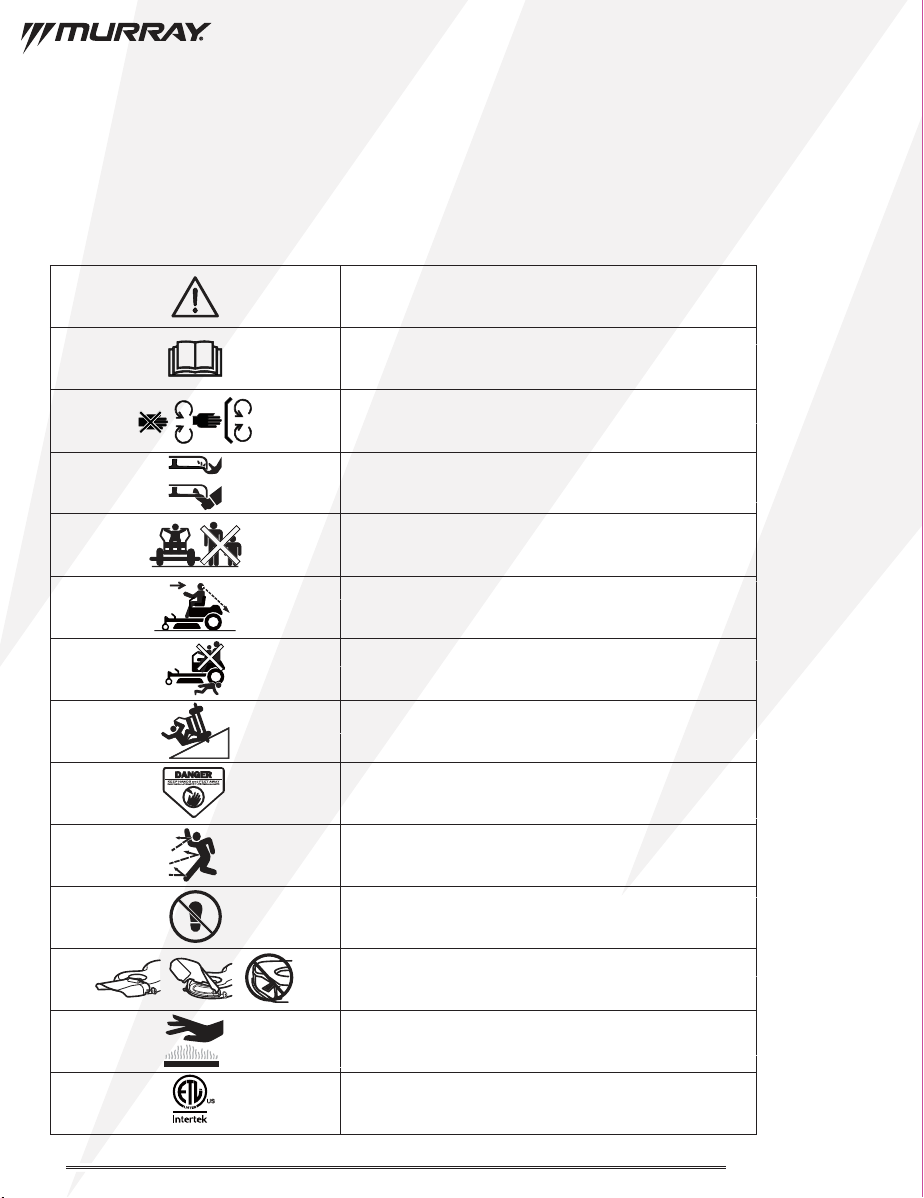
The following safety symbols appear on this product. Before you operate the mower, please study them and learn their meaning.
IMPORTANT: If the safety decals become worn or damaged, and cannot be read, order replacement decals from your authorized
service center.
Safety alert symbol
Read operator’s manual
Maintain safety devices
Avoid amputation injury
Keep bystanders away
Look behind while backing
Never carry children
Avoid steep slopes
Keep hands and feet away
Avoid thrown objects
Do not step
Do not touch the hot surface
ETL marking
Do not operate the mower without the discharge chute in
its proper place.
Symbol Explanation
5022993
6 7
WARNING: Read and follow all safety rules and
instructions in this manual before attempting to operate
this machine. Failure to comply with these instructions
could result in death or serious injury.
WARNING: This machine is capable of amputating
hands and feet and throwing objects. Failure to observe
the following safety instructions could result in serious
injury or death.
CALIFORNIA PROPOSITION 65: Engine exhaust, some of its
constituents, and certain vehicle components contain or
emit chemicals known to the State of California to cause
cancer and birth defects or other reproductive harm.
Safety Instructions
General safety practices
• Read, understand, and follow instructions and warnings in
this manual and on the machine, engine, and attachments.
• Only allow operators who are responsible, trained,
familiar with the instructions, and physically capable to
operate the machine.
• Do not carry passengers and keep bystanders away.
• Do not operate the machine while under the influence of
alcohol or drugs.
• Follow the manufacturer’s recommendation for wheel
weights and/or counterweights.
• Never allow children under 14 years of age to operate the
mower. Children 14 and over should read and understand
the instructions and safe operation practices in this
manual and on the mower and should be trained and
supervised by an adult.
• Data indicates that operators age 65 and above are
involved in a large percentage of riding mower-related
injuries. These operators should evaluate their ability to
operate the mower safely enough to protect themselves
and others from serious injury.
• If situations occur which are not covered in this manual,
use care and good judgment to deal with the situation or
contact your customer service representative for assistance.
Preparation Before Operating
• Clear the operating area of any objects which could be
thrown by or interfere with operation of the machine.
• Keep the area of operation clear of all bystanders,
particularly small children. Stop the machine and
attachment(s) if anyone enters the area.
• Do not operate the machine without the entire grass
catcher, discharge chute, or other safety devices in place
and functioning properly. Check frequently for signs of
wear or deterioration and replace as needed.
• Wear appropriate personal protective equipment such as
safety glasses, hearing protection, and footwear.
• Be aware of the mower discharge direction and do not
direct it at anyone.
• Use only accessories and attachments approved for this
mower by the mower manufacturer. Read, understand,
and follow all instructions provided with the approved
accessory or attachment.
Operating
• Only operate the engine in well ventilated areas. Exhaust
gases contain carbon monoxide, a deadly poison.
• Only operate the machine in daylight or good artificial
light.
• Avoid holes, ruts, bumps, rocks, or other hidden hazards.
Uneven terrain could overturn the machine or cause the
operator to lose their balance or footing.
• Do not put hands or feet near rotating parts or under the
machine. Keep clear of the discharge opening at all times.
• Do not direct discharge material toward anyone. Avoid
discharging materials against a wall or obstruction.
Material may ricochet back toward the operator. Stop the
blade(s) when crossing gravel surfaces.
• Do not leave a running machine unattended. Always park
on level ground, disengage the blade(s), set parking
brake, and stop the engine.
• Do not mow in reverse unless absolutely necessary. Always
look down and behind before and during reversing.
• Check overhead clearances carefully before driving under
low hanging tree branches, wires, door opening, etc.,
which could result in serious injury.
• Never carry passengers.
• A missing or damaged chute deflector can cause blade
contact or thrown object injuries.
• Do not operate the mower without the chute deflector or
entire grass catcher in its proper place.
• Use extra care with grass catchers or other attachments.
These can change the stability of the mower. Always
follow the attachment manufacturer’s instructions.
CRUZ ZERO TURN MOWER CRUZ ZERO TURN MOWER
Safety Decals
The following safety symbols appear on this product. Before you operate the mower, please study them and learn their meaning.
IMPORTANT: If the safety decals become worn or damaged, and cannot be read, order replacement decals from your authorized
service center.
Safety alert symbol
Read operator’s manual
Maintain safety devices
Avoid amputation injury
Keep bystanders away
Look behind while backing
Never carry children
Avoid steep slopes
Keep hands and feet away
Avoid thrown objects
Do not step
Do not touch the hot surface
ETL marking
Do not operate the mower without the discharge chute in
its proper place.
Symbol Explanation
5022993

8
3.
9
• Stop the blade(s) when crossing gravel drives, walks, or
roads, and while not cutting grass.
• Watch for traffic when operating near or crossing road
ways. This mower is not intended for use on any public
roadway.
• Do not operate the mower while under the influence of
alcohol or drugs.
• The muffler and engine become very hot after long use
and can cause serious burn injuries. Do not touch the
muffler or engine immediately after use. Allow the
mower to cool for five minutes before attempting any
service.
Children Specific
• Tragic accidents can occur if the operator is not alert to
the presence of children. Children are often attracted to
the machine and the mowing activity. Never assume that
children will remain where you last saw them.
• Keep children out of the operating area and under the
watchful care of a responsible adult other than the
operator.
• Do not carry children, even with the blade(s) shut off.
Children can fall off and be seriously injured or interfere
with safe operation. Children who have been given rides
in the past can suddenly appear in the mowing area for
another ride and be run over or backed over by the
machine.
• Be alert and turn the mower off if a child or bystander
enters the area.
• To avoid back-over accidents, always look behind and
down for children.
• Use extreme care when approaching blind corners,
doorways, shrubs, trees, or other objects that may block
your vision of a child who may run into the path of the
mower.
• Do not allow any child to joy ride on the mower. The
mower is not a toy or a go-cart. Warn your children that
the mower can be dangerous and they must stay away
from it at all times.
• Keep children away from hot or running engines. They
can suffer burns from a hot muffler or engine.
• Remove key when the mower is unattended to prevent
unauthorized operation. Make certain the key is
inaccessible to small children.
Slope Specific
• Travel in the manufacturer recommended direction on
slopes. Use caution while operating near drop-offs.
• Avoid mowing wet grass.
• Do not operate machine under any condition where
traction, steering, or stability is in question. Tires could
slide even if the wheels are stopped.
• Always keep the machine in gear when going down
slopes. Do not coast downhill.
• Avoid starting and stopping on slopes. Avoid making
sudden changes in speed or direction. Make turns slowly
and gradually.
• Use extra care while operating machine with a grass
catcher or other attachment(s). They can affect the
stability of the machine.
Fire and Fuel Specific
• Extinguish all cigarettes, cigars, pipes, and other sources
of ignition.
• Use only an approved fuel container.
• Do not remove fuel cap or add fuel with the engine
running or hot.
• Do not refuel indoors or in enclosed spaces.
• Do not store the machine or fuel container, or refuel,
where there is an open flame, spark, or pilot light such as
a water heater or other appliances.
• If fuel is spilled, do not attempt to start the engine; and
avoid creating any source of ignition until fuel vapors
have dissipated.
• To help prevent fires: keep machine free of grass, leaves,
or other debris build up; clean up oil or fuel spillage and
remove any fuel soaked debris; allow machine to cool
before storing.
• Use extra care in handling gasoline and other fuels. They
are flammable and vapors are explosive.
WARNING: Slopes are a major factor related to
accidents. Operation on slopes requires extra caution.
WARNING: If at rest on an uphill slope, do not
abruptly extend the drive handles fully forward to
initiate forward movement. Doing so can result in a rear
overturn (the front tires lift off the ground and
the machine flips over backwards).
Hauling
• Use full width ramps for loading and unloading the
machine for transport.
• Use extra care when loading or unloading the mower into
a trailer or truck. This mower should not be driven up or
down ramp(s) because the mower could tip over, causing
serious personal injury. The mower must be pushed
manually on ramp(s) to load or unload properly.
•
Raise the deck to the highest position for loading clearance.
Towing
• Follow the manufacturer’s recommendation for weight
limits for towed equipment and towing on slopes.
Service
• Keep machine in good working order. Replace worn or
damaged parts.
• Use caution when servicing blades. Wrap the blade(s) or
wear gloves. Replace damaged blades. Do not repair or
alter blade(s).
• Disconnect spark plug wire(s) and the negative battery
cable before making any repairs.
• Operate the equipment ONLY outdoors.
• Keep exhaust gas from entering a confined area through
windows, doors, ventilation intakes, or other openings.
• To avoid serious injury or death, do not modify engine in
any way. Tampering with the governor setting can lead to
a runaway engine and cause it to operate at unsafe
speeds. Never tamper with factory setting of the engine
governor. Do not change the engine governor settings or
over-speed the engine. The governor controls the
maximum safe operating speed of the engine.
• Never tamper with the safety interlock system or other
safety devices. Check their proper operation regularly.
• Operate the equipment ONLY outdoors.
• Keep all nuts, bolts, and screws tight to be sure the
equipment is in safe working condition.
• Never attempt to make adjustments or repairs to the
mower while the engine is running.
• Only use genuine replacement parts. Use of service parts
which do not meet the original equipment specifications
may lead to improper performance and compromise safety.
WARNING: Running engine gives off carbon
monoxide, an odorless, colorless, poisonous gas.
Breathing carbon monoxide can cause headaches,
fatigue, dizziness, vomiting, confusion, seizures, nausea,
fainting or death.
CRUZ ZERO TURN MOWER CRUZ ZERO TURN MOWER
8
3.
9
• Stop the blade(s) when crossing gravel drives, walks, or
roads, and while not cutting grass.
• Watch for traffic when operating near or crossing road
ways. This mower is not intended for use on any public
roadway.
• Do not operate the mower while under the influence of
alcohol or drugs.
• The muffler and engine become very hot after long use
and can cause serious burn injuries. Do not touch the
muffler or engine immediately after use. Allow the
mower to cool for five minutes before attempting any
service.
Children Specific
• Tragic accidents can occur if the operator is not alert to
the presence of children. Children are often attracted to
the machine and the mowing activity. Never assume that
children will remain where you last saw them.
• Keep children out of the operating area and under the
watchful care of a responsible adult other than the
operator.
• Do not carry children, even with the blade(s) shut off.
Children can fall off and be seriously injured or interfere
with safe operation. Children who have been given rides
in the past can suddenly appear in the mowing area for
another ride and be run over or backed over by the
machine.
• Be alert and turn the mower off if a child or bystander
enters the area.
• To avoid back-over accidents, always look behind and
down for children.
• Use extreme care when approaching blind corners,
doorways, shrubs, trees, or other objects that may block
your vision of a child who may run into the path of the
mower.
• Do not allow any child to joy ride on the mower. The
mower is not a toy or a go-cart. Warn your children that
the mower can be dangerous and they must stay away
from it at all times.
• Keep children away from hot or running engines. They
can suffer burns from a hot muffler or engine.
• Remove key when the mower is unattended to prevent
unauthorized operation. Make certain the key is
inaccessible to small children.
Slope Specific
• Travel in the manufacturer recommended direction on
slopes. Use caution while operating near drop-offs.
• Avoid mowing wet grass.
• Do not operate machine under any condition where
traction, steering, or stability is in question. Tires could
slide even if the wheels are stopped.
• Always keep the machine in gear when going down
slopes. Do not coast downhill.
• Avoid starting and stopping on slopes. Avoid making
sudden changes in speed or direction. Make turns slowly
and gradually.
• Use extra care while operating machine with a grass
catcher or other attachment(s). They can affect the
stability of the machine.
Fire and Fuel Specific
• Extinguish all cigarettes, cigars, pipes, and other sources
of ignition.
• Use only an approved fuel container.
• Do not remove fuel cap or add fuel with the engine
running or hot.
• Do not refuel indoors or in enclosed spaces.
• Do not store the machine or fuel container, or refuel,
where there is an open flame, spark, or pilot light such as
a water heater or other appliances.
• If fuel is spilled, do not attempt to start the engine; and
avoid creating any source of ignition until fuel vapors
have dissipated.
• To help prevent fires: keep machine free of grass, leaves,
or other debris build up; clean up oil or fuel spillage and
remove any fuel soaked debris; allow machine to cool
before storing.
• Use extra care in handling gasoline and other fuels. They
are flammable and vapors are explosive.
WARNING: Slopes are a major factor related to
accidents. Operation on slopes requires extra caution.
WARNING: If at rest on an uphill slope, do not
abruptly extend the drive handles fully forward to
initiate forward movement. Doing so can result in a rear
overturn (the front tires lift off the ground and
the machine flips over backwards).
Hauling
• Use full width ramps for loading and unloading the
machine for transport.
• Use extra care when loading or unloading the mower into
a trailer or truck. This mower should not be driven up or
down ramp(s) because the mower could tip over, causing
serious personal injury. The mower must be pushed
manually on ramp(s) to load or unload properly.
•
Raise the deck to the highest position for loading clearance.
Towing
• Follow the manufacturer’s recommendation for weight
limits for towed equipment and towing on slopes.
Service
• Keep machine in good working order. Replace worn or
damaged parts.
• Use caution when servicing blades. Wrap the blade(s) or
wear gloves. Replace damaged blades. Do not repair or
alter blade(s).
• Disconnect spark plug wire(s) and the negative battery
cable before making any repairs.
• Operate the equipment ONLY outdoors.
• Keep exhaust gas from entering a confined area through
windows, doors, ventilation intakes, or other openings.
• To avoid serious injury or death, do not modify engine in
any way. Tampering with the governor setting can lead to
a runaway engine and cause it to operate at unsafe
speeds. Never tamper with factory setting of the engine
governor. Do not change the engine governor settings or
over-speed the engine. The governor controls the
maximum safe operating speed of the engine.
• Never tamper with the safety interlock system or other
safety devices. Check their proper operation regularly.
• Operate the equipment ONLY outdoors.
• Keep all nuts, bolts, and screws tight to be sure the
equipment is in safe working condition.
• Never attempt to make adjustments or repairs to the
mower while the engine is running.
• Only use genuine replacement parts. Use of service parts
which do not meet the original equipment specifications
may lead to improper performance and compromise safety.
WARNING: Running engine gives off carbon
monoxide, an odorless, colorless, poisonous gas.
Breathing carbon monoxide can cause headaches,
fatigue, dizziness, vomiting, confusion, seizures, nausea,
fainting or death.
CRUZ ZERO TURN MOWER CRUZ ZERO TURN MOWER
10 11
Fig. 2B
1
2
3
Fig. 2A
a
b
NOTE: Mower will not operate without the seat switch
wiring harness connected.
WARNING: Be sure the seat is locked into place
before operating the mower. A seat that is not secure
can cause the operator to shift and lose control of the
mower, resulting in death or serious injury.
Some parts of your new lawn mower have not been
completely installed for shipping purposes. To ensure safe
and proper operation, all parts and hardware must be
assembled as instructed below using appropriate tools to
ensure proper tightness.
SCarefully remove the product and any accessories from the
package. Make sure that all items listed in the Packing List
are included.
Inspect the product carefully to make sure no damage
occurred during shipping.
If any parts are damaged or missing, please call
855-693-2582 for assistance.
1
1
1
1
2
1
Mower
Seat Assembly
Left Drive Control Lever
Right Drive Control Lever
Knob For Drive Control Lever
Battery Securing Rod
Oval head square neck bolt
(M8x70)
2
Operator’s manual
Engine manual
1
1
12-13mm open-end wrench
Ignition key
2
2
Hexagon flange bolt (M8x75)
Hex flange nut (M8)
Hitch plate
2
2
1
Packing list Qty
If any parts are damaged or missing,
WARNING:
do not operate this product until the parts are replaced.
Use of this product with damaged or missing parts could
result in death or serious injury.
NOTICE: This lawn mower is shipped without gas in
the engine.
WARNING: Do not attempt to modify this product or
create accessories not recommended for use with this
product. Any such alteration or modification is misuse
and could result in a hazardous condition resulting in
death or serious injury.
WARNING: To prevent accidental starting that could
result in death or serious injury, always disconnect the
engine spark plug boot from the spark plug when
assembling parts.
WARNING: Never operate the mower without the
proper safety devices, guards, and chute in place and
working. Never operate the mower with damaged safety
devices. Operating the mower with missing or damaged
parts could result in death or serious injury.
3. Assembly Instructions
NOTE: Keep bolts and wing nuts loose until all bolts are
in your desired position. In addition, wing nuts(b) used
in second step are secured onto the bolts (a) of the seat
for shipment. Therefore you need screw the nuts
counterclockwise to get it loose before following
the second step.
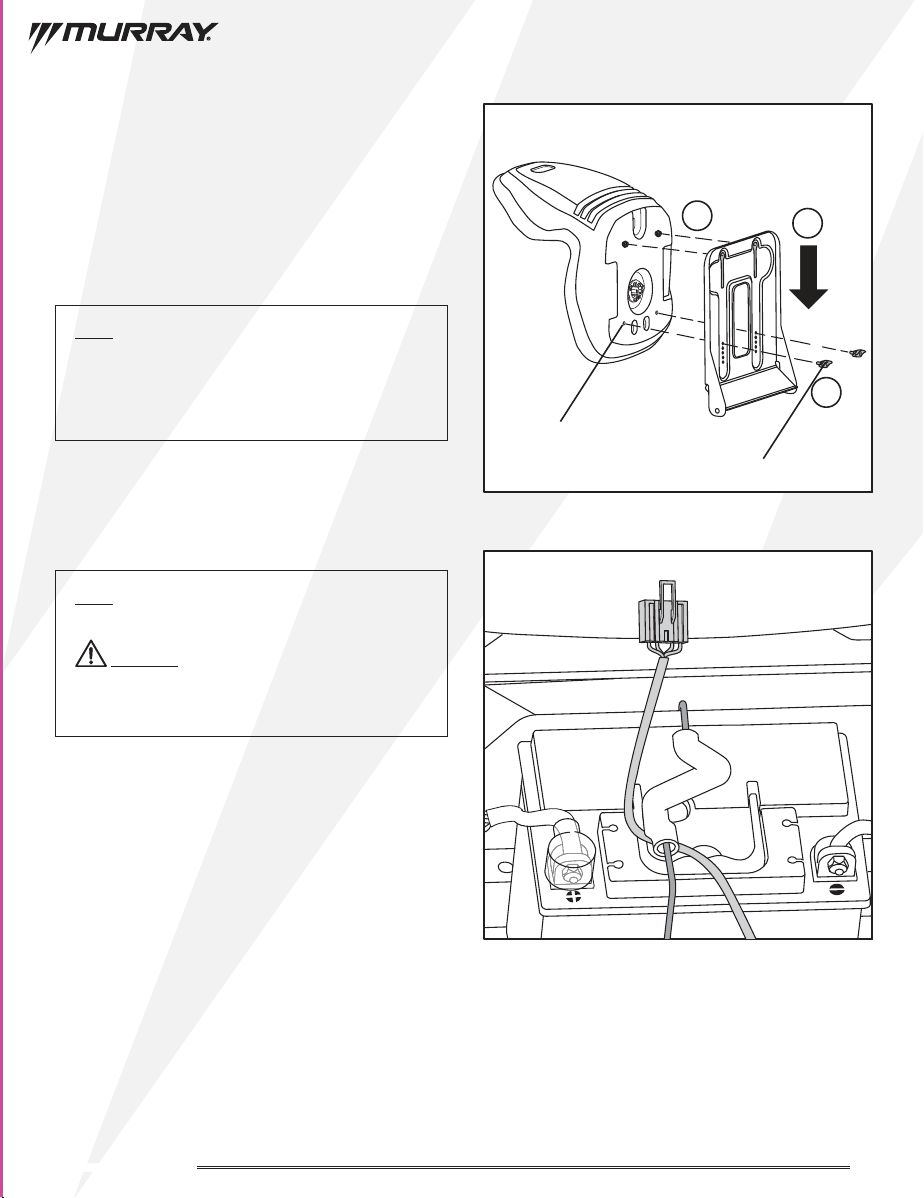
Assemble the Seat
1. Align the two threaded holes on the bottom of the seat
with the two eyelet slots on the seat pan. Slide the seat
downward to secure it.
2. Choose one of five holes on the seat pan and thread the
wing nuts into the holes (a). Secure with supplied wing
nuts (b). You can move the seat to your desired position
by selecting between the five different holes. (Fig.2A)
3. Securely tighten all bolts and wing bolts.
4. Take hold of the seat switch wiring harness and pass it
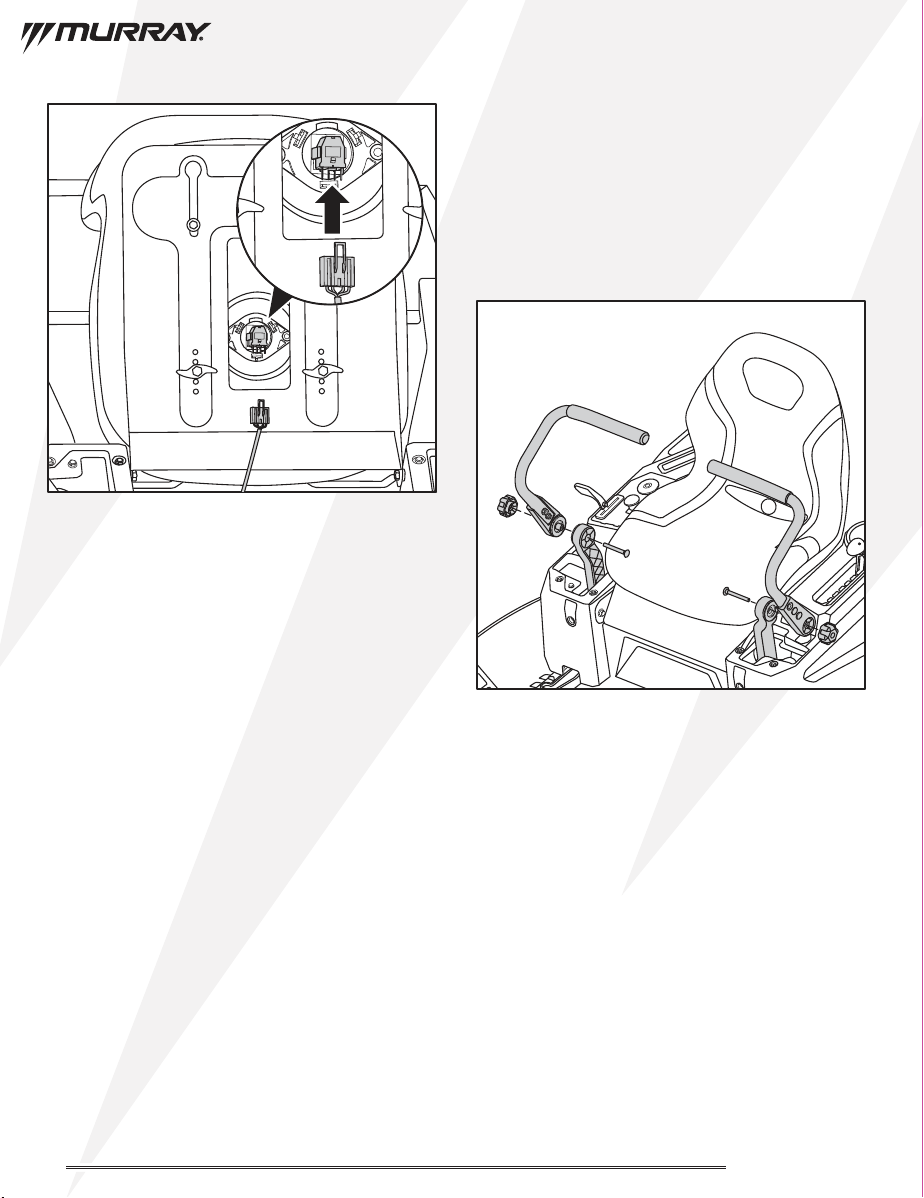
underneath the battery securing rod. Connect the seat
switch wiring harness to the seat switch. (Fig.2B&Fig.2C)
CRUZ ZERO TURN MOWER CRUZ ZERO TURN MOWER
10 11
Fig. 2B
1
2
3
Fig. 2A
a
b
NOTE: Mower will not operate without the seat switch
wiring harness connected.
WARNING: Be sure the seat is locked into place
before operating the mower. A seat that is not secure
can cause the operator to shift and lose control of the
mower, resulting in death or serious injury.
Some parts of your new lawn mower have not been
completely installed for shipping purposes. To ensure safe
and proper operation, all parts and hardware must be
assembled as instructed below using appropriate tools to
ensure proper tightness.
SCarefully remove the product and any accessories from the
package. Make sure that all items listed in the Packing List
are included.
Inspect the product carefully to make sure no damage
occurred during shipping.
If any parts are damaged or missing, please call
855-693-2582 for assistance.
1
1
1
1
2
1
Mower
Seat Assembly
Left Drive Control Lever
Right Drive Control Lever
Knob For Drive Control Lever
Battery Securing Rod
Oval head square neck bolt
(M8x70)
2
Operator’s manual
Engine manual
1
1
12-13mm open-end wrench
Ignition key
2
2
Hexagon flange bolt (M8x75)
Hex flange nut (M8)
Hitch plate
2
2
1
Packing list Qty
If any parts are damaged or missing,
WARNING:
do not operate this product until the parts are replaced.
Use of this product with damaged or missing parts could
result in death or serious injury.
NOTICE: This lawn mower is shipped without gas in
the engine.
WARNING: Do not attempt to modify this product or
create accessories not recommended for use with this
product. Any such alteration or modification is misuse
and could result in a hazardous condition resulting in
death or serious injury.
WARNING: To prevent accidental starting that could
result in death or serious injury, always disconnect the
engine spark plug boot from the spark plug when
assembling parts.
WARNING: Never operate the mower without the
proper safety devices, guards, and chute in place and
working. Never operate the mower with damaged safety
devices. Operating the mower with missing or damaged
parts could result in death or serious injury.
3. Assembly Instructions
NOTE: Keep bolts and wing nuts loose until all bolts are
in your desired position. In addition, wing nuts(b) used
in second step are secured onto the bolts (a) of the seat
for shipment. Therefore you need screw the nuts
counterclockwise to get it loose before following
the second step.
Assemble the Seat
1. Align the two threaded holes on the bottom of the seat
with the two eyelet slots on the seat pan. Slide the seat
downward to secure it.
2. Choose one of five holes on the seat pan and thread the
wing nuts into the holes (a). Secure with supplied wing
nuts (b). You can move the seat to your desired position
by selecting between the five different holes. (Fig.2A)
3. Securely tighten all bolts and wing bolts.
4. Take hold of the seat switch wiring harness and pass it
underneath the battery securing rod. Connect the seat
switch wiring harness to the seat switch. (Fig.2B&Fig.2C)
CRUZ ZERO TURN MOWER CRUZ ZERO TURN MOWER
12 13
Assemble Drive Control
Lever
1. Keep the larger tip of the upper handle adjuster in line
with the adapter that secures the lever to the mower.
2. Connect them tightly by screwing the knob clockwise.
3. Repeat this process on the remaining side.
Fig. 3
Fig. 4
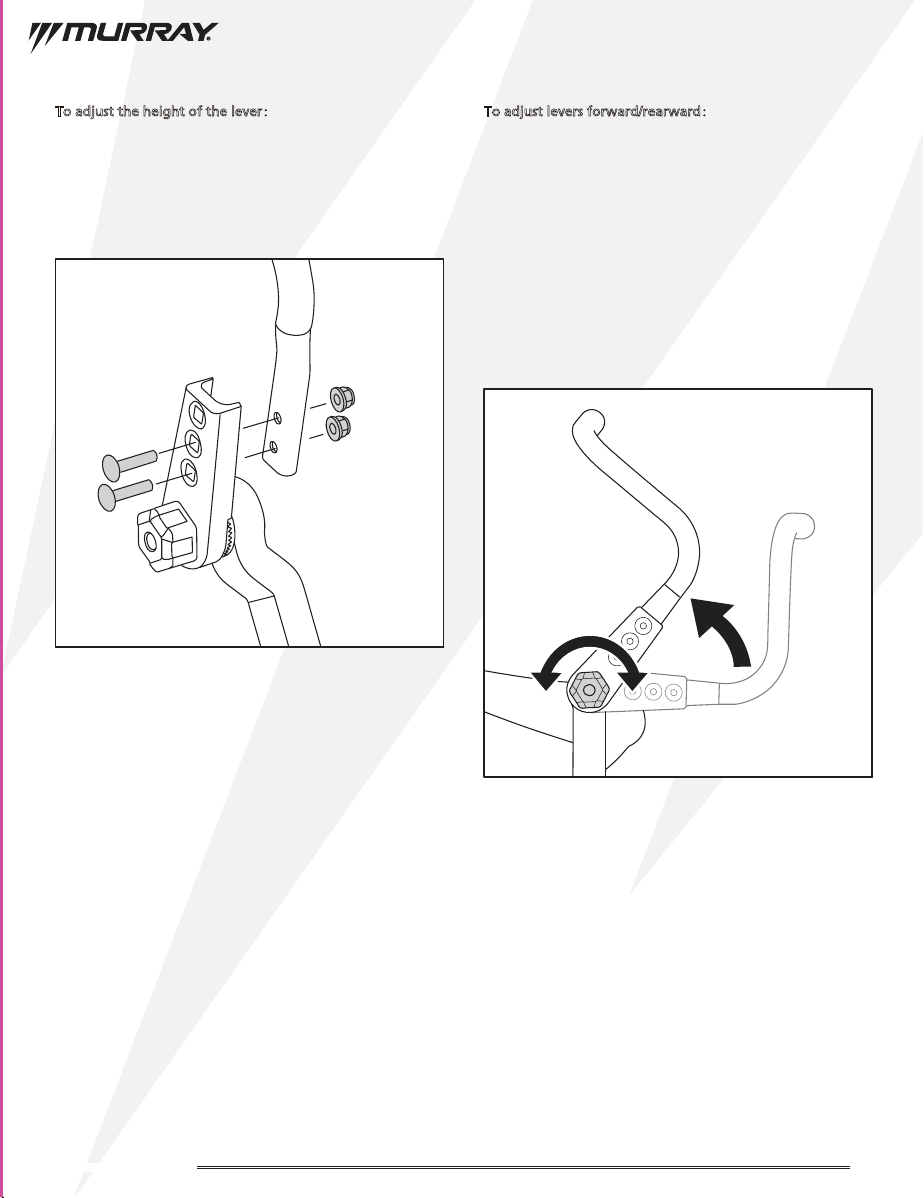
To adjust the height of the lever
1. Remove the two bolts and two lock nuts that secure the
drive control lever to the upper handle adjuster.
2. There are two selectable positions, with the ability to
move up or down for adjustment. Secure the two bolts
either in the upper or lower position. (Fig.4)
To adjust levers forward/rearward
The drive control levers are designed to be adjustable.
Adjust them to a comfortable position for you before
operation.
1. Rotate the knob counter-clockwise to loosen it.
2. Lift and rotate the drive control lever into the desired
position.
3. Rotate the knob clockwise to secure the drive control
lever into position.
4. If the levers do not line up after making the knob
adjustment, loosen nuts, align levers, and re-tighten nuts.
Fig. 5
Fig. 2C
CRUZ ZERO TURN MOWER CRUZ ZERO TURN MOWER
12 13
Assemble Drive Control
Lever
1. Keep the larger tip of the upper handle adjuster in line
with the adapter that secures the lever to the mower.
2. Connect them tightly by screwing the knob clockwise.
3. Repeat this process on the remaining side.
Fig. 3
Fig. 4
To adjust the height of the lever
1. Remove the two bolts and two lock nuts that secure the
drive control lever to the upper handle adjuster.
2. There are two selectable positions, with the ability to
move up or down for adjustment. Secure the two bolts
either in the upper or lower position. (Fig.4)
To adjust levers forward/rearward
The drive control levers are designed to be adjustable.
Adjust them to a comfortable position for you before
operation.
1. Rotate the knob counter-clockwise to loosen it.
2. Lift and rotate the drive control lever into the desired
position.
3. Rotate the knob clockwise to secure the drive control
lever into position.
4. If the levers do not line up after making the knob
adjustment, loosen nuts, align levers, and re-tighten nuts.
Fig. 5
Fig. 2C
CRUZ ZERO TURN MOWER CRUZ ZERO TURN MOWER
14 15
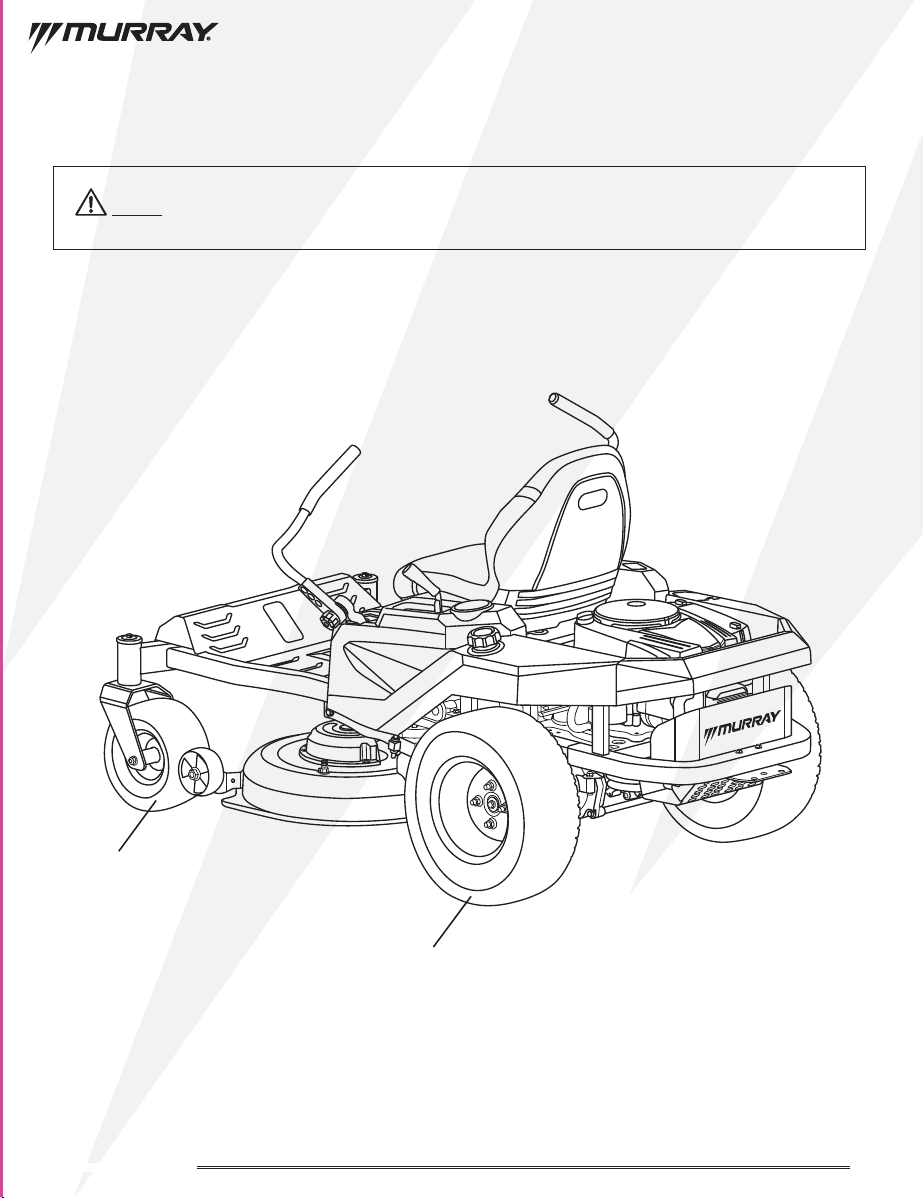
Check/Adjust the Tire Pressure
Recommended tire pressure:
• Set the front tires to 20 psi
• Set the rear tires to 14 psi
Fig. 8
14 psi
20 psi
Fig. 7
NOTICE: To ensure that the grass is cut level, each front tire must be set to the same pressure. The same is true for
the rear tires.
Fig. 6
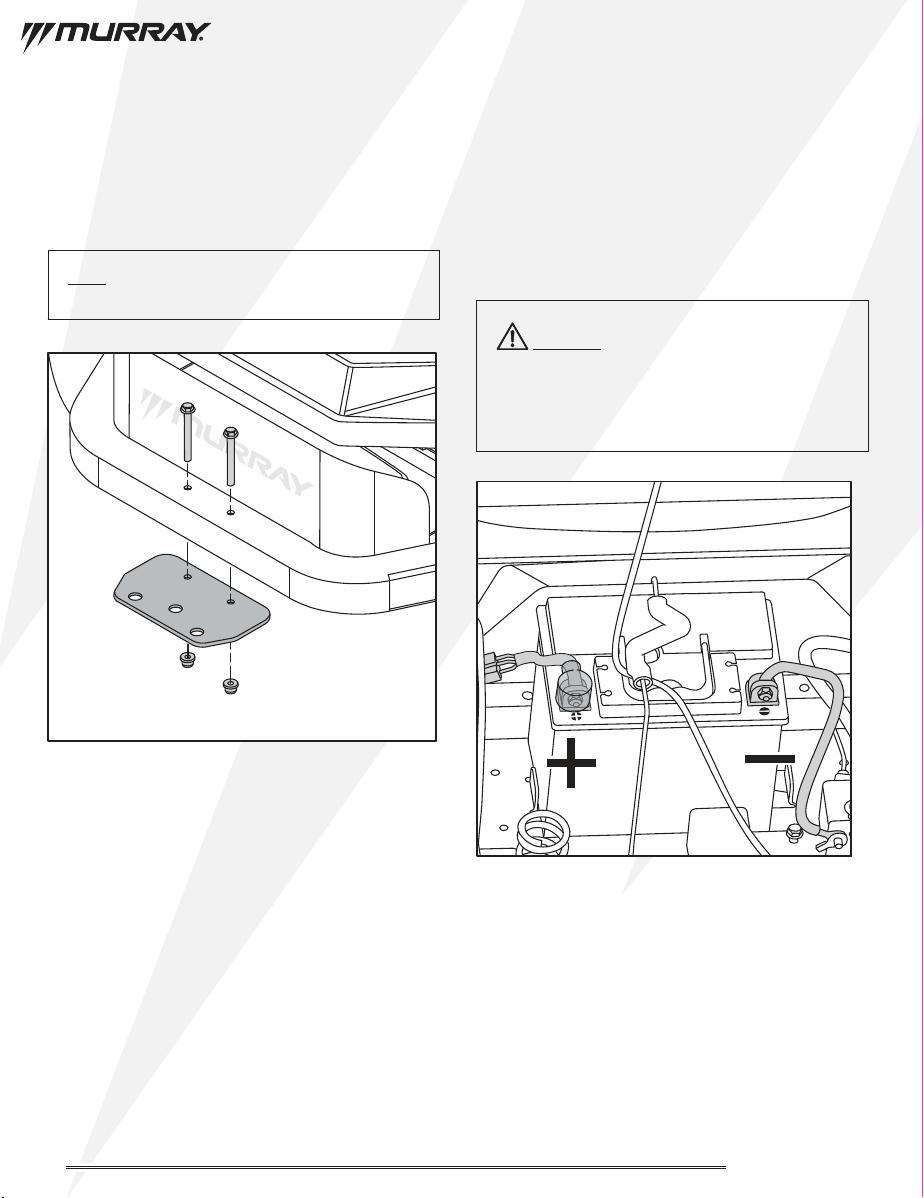
Install Hitch
To tow objects or install the grass catcher, locate the hitch
and install it on the rear of the frame using two bolts and
nuts. The bolts are to be inserted into the top face of the
frame and the nuts are to be threaded on from the bottom
as shown in Fig.6.
NOTE: Hitch and hex bolts are provided in the hardware
pack.
Connecting the Battery
The battery is located under the operator’s seat. To connect
the battery cables, proceed as follows:
1. Attach the positive cable (red) to the positive battery
terminal using the bolt and nut.
2. Attach the negative cable (black) to the negative battery
terminal using the bolt and nut.
WARNING: When attaching battery cables, always
connect the positive cable to its terminal FIRST, and then
connect the negative cable. Additionally, a protective
case is placed over the positive cable to prevent it
grounding. Always keep the protective case in place
when connecting the battery.
CRUZ ZERO TURN MOWER CRUZ ZERO TURN MOWER
14 15
Check/Adjust the Tire Pressure
Recommended tire pressure:
• Set the front tires to 20 psi
• Set the rear tires to 14 psi
Fig. 8
14 psi
20 psi
Fig. 7
NOTICE: To ensure that the grass is cut level, each front tire must be set to the same pressure. The same is true for
the rear tires.
Fig. 6
Install Hitch
To tow objects or install the grass catcher, locate the hitch
and install it on the rear of the frame using two bolts and
nuts. The bolts are to be inserted into the top face of the
frame and the nuts are to be threaded on from the bottom
as shown in Fig.6.
NOTE: Hitch and hex bolts are provided in the hardware
pack.
Connecting the Battery
The battery is located under the operator’s seat. To connect
the battery cables, proceed as follows:
1. Attach the positive cable (red) to the positive battery
terminal using the bolt and nut.
2. Attach the negative cable (black) to the negative battery
terminal using the bolt and nut.
WARNING: When attaching battery cables, always
connect the positive cable to its terminal FIRST, and then
connect the negative cable. Additionally, a protective
case is placed over the positive cable to prevent it
grounding. Always keep the protective case in place
when connecting the battery.
CRUZ ZERO TURN MOWER CRUZ ZERO TURN MOWER
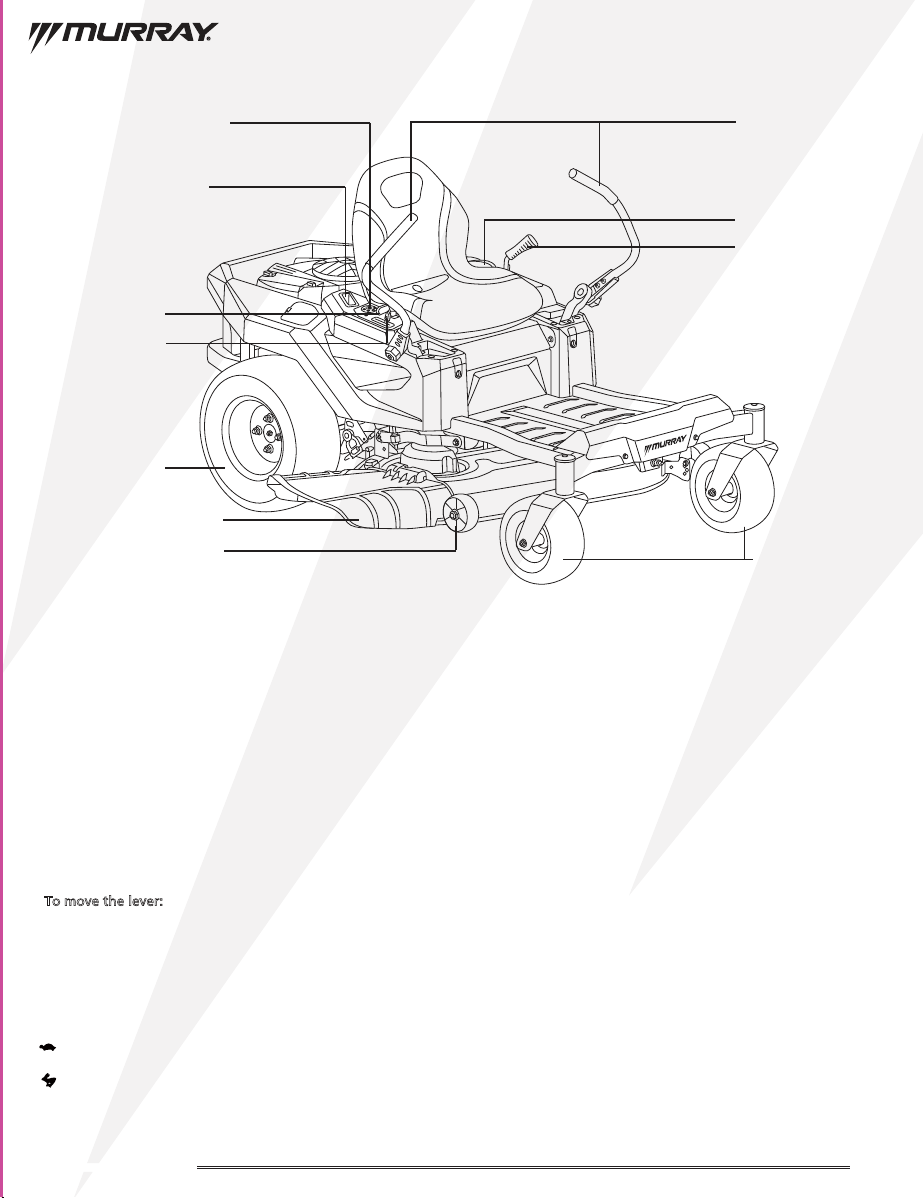
17
Ignition switch
Storage compartment
PTO knob
Rear wheel
Side discharge chute
Anti-scalp wheel
Throttle/Choke
Control Lever
Drive control lever
Cup holder
Deck lift handle
Front wheel
Fig. 9
1. Leveling the Cutting Deck
The drive control levers are located on each side of the
operator’s seat. The hinged levers pivot outward to permit
the operator to sit in the seat or dismount. To start the
mower’s engine, the drive control levers must be fully out
and in the PARK position. When the drive control levers are
fully outward, the parking brake is engaged.
Each drive control lever controls their respective transmis-
sion. Consequently, these levers control all of the mower’s
movements. Driving and steering using these control levers
is quite different from a conventional mower and will take
practice to master. Refer to the Operation Instruction
section for further reference.
To move the lever:
R — Reverse: Pull the lever backward to get the mower to
reverse.
N — Neutral: Keep the mower in neutral condition.
P — Park: Set the parking brake.
— Low moving speed.
— High moving speed.
2. Throttle/Choke Control Lever
Push the throttle/choke control lever forward to increase the
engine speed. The mower is designed to operate with the
throttle/choke control lever at full throttle (FAST) while
being driven and the mower deck is engaged. Pull the
throttle/choke control lever rearward to decrease the engine
speed. When starting the engine, push the control lever
fully forward into the CHOKE position. After starting and
warming the engine, move the control lever rearward until
you feel it move past the choke detent. Throttle is not
meant to control unit’ speed, throttle should remain in high
speed while operating blades.
3. Power Take-Off (PTO)
The PTO switch operates the electric PTO clutch mounted on
the bottom of the engine crankshaft. Pull the switch knob
upward to engage the PTO clutch or push the knob
downward to disengage the clutch.
The PTO switch must be in the “OFF” position when starting
the engine.
16
4. Features and Controls
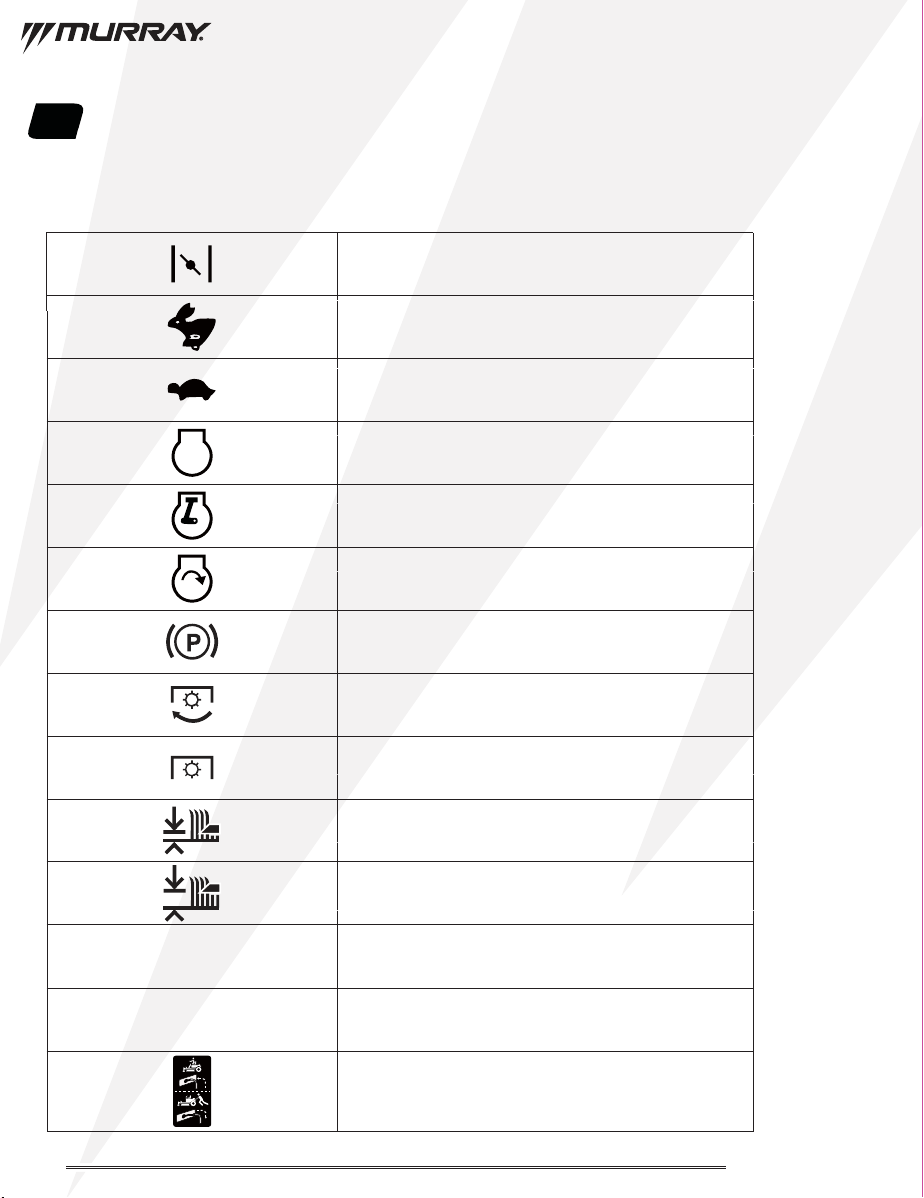
The following control symbols appear on this product. Before you operate the mower, please study them and learn their meaning.
Choke
FAST throttle position
SLOW throttle position
OFF ignition position
RUN ignition position
START ignition position
Parking brake
PTO ON (blades engaged)
PTO OFF (blades disengaged)
SHORT grass height
LONG grass height
The mower can be pushed by hand after pulling out
the bypass-valve lever.
Gear is in neutral
Gear is in reverse
Symbol Explanation
STOP
N
R
CRUZ ZERO TURN MOWER CRUZ ZERO TURN MOWER
17
Ignition switch
Storage compartment
PTO knob
Rear wheel
Side discharge chute
Anti-scalp wheel
Throttle/Choke
Control Lever
Drive control lever
Cup holder
Deck lift handle
Front wheel
Fig. 9
1. Leveling the Cutting Deck
The drive control levers are located on each side of the
operator’s seat. The hinged levers pivot outward to permit
the operator to sit in the seat or dismount. To start the
mower’s engine, the drive control levers must be fully out
and in the PARK position. When the drive control levers are
fully outward, the parking brake is engaged.
Each drive control lever controls their respective transmis-
sion. Consequently, these levers control all of the mower’s
movements. Driving and steering using these control levers
is quite different from a conventional mower and will take
practice to master. Refer to the Operation Instruction
section for further reference.
To move the lever:
R — Reverse: Pull the lever backward to get the mower to
reverse.
N — Neutral: Keep the mower in neutral condition.
P — Park: Set the parking brake.
— Low moving speed.
— High moving speed.
2. Throttle/Choke Control Lever
Push the throttle/choke control lever forward to increase the
engine speed. The mower is designed to operate with the
throttle/choke control lever at full throttle (FAST) while
being driven and the mower deck is engaged. Pull the
throttle/choke control lever rearward to decrease the engine
speed. When starting the engine, push the control lever
fully forward into the CHOKE position. After starting and
warming the engine, move the control lever rearward until
you feel it move past the choke detent. Throttle is not
meant to control unit’ speed, throttle should remain in high
speed while operating blades.
3. Power Take-Off (PTO)
The PTO switch operates the electric PTO clutch mounted on
the bottom of the engine crankshaft. Pull the switch knob
upward to engage the PTO clutch or push the knob
downward to disengage the clutch.
The PTO switch must be in the “OFF” position when starting
the engine.
16
4. Features and Controls
The following control symbols appear on this product. Before you operate the mower, please study them and learn their meaning.
Choke
FAST throttle position
SLOW throttle position
OFF ignition position
RUN ignition position
START ignition position
Parking brake
PTO ON (blades engaged)
PTO OFF (blades disengaged)
SHORT grass height
LONG grass height
The mower can be pushed by hand after pulling out
the bypass-valve lever.
Gear is in neutral
Gear is in reverse
Symbol Explanation
STOP
N
R
CRUZ ZERO TURN MOWER CRUZ ZERO TURN MOWER
18 19
6. Cup Holder
The cup holder is located on the rear of the left console.
7. Deck lift handle
The deck lift handle is used to raise and lower the mower
deck. To lower the deck, pull the deck lift handle to the
right out of the index notch and push downward. To raise
the deck, pull the handle upward. Ensure the handle is fully
positioned into the height index notch when the desired
height is attained.
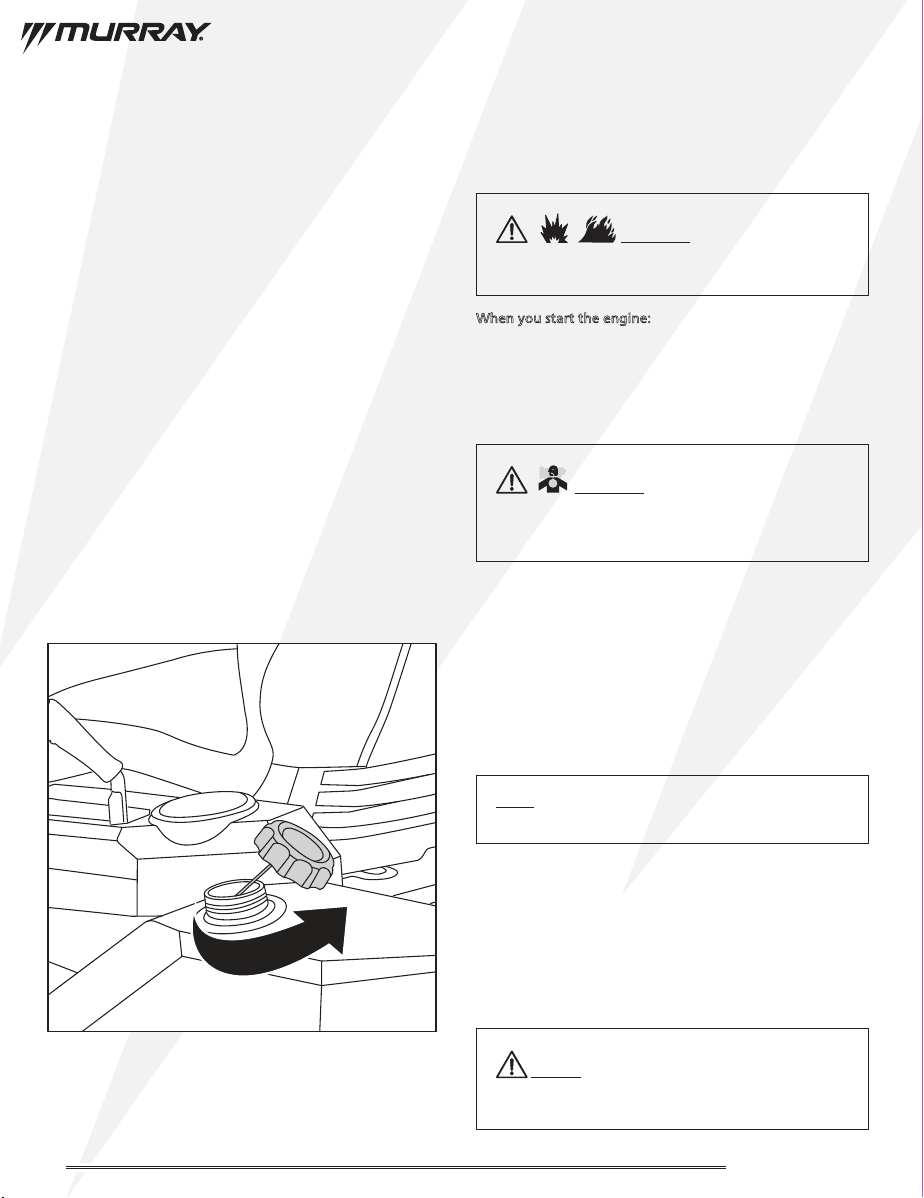
8. Fuel Tank Cap
Turn the fuel tank cap at least two clicks counter-clockwise
and pull upward to remove. The fuel cap is tethered to the
mower to prevent losing it. Do not attempt to remove the
cap from the mower. Fill tank to ½” below the bottom of
the filler neck, allowing some space in the tank for fuel
expansion. Do not overfill the tank.
Push the cap downward on the fuel tank fill neck and turn
at least two clicks clockwise to tighten. Always re-install the
fuel cap tightly onto the fuel tank after removing.
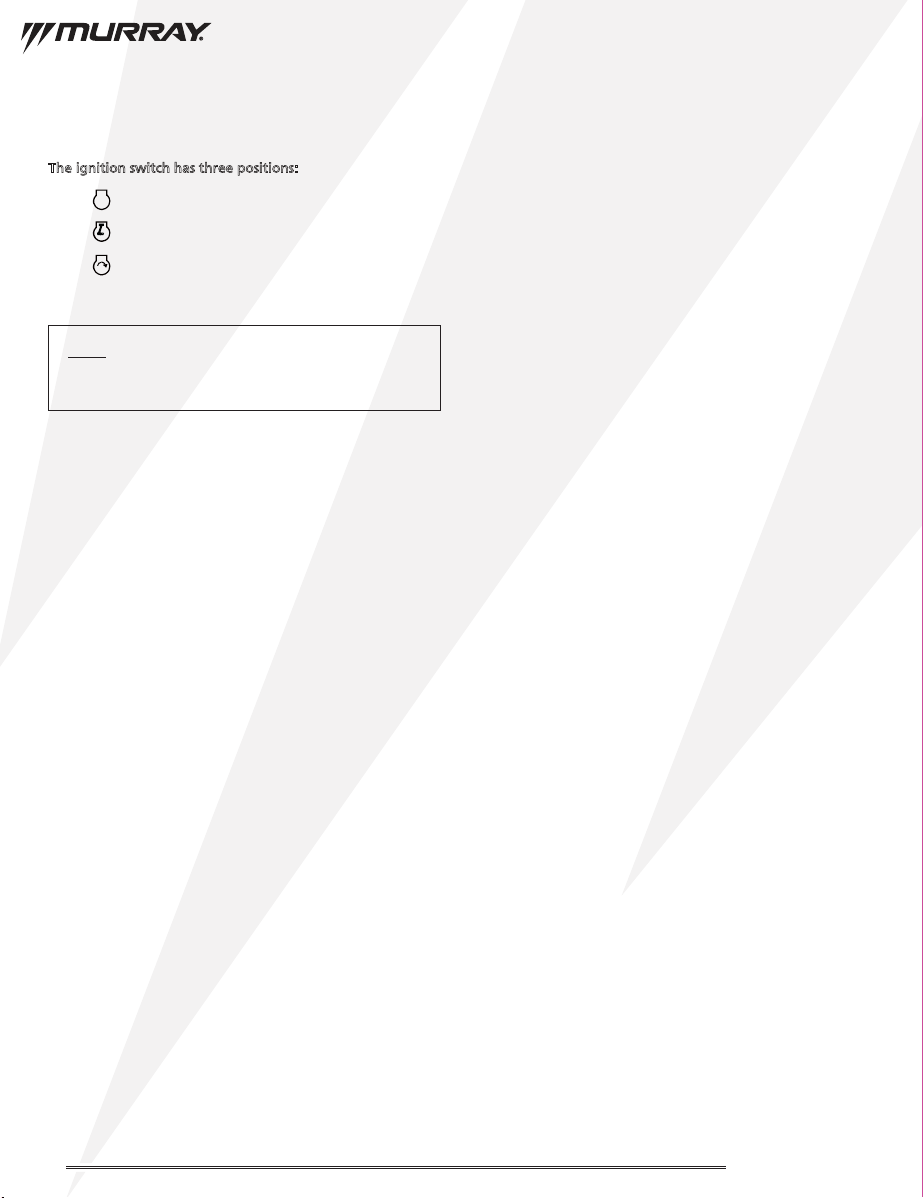
4. Ignition Switch
The ignition switch has three positions:
STOP — The engine and electrical system is turned off.
RUN — The mower electrical system is energized.
START — The starter motor will turn over the engine.
Release the key immediately when the engine
starts.
5. Storage Compartment
The storage tray is located on the rear of the right console.
STOP
NOTE: To prevent accidental starting and / or battery
discharge, remove key from the ignition switch when
mower is not in use.
CRUZ ZERO TURN MOWER CRUZ ZERO TURN MOWER
5. Operating the Mower
Read the Operation Instruction section before you operate
this machine. Make sure that you know the controls and
how to stop the unit in an emergency.
Operating Area
•
Know the area where you plan to operate the mower.
•
Make sure that the area is free of unwanted material that
could be picked up by the blades and thrown.
•
Do not operate the machine without the complete grass
catcher, discharge chute, or other safety devices in place
and functioning properly. Check frequently for signs of
wear or deterioration and replace as needed.
•
Clear the operating area of any objects which could be
thrown by or interfere with the operation of the
machine.
•
Move the machine outside before you start the engine.
•
Note all slopes and drop-offs.
•
Mow up and down slopes, not across.
•
Reduce speed and be careful on slopes.
•
Do not operate on slopes over 15 degrees.
Operating on slopes, near water,
DANGER:
or near drop-offs can result in loss of control and roll-over.
•
Give yourself a minimum of two mower widths of
clearance around water, retaining walls, or drop-offs.
•
Avoid mowing wet grass.
•
Do not operate the machine under any condition where
traction, steering, or stability is in question. The tires
could slide even if the wheels are stopped.
•
Avoid starting and stopping on slopes.
•
Avoid making sudden changes in speed or direction.
•
Make turns slowly and gradually.
•
Be careful while operating machine with a grass catcher
or other attachment(s). They can affect the stability of
the machine.
•
Follow the manufacturer's recommendation for weight
limits for towed equipment and towing on slopes.
•
See the section “Towing with the mower”
•
Make sure that the operating area is clear of bystanders,
especially children.
•
Stop the mower when children or others are near.
•
Keep children out of the operating area and under
watchful care of a responsible adult.
•
Do not carry passengers, especially children, even with
the blade(s) shut off. Children can fall off and be seriously
injured or interfere with safe machine operation.
Children who have been given rides in the past can
suddenly appear in the mowing area for another ride
and be run over or backed over by the machine.
Use care when approaching blind corners, shrubs, trees, or
other objects that obscure vision.
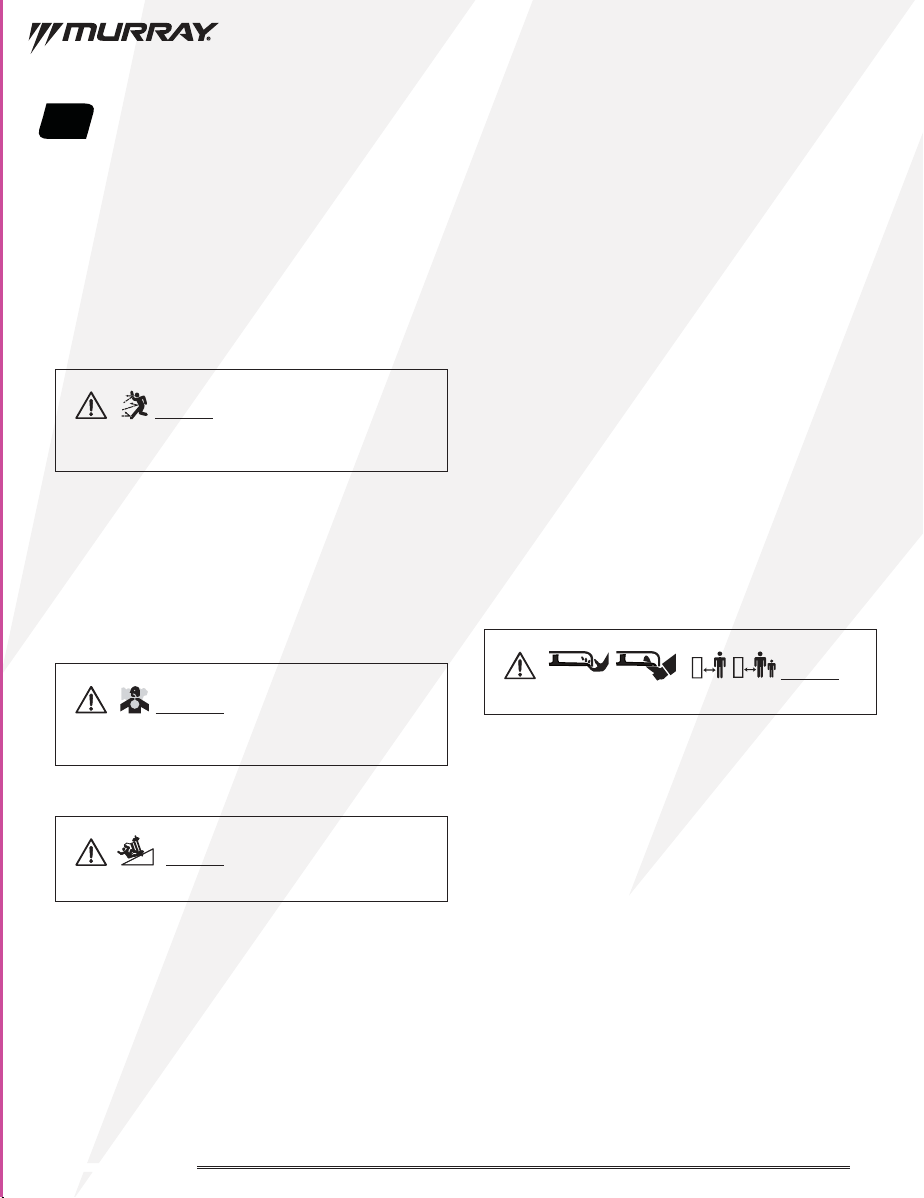
DANGER: This
mower is capable of amputating hands and feet.
DANGER:
This machine is capable of throwing
objects that will injure bystanders or cause damage to
buildings.
Engines give off carbon monoxide,
WARNING:
an odorless, colorless, poisonous gas. Breathing carbon
monoxide can cause nausea, fainting, or death.
18 19
6. Cup Holder
The cup holder is located on the rear of the left console.
7. Deck lift handle
The deck lift handle is used to raise and lower the mower
deck. To lower the deck, pull the deck lift handle to the
right out of the index notch and push downward. To raise
the deck, pull the handle upward. Ensure the handle is fully
positioned into the height index notch when the desired
height is attained.
8. Fuel Tank Cap
Turn the fuel tank cap at least two clicks counter-clockwise
and pull upward to remove. The fuel cap is tethered to the
mower to prevent losing it. Do not attempt to remove the
cap from the mower. Fill tank to ½” below the bottom of
the filler neck, allowing some space in the tank for fuel
expansion. Do not overfill the tank.
Push the cap downward on the fuel tank fill neck and turn
at least two clicks clockwise to tighten. Always re-install the
fuel cap tightly onto the fuel tank after removing.
4. Ignition Switch
The ignition switch has three positions:
STOP — The engine and electrical system is turned off.
RUN — The mower electrical system is energized.
START — The starter motor will turn over the engine.
Release the key immediately when the engine
starts.
5. Storage Compartment
The storage tray is located on the rear of the right console.
STOP
NOTE: To prevent accidental starting and / or battery
discharge, remove key from the ignition switch when
mower is not in use.
CRUZ ZERO TURN MOWER CRUZ ZERO TURN MOWER
5. Operating the Mower
Read the Operation Instruction section before you operate
this machine. Make sure that you know the controls and
how to stop the unit in an emergency.
Operating Area
•
Know the area where you plan to operate the mower.
•
Make sure that the area is free of unwanted material that
could be picked up by the blades and thrown.
•
Do not operate the machine without the complete grass
catcher, discharge chute, or other safety devices in place
and functioning properly. Check frequently for signs of
wear or deterioration and replace as needed.
•
Clear the operating area of any objects which could be
thrown by or interfere with the operation of the
machine.
•
Move the machine outside before you start the engine.
•
Note all slopes and drop-offs.
•
Mow up and down slopes, not across.
•
Reduce speed and be careful on slopes.
•
Do not operate on slopes over 15 degrees.
Operating on slopes, near water,
DANGER:
or near drop-offs can result in loss of control and roll-over.
•
Give yourself a minimum of two mower widths of
clearance around water, retaining walls, or drop-offs.
•
Avoid mowing wet grass.
•
Do not operate the machine under any condition where
traction, steering, or stability is in question. The tires
could slide even if the wheels are stopped.
•
Avoid starting and stopping on slopes.
•
Avoid making sudden changes in speed or direction.
•
Make turns slowly and gradually.
•
Be careful while operating machine with a grass catcher
or other attachment(s). They can affect the stability of
the machine.
•
Follow the manufacturer's recommendation for weight
limits for towed equipment and towing on slopes.
•
See the section “Towing with the mower”
•
Make sure that the operating area is clear of bystanders,
especially children.
•
Stop the mower when children or others are near.
•
Keep children out of the operating area and under
watchful care of a responsible adult.
•
Do not carry passengers, especially children, even with
the blade(s) shut off. Children can fall off and be seriously
injured or interfere with safe machine operation.
Children who have been given rides in the past can
suddenly appear in the mowing area for another ride
and be run over or backed over by the machine.
Use care when approaching blind corners, shrubs, trees, or
other objects that obscure vision.
DANGER: This
mower is capable of amputating hands and feet.
DANGER:
This machine is capable of throwing
objects that will injure bystanders or cause damage to
buildings.
Engines give off carbon monoxide,
WARNING:
an odorless, colorless, poisonous gas. Breathing carbon
monoxide can cause nausea, fainting, or death.
20 21
WARNING: Fuel and its vapors are
extremely flammable and explosive. Always handle fuel
with extreme care. Failure to observe these safety
instructions can cause fire or explosion which could
result in severe burns or death.
NOTICE: Do not use unapproved gasoline, such as E15
and E85. Do not mix oil in gasoline or modify the engine
to run on alternate fuels. Use of unapproved fuels will
damage the engine components, which will not be
covered under warranty.
•
If the oil level is FULL, install and tighten the dipstick.
•
If the oil level is LOW, add oil into the oil fill tube. (Fig. 12)
•
Wait one minute and check the oil level again.
•
If engine oil is sufficient, install and tighten the dipstick.
Fuel Recommendations
Fuel must meet these requirements:
•
Clean, fresh, unleaded gasoline.
•
A minimum of 87 octane. For high altitude, see section
below.
•
Gasoline with up to 10% ethanol (gasohol) is acceptable.
To protect the fuel system from gum formation, mix a fuel
stabilizer into the fuel. See Storage section. All fuel is not
the same; if start or performance problems occur, change
fuel providers or brands. This engine is certified to operate
on gasoline.
High Altitude
At altitudes over 5,000 feet (1524 meters), a minimum of 85
octane gas is acceptable.
For carbureted engines, high altitude adjustment is required
to maintain performance. Operation without adjustment
will cause decreased performance, increased fuel consump-
tion, and increased emissions. Contact a Briggs & Stratton
Authorized Service Center for high altitude adjustment
information. Operation of the engine at altitudes below
2,500 feet (762 meters) with the high altitude adjustment is
not recommended.
Add Fuel
Fig. 11
Fig. 12
CRUZ ZERO TURN MOWER CRUZ ZERO TURN MOWER
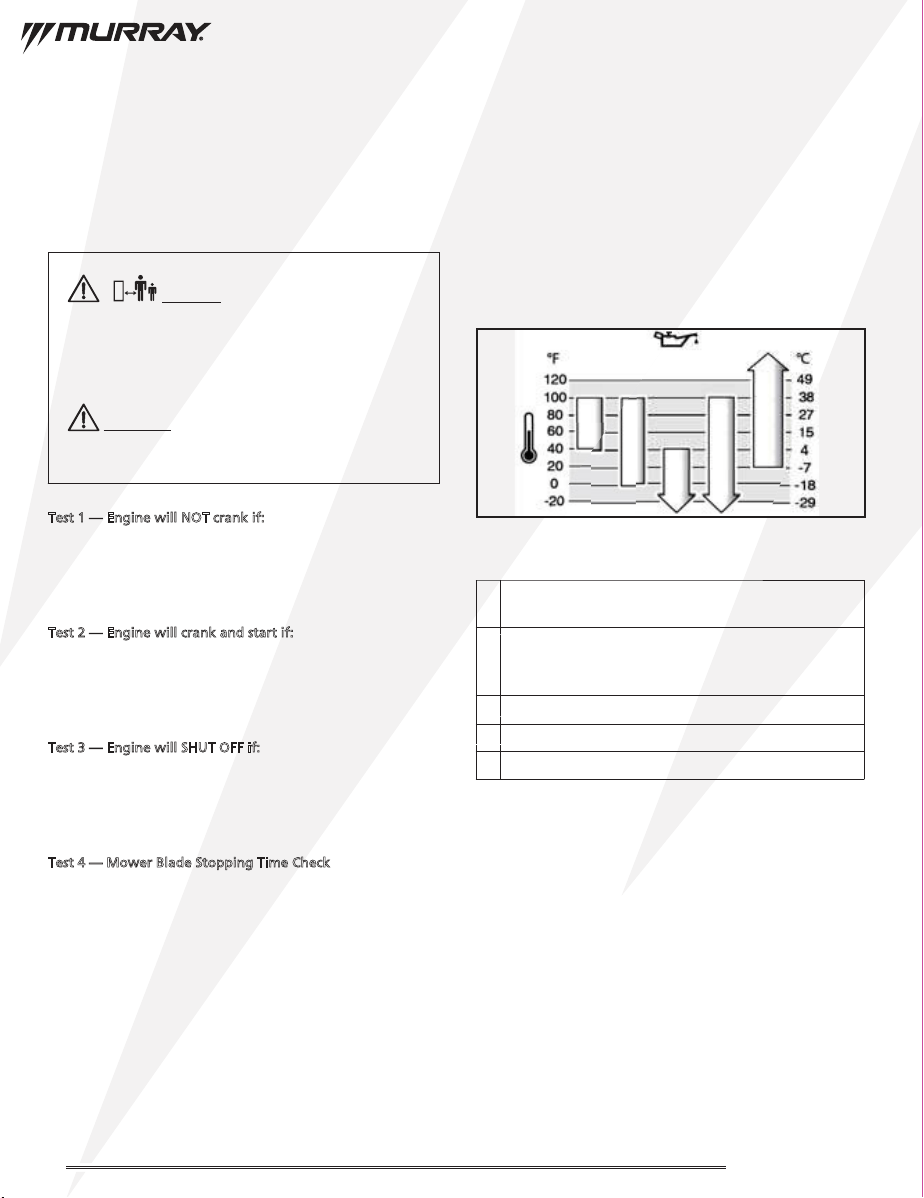
SAE 30 - Below 40 °F (4 °C) the use of SAE 30 will
result in hard starting.
10W-30 - Above 80 °F (27 °C) the use of 10W-30 can
cause increased oil consumption. Check oil level more
frequently.
A
A
B
B
C
C
D
D
E
E
5W-30
Synthetic 5W-30
Vanguard
®
Synthetic 15W-50
DANGER: Mowing in reverse can be
hazardous to bystanders. Tragic accidents can occur if
the operator is not alert to the presence of children.
DO NOT mow in reverse if children are present.
Children are often attracted to the machine and the
mowing activity.
WARNING: If the machine does not pass the five
tests below do not operate the machine.
See an Authorized service center.
Safety Interlock System
Tests
This machine is equipped with a Safety Interlock System. Do
not attempt to bypass or tamper with the switches and
devices.
Test 1 — Engine will NOT crank if:
•
Power Take Off (PTO) switch is ENGAGED, OR
•
Parking brake is NOT fully set (drive control levers not in
the outward position).
Test 2 — Engine will crank and start if:
•
PTO is DISENGAGED, AND
•
Parking brake is fully set (drive control levers set in the
outward position).
Test 3 — Engine will SHUT OFF if:
•
Operator rises off seat with PTO switch ENGAGED, OR
•
Operator rises off seat with parking brake NOT fully set
(drive control levers not in the outward position).
Test 4 — Mower Blade Stopping Time Check
The mower blades and mower drive belt will come to a
complete stop in five seconds after the PTO switch is
DISENGAGED. If the mower drive belt does not stop in five
seconds, see an Authorized Service Dealer.
Engine
Check and Add Engine Oil
Use Briggs & Stratton
®
Warranty Certified oils for best
performance. Other high-quality detergent oils are
acceptable if classified for service SF, SG, SH, SJ or higher. Do
not use special additives. Outdoor temperatures determine
the proper oil viscosity for the engine. Use the chart to
select the best viscosity for the outdoor temperature range
expected.
Fig. 10
*Below 40
°
F ( 4
°
C ) the use of SAE 30 will result in hard starting.
**Above 80
°
f ( 27
°
C ) the use of 10W-30 can cause increased oil consumption.
•
Stop the engine and remove the key. Make sure that the
oil fill area is clean.
•
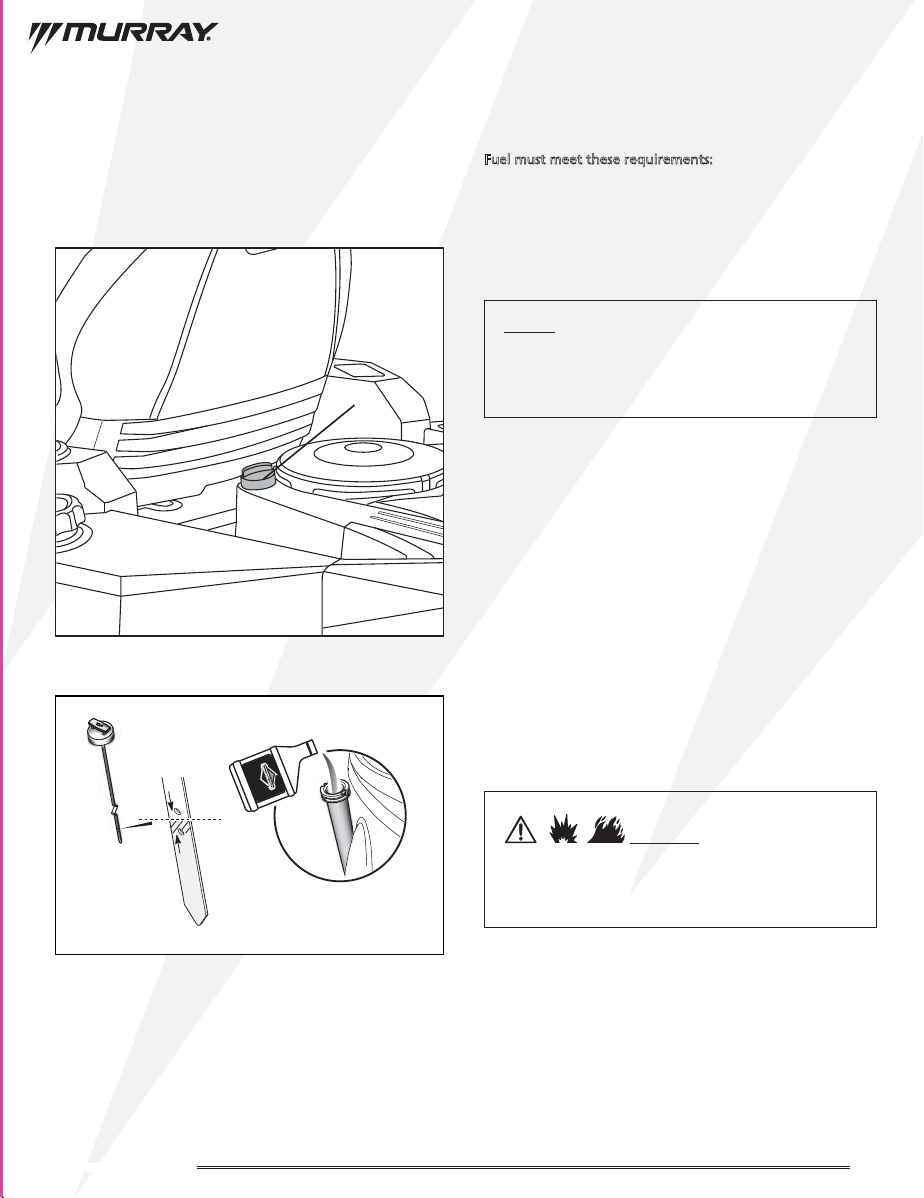
Remove the engine oil dipstick (a, Fig.11). Wipe the
dipstick clean, ensuring no oil remains.
•
Install and tighten the dipstick.
•
Remove the dipstick again and check the oil level.
•
Make sure that the oil level is around the middle of the
FULL mark on the dipstick. (Fig.12).
a
20 21
WARNING: Fuel and its vapors are
extremely flammable and explosive. Always handle fuel
with extreme care. Failure to observe these safety
instructions can cause fire or explosion which could
result in severe burns or death.
NOTICE: Do not use unapproved gasoline, such as E15
and E85. Do not mix oil in gasoline or modify the engine
to run on alternate fuels. Use of unapproved fuels will
damage the engine components, which will not be
covered under warranty.
•
If the oil level is FULL, install and tighten the dipstick.
•
If the oil level is LOW, add oil into the oil fill tube. (Fig. 12)
•
Wait one minute and check the oil level again.
•
If engine oil is sufficient, install and tighten the dipstick.
Fuel Recommendations
Fuel must meet these requirements:
•
Clean, fresh, unleaded gasoline.
•
A minimum of 87 octane. For high altitude, see section
below.
•
Gasoline with up to 10% ethanol (gasohol) is acceptable.
To protect the fuel system from gum formation, mix a fuel
stabilizer into the fuel. See Storage section. All fuel is not
the same; if start or performance problems occur, change
fuel providers or brands. This engine is certified to operate
on gasoline.
High Altitude
At altitudes over 5,000 feet (1524 meters), a minimum of 85
octane gas is acceptable.
For carbureted engines, high altitude adjustment is required
to maintain performance. Operation without adjustment
will cause decreased performance, increased fuel consump-
tion, and increased emissions. Contact a Briggs & Stratton
Authorized Service Center for high altitude adjustment
information. Operation of the engine at altitudes below
2,500 feet (762 meters) with the high altitude adjustment is
not recommended.
Add Fuel
Fig. 11
Fig. 12
CRUZ ZERO TURN MOWER CRUZ ZERO TURN MOWER
SAE 30 - Below 40 °F (4 °C) the use of SAE 30 will
result in hard starting.
10W-30 - Above 80 °F (27 °C) the use of 10W-30 can
cause increased oil consumption. Check oil level more
frequently.
A
A
B
B
C
C
D
D
E
E
5W-30
Synthetic 5W-30
Vanguard
®
Synthetic 15W-50
DANGER: Mowing in reverse can be
hazardous to bystanders. Tragic accidents can occur if
the operator is not alert to the presence of children.
DO NOT mow in reverse if children are present.
Children are often attracted to the machine and the
mowing activity.
WARNING: If the machine does not pass the five
tests below do not operate the machine.
See an Authorized service center.
Safety Interlock System
Tests
This machine is equipped with a Safety Interlock System. Do
not attempt to bypass or tamper with the switches and
devices.
Test 1 — Engine will NOT crank if:
•
Power Take Off (PTO) switch is ENGAGED, OR
•
Parking brake is NOT fully set (drive control levers not in
the outward position).
Test 2 — Engine will crank and start if:
•
PTO is DISENGAGED, AND
•
Parking brake is fully set (drive control levers set in the
outward position).
Test 3 — Engine will SHUT OFF if:
•
Operator rises off seat with PTO switch ENGAGED, OR
•
Operator rises off seat with parking brake NOT fully set
(drive control levers not in the outward position).
Test 4 — Mower Blade Stopping Time Check
The mower blades and mower drive belt will come to a
complete stop in five seconds after the PTO switch is
DISENGAGED. If the mower drive belt does not stop in five
seconds, see an Authorized Service Dealer.
Engine
Check and Add Engine Oil
Use Briggs & Stratton
®
Warranty Certified oils for best
performance. Other high-quality detergent oils are
acceptable if classified for service SF, SG, SH, SJ or higher. Do
not use special additives. Outdoor temperatures determine
the proper oil viscosity for the engine. Use the chart to
select the best viscosity for the outdoor temperature range
expected.
Fig. 10
*Below 40
°
F ( 4
°
C ) the use of SAE 30 will result in hard starting.
**Above 80
°
f ( 27
°
C ) the use of 10W-30 can cause increased oil consumption.
•
Stop the engine and remove the key. Make sure that the
oil fill area is clean.
•
Remove the engine oil dipstick (a, Fig.11). Wipe the
dipstick clean, ensuring no oil remains.
•
Install and tighten the dipstick.
•
Remove the dipstick again and check the oil level.
•
Make sure that the oil level is around the middle of the
FULL mark on the dipstick. (Fig.12).
a
22 23
WARNING: Fuel and its vapors are
extremely flammable and explosive. Fire or explosion
can cause severe burns or death.
NOTICE:
When operating the mower with the cutting
blade engaged, move the throttle to the FAST position.
NOTICE:
In the event of an emergency, turn the ignition
switch to the STOP position. This will STOP the engine.
Using the Throttle/Choke
Lever
The throttle/choke lever is located on the right panel. When
starting the engine while it is cold, push the throttle/choke
lever fully forward into the “CHOKE” position. (Fig.14)
The purpose of the “CHOKE” is to restrict the flow of air so
that the fuel-air mixture is made richer (more fuel, less air)
which aids in starting the engine. After starting the engine,
move the throttle/ choke lever rearwards to the FAST
position. The operator will feel the lever move past the
Choke detent as they push the lever rearward.
Fig. 14
Stop the Engine
Do not choke the carburetor to stop the engine.
1. If the blades are engaged, disengage the blades.
2. Move drive levers to the neutral position.
3. Move drive control levers to the Park position.
4. Move the throttle to the SLOW position.
5. Turn the ignition key switch to the STOP position.
Remove the key.
When Adding Fuel
•
Stop the engine and let it cool for at least 3 minutes
before you remove the fuel cap.
•
Extinguish all cigarettes, cigars, pipes, and other
sources of ignition.
•
Fill fuel tank outdoors or in a well-ventilated area.
•
Do not overfill fuel tank. To allow for expansion of the
fuel, do not fill above the bottom of the fuel tank neck.
•
Keep fuel away from sparks, open flames, pilot lights,
heat, and other ignition sources.
•
Check fuel lines, tank, cap, and fittings frequently for
cracks or leaks. Replace if necessary.
•
If fuel spills, wait until it evaporates before you start the
engine and avoid creating any source of ignition.
•
Use only an approved fuel container.
1. Remove any debris from the fuel cap area.
2. Remove the fuel cap (Fig.13)
3. Use a funnel when filling the fuel tank with fuel. Monitor
the lever of the fuel by looking at the see-through tank
behind the operator’s seat. DO NOT fill above the bottom
of the fuel tank neck.
4. Install the fuel cap.
Fuel and its vapors are WARNING:
extremely flammable and explosive. Fire or explosion
can cause severe burns or death.
Engines give off carbon monoxide,
WARNING:
an odorless, colorless, poisonous gas. Breathing carbon
monoxide can cause nausea, fainting, or death.
Fire or explosion can cause severe burns or death.
Operation Instructions
Start the Engine
When you start the engine:
•
Make sure that the spark plug, muffler, fuel cap, and air
filter are installed correctly.
•
Do not crank the engine with spark plug removed.
•
If the engine floods, move the throttle to the FAST
position and crank until engine starts.
•
Start and operate the engine outdoors.
•
Do not start or operate the engine in enclosed area,
even if doors or windows are open.
1. Check the oil level. See Check and Add Engine Oil section.
2. Operator should be sitting in the mower seat with the
drive control levers fully out and in the park position.
3. Make certain the PTO is in the “OFF” position. Move the
choke control or throttle/choke control into the full
choke position.
4. Turn the key clockwise to the START position. After the
engine starts, release the key. It will return to the RUN
position.
5.
As the engine warms up, gradually pull the throttle/choke
control lever rearward past the choke detent position.
Do not use the choke position to enrich the fuel mixture,
except as necessary to start the engine.
6.
Allow the engine to run for a few minutes at mid-throttle
before putting the engine under load.
NOTE: If the engine is warmed up, it may not be
necessary to choke the engine.
Fig. 13
NOTICE: In the event of an emergency, turn the
ignition switch to the STOP position. This will stop the
engine. See Stop the Engine section.
CRUZ ZERO TURN MOWER CRUZ ZERO TURN MOWER
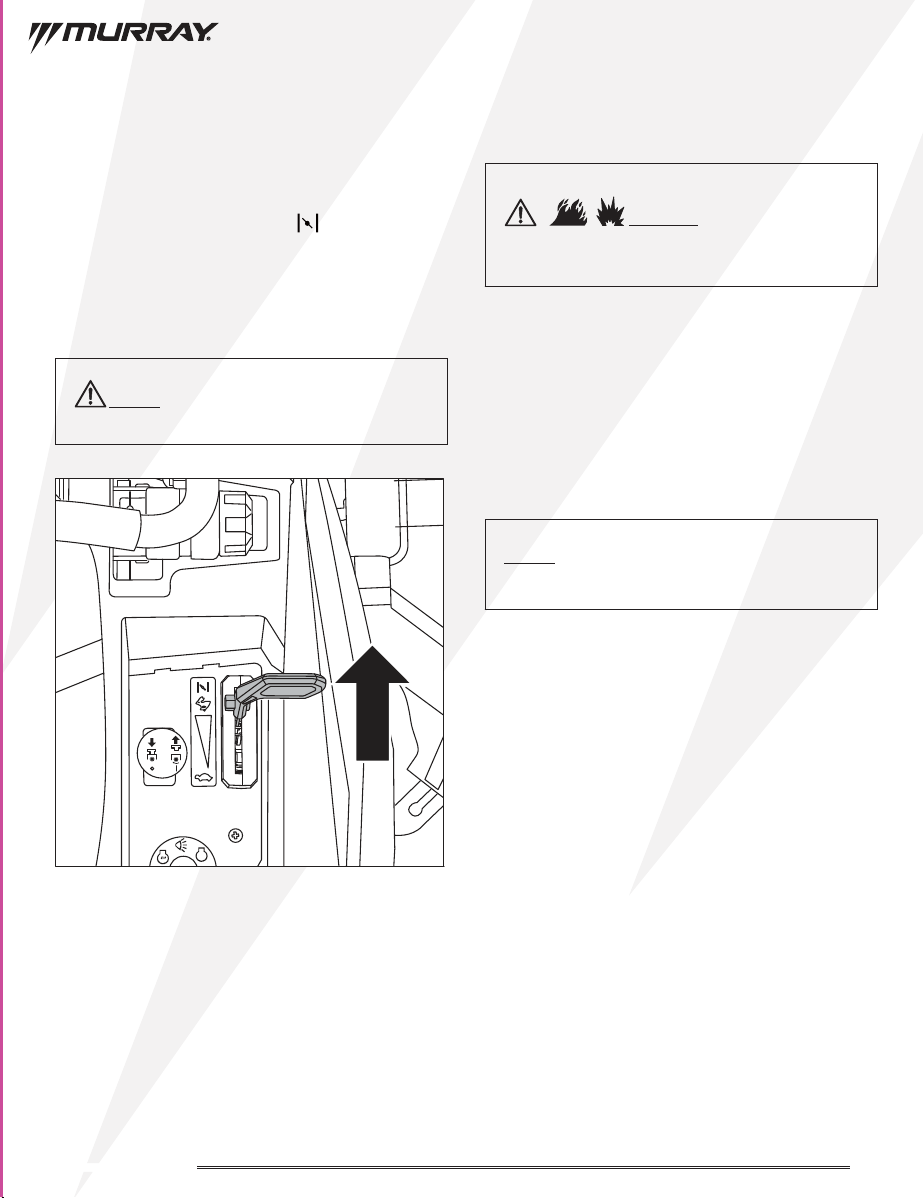
22 23
WARNING: Fuel and its vapors are
extremely flammable and explosive. Fire or explosion
can cause severe burns or death.
NOTICE:
When operating the mower with the cutting
blade engaged, move the throttle to the FAST position.
NOTICE:
In the event of an emergency, turn the ignition
switch to the STOP position. This will STOP the engine.
Using the Throttle/Choke
Lever
The throttle/choke lever is located on the right panel. When
starting the engine while it is cold, push the throttle/choke
lever fully forward into the “CHOKE” position. (Fig.14)
The purpose of the “CHOKE” is to restrict the flow of air so
that the fuel-air mixture is made richer (more fuel, less air)
which aids in starting the engine. After starting the engine,
move the throttle/ choke lever rearwards to the FAST
position. The operator will feel the lever move past the
Choke detent as they push the lever rearward.
Fig. 14
Stop the Engine
Do not choke the carburetor to stop the engine.
1. If the blades are engaged, disengage the blades.
2. Move drive levers to the neutral position.
3. Move drive control levers to the Park position.
4. Move the throttle to the SLOW position.
5. Turn the ignition key switch to the STOP position.
Remove the key.
When Adding Fuel
•
Stop the engine and let it cool for at least 3 minutes
before you remove the fuel cap.
•
Extinguish all cigarettes, cigars, pipes, and other
sources of ignition.
•
Fill fuel tank outdoors or in a well-ventilated area.
•
Do not overfill fuel tank. To allow for expansion of the
fuel, do not fill above the bottom of the fuel tank neck.
•
Keep fuel away from sparks, open flames, pilot lights,
heat, and other ignition sources.
•
Check fuel lines, tank, cap, and fittings frequently for
cracks or leaks. Replace if necessary.
•
If fuel spills, wait until it evaporates before you start the
engine and avoid creating any source of ignition.
•
Use only an approved fuel container.
1. Remove any debris from the fuel cap area.
2. Remove the fuel cap (Fig.13)
3. Use a funnel when filling the fuel tank with fuel. Monitor
the lever of the fuel by looking at the see-through tank
behind the operator’s seat. DO NOT fill above the bottom
of the fuel tank neck.
4. Install the fuel cap.
Fuel and its vapors are WARNING:
extremely flammable and explosive. Fire or explosion
can cause severe burns or death.
Engines give off carbon monoxide,
WARNING:
an odorless, colorless, poisonous gas. Breathing carbon
monoxide can cause nausea, fainting, or death.
Fire or explosion can cause severe burns or death.
Operation Instructions
Start the Engine
When you start the engine:
•
Make sure that the spark plug, muffler, fuel cap, and air
filter are installed correctly.
•
Do not crank the engine with spark plug removed.
•
If the engine floods, move the throttle to the FAST
position and crank until engine starts.
•
Start and operate the engine outdoors.
•
Do not start or operate the engine in enclosed area,
even if doors or windows are open.
1. Check the oil level. See Check and Add Engine Oil section.
2. Operator should be sitting in the mower seat with the
drive control levers fully out and in the park position.
3. Make certain the PTO is in the “OFF” position. Move the
choke control or throttle/choke control into the full
choke position.
4. Turn the key clockwise to the START position. After the
engine starts, release the key. It will return to the RUN
position.
5.
As the engine warms up, gradually pull the throttle/choke
control lever rearward past the choke detent position.
Do not use the choke position to enrich the fuel mixture,
except as necessary to start the engine.
6.
Allow the engine to run for a few minutes at mid-throttle
before putting the engine under load.
NOTE: If the engine is warmed up, it may not be
necessary to choke the engine.
Fig. 13
NOTICE: In the event of an emergency, turn the
ignition switch to the STOP position. This will stop the
engine. See Stop the Engine section.
CRUZ ZERO TURN MOWER CRUZ ZERO TURN MOWER
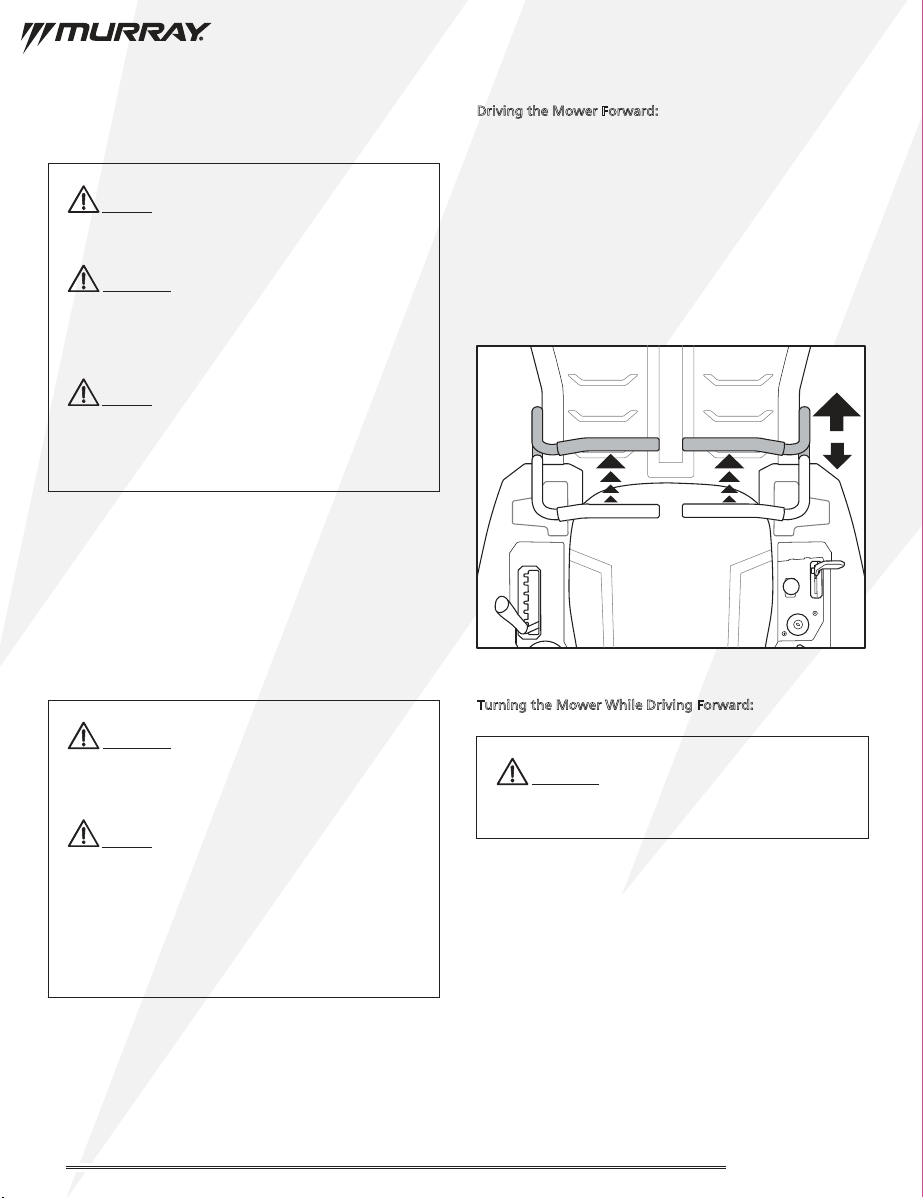
24 25
Fig.16A
Fig.16B
WARNING: Always look behind and down on both
sides of the mower before backing. Always look behind
while traveling in the reverse direction. Mowing in
reverse is not recommended.
Driving the Mower in Reverse:
1. From the neutral position, slowly and evenly move both
drive control levers rearward. The mower will start to
move in the reverse direction.
2. As the drive control levers are pushed farther rearward
the speed of the mower will increase.
3. To slow the mower, move the drive control levers
forward to attain the desired speed or move the drive
control levers to the neutral position to stop the mower.
NOTE: Making a “pivot turn” on grass will greatly
increase the potential for defacement of the turf.
Fig.18A
Fig.17
Turning the Mower While Driving Rearward:
To turn the mower while driving rearward, move the drive
control levers as necessary so that one drive control lever is
forward of the other. The mower will turn in the direction
of the forward drive control lever.
1. To turn to the right while traveling in reverse, move the
left drive control lever forward of the right drive control
lever. (Fig.18A)
2. To turn to the left while traveling in reverse, move the
right drive control lever forward of the left drive control
lever. (Fig.18B)
WARNING: Keep all movement of the drive control
levers slow and smooth. Abrupt movement of the control
levers can affect the stability of the mower and could
cause the mower to flip over, which could result in
serious injury or death to the operator.
NOTICE: This mower is not equipped with a gas
pedal. The travel speed of the mower is controlled by the
drive control levers’ position and throttle position.
NOTICE: Operating a zero-turn mower is not like
operating a conventional type riding mower.
First-time operators should become completely familiar
with the mower’s operation and controls before
operating the mower.
NOTICE: The drive control levers must be moved fully
inward before pushing forward or backward to ensure
brakes are fully disengaged. Parking the mower on
uneven terrain or a hill may cause the brakes to bind
and not release fully. In this case the mower will not
drive when the drive control levers are moved. If this
happens, move the drive control lever in the opposite
direction slightly to take the load off the brakes and
allow them to release fully.
WARNING: Always maintain a firm grip on the
control levers. Do NOT release the control levers to slow
or stop the mower; move levers to neutral position
using your hands.
WARNING: Sharp turns can affect control of the
mower. ALWAYS slow the mower before making sharp
turns.
Driving the Mower
1. Adjust the operator’s seat to the most comfortable
position that allows you to operate the controls.
2. Move the two drive control levers inward to the neutral
position. This disengages the parking brake.
3. Move the throttle lever to the full throttle position.
4. To drive the mower, firmly grasp the respective drive
control levers with your right and left hands and continue
with Driving the Mower Forward in the next section.
Driving the Mower Forward:
1. From the neutral position, slowly and evenly move both
drive control levers forward. The mower will start to
move forward.
2. As the drive control levers are pushed farther forward
the speed of the mower will increase.
3. To slow the mower, move the drive controls levers
rearward to attain the desired speed or move the drive
control levers to the neutral position to stop the mower.
Driving Forward
Fig. 15
Turning the Mower While Driving Forward:
To turn the mower while driving forward, move the drive
control levers as necessary so that one drive control lever is
rearward of the other. The mower will turn in the direction
of the rearward drive control lever.
1. To turn to the right, move the right drive control lever
rearward of the left drive control lever. (Fig.16A)
2. To turn to the left, move the left drive control lever
rearward of the right lever. (Fig.16B)
3. The greater the distance between the two levers, the
sharper the mower will turn.
CRUZ ZERO TURN MOWER CRUZ ZERO TURN MOWER
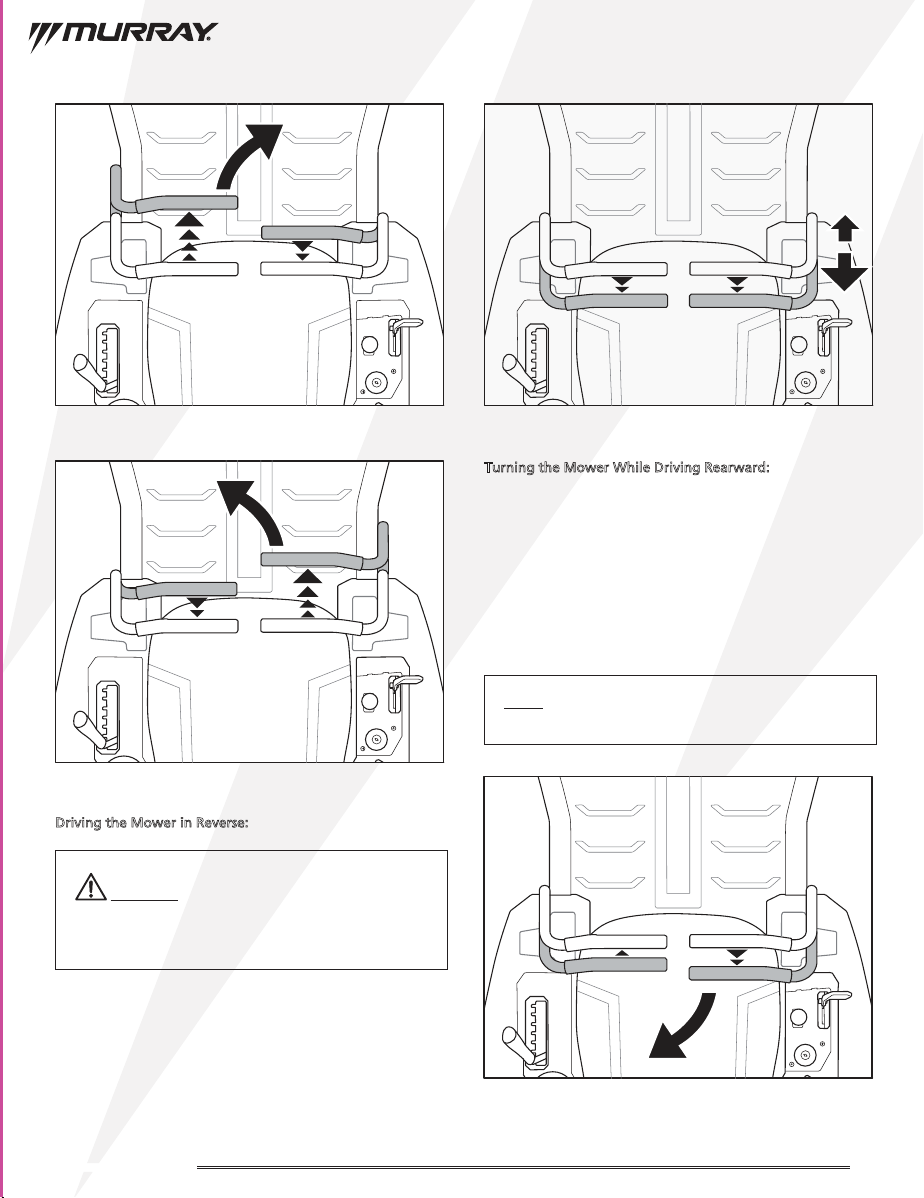
24 25
Fig.16A
Fig.16B
WARNING: Always look behind and down on both
sides of the mower before backing. Always look behind
while traveling in the reverse direction. Mowing in
reverse is not recommended.
Driving the Mower in Reverse:
1. From the neutral position, slowly and evenly move both
drive control levers rearward. The mower will start to
move in the reverse direction.
2. As the drive control levers are pushed farther rearward
the speed of the mower will increase.
3. To slow the mower, move the drive control levers
forward to attain the desired speed or move the drive
control levers to the neutral position to stop the mower.
NOTE: Making a “pivot turn” on grass will greatly
increase the potential for defacement of the turf.
Fig.18A
Fig.17
Turning the Mower While Driving Rearward:
To turn the mower while driving rearward, move the drive
control levers as necessary so that one drive control lever is
forward of the other. The mower will turn in the direction
of the forward drive control lever.
1. To turn to the right while traveling in reverse, move the
left drive control lever forward of the right drive control
lever. (Fig.18A)
2. To turn to the left while traveling in reverse, move the
right drive control lever forward of the left drive control
lever. (Fig.18B)
WARNING: Keep all movement of the drive control
levers slow and smooth. Abrupt movement of the control
levers can affect the stability of the mower and could
cause the mower to flip over, which could result in
serious injury or death to the operator.
NOTICE: This mower is not equipped with a gas
pedal. The travel speed of the mower is controlled by the
drive control levers’ position and throttle position.
NOTICE: Operating a zero-turn mower is not like
operating a conventional type riding mower.
First-time operators should become completely familiar
with the mower’s operation and controls before
operating the mower.
NOTICE: The drive control levers must be moved fully
inward before pushing forward or backward to ensure
brakes are fully disengaged. Parking the mower on
uneven terrain or a hill may cause the brakes to bind
and not release fully. In this case the mower will not
drive when the drive control levers are moved. If this
happens, move the drive control lever in the opposite
direction slightly to take the load off the brakes and
allow them to release fully.
WARNING: Always maintain a firm grip on the
control levers. Do NOT release the control levers to slow
or stop the mower; move levers to neutral position
using your hands.
WARNING: Sharp turns can affect control of the
mower. ALWAYS slow the mower before making sharp
turns.
Driving the Mower
1. Adjust the operator’s seat to the most comfortable
position that allows you to operate the controls.
2. Move the two drive control levers inward to the neutral
position. This disengages the parking brake.
3. Move the throttle lever to the full throttle position.
4. To drive the mower, firmly grasp the respective drive
control levers with your right and left hands and continue
with Driving the Mower Forward in the next section.
Driving the Mower Forward:
1. From the neutral position, slowly and evenly move both
drive control levers forward. The mower will start to
move forward.
2. As the drive control levers are pushed farther forward
the speed of the mower will increase.
3. To slow the mower, move the drive controls levers
rearward to attain the desired speed or move the drive
control levers to the neutral position to stop the mower.
Driving Forward
Fig. 15
Turning the Mower While Driving Forward:
To turn the mower while driving forward, move the drive
control levers as necessary so that one drive control lever is
rearward of the other. The mower will turn in the direction
of the rearward drive control lever.
1. To turn to the right, move the right drive control lever
rearward of the left drive control lever. (Fig.16A)
2. To turn to the left, move the left drive control lever
rearward of the right lever. (Fig.16B)
3. The greater the distance between the two levers, the
sharper the mower will turn.
CRUZ ZERO TURN MOWER CRUZ ZERO TURN MOWER
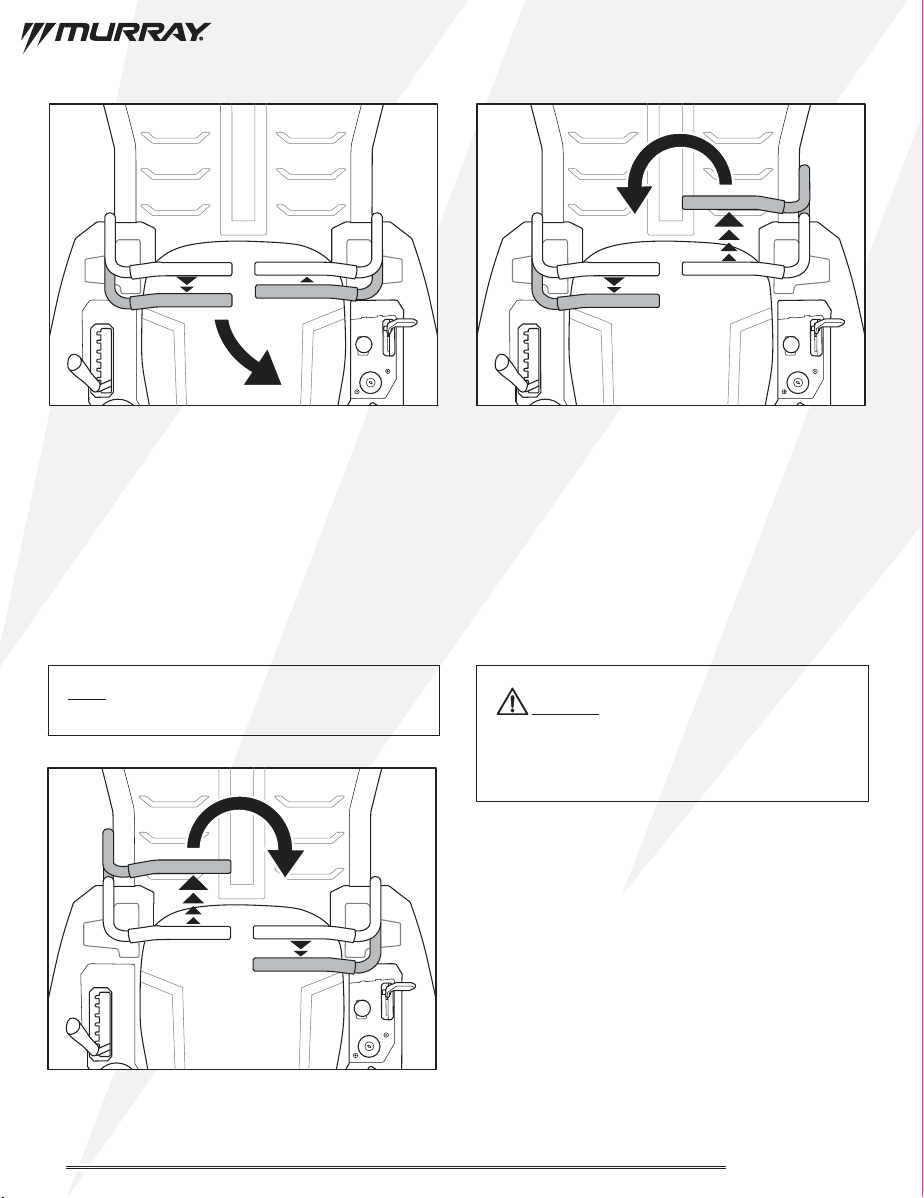
26 27
NOTE: Making a “zero turn” on grass will greatly
increase the potential for defacement of the turf.
Executing a Zero Turn
1. Stop the forward or reverse motion of the mower by
moving the two drive control levers to neutral.
2. To turn clockwise, move the left drive control lever
forward while simultaneously moving the right drive
control lever rearward. (Fig.19A)
3. To turn counter-clockwise, move the right drive control
lever forward while simultaneously moving the left drive
control lever rearward. (Fig.19B)
Fig.18B
Fig.19A
Stopping the Mower
1. Move both drive control levers to the neutral position to
stop the motion of the mower.
2. Push the PTO downward to the OFF position.
3. If dismounting the mower, move the drive control levers
fully outward in the neutral position, which also engages
the parking brake. Move the throttle to the SLOW
position, turn the key to the STOP position, and remove it
from the ignition module.
Fig.19B
WARNING: Do not leave the seat of the mower
without disengaging the PTO and moving drive control
levers fully outward into the Park Brake engaged
position. If leaving the mower unattended, turn the
ignition key to the STOP position and remove key.
CRUZ ZERO TURN MOWER CRUZ ZERO TURN MOWER
Fig.20
Adjusting the Mower
Cutting Height
To change the height of cut, move the lever out of the
notch, then up or down to the position that is best suited
for your application.
Adjusting Deck Anti-scalp
Wheel
To adjust the wheels:
1. Park the mower on a level surface and engage the
parking brake.
2. Stop the mower and remove the key. Allow blades to
come to a complete stop.
3. Set the deck to the desired height.
4. Remove bolt and nut holding the wheel in place.
5. Move the wheel to a position that’s approximately
1/8 in. - 1/2 in. off the ground.
6. Replace the bolt and nut; tighten securely. The
recommended torque is 22-26 ft. lbs.
7. Repeat steps 4-6 on the other anti-scalp wheel.
CAUTION: Stop the mower and disengage blades
before adjusting the cutting height of the deck.
The deck adjusting lever is located on the mower’s left
fender. It is used to change the height of the cutting
deck. The height (distance from the blade to the ground)
can be adjusted from 1” to 4” inch (7 height positions).
NOTICE:
The bottom of the deck anti-scalp wheels
should be positioned approximately 1/8 in. - 1/2 in.
off the ground when the mower is at the desired cutting
height. This will minimize the chance of scalping the lawn
in most situations.
NOTICE:
The left and right wheels should be set at
the same positions.
NOTICE:
Adjustment can be achieved by threading
bolt into four different holes.
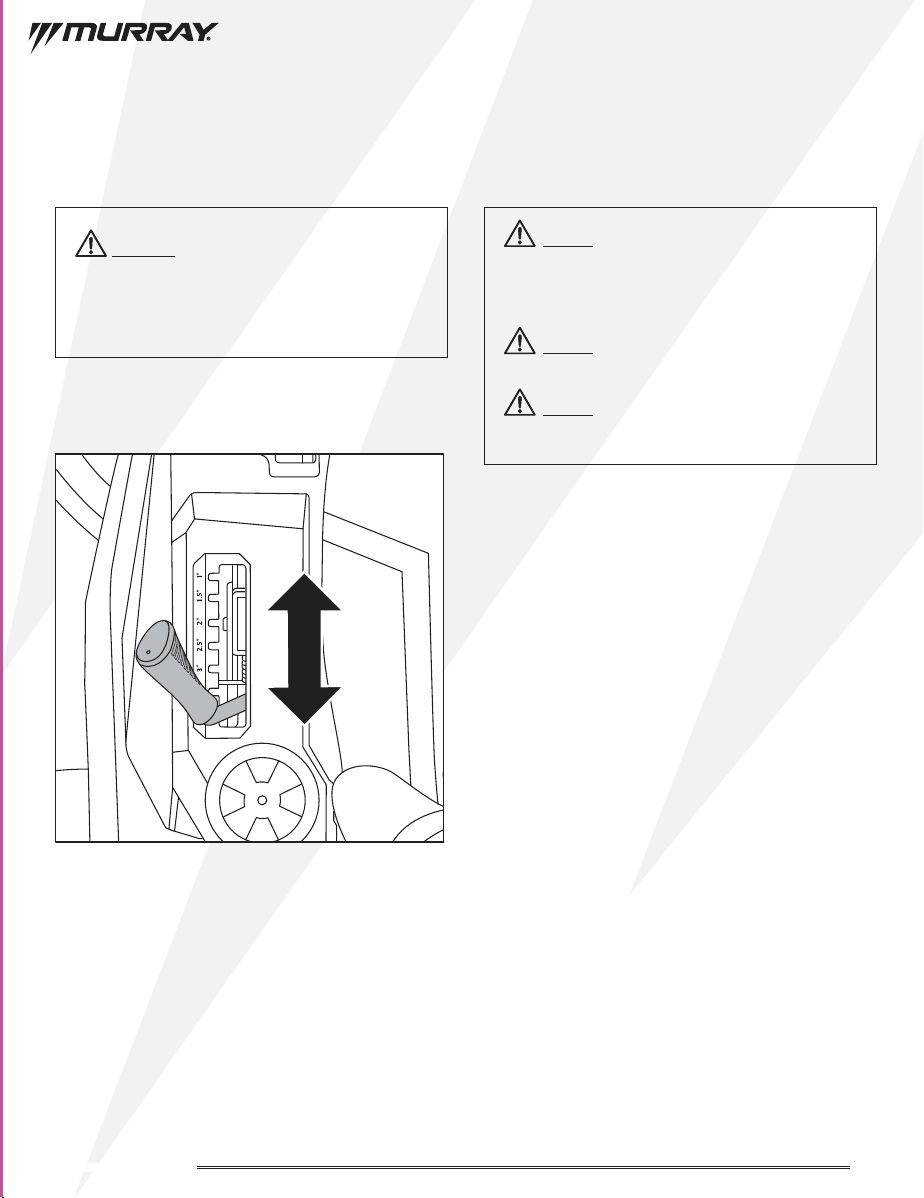
26 27
NOTE: Making a “zero turn” on grass will greatly
increase the potential for defacement of the turf.
Executing a Zero Turn
1. Stop the forward or reverse motion of the mower by
moving the two drive control levers to neutral.
2. To turn clockwise, move the left drive control lever
forward while simultaneously moving the right drive
control lever rearward. (Fig.19A)
3. To turn counter-clockwise, move the right drive control
lever forward while simultaneously moving the left drive
control lever rearward. (Fig.19B)
Fig.18B
Fig.19A
Stopping the Mower
1. Move both drive control levers to the neutral position to
stop the motion of the mower.
2. Push the PTO downward to the OFF position.
3. If dismounting the mower, move the drive control levers
fully outward in the neutral position, which also engages
the parking brake. Move the throttle to the SLOW
position, turn the key to the STOP position, and remove it
from the ignition module.
Fig.19B
WARNING: Do not leave the seat of the mower
without disengaging the PTO and moving drive control
levers fully outward into the Park Brake engaged
position. If leaving the mower unattended, turn the
ignition key to the STOP position and remove key.
CRUZ ZERO TURN MOWER CRUZ ZERO TURN MOWER
Fig.20
Adjusting the Mower
Cutting Height
To change the height of cut, move the lever out of the
notch, then up or down to the position that is best suited
for your application.
Adjusting Deck Anti-scalp
Wheel
To adjust the wheels:
1. Park the mower on a level surface and engage the
parking brake.
2. Stop the mower and remove the key. Allow blades to
come to a complete stop.
3. Set the deck to the desired height.
4. Remove bolt and nut holding the wheel in place.
5. Move the wheel to a position that’s approximately
1/8 in. - 1/2 in. off the ground.
6. Replace the bolt and nut; tighten securely. The
recommended torque is 22-26 ft. lbs.
7. Repeat steps 4-6 on the other anti-scalp wheel.
CAUTION: Stop the mower and disengage blades
before adjusting the cutting height of the deck.
The deck adjusting lever is located on the mower’s left
fender. It is used to change the height of the cutting
deck. The height (distance from the blade to the ground)
can be adjusted from 1” to 4” inch (7 height positions).
NOTICE:
The bottom of the deck anti-scalp wheels
should be positioned approximately 1/8 in. - 1/2 in.
off the ground when the mower is at the desired cutting
height. This will minimize the chance of scalping the lawn
in most situations.
NOTICE:
The left and right wheels should be set at
the same positions.
NOTICE:
Adjustment can be achieved by threading
bolt into four different holes.
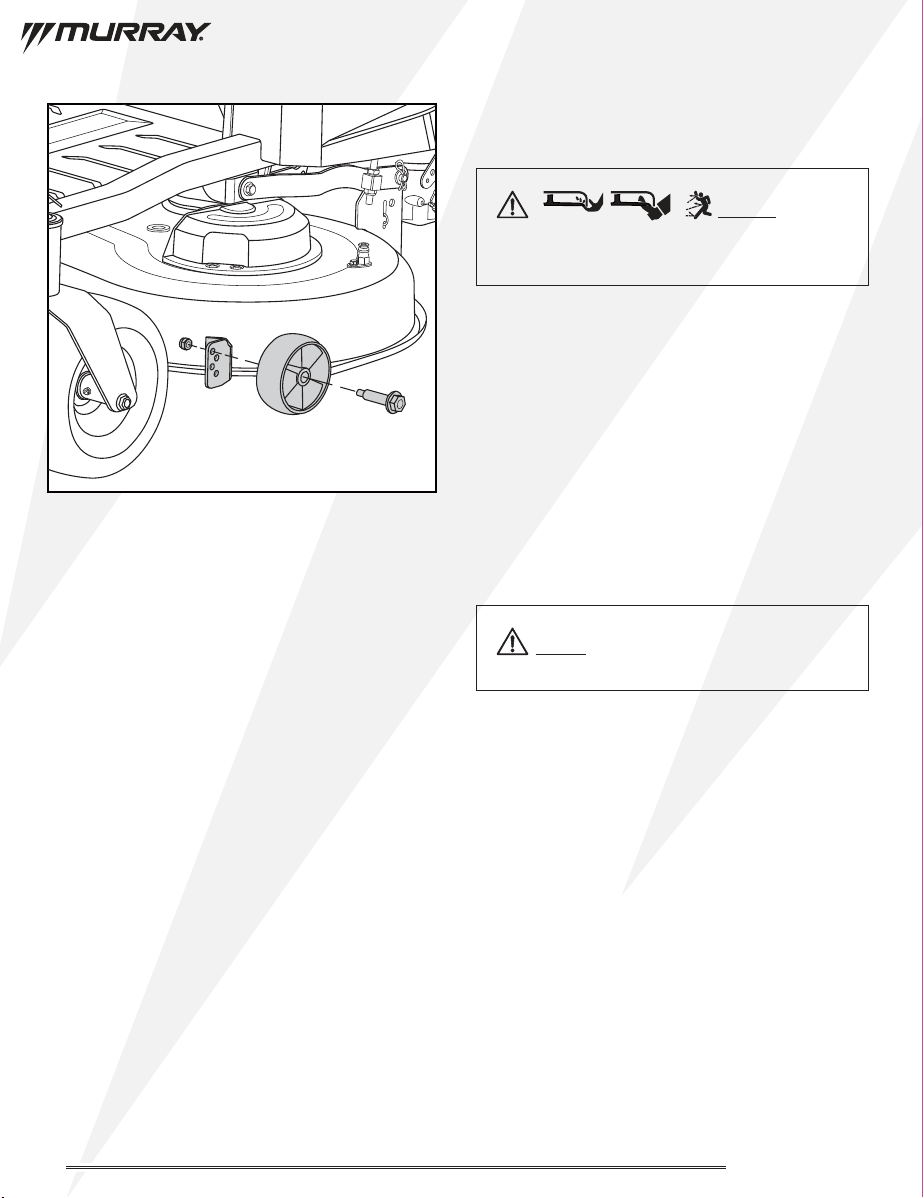
28 29
CRUZ ZERO TURN MOWER CRUZ ZERO TURN MOWER
Mowing Tips
• Mowing should always be done with the throttle in the
FAST position for optimal cutting results.
• Keep the blades sharp. Jagged cuts increase the
likelihood of the tip of the grass blade browning or
developing a disease.
• After completing a pass in your lawn, overlap the
previous pass by approximately 2 – 3”.
• Change the direction you mow each time to prevent
ruts from developing in your lawn.
• Do not cut the grass too short. Short grass is prone to
weed growth and yellows quickly in dry weather.
• Set the mower cut height at the recommended setting
for the type of grass in your lawn. Cutting your lawn
too short will prevent it from deepening its root system
as the grass will use its energy to regrow the grass
blades, rather than the root system. A deep root system
will allow the grass to find nutrients and water in the
soil, especially in periods of drought.
• Raise the mower cut height during the summer or
periods of drought.
• Do not cut during the hottest part of the day. Doing so
stresses the grass.
• Follow the “1/3 Rule”. Take off no more than 1/3 of the
grass blade length at a time.
• When cutting long, thick grass, it may be necessary to
go back over the cut area a second time.
• Do not cut wet grass. Dry grass is less likely to clump
together and more likely to be standing upright, which
will result in a clean, even cut.
• Mow across slopes, not up and down. If mowing a slope,
start at bottom and work upward to ensure turns are
made uphill.
• For best results it is recommended that the first two laps
be cut with the discharge thrown towards the center.
After the first two laps, reverse the direction to throw
the discharge to the outside for the balance of cutting.
This will give a better appearance to the lawn.
Mowing in reverse
• Keep children out of the operating area and under the
watchful care of a responsible adult.
• Do not carry passengers, especially children, even with
the blade(s) shut off. Children can fall off and be
seriously injured or interfere with the safe machine
operation. Children who have been given rides in the
past can suddenly appear in the mowing area for
another ride and be run over or backed over by the
machine.
• Do not mow in reverse unless absolutely necessary.
Always look down and behind before and while
backing.
Once the Blades are Engaged
1. Move the two drive control levers inward to the neutral
position which also disengages the parking brake.
2. Move the throttle to the full throttle position.
3. Slowly and evenly move both drive control levers
rearward. The mower will start to move in the reverse
direction.
DANGER: Mowing in
reverse can be hazardous to bystanders. Tragic accidents
can occur if the operator is not alert to the presence of
children. Children are often attracted to the machine
and the mowing activity. Never assume that children
will remain where you last saw them.
WARNING: To help avoid blade contact or a thrown
object injury, keep bystanders, helpers, children, and pets
away from the machine while it is in operation.
Stop the machine if anyone enters the area.
NOTE: When operating the mower be certain that the
throttle is always in the FAST position. Operating with
the throttle at less than full throttle may lead to
premature battery wear and a poor quality cut.
Mowing
• Only operate the machine in daylight hours or good
artificial light.
• Avoid holes, ruts, bumps, rocks, or other hidden
hazards. Uneven terrain can overturn the machine or
cause the operator to lose their balance or footing.
• Do not direct discharge material toward anyone. Avoid
discharging material against a wall or obstruction as
material may ricochet back toward the operator.
• Stop the blades when crossing gravel surfaces.
• Do not leave a running machine unattended. Always
park on level ground, disengage the blades, set parking
brake, stop engine and remove starter insert or key.
Engaging the PTO
Engaging the PTO transfers power to the cutting deck to
enter mowing mode. To engage the PTO:
1. Move the throttle to the FAST position.
2. Pull the PTO switch up/out into the ENGAGED (ON)
position.
3. To disengage the PTO, push the PTO switch down/in to
the DISENGAGED (OFF) position.
DANGER: This machine
is capable of amputating hands and feet, and throwing
objects. Failure to obey the safety instructions could
result in serious injury or death.
NOTICE:
The PTO switch must be DISENGAGED when
starting the engine.
Fig. 21
28 29
CRUZ ZERO TURN MOWER CRUZ ZERO TURN MOWER
Mowing Tips
• Mowing should always be done with the throttle in the
FAST position for optimal cutting results.
• Keep the blades sharp. Jagged cuts increase the
likelihood of the tip of the grass blade browning or
developing a disease.
• After completing a pass in your lawn, overlap the
previous pass by approximately 2 – 3”.
• Change the direction you mow each time to prevent
ruts from developing in your lawn.
• Do not cut the grass too short. Short grass is prone to
weed growth and yellows quickly in dry weather.
• Set the mower cut height at the recommended setting
for the type of grass in your lawn. Cutting your lawn
too short will prevent it from deepening its root system
as the grass will use its energy to regrow the grass
blades, rather than the root system. A deep root system
will allow the grass to find nutrients and water in the
soil, especially in periods of drought.
• Raise the mower cut height during the summer or
periods of drought.
• Do not cut during the hottest part of the day. Doing so
stresses the grass.
• Follow the “1/3 Rule”. Take off no more than 1/3 of the
grass blade length at a time.
• When cutting long, thick grass, it may be necessary to
go back over the cut area a second time.
• Do not cut wet grass. Dry grass is less likely to clump
together and more likely to be standing upright, which
will result in a clean, even cut.
• Mow across slopes, not up and down. If mowing a slope,
start at bottom and work upward to ensure turns are
made uphill.
• For best results it is recommended that the first two laps
be cut with the discharge thrown towards the center.
After the first two laps, reverse the direction to throw
the discharge to the outside for the balance of cutting.
This will give a better appearance to the lawn.
Mowing in reverse
• Keep children out of the operating area and under the
watchful care of a responsible adult.
• Do not carry passengers, especially children, even with
the blade(s) shut off. Children can fall off and be
seriously injured or interfere with the safe machine
operation. Children who have been given rides in the
past can suddenly appear in the mowing area for
another ride and be run over or backed over by the
machine.
• Do not mow in reverse unless absolutely necessary.
Always look down and behind before and while
backing.
Once the Blades are Engaged
1. Move the two drive control levers inward to the neutral
position which also disengages the parking brake.
2. Move the throttle to the full throttle position.
3. Slowly and evenly move both drive control levers
rearward. The mower will start to move in the reverse
direction.
DANGER: Mowing in
reverse can be hazardous to bystanders. Tragic accidents
can occur if the operator is not alert to the presence of
children. Children are often attracted to the machine
and the mowing activity. Never assume that children
will remain where you last saw them.
WARNING: To help avoid blade contact or a thrown
object injury, keep bystanders, helpers, children, and pets
away from the machine while it is in operation.
Stop the machine if anyone enters the area.
NOTE: When operating the mower be certain that the
throttle is always in the FAST position. Operating with
the throttle at less than full throttle may lead to
premature battery wear and a poor quality cut.
Mowing
• Only operate the machine in daylight hours or good
artificial light.
• Avoid holes, ruts, bumps, rocks, or other hidden
hazards. Uneven terrain can overturn the machine or
cause the operator to lose their balance or footing.
• Do not direct discharge material toward anyone. Avoid
discharging material against a wall or obstruction as
material may ricochet back toward the operator.
• Stop the blades when crossing gravel surfaces.
• Do not leave a running machine unattended. Always
park on level ground, disengage the blades, set parking
brake, stop engine and remove starter insert or key.
Engaging the PTO
Engaging the PTO transfers power to the cutting deck to
enter mowing mode. To engage the PTO:
1. Move the throttle to the FAST position.
2. Pull the PTO switch up/out into the ENGAGED (ON)
position.
3. To disengage the PTO, push the PTO switch down/in to
the DISENGAGED (OFF) position.
DANGER: This machine
is capable of amputating hands and feet, and throwing
objects. Failure to obey the safety instructions could
result in serious injury or death.
NOTICE:
The PTO switch must be DISENGAGED when
starting the engine.
Fig. 21

30 31
When stopping the mower for any reason while on a grass
surface, always:
• Move the drive control levers fully outward into the
Parking Brake engaged position.
• Shut engine off and remove the key.
• Doing so will minimize the possibility of having your
lawn ‘‘browned’’ by hot exhaust from your mower’s
running engine.
• The speed of the mower will affect the quality of the
mower cut. Mowing at full speed will adversely affect
the cut quality. Control the ground speed with the drive
control levers.
• When approaching the other end of the strip, slow down
or stop before turning. A U-turn is recommended unless
a pivot or zero turn is required.
• Do not attempt to mow heavy brush and weeds or
extremely tall grass. Your mower is designed to mow
lawns, NOT clear brush.
•
Keep the blades sharp and replace the blades when worn.
CRUZ ZERO TURN MOWER CRUZ ZERO TURN MOWER
WARNING: Improper maintenance, or failure to
correct a problem before operation, or use of
non-conforming replacement components, can cause
malfunction and could result in death or serious injury.
CAUTION:
Before performing any type of
maintenance/service, disengage the blades, shut off the
engine, and wait until all moving parts have come to a
complete stop. Disconnect spark plug wire and keep it
away from the spark plug. Always wear safety glasses
while performing any adjustments or repairs.
6. Maintenance
Good maintenance is essential for safe, economical, and
trouble-free operation. Follow the inspection and mainte-
nance recommendations and schedules in this manual.
Before adjustments and repairs:
• Use ONLY the correct tools.
• DO NOT tamper with the governor spring, links, or other
parts to increase engine speed.
• Replacement parts must be of the same design and
installed in the same position as the original parts. Other
parts may not perform as well, may damage the unit,
void the warranty, and may result in injury.
Maintenance Schedule
*Whichever comes first.
**Check the mower blades more often in regions with
sandy soils or high dust conditions.
Every 8 Hours or Daily
Check the safety interlock system.
Remove any debris from the mower,
mower deck, and engine compartment.
Every 25 Hours or Annually*
Check the tire pressure.
Check the mower blade stopping time.
Check for loose hardware on the mower.
Every 50 Hours or Annually*
Clean the battery and cables.
Check the mower brakes.
See an Authorized Service Dealer Annually
Lubricate the mower.
Mower blades check**
Zero Turn Mower
NOTICE: Refer to engine operator’s manual for
detailed engine maintenance.
NOTICE:
If you are unsure how to perform any of the
maintenance items listed below, please contact customer
service 888-693-2582 or a qualified service center for
assistance.
30 31
When stopping the mower for any reason while on a grass
surface, always:
• Move the drive control levers fully outward into the
Parking Brake engaged position.
• Shut engine off and remove the key.
• Doing so will minimize the possibility of having your
lawn ‘‘browned’’ by hot exhaust from your mower’s
running engine.
• The speed of the mower will affect the quality of the
mower cut. Mowing at full speed will adversely affect
the cut quality. Control the ground speed with the drive
control levers.
• When approaching the other end of the strip, slow down
or stop before turning. A U-turn is recommended unless
a pivot or zero turn is required.
• Do not attempt to mow heavy brush and weeds or
extremely tall grass. Your mower is designed to mow
lawns, NOT clear brush.
•
Keep the blades sharp and replace the blades when worn.
CRUZ ZERO TURN MOWER CRUZ ZERO TURN MOWER
WARNING: Improper maintenance, or failure to
correct a problem before operation, or use of
non-conforming replacement components, can cause
malfunction and could result in death or serious injury.
CAUTION:
Before performing any type of
maintenance/service, disengage the blades, shut off the
engine, and wait until all moving parts have come to a
complete stop. Disconnect spark plug wire and keep it
away from the spark plug. Always wear safety glasses
while performing any adjustments or repairs.
6. Maintenance
Good maintenance is essential for safe, economical, and
trouble-free operation. Follow the inspection and mainte-
nance recommendations and schedules in this manual.
Before adjustments and repairs:
• Use ONLY the correct tools.
• DO NOT tamper with the governor spring, links, or other
parts to increase engine speed.
• Replacement parts must be of the same design and
installed in the same position as the original parts. Other
parts may not perform as well, may damage the unit,
void the warranty, and may result in injury.
Maintenance Schedule
*Whichever comes first.
**Check the mower blades more often in regions with
sandy soils or high dust conditions.
Every 8 Hours or Daily
Check the safety interlock system.
Remove any debris from the mower,
mower deck, and engine compartment.
Every 25 Hours or Annually*
Check the tire pressure.
Check the mower blade stopping time.
Check for loose hardware on the mower.
Every 50 Hours or Annually*
Clean the battery and cables.
Check the mower brakes.
See an Authorized Service Dealer Annually
Lubricate the mower.
Mower blades check**
Zero Turn Mower
NOTICE: Refer to engine operator’s manual for
detailed engine maintenance.
NOTICE:
If you are unsure how to perform any of the
maintenance items listed below, please contact customer
service 888-693-2582 or a qualified service center for
assistance.
3332
Fig. 22
CRUZ ZERO TURN MOWER CRUZ ZERO TURN MOWER
*Whichever comes first.
First 5 Hours
Change the engine oil.
Every 8 Hours or Daily
Check the engine oil level.
Every 25 Hours or Annually*
Clean the air filter.
Every 50 Hours or Annually*
Change the engine oil.
Replace the oil filter.
Annually
Replace the air filter.
See an Authorized Service Dealer Annually
Inspect the muffler.
Replace the spark plugs.
Replace the fuel filter.
Clean the air cooling system.
ENGINE
Cleaning the Mower
CAUTION: Do not use pressure washer or garden
hose to clean your mower other than to clean the
underside of the deck. It may cause damage to electrical
components, spindles, pulleys, bearings, or the engine.
The use of water will result in shortened life and reduce
serviceability.
WARNING:
The engine, muffler, and surrounding
metal surfaces will be very hot and can cause burns to
the skin. Let the mower cool for at least five minutes
before cleaning. Exercise caution to avoid burns.
NOTICE: Debris can accumulate anywhere on the mower,
especially on horizontal surfaces. Additional cleaning
may be necessary when mowing in wet conditions or
when mulching.
NOTICE: Fuel leaks/spills, oil leaks/spills, and excess
llubrication can also become collection sites for debris.
Immediate repair and cleaning up oil or fuel spills can
help reduce fire hazards.
NOTICE: Avoid using solvents when cleaning plastic parts.
Most plastics are susceptible to damage from various
types of commercial solvents and may be damaged
by their use. Use clean cloths to remove dirt, dust, oil,
grease, etc.
Cleaning the Mower Deck
A “Universal Deck Wash Kit” that includes a washout port
and garden hose quick disconnect can be purchased from
The Home Depot. Store SKU# 1003930707 or similar.
1. Put the mower on a smooth, level surface.
2. Attach the quick disconnect (a) to the garden hose (b)
and then connect it to the washout port (c) on the
mower deck. (Fig. 22)
3. Turn ON the water supply.
4. Start the engine.
5. Set the height of cut to the lowest position.
6. Engage the Power Take-Off (PTO) to activate the mower
blades. The rotation of the blades and the water will help
clean the bottom of the mower deck.
7. Disengage the PTO.
8. Stop the engine.
9. Turn OFF the water supply.
10. Remove the garden hose and quick disconnect from the
washout port.
• Clean around the engine, including the engine intake
screen, exhaust manifold, muffler, and muffler shield.
• Clean the top of the mower deck, under the spindle
covers, and belt area.
• Clean around and near the transmissions.
NOTICE: The mower ONLY comes with a washout port
block off plate. A garden hose quick disconnect is NOT
included and must be purchased separately.
a
b
c
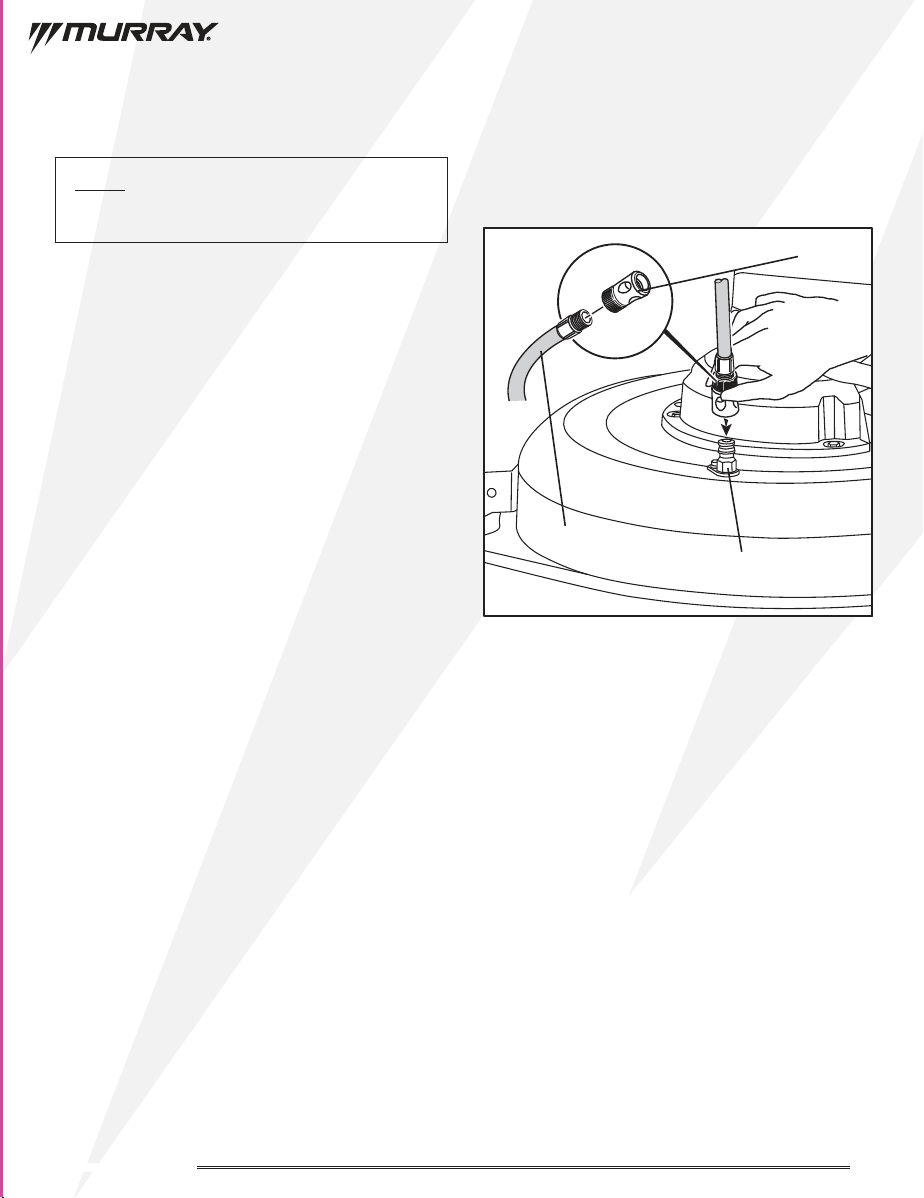
3332
Fig. 22
CRUZ ZERO TURN MOWER CRUZ ZERO TURN MOWER
*Whichever comes first.
First 5 Hours
Change the engine oil.
Every 8 Hours or Daily
Check the engine oil level.
Every 25 Hours or Annually*
Clean the air filter.
Every 50 Hours or Annually*
Change the engine oil.
Replace the oil filter.
Annually
Replace the air filter.
See an Authorized Service Dealer Annually
Inspect the muffler.
Replace the spark plugs.
Replace the fuel filter.
Clean the air cooling system.
ENGINE
Cleaning the Mower
CAUTION: Do not use pressure washer or garden
hose to clean your mower other than to clean the
underside of the deck. It may cause damage to electrical
components, spindles, pulleys, bearings, or the engine.
The use of water will result in shortened life and reduce
serviceability.
WARNING:
The engine, muffler, and surrounding
metal surfaces will be very hot and can cause burns to
the skin. Let the mower cool for at least five minutes
before cleaning. Exercise caution to avoid burns.
NOTICE: Debris can accumulate anywhere on the mower,
especially on horizontal surfaces. Additional cleaning
may be necessary when mowing in wet conditions or
when mulching.
NOTICE: Fuel leaks/spills, oil leaks/spills, and excess
llubrication can also become collection sites for debris.
Immediate repair and cleaning up oil or fuel spills can
help reduce fire hazards.
NOTICE: Avoid using solvents when cleaning plastic parts.
Most plastics are susceptible to damage from various
types of commercial solvents and may be damaged
by their use. Use clean cloths to remove dirt, dust, oil,
grease, etc.
Cleaning the Mower Deck
A “Universal Deck Wash Kit” that includes a washout port
and garden hose quick disconnect can be purchased from
The Home Depot. Store SKU# 1003930707 or similar.
1. Put the mower on a smooth, level surface.
2. Attach the quick disconnect (a) to the garden hose (b)
and then connect it to the washout port (c) on the
mower deck. (Fig. 22)
3. Turn ON the water supply.
4. Start the engine.
5. Set the height of cut to the lowest position.
6. Engage the Power Take-Off (PTO) to activate the mower
blades. The rotation of the blades and the water will help
clean the bottom of the mower deck.
7. Disengage the PTO.
8. Stop the engine.
9. Turn OFF the water supply.
10. Remove the garden hose and quick disconnect from the
washout port.
• Clean around the engine, including the engine intake
screen, exhaust manifold, muffler, and muffler shield.
• Clean the top of the mower deck, under the spindle
covers, and belt area.
• Clean around and near the transmissions.
NOTICE: The mower ONLY comes with a washout port
block off plate. A garden hose quick disconnect is NOT
included and must be purchased separately.
a
b
c
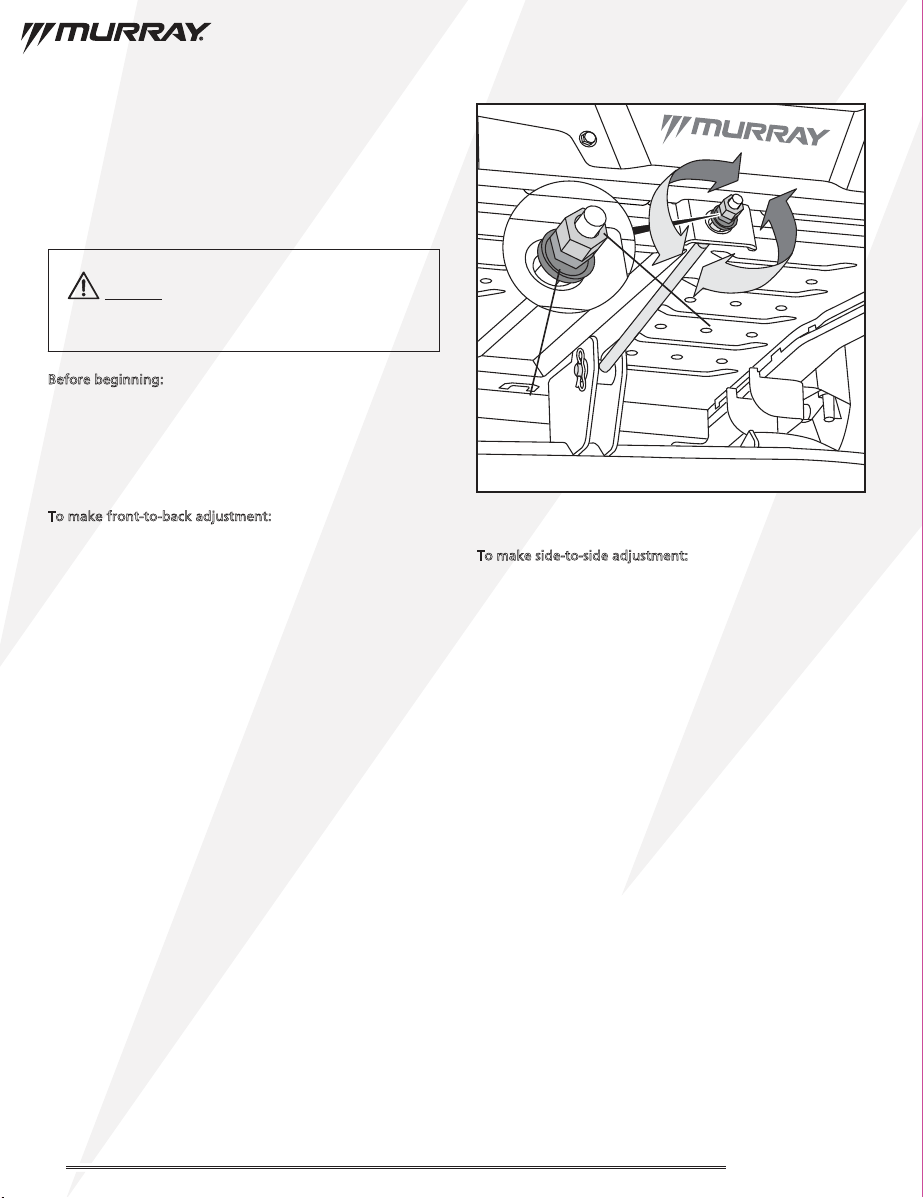
3534
CRUZ ZERO TURN MOWER CRUZ ZERO TURN MOWER
Leveling the Cutting Deck
If your lawn appears unevenly cut after using the mower,
the cutting deck may need adjusting. Before deciding that
leveling the cutting deck is necessary, make sure the tires
are properly inflated to the recommended psi when
mowing.
Before beginning:
1. Make sure the drive control levers are in the PARKING
BRAKE ENGAGED position.
2. Stop the engine and remove the key.
3. Lower the cutting deck to its lowest position.
To make front-to-back adjustment:
1. Position the right blade so that the ends now point
toward the front and back of the mower.
2. Measure the distance from the tip of the blade to the
ground. For optimal cutting results, the front tip of the
blade should be from 1/4 in. to 3/8 in. lower than the rear
tip.
3. If front-to-back adjustment is needed, after loosening the
outer jam nut (a, Fig. 23), turn the inner adjustment nut
(b, Fig. 23) clockwise to raise or counterclockwise to
lower the front of the cutting deck.
4.
Measure again to verify the front tip is now 1/4 in. to 3/8 in.
lower than the rear tip. If not, continue to adjust and
measure until they are.
5. Without moving the inner adjustment nut, re-tighten the
outer jam nut to secure the inner adjustment nut in place.
DANGER: Mower blades are sharp. Wrap the
blade(s) or wear gloves, and use extra caution when
servicing them.
Fig. 23
To make side-to-side adjustment:
1. Position the blades so that the ends point toward the
sides of the mower.
2. Measure the distance from the bottom, outside tip
(cutting tip) of the blade to the ground. Measure the left
blade’s lower edge to the ground and the right blade’s
lower edge to the ground. If the measurements are less
than 1inch off (the lowest position), proceed to the next
step.
3. Turn the upper adjustment nuts (a) upward. Turn the
lower adjustment nuts (b) up to lift or down to lower
two sides of the cutting deck. ( Fig.24A&Fig.24B)
4. Measure again. If the height difference between two
sides of the deck is more than 1/10 inch, adjust the deck
again until both blade tip measurements taken earlier
are equal.
5. Turn the upper adjustment nuts downward to their
original positions.
a
b
Fig. 24A
Fig. 24B
a
b
Fig. 25A
Removing the Cutting Deck
Removing the deck will make it easier to replace belts,
pulleys, and blades.
1. Make sure the drive control levers are in the PARKING
BRAKE ENGAGED position.
2. Stop the engine and remove the key.
3. Lower the cutting deck to its lowest position.
4. Remove 3 hitch pins, 2 on the right (Fig. 25A&Fig. 25B),
1 on the left (Fig. 25C) that secure the deck in place.
5. Slip the deck belt off the electromagnetic clutch.
6. Slide the deck out from under the mower.
7. Reverse the process to reattach the deck to the mower.
DANGER: Mower blades are sharp. Wrap the
blade(s) or wear gloves, and use extra caution when
servicing them.
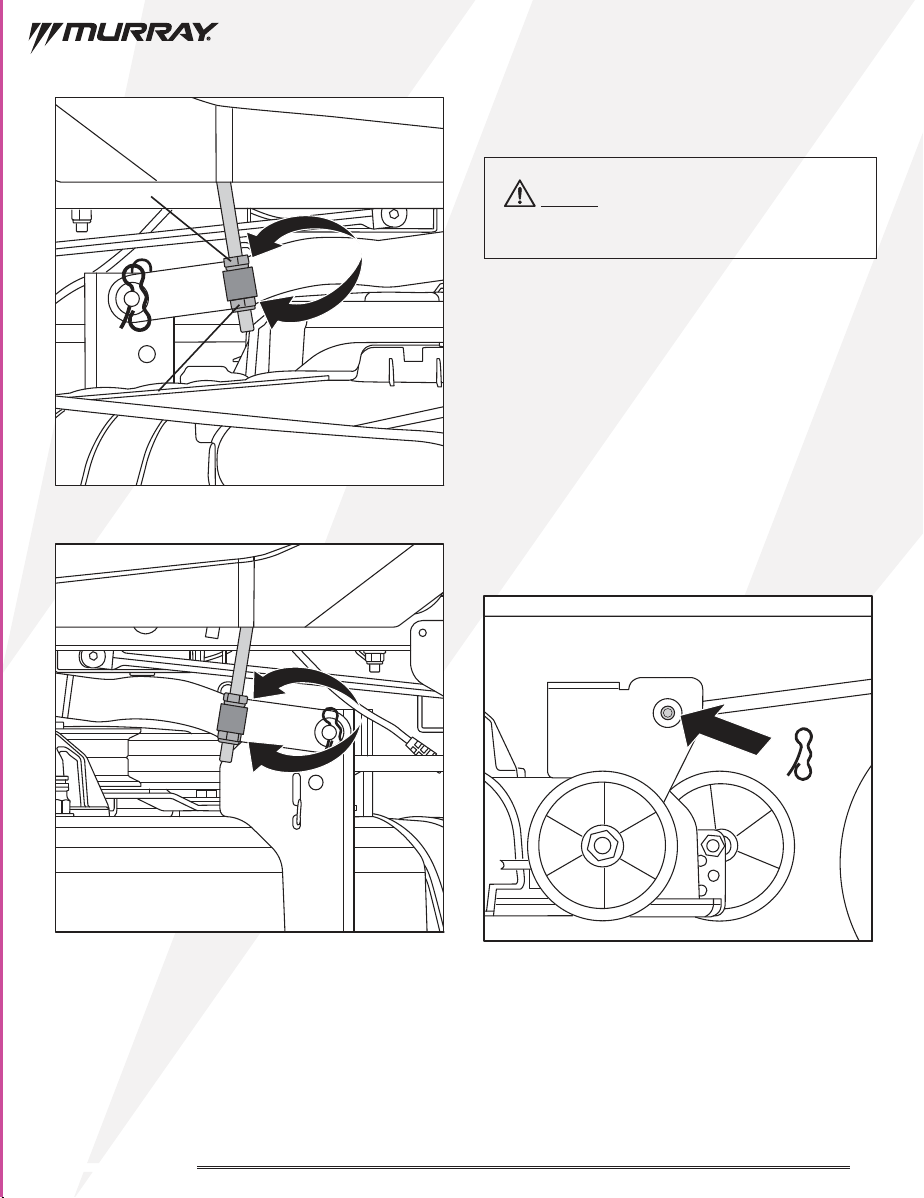
3534
CRUZ ZERO TURN MOWER CRUZ ZERO TURN MOWER
Leveling the Cutting Deck
If your lawn appears unevenly cut after using the mower,
the cutting deck may need adjusting. Before deciding that
leveling the cutting deck is necessary, make sure the tires
are properly inflated to the recommended psi when
mowing.
Before beginning:
1. Make sure the drive control levers are in the PARKING
BRAKE ENGAGED position.
2. Stop the engine and remove the key.
3. Lower the cutting deck to its lowest position.
To make front-to-back adjustment:
1. Position the right blade so that the ends now point
toward the front and back of the mower.
2. Measure the distance from the tip of the blade to the
ground. For optimal cutting results, the front tip of the
blade should be from 1/4 in. to 3/8 in. lower than the rear
tip.
3. If front-to-back adjustment is needed, after loosening the
outer jam nut (a, Fig. 23), turn the inner adjustment nut
(b, Fig. 23) clockwise to raise or counterclockwise to
lower the front of the cutting deck.
4.
Measure again to verify the front tip is now 1/4 in. to 3/8 in.
lower than the rear tip. If not, continue to adjust and
measure until they are.
5. Without moving the inner adjustment nut, re-tighten the
outer jam nut to secure the inner adjustment nut in place.
DANGER: Mower blades are sharp. Wrap the
blade(s) or wear gloves, and use extra caution when
servicing them.
Fig. 23
To make side-to-side adjustment:
1. Position the blades so that the ends point toward the
sides of the mower.
2. Measure the distance from the bottom, outside tip
(cutting tip) of the blade to the ground. Measure the left
blade’s lower edge to the ground and the right blade’s
lower edge to the ground. If the measurements are less
than 1inch off (the lowest position), proceed to the next
step.
3. Turn the upper adjustment nuts (a) upward. Turn the
lower adjustment nuts (b) up to lift or down to lower
two sides of the cutting deck. ( Fig.24A&Fig.24B)
4. Measure again. If the height difference between two
sides of the deck is more than 1/10 inch, adjust the deck
again until both blade tip measurements taken earlier
are equal.
5. Turn the upper adjustment nuts downward to their
original positions.
a
b
Fig. 24A
Fig. 24B
a
b
Fig. 25A
Removing the Cutting Deck
Removing the deck will make it easier to replace belts,
pulleys, and blades.
1. Make sure the drive control levers are in the PARKING
BRAKE ENGAGED position.
2. Stop the engine and remove the key.
3. Lower the cutting deck to its lowest position.
4. Remove 3 hitch pins, 2 on the right (Fig. 25A&Fig. 25B),
1 on the left (Fig. 25C) that secure the deck in place.
5. Slip the deck belt off the electromagnetic clutch.
6. Slide the deck out from under the mower.
7. Reverse the process to reattach the deck to the mower.
DANGER: Mower blades are sharp. Wrap the
blade(s) or wear gloves, and use extra caution when
servicing them.
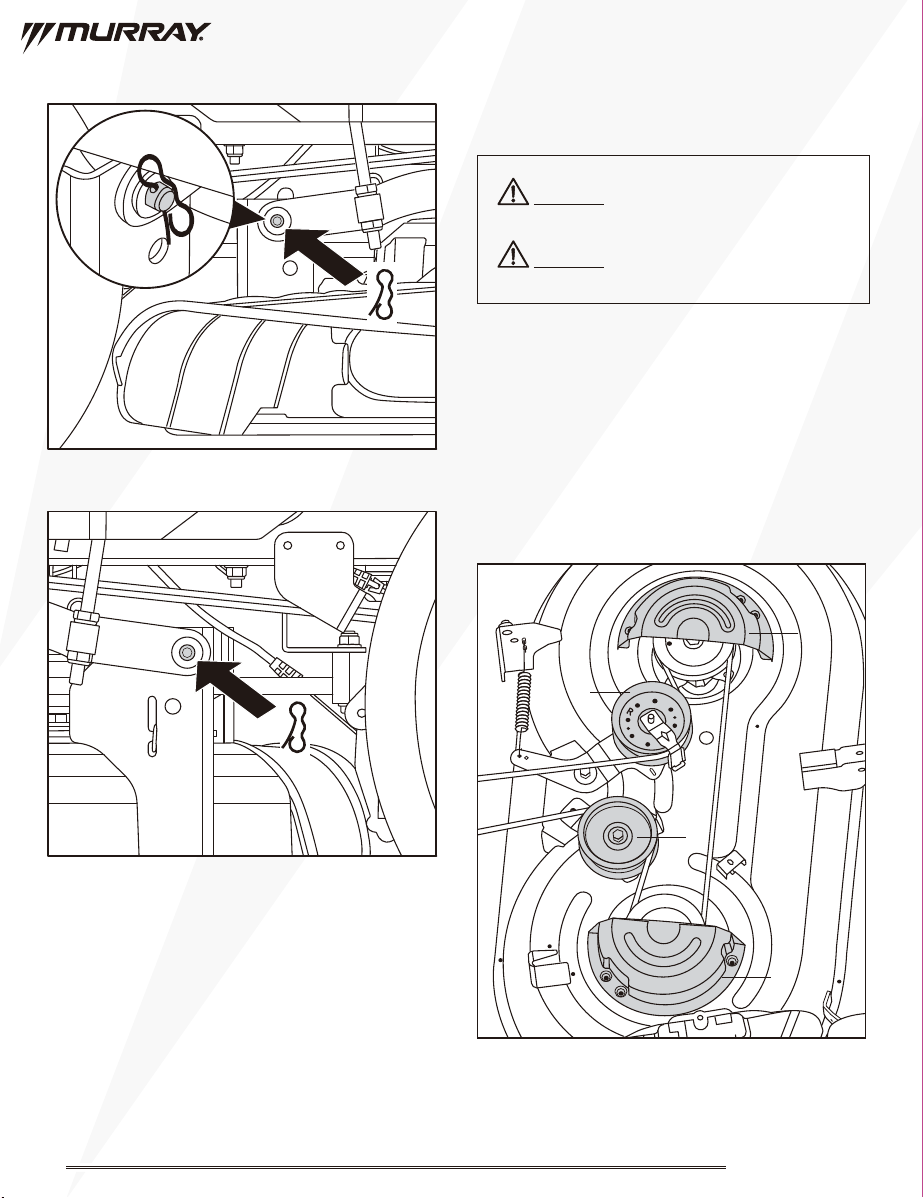
CRUZ ZERO TURN MOWER CRUZ ZERO TURN MOWER
3736
Fig. 25C
Fig. 25B
Changing the Deck Belt
1. Remove the deck. Refer to the “Removing the Cutting
Deck” section.
2. Remove the two belt protective covers (a, Fig. 26) by
removing the six screws that fasten them to the deck.
3. Remove the fixed pulley (b, Fig.26) and tension pulley
(c, Fig.26).
4. Carefully remove the deck belt from around the pulleys.
5. Reverse the process to reattach a new deck belt to the
deck.
Fig. 26
WARNING:
Belts on your mower are subject to wear
and should be replaced if any signs of wear are present.
WARNING:
Stop the engine, engage the parking
brake, and remove the key.
a
a
c
b
Changing the Drive Belt
1. Remove the deck. Refer to the “Removing the Cutting
Deck” section.
2. Remove the tension spring (a, Fig. 27A).
3. Remove the tension wheel (b, Fig. 27A).
4. Unplug the electromagnetic clutch harness from its
connector (c, Fig. 27B).
5. Remove the mounting bracket from the electromagnetic
clutch (d, Fig. 27A).
6. Remove the drive belt.
7. Reverse the process to reattach a new drive belt to the
mower.
Fig. 27A
Fig. 27B
WARNING:
To change the drive belt, it is recommended
to raise the mower by either placing it on a lift or by using
a jack and jack stands.Make sure the mower is properly
secured and the parking brake is set before proceeding.
Failure to properly secure the mower could cause it to fall,
resulting in death or serious injury.
WARNING:
Stop the engine, engage the parking
brake, and remove the key.
d
b
a
c
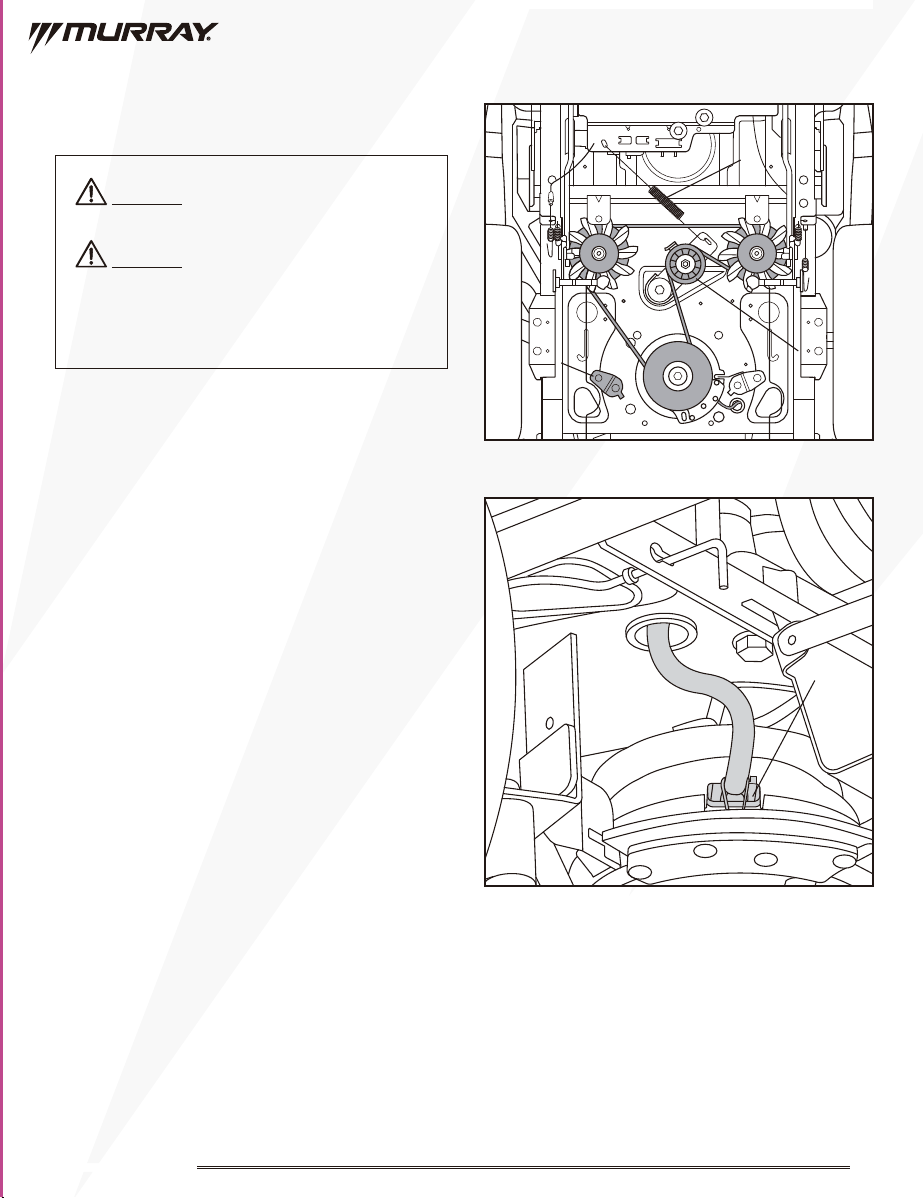
CRUZ ZERO TURN MOWER CRUZ ZERO TURN MOWER
3736
Fig. 25C
Fig. 25B
Changing the Deck Belt
1. Remove the deck. Refer to the “Removing the Cutting
Deck” section.
2. Remove the two belt protective covers (a, Fig. 26) by
removing the six screws that fasten them to the deck.
3. Remove the fixed pulley (b, Fig.26) and tension pulley
(c, Fig.26).
4. Carefully remove the deck belt from around the pulleys.
5. Reverse the process to reattach a new deck belt to the
deck.
Fig. 26
WARNING:
Belts on your mower are subject to wear
and should be replaced if any signs of wear are present.
WARNING:
Stop the engine, engage the parking
brake, and remove the key.
a
a
c
b
Changing the Drive Belt
1. Remove the deck. Refer to the “Removing the Cutting
Deck” section.
2. Remove the tension spring (a, Fig. 27A).
3. Remove the tension wheel (b, Fig. 27A).
4. Unplug the electromagnetic clutch harness from its
connector (c, Fig. 27B).
5. Remove the mounting bracket from the electromagnetic
clutch (d, Fig. 27A).
6. Remove the drive belt.
7. Reverse the process to reattach a new drive belt to the
mower.
Fig. 27A
Fig. 27B
WARNING:
To change the drive belt, it is recommended
to raise the mower by either placing it on a lift or by using
a jack and jack stands.Make sure the mower is properly
secured and the parking brake is set before proceeding.
Failure to properly secure the mower could cause it to fall,
resulting in death or serious injury.
WARNING:
Stop the engine, engage the parking
brake, and remove the key.
d
b
a
c
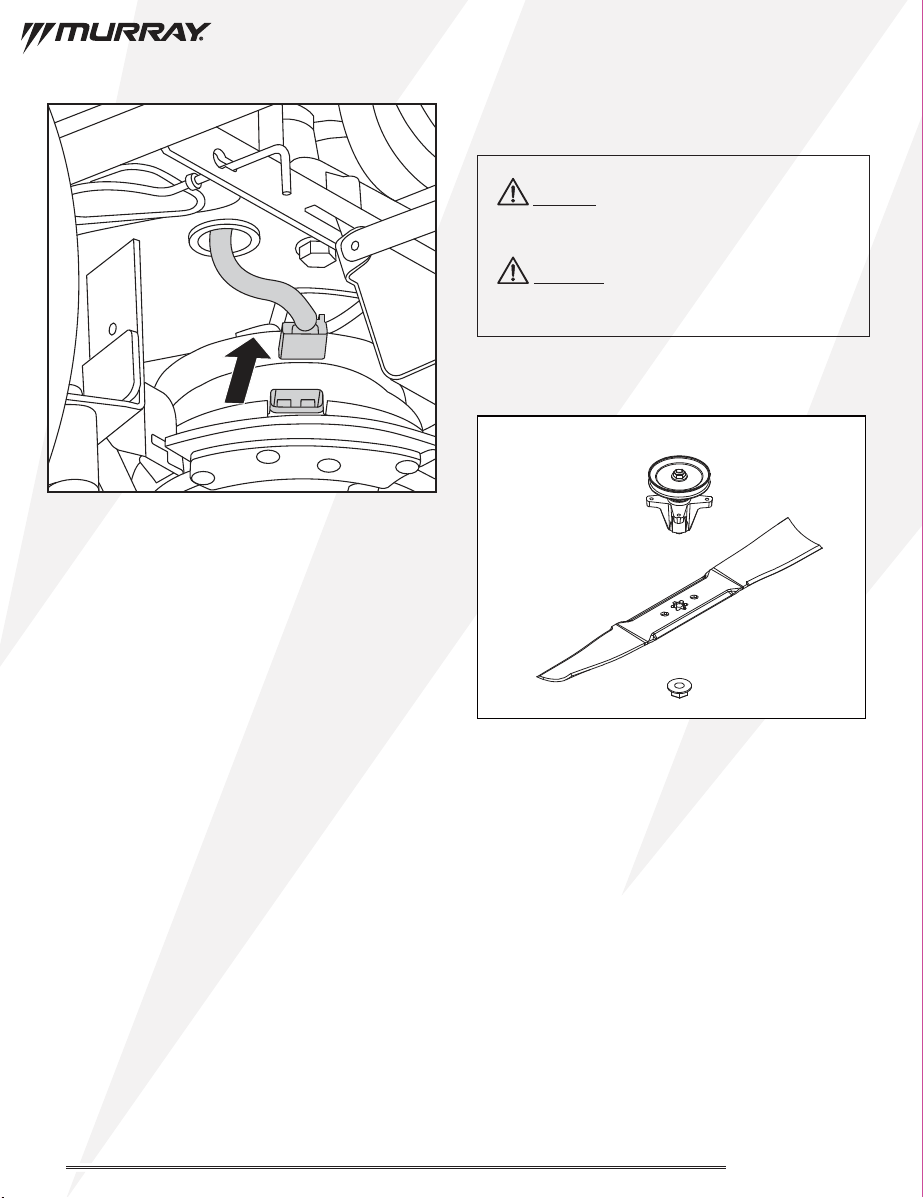
38 39
Fig. 27C
CRUZ ZERO TURN MOWER CRUZ ZERO TURN MOWER
CAUTION: Only use replacement blades authorized
by the manufacturer of your mower. Use of blades not
authorized is hazardous and may damage your mower.
Replacing the Cutting Blades
For best results, please use the correct replacement kit for
this mower, PN 2105200368.
Fig. 28
1. Shut off the engine, remove the key, and engage the
parking brake.
2. Remove the deck. Refer to the “Removing the Cutting
Deck” section.
3. Use a blade removal tool (not provided) to prevent the
blade from turning.
4. Loosen the blade nut by turning it counterclockwise (as
viewed from bottom of the mower) using a 24 mm
wrench or socket (not provided).
WARNING:
Mower blades are sharp. Wrap the
blade(s) or wear gloves, and use extra caution when
servicing them.
5. Remove the blade nut and blade. (Fig.28)
6. When replacing or re-installing the blade, be sure to
install the blade on the side with its stamped part
number facing the ground (the same direction as
working blades).
7. Thread the blade nut on the shaft and finger tighten.
8. Torque the blade nut down clockwise using a torque
wrench (not provided) to ensure the bolt is properly
tightened. The recommended torque for the blade nut
is 70-85 ft. lbs.
9. Repeat the above steps with the second blade.
WARNING: Ensure blade is properly seated and the
blade nut is tightened to the torque specifications above.
Failure to properly attach the blade could cause it to
come loose and result in death or serious injury.
WARNING: A poorly balanced blade will cause
excessive vibration, may damage the mower, and result
in death or serious injury.
Sharpening the Blade
1. To properly sharpen the cutting blades, remove equal
amounts of metal from both ends of the blades along the
cutting edges. Always grind each cutting blade edge
equally to maintain proper blade balance.
2. Test the blade’s balance using a blade balancer (not
provided). Grind metal from the heavy side until it
balances evenly.
38 39
Fig. 27C
CRUZ ZERO TURN MOWER CRUZ ZERO TURN MOWER
CAUTION: Only use replacement blades authorized
by the manufacturer of your mower. Use of blades not
authorized is hazardous and may damage your mower.
Replacing the Cutting Blades
For best results, please use the correct replacement kit for
this mower, PN 2105200368.
Fig. 28
1. Shut off the engine, remove the key, and engage the
parking brake.
2. Remove the deck. Refer to the “Removing the Cutting
Deck” section.
3. Use a blade removal tool (not provided) to prevent the
blade from turning.
4. Loosen the blade nut by turning it counterclockwise (as
viewed from bottom of the mower) using a 24 mm
wrench or socket (not provided).
WARNING:
Mower blades are sharp. Wrap the
blade(s) or wear gloves, and use extra caution when
servicing them.
5. Remove the blade nut and blade. (Fig.28)
6. When replacing or re-installing the blade, be sure to
install the blade on the side with its stamped part
number facing the ground (the same direction as
working blades).
7. Thread the blade nut on the shaft and finger tighten.
8. Torque the blade nut down clockwise using a torque
wrench (not provided) to ensure the bolt is properly
tightened. The recommended torque for the blade nut
is 70-85 ft. lbs.
9. Repeat the above steps with the second blade.
WARNING: Ensure blade is properly seated and the
blade nut is tightened to the torque specifications above.
Failure to properly attach the blade could cause it to
come loose and result in death or serious injury.
WARNING: A poorly balanced blade will cause
excessive vibration, may damage the mower, and result
in death or serious injury.
Sharpening the Blade
1. To properly sharpen the cutting blades, remove equal
amounts of metal from both ends of the blades along the
cutting edges. Always grind each cutting blade edge
equally to maintain proper blade balance.
2. Test the blade’s balance using a blade balancer (not
provided). Grind metal from the heavy side until it
balances evenly.
40 41
CRUZ ZERO TURN MOWER CRUZ ZERO TURN MOWER
Checking the Tire Pressure
For the correct traction and the best mowing performance,
make sure that the front tires are inflated to 20 psi and the
rear tires inflated to 14 psi. See “Tire Pressure” in the
Specifications section.
Battery Maintenance
• Spray the terminals and exposed wire with a battery
terminal sealer, or coat the terminals with a thin coat of
grease or petroleum jelly, to protect against corrosion.
• Always keep the battery cables and terminals clean and
free of corrosion.
• When storing the mower for extended periods, disconnect
the negative battery cable. It is not necessary to remove
the battery.
• All batteries discharge during storage. Keep the exterior
of the battery clean, especially the top. A dirty battery
will discharge more rapidly.
• The battery must be stored with a full charge. A
discharged battery can freeze sooner than a charged
battery. A fully charged battery will store longer in cold
temperatures than hot.
• Recharge the battery before returning to service.
Although the mower may start, the engine charging
system may not fully recharge the battery.
WARNING: Always shield eyes and protect skin
and clothing when working near batteries.
NOTICE:
There can be a difference in tire inflation
pressure from the "Maximum Inflation" shown on the side
of the tires.
Fig.29
Replacing the Battery; Cleaning the Battery
and Battery Cables
1. STOP the engine. Remove the key.
2. Remove the “J” end (a) of the battery securing rod out a
small hole. (Fig.29)
3. Remove another end of the battery securing rod into the
concave groove. (Fig.29)
4. Disconnect the NEGATIVE (-) cables from the battery first.
5. Disconnect the POSITIVE (+) cables from the battery last.
6. Clean the battery surface with baking soda and water.
7. Use a wire brush and terminal cleaner to clean the
battery terminals and cable ends.
8. Lubricate the battery terminals with petroleum jelly or
non-conducting grease.
9. Install the battery.
10. Connect the POSITIVE (+) cables to the battery first.
11. Connect the NEGATIVE (-) cables to the battery last.
12. Install the battery securing rod.
Charging the Battery
A dead battery or one too weak to start the engine can be
the result of a defect in the charging system or other
electrical components. If there are doubts about the cause
of the problem, see an Authorized Service center.
WARNING: When you remove or install battery
cables, always disconnect the NEGATIVE (black) cable
FIRST and reconnect it LAST. If not done in this order,
the positive terminal can be shorted to the frame by
a tool.
NOTICE: DO NOT remove or connect the battery cable
while the engine is ON.
WARNING: Keep open flames and sparks away
from the battery. Gases from the battery are very
explosive.
a
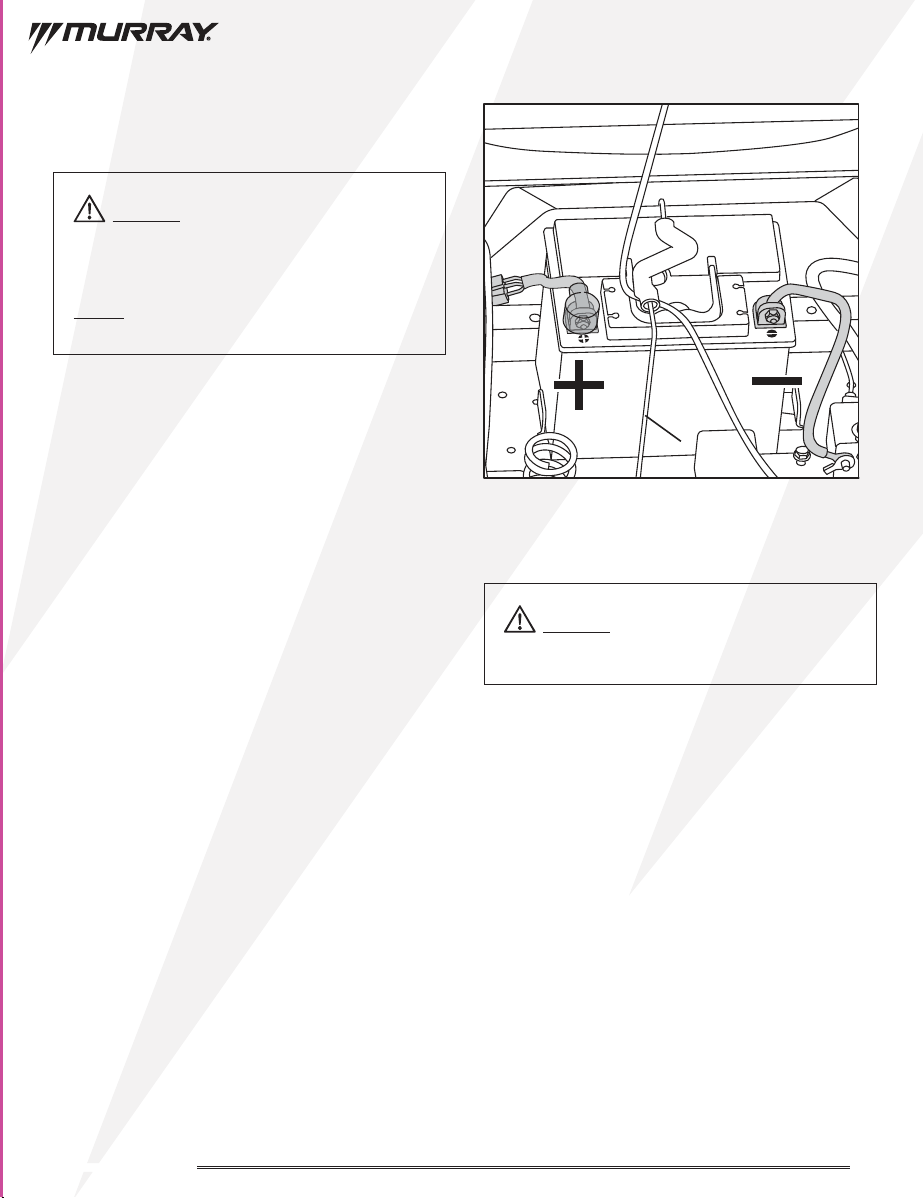
40 41
CRUZ ZERO TURN MOWER CRUZ ZERO TURN MOWER
Checking the Tire Pressure
For the correct traction and the best mowing performance,
make sure that the front tires are inflated to 20 psi and the
rear tires inflated to 14 psi. See “Tire Pressure” in the
Specifications section.
Battery Maintenance
• Spray the terminals and exposed wire with a battery
terminal sealer, or coat the terminals with a thin coat of
grease or petroleum jelly, to protect against corrosion.
• Always keep the battery cables and terminals clean and
free of corrosion.
• When storing the mower for extended periods, disconnect
the negative battery cable. It is not necessary to remove
the battery.
• All batteries discharge during storage. Keep the exterior
of the battery clean, especially the top. A dirty battery
will discharge more rapidly.
• The battery must be stored with a full charge. A
discharged battery can freeze sooner than a charged
battery. A fully charged battery will store longer in cold
temperatures than hot.
• Recharge the battery before returning to service.
Although the mower may start, the engine charging
system may not fully recharge the battery.
WARNING: Always shield eyes and protect skin
and clothing when working near batteries.
NOTICE:
There can be a difference in tire inflation
pressure from the "Maximum Inflation" shown on the side
of the tires.
Fig.29
Replacing the Battery; Cleaning the Battery
and Battery Cables
1. STOP the engine. Remove the key.
2. Remove the “J” end (a) of the battery securing rod out a
small hole. (Fig.29)
3. Remove another end of the battery securing rod into the
concave groove. (Fig.29)
4. Disconnect the NEGATIVE (-) cables from the battery first.
5. Disconnect the POSITIVE (+) cables from the battery last.
6. Clean the battery surface with baking soda and water.
7. Use a wire brush and terminal cleaner to clean the
battery terminals and cable ends.
8. Lubricate the battery terminals with petroleum jelly or
non-conducting grease.
9. Install the battery.
10. Connect the POSITIVE (+) cables to the battery first.
11. Connect the NEGATIVE (-) cables to the battery last.
12. Install the battery securing rod.
Charging the Battery
A dead battery or one too weak to start the engine can be
the result of a defect in the charging system or other
electrical components. If there are doubts about the cause
of the problem, see an Authorized Service center.
WARNING: When you remove or install battery
cables, always disconnect the NEGATIVE (black) cable
FIRST and reconnect it LAST. If not done in this order,
the positive terminal can be shorted to the frame by
a tool.
NOTICE: DO NOT remove or connect the battery cable
while the engine is ON.
WARNING: Keep open flames and sparks away
from the battery. Gases from the battery are very
explosive.
a
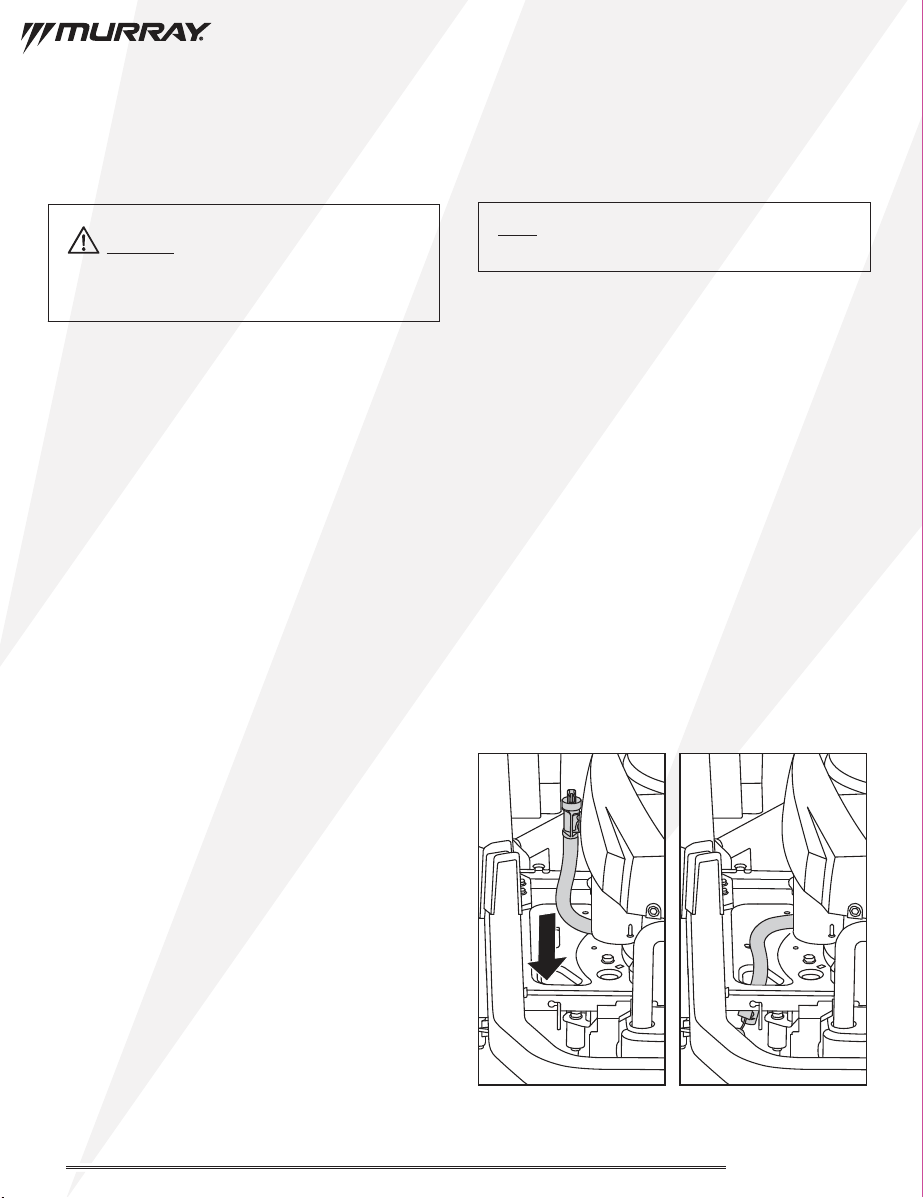
42 43
CRUZ ZERO TURN MOWER CRUZ ZERO TURN MOWER
Checking the Mower Blade
Stop Time
WARNING: If the mower blade does not STOP in
5 seconds or less, the clutch must be adjusted. DO NOT
operate the machine until the adjustment has been
corrected by an authorized service center.
Fig.31
WARNING: DO NOT start or operate the engine
without an air filter as it is a fire hazard.
NOTICE: DO NOT use pressurized air or solvents to clean
the air filter. Pressurized air can damage the filter and
solvents will dissolve it.
Changing the Air Filter
1. Loosen the fasteners and remove the cover.
2. Remove the air filter.
3. Clear unwanted material or debris that can get into the
carburetor throat.
4. Lightly tap the air filter on a hard surface to loosen
debris. If the air filter is dirty, replace it.
5. Install the air filter.
6. Install the cover and tighten the fasteners.
Checking the Engine Oil
Level
1. Remove the dipstick. Wipe the dipstick clean of
remaining oil.
2. Install and tighten the dipstick.
3. Remove the dipstick again and check the oil level.
4. Make sure that the oil level is at the middle of the FULL
mark on the dipstick.
5. If the oil level is FULL, install and tighten the dipstick,
6. If the oil level is LOW, add oil into the oil fill tube.
7. Wait one minute and check the oil level again. Continue
to add oil and check the level until it is FULL.
8. Install and tighten the dipstick.
NOTE: The oil filter should be changed at every oil
change interval.
Fig.30A Fig.30B
Changing the Engine Oil
and Oil Filter
1. Put the unit on a level surface.
2. Stop the engine and remove the key.
3. Locate the oil drain sleeve and pull it downward to
remove it. (Fig.30A)
4. Place the oil drain sleeve under the drain plug.
5. Place a collection container below the oil drain sleeve.
6. Rotate counterclockwise and pull the drain plug
outward. (Fig.30B)
7. After the oil has drained, re-install the oil drain plug
tightly.
8. Remove the oil filter and discard correctly.
9. Before you install the new oil filter, lightly lubricate the
oil filter gasket with clean oil.
10.Install the oil filter by hand until the gasket touches the
oil filter adapter, then tighten the oil filter ½ to ¾ turns.
11.Refill the engine with new oil.
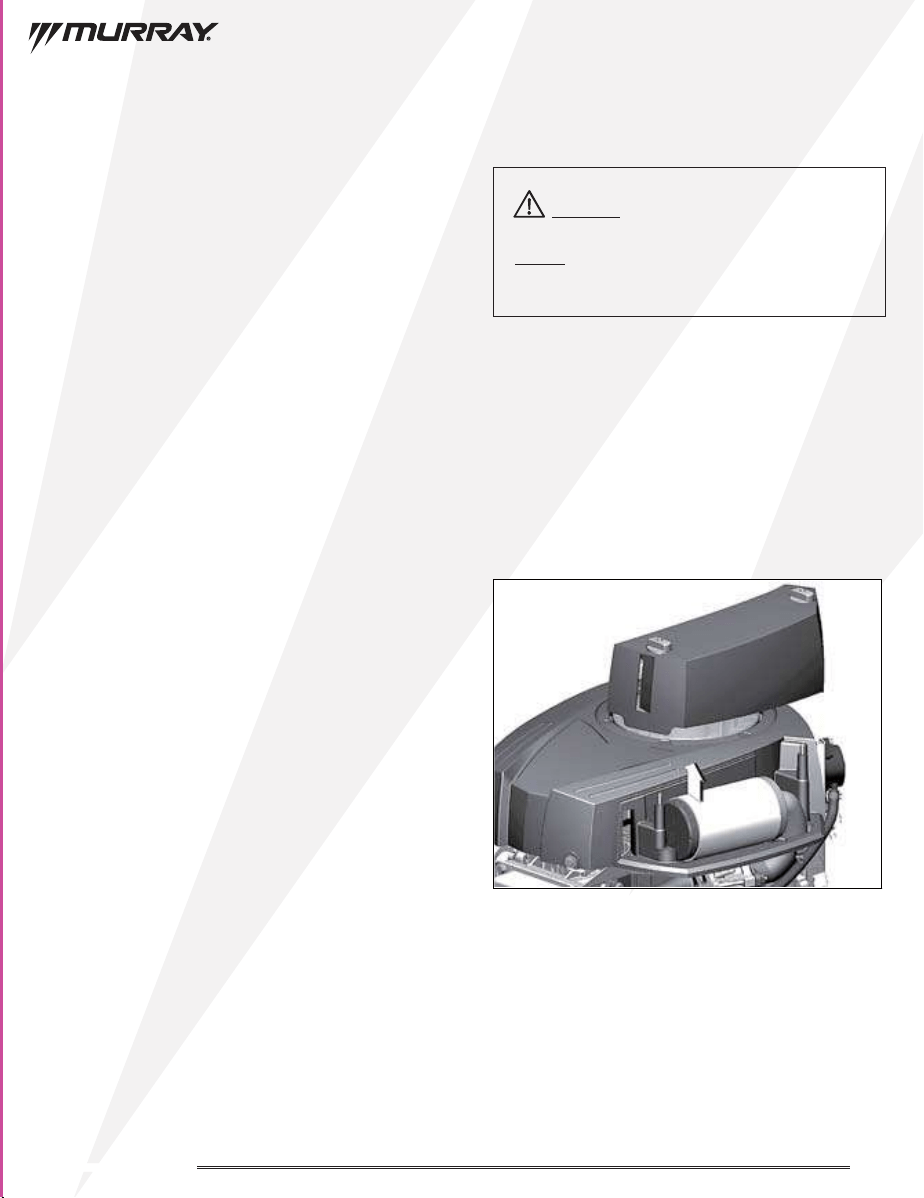
42 43
CRUZ ZERO TURN MOWER CRUZ ZERO TURN MOWER
Checking the Mower Blade
Stop Time
WARNING: If the mower blade does not STOP in
5 seconds or less, the clutch must be adjusted. DO NOT
operate the machine until the adjustment has been
corrected by an authorized service center.
Fig.31
WARNING: DO NOT start or operate the engine
without an air filter as it is a fire hazard.
NOTICE: DO NOT use pressurized air or solvents to clean
the air filter. Pressurized air can damage the filter and
solvents will dissolve it.
Changing the Air Filter
1. Loosen the fasteners and remove the cover.
2. Remove the air filter.
3. Clear unwanted material or debris that can get into the
carburetor throat.
4. Lightly tap the air filter on a hard surface to loosen
debris. If the air filter is dirty, replace it.
5. Install the air filter.
6. Install the cover and tighten the fasteners.
Checking the Engine Oil
Level
1. Remove the dipstick. Wipe the dipstick clean of
remaining oil.
2. Install and tighten the dipstick.
3. Remove the dipstick again and check the oil level.
4. Make sure that the oil level is at the middle of the FULL
mark on the dipstick.
5. If the oil level is FULL, install and tighten the dipstick,
6. If the oil level is LOW, add oil into the oil fill tube.
7. Wait one minute and check the oil level again. Continue
to add oil and check the level until it is FULL.
8. Install and tighten the dipstick.
NOTE: The oil filter should be changed at every oil
change interval.
Fig.30A Fig.30B
Changing the Engine Oil
and Oil Filter
1. Put the unit on a level surface.
2. Stop the engine and remove the key.
3. Locate the oil drain sleeve and pull it downward to
remove it. (Fig.30A)
4. Place the oil drain sleeve under the drain plug.
5. Place a collection container below the oil drain sleeve.
6. Rotate counterclockwise and pull the drain plug
outward. (Fig.30B)
7. After the oil has drained, re-install the oil drain plug
tightly.
8. Remove the oil filter and discard correctly.
9. Before you install the new oil filter, lightly lubricate the
oil filter gasket with clean oil.
10.Install the oil filter by hand until the gasket touches the
oil filter adapter, then tighten the oil filter ½ to ¾ turns.
11.Refill the engine with new oil.
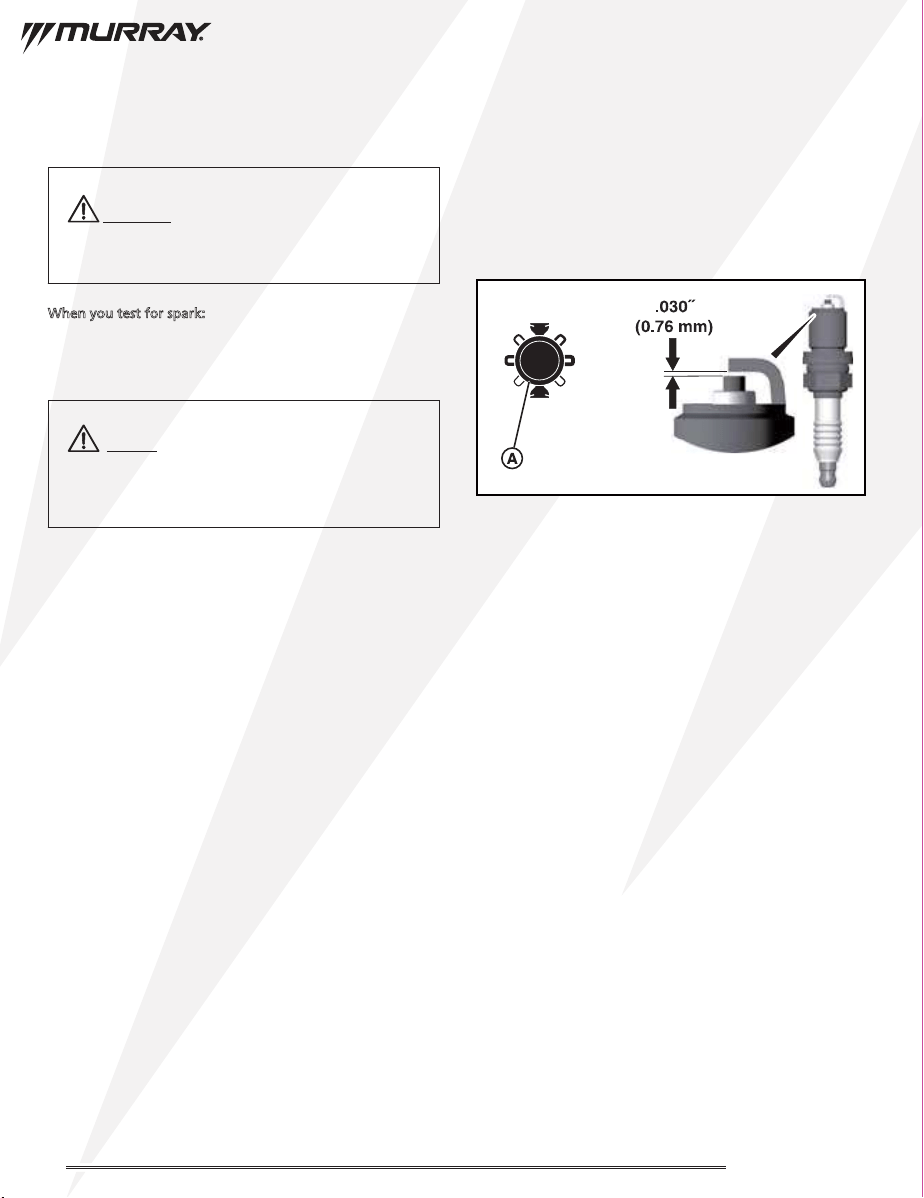
44 45
Pushing the Mower By
Hand
Pushing the mower may be necessary for moving the mower
into and out of a garage or shed. It may also be necessary
for loading into and out of a trailer.
1. Shut off the power and stop the engine
2. Disengage the PTO Switch.
3. To engage the bypass-valve lever, pull the lever back and
into the elongated section of irregular slot. Repeat on
opposite side.
4. Ensure the drive control levers are in the neutral position.
5. After moving the mower, reverse Step 1 to disengage the
bypass-valve levers.
Towing with the Mower
• Attach equipment ONLY at the hitch point.
• The total towed weight (trailer and load) must not exceed
400 lbs. and not exceed a tongue weight (up or down) of
20 lbs.
• When towing, do not operate on slopes greater than 5
degrees. The weight of the towed equipment on slopes
can cause loss of traction and loss of control.
• DO NOT let children or others in or on towed equipment.
• DO NOT place the drive control levers in the neutral
position and coast down hill.
CRUZ ZERO TURN MOWER CRUZ ZERO TURN MOWER
WARNING: Unintentional sparking can result in fire
or electric shock. Unintentional start up can result in
entanglement, traumatic amputation, or laceration.
NOTICE:
Spark plugs have different heat ranges.
It is important that the correct spark plug is used,
otherwise engine damage can occur. Replace the spark
plug with the same type or an equivalent one.
Checking the Spark Plug
When you test for spark:
• Use an approved spark plug tester.
• DO NOT check for spark with the spark plug removed.
Checking the Spark Plug Gap
Use a spark plug feeler gauge (A) to check the gap between
the two electrodes. When the gap is correct, the gauge will
drag slightly as you pull it through the gap.
To adjust the spark plug gap, use a spark plug gauge and
gently bend the curved electrode. Make sure that you do
not touch the center electrode or the porcelain.
Installing the Spark Plug
Tighten the spark plug with your fingers, and them, tighten
it with a wrench,
• 180 in-lbs, OR
• ½ turn when you install the original spark plug, OR
• ¼ turn when you install a new spark plug
Fig.32

44 45
Pushing the Mower By
Hand
Pushing the mower may be necessary for moving the mower
into and out of a garage or shed. It may also be necessary
for loading into and out of a trailer.
1. Shut off the power and stop the engine
2. Disengage the PTO Switch.
3. To engage the bypass-valve lever, pull the lever back and
into the elongated section of irregular slot. Repeat on
opposite side.
4. Ensure the drive control levers are in the neutral position.
5. After moving the mower, reverse Step 1 to disengage the
bypass-valve levers.
Towing with the Mower
• Attach equipment ONLY at the hitch point.
• The total towed weight (trailer and load) must not exceed
400 lbs. and not exceed a tongue weight (up or down) of
20 lbs.
• When towing, do not operate on slopes greater than 5
degrees. The weight of the towed equipment on slopes
can cause loss of traction and loss of control.
• DO NOT let children or others in or on towed equipment.
• DO NOT place the drive control levers in the neutral
position and coast down hill.
CRUZ ZERO TURN MOWER CRUZ ZERO TURN MOWER
WARNING: Unintentional sparking can result in fire
or electric shock. Unintentional start up can result in
entanglement, traumatic amputation, or laceration.
NOTICE:
Spark plugs have different heat ranges.
It is important that the correct spark plug is used,
otherwise engine damage can occur. Replace the spark
plug with the same type or an equivalent one.
Checking the Spark Plug
When you test for spark:
• Use an approved spark plug tester.
• DO NOT check for spark with the spark plug removed.
Checking the Spark Plug Gap
Use a spark plug feeler gauge (A) to check the gap between
the two electrodes. When the gap is correct, the gauge will
drag slightly as you pull it through the gap.
To adjust the spark plug gap, use a spark plug gauge and
gently bend the curved electrode. Make sure that you do
not touch the center electrode or the porcelain.
Installing the Spark Plug
Tighten the spark plug with your fingers, and them, tighten
it with a wrench,
• 180 in-lbs, OR
• ½ turn when you install the original spark plug, OR
• ¼ turn when you install a new spark plug
Fig.32

46 47
9.
CRUZ ZERO TURN MOWER CRUZ ZERO TURN MOWER
7. Transport
Empty the fuel tank with a suction pump before transport-
ing the machine. Start the engine and let it run until it has
used up all remaining gasoline.
• Close the fuel cap firmly.
• Let the engine cool down before transporting.
• Use full width ramps for loading and unloading the
machine for transport.
• Use extra care when loading or unloading the machine
into a trailer or truck. This machine should not be driven
up or down ramp(s), because the machine could tip over,
causing serious personal injury. The machine must be
pushed manually on ramp(s) to load or unload properly.
8. Storage
Store it away from furnaces, stoves, water heaters, or other
appliances that have pilot lights or other ignition sources
because they can ignite fuel vapors.
Mower
Disengage the Power Take-Off (PTO), set the parking brake,
remove the key, and let the machine cool.
If you remove the battery, the battery life will increase.
Make sure that the battery is in a cool, dry location, and
keep it fully charged. If the battery is left in the unit,
disconnect the negative cable.
Fuel System
Fuel can become stale when kept in a storage container for
more than 30 days. Each time you fill the container with
fuel, add STA-BIL 360 Protection to the fuel as specified by
the manufacturer’s instructions. This keeps fuel fresh and
decreases fuel-related problems or contamination in the fuel
system.
It is not necessary to drain fuel from the engine when
STA-BIL 360 Protection is added as instructed. Before
storage, turn the engine ON for 2 minutes to move the fuel
and stabilizer through the fuel system.
Before starting the machine after it has been stored:
• Check all fluid levels. Check all maintenance items.
• Do all recommended checks and procedures found in this
manual.
• Fully charge the battery.
• Drive the mower without a load to make certain all the
mower systems are functioning properly.
WARNING: Never store the unit with
fuel in an enclosed, non-ventilated structure. Fuel vapors
can travel to an ignition source (such as a furnace, water
heater, etc.) and cause an explosion.

46 47
9.
CRUZ ZERO TURN MOWER CRUZ ZERO TURN MOWER
7. Transport
Empty the fuel tank with a suction pump before transport-
ing the machine. Start the engine and let it run until it has
used up all remaining gasoline.
• Close the fuel cap firmly.
• Let the engine cool down before transporting.
• Use full width ramps for loading and unloading the
machine for transport.
• Use extra care when loading or unloading the machine
into a trailer or truck. This machine should not be driven
up or down ramp(s), because the machine could tip over,
causing serious personal injury. The machine must be
pushed manually on ramp(s) to load or unload properly.
8. Storage
Store it away from furnaces, stoves, water heaters, or other
appliances that have pilot lights or other ignition sources
because they can ignite fuel vapors.
Mower
Disengage the Power Take-Off (PTO), set the parking brake,
remove the key, and let the machine cool.
If you remove the battery, the battery life will increase.
Make sure that the battery is in a cool, dry location, and
keep it fully charged. If the battery is left in the unit,
disconnect the negative cable.
Fuel System
Fuel can become stale when kept in a storage container for
more than 30 days. Each time you fill the container with
fuel, add STA-BIL 360 Protection to the fuel as specified by
the manufacturer’s instructions. This keeps fuel fresh and
decreases fuel-related problems or contamination in the fuel
system.
It is not necessary to drain fuel from the engine when
STA-BIL 360 Protection is added as instructed. Before
storage, turn the engine ON for 2 minutes to move the fuel
and stabilizer through the fuel system.
Before starting the machine after it has been stored:
• Check all fluid levels. Check all maintenance items.
• Do all recommended checks and procedures found in this
manual.
• Fully charge the battery.
• Drive the mower without a load to make certain all the
mower systems are functioning properly.
WARNING: Never store the unit with
fuel in an enclosed, non-ventilated structure. Fuel vapors
can travel to an ignition source (such as a furnace, water
heater, etc.) and cause an explosion.
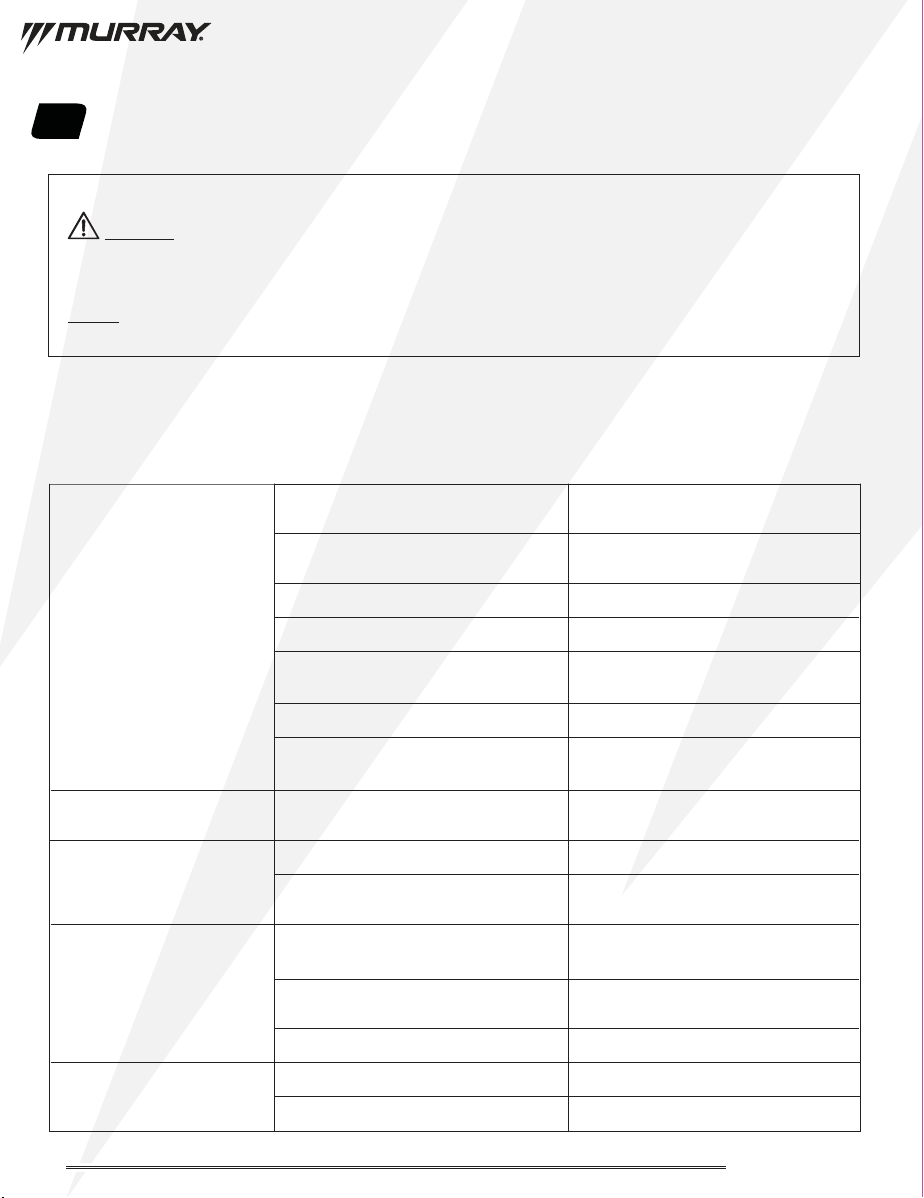
48 49
CRUZ ZERO TURN MOWER CRUZ ZERO TURN MOWER
WARNING: Before performing any type of maintenance, disengage all controls and stop the engine. Wait until all
moving parts have come to a complete stop. Disconnect spark plug wire and ground it against the engine to prevent
unintended starting. Always wear safety glasses during operation or while performing any adjustments or repairs.
NOTICE:
If you can’t solve the problems of the machine, take the mower to an authorized service center for assistance.
9. Troubleshooting
The engine will not start.
The engine starts hard or runs
poorly.
The engine knocks.
Excessive oil consumption.
The engine exhaust is black. The air filter is dirty.
The choke is closed. Open the choke.
Refer to the “Changing the Air Filter” section.
The fuel mixture is too much.
Low oil level.
The engine is too hot.
Incorrect grade of oil.
Too much oil in crankcase. Drain excess oil.
Refer to the “Changing Engine Oil”
section.
Check the engine fins, blower screen,
and air filter.
Incorrect grade of oil. Refer to the “Changing Engine Oil”
section.
Check and add oil as required.
Clean the air filter.
The parking brake is not engaged. Move the two drive control levers outward
into the park position.
The fuel tank is empty.
The PTO switch is in the ON position.
The engine is flooded.
The battery terminals are dirty.
The battery is discharged or dead.
Loose or broken wiring.
Charge or replace the battery.
Visually check wiring. If wires are frayed or
broken, see an Authorized Service Center.
Refer to “Replacing the Battery; Cleaning
the Battery and Battery Cables” section.
Disengage the choke.
Move the PTO switch to the OFF position.
If engine is hot, let it cool, and then fill the
fuel tank again.
PROBLEM LOOK FOR REMEDY
Troubleshooting the Mower
The engine runs, but the mower
will not drive.
The transmission is in neutral.
The bypass valve is in the open position.
When the control lever is in neutral state,
the hydraulic bridge parking gear plate
engages.
Check if the hydraulic bridge tension
spring has fallen off. If it has, please go to
an authorized center for repair.
The mower steers hard or
handles poorly.
The tires are not inflated correctly.
Close bypass valve.
The drive belt fell off. Please go to an authorized center for
maintenance.
Move the drive control levers into the
forward gear.
Refer to the “Check Tire Pressure” section.
The mower cut is uneven. The tires are not correctly inflated.
The engine speed is too slow.The mower cut looks rough.
The ground speed is too fast.
The engine starts, and the
machine drives, but the mower
will not cut.
The engine is not at the operating
temperature.
The Power-Take Off (PTO) is disengaged. Engage the PTO.
Electromagnetic clutch wiring detachment. Checking the wiring port. If it fell or is
damaged, please go to an authorized
center for maintenance.
START the engine and let it warm up for
several minutes.
The engine stalls easily with the
mower blades engaged.
The engine speed is too slow.
The ground speed is too fast.
Dirty or clogged air cleaner.
Height-of-Cut is too low.
Refer to “Changing the Air Filter” section.
Cut tall grass at maximum Height-of-Cut
during first pass, or follow the “1/3 Rule
during operation.
Slow down.
Set to throttle lever to FAST.
Refer to the “Check Tire Pressure” section.
Cutting deck uneven. Refer to the “Leveling the Cutting Deck”
section.
Slow down.
Cutting blade wear.
Check and replace a new blade if necessary.
Set to throttle lever to FAST.
NOTE: For all other problems, contact an Authorized Service Center.
48 49
CRUZ ZERO TURN MOWER CRUZ ZERO TURN MOWER
WARNING: Before performing any type of maintenance, disengage all controls and stop the engine. Wait until all
moving parts have come to a complete stop. Disconnect spark plug wire and ground it against the engine to prevent
unintended starting. Always wear safety glasses during operation or while performing any adjustments or repairs.
NOTICE:
If you can’t solve the problems of the machine, take the mower to an authorized service center for assistance.
9. Troubleshooting
The engine will not start.
The engine starts hard or runs
poorly.
The engine knocks.
Excessive oil consumption.
The engine exhaust is black. The air filter is dirty.
The choke is closed. Open the choke.
Refer to the “Changing the Air Filter” section.
The fuel mixture is too much.
Low oil level.
The engine is too hot.
Incorrect grade of oil.
Too much oil in crankcase. Drain excess oil.
Refer to the “Changing Engine Oil”
section.
Check the engine fins, blower screen,
and air filter.
Incorrect grade of oil. Refer to the “Changing Engine Oil”
section.
Check and add oil as required.
Clean the air filter.
The parking brake is not engaged. Move the two drive control levers outward
into the park position.
The fuel tank is empty.
The PTO switch is in the ON position.
The engine is flooded.
The battery terminals are dirty.
The battery is discharged or dead.
Loose or broken wiring.
Charge or replace the battery.
Visually check wiring. If wires are frayed or
broken, see an Authorized Service Center.
Refer to “Replacing the Battery; Cleaning
the Battery and Battery Cables” section.
Disengage the choke.
Move the PTO switch to the OFF position.
If engine is hot, let it cool, and then fill the
fuel tank again.
PROBLEM LOOK FOR REMEDY
Troubleshooting the Mower
The engine runs, but the mower
will not drive.
The transmission is in neutral.
The bypass valve is in the open position.
When the control lever is in neutral state,
the hydraulic bridge parking gear plate
engages.
Check if the hydraulic bridge tension
spring has fallen off. If it has, please go to
an authorized center for repair.
The mower steers hard or
handles poorly.
The tires are not inflated correctly.
Close bypass valve.
The drive belt fell off. Please go to an authorized center for
maintenance.
Move the drive control levers into the
forward gear.
Refer to the “Check Tire Pressure” section.
The mower cut is uneven. The tires are not correctly inflated.
The engine speed is too slow.The mower cut looks rough.
The ground speed is too fast.
The engine starts, and the
machine drives, but the mower
will not cut.
The engine is not at the operating
temperature.
The Power-Take Off (PTO) is disengaged. Engage the PTO.
Electromagnetic clutch wiring detachment. Checking the wiring port. If it fell or is
damaged, please go to an authorized
center for maintenance.
START the engine and let it warm up for
several minutes.
The engine stalls easily with the
mower blades engaged.
The engine speed is too slow.
The ground speed is too fast.
Dirty or clogged air cleaner.
Height-of-Cut is too low.
Refer to “Changing the Air Filter” section.
Cut tall grass at maximum Height-of-Cut
during first pass, or follow the “1/3 Rule
during operation.
Slow down.
Set to throttle lever to FAST.
Refer to the “Check Tire Pressure” section.
Cutting deck uneven. Refer to the “Leveling the Cutting Deck”
section.
Slow down.
Cutting blade wear.
Check and replace a new blade if necessary.
Set to throttle lever to FAST.
NOTE: For all other problems, contact an Authorized Service Center.
50 51
CRUZ ZERO TURN MOWER CRUZ ZERO TURN MOWER
10. Specifications
Engine
Model Briggs & Stratton EX1900
Displacement 540 cc
Max. Engine speed 3400 rpm
Blade rotation speed 3250 rpm
Horsepower 19hp (14kw)
Cylinders Single
Recommended Fuel
Oil Filter Manufacturer
Oil Filter (Standard – Black) Part #
87 Octane Unleaded Gasoline
Briggs & Stratton
492932
Fuel Filter Manufacturer Briggs & Stratton
Spark Plug Manufacturer
Fuel Filter Part #
Spark Plug Part #
394358S
Briggs & Stratton
491055
Spark Plug Gap
Air Filter Manufacturer
Spark Plug Torque
Air Filter Part #
0.03 in.
180 lb-in.
Briggs & Stratton
793569
Transmission
Front Travel Speed 0-7.0 mph
Reverse Travel Speed 0-3.0 mph
Mower Deck
Cutting Width 42 in.
Cutting Height 1 in. - 4 in. (approximately), 7 positions
Number of Blades / Lift 2 Blades / Standard lift
Blade Part Number 2105200368
MOWER MODEL MYZ4219000
Specifications Chart
Fuse
Electrical System
Charging System Capacity 9 Amp
20 Amp
Battery Cold Cranking Amps 230 CCA
Battery Voltage 12V
Battery Type BCI Group U1
Dimensions & Weight
Length 77.1 in.
Width 53.6 in.
Width (with side discharge chute up) 45.0 in.
Height 43.0 in.
Weight 500 lbs.
Capacity
Engine Oil Capacity 1.5 qt (1.4L)
Fuel Tank Capacity 3.0 US gal.
Chassis
Front Tire Size 11 in. x 6.0 in – 5.0 in.
Rear Tire Size 20 in. x 10.0 in. – 10.0 in.
Front Tire Pressure 20 psi
Rear Tire Pressure 14 psi
Turning Radius 0 in.
50 51
CRUZ ZERO TURN MOWER CRUZ ZERO TURN MOWER
10. Specifications
Engine
Model Briggs & Stratton EX1900
Displacement 540 cc
Max. Engine speed 3400 rpm
Blade rotation speed 3250 rpm
Horsepower 19hp (14kw)
Cylinders Single
Recommended Fuel
Oil Filter Manufacturer
Oil Filter (Standard – Black) Part #
87 Octane Unleaded Gasoline
Briggs & Stratton
492932
Fuel Filter Manufacturer Briggs & Stratton
Spark Plug Manufacturer
Fuel Filter Part #
Spark Plug Part #
394358S
Briggs & Stratton
491055
Spark Plug Gap
Air Filter Manufacturer
Spark Plug Torque
Air Filter Part #
0.03 in.
180 lb-in.
Briggs & Stratton
793569
Transmission
Front Travel Speed 0-7.0 mph
Reverse Travel Speed 0-3.0 mph
Mower Deck
Cutting Width 42 in.
Cutting Height 1 in. - 4 in. (approximately), 7 positions
Number of Blades / Lift 2 Blades / Standard lift
Blade Part Number 2105200368
MOWER MODEL MYZ4219000
Specifications Chart
Fuse
Electrical System
Charging System Capacity 9 Amp
20 Amp
Battery Cold Cranking Amps 230 CCA
Battery Voltage 12V
Battery Type BCI Group U1
Dimensions & Weight
Length 77.1 in.
Width 53.6 in.
Width (with side discharge chute up) 45.0 in.
Height 43.0 in.
Weight 500 lbs.
Capacity
Engine Oil Capacity 1.5 qt (1.4L)
Fuel Tank Capacity 3.0 US gal.
Chassis
Front Tire Size 11 in. x 6.0 in – 5.0 in.
Rear Tire Size 20 in. x 10.0 in. – 10.0 in.
Front Tire Pressure 20 psi
Rear Tire Pressure 14 psi
Turning Radius 0 in.

5352
CRUZ ZERO TURN MOWER CRUZ ZERO TURN MOWER
Power Ratings Disclaimer
Power Ratings: The gross power rating for individual gasoline engine models is labeled in accordance with SAE (Society of
Automotive Engineers) code J1940 Small Engine Power & Torque Rating Procedure, and is rated in accordance with SAE J1995.
Torque values are derived at 2600 RPM for those engines with “rpm” called out on the label and 3060 RPM for all others;
horsepower values are derived at 3600 RPM. The gross power curves can be viewed at www.BRIGGSandSTRATTON.COM. Net
power values are taken with exhaust and air cleaner installed whereas gross power values are collected without these attachments.
Actual gross engine power will be higher than net engine power and is affected by, among other things, ambient operating
conditions, and engine-to-engine variability. Given the wide array of products on which engines are placed, the gasoline engine
may not develop the rated gross power when used in a given piece of power equipment. This difference is due to a variety of
factors including, but not limited to, the variety of engine components (air cleaner, exhaust, charging, cooling, carburetor,
fuel pump, etc.), application limitations, ambient operating conditions (temperature, humidity, altitude), and engine-to-engine
variability. Due to manufacturing and capacity limitations, Briggs & Stratton may substitute an engine of higher rated power for
this engine.
11. Disposal
• Gasoline and oil are hazardous waste. Dispose of these materials properly.
• Do not pour gas or oil into the ground or into household garbage. Contact your local recycling authority.
• Some recycling centers will accept gas and oil and will recondition it or recycle it safely. Your city’s government official should be
able to direct you to the right recycling place. Then, call the recycling location in advance to see if they have any instructions
that you’ll need to follow.
• If disposing of entire mower, contact your local metal scrap yard.

5352
CRUZ ZERO TURN MOWER CRUZ ZERO TURN MOWER
Power Ratings Disclaimer
Power Ratings: The gross power rating for individual gasoline engine models is labeled in accordance with SAE (Society of
Automotive Engineers) code J1940 Small Engine Power & Torque Rating Procedure, and is rated in accordance with SAE J1995.
Torque values are derived at 2600 RPM for those engines with “rpm” called out on the label and 3060 RPM for all others;
horsepower values are derived at 3600 RPM. The gross power curves can be viewed at www.BRIGGSandSTRATTON.COM. Net
power values are taken with exhaust and air cleaner installed whereas gross power values are collected without these attachments.
Actual gross engine power will be higher than net engine power and is affected by, among other things, ambient operating
conditions, and engine-to-engine variability. Given the wide array of products on which engines are placed, the gasoline engine
may not develop the rated gross power when used in a given piece of power equipment. This difference is due to a variety of
factors including, but not limited to, the variety of engine components (air cleaner, exhaust, charging, cooling, carburetor,
fuel pump, etc.), application limitations, ambient operating conditions (temperature, humidity, altitude), and engine-to-engine
variability. Due to manufacturing and capacity limitations, Briggs & Stratton may substitute an engine of higher rated power for
this engine.
11. Disposal
• Gasoline and oil are hazardous waste. Dispose of these materials properly.
• Do not pour gas or oil into the ground or into household garbage. Contact your local recycling authority.
• Some recycling centers will accept gas and oil and will recondition it or recycle it safely. Your city’s government official should be
able to direct you to the right recycling place. Then, call the recycling location in advance to see if they have any instructions
that you’ll need to follow.
• If disposing of entire mower, contact your local metal scrap yard.

54
CRUZ ZERO TURN MOWER
Model Name Model Number
MYZ4219000CRUZ ZERO TURN MOWER
Warranty Term
3 years from the date of purchase
12. Warranty
A. REGISTRATION: Please register your Murray MYZ4219000 lawn mower within 60 days of the date of purchase.
Go to dayenorthamerica.com/warranty to register.
B. GENERAL PROVISIONS: The warranties described below are provided by Daye, North America, Inc. (“Manufacturer”) to the
original purchaser of a new Murray MYZ4219000 lawn mower (“Equipment”) from The Home Depot. Under this limited
warranty, the Manufacturer will repair or replace, at its option, any covered part which is found to be defective in material or
workman ship during the applicable warranty term. Warranty service must be performed by a service center authorized by the
Manufacturer to service the type of Equipment involved, which will use only new or remanufactured parts or components
furnished by the Manufacturer. Warranty service will be performed without charge to the purchaser for parts or labor. The
purchaser will be responsible, however, for any transportation of the Equipment to and from the service center’s place of
business, for any premium charged for overtime labor requested by the purchaser of the Equipment, and for any service and/or
maintenance not directly related to any defect covered under the warranties below. If the Equipment is sold to someone else
during the warranty term, the limited warranty is transferable to the new owner. After registering, print or save a copy of the
warranty number and other relevant information for your records. The warranty number and other relevant information must
be transferred to the new owner.
C. WHAT IS WARRANTED: All parts of the Equipment except tires and batteries are warranted for the number of years specified
below. Warranty statements required by law covering engine emission-related parts and components, which shall not be less
than the engine warranty, are found in the Briggs & Stratton Operator’s Manual delivered with the Equipment.
D. WHAT IS NOT WARRANTED – THE MANUFACTURER IS NOT RESPONSIBLE FOR THE FOLLOWING: (1) Any Equipment that has
been altered or modified in ways not approved by the Manufacturer; (2) Depreciation or damage caused by normal wear, lack
of reasonable and proper maintenance, failure to follow operating instructions, misuse, neglect, negligence, lack of proper
protection during storage, or accident; (3) Normal maintenance parts and service; (4) If used for racing or any other competitive
activity.
E. SECURING WARRANTY SERVICE: To secure warranty service, the purchaser must (1) Report the product defect to the Murray
customer care line at 855-693-2582 and request repair within the applicable warranty term, (2) Present evidence of the warranty
start date, and (3) Make the Equipment available to an authorized service center within a reasonable period of time.
F. LIMITATION OF IMPLIED WARRANTIES AND OTHER REMEDIES: The manufacturer shall not be liable for any incidental or
consequential damages of any kind resulting from the purchase, use or misuse of, or inability to use the Equipment including
incidental, special, consequential, or similar damages or loss of profits, or for any claim brought against the purchaser by any
other party. There are no express warranties other than those set forth herein. Any warranty implied by state law shall be
effective for any product only for the duration of the warranty term. Note: some states or jurisdictions do not allow the
exclusion or limitation of incidental or consequential damages or limitations on how long an implied warranty lasts, so the
above limitations or exclusion may not apply to you. This warranty gives you specific legal rights, and you may also have other
rights that vary from state to state or jurisdiction to jurisdiction.
G. HOME DEPOT WARRANTY: Unless The Home Depot mower protection plan is purchased separately, The Home Depot makes no
warranty of its own and The Home Depot has no authority to make any representation or promise on behalf of the
Manufacturer, or to modify the terms or limitations of this warranty in any way.
https://www.homedepot.com/c/Home_Depot_Protection_Plan_Coverage_Details.
H. WARRANTY PERIOD:
* Attachments/Accessories whether purchased on the same order as the Equipment or purchased separately will be covered by the
respective Attachments/Accessories particular warranty term.

54
CRUZ ZERO TURN MOWER
Model Name Model Number
MYZ4219000CRUZ ZERO TURN MOWER
Warranty Term
3 years from the date of purchase
12. Warranty
A. REGISTRATION: Please register your Murray MYZ4219000 lawn mower within 60 days of the date of purchase.
Go to dayenorthamerica.com/warranty to register.
B. GENERAL PROVISIONS: The warranties described below are provided by Daye, North America, Inc. (“Manufacturer”) to the
original purchaser of a new Murray MYZ4219000 lawn mower (“Equipment”) from The Home Depot. Under this limited
warranty, the Manufacturer will repair or replace, at its option, any covered part which is found to be defective in material or
workman ship during the applicable warranty term. Warranty service must be performed by a service center authorized by the
Manufacturer to service the type of Equipment involved, which will use only new or remanufactured parts or components
furnished by the Manufacturer. Warranty service will be performed without charge to the purchaser for parts or labor. The
purchaser will be responsible, however, for any transportation of the Equipment to and from the service center’s place of
business, for any premium charged for overtime labor requested by the purchaser of the Equipment, and for any service and/or
maintenance not directly related to any defect covered under the warranties below. If the Equipment is sold to someone else
during the warranty term, the limited warranty is transferable to the new owner. After registering, print or save a copy of the
warranty number and other relevant information for your records. The warranty number and other relevant information must
be transferred to the new owner.
C. WHAT IS WARRANTED: All parts of the Equipment except tires and batteries are warranted for the number of years specified
below. Warranty statements required by law covering engine emission-related parts and components, which shall not be less
than the engine warranty, are found in the Briggs & Stratton Operator’s Manual delivered with the Equipment.
D. WHAT IS NOT WARRANTED – THE MANUFACTURER IS NOT RESPONSIBLE FOR THE FOLLOWING: (1) Any Equipment that has
been altered or modified in ways not approved by the Manufacturer; (2) Depreciation or damage caused by normal wear, lack
of reasonable and proper maintenance, failure to follow operating instructions, misuse, neglect, negligence, lack of proper
protection during storage, or accident; (3) Normal maintenance parts and service; (4) If used for racing or any other competitive
activity.
E. SECURING WARRANTY SERVICE: To secure warranty service, the purchaser must (1) Report the product defect to the Murray
customer care line at 855-693-2582 and request repair within the applicable warranty term, (2) Present evidence of the warranty
start date, and (3) Make the Equipment available to an authorized service center within a reasonable period of time.
F. LIMITATION OF IMPLIED WARRANTIES AND OTHER REMEDIES: The manufacturer shall not be liable for any incidental or
consequential damages of any kind resulting from the purchase, use or misuse of, or inability to use the Equipment including
incidental, special, consequential, or similar damages or loss of profits, or for any claim brought against the purchaser by any
other party. There are no express warranties other than those set forth herein. Any warranty implied by state law shall be
effective for any product only for the duration of the warranty term. Note: some states or jurisdictions do not allow the
exclusion or limitation of incidental or consequential damages or limitations on how long an implied warranty lasts, so the
above limitations or exclusion may not apply to you. This warranty gives you specific legal rights, and you may also have other
rights that vary from state to state or jurisdiction to jurisdiction.
G. HOME DEPOT WARRANTY: Unless The Home Depot mower protection plan is purchased separately, The Home Depot makes no
warranty of its own and The Home Depot has no authority to make any representation or promise on behalf of the
Manufacturer, or to modify the terms or limitations of this warranty in any way.
https://www.homedepot.com/c/Home_Depot_Protection_Plan_Coverage_Details.
H. WARRANTY PERIOD:
* Attachments/Accessories whether purchased on the same order as the Equipment or purchased separately will be covered by the
respective Attachments/Accessories particular warranty term.

CORTACÉSPED
DE GIRO CERO
Modelo #MYZ4219000
Manual de Usuario
Número de Atención al Cliente: 855-693-2582 | www.murray.com
5022993
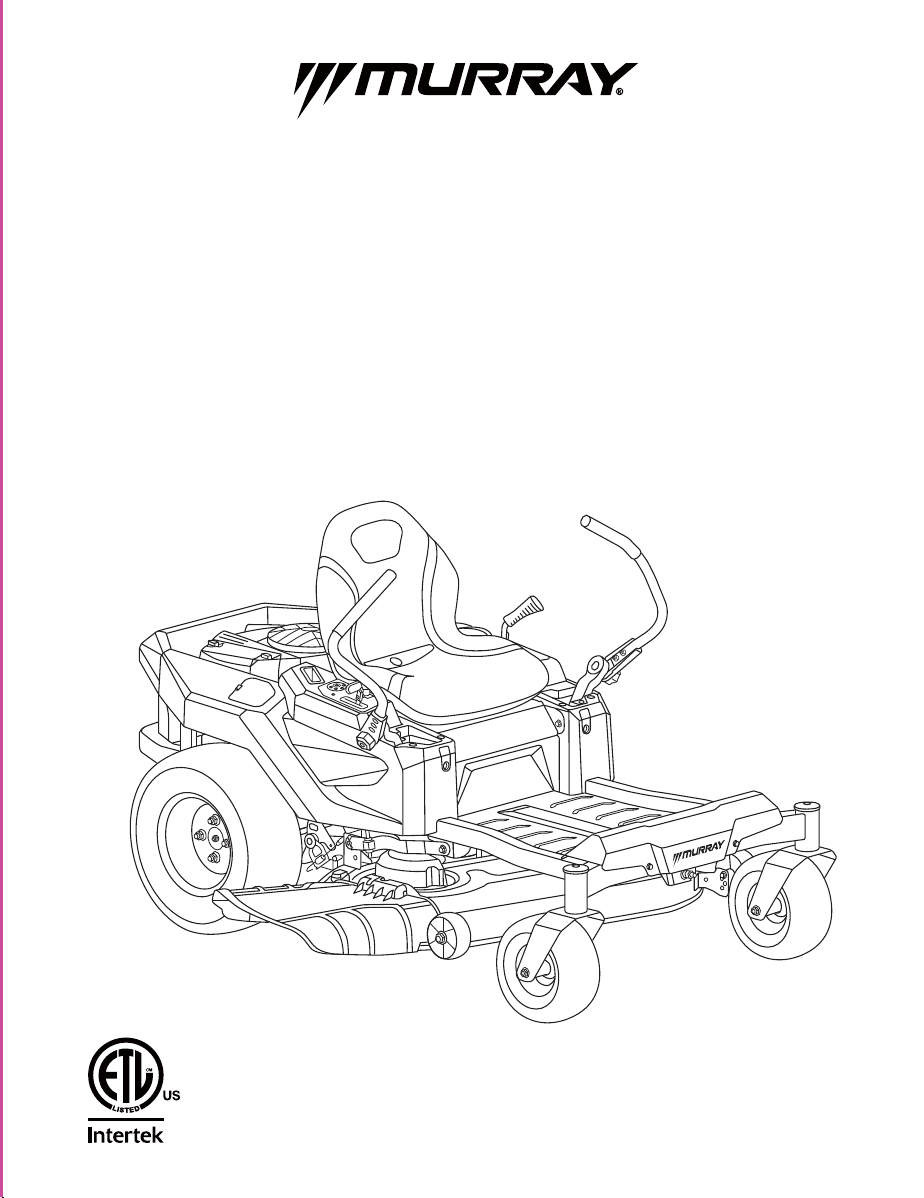
CORTACÉSPED
DE GIRO CERO
Modelo #MYZ4219000
Manual de Usuario
Número de Atención al Cliente: 855-693-2582 | www.murray.com
5022993

2
ÍNDICE
3
CORTACÉSPED DE GIRO CERO CORTACÉSPED DE GIRO CERO
1. Información general
Eliminación medioambiental
Recicle todos los envases, el aceite usado y las pilas de
acuerdo con la normativa gubernamental aplicable.
Referencia
Todas las referencias en este manual al lado izquierdo o
derecho y a la parte delantera o trasera de la máquina se
hacen desde la posición del operador. Todas las traducciones
a otros idiomas de este documento se derivan del archivo
fuente inicial en inglés.
SECCIÓN 1
Información general ................................3
SECCIÓN 2
Seguridad del operador..........................4
.............................4
.................................6
Guarde estas instrucciones
..............5
Guía de identificación de pendientes
..4
Símbolo de alerta de seguridad y palabras clave
Adhesivos de seguridad
Instrucciones de seguridad
.............................7
SECCIÓN 3
Instrucciones de ensamblaje................
Instalar el enganche
Ensamblar la palanca de mando
Ensamblar el asiento
..................................11
...................12
....................................14
10
Conectar la batería
.....................................14
Conducir el cortacésped
Ajustar la altura de corte
..............................24
............................27
Ajuste de la rueda anticaída de la cubierta
....27
Cortar
.......................................................28
Comprobar/ajustar la presión de las llantas
Instrucciones de uso
Uso de la palanca del acelerador/freno
Detener el motor
Recomendaciones sobre combustible
Pruebas del sistema de bloqueo de seguridad
Motor
Características y controles
SECCIÓN 4
Operar el cortacésped
SECCIÓN 5
....15
...................16
..........................19
..20
.......................................................20
.............21
....................................22
..........23
........................................23
SECCIÓN 6
Mantenimiento.......................................31
Limpieza de la plataforma del cortacésped
....33
Nivelación de la plataforma de corte
............34
Desmontaje de la plataforma de corte
..........35
Cambio de la correa de la cubierta
...............36
Cambio de la correa de transmisión
..............37
Sustitución de las cuchillas de corte
..............38
Afilar la cuchilla
Comprobación de la presión de las llantas
Limpiar el cortacésped
................................32
.........................................39
.....40
Mantenimiento de la batería
.......................40
Comprobación del tiempo de parada de la
cuchilla del cortacésped
Cambio del aceite y del filtro de aceite
..............................42
.........42
Comprobación del nivel de aceite del motor
..43
Cambiar el filtro de aire
..............................43
Comprobación de la bujía de encendido
........44
Empujar el cortacésped a mano
Remolcar con el cortacésped
....................45
45........................
............................................... Transporte
Almacenamiento
Solución de problemas
SECCIÓN 7
SECCIÓN 8
SECCIÓN 9
46
....................................47
..........................48
.....................................50
SECCIÓN 11
Desechos
SECCIÓN 12
Garantía
SECCIÓN 10
Especificaciones
.......
.................................................
52
53
..................................................54
Cláusula de exención de responsabilidad
I
D
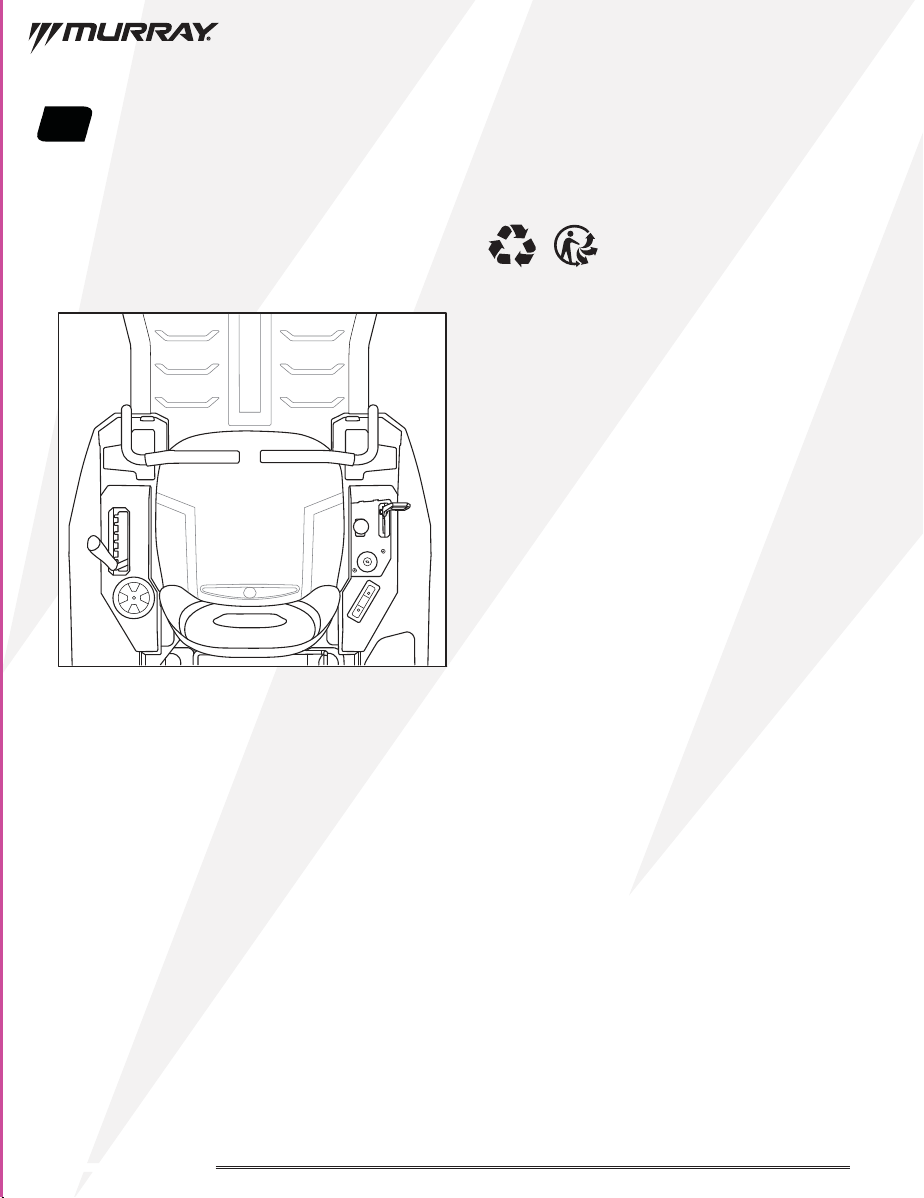
2
ÍNDICE
3
CORTACÉSPED DE GIRO CERO CORTACÉSPED DE GIRO CERO
1. Información general
Eliminación medioambiental
Recicle todos los envases, el aceite usado y las pilas de
acuerdo con la normativa gubernamental aplicable.
Referencia
Todas las referencias en este manual al lado izquierdo o
derecho y a la parte delantera o trasera de la máquina se
hacen desde la posición del operador. Todas las traducciones
a otros idiomas de este documento se derivan del archivo
fuente inicial en inglés.
SECCIÓN 1
Información general ................................3
SECCIÓN 2
Seguridad del operador..........................4
.............................4
.................................6
Guarde estas instrucciones
..............5
Guía de identificación de pendientes
..4
Símbolo de alerta de seguridad y palabras clave
Adhesivos de seguridad
Instrucciones de seguridad
.............................7
SECCIÓN 3
Instrucciones de ensamblaje................
Instalar el enganche
Ensamblar la palanca de mando
Ensamblar el asiento
..................................11
...................12
....................................14
10
Conectar la batería
.....................................14
Conducir el cortacésped
Ajustar la altura de corte
..............................24
............................27
Ajuste de la rueda anticaída de la cubierta
....27
Cortar
.......................................................28
Comprobar/ajustar la presión de las llantas
Instrucciones de uso
Uso de la palanca del acelerador/freno
Detener el motor
Recomendaciones sobre combustible
Pruebas del sistema de bloqueo de seguridad
Motor
Características y controles
SECCIÓN 4
Operar el cortacésped
SECCIÓN 5
....15
...................16
..........................19
..20
.......................................................20
.............21
....................................22
..........23
........................................23
SECCIÓN 6
Mantenimiento.......................................31
Limpieza de la plataforma del cortacésped
....33
Nivelación de la plataforma de corte
............34
Desmontaje de la plataforma de corte
..........35
Cambio de la correa de la cubierta
...............36
Cambio de la correa de transmisión
..............37
Sustitución de las cuchillas de corte
..............38
Afilar la cuchilla
Comprobación de la presión de las llantas
Limpiar el cortacésped
................................32
.........................................39
.....40
Mantenimiento de la batería
.......................40
Comprobación del tiempo de parada de la
cuchilla del cortacésped
Cambio del aceite y del filtro de aceite
..............................42
.........42
Comprobación del nivel de aceite del motor
..43
Cambiar el filtro de aire
..............................43
Comprobación de la bujía de encendido
........44
Empujar el cortacésped a mano
Remolcar con el cortacésped
....................45
45........................
............................................... Transporte
Almacenamiento
Solución de problemas
SECCIÓN 7
SECCIÓN 8
SECCIÓN 9
46
....................................47
..........................48
.....................................50
SECCIÓN 11
Desechos
SECCIÓN 12
Garantía
SECCIÓN 10
Especificaciones
.......
.................................................
52
53
..................................................54
Cláusula de exención de responsabilidad
I
D
4
2. Seguridad del operador
Guarde estas instrucciones
Guarde estas instrucciones para futuras consultas. Este
manual contiene información de seguridad para que
conozca los peligros y riesgos asociados al producto y cómo
evitarlos. También contiene instrucciones importantes que
deben seguirse durante la puesta en marcha, el funciona-
miento y el mantenimiento del producto.
Este producto está diseñado y pensado para cortar césped
en buen estado y no está destinado a otros usos.
Es importante que lea y comprenda estas instrucciones antes
de intentar poner en marcha o utilizar este equipo.
Asegúrese de que conoce perfectamente los controles y el
uso correcto del producto.
Sepa cómo parar la unidad y desconectar los controles
rápidamente.
Símbolo de alerta de
seguridad y palabras clave
El símbolo de alerta de seguridad de este manual
identifica información de seguridad sobre peligros que
pueden provocar lesiones personales. El uso de IMPOR-
TANTE, NOTA y AVISO en el texto muestra aclaraciones,
excepciones o alternativas a los procedimientos. Se utiliza
una palabra de advertencia (PELIGRO, ADVERTENCIA o
PRECAUCIÓN) con el símbolo de alerta para indicar la
probabilidad y la gravedad potencial de las lesiones.
Además, puede utilizarse un símbolo de peligro para
representar el tipo de peligro.
5
PELIGRO:
Indica una situación de peligro inmediato
que, si no se evita, provocará la muerte o lesiones graves.
ADVERTENCIA: Indica una situación potencialmente
peligrosa que, de no evitarse, podría provocar la muerte
o lesiones graves.
PRECAUCIÓN: Indica una situación potencialmente
peligrosa que, si no se evita, puede provocar lesiones
leves o moderadas.
CORTACÉSPED DE GIRO CERO CORTACÉSPED DE GIRO CERO
Fig. 1
Cómo medir la pendiente de la superficie de un césped con
un teléfono inteligente o una herramienta de medición de
ángulos:
1. Utilice un borde recto de al menos dos (2) pies de largo
(A, Fig. 1). Un 2x4 o un trozo recto de metal también
funcionan.
2. Herramientas para encontrar ángulos:
a.
Utilice su teléfono inteligente: Muchos teléfonos
inteligentes (B, Fig. 1) disponen de un inclinómetro
(buscador de ángulos) situado bajo la aplicación (app)
brújula. Alternativamente, puede buscar en la tienda de
aplicaciones de su teléfono una aplicación para el
inclinómetro.
b.
Utilice las herramientas del buscador de ángulos: Las
herramientas para encontrar ángulos (C y D, Fig. 1)
están disponibles en las ferreterías locales o en línea
(también llamadas inclinómetro, transportador, medi
dor de ángulos o medidor de ángulos). Los de tipo dial
(C) o digital (D) funcionan, los otros pueden no hacerlo.
Lea y obedezca las instrucciones de uso suministradas
con el medidor de ángulos.
3. Coloque el borde recto de dos (2) pies de largo a lo largo
de la parte más empinada de la pendiente del césped.
Suba y baje la tabla por la pendiente.
4. Apoye el teléfono inteligente o el medidor de ángulos
sobre la regla y lea el ángulo en grados. Esta es la
pendiente de su césped.
ADVERTENCIA: No opere en pendientes superiores
a 15 grados.
Guía de identificación de
pendientes
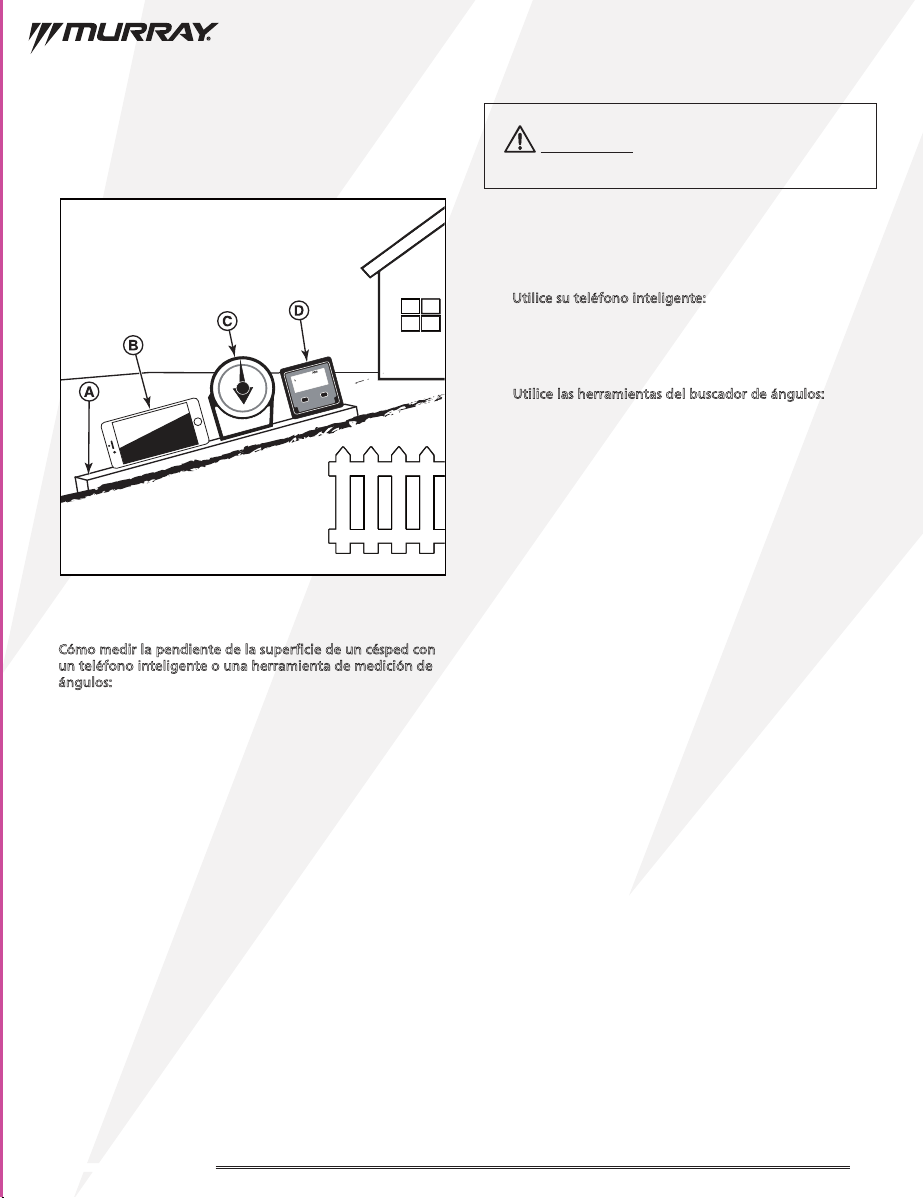
4
2. Seguridad del operador
Guarde estas instrucciones
Guarde estas instrucciones para futuras consultas. Este
manual contiene información de seguridad para que
conozca los peligros y riesgos asociados al producto y cómo
evitarlos. También contiene instrucciones importantes que
deben seguirse durante la puesta en marcha, el funciona-
miento y el mantenimiento del producto.
Este producto está diseñado y pensado para cortar césped
en buen estado y no está destinado a otros usos.
Es importante que lea y comprenda estas instrucciones antes
de intentar poner en marcha o utilizar este equipo.
Asegúrese de que conoce perfectamente los controles y el
uso correcto del producto.
Sepa cómo parar la unidad y desconectar los controles
rápidamente.
Símbolo de alerta de
seguridad y palabras clave
El símbolo de alerta de seguridad de este manual
identifica información de seguridad sobre peligros que
pueden provocar lesiones personales. El uso de IMPOR-
TANTE, NOTA y AVISO en el texto muestra aclaraciones,
excepciones o alternativas a los procedimientos. Se utiliza
una palabra de advertencia (PELIGRO, ADVERTENCIA o
PRECAUCIÓN) con el símbolo de alerta para indicar la
probabilidad y la gravedad potencial de las lesiones.
Además, puede utilizarse un símbolo de peligro para
representar el tipo de peligro.
5
PELIGRO:
Indica una situación de peligro inmediato
que, si no se evita, provocará la muerte o lesiones graves.
ADVERTENCIA: Indica una situación potencialmente
peligrosa que, de no evitarse, podría provocar la muerte
o lesiones graves.
PRECAUCIÓN: Indica una situación potencialmente
peligrosa que, si no se evita, puede provocar lesiones
leves o moderadas.
CORTACÉSPED DE GIRO CERO CORTACÉSPED DE GIRO CERO
Fig. 1
Cómo medir la pendiente de la superficie de un césped con
un teléfono inteligente o una herramienta de medición de
ángulos:
1. Utilice un borde recto de al menos dos (2) pies de largo
(A, Fig. 1). Un 2x4 o un trozo recto de metal también
funcionan.
2. Herramientas para encontrar ángulos:
a.
Utilice su teléfono inteligente: Muchos teléfonos
inteligentes (B, Fig. 1) disponen de un inclinómetro
(buscador de ángulos) situado bajo la aplicación (app)
brújula. Alternativamente, puede buscar en la tienda de
aplicaciones de su teléfono una aplicación para el
inclinómetro.
b.
Utilice las herramientas del buscador de ángulos: Las
herramientas para encontrar ángulos (C y D, Fig. 1)
están disponibles en las ferreterías locales o en línea
(también llamadas inclinómetro, transportador, medi
dor de ángulos o medidor de ángulos). Los de tipo dial
(C) o digital (D) funcionan, los otros pueden no hacerlo.
Lea y obedezca las instrucciones de uso suministradas
con el medidor de ángulos.
3. Coloque el borde recto de dos (2) pies de largo a lo largo
de la parte más empinada de la pendiente del césped.
Suba y baje la tabla por la pendiente.
4. Apoye el teléfono inteligente o el medidor de ángulos
sobre la regla y lea el ángulo en grados. Esta es la
pendiente de su césped.
ADVERTENCIA: No opere en pendientes superiores
a 15 grados.
Guía de identificación de
pendientes
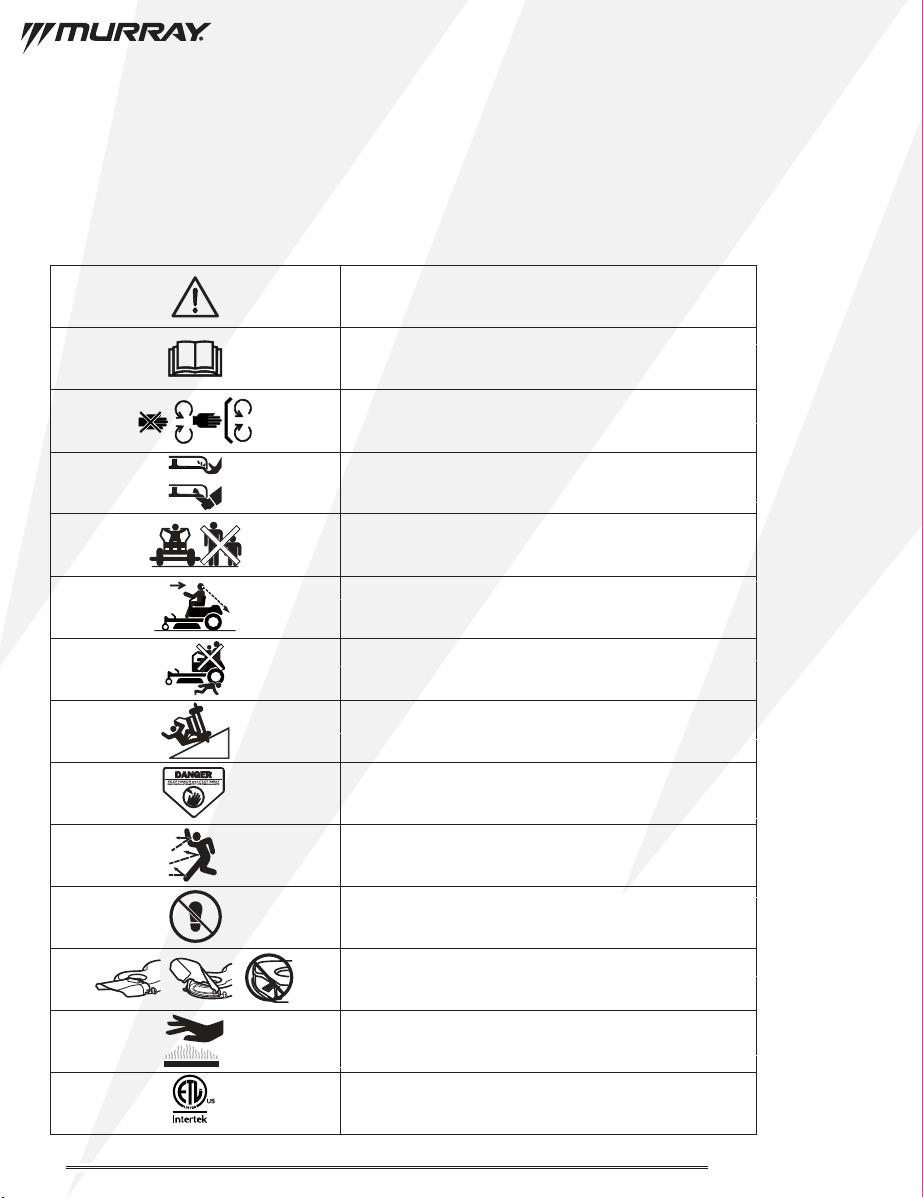
6 7
ADVERTENCIA: Lea y siga todas las instrucciones de
seguridad de este manual antes de utilizar esta máquina.
El incumplimiento de estas instrucciones podría provocar
la muerte o lesiones graves.
ADVERTENCIA: Esta máquina es capaz de amputar
manos y pies y de lanzar objetos. El incumplimiento de
las siguientes instrucciones de seguridad podría provocar
lesiones graves o la muerte.
PROPUESTA 65 DE CALIFORNIA: Los gases de escape del
motor, algunos de sus constituyentes y determinados
componentes del vehículo contienen o emiten sustancias
químicas que, según el Estado de California, provocan cáncer
y defectos de nacimiento u otros daños reproductivos.
Instrucciones de seguridad
Prácticas generales de seguridad
• Lea, comprenda y siga las instrucciones y advertencias de
este manual y de la máquina, el motor y los accesorios.
• Sólo permita manejar la máquina a operadores
responsables, formados, familiarizados con las
instrucciones y físicamente capaces.
• No lleve pasajeros y mantenga alejados a los transeúntes.
• No maneje la máquina bajo los efectos del alcohol o las
drogas.
• Siga las recomendaciones del fabricante en cuanto a pesos
y/o contrapesos de las ruedas.
• Nunca permita que niños menores de 14 años manejen el
cortacésped. Los niños mayores de 14 años deben leer y
comprender las instrucciones y las prácticas de manejo
seguro de este manual y del cortacésped, y deben ser
adiestrados y supervisados por un adulto.
• Los datos indican que los operadores mayores de 65 años
están implicados en un gran porcentaje de las lesiones
relacionadas con los cortacéspedes. Estos operadores
deben evaluar su capacidad para manejar el cortacésped
con la suficiente seguridad como para protegerse a sí
mismos y a los demás de lesiones graves.
• Si se producen situaciones no contempladas en este
manual, tenga cuidado y buen juicio para hacer frente a la
situación o póngase en contacto con su representante de
servicio al cliente para obtener ayuda.
Preparación antes de operar
• Despeje el área de operación de cualquier objeto que
pueda ser arrojado o interferir con el funcionamiento de
la máquina.
• Mantenga el área de operación libre de cualquier
transeúnte, especialmente de niños pequeños. Detenga la
máquina y el/los accesorio(s) si alguien entra en la zona.
• No utilice la máquina sin que todo el recogedor de hierba,
el conducto de descarga u otros dispositivos de seguridad
estén colocados y funcionen correctamente. Compruebe
con frecuencia si hay signos de desgaste o deterioro y
sustitúyalos según sea necesario.
• Lleve el equipo de protección personal adecuado, como
gafas de seguridad, protección auditiva y calzado.
• Tenga en cuenta la dirección de descarga del cortacésped
y no la dirija hacia nadie.
• Utilice únicamente accesorios y complementos aprobados
para este cortacésped por el fabricante del mismo. Lea,
comprenda y siga todas las instrucciones proporcionadas
con el accesorio o aditamento aprobado.
Operación
• Haga funcionar el motor únicamente en zonas bien
ventiladas. Los gases de escape contienen monóxido de
carbono, un veneno mortal.
• Haga funcionar la máquina sólo a la luz del día o con
buena luz artificial.
• Evite agujeros, surcos, baches, rocas u otros peligros
ocultos. Un terreno irregular podría hacer volcar la
máquina o hacer que el operador perdiera el equilibrio o
el equilibrio.
• No ponga las manos ni los pies cerca de las piezas
giratorias ni debajo de la máquina. Manténgase alejado
de la abertura de descarga en todo momento.
• No dirija el material de descarga hacia nadie. Evite
descargar materiales contra una pared u obstrucción. El
material puede rebotar hacia el operador. Detenga la(s)
cuchilla(s) al cruzar superficies de grava.
• No deje desatendida una máquina en marcha. Aparque
siempre en terreno llano, desengrane la(s) cuchilla(s),
ponga el freno de estacionamiento y pare el motor.
• No siegue marcha atrás a menos que sea absolutamente
necesario. Mire siempre hacia abajo y hacia atrás antes y
durante la marcha atrás.
• Compruebe cuidadosamente las distancias por encima de
la cabeza antes de pasar por debajo de ramas de árboles
bajas, cables, huecos de puertas, etc., ya que podría sufrir
lesiones graves.
• No lleve nunca pasajeros.
• Un deflector de vertedero ausente o dañado puede causar
lesiones por contacto con la cuchilla o por objetos arrojados.
• No haga funcionar el cortacésped sin que el deflector del
vertedero o el recogedor de hierba completo estén en su sitio.
• Tenga mucho cuidado con los recogedores de hierba u
otros accesorios. Éstos pueden modificar la estabilidad del
cortacésped. Siga siempre las instrucciones del fabricante
del accesorio.
CORTACÉSPED DE GIRO CERO CORTACÉSPED DE GIRO CERO
Adhesivos de seguridad
Los siguientes símbolos de seguridad aparecen en este producto. Antes de utilizar el cortacésped, estúdielos y aprenda su significa-
do.
IMPORTANTE: Si los adhesivos de seguridad se desgastan o dañan y no pueden leerse, pida adhesivos de repuesto a su centro de
servicio autorizado.
Símbolo de alerta de seguridad
Lea el manual de usuario
Mantenga los dispositivos de seguridad
Evite lesiones por amputación
Mantenga alejados a los transeúntes
Mire hacia atrás mientras retrocede
Nunca lleve niños
Evite las pendientes pronunciadas
Mantenga las manos y los pies alejados
Evite objetos arrojados
No pise
No toque la superficie caliente
No haga funcionar el cortacésped sin que el conducto de
descarga esté en su sitio.
Símbolo Descripción
ETL Marcar
5022993
6 7
ADVERTENCIA: Lea y siga todas las instrucciones de
seguridad de este manual antes de utilizar esta máquina.
El incumplimiento de estas instrucciones podría provocar
la muerte o lesiones graves.
ADVERTENCIA: Esta máquina es capaz de amputar
manos y pies y de lanzar objetos. El incumplimiento de
las siguientes instrucciones de seguridad podría provocar
lesiones graves o la muerte.
PROPUESTA 65 DE CALIFORNIA: Los gases de escape del
motor, algunos de sus constituyentes y determinados
componentes del vehículo contienen o emiten sustancias
químicas que, según el Estado de California, provocan cáncer
y defectos de nacimiento u otros daños reproductivos.
Instrucciones de seguridad
Prácticas generales de seguridad
• Lea, comprenda y siga las instrucciones y advertencias de
este manual y de la máquina, el motor y los accesorios.
• Sólo permita manejar la máquina a operadores
responsables, formados, familiarizados con las
instrucciones y físicamente capaces.
• No lleve pasajeros y mantenga alejados a los transeúntes.
• No maneje la máquina bajo los efectos del alcohol o las
drogas.
• Siga las recomendaciones del fabricante en cuanto a pesos
y/o contrapesos de las ruedas.
• Nunca permita que niños menores de 14 años manejen el
cortacésped. Los niños mayores de 14 años deben leer y
comprender las instrucciones y las prácticas de manejo
seguro de este manual y del cortacésped, y deben ser
adiestrados y supervisados por un adulto.
• Los datos indican que los operadores mayores de 65 años
están implicados en un gran porcentaje de las lesiones
relacionadas con los cortacéspedes. Estos operadores
deben evaluar su capacidad para manejar el cortacésped
con la suficiente seguridad como para protegerse a sí
mismos y a los demás de lesiones graves.
• Si se producen situaciones no contempladas en este
manual, tenga cuidado y buen juicio para hacer frente a la
situación o póngase en contacto con su representante de
servicio al cliente para obtener ayuda.
Preparación antes de operar
• Despeje el área de operación de cualquier objeto que
pueda ser arrojado o interferir con el funcionamiento de
la máquina.
• Mantenga el área de operación libre de cualquier
transeúnte, especialmente de niños pequeños. Detenga la
máquina y el/los accesorio(s) si alguien entra en la zona.
• No utilice la máquina sin que todo el recogedor de hierba,
el conducto de descarga u otros dispositivos de seguridad
estén colocados y funcionen correctamente. Compruebe
con frecuencia si hay signos de desgaste o deterioro y
sustitúyalos según sea necesario.
• Lleve el equipo de protección personal adecuado, como
gafas de seguridad, protección auditiva y calzado.
• Tenga en cuenta la dirección de descarga del cortacésped
y no la dirija hacia nadie.
• Utilice únicamente accesorios y complementos aprobados
para este cortacésped por el fabricante del mismo. Lea,
comprenda y siga todas las instrucciones proporcionadas
con el accesorio o aditamento aprobado.
Operación
• Haga funcionar el motor únicamente en zonas bien
ventiladas. Los gases de escape contienen monóxido de
carbono, un veneno mortal.
• Haga funcionar la máquina sólo a la luz del día o con
buena luz artificial.
• Evite agujeros, surcos, baches, rocas u otros peligros
ocultos. Un terreno irregular podría hacer volcar la
máquina o hacer que el operador perdiera el equilibrio o
el equilibrio.
• No ponga las manos ni los pies cerca de las piezas
giratorias ni debajo de la máquina. Manténgase alejado
de la abertura de descarga en todo momento.
• No dirija el material de descarga hacia nadie. Evite
descargar materiales contra una pared u obstrucción. El
material puede rebotar hacia el operador. Detenga la(s)
cuchilla(s) al cruzar superficies de grava.
• No deje desatendida una máquina en marcha. Aparque
siempre en terreno llano, desengrane la(s) cuchilla(s),
ponga el freno de estacionamiento y pare el motor.
• No siegue marcha atrás a menos que sea absolutamente
necesario. Mire siempre hacia abajo y hacia atrás antes y
durante la marcha atrás.
• Compruebe cuidadosamente las distancias por encima de
la cabeza antes de pasar por debajo de ramas de árboles
bajas, cables, huecos de puertas, etc., ya que podría sufrir
lesiones graves.
• No lleve nunca pasajeros.
• Un deflector de vertedero ausente o dañado puede causar
lesiones por contacto con la cuchilla o por objetos arrojados.
• No haga funcionar el cortacésped sin que el deflector del
vertedero o el recogedor de hierba completo estén en su sitio.
• Tenga mucho cuidado con los recogedores de hierba u
otros accesorios. Éstos pueden modificar la estabilidad del
cortacésped. Siga siempre las instrucciones del fabricante
del accesorio.
CORTACÉSPED DE GIRO CERO CORTACÉSPED DE GIRO CERO
Adhesivos de seguridad
Los siguientes símbolos de seguridad aparecen en este producto. Antes de utilizar el cortacésped, estúdielos y aprenda su significa-
do.
IMPORTANTE: Si los adhesivos de seguridad se desgastan o dañan y no pueden leerse, pida adhesivos de repuesto a su centro de
servicio autorizado.
Símbolo de alerta de seguridad
Lea el manual de usuario
Mantenga los dispositivos de seguridad
Evite lesiones por amputación
Mantenga alejados a los transeúntes
Mire hacia atrás mientras retrocede
Nunca lleve niños
Evite las pendientes pronunciadas
Mantenga las manos y los pies alejados
Evite objetos arrojados
No pise
No toque la superficie caliente
No haga funcionar el cortacésped sin que el conducto de
descarga esté en su sitio.
Símbolo Descripción
ETL Marcar
5022993
8
3.
9
• Detenga la(s) cuchilla(s) al cruzar caminos de grava,
paseos o carreteras, y mientras no esté cortando hierba.
• Esté atento al tráfico cuando trabaje cerca o cruce
carreteras. Este cortacésped no está diseñado para ser
utilizado en ninguna vía pública.
• No utilice el cortacésped bajo los efectos del alcohol o las
drogas.
• El silenciador y el motor se calientan mucho después de
un uso prolongado y pueden causar quemaduras graves.
No toque el silenciador ni el motor inmediatamente
después de su uso. Deje que el cortacésped se enfríe
durante cinco minutos antes de realizar cualquier tarea de
mantenimiento.
En relación con los niños
• Pueden producirse accidentes trágicos si el operador no
está alerta ante la presencia de niños. Los niños suelen
sentirse atraídos por la máquina y la actividad de siega.
Nunca dé por sentado que los niños permanecerán donde
los vio por última vez.
• Mantenga a los niños fuera de la zona de trabajo y bajo la
vigilancia de un adulto responsable que no sea el operador.
• No transporte niños, ni siquiera con la(s) cuchilla(s)
apagada(s). Los niños pueden caerse y lesionarse
gravemente o interferir con el funcionamiento seguro.
Los niños que han dado paseos en el pasado pueden
aparecer de repente en la zona de siega para dar otro
paseo y ser atropellados o arrollados por la máquina.
• Esté alerta y apague el cortacésped si un niño o un
transeúnte entra en la zona.
• Para evitar accidentes por atropello, mire siempre hacia
atrás y hacia abajo en busca de niños.
• Extreme las precauciones al acercarse a esquinas ciegas,
portales, arbustos, árboles u otros objetos que puedan
bloquearle la visión de un niño que pueda correr hacia la
trayectoria del cortacésped.
• No permita que ningún niño monte alegremente en el
cortacésped. El cortacésped no es un juguete ni un kart.
Advierta a sus hijos de que el cortacésped puede ser
peligroso y deben mantenerse alejados de él en todo
momento.
• Mantenga a los niños alejados de los motores calientes o
en marcha. Pueden sufrir quemaduras con un silenciador
o un motor calientes.
• Retire la llave cuando el cortacésped esté desatendido
para evitar el funcionamiento no autorizado. Asegúrese
de que la llave es inaccesible para los niños pequeños.
En relación con las pendientes
• En pendientes, circule en la dirección recomendada por el
fabricante. Tenga precaución cuando trabaje cerca de
desniveles.
• Evite cortar hierba mojada.
• No utilice la máquina bajo ninguna condición en la que se
cuestione la tracción, la dirección o la estabilidad. Los
neumáticos podrían deslizarse, aunque las ruedas estén
paradas.
• Mantenga siempre la máquina en marcha al bajar pendi
entes. No vaya cuesta abajo.
• Evite arrancar y parar en pendientes. Evite realizar
cambios bruscos de velocidad o de dirección. Realice los
giros lenta y gradualmente.
• Extreme las precauciones cuando utilice la máquina con
un recogedor de hierba u otro(s) accesorio(s). Pueden
afectar a la estabilidad de la máquina.
En relación con el fuego y el combustible
• Apague todos los cigarrillos, puros, pipas y otras fuentes
de ignición.
• Utilice únicamente un recipiente de combustible
homologado.
• No retire el tapón de combustible ni añada combustible
con el motor en marcha o caliente.
• No reposte en interiores ni en espacios cerrados.
• No guarde la máquina o el recipiente de combustible, ni
reposte, donde haya una llama abierta, chispa o llama
piloto, como un calentador de agua u otros aparatos.
• Si se derrama combustible, no intente arrancar el motor; y
evite crear cualquier fuente de ignición hasta que los
vapores del combustible se hayan disipado.
• Para ayudar a prevenir incendios: mantenga la máquina
libre de hierba, hojas u otros residuos acumulados; limpie
los derrames de aceite o combustible y retire cualquier
residuo impregnado de combustible; deje que la máquina
se enfríe antes de guardarla.
• Tenga mucho cuidado al manipular la gasolina y otros
combustibles. Son inflamables y los vapores son explosivos.
ADVERTENCIA: Las pendientes son un factor
importante relacionado con los accidentes. La operación
en pendientes requiere una precaución adicional.
ADVERTENCIA: Si se encuentra en reposo en una
pendiente ascendente, no extienda bruscamente las
manetas de tracción completamente hacia delante para
iniciar el movimiento de avance. Hacerlo puede provocar
un vuelco trasero (las ruedas delanteras se levantan del
suelo y la máquina vuelca hacia atrás).
Transporte
• Utilice rampas de ancho completo para cargar y descargar
la máquina para su transporte.
• Tenga mucho cuidado al cargar o descargar el cortacésped
en un remolque o camión. Este cortacésped no debe subirse
o bajarse por la(s) rampa(s) porque podría volcarse,
causando lesiones personales graves. El cortacésped debe
empujarse manualmente por la(s) rampa(s) para cargarlo
o descargarlo correctamente.
• Eleve la plataforma a la posición más alta para dejar
espacio libre para la carga.
Remolque
• Siga las recomendaciones del fabricante en cuanto a los
límites de peso del equipo remolcado y el remolcado en
pendientes.
Servicio
• Mantenga la máquina en buen estado de funcionamiento.
Sustituya las piezas desgastadas o dañadas.
•
Tenga cuidado al realizar el mantenimiento de las cuchillas.
Envuelva la(s) cuchilla(s) o póngase guantes. Sustituya las
cuchillas dañadas. No repare ni modifique la(s) cuchilla(s).
• Desconecte el cable(s) de la(s) bujía(s) y el cable negativo
de la batería antes de realizar cualquier reparación.
• Opere el equipo SÓLO al aire libre.
• Evite que los gases de escape entren en un área confinada
a través de ventanas, puertas, tomas de ventilación u otras
aberturas.
• Para evitar lesiones graves o la muerte, no modifique el
motor de ninguna manera. Manipular el ajuste del
regulador puede hacer que el motor se desboque y
funcione a velocidades inseguras. No manipule nunca el
ajuste de fábrica del regulador del motor. No modifique
los ajustes del regulador del motor ni acelere excesivamente
el motor. El regulador controla la velocidad máxima de
funcionamiento seguro del motor.
• No manipule nunca el sistema de enclavamiento de
seguridad ni otros dispositivos de seguridad. Compruebe
regularmente su correcto funcionamiento.
• Utilice el equipo SÓLO al aire libre.
• Mantenga todas las tuercas, pernos y tornillos apretados
para asegurarse de que el equipo está en condiciones
seguras de funcionamiento.
• Nunca intente realizar ajustes o reparaciones en el
cortacésped con el motor en marcha.
• Utilice únicamente piezas de repuesto originales. El uso de
piezas de repuesto que no cumplan las especificaciones
del equipo original puede provocar un funcionamiento
incorrecto y comprometer la seguridad.
ADVERTENCIA:
Un motor en marcha desprende
monóxido de carbono, un gas inodoro, incoloro y venenoso.
Respirar monóxido de carbono puede provocar dolores de
cabeza, fatiga, mareos, vómitos, confusión, convulsiones,
náuseas, desmayos o la muerte.
CORTACÉSPED DE GIRO CERO CORTACÉSPED DE GIRO CERO
8
3.
9
• Detenga la(s) cuchilla(s) al cruzar caminos de grava,
paseos o carreteras, y mientras no esté cortando hierba.
• Esté atento al tráfico cuando trabaje cerca o cruce
carreteras. Este cortacésped no está diseñado para ser
utilizado en ninguna vía pública.
• No utilice el cortacésped bajo los efectos del alcohol o las
drogas.
• El silenciador y el motor se calientan mucho después de
un uso prolongado y pueden causar quemaduras graves.
No toque el silenciador ni el motor inmediatamente
después de su uso. Deje que el cortacésped se enfríe
durante cinco minutos antes de realizar cualquier tarea de
mantenimiento.
En relación con los niños
• Pueden producirse accidentes trágicos si el operador no
está alerta ante la presencia de niños. Los niños suelen
sentirse atraídos por la máquina y la actividad de siega.
Nunca dé por sentado que los niños permanecerán donde
los vio por última vez.
• Mantenga a los niños fuera de la zona de trabajo y bajo la
vigilancia de un adulto responsable que no sea el operador.
• No transporte niños, ni siquiera con la(s) cuchilla(s)
apagada(s). Los niños pueden caerse y lesionarse
gravemente o interferir con el funcionamiento seguro.
Los niños que han dado paseos en el pasado pueden
aparecer de repente en la zona de siega para dar otro
paseo y ser atropellados o arrollados por la máquina.
• Esté alerta y apague el cortacésped si un niño o un
transeúnte entra en la zona.
• Para evitar accidentes por atropello, mire siempre hacia
atrás y hacia abajo en busca de niños.
• Extreme las precauciones al acercarse a esquinas ciegas,
portales, arbustos, árboles u otros objetos que puedan
bloquearle la visión de un niño que pueda correr hacia la
trayectoria del cortacésped.
• No permita que ningún niño monte alegremente en el
cortacésped. El cortacésped no es un juguete ni un kart.
Advierta a sus hijos de que el cortacésped puede ser
peligroso y deben mantenerse alejados de él en todo
momento.
• Mantenga a los niños alejados de los motores calientes o
en marcha. Pueden sufrir quemaduras con un silenciador
o un motor calientes.
• Retire la llave cuando el cortacésped esté desatendido
para evitar el funcionamiento no autorizado. Asegúrese
de que la llave es inaccesible para los niños pequeños.
En relación con las pendientes
• En pendientes, circule en la dirección recomendada por el
fabricante. Tenga precaución cuando trabaje cerca de
desniveles.
• Evite cortar hierba mojada.
• No utilice la máquina bajo ninguna condición en la que se
cuestione la tracción, la dirección o la estabilidad. Los
neumáticos podrían deslizarse, aunque las ruedas estén
paradas.
• Mantenga siempre la máquina en marcha al bajar pendi
entes. No vaya cuesta abajo.
• Evite arrancar y parar en pendientes. Evite realizar
cambios bruscos de velocidad o de dirección. Realice los
giros lenta y gradualmente.
• Extreme las precauciones cuando utilice la máquina con
un recogedor de hierba u otro(s) accesorio(s). Pueden
afectar a la estabilidad de la máquina.
En relación con el fuego y el combustible
• Apague todos los cigarrillos, puros, pipas y otras fuentes
de ignición.
• Utilice únicamente un recipiente de combustible
homologado.
• No retire el tapón de combustible ni añada combustible
con el motor en marcha o caliente.
• No reposte en interiores ni en espacios cerrados.
• No guarde la máquina o el recipiente de combustible, ni
reposte, donde haya una llama abierta, chispa o llama
piloto, como un calentador de agua u otros aparatos.
• Si se derrama combustible, no intente arrancar el motor; y
evite crear cualquier fuente de ignición hasta que los
vapores del combustible se hayan disipado.
• Para ayudar a prevenir incendios: mantenga la máquina
libre de hierba, hojas u otros residuos acumulados; limpie
los derrames de aceite o combustible y retire cualquier
residuo impregnado de combustible; deje que la máquina
se enfríe antes de guardarla.
• Tenga mucho cuidado al manipular la gasolina y otros
combustibles. Son inflamables y los vapores son explosivos.
ADVERTENCIA: Las pendientes son un factor
importante relacionado con los accidentes. La operación
en pendientes requiere una precaución adicional.
ADVERTENCIA: Si se encuentra en reposo en una
pendiente ascendente, no extienda bruscamente las
manetas de tracción completamente hacia delante para
iniciar el movimiento de avance. Hacerlo puede provocar
un vuelco trasero (las ruedas delanteras se levantan del
suelo y la máquina vuelca hacia atrás).
Transporte
• Utilice rampas de ancho completo para cargar y descargar
la máquina para su transporte.
• Tenga mucho cuidado al cargar o descargar el cortacésped
en un remolque o camión. Este cortacésped no debe subirse
o bajarse por la(s) rampa(s) porque podría volcarse,
causando lesiones personales graves. El cortacésped debe
empujarse manualmente por la(s) rampa(s) para cargarlo
o descargarlo correctamente.
• Eleve la plataforma a la posición más alta para dejar
espacio libre para la carga.
Remolque
• Siga las recomendaciones del fabricante en cuanto a los
límites de peso del equipo remolcado y el remolcado en
pendientes.
Servicio
• Mantenga la máquina en buen estado de funcionamiento.
Sustituya las piezas desgastadas o dañadas.
•
Tenga cuidado al realizar el mantenimiento de las cuchillas.
Envuelva la(s) cuchilla(s) o póngase guantes. Sustituya las
cuchillas dañadas. No repare ni modifique la(s) cuchilla(s).
• Desconecte el cable(s) de la(s) bujía(s) y el cable negativo
de la batería antes de realizar cualquier reparación.
• Opere el equipo SÓLO al aire libre.
• Evite que los gases de escape entren en un área confinada
a través de ventanas, puertas, tomas de ventilación u otras
aberturas.
• Para evitar lesiones graves o la muerte, no modifique el
motor de ninguna manera. Manipular el ajuste del
regulador puede hacer que el motor se desboque y
funcione a velocidades inseguras. No manipule nunca el
ajuste de fábrica del regulador del motor. No modifique
los ajustes del regulador del motor ni acelere excesivamente
el motor. El regulador controla la velocidad máxima de
funcionamiento seguro del motor.
• No manipule nunca el sistema de enclavamiento de
seguridad ni otros dispositivos de seguridad. Compruebe
regularmente su correcto funcionamiento.
• Utilice el equipo SÓLO al aire libre.
• Mantenga todas las tuercas, pernos y tornillos apretados
para asegurarse de que el equipo está en condiciones
seguras de funcionamiento.
• Nunca intente realizar ajustes o reparaciones en el
cortacésped con el motor en marcha.
• Utilice únicamente piezas de repuesto originales. El uso de
piezas de repuesto que no cumplan las especificaciones
del equipo original puede provocar un funcionamiento
incorrecto y comprometer la seguridad.
ADVERTENCIA:
Un motor en marcha desprende
monóxido de carbono, un gas inodoro, incoloro y venenoso.
Respirar monóxido de carbono puede provocar dolores de
cabeza, fatiga, mareos, vómitos, confusión, convulsiones,
náuseas, desmayos o la muerte.
CORTACÉSPED DE GIRO CERO CORTACÉSPED DE GIRO CERO
10 11
Fig. 2B
1
2
3
Fig. 2A
a
b
NOTA:
El cortacésped no funcionará sin el mazo de cables
del interruptor del asiento conectado.
ADVERTENCIA: Asegúrese de que el asiento está
bloqueado en su sitio antes de utilizar el cortacésped.
Un asiento que no esté seguro puede hacer que el
operador se desplace y pierda el control del cortacésped,
provocando la muerte o lesiones graves.
Algunas piezas de su nuevo cortacésped no han sido
completamente instaladas por motivos de envío. Para
garantizar un funcionamiento seguro y correcto, todas las
piezas y herrajes deben montarse tal y como se indica a
continuación, utilizando las herramientas adecuadas para
asegurar un apriete correcto.
Saque con cuidado el producto y cualquier accesorio del
empaque. Asegúrese de que se incluyen todos los elementos
enumerados en la lista de embalaje.
Inspeccione el producto cuidadosamente para asegurarse de
que no se ha producido ningún daño durante el envío.
Si alguna pieza está dañada o falta, llame al 855-693-2582
para solicitar asistencia.
1
1
1
1
2
1
Cortacésped
Ensamblaje del asiento
Palanca de mando izquierda
Palanca de mando derecha
Pomo para palanca de control
de tracción
Varilla de fijación de la batería
Tornillo de cabeza ovalada y
cuello cuadrado (M8x70)
2
Manual del usuario
Manual del motor
1
1
Llave inglesa de 12-13 mm
Llave de encendido
2
2
Perno de brida hexagonal (M8x75)
Tuerca hexagonal con brida (M8)
Placa de enganche
2
2
1
Lista de empaque Cantidad
Si alguna pieza está dañada, o falta, ADVERTENCIA:
no utilice este producto hasta que hayan sido sustituidas.
Usar este producto con piezas dañadas o faltantes podría
provocar la muerte o lesiones graves.
No intente modificar este producto ADVERTENCIA:
ni crear accesorios para su uso con este producto.
Cualquier alteración o modificación de este tipo constituye
un uso indebido y podría dar lugar a una situación
peligrosa con resultado de muerte o lesiones graves.
Para evitar un arranque accidental ADVERTENCIA:
que podría provocar la muerte o lesiones graves,
desconecte siempre el capuchón de la bujía del motor
cuando monte las piezas.
Nunca haga funcionar el cortacéspedADVERTENCIA:
sin que estén colocados y en funcionamiento los dispositivos
de seguridad, los protectores y el vertedero adecuados.
Nunca haga funcionar el cortacésped con los dispositivos
de seguridad dañados. Hacer funcionar el cortacésped con
piezas faltantes o dañadas podría causar la muerte o
lesiones graves.
AVISO: Este cortacésped se envía sin gasolina en el
motor.
3. Instrucciones de ensamblaje
NOTA:
Mantenga los pernos y las tuercas de mariposa
sueltos hasta que todos los pernos estén en la posición
deseada. Además, las tuercas de mariposa (b) utilizadas
en el segundo paso están aseguradas en los pernos (a)
del asiento para el envío. Por lo tanto, necesita atornillar
las tuercas en sentido contrario a las agujas del reloj para
aflojarlas antes de seguir el segundo paso.
Ensamblar el asiento
1. Alinee los dos orificios roscados de la parte inferior del
asiento con las dos ranuras para ojales de la bandeja del
asiento. Deslice el asiento hacia abajo para fijarlo.
2. Elija uno de los cinco orificios de la bandeja del asiento y
enrosque las tuercas de mariposa en los orificios (a).
Fíjelas con las tuercas de mariposa suministradas (b).
Puede mover el asiento a la posición que desee eligiendo
entre los cinco orificios diferentes. (Fig.2A)
3. Apriete bien todos los pernos y los tornillos de mariposa.
4. Sujete el mazo de cables del interruptor del asiento y
páselo por debajo de la varilla de sujeción de la batería.
Conecte el mazo de cables del interruptor del asiento al
interruptor del asiento. (Fig.2B&Fig.2C)
CORTACÉSPED DE GIRO CERO CORTACÉSPED DE GIRO CERO
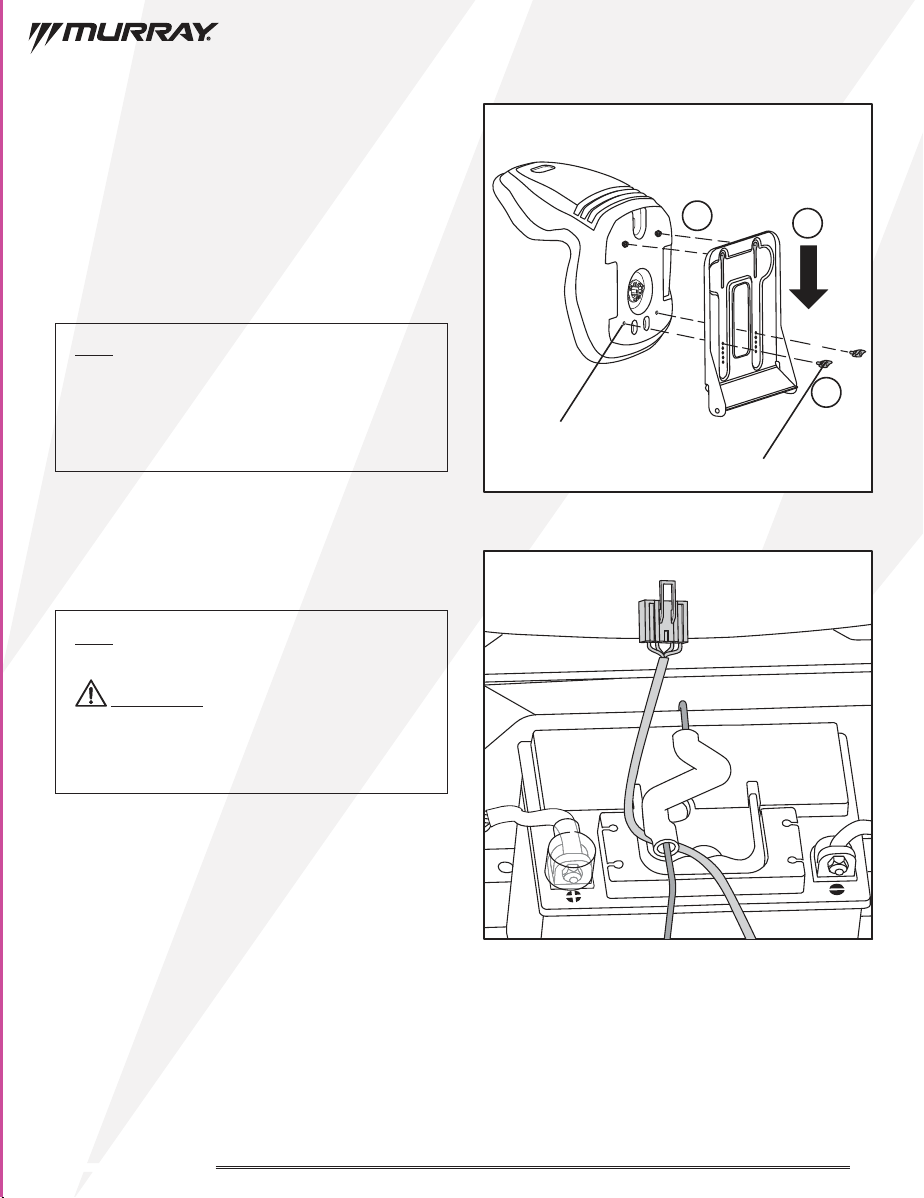
10 11
Fig. 2B
1
2
3
Fig. 2A
a
b
NOTA:
El cortacésped no funcionará sin el mazo de cables
del interruptor del asiento conectado.
ADVERTENCIA: Asegúrese de que el asiento está
bloqueado en su sitio antes de utilizar el cortacésped.
Un asiento que no esté seguro puede hacer que el
operador se desplace y pierda el control del cortacésped,
provocando la muerte o lesiones graves.
Algunas piezas de su nuevo cortacésped no han sido
completamente instaladas por motivos de envío. Para
garantizar un funcionamiento seguro y correcto, todas las
piezas y herrajes deben montarse tal y como se indica a
continuación, utilizando las herramientas adecuadas para
asegurar un apriete correcto.
Saque con cuidado el producto y cualquier accesorio del
empaque. Asegúrese de que se incluyen todos los elementos
enumerados en la lista de embalaje.
Inspeccione el producto cuidadosamente para asegurarse de
que no se ha producido ningún daño durante el envío.
Si alguna pieza está dañada o falta, llame al 855-693-2582
para solicitar asistencia.
1
1
1
1
2
1
Cortacésped
Ensamblaje del asiento
Palanca de mando izquierda
Palanca de mando derecha
Pomo para palanca de control
de tracción
Varilla de fijación de la batería
Tornillo de cabeza ovalada y
cuello cuadrado (M8x70)
2
Manual del usuario
Manual del motor
1
1
Llave inglesa de 12-13 mm
Llave de encendido
2
2
Perno de brida hexagonal (M8x75)
Tuerca hexagonal con brida (M8)
Placa de enganche
2
2
1
Lista de empaque Cantidad
Si alguna pieza está dañada, o falta, ADVERTENCIA:
no utilice este producto hasta que hayan sido sustituidas.
Usar este producto con piezas dañadas o faltantes podría
provocar la muerte o lesiones graves.
No intente modificar este producto ADVERTENCIA:
ni crear accesorios para su uso con este producto.
Cualquier alteración o modificación de este tipo constituye
un uso indebido y podría dar lugar a una situación
peligrosa con resultado de muerte o lesiones graves.
Para evitar un arranque accidental ADVERTENCIA:
que podría provocar la muerte o lesiones graves,
desconecte siempre el capuchón de la bujía del motor
cuando monte las piezas.
Nunca haga funcionar el cortacéspedADVERTENCIA:
sin que estén colocados y en funcionamiento los dispositivos
de seguridad, los protectores y el vertedero adecuados.
Nunca haga funcionar el cortacésped con los dispositivos
de seguridad dañados. Hacer funcionar el cortacésped con
piezas faltantes o dañadas podría causar la muerte o
lesiones graves.
AVISO: Este cortacésped se envía sin gasolina en el
motor.
3. Instrucciones de ensamblaje
NOTA:
Mantenga los pernos y las tuercas de mariposa
sueltos hasta que todos los pernos estén en la posición
deseada. Además, las tuercas de mariposa (b) utilizadas
en el segundo paso están aseguradas en los pernos (a)
del asiento para el envío. Por lo tanto, necesita atornillar
las tuercas en sentido contrario a las agujas del reloj para
aflojarlas antes de seguir el segundo paso.
Ensamblar el asiento
1. Alinee los dos orificios roscados de la parte inferior del
asiento con las dos ranuras para ojales de la bandeja del
asiento. Deslice el asiento hacia abajo para fijarlo.
2. Elija uno de los cinco orificios de la bandeja del asiento y
enrosque las tuercas de mariposa en los orificios (a).
Fíjelas con las tuercas de mariposa suministradas (b).
Puede mover el asiento a la posición que desee eligiendo
entre los cinco orificios diferentes. (Fig.2A)
3. Apriete bien todos los pernos y los tornillos de mariposa.
4. Sujete el mazo de cables del interruptor del asiento y
páselo por debajo de la varilla de sujeción de la batería.
Conecte el mazo de cables del interruptor del asiento al
interruptor del asiento. (Fig.2B&Fig.2C)
CORTACÉSPED DE GIRO CERO CORTACÉSPED DE GIRO CERO
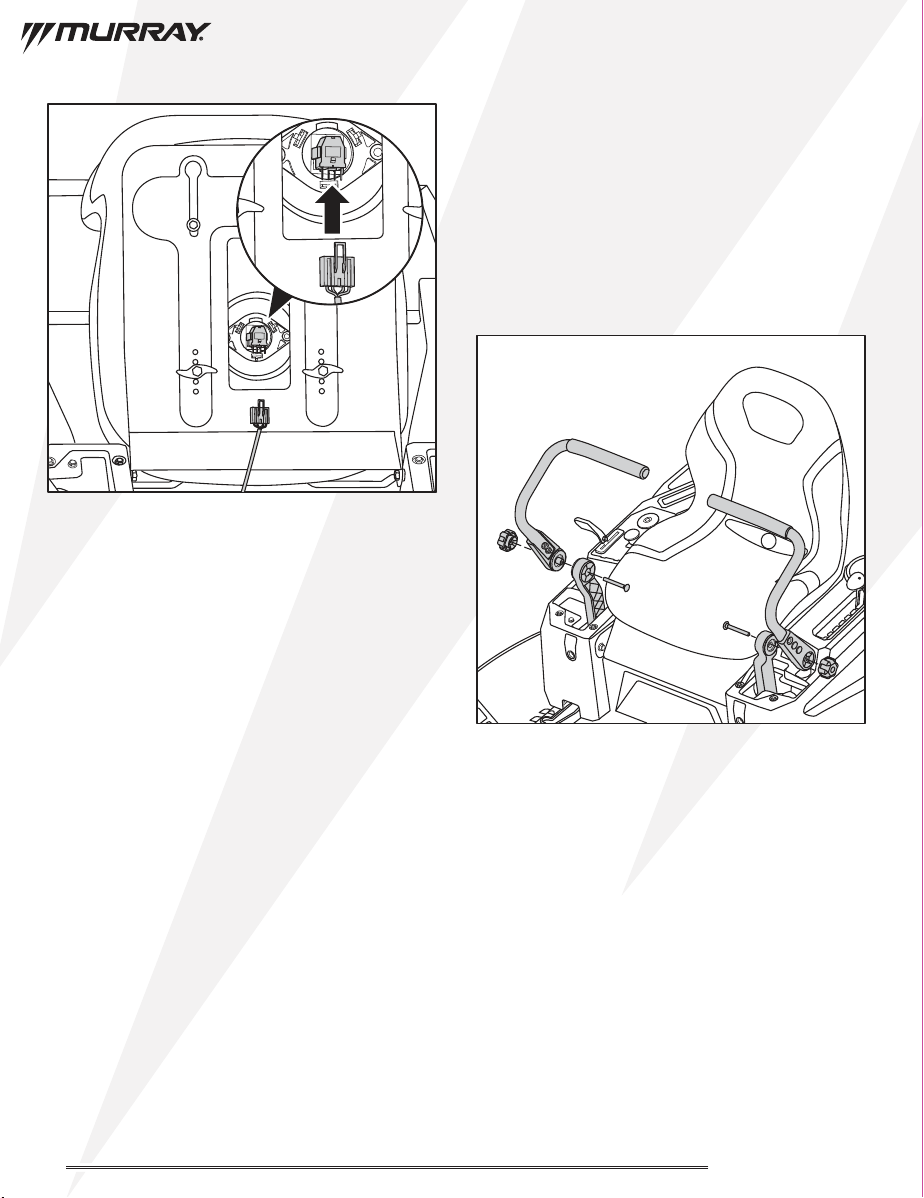
12 13
Ensamblaje de la palanca de
mando
1. Mantenga la punta más grande del ajustador de la
empuñadura superior alineada con el adaptador que fija
la palanca al cortacésped.
2. Conéctelos firmemente enroscando el pomo en el sentido
de las agujas del reloj.
3. Repita este proceso en el lado restante.
Fig. 3
Fig. 4
Para ajustar la altura de la palanca:
1. Retire los dos pernos y las dos contratuercas que fijan la
palanca de mando al ajustador superior de la empuñadura.
2. Hay dos posiciones seleccionables, con la posibilidad de
moverse hacia arriba o hacia abajo para el ajuste. Fije los
dos pernos en la posición superior o inferior. (Fig.4)
Para ajustar las palancas hacia delante/atrás:
Las palancas de control de la transmisión están diseñadas
para ser ajustables. Ajústelas a una posición cómoda para
usted antes de ponerlas en funcionamiento.
1. Gire el pomo en el sentido contrario a las agujas del reloj
para aflojarlo.
2. Levante y gire la palanca hasta la posición deseada.
3. Gire el pomo en el sentido de las agujas del reloj para
fijar la palanca en su posición.
4. Si las palancas no se alinean después de realizar el ajuste
del pomo, afloje las tuercas, alinee las palancas y vuelva a
apretar las tuercas.
Fig. 5
Fig. 2C
CORTACÉSPED DE GIRO CERO CORTACÉSPED DE GIRO CERO
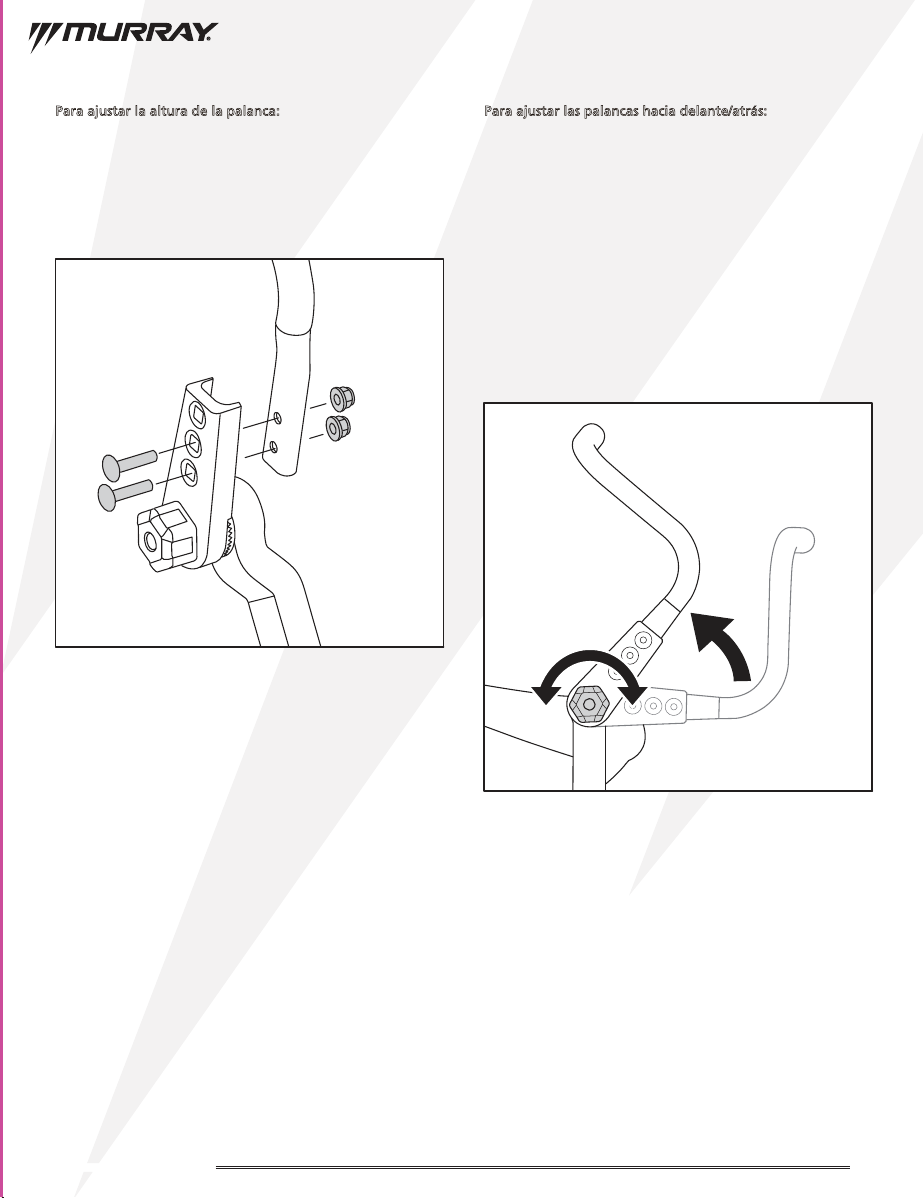
12 13
Ensamblaje de la palanca de
mando
1. Mantenga la punta más grande del ajustador de la
empuñadura superior alineada con el adaptador que fija
la palanca al cortacésped.
2. Conéctelos firmemente enroscando el pomo en el sentido
de las agujas del reloj.
3. Repita este proceso en el lado restante.
Fig. 3
Fig. 4
Para ajustar la altura de la palanca:
1. Retire los dos pernos y las dos contratuercas que fijan la
palanca de mando al ajustador superior de la empuñadura.
2. Hay dos posiciones seleccionables, con la posibilidad de
moverse hacia arriba o hacia abajo para el ajuste. Fije los
dos pernos en la posición superior o inferior. (Fig.4)
Para ajustar las palancas hacia delante/atrás:
Las palancas de control de la transmisión están diseñadas
para ser ajustables. Ajústelas a una posición cómoda para
usted antes de ponerlas en funcionamiento.
1. Gire el pomo en el sentido contrario a las agujas del reloj
para aflojarlo.
2. Levante y gire la palanca hasta la posición deseada.
3. Gire el pomo en el sentido de las agujas del reloj para
fijar la palanca en su posición.
4. Si las palancas no se alinean después de realizar el ajuste
del pomo, afloje las tuercas, alinee las palancas y vuelva a
apretar las tuercas.
Fig. 5
Fig. 2C
CORTACÉSPED DE GIRO CERO CORTACÉSPED DE GIRO CERO
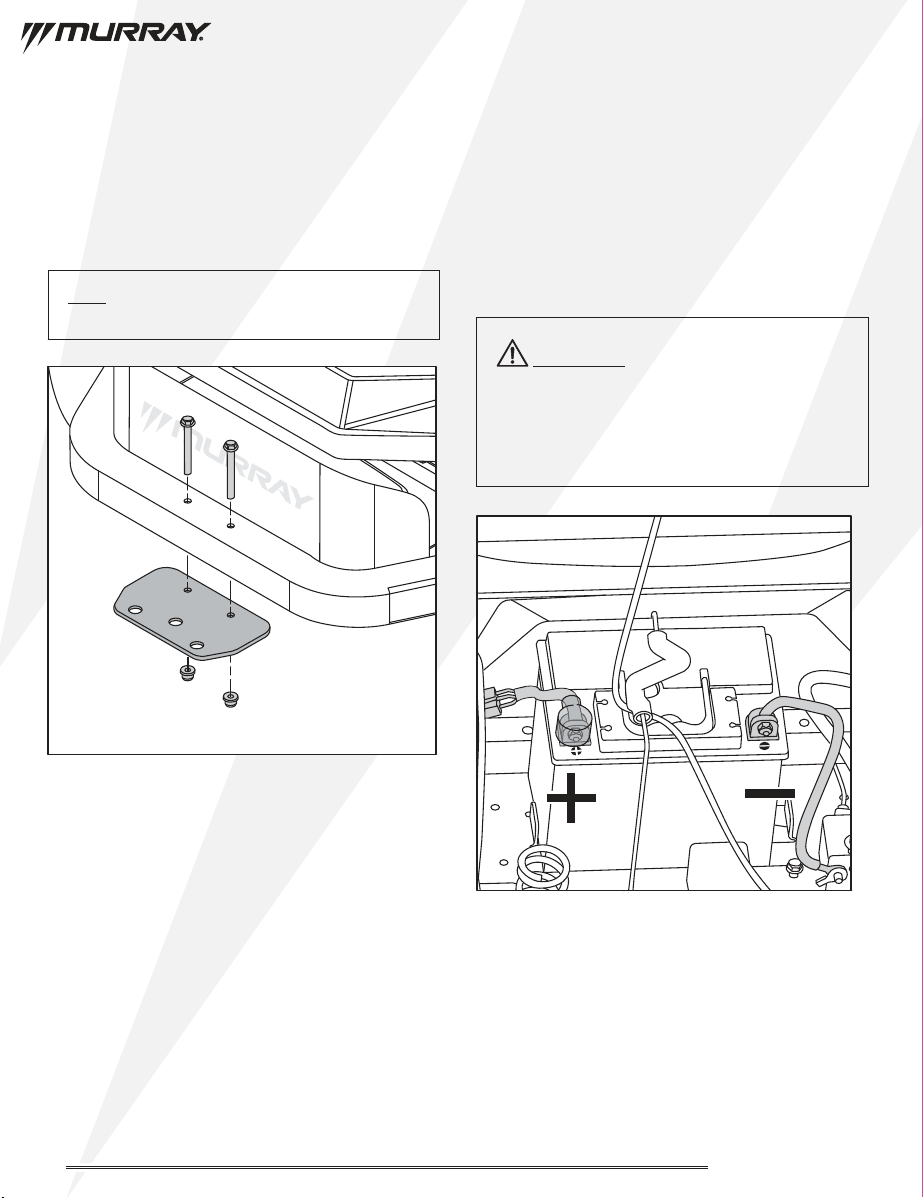
14 15
Comprobar/ajustar la presión de las llantas
Presión de llantas recomendada:
• Ponga las llantas delanteras a 20 psi
• Ponga las llantas traseras a 14 psi
Fig. 8
14 psi
20 psi
Fig. 7
AVISO: Para asegurarse de que la hierba se corta a nivel, cada llanta delantera debe ajustarse a la misma presión.
Lo mismo ocurre con las llantas traseras.
Fig. 6
Instalar el enganche
Para remolcar objetos o instalar el recogedor de hierba,
localice el enganche e instálelo en la parte trasera del
bastidor utilizando dos pernos y tuercas. Los pernos se
introducirán en la cara superior del bastidor y las tuercas se
roscarán por la parte inferior, tal como se muestra en la
Fig.6.
NOTA:
El paquete de tornillería incluye el enganche y los
pernos hexagonales.
Conectar la batería
La batería se encuentra debajo del asiento del operador.
Para conectar los cables de la batería, proceda de la sigui-
ente manera:
1. Conecte el cable positivo (rojo) a la terminal positiva de
la batería utilizando el perno y la tuerca.
2. Fije el cable negativo (negro) a la terminal negativa de la
batería utilizando el perno y la tuerca.
ADVERTENCIA: Cuando conecte los cables de la
batería, conecte siempre el cable positivo a su terminal
PRIMERO y, a continuación, conecte el cable negativo.
Además, se coloca una funda protectora sobre el cable
positivo para evitar que se conecte a tierra. Mantenga
siempre la funda protectora en su sitio cuando conecte
la batería.
CORTACÉSPED DE GIRO CERO CORTACÉSPED DE GIRO CERO
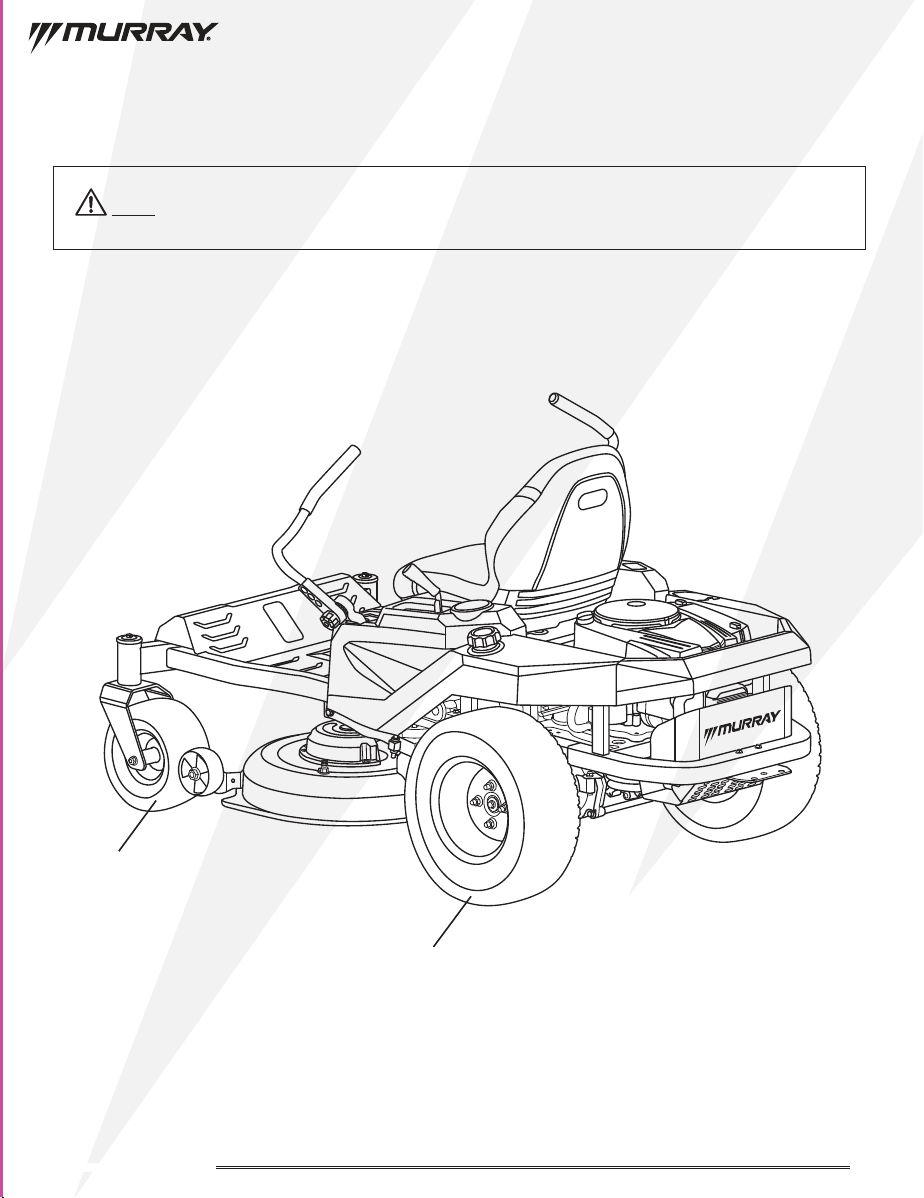
14 15
Comprobar/ajustar la presión de las llantas
Presión de llantas recomendada:
• Ponga las llantas delanteras a 20 psi
• Ponga las llantas traseras a 14 psi
Fig. 8
14 psi
20 psi
Fig. 7
AVISO: Para asegurarse de que la hierba se corta a nivel, cada llanta delantera debe ajustarse a la misma presión.
Lo mismo ocurre con las llantas traseras.
Fig. 6
Instalar el enganche
Para remolcar objetos o instalar el recogedor de hierba,
localice el enganche e instálelo en la parte trasera del
bastidor utilizando dos pernos y tuercas. Los pernos se
introducirán en la cara superior del bastidor y las tuercas se
roscarán por la parte inferior, tal como se muestra en la
Fig.6.
NOTA:
El paquete de tornillería incluye el enganche y los
pernos hexagonales.
Conectar la batería
La batería se encuentra debajo del asiento del operador.
Para conectar los cables de la batería, proceda de la sigui-
ente manera:
1. Conecte el cable positivo (rojo) a la terminal positiva de
la batería utilizando el perno y la tuerca.
2. Fije el cable negativo (negro) a la terminal negativa de la
batería utilizando el perno y la tuerca.
ADVERTENCIA: Cuando conecte los cables de la
batería, conecte siempre el cable positivo a su terminal
PRIMERO y, a continuación, conecte el cable negativo.
Además, se coloca una funda protectora sobre el cable
positivo para evitar que se conecte a tierra. Mantenga
siempre la funda protectora en su sitio cuando conecte
la batería.
CORTACÉSPED DE GIRO CERO CORTACÉSPED DE GIRO CERO
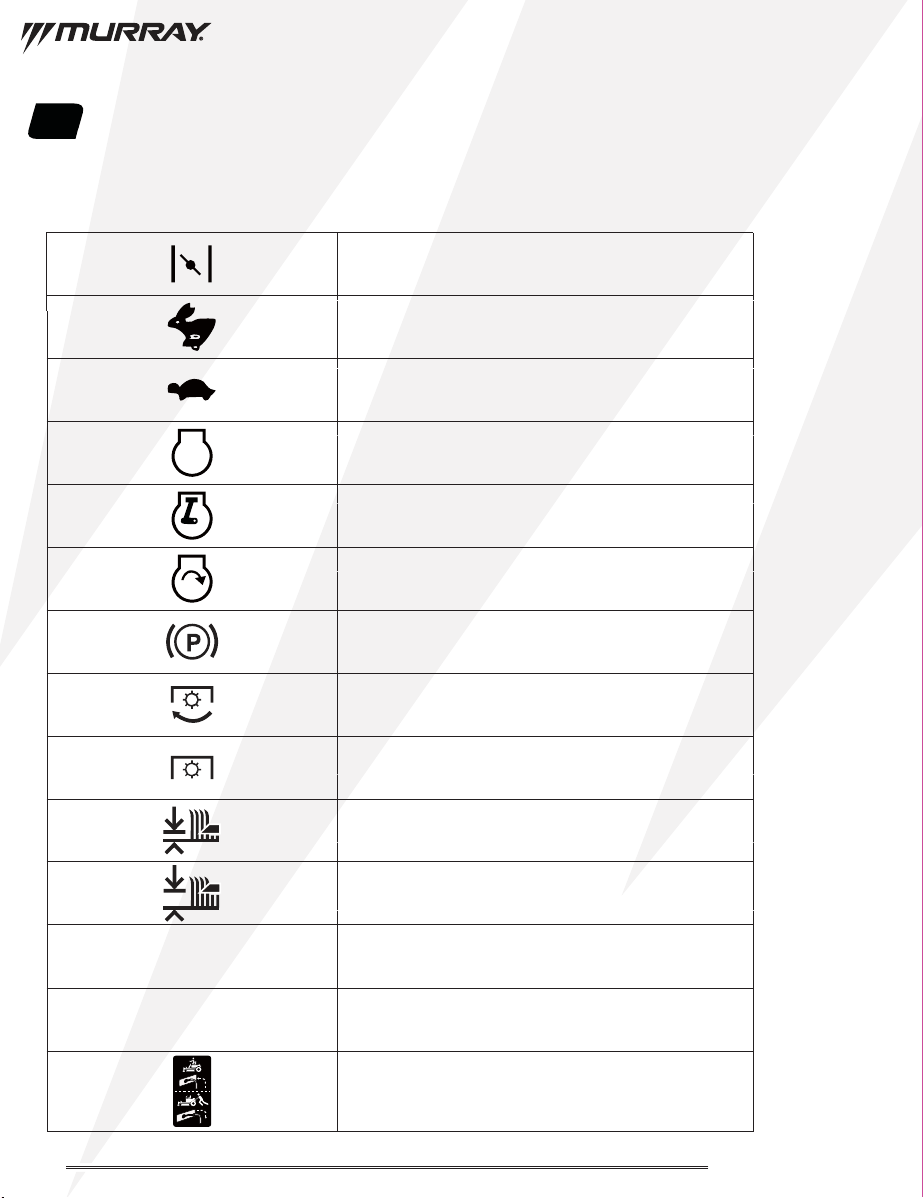
17
Interruptor de encendido
Almacenamiento
Pomo de la TDF
Llanta trasera
Canal de descarga lateral
Rueda anticaída
Palanca de mando del
acelerador/freno
Palanca de mando
Posavasos
Palanca de elevación
de la cubierta
Llanta delantera
Fig. 9
1. Nivelación de la plataforma de corte
Las palancas de control de la transmisión están situadas a
cada lado del asiento del operador. Las palancas articuladas
pivotan hacia fuera para permitir que el operador se siente
en el asiento o se desmonte. Para arrancar el motor del
cortacésped, las palancas de control de la transmisión deben
estar completamente hacia fuera y en la posición de PARK-
ING. Cuando las palancas de control de la transmisión están
totalmente hacia fuera, el freno de estacionamiento está
accionado.
Cada palanca de mando controla su transmisión respectiva.
En consecuencia, estas palancas controlan todos los movi-
mientos de la cortadora. Conducir y dirigir utilizando estas
palancas de control es bastante diferente de un cortacésped
convencional y requerirá práctica para dominarlo. Consulte
la sección Instrucciones de uso para más información.
Para mover la palanca:
R — Reversa: Tire de la palanca hacia atrás para que el
cortacésped vaya marcha atrás.
N — Neutral: Mantenga el cortacésped en punto muerto.
P — Parking: Ponga el freno de mano.
— Baja velocidad de movimiento.
— Alta velocidad de movimiento.
2. Palanca de mando del acelerador/freno:
Empuje la palanca de control del acelerador/freno hacia
delante para aumentar el régimen del motor. El cortacésped
está diseñado para funcionar con la palanca de control del
acelerador/freno al máximo (RÁPIDO) mientras se conduce y
la plataforma del cortacésped está engranada. Tire de la
palanca de control del acelerador/freno hacia atrás para
reducir la velocidad del motor. Al arrancar el motor, empuje
la palanca de control completamente hacia adelante a la
posición OBTURADOR. Después de arrancar y calentar el
motor, mueva la palanca de control hacia atrás hasta que
sienta que pasa el retén del obturador. El acelerador no está
pensado para controlar la velocidad de la unidad, el acelera-
dor debe permanecer en velocidad alta mientras las cuchillas
estén en funcionamiento.
3. Toma de fuerza (TDF)
El interruptor de la TDF acciona el clutch eléctrico de la TDF
montado en la parte inferior del cigüeñal del motor. Tire del
pomo del interruptor hacia arriba para engranar el
embrague de la TDF o empuje el pomo hacia abajo para
desembragar el clutch.
El interruptor de la TDF debe estar en la posición "OFF" al
arrancar el motor.
16
4. Características y controles
Los siguientes símbolos de control aparecen en este producto. Antes de utilizar el cortacésped, estúdielos y aprenda su significado.
Obturador
Posición del acelerador RÁPIDA
Posición del acelerador LENTA
Posición de encendido APAGADO
Posición de encendido MARCHA
Posición de encendido ARRANQUE
Freno de mano
TDF ENCENDIDA (cuchillas engranadas)
TDF APAGADA (cuchillas desengranadas)
Altura de la hierba CORTA
Altura de la hierba LARGA
El cortacésped puede empujarse a mano después de tirar
de la palanca de la válvula de derivación.
La marcha está en neutral
La marcha está en reversa
Símbolo Descripción
STOP
N
R
CORTACÉSPED DE GIRO CERO CORTACÉSPED DE GIRO CERO
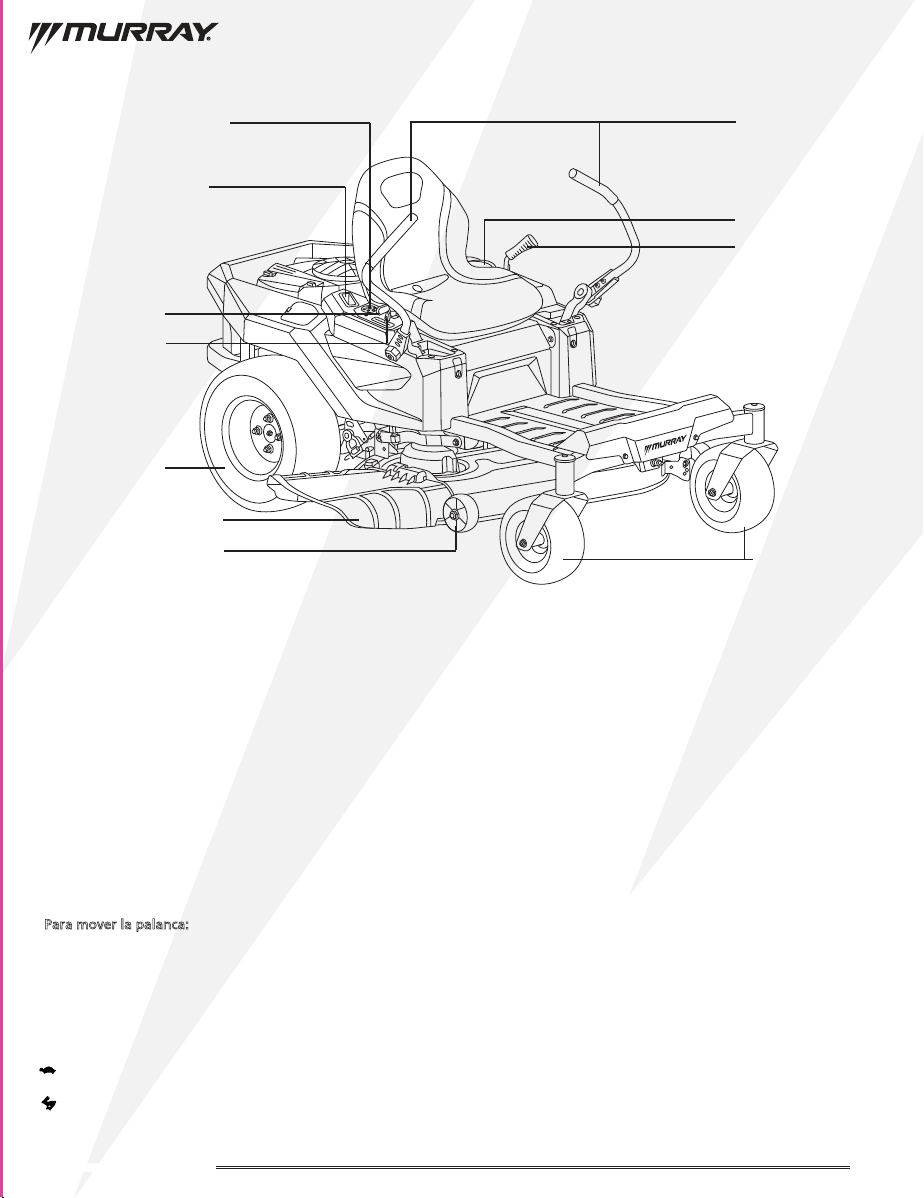
17
Interruptor de encendido
Almacenamiento
Pomo de la TDF
Llanta trasera
Canal de descarga lateral
Rueda anticaída
Palanca de mando del
acelerador/freno
Palanca de mando
Posavasos
Palanca de elevación
de la cubierta
Llanta delantera
Fig. 9
1. Nivelación de la plataforma de corte
Las palancas de control de la transmisión están situadas a
cada lado del asiento del operador. Las palancas articuladas
pivotan hacia fuera para permitir que el operador se siente
en el asiento o se desmonte. Para arrancar el motor del
cortacésped, las palancas de control de la transmisión deben
estar completamente hacia fuera y en la posición de PARK-
ING. Cuando las palancas de control de la transmisión están
totalmente hacia fuera, el freno de estacionamiento está
accionado.
Cada palanca de mando controla su transmisión respectiva.
En consecuencia, estas palancas controlan todos los movi-
mientos de la cortadora. Conducir y dirigir utilizando estas
palancas de control es bastante diferente de un cortacésped
convencional y requerirá práctica para dominarlo. Consulte
la sección Instrucciones de uso para más información.
Para mover la palanca:
R — Reversa: Tire de la palanca hacia atrás para que el
cortacésped vaya marcha atrás.
N — Neutral: Mantenga el cortacésped en punto muerto.
P — Parking: Ponga el freno de mano.
— Baja velocidad de movimiento.
— Alta velocidad de movimiento.
2. Palanca de mando del acelerador/freno:
Empuje la palanca de control del acelerador/freno hacia
delante para aumentar el régimen del motor. El cortacésped
está diseñado para funcionar con la palanca de control del
acelerador/freno al máximo (RÁPIDO) mientras se conduce y
la plataforma del cortacésped está engranada. Tire de la
palanca de control del acelerador/freno hacia atrás para
reducir la velocidad del motor. Al arrancar el motor, empuje
la palanca de control completamente hacia adelante a la
posición OBTURADOR. Después de arrancar y calentar el
motor, mueva la palanca de control hacia atrás hasta que
sienta que pasa el retén del obturador. El acelerador no está
pensado para controlar la velocidad de la unidad, el acelera-
dor debe permanecer en velocidad alta mientras las cuchillas
estén en funcionamiento.
3. Toma de fuerza (TDF)
El interruptor de la TDF acciona el clutch eléctrico de la TDF
montado en la parte inferior del cigüeñal del motor. Tire del
pomo del interruptor hacia arriba para engranar el
embrague de la TDF o empuje el pomo hacia abajo para
desembragar el clutch.
El interruptor de la TDF debe estar en la posición "OFF" al
arrancar el motor.
16
4. Características y controles
Los siguientes símbolos de control aparecen en este producto. Antes de utilizar el cortacésped, estúdielos y aprenda su significado.
Obturador
Posición del acelerador RÁPIDA
Posición del acelerador LENTA
Posición de encendido APAGADO
Posición de encendido MARCHA
Posición de encendido ARRANQUE
Freno de mano
TDF ENCENDIDA (cuchillas engranadas)
TDF APAGADA (cuchillas desengranadas)
Altura de la hierba CORTA
Altura de la hierba LARGA
El cortacésped puede empujarse a mano después de tirar
de la palanca de la válvula de derivación.
La marcha está en neutral
La marcha está en reversa
Símbolo Descripción
STOP
N
R
CORTACÉSPED DE GIRO CERO CORTACÉSPED DE GIRO CERO

18 19
6. Posavasos
El posavasos está en la parte trasera de la consola izquierda.
7. Asa de elevación de la cubierta
El asa de elevación de la cubierta se utiliza para subir y bajar
la plataforma del cortacésped. Para bajar la plataforma, tire
del asa de elevación de la cubierta hacia la derecha, fuera de
la muesca índice, y empuje hacia abajo. Para elevar la
plataforma, tire del asa hacia arriba. Asegúrese de que el
asa está completamente colocada en la muesca de índice de
altura cuando se alcance la altura deseada.
8. Tapón del depósito del tanque de combustible
Gire el tapón del depósito de combustible al menos dos clics
en el sentido contrario a las agujas del reloj y tire hacia
arriba para extraerlo. El tapón del depósito de combustible
está atado al cortacésped para evitar que se pierda. No
intente retirar el tapón del cortacésped. Llene el depósito
hasta ½" por debajo de la parte inferior del cuello de
llenado, dejando algo de espacio en el depósito para la
expansión del combustible. No llene el depósito en exceso.
Empuje el tapón hacia abajo en el cuello de llenado del
depósito de combustible y gírelo al menos dos clics en el
sentido de las agujas del reloj para apretarlo. Vuelva a
colocar siempre el tapón de combustible firmemente en el
depósito después de retirarlo.
4. Interruptor de encendido
El interruptor de encendido tiene 3 posiciones:
ALTO —
El motor y el sistema eléctrico están apagados.
MARCHA —
El motor y el sistema eléctrico están activados.
ARRANQUE
—
El sistema eléctrico del cortacésped está
activado
.
5. Almacenamiento
La bandeja de almacenamiento se encuentra en la parte
trasera de la consola derecha.
ST OP
NOTA:
Para evitar el arranque accidental y/o la descarga
de la batería, retire la llave del interruptor de encendido
cuando el cortacésped no esté en uso.
CORTACÉSPED DE GIRO CERO CORTACÉSPED DE GIRO CERO
5. Operar el cortacésped
Lea la sección Instrucciones de uso antes de utilizar esta
máquina. Asegúrese de que conoce los controles y cómo
detener la unidad en caso de emergencia.
Área de Operaciones
•
Conozca la zona en la que piensa utilizar el cortacésped.
•
Asegúrese de que la zona está libre de materiales no
deseados que puedan ser recogidos por las cuchillas y
arrojados.
•
No utilice la máquina sin que el recogedor de hierba
completo, el conducto de descarga u otros dispositivos
de seguridad estén colocados y funcionen. Compruebe
con frecuencia si hay signos de desgaste o deterioro y
sustitúyalos según sea necesario.
•
Despeje la zona de trabajo de cualquier objeto que
pueda ser arrojado o interferir en el funcionamiento de
la máquina.
•
Saque la máquina al exterior antes de arrancar el motor.
•
Observe todas las pendientes y desniveles.
•
Corte pendiente arriba y pendiente abajo,
no transversalmente.
•
Reduzca la velocidad y tenga cuidado en las pendientes.
•
No opere en pendientes de más de 15 grados.
Operar en pendientes, cerca del
PELIGRO:
agua o cerca de desniveles puede provocar la pérdida de
control y el vuelco.
•
Deje un mínimo de dos anchos de espacio libre para el
cortacésped alrededor del agua, muros de contención o
desniveles.
•
Evite cortar la hierba húmeda.
•
No utilice la máquina bajo ninguna condición en la que
se cuestione la tracción, la dirección o la estabilidad. Los
neumáticos podrían deslizarse, aunque las ruedas estén
paradas.
•
Evite arrancar y detenerse en pendientes.
•
Evite realizar cambios bruscos de velocidad o dirección.
•
Realice los giros lenta y gradualmente.
•
Tenga cuidado al utilizar la máquina con un recogedor
de hierba u otro(s) accesorio(s). Pueden afectar a la
estabilidad de la máquina.
•
Siga las recomendaciones del fabricante sobre los límites
de peso del equipo remolcado y el remolcado en
pendientes.
•
Consulte la sección "Remolcar con el cortacésped".
•
Asegúrese de que la zona de operación está libre de
transeúntes, especialmente niños.
•
Detenga el cortacésped cuando haya niños u otras
personas cerca.
•
Mantenga a los niños fuera de la zona de operaciones y
bajo la vigilancia de un adulto responsable.
•
No transporte pasajeros, especialmente niños, incluso con
la(s) cuchilla(s) apagada(s). Los niños pueden caerse y
sufrir lesiones graves o interferir en el funcionamiento
seguro de la máquina. Los niños que han dado paseos en
el pasado pueden aparecer de repente en la zona de
siega para dar otro paseo y ser atropellados o arrollados
por la máquina.
Tenga cuidado al acercarse a esquinas ciegas, arbustos,
árboles u otros objetos que dificulten la visión.
PELIGRO: Esta
cortacésped es capaz de amputar manos y pies.
PELIGRO:
Esta máquina es capaz de lanzar
objetos que lesionarán a los transeúntes o causarán daños
a los edificios.
Los motores desprenden
ADVERTENCIA:
monóxido de carbono, un gas inodoro, incoloro y venenoso.
Respirar monóxido de carbono puede provocar náuseas,
desmayos o la muerte.
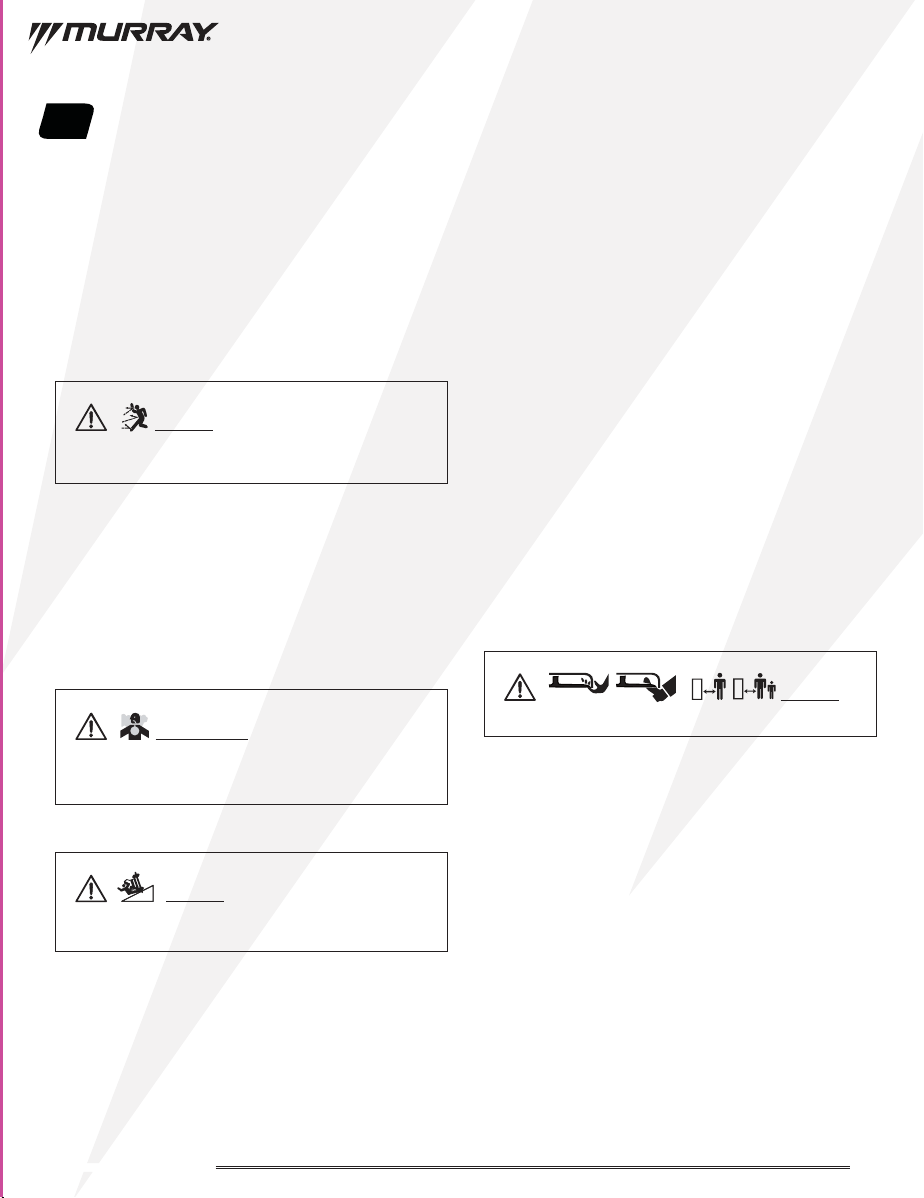
18 19
6. Posavasos
El posavasos está en la parte trasera de la consola izquierda.
7. Asa de elevación de la cubierta
El asa de elevación de la cubierta se utiliza para subir y bajar
la plataforma del cortacésped. Para bajar la plataforma, tire
del asa de elevación de la cubierta hacia la derecha, fuera de
la muesca índice, y empuje hacia abajo. Para elevar la
plataforma, tire del asa hacia arriba. Asegúrese de que el
asa está completamente colocada en la muesca de índice de
altura cuando se alcance la altura deseada.
8. Tapón del depósito del tanque de combustible
Gire el tapón del depósito de combustible al menos dos clics
en el sentido contrario a las agujas del reloj y tire hacia
arriba para extraerlo. El tapón del depósito de combustible
está atado al cortacésped para evitar que se pierda. No
intente retirar el tapón del cortacésped. Llene el depósito
hasta ½" por debajo de la parte inferior del cuello de
llenado, dejando algo de espacio en el depósito para la
expansión del combustible. No llene el depósito en exceso.
Empuje el tapón hacia abajo en el cuello de llenado del
depósito de combustible y gírelo al menos dos clics en el
sentido de las agujas del reloj para apretarlo. Vuelva a
colocar siempre el tapón de combustible firmemente en el
depósito después de retirarlo.
4. Interruptor de encendido
El interruptor de encendido tiene 3 posiciones:
ALTO —
El motor y el sistema eléctrico están apagados.
MARCHA —
El motor y el sistema eléctrico están activados.
ARRANQUE
—
El sistema eléctrico del cortacésped está
activado
.
5. Almacenamiento
La bandeja de almacenamiento se encuentra en la parte
trasera de la consola derecha.
ST OP
NOTA:
Para evitar el arranque accidental y/o la descarga
de la batería, retire la llave del interruptor de encendido
cuando el cortacésped no esté en uso.
CORTACÉSPED DE GIRO CERO CORTACÉSPED DE GIRO CERO
5. Operar el cortacésped
Lea la sección Instrucciones de uso antes de utilizar esta
máquina. Asegúrese de que conoce los controles y cómo
detener la unidad en caso de emergencia.
Área de Operaciones
•
Conozca la zona en la que piensa utilizar el cortacésped.
•
Asegúrese de que la zona está libre de materiales no
deseados que puedan ser recogidos por las cuchillas y
arrojados.
•
No utilice la máquina sin que el recogedor de hierba
completo, el conducto de descarga u otros dispositivos
de seguridad estén colocados y funcionen. Compruebe
con frecuencia si hay signos de desgaste o deterioro y
sustitúyalos según sea necesario.
•
Despeje la zona de trabajo de cualquier objeto que
pueda ser arrojado o interferir en el funcionamiento de
la máquina.
•
Saque la máquina al exterior antes de arrancar el motor.
•
Observe todas las pendientes y desniveles.
•
Corte pendiente arriba y pendiente abajo,
no transversalmente.
•
Reduzca la velocidad y tenga cuidado en las pendientes.
•
No opere en pendientes de más de 15 grados.
Operar en pendientes, cerca del
PELIGRO:
agua o cerca de desniveles puede provocar la pérdida de
control y el vuelco.
•
Deje un mínimo de dos anchos de espacio libre para el
cortacésped alrededor del agua, muros de contención o
desniveles.
•
Evite cortar la hierba húmeda.
•
No utilice la máquina bajo ninguna condición en la que
se cuestione la tracción, la dirección o la estabilidad. Los
neumáticos podrían deslizarse, aunque las ruedas estén
paradas.
•
Evite arrancar y detenerse en pendientes.
•
Evite realizar cambios bruscos de velocidad o dirección.
•
Realice los giros lenta y gradualmente.
•
Tenga cuidado al utilizar la máquina con un recogedor
de hierba u otro(s) accesorio(s). Pueden afectar a la
estabilidad de la máquina.
•
Siga las recomendaciones del fabricante sobre los límites
de peso del equipo remolcado y el remolcado en
pendientes.
•
Consulte la sección "Remolcar con el cortacésped".
•
Asegúrese de que la zona de operación está libre de
transeúntes, especialmente niños.
•
Detenga el cortacésped cuando haya niños u otras
personas cerca.
•
Mantenga a los niños fuera de la zona de operaciones y
bajo la vigilancia de un adulto responsable.
•
No transporte pasajeros, especialmente niños, incluso con
la(s) cuchilla(s) apagada(s). Los niños pueden caerse y
sufrir lesiones graves o interferir en el funcionamiento
seguro de la máquina. Los niños que han dado paseos en
el pasado pueden aparecer de repente en la zona de
siega para dar otro paseo y ser atropellados o arrollados
por la máquina.
Tenga cuidado al acercarse a esquinas ciegas, arbustos,
árboles u otros objetos que dificulten la visión.
PELIGRO: Esta
cortacésped es capaz de amputar manos y pies.
PELIGRO:
Esta máquina es capaz de lanzar
objetos que lesionarán a los transeúntes o causarán daños
a los edificios.
Los motores desprenden
ADVERTENCIA:
monóxido de carbono, un gas inodoro, incoloro y venenoso.
Respirar monóxido de carbono puede provocar náuseas,
desmayos o la muerte.
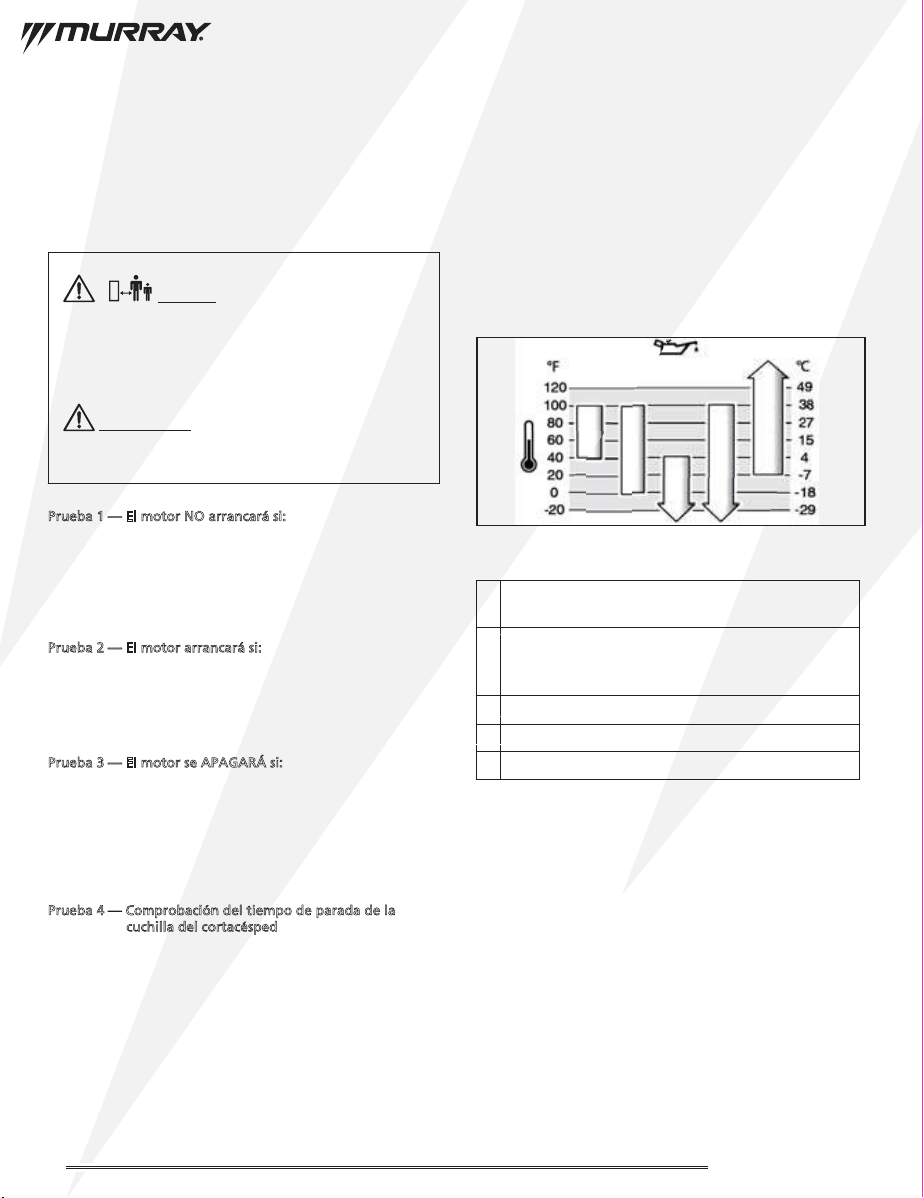
20 21
ADVERTENCIA: El combustible y sus
vapores son extremadamente inflamables y explosivos.
Manipule siempre el combustible con extremo cuidado.
El incumplimiento de estas instrucciones de seguridad
puede provocar un incendio o una explosión que podrían
causar quemaduras graves o la muerte.
AVISO: No utilice gasolina no homologada, como E15 y E85.
No mezcle aceite con gasolina ni modifique el motor para
que funcione con combustibles alternativos. El uso de
combustibles no homologados dañará los componentes del
motor, que no estarán cubiertos por la garantía.
•
ISi el nivel de aceite está LLENO, instale y apriete la varilla.
•
Si el nivel de aceite es BAJO, añada aceite en el tubo. (Fig. 12)
•
Espere un minuto y compruebe de nuevo el nivel de aceite.
•
Si el aceite del motor es suficiente, instale y apriete la
varilla de nivel.
Recomendaciones sobre
combustible
El combustible debe cumplir estos requisitos:
•
Gasolina sin plomo limpia y fresca.
•
Un mínimo de 87 octanos. Para altitudes elevadas,
consulte la sección siguiente.
•
Se acepta gasolina con hasta un 10% de etanol (gasohol).
Para proteger el sistema de combustible de la formación de
goma, mezcle un estabilizador de combustible en el combus-
tible. Consulte la sección Almacenamiento. No todos los
combustibles son iguales; si se producen problemas de
arranque o de rendimiento, cambie de proveedor o de
marca de combustible. Este motor está homologado para
funcionar con gasolina.
Gran altitud
A altitudes superiores a los 5,000 pies (1,524 metros), se
acepta un mínimo de gasolina de 85 octanos.
Para los motores carburados, se requiere un ajuste a gran
altitud para mantener el rendimiento. El funcionamiento sin
ajuste provocará una disminución del rendimiento, un
mayor consumo de combustible y un aumento de las
emisiones. Póngase en contacto con un Centro de Servicio
Autorizado Briggs & Stratton para obtener información
sobre el ajuste a gran altitud. No se recomienda el funciona-
miento del motor a altitudes inferiores a 2,500 pies (762
metros) con el ajuste de gran altitud.
Añadir combustible
Fig. 11
Fig. 12
CORTACÉSPED DE GIRO CERO CORTACÉSPED DE GIRO CERO
SAE 30 - Por debajo de 4 °C (40 °F) el uso de SAE 30
provocará un arranque difícil.
10W-30 - Por encima de 80 °F (27 °C) el uso de 10W-30
puede provocar un aumento del consumo de aceite.
Compruebe el nivel de aceite con mayor frecuencia.
A
A
B
B
C
C
D
D
E
E
5W-30
Sintético 5W-30
Vanguard
®
Sintético 15W-50
PELIGRO: Cortar marcha atrás puede ser
peligroso para los transeúntes. Pueden producirse accidentes
trágicos si el operador no está alerta a la presencia de niños.
NO corte en marcha atrás si hay niños presentes.
Los niños suelen sentirse atraídos por la máquina y la
actividad de siega.
ADVERTENCIA: Si la máquina no supera las cinco
pruebas siguientes, no la utilice. Acuda a un centro de
servicio autorizado.
Pruebas del sistema de
bloqueo de seguridad
Esta máquina está equipada con un sistema de enclavamien-
to de seguridad. No intente puentear o manipular los
interruptores y dispositivos.
Prueba 1 — El motor NO arrancará si:
•
El interruptor de la toma de fuerza (TDF) está CONECTADO, O
•
El freno de estacionamiento NO está completamente
accionado (las palancas de control de la transmisión no
están en posición hacia fuera).
Prueba 2 — El motor arrancará si:
•
La TDF está DESACTIVADA, Y
•
El freno de MANO está totalmente accionado (palancas
de control de la marcha en posición hacia fuera).
Prueba 3 — El motor se APAGARÁ si:
•
El operador se levanta del asiento con el interruptor de
la TDF ACTIVADO, O
•
El operador se levanta del asiento con el freno de
estacionamiento NO puesto del todo (las palancas de
control de marcha no están en posición hacia fuera).
Prueba 4 — Comprobación del tiempo de parada de la
cuchilla del cortacésped
Las cuchillas del cortacésped y la correa de transmisión del
cortacésped se detendrán por completo en cinco segundos
después de que el interruptor de la TDF esté DESCONECTA-
DO. Si la correa de transmisión del cortacésped no se
detiene en cinco segundos, acuda a un Servicio Técnico
Autorizado.
Motor
Comprobar y añadir aceite de motor
Utilice aceites certificados por la garantía Briggs & Stratton
®
para obtener el mejor rendimiento. Otros aceites detergentes
de alta calidad son aceptables si están clasificados para
servicio SF, SG, SH, SJ o superior. No utilice aditivos especiales.
Las temperaturas exteriores determinan la viscosidad
adecuada del aceite para el motor. Utilice la tabla para
seleccionar la mejor viscosidad para el rango de temperaturas
exteriores previsto.
Fig. 10
*Por debajo de 40°F (4°C) el uso de SAE 30 provocará un arranque difícil.
**Por encima de 80°F (27°C) el uso de 10W-30 puede provocar un aumento
del consumo de aceite.
•
Pare el motor y retire la llave. Asegúrese de que la zona
de llenado de aceite está limpia.
•
Retire la varilla de nivel de aceite del motor (a, Fig.11).
Limpie la varilla de nivel asegurándose de que no
queden restos de aceite.
•
Instale y apriete la varilla de medición.
•
Retire de nuevo la varilla y compruebe el nivel de aceite.
•
Asegúrese de que el nivel de aceite se encuentra alrededor
de la mitad de la marca LLENO de la varilla. (Fig.12).
a
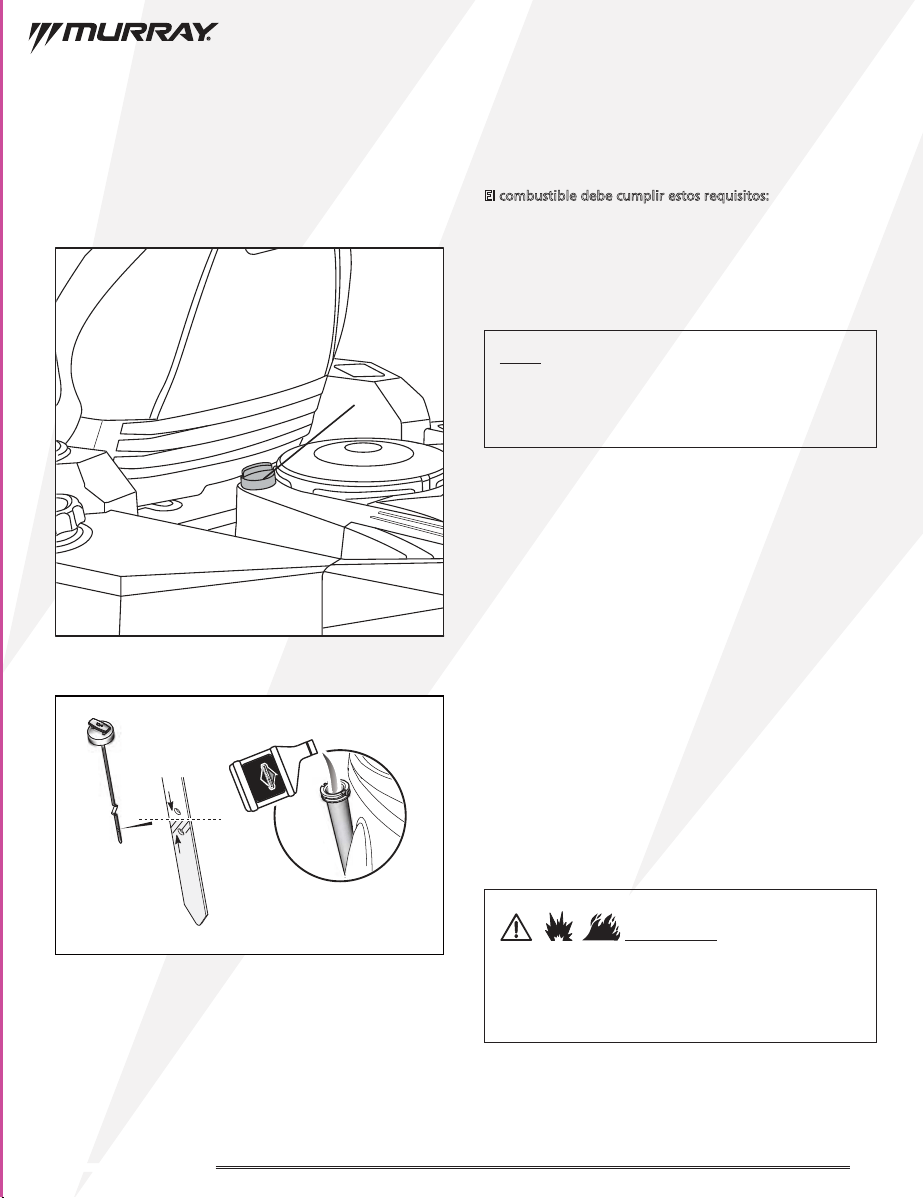
20 21
ADVERTENCIA: El combustible y sus
vapores son extremadamente inflamables y explosivos.
Manipule siempre el combustible con extremo cuidado.
El incumplimiento de estas instrucciones de seguridad
puede provocar un incendio o una explosión que podrían
causar quemaduras graves o la muerte.
AVISO: No utilice gasolina no homologada, como E15 y E85.
No mezcle aceite con gasolina ni modifique el motor para
que funcione con combustibles alternativos. El uso de
combustibles no homologados dañará los componentes del
motor, que no estarán cubiertos por la garantía.
•
ISi el nivel de aceite está LLENO, instale y apriete la varilla.
•
Si el nivel de aceite es BAJO, añada aceite en el tubo. (Fig. 12)
•
Espere un minuto y compruebe de nuevo el nivel de aceite.
•
Si el aceite del motor es suficiente, instale y apriete la
varilla de nivel.
Recomendaciones sobre
combustible
El combustible debe cumplir estos requisitos:
•
Gasolina sin plomo limpia y fresca.
•
Un mínimo de 87 octanos. Para altitudes elevadas,
consulte la sección siguiente.
•
Se acepta gasolina con hasta un 10% de etanol (gasohol).
Para proteger el sistema de combustible de la formación de
goma, mezcle un estabilizador de combustible en el combus-
tible. Consulte la sección Almacenamiento. No todos los
combustibles son iguales; si se producen problemas de
arranque o de rendimiento, cambie de proveedor o de
marca de combustible. Este motor está homologado para
funcionar con gasolina.
Gran altitud
A altitudes superiores a los 5,000 pies (1,524 metros), se
acepta un mínimo de gasolina de 85 octanos.
Para los motores carburados, se requiere un ajuste a gran
altitud para mantener el rendimiento. El funcionamiento sin
ajuste provocará una disminución del rendimiento, un
mayor consumo de combustible y un aumento de las
emisiones. Póngase en contacto con un Centro de Servicio
Autorizado Briggs & Stratton para obtener información
sobre el ajuste a gran altitud. No se recomienda el funciona-
miento del motor a altitudes inferiores a 2,500 pies (762
metros) con el ajuste de gran altitud.
Añadir combustible
Fig. 11
Fig. 12
CORTACÉSPED DE GIRO CERO CORTACÉSPED DE GIRO CERO
SAE 30 - Por debajo de 4 °C (40 °F) el uso de SAE 30
provocará un arranque difícil.
10W-30 - Por encima de 80 °F (27 °C) el uso de 10W-30
puede provocar un aumento del consumo de aceite.
Compruebe el nivel de aceite con mayor frecuencia.
A
A
B
B
C
C
D
D
E
E
5W-30
Sintético 5W-30
Vanguard
®
Sintético 15W-50
PELIGRO: Cortar marcha atrás puede ser
peligroso para los transeúntes. Pueden producirse accidentes
trágicos si el operador no está alerta a la presencia de niños.
NO corte en marcha atrás si hay niños presentes.
Los niños suelen sentirse atraídos por la máquina y la
actividad de siega.
ADVERTENCIA: Si la máquina no supera las cinco
pruebas siguientes, no la utilice. Acuda a un centro de
servicio autorizado.
Pruebas del sistema de
bloqueo de seguridad
Esta máquina está equipada con un sistema de enclavamien-
to de seguridad. No intente puentear o manipular los
interruptores y dispositivos.
Prueba 1 — El motor NO arrancará si:
•
El interruptor de la toma de fuerza (TDF) está CONECTADO, O
•
El freno de estacionamiento NO está completamente
accionado (las palancas de control de la transmisión no
están en posición hacia fuera).
Prueba 2 — El motor arrancará si:
•
La TDF está DESACTIVADA, Y
•
El freno de MANO está totalmente accionado (palancas
de control de la marcha en posición hacia fuera).
Prueba 3 — El motor se APAGARÁ si:
•
El operador se levanta del asiento con el interruptor de
la TDF ACTIVADO, O
•
El operador se levanta del asiento con el freno de
estacionamiento NO puesto del todo (las palancas de
control de marcha no están en posición hacia fuera).
Prueba 4 — Comprobación del tiempo de parada de la
cuchilla del cortacésped
Las cuchillas del cortacésped y la correa de transmisión del
cortacésped se detendrán por completo en cinco segundos
después de que el interruptor de la TDF esté DESCONECTA-
DO. Si la correa de transmisión del cortacésped no se
detiene en cinco segundos, acuda a un Servicio Técnico
Autorizado.
Motor
Comprobar y añadir aceite de motor
Utilice aceites certificados por la garantía Briggs & Stratton
®
para obtener el mejor rendimiento. Otros aceites detergentes
de alta calidad son aceptables si están clasificados para
servicio SF, SG, SH, SJ o superior. No utilice aditivos especiales.
Las temperaturas exteriores determinan la viscosidad
adecuada del aceite para el motor. Utilice la tabla para
seleccionar la mejor viscosidad para el rango de temperaturas
exteriores previsto.
Fig. 10
*Por debajo de 40°F (4°C) el uso de SAE 30 provocará un arranque difícil.
**Por encima de 80°F (27°C) el uso de 10W-30 puede provocar un aumento
del consumo de aceite.
•
Pare el motor y retire la llave. Asegúrese de que la zona
de llenado de aceite está limpia.
•
Retire la varilla de nivel de aceite del motor (a, Fig.11).
Limpie la varilla de nivel asegurándose de que no
queden restos de aceite.
•
Instale y apriete la varilla de medición.
•
Retire de nuevo la varilla y compruebe el nivel de aceite.
•
Asegúrese de que el nivel de aceite se encuentra alrededor
de la mitad de la marca LLENO de la varilla. (Fig.12).
a
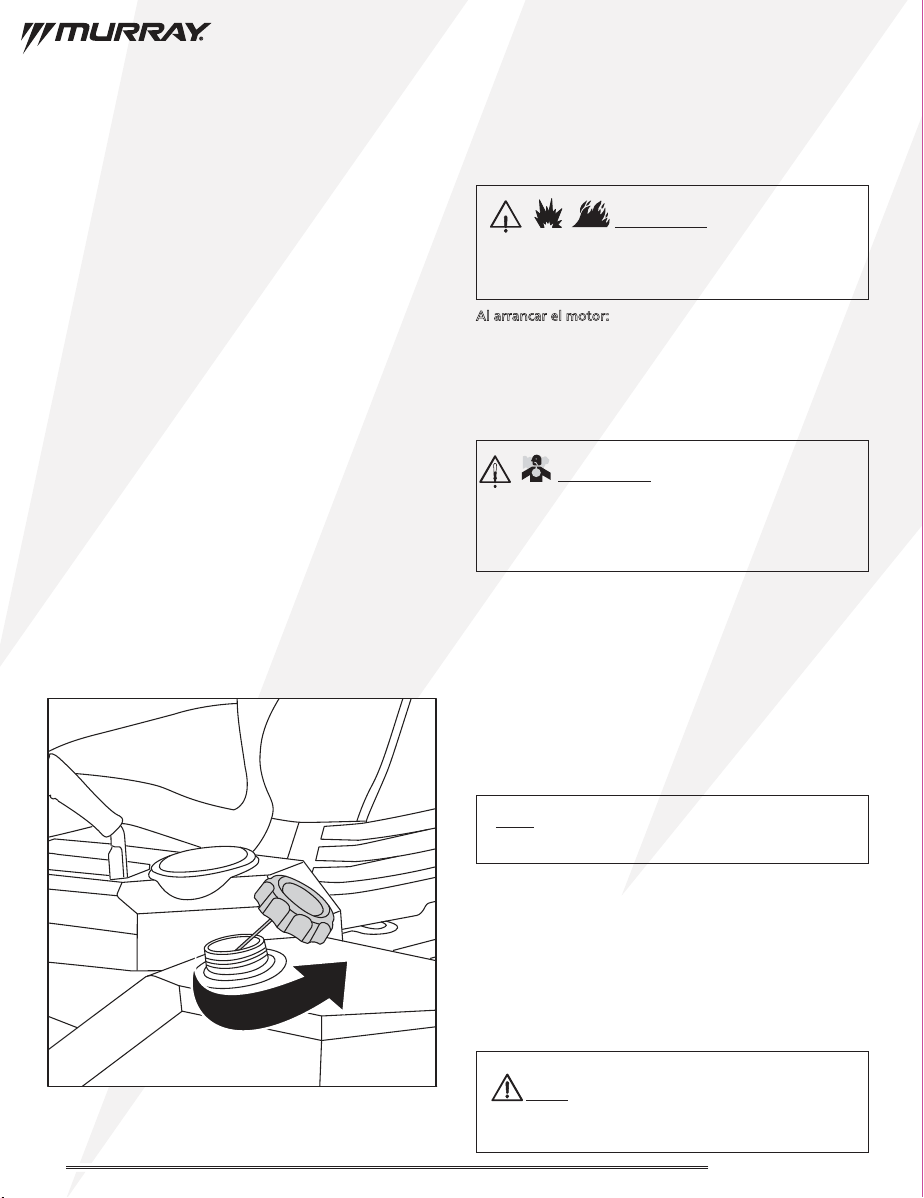
22 23
ADVERTENCIA: El combustible y sus
vapores son extremadamente inflamables y explosivos.
Un incendio o una explosión pueden causar quemaduras
graves o la muerte.
AVISO:
Cuando utilice el cortacésped con la cuchilla de
corte engranada, ponga el acelerador en la posición RÁPIDO.
AVISO:
En caso de emergencia, gire el interruptor de
encendido a la posición ALTO. Esto PARARÁ el motor.
Uso de la palanca de
acelerador/freno
La palanca del acelerador/freno está situada en el panel
derecho. Cuando arranque el motor en frío, empuje la
palanca del acelerador/freno completamente hacia delante
hasta la posición "ALTO" . (Fig.14)
El propósito del "ALTO" es restringir el flujo de aire para
que la mezcla de combustible y aire se haga más rica (más
combustible, menos aire) lo que ayuda al arranque del
motor. Después de arrancar el motor, mueva la palanca del
acelerador/freno hacia atrás a la posición RÁPIDO. El
operador sentirá que la palanca se mueve más allá del retén
del estrangulador cuando empuje la palanca hacia atrás.
Fig. 14
Detener el motor
No ahogue el carburador para parar el motor.
1. Si las cuchillas están enganchadas, desengánchelas.
2. Mueva las palancas de mando a la posición neutra.
3. Mueva las palancas de control a la posición de
estacionamiento.
4. Mueva el acelerador a la posición LENTO.
5.
Gire la llave de contacto a la posición ALTO. Retire la llave.
Al añadir combustible
•
Pare el motor y deje que se enfríe durante al menos 3
minutos antes de quitar el tapón de combustible.
•
Apague todos los cigarrillos, puros, pipas y otras fuentes
de ignición.
•
Llene el depósito de combustible al aire libre o en una
zona bien ventilada.
•
No llene en exceso el tanque. Para permitir la expansión
del combustible, no llene por encima del fondo del
cuello del tanque.
•
Mantenga el combustible alejado de chispas, llamas
abiertas, pilotos, calor y otras fuentes de ignición.
•
Compruebe si hay grietas o fugas en los conductos de
combustible, tanque y tapón. Sustitúyalos si es necesario.
•
Si se derrama combustible, espere a que se evapore
antes de arrancar el motor y evite crear cualquier fuente
de ignición.
•
Sólo utilice un recipiente de combustible homologado.
1. Retire cualquier resto de suciedad de la zona del tapón.
2. Retire el tapón de combustible (Fig.13)
3.
Utilice un embudo cuando llene el depósito de combustible.
Controle la palanca del combustible mirando el depósito
transparente situado detrás del asiento del operador. NO
llene por encima de la parte inferior del cuello del
depósito de combustible.
4. Instale el tapón de combustible.
El combustible y sus
ADVERTENCIA:
vapores son extremadamente inflamables y explosivos.
Un incendio o una explosión pueden causar quemaduras
graves o la muerte.
ADVERTENCIA:Los motores desprenden
monóxide de carbono un gas inodoro, incoloro y venenoso.
Respirar monóxide de carbono puede provocar náuseas.
desmayos o la muerte Un incendio o una explosión pueden
causar quemaduras graves o la muerte.
Instrucciones de uso
Arrancar el motor
Al arrancar el motor:
•
Make sure that the spark plug, muffler, fuel cap, and air
filter are installed correctly.
•
Do not crank the engine with spark plug removed.
•
If the engine floods, move the throttle to the FAST
position and crank until engine starts.
•
Arranque y haga funcionar el motor al aire libre.
•
No arranque el motor en un lugar cerrado, aunque las
puertas o ventanas estén abiertas.
1. Compruebe el nivel de aceite. Consulte la sección
Comprobar y añadir aceite de motor.
2. El operador debe estar sentado en el asiento del
cortacésped con las palancas de control de la transmisión
totalmente hacia fuera y en la posición de estacionamiento.
3. Asegúrese de que la TDF está en la posición "OFF".
Mueva el mando del estrangulador o el mando del
acelerador/estrangulador a la posición de estrangulador total.
4. Gire la llave en el sentido de las agujas del reloj hasta la
posición ARRANQUE. Después de que el motor arranque,
suelte la llave. Volverá a la posición MARCHA.
5. A medida que el motor se calienta, tire gradualmente de
la palanca de control del acelerador/freno hacia atrás,
más allá de la posición de retención del estrangulador.
No utilice la posición del estrangulador para enriquecer
la mezcla de combustible, excepto cuando sea necesario
para arrancar el motor.
6. Deje que el motor funcione durante unos minutos a
medio gas antes de ponerlo bajo carga.
NOTA:
Si el motor está caliente, puede que no sea
necesario detenerlo.
Fig. 13
AVISO: En caso de emergencia, gire el interruptor
de encendido a la posición ALTO. Esto detendrá el motor.
Consulte la sección Parar el motor.
CORTACÉSPED DE GIRO CERO CORTACÉSPED DE GIRO CERO
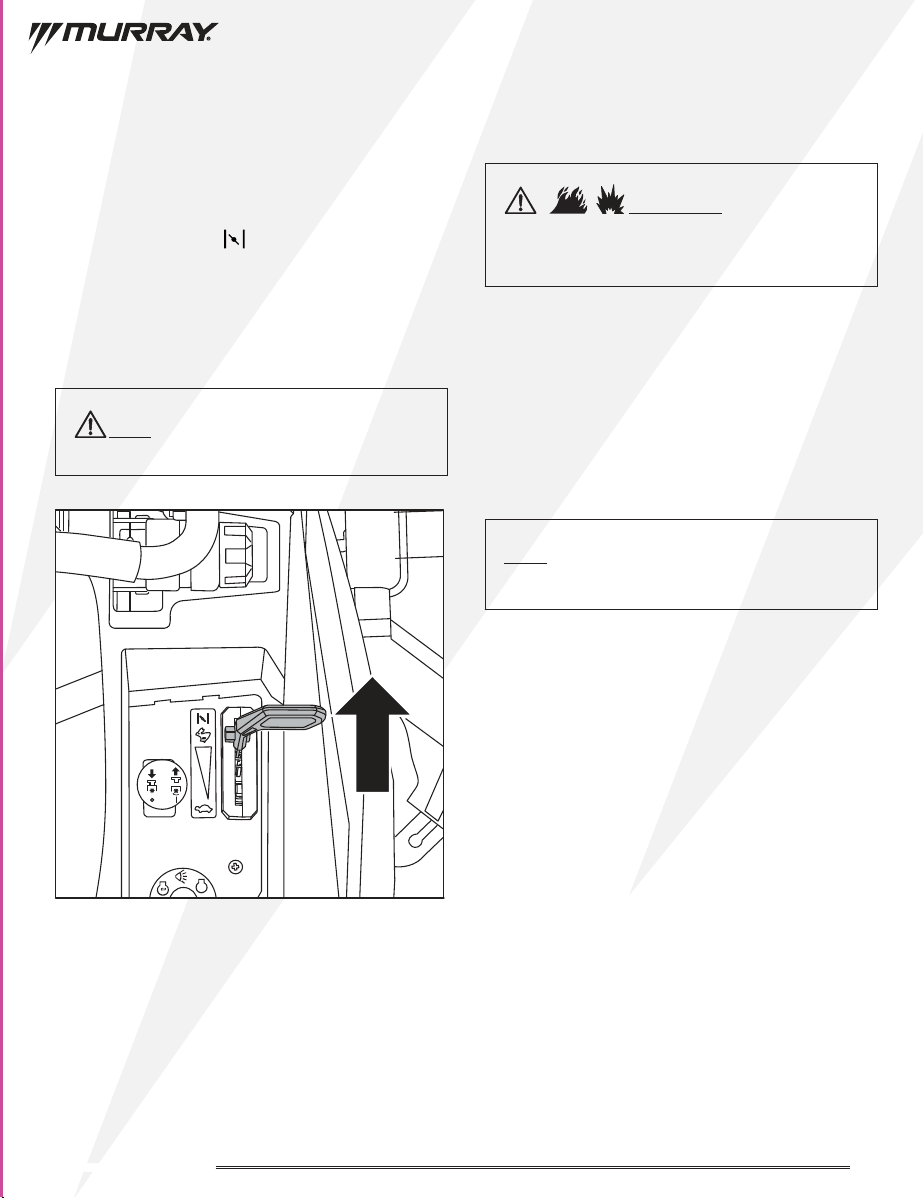
22 23
ADVERTENCIA: El combustible y sus
vapores son extremadamente inflamables y explosivos.
Un incendio o una explosión pueden causar quemaduras
graves o la muerte.
AVISO:
Cuando utilice el cortacésped con la cuchilla de
corte engranada, ponga el acelerador en la posición RÁPIDO.
AVISO:
En caso de emergencia, gire el interruptor de
encendido a la posición ALTO. Esto PARARÁ el motor.
Uso de la palanca de
acelerador/freno
La palanca del acelerador/freno está situada en el panel
derecho. Cuando arranque el motor en frío, empuje la
palanca del acelerador/freno completamente hacia delante
hasta la posición "ALTO" . (Fig.14)
El propósito del "ALTO" es restringir el flujo de aire para
que la mezcla de combustible y aire se haga más rica (más
combustible, menos aire) lo que ayuda al arranque del
motor. Después de arrancar el motor, mueva la palanca del
acelerador/freno hacia atrás a la posición RÁPIDO. El
operador sentirá que la palanca se mueve más allá del retén
del estrangulador cuando empuje la palanca hacia atrás.
Fig. 14
Detener el motor
No ahogue el carburador para parar el motor.
1. Si las cuchillas están enganchadas, desengánchelas.
2. Mueva las palancas de mando a la posición neutra.
3. Mueva las palancas de control a la posición de
estacionamiento.
4. Mueva el acelerador a la posición LENTO.
5.
Gire la llave de contacto a la posición ALTO. Retire la llave.
Al añadir combustible
•
Pare el motor y deje que se enfríe durante al menos 3
minutos antes de quitar el tapón de combustible.
•
Apague todos los cigarrillos, puros, pipas y otras fuentes
de ignición.
•
Llene el depósito de combustible al aire libre o en una
zona bien ventilada.
•
No llene en exceso el tanque. Para permitir la expansión
del combustible, no llene por encima del fondo del
cuello del tanque.
•
Mantenga el combustible alejado de chispas, llamas
abiertas, pilotos, calor y otras fuentes de ignición.
•
Compruebe si hay grietas o fugas en los conductos de
combustible, tanque y tapón. Sustitúyalos si es necesario.
•
Si se derrama combustible, espere a que se evapore
antes de arrancar el motor y evite crear cualquier fuente
de ignición.
•
Sólo utilice un recipiente de combustible homologado.
1. Retire cualquier resto de suciedad de la zona del tapón.
2. Retire el tapón de combustible (Fig.13)
3.
Utilice un embudo cuando llene el depósito de combustible.
Controle la palanca del combustible mirando el depósito
transparente situado detrás del asiento del operador. NO
llene por encima de la parte inferior del cuello del
depósito de combustible.
4. Instale el tapón de combustible.
El combustible y sus
ADVERTENCIA:
vapores son extremadamente inflamables y explosivos.
Un incendio o una explosión pueden causar quemaduras
graves o la muerte.
ADVERTENCIA:Los motores desprenden
monóxide de carbono un gas inodoro, incoloro y venenoso.
Respirar monóxide de carbono puede provocar náuseas.
desmayos o la muerte Un incendio o una explosión pueden
causar quemaduras graves o la muerte.
Instrucciones de uso
Arrancar el motor
Al arrancar el motor:
•
Make sure that the spark plug, muffler, fuel cap, and air
filter are installed correctly.
•
Do not crank the engine with spark plug removed.
•
If the engine floods, move the throttle to the FAST
position and crank until engine starts.
•
Arranque y haga funcionar el motor al aire libre.
•
No arranque el motor en un lugar cerrado, aunque las
puertas o ventanas estén abiertas.
1. Compruebe el nivel de aceite. Consulte la sección
Comprobar y añadir aceite de motor.
2. El operador debe estar sentado en el asiento del
cortacésped con las palancas de control de la transmisión
totalmente hacia fuera y en la posición de estacionamiento.
3. Asegúrese de que la TDF está en la posición "OFF".
Mueva el mando del estrangulador o el mando del
acelerador/estrangulador a la posición de estrangulador total.
4. Gire la llave en el sentido de las agujas del reloj hasta la
posición ARRANQUE. Después de que el motor arranque,
suelte la llave. Volverá a la posición MARCHA.
5. A medida que el motor se calienta, tire gradualmente de
la palanca de control del acelerador/freno hacia atrás,
más allá de la posición de retención del estrangulador.
No utilice la posición del estrangulador para enriquecer
la mezcla de combustible, excepto cuando sea necesario
para arrancar el motor.
6. Deje que el motor funcione durante unos minutos a
medio gas antes de ponerlo bajo carga.
NOTA:
Si el motor está caliente, puede que no sea
necesario detenerlo.
Fig. 13
AVISO: En caso de emergencia, gire el interruptor
de encendido a la posición ALTO. Esto detendrá el motor.
Consulte la sección Parar el motor.
CORTACÉSPED DE GIRO CERO CORTACÉSPED DE GIRO CERO
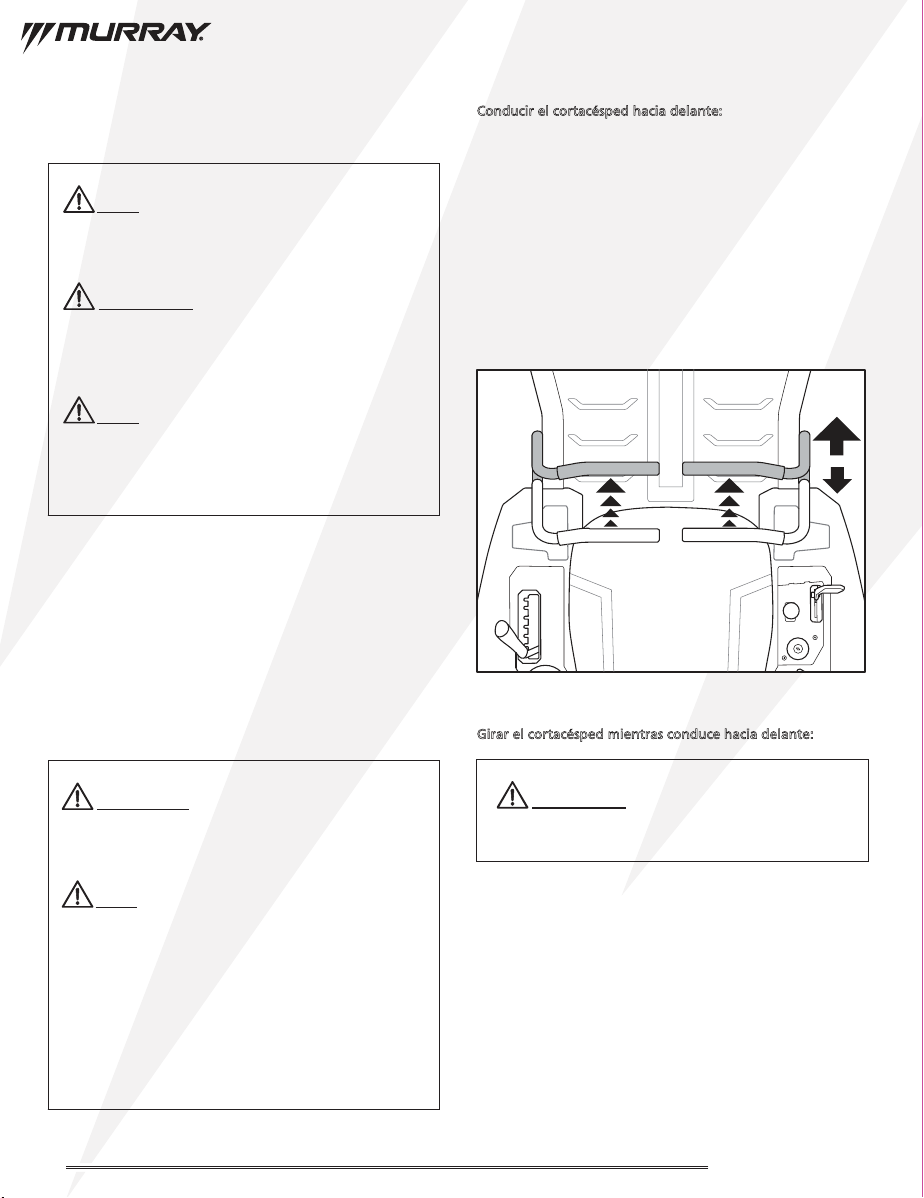
24 25
Fig.16A
Fig.16B
Conducir el cortacésped en reversa:
1. Desde la posición neutra, mueva lenta y uniformemente
hacia atrás ambas palancas de mando. El cortacésped
comenzará a moverse en sentido inverso.
2. A medida que las palancas de mando se empujan más
hacia atrás, la velocidad del cortacésped aumentará.
3. Para reducir la velocidad del cortacésped, mueva las
palancas de mando hacia delante hasta alcanzar la
velocidad deseada o mueva las palancas de mando a la
posición neutra para detener el cortacésped.
NOTA:
Realizar un "giro de pivote" sobre hierba aumentará
en gran medida el potencial de desfiguración del césped.
Fig.18A
Fig.17
Girar el cortacésped mientras conduce hacia atrás:
Para girar el cortacésped conduciendo hacia atrás, mueva las
palancas de mando lo necesario para que una palanca de
mando esté más adelantada que la otra. El cortacésped
girará en la dirección de la palanca de control de tracción
adelantada.
1. Para girar a la derecha mientras circula marcha atrás,
mueva la palanca de mando de la tracción izquierda
hacia delante de la palanca de mando de la tracción
derecha. (Fig.18A)
2. Para girar a la izquierda mientras circula marcha atrás,
mueva la palanca de mando de la tracción derecha hacia
delante de la palanca de mando de la tracción izquierda.
(Fig.18B)
ADVERTENCIA: Mantenga todos los movimientos de
las palancas de control lentos y suaves. Un movimiento
brusco de las palancas puede afectar a la estabilidad del
cortacésped y podría hacer que éste volcase, lo que podría
provocar lesiones graves o incluso la muerte del operador.
AVISO: Este cortacésped no está equipado con
acelerador. La velocidad del cortacésped se controla
mediante la posición de las palancas y la posición del
acelerador.
AVISO: El manejo de un cortacésped giro cero no es
como el de un cortacésped de montar de tipo convencional.
Los operadores noveles deben familiarizarse completamente
con el funcionamiento y los controles del cortacésped antes
de utilizarlo.
AVISO: Las palancas de control de la transmisión
deben moverse completamente hacia dentro antes de
empujar hacia delante o hacia atrás para asegurarse de
que los frenos están totalmente desembragados.
Estacionar el cortacésped en un terreno irregular o en
una pendiente puede hacer que los frenos se atasquen y
no se suelten completamente. En este caso, el cortacésped
no se pondrá en marcha cuando se muevan las palancas
de control de la transmisión. Si esto ocurre, mueva la
palanca de control de la transmisión en la dirección
opuesta ligeramente para quitar la carga de los frenos y
permitir que se liberen completamente.
ADVERTENCIA: Mantenga siempre un agarre firme
de las palancas de control. NO suelte las palancas de
control para ralentizar o detener el cortacésped; mueva
las palancas a la posición neutra utilizando las manos.
ADVERTENCIA: Los giros bruscos pueden afectar al
control del cortacésped. Reduzca SIEMPRE la velocidad
del cortacésped antes de realizar giros bruscos.
ADVERTENCIA:
Mire siempre hacia atrás y hacia abajo
a ambos lados del cortacésped antes de retroceder. Mire
siempre hacia atrás mientras circula en sentido inverso.
No se recomienda cortar en marcha atrás.
Conducir el cortacésped
1. Ajuste el asiento del operador a la posición más cómoda
que le permita manejar los mandos.
2. Mueva las dos palancas de control de la transmisión hasta
la posición neutra. Esto desconecta el freno de mano.
3. Mueva la palanca del acelerador a la posición de máxima
aceleración.
4. Para conducir el cortacésped, agarre firmemente las
respectivas palancas de control de la transmisión con las
manos derecha e izquierda y continúe con Conducción
del cortacésped hacia delante en la sección siguiente.
Conducir el cortacésped hacia delante:
1. Desde la posición neutra, mueva lenta y uniformemente
ambas palancas de control de la transmisión hacia
delante. El cortacésped empezará a avanzar.
2. A medida que las palancas de mando se empujan más
hacia delante, la velocidad del cortacésped aumentará.
3. Para reducir la velocidad del cortacésped, mueva las
palancas de mando hacia atrás hasta alcanzar la velocidad
deseada o mueva las palancas de mando a la posición
neutra para detener el cortacésped.
Conducir hacia adelante
Fig. 15
Girar el cortacésped mientras conduce hacia delante:
Para girar el cortacésped conduciendo hacia delante, mueva
las palancas de mando lo necesario para que una palanca de
mando esté hacia atrás de la otra. El cortacésped girará en la
dirección de la palanca de mando de marcha hacia atrás.
1. Para girar a la derecha, mueva la palanca de mando de la
transmisión derecha hacia delante de la palanca de
mando de la transmisión izquierda. (Fig.16A)
2.
Para girar a la izquierda, mueva la palanca de mando de marcha
izquierda hacia atrás de la palanca derecha. (Fig.16B)
3. Cuanto mayor sea la distancia entre las dos palancas, más
bruscamente girará el cortacésped.
CORTACÉSPED DE GIRO CERO CORTACÉSPED DE GIRO CERO
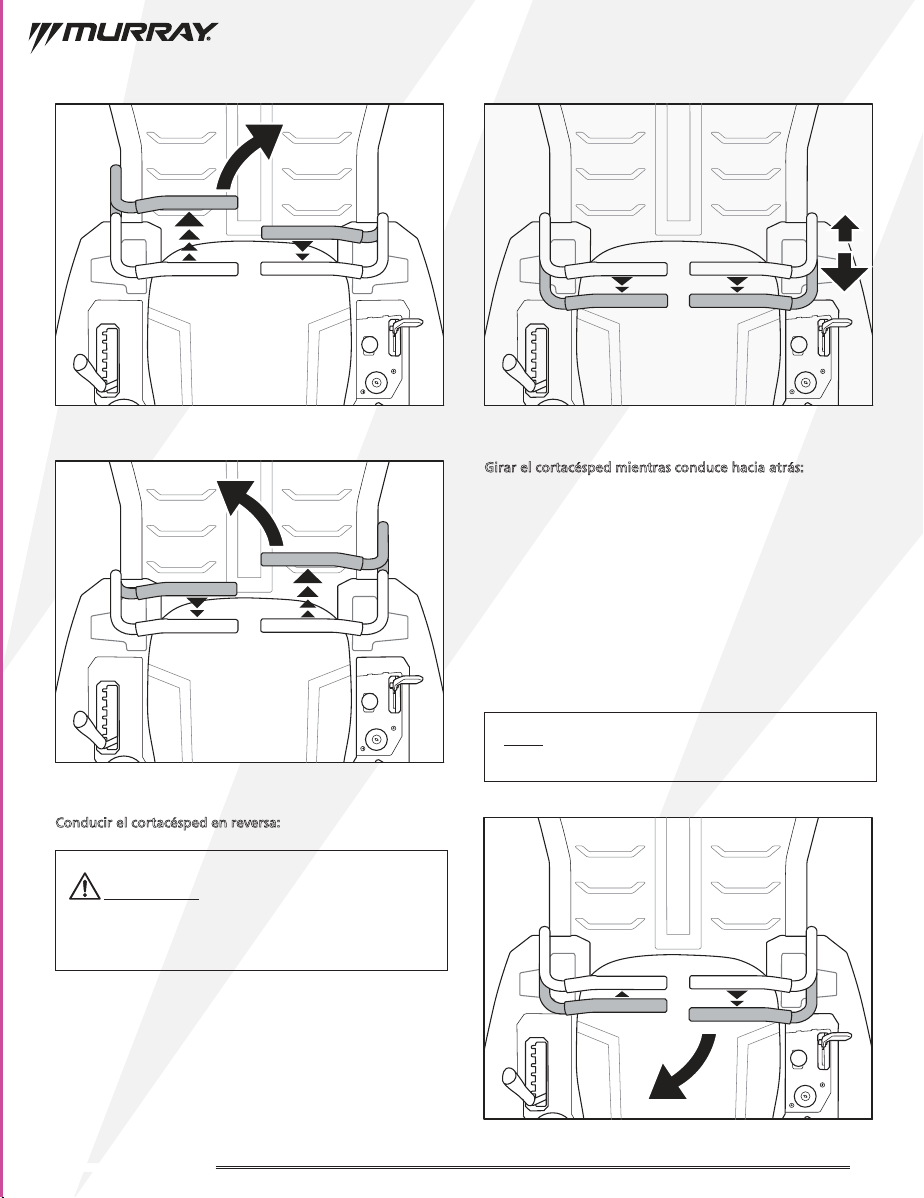
24 25
Fig.16A
Fig.16B
Conducir el cortacésped en reversa:
1. Desde la posición neutra, mueva lenta y uniformemente
hacia atrás ambas palancas de mando. El cortacésped
comenzará a moverse en sentido inverso.
2. A medida que las palancas de mando se empujan más
hacia atrás, la velocidad del cortacésped aumentará.
3. Para reducir la velocidad del cortacésped, mueva las
palancas de mando hacia delante hasta alcanzar la
velocidad deseada o mueva las palancas de mando a la
posición neutra para detener el cortacésped.
NOTA:
Realizar un "giro de pivote" sobre hierba aumentará
en gran medida el potencial de desfiguración del césped.
Fig.18A
Fig.17
Girar el cortacésped mientras conduce hacia atrás:
Para girar el cortacésped conduciendo hacia atrás, mueva las
palancas de mando lo necesario para que una palanca de
mando esté más adelantada que la otra. El cortacésped
girará en la dirección de la palanca de control de tracción
adelantada.
1. Para girar a la derecha mientras circula marcha atrás,
mueva la palanca de mando de la tracción izquierda
hacia delante de la palanca de mando de la tracción
derecha. (Fig.18A)
2. Para girar a la izquierda mientras circula marcha atrás,
mueva la palanca de mando de la tracción derecha hacia
delante de la palanca de mando de la tracción izquierda.
(Fig.18B)
ADVERTENCIA: Mantenga todos los movimientos de
las palancas de control lentos y suaves. Un movimiento
brusco de las palancas puede afectar a la estabilidad del
cortacésped y podría hacer que éste volcase, lo que podría
provocar lesiones graves o incluso la muerte del operador.
AVISO: Este cortacésped no está equipado con
acelerador. La velocidad del cortacésped se controla
mediante la posición de las palancas y la posición del
acelerador.
AVISO: El manejo de un cortacésped giro cero no es
como el de un cortacésped de montar de tipo convencional.
Los operadores noveles deben familiarizarse completamente
con el funcionamiento y los controles del cortacésped antes
de utilizarlo.
AVISO: Las palancas de control de la transmisión
deben moverse completamente hacia dentro antes de
empujar hacia delante o hacia atrás para asegurarse de
que los frenos están totalmente desembragados.
Estacionar el cortacésped en un terreno irregular o en
una pendiente puede hacer que los frenos se atasquen y
no se suelten completamente. En este caso, el cortacésped
no se pondrá en marcha cuando se muevan las palancas
de control de la transmisión. Si esto ocurre, mueva la
palanca de control de la transmisión en la dirección
opuesta ligeramente para quitar la carga de los frenos y
permitir que se liberen completamente.
ADVERTENCIA: Mantenga siempre un agarre firme
de las palancas de control. NO suelte las palancas de
control para ralentizar o detener el cortacésped; mueva
las palancas a la posición neutra utilizando las manos.
ADVERTENCIA: Los giros bruscos pueden afectar al
control del cortacésped. Reduzca SIEMPRE la velocidad
del cortacésped antes de realizar giros bruscos.
ADVERTENCIA:
Mire siempre hacia atrás y hacia abajo
a ambos lados del cortacésped antes de retroceder. Mire
siempre hacia atrás mientras circula en sentido inverso.
No se recomienda cortar en marcha atrás.
Conducir el cortacésped
1. Ajuste el asiento del operador a la posición más cómoda
que le permita manejar los mandos.
2. Mueva las dos palancas de control de la transmisión hasta
la posición neutra. Esto desconecta el freno de mano.
3. Mueva la palanca del acelerador a la posición de máxima
aceleración.
4. Para conducir el cortacésped, agarre firmemente las
respectivas palancas de control de la transmisión con las
manos derecha e izquierda y continúe con Conducción
del cortacésped hacia delante en la sección siguiente.
Conducir el cortacésped hacia delante:
1. Desde la posición neutra, mueva lenta y uniformemente
ambas palancas de control de la transmisión hacia
delante. El cortacésped empezará a avanzar.
2. A medida que las palancas de mando se empujan más
hacia delante, la velocidad del cortacésped aumentará.
3. Para reducir la velocidad del cortacésped, mueva las
palancas de mando hacia atrás hasta alcanzar la velocidad
deseada o mueva las palancas de mando a la posición
neutra para detener el cortacésped.
Conducir hacia adelante
Fig. 15
Girar el cortacésped mientras conduce hacia delante:
Para girar el cortacésped conduciendo hacia delante, mueva
las palancas de mando lo necesario para que una palanca de
mando esté hacia atrás de la otra. El cortacésped girará en la
dirección de la palanca de mando de marcha hacia atrás.
1. Para girar a la derecha, mueva la palanca de mando de la
transmisión derecha hacia delante de la palanca de
mando de la transmisión izquierda. (Fig.16A)
2.
Para girar a la izquierda, mueva la palanca de mando de marcha
izquierda hacia atrás de la palanca derecha. (Fig.16B)
3. Cuanto mayor sea la distancia entre las dos palancas, más
bruscamente girará el cortacésped.
CORTACÉSPED DE GIRO CERO CORTACÉSPED DE GIRO CERO
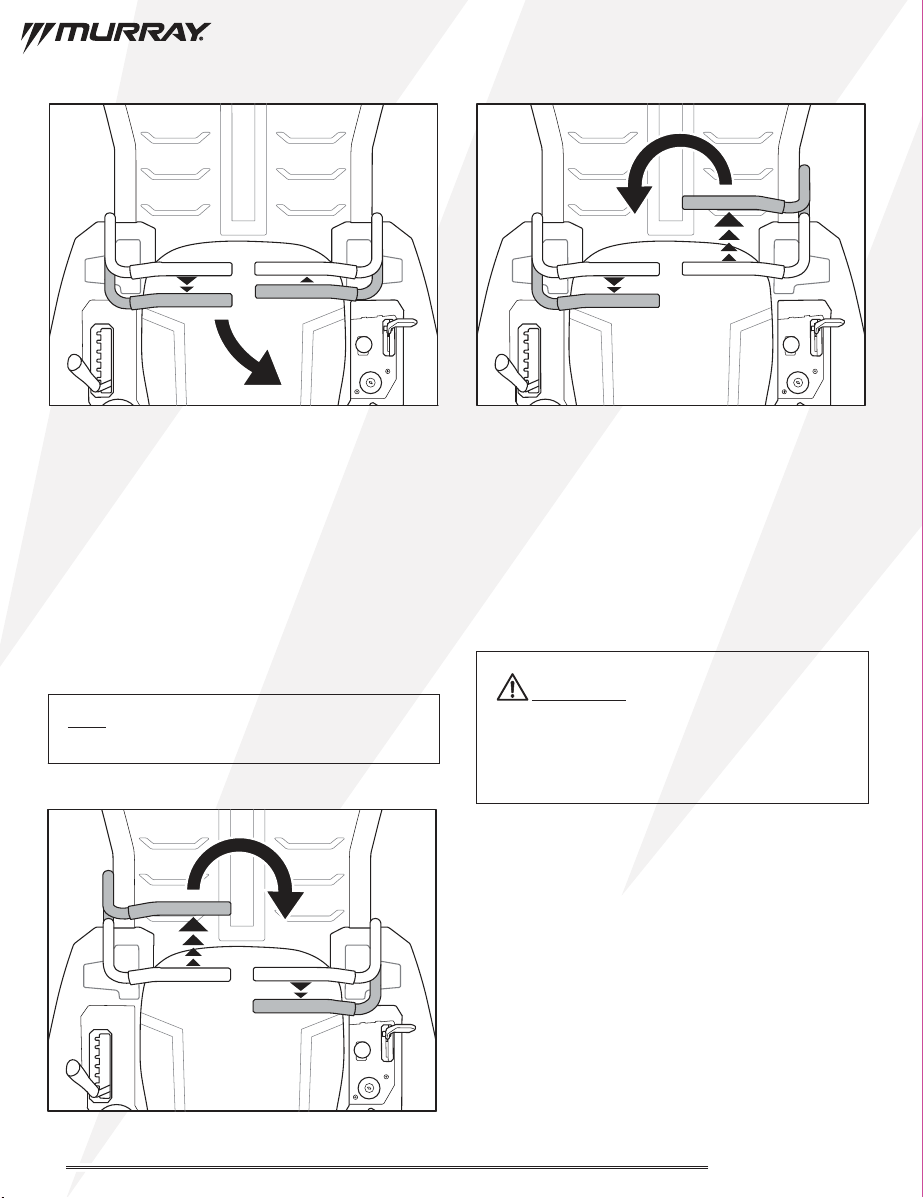
26 27
Ejecución de un giro cero
1. Detenga el movimiento de avance o retroceso del
cortacésped moviendo las dos palancas de mando a
punto muerto.
2. Para girar en el sentido de las agujas del reloj, mueva la
palanca de mando izquierda hacia delante mientras
mueve simultáneamente la palanca de mando derecha
hacia atrás. (Fig.19A)
3. Para girar en el sentido contrario a las agujas del reloj,
mueva la palanca de mando derecha hacia delante
mientras mueve simultáneamente la palanca de mando
izquierda hacia atrás. (Fig.19B)
Fig.18B
Fig.19A
Detener el cortacésped
1. Mueva ambas palancas de mando a la posición neutra
para detener el movimiento del cortacésped.
2. Empuje la TDF hacia abajo hasta la posición APAGADO.
3. Si va a desmontar el cortacésped, mueva las palancas de
mando completamente hacia fuera en la posición
neutral, que también acciona el freno de mano. Mueva el
acelerador a la posición de LENTO, gire la llave a la
posición de ALTO y retírela del módulo de encendido.
Fig.19B
ADVERTENCIA: No abandone el asiento del
cortacésped sin desconectar la TDF y mover las palancas
de mando completamente hacia fuera a la posición de
freno de mano conectado. Si deja el cortacésped
desatendido, gire la llave de contacto a la posición
ALTO y retire la llave.
NOTA:
Hacer un "giro cero" sobre hierba aumentará
enormemente el potencial de desfiguración del césped.
CORTACÉSPED DE GIRO CERO CORTACÉSPED DE GIRO CERO
Fig.20
Ajuste de la altura de corte
del cortacésped
Para cambiar la altura de corte, mueva la palanca fuera de la
muesca y luego hacia arriba o hacia abajo hasta la posición
que mejor se adapte a su aplicación.
Ajuste de la rueda anticaída
de la cubierta
Para ajustar las ruedas:
1. Estacione el cortacésped en una superficie nivelada y
ponga el freno de mano.
2. Detenga el cortacésped y retire la llave. Deje que las
cuchillas se detengan por completo.
3. Ajuste la plataforma a la altura deseada.
4. Retire el tornillo y la tuerca que sujetan la rueda.
5. Mueva la rueda a una posición que esté aproximada
mente a 1/8” - ½” del suelo.
6.
Vuelva a colocar el perno y la tuerca; apriételos firmemente.
El par de apriete recomendado es de 22-26 pies-libra.
7. Repita los pasos 4 a 6 en la otra rueda anticaída.
PRECAUCIÓN: Detenga el cortacésped y desengrane
las cuchillas antes de ajustar la altura de corte de la
plataforma. La palanca de ajuste de la plataforma está
situada en el guardabarros izquierdo del cortacésped.
Se utiliza para modificar la altura de la plataforma de
corte. La altura (distancia de la cuchilla al suelo) puede
ajustarse de 1" a 4" pulgadas (7 posiciones de altura).
AVISO:
La parte inferior de las ruedas anticaída de la
carcasa debe colocarse aproximadamente a 1/8” - ½” del
suelo cuando el cortacésped esté a la altura de corte deseada.
Esto minimizará la posibilidad de arrancar la cabellera del
césped en la mayoría de las situaciones.
AVISO:
Las ruedas izquierda y derecha deben
colocarse en las mismas posiciones.
AVISO:
El ajuste puede lograrse enroscando el perno
en cuatro orificios diferentes.
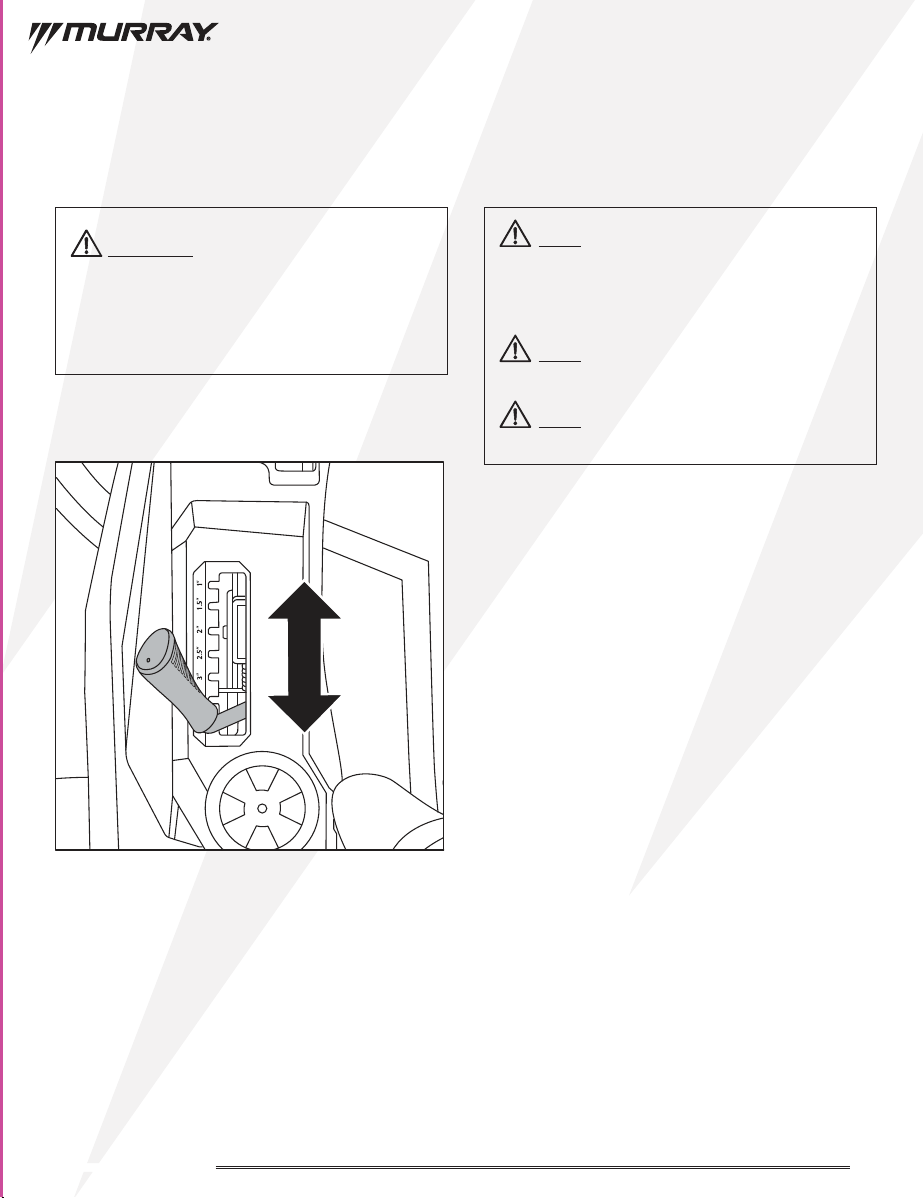
26 27
Ejecución de un giro cero
1. Detenga el movimiento de avance o retroceso del
cortacésped moviendo las dos palancas de mando a
punto muerto.
2. Para girar en el sentido de las agujas del reloj, mueva la
palanca de mando izquierda hacia delante mientras
mueve simultáneamente la palanca de mando derecha
hacia atrás. (Fig.19A)
3. Para girar en el sentido contrario a las agujas del reloj,
mueva la palanca de mando derecha hacia delante
mientras mueve simultáneamente la palanca de mando
izquierda hacia atrás. (Fig.19B)
Fig.18B
Fig.19A
Detener el cortacésped
1. Mueva ambas palancas de mando a la posición neutra
para detener el movimiento del cortacésped.
2. Empuje la TDF hacia abajo hasta la posición APAGADO.
3. Si va a desmontar el cortacésped, mueva las palancas de
mando completamente hacia fuera en la posición
neutral, que también acciona el freno de mano. Mueva el
acelerador a la posición de LENTO, gire la llave a la
posición de ALTO y retírela del módulo de encendido.
Fig.19B
ADVERTENCIA: No abandone el asiento del
cortacésped sin desconectar la TDF y mover las palancas
de mando completamente hacia fuera a la posición de
freno de mano conectado. Si deja el cortacésped
desatendido, gire la llave de contacto a la posición
ALTO y retire la llave.
NOTA:
Hacer un "giro cero" sobre hierba aumentará
enormemente el potencial de desfiguración del césped.
CORTACÉSPED DE GIRO CERO CORTACÉSPED DE GIRO CERO
Fig.20
Ajuste de la altura de corte
del cortacésped
Para cambiar la altura de corte, mueva la palanca fuera de la
muesca y luego hacia arriba o hacia abajo hasta la posición
que mejor se adapte a su aplicación.
Ajuste de la rueda anticaída
de la cubierta
Para ajustar las ruedas:
1. Estacione el cortacésped en una superficie nivelada y
ponga el freno de mano.
2. Detenga el cortacésped y retire la llave. Deje que las
cuchillas se detengan por completo.
3. Ajuste la plataforma a la altura deseada.
4. Retire el tornillo y la tuerca que sujetan la rueda.
5. Mueva la rueda a una posición que esté aproximada
mente a 1/8” - ½” del suelo.
6.
Vuelva a colocar el perno y la tuerca; apriételos firmemente.
El par de apriete recomendado es de 22-26 pies-libra.
7. Repita los pasos 4 a 6 en la otra rueda anticaída.
PRECAUCIÓN: Detenga el cortacésped y desengrane
las cuchillas antes de ajustar la altura de corte de la
plataforma. La palanca de ajuste de la plataforma está
situada en el guardabarros izquierdo del cortacésped.
Se utiliza para modificar la altura de la plataforma de
corte. La altura (distancia de la cuchilla al suelo) puede
ajustarse de 1" a 4" pulgadas (7 posiciones de altura).
AVISO:
La parte inferior de las ruedas anticaída de la
carcasa debe colocarse aproximadamente a 1/8” - ½” del
suelo cuando el cortacésped esté a la altura de corte deseada.
Esto minimizará la posibilidad de arrancar la cabellera del
césped en la mayoría de las situaciones.
AVISO:
Las ruedas izquierda y derecha deben
colocarse en las mismas posiciones.
AVISO:
El ajuste puede lograrse enroscando el perno
en cuatro orificios diferentes.
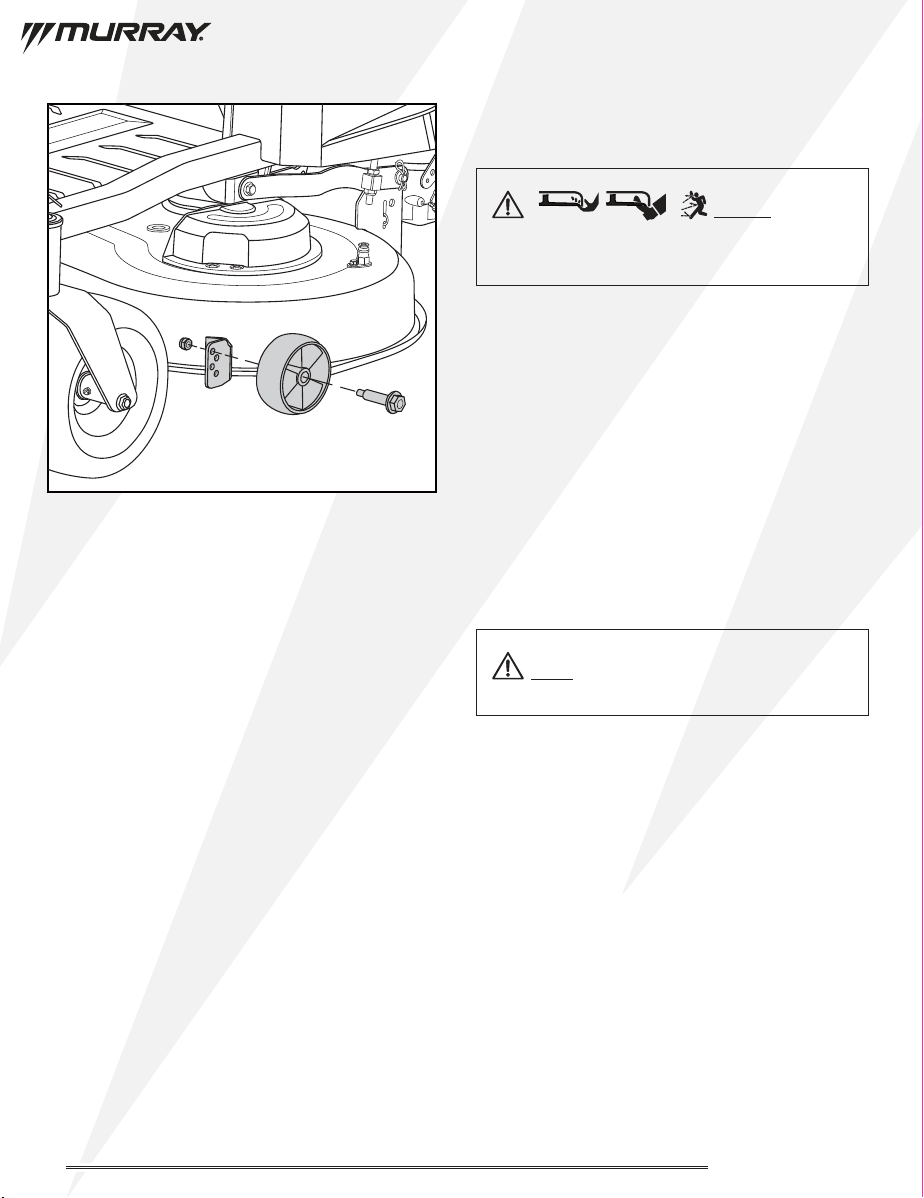
28 29
CORTACÉSPED DE GIRO CERO CORTACÉSPED DE GIRO CERO
Consejos para el corte
• El corte debe realizarse siempre con el acelerador en la
posición RÁPIDO para obtener unos resultados de corte
óptimos.
• Mantenga las cuchillas afiladas. Los cortes dentados
aumentan la probabilidad de que la punta de la hoja de
hierba se dore o desarrolle una enfermedad.
• Después de completar una pasada en su césped, repase
la pasada anterior aproximadamente 2 - 3".
• Cambie la dirección en la que corta cada vez para evitar
que se formen surcos en el césped.
• No corte la hierba demasiado corta. La hierba corta es
propensa al crecimiento de malas hierbas y amarillea
rápidamente en tiempo seco.
• Ajuste la altura de corte del cortacésped a la recomen
dada para el tipo de hierba de su césped. Cortar el
césped demasiado corto impedirá que profundice en su
sistema radicular, ya que la hierba empleará su energía
en hacer crecer de nuevo los brotes de hierba, en lugar
del sistema radicular. Un sistema radicular profundo
permitirá a la hierba encontrar nutrientes y agua en el
suelo, especialmente en periodos de sequía.
• Aumente la altura de corte del cortacésped durante el
verano o los periodos de sequía.
• No corte durante las horas más calurosas del día.
Hacerlo estresa la hierba.
• Siga la "Regla de 1/3". No quite más de 1/3 de la
longitud de la hoja de hierba cada vez.
• Al cortar hierba larga y espesa, puede ser necesario
volver a repasar la zona cortada una segunda vez.
• No corte hierba húmeda. Es menos probable que la
hierba seca se agrupe y más probable que se mantenga
erguida, lo que dará como resultado un corte limpio y
uniforme.
• Corte transversalmente a las pendientes, no hacia arriba
y hacia abajo. Si corta una pendiente, empiece por
abajo y trabaje hacia arriba para asegurarse de que los
giros se hacen cuesta arriba.
• Para obtener los mejores resultados, se recomienda
cortar las dos primeras vueltas con la descarga lanzada
hacia el centro. Después de las dos primeras vueltas,
invierta la dirección para lanzar la descarga hacia el
exterior para el resto del corte. Esto dará un mejor
aspecto al césped.
Cortar en reversa
• Mantenga a los niños fuera de la zona de operaciones y
bajo la vigilancia de un adulto responsable.
• No transporte pasajeros, especialmente niños, incluso
con la(s) cuchilla(s) apagada(s). Los niños pueden caerse
y resultar gravemente heridos o interferir en el
funcionamiento seguro de la máquina. Los niños que
han dado paseos en el pasado pueden aparecer de
repente en la zona de siega para dar otro paseo y ser
atropellados o arrollados por la máquina.
• No corte en reversa a menos que sea absolutamente
necesario. Mire siempre hacia abajo y hacia atrás antes y
durante la reversa.
Una vez enganchadas las cuchillas
1. Mueva las dos palancas de mando hacia dentro hasta la
posición neutral, que también desconecta el freno de mano.
2. Coloque el acelerador en la posición máxima.
3. Mueva lenta y uniformemente ambas palancas de control
de la transmisión hacia atrás. El cortacésped empezará a
moverse en sentido inverso.
PELIGRO: Cortar en
marcha atrás puede ser peligroso para los transeúntes.
Pueden producirse accidentes trágicos si el operador no
está alerta ante la presencia de niños. Los niños suelen
sentirse atraídos por la máquina y la actividad de corte.
Nunca dé por sentado que los niños permanecerán donde
los vio por última vez.
ADVERTENCIA: Para ayudar a evitar el contacto con
la cuchilla o una lesión por objeto arrojado, mantenga a
los transeúntes, ayudantes, niños y mascotas alejados de
la máquina mientras esté en funcionamiento. Detenga la
máquina si alguien entra en la zona.
NOTA:
Cuando utilice el cortacésped asegúrese de que el
acelerador está siempre en la posición RÁPIDO. Operar
con el acelerador a menos del máximo puede provocar un
desgaste prematuro de la batería y un corte de mala calidad.
Cortar
• Utilice la máquina sólo en horas con sol o con buena luz
artificial.
• Evite agujeros, surcos, baches, rocas u otros peligros
ocultos. Un terreno irregular puede hacer volcar la
máquina o hacer que el operador pierda el equilibrio o
el equilibrio.
• No dirija el material de descarga hacia nadie. Evite
descargar el material contra una pared u obstrucción, ya
que el material puede rebotar hacia el operador.
• Detenga las cuchillas al atravesar superficies de grava.
• No deje desatendida una máquina en marcha. Detén
gase siempre en un terreno llano, desembrague las
cuchillas, ponga el freno de mano, pare el motor y retire
el inserto de arranque o la llave.
Engranar la TDF
Al engranar la TDF se transfiere potencia a la plataforma de
corte para entrar en el modo de corte. Para engranar la TDF:
1. Mueva el acelerador a la posición RÁPIDO.
2. Tire del interruptor de la TDF hacia arriba/hacia fuera
hasta la posición ENGANCHADO (ENCENDIDO).
3. Para desconectar la TDF, empuje el interruptor de la TDF
hacia abajo/en la posición DESCONECTADO (APAGADO).
PELIGRO: Esta máquina
es capaz de amputar manos y pies, y de lanzar objetos.
El incumplimiento de las instrucciones de seguridad
podría provocar lesiones graves o la muerte.
AVISO:
El interruptor de la TDF debe estar DESACTIVADO
al arrancar el motor.
Fig. 21
28 29
CORTACÉSPED DE GIRO CERO CORTACÉSPED DE GIRO CERO
Consejos para el corte
• El corte debe realizarse siempre con el acelerador en la
posición RÁPIDO para obtener unos resultados de corte
óptimos.
• Mantenga las cuchillas afiladas. Los cortes dentados
aumentan la probabilidad de que la punta de la hoja de
hierba se dore o desarrolle una enfermedad.
• Después de completar una pasada en su césped, repase
la pasada anterior aproximadamente 2 - 3".
• Cambie la dirección en la que corta cada vez para evitar
que se formen surcos en el césped.
• No corte la hierba demasiado corta. La hierba corta es
propensa al crecimiento de malas hierbas y amarillea
rápidamente en tiempo seco.
• Ajuste la altura de corte del cortacésped a la recomen
dada para el tipo de hierba de su césped. Cortar el
césped demasiado corto impedirá que profundice en su
sistema radicular, ya que la hierba empleará su energía
en hacer crecer de nuevo los brotes de hierba, en lugar
del sistema radicular. Un sistema radicular profundo
permitirá a la hierba encontrar nutrientes y agua en el
suelo, especialmente en periodos de sequía.
• Aumente la altura de corte del cortacésped durante el
verano o los periodos de sequía.
• No corte durante las horas más calurosas del día.
Hacerlo estresa la hierba.
• Siga la "Regla de 1/3". No quite más de 1/3 de la
longitud de la hoja de hierba cada vez.
• Al cortar hierba larga y espesa, puede ser necesario
volver a repasar la zona cortada una segunda vez.
• No corte hierba húmeda. Es menos probable que la
hierba seca se agrupe y más probable que se mantenga
erguida, lo que dará como resultado un corte limpio y
uniforme.
• Corte transversalmente a las pendientes, no hacia arriba
y hacia abajo. Si corta una pendiente, empiece por
abajo y trabaje hacia arriba para asegurarse de que los
giros se hacen cuesta arriba.
• Para obtener los mejores resultados, se recomienda
cortar las dos primeras vueltas con la descarga lanzada
hacia el centro. Después de las dos primeras vueltas,
invierta la dirección para lanzar la descarga hacia el
exterior para el resto del corte. Esto dará un mejor
aspecto al césped.
Cortar en reversa
• Mantenga a los niños fuera de la zona de operaciones y
bajo la vigilancia de un adulto responsable.
• No transporte pasajeros, especialmente niños, incluso
con la(s) cuchilla(s) apagada(s). Los niños pueden caerse
y resultar gravemente heridos o interferir en el
funcionamiento seguro de la máquina. Los niños que
han dado paseos en el pasado pueden aparecer de
repente en la zona de siega para dar otro paseo y ser
atropellados o arrollados por la máquina.
• No corte en reversa a menos que sea absolutamente
necesario. Mire siempre hacia abajo y hacia atrás antes y
durante la reversa.
Una vez enganchadas las cuchillas
1. Mueva las dos palancas de mando hacia dentro hasta la
posición neutral, que también desconecta el freno de mano.
2. Coloque el acelerador en la posición máxima.
3. Mueva lenta y uniformemente ambas palancas de control
de la transmisión hacia atrás. El cortacésped empezará a
moverse en sentido inverso.
PELIGRO: Cortar en
marcha atrás puede ser peligroso para los transeúntes.
Pueden producirse accidentes trágicos si el operador no
está alerta ante la presencia de niños. Los niños suelen
sentirse atraídos por la máquina y la actividad de corte.
Nunca dé por sentado que los niños permanecerán donde
los vio por última vez.
ADVERTENCIA: Para ayudar a evitar el contacto con
la cuchilla o una lesión por objeto arrojado, mantenga a
los transeúntes, ayudantes, niños y mascotas alejados de
la máquina mientras esté en funcionamiento. Detenga la
máquina si alguien entra en la zona.
NOTA:
Cuando utilice el cortacésped asegúrese de que el
acelerador está siempre en la posición RÁPIDO. Operar
con el acelerador a menos del máximo puede provocar un
desgaste prematuro de la batería y un corte de mala calidad.
Cortar
• Utilice la máquina sólo en horas con sol o con buena luz
artificial.
• Evite agujeros, surcos, baches, rocas u otros peligros
ocultos. Un terreno irregular puede hacer volcar la
máquina o hacer que el operador pierda el equilibrio o
el equilibrio.
• No dirija el material de descarga hacia nadie. Evite
descargar el material contra una pared u obstrucción, ya
que el material puede rebotar hacia el operador.
• Detenga las cuchillas al atravesar superficies de grava.
• No deje desatendida una máquina en marcha. Detén
gase siempre en un terreno llano, desembrague las
cuchillas, ponga el freno de mano, pare el motor y retire
el inserto de arranque o la llave.
Engranar la TDF
Al engranar la TDF se transfiere potencia a la plataforma de
corte para entrar en el modo de corte. Para engranar la TDF:
1. Mueva el acelerador a la posición RÁPIDO.
2. Tire del interruptor de la TDF hacia arriba/hacia fuera
hasta la posición ENGANCHADO (ENCENDIDO).
3. Para desconectar la TDF, empuje el interruptor de la TDF
hacia abajo/en la posición DESCONECTADO (APAGADO).
PELIGRO: Esta máquina
es capaz de amputar manos y pies, y de lanzar objetos.
El incumplimiento de las instrucciones de seguridad
podría provocar lesiones graves o la muerte.
AVISO:
El interruptor de la TDF debe estar DESACTIVADO
al arrancar el motor.
Fig. 21

30 31
Cuando detenga el cortacésped por cualquier motivo
mientras se encuentre sobre una superficie de hierba,
hágalo
• Mueva las palancas de mando completamente hacia
fuera hasta la posición de freno de mano accionado.
• Apague el motor y retire la llave.
• Si lo hace, minimizará la posibilidad de que su césped se
''dore'' por los gases de escape calientes del motor en
marcha de su cortacésped.
• La velocidad del cortacésped afectará a la calidad del
corte. Cortar a toda velocidad afectará negativamente a
la calidad del corte. Controle la velocidad de avance con
las palancas de mando.
• Al acercarse al otro extremo de la franja, reduzca la
velocidad o deténgase antes de girar. Se recomienda un
giro en U a menos que se requiera un pivote o un giro
cero.
• No intente cortar maleza pesada ni hierba extremada
mente alta. Su cortacésped está diseñado para cortar
césped, NO para desbrozar.
• Mantenga las cuchillas afiladas y sustitúyalas cuando
estén desgastadas.
CORTACÉSPED DE GIRO CERO CORTACÉSPED DE GIRO CERO
ADVERTENCIA: Un mantenimiento inadecuado,
o la no corrección de un problema antes de su
funcionamiento, o el uso de componentes de repuesto
no conformes, pueden causar un funcionamiento
defectuoso y podrían provocar la muerte o lesiones graves.
PRECAUCIÓN:
Antes de realizar cualquier tipo de
mantenimiento/servicio, desenganche las cuchillas,
apague el motor y espere hasta que todas las piezas
móviles se hayan detenido por completo. Desconecte el
cable de la bujía y manténgalo alejado de la misma.
Utilice siempre gafas de seguridad mientras realiza
cualquier ajuste o reparación.
6. Mantenimiento
Un buen mantenimiento es esencial para un funcionamiento
seguro, económico y sin problemas. Siga las recomendaciones
y programas de inspección y mantenimiento de este manual.
Antes de ajustes y reparaciones:
• Utilice SÓLO las herramientas correctas.
• NO manipule el muelle del regulador, los eslabones u
otras piezas para aumentar la velocidad del motor.
• Las piezas de repuesto deben ser del mismo diseño e
instalarse en la misma posición que las piezas originales.
Otras piezas pueden no funcionar igual de bien, dañar la
unidad, anular la garantía y provocar lesiones.
Calendario de mantenimiento
*Lo que ocurra primero.
**Revise las cuchillas del cortacésped con más frecuencia en
regiones con suelos arenosos o condiciones de mucho
polvo.
Cada 8 horas o a diario
Compruebe el sistema de bloqueo de seguridad.
Retire cualquier residuo del cortacésped, de la
plataforma de corte y del compartimento del motor
.
Cada 25 horas o anualmente*
Compruebe la presión de las llantas.
Compruebe el tiempo de parada de la cuchilla
del cortacésped.
Compruebe si hay herrajes sueltos en el cortacésped.
Cada 50 horas o anualmente*
Limpie la batería y los cables.
Compruebe los frenos del cortacésped.
Acuda anualmente a un servicio técnico autorizado
Lubrique el cortacésped.
Revisión de las cuchillas del cortacésped**
Cortacésped de giro cero
AVISO: Consulte el manual del operador del motor
para el mantenimiento detallado del motor.
AVISO: Si no está seguro de cómo realizar alguna de
las tareas de mantenimiento que se indican a continuación,
póngase en contacto con el servicio de atención al cliente
888-693-2582 o con un centro de servicio cualificado para
obtener ayuda.
30 31
Cuando detenga el cortacésped por cualquier motivo
mientras se encuentre sobre una superficie de hierba,
hágalo
• Mueva las palancas de mando completamente hacia
fuera hasta la posición de freno de mano accionado.
• Apague el motor y retire la llave.
• Si lo hace, minimizará la posibilidad de que su césped se
''dore'' por los gases de escape calientes del motor en
marcha de su cortacésped.
• La velocidad del cortacésped afectará a la calidad del
corte. Cortar a toda velocidad afectará negativamente a
la calidad del corte. Controle la velocidad de avance con
las palancas de mando.
• Al acercarse al otro extremo de la franja, reduzca la
velocidad o deténgase antes de girar. Se recomienda un
giro en U a menos que se requiera un pivote o un giro
cero.
• No intente cortar maleza pesada ni hierba extremada
mente alta. Su cortacésped está diseñado para cortar
césped, NO para desbrozar.
• Mantenga las cuchillas afiladas y sustitúyalas cuando
estén desgastadas.
CORTACÉSPED DE GIRO CERO CORTACÉSPED DE GIRO CERO
ADVERTENCIA: Un mantenimiento inadecuado,
o la no corrección de un problema antes de su
funcionamiento, o el uso de componentes de repuesto
no conformes, pueden causar un funcionamiento
defectuoso y podrían provocar la muerte o lesiones graves.
PRECAUCIÓN:
Antes de realizar cualquier tipo de
mantenimiento/servicio, desenganche las cuchillas,
apague el motor y espere hasta que todas las piezas
móviles se hayan detenido por completo. Desconecte el
cable de la bujía y manténgalo alejado de la misma.
Utilice siempre gafas de seguridad mientras realiza
cualquier ajuste o reparación.
6. Mantenimiento
Un buen mantenimiento es esencial para un funcionamiento
seguro, económico y sin problemas. Siga las recomendaciones
y programas de inspección y mantenimiento de este manual.
Antes de ajustes y reparaciones:
• Utilice SÓLO las herramientas correctas.
• NO manipule el muelle del regulador, los eslabones u
otras piezas para aumentar la velocidad del motor.
• Las piezas de repuesto deben ser del mismo diseño e
instalarse en la misma posición que las piezas originales.
Otras piezas pueden no funcionar igual de bien, dañar la
unidad, anular la garantía y provocar lesiones.
Calendario de mantenimiento
*Lo que ocurra primero.
**Revise las cuchillas del cortacésped con más frecuencia en
regiones con suelos arenosos o condiciones de mucho
polvo.
Cada 8 horas o a diario
Compruebe el sistema de bloqueo de seguridad.
Retire cualquier residuo del cortacésped, de la
plataforma de corte y del compartimento del motor
.
Cada 25 horas o anualmente*
Compruebe la presión de las llantas.
Compruebe el tiempo de parada de la cuchilla
del cortacésped.
Compruebe si hay herrajes sueltos en el cortacésped.
Cada 50 horas o anualmente*
Limpie la batería y los cables.
Compruebe los frenos del cortacésped.
Acuda anualmente a un servicio técnico autorizado
Lubrique el cortacésped.
Revisión de las cuchillas del cortacésped**
Cortacésped de giro cero
AVISO: Consulte el manual del operador del motor
para el mantenimiento detallado del motor.
AVISO: Si no está seguro de cómo realizar alguna de
las tareas de mantenimiento que se indican a continuación,
póngase en contacto con el servicio de atención al cliente
888-693-2582 o con un centro de servicio cualificado para
obtener ayuda.
3332
Fig. 22
CORTACÉSPED DE GIRO CERO CORTACÉSPED DE GIRO CERO
*el que surja primero.
Primeras 5 horas
Cambiar el aceite del motor.
Cada 8 Horas o a diario
Comprobar el nivel de aceite del motor.
Cada 25 Horas o anualmente*
Limpiar el filtro de aire.
Cada 50 Horas o anualmente*
Cambiar el aceite del motor.
Cambiar el filtro de aceite.
Anualmente
Cambiar el filtro de aire.
Acuda anualmente a un servicio técnico autorzado
Revisar el silenciador
Cambiar las bujías.
Cambiar el filtro de combustible.
Limpiar el sistema de refrigeración del aire.
MOTOR
Limpiar el cortacésped
PRECAUCIÓN: No utilice un limpiador a presión o
una manguera de jardín para limpiar su cortacésped si no
es para limpiar la parte inferior de la plataforma. Podría
dañar los componentes eléctricos, los husillos, las poleas,
los cojinetes o el motor. El uso de agua acortará la vida
útil y reducirá la capacidad de servicio.
ADVERTENCIA:
El motor, el silenciador y las superficies
metálicas circundantes estarán muy calientes y pueden causar
quemaduras en la piel. Deje que el cortacésped se enfríe
durante al menos cinco minutos antes de limpiarlo. Tenga
cuidado para evitar quemaduras.
AVISO: Los residuos pueden acumularse en cualquier
parte del cortacésped, especialmente en las superficies
horizontales. Puede ser necesaria una limpieza adicional
al cortar en condiciones húmedas o al triturar.
AVISO: Las fugas/derrames de combustible, las
fugas/derrames de aceite y el exceso de lubricación
también pueden convertirse en lugares de acumulación
de residuos. La reparación inmediata y la limpieza de los
derrames de aceite o combustible pueden ayudar a
reducir los riesgos de incendio.
AVISO: Evite utilizar disolventes cuando limpie piezas de
plástico. La mayoría de los plásticos son susceptibles de
dañarse con diversos tipos de disolventes comerciales y
pueden resultar dañados por su uso. Utilice paños limpios
para eliminar la suciedad, el polvo, el aceite, la grasa, etc.
Limpiar de la plataforma de
corte
Puede adquirir en The Home Depot un "Kit universal de
lavado de cubiertas" que incluye un puerto de lavado y una
desconexión rápida para manguera de jardín. SKU#
1003930707 o similar.
1. Coloque el cortacésped sobre una superficie lisa y
nivelada.
2. Conecte la desconexión rápida (a) a la manguera de
jardín (b) y luego conéctela al orificio de lavado (c) de la
plataforma del cortacésped. (Fig. 22)
3. Abra el suministro de agua.
4. Encienda el motor.
5. Coloque la altura de corte en la posición más baja.
6. Enganche la toma de fuerza (TDF) para activar las
cuchillas del cortacésped. La rotación de las cuchillas y el
agua ayudarán a limpiar la parte inferior de la plataforma
del cortacésped.
7. Desenganche la TDF.
8. Detenga el motor.
9. Cierre el suministro de agua.
10. Retire la manguera de jardín y la desconexión rápida del
orificio de lavado.
• Limpie alrededor del motor, incluyendo la rejilla de
admisión del motor, el colector de escape, el silenciador
y el protector del silenciador.
• Limpie la parte superior de la plataforma del
cortacésped, debajo de las cubiertas de los husillos y la
zona de las correas.
• Limpie alrededor y cerca de las transmisiones.
AVISO: El cortacésped SÓLO viene con una placa de
bloqueo del orificio de lavado. La desconexión rápida de
la manguera de jardín NO está incluida y debe adquirirse
por separado.
a
b
c
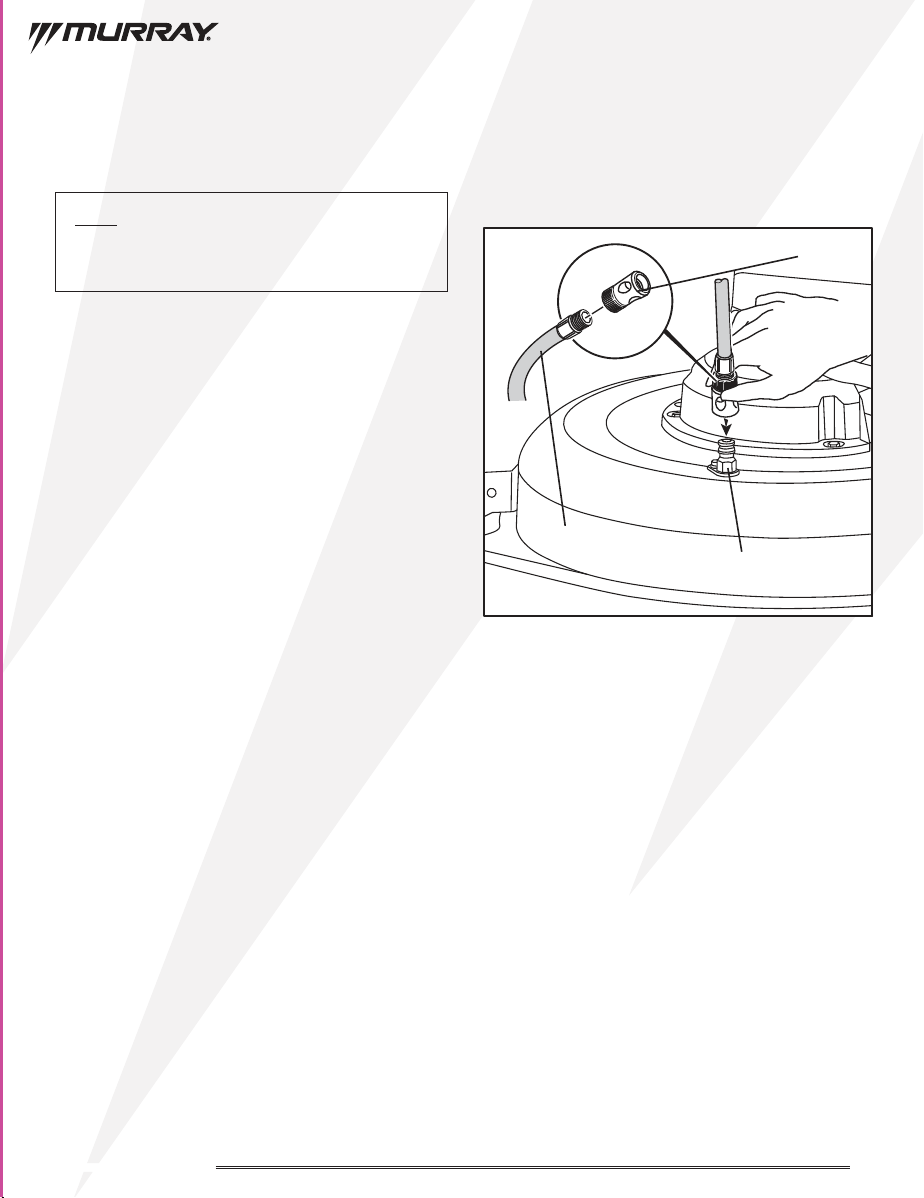
3332
Fig. 22
CORTACÉSPED DE GIRO CERO CORTACÉSPED DE GIRO CERO
*el que surja primero.
Primeras 5 horas
Cambiar el aceite del motor.
Cada 8 Horas o a diario
Comprobar el nivel de aceite del motor.
Cada 25 Horas o anualmente*
Limpiar el filtro de aire.
Cada 50 Horas o anualmente*
Cambiar el aceite del motor.
Cambiar el filtro de aceite.
Anualmente
Cambiar el filtro de aire.
Acuda anualmente a un servicio técnico autorzado
Revisar el silenciador
Cambiar las bujías.
Cambiar el filtro de combustible.
Limpiar el sistema de refrigeración del aire.
MOTOR
Limpiar el cortacésped
PRECAUCIÓN: No utilice un limpiador a presión o
una manguera de jardín para limpiar su cortacésped si no
es para limpiar la parte inferior de la plataforma. Podría
dañar los componentes eléctricos, los husillos, las poleas,
los cojinetes o el motor. El uso de agua acortará la vida
útil y reducirá la capacidad de servicio.
ADVERTENCIA:
El motor, el silenciador y las superficies
metálicas circundantes estarán muy calientes y pueden causar
quemaduras en la piel. Deje que el cortacésped se enfríe
durante al menos cinco minutos antes de limpiarlo. Tenga
cuidado para evitar quemaduras.
AVISO: Los residuos pueden acumularse en cualquier
parte del cortacésped, especialmente en las superficies
horizontales. Puede ser necesaria una limpieza adicional
al cortar en condiciones húmedas o al triturar.
AVISO: Las fugas/derrames de combustible, las
fugas/derrames de aceite y el exceso de lubricación
también pueden convertirse en lugares de acumulación
de residuos. La reparación inmediata y la limpieza de los
derrames de aceite o combustible pueden ayudar a
reducir los riesgos de incendio.
AVISO: Evite utilizar disolventes cuando limpie piezas de
plástico. La mayoría de los plásticos son susceptibles de
dañarse con diversos tipos de disolventes comerciales y
pueden resultar dañados por su uso. Utilice paños limpios
para eliminar la suciedad, el polvo, el aceite, la grasa, etc.
Limpiar de la plataforma de
corte
Puede adquirir en The Home Depot un "Kit universal de
lavado de cubiertas" que incluye un puerto de lavado y una
desconexión rápida para manguera de jardín. SKU#
1003930707 o similar.
1. Coloque el cortacésped sobre una superficie lisa y
nivelada.
2. Conecte la desconexión rápida (a) a la manguera de
jardín (b) y luego conéctela al orificio de lavado (c) de la
plataforma del cortacésped. (Fig. 22)
3. Abra el suministro de agua.
4. Encienda el motor.
5. Coloque la altura de corte en la posición más baja.
6. Enganche la toma de fuerza (TDF) para activar las
cuchillas del cortacésped. La rotación de las cuchillas y el
agua ayudarán a limpiar la parte inferior de la plataforma
del cortacésped.
7. Desenganche la TDF.
8. Detenga el motor.
9. Cierre el suministro de agua.
10. Retire la manguera de jardín y la desconexión rápida del
orificio de lavado.
• Limpie alrededor del motor, incluyendo la rejilla de
admisión del motor, el colector de escape, el silenciador
y el protector del silenciador.
• Limpie la parte superior de la plataforma del
cortacésped, debajo de las cubiertas de los husillos y la
zona de las correas.
• Limpie alrededor y cerca de las transmisiones.
AVISO: El cortacésped SÓLO viene con una placa de
bloqueo del orificio de lavado. La desconexión rápida de
la manguera de jardín NO está incluida y debe adquirirse
por separado.
a
b
c
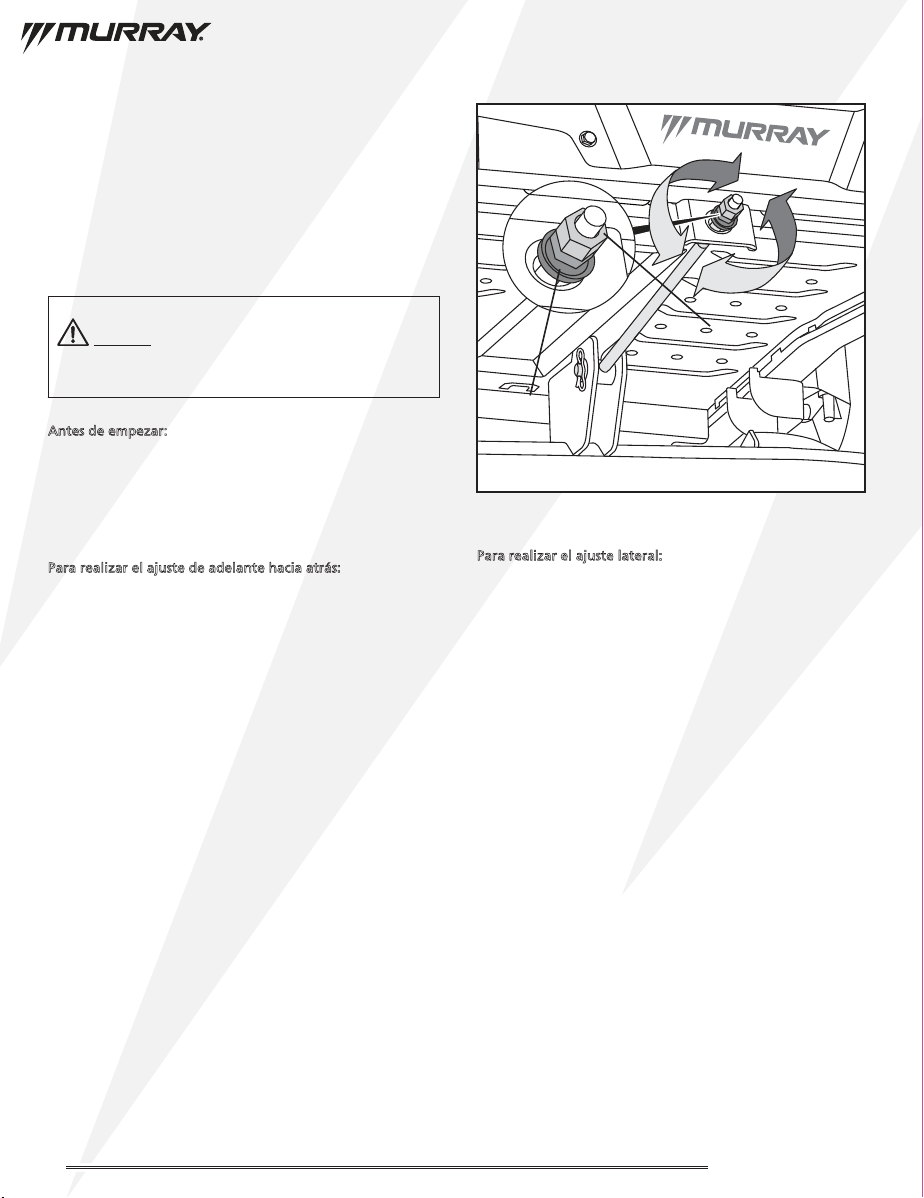
3534
CORTACÉSPED DE GIRO CERO CORTACÉSPED DE GIRO CERO
Nivelar la plataforma de
corte
Si su césped parece cortado de forma desigual después de
utilizar el cortacésped, puede que sea necesario ajustar la
plataforma de corte. Antes de decidir que es necesario
nivelarla, asegúrese de que las llantas están correctamente
infladas a las psi recomendadas al cortar.
Antes de empezar:
1. Asegúrese de que las palancas de mando están en la
posición FRENO DE MANO.
2. Detenga el motor y retire la llave.
3. Baje la plataforma de corte a su posición más baja.
Para realizar el ajuste de adelante hacia atrás:
1. Coloque la cuchilla derecha de modo que los extremos
apunten ahora hacia la parte delantera y trasera del
cortacésped.
2. Mida la distancia de la punta de la cuchilla al suelo. Para
obtener unos resultados de corte óptimos, la punta
delantera de la cuchilla debe estar entre ¼” y 3/8” más
baja que la punta trasera.
3. Si se necesita un ajuste de adelante hacia atrás, después
de aflojar la contratuerca exterior (a, Fig. 23), gire la
tuerca de ajuste interior (b, Fig. 23) en el sentido de las
agujas del reloj para elevar o en el sentido contrario para
bajar la parte delantera de la plataforma de corte.
4. Mida de nuevo para verificar que la punta delantera está
ahora entre 1/4“ y 3/8” más baja que la punta trasera. Si
no es así, siga ajustando y midiendo hasta que lo estén.
5. Sin mover la tuerca de ajuste interior, vuelva a apretar la
contratuerca exterior para fijar la tuerca de ajuste
interior en su sitio.
PELIGRO:
Las cuchillas del cortacésped están afiladas.
Envuelva la(s) cuchilla(s) o póngase guantes, y extreme las
precauciones al repararlas.
Fig. 23
Para realizar el ajuste lateral:
1. Coloque las cuchillas de modo que los extremos apunten
hacia los lados del cortacésped.
2. Mida la distancia desde el extremo inferior exterior
(punta de corte) de la cuchilla hasta el suelo. Mida el
borde inferior de la cuchilla izquierda hasta el suelo y el
borde inferior de la cuchilla derecha hasta el suelo. Si las
mediciones difieren en menos de 1 pulgada (la posición
más baja), continúe con el siguiente paso.
3. Gire las tuercas de ajuste superiores (a) hacia arriba. Gire
las tuercas de ajuste inferiores (b) hacia arriba para elevar
o hacia abajo para bajar dos lados de la plataforma de
corte. (Fig.24A y Fig.24B)
4. Mida de nuevo. Si la diferencia de altura entre dos lados
de la plataforma es superior a 1/10 de pulgada, ajuste de
nuevo la plataforma hasta que ambas medidas de la
punta de la cuchilla tomadas anteriormente sean iguales.
5. Gire las tuercas de ajuste superiores hacia abajo hasta sus
posiciones originales.
a
b
Fig. 24A
Fig. 24B
a
b
Fig. 25A
Retirar la plataforma de
corte
Retirar la cubierta facilitará la sustitución de correas, poleas
y cuchillas.
1. Asegúrese de que las palancas de mando están en la
posición FRENO DE MANO.
2. Pare el motor y retire la llave.
3. Baje la plataforma de corte a su posición más baja.
4.
Retire los 3 pasadores de enganche, 2 a la derecha (Fig. 25A
y Fig. 25B), 1 a la izquierda (Fig. 25C) que fijan la plataforma
en su sitio.
5. Deslice la correa de la plataforma fuera del embrague
electromagnético.
6.
Deslice la plataforma para sacarla de debajo del cortacésped.
7. Invierta el proceso para volver a montar la plataforma en
el cortacésped.
PELIGRO:
Las cuchillas del cortacésped están afiladas.
Envuelva la(s) cuchilla(s) o póngase guantes, y extreme las
precauciones al repararlas.
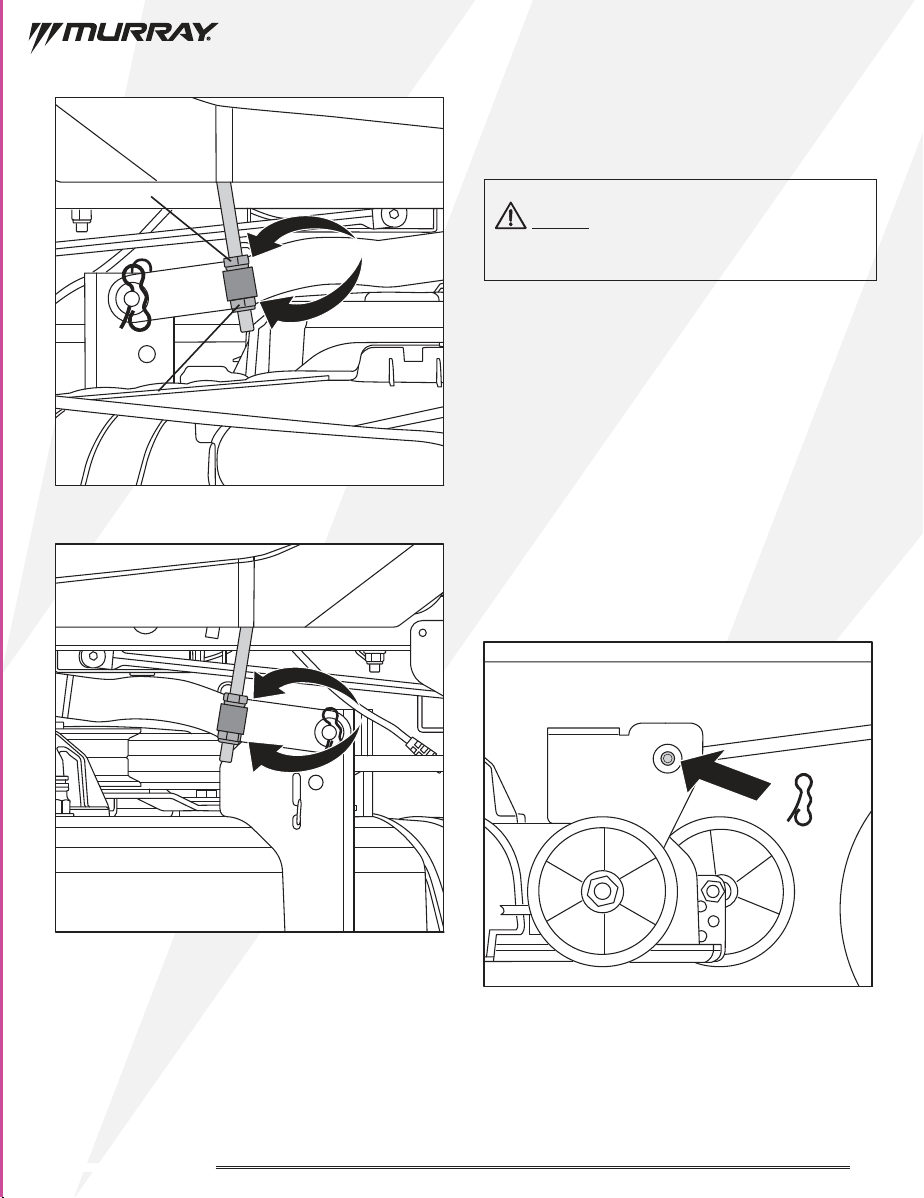
3534
CORTACÉSPED DE GIRO CERO CORTACÉSPED DE GIRO CERO
Nivelar la plataforma de
corte
Si su césped parece cortado de forma desigual después de
utilizar el cortacésped, puede que sea necesario ajustar la
plataforma de corte. Antes de decidir que es necesario
nivelarla, asegúrese de que las llantas están correctamente
infladas a las psi recomendadas al cortar.
Antes de empezar:
1. Asegúrese de que las palancas de mando están en la
posición FRENO DE MANO.
2. Detenga el motor y retire la llave.
3. Baje la plataforma de corte a su posición más baja.
Para realizar el ajuste de adelante hacia atrás:
1. Coloque la cuchilla derecha de modo que los extremos
apunten ahora hacia la parte delantera y trasera del
cortacésped.
2. Mida la distancia de la punta de la cuchilla al suelo. Para
obtener unos resultados de corte óptimos, la punta
delantera de la cuchilla debe estar entre ¼” y 3/8” más
baja que la punta trasera.
3. Si se necesita un ajuste de adelante hacia atrás, después
de aflojar la contratuerca exterior (a, Fig. 23), gire la
tuerca de ajuste interior (b, Fig. 23) en el sentido de las
agujas del reloj para elevar o en el sentido contrario para
bajar la parte delantera de la plataforma de corte.
4. Mida de nuevo para verificar que la punta delantera está
ahora entre 1/4“ y 3/8” más baja que la punta trasera. Si
no es así, siga ajustando y midiendo hasta que lo estén.
5. Sin mover la tuerca de ajuste interior, vuelva a apretar la
contratuerca exterior para fijar la tuerca de ajuste
interior en su sitio.
PELIGRO:
Las cuchillas del cortacésped están afiladas.
Envuelva la(s) cuchilla(s) o póngase guantes, y extreme las
precauciones al repararlas.
Fig. 23
Para realizar el ajuste lateral:
1. Coloque las cuchillas de modo que los extremos apunten
hacia los lados del cortacésped.
2. Mida la distancia desde el extremo inferior exterior
(punta de corte) de la cuchilla hasta el suelo. Mida el
borde inferior de la cuchilla izquierda hasta el suelo y el
borde inferior de la cuchilla derecha hasta el suelo. Si las
mediciones difieren en menos de 1 pulgada (la posición
más baja), continúe con el siguiente paso.
3. Gire las tuercas de ajuste superiores (a) hacia arriba. Gire
las tuercas de ajuste inferiores (b) hacia arriba para elevar
o hacia abajo para bajar dos lados de la plataforma de
corte. (Fig.24A y Fig.24B)
4. Mida de nuevo. Si la diferencia de altura entre dos lados
de la plataforma es superior a 1/10 de pulgada, ajuste de
nuevo la plataforma hasta que ambas medidas de la
punta de la cuchilla tomadas anteriormente sean iguales.
5. Gire las tuercas de ajuste superiores hacia abajo hasta sus
posiciones originales.
a
b
Fig. 24A
Fig. 24B
a
b
Fig. 25A
Retirar la plataforma de
corte
Retirar la cubierta facilitará la sustitución de correas, poleas
y cuchillas.
1. Asegúrese de que las palancas de mando están en la
posición FRENO DE MANO.
2. Pare el motor y retire la llave.
3. Baje la plataforma de corte a su posición más baja.
4.
Retire los 3 pasadores de enganche, 2 a la derecha (Fig. 25A
y Fig. 25B), 1 a la izquierda (Fig. 25C) que fijan la plataforma
en su sitio.
5. Deslice la correa de la plataforma fuera del embrague
electromagnético.
6.
Deslice la plataforma para sacarla de debajo del cortacésped.
7. Invierta el proceso para volver a montar la plataforma en
el cortacésped.
PELIGRO:
Las cuchillas del cortacésped están afiladas.
Envuelva la(s) cuchilla(s) o póngase guantes, y extreme las
precauciones al repararlas.
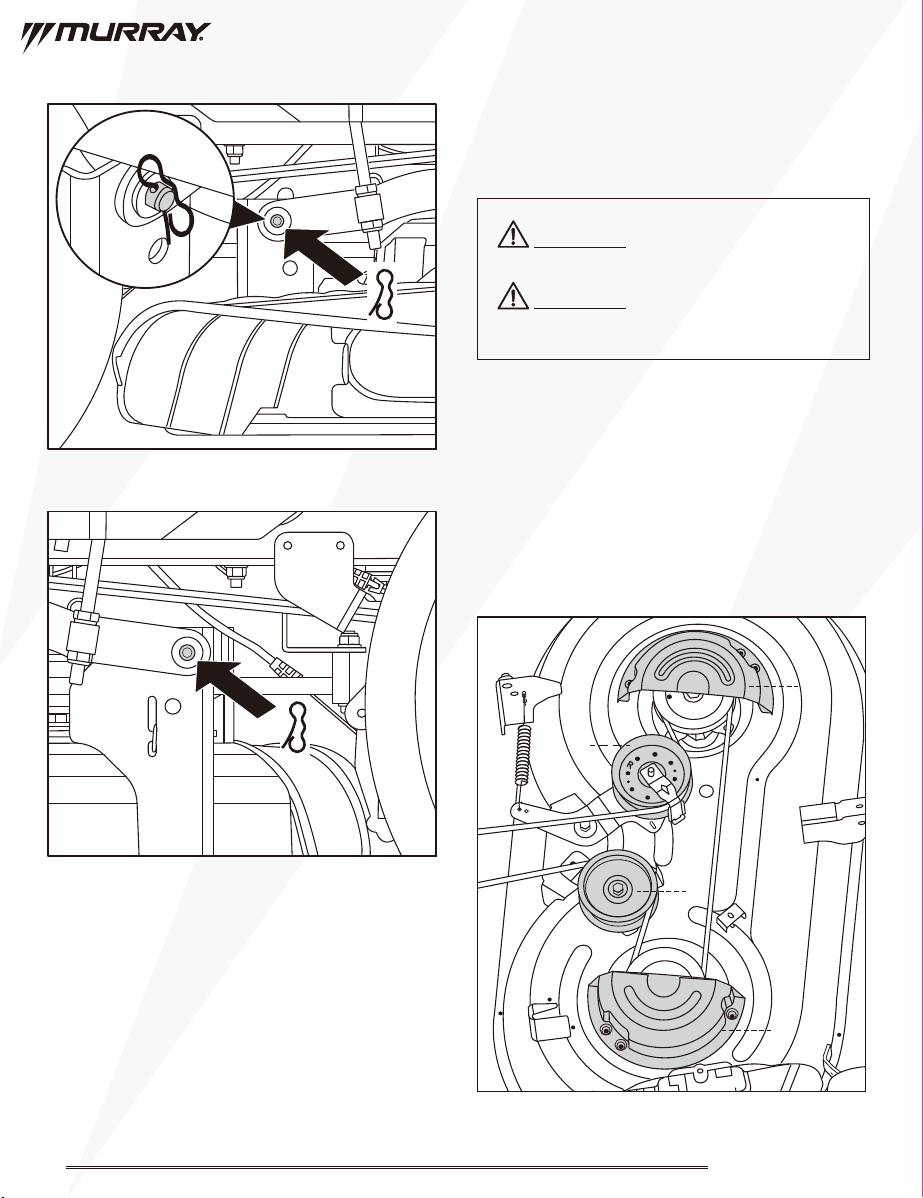
CORTACÉSPED DE GIRO CERO CORTACÉSPED DE GIRO CERO
3736
Fig. 25C
Fig. 25B
Cambiar la correa de la
cubierta
1. Retire la plataforma de corte. Consulte la sección "Retirar
la plataforma de corte".
2.
Retire las dos cubiertas protectoras de la correa (a, fig. 26)
quitando los seis tornillos que las sujetan a la cubierta.
3.
Retire la polea fija (b, Fig.26) y la polea tensora (c, Fig.26).
4.
Retire con cuidado la correa de la plataforma de alrededor
de las poleas.
5. Invierta el proceso para colocar una correa nueva en la
cubierta.
Fig. 26
ADVERTENCIA:
Pare el motor, ponga el freno de
mano y retire la llave.
ADVERTENCIA:
Las correas de su cortacésped están
sujetas a desgaste y deben sustituirse si presentan
cualquier signo de desgaste.
a
a
c
b
Cambiar la correa de
transmisión
1.
2.
3.
4.
5.
6.
7.
Retire la plataforma. Consulte la sección “Extracción de la
plataforma de corte”.
Retire el resorte tensor (a, Fig. 27A).
Retire la rueda tensora (b, Fig. 27A).
Desenchufe el arnés del embrague electromagnético de su
conector. (c, Fig. 27B)
Retire el soporte de montaje del embrague electromagnético.
(d, Fig. 27A)
Retire la correa de transmisión.
Invierta el proceso para volver a colocar una nueva correa de
transmisión en el cortacésped.
ADVERTENCIA:
Pare el motor, ponga el freno de
mano y retire la llave.
ADVERTENCIA:
Para cambiar la correa de transmisión,
se recomienda levantar el cortacésped colocándolo en un
elevador o utilizando un gato y soportes. Asegúrese de que
el cortacésped está bien sujeto y de que el freno de
estacionamiento está puesto antes de proceder. Si no
sujeta correctamente el cortacésped, éste podría caerse,
provocando la muerte o lesiones graves.
Fig. 27A
Fig. 27B
d
b
a
c
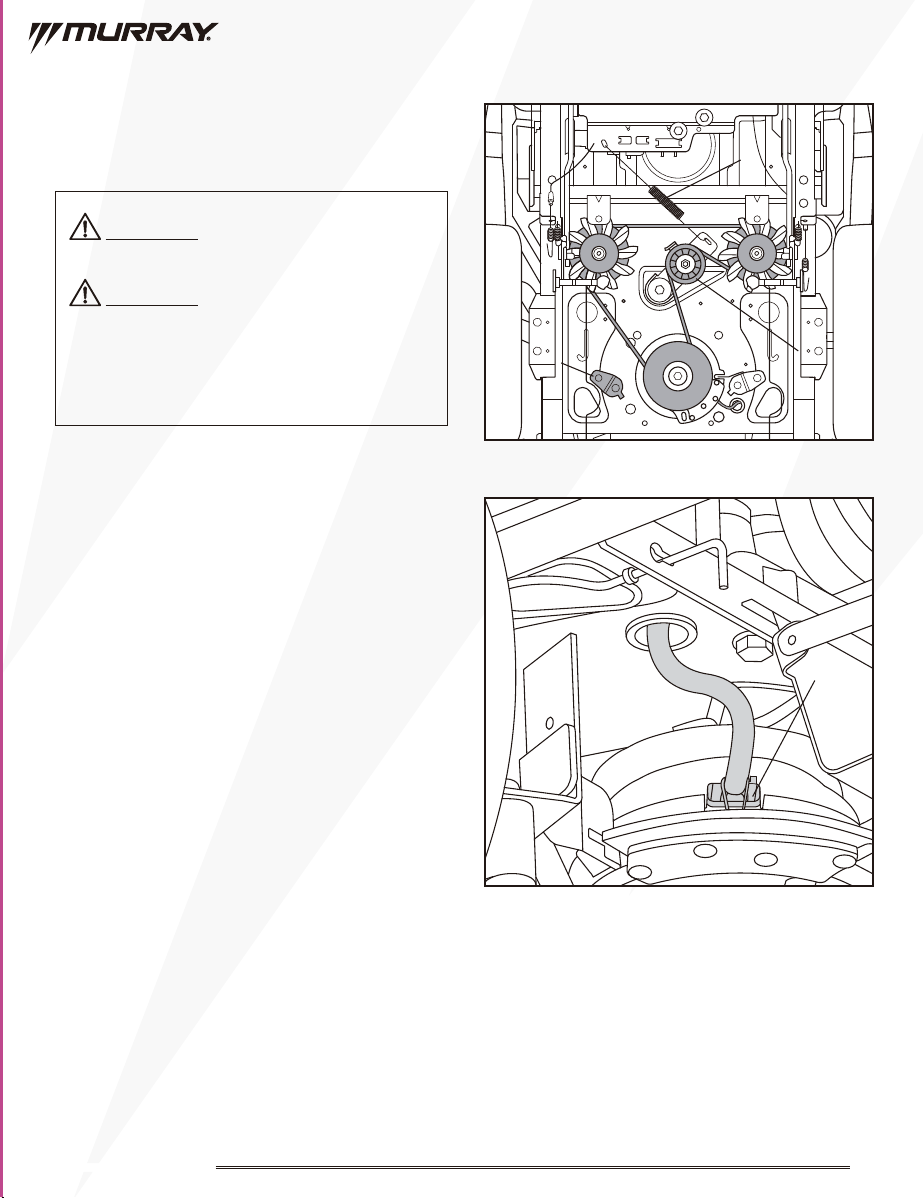
CORTACÉSPED DE GIRO CERO CORTACÉSPED DE GIRO CERO
3736
Fig. 25C
Fig. 25B
Cambiar la correa de la
cubierta
1. Retire la plataforma de corte. Consulte la sección "Retirar
la plataforma de corte".
2.
Retire las dos cubiertas protectoras de la correa (a, fig. 26)
quitando los seis tornillos que las sujetan a la cubierta.
3.
Retire la polea fija (b, Fig.26) y la polea tensora (c, Fig.26).
4.
Retire con cuidado la correa de la plataforma de alrededor
de las poleas.
5. Invierta el proceso para colocar una correa nueva en la
cubierta.
Fig. 26
ADVERTENCIA:
Pare el motor, ponga el freno de
mano y retire la llave.
ADVERTENCIA:
Las correas de su cortacésped están
sujetas a desgaste y deben sustituirse si presentan
cualquier signo de desgaste.
a
a
c
b
Cambiar la correa de
transmisión
1.
2.
3.
4.
5.
6.
7.
Retire la plataforma. Consulte la sección “Extracción de la
plataforma de corte”.
Retire el resorte tensor (a, Fig. 27A).
Retire la rueda tensora (b, Fig. 27A).
Desenchufe el arnés del embrague electromagnético de su
conector. (c, Fig. 27B)
Retire el soporte de montaje del embrague electromagnético.
(d, Fig. 27A)
Retire la correa de transmisión.
Invierta el proceso para volver a colocar una nueva correa de
transmisión en el cortacésped.
ADVERTENCIA:
Pare el motor, ponga el freno de
mano y retire la llave.
ADVERTENCIA:
Para cambiar la correa de transmisión,
se recomienda levantar el cortacésped colocándolo en un
elevador o utilizando un gato y soportes. Asegúrese de que
el cortacésped está bien sujeto y de que el freno de
estacionamiento está puesto antes de proceder. Si no
sujeta correctamente el cortacésped, éste podría caerse,
provocando la muerte o lesiones graves.
Fig. 27A
Fig. 27B
d
b
a
c
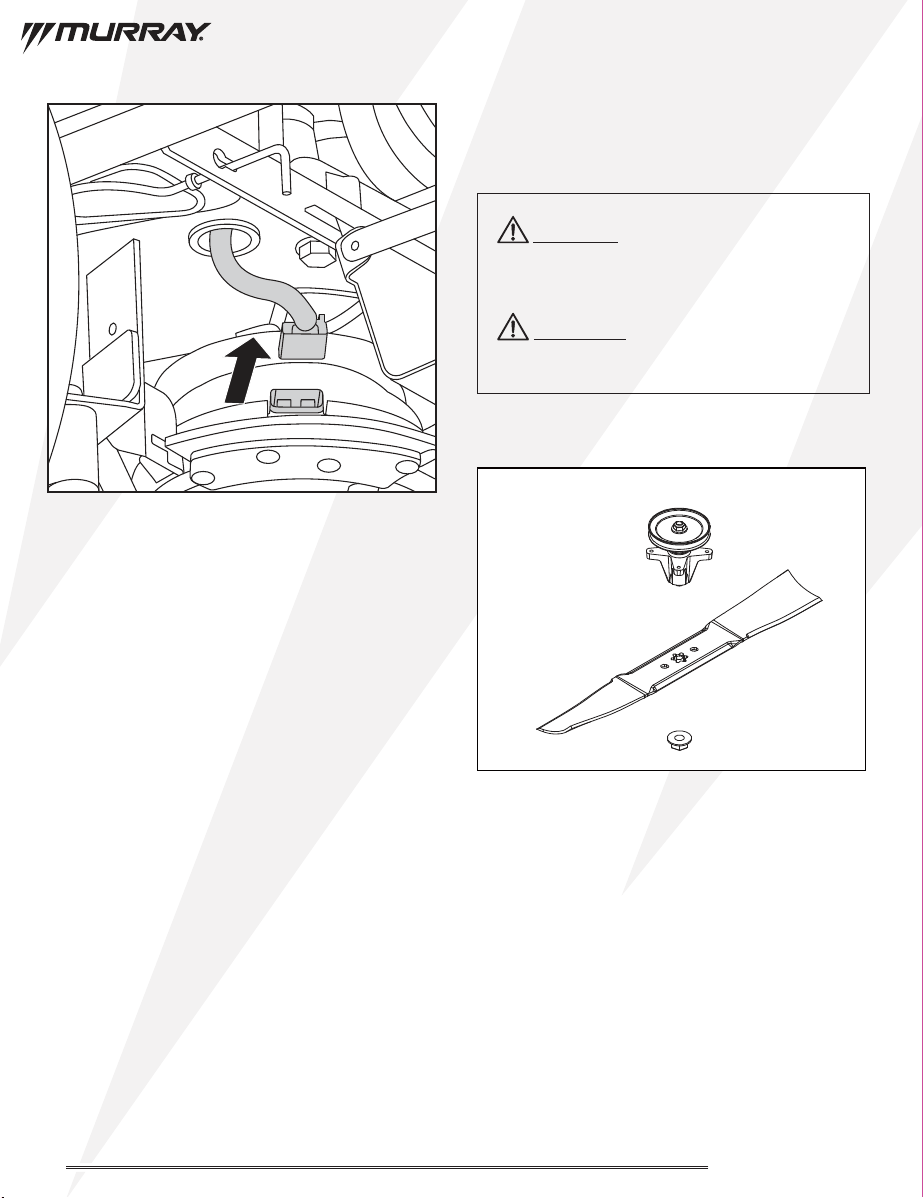
38 39
Fig. 27C
CORTACÉSPED DE GIRO CERO CORTACÉSPED DE GIRO CERO
PRECAUCIÓN: Utilice únicamente cuchillas de
recambio autorizadas por el fabricante de su cortacésped.
El uso de cuchillas no autorizadas es peligroso y puede
dañar su cortacésped.
Cambio de las cuchillas de
corte
Para obtener los mejores resultados, utilice el kit de recambio
correcto para este cortacésped, PN 2105200368.
Fig. 28
1. Apague el motor, retire la llave y ponga el freno de
mano.
2. Retire la plataforma de corte. Consulte la sección "Retirar
la plataforma de corte".
3. Utilice una herramienta de extracción de cuchillas
(no incluida) para evitar que la cuchilla gire.
4. Afloje la tuerca de la cuchilla girándola en el sentido
contrario a las agujas del reloj (visto desde la parte
inferior del cortacésped) utilizando una llave o vaso de
24 mm (no incluido).
ADVERTENCIA:
Las cuchillas del cortacésped están
afiladas. Envuelva la(s) cuchilla(s) o póngase guantes,
y extreme las precauciones al repararlas.
ADVERTENCIA:
Asegúrese de que la cuchilla está bien
asentada y de que la tuerca de la cuchilla está apretada
según las especificaciones de par de apriete indicadas
anteriormente. Si la cuchilla no se fija correctamente,
podría soltarse y provocar la muerte o lesiones graves.
5. Retire la tuerca de la cuchilla y la cuchilla. (Fig.28)
6. Cuando reemplace o reinstale la cuchilla, asegúrese de
instalar la cuchilla en el lado con su número de pieza
estampado mirando hacia el suelo (la misma dirección
que las cuchillas de trabajo).
7. Enrosque la tuerca de la cuchilla en el eje y apriétela con
los dedos.
8. Apriete la tuerca de la cuchilla en el sentido de las agujas
del reloj utilizando una llave dinamométrica (no incluida)
para asegurarse de que el perno está bien apretado. El
par de apriete recomendado para la tuerca de la cuchilla
es de 70-85 pies-libra.
9. Repita los pasos anteriores con la segunda cuchilla.
ADVERTENCIA:
Una cuchilla mal equilibrada provocará
vibraciones excesivas, puede dañar el cortacésped y causar
la muerte o lesiones graves.
Afilar las cuchillas
1. Para afilar correctamente las cuchillas de corte, elimine
cantidades iguales de metal de ambos extremos de las
cuchillas a lo largo de los bordes de corte. Afile siempre
por igual cada filo de la cuchilla de corte para mantener
el equilibrio adecuado de la cuchilla.
2.
Pruebe el equilibrio de la cuchilla utilizando un equilibrador
de cuchillas (no incluido). Rectifique el metal del lado
pesado hasta que se equilibre uniformemente.
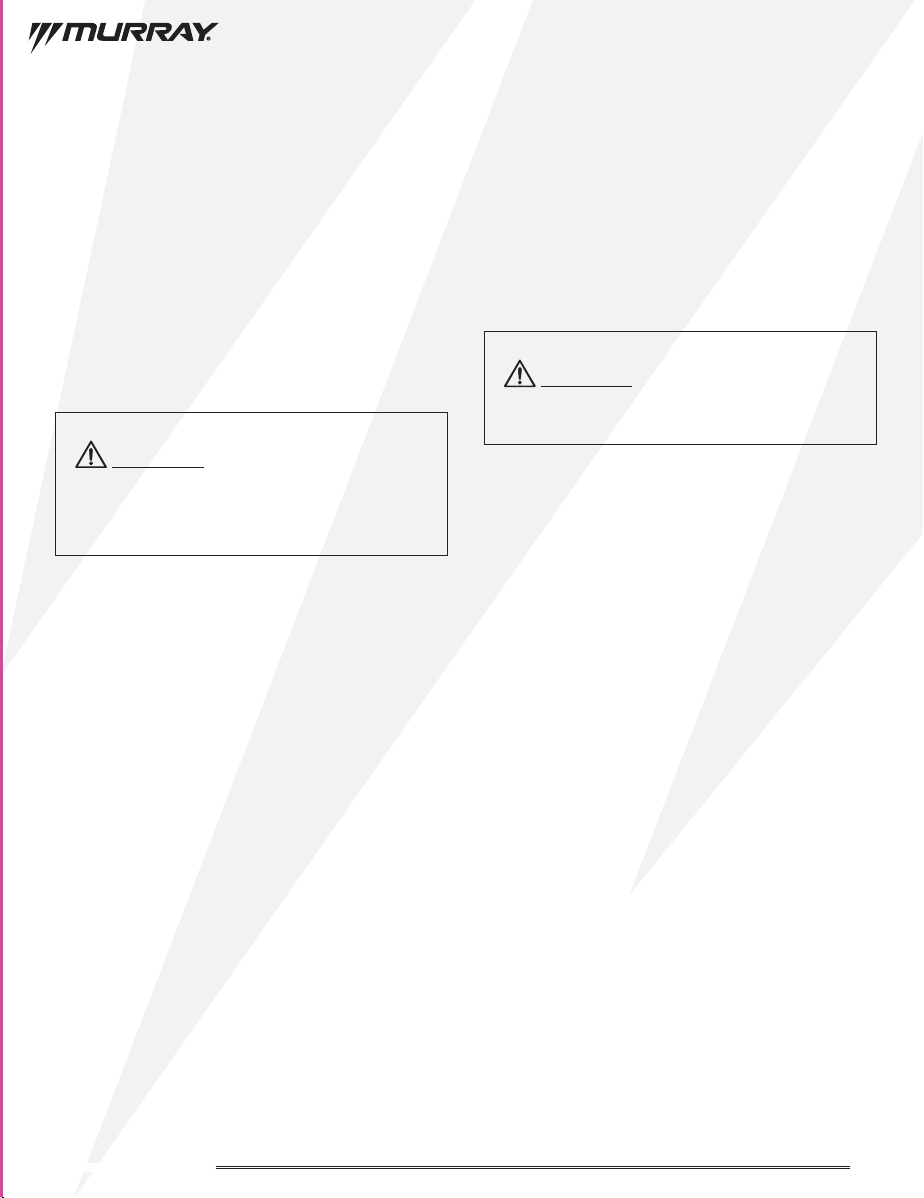
38 39
Fig. 27C
CORTACÉSPED DE GIRO CERO CORTACÉSPED DE GIRO CERO
PRECAUCIÓN: Utilice únicamente cuchillas de
recambio autorizadas por el fabricante de su cortacésped.
El uso de cuchillas no autorizadas es peligroso y puede
dañar su cortacésped.
Cambio de las cuchillas de
corte
Para obtener los mejores resultados, utilice el kit de recambio
correcto para este cortacésped, PN 2105200368.
Fig. 28
1. Apague el motor, retire la llave y ponga el freno de
mano.
2. Retire la plataforma de corte. Consulte la sección "Retirar
la plataforma de corte".
3. Utilice una herramienta de extracción de cuchillas
(no incluida) para evitar que la cuchilla gire.
4. Afloje la tuerca de la cuchilla girándola en el sentido
contrario a las agujas del reloj (visto desde la parte
inferior del cortacésped) utilizando una llave o vaso de
24 mm (no incluido).
ADVERTENCIA:
Las cuchillas del cortacésped están
afiladas. Envuelva la(s) cuchilla(s) o póngase guantes,
y extreme las precauciones al repararlas.
ADVERTENCIA:
Asegúrese de que la cuchilla está bien
asentada y de que la tuerca de la cuchilla está apretada
según las especificaciones de par de apriete indicadas
anteriormente. Si la cuchilla no se fija correctamente,
podría soltarse y provocar la muerte o lesiones graves.
5. Retire la tuerca de la cuchilla y la cuchilla. (Fig.28)
6. Cuando reemplace o reinstale la cuchilla, asegúrese de
instalar la cuchilla en el lado con su número de pieza
estampado mirando hacia el suelo (la misma dirección
que las cuchillas de trabajo).
7. Enrosque la tuerca de la cuchilla en el eje y apriétela con
los dedos.
8. Apriete la tuerca de la cuchilla en el sentido de las agujas
del reloj utilizando una llave dinamométrica (no incluida)
para asegurarse de que el perno está bien apretado. El
par de apriete recomendado para la tuerca de la cuchilla
es de 70-85 pies-libra.
9. Repita los pasos anteriores con la segunda cuchilla.
ADVERTENCIA:
Una cuchilla mal equilibrada provocará
vibraciones excesivas, puede dañar el cortacésped y causar
la muerte o lesiones graves.
Afilar las cuchillas
1. Para afilar correctamente las cuchillas de corte, elimine
cantidades iguales de metal de ambos extremos de las
cuchillas a lo largo de los bordes de corte. Afile siempre
por igual cada filo de la cuchilla de corte para mantener
el equilibrio adecuado de la cuchilla.
2.
Pruebe el equilibrio de la cuchilla utilizando un equilibrador
de cuchillas (no incluido). Rectifique el metal del lado
pesado hasta que se equilibre uniformemente.
40 41
CORTACÉSPED DE GIRO CERO CORTACÉSPED DE GIRO CERO
Comprobación de la presión
de las llantas
Para una tracción correcta y el mejor rendimiento de corte,
asegúrese de que las llantas delanteras están infladas a 20
psi y los traseros a 14 psi. Consulte "Presión de las llantas"
en la sección Especificaciones.
Mantenimiento de la batería
• Rocíe los terminales y el cable expuesto con un sellador de
terminales de batería, o cubra los terminales con una fina
capa de grasa o vaselina, para protegerlos contra la
corrosión.
• Mantenga siempre los cables y terminales de la batería
limpios y sin corrosión.
• Cuando guarde el cortacésped durante periodos prolon
gados, desconecte el cable negativo de la batería. No es
necesario retirar la batería.
• Todas las pilas se descargan durante el almacenamiento.
Mantenga limpio el exterior de la pila, especialmente la
parte superior. Una batería sucia se descargará más
rápidamente.
• La batería debe almacenarse con una carga completa. Una
batería descargada puede congelarse antes que una
cargada. Una batería completamente cargada se almacenará
más tiempo en temperaturas frías que calientes.
• Recargue la batería antes de volver a ponerla en servicio.
Aunque el cortacésped arranque, es posible que el sistema
de carga del motor no recargue completamente la batería.
AVISO:
Puede haber una diferencia en la presión de
inflado de las llantas respecto a la "inflación máxima"
indicada en el lateral de las mismas.
Fig.29
Sustitución de la batería; Limpieza de la
batería y de los cables de la batería
1. PARE el motor. Retire la llave.
2. Retire el extremo en "J" (a) de la varilla de sujeción de la
batería por un pequeño orificio. (Fig.29)
3. Introduzca otro extremo de la varilla de sujeción de la
batería en la ranura cóncava. (Fig.29)
4. Desconecte primero el cable NEGATIVO (-) de la batería.
5. Desconecte el cable POSITIVO (+) de la batería al último.
6. Limpie la superficie de la pila con bicarbonato de sodio y
agua.
7. Utilice un cepillo de alambre y un limpiador de termina
les para limpiar los terminales de la batería y los extremos
de los cables.
8. Lubrique las terminales de la batería con vaselina o grasa
no conductora.
9. Instale la batería.
10. Conecte primero los cables POSITIVOS (+) a la batería.
11. Conecte los cables NEGATIVOS (-) a la batería al último.
12. Instale la varilla de sujeción de la batería.
Cargar la batería
Una batería agotada o demasiado débil para arrancar el
motor puede ser el resultado de un defecto en el sistema de
carga o en otros componentes eléctricos. Si tiene dudas
sobre la causa del problema, acuda a un Servicio Técnico
Autorizado.
AVISO: NO retire ni conecte el cable de la batería con el
motor en marcha.
ADVERTENCIA:
Proteja siempre los ojos, la piel y la
ropa cuando trabaje cerca de las pilas.
ADVERTENCIA:
Cuando retire o instale los cables de
la batería, desconecte siempre PRIMERO el cable NEGATIVO
(negro) y vuelva a conectarlo EN ÚLTIMO LUGAR. Si no se
hace en este orden, el borne positivo puede entrar en
cortocircuito con el cuadro por una herramienta.
ADVERTENCIA:
Mantenga las llamas y las chispas
alejadas de la batería. Los gases de la batería son muy
explosivos.
a
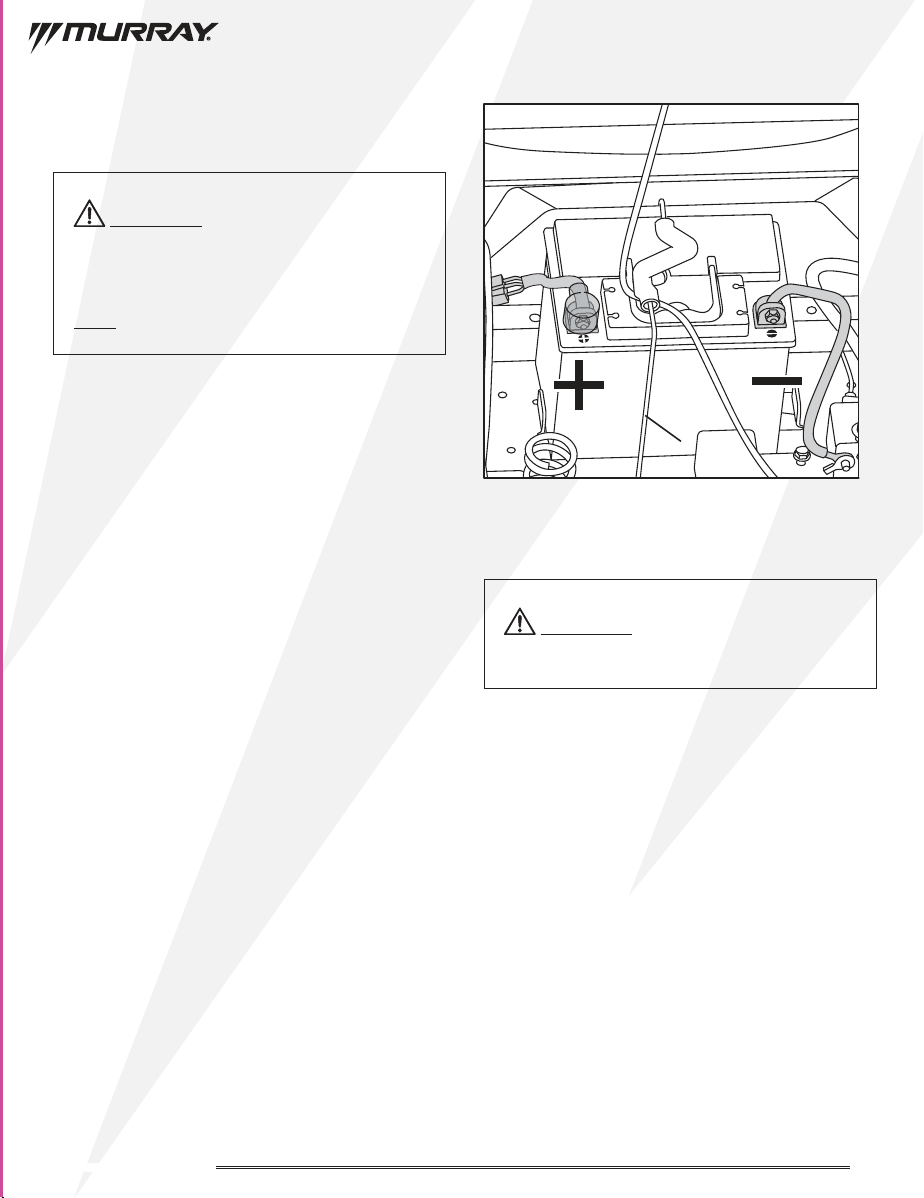
40 41
CORTACÉSPED DE GIRO CERO CORTACÉSPED DE GIRO CERO
Comprobación de la presión
de las llantas
Para una tracción correcta y el mejor rendimiento de corte,
asegúrese de que las llantas delanteras están infladas a 20
psi y los traseros a 14 psi. Consulte "Presión de las llantas"
en la sección Especificaciones.
Mantenimiento de la batería
• Rocíe los terminales y el cable expuesto con un sellador de
terminales de batería, o cubra los terminales con una fina
capa de grasa o vaselina, para protegerlos contra la
corrosión.
• Mantenga siempre los cables y terminales de la batería
limpios y sin corrosión.
• Cuando guarde el cortacésped durante periodos prolon
gados, desconecte el cable negativo de la batería. No es
necesario retirar la batería.
• Todas las pilas se descargan durante el almacenamiento.
Mantenga limpio el exterior de la pila, especialmente la
parte superior. Una batería sucia se descargará más
rápidamente.
• La batería debe almacenarse con una carga completa. Una
batería descargada puede congelarse antes que una
cargada. Una batería completamente cargada se almacenará
más tiempo en temperaturas frías que calientes.
• Recargue la batería antes de volver a ponerla en servicio.
Aunque el cortacésped arranque, es posible que el sistema
de carga del motor no recargue completamente la batería.
AVISO:
Puede haber una diferencia en la presión de
inflado de las llantas respecto a la "inflación máxima"
indicada en el lateral de las mismas.
Fig.29
Sustitución de la batería; Limpieza de la
batería y de los cables de la batería
1. PARE el motor. Retire la llave.
2. Retire el extremo en "J" (a) de la varilla de sujeción de la
batería por un pequeño orificio. (Fig.29)
3. Introduzca otro extremo de la varilla de sujeción de la
batería en la ranura cóncava. (Fig.29)
4. Desconecte primero el cable NEGATIVO (-) de la batería.
5. Desconecte el cable POSITIVO (+) de la batería al último.
6. Limpie la superficie de la pila con bicarbonato de sodio y
agua.
7. Utilice un cepillo de alambre y un limpiador de termina
les para limpiar los terminales de la batería y los extremos
de los cables.
8. Lubrique las terminales de la batería con vaselina o grasa
no conductora.
9. Instale la batería.
10. Conecte primero los cables POSITIVOS (+) a la batería.
11. Conecte los cables NEGATIVOS (-) a la batería al último.
12. Instale la varilla de sujeción de la batería.
Cargar la batería
Una batería agotada o demasiado débil para arrancar el
motor puede ser el resultado de un defecto en el sistema de
carga o en otros componentes eléctricos. Si tiene dudas
sobre la causa del problema, acuda a un Servicio Técnico
Autorizado.
AVISO: NO retire ni conecte el cable de la batería con el
motor en marcha.
ADVERTENCIA:
Proteja siempre los ojos, la piel y la
ropa cuando trabaje cerca de las pilas.
ADVERTENCIA:
Cuando retire o instale los cables de
la batería, desconecte siempre PRIMERO el cable NEGATIVO
(negro) y vuelva a conectarlo EN ÚLTIMO LUGAR. Si no se
hace en este orden, el borne positivo puede entrar en
cortocircuito con el cuadro por una herramienta.
ADVERTENCIA:
Mantenga las llamas y las chispas
alejadas de la batería. Los gases de la batería son muy
explosivos.
a
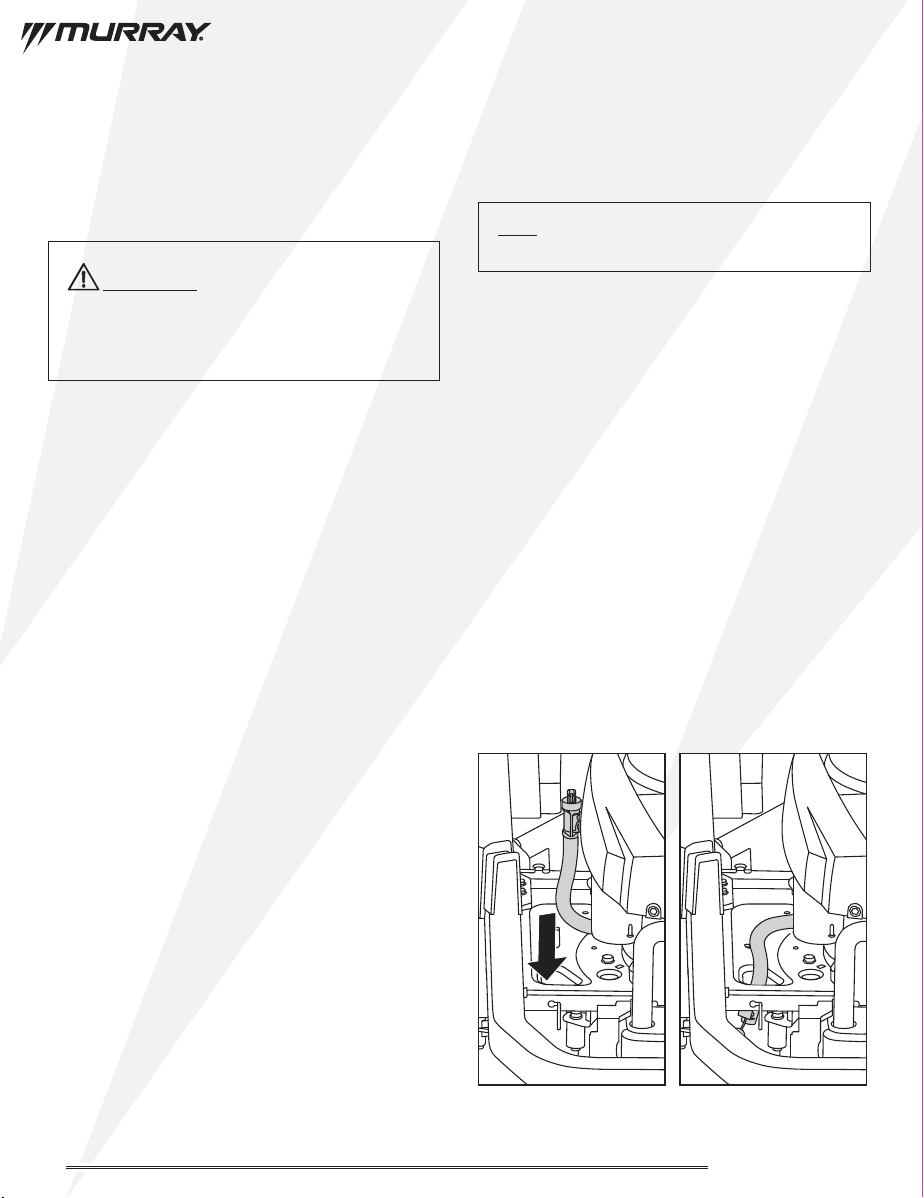
42 43
CORTACÉSPED DE GIRO CERO CORTACÉSPED DE GIRO CERO
ADVERTENCIA: Si la cuchilla de la cortadora de
césped no se DETIENE en 5 segundos o menos,
el embrague debe ser ajustado. NO haga funcionar la
máquina hasta que el ajuste haya sido corregido por un
centro de servicio autorizado.
Comprobación del tiempo
de parada de la cuchilla del
cortacésped
Fig.31
ADVERTENCIA: NO arranque ni haga funcionar el
motor sin un filtro de aire, ya que supone un riesgo de i
ncendio.
NOTICE: NO utilice aire a presión ni disolventes para
limpiar el filtro de aire. El aire a presión puede dañar el
filtro y los disolventes lo disolverán.
Cambiar el filtro de aire
1. Afloje los tornillos y retire la cubierta.
2. Retire el filtro de aire.
3. Limpie el material no deseado o los residuos que puedan
introducirse en la garganta del carburador.
4. Golpee ligeramente el filtro de aire sobre una superficie
dura para aflojar los residuos. Si el filtro de aire está
sucio, sustitúyalo.
5. Instale el filtro de aire.
6. Instale la cubierta y apriete los tornillos.
Comprobar el nivel de aceite
del motor
1. Retire la varilla de nivel. Limpie los restos de aceite de la
varilla.
2. Instale y apriete la varilla de nivel.
3. Extraiga de nuevo la varilla y compruebe el nivel de
aceite.
4. Asegúrese de que el nivel de aceite se encuentra en el
centro de la marca LLENO de la varilla.
5. Si el nivel de aceite está LLENO, instale y apriete la varilla.
6. Si el nivel de aceite es BAJO, añada aceite en el tubo de
llenado de aceite.
7. Espere un minuto y vuelva a comprobar el nivel de aceite.
Continúe añadiendo aceite y comprobando el nivel hasta
que esté LLENO.
8. Instale y apriete la varilla de nivel.
NOTA:
El filtro de aceite debe cambiarse en cada intervalo
de cambio de aceite.
Fig.30A Fig.30B
Cambio del aceite y del filtro
de aceite
1. Coloque la unidad sobre una superficie nivelada.
2. Pare el motor y retire la llave.
3. Localice el manguito de vaciado de aceite y tire de él
hacia abajo para extraerlo. (Fig.30A)
4. Coloque el manguito de vaciado de aceite debajo del
tapón de vaciado.
5. Coloque un recipiente colector debajo del manguito de
vaciado de aceite.
6. Gire en sentido contrario a las manecillas del reloj y tire
del tapón de vaciado hacia fuera. (Fig.30B)
7. Una vez drenado el aceite, vuelva a colocar el tapón de
vaciado de aceite firmemente.
8. Retire el filtro de aceite y deséchelo correctamente.
9. Antes de instalar el nuevo filtro de aceite, lubrique
ligeramente la junta del filtro de aceite con aceite limpio.
10. Instale el filtro de aceite a mano hasta que la junta
toque el adaptador del filtro de aceite, luego apriete el
filtro de aceite ½ a ¾ vueltas.
11. Rellene el motor con aceite nuevo.
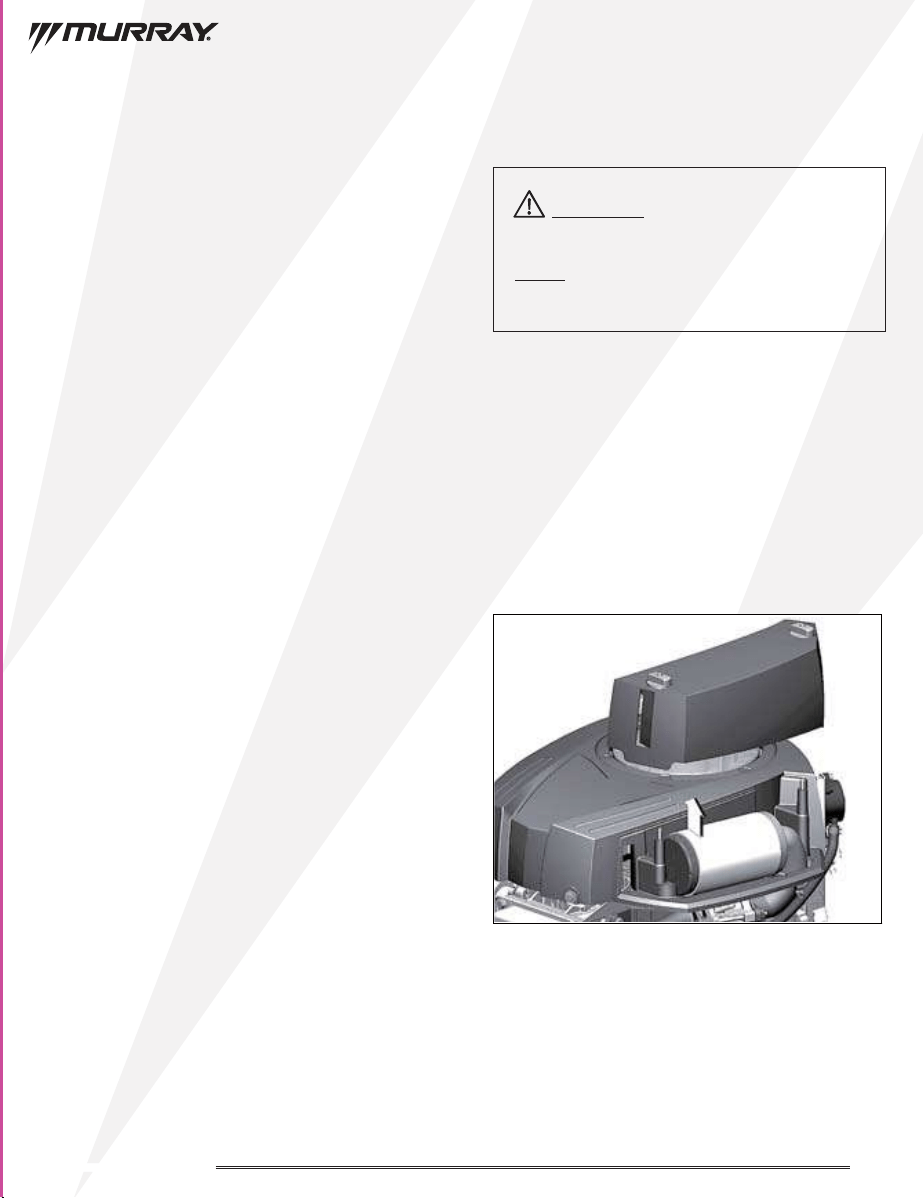
42 43
CORTACÉSPED DE GIRO CERO CORTACÉSPED DE GIRO CERO
ADVERTENCIA: Si la cuchilla de la cortadora de
césped no se DETIENE en 5 segundos o menos,
el embrague debe ser ajustado. NO haga funcionar la
máquina hasta que el ajuste haya sido corregido por un
centro de servicio autorizado.
Comprobación del tiempo
de parada de la cuchilla del
cortacésped
Fig.31
ADVERTENCIA: NO arranque ni haga funcionar el
motor sin un filtro de aire, ya que supone un riesgo de i
ncendio.
NOTICE: NO utilice aire a presión ni disolventes para
limpiar el filtro de aire. El aire a presión puede dañar el
filtro y los disolventes lo disolverán.
Cambiar el filtro de aire
1. Afloje los tornillos y retire la cubierta.
2. Retire el filtro de aire.
3. Limpie el material no deseado o los residuos que puedan
introducirse en la garganta del carburador.
4. Golpee ligeramente el filtro de aire sobre una superficie
dura para aflojar los residuos. Si el filtro de aire está
sucio, sustitúyalo.
5. Instale el filtro de aire.
6. Instale la cubierta y apriete los tornillos.
Comprobar el nivel de aceite
del motor
1. Retire la varilla de nivel. Limpie los restos de aceite de la
varilla.
2. Instale y apriete la varilla de nivel.
3. Extraiga de nuevo la varilla y compruebe el nivel de
aceite.
4. Asegúrese de que el nivel de aceite se encuentra en el
centro de la marca LLENO de la varilla.
5. Si el nivel de aceite está LLENO, instale y apriete la varilla.
6. Si el nivel de aceite es BAJO, añada aceite en el tubo de
llenado de aceite.
7. Espere un minuto y vuelva a comprobar el nivel de aceite.
Continúe añadiendo aceite y comprobando el nivel hasta
que esté LLENO.
8. Instale y apriete la varilla de nivel.
NOTA:
El filtro de aceite debe cambiarse en cada intervalo
de cambio de aceite.
Fig.30A Fig.30B
Cambio del aceite y del filtro
de aceite
1. Coloque la unidad sobre una superficie nivelada.
2. Pare el motor y retire la llave.
3. Localice el manguito de vaciado de aceite y tire de él
hacia abajo para extraerlo. (Fig.30A)
4. Coloque el manguito de vaciado de aceite debajo del
tapón de vaciado.
5. Coloque un recipiente colector debajo del manguito de
vaciado de aceite.
6. Gire en sentido contrario a las manecillas del reloj y tire
del tapón de vaciado hacia fuera. (Fig.30B)
7. Una vez drenado el aceite, vuelva a colocar el tapón de
vaciado de aceite firmemente.
8. Retire el filtro de aceite y deséchelo correctamente.
9. Antes de instalar el nuevo filtro de aceite, lubrique
ligeramente la junta del filtro de aceite con aceite limpio.
10. Instale el filtro de aceite a mano hasta que la junta
toque el adaptador del filtro de aceite, luego apriete el
filtro de aceite ½ a ¾ vueltas.
11. Rellene el motor con aceite nuevo.
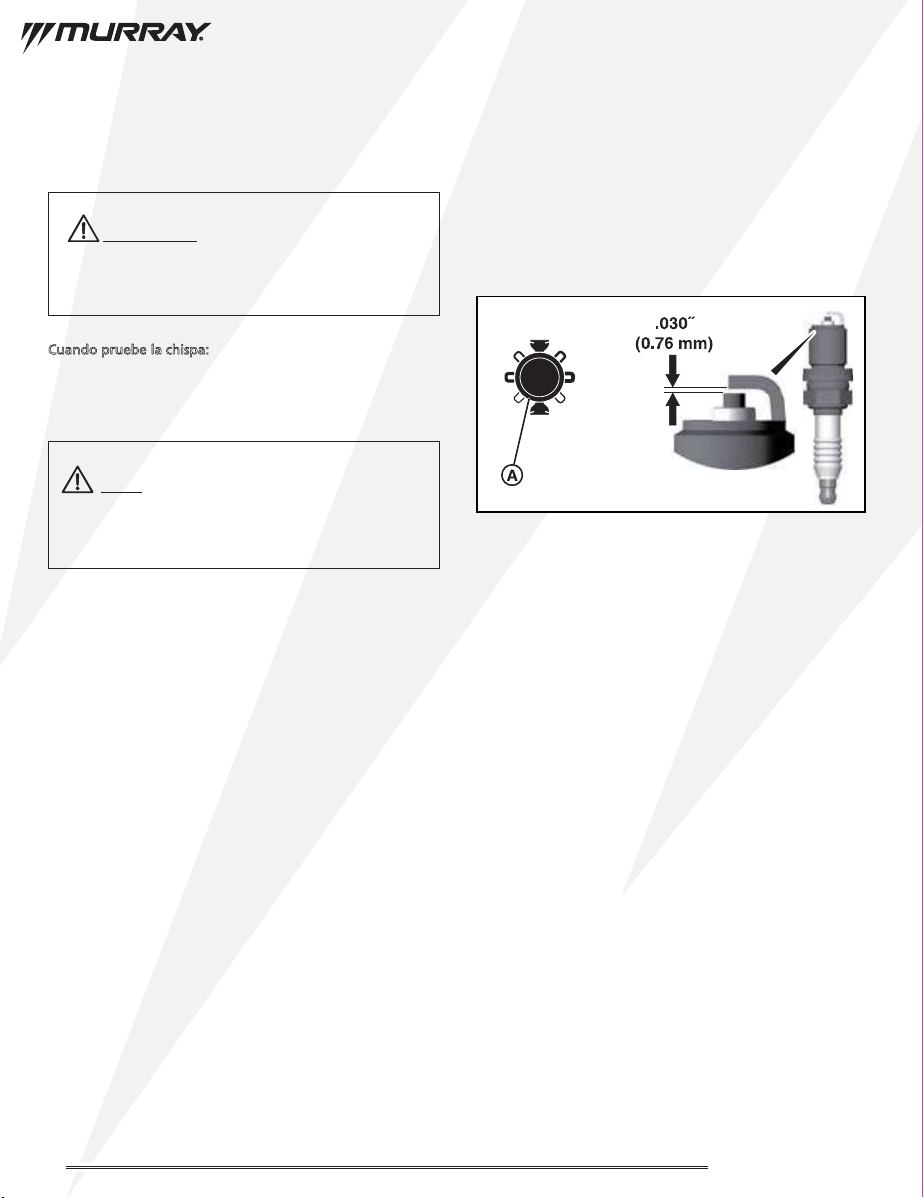
44 45
Empujar el cortacésped a
mano
Empujar el cortacésped puede ser necesario para moverlo
dentro y fuera de un garaje o cobertizo. También puede ser
necesario para cargarlo y sacarlo de un remolque.
1. Desconecte la corriente y pare el motor
2. Desconecte el interruptor de la TDF.
3. Para encajar la palanca de la válvula de derivación, tire
de la palanca hacia atrás y hacia la sección alargada de la
ranura irregular. Repita la operación en el lado opuesto.
4. Asegúrese de que las palancas mando están en neutral.
5. Después de mover el cortacésped, invierta el paso 1 para
desembragar las palancas de la válvula de derivación.
Remolcar con el cortacésped
• Sujete el equipo SÓLO en el punto de enganche.
• El peso total remolcado (remolque y carga) no debe
superar las 400 libras y no debe exceder un peso de
lengüeta (arriba o abajo) de 20 libras.
• Cuando remolque, no lo haga en pendientes superiores a
5 grados. El peso del equipo remolcado en pendientes
puede causar pérdida de tracción y pérdida de control.
• NO permita que niños u otras personas suban o bajen del
equipo remolcado.
• NO coloque las palancas de control de la transmisión en
posición neutra y descienda con la inercia.
CORTACÉSPED DE GIRO CERO CORTACÉSPED DE GIRO CERO
ADVERTENCIA: La formación involuntaria de chispas
puede provocar un incendio o una descarga eléctrica.
El arranque involuntario puede provocar enredos,
amputaciones traumáticas o laceraciones.
AVISO:
Las bujías tienen diferentes rangos térmicos.
Es importante que se utilice la bujía correcta, de lo contrario
pueden producirse daños en el motor. Sustituya la bujía por
una del mismo tipo o equivalente.
Comprobación de la bujía
de encendido
Cuando pruebe la chispa:
• Utilice un comprobador de bujías aprobado.
• NO compruebe la chispa con la bujía desmontada.
Comprobación de la separación entre bujías
Utilice una galga de bujías (A) para comprobar la separación
entre los dos electrodos. Cuando la separación es correcta, la
galga se arrastrará ligeramente al tirar de ella a través de la
separación.
Para ajustar la separación de la bujía, utilice una galga de
bujías y doble suavemente el electrodo curvado. Asegúrese
de no tocar el electrodo central ni la porcelana.
Instalación de la bujía
Apriete la bujía con los dedos, y después, apriétela con una
llave inglesa,
• 180 pulgadas-libra, O
• ½ vuelta al instalar la bujía original, O
• ¼ de vuelta al instalar una bujía nueva
Fig.32

44 45
Empujar el cortacésped a
mano
Empujar el cortacésped puede ser necesario para moverlo
dentro y fuera de un garaje o cobertizo. También puede ser
necesario para cargarlo y sacarlo de un remolque.
1. Desconecte la corriente y pare el motor
2. Desconecte el interruptor de la TDF.
3. Para encajar la palanca de la válvula de derivación, tire
de la palanca hacia atrás y hacia la sección alargada de la
ranura irregular. Repita la operación en el lado opuesto.
4. Asegúrese de que las palancas mando están en neutral.
5. Después de mover el cortacésped, invierta el paso 1 para
desembragar las palancas de la válvula de derivación.
Remolcar con el cortacésped
• Sujete el equipo SÓLO en el punto de enganche.
• El peso total remolcado (remolque y carga) no debe
superar las 400 libras y no debe exceder un peso de
lengüeta (arriba o abajo) de 20 libras.
• Cuando remolque, no lo haga en pendientes superiores a
5 grados. El peso del equipo remolcado en pendientes
puede causar pérdida de tracción y pérdida de control.
• NO permita que niños u otras personas suban o bajen del
equipo remolcado.
• NO coloque las palancas de control de la transmisión en
posición neutra y descienda con la inercia.
CORTACÉSPED DE GIRO CERO CORTACÉSPED DE GIRO CERO
ADVERTENCIA: La formación involuntaria de chispas
puede provocar un incendio o una descarga eléctrica.
El arranque involuntario puede provocar enredos,
amputaciones traumáticas o laceraciones.
AVISO:
Las bujías tienen diferentes rangos térmicos.
Es importante que se utilice la bujía correcta, de lo contrario
pueden producirse daños en el motor. Sustituya la bujía por
una del mismo tipo o equivalente.
Comprobación de la bujía
de encendido
Cuando pruebe la chispa:
• Utilice un comprobador de bujías aprobado.
• NO compruebe la chispa con la bujía desmontada.
Comprobación de la separación entre bujías
Utilice una galga de bujías (A) para comprobar la separación
entre los dos electrodos. Cuando la separación es correcta, la
galga se arrastrará ligeramente al tirar de ella a través de la
separación.
Para ajustar la separación de la bujía, utilice una galga de
bujías y doble suavemente el electrodo curvado. Asegúrese
de no tocar el electrodo central ni la porcelana.
Instalación de la bujía
Apriete la bujía con los dedos, y después, apriétela con una
llave inglesa,
• 180 pulgadas-libra, O
• ½ vuelta al instalar la bujía original, O
• ¼ de vuelta al instalar una bujía nueva
Fig.32

46 47
9.
CORTACÉSPED DE GIRO CERO CORTACÉSPED DE GIRO CERO
7. Transporte
Vacíe el tanque de combustible con una bomba de succión
antes de transportar la máquina. Arranque el motor y déjelo
funcionar hasta que haya consumido toda la gasolina
restante.
• Cierre firmemente el tapón del tanque.
• Deje que el motor se enfríe antes de transportarlo.
• Utilice rampas de ancho completo para cargar y descargar
la máquina para su transporte.
• Extreme las precauciones al cargar o descargar la máquina
en un remolque o camión. Esta máquina no debe subirse
ni bajarse por la(s) rampa(s), ya que podría volcar, causan
do graves lesiones personales. La máquina debe empujarse
manualmente por la(s) rampa(s) para cargarla o descargarla
correctamente.
8. Almacenamiento
Guárdelo lejos de hornos, estufas, calentadores de agua u
otros aparatos que tengan luces piloto u otras fuentes de
ignición porque pueden encender los vapores del combusti-
ble.
Cortacésped
Desconecte la toma de fuerza (TDF), ponga el freno de
mano, retire la llave y deje que la máquina se enfríe.
Si retira la batería, la vida útil de la misma aumentará.
Asegúrese de que la batería se encuentra en un lugar fresco
y seco, y manténgala completamente cargada. Si se deja la
batería en la unidad, desconecte el cable negativo.
Sistema de combustible
El combustible puede ponerse rancio si se mantiene en un
recipiente de almacenamiento durante más de 30 días. Cada
vez que llene el recipiente con combustible, añada STA-BIL
360 Protection al combustible tal y como se especifica en las
instrucciones del fabricante. Esto mantiene el combustible
fresco y disminuye los problemas relacionados con el
combustible o la contaminación en el sistema de combusti-
ble.
No es necesario vaciar el combustible del motor cuando se
añade STA-BIL 360 Protection según las instrucciones. Antes
de guardarlo, encienda el motor durante 2 minutos para
que el combustible y el estabilizador se muevan por el
sistema de combustible.
Antes de arrancar la máquina después de haber estado
almacenada:
• Compruebe todos los niveles de fluidos. Compruebe todos
los elementos de mantenimiento.
• Realice todas las comprobaciones y procedimientos
recomendados en este manual.
• Cargue completamente la batería.
• Conduzca el cortacésped sin carga para asegurarse de que
todos los sistemas del cortacésped funcionan correctamente.
ADVERTENCIA: Nunca almacene la
unidad con combustible en una estructura cerrada y sin
ventilación. Los vapores del combustible pueden
desplazarse hasta una fuente de ignición (como un horno,
un calentador de agua, etc.) y provocar una explosión.

46 47
9.
CORTACÉSPED DE GIRO CERO CORTACÉSPED DE GIRO CERO
7. Transporte
Vacíe el tanque de combustible con una bomba de succión
antes de transportar la máquina. Arranque el motor y déjelo
funcionar hasta que haya consumido toda la gasolina
restante.
• Cierre firmemente el tapón del tanque.
• Deje que el motor se enfríe antes de transportarlo.
• Utilice rampas de ancho completo para cargar y descargar
la máquina para su transporte.
• Extreme las precauciones al cargar o descargar la máquina
en un remolque o camión. Esta máquina no debe subirse
ni bajarse por la(s) rampa(s), ya que podría volcar, causan
do graves lesiones personales. La máquina debe empujarse
manualmente por la(s) rampa(s) para cargarla o descargarla
correctamente.
8. Almacenamiento
Guárdelo lejos de hornos, estufas, calentadores de agua u
otros aparatos que tengan luces piloto u otras fuentes de
ignición porque pueden encender los vapores del combusti-
ble.
Cortacésped
Desconecte la toma de fuerza (TDF), ponga el freno de
mano, retire la llave y deje que la máquina se enfríe.
Si retira la batería, la vida útil de la misma aumentará.
Asegúrese de que la batería se encuentra en un lugar fresco
y seco, y manténgala completamente cargada. Si se deja la
batería en la unidad, desconecte el cable negativo.
Sistema de combustible
El combustible puede ponerse rancio si se mantiene en un
recipiente de almacenamiento durante más de 30 días. Cada
vez que llene el recipiente con combustible, añada STA-BIL
360 Protection al combustible tal y como se especifica en las
instrucciones del fabricante. Esto mantiene el combustible
fresco y disminuye los problemas relacionados con el
combustible o la contaminación en el sistema de combusti-
ble.
No es necesario vaciar el combustible del motor cuando se
añade STA-BIL 360 Protection según las instrucciones. Antes
de guardarlo, encienda el motor durante 2 minutos para
que el combustible y el estabilizador se muevan por el
sistema de combustible.
Antes de arrancar la máquina después de haber estado
almacenada:
• Compruebe todos los niveles de fluidos. Compruebe todos
los elementos de mantenimiento.
• Realice todas las comprobaciones y procedimientos
recomendados en este manual.
• Cargue completamente la batería.
• Conduzca el cortacésped sin carga para asegurarse de que
todos los sistemas del cortacésped funcionan correctamente.
ADVERTENCIA: Nunca almacene la
unidad con combustible en una estructura cerrada y sin
ventilación. Los vapores del combustible pueden
desplazarse hasta una fuente de ignición (como un horno,
un calentador de agua, etc.) y provocar una explosión.

48 49
ADVERTENCIA: Antes de realizar cualquier tipo de mantenimiento, desconecte todos los mandos y pare el motor.
Espere hasta que todas las piezas móviles se hayan detenido por completo. Desconecte el cable de la bujía y conéctelo a
tierra contra el motor para evitar un arranque involuntario. Utilice siempre gafas de seguridad durante el funcionamiento
o mientras realice cualquier ajuste o reparación.
AVISO: Si no puede resolver los problemas de la máquina, lleve el cortacésped a un centro de servicio autorizado para que
le ayuden.
9. Solución de problemas
El motor no arranca.
El freno de mano no está puesto. Mueva las dos palancas de mando hacia
fuera hasta la posición de parking.
El tanque de combustible está vacío.
El interruptor de la TDF está en la posición
ENCENDIDO.
El motor está inundado.
Los terminales de la batería están sucios.
La batería está descargada o muerta.
Cableado suelto o roto.
Cargue o cambie la batería.
Compruebe visualmente el cableado. Si los
cables están deshilachados o rotos, acuda a
un Servicio Técnico Autorizado.
Consulte la sección "Sustitución de la batería;
limpieza de la batería y de los cables de la
batería".
Desenganche el freno.
Mueva el interruptor de la TDF a la
posición de APAGADO.
Si el motor está caliente, déjelo enfriar y
vuelva a llenar el tanque de combustible.
PROBLEMA BUSQUE SOLUCIÓN
El motor arranca con dificultad
o funciona mal.
El motor golpetea.
Consumo excesivo de aceite.
El escape del motor es negro. El filtro de aire está sucio.
El estárter está cerrado. Open the choke.
Consulte la sección "Cambio del filtro de aire".
La mezcla de combustible es excesiva.
Nivel de aceite bajo.
El motor está demasiado caliente.
Grado incorrecto de aceite.
Demasiado aceite en el cárter. Escurra el exceso de aceite.
Consulte la sección "Cambio del aceite
del motor".
Compruebe las aletas del motor, la rejilla
del soplador y el filtro de aire.
Grado incorrecto de aceite. Consulte la sección "Cambio del aceite del
motor".
Compruebe y añada aceite según sea
necesario.
Limpie el filtro de aire.
Solución de problemas del cortacésped
El motor funciona, pero el
cortacésped no se pone en
marcha.
La transmisión está en neutral.
La válvula de derivación está en posición abierta.
Cuando la palanca de mando está en punto
muerto, la placa del engranaje de parking
del puente hidráulico se engrana.
Compruebe si el muelle de tensión del puente
hidráulico se ha caído. Si lo ha hecho, acuda a
un centro autorizado para su reparación.
El cortacésped gira con dificultad
o se maneja mal.
Las llantas no están correctamente infladas.
Cierre la válvula de derivación.
La correa de transmisión se cayó. Diríjase a un centro autorizado para su
mantenimiento.
Mueva las palancas de mando a la marcha
de avance.
Consulte la sección "Comprobar la presión
de las llantas".
El corte del cortacésped es
irregular.
Las llantas no están correctamente infladas.
La velocidad del motor es demasiado lenta.El corte parece áspero.
La velocidad de avance es demasiado rápida.
The engine starts, and the
machine drives, but the mower
will not cut.
El motor no está a la temperatura de
funcionamiento.
La toma de fuerza (TDF) está desconectada. Enganche la TDF.
Desprendimiento del cableado del
embrague electromagnético.
Comprobación del puerto de cableado. Si
se ha caído o está dañado, acuda a un
centro autorizado para su mantenimiento.
ARRANQUE el motor y deje que se caliente
durante varios minutos.
El motor se cala fácilmente con
las cuchillas de la cortadora
engranadas.
La velocidad del motor es demasiado lenta.
La velocidad de avance es demasiado rápida.
Filtro de aire sucio u obstruido.
La altura de corte es demasiado baja.
Consulte la sección "Cambio del filtro de aire".
Corte la hierba alta a la máxima altura de
corte durante la primera pasada, o siga la
"Regla de 1/3" durante el funcionamiento.
Baje la velocidad.
Ponga la palanca del acelerador en RÁPIDO.
Consulte la sección "Comprobar la presión
de las llantas".
Plataforma de corte irregular. Consulte la sección "Nivelación de la
plataforma de corte".
Baje la velocidad.
Desgaste de la cuchilla de corte.
Revise y sustituya una cuchilla nueva si es
necesario.
Ponga la palanca del acelerador en RÁPIDO.
NOTA: Para cualquier otro problema, póngase en contacto con un Centro de Servicio Autorizado.
CORTACÉSPED DE GIRO CERO CORTACÉSPED DE GIRO CERO
48 49
ADVERTENCIA: Antes de realizar cualquier tipo de mantenimiento, desconecte todos los mandos y pare el motor.
Espere hasta que todas las piezas móviles se hayan detenido por completo. Desconecte el cable de la bujía y conéctelo a
tierra contra el motor para evitar un arranque involuntario. Utilice siempre gafas de seguridad durante el funcionamiento
o mientras realice cualquier ajuste o reparación.
AVISO: Si no puede resolver los problemas de la máquina, lleve el cortacésped a un centro de servicio autorizado para que
le ayuden.
9. Solución de problemas
El motor no arranca.
El freno de mano no está puesto. Mueva las dos palancas de mando hacia
fuera hasta la posición de parking.
El tanque de combustible está vacío.
El interruptor de la TDF está en la posición
ENCENDIDO.
El motor está inundado.
Los terminales de la batería están sucios.
La batería está descargada o muerta.
Cableado suelto o roto.
Cargue o cambie la batería.
Compruebe visualmente el cableado. Si los
cables están deshilachados o rotos, acuda a
un Servicio Técnico Autorizado.
Consulte la sección "Sustitución de la batería;
limpieza de la batería y de los cables de la
batería".
Desenganche el freno.
Mueva el interruptor de la TDF a la
posición de APAGADO.
Si el motor está caliente, déjelo enfriar y
vuelva a llenar el tanque de combustible.
PROBLEMA BUSQUE SOLUCIÓN
El motor arranca con dificultad
o funciona mal.
El motor golpetea.
Consumo excesivo de aceite.
El escape del motor es negro. El filtro de aire está sucio.
El estárter está cerrado. Open the choke.
Consulte la sección "Cambio del filtro de aire".
La mezcla de combustible es excesiva.
Nivel de aceite bajo.
El motor está demasiado caliente.
Grado incorrecto de aceite.
Demasiado aceite en el cárter. Escurra el exceso de aceite.
Consulte la sección "Cambio del aceite
del motor".
Compruebe las aletas del motor, la rejilla
del soplador y el filtro de aire.
Grado incorrecto de aceite. Consulte la sección "Cambio del aceite del
motor".
Compruebe y añada aceite según sea
necesario.
Limpie el filtro de aire.
Solución de problemas del cortacésped
El motor funciona, pero el
cortacésped no se pone en
marcha.
La transmisión está en neutral.
La válvula de derivación está en posición abierta.
Cuando la palanca de mando está en punto
muerto, la placa del engranaje de parking
del puente hidráulico se engrana.
Compruebe si el muelle de tensión del puente
hidráulico se ha caído. Si lo ha hecho, acuda a
un centro autorizado para su reparación.
El cortacésped gira con dificultad
o se maneja mal.
Las llantas no están correctamente infladas.
Cierre la válvula de derivación.
La correa de transmisión se cayó. Diríjase a un centro autorizado para su
mantenimiento.
Mueva las palancas de mando a la marcha
de avance.
Consulte la sección "Comprobar la presión
de las llantas".
El corte del cortacésped es
irregular.
Las llantas no están correctamente infladas.
La velocidad del motor es demasiado lenta.El corte parece áspero.
La velocidad de avance es demasiado rápida.
The engine starts, and the
machine drives, but the mower
will not cut.
El motor no está a la temperatura de
funcionamiento.
La toma de fuerza (TDF) está desconectada. Enganche la TDF.
Desprendimiento del cableado del
embrague electromagnético.
Comprobación del puerto de cableado. Si
se ha caído o está dañado, acuda a un
centro autorizado para su mantenimiento.
ARRANQUE el motor y deje que se caliente
durante varios minutos.
El motor se cala fácilmente con
las cuchillas de la cortadora
engranadas.
La velocidad del motor es demasiado lenta.
La velocidad de avance es demasiado rápida.
Filtro de aire sucio u obstruido.
La altura de corte es demasiado baja.
Consulte la sección "Cambio del filtro de aire".
Corte la hierba alta a la máxima altura de
corte durante la primera pasada, o siga la
"Regla de 1/3" durante el funcionamiento.
Baje la velocidad.
Ponga la palanca del acelerador en RÁPIDO.
Consulte la sección "Comprobar la presión
de las llantas".
Plataforma de corte irregular. Consulte la sección "Nivelación de la
plataforma de corte".
Baje la velocidad.
Desgaste de la cuchilla de corte.
Revise y sustituya una cuchilla nueva si es
necesario.
Ponga la palanca del acelerador en RÁPIDO.
NOTA: Para cualquier otro problema, póngase en contacto con un Centro de Servicio Autorizado.
CORTACÉSPED DE GIRO CERO CORTACÉSPED DE GIRO CERO
50 51
CORTACÉSPED DE GIRO CERO CORTACÉSPED DE GIRO CERO
10. Especificaciones
Motor
Modelo Briggs & Stratton EX1900
Desplazamiento 540 cc
Velocidad máxima del motor 3400 rpm
Velocidad de rotación de la cuchilla 3250 rpm
Caballos de fuerza 19hp (14kw)
Cilindros Sencillo
Combustible recomendado
Fabricante de filtros de aceite
Filtro de aceite (Estándar - Negro) No. de pieza
Gasolina sin plomo de 87 octanos
Briggs & Stratton
492932
Fabricante de filtros de combustible Briggs & Stratton
Fabricante de bujías de encendido
No. de pieza del filtro de combustible
No. de pieza de la bujía
394358S
Briggs & Stratton
491055
Juego de bujías
Fabricante de filtros de aire
Par de apriete de la bujía
No. de pieza del filtro de aire
0.03 in.
180 lb-in.
Briggs & Stratton
793569
Transmisión
Velocidad de desplazamiento delantero 0-7.0 mph
Velocidad de desplazamiento en reversa 0-3.0 mph
Plataforma de Corte
Anchura de corte 42 in.
Altura de corte 1” – 4” (aproximadamente), 7 posiciones
Número de cuchillas / elevación 2 cuchillas / Elevación estándar
Número de pieza de la cuchilla 2105200368
MODELO DE CORTACÉSPED MYZ4219000
Tabla de especificaciones
Fusible
Sistema eléctrico
Capacidad del sistema de carga 9 Amp
20 Amp
Amperios de arranque en frío de la batería 230 CCA
Voltaje de la batería 12V
Tipo de Batería BCI Grupo U1
Dimensiones y peso
Longitud 77.1”
Anchura 53.6”
Anchura (con el conducto de descarga lateral hacia arriba)
45.0”
Altura 43.0”
Peso 500 lbs.
Capacidad
Capacidad del aceite de motor 1.5 qt (1.4L)
Capacidad del tanque de combustible 3.0 US gal.
Chasis
Tamaño de la llanta delantera 11” x 6.0” – 5.0”
Tamaño de la llanta trasera 20” x 10.0” – 10.0”
Presión de las llantas delanteras 20 psi
Presión de las llantas traseras 14 psi
Radio de giro 0”
50 51
CORTACÉSPED DE GIRO CERO CORTACÉSPED DE GIRO CERO
10. Especificaciones
Motor
Modelo Briggs & Stratton EX1900
Desplazamiento 540 cc
Velocidad máxima del motor 3400 rpm
Velocidad de rotación de la cuchilla 3250 rpm
Caballos de fuerza 19hp (14kw)
Cilindros Sencillo
Combustible recomendado
Fabricante de filtros de aceite
Filtro de aceite (Estándar - Negro) No. de pieza
Gasolina sin plomo de 87 octanos
Briggs & Stratton
492932
Fabricante de filtros de combustible Briggs & Stratton
Fabricante de bujías de encendido
No. de pieza del filtro de combustible
No. de pieza de la bujía
394358S
Briggs & Stratton
491055
Juego de bujías
Fabricante de filtros de aire
Par de apriete de la bujía
No. de pieza del filtro de aire
0.03 in.
180 lb-in.
Briggs & Stratton
793569
Transmisión
Velocidad de desplazamiento delantero 0-7.0 mph
Velocidad de desplazamiento en reversa 0-3.0 mph
Plataforma de Corte
Anchura de corte 42 in.
Altura de corte 1” – 4” (aproximadamente), 7 posiciones
Número de cuchillas / elevación 2 cuchillas / Elevación estándar
Número de pieza de la cuchilla 2105200368
MODELO DE CORTACÉSPED MYZ4219000
Tabla de especificaciones
Fusible
Sistema eléctrico
Capacidad del sistema de carga 9 Amp
20 Amp
Amperios de arranque en frío de la batería 230 CCA
Voltaje de la batería 12V
Tipo de Batería BCI Grupo U1
Dimensiones y peso
Longitud 77.1”
Anchura 53.6”
Anchura (con el conducto de descarga lateral hacia arriba)
45.0”
Altura 43.0”
Peso 500 lbs.
Capacidad
Capacidad del aceite de motor 1.5 qt (1.4L)
Capacidad del tanque de combustible 3.0 US gal.
Chasis
Tamaño de la llanta delantera 11” x 6.0” – 5.0”
Tamaño de la llanta trasera 20” x 10.0” – 10.0”
Presión de las llantas delanteras 20 psi
Presión de las llantas traseras 14 psi
Radio de giro 0”

5352
CORTACÉSPED DE GIRO CERO CORTACÉSPED DE GIRO CERO
Cláusula de exención de responsabilidad
Clasificaciones de potencia: La clasificación de potencia bruta para los modelos individuales de motores de gasolina está etiquetada
de acuerdo con el código SAE (Sociedad de Ingenieros del Automóvil) J1940 Small Engine Power & Torque Rating Procedure, y está
clasificada de acuerdo con SAE J1995. Los valores de par se derivan a 2600 RPM para aquellos motores con "rpm" indicado en la
etiqueta y a 3060 RPM para todos los demás; los valores de potencia se derivan a 3600 RPM. Las curvas de potencia bruta pueden
consultarse en www.BRIGGSandSTRATTON.COM. Los valores de potencia neta se toman con el escape y el filtro de aire instalados,
mientras que los valores de potencia bruta se recogen sin estos accesorios. La potencia bruta real del motor será superior a la
potencia neta y se ve afectada, entre otras cosas, por las condiciones ambientales de funcionamiento y la variabilidad entre
motores. Dada la amplia gama de productos en los que se colocan los motores, es posible que el motor de gasolina no desarrolle la
potencia bruta nominal cuando se utiliza en un determinado equipo motor. Esta diferencia se debe a una serie de factores que
incluyen, entre otros, la variedad de componentes del motor (filtro de aire, escape, carga, refrigeración, carburador, bomba de
combustible, etc.), las limitaciones de la aplicación, las condiciones ambientales de funcionamiento (temperatura, humedad,
altitud) y la variabilidad de motor a motor. Debido a limitaciones de fabricación y capacidad, Briggs & Stratton puede sustituir este
motor por otro de mayor potencia nominal.
11. Desechos
• La gasolina y el aceite son residuos peligrosos. Deseche estos materiales adecuadamente.
• No vierta gas ni aceite en el suelo ni en la basura doméstica. Póngase en contacto con las autoridades locales de reciclaje.
• Algunos centros de reciclaje aceptan gas y aceite y los reacondicionan o reciclan de forma segura. El funcionario del gobierno de
su ciudad debería poder indicarle el lugar de reciclaje adecuado. Después, llame al lugar de reciclaje con antelación para ver si
tienen instrucciones que deba seguir.
• Si va a desechar el cortacésped completo, póngase en contacto con su chatarrería local.

5352
CORTACÉSPED DE GIRO CERO CORTACÉSPED DE GIRO CERO
Cláusula de exención de responsabilidad
Clasificaciones de potencia: La clasificación de potencia bruta para los modelos individuales de motores de gasolina está etiquetada
de acuerdo con el código SAE (Sociedad de Ingenieros del Automóvil) J1940 Small Engine Power & Torque Rating Procedure, y está
clasificada de acuerdo con SAE J1995. Los valores de par se derivan a 2600 RPM para aquellos motores con "rpm" indicado en la
etiqueta y a 3060 RPM para todos los demás; los valores de potencia se derivan a 3600 RPM. Las curvas de potencia bruta pueden
consultarse en www.BRIGGSandSTRATTON.COM. Los valores de potencia neta se toman con el escape y el filtro de aire instalados,
mientras que los valores de potencia bruta se recogen sin estos accesorios. La potencia bruta real del motor será superior a la
potencia neta y se ve afectada, entre otras cosas, por las condiciones ambientales de funcionamiento y la variabilidad entre
motores. Dada la amplia gama de productos en los que se colocan los motores, es posible que el motor de gasolina no desarrolle la
potencia bruta nominal cuando se utiliza en un determinado equipo motor. Esta diferencia se debe a una serie de factores que
incluyen, entre otros, la variedad de componentes del motor (filtro de aire, escape, carga, refrigeración, carburador, bomba de
combustible, etc.), las limitaciones de la aplicación, las condiciones ambientales de funcionamiento (temperatura, humedad,
altitud) y la variabilidad de motor a motor. Debido a limitaciones de fabricación y capacidad, Briggs & Stratton puede sustituir este
motor por otro de mayor potencia nominal.
11. Desechos
• La gasolina y el aceite son residuos peligrosos. Deseche estos materiales adecuadamente.
• No vierta gas ni aceite en el suelo ni en la basura doméstica. Póngase en contacto con las autoridades locales de reciclaje.
• Algunos centros de reciclaje aceptan gas y aceite y los reacondicionan o reciclan de forma segura. El funcionario del gobierno de
su ciudad debería poder indicarle el lugar de reciclaje adecuado. Después, llame al lugar de reciclaje con antelación para ver si
tienen instrucciones que deba seguir.
• Si va a desechar el cortacésped completo, póngase en contacto con su chatarrería local.

54
CORTACÉSPED DE GIRO CERO
Nombre del Número del
MYZ4219000CORTACÉSPED DE GIRO CERO
Plazo de la garantía
3 años a partir de la fecha de compra
12. Garantía
A. REGISTRO: Registre su cortacésped Murray MYZ4219000 en un plazo de 60 días a partir de la fecha de compra. Vaya a
dayenorthamerica.com/warranty para registrarse.
B. DISPOSICIONES GENERALES: Las garantías descritas a continuación son proporcionadas por Daye, North America, Inc.
("Fabricante") al comprador original de un nuevo cortacésped Murray MYZ4219000 ("Equipo") de The Home Depot. Bajo esta
garantía limitada, el Fabricante reparará o reemplazará, a su elección, cualquier pieza cubierta que se encuentre defectuosa en
material o mano de obra durante el plazo de garantía aplicable. El servicio de garantía debe ser realizado por un centro de
servicio autorizado por el Fabricante para dar servicio al tipo de Equipo involucrado, el cual utilizará únicamente partes o
componentes nuevos o remanufacturados suministrados por el Fabricante. El servicio de garantía se realizará sin cargo alguno
para el comprador en concepto de piezas o mano de obra. El comprador será responsable, sin embargo, de cualquier transporte
del Equipo hasta y desde el lugar de trabajo del centro de servicio, de cualquier prima cobrada por horas extras de trabajo
solicitadas por el comprador del Equipo, y de cualquier servicio y/o mantenimiento que no esté directamente relacionado con
cualquier defecto cubierto por las garantías indicadas a continuación. Si el Equipo se vende a otra persona durante el periodo
de garantía, la garantía limitada es transferible al nuevo propietario. Después de registrarse, imprima o guarde una copia del
número de garantía y otra información relevante para sus archivos. El número de garantía y otra información relevante deben
transferirse al nuevo propietario.
C. LO QUE ESTÁ GARANTIZADO: Todas las piezas del Equipo, excepto las llantas y las baterías, están garantizadas por el número
de años que se especifica a continuación. Las declaraciones de garantía exigidas por la ley que cubren las piezas y componentes
relacionados con las emisiones del motor, que no serán inferiores a la garantía del motor, se encuentran en el Manual del
Operador de Briggs & Stratton que se entrega con el Equipo.
D. LO QUE NO ESTÁ GARANTIZADO - EL FABRICANTE NO SE HACE RESPONSABLE DE LO SIGUIENTE: (1) Cualquier Equipo que haya
sido alterado o modificado de forma no aprobada por el Fabricante; (2) Depreciación o daños causados por el desgaste normal,
falta de mantenimiento razonable y adecuado, incumplimiento de las instrucciones de funcionamiento, mal uso, descuido,
negligencia, falta de protección adecuada durante el almacenamiento o accidente; (3) Piezas y servicio de mantenimiento
normal; (4) Si se utiliza para carreras o cualquier otra actividad competitiva.
E. OBTENCIÓN DEL SERVICIO DE GARANTÍA: Para asegurar el servicio de garantía, el comprador debe (1) Informar del defecto del
producto a la línea de atención al cliente de Murray en el 855-693-2582 y solicitar la reparación dentro del plazo de garantía
aplicable, (2) Presentar una prueba de la fecha de inicio de la garantía, y (3) Poner el Equipo a disposición de un centro de
servicio autorizado dentro de un plazo razonable.
F. LIMITACIÓN DE GARANTÍAS IMPLÍCITAS Y OTROS RECURSOS: El fabricante no será responsable de ningún daño incidental o
consecuente de ningún tipo que resulte de la compra, uso o mal uso de, o incapacidad de uso del Equipo incluyendo daños
incidentales, especiales, consecuentes o similares o pérdida de beneficios, o por cualquier reclamación presentada contra el
comprador por cualquier otra parte. No existen más garantías expresas que las aquí establecidas. Cualquier garantía implícita
por ley estatal será efectiva para cualquier producto sólo durante el periodo de vigencia de la garantía. Nota: algunos estados o
jurisdicciones no permiten la exclusión o limitación de daños incidentales o consecuentes o limitaciones en la duración de una
garantía implícita, por lo que las limitaciones o exclusiones anteriores pueden no ser aplicables en su caso. Esta garantía le
otorga derechos legales específicos, y también puede tener otros derechos que varían de un estado a otro o de una jurisdicción
a otra.
G. GARANTÍA HOME DEPOT: A menos que el plan de protección del cortacésped de The Home Depot se compre por separado, The
Home Depot no ofrece ninguna garantía propia y The Home Depot no tiene autoridad para hacer ninguna representación o
promesa en nombre del Fabricante, ni para modificar los términos o limitaciones de esta garantía de ninguna manera.
https://www.homedepot.com/c/Home_Depot_Protection_Plan_Coverage_Details.
H. PLAZO DE GARANTÍA:
* Los Aditamentos/Accesorios, tanto si se adquieren en el mismo pedido que el Equipo como si se compran por separado, estarán
cubiertos por el plazo de garantía particular de los respectivos Aditamentos/Accesorios.