Blood Glucose Monitoring System
Warnings
ver 10.0 2017/09 312-4119101-010
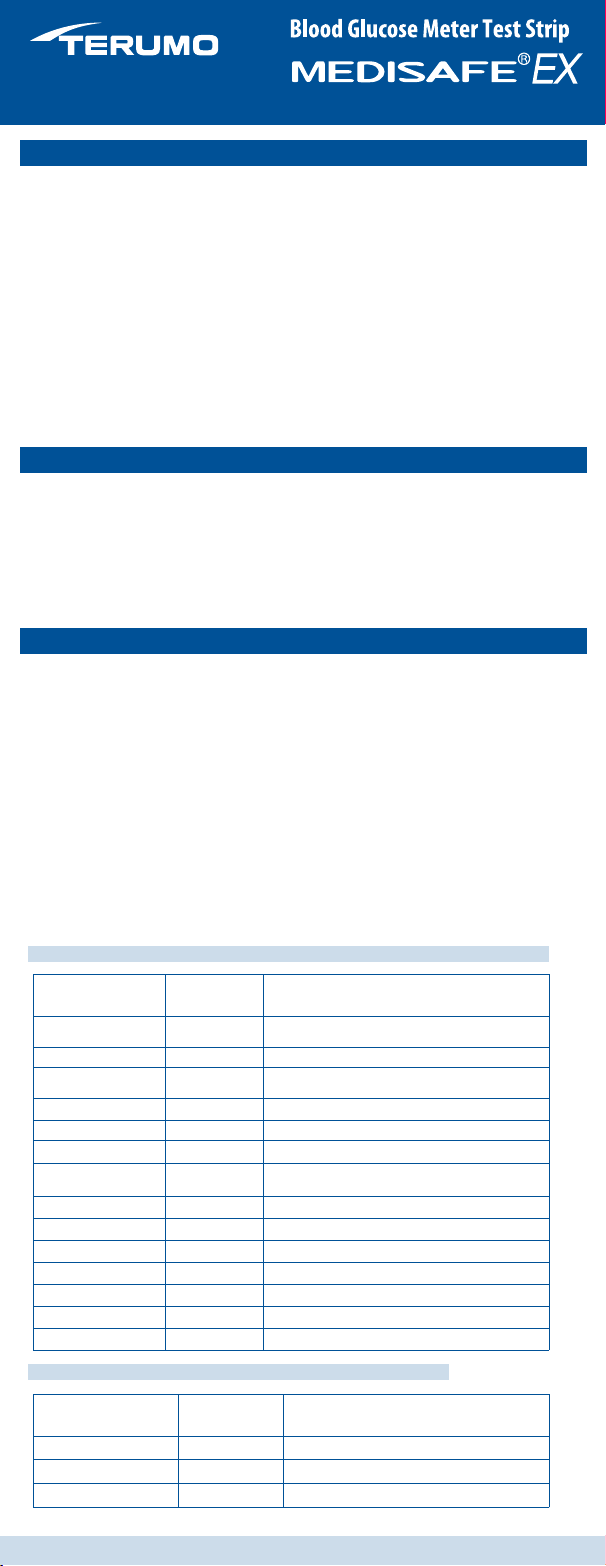
Strip Appearance
1. Absorbent Hole
Apply a drop of blood here. The blood will automatically be absorbed.
2. Confirmation Window
This is where you confirm if enough blood has been applied to the
absorbent hole in the strip.
3. Test Strip Handle
Hold this part to insert the test strip into the slot.
4. Contact Bars
Insert this end of the test strip into the meter. Push it in firmly until it will
go no further.
For self-testing.
STEP 1
STEP 2
STEP 3
PLEASE WASH AND DRY YOUR HANDS BEFORE PERFORMING ANY TESTING.
The used lancet and test strip are potentially biohazardous. Please dispose of them carefully according to
your local regulations.
Your blood glucose readings deliver plasma equivalent results and are displayed in milligrams of glucose per
deciliter of blood (mg/dL). The measurement range of this meter is 10-600 mg/dL (0.5-33.3 mmol/L).
Source: American Diabetes Association. Standards of medical care in diabetes-2016;
39 (supp.1 Diabetes Care):S16.
Please consult your doctor to determine a target range that works best for you.
Please refer to your Owner’s Manual for more information.
Normal plasma glucose range for people
without diabetes (mg/dL)
< 100 mg/dL (5.6 mmol/L)
< 140 mg/dL (7.8 mmol/L)
Time of day
Fasting and before meal
2 hours after meals
Therapeutic / Physiologic Concentration Range
(or Upper Limit ) (mg/dL)
Concentration
Tested (mg/dL)
Substance
Acetaminophen
(Paracetamol)
Lipemic Samples
(Triglycerides)
Bilirubin
(UnConjugated)
Ascorbic Acid
Dopamine
Glutathione Reduced
Levo - Dopa
Mannitol
Mannose
Methyl - Dopa
Pralidoxime Iodide
Tolazamide
Uric Acid
Xylose
Reading Your Result
Testing Your Blood Glucose
Reference values
Table 1. Summary of substances and concentrations in excess of limitation with interference
Chemical Components
Precision
CVs (%) of intermediate precision and repeatability are less than 5%.The product has been tested to meet
the requirements of ISO 15197:2013.
Additional Information for Healthcare Professionals
Sample Size: 1.1 µL
Reaction Time: 5 seconds
System Measurement Range: 10 mg/dL to 600 mg/dL
Hematocrit Range:
Within ±15 mg/dL (0.83 mmol/L) at glucose concentration < 100 mg/dL (5.55 mmol/L) and within ±15%
at glucose concentration ≥ 100 mg/dL (5.55 mmol/L).
0 % to 70 %
Accuracy
> Glucose dehydrogenase (E. Coli ) 8 %
> Electron shuttle 55%
> Enzyme protector 8%
> Non-reactive ingredients 29%
Always wear gloves and follow your facility’s biohazard control policy and procedures when performing
tests involving patient blood samples. Use fresh whole blood samples only. Professionals may use test
strips to test capillary, venous, and arterial, home use is limited to capillary whole blood testing.
IMPORTANT: The reference range of the control solutions may vary with each new vial of test strips. Make
sure you check the range on the label of your current vial.
Our control solutions contain a known amount of glucose that can react with test strips. You can check
the performance of the meter, test strip and your technique by comparing the control solution results
with the range printed on the label of test strip vial or on the label of individual package. Checking
regularly can ensure your test results are accurate. Please refer to the Owner's Manual for complete testing
instructions.
Quality Control Testing
If your test results are unusual or inconsistent with how you are feeling:
■ Make sure the confirmation window of the test strip is completely filled with blood.
■ Check the expiration date of the test strips.
■ Check the performance of your meter and test strip with the control solutions.
PLEASE NOTE: Unusually high or low blood glucose levels may be symptoms of a serious medical
condition. If most of your results are unusually high or low, please contact your healthcare
professional.
Questionable or inconsistent results
ATTENTION
TaiDoc Technology Corporation
B1-7F, No.127, Wugong 2nd Rd., Wugu Dist.,
24888, New Taipei City, Taiwan
www.taidoc.com
Sold by:
44-1, 2-chome, Hatagaya, Shibuya-ku,
TOKYO 151-0072, JAPAN
MedNet GmbH
Borkstraβe 10, 48163
Mϋnster, Germany
Front Back
1
2
3
4
Symbol Information
In vitro diagnostic medical device
Consult instructions for use
Temperature limitation (Test Strip in Vial)
Biological risks
Use by
Batch code
Symbol Referent
Manufacturer
Authorised representative in the European Community
C
32
C
2
Temperature limitation (Test Strip with Individual Package)
C
30
C
4
C
32
C
2
C
30
C
4
► For in vitro diagnostic use (for use outside of the body only).
► For single use only.
► Healthcare professionals and other users testing multiple patients with this system should handle
everything that has come into contact with human blood carefully to prevent transmitting infectious
diseases, including sanitized objects.
► Please read this sheet and your Blood Glucose Monitoring System Owner’s Manual before you use this
test strip. Use MEDISAFE EX Test Strip with MEDISAFE EX Blood Glucose Monitoring System to obtain
accurate results, and be covered by the manufacturer’s warranty.
► Results may be inaccurate when testing on patients with abnormally low blood pressure or those who
are in shock.
► Low results may be inaccurate when testing on patients in hyperglycemic-hyperosmolar state, with or
without ketosis.
► Keep test strips and lancets away from children. If swallowed, consult a doctor immediately for advice.
Limitations
► Xylose: Do not test blood glucose during or soon after a xylose absorption test. Xylose in the blood
can give falsely elevated results.
► Hematocrit: The hematocrit level is limited to between 0% and 70%. Please ask your healthcare
professional if you do not know your hematocrit level.
► This test strip is used for testing fresh capillary and venous whole blood.
► There are no significant interference in the presence of galactose, maltose, or fructose observed in
blood glucose tests.
► Lipemic Effects: Blood triglycerides up to 3000 mg/dL (33.9 mmol/L) do not affect the results
significantly, but may affect results at higher levels.
► Altitude Effects: Altitudes up to 10,742 feet (3,275m) do not affect test results.
► Use only heparin for anticoagulation of fresh capillary or venous whole blood.
The following compounds when determined to be in excess of their limitation and tested with the
MEDISAFE EX glucose meter may produce elevated glucose results:
IMPORTANT: Do not use the test strips if they have expired.
Test Strip in Vial
Storage and Handling
► Test strips expire 3 months after first opening. Write the first opening date on the test strip vial when
you first opened it.
► Store the test strips in a cool, dry place between 2°C and 32°C (36°F and 90°F) and below 85%
relative humidity.
► Keep the test strips away from direct sunlight. Do not store the test strips in high humidity.
► Store the test strips in their original vial ONLY. Do not transfer them to a new vial or any other
containers.
► Do not touch the test strips with wet hands.
► Use each test strip immediately after taking it out of the vial. Close the vial immediately after taking out
a strip.
► Keep the vial closed at all times.
► Do not bend, cut, or alter the test strip.
Test Strip with Individual Package
► Store the test strips in a cool, dry place between 4°C and 30°C (40°F and 86°F) and below 85%
relative humidity.
► Keep the test strips away from direct sunlight. Do not store the test strips in high humidity.
► Do not touch the test strips with wet hands.
► Use each test strip immediately after taking it out of the individual sheet.
► Do not bend, cut, or alter the test strip.
Intended Use
Test strips, when used together with Blood Glucose Monitoring System, allow your blood glucose levels to
be measured by yourself at home or by healthcare professionals. It uses fresh whole blood samples from
the finger. This system is not intended for use in the diagnosis or screening of diabetes mellitus and be
careful when using with Neonate since it may deviate from actual result due to hematocrit.
Professionals may use test strips to test capillary, venous, and arterial, home use is limited to capillary
whole blood testing.
Test results might be wrong if
the contact bar is not fully
inserted into the test slot.
The front side of the test strip
should face up when
inserting the test strip.
Insert the test strip fully into the slot of the meter until it will go no further.
When the strip is fully inserted, the meter will do several self-checks.
Collect a blood sample with the test strip. A sufficient quantity of blood is
required for the test to provide accurate results. Touch the blood drop with
the absorbent hole of the test strip, and wait until the confirmation window
is fully covered. Do NOT apply a smeared blood sample. The meter will start
counting down.
After a few seconds, the meter will display your blood glucose level. The last
reading will be automatically saved in the meter. Turn it off by removing the
test strip and throw away the used test strip.
Vial / Individual Package
TD-4333
: Registered Trademark
is a Trademark of TERUMO CORPORATION
TERUMO CORPORATION Jan. 2017
> 6.25
> 5
> 20
> 1.25
> 23
> 0.7
> 3000
> 5000
> 250
> 0.625
> 5
> 6.25
> 10
> 6.25
0.45 - 3
2
0 - 2
0.03
47 - 100 (intrcellular)
0.02-0.28
30 - 300
0.0128
1.15
0.1 - 0.5
~ 10 (i.v. Dose 500 mg)
1.6
2 - 8
N/A
Concentration of Blood
Drawing Tube (mg/dL)
Concentration
Tested (mg/dL)
Substance
K2EDTA
Na-Fluoride/K-Oxalate
K3EDTA
Table 2. Summary of anticoagulant and concentrations with interference
< 180
< 175.5
< 250/200
180
175.5
250/200
Note: Fluoride/Oxalate and EDTA should not be used as a sample preservative.
Blood Glucose Monitoring System
Warnings
ver 10.0 2017/09 312-4119101-010
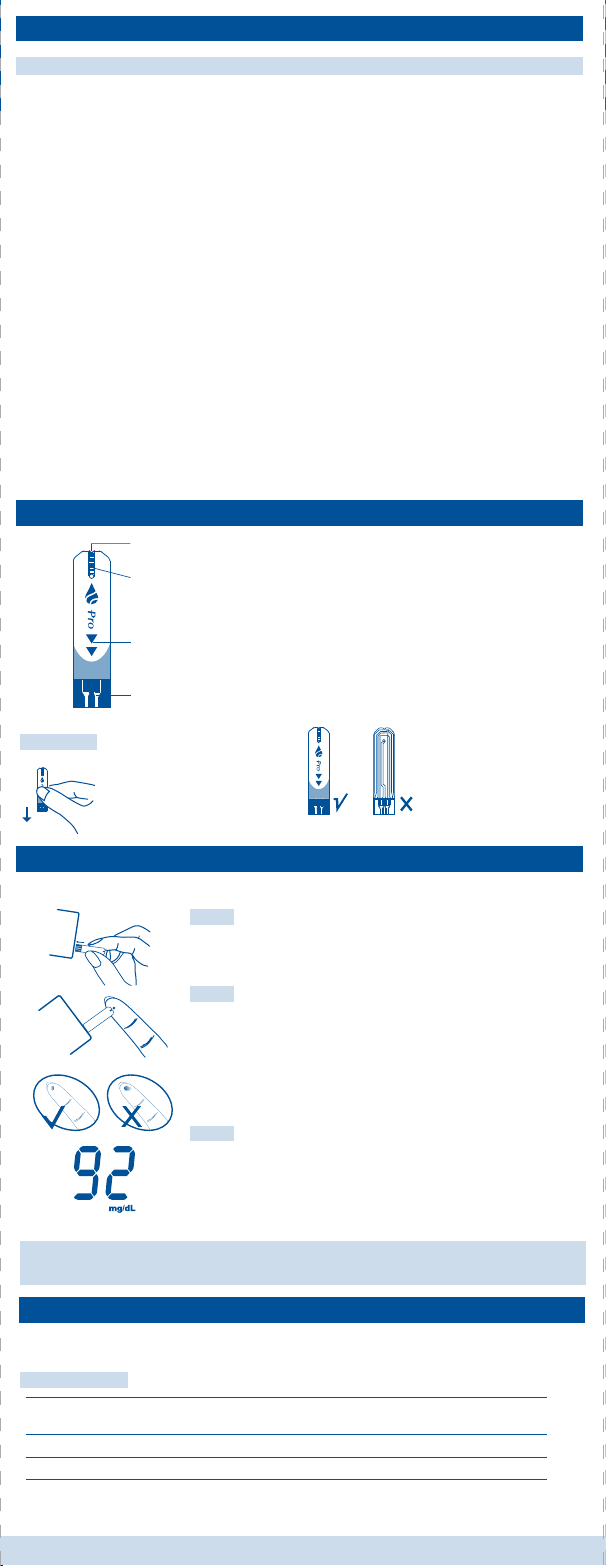
Strip Appearance
1. Absorbent Hole
Apply a drop of blood here. The blood will automatically be absorbed.
2. Confirmation Window
This is where you confirm if enough blood has been applied to the
absorbent hole in the strip.
3. Test Strip Handle
Hold this part to insert the test strip into the slot.
4. Contact Bars
Insert this end of the test strip into the meter. Push it in firmly until it will
go no further.
For self-testing.
STEP 1
STEP 2
STEP 3
PLEASE WASH AND DRY YOUR HANDS BEFORE PERFORMING ANY TESTING.
The used lancet and test strip are potentially biohazardous. Please dispose of them carefully according to
your local regulations.
Your blood glucose readings deliver plasma equivalent results and are displayed in milligrams of glucose per
deciliter of blood (mg/dL). The measurement range of this meter is 10-600 mg/dL (0.5-33.3 mmol/L).
Source: American Diabetes Association. Standards of medical care in diabetes-2016;
39 (supp.1 Diabetes Care):S16.
Please consult your doctor to determine a target range that works best for you.
Please refer to your Owner’s Manual for more information.
Normal plasma glucose range for people
without diabetes (mg/dL)
< 100 mg/dL (5.6 mmol/L)
< 140 mg/dL (7.8 mmol/L)
Time of day
Fasting and before meal
2 hours after meals
Therapeutic / Physiologic Concentration Range
(or Upper Limit ) (mg/dL)
Concentration
Tested (mg/dL)
Substance
Acetaminophen
(Paracetamol)
Lipemic Samples
(Triglycerides)
Bilirubin
(UnConjugated)
Ascorbic Acid
Dopamine
Glutathione Reduced
Levo - Dopa
Mannitol
Mannose
Methyl - Dopa
Pralidoxime Iodide
Tolazamide
Uric Acid
Xylose
Reading Your Result
Testing Your Blood Glucose
Reference values
Table 1. Summary of substances and concentrations in excess of limitation with interference
Chemical Components
Precision
CVs (%) of intermediate precision and repeatability are less than 5%.The product has been tested to meet
the requirements of ISO 15197:2013.
Additional Information for Healthcare Professionals
Sample Size: 1.1 µL
Reaction Time: 5 seconds
System Measurement Range: 10 mg/dL to 600 mg/dL
Hematocrit Range:
Within ±15 mg/dL (0.83 mmol/L) at glucose concentration < 100 mg/dL (5.55 mmol/L) and within ±15%
at glucose concentration ≥ 100 mg/dL (5.55 mmol/L).
0 % to 70 %
Accuracy
> Glucose dehydrogenase (E. Coli ) 8 %
> Electron shuttle 55%
> Enzyme protector 8%
> Non-reactive ingredients 29%
Always wear gloves and follow your facility’s biohazard control policy and procedures when performing
tests involving patient blood samples. Use fresh whole blood samples only. Professionals may use test
strips to test capillary, venous, and arterial, home use is limited to capillary whole blood testing.
IMPORTANT: The reference range of the control solutions may vary with each new vial of test strips. Make
sure you check the range on the label of your current vial.
Our control solutions contain a known amount of glucose that can react with test strips. You can check
the performance of the meter, test strip and your technique by comparing the control solution results
with the range printed on the label of test strip vial or on the label of individual package. Checking
regularly can ensure your test results are accurate. Please refer to the Owner's Manual for complete testing
instructions.
Quality Control Testing
If your test results are unusual or inconsistent with how you are feeling:
■ Make sure the confirmation window of the test strip is completely filled with blood.
■ Check the expiration date of the test strips.
■ Check the performance of your meter and test strip with the control solutions.
PLEASE NOTE: Unusually high or low blood glucose levels may be symptoms of a serious medical
condition. If most of your results are unusually high or low, please contact your healthcare
professional.
Questionable or inconsistent results
ATTENTION
TaiDoc Technology Corporation
B1-7F, No.127, Wugong 2nd Rd., Wugu Dist.,
24888, New Taipei City, Taiwan
www.taidoc.com
Sold by:
44-1, 2-chome, Hatagaya, Shibuya-ku,
TOKYO 151-0072, JAPAN
MedNet GmbH
Borkstraβe 10, 48163
Mϋnster, Germany
Front Back
1
2
3
4
Symbol Information
In vitro diagnostic medical device
Consult instructions for use
Temperature limitation (Test Strip in Vial)
Biological risks
Use by
Batch code
Symbol Referent
Manufacturer
Authorised representative in the European Community
C
32
C
2
Temperature limitation (Test Strip with Individual Package)
C
30
C
4
C
32
C
2
C
30
C
4
► For in vitro diagnostic use (for use outside of the body only).
► For single use only.
► Healthcare professionals and other users testing multiple patients with this system should handle
everything that has come into contact with human blood carefully to prevent transmitting infectious
diseases, including sanitized objects.
► Please read this sheet and your Blood Glucose Monitoring System Owner’s Manual before you use this
test strip. Use MEDISAFE EX Test Strip with MEDISAFE EX Blood Glucose Monitoring System to obtain
accurate results, and be covered by the manufacturer’s warranty.
► Results may be inaccurate when testing on patients with abnormally low blood pressure or those who
are in shock.
► Low results may be inaccurate when testing on patients in hyperglycemic-hyperosmolar state, with or
without ketosis.
► Keep test strips and lancets away from children. If swallowed, consult a doctor immediately for advice.
Limitations
► Xylose: Do not test blood glucose during or soon after a xylose absorption test. Xylose in the blood
can give falsely elevated results.
► Hematocrit: The hematocrit level is limited to between 0% and 70%. Please ask your healthcare
professional if you do not know your hematocrit level.
► This test strip is used for testing fresh capillary and venous whole blood.
► There are no significant interference in the presence of galactose, maltose, or fructose observed in
blood glucose tests.
► Lipemic Effects: Blood triglycerides up to 3000 mg/dL (33.9 mmol/L) do not affect the results
significantly, but may affect results at higher levels.
► Altitude Effects: Altitudes up to 10,742 feet (3,275m) do not affect test results.
► Use only heparin for anticoagulation of fresh capillary or venous whole blood.
The following compounds when determined to be in excess of their limitation and tested with the
MEDISAFE EX glucose meter may produce elevated glucose results:
IMPORTANT: Do not use the test strips if they have expired.
Test Strip in Vial
Storage and Handling
► Test strips expire 3 months after first opening. Write the first opening date on the test strip vial when
you first opened it.
► Store the test strips in a cool, dry place between 2°C and 32°C (36°F and 90°F) and below 85%
relative humidity.
► Keep the test strips away from direct sunlight. Do not store the test strips in high humidity.
► Store the test strips in their original vial ONLY. Do not transfer them to a new vial or any other
containers.
► Do not touch the test strips with wet hands.
► Use each test strip immediately after taking it out of the vial. Close the vial immediately after taking out
a strip.
► Keep the vial closed at all times.
► Do not bend, cut, or alter the test strip.
Test Strip with Individual Package
► Store the test strips in a cool, dry place between 4°C and 30°C (40°F and 86°F) and below 85%
relative humidity.
► Keep the test strips away from direct sunlight. Do not store the test strips in high humidity.
► Do not touch the test strips with wet hands.
► Use each test strip immediately after taking it out of the individual sheet.
► Do not bend, cut, or alter the test strip.
Intended Use
Test strips, when used together with Blood Glucose Monitoring System, allow your blood glucose levels to
be measured by yourself at home or by healthcare professionals. It uses fresh whole blood samples from
the finger. This system is not intended for use in the diagnosis or screening of diabetes mellitus and be
careful when using with Neonate since it may deviate from actual result due to hematocrit.
Professionals may use test strips to test capillary, venous, and arterial, home use is limited to capillary
whole blood testing.
Test results might be wrong if
the contact bar is not fully
inserted into the test slot.
The front side of the test strip
should face up when
inserting the test strip.
Insert the test strip fully into the slot of the meter until it will go no further.
When the strip is fully inserted, the meter will do several self-checks.
Collect a blood sample with the test strip. A sufficient quantity of blood is
required for the test to provide accurate results. Touch the blood drop with
the absorbent hole of the test strip, and wait until the confirmation window
is fully covered. Do NOT apply a smeared blood sample. The meter will start
counting down.
After a few seconds, the meter will display your blood glucose level. The last
reading will be automatically saved in the meter. Turn it off by removing the
test strip and throw away the used test strip.
Vial / Individual Package
TD-4333
: Registered Trademark
is a Trademark of TERUMO CORPORATION
TERUMO CORPORATION Jan. 2017
> 6.25
> 5
> 20
> 1.25
> 23
> 0.7
> 3000
> 5000
> 250
> 0.625
> 5
> 6.25
> 10
> 6.25
0.45 - 3
2
0 - 2
0.03
47 - 100 (intrcellular)
0.02-0.28
30 - 300
0.0128
1.15
0.1 - 0.5
~ 10 (i.v. Dose 500 mg)
1.6
2 - 8
N/A
Concentration of Blood
Drawing Tube (mg/dL)
Concentration
Tested (mg/dL)
Substance
K2EDTA
Na-Fluoride/K-Oxalate
K3EDTA
Table 2. Summary of anticoagulant and concentrations with interference
< 180
< 175.5
< 250/200
180
175.5
250/200
Note: Fluoride/Oxalate and EDTA should not be used as a sample preservative.
Blood Glucose Monitoring System
Warnings
ver 10.0 2017/09 312-4119101-010
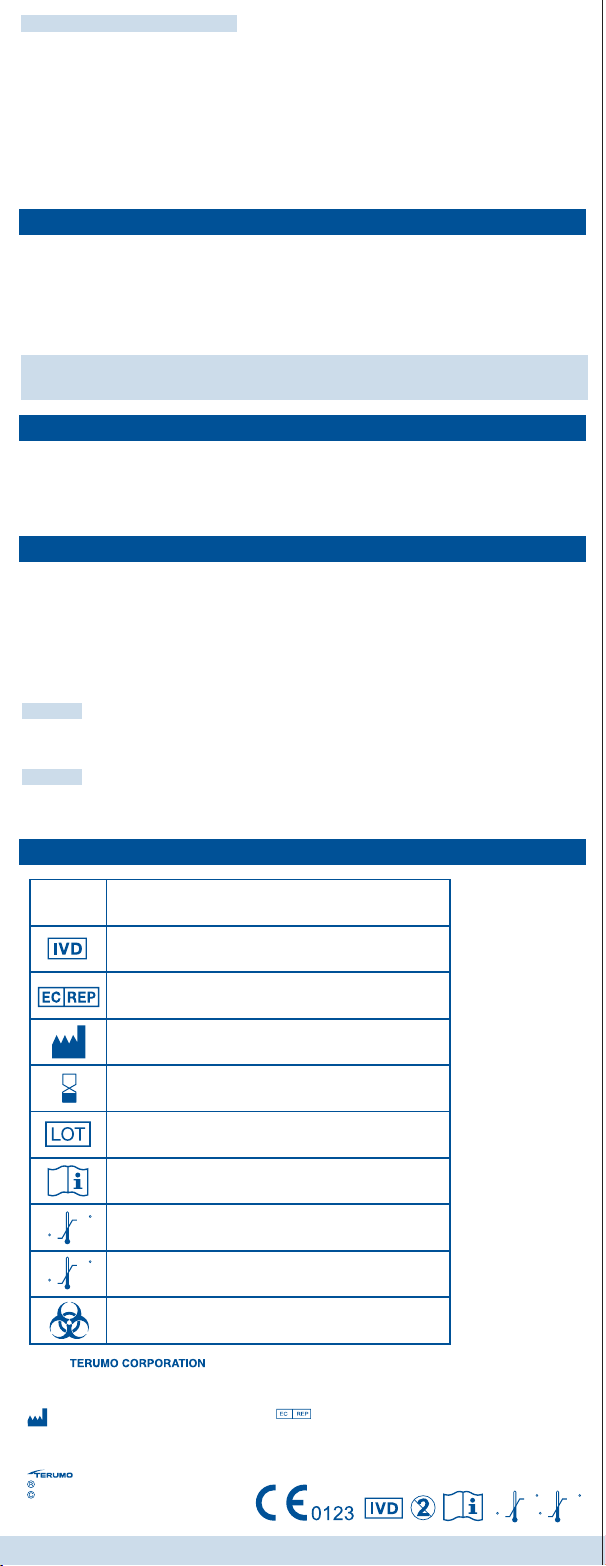
Strip Appearance
1. Absorbent Hole
Apply a drop of blood here. The blood will automatically be absorbed.
2. Confirmation Window
This is where you confirm if enough blood has been applied to the
absorbent hole in the strip.
3. Test Strip Handle
Hold this part to insert the test strip into the slot.
4. Contact Bars
Insert this end of the test strip into the meter. Push it in firmly until it will
go no further.
For self-testing.
STEP 1
STEP 2
STEP 3
PLEASE WASH AND DRY YOUR HANDS BEFORE PERFORMING ANY TESTING.
The used lancet and test strip are potentially biohazardous. Please dispose of them carefully according to
your local regulations.
Your blood glucose readings deliver plasma equivalent results and are displayed in milligrams of glucose per
deciliter of blood (mg/dL). The measurement range of this meter is 10-600 mg/dL (0.5-33.3 mmol/L).
Source: American Diabetes Association. Standards of medical care in diabetes-2016;
39 (supp.1 Diabetes Care):S16.
Please consult your doctor to determine a target range that works best for you.
Please refer to your Owner’s Manual for more information.
Normal plasma glucose range for people
without diabetes (mg/dL)
< 100 mg/dL (5.6 mmol/L)
< 140 mg/dL (7.8 mmol/L)
Time of day
Fasting and before meal
2 hours after meals
Therapeutic / Physiologic Concentration Range
(or Upper Limit ) (mg/dL)
Concentration
Tested (mg/dL)
Substance
Acetaminophen
(Paracetamol)
Lipemic Samples
(Triglycerides)
Bilirubin
(UnConjugated)
Ascorbic Acid
Dopamine
Glutathione Reduced
Levo - Dopa
Mannitol
Mannose
Methyl - Dopa
Pralidoxime Iodide
Tolazamide
Uric Acid
Xylose
Reading Your Result
Testing Your Blood Glucose
Reference values
Table 1. Summary of substances and concentrations in excess of limitation with interference
Chemical Components
Precision
CVs (%) of intermediate precision and repeatability are less than 5%.The product has been tested to meet
the requirements of ISO 15197:2013.
Additional Information for Healthcare Professionals
Sample Size: 1.1 µL
Reaction Time: 5 seconds
System Measurement Range: 10 mg/dL to 600 mg/dL
Hematocrit Range:
Within ±15 mg/dL (0.83 mmol/L) at glucose concentration < 100 mg/dL (5.55 mmol/L) and within ±15%
at glucose concentration ≥ 100 mg/dL (5.55 mmol/L).
0 % to 70 %
Accuracy
> Glucose dehydrogenase (E. Coli ) 8 %
> Electron shuttle 55%
> Enzyme protector 8%
> Non-reactive ingredients 29%
Always wear gloves and follow your facility’s biohazard control policy and procedures when performing
tests involving patient blood samples. Use fresh whole blood samples only. Professionals may use test
strips to test capillary, venous, and arterial, home use is limited to capillary whole blood testing.
IMPORTANT: The reference range of the control solutions may vary with each new vial of test strips. Make
sure you check the range on the label of your current vial.
Our control solutions contain a known amount of glucose that can react with test strips. You can check
the performance of the meter, test strip and your technique by comparing the control solution results
with the range printed on the label of test strip vial or on the label of individual package. Checking
regularly can ensure your test results are accurate. Please refer to the Owner's Manual for complete testing
instructions.
Quality Control Testing
If your test results are unusual or inconsistent with how you are feeling:
■ Make sure the confirmation window of the test strip is completely filled with blood.
■ Check the expiration date of the test strips.
■ Check the performance of your meter and test strip with the control solutions.
PLEASE NOTE: Unusually high or low blood glucose levels may be symptoms of a serious medical
condition. If most of your results are unusually high or low, please contact your healthcare
professional.
Questionable or inconsistent results
ATTENTION
TaiDoc Technology Corporation
B1-7F, No.127, Wugong 2nd Rd., Wugu Dist.,
24888, New Taipei City, Taiwan
www.taidoc.com
Sold by:
44-1, 2-chome, Hatagaya, Shibuya-ku,
TOKYO 151-0072, JAPAN
MedNet GmbH
Borkstraβe 10, 48163
Mϋnster, Germany
Front Back
1
2
3
4
Symbol Information
In vitro diagnostic medical device
Consult instructions for use
Temperature limitation (Test Strip in Vial)
Biological risks
Use by
Batch code
Symbol Referent
Manufacturer
Authorised representative in the European Community
C
32
C
2
Temperature limitation (Test Strip with Individual Package)
C
30
C
4
C
32
C
2
C
30
C
4
► For in vitro diagnostic use (for use outside of the body only).
► For single use only.
► Healthcare professionals and other users testing multiple patients with this system should handle
everything that has come into contact with human blood carefully to prevent transmitting infectious
diseases, including sanitized objects.
► Please read this sheet and your Blood Glucose Monitoring System Owner’s Manual before you use this
test strip. Use MEDISAFE EX Test Strip with MEDISAFE EX Blood Glucose Monitoring System to obtain
accurate results, and be covered by the manufacturer’s warranty.
► Results may be inaccurate when testing on patients with abnormally low blood pressure or those who
are in shock.
► Low results may be inaccurate when testing on patients in hyperglycemic-hyperosmolar state, with or
without ketosis.
► Keep test strips and lancets away from children. If swallowed, consult a doctor immediately for advice.
Limitations
► Xylose: Do not test blood glucose during or soon after a xylose absorption test. Xylose in the blood
can give falsely elevated results.
► Hematocrit: The hematocrit level is limited to between 0% and 70%. Please ask your healthcare
professional if you do not know your hematocrit level.
► This test strip is used for testing fresh capillary and venous whole blood.
► There are no significant interference in the presence of galactose, maltose, or fructose observed in
blood glucose tests.
► Lipemic Effects: Blood triglycerides up to 3000 mg/dL (33.9 mmol/L) do not affect the results
significantly, but may affect results at higher levels.
► Altitude Effects: Altitudes up to 10,742 feet (3,275m) do not affect test results.
► Use only heparin for anticoagulation of fresh capillary or venous whole blood.
The following compounds when determined to be in excess of their limitation and tested with the
MEDISAFE EX glucose meter may produce elevated glucose results:
IMPORTANT: Do not use the test strips if they have expired.
Test Strip in Vial
Storage and Handling
► Test strips expire 3 months after first opening. Write the first opening date on the test strip vial when
you first opened it.
► Store the test strips in a cool, dry place between 2°C and 32°C (36°F and 90°F) and below 85%
relative humidity.
► Keep the test strips away from direct sunlight. Do not store the test strips in high humidity.
► Store the test strips in their original vial ONLY. Do not transfer them to a new vial or any other
containers.
► Do not touch the test strips with wet hands.
► Use each test strip immediately after taking it out of the vial. Close the vial immediately after taking out
a strip.
► Keep the vial closed at all times.
► Do not bend, cut, or alter the test strip.
Test Strip with Individual Package
► Store the test strips in a cool, dry place between 4°C and 30°C (40°F and 86°F) and below 85%
relative humidity.
► Keep the test strips away from direct sunlight. Do not store the test strips in high humidity.
► Do not touch the test strips with wet hands.
► Use each test strip immediately after taking it out of the individual sheet.
► Do not bend, cut, or alter the test strip.
Intended Use
Test strips, when used together with Blood Glucose Monitoring System, allow your blood glucose levels to
be measured by yourself at home or by healthcare professionals. It uses fresh whole blood samples from
the finger. This system is not intended for use in the diagnosis or screening of diabetes mellitus and be
careful when using with Neonate since it may deviate from actual result due to hematocrit.
Professionals may use test strips to test capillary, venous, and arterial, home use is limited to capillary
whole blood testing.
Test results might be wrong if
the contact bar is not fully
inserted into the test slot.
The front side of the test strip
should face up when
inserting the test strip.
Insert the test strip fully into the slot of the meter until it will go no further.
When the strip is fully inserted, the meter will do several self-checks.
Collect a blood sample with the test strip. A sufficient quantity of blood is
required for the test to provide accurate results. Touch the blood drop with
the absorbent hole of the test strip, and wait until the confirmation window
is fully covered. Do NOT apply a smeared blood sample. The meter will start
counting down.
After a few seconds, the meter will display your blood glucose level. The last
reading will be automatically saved in the meter. Turn it off by removing the
test strip and throw away the used test strip.
Vial / Individual Package
TD-4333
: Registered Trademark
is a Trademark of TERUMO CORPORATION
TERUMO CORPORATION Jan. 2017
> 6.25
> 5
> 20
> 1.25
> 23
> 0.7
> 3000
> 5000
> 250
> 0.625
> 5
> 6.25
> 10
> 6.25
0.45 - 3
2
0 - 2
0.03
47 - 100 (intrcellular)
0.02-0.28
30 - 300
0.0128
1.15
0.1 - 0.5
~ 10 (i.v. Dose 500 mg)
1.6
2 - 8
N/A
Concentration of Blood
Drawing Tube (mg/dL)
Concentration
Tested (mg/dL)
Substance
K2EDTA
Na-Fluoride/K-Oxalate
K3EDTA
Table 2. Summary of anticoagulant and concentrations with interference
< 180
< 175.5
< 250/200
180
175.5
250/200
Note: Fluoride/Oxalate and EDTA should not be used as a sample preservative.

