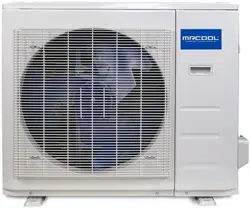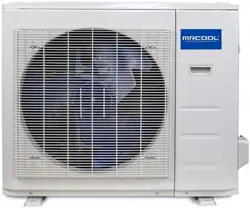

The Olympus Series is NOT designed for amateur installation. Installation SHOULD be performed by an authorized technician.
Please read this manual carefully before installation and keep it for future reference.
The Olympus Series is NOT designed for amateur installation. Installation SHOULD be performed by an authorized technician.
Please read this manual carefully before installation and keep it for future reference.
Installation Manual
Olympus Series
Single (Hyper Heat & E Star) & Multi-Zone Models
Due to updates and constantly improving performance, the information and instructions
within this manual are subject to change without notice. Please visit
www.mrcool.com/documentation to ensure you have the latest version of this manual.
Version Date: 01-25-22
Contents
Outdoor Unit Installation ......
20
1. Installation location ..............................20
2. Install drain joint .................................. 21
3. Anchor outdoor unit ........................... 22
4. Connect signal and power cables .... 24
4
Safety Precautions .................................. 3
!
1
Accessories ............................................... 5
2
Overview .................................................. 7
Page 1 mrcool.com
Indoor Unit Installation ...........11
3
1. Installation location.................................11
2. Attach mounting plate to wall...............12
3. Drill wall hole for connective piping.....13
4. Prepare refrigerant piping ....................14
5. Connect drain hose.................................15
6. Connect signal cable...............................16
7. Wrap piping and cables..........................18
9. Mount indoor unit...................................19
Refrigerant Piping Connection ...................... 27
A. Note on Pipe Length ............................................................. 27
B. Connection Instructions –Refrigerant Piping .................. 27
1. Cut pipe .............................................................................. 27
2. Remove burrs ................................................................... 28
3. Flare pipe ends ................................................................. 28
4. Connect pipes .................................................................... 29
Air Evacuation ................................. 31
5
6
Electrical and Gas Leak Checks ..... 33
7
Test Run ........................................... 35
8
EU Disposal Guidelines .................. 37
9
MC MC
Contents
Page 2
mrcool.com
1. Electrical Safety Checks .................................. 33
2. Gas Leak Checks .............................................. 33
3. Self Correction Function ................................. 34
1. Evacuation Instructions .................................. 31
2. Note on Adding Refrigerant........................... 32
Page 3
Safety Precautions
mrcool.com
WARNING
DO NOT modify the length of the power supply cord or use an extension cord to power the unit.
DO NOT
When connecting refrigerant piping,
DO NOT let substances or gases other than the refrigerant
enter the unit. The presence of other gases or substances will lower the unit’s capacity, and may
cause abnormally high pressure in the operation cycle. This may cause explosion and injury.
DO NOT allow children to play with the air conditioner. Children should be supervised around the
unit at all times.
Installation must be performed by an authorized technician. Improper installation may cause
Installation must be performed according to installation instructions. Improper installation may
In North America, installation must be performed in accordance with the requirement of NEC and
CEC (by authorized personnel only.) Contact an authorized service technician for repair or mainte-
nance of the unit.
cannot support the weight, or the installation is performed improperly, the unit may fall and cause
serious injury and/or damage.
For all electrical work, follow all appropriate wiring standards, regulations, and the Installation Manual.
Read Before Installation
Incorrect installation may cause serious damage or injury.
either a WARNING or CAUTION.
WARNING
CAUTION
This symbol indicates ignoring instructions may cause death or serious injury.
This symbol indicates that ignoring instructions may cause personal injury,
damage to the unit, or property damage.
This symbol indicates that you should NEVER perform the indicated action.
1.
2.
3.
4.
5.
6.
!
Safety Precautions
Page 4
Safety Precautions
mrcool.com
Note about Flourinated Gasses:
7.
8.
9.
10.
12.
1.
2.
1.
2.
3.
4.
5.
6.
You must use an independent circuit to supply power. DO NOT connect other appliances to the same
circuit. Insufficient electrical capacity or defects in electrical work can cause electrical shock and/or fire.
prevent external forces from damaging the terminal. Improper electrical connections may overheat,
All wiring must be properly arranged to ensure that the control board cover can close properly. If the
control board cover is not closed properly, it can lead to corrosion and cause the connection points on
In certain functional environments, such as kitchens, server rooms, etc., the use of specially designed
air-conditioning units is highly recommended.
This appliance can be used by children aged 8 years and above, and persons with reduced physical,
sensory, or mental capabilities, or lack of experience and knowledge, if they have been given supervision
or instruction concerning use of the appliance in a safe way and understand the hazards involved.
Children should not play with the appliance. Cleaning and user maintenance should not be made by
children without supervision.
For units that have an auxiliary electric heater, DO NOT install the unit within 3 feet (1 meter) of
combustible materials.
DO NOT install the unit in a location that may be exposed to combustible gases. If combustible gas
DO NOT operate your air conditioner in a wet room, such as a bathroom or laundry room. Too
much exposure to water may cause electrical components to short circuit.
The product must be properly grounded during installation, or electrical shock may occur.
Install drainage piping according to the instructions in this manual. Improper drainage may cause
water damage to your home and property.
unit itself.
If the system has a leak-detection system installed, it should be checked for leaks at least once every 12
months.
Keep a record of all leak checks for the lifetime of the unit.
If the supply cord is damaged, it must be replaced by the manufacturer, its service agent, or a similarly
qualified person in oreder to avoid a hazard.
11.
,

Page 5
Safety Precautions
mrcool.com
1
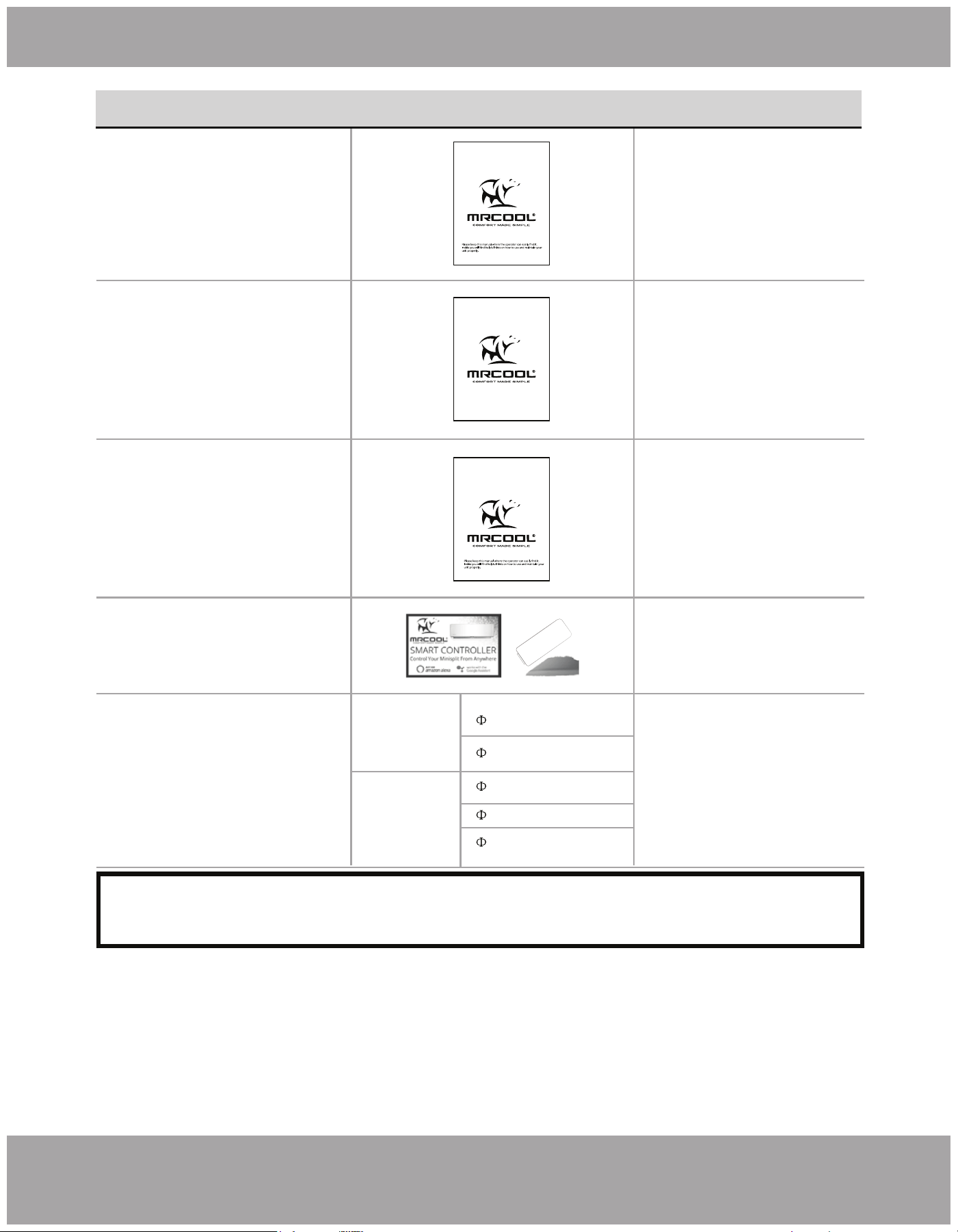
Accessories
1
(Sealant for Wall Sleeve)
1
1
1 (optional)
1
1
Neoprene
Clip anchor
screw ST3.9 X 25
Remote control
controller holder
Remote control holder
Dry battery AAA.LR03
Seal
Drain joint
Mounting plate
5 or 8
5 or 8
2
1
Optional
Parts
2
PART LOOKS LIKE... QUANTITY
installation parts and accessories to install the air conditioner. Improper installation may result
Page 6mrcool.com
1
1
1 (this)
Accessories
1
(w/ Manual in
Controller Box)
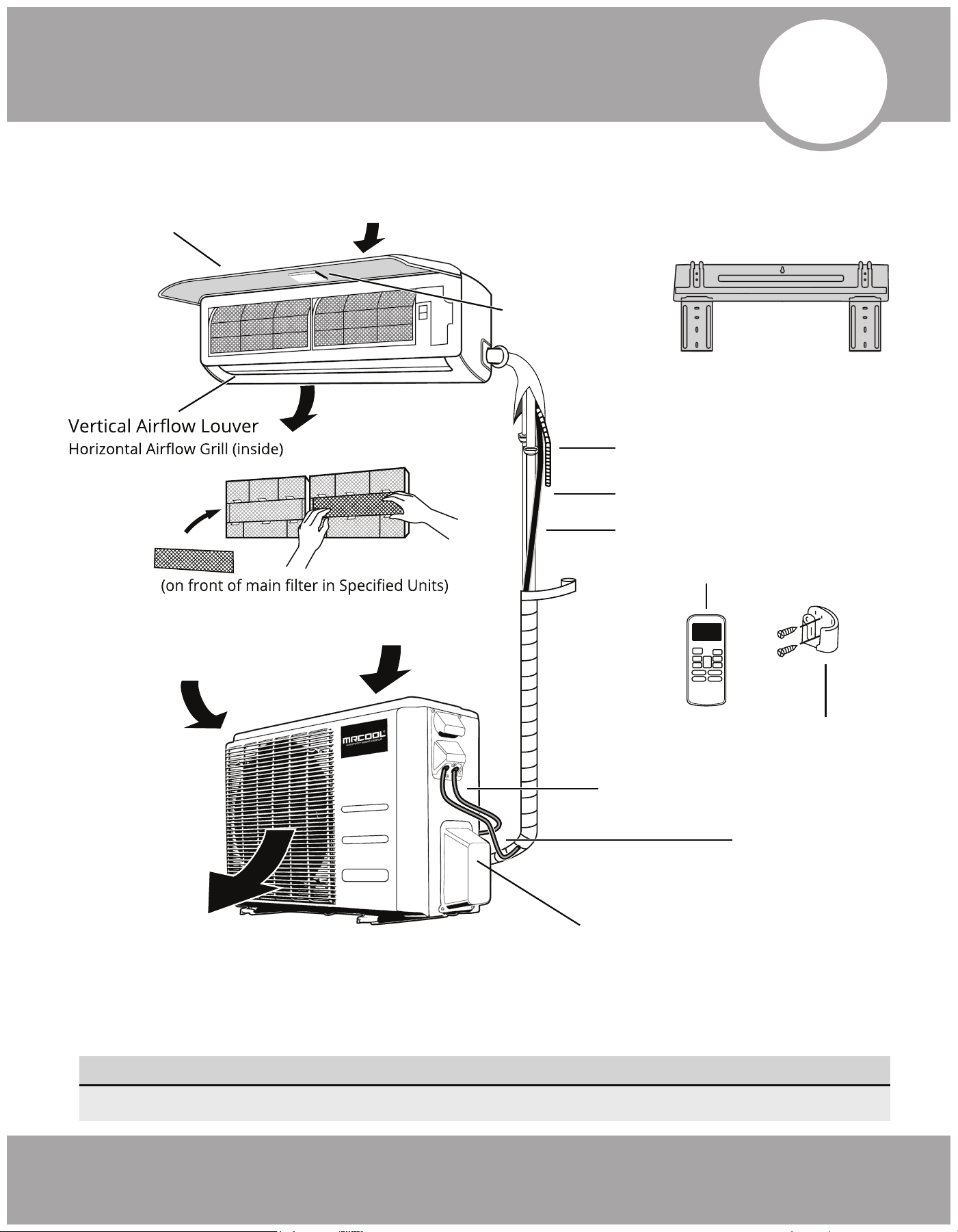
Owner’s Manual
Installation Manual
Remote Control
Manual
Smart Controller Kit
PART LOOKS LIKE... QUANTITY
Please read this manual carefully before installation and keep it for future reference.
Owner’s Manual
Olympus Series
For more details visit www.MrCool.com
Please read this manual carefully before installation and keep it for future reference.
Please read this manual carefully before installation and keep it for future reference.
Installation Manual
Olympus Series
For more details visit www.MrCool.com
Please read this manual carefully before installation and keep it for future reference.
Remote Control
User Manual
Parts must be purchased
separately. Consult your
dealer about the pipe size.
Liquid side
Gas side
1/4 in (6.35 mm)
3/8 in (9.52 mm)
3/8 in (9.52 mm)
1/2 in (12.7 mm)
5/8 in (16 mm)
Connecting
pipe assembly
***Disclaimer***
Google assistant will only work with the wall-mounted air handlers. It will not work
with the cassettes or ceiling recessed applications.
Page 7 mrcool.com
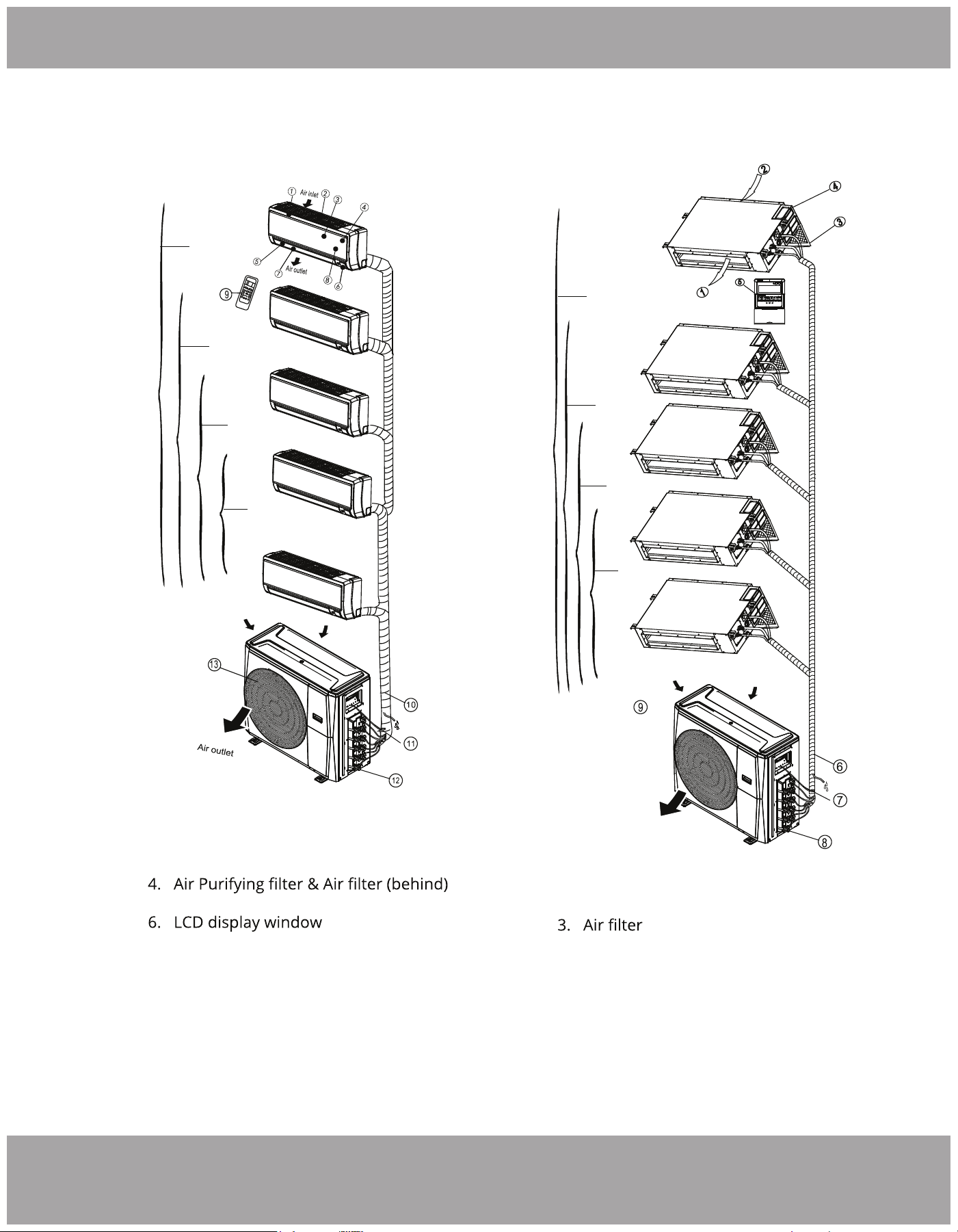
NOTE ON ILLUSTRATIONS
Illustrations in this manual are for explanatory purposes. The actual shape of your unit may vary.
Remote Control
Remote Holder
Refrigerant Piping
Signal Cable
Drainage Pipe
Front Panel
(with display)
Wall Mounting Plate
Outdoor Unit
Power Cable
Fresh Air Filter
Air inlet (rear)
Air inlet (side)
Air outlet
Air outlet (bottom)
Indoor Unit
(Interior / Air Handler)
Outdoor Unit
(Exterior / Condenser)
Refrigerant Pipe Connection
and Stop Valve (under cover)
Signal Cable
Connection from
Indoor Unit
Air inlet (rear)
Smart Controller
Module USB Port
2
Overview
Fig. 2.1
Page 8
Overview - Multi-Zone
mrcool.com
Fig. 2.2
Fig. 2.3
5-Zone
4-Zone
3-Zone
2-Zone
5-Zone
4-Zone
3-Zone
2-Zone
Wall-Mounted Handlers Ceiling Ducted Handlers
Indoor unit
1. Panel frame
2. Rear air intake grille
3. Front panel
5. Horizontal louver
7. Vertical louver
8. Manual control button (behind)
9. Remote control holder
Outdoor unit
10. Drain hose, refrigerant pipe
11. Connective cable
12. Stop valve
13. Fan hood
Indoor unit
1. Air outlet
2. Air inlet
4. Electric control cabinet
5. Wire controller
Outdoor unit
6. Drain hose, refrigerant pipe
7. Connective cable
8. Stop valve
9. Fan hood
Page 9
Overview - Multi-Zone
mrcool.com
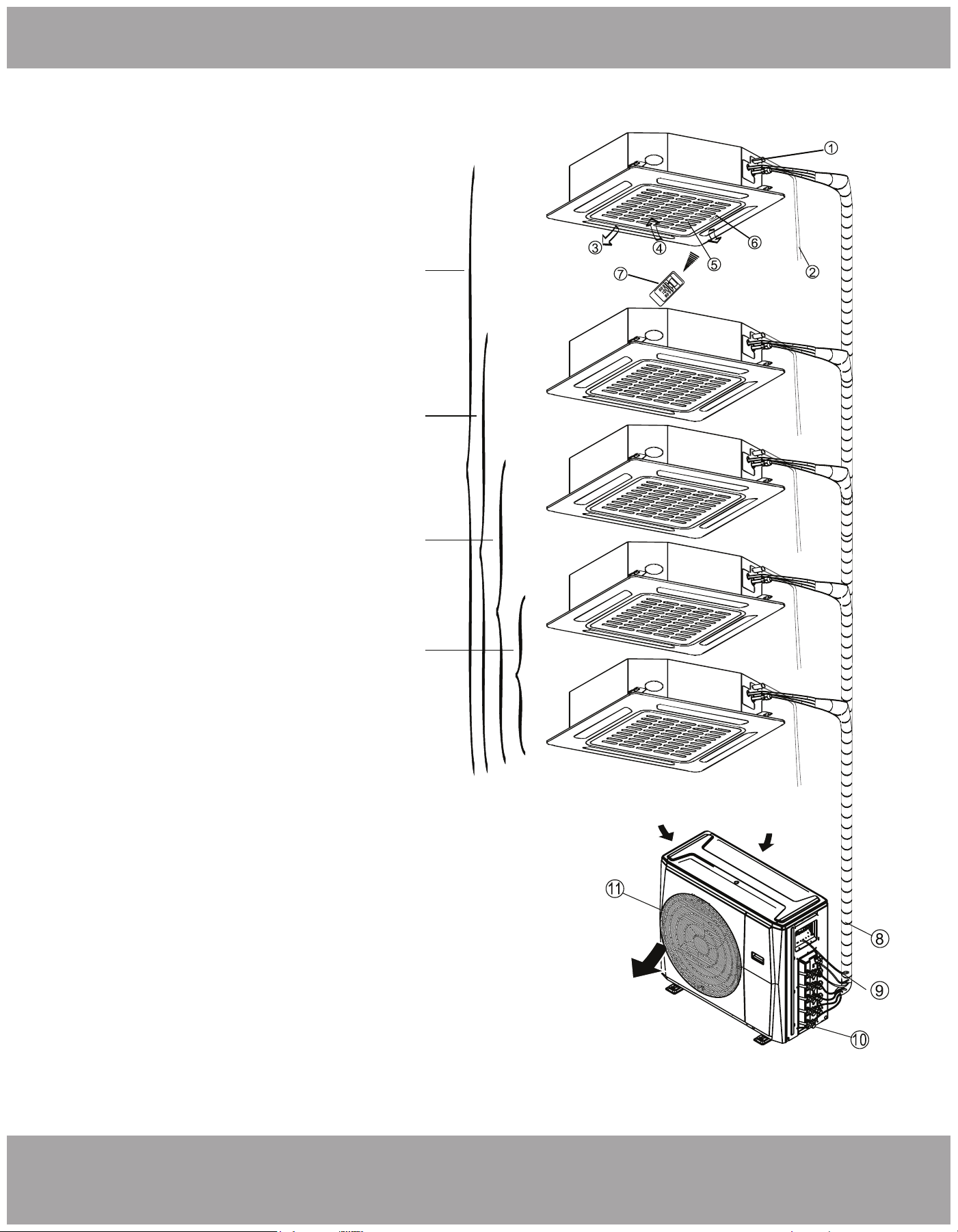
Cassette Handlers
Fig. 2.4
5-Zone
4-Zone
3-Zone
2-Zone
Indoor unit
1. Drain pump (from indoor unit)
2. Drain hose
3. Air outlet
4. Air inlet
5. Air-in grill
6. Display panel
7. Remote control
Outdoor unit
8. Refrigerant connecting pipe
9. Connective cable
10. Stop valve
11. Fan hood

Page 10mrcool.com
49 ft (15 m)
Indoor unit
Indoor unit
Indoor unit
Outdoor unit
49 ft (15 m)
32.8 ft (10 m)
Table 2.1
Table 2.2
Indoor units that can be used in combination
Number of connected units
1-5 units
Compressor stop/start frequency Stop time 3 minutes or more
within ±10% of rated voltage
Power source voltage voltage drop during start within ±15% of rated voltage
interval unbalance within ±3% of rated voltage
Max. length for all rooms
Max. length for one indoor unit 82.0 ft/25 m 82.0 ft/25 m
indoor and outdoor unit
32.8 ft/10 m 32.8 ft/10 m
114.8 ft/35 m 114.8 ft/35 m
32.8 ft/10 m
Unit: ft/m
2 ZONE
Fig. 2.5
When installing multiple indoor units to a single outdoor unit, ensure that the length of the refrigerant
pipe and the drop height between the indoor and outdoor units meets the following requirements:
147.6 ft/45 m
49.2 ft/15 m
32.8 ft/10 m
131.2 ft/40 m
49.2 ft/15 m 49.2 ft/15 m 49.2 ft/15 m
262.5 ft/80 m 262.5 ft/80 m
32.8 ft/10 m 32.8 ft/10 m 32.8 ft/10 m
32.8 ft/10 m
3 ZONE 4 ZONE 5 ZONE

Page 11 mrcool.com
Installation Summary - Indoor Unit
Installation Instructions
– Indoor Unit
PRIOR TO INSTALLATION:
Before installing the indoor unit, refer to the
label on the product box to make sure that
the model numbers of the indoor units match
the model number of the outdoor unit.
Step 1: Select installation location
Before installing the indoor unit, you must choose
an appropriate location. The following standards
will help you choose an appropriate location.
Proper installation locations meet the
following standards:
Good air circulation
Convenient drainage
Noise from the unit will not disturb
other people
Firm and solid—the location will not vibrate
Strong enough to support the weight of
the unit
A location at least one meter from all other
electrical devices (e.g., TV, radio, computer)
DO NOT install unit in the following locations:
NOTE ABOUT WALL HOLE:
Near any source of heat, steam, or
combustible gas
or clothing
Near any obstacle that might block air
circulation
Near a doorway
In a location subject to direct sunlight
If the
While choosing a location, be aware that you
should leave ample room for a wall hole
(see Drill wall hole for connective piping
step)
for the signal cable and refrigerant
piping that connect the indoor and outdoor
units to pass through. The default position
for all piping is the right side of the indoor
unit (while facing the unit). However, the unit
can accommodate piping to the left or right.
3
Indoor Unit Installation
Page 12mrcool.com
Indoor Unit Installation
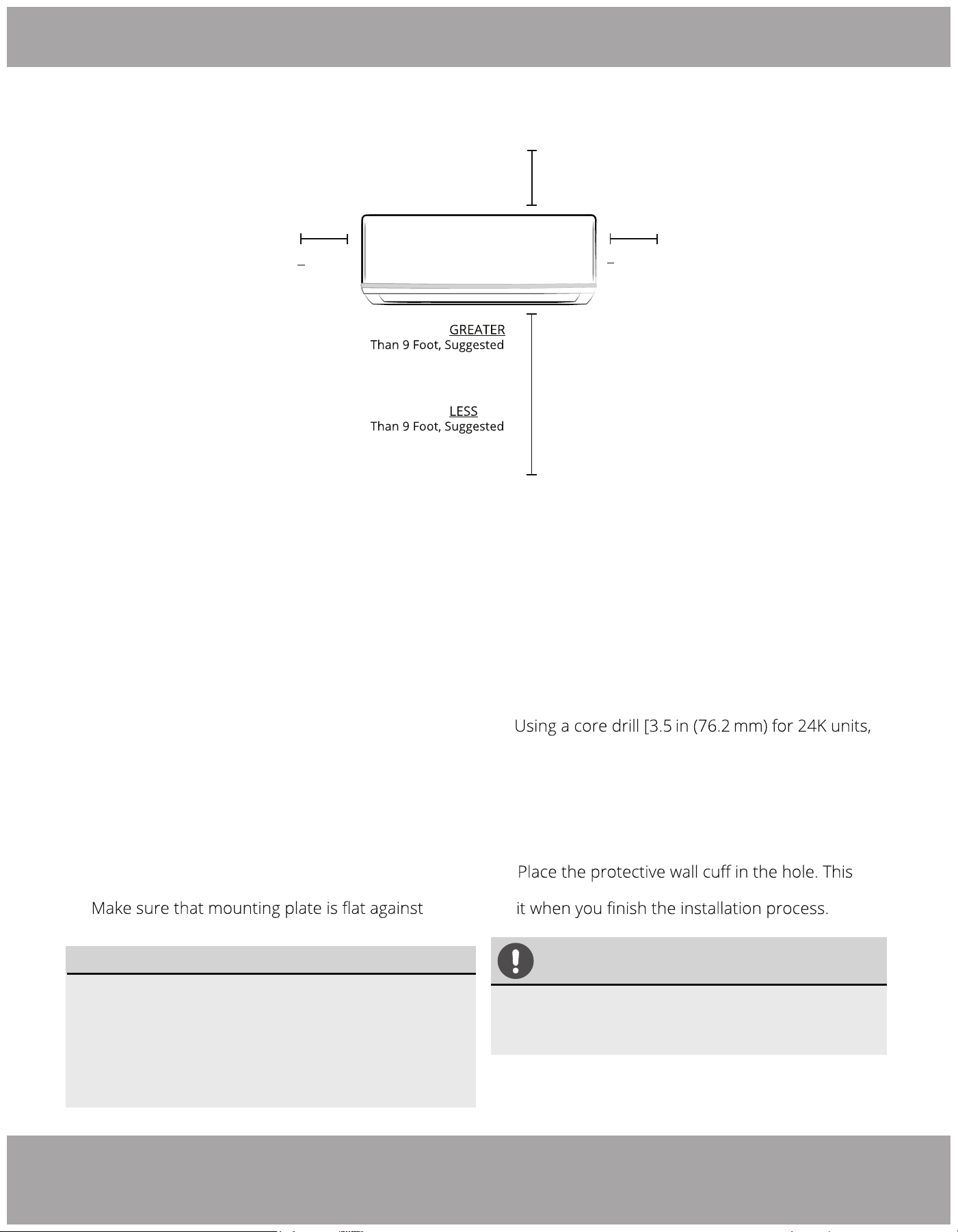
Refer to the following diagram to ensure proper distance from walls and ceiling:
Step 2: Attach mounting plate to wall
The mounting plate is the device on which you will
mount the indoor unit
.
1. Remove the screw that attaches the mounting
plate to the back of the indoor unit.
2. Place the mounting plate against the wall in a
location that meets the standards in the
Select Installation Location step. (See
Mounting Plate Dimensions for detailed
information on mounting plate sizes.)
3. Drill holes for mounting screws in places that:
• have studs and can support the weight of
the unit
• correspond to screw holes in the mounting
plate
4. Secure the mounting plate to the wall with the
screws provided.
5.
the wall
NOTE FOR CONCRETE OR BRICK WALLS:
If the wall is made of brick, concrete, or similar
material, drill 0.2 in-diameter (5 mm-diameter)
holes in the wall and insert the sleeve anchors
provided. Secure the mounting plate to the
wall by tightening the screws directly into the
clip anchors.
Step 3: Drill wall hole for connective piping
You must drill a hole in the wall for refrigerant piping,
the drainage pipe, and the signal cable to pass through
which will connect the indoor and outdoor units.
1. Determine the location of the wall hole based on
the position of the mounting plate. Refer to
Mounting Plate Dimensions on the next page
to help you determine the optimal position. Refer
to Fig. 3.3 wall hole diameter and install at a slight
angle to facilitate drainage.
2.
2.5 in (65 mm) for all others], drill a hole in the
wall. Make sure that the hole is drilled at a slight
downward angle, so that the outdoor end of the
hole is lower than the indoor end by about 0.2 to
0.275 in (5 mm-7 mm). This will ensure proper
water drainage. (See Fig. 3.2)
3.
protects the edges of the hole and will help seal
Fig. 3.1
CAUTION
When drilling the wall hole, be sure to avoid
wires, plumbing, and other sensitive
components.
Minimum Ceiling
Clearance is
5.9 in(15 cm)
>4.75 in
(12 cm)
>4.75 in
(12 cm)
For Ceilings
Floor Clearance is
90.55 in(230 cm)
For Ceilings
Floor Clearance is
78.55 in(200 cm)
Page 13
mrcool.com
Indoor Unit Installation
Wall
Indoor Outdoor
Fig.3.2
0.2 - 0.3 in
(5 - 7 mm)
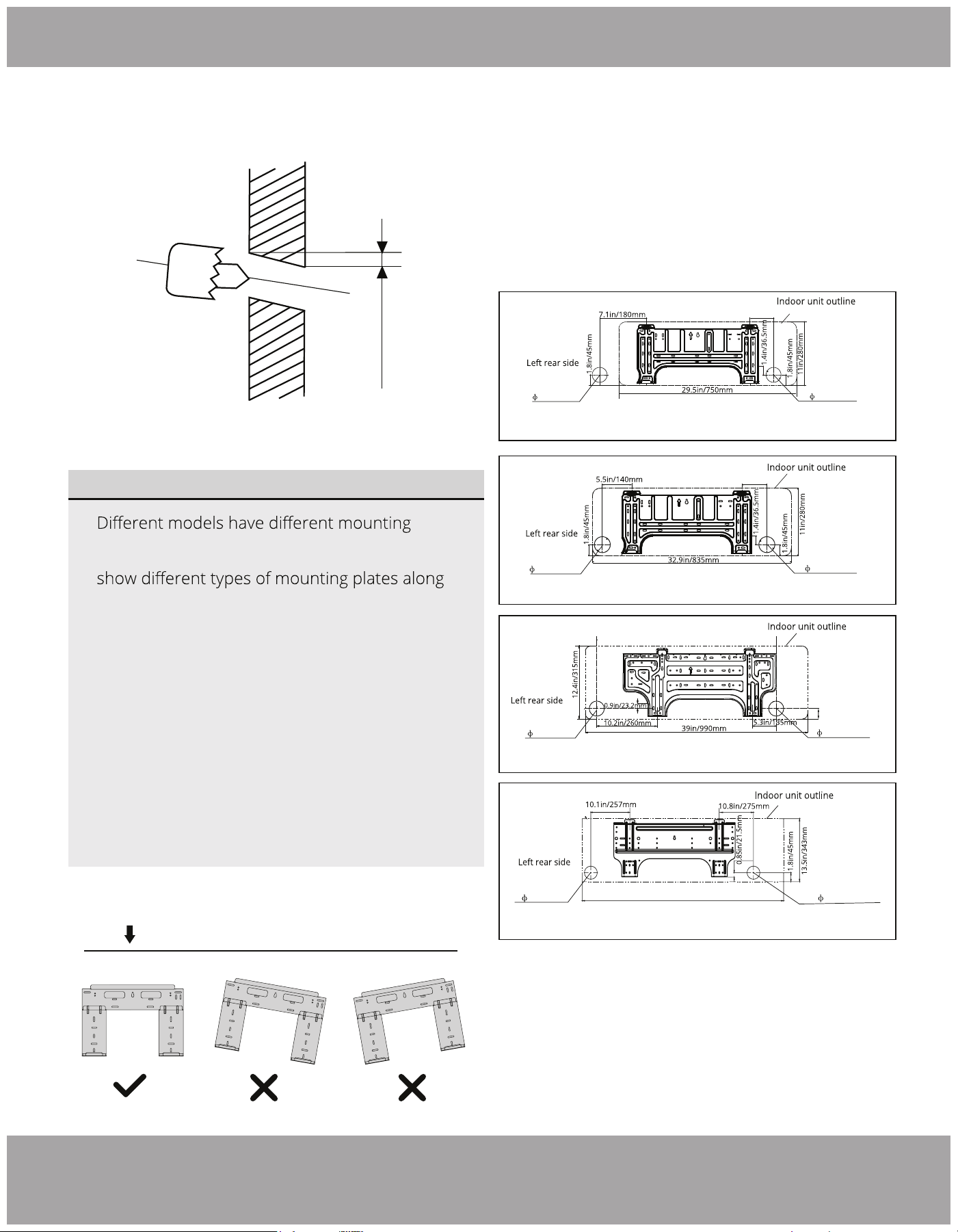
MOUNTING PLATE DIMENSIONS
plates.
In order to ensure that you have ample room to
mount the indoor unit, the diagrams to the right
with the following dimensions:
• Width of mounting plate
• Height of mounting plate
• Width of indoor unit relative to plate
• Height of indoor unit relative to plate
• Recommended position of wall hole (both to
the left and right of mounting plate)
• Relative distances between screw holes
Fig. 3.3
Correct orientation of Mounting Plate
46.7in/1186mm
3.5in/89mm 3.5in/89mm
refrigerant
pipe hole
Right rear side
refrigerant
pipe hole
Series 24K Models
Series 18K Models
refrigerant
pipe hole
Right rear side
refrigerant
pipe hole
2.6in/65mm 2.6in/65mm
1.8in/45mm
4.3in/11mm
2.6in/65mm 2.6in/65mm
refrigerant
pipe hole
Right rear side
refrigerant
pipe hole
Series 12K Models
4.3in/11mm
2.6in/65mm 2.6in/65mm
refrigerant
pipe hole
Right rear side
refrigerant
pipe hole
Series 9K Models
Page 14
mrcool.com
Indoor Unit Installation
Be extremely careful not to dent or damage the piping while bending them away from the unit. Any
Step 4: Prepare refrigerant piping
The refrigerant piping is inside an insulating sleeve
attached to the back of the unit. You must prepare
the piping before passing it through the hole in the
wall. Refer to the Refrigerant Piping Connection
section of this manual for detailed instructions on
technique, etc.
Based on the position of the wall hole,
relative to the mounting plate, choose the
side from which the piping will exit the unit.
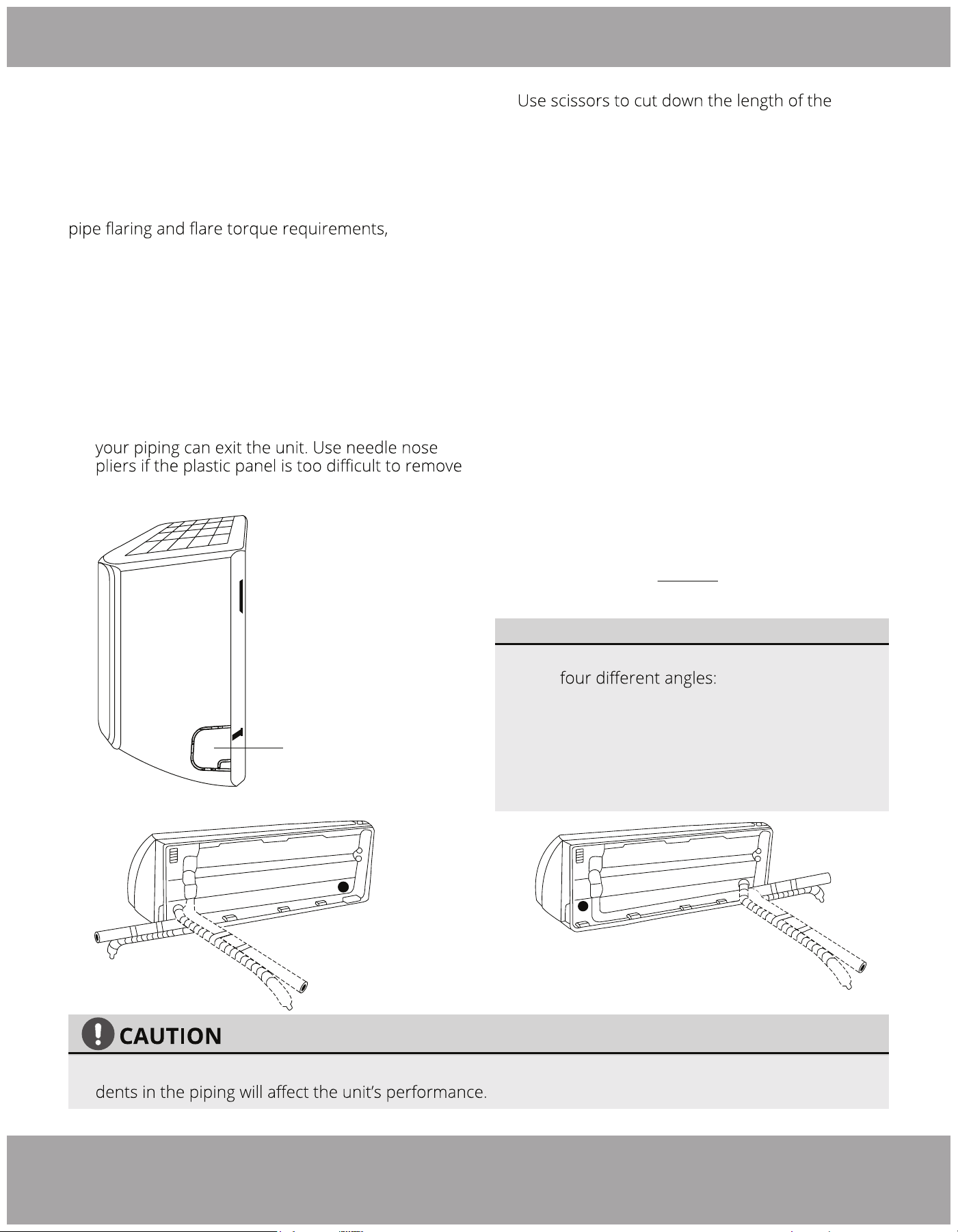
If the wall hole is behind the unit, keep the
knock-out panel in place. If the wall hole is to the
side of the indoor unit, remove the plastic
knock-out panel from that side of the unit. (See
Fig. 3.4 ). This will create a slot through which
by hand.
insulating sleeve to reveal about 6 in (15 cm) of the
refrigerant piping. This serves two purposes:
• To facilitate the Refrigerant Piping
Connection process
• To facilitate Gas Leak Checks and enable
you to check for dents
If existing connective piping is already embedded
in the wall, proceed directly to the Connect
Drain Hose step. If there is no embedded
piping, connect the indoor unit’s refrigerant
piping to the connective piping that will join the
indoor and outdoor units. Refer to the
Refrigerant Piping Connection section of this
manual for detailed instructions.
Based on the position of the wall hole, relative to
the mounting plate, determine the necessary
angle of your piping.
Grip the refrigerant piping at the base of the
bend.
Slowly, and with even pressure, bend the piping
towards the hole.
DO NOT
dent or damage the
piping during the process.
NOTE ON PIPING ANGLE
Refrigerant piping can exit the indoor unit
from
• Left-hand side
• Left rear
• Right-hand side
• Right rear
Refer to Fig. 3.5 for details.
Knock-out Panel
Fig. 3.4
Fig. 3.5
1.
2.
3.
4.
5.
6.
7.
Page 15 mrcool.com
Indoor Unit Installation
Step 5: Connect drain hose
By default, the drain hose is attached to the left-hand
side of unit (when you’re facing the back of the unit).
However, it can also be attached to the right-hand side.
NOTE ON DRAIN HOSE PLACEMENT
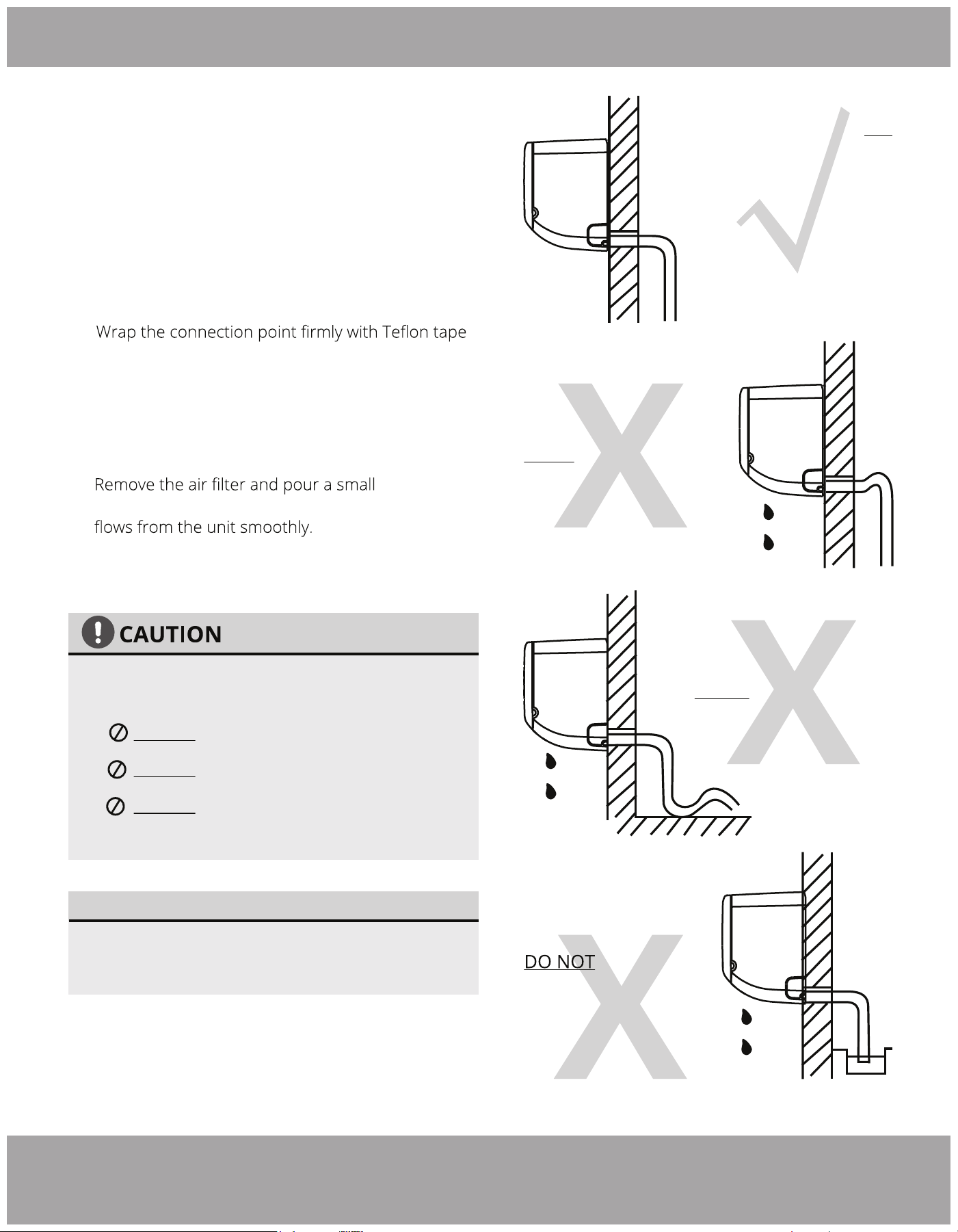
Make sure to arrange the drain hose according
to Fig. 3.6a.
DO NOT
kink the drain hose.
DO NOT
create a water trap.
DO NOT put the end of drain hose in water
or a container that will collect water.
ENSURE UNUSED DRAIN HOLE IS PLUGGED
To ensure proper drainage, the drain hose must exit
the unit on the same side as the refrigerant piping.
1.
to ensure a good seal and to prevent leaks.
2.
For the portion of the drain hose that will remain
indoors, wrap it with foam pipe insulation to
prevent condensation.
3.
amount of
water into the drain pan to make sure that water
4.
To prevent unwanted leaks be sure that the
factory installed rubber plug is in the unused
drain hole.
Fig. 3.6a
Fig. 3.6b
Fig. 3.6c
Fig. 3.6d
Make sure there are NO
kinks or dents in the
hose to ensure proper
drainage.
NOT CORRECT
Dents in the drain hose
will create water traps.
NOT CORRECT
Kinks in the drain hose
will create water traps.
NOT CORRECT
place the end
of the drain hose in
water or in containers
that collect water.
This will prevent
proper drainage.
Page 16mrcool.com
Indoor Unit Installation
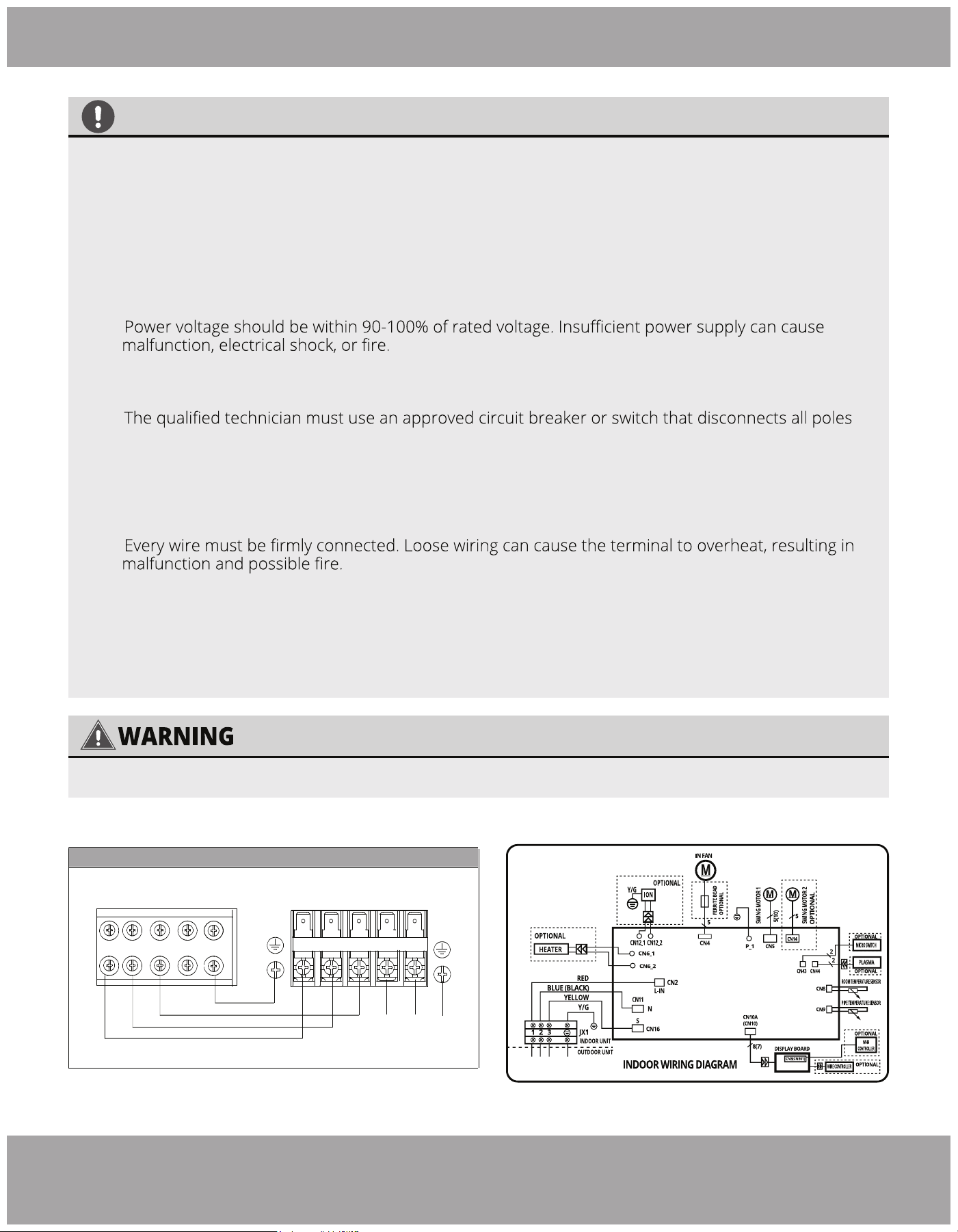
BEFORE PERFORMING ANY ELECTRICAL WORK, TURN OFF ALL POWER TO THE SYSTEM.
BEFORE PERFORMING ELECTRICAL WORK, READ THESE REGULATIONS
1. All wiring must comply with local and national electrical codes, and must be installed by a licensed
electrician.
2. All electrical connections must be made according to the Electrical Connection Diagram located
on the panels of the indoor and outdoor units.
3. If there is a serious safety issue with the power supply, stop work immediately. Explain your
reasoning to the client, and refuse to install the unit until the safety issue is properly resolved.
4.
5. Circuit, including any switches, should have a capacity 1.5 times the maximum unit current (amps).
6.
and has has a contact separation of at least 1/8 in (3 mm).
7. Do not connect another appliance to the same circuit.
8. Make sure to properly ground the air conditioner.
9.
10. Do not let wires touch or rest against refrigerant tubing, the compressor, or any moving parts
within the unit.
11. If the unit has an auxiliary electric heater, it must be installed at least 40 in (1 meter) away from
combustible materials.
Fig. 3.7bFig. 3.7a
208-230V~ Models
L1 L2 S L1 L2
L1 L2 S G
Indoor Unit
Single Zone Outdoor Unit
see Outdoor Unit Installation for Multi-Zone
Power Supply

Page 17 mrcool.com
Indoor Unit Installation
Step 6: Connect signal cable
The signal cable enables communication between the
indoor and outdoor units and provides power to the
indoor unit. A 16 gauge AWG signal cable (H07RN-F)
is provided for the unit. The tables below are for
reference.
NOTE: the rated amp (A) draw will be at the
condenser (outdoor unit) and a table is provided in
that section, showing the required power cable gauge
Minimum Cross-Sectional Area of
Power and Signal Cables
CHOOSE THE APPROPRIATE CABLE SIZE
Rated Current of
Appliance (A)
Nominal Cross-Sectional
Area (mm²)
> 6
> 6 and
> 16
>
25
>
32
>
40
0.75
1
1.5
2.5
4
6
Other Regions
North America
10 18
13 16
18 14
25 12
30 10
Appliance Amps (A) AWG
TAKE NOTE OF FUSE SPECIFICATIONS
The air conditioner’s circuit board (PCB) is
designed with a fuse to provide overcurrent
printed on the circuit board, such as:
T3.15A/250VAC, T5A/250VAC, etc.
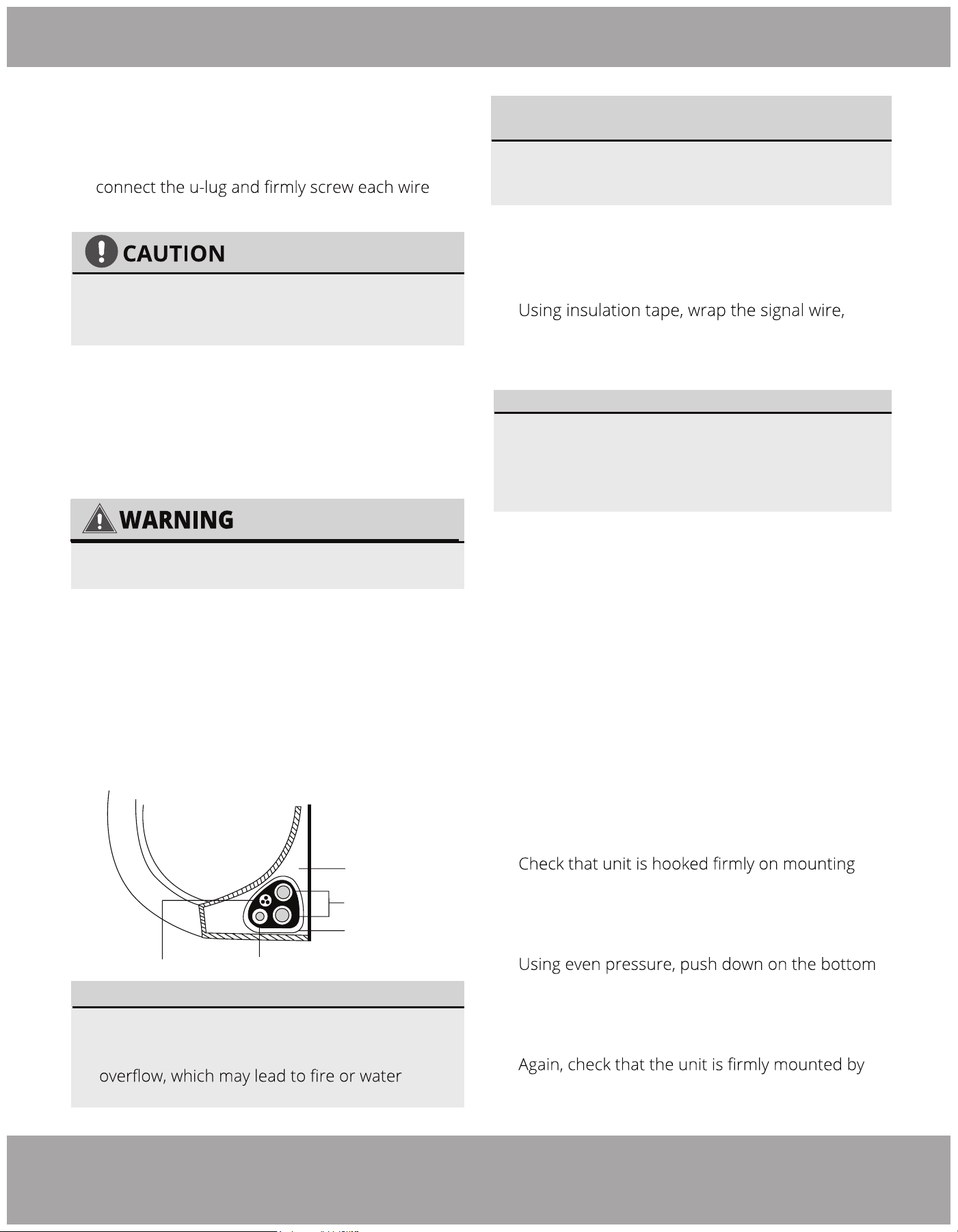
1. Prepare the cable for connection:
jacket from both ends of signal cable to
reveal about 1.57 in (40 mm) of the wires
inside.
b. Strip the insulation from the ends of the wires.
ends of the wires.
PAY ATTENTION TO LIVE WIRE
While crimping wires, make sure you clearly
distinguish the Live (“L”) Wire from other wires.
2. Open front panel of the indoor unit.
3.
the right side of the unit. This will reveal the terminal
block.
4. ew the cable clamp below the terminal
block and place it to the side.
5. Facing the back of the unit, remove the plastic
panel on the bottom left-hand side.
All wiring must be performed in accordance
with the wiring diagrams Fig. 3.7a & Fig. 3.7b
shown on the previous page.
erminal block
Wire cover
Screw
Cable clamp
Fig. 3.7c
See Fig. 3.7A on previous page for wiring diagram.
Wiring diagram also found inside lid of interior unit
The size of the power supply cable, signal cable,
fuse, and switch needed is determined by the
maximum unit current. The maximum unit
current is indicated on the nameplate located on
the side panel of the unit. Refer to this nameplate
to choose the right cable, fuse, or switch.
Page 18mrcool.com
Indoor Unit Installation
DO NOT INTERTWINE SIGNAL CABLE WITH
OTHER WIRES
While bundling these items together, do not
intertwine or cross the signal cable with any
other wiring.
2.
Using non-adhesive vinyl tape, attach the drain
hose to the underside of the refrigerant pipes.
Adhesive tape (optional) may be used in place of
the vinyl tape.
3.
refrigerant pipes, and drain hose tightly together.
Double-check that all items are bundled in
accordance with Fig. 3.8
DO NOT WRAP ENDS OF PIPING
When wrapping the bundle, keep the ends of
the piping unwrapped. You need to access them
to test for leaks at the end of the installation
process (refer to Electrical Checks and Leak
Checks section of this manual).
Step 8: Mount indoor unit
6. Feed the signal wire through this slot, from the
back of the unit to the front.
7. Facing the front of the unit, match the wire
colors with the labels on the terminal block,
to its corresponding terminal.
DO NOT MIX UP LIVE AND NULL WIRES
This is dangerous, and can cause the air
conditioning unit to malfunction.
8. After checking to make sure every connection
is secure, use the cable clamp to fasten the signal
cable to the unit. Screw the cable clamp down
tightly.
9. Replace the wire cover on the front of the unit,
and the plastic panel on the back.
Step 7: Wrap piping and cables
Before passing the piping, drain hose, and the signal
cable through the wall hole, you must bundle them
together to protect and insulate them, as well as
save space.
1. Bundle the drain hose, refrigerant pipes, and
signal cable according to Fig. 3.8.
DRAIN HOSE MUST BE ON BOTTOM
Make sure that the drain hose is at the bottom
of the bundle. Putting the drain hose at the
top of the bundle can cause the drain pan to
damage.
Indoor Unit
Space behind unit
Refrigerant piping
Drain hose
Signal wire
Insulation tape
Fig. 3.8
THE WIRING CONNECTION PROCESS MAY
DIFFER SLIGHTLY BETWEEN UNITS.
If you installed new connective piping to the
outdoor unit, do the following:
If you have already passed the refrigerant piping
through the hole in the wall, proceed to Step 4.
Otherwise, double-check that the ends of the
refrigerant pipes are sealed to prevent dirt or
foreign material from entering the pipes.
Slowly pass the wrapped bundle of refrigerant
pipes, drain hose, and signal wire through the
hole in the wall.
Hook the top of the indoor unit on the upper
hook of the mounting plate.
plate by applying slight pressure to the left and
right-hand sides of the unit. The unit should not
jiggle or shift.
half of the unit. Keep pushing down until the unit
snaps onto the hooks along the bottom of the
mounting plate.
applying slight pressure to the left and the
right-hand sides of the unit.
1.
2.
3.
4.
5.
6.
7.

Page 19 mrcool.com
Indoor Unit Installation
If refrigerant piping is already embedded
in the wall, do the following:
1. Hook the top of the indoor unit on the upper
hook of the mounting plate.
2.
giving you enough room to connect the
refrigerant piping, signal cable, and drain
hose. Refer to Fig. 3.9 for an example.
Fig. 3.9
Connect drain hose and refrigerant piping
(refer to Refrigerant Piping Connection
section of this manual for instructions).
After the leak test, wrap the connection point
with insulation tape.
Remove the bracket or wedge that is propping
up the unit.
bottom half of the unit. Keep pushing down
until the unit snaps onto the hooks along the
bottom of the mounting plate.
UNIT IS ADJUSTABLE
Keep in mind that the hooks on the mounting plate are smaller than the holes on the back of the unit.
be adjusted left or right by about 1.25-1.95 in (30-50 mm), depending on the model. (See Fig. 3.10)
Fig. 3.10
Move to left or right
1.2-1.95 in
(30-50 mm)
1.2-1.95 in
(30-50 mm)
Wedge
30°
Keep pipe connection point exposed to
perform the leak test (refer to Electrical
Checks and Leak Checks section of this
manual).

Page 20mrcool.com
Indoor Unit Installation
Fig. 4.1
12 in (30 cm)
6 in (15 cm)
clearance between
back and wall
79in (200cm)
in front
12in (30cm)
on left
24in (60cm)
above
24in (60cm)
on right
79 in (200 cm)
in front
12 in (30 cm)
on left
24 in (60 cm)
above
24 in (60 cm)
on right
Near an obstacle that will block air inlets and
outlets
Near a public street, crowded areas, or
where noise from the unit will disturb others
Near animals or plants that will be harmed
by hot air discharge
Near any source of combustible gas or in a
location that is exposed to large amounts of
dust
In a location exposed to excessive
amounts of salty air
Within 3.3 ft (1 m) of televisions and radios or
other appliances subject to interference.
DO NOT
Strong wind
Strong wind
Fig. 4.2
4
Outdoor Unit Installation
Installation Instructions –
Outdoor Unit
Step 1: Select installation location
Before installing the outdoor unit, you must
choose an appropriate location. The following
standards will help you choose an appropriate
location.
Proper installation locations meet the
following standards:
Meets all spatial requirements shown in
Installation Space Requirements (Fig. 4.1)
Good air circulation and ventilation
Firm and solid location that can support
the unit and will cause vibration.
Noise from the unit will not disturb others
Protected from prolonged periods of direct
sunlight or rain
A minimum pipe run of 9.8 ft (3 m) is required to
minimize vibration & excessive noise.
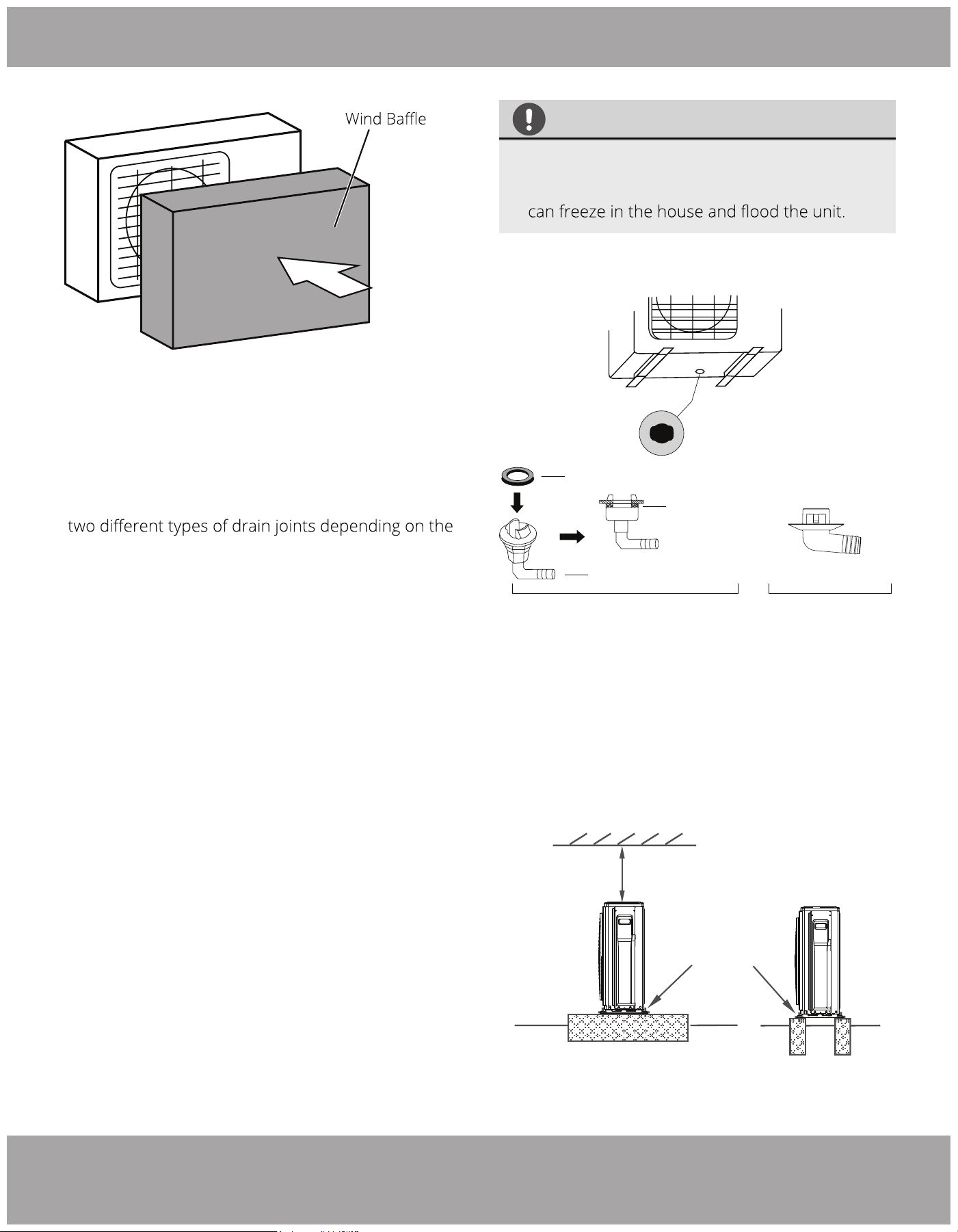
SPECIAL CONSIDERATIONS FOR
EXTREME WEATHER
Install unit so that air outlet fan is at a 90°
angle to the direction of the wind. If needed,
build a barrier in front of the unit to protect it
from extremely heavy winds. Ensure the
wind barrier does not block necessary air
Fig. 4.2 and Fig. 4.3
.
If the unit is f
heavy rain or snow:
Build a shelter above the unit it to protect it
from the rain or snow. Be careful not to
Page 21 mrcool.com
Outdoor Unit Installation
If the drain joint comes with a rubber seal (see
Fig. 4.4 - A), do the following:
1. Fit the rubber seal on the end of the drain joint that
will connect to the outdoor unit.
2. Insert the drain joint into the hole in the base pan
of the unit.
3. Rotate the drain joint 90° until it clicks in place
facing the front of the unit.
4. Connect a drain hose extension (not included) to
the drain joint to redirect water from the unit during
heating mode.
If the drain joint doesn’t come with a rubber seal
(see Fig. 4.4 - B), do the following:
1. Insert the drain joint into the hole in the base pan
of the unit. The drain joint will click in place.
2. Connect a drain hose extension (not included) to
the drain joint to redirect water from the unit during
heating mode.
Step 2: Install drain joint
Heat pump units require a drain joint. Before bolting
the outdoor unit in place, you must install the drain
joint at the bottom of the unit. Note that there are
type of outdoor unit.
Fig. 4.3
Strong wind
IN COLD CLIMATES
In cold climates, make sure that the drain
hose is as vertical as possible to ensure swift
water drainage. If water drains too slowly, it
Seal
Drain joint
(A) (B)
Base pan hole of
outdoor unit
Seal
Fig. 4.4
>23.6 in / 60 cm
Fasten with bolts
Fig. 4.5
Step 3: Anchor outdoor unit
The outdoor unit can be anchored to the ground
or to a wall-mounted bracket. Fasten the outdoor unit
with anchor bolts (M10).
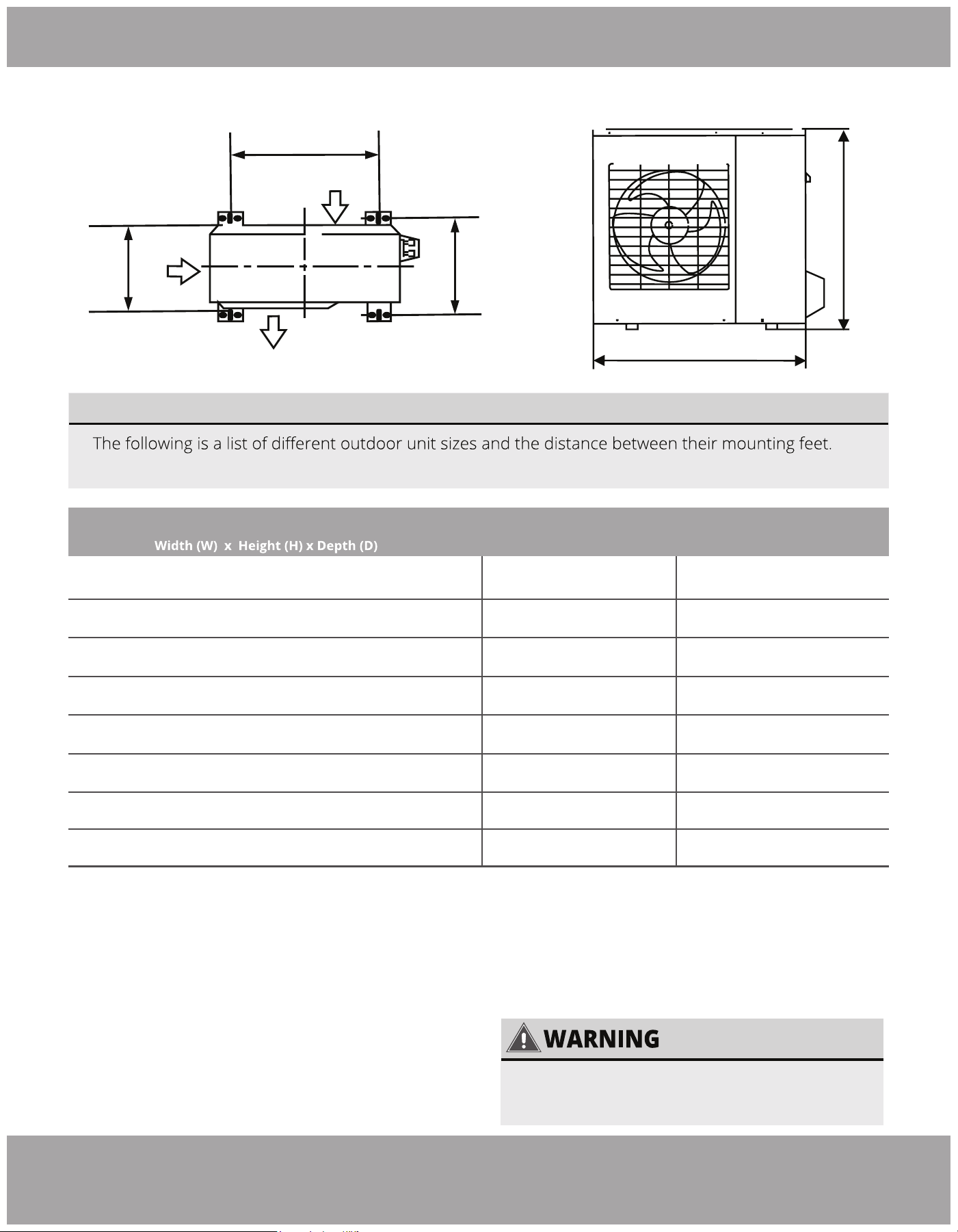
Page 22mrcool.com
Outdoor Unit Installation
Outdoor Unit Dimensions: inches (millimeters) Mounting Dimensions inches (millimeters)
Width (A) Depth (B)
20.24 in
(514 mm)
13.39 in
(340 mm)
21.26 in
(540 mm)
13.8 in
(350 mm)
20.24 in
(514 mm)
13.39 in
(340 mm)
26.5 in
(673 mm)
15.87 in
(403 mm)
19.2 in
(487mm)
11.73 in
(298 mm)
21.26 in
(540 mm)
13.8 in
(350 mm)
20.24 in
(514 mm)
13.39 in
(340 mm)
33.27 in x 27.64 in x 14.29 in
(845 mm x 702 mm x 363 mm)
37.24 in x 16.54 in x 31.89 in
(946 mm x 420 mm x 810 mm)
30.31 in x 21.85 in x 11.81 in
(770 mm x 555 mm x 300 mm)
31.50 in x 21.81 in x 13.11 in
(800 mm x 554 mm x 333 mm)
31.50 in x 21.81 in x 13.11 in
(800 mm x 554 mm x 333 mm)
31.50 in x 21.81 in x 13.11 in
(800 mm x 554 mm x 333 mm)
37.24 in x 31.89 in x 16.14 in
(946 mm x 810 mm x 420 mm)
33.27 in x 27.64 in x 14.29 in
(845 mm x 702 mm x 363 mm)
26.63 in
(676 mm)
16 in
(404 mm)
O-HH-09-HP-C-230
O-HH-18-HP-C-230
O-HH-12-HP-C-230
O-HH-24-HP-C-230
O-ES-09-HP-C-230
O-ES-18-HP-C-230
O-ES-12-HP-C-230
O-ES-24-HP-C-230
W
H
D
Air Inlet
A
B
Air Outlet
Air Inlet
Fig. 4.6
If you will install the unit on the ground or on a
concrete mounting platform, do the following:
1. Mark the positions for four expansion bolts based
on dimensions in the Unit Mounting Dimensions
chart above.
2. Pre-drill holes for expansion bolts.
3. Clean concrete dust away from holes.
4.
Place a nut on the end of each expansion bolt.
5. Hammer expansion bolts into the pre-drilled holes.
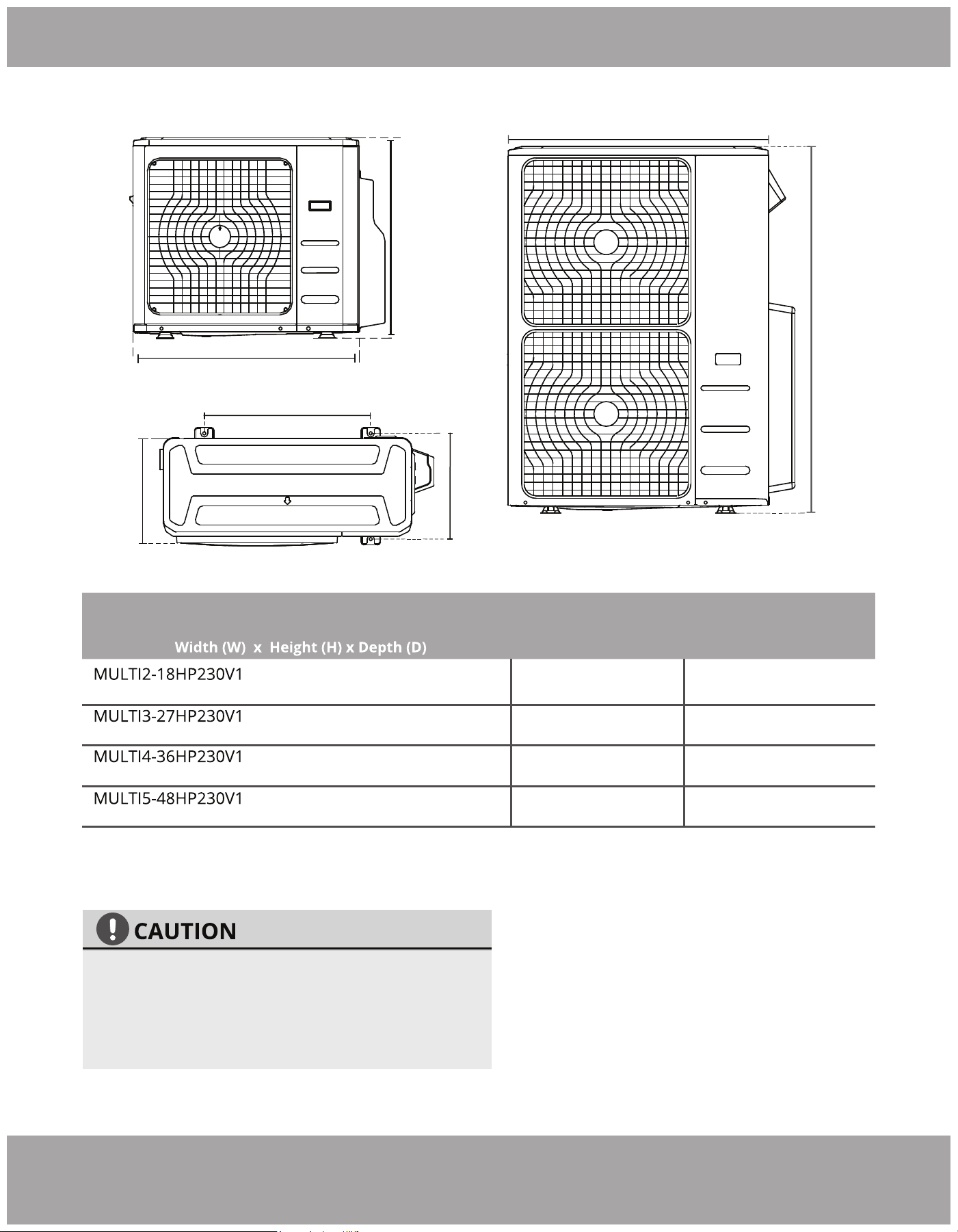
UNIT MOUNTING DIMENSIONS
Prepare the installation base of the unit according to the dimensions below.
When drilling into concrete, eye
protection should be worn at all times.
6. Remove the nuts from expansion bolts, and
place outdoor unit on bolts.
7. Put washer on each expansion bolt, then
replace the nuts.
8. Using a wrench, tighten each nut until snug.
Step 3: Anchor outdoor unit - single-zone (Hyper Heat & E Star)
Page 23 mrcool.com
Outdoor Unit Installation
Step 3: Anchor outdoor unit - Multi-Zone
Outdoor Unit Dimensions:
inches (millimeters)
Mounting Dimensions:
inches (millimeters)
Width (A) Depth (B)
33.27 in x 27.64 in x 14.29 in
(845 mm x 702 mm x 363 mm)
13.8 in
(351 mm)
37.48 in x 52.48 in x 16.34 in
(952 mm x 1333 mm x 415 mm)
15.9 in
(404 mm)
37.24 in x 31.89 in x 16.14 in
(946 mm x 810 mm x 410 mm)
37.24 in x 31.89 in x 16.14 in
(945 mm x 810 mm x 410 mm)
26.5 in
(673 mm)
15.87 in
(403 mm)
26.5 in
(673 mm)
15.87 in
(403 mm)
Fig. 4.9
W
H
Fig. 4.8
A
B
D
Fig. 4.7
W
H
Before installing a condenser on a wall, make
sure that the wall is made of solid brick,
concrete, or of similarly strong material.
The wall must be able to support at
least four times the weight of the unit.
If you will install the unit on a wall-mounted
bracket, do the following:
1.
2.
Pre-drill the holes for the expansion bolts.
3. Clean dust and debris away from holes.
4. Place a washer and nut on the end of each
expansion bolt.
5. Thread expansion bolts through holes in
mounting brackets, put mounting brackets in
position, and hammer expansion bolts into the
wall.
25.2 in
(640 mm)
21.26 in
(540 mm)
Mark the position of bracket holes based on
dimensions in the Unit Mounting Dimensions
chart.
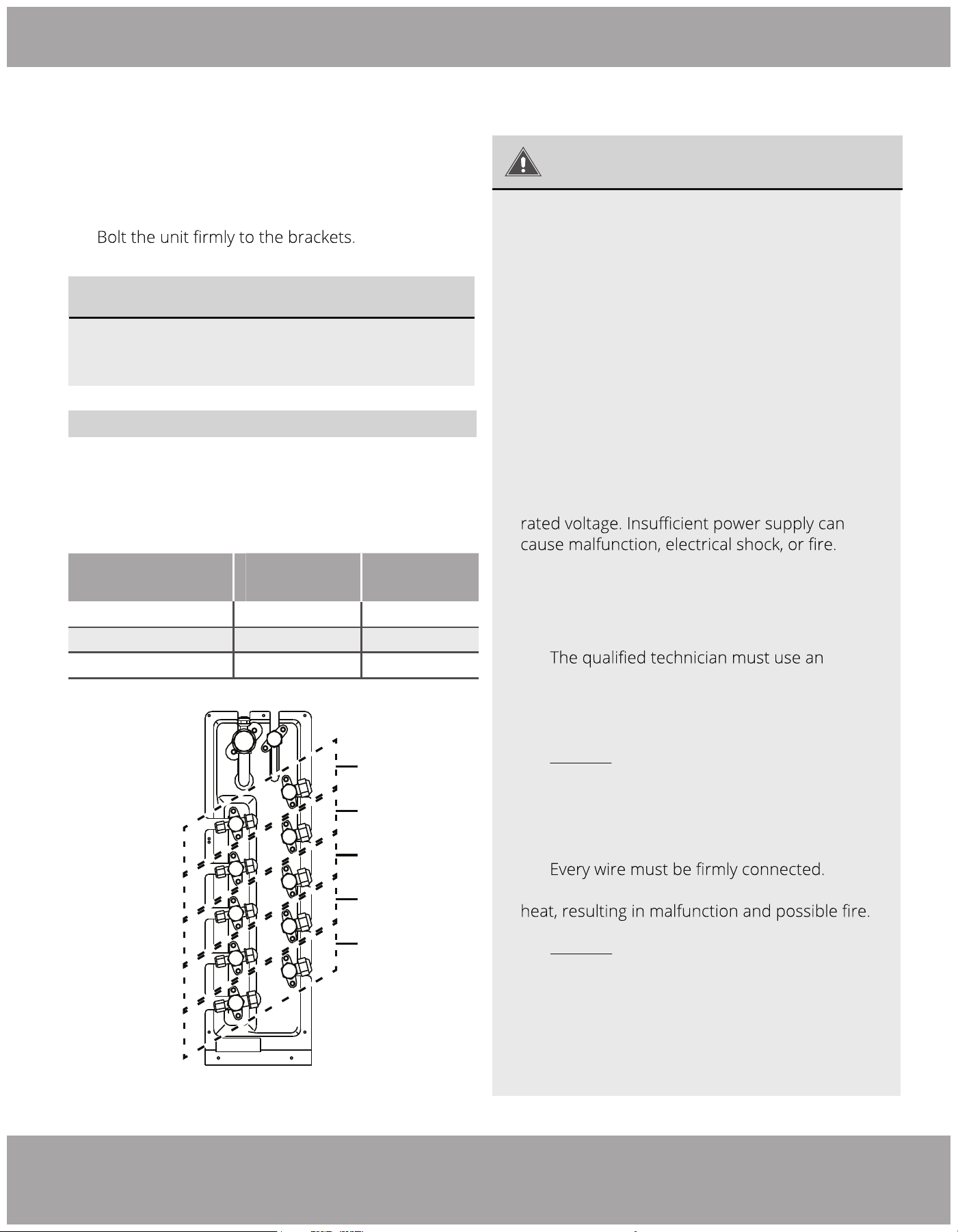
Page 24mrcool.com
Outdoor Unit Installation
BEFORE PERFORMING ELECTRICAL
WORK, READ THESE REGULATIONS
1. All wiring must comply with local and
national electrical codes, and must be installed
by a licensed electrician.
2. All electrical connections must be made
according to the Electrical Connection
Diagram located on the panels of the indoor
and outdoor units.
3. If there is a serious safety issue with the
power supply, stop work immediately. Explain
your reasoning to the client, and refuse to
install the unit until the safety issue is properly
resolved.
4. Power voltage should be within 90-100% of
5. Circuit, including any switches, should have
a capacity 1.5 times the maximum unit current
(amps).
6.
approved circuit breaker or switch that discon-
nects all poles and has has a contact separa-
tion of at least 1/8in (3mm).
7. DO NOT connect another appliance to the
same circuit.
8. Make sure to properly ground the air
conditioner.
9.
Loose wiring can cause the terminal to over-
10. DO NOT let wires touch or rest against
refrigerant tubing, the compressor, or any
moving parts within the unit.
11. If the unit has an auxiliary electric heater, it
must be installed at least 40 in (1 meter) away
from combustible materials.
Step 4: Connect signal and power cables
To reduce vibration of wall-mounted unit
If allowed, you can install the wall-mounted unit
with rubber gaskets to reduce vibration and noise.
wall-mounted installation continued
6. Check that the mounting brackets are level.
7. Carefully lift unit and place its mounting feet on
the brackets.
8.
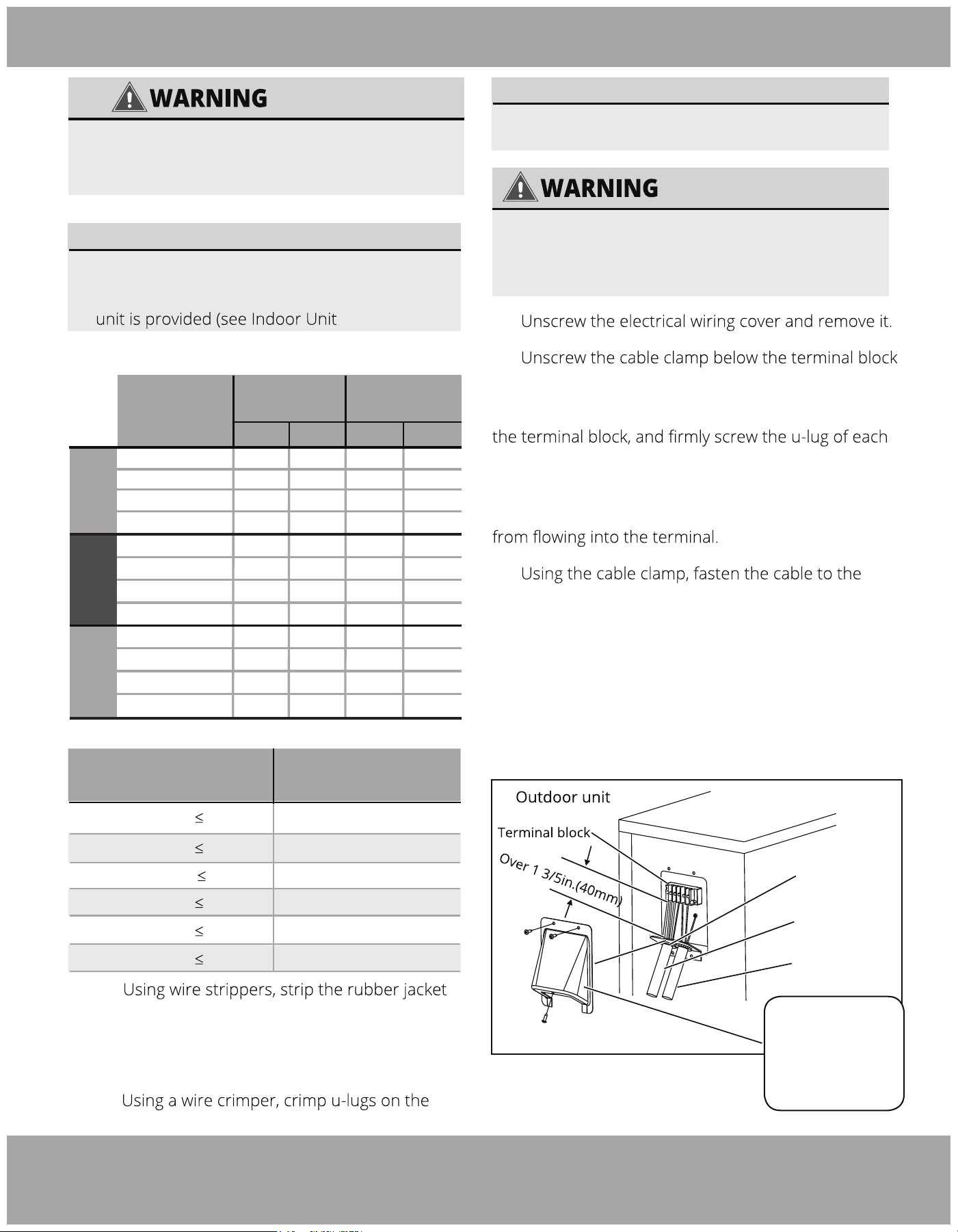
When Selecting a 24K Indoor Unit
The 24K indoor unit can only be connected with A system,
if there are two 24K indoor units, they can be connected
with A and B system. (See Fig. 5.8)
Indoor Unit Capacity
(Btu/h)
Liquid
Gas
9K/12K 1/4 in (6.4 mm)
1/4 in (6.4 mm)
3/8 in (9.5 mm)
12K/18K
24K
3/8 in (9.5 mm)
1/2 in (12.7 mm)
5/8 in (15.9 mm)
Table 5.2: Connective pipe size of A and B system
Fig. 4.10
A System
D System
C System
B System
E System
Page 25 mrcool.com
Outdoor Unit Installation
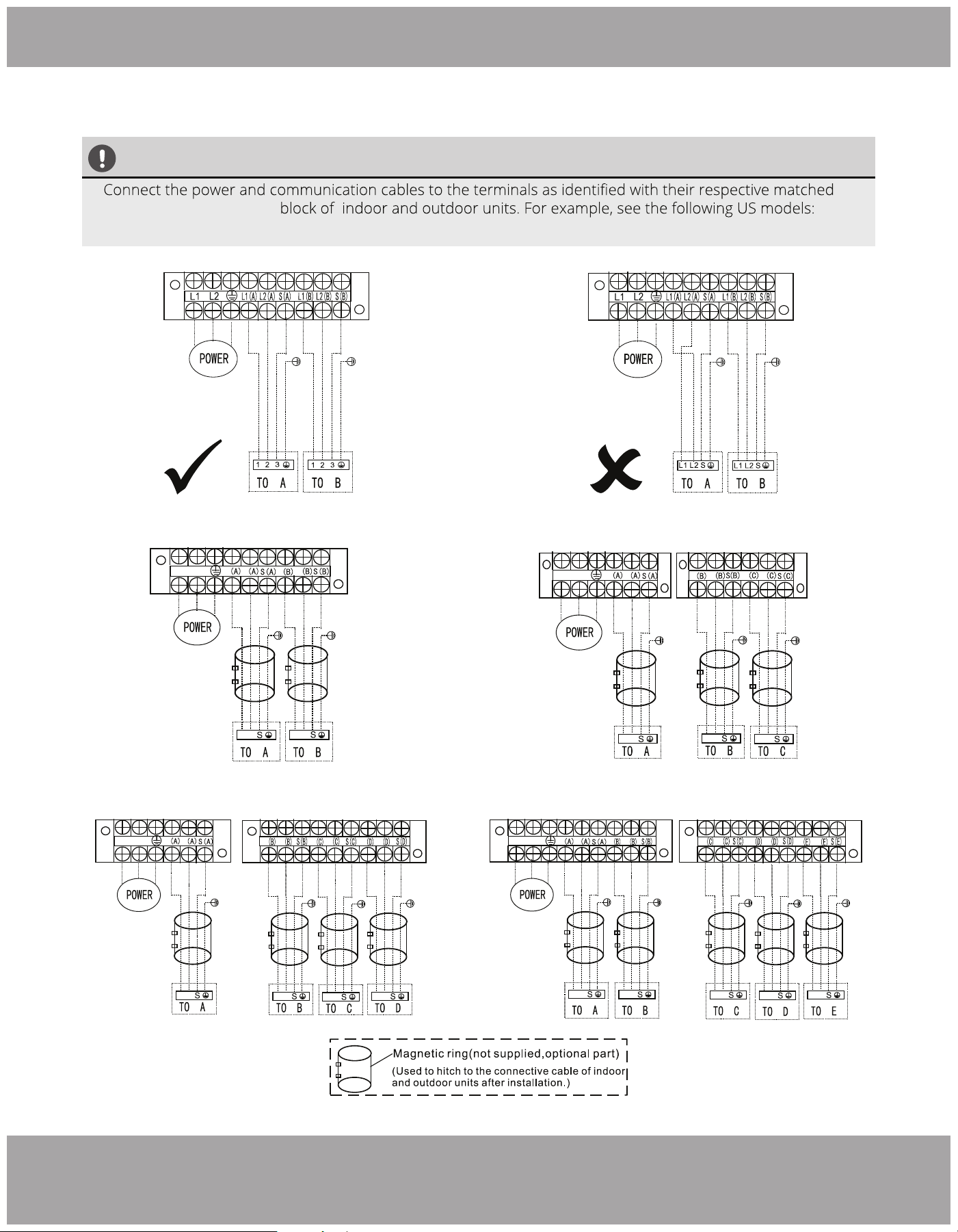
PAY ATTENTION TO LIVE WIRE
While crimping wires, make sure you clearly
distinguish the Live (“L”) Wire from other wires.
ALL WIRING MUST PERFORMED STRICTLY
IN ACCORDANCE WITH THE WIRING
DIAGRAM LOCATED INSIDE THE OUTDOOR
UNIT’S WIRE COVER.
1.
Prepare the cable for connection:
USE THE RIGHT CABLE
Rated Current
of Appliance (A)
Nominal
Cross-Sectional
Area (mm²)
0.75
1
1.5
2.5
4
> 3 and 6
> 6 and
10
> 10 and
16
> 16 and
25
> 25 and
32
> 32 and
40 6
BEFORE PERFORMING ANY ELECTRICAL
OR WIRING WORK, TURN OFF THE
MAINPOWER TO THE SYSTEM.
Other Regions
North America
2.
3.
and place it to the side.
4. Match the wire colors / labels with the labels on
wire to its corresponding terminal.
5. After checking to make sure every connection is
secure, loop the wires around to prevent rain water
6.
unit. Screw the cable clamp down tightly.
7. Insulate unused wires with PVC electrical tape.
Arrange them so that they do not touch any electrical
or metal parts.
8. Replace the wire cover on the side of the unit, and
screw it in place.
•
Outdoor power cable is not provided
•
See table below for gauge requirements
•
Indoor power / signal cable from outdoor
Installation)
a.
from both ends of cable to reveal about 1.57 in
(40 mm) of the wires inside.
b.
Strip the insulation from the ends of the
wires.
c.
ends of the wires.
Fig. 4.11
Conduit Panel
Communication
Cable
Power
Supply Cord
Outdoor Unit
Wiring Diagram
is located on
the inside of the
wire cover on
the outdoor unit.
Appliance
Amps (A)
Hyper-Heat
Condensers
Multi-Zone
Condensers
AWG
15
15
20
18K
12K
9K
Model
Capacity
(BTU/hr)
Minimum Wire Gauge for Power Cables
MCA MOP
Min. Pref.
14
14
14
14
14
12
10
12
15
2524K 12 1018
159K 14 149
15
25
3024K
18K
12K 14
12
10
14
10
8
9
18
20
2518K (2-Zone) 12 1018
3527K (3-Zone) 10 825
4536K (4-Zone) 8 630
5048K (5-Zone) 8 635
E-Star
Condensers
Page 26mrcool.com
Outdoor Unit Installation
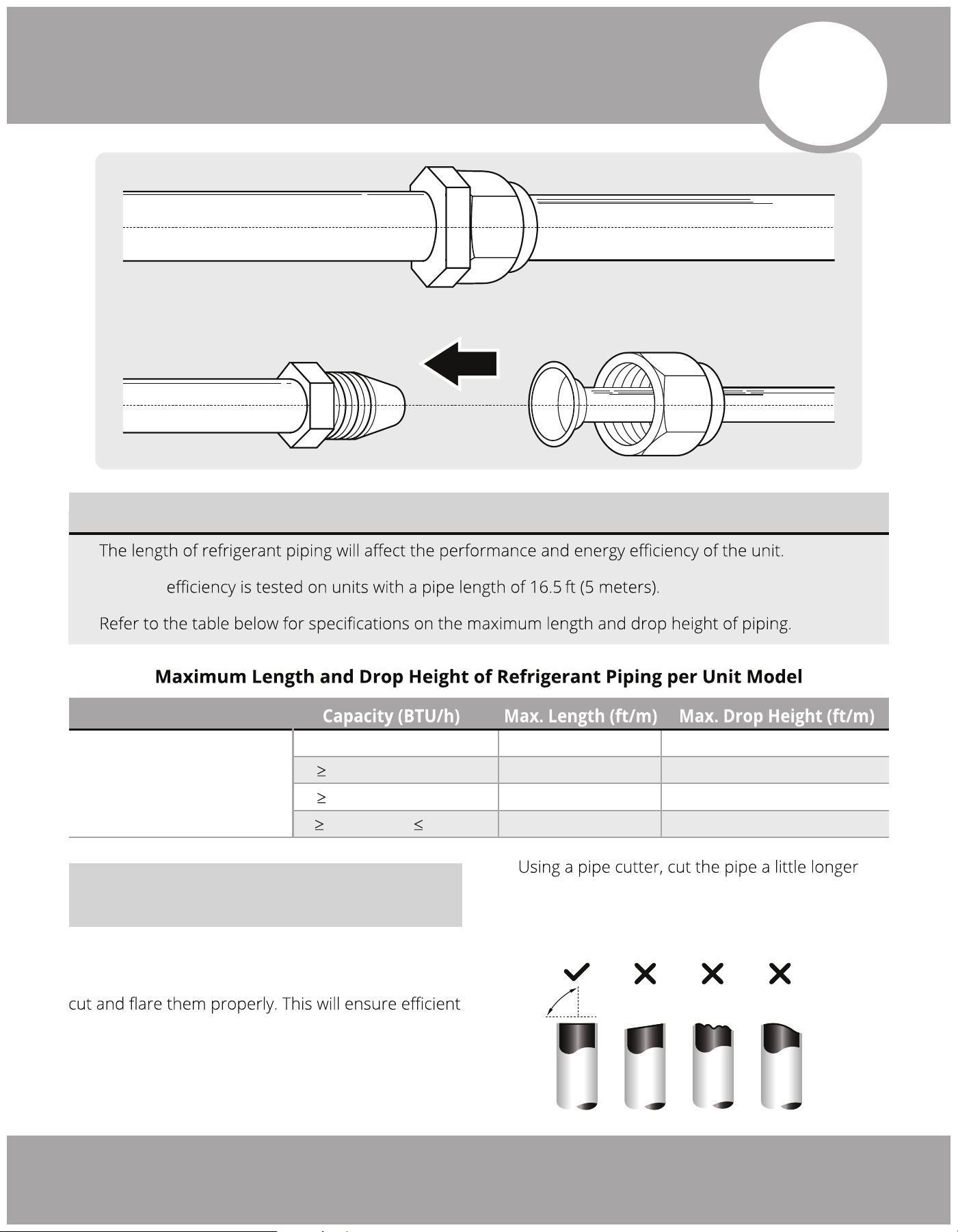
Wiring Diagram
CAUTION
numbers on the terminal
Terminal L1(A) of outdoor must connect with terminal L1 on the indoor unit.
5-Zone models:
4-Zone models:
3-Zone models:
L1
L2 L1
L2
L1 L2
L1 L1
L1
L1
L1
L1
L1
L1
L1
L1
L1
L1
L1
2-Zone models:
L2
L2
L2
L1 L2
L2
L2
L2
L2
L2
L1
L1 L1
L2
L2 L2 L2
L2
L2
L2
L2
L1
L2
L1
L2 L1 L2
L1
L2
L1L2
L1L2
L1
L1
L1L2
L2
L2
L1
L1
L1
L2
L2
L2
Page 27 mrcool.com
Outdoor Unit Installation
Refrigerant Piping Connection
6
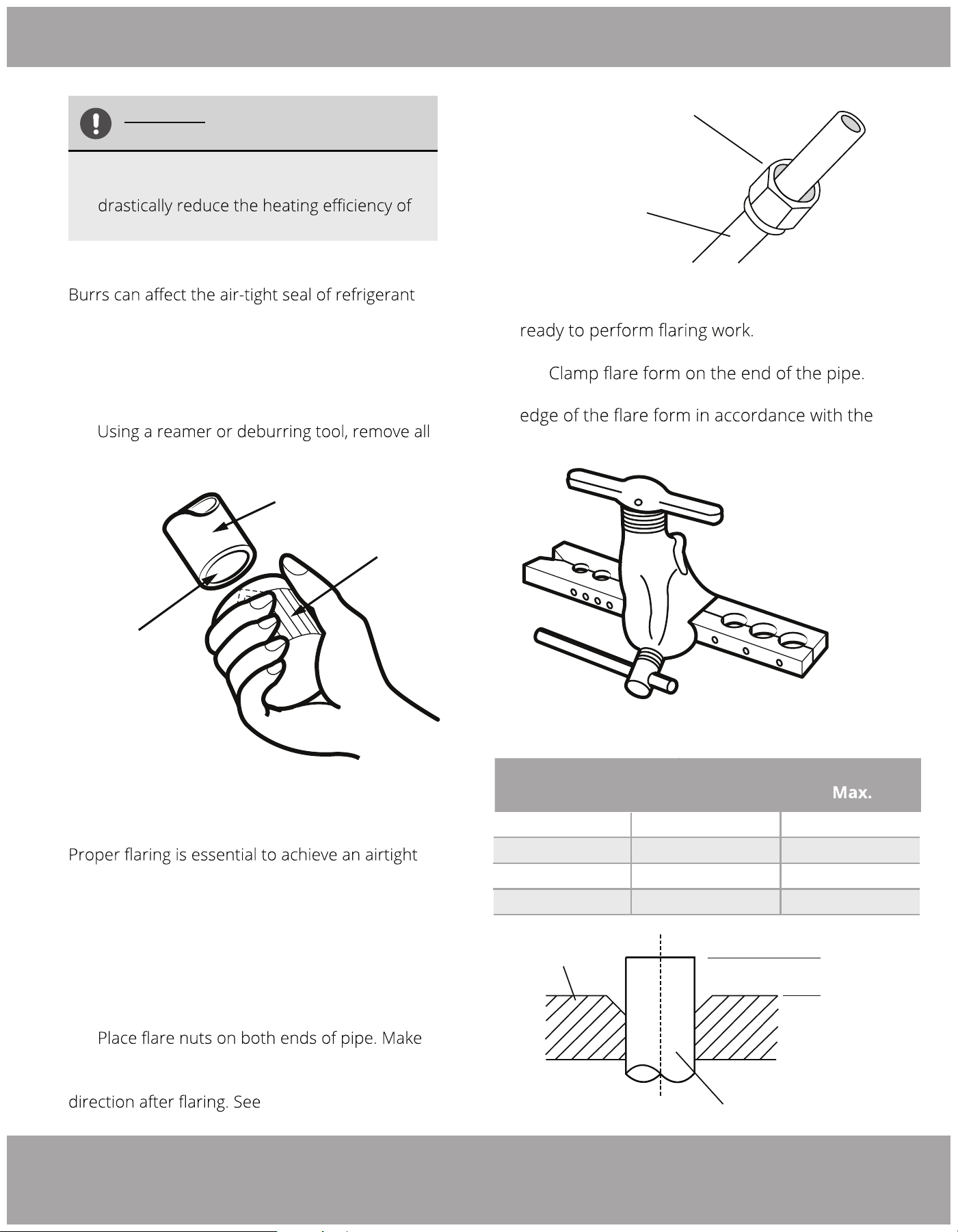
NOTE ON PIPE LENGTH
Nominal
Model
R410A Inverter Split
Air Conditioner
< 15,000 82 ft (25 m) 33 ft (10 m)
15,000 and < 24,000 98.5 ft (30 m) 66 ft (20 m)
24,000 and < 36,000 164 ft (50 m) 82 ft (25 m)
36,000 and 60,000 213 ft (65 m) 98.5 ft (30 m)
Connection Instructions –
Refrigerant Piping
2. than
the measured distance.
3. Make sure that the pipe is cut at a perfect 90° angle.
Refer to Fig. 5.1 for correct and incorrect cut examples.
Oblique Rough Warped
Fig. 5.1
90°
Step 1: Cut pipes
When preparing refrigerant pipes, take extra care to
operation and minimize the need for future
maintenance.
1. Measure the distance between the indoor and
outdoor units.
5
Refrigerant Piping Connection
Page 28mrcool.com
Refrigerant Piping Connection
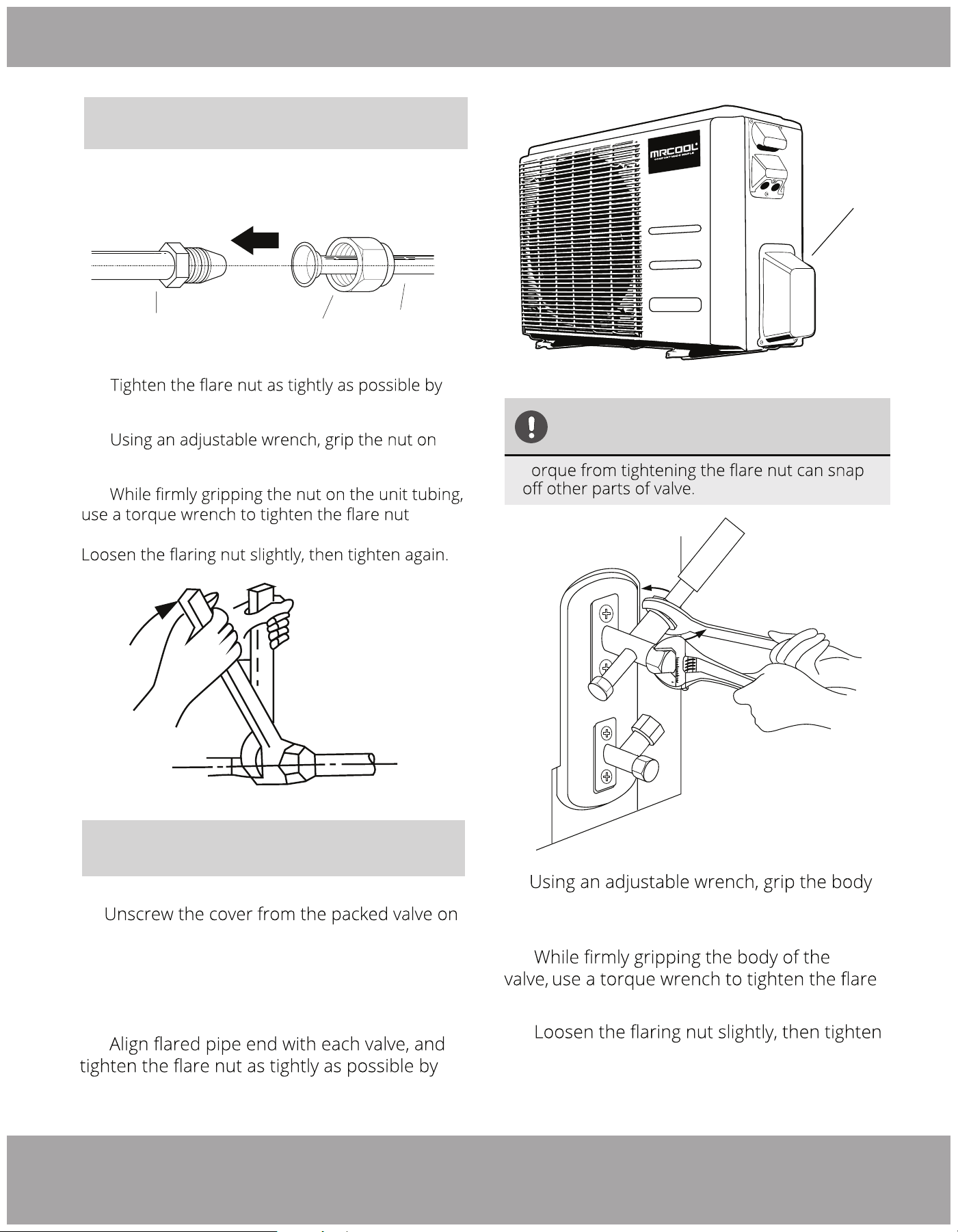
PIPING EXTENSION BEYOND FLARE FORM
Outer Diameter
of Pipe (in/mm)
A (in/mm)
Min.
0.25 in (6.35 mm)
0.375 in (9.5 mm)
0.5 in (12.7 mm)
0.63 in (16 mm)
Flare nut
Copper pipe
Fig. 5.3
Fig. 5.4
Flare form
Pipe
A
Fig. 6.5
DO NOT DEFORM PIPE
WHILE CUTTING
Be extra careful not to damage, dent, or
deform the pipe while cutting. This will
the unit.
Pipe
Reamer
Point down
Fig. 5.2
Step 2: Remove burrs
piping connection. They must be completely
removed.
1. Hold the pipe at a downward angle to
prevent burrs from falling into the pipe.
2.
burrs from the cut section of the pipe.
Step 3: Flare pipe ends
seal.
1. After removing burrs from cut pipe, seal the
ends with PVC tape to prevent foreign materials
from entering the pipe.
2. Sheath the pipe with insulating material.
3.
sure they are facing in the right direction,
because you cannot put them on or change their
Fig. 5.3.
4. Remove PVC tape from ends of pipe when
5.
The end of the pipe must extend beyond the
dimensions shown in the table below.
0.0275 in (0.7 mm)
0.04 in (1.0 mm)
0.04 in (1.0 mm)
0.078 in (2.0 mm)
0.05 in (1.3 mm)
0.063 in (1.6 mm)
0.07 in (1.8 mm)
0.086 in (2.2 mm)

Page 29 mrcool.com
Refrigerant Piping Connection
MINIMUM BEND RADIUS
When bending connective refrigerant piping,
the minimum bending radius is 4 in (10 cm).
See Fig 6.6
.
Table 5.2: Torque Requirements
Outer Diameter
of Pipe (in/mm)
Tightening Torque
(N·m / lb·ft)
Add. Tightening Torque
(N·m / lb·ft)
Ø 0.25 in (6.35 mm) 14.91 N·m (11 lb•ft) 16 N·m (11.8 lb•ft)
Ø 0.375 in (9.52 mm) 24.95
N·m (18.4 lb•ft) 26 N·m (19.18 lb•ft)
Ø 0.5 in (12.7 mm) 34.98 N·m (25.8 lb•ft) 36 N·m (26.55 lb•ft)
Ø 0.63 in (16 mm) 45
N·m (33.19 lb•ft) 47.01N·m (34.67 lb•ft)
DO NOT USE EXCESSIVE TORQUE
Excessive force can break the nut or damage the refrigerant piping. You must not exceed
torque requirements shown in the table above.
Radius
Fig. 5.7
6.
7.
8.
inspect the end of the pipe for cracks and even
R 0.4 ~ 0.8
45
2
90 4
F
Fig. 5.6
Flare Diameter (F)
Min
Pipe Diameter
Ø 1/4 in (6.35 mm)
Ø 3/8 in (9.52 mm)
Ø 1/2 in (12.7 mm)
Ø 5/8 in (16 mm)
Ø 3/4 in ( 19.1mm)
Ø 7/8 in (22 mm)
Ø 0.3 in (8.3mm)
Ø 0.48 in (12.4 mm)
Ø 0.6 in (15.4 mm)
Ø 0.7 in (18.6 mm)
Ø 0.9 in ( 22.9 mm)
Ø 1.06 in (27 mm)
Ø 0.3 in (8.3 mm)
Ø 0.48 in (12.4 mm)
Ø 0.6 in (15.8 mm)
Ø 0.74 in (19 mm)
Ø 0.91 in ( 23.3 mm)
Ø 1.07 in (27.3 mm)
Table 5.1: Flare Diameter
Step 4: Connect pipes
When connecting refrigerant pipes, be careful not
to use excessive torque or to deform the piping in
pipe, then the high-pressure pipe.
Page 30mrcool.com
Refrigerant Piping Connection
Fig. 5.10
USE ADJUSTABLE WRENCH TO
GRIP MAIN BODY OF VALVE
T
4.
of the valve. Do not grip the nut that seals the
service valve. (See Fig. 5.10)
5.
nut according to the correct torque values.
6.
again.
7. Repeat Steps 3 to 6 for the remaining pipe.
Instructions for Connecting
Piping to Outdoor Unit
Valve cover
Fig. 5.9
1.
the side of the outdoor unit. (See Fig. 5.9)
2. Remove protective caps from ends of
valves.
3.
hand.
Indoor unit tubing Flare nut Pipe
Fig. 5.7
Instructions for Connecting
Piping to Indoor Unit
1.
Align the center of the two pipes that you
will connect. See Fig. 5.7.
2.
hand.
3.
the unit tubing.
4.
according to the torque values in Table 5.2.
Fig. 5.8

BEFORE PERFORMING EVACUATION
Check to make sure that both high-pressure
and low-pressure pipes between the indoor
and outdoor units are connected properly in
accordance with the Refrigerant Piping
Connection section of this manual.
Check to make sure all wiring is
connected properly.
Preparations and Precautions
Compound gauge
-76cmHg
pressure
valve
High
pressure
valve
Charge hose
Charge hose
Vacuum
pump
Pressure gauge
e
Fig. 6.1
MC MC
Evacuation Instructions
Before using the manifold gauge and vacuum pump,
read their operation manuals to familiarize yourself
with how to use them properly.
Air and foreign matter in the refrigerant circuit can
cause abnormal rises in pressure, which can
gauge to evacuate the refrigerant circuit, removing
any non-condensable gas and moisture from the
system. Evacuation should be performed upon initial
installation and when unit is relocated.
1. Connect the charge hose of the manifold gauge
to service port on the outdoor unit’s low pressure
valve.
2. Connect another charge hose from the manifold
gauge to the vacuum pump.
3. Open the Low Pressure side of the manifold gauge.
Keep the High Pressure side closed.
4. Turn on the vacuum pump to evacuate the system.
5. Run the vacuum for at least 15 minutes, or until the
Compound Meter reads -76 cmHG (-105 Pa).
6. Close the Low Pressure side of the manifold gauge,
7. Wait for 5 minutes, then check that there has been no
change in system pressure.
8. If there is a change in system pressure, refer to the Gas
Leak Checks section for information on how to check for
leaks. If there is no change in system pressure, unscrew
the cap from the packed valve (high pressure valve).
9. Insert a hexagon wrench into the packed valve (high
pressure valve) and open the valve by turning the wrench
in a 1/4 counter-clockwise turn. Listen for gas to exit the
system, then close the valve after 5
seconds.
10. Watch the Pressure Gauge for one minute to make
sure that there is no change in pressure. The Pressure
Gauge should read slightly higher than atmospheric
pressure.
11. Remove the charge hose from the service port.
12.
pressure (MAIN) and low pressure (MAIN) valves.
13. Tighten valve caps on all three valves (service port,
high pressure, low pressure) by hand. You may tighten it
further using a torque wrench if needed.
6
Air Evacuation
Page 31
OPEN VALVE STEMS GENTLY
When opening valve stems, turn the hexagonal
wrench until it hits against the stopper. DO
NOT try to force the valve to open further.
mrcool.com

Page 32mrcool.com
Air Evacuation
Flare nut
Cap
Valve body
Valve stem
Fig. 6.3
Note on Adding Refrigerant
Some systems require additional charging depending on pipe lengths. The standard pipe length varies according to local
regulations. For example, in North America, the standard pipe length is 25 ft (7.5 m). In other areas, the standard pipe
length is 16 ft (5 m). The additional refrigerant to be charged can be calculated using the following formula:
Where 2 Zone Models N=2; 3 Zone Models N=3; 4 Zone Models N=4; 5 Zone Models N=5:
ADDITIONAL REFRIGERANT PER PIPE LENGTH
Connective
Pipe Length (m)
Additional Refrigerant
N/A N/A
More than (Standard
pipe length x N) ft (m)
This - Inverter R410A:
(Pipe length – standard length x N) x 15 g/m
(Pipe length – standard length x N)) x 0.16 oz/ft
(Pipe length – standard length x N) x 20 g/m
(Pipe length – standard length x N) x 0.21 oz/ft
This - Inverter R410A:
(Pipe length – standard length) x 30 g/m
(Pipe length – standard length) x 0.32 oz/ft
(Pipe length – standard length x N) x 40 g/m
(Pipe length – standard length x N) x 0.42 oz/ft
Liquid Side: Ø 1/8 in (ø 6.35 mm)
Liquid Side: Ø 3/8 in (ø 9.52 mm)
CAUTION
DO NOT mix refrigerant types.
Fig. 6.2
Low Pressure
Main Valve
High Pressure
Main Valve
“Liquid”
High Pressure
“Suction”
Low Pressure
Wrench
Page 33 mrcool.com
Refrigerant Piping Connection
AFTER PERFORMING GAS LEAK CHECKS
points DO NOT leak, replace the valve cover
on the outside unit.
Electrical and Gas Leak Checks
8
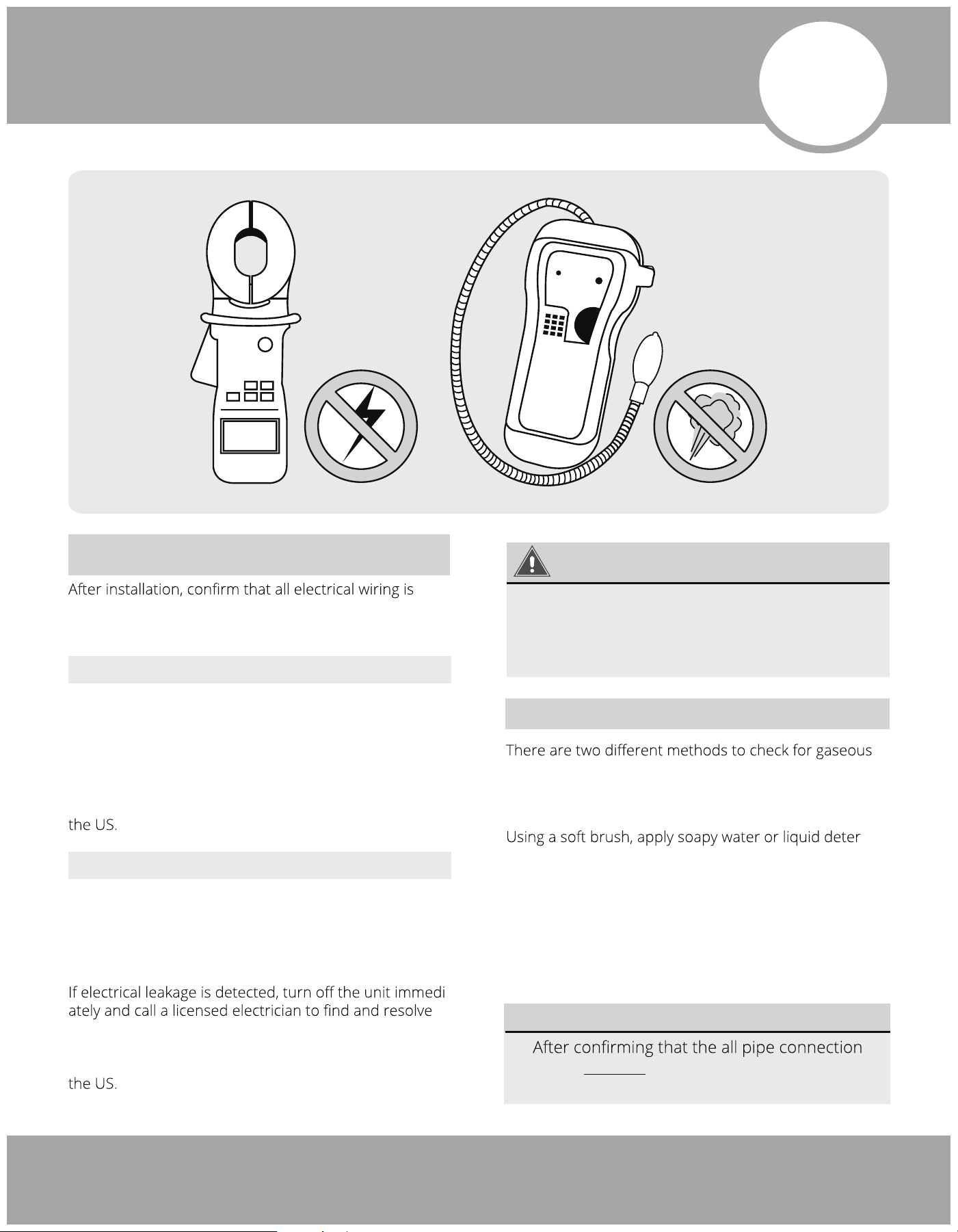
Gas Leak Checks
WARNING – RISK OF ELECTRIC SHOCK
ALL WIRING MUST COMPLY WITH LOCAL
LAND NATIONAL ELECTRICAL CODES,
AND MUST BE INSTALLED BY A LICENSED
ELECTRICIAN.
Electrical Safety Checks
BEFORE TEST RUN
DURING TEST RUN
installed in accordance with local and national
regulations, and according to the Installation Manual.
Check Grounding Work
Measure grounding resistance by visual detection and
with a grounding resistance tester. Grounding resistance
must be less than 4.
Note: This may not be required for some locations in
Check for Electrical Leakage
During the Test Run, use an electroprobe and multimeter
to perform a comprehensive electrical leakage test.
-
the cause of the leakage.
Note: This may not be required for some locations in
leaks.
Soap and Water Method
-
gent to all pipe connection points on the indoor unit
and outdoor unit. The presence of bubbles indicates a
leak.
Leak Detector Method
If using leak detector, refer to the device’s operation
manual for proper usage instructions.
7
System Leak Checks
Page 34mrcool.com
System Leak Checks
How To Activate This Function
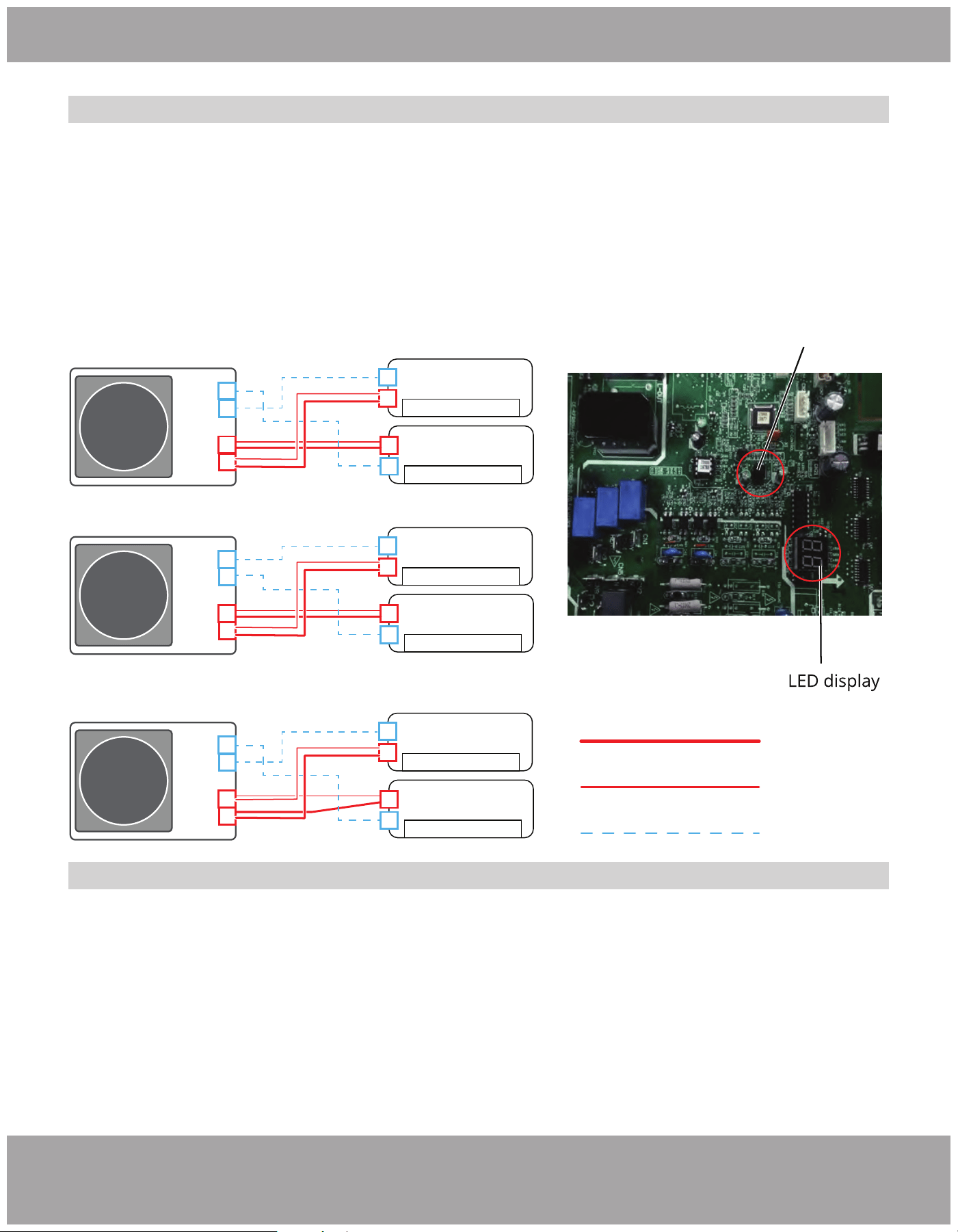
1.
Check that outside temperature is above 41°F (5°C). This fuction does not work when outside temperature
is not above 41°F (5°C).
2. Check that the stop valves of the liquid pipe and gas pipe are open.
3. Turn on the breaker and wait at least 2 minutes.
4. Press the check switch on the outdoor PCB board unit the LED displays "CE".
5. In circumstances where the wiring for one unit is mismatched with the piping of the other, the system will
correct itself, reassociating the wiring to the piping.
6. After 5 to 10 minutes, if the system is corrected, the “CE” will disapear from the display. If not, the system
will have to be shut down and the piping/wiring will need to be re-checked with what is in the manual.
Check switch
Fig. 7.1
Multi-Zone units have a self-check function for wiring-to-piping association errors. Press the "check switch" on
the outdoor unit PCB board for 5 seconds until LED displays "CE". Approximately 5 to10 minutes after the
switch is pressed, the "CE" will disappear when the wiring and piping are reassociated and the error is
corrected.
This only works in situations where either all of unit A Handler wiring has been connected to the unit
B terminals of the condenser or all of unit B Handler wiring has been connected to the unit A
terminals of the condenser, and this asumes that the indoor unit wiring is connected correctly. There
can be no cases of partial association/mismatch, such as a cross terminal/partial wiring mismatch
or one side of the refrigerant system being crossed between handlers.
Self Correction Function (Multi-Zone Models Only)
Fig. 7.2
Gas Line
Liquid Line
Wiring
B
A
A
B
HANDLER UNIT A
HANDLER UNIT B
B
B
A
A
B
A
A
B
HANDLER UNIT A
HANDLER UNIT B
B
B
A
A
B
A
A
B
HANDLER UNIT A
HANDLER UNIT B
B
B
A
A
CORRECT CONNECTION
INCORRECT - CONNECTION CAN BE CORRECTED
NO OTHER CORRECTABLE COMBINATIONS
(gas / liquid lines can not be mixed between units)
Page 35 mrcool.com
Refrigerant Piping Connection
Before Test Run
Test Run Instructions
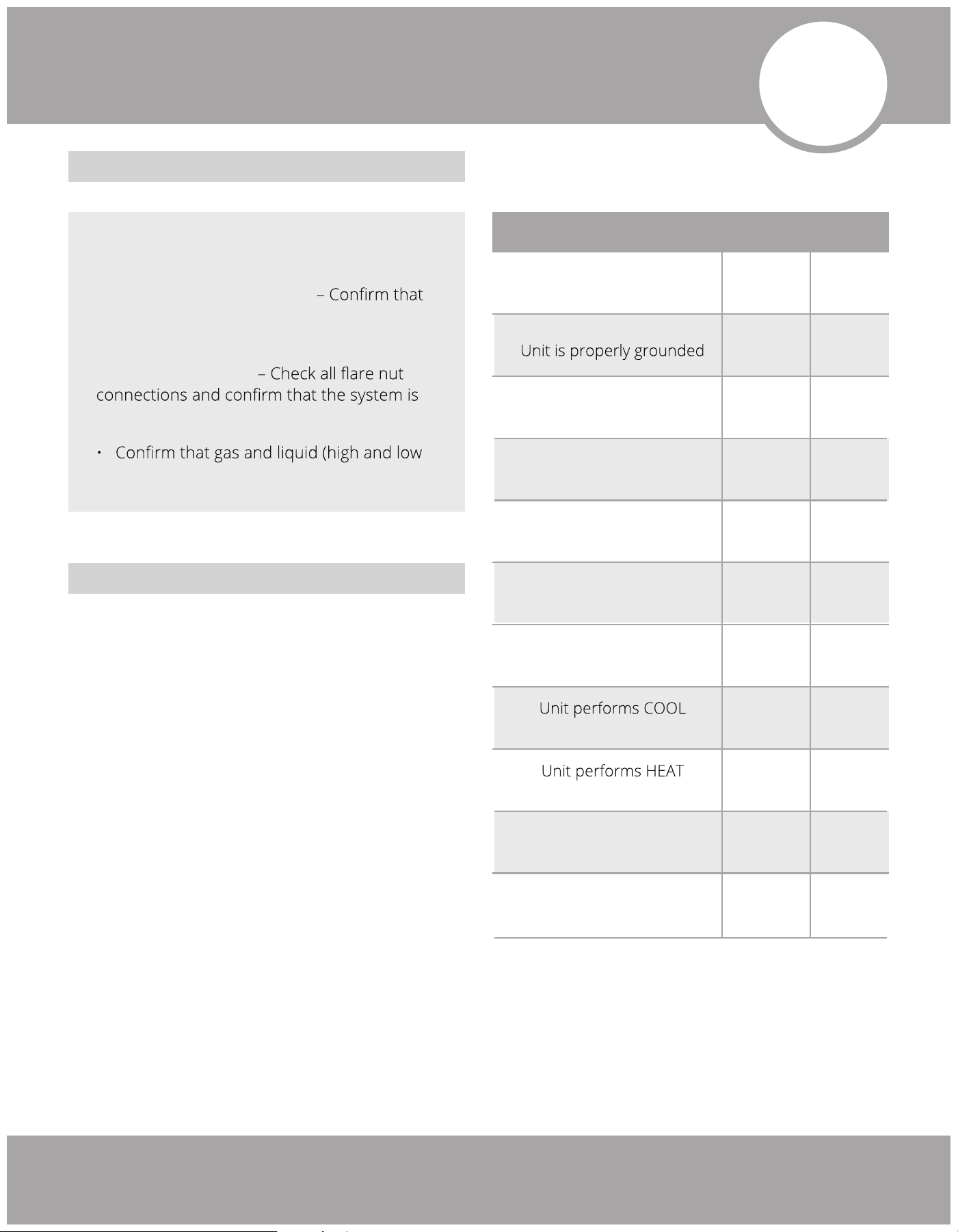
List of Checks to Perform PASS/FAIL
Outdoor (2):
Indoor (2):
No electrical leakage
All electrical terminals
properly covered
Indoor and outdoor units
are solidly installed
All pipe connection points
do not leak
Water drains properly
from drain hose
All piping is properly
insulated
function properly
function properly
Indoor unit louvers rotate
properly
Indoor unit responds to
remote control
You should perform the Test Run for at least 30
minutes.
1. Connect power to the unit.
2. Press the ON/OFF button on the remote
controller to turn it on.
3. Press the MODE button to scroll through the
following functions, one at a time:
• COOL – Select lowest possible temperature
• HEAT – Select highest possible temperature
4. Let each function run for 5 minutes, and
perform the following checks:
Only perform test run after you have
completed the following steps:
• Electrical Safety Checks
the electrical system is safe and operating
properly
• Gas Leak Checks
not leaking
pressure) valves are fully open
8
Test Run

Page 36mrcool.com
Testing
DOUBLE-CHECK PIPE CONNECTIONS
IF AMBIENT TEMPERATURE IS BELOW
63°F (17°C)
5. After the Test Run is successfully complete, and
Perform have PASSED, do the following:
a.
operating temperature.
b.
refrigerant pipe connections that you left uncovered
during the indoor unit installation process.
Fig. 8.1
Manual control button
During operation, the pressure of the refrigerant
circuit will increase. This may reveal leaks that
were not present during your initial leak check.
Take time during the Test Run to double-check
that all refrigerant pipe connection points do not
have leaks. Refer to
Gas Leak Check section for
instructions.
You cannot use the remote controller to turn
on the COOL function when the ambient
temperature is below 63°F (17°C). In this
instance you can use the MANUAL CONTROL
button to test the COOL function.
1. Lift the front panel of the indoor unit, and
raise it until it clicks in place.
2. The MANUAL CONTROL button is located
on the right-hand side of the unit. Press it twice
to select the COOL function (See ).
Fig
.
8.1
3. Perform Test Run as normal.
Page 37 mrcool.com
Refrigerant Piping Connection
Special notice
This appliance contains refrigerant and other potentially hazardous materials. When disposing of this appliance,
the law requires special collection and treatment. DO NOT
dispose of this product as household waste or unsorted
municipal waste.
When disposing of this appliance, you have the following options:
• Dispose of the appliance at a designated municipal electronic waste collection facility.
• When buying a new appliance, the retailer will receive the old appliance free of charge.
• The manufacturer will receive the old appliance free of charge.
•
Disposing of this appliance in the forest or other natural surroundings endangers your health and
is bad for the environment. Hazardous substances may leak into the ground water and enter the
food chain.
9
EU Disposal Guidelines
Olympus Series
Single (Hyper Heat & E Star) & Multi-Zone Models
Consult with the sales agency or manufacturer for details.
ELECTRICIAN and/or HVAC TECHNICIAN:
LICENSE #:
INSTALLATION DATE:
INSTALLATION LOCATION:
SERIAL NUMBER: