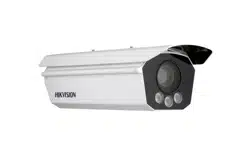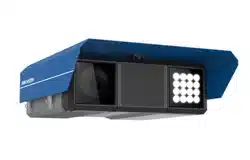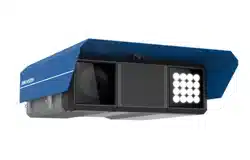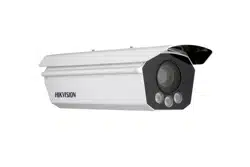

All-Rounder Bi-Spectrum Incident Detecon
Trac Camera
User Manual

Iniaves on the Use of Video Products
Thank you for choosing Hikvision products.
Technology aects every aspect of our life. As a high-tech company, we are increasingly aware of
the role technology plays in improving business eciency and quality of life, but at the same me,
the potenal harm of its improper usage. For example, video products are capable of recording
real, complete and clear images. This provides a high value in retrospect and preserving real-me
facts. However, it may also result in the infringement of a third party's legimate rights and
interests if improper distribuon, use and/or processing of video data takes place. With the
philosophy of "Technology for the Good", Hikvision requests that every end user of video
technology and video products shall comply with all the applicable laws and regulaons, as well as
ethical customs, aiming to jointly create a beer community.
Please read the following iniaves carefully:
●
Everyone has a reasonable expectaon of privacy, and the installaon of video products should
not be in conict with this reasonable expectaon. Therefore, a warning noce shall be given in
a reasonable and eecve manner and clarify the monitoring range, when installing video
products in public areas. For non-public areas, a third party's rights and interests shall be
evaluated when installing video products, including but not limited to, installing video products
only aer obtaining the consent of the stakeholders, and not installing highly-invisible video
products.
●
The purpose of video products is to record real acvies within a specic me and space and
under specic condions. Therefore, every user shall rst reasonably dene his/her own rights in
such specic scope, in order to avoid infringing on a third party's portraits, privacy or other
legimate rights.
●
During the use of video products, video image data derived from real scenes will connue to be
generated, including a large amount of biological data (such as facial images), and the data could
be further applied or reprocessed. Video products themselves could not disnguish good from
bad regarding how to use the data based solely on the images captured by the video products.
The result of data usage depends on the method and purpose of use of the data controllers.
Therefore, data controllers shall not only comply with all the applicable laws and regulaons and
other normave requirements, but also respect internaonal norms, social morality, good
morals, common pracces and other non-mandatory requirements, and respect individual
privacy, portrait and other rights and interests.
●
The rights, values and other demands of various stakeholders should always be considered when
processing video data that is connuously generated by video products. In this regard, product
security and data security are extremely crucial. Therefore, every end user and data controller,
shall undertake all reasonable and necessary measures to ensure data security and avoid data
leakage, improper disclosure and improper use, including but not limited to, seng up access
All-Rounder Bi-Spectrum Incident Detecon Trac Camera User Manual
i

control, selecng a suitable network environment (the Internet or Intranet) where video
products are connected, establishing and constantly opmizing network security.
●
Video products have made great contribuons to the improvement of social security around the
world, and we believe that these products will also play an acve role in more aspects of social
life. Any abuse of video products in violaon of human rights or leading to criminal acvies are
contrary to the original intent of technological innovaon and product development. Therefore,
each user shall establish an evaluaon and tracking mechanism of their product applicaon to
ensure that every product is used in a proper and reasonable manner and with good faith.
All-Rounder Bi-Spectrum Incident Detecon Trac Camera User Manual
ii

Legal Informaon
©2022 Hangzhou Hikvision Digital Technology Co., Ltd. All rights reserved.
About this Manual
The Manual includes instrucons for using and managing the Product. Pictures, charts, images and
all other informaon hereinaer are for descripon and explanaon only. The informaon
contained in the Manual is subject to change, without noce, due to rmware updates or other
reasons. Please nd the latest version of this Manual at the Hikvision website ( hps://
www.hikvision.com/ ).
Please use this Manual with the guidance and assistance of professionals trained in supporng the
Product.
Trademarks
and other Hikvision's trademarks and logos are the properes of
Hikvision in various jurisdicons.
Other trademarks and logos menoned are the properes of their respecve owners.
Disclaimer
TO THE MAXIMUM EXTENT PERMITTED BY APPLICABLE LAW, THIS MANUAL AND THE PRODUCT
DESCRIBED, WITH ITS HARDWARE, SOFTWARE AND FIRMWARE, ARE PROVIDED "AS IS" AND "WITH
ALL FAULTS AND ERRORS". HIKVISION MAKES NO WARRANTIES, EXPRESS OR IMPLIED, INCLUDING
WITHOUT LIMITATION, MERCHANTABILITY, SATISFACTORY QUALITY, OR FITNESS FOR A PARTICULAR
PURPOSE. THE USE OF THE PRODUCT BY YOU IS AT YOUR OWN RISK. IN NO EVENT WILL HIKVISION
BE LIABLE TO YOU FOR ANY SPECIAL, CONSEQUENTIAL, INCIDENTAL, OR INDIRECT DAMAGES,
INCLUDING, AMONG OTHERS, DAMAGES FOR LOSS OF BUSINESS PROFITS, BUSINESS
INTERRUPTION, OR LOSS OF DATA, CORRUPTION OF SYSTEMS, OR LOSS OF DOCUMENTATION,
WHETHER BASED ON BREACH OF CONTRACT, TORT (INCLUDING NEGLIGENCE), PRODUCT LIABILITY,
OR OTHERWISE, IN CONNECTION WITH THE USE OF THE PRODUCT, EVEN IF HIKVISION HAS BEEN
ADVISED OF THE POSSIBILITY OF SUCH DAMAGES OR LOSS.
YOU ACKNOWLEDGE THAT THE NATURE OF THE INTERNET PROVIDES FOR INHERENT SECURITY
RISKS, AND HIKVISION SHALL NOT TAKE ANY RESPONSIBILITIES FOR ABNORMAL OPERATION,
PRIVACY LEAKAGE OR OTHER DAMAGES RESULTING FROM CYBER-ATTACK, HACKER ATTACK, VIRUS
INFECTION, OR OTHER INTERNET SECURITY RISKS; HOWEVER, HIKVISION WILL PROVIDE TIMELY
TECHNICAL SUPPORT IF REQUIRED.
YOU AGREE TO USE THIS PRODUCT IN COMPLIANCE WITH ALL APPLICABLE LAWS, AND YOU ARE
SOLELY RESPONSIBLE FOR ENSURING THAT YOUR USE CONFORMS TO THE APPLICABLE LAW.
ESPECIALLY, YOU ARE RESPONSIBLE, FOR USING THIS PRODUCT IN A MANNER THAT DOES NOT
INFRINGE ON THE RIGHTS OF THIRD PARTIES, INCLUDING WITHOUT LIMITATION, RIGHTS OF
PUBLICITY, INTELLECTUAL PROPERTY RIGHTS, OR DATA PROTECTION AND OTHER PRIVACY RIGHTS.
YOU SHALL NOT USE THIS PRODUCT FOR ANY PROHIBITED END-USES, INCLUDING THE
All-Rounder Bi-Spectrum Incident Detecon Trac Camera User Manual
iii

DEVELOPMENT OR PRODUCTION OF WEAPONS OF MASS DESTRUCTION, THE DEVELOPMENT OR
PRODUCTION OF CHEMICAL OR BIOLOGICAL WEAPONS, ANY ACTIVITIES IN THE CONTEXT RELATED
TO ANY NUCLEAR EXPLOSIVE OR UNSAFE NUCLEAR FUEL-CYCLE, OR IN SUPPORT OF HUMAN
RIGHTS ABUSES.
IN THE EVENT OF ANY CONFLICTS BETWEEN THIS MANUAL AND THE APPLICABLE LAW, THE LATTER
PREVAILS.
All-Rounder Bi-Spectrum Incident Detecon Trac Camera User Manual
iv
Symbol Convenons
The symbols that may be found in this document are dened as follows.
Symbol Descripon
Danger
Indicates a hazardous situaon which, if not avoided, will or could
result in death or serious injury.
Cauon
Indicates a potenally hazardous situaon which, if not avoided, could
result in equipment damage, data loss, performance degradaon, or
unexpected results.
Note
Provides addional informaon to emphasize or supplement
important points of the main text.
All-Rounder Bi-Spectrum Incident Detecon Trac Camera User Manual
v

Contents
Chapter 1 Introducon ............................................................................................................... 1
1.1 Product Introducon .............................................................................................................. 1
1.2 Key Feature ............................................................................................................................ 1
1.3 Running Environment ............................................................................................................ 1
Chapter 2 Acvaon and Login ................................................................................................... 2
2.1 Acvaon ............................................................................................................................... 2
2.1.1 Default Informaon ...................................................................................................... 2
2.1.2 Acvate via SADP .......................................................................................................... 2
2.1.3 Acvate via Web Browser ............................................................................................. 3
2.2 Login ...................................................................................................................................... 4
Chapter 3 Radar Detecon ......................................................................................................... 5
3.1 Set Detecon Parameters ...................................................................................................... 5
3.2 Set Radar Calibraon ............................................................................................................. 7
3.2.1 Manual Calibraon ........................................................................................................ 8
3.2.2 Auto Calibraon ............................................................................................................ 9
3.2.3 GPS Coordinate Calibraon ......................................................................................... 10
3.3 Search Detected Vehicles ..................................................................................................... 11
Chapter 4 Vehicle Capture ........................................................................................................ 13
4.1 Set Event Detecon .............................................................................................................. 13
4.2 Set Data Collecon ............................................................................................................... 16
4.3 Set Capture Parameters ....................................................................................................... 18
4.3.1 Set License Plate Recognion Parameters .................................................................. 18
4.3.2 Set Supplement Light Parameters ............................................................................... 19
4.3.3 Set Picture Composion .............................................................................................. 20
4.3.4 Set Capture Overlay .................................................................................................... 21
4.3.5 Set Composite Picture Overlay .................................................................................... 23
All-Rounder Bi-Spectrum Incident Detecon Trac Camera User Manual
vi

4.3.6 Set Vehicle Feature Parameters .................................................................................. 24
4.3.7 Set Image Encoding Parameters .................................................................................. 24
4.4 View Real-Time Picture ........................................................................................................ 25
4.5 Search Picture ...................................................................................................................... 27
Chapter 5 Live View and Local Conguraon ............................................................................ 28
5.1 Live View .............................................................................................................................. 28
5.1.1 Start/Stop Live View .................................................................................................... 28
5.1.2 Select Image Display Mode ......................................................................................... 28
5.1.3 Select Stream Type ...................................................................................................... 28
5.1.4 Capture Picture Manually ........................................................................................... 28
5.1.5 Record Manually ......................................................................................................... 28
5.1.6 Enable Digital Zoom .................................................................................................... 29
5.1.7 Enable Regional Exposure ........................................................................................... 29
5.1.8 Enable Wiper .............................................................................................................. 29
5.2 Local Conguraon .............................................................................................................. 29
Chapter 6 Record and Capture .................................................................................................. 32
6.1 Set Storage Path ................................................................................................................... 32
6.1.1 Set Storage Card .......................................................................................................... 32
6.1.2 Set FTP ........................................................................................................................ 32
6.1.3 Set Listening Host ........................................................................................................ 33
6.1.4 Set Cloud Storage ........................................................................................................ 34
6.2 Set Quota ............................................................................................................................. 35
6.3 Set Record Schedule ............................................................................................................ 36
Chapter 7 Encoding and Display ................................................................................................ 37
7.1 Set Video Encoding Parameters ........................................................................................... 37
7.2 Set Image Parameters .......................................................................................................... 38
7.3 Set ICR .................................................................................................................................. 41
7.4 Set ROI ................................................................................................................................. 41
All-Rounder Bi-Spectrum Incident Detecon Trac Camera User Manual
vii

7.5 Set OSD ................................................................................................................................ 43
Chapter 8 Network Conguraon ............................................................................................. 44
8.1 Set IP Address ...................................................................................................................... 44
8.2 Connect to ISUP Plaorm .................................................................................................... 46
8.3 Set DDNS .............................................................................................................................. 47
8.4 Set IEEE 802.1X .................................................................................................................... 48
8.5 Set Image and Video Library ................................................................................................ 48
8.6 Set Port ................................................................................................................................ 49
Chapter 9 Serial Port Conguraon ........................................................................................... 51
9.1 Set RS-485 ............................................................................................................................ 51
9.2 Set RS-232 ............................................................................................................................ 51
Chapter 10 Excepon Alarm ..................................................................................................... 53
Chapter 11 Safety Management ............................................................................................... 54
11.1 Manage User ...................................................................................................................... 54
11.2 Enable User Lock ................................................................................................................ 54
11.3 Set HTTPS ........................................................................................................................... 55
11.3.1 Create and Install Self-signed Cercate .................................................................. 55
11.3.2 Install Authorized Cercate ..................................................................................... 55
11.4 Set SSH ............................................................................................................................... 56
Chapter 12 Maintenance .......................................................................................................... 57
12.1 View Device Informaon .................................................................................................... 57
12.2 View Thermal Camera Informaon .................................................................................... 57
12.3 Log ..................................................................................................................................... 57
12.3.1 Enable System Log Service ........................................................................................ 57
12.3.2 Search Log ................................................................................................................. 58
12.4 Upgrade ............................................................................................................................. 58
12.5 Reboot ............................................................................................................................... 58
12.6 Restore Parameters ............................................................................................................ 59
All-Rounder Bi-Spectrum Incident Detecon Trac Camera User Manual
viii

12.7 Synchronize Time ............................................................................................................... 59
12.8 Set DST ............................................................................................................................... 60
12.9 Debug ................................................................................................................................. 60
12.9.1 Enable Informaon Overlay ...................................................................................... 60
12.9.2 Vehicle Capture and Recognion Service .................................................................. 60
12.9.3 Set Image Format ...................................................................................................... 61
12.10 Export Parameters ........................................................................................................... 61
12.11 Import Conguraon File ................................................................................................. 62
12.12 Export Debug File ............................................................................................................. 62
Appendix A. Communicaon Matrix and Device Command ...................................................... 63
All-Rounder Bi-Spectrum Incident Detecon Trac Camera User Manual
ix

Chapter 1 Introducon
1.1 Product Introducon
Based on deep-learning algorithm, the event enforcement trac camera (hereinaer referred to as
the device) can be used to detect real-me trac events in city roads, expressways, tunnels, etc.
1.2 Key Feature
Note
Product features vary with dierent models. The actual device prevails.
●
Adopts H.264/H.265 encoding to output real-me images.
●
Embedded with deep learning algorithm, supporng smart recognion.
●
Supports various event detecons and trac data collecon.
●
Supports mul-target vehicles detecon and target visualizaon.
●
Supports license plate recognion and target full structuralizaon.
●
Supports various image adjustment modes to handle various scenes.
●
Workable in all-weather environment.
1.3 Running Environment
●
Operang system: 64-bit Windows 7 recommended.
●
CPU: [email protected] GHz, or E3-1226 [email protected] GHz.
●
GPU: GTX970 (Nvidia), or
®
HD Graphics P4600.
●
Resoluon: 1024 × 768 and above.
●
Browser: IE8, IE9, IE10, and IE11 recommended.
All-Rounder Bi-Spectrum Incident Detecon Trac Camera User Manual
1

Chapter 2 Acvaon and Login
2.1 Acvaon
For the rst-me access, you need to acvate the device by seng an admin password. No
operaon is allowed before acvaon. The device supports mulple acvaon methods, such as
acvaon via SADP soware, web browser, and iVMS-4200 Client.
Note
Refer to the user manual of iVMS-4200 Client for the acvaon via client soware.
2.1.1 Default Informaon
The device default informaon is shown as below.
●
Default IP address: 192.168.1.64
●
Default user name: admin
2.1.2 Acvate via SADP
SADP is a tool to detect, acvate, and modify the IP address of the device over the LAN.
Before You Start
●
Get the SADP soware from the supplied disk or the ocial website ( hp://
www.hikvision.com/ ), and install it according to the prompts.
●
The device and the computer that runs the SADP tool should belong to the same network
segment.
The following steps show how to acvate one device and modify its IP address. For batch acvaon
and IP address modicaon, refer to User Manual of SADP for details.
Steps
1.
Run the SADP soware and search the online devices.
2.
Find and select your device in online device list.
3.
Enter a new password (admin password) and conrm the password.
Cauon
STRONG PASSWORD RECOMMENDED-We highly recommend you create a strong password of
your own choosing (using a minimum of 8 characters, including upper case leers, lower case
leers, numbers, and special characters) in order to increase the security of your product. And
we recommend you reset your password regularly, especially in the high security system,
reseng the password monthly or weekly can beer protect your product.
4.
Click Acvate to start acvaon.
All-Rounder Bi-Spectrum Incident Detecon Trac Camera User Manual
2
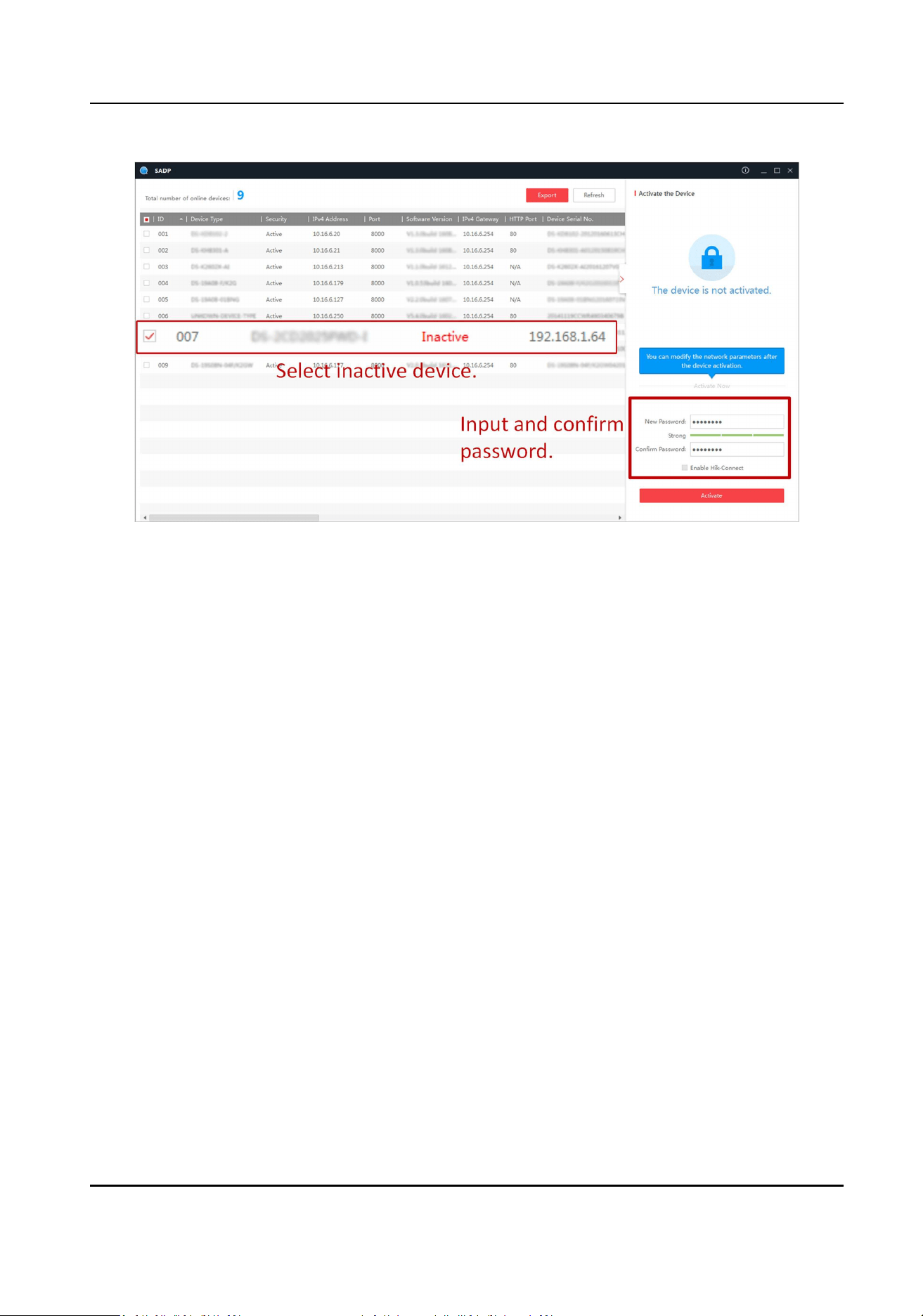
Figure 2-1 Acvate via SADP
Status of the device becomes Acve aer successful acvaon.
5.
Modify IP address of the device.
1) Select the device.
2) Change the device IP address to the same network segment as your computer by either
modifying the IP address manually or checking Enable DHCP (Dynamic Host Conguraon
Protocol).
3) Enter the admin password and click Modify to acvate your IP address modicaon.
2.1.3 Acvate via Web Browser
Use web browser to acvate the device. For the device with the DHCP enabled by default, use
SADP soware or client soware to acvate the device.
Before You Start
Ensure the device and the computer are in the LAN with the same network segment.
Steps
1.
Change the IP address of your computer to the same network segment as the device.
2.
Open the web browser, and enter the default IP address of the device to enter the acvaon
interface.
3.
Create and conrm the admin password.
All-Rounder Bi-Spectrum Incident Detecon Trac Camera User Manual
3

Cauon
STRONG PASSWORD RECOMMENDED-We highly recommend you create a strong password of
your own choosing (using a minimum of 8 characters, including upper case leers, lower case
leers, numbers, and special characters) in order to increase the security of your product. And
we recommend you reset your password regularly, especially in the high security system,
reseng the password monthly or weekly can beer protect your product.
4.
Click OK to complete acvaon.
5.
Go to the network sengs interface to modify IP address of the device.
2.2 Login
You can log in to the device via web browser for further operaons such as live view and local
conguraon.
Before You Start
Connect the device to the network directly, or via a switch or a router.
Steps
1.
Open the web browser, and enter the IP address of the device to enter the login interface.
2.
Enter User Name and Password.
3.
Click Login.
4.
Download and install appropriate plug-in for your web browser. Follow the installaon prompts
to install the plug-in.
5.
Reopen the web browser aer the installaon of the plug-in and repeat steps 1 to 3 to login.
6.
Oponal: Click Logout on the upper right corner of the interface to log out of the device.
All-Rounder Bi-Spectrum Incident Detecon Trac Camera User Manual
4
Chapter 3 Radar Detecon
Radar is used to detect the target and link the capture. Set radar detecon parameters before
capturing vehicle pictures.
Note
The funcon varies with dierent models. The actual device prevails.
3.1 Set Detecon Parameters
Set radar detecon parameters before capturing vehicle pictures.
Steps
1.
Click Radar.
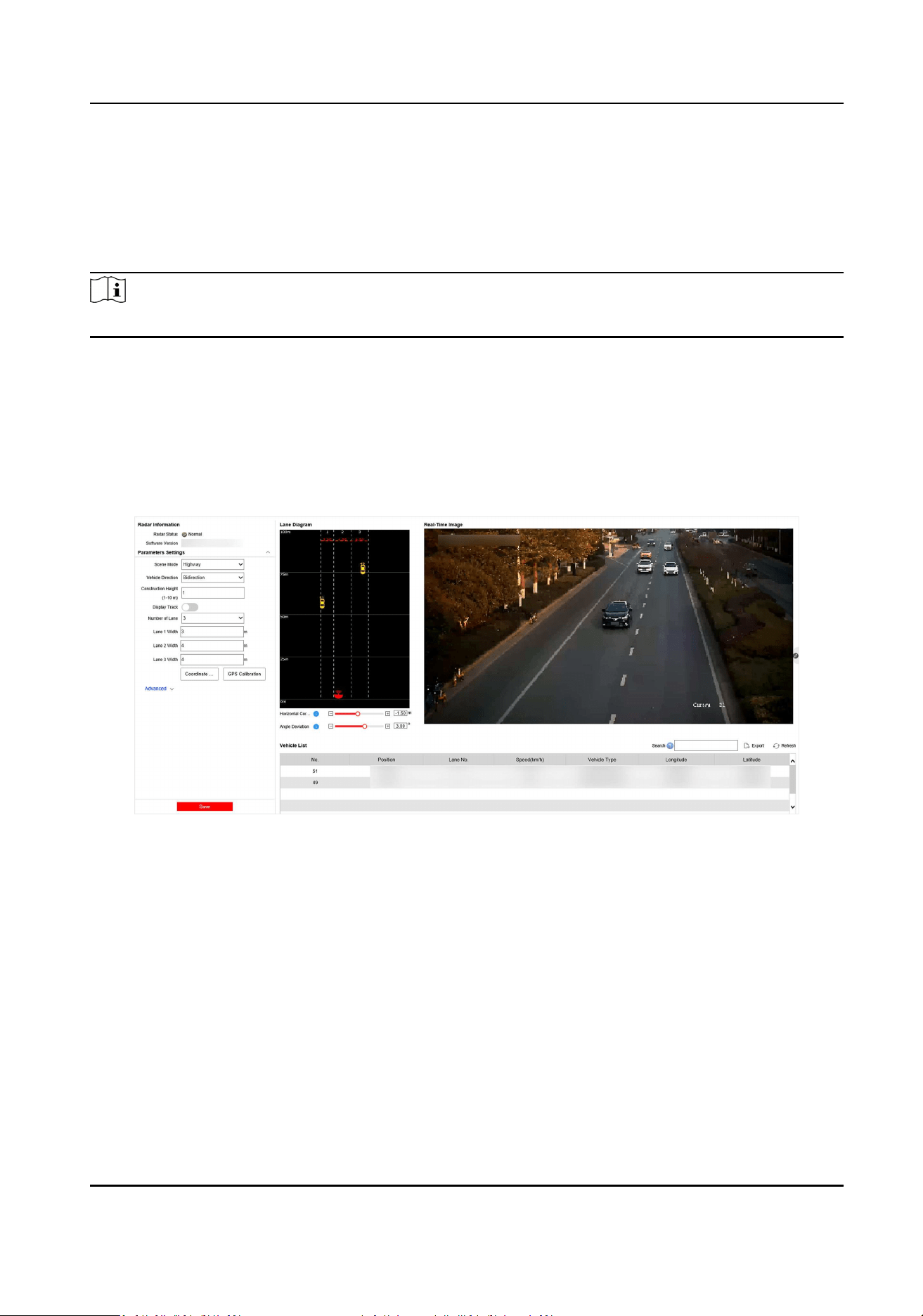
Figure 3-1 Set Radar Detecon Parameters
2.
View the radar informaon.
Radar Status
The current radar status. The radar can be normally used in normal status. If the radar is in
upgrading status, do not reboot the device. Refresh the interface every one minute, and the
status can be restored to normal.
Soware Version
The soware version of the radar.
3.
Click Wizard on the upper right corner of the interface and follow the wizard to set the
parameters.
1) Set Number of Lane and the width of each lane.
2) Set Scene Mode according to the actual condion.
All-Rounder Bi-Spectrum Incident Detecon Trac Camera User Manual
5

3) Set Vehicle Direcon.
Approaching Direcon
The vehicles are driven towards the construcon posion of the camera.
Leaving Direcon
The vehicles are driven far away from the construcon posion of the camera.
Bidirecon
There are vehicles driven both towards and far away from the construcon posion of the
camera.
4) Set Construcon Height, Horizontal Correcon, and Angle Deviaon.
Construcon Height
The construcon height of the camera.
Horizontal Correcon
It is the horizontal posion deviaon between the radar detected lane and the actual lane.
You can set it in two ways.
●
Method 1: Move the detected lane in the diagram lewards or rightwards to overlap it
with the actual lane to correct the dierence.
●
Method 2: Enter the horizontal distance(m) from the radar installaon posion to the
middle line of the actual lane to correct the dierence.
Angle Deviaon
It is the angle deviaon between the radar detected lane and the actual lane. Rotate the
angle of the detected lane in the diagram to overlap it with the actual lane to correct the
dierence.
5) Set the coordinate calibraon and GPS calibraon.
Note
Refer to Set Radar Calibraon for details.
4.
Set the other parameters.
Display Track
Enable the funcon, and the target track will be displayed on the interface according to the
detected coordinates.
Advanced
Click Advanced to set the advanced parameters.
Debugging Mode
Enable the radar debugging mode. In this mode, the vehicles outside the drawn area will
be displayed, to make it convenient to debug the radar.
Sensivity
All-Rounder Bi-Spectrum Incident Detecon Trac Camera User Manual
6

The lower the sensivity is, the more sensive the detecon will be. For the detecon
which is too sensive (e.g., some xed facilies, such as the bus staon on the lane, are
detected as vehicles), you can adjust the sensivity higher.
Inuenal Range X
If you do not want to adjust the total sensivity, enter the vercal distance from the
possible mistakenly recognized area (such as the bus staon) to the camera.
Note
The inuenal range of the sensivity can be set every 50 m, and up to four areas can be
set.
Range X Sensivity
You can adjust the sensivity of each inuenal range independently.
Target Dwell Time
The dwell me of the vehicle. Set it as 0 when measuring the queue length.
Radar Predicon
Enable the funcon, and the radar will predict the target track which can be displayed on
the interface according to the detected coordinates.
Radar Detecon Distance
It is the range of the radar track. The default value is 200 m. You can select the value to
adjust the radar track range.
Distance to Stop Line
It is the distance from the point on the ground just below the installed radar to the stop
line at the intersecon. The targets detected in this range will be ltered.
Wave Band ID
0 to 4 stand for ve frequencies. Set dierent wave bands for dierent radars in the same
scene to prevent the radars in the same wave band from inuencing each other.
Course Angle Calibraon
Adjust the course angle of the radar for target detecon.
5.
Click Save.
3.2 Set Radar Calibraon
Calibrate radar aer the radar detecon parameters are set to display the targets detected by the
radar on the video.
Before You Start
Enable Rule Informaon in Conguraon → Local Conguraon .
All-Rounder Bi-Spectrum Incident Detecon Trac Camera User Manual
7
Steps
1.
Click Radar.
2.
Click Coordinate Calibraon or GPS Calibraon.
3.
Set the radar calibraon.
-
Set coordinate calibraon. Refer to
Manual Calibraon and Auto Calibraon for details.
-
Set GPS calibraon. Refer to
GPS Coordinate Calibraon for details.
Note
The supported calibraon modes vary with dierent models. The actual device prevails.
3.2.1 Manual Calibraon
Steps
1.
Click Coordinate Calibraon.
2.
Select Calibraon Mode as Manual Calibraon.
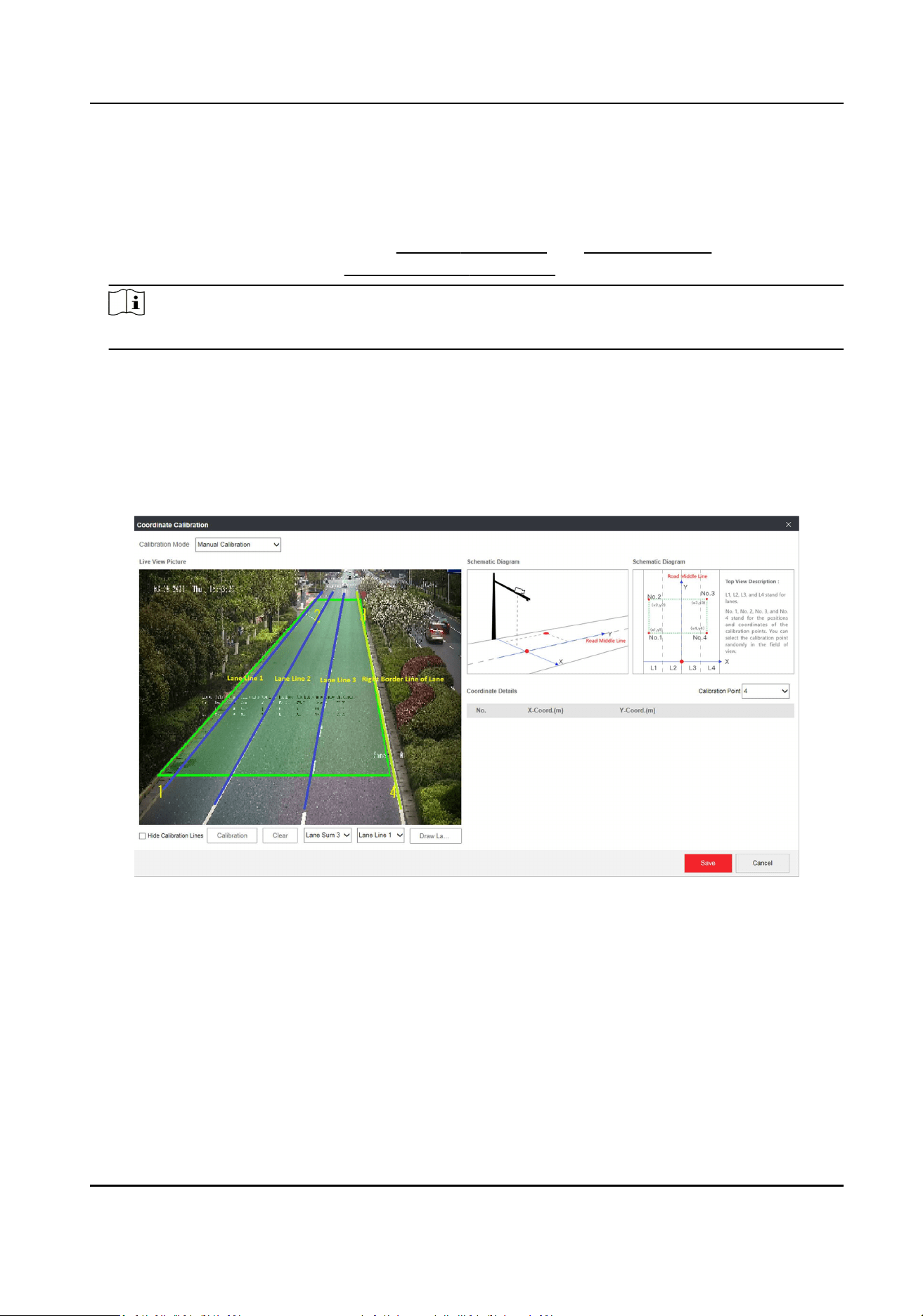
Figure 3-2 Manual Calibraon
3.
Draw the lane lines.
1) Select the lane sum.
2) Select the lane line No.
3) Click Draw Lane Line.
The selected lane line will be displayed on the live view picture.
4) Drag the two end points of the line or drag the whole line to adjust its posion according to
the actual scene.
5) Repeat the steps above to draw more lane lines.
4.
Draw the calibraon area.
All-Rounder Bi-Spectrum Incident Detecon Trac Camera User Manual
8

1) Select Calibraon Point.
2) Click Calibraon.
3) Click the le buon of the mouse to locate the vertexes of the calibraon area on the live
view image, and click the right buon of the mouse to nish the drawing.
Note
The number of vertexes should be consistent with the selected number of Calibraon Point.
4) Drag the vertexes of the calibraon area to align it to the lanes.
Note
●
If the lanes cannot be aligned, ensure the calibraon area can contain the detecon area.
●
You can refer to the schemac diagram and top view descripon to draw the calibraon
area.
5) Oponal: Click Clear to clear the drawn calibraon area.
5.
Measure the world coordinates of the vertexes, and enter the values in the corresponding
coordinate text elds.
Note
The origin (0, 0) of the world coordinates locates in the middle of the whole lanes detected by
the radar. You can refer to the top view of the diagram for the posions.
6.
Adjust the radar in two ways if the coordinates fed back from the radar cannot be matched with
the measured coordinates when the vehicle passes the calibraon posion.
-
Adjust the radar unl it can feed back the correct posion.
-
Adjust the X-coordinates of the calibraon points to make them adapt to the coordinates fed
back from the radar. The method is to enter the X-coordinates fed back from the radar into
the corresponding text elds when the vehicle passes the far le or far right. Adjust nely if
there is small deviaon to guarantee the radar frames and the video frames can be matched
in the eld of view.
7.
Oponal: Check Hide Calibraon Lines to hide the lines on the live view image.
8.
Click Save.
3.2.2 Auto Calibraon
Steps
1.
Click Coordinate Calibraon.
2.
Select Calibraon Mode as Auto Calibraon.
All-Rounder Bi-Spectrum Incident Detecon Trac Camera User Manual
9
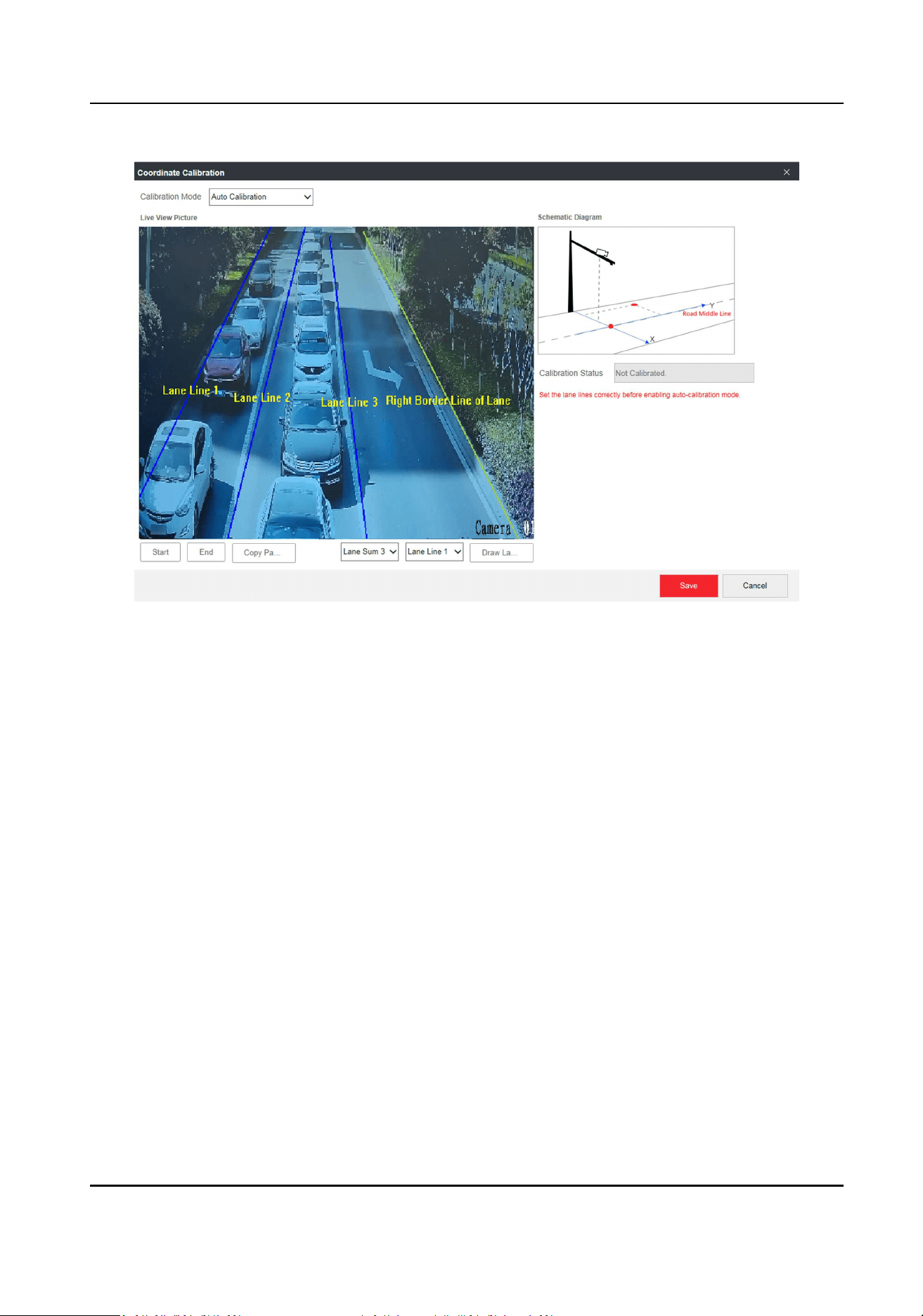
Figure 3-3 Auto Calibraon
3.
Draw the lane lines.
1) Select the lane sum.
2) Select the lane line No.
3) Click Draw Lane Line.
The selected lane line will be displayed on the live view picture.
4) Drag the two end points of the line or drag the whole line to adjust its posion according to
the actual scene.
5) Repeat the steps above to draw more lane lines.
4.
Click Start.
The auto calibraon starts, and you can view the calibraon status and progress. 100% means
the auto calibraon is nished.
5.
Oponal: Click End if the calibraon eect has met the requirement during the process.
6.
Oponal: Click Copy Parameters to Coordinate Mode to copy the auto calibrated coordinates to
the coordinate mode.
7.
Click Save.
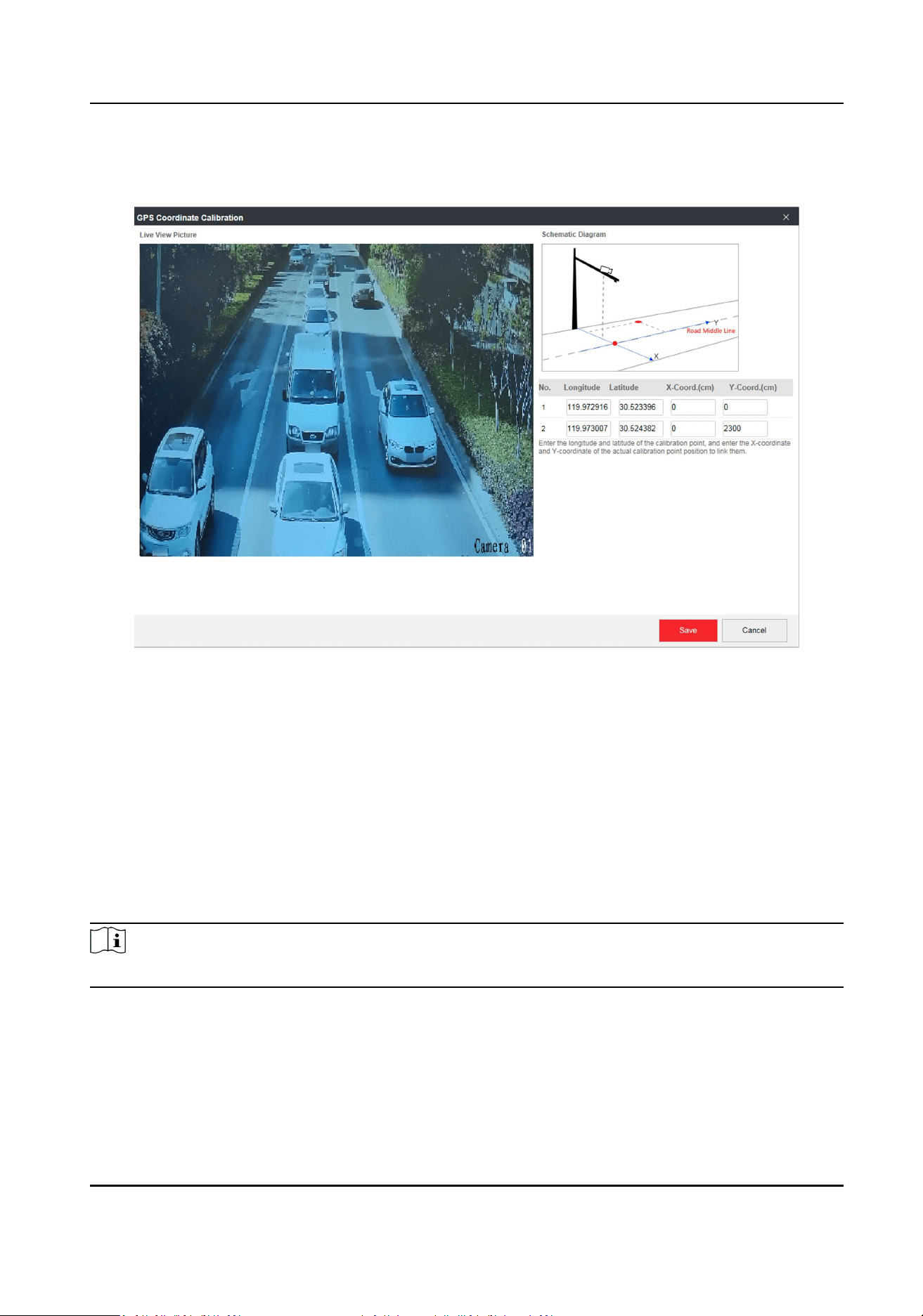
3.2.3 GPS Coordinate Calibraon
The coordinates of vehicle posions can be converted to GPS coordinates to sasfy the
requirements of third party or other plaorms.
All-Rounder Bi-Spectrum Incident Detecon Trac Camera User Manual
10
Steps
1.
Click GPS Calibraon.
Figure 3-4 GPS Coordinate Calibraon
2.
Enter the longitudes and latudes of the two calibraon points far away from the road middle
line.
3.
Enter the coordinates of the two calibraon points.
4.
Click Save.
3.3 Search Detected Vehicles
You can search the radar detected vehicles and export the informaon.
Steps
Note
The funcons vary with dierent models. The actual device prevails.
1.
Click Radar.
2.
View the vehicle informaon in the vehicle list.
3.
Enter the vehicle No. in the text eld to search the vehicle informaon.
4.
Oponal: Export the vehicle informaon.
All-Rounder Bi-Spectrum Incident Detecon Trac Camera User Manual
11

-
Search the vehicle rst, and click Export to export the searched vehicle informaon to the
computer.
-
Click Export directly to export the informaon of all the detected vehicles to the computer.
All-Rounder Bi-Spectrum Incident Detecon Trac Camera User Manual
12
Chapter 4 Vehicle Capture
Note
The supported trigger modes vary with dierent models. The actual device prevails.
4.1 Set Event Detecon
The device supports capturing various trac events.
Steps
1.
Go to Conguraon → Device Conguraon → Applicaon Mode → Trigger Mode .
2.
Select Linked Lane Amount.
3.
Click Event Detecon.
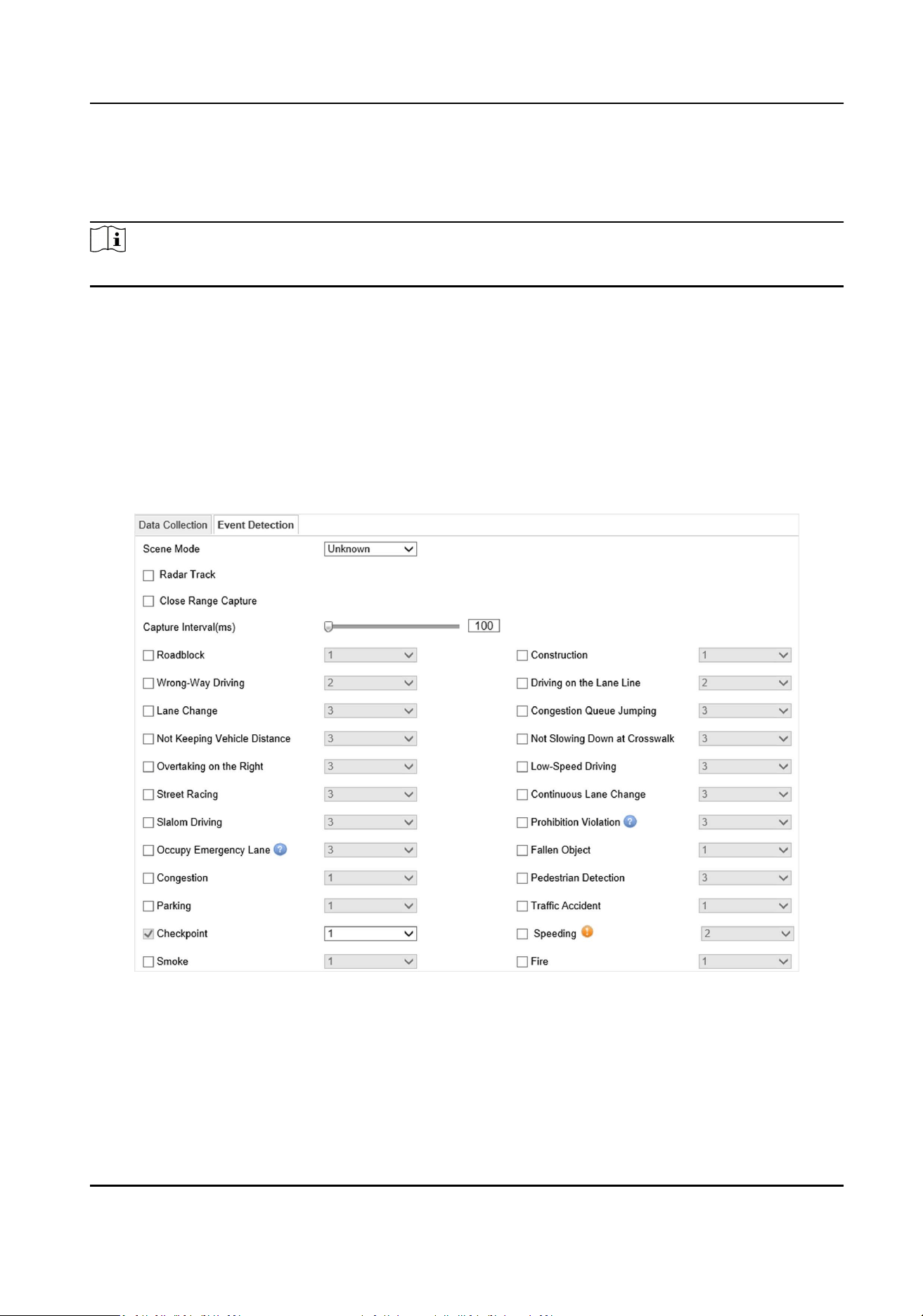
Figure 4-1 Set Event Detecon
4.
Select Scene Mode according to the actual condions.
5.
Check Radar Track or Close Range Capture according to the actual needs.
Radar Track
The radar track of the target will be overlaid on the captured picture.
All-Rounder Bi-Spectrum Incident Detecon Trac Camera User Manual
13

Close Range Capture
Check it and set Capture Interval. The device will track the target unl one more picture is
captured in close distance according to the capture interval.
6.
Check the event(s) to be detected, and set the corresponding parameters.
Note
The supported events vary with dierent models. The actual device prevails.
Sensivity
The higher the sensivity is, the more possibly the detected target will be judged as the
violaon vehicle. If the value is too high, mistaken alarms may be triggered. If the value is too
low, there may be missing alarms. Set the value reasonably according to the actual needs.
Alarm Interval
The interval between two alarms.
Duraon
When the selected event lasts for the set duraon, the vehicle is judged as the violaon
vehicle.
Vehicle Speed Threshold
It is used to judge if the vehicle is driven in the speed faster than the set threshold.
Display Vehicle Distance
Check it to display vehicle distance on the captured picture.
Vehicle Distance in High Speed
The allowable minimal distance between two vehicles driven on the same lane at high speed.
Vehicle Distance in Low Speed
The allowable minimal distance between two vehicles driven on the same lane at low speed.
Number of Vehicles Overtaking Simultaneously
The maximal number of vehicles overtaking at the same me.
Congeson Duraon
When the congeson duraon exceeds the set value, the lane will be judged as congested.
Linked Area
Check the lane area(s) to link to the corresponding events.
Speed Limit for Small-Sized Vehicle
The upper speed limit for small-sized vehicles on the lane.
Speed Limit for Large-Sized Vehicle
The upper speed limit for large-sized vehicles on the lane.
Enable Speed Limit for Non-Motor Vehicle
Check it to set upper speed limit for non-motor vehicles according to actual needs.
All-Rounder Bi-Spectrum Incident Detecon Trac Camera User Manual
14

Lowest Speed Limit
The allowable minimal speed of the vehicle.
Highest Speed Limit
The allowable maximal speed of the vehicle.
Driving Distance
If a vehicle has changed a lane but is driven a distance shorter than the set driving distance
on the lane, and then changes another lane, it is judged as connuous lane change.
Pedestrian Type
Check the pedestrian type(s) to be detected, including the walking pedestrian, the pedestrian
riding two wheeler or tricycle.
Capture Mode
Set the rule for picture capture.
7.
Set the lane parameters.
1) Click the lane No.
2) Select Linked Lane No.
3) Select Lane Direcon Type.
4) Select Lane Type.
5) Oponal: Check lane(s) to copy the parameters of the current lane to other lane(s).
8.
Draw the lane area.
1) Click Draw Area.
2) Select the lane.
3) Set the property of the lane lines and right border line.
4) Select the default lane lines and right border line, and drag the two end points of the line or
drag the whole line to adjust its posion according to the actual scene.
5) Oponal: Click Draw Lane Line to restore to the default drawing.
6) Select the area No., and click Draw Area to draw the area.
Note
Click the le buon of the mouse to locate the vertexes of the area on the live view image,
and click the right buon of the mouse to nish the drawing.
7) Oponal: Select another area No. and draw the area according to the steps above.
8) Click OK.
All-Rounder Bi-Spectrum Incident Detecon Trac Camera User Manual
15
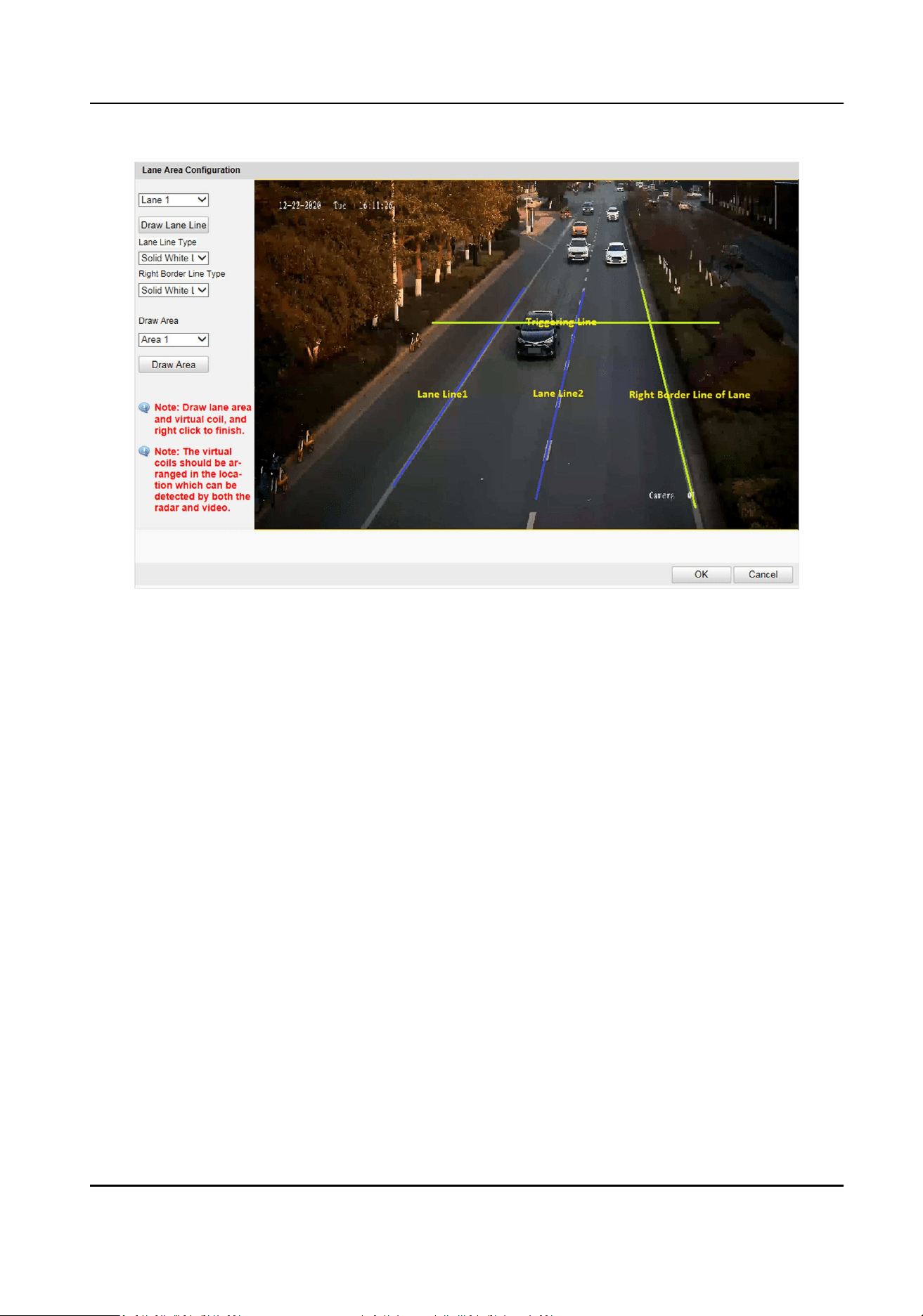
Figure 4-2 Draw Lane Lines and Areas
9.
Click Save.
4.2 Set Data Collecon
You can set the vehicle data collecon and analysis parameters.
Steps
1.
Go to Conguraon → Device Conguraon → Applicaon Mode → Trigger Mode .
2.
Select Linked Lane Amount.
3.
Click Data Collecon.
All-Rounder Bi-Spectrum Incident Detecon Trac Camera User Manual
16
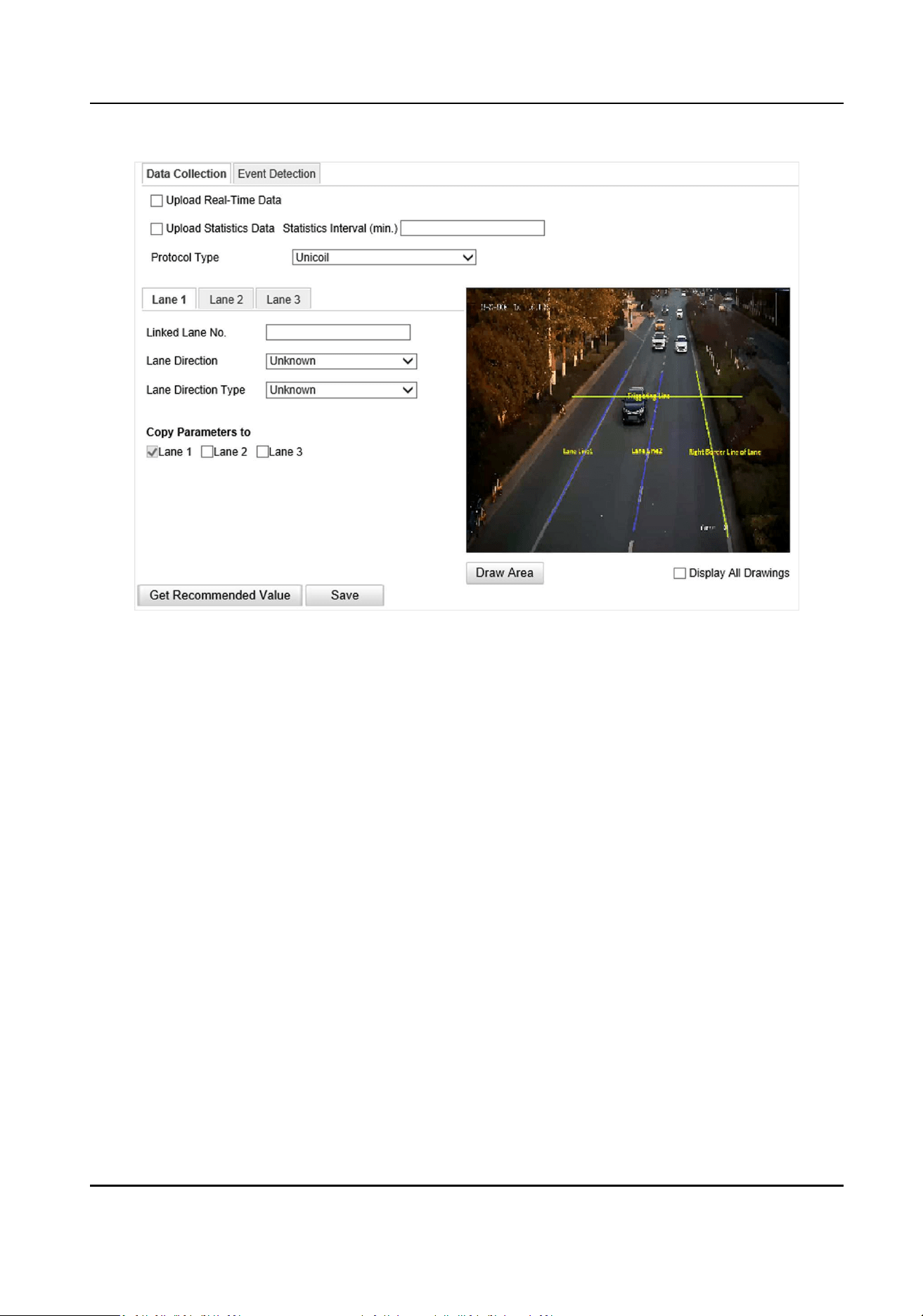
Figure 4-3 Set Data Collecon
4.
Select data upload mode.
Upload Real-Time Data
The vehicle detector will upload the collected data to the server in real me.
Upload Stascs Data
The vehicle detector will upload the collected data to the server according to the set interval.
5.
Select Protocol Type.
Unicoil
One coil for each lane.
6.
Set the lane data collecon parameters.
1) Click the lane No.
2) Enter Linked Lane No.
3) Select Lane Direcon and Lane Direcon Type.
4) Oponal: Check lane(s) to copy the parameters of the current lane to other lane(s).
7.
Draw lane lines and virtual coil areas.
1) Click Draw Area.
2) Select the lane.
3) Select the default lane lines and right border line, and drag the two end points of the line or
drag the whole line to adjust its posion according to the actual scene.
4) Oponal: Click Draw Lane Line to restore to the default drawing.
All-Rounder Bi-Spectrum Incident Detecon Trac Camera User Manual
17
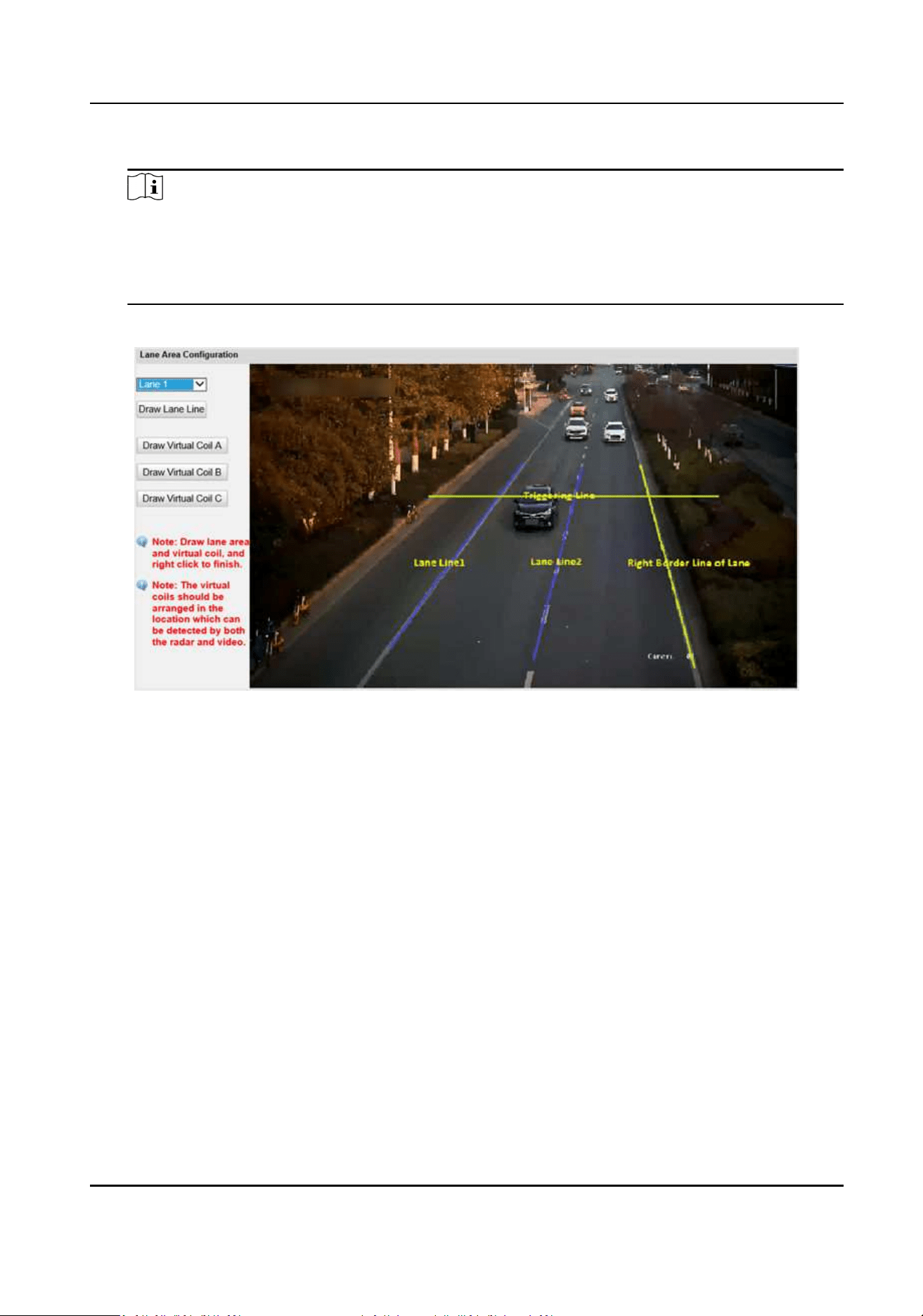
5) Click Draw Virtual Coil A to draw the virtual coil area.
Note
●
Click the le buon of the mouse to locate the vertexes of the virtual coil area on the live
view image, and click the right buon of the mouse to nish the drawing.
●
It is recommended to draw the virtual coil A at the posion the distance from which to the
image lower edge is the length of two vehicles.
6) Click OK.
Figure 4-4 Draw Lane Lines and Virtual Coil Areas
8.
Click Save.
4.3 Set Capture Parameters
4.3.1 Set License Plate Recognion Parameters
When there are vehicles of dierent types passing from dierent direcons, set the license plate
recognion parameters.
Steps
1.
Go to Conguraon → Device Conguraon → Capture Parameters → LPR Parameters .
All-Rounder Bi-Spectrum Incident Detecon Trac Camera User Manual
18
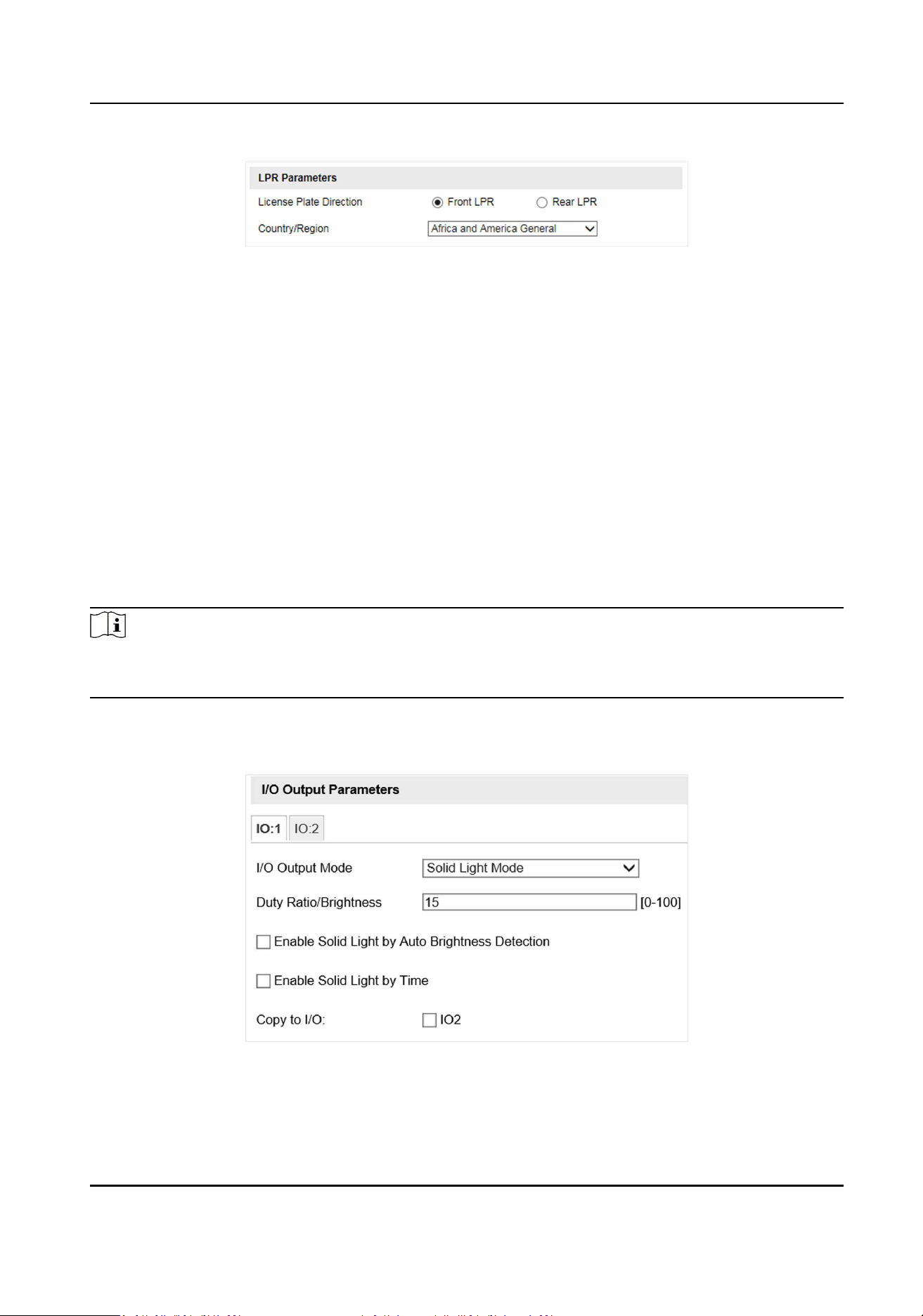
Figure 4-5 Set License Plate Recognion Parameters
2.
Select License Plate Direcon.
-
Select Front LPR when license plates of vehicles from the approaching direcon need to be
recognized.
-
Select Rear LPR when license plates of vehicles from the leaving direcon need to be
recognized.
3.
Set Country/Region according to the actual needs.
4.
Click Save.
4.3.2 Set Supplement Light Parameters
Supplement light can enhance the image stabilizaon and adjust the brightness and color
temperature. You can use supplement light to supplement light at night or when the light is dim.
Steps
Note
●
Only when the solid light is connected, can the set parameters take eect.
●
The supported parameters vary with dierent models. The actual device prevails.
1.
Go to Conguraon → Device Conguraon → Capture Parameters → Supplement Light
Parameters .
Figure 4-6 Set Supplement Light Parameters
2.
Select the I/O.
All-Rounder Bi-Spectrum Incident Detecon Trac Camera User Manual
19

3.
Select I/O Output Mode.
-
Select Solid Light Mode when you need to use the solid light.
-
Select Housing Fan Mode when you need to use the fan.
Note
I/O output modes vary with dierent models. The actual device prevails.
4.
Set other control parameters.
Duty Rao/Brightness
It is the me occupaon of the high level in a certain period. The higher the duty rao, the
brighter the solid light. High duty rao will cut life span of the solid light.
Enable Solid Light by Auto Brightness Detecon
Check it when you want the solid light to be controlled by detecng the surroundings
brightness automacally. Set Brightness Threshold. The higher the threshold is, the harder
the solid light can be enabled.
Enable Solid Light by Time
Check it when you want the solid light to be enabled during a xed me period. Set Start
Time and End Time.
Enable Housing Fan
Under Housing Fan Mode, check it when you need to enable the fan.
Note
Enabling solid light by brightness and me are conicted with each other. You can only enable
one funcon at once.
5.
Oponal: Select other I/O(s) to copy the same sengs.
6.
Click Save.
4.3.3 Set Picture Composion
You can enable the picture composion to composite several pictures into one to make it
convenient to view the violaon captured pictures.
Steps
Note
Funcons and parameters vary with dierent models. The actual device prevails.
1.
Go to Conguraon → Device Conguraon → Capture Parameters → Picture Composion .
2.
Check Enable Composion.
All-Rounder Bi-Spectrum Incident Detecon Trac Camera User Manual
20
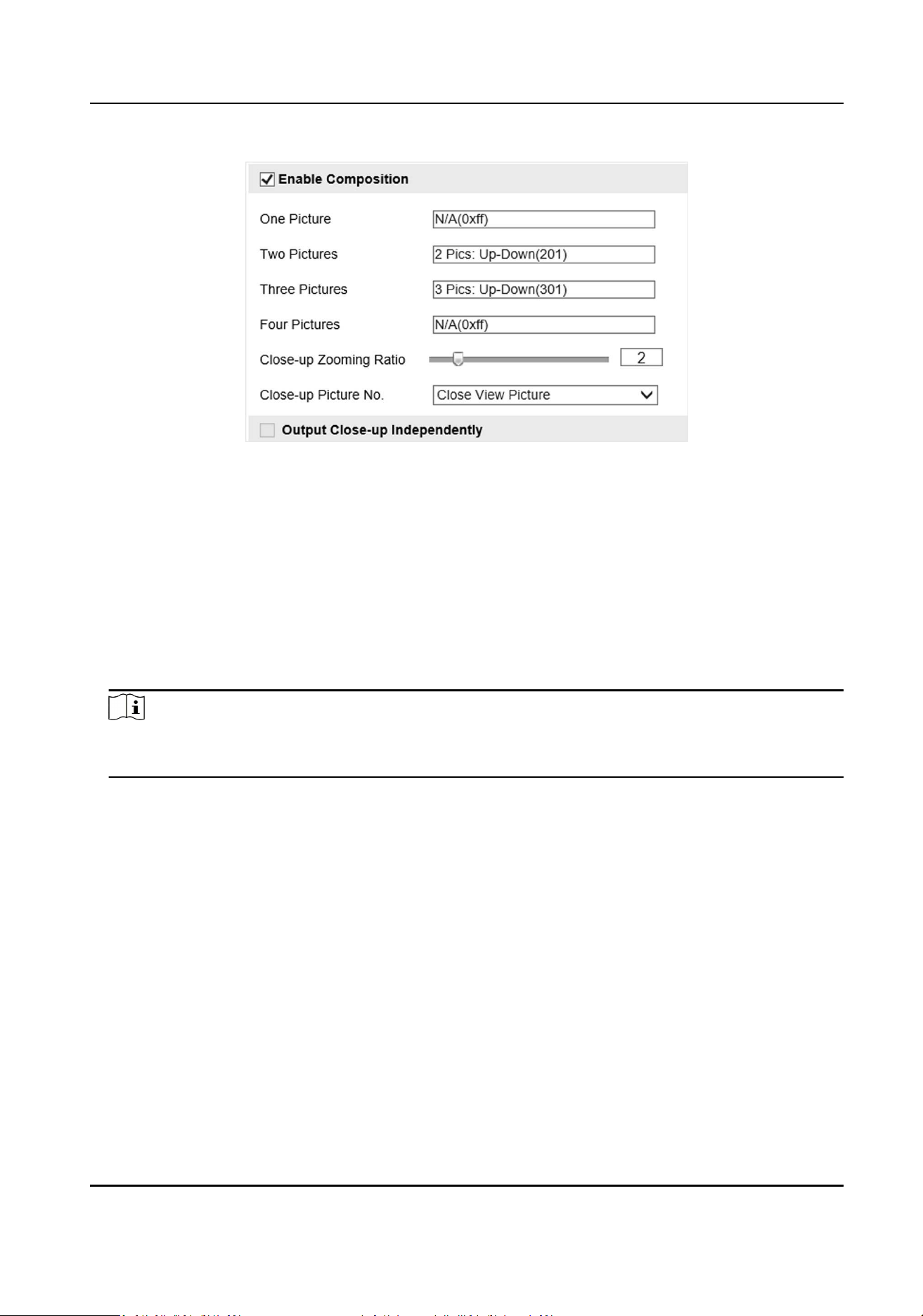
Figure 4-7 Set Picture Composion
3.
Set composion types for dierent picture quanes.
4.
Set other composion parameters.
Close-up Zooming Rao
The higher the value is, the larger the close-up is.
Close-up Picture No.
It is the picture where the close-up comes from.
5.
Oponal: Check Output Close-up Independently to output close-up pictures independently
when the picture composion is not enabled.
Note
Enabling composion and outpung close-up independently funcons conict with each other.
You can only enable one.
6.
Click Save.
4.3.4 Set Capture Overlay
If you want to overlay informaon on the captured pictures, set capture overlay.
Steps
1.
Go to Conguraon → Device Conguraon → Text Overlay → Capture Overlay Conguraon .
2.
Check Text Overlay on Capture.
All-Rounder Bi-Spectrum Incident Detecon Trac Camera User Manual
21
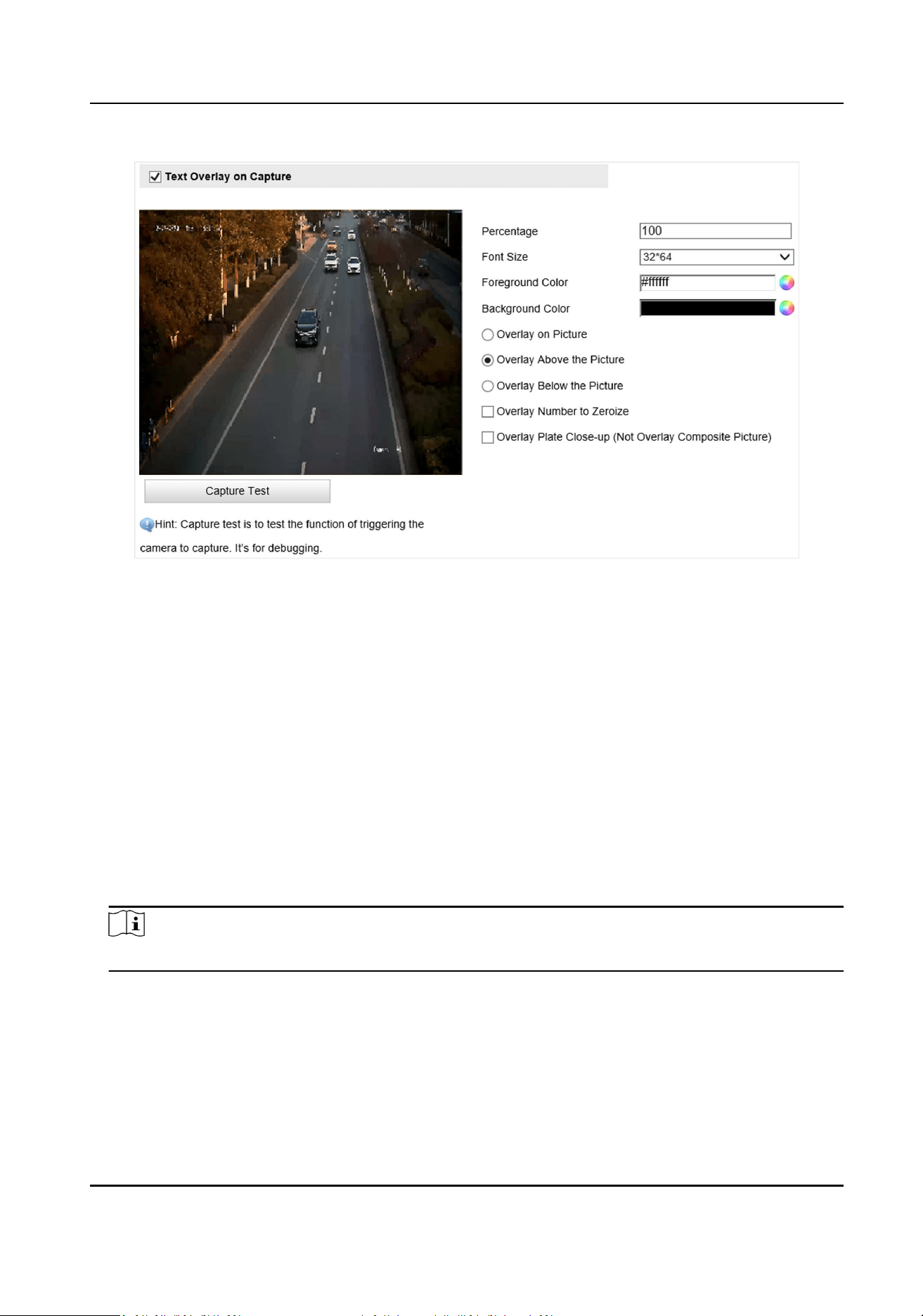
Figure 4-8 Set Capture Overlay
3.
Set capture overlay parameters.
Percentage
It is the percentage that the overlaid informaon occupies on the picture. For example, if you
set the percentage to 50, the overlaid informaon in a row will occupy up to half of the image
width, and the excess content will be overlaid from a new line.
Overlay Number to Zeroize
When the overlaid number digits are smaller than the xed digits, 0 will be overlaid before
the overlaid number. For example, the xed digits for lane No. is 2. If the lane No. is 1, 01 will
be overlaid on the picture.
Overlay Plate Close-up
Check it to overlay license plate close-up picture on the captured picture.
4.
Select the overlay informaon from the list.
Note
The overlay informaon varies with dierent models. The actual device prevails.
5.
Set the overlay informaon.
Set Type You can edit the type.
Set Overlay
Informaon
For some informaon types, you can edit the detailed informaon.
All-Rounder Bi-Spectrum Incident Detecon Trac Camera User Manual
22
Set Overlay Posion If you check it, the current informaon will be displayed from a new
line.
Set Space Number Edit the number of spaces between the current informaon and the
next one from 0 to 255. 0 means there is no space.
Set Line Break
Characters
Edit the number of characters from 0 to 100 between the current
informaon line and the previous informaon line. 0 means no line
break.
Adjust overlay
sequence
Click
/ to adjust the display sequence of the overlay
informaon.
6.
Click Save.
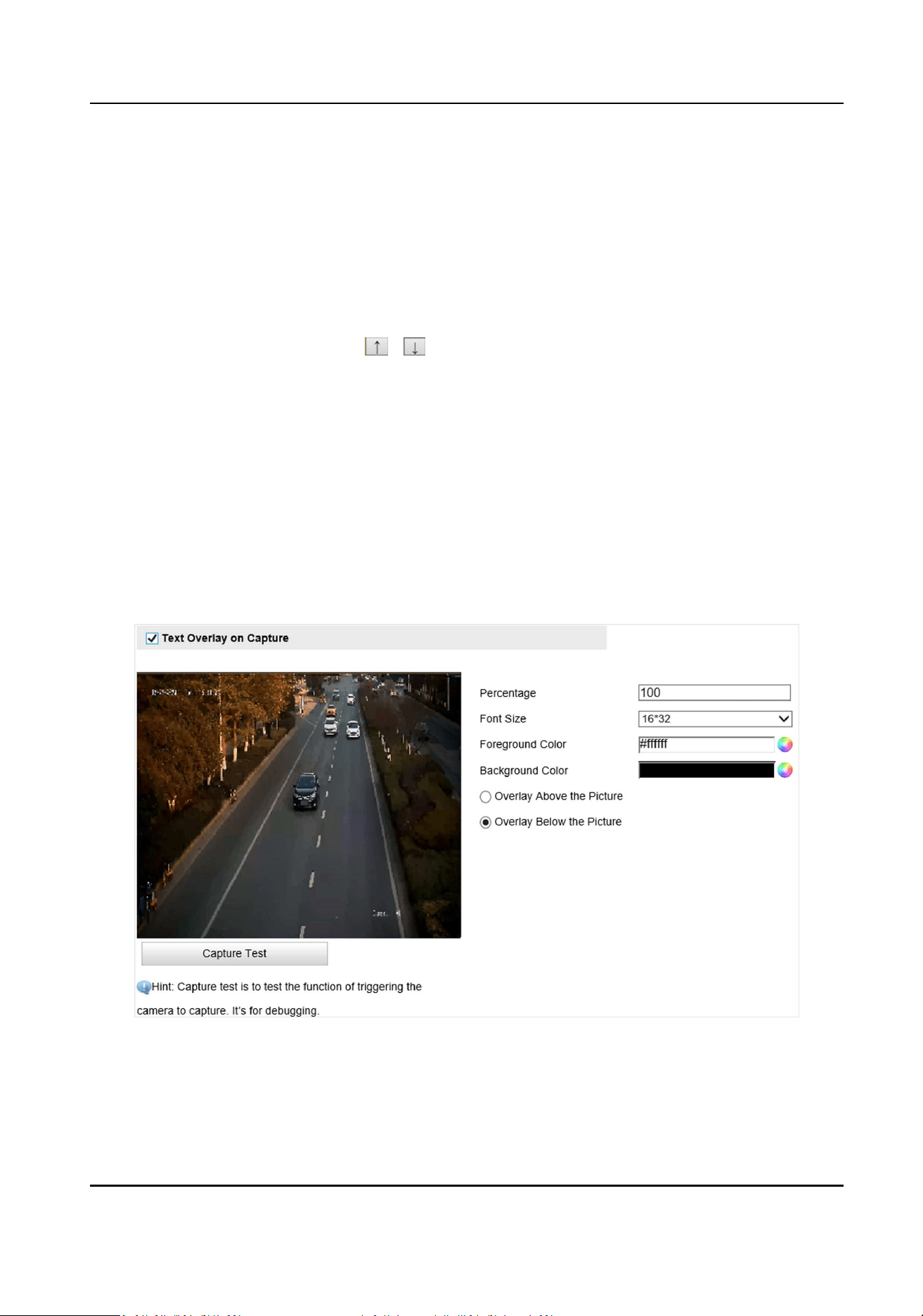
4.3.5 Set Composite Picture Overlay
If you want to overlay informaon on the composite pictures, set composite picture overlay.
Steps
1.
Go to Conguraon → Device Conguraon → Text Overlay → Composite Picture Overlay
Conguraon .
2.
Check Text Overlay on Capture.
Figure 4-9 Set Composite Picture Overlay
3.
Set composite picture overlay parameters.
Percentage
All-Rounder Bi-Spectrum Incident Detecon Trac Camera User Manual
23

It is the percentage that the overlaid informaon occupies on the picture. For example, if you
set the percentage to 50, the overlaid informaon in a row will occupy up to half of the image
width, and the excess content will be overlaid from a new line.
4.
Select the overlay informaon from the list.
Note
The overlay informaon varies with dierent models. The actual device prevails.
5.
Set the overlay informaon.
Set Type You can edit the type.
Set Overlay
Informaon
For some informaon types, you can edit the detailed informaon.
Set Overlay Posion If you check it, the current informaon will be displayed from a new
line.
Set Space Number Edit the number of spaces between the current informaon and the
next one from 0 to 255. 0 means there is no space.
Set Line Break
Characters
Edit the number of characters from 0 to 100 between the current
informaon line and the previous informaon line. 0 means no line
break.
Adjust overlay
sequence
Click
/ to adjust the display sequence of the overlay
informaon.
6.
Click Save.
4.3.6 Set Vehicle Feature Parameters
Set vehicle feature parameters if you need to detect the vehicle features of the passing vehicle.
Steps
Note
The parameters vary with dierent models. The actual device prevails.
1.
Go to Conguraon → Device Conguraon → Capture Parameters → Vehicle Feature
Parameters .
2.
Check the vehicle features that needed to be detected, and set the corresponding parameters.
3.
Click Save.
4.3.7 Set Image Encoding Parameters
If the captured pictures are not clear, set the resoluon of the captured pictures and the picture
size.
All-Rounder Bi-Spectrum Incident Detecon Trac Camera User Manual
24

Steps
1.
Go to Conguraon → Device Conguraon → Encoding and Storage → Image Encoding .
Figure 4-10 Set Image Encoding Parameters
2.
Select Capture Resoluon.
3.
Enter the picture size.
JPEG Picture Size
The size of the captured picture.
Composite JEPG Picture Size
The size of the composite picture.
4.
Click Save.
4.4 View Real-Time Picture
You can view the real-me captured pictures and license plate informaon.
Steps
1.
Go to Live View → Real-Time Status and Trac Flow Stascs .
2.
Select an item from the list, and you can view the capture scene picture and license plate
picture.
All-Rounder Bi-Spectrum Incident Detecon Trac Camera User Manual
25
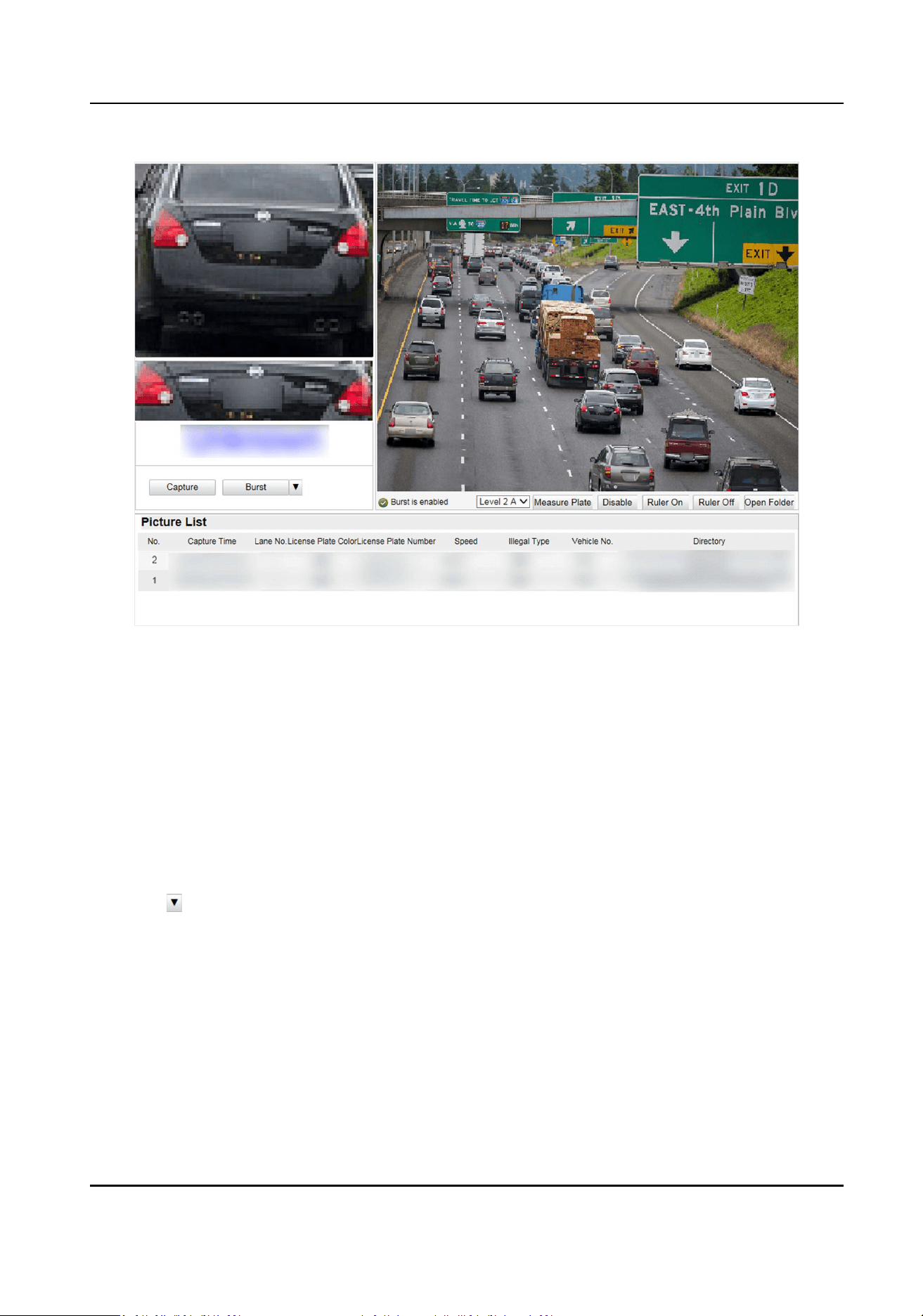
Figure 4-11 Real-Time Picture
3.
You can do the following operaons on this interface.
-
Select the arming mode. Level 1 Arming can only connect one client or web. The uploaded
pictures will not be stored in the storage card. The pictures in the storage card will be
uploaded to the level 1 arming. Level 2 Arming can connect three clients or webs. The
pictures will be uploaded to the client/web, and stored in the storage card. Disarm is to cancel
the alarm status or real-me picture.
-
Click Capture to enable manual capture. The captured pictures will be saved in the set local
path. Or you can click Open Folder to view the pictures.
-
Click Measure Plate/Ruler On to measure the license plate pixel. Aer the measurement,
click Disable/Ruler O.
-
Click
aer Burst to set the burst parameters.
Pictures Per Burst
Up to ve pictures can be captured per burst.
Burst Interval
Up to four intervals can be set, and the default interval is 100 s.
Click Burst, and the device will capture pictures according to the set intervals.
All-Rounder Bi-Spectrum Incident Detecon Trac Camera User Manual
26

4.5 Search Picture
You can search the captured pictures stored in the storage card and export the pictures you need.
Before You Start
Install the storage card, and ensure the storage status is normal.
Steps
1.
Click Picture.
2.
Set the search condions such as Lane No., Vehicle Type, etc.
3.
Click Search.
The searched pictures informaon will be displayed in the picture list.
Note
If you have set level 1 arming for the device, the captured pictures will not be saved in the
storage card. Go to the saving path of scene pictures to view them. You can go to Conguraon
→ Local Conguraon to get the saving path.
4.
Oponal: Click to preview the selected picture.
You can view the captured picture and the related informaon such as the capture me, lane
No., license plate number, etc.
5.
Oponal: Check a picture or several pictures and click Export Picture to export it/them to the
saving path you have set.
The downloaded picture(s) will be marked as "Downloaded". You can go to Conguraon →
Local Conguraon to get the saving path of downloaded pictures.
All-Rounder Bi-Spectrum Incident Detecon Trac Camera User Manual
27

Chapter 5 Live View and Local Conguraon
5.1 Live View
5.1.1 Start/Stop Live View
Click to start live view. Click to stop live view.
5.1.2 Select Image Display Mode
Click to display the image in 4:3/16:9/self-adapve display mode.
5.1.3 Select Stream Type
Click / / to select the stream type. It is recommended to select the main
stream to get the high-quality image when the network condion is good, and select the sub-
stream to get the uent image when the network condion is not good enough. The third stream is
custom.
5.1.4 Capture Picture Manually
You can capture pictures manually on the live view image and save them to the computer.
Steps
1.
Click
to start live view.
2.
Click to capture a picture.
3.
Oponal: Click Conguraon → Local Conguraon to view the saving path of snapshots in live
view.
5.1.5 Record Manually
You can record videos manually on the live view image and save them to the computer.
Steps
1.
Click to start live view.
2.
Click to start recording.
3.
Click to stop recording.
4.
Oponal: Click Conguraon → Local Conguraon to view the saving path of record les.
All-Rounder Bi-Spectrum Incident Detecon Trac Camera User Manual
28

5.1.6 Enable Digital Zoom
You can enable digital zoom to zoom in a certain part of the live view image.
Steps
1.
Click to start live view.
2.
Click to enable digital zoom.
3.
Place the cursor on the live view image posion which needs to be zoomed in. Drag the mouse
rightwards and downwards to draw an area.
The area will be zoomed in.
4.
Click any posion of the image to restore to normal image.
5.
Click to disable digital zoom.
5.1.7 Enable Regional Exposure
Enable regional exposure to expose paral area of the live view image.
Steps
1.
Click .
2.
Drag the cursor downwards and rightwards to select an area in the live view image.
The selected area can be exposed.
3.
Click to disable regional exposure.
5.1.8 Enable Wiper
is a reserved funcon.
5.2 Local Conguraon
Go to Conguraon → Local Conguraon to set the live view parameters and change the saving
paths of videos, captured pictures, scene pictures, etc.
All-Rounder Bi-Spectrum Incident Detecon Trac Camera User Manual
29
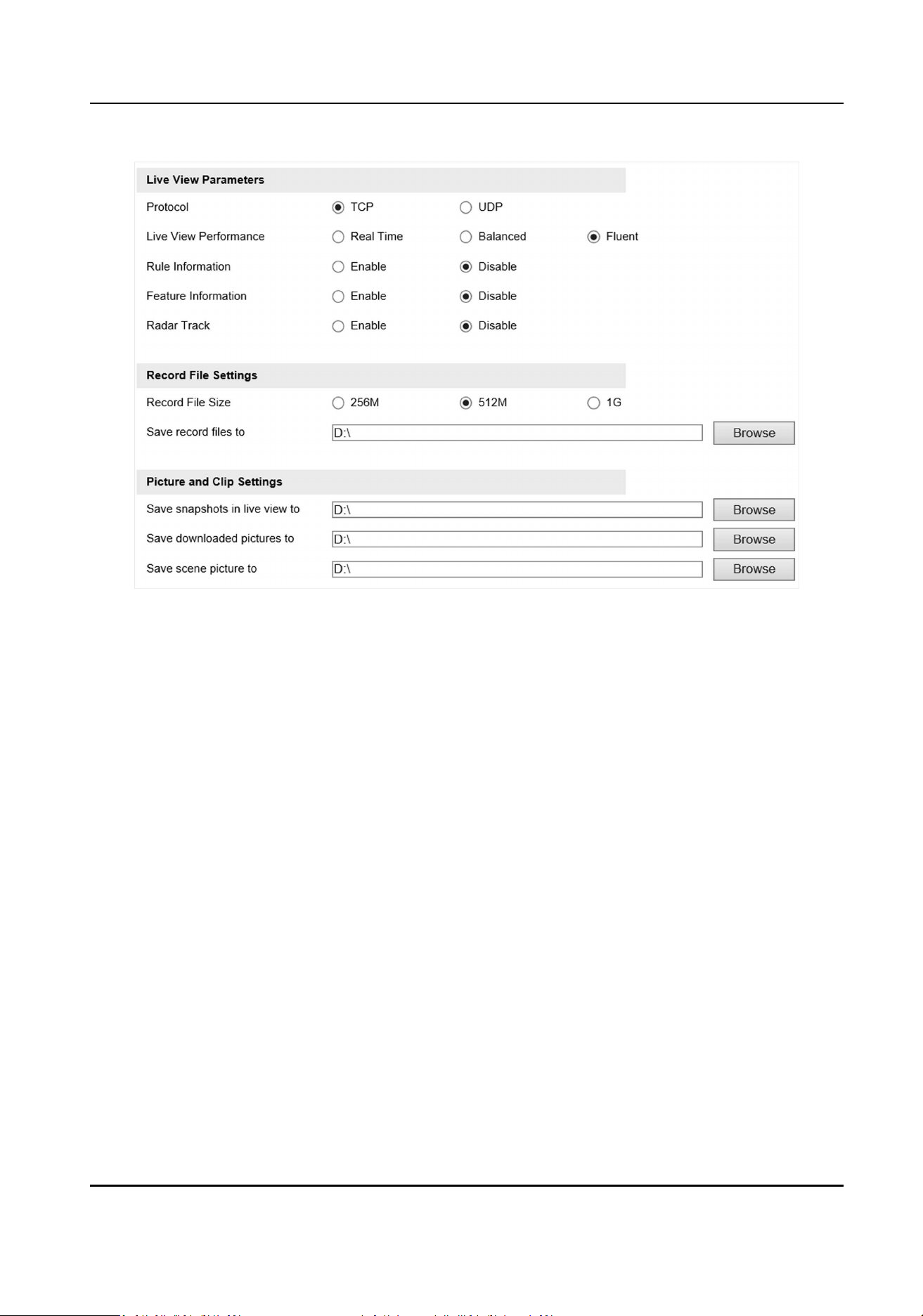
Figure 5-1 Local Conguraon
Protocol
Select the network transmission protocol according to the actual needs.
TCP
Ensures complete delivery of streaming data and beer video quality, yet the real-me
transmission will be aected.
UDP
Provides real-me audio and video streams.
Live View Performance
Real Time
The video is real-me, but the video uency may be aected.
Balanced
Balanced mode considers both the real me and uency of the video.
Fluent
When the network condion is good, the video is uent.
Rule Informaon
If you enable the rule informaon, tracking frames will be displayed on the live view interface
when there are vehicles passing.
Feature Informaon
All-Rounder Bi-Spectrum Incident Detecon Trac Camera User Manual
30

If you enable the feature informaon, informaon of the lane, trac ow, speed, etc. will be
displayed on the live view interface.
Record File Size
Select the packed size of the manually recorded video les. Aer the selecon, the max. record
le size is the value you selected.
Save record les to
Set the saving path for the manually recorded video les.
Save snapshots in live view to
Set the saving path of the manually captured pictures in live view mode.
Save downloaded pictures to
Set the saving path for the downloaded pictures.
Save scene picture to
Set the saving path of the captured pictures in the Real-Time Status and Trac Flow Stascs
interface.
Note
The parameters vary with dierent models. The actual device prevails.
All-Rounder Bi-Spectrum Incident Detecon Trac Camera User Manual
31
Chapter 6 Record and Capture
6.1 Set Storage Path
6.1.1 Set Storage Card
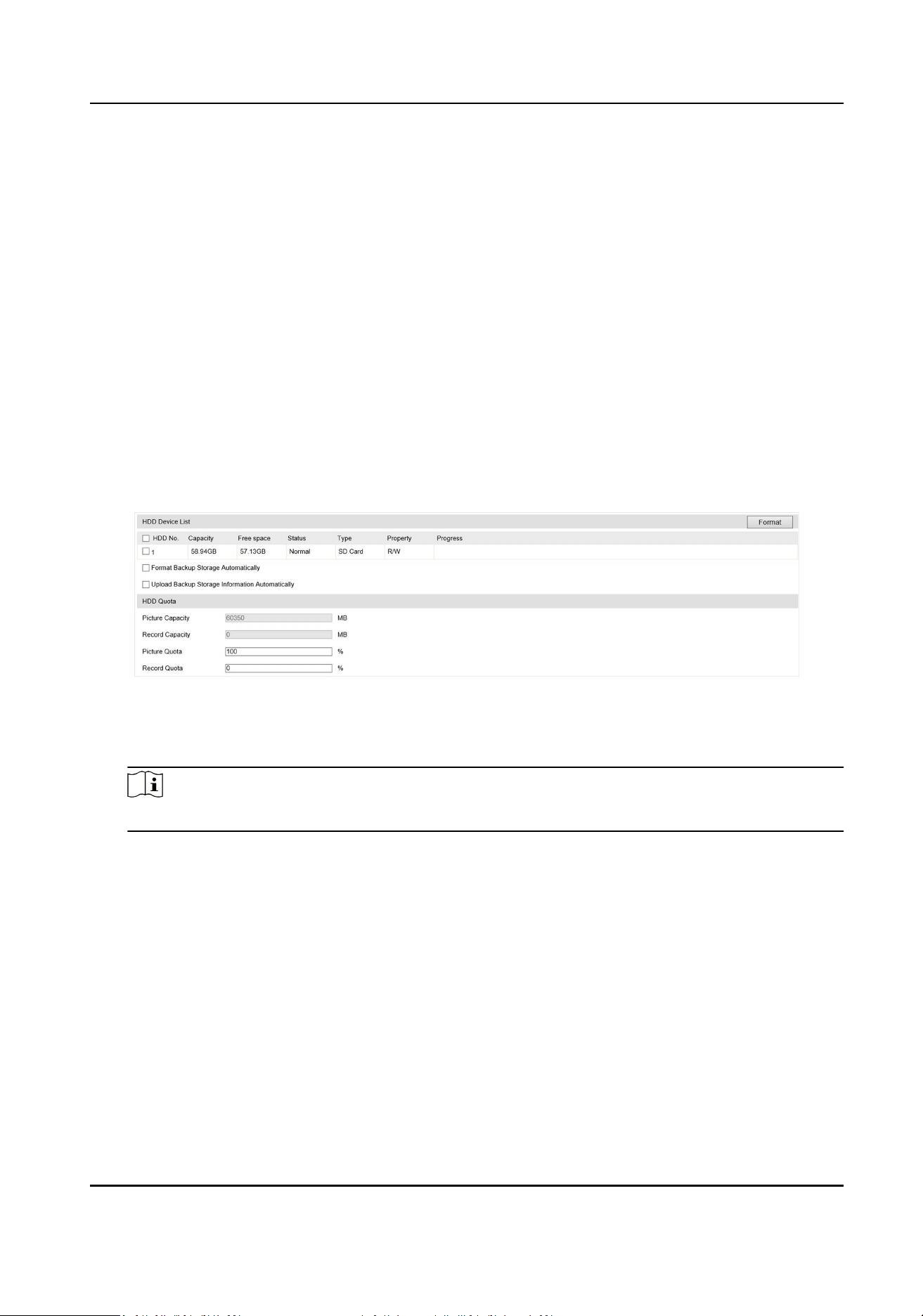
If you want to store the les to the storage card, make sure you insert and format the storage card
in advance.
Before You Start
Insert the storage card to the device.
Steps
1.
Go to Conguraon → Device Conguraon → Encoding and Storage → Storage Management .
Figure 6-1 Set Storage Card
2.
Format the storage card in two ways.
-
Check the storage card, and click Format to format it manually.
Note
For the newly installed storage card, you need to format it manually before using it normally.
-
If you want to format the storage card automacally when the card is abnormal, check Format
Backup Storage Automacally.
3.
Oponal: If the device has been connected to the plaorm, and you want to upload the storage
card informaon automacally, check Upload Backup Storage Informaon Automacally.
4.
Click Save.
6.1.2 Set FTP
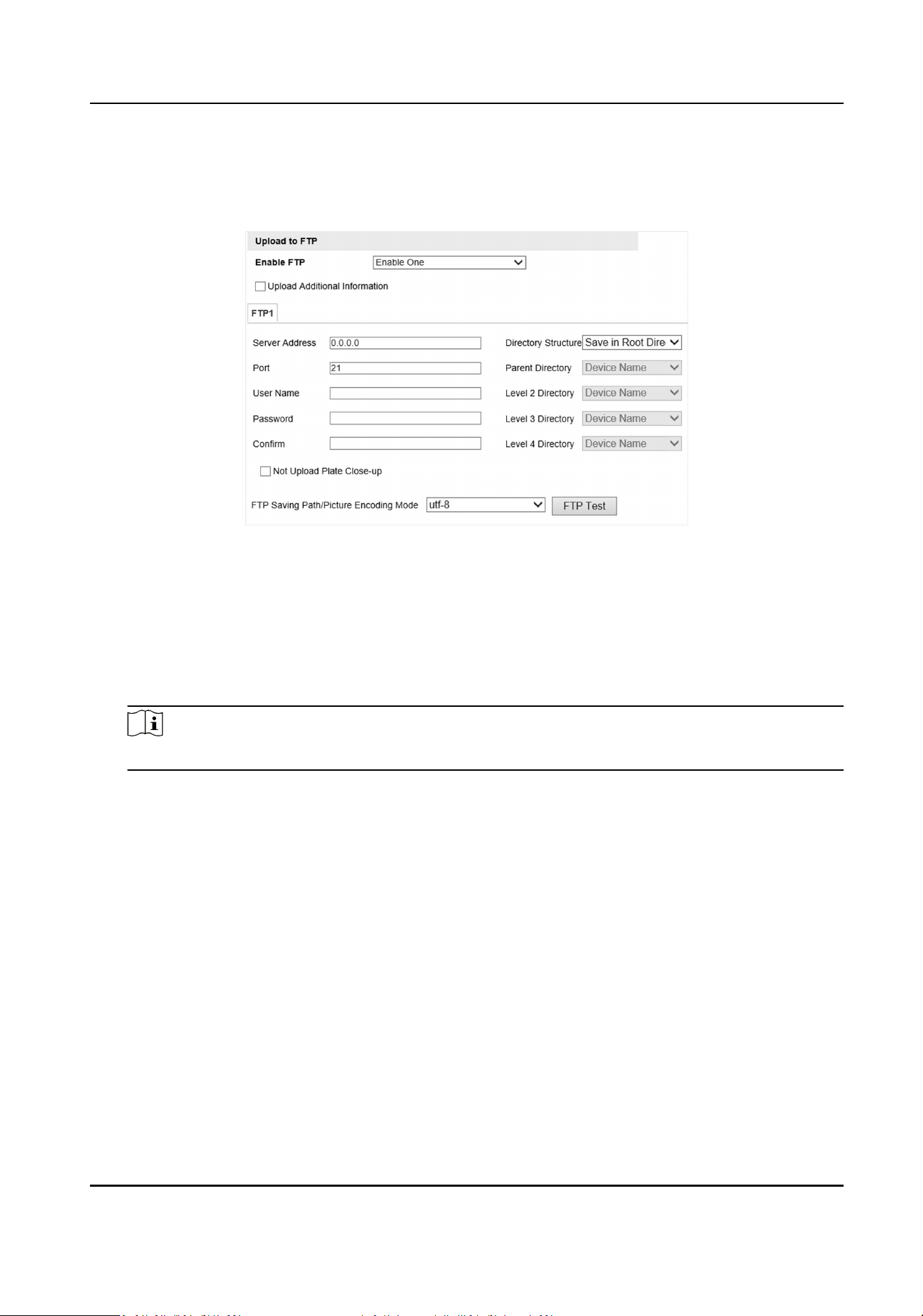
Set FTP parameters if you want to upload the captured pictures to the FTP server.
Before You Start
Set the FTP server, and ensure the device can communicate normally with the server.
All-Rounder Bi-Spectrum Incident Detecon Trac Camera User Manual
32
Steps
1.
Go to Conguraon → Device Conguraon → Encoding and Storage → FTP .
2.
Enable the FTP server.
Figure 6-2 Set FTP
3.
Oponal: Check Upload Addional Informaon, and then the related informaon can be
aached when uploading.
4.
Set FTP parameters.
1) Enter Server Address and Port.
2) Enter User Name and Password, and conrm the password.
3) Select Directory Structure.
Note
If mulple directories are needed, you can customize the directory name.
5.
Oponal: Check Not Upload Plate Close-up if the license plate close-up pictures are not needed
to be uploaded.
6.
Oponal: Click FTP Test to test the server connecon.
7.
Set the name rule and separator according to the actual needs.
8.
Oponal: Edit OSD informaon which can be uploaded to the FTP server with the pictures to
make it convenient to view and disnguish the data.
9.
Click Save.
6.1.3 Set Listening Host
The listening host can be used to receive the uploaded informaon and pictures of the device
arming alarm.
All-Rounder Bi-Spectrum Incident Detecon Trac Camera User Manual
33
Before You Start
The listening service has been enabled for the listening host, and the network communicaon with
the device is normal.
Steps
1.
Go to Conguraon → Device Conguraon → System → Network Interface Parameters .
Figure 6-3 Set Listening Host
2.
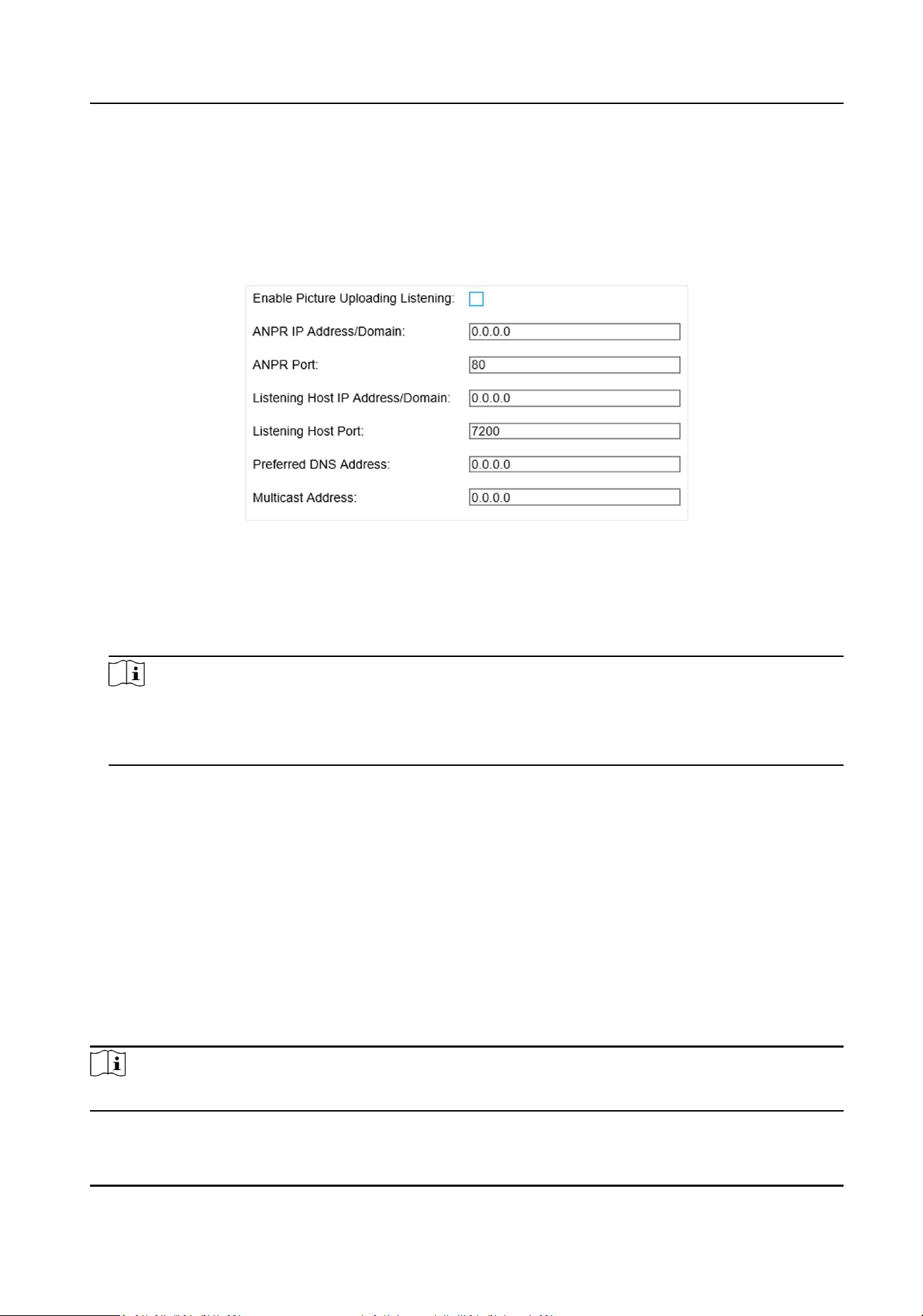
Set ANPR IP Address/Domain and ANPR Port if you need to upload the alarm informaon and
pictures.
3.
Set Listening Host IP Address/Domain and Listening Host Port, and check Enable Picture
Uploading Listening if you need to upload the alarm informaon and pictures.
Note
ANPR and listening conict with each other. When you enable listening host, pictures will be
uploaded via listening host in priority. When you disable listening and have set ANPR IP address
and port, pictures will be uploaded via ANPR protocol.
4.
Oponal: Set Preferred DNS Address if you need to visit the device with domain name.
5.
Oponal: Set Mulcast Address if you need to preview the picture via the mulcast group.
6.
Click Save.
6.1.4 Set Cloud Storage
Cloud storage is a kind of network storage. It can be used as the extended storage to save the
captured pictures.
Before You Start
●
Arrange the cloud storage server.
●
You have enabled level 1 arm in Real-Time Status and Trac Flow Stascs.
Note
The real-me status and trac ow stascs should be used with dedicated plaorm.
All-Rounder Bi-Spectrum Incident Detecon Trac Camera User Manual
34
Steps
1.
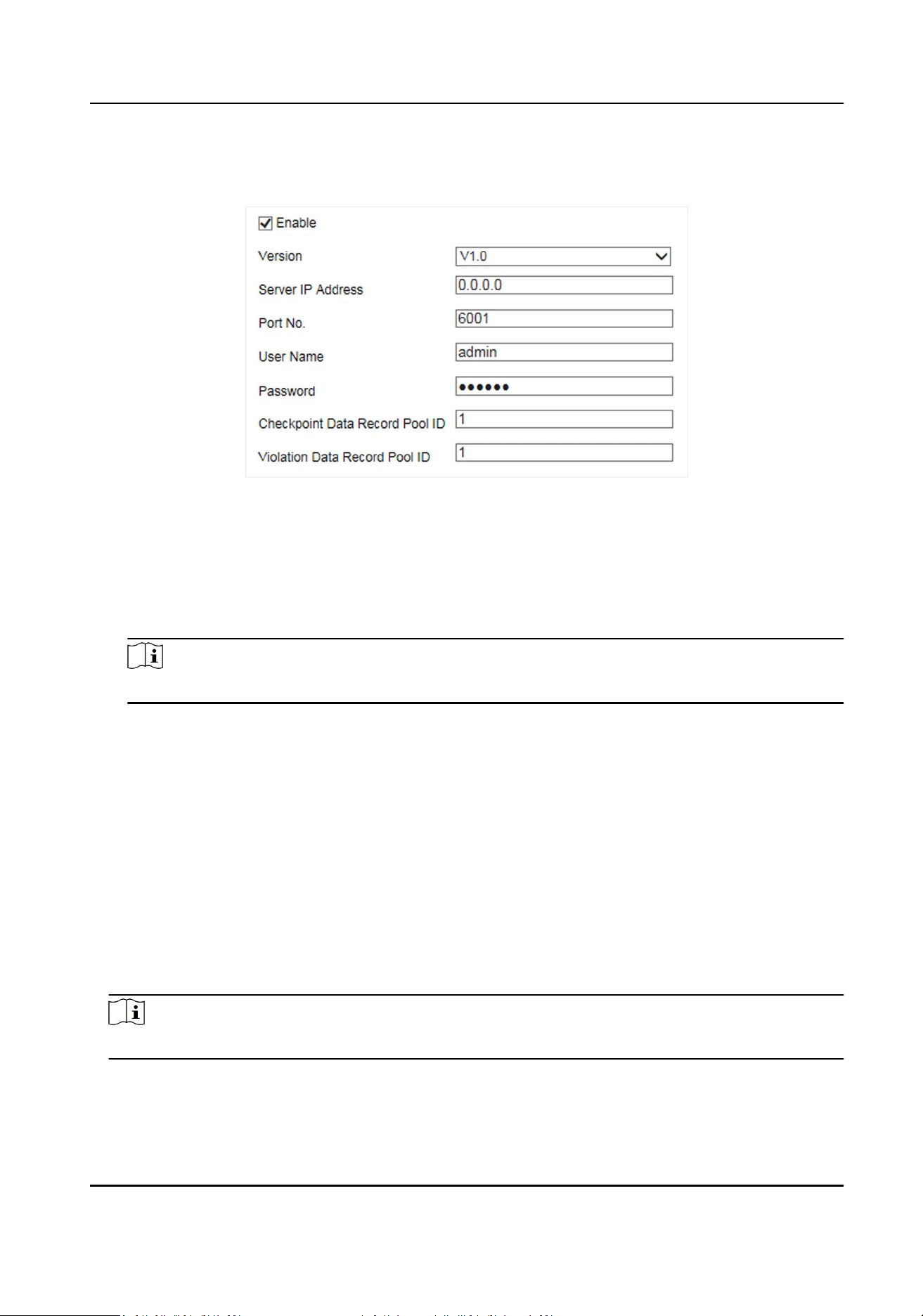
Go to Conguraon → Device Conguraon → Encoding and Storage → Cloud Storage .
Figure 6-4 Set Cloud Storage
2.
Check Enable.
3.
Select Version.
4.
Set the server parameters.
1) Enter Server IP Address and Port No.
2) If you select V2.0, enter accessKey and secretKey of the resource pool.
Note
If you select V1.0, enter User Name and Password.
3) Enter the ID according to the storage area No. of the server.
5.
Click Save.
6.2 Set Quota
Set the video and picture rao in the storage.
Before You Start
Install the storage card.
Steps
1.
Go to Conguraon → Device Conguraon → Encoding and Storage → Storage Management .
2.
Set Picture Quota and Record Quota according to the actual needs.
Note
The percentage sum of the picture and record quota rao should be 100%.
3.
Click Save.
All-Rounder Bi-Spectrum Incident Detecon Trac Camera User Manual
35
What to do next
Format the storage card aer the sengs.
6.3 Set Record Schedule
Set record schedule to record video automacally during congured me periods.
Before You Start
Ensure the storage status is normal. You are recommended to set the video quota rao as not 0.
Steps
1.
Go to Conguraon → Device Conguraon → Encoding and Storage → Record Schedule .
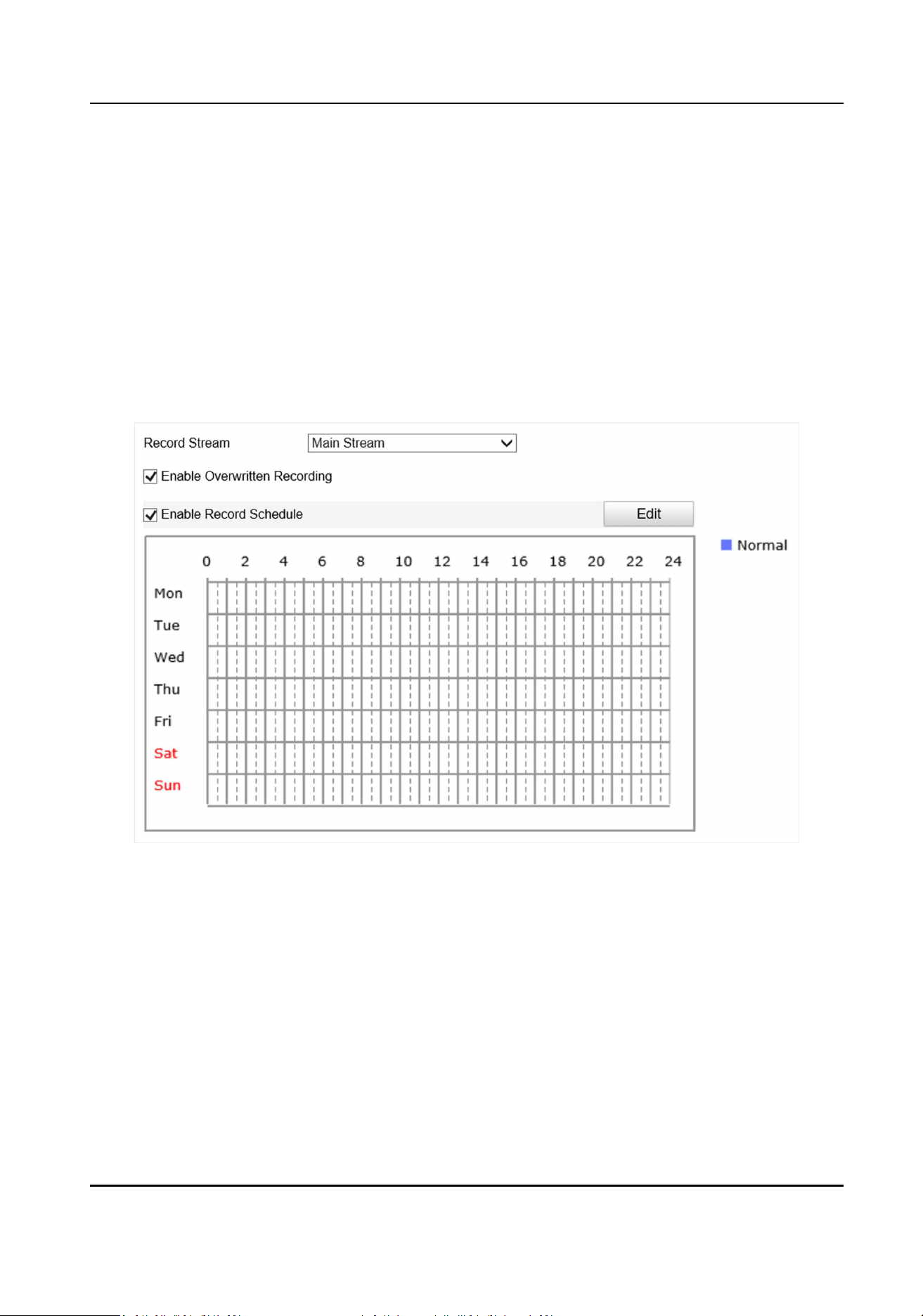
Figure 6-5 Set Record Schedule
2.
Oponal: Check Enable Overwrien Recording.
When the storage is full, the earliest videos will be overwrien.
3.
Check Enable Record Schedule.
4.
Click Edit to edit the record schedule.
1) Select Customize.
2) Set the start me and end me.
3) Oponal: Select the other days and click Copy to copy the sengs to other days.
4) Click OK.
5.
Click Save.
All-Rounder Bi-Spectrum Incident Detecon Trac Camera User Manual
36

Chapter 7 Encoding and Display
7.1 Set Video Encoding Parameters
Set video encoding parameters to adjust the live view and recording eect.
●
When the network signal is good and the speed is fast, you can set high resoluon and bitrate to
raise the image quality.
●
When the network signal is bad and the speed is slow, you can set low resoluon, bitrate, and
frame rate to guarantee the image uency.
●
When the network signal is bad, but the resoluon should be guaranteed, you can set low
bitrate and frame rate to guarantee the image uency.
●
Main stream stands for the best stream performance the device supports. It usually oers the
best resoluon and frame rate the device can do. But high resoluon and frame rate usually
means larger storage space and higher bandwidth requirements in transmission. Sub-stream
usually oers comparavely low resoluon opons, which consumes less bandwidth and storage
space. Third stream is oered for customized usage.
Steps
1.
Go to Conguraon → Device Conguraon → Encoding and Storage → Video Encoding .
2.
Set the parameters for dierent streams.
Stream Type
Only video stream is available.
Bitrate
Select relavely large bitrate if you need good image quality and eect, but more storage
spaces will be consumed. Select relavely small bitrate if storage requirement is in priority.
Frame Rate
It is to describe the frequency at which the video stream is updated and it is measured by
frames per second (fps). A higher frame rate is advantageous when there is movement in the
video stream, as it maintains image quality throughout.
Resoluon
The higher the resoluon is, the clearer the image will be. Meanwhile, the network
bandwidth requirement is higher.
SVC
Scalable Video Coding (SVC) is an extension of the H.264/AVC and H.265 standard. Enable the
funcon and the device will automacally extract frames from the original video when the
network bandwidth is insucient.
Bitrate Type
Select the bitrate type to constant or variable.
All-Rounder Bi-Spectrum Incident Detecon Trac Camera User Manual
37

Image Quality
When bitrate type is variable, 6 levels of image quality are selectable. The higher the image
quality is, the higher requirements of the network bandwidth.
Prole
When you select H.264 or H.265 as video encoding, you can set the prole. Selectable
proles vary according to device models.
I Frame Interval
It refers to the number of frames between two key frames. The larger the I frame interval is,
the smaller the stream uctuaon is, but the image quality is not that good.
Video Encoding
The device supports mulple video encoding types, such as H.264, H.265, and MJPEG.
Supported encoding types for dierent stream types may dier. H.265 is a new encoding
technology. Compared with H.264, it reduces the transmission bitrate under the same
resoluon, frame rate, and image quality.
3.
Click Save.
7.2 Set Image Parameters
You can adjust the image parameters to get clear image.
Steps
Note
The supported parameters may vary with dierent models. The actual device prevails.
1.
Go to Conguraon → Device Conguraon → Image Parameters → General Parameters /
Conguraon → Device Conguraon → Image Parameters → Video .
All-Rounder Bi-Spectrum Incident Detecon Trac Camera User Manual
38
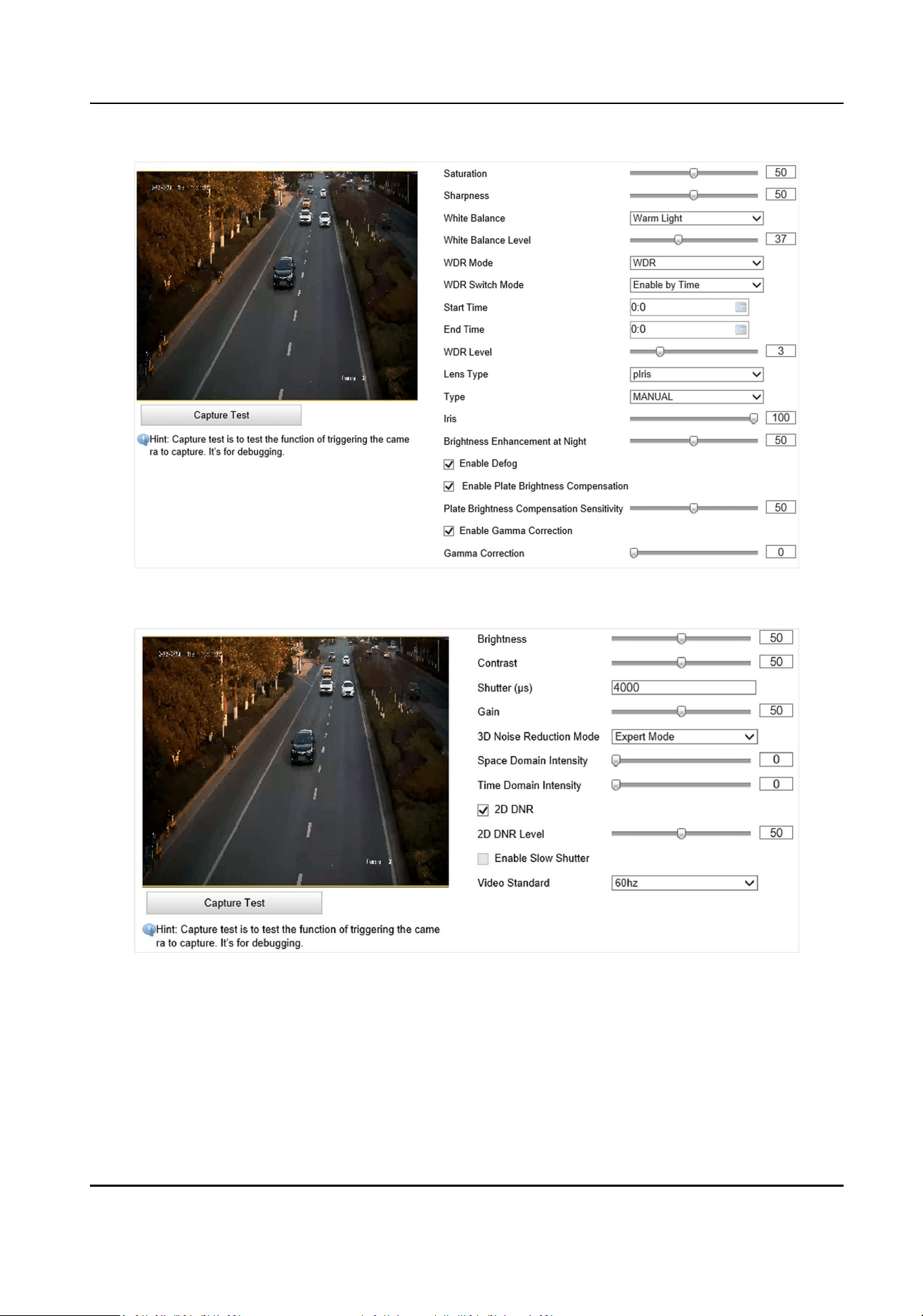
Figure 7-1 Set General Parameters
Figure 7-2 Set Video Image Parameters
2.
Set the relevant parameters.
Saturaon
It refers to the colorfulness of the image color.
Sharpness
All-Rounder Bi-Spectrum Incident Detecon Trac Camera User Manual
39

It refers to the edge contrast of the image.
White Balance
It is the white rendion funcon of the device used to adjust the color temperature according
to the environment. The higher the White Balance Level is, the stronger the eect is.
WDR Mode
Wide Dynamic Range (WDR) can be used when there is a high contrast of the bright area and
the dark area of the scene.
Lens Type
In Auto mode, the lens can adjust automacally according to the current light strength. In
Manual mode, you need to adjust the lens manually. Choose pIris if the lens has been
changed to piris lens and set the type and iris value accordingly.
Brightness Enhancement at Night
The scene brightness will be enhanced at night automacally.
Enable Defog
Enable it to get a clear image in foggy days.
Enable Plate Brightness Compensaon
Enable plate brightness compensaon to realize brightness compensaon of the license
plate. The higher the sensivity is, the easier this funcon can be enabled.
Enable Gamma Correcon
The higher the gamma correcon value is, the stronger the correcon strength is.
Brightness
It refers to the max. brightness of the image.
Contrast
It refers to the contrast of the image. Set it to adjust the levels and permeability of the image.
Shuer
If the shuer speed is quick, the details of the moving objects can be displayed beer. If the
shuer speed is slow, the outline of the moving objects will be fuzzy and trailing will appear.
Gain
It refers to the upper limit value of liming image signal amplicaon. It is recommended to
set a high gain if the illuminaon is not enough, and set a low gain if the illuminaon is
enough.
3D Noise Reducon Mode
In Normal Mode, the higher the Noise Reducon Level is, the stronger the noise will be
reduced. But if it is too high, the image may become fuzzy.
In Expert Mode, set Space Domain Intensity and Time Domain Intensity. If the space domain
intensity is too high, the outline of the image may become fuzzy and the details may be lost.
If the me domain intensity is too high, trailing may appear.
All-Rounder Bi-Spectrum Incident Detecon Trac Camera User Manual
40

2D DNR
The higher the 2D DNR Level is, the stronger the noise will be reduced. But if it is too high,
the image may become fuzzy.
Enable Slow Shuer
This funcon can be used in underexposure condion. It lengthens the shuer me to ensure
full exposure. The higher the Slow Shuer Level is, the slower the shuer speed is.
Video Standard
Select the video standard according to the actual power supply frequency.
7.3 Set ICR
ICR adopts mechanical IR lter to lter IR in the day to guarantee the image eect, and to remove
the IR lter at night to guarantee full-spectrum rays can get through the device.
Steps
1.
Go to Conguraon → Device Conguraon → Image Parameters → ICR .
2.
Select ICR Mode.
Auto-Switch Switches to ICR mode automacally at night or in dark light condions.
Manual Switch Select Day/Night Mode to switch to the day or night manually.
Scheduled Mode Set day/night mode, start me, and end me to switch to ICR mode only
during the set me period.
No Switch Disable the ICR mode.
3.
Click Save.
7.4 Set ROI
ROI (Region of Interest) encoding helps to assign more encoding resources to the region of
interest, thus to increase the quality of the ROI whereas the background informaon is less
focused.
Before You Start
Please check the video encoding type. ROI is supported when the video encoding type is H.264 or
H.265.
Steps
1.
Go to Conguraon → Device Conguraon → Encoding and Storage → ROI .
All-Rounder Bi-Spectrum Incident Detecon Trac Camera User Manual
41
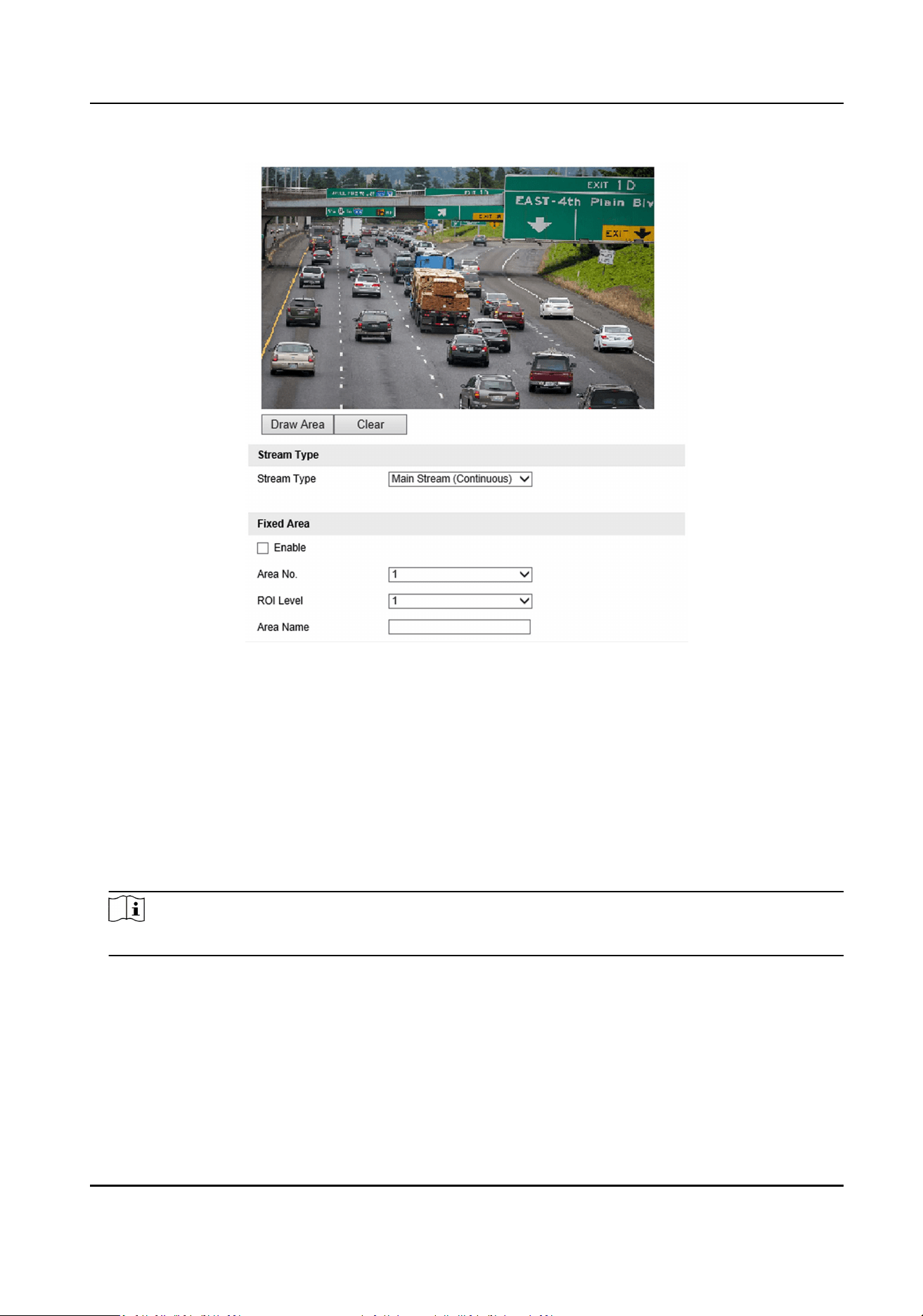
Figure 7-3 Set ROI
2.
Select Stream Type.
3.
Set ROI region.
1) Check Enable.
2) Select Area No.
3) Click Draw Area.
4) Drag the mouse on the live view image to draw a xed area.
5) Select the xed area that needs to be adjusted and drag the mouse to adjust its posion.
6) Click Stop Drawing.
4.
Select Area No. and ROI Level and enter Area Name.
Note
The higher the ROI level is, the clearer the image of the detected area is.
5.
Click Save.
6.
Oponal: Select other area codes and repeat the steps above if you need to draw mulple xed
areas.
All-Rounder Bi-Spectrum Incident Detecon Trac Camera User Manual
42
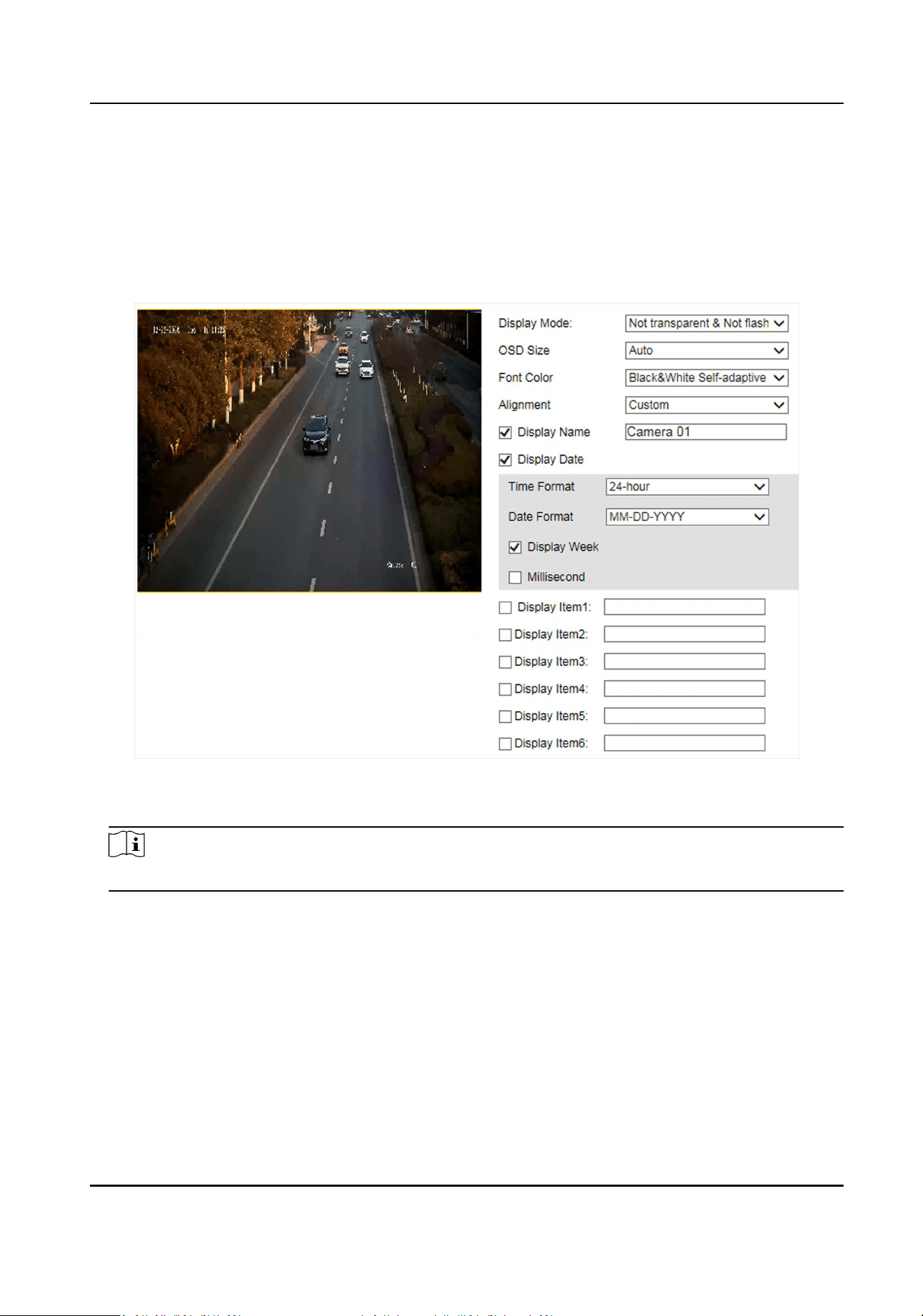
7.5 Set OSD
You can customize OSD informaon on the live view.
Steps
1.
Go to Conguraon → Device Conguraon → Text Overlay → OSD Sengs .
Figure 7-4 Set OSD
2.
Set the display mode, size, color, etc.
Note
The supported funcons vary with dierent models. The actual device prevails.
3.
Set the display content.
1) Check Display Name and enter the name.
2) Check Display Date, and set the me and date format.
3) Check Display Week or Millisecond according to your needs.
4.
Oponal: Check the display item(s) and enter informaon in the text eld(s).
5.
Drag the red frames on the live view image to adjust the OSD posions.
6.
Click Save.
Result
The set OSD will be displayed in live view image and recorded videos.
All-Rounder Bi-Spectrum Incident Detecon Trac Camera User Manual
43
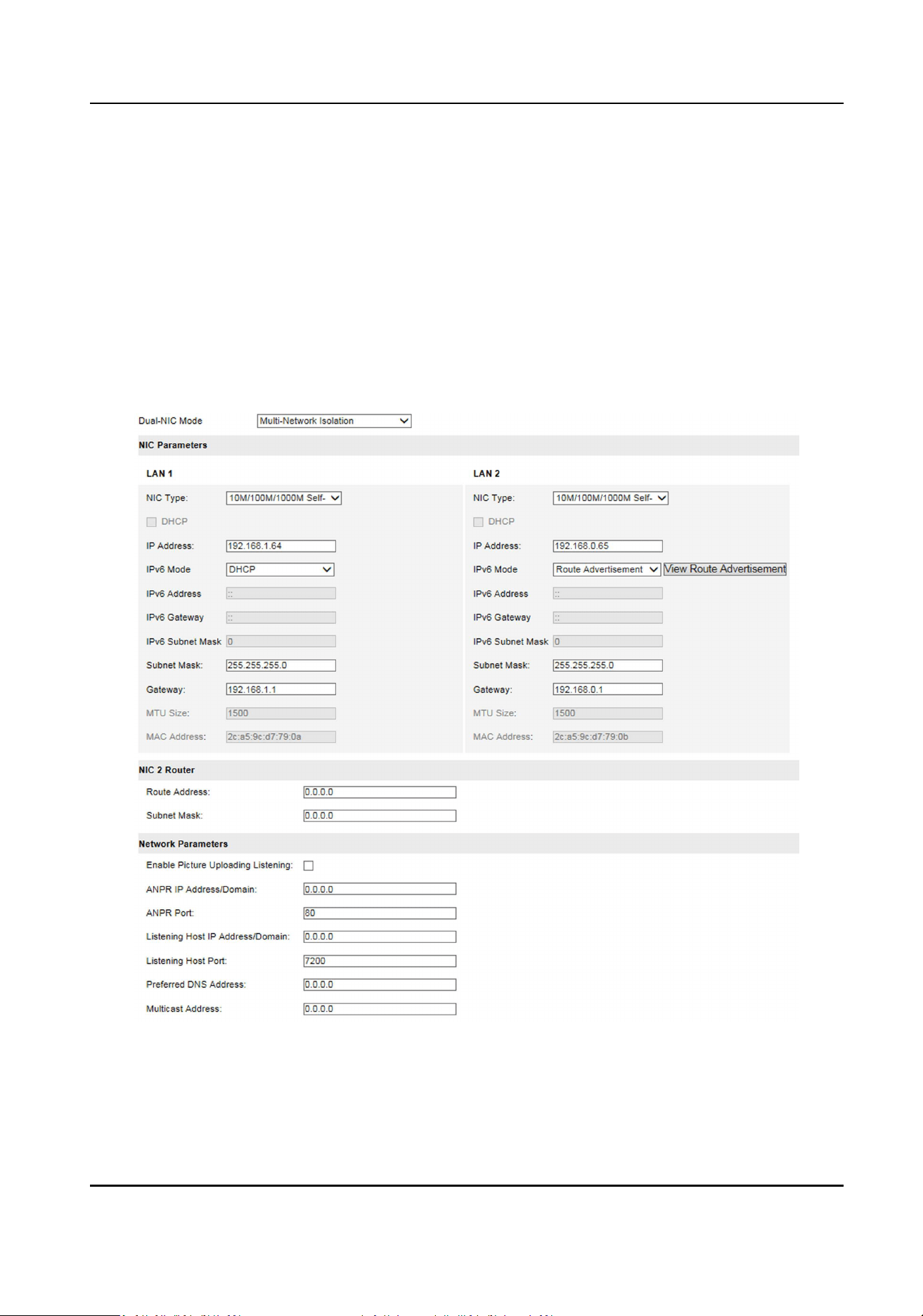
Chapter 8 Network Conguraon
8.1 Set IP Address
IP address must be properly congured before you operate the device over network. IPv4 and IPv6
are both supported. Both versions can be congured simultaneously without conicng to each
other.
Steps
1.
Go to Conguraon → Device Conguraon → System → Network Interface Parameters .
Figure 8-1 Set IP Address
2.
Select Dual-NIC Mode.
3.
Set the parameters below.
All-Rounder Bi-Spectrum Incident Detecon Trac Camera User Manual
44

NIC Type
Select a NIC (Network Interface Card) type according to your network condion.
IP Address
Two modes are available.
DHCP
The device automacally gets the IP parameters from the network if you check DHCP. The
device IP address is changed aer enabling the funcon. You can use SADP to get the device
IP address.
Note
The network that the device is connected to should support DHCP.
Manual
You can set the device IP parameters manually. Enter IP Address, Subnet Mask, and
Gateway.
IPv6
Three IPv6 modes are available.
Route Adversement
The IPv6 address is generated by combining the route adversement and the device Mac
address.
Note
Route adversement mode requires the support from the router that the device is
connected to.
DHCP
The IPv6 address is assigned by the server, router, or gateway.
Manual
Enter IPv6 Address, IPv6 Subnet Mask, and IPv6 Gateway. Consult the network
administrator for required informaon.
MTU
It stands for maximum transmission unit. It is the size of the largest protocol data unit that
can be communicated in a single network layer transacon.
The valid value range of MTU is 1280 to 1500.
Mulcast
Mulcast is group communicaon where data transmission is addressed to a group of
desnaon devices simultaneously. Aer seng Mulcast Address, you can send the source
data eciently to mulple receivers.
Router
All-Rounder Bi-Spectrum Incident Detecon Trac Camera User Manual
45
Enter Route Address and Subnet Mask if the device is connected to a router.
DNS
It stands for domain name server. It is required if you need to visit the device with domain
name. And it is also required for some applicaons (e.g., sending email). Set Preferred DNS
Server properly if needed.
4.
Click Save.
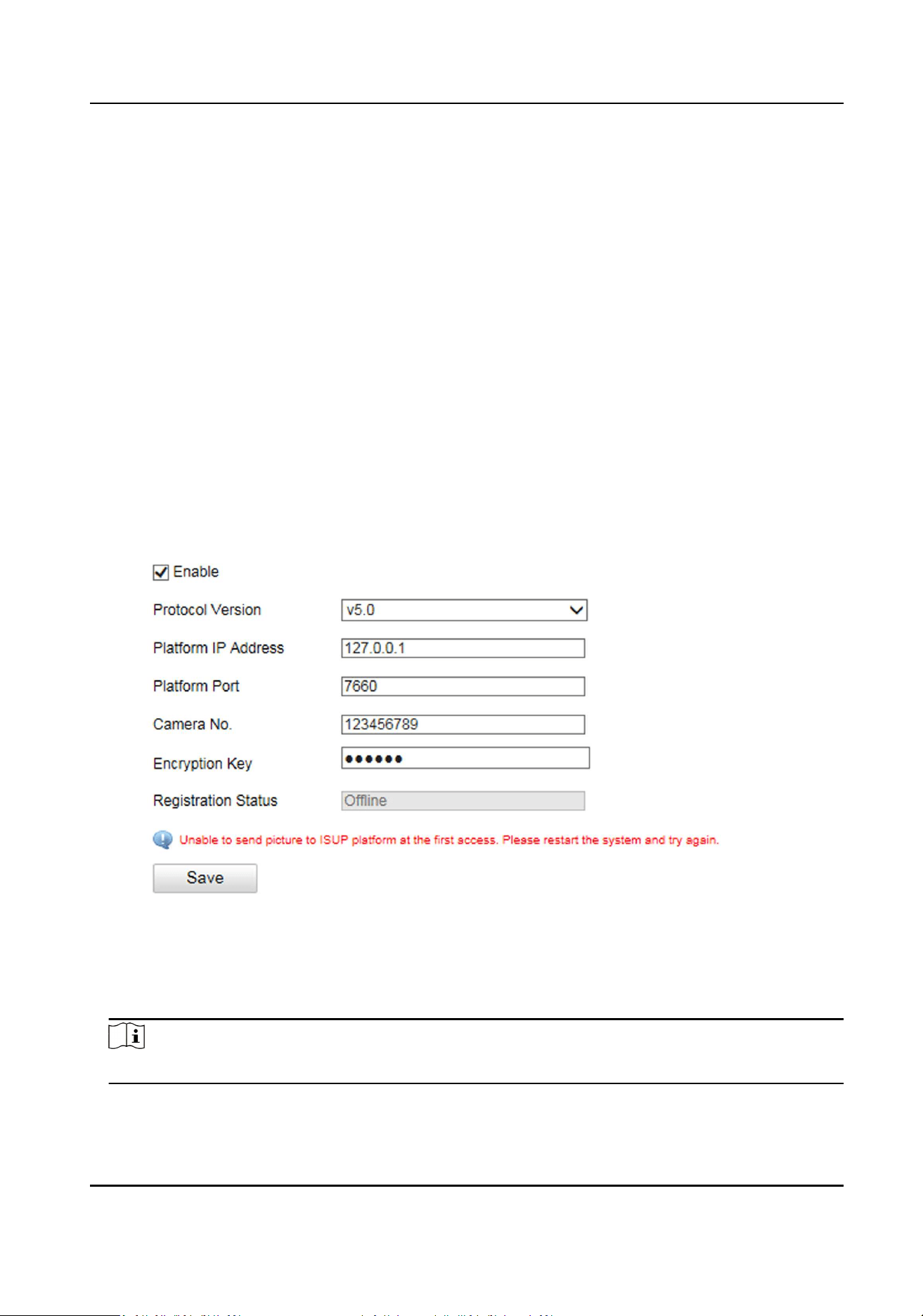
8.2 Connect to ISUP Plaorm
ISUP (EHome) is a plaorm access protocol. The device can be remotely accessed via this plaorm.
Before You Start
●
Create the device ID on ISUP plaorm.
●
Ensure the device can communicate with the plaorm normally.
Steps
1.
Go to Conguraon → Device Conguraon → System → ISUP Protocol .
Figure 8-2 Connect to ISUP Plaorm
2.
Check Enable.
3.
Select Protocol Version.
4.
Enter Plaorm IP Address, Plaorm Port, and Camera No.
Note
The camera No. should be the same with the added one on the ISUP plaorm.
5.
Oponal: Enter Encrypon Key if you select v5.0.
All-Rounder Bi-Spectrum Incident Detecon Trac Camera User Manual
46
6.
Click Save.
7.
Oponal: View Registraon Status.
Note
When the registraon status shows online, you can add or manage the device via the plaorm
soware. Refer to its corresponding manual for details.
8.3 Set DDNS
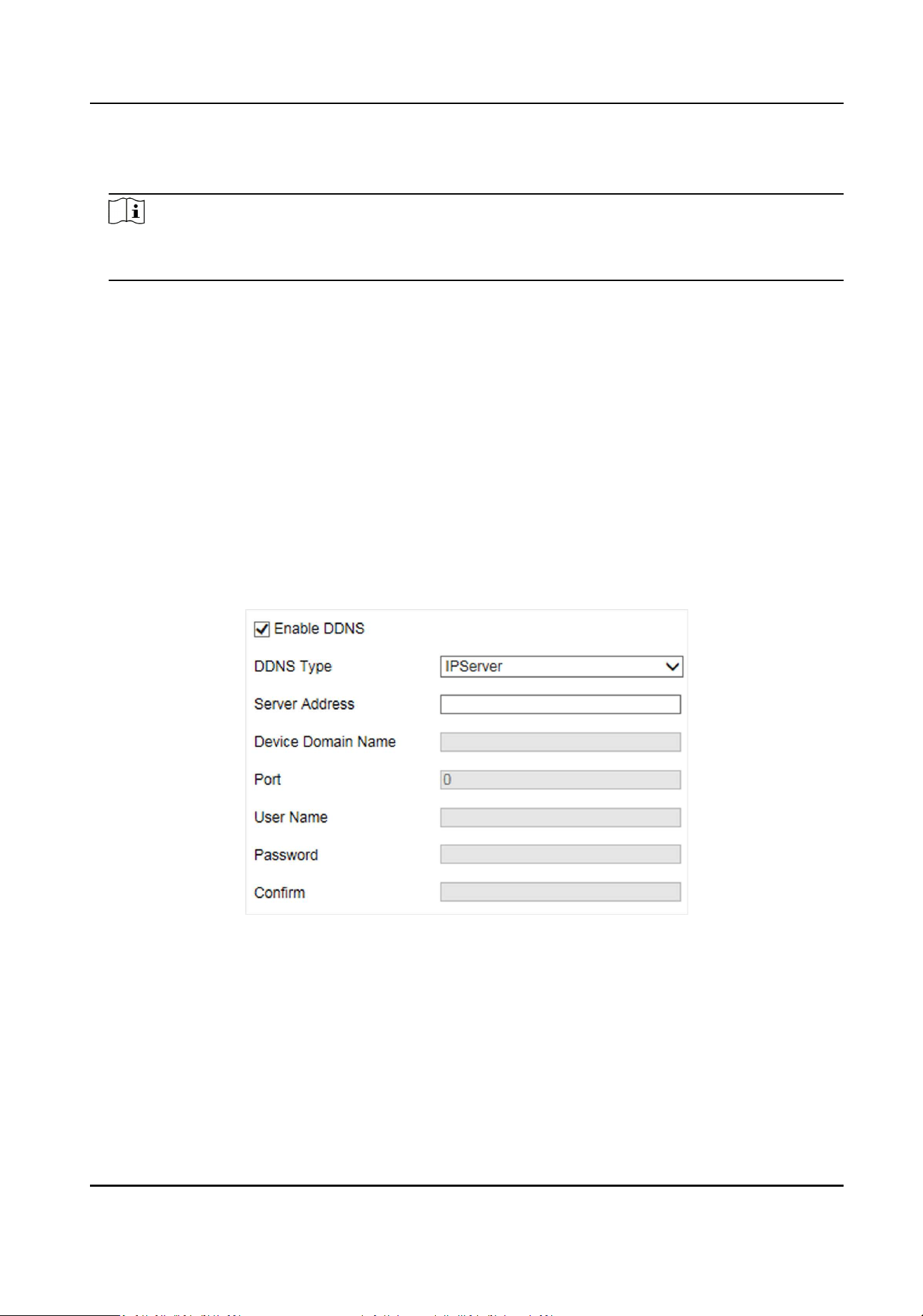
You can use the Dynamic DNS (DDNS) for network access. The dynamic IP address of the device can
be mapped to a domain name resoluon server to realize the network access via domain name.
Before You Start
●
Register the domain name on the DDNS server.
●
Set the LAN IP address, subnet mask, gateway, and DNS server parameters. Refer to "Set IP
Address" for details.
●
Complete port mapping. The default ports are 80, 8000, and 554.
Steps
1.
Go to Conguraon → Device Conguraon → System → DDNS .
Figure 8-3 Set DDNS
2.
Check Enable DDNS.
3.
Enter the server address and other informaon.
4.
Click Save.
5.
Access the device.
By Browser Enter the domain name in the browser address bar to access the device.
All-Rounder Bi-Spectrum Incident Detecon Trac Camera User Manual
47
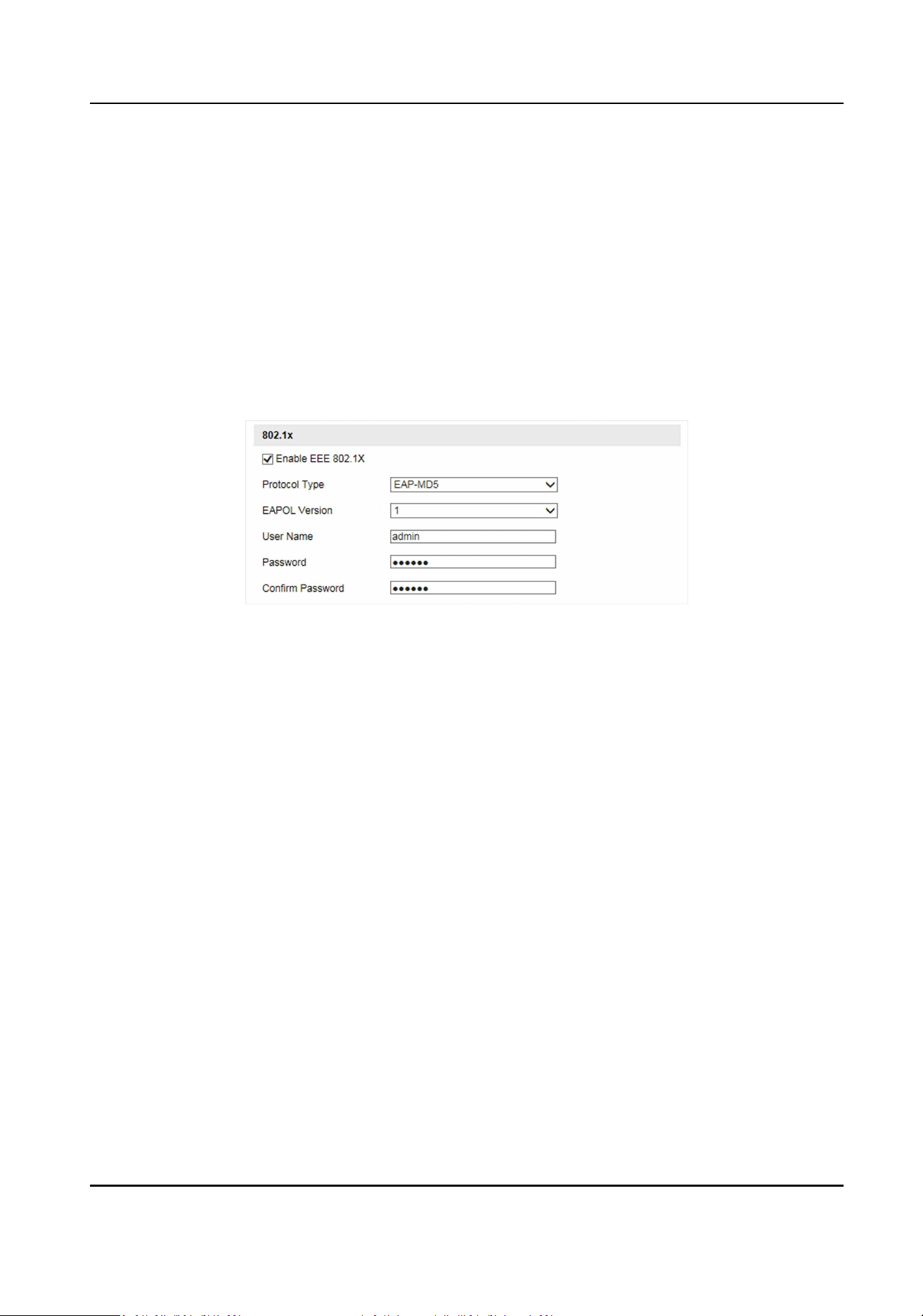
By Client Soware Add domain name to the client soware. Refer to the client soware
manual for specic adding methods.
8.4 Set IEEE 802.1X
IEEE 802.1X is a port-based network access control. It enhances the security level of the LAN/
WLAN. When devices connect to the network with IEEE 802.1X standard, the authencaon is
needed.
Steps
1.
Go to Conguraon → Device Conguraon → System → 802.1X .
Figure 8-4 Set IEEE 802.1X
2.
Check Enable EEE 802.1X.
3.
Select Protocol Type and EAPOL Version.
Protocol Type
If you use EAP-MD5, the authencaon server must be congured. Register a user name and
password for 802.1X in the server in advance. Enter the user name and password for
authencaon.
EAPOL Version
The EAPOL version must be idencal with that of the router or the switch.
4.
Enter User Name and Password registered in the server.
5.
Conrm the password.
6.
Click Save.
8.5 Set Image and Video Library
Set the interacon parameters of the device consistent with those of the image and video library
plaorm via the image and video library (1400) protocol, and register the device on the plaorm.
When the device generates alarm signals, the alarm informaon will be sent to the plaorm.
All-Rounder Bi-Spectrum Incident Detecon Trac Camera User Manual
48
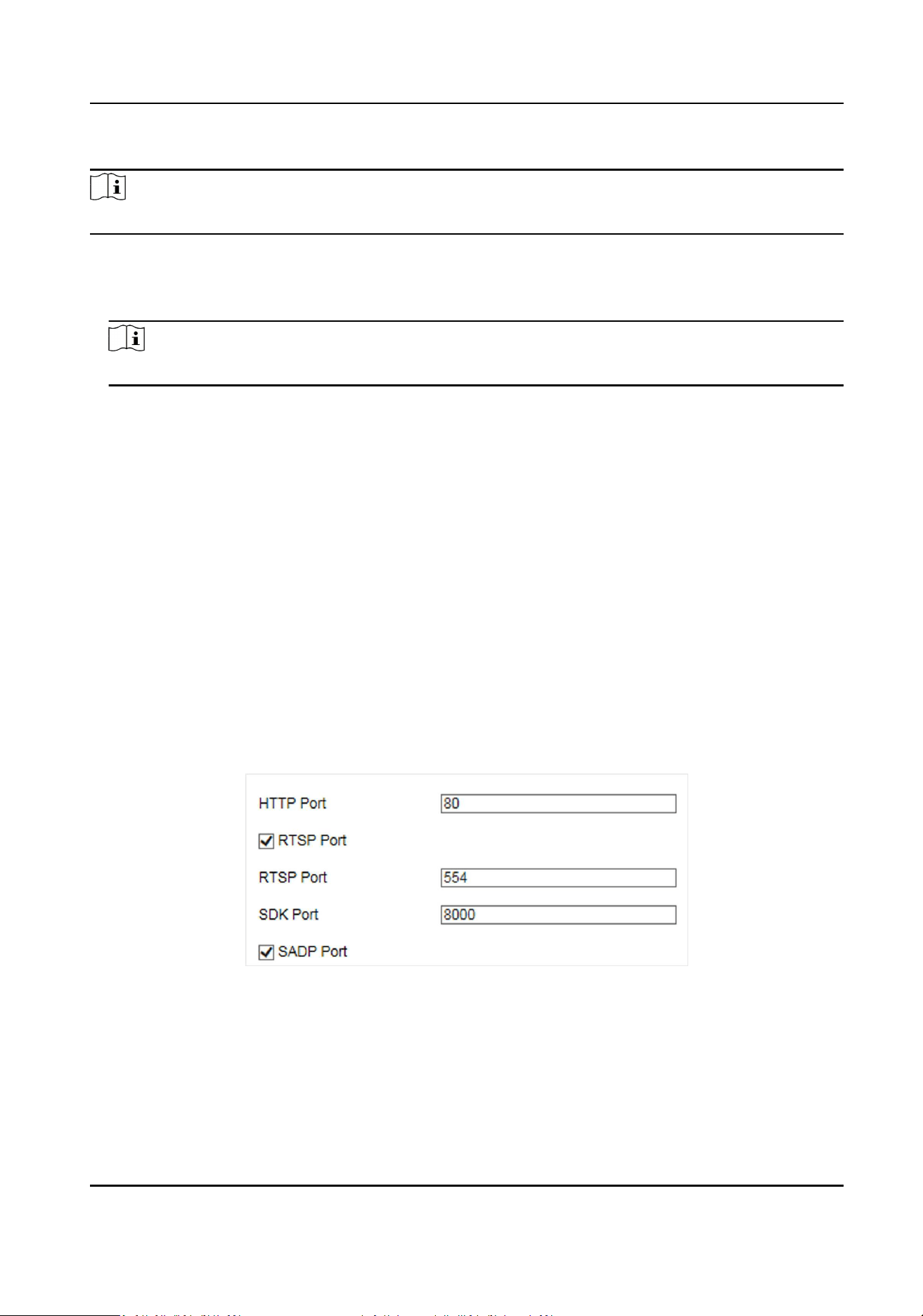
Steps
Note
The funcon varies with dierent models. The actual device prevails.
1.
Go to Conguraon → Device Conguraon → System → Image and Video Library .
2.
Check Enable.
3.
Set the parameters such as the device ID, user name, password, etc.
Note
The parameters should be consistent with those on the image and video library plaorm.
4.
Set other parameters.
Heartbeat Cycle
The connecon me between the device and the image and video library plaorm.
Max. Times of Heartbeat Timeout
The max. mes of heartbeat meout when the device connects to the image and video
library plaorm.
5.
View Registraon Status.
6.
Set Camera ID of the channel.
7.
Click Save.
8.6 Set Port
The device port can be modied when the device cannot access the network due to port conicts.
Go to Conguraon → Device Conguraon → System → Port for port sengs.
Figure 8-5 Set Port
HTTP Port
It refers to the port through which the browser accesses the device. For example, when the
HTTP Port is modied to 81, you need to enter hp://192.168.1.64:81 in the browser for login.
RTSP Port
All-Rounder Bi-Spectrum Incident Detecon Trac Camera User Manual
49

It refers to the port of real-me streaming protocol.
SDK Port
It refers to the port through which the client adds the device.
SADP Port
It refers to the port through which the SADP soware searches the device.
Note
●
Aer eding the port, access to the device via new port.
●
Reboot the device to take the new sengs into eect.
●
The supported ports vary with dierent models. The actual device prevails.
All-Rounder Bi-Spectrum Incident Detecon Trac Camera User Manual
50
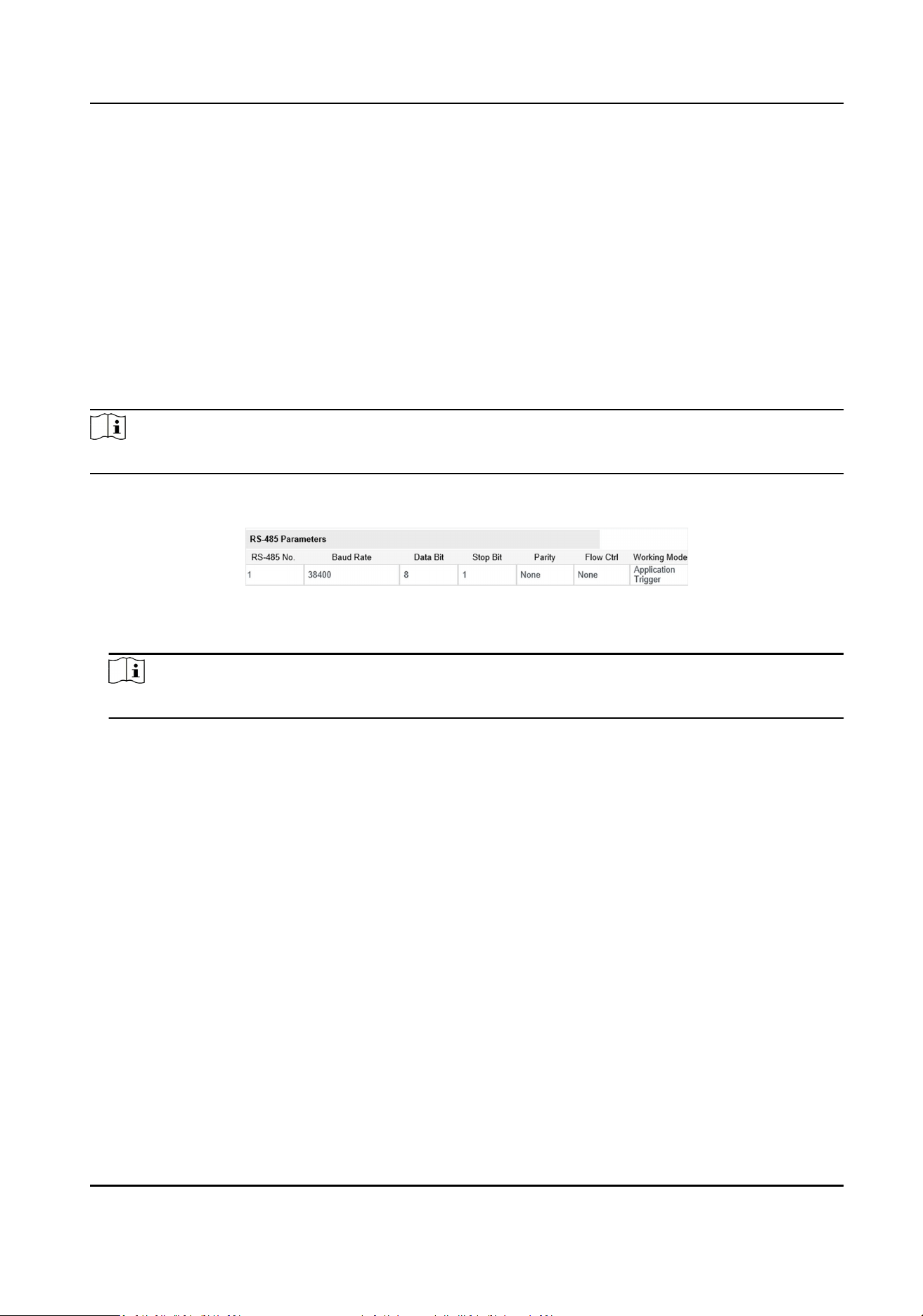
Chapter 9 Serial Port Conguraon
9.1 Set RS-485
Set RS-485 parameters if the device needs to be connected to other peripheral devices controlled
by RS-485 serial port.
Before You Start
The corresponding device has been connected via the RS-485 serial port.
Steps
Note
The supported parameters may vary with dierent models. The actual device prevails.
1.
Go to Conguraon → Device Conguraon → System → Serial Port Parameters .
Figure 9-1 Set RS-485
2.
Set Baud Rate, Data Bit, Stop Bit, Parity, and Flow Ctrl.
Note
The parameters should be same with those of the connected device.
3.
Select Working Mode as Applicaon Trigger.
Applicaon Trigger
When a signal trigger device (such as radar) gets connected to the device via the RS-485 serial
port, select this mode for receiving trigger signals.
4.
Click Save.
9.2 Set RS-232
Set RS-232 parameters if you need to debug the device via RS-232 serial port.
Before You Start
The debugging device has been connected via the RS-232 serial port.
Steps
1.
Go to Conguraon → Device Conguraon → System → Serial Port Parameters .
2.
Click Advanced Sengs.
All-Rounder Bi-Spectrum Incident Detecon Trac Camera User Manual
51
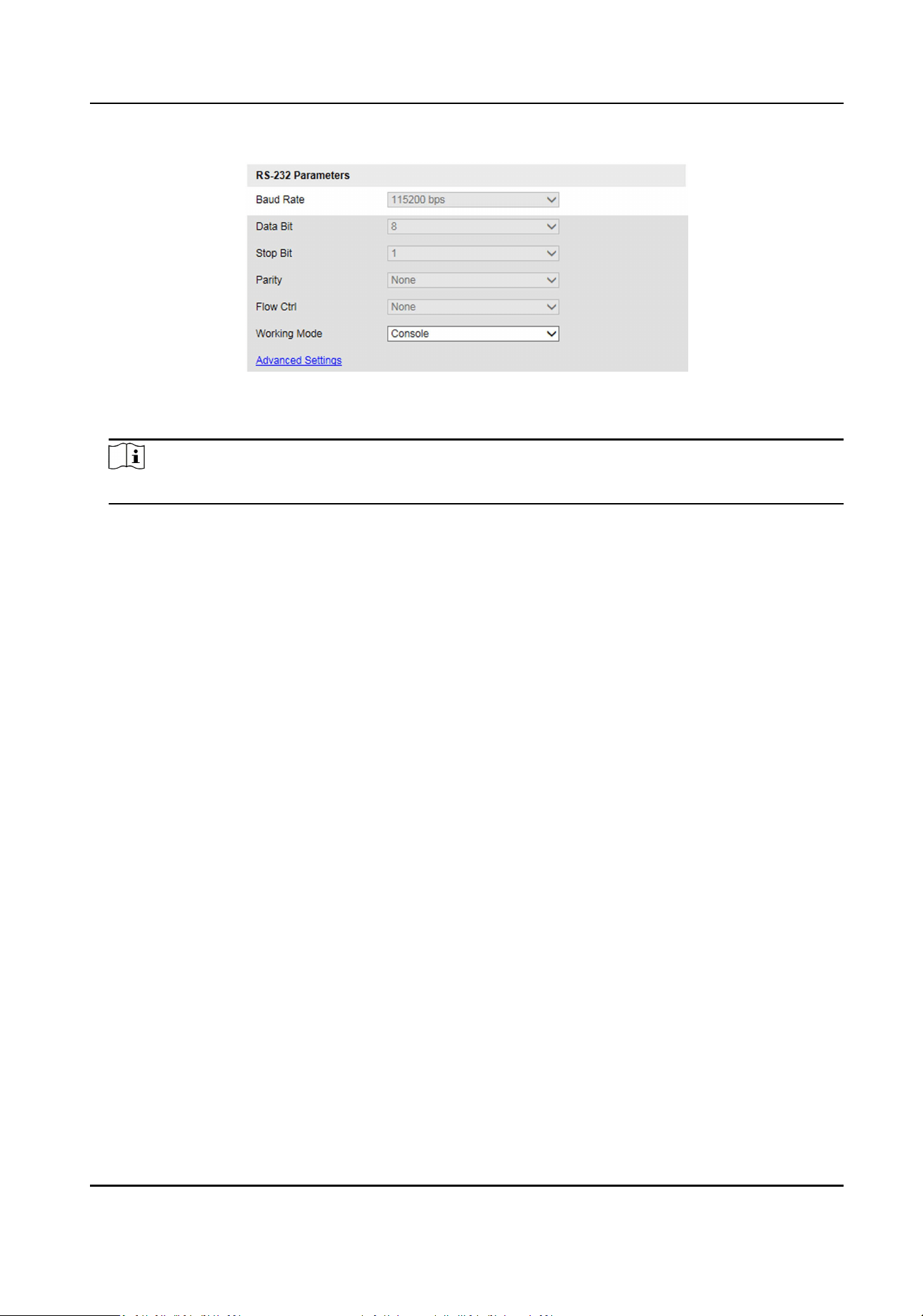
Figure 9-2 Set RS-232
3.
Set Baud Rate, Data Bit, Stop Bit, etc.
Note
The parameters should be same with those of the connected device.
4.
Select Working Mode.
Console
Select it when you need to debug the device via RS-232 serial port.
Transparent Channel
Select it, and the network command can be transmied to RS-232 control command via the
RS-232 serial port.
Narrow Band Transmission
Reserved.
5.
Click Save.
All-Rounder Bi-Spectrum Incident Detecon Trac Camera User Manual
52
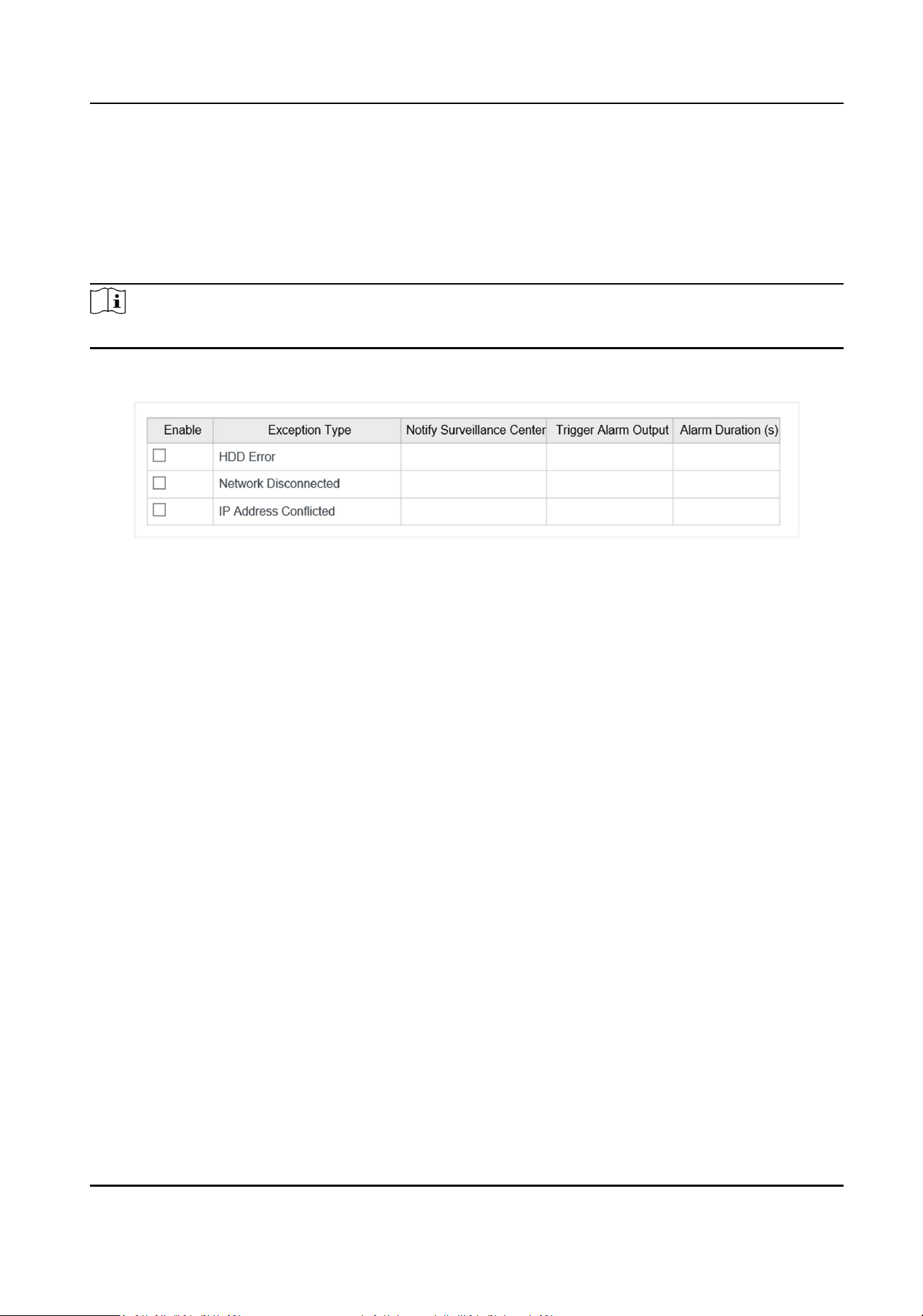
Chapter 10 Excepon Alarm
Set excepon alarm when the network is disconnected, the IP address is conicted, etc.
Steps
Note
The supported excepon types vary with dierent models. The actual device prevails.
1.
Go to Conguraon → Device Conguraon → Events → Excepon Event .
Figure 10-1 Set Excepon Alarm
2.
Select the excepon type(s) and the linkage method.
3.
Click Save.
All-Rounder Bi-Spectrum Incident Detecon Trac Camera User Manual
53

Chapter 11 Safety Management
11.1 Manage User
The administrator can add, modify, or delete other accounts, and grant dierent permissions to
dierent user levels.
Steps
1.
Go to Conguraon → Device Conguraon → User Management .
2.
Add a user.
1) Click Add.
2) Enter User Name and select Level.
3) Enter Admin Password, Password, and conrm the password.
Cauon
To increase security of using the device on the network, please change the password of your
account regularly. Changing the password every 3 months is recommended. If the device is
used in high-risk environment, it is recommended that the password should be changed every
month or week.
4) Assign remote permission to users based on needs.
User
Users can be assigned permission of viewing live video and changing their own passwords,
but no permission for other operaons.
Operator
Operators can be assigned all permission except for operaons on the administrator and
creang accounts.
5) Click OK.
Note
The administrator can add up to 31 user accounts.
3.
You can do the following operaons.
-
Select a user and click Modify to change the password and permission.
-
Select a user and click Delete to delete the user.
11.2 Enable User Lock
To raise the data security, you are recommended to lock the current IP address.
Steps
1.
Go to Conguraon → Device Conguraon → System → Service .
2.
Check Enable User Lock.
All-Rounder Bi-Spectrum Incident Detecon Trac Camera User Manual
54

3.
Click Save.
Result
When the mes you entered incorrect passwords have reached the limit, the current IP address
will be locked automacally.
11.3 Set HTTPS
11.3.1 Create and Install Self-signed Cercate
HTTPS is a network protocol that enables encrypted transmission and identy authencaon,
which improves the security of remote access.
Steps
1.
Go to Conguraon → Device Conguraon → System → HTTPS .
2.
Select Create Self-Signed Cercate.
3.
Click Create.
4.
Follow the prompt to enter Country/Region, IP Address, Valid Date (Day), and other
parameters.
5.
Click OK.
Result
The device will install the self-signed cercate by default.
11.3.2 Install Authorized Cercate
If the demand for external access security is high, you can create and install authorized cercate
via HTTPS protocol to ensure the data transmission security.
Steps
1.
Go to Conguraon → Device Conguraon → System → HTTPS .
2.
Select Create the cercate request rst and connue the installaon.
3.
Click Create.
4.
Follow the prompt to enter Country/Region, IP Address, and other parameters.
5.
Click Download to download the cercate request and submit it to the trusted authority for
signature.
6.
Import cercate to the device.
-
Select Signed cercate is available. Start the installaon directly. Click Browse and Install to
import the cercate to the device.
-
Select Create the cercate request rst and connue the installaon. Click Browse and
Install to import the cercate to the device.
7.
Click Save.
All-Rounder Bi-Spectrum Incident Detecon Trac Camera User Manual
55

11.4 Set SSH
To raise network security, disable SSH service. The conguraon is only used to debug the device
for the professionals.
Steps
1.
Go to Conguraon → Device Conguraon → System → Service .
2.
Uncheck Enable SSH Service.
3.
Click Save.
All-Rounder Bi-Spectrum Incident Detecon Trac Camera User Manual
56

Chapter 12 Maintenance
12.1 View Device Informaon
Basic Informaon and Algorithms Library Version
Go to Conguraon → Device Conguraon → System → Device Informaon to view the basic
informaon and algorithms library version of the device.
You can edit Device Name and Device No. The device No. is used to control the device. It is
recommended to reserve the default value.
Device Status
Go to Conguraon → Device Status to view the device status.
12.2 View Thermal Camera Informaon
The device supports viewing the detailed informaon of the connected thermal camera.
Go to Conguraon → Device Conguraon → Thermal Imaging Management to view name,
model, and other informaon of the thermal camera.
12.3 Log
12.3.1 Enable System Log Service
The security audit logs refer to the security operaon logs. You can search and analyze the security
log les of the device so as to nd out the illegal intrusion and troubleshoot the security events.
Security audit logs can be saved on device internal storage. The log will be saved every half hour
aer device boong. Due to limited storage space, you are recommended to save the logs on a log
server.
Steps
1.
Go to Conguraon → Device Conguraon → System → Service .
2.
Check Enable Syslog Service.
3.
Enter IP Address and Port of the log server.
4.
Click Save.
Result
The device will upload the security audit logs to the log server regularly.
All-Rounder Bi-Spectrum Incident Detecon Trac Camera User Manual
57

12.3.2 Search Log
Log helps to locate and troubleshoot problems.
Steps
1.
Click Log.
2.
Set search condions.
3.
Click Search.
The matched log les will be displayed on the log list.
4.
Oponal: Click Save Log to save the log les to your computer.
12.4 Upgrade
Upgrade the system when you need to update the device version.
Before You Start
Prepare the upgrade le.
Steps
1.
Go to Conguraon → Device Conguraon → System Maintenance → Upgrade .
2.
Click Browse to select the upgrade le.
3.
Click Upgrade.
4.
Click OK in the popup window.
Note
The upgrade process will take 1 to 10 minutes. Do not cut o the power supply.
Result
The device will reboot automacally aer upgrade.
12.5 Reboot
When the device needs to be rebooted, reboot it via the soware instead of cung o the power
directly.
Steps
1.
Go to Conguraon → Device Conguraon → System Maintenance → Reboot .
2.
Click Reboot.
3.
Click OK to reboot the device.
All-Rounder Bi-Spectrum Incident Detecon Trac Camera User Manual
58

12.6 Restore Parameters
When the device is abnormal caused by the incorrect set parameters, you can restore the
parameters.
Steps
1.
Go to Conguraon → Device Conguraon → System Maintenance → Default .
2.
Select the restoraon mode.
-
Click Restore to restore the parameters except the IP parameters and user parameters to the
default sengs.
-
Click Restore Factory Sengs to restore all the parameters to the factory sengs.
3.
Click OK.
12.7 Synchronize Time
Synchronize the device me when it is inconsistent with the actual me.
Steps
1.
Go to Conguraon → Device Conguraon → System → Time Sengs .
2.
Select Time Zone.
3.
Select Time Sync. Mode.
NTP Time Sync.
Select it to synchronize the device me with that of the NTP server. Set Server Address, NTP
Port, and Interval. Click NTP Test to test if the connecon between the device and the server
is normal.
Manual Time Sync.
Select it to synchronize the device me with that of the computer. Set me manually, or
check Sync. with computer me.
SDK
If the remote host has been set for the device, select it to synchronize me via the remote
host.
ONVIF
Select it to synchronize me via the third-party device.
No
Select it to disable me synchronizaon.
All
Select it, and you can select any mode above.
All-Rounder Bi-Spectrum Incident Detecon Trac Camera User Manual
59

Note
The me synchronizaon modes vary with dierent models. The actual device prevails.
4.
Click Save.
12.8 Set DST
If the region where the device is located adopts Daylight Saving Time (DST), you can set this
funcon.
Steps
1.
Go to Conguraon → Device Conguraon → System → DST .
2.
Check Enable DST.
3.
Set Start Time, End Time, and DST Bias.
4.
Click Save.
12.9 Debug
Note
The debug conguraons below are only provided to debug the device by the professionals.
12.9.1 Enable Informaon Overlay
You can overlay the algorithm POS informaon and posioning frames on the captured pictures or
playback images.
Steps
1.
Go to Conguraon → Device Conguraon → Advanced Sengs → System Service .
2.
Check the debug informaon according to your needs.
Enable Algorithm POS Informaon Debug
The algorithm POS informaon will be overlaid on the playback image when you play back
the video with the dedicated tool.
Enable Posioning Frame Debug
The posioning frames of vehicle bodies and license plates will be overlaid on the captured
pictures.
3.
Click Save.
12.9.2 Vehicle Capture and Recognion Service
Set the vehicle capture and recognion service to debug the device.
All-Rounder Bi-Spectrum Incident Detecon Trac Camera User Manual
60

Steps
1.
Go to Conguraon → Device Conguraon → Advanced Sengs → Vehicle Capture and
Recognion Service .
2.
Check the service(s) according to your needs.
Note
The supported services vary with dierent models. The actual device prevails.
Not Capture No Plate Vehicle
The vehicles without license plates will not be captured.
Not Capture Wrong-Way Driving Vehicle
The wrong-way driving vehicles will not be captured.
Filter Checkpoint Capture of Same Vehicle
It is used to debug the device with the same vehicle. When the same vehicle is triggered
many mes during a short period in the scene, the checkpoint pictures of the vehicle will not
be captured.
Enable Non-Motor Vehicle Flow Stascs
Check it to count the non-motor vehicle ow.
Upload Stascs Data Every Integral Minute
Check it, and the device will upload the stascs data every integral minute according to the
set stascs interval in data collecon mode. For example, if you set the stascs interval as
2 minutes, then the device will upload the stascs data at 8:00:00, 8:02:00, 8:04:00, etc.
3.
Click Save.
12.9.3 Set Image Format
You can enable smartJPEG which can save the storage space without inuencing the resoluon.
Steps
1.
Go to Conguraon → Device Conguraon → Advanced Sengs → Image Service .
2.
Check smartJPEG.
3.
Click Save.
12.10 Export Parameters
You can export the parameters of one device, and import them to another device to set the two
devices with the same parameters.
Steps
1.
Go to Conguraon → Device Conguraon → System Maintenance → Export Parameters .
2.
Click Export Parameters.
All-Rounder Bi-Spectrum Incident Detecon Trac Camera User Manual
61

3.
Set a password, and click OK.
Note
The password is used for imporng the conguraon le of the current device to other devices.
4.
Select the saving path, and enter the le name.
5.
Click Save.
12.11 Import Conguraon File
Import the conguraon le of another device to the current device to set the same parameters.
Before You Start
Save the conguraon le to the computer.
Steps
Cauon
Imporng conguraon le is only available to the devices of the same model and same version.
1.
Go to Conguraon → Device Conguraon → System Maintenance → Import Cong. File .
2.
Select Imporng Method.
Note
If you select Import Part, check the parameters to be imported.
3.
Click Browse to select the conguraon le.
4.
Enter the password which is set when the conguraon le is exported, and click OK.
5.
Click Import.
6.
Click OK on the popup window.
Result
The parameters will be imported, and the device will reboot.
12.12 Export Debug File
The technicians can export the debug le to troubleshoot and maintain the device.
Steps
1.
Go to Conguraon → Device Conguraon → System Maintenance → Export Debug File .
2.
Click Export Debug.
3.
Select the saving path, and enter the le name.
4.
Click Save.
All-Rounder Bi-Spectrum Incident Detecon Trac Camera User Manual
62
Appendix A. Communicaon Matrix and Device
Command
Scan the QR code below to get the communicaon matrix of the device.
Scan the QR code below to get the device command.
All-Rounder Bi-Spectrum Incident Detecon Trac Camera User Manual
63

UD28193B