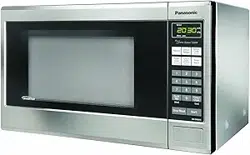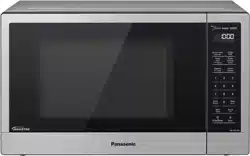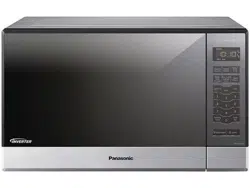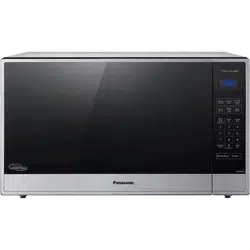
operating instructions
Microwave oven
household use only
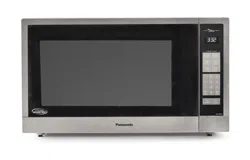
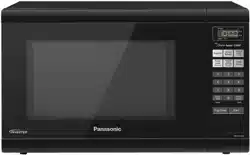
Models no. nn-sn651b
nn-sn651W
nn-sn661s
nn-sn671s
safety information
Precautions.........................Inside cover
important safety instructions .........1-3
installation and grounding
instructions.......................................4-5
safety Precautions...........................6-7
operation
Sensor Cook Chart..............................17
Microwave Recipes .............................18
Timer Feature (Kitchen Timer/Stand
Time/Delay Start).................................19
Microwave Shortcuts......................20-21
Food Characteristics............................22
Cooking Techniques .......................22-23
Quick Guide to Operation....................27
operation
Oven Components Diagram..................9
Control Panel.......................................10
Starting to Use Your Oven ...................11
Setting the Clock..................................11
Child Safety Lock.................................11
Selecting Power & Cook Time.............12
Quick Min Feature ...............................12
Keep Warm Feature ............................12
Popcorn Feature..................................13
More/Less Feature ..............................13
Inverter Turbo Defrost Feature............14
Defrosting Tips & Techniques.........14-15
Sensor Reheat Feature .......................16
Sensor Cook Feature ..........................16
Maintenance
Care and Cleaning of Your Microwave
Oven ....................................................24
Accessory Purchases..........................24
Before Requesting Service..................25
Limited Warranty & Customer Service
Directory ..............................................26
general information
Cookware Guide....................................8
Specifications.......................................28
User’s Record......................................28
read all instructions carefully before using the oven.
Para instrucciones en español, voltee el libro.
F00039Y00AP
IP0711-0
Printed in China
For microwave oven safety reference, please visit FDA's webpage at:
http://www.fda.gov/Radiation-EmittingProducts/ResourcesforYouRadiationEmittingProducts/ucm252762.htm
© Panasonic Home Appliances Microwave Oven (Shanghai) Co., Ltd. 2011.
For assistance, please call: 1-800-211-PANA(7262)
contact us via the web at:
http://www.panasonic.com
(U.S.A and Puerto Rico)
IP3516_39Y00AP_33_110630:IP3516_39Y00AP_00_110316.qxd 2011-6-30 Jerry 上上16:55 Page 1
your safety and the safety of others are very important.
We have provided important safety messages in this manual and on your
appliance. Always read and obey all safety messages.
Precautions to avoid
Possible eXPosure to
eXcessive MicroWave energy
(a) Do not attempt to operate this oven with the door open since open-door
operation can result in harmful exposure to microwave energy. It is
important not to defeat or tamper with the safety interlocks.
(b) Do not place any object between the oven front face and the door or allow
soil or cleaner residue to accumulate on sealing surfaces.
(c) Do not operate the oven if it is damaged. It is particularly important that
the oven door close properly and that there is no damage to the:
(1) door (bent),
(2) hinges and latches (broken or loosened),
(3) door seals and sealing surfaces.
(d) The oven should not be adjusted or repaired by anyone except properly
qualified service personnel.
All safety messages will tell you what the potential hazard is, tell you how to
reduce the chance of injury, and tell you what can happen if the instructions
are not followed.
This is the safety alert symbol. It is used to alert you to poten-
tial hazards that can kill or hurt you and others.
All safety messages will follow the safety alert symbol and
either the word “DANGER”, “WARNING” or “CAUTION”. These
words mean:
You can be killed or seriously injured if
you don’t immediately
follow instructions.
You can be killed or seriously injured if
you don’t follow instructions.
Microwave oven Safety
danGeR
WaRninG
You can be exposed to a potentially haz-
ardous situation which, if not avoided,
may result in minor or moderate injury.
caution
IP3516_39Y00AP_33_110630:IP3516_39Y00AP_00_110316.qxd 2011-6-30 Jerry 上上16:55 Page 2
1
iMPortant safety instructions
to reduce the risk of burns, electric shock, fire, injury to persons, or exposure
to excessive microwave energy:
1. Read all instructions before using this appliance.
2. Read and follow the specific “PRECAUTIONS TO AVOID POSSIBLE EXPO-
SURE TO EXCESSIVE MICROWAVE ENERGY,” found on the inside front
cover.
3. This appliance must be grounded. Connect only to a properly grounded outlet.
See “GROUNDING INSTRUCTIONS” found on page 4.
4. As with any cooking appliance, do not leave oven unattended while in use.
5. Install or locate this appliance only in accordance with the installation instruc-
tions found on page 4.
6. do not cover or block any openings on this appliance.
7. do not store this appliance outdoors. do not use this product near water—
for example, near a kitchen sink, in a wet basement, or near a swimming pool
or similar locations.
8. Use this appliance only for its intended use as described in this manual. do
not use corrosive chemicals, vapors, or non-food products in this appliance.
This type of oven is specifically designed to heat, or cook food. It is not
designed for industrial or laboratory use. The use of corrosive chemicals in
heating or cleaning will damage the appliance and may result in radiation
leaks.
9. When cleaning surfaces of the door and oven that come together on closing
the door, use only mild, non-abrasive soaps or detergents applied with a
sponge or soft cloth.
10. do not allow children to use this appliance, unless closely supervised by an
adult. do not assume that because a child has mastered one cooking skill
he/she can cook everything.
11. do not operate this appliance if it has a damaged cord or plug, if it is not
working properly, or if it has been damaged or dropped.
12. do not immerse cord or plug in water.
13. Keep cord away from heated surfaces.
14. do not let cord hang over edge of a table or counter.
15. This appliance should be serviced only by qualified service personnel. Contact
the nearest authorized service center for examination, repair or adjustment.
Your microwave oven is a cooking appliance and you should use as much care
as you use with a stove or any other cooking appliance. When using this electric
appliance, basic safety precautions should be followed, including the following:
Thank you for purchasing a Panasonic Microwave Oven.
WaRninG
IP3516_39Y00AP_33_110630:IP3516_39Y00AP_00_110316.qxd 2011-6-30 Jerry 上上16:55 Page 1

2
16. Some products such as whole eggs with or without shell, narrow neck bottles
and sealed containers—for example, closed glass jars—may explode and
should not be heated in this oven.
17. To reduce the risk of fire in the oven cavity:
(a) do not overcook food. Carefully attend appliance when paper, plastic, or
other combustible materials are placed inside the oven to facilitate cooking.
(b) Remove wire twist-ties from paper or plastic bags before placing bag in
oven.
(c) if material inside the oven ignites, keep oven door closed, turn oven
off, and disconnect the power cord, or shut off power at the fuse or
circuit breaker panel.
(d) do not use the cavity for storage purposes. do not leave paper
products, cooking utensils or food in the cavity when not in use.
18.
superheated liquids
Liquids, such as water, coffee, or tea are able to be overheated beyond the
boiling point without showing evidence (or signs) of boiling. Visible bubbling
is not always present when the container is removed from the microwave
oven. ThIS COULD RESULT IN VERY hOT LIQUIDS SUDDENLY BOILING
OVER WhEN ThE CONTAINER IS DISTURBED OR A UTENSIL IS
INSERTED INTO ThE LIQUID.
To reduce the risk of injury to persons:
(a) stir the liquid both before and halfWay through
heating it.
(b) do not heat water and oil, or fats together. the film of oil will trap
steam, and may cause a violent eruption.
(c) do not use straight-sided containers with narrow necks.
(d) After heating, allow the container to stand in the microwave oven for a
short time before removing the container.
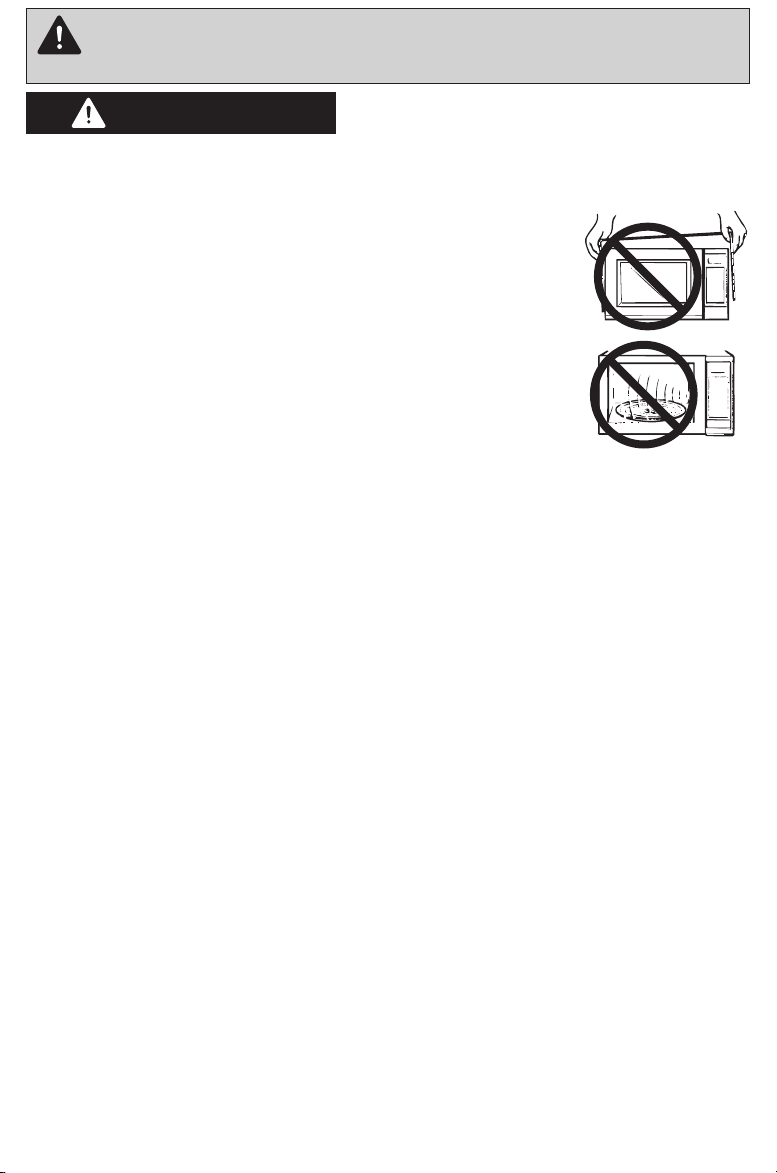
19. do not cook directly on the turntable. It can crack, and cause injury or
damage to the oven.
20. For the oven designed for installation into a wall cabinet:
(a) do not operate any heating or cooking appliance beneath this appli-
ance.
(b) do not mount unit over or near any portion of a heating or cooking
appliance.
(c) do not mount over a sink.
(d) do not store anything directly on the top of the appliance surface when
the appliance is in operation.
iMPortant safety instructions
(continued)
IP3516_39Y00AP_33_110630:IP3516_39Y00AP_00_110316.qxd 2011-6-30 Jerry 上上16:55 Page 2
3
save these instructions
For proper use of your oven, read remaining safety cautions and operating instructions.
glass tray
1. do not operate the oven without the Roller Ring and the Glass Tray in
place.
2. do not operate the oven without the Glass Tray fully engaged on the drive
hub. Improper cooking or damage to the oven could result. Verify that the
Glass Tray is properly engaged and rotating by observing its rotation when
you press Start. note: The Glass Tray can turn in either direction.
3. Use only the Glass Tray specifically designed for this oven. do not substi-
tute any other glass tray.
4. If the Glass Tray is hot, allow to cool before cleaning or placing in water.
5. do not cook directly on the Glass Tray. Always place food in a microwave
safe dish, or on a rack set in a microwave safe dish.
6. If food or utensil on the Glass Tray touches oven walls, causing the tray to
stop moving, the tray will automatically rotate in the opposite direction.
roller ring
1. The Roller Ring and oven floor should be cleaned frequently to prevent
excessive noise.
2. Always replace the Roller Ring and the Glass Tray in their proper positions.
3. The Roller Ring must always be used for cooking along with the Glass Tray.
iMPortant safety instructions
(continued)
to avoid the risK of shocK:
do not remove outer panel from oven. Repairs must be done only by a qualified serv-
ice person.
to reduce the risK of eXPosure to MicroWave
energy:
do not tamper with, or make any adjustments or repairs to Door,
Control Panel Frame, Safety Interlock Switches, or any other part
of oven, microwave leakage may result.
to avoid the risK of fire:
1. do not operate the oven empty. The microwave energy will
reflect continuously throughout the oven causing overheating and
damage, if food or water is not present to absorb energy.
2. do not store flammable materials next to, on top of, or in the
oven.
3. do not dry clothes, newspapers or other materials in the oven,
or use newspaper or paper bags for cooking.
4. do not hit or strike Control Panel. Damage to controls may occur.
5. do not use recycled paper products unless the paper product is labeled as safe for
microwave oven use. Recyled paper products may contain impurities which may
cause sparking.
to avoid the risK of scalding:
Pot holders should always be used when removing items from the oven. heat is
transferred from the hOT food to the cooking container and from the container to the
Glass Tray. The Glass Tray can also be very hOT after removing the cooking container
from the oven.
WaRninG
IP3516_39Y00AP_33_110630:IP3516_39Y00AP_00_110316.qxd 2011-6-30 Jerry 上上16:55 Page 3
4
examine your oven
Unpack oven, remove all packing material and examine the oven for any dam-
age such as dents, broken door latches or cracks in the door. Notify dealer
immediately if oven is damaged. do not install if oven is damaged.
Placement of oven
1. The oven must be placed on a flat, stable surface. Place the front surface of
the door three inches or more from the counter top edge to avoid accidental
tipping of the microwave oven during normal use. For proper operation, the
oven must have sufficient air flow. Allow 3-inches (7.6 cm) of space on both
sides of the oven and 1-inch (2.5 cm) of space on top of the oven.
(a) do not block air vents. If they are blocked during operation, the oven
may be overheated and damaged.
(b) do not place oven near a hot, damp surface such as a gas or electric
range, or dishwasher.
(c) do not operate oven when room humidity is excessive.
2. This oven is manufactured for household use only. It is not approved or tested
for mobile vehicle, marine, or commercial use.
installation
1. do not block air vents. If they are blocked during operation, the oven may
overheat. If the oven overheats, a thermal safety device will turn the oven off.
The oven will remain inoperable until it has cooled.
2. If the oven is designed for installation into a wall cabinet by using the proper
trim kit available from a local Panasonic dealer, follow all instructions packed
with the kit.
3. NN-SN651B/NN-SN651W :
This oven is not intended for built-in operation and is not approved or tested
for mobile,vehicle, marine, or commercial use.
iMProPer use of the grounding Plug can result in a risK of elec-
tric shocK.
Consult a qualified electrician or service person if the grounding instructions are not com-
pletely understood, or if doubt exists as to whether the appliance is properly grounded. If it
is necessary to use an extension cord, use only a three wire extension cord that has a
three prong polarized grounding plug, and a three slot receptacle that will accept the plug
on the appliance. The marked rating of the extension cord should be equal to or greater
than the electrical rating of the appliance.
grounding instructions
this aPPliance Must be grounded. In the event of an electrical short circuit,
grounding reduces the risk of electric shock by providing an escape wire for the electric
current. This appliance is equipped with a cord having a grounding wire with a grounding
plug. The plug must be plugged into an outlet that is properly installed and grounded.
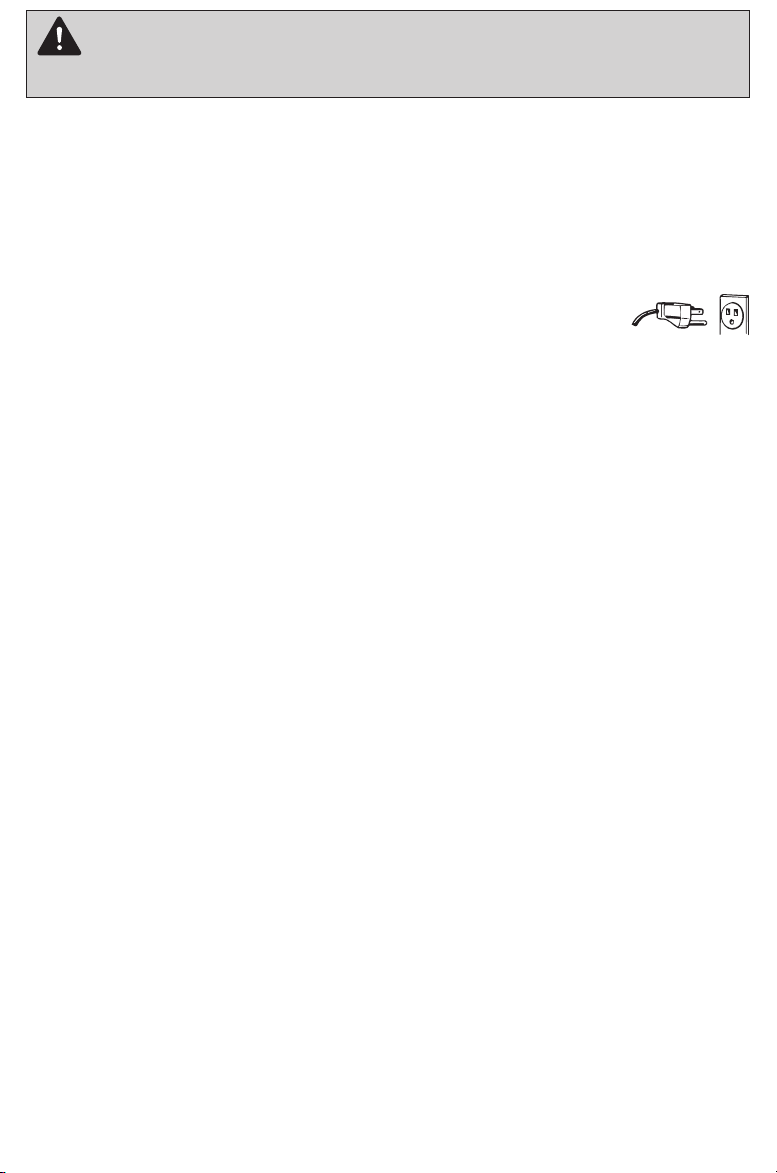
• Plug into properly installed and grounded 3 prong outlet.
• do not remove ground prong.
• do not use an adapter.
WaRninG
installation and grounding
instructions
IP3516_39Y00AP_33_110630:IP3516_39Y00AP_00_110316.qxd 2011-6-30 Jerry 上上16:55 Page 4
5
Power supply
1. A short power-supply cord is provided to reduce the risks resulting from becoming
entangled in or tripping over a longer cord.
2. Longer cord sets or extension cords are available and may be used if care is exercised
in their use. do not let cord hang over edge of a table or counter.
3. If a long cord or extension cord is used, (1) the marked electrical rating of the cord set
or extension cord should be at least as great as the electrical rating of the appliance, (2)
the extension cord must be a grounding-type 3-wire cord, and (3) the longer cord
should be arranged so that it will not drape over the counter top or table-
top where it can be pulled on by children or tripped over accidentally.
Wiring requirements
The oven must be operated on a SEPARATE CIRCUIT. No other appliance should share
the circuit with the microwave oven. If it does, the branch circuit fuse may blow or the cir-
cuit breaker may trip. The oven must be plugged into at least a 20 AMP, 120 VOLT, 60 hz
GROUNDED OUTLET. Where a standard two-prong outlet is encountered, it is the
personal responsibility and obligation of the consumer to have it replaced with a properly
grounded three-prong outlet. The VOLTAGE used must be the same as specified on this
microwave oven (120 V, 60 hz). Using a higher voltage is dangerous and may result in a
fire or oven damage. Using a lower voltage will cause slow cooking. Panasonic is NOT
responsible for any damages resulting from the use of the oven with any voltage other
than specified.
tv / radio interference
1. Operation of the microwave oven may cause interference to your radio, TV or similar
equipment.
2. When there is interference, it may be reduced or eliminated by taking the following
measures:
(a) Place the radio, TV, etc. away from the microwave oven as far as possible.
(b) Use a properly installed antenna to obtain stronger signal reception.
(c) Clean door and sealing surfaces of the oven. (See Care and Cleaning of Your
Microwave Oven)
installation and grounding
instructions
(continued)
IP3516_39Y00AP_33_110630:IP3516_39Y00AP_00_110316.qxd 2011-6-30 Jerry 上上16:55 Page 5
6
Follow These Safety Precautions When Cooking in Your Oven.
iMPortant
Proper cooking depends upon the power, the time setting and quantity of
food. if you use a smaller portion than recommended but cook at the time
for the recommended portion, fire could result.
1) hoMe canning / steriliZing / drying foods /
sMall quantities of foods
• do not use your oven for home canning. Your oven cannot maintain the food
at the proper canning temperature. The food may be contaminated and then
spoil.
• do not use the microwave oven to sterilize objects (baby bottles, etc.). It is
difficult to keep the oven at the high temperature needed for sterilization.
• do not dry meats, herbs, fruits or vegetables in your oven. Small quantities
of food or foods with low moisture content can dry out, scorch or catch on fire if
overheated.
2) PoPcorn
Popcorn may be popped in a microwave oven corn popper. Microwave pop-
corn which pops in its own package is also available. Follow popcorn manu-
facturers’ directions and use a brand suitable for the cooking power of your
microwave oven.
caution: When using pre-packaged microwave popcorn, you can follow
recommended package instructions or use the popcorn pad (refer to page 13).
Otherwise, the popcorn may not pop adequately or may ignite and cause a
fire. Never leave oven unattended when popping popcorn. Allow the popcorn
bag to cool before opening, always open the bag facing away from your face
and body to prevent steam burns.
3) deeP fat frying
• do not deep fat fry in your microwave oven. Cooking oils may burst into
flames and may cause damage to the oven and perhaps result in burns.
Microwave utensils may not withstand the temperature of the hot oil, and can
shatter or melt.
4) foods With nonPorous sKins
• do not cooK/reheat Whole eggs, With or Without the shell.
Steam buildup in whole eggs may cause them to explode, and possibly dam-
age the oven or cause injury. Reheating SLICED hard-boiled eggs and cooking
SCRAMBLED eggs is safe.
• Potatoes, apples, whole squash and sausages are examples of foods with
nonporous skins. These types of foods must be pierced before microwave
cooking to prevent them from exploding.
caution: Cooking dry or old potatoes can cause fire.
safety Precautions
IP3516_39Y00AP_33_110630:IP3516_39Y00AP_00_110316.qxd 2011-6-30 Jerry 上上16:55 Page 6

7
5) glass tray / cooKing containers / foil
• Cooking containers get hot during microwaving. heat is transferred from the
hOT food to the container and the Glass Tray. Use pot holders when removing
containers from the oven or when removing lids or plastic wrap covers from
cooking containers, to avoid burns.
• The Glass Tray will get hot during cooking. It should be allowed to cool before
handling or before paper products, such as paper plates or microwave popcorn
bags, are placed in the oven for microwave cooking.
• When using foil in the oven, allow at least 1-inch (2.5 cm) of space between
foil and interior oven walls or door.
• Dishes with metallic trim should not be used, as arcing may occur.
6) PaPer toWels / cloths
• do not use paper towels or cloths which contain a synthetic fiber woven into
them. The synthetic fiber may cause the towel to ignite. Use paper toweling
under supervision.
7) broWning dishes / oven cooKing bags
• Browning dishes or grills are designed for microwave cooking only. Always fol-
low instructions provided by the manufacturer. do not preheat browning dish
more than 6 minutes.
• If an oven cooking bag is used for microwave cooking, prepare according to
package directions. do not use a wire twist-tie to close bag, instead use
plastic ties, cotton string or a strip cut from the open end of the bag.
8) therMoMeters
• do not use a conventional meat thermometer in your oven. Arcing may
occur. Microwave safe thermometers are available for both meat and candy.
9) baby forMula / baby food
• do not heat baby formula or baby food in the microwave oven. The glass jar
or surface of the food may appear warm while the interior can be so hot as to
burn the infant’s mouth and esophagus.
10) reheating Pastry Products
• When reheating pastry products, check temperatures of any fillings before eat-
ing. Some foods have fillings which heat faster and can be extremely hot, while
the surface remains warm to the touch (ex. Jelly Donuts).
11) general oven usage guidelines
• do not use the oven for any purpose other than the preparation of food.
safety Precautions
(continued)
IP3516_39Y00AP_33_110630:IP3516_39Y00AP_00_110316.qxd 2011-6-30 Jerry 上上16:55 Page 7
8
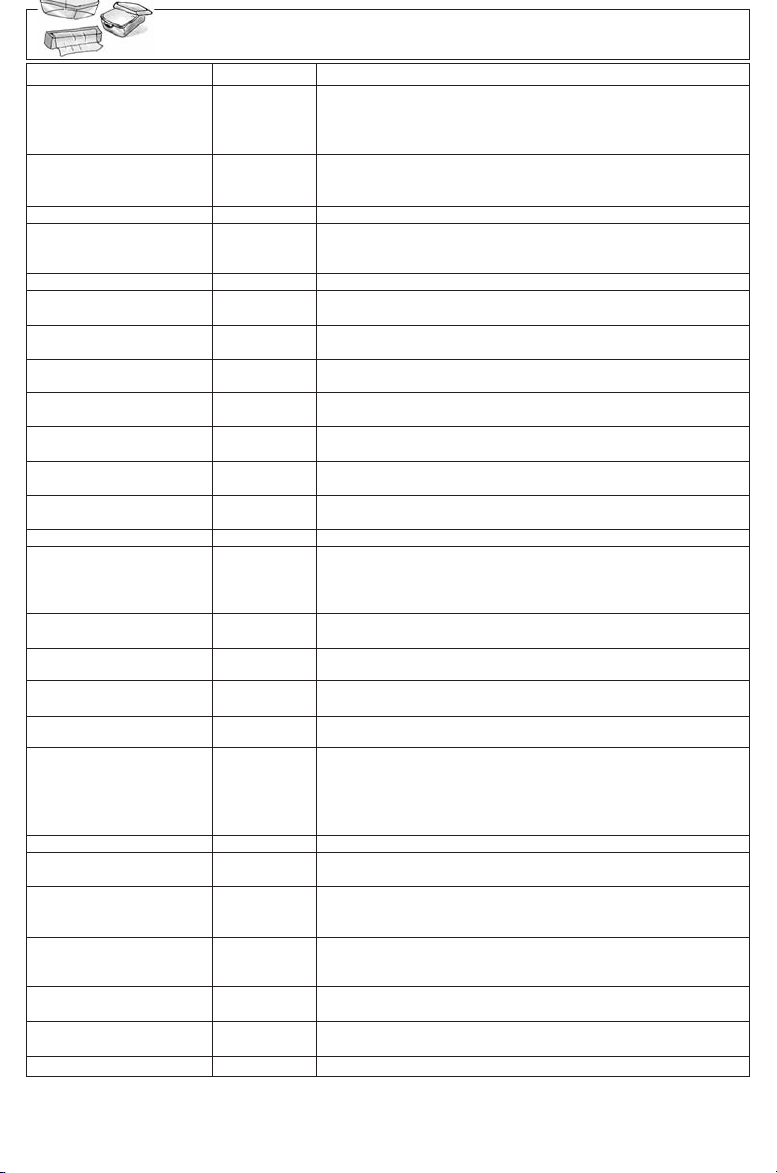
cookware guide
iteM MicroWave coMMents
Yes for Small strips of foil can be molded around thin parts of
Aluminum Foil Shielding meat or poultry to prevent overcooking. Arcing can occur
only if foil is too close to oven wall or door and damage to your
oven will result.
Browning dishes are designed for microwave cooking
Browning Dish Yes only. Check browning dish information for instructions
and heating chart. Do not preheat for more than 6 minutes.
Brown paper bags No May cause a fire in the oven.
Dinnerware: Check manufacturers' use and care directions for use in
Labeled Yes microwave heating. Some dinnerware may state on the
“Microwave Safe” back of the dish, “Oven-Microwave Safe”.
Unlabeled Dinnerware ? Use container test below.
Disposable polyester Yes Some frozen foods are packaged in these dishes. Can be
Paperboard Dishes purchased in grocery stores.
Fast Food Carton
No Metal handle may cause arcing.
with Metal handle
Frozen Dinner Tray
No Metal can cause arcing and damage to your oven.
Metal
Frozen Dinner Tray
Yes heat only 1 tray in the oven at one time.
Microwave safe
Glass Jars No
Most glass jars are not heat resistant. Do not use for
cooking or reheating.
heat Resistant Oven
Yes
Ideal for microwave cooking and browning.
Glassware & Ceramics (See container test below)
Metal Bakeware
No
Not recommended for use in microwave ovens. Metal can
cause arcing and damage to your oven.
Metal Twist-Ties No May cause arcing which could cause a fire in the oven.
Follow manufacturers' directions. Close bag with the nylon
tie provided, a strip cut from the end of the bag, or a piece
Oven Cooking Bag Yes
of cotton string. Do not close with metal twist-tie. Make six
1
/2-inch (1 cm) slits near the closure.
Paper Plates & Cups Yes
Use to warm cooked foods, and to cook foods that require
short cooking times such as hot dogs.
Paper Towels & Napkins Yes
Use to warm rolls and sandwiches, only if labeled safe for
microwave use.
Recycled Paper Towels
No
Recycled paper products may contain impurities which may
& Napkins cause sparks.
Parchment Paper
Yes
Use as a cover to prevent spattering. Safe for use in
microwave, microwave/convection and conventional ovens.
Plastic: Should be labeled, "Suitable for Microwave heating." Check
Microwave Safe Yes, manufacturers’ directions for recommended uses.
Cookware use caution Some microwave safe plastic containers are not suitable for
cooking foods with high fat or sugar content. The heat from
hot food may cause the plastic to warp.
Plastic, Melamine No This material absorbs microwave energy. Dishes get hOT!
Plastic Foam Cups
Yes, Plastic foam will melt if foods reach a high temperature. Use
use caution to reheat foods to a low serving temperature only.
Use to cover food during cooking to retain moisture and
Plastic Wrap Yes prevent spattering. Should be labeled “Suitable for
Microwave heating”. Check package directions.
Yes,
Use only for short term reheating and to bring food to a low
Straw, Wicker, Wood
use caution
serving temperature. Wood may dry out & split or crack
when used.
Thermometers-
Yes
Use only microwave safe meat and candy thermometers.
Microwave safe
Thermometers-
No
Not suitable for use in microwave oven, will cause sparks
Conventional and get hot.
Wax paper Yes Use as a cover to prevent spattering and to retain moisture.
container test
to test a container for safe MicroWave oven use: Fill a microwave safe cup with cool water
and place it in the microwave oven alongside the empty container to be tested; heat one (1) minute at P10
(high). If the container is microwave oven safe (transparent to microwave energy), the empty container
should remain comfortably cool and the water should be hot. If the container is hot, it has absorbed some
microwave energy and should NOT be used. This test cannot be used for plastic containers.
IP3516_39Y00AP_33_110630:IP3516_39Y00AP_00_110316.qxd 2011-6-30 Jerry 上上16:55 Page 8
9
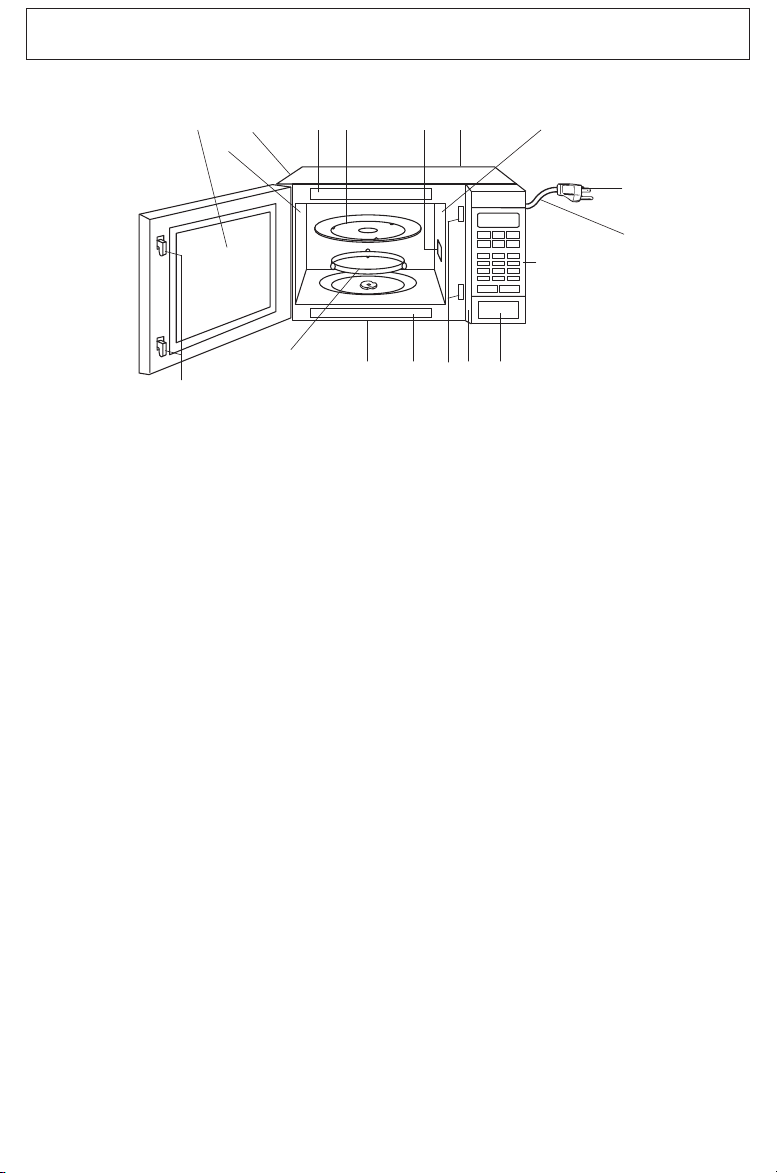
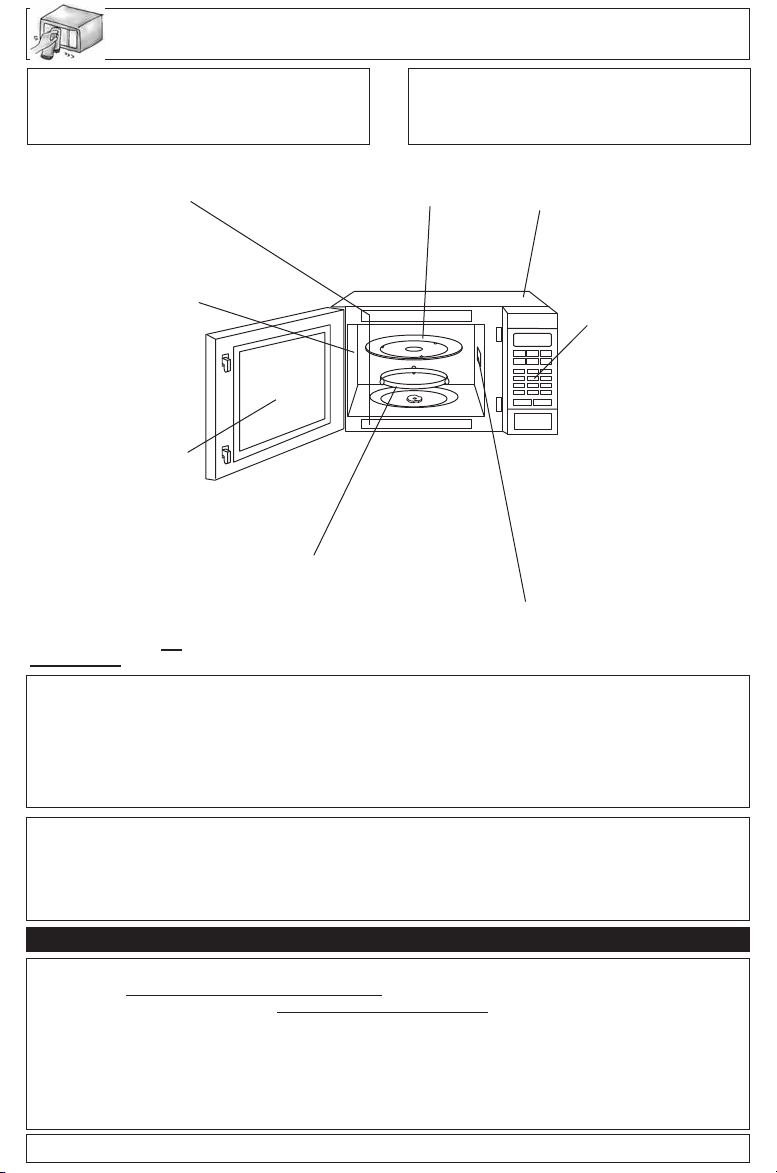
oven components diagram
q external air vent
w internal air vent
e door safety lock system
r exhaust air vent
t control Panel
y identification Plate
u glass tray
i roller ring
o heat/vapor barrier film
(do not remove)
a Waveguide cover
(do not remove)
s door release button
d Warning label
f Menu label
g Power supply cord
h Power supply Plug
do
r
u a q
w
t
h
r f ye s
i
e
g
q
IP3516_39Y00AP_33_110630:IP3516_39Y00AP_00_110316.qxd 2011-6-30 Jerry 上上16:55 Page 9
10
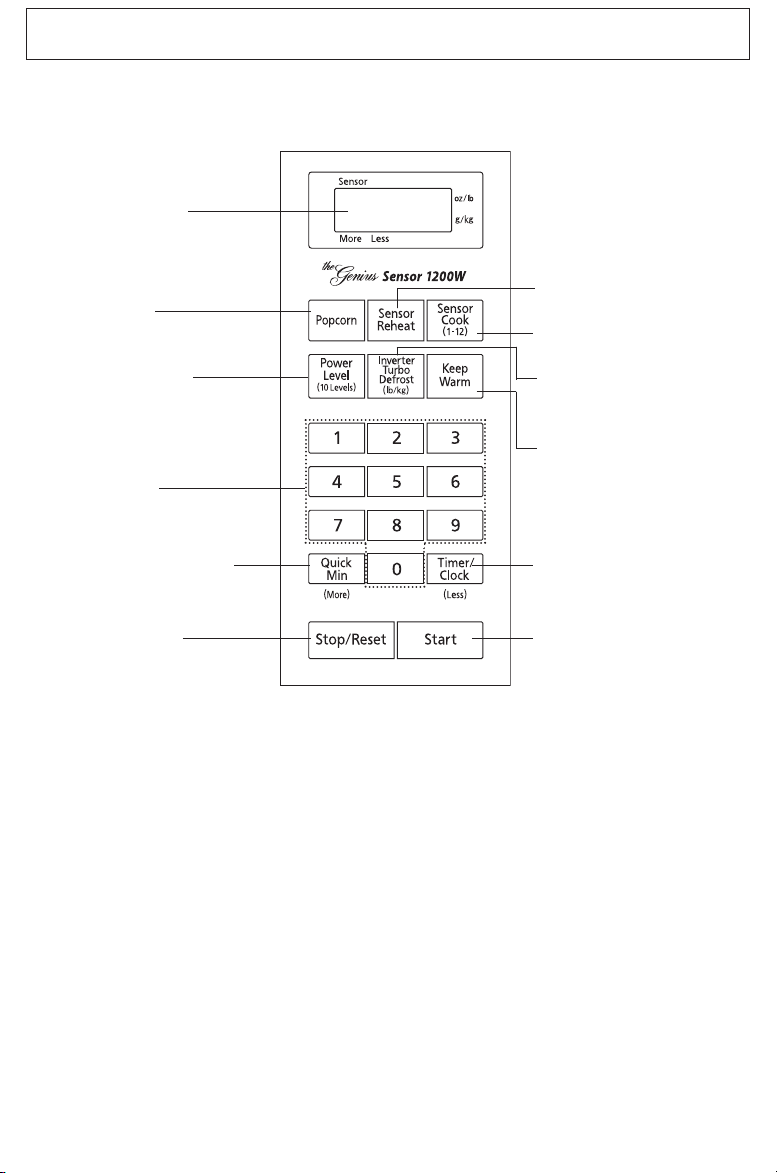
control Panel
beep sound:
When a pad is pressed correctly, a beep will be heard.
If a pad is pressed and no beep is heard, the unit did not or cannot accept the instruction.
When operating, the oven will beep twice between programmed stages. At the end of any
complete program, the oven will beep 5 times.
note:
If no operation after cooking program setting, 6 minutes later, the oven will automatically
cancel the cooking program. The display will return to clock or colon display.
Popcorn Pad
(* page 13)
quick Min (More) Pad
(* page 12, 13)
Power level Pad
(* page 12)
Number Pads
sensor reheat Pad
(* page 16)
Keep Warm Pad
(* page 12)
sensor cook Pad
(* page 16)
timer/clock (less) Pad
(* page 11, 13, 19)
inverter turbo
defrost Pad
(* page 14)
display Window
start Pad
stop/reset Pad
before cooking: One tap
clears all your instructions.
during cooking: One tap
temporarily stops the cooking
process. Another tap cancels
all your instructions, and time
of day or colon appears in
the display Window.
After cooking program
setting, one tap allows
oven to begin functioning.
If door is opened or
stop/reset Pad is
pressed once during oven
operation, start Pad must
be pressed again to
restart oven.
*The control panels of
NN-SN651B/SN651W/
SN661S/SN671S have
same key layout.
IP3516_39Y00AP_33_110630:IP3516_39Y00AP_00_110316.qxd 2011-6-30 Jerry 上上16:55 Page 10
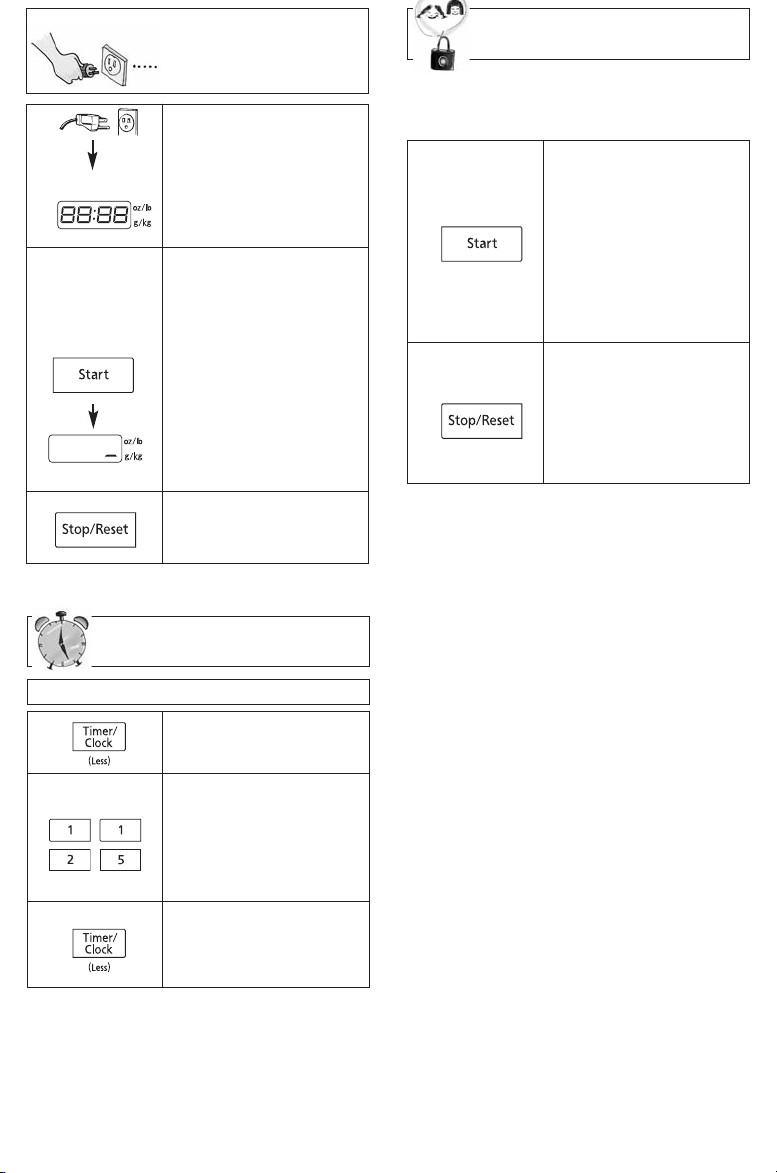
11
child safety lock
setting the clock
example: to set 11:25 a.m. or p.m.
1.
• Press timer/clock twice.
Colon flashes.
2.
• Enter time of day using
the number pads.
Time appears in
the display window;
colon continues
flashing.
3.
• Press
timer/clock once
.
Colon stops flash-
ing; time of day is
entered.
notes:
1. To reset the clock, repeat step 1-3.
2. The clock will retain the time of day as
long as the oven is plugged in and
electricity is supplied.
3. Clock is a 12-hour display.
4. Oven will not operate while colon is
flashing.
This feature prevents the electronic oper-
ation of the oven until cancelled. It does
not lock the door.
note:
You can set Child Lock feature when the
display shows a colon or time of day.
to set:
• Press start 3 times.
“Child” appears in the
display window.
"Child" continues to
be displayed until
Child Lock is can-
celled. Any pad
may be pressed but
the microwave will
not start.
to cancel:
• Press stop/reset 3
times.
The display will
return to colon or
time of day when
Child Lock has
been cancelled.
1.
• Plug into a properly
grounded electrical
outlet.
The oven automatical-
ly defaults to the impe-
rial measure system
(oz/lb).
2.
• Press start to convert
to metric. Verify your
selection in the dis-
play window.
3.
• Press stop/reset.
Colon appears in
the display window.
Display Window
If you wish to
use metric
system (g/kg):
starting to use
your oven!
IP3516_39Y00AP_33_110630:IP3516_39Y00AP_00_110316.qxd 2011-6-30 Jerry 上上16:55 Page 11
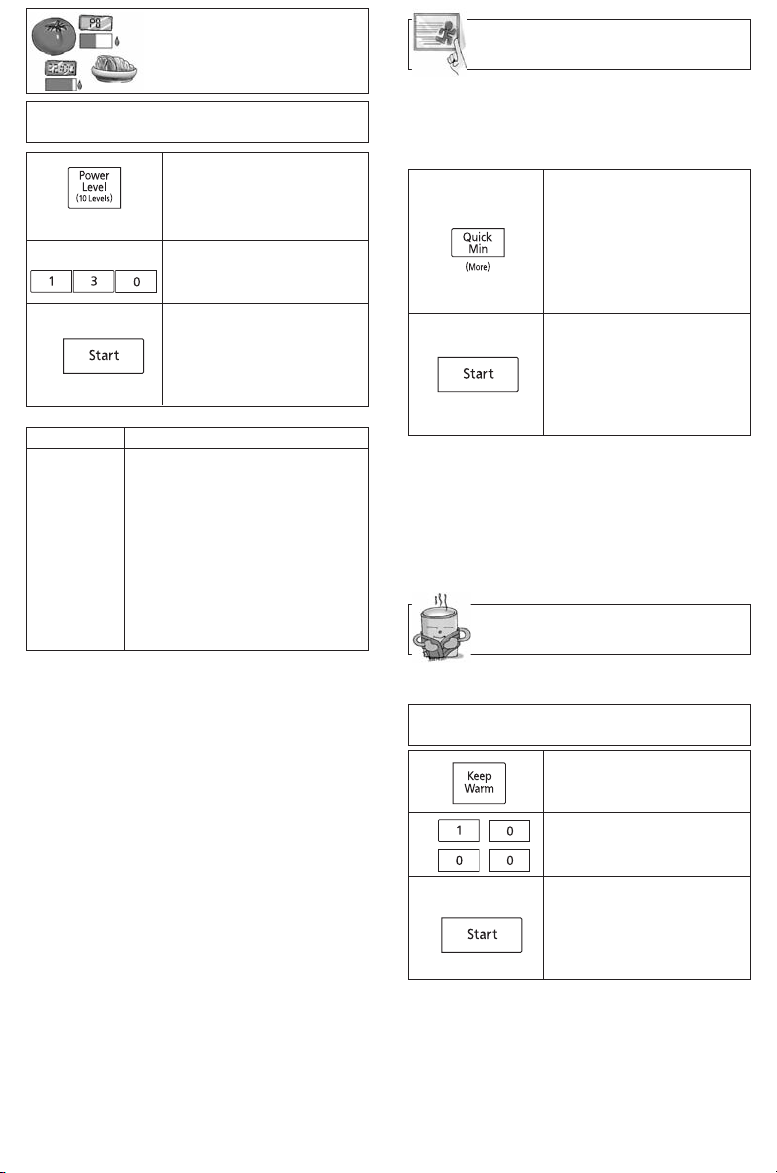
12
selecting Power
& cook time
notes:
1. For more than one stage cooking, repeat
steps 1 and 2 for each stage of cooking
before pressing start Pad. The maxi-
mum number of stages for cooking is 3.
When operating, two beeps will sound
between each stage. Five beeps will
sound at the end of the entire sequence.
2. When selecting P10 (hIGh) power for
the first stage, you may begin at step 2.
3. When selecting P10 (hIGh) power, the
maximum programmable time is 30 min-
utes. For other power levels, the maxi-
mum time is 99 minutes and 99 sec-
onds.
4. For reheating, use P10 (hIGh) for liq-
uids, P7 (MED-hIGh) for most foods and
P6 (MEDIUM) for dense foods.
5. For defrosting, use P3 (MED-LOW).
do not over cooK. This oven requires
less time to cook than an older unit. Over
cooking will cause food to dry out and may
cause a fire. A microwave oven’s cooking
power tells you the amount of microwave
power available for cooking.
example: to cook at P 6 (MediuM)
power for 1 minute 30 seconds
1.
• Press Power level
until the desired
power level appears
in the display window.
2.
• Set Cooking Time
using number pads.
3.
• Press start.
Cooking will start.
The time in the
display window will
count down.
Press 5 times.
Press
once
twice
3 times
4 times
5 times
6 times
7 times
8 times
9 times
10 times
Power Level
P10 (hIGh)
P9
P8
P7 (MED-hIGh)
P6 (MEDIUM)
P5
P4
P3 (MED-LOW)/DEFROST
P2
P1 (LOW)
quick Min feature
This feature allows you to set or add
cooking time in 1 minute increments up to
10 minutes.
to set cooking time:
notes:
1. If desired, you can use other power
levels. Select desired power level
before setting cooking time.
2. After setting the time by quick Min
Pad, you cannot use Number Pads.
3. quick Min Pad can be used to add
more time during manual cooking.
1.
• Press quick Min until
the desired cooking
time (up to 10 min-
utes) appears in the
display window.
Power Level is pre-set
at P10.
2.
• Press start.
Cooking begins and
the time will count
down. At the end of
cooking, 5 beeps
sound.
Keep Warm feature
This feature will keep food warm for up to
30 minutes after cooking.
example: to keep 2 cups of gravy warm
for 10 minutes
1.
• Press Keep Warm.
2.
• Set warming time
using number pads,
up to 30 minutes.
3.
• Press start.
Keep Warm will
start. The time in
the display window
will count down.
note:
Keep Warm can be programmed as the
final stage after cook time/s have been
manually entered. It cannot be used in
combination with sensor or auto features.
IP3516_39Y00AP_33_110630:IP3516_39Y00AP_00_110316.qxd 2011-6-30 Jerry 上上16:55 Page 12
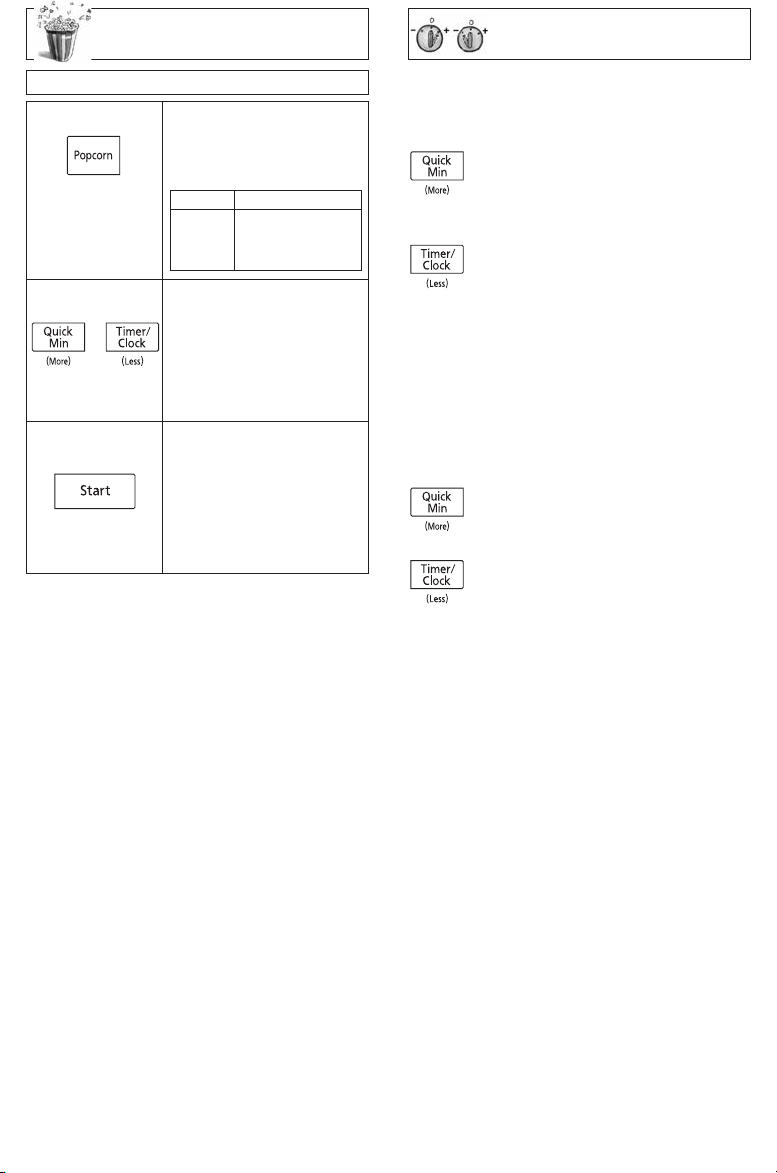
13
More/less feature
Popcorn feature
example: to pop 3.5 oz. of popcorn
1.
• Press Popcorn until
the desired size
appears in the display
window.
2.
• (see More/less
Feature.)
(* page 13)
3.
• Press start.
After several
seconds, cooking
time appears in the
display window and
begins to count
down.
Press once
Press
once
twice
3 times
Weight
3.5 oz. (99 g)
3.0 oz. (85 g)
1.75 oz. (50 g)
notes on PoPcorn feature:
1. Pop one bag at a time.
2. Place bag in oven according to manu-
facturers’ directions.
3. Start with popcorn at room tempera-
ture.
4. Allow popped corn to sit unopened for
a few minutes.
5. Open bag carefully to prevent burns,
because steam will escape.
6. Do not reheat unpopped kernels or
reuse bag.
note:
If popcorn is of a different weight than list-
ed, follow instructions on popcorn pack-
age. never leave the oven unattended.
If popping slows to 2 to 3 seconds
between pops, stop oven. overcooking
can cause fire.
reMarKs:
When popping multiple bags one right
after the other, the cooking time may vary
slightly. This does not affect the popcorn
results.
Optional
or
for Popcorn:
By using the More/less Pad, the programs
can be adjusted to cook popcorn for a
longer or shorter time if desired.
: Adds time
More 1 = Adds Approx. 10 secs.
More 2 = Adds Approx. 20 secs.
: Subtracts time
Less 1 = Subtracts Approx. 10 secs.
Less 2 = Subtracts Approx. 20 secs.
Press More/less pad before pressing start.
for sensor reheat/cook:
Preferences for food doneness vary with
each individual. After having used the
sensor reheat/cook feature a few times,
you may decide you would prefer your food
cooked to a different doneness.
: Adds time
More = Adds Approx. 10% time
: Subtracts time
Less = Subtracts Approx. 10% time
Press More/less pad before pressing start.
IP3516_39Y00AP_33_110630:IP3516_39Y00AP_00_110316.qxd 2011-6-30 Jerry 上上16:55 Page 13
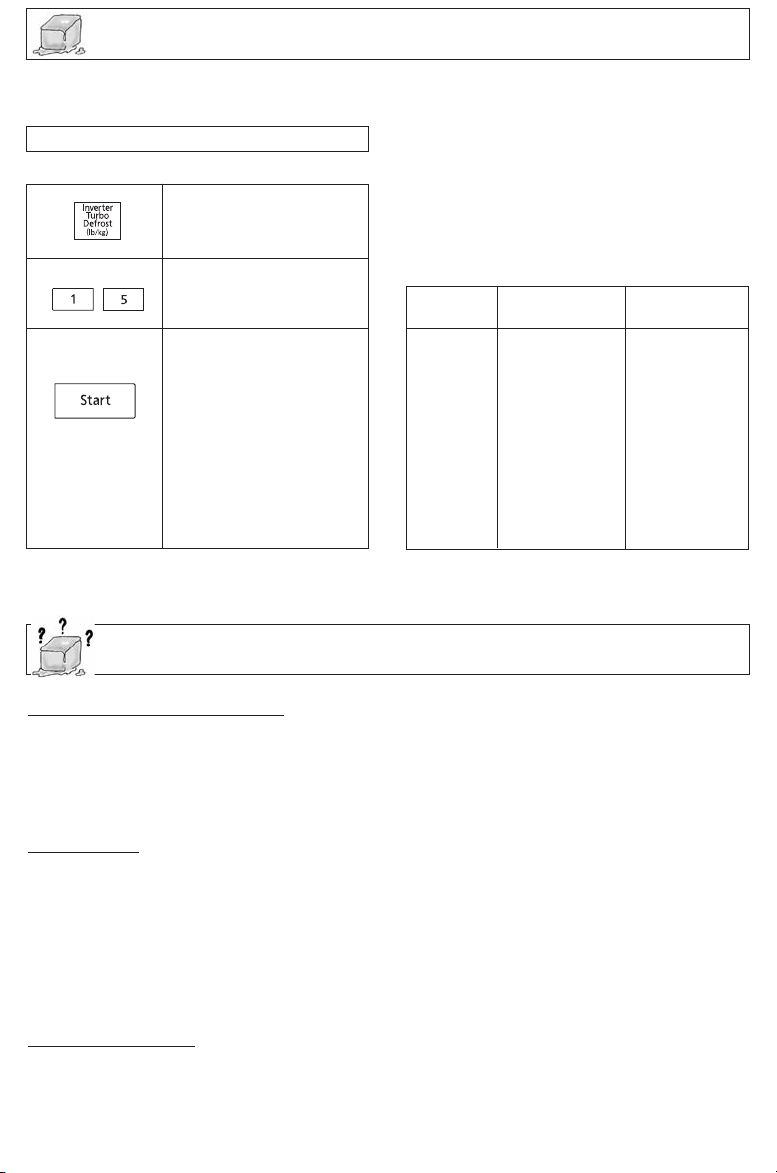
14
inverter turbo defrost feature
This feature allows you to defrost foods such as: meat, poultry and seafood simply by
entering the weight.
Place food on microwave safe dish.
example: to defrost 1.5 pounds of meat
1.
• Press inverter turbo
defrost.
2.
• Enter weight of the
food using the num-
ber pads.
3.
• Press start.
Defrosting will start.
The time will count
down. Larger weight
foods will cause a sig-
nal midway through
defrosting. If 2 beeps
sound, turn over,
rearrange foods or
shield with aluminum
foil.
conversion chart:
Follow the chart to convert ounces or
hundredths of a pound into tenths of a
pound. To use Inverter Turbo Defrost,
enter the weight of the food in lbs. (1.0)
and tenths of a lb. (0.1). If a piece of
meat weighs 1.95 lbs. or 1 lb. 14 oz.,
enter 1.9 lbs.
Ounces
0
1 - 2
3 - 4
5
6 - 7
8
9 - 10
11 - 12
13
14 - 15
hundredths
of a Pound
.01 - .05
.06 - .15
.16 - .25
.26 - .35
.36 - .45
.46 - .55
.56 - .65
.66 - .75
.76 - .85
.86 - .95
Tenths of
a Pound
0.0
0.1
0.2
0.3
0.4
0.5
0.6
0.7
0.8
0.9
defrosting tips & techniques
Preparation for freezing:
1. Freeze meats, poultry, and fish in packages with only 1 or 2 layers of food. Place
wax paper between layers.
2. Package in heavy-duty plastic wraps, bags (labeled “For Freezer”), or freezer paper.
3. Remove as much air as possible.
4. Seal securely, date, and label.
to defrost:
1. Remove wrapper. This helps moisture to evaporate. Juices from food can get hot and
cook the food.
2. Set food in microwave safe dish.
3. Place roasts fat-side down. Place whole poultry breast-side down.
4. Select power and minimum time so that items will be under-defrosted.
5. Drain liquids during defrosting.
6. Turn over (invert) items during defrosting.
7. Shield edges and ends if needed. (See Cooking Techniques).
after defrosting:
1. Large items may be icy in the center. Defrosting will complete during STANDING TIME.
2. Let stand, covered, following stand time directions on page 15.
3. Rinse foods indicated in the chart.
4. Items which have been layered should be rinsed separately or have a longer stand time.
note: The maximum weight for Inverter Turbo Defrost is 6 lbs. (3 kg).
IP3516_39Y00AP_33_110630:IP3516_39Y00AP_00_110316.qxd 2011-6-30 Jerry 上上16:55 Page 14
15
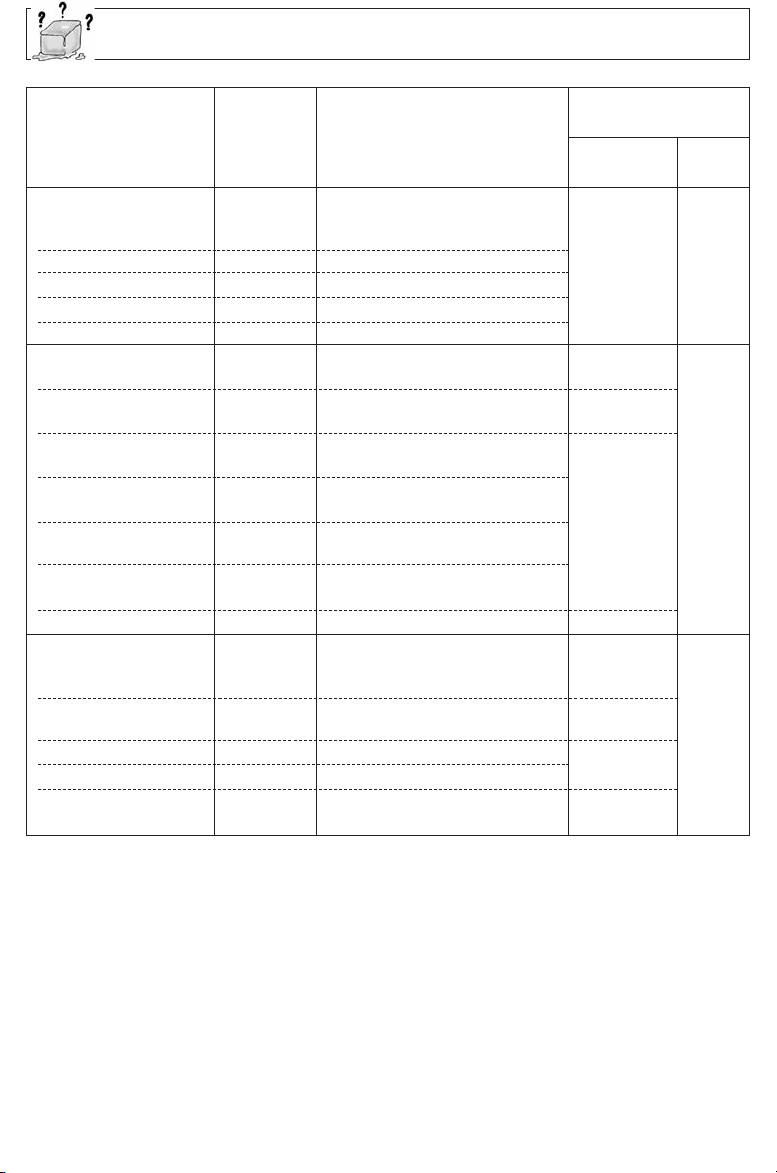
defrost after defrosting
food tiMe at P3 during defrosting
mins (per lb)
stand time
rinse
(cold water)
fish and seafood
[up to 3 lbs. (1.4 kg)]
Crabmeat 6 Break apart/Rearrange
Fish Steaks 4 to 6 Turn over
5 min. YES
Fish Fillets 4 to 6 Turn over/Rearrange/Shield ends
Sea Scallops 4 to 6
Break apart/Remove defrosted pieces
Whole fish 4 to 6 Turn over
Meat Turn over/Remove defrosted
Ground Meat 4 to 5 portion/Shield edges
10 min.
Roasts 4 to 8 Turn over/Shield ends and
30 min. in refrig.
[2
1
/2-4 lbs. (1.1-1.8 kg)] defrosted surface
Chops/Steak 6 to 8 Turn over/Rearrange/Shield ends
and defrosted surface
Ribs/T-bone 6 to 8 Turn over/Rearrange/Shield ends
and defrosted surface
5 min. NO
Stew Meat 4 to 8 Break apart/Rearrange/
Remove defrosted pieces
Liver (thinly sliced) 4 to 6 Drain liquid/Turn over/
Separate pieces
Bacon (sliced) 4 Turn over - - - -
Poultry
Chicken, Whole 4 to 6 Turn over/Shield
20 min. in refrig.
[up to 3 lbs. (1.4 kg)]
Cutlets 4 to 6 Break apart/Turn over/
Remove defrosted Pieces
5 min.
YES
Pieces 4 to 6 Break apart/Turn over/Shield
Cornish hens 6 to 8 Turn over/Shield
10 min.
Turkey Breast 6 Turn over/Shield
20 min. in refrig.
[5-6 lbs. (2.3-2.7 kg)]
defrosting tips & technique
s
(continued)
IP3516_39Y00AP_33_110630:IP3516_39Y00AP_00_110316.qxd 2011-6-30 Jerry 上上16:55 Page 15
16
sensor reheat
feature
note:
casseroles - Add 3 to 4 tablespoons of liquid,
cover with lid or vented plastic wrap. Stir when
time appears in the display window.
canned foods - Empty contents into casse-
role dish or serving bowl, cover dish with lid or
vented plastic wrap. After reheating, let stand
for a few minutes.
Plate of food - Arrange food on plate; top with
butter, gravy, etc. Cover with lid or vented
plastic wrap. After reheating, let stand for a
few minutes.
do not use sensor reheat:
1. To reheat bread and pastry products. Use
manual power and time for these foods.
2. For raw or uncooked foods.
3. If oven cavity is warm.
4. For beverages.
5. For frozen foods.
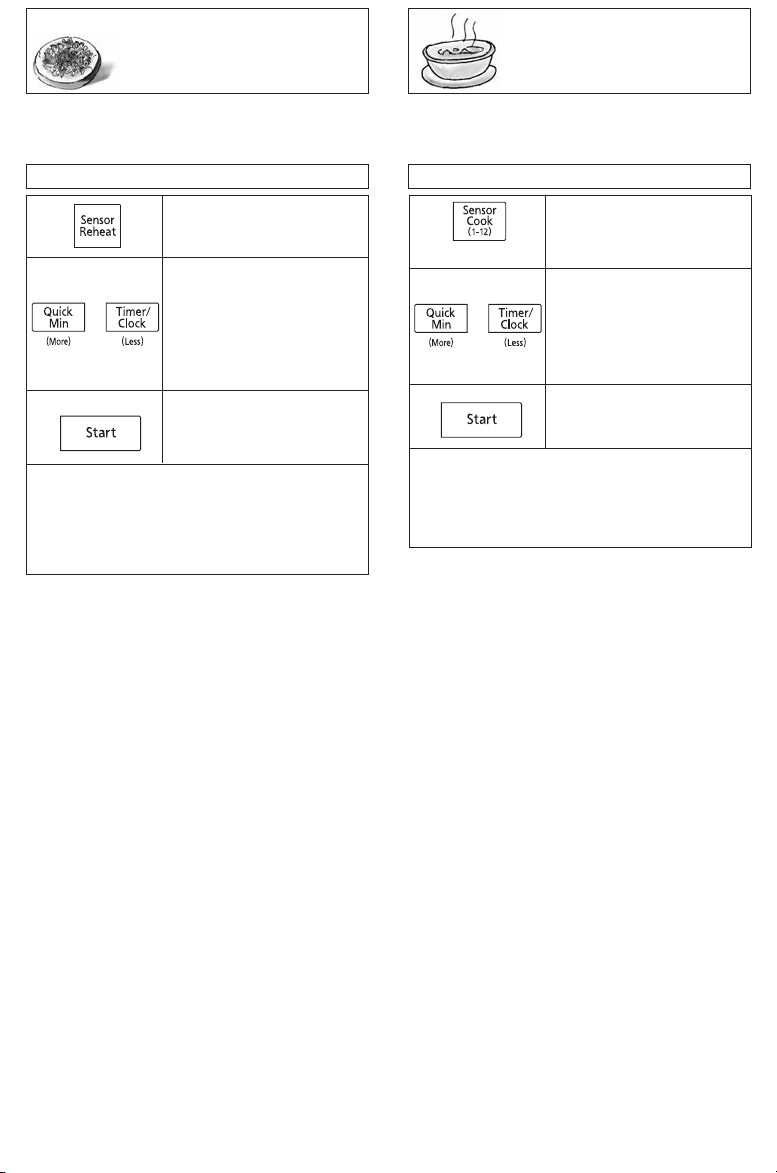
This sensor feature allows you to reheat
cooked, refrigerated food without setting
time. The oven simplifies programming.
example: to reheat a plate of food
1.
• Press sensor reheat.
2.
• (see More/less
Feature)
(*page 13)
3.
• Press start.
Cooking starts.
Cooking is complete when 5 beeps
sound. (When steam is detected by the
Genius Sensor and 2 beeps sound, the
remaining cooking time will appear in the
display window.)
for the best results with the
GENIUS SENSor, follow these
recommendations.
before Reheating/Cooking:
1. The room temperature surrounding the
oven should be below 95 °F (35 °C).
2. Food weight should exceed 4 oz. (110 g).
3. Be sure the glass tray, the outside of the
cooking containers and the inside of the
microwave oven are dry before placing
food in the oven. Residual beads of
moisture turning into steam can mislead
the sensor.
4. Cover food with lid, or with vented plastic
wrap. Never use tightly sealed plastic
containers—they can prevent steam from
escaping and cause food to overcook.
during Reheating/Cooking:
DO NOT open the oven door until 2 beeps
sound and cooking time appears on the
Display Window. Doing so will cause inac-
curate cooking since the steam from food is
no longer contained within the oven cavity.
Once the cooking time begins to count
down, the oven door may be opened to stir,
turn or rearrange foods.
after Reheating/Cooking:
All foods should have a stand time.
Optional
or
sensor cook
feature
This sensor feature allows you to cook
food without setting time. The oven simpli-
fies programming.
example: to cook frozen entrées
1.
Cooking is complete when 5 beeps
sound. (When steam is detected by the
Genius Sensor and 2 beeps sound, the
remaining cooking time will appear in the
display window.)
• Press until the desired
food number appears
in the display window.
Press 5 times
3.
• Press start.
Cooking starts.
2.
• (see More/less
Feature)
(*page 13)
Optional
or
IP3516_39Y00AP_33_110630:IP3516_39Y00AP_00_110316.qxd 2011-6-30 Jerry 上上16:55 Page 16
17
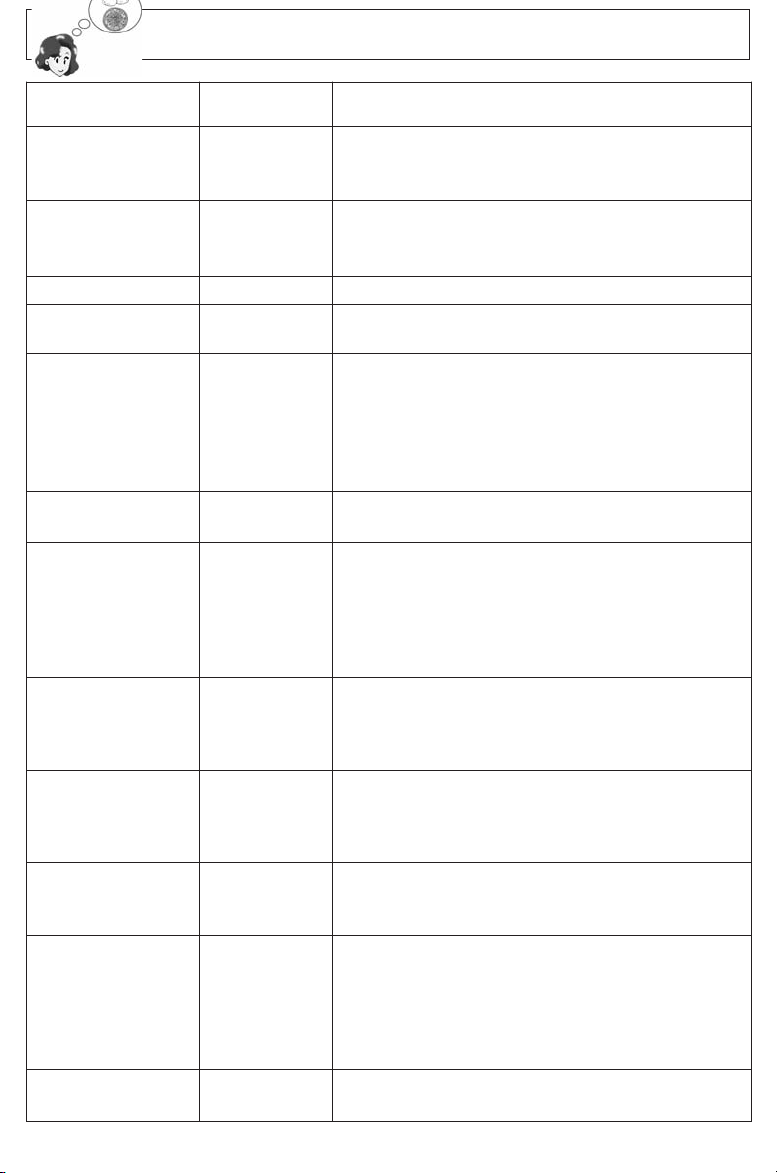
sensor cook chart
recipe serving/Weight hints
1. oatmeal
1
/2
- 1 cup
(40 - 80 g)
Place oatmeal in a microwave safe serving bowl
with no cover. Follow manufacturers’ directions for
preparation.
2. breakfast
sausage
2 - 8 links
Follow manufacturers’ directions for preparation of
pre-cooked breakfast sausage. Place in a radial
pattern.
3. omelet 2 - 4 eggs Follow basic Omelet recipe on page 18.
4. soup
1 - 2 cups
(250 - 500 ml)
Pour soup into a microwave safe serving bowl.
Cover with lid or vented plastic wrap. Stir after cooking.
5. frozen entrées
8 - 28 oz.
(220 - 800 g)
Follow manufacturers’ directions for
preparation.After 2 beeps, stir or rearrange. Be
careful when removing the film cover after cooking.
Remove facing away from you to avoid steam
burns. If additional time is needed, continue to
cook manually.
6. frozen Pizza
(single)
8 oz.
(220 g)
Follow manufacturers’ directions for preparation.
Add more time of cooking if needed.
7. Potatoes
1 - 4 potatoes
(6 - 8 oz. each)
(170 - 220 g)
Pierce each potato with a fork 6 times spacing
around surface. Place potato or potatoes around
the edge of paper-towel-lined glass tray
(Turntable), at least 1 inch (2.5 cm) apart. Do not
cover. Turn over after 2 beeps. Let stand 5 min-
utes to complete cooking.
8. fresh vegetables
4 - 16 oz.
(110 - 450 g)
All pieces should be the same size. Wash thor-
oughly, add 1 tbsp. of water per
1
/2
cup of vegeta-
bles, and cover with lid or vented plastic wrap. Do
not salt/butter until after cooking.
9. frozen vegetables
6 - 16 oz.
(170 - 450 g)
Wash thoroughly, add 1 tbsp. of water per
1
/2
cup
of vegetables, and cover with lid or vented plastic
wrap. Do not salt/butter until after cooking. (Not
suitable for vegetables in butter or sauce.)
10. frozen dinners
11 - 16 oz.
(300 - 450 g)
Follow manufacturers' directions for covering or
removing covers. Do not use frozen foods packaged
in foil trays. After 2 beeps, stir or rearrange.
11. Pasta
2 - 8 oz.
(55 - 220 g)
Place 2 oz. pasta with 3 cups hot tap water in a
microwave safe 2 qt casserole, salt and oil, if
desired, covered with lid or vented plastic wrap.
For 4 oz. pasta use 4 cups water, for 6 oz. pasta
use 6 cups water in 3 qt casserole, for 8 oz. pasta
use 7 cups water.
12. fish fillets
4 - 16 oz.
(110 - 450 g)
Arrange in a single layer. Cover with lid or vented
plastic wrap.
IP3516_39Y00AP_33_110630:IP3516_39Y00AP_00_110316.qxd 2011-6-30 Jerry 上上16:55 Page 17
18
Microwave recipes
oMelet
Basic omelet
1 tablespoon butter or margarine
2 eggs
2 tablespoons milk
salt and ground black pepper, if desired
heat butter in a microwave safe 9-inch pie
plate, 20 seconds at P10, or until melted.
Turn the plate to coat the bottom with butter.
Meanwhile, combine the remaining
ingredients in a separate bowl, beat together
and pour into the pie plate.
Cook, covered with vented plastic wrap,
using OMELET selection. Let stand 2 min-
utes. With a spatula, loosen the edges of the
omelet from the plate, fold into thirds to
serve. always use scrambled eggs.
yield: 1 serving
approx. cooking time: 4 minutes.
note: Double ingredients for a 4 egg
Omelet.
casserole
Shepherd’s Pie
1 pound lean ground beef
1
/2 cup frozen peas, thawed
1
/4 cup chopped onion
1 tablespoon gravy powder
1
/2 teaspoon curry powder
1
/4 teaspoon salt
1
/4 teaspoon ground black pepper
2 cups mashed potatoes
In a 2-Qt. casserole dish, crumble the
ground beef and cook for 5-7 minutes at P6
or until the meat is cooked, stirring twice.
Add the remaining ingredients, except for
potatoes. Stir well, and then spread the
potatoes evenly on the top. Cover with a lid
or vented plastic wrap and cook at P6 power
for 16-18 minutes.
yield: 4 servings
Macaroni and Cheese
1
/4 cup butter
2 tablespoons chopped onion
1 clove minced garlic
1
/4 cup all-purpose flour
1 teaspoon dry mustard
1 teaspoon salt
1
/4 teaspoon ground black pepper
2 cups milk
2 cups grated cheddar cheese
8 oz. (
1
/2 lb. dry weight) macaroni, cooked
and drained
1
/3 cup bread crumbs
1 teaspoon paprika
In a 2-Qt. casserole, melt the butter for
40 seconds at P10. Add onion and garlic
and cook for 1 minute at P10. Stir in flour,
mustard, salt and pepper, and gradually add
the milk. Cook for 3-4 minutes at P10 until
sauce thickens, stirring once. Add the
cheddar cheese, stirring thoroughly. Pour
and stir the sauce into the macaroni, in a 3-
Qt. casserole.Top with bread crumbs and
paprika. Cover with lid or vented plastic
wrap. Cook at P6 power for 16-18 minutes.
yield: 6 servings
Beef and Macaroni Casserole
1 pound lean ground beef
1 small onion, chopped
1
/2 green bell pepper, chopped
1 cup chopped celery
2 15 oz. cans tomato sauce
1
1
/4 cups water
1 cup uncooked elbow macaroni
1 teaspoon parsley
1
/2 teaspoon salt
1
/4 teaspoon ground black pepper
1
/2 cup grated cheddar cheese
Crumble the ground beef in a 3-Qt.
casserole. Cook for 5-7 minutes at P6 or
until the meat is cooked, stirring twice.
Stir in onion, peppers and celery. Cook for
3-4 minutes at P10. Stir in the remaining
ingredients, except cheese. Cover with lid or
vented plastic wrap. Cook at P6 power for
16-18 minutes. Sprinkle with cheese. Cover
and let stand 5 minutes.
yield: 4-6 servings
Tuna Casserole
1 6 oz. can tuna, drained and flaked
4 cups cooked and drained noodles
1 10
3
/4 oz. can condensed cream of
mushroom soup
1 4 oz. can mushroom pieces and stems,
drained
1 16 oz. package frozen peas, defrosted
3
/4 cup milk
1 cup crushed potato chips
1
/2 cup grated cheddar cheese
In a 3-Qt. casserole, combine tuna,
noodles, soup, mushrooms, peas and milk;
mix well. Cover with lid or vented plastic
wrap. Cook at P6 power for 16-18 minutes.
Top with potato chips and cheese before
serving.
yield: 4-6 servings
IP3516_39Y00AP_33_110630:IP3516_39Y00AP_00_110316.qxd 2011-6-30 Jerry 上上16:55 Page 18
19
timer feature
note:
1. When each stage finishes, a two-beep
signal sounds. At the end of the pro-
gram, the oven will beep five times.
2. If the oven door is opened during Stand
Time, Kitchen Timer or Delay Time, the
time on the display will continue to
count down.
3. Stand time and Delay start cannot be
programmed before any automatic
Function. This is to prevent the starting
temperature of food from rising before
defrosting or cooking begins. A change
in starting temperature could cause
inaccurate results.
caution:
if oven lamp is lit while using the timer
feature, the oven is incorrectly pro-
gramed. stop oven immediately and
re-read instructions.
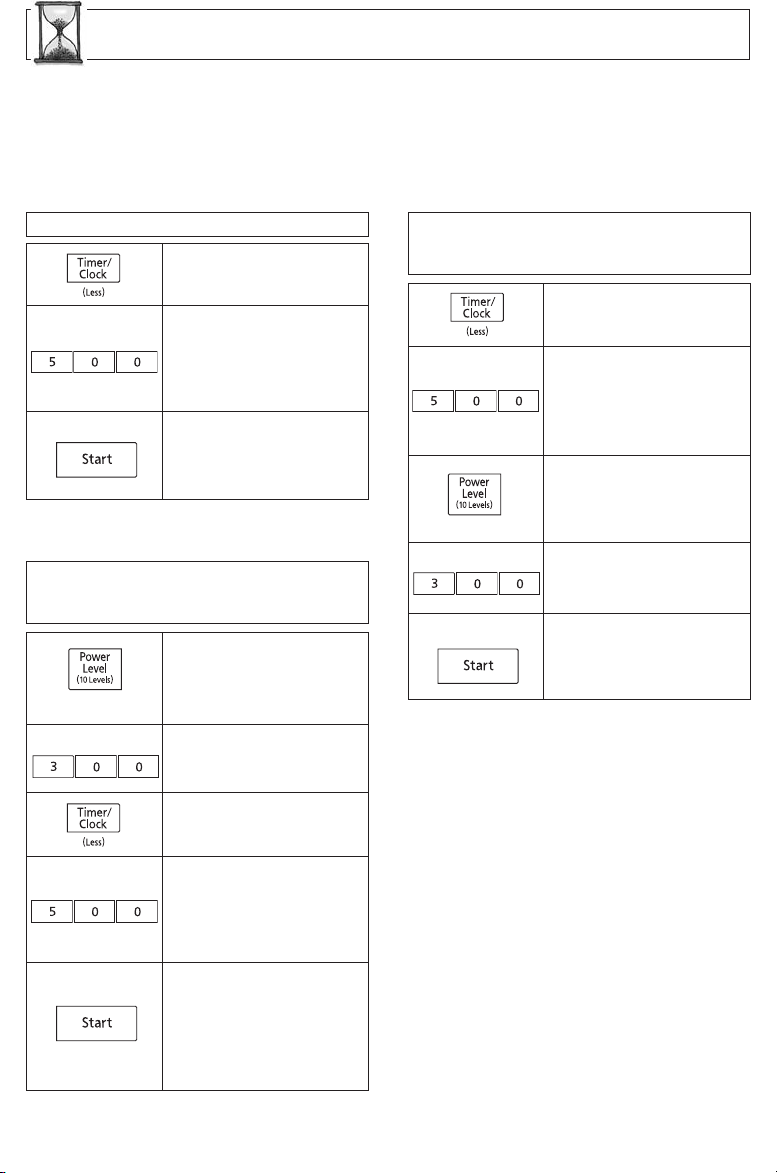
This feature allows you to program the
oven as a kitchen timer. It can also be
used to program a standing time after
cooking is completed and/or to program a
delay start.
to use as a Kitchen timer:
example: to count down 5 minutes.
1.
• Press timer/clock
once.
2.
• Set desired amount of
time using number
pads.
(up to 99 minutes and
99 seconds).
3.
• Press start.
Time will count
down without oven
operating.
to set stand time:
example: to cook at P6 power for 3
minutes, with stand time of
5 minutes.
1.
• Enter the desired
Power level (see
page 12 for directions).
• Set desired cooking
time using number
pads.
3.
2.
• Press timer/clock
once.
4.
• Set desired amount of
Stand Time using
number pads. (up to
99 minutes and 99
seconds)
5.
• Press start.
Cooking will start.
After cooking, stand
time will count down
without oven
operating.
Press 5 times
to set delay start:
example: to delay the start of cooking
for 5 minutes, and cook at P6
power for 3 minutes.
1.
• Enter the desired
Power level (see
page 12 for directions).
• Set desired cooking
time using number
pads.
3.
• Press timer/clock
once.
2.
• Enter desired amount
of delay time using
number pads. (up to
99 minutes and 99
seconds)
5.
4.
• Press start.
Delay time will
count down. Then
cooking will start.
Press 5 times
IP3516_39Y00AP_33_110630:IP3516_39Y00AP_00_110316.qxd 2011-6-30 Jerry 上上16:55 Page 19
20
Microwave shortcuts
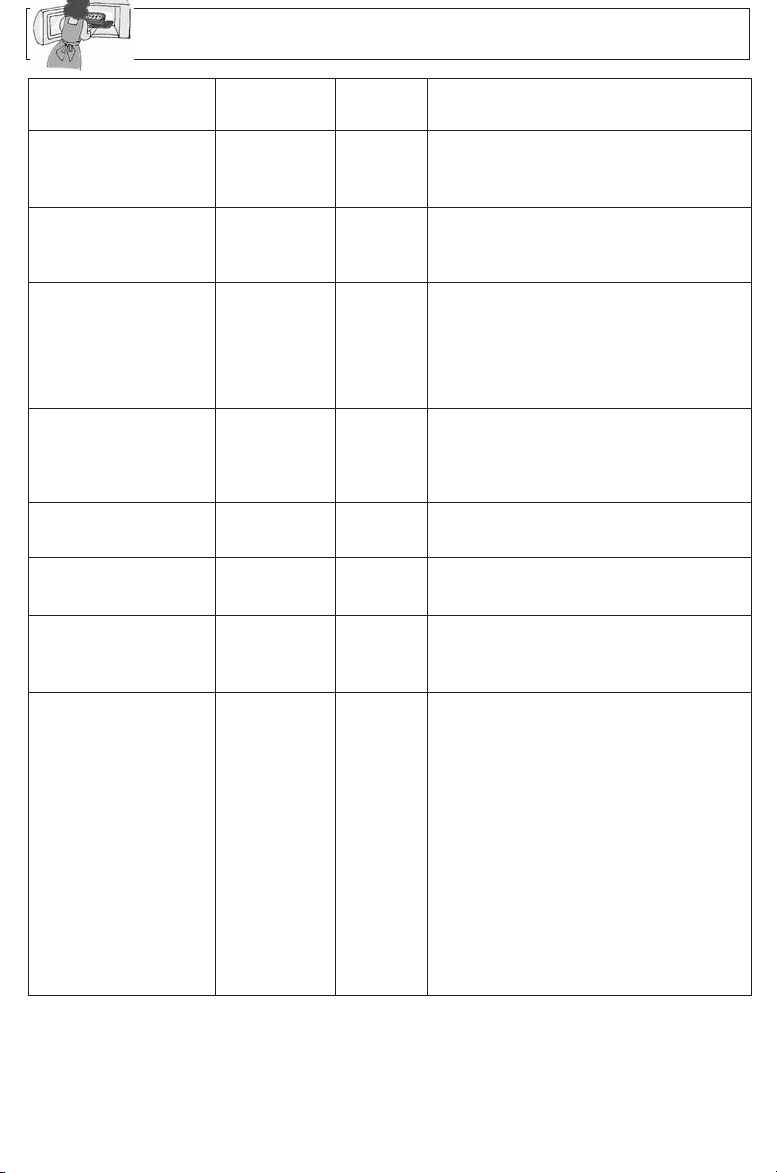
food PoWer tiMe directions
(in mins.)
To separate refrigerated
P10
30 sec. Remove wrapper and place in microwave
bacon,
(hIGh)
safe dish. After heating, use a plastic
1 pound (450 g) spatula to separate slices.
To soften brown sugar
P10
20 - 30 sec. Place brown sugar in microwave safe dish
1 cup (250 ml)
(hIGh)
with a slice of bread. Cover with lid or
plastic wrap.
To soften refrigerated butter,
P3
1 Remove wrapper and place butter in a
1 stick,
1
/4 pound (110 g)
(MED-LOW)
microwave safe dish.
To melt refrigerated butter,
P6
1
1
/2 - 2 Remove wrapper and place butter in a
1 stick,
1
/4 pound (110 g)
(MEDIUM)
microwave safe dish covered with lid or
vented plastic wrap.
To melt chocolate,
P6
1 - 1
1
/2 Remove wrapper and place chocolate
1 square, 1 oz. (28 g)
(MEDIUM)
in a microwave safe dish. After heating, stir
To melt chocolate,
P6
1 - 1
1
/2 until completely melted. NOTE: Chocolate
1
/2 cup (125 ml) chips
(MEDIUM)
holds its shape even when softened.
To toast coconut,
P10
1 Place in a microwave safe dish.
1
/2 cup (125 ml)
(hIGh)
Stir every 30 seconds.
To soften cream cheese,
P3
1 - 2 Remove wrapper and place in a
8 oz. (220 g)
(MED-LOW)
microwave safe bowl.
To brown ground beef,
P10
4 - 5 Crumble into a microwave safe colander
1 pound (450 g)
(hIGh)
set into another dish. Cover with plastic
wrap. Stir twice. Drain grease.
To cook vegetables,
Fresh
P8
3
1
/2 - 4 All pieces should be the same size. Wash
(
1
/2 lb.) thoroughly, add 1 tbsp of water per
1
/2 cup
(225 g) of vegetables, and cover with lid or vented
plastic wrap. Do not salt/butter until after
cooking.
Frozen
P8
3
1
/2 - 4 Wash thoroughly, add 1 tbsp of water per
(10 oz.)
1
/2 cup of vegetables, and cover with lid or
(280 g) vented plastic wrap. Do not salt/butter until
after cooking. (Not suitable for vegetables in
butter or sauce.)
Canned
P8
3
1
/2 - 4 Empty contents into microwave safe serving
(15 oz.) bowl. Do not cover.
(430 g)
IP3516_39Y00AP_33_110630:IP3516_39Y00AP_00_110316.qxd 2011-6-30 Jerry 上上16:55 Page 20
21
Microwave shortcuts
(continued)
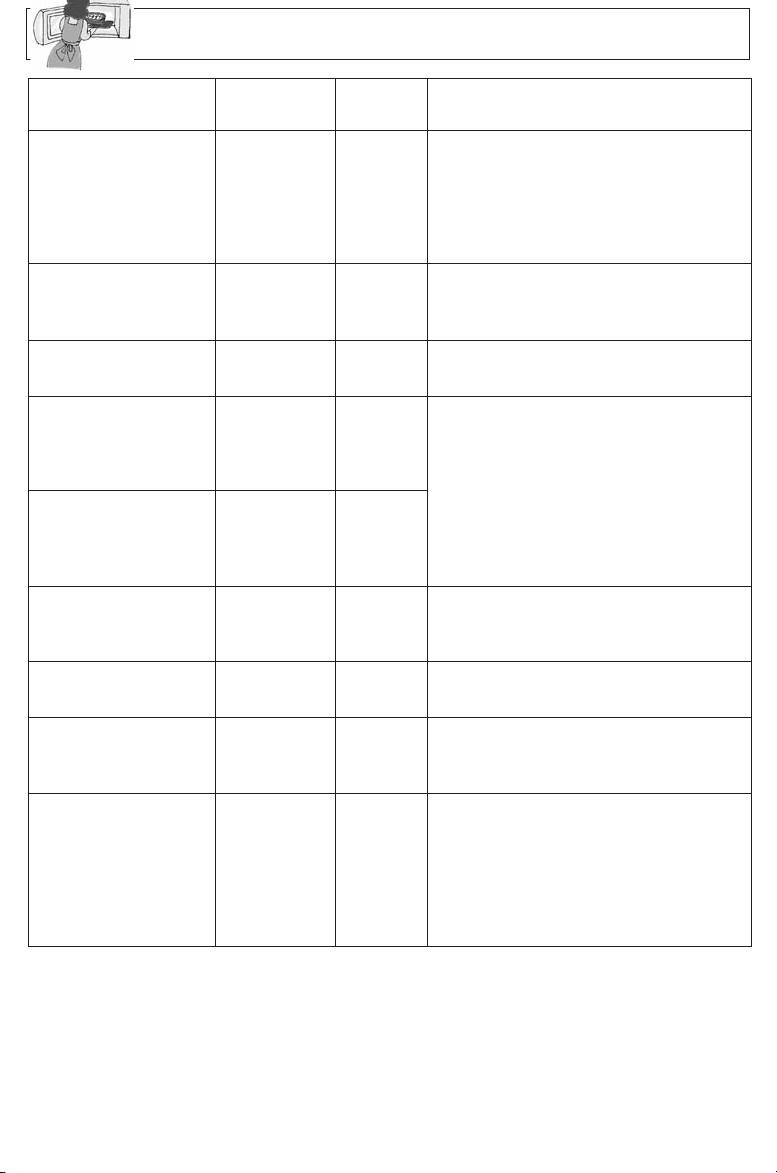
food PoWer tiMe directions
(in mins.)
To cook baked Potato, Pierce each potato with a fork 6 times
(6 - 8 oz. each) spacing around surface. Place potato or
(170 - 220 g) potatoes around the edge of paper-towel-
1
P8
3
1
/2 - 4 lined glass tray (Turntable), at least 1 inch
(2.5 cm) apart. Do not cover. Let stand 5
2
P8
6 - 7 minutes to complete cooking.
To steam hand towels - 4
P10
20 - 30 sec. Soak in water, then wring out excess.
(hIGh)
Place on a microwave safe dish.
heat. Present immediately.
To soften ice cream,
P3
1 - 1
1
/2 Check often to prevent melting.
1
/2 gallon (2 L)
(MED-LOW)
Cup of liquid
P10
to boil water, broth, etc.
(hIGh)
1 cup, 8 oz. (250 ml)
P10
1
1
/2 - 2 heated liquids can erupt if not stirred.
2 cups, 16 oz. (500 ml)
(hIGh)
2
1
/2 - 3 Do not heat liquids in microwave oven
without stirring before heating.
Cup of liquid
P7
to warm beverage,
(MED-hIGh)
1 cup, 8 oz. (250 ml)
P7
1
1
/2 - 2
2 cups, 16 oz. (500 ml)
(MED-hIGh)
2
1
/2 - 3
To roast nuts,
P10
3 - 4 Spread nuts into a 9-inch (23 cm)
1
1
/2 cups (375 ml)
(hIGh)
microwave safe pie plate.
Stir occasionally.
To toast sesame seeds,
P10
2 - 2
1
/2 Place in a small microwave safe bowl.
1
/4 cup (60 ml)
(hIGh)
Stir twice.
To skin tomatoes,
P10
30 sec. Place tomato into a microwave safe bowl
(one at a time)
(hIGh)
containing boiling water. Rinse and peel.
Repeat for each tomato.
To remove cooking odors,
P10
5 Combine 1 to 1
1
/2 cups (250 - 375 ml)
(hIGh)
water with the juice and peel of one lemon
in a 2 quart microwave safe bowl.
After water finishes boiling, wipe interior of
oven with a cloth. You can also use a
combination of several whole cloves and
1
/4
cup of vinegar with 1 cup of water.
IP3516_39Y00AP_33_110630:IP3516_39Y00AP_00_110316.qxd 2011-6-30 Jerry 上上16:55 Page 21
22
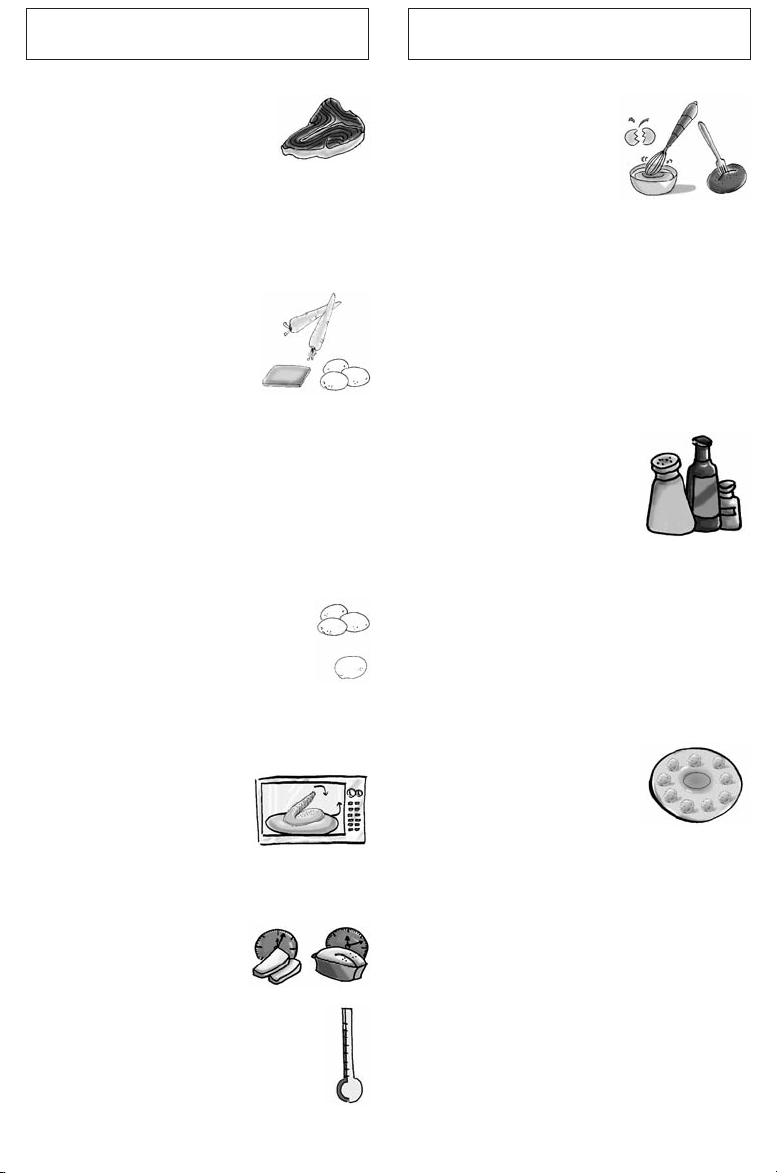
food characteristics cooking techniques
bone and fat
Both bone and fat affect cook-
ing. Bones may cause irregu-
lar cooking. Meat next to the
tips of bones may overcook
while meat positioned under a large bone,
such as a ham bone, may be under-
cooked. Large amounts of fat absorb
microwave energy and the meat next to
these areas may overcook.
density
Porous, airy foods such as
breads, cakes or rolls take
less time to cook than
heavy, dense foods such as
potatoes and roasts. When
reheating donuts or other
foods with different centers be very care-
ful. Certain foods have centers made with
sugar, water, or fat and these centers
attract microwaves (For example, jelly
donuts). When a jelly donut is heated, the
jelly can become extremely hot while the
exterior remains warm to the touch. This
could result in a burn if the food is not
allowed to cool properly in the center.
quantity
Two potatoes take longer to cook
than one potato. As the quantity of
the food decreases so does the
cooking time. Overcooking will
cause the moisture content in the
food to decrease and a fire could result.
Never leave microwave unattended while
in use.
shape
Uniform sizes heat more
evenly. The thin end of a
drumstick will cook more
quickly than the meaty
end. To compensate for irregular shapes,
place thin parts toward the center of the
dish and thick pieces toward the edge.
size
Thin pieces cook more
quickly than thick pieces.
starting temperature
Foods that are at room temperature
take less time to cook than if they
are chilled, refrigerated, or frozen.
Piercing
Foods with skins or mem-
branes must be pierced
scored or have a strip of
skin peeled before cook-
ing to allow steam to
escape. Pierce clams,
oysters, chicken livers, whole potatoes
and whole vegetables. Whole apples or
new potatoes should have a 1-inch strip
of skin peeled before cooking. Score
sausages and frankfurters. Do not
Cook/Reheat whole eggs with or without
the shell. Steam build up in whole eggs
may cause them to explode, and possibly
damage the oven or cause injury.
Reheating SLICED hard-boiled eggs and
cooking SCRAMBLED eggs is safe.
browning
Foods will not have the
same brown appearance as
conventionally cooked foods
or those foods which are
cooked utilizing a browning
feature. Meats and poultry
may be coated with browning sauce,
Worcestershire sauce, barbecue sauce or
shake-on browning sauce. To use, com-
bine browning sauce with melted butter or
margarine and brush on before cooking.
For quick breads or muffins, brown sugar
can be used in the recipe in place of
granulated sugar, or the surface can be
sprinkled with dark spices before baking.
spacing
Individual foods, such as
baked potatoes, cupcakes
and appetizers, will cook more
evenly if placed in the oven
equal distances apart. When
possible, arrange foods in a circular pattern.
IP3516_39Y00AP_33_110630:IP3516_39Y00AP_00_110316.qxd 2011-6-30 Jerry 上上16:55 Page 22
23
cooking techniques
(continued)
covering
As with conventional cooking, moisture
evaporates during microwave cooking.
Casserole lids or plastic wrap are used for a
tighter seal. When using plastic wrap, vent
the plastic wrap by folding back part of the
plastic wrap from the edge of the dish to
allow steam to escape. Loosen or remove
plastic wrap as recipe directs for stand time.
When removing plastic wrap covers, as well
as any glass lids, be careful to remove them
away from you to avoid steam burns.
Various degrees of moisture retention are
also obtained by using wax paper or paper
towels.
shielding
Thin areas of meat and poultry cook more
quickly than meaty portions. To prevent
overcooking, these thin areas can be shield-
ed with strips of aluminum foil. Wooden
toothpicks may be used to hold the foil in
place.
caution is to be exercised when
using foil. Arcing can occur if foil is too close
to oven wall or door and damage to your
oven will result.
cooking time
A range of cooking time is given in each
recipe. The time range compensates for the
uncontrollable differences in food shapes,
starting temperature, and regional prefer-
ences. Always cook food for the minimum
cooking time given in a recipe and check for
doneness. If the food is undercooked, con-
tinue cooking. It is easier to add time to an
undercooked product. Once the food is
overcooked, nothing can be done.
stirring
Stirring is usually necessary during
microwave cooking. Always bring the
cooked outside edges toward the center
and the less cooked center portions toward
the outside of the dish.
rearranging
Rearrange small items such as chicken
pieces, shrimp, hamburger patties or pork
chops. Rearrange pieces from the edge to
the center and pieces from the center to the
edge of the dish.
turning
It is not possible to stir some foods to dis-
tribute the heat evenly. At times, microwave
energy will concentrate in one area of the
food. To help insure even cooking, these
food need to be turned. Turn over large
foods, such as roasts or turkeys, halfway
through cooking.
stand time
Most foods will continue to cook by conduc-
tion after the microwave oven is turned off.
In meat cookery, the internal temperature
will rise 5 °F to 15 °F (3 °C to 8 °C), if
allowed to stand, tented with foil, for 10 to
15 minutes. Casseroles and vegetables
need a shorter amount of standing time, but
this standing time is necessary to allow
foods to complete cooking to the center
without overcooking on the edges.
test for doneness
The same tests for doneness used in con-
ventional cooking may be used for
microwave cooking. Meat is done when
fork-tender or splits at fibers. Chicken is
done when juices are clear yellow and
drumstick moves freely. Fish is done when it
flakes and is opaque. Cake is done when a
toothpick or cake tester is inserted and
comes out clean.
about food safety and
cooKing teMPerature
Check foods to see that they are cooked to
the United States Department of
Agriculture’s recommended temperatures.
teMP food
160 °F ...for fresh pork, ground meat,
boneless white poultry, fish,
seafood, egg dishes and
frozen prepared food.
165 °F ...for leftover, ready-to-reheat
refrigerated, and deli and
carryout “fresh” food.
170 °F ...white meat of poultry.
180 °F ...dark meat of poultry.
To test for doneness, insert a meat ther-
mometer in a thick or dense area away from
fat or bone. NEVER leave the thermometer
in the food during cooking, unless it is
approved for microwave oven use.
IP3516_39Y00AP_33_110630:IP3516_39Y00AP_00_110316.qxd 2011-6-30 Jerry 上上16:55 Page 23
24
care and cleaning of your Microwave oven
before cleaning:
Unplug oven at wall outlet. If outlet is inacces-
sible, leave oven door open while cleaning.
after cleaning:
Be sure to place the Roller Ring and the
Glass Tray in the proper position and press
stop/reset Pad to clear the Display.
inside of the oven:
Wipe with a damp cloth
after using. Mild detergent
may be used if needed.
Do not use harsh deter-
gents or abrasives.
Menu label / Warning label:
Do not remove, wipe with a damp
cloth.
oven door:
Wipe with a soft dry
cloth when steam
accumulates inside or
around the outside of
the oven door. During
cooking, especially
under high humidity
conditions, steam is
given off from the
food. (Some steam
will condense on cool-
er surfaces, such as
the oven door. This is
normal.)
Inside surface is cov-
ered with a heat and
vapor barrier film. do
not remove.
glass tray:
Remove and wash in
warm soapy water or in
a dishwasher.
outside oven surfaces:
Clean with a damp cloth.
To prevent damage to the
operating parts inside the
oven, water should not be
allowed to seep into ventila-
tion openings.
do not remove wave guide cover:
it is important to keep cover
clean in the same manner as the
inside of the oven.
control Panel:
* Covered with a
removable protective
film to prevent
scratches during
shipping. Small bub-
bles may appear
under this film.
(Hint - To remove
film, apply masking
or clear tape to an
exposed corner and
pull gently.)
* If the Control Panel
becomes wet, clean
it with a soft dry
cloth. Do not use
harsh detergents or
abrasives.
roller ring and oven cavity floor:
Clean the bottom surface of the oven
with mild detergent water or window
cleaner, and dry. Roller Ring may be
washed in mild soapy water or dish-
washer. These areas should be kept
clean to avoid excessive noise.
it is iMPortant to KeeP the oven clean and dry.
food residue and condensation May cause rusting
or arcing and daMage to the oven. after use, WiPe
dry all surfaces-including vent oPenings, oven
seaMs, and under glass tray.
Parts descriPtion Part nuMber
Instructions / Operating Manual (this book) F00039Y00AP
Glass Tray F06015Q00AP
Roller Ring Assembly F290D6W51XP
Purchase Parts, Accessories and Instruction Books online for all Panasonic Products by visiting our
Web Site at: http://www.pstc.panasonic.com
or, send your request by E-mail to: [email protected]
You may also contact us directly at:
1-800-332-5368 (Phone) 1-800-237-9080 (Fax Only) (Monday-Friday 9 am to 8 pm, EST.)
Panasonic Service and Technology Company
20421 84th Avenue South,
Kent, WA 98032
(We Accept Visa, MasterCard, Discover Card, American Express, and Personal Checks)
For hearing or speech impaired TTY users, TTY: 1-866-605-1277
Accessory Purchases (U.S.A and Puerto rico)
IP3516_39Y00AP_33_110630:IP3516_39Y00AP_00_110316.qxd 2011-6-30 Jerry 上上16:55 Page 24
25
before requesting service
these things are normal:
The oven causes Some radio and TV interference might occur when you cook
interference with with the microwave oven. This interference is similar to the
my TV. interference caused by small appliances such as mixers,
vacuums, blow dryers, etc. It does not indicate a problem with
your oven.
Steam accumulates During cooking, steam and warm air are given off from the
on the oven door and food. Most of the steam and warm air are removed from the
warm air comes from oven by the air which circulates in the oven cavity. however,
the oven vents. some steam will condense on cooler surfaces such as the
oven door. This is normal. After use, the oven should be
wiped dry (see page 24).
The oven is not plugged in Remove plug from outlet, wait
securely. 10 seconds and re-insert.
Main circuit breaker or main Reset main circuit breaker or
fuse is tripped or blown. replace main fuse.
There is a problem with the Plug another appliance into the
outlet. outlet to check if it is working.
The door is not closed Close the oven door securely.
completely.
start Pad was not pressed Press start Pad.
after programming.
Another program is already Press stop/reset Pad to cancel
entered into the oven. the previous program and enter
new program.
The program is not correct. Program again according to the
Operating Instructions.
stop/reset Pad has been Program oven again.
pressed accidentally.
The Glass Tray is not Take out Glass Tray and Roller
positioned properly on the Ring. Wipe with a damp cloth and
Roller Ring or there is food reset Roller Ring and Glass Tray
under the Roller Ring. properly.
The Roller Ring and oven Clean these parts according to
bottom are dirty. care and cleaning of your
Microwave oven (see page 24).
The ChILD LOCK was Deactivate LOCK by pressing
activated by pressing stop/reset pad 3 times.
start pad 3 times.
Oven will not turn on.
Oven will not start
cooking.
The Glass Tray
wobbles.
When the oven is
operating, there is
noise coming from
the glass tray.
The word “Child”
appears in the
display Window.
ProbleM Possible cause reMedy
The oven unit power supply
source failed.
Please contact an authorised
Service Center (see page 26).
The oven stops cook-
ing and "h00", "h97"
or "h98" appears in
the display window.
IP3516_39Y00AP_33_110630:IP3516_39Y00AP_00_110316.qxd 2011-6-30 Jerry 上上16:55 Page 25
26
limited Warranty & customer services directory
(for u.s.a and Puerto rico only)
PANASONIC CONSUMER ELECTRONICS COMPANY,
DIVISION OF PANASONIC CORPORATION OF
NORTh AMERICA
One Panasonic Way
Secaucus, New Jersey 07094
Panasonic Microwave oven Product
limited Warranty
limited Warranty coverage
If your product does not work properly because of a defect in materials or workmanship, Panasonic
Consumer Electronics Company (referred to as “the warrantor”) will, for the length of the period indicated on
the chart below, which starts with the date of original purchase ("warranty period"), at its option either (a)
repair your product with new or refurbished parts, or (b) replace it with a new or a refurbished product. The
decision to repair or replace will be made by the warrantor.
Parts labor
all Parts (EXCEPT MAGNETRON TUBE) 1 (one) year 1 (one) year
Magnetron tube 5 (five) year 1 (one) year
During the "Labor" warranty period there will be no charge for labor. During the "Parts" warranty period,
there will be no charge for parts. You must carry-in or mail-in your product during the warranty period. This
warranty only applies to products purchased and serviced in the United States or Puerto Rico. This warranty
is extended only to the original purchaser of a new product which was not sold "as is". A purchase receipt or
other proof of the original purchase date is required for warranty service.
carry-in or Mail-in service
For Carry-In or Mail-In Service in the United States and Puerto Rico call 1-800-211-PANA(7262) or visit
Panasonic Web Site: http://www.panasonic.com
limited Warranty limits and exclusions
This warranty ONLY COVERS failures due to defects in materials or workmanship, and DOES NOT COVER
glass, plastic parts, temperature probes(if included) and normal wear and tear or cosmetic damage. The war-
ranty ALSO DOES NOT COVER damages which occurred in shipment, or failures which are caused by prod-
ucts not supplied by the warrantor, or failures which result from accidents, misuse, abuse, neglect, bug infesta-
tion, mishandling, misapplication, alteration, faulty installation, set-up adjustments, misadjustment of consumer
controls, improper maintenance, power line surge, lightning damage, modification, or commercial use (such as
in a hotel, office, restaurant, or other business), rental use of the product, service by anyone other than a
Factory Service center or other Authorized Servicer, or damage that is attributable to acts of God.
there are no eXPress Warranties eXcePt as listed under “liMited Warranty cov-
erage". the Warrantor is not liable for incidental or consequential daMages
resulting froM the use of this Product, or arising out of any breach of this War-
ranty. (As examples, this excludes damages for lost time, cost of having someone remove or re-install an
installed unit if applicable, or travel to and from the servicer. The items listed are not exclusive, but are for
illustration only.) all eXPress and iMPlied Warranties, including the Warranty of Mer-
chantability, are liMited to the Period of the liMited Warranty.
Some states do not allow the exclusion or limitation of incidental or consequential damages, or limitations on
how long an implied warranty lasts, so the exclusions may not apply to you.
This warranty gives you specific legal rights and you may also have others rights which vary from state to
state. If a problem with this product develops during or after the warranty period, you may contact your deal-
er or Service center. If the problem is not handled to your satisfaction, then write to the warrantor's
Consumer Affairs Department at the addresses listed for the warrantor.
Parts and service Which are not covered by this liMited Warranty are your
resPonsibility.
Obtain Product Information and Operating Assistance; locate your nearest Dealer or service center;
purchase Parts and Accessories; or make Customer Service and Literature requests by visiting our
Web Site at: http://www.panasonic.com/help
or, contact us via the web at: http://www.panasonic.com/contactinfo
You may also contact us directly at: 1-800-211-Pana(7262),
Monday-Friday 9 am-9 pm; Saturday-Sunday 10 am-7 pm, EST.
Customer Services Directory (U.S.A and Puerto rico)
For hearing or speech impaired TTY users, TTY: 1-877-833-8855
IP3516_39Y00AP_33_110630:IP3516_39Y00AP_00_110316.qxd 2011-6-30 Jerry 上上16:55 Page 26
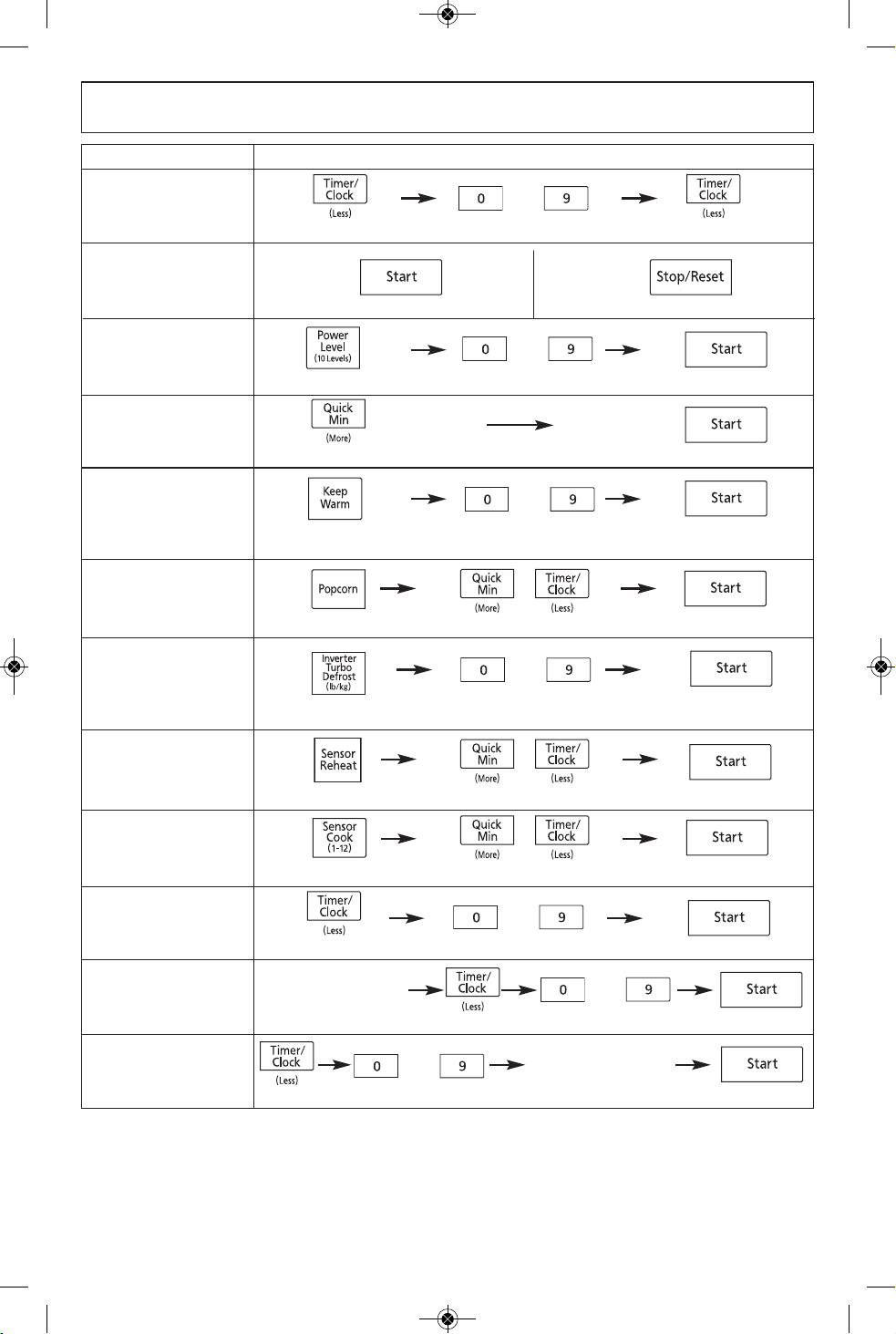
27
quick guide to operation
feature how to operate
To set
clock
(*page 11)
Press twice.
Enter time of day.
Press once.
To Use child
safety lock
(*page 11)
Press 3 times. Press 3 times.
to set: to cancel:
To set
Power and time
(*page 12)
Press to select Power Level.
Set cooking time. Press once.
To cook using
quick Min
(*page 12)
(up to 10 min.) Press once.
Press once.
Set keep warm time. (up to 30 min.)
Press once.
To use
Keep Warm
(*page 12)
To cook using
Popcorn
(*page 13)
Select weight. Optional. Press once.
or
or
or
To defrost using
inverter turbo
defrost
(*page 14)
Press once. Set weight. Press once.
To reheat using
sensor reheat
(*page 16)
Press once. Press once.
To cook using
sensor cook
(*page 16)
Optional.
To use as a
Kitchen timer
(*page 19)
Press once. Set time. Press once.
To Set
stand time
(*page 19)
Press once. Set time. Press once.
()
Input up to
2-stage cooking
programs.
To Set
delay start
(*page 19)
Press once. Set time. Press once.
()
Input up to
2-stage cooking
programs.
Press to select food number.
Optional. Press once.
Thru
Thru
Thru
Thru
Thru
Thru
Thru
IP3516_39Y00AP_33_110630:IP3516_39Y00AP_00_110316.qxd 2011-6-30 Jerry 上上16:55 Page 27
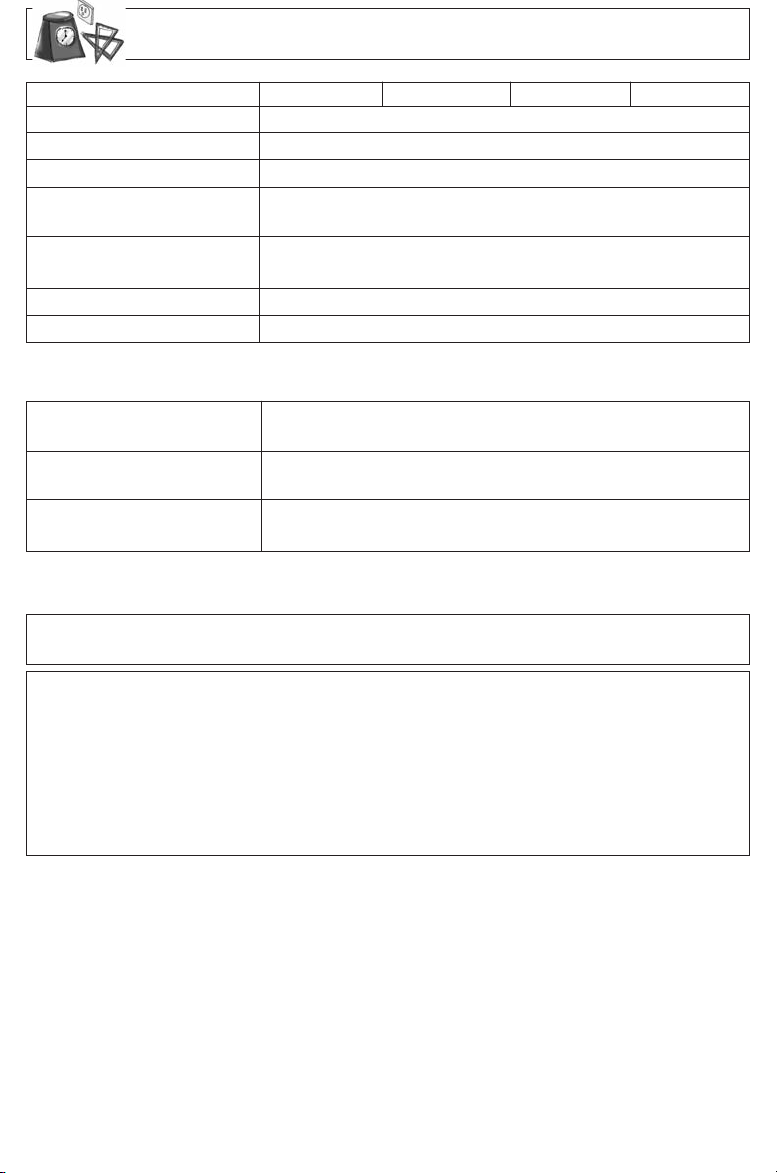
28
specifications
Power Source:
Power Consumption:
Cooking Power:*
Outside Dimensions
(W x h x D):
Overall Oven Cavity
Dimensions (W x h x D):
Operating Frequency:
Net Weight:
NN-SN651B NN-SN651W NN-SN661S NN-SN671S
120 V, 60 hz
12.4 Amps, 1,480 W
1,200 W
20
11
/16" x 12
1
/4" x 15
13
/16"
(525 mm x 310 mm x 401 mm)
13
15
/16" x 9
15
/16" x 14
3
/8"
(355 mm x 251 mm x 365 mm)
2,450 Mhz
Approx. 25.5 lbs. (11.5 kg)
*IEC Test procedure Specifications subject to change without notice.
trim Kit for nn-sn661s/sn671s:
Model Number:
Outside Dimensions
(W x h ):
Cabinet Opening
(W x h x D):
NN-TK621SSAP
(Stainless)
27" x 16
1
/2"
(684 mm x 419 mm)
25
1
/2" x 15
5
/16" x 21"
(648 mm x 389 mm x 533 mm)
user’s record
The serial number of this product may
be found on the back side of the oven
or on the left side of the control panel.
You should note the model number and
the serial number of this oven in the
space provided and retain this book as
a permanent record of your purchase
for future reference.
Model no. __________________
serial no. __________________
date of Purchase ____________
Panasonic Consumer Electronics Company,
Division of Panasonic Corporation of North America
One Panasonic Way
Secaucus, New Jersey 07094
Panasonic Home Appliances Microwave Oven (Shanghai) Co., Ltd.
IP3516_39Y00AP_33_110630:IP3516_39Y00AP_00_110316.qxd 2011-6-30 Jerry 上上16:55 Page 28
información de seguridad
Precauciones ...............Cubierta Interior
instrucciones importantes de
seguridad .........................................1-3
instrucciones para instalación y
conexión a tierra ..............................4-5
Precauciones de seguridad ............6-7
operación
Función de Cocción por Sensor..........16
Gráfico de cocción por Sensor............17
Recetas de Microondas.......................18
Función de Cronómetro (Cronómetro de
Cocción/Cronómetro de reposo/
Comienzo tardío) .................................19
Consejos Rápidos ..........................20-21
Características de los alimentos .........22
Técnicas para cocinar ....................22-23
Guía rápida de Operación...................27
operación
Diagrama de Componentes del horno..9
Panel de Control..................................10
Vamos a empezar a usar su horno.....11
Para ajuste del reloj.............................11
Seguro para niños ...............................11
Para seleccionar potencia y tiempo de
Cocción................................................12
Función de minuto automático ............12
Mantener Caliente ...............................12
Función de Palomitas de Maíz............13
Función de Más/menos .......................13
Función de Descongelación Turbo
Inverter ................................................14
Consejos y Técnicas de Descongelación
.......................................................14-15
Función de Recalentamiento por
Sensor .................................................16
Mantenimiento
Cuidado y Limpieza de su horno de
Microondas ..........................................24
Compra de Accesorios ........................24
Antes de solicitar Servicio Técnico......25
Garantía Limitada y Directorio de
Servicios al Consumidor......................26
información general
Guía de utensilios..................................8
Especificaciones
..................................28
Registro del usuario ............................28
antes de oPerar este Producto, lea este instructivo en su totalidad.
For English Instructions, turn over the book.
F00039Y00AP
IP0711-0
Impreso en China
Para obtener referencias sobre la seguridad de hornos de microondas, visite la página
web de la FDA en:
http://www.fda.gov/Radiation-EmittingProducts/ResourcesforYouRadiationEmittingProducts/ucm252762.htm
Para asistencia, por favor llame: 1-800-211-PANA(7262)
contáctenos nuestro sitio web en:
http://www.panasonic.com (U.S.A y Puerto Rico)
© Panasonic Artículos para el Hogar Hornos de Microondas de Shanghai 2011.
instrucciones de operación
horno de Microondas
solo para uso domestico
Modelos: nn-sn651b
nn-sn651W
nn-sn661s
nn-sn671s
IP3516_39Y00AP_33_110630:IP3516_39Y00AP_00_110316.qxd 2011-6-30 Jerry 上上16:55 Page 29
su seguridad y la seguridad de otros es muy importante.
hemos proporcionado mensajes de seguridad importantes en este manual y
en su aparato. Lea y obedezca siempre todos los mensajes de seguridad.
Precauciones Para evitar
Posible eXPosiciÓn eXcesiva
a energÍa de Microondas
(a) No intente hacer funcionar este horno con la puerta abierta ya que esto
puede resultar peligroso. Es importante no anular o forzar los mecanismos
de seguridad.
(b) No coloque ningún objeto entre el panel frontal del horno y la puerta, ni
permita que se acumule basura o residuos de limpiadores en las
superficies de sellado.
(c) No haga funcionar el horno si está dañado, es importante que la puerta
del horno abra y cierre apropiadamente y no haya ningún daño en:
(1) la puerta (combada),
(2) bisagras y seguro de la puerta (rotos o sueltos),
(3) sellos de las puertas y superficies de sellado.
(d) El horno no deberá ser ajustado o reparado por ninguna persona, excepto
el personal de servicio debidamente calificado.
Todos los mensajes de seguridad le indicaran cuál es el peligro potencial, el
cómo reducir la posibilidad de lesionarse y le advierte qué puede suceder al
no seguir las instrucciones.
Éste es el símbolo de la alarma de seguridad, se utiliza para
alertarle de los peligros potenciales que pueden dañar o lastimar a
usted y a otros.
Todos los mensajes de seguridad seguirán el símbolo de la alarma
de seguridad y cualquiera de las siguientes palabras PELIGRO,
ADVERTENCIA o PRECAUCIÓN. Estas palabras significan:
Usted puede resultar lastimado o dañado
seriamente si usted no sigue las instruc-
ciones de inmediato.
Usted puede resultar lastimado o dañado
seriamente si usted no sigue las
instrucciones.
información de Seguridad del Horno de Microondas
peLiGRo
adVeRtencia
PRECAUCIÓN indica una situación
potencialmente peligrosa que, si no es
evitada, puede dar lugar a lesión de
menor importancia o moderada.
pRecaución
IP3516_39Y00AP_33_110630:IP3516_39Y00AP_00_110316.qxd 2011-6-30 Jerry 上上16:55 Page 30
1
instrucciones iMPortantes de seguridad
Su horno de microondas es un artículo para cocinar y usted debe usarlo con
tanto cuidado como usa una estufa o cualquier otro artículo para cocinar.
Cuando utilice este aparato eléctrico, se deben seguir precauciones básicas de
seguridad, incluyendo las siguientes:
Gracias por comprar este horno de Microondas Panasonic.
Para reducir el riesgo de quemaduras, descarga eléctrica, incendio, heridas a
personas o exposición excesiva a energía de microondas:
1. Lea todas las instrucciones antes de usar el aparato.
2. Lea y siga las “PRECAUCIONES PARA EVITAR POSIBLE EXPOSICIÓN
EXCESIVA A ENERGÍA DE MICROONDAS” específicas, que se encuentran abajo.
3. Este aparato debe ser conectado a tierra. Conecte solamente a la toma eléctrica
debidamente conectada a tierra. Vea las “instrucciones Para coneXiÓn a
tierra” que se encuentran en la página 4.
4. Como cualquier otro aparato para cocinar, no deJe el horno desatendido cuando
esta en uso.
5. Instale o ubique este aparato solamente de acuerdo con las instrucciones de
instalación que se encuentran en la página 4.
6. no cubra ni tape ninguna de las rendijas de este aparato.
7. no almacene o use este aparato en exteriores. No use este aparato cerca del
agua - por ejemplo, cerca del fregadero de la cocina, en una base mojada, o cerca
de una alberca, y similares.
8. Use este aparato sólo para los fines para los que fue hecho, tal como se describen
en este manual. no use químicos o vapores corrosivos en este aparato. Este tipo
de horno está específicamente diseñado para calentar o cocinar alimentos. No fue
diseñado para uso industrial o de laboratorio.
9. Cuando limpie las superficies de la puerta y el horno que vienen juntas al cerrar la
puerta, use solamente jabones no abrasivos o detergentes suaves aplicados con
una esponja o con tela suave.
10. no permita a los niños usar este aparato, a menos que sean supervisados muy de
cerca por un adulto. no asuma que porque un niño ha dominado una habilidad
para cocinar el/ella puede cocinar todo sin supervisión.
11. no use este aparato si tiene dañado el cordón o la clavija, si no está trabajando
adecuadamente, o si ha sido dañado o se ha dejado caer.
12. no sumergir en agua el cable o la clavija.
13. Mantenga el cable lejos de superficies calientes.
14. no deje el cable colgando en el borde de la mesa o mostrador.
15. Este aparato debe recibir mantenimiento sólo de personal calificado. Contacte las
instalaciones de servicio autorizadas más cercanas para revisión, reparación o
ajuste.
adVeRtencia
IP3516_39Y00AP_33_110630:IP3516_39Y00AP_00_110316.qxd 2011-6-30 Jerry 上上16:55 Page 1
2
16. Algunos productos, tales como los huevos completos y contenedores sellados - por
ejemplo frascos de vidrio cerrados - pueden explotar y no deben ser calentados en
este horno.
17. Para reducir el riesgo de incendio en la cavidad del horno:
(a) no sobrecocine los alimentos. Preste atención cuidadosa al aparato. El papel,
plástico u otros materiales combustibles son colocados dentro del horno para
facilitar la cocción pero si no se utilizan adecuadamente esto puede producir
incendio en su horno.
(b) Quite los sujetadores de alambre de las bolsas de papel o plástico antes de
colocar la bolsa en el horno.
(c) si el material dentro del horno se enciende, mantenga la puerta del horno
cerrada, apáguelo y desconecte el cable eléctrico o apague la energía en
el switch (braker) del fusible o del circuito.
(d) No use la cavidad con propósitos de almacenaje. No deje productos de papel,
utensilios de cocina o alimentos en la cavidad cuando no esté en uso.
18.
liquidos muy calientes
Liquidos como agua, cafe o te pueden ser sobrecalentadosabajo del punto de
ebullicion sin mostrar una ebulliion o signos de este. No siempre burbujea
cuando el recipiente se retira del Microondas. ESTO PUEDE RESULTAR EN
UNA EBULLICIÓN REPENTINA DEL LÍQUIDO MUY CALIENTE CUANDO SE
INTRODUZCA UNA CUChARA U OTRO UTENSILIO DENTRO DEL LÍQUIDO.
Para reducir el riesgo de heridas a personas:
(a) revuelva el lÍquido antes y durante el calentaMiento.
(b) no caliente el agua y aceite, o las grasas juntas. la película del
aceite atrapará vapor, y puede causar una erupción violenta.
(c) no utilice recipientes de lados rectos con cuello angosto.
(d) Luego del calentamiento, deje el recipiente dentro del horno de microondas
por un corto tiempo antes de retirarlo.
19. no cocine directamente sobre el plato giratorio. Este puede quebrarse,
causando lesiones o daño al horno.
20. Destinado para horno que fue diseñado para instalarse en un gabinete de
pared:
(a) no intente poner en funcionamiento ningún aparato de calefacción o de
cocina bajo este aparato.
(b) no ubicar la unidad cerca de ningún aparato de calefacción o de cocina
o sobre él.
(c) no ubicar sobre un fregadero.
(d) no almacenar nada directamente en la superficie superior del aparato
cuando éste se encuentre en funcionamiento.
instrucciones iMPortantes de seguridad
(continuación)
IP3516_39Y00AP_33_110630:IP3516_39Y00AP_00_110316.qxd 2011-6-30 Jerry 上上16:55 Page 2
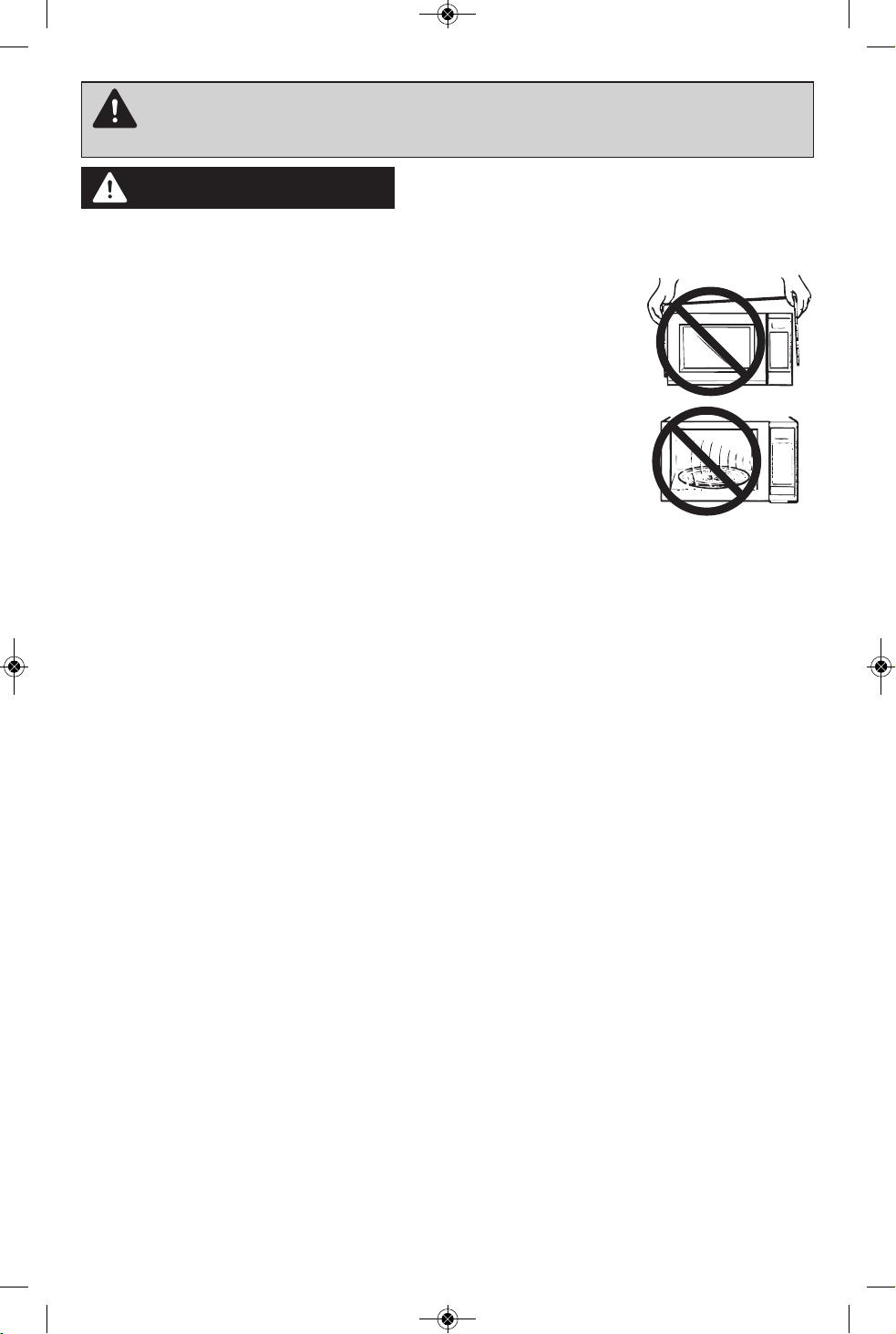
3
guarde estas instrucciones
Para el uso apropiado del horno lea las precauciones restantes de seguridad e
instrucciones de funcionamiento.
Plato giratorio de cristal
1. no opere el horno sin el anillo giratorio y el plato de cristal en su lugar.
2. no ponga a funcionar el horno sin el plato giratorio de cristal ensamblado com-
pletamente en el cubo de la impulsión. El cocinar de manera incorrecta podría
resultar en daños al horno. Verifique que el plato giratorio de cristal sea engan-
chado correctamente y observe que la rotación sea apropiada cuando presiona
Encender. nota: El plato giratorio puede dar vuelta en cualquier dirección.
3. Utilice solamente el plato giratorio diseñado específicamente para este horno.
no substituya ningún otro plato giratorio.
4. Si el plato giratorio esta caliente, permita que se enfríe antes de la limpieza o
de colocar en agua.
5. no cocine directamente en el plato giratorio. Coloque siempre el alimento en
un plato seguro para microondas.
6. Si el alimento o el utensilio en el plato giratorio toca las paredes del horno,
ocasionará que el plato giratorio deje de moverse, el plato de cristal rotará
automáticamente en la dirección opuesta.
anillo giratorio
1. El anillo giratorio y el piso del horno se deben limpiar con frecuencia para pre-
venir ruido excesivo.
2. Siempre vuelva a colocar el anillo giratorio y el plato de cristal en sus posi-
ciones apropiadas.
3. El anillo giratorio se debe utilizar siempre para cocinar junto con el plato de
cristal.
instrucciones iMPortantes de seguridad
(continuación)
Para evitar el riesgo de descarga elÉctrica:
no quite el panel externo del horno. Las reparaciones se deben hacer solamente por
una persona calificada del servicio.
Para reducir el riesgo de eXPosiciÓn a
energÍa de Microondas:
no altere o haga ningún ajuste o reparación a la puerta, al
alojamiento del panel de control, interruptores entrecruzados de
seguridad o a cualquier otra parte del horno.
Para evitar el riesgo de incendio:
1. no opere el horno vacío. La energía de microondas se reflejará
continuamente a través del horno si los alimentos o agua no
están presentes para absorber energía. Esto puede dañar el
horno y resultar en peligro de incendio.
2. no almacene los materiales inflamables al lado, encima,
o dentro del horno.
3. no seque telas, periódicos u otros materiales en el horno.
Pueden incendiarse.
4. no golpee ni pegue en el panel de control. Pueden causarse daños a los controles.
5. no use productos de papel reciclado, a menos que en la etiqueta del papel se indique
que puede ser utilizado en horno de microondas, ya que pueden contener impurezas
que pueden causar chispas y/o incendios cuando se usen.
Para evitar el riesgo de queMaduras:
Las manoplas para tomar cosas calientes siempre deben ser utilizadas cuando se retiren
cosas del horno. El calor se transfiere de los alimentos calientes a los contenedores para
cocinar y de los contenedores a la bandeja de cristal. La bandeja de cristal puede estar
muy caliente después de sacar los contenedores para cocinar del horno.
adVeRtencia
IP3516_39Y00AP_33_110630:IP3516_39Y00AP_00_110316.qxd 2011-6-30 Jerry 上上16:55 Page 3
4
instrucciones de instalaciÓn
el uso inaProPiado de la claviJa Para coneXiÓn a tierra Puede
resultar en riesgo de descarga elÉctrica.
Si es necesario usar un cable de extensión, use solamente cable de extensión de tres
hilos que tenga una clavija de tres entradas para conectar a tierra, y un receptor de tres
ranuras que acepte la clavija del aparato. El calibre marcado en el cable de extensión
debe ser igual o mayor al calibre eléctrico del aparato.
instrucciones de conexión a tierra
este aParato debe ser conectado a tierra. En el caso de un corto circuito,
la conexión a tierra reduce el riesgo de una descarga eléctrica proporcionando una línea
de escape para la corriente eléctrica. Este aparato está equipado con un cable y clavija
para conexión a tierra. La clavija debe ser conectada en un receptor que esté instalado
adecuadamente y conectado a tierra.
• enchufe en la conexión correctamente instalado y puesto a tierra de 3 entradas.
• no quite el diente de tierra.
• no utilice adaptador.
adVeRtencia
examine su horno
Desempaque el horno, quite todo el material de empaque y examine que su horno no
tenga ningún daño, tal como abolladuras, seguros de la puerta rotos o resquebrajaduras
en la puerta. Notifique inmediatamente a su distribuidor si el horno está dañado.
ubicación del horno
1. El horno debe ser colocado en una superficie plana y estable. Ponga la superficie
delantera de la puerta tres pulgadas o más del borde superior contrario para evitar
inclinar accidentalmente el horno de microondas durante su uso normal. Para su
operación apropiada, el horno debe tener suficiente corriente de aire. Deje 7,6 cm
(3-pulgadas) de espacio de ambos lados del horno y 2,5 cm (1-pulgada) de espa-
cio en la parte superior del horno.
(a) no bloquear la ventilas del aire. Si es bloqueada la ventilación del aire
durante la operación, el horno puede sobrecalentarse y quemarse.
(b) no coloque el horno cerca de una superficie húmeda caliente, tal como
un registro de gas o eléctrico.
(c) no haga funcionar el horno cuando la humedad del lugar es excesiva.
2. Este horno fue manufacturado para el uso domestico únicamente. No fue
probado para usarse en ningún tipo de vehículo terrestre, marítimo o de uso
comercial.
instalación
1. no bloquee las salidas de aire. Si se bloquean durante la operación, el horno
puede recalentarse. Si el horno se recalienta, un dispositivo de seguridad termal
apagará el horno. El horno seguirá siendo inoperable hasta que se haya enfriado.
2. Si el horno es diseñado para la instalación en un gabinete de la pared usando el kit
de ajuste apropiado disponible de un distribuidor local de Panasonic. Siga toda la
instrucción de embalaje del kit.
3. NN-SN651B/NN-SN651W :
no fue construido ni probado para su uso en ningún tipo de vehículo (terrestre,
marítimo, o de uso comercial).
IP3516_39Y00AP_33_110630:IP3516_39Y00AP_00_110316.qxd 2011-6-30 Jerry 上上16:55 Page 4
5
suministro eléctrico
1. Se provee un cable de suministro eléctrico corto para reducir los riesgos resultantes de
enredarse o tropezarse con un cable más largo.
2. Juegos de cable más largos o extensiones están disponibles y pueden utilizarse si se
usan con cuidado. no deje el cable colgar sobre el borde de la mesa o mostrador.
3. Si se usa un cable más largo o extensión, (1) el calibre eléctrico marcado en el juego
de cable o extensión debe ser al menos tan grande como el calibre eléctrico del
aparato, (2) el cable de extensión debe ser de tres hilos del tipo de conexión a tierra, y
(3) un cable más largo debe ser arreglado de tal forma que no caiga
sobre la cubierta del mostrador o de la mesa donde pueda ser jalado
por niños o alguien pueda tropezarse accidentalmente
requerimientos de cableado
El horno debe estar en un circuito separado. Ningún otro aparato debe compartir el circuito
con el horno. Si lo hace el fusible del circuito puede estallar, el bloqueador del circuito
trabarse o la comida cocinarse más lento que en los tiempos recomendados en este
manual. El horno debe ser conectado en un enchufe a tierra de al menos 20 A 120 V, 60
hz. Donde se encuentre un enchufe estándar de 2 entradas será responsabilidad - y
obligación - del consumidor reemplazarlo por un enchufe a tierra de 3 entradas. El voltaje
usado debe ser el mismo al especificado en el horno de microondas (120 V, 60 hz) Usar un
voltaje más alto es peligroso y puede resultar en fuego u otro accidente causando daño al
horno. Usar un bajo voltaje dará como resultado un cocinado más lento.
Panasonic NO es responsable por cualquier daño que haya resultado del uso del horno
con un voltaje distinto al especificado.
interferencia de radio o televisión
1. La operación de su horno de microondas puede causar interferencia en su radio, TV o
equipo similar.
2. Cuando hay interferencia, se puede reducir o eliminar tomando las siguientes medidas:
(a) Limpie la puerta y las superficies selladoras del horno.
(b) Ponga el radio, TV, etc. lo más lejos posible del horno de microondas.
(c) Use una antena instalada adecuadamente para obtener una recepción de señal
más fuerte.
instrucciones de instalaciÓn
(continuación)
IP3516_39Y00AP_33_110630:IP3516_39Y00AP_00_110316.qxd 2011-6-30 Jerry 上上16:55 Page 5
6
Siga Estas Precauciones de Seguridad Cuando Cocine en Su horno
iMPortante
la cocción adecuada depende del tiempo designado y del peso de los ali-
mentos. si usa una porción menor de la recomendada y cocina por el
tiempo para la porción recomendada, puede resultar en un incendio. si
ocurre un incendio, ponga el horno en posición de apagado y manténgalo
cerrado. desconecte la energía eléctrica o desconecte la caja de fusibles o
el panel de control.
1) enlatado casero / esteriliZaciÓn / aliMentos
deshidratados / PequeÑas cantidades de
aliMentos
• no use el horno para el enlatado casero o para calentar cualquier frasco
cerrado. La presión aumentará y el frasco puede explotar. Su horno no puede
mantener los alimentos a la temperatura apropiada de enlatado.
• no use el horno de microondas para esterilizar objetos (mamilas de bebe,
etc). Es difícil mantener el horno a la temperatura necesaria para la
esterilización.
• no seque carne, hierbas, frutas o vegetales en su horno. Pequeñas
cantidades de alimento o alimentos con bajo contenido de humedad se
pueden secar, quemar o incendiarse.
2) PaloMitas de MaÍZ
Las palomitas de maíz deben prepararse en un recipiente para palomitas de
maíz adecuado para horno de microondas. Palomitas de maíz para horno de
microondas que se preparan en su propio paquete también están disponibles.
Siga las instrucciones del fabricante de palomitas de maíz y use una marca
adecuada para la potencia de su horno de microondas. Nunca deje
desatendido el horno cuando prepare palomitas de maíz.
PrecauciÓn: Cuando use palomitas de maíz para microondas previamente
empacadas siga las instrucciones recomendadas en el paquete o utilice la
tecla de palomitas de maíz (revise página 13). Si no se siguen estas
instrucciones, las palomitas de maíz pueden no reventar adecuadamente o
pueden encenderse y causar un incendio.
Nunca deje el horno desatendido, cuando están reventando las palomitas.
Permita que la bolsa de palomitas se enfríe antes de abrirse, abra siempre la
bolsa lejos de su cara y cuerpo para prevenir quemaduras del vapor.
3) freir con Mucha grasa
• no trate de freír con mucha grasa en su horno de microondas. Cocinar aceites
puede estallar en flamas y puede causar daño al horno y quizá acabar en
quemaduras. Los utensilios de microondas pueden no ser útiles para soportar
la temperatura del aceite caliente, y podrían romperse
4) aliMentos con Pieles no Porosas
• no cocine / recaliente huevos enteros, con o sin la
cÁscara. La acumulación del vapor en huevos enteros puede hacerlos
estallar, y es causa de daño al horno o causa de lesión. Recalentar los huevos
duros REBANADOS y cocinar los huevos revueltos es seguro.
• Papas, manzanas, calabazas completas y salchichas son ejemplos de
alimentos con pieles no porosas. Estos tipos de alimentos deben ser
perforados antes de cocinarlos en microondas para evitar que estallen.
PrecauciÓn: Cocinar papas secas o viejas pueden ocasionar fuego.
sugerencias Útiles
IP3516_39Y00AP_33_110630:IP3516_39Y00AP_00_110316.qxd 2011-6-30 Jerry 上上16:55 Page 6
7
5) bandeJa de cristal / utensilios de cocina / PaPel
aluMinio
• Los utensilios para cocinar se calientan durante la cocción en microondas. Use
soportes para lo caliente, cuando saque los utensilios del horno o cuando quite
tapas o cubiertas de envoltura de plástico de los utensilios de cocina, para
evitar quemaduras.
• La bandeja de cristal se calentará durante la cocción. Debe permitirse que se
enfríe antes de manejarla o antes de colocar productos de papel, tales como
platos de papel o bolsas de palomitas de maíz para microondas, para cocinar.
• Al usar papel aluminio en el horno, permita por lo menos de 1 pulgada (2,5
centímetros) de espacio entre el papel aluminio y las paredes del horno o la
puerta interior.
• Platos con adornos metálicos no deberán ser usados, ya que puede
producirse arco eléctrico.
6) toallas de PaPel / telas
• no use toallas de papel o telas que contengan fibras sintéticas en su tejido. La
fibra sintética puede causar que la toalla se incendie. Utilice toallas de papel
bajo supervisión.
7) bandeJa doradora / bolsas Para cocinar en
horno
• Las bandejas doradoras o asadoras son diseñadas para cocinar en
microondas solamente. Siempre siga las instrucciones dadas por el fabricante.
no precaliente la bandeja doradora más de 6 minutos.
• Si se utiliza una bolsa para cocinar en Microondas, prepare de acuerdo a las
instrucciones del paquete. no use sujetadores de alambre para cerrar la bolsa,
en su lugar utilice sujetadores de plásticos, un cordón de algodón, o la tira del
extremo abierto de la bolsa.
8) terMÓMetros
• no use termómetros convencionales para alimentos en su horno. Puede
producir arco. Están disponibles termómetros seguros para microondas para
carne y dulce.
9) fÓrMula de bebÉ / aliMentos Para bebÉ
• no caliente la fórmula o los alimentos para el bebé en el horno de microondas.
El tarro o la superficie de cristal del alimento pueden parecer tibios mientras
que el interior puede resultar tan caliente que podría ocasionar quemaduras en
la boca y esófago del bebe.
10) recalentaMiento de Productos de rePosterÍa
• Cuando recaliente productos de repostería, compruebe la temperatura de
cualquier relleno antes de comer. Algunos alimentos tienen rellenos que se
calientan más rápidamente y puedan resultar extremadamente calientes,
mientras que la superficie sigue siendo tibia al tacto (Ej. Donas de jalea).
11) guÍa de uso general del horno / Puerta del
horno
• no use el horno por cualquier razón que no sea la preparación de alimentos.
sugerencias Útiles
(continuación)
IP3516_39Y00AP_33_110630:IP3516_39Y00AP_00_110316.qxd 2011-6-30 Jerry 上上16:55 Page 7
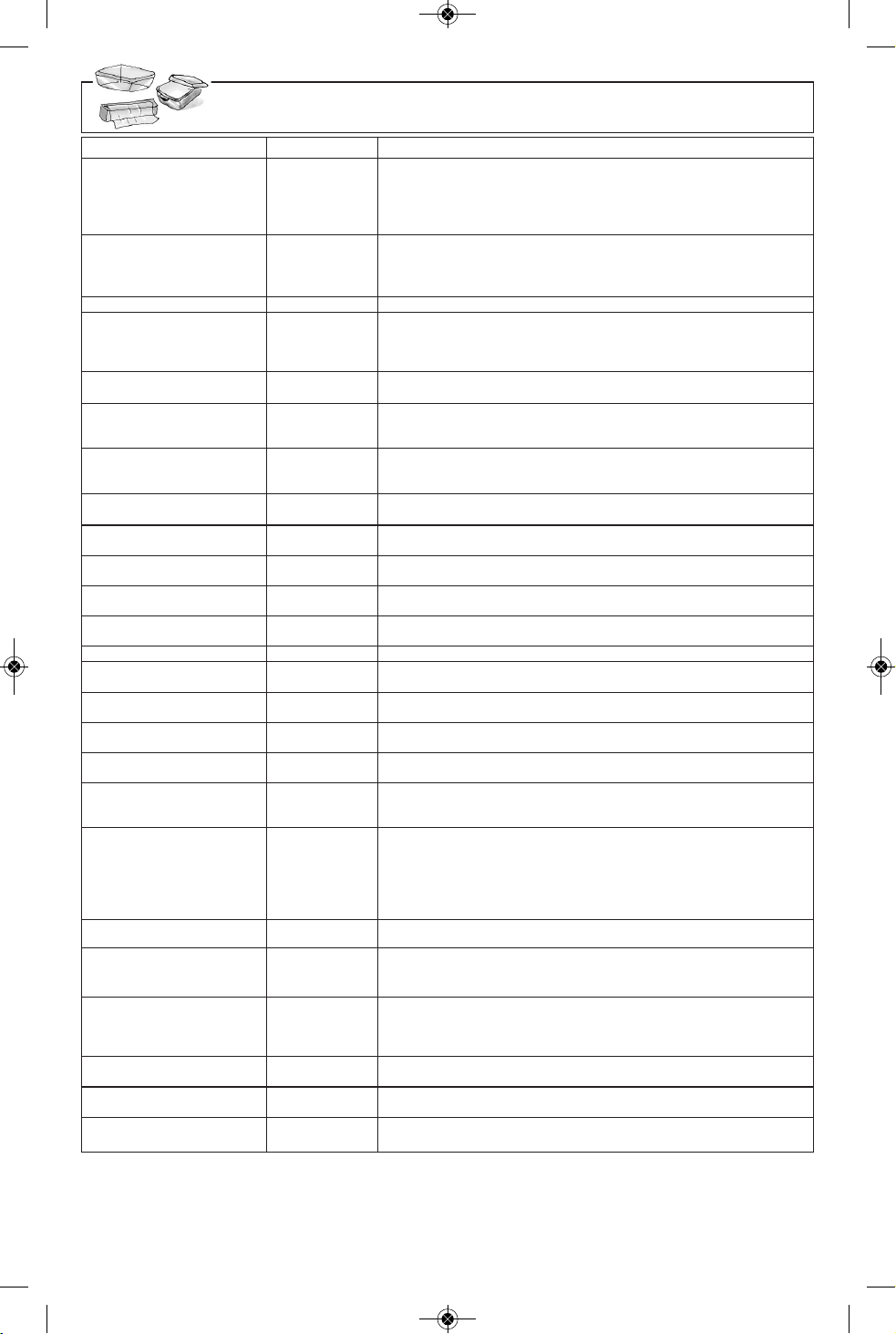
8
guía de utensilios
utensilio
Microondas
coMentarios
Si, para Pequeñas tiras de papel aluminio pueden ser utilizadas
Papel aluminio protección para proteger las partes más delicadas de carnes y aves.
únicamente Pueden ocurrir chispas si el aluminio se encuentra muy
cerca del las paredes o la puerta del horno y dañar el horno
como resultado.
Los platos para dorar están diseñados para cocinar con
Platos para dorar
Si
microondas solamente. Cheque la información del plato
dorador para instrucciones y el gráfico de calentamiento.
No precaliente por más de 6 minutos.
Bolsas de papel común No Pueden incendiarse.
Utensilios de cocina: Cheque las instrucciones de uso y cuidado de los fabricantes
Etiquetados “Para uso
Si
para calentar en microondas. Algunos utensilios de cocina
de microondas” pueden tener en la parte posterior del plato “Seguro para
uso de microondas”.
Utensilios de cocina no
Si o No
Utilice Prueba de reciPientes abajo.
etiquetados
Platos desechables Algunos alimentos congelados están empacados en estos
de poliéster o cartón Si platos. Pueden ser comprados en tiendas de productos
comestibles
Comida rápida en caja
de cartón con mango No El mango de metal puede ocasionar chispas.
de metal
Comida congelada en
No El metal puede causar chispas y dañar su horno.
en bandeja de metal
Comida congelada en
Si Caliente solo una bandeja en el horno a la vez.
bandeja para Microondas
Tarros de vidrio No
La mayoría de los tarros de cristal no son resistentes al
calor. No utilice para cocinar o recalentar.
Cerámica y vidrios
Si
Ideales para cocción en horno de microondas común y
refractarios dorador (Vea Prueba de reciPiente abajo).
Utensilios de metal
No
No recomendado para utilizar en hornos de microondas.
para hornear El metal puede ocasionar chispas y dañar su horno.
Sujetadores de Alambre No Pueden causar chispas que causen fuego en el horno.
Bolsas para
Si
Siga las instrucciones del fabricante. Cierre la bolsa con el
cocinar en el horno sujetador de nylon incluido.
Vasos y platos de papel Si
Utilice para alimentos cocidos y para cocinar alimentos que
requieren corto tiempo de cocción como los hot dogs.
Toallas y servilletas
Si
Utilice para calentar rollos y sandwiches, solo si esta
de papel etiquetado para uso seguro de microondas.
Toallas y servilletas
No
Productos de papel reciclado pueden contener impurezas
de papel reciclado que pueden ocasionar chispas.
Utilice como cubierta para prevenir que salpique. Seguro
Papel pergamino Si para uso en microondas, microondas/ convección y hornos
convencionales.
Plástico: Si, utilice con Debe estar etiquetado: “Conveniente para calentar en
Utensilios de cocina precaución microondas”, Siga las instrucciones y recomendaciones del
seguros para microondas
fabricante. Algunos contenedores plásticos seguros para uso
de microondas no son convenientes para alimentos con altos
contenidos de grasa o azúcar. El calor de los alimentos
calientes puede ocasionar que el plástico se deforme.
Plástico, Melamine
No
Este material absorbe la energía de microondas. Los platos
se calientan.
Si, use con El unicel se derretirá si los alimentos alcanzan altas
Tazas de unicel precaución temperaturas. Utilice para recalentar alimentos únicamente
a un bajo nivel de temperatura.
Use para envolver los alimentos durante la cocción, para
Plástico para envolver Si retener la textura y prevenir que salpique. Deberá ser
etiquetada “Conveniente para Calentar en Microondas”.
Revise las instrucciones del empaque.
Termómetros apropiados
Si
Use solamente termómetros para carne y dulce seguros para
para hornos de microondas
microondas.
Termómetro convencional
No
No convenientes para el uso en horno de microondas, puede
causar chispas y calentarse.
Papel encerado Si
Utilice como cubierta para prevenir salpicaduras y retener la
textura.
Prueba de reciPientes
Prueba de seguridad del recipiente para uso en horno de Microondas: Coloque un vaso de agua en el
horno de microondas junto al recipiente que será probado, caliente por un minuto a Potencia P10. Si el
recipiente es seguro para el uso en microondas debe estar frío y el agua debe estar caliente. Si el recipiente
esta caliente es porque absorbió alguna energía del microondas y no debe ser utilizado. Esta prueba no
puede ser utilizada para recipientes plásticos.
IP3516_39Y00AP_33_110630:IP3516_39Y00AP_00_110316.qxd 2011-6-30 Jerry 上上16:55 Page 8
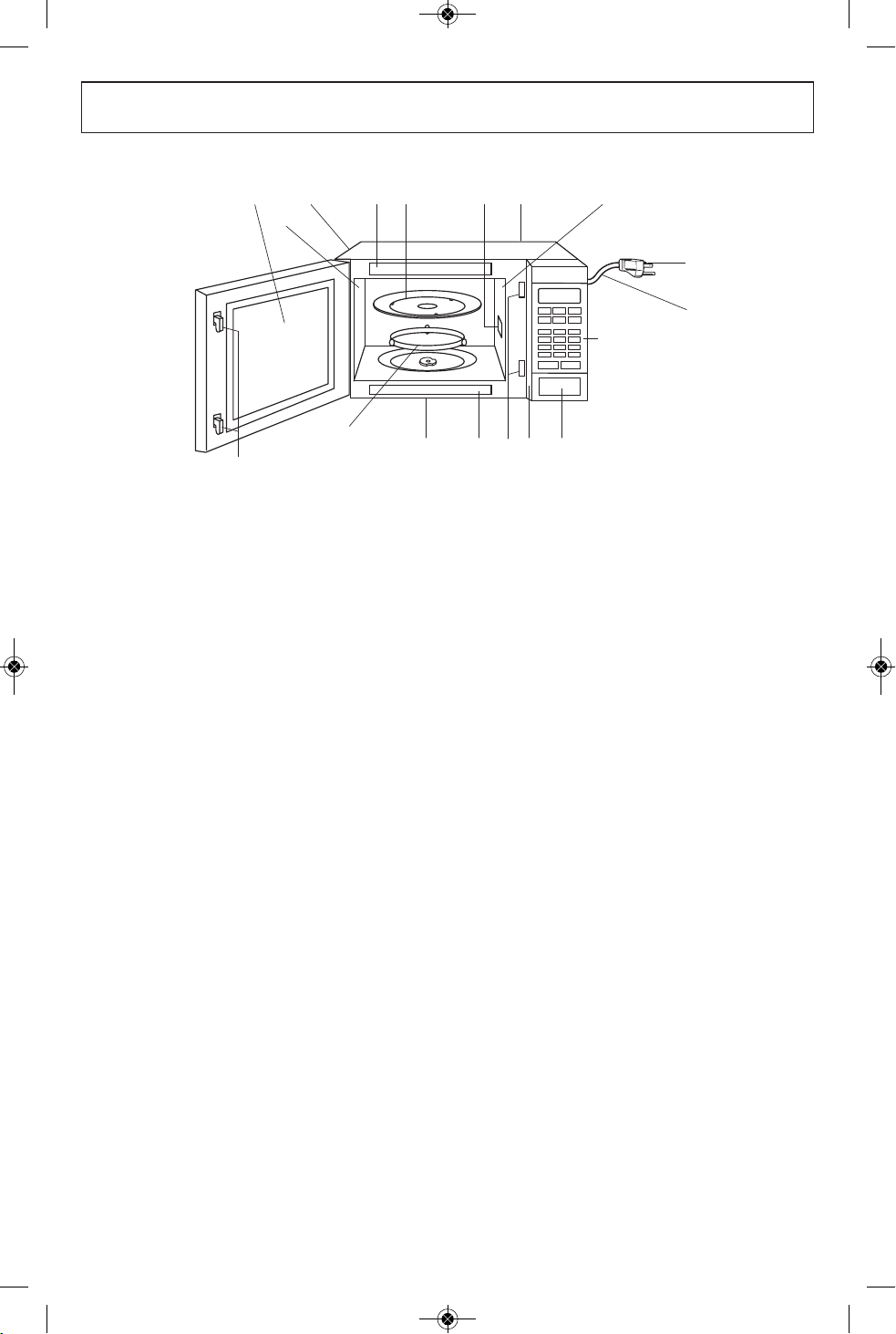
9
diagrama de componentes del horno
q ventilaciones de aire externas
w ventilaciones de aire lnternas
e sistema de cierre de seguridad
de la Puerta
r ventilaciones de aire externas
t Panel de control
y Placa de ldentificación
u bandeja de cristal
i aro de rodillo
o Película de barrera contra el
calor/vapor
(no extraer)
a cubierta del guía de ondas
(no extraer)
s botón para abrir la puerta
d etiqueta de advertencia
f etiqueta de Menú
g
cable de suministro eléctrico
h
enchufe del suministro eléctrico
do
r
u a q
w
t
h
r f ye s
i
e
g
q
IP3516_39Y00AP_33_110630:IP3516_39Y00AP_00_110316.qxd 2011-6-30 Jerry 上上16:55 Page 9
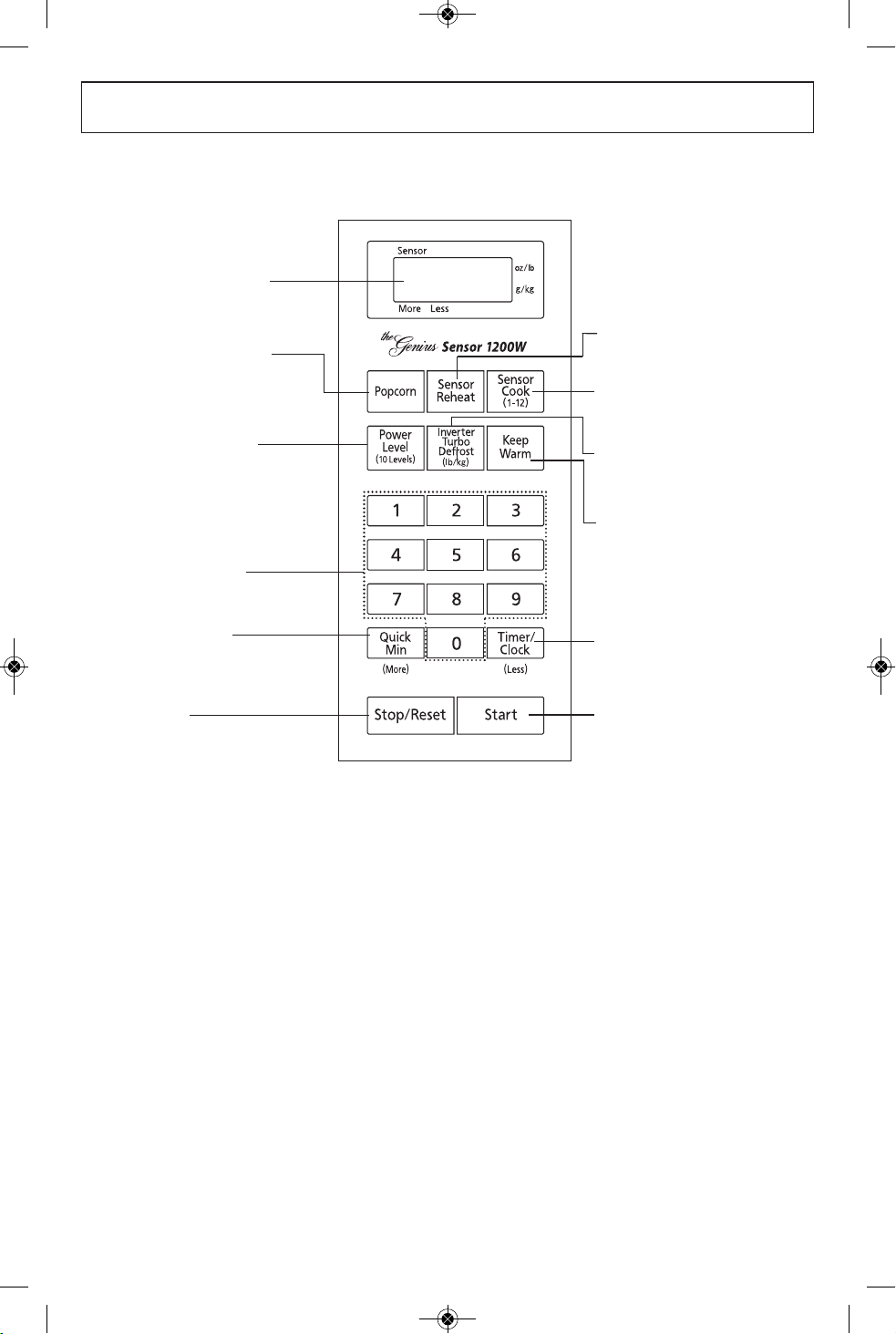
10
Panel de control
bip:
Cuando una tecla es presionada correctamente, se escuchará un “bip”. Si una tecla es
presionada y no escucha un “bip”, significa que la unidad no aceptó o no pudo aceptar la
instrucción. El horno hará 2 veces “bip” entre las etapas programadas. Al final de cada
programa completado, el horno hará 5 veces “bip”.
nota:
Si no se lleva a cabo ninguna operación tras ajustar un programa de cocina, el horno
cancelará automáticamente el programa de cocina tras 6 minutos de inactividad. La pan-
talla mostrará de nuevo la hora o dos puntos.
tecla de Palomitas
de maíz
(* página 13)
tecla de Minuto
automático (Más)
(* página 12
,
13)
tecla de Potencia
(* página 12)
tecla para
Pausa/cancelar
tecla de recalen-
tamiento con sensor
(* página 16)
tecla de Mantener
caliente
(* página 12)
tecla de cocción con
sensor
(* página 16)
tecla de cronómetro/
reloj
(
Menos)
(* página 11, 13, 19)
t
ecl
a de des
cong-
el
aci
ón t
u
rbo i
n
vert
er
(
* pág
ina 1
4)
Pantalla indicadora
tecla para encender
antes de cocinar: Un toque
borra todas sus instrucciones.
durante la cocción: Un
toque detiene temporalmente
el proceso de cocción. Otro
toque cancela todas sus
instrucciones y la hora del
día aparece en la pantalla.
Tras ajustar el programa
de cocina, pulse una vez
para que el horno
empiece a operar. Si se
abre la puerta o se pulsa
la tecla de Pausa/
cancelar una vez durante
una operación, pulse la
tecla de encender de
nuevo para reiniciar el
horno.
Teclas numéricas
*El paneles control del
NN-SN651B/SN651W/
SN661S/SN671S tiene
la misma disposición de
teclas.
IP3516_39Y00AP_33_110630:IP3516_39Y00AP_00_110316.qxd 2011-6-30 Jerry 上上16:55 Page 10
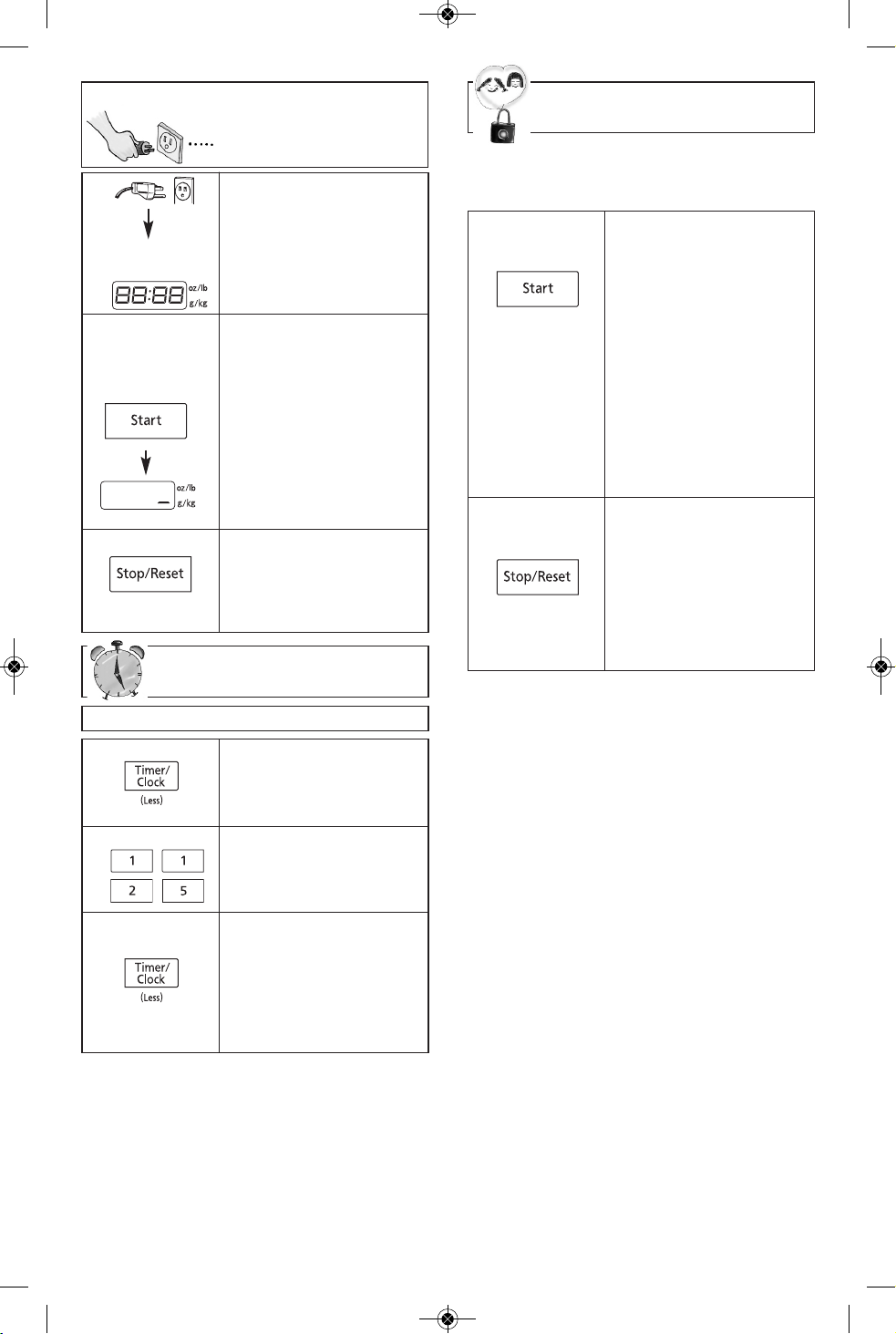
11
seguro Para niños
reloj
ejemplo: Para ajustar 11:25 am o pm
1.
• Presione cronómetro/
reloj 2 veces.
punto comienza a
parpadear.
2.
• Fije la hora correcta
del día.
11:25 aparece en la
pantalla indicadora.
3.
• Presione cronómetro/
reloj 1 vez.
punto deja de
parpadear. La hora
está ingresada y
ubicada en la
pantalla indicadora.
notas:
1. Para reiniciar el reloj. Repetir el paso 1
hasta el 3.
2. El Reloj seguirá marcando la hora
siempre que siga recibiendo
alimentación eléctrica.
3. El Reloj visualiza el horario normal
basado en las 12 horas, no utiliza el
horario militar.
4. El horno no funcionará mientras los
dos puntos estén parpadeando.
Esta función evita la operación del horno
hasta que se cancela. No asegura la
puerta.
Para activar:
• Presione encender 3
veces. “Child”
aparecerá en la
ventana de
visualización.
"Child" se
mantendrá hasta
que el seguro de
niños sea
cancelado. Puede
presionarse
cualquier tecla,
pero el horno no
comenzará a
funcionar.
Para cancelar:
• Presione Pausa/
cancelar 3 veces.
La Ventana de
Visualización
regresa a los dos
puntos o la hora
cuando el seguro de
niños ha sido
cancelado.
¡vamos a empezar a
usar su horno!
1.
• Enchufe en una toma
eléctrica debidamente
conectada a tierra.
Este horno
automáticamente
ajusta el sistema
inglés de medida.
2.
• Presione encender
para convertir el
sistema de medida.
Verifique su selección
en la ventana de
visualización.
3.
• Presione
Pausa/cancelar.
Dos puntos apare-
cerán en la Ventana
de Visualización.
Ventana de
Visualización
Si desea usar
g/kg:
nota:
Se puede configurar la función de
“Seguro para niños” cuando la
visualización muestra dos puntos o
tiempo del día.
IP3516_39Y00AP_33_110630:IP3516_39Y00AP_00_110316.qxd 2011-6-30 Jerry 上上16:55 Page 11
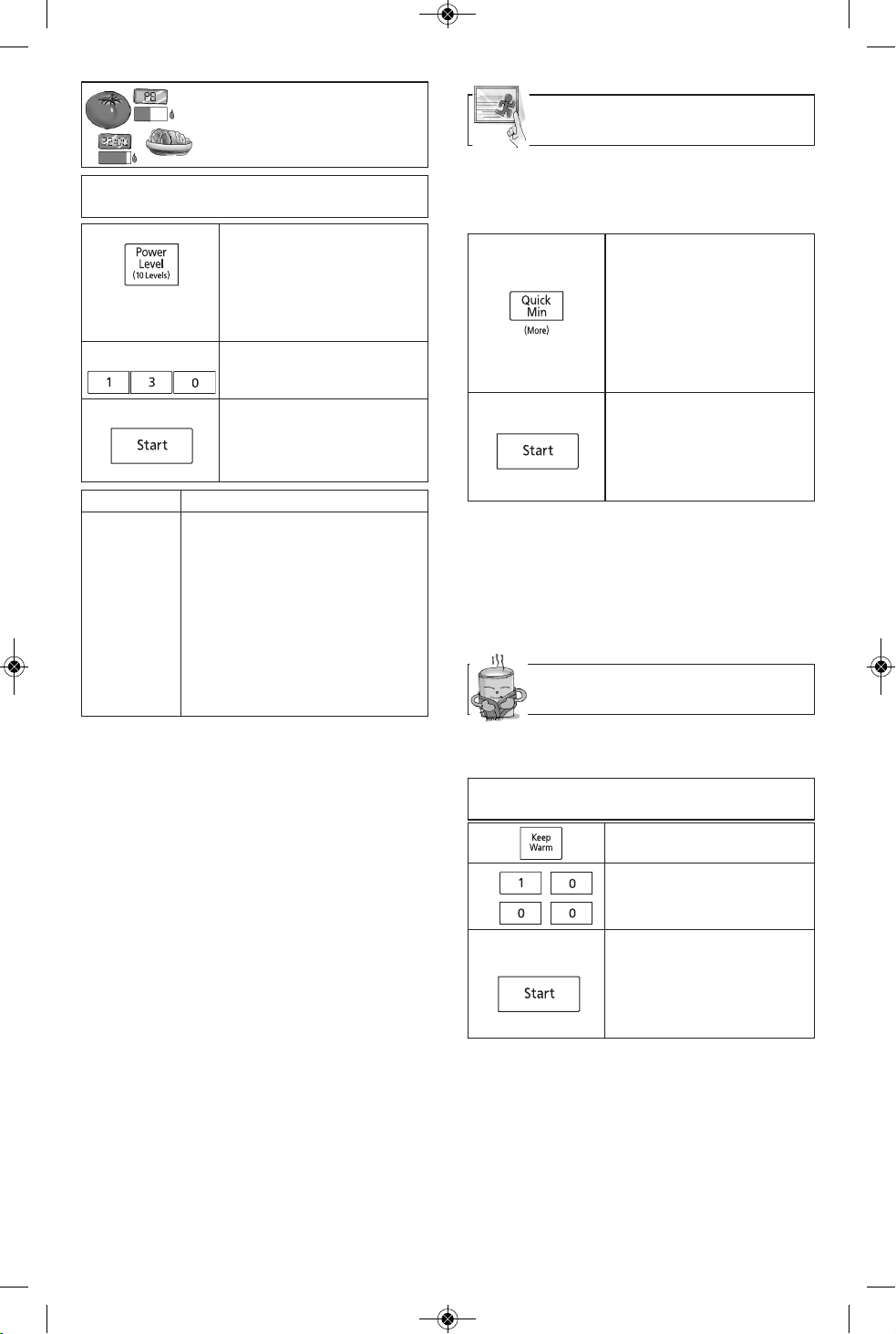
12
Para seleccionar Potencia
y tiempo de cocción
notas:
1. Para la cocción de más de una etapa,
repetir los pasos 1 y 2 para cada etapa
de cocción antes de presionar la tecla
encender. Cuando esta funcionando,
sonarán dos “bips” entre cada etapa de
la programación. Sonarán 3 “bips” al final
de toda la secuencia.
2. Cuando se selecciona la potencia P10
(ALTO) para la primera etapa, podrá
empezar en el paso 2.
3. Cuando seleccione Nivel de potencia 10
(ALTO), el máximo tiempo programable
es de 30 minutos. Para otros niveles de
potencia, el tiempo máximo es 99
minutos y 99 segundos.
4. Para el recalentamiento, utilizar P10
(ALTO) para líquidos, P7 (MEDIO-ALTO)
para la mayoría de los alimentos y P6
(MEDIO) para los alimentos densos.
5. Para descongelamiento P3 (MEDIO-BAJO).
no sobrecocine los alimentos. Este horno
requiere menos tiempo para cocinar que las
unidades viejas. Sobrecocinar puede
ocasionar que los alimentos se sequen y
puede causar fuego. La potencia de
cocción del horno de microondas le indican
la cantidad de potencia de microondas
disponible para cocinar.
ejemplo: Para cocinar en P6 durante 1
minuto 30 segundos.
1.
• Presione la tecla de
potencia hasta que el
nivel de potencia
deseado aparezca en
la ventana de
visualización.
2.
• Seleccione el tiempo
de cocción.
3.
• Presione encender.
El tiempo de cocción
aparece y empieza
la cuenta regresiva.
Presione 5 veces
Pulse
1 vez
2 veces
3 veces
4 veces
5 veces
6 veces
7 veces
8 veces
9 veces
10 veces
Nivel de Potencia
P10 (ALTO)
P9
P8
P7 (MEDIO-ALTO)
P6 (MEDIO)
P5
P4
P3 (MEDIO-BAJO)/DESC.
P2
P1 (BAJO)
notas:
1. Para utilizar otros niveles de potencia,
presionar de nivel de Potencia y a
continuación minuto automático.
2. Si utiliza Minuto automático no podrá
utilizar teclas de numéricas.
3. La tecla de Minuto automático puede
ser utilizada para agregar más tiempo
durante la cocción manual.
Minuto automático
Esta función le permite ajustar y/o añadir
tiempos de cocción fácilmente en múltiplos
de un minuto.
Para seleccionar tiempo de cocción:
1.
• Seleccione Minuto
Automático hasta
seleccionar el tiempo
deseado de cocción
(hasta 10 minutos)
aparece en la ventana
de visualización. El
nivel de potencia pre-
seleccionado es P10.
2.
• Presione encender.
Inicia la cocción y el
tiempo empieza a
transcurrir. Al final de la
cocción, sonarán 5
“bips”.
Mantener caliente
Esta característica permite mantener
caliente los alimentos después de 30
minutos de cocinar.
ejemplo: Para mantener calientes 2
tazas de salsa por 10 minutos.
1.
• Presione la tecla de
Mantener Caliente.
2.
• Seleccione el tiempo de
calentamiento en hasta
30 minutos utilizando
las teclas numéricas.
3.
• Presione encender.
Mantener Caliente
iniciará. El tiempo
en la ventana de
visualización
empezará el conteo.
nota:
La función de Mantener caliente puede
ser programada como paso final después
de que el tiempo de cocción ha sido
manualmente programado. Esta no puede
ser utilizada en combinación con fun-
ciones de sensor o automáticas.
IP3516_39Y00AP_33_110630:IP3516_39Y00AP_00_110316.qxd 2011-6-30 Jerry 上上16:55 Page 12
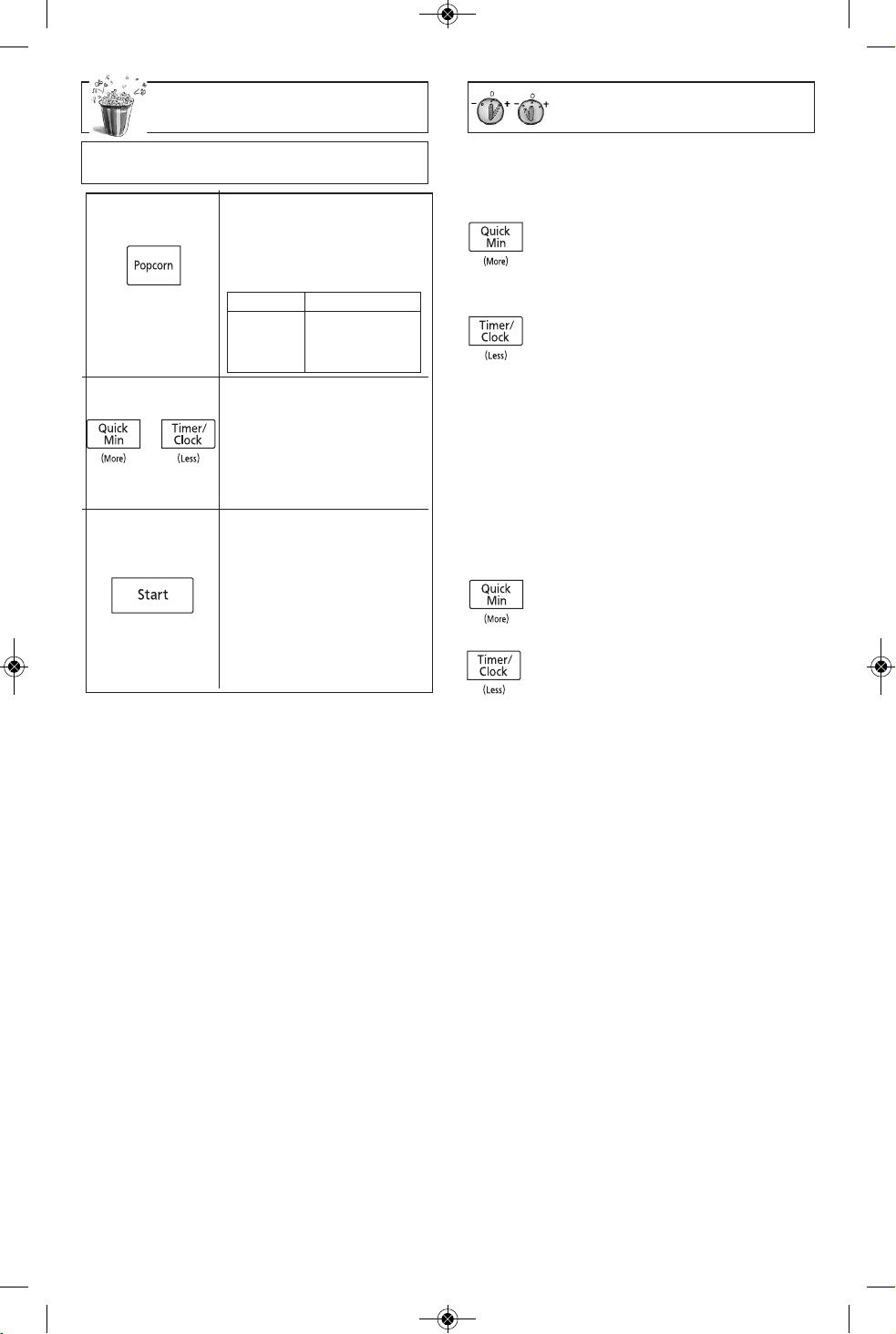
13
Palomitas de Maíz
notas Para PaloMitas de MaÍZ:
1. Cocine una bolsa de palomitas a la vez.
2. Ponga la bolsa en el interior del horno
de acuerdo a las instrucciones del
fabricante.
3. Inicie a cocinar las palomitas a la
temperatura ambiente.
4. Permita que las palomitas de maíz
preparadas permanezcan cerradas por
unos minutos.
5. Abra la bolsa cuidadosamente para
prevenir quemaduras, el vapor puede
salir.
6. No recaliente las palomitas que no se
hicieron ni vuelva a usar las bolsas.
nota:
Si el paquete de palomitas es de un peso
diferente al listado, siga las instrucciones
que aparecen en el paquete. nunca deje
el paquete desatendido. Pare el horno
cuando las palomitas tardan en estallar de
2 segundos a 3 segundos. Sobrecocinar
puede causar un incendio.
nota:
Cuando se preparen varias bolsas una tras
otra, el tiempo de preparación puede variar
ligeramente. Esto no afecta al resultado de
las palomitas.
ejemplo: Para cocinar 99 g de
palomitas de maíz
1.
• Presione la tecla de
palomitas de maíz hasta
que el peso deseado
aparezca en la ventana
de visualización.
2.
• (vea la función de
Más/Menos.)
(* página 13)
3.
• Presione encender.
Tras varios
segundos, se
muestra el tiempo de
preparación en la
ventana de
visualización y
comienza a
transcurrir el tiempo.
Presione 1 vez
Presionar
1 vez
2 veces
3 veces
Peso
99 g (3,5 oz.)
85 g (3,0 oz.)
50 g (1,75 oz.)
Opcional
o
función Más/Menos
Para Palomitas de Maíz:
Utilizando la función de Más/Menos, los progra-
mas para cocinar palomitas pueden ser ajustados
por más largo o corto tiempo si se desea.
: Agrega tiempo
Más 1 = Agrega aproximadamente 10 segundos
Más 2 = Agrega aproximadamente 20 segundos
: Reduce tiempo
Menos 1 = Reduce aproximadamente 10 segundos
Menos 2 = Reduce aproximadamente 20 segundos
Presione la tecla Más/Menos antes de presionar encender.
Para el recalentamiento/cocción por sensor:
Las preferencias para el punto de cocción varían de
acuerdo a la persona. Luego de utilizar la función de
recalentamiento/cocción por sensor algunas
veces, podrá decidir si prefiere que su comida sea
cocinada en un punto de cocción diferente.
: Agrega tiempo
Más = Agrega aproximadamente 10% de tiempo
: Reduce tiempo
Menos = Reduce aproximadamente 10% de tiempo
Presione la tecla Más/Menos antes de presionar encender.
IP3516_39Y00AP_33_110630:IP3516_39Y00AP_00_110316.qxd 2011-6-30 Jerry 上上16:55 Page 13
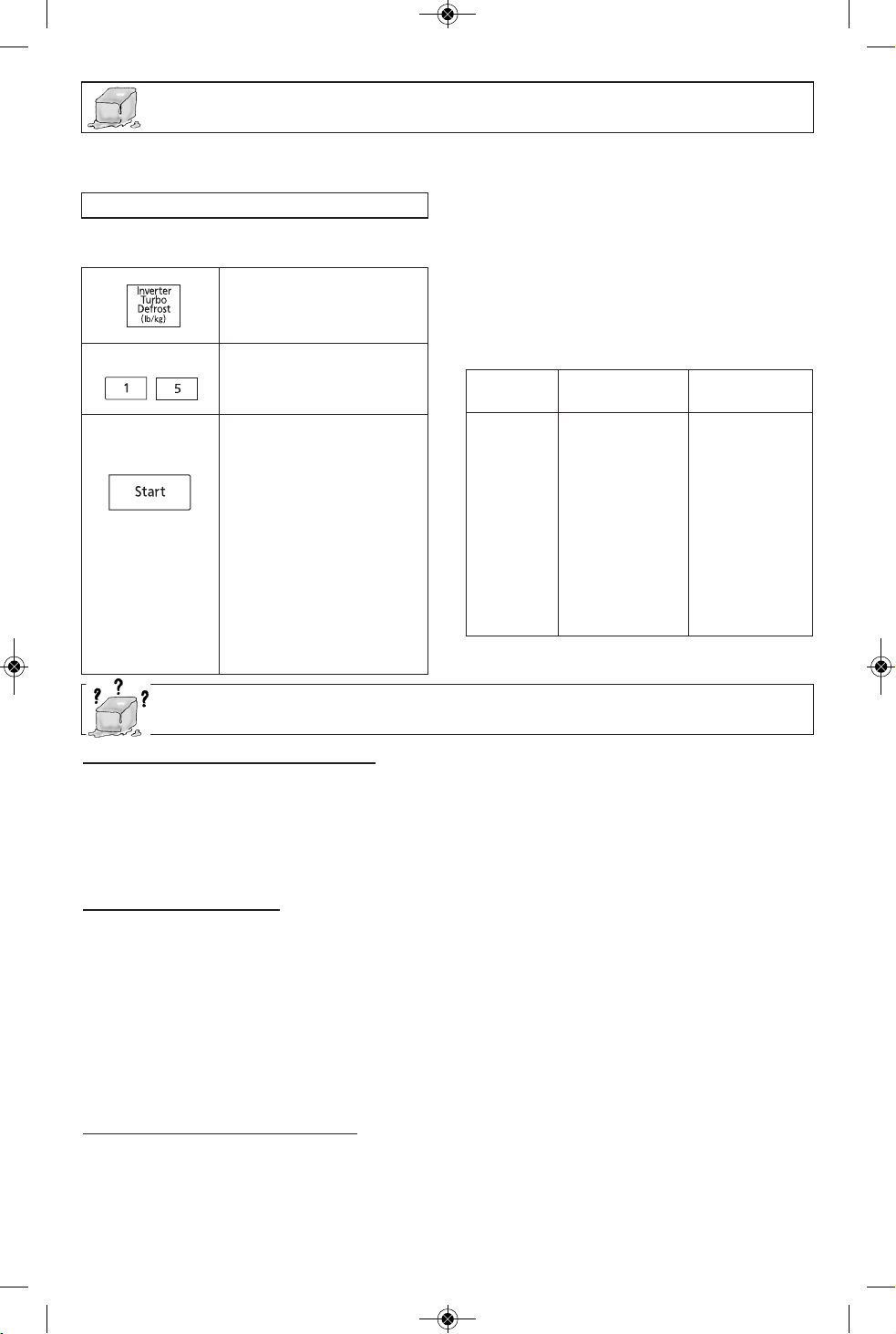
14
descongelación turbo inverter
Esta función le permite descongelar carne, productos avícolas y pescado con sólo
introducir el peso.
Coloque la comida en un plato adecuado
para el uso de microondas.
ejemplo: Para descongelar 1,5 kg de carne.
1.
• Presione la tecla de
Descongelación Turbo
Inverter.
2.
• Introducir el peso
utilizando las teclas
de número.
3.
• Presione encender.
El tiempo de
descongelado aparece
y empieza la cuenta
regresiva. A la mitad
del descongelamiento,
cuando suene "bip".
Apáguelo, reacomode
la comida, remueva
las áreas
descongeladas o
protéjalas con láminas
de papel aluminio.
tabla de conversión:
Siga la tabla para convertir onzas o
cientos de una libra en décimos de una
libra. Para utilizar la Descongelación
Turbo Inverter, ingrese el peso de los
alimentos en libras (1,0) y décimos de
una libra (0,1). Si una pieza de carne
pesa 1,95 libras o 1 libra 14 onzas,
ingrese 1,9 libras.
Onzas
0
1 - 2
3 - 4
5
6 - 7
8
9 - 10
11 - 12
13
14 - 15
Centésimos de
una libra
0,01 - 0,05
0,06 - 0,15
0,16 - 0,25
0,26 - 0,35
0,36 - 0,45
0,46 - 0,55
0,56 - 0,65
0,66 - 0,75
0,76 - 0,85
0,86 - 0,95
Décimos de
una libra
0,0
0,1
0,2
0,3
0,4
0,5
0,6
0,7
0,8
0,9
consejos y técnicas de descongelación
Preparación para congelar:
1. Congelar carnes, carne de ave y pescado en paquetes con sólo 1 capa o 2 capas
de alimentos. Colocar papel encerado entre las capas.
2. Empacar en envolturas de plástico resistentes (etiquetadas “Para Congelador”) o
papel congelador.
3. Remover tanto aire como sea posible.
4. Coloque el sello de seguridad con fecha y etiqueta.
Para descongelar:
1. Quitar la envoltura. Esto ayuda a que la humedad se evapore. Los jugos de los
alimentos pueden calentarse y cocinar los alimentos.
2. Colocar los alimentos en un plato adecuado para uso de microondas.
3. Colocar el lado de la grasa del asado hacia abajo. Colocar el lado de la pechuga del
ave entera hacia abajo.
4. Seleccionar potencia y tiempo mínimo para que estos alimentos debajo sean
descongelados.
5. Drene los líquidos durante el descongelamiento.
6. Voltee los alimentos durante el descongelamiento.
7. Proteja bordes y extremos si es necesario (Vea Técnicas de Cocción).
después de descongelar:
1. Los artículos grandes pueden estar congelados del centro. La descongelación será
completada durante el TIEMPO DE REPOSO.
2. Reposo, cubierta, instrucciones después del tiempo de reposo en página 15.
3. Enjuague los alimentos como se indica en el cuadro.
4. Artículos que han sido colocados en capas deberán ser enjuagados por separado o
tener mayor tiempo de reposo.
nota: El peso máximo para el uso del
Descongelado Turbo Inverter es de 3 kg (6 libras).
IP3516_39Y00AP_33_110630:IP3516_39Y00AP_00_110316.qxd 2011-6-30 Jerry 上上16:55 Page 14
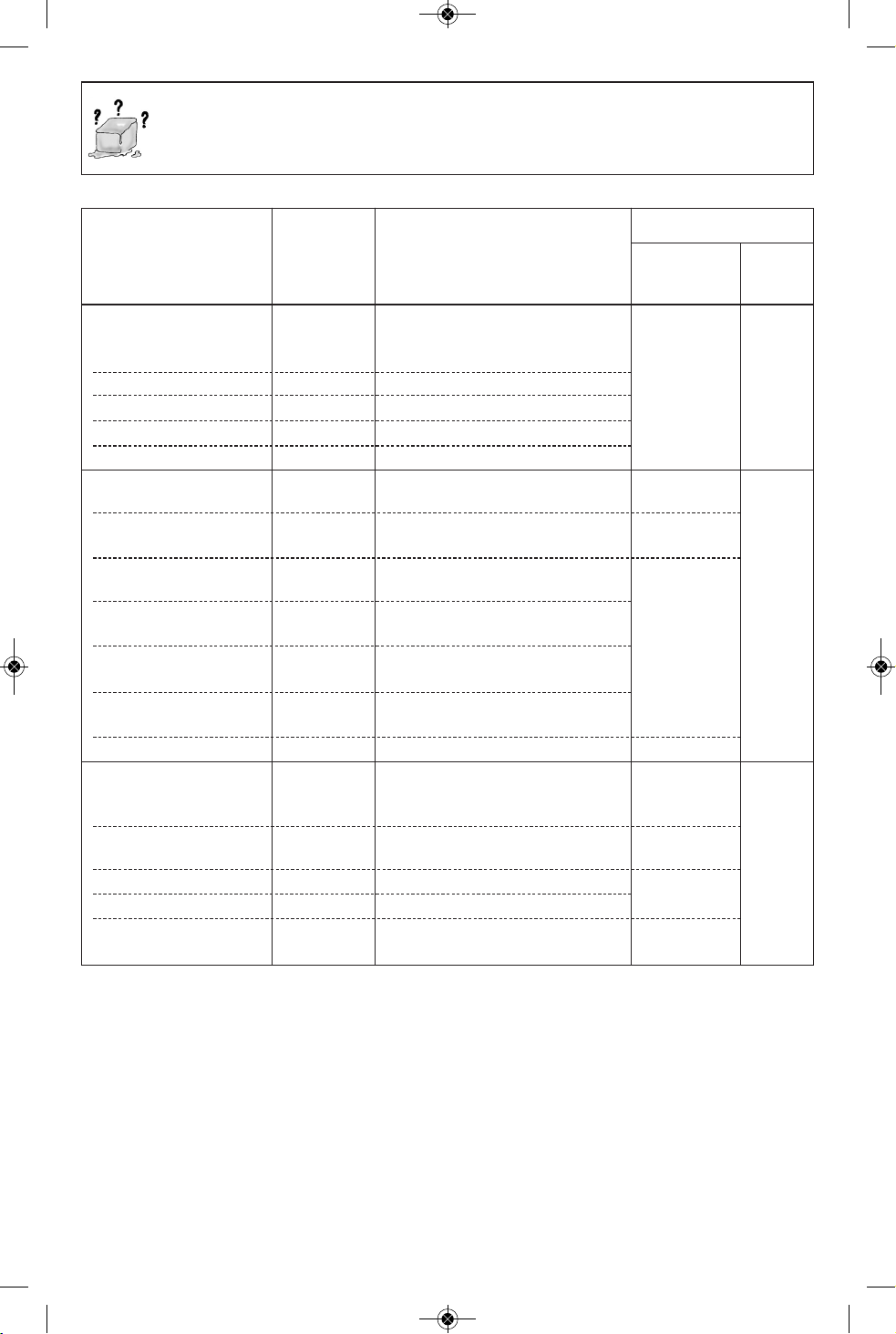
15
consejos y técnicas de
descongelación
(continuación)
tiempo de
descongelación
después de la descongelación
alimento (min/kg) durante la descongelación
tiempo de enjuagar
(P3)
reposo (agua fría)
Pescado y Marisco
[hasta 1,4 kg (3 libras)]
Carne de Cangrejo 6 Romper y separar/Reordenar
Bistecs de Pescado 4 a 6 Dar la vuelta
5 minutos Sí
Filetes de Pescado 4 a 6
Dar la vuelta/Reordenar/Proteger extremos
Raciones preparadas 4 a 6
Separar/Extraer trozos congelados
Pescado entero 4 a 6 Dar la vuelta
carne
Dar la vuelta/Extraer parte descongelada/
Carne Molida 4 a 5
Proteger bordes
10 minutos
Asados 4 a 8 Dar la vuelta/Proteger extremos y 30 minutos
[1,1-1,8 kg (2
1
/2-4 lbs.)]
superficie descongelada en frigorífico
Chuletas/Bistec 6 a 8 Dar la vuelta/Volver a ordenar/
Proteger extremos y superficie descongelada
Costillas/T-bone 6 a 8 Dar la vuelta/Volver a ordenar/
Proteger extremos y superficie descongelada
5 minutos No
Carne de Cocido 4 a 8 Separar/Volver a ordenar/
Extraer partes descongeladas
hígado 4 a 6 Extraer el líquido/Dar la vuelta/
(cortado finamente) Separar piezas
Tocino, rebanadas 4 Dar la vuelta - - - -
carne de ave
Pollo entero 4 a 6 Dar la vuelta/Proteger 20 minutos
[hasta 1,4 kg (3 libras)] en frigorífico
Cortes 4 a 6 Separar/Dar la vuelta/
Extraer partes descongeladas
5 minutos
Sí
Trozos 4 a 6 Separar/Dar la vuelta/Proteger
Aves de Caza 6 a 8 Dar la vuelta/Proteger
10 minutos
Pechuga de Pavo 6 Dar la vuelta/Proteger 20 minutos
[2,3-2,7 kg (5-6 lbs.)]
en frigorífico
IP3516_39Y00AP_33_110630:IP3516_39Y00AP_00_110316.qxd 2011-6-30 Jerry 上上16:55 Page 15
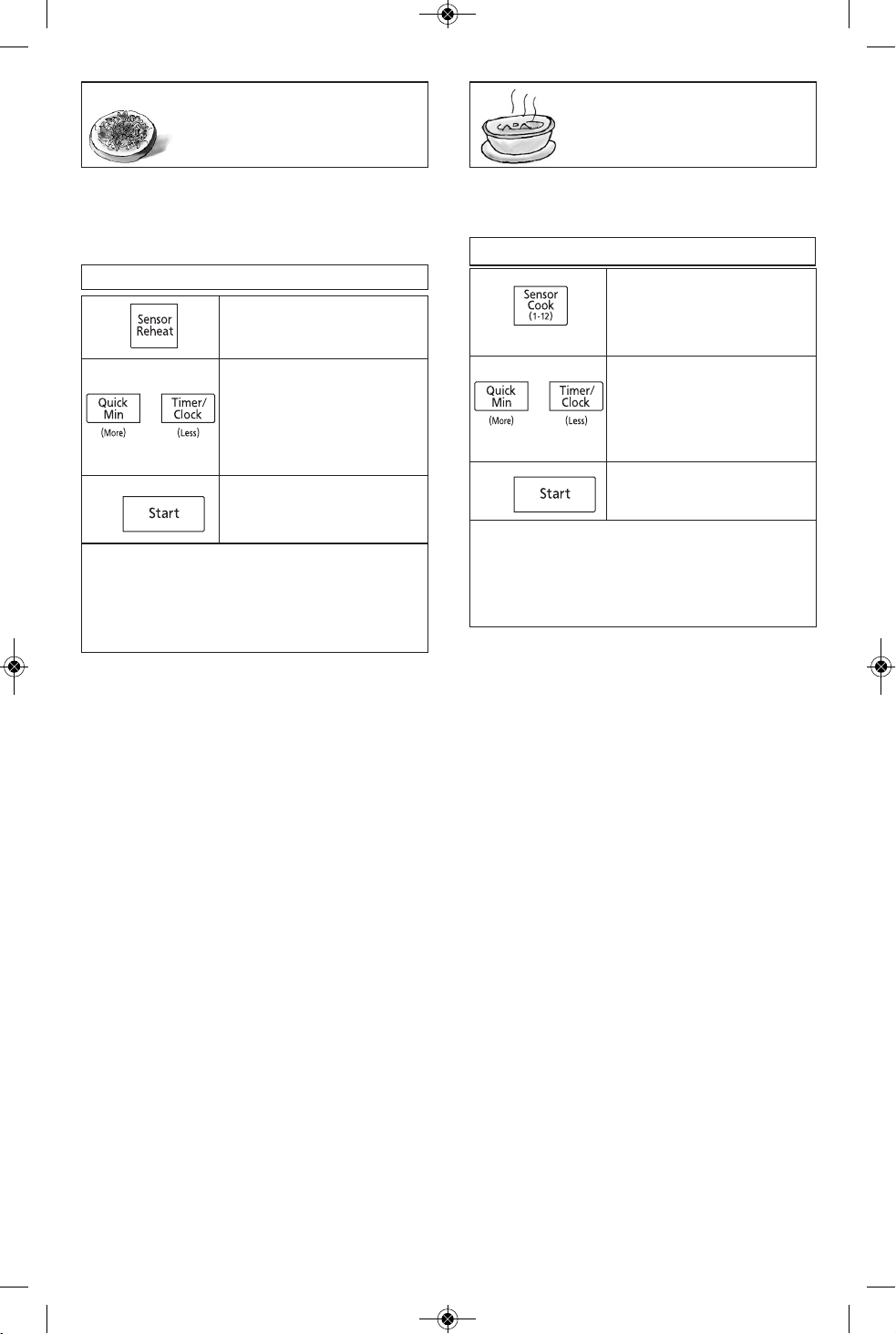
16
notas:
cazuelas - Añadir de 3 cucharadas a
4 cucharadas de líquido; cubrir con una
tapa o con un envoltorio de plástico.
Remover cuando suenen los 5 "bips".
alimentos envasados - Vaciar el
contenido en una cazuela o en un
cuenco; cubrir el recipiente con una tapa
o con un envoltorio de plástico. Después
de calentar, retirar el envoltorio de
plástico y dejar reposar.
Plato de comida - Colocar la comida en
un plato; cubrir con mantequilla, salsa,
etc. Después de calentar, retirar el
envoltorio de plástico y dejar reposar.
Seguir los consejos para la cocción con
sensor, además de los consejos abajo
indicados:
no:
1. NO calentar pan o alimentos de
pastelería. Utilizar la potencia y el
cronómetro manual para estos
alimentos.
2. NO calentar alimentos crudos o no
cocinados.
3. NO utilizar si el horno está caliente.
4. NO utilizar para bebidas.
5. NO utilizar para alimentos congelados.
Esta función le permite recalentar de una
a cuatro porciones de alimentos refrigera-
dos sin ajustar el tiempo ni potencia. El
horno lo hace todo por usted.
antes de calentar/cocinar:
1. La temperatura ambiente de la habitación
donde se encuentra el horno debe ser menor
a 35 °C (95 °F).
2. El peso de los alimentos puede exceder
110 g (4 onzas).
3. Asegúrese que la bandeja de cristal, la parte
exterior de los contenedores para cocinar y
dentro del horno de microondas, se
encuentren secos antes de colocar la comida
en el horno. Los residuos de humedad al con-
vertirse en vapor pueden engañar el sensor.
4. Cubra los alimentos con tapa, o con plástico
autoadherible ventilado. Nunca use
contenedores plásticos sellados fuertemente –
estos previenen que el vapor escape y causa
que los alimentos se sobrecocinen.
durante el calentamiento/cocción:
No abra la puerta del horno hasta el término del
cocinado o que suenen los 2 bips. El hacerlo
puede causar un cocinado inexacto puesto que
el vapor del alimento no permanece dentro de
la cavidad del horno. Si suenan los 2 bips, el
tiempo de cocción restante comienzan a contar
regresivamente. La puerta del horno se puede
abrir para revolver, para dar vuelta, o para
cambiar a los alimentos.
desPuÉs del calentamiento/cocción:
Todos los alimentos deben permanecer
cubiertos durante un determinado tiempo.
ejemplo: Para recalentar un plato de comida
1.
• Presione la tecla de
recalentamiento por
sensor.
2.
• (ver Función
Más/Menos)
(*página 13)
3.
• Presione encender.
Empieza la cocción.
El cocinado estará completo cuando sue-
nen los 5 "bips". (Cuando el vapor es
detectado por el Sensor Genius y 2 bips
suenen, el tiempo de cocción restante
aparecerá en la ventana de visualización.)
Para obtener mejores resultados con
la función sensor genius, siga las
siguientes recomendaciones:
recalentamiento
por sensor
Opcional
o
cocción por
sensor
Esta función del sensor le permite cocinar
cualquier cantidad de alimentos pulsando
un botón. El horno lo hace todo por usted.
ejemplo: Para cocinar entradas congeladas
1.
3.
• Presione encender.
Empieza la cocción.
El cocinado estará completo cuando sue-
nen los 5 "bips". (Cuando el vapor es
detectado por el Sensor Genius y 2 bips
suenen, el tiempo de cocción restante
aparecerá en la ventana de visualización.)
• Presione hasta que el
alimento deseado
aparezca en la
pantalla.
2.
• (ver Función
Más/Menos)
(*página 13)
Presione 5 veces
Optional
o
IP3516_39Y00AP_33_110630:IP3516_39Y00AP_00_110316.qxd 2011-6-30 Jerry 上上16:55 Page 16
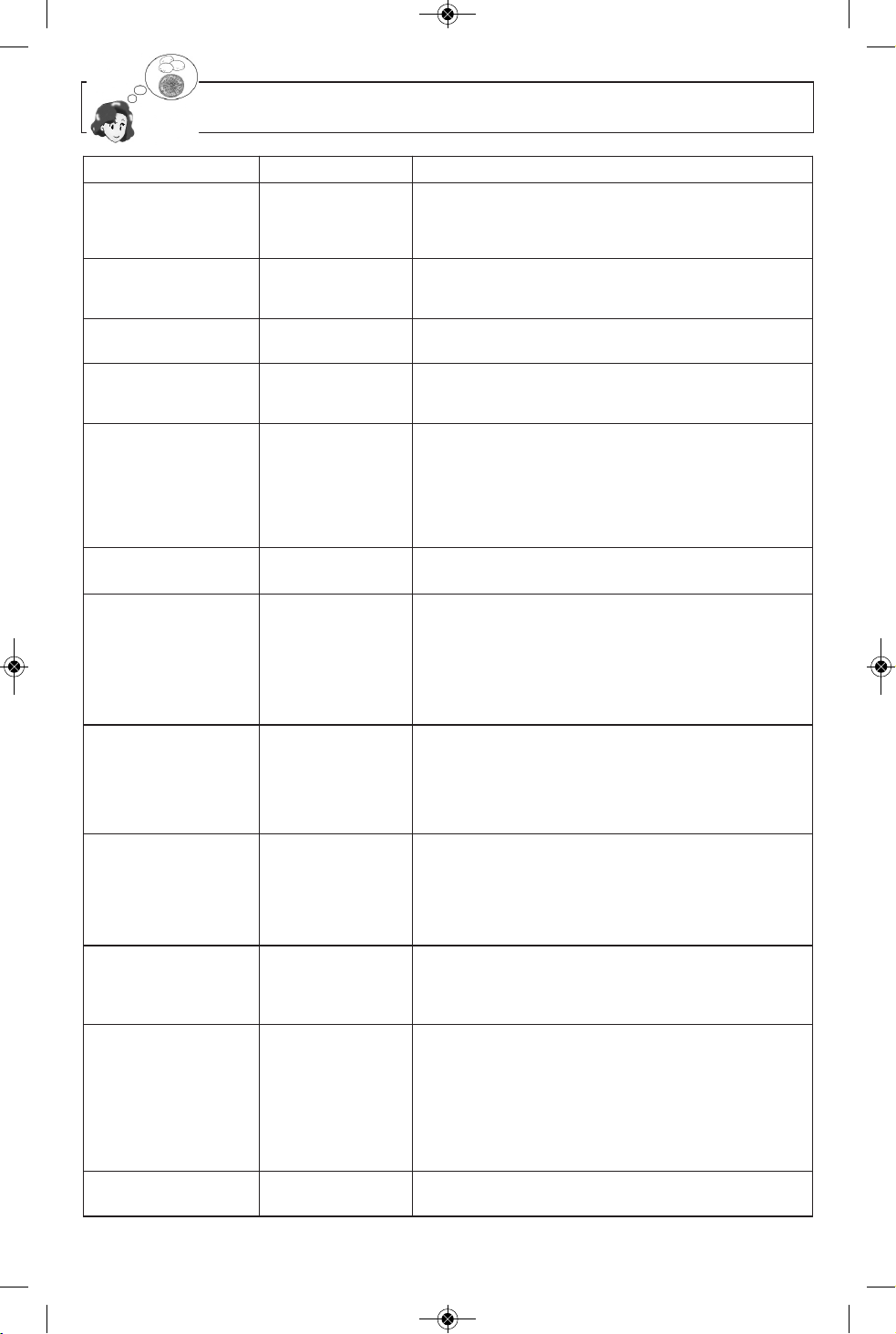
17
tabla de cocción con sensor
receta Porción/Peso consejos
1. cereal
1
/2
- 1 taza
(40 - 80 g)
Coloque la harina de avena en un tazón para
servir apto para microondas sin tapa. Siga las
instrucciones del fabricante para preparar una
rápida avena.
2. salchicha 2 - 8 enlaces
Seguir las instrucciones del fabricante para la
preparación de las salchichas
precocinadas.Colocar de forma radial.
3. omelet 2 - 4 huevos
Seguir la receta básica para tortilla de la
pagina 18.
4. sopa
1 - 2 tazas
(250 - 500 ml)
Verter la sopa en un recipiente para microondas.
Cubrir ligeramente con la tapa o película plásti-
ca perforada. Revuelva después de cocinar.
5. entradas
congeladas
220 - 800 g
(8 - 28 oz.)
Siga las instrucciones del fabricante para la
preparación. Después de 2 tonos, revuelva o
cambie. Tenga cuidado al quitar la cubierta de
la película después de cocinar. Aléjelo de usted
al quitar la cubierta para evitar quemaduras de
vapor. Si es necesario tiempo adicional
continúe cocinando manualmente.
6. Pizza congelada
(individual)
220 g
(8 oz.)
Seguir las instrucciones del fabricante. Agregue
más tiempo de cocinado si es necesario.
7. Papas
1 - 4 patatas
(170 - 220 g)
(6 - 8 oz. cada uno)
Perfore cada papa con un tenedor 6 veces
alrededor de toda la superficie. Coloque la papa
uno) o papas alrededor del borde del plato gira-
torio alineado de una toalla de papel por lo
menos a 1 pulgada (2,5 cm) de distancia. No
cubrir. Voltee después de 2 "beeps." Déjelo
estar 5 minutos para completar la cocción.
8. vegetales frescos
110 - 450 g
(4 - 16 oz.)
Todos los trozos deben ser del mismo tamaño.
Lave profundamente, agregue 1 cucharada de
agua por cada
1
/2
taza de vegetales, y cubra sin
cerrar con la tapa o una envoltura de plástico
perforada. No agregue sal o mantequilla hasta
después de cocinar.
9. vegetales
congelados
170 - 450 g
(6 - 16 oz.)
Lave profundamente, agregue 1 cucharada de
agua por cada
1
/2
taza de vegetales y cubra sin
cerrar conla tapa o una envoltura de plástico
perforada. No agregue sal o mantequilla hasta
después de cocinar. (No se recomienda para
los vegetales en mantequilla o salsa.)
10. cena
congelada
300 - 450 g
(11 - 16 oz.)
Siga las instrucciones del fabricante de cuando
poner o remover las tapas. No use alimentos
congeladas empaquetado en plato con papel de
aluminio. Después de 2 tonos, revuelva o cambie.
11. Pasta
55 - 220 g
(2 - 8 oz.)
Coloque 2 oz. de pasta con 3 tazas de agua del
grifo caliente en una cacerola apta para microon-
das de 2 cuartos, agregue sal y aceite, si lo
desea, y cubra con un envoltorio de plástico con
ventilación o con una tapa. Para 4 oz. de pasta
utilice 4 tazas de agua, para 6 oz. de pasta util-
ice 6 tazas de agua en una cacerola de 3 cuar-
tos, para 8 oz. de pasta utilice 7 tazas de agua.
12. filetes de
pescado
110 - 450 g
(4 - 16 oz.)
No montar unos filetes sobre otros. Cubrir con
película plástica perforada.
IP3516_39Y00AP_33_110630:IP3516_39Y00AP_00_110316.qxd 2011-6-30 Jerry 上上16:55 Page 17
18
recetas de Microondas
oMelet (tortilla)
omelet básica (Tortilla)
1 cucharada de mantequilla o margarina
2 huevos
2 cucharadas de leche
sal y pimienta negra, si así se desea
Calentar mantequilla de 9 pulgadas del plato
del pie, 20 segundos en Potencia P10, o
hasta derretirla. Gire el plato para cubrir
todo el fondo con mantequilla. Mientras
tanto, combine el resto de los ingredientes
en un tazón separado, bata todo y colóquelo
en el plato del pay. Cocine, cubierto con
plástico auto adherible ventilado, utilice la
selección OMELET. Deje en reposo 2
minutos. Con una espátula, afloje los bordes
del omelet del plato, doble en 3 para servir.
Siempre utilice huevos revueltos.
1 servicio
Tiempo aprox. 4 minutos.
nota: duplicar la cantidad de ingredientes
para un omelet (tortilla) de 4 huevos.
guisoe
Pastel de carne
1 kilo de ternera picada
125 g de guisantes congelados, ya
descongelados
60 g de cebolla picada
1 cucharada sopera de caldo de carne
1
/2 cucharada pequeña de curry en polvo
1
/4 cucharada pequeña de sal
1
/4 cucharada pequeña de pimienta negra
molida
500 g de puré de papa
En una cacerola 2 cuartos. revuelva el
fondo de la carne y cocina por 5 minutos – 7
minutos a Potencia P6 o hasta que la carne
este cocida, remueva dos veces. Agregar el
resto de los ingredientes, excepto las papas.
Remueva bien, y después unte
uniformemente las papas uniformemente en
la parte de arriba. Cubrir con una tapa o
plástico auto adherible ventilado y cocine en
Potencia P5 por 16 minutos – 18 minutos.
Servicios: 4
Macarrones con queso
60 g de mantequilla
2 cucharadas soperas de cebolla picada
1 diente de ajo picado
60 g de harina
1 cucharada pequeña de mostaza seca
1 cucharada pequeña de sal
1
/4 cucharada pequeña de pimienta negra
molida
500 ml de leche
500 g de queso cheddar rallado
225 g de macarrones, hervidos y colados
120 g de pan molido
1 cucharada pequeña de pimiento dulce
En una cacerola 2 cuartos. derretir la
mantequilla por 40 segundos a potencia
P10. Agregue cebolla y ajo y cocine por 1
minuto a Potencia P10. Revuelva en harina,
mostaza, sal y pimienta, y gradualmente
agregue leche. Cocine por 3 minutos – 4
minutos en potencia P10 hasta que la salsa
espese, remueva una vez. Agregue el
queso cheddar, revuelva a fondo. Vierta y
revuelva la salsa en los macarrones, en una
cacerola 3 cuartos. Agregue al final migajas
de pan y paprika. Cubra con una tapa o
plástico auto adherible ventilado. Cocine en
potencia P6 por 16 minutos – 18 minutos.
Servicios: 6
Guiso de carne y macarrones
1 kilo de carne picada
1 cebolla pequeña picada
1
/2 pimiento verde picado
250 g de apio picado
2 latas (425 g) de salsa de tomate
375 ml de agua
250 g de caracolas sin cocer
1 cucharada pequeña de perejil
1
/2 cucharada pequeña de sal
1
/4 cucharada pequeña de pimienta negra
molida
125 g de queso cheddar rallado
Desmenuce la carne picada en una
cacerola 3 cuartos. Cocine por 5 minutos –
7 minutos a potencia P6 o hasta que la
carne este cocida. Revuelva 2 veces.
Revuelva en cebolla, pimienta y apio.
Cocine por 3 minutos – 4 minutos a
Potencia P10. Remueva con el resto de los
ingredientes, excepto el queso. Cubra con
una tapa o plástico auto adherible ventilado.
Cocine en Potencia P6 por 16 minutos – 18
minutos. Rocíe el queso. Cubra y deje en
reposo 5 minutos.
Servicios: 4-6
Atún
1 lata (170 g) de atún desecado y
desmigado
1000
g de fideos hervidos y escurridos
1 lata (290 g) de crema de champiñón
1 lata (110 g) de champiñones hervidos y
escurridos
1 paquete (450 g) de guisantes congela
dos, ya descongelados
190 ml de leche
250 g de papas fritas trituradas
125 g de queso cheddar rallado
En una cacerola 3 cuartos. combine atún,
fideos, sopa, champiñones, chícharos y
leche; mezcle bien. Cubra con tapa o plástico
auto adherible ventilado. Cocine en potencia
P6 por 16 minutos – 18 minutos. Cubra con
papas fritas y queso después de servir.
Servicios: 4-6
IP3516_39Y00AP_33_110630:IP3516_39Y00AP_00_110316.qxd 2011-6-30 Jerry 上上16:55 Page 18
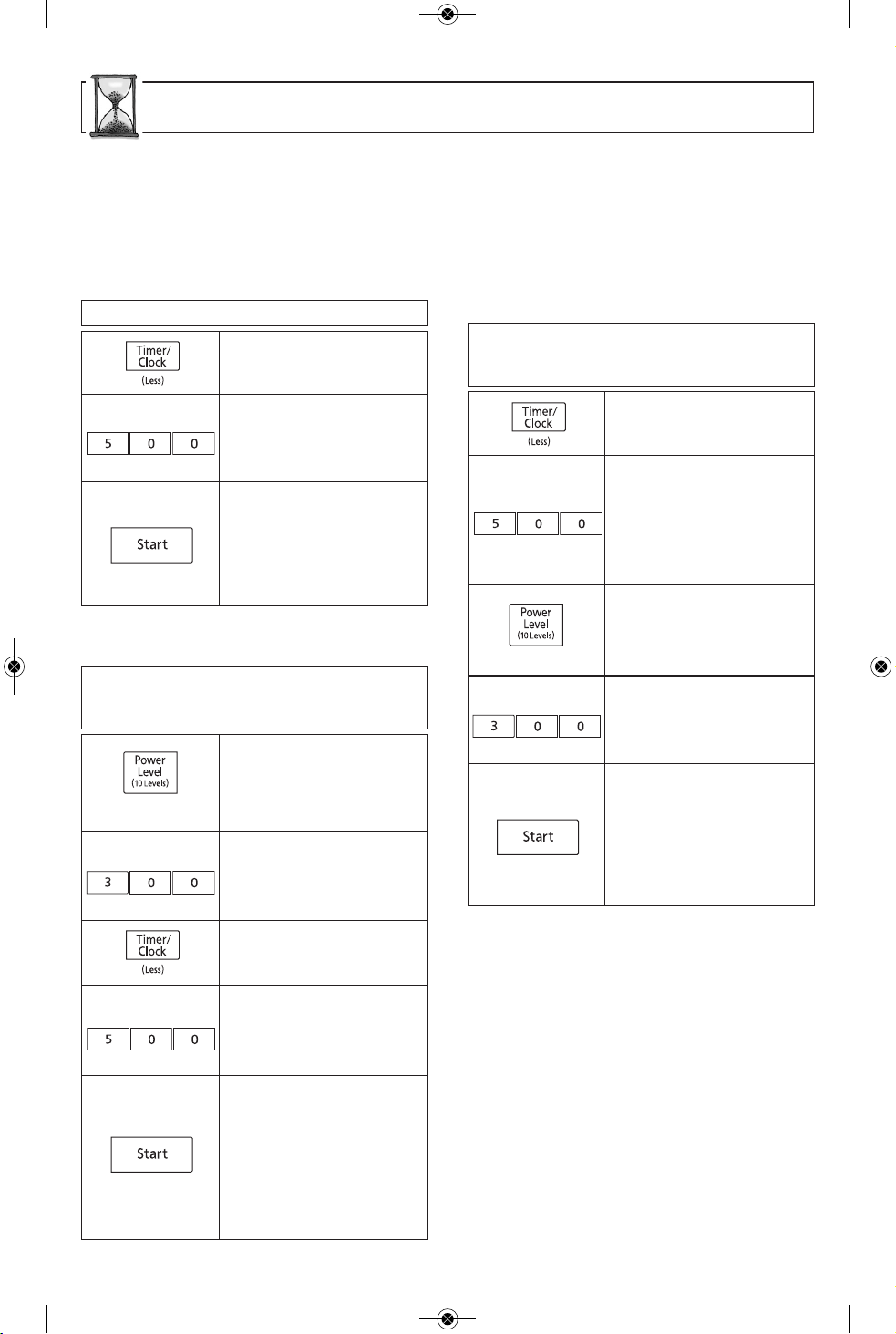
19
cronómetro
nota:
1. Cuando cada etapa finalice, sonarán 2
bips como indicación. Al final del
programa, el horno hará 5 bips.
2. Si la puerta del horno es abierta durante
el Tiempo de Reposo, El Cronómetro de
Cocina o el comienzo tardío, el tiempo
en la ventana de visualización seguirá
contando el tiempo.
3. El tiempo de reposo y comienzo tardío
no pueden ser programados antes de
ninguna función automática. Est
previene que el inicio de temperatura de
los alimentos de antes de descongelar o
al comienzo de la cocción. Un cambio
en la temperatura de inicio puede
causar resultados inapropiados.
PrecauciÓn.
si la lámpara del horno está encendida
cuando se está utilizando el cronómetro, el
horno esta programado incorrectamente.
detenga el horno inmediatamente y vuelva
a leer las instrucciones.
Esta característica le permite programar
el tiempo después de que la cocción ha
sido completada y programar el horno
con un tiempo de espera y/o un comienzo
tardío.
Para usar como cronómetro
en la cocina:
ejemplo: Para contar 5 minutos
1.
• Presione cronómetro/
reloj 1 vez.
2.
• Indique la cantidad de
tiempo (hasta 99
minutos y 99
segundos).
3.
• Presione encender.
El Cronómetro
realizará la cuenta
regresiva. No se
realizará ningún tipo
de cocción.
Para fijar un tiempo de
espera o tiempo de reposo:
ejemplo: Para cocinar con la potencia
P6 por 3 minutos, con un
tiempo de reposo de 5 minutos.
1.
• Indique el programa
de cocción deseado
(ver página 12 para
instrucciones).
• Seleccione el tiempo
deseado de cocción
utilizando las teclas
numéricas.
3.
2.
• Presione cronómetro/
reloj 1 vez.
4.
• Indique la cantidad de
tiempo (hasta 99
minutos y 99
segundos).
5.
• Presione encender.
Después de la
cocción el tiempo de
reposo empezará a
contar en forma
descendente sin
que el horno esté
funcionando.
Presione 5 veces
Para programar un comienzo
tardío:
ejemplo: Para retrasar el comienzo por
5 minutos, y cocinar a la
Potencia P6 por 3 minutos.
1.
• Seleccione el programa
de cocción (ver
página12 para
instrucciones).
• Seleccione el tiempo
deseado de cocción
utilizando las teclas
numéricas.
3.
• Presione cronómetro/
reloj 1 vez.
2.
• Introduzca la cantidad
de tiempo de espera
que se desea utilizando
las teclas numéricas:
(hasta 99 minutos y 99
segundos)
5.
4.
• Presione encender.
Cuando el tiempo
demorado comience
con la cuenta
regresiva, y éste
haya finalizado, la
cocción iniciará.
Presione 5 veces
IP3516_39Y00AP_33_110630:IP3516_39Y00AP_00_110316.qxd 2011-6-30 Jerry 上上16:55 Page 19
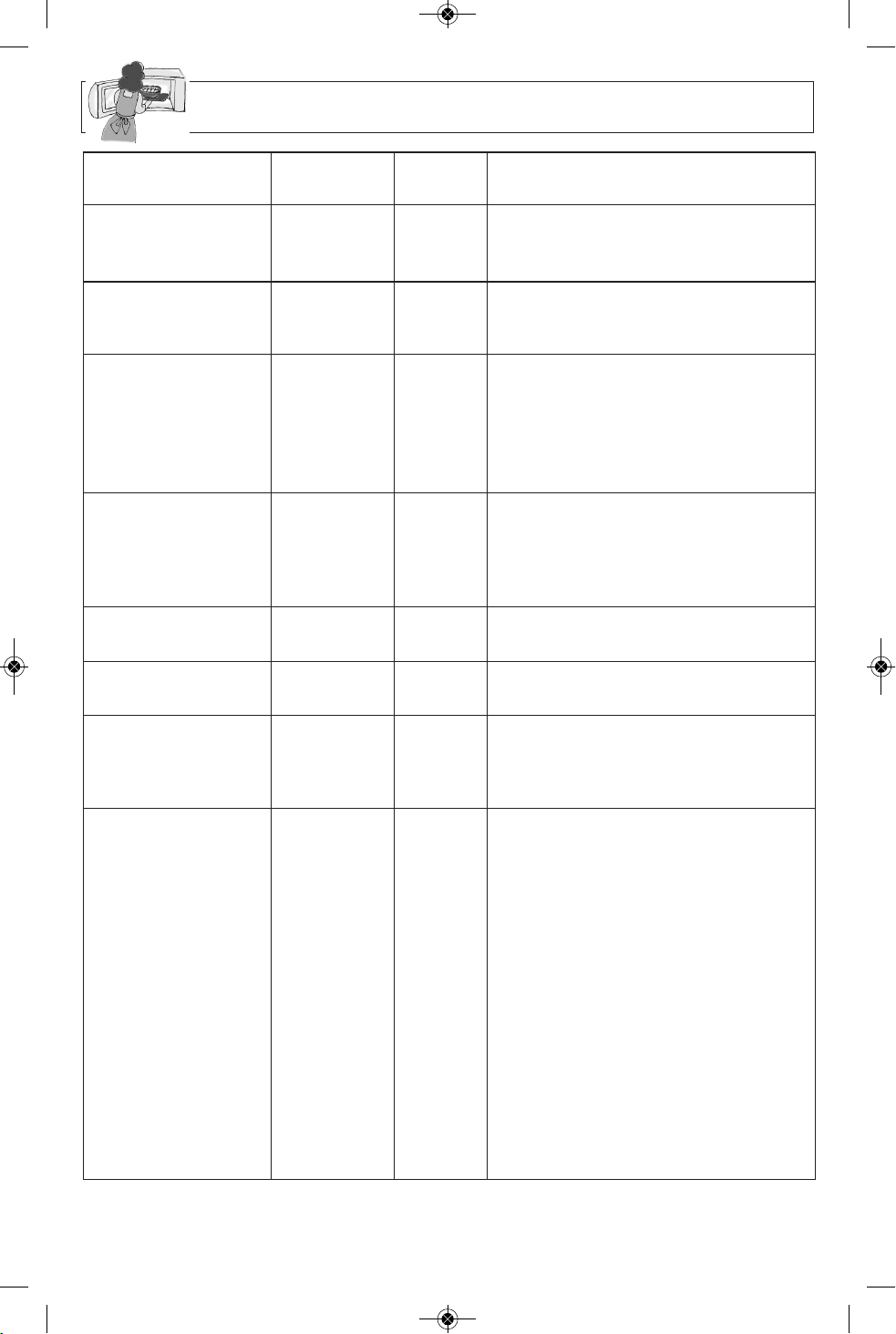
20
consejos rápidos
aliMentos Potencia tieMPo instrucciones
tocino, separado,
P10
30 s Quite la envoltura. Después de calentar, use
1 libra (450 g)
(ALTO)
una espátula de plástico para separar las
rebanadas.
azúcar Morena,
P10
20 s a 30 s Coloque 1 taza de azúcar morena (250 g) en
suavizada
(ALTO)
el plato con una rebanada de pan o un trozo
1 taza (250 ml) de manzana. Cubra con envoltura plástica.
Para ablandar la Mantequilla
,
P3
1 Retirar el envoltorio y poner la mantequilla
1 varilla,
1
/4 de libra (110 g)
(MEDIO-BAJO)
en un recipiente adecuado para el
microondas.
Para derretir la Mantequilla
,
P6
1 min. 30 s Retirar el envoltorio y poner la mantequilla
1 varilla,
1
/4 de libra (110 g)
(MEDIO)
a 2 min. en un recipiente adecuado para microondas
cubierto con un envoltorio de plástico.
chocolate, derretido,
P6
1 min. a Quite la envoltura y coloque el chocolate
1 cuadro (28 g)
(MEDIO)
1 min. 30 s en el plato, remueva antes de añadir más
chocolate, derretido,
P6
1 min. a tiempo. El chocolate conserva su forma
1
/2 taza de chispas
(MEDIO)
1 min. 30 s aún cuando se suaviza.
(125 ml)
coco, Pan tostado,
P10
1 min. Colóquelos en un molde de tarta o en tazón.
1
/2 taza (125 ml)
(ALTO)
Remueva cada 30 segundos.
queso crema, suavizado,
P3
1 min. a Quite la envoltura y colóquelo en un plato.
220 g (8 onzas)
(MEDIO-BAJO)
2 min.
Para dorar la
P10
4 min. a Deshebre en un colador seguro para uso
orilla de la carne,
(ALTO)
5 min. de microondas en otro plato. Cubra con
450 g (1 libra) papel auto adherible. Revolver 2 veces.
Drenar la grasa.
Para cocinar vegetales,
frescos
P8
3 min. 30 s Todos los trozos deben ser del mismo
(225 g) a 4 min. tamaño. Lave profundamente, agregue 1
(
1
/2 libra) cucharada de agua por cada
1
/2 taza de
vegetales, y cubra sin cerrar con la tapa o
una envoltura de plástico perforada. No
agregue sal o mantequilla hasta después de
cocinar.
descongelar
P8
3 min. 30 s Lave profundamente, agregue 1 cucharada
(280 g) a 4 min. de agua por cada
1
/2 taza de vegetales, y
(10 onzas) cubra sin cerrar con la tapa o una envoltura
de plástico perforada. No agregue sal o
mantequilla hasta después de cocinar. (No
se recomienda para los vegetales en
mantequilla o salsa.)
enlatados
P8
3 min. 30 s Vacíe los contenedores en un tazón para
(430 g) a 4 min. uso seguro en microondas. No Cubrir.
(15 onzas)
IP3516_39Y00AP_33_110630:IP3516_39Y00AP_00_110316.qxd 2011-6-30 Jerry 上上16:55 Page 20
21
consejos rápidos
(continuación)
aliMentos Potencia tieMPo instrucciones
Para cocinar Papa horneada,
Perforar cada papa con un tenedor 6 veces
(170 - 220 g) alrededor de toda la superficie. Coloque las
(6 - 8 onzas cada una) papas en todo el borde del plato revertido
1
P8
3 min. 30 s de papel toalla, por lo menos 1 pulgada
a 4 min. (2,5 cm) de espacio entre ellas. No cubrir.
2
P8
6 min. a Deje en reposo 5 minutos para completar la
7 min. cocción.
Para vapor en las toallas
P10
20 s a 30 s Remojar en agua, después escurrir el exceso.
de mano – 4
(ALTO)
Coloque en un plato seguro para uso en
microondas.
Caliente. Presente inmediatamente.
helado, suavizado,
P3
1 min. a Revise frecuentemente para evitar que se
1
/2 galón (2 litro)
(MEDIO-BAJO)
1 min. 30 s derrita.
taza de agua
1 taza (250 ml)
P10
1 min. 30 s
(ALTO)
a 2 min.
2 tazas (500 ml)
P10
2 min. 30 s
(ALTO)
a 3 min.
taza de leche
1 taza (250 ml)
P7
1 min. 30 s
(MEDIO-ALTO)
a 2 min.
2 tazas (500 ml)
P7
2 min. 30 s
(MEDIO-ALTO)
a 3 min.
Para asar nueces,
P10
3 min. a Esparcir las nueces a 9 pulgadas (23 cm)
1
1
/2 tazas (375 ml)
(ALTO)
4 min. en una bandeja para postres segura para
uso de microondas.
Revolver ocasionalmente.
Para asar semillas
P10
2 min. a Colocar en un tazón pequeño seguro para
de sésamo,
(ALTO)
2 min. 30 s uso en microondas. Remover 2 veces.
1
/4 taza (60 ml)
Para piel de tomates,
P10
30 s Colocar el tomate en un tazón seguro para
(uno a la vez)
(ALTO)
el uso en microondas que contenga agua
hirviendo. Enjuagar y Pelar.
Repita para cada tomate.
Para quitar olores, P10
5 min. Combine 1 taza (250 ml) a 1
1
/2 (375 ml)
del horno (ALTO)
taza de agua con el jugo y piel de un limón
en una taza pequeña. Después de calentar
limpie el interior del horno con una tela
suave. Usted puede también utilizar una
combinación de varios clavos enteros y
1
/4
de taza de vinagre con 1 taza de agua.
Los líquidos calientes pueden hacer
erupción si no son mezclados con aire.
No caliente líquidos en su horno de
microondas sin removerlos primero.
IP3516_39Y00AP_33_110630:IP3516_39Y00AP_00_110316.qxd 2011-6-30 Jerry 上上16:55 Page 21
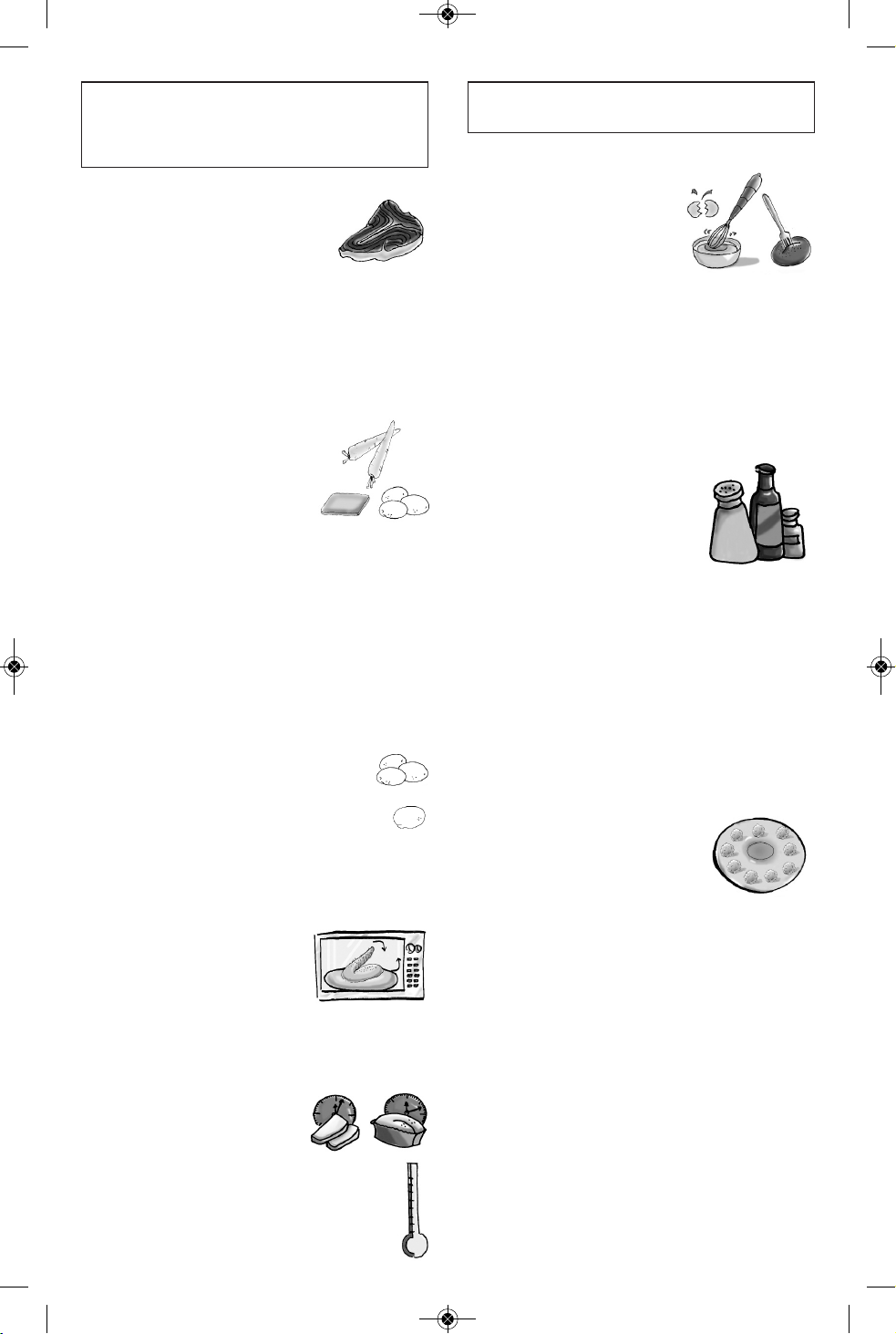
características de
los alimentos
técnicas para cocinar
huesos y grasas
Tanto los huesos como la grasa
afectan la cocción. Los huesos
pueden causar cocción
irregular. La carne cercana a las
puntas de los huesos puede sobrecocinarse
en tanto que la carne ubicada bajo un hueso
largo, tal como un hueso de jamón, puede
resultar crudo. Grandes cantidades de grasa
absorben energía de microondas y la carne
cercana a estas áreas puede
sobrecocinarse.
densidad
Alimentos porosos, como
panes, pasteles o rollos
toman menos tiempo para
cocinar que los alimentos
pesados y densos como
papas y asados. Cuando
recalienta donas o otros alimentos con
diferentes centros sea muy cuidadoso.
Algunos alimentos tienen centros hechos
con azúcar, agua, o grasa y estos centros
atraen las microondas (Por ejemplo, donas
de jalea). Cuando la jalea de la dona es
calentada, la jalea esta extremadamente
caliente y el exterior solo parece tibio al
tacto. Esto puede resultar en una
quemadura si no se permite que el alimento
se enfríe apropiadamente del centro.
cantidad
Dos papas toman más tiempo para
cocinarse que una papa. Así como
se aumenta la cantidad de alimento
se incrementa el tiempo de cocción.
Cuando se cocinan cantidades
pequeñas de alimento, tales como una o
dos papas, no deje el horno desatendido. El
contenido de humedad en el alimento puede
disminuir y puede resultar un incendio.
forma
Tamaños uniformes se
calentarán más uniforme-
mente. El final delgado de
un muslo se cocinará mas
rápido que un final carnoso. Para
compensar las formas irregulares, coloque
las partes delgadas hacia el centro del plato
y las piezas gruesas hacia la orilla.
tamaño
Piezas delgadas se cocinan
más rápido que piezas
gruesas.
temperatura para empezar:
Los alimentos que están a temperatura
ambiente toman menos tiempo para
cocinarse que aquellos que están
refrigerados o congelados.
Perforado
Alimentos con piel o
membrana deben ser
perforados, abiertos o
tener abierta una tira de
piel antes de cocinar,
para permitir que el vapor
escape. Perforar las yemas y claras de
los huevos enteros, almejas, ostiones,
hígados de pollo, papas enteras y
vegetales enteros. Las manzanas enteras
o las papas sin pelar deben tener una tira
de 2,5 cm de piel pelada antes de
cocinarse. Perfore salchichas y
embutidos.
dorador
Los alimentos no tendrán la
misma apariencia dorada
que aquellos que son
cocidos convencionalmente
o aquellos alimentos que
sean cocinados utilizando la
característica de dorado. Las carnes y
aves pueden ser bañados con salsa para
dorar: salsa inglesa, salsa de barbacoa o
la salsa para dorar con aplicador. Para
usarlas combine la salsa para dorar con
mantequilla o margarina derretidas;
barnícelas antes de cocinarlas.
Para dorar panes o panecillos rápidos se
puede usar azúcar morena en la receta
en lugar de azúcar granulada y se puede
espolvorear la superficie con especies
obscuras antes de hornear.
espaciado
Alimentos individuales, tales
como papas cocidas,
panquecitos y aperitivos, se
cocinarán más parejo si se
colocan en el horno a distancias iguales.
Cuando sea posible, arregle los alimentos en
un platón circular.
22
IP3516_39Y00AP_33_110630:IP3516_39Y00AP_00_110316.qxd 2011-6-30 Jerry 上上16:55 Page 22
23
técnicas para cocinar
(continuación)
cubierta
Como en la cocina convencional, el vapor se
evapora durante la cocción por microondas.
Las tapas de las cacerolas o cubiertas de
plástico son usadas para sellar ajustadamente.
Cuando utilice envoltura plástica, ventile la
cubierta plástica doblando parte de la misma
de una esquina del plato para permitir que el
vapor escape. Suelte para tiempo de reposo.
Cuando quite la cubierta plástica así como
cualquier tapa de cristal, tenga cuidado de
quitarla alejada de usted para evitar
quemaduras por vapor. Varios grados de
retención de humedad se obtienen también
usando papel encerado o toallas de papel. Sin
embargo, a menos que se especifique, las
recetas se cocinan descubiertas.
Protección
Áreas delgadas de carnes o aves se
cocinan más rápido que las porciones
carnosas. Para evitar la sobrecocción, estas
áreas delgadas pueden ser protegidas con
tiras de papel de aluminio. Palillos de
dientes de madera pueden ser usados para
sostener al aluminio en su lugar.
PrecauciÓn se debe tener cuidado
cuando se utilice papel aluminio. Arcos
eléctricos pueden ocurrir si el papel
aluminio está muy cerca de las paredes o
puerta del horno, pudiendo resultar en
daños al horno.
tiempo de cocción
Un rango de tiempo de cocción se da en
cada receta. El rango de tiempo se
compensa por las diferencias incontrolables
en las formas de los alimentos, la
temperatura al inicio y las preferencias
regionales. Siempre cocine los alimentos al
tiempo mínimo de cocción dado en la receta
y revise su termino. Si los alimentos están
crudos, continue cocinando. Es mas fácil
añadir tiempo a un producto crudo. Una vez
que los alimentos están sobrecocinados,
nada se puede hacer.
remover
Remover es necesario normalmente
durante la cocción por microondas. hemos
anotado cuando remover es necesario
usando las palabras “una vez”, “dos veces”,
“frecuentemente” u “ocasionalmente” para
describir la cantidad de veces que es
necesario remover.
reacomodar
Reacomodar piezas pequeñas tales como
partes de pollo, camarones, hamburguesas
o cortes de puerco. Reacomode las piezas
de las orillas al centro y piezas del centro a
las orillas del plato.
voltear
No es posible mezclar algunos alimentos
para redistribuir el calor. A veces la energía
del microondas se concentrará en un área del
alimento. Para asegurar una cocción pareja,
estos alimentos necesitan ser volteados.
Voltee alimentos grandes, tales como asados
o pavos, de medio giro mientras se cocinan.
tiempo de reposo
La mayoría de los alimentos continuarán
cocinándose por conducción después de que
el horno de microondas se apague; durante
la cocción de la carne, la temperatura interna
se incrementará de 3 °C a 8 °C si se permite
el reposo, cubierto con papel de aluminio de
10 minutos a 15 minutos. Guisados y
vegetales necesitan una cantidad menor de
tiempo de reposo, pero este tiempo es
necesario para permitir a los alimentos
completar su cocción en el centro sin
sobrecocinarse las orillas.
Prueba de término
Las mismas pruebas de termino usadas en
la cocción convencional pueden ser usadas
para cocinar con microondas. La carne está
lista cuando el tenedor se encaja o desliza
entre las fibras. El pollo está listo cuando sus
jugos son amarillo claro o el muslo se mueve
libremente. Los pescados están listos
cuando se separa la carne y está opaco.
sobre la seguridad del alimento
y temperatura de cocción
Revisar los alimentos para ver si están
cocinados a las temperaturas
recomendadas por el Departamento de
Agricultura del los Estados Unidos.
teMPeratura de los aliMentos
71
°C
(160
°F
)
... para carne de puerco fresco,
carne de res, carne blanca
de ave sin huesos, pescado,
alimentos de mar, huevos, y
alimentos preparados
congelados.
74
°C
(165
°F
)
... para lo demás, listo para
recalentar lo refrigerado y
deli, y comida fresca para
llevar.
77
°C
(170
°F
)
... carne blanca de ave.
82
°C
(180
°F
)
... Carne roja de ave.
Para probar que esta hecho, inserte un
termómetro de carne en un área espesa o
densa, lejos de la grasa o hueso. NUNCA
deje el termómetro en la comida durante la
cocción, a menos que este sea aprobado
para el uso en horno de microondas.
IP3516_39Y00AP_33_110630:IP3516_39Y00AP_00_110316.qxd 2011-6-30 Jerry 上上16:55 Page 23
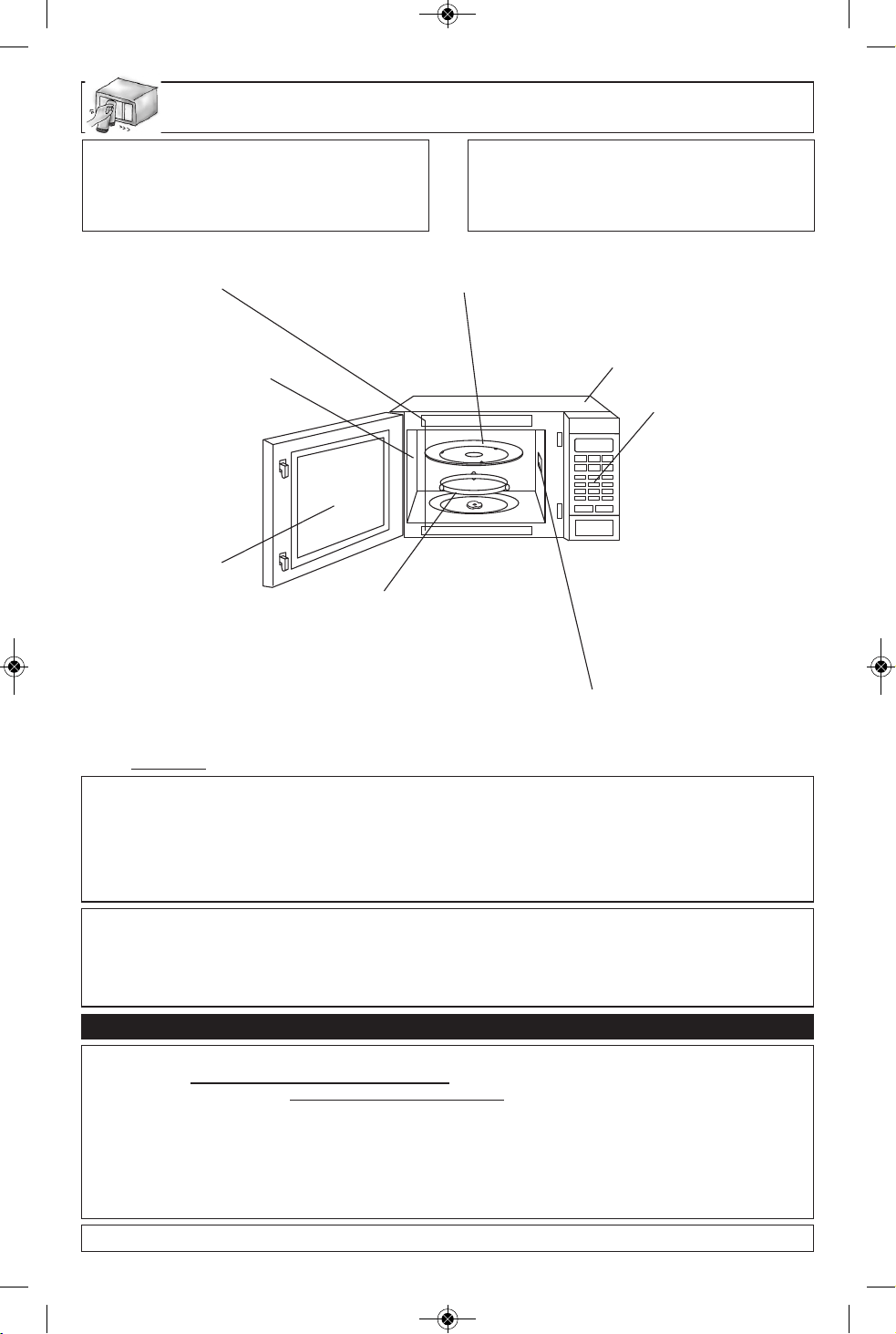
24
cuidado y limpieza de su horno de Microondas
antes de liMPiar:
Desenchufar en la toma mural del horno. En
caso de que sea imposible, dejar el horno
abierto para impedir que se ponga en marcha
de manera accidental.
desPuÉs de liMPiar:
Asegúrese de que se vuelve a colocar el Aro
de Rodillo y Bandeja de Cristal en la posición
correcta, después pulsar la tecla
Pausa/cancelar para borrar la pantalla.
etiqueta de Menú /etiqueta de
advertencia:
No remueva. Limpiar con un trapo
suave.
interior del horno:
Limpiar con un trapo
húmedo. Se puede utilizar
un detergente suave si el
horno se ensucia mucho.
No utilizar detergentes muy
fuertes o abrasivos.
bandeja de cristal:
Extraer y lavar con agua
jabonosa y tibia o en un
lavaplatos.
las superficies exteriores
del horno:
Limpiar con un trapo suave.
Para impedir daños en las
piezas en operación en el
interior del horno, no se debe
permitir que el agua entre por
las aperturas de ventilación.
Puerta de horno:
Limpiar con un trapo
suave cuando el vapor
se acumule en el interior
o alrededor del exterior
de la puerta del horno.
Durante la cocción,
especialmente bajo
condiciones de mucha
humedad, los alimentos
expelen vapor. (Parte
del vapor se condensará
en las superficies más
frías, como la puerta del
horno. Esto es normal.)
La superficie del interior
está cubierta con una
película que actúa como
barrera contra el calor y
vapor. No extraer.
no quite la cubierta de la guía de
las ondas:
esta es importante para mantener
la cubierta limpia de la misma
manera que el interior del horno.
Panel de control:
* Cubierta con una
película extraíble
para impedir
ralladuras durante el
envío.
(Consejo - Para
extraer la película,
aplicar cinta adhesiva
transparente o de
uso eléctrico en una
esquina expuesta y
tirar suavemente.)
* Si el panel de control
se humedece, limpiar
con un trapo seco y
blando. No utilizar
detergentes muy
fuertes o abrasivos.
aro de rodillo y el suelo de la
cavidad del horno:
Limpiar la superficie inferior del horno
con agua con un detergente suave o un
producto de limpieza de ventanas y
secar. El aro de Rodillo se puede lavar
con agua con un detergente suave o
con un producto para la limpieza de
ventanas. Estas zonas se deberán
mantener limpias para así evitar un
ruido excesivo.
es iMPortante Mantener el horno liMPio y seco. los residuos y la con-
densaciÓn de vaPor del aliMento Pueden causar enMoheciMiento y / o
acuMulaciones que daÑen al horno. desPuÉs de usarse el horno liMPie
con un traPo seco todas las suPerficies incluyendo las aberturas de
ventilaciÓn, hendiduras del horno, y debaJo de la bandeJa de cristal.
descriPciÓn de las Partes nÚMero de las Partes
Instrucciones/Manual de uso (este libro) F00039Y00AP
Bandeja de Cristal F06015Q00AP
Aro de Rodillo F290D6W51XP
Compra de piezas, accesorios e instructivos en línea de todos los productos Panasonic visite nuestro
Sitio Web en: http://www.pstc.panasonic.com
o envíe su pedido al E-mail: [email protected]
Usted también puede contactarnos directamente en:
1-800-332-5368 (teléfono) 1-800-237-9080 (fax solamente) (Lunes-Viernes 9 a.m. a 8 p.m.)
Compañía de Servicios y Tecnología Panasonic
20421 84th Avenue South,
Kent, WA 98032
(Aceptamos Visa, Mastercard, Discover Card, American Express y Cheques personales)
Para usuarios de Equipo Teleescritor: 1-866-605-1277
Compra de Accesorios (U.S.A y Puerto rico)
IP3516_39Y00AP_33_110630:IP3516_39Y00AP_00_110316.qxd 2011-6-30 Jerry 上上16:55 Page 24
25
antes de acudir a servicio
estos casos son normales:
Mi horno de En algunos radios y televisores puede ocurrir interferencia
microondas causa cuando usted cocine con su horno de microondas. Esta
interferencia con interferencia es similar a la interferencia por pequeños
mi televisor. aparatos eléctricos como batidoras, aspiradoras, secadoras
de aire, esto no indica ningún problema.
Se acumula vapor en Durante la cocción los alimentos despiden vapor. La mayoría
la puerta del horno y de este vapor es removido por el aire que circula en la
aire caliente sale de cavidad del horno, sin embargo, algo de vapor se condensará
las rejillas de en las superficies frías tales como la puerta del horno. Esto
ventilación. es normal. Después de usarse el horno se debe limpiar en
seco (ver página 24).
El horno no está enchufado Extraer el enchufe de la toma, esperar
de manera segura. 10 segundos y volver a enchufar.
El interruptor (breaker) del Reinicie el interruptor (breaker) del
circuito o el fusible se ha circuito o reemplace el fusible.
fundido o disparado.
Existe un problema con la Enchufar otro electrodoméstico
toma eléctrica. en la toma para comprobar si
ésta funciona correctamente.
La puerta no está cerrada Cerrar bien la puerta del horno.
completamente.
La tecla encender Presione encender.
no ha sido presionada.
Ya se había introducido Presione Pausa/cancelar para
otro programa en el horno. anular el programa anterior e
introducir un programa nuevo.
El programa no es correcto. Programar otra vez de acuerdo
con las instrucciones de Operación.
La tecla Pausa/cancelar Programar el horno otra vez.
se presionó accidentalmente.
El plato giratorio no está Retire la Bandeja de Cristal y el Aro
colocado correctamente en de Rodillo. Limpie con un paño
el Aro del Rodillo o existen húmedo y reajuste el Aro de Rodillo
alimentos debajo del Aro del y la Bandeja de Cristal
Rodillo. correctamente.
El(Los) Anillo(s) del Rodillo y Limpie estas partes de acuerdo al
el fondo del horno están cuidado y limpieza de su horno
sucios. de Microondas (ver página 24).
El SEGURO DE NIÑOS fue Desactivar el SEGURO al presionar
activado al presionar la la tecla de Pausa/cancelar 3 veces.
tecla de encender 3 veces.
El horno no se pone
en marcha.
El horno no empieza
a cocinar.
El plato giratorio
tambalea.
Cuando el horno
está funcionando, la
Bandeja de Cristal
produce ruidos.
La palabra “Child”
aparece en la ventana
de visualización.
ProbleMa Posible causa acciÓn
La fuente de suministro de
energía del horno ha
fallado.
Favor contactar a su Centro de
Servicios Autorizado (vea pag.
26).
El horno detiene la
cocción y en la pantalla
indicadora aparece
“h00”, “h97” o “h98”.
IP3516_39Y00AP_33_110630:IP3516_39Y00AP_00_110316.qxd 2011-6-30 Jerry 上上16:55 Page 25
26
Para usuarios de Equipo Teleescritor: 1-877-833-8855
garantÍa liMitada y directorio de servicios al consuMidor
(u.s.a y Puerto rico)
COMPAÑÍA ELECTRÓNICA DE CONSUMIDORES PANASONIC,
DIVISIÓN DE PANASONIC CORPORACION DE
NORTE AMÉRICANA
One Panasonic Way
Secaucus, New Jersey 07094, USA
garantía limitada del horno Microonda Panasonic
cobertura de la garantía limitada
Si su producto no funciona adecuadamente debido a defecto en los materiales o en la fabricación, la Compañía
Electrónica de Consumidores Panasonic (Panasonic Consumer Electronics Company) (referidos como “el
garante”), por la duración del período que se menciona más abajo, el cual comienza en la fecha de compra
original (“período de garantía”), hará uso de dos opciones (a) reparar su producto con partes nuevas o reparadas,
o (b) reemplazarlo por un producto nuevo o uno reparado. La decisión de reparar o reemplazar el producto será
tomada por el garante.
Partes trabaJo
todas las Partes (EXCEPTO EL TUBO MAGNETRÓN) 1 (un) aÑo 1 (un) aÑo
tubo MagnetrÓn 5 (cinco) aÑos 1 (un) aÑo
Durante el período de la garantía de “Trabajo” no habrán cobros por trabajo. Durante el período de la garantía de
“Partes” no habrán cobros por las partes. Usted debe llevar o enviar por correo su producto durante el período de
garantía. Esta garantía sólo se aplica a productos comprados y pagados en Estados Unidos y Puerto Rico. Esta
garantía se extiende sólo al comprador original de un producto nuevo y no a quien lo compre de segunda mano.
Para el servicio de garantía se necesita un recibo de compra o alguna otra prueba de la fecha de compra original
del producto.
servicio de entrega o envío por correo
Para el Servicio de Entrega o Envío por Correo en Estados Unidos y Puerto Rico, por favor llame al 1-800-211-
PANA(7262) o visite nuestro Sitio Web Panasonic: http://www.panasonic.com
garantía limitada, límites y exclusiones
Esta garantía SÓLO CUBRE fallas debido a defectos en los materiales o en la fabricación y NO CUBRE vidrios,
partes plásticas, o algún tipo de termómetro (si es que está incluído), deterioros o rasguños normales o daños
cósmeticos. La garantía TAMPOCO CUBRE daños producidos por el transporte o fallas causadas por productos
no proporcionados por el garante, o fallas que hayan sido el resultado de accidentes, mal uso, abuso, negligencia,
plaga de insectos, mal embalaje, mala aplicación, alteración, instalación defectuosa, ajustes de montaje, mal
ajuste del control del consumidor, mantenimiento inapropiado, sobretensión en la línea de conducción eléctrica,
daños en la iluminación, modificaciones, o uso comercial (por ejemplo en un hotel, oficina, restaurante u otros
usos comerciales), arriendo del producto, reparado por cualquier otro servicio que no sea el Servicio Técnico de la
Fábrica o algún Servicio Técnico Autorizado, o cualquier daño que se la atribuya a la mano de Dios. no eXisten
garantÍas escritas eXcePto las que se enuMeran MÁs abaJo coMo “cobertura de
garantÍa liMitada”. el garante no se hace resPonsable Por daÑos fortuÍtos o
iMPortantes que se ProduZcan Por el uso de este Producto o debido a cualquier
violaciÓn de esta garantÍa. (por ejemplo, esto excluye daños por pérdida de tiempo, el costo que tiene si
se necesita que alguien remueva o reinstale el aparato, o los viajes desde y al servicio técnico. Los puntos
mencionados no son sólo los únicos, se mencionan a modo de explicación.) todas las garantÍas
escritas e iMPlÍcitas, incluÍdas las garantÍas de coMercialiZaciÓn, son liMitadas,
segÚn el Periodo de la garantÍa liMitada. Algunos estados no permiten la exclusión o restricción de
daños importantes o fortuítos, o restricciones sobre cuanto tiempo dura una garantía implícita, de esa forma las
exclusiones no se aplicarían a usted. Esta garantía le da derechos legales específicos y usted puede tener
también otros derechos que varíen de un estado a otro. Si un problema con este producto sucede durante o
después del período de garantía, usted puede contactarse con su distribuidor o con el Servicio Técnico. Si el
problema no es solucionado a su satisfacción, entonces usted puede escribir al Departamento de Asuntos del
Consumidor del Garante a la dirección que se menciona para el garante.
las Partes y servicios que la garantÍa liMitada no cubre, son de su resPonsabilidad.
Para obtener información de producto y asistencia de funcionamiento; Localizar a su Distribuidor o
Centro de Servicio más cercano; comprar piezas y accesorios; o hacer pedidos en Servicio a Cliente,
visite nuestro Sitio Web en: http://www.panasonic.com/help
o, contáctenos en: http://www.panasonic.com/contactinfo
Usted puede también contactarnos directamente al: 1-800-211-Pana(7262),
Lunes-Viernes 9 am-9 pm; Sábado-Domingo 10 am-7 pm.
Directorio de Servicio a Cliente (U.S.A y Puerto rico)
IP3516_39Y00AP_33_110630:IP3516_39Y00AP_00_110316.qxd 2011-6-30 Jerry 上上16:55 Page 26
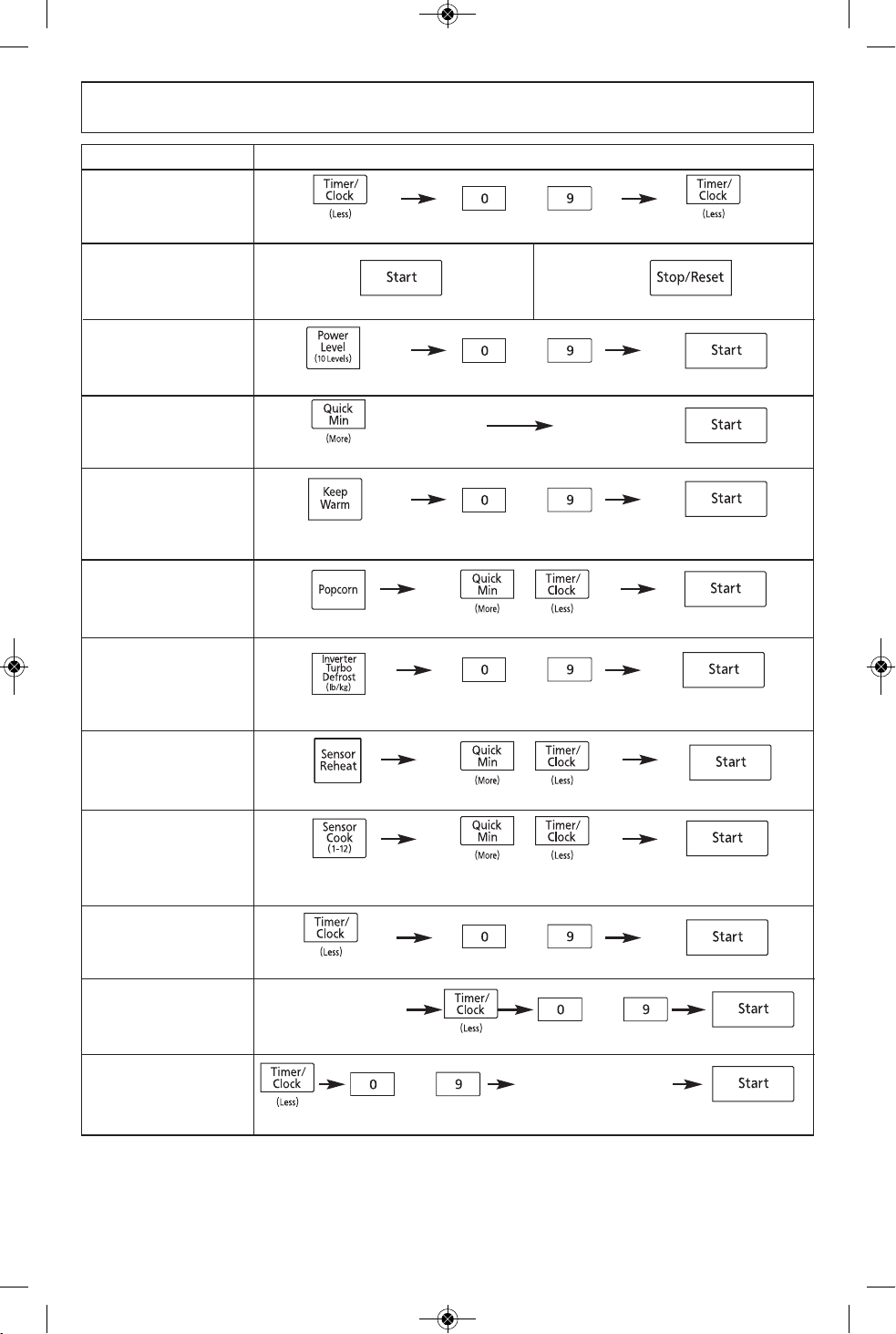
27
guÍa rapida de operación
característica como operarla
Para Poner el
Reloj en la hora
(*página 11)
Presione 2 veces.
Registre la hora.
Presione 1 vez.
Para utilizar Candado
de Seguridad de
Niños
(*página 11)
Presione 3 veces. Presione 3 veces.
Para
seleccionar:
Para
cancelar:
Para Ajuste de
Potencia y Tiempo
(*página 12)
Seleccione potencia. Establezca el tiempo de cocción.
Presione 1 vez.
Minuto Automático
(*página 12)
(hasta 10) Presione 1 vez.
Presione 1 vez.
Seleccione el tiempo de mantener caliente ( hasta 30 minutos)
Presione 1 vez.
Para utilizar
Mantener Caliente
(*página 12)
Para Cocinar usando la
tecla de Palomitas
(*página 13)
Registre el peso del paquete.
Opcional. Presione 1 vez.
o
o
o
Para Descongelar
usando la tecla
Descongelación Turbo
Inverter (*página 14)
Presione 1 vez. Fije el peso. Presione 1 vez.
Para Recalentamiento
usando la tecla
Recalentamiento de
Sensor (*página 16)
Presione 1 vez. Presione 1 vez.
Para Cocinar usando
Tecla de Cocción de
Sensor
(*página 16)
Opcional.
Presione para seleccionar el ali-
mento según el dígito.
Opcional. Presione 1 vez.
Para Usar como
cronómetro de
cocina (*página 19)
Presione 1 vez. Introducir hora. Presione 1 vez.
Para Establecer el
Tiempo de Reposo
(*página 19)
Presione 1 vez.
Introducir hora. Presione 1 vez.
()
Registre el
programa de
Cocción deseado.
Para Establecer un
Comienzo Tardío
(*página 19)
Presione 1 vez.
Introducir hora.
Presione 1 vez.
()
Registre el
programa de
Cocción deseado.
o
o
o
o
o
o
o
IP3516_39Y00AP_33_110630:IP3516_39Y00AP_00_110316.qxd 2011-6-30 Jerry 上上16:55 Page 27
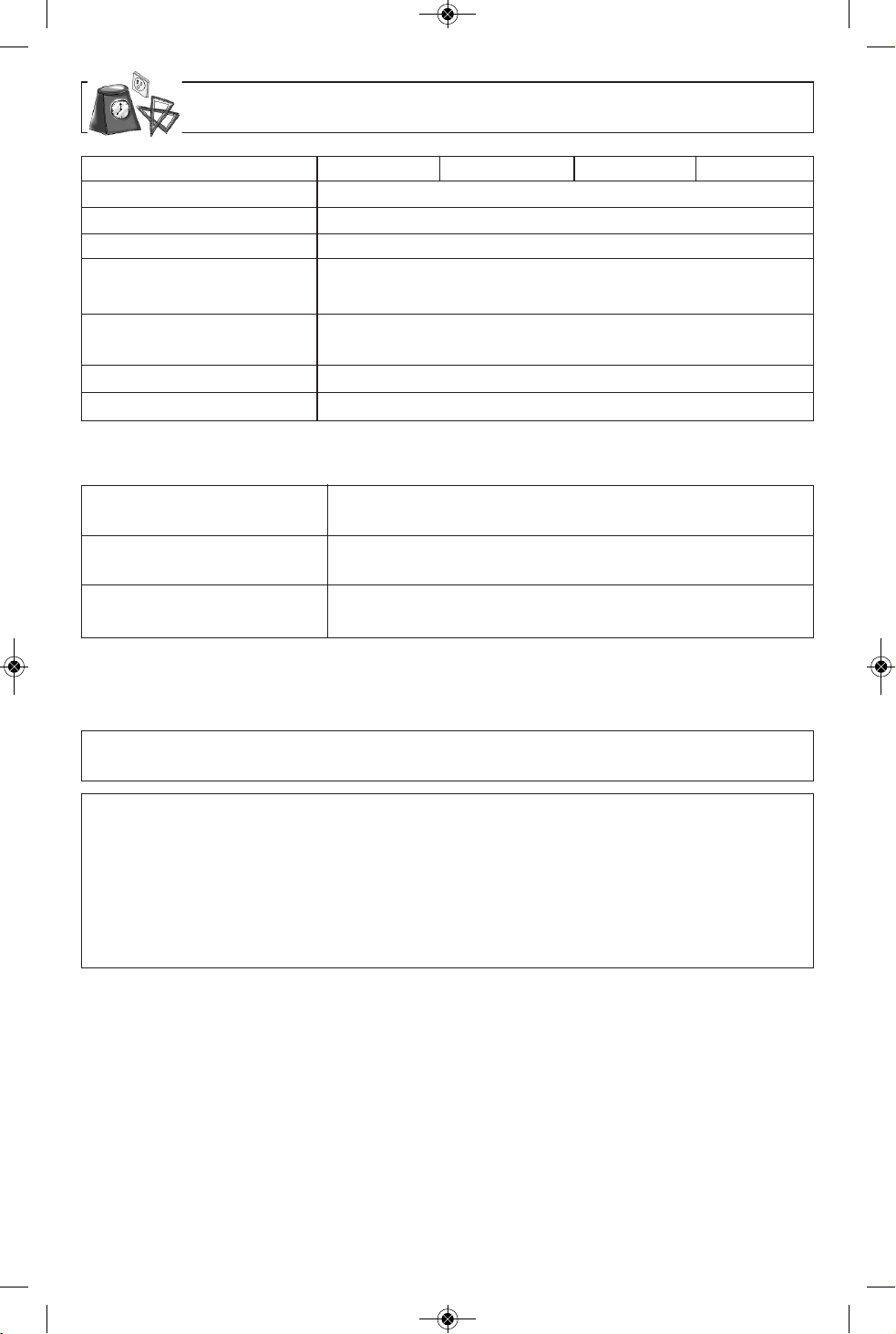
28
especificaciones
Fuente de Energ
í
a:
Potencia Fuente de Poder:
Potencia de Cocción:*
Dimensiones Exteriores
(Ancho x Alto x Fondo):
Dimensiones Interiores Generales
(Ancho x Alto x Fondo):
Frecuencia:
Peso Neto:
NN-SN651B NN-SN651W NN-SN661S NN-SN671S
120 V, 60 hz
12,4 Amps, 1,480 W
1,200 W
525 mm x 310 mm x 401 mm
(20
11
/16" x 12
1
/4" x 15
13
/16")
355 mm x 251 mm x 365 mm
(13
15
/16" x 9
15
/16 " x 14
3
/8")
2,450 Mhz
Aprox. 11,5 kg (25,5 lbs.)
*Determinado de acuerdo a procedimientos contemplados en la norma IEC.
Las especificaciones están sujetas a cambios sin previo aviso.
Kit de cuidado para nn-sn661s/sn671s:
Número de Modelo:
Dimensiones Exteriores
(Ancho x Alto)
:
Abertura del Gabinete
(Ancho x Alto x Fondo)
:
NN-TK621SSAP
(inoxidable)
684 mm x 419 mm
(27" x 16
1
/2")
648 mm x 389 mm x 533 mm
(25
1
/2" x 15
5
/16" x 21")
registro de usuario
El número de serie de este producto se
localiza en la parte trasera del horno o
en la parte izquierda del panel de
control. Usted debería anotar el número
de modelo y número de serie de este
horno en el espacio indicado y guardar
este libro como un registro permanente
de su compra para futuras referencias.
número de modelo:_________
número de serie: ___________
fecha de compra: __________
Compañía Electrónica de Consumidores Panasonic,
División de Panasonic Corporacion de Norte Américana
One Panasonic Way
Secaucus, New Jersey 07094, USA
Panasonic Artículos para el Hogar Hornos de Microondas de Shanghai
IP3516_39Y00AP_33_110630:IP3516_39Y00AP_00_110316.qxd 2011-6-30 Jerry 上上16:55 Page 28