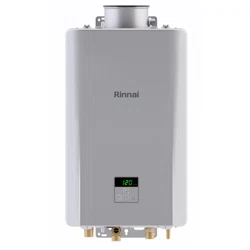

INTERNAL (INDOOR) MODELS:
VE199i (REU-VE2737FFD-US)
VE180i (REU-VE2432FFD-US)
VE160i (REU-VE2125FFD-US)
VE140i (REU-VE1720FFD-US)
EXTERNAL (OUTDOOR) MODELS:
VE199e (REU-VE2737WD-US)
VE180e (REU-VE2432WD-US)
VE160e (REU-VE2125WD-US)
VE140e (REU-VE1720WD-US)
Tankless Water Heater
Installation and Operation Manual
ANSI Z21.10.3 CSA 4.3
INDOOR MODELS:
RE199i (REU-VE2737FFD-US)
RE180i (REU-VE2432FFD-US)
RE160i (REU-VE2125FFD-US)
RE140i (REU-VE1720FFD-US)
OUTDOOR MODELS:
RE199e (REU-VE2737WD-US)
RE180e (REU-VE2432WD-US)
RE160e (REU-VE2125WD-US)
RE140e (REU-VE1720WD-US)
C US
10000072200001
2 Rinnai Tankless Water Heater Installation and Operation Manual
WARNING
If the information in these instructions is not followed exactly, a re or explosion may result
causing property damage, personal injury, or death.
• Do not store or use gasoline or other ammable vapors and liquids in the vicinity of this or any
other appliance.
• WHAT TO DO IF YOU SMELL GAS
– Do not try to light any appliance.
– Do not touch any electrical switch; do not use any phone in your building.
– Immediately call your gas supplier from a neighbor’s phone. Follow the gas supplier’s instruc-
tions.
– If you cannot reach your gas supplier, call the re department.
• Installation and service must be performed by a trained and qualied professional, service agency
or the gas supplier.
Full-length Spanish version available online at rinnai.us
Copyright 2021 Rinnai America Corporation. Rinnai® is a registered trademark of Rinnai Corporation
used under license by Rinnai America Corporation. Rinnai America Corporation continually updates
materials, and as such, content is subject to change without notice.

Rinnai Tankless Water Heater Installation and Operation Manual 3
Contents
1. Welcome .......................................................................................................................................... 5
2. Safety ............................................................................................................................................... 6
2.1 Safety Symbols ....................................................................................................................... 6
2.2 Safety Precautions .................................................................................................................. 6
3. About the Water Heater .................................................................................................................. 8
3.1 Front and Bottom View ........................................................................................................... 8
3.2 Main Components ................................................................................................................... 9
3.3 Specications ........................................................................................................................ 10
3.4 Dimensions ........................................................................................................................... 11
3.5 Accessories .......................................................................................................................... 13
4. Install the Water Heater ................................................................................................................ 15
4.1 Installation Guidelines .......................................................................................................... 15
4.2 What You Will Need .............................................................................................................. 16
4.3 Choose an Installation Location ............................................................................................ 17
4.4 Mount the Water Heater to the Wall ...................................................................................... 22
4.5 Vent the Water Heater .......................................................................................................... 24
4.6 Connect Water Supply .......................................................................................................... 32
4.7 Install Pressure Relief Valve ................................................................................................. 33
4.8 Connect the Gas Supply ....................................................................................................... 34
4.9 Connect the Power Supply ................................................................................................... 37
4.10 Congure Parameter Settings ............................................................................................. 38
4.11 Recirculation ........................................................................................................................ 40
4.12 Post-Water Heater Installation Checklist ............................................................................. 41
5. Operation ....................................................................................................................................... 43
5.1 Safety Precautions ................................................................................................................43
5.2 Operating Instructions ...........................................................................................................44
5.3 Control Panel ........................................................................................................................45
5.4 Setting the Temperature .......................................................................................................46

4 Rinnai Tankless Water Heater Installation and Operation Manual
5.5 Performance Data .................................................................................................................47
5.6 Diagnostic Codes ..................................................................................................................49
6. Maintenance .................................................................................................................................. 53
6.1 Maintenance ......................................................................................................................... 53
6.2 Flushing the Heat Exchanger ............................................................................................... 56
6.3 Draining the Water Heater .................................................................................................... 57
7. Appendices ................................................................................................................................... 58
7.1 Massachusetts State Gas Regulations ................................................................................. 58
7.2 Wiring Diagram ..................................................................................................................... 60
7.3 Ladder Diagram .................................................................................................................... 61
7.4 Pressure Drop and Water Flow Curves ................................................................................ 62
7.5 Guidelines for Additional Temperature Controllers ............................................................... 63
8. Warranty ........................................................................................................................................ 64
Rinnai Tankless Water Heater Installation and Operation Manual 5
ANSI American National Standards
Institute
BTU British Thermal Unit
GPM Gallons per minute
LPG Liqueed Petroleum Gas
NG Natural Gas
PRV Pressure Relief Valve
PSI Pounds per square inch
wc Inches of water column
NPT National Pipe Thread
MNPT Male National Pipe Thread Taper
V AC Volts, alternating current
To The Consumer
• You must read the entire manual to
properly operate the water heater.
• Refer to section "6 Maintenance" to stay
up to date on regular maintenance for your
water heater.
• Keep this manual for future reference.
• As when using any appliance generating
heat, there are certain safety precautions
you should follow. See section “2 Safety”
for detailed safety precautions.
• Be sure your water heater is installed by a
trained and qualied professional.
• If installing in the state of
Massachusetts, you must read section “7.1
Massachusetts State Gas
Regulations” in this manual.
Acronyms and Abbreviations
Table 1 provides a list of common acronyms and
abbreviations used in this manual:
Thank you for purchasing a Rinnai Tankless
Water Heater. Before installing and operating this
water heater, be sure to read these instructions
completely and carefully to familiarize yourself with
the water heater’s features and functionality.
To The Installer
• It is recommended that a trained and
qualied professional who has attended a
Rinnai training class complete the instal-
lation. The warranty may be voided due to
any improper installation.
• A trained and qualied professional should
have skills such as:
– Gas sizing
– Connecting gas lines, water lines,
valves, and electricity
– Knowledge of applicable national, state,
and local codes
– Installing venting through a wall or roof
– Training in installation of tankless water
heaters. Training on Rinnai Tankless
Water Heaters is accessible at
www.rinnai-lms.com
• Read all instructions in this manual before
installing the water heater. The water heat-
er must be installed according to the exact
instructions in this manual.
• Proper installation is the responsibility of
the trained and qualied professional.
• When installation is complete, leave this
manual with the water heater (for indoor
units) or give the manual directly to the
consumer.
1. 1. WelcomeWelcome
Table 1
WARNING
WARNING
CAUTION
6 Rinnai Tankless Water Heater Installation and Operation Manual
• If the information in these instructions is
not followed exactly, a re or explosion
may result causing property damage, per-
sonal injury, or death.
• Do not store or use gasoline or other am-
mable vapors and liquids in the vicinity of
this or any other appliance.
• WHAT TO DO IF YOU SMELL GAS:
– Do not try to light any appliance.
– Do not touch any electrical switch; do
not use any phone in your building.
– Immediately call your gas supplier from
a neighbor’s phone. Follow the gas
supplier’s instructions.
– If you cannot reach your gas supplier,
call the re department.
• Installation and service must be
performed by a trained and qualied
professional, service agency or the gas
supplier.
• The warning signs in this manual are here
to prevent injury to you and others. Please
follow them explicitly.
2. 2. SafetySafety
2.1 Safety Symbols
Safety alert symbol alerts you to
potential hazards that can kill or hurt you
and others.
Indicates an imminently
hazardous situation which,
if not avoided, will result in
personal injury or death.
DANGER
Indicates a potentially
hazardous situation which, if
not avoided, could result in
minor or moderate injury. It may
also be used to alert against
unsafe practices.
Indicates a potentially
hazardous situation which,
if not avoided, will result in
personal injury or death.
The following precautions apply to the trained and
qualied professional and consumer. Read and
follow all instructions in this section.
• Before operating, smell all around the
appliance area for gas. Be sure to smell next
to the oor because some gas is heavier
than air and will settle on the oor.
• Keep the area around the appliance clear
and free from combustible materials, gaso-
line, and other ammable vapors and liquids.
• Combustible construction refers to adjacent
walls and ceiling and should not be confused
with combustible or ammable products
and materials. Combustible and/or amma-
ble products and materials should never
be stored in the vicinity of this or any gas
appliance.
• Always check the water temperature before
entering a shower or bath.
• To protect yourself from harm, before
performing maintenance:
– Turn o the electrical power supply by un-
plugging the power cord or by turning o
the electricity at the circuit breaker. (The
temperature controller does not control
the electrical power.)
– Turn o the gas at the manual gas control
valve, usually located immediately below
the water heater.
– Turn o the incoming water supply. This
can be done at the isolation valve imme-
diately below the water heater or by turn-
ing o the water supply to the building.
– Use only your hand to turn the manual
gas control valve. Never use tools. If
2.2 Safety Precautions

Rinnai Tankless Water Heater Installation and Operation Manual 7
• Hot water outlet pipes leaving the water
heater can be hot to touch.
• Install the vent system per local and na-
tional codes.
• DO NOT install this water heater above
10,200 ft (3,109 m).
• DO NOT obstruct combustion air to the
appliance. Combustion air shall not come
from occupied spaces.
• Failure to properly vent this appliance
can result in death, personal injury and/or
property damage.
• Rinnai recommends that every home have
a carbon monoxide (CO) alarm in the hall-
way near bedrooms in each sleeping area.
Check batteries monthly and replace them
annually.
• DO NOT use this appliance in an
application such as a pool or spa heater
that uses chemically treated water. (This
appliance is suitable for lling large or
whirlpool spa tubs with potable water.)
the manual gas control valve will not
turn by hand, do not try to repair it; call
a trained and qualied professional.
Force or attempted repair may result in
a re or explosion.
• DO NOT use this appliance if any part
has been under water. Immediately call
a trained and qualied professional to
inspect the appliance and to replace any
part of the control system and any manual
gas control valve which has been under
water.
• DO NOT use substitute materials. Use
only parts certied for the appliance.
• Should overheating occur or the gas sup-
ply fail to shut o, turn o the manual gas
control valve to the appliance.
• DO NOT adjust the parameter settings un-
less specically instructed to do so. Only
trained and qualied
professionals are permitted to adjust pa-
rameter settings.
• DO NOT use an extension cord or adapter
plug with this appliance.
• Any alteration to the appliance or its con-
trols can be dangerous and will void the
warranty.
• Proper venting is required for the safe
operation of this appliance.
• Flammable liquids such as cleaning sol-
vents, aerosols, paint thinners, adhesives,
gasoline and propane must be handled
and stored with extreme care. These
ammable liquids emit ammable vapors
and when exposed to an ignition source
can result in a re hazard or explosion.
Flammable liquids should not be used or
stored in the vicinity of this or any other
gas appliance.
• DO NOT operate the water heater without
the front panel installed. The front panel
should only be removed when servicing/
maintaining or replacing internal compo-
nents.
• BURN HAZARD. Hot exhaust and vent
may cause serious burns. Keep away from
the water heater. Keep small children and
animals away from the water heater.
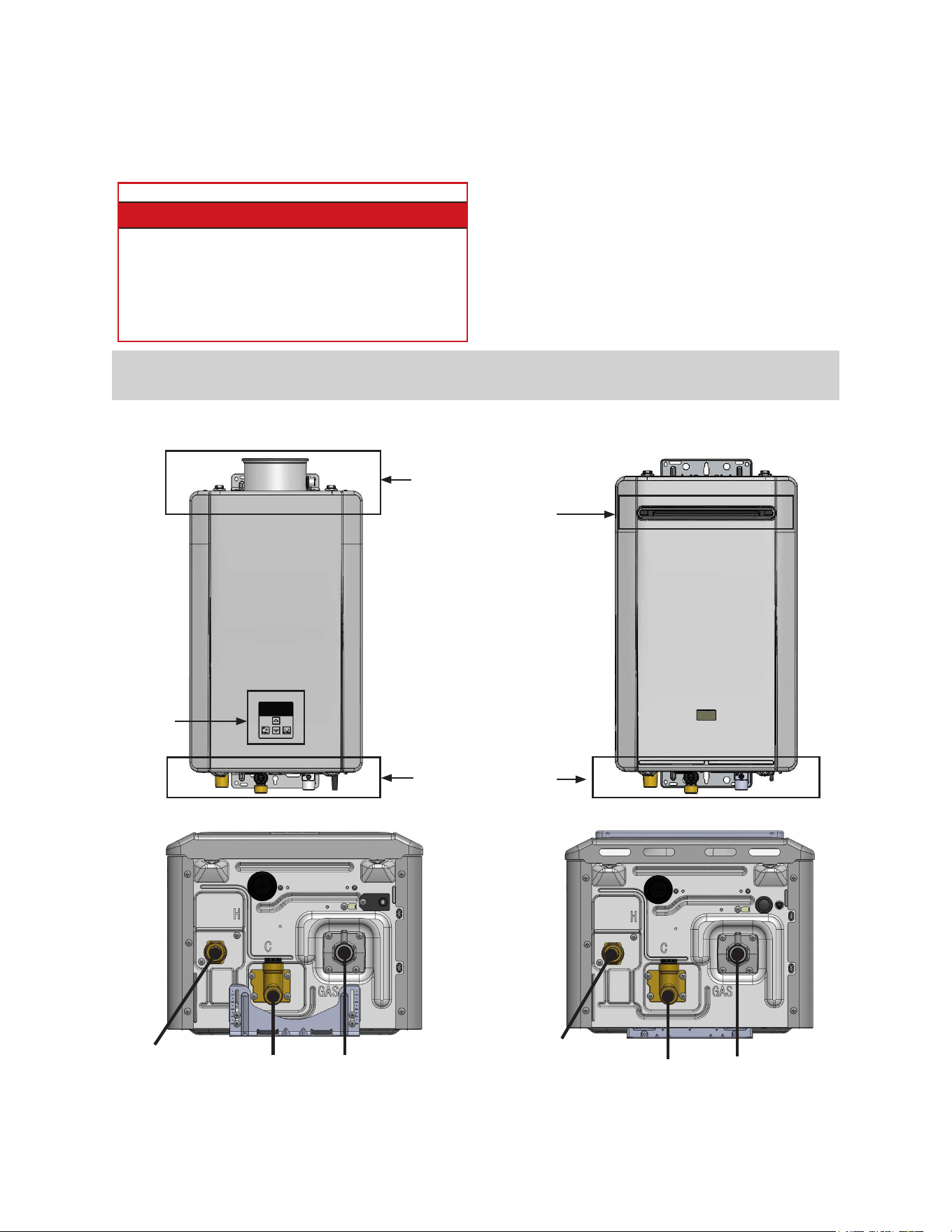
8 Rinnai Tankless Water Heater Installation and Operation Manual
3. 3. About the Water HeaterAbout the Water Heater
3.1 Front and Bottom View
Indoor Outdoor
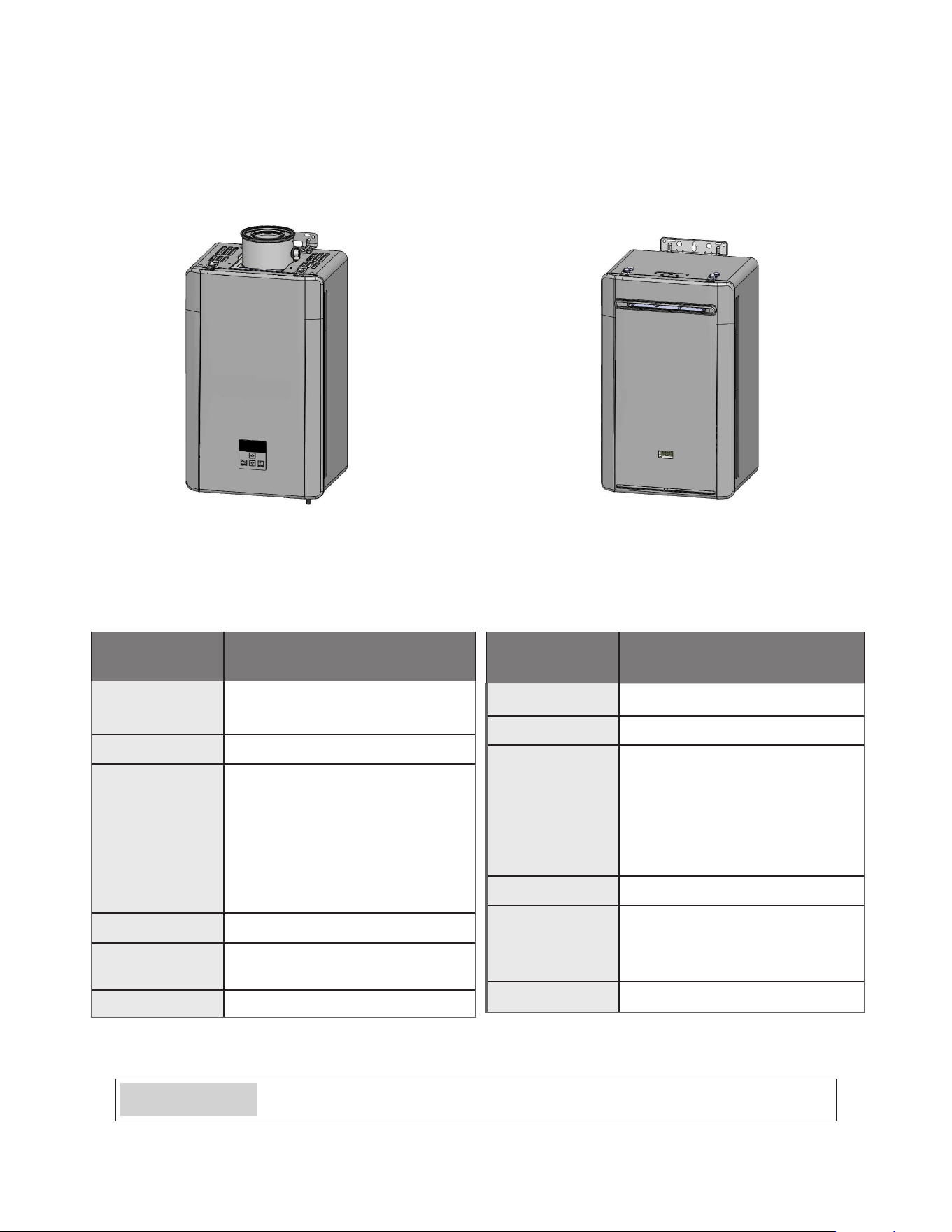
Figure 1: Front view
Hot Water
Outlet
Cold Water
Inlet
Gas Inlet
Cold Water
Inlet
Gas Inlet
Hot Water
Outlet
Figure 2: Bottom view
Topics in this section
• Front and Bottom View
• Main Components
• Specications
• Dimensions
• Accessories
Controller
Piping Connections
Vent
Connections
Exhaust
Duct
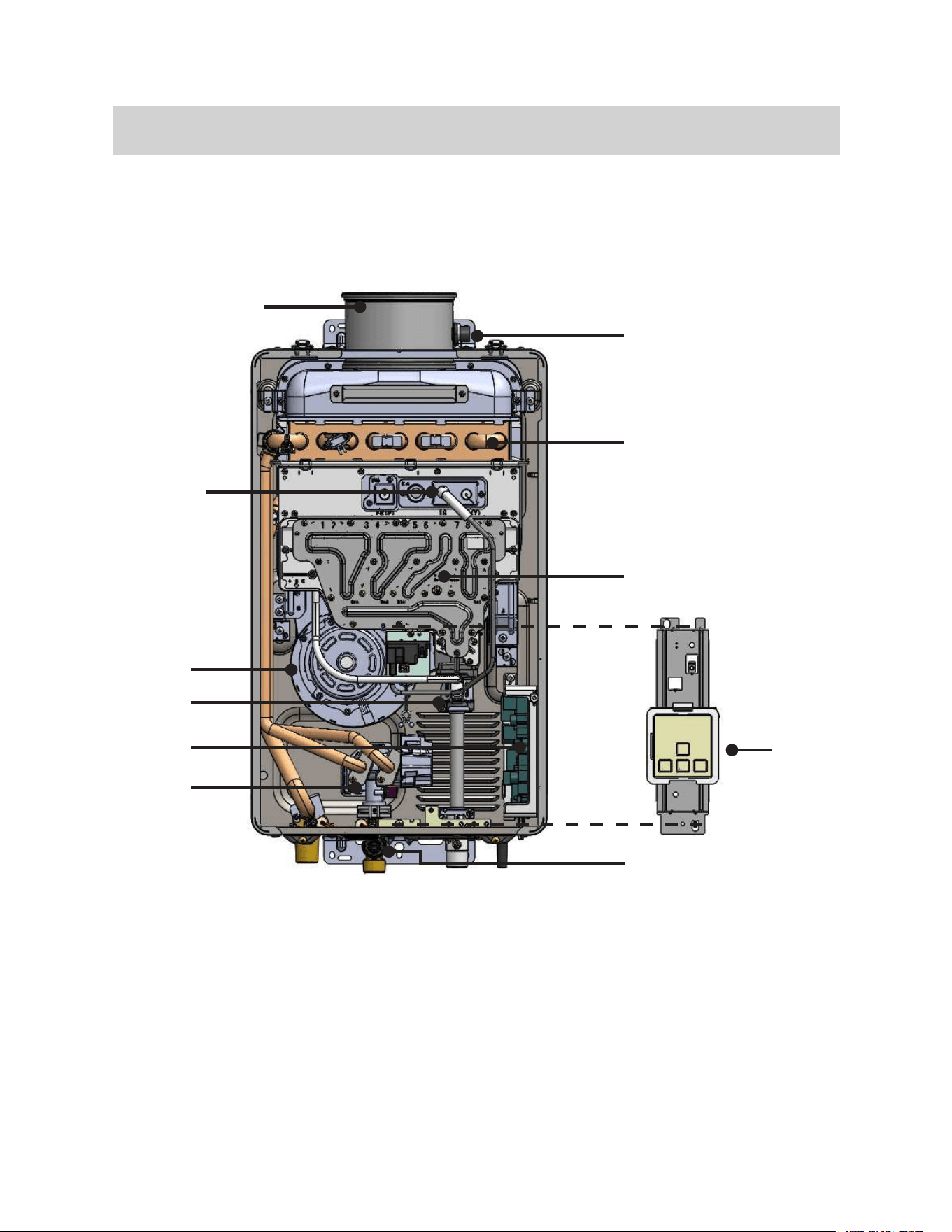
Rinnai Tankless Water Heater Installation and Operation Manual 9
3.2 Main Components
Ignition Unit
PC Board
Controller
(removed for
clarity)
Heat Exchanger
Figure 3: Main Components
Fan Motor
Assembly
Condensate Drain
(indoor models only)
Concentric 3 in. Exhaust/ 5
in. Combustion Air
(indoor models only)
Gas Manifold
Gas Control
Water Flow
Servo (Bypass
Servo certain
models)
Filter
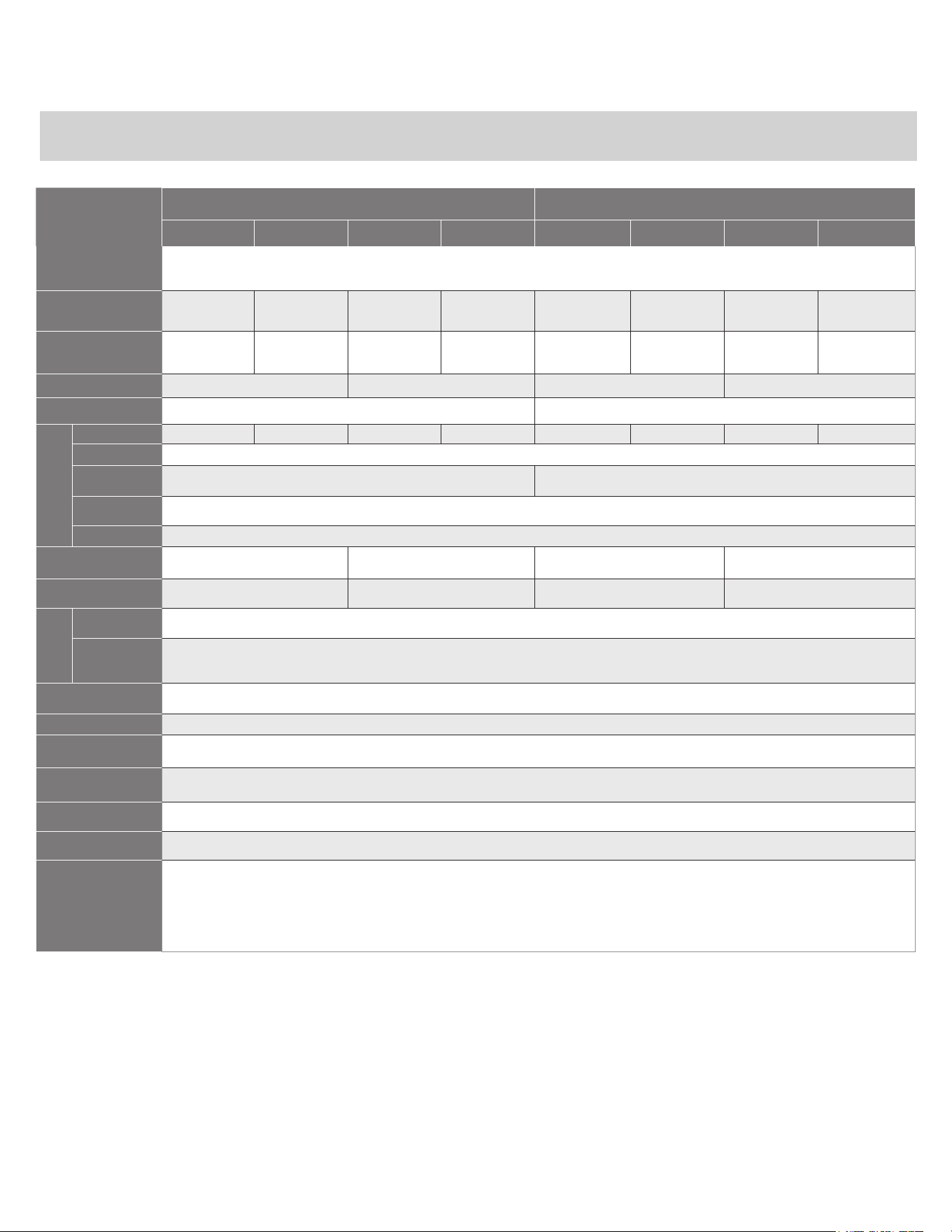
10 Rinnai Tankless Water Heater Installation and Operation Manual
3.3 Specifications
Indoor Units Outdoor Units
RE199i RE180i RE160i RE140i RE199e RE180e RE160e RE140e
Minimum Gas
Consumption
Btu/h
10,400
Maximum Gas
Consumption
Btu/h
199,000 180,000 160,000 140,000 199,000 180,000 160,000 140,000
Flow Rate
1
(Min-Max)
0.13-9.8 GPM
(0.5-37 L/min)
0.13-8.5 GPM
(0.5-32 L/min)
0.26-6.6 GPM
(1.0-25 L/min)
0.26-5.3 GPM
(1.0-20 L/min)
0.13-9.8 GPM
(0.5-37 L/min)
0.13-8.5 GPM
(0.5-32 L/min)
0.26-6.6 GPM
(1.0-25 L/min)
0.26-5.3 GPM
(1.0-20 L/min)
Weight 42.1 lbs (19.1 kg) 38.5 lbs (17.5 kg) 42.1 lbs (19.1 kg) 38.3 lbs (17.4 kg)
Sound Level 54 dB 54 dB
Electrical Data
Normal 96 87 91 71 74 61 60 52
Standby
1
Freeze
Protection
86 100
Max Current
4 Amps
Fuse
10 Amps
Temperature
Setting
98°F-140°F (37°C-60°C) 120°F-140°F (49°C-60°C) 98°F-140°F (37°C-60°C) 120°F-140°F (49°C-60°C)
Bypass Flow
Control
Bypass Servo Control Fixed Bypass Bypass Servo Control Fixed Bypass
Gas Supply
Pressure
2
Natural Gas
4.0 in. wc - 10.5 in. wc
Propane 8.0 in. wc - 13.0 in. wc
Type of Appliance
High-Eciency (Non-condensing), Tankless, Temperature Controller, Continuous Flow Gas Hot Water System
Ignition System Direct Electronic Ignition
Electric
Connections
Appliance: AC 120 Volts, 60Hz
Water Supply
Pressure
Remote Control
Cable
Non-Polarized Two Core Cable (Minimum 22 AWG)
ENERGY STAR®
Qualied
No
Complies with
South Coast
Air Quality
Management
District 14 ng/J
or 20 ppm NOx
emission levels
Yes
1
Minimum ow may vary slightly depending on the temperature setting and the inlet water temperature. Minimum activation ow is 0.4 GPM (1.5 L/min) (0.26
GPM (1.0 L/min) for RE199 and RE180).
2
The maximum gas supply pressure must not exceed the value specied by the manufacturer.
Rinnai products are continually being updated and improved; therefore, specications are subject to change without prior notice.
Table 2: Specications
Minimum water pressure: 20 PSI (Recommended 30-80 PSI for maximum performance)
Maximum water pressure: 150 PSI
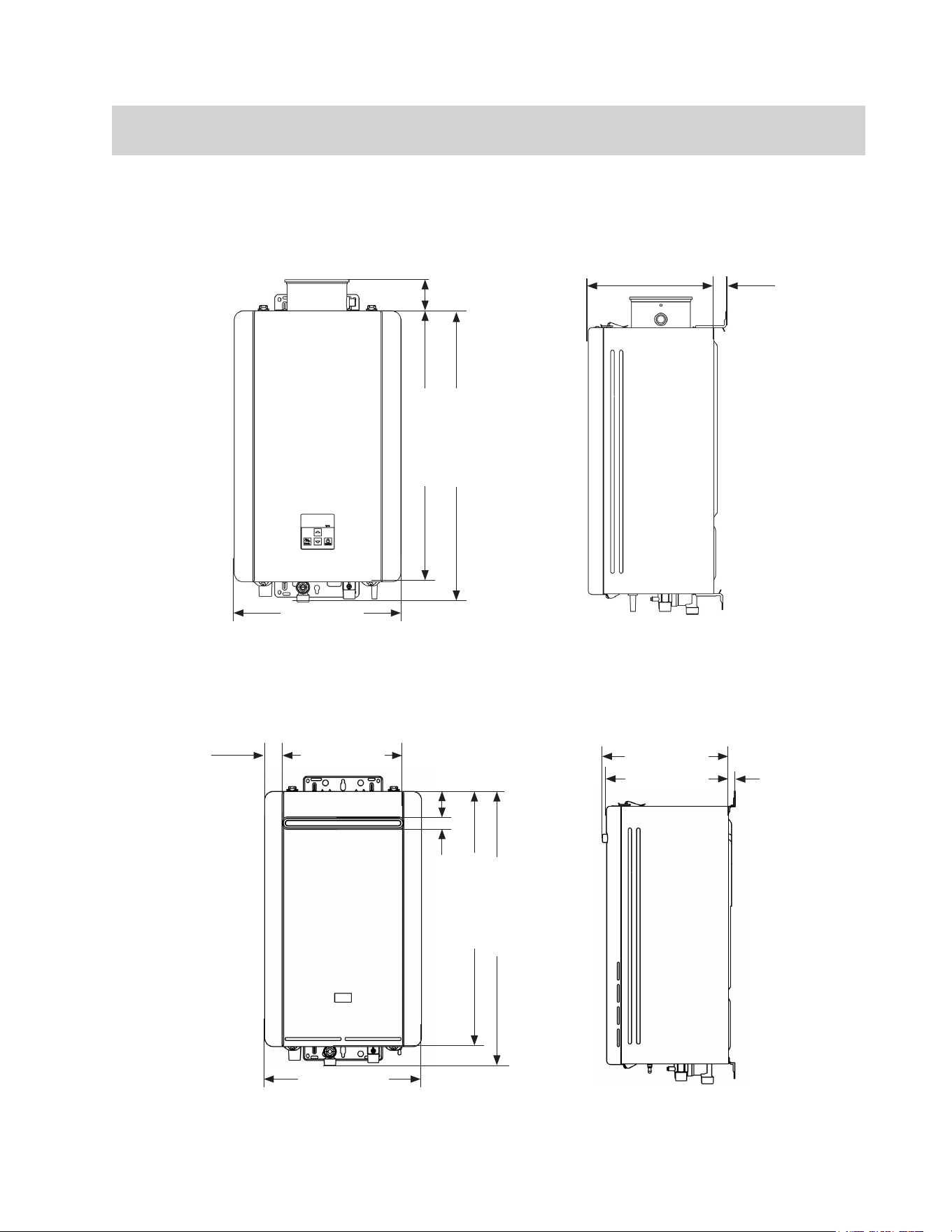
Rinnai Tankless Water Heater Installation and Operation Manual 11
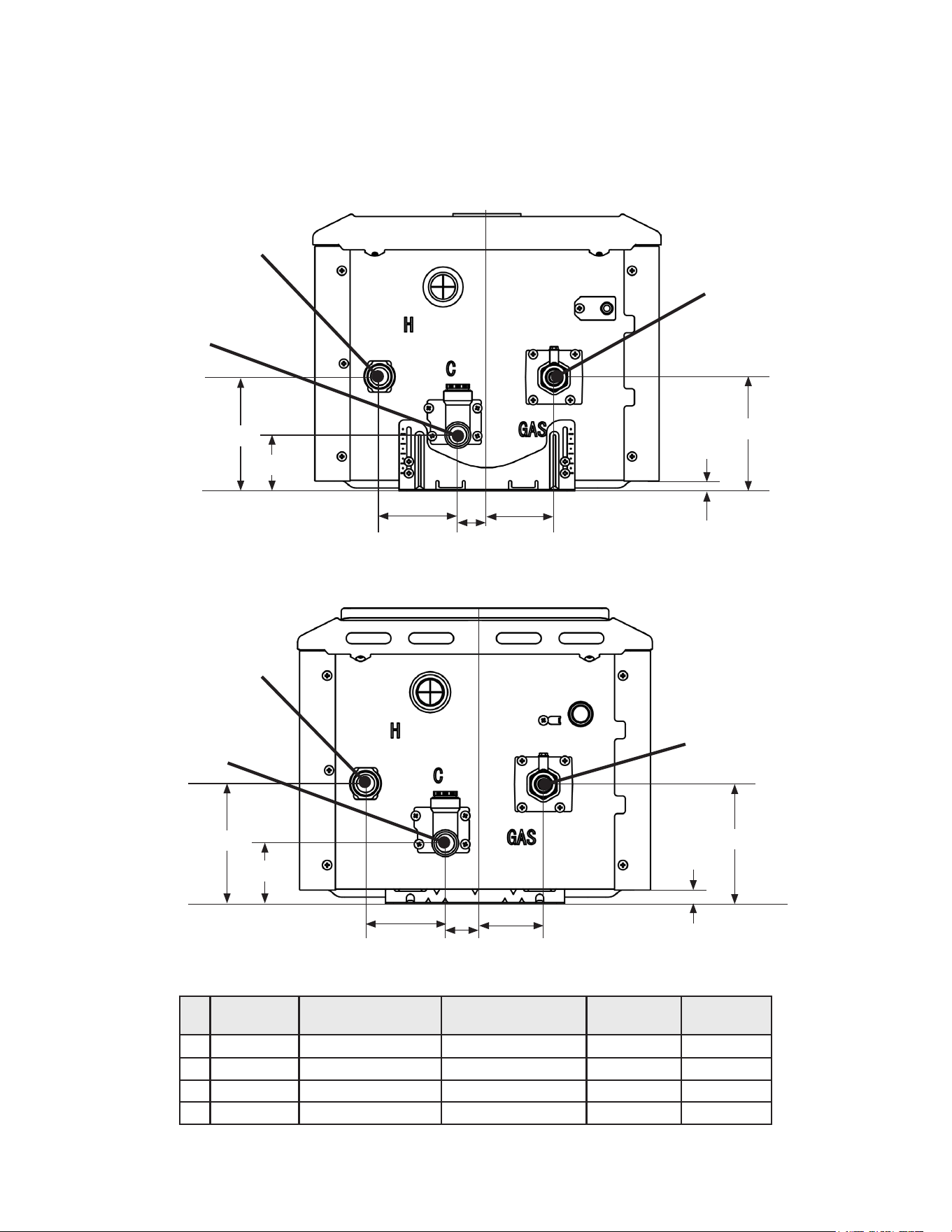
3.4 Dimensions
Measurements: in. (mm)
Figure 4: Indoor Dimensions
Figure 5: Outdoor Dimensions
Indoor Models
(RE199i, RE180i, RE160i, and RE140i)
Outdoor Models
(RE199e, RE180e, RE160e, and RE140e)
Front View Side View
Front View Side View
2.64 (67)
22.87 (581)
24.64 (626)
14.05 (357)
10.77 (274)
0.40-1.77 (10-45)
10.67 (271)
2.40 (61)
1.69 (43)
22.87 (581)
24.64 (626)
14.05 (357)
11.13 (283)
10.77 (274)
.59 (15)
87 (22)
12 Rinnai Tankless Water Heater Installation and Operation Manual
Cold Inlet
Hot Outlet
Indoor (wall
bracket retracted)
Indoor (wall
bracket extended)
Outdoor
G Gas 4.57 (116) 5.79 (147) 4.74 (121) 3/4 MNPT
C Cold Inlet 2.24 (57) 3.46 (88) 2.41 (61) 3/4 MNPT
H Hot Outlet 4.6 (117) 5.82 (148) 4.76 (120) 3/4 MNPT
B Bracket .40 (10) 1.6 (41) 0.59 (15) N/A
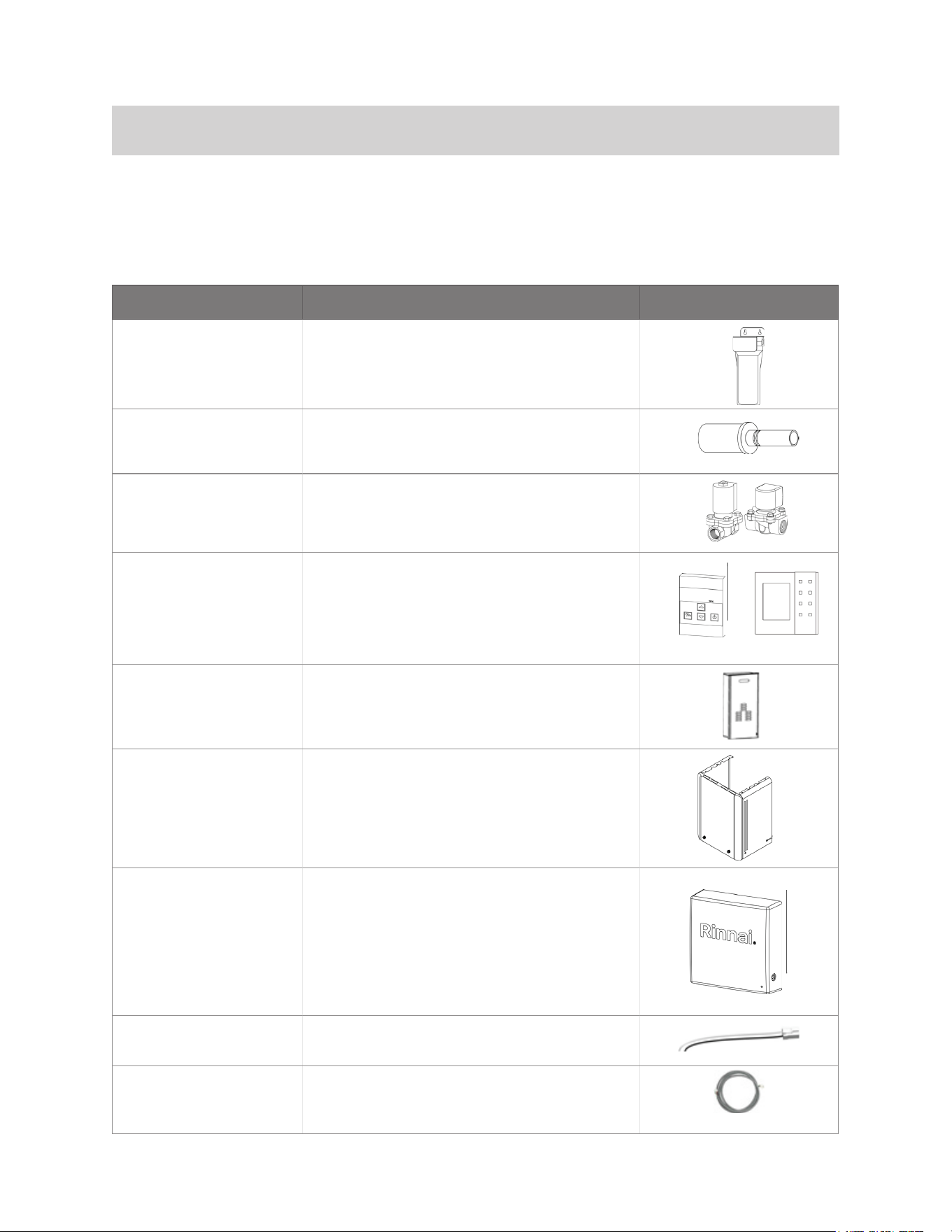
3.4.1 Supply Connections
Measurements: in. (mm)
Figure 7: Outdoor Model Supply Connections
Table 3: Supply Connections
H
C
G
B
1.17 (30)
4.33 (110)
2.71 (69)
Gas
Cold Inlet
Hot Outlet
H
C
G
B
1.17 (30)
4.33 (110)
2.71 (69)
Gas
Figure 6: Indoor Model Supply Connections
Indoor Models
(RE199i, RE180i, RE160i, and RE140i)
Outdoor Models
(RE199e, RE180e, RE160e, and RE140e)
Rinnai Tankless Water Heater Installation and Operation Manual 13
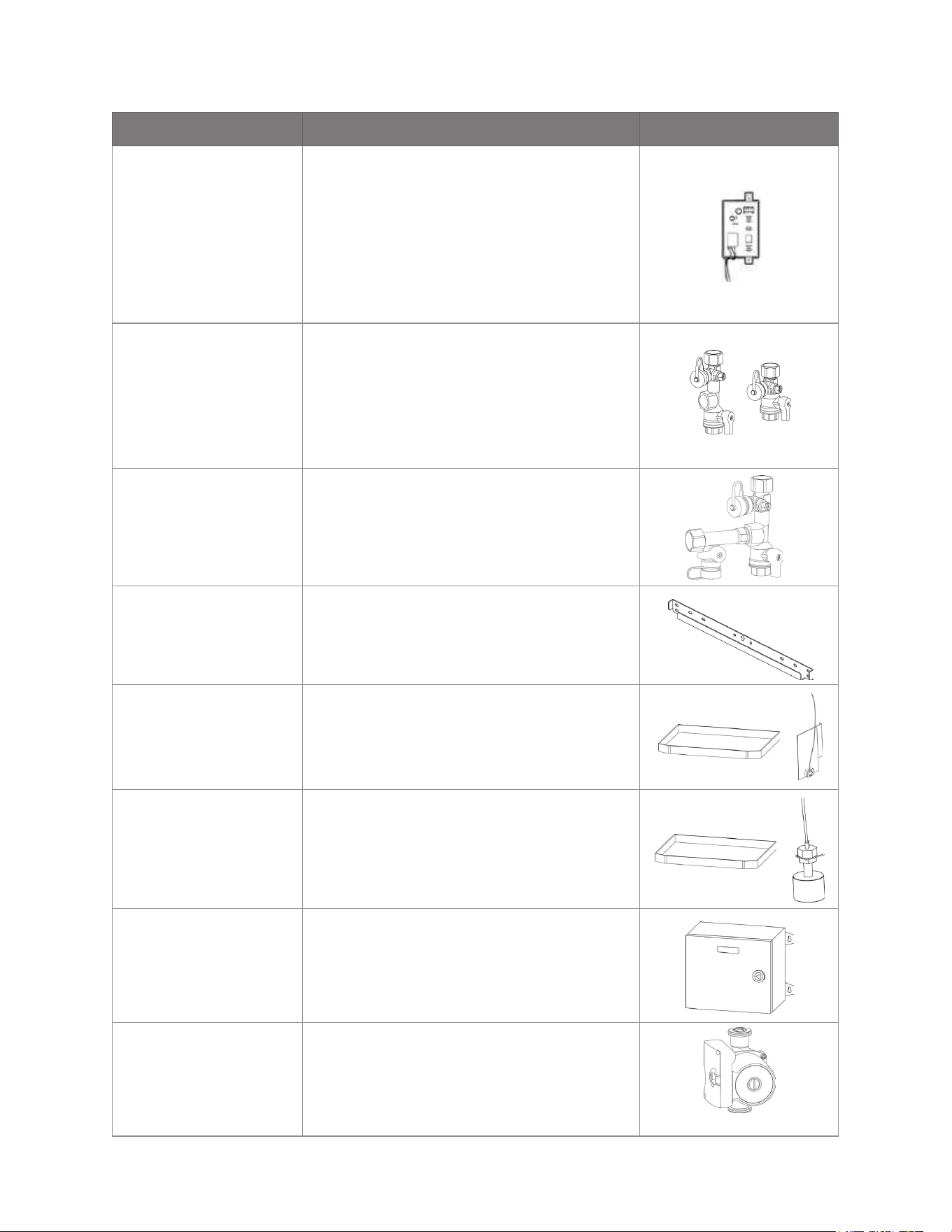
Product Product Description Image
ScaleCutter
Part #: 103000038
Filters and reduces the amount of scale
entering the water heater allowing for
greater water heater longevity.
ScaleCutter Rell
Cartridge
Part #: 103000039
Rell cartridge for the ScaleCutter lter
assembly.
Drain Down Kit
Part #: 104000059
Provides freeze protection by
immediately draining the water heater
upon loss of power.
Additional Controller
Part #: MC-601-BK
MC-601-W
MC-195T-US
MCC-601*
Additional controllers are available for user
convenience.
*RE199/180 only
Recess Box
Part #: RGBRE
Allows an outdoor water
heater to be recessed into a wall.
Pipe Cover
Part #: PCD09-SHS
Encloses the piping below the water heat-
er for aesthetic purposes.
control•r™ Wi-Fi
Module (And
Accessories)
Part #: RWM101
Controls On-Demand recirculation,
remotely adjust temperatures, and com-
municates with the Pro Portal. The con-
trol•r™ Wi-Fi Module and MC-195T-US
controller are not compatible accessories
and must not be installed together.
External Pump Cable
Part #: 105000250
Provides electrical connections for
external recirculation pump control.
EZConnect™ Cable
Part #: REU-EZC-2
Electronically connects two water
heaters and allows them to function as
one hot water source.
3.5 Accessories
Numerous optional accessories are available for purchase for your Rinnai Tankless Water Heater. Listed
below are some commonly purchased accessories. For a complete list of accessories, visit www.rinnai.us.
For questions, or to purchase an accessory, contact your local Rinnai dealer/distributor or Rinnai
Customer Care at 1-800-621-9419.
Table 4: Accessories
14 Rinnai Tankless Water Heater Installation and Operation Manual
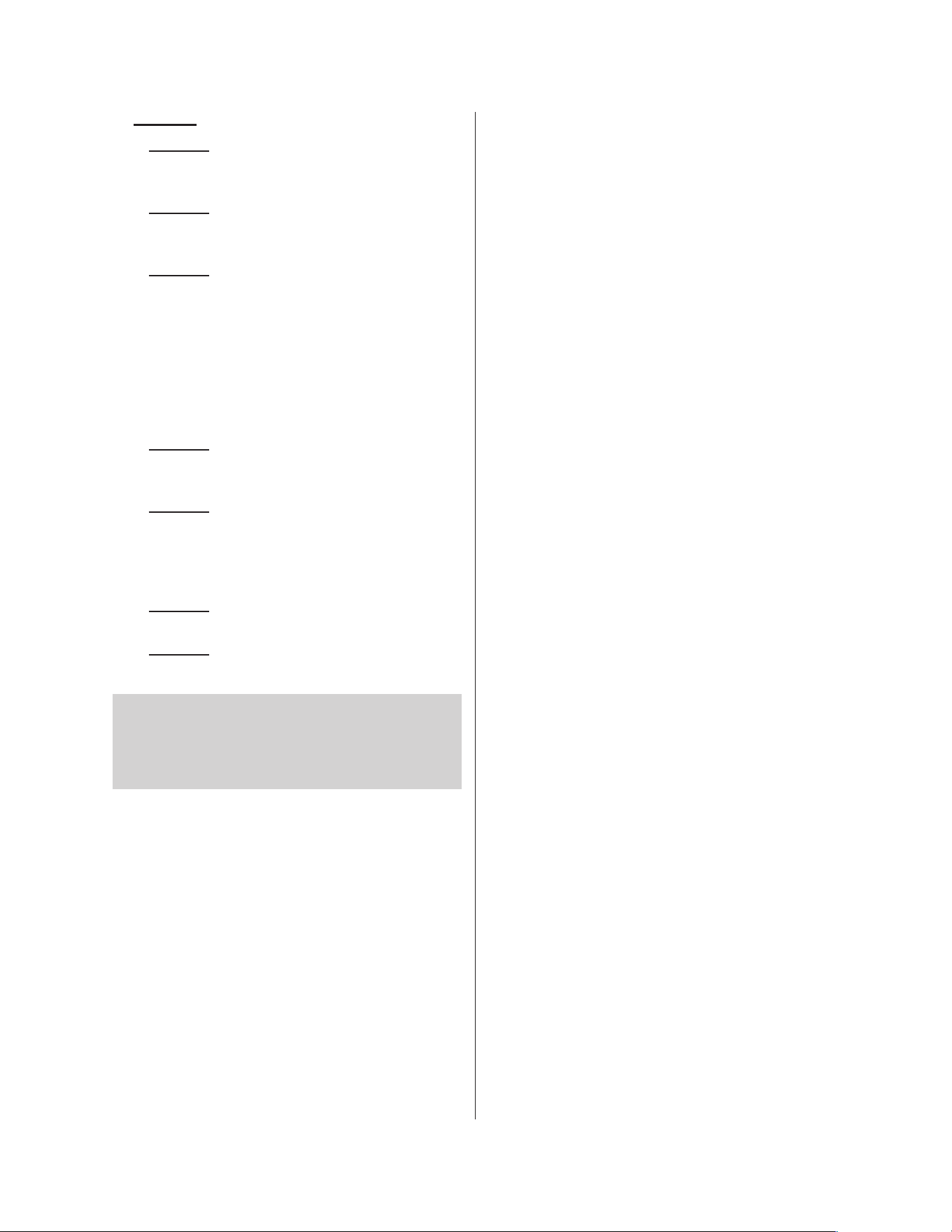
Product Product Description Image
DPS/MIS Switch
Part #: REU-OPU3
The Domestic Priority Switch (DPS) func-
tion provides domestic hot water priority
for combined tankless water heater and air
handler use.
The Maintenance Indication Switch (MIS)
function enables tankless water heater
monitoring via programs such as Building
Management System (BMS).
Isolation Valve
Part #: MIVK-T-LW
Isolation valves provide the ability to iso-
late the water heater from the
structure’s plumbing system and allow
quick and easy access to ush the heat
exchanger. Rinnai strongly recommends
use of these valves for service and main-
tenance.
Dedicated Return
Valve
Part #: 107000450
Valve kit including tee, drain valve, check
valve and isolation valve to simplify set-up
of a dedicated recirculation line.
Wall Mounting
Bracket
Part #: 109000628
Optional accessory for mounting the
water heater to the wall.
Cold Weather Kit
Part #: REColdKit
Electric heater, bottom pipe cover, and
insulation panels for use with Pipe Cover
(Part #: PCD09-SHS)
Leak Detection Kit
Part #: RELeakKit
Pipe cover drain pan and oat switch for
use with Pipe Cover (Part #: PCD09-SHS)
Battery Backup
Part #: R-UPS350A
Tankless battery backup system, 500VA/
350W uninterrupted power supply (UPS),
Hot water usage of 1 hour per day with
sucient power for 5-7 days.
Recirculation Pump
Part #: GTK03U
A pump system can be incorporated with
Rinnai Circ-Logic recirculation technology
in a dedicated recirculation system.

Rinnai Tankless Water Heater Installation and Operation Manual 15
4. 4. Install the Water HeaterInstall the Water Heater
THIS SECTION IS INTENDED FOR THE
INSTALLER
Installer qualications: A trained and qualied
professional must install the appliance, inspect
it, and leak test the water heater before use. The
warranty may be voided due to any improper
installation. The trained and qualied professional
should have skills such as: Gas sizing; Connecting
gas lines, water lines, valves, and electricity;
Knowledge of applicable national, state, and
local codes; Installing venting through a wall or
roof; and training in installation of tankless water
heaters. Training for Rinnai Tankless Water
Heaters is accessible online at
www.trainingevents.rinnai.us.
4.1 Installation
Guidelines
When installing the water heater, follow these
guidelines:
• This water heater is certied for installation
in residential applications and manufac-
tured (mobile) homes.
• The installation must conform with local
codes or, in the absence of local codes,
with the National Fuel Gas Code, ANSI
Z223.1/NFPA 54, or the Natural Gas and
Propane Installation Code, CSA B149.1.
If installed in a manufactured home, the
installation must conform with the
Manufactured Home Construction and
Safety Standard, Title 24 CFR, Part 3280
and/or CAN/SCA Z240 MH Series, Mobile
Homes.
• The appliance, when installed, must be
electrically grounded in accordance with
local codes or, in the absence of local
codes, with the National Electrical Code,
ANSI/NFPA 70, or the Canadian Electrical
Code, CSA C22.1.
• The appliance and its manual gas shuto
(control) valve must be disconnected from
the gas supply piping system during any
pressure testing of that system at test
pressures in excess of 1/2 psi (3.5 kPa)
(13.84 in wc).
• The appliance must be isolated from the
gas supply piping system by closing its
individual manual gas shuto (control)
valve during any pressure testing of the
gas supply piping system at test pressures
equal to or less than 1/2 psi (3.5 kPa)
(13.84 in. wc).
• You must follow the installation instructions
and those in section “4.5 Vent the Water
Heater” for adequate combustion air and
exhaust.
• If a water heater is installed in a closed
water supply system, such as one having
a backow preventer in the cold water sup-
ply line, means shall be provided to control
thermal expansion. Contact the water sup-
plier or local plumbing inspector on how to
control thermal expansion.
• Should overheating occur or the gas sup-
ply fail to shut o, turn o the manual gas
shuto (control) valve to the appliance.
• Combustion air must be free of chemicals,
such as chlorine or bleach, that produce
fumes. These fumes can damage com-
ponents and reduce the life of your appli-
ance.
Topics in this section
• Installation Guidelines
• What you will need
• Choose Installation Location
• Mount Water Heater to the Wall
• Vent Water Heater
• Connect Water Supply
• Install Pressure Relief Valve
• Connect Gas Supply
• Connect Power Supply
• Congure Parameter Settings
• Recirculation
• Post-Water Heater Installation
Checklist
16 Rinnai Tankless Water Heater Installation and Operation Manual
DO NOT
• DO NOT install the following internal
(indoor) water heaters outdoor: RE199i,
RE180i, RE160i or RE140i.
• DO NOT install the following external
(outdoor) water heaters indoor: RE199e,
RE180e, RE160e or RE140e.
• DO NOT install the water heater in an area
where water leakage of the unit or con-
nections will result in damage to the area
adjacent to the appliance or to lower oors
of the structure. When such locations can-
not be avoided, it is recommended that a
suitable drain pan, adequately drained, be
installed under the water heater. The pan
must not restrict combustion air ow.
• DO NOT obstruct the ow of combustion
and ventilation air. Combustion air shall
not be supplied from occupied spaces.
• DO NOT use this appliance in an
application such as a pool or spa heater
that uses chemically treated water. (This
appliance is suitable for lling large or
whirlpool spa tubs with potable water.)
• DO NOT use substitute parts that are not
authorized for this appliance.
• DO NOT run the unit with the front cover
removed during normal operation.
4.2 What You Will
Need
4.2.1 Items Included
Unpack the Rinnai Tankless Water Heater
package and verify the following contents are
included. If any items are damaged or missing,
contact your local dealer/distributor or call Rinnai
Customer Care at 1-800-621-9419.
• Rinnai Tankless Water Heater
• Rinnai Tankless Water Heater Installation
and Operation Manual
• Self-Tapping Screw (Indoor models only)
4.2.2 Items Needed
(Field-Supplied)
• Manual Gas Control Valve
• Pressure Relief Valve
• Isolation Valves
• Pipe wrenches (x2)
• Adjustable pliers
• Phillips Head screwdriver
• Wire Cutters
• Gloves
• Safety glasses
• Level
• Soap or gas leak detector solution
• Approved venting
• Teon tape (recommended) or pipe
compound
• Pipe insulation
• Hammer drill with concrete bits
• Saw
• Threading machine with heads and oiler
• Core drill with diamond head
• Torch set
• Copper tubing cutter
• Steel pipe cutter
• Heat tape
• Electrical wire
• Concrete wall anchors
• Optional pipe cover
• Wire nuts
• Single gang electrical box
• Unions and drain valves
• 2 conductor 22 AWG wire for controller
Rinnai Tankless Water Heater Installation and Operation Manual 17
4.3 Choose an
Installation
Location
When selecting an installation location, you
must ensure that all water heater and venting
clearances will be met and that the vent length will
be within required limits. Consider the installation
environment, water quality, and the need for freeze
protection. Requirements for the gas line, water
lines,and electrical connection can be found in
their respective installation sections in this manual.
4.3.1 Water Quality
Guidelines
This section provides information on the
importance of water quality to the Rinnai Tankless
Water Heater. The information is intended to serve
as a general guide only and is not a complete list
of water quality guidelines.
Consideration of care for your water heater should
include evaluation of water quality. The water must
be potable, free of corrosive chemicals, sand,
dirt, or other contaminants. It is up to the trained
and qualied professional to ensure the water
does not contain corrosive chemicals or elements
that can aect or damage the Rinnai Tankless
Water Heater. Water that contains chemicals
exceeding the levels listed in Table 6 can damage
the Rinnai Tankless Water Heater. Replacement
of components due to water quality damage is not
covered by the warranty.
If you install this water heater in an area that is
known to have hard water or that causes scale
build-up, the water must be treated and may
require a more frequent ushing schedule. When
scale build-up in the heat exchanger begins to
aect the performance of the water heater, a
diagnostic code “LC” will display on the controller.
Flush the heat exchanger to prevent damage
to it. This water heater also includes a service
indicator (Service Soon, SS). When selected in
the parameter settings, an SS code will display on
the controller indicating that it is time to ush and
service the water heater. Scale build-up is caused
by hard water and can be accelerated if the water
heater is set at a high temperature.
4.3.2 Environment
Air surrounding the water heater, venting, and vent
termination(s) is used for combustion and must
be free of any compounds that cause corrosion of
internal components.
These include corrosive compounds that are
found in aerosol sprays, detergents, bleaches,
cleaning solvents, oil-based paints/varnishes, and
refrigerants. The air in beauty shops, dry cleaning
stores, photo processing labs, and storage areas
for pool supplies often contains these compounds.
Therefore, it is recommended that external
(outdoor) models be used for these locations
where possible. The water heater, venting, and
vent termination(s) should not be installed in any
areas where the air may contain these corrosive
compounds.
In coastal regions, the water heater installation
should be sheltered to minimize exposure to
corrosive sea breeze.
*Source: 40 CFR Part 143 National Secondary Drinking
Water Regulation
Contaminant Maximum Level
Total Hardness Up to 200 mg/L
Aluminum * Up to 0.2 mg/L
Chlorides * Up to 250 mg/L
Copper * Up to 1.0 mg/L
Dissolved Carbon
Dioxide (CO2)
Up to 15.0 mg/L
Iron * Up to 0.3 mg/L
Manganese * Up to 0.05 mg/L
pH * 6.5 to 8.5
TDS (Total Dissolved
Solids) *
Up to 500 mg/L
Zinc * Up to 5 mg/L
Table 6: Water Quality Guidelines
Rinnai oers Southeastern Filtration’s “ScaleCutter
Water Conditioning System” that oers superior
lime scale prevention and corrosion control by
feeding a blend of control compounds into the cold
water supply.
Part Number Description
103000038 Southeastern Filtration
ScaleCutter System 3/4 in. Feed
103000039 ScaleCutter Rell
Table 5

18 Rinnai Tankless Water Heater Installation and Operation Manual
4.3.3 Indoor Water Heaters
• DO NOT install the water heater in areas
where combustion air might be
contaminated with chemicals.
• Install the water heater as far away as
possible from any air inlet vents.
Corrosive fumes, sometimes found in
hair/ nail salons, spas, or other industries
exposed to toxic fumes, may be
released through these vents when not in
operation. Chemicals that are corrosive in
nature should not be stored or used near
the water heater or vent termination. This
requirement applies to internal (indoor)
and external (outdoor) water heaters.
• Where possible, install internal (indoor)
water heaters in a sealed closet so that it
is protected from the potential of
contaminated indoor air.
4.3.4 Outdoor Water Heaters
and Vent Terminations
• Install the water heater as far away as
possible from exhaust vent hoods and
dryer vents.
• Damage and repair due to corrosive
compounds in the air are not covered by
warranty.
• Install the water heater as far away as
possible from any air inlet vents.
Corrosive fumes, sometimes found in
hair/ nail salons, spas, or other industries
exposed to toxic fumes, may be released
through these vents when not in operation.
Chemicals that are corrosive in nature
should not be stored or used near the
water heater or vent termination. This re-
quirement applies to internal (indoor) and
external (outdoor) water heaters.
Rinnai Tankless Water Heater Installation and Operation Manual 19
4.3.5 Freeze Protection
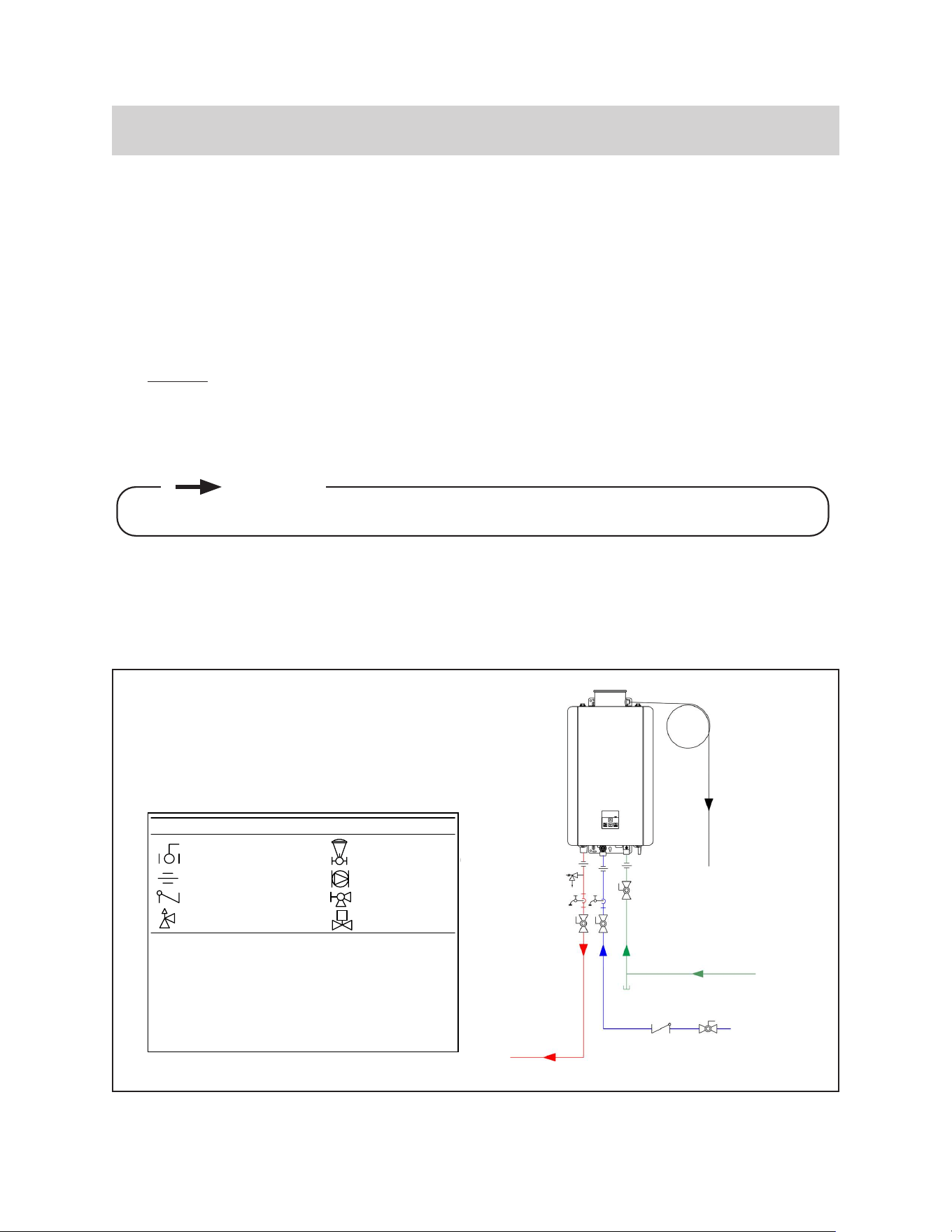
The water heater and its water lines must be protected to prevent freezing. Damage due to freezing is not
covered by the warranty.
When connected to a 120-volt power supply and gas is on, the water heater will not freeze when the
outside air temperature is as cold as -22°F (-30°C) for internal (indoor) models or -4°F (-20°C) for external
(outdoor) models, when protected from direct wind exposure. Because of the “wind-chill” eect, any wind
or circulation of air on the water heater will reduce its ability to protect itself from freezing.
In the event of a power failure and/or gas interruption at temperatures below freezing, the water heater
should manually be drained of all water to prevent freezing damage. In addition, drain the water line and
pressure relief valve.
Loss of freeze protection may result in water damage from a burst heat exchanger or water lines that
freeze and break.
The water heater may be drained manually. However, it is highly recommended to install the optional
Drain Down Kit accessory that will enable the water heater to immediately drain upon loss of power (the
pressure relief valve is not aected by the Drain Down Kit and must be manually drained).
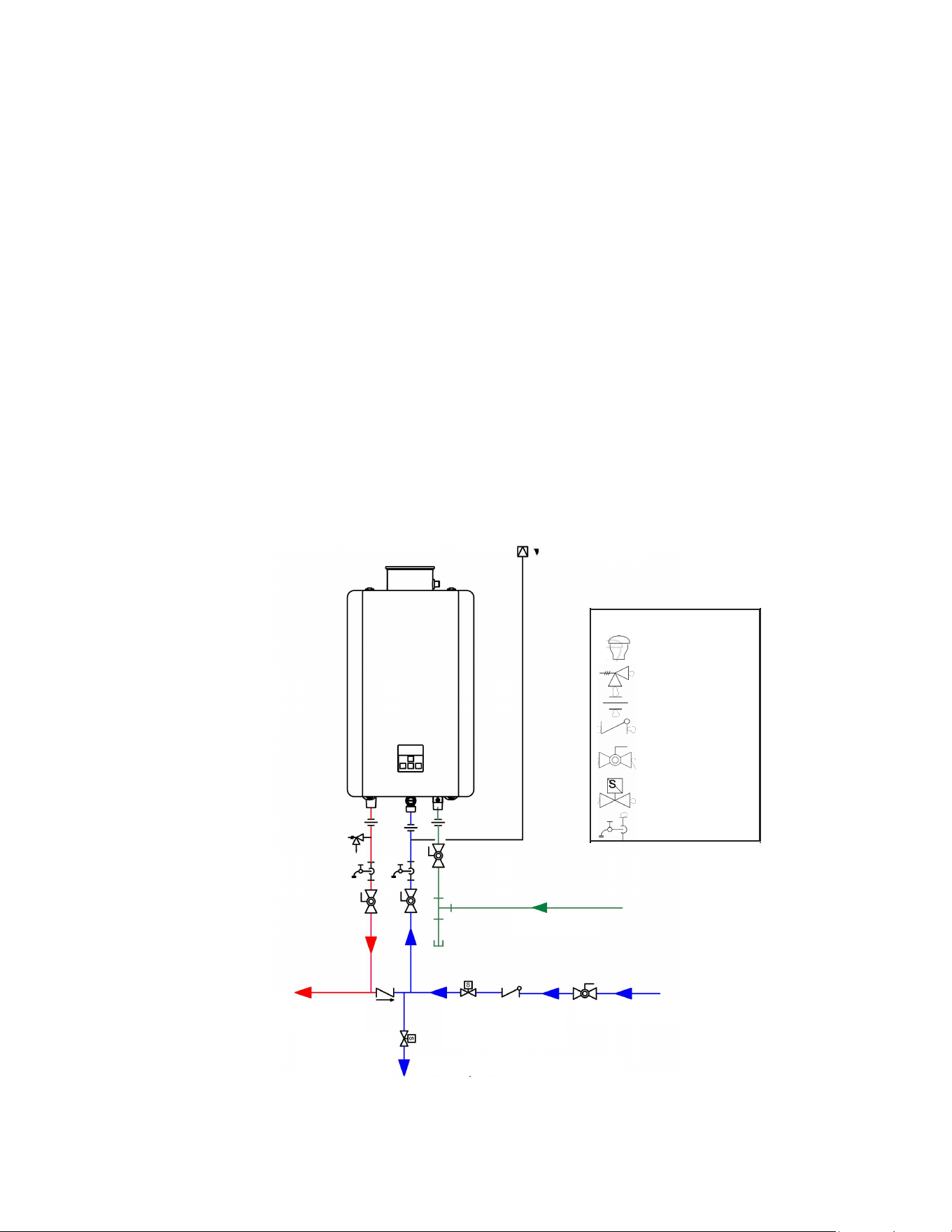
The freeze protection features will not prevent the external piping and valves from freezing. The hot and
cold water pipes should be insulated. To provide additional freeze protection, the pipe cover enclosure
can be lled with insulation materials.
Figure 8: Freeze Protection Piping Diagram
de
ter
r
lve
Legend
Vacuum Breaker
Pressure Relief Valve
Union
Check Valve
Ball Valve
Solenoid Valve
Vacuum Breaker
Drain Valve
Pressure Relief Valve
Union
Check Valve
Ball Valve
Solenoid Valve
1/2 in. Normally
Open Solenoid
Valve
Route Drain Per Local Code
Cold Water Supply Line
Hot Water Supply
Line
3/4 in. Normally
Closed Solenoid
Valve
Vacuum Breaker
Freeze Protection Piping Diagram
Gas Supply
CAUTION
20 Rinnai Tankless Water Heater Installation and Operation Manual
4.3.6 Clearances
Top
Side
Bottom
Bottom
FrontFront
Figure 9: Clearances
Table 7: Clearances
Location
Clearances To Combustibles
and Non-Combustibles
Top 2 in. (51 mm)
Bottom/Ground 12 in. (305 mm)
Front (Panel) 0 in.
The clearance for servicing is
24 inches in front of the water
heater.
Do not block the combustion air
openings.
Back 0 in.
Sides
(Left and Right)
2 in. (51 mm)
0.125 in. (3.18 mm) for recess
box.
Front (Exhaust) 24 in. (610 mm)
Indoor (internal) units Outdoor (external) units
Top
Side
If clearances are not met, damage to the property and water heater may occur.
Location
Clearances To Combustibles
and Non-Combustibles
Top 2 in. (51 mm)
0 in. from vent components
Bottom/Ground 12 in. (305 mm)
Front (Panel) 0 in.
The clearance for servicing is 24
inches (610 mm) in front of the
water heater.
For closet installation, clearance is
6 inches (152 mm) from the front
of the water heater.
Back 0 in.
Sides
(Left and Right)
2 in. (51 mm)
Vent 0 in.
Do not install this water heater under an overhang less
than 3 ft. (91.4 cm) from its top. The area under the
overhang must be open on three sides.
Indoor units Outdoor units
Rinnai Tankless Water Heater Installation and Operation Manual 21
4.3.7 Installation Location Checklist
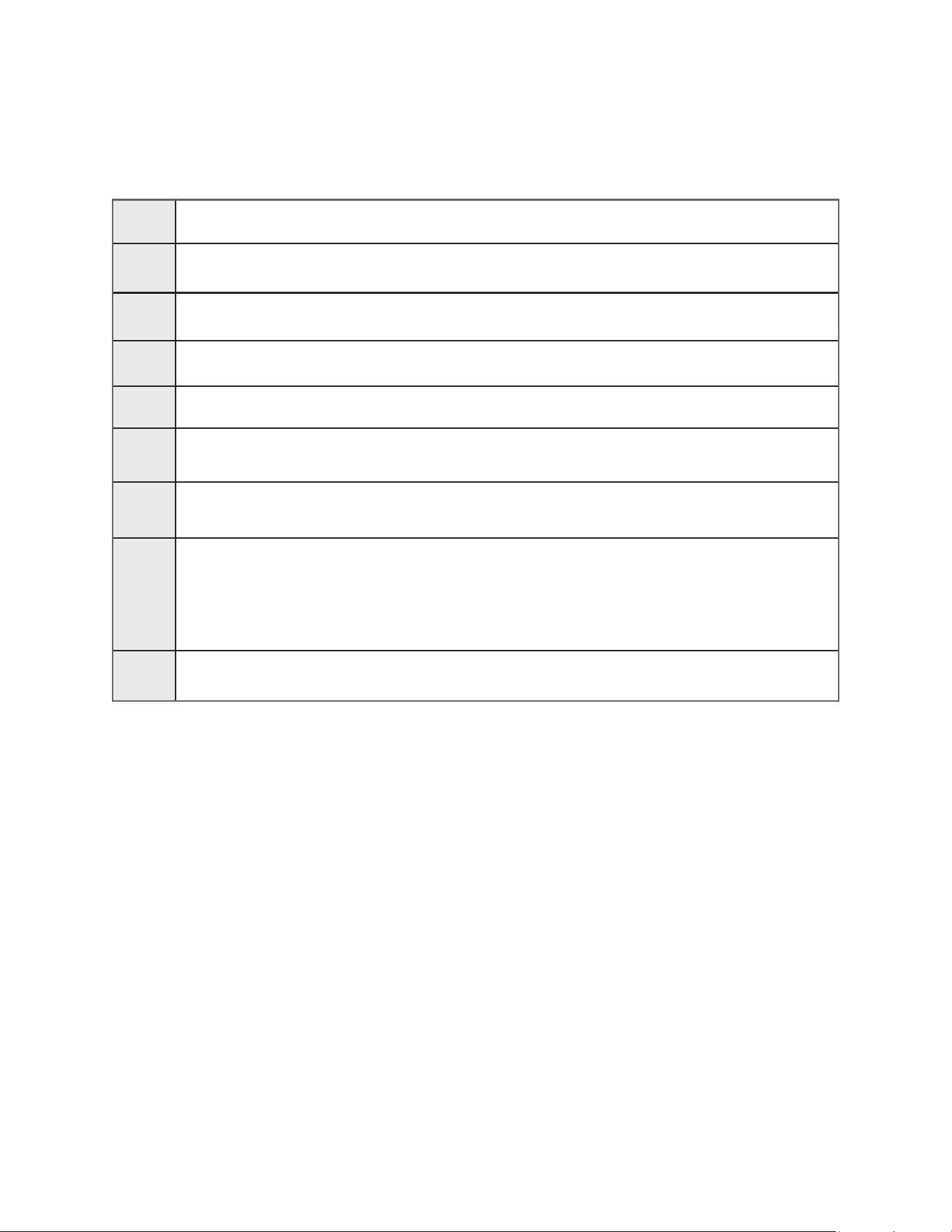
Use this checklist to ensure you have selected the correct location for the water heater.
□
The water heater is not exposed to corrosive compounds in the air.
□
The water heater location complies with the required clearances.
□
For indoor models, the planned venting will not exceed the maximum length for the number of
elbows used.
□
The planned venting termination/air intake location meets the clearances.
□
Indoor air is not being used for combustion.
□
The water supply does not contain chemicals or exceed total hardness that will damage the
heat exchanger.
□
A standard 3 prong 120 V AC, 60 Hz properly grounded wall outlet for indoor models or other
120 V AC, 60 Hz source is available.
□
The installation must conform with local codes or, in the absence of local codes, with the
National Fuel Gas Code, ANSI Z223.1/NFPA 54, or the Natural Gas and Propane Installation
Code, CSA B149.1. If installed in a manufactured home, the installation must conform with the
Manufactured Home Construction and Safety Standard, Title 24 CFR, Part 3280 and/or CAN/
SCA Z240 MH Series, Mobile Homes.
□
Leave the entire manual taped to the water heater or give the entire manual directly to the
consumer.
22 Rinnai Tankless Water Heater Installation and Operation Manual
4.4 Mount the Water Heater to the Wall
4.4.1 Instructions for Indoor
Models
You Will Need:
• Rinnai Tankless Water Heater
Supplied by Installer:
• Level
• Screws for top and bottom bracket
installation
Use appropriate screws for type of wall
construction.
Instructions:
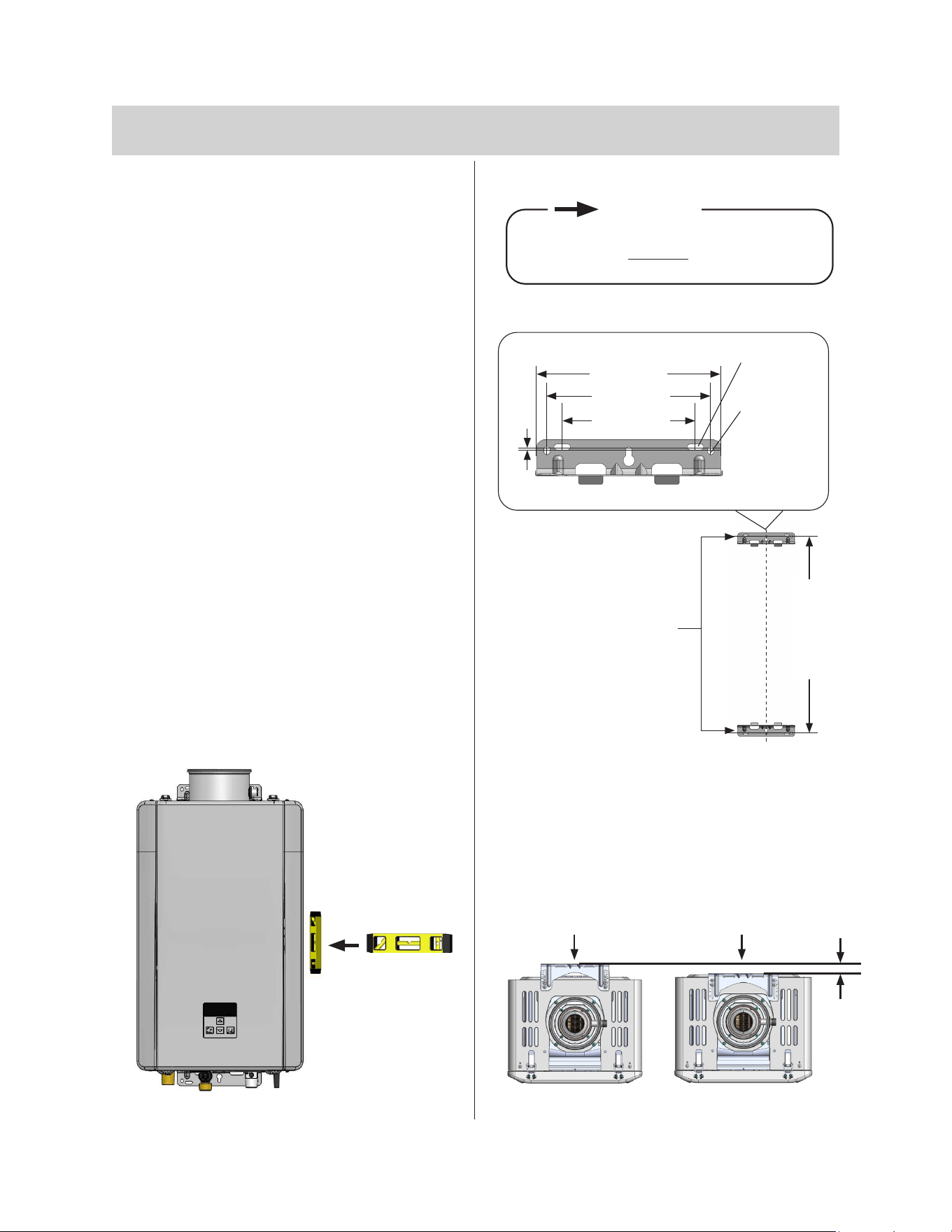
1. Identify the installation location and conrm
that the installation will meet all required
clearances.
2. Securely screw the top and bottom brackets
into the wall, making sure the screws are ush
with the wall.
• Use any of the holes in the top and bottom
brackets.
• Use a level (placed horizontally or
vertically) to make sure the water heater
is straight. Proper operation requires the
water heater to be level.
• Make sure the securing method is
sucient to support the weight of the water
heater. Refer to the water heater weight in
section “3.3 Specications.”
Figure 10: Indoor Models
Bracket
retracted
Figure 11: Indoor Mounting Brackets
Figure 12: Top View Bracket
24.73 (628)
7.09 (180)
6.30 (160)
5.12 (130)
Ø .24X 0.8
(6X2)
Ø .22x .41
(5.5x 10.5)
10 (2.5)
Wall mounting
brackets
Level
Bracket
extended
0.39-1.8
(10-45)
For installation exibility, the top and bottom
brackets can be adjusted to set the water heater
distance from the wall.
The water heater must be installed in an
upright position. DO NOT install the water
heater upside down or on its side.
IMPORTANT
Rinnai Tankless Water Heater Installation and Operation Manual 23
4.4.2 Instructions for Outdoor
Models
You Will Need:
• Rinnai Tankless Water Heater
Supplied by Installer:
• Level
• Screws for top and bottom bracket
installation
Use appropriate screws for type of wall
construction.
Instructions:
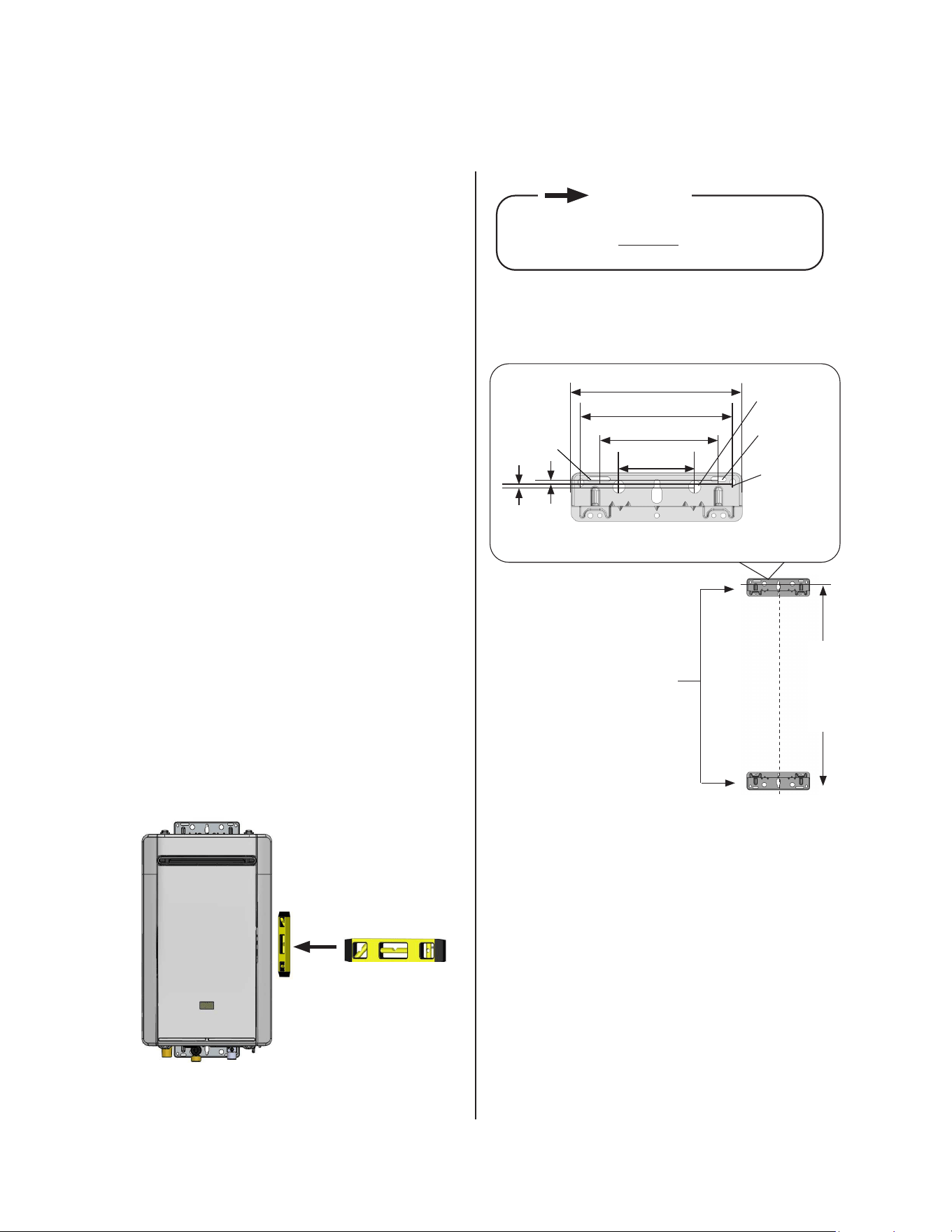
1. Identify the installation location and conrm
that the installation will meet all required
clearances.
2. Securely screw the top and bottom brackets
into the wall, making sure the screws are ush
with the wall.
• Use any of the holes in the top and
bottom brackets.
• Use a level (placed horizontally or
vertically) to make sure the water heater
is straight. Proper operation requires the
water heater to be level.
• Make sure the securing method is
sucient to support the weight of the water
heater. Refer to the water heater weight in
section “3.3 Specications.”
24.73 (628)
7.09 (180)
6.30 (160)
3.15 (80)
Ø.51 (13)
Ø .22x .41
(5.5x 10.5)
.20 (5)
5.12 (130)
.10 (2.5)
Ø .22X .73
(5.5X18.5)
Ø .24x .08
(6x 2)
The water heater must be installed in an
upright position. DO NOT install the water
heater upside down or on its side.
IMPORTANT
Figure 13: Outdoor Models
Figure 14: Outdoor Mounting Brackets
Wall mounting
brackets
Level
24 Rinnai Tankless Water Heater Installation and Operation Manual
4.5 Vent the Water Heater
4.5.1 Guidelines
• This water heater is a direct vent water
heater and therefore is certied and listed
with the vent system. You must use vent
components that are certied and listed
with this water heater model.
• The vent system must vent directly to the
outside of the building and use outside air
for combustion.
• Refer to Table 9: Approved Vent
Products for the certied and listed vent
components.
• Avoid dips or sags in horizontal vent runs
by installing supports per the vent manu-
facturer’s instructions.
• Support horizontal vent runs every 4 ft
(1.2 m) and all vertical vent runs every 6
ft (1.83 m) or as per vent manufacturer’s
instructions or local code requirements.
• Venting should be as direct as possible
with a minimum number of pipe ttings.
• For manufactured vent systems, vent con-
nections must be rmly pressed together
so that the connections form an air tight
seal. Follow the venting manufacturer’s
instructions.
• The vent piece connected to the water
heater must be secured with 1 self-tapping
screw.
• Refer to the instructions of the vent system
manufacturer for component assembly
instructions.
• If the vent system is to be enclosed, it is
suggested that the design of the enclosure
shall permit inspection of the vent system.
The design of such enclosure shall be
deemed acceptable by the trained and
qualied professional or the local inspec-
tor.
• Any issues resulting from improper vent
installation will not be covered by warranty.
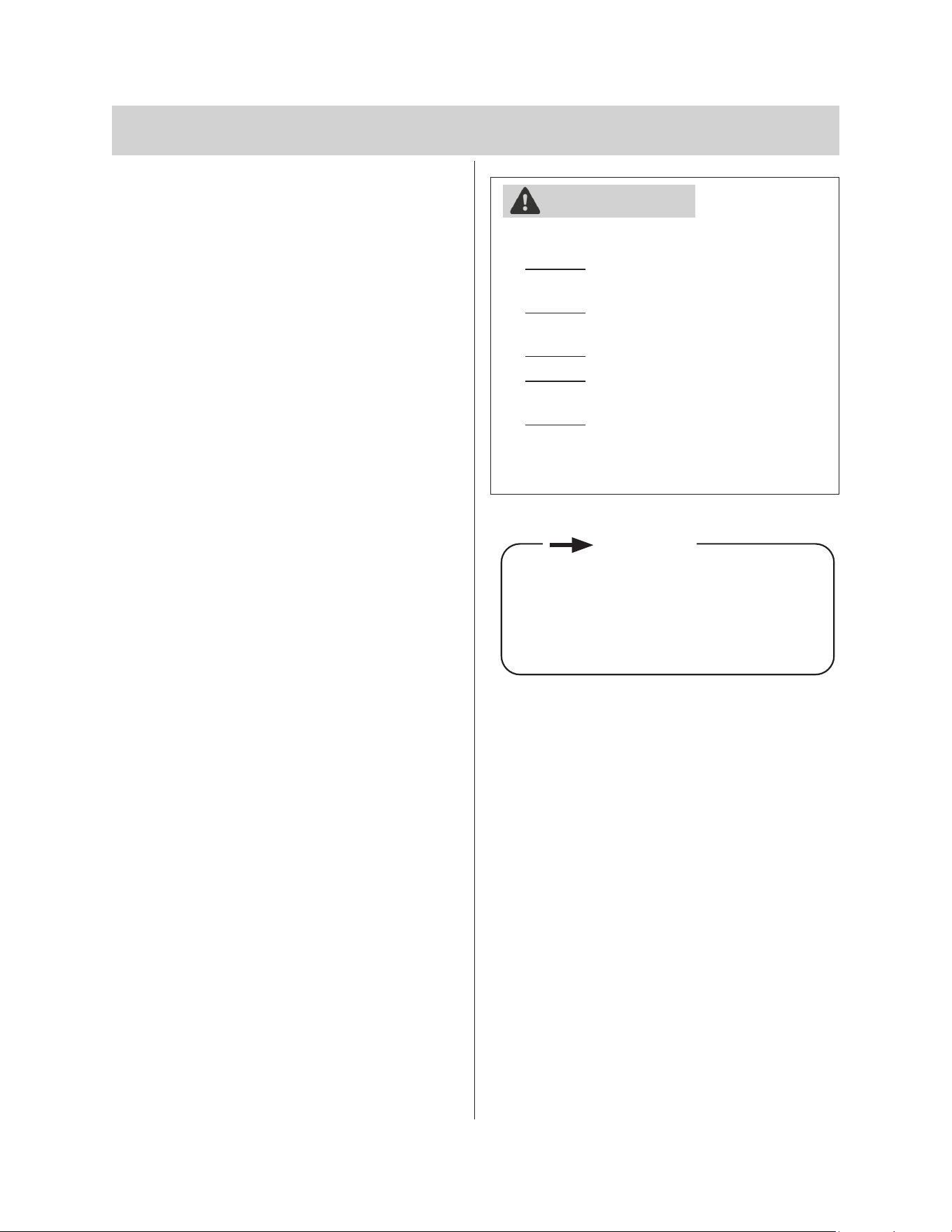
• DO NOT use PVC, CPVC, ABS or
galvanized material to vent this appliance.
• DO NOT combine vent components from
dierent manufacturers.
• DO NOT reduce the vent diameter.
• DO NOT connect the venting system with
an existing vent or chimney.
• DO NOT common vent with the vent pipe
of any other manufacturer’s water heater
or appliance.
If reusing existing venting it should be
inspected for damage and to ensure it
is appropriate (approved) for this water
heater. To ensure safe and proper operation,
damaged vent components MUST be replaced
before operating the water heater.
IMPORTANT
WARNING
Rinnai Tankless Water Heater Installation and Operation Manual 25
4.5.2 Termination
Considerations
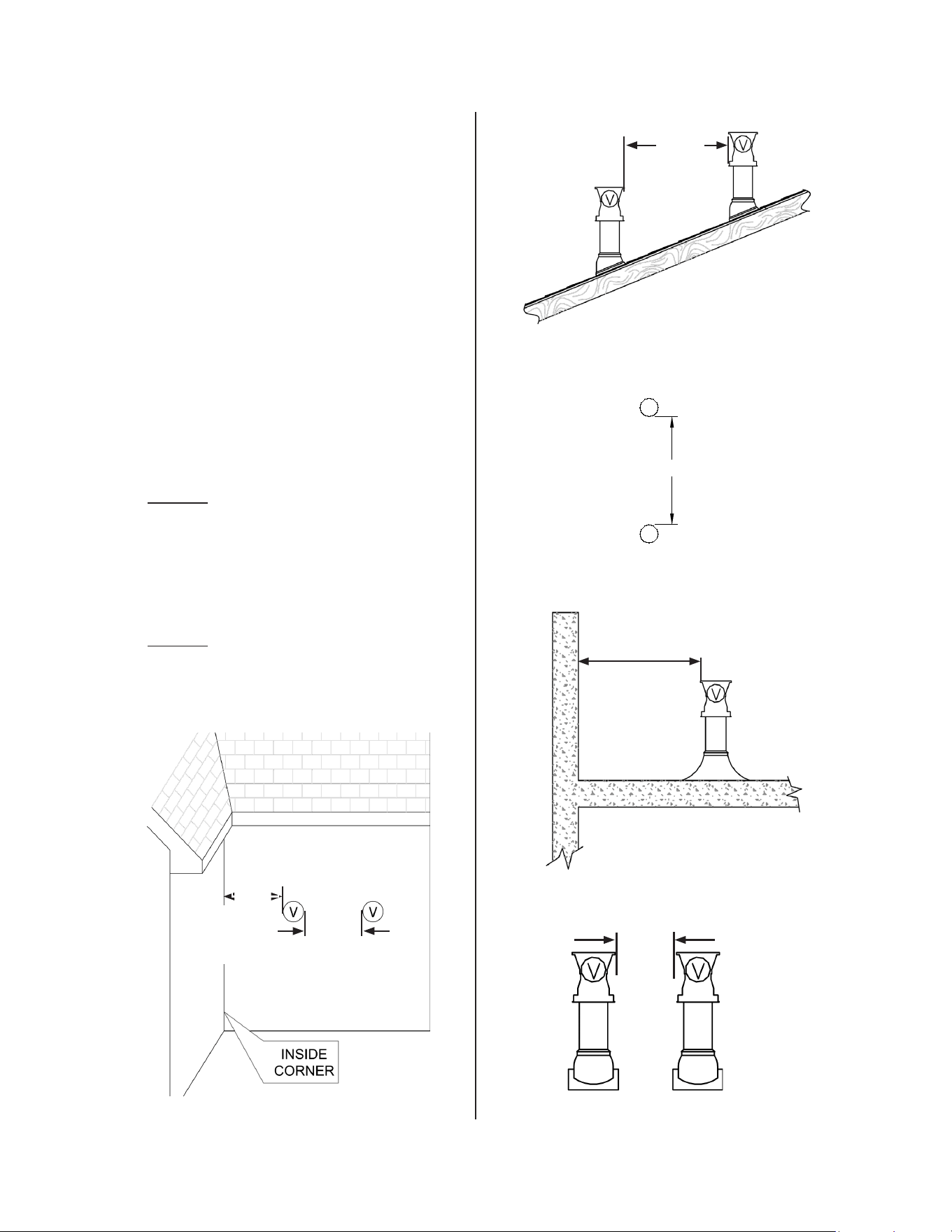
Check to determine whether local codes
supersede the following clearances:
• Avoid termination locations near a dryer
vent.
• Avoid termination locations near
commercial cooking exhaust.
• You must install a vent termination at least
12 inches above the ground.
Important considerations for locating vent
termination under a sot (ventilated or
unventilated or eave vent; or to a deck or porch)
• DO NOT install vent termination under a
vented sot that may result in exhaust
gases entering the sot vent.
• Install vent termination such that exhaust
and rising moisture will not collect under
eaves. Discoloration to the exterior of the
building could occur if installed too close.
• DO NOT install the vent termination too
close under the sot where it could pres-
ent recirculation of exhaust gases back
into the combustion air intake part of the
termination.
(0.30 m ) to
an inside
corner
(0.30 m) between
terminations at
same level
V
60"
V
(0.30 m) between
terminations at
same level
(0.61 m) to wall or parapet
(1.52 m) vertically
between
terminations
(1.52 m) vertically
between
terminations at
dierent levels
Figure 15
Figure 16
Figure 17
Figure 18
Figure 19
60 in.
12 in.
24 in.
12 in.
12 in.
26 Rinnai Tankless Water Heater Installation and Operation Manual
4.5.3 Direct Vent (Indoor): Concentric Pipe
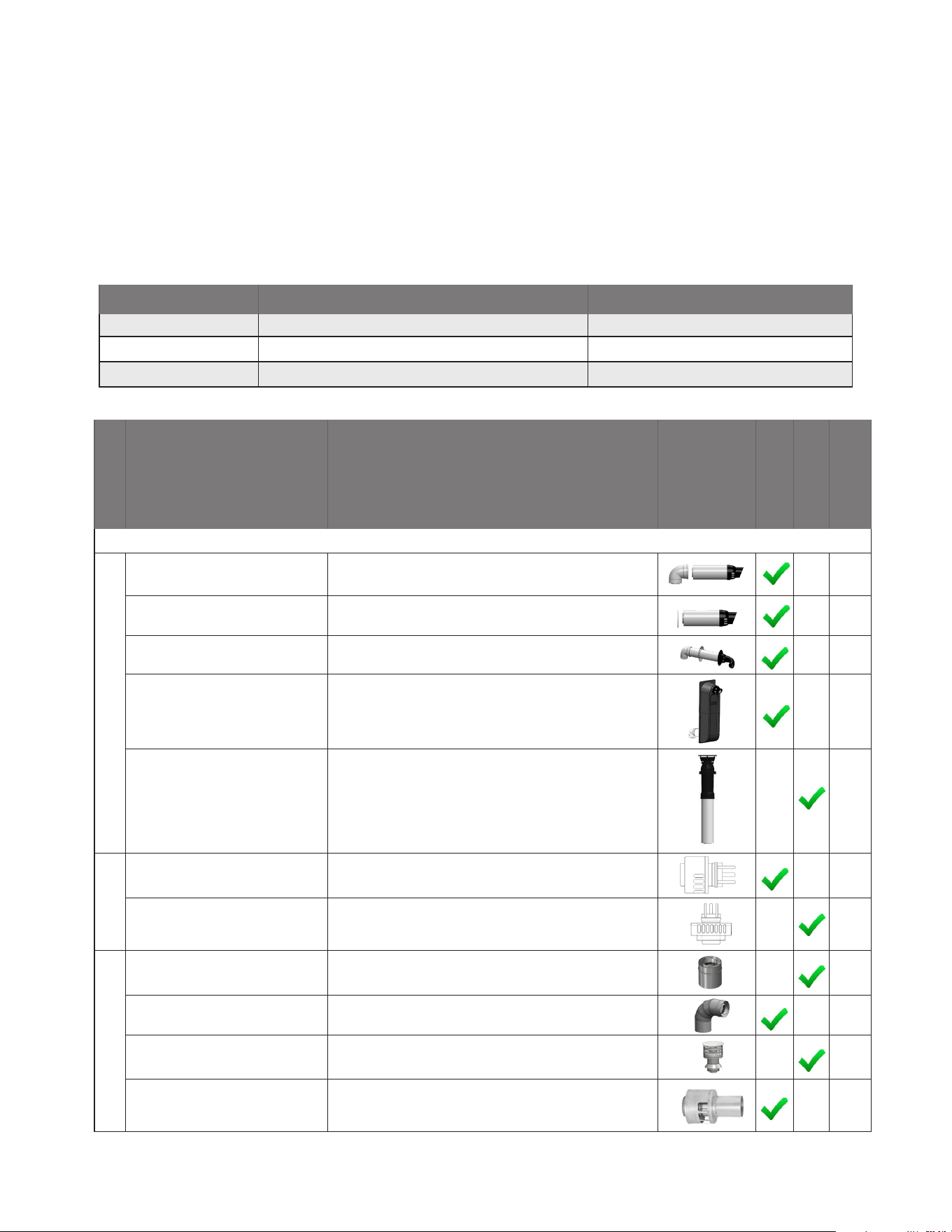
Approved Vent Manufacturers and Products
Following is a list of vent components and terminations for Direct Vent installations. Install the correct venting
for your model according to the venting manufacturer’s instructions and the guidelines below. The information
below is correct at time of publication and is subject to change without notice. Contact the vent manufacturer
for questions related to the vent system, products, part numbers and instructions.
Manufacturer Phone Web Site
Ubbink 800-621-9419 www.rinnai.us
Heat-Fab 800-772-0739 www.heatfab.com
Metal Fab 800-835-2830 www.metal-fabinc.com
Table 8: Approved Vent Manufacturers
Table 9: Approved Vent Products
Manufacturer
Manufacturer
Part number
Product
Description
Diagram
Horizontal
Vertical
Equivalent
Length (ft)
3 in. /5 in. CONCENTRIC VENT TERMINATIONS
UBBINK
223181
223182
Termination Kit 11.5 in.
Termination Kit 21 in.
10
223184 Wall Terminal 21 in.
5
223187
21 in. Non-Condensing Horizontal Termination
Diverter Kit
16
224046 Raised Horizontal Termination Kit (Snorkel) 24
184118-S
184119
Roof Discharge Termination 18 in.
Roof Discharge Termination 38 in. 5
HEAT-FAB
SC03HT
Horizontal Termination Adapter
20
SC03VT
Vertical Termination Adapter
20
METAL-FAB
3CGRLSV Vertical Adapter 1
3CGRLSH Horizontal Adapter 6
3CGRVT Vertical Termination 5
3CGRHT 3 in. x 5 in. Vertical Termination Cap Kit-Concentric 16
Rinnai Tankless Water Heater Installation and Operation Manual 27
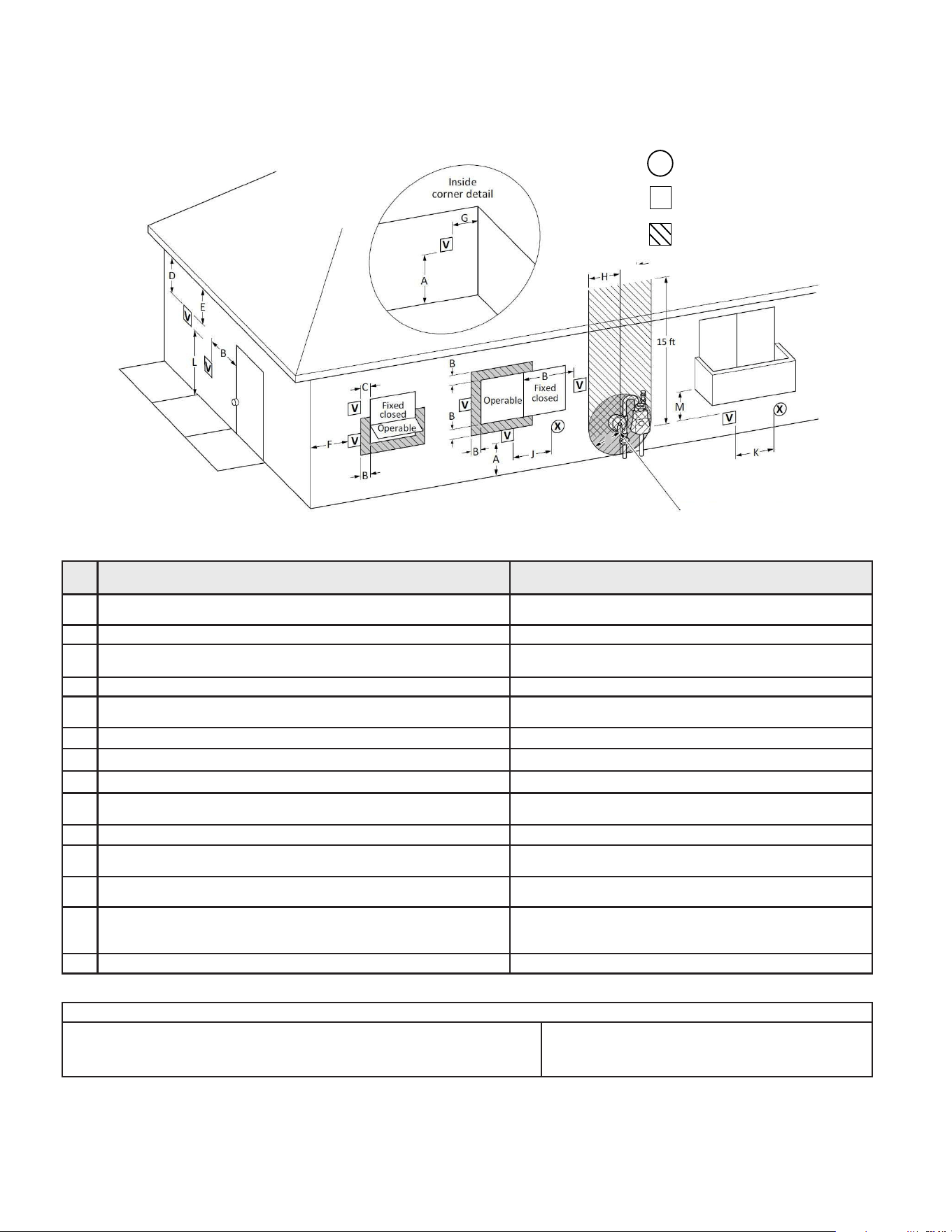
4.5.4 Direct Vent (Indoor): Termination Clearances
U.S. Installations
1
(ANSI Z223.1/NFPA 54)
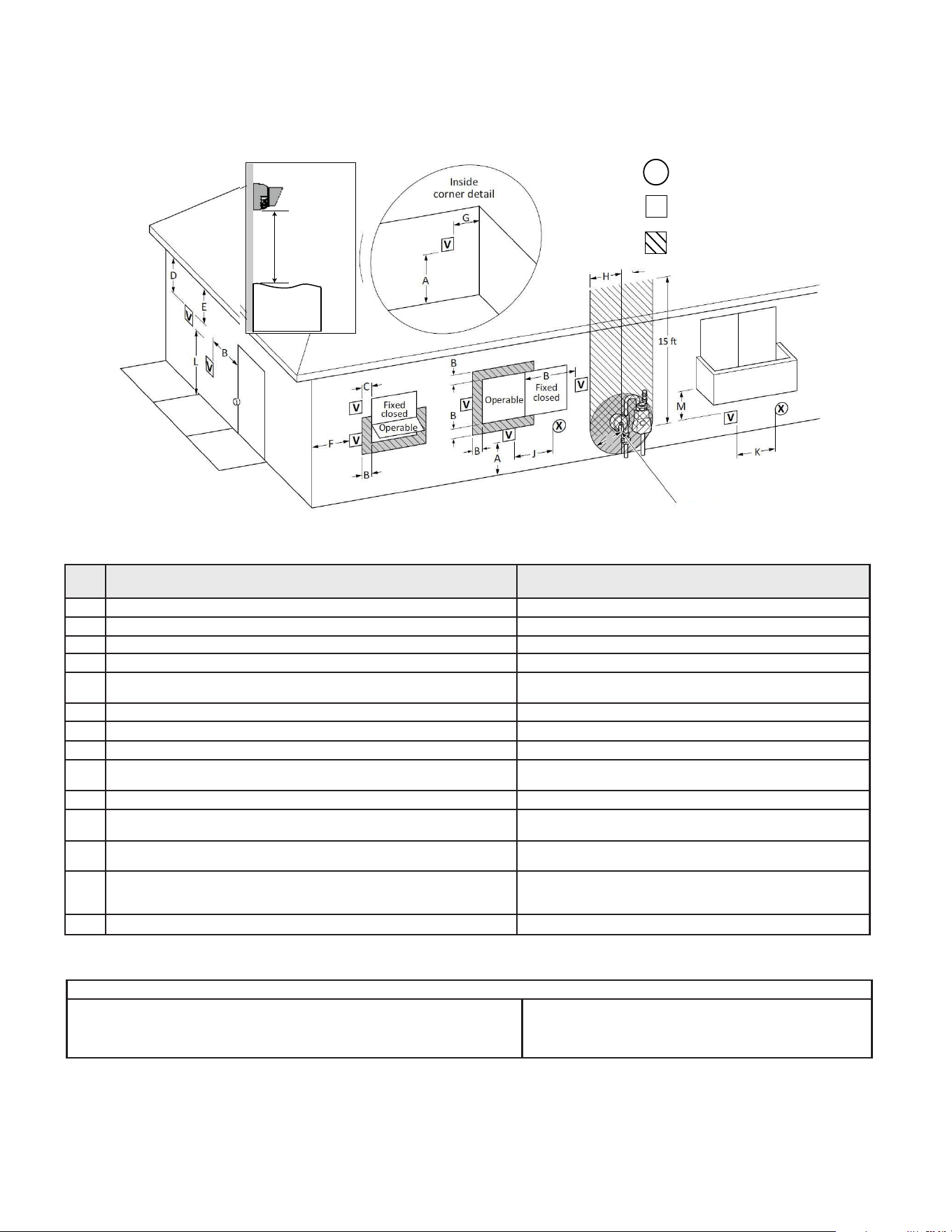
Ref Description Direct Vent (Indoor Unit)
A Clearance above grade, veranda, porch, deck, or balcony 12 in. (30 cm)
B Clearance to window or door that may be opened 12 in. (30 cm)
C Clearance to permanently closed window *
D Vertical clearance to ventilated sot, located above the terminal within a
horizontal distance of 2 ft (61 cm) from the center line of the terminal
*
E Clearance to unventilated sot *
F Clearance to outside corner *
G Clearance to inside corner 12 in.
H Clearance to each side of center line extended above meter/regulator
assembly
*.
I Clearance to service regulator vent outlet *
J Clearance to non-mechanical air supply inlet to building or the
combustion air inlet to any other appliance
12 in. (30 cm)
K Clearance to a mechanical air supply inlet 3 ft (91 cm) above if within 10 ft (3 m) horizontally
L
Clearance above paved sidewalk or paved driveway located on public
property
Vents for Category II and IV appliances cannot be located
above public walkways or other areas where condensate or
vapor can cause a nuisance or hazard.
M Clearance under veranda, porch, deck, or balcony *
Clearance to opposite wall is 24 in. (60 cm).
[1] A vent shall not terminate directly above a sidewalk or paved driveway that is
located between two single family dwellings and serves both dwellings.
[2] Permitted only if veranda, porch, deck, or balcony is fully open on a minimum
of two sides beneath the oor.
*Clearances are in accordance with local installation codes
and the requirements of the gas supplier.
V
SNOW
TERMINATION
Clearance in
Ref. A also
applies to
anticipated
snow line
Regulator vent outlet
AIR SUPPLY INLET
VENT TERMINAL
AREA WHERE TERMINAL
IS NOT PERMITTTED
X
V
SNOW
TERMIN TION
Clearance in
Ref.
anticipated
snow line
Figure 20: Direct Vent Termination Clearances
Table 10
Notes:
1
In accordance with the current ANSI Z223.1/NFPA 54, National Fuel Gas Code.
I
If locally adopted installation codes specify clearances dierent than those illustrated, then the most stringent clearance shall prevail.
28 Rinnai Tankless Water Heater Installation and Operation Manual
Figure 22
Figure 23
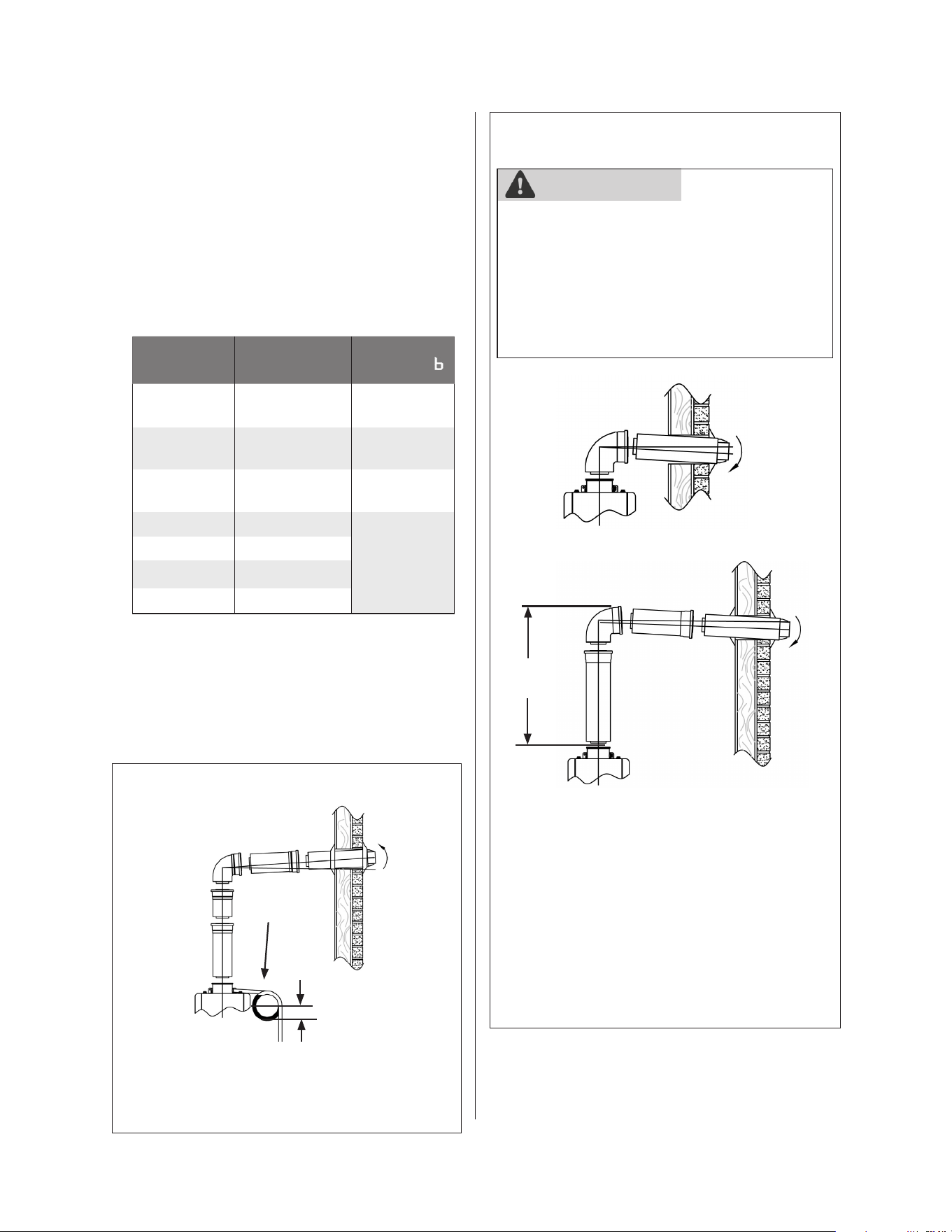
4.5.5 Maximum Vent Length
(indoor models only)
Horizontal Termination without using the
Condensate Collector
If the condensate collector is not used,
the supplied cap must remain installed to
prevent exhaust gases and condensate from
entering the building. The cap is supplied on
the appliance. In such an instance slope the
venting 1/4 in. per foot away from appliance
according to vent manufacturer’s installation
instructions.
WARNING
* The condensate collector must be used in
horizontal terminations if a vertical rise in the
vent system exceeds 5ft.
Maximum
Height*
Regions of cold climate will create more
condensate in the vent system. The condensate
collector should be used in cold climates.
If more than one elbow is used in the vertical
section the condensate collector must be used.
Slope the venting 1/4 in. per foot toward the
appliance according to the vent manufacturers
installation instructions. Dispose of condensate
per local codes.
Horizontal Termination using the Condensate
Collector
Condensation
3 in. (75 mm)
minimum
Figure 21
Table 11
4.5.6 Venting Installation
(indoor models only)
Install the venting termination according to the
diagrams and instructions below.
Default vent length is set for 21-41equivalent ft of
venting. If equivalent vent length is 20 ft or less,
parameter 10 must be changed to "b"
1. Determine the number of 90 degree elbows
in the vent system. (Two 45 degree elbows
count as one 90 degree elbow.)
2. Refer to the table to nd the maximum vent
length based on the number of elbows.
See "Parameter Settings Table" in section 4.10
for more information.
Number of
90° elbows
(Default)
Long (99-A)
Short (99- )
0
21-41 ft
(6.4-12.5 m)
0-20 ft
(0-6 m)
1
16-35 ft
(4.9-10.7 m)
0-15 ft
(0-4.6 m)
2
9-29 ft
(2.7-8.8 m)
0-9 ft
(0-2.8 m)
3 23 ft (7.0 m)
4 17 ft (5.2 m)
5 11 ft (3.4 m)
6 5 ft (1.5 m)
Rinnai Tankless Water Heater Installation and Operation Manual 29
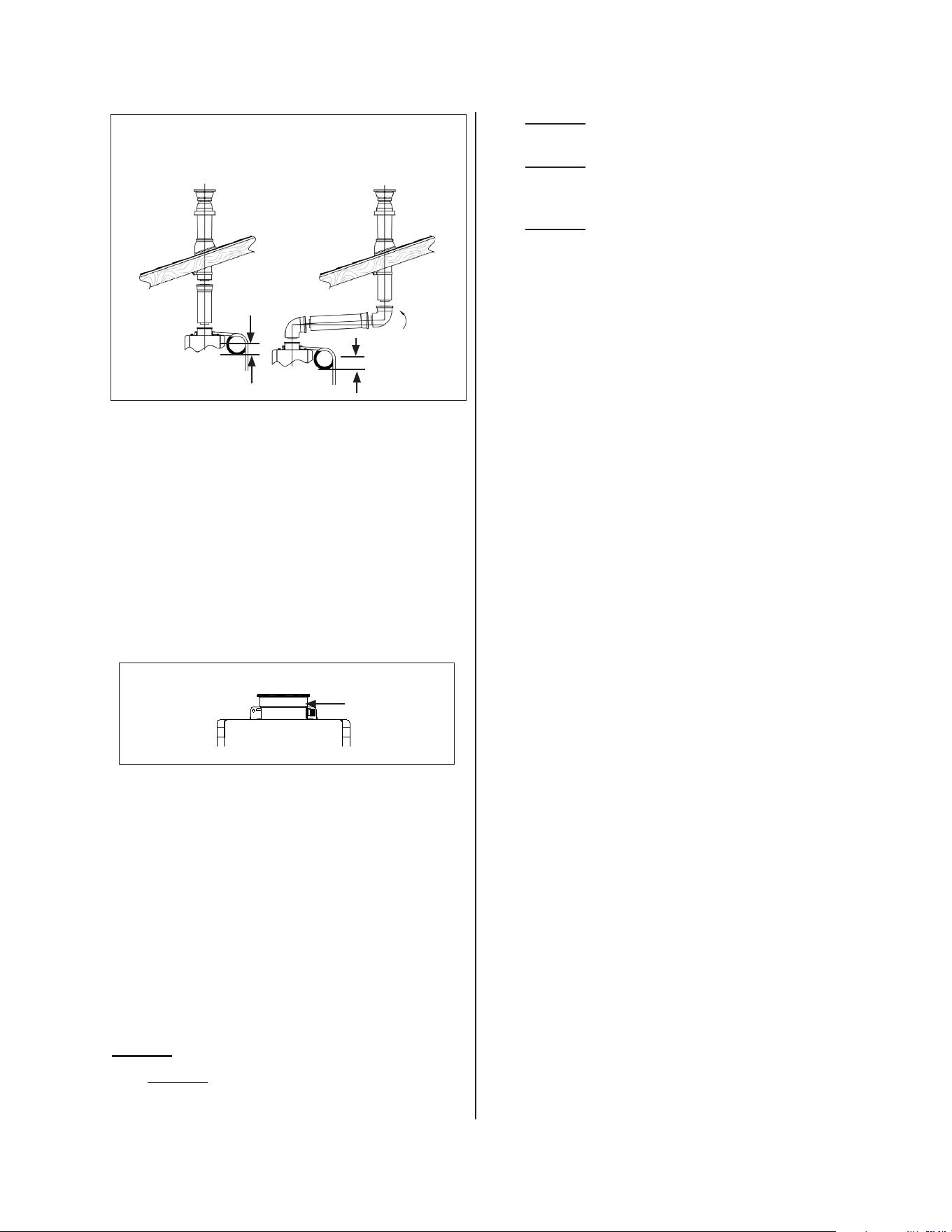
4.5.7 Condensate
(Indoor models only)
Condensate can form in the vent of high eciency
direct vent appliances. Without proper drainage,
condensate will damage the heat exchanger.
To prevent condensate damage, follow these
instructions.
DO NOT
• DO NOT allow condensate to enter the
water heater.
• DO NOT connect the condensate drain
pipe directly to the rain sewer.
• DO NOT connect the condensate drain
line with an air conditioning evaporator coil
drain or.
• DO NOT connect the condensate drain
line to the pressure relief valve/line of the
appliance.
Must Do
• Use only venting that is approved and
identied as acceptable for your
particular model.
• For vertical terminations, use the inte-
grated condensate collector and install a
condensate trap.
• Slope the venting toward the appliance ac-
cording to the vent manufacturer’s installa-
tion instructions.
• All condensate must drain and be
disposed of according to local codes.
• Use only corrosion resistant materials for
the condensate drain lines such as PVC
pipe or plastic hose.
• The condensate drain pipe (along its entire
length) must be at least the same diameter
as the drain line, (5/8 inch).
• The end of the condensate drain pipe
should be open to the atmosphere. The
end should not be under water or other
substances.
• To minimize freezing of the condensate,
run the condensate drain line through an
interior wall or between insulation and an
interior wall.
• The condensate collector should be used
for all combination domestic/
hydronic heating applications.
Information
• A condensate trap is available (part num-
ber 222053).
• Regions of cold climate will create more
condensate in the vent system. The con-
densate collector should be used in cold
climates.
• The condensate drain pipe should be as
short as possible and have a downward
pitch.
To adjust the condensate collector position:
Loosen the 4 screws at the rear bracket
1. Slide the bracket away from the female vent
top.
2. Remove the 4 screws attaching the female
vent top to the water heater.
3. Lift up the female vent top and reposition as
desired.
4. Install the 4 screws at the vent top and tighten
the 4 screws at the bracket.
5. Secure the rst vent component to the water
heater with one self-tapping screw at the hole
located above the condensate collector.
Securing
Screw
Figure 25
Vertical Termination
(Condensate collector must be used in all
installations)
Figure 24
3 in. (75 mm)
minimum
3 in. (75 mm)
minimum
30 Rinnai Tankless Water Heater Installation and Operation Manual
4.5.8 Other than Direct Vent (Outdoor): Termination Clearances
U.S. Installations
1
(ANSI Z223.1/NFPA 54)
Ref Description Other than direct vent
(Outdoor unit)
A Clearance above grade, veranda, porch, deck, or balcony 12 in. (30 cm)
B Clearance to window or door that may be opened
4 ft (1.2 m) below or to side of opening; 1 ft (300 mm) above
opening
C Clearance to permanently closed window *
D Vertical clearance to ventilated sot, located above the terminal within a
horizontal distance of 2 ft (61 cm) from the center line of the terminal
*
E Clearance to unventilated sot *
F Clearance to outside corner *
G Clearance to inside corner 12 in.
H Clearance to each side of center line extended above meter/regulator
assembly
*
I Clearance to service regulator vent outlet *
J Clearance to non-mechanical air supply inlet to building or the
combustion air inlet to any other appliance
4 ft (1.2 m) below or to side of opening; 1 ft (300 mm) above
opening
K Clearance to a mechanical air supply inlet
3 ft (91 cm) above if within 10 ft
(3 m) horizontally
L Clearance above paved sidewalk or paved driveway located on public
property
Vents for Category II and IV appliances cannot be located
above public walkways or other areas where condensate or
vapor can cause a nuisance or hazard.
M Clearance under veranda, porch, deck, or balcony *
Clearance to opposite wall is 24 in. (60 cm).
[1] A vent shall not terminate directly above a sidewalk or paved driveway that is
located between two single family dwellings and serves both dwellings.
[2] Permitted only if veranda, porch, deck, or balcony is fully open on a minimum of
two sides beneath the oor.
*Clearances are in accordance with local installation
codes and the requirements of the gas supplier.
Regulator vent outlet
AIR SUPPLY INLET
VENT TERMINAL
AREA WHERE TERMINAL
IS NOT PERMITTTED
X
V
SNOW
TERMIN TION
Clearance in
Ref.
anticipated
snow line
Figure 26: Outdoor Termination Clearances
Notes:
1
In accordance with the current ANSI Z223.1/NFPA 54, National Fuel Gas Code.
Table 12
I
If locally adopted installation codes specify clearances dierent than those illustrated, then the most stringent clearance shall prevail.
36 inches minimum from the top of the water heater to the overhang. The area under the overhang must be open on 3 sides
Rinnai Tankless Water Heater Installation and Operation Manual 31
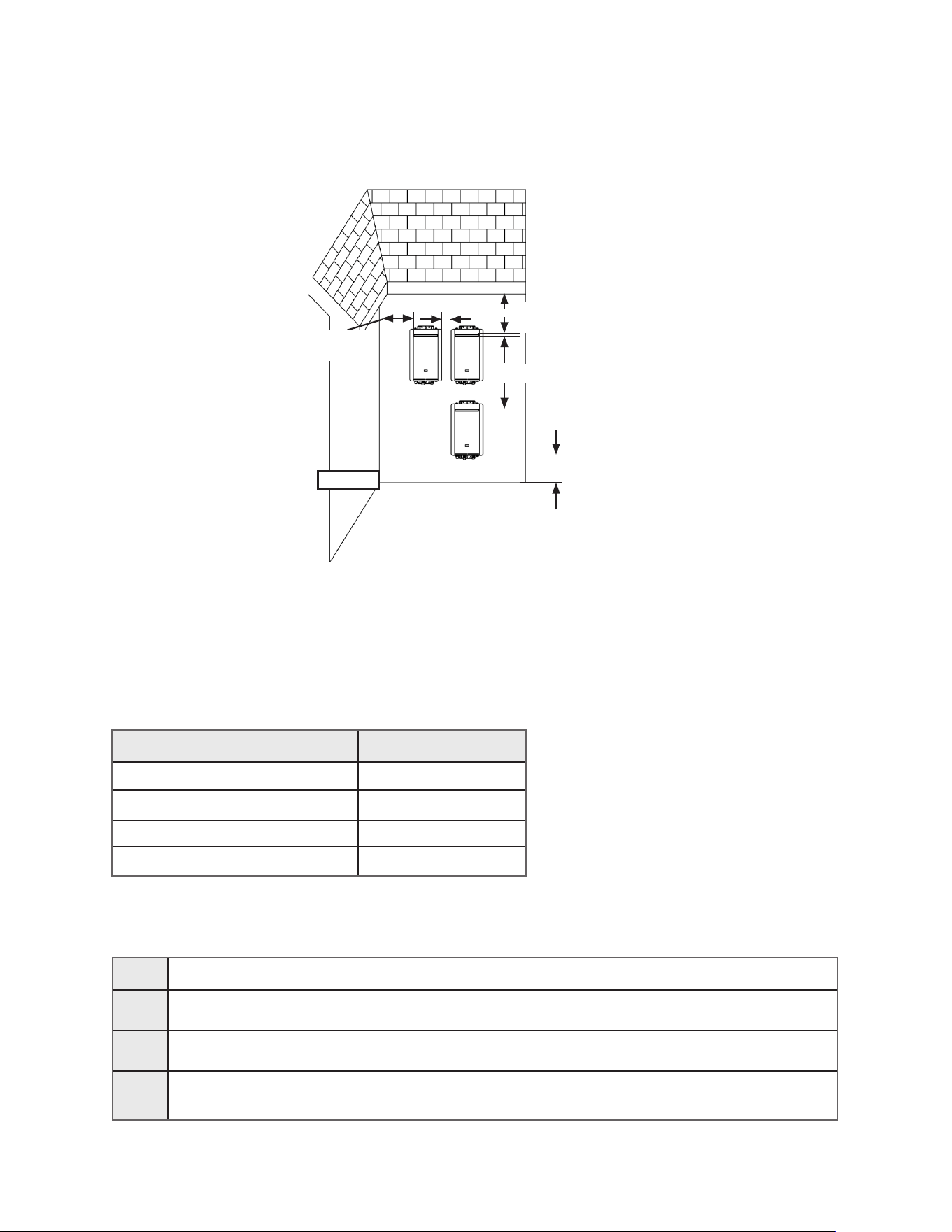
4.5.9 Termination Clearances for External (Outdoor) Water
Heaters
36 in. (0.91 m) to ventilated or unventilated
sot or eve vent; or to a deck or porch
60 in. (1.52 m) vertically between terminals
2 in.
12 in.
(0.30 m)
Corner
Figure 27
12 in. (0.30 m) from
ground anticipated
snow line
4.5.10 Adjustment for High Altitude Installations
Use parameter settings to select the appropriate altitude for your installation. The default setting for the
appliance is 0-2,000 ft. (0-610 m), Parameter Setting 2A. Refer to section "4.10.1 Congure Parameter
Settings" for specic details on setting parameters..
Altitude Parameter Setting
0-2,000 ft (0-610 m) 02A
2,001-5,400 ft (610-1,646 m) 02b
5,401-7,700 ft (1,646-2,347 m) 02C
7,701-10,200 ft (2,347-3,109 m) 02d
□
DO NOT use room air for combustion.
□
Installation complies with National Fuel Gas Code, ANSI Z223.1/NFPA 54 as well as local and
state regulations therein.
□
For indoor models verify that the parameters have been adjusted for vent length if necessary.
Refer to the section on Maximum Vent Length.
□
Conrm high altitude settings are correct for installation location requirements. See Parameter
Settings Table for more information.
Checklist for Venting Requirements
32 Rinnai Tankless Water Heater Installation and Operation Manual
4.6 Connect Water Supply
4.6.1 Guidelines
• The piping (including soldering materials) and components connected to this appliance must be
approved for use in potable water systems.
• Purge the water line to remove all debris and air. Debris will damage the water heater.
• The appliance must not be connected to a system that was previously used with a non-
potable water heating appliance.
• Ensure that the water lter on the water heater is clean and installed.
• Verify water pressure meets requirements.
• DO NOT introduce toxic chemicals such as those used for boiler water treatment to the
potable water used for space heating.
4.6.2 Instructions
To connect the water supply, follow the instructions below.
1. Plumb the cold water supply line to the water heater on the 3/4 in. MNPT connection at the bottom of
the water heater marked “C.”
2. Plumb the hot water supply line to the 3/4 in. MNPT connection marked “H.”
3. If a pipe cover will be installed, make sure water lines to the water heater t within the connements
of the pipe cover.
y
/
4
"
y
/4" Hot ly
Eq m
RIK-KIT (
( /4" F Incl :
s, B V v ,
Valv
P re Relief Valve.)
Q
/
4
"
c
B x
Pressure Relief Valve
3/4" Ball Valve
3/4" Union
Check Valve
S
Pressure Regulator
Circulating Pump
Solenoid Valve
Boiler Drain Valve
KEY
This is not an engineered drawing. It is intended only as a guide and not
as a replacement for professionally engineered project drawings.
drawing is not intended to describe a complete system. It is up to the
contractor/engineer to determine the necessary components and
configuration of the particular system being installed. This drawing does
not imply compliance with local building code requirements. It is the
responsibility of the contractor/engineer to ensure installation is in
accordance with all local building codes. Confer with local building
fficials before installation.
y
/
4
"
y
/4" Hot ly
Eq m
RIK-KIT (
( /4" F Incl :
s, B V v ,
Valv
P re Relief Valve.)
Q
/
4
"
c
B x
Pressure Relief Valve
/4" Ball Valve
/4"
Check V lve
Pressure Regula
c lating Pump
Valve
Boiler Drain Va v
This is not an engineered drawing. It is intended only as a guide and not
as a replacement for professionally engineered project drawings. This
drawing is not intended to describe a complete system. It is up to the
contractor/engineer to determine the necessary components and
configuration of the particular system being installed. This drawing does
not imply compliance with local building code requirements. It is the
responsibility of the contractor/engineer to ensure installation is in
accordance with all local building codes. Confer with local building
officials before installation.
The condensate drain pipe (along its entire
length) must be at least the same diameter
as the drain line (1/2 in. NPT).
PIPING DIAGRAM FOR BASIC INSTALLATION
Figure 28
Gas Supply
Cold Water Supply Line
Hot Water Supply Line
Water connections to the water heater should follow all state and local plumbing codes. If this is a
standard installation, refer to the “Piping Diagram for Basic Installation” below.
IMPORTANT
Rinnai Tankless Water Heater Installation and Operation Manual 33
4.7 Install Pressure Relief Valve
Water discharged from the pressure relief valve could cause severe burns
instantly or death from scalds.
4.7.1 Guidelines
An approved pressure relief valve is required
by the American National Standard (ANSI
Z21.10.3) for all water heating systems and shall
be accessible for servicing. When connecting
a pressure relief valve, follow the guidelines
below:
• The pressure relief valve must comply
with the standard for Relief Valves and
Automatic Gas Shuto Devices for Hot
Water Supply Systems ANSI Z21.22 and
/or the standard Temperature, Pressure,
Temperature and Pressure Relief Valves
and Vacuum Relief Valves, CAN1-4.4.
• The pressure relief valve must be rated
up to 150 psi and to at least the maxi-
mum Btu/hr of the appliance.
• The discharge from the pressure relief
valve should be piped to the ground or
into a drain system per local codes.
• The pressure relief valve must be
manually operated once a year to check
for correct operation.
• The discharge line from the pressure
relief valve should pitch downward and
terminate 6 in. (152 mm) above drains
where discharge will be clearly visible.
• The discharge end of the line shall be
plain (unthreaded) and a minimum of 3/4
in. nominal pipe diameter. The discharge
line material must be suitable for water
at least 180°F.
• The pressure relief valve is connected
below the appliance. DO NOT place any
other valve or shut o device between
the pressure relief valve and the water
heater.
• If a pressure relief valve discharges
periodically, this may be due to thermal
expansion in a closed water supply sys-
tem. Contact the water supplier or local
plumbing inspector on how to correct
this situation. DO NOT plug the pressure
relief valve.
• The American National Standard (ANSI
Z21.10.3) does not require a combination
temperature and pressure relief valve for this
appliance. However, local codes may require
a combination temperature and pressure
relief valve.
• Protect pressure relief valve and pressure
relief valve discharge line from freezing. Do
not plug or restrict ow of the pressure relief
valve.
• DO NOT plumb the pressure relief valve with
the condensate drain; both must be plumbed
independently to drain.
• DO NOT plug the pressure relief valve and
do not install any reducing ttings or other
restrictions in the relief line. The pressure
relief line should allow for complete drainage
of the valve and the line.
• DO NOT place any other valve or shuto
device between the pressure relief valve and
the water heater.
Pressure Relief Valve Maintenance:
For proper care of this approved pressure relief
valve, it is recommended that the valve is manually
operated once a year. In doing so, it will be
necessary to take precautions with regard to the
discharge of potentially scalding hot water under
pressure. Ensure discharge water has a safe place
to ow. Contact with your body or other property
may cause damage or harm.
WARNING
34 Rinnai Tankless Water Heater Installation and Operation Manual
4.8 Connect the Gas Supply
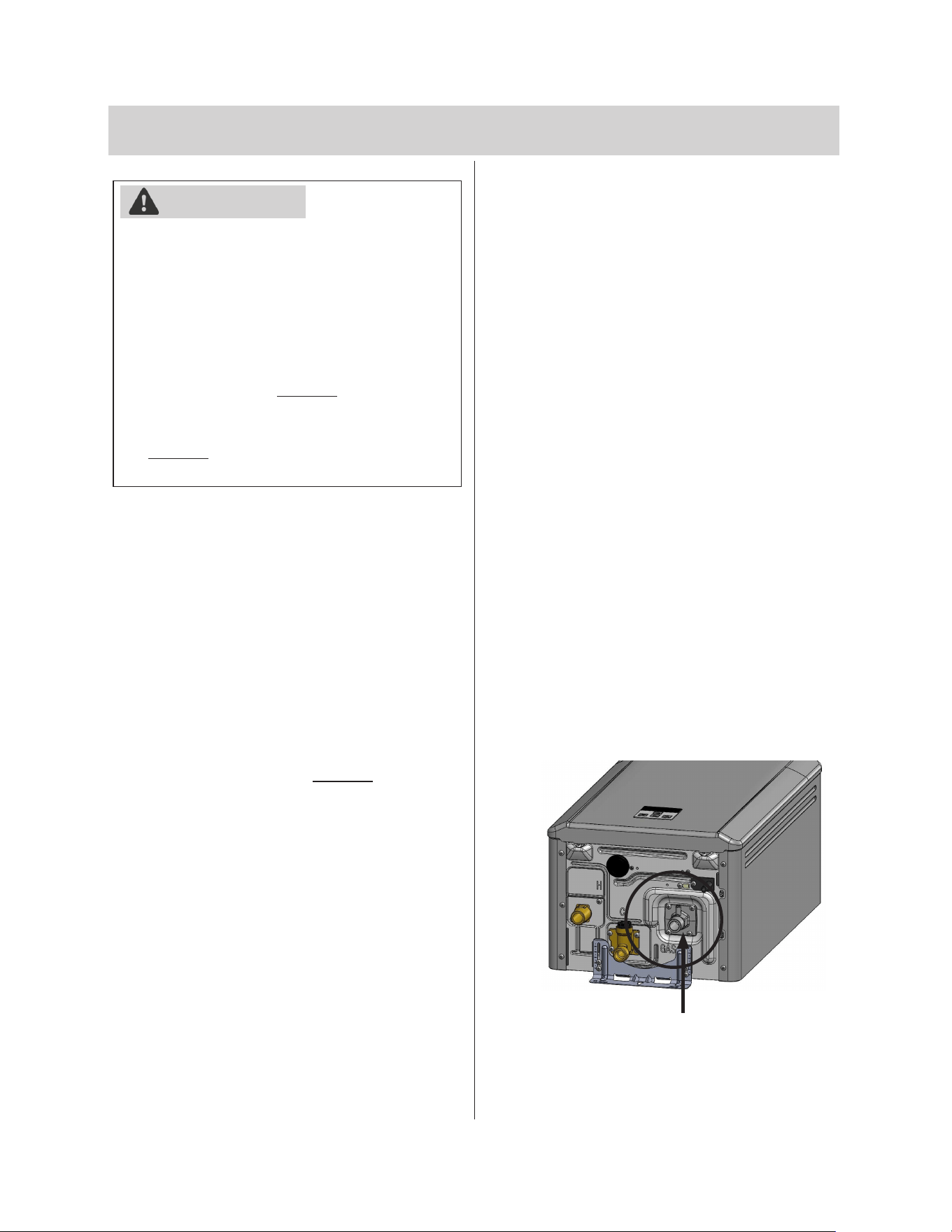
Figure 29
• A trained and qualied professional must
install the gas supply.
• Conrm the gas type before connecting.
Failure to install correct gas type may
result in injury or damage to the unit.
• Turn o 120V power supply.
• Turn o the gas.
• Gas is ammable. DO NOT smoke or
provide other ignition sources while work-
ing with gas.
• DO NOT turn on the water heater or gas
until all fumes are gone.
4.8.1 Instructions
To connect the gas supply, follow the instructions
below:
1. Install a manual shuto (control) valve in
the gas supply line to the water heater. A
union can be used on the connection above
the shut o valve for the future servicing or
disconnection of the water heater.
2. Check the type of gas and gas supply
pressure before connecting the water heater. If
the water heater is not of the gas type that the
building is supplied with, DO NOT connect the
water heater. Contact the dealer for the proper
water heater to match the gas type.
3. Check the gas supply pressure immediately
upstream at a location provided by the
gas company. Supplied gas pressure must
be within the limits shown in section “3.3
Specications” with all gas appliances
operating. Install a proper gas regulator
upstream of a water heater if a supply gas
pressure is too high.
4. Before placing the appliance in operation, all
joints including the heater must be checked
for gas tightness by means of soap, gas
leak detector solution, or an equivalent
WARNING
nonammable solution, as applicable. (Since
some leak test solutions, including soap and
water, may cause corrosion or stress cracking,
the piping shall be rinsed with water after
testing, unless it has been determined that the
leak test solution is non-corrosive.)
5. Use approved connectors to connect the water
heater to the gas line. Purge the gas line of
any debris before connection to the water
heater.
6. Any compound used on the threaded joint of
the gas piping shall be a type that resists the
action of liqueed petroleum gas (propane/
LPG).
7. The gas supply line shall be gas tight, sized,
and so installed as to provide a supply of gas
sucient to meet the maximum demand of the
heater and all other gas consuming appliances
at the location without loss of pressure. If in
doubt about the size of the gas line, refer
to the “Gas Pipe Sizing Reference Tables”
section on the next page.
8. Perform a leak and pressure test prior
to operating the water heater. If a leak is
detected, do not operate the water heater until
the leak is repaired.
Gas connection 3/4 in.
MNPT connection
Rinnai Tankless Water Heater Installation and Operation Manual 35
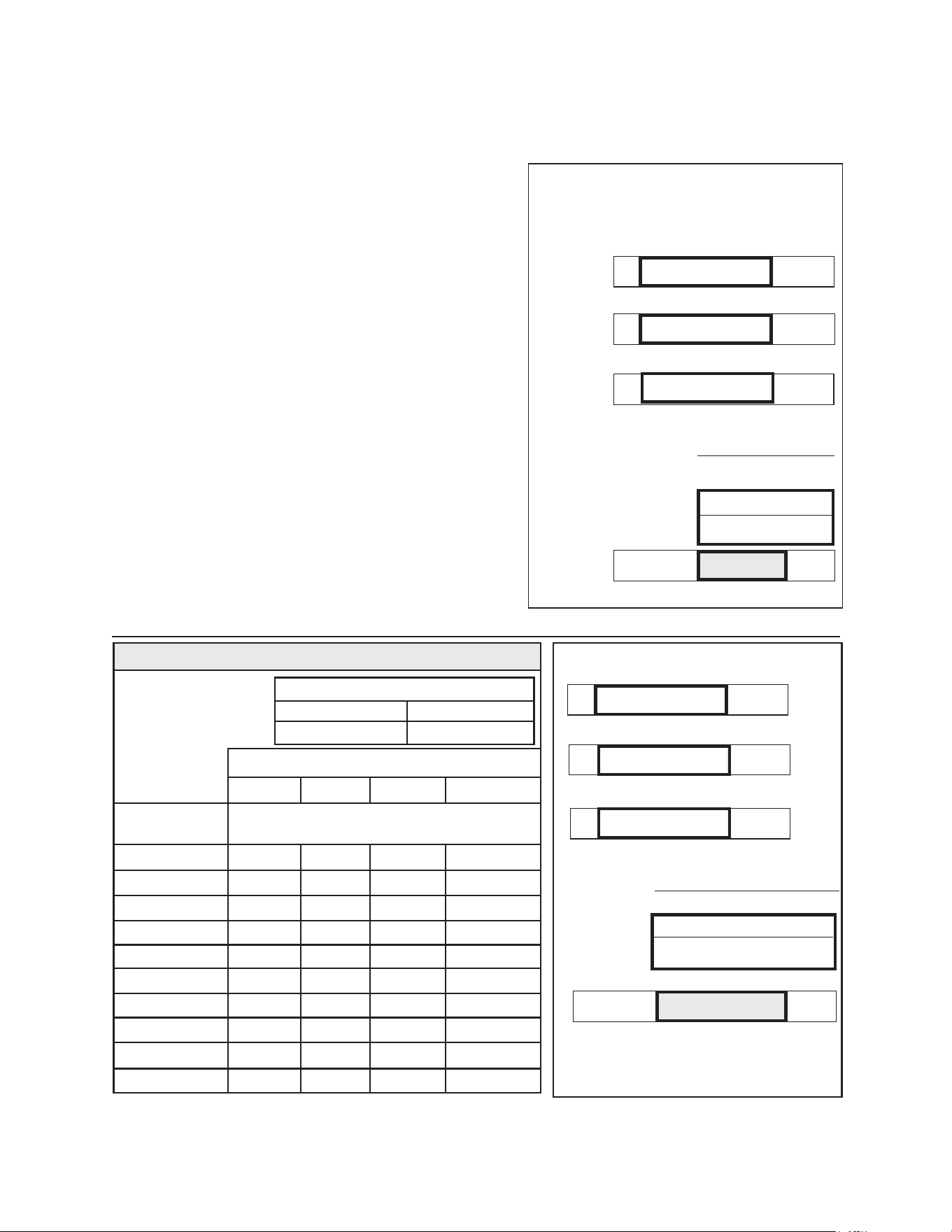
4.8.2 Gas Pipe Sizing Reference Tables
The gas supply must be capable of handling the entire gas
load required at the location. Gas line sizing is based on
gas type, the pressure drop in the system, the gas pressure
supplied, and gas line type. For gas pipe sizing, refer to the
National Fuel Gas Code, ANSI Z223.1/NFPA 54.
For some tables, you will need to determine the cubic
feet per hour of gas required by dividing the gas input by
the heating value of the gas (available from the local gas
company). The gas input needs to include all gas products
at the location and the maximum Btu usage at full load
when all gas products are in use.
Use the table for your gas type and pipe type to nd the
pipe size required. The pipe size must be able to provide
the required cubic feet per hour of gas or the required Btu/
hour.
The information below is provided as an example. The
appropriate table from the applicable code must be used.
Table 13: Gas Pipe Sizing Calculation
Worksheet
Instructions: Enter values in empty boxes.
Rinnai Model Gas Input:
Additional Appliance Total Gas Input:
Heating Value of Gas:
Cubic Feet Per Hour (CFH):
Answer:
A Btu/hr
B Btu/hr
C Btu/ft
3
(CFH) =
A + B
C
(CFH) =
(CFH) =
ft
3
/hr
Natural Gas
Table 14: Pressure Drop 0.3 in. wc
Information in table
obtained from NFPA 54,
ANSI Z223.1
Nominal Pipe Size (in.)
3/4 1 1 1/4 1 1/2
Length in ft
(meters)
Capacity in Cubic Feet of Gas per Hour
10 (3) 273 514 1,060 1,580
20 (6) 188 353 726 1,090
30 (9) 151 284 583 873
40 (12) 129 243 499 747
50 (15) 114 215 442 662
60 (18) 104 195 400 600
70 (21) 95 179 368 552
80 (24) 89 167 343 514
90 (27) 83 157 322 482
100 (30) 79 148 304 455
Schedule 40 Metallic Pipe
Inlet Pressure: Less than 2 psi
Specic Gravity: 0.60
Table 15: Example
Rinnai Model Gas Input:
Additional Appliance Total Gas Input:
Heating Value of Gas:
Cubic Feet Per Hour (CFH):
Answer:
For this example, the pipe diameter
must be at least 3/4 in. pipe size and 10
ft (3 m) in length.
A
199,000
Btu/hr
B
65,000
Btu/hr
C
1,000
Btu/ft
3
(CFH) =
A + B
C
(CFH) =
199,000+65,000
1,000
(CFH) =
264
ft
3
/hr
36 Rinnai Tankless Water Heater Installation and Operation Manual
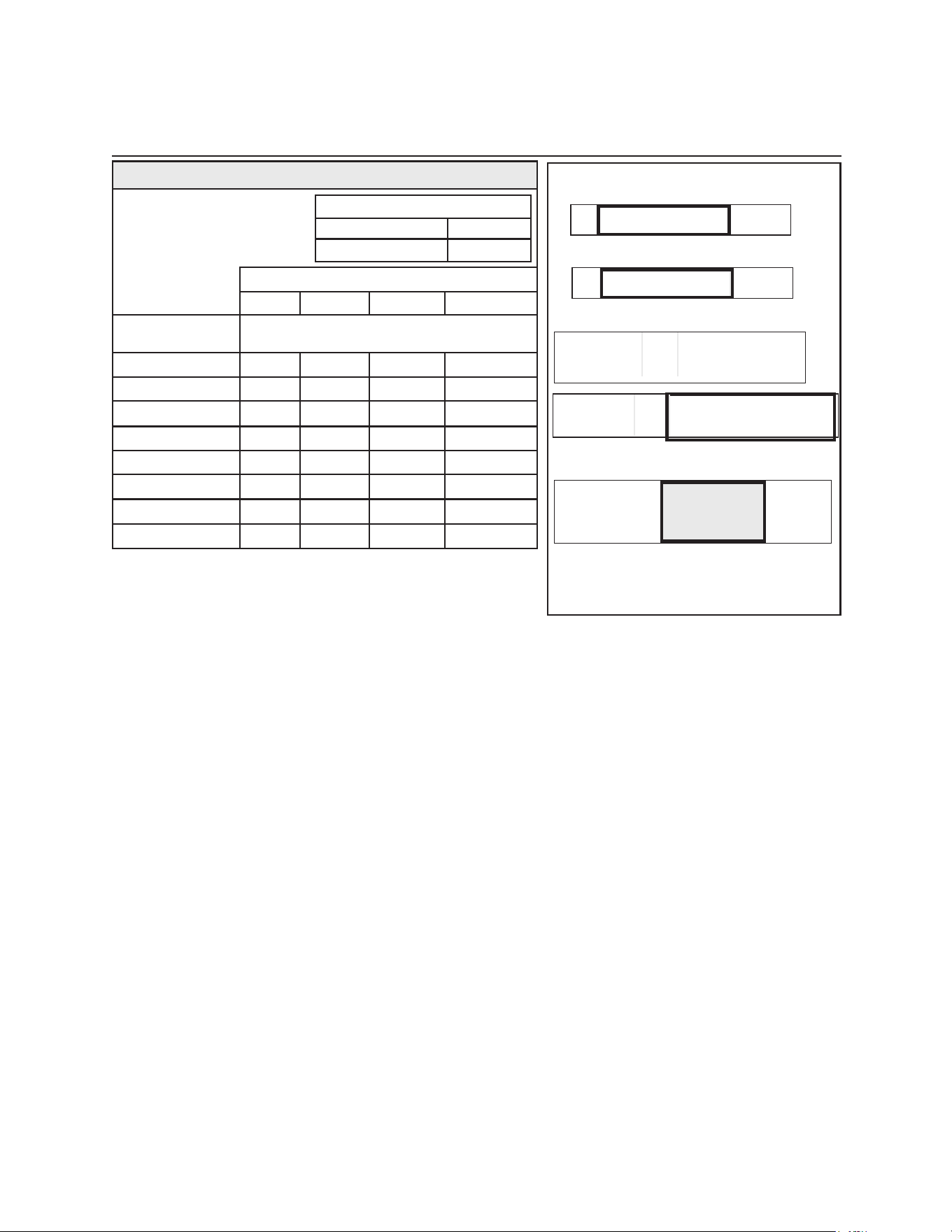
Propane (Undiluted)
Table 16: Pressure Drop 0.5 in. wc
Information in table
obtained from NFPA 54,
ANSI Z223.1
Nominal Pipe Size (in.)
1/2 3/4 1 1 1/4
Length in ft
(meters)
Capacity in Thousands of Btu per Hour
10 (3) 291 608 1,150 2,350
20 (6) 200 418 787 1,620
30 (9) 160 336 632 1,300
40 (12) 137 287 541 1,110
50 (15) 122 255 480 985
60 (18) 110 231 434 892
80 (24) 101 212 400 821
100 (30) 94 197 372 763
Schedule 40 Metallic Pipe
Inlet Pressure: 11 in wc
Specic Gravity: 1.50
Table 17: Example
Rinnai Model Gas Input:
Additional Appliance Total Gas Input:
Total Gas Input:
Answer:
For this example, the pipe diameter must
be at least 1/2 in. nominal pipe size and
10 ft (3 m) in length.
A
199,000
Btu/hr
B
65,000
Btu/hr
Total Gas
Input
=
264,000
Btu/hr
Total Gas
Input
=
A + B
Total Gas
Input
=
199,000 + 65,000
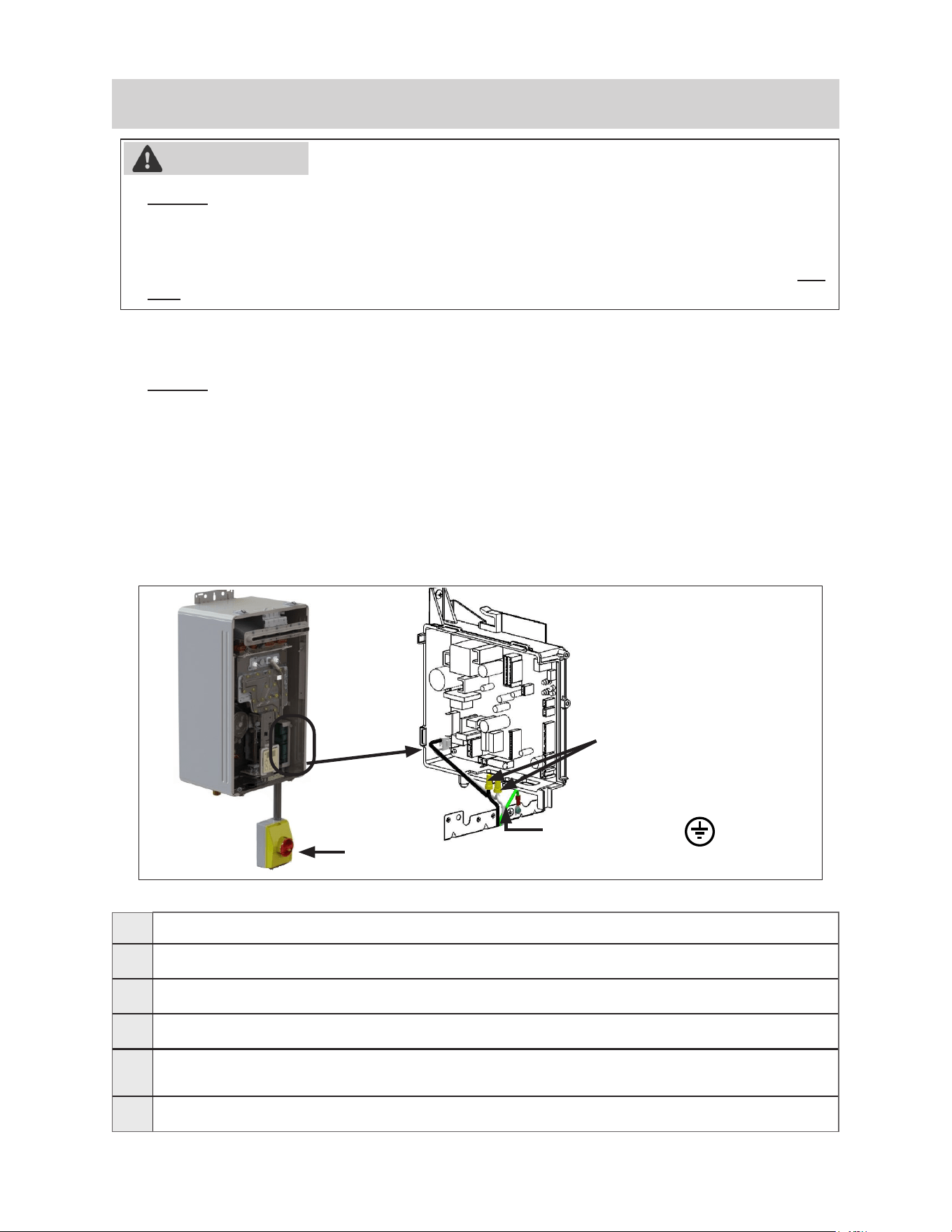
Rinnai Tankless Water Heater Installation and Operation Manual 37
4.9 Connect the Power Supply
• DO NOT use an extension cord or adapter plug with this appliance.
• The water heater must be electrically grounded in accordance with local codes and ordinances or,
in the absence of local codes, in accordance with the National Electrical Code, ANSI/NFPA No.70.
• Indoor water heaters are equipped with a three-prong (grounding) plug for your protection against
shock hazard and should be plugged directly into a properly grounded three-prong receptacle. DO
NOT cut or remove the grounding terminal from this plug.
4.9.1 Guidelines
When connecting the power supply, follow these guidelines:
• DO NOT rely on the gas or water piping to ground the water heater. Ground locations are provid-
ed inside the water heater.
• The water heater requires 120 V AC, 60 Hz power from a properly grounded circuit.
• If using the 5 ft (1.5 m) power cord (supplied with internal/indoor water heaters), plug it into a
standard 3 prong 120 V AC, 60 Hz properly grounded wall outlet.
• On external (outdoor) models, a proper disconnect (i.e. on/o switch, power cord, etc.) must be
provided and installed for the incoming 120 V AC power. The switch should be a type that is suit-
able for outdoor use. Check the National Electrical Code, ANSI/NFPA 70 and your local codes for
a proper switch type to use in your area. Power connections must be protected from the weather
and exible cords must use an appropriate strain relief.
• The wiring diagram is located on the inside of the water heater front cover.
WARNING
120V Wiring
• White wire (Neutral)
• Black wire (Hot leg)
Ground connection
screw
Disconnect on/o switch, power cord, etc. (required on external
outdoor models)
Figure 30
Checklist for Gas and Power Supply
□
A manual gas shuto (control) valve is located in the gas line to the water heater.
□
Check the gas lines and connections for leaks.
□
Conrm that the gas inlet pressure is within limits.
□
Conrm that the water heater is rated for the gas type supplied.
□
Conrm that the electricity is supplied from 120 V AC, 60 Hz power source and is in a properly
grounded circuit.
□
Conrm an extension cord or an adapter plug has not been used with the water heater.
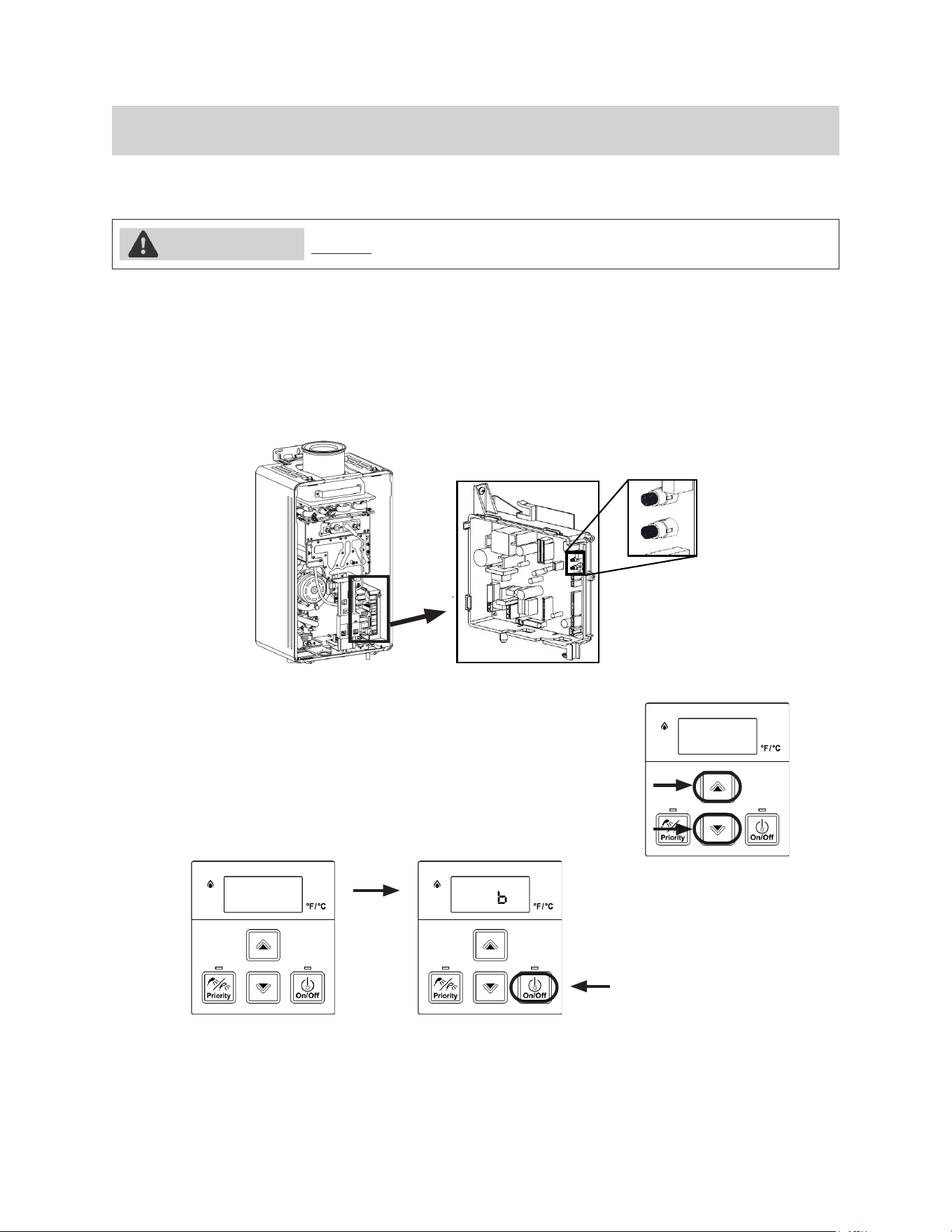
38 Rinnai Tankless Water Heater Installation and Operation Manual
4.10 Configure Parameter Settings
WARNING
A
B
Figure 31
Figure 32
Figure 33
DO NOT adjust parameter settings unless specically instructed to do so.
To adjust the parameters:
1. Locate the PC Board (lower right side of unit).
2. Locate the two push buttons (A and B) on the PC Board.
3. Press the "A" button for 1 second.
4. Use the ▲ (Up) and ▼ (Down) buttons on the controller to select a setting number (see Parameter
Settings Table below).
5. Once the desired setting number is selected, use the “On/O”
button on the controller to change the selection for the setting
number.
Example: Display will change from 01A to 01b for Maximum
Temperature setting (as shown below).
6. To exit the parameters, press the “A” button for 1 second.
4.10.1 Instructions
01a
01
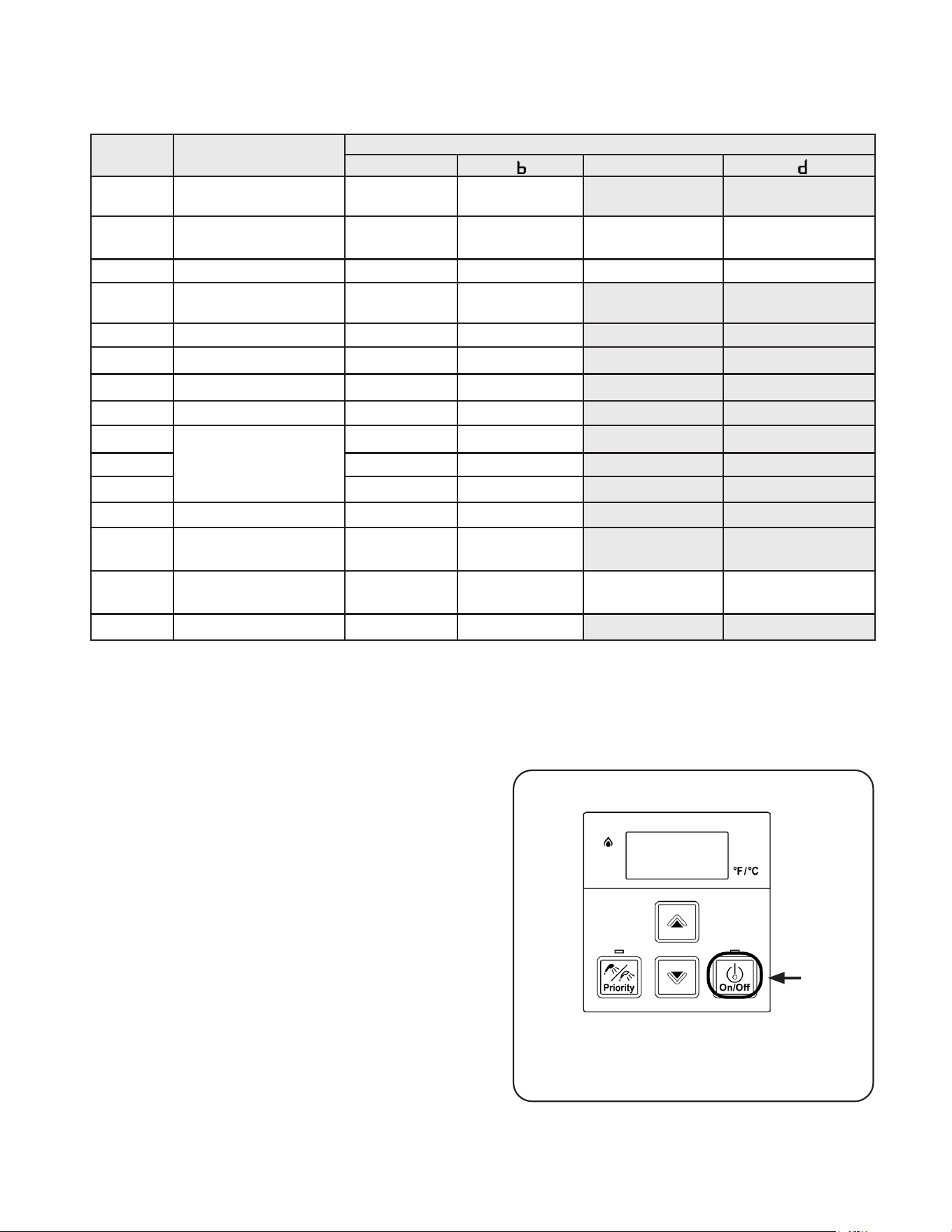
Rinnai Tankless Water Heater Installation and Operation Manual 39
SETTING
#
SETTING
DESCRIPTION
SELECTION
a c
01
Maximum Set
Temperature
120°F 140°F
02
High Altitude Installation 0 - 2,000 ft
(0 - 610 m)
2,001 - 5,400 ft
(610 - 1,646 m)
5,401 - 7,700 ft
(1,646 - 2,347 m)
7,701 - 10,200 ft
(2,347 - 3,109 m)
03
Service Soon Disabled 0.5 Year 1 Year 2 Years
04
Recirculation Settings
No
Recirculation
Recirculation
(Dedicated)
05
Recirculation Mode Economy Comfort
06
Control Switch BMS Air Handler (AH)
07
Units in Standby
2 1
10
Gas Type
LPG NG
12
Water Heater Model
(Factory set values and
not adjustable)
Without Pump With Pump
13
199/160 180/140
14
Indoor Outdoor
15
Low Activation Mode
On O
18
Setting Temperature
Table
Default Alternate
19
Adjust DHW
Temperature Setting
0°F (0°C) 1.8°F (1°C) 3.6°F (2°C) 5.4°F (3°C)
99
Vent Length
Long Short
Table 18: Parameter Settings Table
RE140 does not have recirculation mode.
Parameter 6 not available for RE140 and RE160 models.
This water heater includes a service indicator (Service
Soon, SS). When selected in the parameter settings, an
SS code will display on the controller indicating that it is
time to ush and service the water heater.
• Selection is installers preference based on water
conditions or other factors that may inuence the
suggested interval of service.
• See the “Congure Parameter Settings” section
of this manual for selectable service intervals.
• If Service Soon (SS) appears on the controller dis-
play, contact your local service provider to ush
and service the water heater (see 6.3 Flushing
the Heat Exchanger)
• Service Soon will appear again based on the
selected service interval.
To reset Service Soon (55)
Press the ON/OFF button 5 times
NOTE: Service Soon (55) will display on the
controller again when the water heater reaches
the interval selected in the parameter settings.
Figure 34
4.10.2 Service Indicator (Service Soon, SS)
5 times
SS
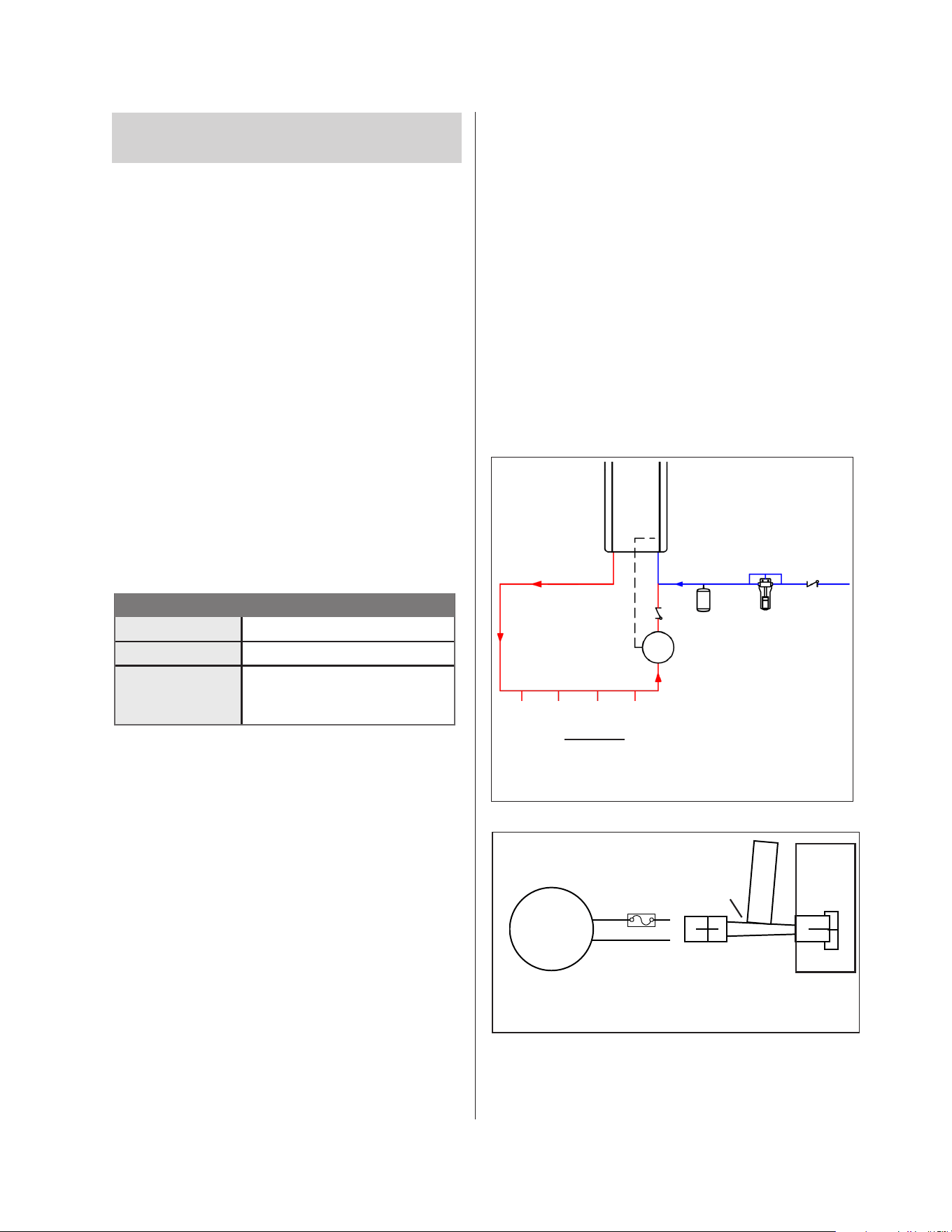
40 Rinnai Tankless Water Heater Installation and Operation Manual
Figure 35
Figure 36
Table 19
4.11 Recirculation
Including recirculation can reduce the amount of
time it takes hot water to get to your xture. This
model water heater includes the ability to control
a recirculation pump. Two modes are available,
Economy and Comfort.
• Economy Mode—Cycles the pump less
often, using less energy to maintain the
circulation loop temperature.
• Comfort Mode—Cycles the pump more
frequently, ensuring the loop
temperature remains higher (but also uses
more energy).
Recirculation mode is for residential installations
only. Recirculation mode cannot be used with an
air handler or with multiple Rinnai water heaters.
The maximum Rinnai temperature setting while in
recirculation mode is 140°F (60°C).
Pump Requirements
Voltage 120V, 60 Hz
Max Current Less than 2 Amps
Check valve An integral ow check
(IFC) valve is required. See
plumbing diagram.
Pump Size
The pump should be sized for 2 - 4 GPM (7.6
- 15.1 LPM) at the pressure loss through the
tankless water heater and the supply and return
plumbing in the recirculation loop. (Refer to the
pressure drop curve in Section 7.4 for more
information.)
Installation
1. Turn o the electrical power supply by
unplugging the power cord or by turning o the
electricity at the circuit breaker.
2. Install the recirculation pump on the return
line according to the pump manufacturer
installation instructions. Install a check valve
in the return line as shown in the Plumbing
Diagram if one is not integrated into the pump.
3. The wire harness for the recirculation pump
is bundled with the wire harness from the
PC board. The connector has a black and
white wire with the label “Cut wire to connect
to pump”. To connect to the pump, cut the
connector, splice the wires, and add 4 Amp
fuse to the hot wire (black) of the pump.
Connect the ground wire from the pump to
a screw at the base of the water cabinet.
Refer to the Pump Electrical Connection
Diagram. Follow Electrical Code and pump
manufacturers recommendations.
4. Connect power to the water heater. Press
the Power button on the controller. The pump
and water heater will turn on to raise the
recirculation loop temperature.
NOTE: DO NOT install the Rinnai Scale Control
system within the recirculation loop.
Plumbing Diagram
PUMP
Cut wire to
connect to pump
PC
Board
4 Amp
Fuse
Cut connector and
splice
BL
W
Pump Electrical Connection
Hot Water
Supply Line
(minimum 3/4 in.)
Electrical
Connection
(Power)
Recirculation Loop
Pump
Hot Water Outlets
Return Line
(minimum 3/4 in.)
Check Valve
(required)
Thermal
Expansion Tank
Rinnai
Scale
Control
(recommended)
Cold Water Supply Line
Check Valve
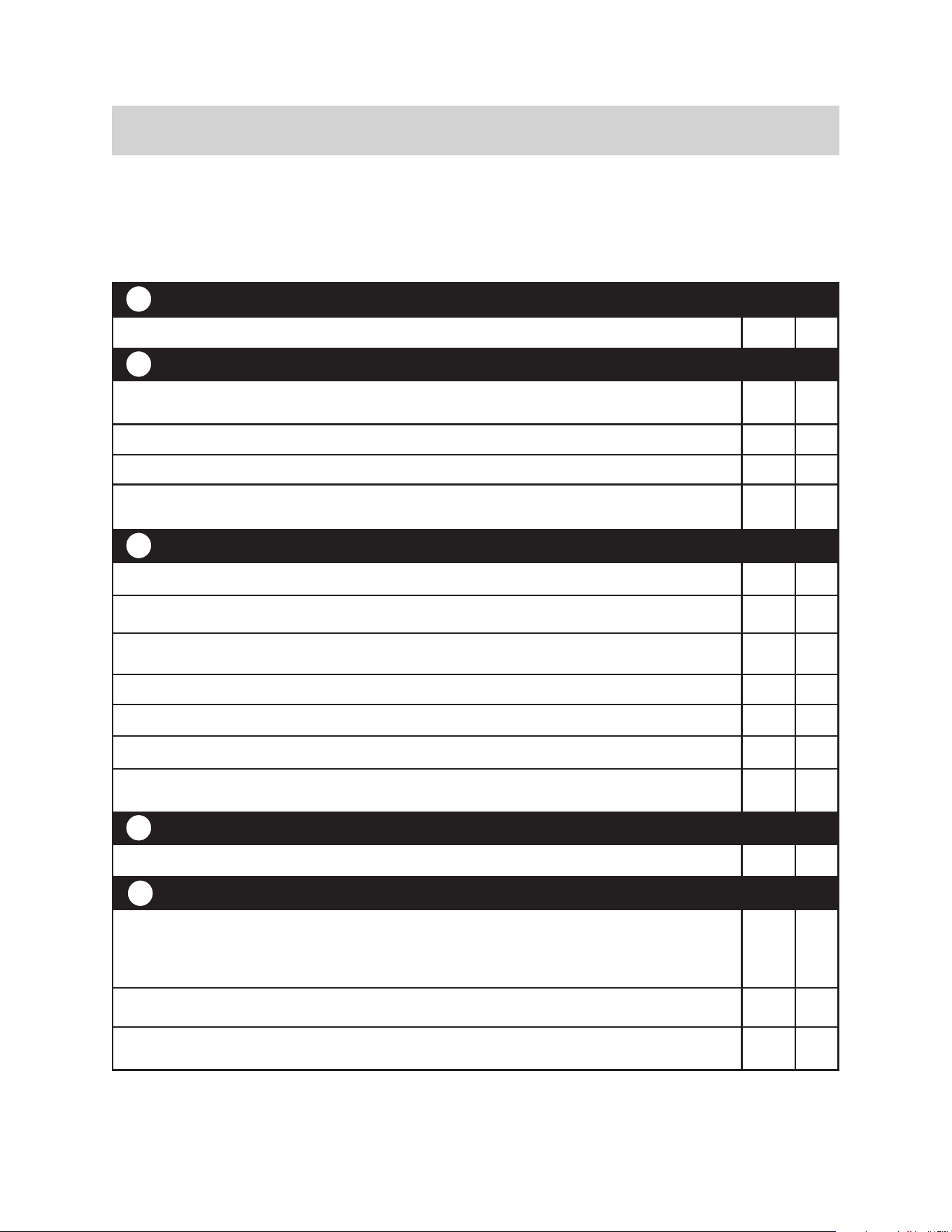
Rinnai Tankless Water Heater Installation and Operation Manual 41
4.12 Post-Water Heater Installation Checklist
Complete the following checklist when water heater installation is complete. You should be able to
answer YES to each question. If you answer NO to any question, installation is not complete. Refer to the
applicable section in the Rinnai Tankless Water Heater Installation and Operation Manual for additional
information.
For assistance, contact your local dealer or distributor, or call Rinnai Customer Care at 1-800-621-9419.
INSTALLATION LOCATION YES NO
Have you veried the unit and vent termination meet the clearance requirements?
□ □
COMBUSTION AIR & VENTING YES NO
Have all corrosive compounds been removed from around the combustion air inlet of the
tankless water heater?
□ □
Are the correct venting products for the installed model being utilized?
□ □
Have you veried the vent system does not exceed maximum length?
□ □
If reusing existing venting, have you inspected the vent components or damages to
ensure it is safe for installation?
□ □
PLUMBING YES NO
Have the water lines been purged of all debris and the lter cleaned?
□ □
Have you veried the hot and cold water lines to the tankless water heater are not
interchanged?
□ □
Does the water supply to the heater have adequate pressure? Is it free of chemicals? Did
you verify it does not exceed total hardness that will damage the heat exchanger?
□ □
Have you veried that no toxic chemicals were introduced to the potable water?
□ □
Have water quality issues (if any) been addressed?
□ □
Did you drain the tankless water heater if not intended to be used immediately?
□ □
Have you performed the leak and pressure test for the tankless water heater and
plumbing system?
□ □
ISOLATION VALVES YES NO
Are isolation valves (accessories) installed?
□ □
PRESSURE RELIEF VALVE (PRV) YES NO
Does the PRV comply with the standard for Relief Valves and Automatic Gas Shuto
Devices for Hot Water Supply Systems ANSI Z21.22, and/or the standard Temperature,
Pressure, Temperature and Pressure Relief Valves and Vacuum Relief Valves, CAN1-
4.4?
□ □
Did you verify the PRV is rated for no more than 150 psi and (at least) the maximum Btu/
hr of the tankless water heater?
□ □
Is the discharge from the PRV piped to the ground or into a drain system as per local
codes?
□ □
4
3
2
1
5
42 Rinnai Tankless Water Heater Installation and Operation Manual
Is the discharge line from the PRV pitched downward and does it terminate 6 in. (152
mm) above the drain?
□ □
Is the discharge end of the line plain (unthreaded) and a minimum of 3/4 in. diameter?
□ □
Is the discharge line material suitable for at least 180°F (82°C) water?
□ □
Did you take measures to protect the PRV and PRV discharge line from freezing?
□ □
Have you veried the PRV is not plugged and that reducing ttings, valves, or other
restrictions are not installed in the relief line?
□ □
GAS SUPPLY YES NO
Did you verify the gas system is appropriately sized?
□ □
Did you verify the water heater is rated for the gas type supplied?
□ □
Have you performed a gas line and connection leak test?
□ □
Did you install a manual gas control valve in the gas line to the water heater?
□ □
Is the inlet gas pressure within limits?
□ □
Did you purge the gas line of air or any debris before connecting the water heater?
□ □
6
WARNING
Rinnai Tankless Water Heater Installation and Operation Manual 43
5. 5. OperationOperation
Topics in this section
• Safety Precautions
• Operating Instructions
• Control Panel
• Setting the Temperature
• Performance Data
• Diagnostic Codes
5.1 Safety
Precautions
If the information in these instructions is
not followed exactly, a re or explosion may
result causing property damage, personal
injury, or death.
• DO NOT store or use gasoline or other
ammable vapors and liquids in the vicinity
of this or any other appliance.
• Before operating, smell all around the ap-
pliance area for gas. Be sure to smell next
to the oor because some gas is heavier
than air and will settle on the oor.
• WHAT TO DO IF YOU SMELL GAS
– DO NOT try to light any appliance.
– DO NOT touch any electrical switch;
DO NOT use any phone in your
building.
– Immediately call your gas supplier from
a neighbor’s phone. Follow the gas
supplier’s instructions.
– If you cannot reach your gas supplier,
call the re department.
• Installation and service must be performed
by a trained and qualied professional,
service agency or the gas supplier.
• Keep the area around the appliance clear
and free from combustible materials,
gasoline, and other ammable vapors and
liquids.
• DO NOT use this appliance if any part
has been under water. Immediately call a
trained and qualied professional to inspect
the appliance and to replace any part of the
control system and any gas control which
has been under water.
• Should overheating occur or the gas supply
fail to shut o, turn o the manual gas shut-
o (control) valve to the appliance.
• Use only your hand to push in or turn the
gas control knob. Never use tools. If the
knob will not push in or turn by hand, DO
NOT try to repair it, call a trained and quali-
ed professional. Force or attempted repair
may result in a re or explosion.
• This appliance does not have a pilot. It
is equipped with an ignition device which
automatically lights the burner. DO NOT try
to light the burner by hand.
• DO NOT use an extension cord or an
adapter plug with this appliance.
• Any alteration to the appliance or its con-
trols can be dangerous and will void the
warranty.
• If you install this water heater in an area
that is known to have hard water or that
causes scale build-up the water must be
treated and/or the heat exchanger ushed
regularly. Rinnai provides a “Scale Control
System” that oers superior lime scale pre-
vention and corrosion control by feeding a
blend of control compounds into the water
supply. Damage and repair due to corrosive
compounds in the air is not covered by
warranty.
• Keep the combustion air vent pipe loca-
tion free of chemicals, such as chlorine or
bleach, that produce fumes. These fumes
can damage components and reduce the
life of your appliance. Damage and repair
due to scale in the heat exchanger is not
covered by warranty.
• Always check the water temperature before
entering a shower or bath.
• DO NOT adjust the parameters unless
specically instructed to do so.
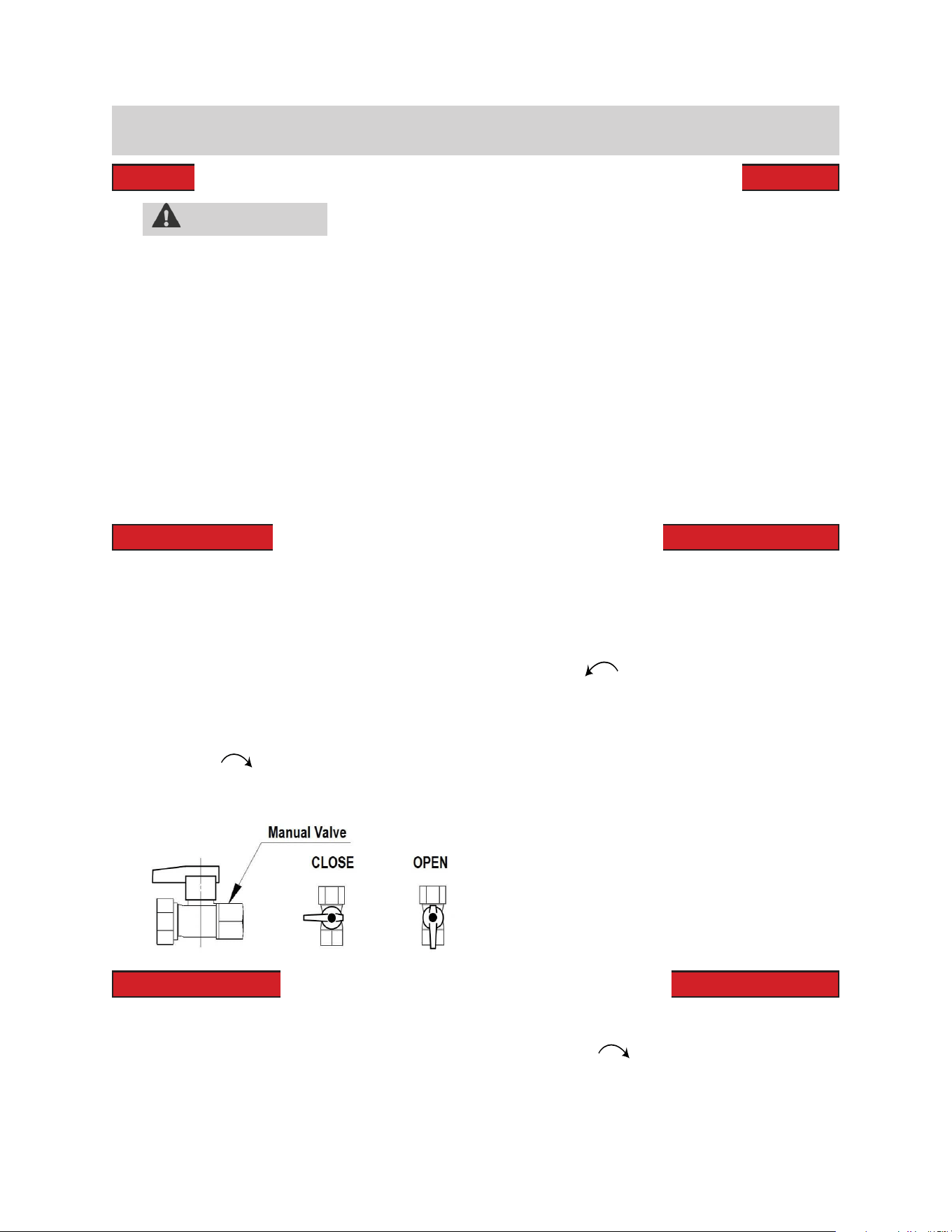
44 Rinnai Tankless Water Heater Installation and Operation Manual
5.2 Operating Instructions
FOR YOUR SAFETY READ BEFORE OPERATING
If you do not follow these instructions exactly, a re or explosion may
result causing property damage, personal injury or loss of life.
OPERATING INSTRUCTIONS
1. STOP! Read the safety information above.
2. Set the temperature controller to lowest setting.
3. Turn o all electric power to the appliance.
4. This appliance does not have a pilot. It
is equipped with an ignition device which
automatically lights the burner. Do not try to
light the burner by hand.
5. Turn the manual gas control valve located at
gas inlet of appliance clockwise to the OFF
position.
6. Wait ve (5) minutes to clear out any gas.
Then smell for gas, including near the oor. If
you smell gas, STOP! Follow “B” in the safety
information above. If you don’t smell gas, go to
the next step.
7. Turn the manual gas valve located at gas inlet
of appliance counterclockwise to the full ON
position.
8. Turn on all electric power to the appliance.
9. Set the temperature controller to desired
setting.
10. If the appliance will not operate, follow the
instructions “To Turn O Gas To Appliance” and
call your service technician or gas supplier.
TURN OFF GAS TO APPLIANCE
1. Set the temperature controller to lowest setting.
2. Turn o all electric power to the appliance if
service is to be performed.
3. Turn the manual gas control valve located at
gas inlet of appliance clockwise to the OFF
position.
WARNING
A. This appliance does not have a pilot. It is
equipped with an ignition device which
automatically lights the burner. Do not try to light
the burner by hand.
B. BEFORE OPERATING, smell all around the
appliance area for gas. Be sure to smell next to
the oor because some gas is heavier than air
and will settle on the oor.
WHAT TO DO IF YOU SMELL GAS
• Do not try to light any appliance.
• Do not touch any electric switch; do not use
any phone in your building.
• Immediately call your gas supplier from a
neighbor’s phone. Follow the gas
supplier’s instructions.
• If you cannot reach your gas supplier, call
the re department.
C. Use only your hand to push in or turn the gas
control valve. Never use tools. If the gas control
valve will not turn by hand, do not try to repair it,
call a qualied service technician. Force or at-
tempted repair may result in a re or explosion.
D. Do not use this appliance if any part has been
under water. Immediately call a qualied
service technician to inspect the appliance and
to replace any part of the control system and
any gas control which has been under water.
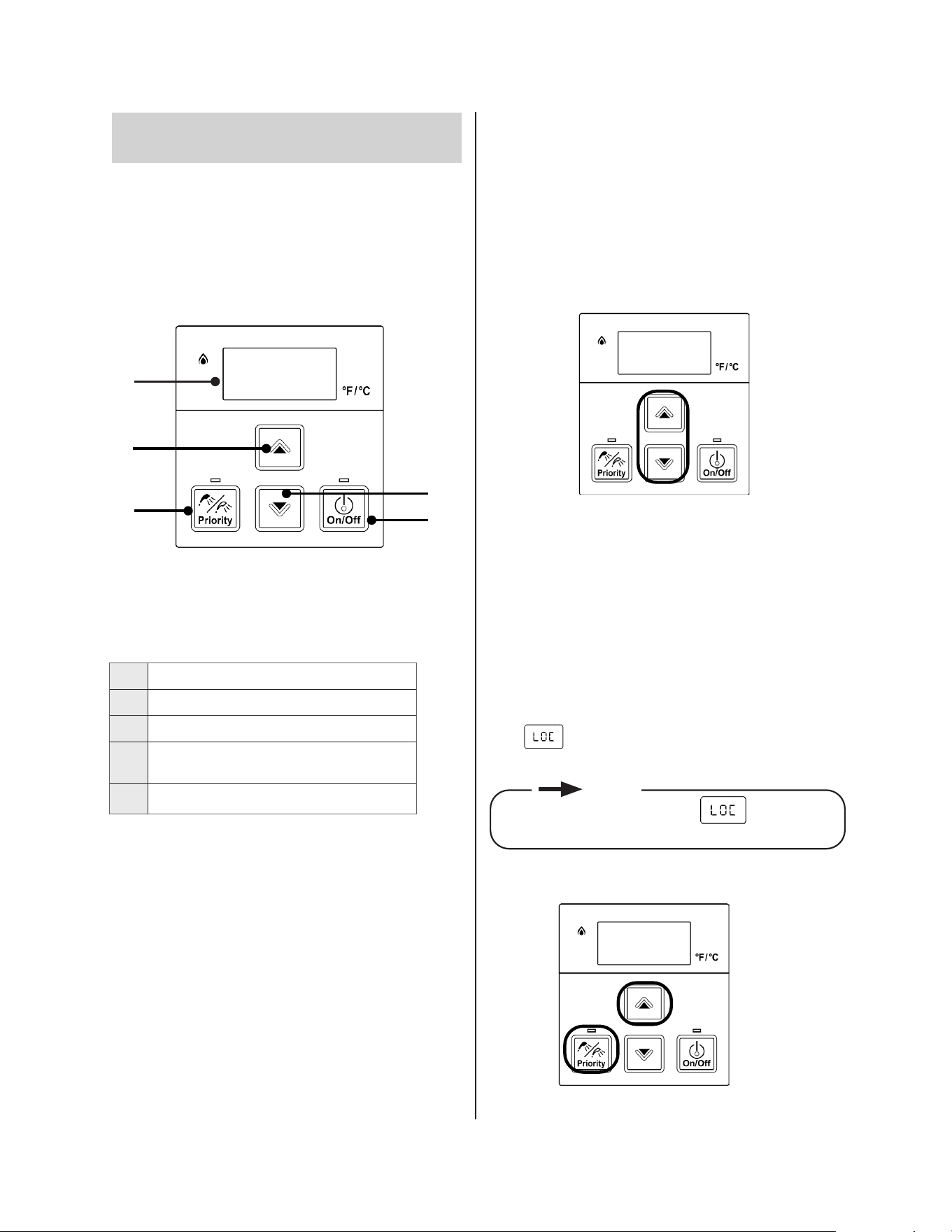
Figure 38
Figure 39
Rinnai Tankless Water Heater Installation and Operation Manual 45
Display
Increases hot water temperature
Decreases hot water temperature
Enables controller when multiple
controllers are used
Turns the water heater on or o
5.3 Control Panel
The water heater includes a controller. For indoor
models the controller is integrated into the front
cover. For outdoor models, the controller is located
inside the front cover.
5.3.1 Setting the Controller to
Mute
To eliminate the beeps when keys are pressed,
press and hold both the (Up) and (Down)
buttons at the same time until a beep is heard
(approximately 5 seconds). Then, release both
buttons.
To turn on the beeps, repeat the above steps.
5.3.2 Locking the Controller
1. To lock the internal controller, press and hold
down the “Priority” button.
2. While holding down the “Priority” button,
press the (Up) button until a beep is heard
(approximately 5 seconds). Then, release both
buttons at the same time.
3.
appears in the display indicating the
controller is locked.
To unlock the controller, follow the above steps.
The display ashes between and the set
temperature to indicate the controller is locked.
NOTE
Figure 37
Table 20
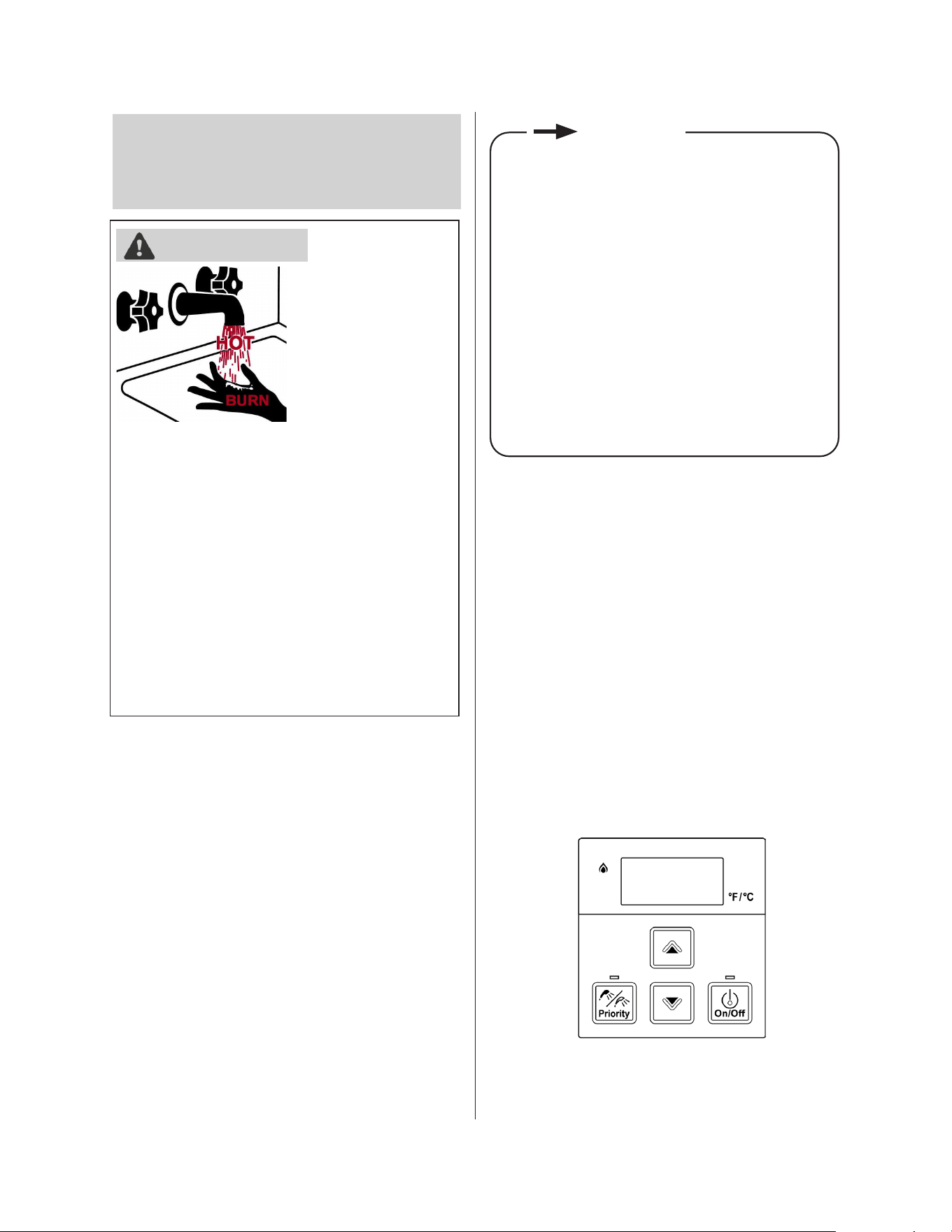
Figure 40
46 Rinnai Tankless Water Heater Installation and Operation Manual
5.4 Setting the
Temperature
Water temperatures over 125°F (52°C) can cause
severe burns or scalding resulting in death.
Hot water can cause rst degree burns with
exposure for as little as:
• 3 seconds at 140°F (60°C)
• 20 seconds at 130°F (54°C)
• 8 minutes at 120°F (49°C)
Children, disabled, or elderly are at highest risk of
being scalded.
Feel water before bathing or showering.
The controller buttons shown below are located on
the outside front panel for internal (indoor) water
heaters.
For external (outdoor) water heaters, open the
front panel to access the controller buttons.
1. If the water heater is o, press the “On/O”
button to turn on.
2. If multiple controllers are installed the "Priority"
button, when selected, will enable that
controller to function. Note: Priority can only
be changed when hot water is not in use.
3. Press the (Up) or (Down) buttons to
obtain the desired temperature setting.
DANGER
• Check local codes for the maximum water
temperature setting allowed when used in
nursing homes, schools, day care cen-
ters, and all other public
applications.
• If a newly installed water heater with a
controller has not been powered for at
least 6 hours then the temperature will
return to the default setting of if power is
interrupted.
• There may be a variation between the
temperature displayed on the
temperature controller and the
temperature at the tap due to weather
conditions or the length of pipe to the
water heater.
IMPORTANT
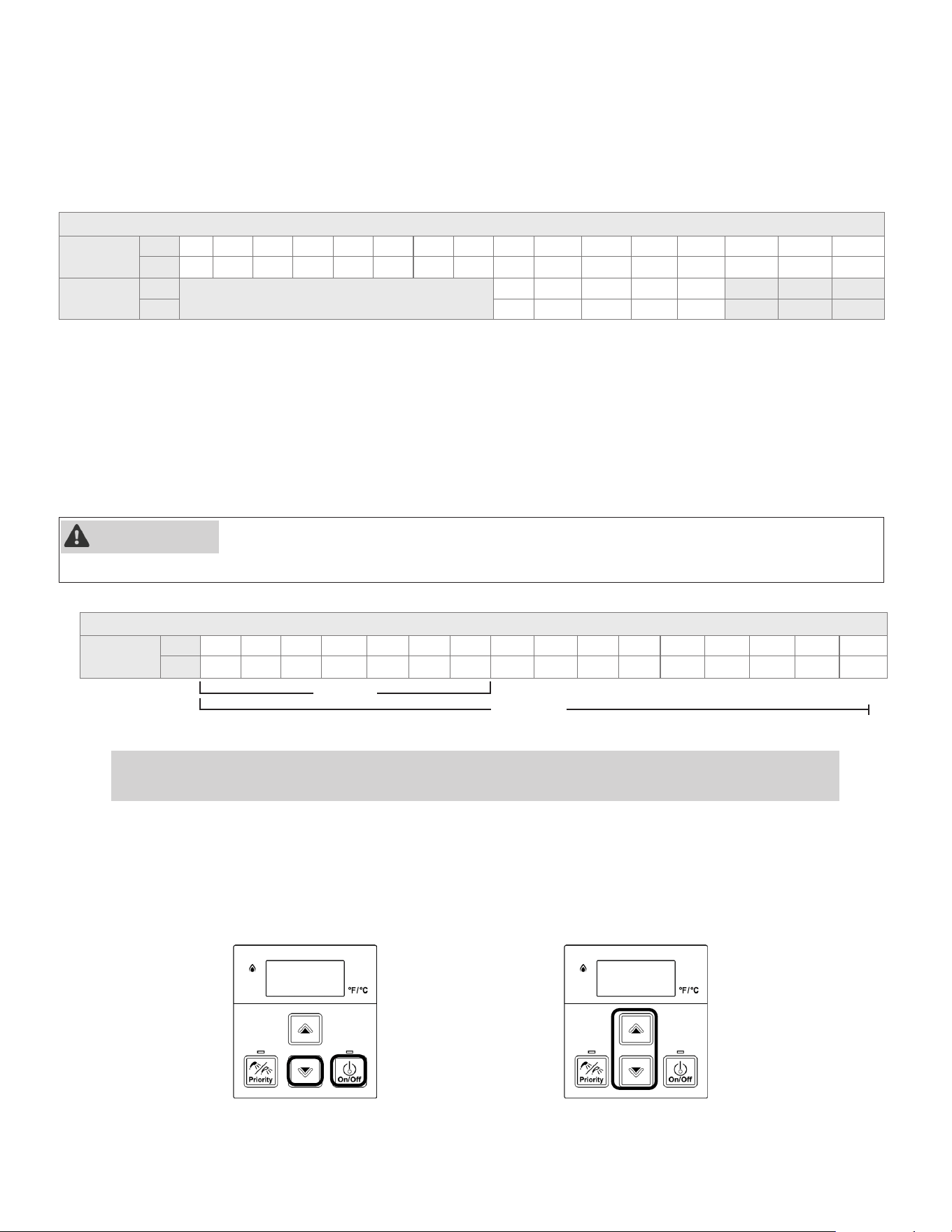
Figure 41 Figure 42
Rinnai Tankless Water Heater Installation and Operation Manual 47
5.4.1 Available Temperatures with an Internal Controller
The water heater can deliver water at only one temperature setting at a time. The available temperatures
are provided below. A temperature lower than 98°F (37°C) can be obtained at the tap by mixing with cold
water. To change the temperature scale from Celsius to Fahrenheit or vice versa, press and hold the “On/
O” button on the controller for 5 seconds while the water heater is OFF.
Temperature range depends on model type. Refer to section "3.3 Specications" for more information.
* These models have a default maximum temperature of 120°F (49°C) and an option to increase the maximum temperature to 140°F
(60°C). Refer to section “4.10.1 Parameter settings” for further details.
** These settings require the installation of the MCC-601 controller. When the MCC-601 controller is connected, these higher
temperatures are available on all controller models in the system. Application and temperature settings can impact warranty, refer
to the warranty document in this manual for complete details.
If setting temperature is 185°F, water pressure should be between 45 and 150 PSI.
5.5 Performance Data
To obtain performance data:
1. Press and hold the (Down) button.
2. While holding the (Down) button for 2 seconds, press and hold the “On/O” button (hold both
buttons simultaneously). (Figure 41)
3. Use the (Up) and (Down) buttons to scroll to the desired information described in Table 23:
Performance Data Table. (Figure 42)
Temperature Settings
RE199i/e
RE180i/e
°F
98 100 102 104 106 108 110 115 120 125* 130* 135* 140* 150** 160** 185**
°C
37 38 39 40 41 42 43 46 49 52 54 57 60 66 71 85
RE160i/e
RE140i/e
°F
120 125* 130* 135* 140*
°C
49 52 54 57 60
Temperature Settings
RE199i/e
RE180i/e
°F
110 115 120 125 130 135 140 145 150 155 160 165* 170* 175* 180* 185*
°C
43 46 49 52 54 57 60 63 66 68 71 74 77 79 82 85
WARNING
* If setting temperature is greater than 165, water pressure should be between 45 and 150 PSI.
Table 21
Table 22
Alternate Temperatures Settings
A dierent range of temperature settings is available by setting parameter settings. The table below shows the settings
available with the MC-601 and MCC-601 controller.
MC-91-1, MCC-91-1, MC-100V-1, and BC-100V-1 controllers are not compatible with Alternate
Temperature Settings. Alternate Temperature Settings are for commercial applications. DO NOT
use the MC-91-1, MCC-91-1, MC-100V-1, BC-100V-1 controllers when parameter settings are set.
MC-601
MCC-601
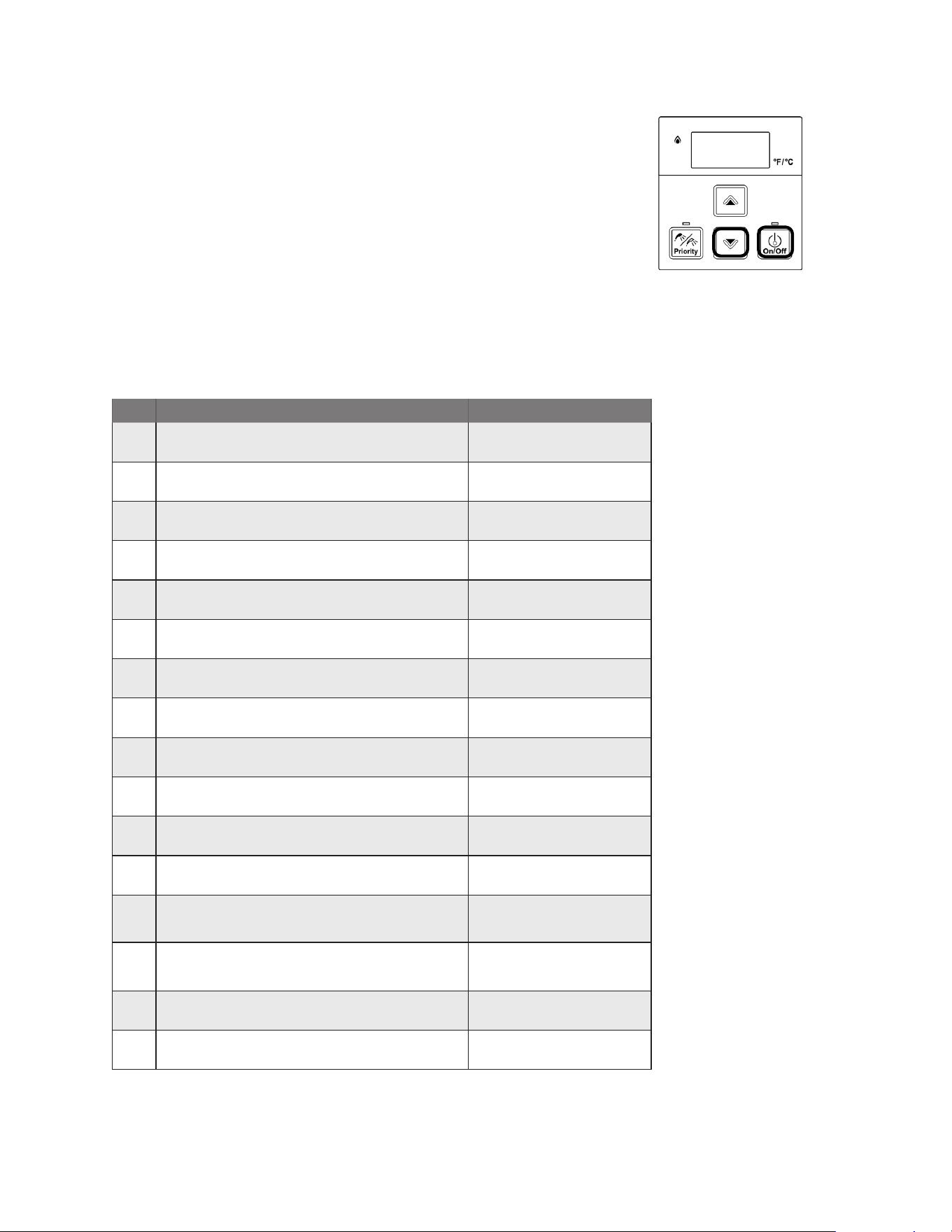
Figure 43
48 Rinnai Tankless Water Heater Installation and Operation Manual
# Data Unit
01
Water Flow Rate x0.1 gal/min
02
Outgoing Temperature °F
03
Combustion Hours x100 Hours
04
Combustion Cycles *
05
Fan Frequency Hz
06
Additional Controllers Connected *
07
Water Flow Control Position
0=Mid 1=Open
2=Closed
08
Inlet Temperature °F
09
Fan Current x10 mA
10
Total Bath Fill Amount Gallons
1 1
HEX Outlet Temp. °F
12
By-Pass Flow Control Position Degrees of opening
14
Intake Thermistor Temperature
(Indoor Units Only)
°F
17
Freeze Protection Temperature
(Outdoor Units Only)
°F
19
Pump Hours x100 Hours
20
Pump Cycles *
* Refer to the Technical Data Sheet located on the inside front cover of the
water heater for additional information.
4. To exit performance data, repeat step 2 above. (Figure 43)
5. When complete, the set temperature appears in the display.
Table 23: Performance Data Table
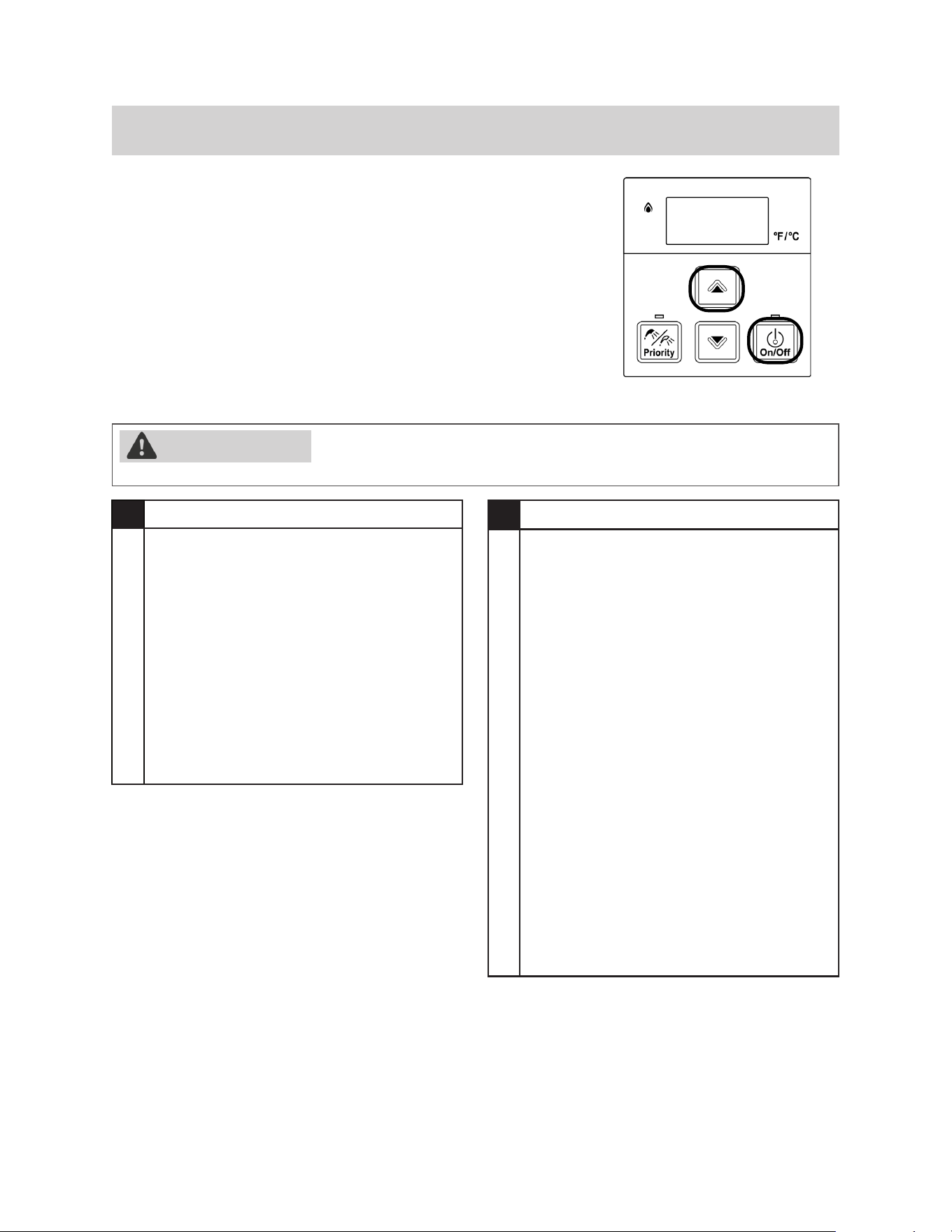
WARNING
Figure 44
Rinnai Tankless Water Heater Installation and Operation Manual 49
5.6 Diagnostic Codes
To display diagnostic codes:
Turn o the water heater by pressing the “On/O” button.
Press and hold the “On/O” for 2 seconds and then the (Up)
button simultaneously.
The last nine maintenance codes display and ash one after the
other.
To exit diagnostic codes and return the water heater to normal
operation, press and hold the “On/O” button for 2 seconds and then
the (Up) button simultaneously.
Turn on the water heater by pressing the “On/O” button.
Some of the checks below should be performed by a trained and qualied
professional. Consumers should never attempt any action that they are
not qualied to perform.
10
Air Supply or Exhaust Blockage
• Ensure approved venting materials are
being used.
• Check that nothing is blocking the ue
inlet or exhaust.
• Check all vent components for proper
connections.
• Ensure vent length matches with the
vent lengths set in the parameter
settings.
• Verify High Altitude setting are set
properly.(See Parameter Setting)
• Check fan for blockage.
1 1
No Ignition (Heater Not Turning On)
• Check that the gas is turned on at the
water heater, meter, or propane cylinder.
• If the system is propane, make sure that
gas is in the tank.
• Bleed all air from the gas line
• Ensure appliance is properly grounded.
• Ensure gas type and pressure is
correct.
• Ensure gas line, meter, and/or regulator
is sized properly.
• Verify parameter setting are set
properly.
• Ensure igniter is operational.
• Check igniter wiring harness for
damage.
• Check gas solenoid valves for open
circuits.
• Ensure ame rod wire is connected.
• Check ame rod for carbon build-up.
• Remove burner cover and ensure
burners are properly seated.
• Remove burner plate; inspect burner
surface for condensation/debris.
• Check the ground wire for the PC board.
* See “Electrical Diagnostics” on Technical Data
Sheet located on inside front cover of water heater.
50 Rinnai Tankless Water Heater Installation and Operation Manual
* See “Electrical Diagnostics” on Technical Data
Sheet located on inside front cover of water heater.
12
No Flame
• Check that the gas is turned on at the
water heater, meter, or cylinder.
• Check for obstructions in the ue outlet.
• If the system is propane, make sure
that gas is in the tank.
• Ensure gas line, meter, and/or regulator
is sized properly.
• Ensure gas type and pressure is
correct.
• Bleed all air from gas lines.
• Ensure proper venting material was
installed.
• Ensure condensation collar was
installed properly.
• Ensure vent length is within limits.
• Verify parameter setting are set
properly.
• Check power supply for loose
connections.
• Check power supply for proper voltage
and voltage drops.
• Ensure ame rod wire is connected.
• Check ame rod for carbon build-up.
• Disconnect and reconnect all wiring
harnesses on unit and PC board.
• Check gas solenoid valves for open
circuits.
• Remove burner plate; inspect burner
surface for condensation/debris.
14
Thermal Fuse
• Check for restrictions in air ow around
unit and vent terminal.
• Check gas type of unit and ensure it
matches gas type being used.
• Check for low water ow in a circulating
system causing short-cycling.
• Check for foreign materials in
combustion chamber and exhaust
piping.
• Check heat exchanger for cracks or
separations.
• Check heat exchanger surface for hot
spots which may be caused by scale
build-up. Refer to instructions in manual
for ushing heat exchanger. Hard water
must be treated to prevent scale build
up or damage to the heat exchanger.
• Measure resistance of safety circuit.
• Ensure high re and low re manifold
pressure is correct.
• Check for improper gas conversion of
product.
16
High Outgoing Temperature
• Check for restrictions in air ow around
unit and vent terminal.
• Check for low water ow in a circulating
system causing short-cycling.
• Check for foreign materials in
combustion chamber and exhaust
piping.
• Check for blockage in the heat
exchanger.
• Check the thermistor sensor and clean
sensor of scale build-up.
19
Electrical Grounding
• Check all components for electrical
short.
32
Outgoing Water Temperature Thermistor
• Check sensor wiring for damage.
• Measure the resistance of the sensor.
(See Electrical Diagnostics)
• Clean sensor of scale build-up.
• Replace sensor if necessary.
33
Heat Exchanger Thermistor
• Check sensor wiring for damage.
• Measure resistance of sensor. (See
Electrical Diagnostics)
• Replace sensor if necessary.
Rinnai Tankless Water Heater Installation and Operation Manual 51
66
Bypass Flow Servo
• Measure the resistance values and
voltage of the bypass servo valve.*
• Ensure the harness and connector are
not wet.
• If the voltage from the PC Board is
abnormal, replace the PC Board;
otherwise, replace the bypass servo
valve.
70
PC Board
• Check the connection harness at the
connection on the PC board.
• Replace PC board.
71
Solenoid Valve Circuit
• Ensure dip switch on PC board is in the
OFF position.
• Check gas solenoid valves for short
circuits or grounding.
• Ensure heater circuit is not grounded.
• Replace PC Board.
72
Flame Sensing Device
• Verify ame rod is touching ame when
unit res.
• Check the ame rod and wire for
damage.
• Remove ame rod;check for carbon
build-up; clean with sand paper.
• Check inside burner chamber for any
foreign material blocking ame at ame
rod.
• Check the resistance to the cabinet.
• If there is no issue with the ame rod or
wiring, replace the PC Board
79
Water Leak Detected
• Turn o water supply and contact
licensed professional.
34
Combustion Air Temperature Thermistor
Fault
• Check for restrictions in air ow around
unit and vent terminal.
• Check sensor wiring for damage.
• Measure resistance of sensor.
• Ensure fan blade is tight on motor shaft
and is in good condition.
• Replace sensor if necessary.
41
Freeze Protection Thermistor
• Check sensor wiring for damage.
• Measure resistance of sensor. (See
Electrical Diagnostics)
• Replace sensor if necessary.
51
Inlet Water Temperature Thermistor
• Check sensor wiring for damage.
• Measure resistance of sensor. (See
Electrical Diagnostics)
• Replace sensor if necessary.
52
Modulating Solenoid Valve Signal
• Check modulating gas solenoid valve
wiring harness for loose or damaged
terminals.
• Measure resistance of valve coil.
61
Combustion Fan
• Ensure fan will turn freely.
• Check wiring harness to motor for
damaged and/or loose connections.
• Measure resistance of motor winding.
63
Recirculation Low Flow
• Ensure the inlet water lter is clean and
free of debris.
• Ensure parameter setting are correctly
set for recirculation mode.
• Ensure pump supply voltage.
• Check the wiring harness to the pump
and PCB for damaged and/or loose
connections.
• Ensure air is removed from the
recirculation line.
65
Water Flow Servo
• Measure the resistance values and
voltage of the water ow control.*
• Ensure the harness and connector are
not wet.
• If the voltage from the PC Board is
abnormal, replace the PC Board;
otherwise, replace the water ow servo
valve.
* See “Electrical Diagnostics” on Technical Data
Sheet located on inside front cover of water heater.
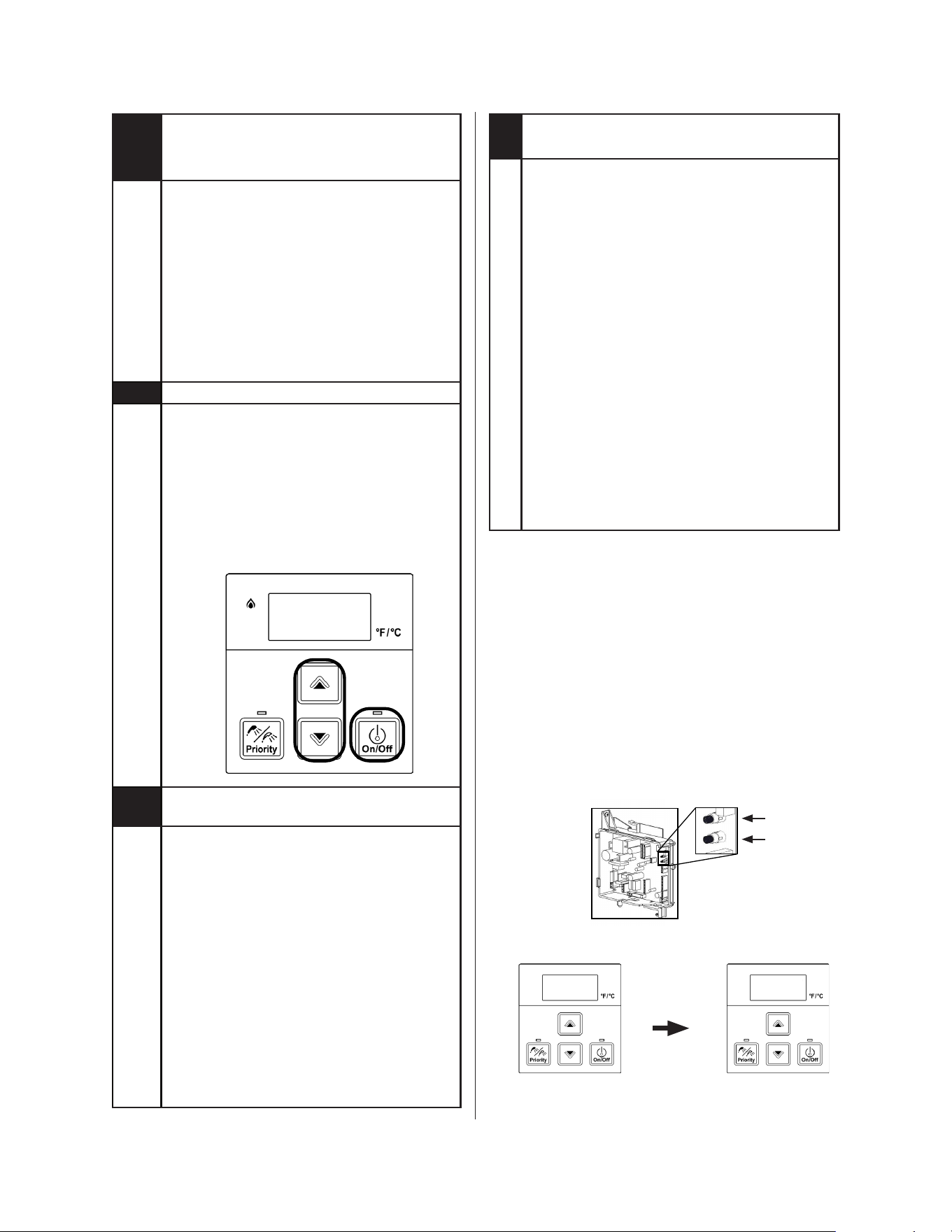
52 Rinnai Tankless Water Heater Installation and Operation Manual
lc
Scale Build-up in Heat Exchanger
(when checking maintenance code
history, "00" is substituted for "LC")
• LC indicates that there is scale build
up in the heat exchanger and that
the heat exchanger needs to be
ushed to prevent damage. Refer
to the ushing instructions in the
manual. Hard water must be treated
to prevent scale build up or damage
to the heat exchanger.
• After ushing, reset LC code as
instructed.
• Please call Rinnai technical
department.
FF
Maintenance Indicator
• Placeholder in Diagnostic code
history indicating that a service
provider performed maintenance or
service.
• Enter this code after performing
service by pressing (Up) ,
(Down) and On/O simultaneously.
• FF is visible on the monitor.
SS
(SS) Service Soon (Flush Heat
Exchanger)
• SS is a time-based service indicator
set during installation. See section
“4.10 Congure Parameter Settings”
for additional details on setting and
changing the SS indicator.
• SS indicates that it is time for service.
The heat exchanger should be
ushed to prevent damage (refer
to section “6.2 Flushing the Heat
Exchanger” for more information).
Hard water must be treated to
prevent scale build-up or damage
to the heat exchanger.
• To reset the SS code, push the On/O
button on the temperature controller
5 times in 5 seconds.
* See “Electrical Diagnostics” on Technical Data
Sheet located on inside front cover of water heater.
NO CODE - Nothing happens when water
ow is activated
• Clean inlet water supply lter.
• On new installations ensure hot and
cold water lines are not reversed.
• Verify you have at least the minimum
ow rate required to re unit.
• Check for cold to hot cross over. Isolate
circulating system if present. Turn o
cold water to the unit, open pressure
relief valve; if water continues to ow,
there is bleed over in your plumbing.
• Verify turbine spins freely.
• Measure the resistance of the water
ow control sensor.
• If the display is blank and clicking is
coming from the unit, disconnect the
water ow servo motor (GY, BR, O, W,
P, BL, R). If the display comes on then
replace the water ow servo motor.
A
B
Clearing "LC" Code
The following procedure should be performed by a
trained and qualied technician.
1. Push and hold SW (B) on the PCB for 1
second.
2. Push and hold SW (B) again on the PCB.
3. When 2L appears on the controller display,
push and hold SW(A) for 5 seconds or until
"LCL" appears on the display.
SW(A)
SW(B)
2L LCL
Tact SW(A)
5 seconds
"2L" Lime Reset
"LCL" Lime
Error Clear
FF
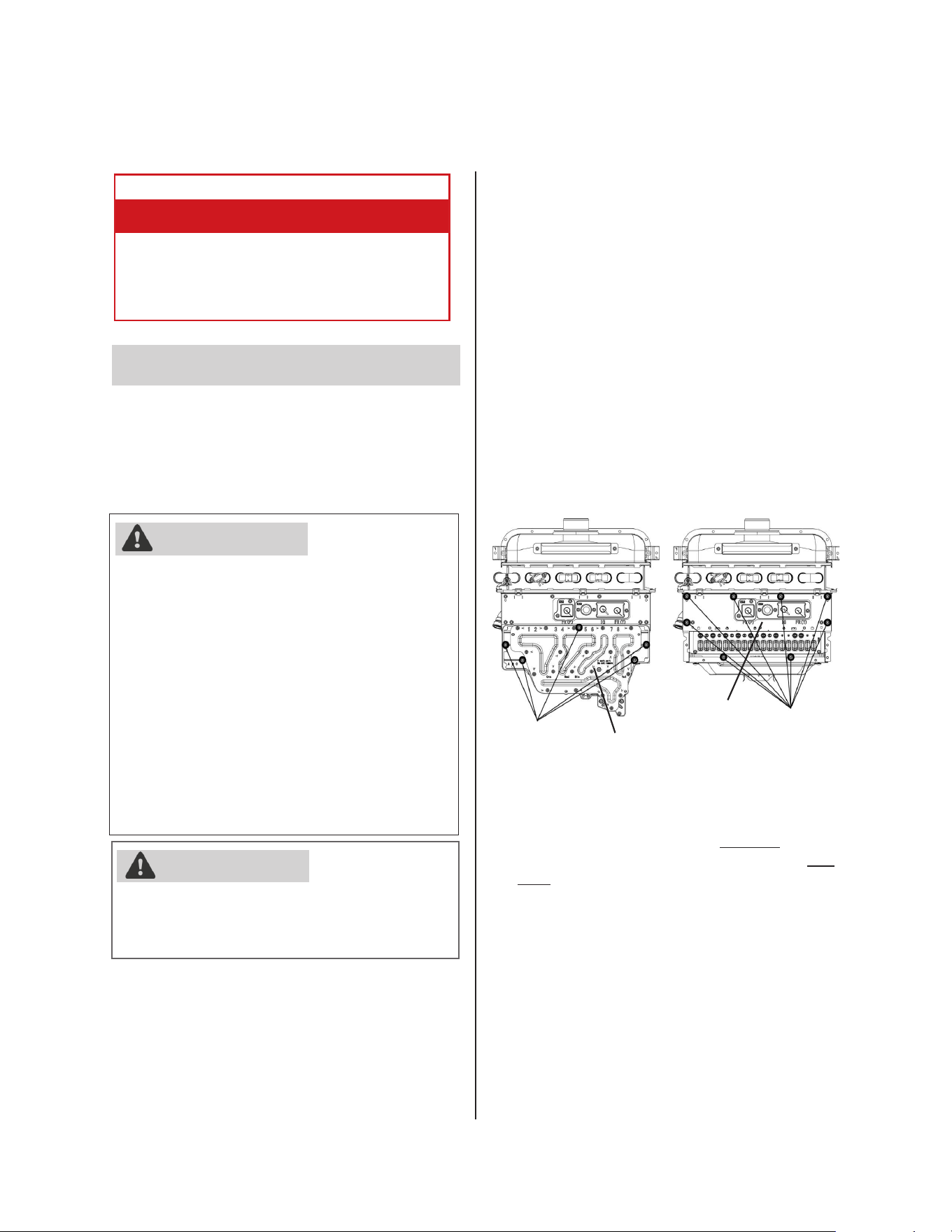
Rinnai Tankless Water Heater Installation and Operation Manual 53
6. 6. MaintenanceMaintenance
Topics in this section
• Maintenance
• Flushing the Heat Exchanger
• Draining the Water Heater
6.1 Maintenance
This water heater must be inspected annually by
a trained and qualied professional. Repairs and
maintenance shall be performed by a trained and
qualied professional. The trained and qualied
professional must verify proper operation after
servicing.
To protect yourself from harm, before performing
maintenance:
• Turn o the electrical power supply by un-
plugging the power cord or by turning o
the electricity at the circuit breaker. (The
temperature controller does not control
the electrical power.)
• Turn o the gas at the manual shuto
(control) valve, usually located
immediately below the water heater.
• Turn o the incoming water supply. This
can be done at the isolation valve immedi-
ately below the water heater or by turning
o the water supply to the building.
Keep the appliance area clear and free from
combustible materials, gasoline, and other
ammable vapors and liquids.
5. Use a vacuum to remove dust and debris from
the main burner and fan blades on the burner
or distribution plate (bottom). DO NOT use a
wet cloth or spray cleaners on the burner. DO
NOT use volatile substances such as benzene
and thinners; they may ignite or fade the paint.
6. Use soft dry cloth to wipe the cabinet.
VENT SYSTEM
Periodic cleaning and inspection of the vent
system is needed, and includes the screens in the
vent termination.
The vent system should be inspected for
blockages including snow or other debris or
damage. If the vent is blocked and cannot be
easily cleared, contact a trained and qualied
professional.
The following maintenance items are required for
the proper operation of your water heater.
CLEANING
It is imperative that control compartments
inside the cabinet, burners, and circulating air
passageways of the appliance be kept clean.
BURNER
Check burner ame for proper color. The ame
must burn with a clear, blue, stable ame.
Once ignited, the ame must cover the surface
of the burner. If the ame does not have this
appearance, complete the following steps:
1. Turn o and disconnect electrical power. Allow
to cool.
2. Remove the front panel by removing two latch
style clips at the top and two screws at the
bottom of the water heater.
3. Remove the 5 screws around the perimeter of
the manifold. Remove manifold.
4. Remove the 8 screws around the perimeter
of the burner assembly. Remove burner
assembly.
5
8
Manifold
Burner
Assembly
Figure 45
WARNING
WARNING
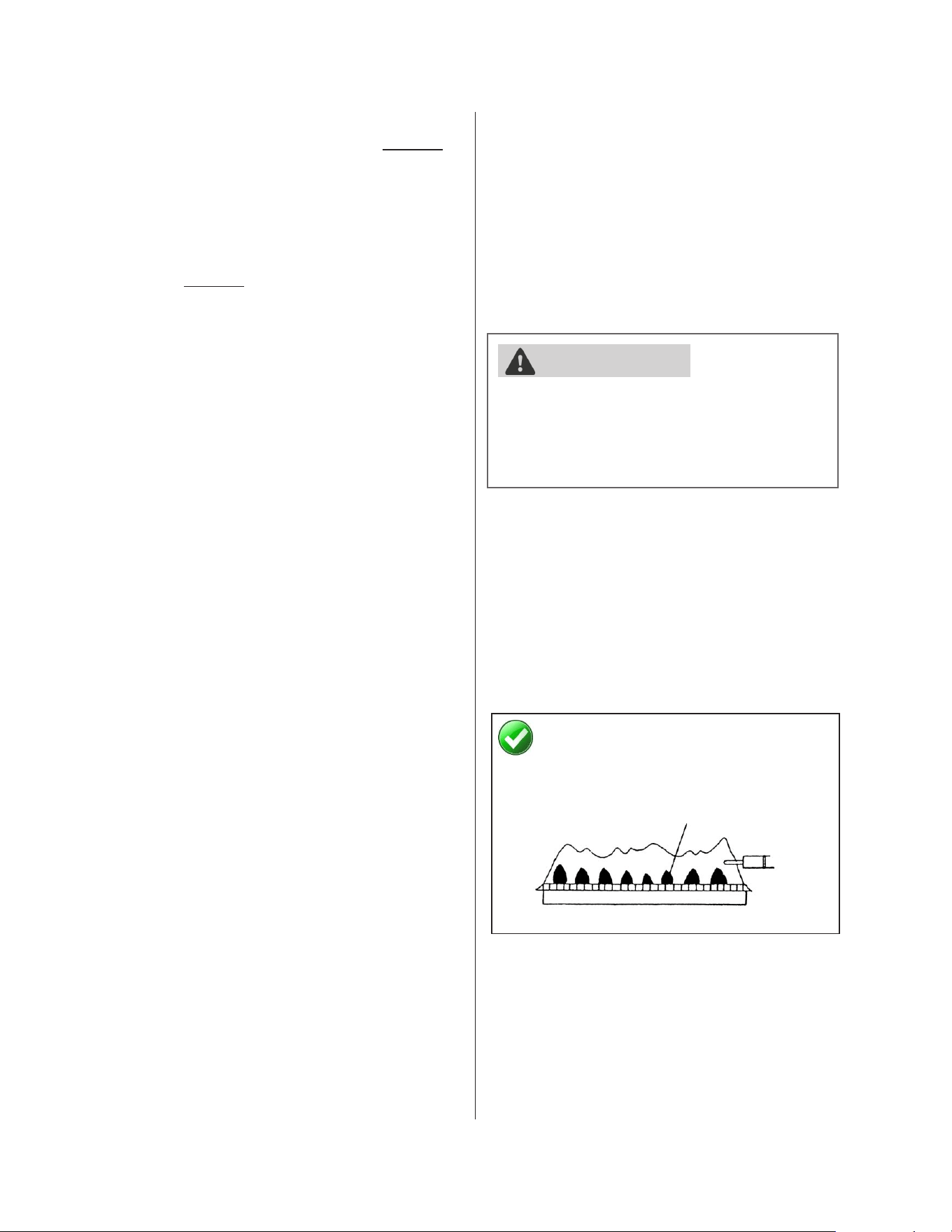
Testing the pressure relief valve should only
be performed by a trained and qualied
professional. Water discharged from the
pressure relief valve could cause severe burns
instantly or death from scalds.
WARNING
FRONT VIEW
Flame Rod
Blue Flame
SATISFACTORY
Figure 46
54 Rinnai Tankless Water Heater Installation and Operation Manual
MOTORS
Motors are permanently lubricated and DO NOT
need periodic lubrication. However you must keep
fan and motor free of dust and dirt by cleaning
annually.
TEMPERATURE CONTROLLER
Use a soft damp cloth to clean the temperature
controller. DO NOT use solvents.
LIME/SCALE BUILD-UP
Scale build-up is caused by hard water and can
be accelerated if the water heater is set at a high
temperature. Refer to section “6.2 Flushing the
Heat Exchanger” for more information. Refer to
section “Water Quality Guidelines” to determine
if your water needs to be treated or conditioned.
The water must be potable, free of corrosive
chemicals, sand, dirt, or other contaminates. It
is up to the installer to ensure the water does
not contain corrosive chemicals, or elements
that can aect or damage the heat exchanger.
Water that contains chemicals exceeding required
levels, aect and damage the heat exchanger.
Replacement of the heat exchanger due to water
quality damage is not covered by the warranty.
SNOW ACCUMULATION
Keep the area around ue terminal free of snow
and ice. The water heater will not function properly
if the combustion air or exhaust vent pipes are
blocked or partially blocked by obstructions.
Keep the condensate drain line free of snow and
ice. Ensure the line is not blocked or clogged and
that condensate is owing freely.
COASTAL INSTALLATIONS
Installations in or near coastal areas may require
additional maintenance due to corrosive airborne
ocean salt. If corrosion is observed on the body
of the water heater, the water heater shall be
inspected to ensure proper operation and if
necessary, repaired or replaced.
WATER FILTERS
Clean the inlet water lter by closing the cold and
hot water inlet isolation (shut-o) valves. Put a
bucket under the lter at the bottom of the water
heater to catch any water that is contained inside
the unit. Unscrew the water lter. Rinse the lter to
remove any debris. Install the lter and open the
isolation valves (Figure 3).
PRESSURE RELIEF VALVE
Operate the pressure relief valve manually once
a year. In doing so, it will be necessary to take
precautions with regard to the discharge of
potentially scalding hot water under pressure.
Ensure discharge has a safe place to ow. Contact
with your body or other property may cause
damage or harm.
VISUAL INSPECTION OF FLAME
Verify proper operation after servicing. The burner
must ame evenly over the entire surface when
operating correctly. The ame must burn with a
clear, blue, stable ame. See the parts breakdown
of the burner for the location of the view ports.
The ame pattern should be as shown in the
images below:
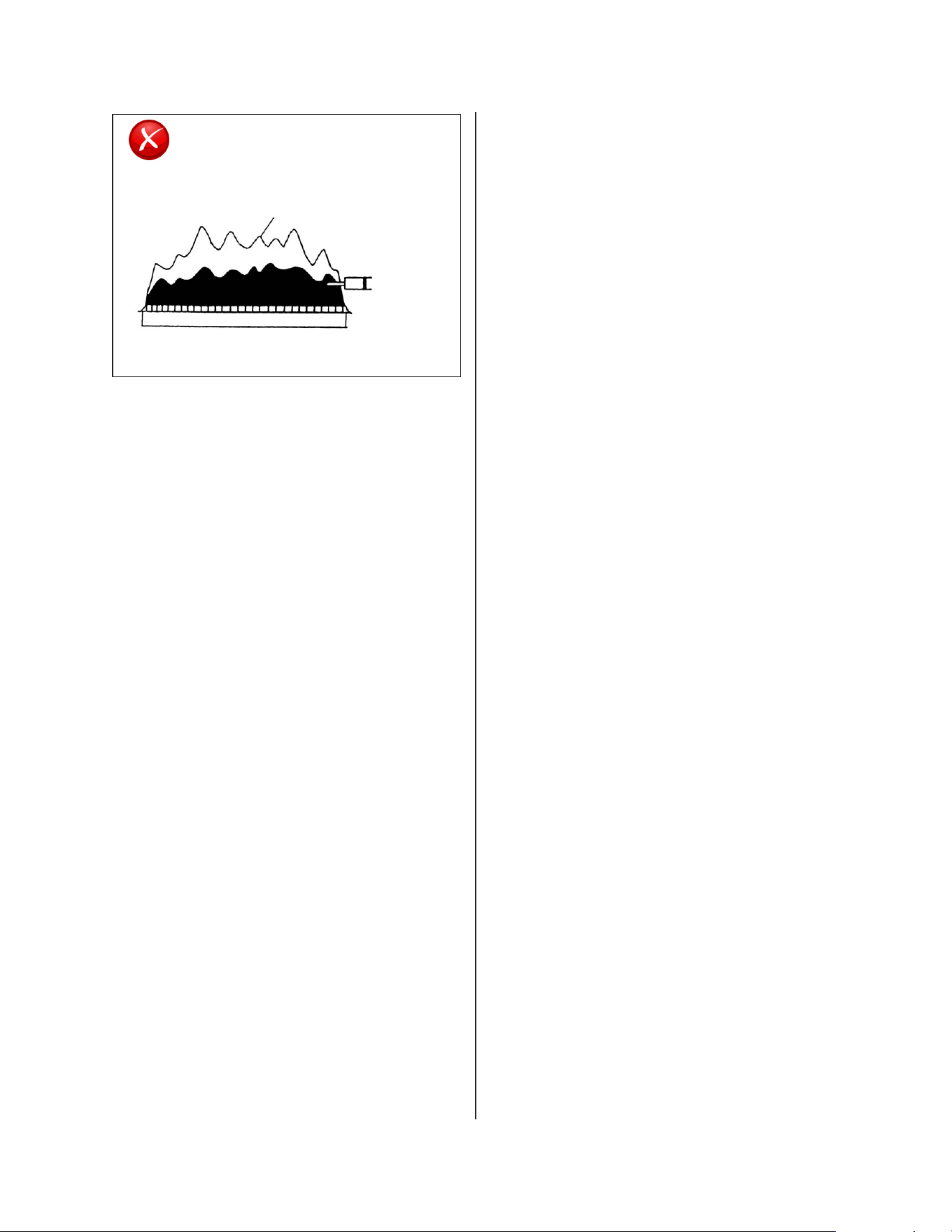
UNSATISFACTORY
FRONT VIEW
Flame Rod
Yellow Flame
Figure 47
Rinnai Tankless Water Heater Installation and Operation Manual 55
FREEZE PROTECTION
Make sure in case of freezing weather that the
water heater and its water lines are adequately
protected to prevent freezing. Damage due to
freezing is not covered by the warranty. Refer
to the “Freeze Protection” section (Section
4.3 Choose an Installation Location > Freeze
Protection). The water heater may be drained
manually. However, it is highly recommended that
drain down solenoid valves be purchased and
installed, which will automatically drain the water
heater if power is lost. (The Pressure Relief Valve
is not aected by the auto drain down solenoid
valves and will have to be manually opened.)
WINTERIZATION
The following recommendations are intended to
suggest practices that are eective for winterizing
the water heater. They should be used as a
guide only. No liability is assumed for any issues
resulting from the use of this information.
Note: See section “6.3 Draining the Water Heater”
for detailed instructions on:
• Draining the water heater
• Running a low volume of water through the
water heater to prevent freezing
• Steps to take when the water heater or
external pipes have frozen
Gas
Shut o the gas to the water heater. It is generally
preferable to shut o the gas service to the entire
location if gas is not going to be used.
Water
• Shut o the cold water supply to the water
heater. It is generally preferable to shut o
the water to the entire location if water is
not going to be used.
• Drain the water heater by opening the
drain valves on the cold water line and hot
water line.
• Open several hot water taps and remove
the lter assembly at the water inlet in
order to allow room for expansion in case
there is water in the lines that freeze.
Electric
Disconnect the power supply by either unplugging
the electrical cord or by turning o the circuit
breaker to the water heater to prevent potential
damage from irregular power surges or
interruptions.
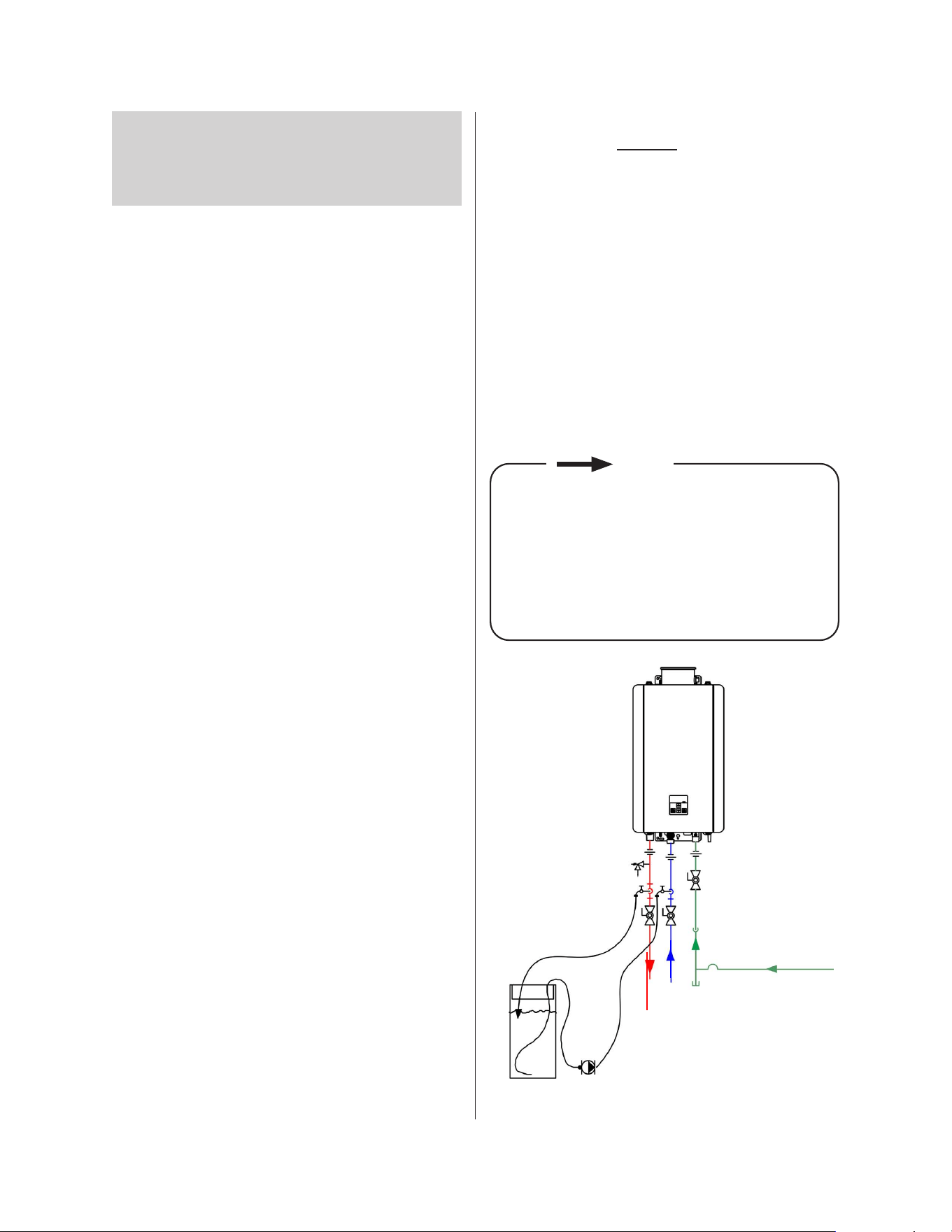
Figure 48
Circulating
Pump
H3
H2
H1
V1
V2
V3
V4
Hot water
line
Cold water
line
Gas supply line
56 Rinnai Tankless Water Heater Installation and Operation Manual
6.2 Flushing the Heat
Exchanger
This water heater includes a service indicated/
reminder (Service Soon, SS). When selected in
the parameter settings, an SS code will display on
the controller indicating that it is time to ush and
service the water heater. An LC diagnostic code
also indicates the unit is beginning to lime up and
must be ushed. Failure to ush the appliance
will cause damage to the heat exchanger.
Damage caused by lime build-up is not covered
by the water heater’s warranty. Rinnai strongly
recommends installation of isolation valves to
allow for ushing of the heat exchanger.
1. Turn power on at the controller.
2. Disconnect electrical power from the source.
3. Close the shuto valves on both the hot water
and cold water lines (V3 and V4).
4. Connect pump outlet hose (H1) to the cold
water line at isolation valve (V2).
5. Connect drain hose (H3) to the hot water line
at isolation valve (V1).
6. Pour four gallons of undiluted virgin, food
grade, white vinegar into pail.
7. Place the drain hose (H3) and the hose (H2)
to the pump inlet into the cleaning solution.
8. Open both isolation valves (V1 and V2) on the
hot water and cold water lines.
9. Restore power to the water heater for 20-30
sec. (this will open the water ow servo).
10. Disconnect electric power from the source.
11. Operate the pump and allow the vinegar to
circulate through the water heater for at least 1
hour at a rate of four gallons per minute (15.1
liters per minute).
12. Turn o the pump.
13. Rinse the vinegar from the water heater as
follows:
A. Remove the free end of the drain hose (H3)
from the pail. Place in sink or outside to
drain.
B. Close isolation valve (V2) and open shuto
valve (V4). DO NOT open shuto valve
(V3).
C. Allow water to ow through the water heat-
er for ve minutes.
D. Close shuto valve (V4). When unit has
nished draining remove the in-line lter
at the cold water inlet and clean out any
residue. Place lter back into unit and open
valve (V4).
E. Close isolation valve (V1) and open shuto
valve (V3).
14. Disconnect all hoses.
15. Restore electrical power to the water heater.
Refer to page 52 for LC clear process.
Scale build-up will aect the performance of the
water heater. Water should be treated. Rinnai
oers water conditioning solutions that provide
superior lime scale prevention and corrosion
control by feeding a blend of scale control
compounds into the cold water supply. Refer to
section "3.5 Accessories" for more information.
NOTE
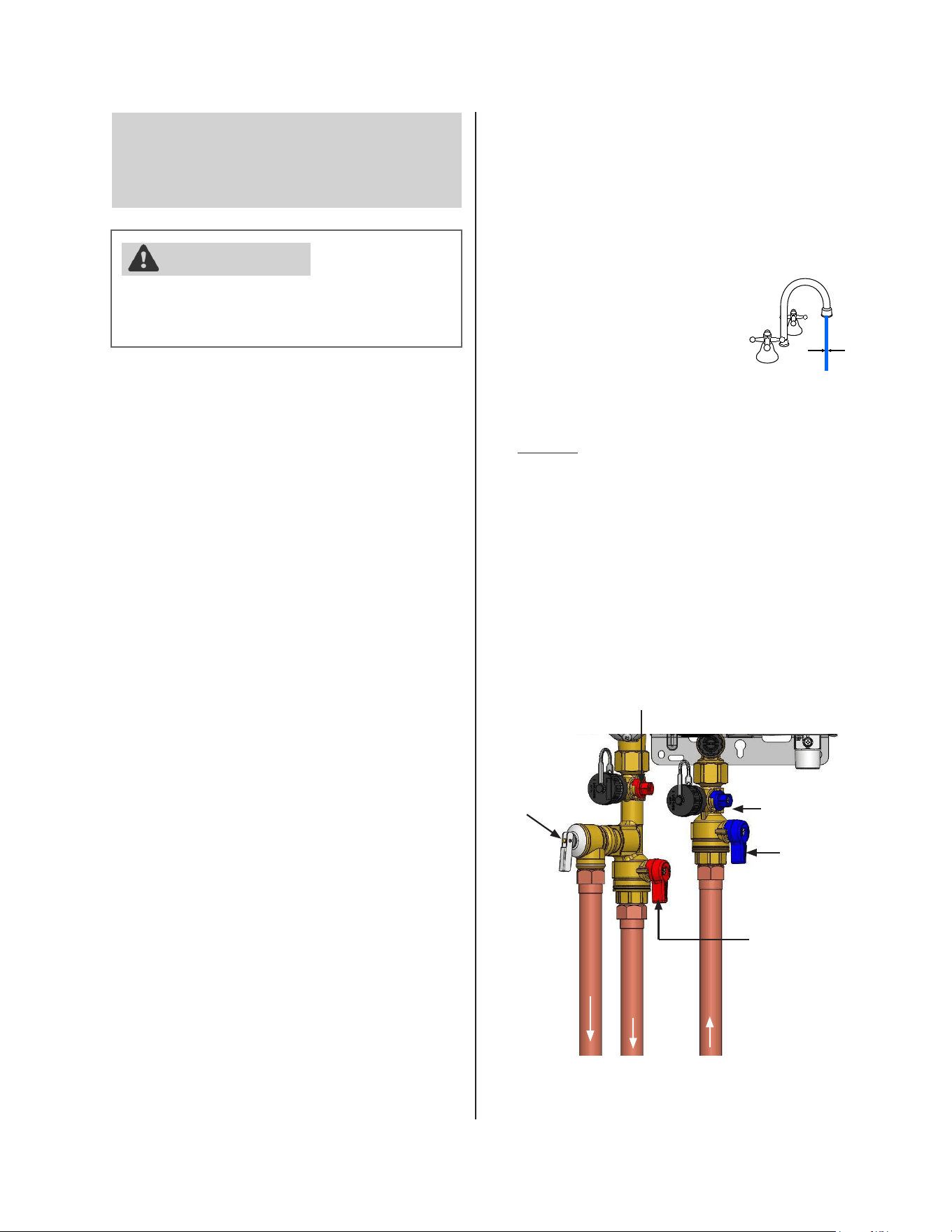
HOT
COLD
ON!
Cold Drain
Valve
Cold
Isolation
Valve
PRV Lever
Hot Isolation
Valve
Hot Drain
Valve
HOT
PRV
COLD
Figure 49: Piping Diagram
Rinnai Tankless Water Heater Installation and Operation Manual 57
6.3 Draining the Water
Heater
To avoid burns, wait until the equipment cools
down before draining the water. The water in the
appliance will remain hot after it is turned o.
WARNING
If the water heater is not going to be used
during a period of possible freezing weather, it
is recommended that the water inside the water
heater be drained.
To manually drain the water:
1. Shut o cold water supply and gas supply.
2. Turn o the temperature controller.
3. Disconnect the power to the water heater.
4. Close the hot and cold isolation valves.
5. Open the pressure relief valve (PRV) lever.
6. Open the hot and cold drain valves and loosen
the inlet water lter.
To resume normal operation:
1. Conrm that the gas supply is turned o, all
taps are closed and PRV lever is closed.
2. Close the hot and cold drain valves.
3. Open the cold and hot water isolation valves.
4. Connect power to the water heater and tighten
the inlet water lter.
5. Open a tap and conrm that water ows, and
then close.
6. After conrming that the temperature controller
is o, turn on the gas supply.
7. Turn on the temperature controller.
Running a low volume of water through the
water heater to prevent freezing:
If the temperature exceeds the ability of the water
heater to freeze protect itself, or if power is lost,
the following steps may prevent the water heater
and external piping from freezing. Units connected
with EZConnect™ (2-unit link) should be drained
to prevent freezing if not in use.
1. Turn the water heater o and close the gas
supply valve.
2. Turn on a hot water tap to ow
water about 0.1 gal/min (0.4
L/min) or where the stream is
about 0.2 in. (5 mm) thick.
When the water heater or external piping has
frozen:
1. DO NOT operate the water heater if the unit or
the external piping is frozen.
2. Close the gas and water valves and turn o
the power.
3. Wait until the water thaws. Check by opening
the water supply valve.
4. Check the water heater and the piping for
leaks.

58 Rinnai Tankless Water Heater Installation and Operation Manual
7. 7. AppendicesAppendices
Topics in this section
• Massachusetts State Gas Regulations
• Wiring Diagram
• Ladder Diagram
• Pressure Drop and Water Flow Curves
• Guidelines for Additional Temperature
Controllers
7.1 Massachusetts State
Gas Regulations
For Gas Models Sold in Massachusetts
NOTICE BEFORE INSTALLATION:
This direct-vent appliance must be installed by a
properly trained licensed professional. If you are
not properly trained, you must not install this unit.
IMPORTANT: In the State of Massachusetts
(248 CMR 4.00 & 5.00):
For all side wall horizontally vented gas fueled
equipment installed in every dwelling, building or
structure used in whole or in part for residential
purposes, including those owned or operated
by the Commonwealth and where the side wall
exhaust vent termination is less than 7 ft above
nished grade in the area of the venting, including
but not limited to decks and porches, the following
requirements shall be satised:
1. INSTALLATION OF CARBON MONOXIDE
DETECTORS. At the time of installation of
the side wall horizontal vented gas fueled
equipment, the installing plumber or gas
tter shall observe that a hard-wired carbon
monoxide detector with an alarm and battery
back-up is installed on the oor level where
the gas equipment is to be installed. In
addition, the installing plumber or gas tter
shall observe that a battery operated or hard
wired carbon monoxide detector with an
alarm is installed on each additional level of
the dwelling, building or structure served by
the side wall horizontal vented gas fueled
equipment. It shall be the responsibility of
the property owner to secure the services of
a trained and qualied professional for the
installation of hard-wired carbon monoxide
detectors.
F. In the event that the side wall, horizontally
vented gas fueled equipment is installed
in a crawl space or an attic, the hard-wired
carbon monoxide detector with alarm and
battery back-up may be installed on the
next adjacent oor level.
G. In the event that the requirements of this
subdivision cannot be met at the time of
completion of installation, the owner shall
have a period of thirty (30) days to comply
with the above requirements; provided,
however, that during said thirty (30) day pe-
riod, a battery operated carbon monoxide
detector with an alarm shall be installed.
2. APPROVED CARBON MONOXIDE
DETECTORS. Each carbon monoxide
detector as required in accordance with the
above provisions shall comply with NFPA 720
and be ANSI/UL 2034 listed and IAS certied.
3. SIGNAGE. A metal or plastic identication
plate shall be permanently mounted to the
exterior of the building at a minimum height
of 8 ft above grade directly in line with the
exhaust vent terminal for the horizontally
vented gas fueled heating appliance or
equipment. The sign shall read, in print size
no less than one-half (1/2) inch in size, “GAS
VENT DIRECTLY BELOW. KEEP CLEAR OF
ALL OBSTRUCTIONS.”
4. INSPECTION. The state or local gas
inspector of the side wall horizontally vented
gas fueled equipment shall not approve
the installation unless, upon inspection, the
inspector observes carbon monoxide detectors
and signage installed in accordance with the
provisions of 248 CMR 5.08(2)(a)1 through 4.
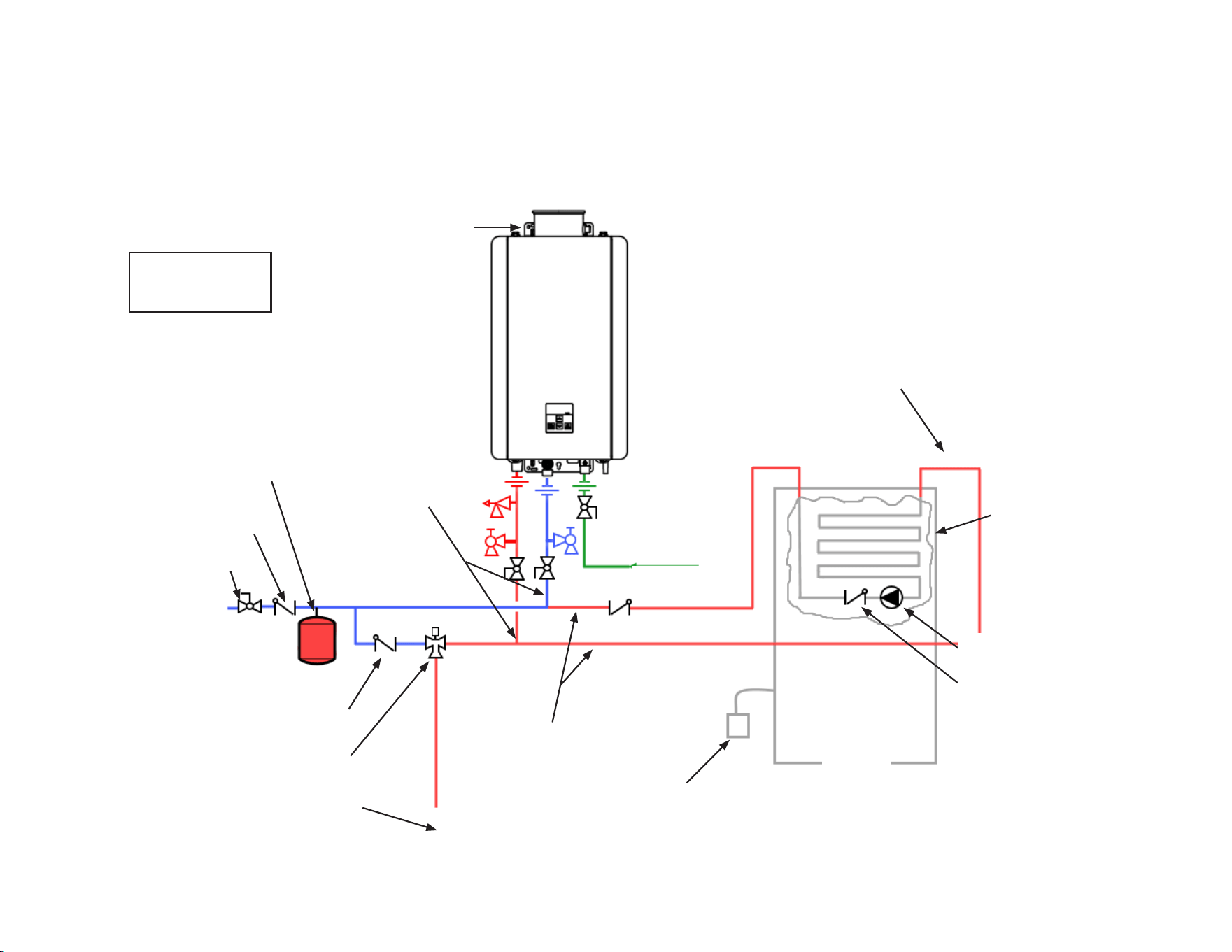
Figure 50
Rinnai Tankless Water Heater Installation and Operation Manual 59
COMBINATION SPACE HEATING/POTABLE WATER SYSTEM
(For Use In Commonwealth of Massachusetts)
Combination Space
Heating/Potable
Water System
All water piping
should be insulated in
accordance with 780 CMR
(Massachusetts Energy
Code)
Expansion Tank
Check Valve with 1/8in. Hole
Drilled in Clapper Optional
Cold Water Supply
Min. 2'
developed
length Type L
copper from
water heater
Check Valve
Automatic Tempering Device Must be
installed below the top of the water heater
as per manufacturer's recommendations.
Tempered water to plumbing xtures. Must
meet temperature requirements of 248 CMR.
Hot Water
Supply and
Return to
Heating Coil
Electronically controlled
pump timer. Activates
every 6 hours for
60 seconds. Wire to
product approved pump.
(or built-in pump)
100'-00" maximum distance from water
heater to fan coil and back. (Developed
length) not including coil in heating unit.
Piping loop between
water heater and fan coil
shall be in compliance
with 248 CMR.
Hot Water Coil
Check Valve
Air Handler
System installed with reverse
acting aquastat to shuto fan.
Suggested but not required
by 248 CMR.
Gas Supply
Water Heater
Use Only in Commonwealth of Massachusetts
Product Approved Water Heater
Shut O Valve
NSF-61 Product
Approved Pump
RE199/RE180 only
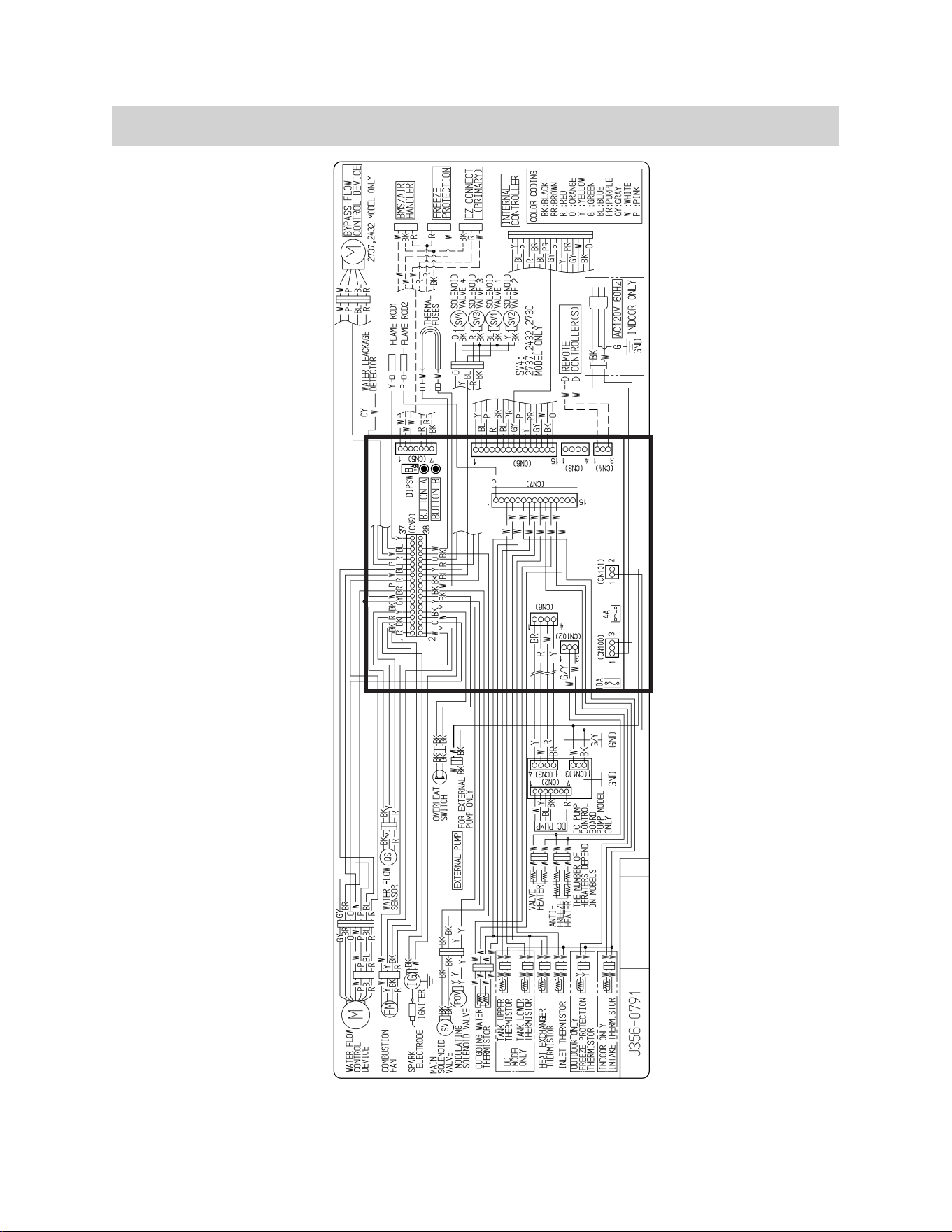
60 Rinnai Tankless Water Heater Installation and Operation Manual
7.2 Wiring Diagram
Figure 51
PC Board
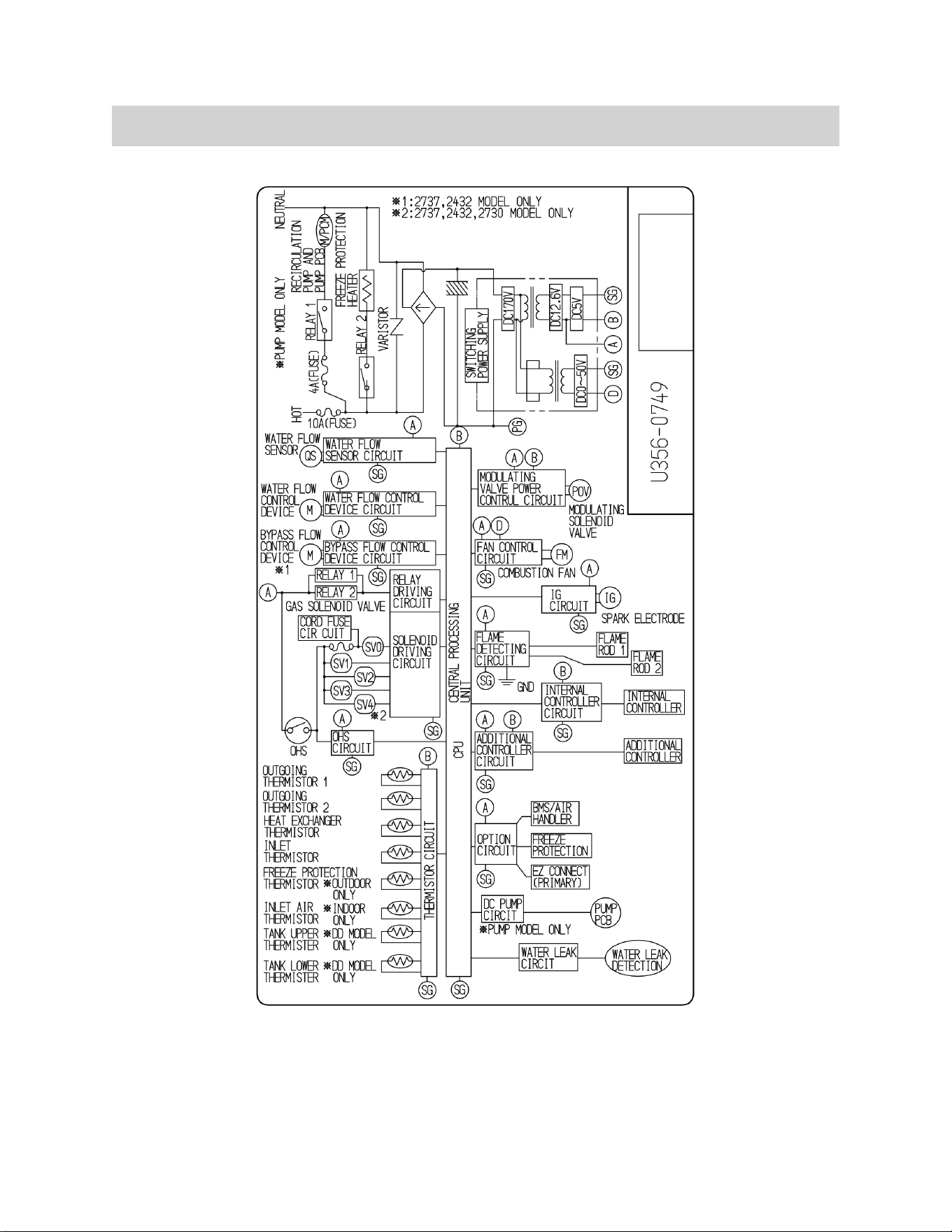
Rinnai Tankless Water Heater Installation and Operation Manual 61
7.3 Ladder Diagram
Figure 52
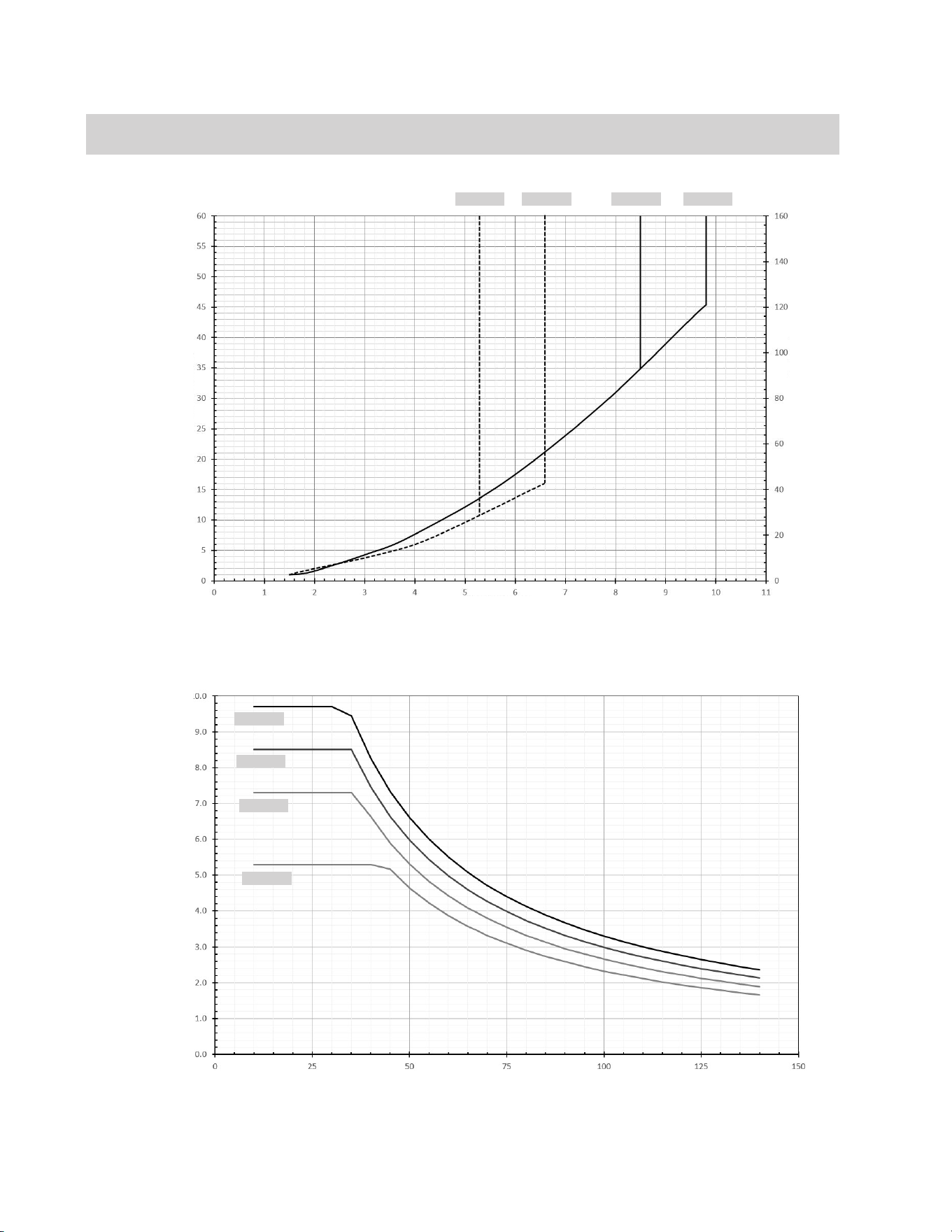
62 Rinnai Tankless Water Heater Installation and Operation Manual
7.4 Pressure Drop and Water Flow Curves
Pressure Loss (PSI)
Water Flow (GPM)
Presure Loss (ft of Head)
RE160
RE180
RE199
Figure 53: Pressure Drop Curve
Figure 54: Water Flow Curve
RE140
Water Flow (GPM)
Delta T - Temperature Rise (°F)
RE140 RE160 RE180 RE199
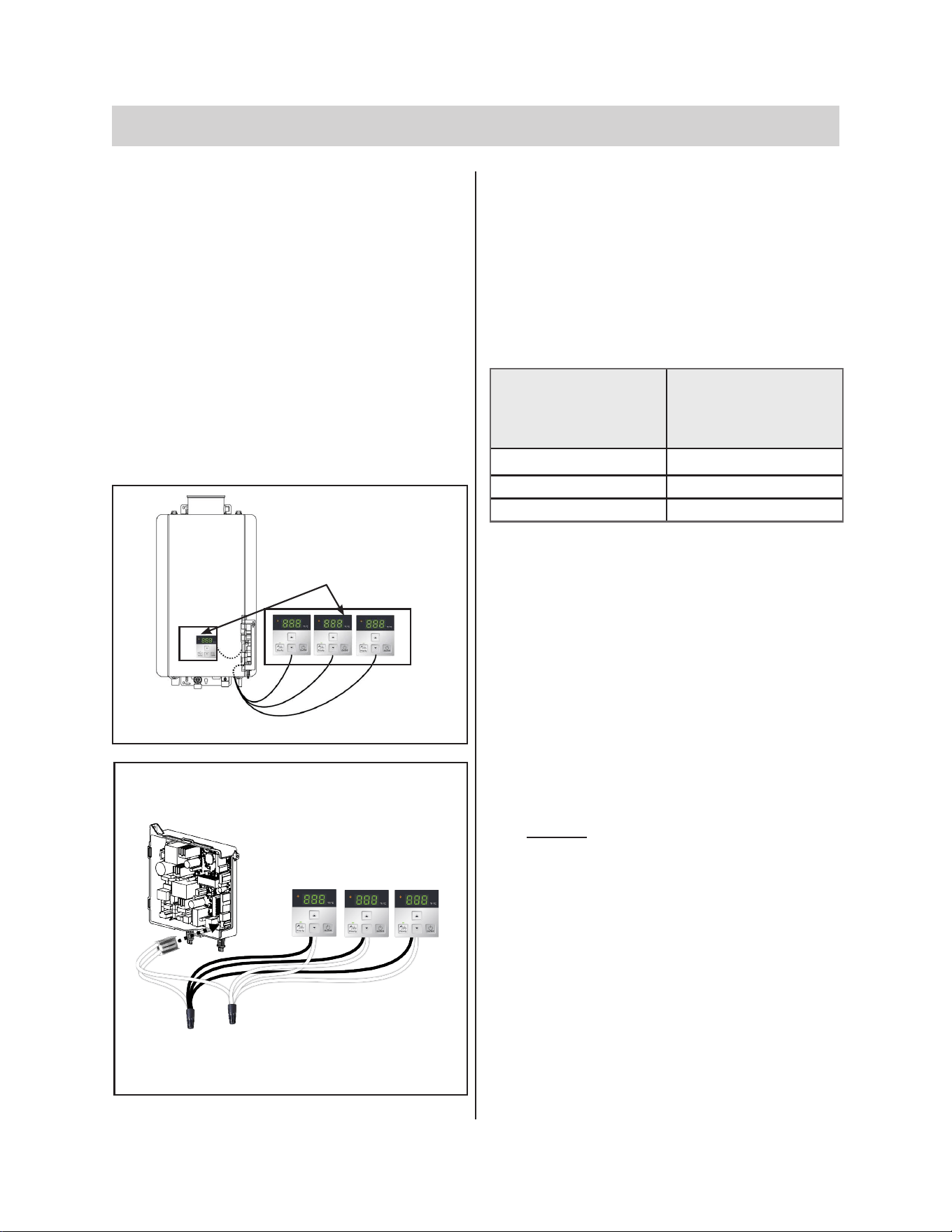
Rinnai Tankless Water Heater Installation and Operation Manual 63
7.5 Guidelines for Additional Temperature Controllers
All Rinnai Tankless Water Heaters are equipped
with an integrated digital temperature controller
that allows for a precise water temperature
set-point. Additional digital temperature controllers
are available as accessories and must be
purchased separately (detailed installation steps
included with purchase).
Wiring
A maximum of four temperature controllers can
be installed for a water heater or bank of water
heaters; this includes the controller built into a
Rinnai Tankless Water Heater. Controllers can
only be wired in parallel; they cannot be wired in
series.
Cable Lengths and Sizes
The temperature controller cable should be a non-
polarized two-core cable with a minimum gauge
of 22 AWG. The maximum cable length from each
temperature controller to the water heater depends
on the total number of wired controllers connected
to the water heater.
Number of Wired
Controllers
Maximum Cable
Length for Each
Controller to Water
Heater
1 328 ft (100 m)
2 164 ft (50 m)
3 or 4 * 65 ft (20 m)
Four Temperature
Controllers
Connect controller cable to
mating terminal at bottom
right side of PC Board.
Wiring illustration
(Detailed wiring instructions
included with temperature
controller package)
* Only three additional controllers can be wired to
the water heater.
Location
• The temperature controller should be out
of reach of small children.
• Avoid locations where the temperature
controller may become hot (near an oven
or radiant heater).
• Avoid locations in direct sunlight. The
digital display may be dicult to read in
direct sunlight.
• Avoid locations where the temperature
controller could be splashed with liquids.
• DO NOT install in locations where the
temperature controller can be adjusted by
the public.
Figure 55
Figure 56
Table 24

64 Rinnai Tankless Water Heater Installation and Operation Manual
8. 8. WarrantyWarranty
What is Covered?
The Rinnai Standard Limited Warranty covers any defects in materials or workmanship when the
product is installed and operated according to Rinnai written installation instructions, subject to the terms
within this Limited Warranty document. This Limited Warranty applies only to products that are installed
correctly in the United States. Improper installation may void this Limited Warranty. It is recommended
that a trained and qualied professional who has attended a Rinnai installation training class complete
your installation. This Limited Warranty coverage, as set out in the table below, extends to the original
purchaser and subsequent owners, but only while the product remains at the site of the original
installation, and terminates if the product is moved or reinstalled at a new location.
Item
Period of Coverage (From Date of Purchase)
Residential Applications Commercial Applications
Heat Exchanger 15 Years
[1]
8 Years
[2]
All Other Parts and Components 5 Years 5 Years
Reasonable Labor 1 Year 1 Year
[1]
For residential applications, the heat exchanger warranty is 15 years or 12,000 combustion hours, whichever occurs rst.
[2]
For commercial applications, the heat exchanger warranty is 8 years or 12,000 combustion hours, whichever occurs rst.
Notes:
From date of purchase, period of coverage is reduced to 8 years or 12,000 combustion hours, whichever occurs rst, if the Rinnai
Tankless Water Heater temperature settings exceed 160°F (71°C).
The integrated controller has a 1 year warranty on parts.
What Will Rinnai Do?
Rinnai will repair or replace the covered product or any part or component that is defective in
materials or workmanship as set forth in the above table. Rinnai will pay reasonable labor charges
associated with the repair or replacement of any such part or component during the term of the labor
warranty period. All repair parts must be genuine Rinnai parts. All repairs or replacements must be
performed by a qualied professional who is properly trained to do the type of repair.
Replacement of the product may only be authorized by Rinnai at its sole discretion. Rinnai does not
authorize any person or company to assume for it any obligation or liability in connection with the
replacement of the product. If Rinnai determines that repair of a product is not possible, Rinnai may
replace the product with a comparable product at Rinnai’s sole discretion. The warranty claim for
product parts and labor may be denied if a component or product returned to Rinnai is found to be free
of defects in material or workmanship; damaged by improper installation, use or operation; or damaged
during return shipping.
How To Obtain Service
For the name of a trained and qualied professional, please contact your place of purchase, visit the
Rinnai website (www.rinnai.us), call Rinnai at 1-800-621-9419 or write to Rinnai at 103 International Drive,
Peachtree City, Georgia 30269.
Proof of purchase is required to obtain warranty service. You may show proof of purchase with a dated
sales receipt, or by registering within 30 days of purchasing the product. To register your Rinnai
Tankless Water Heater, please visit www.rinnai.us. For those without internet access, please call
1-800-621-9419. Receipt of registration by Rinnai will constitute proof-of-purchase for this product.
Registration of product installed in new home construction may be veried with a copy of the closing
papers provided by the initial home buyer. However, registration is not necessary in order to validate this
Limited Warranty.

Rinnai Tankless Water Heater Installation and Operation Manual 65
What Is Not Covered?
This Limited Warranty does not cover any failures or operating diculties due to the following:
• Accident, abuse, or misuse
• Alteration of the product or any component part
• Misapplication of this product
• Improper installation (such as but not limited to)
• Product being installed in a corrosive environment
• Condensate damage
• Improper venting
• Incorrect gas type
• Incorrect gas or water pressure
• Absence of a drain pan under the appliance
• Improper maintenance (such as but not limited to scale build-up, freeze damage, or vent
blockage)
• Incorrect sizing
• Any other cause not due to defects in materials or workmanship
• Problems or damage due to res, ooding, electrical surges, freezing or any acts of God
• Any damage caused by poor water quality
• Operating the water heater with anything other than potable water at all times
• Force majeure
There is no warranty coverage on product installed in a closed loop application, commonly associated
with space heating only applications.
Temperatures exceeding 140F will reduce the warranty coverage to a commercial warranty except when
an RE180/199 is used in an open-loop air handler application not exceeding 160F.
This Limited Warranty does not apply to any product whose serial number or manufacture date has been
defaced.
This Limited Warranty does not cover any product used in an application that uses chemically treated
water such as a pool or spa heater.
Limitation on Warranties
No one is authorized to make any other warranties on behalf of Rinnai America Corporation. Except as
expressly provided herein, there are no other warranties, expressed or implied, including, but not
limited to warranties of merchantability or tness for a particular purpose, which extend beyond the
description of the warranty herein.
Any implied warranties of merchantability and tness arising under state law are limited in duration to
the period of coverage provided by this Limited Warranty, unless the period provided by state law is
less. Some states do not allow limitations on how long an implied Limited Warranty lasts, so the above
limitation may not apply to you.
Rinnai shall not be liable for indirect, incidental, special, consequential or other similar damages that
may arise, including lost prots, damage to person or property, loss of use, inconvenience, or liability
arising from improper installation, service or use. Some states do not allow the exclusion or limitation of
incidental or consequential damages, so the above limitation may not apply to you.
This Limited Warranty gives you specic legal rights, and you may also have other rights which vary from
state to state.
www.rinnai.us/warranty

100000722(03)
6/2022
Rinnai America Corporation
103 International Drive
Peachtree City, GA 30269
Tel: 1-800-621-9419
Web: rinnai.us
rinnai.ca
