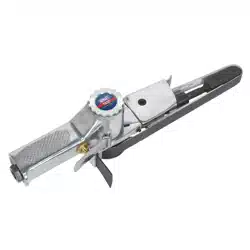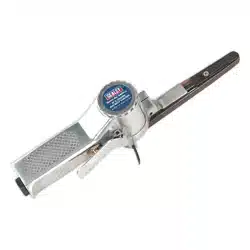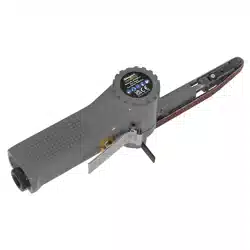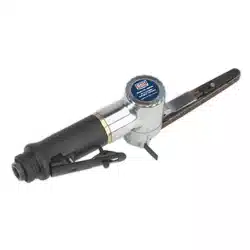
instructions for
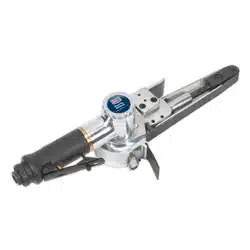
air belt sander 20 x 520mm
model no: sa355.V2
thank you for purchasing a sealey product. manufactured to a high standard, this product will, if used according to these
instructions, and properly maintained, give you years of trouble free performance.
IMPORTANT: PLEASE READ THESE INSTRUCTIONS CAREFULLY. NOTE THE SAFE OPERATIONAL REQUIREMENTS, WARNINGS & CAUTIONS. USE
THE PRODUCT CORRECTLY AND WITH CARE FOR THE PURPOSE FOR WHICH IT IS INTENDED. FAILURE TO DO SO MAY CAUSE DAMAGE AND/OR
PERSONAL INJURY AND WILL INVALIDATE THE WARRANTY. KEEP THESE INSTRUCTIONS SAFE FOR FUTURE USE.
1. safety
WarninG! ensure Health & safety, local authority, and general workshop practice regulations are adhered to when using this
equipment.
WarninG! disconnect from air supply before changing accessories or servicing.
9 maintain the sander in good condition (use an authorised service agent).
9 replace or repair damaged parts. use genuine parts only. unauthorised parts may be dangerous and will invalidate the warranty.
9 use in suitable clean and tidy working area, free from unrelated materials and ensure there is adequate lighting.
9 Before each use check abrasive belt for condition. if worn or damaged replace immediately.
9 use only the correct size and type of sanding belt with this sander.
9 ensure there are no flammable or combustible materials near the work area.
WarninG! Always wear approved eye or face and hand protection when operating the sander.
9 use face, dust, or respiratory protection in accordance with cosHH regulations.
9 depending on the task, sander noise level may exceed 85dB, in which case wear safety ear defenders.
9 remove ill fitting clothing. remove ties, watches, rings, other loose jewellery and contain and/or tie back long hair.
9 Wear appropriate protective clothing and keep hands and body clear of working parts.
9 maintain correct balance and footing. ensure the floor is not slippery and wear non-slip shoes.
9 Keep children and unauthorised persons away from the work area.
9 check moving parts alignment on a regular basis.
9 ensure work piece is secure before operating the sander. never hold a work piece by hand.
9 check the work piece to ensure there are no protruding screws, bolts, nuts, nails, rivets, etc.
9 Avoid unintentional starting.
9 ensure the abrasive belt rating is the same as, or, greater than the rPm rating of the sander.
WarninG! ensure correct air pressure is maintained and not exceeded. recommended pressure 90psi.
9 Keep air hose away from heat, oil and sharp edges. check air hose for wear before each use and ensure connections are secure.
9 Prolonged exposure to vibration from this sander poses a health risk. it is the owner’s responsibility to correctly assess the potential hazard
and issue guidelines for safe periods of use and offer suitable protective equipment.
8 dO nOt use the sander for a task it is not designed to perform.
8 dO nOt operate sander if any parts are damaged or missing as this may cause failure and/or personal injury.
WarninG! dO nOt sand any materials containing asbestos.
8 dO nOt carry the sander by the hose, or yank the hose from the air supply.
8 dO nOt force, or apply heavy pressure to, the sander, let the sander do the work.
8 dO nOt switch the sander on whilst the belt is in contact with the work piece.
8 dO nOt operate sander when you are tired or under the influence of alcohol, drugs or intoxicating medication.
8 dO nOt carry the sander with your finger on the power lever.
8 dO nOt direct air from the air hose at yourself or others.
9 When not in use disconnect from air supply and store in a safe, dry, childproof location.
8 dO nOt get the sander wet or use in damp or wet locations.
8 dO nOt place attachments close to your face and do not point at other persons or animals.
WarninG! lead Paint
Paint once contained lead as a traditional ingredient. the dust from the removal of such paint is toxic if ingested/inhaled and must,
be avoided. the following actions must be taken before using the sander on a surface that you suspect may contain lead paint.
1. user must determine potential hazard relating to age of paint to be removed (modern paints do not have lead content).
2. danGer! Keep all persons and pets away from the work area. the following persons are particularly vulnerable to the effects of
lead paint dust: expectant women, babies and children.
3. We recommend personal protection by using the following safety items:
a) Paint spray respirator (sealey ref. ssP1699)
b) Pe coated Hooded coverall (sealey ref. ssP265-l).
c) latex Gloves (sealey ref.ssP24).
4. take adequate measures to contain the paint dust, flakes and scrapings.
5. continue to wear safety equipment as in (3) above and thoroughly clean all areas when task is complete. ensure paint waste is
disposed of in sealed bags or containers and according to local Authority guidelines.
sA355.V2 | issue 3 08/12/16
Original Language Version
© Jack sealey limited
refer to
instructions
Wear eye
protection
Wear protective
gloves
Wear ear
protection
Wear safety
footwear
Wear protective
clothing
Wear a mask
WarninG! – risk of Hand arm Vibration injury.
this tool may cause Hand Arm Vibration syndrome if its use is not managed adequately.
this tool is subject to the vibration testing section of the machinery directive 2006/42/ec.
this tool is to be operated in accordance with these instructions.
measured vibration emission value (a): ............0.89 m/s²
uncertainty value (k): ...........................0.58 m/s²
Please note that the application of the tool to a sole specialist task may produce a different average vibration emission. We recommend that a
specific evaluation of the vibration emission is conducted prior to commencing with a specialist task.
A health and safety assessment by the user (or employer) will need to be carried out to determine the suitable duration of use for each tool.
nB: stated Vibration emission values are type-test values and are intended to be typical.
Whilst in use, the actual value will vary considerably from and depend on many factors.
such factors include; the operator, the task and the inserted tool or consumable.
nB: ensure that the length of leader hoses is sufficient to allow unrestricted use, as this also helps to reduce vibration.
the state of maintenance of the tool itself is also an important factor, a poorly maintained tool will also increase the risk of Hand Arm Vibration
syndrome.
Health surveillance.
We recommend a programme of health surveillance to detect early symptoms of vibration injury so that management procedures can be modified
accordingly.
Personal protective equipment.
We are not aware of any personal protective equipment (PPe) that provides protection against vibration injury that may result from the
uncontrolled use of this tool. We recommend a sufficient supply of clothing (including gloves) to enable the operator to remain warm and dry and
maintain good blood circulation in fingers etc. Please note that the most effective protection is prevention, please refer to the correct use and
maintenance section in these instructions. Guidance relating to the management of hand arm vibration can be found on the Hsc website
www.hse.gov.uk - Hand-Arm Vibration at Work.
2. intrOductiOn
Aluminium housing with articulated sanding arm. features belt tracking control, heavy-duty nose roller and one-handed trigger operation.
composite handle with exhaust reduces chill and noise level. suitable for sanding otherwise inaccessible areas such as around door shuts. extra
width of belt makes tool suitable for welding work too. replacement belts readily available.
3. sPecificatiOn
model no ................................................................ sA355.V2
Belt ..................................................................... 20 x 520mm
Air Pressure .................................................................. 90psi
Air consumption........................................................... 15cfm
Air inlet ......................................................................1/4”BsP
Weight ........................................................................... 1.3kg
noise Power .................................................................97dBA
noise Pressure ............................................................86dBA
4. PreParinG fOr use
4.1. air supply
4.1.1. ensure the sander air valve (or throttle) is in the “off” position before connecting to the air supply.
4.1.2. You will require an air pressure between 70-90psi, and an air flow of 15cfm.
WarninG! ensure the air supply is clean and does not exceed 90psi. too high an air pressure and unclean air will shorten the product
life due to excessive wear, and may be dangerous causing damage and/or personal injury.
4.1.3. drain the air tank daily. Water in the air line will damage the sander and will invalidate your warranty.
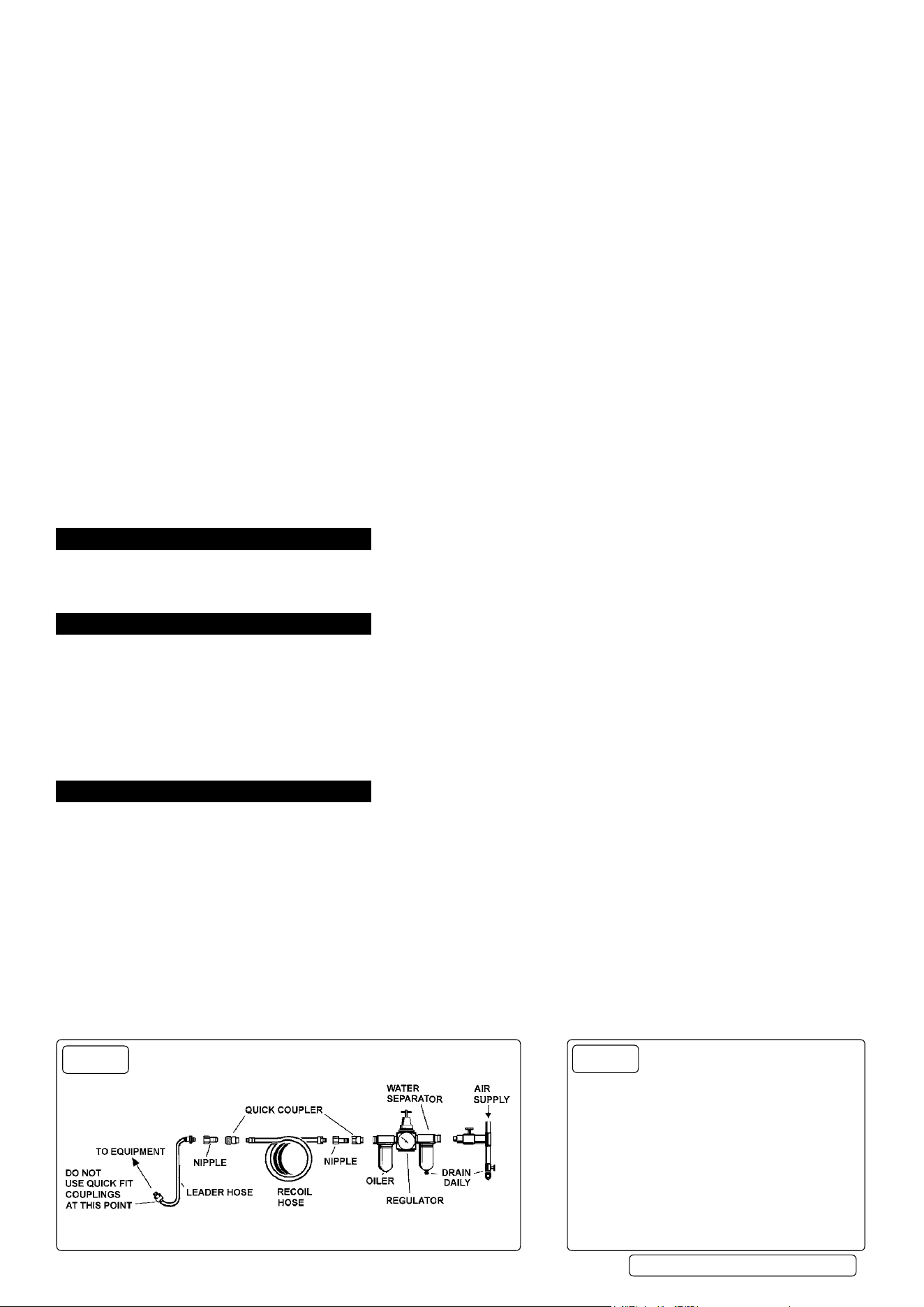
4.1.4. clean compressor air inlet filter weekly. recommended hook-up procedure is shown in fig.1.
4.1.5. line pressure should be increased to compensate for unusually long air hoses (over 8 metres).
the minimum hose size should be 1/4” internal diameter with fittings of compatible dimensions.
4.1.6. Keep hoses away from heat, oil and sharp edges. check hoses for wear, and make certain that all connections are secure.
4.2. couplings.
Vibration may cause failure if a quick change coupling is connected directly to the air sander. to overcome this, connect a leader hose to
the sander (sealey ref. AH2r or AH2r/38). A quick change coupling may then be used to connect the leader hose to the air line recoil
hose. figs.1 & 2.
g.1
g.2
sA355.V2 | issue 3 08/12/16
Original Language Version
© Jack sealey limited
5. OPeratiOn
5.1. unpack the product and check contents against the parts
listed below. if there is anything damaged or missing contact
your supplier immediately.
contents:
a) sA355 Belt sander.
b) spare sanding Belt
c) 1 x Hex. Key
WArninG! ensure that you have read, understood and apply
section 1 safety instructions.
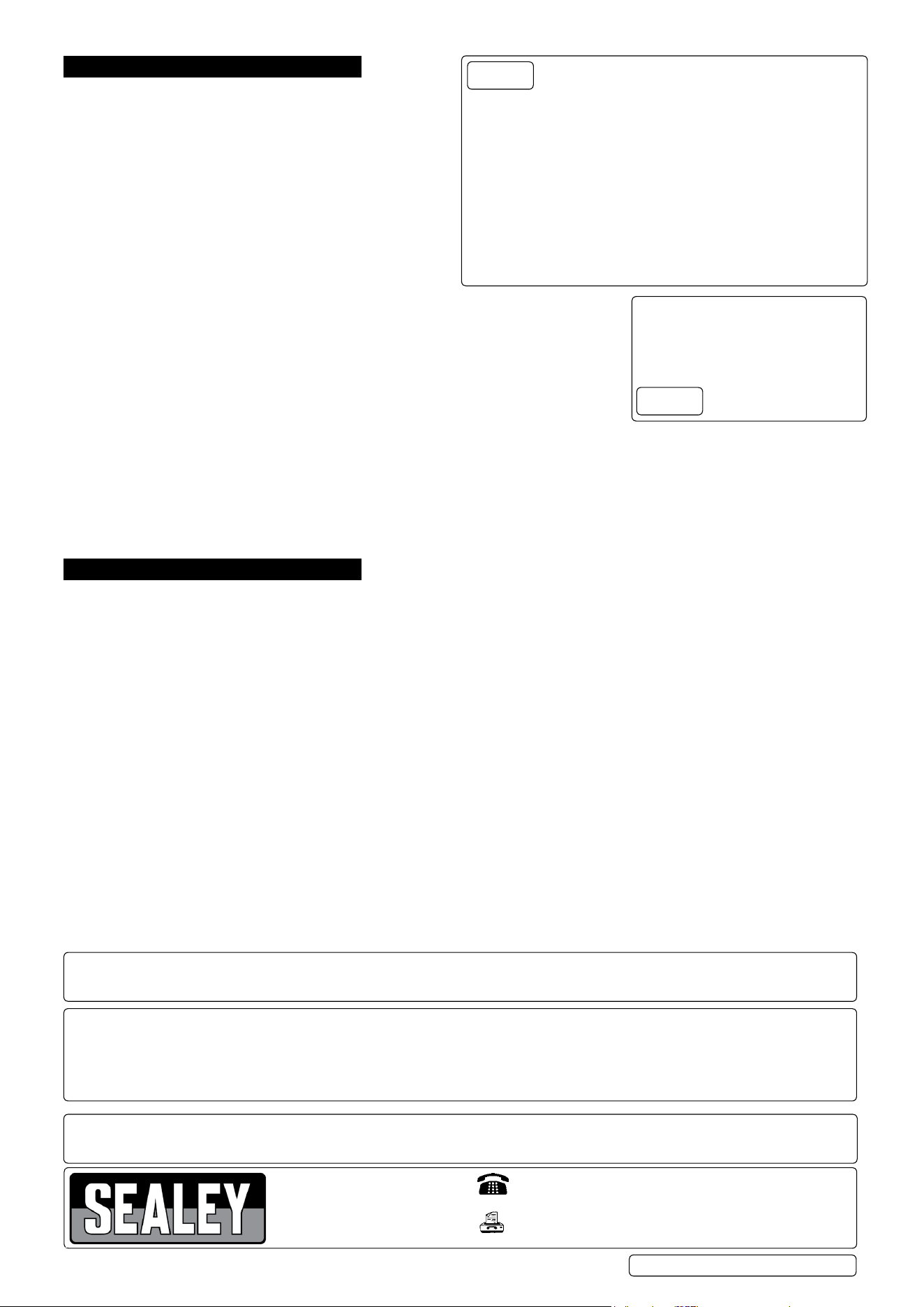
5.2. refering to fig. 3, loosen the clamp bolt (1) to allow the angle
between the grip and the belt to be altered to suit the job in
hand. After adjustment tighten the clamp bolt.
5.3. once connected to the air supply the sander is started by
pushing the lock and squeezing the trigger (2).
5.4. to remove and replace the sanding belt push the nose roller (3) towards the drive pulley (4)
against spring pressure. the nose roller bracket (5) will retract and lock allowing
removal/fitting of the belt. When the new belt is in position release the pulley bracket by
pushing in and holding the nose roller bracket (5), then press and hold the tension bar (6)
whilst releasing the pressure on the nose roller bracket.
5.5. the tracking of the belt can be altered by adjusting the two recessed hex socket screws
on the nose roller bracket (see fig.4). turning the screw ‘A’ in either direction will alter the
lateral position of the the nose roller within its bracket. turning the screw ‘B’ in either
direction will alter the lateral position of the complete nose roller bracket in relation to the
body of the sander.
5.6. to adjust the track of the belt, disconnect the sander from the air supply and remove the belt as described in paragraph 5.4. loosen
the lock nut holding screw ‘B’ in position so that screw ‘B’ can be easily adjusted using the hex key provided. replace the
belt, reconnect the air supply and operate the sander, observing the track of the belt. Adjust the track of the belt by turning the screws
and ‘B’ until the belt is running true. When the belt is running true,switch off, disconnect from the air supply and remove the belt.
secure screw ‘B’ into position with the lock nut and replace the belt.
6. maintenance
WarninG! disconnect sander from air supply before changing accessories, servicing or performing maintenance. replace or repair
damaged parts. use genuine parts only. unauthorised parts may be dangerous and will invalidate the warranty.
6.1. if the air supply system does not have an oiler, lubricate the sander daily with a few drops of a good grade air tool oil, such as
Sealey ATO500S, dripped into the air inlet (g.3.7) before use.
6.2. clean the sander after use and change belt when required.
6.3. loss of power or erratic action may be due to the following:
a) excessive drain on the air supply. moisture or restriction in the air line. incorrect size or type of hose connectors. to remedy, check
the air supply and follow instructions in section 4.
b) Grit or gum deposits in the sander may also reduce performance. if your model has an air filter (located in the area of the air inlet),
remove the filter and clean it. flush the sander out with gum solvent oil or an equal mixture of sAe no.10 oil and kerosene. Allow
to dry before use.
if you continue to experience problems, contact your local sealey service agent.
6.4. for a full service contact your local sealey service agent.
6.5. When not in use, disconnect from air supply, clean and store in a safe, dry, childproof location.
NOTE: It is our policy to continually improve products and as such we reserve the right to alter data, specications and component parts without prior notice.
imPOrtant: no liability is accepted for incorrect use of this product.
Warranty: Guarantee is 12 months from purchase date, proof of which will be required for any claim.
sole uK distributor, sealey Group.
Kempson Way, suffolk Business Park,
Bury st. edmunds, suffolk.
iP32 7Ar
www.sealey.co.uk
sales@sealey.co.uk
01284 757500
01284 703534
environmental Protection
recycle unwanted materials instead of disposing of them as waste. All tools, accessories and packaging should be
sorted, taken to a recycling centre and disposed of in a manner which is compatible with the environment.
When the product becomes completely unserviceable and requires disposal, drain off any fluids (if applicable)
into approved containers and dispose of the product and the fluids according to local regulations.
Parts support is available for this product. to obtain a parts listing and/or diagram,
please log on to www.sealey.co.uk, email sales@sealey.co.uk or telephone 01284 757500.
g.3
g.4
sA355.V2 | issue 3 08/12/16
Original Language Version
© Jack sealey limited