
en Safety
2
Further information and explanations are available online:
Table of contents
1 Safety...................................................................2
2 Avoiding material damage..................................5
3 Environmental protection and saving en-
ergy ......................................................................6
4 Suitable cookware...............................................6
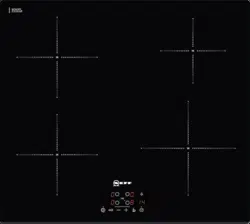
5 Familiarising yourself with your appliance .......8
6 Control element Twist Pad®...............................9
7 Software update ................................................10
8 Operating modes ..............................................10
9 Before using for the first time ..........................11
10 Basic operation .................................................11
11 Ventilation control.............................................13
12 Favourite button................................................14
13 Flex Zone ...........................................................14
14 Time-setting options.........................................15
15 PowerBoost.......................................................15
16 PanBoost
1
.........................................................16
17 Keep-warm function
1
........................................16
18 PowerTransfer...................................................16
19 Frying Sensor....................................................17
20 Childproof lock..................................................18
21 Pause .................................................................18
22 Individual safety switch-off ..............................19
23 Basic settings....................................................19
24 Cookware test ...................................................20
25 HomeConnect ..................................................21
26 Cleaning and servicing.....................................23
27 Troubleshooting................................................25
28 Disposal.............................................................27
29 Customer Service..............................................27
30 Information regarding Free and Open
Source Software................................................27
31 Declaration of Conformity ................................28
32 Test dishes ........................................................28
1 Safety
Observe the following safety instructions.
1.1 General information
¡ Read this instruction manual carefully.
¡ Keep the instructions, the appliance and
the product information safe for future refer-
ence or for the next owner.
¡ Do not connect the appliance if it has been
damaged in transit.
1.2 Intended use
Only a licensed professional may connect ap-
pliances without plugs. Damage caused by in-
correct connection is not covered under the
warranty.
The appliance can only be used safely if it is
correctly installed according to the safety in-
structions. The installer is responsible for en-
suring that the appliance works perfectly at its
installation location.
Only use this appliance:
¡ To prepare meals and drinks.
¡ Under supervision. Never leave the appli-
ance unattended when cooking for short
periods.
¡ in private households and in enclosed
spaces in a domestic environment.
¡ up to an altitude of max. 4000m above
sea level.
Do not use the appliance:
¡ On boats or in vehicles.
¡ With an external timer or a separate remote
control. This does not apply if operation
with appliances included in EN 50615 is
switched off.
¡ To extract hazardous or explosive sub-
stances and vapours.
¡ To extract small parts and liquids.
1
Available depending on software version. Further information on availability can be found on the website.
Safety en
3
If you wear an active implantable medical
device (e.g. a pacemaker or defibrillator),
check with your doctor that it complies with
Council Directive 90/385/EEC of 20th June
1990, EN 45502-2-1 and EN 45502-2-2, and
that it has been chosen, implanted and pro-
grammed in accordance with VDE-AR-E
2750-10. If these conditions are satisfied, and
if, in addition, non-metal cooking utensils and
cookware with non-metal handles are used, it
is safe to use this induction hob as intended.
1.3 Restriction on user group
This appliance may be used by children aged
8 or over and by people who have reduced
physical, sensory or mental abilities or inad-
equate experience and/or knowledge,
provided that they are supervised or have
been instructed on how to use the appliance
safely and have understood the resulting
dangers.
Do not let children play with the appliance.
Children must not perform cleaning or user
maintenance unless they are at least 15 years
old and are being supervised.
Keep children under the age of 8 years away
from the appliance and power cable.
1.4 Safe use
WARNING‒Risk of suffocation!
Children may breathe in or swallow small
parts, causing them to suffocate.
▶ Keep small parts away from children.
▶ Do not let children play with small parts.
Children may put packaging material over
their heads or wrap themselves up in it and
suffocate.
▶ Keep packaging material away from chil-
dren.
▶ Do not let children play with packaging ma-
terial.
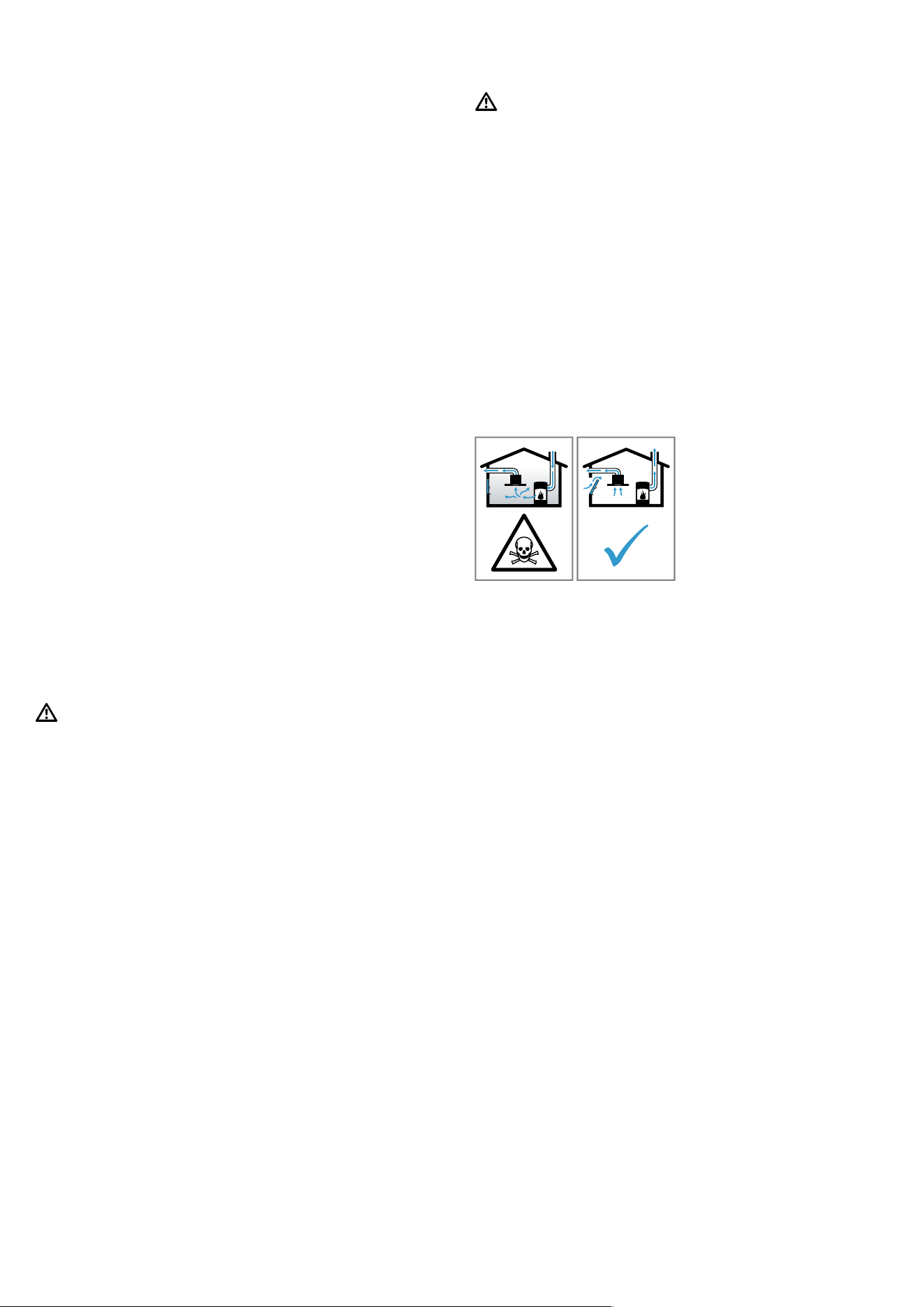
WARNING‒Risk of poisoning!
Risk of poisoning from flue gases being
drawn back in. Room-air-dependent heat-pro-
ducing appliances (e.g. gas, oil, wood or coal-
operated heaters, continuous flow heaters or
water heaters) obtain combustion air from the
room in which they are installed and dis-
charge the exhaust gases into the open
through an exhaust gas system (e.g. a chim-
ney). With the extractor hood switched on, air
is extracted from the kitchen and the adjacent
rooms. Without an adequate supply of air, the
air pressure falls below atmospheric pressure.
Toxic gases from the chimney or the extrac-
tion shaft are sucked back into the living
space.
▶ Always ensure adequate fresh air in the
room if the appliance is being operated in
exhaust air mode at the same time as a
room-air-dependent heat-producing appli-
ance is being operated.
▶ It is only possible to safely operate the ap-
pliance if the pressure in the room in which
the heating appliance is installed does not
fall below 4Pa(0.04mbar). This can be
achieved whenever the air needed for com-
bustion is able to enter through openings
that cannot be sealed, for example in
doors, windows, incoming/exhaust air wall
boxes or by other technical means. An in-
coming/exhaust air wall box alone is not
sufficient to ensure compliance with the
limit.
▶ In any case, consult your responsible chim-
ney sweep. They are able to assess the
house's entire ventilation setup and will
suggest the suitable ventilation measures
to you.
▶ Unrestricted operation is possible if the ap-
pliance is operated exclusively in circulat-
ing-air mode.

en Safety
4
WARNING‒Risk of fire!
Leaving fat or oil cooking on an unattended
hob can be dangerous and may lead to fires.
▶ Never leave hot oil or fat unattended.
▶ Never attempt to extinguish a fire using wa-
ter; instead, switch off the appliance and
then cover with a lid or a fire blanket.
The cooking surface becomes very hot.
▶ Never place flammable objects on the
cooking surface or in its immediate vicinity.
▶ Never place objects on the cooking sur-
face.
The appliance will become hot.
▶ Do not keep combustible objects or aero-
sol cans in drawers directly underneath the
hob.
Hob covers can cause accidents, for example
due to overheating, catching fire or materials
shattering.
▶ Do not use hob covers.
After every use, switch off the hob using the
main switch.
▶ Do not wait until the hob turns off automat-
ically as there are no longer any pots and
pans on it.
Fatty deposits in the grease filters may catch
fire.
▶ Never operate the appliance without a
grease filter.
▶ Clean the grease filters regularly.
▶ Never work with naked flames close to the
appliance (e.g. flambéing).
▶ Do not install the appliance near a solid
fuel heating appliance (e.g. wood- or coal-
burning) unless the heating appliance has
a sealed, non-removable cover. There must
be no flying sparks.
WARNING‒Risk of burns!
The appliance and its parts that can be
touched become hot during use, particularly
the hob surround, if fitted.
▶ Caution should be exercised here in order
to avoid touching heating elements.
▶ Young children under 8 years of age must
be kept away from the appliance.
Hob protective grilles may cause accidents.
▶ Never use hob protective grilles.
Metal objects on the hob quickly become very
hot.
▶ Never place metal objects (such as knives,
forks, spoons and lids) on the hob.
The appliance becomes hot during operation.
▶ Allow the appliance to cool down before
cleaning.
▶ If hot liquids penetrate the appliance, only
remove the grease filter or the overflow
container once the appliance has cooled
down.
WARNING‒Risk of electric shock!
Improper repairs are dangerous.
▶ Repairs to the appliance should only be
carried out by trained specialist staff.
▶ Only use genuine spare parts when repair-
ing the appliance.
▶ If the power cord or the appliance power
cable of this appliance is damaged, it must
be replaced with a special power cord or
special appliance power cable, which is
available from the manufacturer or its Cus-
tomer Service.
If the appliance or the power cord is dam-
aged, this is dangerous.
▶ Never operate a damaged appliance.
▶ Never operate an appliance with a cracked
or fractured surface.
▶ Never pull on the power cord to unplug the
appliance. Always unplug the appliance at
the mains.
▶ If the appliance or the power cable is dam-
aged, immediately switch off the fuse in the
fuse box.
▶ Call customer services. →Page27
An ingress of moisture can cause an electric
shock.
▶ Do not use steam- or high-pressure clean-
ers to clean the appliance.
The insulation on cables of electrical appli-
ances may melt if it touches hot parts of the
appliance.
▶ Never bring electrical appliance cables into
contact with hot parts of the appliance.
WARNING‒Risk of injury!
Saucepans may suddenly jump due to liquid
between the saucepan base and the hotplate.
▶ Always keep hotplates and saucepan
bases dry.
▶ Never use icy-cold cookware that has been
in the freezer.
Avoiding material damage en
5
When cooking in a bain marie, the hob and
cooking container could shatter due to over-
heating.
▶ The cooking container in the bain marie
must not directly touch the bottom of the
water-filled pot.
▶ Only use heat-resistant cookware.
An appliance with a cracked or broken sur-
face can cause cuts.
▶ Do not use the appliance if it has a cracked
or broken surface.
Children and adults can be injured by the fall-
ing rotary knob.
▶ Remove the rotary knob before cleaning.
▶ Only place the rotary knob in the position
specified on the control panel.
▶ Do not let children play with rotary knob.
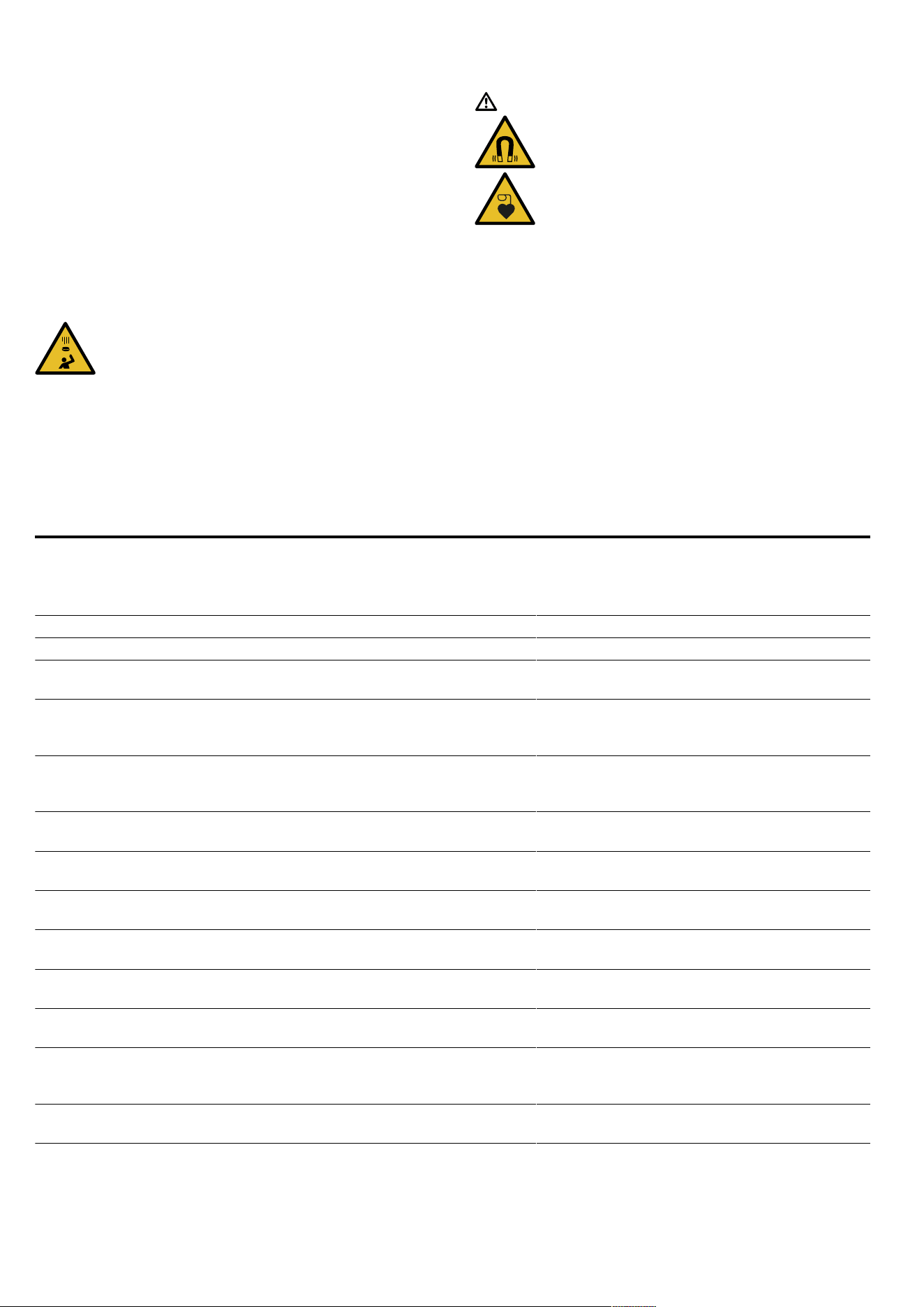
WARNING‒Danger: Magnetism!
Caution: Magnetism
Caution for people with pacemakers
Permanent magnets are used in the control
panel or in the rotary knob. They may affect
electronic implants, e.g. heart pacemakers or
insulin pumps.
▶ Persons with electronic implants must
stand at least 10cm away from the control
panel and the magnetic rotary knob.
▶ Never put the rotary knob in clothing pock-
ets.
Avoiding material damage
2 Avoiding material damage
This is where you can find the most common causes of damage and tips on how to avoid them.
Damage Cause Measure
Stains Unsupervised cooking process. Monitor the cooking process.
Stains, blisters Spilled food, especially food with a high
sugar content.
Remove immediately with a glass scraper.
Stains, blisters or
fractures in the glass
Defective cookware, cookware with melted
enamel or cookware with copper or alu-
minium base.
Use suitable cookware that is in a good con-
dition.
Stains, discolouration Unsuitable cleaning methods. Only use cleaning agents that are suitable for
glass ceramic, and only clean the hob when
it is cold.
Blisters or fractures in
the glass
Knocks or falling cookware, cooking ac-
cessories or other hard or pointed objects.
When cooking, do not hit the glass or let ob-
jects fall onto the hob.
Scratches, discolour-
ation
Rough cookware bases or moving the cook-
ware on the hob.
Check the cookware. Lift the cookware when
moving it.
Scratches Salt, sugar or sand. Do not use the hob as a work surface or
storage space.
Scratches Material residue between the hob and the
rotary knob.
Keep the rotary knob contact area clean.
Damage to the appli-
ance
Cooking with frozen cookware. Never use frozen cookware.
Damage to the cook-
ware or the appliance
Cooking without contents. Never place or heat empty cookware on a
hot cooking zone.
Glass damage Melted material on the hot cooking zone or
hot pot lid on the glass.
Do not place greaseproof paper or alu-
minium foil nor plastic containers or pot lids
on the hob.
Overheating Hot cookware on the control panel or on the
frame.
Never place hot cookware on these areas.

en Environmental protection and saving energy
6
Environmental protection and saving energy
3 Environmental protection and saving energy
3.1 Disposing of packaging
The packaging materials are environmentally compat-
ible and can be recycled.
▶
Sort the individual components by type and dispose
of them separately.
3.2 Saving energy
If you follow these instructions, your appliance will use
less energy.
Select the cooking zone to match the size of your
pan. Centre the cookware on the hob.
Use cookware whose base diameter is the same dia-
meter as the hotplate.
Tip:Cookware manufacturers often give the upper
diameter of the saucepan. It is often larger than the
base diameter.
¡
Unsuitable cookware or incompletely covered cook-
ing zones consume a lot of energy.
Cover saucepans with suitable lids.
¡
Cooking without a lid consumes considerably more
energy.
Lift lids as infrequently as possible.
¡
When you lift the lid, a lot of energy escapes.
Use a glass lid.
¡
You can see into the pan through a glass lid
without having to lift it.
Use pots and pans with flat bases.
¡
Uneven bases increase energy consumption.
Use cookware that is suitable for the quantity of food.
¡
Large items of cookware containing little food need
more energy to heat up.
Cook with only a little water.
¡
The more water that is contained in the cookware,
the more energy is required to heat it up.
Turn down to a lower power level early on. Use a suit-
able ongoing power level.
¡
If you use an ongoing power level that is too high,
you will waste energy.
Adjust the fan speed to the amount of steam pro-
duced during cooking.
¡
The lower the fan speed, the less energy is con-
sumed.
If cooking produces large amounts of steam, select a
higher fan speed in good time.
¡
The odours are distributed around the room less.
Switch the appliance off when you are not using it.
¡
Ensure that there is sufficient ventilation when cook-
ing.
¡
The appliance works more efficiently and with fewer
operating noises.
Clean or replace the filters at regular intervals.
¡
The effectiveness of the filter is retained.
Product Information according (EU) 66/2014 can be
found on the attached appliance pass and online on
the product page for your appliance.
Suitable cookware
4 Suitable cookware
Cookware that is suitable for induction cooking must
have a ferromagnetic base, i.e. it must be attracted by
a magnet. The base must also match the size of the
cooking zone. If cookware is not detected on a cooking
zone, place this on the cooking zone with the next
smallest diameter.
4.1 Size and characteristics of the cookware
To be able correctly detect the cookware, you must
take the size and the material of the cookware into con-
sideration. All cookware bases must be perfectly flat
and smooth.
Use Cookware test to check whether the cookware is
suitable. Refer to
→"Cookware test", Page20 for more details.
Cookware Materials Properties
Recommended cook-
ware
Stainless steel cookware in a sandwich
design that distributes the heat well.
This cookware distributes the heat evenly,
heats up quickly, and ensures that it can be
detected easily.
Ferromagnetic cookware made of enamelled
steel, cast iron or special induction cookware
made of stainless steel.
This cookware distributes the heat evenly,
heats up quickly, and ensures that it can be
detected.
Suitable The base is not fully ferromagnetic. If the ferromagnetic area is smaller than the
base of the cookware, only the area that is
ferromagnetic heats up. As a result, the heat
is not distributed evenly.

Suitable cookware en
7
Cookware bases that contain aluminium. These cookware bases reduce the ferromag-
netic area, which means that less power is
emitted to the cookware. This cookware may
not be sufficiently detected or may not be de-
tected at all, and therefore does not heat suf-
ficiently.
Not suitable Cookware made from normal thin steel,
glass, clay, copper or aluminium.
Notes
¡ Do not use adapter plates between the hob and the
cookware.
¡ Do not heat up empty cookware and do not use
cookware with a thin base, as this may become very
hot.
en Familiarising yourself with your appliance
8
Familiarising yourself with your appliance
5 Familiarising yourself with your appliance
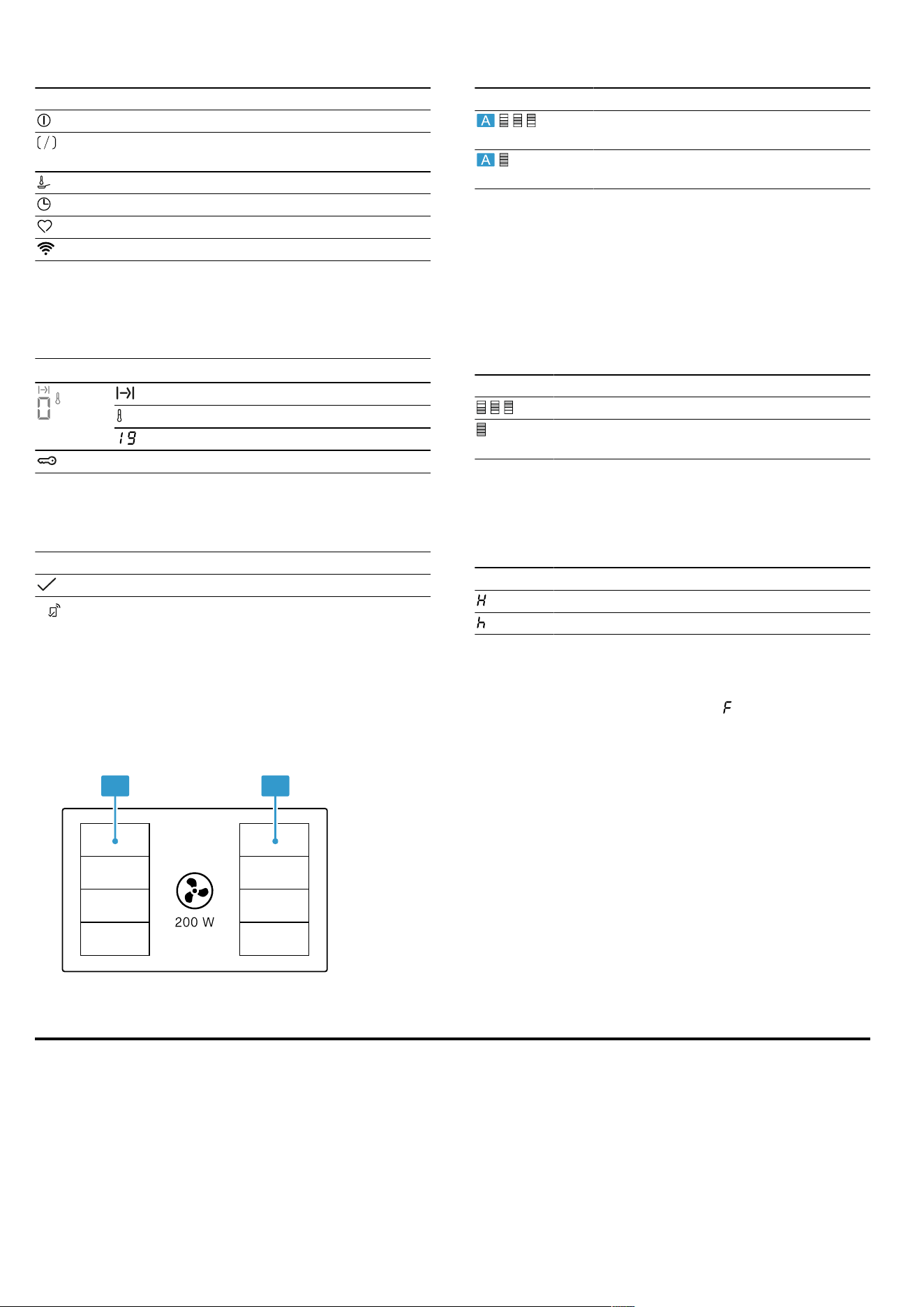
5.1 Your new appliance
Information about your new appliance
2
1
3
4
5
No. Designation
1
Grease filter
2
Odour filter for circulating-air mode or acoustics
filter for air extraction mode
1
3
Hob
4
Control panel
5
Overflow container
1
Depending on the appliance specifications.
5.2 Special accessories
Depending on the appliance model, various accessor-
ies are available and you can obtain these from spe-
cialist retailers, from our after-sales service or from our
official website.
¡ Air extraction set
¡ Air recirculation set
¡ Odour filter for recirculating air mode
¡ Acoustics filter for air extraction mode
5.3 Control panel
Individual details, such as colour and shape, may differ from the figure.
A
B
D
CC
Letters Designation
Main switch
Twist Pad®
Cooking zone
Ventilation sensor
Note:Always keep the control panel clean and dry.
Tip:Do not place any cookware near the displays or
buttons. The electronics may overheat.
Control element Twist Pad®
You can use this magnetic knob to operate the hob
with a simple rotary movement.
The indicator lights around the rotary knob indicate the
status of the selection.
Touch buttons
When you switch on the hob, the symbols for the con-
trols available at this time light up.
Control element Twist Pad® en
9
Sensor Function
Main switch
Automatic linking/separating of cooking
zones
Frying Sensor
Timer functions / Childproof lock
Favourite button
Connectivity
The buttons for the various functions light up white
when the functions are available. If you select the but-
tons or make changes, the buttons light up red.
Indicators/symbols
Display Meaning
Switch-off timer
Frying Sensor
- Power levels
Childproof lock
Buttons in connection with Home Connect
As soon as the connection to Home Connect has been
established, the following buttons are available:
Sensor Function
Accept settings from another appliance
If lights up, search for further information in the
Home Connect app.
5.4 Distribution of the cooking zones
The specified power has been measured with the
standard pots which are described in IEC/EN
60335-2-6. The power may vary depending on the size
of the cookware or cookware material.
A A
Area Highest power level
Power level 9
PowerBoost
2200W
3700W
Power level 9
PowerBoost
3300W
3700W
At power level 9, the hob reaches the power indicated
in the table in order to reduce the preheating times and
keeps them running for a certain time, provided the
other cooking zone on the same side is not in use.
5.5 Cooking zone
Before you start cooking, check whether the size of the
cookware fits the cooking zone that you want to use for
cooking:
Area Cooking zone type
Single-circuit cooking zone
Flex Zone
→"Flex Zone", Page14
5.6 Residual heat indicator
The hob has a residual heat indicator for each cooking
zone. Do not touch the cooking zone if the residual
heat indicator is lit.
Display Meaning
The cooking zone is hot.
The cooking zone is warm.
5.7 Saturation indicator
The hob is equipped with a saturation indicator. When
the anti-odour filters are saturated, lights up and the
filter must be replaced.
→"Odour filter or acoustics filter", Page24
Control element Twist Pad®
6 Control element Twist Pad®
You can use this magnetic knob to select cooking
zones, power levels and other hob settings. The knob
can be positioned in the central area of the control
panel where it sticks. In addition, the knob can be re-
moved at any time.
en Software update
10
It consists of two parts, which can be easily removed. If
it is removed from a metal surface, the bottom part
may remain fixed to this surface. Put both parts back
together again to use it.
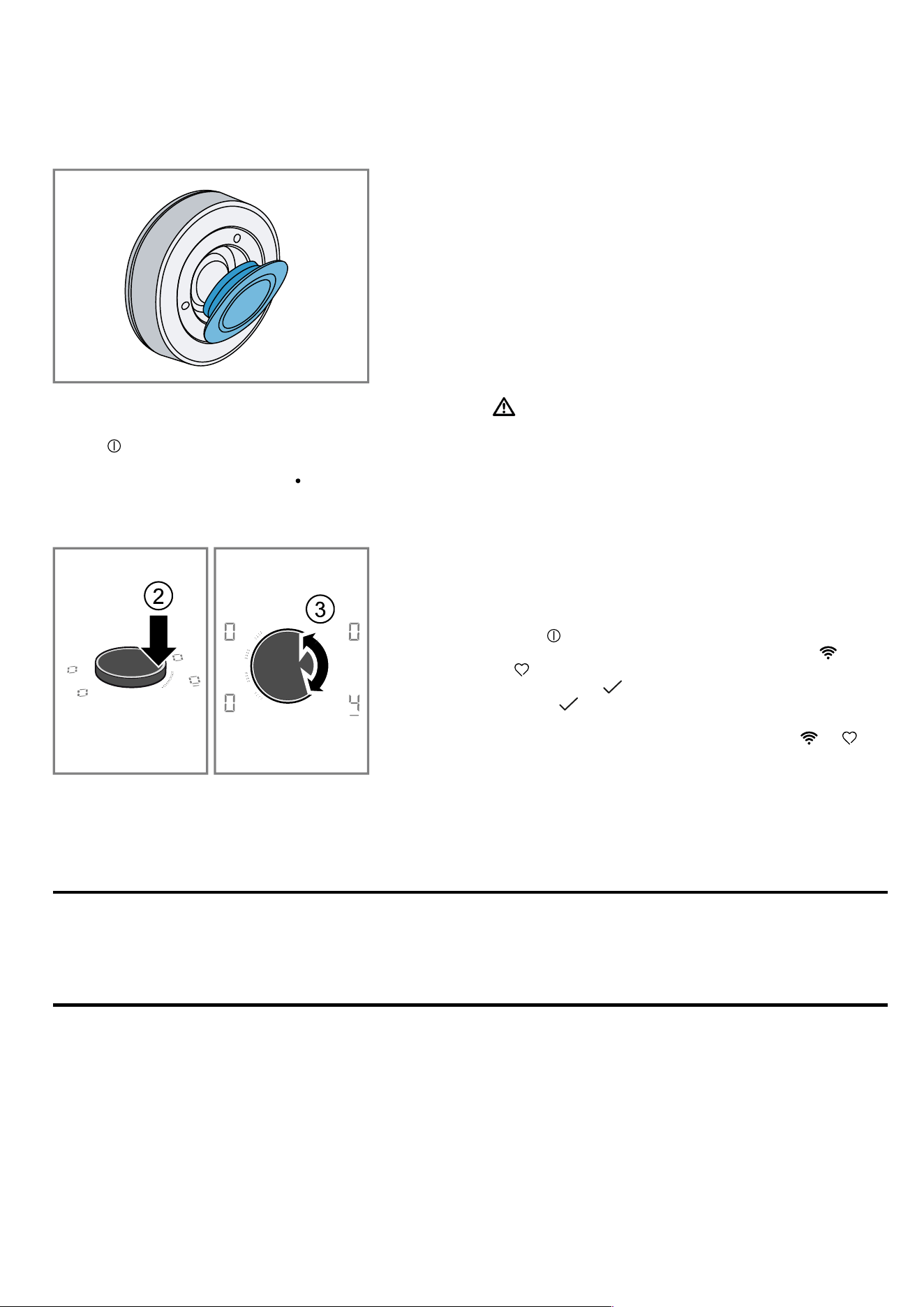
6.1 Positioning and operating Twist Pad®
1.
Use to switch on the hob.
2.
Place the knob in the central area of the control
panel at the point marked with on the glass.
3.
To switch on a cooking zone, push the rotary knob
at the level of the required cooking zone.
4.
Turn the knob and select a power level.
6.2 Instructions for use
A strong magnet is located inside the rotary knob. You
should therefore note the following:
¡ Keep the rotary knob away from magnetic data car-
riers such as credit cards and cards with magnetic
strips. This may damage the data carrier. The mag-
net may also cause faults on televisions and
screens.
¡ Metal particles stuck to the bottom may scratch the
surface of the hob. Always keep the rotary knob
clean. Soiling may impair its function. See "Cleaning
the knob". →Page23
6.3 Removing Twist Pad®
You can remove the rotary knob from the cooking zone
during the cooking process.
If you remove the rotary knob, the Pause function is
switched on for 10 minutes. →Page18 If you do not
reset the rotary knob to its position before this time
elapses, the hob switches off.
WARNING‒Risk of fire!
If you place a metal object on the area of the rotary
knob during these 10 minutes, the cooking zone may
continue to heat up.
▶ Always switch off the cooking zone at the main
switch.
6.4 Operation without rotary knob Twist
Pad®
If you lose the rotary knob, or in other situations, you
can operate the hob without the TwistPad®. Proceed
as follows:
1.
Use to switch on the hob.
2.
Within the next 5 seconds, press and hold and
at the same time for 4 seconds. A warning tone
sounds and lights up.
3.
Press repeatedly until the display for the required
hob lights up.
4.
Then set the required power level using or .
a The cooking zone is switched on and heats up.
Notes
¡ In this mode, only the basic function for the hotplate
is available.
¡ You can always position the rotary knob in the pro-
gramming zone again.
Software update
7 Software update
If the appliance is connected to HomeConnect, some
functions may be available with a software update.
More information on the availability of additional func-
tions can be found on the website www.neff-home.com
Operating modes
8 Operating modes
You can use your appliance in air extraction mode or
circulating-air mode.
8.1 Air extraction mode
The air which is drawn in is cleaned by the grease fil-
ters and conveyed to the exterior by a pipe system.
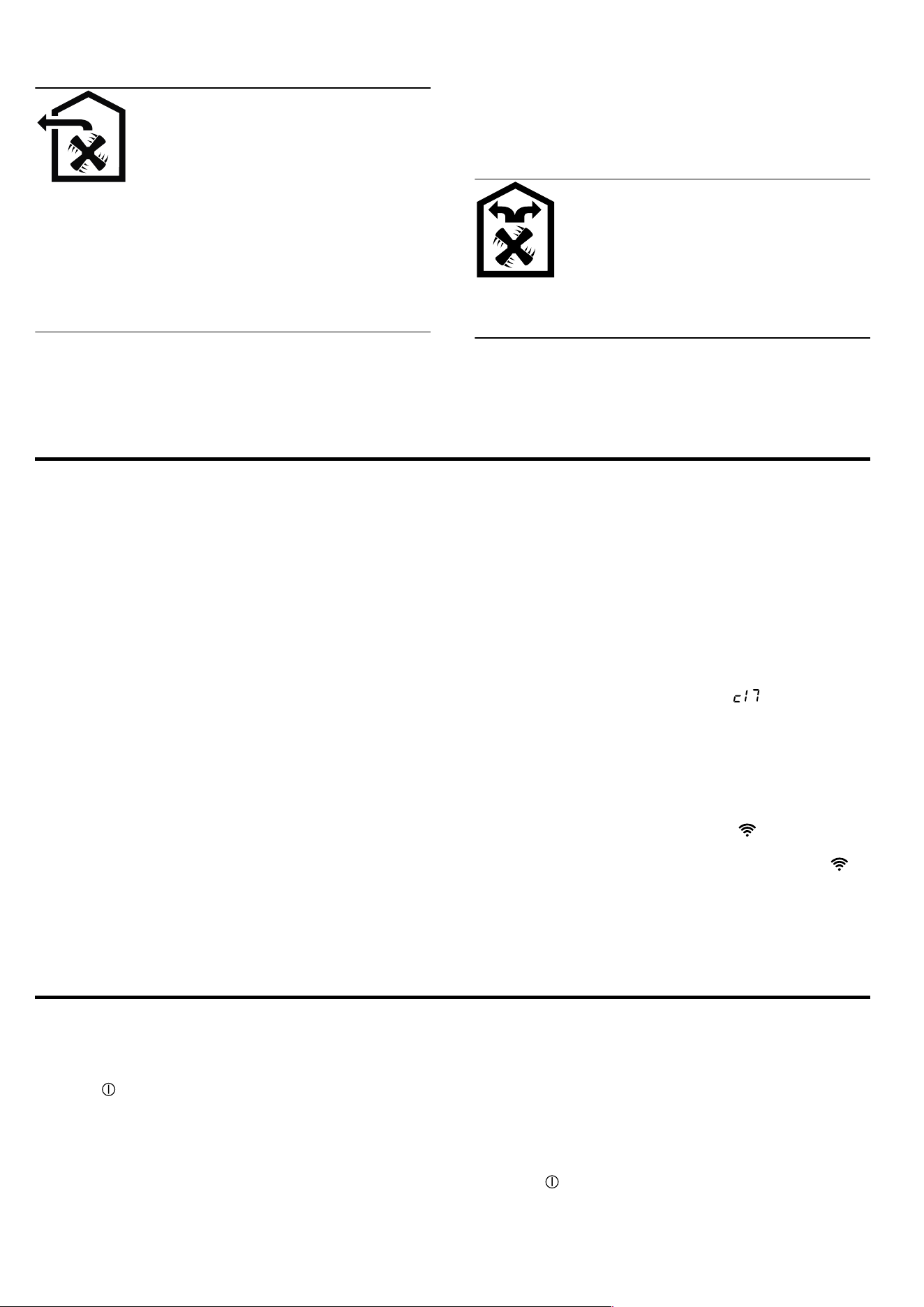
Before using for the first time en
11
The air must not be discharged into a
flue that is used for exhausting fumes
from appliances burning gas or other
fuels (not applicable to appliances that
only discharge the air back into the
room).
¡ If the exhaust air is to be conveyed
into a non-functioning smoke or ex-
haust gas flue, you must obtain the
consent of the heating engineer re-
sponsible.
¡ If the exhaust air is conveyed
through the external wall, a tele-
scopic duct should be used.
8.2 Air recirculation
The air which is drawn in is cleaned by the grease fil-
ters and an odour filter, and conveyed back into the
room.
To bind odours in air recirculation
mode, you must install an odour filter.
The different options for operating the
appliance in air circulation mode can
be found in our catalogue. Alternatively,
ask your dealer. The required accessor-
ies are available from specialist retail-
ers, from our after-sales service or from
the online shop.
Note:When cooking intensively and for a long time,
moisture is released into the air in the room. When us-
ing the appliance in air recirculation mode, we recom-
mend ventilating the kitchen adequately, e.g. by briefly
opening a window to remove excessive moisture.
Before using for the first time
9 Before using for the first time
Observe the following recommendations.
9.1 Initial cleaning
Remove any leftover packaging from the hob surface
and wipe the surface with a damp cloth. You can find a
list of recommended detergents on the official website
www.neff-home.com.
More information on care and cleaning. →Page23
9.2 Preparing the appliance
To ensure correct operation, you must arrange the
components in this order:
1.
Insert the filter.
2.
Insert the metal grease filter.
Note:Never operate the appliance without the metal
grease filter and the overflow container.
9.3 Cooking with induction
In comparison to conventional hobs, induction techno-
logy brings with it a series of changes and has a num-
ber of benefits such as time savings when cooking and
frying, energy savings as well as greater ease of clean-
ing and care. It also offers improved heat control as the
heat is generated directly in the cookware.
9.4 Cookware
You can find a list of recommended cookware on the
official website www.neff-home.com.
Further information on suitable cookware. →Page6
9.5 Setting the operating mode
The appliance is supplied with a preset circulating-air
mode.
When your hob is installed with an air outlet to the out-
side, you must configure the setting to this mode.
You can find additional information about this in the
section entitled
→"Basic settings", Page19
9.6 Setting Home Connect
When you first switch on the appliance, you will be
prompted to set your home network. lights up for a
few seconds on the display panel.
To begin the connection to Home Connect, touch
and proceed in accordance with the information in the
section .
To end the setting, switch off the hob.
You can also adjust the HomeConnect setting at a dif-
ferent time.
Basic operation
10 Basic operation
10.1 Switching on the hob
▶
Press .
The symbols for the cooking zones and the cur-
rently available functions light up.
a The hob is ready to use.
ReStart
▶
If you switch the appliance on within four seconds of
switching it off, the hob operates with the settings
that were previously set.
10.2 Switching the hob off
▶
Touch until the displays go out.
a All cooking zones are switched off.
en Basic operation
12
Note:If all of the cooking zones are switched off for
longer than 59seconds, the hob is automatically
switched off.
10.3 Setting the power level in the cooking
zones
The cooking zone has 17 power levels, which are dis-
played from to with intermediate values. Select the
best power level for the food and the planned cooking
process.
1.
Select the cooking zone by pressing the rotary knob
next to the mark for the required cooking zone.
a lights up brighter.
2.
Turn the rotary knob to select the required power
level.
a The power level has been set.
Note:If no cookware is placed on the cooking zone or
the pot is not suitable, the selected power level flashes.
After a certain period of time, the cooking zone
switches itself off.
QuickStart
▶
If you set one or more items of cookware on any
cooking zone before switching on the appliance, the
hob detects this and automatically selects the cook-
ing zone for one of the items of cookware. Then se-
lect the power level in the next 59 seconds, or the
hob will switch off.
Changing the power level and switching off the
cooking zone
1.
Select the cooking zone.
2.
Use the rotary knob to change the power level or
set it to 0.
a The cooking zone's power level is changed or the
cooking zone is switched off.
10.4 Cooking tips
¡ When heating up puree, cream soups or thick
sauces, stir occasionally.
¡ To preheat, set the power level 8-9.
¡ When cooking with the lid on, reduce the power
level as soon as you see steam escaping. The
cooking result is not affected by the steam escap-
ing.
¡ After cooking, place a lid on the cookware until you
serve the dish.
¡ To cook with the pressure cooker, observe the man-
ufacturer's instructions.
¡ Do not cook food for too long, otherwise nutrients
will be lost. The kitchen timer enables you to set the
optimal cooking time.
¡ Ensure that the oil does not smoke.
¡ To brown the food, fry it in small portions, one after
the other.
¡ Some items of cookware may reach high temperat-
ures while the food is cooking. You should therefore
use oven gloves.
¡ You can find recommendations for energy-efficient
cooking under
→"Saving energy", Page6
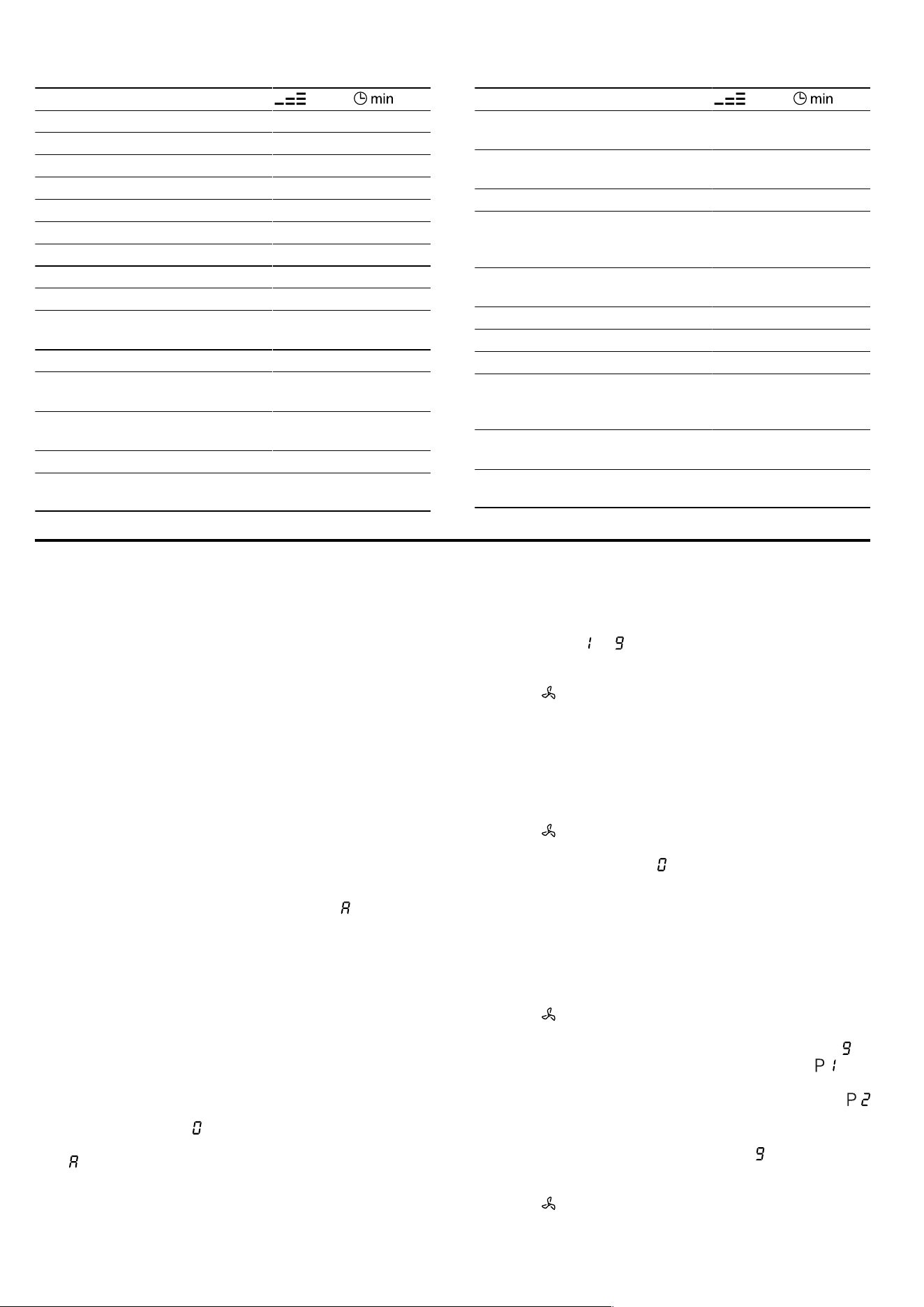
Cooking recommendations
The table shows which power level ( ) is suitable for
which food. The cooking time ( ) may vary de-
pending on the type, weight, thickness and quality of
the food.
Melting
Chocolate, cooking chocolate 1-1.5 -
Butter, honey, gelatine 1-2 -
Heating and keeping warm
Stew, e.g. lentil stew 1.5-2 -
Milk
1
1.5-2.5 -
Boiled sausages
1
3-4 -
1
Without lid
2
Preheat to power level 8 - 8.5
Defrosting and heating
Spinach, frozen 3-4 15-25
Goulash, frozen 3-4 35-55
Poaching, simmering
Potato dumplings
1
4.5-5.5 20-30
Fish
1
4-5 10-15
White sauces, e.g. Béchamel
sauce
1-2 3-6
Whisked sauces, e.g.
Béarnaise sauce, Hollandaise
sauce
3-4 8-12
Boiling, steaming, braising
Rice, with double the volume of
water
2.5-3.5 15-30
Rice pudding
2
2-3 30-40
Potatoes boiled in their skin 4.5-5.5 25-35
Boiled potatoes 4.5-5.5 15-30
Pasta
1
6-7 6-10
Stew 3.5-4.5 120-
180
Soups 3.5-4.5 15-60
Vegetables 2.5-3.5 10-20
Vegetables, frozen 3.5-4.5 7-20
Stew in a pressure cooker 4.5-5.5 -
Braising
Rolled roasting joint 4-5 50-65
Pot roast 4-5 60-100
Goulash
2
3-4 50-60
Braising/frying with a small
amount of fat
1
Escalope, plain or breaded 6-7 6-10
1
Without lid
2
Preheat to power level 8 - 8.5
Ventilation control en
13
Escalope, frozen 6-7 6-12
Chops, plain or breaded 6-7 8-12
Steak (3 cm thick) 7-8 8-12
Poultry breast, 2 cm thick 5-6 10-20
Poultry breast, frozen 5-6 10-30
Rissoles (3 cm thick) 4.5-5.5 20-30
Hamburgers (2 cm thick) 6-7 10-20
Fish and fish fillet, plain 5-6 8-20
Fish and fish fillet, breaded 6-7 8-20
Fish, breaded and frozen, e.g.
fish fingers
6-7 8-15
Prawns and scampi 7-8 4-10
Sautéing fresh vegetables and
mushrooms
7-8 10-20
Stir-fry, vegetables, meat cut in
strips Asian-style
7-8 15-20
Frozen dishes, e.g. stir-fries 6-7 6-10
1
Without lid
2
Preheat to power level 8 - 8.5
Pancakes, cooked one after the
other
6.5-7.5 -
Omelette (cooked one after the
other)
3.5-4.5 3-10
Fried eggs in oil 5-6 3-6
Deep-frying, 150–200g per
portion in 1–2l oil, deep-fat
fried in portions
1
Frozen products, e.g. chips,
chicken nuggets
8-9 -
Croquettes, frozen 7-8 -
Meat, e.g. chicken portions 6-7 -
Fish, breaded or battered 6-7 -
Vegetables, mushrooms,
breaded, beer-battered or tem-
pura
6-7 -
Small baked items, e.g. dough-
nuts, battered fruit
4-5 -
1
Without lid
2
Preheat to power level 8 - 8.5
Ventilation control
11 Ventilation control
The cooking zone has an air extraction system integ-
rated in the cooking surface.
The air extraction system is controlled by the air quality
sensor, which automatically detects the cooking steam
and selects the optimal level.
The functions for controlling the air extraction system
are described below.
You can change the factory settings at any time.
→"Basic settings", Page19
Note:Use shallow cookware to improve performance.
With deep cookware, place the lid at an angle.
11.1 Automatic start for the ventilation
system
If you assign a power level to the first cooking zone,
the air extraction system will start up automatically. The
air quality sensor automatically detects the cooking
steam and selects the optimal setting. The display
lights up.
After the automatic start, you can change the ventila-
tion setting. Changing or deactivating the ventilation
setting. →Page13
11.2 Sensor functions
You can switch the air quality sensor ventilation mode
on and off at any time.
The air quality sensor automatically detects the cooking
steam and selects the optimal ventilation setting.
To switch off, select the required ventilation setting or
set the rotary knob to .
To switch the function on again, turn the rotary knob
until lights up.
11.3 Ventilation control
The cooking zone has 17 ventilation settings, which are
displayed from to with intermediate values.
Switching on the ventilation system
1.
Press .
a The ventilation system starts at the preset power
level.
2.
Use the rotary knob to select the required ventilation
setting.
a The power level for the ventilation system lights up.
Changing or switching off the ventilation system
1.
Press .
2.
Use the rotary knob to select the required ventilation
setting or change it to .
11.4 Intensive ventilation settings
There are two intensive ventilation settings at which the
ventilation system operates for a short time at a higher
power level.
Switching on the intensive settings
1.
Press .
2.
Select the required intensive setting:
‒ Intensive setting I: Turn the rotary knob until
lights up. Turn the rotary knob again until
lights up.
‒ Intensive setting II: Turn the rotary knob until
lights up.
Note:After approx. 8minutes, the appliance automatic-
ally switches back to ventilation setting .
Changing or switching off intensive settings
1.
Press .
en Favourite button
14
2.
Use the rotary knob to select the required ventilation
setting or change it to .
11.5 Fan run-on for the ventilation system
The ventilation system continues to run for a few
minutes after the cooking zone is switched off using
the main switch.
This assumes that the cooking zone has been switched
on for at least one minute and the ventilation system is
running.
Once the corresponding time has elapsed, the ventila-
tion system switches off automatically. This time de-
pends on the operating mode in which the appliance is
installed.
When the ventilation system is switched on, the ventila-
tion setting lights up. The ventilation system can be
switched off at any time by pressing .
Favourite button
12 Favourite button
You can use the function to select two functions or
cooking settings to make them quickly accessible on
.
12.1 Assigning Favourite button functions
Requirement:Connect the appliance to Home Con-
nect. Home Connect
1.
To assign functions, open the Home Connect
app and follow the instructions.
2.
As soon as you have assigned the functions, you
can use them:
a Function 1: Press briefly.
a Function 2: Press and hold .
Note:If you have not assigned any functions,
switches off once the hob is switched on.
Flex Zone
13 Flex Zone
The flexible cooking zone allows you to position cook-
ware of any shape or size any way you like. It consists
of four inductors that work independently of each other.
When the flexible cooking zone is in use, only the area
that is covered by cookware is activated.
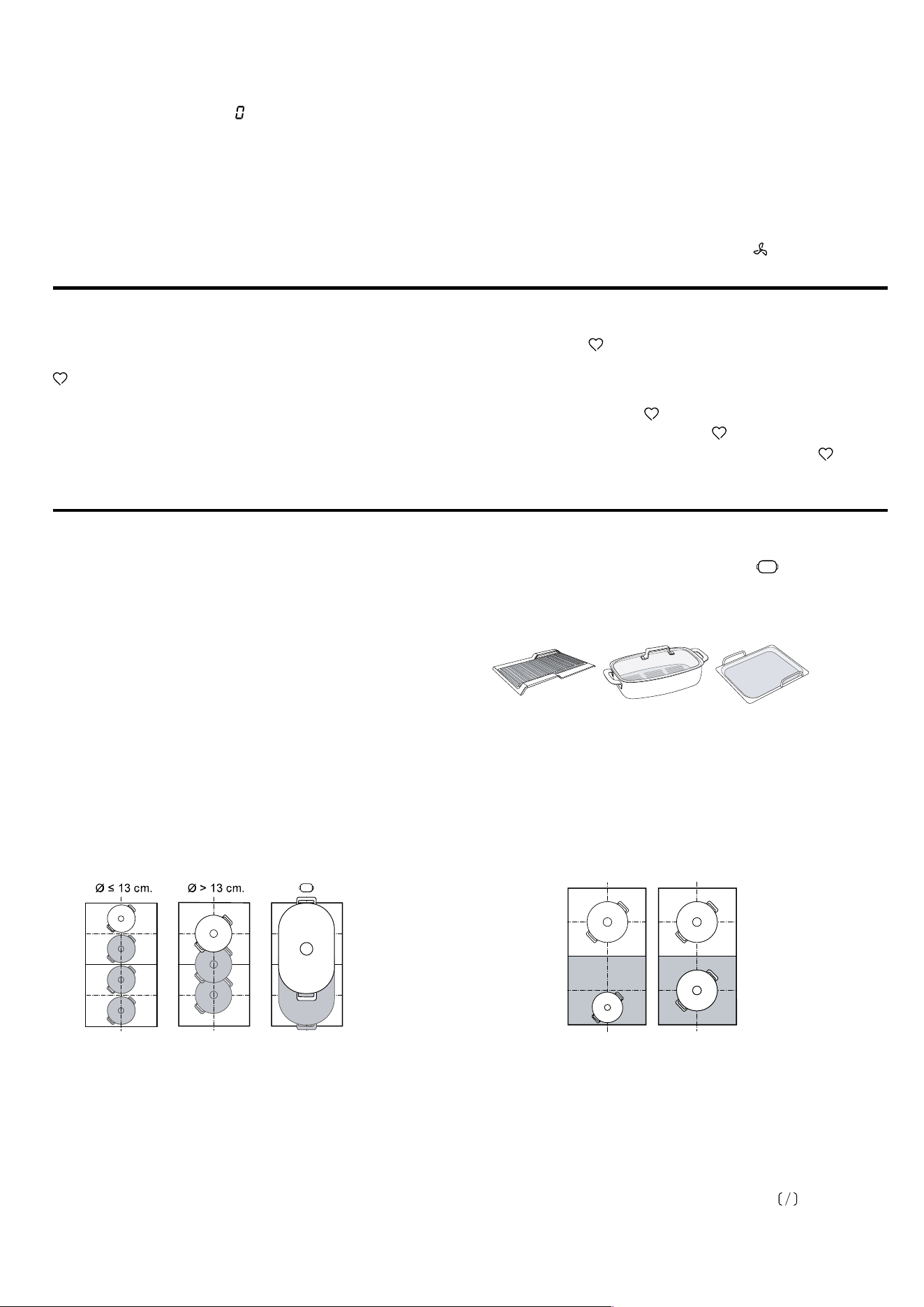
13.1 Positioning the cookware
The flexible cooking zone can be configured in two
ways, depending on which cookware is used. In order
to guarantee good thermal detection and heat distribu-
tion, we recommend positioning the cookware in the
centre, as shown in the figures.
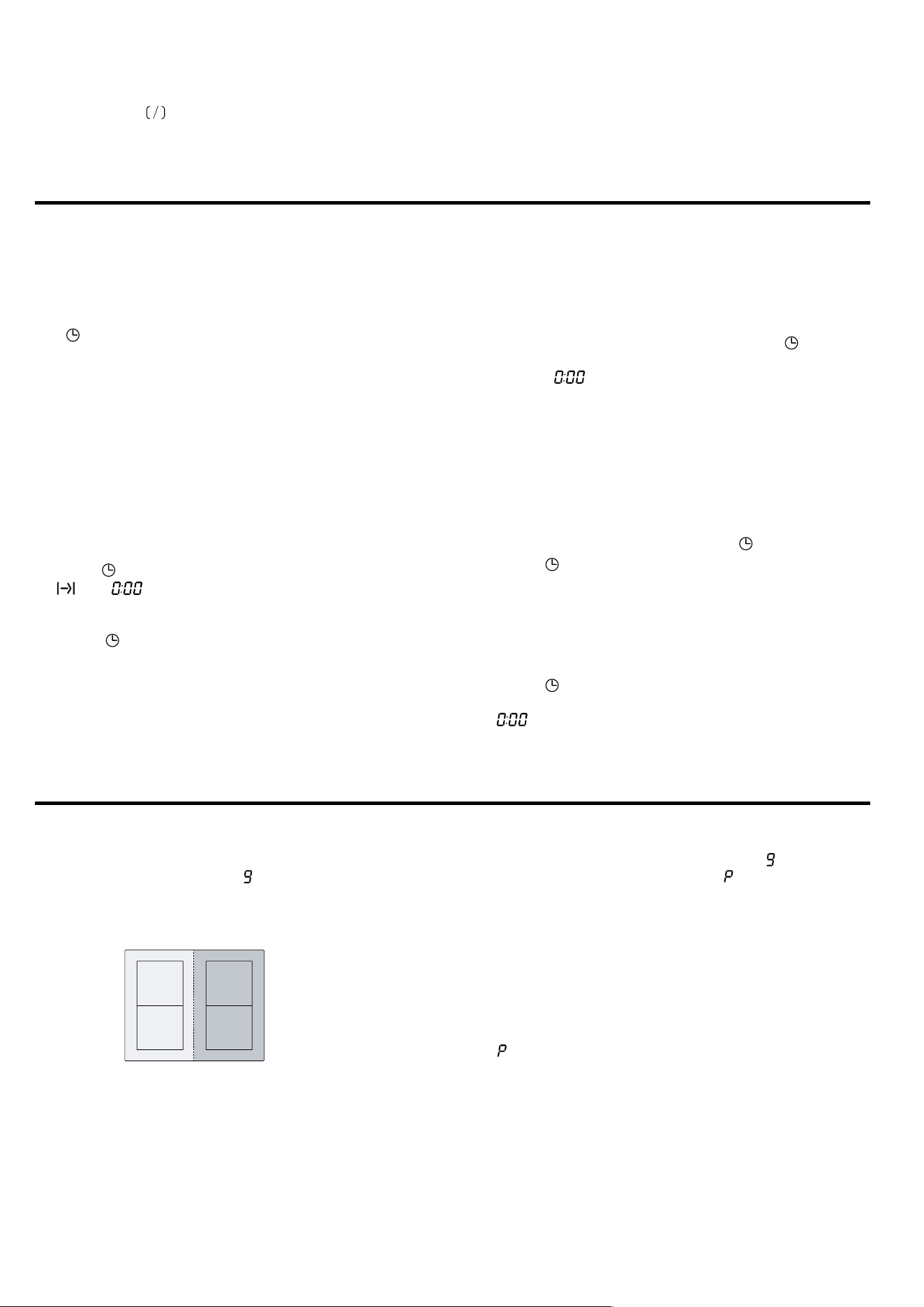
As a connected cooking zone
Recommended for cooking with just one item of cook-
ware.
¡ Position the cookware depending on the size:
¡ Recommended oblong cookware :
As two separate cooking zones
Recommended for cooking with two items of cook-
ware.
You can use the front and rear zone independently of
one another, and set a separate power level for each
zone.
13.2 Switching on Flex Zone
1.
Place the cookware on the cooking zone.
2.
The appliance detects the cookware and selects the
cooking zone.
a The cooking zones split or connect automatically
depending on the size and position of the cook-
ware.
a Once the flexible zone is connected, lights up
red.
Time-setting options en
15
Notes
¡ By touching , you can manually change the set-
tings for the cooking zone.
¡ If you move or lift the cookware from an active con-
nected cooking zone, an automatic search starts.
Each item of cookware that is found within the cook-
ing zone during this search is heated at the previ-
ously selected power level.
Time-setting options
14 Time-setting options
Your hob has various functions for setting the cooking
time:
¡ Switch-off timer
¡ Timer
The button is assigned to the Switch-off timer func-
tion by default. However, you can also assign one of
the above-mentioned functions to the sensor.You can
change these settings via the Home Connect app or in
the basic settings →Page19.
14.1 Switch-off timer
You can use the function to programme a cooking time
in a cooking zone and its automatic switch-off once the
set time has elapsed.
Switching on Switch-off timer
1.
Select the cooking zone and the power level.
2.
Press .
a and light up.
3.
To set the required cooking time, turn the rotary
knob within 10 seconds.
4.
Touch to confirm.
a Once the cooking time has elapsed, the cooking
zone is switched off and a signal sounds.
Notes
¡ When you set a cooking time for a cooking zone in
which the Frying Sensor is activated, the cooking
time will not start counting down until the selected
temperature level has been reached.
¡ To switch the display between the operating temper-
ature Frying Sensor and the programmed cooking
time, press the selected temperature.
Changing or switching off Switch-off timer
1.
Select the cooking zone and then touch .
2.
Use the rotary knob to change the cooking time or
set it to to switch off the function.
14.2 Timer
You can use the function to activate a timer. This func-
tion operates independently of the cooking zones and
other settings. It does not automatically switch off the
cooking zones.
Switching on Timer
Requirement:Assign the function to .
1.
Touch .
2.
Turn the rotary knob to select the required time.
a The time starts to elapse.
a A signal tone sounds and the displays flash once
the time has elapsed.
Changing or switching off the Timer
1.
Touch .
2.
Use the rotary knob to change the time or set it to
to switch off the function.
PowerBoost
15 PowerBoost
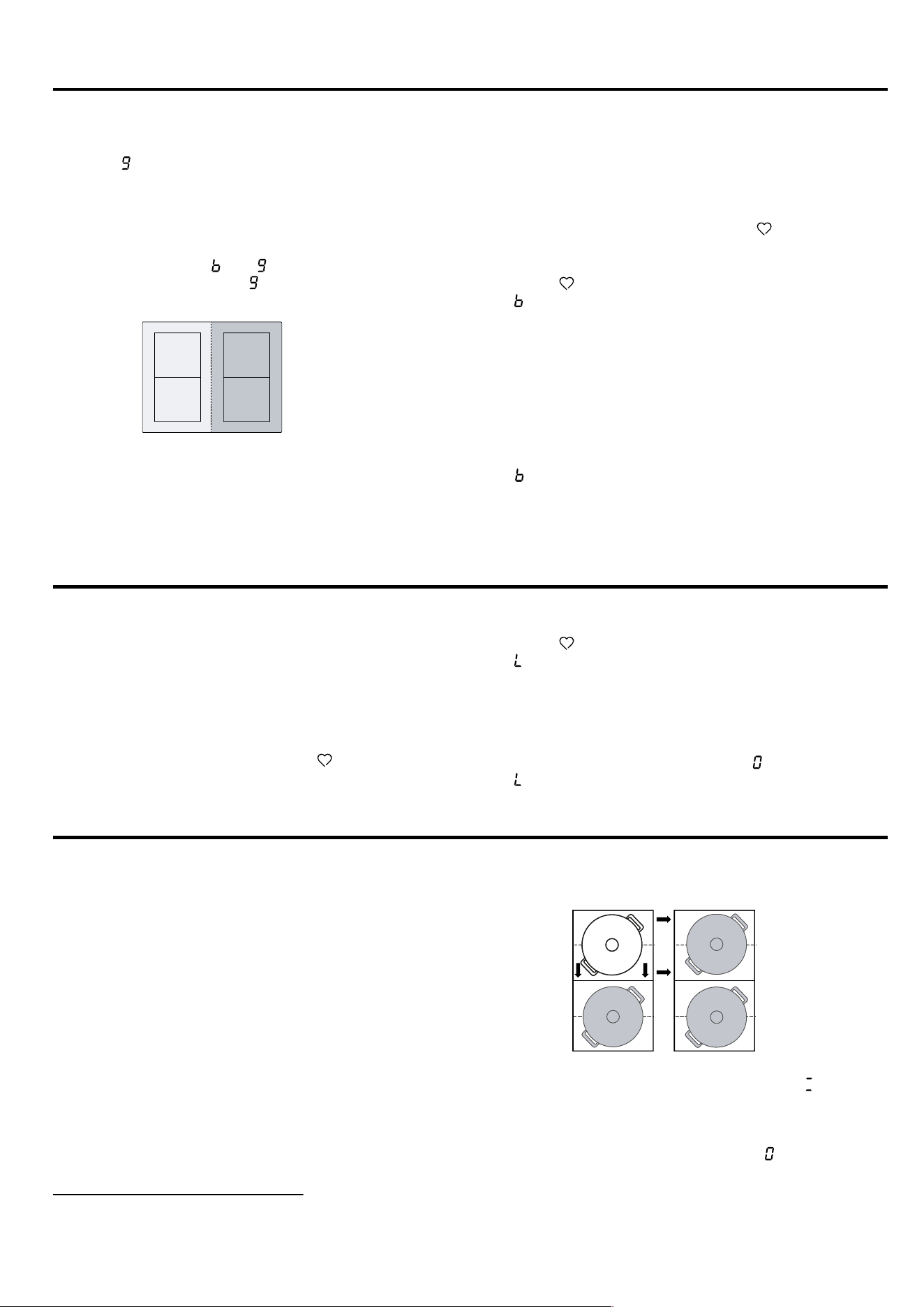
You can use this function to heat up large volumes of
water more quickly than with .
This function is available for all cooking zones,
provided the other cooking zone on the same side is
not in use.
15.1 Switching on PowerBoost
1.
Select the cooking zone.
2.
Turn the rotary knob until power level appears.
3.
Turn the rotary knob again until lights up.
a The function is switched on.
Note:You can also switch on this function when cook-
ing with a connected FlexZone.
15.2 Switching off PowerBoost
1.
Select the cooking zone.
2.
Turn the rotary knob and select a different power
level.
a goes out.
a The function is deactivated.
Note:In certain circumstances, the appliance switches
this function off to protect the electronic elements in-
side the hob.
en PanBoost
16
PanBoost
16 PanBoost
1
You can use this function to heat up pans more quickly
than with . Do not use the PowerBoost function with
frying pans – this may damage the coating.
You can activate the function via Home Connect or Fa-
vourite button.
This function is available for all cooking zones,
provided the other cooking zone on the same side is
not in use. Otherwise, and flash on the display for
the selected cooking zone. then switches on auto-
matically.
16.1 Recommended applications
¡ Do not place a lid on the pan.
¡ Never leave pans unattended when they are heating
up.
¡ Only use cold pans.
¡ Use pans with a completely flat base. Do not use
pans with a thin base.
16.2 Switching on PanBoost
Requirement:Assign the function to .
→"Favourite button", Page14.
1.
Select the cooking zone.
2.
Press .
3.
lights up.
a The function is activated.
Note:You can also switch on this function when cook-
ing with a connected FlexZone.
16.3 Switching off PanBoost
1.
Select the cooking zone.
2.
Turn the rotary knob and select a different power
level.
a goes out.
a The function is deactivated.
Note:To avoid high temperatures, this function auto-
matically switches itself off after 30 seconds.
Keep-warm function
17 Keep-warm function
1
You can use this function to melt chocolate or butter,
and to keep meals warm.
You can activate the function via Home Connect or Fa-
vourite button.
17.1 Switching on Keep-warm function
Requirement:Assign the function to .
→"Favourite button", Page14.
1.
Select the required cooking zone.
2.
Press .
lights up.
a The function is switched on.
17.2 Switching off Keep-warm function
1.
Select the cooking zone.
2.
Turn the rotary knob and set it to .
goes out.
a The function is deactivated.
PowerTransfer
18 PowerTransfer
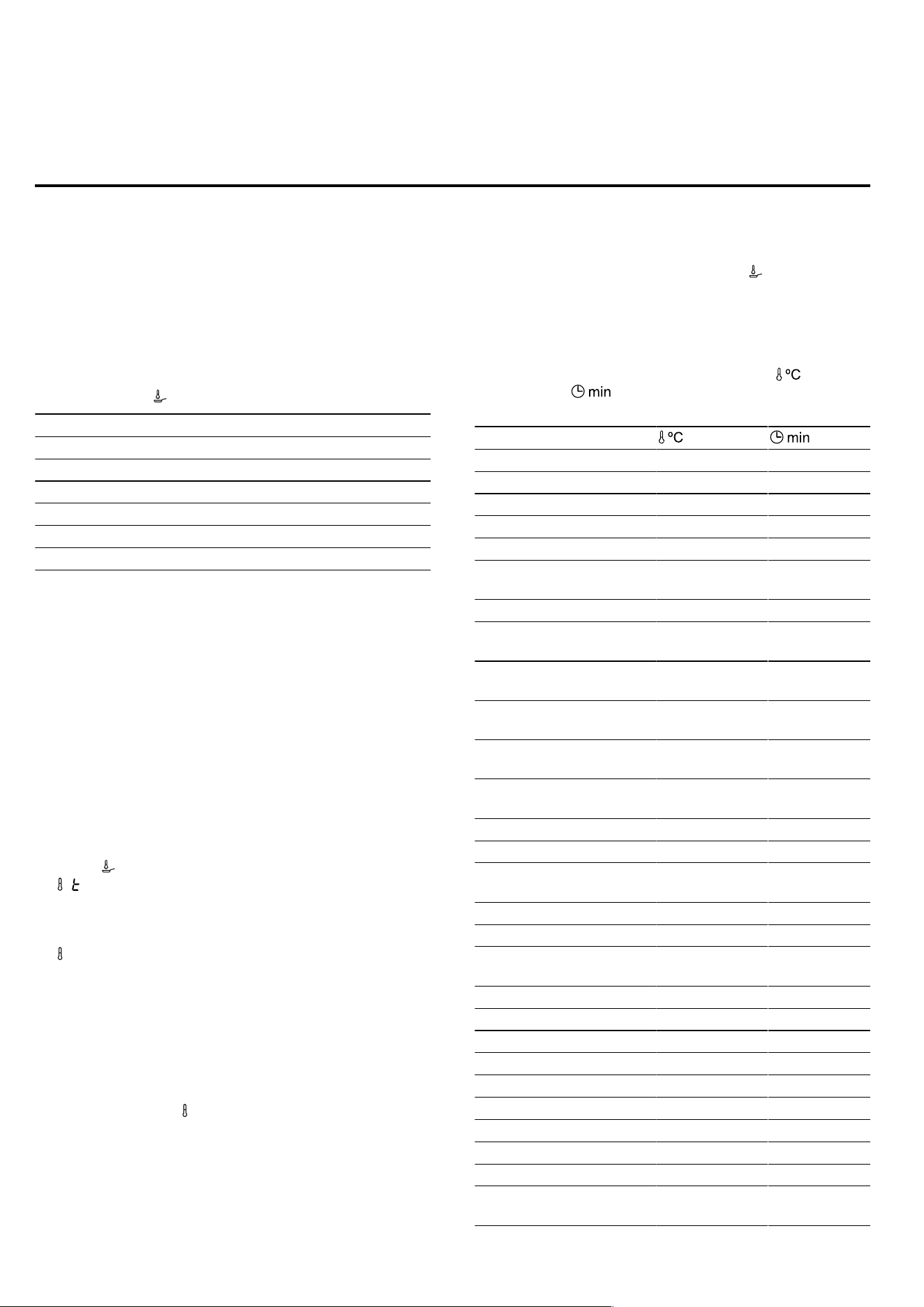
You can use this function to transfer the power level
and the programmed cooking time from one cooking
zone to another.
18.1 PowerTransfer
Requirement:Move the cookware to a cooking zone
which is not switched on, which you have not yet pre-
set or on which no other cookware has been previously
placed.
1.
Move the cookware.
a The cookware is detected.
a The previously selected power level and flash al-
ternately on the display for the new cooking zone.
2.
In order to implement the settings, use the rotary
knob to select the new cooking zone.
a The original cooking zone is set to .
1
Available depending on software version. Further information on availability can be found on the website.
Frying Sensor en
17
a The settings are transferred to the new cooking
zone.
Note:If you place a new item of cookware on a differ-
ent cooking zone before you have confirmed the set-
tings, you can use this function for the new item of
cookware.
Frying Sensor
19 Frying Sensor
This function allows you to melt, prepare sauces, sauté,
deep fry or fry while keeping the temperature under
control.
Instead of constantly adjusting the power level during
cooking, select the required target temperature once at
the start. The sensors under the glass ceramic meas-
ure the temperature of the cookware and keep this
constant throughout the entire cooking process.
This function is available on all cooking zones marked
with this symbol .
Functions Temperature
Melting 70-80ºC
Preparing sauces 110 - 120 ºC
Frying 140ºC
Frying 160ºC
Frying 180-200ºC
Frying 220ºC
19.1 Recommended cookware
Special cookware has been developed for this function,
which delivers the best results.
The recommended cookware is available from cus-
tomer service, specialist retailers or our online shop
www.neff-home.com.
Note:You can also use other cookware. Depending on
the composition of the cookware, the achieved temper-
ature may differ from the selected temperature level.
19.2 Switching on the Frying Sensor
1.
Place the empty cookware on a cooking zone.
2.
Selecting a hotplate
3.
Press .
a , and the preset temperature light up on the dis-
play for the selected cooking zone.
4.
Use the rotary knob to select the required temperat-
ure.
a flashes on the control panel until the set temperat-
ure is reached.
a The selected temperature and the development of
the temperature reached in the pan flash alternately
until the selected temperature has been reached.
a The temperature shown on the displays is approxim-
ate and may differ from the actual temperature in
the frying pan.
a Once the temperature has been reached, a signal
tone sounds and as well as the temperature sym-
bol stop flashing.
5.
Add the frying fat and then the food to the frying
pan.
Note:If you need to cook with more than 250ml oil,
add the oil and wait a few seconds before you add the
food.
19.3 Switching off Frying Sensor
▶
Select the cooking zone and touch .
19.4 Recommendations for cooking with
Frying Sensor
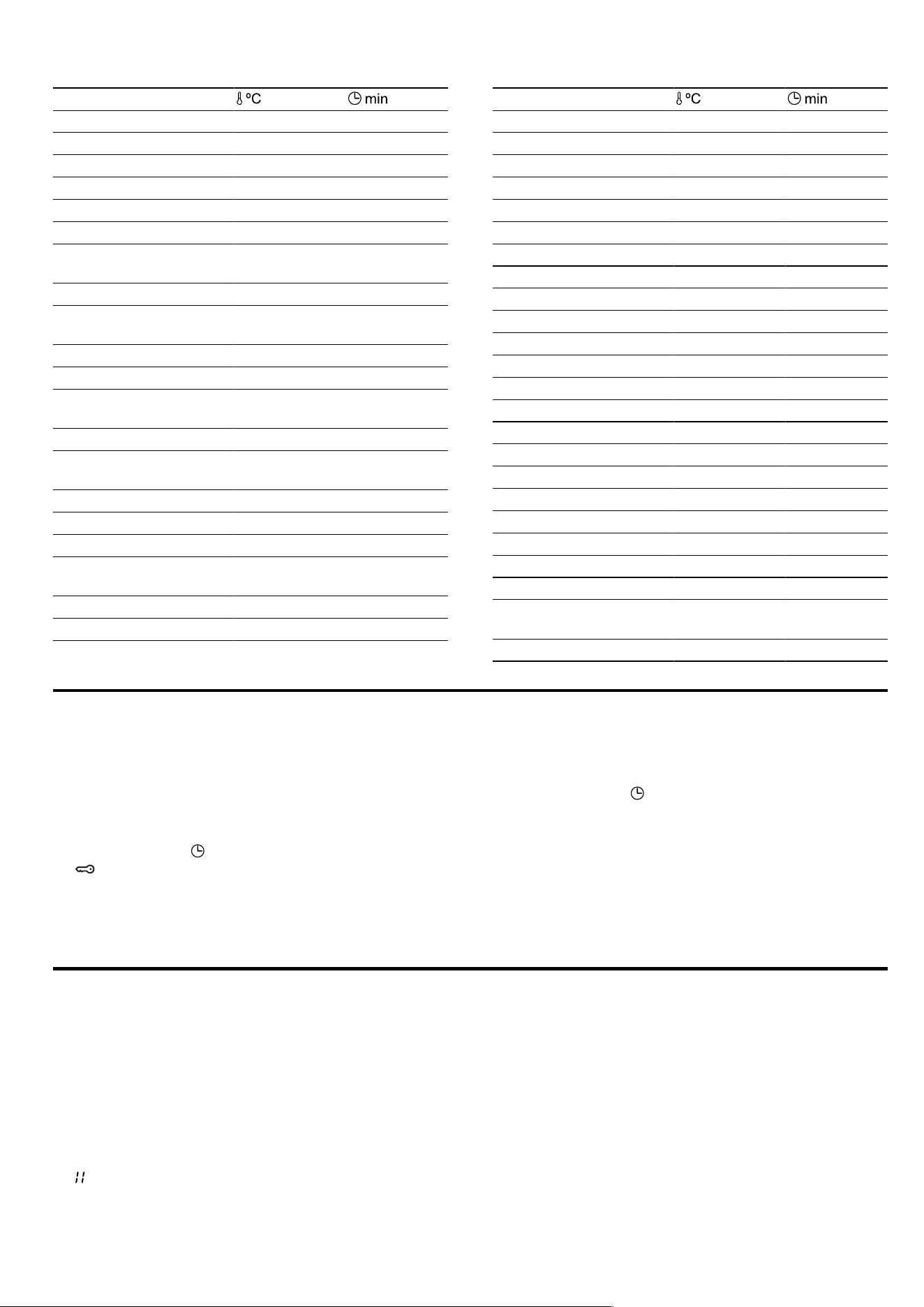
The following table shows the ideal temperature levels
for a selection of dishes. The temperature and the
cooking time depend on the amount, condition
and quality of the food.
Meat
Escalope, plain 160-180 4-10
Escalope, breaded 180 6-10
Fillet 180-200 6-10
Chops 160-180 10-15
Cordon bleu, Wiener
Schnitzel
180 10-15
Steak, rare, 3cm thick 220 8-10
Steak, medium, 3cm
thick
200 6-10
Steak, well-done, 3cm
thick
180 6-12
T-bone steak, rare,
4.5cm thick
200-220 10-15
T-bone steak, medium,
4.5cm thick
180-200 20-30
Poultry breast, 2 cm
thick
160 10-20
Bacon 160-180 5-8
Minced meat 180-200 6-10
Hamburgers, 1.5cm
thick
160-200 6-15
Meatballs 160-180 10-20
Pre-boiled sausages 160-180 8-20
Chorizo, fresh saus-
ages
160-180 10-20
Skewers 160-180 10-20
Gyros 180-200 6-10
Fish and seafood
Fish fillet, plain 180 10-20
Fish fillet, breaded 180 10-20
Fish, fried, whole 160 10-20
Sardines 180 6-12
Prawns 180 4-8
Squid, cuttlefish 180-200 6-12
Blue mussels, clams,
cockles
110-120 4-8
en Childproof lock
18
Egg dishes
Fried eggs in butter 140 2-6
Fried eggs in oil 180-220 2-6
Scrambled eggs 140 4-9
Omelette 140 3-6
French toast 160 4-8
Crêpes, blini, pan-
cakes, tacos
180-200 1-3
Vegetables
Fried potatoes, boiled
in their skin
180-200 6-12
Chips 180-200 15-25
Potato fritters 200 2-4
Onions, garlic, sauteed
until clear
140 4-12
Onion rings 180-200 4-12
Courgettes, aubergines,
peppers
160-180 4-12
Green asparagus, fried 160-180 10-20
Mushrooms 180 10-15
Vegetables, glazed 120 10-20
Vegetables in tempura
batter
180-200 5-10
Frozen dishes
Chicken nuggets 180-200 8-12
Fish fingers 180 8-12
Chips 200-220 4-8
Stir-fries 160-180 6-10
Spring rolls 180-200 8-15
Pasties, croquettes 200-220 6-8
Sauces
Tomato sauce 120 20-30
Cream sauce 110-120 10-20
Béchamel sauce 110-120 10-20
Cheese sauce 110-120 3-8
Sweet sauces 110-120 10-20
Reducing sauces 110-120 5-10
Melting
Chocolate coating 70-80 5-15
Cheese 70-80 3-10
Butter 70-80 3-5
Fondue 70-80 5-15
Miscellaneous
Fried cheese 180-200 5-15
Croutons 160-180 6-10
Bread for toasting 200-220 8-12
Dried ready meals 110-120 5-10
Almonds, walnuts, pine
nuts, roasted
180-200 3-15
Popcorn 220 10-20
Childproof lock
20 Childproof lock
The hob is equipped with a childproof lock. You can
use this to prevent children from switching on the hob.
20.1 Switching on Childproof lock
Requirement:The hob must be switched off.
▶
Touch and hold for 4 seconds.
a lights up for approx. 10seconds.
a The hob is locked.
20.2 Deactivating the childproof lock
1.
Switch on the hob.
2.
Touch and hold for four seconds.
a The lock is released.
20.3 Automatic childproof lock
You can also activate the childproof lock automatically
every time the hob is switched off.
You can find out how to switch the function on and off
in the "Basic settings" section →Page19.
Pause
21 Pause
You can use the function to pause and resume active
cooking processes for up to 10 minutes without having
to change the settings you have selected.
You can switch the function on to clean the control
panel, for example.
21.1 Activating the Pause function
▶
Remove the rotary knob from the control panel.
a flashes on the cooking zone displays.
a All active cooking processes are stopped. The set-
tings are retained.
a The function is activated.
21.2 Deactivating the Pause function
▶
Place the rotary knob back on the control panel.
a The function is deactivated. The cooking processes
continue.
Note:After approximately 10 minutes, the cooking
zone automatically switches off.
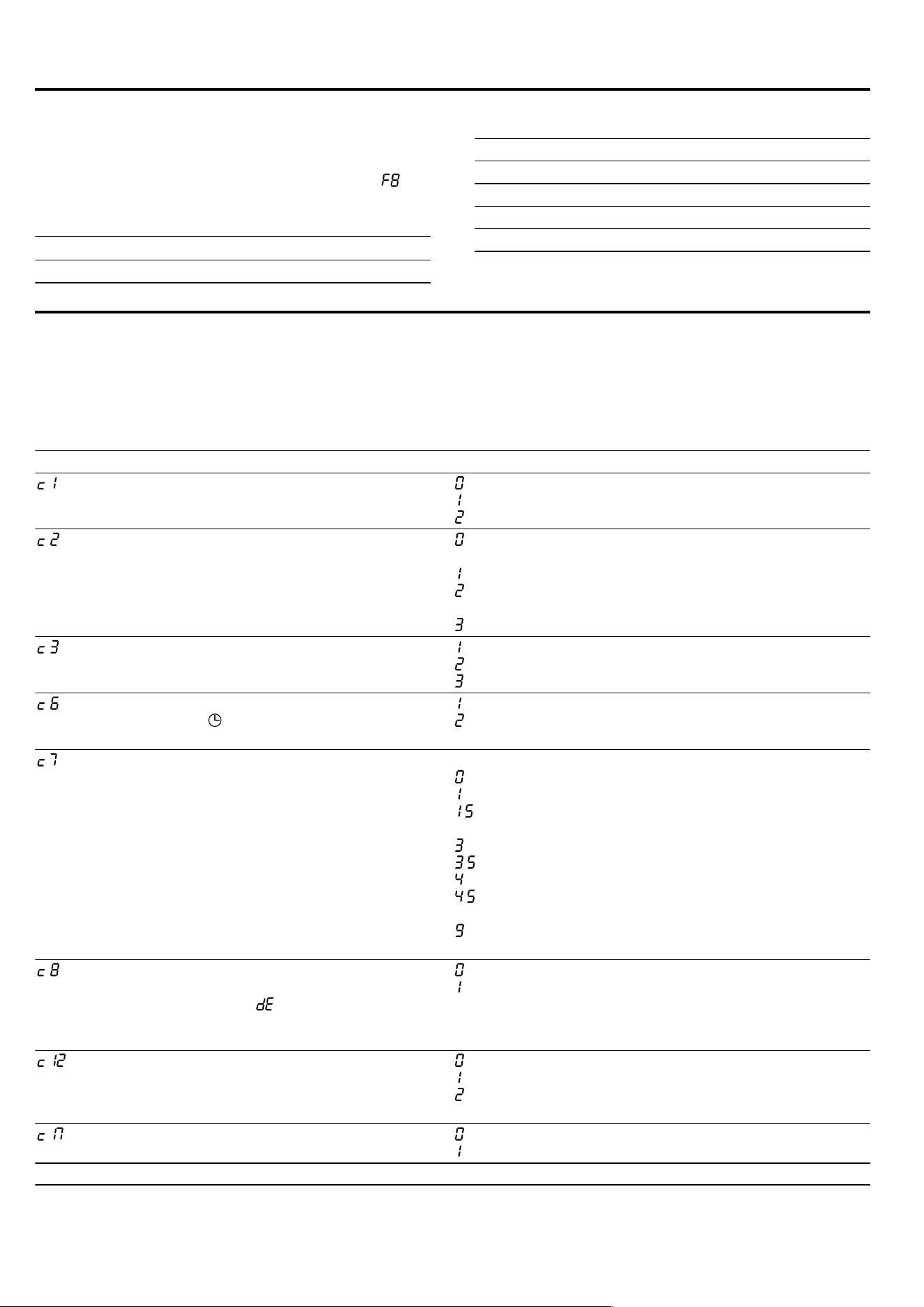
Individual safety switch-off en
19
Individual safety switch-off
22 Individual safety switch-off
Activate the safety function if one cooking zone is in
operation for an extended period and you do not
change any settings. The cooking zone displays
and switches itself off.
The time depends on the selected power level.
Power level Time
1.0 - 1.5 10 hours
2.0 - 3.5 5hours
4.0 - 5.0 4 hours
5.5 - 6.5 3 hours
7.0 - 7.5 2 hours
8.0 - 9.0 1hour
Press any button to switch on the cooking zone.
Basic settings
23 Basic settings
You can configure the basic settings for your appliance to meet your needs.
23.1 Overview of the basic settings
Display Setting Value
Childproof lock
→"Childproof lock", Page18
- Manual.
1
- Automatic.
- Function switched off.
Audible signals - The confirmation signal, the fault signal and the sig-
nal for incorrect use are deactivated.
- The fault signal is activated.
- The confirmation signal and the signal for incorrect
use are activated.
- All signal tones are switched on
1
.
Volume of the audible signals - Quiet.
- Medium.
1
– Loud.
Assign one of the time-setting programme
functions to on the control panel.
→"Time-setting options", Page15
- Switch-off timer.
1
- Timer.
Power limitation
This enables you to limit the total power of
the hob, if required, due to the circum-
stances of your electrical installation. Ob-
serve the regulations of the local electricity
suppliers. The available settings depend on
the maximum power of the hob. You can find
more information on the rating plate. If the
function is switched on and the hob has
reached the set power limit, the required and
permitted power level flashes and you can-
not select a higher power level.
The power is increased by 500 W with each level.
– Switched off. Maximum power of the hob
1
.
- 1000 W. Lowest power setting.
. - 1500 W.
...
- 3000 W.
. - 3500 W.
- 4000 W.
. - 4500 W.
...
- Maximum power of the hob.
Demo mode
Demonstration mode for the hob: When you
switch on the hob, lights up for a few
seconds and the cooking zones do not heat
up.
- Switched off.
1
- Switched on.
Cookware test
You can use this function to test the quality
of the cookware.
→"Cookware test", Page20
- Not suitable.
- Not optimal.
- Suitable.
Set circulating-air mode or air extraction
mode.
- Configure circulating-air mode.
1
- Configure air extraction mode.
1
Factory setting
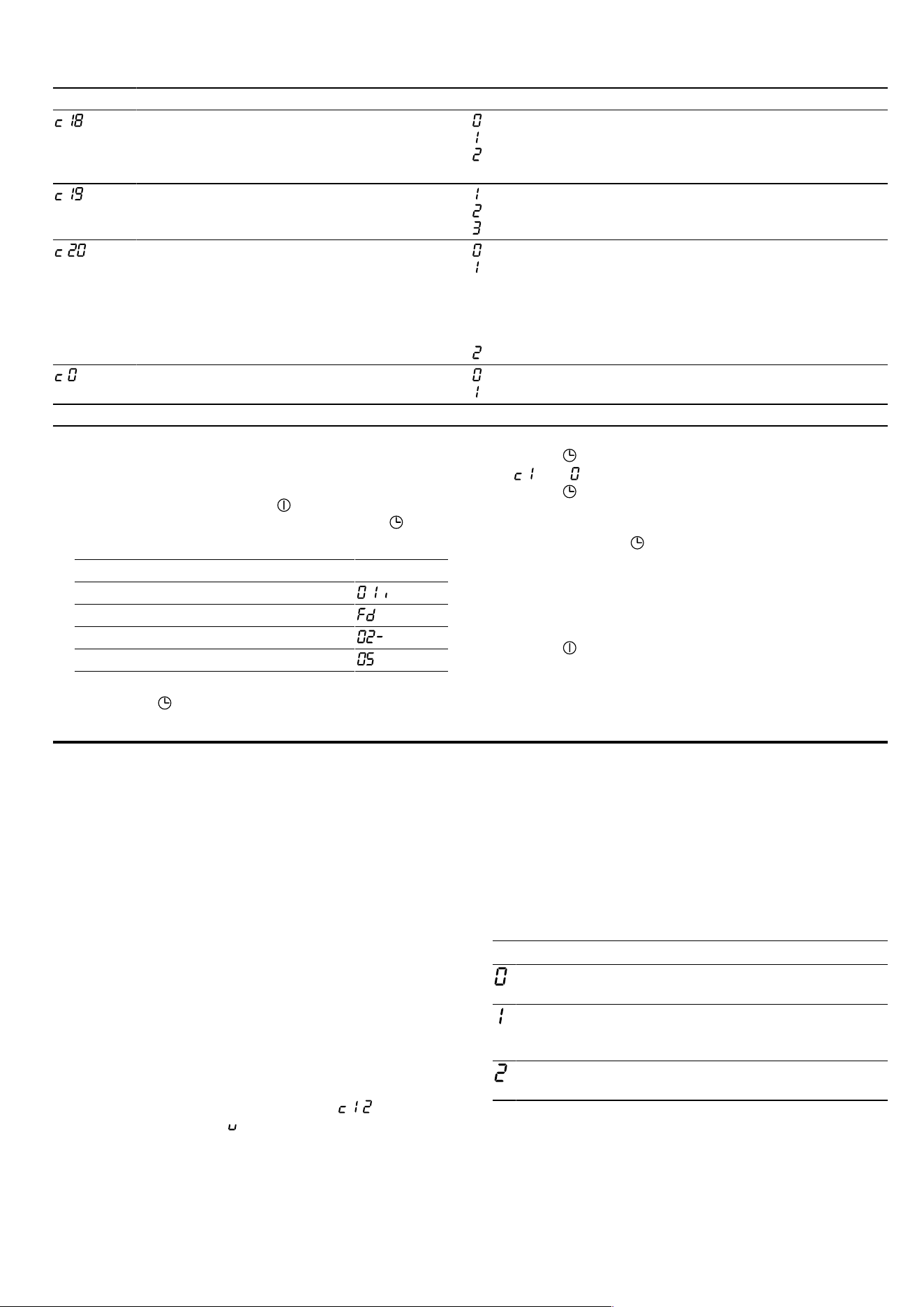
en Cookware test
20
Display Setting Value
Set the automatic ventilation system start. - Switched off.
- The ventilation system starts at the preset power level.
- The ventilation system starts during operation via the
sensor.
1
Setting the sensor sensitivity for the ventila-
tion system.
- Lowest sensor sensitivity setting.
- Medium sensor sensitivity setting.
1
- Highest sensor sensitivity setting.
Set the fan run-on for the ventilation system. - Switched off.
- Switched on. If your hob is working in air extraction
mode, the ventilation system is switched on at the power
level for approx. 6 minutes. If the hob is working in air re-
circulation mode, the ventilation system is switched on at
the power level for approx. 30 minutes.
1
- Switched on via the sensor.
Restoring factory settings - Individual settings
1
.
- Factory settings.
1
Factory setting
23.2 To go to the basic settings
Requirement:The hob must be switched off.
1.
To switch on the hob, touch .
2.
Within the next 10seconds, touch and hold for 4
seconds.
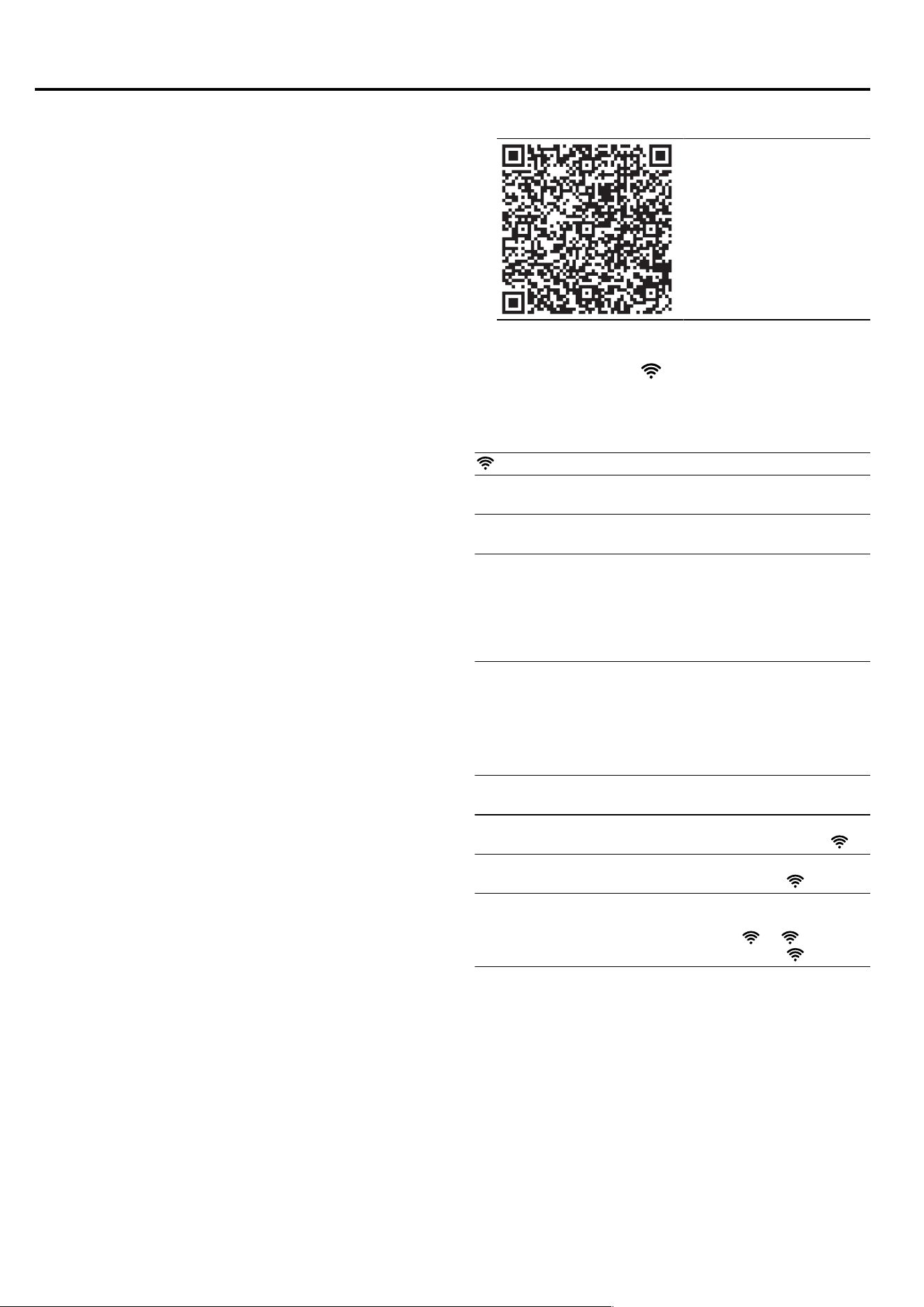
Product information Display
Customer service directory
Production number
Production number 1
Production number 2
a The first four displays provide the product informa-
tion. Touch to view the individual displays.
3.
Touch to access the basic settings.
a and light up as a presetting.
4.
Touch repeatedly until the desired setting ap-
pears.
5.
Use the rotary knob to change the desired setting.
6.
Touch and hold for 4 seconds.
a The settings are saved.
23.3 Discarding changes to the basic
settings
▶
Touch .
a All changes are discarded and not saved.
Cookware test
24 Cookware test
The quality of the cookware has a major influence on
the speed and the result of the cooking process.
You can use this function to test the quality of the cook-
ware.
Before the test, ensure that the diameter of the cook-
ware base corresponds to the diameter of the cooking
zone being used.
Access is via the basic settings. →Page19
24.1 Carrying out Cookware test
Requirement:As a single cooking zone, the flexible
cooking zone is set in such a way that only the indi-
vidual item of cookware is checked.
1.
At room temperature, place the cookware with ap-
prox.200ml water in the centre of the cooking zone
that best fits the base of the cookware in terms of
size.
2.
Call up the basic settings and select .
3.
Turn the rotary knob. flashes in the cooking
zones.
a The function is switched on.
a After 10 seconds, the result appears in the cooking
zone displays.
24.2 Checking the result
You can see what the result means for the quality and
speed of the cooking process in the following table.
Result
The cookware is not suitable for the cooking zone
and therefore does not heat up.
The cookware is taking longer to heat up than ex-
pected and cooking is not progressing as well as
it ought to.
The cookware is heating up correctly and cooking
is progressing well.
To switch the function on again, turn the rotary knob.
HomeConnect en
21
HomeConnect
25 HomeConnect
This appliance is network-capable. Connecting your ap-
pliance to a mobile device lets you control its functions
via the HomeConnect app, adjust its basic settings
and monitor its operating status.
The HomeConnect services are not available in every
country. The availability of the HomeConnect function
depends on the availability of HomeConnect services
in your country. You can find information about this at:
www.home-connect.com.
The HomeConnect app guides you through the entire
login process. Follow the instructions in the HomeCon-
nect app to configure the settings.
Tip:Please also follow the instructions in the
HomeConnect app.
Notes
¡ Please note the safety precautions in this instruction
manual and make sure that they are also observed
when operating the appliance via the HomeCon-
nect app.
→"Safety", Page2
¡ Operating the appliance on the appliance itself al-
ways takes priority. During this time it is not possible
to operate the appliance using the HomeConnect
app.
¡ In networked standby mode, the appliance requires
a maximum of2W.
¡ Hobs are not designed to be left unattended. Al-
ways monitor the cooking process.
25.1 Setting up the HomeConnect app
1.
Install the HomeConnect app on your mobile
device.
2.
Start the HomeConnect app and set up access for
HomeConnect.
The HomeConnect app guides you through the en-
tire login process.
25.2 Setting up HomeConnect
Requirements
¡ The appliance is connected to the power supply and
is switched on.
¡ You have a mobile device with a current version of
the iOS or Android operating system, e.g. a smart-
phone.
¡ The HomeConnectapp has been installed on your
mobile device.
¡ The appliance is receiving signals from the WLAN
home network (Wi-Fi) at its installation location.
¡ The mobile device and the appliance are within
range of your home network's Wi-Fi signal.
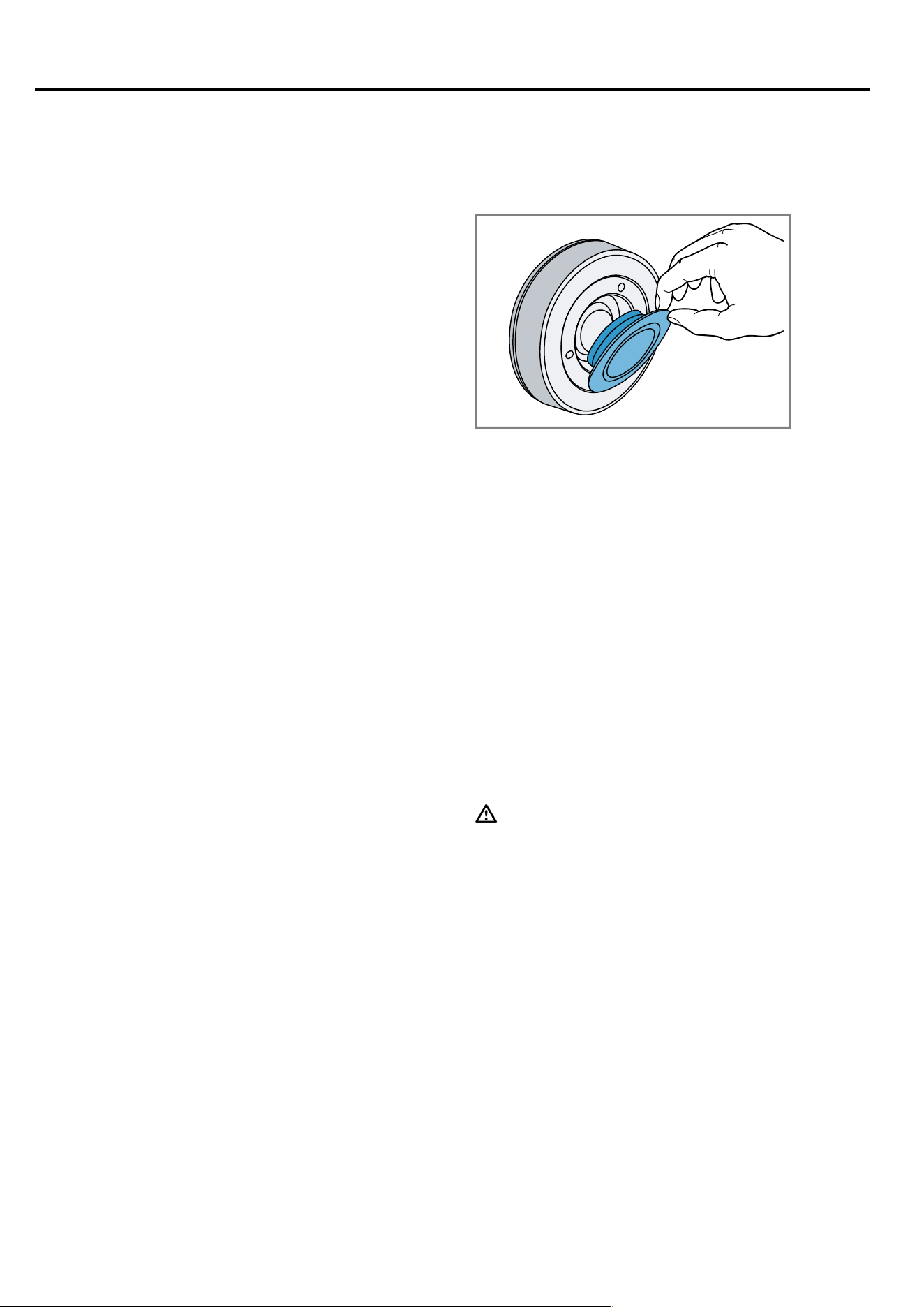
1.
Open the HomeConnect app and scan the follow-
ing QR code.
2.
Follow the instructions in the HomeConnect app.
25.3 Wi-Fi symbol
The Wi-Fi indicator on the main screen changes ac-
cording to the status and quality of the connection and
the availability of the HomeConnect server.
Status Description
Lights up white. No network connection
saved.
Lights up red. Network connection
saved and Wi-Fi active.
Flashes red. ¡ Network connection or
connection to another
appliance is being es-
tablished.
¡ Network settings are
reset.
25.4 Adding or removing a Wi-Fi home
network
The following overview shows how to add or remove a
Wi-Fi home network.
Wi-Fi home network
status
Action
No Wi-Fi home network
stored.
To add the Wi-Fi home
network, briefly press .
The Wi-Fi home network
has now been saved.
To pair another appliance,
press and hold .
The Wi-Fi home network
has now been saved.
To reset the Wi-Fi home
network settings, press
and hold . If flashes,
press and hold again.
25.5 Changing settings via the
HomeConnect app
You can use the HomeConnect app to change the set-
tings for the cooking zones and send them to the hob.
Requirement:The hob is connected to the Wi-Fi and to
the HomeConnect app.
1.
Select the setting in the HomeConnect app and
send it to the hob.
Follow the instructions in the HomeConnect app.

en HomeConnect
22
Settings that you send from the HomeConnect app
to the hob must be confirmed on the hob.
a As soon as cooking settings are transmitted to a
cooking zone, the display starts to flash, depending
on the setting.
2.
To discard the setting, press any other touch field
on the hob.
25.6 Activating automatic presence
detection
1
Thanks to the automatic presence detection function,
you no longer need to confirm parameters on the hob
from your mobile device, provided you are near the
hob. If you send settings to a cooking zone, you can
confirm these directly from your mobile device.
Requirements
¡ The hob is connected to the Wi-Fi and to the
HomeConnect app.
¡ The Bluetooth is connected to the mobile device.
¡ The user is near the hob.
1.
Open the HomeConnect app.
2.
In order to set the automatic presence detection, fol-
low the instructions in the HomeConnect app.
25.7 Software update
Your appliance's software can be updated using the
software update function, e.g. for the purposes of op-
timisation, troubleshooting or security updates.
To do this, you must be a registered HomeCon-
nectuser, have installed the app on your mobile device
and be connected to the HomeConnectserver.
As soon as a software update is available, you will be
informed via the HomeConnectapp and will be able to
start the software update via the app. Once the update
has been successfully downloaded, you can start in-
stalling it via the HomeConnectapp if you are in your
home network (Wi-Fi). The HomeConnectapp informs
you once installation is successful.
Notes
¡ The software update consists of two steps.
– The first step is the download.
– The second step is the installation on your appli-
ance.
¡ You can continue to use your appliance as normal
while updates are downloading. Depending on your
personal settings in the app, software updates can
also be set to download automatically.
¡ Installation takes a few minutes. You cannot use
your appliance during installation.
¡ We recommend that you install security updates as
soon as possible.
25.8 Remote diagnostics
Customer Service can use Remote Diagnostics to ac-
cess your appliance if you contact them, have your ap-
pliance connected to the HomeConnect server and if
Remote Diagnostics is available in the country in which
you are using the appliance.
Tip:For further information and details about the avail-
ability of Remote Diagnostics in your country, please
visit the service/support section of your local website:
www.home-connect.com.
25.9 Data protection
Please see the information on data protection.
The first time your appliance is registered on a home
network connected to the Internet, your appliance will
transmit the following types of data to the
HomeConnect server (initial registration):
¡ Unique appliance identification (consisting of appli-
ance codes as well as the MAC address of the Wi-Fi
communication module installed).
¡ Security certificate of the Wi-Fi communication mod-
ule (to ensure a secure data connection).
¡ The current software and hardware version of your
appliance.
¡ Status of any previous reset to factory settings.
This initial registration prepares the HomeConnect
functions for use and is only required when you want to
use the HomeConnect functions for the first time.
Note:Please note that the HomeConnect functions
can only be utilised with the HomeConnect app. In-
formation on data protection can be retrieved in the
HomeConnect app.
1
Available depending on software version. Further information on availability can be found on the website.
Cleaning and servicing en
23
Cleaning and servicing
26 Cleaning and servicing
To keep your appliance working efficiently for a long
time, it is important to clean and maintain it carefully.
26.1 Cleaning products
You can obtain suitable cleaning products and glass
scrapers from customer service, a retailer or the online
shop www.neff-home.com.
ATTENTION!
Unsuitable cleaning products may damage the sur-
faces of the appliance.
▶ Never use unsuitable cleaning products.
▶ Do not use cleaning products while the hob is still
hot. This may cause marks on the surface.
Unsuitable cleaning products
¡ Undiluted detergent
¡ Detergent intended for dishwashers
¡ Abrasive cleaning products
¡ Aggressive cleaning products such as oven spray
or stain remover
¡ Abrasive sponges
¡ High-pressure or steam jet cleaners
26.2 Cleaning the hob
Clean the hob after every use to stop cooking residues
from getting burnt on.
Requirement:The hob must be cold. Do not allow the
hob to cool down if it has sugar stains, rice starch,
plastic or aluminium foil on it.
1.
Remove heavy soiling using a glass scraper.
2.
Clean the hob with a cleaning agent for glass
ceramic.
Follow the cleaning instructions on the packaging of
the cleaning agent.
Tips
¡ You can achieve good cleaning results using a
special sponge for glass ceramic.
¡ If you keep the base of the cookware clean, the
hob surface remains in a good condition.
26.3 Cleaning profiles
Clean the profiles if they are dirty or stained after use.
Note:Do not use a glass scraper.
1.
Clean using warm soapy water and a soft cloth.
Wash new sponge cloths thoroughly before use.
2.
Dry with a soft cloth.
Note:If there are replaceable side profiles, wear pro-
tective gloves when removing them.
26.4 Cleaning Twist Pad®
The rotary knob consists of two parts, which you can
easily remove for a more thorough clean.
Recommended cleaning:
¡ Wipe the parts with warm soapy water and a cloth.
¡ Dry the parts thoroughly before reassembling.
Non-recommended cleaning:
¡ Do not use abrasive or corrosive products, such as
citric acid, vinegar, aggressive cleaning agents or
glass ceramic cleaners.
¡ Do not clean it in the dishwasher or immerse it in
water, as this may damage it.
¡ Do not use the glass scraper.
¡ Do not use stainless steel care products.
26.5 Grease filter
The grease filter filters the grease out of the kitchen
steam. The filter comprises a container and two remov-
able grease filters. How frequently you clean the mod-
ule depends on the quantity and type of grease used
when cooking. To keep them in good working order,
you must clean the grease filters if there are visible
grease deposits or at least once a month.
WARNING‒Risk of fire!
Fatty deposits in the grease filters may catch fire.
▶ Never operate the appliance without a grease filter.
▶ Clean the grease filters regularly.
▶ Never work with naked flames close to the appli-
ance (e.g.flambéing).
ATTENTION!
Falling grease filters may damage the hob below.
▶ Grip below the grease filter with one hand.
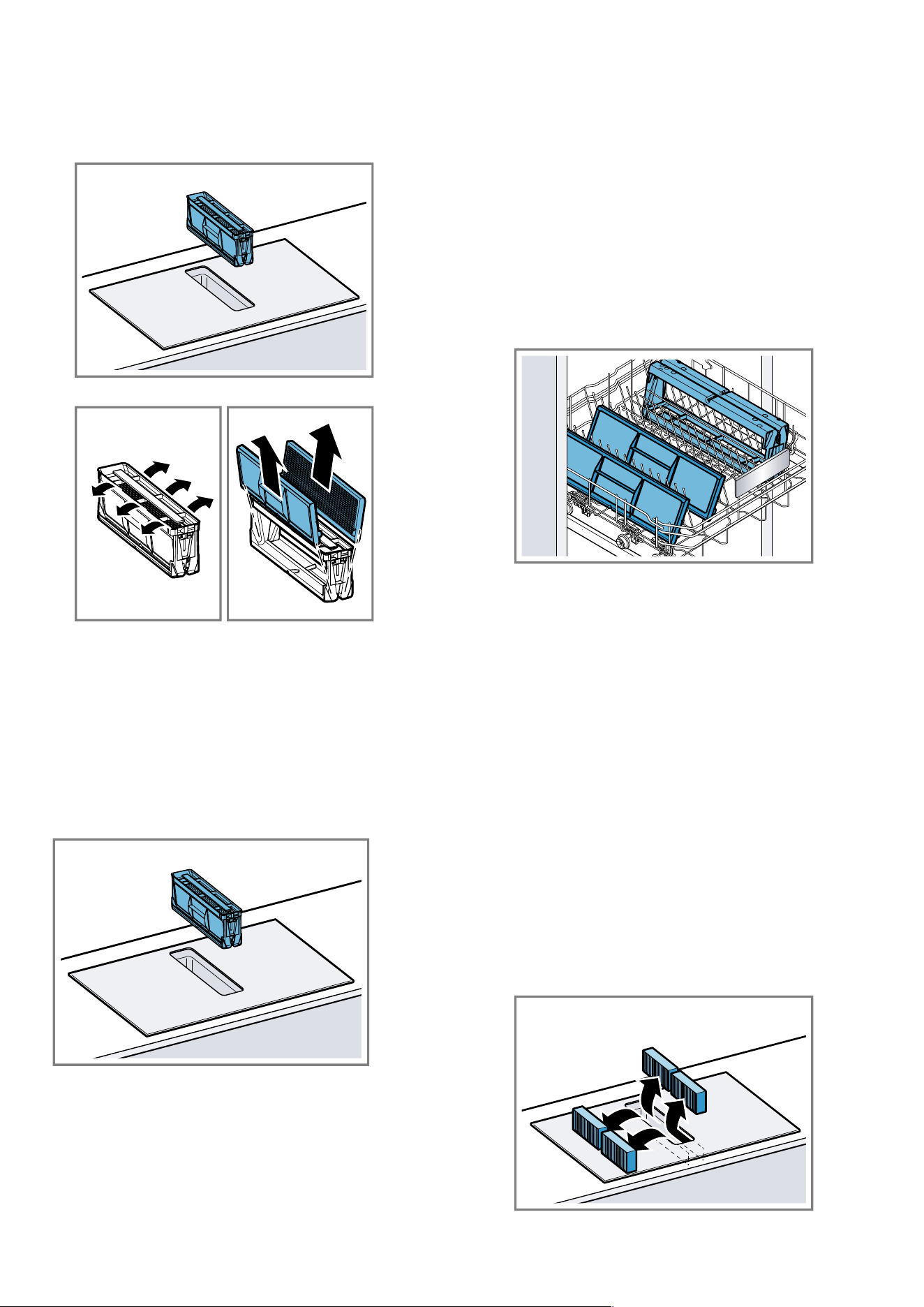
en Cleaning and servicing
24
1.
Remove the grease filter.
‒ Grease may accumulate in the bottom of the
container. Keep the grease filter level to prevent
grease from dripping out.
2.
Remove the components of the grease filter.
3.
Clean the grease filter in the dishwasher or by hand.
→"Cleaning the grease filters manually", Page24
→"Cleaning the grease filter in the dishwasher",
Page24
4.
If required, remove the odour filters or acoustics fil-
ters and clean the appliance from the inside.
5.
If any objects get into the appliance, remove these
objects and ensure that the supply to the overflow
container is not blocked.
6.
Wipe out the inside of the appliance with soapy wa-
ter and a dish cloth.
7.
After cleaning, reinsert the dried grease filter.
Cleaning the grease filters manually
1.
Remove the components of the grease filter.
2.
Soak the grease filter in hot soapy water.
‒ Use a brush to clean the grease filter. Do not use
aggressive, acidic or alkaline cleaning products.
‒ Use special grease solvent for stubborn dirt. You
can purchase the grease solvent from Customer
Service, through our online shop or in a special-
ist shop.
3.
Rinse the grease filters thoroughly.
4.
Leave the grease filter to drain.
5.
Fit the components of the grease filter.
6.
After drying, insert the grease filter into the appli-
ance.
Cleaning the grease filter in the dishwasher
1.
Remove the grease filter.
2.
Remove the components of the grease filter.
3.
Place the components of the grease filter loosely in
the dishwasher and do not jam them in.
Do not clean heavily soiled grease filters with table-
ware. Do not use aggressive, acidic or alkaline
cleaning products.
4.
Start the dishwasher. Select a maximum temperat-
ure setting of 70°C.
5.
Leave the grease filter to drain.
6.
After drying, insert the grease filter into the appli-
ance.
26.6 Odour filter or acoustics filter
You can obtain odour filters or acoustics filters from
specialist retailers, customer service or in the online
shop.
Notes
¡ Replace the odour filters when the warning is dis-
played on the appliance.
→"Resetting the saturation indicator", Page25
¡ Change the acoustics filters if they are dirty.
Requirement:To keep them in good working order,
only use genuine replacement filters.
1.
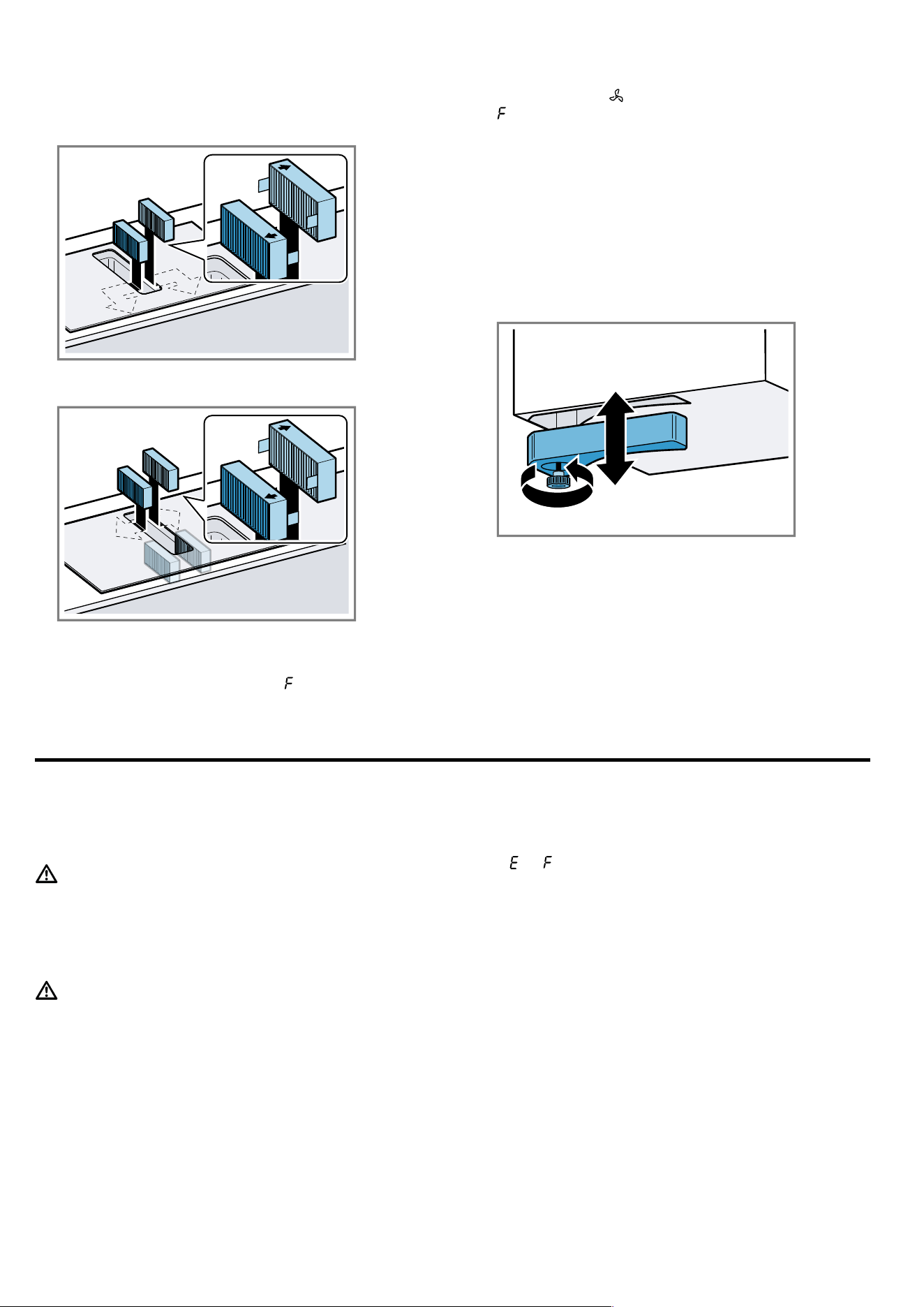
Remove the grease filter.
2.
Remove the four odour filters or acoustics filters,
and dispose of them properly.
Troubleshooting en
25
3.
Insert two new odour filters or acoustics filters into
the left and right of the appliance and slide them for-
wards.
4.
Insert the other odour filters or acoustics filters into
the left and right of the appliance.
5.
Insert the grease filter into the appliance.
Resetting the saturation indicator
After the appliance is switched off, lights up.
1.
Replace the odour filters.
→"Odour filter or acoustics filter", Page24
2.
Press and hold until a signal tone sounds.
a stops lighting up. The odour filter display is reset.
26.7 Cleaning the overflow container
The overflow container collects liquids or objects that
come into the appliance from above.
Requirement:The appliance has cooled and the resid-
ual heat indicator has gone out.
1.
Hold the overflow container with one hand and un-
screw it with the other hand.
‒ Hold the overflow container level to prevent liquid
from leaking out.
2.
Empty the overflow container and rinse it out.
3.
If required, unscrew the screw and clean the over-
flow container without the screw in the dishwasher.
4.
Clean the overflow container before screwing it
back into place.
5.
Ensure that the supply to the overflow container is
not blocked.
Remove any objects that have entered the appli-
ance once it has cooled down. To do this, remove
the grease filter.
Troubleshooting
27 Troubleshooting
You can rectify minor faults on your appliance yourself.
Read the troubleshooting information before contacting
after-sales service. This will avoid unnecessary costs.
WARNING‒Risk of injury!
Improper repairs are dangerous.
▶ Repairs to the appliance should only be carried out
by trained specialist staff.
▶ If the appliance is defective, call Customer Service.
→"Customer Service", Page27
WARNING‒Risk of electric shock!
Improper repairs are dangerous.
▶ Repairs to the appliance should only be carried out
by trained specialist staff.
▶ Only use genuine spare parts when repairing the
appliance.
▶ If the power cord or the appliance power cable of
this appliance is damaged, it must be replaced with
a special power cord or special appliance power
cable, which is available from the manufacturer or
its Customer Service.
27.1 Warnings
Notes
¡ If or appears on the display, press and hold the
rotary knob next to the mark for the relevant cook-
ing zone in order to read the fault code.
¡ If the fault code is not listed in the table, disconnect
the hob from the power supply and wait 30seconds
before reconnecting it. If this display appears again,
contact customer service and specify the exact fault
code.
¡ If an error occurs, the appliance does not switch to
standby mode.
¡ In order to protect the appliance's electronic parts
from overheating or surge currents, the hob may
temporarily reduce the power level.
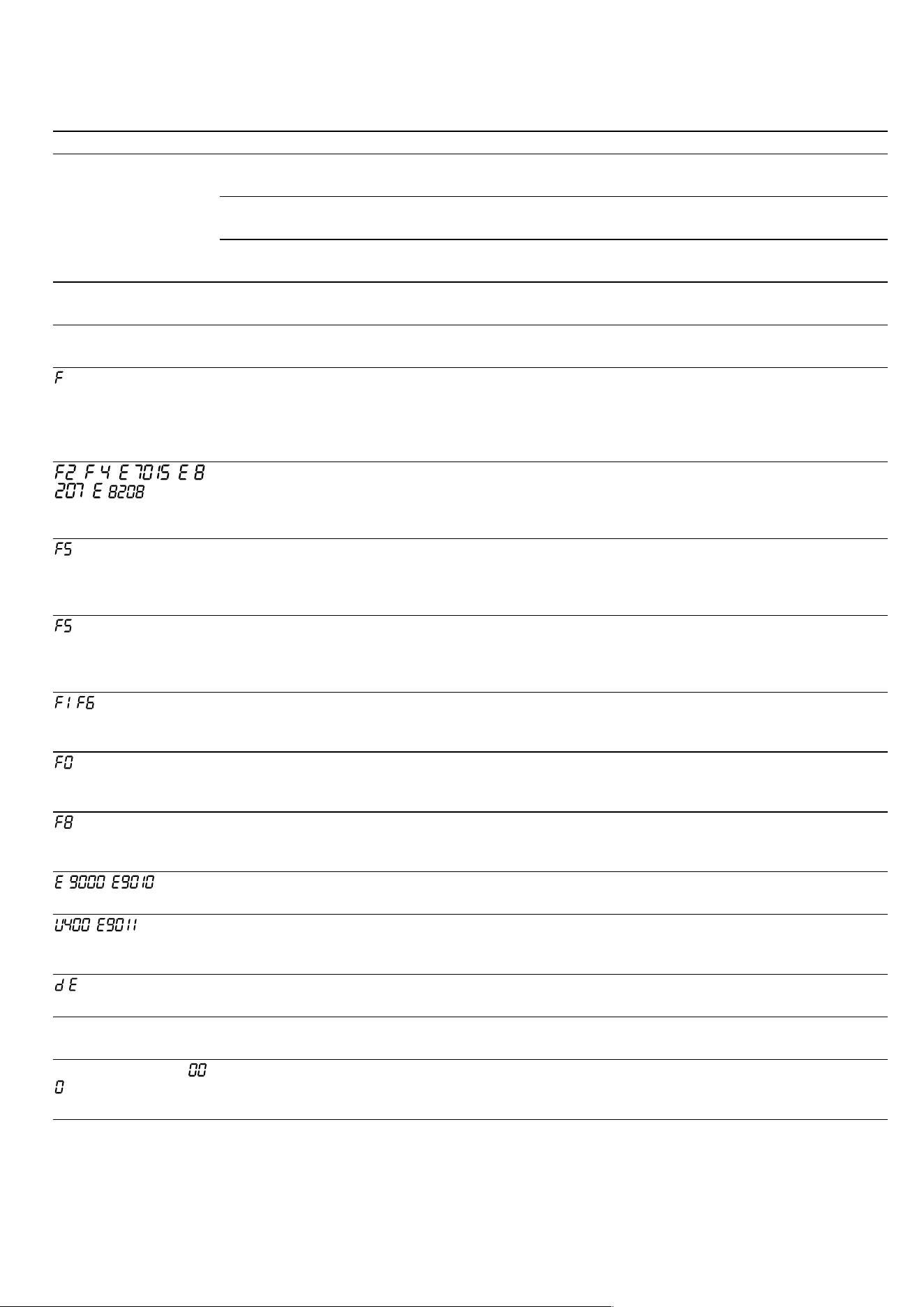
en Troubleshooting
26
27.2 Information on the display panel
Fault Cause and troubleshooting
No displays light up. The power supply has been disconnected.
▶
Use other electrical appliances to check whether there has been a power failure.
The appliance has not been connected as shown in the circuit diagram.
▶
Connect the appliance in accordance with the circuit diagram.
Electronics fault
▶
If you are unable to rectify the fault, inform the technical after-sales service.
Ventilation system not
working
The appliance has not been connected as shown in the circuit diagram.
▶
Connect the appliance in accordance with the circuit diagram.
The displays flash. The control panel is wet or an object is covering it.
▶
Dry the control panel or remove the object.
The odour filter is saturated or the saturation indicator lights up even though the filter has
been replaced.
▶
Change the filter and reset the filter saturation indicator. You can find additional informa-
tion about this in the section entitled
→"Cleaning and servicing", Page23.
, , ,
,
The electronics have overheated and one or all of the cooking zones have been switched
off.
▶
Wait until the electronics have cooled down sufficiently. Then touch any button on the
control panel.
+ power level and
audible signal
There is hot cookware in the vicinity of the control panel. This may cause the electronics to
overheat.
▶
Remove the cookware. The fault display goes out shortly afterwards. You can continue to
cook.
and signal tone There is hot cookware in the vicinity of the control panel. The cooking zone has been
switched off to protect the electronics.
▶
Remove the cookware. Wait a few seconds. Touch any button. When the fault display
goes out, you can continue cooking.
/ The cooking zone has overheated and has been switched off to protect the work surface.
▶
Wait until the electronics have cooled down sufficiently before switching the cooking
zone back on.
PowerTransfer is not activated.
▶
Touch any button to confirm the fault display. You can continue to cook as normal
without using the PowerTransfer function. Contact customer service.
The cooking zone has been operating continuously for an extended period.
▶
Individual safety switch-off is switched on. Touch any button to switch off the display so
that you can set the cooking zone.
/ The operating voltage is incorrect and outside of the normal operating range.
▶
Contact your energy supplier.
/ The hob is not connected correctly.
▶
Disconnect the hob from the mains. Connect the hob in accordance with the circuit dia-
gram.
Demo mode is activated.
▶
Switch off demo mode in the basic settings.
HomeConnect is not
working properly.
Different causes are possible.
▶
Go to www.home-connect.com.
Animations on the
displays
In certain circumstances, the hob can perform self-maintenance tasks, e.g. a firmware up-
date, optimisation or troubleshooting.
▶
Wait until the process is complete and only then switch the hob on.
27.3 Normal noises from your appliance
An induction hob may sometimes cause noises or vi-
brations, such as buzzing, crackling, hissing noises, fan
noises or rhythmic noises.
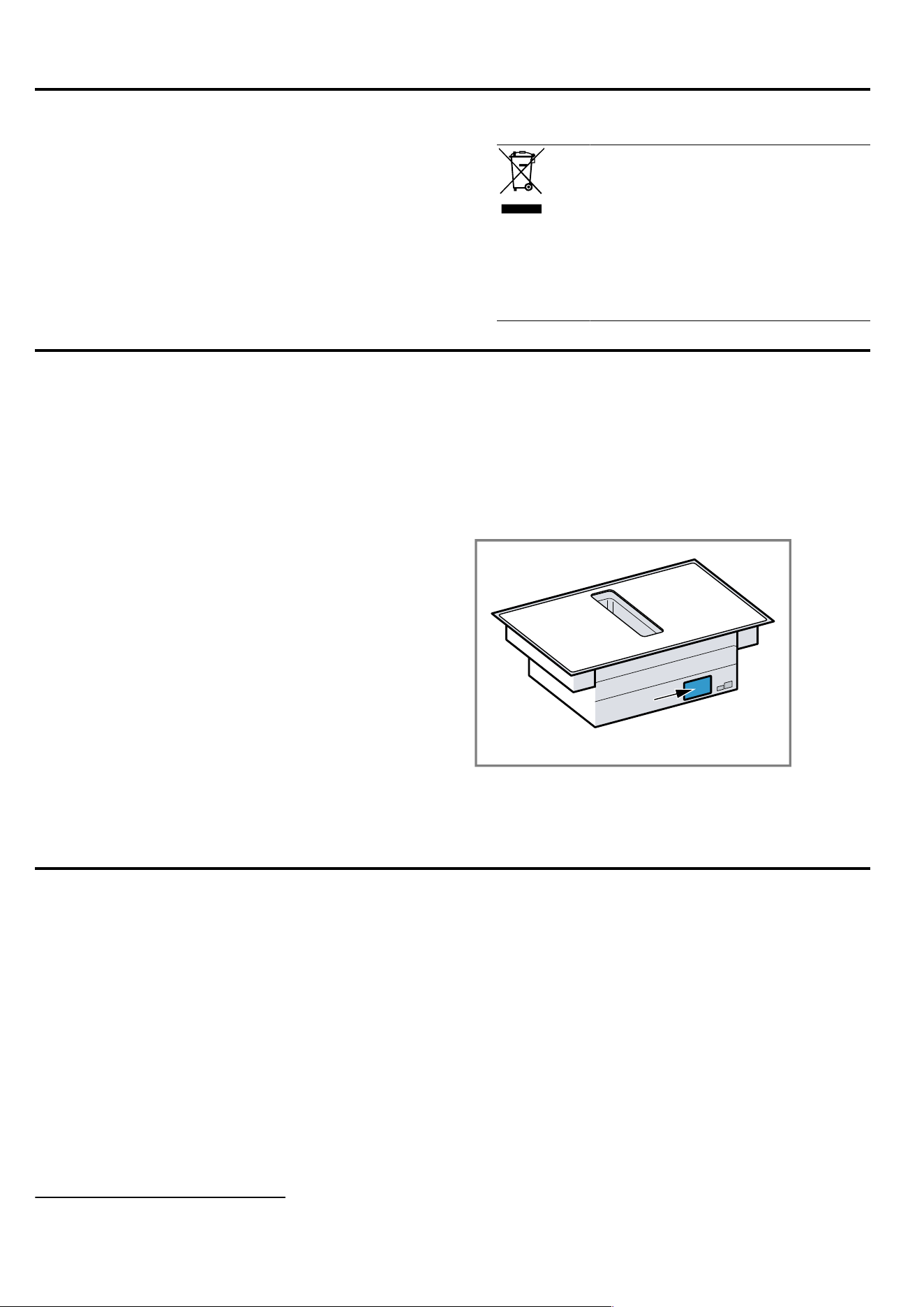
Disposal en
27
Disposal
28 Disposal
28.1 Disposing of old appliance
Valuable raw materials can be reused by recycling.
1.
Unplug the appliance from the mains.
2.
Cut through the power cord.
3.
Dispose of the appliance in an environmentally
friendly manner.
Information about current disposal methods are
available from your specialist dealer or local author-
ity.
This appliance is labelled in accord-
ance with European Directive
2012/19/EU concerning used elec-
trical and electronic appliances
(waste electrical and electronic equip-
ment - WEEE).
The guideline determines the frame-
work for the return and recycling of
used appliances as applicable
throughout the EU.
Customer Service
29 Customer Service
Function-relevant genuine spare parts according to the
corresponding Ecodesign Order can be obtained from
Customer Service for a period of at least 10 years from
the date on which your appliance was placed on the
market within the European Economic Area.
Note:Under the terms of the manufacturer's warranty
the use of Customer Service is free of charge.
Detailed information on the warranty period and terms
of warranty in your country is available from our after-
sales service, your retailer or on our website.
If you contact Customer Service, you will require the
product number (E-Nr.), the production number (FD)
and the consecutive numbering (Z-Nr.) of your appli-
ance.
The contact details for Customer Service can be found
in the enclosed Customer Service directory or on our
website.
29.1 Product number (E-Nr.), production
number (FD) and consecutive numbering (Z-
Nr.)
You can find the product number (E-Nr.), the produc-
tion number (FD) and the consecutive numbering (Z-
Nr.) on the appliance's rating plate.
The rating plate can be found:
¡ On the appliance certificate.
¡ On the underside of the hob, towards the front.
The product number (E no.) can also be found on the
glass ceramic. You can also display the customer ser-
vice index (KI) and the production number (FD) in the
basic settings. →Page19
Make a note of your appliance's details and the Cus-
tomer Service telephone number to find them again
quickly.
Information regarding Free and Open Source Software
30 Information regarding Free and Open Source Software
This product includes software components that are li-
censed by the copyright holders as free or open
source software.
The applicable licence information is stored on your
home appliance. You can also access the applicable li-
cence information via your HomeConnect app: "Profile
-> Legal information -> Licence Information".
1
You can
download the licence information on the brand product
website. (Please search on the product website for
your appliance model and additional documents). Al-
ternatively, you can request the relevant information
from [email protected] or BSH Hausgeräte GmbH,
Carl-Wery-Str. 34, 81739 Munich, Germany.
The source code will be made available to you on re-
quest.
Please send your request to [email protected] or
BSH Hausgeräte GmbH, Carl-Wery-Str.34, 81739 Mu-
nich, Germany.
Subject: „OSSREQUEST“
The cost of performing your request will be charged to
you. This offer is valid for three years from the date of
purchase or at least as long as we offer support and
spare parts for the relevant appliance.
1
Depending on the appliance specifications
en Declaration of Conformity
28
Declaration of Conformity
31 Declaration of Conformity
BSH Hausgeräte GmbH hereby declares that the appli-
ance with Home Connect functionality conforms to the
essential requirements and other relevant provisions of
Directive 2014/53/EU.
A detailed RED Declaration of Conformity can be found
online at www.neff-home.com among the additional
documents on the product page for your appliance.
Hereby, BSH Hausgeräte GmbH declares that the ap-
pliance with HomeConnect functionality is in compli-
ance with relevant statutory requirements.
1
A detailed Declaration of Conformity can be found on-
line at www.neff-home.com/uk among the additional
documents on the product page for your appliance.
1
2.4 GHz band (2400–2483.5MHz): Max. 100mW
5-GHz band (5150–5350MHz + 5470–5725MHz):
max. 130mW
BE BG CZ DK DE EE IE EL ES
FR HR IT CY LI LV LT LU HU
MT NL AT PL PT RO SI SK FI
SE NO CH TR IS UK (NI)
5GHz WLAN (Wi-Fi): For indoor use only.
AL BA MD ME MK RS UK UA
5GHz WLAN (Wi-Fi): For indoor use only.
31.1 Statement of Compliance for Great
Britain
Product type
This statement of compliance covers the products de-
scribed in this information for use whose model identi-
fier group is seen on the title page. The full model iden-
tifier is made up of the characters before the slash in
the product number (E no.) which can be found on the
rating plate. Alternatively, you can also find the model
identifier in the first line of the UK Energy Label.
Name and address of manufacturer
BSH Hausgeräte GmbH, Carl-Wery-Strasse 34, 81739
München, Germany
This statement of compliance is prepared by the manu-
facturer.
The manufacturer, BSH Hausgeräte GmbH deems that
it has complied with
¡ provision 5.1-1 of ETSI EN 303 645 v2.1.1 and,
where relevant, provision 5.1-2 of ETSI EN 303 645
v2.1.1;
¡ provision 5.2-1 of ETSI EN 303 645 v2.1.1;
¡ provision 5.3-13 of ETSI EN 303 645 v2.1.1.
Support period
BSH Hausgeräte GmbH will provide security updates
that are necessary to maintain the main functions free
of charge until at least 28/02/2034.
Test dishes
32 Test dishes
These recommended settings are intended for test in-
stitutes to facilitate the testing of our appliances. The
tests were carried out using our cookware sets for in-
duction hobs. If required, these accessory sets can be
purchased at a later point from specialist retailers, or
through our technical after-sales service or our online
shop.
32.1 Melting the chocolate coating
Ingredients: 150 g dark chocolate (55% cocoa).
¡ 16 cm saucepan without lid
– Boiling: Power level 1.5
32.2 Heating and keeping lentil stew warm
Recipe in accordance with DIN 44550
Initial temperature 20°C
Heating up without stirring
¡ 16 cm saucepan with lid, amount: 450g
– Heating up: Duration 1 min. 30 sec., power level
9
– Simmering: Power level 1.5
¡ 20 cm saucepan with lid, amount: 800g
– Heating up: Duration 2 min. 30 sec., power level
9
– Simmering: Power level 1.5
1
Only applies to Great Britain

Test dishes en
29
32.3 Heating and keeping lentil stew warm
E.g.: Lentil diameter 5–7 mm. Initial temperature 20 °C
Stir after heating for 1 minute
¡ 16 cm saucepan with lid, amount: 500g
– Heating up: Duration approx. 1 min. 30 sec.,
power level 9
– Simmering: Power level 1.5
¡ 20 cm saucepan with lid, amount: 1kg
– Heating up: Duration approx. 2 min. 30 sec.,
power level 9
– Simmering: Power level 1.5
32.4 Béchamel sauce
Milk temperature: 7 °C
¡ 16 cm saucepan without lid, ingredients: 40 g but-
ter, 40 g flour, 0.5 l milk with 3.5% fat content and a
pinch of salt
Preparing Béchamel sauce
1.
Melt the butter, stir in the flour and salt, and heat up
the mixture.
‒ Heating up: Duration 6 min., power level 2
2.
Add the milk to the roux and bring to the boil, stir-
ring continuously.
‒ Heating up: Duration 6 min. 30 sec., power level
7
3.
Once the Béchamel sauce comes to the boil, leave
it on the cooking zone for a further two minutes.
‒ Simmering: Power level 2
32.5 Cooking rice pudding with the lid on
Milk temperature: 7 °C
1. Heat the milk until it starts to rise up. Heat up without
a lid. Stir after heating for 10 min.
2. Set the recommended power level and add rice,
sugar and salt to the milk.
The cooking time, including heating up, is approx. 45
minutes.
¡ 16 cm saucepan, ingredients: 190g short-grain
rice, 90g sugar, 750ml milk with 3.5% fat content
and 1 g salt
– Heating up: Duration approx. 5 min. 30 sec.,
power level 8.5
– Simmering: Power level 3
¡ 20 cm saucepan, ingredients: 250g short-grain
rice, 120g sugar, 1l milk with 3.5% fat content and
1.5 g salt
– Heating up: Duration approx. 5 min. 30 sec.,
power level 8.5
– Simmering: Power level 3, stir after 10 minutes
32.6 Cooking rice pudding without a lid
Milk temperature: 7 °C
1. Add the ingredients to the milk and heat the mixture
up while stirring continuously.
2. Once the milk has reached approx. 90°C, select the
recommended power level and leave it to simmer on a
low heat for approx. 50minutes.
¡ 16 cm saucepan without lid, ingredients: 190g
short-grain rice, 90g sugar, 750ml milk with 3.5%
fat content and 1 g salt
– Heating up: Duration approx. 5 min. 30 sec.,
power level 8.5
– Simmering: Power level 3
¡ 20 cm saucepan without lid, ingredients: 250g
short-grain rice, 120g sugar, 1l milk with 3.5% fat
content and 1.5 g salt
– Heating up: Duration approx. 5 min. 30 sec.,
power level 8.5
– Simmering: Power level 2.5
32.7 Cooking rice
Recipe in accordance with DIN 44550
Water temperature: 20°C
¡ 16 cm saucepan with lid, ingredients: 125g long-
grain rice, 300 g water and a pinch of salt
– Heating up: Duration approx. 2 min. 30 sec.,
power level 9
– Simmering: Power level 2
¡ 20 cm saucepan with lid, ingredients: 250g long-
grain rice, 600 g water and a pinch of salt
– Heating up: Duration approx. 2 min. 30 sec.,
power level 9
– Simmering: Power level 2.5
32.8 Roasting a pork loin
Initial temperature of the loin: 7°C
¡ 24cm pan without lid, ingredients: 3 pork loins,
total weight approx. 300g, 1cm thick, and 15g
sunflower oil
– Heating up: Duration approx. 1 min. 30 sec.,
power level 9
– Simmering: Power level 7
32.9 Preparing crêpes
Recipe in accordance with DIN EN 60350-2
¡ 24 cm pan without lid, ingredients: 55 ml batter per
crêpe
– Heating up: Duration 1 min. 30 sec., power level
9
– Simmering: Power level 7
32.10 Deep-fat frying frozen chips
¡ Pot dia. 20 cm without lid: ingredients: 2 l sunflower
oil. For each frying time: 200 g frozen chips, 1 cm
thick.
– Heating up: Power level 9, until the oil temperat-
ure reaches 180 °C.
– Simmering: Power level 9


ST4_Neff_Cover.indd 1ST4_Neff_Cover.indd 1 22.01.2024 10:51:4722.01.2024 10:51:47
BSH Hausgeräte GmbH
Carl-Wery-Straße 34
81739 München, GERMANY
*9001868394*
9001868394
040429
en
Valid within Great Britain:
Imported to Great Britain by
BSH Home Appliances Ltd.
Grand Union House
Old Wolverton Road
Wolverton, Milton Keynes
MK12 5PT
United Kingdom