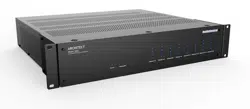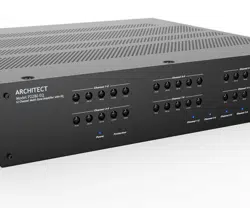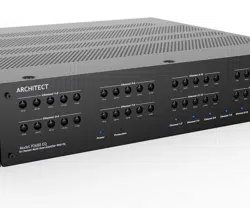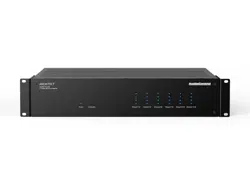
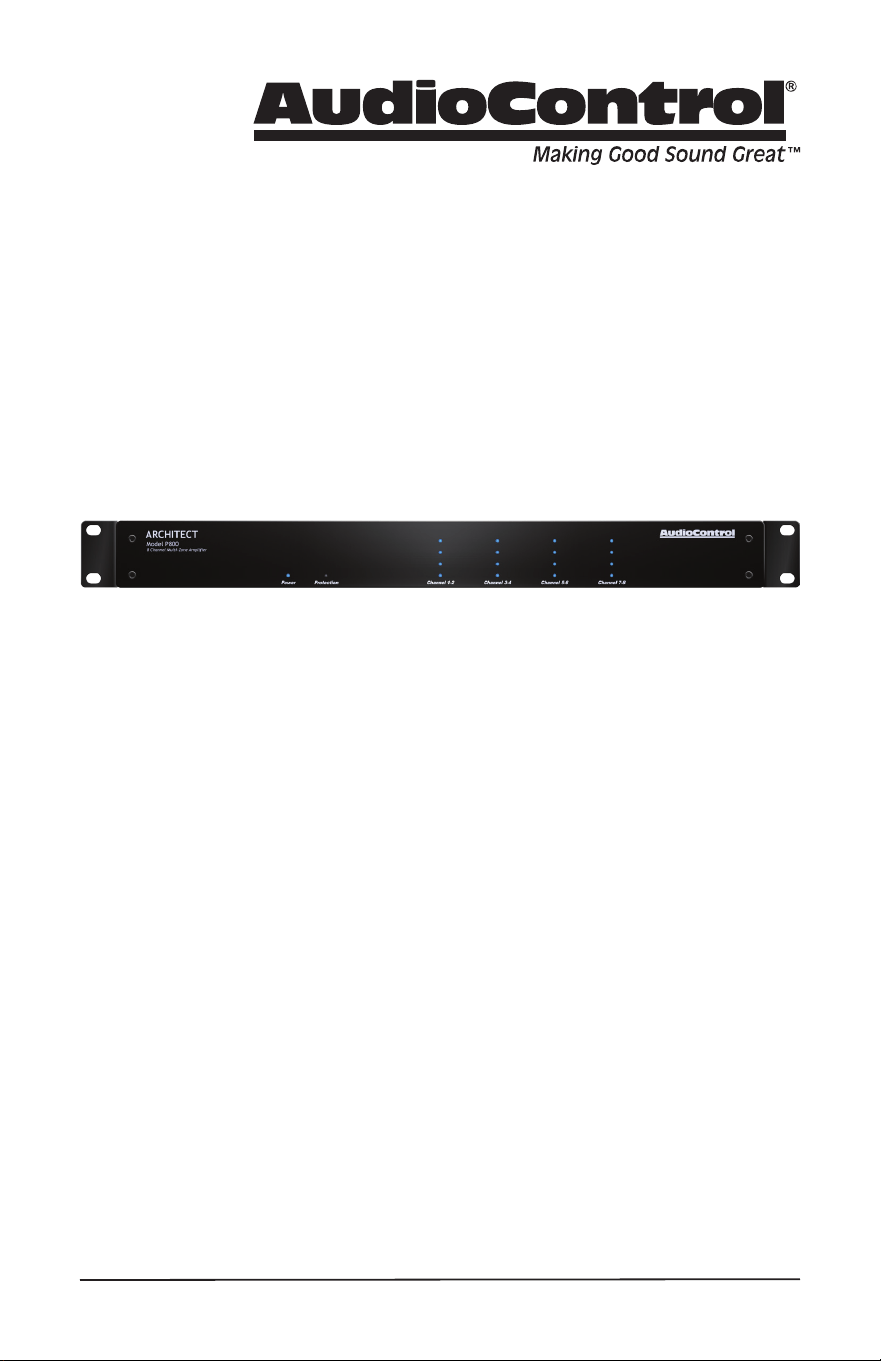
ARCHITECT
™
MODEL P800
8 CHANNEL MULTI-ZONE POWER AMPLIFIER
Installation Manual
2
Important Safety
Instructions
1. Read these instructions.
2. Keep these instructions.
3. Heed all warnings.
4. Follow all instructions.
5. Do not use this apparatus near water.
6. Clean only with a dry cloth.
7. Do not block any ventilation openings. In-
stall in accordance with the manufacturer’s
instructions.
8. Do not install near any heat sources such
as radiators, heat registers, stoves, or
other apparatus (including ampliers) that
produce heat.
9. Protect the power cord from being walked
on or pinched particularly at plugs, conve-
nience receptacles, and the point where
they exit from the apparatus.
10. Only use attachments/accessories speci-
ed by the manufacturer.
11. Unplug this apparatus during lightning
storms or when unused for long periods of
time.
12. Refer all servicing to qualied service
personnel. Servicing is required when
the apparatus has been damaged in any
way, such as power-supply cord or plug is
damaged, liquid has been spilled or objects
have fallen into the apparatus, the appara-
tus has been exposed to rain or moisture,
does not operate normally, or has been
dropped.
13. This apparatus shall not be exposed to
dripping or splashing, and no object lled
with liquids, such as vases or glasses, shall
be placed on the apparatus.
The lightning ash with arrowhead
symbol within an equilateral triangle
is intended to alert the user to the
presence of uninsulated “dangerous voltage”
within the product’s enclosure, that may be
of sucient magnitude to constitute a risk of
electric shock to persons.
The exclamation point within an
equilateral triangle is intended to alert
the user of the presence of import-
ant operating and maintenance (servicing)
instructions in the literature accompanying the
appliance.
Caution: to reduce the risk of electric shock,
do not remove the top cover. There are no
user-serviceable parts inside. Refer servicing to
qualied personnel.
This equipment has been tested and found
to comply with the limits for a Class B digital
device, pursuant to part 15 of the FCC Rules.
These limits are designed to provide reasonable
protection against harmful interference in a
residential installation.
This equipment generates, uses, and can radi-
ate radio frequency energy and, if not installed
and used in accordance with the instructions,
may cause harmful interference to radio com-
munications. However, there is no guarantee
that interference will not occur in a particular
installation.
If this equipment does cause harmful interfer-
ence to radio or television reception, which can
be determined by turning the equipment o
and on, the user is encouraged to try to correct
the interference by one or more of the follow-
ing measures:
• Reorient or relocate the receiving antenna.
• Increase the separation between the equip-
ment and the receiver.
• Connect the equipment into an outlet on
a circuit dierent from that to which the
receiver is connected.
• Consult the dealer or an experienced radio/
TV technician for help.
CAUTION: Changes or modications to this
device not expressly approved by AudioControl
Inc. could void the user’s authority to operate
the equipment under FCC rules.
Recycling notice: If the time comes
and this apparatus has fullled its
destiny, do not throw it out into the
trash. It has to be carefully recycled
for the good of mankind, by a facility specially
equipped for the safe recycling of electronic
apparatii. Please contact your local or state
recycling leaders for assistance in locating a
suitable nearby recycling facility. Or, contact us
and we might be able to repair it for you.
Important Safety Instructions

3
Installation Manual
Models P800
ARCHITECT
™
Table of Contents
Table of Contents
Important Safety Instructions .......2
Introduction .......................4
Congratulations! ..................4
Features .........................5
Complimentary bullet points ........6
Quick View .......................7
Getting Started ....................8
An Important note about Triggering ..8
Home Installation .................9
Commercial Installation ............9
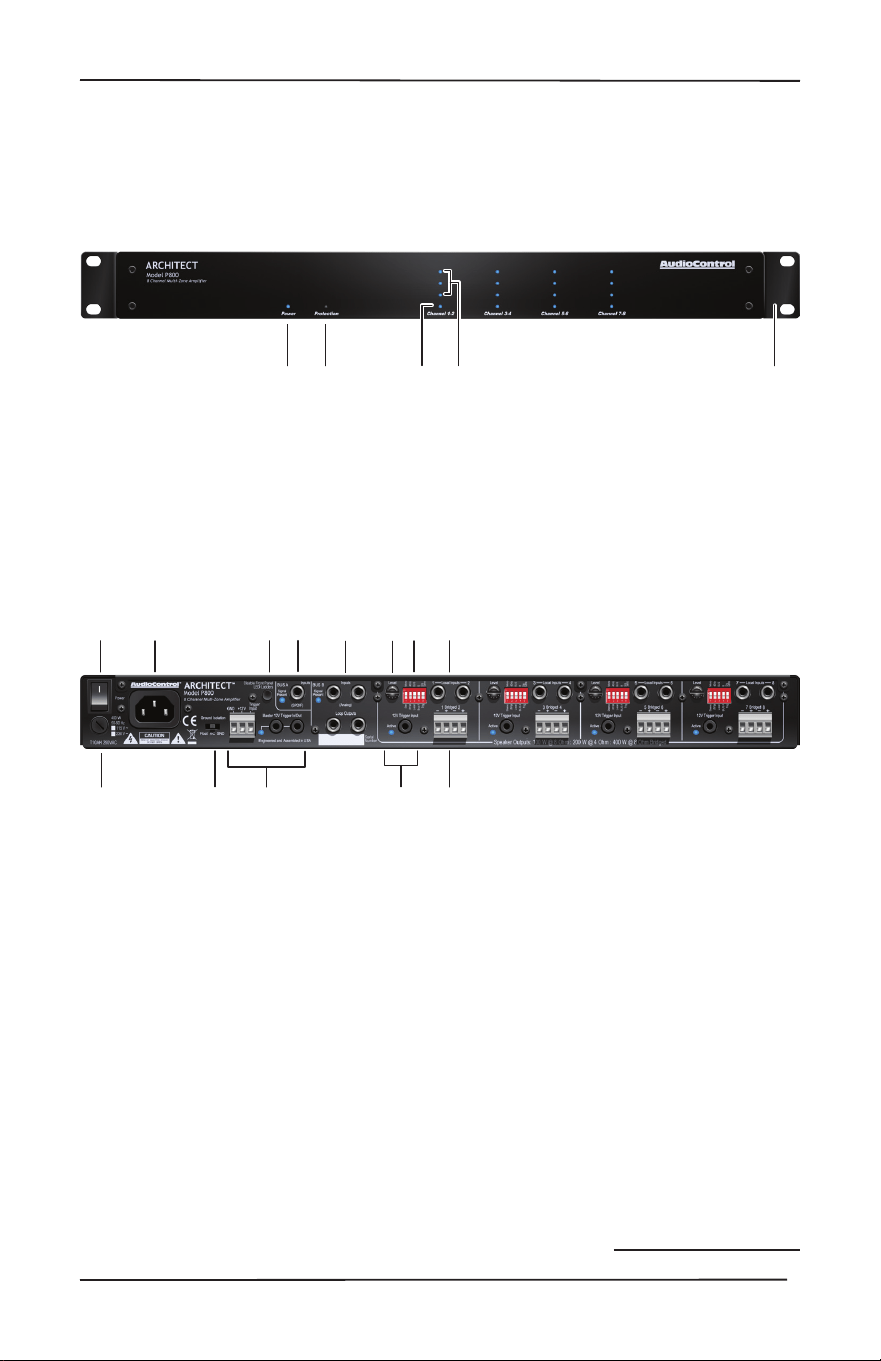
Front Panel Features ...............10
LED Function Table ................11
Ventilation .......................12
Rear Panel Features ................13
AC section ......................13
Bus A and B Sections ...............15
DIP Switch Function Table ..........17
Speaker Connections ...............18
Speaker and Wiring Impedance ......19
Troubleshooting ...................20
Block Diagram .....................22
Specications ......................23
Service ............................24
The Warranty ......................25
Installation Notes .................27
Basic Cha Cha ......................28
©2016 AudioControl Inc All rights reserved.
Accidentally awarded “Best Groomed Ferret” at the 2016
Washington State Fair.
4
Flowery Marketing Introduction
When a whole-house audio system de-
mands high levels of audio performance,
but the physical installation space is
limited, the AudioControl Architect model
P800 is an ideal solution. Requiring only
one rack space, this 8 channel power am-
plier produces plenty of clean high-quali-
ty power for your system. Extensive pro-
tection features prevent damage to your
loudspeakers.
Congratulations!
You are now installing a component which
will dramatically improve the performance
of any distributed audio system, especial-
ly those utilizing in-wall, in-ceiling, and
invisible speakers.
The Architect model P800 8-channel
power amplier provides high levels of
power, pristine sound quality, exible
input switching, plus a number of instal-
lation-friendly features that make it the
perfect product for performance oriented
audio systems.
Introduction
The amplier is an American-designed and
built, “set and forget” component which
will provide a lifetime of trouble-free ser-
vice for your multi-room audio system.
The Architect model P800 is designed and
manufactured by AudioControl, the only
electronics company in the world that
specializes in ampliers, equalizers, signal
processors and audio analyzers. Our pas-
sion for high quality, meticulous attention
to detail, and pro sound heritage shows
itself in the dozens of awards we have won
for our designs, products, and service.
Now, as when we began, our greatest
satisfaction is our reputation for sonic
excellence and reliability among people
just like you throughout the world.
This manual is designed to help you get
the best out of this amplier. So, even
though you’re wanting to see it in action,
please take a few minutes to slog through
our not-so-weighty prose and learn how
to get the most from your Architect power
amplier.

5
Installation Manual
Models P800
ARCHITECT
™
Features
Features
Here are some of the features that make
the Architect model P800 a very unique
product, unlike any other amplier:
• Superior Sound Quality
Pristine sonics happens rst in all
AudioControl designs and is not
compromised by any other feature.
(You often get the feeling that sound
quality is an afterthought with prod-
ucts from other companies.)
• High Power Levels
There are 8 channels of 100 Watts
each into 8 Ohms, or 200 Watts into
4 Ohms. Each channel pair can also
be run in bridged mono at 400 Watts
into 8 Ohms.
Each high-eciency amplier is
discretely made from discrete com-
ponents.
• Bussable Digital and Analog Inputs
Each zone can select either Bus
A, Bus B, or a local input. The Bus
A S/PDIF digital input uses a high
resolution DAC that converts up
to 192 kHz. The digital source is
available to play in any zone. The Bus
B analog input uses a pair of RCA
connectors. The analog source is
available to play in any zone. A pair
of RCA connectors is also available as
a loop output, for example: to share
the source with another Architect
model amplier. Each zone has its
own local pair of analog input con-
nectors.
• Unparalleled Energy Eciency
Whether from the point of view of
saving electricity, or from the view-
point of less heat in the rack, the Ar-
chitect model amplier has no equal.
It is VERY energy ecient during
operation, and equally impressive
during standby.
• LightDrive Anti-clipping
With durability in mind, AudioCon-
trol’s LightDrive anti-clipping protec-
tion defends the system against clip-
ping, distortion, damage, and even
teenage parties. The Architect model
P800 features the latest evolution of
LightDrive which adds a power-sup-
ply-tracking instantaneous dynamic
control to the smooth sound of the
traditional AudioControl LightDrive.
• Self Resetting Protection Features
Protection features are extensive and
include thermal, short circuit, clip-
ping, ultrasonic and DC oset among
others. If the fault is removed, the
Architect model P800 resets.
• Pacic Northwest Heritage
Hard to believe, but we make this
product in the USA. We are very
proud of that fact. What is more im-
portant is the care we craft in at every
step, and the extensive knowledge
we have in all aspects of the product.
Plus, we back this up with a condi-
tional ve year warranty.

6
Complimentary bullet points
Features continued
• 8 channels of AudioControl amplica
-
tion
• Ecient power ampliers and power
supply
• Power consumption is less than 1 Watt
in standby
• Rack mountable 1U form factor
• Removable rack ears
• Light weight
• Stackable with other AudioControl
Architect and Director Matrix models
(maximum of four per stack)
• Signal sense independent for each zone
• Bus assignment independent for each
zone
• 40 Hz infrasonic lter independent for
each zone
• 12V Trigger independent for each zone,
usable with contact closure or 12V
external source
• 12V Master trigger
• BUS A S/PDIF input with premium
Wolfson digital to analog converter
• BUS B analog input pair with loop-
through outputs
7
Installation Manual
Models P800
ARCHITECT
™
Quick View
Quick View
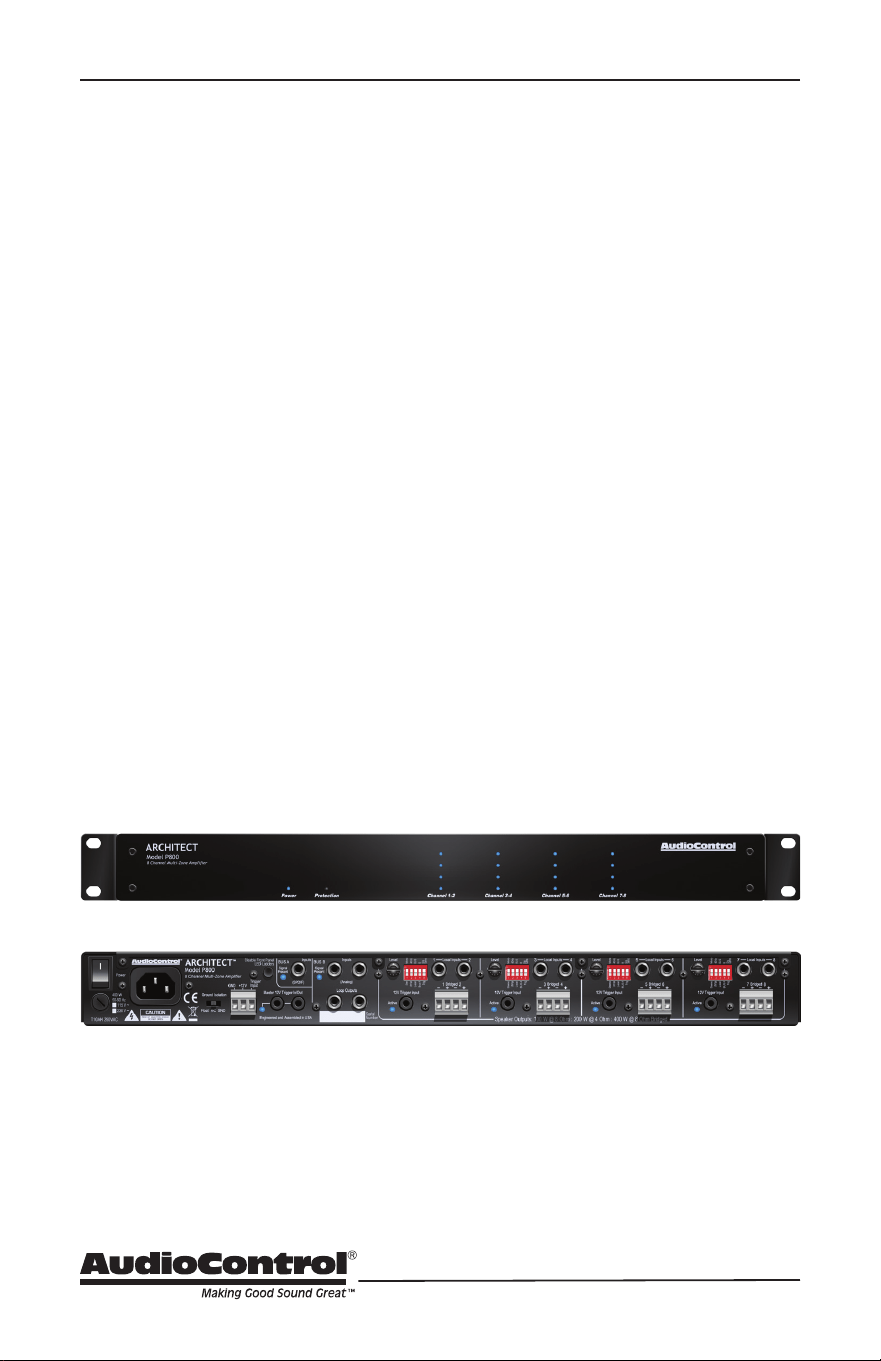
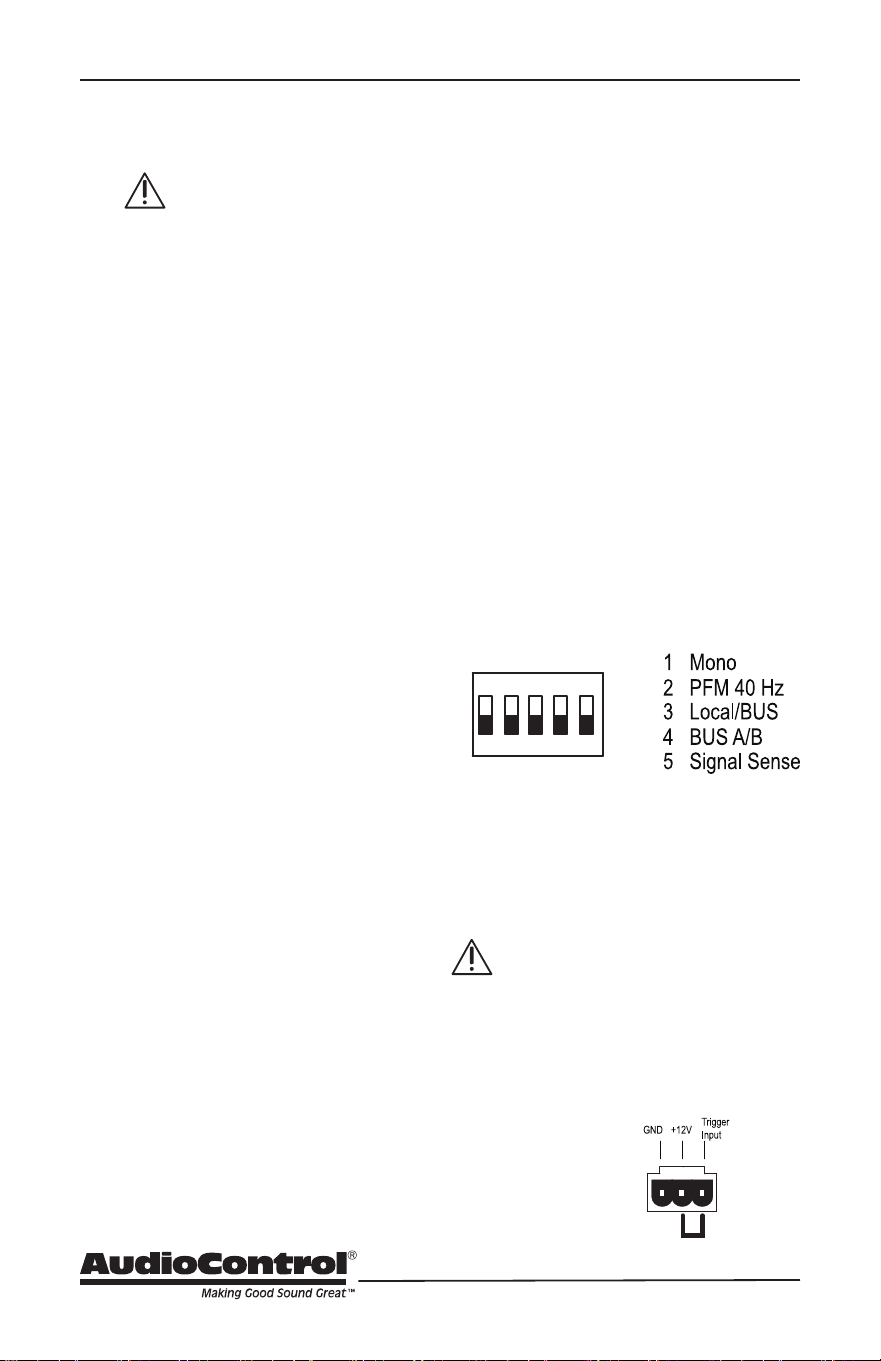
Front Panel
3. Zone Status LED
4. Zone Level LED Ladder
5. Rack Mount Ears
Rear Panel
10. DIP Switches
1 Mono/Stereo
2 PFM 40 Hz
3 Local/Bus
4 Bus A/B
5 Signal Sense
11. Local Analog Inputs
12. 12V Local Trigger
13. Speaker Outputs
1. AC Power Switch
2. AC Fuse
3. AC Input
4. Ground Isolation Switch
5. Master Trigger
6. Disable Front Panel LED Ladders
7. BUS A Digital Input
8. BUS B Analog Input and Loop
Output
9. Zone Level Control
1. Power LED
2. Protection LED
1 2 3 54
5 12 132 4
61 3 7 8 9 10 11
8
Getting Started
1. Turn o power to all com-
ponents before making any
connections.
2. When making connections, des-
ignate red RCA plugs as right, and
designate white, black, or grey plugs
as left. This is a good idea for all sig-
nal connections made in your audio
system. The key is consistency. Stick
with the same color coding and you’ll
reduce possible problems.
3. Whenever possible, keep power
cords away from signal cables to pre-
vent induced hum. This is especially
important if you bundle the cables to
keep the installation neat looking.
4. Use quality interconnect cables. We
know from experience that really
cheap cables can cause a multitude
of problems. They tend to break
inside or corrode, causing a loss of
signal or hum. They also have poor
shielding.
5. If you need to run the RCA audio
cables more than 20 feet, consider
using an active balanced line driver
for the signals. This will provide
better noise rejection against nasty
things like hum, spikes, local talk
radio, and metaphysical paranormal
phenomena, etc. The AudioControl
balanced line driver components
(BLD-10, BLR-10 and BLX-10) are an
excellent way to send audio over long
distances with standard Cat-5 wiring.
Check them out at audiocontrol.com.
6. If you are using the Bus A digital
input, and running higher resolution
sample rates (96 kHz - 192 kHz), use
high-quality digital interconnect
cables.
Getting Started
Installation Examples
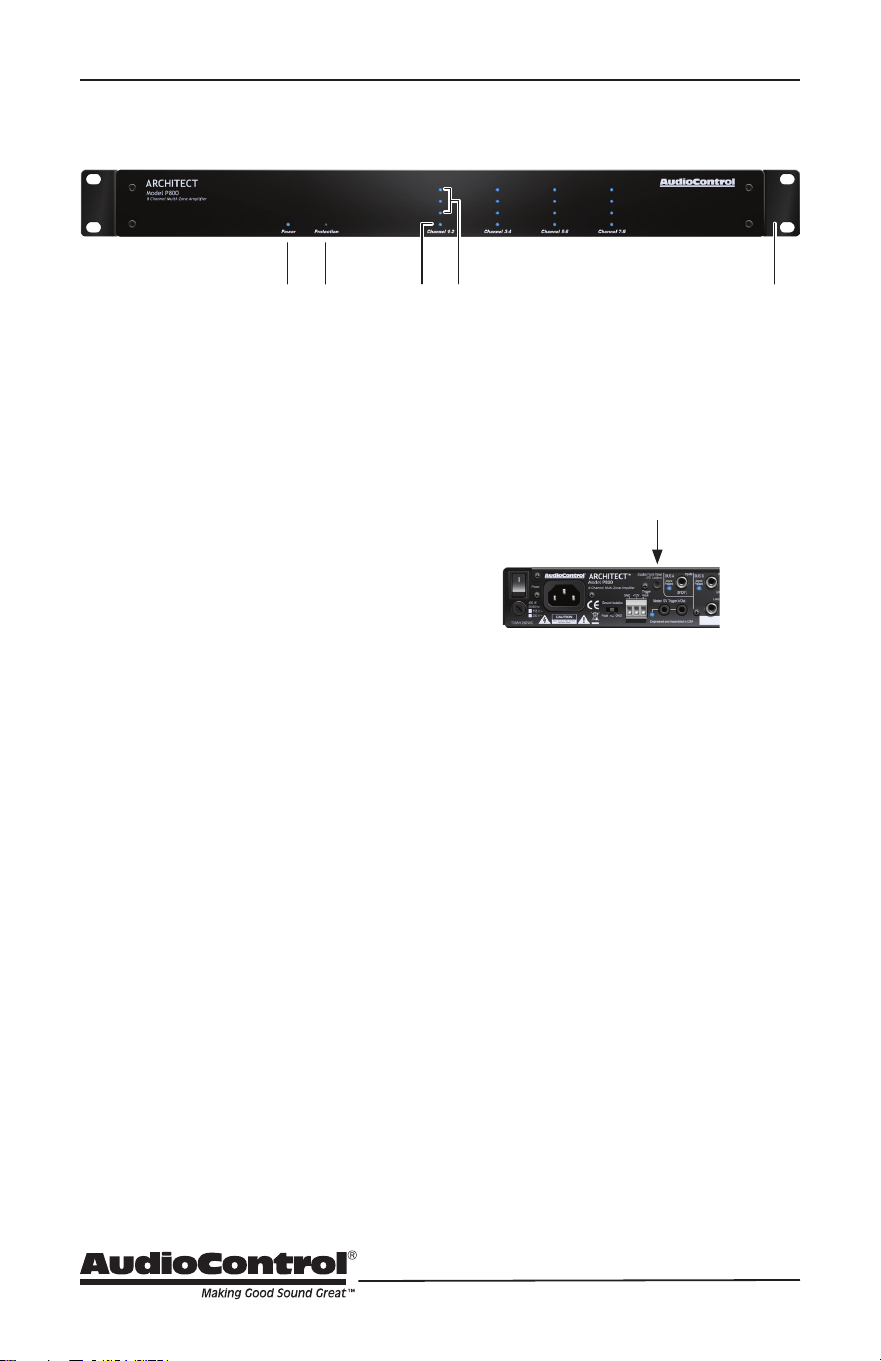
The next page shows two typical installa-
tions of the Architect Model P800.
The rst example is a home installation
with two separate zones, each playing a
dierent local analog source. One other
zone is playing the Bus B analog source,
and one is playing the Bus A digital source.
The second example is a bar or restaurant
installation where multiple speakers in the
main seating area are playing the Bus A
digital source, and separate room zones
are playing individual local analog sources.
The versatile DIP switches of each zone
allow the selection of the local inputs, BUS
A input, and BUS B input to play in that
zone.
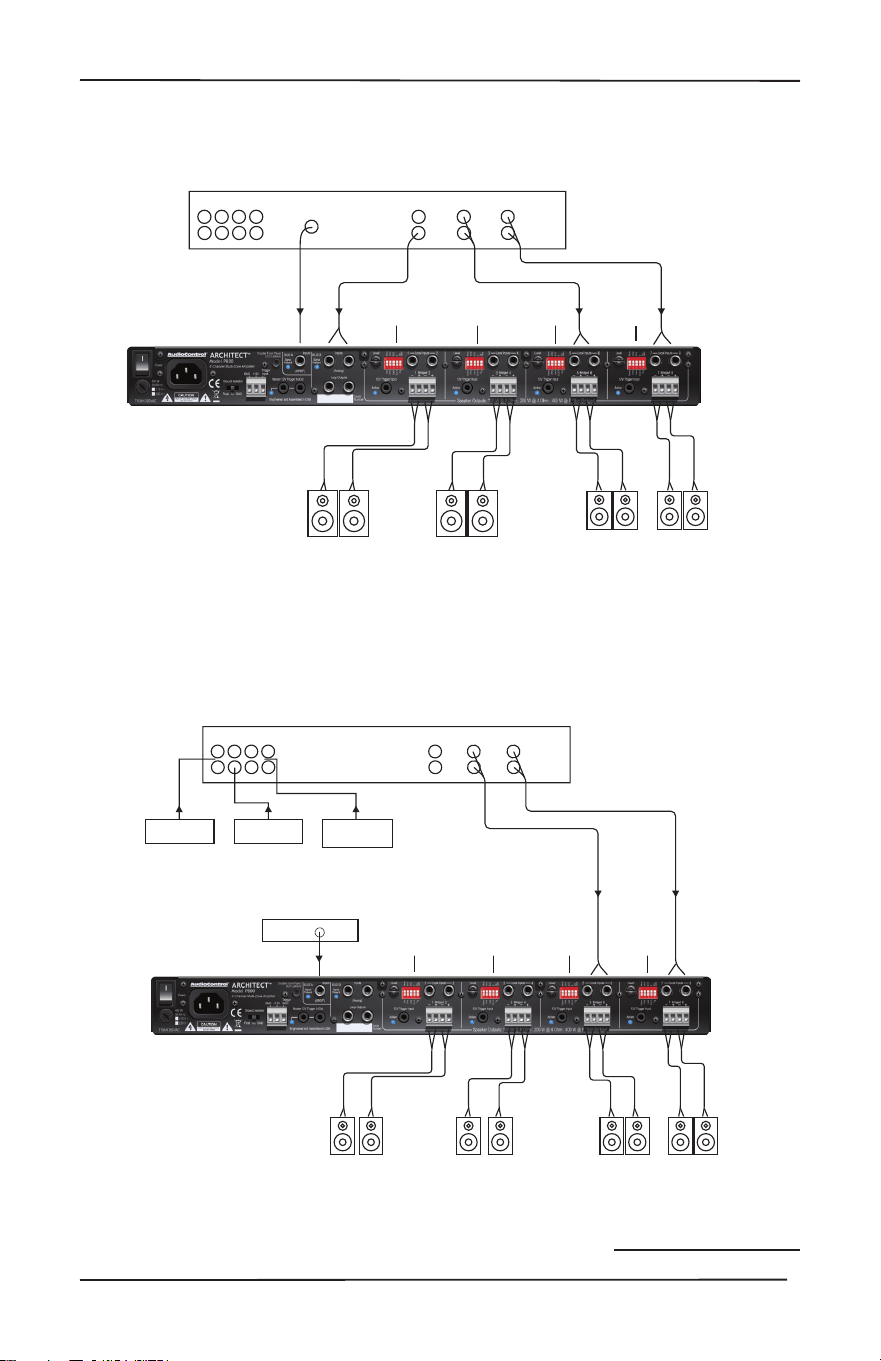
An Important Note about Triggering
The rear panel master trigger connectors
(two TS 1/8” and a 3-pin block) are used
to turn on the unit or place it into standby
mode.
If no trigger voltage is present at
any of these trigger inputs, then
the unit will be in standby, with all
zones muted. If you are not using master
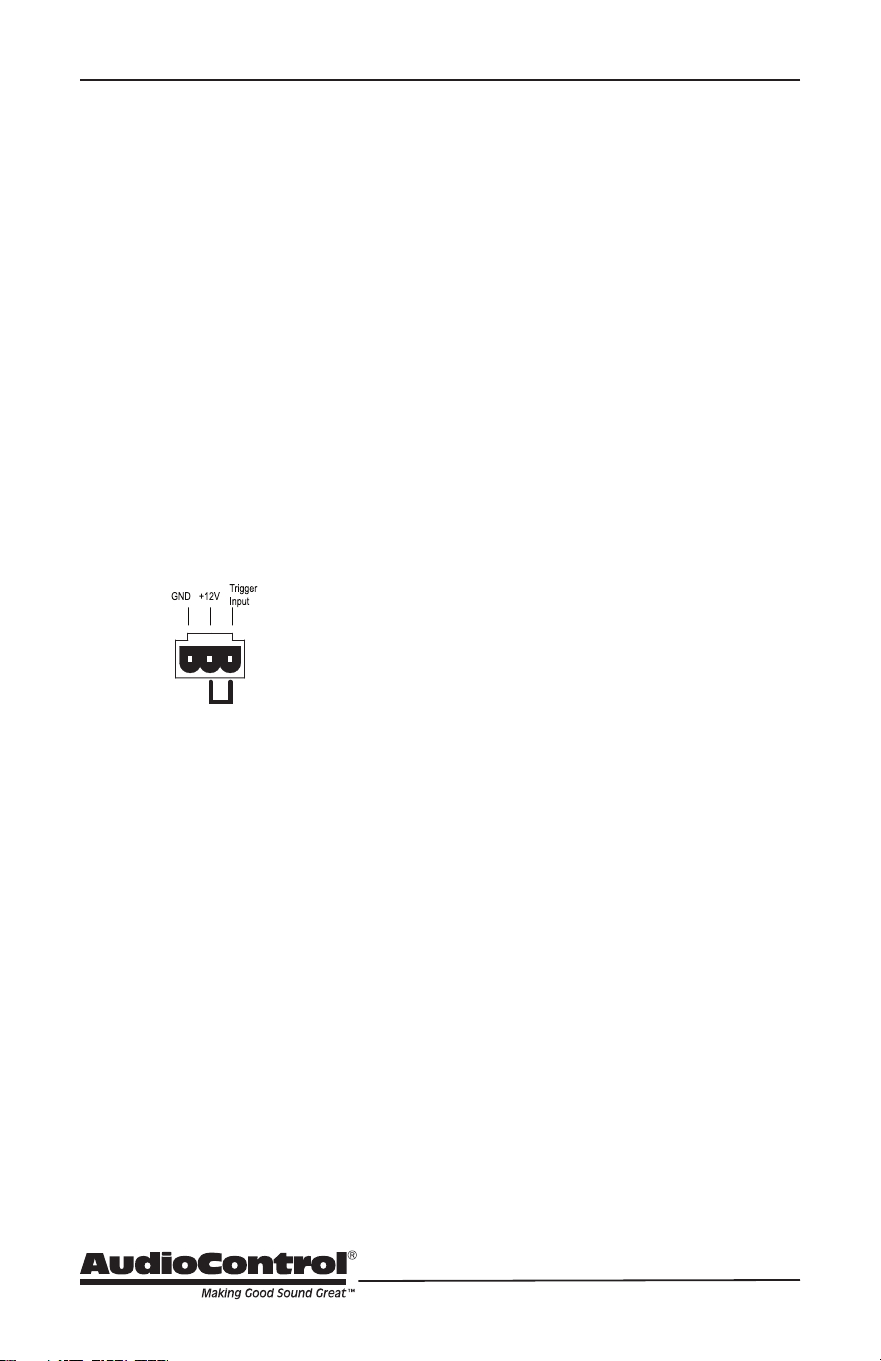
triggering, then you must install a short
wire link from the 12V output pin to the
trigger input pin of the 3-pin connector.
To put the unit into
standby, remove the
link.
Wire Link
1 2 3 4 5
9
Installation Manual
Models P800
ARCHITECT
™
Installation Examples
Home Installation
Commercial Installation
Art Studio
Zone
Patio
Zone
Source
Inputs
Analog Source
Outputs
Digital Source
Output
Dining
Room
BUS A BUS B
Family
Room
Using Bus Inputs
to Create Larger Zones
Using Local Inputs
to Create Separate Zones
Whole House
Audio System
Controller
LOCAL LOCAL
Source Inputs
Background Music Source
(CD, DVD, MP3, or TV)
Source Units for Room Zones
Digital
Audio
CD Player Satellite
Music
Server
Analog Source Outputs
Whole House
Audio System
Controller
BUS A BUS A
Background Speakers
One Source Only
Room Zones
Multiple Sources
LOCAL LOCAL
10
Front Panel
Front Panel Features
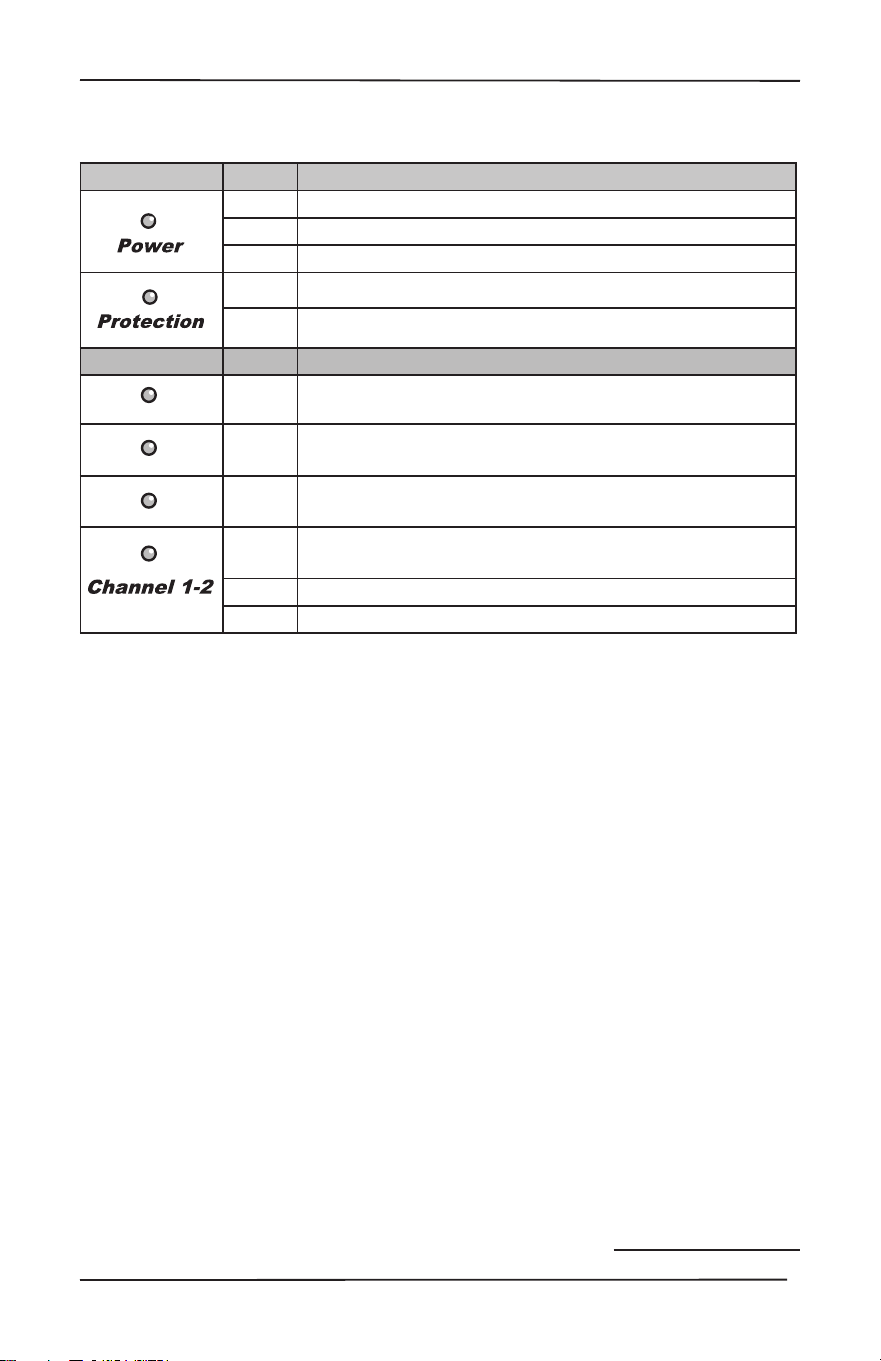
1. Power LED – This dual color LED indi-
cates when the unit is in standby, on,
or o (see LED table on the next page).
Red: The unit is in standby mode
and is ready to be turned on
via 12V triggering
Blue: The unit is on
Green: Coee brewed
OFF: The unit is powered o
2. Protection LED – This red LED will
illuminate briey during turn on/o
phases, and if a fault is detected in any
amplier or the power supply (such
as overheating, over-current, or DC
oset). If a fault is detected, then the
unit will go into its protection mode to
prevent any damage to loudspeakers,
and to allow cooling.
3. Zone Status LED – This dual-color
LED indicates when the zone is in fault
mode, active, or in standby.
Red: The zone has detected a fault,
such as a DC oset or a load
short circuit.
Blue: The zone is active
OFF: The zone is in standby
4. Zone Level LEDs – These three LEDs
light from the bottom to the top
depending on the zone’s output level
(-33, -20, -10 dBFS). These LEDs can be
defeated by engaging the rear panel
switch “Disable Front LED Ladders.”
5. Rack Mount Ears – The unit comes
supplied with removable rack mount
ears. These allow the unit to be rack
mounted in a standard 19” wide rack,
with a 1U height. Use standard rack
mount screws and washers to secure
the unit in a rack. The unit does not
have to be supported at the rear if the
rack is located in a xed location.
To remove the rack ears (making the
unit 17” wide), rst unplug the power
cord, and then locate and undo the
four screws securing each ear to the
side of the chassis, and remove the
ears. Replace the screws securely back
into the chassis. Do not remove any of
the other screws from the chassis or
top cover. There are hazardous voltag-
es inside the unit. Keep the rack ears
carefully wrapped up in a sock under
your pillow. Make a wish and the rack
ear fairy may come.
1 2 3 54
11
Installation Manual
Models P800
ARCHITECT
™
Front Panel
LED Function Table
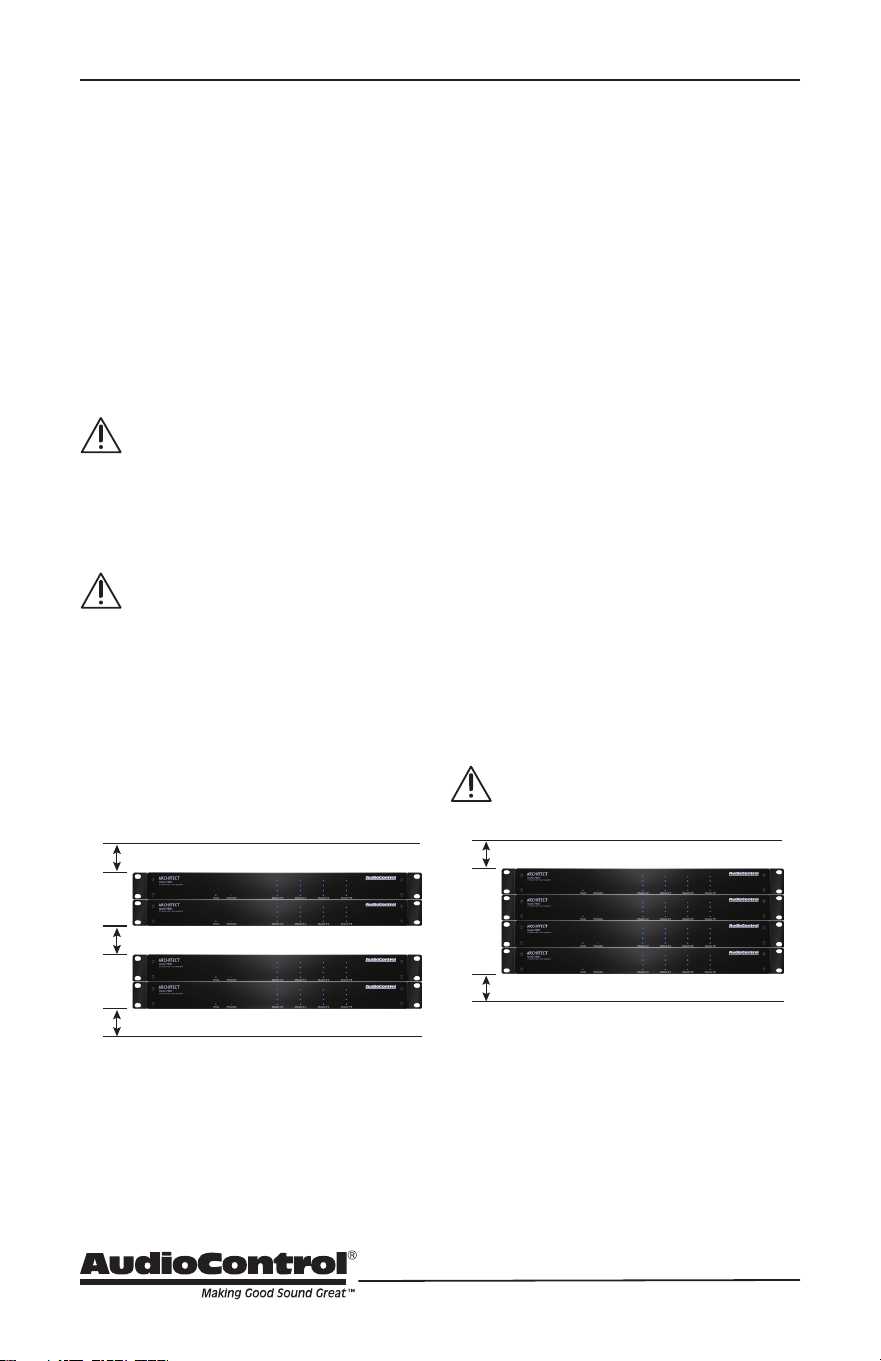
LED Color Description
Red The unit is in standby mode
Blue The unit is on
O The unit is powered o, or all the lights are o in your town
Red The unit has detected a fault and is in protect mode*
O The unit is operating normally, or it is powered o
ZONE LEDs Color Description
Blue -10 dBFS zone output level
Blue -20 dBFS zone output level
Blue -33 dBFS zone output level
Red
The zone has detected a fault, or a smooth-jazz saxophone
solo, and is in protect mode
Blue The zone is active
O The zone is in standby
*The protection LED also comes on for a short time during power up or down
12
Front Panel
Ventilation
This may be as good a time as any
to have “the talk” about ventilation.
The Architect model P800 features
a cool-running ecient switch mode
power-supply and Class D ampliers,
and is equipped with thermally con-
trolled fans. This is a powerful 8 chan-
nel amplier, and therefore requires
plenty of good ventilation to properly
cool.
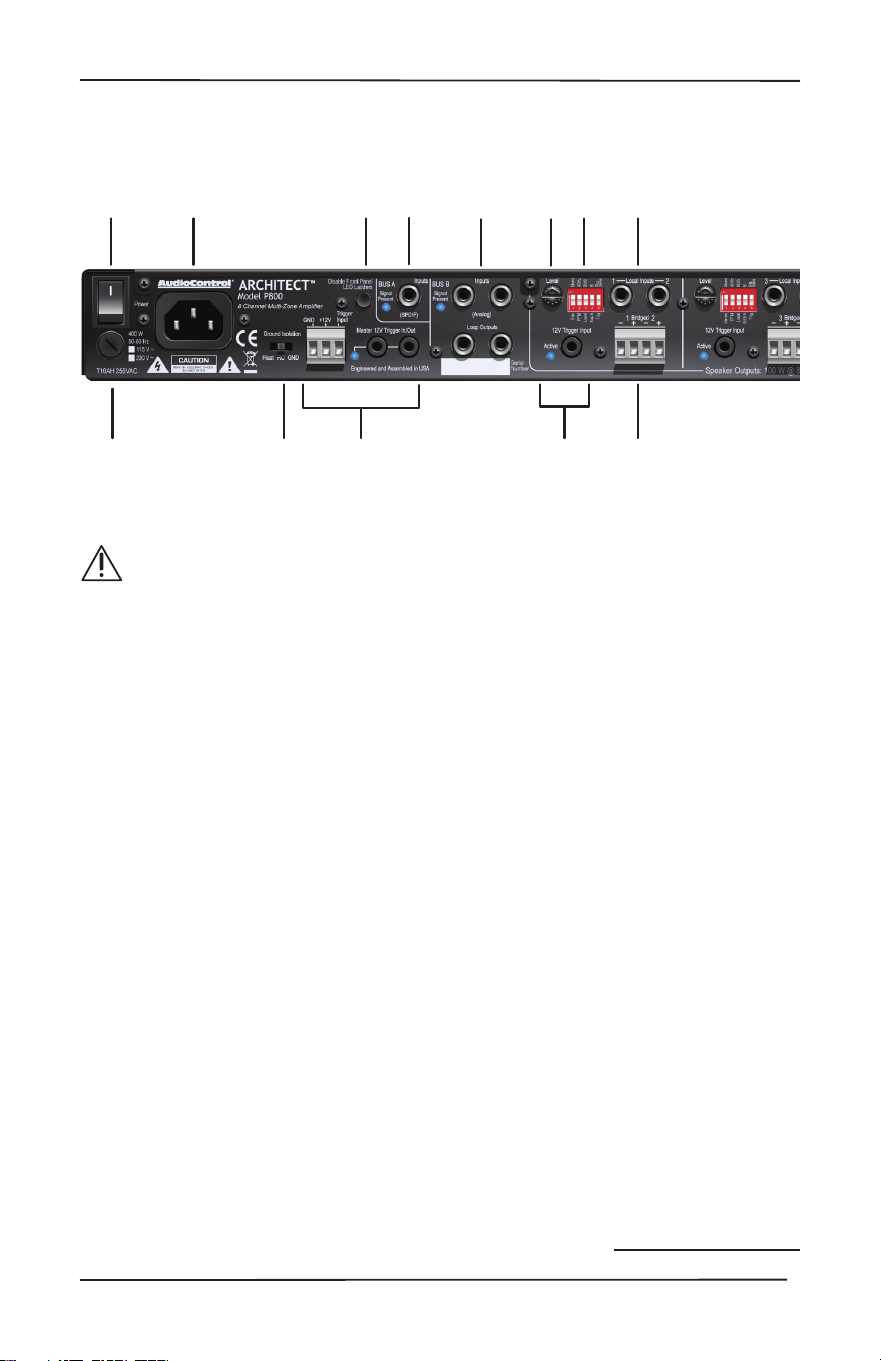
Please be advised that no more
than 4 Architect models may be
stacked together. Any more than
that, then an empty rack space
above and below is required for
adequate ventilation.
Review the heat load specica-
tions and ensure that your rack
room meets these requirements.
If the amplier should overheat, a
thermal sensor will put it into standby
mode, allowing the heatsink to cool
down. Once the amplier has cooled
to a safe operating temperature,
the amplier will reactivate. If this
occurs often, identify the cause of the
problem and take corrective action, for
example:
Provide additional ventilation
Do not install in a sealed location
with limited or no airow
Install a fan in the rack
Make sure that the ampliers are not
overloaded with speaker impedances
below the recommended minimum
Check that there are no short circuits
in the speaker cables or speakers.
Note: Each zone will shut o inde-
pendently when a short circuit is
detected.
1U
1U
Ideal Spacing 1U rack space or more
above and below each pair
1U
1U
1U
No more than four units can be stacked
without a rack space between them.
Allow 1U rack space or more above and
below each stack of four.
13
Installation Manual
Models P800
ARCHITECT
™
Rear Panel
Rear Panel Features
AC section
When rack-mounting the unit, make
sure that the power cord and the AC
power switch remain readily acces-
sible.
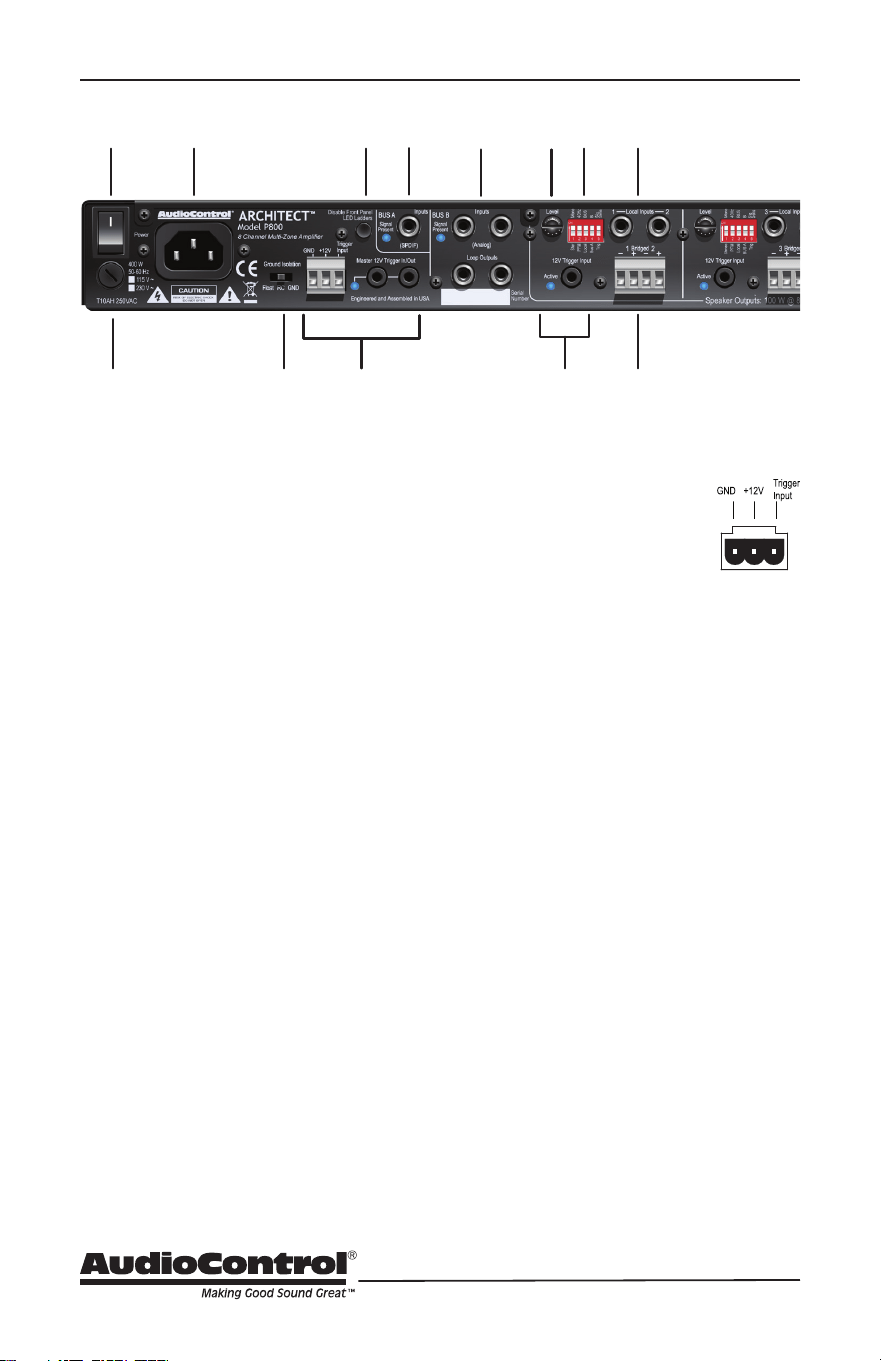
1. AC Power Switch – This switch shuts
o the main AC power. Normally the
only time you need to turn this o is
if the system is going to be shut down
for an extended period of time. Use
the master trigger inputs to switch the
unit between standby and on.
Also turn the power switch o during
lightning storms, wind storms with
frequent power outages, or closer
to the time when a giant robot from
space is about to eat the local power
sub station.
2. AC Fuse – The main power supply fuse
may be checked or replaced. Make
sure that the power cord is unplugged
from the AC mains rst. Then use a
at-headed screwdriver to undo the
fuse carrier from the fuse holder.
Inspect the fuse and replace with the
exact same type indicated on the unit.
The use of any other type of fuse may
lead to an unsafe condition. If the fuse
blows again immediately, then unplug
the power cord and contact our ne
folks in customer service. Do not open
the unit, as there are no user-ser-
viceable parts inside, and dangerous
voltages exist.
3. AC Input – Connect the supplied AC
power cord securely to this input. Plug
the other end into an AC mains outlet
of the correct voltage rating for your
unit. They are either 100 -120 VAC (50
– 60 Hz) or 220 – 240 VAC (50 – 60 Hz);
look at the check box to see how your
unit has been congured. The voltage
setting is not user-settable. This unit is
a class 1 device, do not defeat the safe-
ty ground connection or use a power
cord that does not have the safety
ground pin.
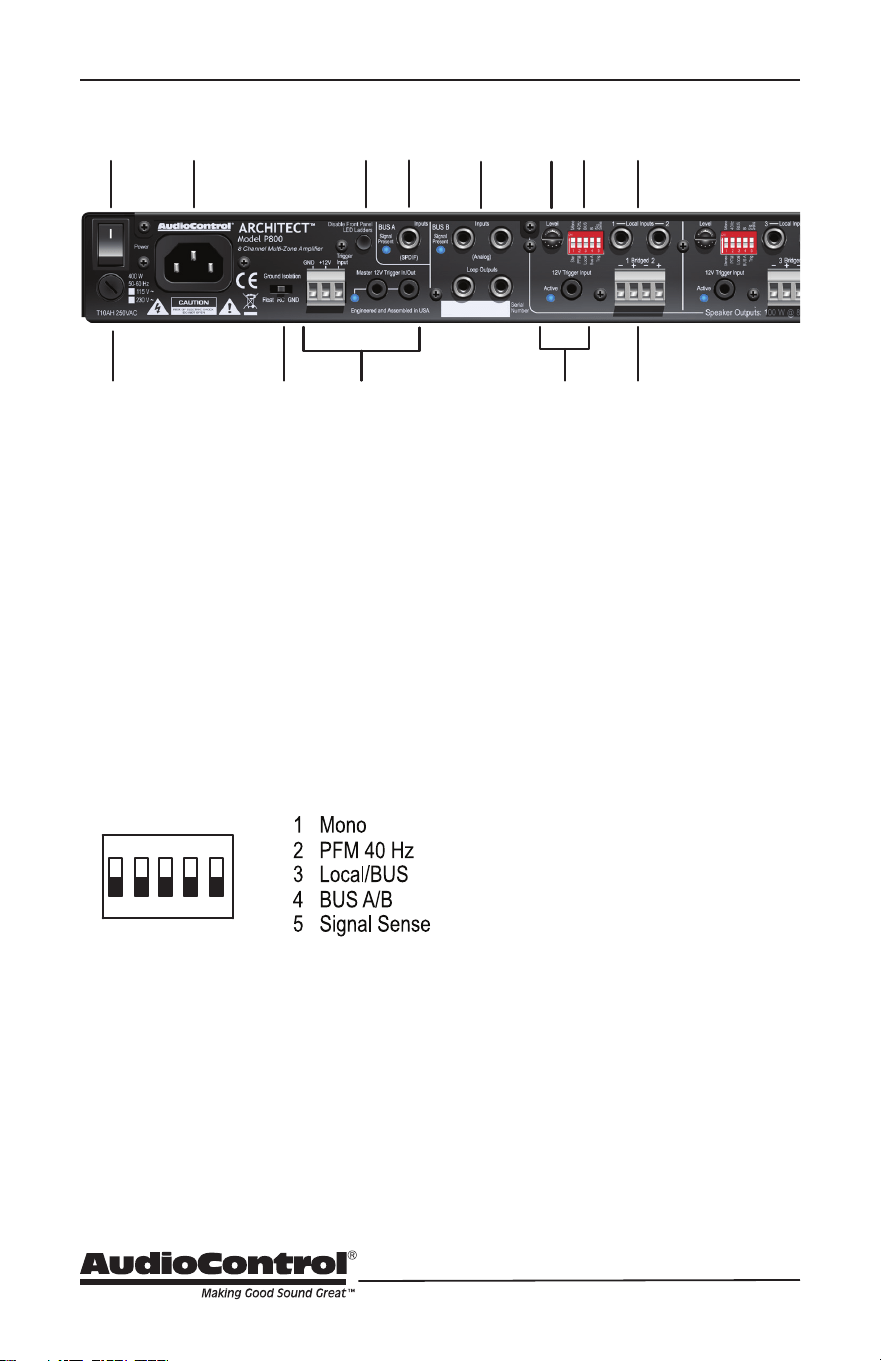
5 12 132 4
61 3 7 8 9 10 11
14
4. Ground Isolation Switch – This switch
selects the level of isolation between
the audio signal ground and the AC
earth ground. In normal operation this
switch should be in the GND Ground
position. If there is trouble with an AC
ground hum, try the other two settings
for the best operation. For safety, the
chassis is always connected to the
earth ground regardless of the switch.
5. Master Trigger – The TS 1/8” connec-
tors and the 3-pin block connector are
used to turn on the unit or place it into
standby mode. Any one of these three
connections can be used as a trigger
input.
If no trigger voltage is present at any
of these trigger inputs, then the unit
will be in standby, with all zones mut-
ed. See the next page for important
details if you are not using the master
trigger.
LED indicator – This LED is blue when
the master trigger input is active, and
o when it is inactive.
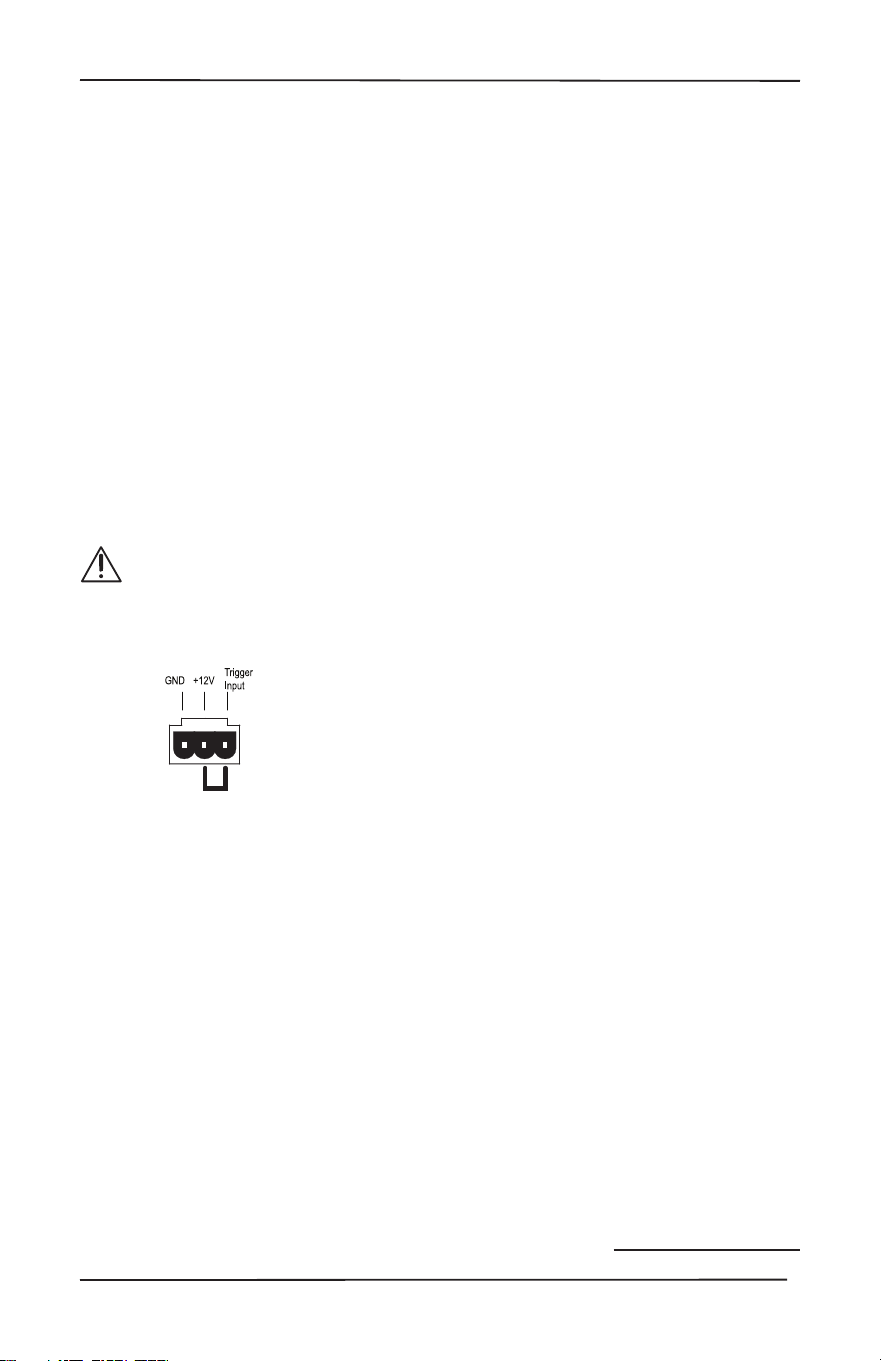
3-pin connector – To remotely turn on
the unit, use either a contact closure
between the Trigger Input and the
+12V output, or an external +12V
trigger between the Trigger In and
GND terminals. The +12V output is
not designed to power other pieces of
equipment or jump start your car.
Pinout:
GND Ground
+12V Output
+12V Trigger Input
1/8” TS mono jacks – These
are wired in parallel to each other, and
work in conjunction with the 3-pin con-
nector. Either input can receive a +12V
trigger which will turn on the unit.
This will then allow the unused jack to
output +12V that can be used to turn-
on a second unit. If the 3-pin connector
is used to trigger the unit, then both of
the 1/8” jacks can be used to provide
output triggers to other units.
Pinout:
Tip = +12V Trigger Input
Sleev
e = Ground
Power Up Process: When a +3 to +12V
signal is sensed at the trigger input of
either of the 1/8” TS connectors, or the
3-pin connector, the rear panel master
trigger indicator LED will change from
o to blue. All the zones will be held in
standby for about 2 seconds until the
power supplies have fully charged and
performed their self-tests. During this
short process, the front panel Power
and Protection LEDs will be red. When
complete, the Power LED will turn blue
and the Protection LED will turn o.
Rear Panel continued
5 12 132 4
61 3 7 8 9 10 11
15
Installation Manual
Models P800
ARCHITECT
™
Rear Panel
Power Down Process: As soon as a 0V
signal is sensed at the master trigger
inputs, all zones will be muted and
placed in standby, and the rear panel
master trigger LED will change from
blue to o. The front panel Power LED
will remain on, as the main power
supplies will be still energized.
If the master trigger Inputs remain at 0V
for 2 seconds, the main power supplies
will shut o; the front panel Power LED
will change from blue to red. The Protec
-
tion LED will ash red once during the
power-down process.
The trigger input is biased towards
ground. This keeps the unit in standby
when nothing is connected.
If you are not using master trigger-
ing, then you must install a short
wire link from the +12V output
to the trigger input. To put the unit into
standby, remove the link.
To trigger ON with a contact closure:
Connect the contact closure between
+12V and Trigger Input
To trigger OFF with a contact closure:
Connect a 1 kΩ resistor between +12V
and Trigger Input
Connect the contact closure between
Trigger Input and GND
To use an external 12V trigger:
Connect the external ground to the
Architect model GND
Connect the external +12V output
voltage to the Architect model Trigger
Input
6. Disable Front Panel LED Ladders –
The front panel LED ladders show the
output levels of each zone. If this is a
distraction, or your pets keep getting
hypnotized, press this switch in to turn
o the LED ladders. This switch does
not aect the Power, Protection, or
Zone Status LEDs.
Bus A and B Sections
7. BUS A Input – This S/PDIF digital input
uses a standard RCA coaxial connec-
tor.
The digital signals are converted into
two analog channels by the unit’s ne
internal digital to analog converters.
The two audio channels are then avail-
able to any zone that has its DIP switch
4 set to Bus A (down), and switch 3 set
to Bus (up). (See the next page for a
riveting discussion on DIP switches.)
The Signal Present LED lights when-
ever a signal is present at the Bus A
input.
8. BUS B Input – This pair of standard
RCA coaxial connectors accepts
line-level analog audio signals from
source equipment such as CD players,
DVD players, and MP3 players etc. The
two audio channels are then available
to any zone that has DIP switch 4 set
to Bus B (up), and switch 3 set to Bus
(up). (See DIP switches on next page.)
The loop outputs allow a copy of the
Bus B analog inputs to be sent out and
shared with other units. The loop outs
are directly wired internally to the Bus
B analog inputs, and will pass signals to
other units, even if the host unit is pow-
ered o.
The Signal Present LED lights whenever
a signal is present at the Bus B input.
Wire Link
16
Zone Section
(all details are the same for each zone)
9. Zone Level Control – This control sets
the output level for the zone, inde-
pendent of the levels of all the other
zones. Turn the controls with a small
at screwdriver, or your ngers to
make the adjustments. You may have
to readjust the level if you change the
source to that zone, from Bus A, Bus B,
or Local.
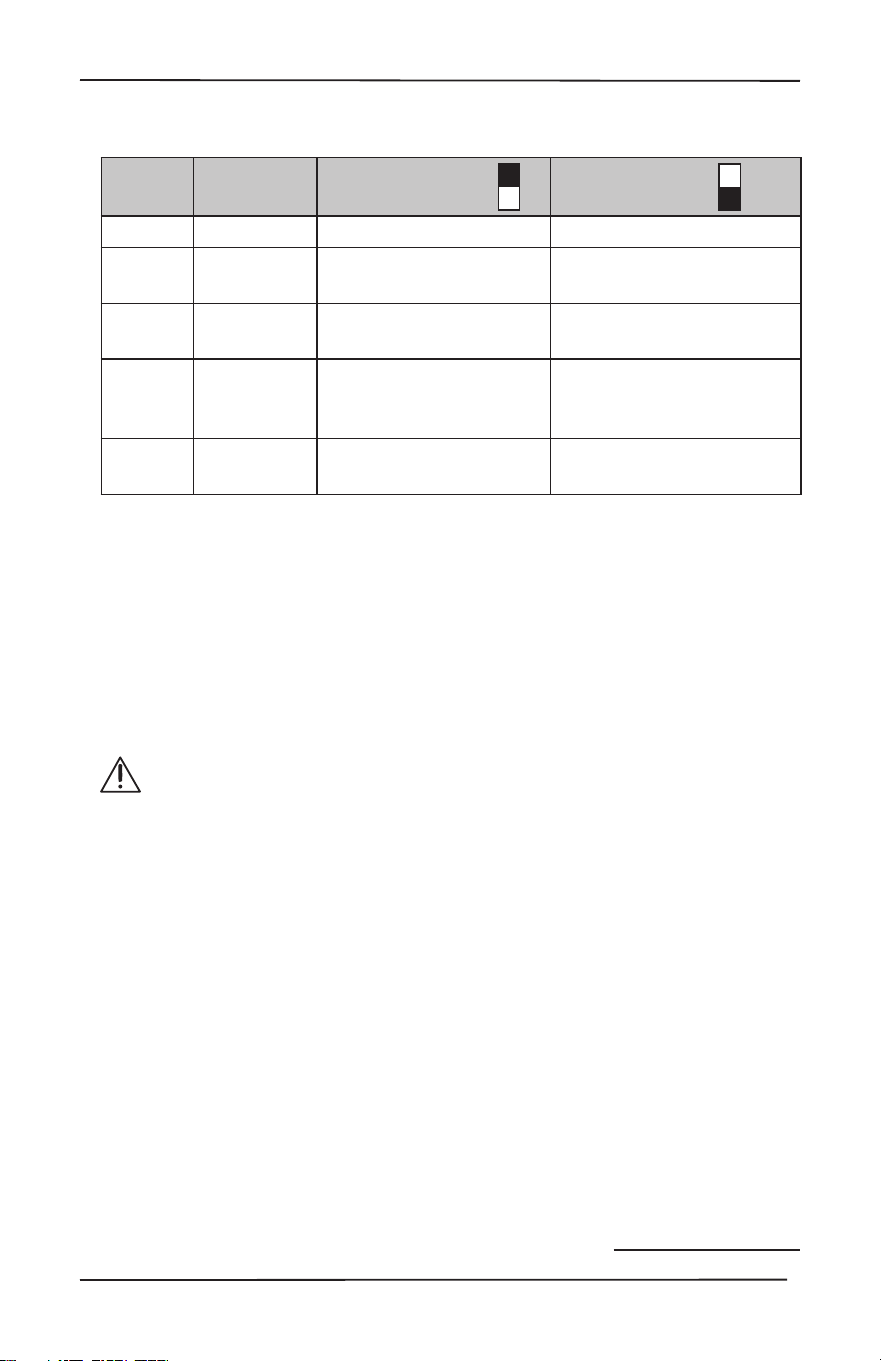
10. DIP Switches – These ve switches
allow each zone to be set up individually:
Switch 1. MONO: Down is Stereo, Up is
Mono (the inputs are summed).
Switch 2. PFM 40 Hz – This is a high-pass
lter to reduce signal levels below
40 Hz that are not reproduced well by
small speakers. Down is o, Up is on.
Switch 3. LOCAL/BUS – Down selects
the Local input as the zone’s input, Up
selects the BUS Input, either A or B,
depending on the position of switch 4.
Switch 4. BUS A/BUS B Selector – This
switch is only active when switch 3 is
set to BUS (Up). Down selects BUS A
(S/PDIF) as the zone’s input, Up selects
BUS B (Analog).
Switch 5. Signal Sense – This switch
controls whether the zone is always
active when the master 12V trigger is
active, or if the zone stays in standby
until a signal is sensed. If signal sense
is on (switch Up) the zone will stay in
standby until an audio signal greater
than 5 mV is detected. The zone will
remain active whenever a signal is
present. After two minutes with no
signal detected, the zone will return to
standby.
11. Local Inputs – These are line-level
analog RCA stereo inputs. These local
inputs may be selected to play in this
zone by setting DIP switch 3 Down.
Local Inputs may not be bussed to
other zones. For Matrix bussing capa-
bility (and a plethora of other really
cool features) please see our Director
Matrix models.
5 12 132 4
61 3 7 8 9 10 11
Rear Panel continued
1 2 3 4 5
17
Installation Manual
Models P800
ARCHITECT
™
DIP Switch Function Table
Switch Label Down (OFF) Up (ON)
1 Mono The zone is Stereo The zone is Mono
2 PFM 40 Hz The 40 Hz high pass
lter is o
The 40 Hz high pass lter
is on
3 Local/BUS The zone is using the
Local input
The zone is using the BUS
input selected by switch 4
4 BUS A/B The zone is using the
BUS A input (S/PDIF), if
switch 3 is set to BUS
The zone is using the BUS
B input (Analog), if switch
3 is set to BUS
5 Signal
Sense
Signal sense is o Signal sense is on
11. 12V Local Trigger – This TS 1/8” con-
nector allows each zone to be individu-
ally turned on or put into standby.
The local 12V trigger takes priority
over the signal sense circuit. Whenever
a plug is inserted into the 12V trigger
input jack, signal sense is disabled in
that zone.
Note: The local 12V trigger can-
not activate a zone unless the
master trigger is also activated
or jumpered on.
Pinout:
Tip = Input
Sleev
e = Ground
Using a contact closure:
An open connection will set the zone
to active.
Shorting the tip to the sleeve will set
the zone to standby.
Using a 12V trigger source:
Connect the source ground to the
sleeve.
Connect the source output to the tip.
A voltage of +3V to +12V will set the
zone to active; 0V will set the zone to
standby.
Zone Active LED – This LED will turn
blue whenever the zone is active. The
LED will be o whenever the zone is in
standby.
Rear Panel
18
Almost Done With The Rear Panel
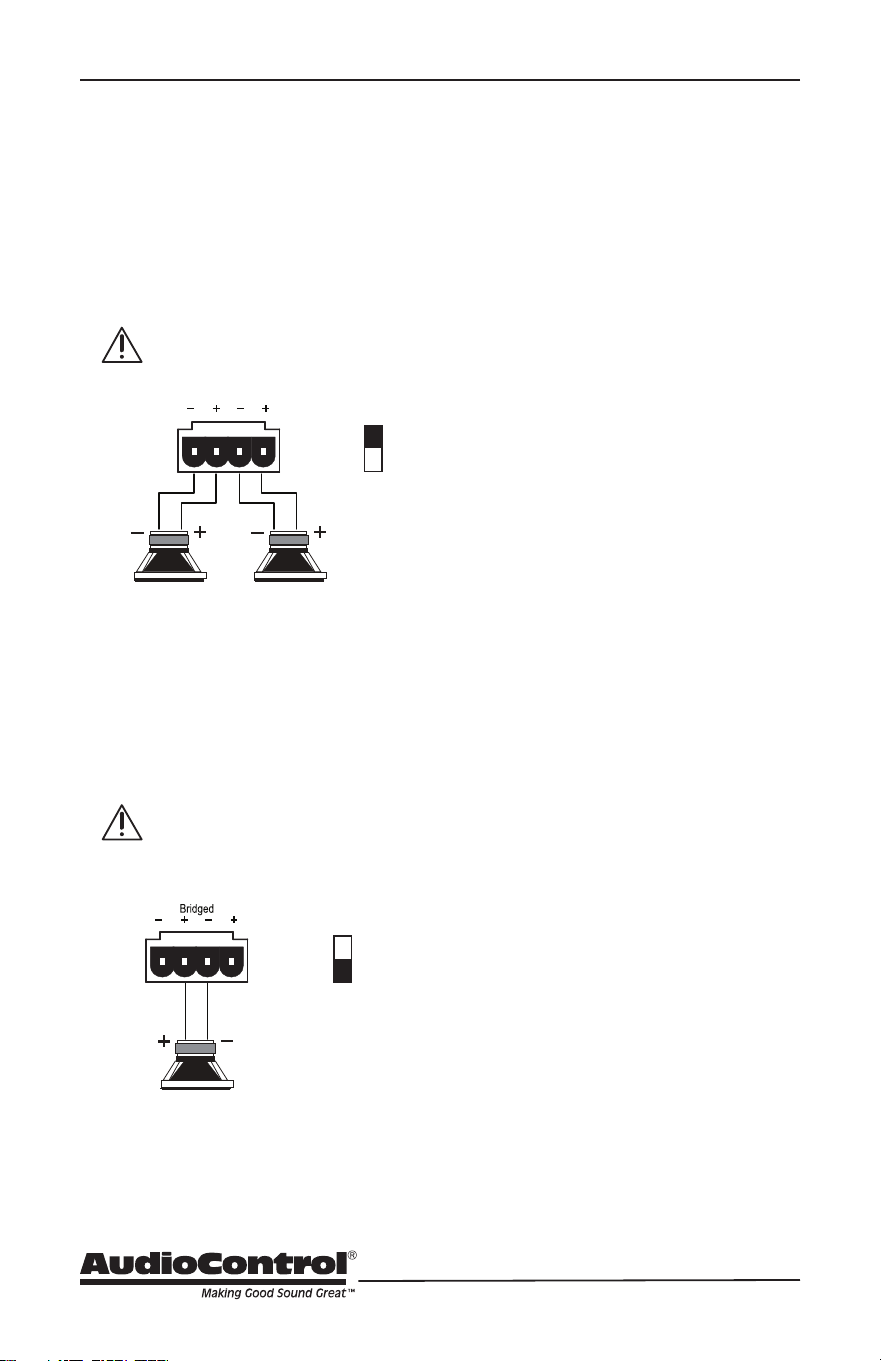
13. Speaker Outputs – This 4-pin con-
nector allows easy connection of two
speakers for stereo operation, or one
speaker for bridged mono operation.
Stereo Speaker Connection:
Set the zone’s Dip switch 1 Down
(stereo). Note the polarity markings on
the output connector.
The speaker impedance should
be 4 Ohms minimum in stereo
operation.
Bridged Mono Speaker Connection:
Set the zone’s Dip switch 1 Up (mono).
Note the polarity markings on the out-
put connector. In this mode, the input
signals are combined in mono, and the
power from both channels is combined
to drive a single speaker.
The speaker impedance should
be 8 Ohms minimum in bridged
mono operation.
To run two speakers in dual-mono,
connect them in the same way as
shown in the Stereo speaker diagram
above.
1
1
Speaker Connections
Establish a standard connection color
code and stick with it. One conductor of
the speaker wire is normally marked by
a dierent color (silver versus copper) or
there is a ribbing on one side. Typically this
marked conductor is used for the positive
(+) speaker leads. Really good wire has
Positive and Negative printed right onto
the wire jacket.
Match the polarity markings on the
unit with the polarity markings on your
speakers.
See the next page for some handy
information about speaker and wiring
impedance.

19
Installation Manual
Models P800
ARCHITECT
™
Speaker and Wiring Impedance
Speaker and Wiring Impedance
Wire Gauge Run Length
25’ 50’ 100’ 250’ 500’
24 GA 1.3Ω 2.6Ω 5.1Ω 12.8Ω 25.7Ω
22 GA 0.8Ω 1.6Ω 3.24Ω 8.1Ω 16.0Ω
20 GA 0.5Ω 1.0Ω 2.0Ω 5.0Ω 10.1Ω
18 GA 0.3Ω 0.6Ω 1.28Ω 3.2Ω 6.4Ω
16 GA 0.2Ω 0.4Ω 0.8Ω 2.0Ω 4.0Ω
14 GA 0.1Ω 0.25Ω 0.5Ω 1.26Ω 2.5Ω
12 GA 0.08Ω 0.16Ω 0.32Ω 0.8Ω 1.6Ω
Speaker Wire Resistance:
Wire Gauge versus Run Length
Be aware of speakers that have signicant
dips from “nominal” values in portions
of their frequency range, and speakers
that are rated at unusual impedances, for
example 3.5 Ohms. The Architect model is
tolerant of lower impedance loads, how-
ever, all good designs use some margin of
error.
Your choice of speaker wire gauge and the
length of the runs, also aects the speaker
impedance load presented to the ampli-
ers. As you can see in this table, even fairly
short speaker runs can have signicant
resistance if you use a smaller wire gauge.
This can be a benet if you are paralleling
lots of speakers. The wire itself acts as
an impedance limiter, since the amplier
cannot see a speaker load lower than the
resistance of the wire. The downside of
this wire resistance is that you waste some
part of the total power available to the
speakers.
Speaker impedance often is and should
be straight forward. Speakers, like other
resistors, if wired in parallel “show” lower
values than the individual components.
Here are two examples for calculating
speakers wired in parallel:
Calculating Impedance
For three 8 Ohm speakers wired in
parallel (pluses connected to pluses)
the impedance is 1/8 + 1/8 + 1/8 = 3/8
Then take the inverse or 8/3 = 2.66 Ω
For two 8 Ohm speakers wired in
parallel (pluses connected to pluses)
the impedance is 1/8 + 1/8 = 2/8
Then take the inverse or 8/2 = 4 Ω
Often the real world is more complicated
than theory, and for speakers this is the
case. An 8 Ohm speaker is not 8 Ohms at
all frequencies. Plus passive crossover net-
works add their own changing conditions.
20
Troubleshooting
Troubleshooting
Many problems can be eliminated by
re-checking the wiring and settings of the
unit. If a problem cannot be solved using
the guide below, please call the AudioCon-
trol team for further assistance, or e-mail
us at [email protected]
1. No Sound
a. Verify the Power LED is Blue.
b. Verify Protection LED is O.
c. Verify Zone Status LED is Blue.
d. If you are not using master trigger-
ing, check that there is a wire link
between the +12V pin and the Trig-
ger Input pin of the Master Trigger
3-pin connector block.
e. Verify the source unit is operating.
f. Check the speaker connector plugs
on the rear panel.
g Unplug the power cord and check
the AC Power Fuse on the rear
panel.
2. Protection LED is o, but none of
the Zone Status LEDs are on:
a. Defeat the signal-sense circuits
using the zone DIP switches on the
rear panel. All of the zone status
LEDs should turn on. If not, call
AudioControl’s customer service.
b. Verify the source unit is operating.
c. Increase the preamp volume if sig-
nal sense is engaged, or just going
steady.
d. Adjust the rear panel zone gain
controls clockwise.
3. Channel Status LED is Red:
a. Check speaker leads for a short.
Swap speaker connectors on rear to
see if the problem moves with the
wires.
b. If the unit is excessively hot, turn
down the volume and allow it to
cool o. The protection LED should
turn o after a short while. Verify
that any ventilation holes have not
become blocked.
c. The speaker impedance may be too
low. Use an Ohmeter to measure
the impedance on the speaker
wires.
4. Speaker channels are cutting in and
out:
a. If using external volume controls,
check that they can handle the
power output.
b. Make sure the speaker impedance
is not less than 4 Ohms, or 8 Ohms
when used in bridged mono.
c. There may be a short in the wires.
Suspect a short if the problem hap-
pens only at the highest volumes.
5. Protection LED is Red:
a. Disconnect power from the unit
for 3 to 4 minutes and reconnect to
power.
b. Disconnect all speaker wires. If
it still turns red, and the unit has
cooled, something rather serious
has happened inside the unit. Call
AudioControl’s lonely folks in cus-
tomer service.
Wire Link

21
Installation Manual
Models P800
ARCHITECT
™
6. Speaker Buzzing or Crackling at high
volume:
a. Reduce any preamplier/equalizer
low-frequency boost.
b. Turn o your chainsaw and ba-
con-frying “Sounds of the Pacic
Northwest” CD.
7. There is no audio input signal, but
the Zone Status LEDs are still blue:
a. Check the signal-sense switches
on the rear panel. If they are not
engaged, the zone status LEDs will
stay on as long as the master trig-
ger is enabled.
b. The zone status LEDs stays on for
2 minutes (depending on music
volume) after the audio signal has
stopped. This delay helps prevent
prematurely muting during quiet
passages or song changes.
8. The unit is on but you cannot trigger
it o
• The unit will stay on if either the
12v master trigger is on, or jum-
pered on.
9. Is an in-wall volume control rated at
100 Watts (continuous) adequate?
• Just barely is the simple answer. Go
for one with a higher rating if you
want a reliable long-lasting system.
Although the Architect model P800
is rated at 100 Watts, it is a conser-
vative number, and it can put out
more power if only a few channels
are driven. In contrast to the con-
servative rating of the Architect
model P800, the wall volume con-
trol may be rated using favorable
assumptions. Also make sure the
volume control power rating is con-
tinuous not peak. The continuous
rating is about one-third of peak.
10. The Architect model P800 looks like
this:
a. It has been installed upside down.
b. You are trying a new Yoga position.
22
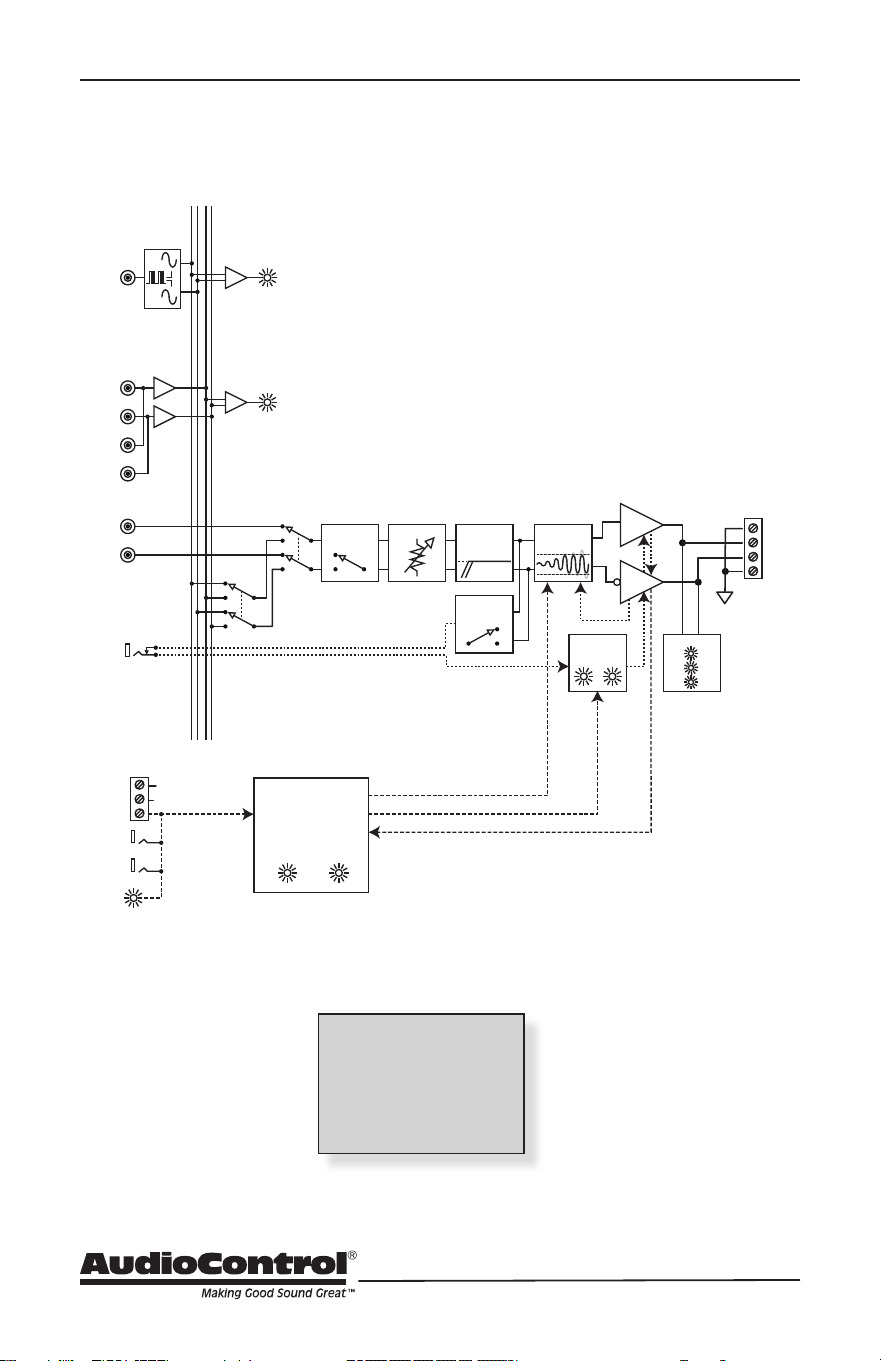
Block Diagram
EVEN+
EVEN-
ODD-
Bus A
Inputs
(SPDIF)
Master
12V
Trigger
Local
12V
Trigger
Local
Inputs
Power
Supply
Mono/
Stereo
Zone Level
Loop
Outputs
Bus B
Inputs
(Analog)
DAC
LightDrive
Anti-Clipping
Signal
Sense
Level PFM
Subsonic
Zone Status
/Active
Signal Present
BUS A
BUS B
Signal Present
BUS A/B
Local
/BUS
Speaker
Outputs
Amplifiers
GND
+12V
ODD+
ProtectPower
Simplied Block Diagram
Block Diagram
In Out
Power

23
Installation Manual
Models P800
ARCHITECT
™
Specications
P800 Specications
Output Power
Per Channel ............................................ 100 Watts @ 8 Ohm, 200 Watts @ 4 Ohm
Bridged Mono ...........................................................................400Watts @ 8 Ohm
Signal to Noise Ratio ........................................................... > 105 (A wtd, ref full output)
Crosstalk ............................................................................................... > 80 dB @ 1 kHz
Damping Factor ...................................................................................................... >300
Gain ....................................................................................................................... 30 dB
Analog Input Sensitivity ....................................1 Vrms for full output, level at maximum
DAC Specications .......................................... 32 – 192 kHz sample rate, 16/24 bit depth
AC Power Requirements
Standby .................................................................................................... 0.8 Watts
Idle (main power on, all channels o) ......................................................... 35 Watts
All channels active ..................................................................................... 60 Watts
All channels 1/8th rated power ................................................................. 180 Watts
Full Power .............................................................................................. 1800 Watts
BTU/hr Output
Standby .................................................................................................. 2.7 BTU/hr
Idle (main power on, all channels o) ..................................................... 120 BTU/hr
All channels active ................................................................................. 192 BTU/hr
All channels 1/8th rated power ............................................................... 242 BTU/hr
Full Power (20A residential service limited) .......................................... 1560 BTU/hr
Dimensions
Height ...................................................................................................... 1.75" (1U)
Width (ears on) ................................................................................................ 19.0"
Width (ears o) ................................................................................................. 17.0"
Depth .............................................................................................................. 15.8"
Weight ............................................................................................................ 15 lbs
Please note: Because of AudioControl’s bold and daring quest to push back the frontiers of
audio perfection, all specications are subject to change without notice, and at any time,
including (and not limited to) breaktime, lunchtime, and afternoon tea on the front lawn.

24
Service
What to do if you need service
First, if you need service, it is probably
best to go and see a trained health care
professional.
If the Architect Model P800 needs service,
then please contact AudioControl, either
by e-mail or phone. We will verify if there
is anything wrong in the system that you
can correct yourself, or if it needs to be
sent back to our factory for repair.
Please include the following items when
returning the unit:
1. A copy of your proof of purchase. No
originals please. We cannot guarantee
returning them to you.
2. A brief explanation of the trouble you
are having with the unit. (You’d be
surprised how many people forget
this.) If you can supply a really detailed
description of the problem, this would
be so much better, and our service
technicians may add you to their
Christmas Card list. Please include
any notes about the system and other
components you are using. Is it an
intermittent problem that only occurs
on the rst full moon of Spring?
3. A return street address. (No PO Boxes,
please).
4. A daytime phone number in case our
technicians have a question about the
problem you are having, or if they are
just feeling lonely.
5. Package the unit in the original
packaging if you still have it, and if the
cat hasn’t had three litters of kittens
in the box. Use great care and plenty
of good packing materials to protect
the unit and prevent it from moving
about inside the box. Do not use loose
materials like packing peanuts or real
peanuts.
You are responsible for the freight charges
to us, but we’ll pay the return freight back
as long as the unit is under warranty. We
match whatever shipping method you
use to send it to us, so if you return the
unit overnight freight, we send it back
overnight. We recommend United Parcel
Service (UPS) for most shipments.
Repair service is available at:
Attention: Service Department
22410 70th Avenue West,
Mountlake Terrace,
WA 98043 USA
Phone 425-775-8461
FAX 425-778-3166
e-mail: sound.great@audiocontrol.
com

25
Installation Manual
Models P800
ARCHITECT
™
The Warranty
In just the same way as being covered in
honey and thrown into a dark pit full of
hungry woodchucks, people are scared of
warranties. Lots of ne print. Months of
waiting around. Well, fear no more. This
warranty is designed to make you rave
about AudioControl. It’s a warranty that
looks out for you and your client, plus
helps you resist the temptation to have
your friend Sparky, who’s “good with elec-
tronics,” try to repair your AudioControl
product. So go ahead, read this warranty,
then register the information at www.
audiocontrol.com/product-registration
and include your comments.
Our warranty has conditional conditions!
“Conditional” doesn’t mean anything
ominous. The Federal Trade Commission
tells all manufacturers to use the term
to indicate that certain conditions have
to be met before they’ll honor the war-
ranty. If you meet all of these conditions,
AudioControl will, at its discretion, repair
or replace any AudioControl products
that exhibit defects in materials and/or
workmanship during the warranty on your
product for ve (5) years from the date
you bought it, and we will x or replace it,
at our option, during that time.
Here are the conditional conditions:
1. You must fully register your purchase
within 15 days of the purchase date
by going to the AudioControl product
registration page at www.audiocon-
trol.com/product-registration. Failure
to register your product will negate
the warranty.
2. You need to hold on to your sales
receipt! All warranty service requires
original sales receipt documentation.
The warranty only applies to the
original purchaser from an authorized
AudioControl dealer. Note: Products
purchased from unauthorized dealers
are not covered under warranty.
3. If an authorized AudioControl dealer
installs your AudioControl product,
the warranty is ve years, otherwise
the warranty is limited to one year.
4. Our warranty covers AudioControl
products that have been installed
according to the instructions in the
installation manual.
5. You cannot let anybody who isn’t:
(A) the AudioControl factory; or (B)
somebody authorized in writing by
AudioControl service your AudioCon-
trol product. If anyone other than (A),
or (B) messes with your AudioControl
product, the warranty is void.
6. The warranty is void if the serial num-
ber is altered, defaced or removed,
or if your product has been used
improperly. Now that may sound like
a big loophole, but here is what we
mean by this: Unwarranted abuse is:
(A) physical damage (don’t use your
product to level your dining room
table); (B) improper connections (120
volts into the RCA jacks can fry the
poor thing); (C) sadistic things! This
is the best product we know how to
build, but for example if you mount it
to the front bumper of your car, drop
it over the Niagara Falls or use it for
Clay Pigeon shooting practice, some-
thing will go wrong.
Assuming you conform to 1 through 6, and
it really isn’t all that hard to do, we get the
option of xing your product or replacing
it with a new one at our discretion.
In the event that your product is out of
warranty or not covered under our warran-
ty you may request to have any damage
repaired at our normal “Out of Warranty”
repair cost.
Please Remain Calm

26
Legalese Section
This is the only warranty issued by Audio-
Control. This warranty gives you specic
legal rights, and you may also have rights
that vary from state to state. Promises of
how well your AudioControl product will
work are not implied by this warranty.
Other than what we’ve said we’ll do in this
warranty, we have no obligation, express
or implied. We make no warranty of mer-
chantability or tness for any particular
purpose. Also neither we nor anyone else
who has been involved in the develop-
ment or manufacture of the unit will have
any liability of any incidental, consequen-
tial, special or punitive damages, includ-
ing but not limited to any lost prots or
damage to other parts of your system by
hooking up to the unit (whether the claim
is one for breach of warranty, negligence
of other tort, or any other kind of claim).
Some states do not allow limitations of
consequential damages.
Please Remain Calm
27
Installation Manual
Models P800
ARCHITECT
™
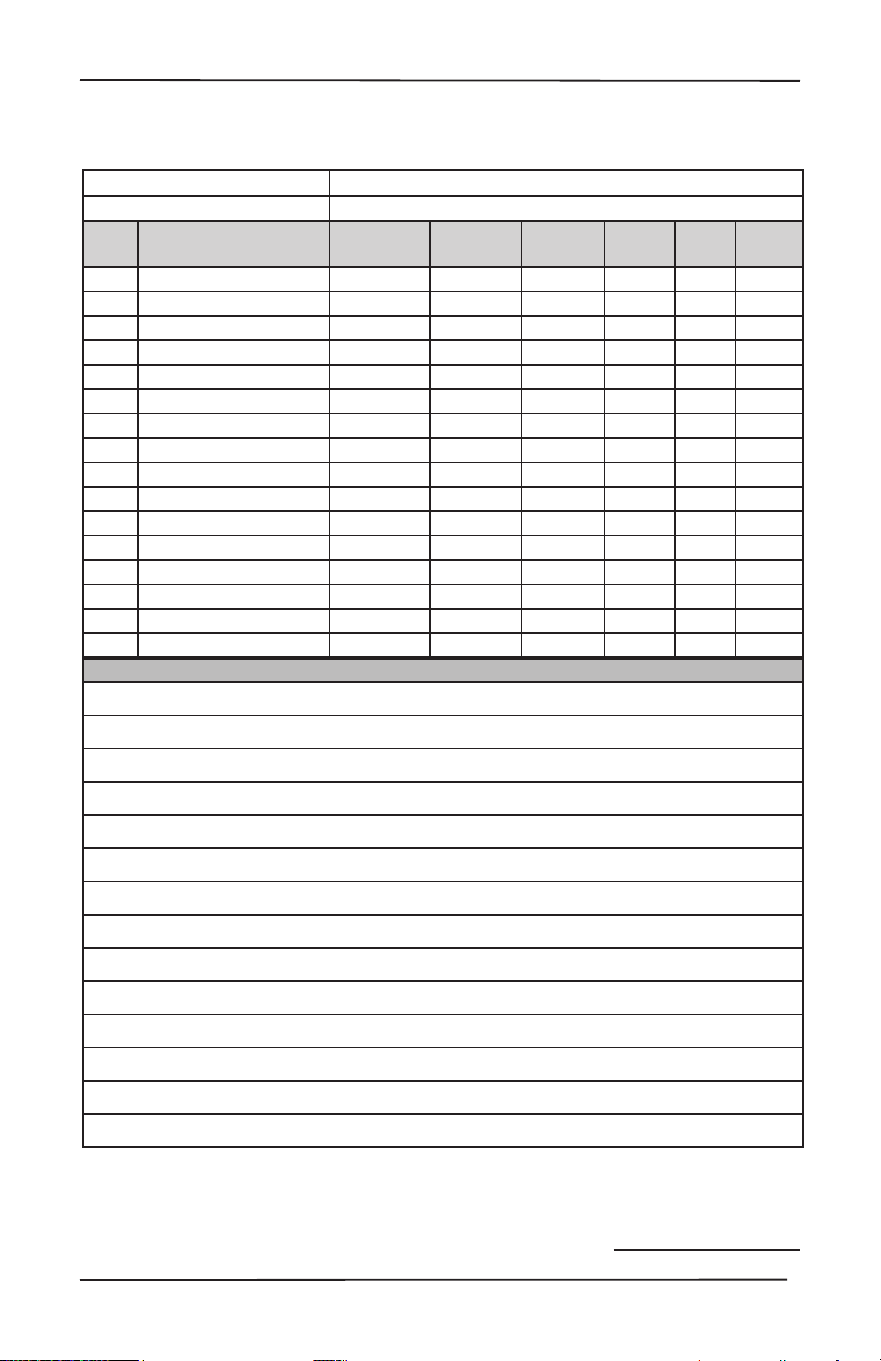
Installation Notes
Installation:
Installer:
Zone Room Local Bus A Bus B Signal
Sense
40 Hz Mono
Stereo
1
2
3
4
5
6
7
8
9
10
11
12
13
14
15
16
Notes
Installation Notes
28
Hurrah, you are done!
Manual PN 913-143-0 Rev A
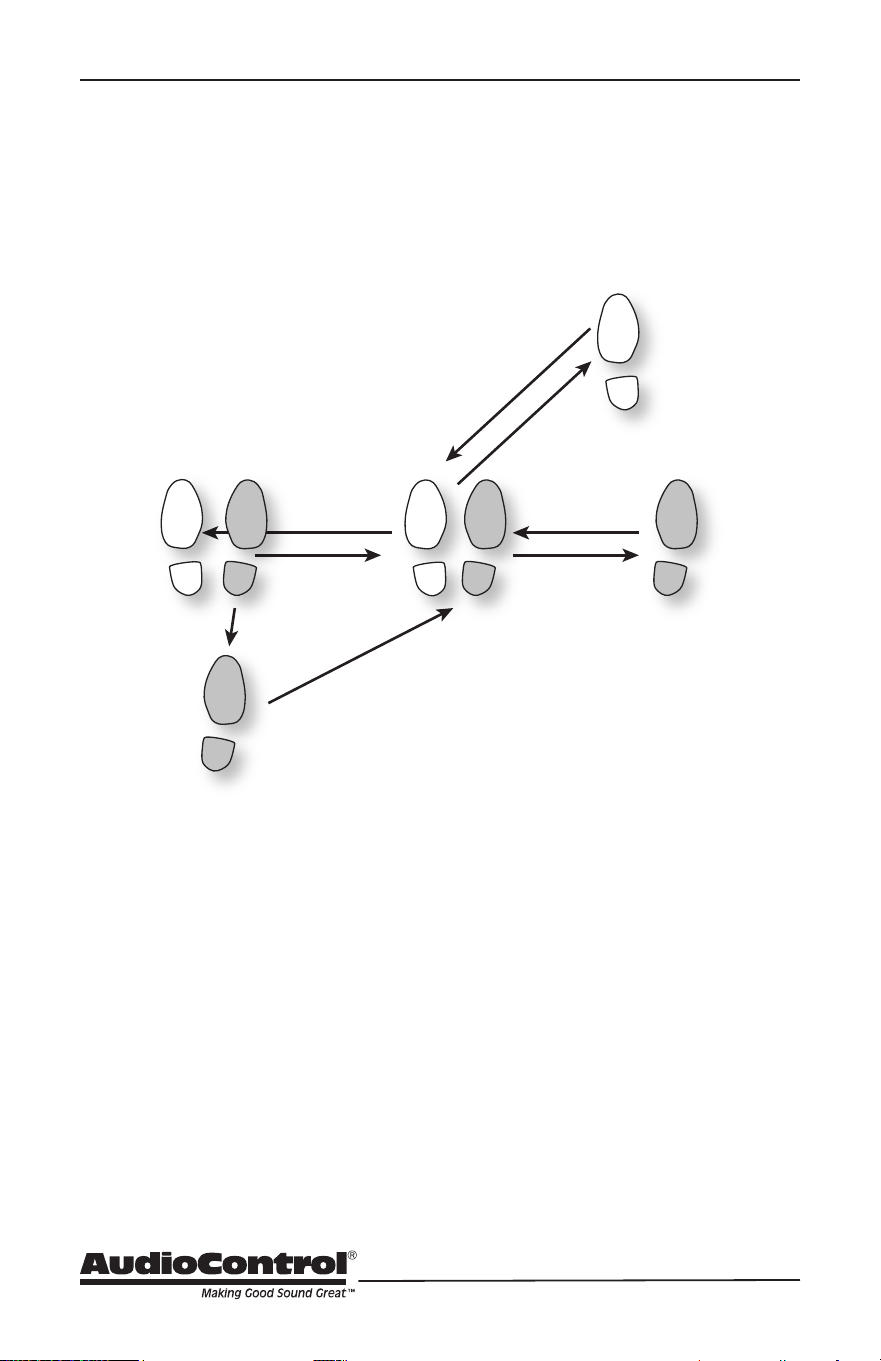
Basic Cha-Cha
2 2
START
9
8
5
1
4 3 7
6