
.
Signa S4 HOME THEATER SYSTEM
.
Owner’s Manual
1

About manuals .................................................................... 4
About descriptions of this manual .................................. 4
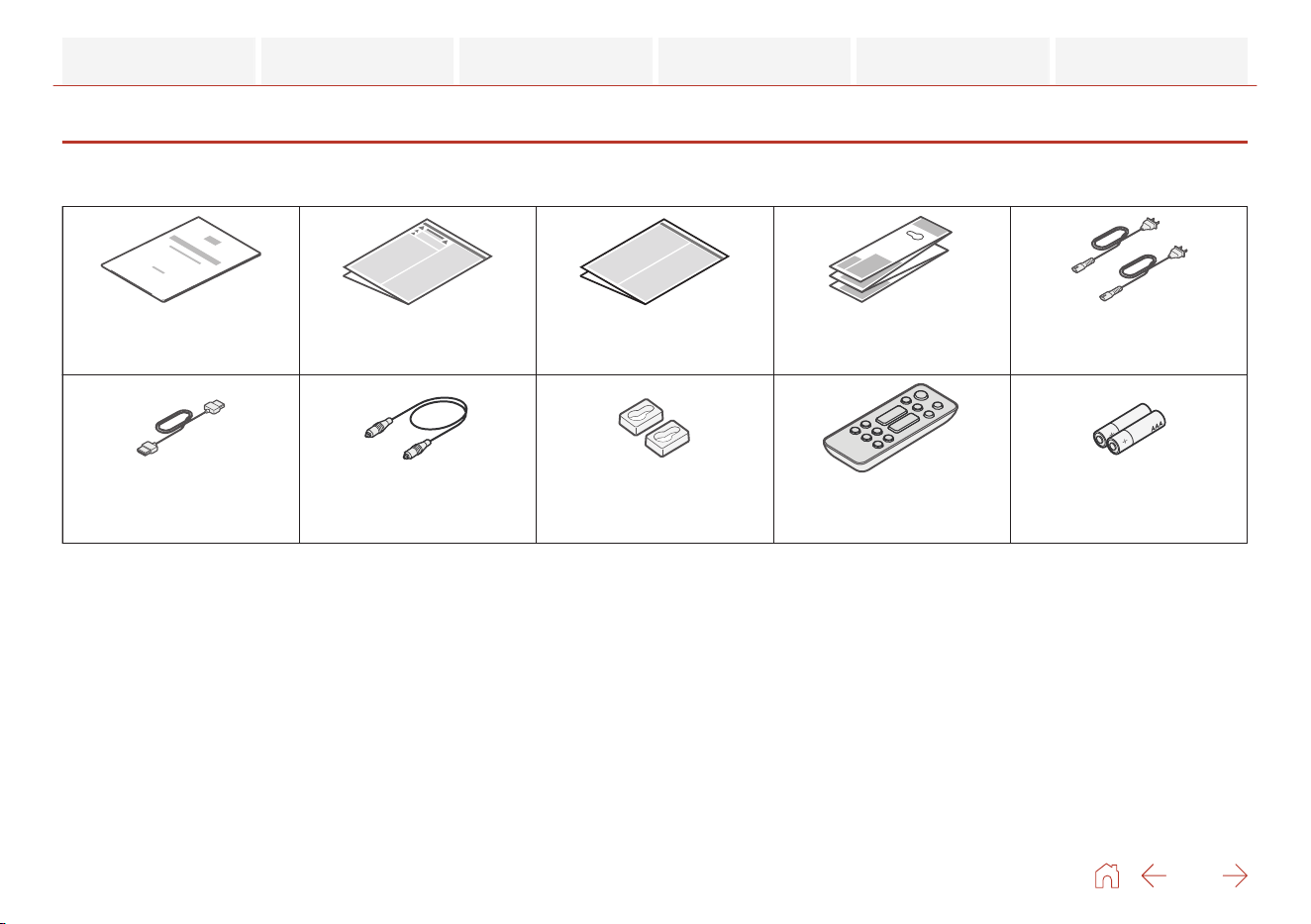
Accessories ......................................................................... 5
Inserting the batteries ....................................................... 6
Operating range of the remote control unit ................. 6
Part names and functions ................................................. 7
Sound bar ............................................................................. 7
Subwoofer ........................................................................... 11
Remote control unit .......................................................... 12
Connections ............................................................... 14
Positioning .......................................................................... 14
Positioning the sound bar in front of a TV ................... 14
Hanging the sound bar on a wall .................................. 15
Positioning the subwoofer .............................................. 17
Connecting a TV ............................................................... 18
TV equipped with an HDMI connector and compatible
with the eARC (Enhanced Audio Return Channel) or
ARC (Audio Return Channel) .......................................... 19
TV equipped with an HDMI connector and
incompatible with the eARC or ARC / TV equipped with
an optical digital connector .......................................... 20
TV equipped with an HDMI connector and
incompatible with the eARC or ARC / TV equipped with
an analog connector ....................................................... 21
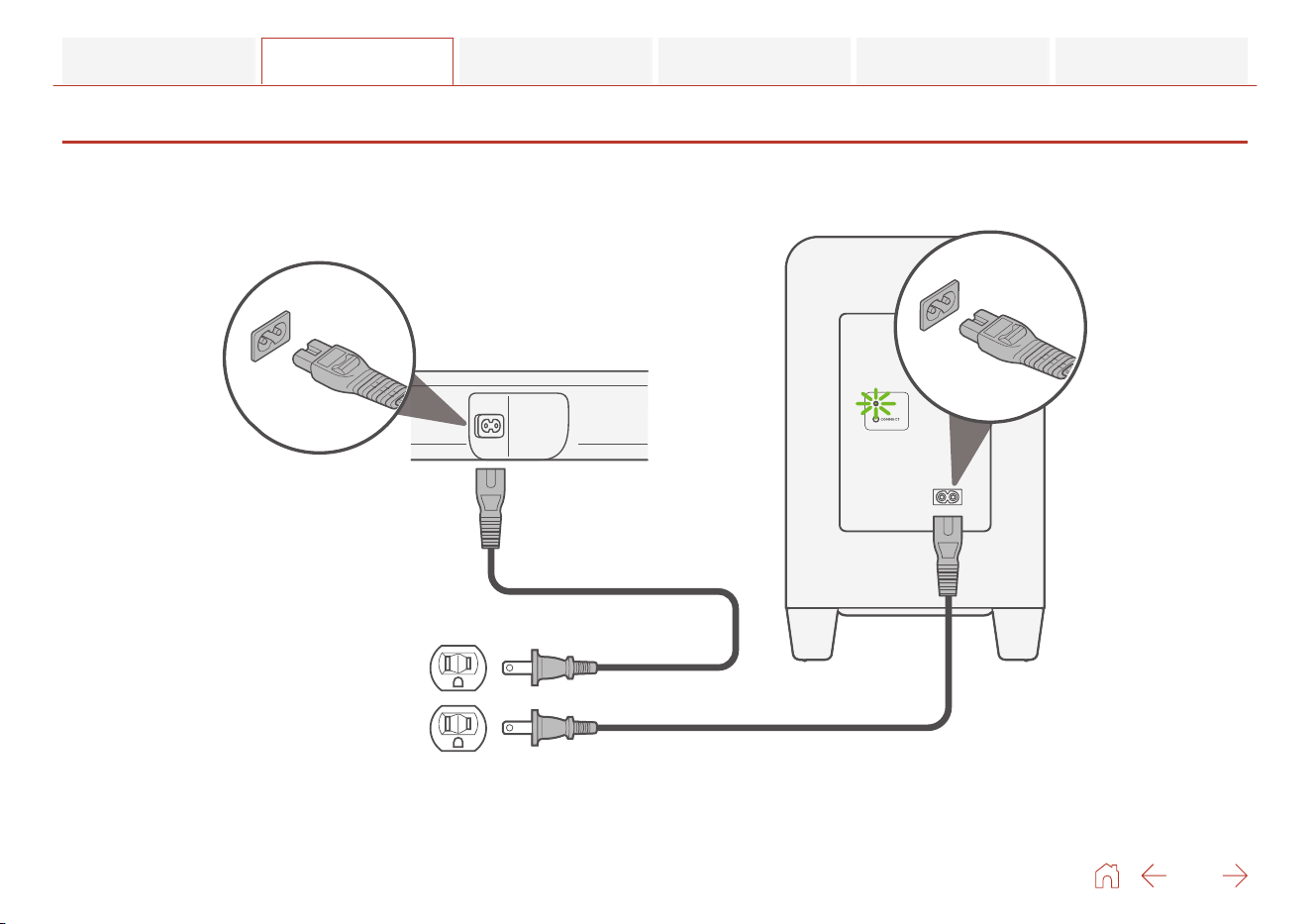
Connecting the power cords ......................................... 22
Playback ..................................................................... 23
Playing TV, movies and music ........................................ 23
Adjusting the volume ....................................................... 24
Adjusting the subwoofer volume .................................. 24
Turning off the sound temporarily ................................ 24
Playing music on a Bluetooth device ........................... 25
Pairing a Bluetooth device for the first time ............... 25
Pairing with other Bluetooth devices ........................... 26
Playing music with a paired Bluetooth device ........... 26
Settings ....................................................................... 27
Settings .............................................................................. 27
Selecting a sound mode ................................................. 27
Automatically setting to standby (Auto standby
function) ............................................................................ 28
Reducing the standby power consumption (Deep
standby function) ............................................................ 28
Switching the standby linking via HDMI control
function on or off ............................................................. 29
Automatically turning on the power according to the
playback of the playback device (Auto on control
function) ............................................................................ 30
Operating this unit using the remote control of a TV
............................................................................................... 31
Contents
Connections Playback Settings Tips Appendix
2

Tips .............................................................................. 33
Troubleshooting ............................................................... 33
Power does not turn on / Power is turned off ............ 34
Operations cannot be performed through the remote
control unit ........................................................................ 35
Trouble teaching this unit remote control commands
.............................................................................................. 35
No sound comes out ........................................................ 36
Bluetooth playback does not work ............................... 37
The HDMI control function does not work .................. 38
Audio can be heard coming from the TV’s speakers
.............................................................................................. 38
Resetting factory settings ............................................. 39
Appendix .................................................................... 40
About HDMI ....................................................................... 40
Trademark information .................................................... 41
Specifications ................................................................... 42
Sound bar ........................................................................... 42
Subwoofer ......................................................................... 45
Contents
Connections Playback Settings Tips Appendix
3
Thank you for purchasing this Polk product.
To ensure proper operation, please read this owner’s manual carefully before using the product.
After reading this manual, be sure to keep it for future reference.
About manuals
The following manuals are included on this unit.
0
Safety Instructions (supplied)/Cautions on Using Batteries (supplied):Describes careful considerations that you should note in
order to use this unit correctly and safety. Please read carefully before using this unit.
0
Quick Start Guide (supplied):Describes the basics about how to use this unit. Please read when you use this unit for the first time.
0
Owner’s Manual (this manual):Describes details about how to use this unit. Also, describes troubleshooting.
About descriptions of this manual
0
Signa S4 (sound bar and subwoofer) is described as this unit in this manual.
0
In this manual, when you can operate either the sound bar or remote control, the operations for remote control are mainly
described.
0
The symbols used in this manual have the following meanings.
.
Information such as the precautions on the use and the function restrictions.
.
Information such as supplementary notes that are useful for you to know.
0
Contents of this unit may be updated without notice.
Contents
Connections Playback Settings Tips Appendix
4
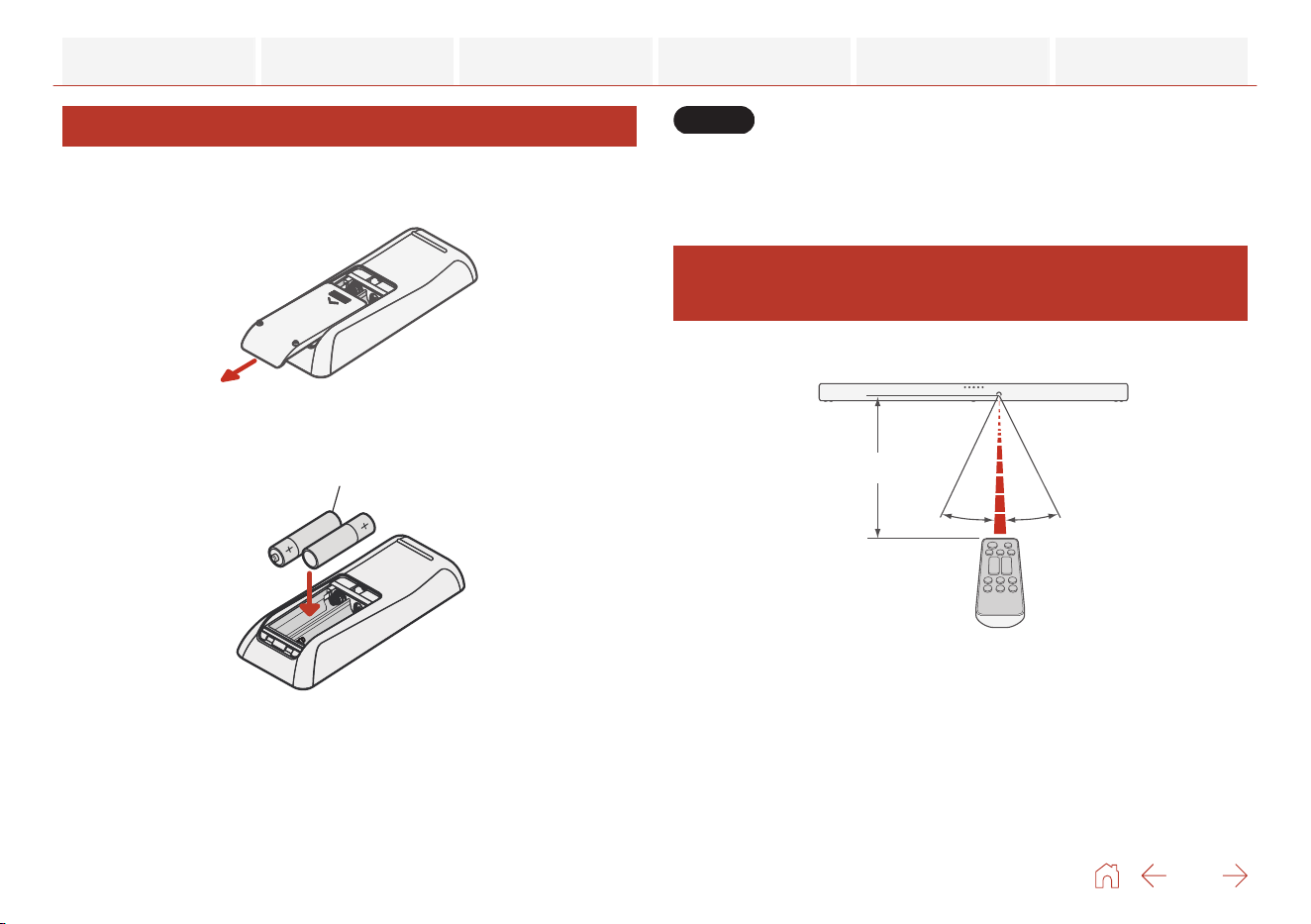
Inserting the batteries
1
Slide the rear cover off the remote control unit in the
arrow direction.
.
2
Insert two batteries correctly into the battery
compartment as indicated.
.
Batteries
3
Put the rear cover back on.
NOTE
0
Remove the batteries from the remote control unit if it will not be in use
for long periods.
0
If the battery fluid should leak, carefully wipe the fluid off the inside of
the battery compartment and insert new battery.
Operating range of the remote
control unit
Point the remote control unit at the remote sensor when
operating it.
.
30°
30°
Approx. 23 ft/7 m
Contents
Connections Playback Settings Tips Appendix
6
Part names and functions
Sound bar
o
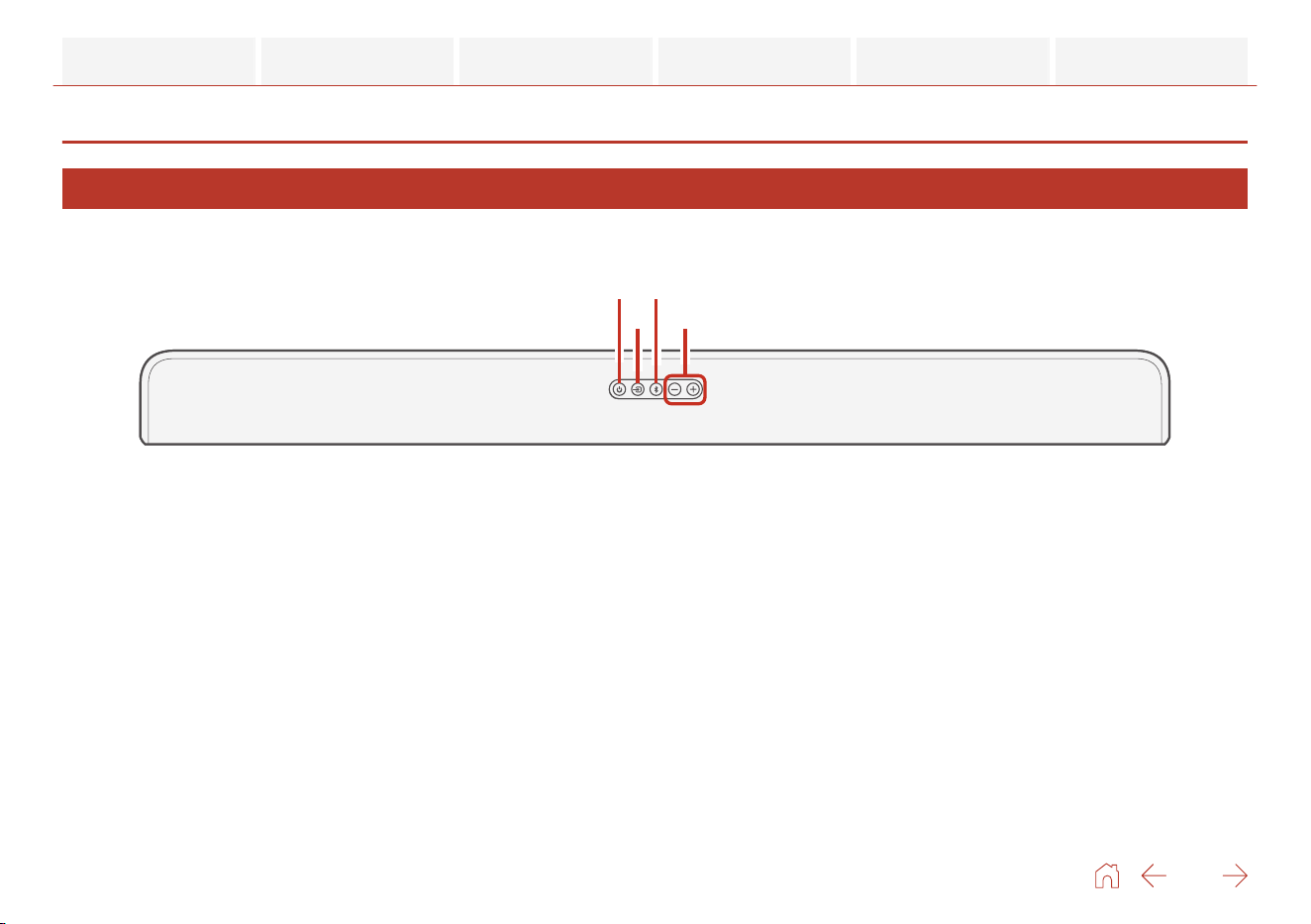
Top panel
.
eq
rw
A
Power operation button (c)
Turns the sound bar power on/off (standby). (v p. 23)
Links to sound bar power and turns the subwoofer power
on/off (standby).
B
Input source button (d)
This selects the input source. (v p. 23)
Switches the input source each time the button is pressed.
C
Bluetooth button (g)
0
Switches the input source to “Bluetooth”. (v p. 25)
0
Used to pair with Bluetooth devices. (v p. 25)
D
Volume buttons (+, –)
These adjusts the volume level. (v p. 24)
Contents Connections Playback Settings Tips Appendix
7
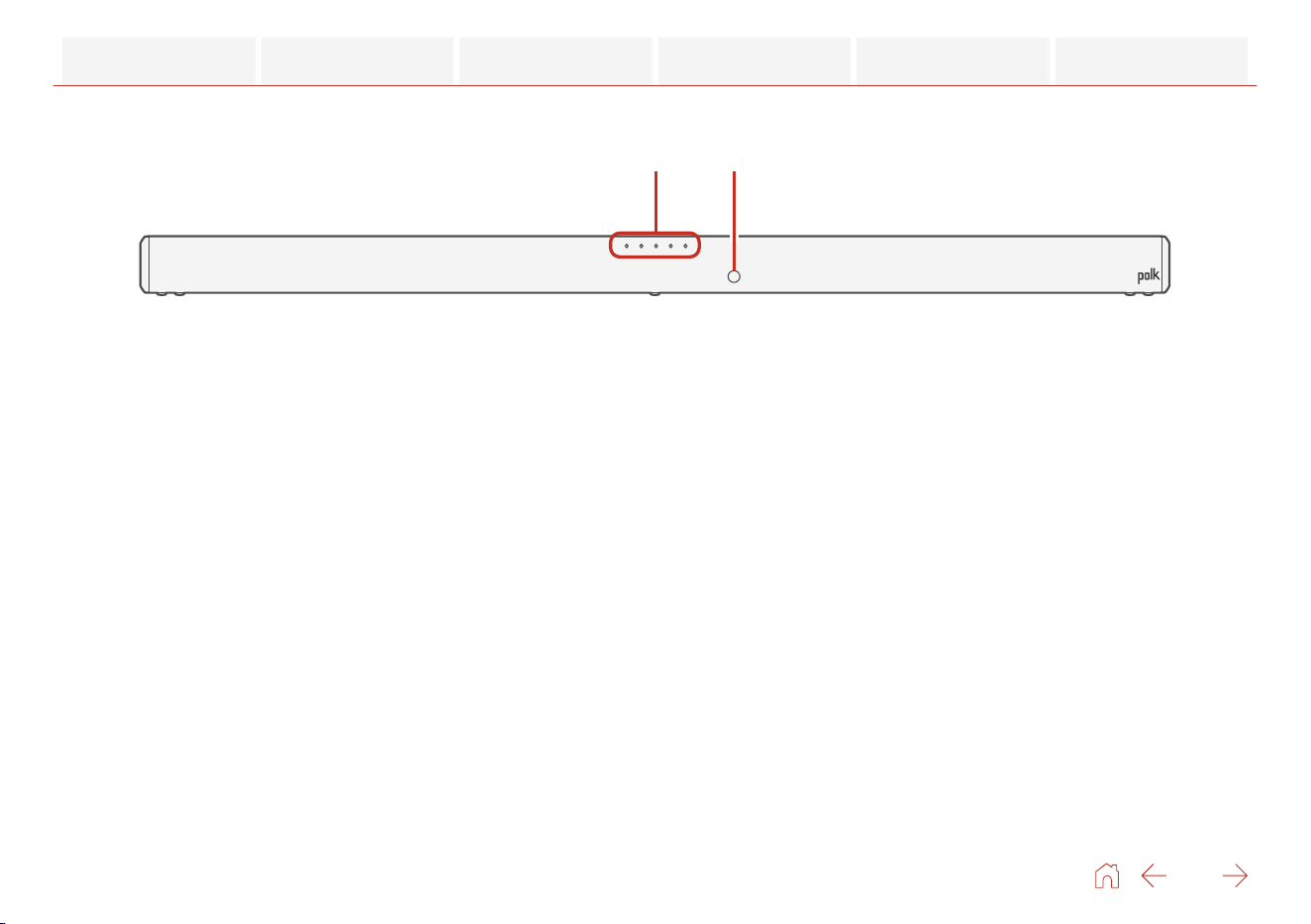
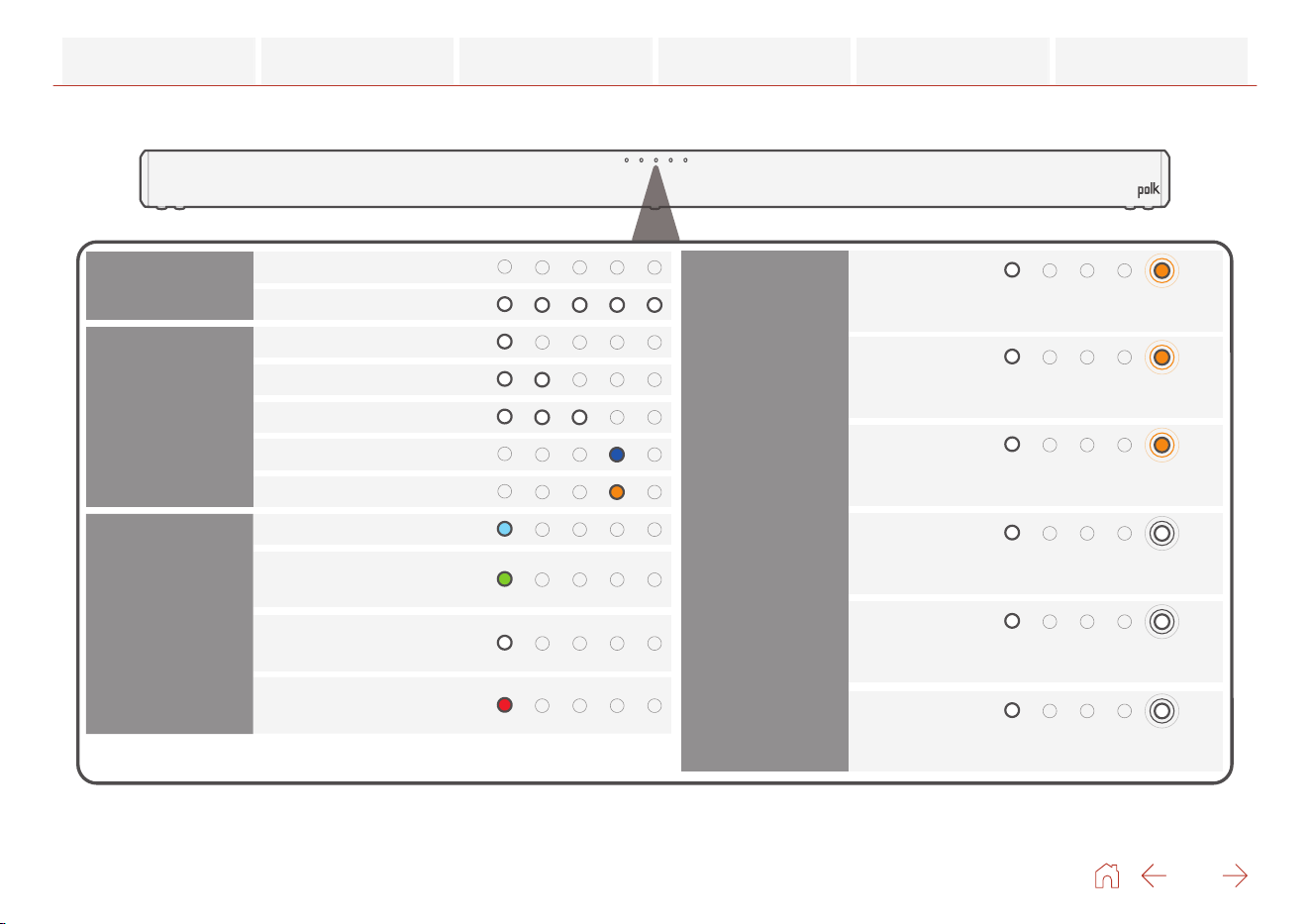
o
Status LED
.
TV (HDMI eARC/ARC)
TV (OPTICAL)
AUX
Input
source
Off (Standby)
On
Power
Bluetooth
USB
Dolby Atmos
Audio format
[Ex.] Input source:
TV (HDMI eARC/ARC)
Dolby
(other than Atmos)
Unsupported
audio format
PCM
(or No Signal)
Movie mode
Sound mode
[Ex.] Input source:
TV (HDMI eARC/ARC)
Music mode
Night mode
Blink
once
Blink
twice
Blink
three times
Voice adjust 1
Blink
once
Voice adjust 2
Blink
twice
Voice adjust 3
Blink
three times
Contents
Connections Playback Settings Tips Appendix
9
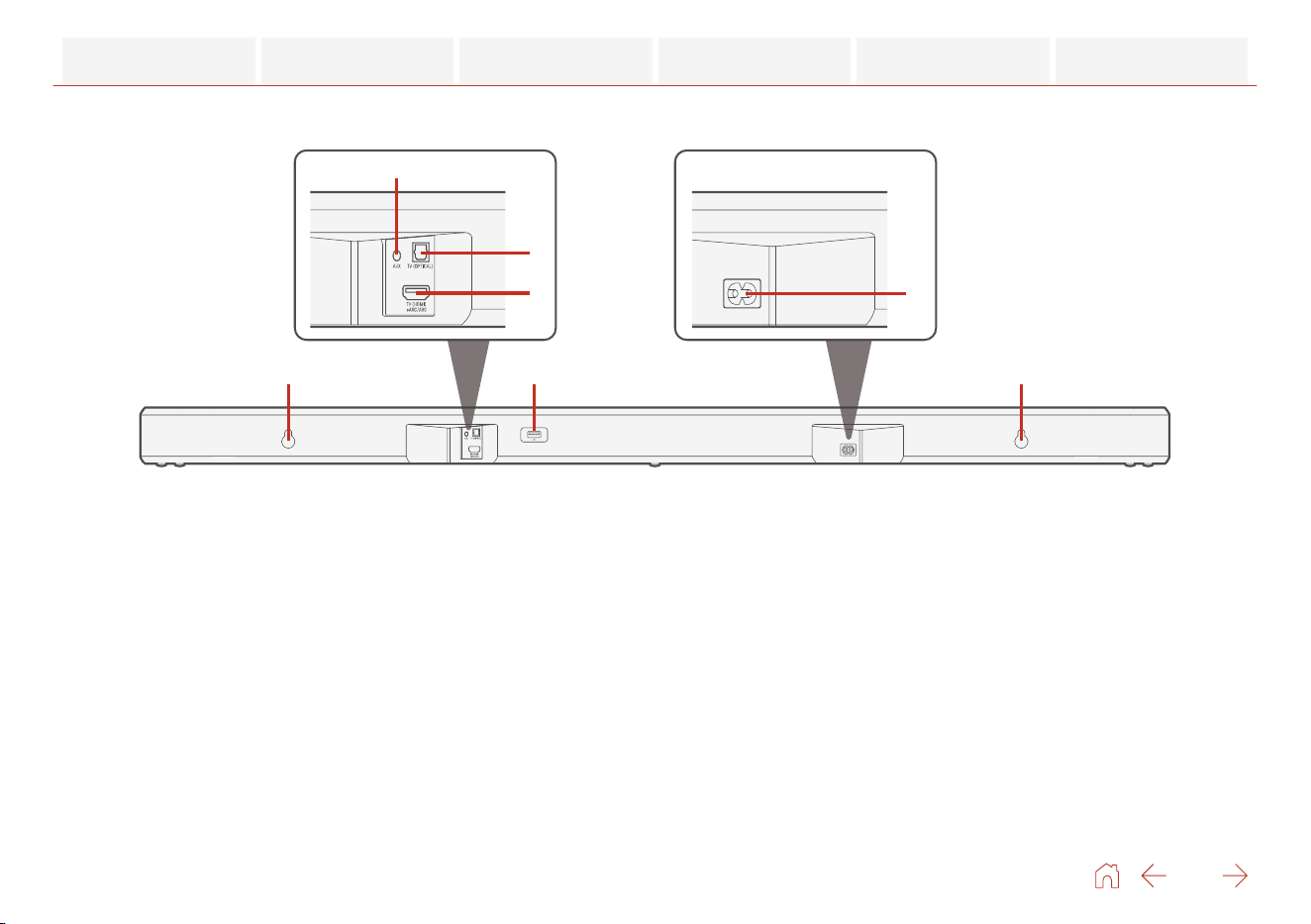
o
Rear panel
.
qq
r
e
t
y
w
A
Wall hook hole
Used to mount the sound bar on a wall. (v p. 15)
B
AUX audio input connector
Use a commercially available 3.5 mm stereo audio cable to
connect an audio device. (v p. 21)
C
Optical input connector (TV (OPTICAL))
Use the included optical cable to connect a TV with an optical
terminal. (v p. 20)
D
HDMI connector (TV (HDMI) eARC/ARC)
Use the included HDMI cable to connect an eARC or ARC
function-compatible TV. (v p. 19)
E
USB port
USB playback is available. (v p. 23)
F
AC inlet
Used to connect the power cord. (v p. 22)
Contents Connections Playback Settings Tips Appendix
10
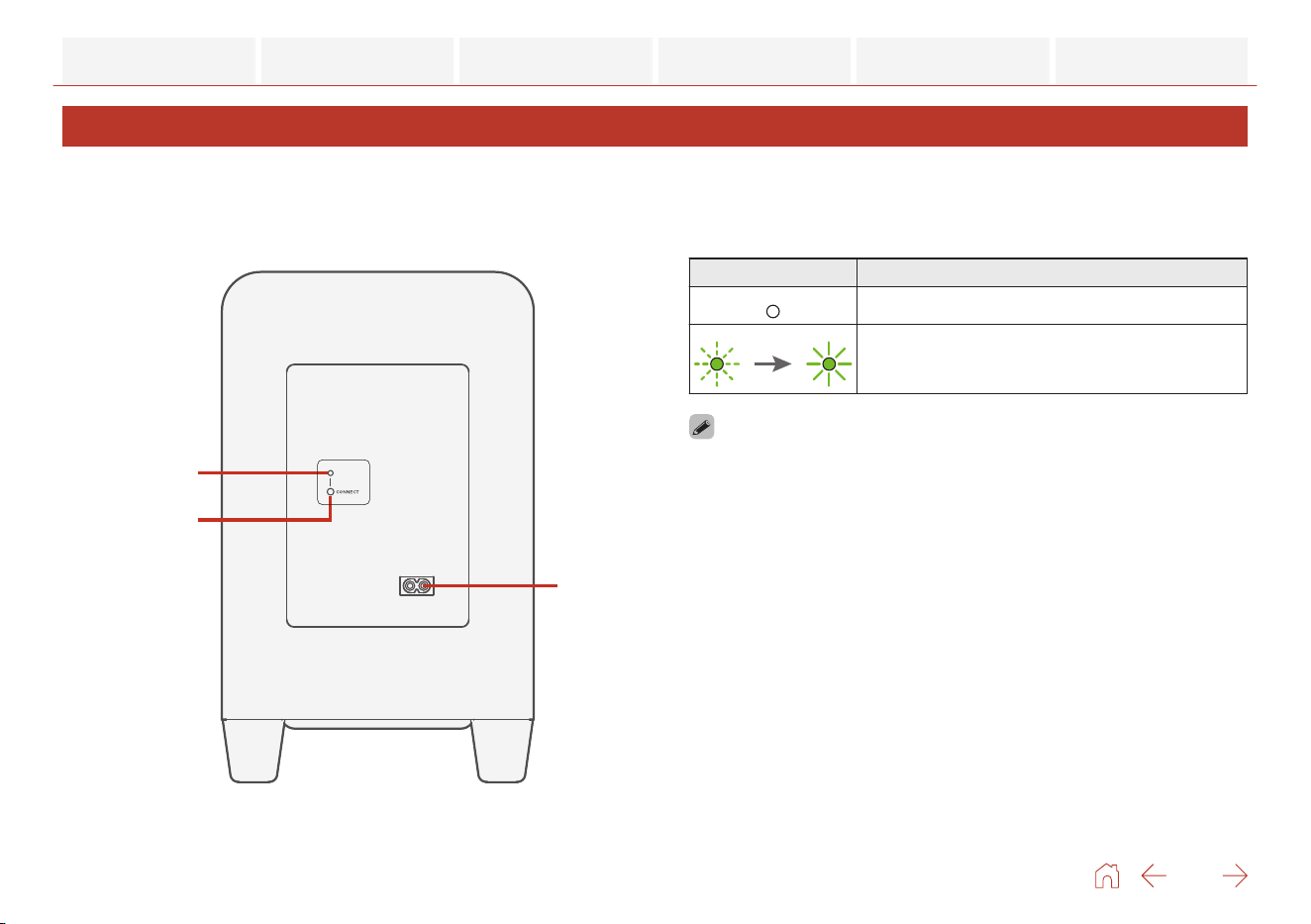
Subwoofer
o
Rear panel
A
Status LED
Displays subwoofer status.
LED indication Status
.
When subwoofer power is standby
.
When the sound bar and subwoofer are
wirelessly connected
0
The sound bar and subwoofer are wirelessly connected as the
factory default. If no audio is output from the subwoofer, wirelessly
connect the sound bar and subwoofer again. (v p. 36)
B
CONNECT button
Used to wirelessly connect the sound bar and subwoofer.
(v p. 36)
C
AC inlet
Used to connect the power cord. (v p. 22)
e
q
w
Contents
Connections Playback Settings Tips Appendix
11
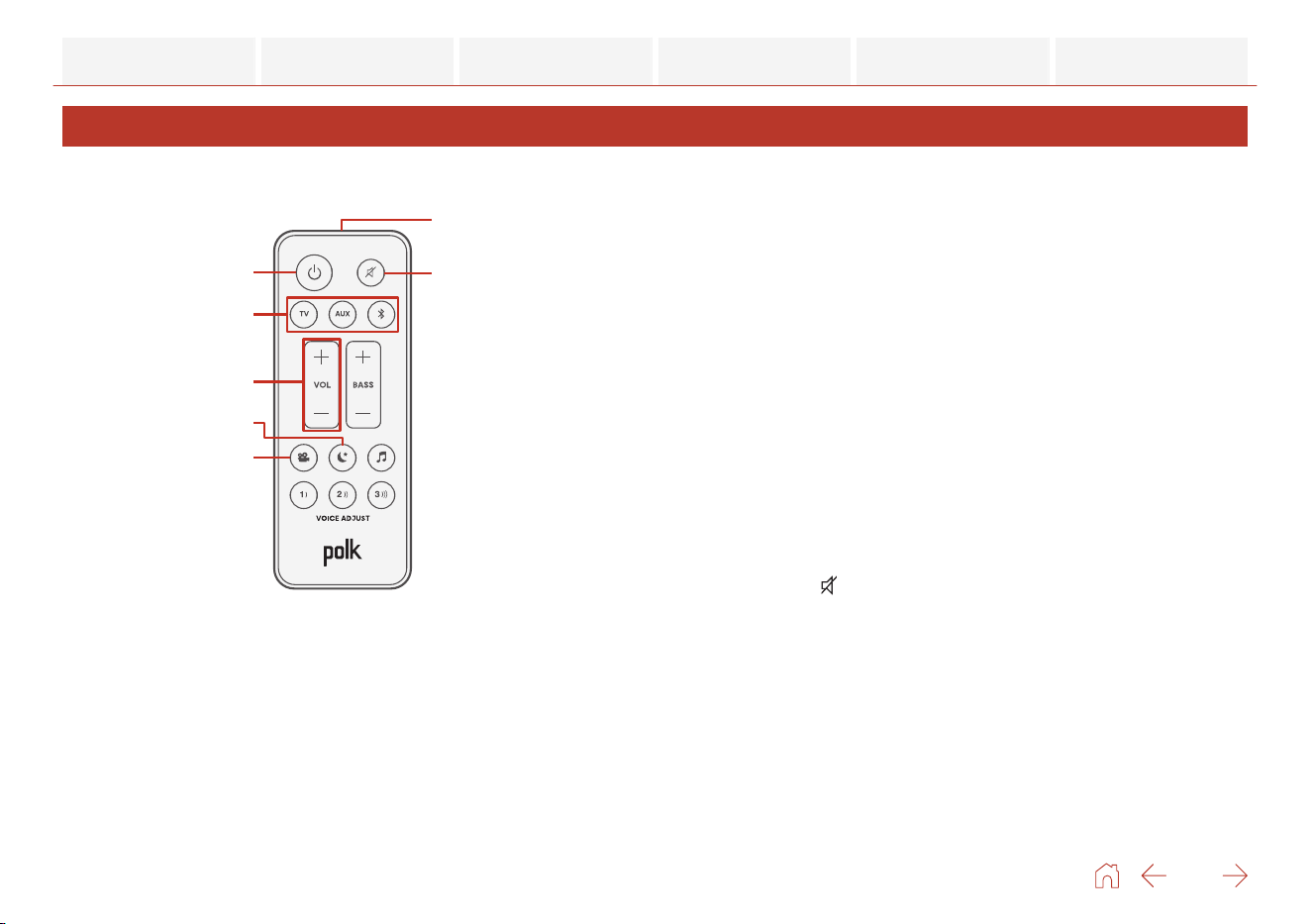
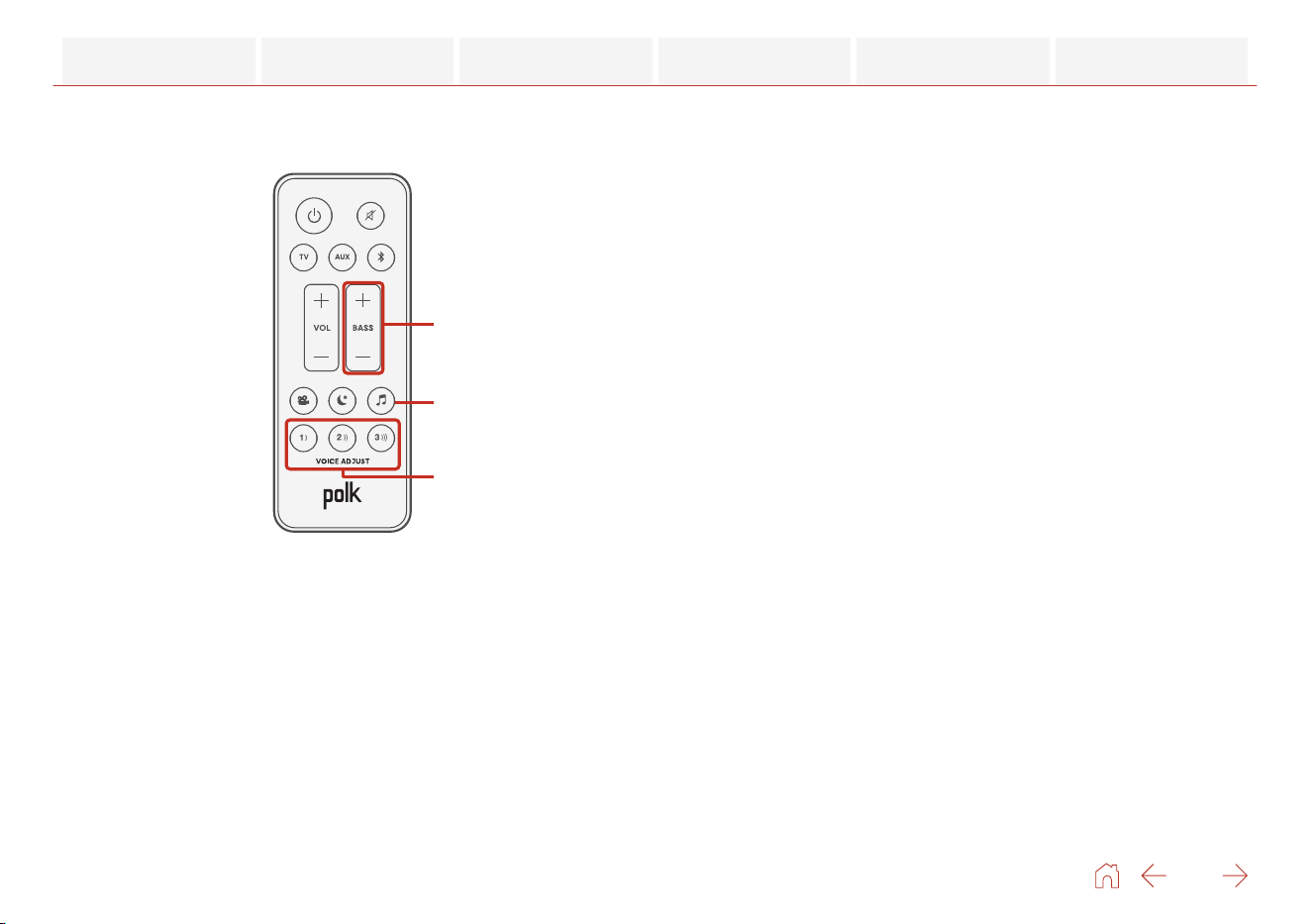
Remote control unit
t
q
w
r
e
u
y
A
Power button (c)
Turns the sound bar power on/off (standby). (v p. 23)
Links to sound bar power and turns the subwoofer power
on/off (standby).
B
Input source buttons (TV, AUX, g)
This selects the input source. (v p. 23)
C
Volume buttons (VOL +, –)
These adjusts the volume level. (v p. 24)
D
Night mode button (3)
Compresses the dynamic range (difference between loud and
soft sounds) to make audio easier to hear at low volumes.
(v p. 27)
E
Movie mode button (4)
Enjoy movie theater-like surround sound. (v p. 27)
F
Remote control signal transmitter
This transmits signals from the remote control unit. (v p. 6)
G
Mute button (
)
This mutes the output audio. Press again to unmute.
(v p. 24)
Contents
Connections Playback Settings Tips Appendix
12
o
Q0
i
H
Button to adjust subwoofer (BASS +, -)
Adjusts the volume level for the subwoofer. (v p. 24)
I
Music mode button (2)
Enjoy the full presence of a wide, encompassing acoustic
field. (v p. 27)
J
Voice adjust buttons
(VOICE ADJUST 1, 2, 3)
Adjust the volume of dialog in movies, vocals in music, etc. so
these can be heard more easily. (v p. 27)
Can be set to 3 levels. Set this to the desired value.
Contents Connections Playback Settings Tips Appendix
13
Positioning
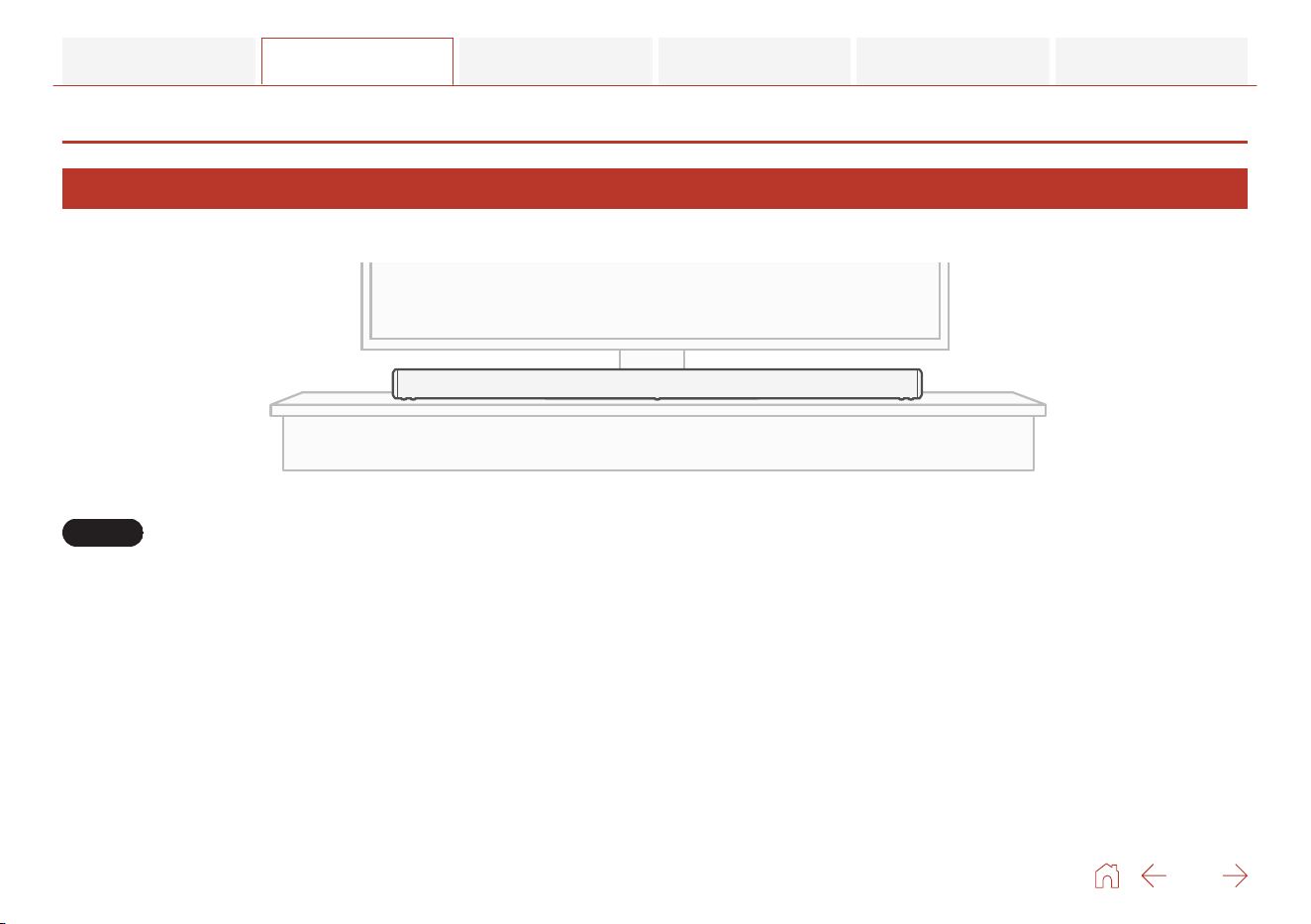
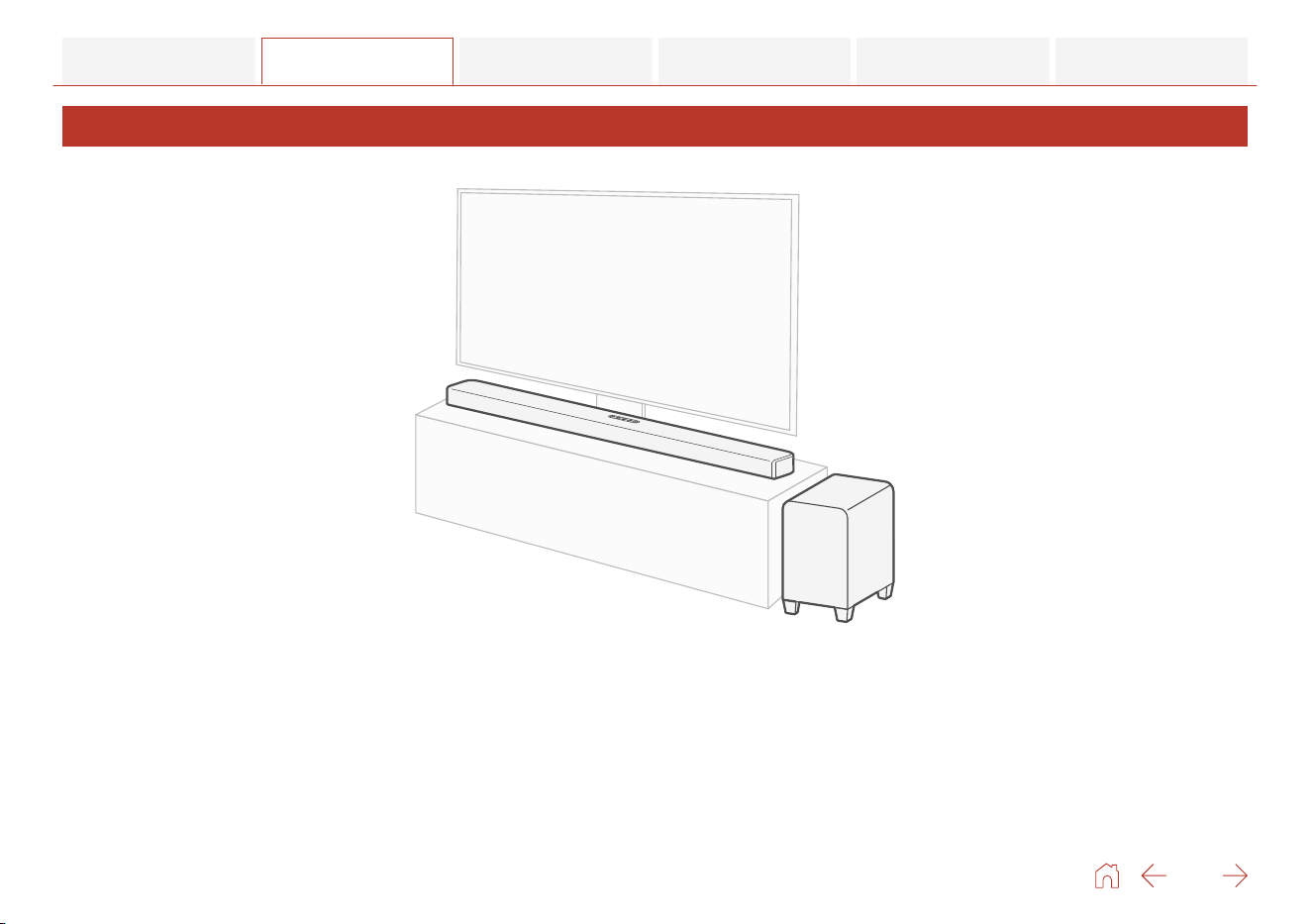
Positioning the sound bar in front of a TV
Position the sound bar in front of your TV, etc., on a flat surface.
.
NOTE
0
When positioning the sound bar in front of your TV, make sure the sound bar does not obstruct the TV’s remote control light sensor, etc.
Contents Connections Playback Settings Tips Appendix
14
Hanging the sound bar on a wall
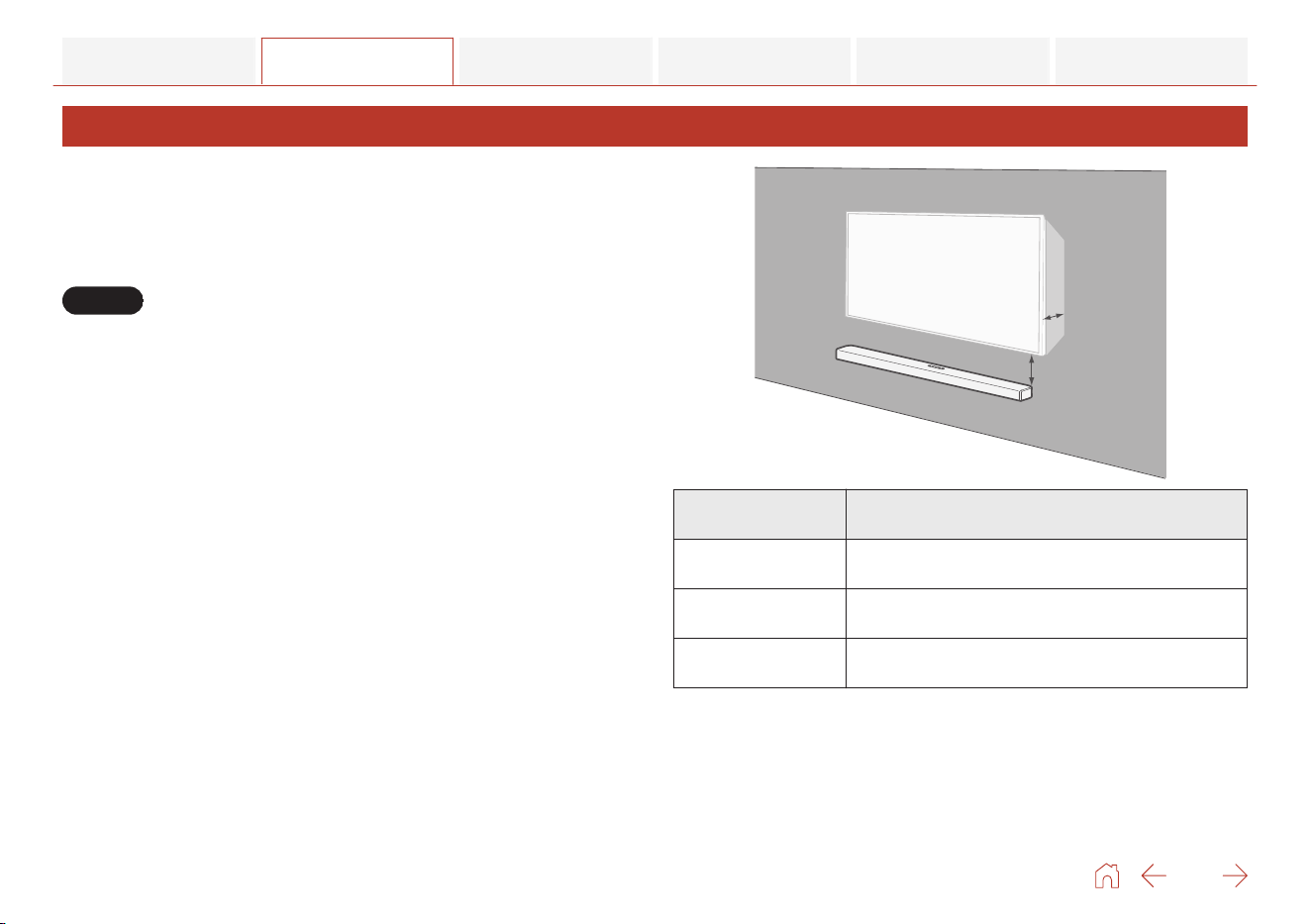
The sound bar can be mounted on a wall using the two keyholes
provided on the back of the bar for this purpose. When hanging
bar on a wall, position it in a flat, vertical position.
To ensure safety, it is best to employ a contractor to mount the
sound bar on the wall.
NOTE
0
In order to use the unit safely, do not place items on or hang items from
the unit.
0
Do not attempt to install the sound bar onto a wall made of material
that may crumble easily, such as mortar or decorative plywood. Doing
so may result in the screw pulling out and the sound bar falling, causing
injury or damage to the sound bar.
0
Be sure to fix connection cables to the wall to ensure that the cables
cannot be pulled or tripped over, which may cause the unit to fall.
Check that the unit is mounted safely after the mounting work is
complete.
0
Also, periodically check that the unit is mounted solidly and that there
is no possibility that the unit could fall.
0
Polk cannot accept any responsibility for damage, injury or accidents
caused by problems with the mounting location or mounting method.
.
(B)
(A)
(A) Depth of the
mounted TV
(B) Required space between the bottom of
the TV and the top of the sound bar
Less than 2.5 in.
(64 mm)
More than 2 in. (50 mm)
2.5 in. – 4.5 in.
(64 – 102 mm)
More than 4 in. (102 mm)
More than 4 in.
(102 mm)
More than 7.5 in. (191 mm)
Contents Connections Playback Settings Tips Appendix
15
0
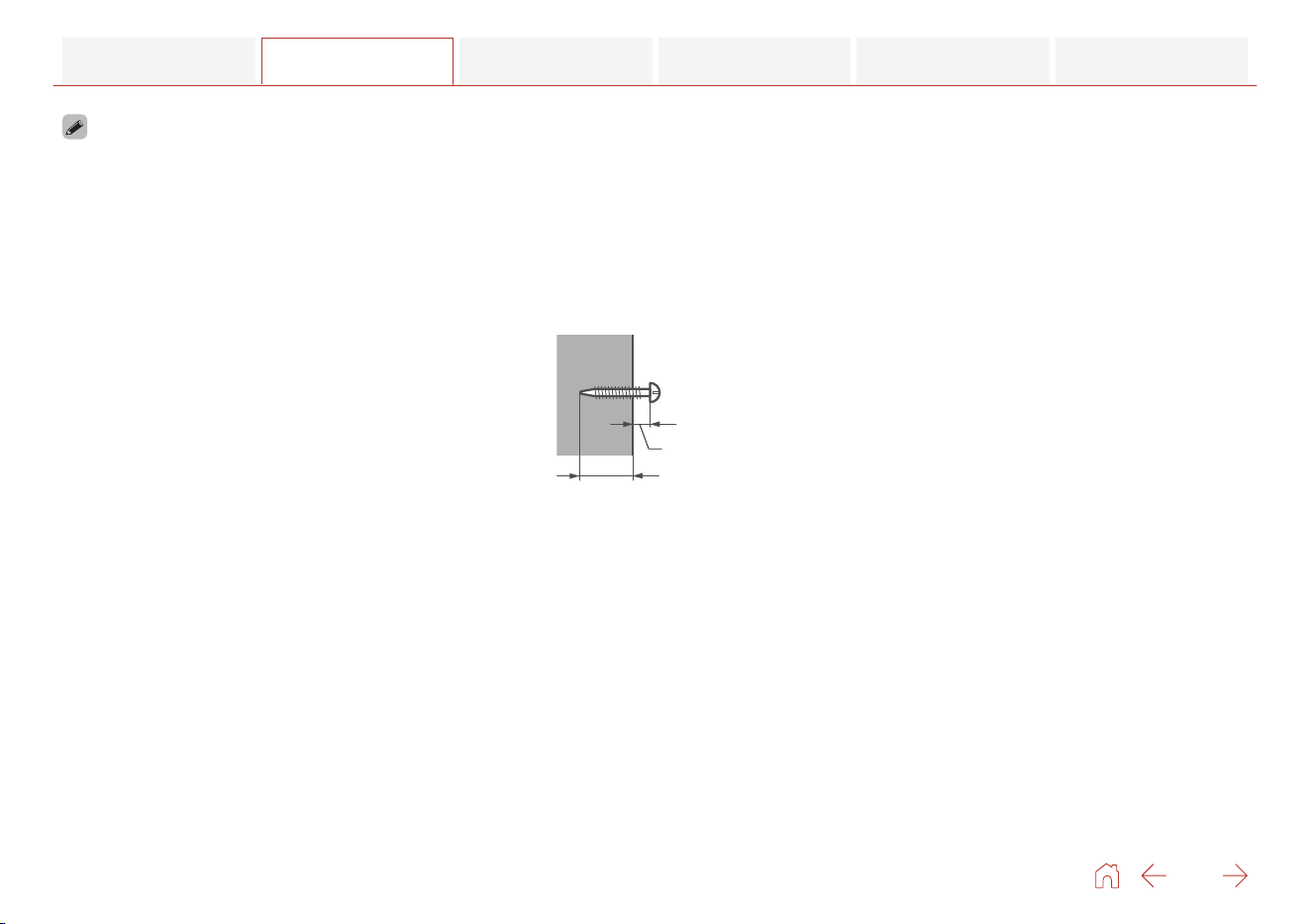
When hanging the sound bar on a wall, use the included wall mount template.
How to use the wall mount template
A
Tape the template to the location you would like to mount the sound bar.
Leave enough space between the TV and the sound bar so that the sound from the Atmos speakers on the top of the bar, which projects towards
the ceiling, is not blocked by the TV. Refer to the table on the previous page for spacing recommendations. (v p. 15)
B
Screw in the wall mount screws by following the template.
Screw in one self-tapping screw (commercially available, 3/16 in./5 mm to 1/4 in./6 mm diameter) into a wall that has sufficient strength to support
the weight of the sound bar, or into reinforcing material on the wall.
.
13/32 in./10.5 mm
More than 13/16 in./20 mm
C
Remove the template from the wall.
D
Mount the included wall mount spacers on the back of the sound bar.
The wall mount spacers create a space for cords to pass through between the sound bar and the wall.
E
Hang the sound bar on the screws.
Contents
Connections Playback Settings Tips Appendix
16
Connecting a TV
How to connect a TV depends on the connectors and functions equipped on the TV.
0
Enable the TV’s HDMI control function when using an HDMI cable to connect this unit to your TV. (See the TV owner’s manual for details.)
0
Turn off the TV’s speaker or minimize the volume when using this unit.
0
HDMI cable connection is recommended, but connection can be performed without an HDMI cable.
NOTE
0
Make sure all devices are off when connecting.
0
Do not plug device power cords into an outlet until all devices have been connected.
Contents Connections Playback Settings Tips Appendix
18
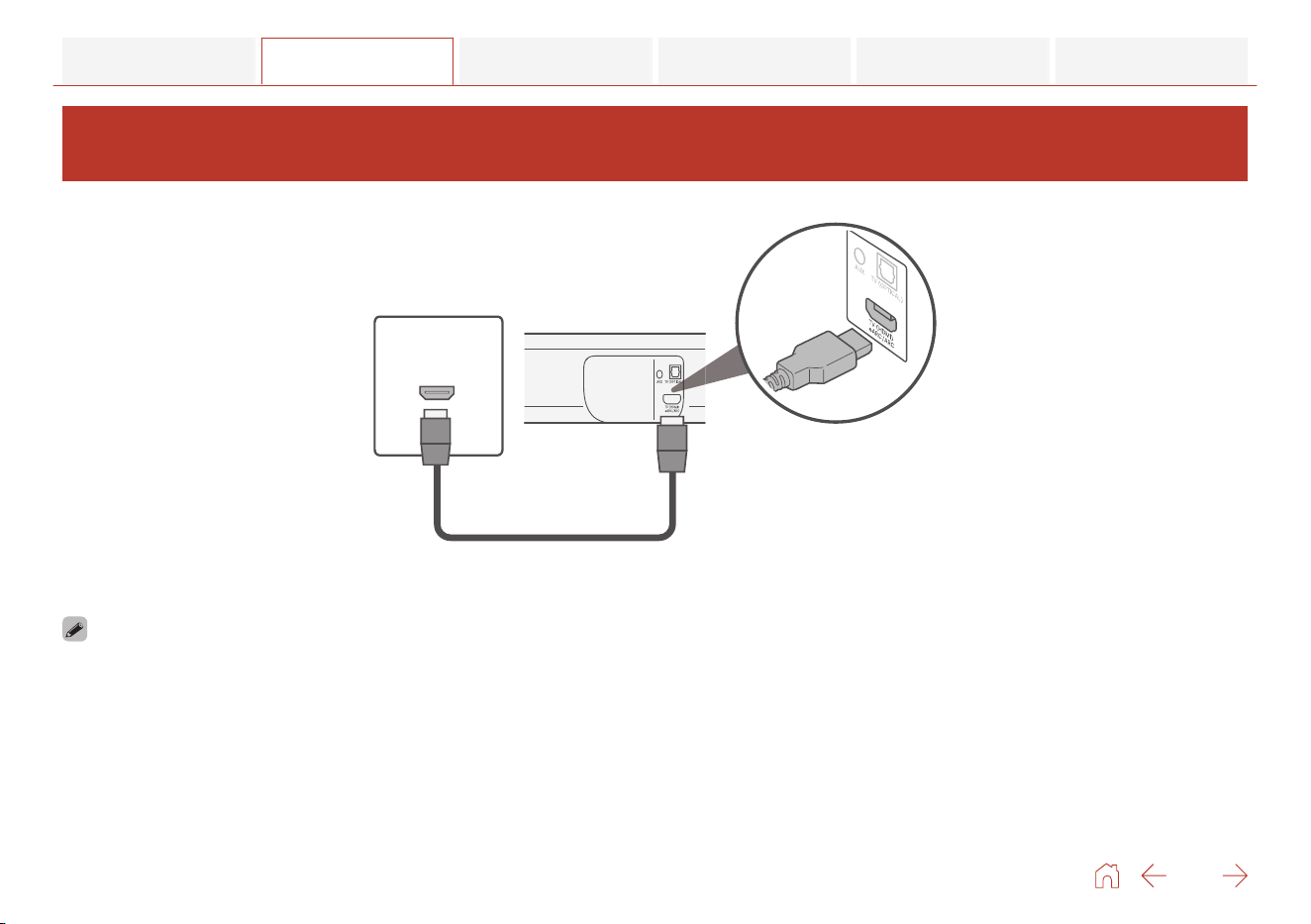
TV equipped with an HDMI connector and compatible with the eARC (Enhanced
Audio Return Channel) or ARC (Audio Return Channel)
Use the included HDMI cable to connect this unit to an eARC or ARC function-compatible TV.
.
HDMI INPUT
(eARC/ARC)
TV
HDMI cable (included)
Soundbar
(Rear panel)
0
The TV also needs to be compatible with the eARC or ARC function.
Contents Connections Playback Settings Tips Appendix
19
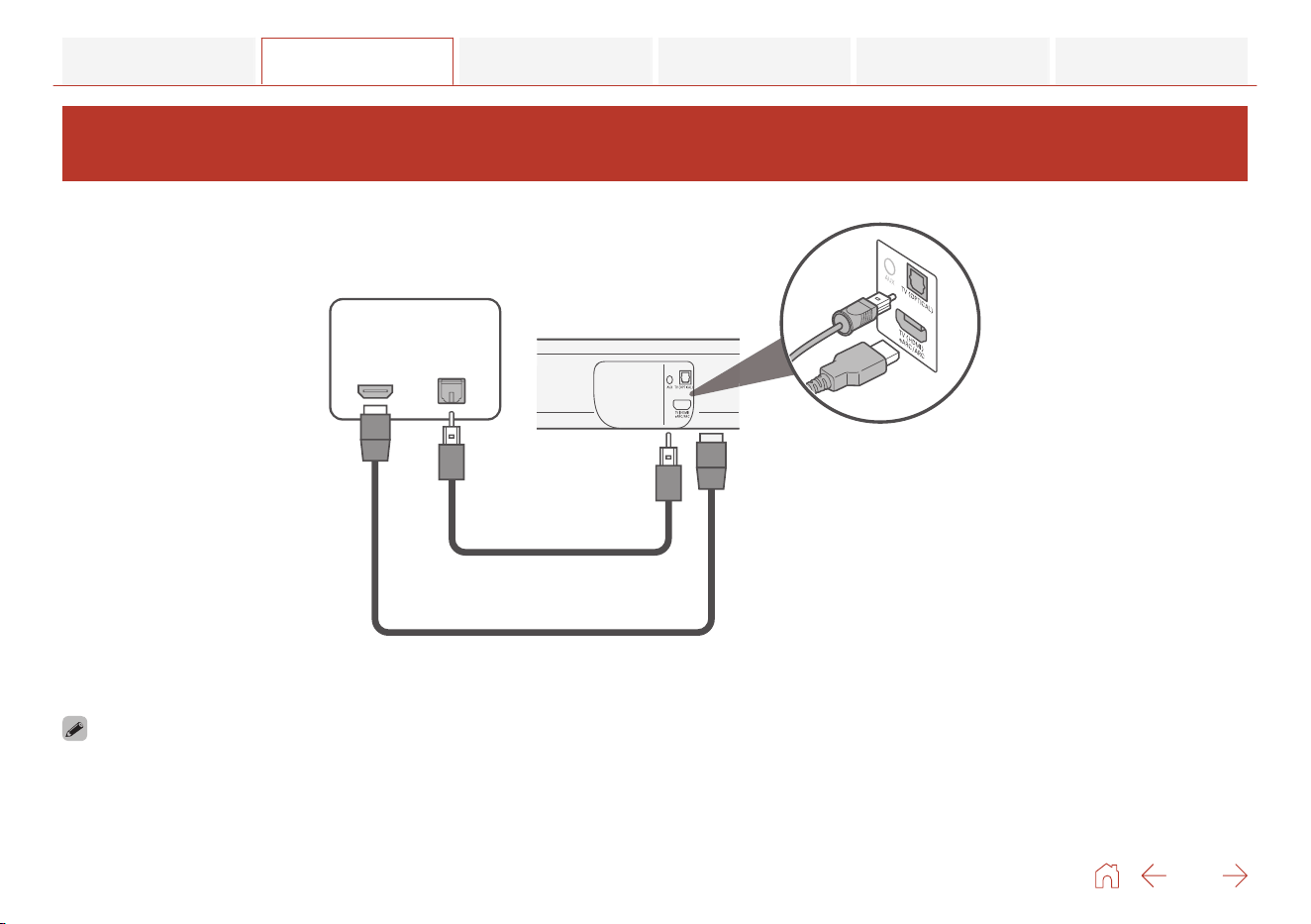
TV equipped with an HDMI connector and incompatible with the eARC or ARC / TV
equipped with an optical digital connector
Use the included HDMI and optical cables to connect this unit to your TV.
.
OPTICAL
OUTPUT
HDMI
INPUT
TV
Soundbar
(Rear panel)
Optical cable (included)
HDMI cable (included)
0
Line up the optical cable with the shape of the terminal to insert.
Contents Connections Playback Settings Tips Appendix
20
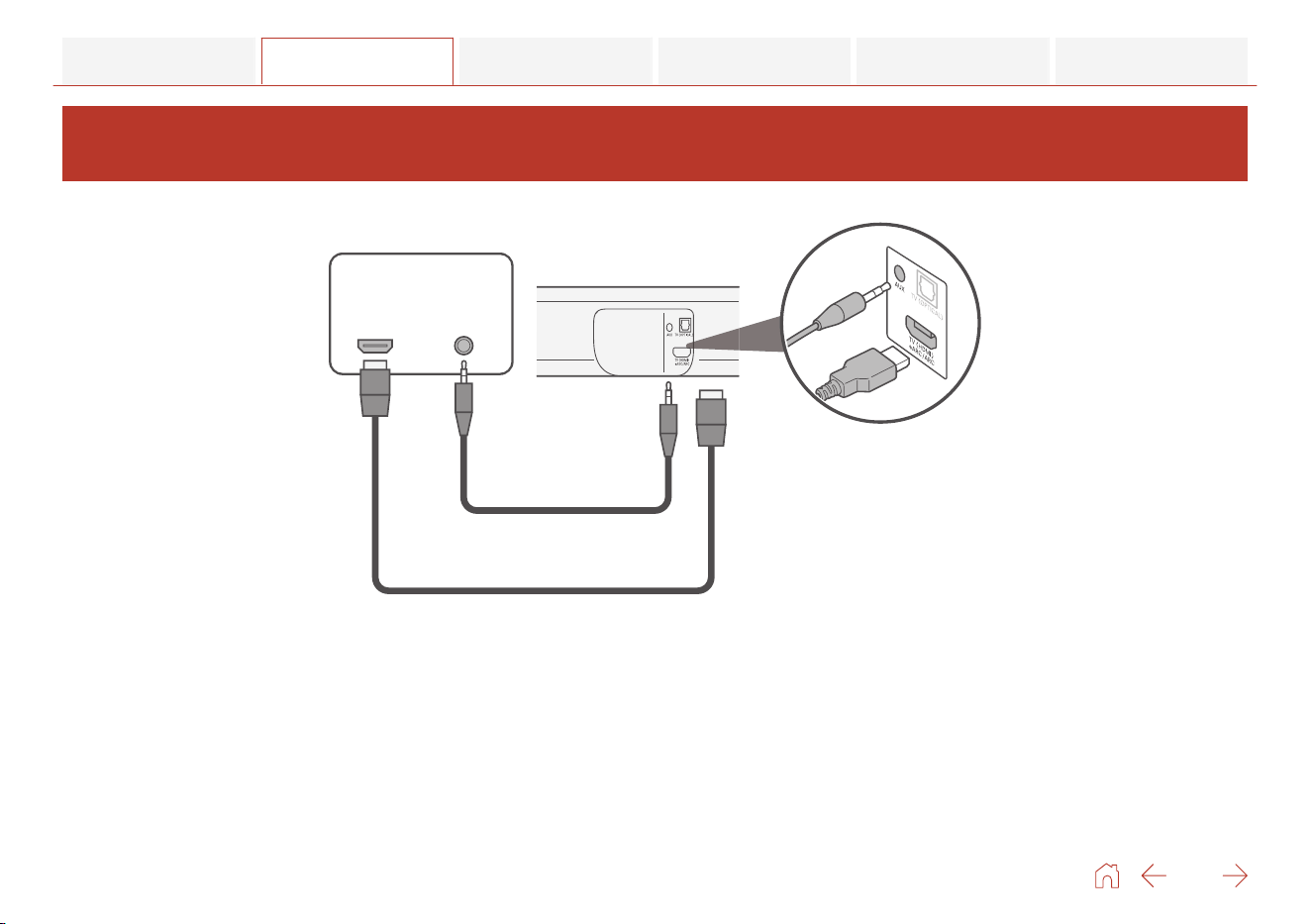
TV equipped with an HDMI connector and incompatible with the eARC or ARC /
TV equipped with an analog connector
Use the included HDMI cable and a commercially available 3.5 mm stereo audio cable to connect this unit to your TV.
.
AUX
AUDIO OUT
HDMI
INPUT
TV
Soundbar
(Rear panel)
HDMI cable (included)
3.5 mm stereo audio cable
(sold separately)
Contents
Connections Playback Settings Tips Appendix
21
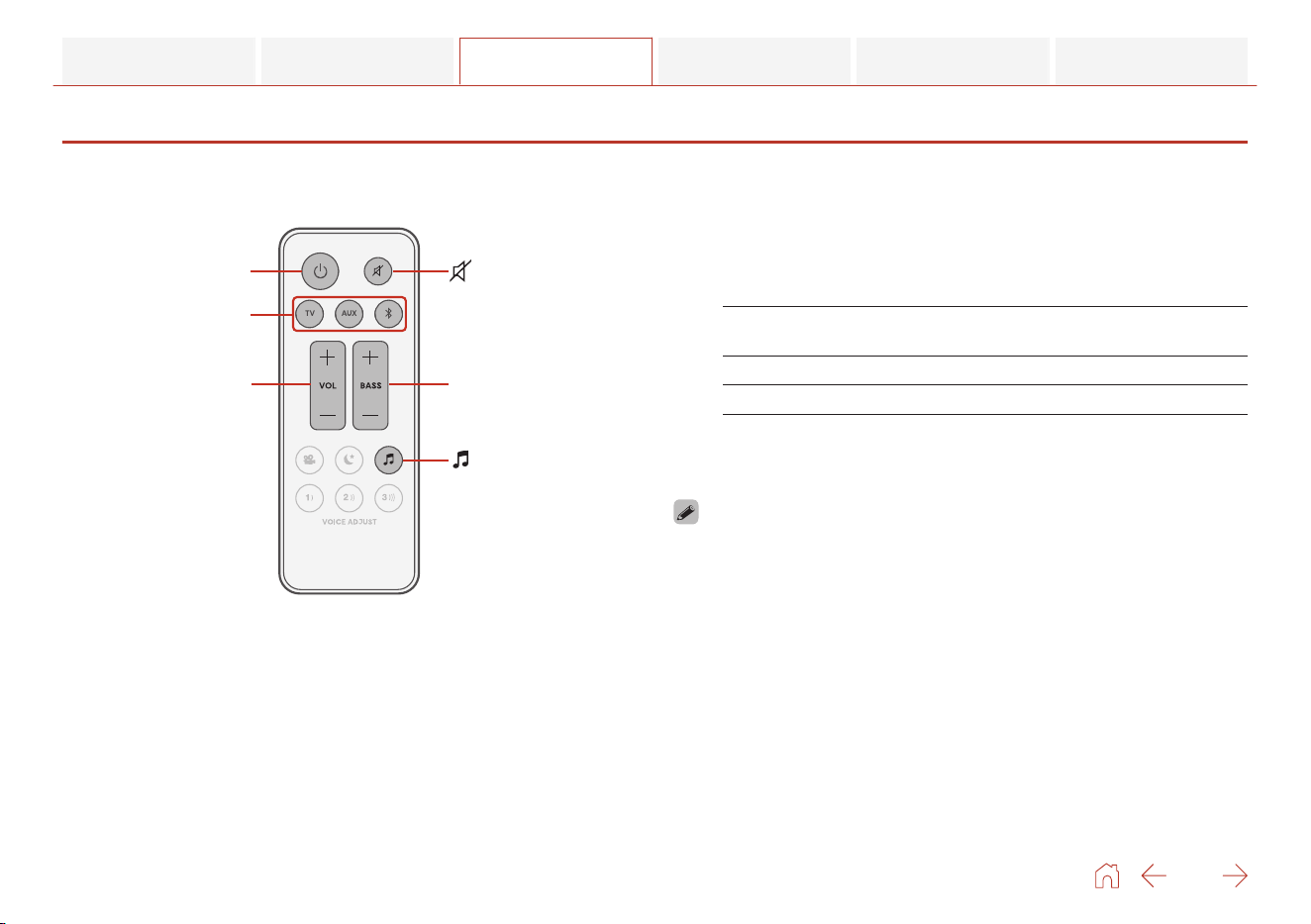
Playing TV, movies and music
.
X
Input source
buttons
VOL
+, –
BASS
+, –
1
Turn on the power of the TV and connected devices.
2
Press c to turn on power to the unit.
3
Press the input source button.
TV:
Device connected to the TV ((HDMI)
eARC/ARC, OPTICAL)
AUX: Device connected to the AUX(ANALOG)
g:
Bluetooth device
4
Play the device connected to this unit.
For details, see the relevant device manual.
0
Connect an HDMI control-compatible TV and this unit via HDMI and
enable the HDMI control to enable linked control from either device.
(v p. 40)
0
Press and hold 2 for 5 seconds or more to switch the input source to
USB. The music files in the USB flash drive are played automatically.
Contents Connections Playback Settings Tips Appendix
23
Adjusting the volume
1
Use VOL + or VOL – to adjust the volume.
When the button is pressed, the status LED lights up to
match the current volume.
0
Each time a volume button is pressed, the status LEDs
blink and the number of LEDs that are blinking increases
or decreases according to the volume that is set.
0
The status LEDs blink three times when the maximum or
minimum volume is reached.
0
When the power is turned on, the unit starts with the volume level that
was set before being placed on standby. However, if the volume was
previously set to high, it starts with the volume setting lowered to a
certain level.
Adjusting the subwoofer volume
1
Use BASS + or BASS – to adjust the subwoofer
volume.
When the button is pressed, the status LED lights up to
match the current subwoofer volume.
0
The status LED blinks each time the button is pressed,
and the number of flashing LEDs increases or decreases
to match the subwoofer volume.
0
When the subwoofer volume reaches the maximum or
minimum, the status LED blinks three times.
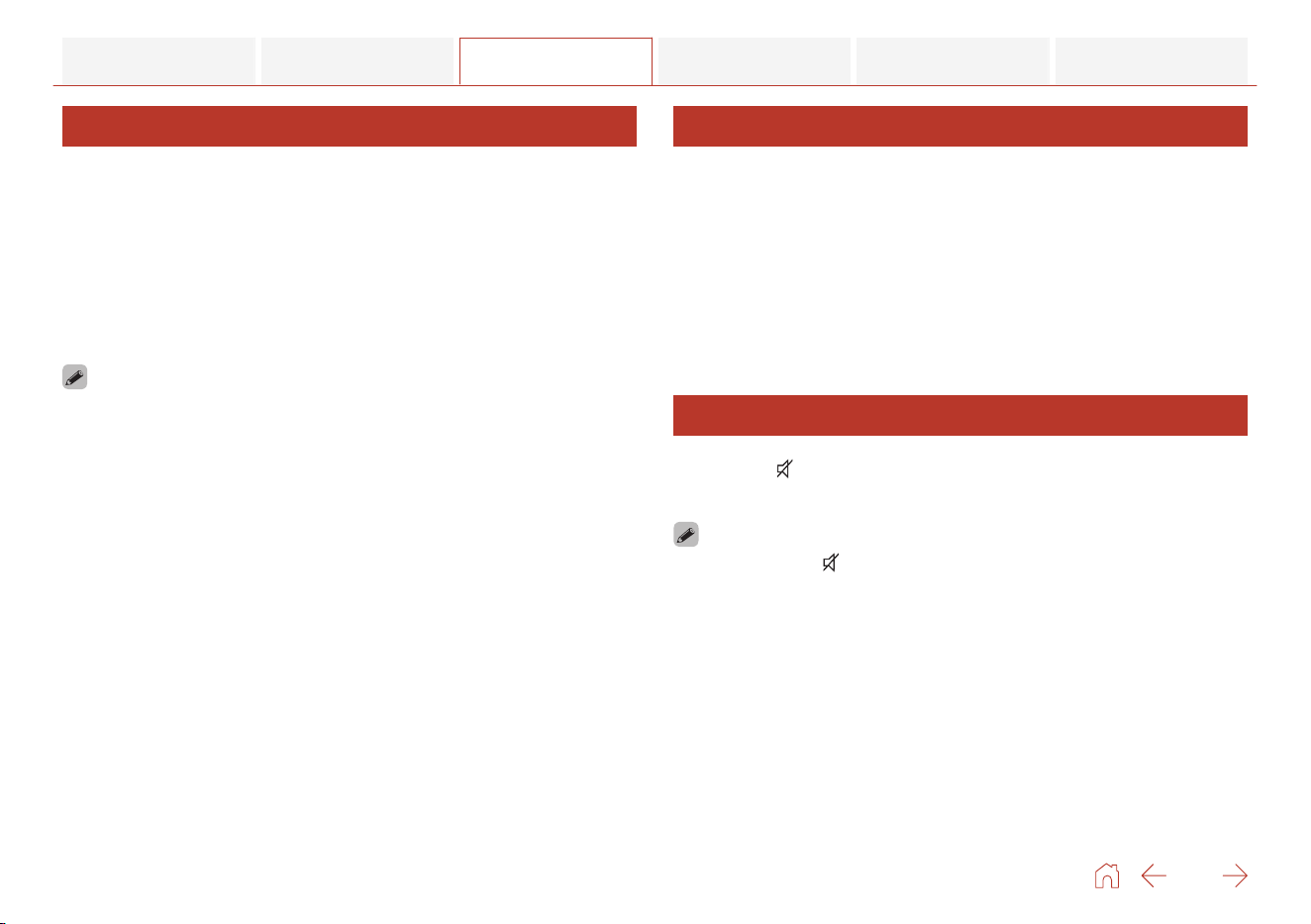
Turning off the sound temporarily
1
Press .
All status LEDs blink.
0
To cancel, press again.
Contents Connections Playback Settings Tips Appendix
24
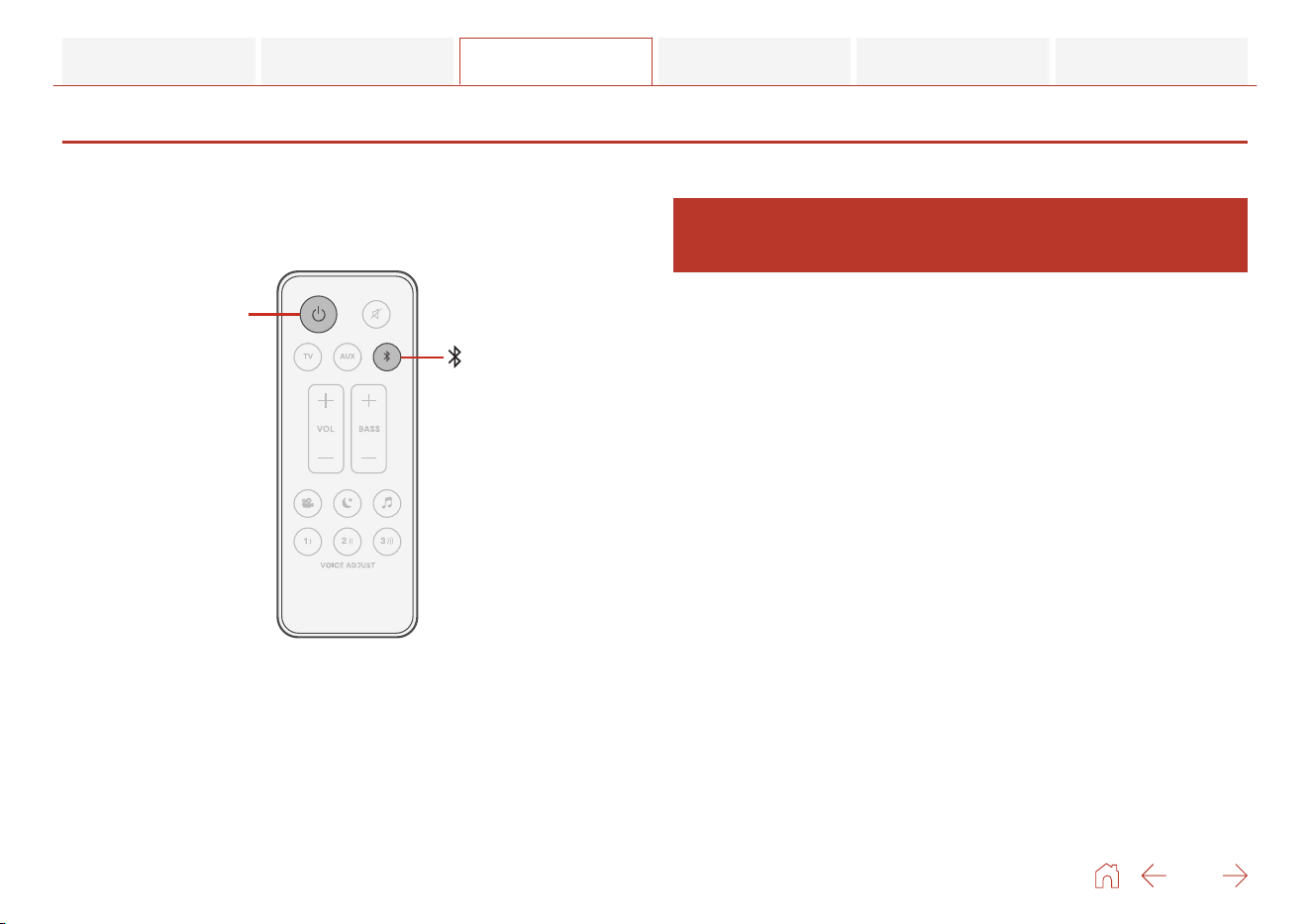
Playing music on a Bluetooth device
Music files stored on Bluetooth devices such as smartphones, digital music players, etc. can be enjoyed on this unit by pairing and
connecting this unit with the Bluetooth device.
.
X
Pairing a Bluetooth device for the
first time
Pair a Bluetooth device with this unit.
Once the Bluetooth device has been paired, it does not need to
be paired again.
1
Press c to turn on power to the unit.
2
Press g to switch the input source to “Bluetooth”.
Automatically switches to pairing mode the first time it is
used.
The status LED blinks in blue when this unit is in pairing
mode.
3
Activate the Bluetooth settings on your Bluetooth
device.
4
Select “Polk Signa S4” from the list of devices
displayed on the screen of the Bluetooth device.
The status LED lights up in blue and this unit and the
Bluetooth device are paired.
Contents
Connections Playback Settings Tips Appendix
25

Pairing with other Bluetooth devices
1
Press c to turn on power to the unit.
2
Press g to switch the input source to “Bluetooth”.
3
Activate the Bluetooth settings on your Bluetooth
device.
4
Press and hold g for 3 seconds.
This unit enters pairing mode, and the status LED
repeatedly blinks in blue.
5
Select “Polk Signa S4” from the list of devices
displayed on the screen of the Bluetooth device.
The status LED lights up in blue and this unit and the
Bluetooth device are paired.
Playing music with a paired Bluetooth
device
1
Press c to turn on power to the unit.
2
Press g to switch the input source to “Bluetooth”.
3
Activate the Bluetooth settings on your Bluetooth
device.
The status LED lights up in blue and connects to the last
Bluetooth device connected. If the connection is cut,
perform connection again.
4
Play music using any app on your Bluetooth device.
Contents Connections Playback Settings Tips Appendix
26
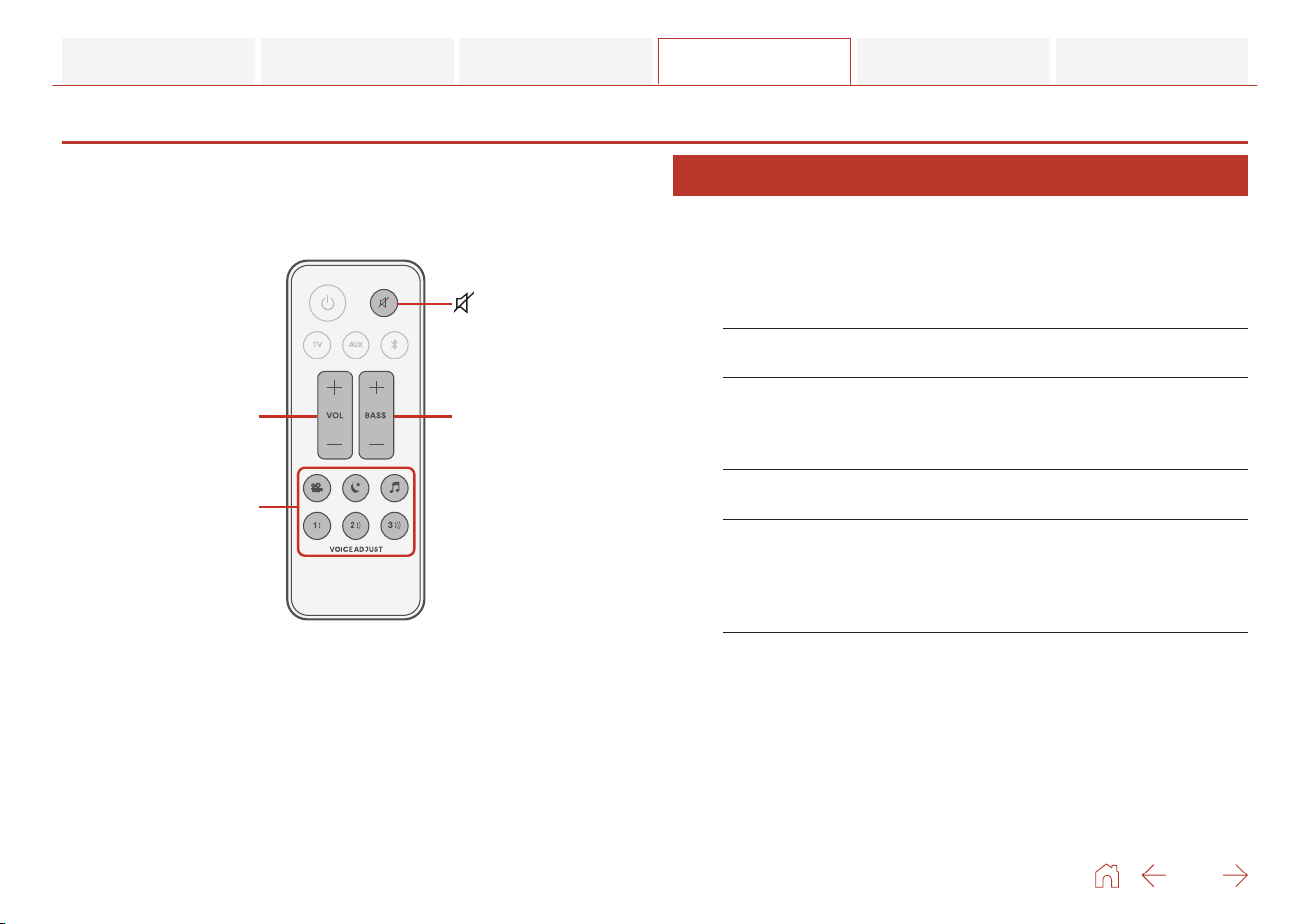
Settings
Perform the below operations and settings as needed.
.
Sound mode
buttons
VOL
+, –
BASS
+, –
Selecting a sound mode
1
Press the sound mode button to select a sound
mode.
When the button is pressed, the rightmost status LED blinks
and the sound mode changes. (v p. 9)
4:
Enjoy movie theater-like surround
sound.
3:
Compresses the dynamic range
(difference between loud and soft
sounds) to make audio easier to
hear at low volumes.
2:
Enjoy the full presence of a wide,
encompassing acoustic field.
VOICE ADJUST
1 / 2 / 3:
Adjust the volume of dialog in
movies, vocals in music, etc. so
these can be heard more easily.
Can be set to 3 levels. Set this to
the desired value.
Contents Connections Playback Settings Tips Appendix
27
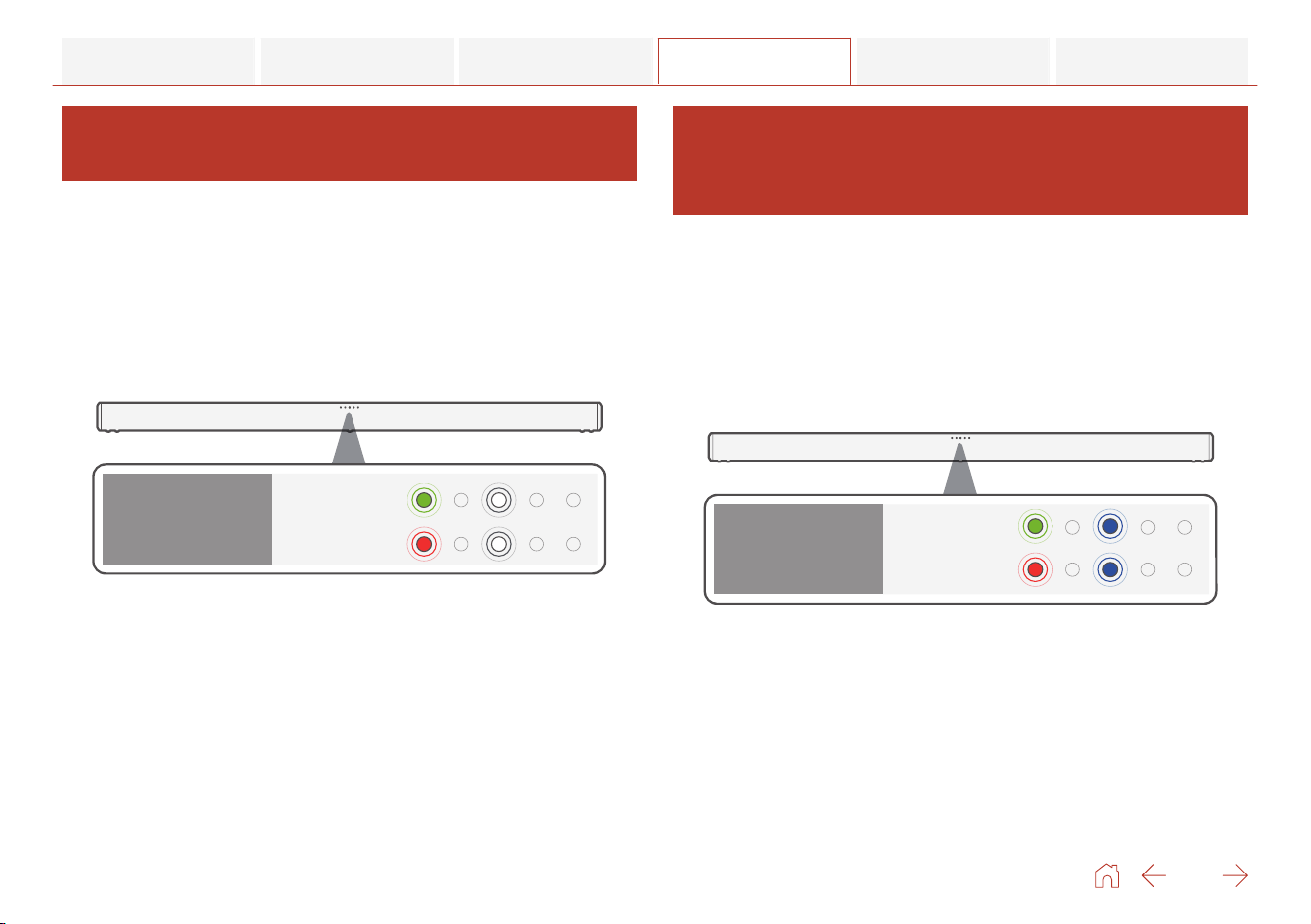
Automatically setting to standby
(Auto standby function)
Switch the auto standby function on or off.
When the auto standby function is turned on, the power supply
for this unit automatically switches to standby if no operations
have been performed for approx. 20 minutes or more and audio
is not being output.
1
Press and hold 3 for 5 seconds or more.
0
The auto standby function switches on or off and the
status LED blinks as indicated below.
.
Off
(Default)
On
Auto standby
function
Reducing the standby power
consumption (Deep standby
function)
This unit can be placed into deep standby mode, in which its
standby power consumption is lower than in normal standby
mode. Perform the following steps to put this unit into deep
standby mode.
1
Press and hold VOICE ADJUST 3 for about 5 seconds
or more.
0
The deep standby function switches on or off and the
status LED blinks as indicated below.
.
Off
(Default)
On
Deep standby
function
Contents Connections Playback Settings Tips Appendix
28
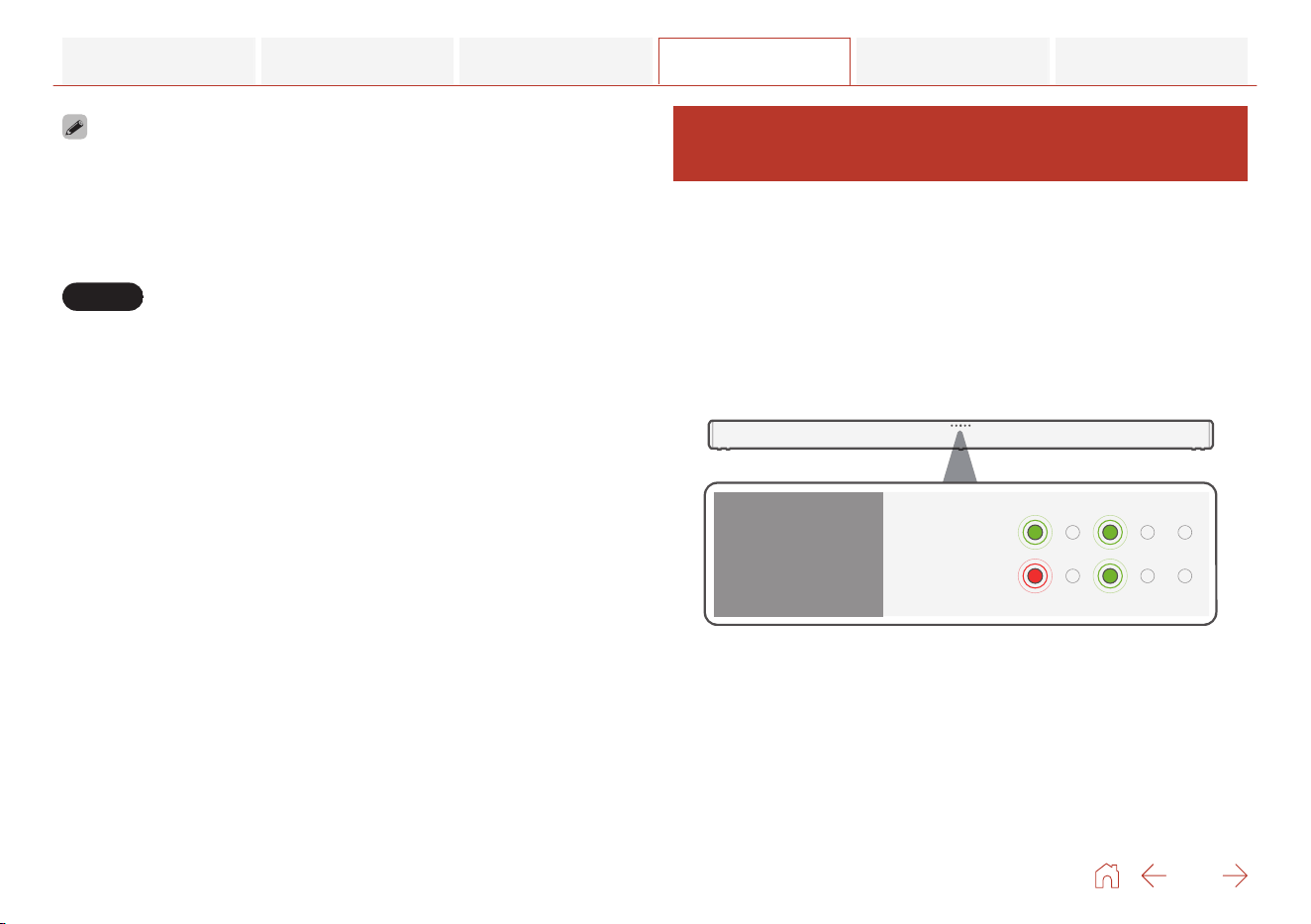
0
When the power button is pressed while the deep standby function is
on, all status LEDs blink in white three times and this unit enter deep
standby mode.
0
When the power button is pressed while the deep standby function is
off, all status LEDs blink in green three times and this unit enter normal
standby mode.
NOTE
0
When this unit is in deep standby mode, it cannot be turned on by
performing streaming operations with a Bluetooth connection.
0
When this unit is in deep standby mode, the auto on control function of
the optical and AUX inputs cannot turn on the unit. (v p. 30)
Switching the standby linking via
HDMI control function on or off
In the default settings, the HDMI control automatically puts the
unit into standby mode, linked to the TV's power standby
operation. When the standby linking via HDMI control function is
turned off, music playback can continue without this unit
switching to standby, even if the TV is set to standby while a
music player or other device is connected and playing.
1
Press and hold 4 for 5 seconds or more.
0
The standby linking via HDMI control function switches
on or off and the status LED blinks as indicated below.
.
Standby linking
via HDMI control
function
Off
On
(Default)
Contents Connections Playback Settings Tips Appendix
29
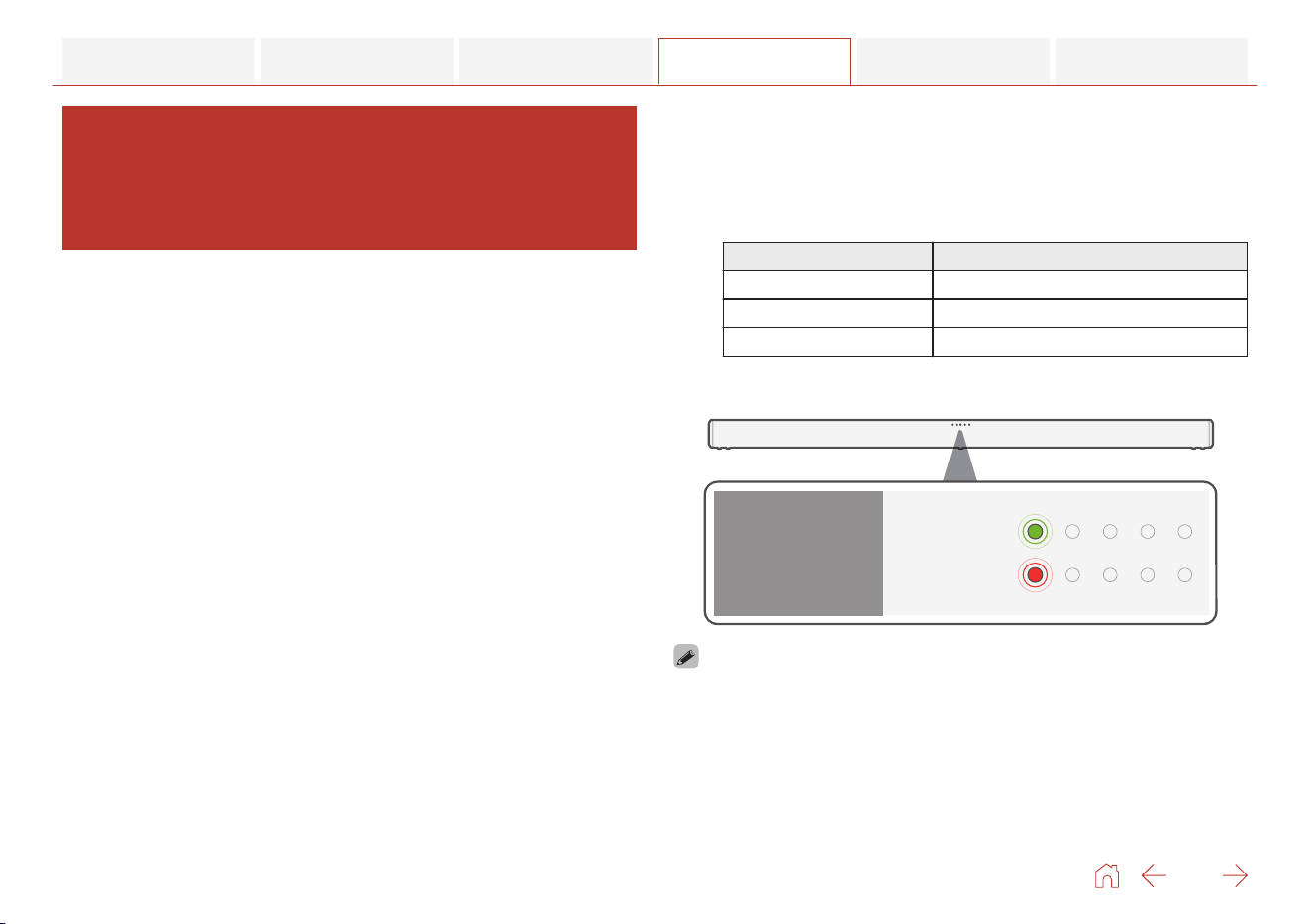
Automatically turning on the power
according to the playback of the
playback device (Auto on control
function)
If you turn on the auto on control function and playback is
started by the playback device while this unit is on standby, the
power of this unit is automatically turned on and playback is
started. In addition, if the power is on, the input source is
automatically switched according to the playback of the
playback device. The auto on control function can be set to on
or off for each input source.
1
Switch to the input source you want to set.
2
On the remote control unit, press the button that
corresponds to the input source you want to set for
five seconds or longer.
Input source Button
TV (HDMI) eARC/ARC TV
OPTICAL TV
AUX AUX
The status LEDs in the display of the current input source
blink three times.
.
Off
On
(Default)
Auto on control
function
[Ex.] Input source:
TV (HDMI) eARC/ARC
0
Even if the auto on control function is on for the optical input or AUX
input, the input source will not switch automatically during HDMI
(eARC/ARC) playback.
0
When this unit is in deep standby mode, the auto on control function of
the optical and AUX inputs cannot turn on the unit. (v p. 28)
Contents Connections Playback Settings Tips Appendix
30
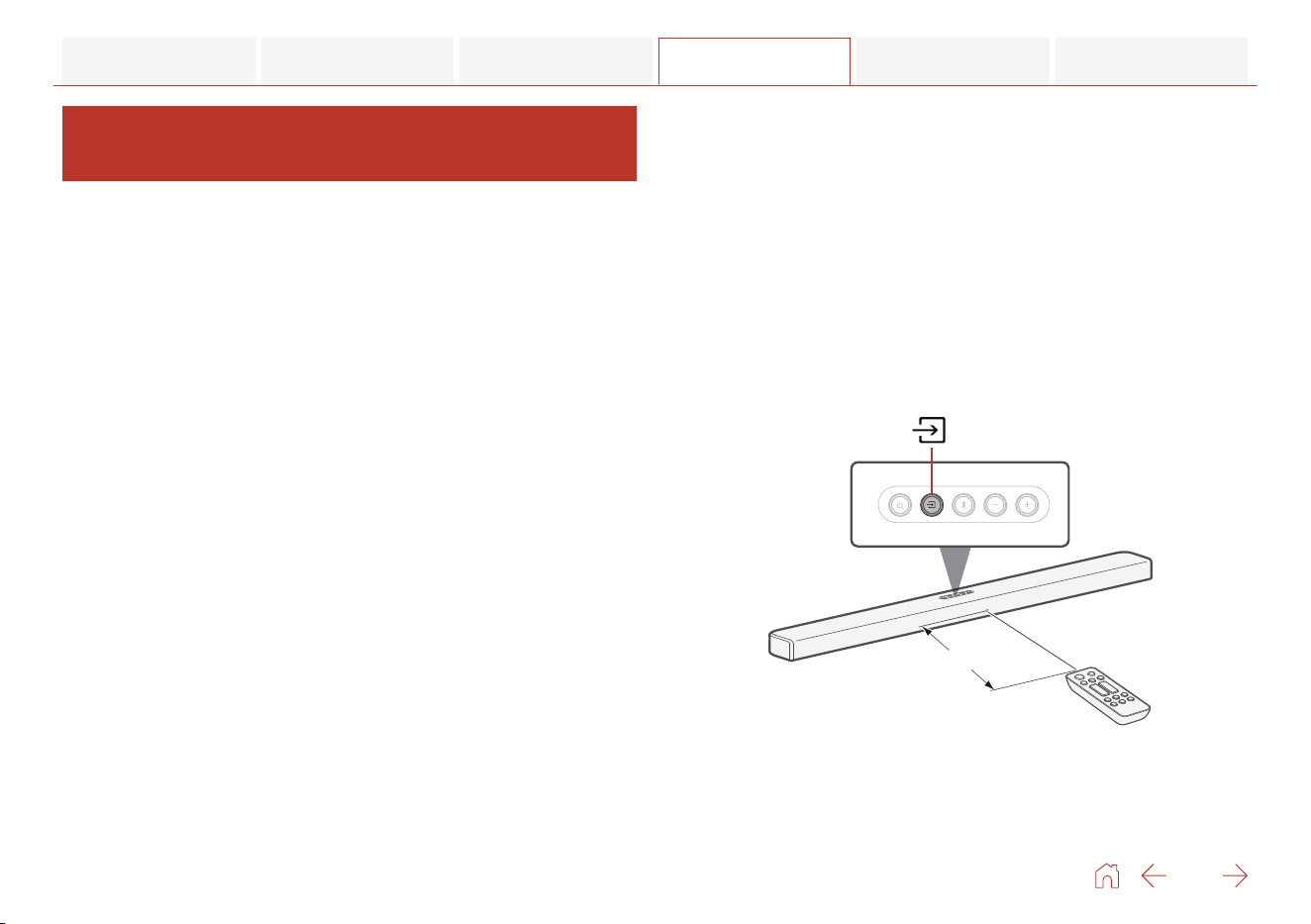
Operating this unit using the remote
control of a TV
There are three ways to operate this unit using the remote
control of a TV.
0
HDMI control function
Connect this unit to a TV that supports the HDMI control
function with an HDMI cable and enable the HDMI control
setting on the TV to perform basic operations on this unit
(changing the input source, turning the power on and off,
adjusting the volume) with the remote control of the TV.
Refer to “HDMI control function” for more information about
the HDMI control function. (v p. 40)
0
Remote control preset function
This unit is preset such that you can adjust the volume using
the volume adjustment button on the remote controls for the
televisions of major manufacturers. This is useful when the
television you are using does not support HDMI control, or
when you connect to a television that does not have an HDMI
connector.
0
Remote control learning function
If your TV does not support the HDMI control function and
Remote control preset function, use this unit’s remote control
learning function. This enables you to operate this unit with
the remote control of a TV. (“Using the remote control
learning function” (v p. 31))
o
Using the remote control learning function
1
Press and hold the main unit’s d for 3 seconds or
more.
Among the LEDs on the status display, one white LED light
moves back and forth from left to right and indicates that
the remote control learning mode has started.
2
Point the remote control of this unit at the remote
sensor of this unit and press the remote control
button to be learned (e.g. VOL +) once.
All status LEDs blink in white.
.
Approx. 1 ft/30 cm
Contents
Connections Playback Settings Tips Appendix
31

3
Point the remote control of the TV at the remote
control sensor of this unit and press the remote
control button to be learned (e.g. the button to
increase the volume) once.
If learning is successful, the rightmost status LED blinks in
green three times.
If learning is unsuccessful, the rightmost status LED blinks
in red three times. Repeat steps 2 and 3 if this happens.
0
When the status LEDs blink in white again, press the TV remote
control button (e.g. the button to increase the volume) once
more.
4
To learn a new function, repeat steps 2 and 3 with
the next function.
5
Press and hold the main unit’s d for 3 seconds or
more.
The rightmost status LED blinks white three times and
indicates that the remote control learning mode is
completed.
The unit exits remote control learning mode.
6
Confirm that the operation (e.g. increasing the
volume) can be performed on this unit with the TV
remote control.
0
To delete all learned data, press and hold d on the sound bar for 10
seconds until all status LEDs blink in purple five times.
0
Operations cannot be performed with the remote control learning
function during the Deep standby.
0
Other operations cannot be performed when in remote control learning
mode.
0
Remote control learning may not be possible depending on the type of
TV remote control.
Contents Connections Playback Settings Tips Appendix
32

Troubleshooting
If a problem should arise, first check the following:
1. Are the connections correct?
2. Is the set being operated as described in the owner’s manual?
3. Are the other devices operating properly?
If this unit does not operate properly, check the corresponding symptoms in this section.
If the symptoms do not match any of those described here, consult your dealer as it could be due to a fault in this unit. In this case,
disconnect the power immediately and contact the store where you purchased this unit.
Contents Connections Playback Settings Tips Appendix
33

Power does not turn on / Power is turned off
Power does not turn on.
0
Check whether the power plug is correctly inserted into the power outlet. (v p. 22)
0
If the power of this unit cannot be turned on with the remote control for the TV, press the c button to turn on the power of this unit.
(v p. 40)
0
Enable the TV’s HDMI control function when using an HDMI cable to connect this unit to your HDMI control-compatible TV. (See the
TV owner’s manual for details.)
0
If the power cannot be turned on through a Bluetooth connection, this is in the deep standby mode. Press the c to turn on power to
the unit. (v p. 28)
0
If you set the auto on control function to off, the power of this unit will not automatically turn on even if playback is started by the
TV or the playback device. (v p. 30)
0
If the power cannot be turned on using the auto on control function of the optical and AUX inputs, this is in the deep standby mode.
Press the c to turn on power to the unit. (v p. 30)
Power automatically turns off.
0
If no operations have been performed for 20 minutes or more and audio is not being input, this unit automatically switches to
standby. Turn this unit’s power on again. To prevent the power from turning off automatically, turn off the auto standby
function. (v p. 28)
Even if the power of the TV is turned off, the power of this unit is not automatically turned off.
0
If the standby linking via HDMI control function is turned off, this unit will not switch to standby even if the power of the TV that is
connected via HDMI is turned off. (v p. 29)
0
If the input source is Bluetooth, this unit will not switch to standby even if the power of the TV that is connected via HDMI is turned
off.
Power turns off and the the left most status LED flashes in red.
0
The protection circuit has been activated due to a rise in temperature within sound bar. Unplug the power cord, wait about an hour
until this unit cools down sufficiently, and then turn the power on again.
0
Turn on the power again and turn down the volume.
Contents
Connections Playback Settings Tips Appendix
34

Operations cannot be performed through the remote control unit
Operations cannot be performed through the remote control unit.
0
Batteries are worn out. Replace with new batteries. (v p. 6)
0
Operate the remote control unit within a distance of about 23 ft/7 m from this unit and at an angle of within 30°. (v p. 6)
0
Remove any obstacle between this unit and the remote control unit.
0
Insert the batteries in the proper direction, checking the f and e marks. (v p. 6)
0
This unit’s remote control sensor is exposed to strong light (direct sunlight, inverter type fluorescent bulb light, etc.). Move this unit
to a place in which the remote control sensor will not be exposed to strong light.
Trouble teaching this unit remote control commands
Trouble teaching this unit remote control commands.
0
Remember that while this unit can learn almost all IR (infrared) remote commands, there remain a few rare code formats that
cannot be taught.
Contents
Connections Playback Settings Tips Appendix
35

No sound comes out
No sound comes out.
0
Check the connections for all devices. (v p. 18)
0
Insert connection cables all the way in.
0
Check that input connectors and output connectors are not reversely connected.
0
Check cables for damage.
0
Check that a proper input source is selected. (v p. 23)
0
Adjust the volume. (v p. 24)
0
Make sure volume is not muted. (v p. 24)
0
If the status LED lights up in red, an audio signal that is not supported by this unit is input. (v p. 9)
In that case, set the audio format to “PCM” on the audio output device.
No sound is produced from subwoofer.
0
When there is an obstacle between the sound bar and the subwoofer, remove it or place the subwoofer closer to the sound bar.
0
To prevent electromagnetic interference, locate this unit away from microwave ovens, wireless LAN devices and other Bluetooth
devices.
0
Make sure the subwoofer status display LED is lit in green. If lights are not lit, it may indicate that the sound bar and subwoofer are
not wirelessly connected. Perform connection again according to the following steps.
A
Press the c button to turn on power to the unit.
B
Press and hold the subwoofer CONNECT button for 3 seconds or more.
The subwoofer status LED blinks in green, the subwoofer enters pairing mode.
C
Press and hold the sound bar g and + buttons for 5 seconds or more until the soundbar status LED blinks in red.
The sound bar enters pairing mode, the subwoofer automatically wirelessly connects to the sound bar. Perform steps A to C
again if they do not connect.
Contents Connections Playback Settings Tips Appendix
36

Bluetooth playback does not work
Cannot pair with a Bluetooth device.
0
It may be that Bluetooth is not enabled on the Bluetooth device. See the owner’s manual of the Bluetooth device to enable the
Bluetooth function.
0
This unit may be paired with another Bluetooth device. Select this unit from the list of devices displayed on the screen of the
Bluetooth device.
0
Bring the Bluetooth device near to this unit.
0
Turn the power of the Bluetooth device off and on again, and then try again.
0
Only 1 Bluetooth device can be connected at a time.
0
The connection from the Bluetooth mobile device is malfunctioning. Power cycle the mobile device, remove the pairing information
and re-pair this unit to the mobile device.
The sound is cut off.
0
Bring the Bluetooth device near to this unit.
0
Remove obstructions between the Bluetooth device and this unit.
0
To prevent electromagnetic interference, locate this unit away from microwave ovens, wireless LAN devices and other Bluetooth
devices.
0
Pair with the Bluetooth device again. (v p. 25)
Contents
Connections Playback Settings Tips Appendix
37

The HDMI control function does not work
The HDMI control function does not work.
0
You cannot operate devices that are not compatible with the HDMI control function. In addition, depending on the connected
device or the settings, the HDMI control function may not work. In this case, operate the external device directly.
0
Check that the HDMI control function setting is enabled on all devices connected to this unit.
Audio can be heard coming from the TV’s speakers
Audio can be heard coming from the TV’s speakers.
0
Disable the TV’s speakers (usually a setup-menu option, but a rear-panel switch on some TVs).
Contents Connections Playback Settings Tips Appendix
38
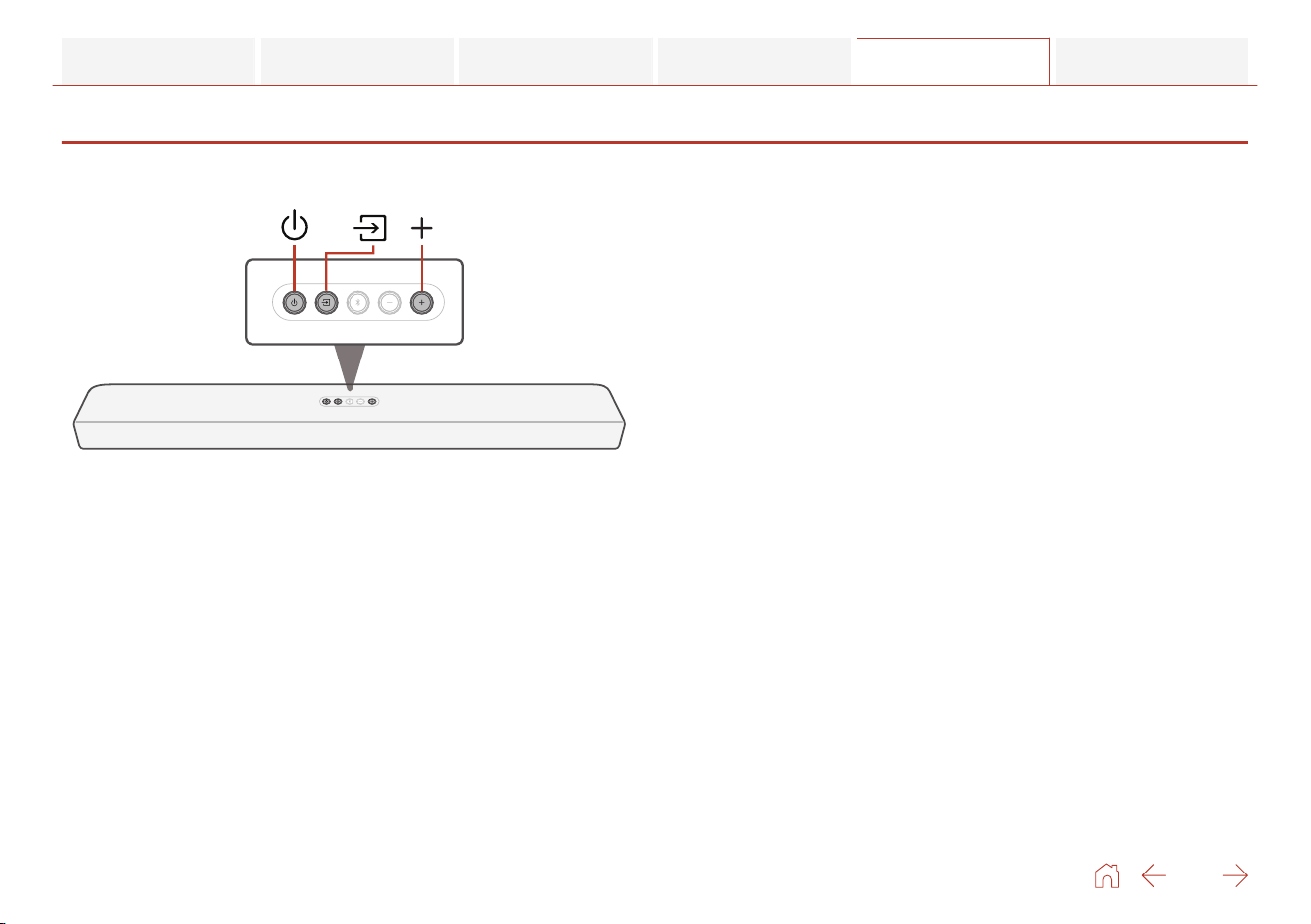
Resetting factory settings
Perform this procedure if the display is abnormal or if operations cannot be performed.
Various settings are reset to the factory default values. Make settings again.
.
1
Press c to turn on power to the unit.
2
Press and hold the main unit's c, d and + at the
same time for at least 5 seconds.
The status LED blinks in red three times.
3
Wait for around 10 seconds after the LED turns off
and then press c.
All settings return to the factory settings after the sound
bar is restarted.
Contents Connections Playback Settings Tips Appendix
39

About HDMI
This unit supports the following HDMI functions.
0
ARC (Audio Return Channel) function
Enjoy movies, music, etc., on your TV simply by connecting an ARC function-compatible TV to this unit via HDMI.
0
eARC (Enhanced Audio Return Channel) function
The eARC function is compatible with conventional ARC function compatible audio formats in addition to multichannel linear PCM,
Dolby TrueHD, Dolby Atmos and other audio formats a conventional ARC function cannot transmit. Additionally, connecting to an
eARC function-compatible TV enables enjoyment of higher-quality surround playback of the audio content played from your TV.
0
HDMI control function
Connect an HDMI control-compatible TV and this unit via HDMI and enable the HDMI control to enable linked control from either
device.
0
Input source switching
If the TV is turned on, this unit automatically powers on and switches the input source.
0
Power off link
The TV power off operation is linked so this unit also turns off.
0
Volume adjustment
The volume of this unit can be adjusted using the TV remote control.
0
Audio output destination switching
If this unit is turned on, TV audio is output from this unit. If this unit is turned off, TV audio is output from the speakers of the TV.
NOTE
0
Some functions may not operate depending on the connected TV.
Contents Connections Playback Settings Tips Appendix
40
Trademark information
.
The Bluetooth
®
word mark and logos are registered trademarks
owned by the Bluetooth SIG, Inc. and any use of such marks by
Polk Audio is under license. Other trademarks and trade names
are those of their respective owners.
.
Dolby, Dolby Atmos, and the double-D symbol are registered
trademarks of Dolby Laboratories Licensing Corporation.
Manufactured under license from Dolby Laboratories.
Confidential unpublished works. Copyright © 2012-2021 Dolby
Laboratories. All rights reserved.
.
The terms HDMI, HDMI High-Definition Multimedia Interface, and
the HDMI Logo are trademarks or registered trademarks of
HDMI Licensing Administrator, Inc.
Contents Connections Playback Settings Tips Appendix
41

Specifications
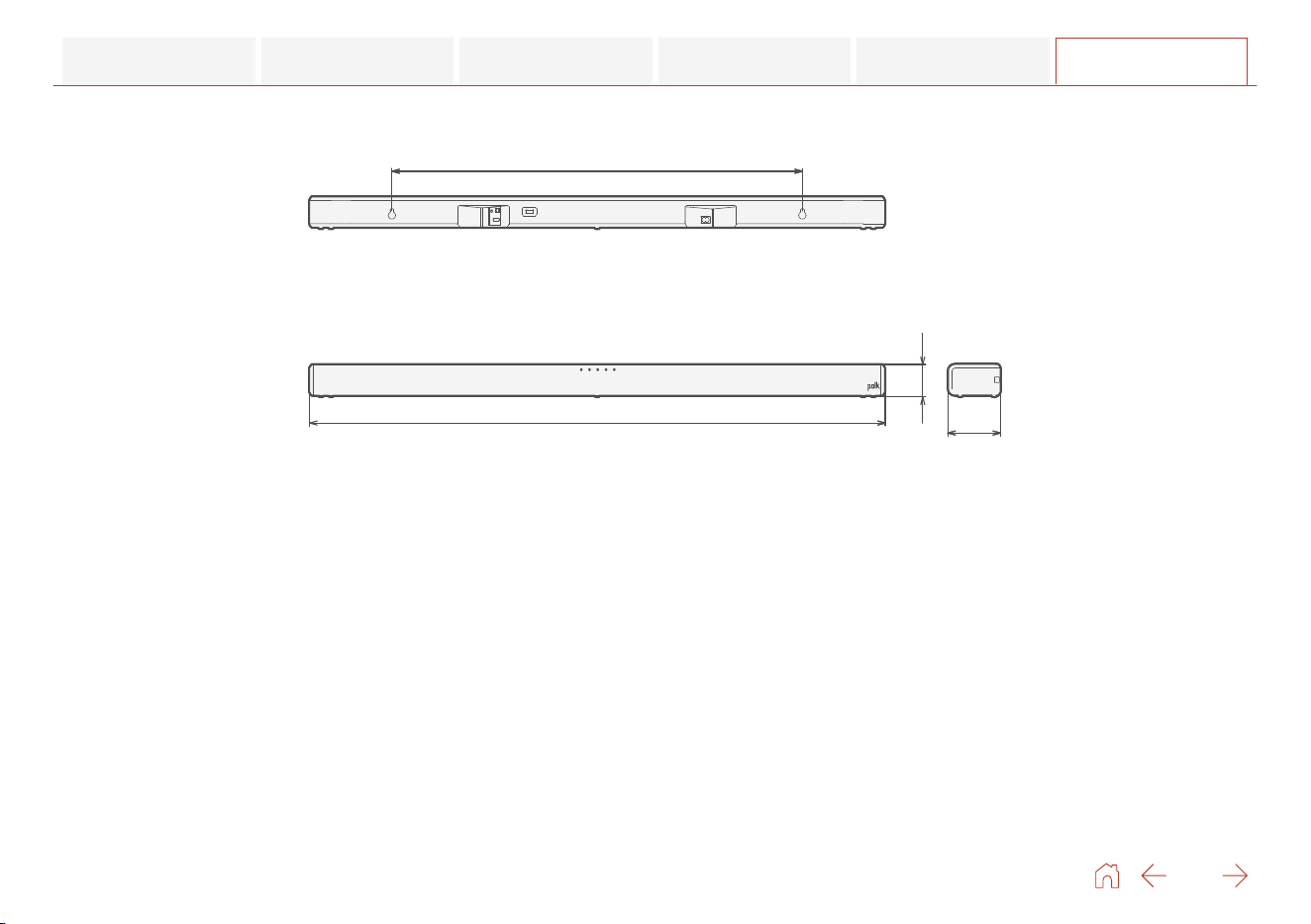
Sound bar
o
General
Operating temperature: 41 °F - 95 °F (5 °C - 35 °C)
Power supply: AC 100 - 240 V, 50/60 Hz
Power consumption: 40 W
Power consumption in standby mode: 1.5 W
Power consumption in deep standby mode: 0.3 W
Max Analog Input: 2 Vrms
Sampling frequency: 32 kHz, 44.1 kHz, 48 kHz
Supported audio formats: Linear PCM, Dolby Digital, Dolby Digital Plus, Dolby TrueHD, Dolby Atmos
Contents Connections Playback Settings Tips Appendix
42

o
Wireless section
Used frequency range: 2.4 GHz (Wireless subwoofer)
o
Bluetooth section
Communications system: Bluetooth Version 5.0
Transmission power: Power Class 2
Maximum communication range:
Approx. 32.8 ft/10 m in line of sight
z
2
Used frequency range: 2.4 GHz band
Modulation scheme: FHSS (Frequency-Hopping Spread Spectrum)
Supported profiles: A2DP (Advanced Audio Distribution Profile) 1.3
AVRCP (Audio Video Remote Control Profile) 1.6
Corresponding codec: SBC
Transmission range (A2DP): 20 Hz – 20,000 Hz
z
The actual communication range varies depending on the influence of such factors as obstructions between devices,
electromagnetic waves from microwave ovens, static electricity, cordless phones, reception sensitivity, antenna performance,
operating system, application software etc.
Contents
Connections Playback Settings Tips Appendix
43
Subwoofer
o
General
Operating temperature: 41 °F - 95 °F (5 °C - 35 °C)
Power supply: AC 100 - 240 V, 50/60 Hz
Power consumption: 40 W
Power consumption in standby mode: 0.3 W
Power consumption in deep standby mode: 0.3 W
o
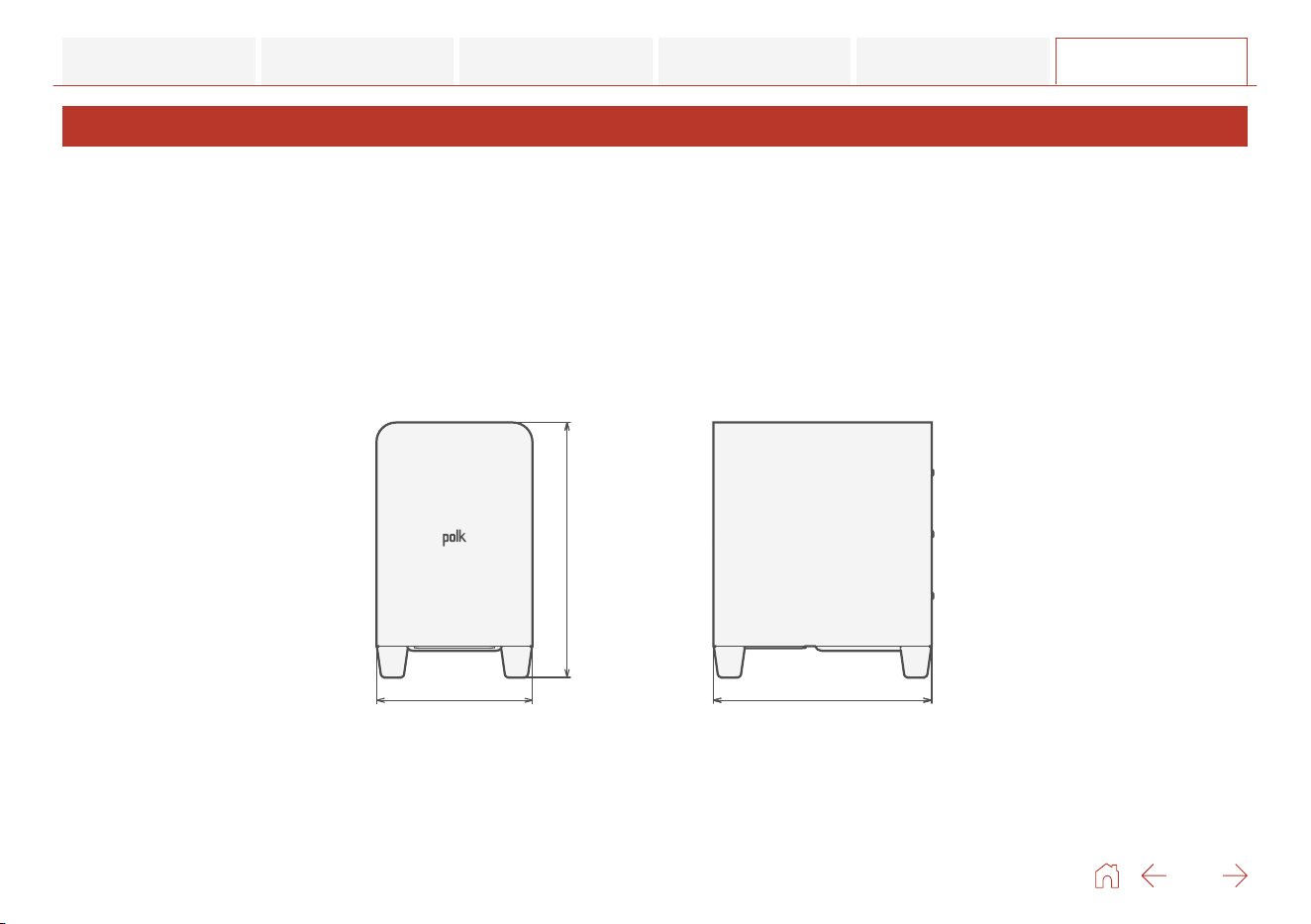
Dimensions (Unit : in. (mm))
.
11 1/8 (280)7 7/8 (200)
13 (328)
o
Weight: 9 lbs 1 oz (4.1 kg)
Contents Connections Playback Settings Tips Appendix
45

.
3520 10824 00AK
©2021 Sound United. All Rights Reserved.
46