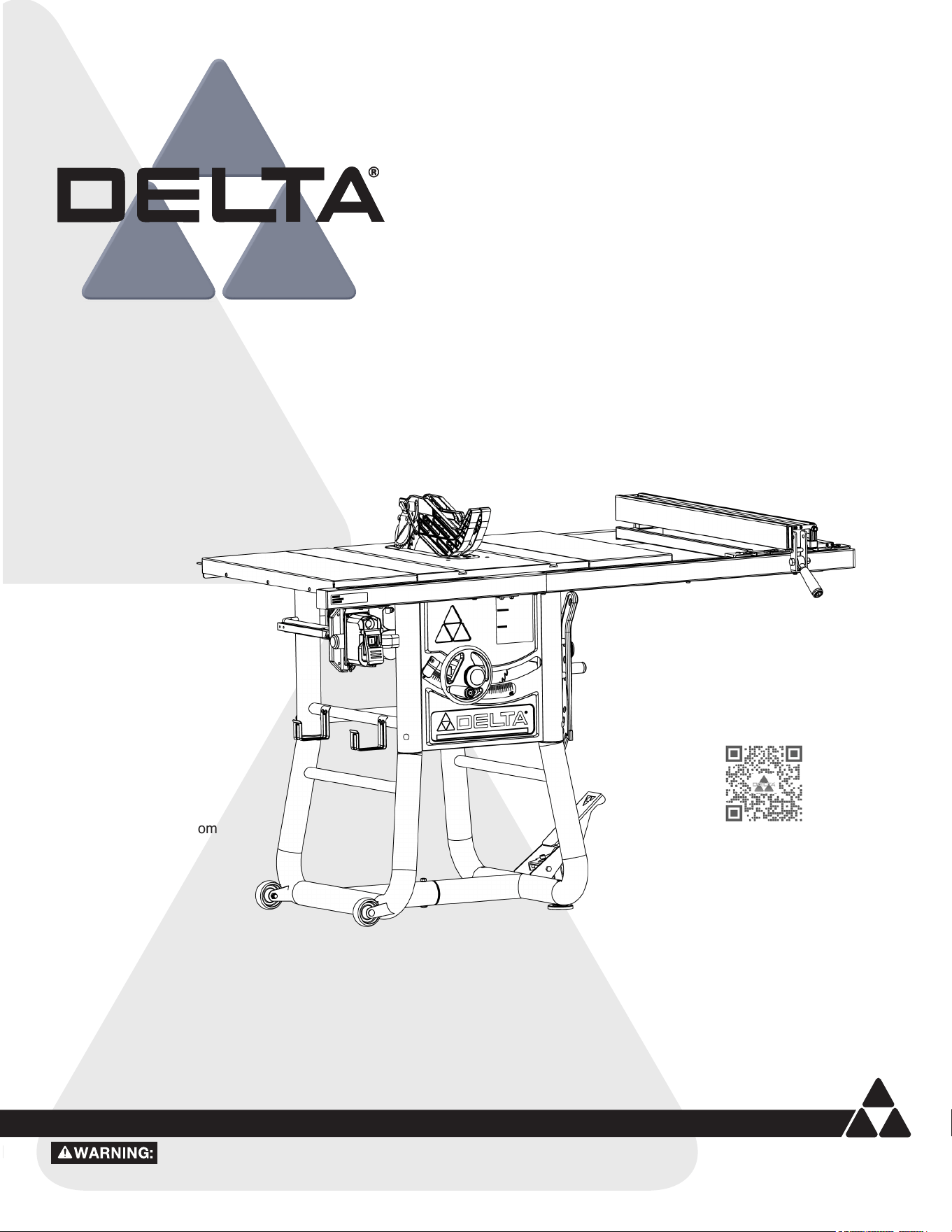
10-inch Contractor Table Saw
www.DeltaMachinery.com
Instruction Manual
To reduce risk of serious injury, thoroughly read and comply with all warnings and instructions in this manual and on product.
KEEP THIS MANUAL NEAR YOUR SAW FOR EASY REFERENCE AND TO INSTRUCT OTHERS.
36-725 T2
Scan:
or visit us at:
https://youtu.be/FDQxRbmFxPs
for Riving Knife Alignment video
2
TABLE OF CONTENTS
FEATURES
FEATURES .......................................................................... 2
IMPORTANT SAFETY INSTRUCTIONS ............................... 4
SAFETY SYMBOLS-DEFINITIONS ...................................... 4
GENERAL POWER TOOL SAFETY WARNING ...................... 5
PROPOSITION 65 WARNING ............................................ 6
TABLE SAW SAFETY RULES ............................................... 6
TERMINOLOGY ..................................................................6
TABLE SAW SPECIFIC SAFETY RULES ................................. 7
SAW BLADE GUARD, ANTI-KICKBACK PAWLS AND
RIVING KNIFE ASSEMBLY ...................................................9
KICKBACKS........................................................................9
POWER CONNECTIONS ................................................... 10
POWER SOURCE ..............................................................10
ELECTRICAL CONNECTION ............................................... 10
POLARIZED PLUGS ........................................................... 10
EXTENSION CORDS .........................................................10
UNPACKING ..................................................................... 11
PACKAGE CONTENTS .......................................................12
HARDWARE PACKAGE ......................................................13
ASSEMBLY ....................................................................... 14
STAND ............................................................................14
FIXED WHEELS AND STATIONARY FEET ............................14
FRONT AND REAR RAILS .................................................. 15
EXTENSION WINGS .........................................................16
FENCE GUIDE AND POWER CONTROL BOX ........................17
INSTALLING THE HANDLES ..............................................18
INSTALLING THE RIP FENCE HANDLE ...............................18
THROAT PLATE ................................................................19
BLADE AND RIVING KNIFE ...............................................19
ANTI-KICKBACK PAWLS .................................................... 20
BLADE GUARD .................................................................20
RIP FENCE .......................................................................21
MITER GAUGE .................................................................21
ON-BOARD STORAGE .......................................................21
SECURING SAW TO FLOOR ............................................... 21
MAKING ADJUSTMENTS .................................................. 22
ADJUSTING 90° AND 45° POSITIVE BEVEL STOPS .............22
RIVING KNIFE ALIGNMENT WITH THE BLADE....................23
ADJUSTING THE MITER GAUGE SCALE .............................. 24
ADJUSTING THE MITER GAUGE FITMENT ..........................24
ALIGNING FENCE PARALLEL TO MITER SLOT .....................25
ALIGNING FENCE PERPENDICULAR TO THE TABLE ............25
DUST COLLECTION ..........................................................25
PREPARING TO CUT ........................................................ 26
RAISING AND LOWERING THE BLADE ...............................26
TILTING THE BLADE.........................................................26
SELECTING AND STORING SAW BLADES ...........................27
CHANGING THE SAW BLADE ............................................. 27
RIVING KNIFE POSITION .................................................28
RIVING KNIFE HEIGHT SETTINGS ..................................... 28
CHECKING RIVING KNIFE ALIGNMENT ..............................29
CHECKING BLADE PARALLELISM TO MITER
GAUGE GROOVE (HEEL) ...................................................29
ADJUSTING BLADE PARALLELISM TO
MITER GAUGE GROOVE (HEEL) ........................................29
USING THE MITER GAUGE................................................30
USING BLADE GUARD ASSEMBLY ......................................30
CHECKING FENCE ALIGNMENT .........................................30
TRANSPORTING THE SAW ................................................30
OPERATION ..................................................................... 31
AVOID KICKBACK .............................................................31
STARTING AND STOPPING THE SAW .................................31
OVERLOAD PROTECTION .................................................32
MAKING CUTS ................................................................. 32
RIP CUTS ........................................................................33
BEVEL RIPPING ...............................................................33
CROSSCUTTING ............................................................... 34
BEVEL CROSSCUTTING ....................................................35
MITER CUTS .................................................................... 35
COMPOUND MITER CUTS .................................................35
LARGE PANEL CUTS .........................................................35
NON-THROUGH CUTS ......................................................36
MAKING NON-THROUGH CUTS .........................................36
CUTTING AIDS AND ACCESSORIES ................................. 37
PUSH STICKS ..................................................................37
AUXILIARY RIP FENCE FACING .........................................37
AUXILIARY MITER GAUGE FACING ....................................37
FLIP DOWN FENCE ..........................................................38
PUSH BLOCKS ..................................................................38
GROOVING AND RABBETING ............................................39
FEATHERBOARD ..............................................................39
CUT OFF GAUGE ..............................................................40
JIGS ................................................................................40
MAINTENANCE ................................................................ 41
KEEP MACHINE CLEAN .....................................................41
LUBRICATION & RUST PREVENTION .................................41
MAINTENANCE REMINDERS .............................................41
ADJUSTING BELT TENSION ..............................................41
DUST CHUTE CLEAN OUT ................................................. 42
TROUBLESHOOTING ........................................................ 43
ACCESSORIES .................................................................. 43
PARTS, SERVICES AND WARRANTY ASSISTANCE........... 44
SPECIFICATIONS
NOTICE: The manual cover illustrates the current production model. All other illustrations contained in the manual are representative
ONLY and may not be exact depictions of the actual labeling or accessories included. They are intended for illustrative purposes
ONLY.
The DELTA
®
#36-725 T2 10-inch Contractor Table Saw is
designed for portability and high quality performance. It includes:
basic machine, sturdy tubular steel stand, integral dust chute, a
T-Square
®
fence system, t-slot miter gauge, 15-amp induction
motor, on/off switch, cast iron table, extension wings, see-through
blade guard with anti-kickback pawls, and 10-inch carbide blade.
Max depth of cut at 90°: 3 1/8 inch
Max depth of cut at 45°: 2 1/4 inch
Max rip to right of blade: 30 inch
Max rip to left of blade: 15 inch
Max width of dado: 13/16 inch
MOTOR SPECIFICATIONS:
Amps 15
Voltage 120
RPM 3,600
3
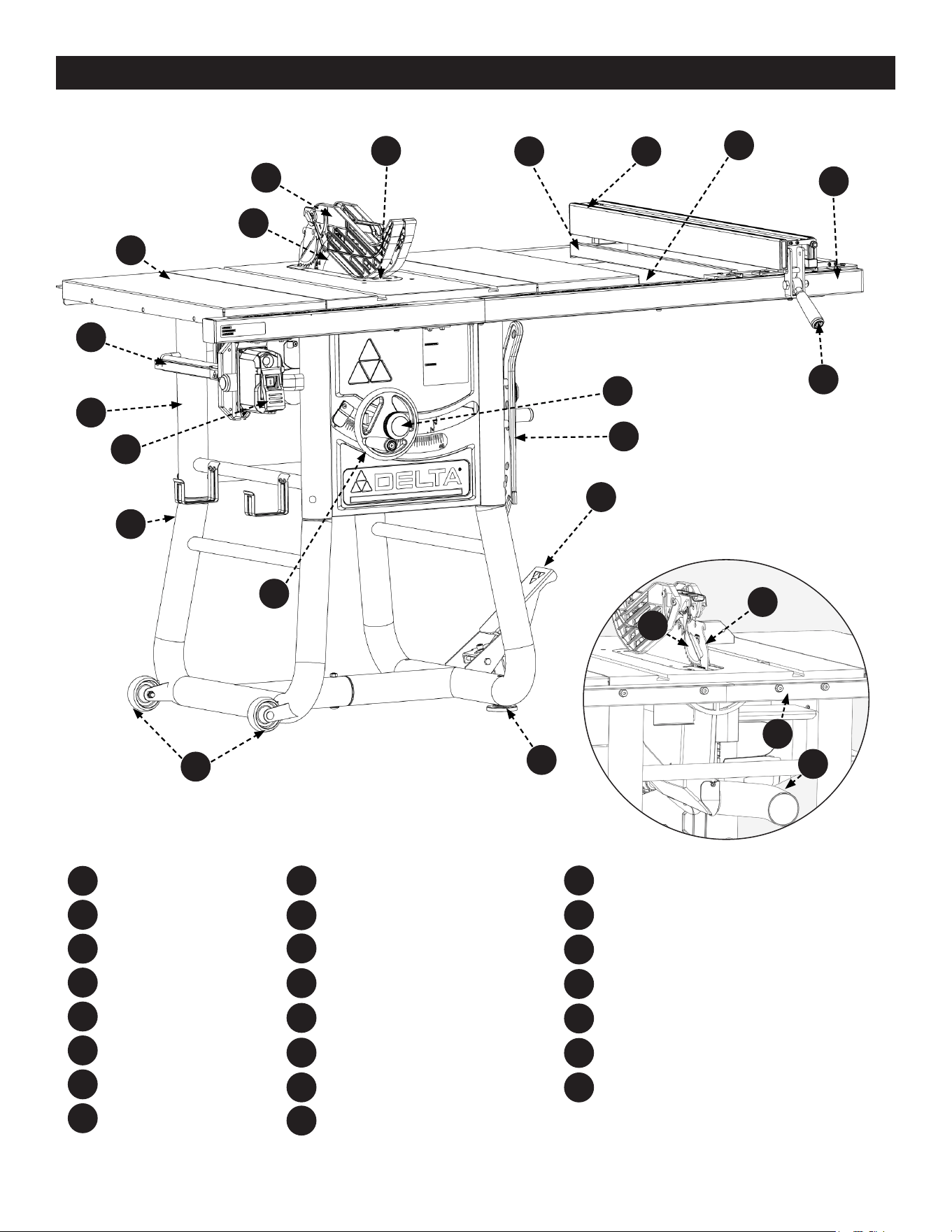
FEATURES
Back View
F5
F6
F7
F8
F9
F10
F11
F12
F13
F14
F15
F16
F17
F18
F19
F20
F9
F10
F11
F12
F13
F14
F15
F16
Push Stick
Pivoting Pedal and Caster Wheel
Adjustable Feet
Fixed Wheels
Hand Wheel Handle
Tubular Stand
Power Switch
Saw Body
F21
F22
F23
F17
F18
F19
F20
F21
F22
F23
Extension Wing
Miter Gauge
Blade
Anti-Kickback Pawls
Riving Knife
Rear Fence Rails
Dust Chute
F1
F2
F3
F4
F5
F6
F7
F8
F1
F2
F3
F4
Blade Guard
Throat Plate
Rail Spreader Bar
Rip Fence
Fence Guides
Front Fence Rails
Rip Fence Handle
Lock Knobs
4
IMPORTANT SAFETY INSTRUCTIONS
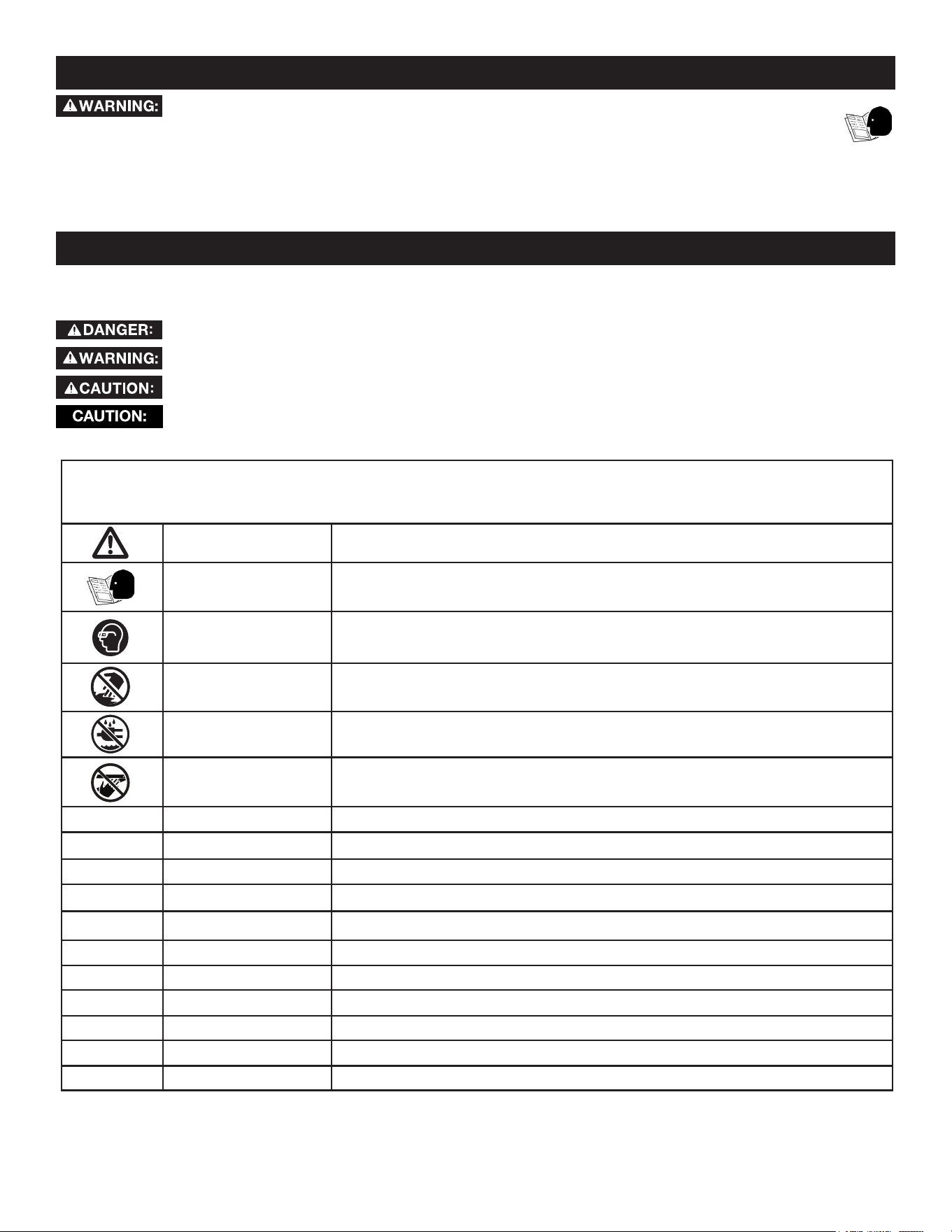
SAFETY SYMBOLS- DEFINITIONS
This manual contains information that is important for you to know and understand. These important warnings relates to protecting YOUR SAFETY and
PREVENTING EQUIPMENT PROBLEMS. To help you recognize this information, we use the symbols below. Please read the manual and pay attention to
these sections.
Indicates an imminently hazardous situation which, if not avoided, will result in death or serious injury.
Indicates a potentially hazardous situation which, if not avoided, could result in death or serious injury.
Indicates a potentially hazardous situation which, if not avoided, may result in minor or moderate injury.
Used without the safety alert symbol indicates potentially hazardous situation which, if not avoided, may result in
property damage.
CAREFULLY READ AND FOLLOW ALL WARNINGS AND INSTRUCTIONS ON YOUR PRODUCT
AND IN THIS MANUAL. SAVE THIS MANUAL. MAKE SURE ALL USERS ARE FAMILIAR WITH ITS WARNINGS
AND INSTRUCTIONS WHEN USING THE TOOL. KEEP THIS MANUAL NEAR YOUR SAW FOR EASY REFERENCE
AND TO INSTRUCT OTHERS. Improper operation, maintenance or modification of tools or equipment could result in
serious injury and/or property damage.
SAVE THESE INSTRUCTIONS.
Refer to them often and use them to instruct others. ● If tool is loaned to someone, also loan them these instructions.
If you have any questions or concerns relative to the use of your tool or the contents of this manual, stop using the tool and contact Delta
Power Equipment Corporation Customer Care at 1-800-223-7278.
Some of the following symbols may be used in connection with this product. Please study them and learn their meaning. Proper
interpretation on these symbols will allow you to operate the tool better and safer.
SYMBOL NAME DESIGNATION/EXPLANATION
Safety Alert Indicates a potential personal injury hazard.
Read Operator's Manual
To reduce the risk of injury, user must read and understand operator's manual before
using this product.
Eye Protection Always wear eye protection with side shields marked to comply with ANSI Z87.1.
No Hands Symbol Failure to keep your hands away from the blade will result in serious personal injury.
Wet Conditions Alert Do not expose to rain or use in damp locations.
Pinch Warning
Always watch for movement paying extra attention to potential areas where pinching
could occur.
V Volts Voltage
A Amperes Current
Hz Hertz Frequency (cycles per second)
min Minutes Time
~/AC Alternating Current Type of current
ⁿ
₀
No Load Speed Rotational speed, at no load
.../min Per Minute Revolutions, strokes, surface speed, orbits, etc., per minute
Lbs Pounds Unit of weight
Kg Kilograms Unit of weight
RPM Revolutions Per Minute Speed of rotation of machine
PH:1 Phase 1 This is a 1 phase motor

5
The term “power tool” in the warnings refers to your mains-operated (corded) power tool or BATTERY-operated (cordless) power tool.
1. Work area safety
a. Keep work area clean and well lit. Cluttered or dark areas invite accidents
b. Do not operate power tools in explosive atmospheres, such as in the presence of ammable liquids, gases
or dust. Power tools create sparks which may ignite the dust or fumes.
c. Keep children and bystanders away while operating a power tool. Distractions can cause you to lose control.
2. Electrical safety
a. Power tool plugs must match the outlet. Never modify the plug in any way. Do not use any adapter with
earthed (grounded) power tools. Unmodied plugs and matching outlets will reduce risk of electric shock
b. Avoid body contact with earthed or grounded surfaces, such as pipes, radiators, ranges and refrigerators.
There is an increased risk of electric shock if your body is earthed or grounded.
c. Do not expose power tools to rain or wet conditions. Water entering a power tool will increase the risk of electric
shock.
d. Do not abuse the cord. Never use the cord for carrying, pulling or unplugging the power tool. Keep cord
away from heat, oil, sharp edges or moving parts. Damaged or entangled cords increase the risk of electric shock.
e. When operating a power tool outdoors, use an extension cord suitable for outdoor use. Use of a cord suitable
for outdoor use reduces the risk of electric shock.
f. If operating a power tool in a damp location is unavoidable, use a ground fault circuit interrupter (GFCI)
protected supply. Use of an GFCI reduces the risk of electric shock.
3. Personal safety
a. Stay alert, watch what you are doing and use common sense when operating a power tool. Do not use a
power tool while you are tired or under the inuence of drugs, alcohol or medication. A moment of inattention
while operating power tools may result in serious personal injury.
b. Use personal protective equipment. Always wear eye protection. Protective equipment such as dust mask, non-
skid safety shoes, hard hat, or hearing protection used for appropriate conditions will reduce personal injuries.
c. Prevent unintentional starting. Ensure the switch is in the o-position before connection to power source,
picking up, or carrying the tool. Carrying power tools with your nger on the switch or energising power tools that
have the switch on invites accidents.
d. Remove any adjusting key or wrench before turning the power tool on. A wrench or a key left attached to a
rotating part of the power tool may result in personal injury.
e. Do not overreach. Keep proper footing and balance at all times. This enables better control of the power tool in
unexpected situations
f. Dress properly. Do not wear loose clothing or jewelery. Keep your hair, clothing and gloves away from
moving parts. Loose clothes, jewelery or long hair can be caught in moving parts.
g. If devices are provided for the connection of dust extraction and collection facilities, ensure these are
connected and properly used. Use of dust collection can reduce dust-related hazards.
h. Do not let familiarity gained from frequent use of tools allow you to become complacent and ignore tool
safety principles. A careless action can cause severe injury within a fraction of a second.
4. Power tool use and care
a. Do not force the power tool. Use the correct power tool for you application. The correct power tool will do the
job better and safer at the rate for which it was designed.
b. Do not use the power tool if the switch does not turn it on and o. Any power tool that cannot be controlled with
the switch is dangerous and must be repaired.
c. Disconnect the plug from the power source before making any adjustments, changing accessories, or
storing power tools. Such preventive safety measures reduce the risk of starting the power tool accidentally.
d. Store idle power tools out of the reach of children and do not allow persons unfamiliar with the power tool
or these instructions to operate the power tool. Power tools are dangerous in the hands of untrained users.
e. Maintain power tools and accessories. Check for misalignment or binding of moving parts , breakage of
parts and any other condition that may aect the power tool’s operation. If damaged, have the power tool
repaired before use. Many accidents are caused by poorly maintained power tools.
f. Keep cutting tools sharp and clean. Properly maintained cutting tools with sharp cutting edges are less likely to bind
and are easier to control.
g. Use the power tool, accessories and tools bits etc. in accordance with these instructions, taking into
account the working conditions and the work to be performed. Use of the power tool for operations dierent
from those intended could result in a hazardous situation.
GENERAL POWER TOOL SAFETY WARNINGS
Read all safety warnings, instructions, illustrations and specications provided with this power tool.
Failure to follow all instructions listed below may result in electric shock, re and/or serious injury.
Save all warnings and instructions for future reference.
6
• Through-cut – Any cut that completely cuts through the
workpiece.
• Non-through cut – Any cut that does not completely cut
through the workpiece.
• Push stick – A wooden or plastic stick, usually homemade,
that is used to push a small workpiece through the saw and
keeps the operator’s hands clear of the blade.
• Kickback – Occurs when the saw blade binds in the cut or
between the blade and the fence and thrusts the workpiece
back toward the operator or lowering the workpiece down to
the blade.
• Re-sawing – Flipping material to make a cut the saw is not
capable of making in one pass.
• Cove cutting – Also known as coving, cove cutting is an
operation where the work is fed at an angle across the
blade. NOTE: This can be a dangerous operation and is not
recommended.
• Freehand – Cutting without the use of a miter gauge or
rip fence or any other means of guiding or holding the
workpiece other than the operator’s hand. NOTE: This can be
a dangerous operation and is not recommended.
• Plunge cutting – Blind cuts in the workpiece made by either
raising the blade through the workpiece. NOTE: This can be a
dangerous operation and is not recommended.
• Rabbet Cut – A cut on the end or face (edge) of a board -
the extruding piece is the tongue.
• Kerf – A cut or incision made by a saw.
TABLE SAW SAFETY RULES
Failure to follow these rules may result in serious personal injury.
SEE GENERAL POWER TOOL SAFETY SECTION OF THIS MANUAL. Read entire instruction manual before operating saw. Learning
the saw’s proper applications, limitations, and specic potential hazards will greatly minimize the possibility of accidents and injury. Make
sure all users are familiar with its warnings and instructions before using saw.
SEE POWER CONNECTION SECTION OF THIS MANUAL for instructions and warnings regarding power cords and connections.
TERMINOLOGY
The following terms will be used throughout the manual and you should become familiar with them.
PROPOSITION 65 WARNING:
Dust created by power sanding, sawing, grinding, drilling, and other construction activities may contain chemicals
known to the state of California to cause cancer, birth defects or other reproductive harm. Some examples are:
• Lead from lead-based paints
• Crystalline silica from bricks and cement and other masonry products
• Asbestos dust
• Arsenic and chromium from chemically-treated lumber
Your risk from these exposures varies depending on how often you do this type of work. To reduce your exposure to these chemicals:
work in a well-ventilated area and work with approved safety equipment, such as dust masks that are specically designed to lter out
microscopic particles. Avoid prolonged contact with dust from power sanding, sawing, grinding, drilling, and other construction activities.
Wear protective clothing and wash exposed areas with soap and water.
h. Keep handles and grasping surfaces dry, clean and free from oil and grease. Slippery handles and grasping
surfaces do not allow for safe handling and control of the tool in unexpected situations.
5. Service
a. Have your power tool serviced by a qualied repair person using only identical replacement parts. This will
ensure that the safety of the power tool is maintained.
GENERAL POWER TOOL SAFETY WARNINGS

7
1. GUARDING RELATED WARNINGS
a. Keep guards in place. Guards must be in working order and be properly mounted. A guard that is loose,
damaged, or is not functioning correctly must be repaired or replaced.
b. Always use saw blade guard, riving knife and anti-kickback device for every through-cutting operation. For
through-cutting operations where the saw blade cuts completely through the thickness of the workpiece, the guard and
other safety devices help reduce the risk of injury.
c. Immediately reattach the guarding system after completing an operation (such as rabbeting or resawing
cuts) which requires removal of the guard, riving knife and/or anti-kickback device. The guard, riving knife,
and anti-kickback device help to reduce the risk of injury.
d. Make sure the saw blade is not contacting the guard, riving knife or the workpiece before the switch is
turned on. Inadvertent contact of these items with the saw blade could cause a hazardous condition.
e. Adjust the riving knife as described in this instruction manual. Incorrect spacing, positioning and alignment can
make the riving knife ineective in reducing the likelihood of kickback.
f. For the riving knife and anti-kickback device to work, they must be engaged in the workpiece. The riving
knife and anti-kickback device are ineective when cutting workpieces that are too short to be engaged with the
riving knife and anti-kickback device. Under these conditions a kickback cannot be prevented by the riving knife and
antikickback device.
g. Use the appropriate saw blade for the riving knife. For the riving knife to function properly, the saw blade diameter
must match the appropriate riving knife and the body of the saw blade must be thinner than the thickness of the riving
knife and kerf of the saw blade must be wider than the thickness of the riving knife.
2. CUTTING PROCEDURES WARNINGS
a. DANGER: Never place your ngers or hands in the vicinity or in line with the saw blade. A moment of
inattention or a slip could direct your hand towards the saw blade and result in serious personal injury.
b. Feed the workpiece into the saw blade or cutter only against the direction of rotation. Feeding the workpiece
in the same direction that the saw blade is rotating above the table may result in the workpiece, and your hand, being
pulled into the saw blade.
c. Never use the mitre gauge to feed the workpiece when ripping and do not use the rip fence as a length
stop when cross cutting with the miter gauge. Guiding the workpiece with the rip fence and the miter gauge at the
same time increases the likelihood of saw blade binding and kickback.
d. When ripping, always apply the workpiece feeding force between the fence and the saw blade. Use a push
stick when the distance between the fence and the saw blade is less than 50mm, and use a push block when this distance
is less than 150mm. "Work helping" devices will keep your hand at a safe distance from the saw blade.
e. Use only the push stick provided by the manufacturer or constructed in accordance with the instructions.
This push stick provides sucient distance of the hand from the saw blade.
f. Never use a damaged or cut push stick. A damaged push stick may break causing your hand to slip into the saw
blade.
g. Do not perform any operation "freehand". Always use either the rip fence or the miter gauge to position and guide
the workpiece. "Freehand" means using your hands to support or guide the workpiece, in lieu of a rip fence or mitre
gauge. Freehand sawing leads to misalignment, binding and kickback.
h. Never reach around or over a rotating saw blade. Reaching for a workpiece may lead to accidental contact with the
moving saw blade.
i. Provide auxiliary workpiece support to the rear and/or sides of the saw table for long and/or wide
workpieces to keep them level. A long and/or wide workpiece has a tendency to pivot on the table’s edge, causing
loss of control, saw blade binding and kickback.
j. Feed workpiece at an even pace. Do not bend or twist the workpiece. If jamming occurs, turn the tool o
immediately, unplug the tool then clear the jam. Jamming the saw blade by the workpiece can cause kickback or stall the
motor.
k. Do not remove pieces of cut-o material while the saw is running. The material may become trapped between
the fence or inside the saw blade guard and the saw blade pulling your ngers into the saw blade. Turn the saw o and
wait until the saw blade stops before removing material.
l. Use an auxiliary fence in contact with the table top when ripping workpieces less than 2mm thick. A thin
workpiece may wedge under the rip fence and create a kickback.
TABLE SAW SAFETY RULES
Failure to follow these rules may result in serious personal injury.
TABLE SAW SPECIFIC SAFETY RULES
WARNING READ ALL SAFETY WARNINGS DESIGNATED BY THE SYMBOL AND ALL INSTRUCTIONS.

8
TABLE SAW SAFETY RULES
m. Never Cut Metals, Cement Board or Masonry. Certain man-made materials have special instructions for cutting on
table saws. Follow the manufacturer’s recommendations at all times to avoid overheating the saw blade tips as well as
melting the plastic. Avoid overheating blade tips by pushing material through blade evenly. Forcing material too fast can
cause heating and damage to blade or workpiece. If cutting plastics is permitted, cut at a slower pace to avoid melting
the plastic.
3. Kickback causes and related warnings
Kickback is a sudden reaction of the workpiece due to a pinched, jammed saw blade or misaligned line of cut in the workpiece
with respect to the saw blade or when a part of the workpiece binds between the saw blade and the rip fence or other xed
object.
a. Most frequently during kickback, the workpiece is lifted from the table by the rear portion of the saw blade and
is propelled towards the operator. Kickback is the result of saw misuse and/or incorrect operating procedures or conditions
and can be avoided by taking proper precautions as given below.
b. Never stand directly in line with the saw blade. Always position your body on the same side of the saw blade as
the fence. Kickback may propel the workpiece at high velocity towards anyone standing in front and in line with the saw
blade.
c. Never reach over or in back of the saw blade to pull or to support the workpiece. Accidental contact with the
saw blade may occur or kickback may drag your ngers into the saw blade.
d. Never hold and press the workpiece that is being cut o against the rotating saw blade. Pressing the
workpiece being cut o against the saw blade will create a binding condition and kickback.
e. Align the fence to be parallel with the saw blade. A misaligned fence will pinch the workpiece against the saw blade
and create kickback.
f. Use a featherboard to guide the workpiece against the table and fence when making non-through cuts
such as rabbeting, or resawing cuts. A featherboard helps to control the workpiece in the event of a kickback.
g. Use extra caution when making a cut into blind areas of assembled workpieces. The protruding saw blade may
cut objects that can cause kickback.
h. Support large panels to minimise the risk of saw blade pinching and kickback. Large panels tend to sag under
their own weight. Support(s) must be placed under all portions of the panel overhanging the table top.
i. Use extra caution when cutting a workpiece that is twisted, knotted, warped or does not have a straight
edge to guide it with a mitre gauge or along the fence. A warped, knotted, or twisted workpiece is unstable and
causes misalignment of the kerf with the saw blade, binding and kickback.
j. Never cut more than one workpiece, stacked vertically or horizontally. The saw blade could pick up one or more
pieces and cause kickback.
k. When restarting the saw with the saw blade in the workpiece, centre the saw blade in the kerf so that the
saw teeth are not engaged in the material. If the saw blade binds, it may lift up the workpiece and cause kickback
when the saw is restarted.
l. Keep saw blades clean, sharp, and with sucient set. Never use warped saw blades or saw blades with cracked or
broken teeth. Sharp and properly set saw blades minimize binding, stalling and kickback.
4. Table saw operating procedure warnings
a. Turn o the table saw and disconnect the power cord when removing the table insert, changing the saw
blade or making adjustments to the riving knife, anti-kickback device or saw blade guard, and when the
machine is left unattended. Precautionary measures will avoid accidents.
b. Never leave the table saw running unattended. Turn it o and don’t leave the tool until it comes to a complete
stop. An unattended running saw is an uncontrolled hazard.
c. Locate the table saw in a well-lit and level area where you can maintain good footing and balance. It should
be installed in an area that provides enough room to easily handle the size of your workpiece. Cramped, dark areas, and
uneven slippery oors invite accidents.
d. Frequently clean and remove sawdust from under the saw table and/or the dust collection device.
Accumulated sawdust is combustible and may self-ignite.
e. The table saw must be secured. A table saw that is not properly secured may move or tip over.
f. Remove tools, wood scraps, etc. from the table before the table saw is turned on. Distraction or a potential jam
can be dangerous.
g. Always use saw blades with correct size and shape (diamond versus round) of arbor holes. Saw blades that
do not match the mounting hardware of the saw will run o-center, causing loss of control.
h. Never use damaged or incorrect saw blade mounting means such as anges, saw blade washers, bolts or
nuts. These mounting means were specially designed for your saw, for safe operation and optimum performance.
i. Never stand on the table saw, do not use it as a stepping stool. Serious injury could occur if the tool is tipped or if
the cutting tool is accidentally contacted.
j. Make sure that the saw blade is installed to rotate in the proper direction. Do not use grinding wheels, wire

9
TABLE SAW SAFETY RULES
SAW BLADE GUARD, ANTI-KICKBACK PAWLS AND RIVING KNIFE
ASSEMBLY
Your table saw is equipped with a blade guard, anti-kickback
pawls and riving knife assembly that covers the blade and
reduces the possibility of accidental blade contact.
The riving knife is a flat plate that fits into the cut made by
the saw blade and effectively fights kickback by lessening the
tendency of the blade to bind in the cut.
Two anti-kickback pawls are located on the sides of the riving
knife that allow the wood to pass through the blade in the cutting
direction but reduce the possibility of the material being thrown
backwards toward the operator.
The blade guard and anti-kickback pawls can ONLY be used
when making through cuts that sever the wood. When making
rabbets and other non-through cuts, the blade guard and anti-
kickback pawls MUST be removed and riving knife lowered to the
non-through cut position marked on the riving knife.
Use all components of the guarding system (blade guard
assembly, riving knife and anti-kickback pawls) for every operation
for which they can be used including all through-cutting. If
you elect not to use any of these components for a particular
application, exercise additional caution regarding control of the
workpiece, the use of push sticks, the position of your hands
relative to the blade, the use of safety glasses, the means to avoid
kickback and all other warnings contained in this manual and
on the saw itself. Replace the guarding systems as soon as you
return to through-cutting operations. KEEP the guard assembly in
working order.
brushes, or abrasive wheels on a table saw. Improper saw blade installation or use of accessories not recommended may
cause serious injury.
k. DO NOT REMOVE A WORKPIECE that is damaged or jammed without rst turning o the saw and unplugging it from
the power source.
KICKBACKS
Kickbacks can cause serious injury. A kickback occurs when a part
of the workpiece binds between the saw blade and the rip fence,
or other fixed object, and rises from the table and is thrown
toward the operator. Kickbacks can be minimized by attention to
the following conditions.
HOW TO REDUCE THE RISK OF KICKBACKS AND PROTECT
YOURSELF FROM POSSIBLE INJURY:
Be certain that the rip fence is parallel to the saw blade.
DO NOT rip by applying the feed force to the section of the
workpiece that will become the cut-off (free) piece. Feed force
when ripping should ALWAYS be applied between the saw
blade and the fence; use a push stick for narrow work, 6 inches
(152mm) wide or less.
KEEP saw blade guard, riving knife and anti-kickback assembly
in place and operating properly. The riving knife MUST be in
alignment with the saw blade and the anti-kickback assembly
MUST stop a kickback once it has started. Check their action
before ripping by pushing the wood under the anti-kickback
assembly. The teeth MUST prevent the wood from being pulled
toward the front of the saw. If any part of assembly is not
operational, return to the nearest authorized service center for
repair.
Plastic and composite materials (like hardboard) may be cut
on your saw. However, since these are usually quite hard and
slippery, the anti-kickback pawls may not stop a kickback.
Therefore, be especially attentive to following proper set up and
cutting procedures for ripping.
Use saw blade guard, anti-kickback pawls, and riving knife
assembly for every possible operation, including all through-cut
sawing.
Push the workpiece past the saw blade prior to releasing control.
NEVER rip a workpiece that is twisted or warped, or does not
have a straight edge to guide along the fence.
NEVER saw a large workpiece that CANNOT be controlled.
NEVER use the fence as a guide or length stop when
crosscutting.
NEVER saw a workpiece with loose knots, flaws, nails or other
foreign objects.
NEVER rip a workpiece shorter than 10 inches (254mm).
NEVER use a dull blade. A dull blade should be replaced or
re-sharpened.
10
Your machine is wired for 120 volts, 60 HZ alternating current. Before connecting the machine to the power source, make sure the
switch is in the “OFF” position.
This tool has a precision-built electric motor. It should be connected to a POWER SUPPLY THAT IS 120 VOLTS, 60 HZ, AC ONLY
(NORMAL HOUSEHOLD CURRENT in the U.S. and Canada). DO NOT operate this tool on direct current (DC). A substantial voltage
drop will cause a loss of power and the motor will overheat. If the tool does not operate when plugged into an outlet, double-check the
power supply.
To reduce the risk of electric shock, this equipment has a polarized plug (one blade is wider than the other). This plug will fit in a
polarized outlet ONLY one way. If the plug does not fully fit in the outlet reverse the plug. If it still does not fit, contact a qualified
electrician to install the proper outlet. DO NOT change the plug in any way.
When using a power tool at a considerable distance from a power source, be sure to use an extension cord that has the capacity to
handle the current the tool will draw. An undersized cord will cause a drop in line voltage, resulting in overheating and loss of power.
Use the chart to determine the minimum wire size required in an extension cord. ONLY round jacketed cords listed by Underwriter’s
Laboratories (UL) should be used.
NOTE: Before using any extension cord, inspect it for loose or
exposed wires and cut or worn insulation.
** Ampere rating (on total data label)
12A- 16A
Cord Length Wire Size
25' 14 AWG
50' 12 AWG
** Used on 12 gauge - 20 amp circuit
NOTE: AWG = American Wire Gauge
ELECTRICAL CONNECTION
POLARIZED PLUGS
EXTENSION CORDS
KEEP the extension cord clear of the work
area. Position the cord so that it will not get caught on lumber,
tools or other obstructions while you are working with a power
tool. Failure to do so can result in serious personal injury. Check
extension cords before each use. If damaged replace immediately.
NEVER use tool with a damaged cord, since touching the
damaged area could cause electrical shock resulting in serious
injury.
POWER CONNECTIONS
POWER SOURCE
This saw is equipped with a 15-amp motor for use with a 120-
volt, 60-HZ alternating current. See instructions below regarding
proper connections for your saw as wired.
For voltage, the wiring in a shop is as important as the motor’s
rating. A line intended ONLY for lights may not be able to
properly carry the current needed for a power tool motor; wire
that is heavy enough for a short distance may be too light for a
greater distance; and a line that can support one power tool may
not be able to support two or three. A separate electrical circuit
should be used for your machines. This circuit should not be less
than #12 wire and recommended to be protected with a 20-amp
circuit breaker or a 20-amp time lag fuse. If an extension cord
is used, use ONLY 3-wire extension cords which have 3-prong
grounding-type plugs and matching receptacle which will accept
the machine’s plug. Before connecting the machine to the power
line, make sure the switch(s) is in the “OFF” position and be sure
that the electric current is of the same characteristics as indicated
on the machine. A substantial voltage drop will cause a loss of
power and overheat the motor. It may also damage the machine.
DO NOT EXPOSE THE MACHINE TO RAIN OR OPERATE THE MACHINE IN DAMP LOCATIONS.

11
UNPACKING
• The machine is heavy, two people are required to unpack and lift.
• Use a safety strap to avoid tip over when lifting machine.
• Prior to tool assembly and use, read this manual thoroughly to
familiarize yourself with proper assembly, maintenance and safety
procedures.
Check shipping carton and machine for damage before unpacking.
Carefully remove components in top foam layer. Remove the top
layer of foam then remove all components in the bottom layer of
foam. Lay out all parts on a piece of cardboard or other clean,
at surface. Two or more people are needed to lift the saw out of
the carton. ALWAYS check for and remove protective shipping
materials around motors and moving parts. DO NOT discard
shipping carton and packing materials until you have carefully
inspected the contents, assembled the machine and are satised
that it operates correctly.
Compare package contents to Package Contents list and Hardware
Package list prior to assembly to make sure all items are present.
Carefully inspect parts to make sure no damage occurred during
shipping. If any parts are missing, damaged or pre-assembled, DO
NOT assemble. Instead, call DELTA
®
Customer Care at 1-800-223-
7278 for assistance.
After assembly remove any protective materials and coatings from
all of the parts and the table saw. The protective coatings can be
removed by spraying WD-40
®
on them and wiping them o with a
soft cloth. This may need to be redone several times before all of
the protective coatings are removed completely.
After cleaning, apply a good quality paste wax to any unpainted
cast iron surfaces. Make sure to bu out the wax before operating
the saw.
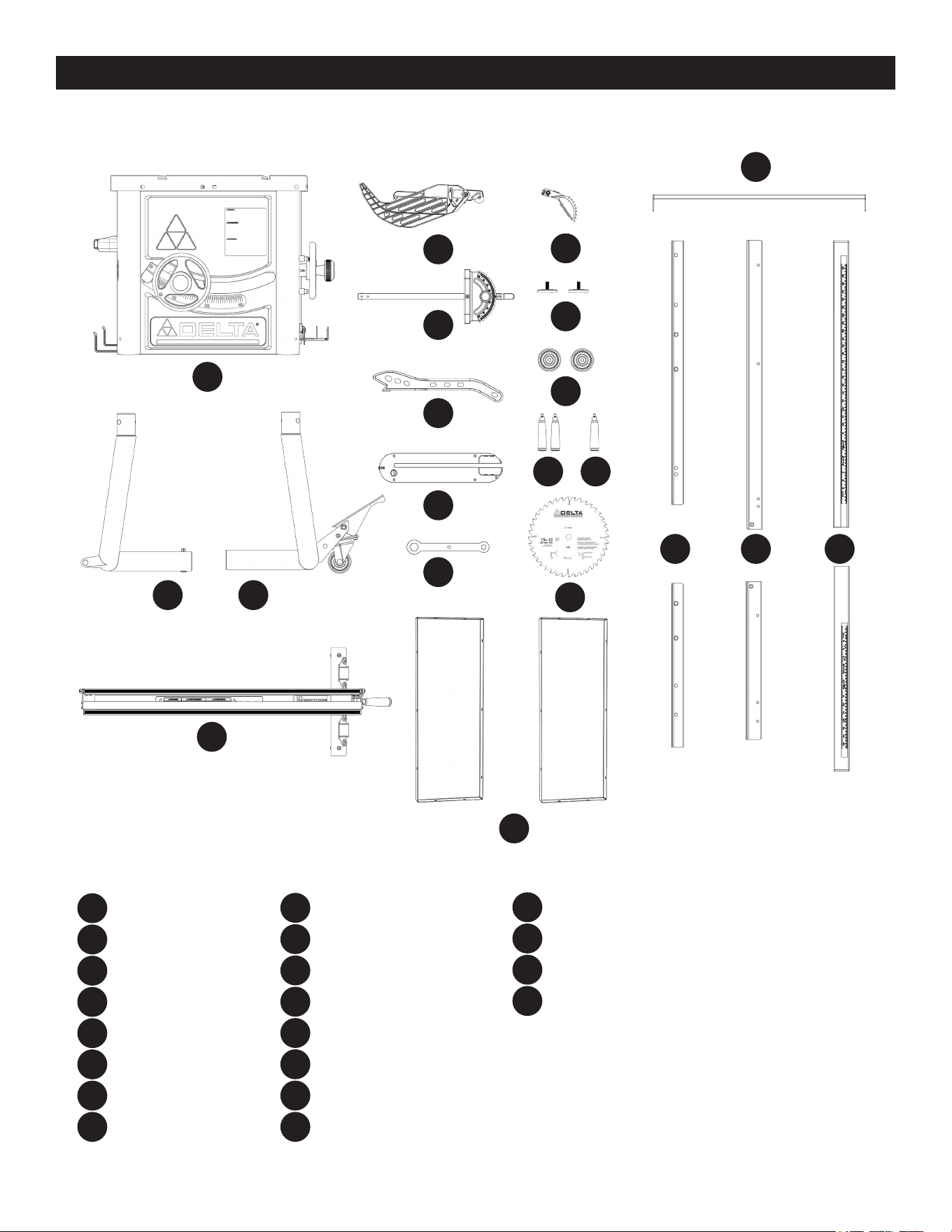
12
36-725 T2 Saw Body
Left Leg (B)
Right Leg (A)
Rip Fence
Blade Guard
Miter Gauge
Push Stick
Throat Plate
Blade Wrench
Extension Wings (2)
Anti-Kickback Pawls
Adjustable Feet (2)
Fixed Wheels (2)
Hand Wheel Handle (2)
Rip Fence Handle
10 inch Blade (Pre-Installed)
Rail Spreader Bar
Rear Fence Rails (2)
Front Fence Rails (2)
Fence Guides (2)
PACKAGE CONTENTS
UNPACKING
PC1
PC1
PC2
PC2
PC3
PC3
PC17
PC17
PC4
PC4
PC5
PC5
PC6
PC6
PC7
PC7
PC8
PC8
PC9
PC9
PC10
PC10
PC11
PC11
PC12
PC12
PC13
PC13
PC14
PC14
PC16
PC16
PC18
PC18
PC19
PC19
PC20
PC20
PC15
PC15
13
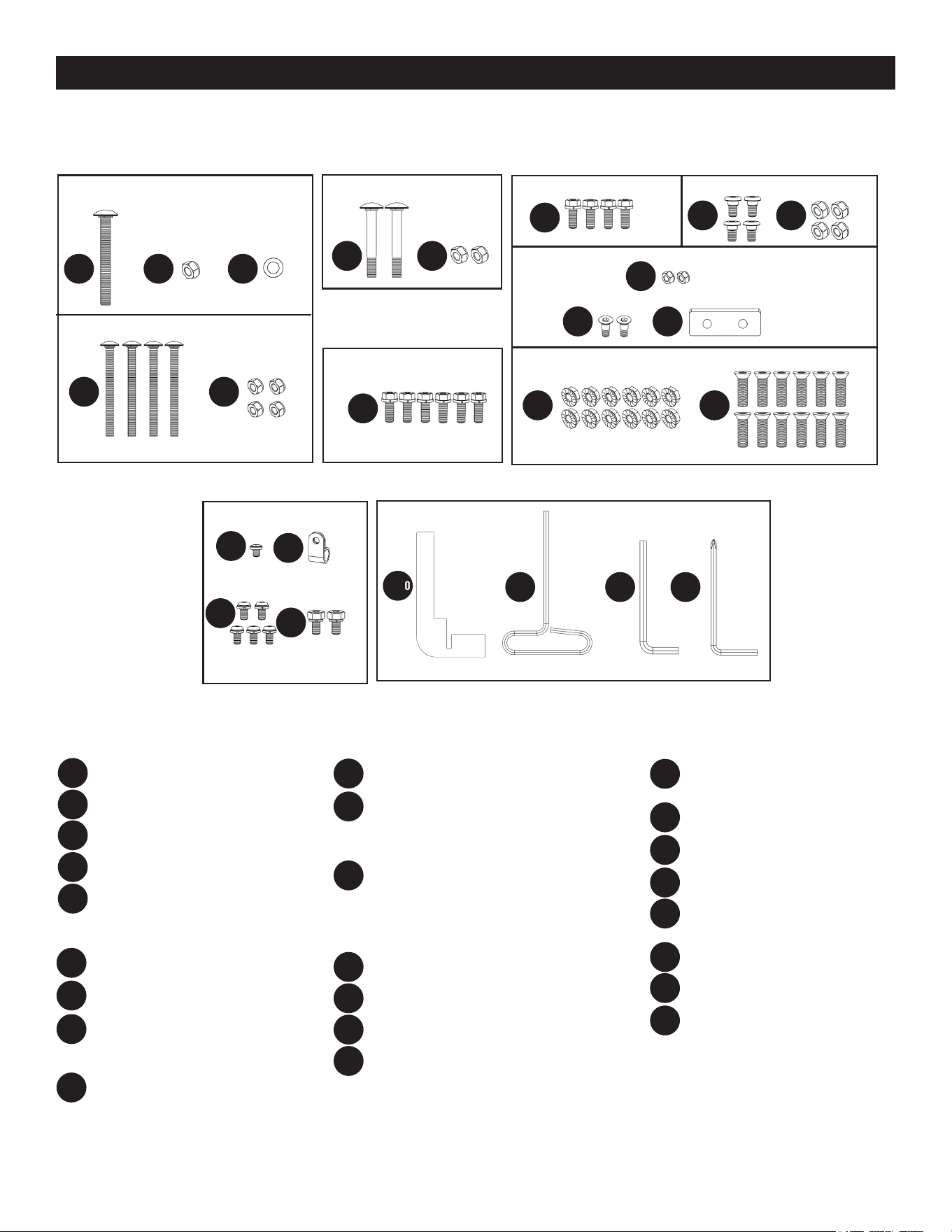
HARDWARE PACKAGE
UNPACKING
HP1
HP3
HP2
HP2
HP4
HP5
HP12
HP11
Hardware Bag “A”
M8 x 75mm Carriage Bolt (1)
M8 Nylock Nut (1)
M8 Flat Washer (1)
M6 x 72mm Carriage Bolt (4)
M6 Nylock Nut (4)
Hardware Bag “B”
M8 x 53mm Carriage Bolt (2)
M8 Nylock Nut (2)
Hardware Bag “C”
5/16-18 x 7/8 Hex Screw
w/Split Lock Washer (6)
Hardware Bag “D”
5/16-18 x 7/8 Hex Screw
w/Split Lock Washer (4)
M8 x16 Hex Shoulder Screw (4)
M8 Nylock Nut (4)
M5 Nylock Nut (2)
M5 x 16mm Flat Countersunk Hex
Shoulder Screw (2)
Front Rail Union Plate (1)
5/16-18 Hex Flange Nut (12)
5/16-18 x 1-1/8 inch Flat
Countersunk Hex Screw (12)
Hardware Bag “E”
M5 x 6mm Phillips Head Screw (1)
Wire Clip (1)
1/4-20 x 1/2 inch Button
Head Hex Screw w/ Split Lock
Washer (5)
1/4-20 x 1/2 inch Hex Screw
w/ Split Lock Washer (2)
Hardware Bag "F"
Rail Alignment Gauge (1)
4mm T-Handle Allen Wrench (1)
6mm Allen Wrench (1)
3/16 inch Two-Way Allen Wrench L Shape (1)
HP20
HP16
HP17
HP8
HP18
HP19
HP21
HP22
HP23
HP6
HP15
HP9
HP10
HP7
HP7
HP13
HP1
HP2HP6
HP2 HP3
HP4 HP5
HP7
HP7
HP8 HP9
Hardware Bag “A”
Hardware Bag “B”
Hardware Bag “D”
Hardware Bag “E ”
Hardware Bag “F”
Hardware Bag “C”
004623
006134
006291
006108
006111
007080
006110
005733
006054
007083
005679
003331
006113
006109
006109
005733
005733 003059
006293
006292
007082
006122
007081
HP20
HP21 HP22 HP23
HP16
HP17
HP18
HP19
HP15
HP10
HP11 HP12
HP13
003578
14
ASSEMBLY
• DO NOT lift Saw without help. Hold it close to your body
while lifting. KEEP knees bent and lift with your legs, not your
back.
• Fully assemble Saw with Leg assembly prior to use. Leg
assembly is an integral and necessary part of the Support
Structure for this Saw.
• DO NOT modify Saw, or create accessories not recommended
for use with this Saw.
• Make sure Power Switch is in “OFF” position before connecting
to Power Supply.
• DO NOT connect to Power Supply until assembly is complete.
STAND
Hardware Bag “A”
Avoid contact with Blade Teeth. KEEP
Blade stored or lowered when possible.
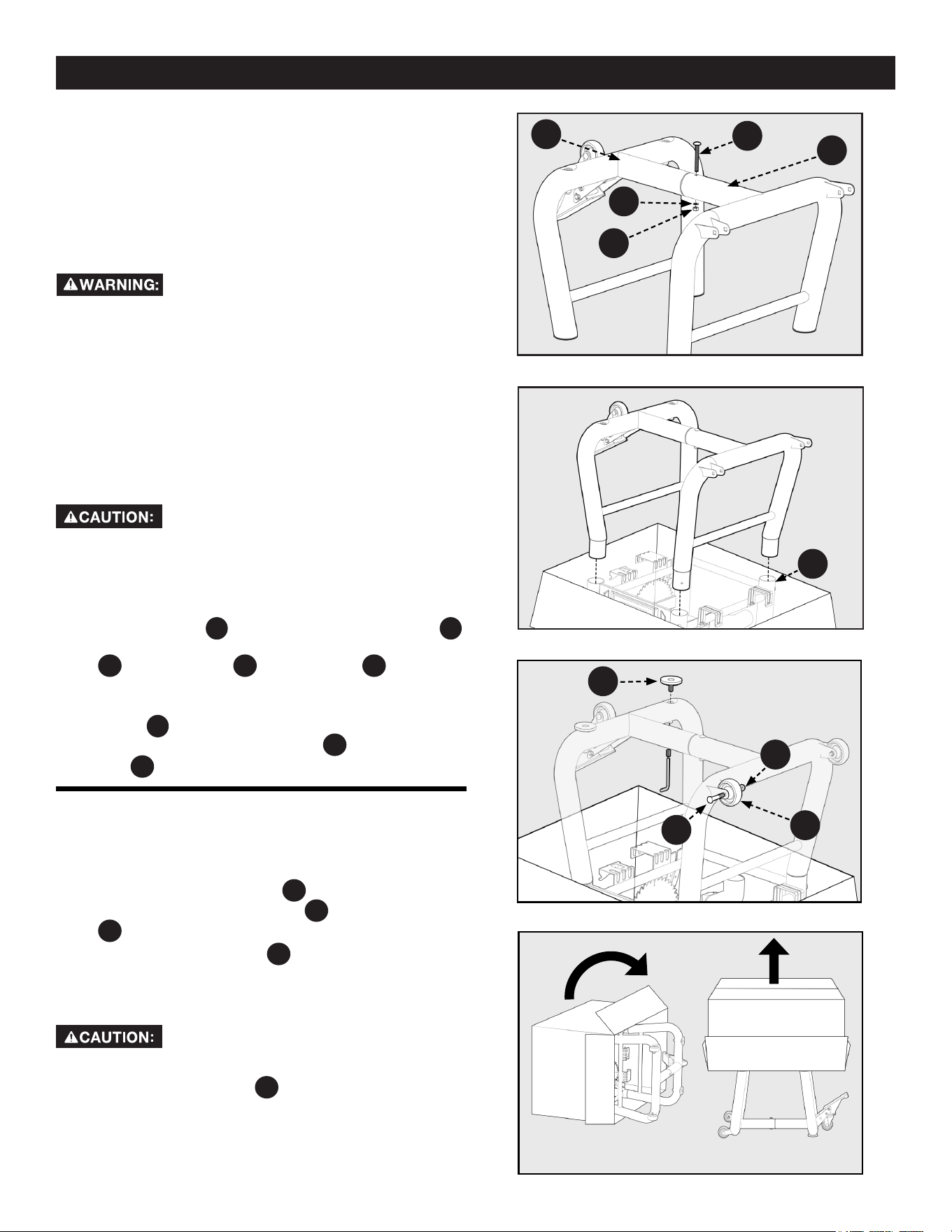
1. Connect the two Tube Legs together by inserting the end
of the Left Leg
PC2
into the end of the Right Leg
PC3
.
Secure them together with (4) M8 x 75mm Carriage Bolt
HP4
, M8 Flat Washer
HP3
, M8 Nylock Nut
HP2
and tighten.
See Figure 1.
2. Insert the four open ends of the Tube Legs into the Leg
Collars
A
as shown. Secure each Leg to the Saw Body
with (4) M6 x 72mm Carriage Bolts
HP4
and (4) M6 Nylock
Nuts
HP5
and tighten. See Figure 2.
TOOLS REQUIRED FOR ASSEMBLY (NOT
INCLUDED):
• Flat Head Screwdriver
• Phillips Head Screwdriver
• 8mm Wrench
• 10mm Wrench
• 12mm Open-Ended Wrench
• 13mm Wrench
Figure
1
• 9/16 inch Wrench
• 5/32 inch Allen Wrench
• Framing (Carpenter's) Square
• Combination Square
• Straight Edge
Figure 2
Figure 3
Figure 4
FIXED WHEELS AND STATIONARY
FEET
Hardware Bag “B”
1. Attach the two Fixed Wheels
PC13
to the Left Leg using the
(2) M8 x 53mm Carriage Bolts
HP6
and M8 Nylock Nuts
HP2
. One for each wheel as shown in Figure 3.
2. Screw the Adjustable Feet
PC12
into the threaded inserts in
the Right Leg.
3. Carefully stand the box right side up and remove packaging
once the machine has been lifted from the ground.
The machine is heavy, two people may
be required to stand the machine up.
4. The two Adjustable Feet
PC12
can be raised and lowered by
rotating them clockwise or counterclockwise. The Feet
may be adjusted to level the Saw and can be locked in
place with the pre-assembled Set Screws using the
provided 6mm Allen Wrench. See Figure 3.
PC3
HP1
HP3
HP2
HP2
PC2
A
PC13
HP6
PC12
PC19
PC18
PC18
15
ASSEMBLY
FRONT AND REAR RAILS
Hardware Bag “D”
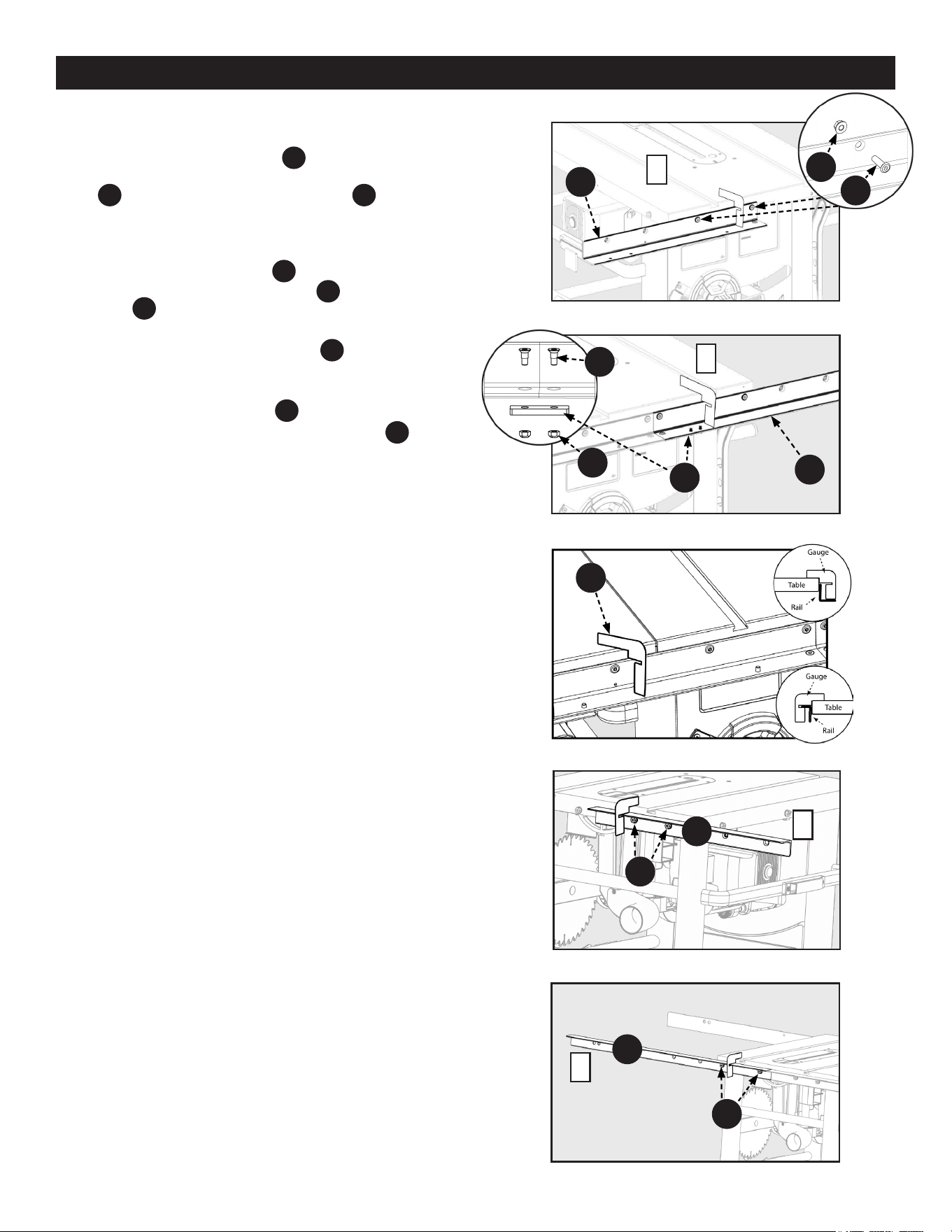
1. Attach the Front Fence Rails
PC19
(1&2) to the Table Front
using (4) 5/16-18 x 1-1/8 inch Flat Countersunk Hex Screw
HP15
, and (4) 5/16-18 Hex Flange Nuts
HP13
, see Figure 5
and 6.
NOTE: The Front Rails have holes on both surfaces of the rail for
attachment to both the Table and the Fence Guide.
2. Attach the Rail Union Plate
HP12
using (2) M5 x 16mm Flat
Countersunk Hex Shoulder Screw
HP11
and (2) M5 Nylock
Nuts
HP10
in the two holes where the Rail Sections meet.
see Figure 6.
3. Use supplied Rail Alignment Gauge
HP20
to ensure the Rails
are the proper distance from the top of the Table. See
Figure 7.
4. Attach the Rear Fence Rails
PC18
to the Table with (4) 5/16
-18 x 7/8 Hex Screw with Split Lock Washers
HP7
. Use the
slot in the supplied Gauge to ensure the Rail is the proper
distance from the top of the Table. See Figures 7-9.
REAR RIGHT RAIL REAR RIGHT RAIL
FRONT RIGHT
RAIL (LONG)
2
Figure 5
Figure 6
Figure 7
Figure 8
REAR LEFT RAIL
Figure 9
HP7
HP7
HP12
HP11
HP10
PC19
PC20
1
3
4
FRONT LEFT RAIL FRONT LEFT RAIL
(SHORT) (SHORT)
HP15
HP13
16
ASSEMBLY
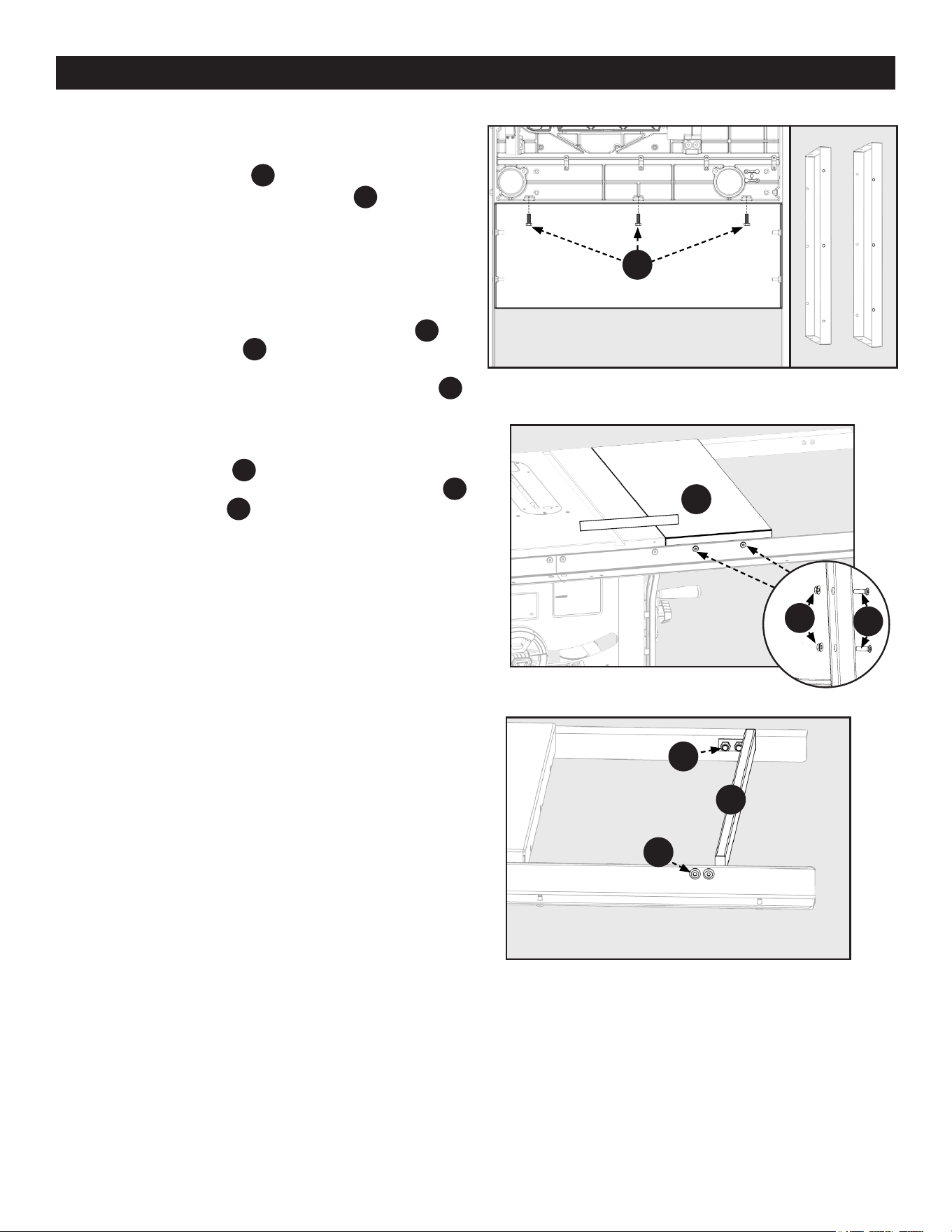
1. Attach the Extension Wings
PC10
to the Table using (6) 5/16-18
x 7/8 Hex Screw with Split Lock Washers
HP7
, (3) for each
Wing. The Wings attach from underneath as shown in Figure
10. Be sure to use a Level or Combination Square to keep the
Extension Wings level with the Table. NOTE: Hole patterns on
the two long edges of the extensions are dierent. See Figure
10A.
2. Attach the Extension Wings to the Front and Rear rails using
(8) 5/16-18 x 1-1/8 inch Flat Countersunk Hex Screw
HP15
and
5/16-18 Hex Flange Nuts
HP13
, (4) for each wing. See Figure
11. Be sure to conrm the Front and Rear Rails are level with
the Extension Wings by using the Rail Alignment Gauge
HP20
.
See Figure 5-9.
3. Repeat this process on Front and Rear Rails for both Extension
Wings.
4. Attach the Spreader Bar
PC17
to the outboard end of the Front
and Rear Rails using (4) M8 x 16 Hex Shoulder Screws
HP8
and (4) M8 Nylock Nuts
HP9
. See Figure 12.
Figure 12
Figure 10
Figure 10A
Figure 11
EXTENSIONEXTENSION
WINGWING
UNDERSIDE OF WINGUNDERSIDE OF WING
EXTENSION WINGS
Hardware Bag “C,D”
HP7
HP15
HP13
PC10
HP8
HP9
PC17
PC20
HP18
HP19
HP18
17
ASSEMBLY
FENCE GUIDE AND
POWER CONTROL BOX
Hardware Bag “E”
LEFT FENCE LEFT FENCE
GUIDE (SHORT) GUIDE (SHORT)
CONTROL BOXCONTROL BOX
STRAIGHT EDGESTRAIGHT EDGE
BACK BACK
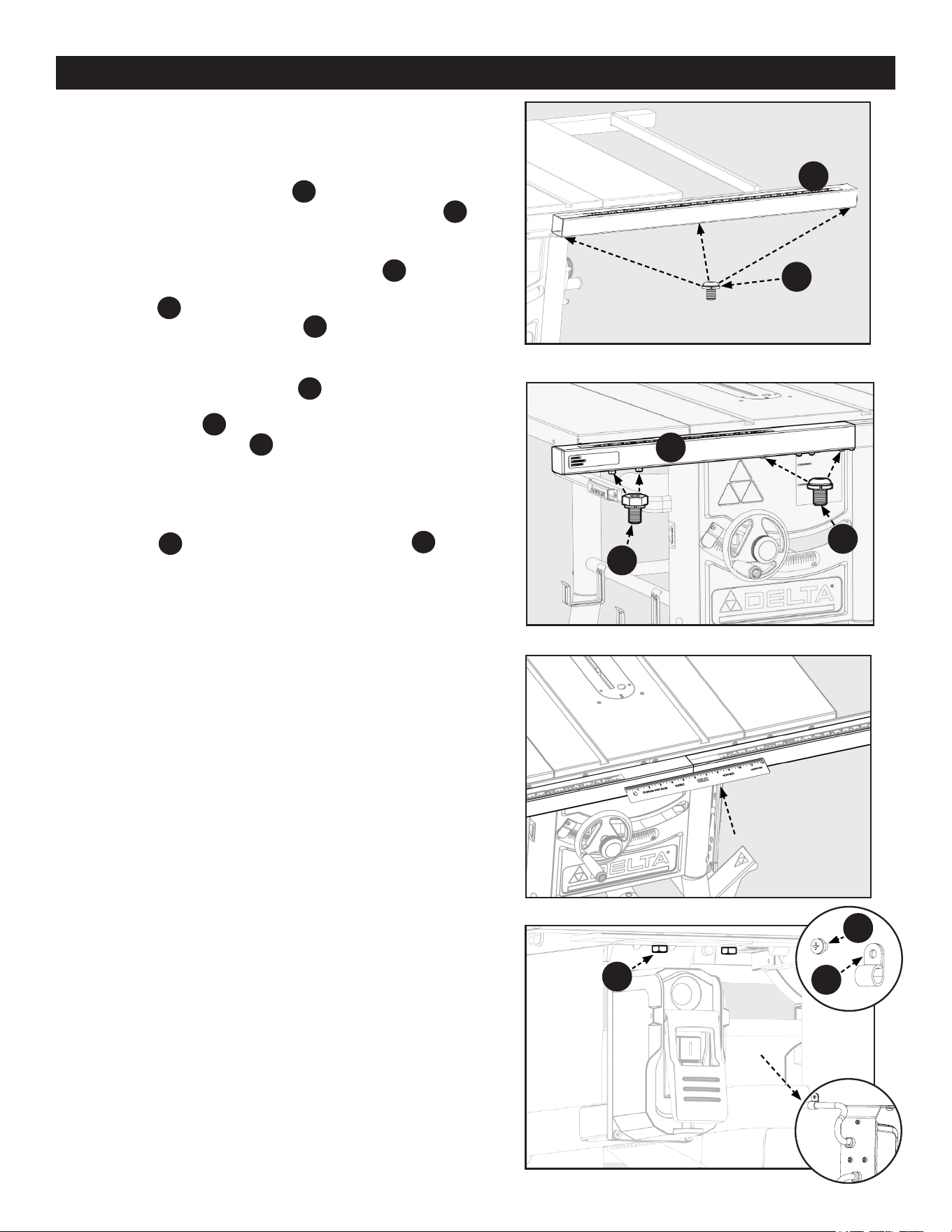
1. Attach the Right Fence Guide
PC20
using (3) 1/4-20 x 1/2
inch Button Head Hex Screw with Split Lock Washers
HP18
through the holes on the bottom side of the Front Rail. See
Figure 13.
2. Attach the Left Fence Guide to the Front Rail
PC20
using (2)
1/4-20 x 1/2 inch Button Head Hex Screw with Split Lock
Washers
HP18
through the right two holes on the bottom
side of the left half Front Rail
PC19
. NOTE: Leave these
screws loose until the control box screws are started.
3. Align the two holes in the Switch Box Bracket with the
holes underneath the Front Rail
PC19
, see Figure 14, located
on the left side of the saw. Secure the Power Control Box
to the Front Rail
PC19
using (2) 1/4-20 x 1/2 inch Hex Screw
with Split Lock Washers
HP19
. Use a ruler to check that both
Left and Right Fence Guides are parallel. See Figure 15.
NOTE: To tighten the bolts that fasten the switch, you may need
to use a 12mm open-ended wrench.
4. Fix the hanging Power Cord at rear side of Front Rail by
Wire Clip
HP17
and M5 x 6mm Phillips Head Screw
HP16
. See
Figure 16.
Figure 13
Figure 14
Figure 15
RIGHT FENCE
GUIDE (LONG)
Figure 16
PC20
HP16
HP17
HP19
18
Figure 17
Figure 18
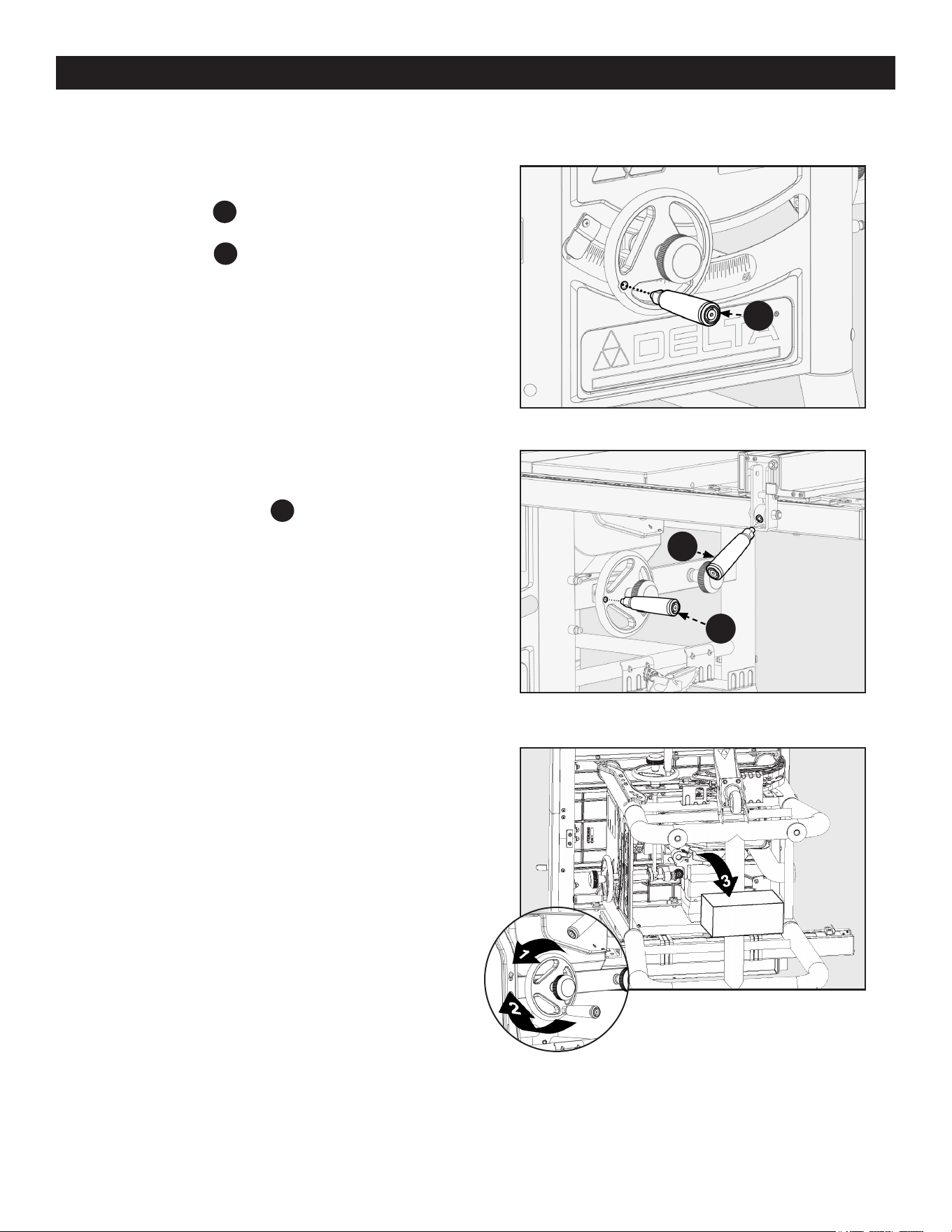
The elevation and Bevel Handles are packaged together in the box,
please install as follows:
1. Insert one Handle
PC14
to the Elevation Hand Wheel located
in the front of the Saw, as seen in Figure 17.
2. Insert one Handle
PC14
to the Bevel Hand Wheel located on
the right side of the Saw, as seen in Figure 18.
The Rip Fence Handle is packaged individually and labeled
accordingly, please install as follows:
1. Screw the Labeled Handle
PC15
to the Rip Fence with the
supplied Hex Wrench. See in Figure 18.
IMPORTANT: Before raising Blade you MUST release Bevel
Lock and tilt Blade 45° and remove styrofoam block under Motor
Housing. See Figure 19.
PC14
PC14
PC15
INSTALLING THE HANDLES
Elevation and Bevel Hand Wheels
INSTALLING THE RIP FENCE
HANDLE
ASSEMBLY
Figure 19
(REMOVE)(REMOVE)
19
To reduce the risk of serious personal
injury, the Riving Knife MUST be installed and properly
positioned for every possible through and non-through cut.
1. Your Saw is shipped with the Blade and Riving Knife
installed and properly aligned. The Riving Knife comes
installed in the low, non-through cutting position. Prior to
operating your Saw, check to make sure the alignment
of the Blade to the Miter Slot and the Riving Knife to the
Blade was not aected by shipping. To check alignment
of the Blade and Riving Knife, see page 23 in the
"ALIGNMENT" section of this manual.
2. The Riving Knife comes installed in the low, non-through
cutting position. To attach the Anti-Kickback Pawls and
Blade Guard Assemblies, the Riving Knife MUST be in the
raised position as shown in Figure 40. To raise and lower
the Riving Knife, see "RIVING KNIFE HEIGHT SETTINGS"
on page 28.
3. When installing Riving Knife, Anti-Kickback Pawls and Blade
Guard, Blade MUST be at 90° setting and raised to the
maximum height. See the "RAISING AND LOWERING THE
BLADE", page 26.
Figure 20
Figure 21
BLADE AND RIVING KNIFE
A
A
A
A
A
A
A
A
ASSEMBLY
PC8
PC8
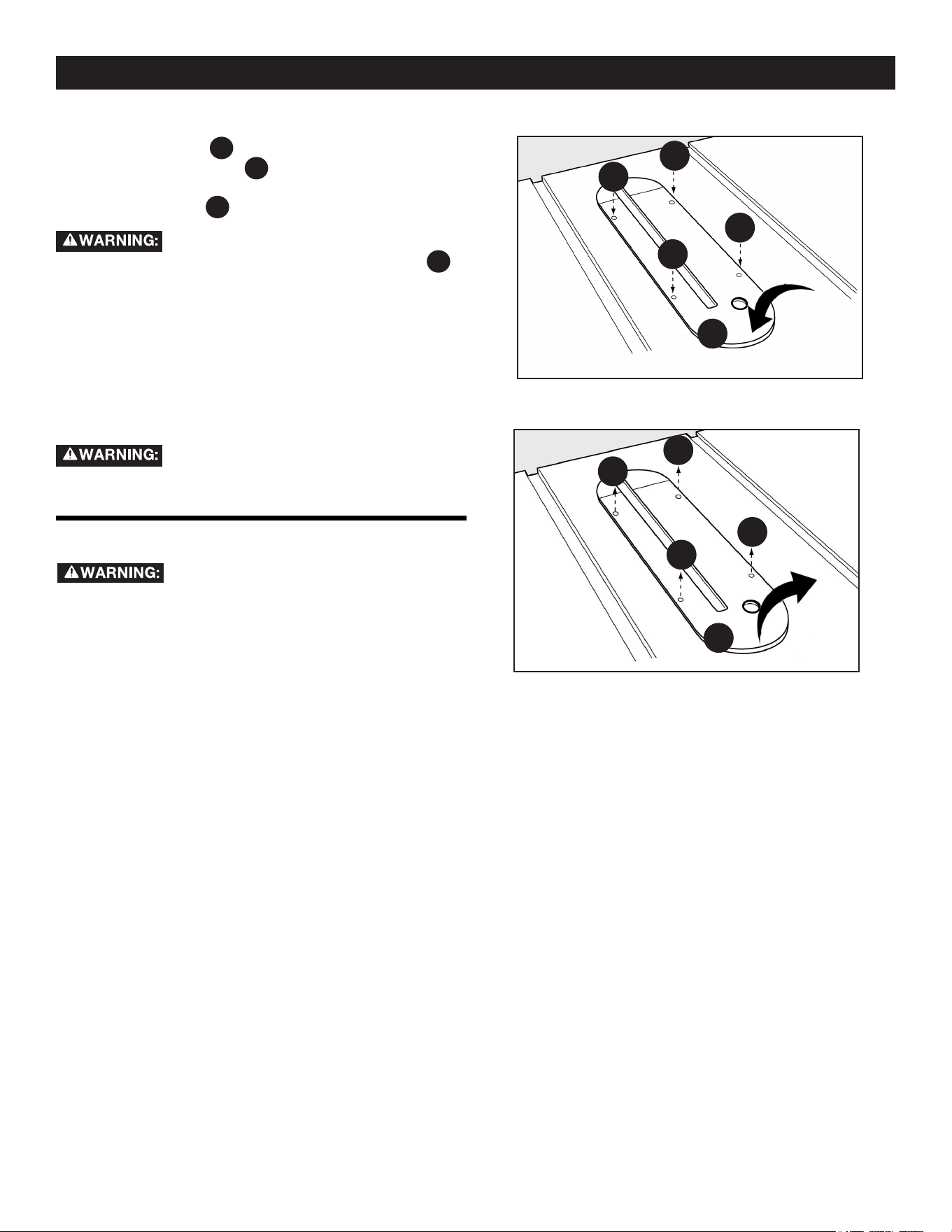
To install Throat Plate
PC8
, lower Blade below Tabletop, then
carefully feed the Throat Plate
PC8
, slotted end rst, starting at the
rear and moving to the front, keeping the Blade centered within the
slot on the Throat Plate
PC8
.
To avoid serious injury the height of the Throat
Plate MUST be properly adjusted. Use set screw openings
A
in
Throat Plate to make adjustments. To prevent your workpiece from
catching on the Tabletop, and to prevent Anti-Kickback Pawls from
catching on the Throat Plate, make sure that:
a. The front end of the Throat Plate is ush with the
Tabletop or up to 0.7mm (1/36 inch) below it, and
b. The back end of the Throat Plate is ush with the
Tabletop, or up to 0.7mm (1/36 inch) above it.
Set screws are provided to accurately adjust
Throat Plate height. DO NOT ATTEMPT TO SCREW THROAT
PLATE TO TABLE TOP.
THROAT PLATE
20
BLADE GUARD
To reduce the risk of serious personal
injury, the Blade Guard MUST be in place when making a
through cut.
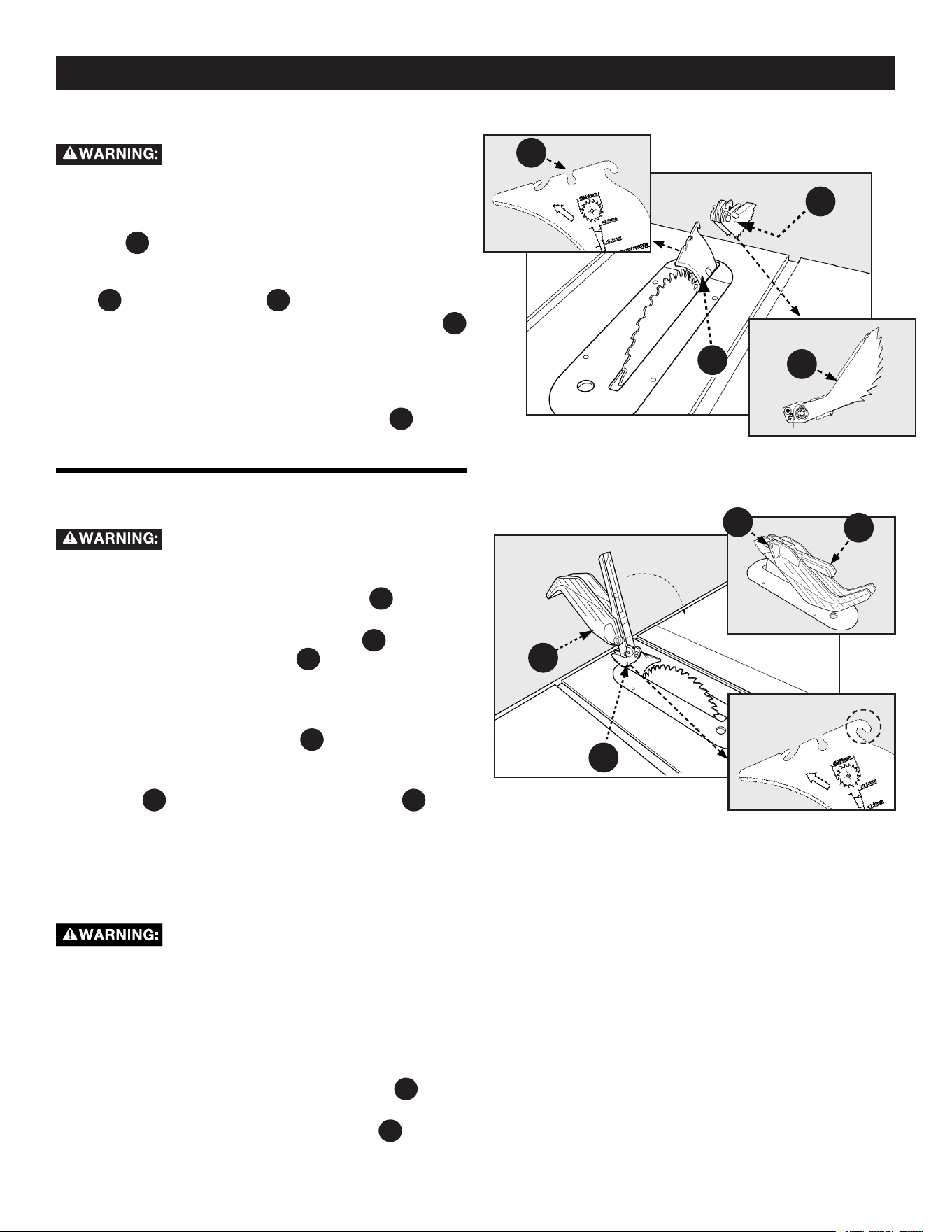
1. Before installing the Blade Guard Assembly
PC5
, make sure
the riving knife is raised to the through-cut position.
2. While holding the Blade Guard Assembly
PC5
in a vertical
position, hook the Locating Pin
B
at the back end of the
Blade Guard Assembly into the slot at the back edge of the
Riving Knife.
3. Rotate the Blade Guard Assembly toward the front of the
Saw until the metal portion
C
of the Blade Guard
Assembly is parallel to the Table as shown in Figure 23.
4. While holding down on the front of the metal portion of the
Guard
C
press the Blade Guard Lock Lever
D
down
until it snaps into the locked position. Check to make sure
the Guard is locked onto the Riving Knife by pulling on the
Guard. If the Guard is not locked, the Blade Guard Lock
Lever will ip up to the unlocked position.
If the metal portion of the Blade Guard
Assembly is not parallel to the table, the Riving Knife is not
in the raised position. Remove Blade Guard Assembly and
Anti-Kickback Pawls and raise Riving Knife, then reinstall
the Anti-Kickback Pawls and the Blade Guard Assembly.
NOTE: Also reference Figure 40, page 28.
To remove the blade guard assembly:
1. Lift the Blade Guard Assembly Lock Lever
D
to the
unlocked position.
2. Rotate the Guard back and slide the Pin
B
from the
Riving Knife Slot.
Figure 23
NOTE: Check the Blade Guard for clearances and free movement.
Figure 22
ANTI-KICKBACK PAWLS
To reduce the risk of serious personal
injury, Anti-Kickback Pawls MUST be in place when making
a through cut.
1. See Figure 22 and locate the Anti-Kickback Pawls Mounting
Slot
A
in the middle of the top edge of the Riving Knife.
2. Slide Slot in the middle of the Anti-Kickback Pawls
Assembly along the top of the Riving Knife until the stem
B
locates the center slot
A
on the Riving Knife.
3. Depress the stem on the Anti-Kickback Pawls Assembly
PC11
to allow the Assembly to drop into the slot. Push down on
the Anti-Kickback Pawls Assembly until it snaps into place
and locks. Release stem. NOTE: Pull up on the Anti-
Kickback Pawls to make sure it is locked in place.
To remove the Anti-Kickback Pawls, depress the stem
B
and pull
the Anti-Kickback Assembly o the Riving Knife.
PC5
A
PC11
A
B
B
ASSEMBLY
C
D
21
RIP FENCE
Before installing the Rip Fence, make sure you have attached the
Rip Fence Handle to the Fence Cam. The Rip Fence slides onto the
Rear Fence Rail so that the Hook is under the Rear Rail and rides
on the Front Guide Tube. The Fence locks in place by applying
pressure in a downward motion on the Rip Fence Handle. Rip Fence
alignment should be checked prior to using your saw. To check
alignment of the Rip Fence, see alignment instructions on page 25.
MITER GAUGE
Insert Miter Gauge into each Miter Slot to make sure it slides
freely. See "ADJUSTING THE MITER SCALE" section on page 24 for
adjustment of Miter Gauge Accuracy.
ON-BOARD STORAGE
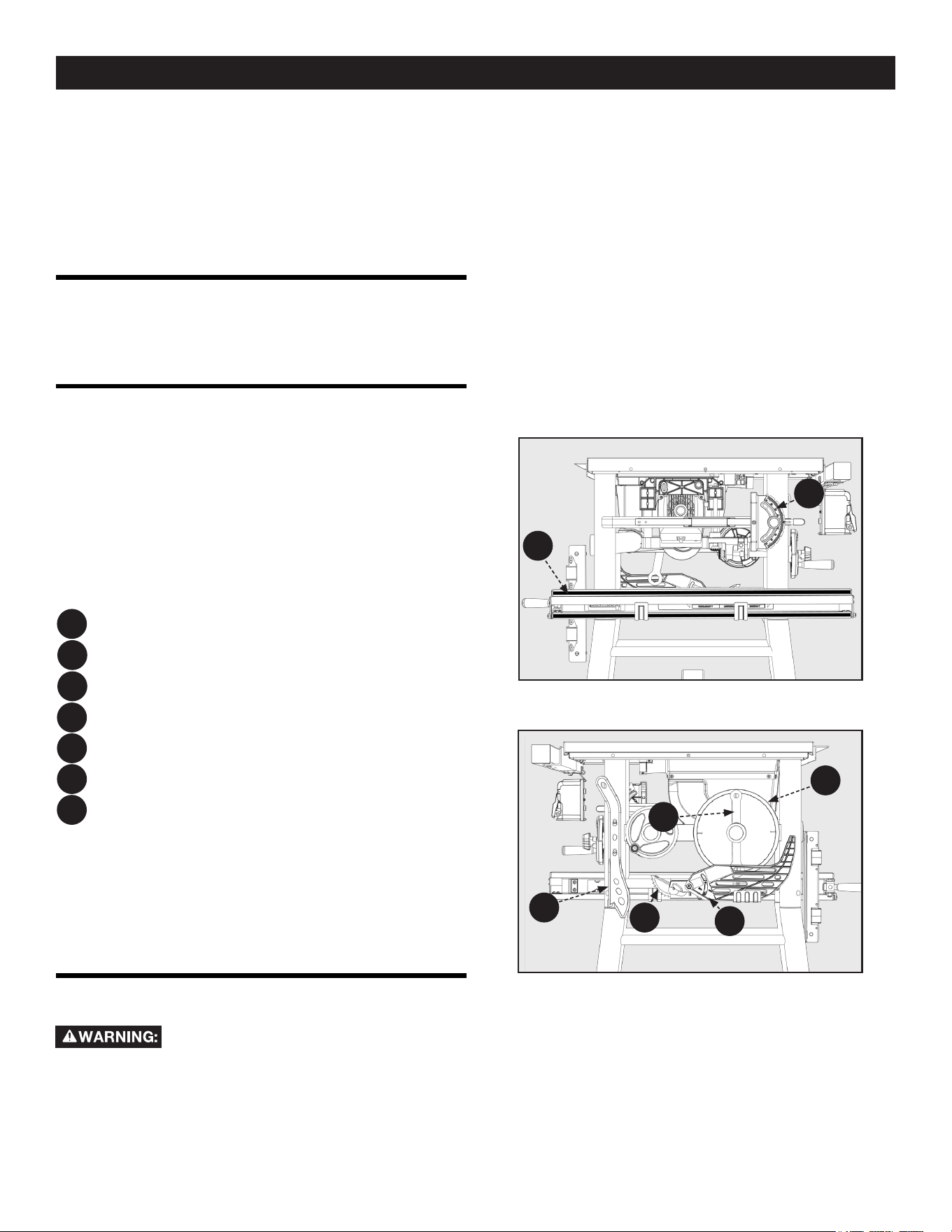
The DELTA
®
#36-725 T2 Contractor Table Saw comes with On-
Board Storage for the provided Miter Gauge, Blade Wrench, Push
Stick, Fence, Anti-Kickback Pawls and Blade Guard. There is also
On-Board Storage for spare Saw Blades (sold separately). The
Push Stick, Spare Blade (Blade should be stored protected to
avoid injury), Blade Wrench, Anti-Kickback Pawls and Blade Guard
Storage areas are located on the Right Side of the Machine, see
Figure 25. On-board storage for the Miter Gauge and Fence are
located on the left side of the machine as seen in Figure 24.
Figure 24
Figure 25
PC4
PC4
PC5
PC5
PC6
PC6
PC7
PC7
PC9
PC9
PC11
PC16
PC16
PC11
Rip Fence
Blade Guard
Miter Gauge
Push Stick
Blade Wrench
Anti-Kickback Pawls
10 inch Blade (Pre-Installed)
ASSEMBLY
SECURING SAW TO FLOOR
This Saw is designed for mobility. DO NOT
attempt to use the Saw to cut a large or cumbersome workpiece
without rst taking appropriate steps to protect against tipping the
Saw. Examples of appropriate steps include the use of Support
Tables and/or securing the Saw Legs to the oor by replacing the
Saw Feet with Connecting Bolts or by attaching the Legs to a Floor
Mounted Bracket with U-Bolts.
LEFT SIDELEFT SIDE
RIGHT SIDERIGHT SIDE
22
Figure 26
Figure 27
ADJUSTING 90° AND 45°
POSITIVE BEVEL STOPS
There are Positive Stops at each end of the Bevel Range. To ensure
accurate cuts, the Positive Stops MUST be positioned at exactly
90° and 45°. The Bevel Stops are properly adjusted as shipped.
However, for maximum accuracy, you should check the position of
the Stops upon assembly and from time to time to assure that the
settings remain satisfactory. To check the position of the Stops and
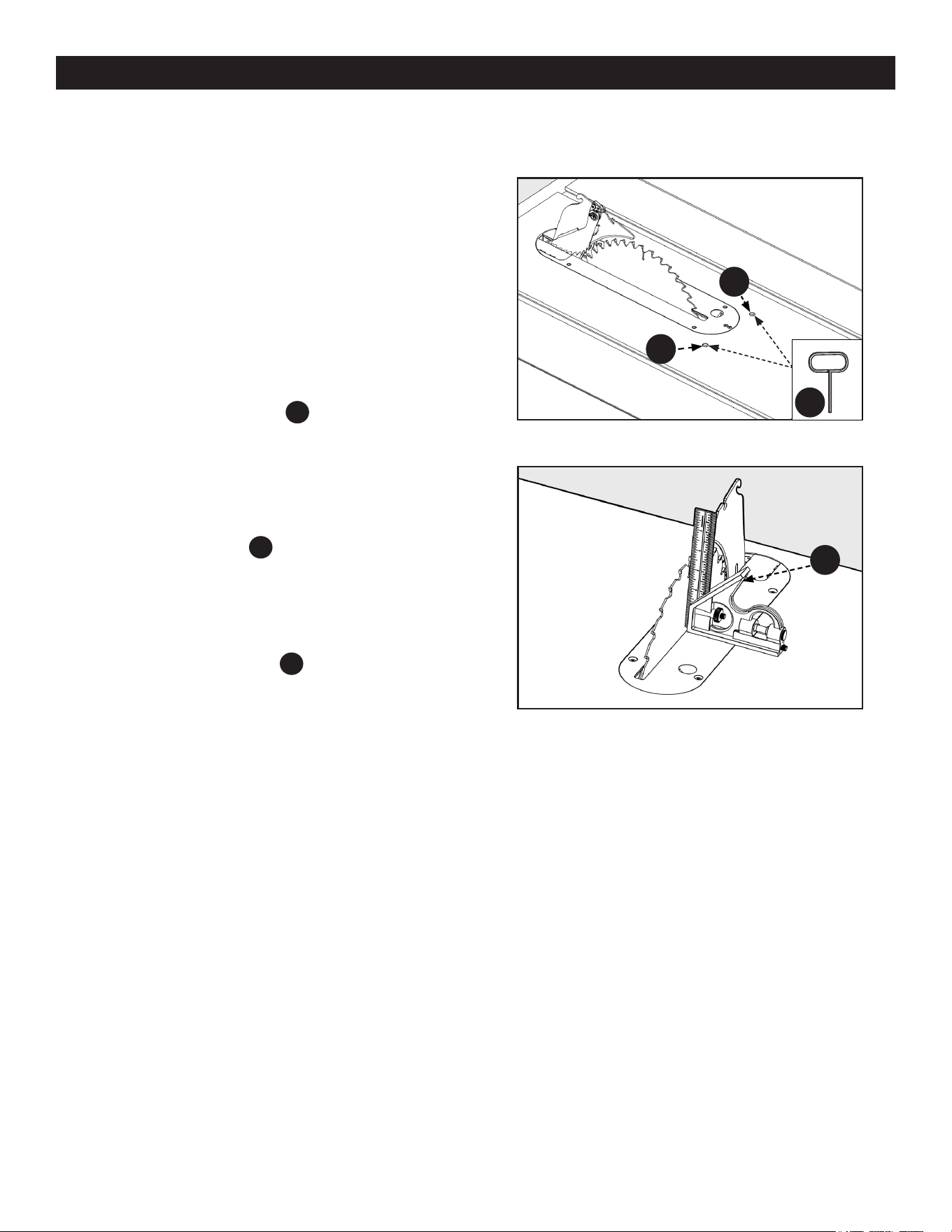
adjust if necessary, see Figure 26 and do the following:
1. Release the Center Knob on the Bevel Handwheel, located
on the right side of the Saw by rotating counter-clockwise.
2. Rotate the Bevel Handwheel counter clockwise and tilt the
Blade to the 0° position until the Stop is reached.
3. Using a Combination Square
C
, check the angle of the
Blade Face to the Table, as shown in Figure 27. Conrm the
blade is at 90° to the table.
4. If the Blade is not perpendicular to the Table, turn Hand
wheel to slightly tilt the Blade away from the Stop Position
then adjust the 90° Stop by adjusting the Set Screw
located in the Table Top immediately in front of the left
side of Throat Plate
A
. Re-check angle using the
Carpenter’s Square and continue to adjust until the Blade is
at 90° when returned to the Stop Position.
5. Rotate the Bevel Handwheel clockwise until it rests on the
45° Stop. Then repeat Steps 3 and 4, adjusting the 45°
Stop by adjusting the Set Screw located in front of the
right side of the Throat Plate
B
.
B
A
HP21
MAKING ADJUSTMENTS
C

23
MAKING ADJUSTMENTS
RIVING KNIFE ALIGNMENT
WITH THE BLADE
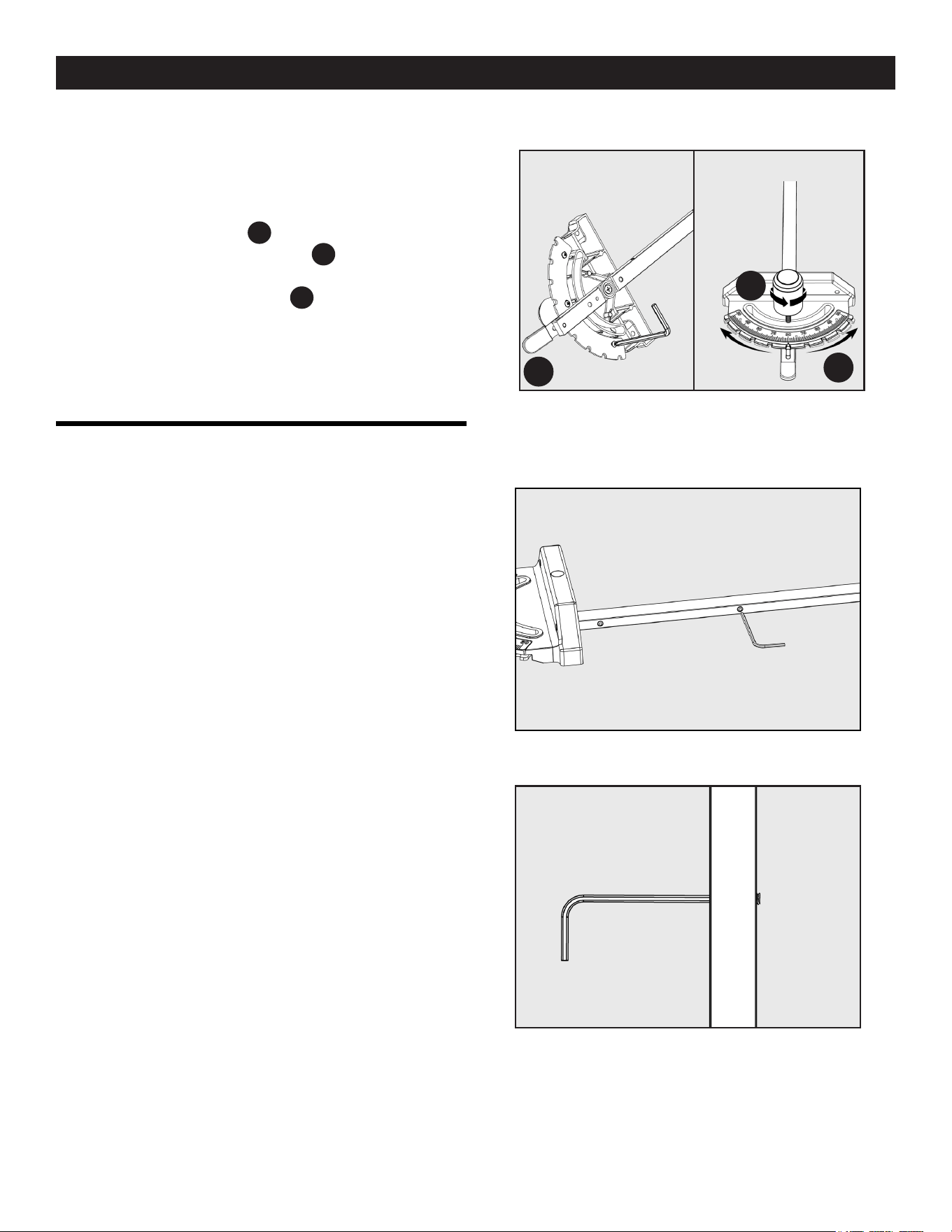
This procedure requires a the supplied 4mm T-handle Allen Wrench
HP21
and straight edge ruler. See Figure 30.
Completely disconnect saw from power source
before making any adjustments.
1. Carefully remove throat plate.
2. Loosen the two hex-head screws
A
shown in Figure 28.
3. Using a straight edge ruler, align riving knife with blade
body, see Figure 29.
4. Tighten the two hex-head screws
A
, see Figure 28.
5. To adjust parallel alignment use the two set screws
B
,
see Figure 28. Clockwise: adjust riving knife to the right.
Counter-clockwise: adjust riving knife to the left. If needed,
use the set screws to align the riving knife with blade face
and the square.
6. Fully tighten the two hex-head cap screws.
7. Replace throat plate, blade guard and anti-kickback
assemblies before use.
If any dragging or binding of the workpiece
is encountered as it reaches the riving knife, turn unit o
and disconnect machine from power source and readjust
the riving knife/blade alignment or replace the blade.
NEVER attempt to back partially-cut workpiece out of
blade while blade is moving.
Figure 28
Figure 29 Figure 30
A B
HP21
NOTE: Scan QR code or visit us at https://youtu.be/FDQxRbmFxPs
to see Riving Knife Alignment with the Blade video instructions.
24
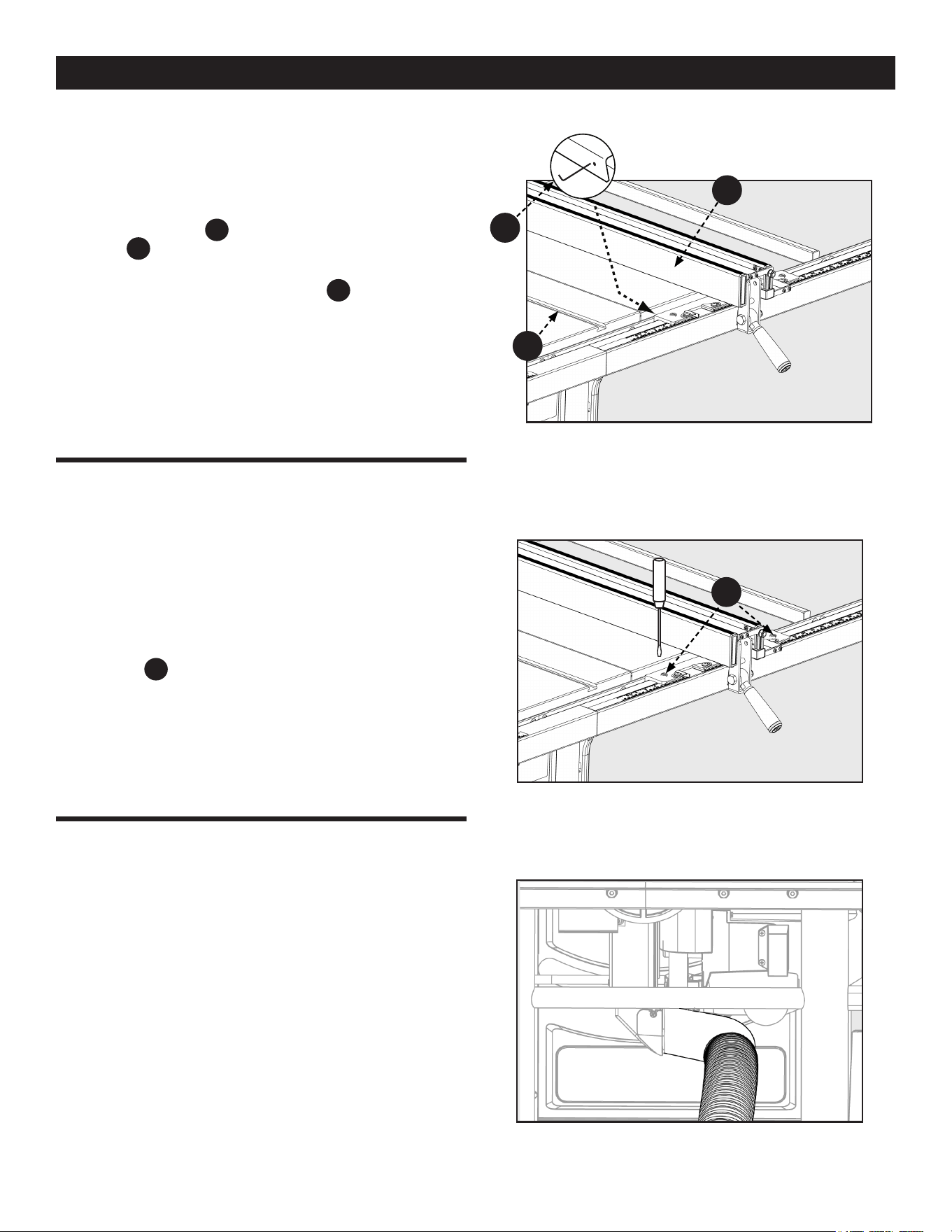
Figure 31
Figure 32
Figure 33
A
B
C
ADJUSTING THE MITER GAUGE
FITMENT
To adjust the tment between the miter gauge bar and the miter
slot:
1. Use a 3/32 inch Allen wrench on any of the three set
screws located on the side of the bar. See Figure 32 and
33.
2. To remove any side-to-side movement between the miter
gauge bar and miter gauge table slot adjust the three small
set screws found along the length of the miter gauge bar.
NOTE: The set screws should extend just beyond the side of the
bar.
ADJUSTING THE MITER GAUGE
SCALE
1. Use the supplied 3/16 inch two-way Allen wrench to loosen
the three Phillip screws located in the back of the miter
gauge, see in Figure 31
A
.
2. Loosen the knob, see in Figure 31
B
.
3. Adjust the detent plate so that the indicator measures the
correct angle, see in Figure 31
C
.
4. Once lined up, re-tighten the knob, and Phillip screws back
in place.
NOTE: Use a combination square to check bar to head angle. If
miter gauge bar is not square to miter gauge head, then adjustment
is necessary.
MAKING ADJUSTMENTS
25
ALIGNING FENCE PARALLEL TO
MITER SLOT
ALIGNING FENCE
PERPENDICULAR TO THE TABLE
DUST COLLECTION
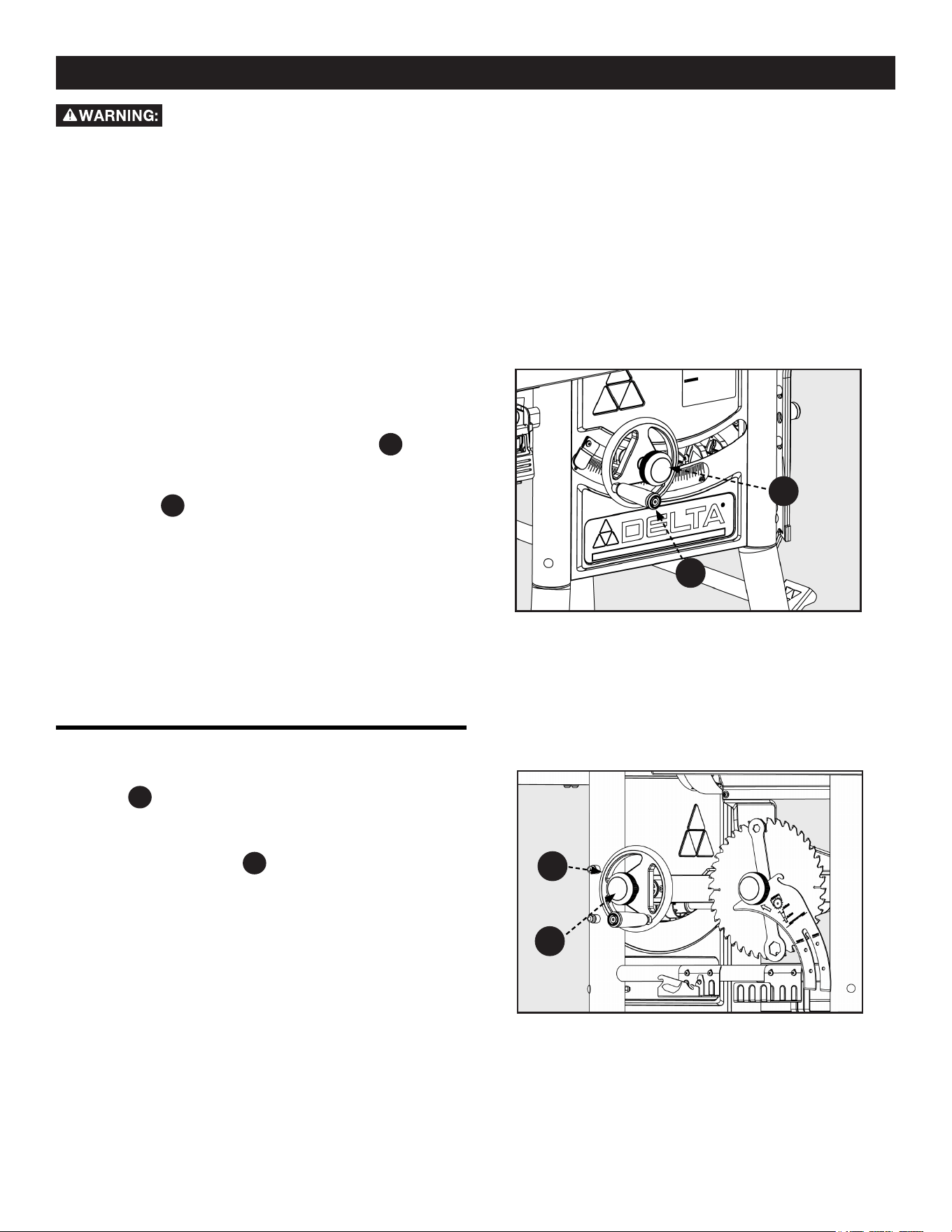
1. Move fence adjacent to right miter gauge slot and secure
to the guide tube by lowering the fence clamping lever.
2. If the fence face
A
, Figure 34, is not parallel to the miter
slot
B
, raise the clamping lever and lift the fence and
place it on the saw table.
3. Adjust one or both of the set screws
C
1/4 turn or less.
4. Replace fence on guide tube and verify the fence is parallel
to the miter slot. If fence is closer to parallel, turn the set
screw in the same direction but a little less. If the fence is
further out of parallel, turn the set screw in the opposite
direction.
1. Move fence over the cast iron table and secure to the guide
tube by lowering the fence clamping lever.
2. Use a square to check that the fence face is perpendicular
to the table.
3. If the fence face is not perpendicular to the table, release
the clamping lever and slightly adjust one of the slotted set
screws
A
, Figure 35, until the fence face is perpendicular
to the table.
4. Secure the fence to the guide tube to insure the fence
remains perpendicular. If not, repeat steps 1 through 3.
1. Connect a 2 1/2 inch shop vacuum or dust collection hose
to dust port on back of saw for best dust collection. See
Figure 36.
Figure 34
Figure 35
Figure 36
A
A
B
C
MAKING ADJUSTMENTS
26
RAISING AND LOWERING THE
BLADE
For most applications, it is recommended that you raise the blade
1/8 inch (3.2mm) to 1/4 inch (6.4mm) above the top surface of the
workpiece.
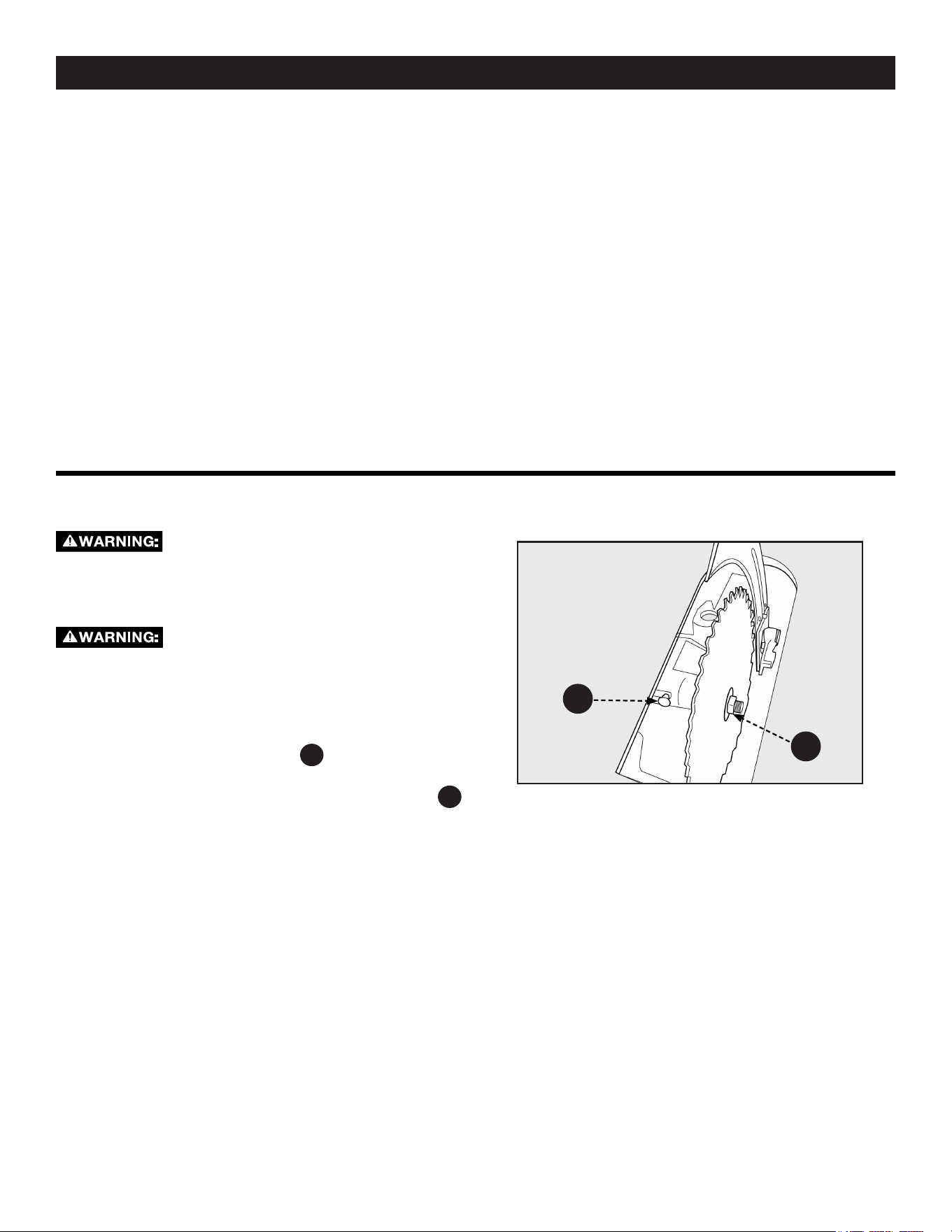
Raise or lower the blade with the hand wheel
A
located
on the front of the saw. See Figure 37.
1. Before raising or lowering the blade, be sure to loosen the
lock knob
B
by turning it counterclockwise.
2. To raise the saw blade, turn the hand wheel clockwise.
To lower the saw blade, turn the hand wheel counter-
clockwise.
3. Tighten lock knob to KEEP blade at the desired height.
ONLY a small amount of force is required to lock the blade
raising mechanism securely. Any added force merely puts
unnecessary strain on the locking device.
4. When done operating the saw, and when performing
maintenance, adjustments or repairs, lower blade below
surface of table (If applicable).
TILTING THE BLADE
The blade can be tilted up to 45° to the left using the Bevel
Handwheel
A
located on the right side of the saw. See Figure 38.
The angle of tilt is measured by the bevel gauge on the front of the
saw. To tilt the saw blade:
1. Loosen the lock knob
B
counterclockwise and turn the
hand wheel clockwise. A pointer on the front of the saw
indicates the angle of tilt in 1/2 degree increments.
2. To lock the saw blade at your desired angle, tighten the
lock knob by rotating it clockwise. ONLY a small amount
of force is required to lock the blade raising mechanism
securely. Any added force merely puts unnecessary strain
on the locking device.
Figure 37
Figure 38
PREPARING TO CUT
Failure to comply with the following warnings may result in serious personal injury.
• ALWAYS make sure your workpiece is not in contact with
the blade before operating the switch to start the saw. Blade
contact could result in kickback or thrown workpiece.
• To reduce the risk of accidental starting, ALWAYS make
sure the switch is in the o position before plugging saw into
power source.
• DO NOT use blades rated less than the speed of this tool.
Failure to heed this warning could result in serious personal
injury.
• Turn unit off and disconnect it from power source before
installing and removing accessories, before adjusting and
when making repairs. An accidental start-up can cause injury.
• Prior to operating the saw, make sure you are familiar with
its features and controls, and have made all necessary
adjustments as described below.
A
B
A
B
27
PREPARING TO CUT
CHANGING THE SAW BLADE
Use ONLY 10 inch (254mm) diameter blades
with 5/8 inch (16mm) arbor holes, rated at 3,600 rpm or higher,
0.102 inch (2.6mm) minimum kerf width and 0.073 inch (1.8mm)
maximum body thickness. Use ONLY a saw blade diameter in
accordance with the markings on the saw.
To reduce the risk of injury, turn unit o and
disconnect it from power source before installing and removing
blades and accessories, before adjusting and when making repairs.
An accidental start-up can cause injury.
1. Remove the throat plate and raise the saw blade to its
maximum height.
2. Push and hold arbor lock button
A
, see Figure 39.
3. Use supplied blade wrench to remove the blade by turning
counter-clockwise and retaining nut and flange
B
.
Remove old blade.
4. Place the new blade on the arbor with the teeth pointing
down as the blade rotates toward the front of the saw.
5. Replace and tighten the blade retaining nut and ange.
6. Replace throat plate.
Figure 39
SELECTING AND STORING SAW
BLADES
Riving knives MUST be matched to saw blade dimensions in order
to function eectively.
The saw blade furnished with your new saw is a 10 inch (254mm)
combination blade, used for cross cutting (across the grain) and
ripping (with the grain) through the workpiece. The arbor hole of
the blade is 5/8 inch (16mm) diameter. This blade will produce a
good quality cut for most applications.
There are many types of blades available to do specic and special
jobs such as cross cut ONLY, rip ONLY, dado cuts, thin plywood,
paneling, etc.
Use ONLY saw blades designed for maximum safe operating
speeds of 3,600 RPM or greater. ONLY use 10 inch blades designed
for wood cutting.
Saw blades should ALWAYS be kept sharp. It is recommended
that you locate a reputable sharpening service to sharpen your
blades when needed.
NEVER stack blades on top of one another to store. Place material
such as cardboard between them to KEEP the blades from coming
in contact with one another, or place them in storage drawer.
Abrasive wheels or blades (including diamond) should not be used
on this saw.
This tool can ONLY be used with woodworking saw blades.
A
B
28
RIVING KNIFE POSITION
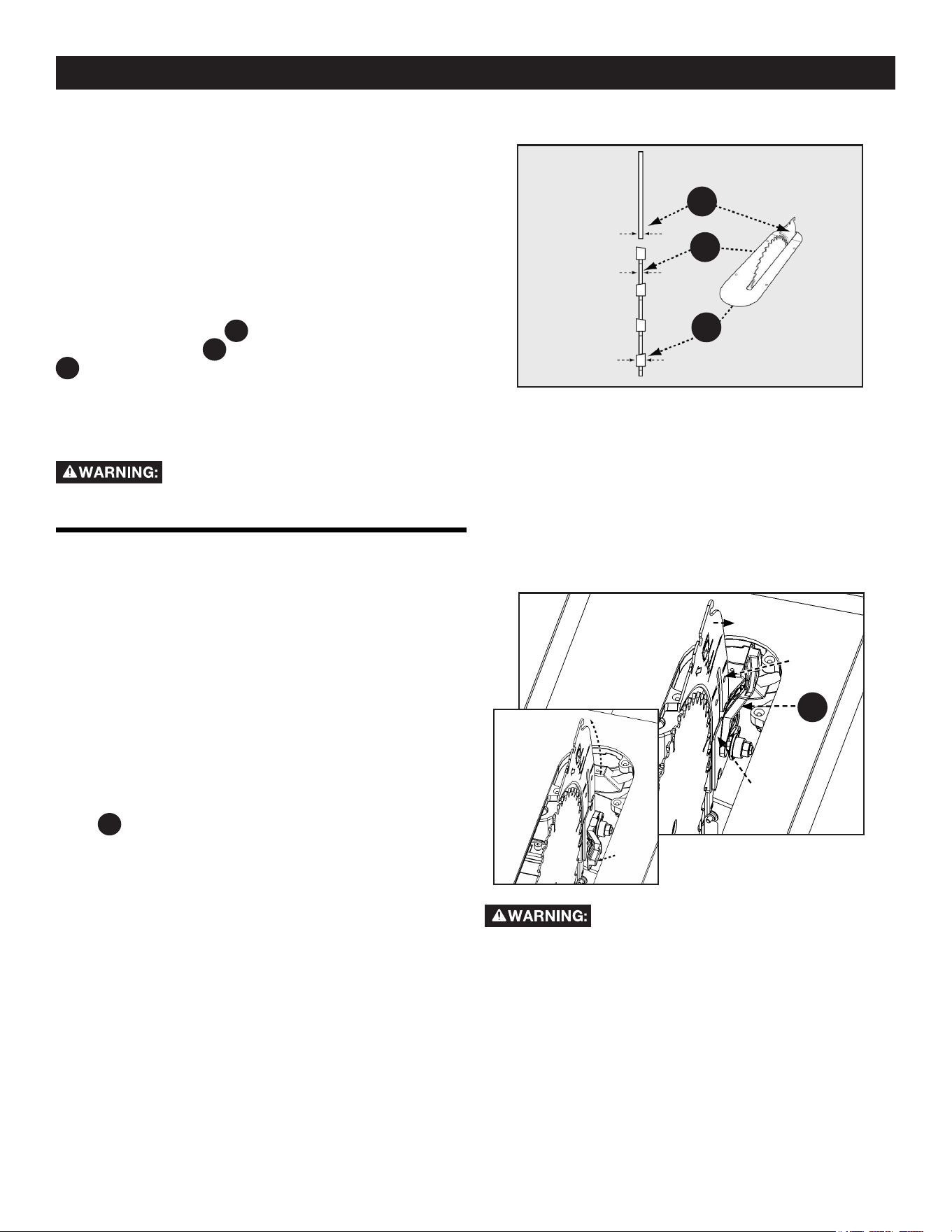
NOTE: Safety devices, blade guard assembly and anti-kickback
assembly have been removed in Figure 40 in order to show the
location of specic features. When operating the saw, these safety
devices should be in place and working properly.
The riving knife is a at plate that ts into the cut made by the
saw blade and eectively ghts kickback by lessening the tension
of the blade to bind in the cut. It MUST be installed and properly
positioned for every through cut and for every non-through cut
unless the riving knife would interfere with the workpiece.
The riving knife thickness
A
MUST be greater than the blade
body or plate thickness
B
and less than the kerf or cutting width
C
as shown in Figure 40. The riving knife provided with this saw
is 2.2mm thick and may be used ONLY with a 10 inch (254mm)
blade with 0.102 inch (2.6mm) minimum kerf width and 0.073 inch
(1.8mm) maximum body thickness. DO NOT attempt to use this
riving knife with blades that are not within these dimensions.
Figure 40
RIVING KNIFE HEIGHT SETTINGS
The height of the riving knife should be adjusted based on the
type of cut being made. For all through cuts (when the wood is
completely severed), it should be in the raised position, with anti-
kickback pawls and guard installed. For non-through cuts (when
the blade does not penetrate the top of the workpiece), the riving
knife should be in the lowered position and anti-kickback pawls and
guard removed.
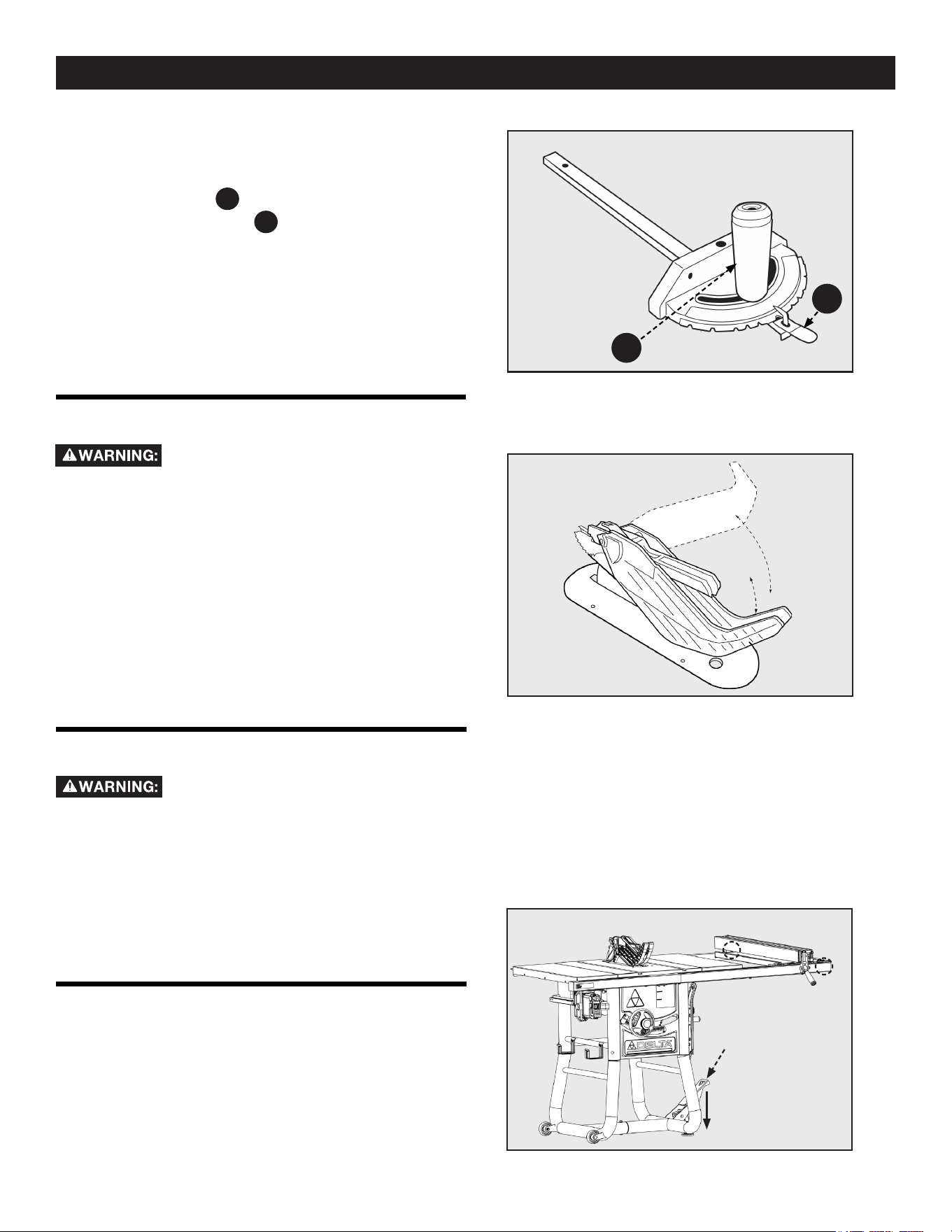
TO RAISE OR LOWER THE RIVING KNIFE:
1. Remove the throat plate and raise blade to the full height
above the table.
2. Locate the locking lever near the base of the riving knife
A
.
3. Rotate the lever by turning clockwise to unlock and release
the riving knife from its locked position.
4. Using your hand positioned near the top of the knife, lean
the knife outward away from the two locking pins beside
it's middle slot. This now frees the knife to slide into the
upward/ through cut position.
5. Lift the knife upward along the sliding slot until you feel the
new locking pins position.
6. Release the knife and it should snap into its new position;
wiggle if necessary.
7. Return the locking lever to the locked position. If you have
done this properly the riving knife will be aligned with the
blade. If it is not retrace your steps until it does.
NOTE: When adjusting the riving knife up or down, be sure to pull
in a radial motion, as shown.
DO NOT operate saw unless riving knife is
securely clamped in the raised position for through cutting or the
lowered position for non-through cutting.
NEVER use a blade that does not match
the dimensions indicated for use with your riving knife.
Figure 41
Lower
Position
Detents
Upper Position Upper Position
Detents on Pins Detents on Pins
Pull Away
to Release
Riving Knife
Locked
Adjust
A
A
C
B
PREPARING TO CUT

29
TO CHECK ALIGNMENT:
1. Horizontal Alignment: Lay a straight edge on the table
against blade face
A
and make sure it extends out along
the riving knife
B
, see Figure 42. The riving knife should
just touch the straight edge. Be sure the straight edge
goes between the teeth and rests on the blade face and
the riving knife for proper alignment.
2. Vertical Alignment: Place a combination square on the
table and against the blade face and make sure it extends
up along the riving knife
B
see Figure 43. The riving
knife and blade should touch the carpenter’s square with
no gaps. Be sure the straight edge goes between the teeth
and rests on the blade face and the riving knife for proper
alignment.
NOTE: If the riving knife and blade are out of horizontal or vertical
alignment, refer to riving knife alignment instructions on page 23
of this manual.
Figure 42
CHECKING RIVING KNIFE
ALIGNMENT
Before connecting the table saw to the
power source and operating the saw, ALWAYS inspect
the blade guard assembly and riving knife for proper
alignment and clearance with saw blade. Check the riving
knife alignment after each blade change.
Figure 43
A
B
PREPARING TO CUT
Figure 44
Figure 45
CHECKING BLADE PARALLELISM
TO MITER GAUGE GROOVE (HEEL)
See Figures 44 & 45.
• Blade
A
MUST be parallel to miter gauge groove so that
wood does not bind, resulting in kickback.
Failure to do so could result in serious personal
injury.
• To reduce risk of injury from kickback, align miter gauge
groove to blade
A
following any blade adjustments.
DO NOT loosen any screws for this adjustment until alignment has
been checked with a square to be sure adjustments are necessary.
Once screws are loosened, items MUST be reset.
NOTE: Unplug saw. Remove blade guard and anti-kickback pawls.
Raise the blade
A
by turning height adjusting wheel.
1. Mark beside one of blade teeth at front of blade
A
(Figure 44-1). Place the combination square against the
marked tooth at the front of the blade
A
with the head
of the square against the miter gauge groove as shown.
2. Turn blade
A
so that marked tooth is at back. Move
combination square to the rear and again measure the
distance (2). If the distances are the same, blade
A
is
parallel.
1
1
2
2
A
A
The 36-725 T2 Table Saw blade alignment has been set at factory to
ensure full accuracy when assembled. If you have already checked
the blade parallelism and your blade is not parallel to the miter slot,
please contact DELTA
®
Customer Support at 1-800-223-7278.
ADJUSTING BLADE PARALLELISM
TO MITER GAUGE GROOVE (HEEL)
B
30
USING BLADE GUARD ASSEMBLY
The anti-kickback pawls and blade guard
MUST be used for all through-cuts. KEEP both guard shields
down and arms, hands and ngers away from the blade,
blade guard and anti-kickback pawls when power is on to
prevent serious injury. See assembly instructions on page
20 for proper installation and removal of anti-kickback
pawls and blade guard.
If there is a need to briey raise the blade guard (for example, to
make a measurement) the guard can be parked in a raised position.
1. Refer to Figure 47 and, lifting the guard from the front,
raise the guard shield until it snaps into a locked position
above the table. One or both guard shields can be raised.
2. When done making the measurement, return guard to
operating position.
Figure 47
Figure 48
Pivot Pedal
CHECKING FENCE ALIGNMENT
TRANSPORTING THE SAW
DO NOT attempt to use a rip fence that is
not properly aligned.
Every time you use the rip fence, check its alignment to make sure
the fence is parallel to the miter slot. To check the alignment of
your rip fence, place the fence adjacent to miter slot and lock the
fence in place. If the fence is not aligned to the miter slot from the
front to the back, see instructions for aligning rip fence on page
25 of this manual. If you are not able to successfully align the rip
fence, replace the rip fence or call DELTA
®
Customer Service at
1-800-223-7278.
NOTE: Make sure the saw is OFF and the blade lowered below the
tabletop before attempting to move the saw.
To move saw step down on pivot pedal, place hands on each fence
rail, and move saw to desired location. Lift the pivot pedal up after
the saw is moved to desired location. See Figure 48.
PREPARING TO CUT
USING THE MITER GAUGE
The miter gauge is equipped with adjustable index stops at 90°,
75°, 60°, 45° and 30°. To set the miter for an angled cut, see
Figure 46 and:
1. Loosen the handle
A
.
2. Depress the thumb lever
B
.
3. Move the body of the miter gauge to the desired angle
maximum 30° on either side.
4. Release the thumb lever and re-tighten the handle.
The Miter Gauge is equipped with two washers both in the front
and end of the bar, which directly ts into any of the T-slots in the
work table. This allows for the miter gauge to stay in place and
level with the saw's table.
Figure 46
A
B
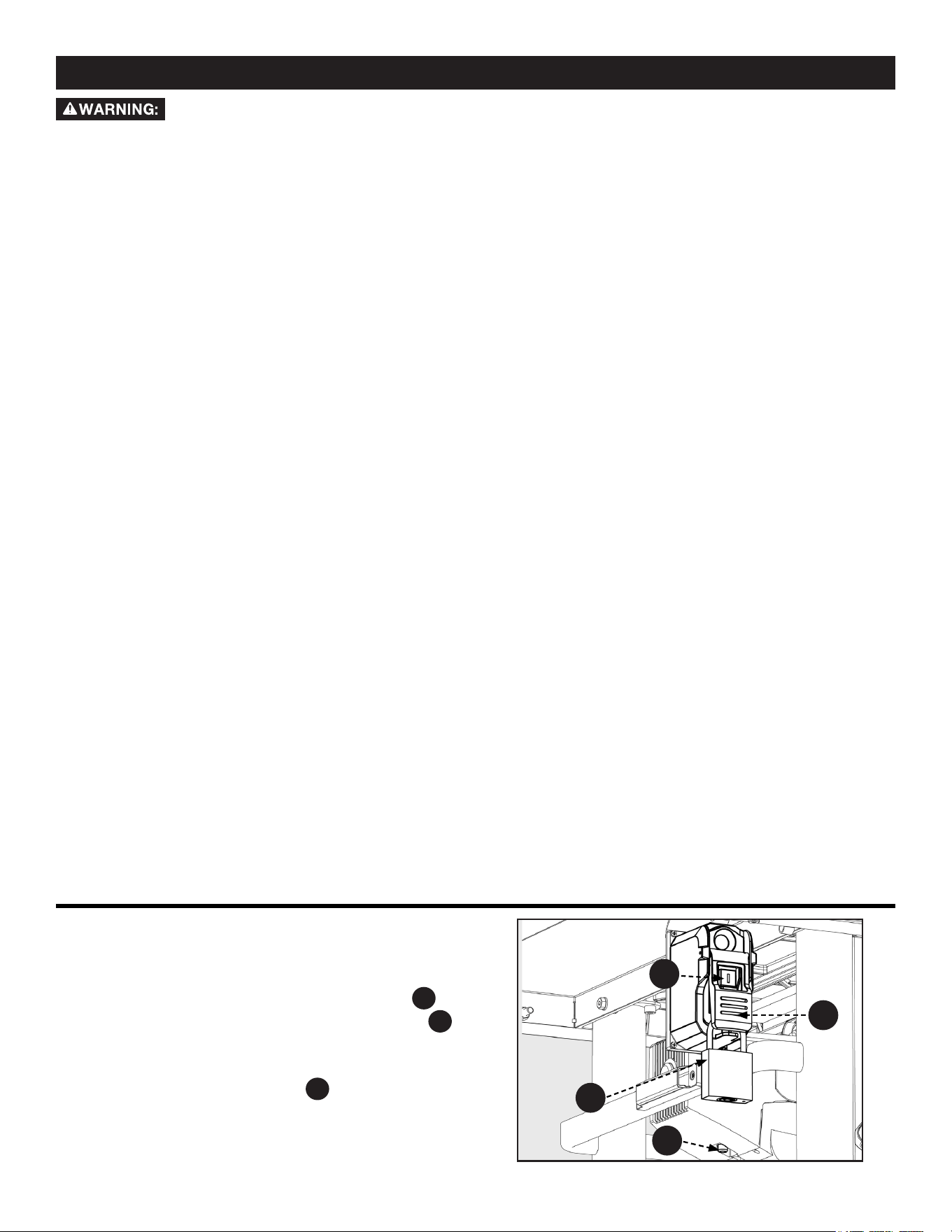
31
OPERATION
STARTING AND STOPPING THE SAW
The POWER switch in Figure 49, is located underneath the front
left extension wing.
1. To turn the saw “ON”, push the green “On” button
C
.
2. To turn the saw “OFF”, push the red paddle switch in
A
.
When not in use, the saw should be turned o and the power
switch locked out to prevent unauthorized use. To lock out power
switch, use a standard long shackle lock
D
, with a shackle that is
at least 2 3/4 inches (70mm) long and with shackle posts no larger
than 9/32 inch (7mm) diameter.
Figure 49
Failure to comply with the following warnings may result in serious personal injury.
READ ENTIRE MANUAL. In addition to reading these operating instructions, it is important to read and understand the entire manual
before operating this saw. Follow all applicable instructions regarding assembly, preparation, and adjustment prior to making any cuts
and comply with all safety rules and warnings in this section and elsewhere throughout this manual.
1. Each time you use the saw, run through the following checklist:
• Are the power source and power connections adequate for the saw?
• Are the saw and work area free of clutter and by-standers?
• Is the blade tight and properly aligned?
• Does the riving knife thickness match the blade?
• Are the blade and riving knife properly aligned?
• Is the operator qualied to make the cut and familiar with all of the relevant safety rules, warnings and instructions included
in this manual?
• Is the operator and everyone in proximity to the saw wearing appropriate eye, hearing and respiratory equipment?
• Are the bevel angle and height adjustment knobs locked in the proper position?
• Is the blade set at the proper height?
• If ripping, is the rip fence parallel to the blade and securely locked in position?
• If crosscutting, is the miter gauge knob tight?
• If making through cuts with a standard blade, are the blade guard riving knife and anti-kickback pawls properly attached and
properly functioning with both guards contacting the table surface?
• Is there proper clearance and support for the workpiece as it leaves the blade?
• Are any cutting aids needed? If so, are they in place, or within reach for proper use?
2. The use of attachments and accessories not recommended by DELTA
®
may result in injury.
3. Replace or sharpen the anti-kickback ngers when the points become dull.
4. Make sure saw is stable and cutting can be accomplished without tipping the saw. DO NOT attempt to cut large workpieces
without securing saw to a stable surface.
5. NEVER use the fence and miter gauge together without using a cuto block as described elsewhere in this manual.
6. The proper throat plate MUST be in place at all times.
7. If your saw makes an unfamiliar noise or if it vibrates excessively, cease operating immediately until the source has been located
and the problem corrected.
8. NEVER perform freehand cutting, plunge cutting, re-sawing or cove cutting.
AVOID KICKBACK
A kickback can occur when the workpiece pinches the blade, or binds between the saw blade and the rip fence or other fixed object.
This can cause the workpiece to rise from the table and/or be thrown back toward the operator. See instructions for reducing the risk of
kickback on page 8 of this manual.
IF KICKBACK OCCURS, turn the saw “OFF” and verify proper alignment of the blade, riving knife and miter gauge or rip fence. Also
the proper functioning of the riving knife, anti-kickback assembly and blade guard assembly before resuming work.
A
C
D
B
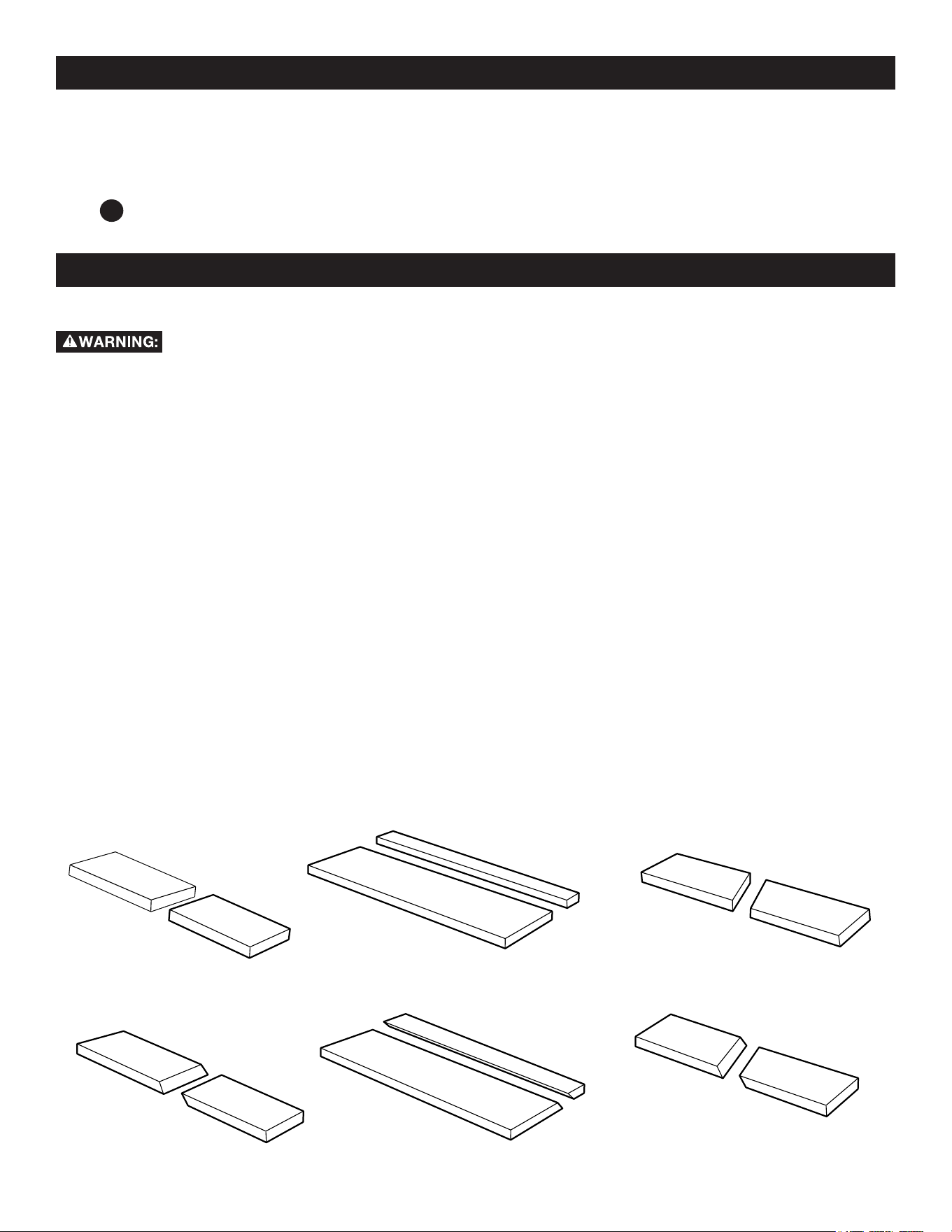
32
OVERLOAD PROTECTION
Your saw is supplied with overload protection. If the motor shuts
o or fails to start due to overloading (cutting stock too fast, using
a dull blade, using the saw beyond its capacity, etc.) or low voltage,
let the motor cool three to ve minutes. Then depress the red reset
button
B
, on the motor under the saw, see Figure 49, and restart
the saw.
NOTICE: If the motor continually shuts o due to
overloading, contact a qualied electrician.
MAKING CUTS
Failure to comply with the following the warnings
may result in serious personal injury.
• NEVER touch the free end of the workpiece (the cut-o side
beyond the front edge of the blade) or a free piece that is cut
o, while the power is on and/or the saw blade is rotating.
Blade contact or binding may occur, resulting in a thrown
workpiece
• When sawing a long workpiece or a panel, use a work
support, such as a sawhorse, rollers or out-feed table at the
same height as the table surface of the saw.
• NEVER try to pull the workpiece back with the blade turning.
If you need to pull the workpiece back or lift it o the table,
turn the switch o, allow the blade to stop, raise the anti-
kickback pawls on each side of the riving knife if necessary,
and slide the workpiece out.
• ALWAYS make sure the blade guard and anti-kickback pawls
are in place and working properly.
• DO NOT use blades rated less than the speed of this tool.
• To avoid kickback, make sure one side of the workpiece is
securely against the rip fence during any rip cut, and hold the
workpiece rmly against the miter gauge during any miter cut.
• DO NOT attempt compound miter cuts, with blade beveled
and miter fence angled, until you are thoroughly familiar with
the basic cuts and understand how to avoid kickback.
• Avoid bevel rip cuts with majority of material on left side of
blade.
• NEVER stand in front of the workpiece.
• ALWAYS stand on the same side of the blade as the fence
during a rip cut and the miter gauge during a cross cut.
Cross Cut Mitered Crosscut Rip Cut
Beveled Cross Cut Beveled Rip Cut Compound Miter Cut
• Before connecting the table saw to the power source or
operating the saw, ALWAYS inspect the blade guard
assembly and riving knife for proper alignment and clearance
with saw blade. Check alignment after each change of
beveling angle.
• A rip fence should ALWAYS be used for ripping operations
to prevent loss of control and personal injury. ALWAYS lock
the fence to the rail. NEVER perform a ripping operation
freehand.
OPERATION
MAKING CUTS
• When making bevel cuts, place the fence on the right side of
the blade so that the blade is tilted away from the fence and
hands. KEEP hands clear of the blade and use a push stick
to feed the workpiece unless the workpiece is large enough
to allow you to hold it more than 6 inches (152mm) from the
blade.
• Before leaving the saw unattended, lock out power switch, or
take other appropriate measures to prevent unauthorized use
of the saw.
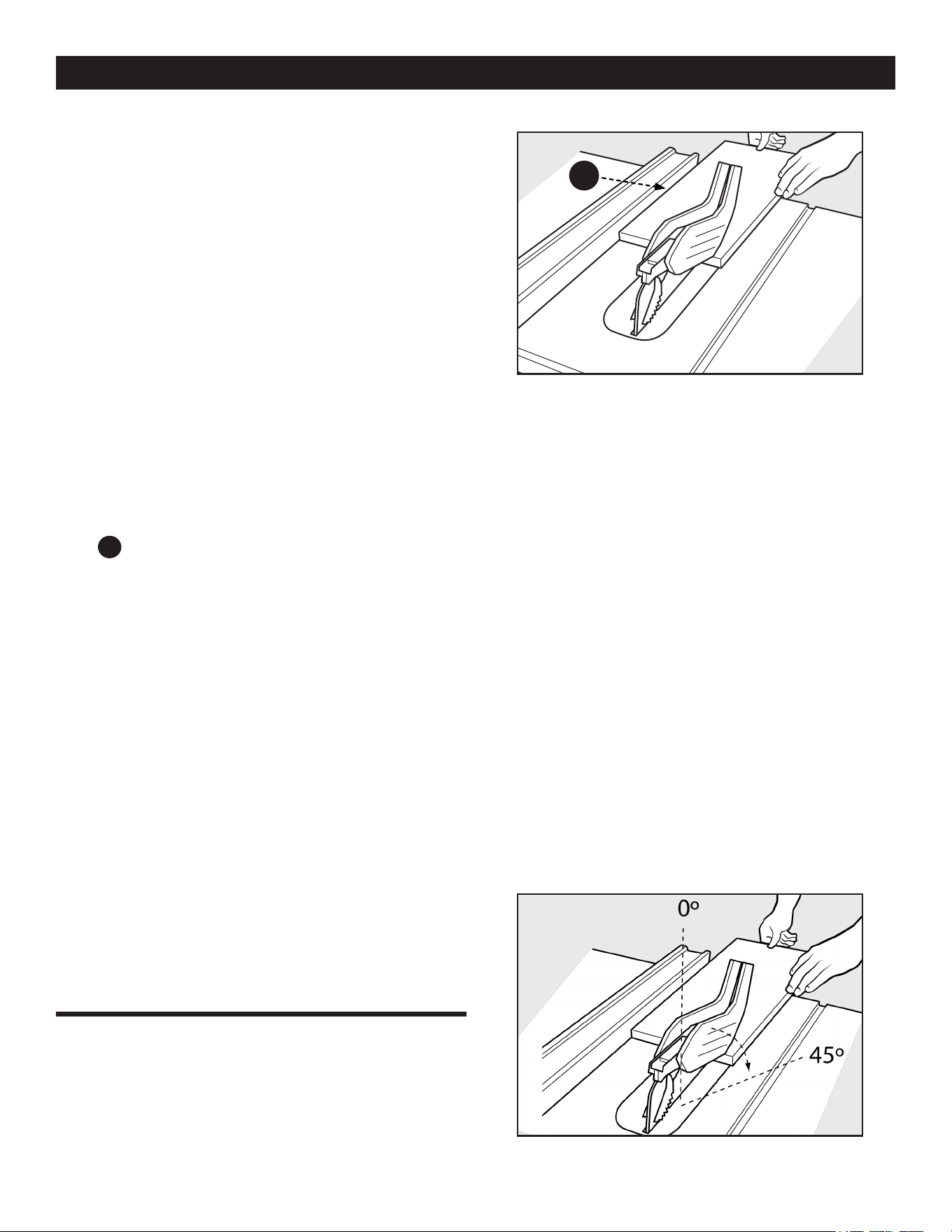
33
BEVEL RIPPING
Bevel ripping is the same as ripping except the bevel angle is set
to an angle other than 0°. When making a bevel rip cut, place the
fence on the right side of the blade so that the blade is tilted away
from the fence and hands.
• Avoid bevel cuts with a majority of material on the left side of
the blade.
45º
RIP CUTS
Rip cutting is performed predominantly in a parallel direction with
the grain of the wood.
Make sure blade is parallel to miter gauge slot prior to cutting.
Instructions for adjustment on page 29.
1. Remove miter gauge.
2. Make sure bevel angle is set to 0°.
3. Set blade to correct height for workpiece.
4. Install rip fence and lock it down parallel with and at
desired distance from blade.
5. KEEP ngers at least 6 inches from the blade at all times.
When hands and fingers CANNOT be a safe distance
from the blade, select a larger workpiece, or use a push
stick and other cutting aids, as needed, to control the
workpiece.
6. Make sure the workpiece is clear of the blade (at least 1
inch or 25mm away) before starting the saw.
7. Turn saw on.
8. Stand alongside the workpiece on the same side of the
blade as the fence.
9. Hold the workpiece at on the table and against the fence
A
. The workpiece MUST have a straight edge against
the fence and MUST NOT be warped, twisted or bowed.
See proper hand position in Figure 50.
10. Let blade build up to full speed before moving workpiece
into the blade.
11. Both hands can be used while starting the cut as long as
hands remain 6 inches from the blade.
12. KEEP the workpiece against the table and fence and
slowly feed the workpiece rearward all the way past the
saw blade. DO NOT overload the motor by forcing the
workpiece into the blade.
13. Use the push stick and any other cutting aids, as needed,
to hold the workpiece against the table and fence, and
push the workpiece past the blade. A push stick is included
with this saw, and instructions are included to make
additional push sticks and other cutting aids.
14. DO NOT push or hold onto the free or cut-o side of the
workpiece.
15. Continue pushing the workpiece until it is clear of the
blade. DO NOT overload the motor by forcing the
workpiece into the blade.
16. When cut is complete, turn saw o. Wait for blade to come
to a complete stop before removing workpiece from table.
Figure 50
Figure 51
A
MAKING CUTS
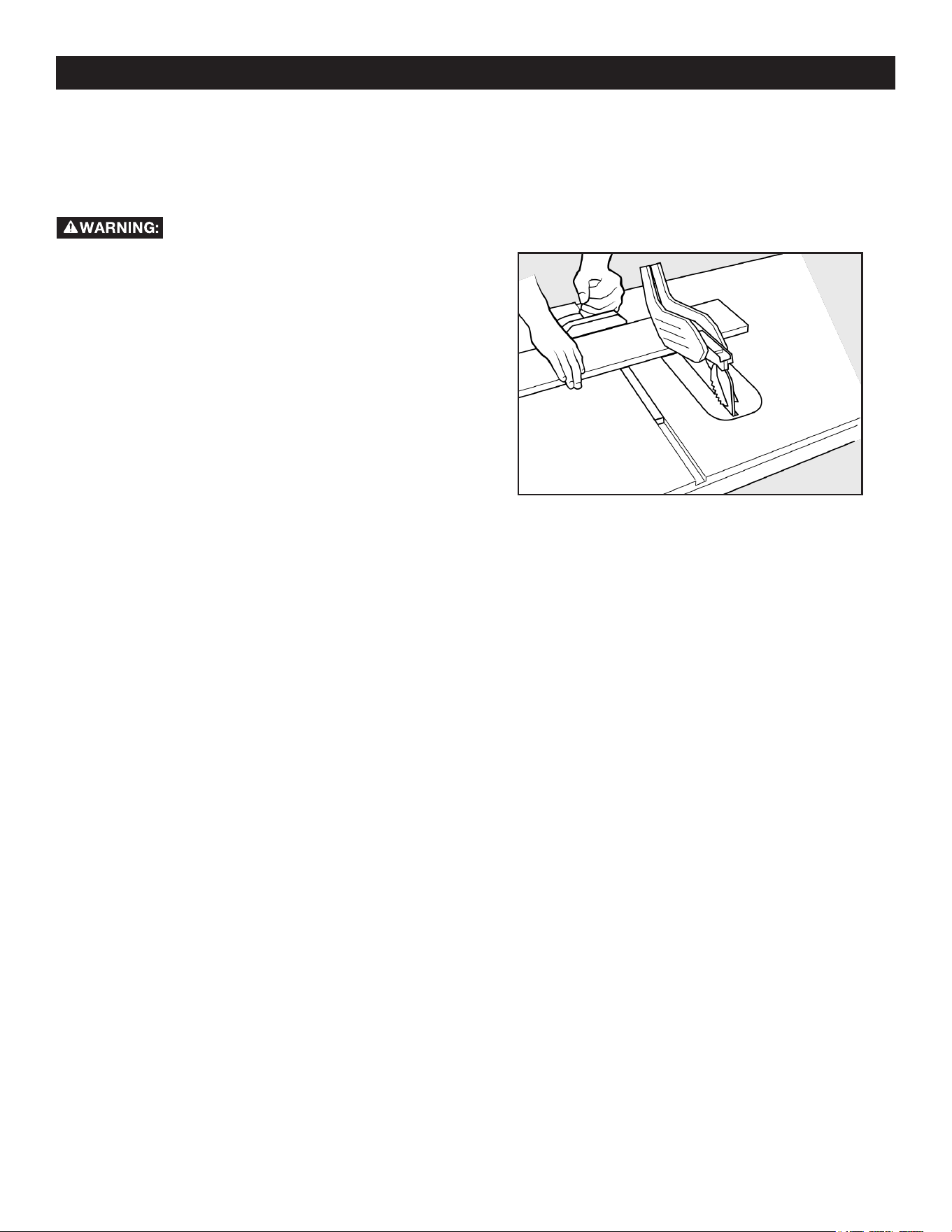
34
CROSSCUTTING
• NEVER use the fence as a guide or length stop when
crosscutting. The fence can be used to support a block being
used as a cut-o gauge, as discussed below.
• The cut-o piece MUST NEVER be conned in any through-
sawing (cutting completely through the workpiece) operation
to prevent pinching blade which may result in a thrown
workpiece and possibly injury.
• When using a block as a cut-o gauge, the block MUST be at
least 3/4 inch (19mm) thick. It is very important that the rear
end of the block be secured in a position where the workpiece
is clear of the block before it enters the blade to prevent
binding of the workpiece.
You can use the miter gauge in either table slot on non-bevel cuts.
To increase surface area of miter gauge face, add an auxiliary face
(See Cutting Aids section on page 37 of this manual).
To make a crosscut, refer to Figure 52 and follow this process:
1. Remove rip fence.
2. Make sure bevel angle is set to 0°.
3. Set blade to correct height for workpiece.
4. Place miter gauge in either miter slot.
5. Set miter gauge to 0° and tighten miter gauge lock knob.
6. Stand alongside the workpiece on the same side of the
blade as the miter gauge.
7. Hands MUST remain at least 6 inches from blade
throughout entire cut. If workpiece is too small to KEEP
hands at least 6 inches away from the blade, select
a larger workpiece, or attach an auxiliary face to the
miter gauge and attach workpiece to auxiliary face, For
instructions about making auxiliary faces, see Cutting Aids
section on page 37 of this manual.
8. Make sure the workpiece is clear of the blade - at least 1
inch or 25mm away - before starting the saw.
9. Turn saw on.
10. Let blade build up to full speed before moving workpiece
into the blade.
11. Hand closest to blade should be placed on miter gauge
lock knob and hand farthest from blade should hold
workpiece rmly against the miter gauge face. DO NOT
push or hold onto the free or cut-o side of the workpiece.
12. Slowly feed the workpiece rearward all the way past the
saw blade. DO NOT overload the motor by forcing the
workpiece into the blade.
Figure 52
• Cross cutting is performed predominantly in a perpendicular
direction with the grain of the wood.
• Make sure blade is parallel to miter gauge slot prior to cutting.
Instructions for adjustment on page 29.
MAKING CUTS
13. When cut is complete, turn saw o. Wait for blade to come
to a complete stop before removing cut o piece from
table.
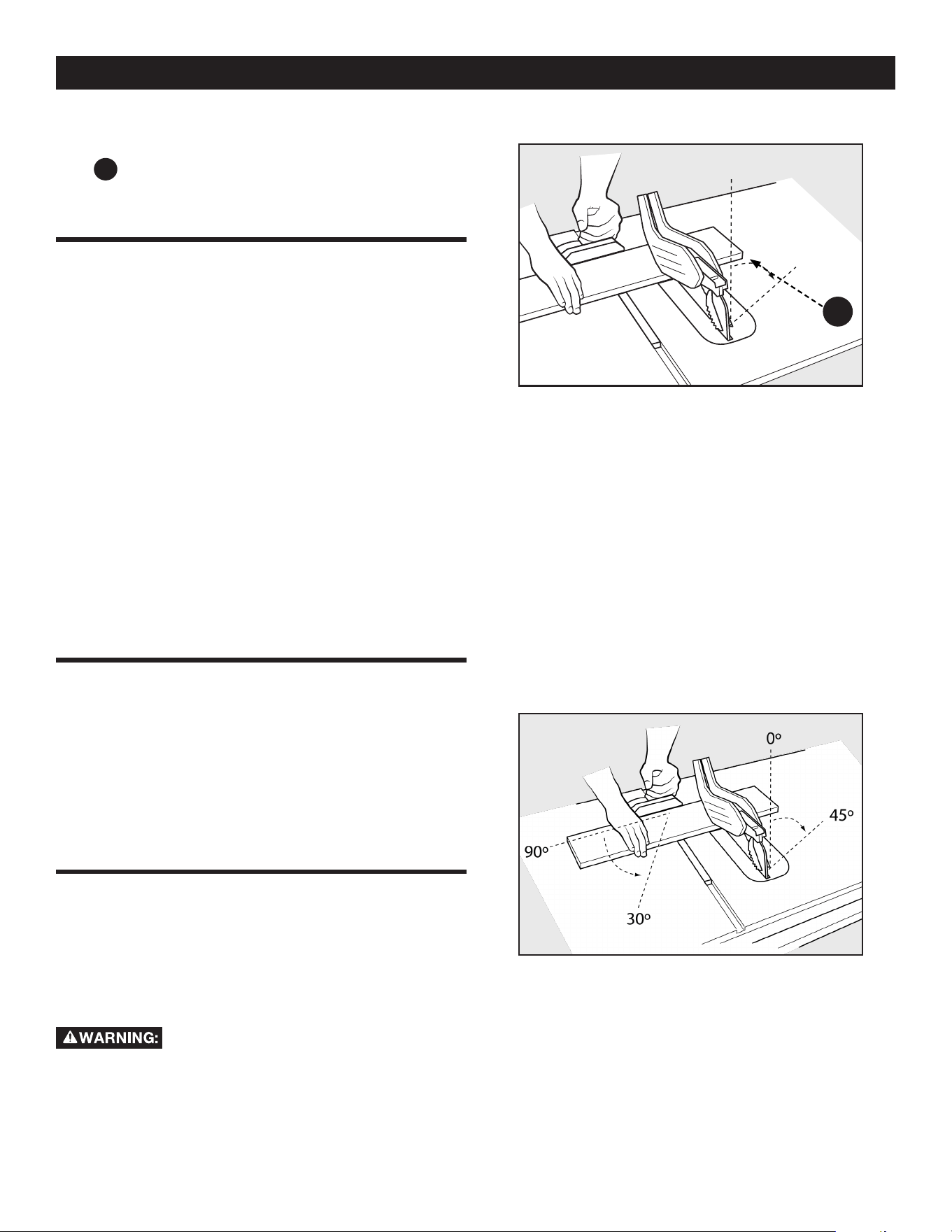
35
COMPOUND MITER CUTS
This is a combination of bevel crosscutting and mitering. See Figure
54 and follow the instructions for both bevel crosscutting and
mitering. Remember to use the right miter slot for all bevel cuts.
• DO NOT attempt compound miter cuts, with blade beveled
and miter fence angled, until you are thoroughly familiar with
the basic cuts and understand how to avoid kickback.
Figure 54
45º
0º
BEVEL CROSSCUTTING
Bevel crosscutting is the same as crosscutting except the bevel
angle
A
is set to an angle other than 90°. When making a bevel
crosscut, place the miter gauge in the right miter slot so that the
blade is tilted away from the gauge and hands. See Figure 53.
MITER CUTS
Figure 53
Miter cuts are cross cuts with the miter gauge set at an angle
other than 90°. For instructions about setting miter gauge angles,
see Preparing to Cut. To adjust the preset index miter stops, see
Adjusting the Miter Stops on page 24 of this manual.
• Miter angles less than 45° may force the blade guard
assembly into the saw blade causing damage to the blade
guard assembly and personal injury. Before starting the motor,
test the operation by feeding the workpiece into the blade
guard assembly. If the blade guard assembly contacts the
blade, place the workpiece under the blade guard assembly
but not touching the blade - before starting the motor.
• Certain workpiece shapes, such as molding may not lift the
blade guard assembly properly. With the power off, feed
the workpiece slowly into the blade guard area and until the
workpiece touches the blade. If the blade guard assembly
contacts the blade, place the workpiece under the blade guard
assembly - but not touching the blade - before starting the
motor.
LARGE PANEL CUTS
Place workpiece supports at the same height as the saw table
behind saw to support the cut workpiece, and alongside(s) of saw,
as needed. Depending on shape of panel, use rip fence or miter
gauge to control workpiece. If a workpiece is too large to use either
a rip fence or a miter gauge, it is too large for this saw.
A
MAKING CUTS
DO NOT allow bystanders to hold or support
any portion of the workpiece.

36
NON-THROUGH CUTS
The use of a non-through cut is essential to cutting grooves and
rabbets. Non-through cuts can be made using a standard blade
having a diameter of 10 inches or less. Non-through cuts are the
ONLY type of cuts that should be made without the blade guard
assembly installed.
• When making non-through cuts, follow all applicable warnings
and instructions listed below in addition to those listed above
for the relevant through cut.
• When making a non-through cut, blade is covered by
workpiece during most of cut. Be alert to exposed blade at
start and nish of every cut.
• NEVER feed wood with hands when making any non-through
cuts such as rabbets. ALWAYS use miter gauge, push blocks
or push sticks, and featherboards where appropriate.
MAKING A NON-THROUGH CUT
Once all non-through cuts are completed, unplug saw and reinstall
riving knife in raised position. Install anti-kickback pawls and blade
guard.
1. Unplug saw.
2. Unlock release lever.
3. Adjust bevel angle to 0°.
4. Lock release lever.
5. Remove blade guard and anti-kickback pawls.
6. Place riving knife in “lowered” position. See "RIVING KNIFE
POSITION" section on page 28.
7. Set blade to correct depth for workpiece.
8. Depending on shape and size of wood, use either rip fence
or miter gauge.
9. Plug saw into power source and turn saw on.
10. Let blade build up to full speed before moving workpiece
into blade.
11. ALWAYS use push blocks, push sticks, and/or
featherboards when making non-through cuts to reduce
the risk of serious injury.
12. When cut is made, turn saw o. Wait for blade to come to
a complete stop before removing workpiece.
13. When cut is complete re-adjust riving knife to position as
detailed on page 28.
• Read the appropriate section which describes the type of cut
in addition to this section on non-through. For example, if your
non-through cut is a straight cross cut, read and understand
the section on straight cross cuts before proceeding.
• When cut is complete re-adjust riving knife to through cut
position as detailed on page 28.
• Carefully follow the instructions accompanying any specialized
blades such as molding cutters for proper installation, set-up,
and operation.
MAKING CUTS
Make sure the blade guard assembly and anti-kickback pawls are
reinstalled upon completion of this type of cut.
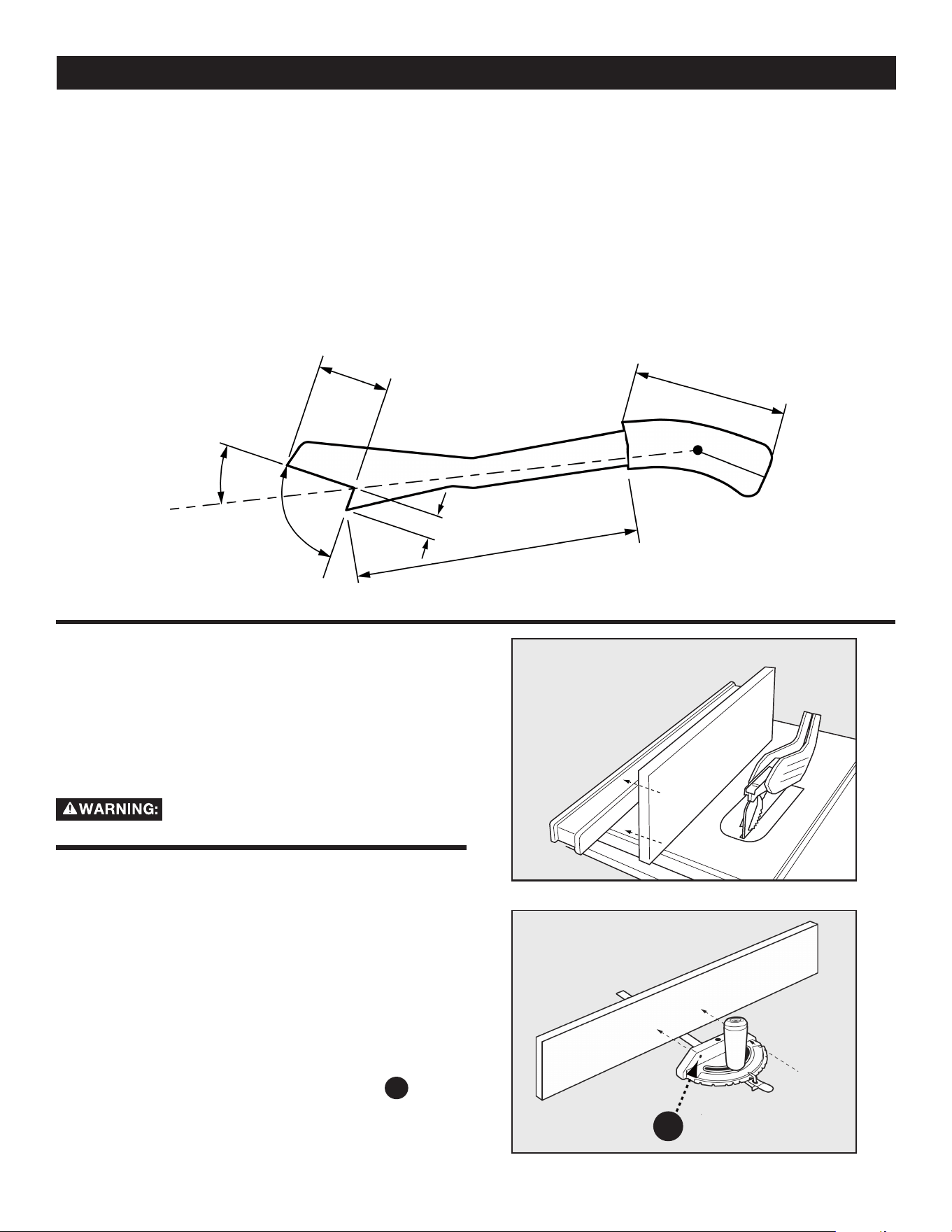
37
CUTTING AIDS AND ACCESSORIES
PUSH STICK
In order to operate your table saw safely, you MUST use a push stick whenever the size or shape of the workpiece would otherwise cause
your hands to be within 6 inches (152mm) of the saw blade or other cutter. A push stick is included with this saw.
No special wood is needed to make additional push-sticks as long as it is sturdy and long enough with no knots, checks or cracks. A
length of approximately 16 inches (400mm) is recommended with a notch that ts against the edge of the workpiece to prevent slipping.
It’s a good idea to have several push sticks of the same minimum length, 16 inches (400mm), with dierent size notches for dierent
workpiece thicknesses.
The shape can vary to suit your own needs as long as it performs its intended function of keeping your hands away from the blade.
Angling the notch so the push stick can be held at a 20° to 30° from the saw’s table will help you to hold down the workplace while also
moving workpiece past the saw blade.
To construct a push stick, refer to the layout see Figure 55.
Figure 55
AUXILIARY RIP FENCE FACING
Use an auxiliary rip fence facing when needed for special cuts, such
as ripping material that is thin enough to slide under the rip fence
provided with your saw, or when a taller rip fence is necessary to
complete your cut. To add an auxiliary wood facing to one or both
sides of the rip fence, select a piece of wood with smooth surfaces.
Attach the wood to the rip fence with two clamps. See Figure 56.
For most work, 3/4 inch (19mm) or 1 inch (25mm) stock is suitable.
Figure 56
AUXILIARY MITER GAUGE FACING
An auxiliary miter gauge facing is used to increase the surface area
of the miter gauge face.
The use of miter gauge with auxiliary facing is the same as original
miter gauge (without auxiliary facing). See Page 24 for the use of
miter gauge.
If desired, you can t the miter gauge with an auxiliary wood facing
that should be at least 1 inch (25mm) higher than the maximum
depth of cut, and at least as wide as the miter gauge.
This auxiliary wood facing can be fastened to the front of the miter
gauge by using two wood screws through the holes
A
provided
in the miter gauge body and into the wood facing. See Figure 57.
Make sure the screws are long enough to secure the facing, but DO
NOT extend all the way through the wood.
Figure 57
A
Make sure clamps DO NOT interfere with
workpiece or blade guard assembly.
1 3/4 Inch (44.5MM)
90°
20°-30°
3 3/8 Inch (85.7mm)
10 3/4 Inch (273mm)
1 1/16 Inch (27mm)
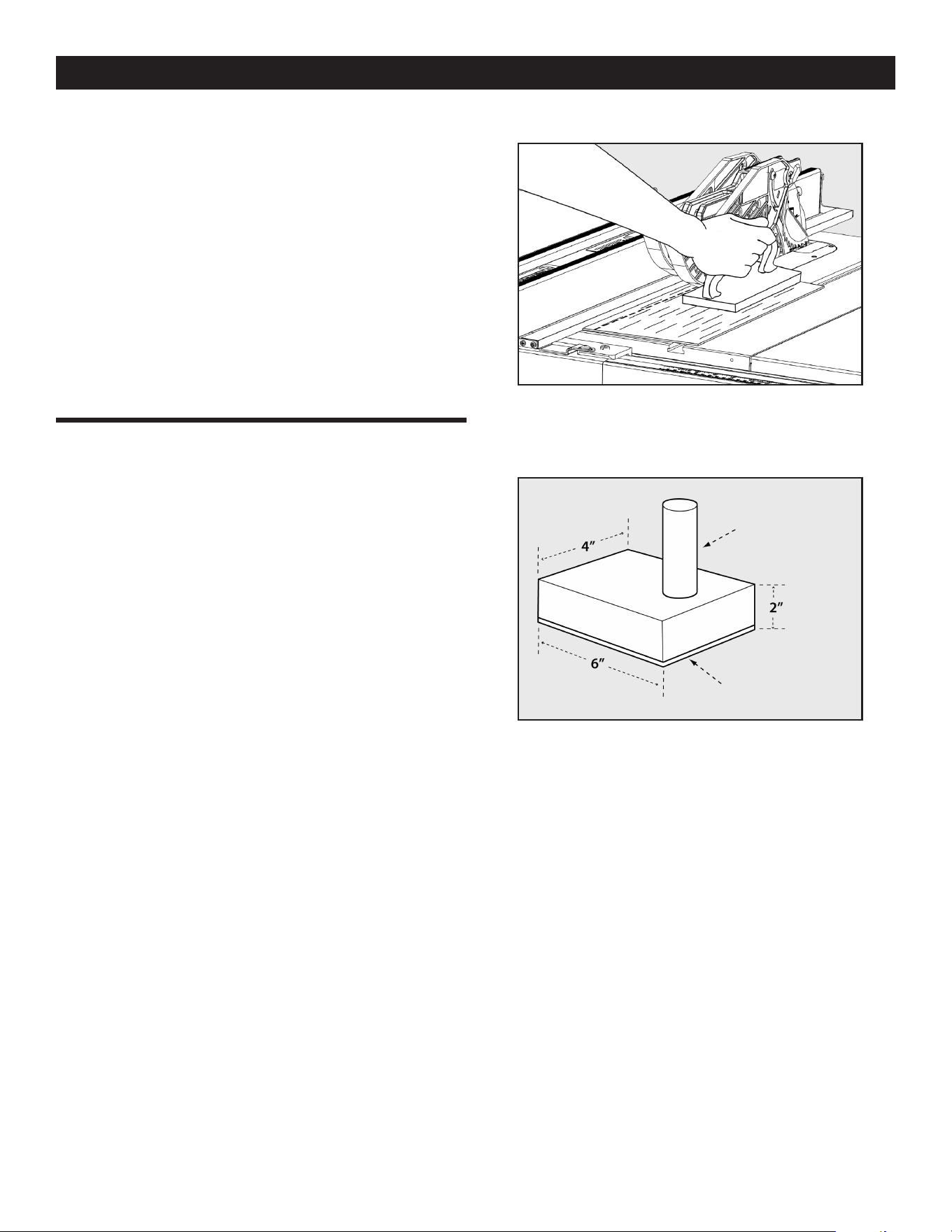
38
Wooden
dowel
Sandpaper or
old mouse pad
material
PUSH BLOCK
Push blocks are blocks used to securely hold down the workpiece
against the table. They include some gripping surface or handle to
hold the block. Any screws running through the underside of the
block to fasten the handle should be recessed in order to avoid
contact with the workpiece.
1. Select a piece of wood about 4 inches wide, 6 inches long
and 1 to 2 inches thick (a cuto from a 2 by 4 makes a
good blank for a push block).
2. Drill a hole in the block and glue in a dowel to use as
a handle (you can angle the hole to provide a more
comfortable grip on the handle).
3. Glue a piece of rough or soft material such as sandpaper
or rubber to the bottom of the block to grip the workpiece
(old mouse pads work well). See Figure 59.
Figure 59
FLIP DOWN FENCE
Use the flip down fence when cutting thin stock that might
normally slide underneath the regular rip fence or in which the
blade guard would normally interfere with the fence to make the
desired cut.
To utilize this flip down feature for small, narrow cuts, you MUST
slide the flip down part of the fence underneath the blade guard,
so that the blade is still covered safely by the blade guard. Please
see Figure 58. Subtract 2 inches from the scale for accurate
measurement.
Figure 58
CUTTING AIDS AND ACCESSORIES

39
FEATHERBOARD
Featherboards are used to KEEP the work in contact with the
fence and table as in Figure 61, and help prevent kickback.
Featherboards are especially useful when ripping thin workpieces
and for completing non-through cuts. The end is angled with a
series of narrow slots to give a friction hold on the workpiece. It
is locked in place on the table or fence with c-clamps. Clamping a
featherboard in front of the blade can increase safety during non-
through cuts, like grooving and rabbeting, and through cuts.
1. Select a solid piece of lumber approximately 3/4 inch thick,
2 1/2 inches wide and 12 inches long.
2. Mark the center width on one end of stock. Miter width to
20° (see miter cut section for information on miter cuts).
3. Set rip fence to allow approximately a 1/4 inch “nger” to
be cut in the stock.
4. Feed stock ONLY to mark previously made at 6 inches.
5. Turn saw o and allow blade to completely stop rotating
before removing stock.
6. Reset rip fence and cut spaced rips into workpiece to
allow approximately 1/4 inch ngers and 1/8 inch spaces
between ngers.
To avoid binding between the
workpiece and the blade, make sure a horizontal
feather board presses ONLY on the uncut portion of
the workpiece in front of the blade.
Dimensions for making a typical featherboard are shown in Figure
60. Make your featherboard from a straight piece of wood that is
free of knots and cracks. Clamp featherboards to the fence and/or
table so that the featherboard will hold the workpiece against the
fence or table.
Figure 60 Figure 61
GROOVING AND RABBETING
Clamping a featherboard in front of the blade can increase safety during non-through cuts, like grooving and rabbeting, and through cuts.
Use a featherboard to guide the workpiece against the table and fence when making non-through cuts such as rabbeting. A featherboard
helps prevent kickback.
CUTTING AIDS AND ACCESSORIES
3/4 in.3/4 in.
12 in.12 in.
20˚20˚
2 1/2 in.2 1/2 in.
1/4 in.1/4 in.
1/8 in.1/8 in.
PUSH BLOCK PUSH BLOCK
FEATHER BOARD FEATHER BOARD
PUSH STICK PUSH STICK
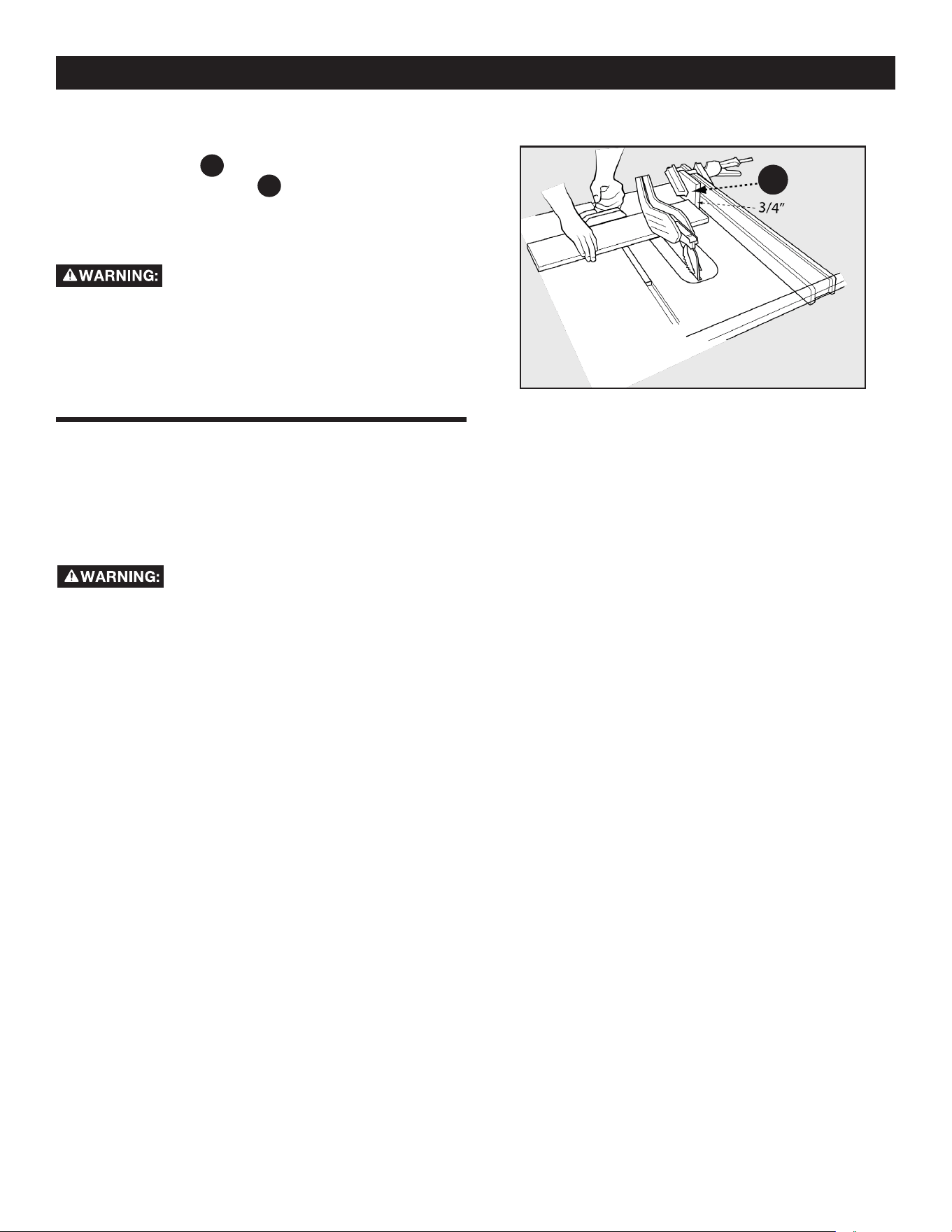
40
CUT OFF GAUGE
When crosscutting a number of pieces to the same length, you can
clamp a block of wood
A
, see Figure 62, to the fence and use it
as a cut-o gauge. The block
A
MUST be at least 3/4 inch
(19mm) thick to prevent the cut o piece from binding between the
blade and the fence. Once the cut-o length is determined, lock the
fence and use the miter gauge to feed the workpiece into the blade.
ALWAYS position the cut-o gauge in front
of the saw blade.
Figure 62
JIGS
Jigs may be created with a variety of special set-ups to control
particular workpiece shapes for particular cuts. Guidance on how to
make specialized jigs can be found in woodworking and carpentry
websites and publications.
DO NOT attempt to create or use a jig
unless you are thoroughly familiar with table saw safety.
DO NOT use any jig that could result in pinching a kerf or
jamming the workpiece between the jig and the blade.
Incorrect setups may cause kickback which could result in
serious injury.
A
CUTTING AIDS AND ACCESSORIES
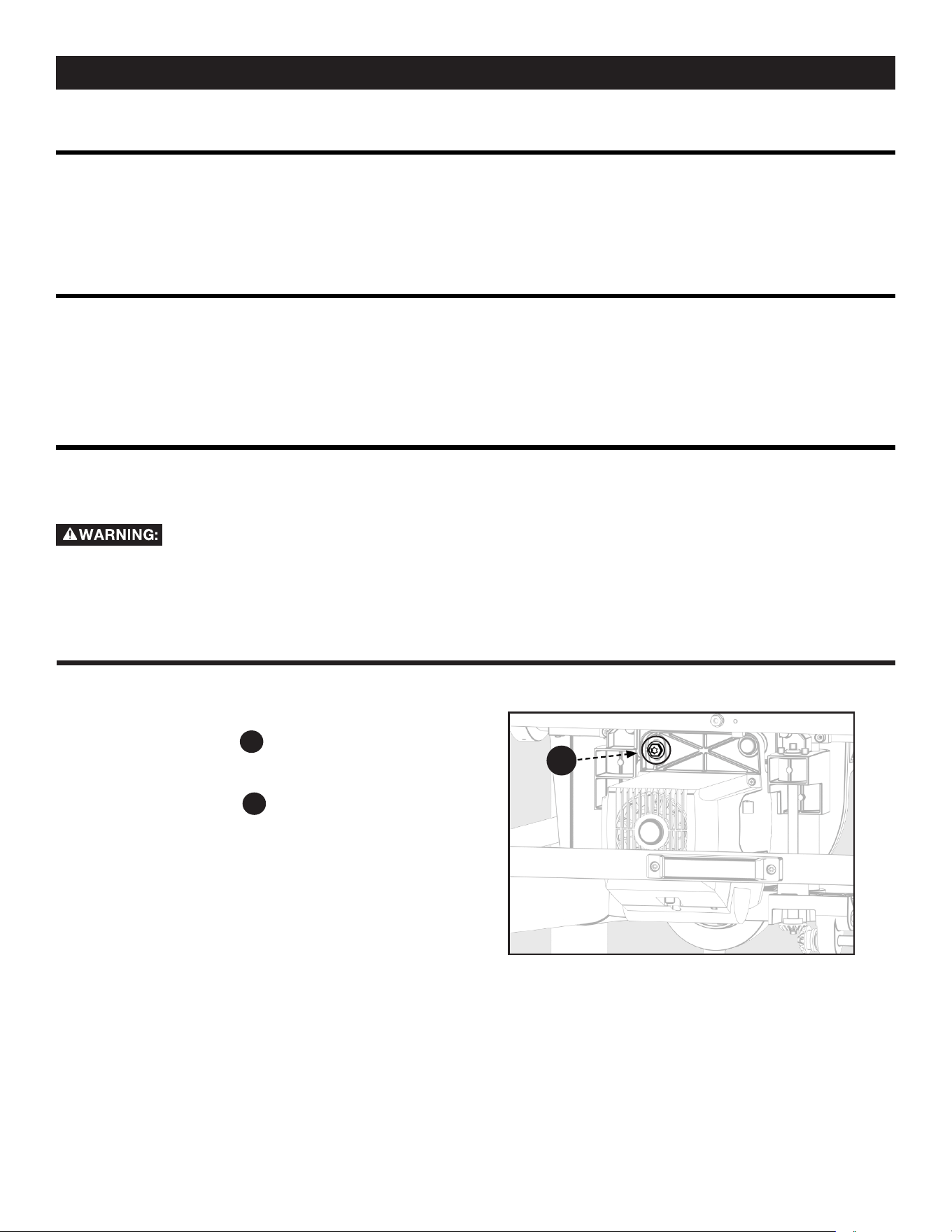
41
MAINTENANCE
To reduce the risk of injury, turn unit o and disconnect the tool from power source before cleaning or servicing, before installing and
removing accessories, before adjusting and when making repairs. An accidental start-up can cause injury.
LUBRICATION & RUST PROTECTION
Apply hardwood ooring paste wax to the machine table occasionally
or use a commercially available protective product designed for this
purpose. Follow the manufacturer’s instructions for use and safety.
To clean cast iron tables of rust, you will need the following
materials: a medium sized scouring pad, a can of spray lubricant
and a can of degreaser. Apply the spray lubricant and polish the
table surface with the scouring pad. Degrease the table, then apply
the protective product as described above.
MAINTENANCE REMINDERS
Wear certied safety equipment for eye, hearing and respiratory
protection while using compressed air.
ALWAYS turn saw o and unplug from power
source before making adjustments or performing maintenance.
Specic areas which require regular maintenance include:
RIVING KNIFE CLAMP PLATE: KEEP this area free of dust and
debris buildup. Blow out area regularly with compressed air.
NOTE: If the riving knife clamp can’t move freely, have
the saw serviced by authorized DELTA
®
service center
personnel.
WORM GEARS: KEEP the worm gears free of dust and debris
buildup. Blow out area regularly with compressed air. Use a lithium-
based multipurpose grease as needed on these gears.
CLEAN SAWDUST BUILDUP OUT OF SAW PERIODICALLY:
NOTE: Debris can also be removed from the saw from below the
throat plate, inside the dust port.
KEEP MACHINE CLEAN
Periodically blow out all air passages with dry compressed air. All
plastic parts should be cleaned with a soft damp cloth. NEVER
use solvents to clean plastic parts. They could possibly dissolve or
otherwise damage the material.
Wear certied safety equipment for eye, hearing and respiratory
protection while using compressed air.
For best performance use a shop vacuum or blower to KEEP saw
blade area, the dust collection system, the guarding system and
rails free of saw dust and other debris.
ADJUSTING BELT TENSION
1. Lower the blade height to its lowest position.
2. Loosen the torx screw
A
that is used to mount the motor
housing. This should be loosened enough to feel the motor
weight providing tension to the belt.
3. Tighten the torx screw
A
to secure the motor.
Figure 63
A
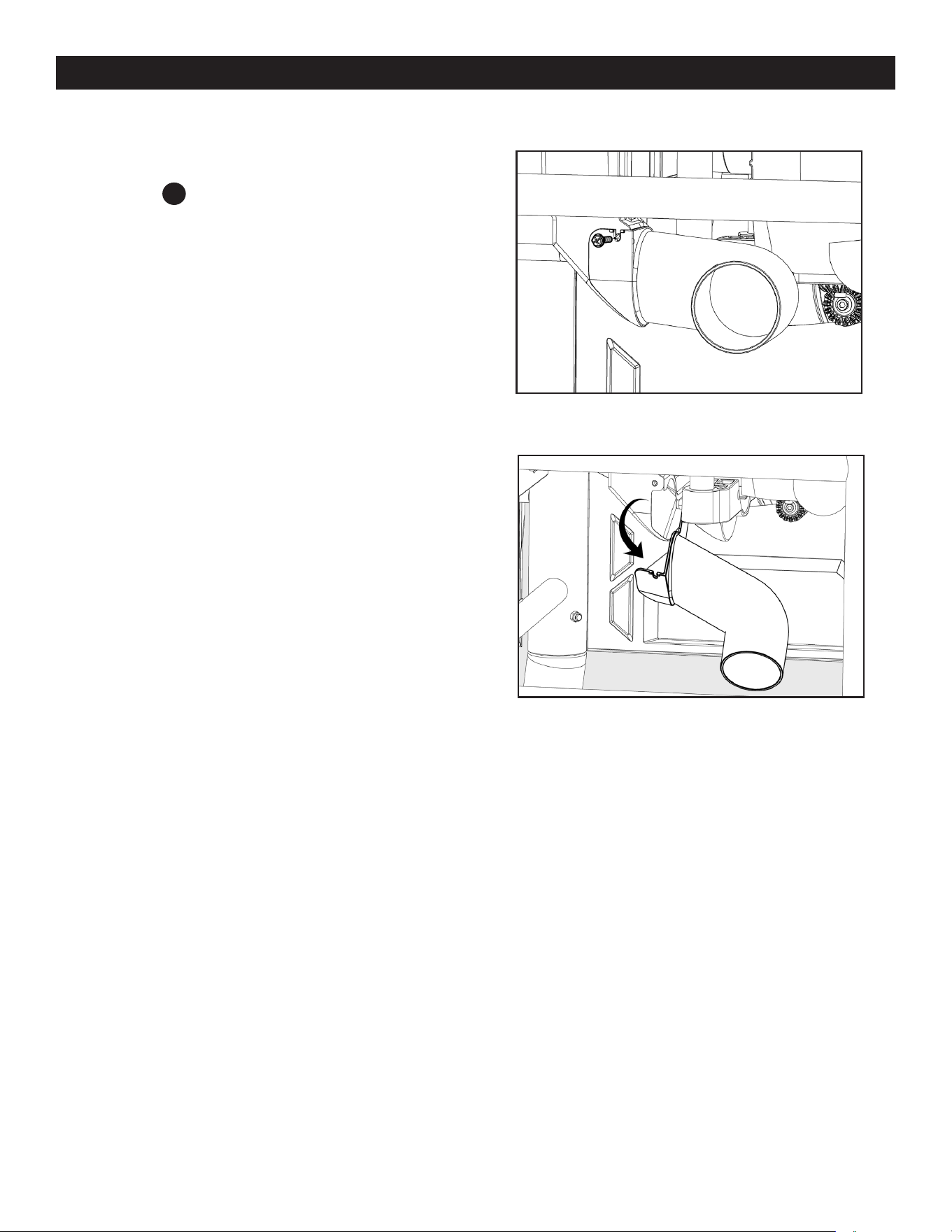
42
Figure 64
Figure 65
DUST CHUTE CLEAN OUT
1. Remove the hex screw located in the back of the dust
chute, using the supplied 3/16 inch Two-Way Allen Wrench
(L Shape)
HP23
. See Figure 64.
2. Rotate the dust port downward, and clear any sawdust or
woodchips that may be inside the dust chute. See Figure
65.
3. When nished, rotate the dust port back to its original
position and secure the hex screw back in place.
MAINTENANCE
43
ACCESSORIES
TROUBLESHOOTING
Question: Solution:
How do you make the blade parallel to the miter slot? Reference Page 29.
Can this unit be converted to 220 volt? No.
What is the process for resetting the motor? Reference "OVERLOAD PROTECTION" section on page 32.
What do I do if my unit is humming or my blade is not turning? Contact our Customer Care team by calling 1-800-223-7278 or
emailing us at [email protected].
What do I do if my unit has no power? Begin by checking the "POWER SOURCE" and "EXTENSION
CORDS" sections on page 10 to ensure you are utilizing the
machines power appropriately. If the problem continues, Contact
our Customer Care team by calling 1-800-223-7278 or emailing us
How do I nd my local repair center? Contact our Customer Care team by calling 1-800-223-7278 or
emailing us at [email protected].
How do I get Warranty work done on my product? Keep a copy of your receipt to present to our Service Center if any
issues arise with your machine.
A complete line of accessories is available from your DELTA
®
Supplier, DELTA
®
Factory Service Centers, and DELTA
®
Authorized Service
Centers. Please visit our Web Site www.DeltaMachinery.com for an online catalog or for the name or your nearest supplier.
Since accessories other than those oered by DELTA
®
have not been tested with this product, use of such
accessories could be hazardous. For safest operation, only DELTA
®
recommended accessories should be used with this
product.
For assistance with your machine, visit our website at www.DeltaMachinery.com for a list of service centers or call Delta Power Equipment
Customer Care at 1-800-223-7278.
FAILURE TO START
If your machine fails to start, check to make sure the prongs on the cord plug are making good contact in the receptacle, and check reset
button on power switch housing. Also, check for blown fuses or open circuit breakers in your power line.

44
PARTS, SERVICE OR WARRANTY ASSISTANCE
All DELTA
®
Machines and accessories are manufactured to high quality standards and are serviced by a network of an Authorized
Service Centers. To obtain additional information regarding your product or to obtain parts, service, warranty assistance, or the location
of the nearest service center, please call 1-800-223-7278 or email [email protected].
Five Year Limited Warranty
1. WHAT IS COVERED. Delta Power Equipment Corporation (“Company”) will, at its option, repair or replace this product, if purchased
at retail in the United States or Canada and the product, with normal use, has proven to be defective in workmanship or material, subject to
the conditions stated in this Limited Warranty. This Limited Warranty covers only materials and labor. All transportation costs are Customer’s
responsibility.
2. WARRANTY PERIOD. All warranty claims must be submitted within ve years from the date of retail purchase. For all service parts and
factory refurbished products, the warranty period is 180 days.
3. HOW TO OBTAIN SERVICE. To obtain warranty service, you must return the defective product, at your expense, to a service center
authorized by Company to perform warranty service (a “Company Authorized Service Center”) within the applicable warranty period, together with
acceptable proof of purchase, such as your original receipt bearing the date of purchase, or product registration number. Company reserves the
right to restrict warranty claim service to the country where the purchase was made and/or to charge for the cost to export service parts or provide
warranty service in a dierent country. For this purpose, on-line purchases are deemed made in the United States. For the location of your nearest
Company Authorized Service Center, call Company’s Customer Care Center at (800) 223-7278.
4. EXCLUSIONS.
● Company does not oer any warranty on products purchased in used or damaged condition.
● Company does not warrant any products purchased outside the United States or Canada.
● Company will not be responsible for any damage that has resulted from normal wear, misuse, abuse or any repair or alteration made by anyone
other than a Company Authorized Service Center or a designated representative of Company’s Customer Care Center.
All IMPLIED WARRANTIES are expressly limited to the warranty period identied above.
Company will not be liable for INCIDENTAL OR CONSEQUENTIAL damages.
This limited warranty is Company’s sole warranty and sets forth the customer’s exclusive remedy with respect to defective products; all other
warranties, express or implied, whether of merchantability, tness for purpose, or otherwise, are expressly disclaimed by Company, except as
expressly stated in this warranty statement.
Some states do not allow the exclusion or limitation of incidental or consequential damages, or the limitation of implied warranties, so the above
limitations or exclusions may not apply to you. This warranty gives you specic legal rights and you may have other rights which vary in certain
states or provinces. For further details of warranty coverage and warranty repair information, call (800) 223-7278. Thank you for purchasing our
product! Please maintain a copy of your proof of purchase/receipt for any potential warranty claims.
LATIN AMERICA: This warranty does not apply to products sold in Latin America. For products sold in Latin America, call the local
company or see website for warranty information.
REPLACEMENT PARTS
SERVICE AND REPAIRS
FREE WARNING LABEL REPLACEMENT
This power tool is provided with Type Y attachment power supply cord. If the replacement of the power supply cord is necessary, this
has to be done by the manufacturer or his agent in order to avoid a safety hazard. Use only identical replacement parts. For a parts list
or to order parts, visit our website at www.DeltaMachinery.com/support. You can also order parts from your nearest Authorized Warranty
Service Center or by calling Technical Service Manager at 1-800-223-7278 to receive personalized support from one of our highly-trained
representatives.
All quality tools will eventually require servicing and/or replacement of parts. For information about Delta Power Equipment Corporation,
its factory-owned branches, or to locate an Authorized Warranty Service Center, visit our website at www.DeltaMachinery.com/support
or call Customer Care at 1-800-223-7278. All repairs made by our service centers are fully guaranteed against defective material and
workmanship. We cannot guarantee repairs made or attempted by others. By calling this number you can also nd answers to most
frequently asked questions 24 hours/day.
You can also write to us for information at Delta Power Equipment Corporation, 2651 New Cut Road, Spartanburg, SC 29303
Attention: Technical Service Manager. Be sure to indicate all of the information shown on the nameplate of your saw (model number,
type, serial number, date code, etc.).
If your warning labels become illegible or are missing, call 1-800-223-7278 or email customer[email protected] for a free replacement.

2651 New Cut Road
Spartanburg, SC 29303
(800) 223-7278
www.DeltaMachinery.com
©2022 Delta Power Equipment Corporation
DPEC005496
Rev: 24
12/07/2022