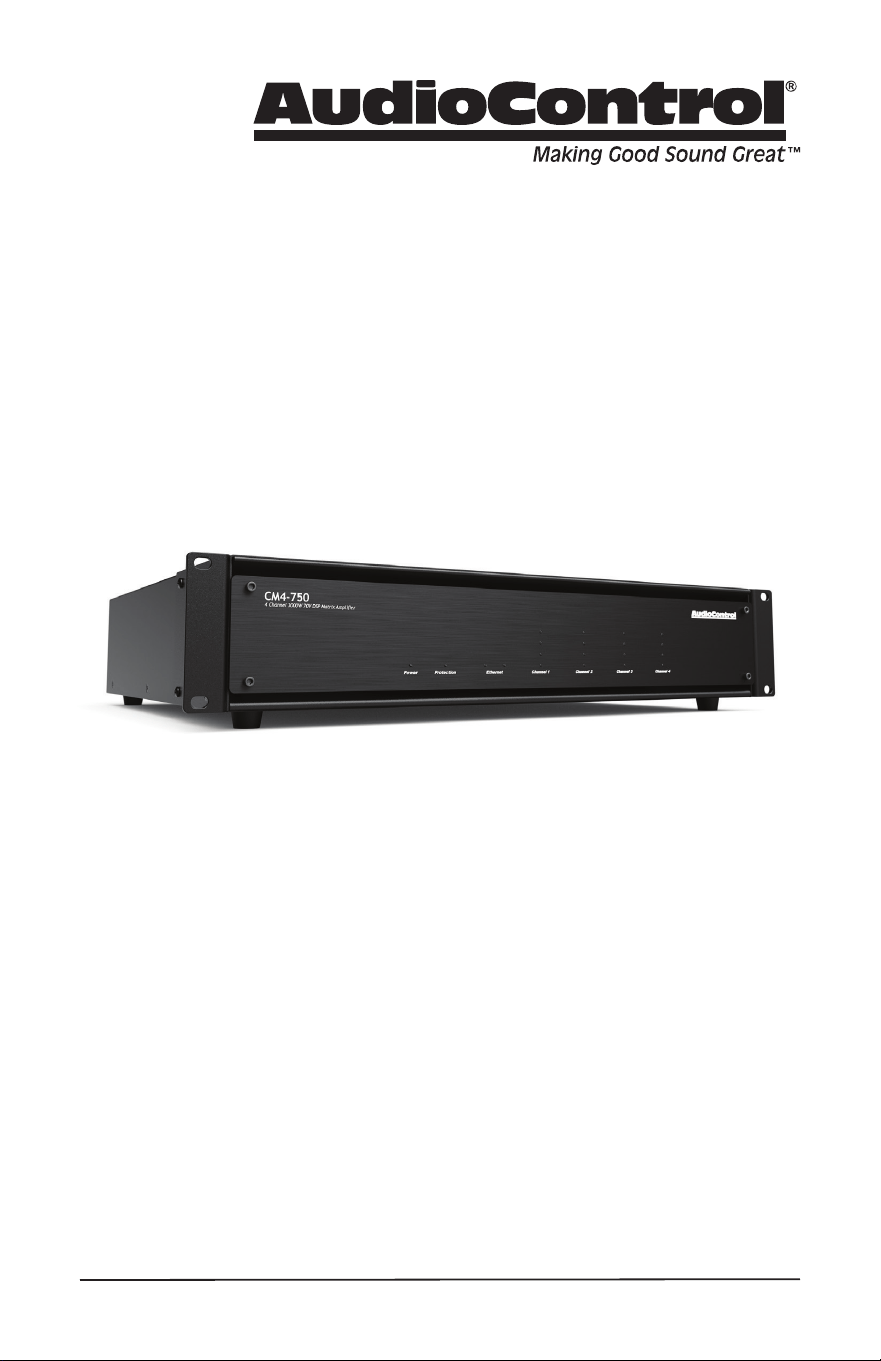
CM Series Ampliers
CM2-750, CM3-750, CM4-750
2, 3, 4 CHANNEL, LOW IMPEDANCE / 70V / 100V
POWER AMPLIFIERS
OPTIONAL DANTE PORT
FOR RESIDENTIAL AND COMMERCIAL APPLICATIONS
Installation Manual
2
Important Safety
Instructions
1. Read these instructions.
2. Keep these instructions.
3. Heed all warnings.
4. Follow all instructions.
5. Do not use this apparatus near water.
6. Clean only with a dry cloth.
7. Do not block any ventilation openings. In-
stall in accordance with the manufacturer’s
instructions.
8. Do not install near any heat sources such
as radiators, heat registers, stoves, or
other apparatus (including ampliers) that
produce heat.
9. Protect the power cord from being walked
on or pinched particularly at plugs, conve-
nience receptacles, and the point where
they exit from the apparatus.
10. Only use attachments/accessories speci-
ed by the manufacturer.
11. Unplug this apparatus during lightning
storms or when unused for long periods of
time.
12. Refer all servicing to qualied service
personnel. Servicing is required when
the apparatus has been damaged in any
way, such as power-supply cord or plug is
damaged, liquid has been spilled or objects
have fallen into the apparatus, the appara-
tus has been exposed to rain or moisture,
does not operate normally, or has been
dropped.
13. This apparatus shall not be exposed to
dripping or splashing, and no object lled
with liquids, such as vases or glasses, shall
be placed on the apparatus.
The lightning ash with arrowhead
symbol within an equilateral triangle
is intended to alert the user to the
presence of uninsulated “dangerous voltage”
within the product’s enclosure, that may be
of sucient magnitude to constitute a risk of
electric shock to persons.
The exclamation point within an
equilateral triangle is intended to alert
the user of the presence of import-
ant operating and maintenance (servicing)
instructions in the literature accompanying the
appliance.
Caution: to reduce the risk of electric shock,
do not remove the top cover. There are no
user-serviceable parts inside. Refer servicing to
qualied personnel.
This equipment has been tested and found
to comply with the limits for a Class B digital
device, pursuant to part 15 of the FCC Rules.
These limits are designed to provide reasonable
protection against harmful interference in a
residential installation.
This equipment generates, uses, and can radi-
ate radio frequency energy and, if not installed
and used in accordance with the instructions,
may cause harmful interference to radio com-
munications. However, there is no guarantee
that interference will not occur in a particular
installation.
If this equipment does cause harmful interfer-
ence to radio or television reception, which can
be determined by turning the equipment o
and on, the user is encouraged to try to correct
the interference by one or more of the follow-
ing measures:
• Reorient or relocate the receiving antenna.
• Increase the separation between the equip-
ment and the receiver.
• Connect the equipment into an outlet on
a circuit dierent from that to which the
receiver is connected.
• Consult the dealer or an experienced radio/
TV technician for help.
CAUTION: Changes or modications to this
device not expressly approved by AudioControl
Inc. could void the user’s authority to operate
the equipment under FCC rules.
Recycling notice: If the time comes
and this apparatus has fullled its
destiny, do not throw it out into the
trash. It has to be carefully recycled
for the good of mankind, by a facility specially
equipped for the safe recycling of electronic
apparatii. Please contact your local or state
recycling leaders for assistance in locating a
suitable nearby recycling facility. Or, contact us
and we might be able to repair it for you.
Important Safety Instructions

3
Installation Manual
CM2-750, CM3-750, CM4-750
CM SERIES
Table of Contents
Table of Contents
Important Safety Instructions ...... 2
Table of Contents ................ 3
Introduction ..................... 4
Features ........................ 4
Complimentary Features .......... 6
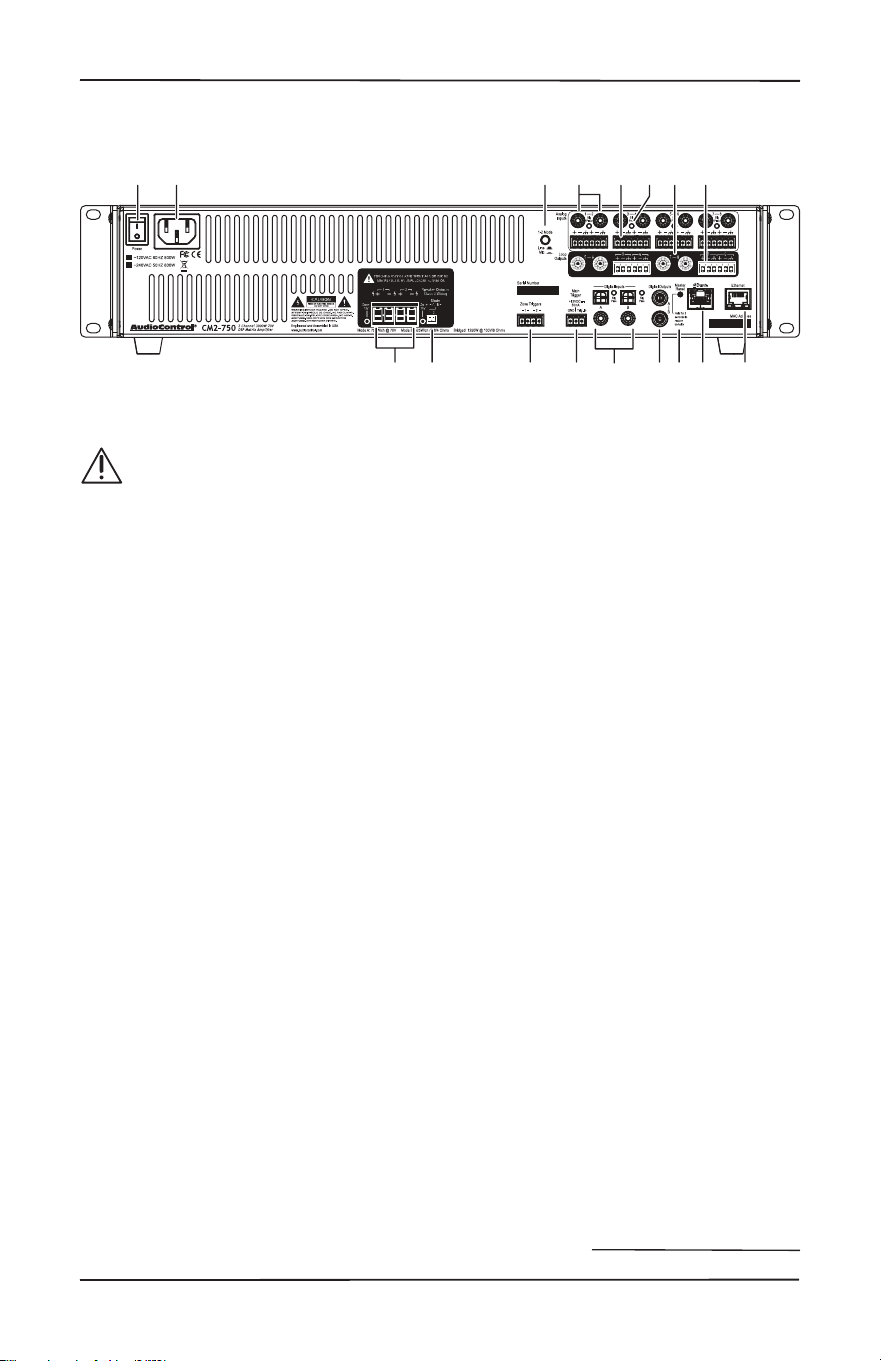
Quick View ...................... 7
Front Panel ..................... 7
Rear Panel ...................... 7
Getting Started .................. 8
Installation Examples ............. 8
Front Panel Features .............. 13
Rear Panel Features ............. 15
Speaker and Wiring Impedance ..... 18
12 Volt Trigger Ins and Outs ........ 19
Ventilation ...................... 21
Internet Connectivity and Control ... 22
Acoustics ....................... 36
Equalization ..................... 37
Advanced Discussions ............. 40
Troubleshooting ................. 42
Block Diagram ................... 44
Specications ................... 45
Service ......................... 46
The Warranty .................... 47
The Crossover Two-Step ........... 52
©2021 AudioControl Inc., all rights reserved.
Based on a dream-sequence involving the technical writer, the 1978
FA Cup Final, two pints of lager and a packet of crisps
Network Settings
Default IP Address 192.168.0.249

4
Flowery Marketing Introduction
Congratulations!
If you are reading this user’s manual then it is
likely that you are involved in the installation
of an AudioControl CM Series amplier. This
amplication product was designed to allow
the user to maximize the performance of any
distributed audio speaker system, whether
you are using traditional low impedance (LoZ)
or 70/100 volt (HiZ) speaker systems…or both.
The AudioControl CM Series ampliers were
designed to optimize the performance of to-
day’s residential and commercial architectural
speakers systems, including in-wall, in-ceiling,
pendants, invisible, plus high performance
outdoor audio systems. Great sound in your
backyard and elsewhere is amazing!
The CM Series ampliers are unique in the
realm of 70-volt options because they oer
DSP control and signal matrixing capabil-
ities developed by AudioControl for their
award-winning Director Series ampliers. Fea-
tures like ethernet control, analog and digital
inputs, full DSP capabilities including graphic
and parametric equalization, crossover lters,
speaker proles plus audio matrixing, make
these a truly special family of ampliers.
AudioControl’s engineers have matched these
unique features around an amplier platform
that is designed to maximize power output
levels, with minimal heat dissipation, making
the CM Series “one cool customer” which is
critical in the rack design of many systems.
AudioControl has long been known for “Mak-
ing Good Sound Great,” so maximum audio
performance was a key design element for the
CM Series. While some companies consider
whole house audio just for background sound,
our approach is to deliver an amazing audio
performance of music throughout the entire
system.
The CM Series ampliers are designed and
manufactured in the USA by AudioControl,
the only electronics company in the world
that specializes in ampliers, equalizers,
signal processors and audio analyzers. Our
passion for high quality, meticulous attention
to detail, and pro sound heritage shows itself
in the dozens of awards we have won for our
designs, products, and service over the past
four decades.
Introduction
This is a professional installer’s manual and
covers all members of AudioControl’s CM Se-
ries family, and is designed to assist in getting
the optimum performance out of this unique
product. The CM Series models are similar in
operation, aside from the number of inputs,
outputs and channel counts, and this manual
covers all models. We assume this product is
being professionally installed by someone who
is experienced with multi-channel ampliers,
70 volt installation practices, and Ethernet
protocol, as this unit will require an ethernet
connection during setup. Your friend with an
“awesome set of tools” is probably not the
best candidate to install these units.
Now, as when we began, our greatest satisfac-
tion is our reputation for sonic excellence and
reliability among people just like you through-
out the world. We hope you enjoy the ride!
Features
Here are some of the features that make the
USA designed and manufactured AudioCon-
trol CM series ampliers very unique, unlike
any other amplier solutions:
• Dual Mode Amplication - The unique
CM series ampliers are designed to play
into either high impedance 70V or 100V
speakers at 750 watts, or into traditional
4 or 8 ohm speakers at 625 watts per
channel. A simple selector switch allows
the user to change the channel output
independently to best match up with the
speaker system.
• High Power Levels - The CM Series has
the ability to produce 750 watts of power
into all channels, into a 70 Volt load.
Optionally the constant wattage design
of the CM ampliers can also produce
625 watts per channel into either 4 or 8
ohm loads allowing it to operate as an
excellent amplier for traditional LoZ
speaker systems.

5
Installation Manual
CM2-750, CM3-750, CM4-750
CM SERIES
Features
• Flexible Input Options - Most ampli-
ers are equipped with only unbalanced
inputs. The CM Series is a “swiss army
knife” of ampliers, so it is equipped with
both types of analog audio inputs. In ad-
dition, we have equipped the CM series
with inputs for digital audio sources so
you can easily interface your favorite
digital streams without a hodgepodge of
wiring terminations. The high-resolution
digital inputs accept 32-96 kHz, 16/24-bit
digital signals. There are 2 mic input
channels as well, to take full advantage
of the SDS feature in certain applica-
tions.
• Powerful DSP Control - The CM Series
was designed to operate with Audio-
Control’s legendary DSP controls. Users
have the ability to select speaker proles,
adjust graphic and parametric equaliza-
tion controls, plus assign hi-pass and low-
pass crossover settings allowing the user
to optimize each output channel. For
example, channel 1 is for satellites and
channel 2 could power subwoofers! Ad-
ditionally, presets, volume level controls
and full matrixing functions are available
to allow users maximum operation from
one single chassis.
• Dante Spoken Here - The CM Series
can be ordered with an optional Dante
port which will allow connectivity with
any other Dante-equipped device over a
network using a single Cat-5 cable. This
allows the CM series to share hi-res audio
with other Dante-enabled ampliers
from AudioControl and others. Cabling is
kept very simple and connectivity is solid.
If you have any questions about audio
capabilities, Dante technology was used
at the recent Grammy awards so great
sound is the goal!
• So Cool…. The CM Series was designed
to not only be a top performing amplier
but is also designed to be a cool custom-
er. A unique GaN design from Audio-
Control allows the CM series to deliver
maximum power to each output channel
while allowing the units to operate at
moderate temperature levels. This allows
users lots of installation exibility when
it comes to installing the CM series in
rack applications. You can actually rack 4
units on top of each other!
• Take Control With The CM Series - The
IP equipped CM series allows a user to
control the system via Telnet commands
or via control drivers/proles from
3rd party automation companies like
Crestron, Control 4, Elan and RTI. With
this level of control, users can control
and query almost all the functions, mute
zones, change source inputs, recall EQ
presets, check line voltage, display pro-
tection logs, and even trigger an email
if something goes wrong. This is a great
way to provide an extra layer of service
and monitoring for your customers.
• Self Resetting Protection Features -
Protection features for the CM Series
are extensive and include thermal, short
circuit, clipping, ultrasonic and DC oset
among others. If the fault is removed,
the unit resets. Plus, it can send you an
email if something happens.
• Pacic Northwest Heritage - Like all
AudioControl ampliers, the CM series
ampliers were conceived, designed and
manufactured in the USA at our amazing
audio technodrome in the Pacic North-
west. We are very proud of that fact but
what is more important is the care we
craft in at every step, and the extensive
knowledge we have in all aspects of the
product. With this in mind we support
the CM Series with an industry leading,
conditional ve year warranty.
• Audio Legends - Whenever our amplier
engineers and DSP engineers visit and
hob-nob with their fellow audio wizards
at trade shows and audio conferences,
there is an audible and reverent hush
as they enter the room. They are asked
to sign autographs on tee shirts, pets,
photos, and (at the end of the evening)
on heavy bills from restaurants and
bars. They are included in many seles
taken by their adoring fans and industry
colleagues. At technical documentation
conferences, the manual writer is often
ceremonially debagged and thrown
into the hotel swimming pool by fellow
technical writers.

6
Complimentary Features
Features continued
• Expansive input array: Analog unbal-
anced inputs, balanced inputs, micro-
phone preamp stage, digital inputs
and an optional Dante card.
• Exceptional high power outputs with
independent LoZ and HiZ exibility
and up to 750 watts per channel of
prodigious output power
• Enhanced conguration and control:
On board web page oers complete
control over each input and output
setup and operational parameters
to dene an immersive audio experi-
ence in any residential, outdoor, com-
mercial and touring space. Graphic
and parametric EQs, highpass/low-
pass/bandpass ltering, trim control,
input sensitivity – the works!
• Matrix: dynamic input routing to any
output via web control or third party
control.
• Eciency: Harnessing new technolo-
gies of gallium nitride as power devic-
es, the amp exceeds 95% eciency in
its Class D conguration. Nothing like
it on the planet! With that eciency,
you get some cool operation (rela-
tively speaking of course as it is 3000
watts!)
• 3rd Party control: Seamlessly inte-
grating into common third-party
control systems.
• Dante Spoken Here: 16x16 Dante
inputs and outputs with the optional
card, oers system integration be-
tween other AudioControl CM and
Director series ampliers, as well as
integration into 3rd party control
systems.
• Speaker proles: On board speaker
prole, ready to go out of the box –
major brands at your nger tips to
speed up the install to get the great-
est sound!
• Loop outputs: Allows daisy chaining
for unbalanced, balanced and digital
inputs.
• Digital Outputs: Full preamp con-
trolled digital output to send down-
stream to other AudioControl amps
– signal routing, EQ, volume control
– all the goods you need.
• Master 12v trigger: Turn on and o in
the good old analog way.
• 12v output: Oers a method to create
Failover trigger via the 12v output
where, if power loss is encountered
with this main system, the line goes
low which can trigger another backup
amplier running o a generator for
critical public address systems.
• Front to Back cooling: Conforming
to standard commercial practice,
cooling is forced air from the front to
back.
• Grouping: run channels in tandem
with source switching and volume
control.
• Stackable with other CM series and
AudioControl amps.
• Signal sensing allows for trouble-free
operation.
7
Installation Manual
CM2-750, CM3-750, CM4-750
CM SERIES
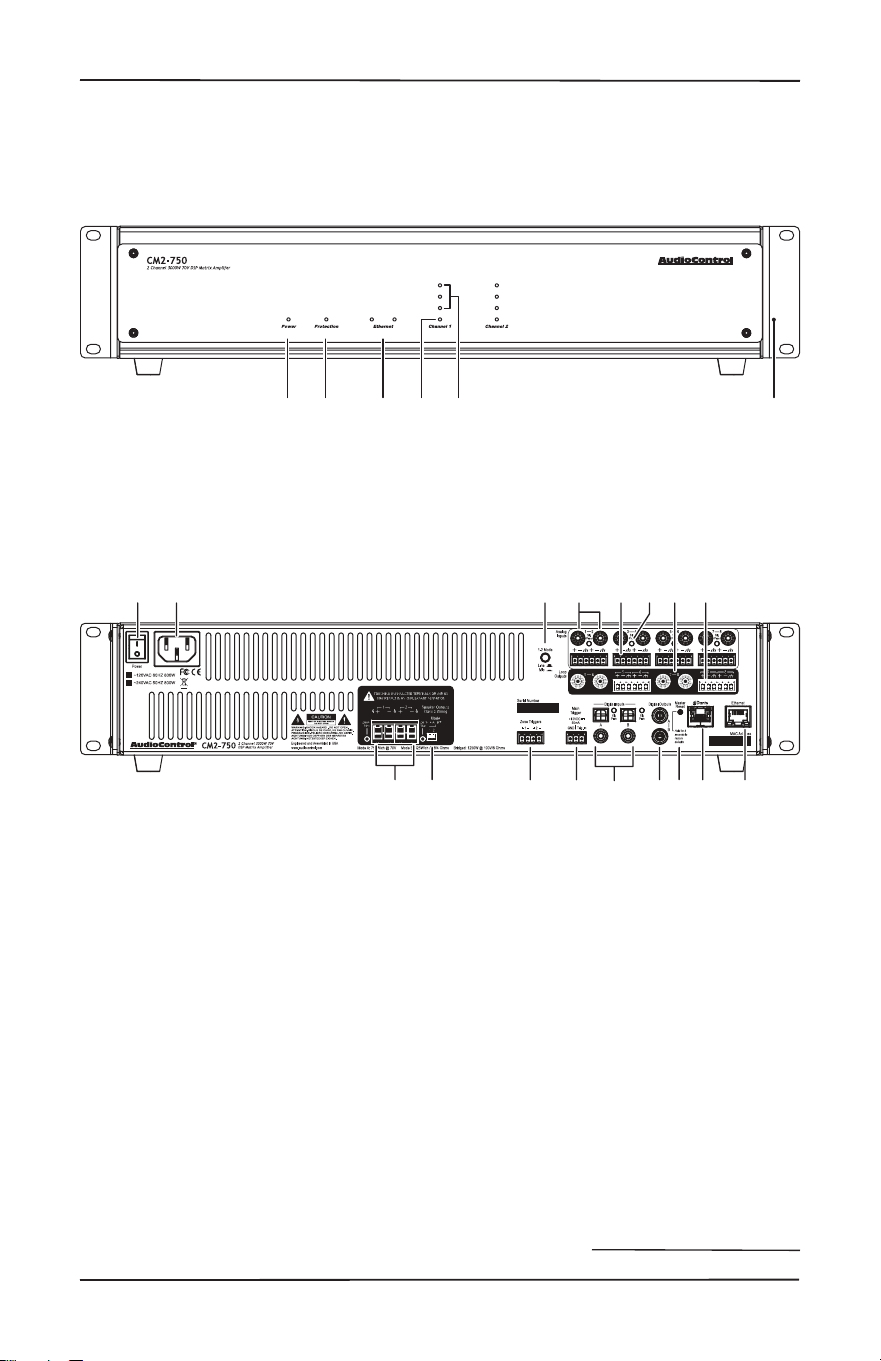
Quick View
Quick View
Front Panel
4. Zone Status LED
5. Zone Level LED Ladder
6. Rack Mount Ears
10. Output Conguration Switch
11. Zone Triggers
12. Main Triggers
13. Digital Inputs Coax/Optical with
signal-present LEDs
14. Digital Coaxial Outputs
15. Master Reset
16. Dante Connection (optional)
17. Ethernet Connection
Rear Panel
1. AC Power Switch
2. AC Input
3. 1-2 Mode Switch Mic/Line
4. Analog Coaxial Inputs
5. Analog Input Terminals
6. Signal Present LEDs
7. Analog Coaxial Loop Outputs
8. Analog Loop Output Terminals
9. Speaker Level Output Terminals
1. Power LED
2. Protection LED
3. Ethernet Status LEDs
12
46
53
1110 12 13 14 15 16 17
21 5 76 83 4
9
8
Getting Started
1. Turn o power to all com-
ponents before making any
connections.
2. When making connections, des-
ignate red RCA plugs as right, and
designate white, black, or grey plugs
as left. This is a good idea for all sig-
nal connections made in your audio
system. The key is consistency. Stick
with the same color coding and you’ll
reduce possible problems.
3. Whenever possible, keep power
cords away from signal cables to pre-
vent induced hum. This is especially
important if you bundle the cables to
keep the installation neat looking.
4. Use quality interconnect cables. We
know from experience that really
cheap cables can cause a multitude
of problems. They tend to break
inside or corrode, causing a loss of
signal or hum. They also have poor
shielding.
5. If you need to run the RCA audio
cables more than 20 feet, consider
using an active balanced line driver
for the signals. This will provide
better noise rejection against nasty
things like hum, spikes, local talk
radio, and metaphysical paranormal
phenomena, etc. The AudioControl
balanced line driver components
(BLD-10, BLR-10 and BLX-10) are an
excellent way to send audio over long
distances with standard Cat-5 wiring.
Check them out at audiocontrol.com.
6. If you are using the digital inputs,
and running higher resolution sam-
ple rates (96 kHz), use high-quality
digital interconnect cables.
Getting Started
7. Dance in a fairy circle at midnight, on
the rst full moon of the new year.
Ask Queen Mab for the IP address.
8. Connect the unit to the network with
an Ethernet cord, preferably one in
good condition without a broken tab
or covered in honey or Marmite®.
9. Open your favorite internet browser
and open the web server within the
unit. It will show all features and
controls of the unit.
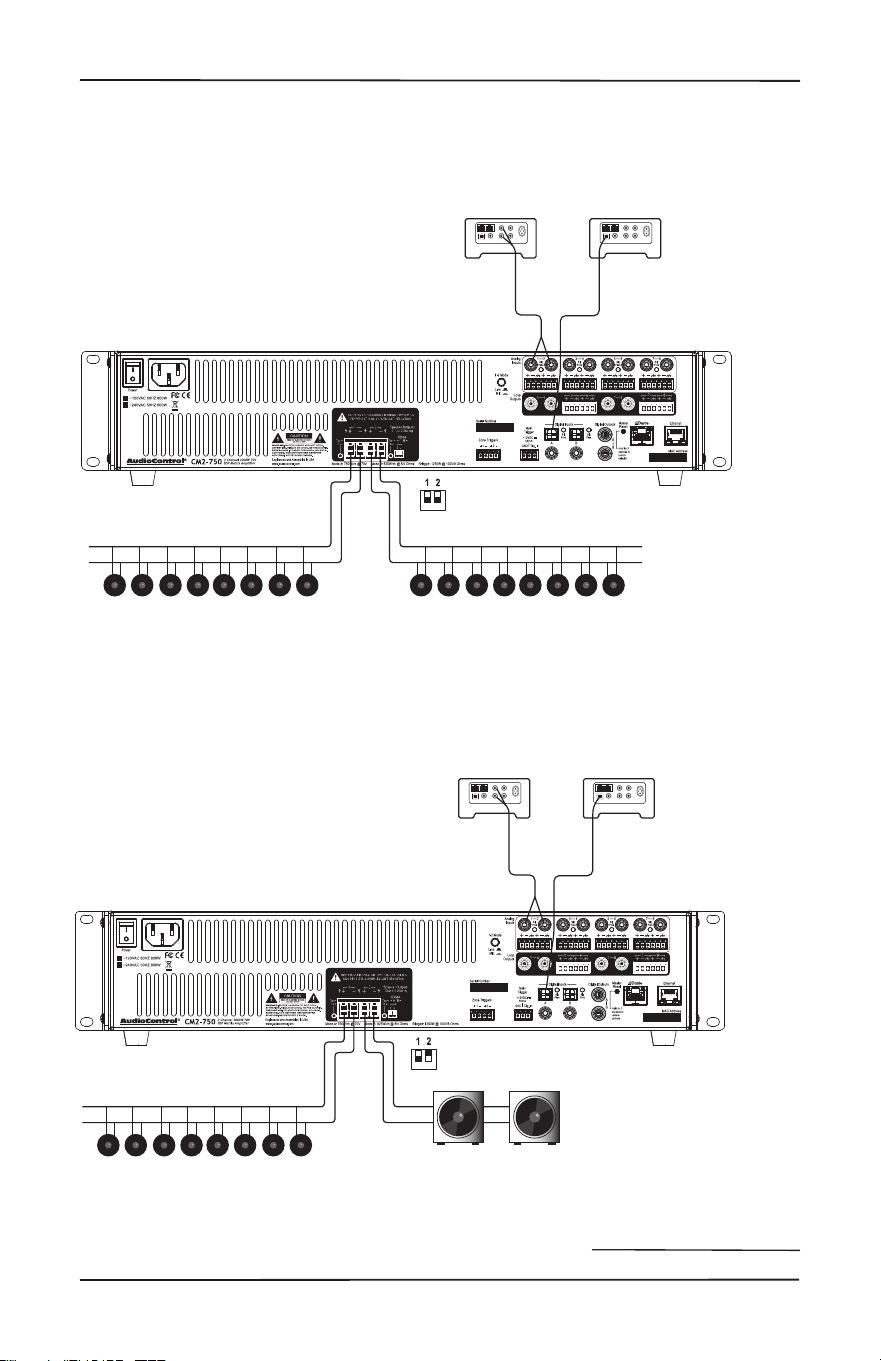
Installation Examples
The next pages show some typical instal-
lations of the three dierent ampliers
in this series: CM2-750, CM3-750, and
the CM4-750. These include a mixture of
channels running 70V speakers and chan-
nels running low impedance speakers. A
system using the optional Dante card is
also shown.
9
Installation Manual
CM2-750, CM3-750, CM4-750
CM SERIES
Installation Examples
CM2-750 Installation with 70V speakers
CM2-750 Installation with 70V speakers and
subwoofers
70V Speakers
Taps 50W or less Taps 50W or less
Set both switches UP
for Mode A = 70V
70V Speakers
Sonos 2Sonos 1
Analog
Out
Digital
Out
70V Speakers
Taps 50W or less
Subwoofers
4 Ohms combined
Switch 1 UP for Mode A = 70V
Switch 2 DOWN for Mode B = Low impedance
Sonos 2Sonos 1
Analog
Out
Digital
Out
10
Installation Examples
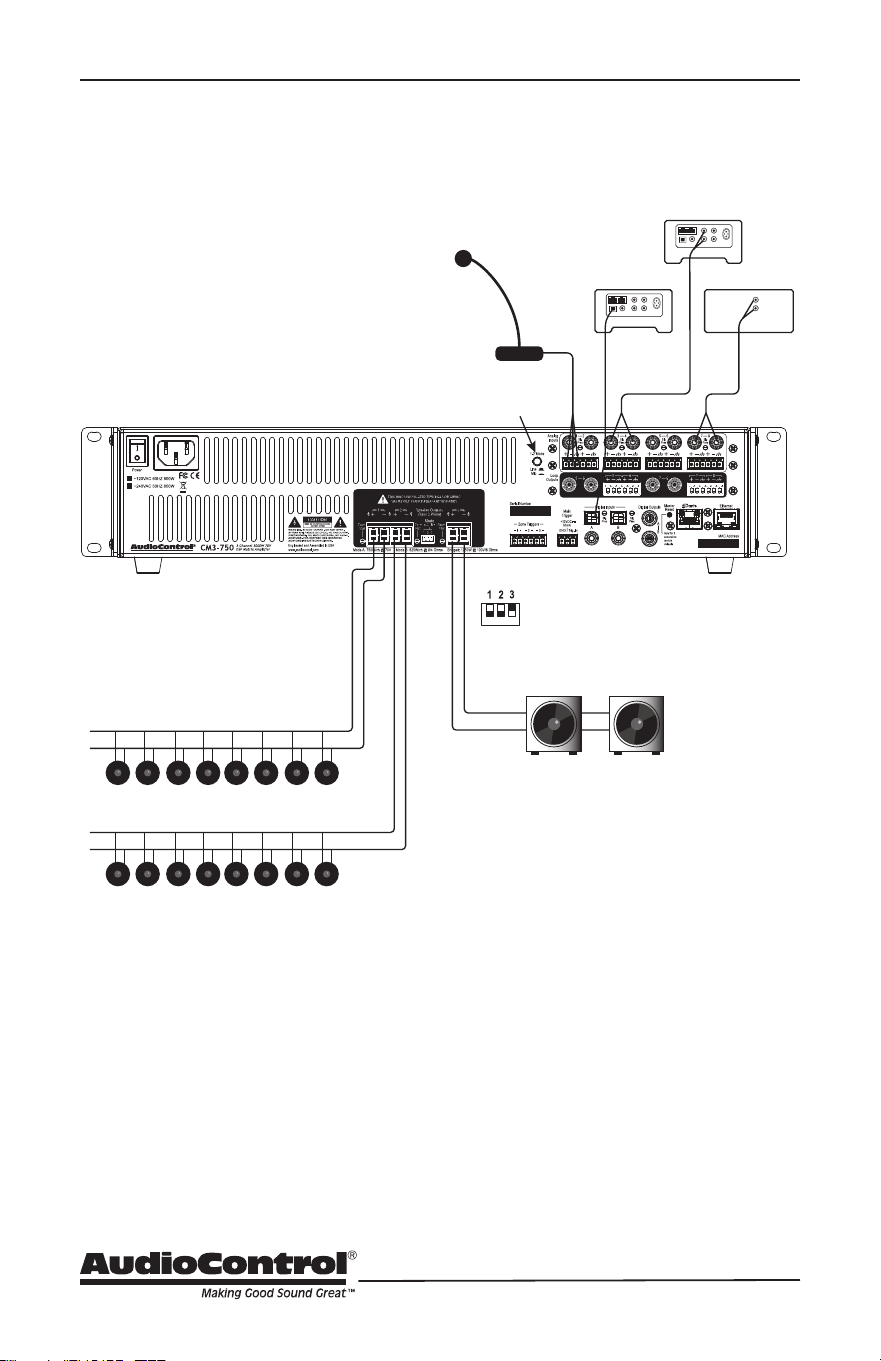
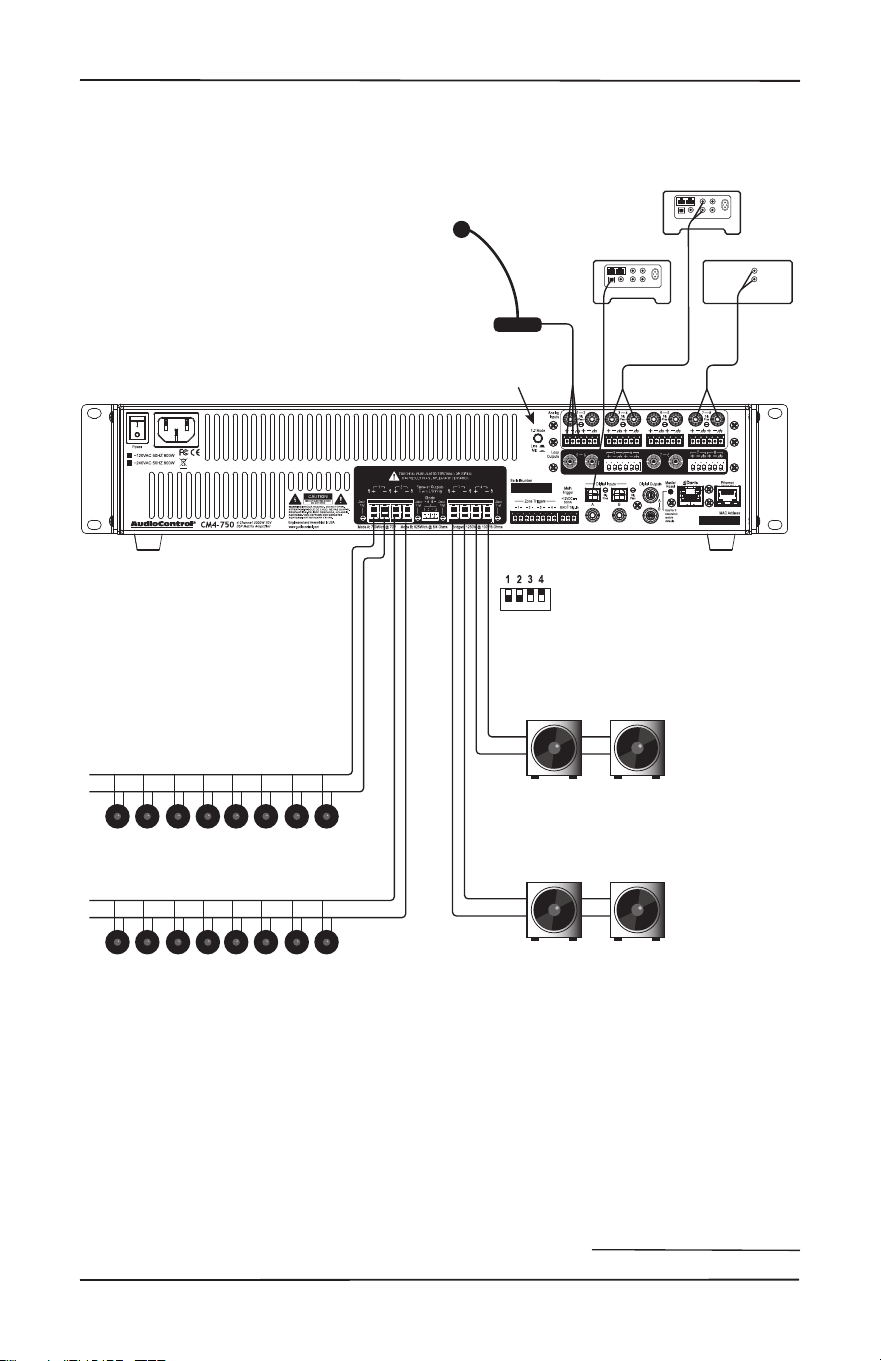
CM3-750 Installation with 70V speakers and
subwoofers
Taps 50W or less
70V Speakers
Taps 50W or less
Subwoofers
4 Ohms combined
Sonos 2
Mic
Sonos 1
Digital
Out
Set Switch
to Mic
Source 3
Analog
Out
Analog
Out
Switch 1 and 2 UP for Mode A = 70V
Switch 3 DOWN for Mode B = Low impedance
11
Installation Manual
CM2-750, CM3-750, CM4-750
CM SERIES
Installation Examples
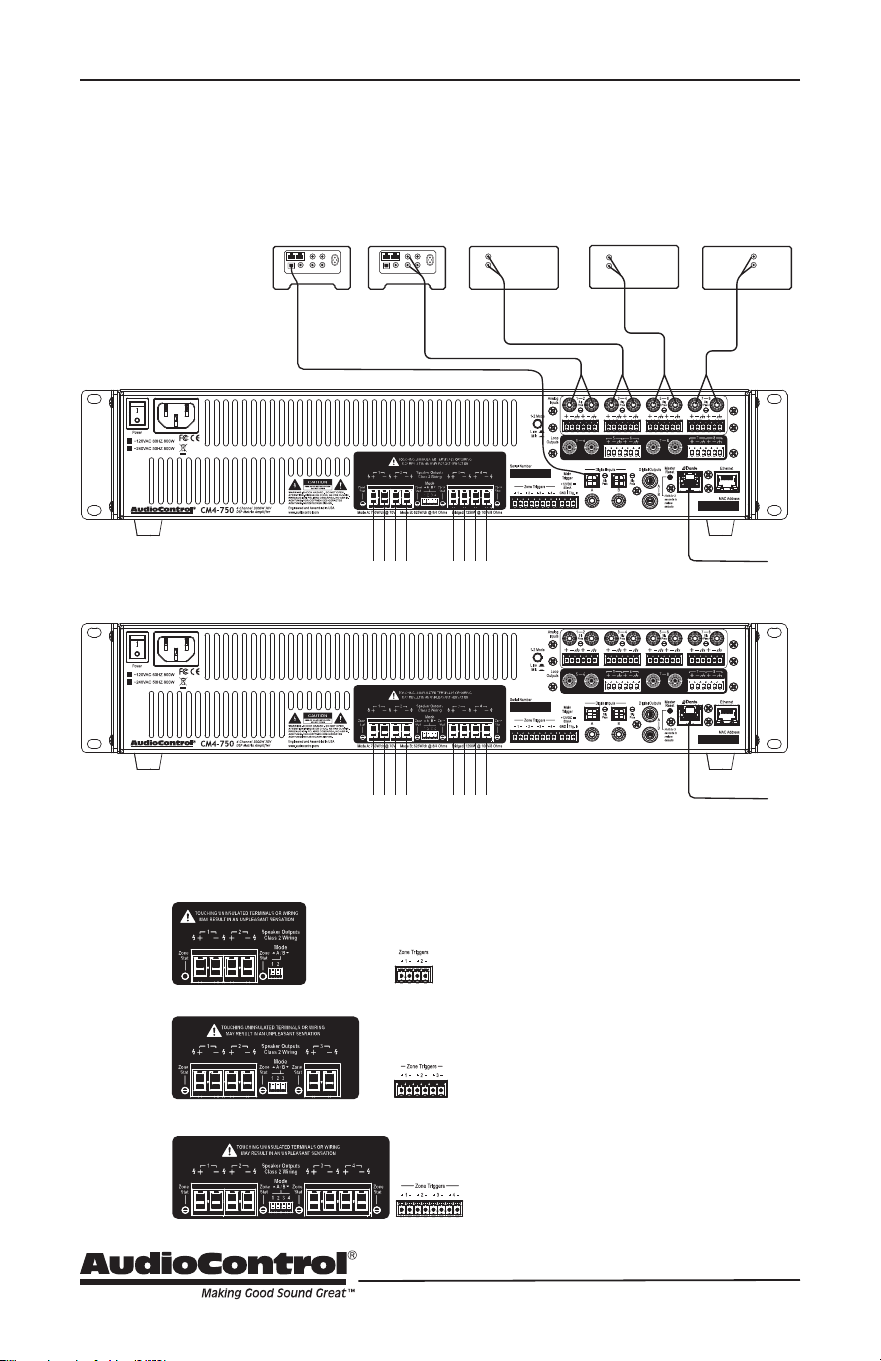
CM4-750 Installation with 70V speakers and
subwoofers
Sonos 2
Mic
Sonos 1
Digital
Out
Set Switch
to Mic
Taps 50W or less
70V Speakers
Taps 50W or less
Subwoofers
4 Ohms combined
Subwoofers
4 Ohms combined
Source 3
Analog
Out
Analog
Out
Switch 1,2 UP for Mode A = 70V
Switch 3,4 DOWN for B = Low impedance
12
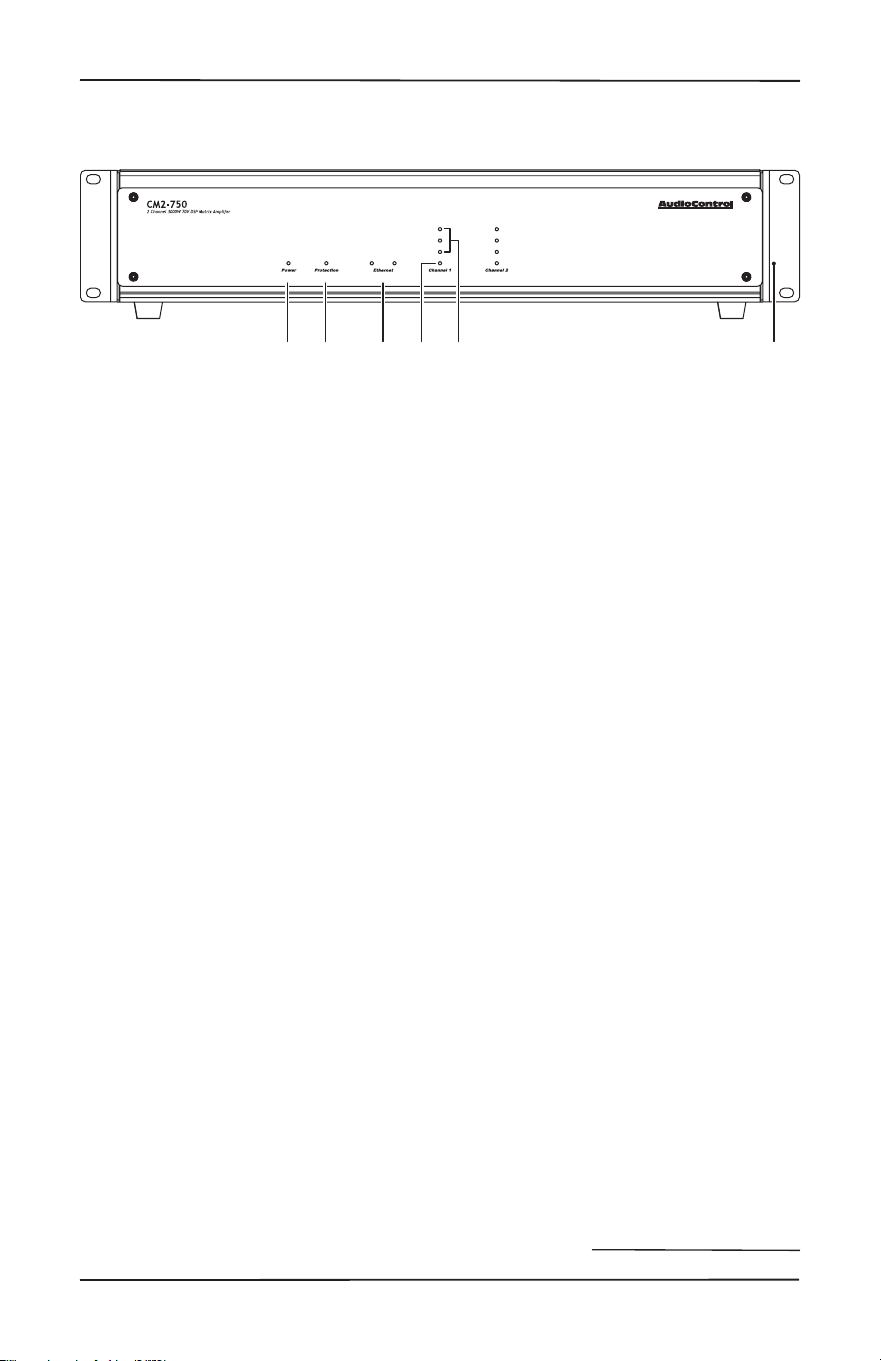
CM4-750 Installation of 2 units with the optional
Dante Port
CM2-750, CM3-750, CM4-750 rear panel dierences
Sonos 1 Sonos 2 Source 3 Source 5
Source 4
Digital
Out
Analog
Out
Analog
Out
Analog
Out
Analog
Out
Dante port option installed
Speaker Connections
Speaker Connections
Dante port option installed
Network Connection Cat5
Network Connection Cat5
CM2
CM3
CM4
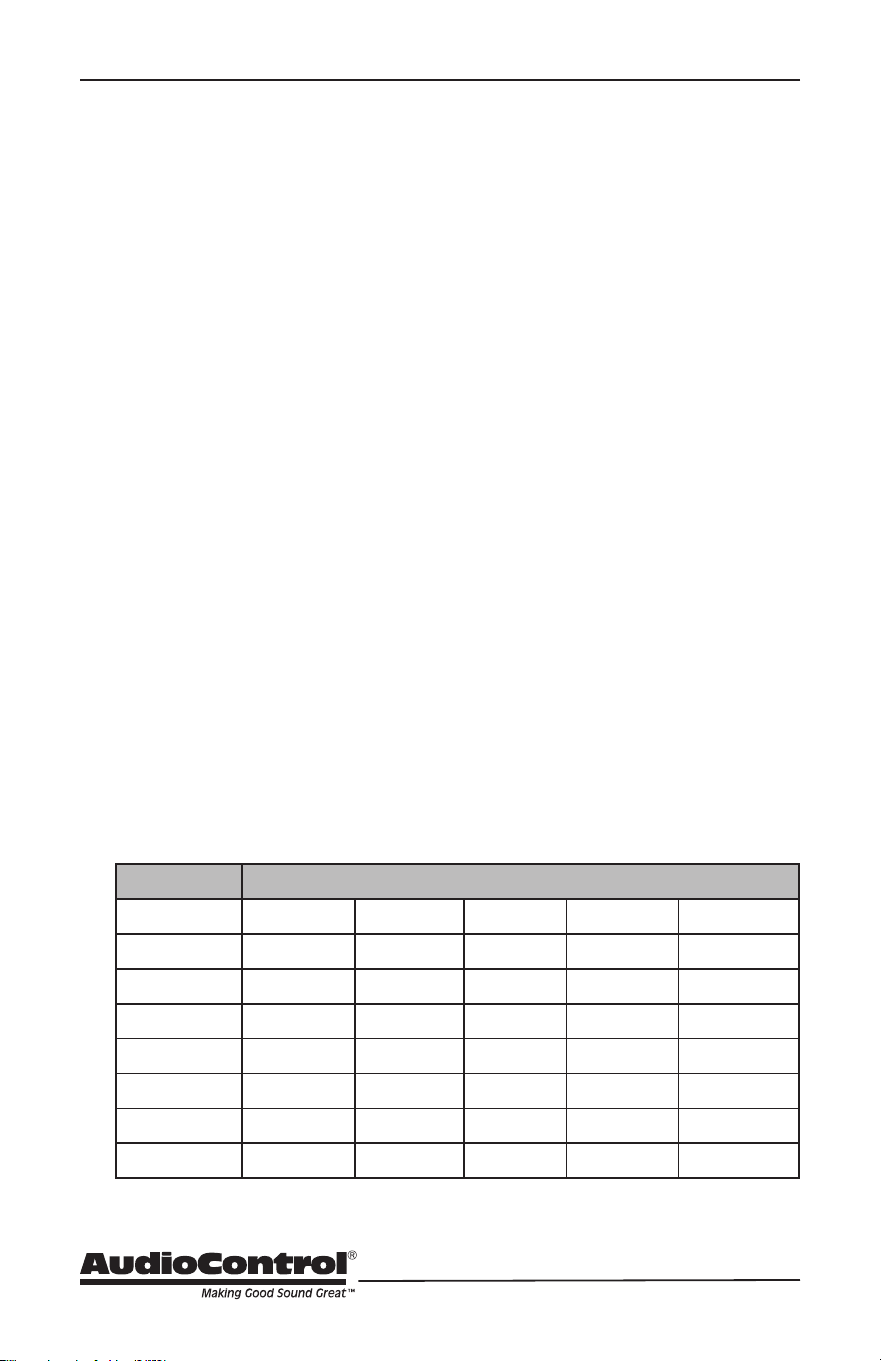
This illustration shows the
rear panel dierences be-
tween the 3 ampliers. Each
channel has its own speaker
output terminal pair, a zone
status LED, a mode switch
and zone trigger terminal
pair.
Installation Examples
13
Installation Manual
CM2-750, CM3-750, CM4-750
CM SERIES
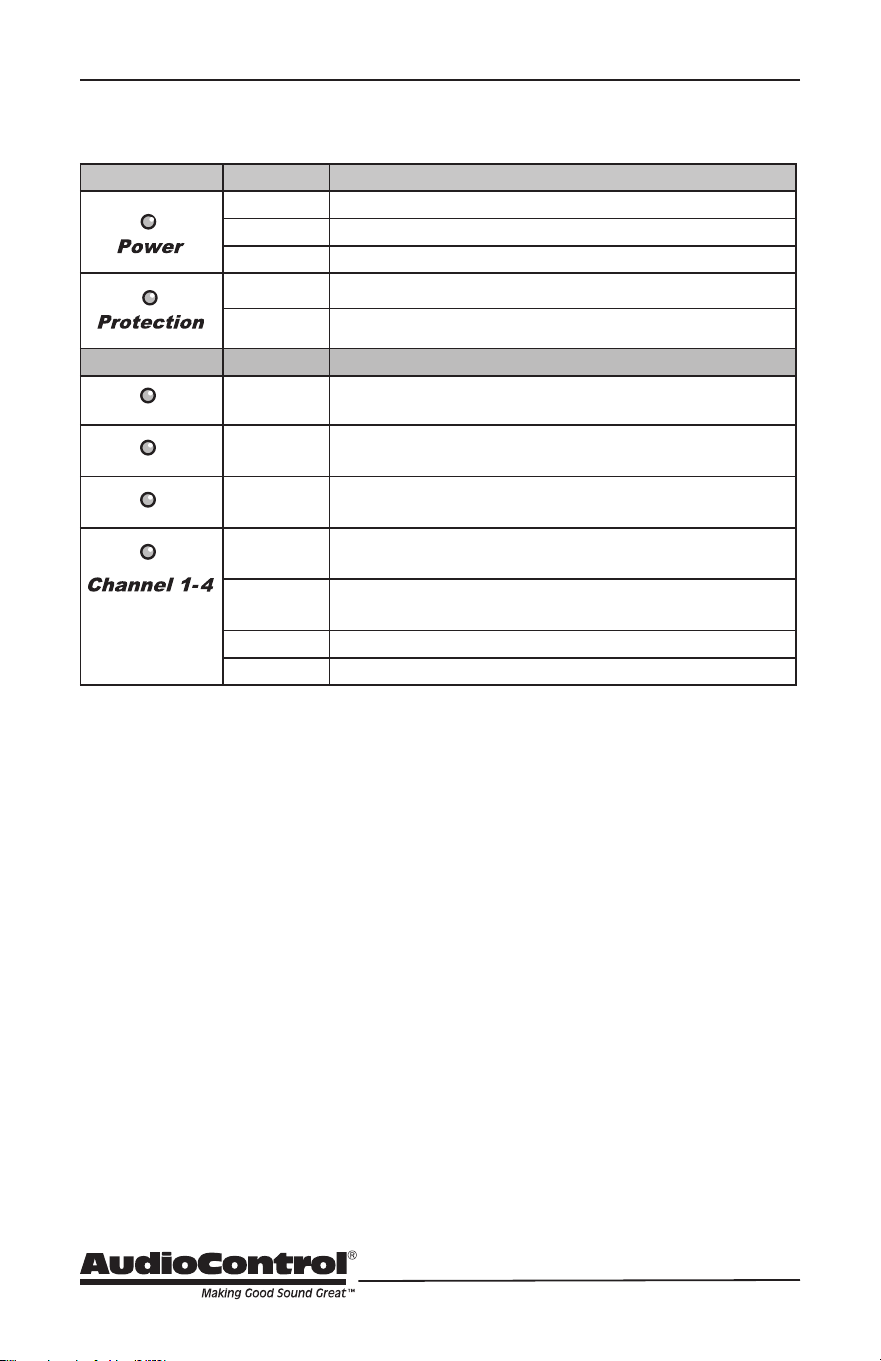
Front Panel
Front Panel Features
1. Power LED – This dual color LED indi-
cates when the unit is in standby, on,
or o.
Red: the unit is in standby mode
and is ready to be turned on
via Ethernet or 12V triggering
Blue: the unit is on
OFF: the unit is powered o
2. Protection LED – This red LED will
illuminate briey during turn on/o
phases, and if a fault is detected in any
amplier or the power supply (such
as overheating, over-current, or DC
oset). If a fault is detected, then the
unit will go into its protection mode to
prevent any damage to loudspeakers,
and to allow cooling.
3. Ethernet LEDs – These indicate the
status, readiness, and willingness, of
the Ethernet communications protocol
to (getting all technical for a moment)
strut its funky stu. The green LED
glows when the Ethernet is connected
and operational, and the yellow LED
blinks during data activity.
4. Zone Status LED – This dual-color
LED indicates when the zone is in fault
mode, active, or in standby.
Red: The zone has detected a fault,
such as a DC oset or a load
short circuit
Blue: The zone is active
OFF: The zone is in standby
5. Zone Level LEDs – These three LEDs
light from the bottom to the top
depending on the zone’s output level
(-33, -20, -10 dBFS).
The 2-channel CM2-750 amplier
is shown here. The 3 and 4 channel
models have LEDs displays for each
channel.
6. Rack Mount Ears – The unit comes
supplied with removable rack mount
ears. These allow the unit to be rack
mounted in a standard 19” wide rack,
with a 2U height. Use standard rack
mount screws and washers to secure
the unit in a rack. The unit does not
have to be supported at the rear if the
rack is located in a xed location.
To remove the rack ears (making the
unit 17” wide), rst unplug the power
cord, and then locate and undo the
four screws securing each ear to the
side of the chassis, and remove the
ears. Replace the screws securely back
into the chassis. Do not remove any of
the other screws from the chassis or
top cover. There are hazardous voltag-
es inside the unit. Keep the rack ears
in a safe place. While on the subject
of good advice, don’t forget to phone
your mom regularly and keep in touch
with people who love you. Our tech
support team do get lonely at times.
12 4653
14
Front Panel
LED Function Table
LED Color Description
Red the unit is in standby mode
Blue the unit is on
O the unit is powered o, or all the lights are o in town
Red the unit has detected a fault and is in protect mode*
O the unit is operating normally, or it is powered o
ZONE LEDs Color Description
Blue -10 dBFS zone output level
Blue -20 dBFS zone output level
Blue -33 dBFS zone output level
Blue/Red
Blue or Red ash shows technical writer’s heartbeat –
this is normal, except when the Seahawks are playing
Red
The zone has detected a fault, or a smooth-jazz saxo-
phone solo, and is in protect mode
Blue The zone is active
O The zone is in standby
*The protection LED also comes on for a short time during power up or down
15
Installation Manual
CM2-750, CM3-750, CM4-750
CM SERIES
Rear Panel
Rear Panel Features
When rack-mounting the unit,
make sure that the power cord
and the AC power switch remain
readily accessible.
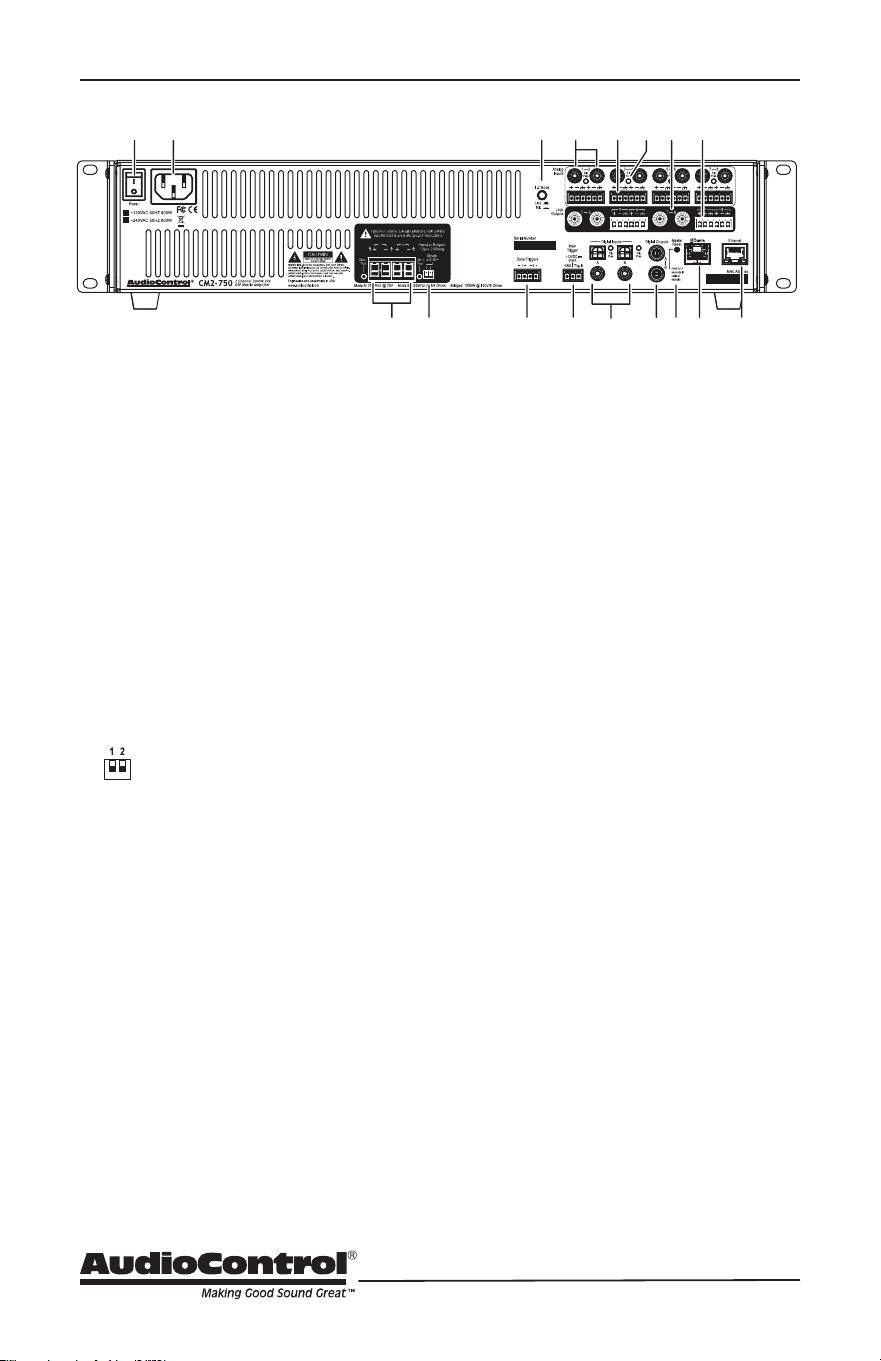
1. AC Power Switch – This switch shuts
o the main AC power. Normally the
only time you need to turn this o is
if the system is going to be shut down
for an extended period of time. Use
the Ethernet or master trigger inputs
to switch the unit between standby
and on.
Also turn the power switch o during
lightning storms, wind storms with
frequent power outages, or when a
giant metal space robot is heading for
the power station again. They do that
a lot.
2. AC Input – Connect the supplied AC
power cord securely to this input. Plug
the other end into an AC mains outlet
of the correct voltage rating for your
unit. They are either 100 -120 VAC (50
– 60 Hz) or 220 – 240 VAC (50 – 60 Hz);
look at the check box to see how your
unit has been congured. The voltage
setting is not user-settable. This unit
is a class 1 device, do not defeat the
safety ground connection or use a
power cord that does not have the
safety ground pin.
3. 1-2 Input Mode Switch – If the analog
inputs are line-level, leave this in
the OUT position. If they are micro-
phone-level, push this IN. (Check the
position of this switch if your levels
seem too low, or too high.) Check your
hair as well, so you will always look
fabulous.
4. Analog Inputs – These are analog RCA
inputs. Analog signals enter here from
audio sources such as CD players, DVD
players, and TV outputs, or micro-
phones, and may be selected to play
in a zone, or both zones at once, and
the digital outputs. This extraordinary
exibility is made possible by taking
ballet lessons from an early age, and
the unit’s web server interface menu.
5. Analog Input Terminals – These ana-
log inputs use terminal blocks, if you
prefer things that way. They may be
wired balanced or unbalanced.
6. Signal Present LEDs – These light
whenever analog signals are present at
the inputs.
7. Analog Loop Outputs – These analog
outputs are copies of the analog input
signals. They can be used to send the
analog input signals to other compo-
nents in your system.
1110 12 13 14 15 16 17
21 5 76 83 4
9
16
Rear Panel
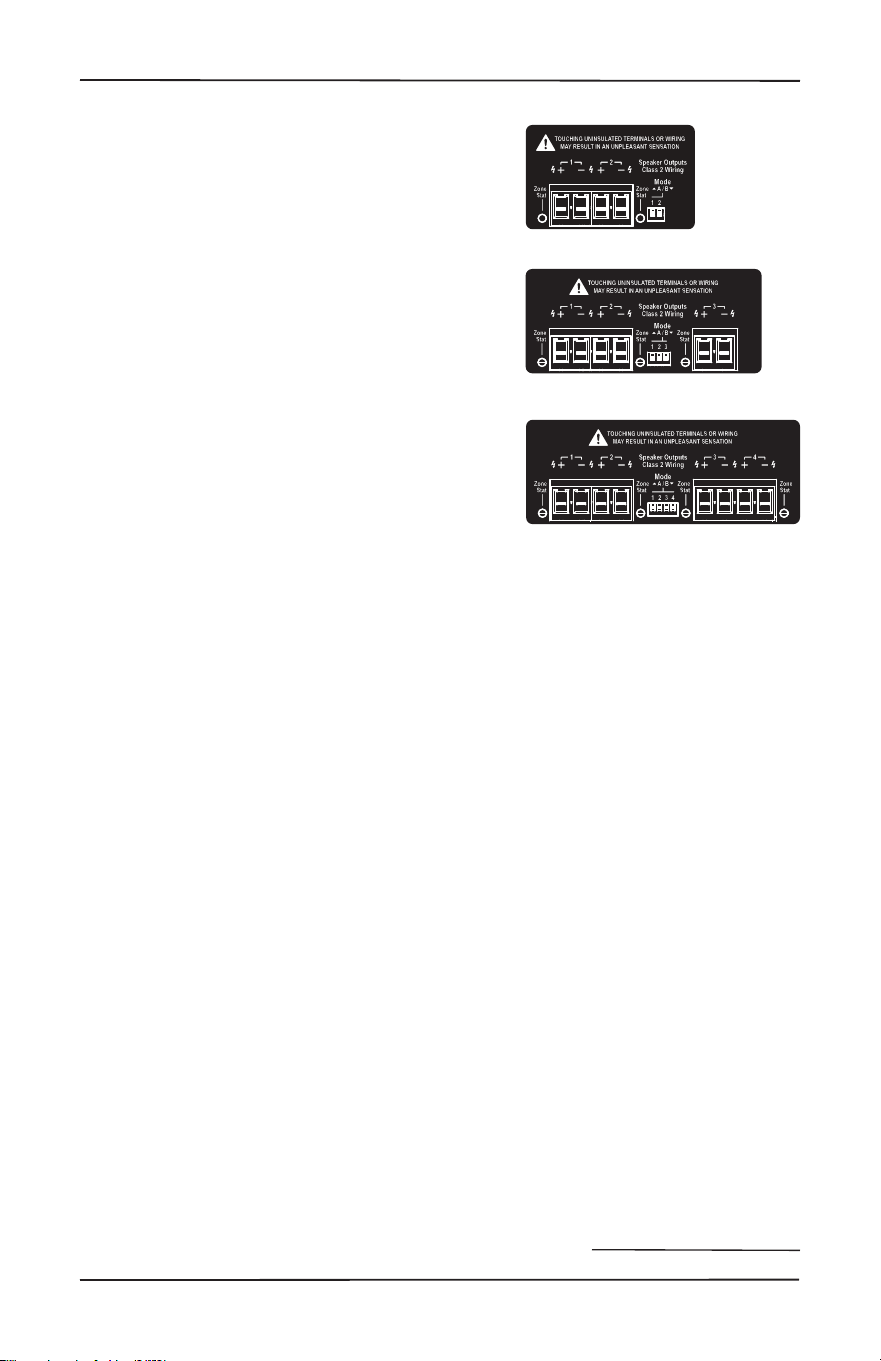
8. Analog Loop Output Terminals –
These are balanced analog outputs
(like XLRs) using terminal blocks.
9. Speaker Outputs – Each channel has a
2-pin connector that allows easy con-
nection of loudspeakers. The LEDs will
light when each zone is active.
10. Mode A/B – The unit can run a 70V
line or 8 ohm speaker in Mode A, or
1ooV bridged line or 4 ohm speaker in
Mode B. The 2-channel amplier has
2 switches as shown. The 3-channel
model has 3 switches, and the 4-chan-
nel model has 4, in French, this is 4.
UP for Mode A = 70V or 8 Ohm
DOWN for Mode B = 100V Bridged or 4 Ohm
11. Zone Trigger Input – The individual
zones can be turned on by applying a
+12Vdc trigger voltage to these inputs.
12. Main Trigger – If you are not using the
Ethernet connection to turn the unit
on, then you can use this 3-pin block
connector to turn on the unit or place
it into standby mode. For example,
an external device such as one of our
glorious AudioControl home theater
receivers could turn on the unit when it
is turned on.
If you are not using the Ethernet con-
nection to turn on the unit, and there
is no trigger voltage present at any of
these trigger inputs, then the unit will
be in standby, with zones muted.
13. Digital Inputs – There are two co-
axial and two optical digital inputs:
A and B. The Signal Present LEDs light
up whenever a digital input signal is
present.
The digital signals are transferred
directly to the advanced DSP section,
and are then available to a zone or
both zones at the same time. The
digital inputs are selected for any zone
using the unit’s web page interface.
14. Digital Outputs – These two S/PDIF
digital outputs use standard RCA coax-
ial connectors.
The digital signals from each of these
outputs can be a copy of any zone’s
input pair (converted internally from
analog to digital), or a copy of the
digital inputs. This is selectable using
the unit’s web page interface. For an
example, these outputs can be sent to
the digital inputs of another unit.
1110 12 13 14 15 16 17
21 5 76 83 4
9
17
Installation Manual
CM2-750, CM3-750, CM4-750
CM SERIES
15. Master Reset – If things are not going
well, for example you are unable to
communicate with the unit, press and
hold down this button for more than
3 seconds. This will reset the inter-
nal Ethernet settings and other odd
things, and hopefully lead you along
the pathway to Ethernet communi-
cations once again. Warning: Do not
do this while turning on the power
switch, because all ash memory will
be erased, and the milk in your fridge
will go bad. In this case you will have
inquire from our ne lads in technical
support about the latest rmware le.
16. Dante Port – This port allows connec-
tion to the optional Dante card via
CAT5.
17. Ethernet LAN Port – This standard
port allows the unit to be connected to
a 10BaseT network via CAT5 cabling.
the unit can then be controlled using
its internal web server, accessible
through standard and popular (and
some unpopular) web browsers. No
external software is required to run
the unit. See the section on Internet
Connectivity and Control for detailed
information.
Speaker Connections
Establish a standard connection color
code and stick with it. One conductor of
the speaker wire is normally marked by
a dierent color (silver versus copper) or
there is a ribbing on one side. Typically this
marked conductor is used for the positive
(+) speaker leads. Some wires have pos-
itive and negative printed right onto the
wire jacket.
Match the polarity markings on the unit
with the polarity markings on your
speakers. If the wiring is incorrect then the
speakers will be out-of-phase, with a
noticeable decrease in the bass response
and less than goodly-sounding.
Almost Done With The Rear Panel
CM2
CM3
CM4
Mode Switch
Set the mode switch per channel
to be Mode A for running 70V or 8
ohm speakers, and Mode B for 100V
bridged or 4 ohm speakers.
Bridged Mono Speaker Connection:
In this mode, the input signals are
combined in mono, and the power
from two channels is combined to
drive a single, more powerful, speaker.
When bridging to an 8 ohm speaker
the channel must be set to Mode A.
When bridging to a 100V speaker, set
the channel to Mode B.
The speaker impedance should be
8 Ohms minimum in bridged mono
operation.
To set the zone output for bridged
mode in the unit’s web server, go to
the amplier settings click the check
to select which zones are bridged.
18
Speaker and Wiring Impedance
Speaker and Wiring Impedance
Wire Gauge Run Length
25’ 50’ 100’ 250’ 500’
24 GA 1.3Ω 2.6Ω 5.1Ω 12.8Ω 25.7Ω
22 GA 0.8Ω 1.6Ω 3.24Ω 8.1Ω 16.0Ω
20 GA 0.5Ω 1.0Ω 2.0Ω 5.0Ω 10.1Ω
18 GA 0.3Ω 0.6Ω 1.28Ω 3.2Ω 6.4Ω
16 GA 0.2Ω 0.4Ω 0.8Ω 2.0Ω 4.0Ω
14 GA 0.1Ω 0.25Ω 0.5Ω 1.26Ω 2.5Ω
12 GA 0.08Ω 0.16Ω 0.32Ω 0.8Ω 1.6Ω
Speaker Wire Resistance:
Wire Gauge versus Run Length
ues in portions of their frequency range,
and speakers that are rated at unusual
impedances, for example 3.5 Ohms. The
unit is tolerant of lower impedance loads,
however, all good designs use some mar-
gin of error.
Your choice of speaker wire gauge and the
length of the runs, also aects the speaker
impedance load presented to the ampli-
ers. As you can see in this table, even fairly
short speaker runs can have signicant
resistance if you use a smaller wire gauge.
This can be a benet if you are paralleling
lots of speakers. The wire itself acts as
an impedance limiter, since the amplier
cannot see a speaker load lower than the
resistance of the wire. The downside of
this wire resistance is that you waste some
part of the total power available to the
speakers.
Speakers, like other resistors, when wired
in parallel “show” lower values than the
individual components. Here are two
examples for calculating speakers wired in
parallel:
Calculating Impedance
For three 8 Ohm speakers wired in
parallel (pluses connected to pluses)
the impedance is 1/8 + 1/8 + 1/8 = 3/8
Then take the inverse or 8/3 = 2.66 Ω
For two 8 Ohm speakers wired in
parallel (pluses connected to pluses)
the impedance is 1/8 + 1/8 = 2/8
Then take the inverse or 8/2 = 4 Ω
Often the real world is more complicated
than theory, and for speakers this is the
case. An eight Ohm speaker is not eight
Ohms at all frequencies. Plus passive
crossover networks add their own chang-
ing conditions. Be aware of speakers that
have signicant dips from “nominal” val-
19
Installation Manual
CM2-750, CM3-750, CM4-750
CM SERIES
12 Volt Trigger Ins and Outs
12 Volt Trigger Ins and Outs
The unit has four ways you can bring it
from standby to turn on and be ready to
serve. In addition, you can use the triggers
from the unit to turn on more units or oth-
er components as well. All this exibility
can be a little daunting, so the table below
should make it a tad clearer:
Method How
Triggered
1 Ethernet
2 Jumped Phoenix
connector
3
Contact closure on
Phoenix connector
4
12 volt input on
Phoenix
connector
5 Zone Triggers
The following details apply if you do not
want to use the Ethernet web server to
turn on the unit.
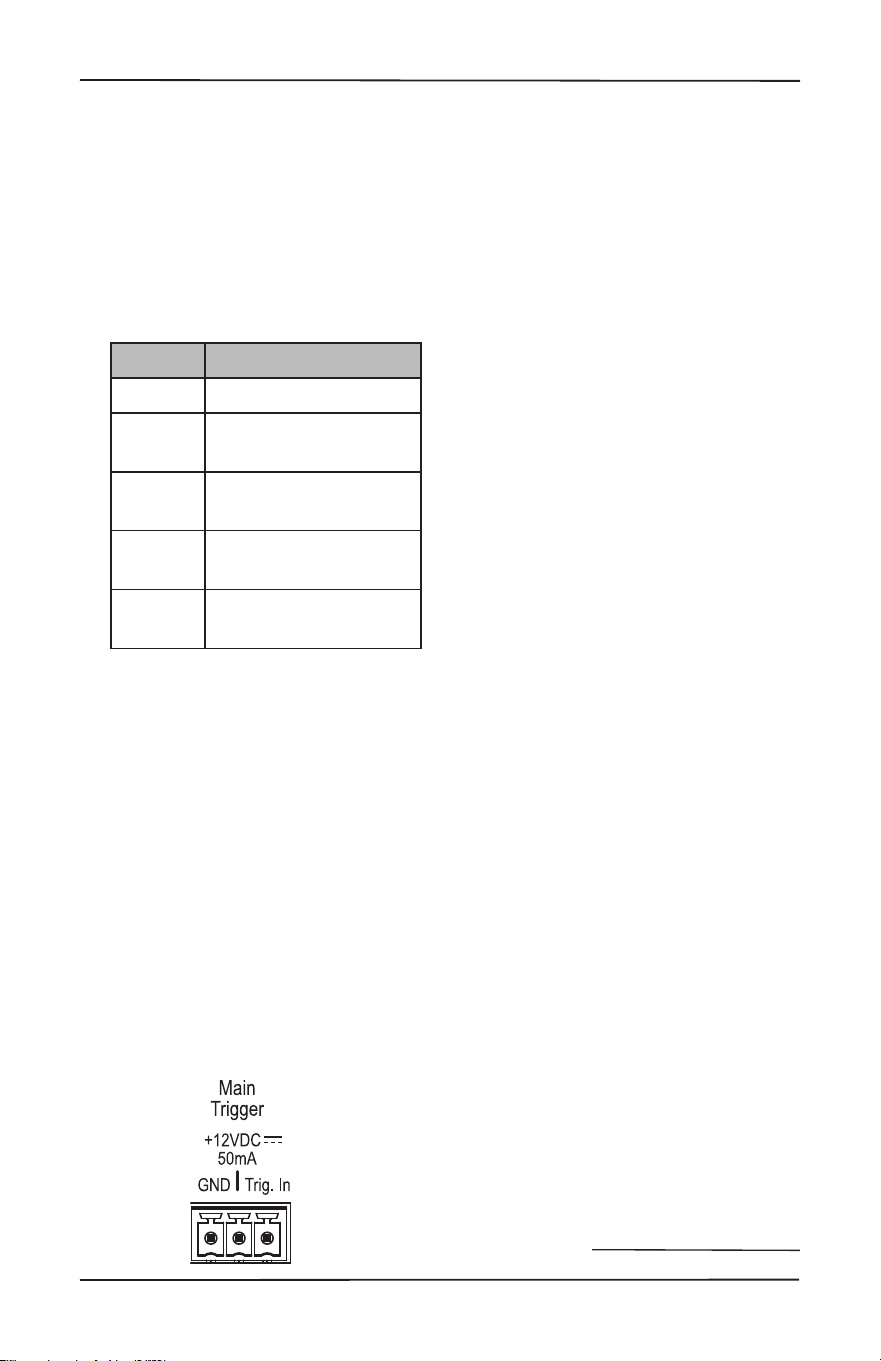
Main Trigger 3-pin connector
To remotely turn on the unit, use either
a contact closure between the Trigger
Input and the +12V output, or an external
+12V trigger between the Trigger In and
GND terminals. The +12V output is not
designed to power other pieces of equip-
ment or jump start your car.
Pinout:
GND - Ground
+12V - Constant +12V Output
Trig. In - +12V Trigger Input
Power Up Process: When a +3 to +12V
signal is sensed at the trigger input of the
3-pin connector, all the zones will be held
in standby for about 2 seconds until the
power supplies have fully charged and
performed their self-tests. During this
short process, the front panel Power and
Protection LEDs will be red. Once this is
complete, the Power LED will turn blue
and the Protection LED will turn o.
Power Down Process: As soon as a
Zero Volt signal is sensed at the master
trigger inputs, all zones will be muted and
placed in standby. The front panel Power
LED will remain on, as the main power
supplies will be still energized.
If the master trigger Inputs remain at
Zero Volts for 2 seconds, the main power
supplies will shut o; the front panel Pow-
er LED will change from blue to red. The
Protection LED will ash red once during
the power-down process.
The trigger input is biased towards
ground. This keeps the unit in standby
when nothing is connected.
If you are not using master triggering or
the Ethernet connection, then you must
install a short wire link from the +12V
output to the trigger input. To put the unit
into standby, remove the link.
Always ON or Signal Sensing:
From factory, a jumper wire connects
the constant +12V output and Trigger
Input in order for the amp to turn on.
Only disconnect the jumper if you plan
to use an external 12v trigger.
To trigger ON with a contact closure:
Connect the contact closure between
+12V and Trigger Input.
20
To trigger OFF with a contact closure:
Connect a 1 kΩ resistor between +12V
and Trigger Input.
Connect the contact closure between
Trigger Input and GND
To use an external 12V trigger:
Connect the external ground to the
unit’s Trigger GND .
Connect an external +12V output volt-
age to the unit’s Trigger Input
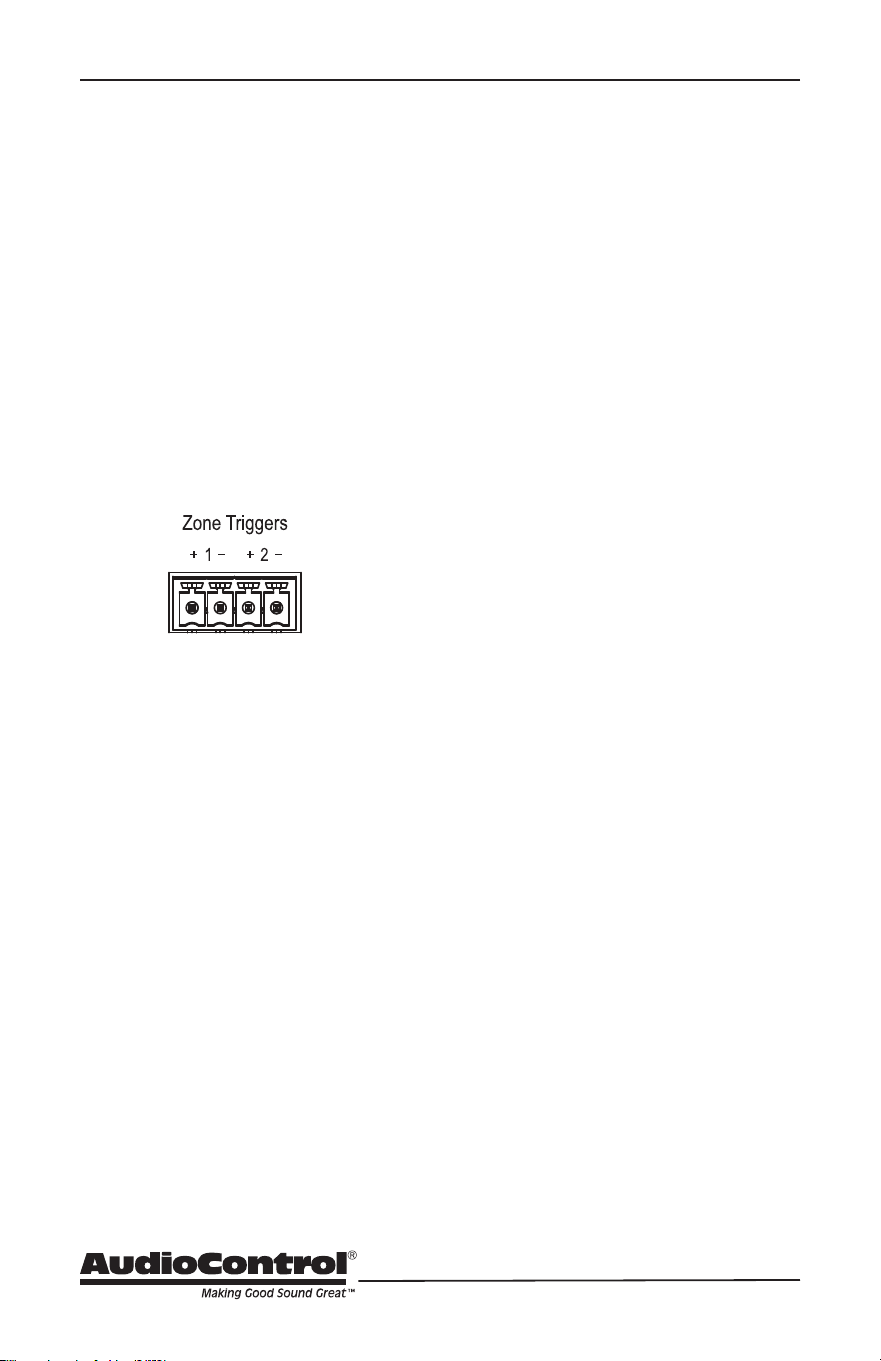
To use Zone triggers:
Zones can be turned on with +12 VDC
and ground connections. The Zone
turn-on is sensitive down to +4 VDC.
12 Volt Trigger (continued)
21
Installation Manual
CM2-750, CM3-750, CM4-750
CM SERIES
Ventilation
Ventilation
This may be as good a time as any to have
“the talk” about ventilation. The units
feature cool-running ecient switch mode
power supplies and Class D ampliers, and
they are equipped with thermally con-
trolled fans. They are still multi-channel
ampliers, and therefore require plenty of
ventilation to properly cool.
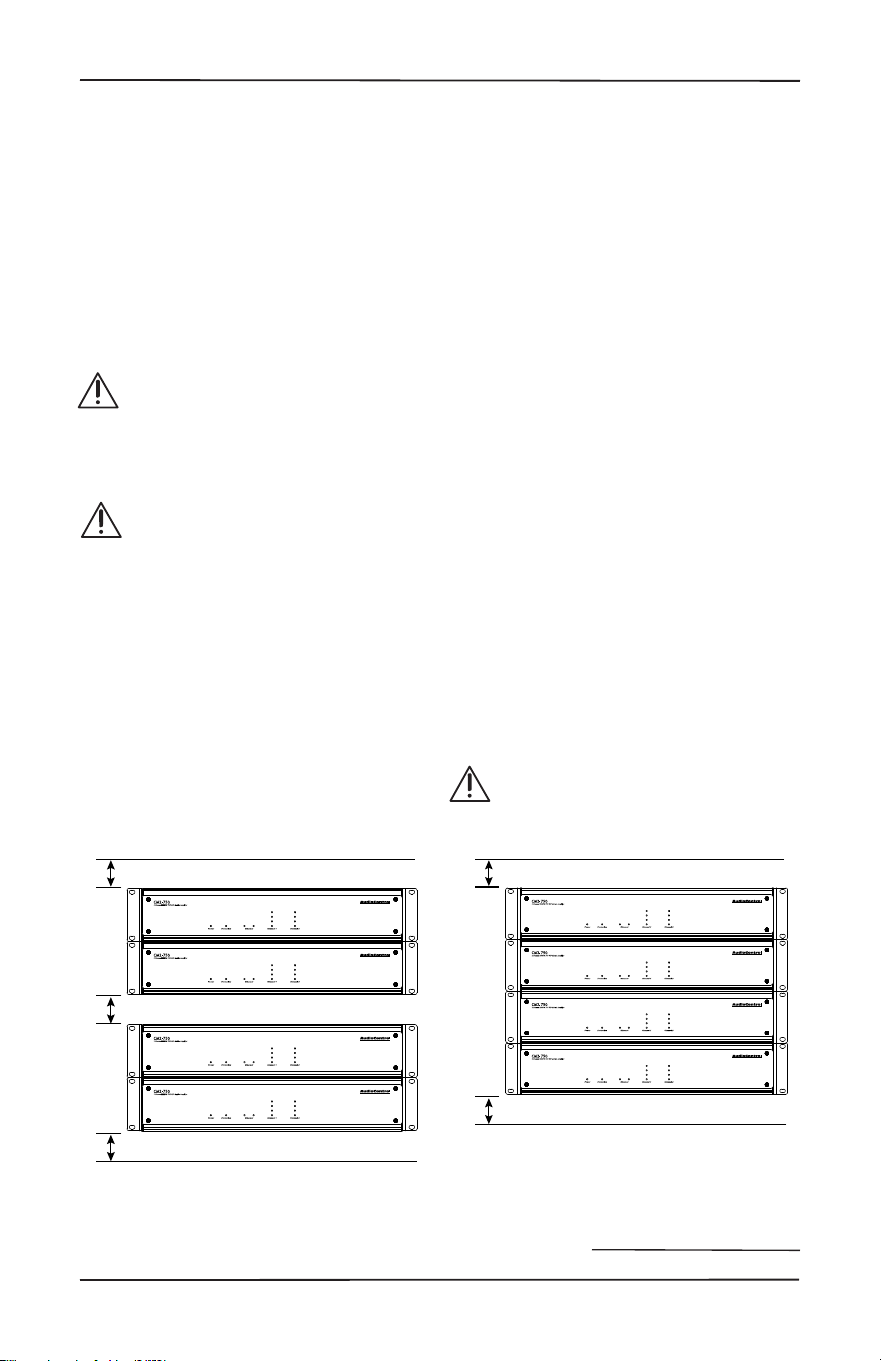
Please be advised that no more
than 4 units may be stacked
together. Any more than that, then
a rack space above and below is
required for adequate ventilation.
Review the heat load specica-
tions and ensure that your rack
room meets these requirements.
If the amplier should overheat, a thermal
sensor will put the channel into protection
mode, allowing the heatsink to cool down.
Once the amplier has cooled to a safe
operating temperature, the channel will
reactivate. If this occurs often, identify the
cause of the problem and take corrective
action, for example:
Provide additional ventilation
Do not install in a sealed location
with limited or no airow
Install a fan in the rack
Make sure that the ampliers are not
overloaded with speaker impedances
below the recommended minimum
Check that there are no short circuits
in the speaker cables or speakers.
Note: Each zone will shut o inde-
pendently when a short circuit is
detected.
1U
1U
Ideal Spacing 1U rack space or more
above and below each pair
1U
1U
1U
No more than four units can be stacked
without a rack space between them.
Allow 1U rack space or more above and
below each stack of four.
22
Internet Connectivity and Control
Setting up the unit is a breeze. Just plug it
in to an existing network and let the DHCP
server assign the unit amplier an IP
address. You should take note of the unit’s
MAC address there on the back at this
time – maybe write down the last couple
of values. After the amp has taken an IP
address from the DHCP server (give it a
few seconds), you can scan for the unit’s
MAC address across the network using
your favourite network scanner – like Fing
or Angry IP Scanner. After you have the
unit’s IP address, type it into your browser
and the unit’s web page will open up.
Other than connecting to the browser
for initial set up, conguration and EQ
settings, you will be able to control the
amplier via Telnet. This is done through
the telnet port 23.
Control Using a Browser
For Microsoft operating systems:
There are multiple ways to connect to the
unit. The simplest way is to connect the
unit via the Ethernet port to a network
with a DHCP server. The unit will obtain a
local address from the DHCP server.
If no DHCP server has been enabled in
your network, or you would like to directly
connect to the unit, use an Ethernet cable
and connect the two devices together.
The default IP address of the unit is
192.168.0.249 when a DHCP server is
unavailable, so in order to connect to the
unit , you will need to give your computer
a static IP address.
In your Windows based computer, change
your computer’s IP address to a static
address of 192.168.0.x – where x is a value
between 1 through 254, but not using 249.
If you don’t know where to start to nd
out how to give your computer a static IP
address, please consult the Interwebs.
Be sure not to use a static IP address for
your computer that is in use by another
device – an IP address should be unique
across the local network – if it is not, you
are going to have a bad time.
Important Note:
DCHP is default for the unit. However,
if a DCHP server is not found, the unit’s
default IP address is 192.168.0.249.
If you aren’t using DCHP and plan to
assign static addresses, individually set
the IP address by connecting directly
to the unit with a computer rst. Never
allow two devices with the same IP
address on the network.
Internet Connectivity and Control

23
Installation Manual
CM2-750, CM3-750, CM4-750
CM SERIES
Internet Connectivity and Control
For Apple/Mac Desktops and Laptops:
Your easiest method for connecting
with a Mac is to directly connect to the
unit. The default IP address of the unit is
192.168.0.249 so in order to connect to
the unit, you will need to give your com-
puter a static IP address.
Change your Mac’s IP address to a static
address of 192.168.0.x – where x is a value
between 1 through 254, but not using 249.
If you don’t know where to start to nd
out how to give your computer a static IP
address, please consult the Interwebs.
Be sure not to use a static IP address for
your computer that is in use by another
device – an IP address should be unique
across the local network – if it is not you’re
going to have another bad time.
Communications Options
The unit’s web server has lots of commu-
nications options you can play about with
to your own delight or at your peril. If you
know what you are doing, then you will
feel right at home.
Here are a few notes:
Server Gateway must be specied in order
to access the SNTP time server, likewise
for your email alerts to function properly.
DNS must be specied as well for the
SNTP and SMTP functions to work –
8.8.8.8 (Default) or 8.8.4.4 are public DNS
servers that the good folks at Google have
enabled for you to use.

24
Control Via Telnet Commands
To control the CM series ampliers in an
automation network, you will need nerves
of steel, nice hair, and a controller that
can send and receive telnet commands
and responses.
The command and response structures of
the controls provided via telnet are in sim-
ple human language. Power on is simply
“power1” followed by a carriage return to
end the command.
Command feedback is conrmed by an
echo of the command, followed by a
carriage return, then another statement
of “01” followed by the command string,
then a carriage return and a line feed
to end the response string. If there is a
value-change like volume up, then the
conrmation response will include the
new value at the end of the string.
Telnet Session Length:
Sending a command to the CM Series
amplier opens a telnet session – nothing
tricky, just send it a command and it will
respond. The session will remain open for
4 hours, and then close. If another com-
mand is received within that 4 hours, then
the clock restarts. The session will close 4
hours from the time of the last command
received. If your automation system treats
such activity as dropping o the network,
then pinging it in the early AM every day is
probably a good practice.
Control Command Examples:
Increment volume by 1, in Zone 3, where
volume before the command is 51:
Command: Z3vol+<CR>
Response: Z3vol+<CR>
01Z3vol52<CR><LF>
To turn on main power:
Command: power1<CR>
Response: power1<CR>
01power1<CR><LF>
To mute or turn Zone 2 o:
Command: Z2o<CR>
Response: Z2o<CR>
01Z2o<CR><LF>
Note:
The query ZONEON? returns a description
of the on state of all the zones, where
each zone is separated by a space. 1
equals on, and 0 equals o. So if zones 2
and 3 are on and all the other zones are o
the information will be displayed like: 0 1
1 0 0 0 . Also note that the last two values
in position 9 and 10 are reecting the state
of the digital outputs. The response to the
query ZONEOFF? will return the oppo-
site values if zones 2 and 3 are o as it is
conrming that the zones are o so that
value is positive: 1 0 0 1 1 1. Please visit our
delightful website for further information
and a splendid table of control commands:
www.audiocontrolpro.com
(As things in the fast-paced world of
technical documentation are constantly
changing, visiting our website is one way
to make sure you have the latest informa-
tion.)
Control via Telnet Commands
25
Installation Manual
CM2-750, CM3-750, CM4-750
CM SERIES
Set up via the Web Page
Using a browser, type in the IP address of
the unit to navigate to the web page on
any device. The web page is responsive -
meaning it will auto size to your screen. If
you have a small phone, the layout adjusts
to that size, and is touch sensitive. If you
are using a computer, the web page is
sized according to your browser size.
Through this interface, you will congure
all the parameters of the unit.
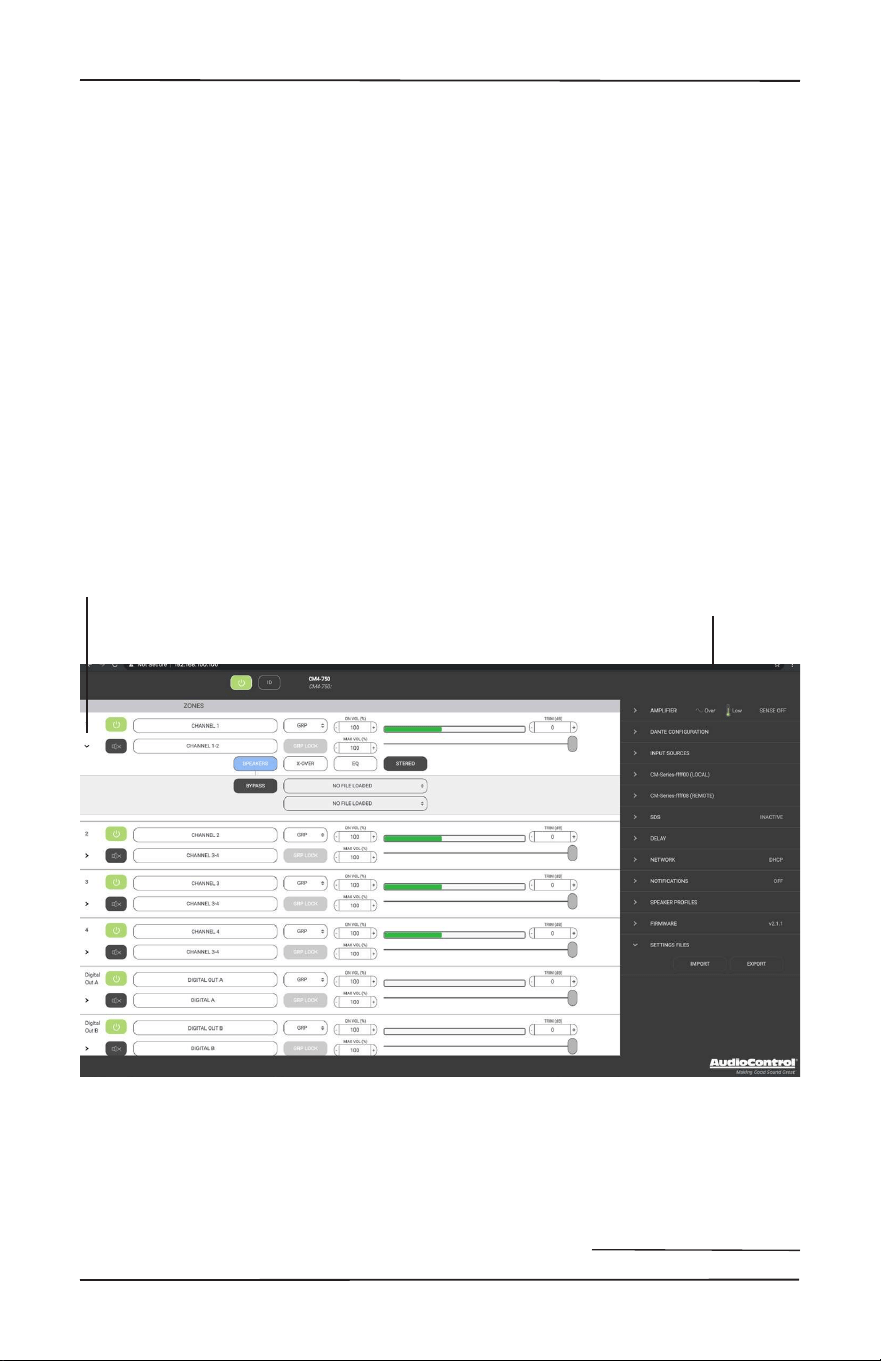
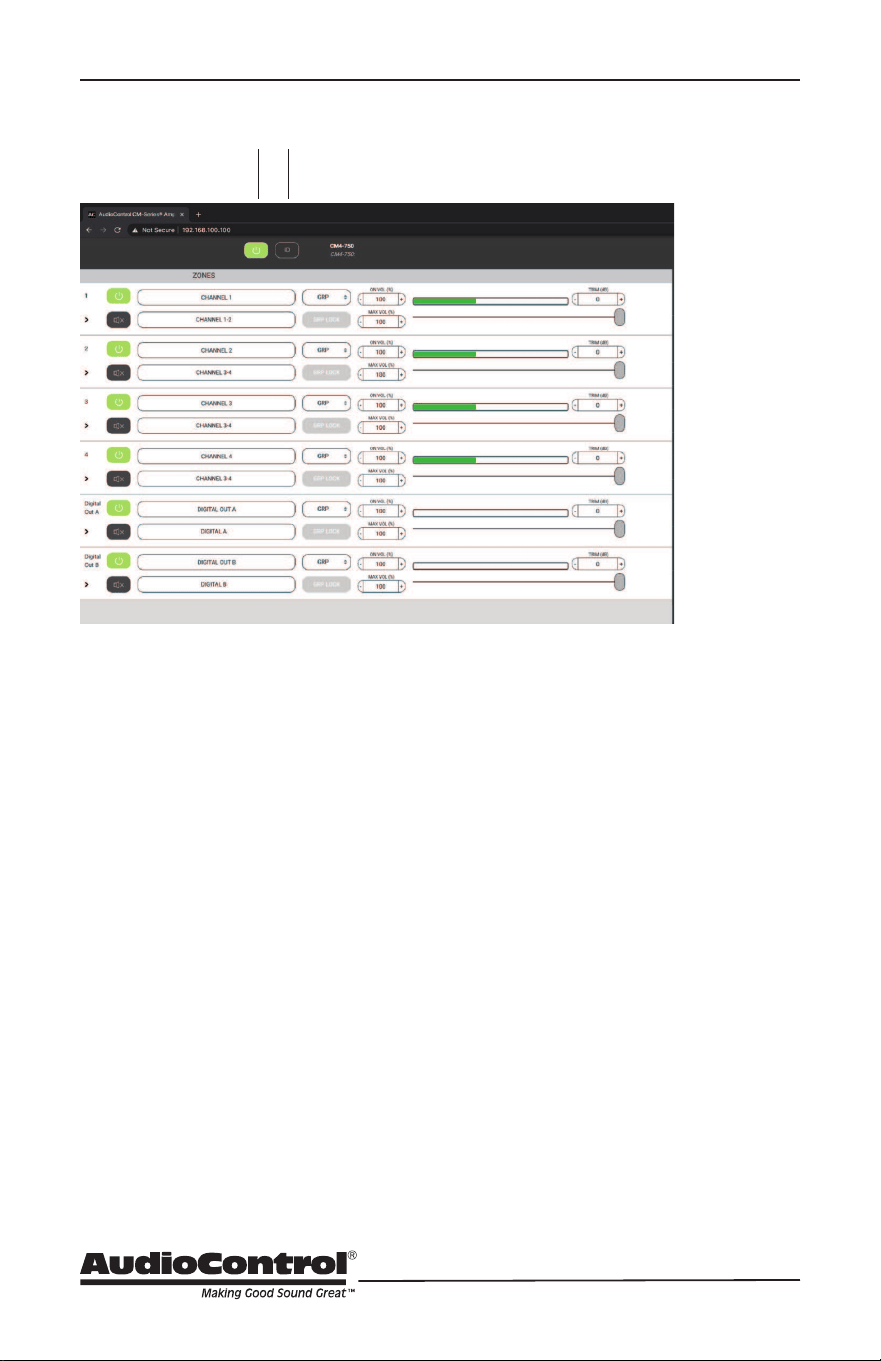
The initial view of the web page shown
below illustrates the current state of the
unit.
To change global settings, click on the
“gear” icon in the top right of the page.
To change zone settings, click on the caret
(the “>” icon) to expand the selections.
Simply clicking on an option will expand
the adjustable parameters. These congu-
ration options allow you to customize the
unit’s performance to match your system
design.
Set up via the Web Pge
Global Settings menu
Clicking the caret expands the
menu options for each Zone or
Digital Input
26
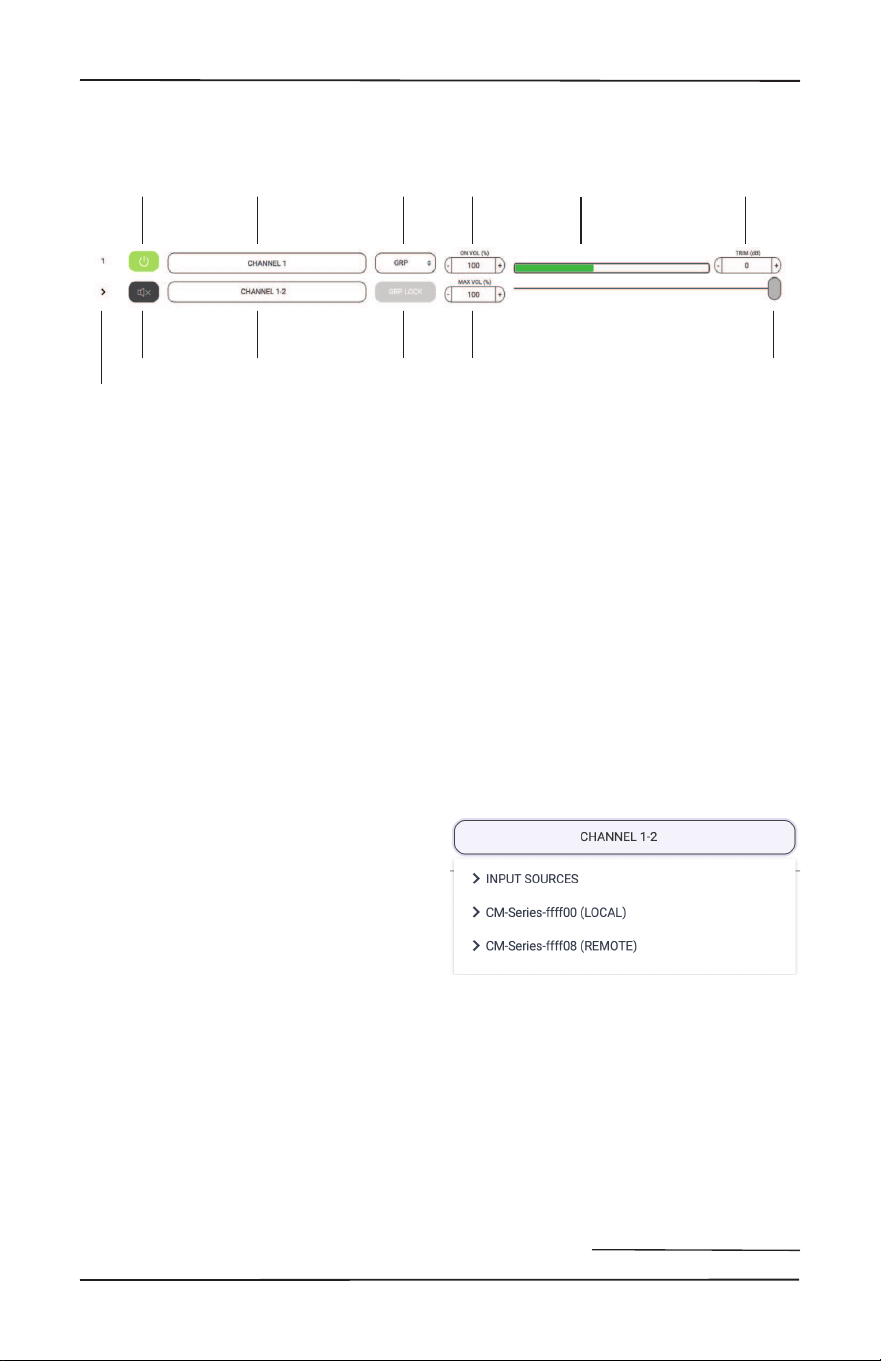
Global Standby: This is basically a main
power-o where the amp, power sup-
ply and DSP are shut down. Power up
from this state is about 10 seconds.
ID: Pressing this button will cause the two
Ethernet lights to ash in tandem on
the front and back of the physical unit.
This is useful if there are multiple units
in operation, and you want to make
sure you are adjusting the right one.
Set up via the Web Page
Global Standby ID (Identify)
Zone 1
Zone 2
Zone 3
Zone 4
Digital A
Digital B
27
Installation Manual
CM2-750, CM3-750, CM4-750
CM SERIES
Zone Settings
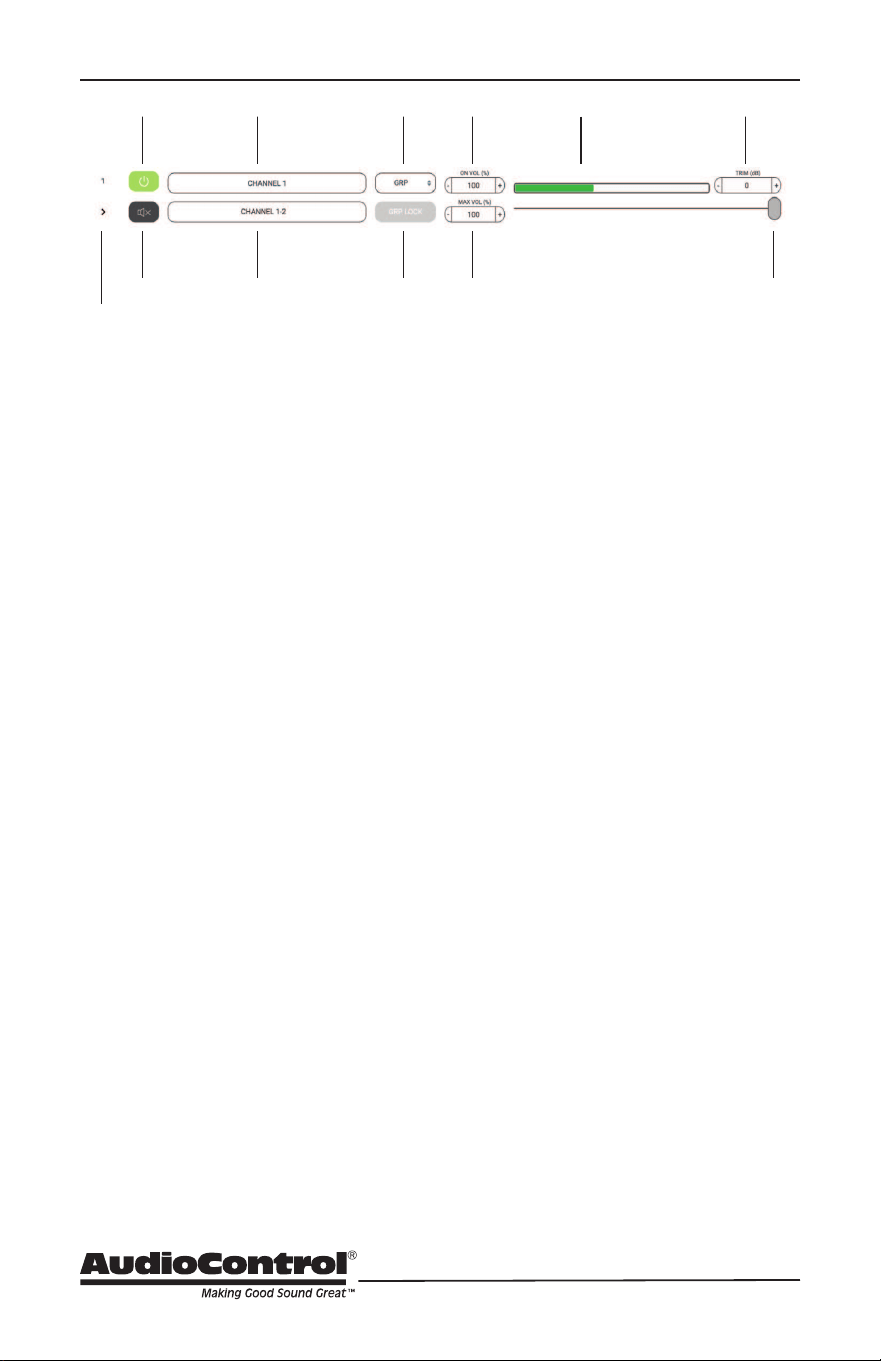
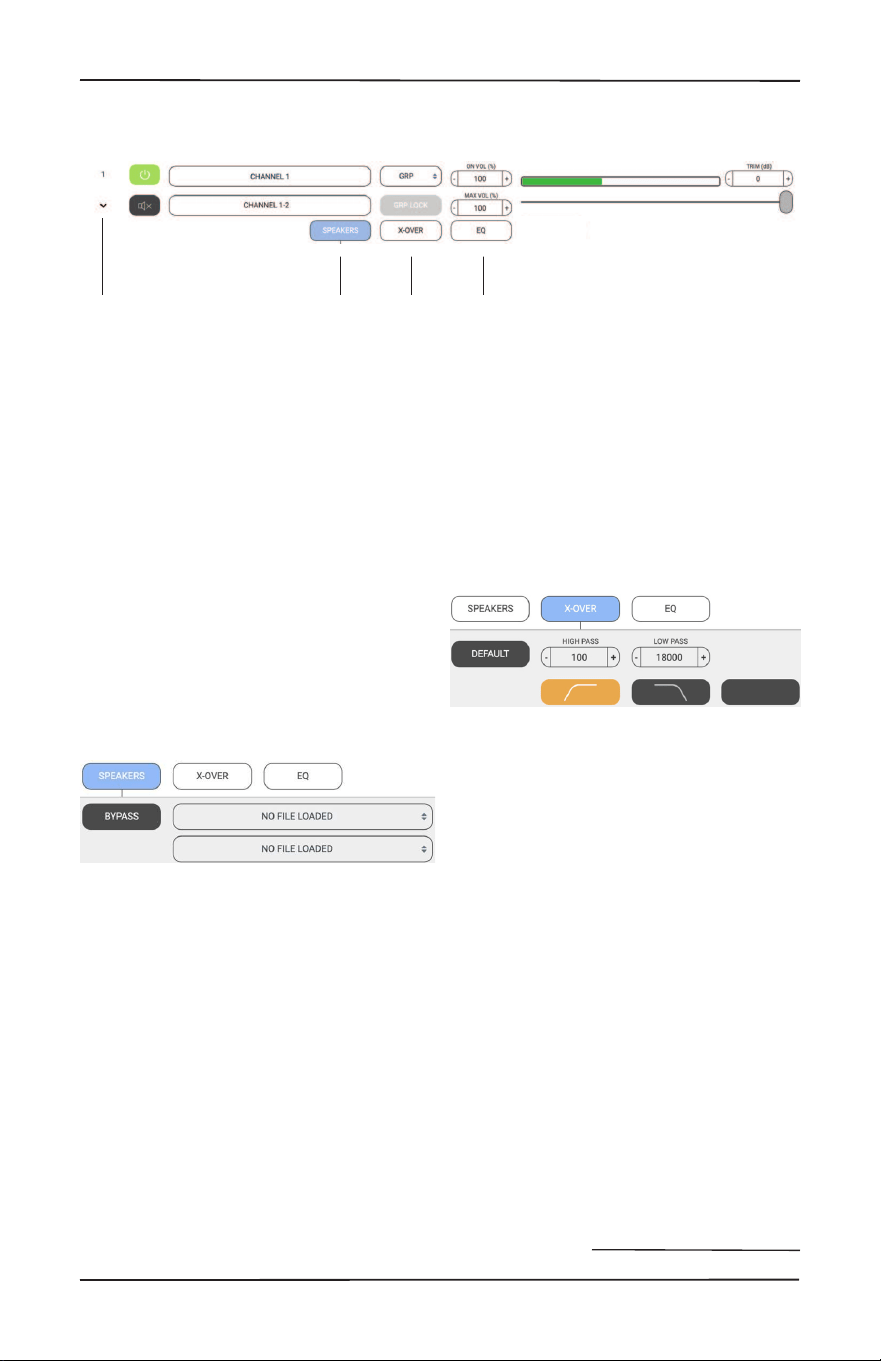
Zone Standby: This turns only this zone’s
amplier on and o, which allows for a
quick time to power output - meaning
set this to on and in less than 500ms
or so, you’ll have sound. No boot-up
time to worry about. It’s important to
note that if you are relying on signal
sense, you should have both global on
and zone channel on to respond to the
signal input.
Zone Name: The zone name can be
changed by typing in this box. As you
do this, a small tick mark appears at
the right. Remember to click on it to
save your changes, or they will be lost.
Up to 30 characters and spaces are
available to express yourself.
Expand: Click here to bring up more op-
tions for this zone.
Mute: Click here to quickly mute or
unmute the output from this zone
during accordion/harmonica/yodelling
smooth jazz solos.
Input Source: Click here to select the
input source to play in this zone. We
have thoughtfully included Pink Noise
which we hope you nd useful when
setting volumes and calibrations of
each zone.
The name of each input source can be
changed using the Global Settings/
Input Sources menu, and the changes
(when saved) will appear here.
Zones which are assigned to the same
group will share the same input source,
as described on the next exciting page
of our story.
The optional Dante cards show up in
the Input Sources menu as a local card
and a remote card, and each has its
own choices from a drop down menu.
Zone Settings
Zone Standby On Volume Input Meter TrimZone Name Group
Mute
Expand
Max Volume Volume SliderInput Source Group Lock
28
Zone Settings
Group: Each zone can be assigned to a
group using this drop-down menu that
appears as if by magic. Choose a group
for your zone to belong to, from 1 to
8, or just leave it on GRP if you are not
using this feature.
Group Lock: If the zone is assigned to a
group, click here to make this feature
work.
A warning message will appear:
“Proceeding will set the volume of all
the zones in the group (that also have
group lock engaged) to the minimum
of them.” You are then given the op-
portunity to continue, or go home and
rethink your life.
For example, if zones 1, 2 , and 3 are
assinged to group 1, select Group Lock
for each of these three zones. Each
group lock button will turn orange
when engaged. The volume will
change to the current lowest volume.
Any future changes to the volume of 1,
2, or 3 will change the volume of all in
that group.
The input source will also change to be
the same for each zone in this group.
On Volume: Sets the zone volume to a
specic value at startup, if the volume
was at a higher level than what is
dened here. If lower, then the lower
value is used at startup.
Max Volume: Sets the maximum volume
level of the zone.
Input Meter: This was designed to hyp-
notize little kittens and the eect is
quite adorable as the music goes up
and down.
Volume: The volume slider is used to set
the volume in the zone.
Trim: This trims the levels of the zone
output. The range of adjustment
is suitable for balancing SPL in
grouped zones, for example, 3 sets
of speakers grouped for a living
room. It will also serve as a way to
limit volume in a particular zone if,
for some reason, you don’t want to
use the maximum volume setting.
Input levels can be set using the
Global Settings\Input Sources menu.
Zone Standby On Volume Input Meter TrimZone Name Group
Mute
Expand
Max Volume Volume SliderInput Source Group Lock
29
Installation Manual
CM2-750, CM3-750, CM4-750
CM SERIES
Zone Options
Zone Options
Speakers: Here you can set your speak-
er prole. The speaker prole is
an optimized settings le that the
speaker manufacturer has designed to
maximize the speakers performance
with the unit.
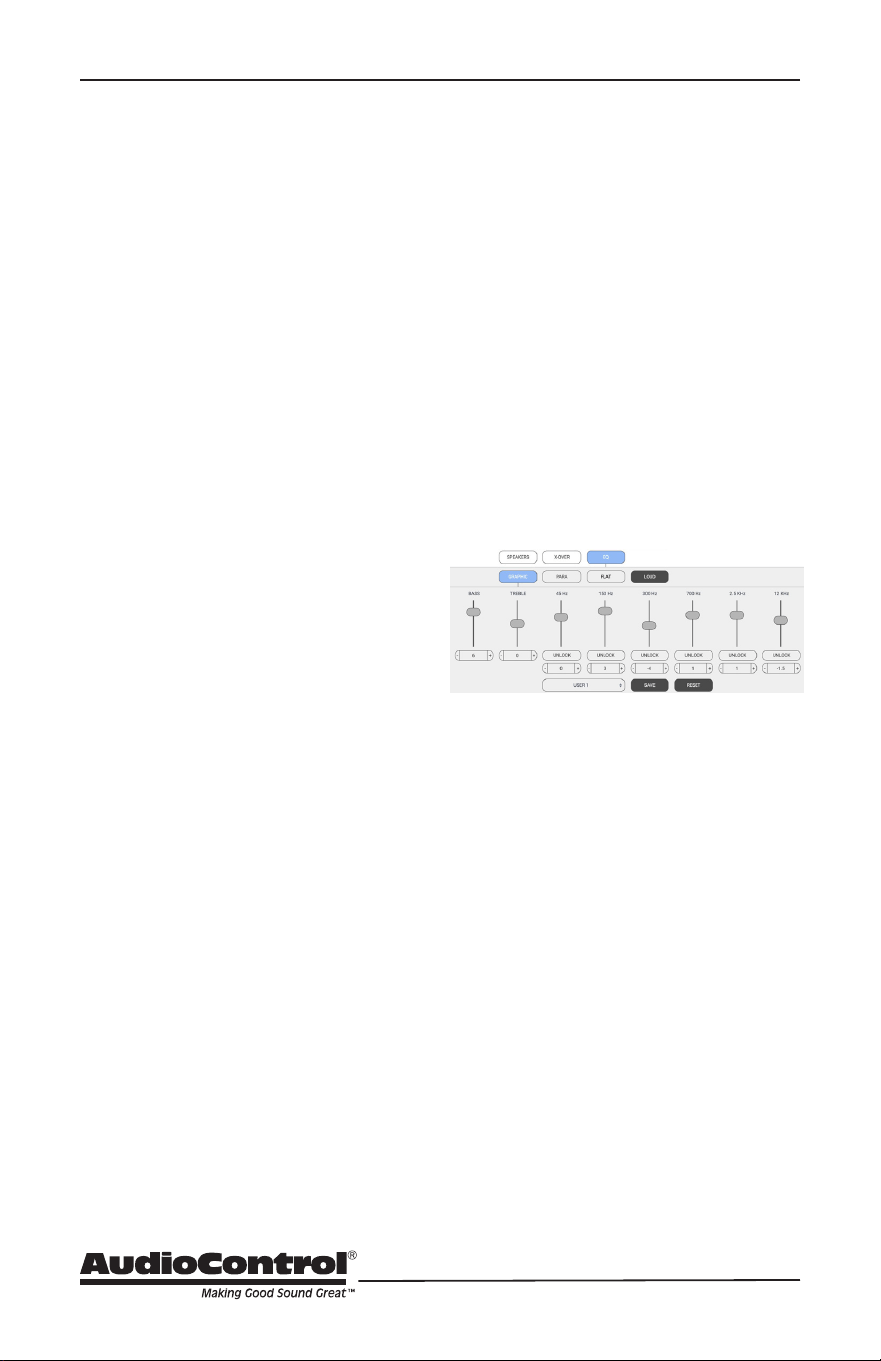
X-Over: Here you can set the Low Pass,
Band Pass, and High Pass crossover
lters to control the frequencies being
sent to your speakers.
EQ: In this section, you can control both
the graphic and parametric EQ lters
to dial in your speaker’s performance.
Speakers
Speaker Calibration Prole: Each Speaker
Prole contains equalization and high
pass / lowpass that have been carefully
chosen by certain speaker manufactur-
ers as the best curve for that particular
speaker model when used with the
unit. The speaker prole is applied in
the background, and you will not see
the EQ sliders move. With the speaker
prole applied, you can still adjust the
graphic EQ to ne tune the response
to the room, and / or client preferenc-
es. Each output zone can be assigned a
dierent speaker prole to accommo-
date dierent models. Speaker proles
for 70v speakers and 8ohm subs come
pre-loaded in the amplier. If you’re
using standard 8ohm speakers, you
can download the latest prole from
one of our Director ampliers and load
them into your CM amp.
We will be expanding our speaker
partners in the future, please watch
our website for the latest information.
X-Over
Along the bottom are 3 dierent lter
buttons that allow you to quickly
choose a design for your system,
either to set up protection from low
and high frequencies, set up a 2-way
crossover with a subwoofer and mids/
highs, or set up a bandpass lter. The
lters should be chosen slowly, with
considerable forethought and care,
possibly while mulling things over in
your favorite comfy chair, with a cup
of tea and a plate of delicious buttered
crumpets. As each lter type is chosen
by pressing one of the three types, the
current high pass and low pass fre-
quencies are shown in the adjustable
boxes just above.
To prevent over-stress of speakers by
Expand Speakers X-Over EQ
30
sending frequencies lower than they
are physically able to handle, try and
roll o the low frequencies. For most
inwall speakers, we recommend a
setting of 40 Hz or higher. Contrary to
popular thought, higher often sounds
better for this low frequency lter.
Similarly, to save the tweeters, be con-
servative with the setting of the higher
frequencies. It could save you a service
call.
As there is a plethora of power
available (do not be fooled by the
unit’s lightweight appearance) you
can set up a 2-way crossover with a
subwoofer playing the lows, and a
pair of speakers paying the mids and
highs. Enable the Low Pass Mode lter
and bridge-mono the output from one
zone for your subwoofer. It will just
receive the low frequencies (in mono)
and receive the combined power
from both channels. Then use another
zone’s channel pair in stereo with
the High Pass mode selected for that
zone, to power the speakers playing
the mids and highs. Select the same
input channel for both zones. See the
system diagrams for a picture of this,
or see the video on our website of our
technical support engineers perform-
ing an interpretive dance in our audio
rumpus room.
EQ Ramblin’s
Equalization of each zone’s sonic
goodness aects both channels within
each zone. Please see a later section
for a discussion of the methods and
benets of equalization. Equalization
can be very powerful, however it takes
some work to adjust properly, and
like cosmetic makeup, it can easily be
over-done. It is much easier and more
accurate, if you have some instrumen-
tation/audio analysis gear. Please see
our website for details of our ne au-
dio analyzer products that will take the
guesswork out of successfully setting
the EQ in each zone.
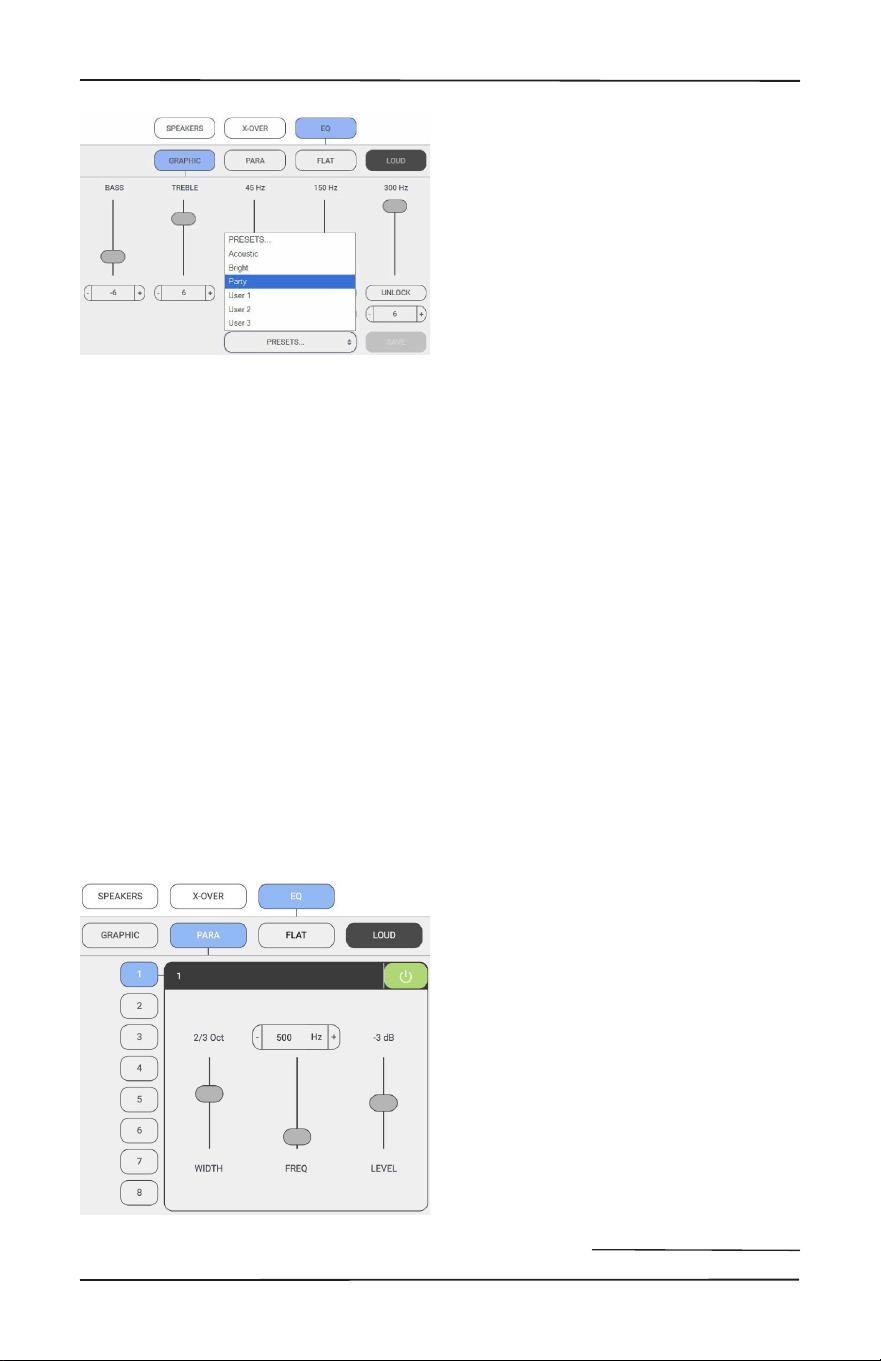
Graphic EQ
Adjustment of the graphic EQ of the
selected zone is done by dragging the
EQ sliders to the desired position, or
by clicking where you want the posi-
tion/ value to be, or by clicking the +/-
buttons. Note that the sliders can be
moved down as well as up, and this is
not a sign of weakness. Click “Unlock”
to adjust the stero channels separate-
ly.
There are some presets available using
the large button at the bottom of this
menu. Once you have the EQ settings
just the way you like them, you must
save the settings as user presets (using
SAVE) or reset things to zero (RESET).
Zone Options
31
Installation Manual
CM2-750, CM3-750, CM4-750
CM SERIES
Zone Options
You can save dierent settings to
dierent user memories and see which
one the clients like. Their taste may be
dierent than yours.
Bass and Treble: Just when you would be
forgiven for thinking “wow, that’s a lot
of EQ exibility,” wait.. there’s more.
At no extra charge, two of the sliders
oer bass and treble EQ adjustment of
the shelving kind. Shelving EQ, used
in combination with the graphic EQ
and parametric EQ, gives you the ne
opportunity to upset things royally, or
to be the better person, with kindness
and EQ moderation for all. Start with
the graphic EQ at, apply a bit of
shelving bass or treble EQ, and see
how that sounds. Maybe that will do.
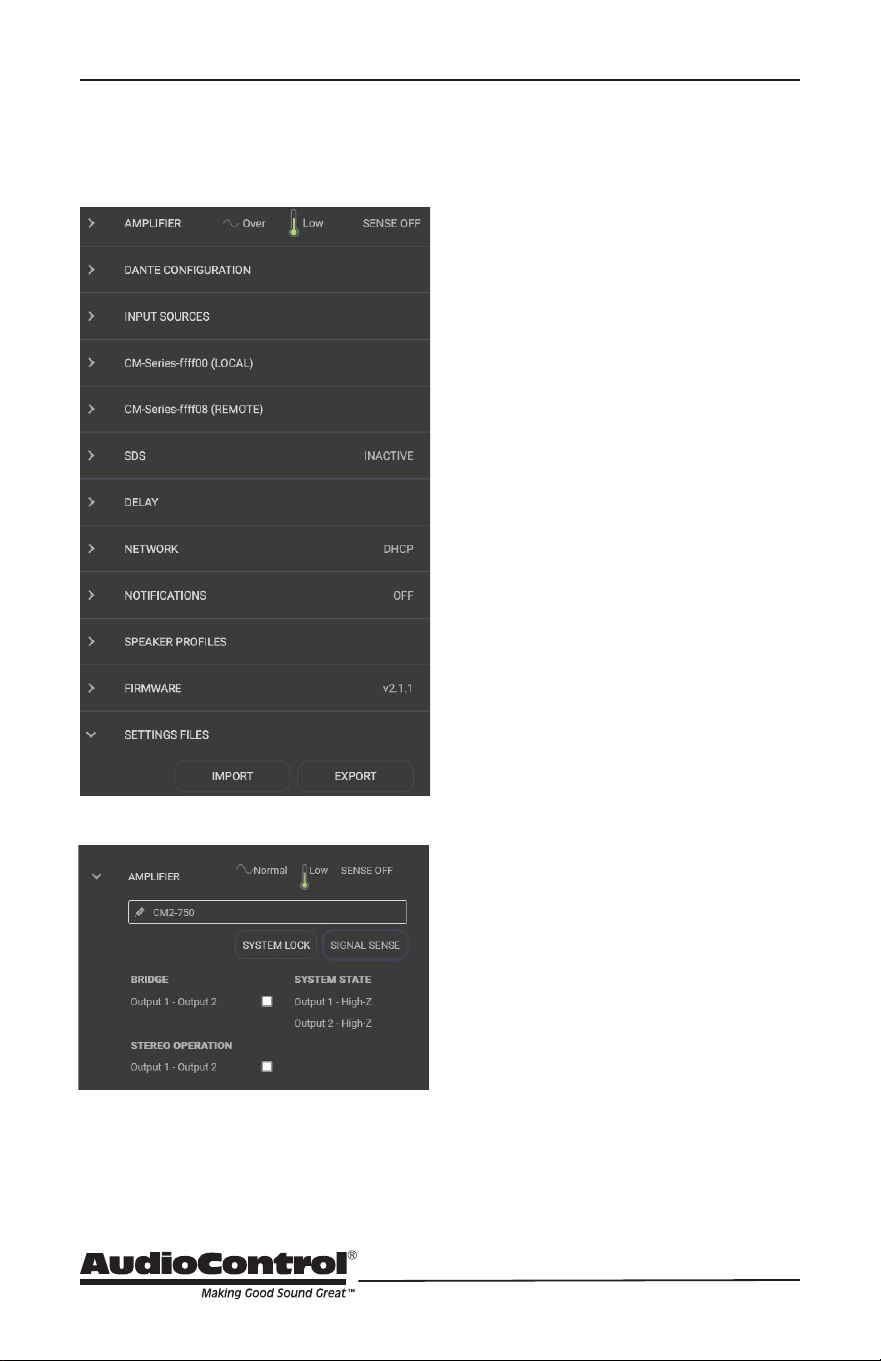
Parametric EQ
In addition (or subtraction) to the
graphic EQ sliders, there are 8 sepa-
rate parametric equalizers per zone,
for the ultimate in room-acoustics
problem solving (or problem creating).
Each parametric EQ has adjustments
for the frequency, octave width, and
the level boost or cut. For an example
of their use, if a certain frequency
sets all the kitchen teacups rattling, a
narrow-width lter can be tried at the
teacup-rattling-onset-frequency, with
a cut in the level.
Once you have the EQ settings just
the way you like them, you must save
the settings, or you will lose them. Go
back to the Graphic EQ area and use
the SAVE button.
Loud
Select this for each zone to give a
pleasing low-frequency boost at lower
listening levels.
32
Global Settings
Global Settings
By clicking on the Gear icon, you access
your global conguration options.
Amplier:
Here you can rename the unit, set Sig-
nal Sense on or o, lock the system, and
check zone status.
Keep an eye on the AC status, and the
system temperature. Make sure there is
plenty of clean, dry, and healthy airow
around the unit.
Rename the unit by typing in the box,
then clicking the check mark.
Setting signal sense is done by simply
toggling the button. System Locking is
also a toggle but requires you to enter
in a system password. Once system is
locked, control over parameters can
only be done with the password you
entered here, so make sure to write it
down, or you will be snookered.
System State shows you which mode
the zone is set to, and will warn you
if any of the zones are experiencing a
fault.
Using the check box to Bridge channels
connects the outputs together, creating
a mono output for your bridged speak-
ers.
Checking the box for Stereo Opera-
tion links the selected outputs so they
always play a stereo image, and their
controls are grouped together.
DANTE Conguration:
Here is where you scan for other Au-
dioControl Dante-enabled products, as
well as set your device ID to work with
other Dante-enabled CM units in an
automated environment. Pretty simple
over all, to get started: open the Dante
Conguration option in the Settings
area, set the IDs for each amp, then
choose “Look for other devices.” This
will populate the input selection menus
with the various AudioControl REMOTE
Dante CM and Directors series amps
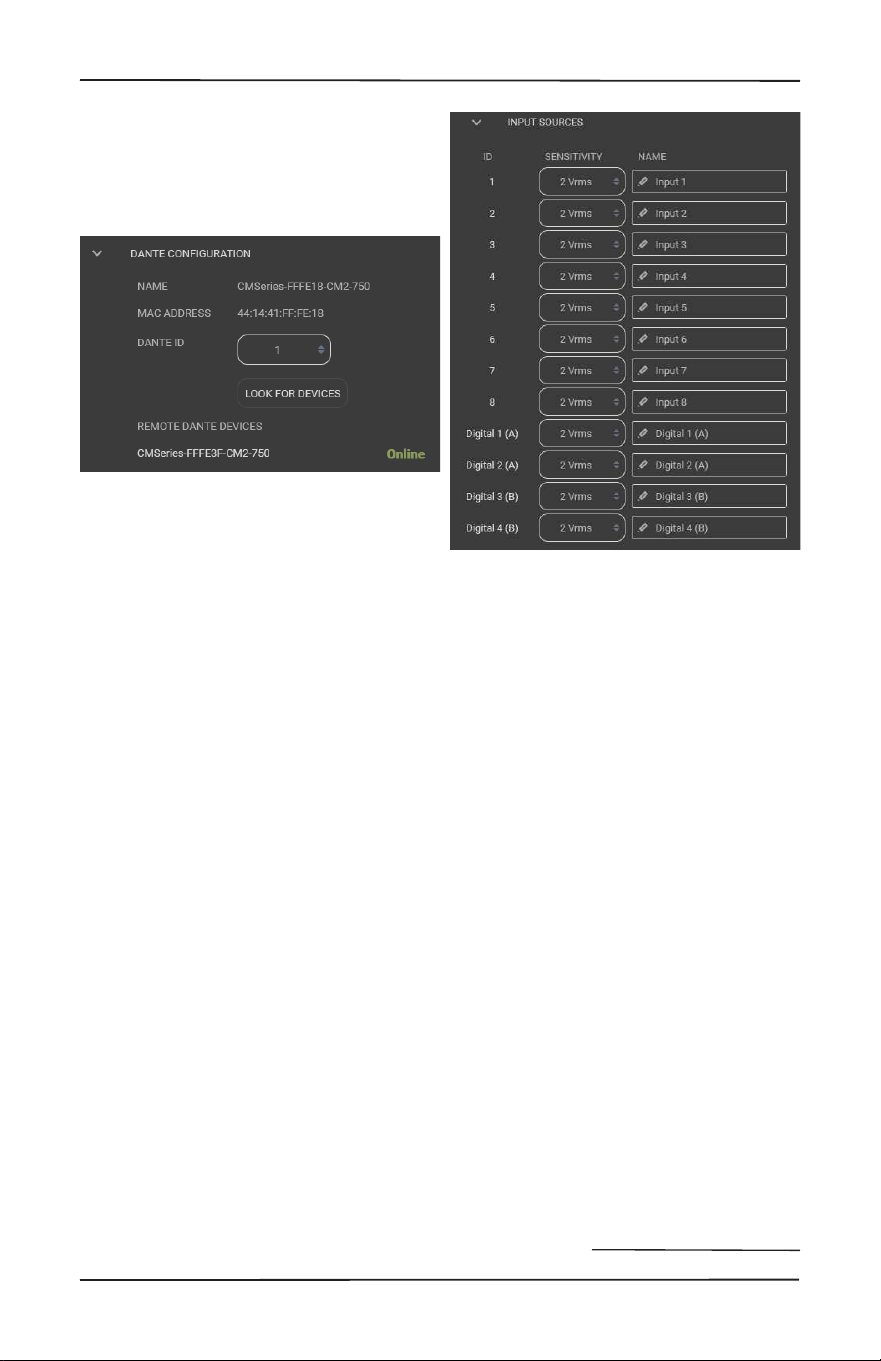
33
Installation Manual
CM2-750, CM3-750, CM4-750
CM SERIES
Global Settings
input selection arrays. This means that
inputs on those other device (other than
the one you are working with – hence
the REMOTE part here) are available to
your local amp. Pretty great!
As we mentioned above, the world
rst agnostic 3rd party automation
system integration of Dante routing
is done here too. Just set the rst CM
Series Dante-enabled unit that you
log into as #1. The unit will scan for
other Dante devices and make sure
that the sought-after position of #1
isn’t taken. If the all clear has been
obtained, henceforth, this device will
now be known as #1 (along with the
MAC address). Set your other Dante CM
amps with ID 2, ID 3, etc. This desig-
nation will enable remote control over
Dante routing through these CM series
amps via 3rd party automation systems
like Crestron/Control 4, Elan and others!
Very cool!
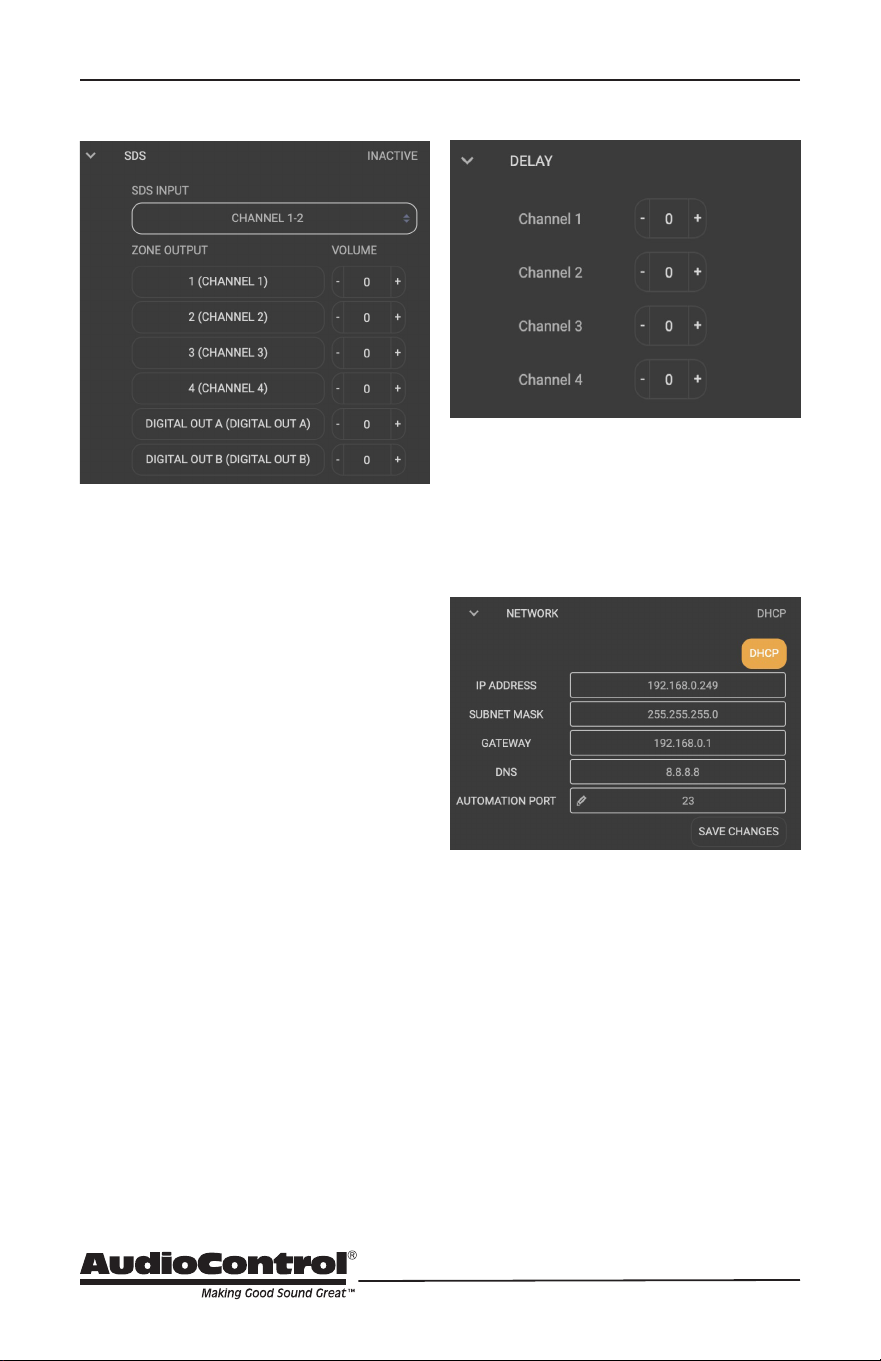
Input Sources:
This option allows you to rename the
input sources to something witty and
charming. Click on the small check mark
that appears at the right in each box, to
save your changes. (Do this before re-
naming the next input, or your changes
will not be saved.) The new names will
then appear in each Zone’s list of inputs.
You also have the option to change the
input voltage sensitivity. Common AVR
outputs are in the 1V to 2V range - best
bet is to simply use 1.5Vrms.
34
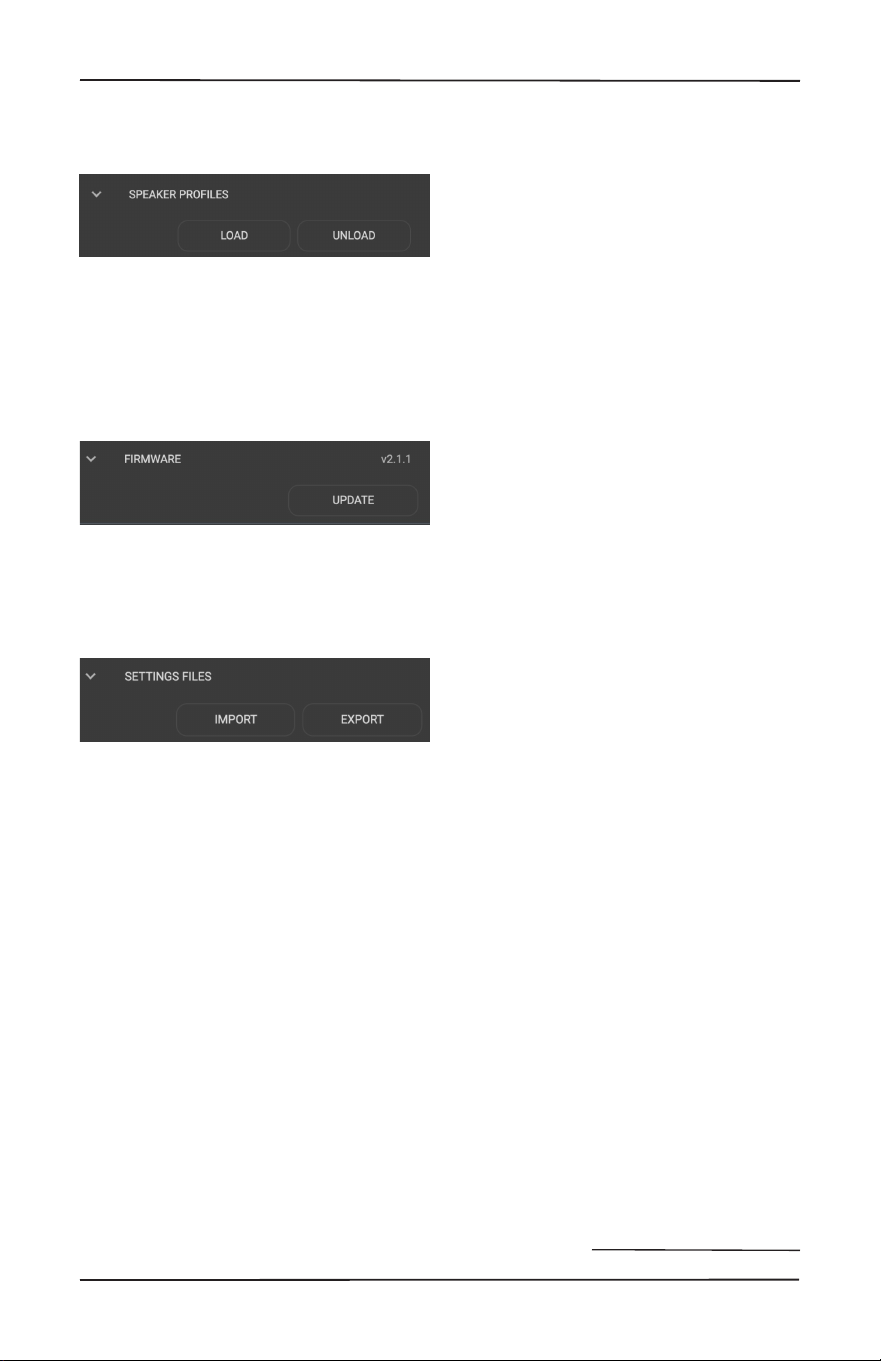
SDS Signal Detection Switch:
SDS allows for dynamic automated
source switching for event-based audio
signals such doorbells, voice-enabled
products, paging systems etc. You
can dene which zones are part of the
output group that will switch to the SDS
input. The SDS input can be any input
to the unit, and is perfectly congurable
to suit your needs. Volumes are relative
to the current zone volumes where they
can be oset - louder or quieter than
the zone’s current volume setting.
For an example, imagine an installation
where SDS is enabled in Zones 1, 2,
and 3, and these volumes are set at 68,
70 and 56. If you want the SDS input
to play slightly louder than the active
content, then adding a +5 oset will
cause the announcement volume to
be 5% louder than that entertainment
content. It is a super-exible, fully
automatic signal sensing switch with a
switch time of less than 200 ms!
Delay:
This is where you can adjust the time
delay in 5 millisecond increments be-
tween the zones, or send the unit back
in time to yourself, and amaze all the
friends you used to hang out with.
Network:
This is where you enter in all your
network conguration settings if you
are setting up manually. If automatic,
there’s not much to do here other than
ensure the DHCP button is selected.
If you are having trouble connecting,
the default IP address of the unit
192.168.0.249. You can connect manu-
ally peer to peer to troubleshoot.
Global Settings
35
Installation Manual
CM2-750, CM3-750, CM4-750
CM SERIES
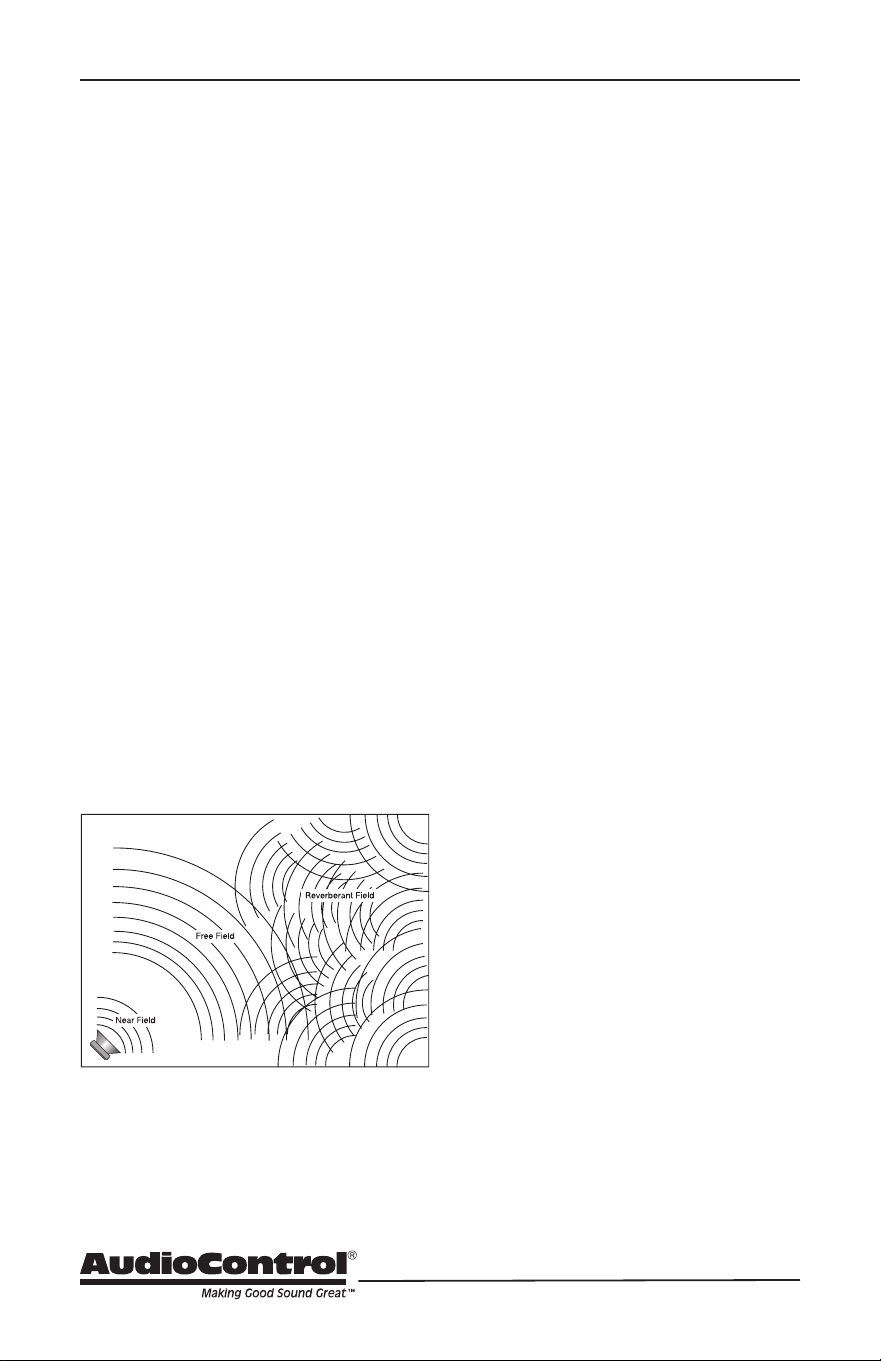
Speaker Proles:
We often add new models to the
Speaker Partners Program database.
These can be downloaded from
audiocontrolpro.com and uploaded to
the unit using the LOAD option.
Firmware:
Update your rmware here. But make
sure you make a back up of your setting
le below, just in case.
Settings Files:
Here you can back up the setting of
the unit; all parameters are stored to a
single external le.
It is important to save each zone con-
guration settings to a user memory.
If you do not need to have multiple EQ
memories for recall, it is still neces-
sary for the zone congurations to be
saved should the power go out. The
Save function in the graphics EQ sec-
tion of each zone, saves the EQ signal
processing settings for that zone as
user presets.
This Global EXPORT button allows you
to save the settings for all zones, as an
overal snapshot of the unit settings. All
the graphic and parametric equaliz-
er settings as well as any crossover
setting will be retained in the exported
le. You can import or export these
settings for back up purposes or for
making a template that can be repeat-
edly used and shared between jobs.
Global Settings
36
Acoustics
Audio reviewers and system owners
spend much time critically appraising
speakers and other audio components.
Unfortunately, a phenomenon that has a
very large eect upon sound is not easily
judged or changed. That eect is the
ACOUSTICS of the environment in which
you are listening.
Room acoustics is a complicated subject
about which hefty textbooks have been
written, and entire galaxies have gone to
war over. We simply want you to be aware
of a few basics that have a direct eect on
real time audio analysis.
As you probably learned in high school,
sound travels in waves. In an audio
system, these waves are created by the
speakers. Like waves in a pond created by
a splash, sound waves emanate from the
transducers (speakers) and spread out into
the room. If your room were innitely big,
that’s all there would be to it. But just as
waves in a pond reach the bank and reect
back, sound waves bounce o walls, ceil-
ings, and oors, reecting, reinforcing and
canceling each other as shown here:
Since sound is energy, the way it reects
depends upon the angle of the surface,
the type of material and the frequency of
the sound wave. Because your listening
position is likely to be towards the back
of the Free Field (waves shown in the
diagram), you also get part of the reect-
ed Reverberant Field as well.
Now we add the next set of complications:
Dierent frequencies of sound have dier-
ent wavelengths (a function of frequency
and the speed of sound). Each frequency’s
wavelength contributes dierently to the
Free and Reverberant Fields because they
are dierent sizes. For example, a 32 Hz
bass note has a wavelength of 35 feet,
while a 16,000 Hz note has a wavelength
just under a tenth of an inch. Tiny treble
waves can be caught and neutralized by
draperies, carpeting, upholstered furniture
and gangs of indolent Persian cats…while
gigantic bass waves simply slosh back and
forth in the room.
Another set of variables is the shape and
volume of your listening room. Large
rooms require more bass energy to excite
waves within them. Small rooms need less
energy, but reect it dierently. And then
there’s the fact that most rooms don’t
have four walls anymore, but open into
dining rooms, lofts, cathedral ceilings, etc.
All of this means that predicting sound
interaction patterns is very dicult due to
the irregularities of the room shape.
As you can see, room acoustics is an
important but complicated subject. To
learn more about room acoustics, get a
copy of AudioControl’s Technical Paper
107, “Small Room Acoustics De-Mythol-
ogized”. You can download this paper
from www.audiocontrolpro.com (search
“De-mythologized”) or if you’re still into
the printed page, call us and we’ll mail
you a copy. The overall point that we’re
trying to make is that the various rooms
in a home function as gigantic mechanical
equalizers, boosting or cutting certain
frequencies depending on size, shape, vol-
ume, acoustic treatment and the position
of the speakers.
Acoustics

37
Installation Manual
CM2-750, CM3-750, CM4-750
CM SERIES
Equalization
Benets of Equalization
Rarely is the room and room decor
designed to get the most out of the
audio system. In fact, almost always the
opposite is the case where the speaker
positions and sizes are dictated by some
factors which are actually contrary to
good sound. This real world situation is
where equalization can provide great
benets.
Speaker positions, furniture, and general
room layouts may cause peaks in the
frequency response. Fortunately these
peaks can be tamed by judicious equal-
ization. Also, it may be that the client has
specic tastes, such as being the most
interested in hearing voices such as cricket
broadcasts, and you can tailor the sound
to these tastes. Remember there are
memories in the unit, and you could use
dierent settings via the memories for
dierent sources.
At all times, though, the laws of physics
are hard to violate, although we do try our
best. Equalization cannot make terrible
acoustics sound terric, only better. If the
room has a tile oor and glass walls for
example, the best case results will still be
pretty bad by most measures. Further,
while equalization can do wonders to help
a less than perfect speaker, nothing will
make a mediocre speaker sound fabu-
lous. In other words, for best results, start
with good speakers and reasonable room
acoustics, if possible.
Note: For the absolutely
best results, the
equalizer
controls on the unit should be
adjusted with a real time
analyzer such
as the AudioControl
Industrial SA-4100i.
Please visit www.audiocontrolpro.com
to look at more
analysis products.
Equalizing the System
Before proceeding with equalizing the sys-
tem, it is a good idea to make sure every-
thing is connected and working properly.
You know how to check connections, and
here are some reminders specic to the
unit, as well as the steps to equalize.
1. Turn on the system. The Power light on
the left front panel will turn on.
2. Connect to this specic CM unit over
the network by entering its unique IP
address into a browser (Firefox, Safari,
Chrome are preferred).
3. Make sure the unit is turned on, and
turn o signal sense in the global
settings page on the browser. On
the front panel all zone status lights
should start red and then turn to blue.
4. If any are not blue, check the web
page to see if you need to unmute any
zones.
5. Play the internal pink noise through
the system into the zones you are
going to adjust.
6. Assuming you have wireless network
access, now grab your trusty real time
analyzer (RTA) and go into the zone
you wish to adjust.
7. Place the microphone in the middle of
the area of listening at the height of
the typical listener’s head.
8. In general, use the equalizer con-
trols to lower peaks in the frequency
response rst. Peaks obscure the
surrounding sounds and lowering the
peaks will unleash overshadowed
sounds. There is more information in
the next section on equalization and
AudioControl has factory training,
called Train in the Rain where we
explore this subject in depth.

38
You can save dierent settings to dierent
user preset memories for each zone and
see which one the clients like.
Parametric and Graphic
Equalization
The graphic equalization controls in the
unit are selected to correspond with the
characteristics of wall and ceiling speak-
ers, and as such are very eective. Graphic
controls are the easiest to tune and pro-
vide a “graphic” representation of what
the adjustments are. Parametric equaliza-
tion requires selecting the frequency, the
bandwidth of the control, as well as the
level of adjustment, not an easy task to
get correct. In general, parametric equal-
ization is valuable for very large areas of
change or very narrow areas.
Parametric equalization in the unit is most
likely best used for taming very narrow
peaks. Do not use for very narrow dips as
these dips are likely caused by cancella-
tions and will not respond to equalization
boost.
Here is an introduction to each of the
graphic control frequencies and what their
aect is on music.
45 Hz — Low bass. This is about the
lowest frequency which in-wall, ex-
tension and small bookshelf speakers
can achieve. Boosting it too far might
cause problems, even though the
unit’s subsonic lter cuts frequencies
below your adjustment point. But if
your speakers can take it, a mild boost
will enhance bass instruments such as
Fender bass, kick drum, oor toms,
timpani and double bass viols.
150 Hz — High bass. There’s a lot of bass
information at this frequency. In fact,
most modern music is mixed to en-
hance this area of the frequency spec-
trum. 150Hz also determines the depth
of male vocals and contains reverber-
ant information which contributes to
the spaciousness of sound. Boosting
150Hz can add “POW!” and impact to
bass or it can make the sound “bonky”
and “boomy”. This is a critical adjust-
ment with small or in-wall speakers.
Experiment with it.
300 Hz and 700 Hz — High and low mid-
range. These controls directly aect
the sound of instruments and vocals.
These bands also determine the
speaker’s presence (whether the music
sounds far away or close in). Small
speakers often produce too much mid-
range, so these controls can be turned
down slightly during your initial experi-
mentation. Consider reducing 700Hz
if you are only using your extension
speakers for background music.
2500 Hz — Treble. Female vocals and the
“edge” of instruments such as guitars,
snare drums, saxes, violins, etc. are
found in this range. If accentuated too
much (by boosting this control) sounds
in the 2500Hz range can seem harsh
and fatiguing to the ear due to exces-
sive output by the speaker or because
of live, reective room acoustics.
12 kHz — High treble. The ne detail,
texture and sheen of music is found
here. The breathiness of vocals, the
“sheen” of cymbals, the high over-
tones of piano and strings. Actually,
there’s audible music information up
to 20,000Hz on some CDs and most
adult’s hearing is still pretty good at
15,000Hz. We’ve chosen 12,000Hz be-
cause it provides more useful control
to compensate for room acoustics and
common small-speaker deciencies.
Parametric and Graphic EQ
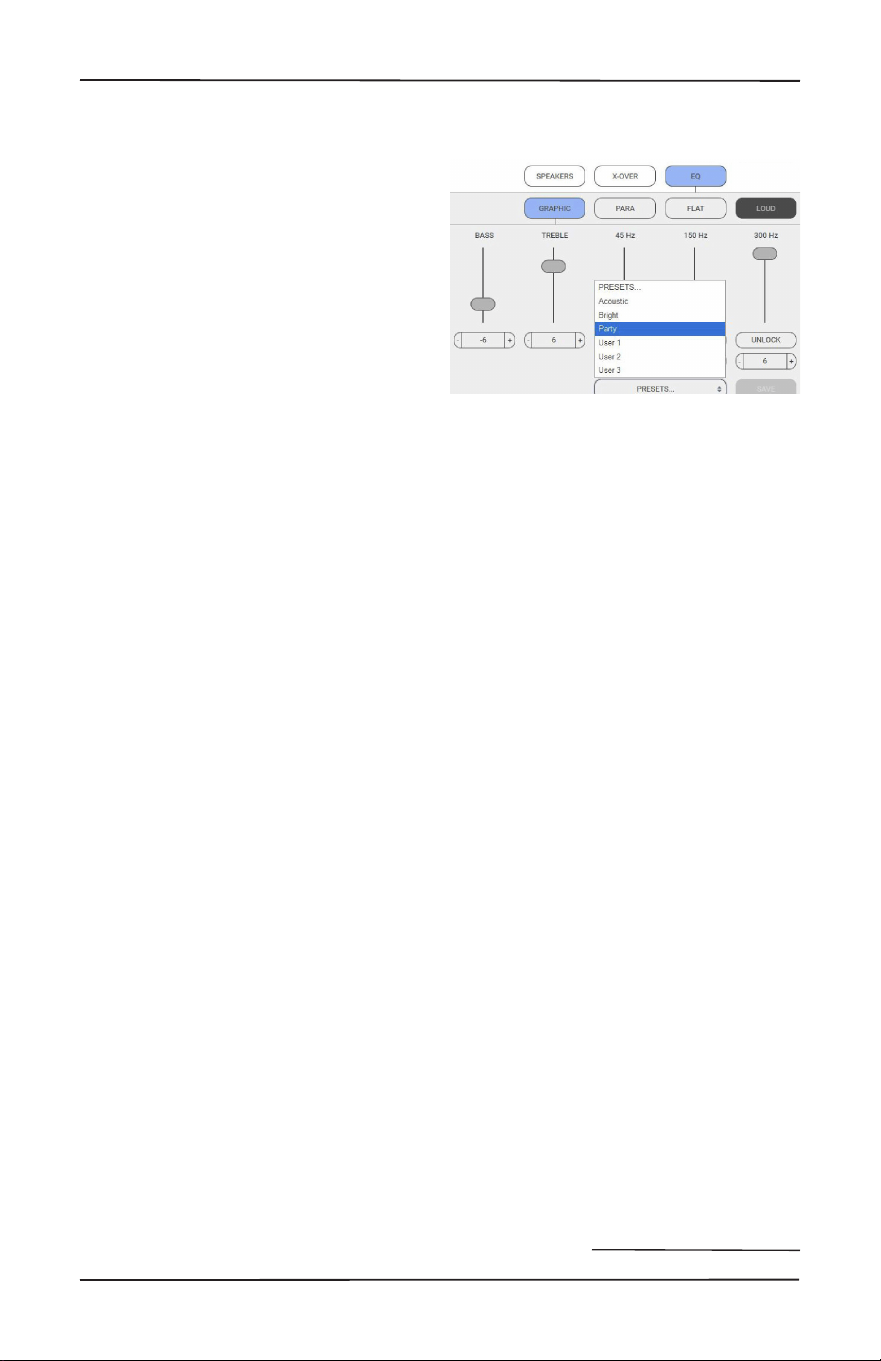
39
Installation Manual
CM2-750, CM3-750, CM4-750
CM SERIES
Subsonic and Tweeter protection lters
Subsonic and Tweeter
Protection Filters
The Subsonic (aka High Pass) lter and
Tweeter Protection (aka Low Pass) lter
are adjusted on the X-OVER section of the
web page. Their function is to make the
speakers sound better, play louder, and
last longer.
All speakers have frequency response
limitations. For the best performance, we
want to operate speakers in their linear
zone, that is the frequencies where their
sound reproduction is not compromised
by mechanical limitations.
If you do operate speakers near or at their
mechanical limits, sound is compromised
and parts of the speakers are stressed and,
in some cases, heat up shortening its life.
In other words, both the tweeter protec-
tion and subsonic lter are very important
tools. Experiment with higher subsonic
lters, and lower tweeter protection
settings, than you might think from the
published specications of the speaker.
If you do these experiments with higher/
lower settings, most likely, you will nd
the system actually sounds much better
than pushing the frequency limits. For
sure the speaker will be less stressed and
last longer.
Presets
In the Graphics EQ section of each zone,
there are preset memories, if you wish to
try dierent congurations. When saving
a memory as a User preset, you are saving
that zone’s settings (equalization and
lters).

40
Advanced Discussions
In Wall Volume Controls
What happens to the in-wall volume con-
trol if the amplier power is greater than it
can handle?
It will not be pretty but then again no
one will die. Typically, the magnetics
of the volume control will be over
taxed, saturate and thereby become a
lower impedance than rated. This will
encourage the unit amplier to put
out even more power, possibly putting
the amp into protection. If not this
extreme, there is an excellent chance
the volume control saturation will
damage the sound quality. The upshot
is use a volume control with a margin
of safety.
Installation of multiple units
Can you stack units of the unit on top
of each other without an air space in
between?
You can stack a maximum of 4 units
on top of one another, and allow a free
rack space above and below.
Ideally, 2 units can be stacked with a
free space above and below, as this
will improve the ventilation to the
units.
May you daisy chain or y-cord audio and
power trigger connections?
Daisy chaining audio is easy as there
are Loop output jacks, which can be
used to drive the next amplier.
For power control, it is easiest to have
an Ethernet connection to each unit.
The 12 volt mini jacks are powered to
turn on another unit when the main
unit is on (not standby). If you need
more than 15 milliamps current on the
12 volt output, use a relay to prevent
over loading the unit. (The unit itself
only takes 1 milliamp to turn on.)
What are the power requirements and
BTU outputs of the unit?
More detailed information is shown in
the specications section. In general,
we feel a conservative, real life design
criteria is 1/8th power. This will be
a quite loud listening level for most
rooms and assumes all zones driven
at the same time. You will be amazed
at how cool the unit is at this level.
One rule does not t all situations, so
apply your knowledge of the particular
circumstances involved. Also, see the
section below on unique rooms and
SPL.
How many units may I put on one 15
amp breaker?
It depends. Since you are limited to
1500 watts per device by most codes,
there should be a separate 15 amp
circuit for each unit.
The circumstances where the unit
draws maximum power are very
rare outside of an engineering lab.
Maximum power is using a sine wave
input which has at least a third higher
energy density than music. This would
mean that all channels are operating
at maximum, an unlikely situation
even during a really fun party. Even
more unlikely is all channels on multi-
ple units operating at full output.
You know the system better than we
do, so it is your decision. If the only
use is background music, then the
one-eighth power in the specications
is a reasonable (actually conserva-
tive) power draw. Of course, you will
want to include a margin of safety for
unusual circumstances. And in the
nal analysis, you have to do what the
electrical inspector tells you to do.
Advanced Discussions

41
Installation Manual
CM2-750, CM3-750, CM4-750
CM SERIES
What should I use the “Trim” controls in
the browser for?
The Trim controls are an easy-to-ac-
cess level setting control which you
can use while in the zone. The Trim
controls allow minor not major adjust-
ments.
Unique Rooms and SPL in Large Areas
Are there any special considerations for
bathrooms?
Bathrooms are irregular rooms, rooms
within a room, with high ambient
background noise, often with noise
masking type of ambient sound, highly
reective, and often fairly large. If
you pause and think about that for a
moment, these are some of the more
challenging rooms.
Commercial noise masking systems
rely on “white noise” which sounds
remarkably like a bathroom exhaust
fan and like the sound of water in a
shower-both of which are louder than
the background noise level in the other
parts of the house. So if the client
wants to rock out in the bathroom,
and particularly the shower, you need
to have speakers very near to them.
Modern day larger bathrooms need
more than two speakers for these
reasons.
What about large rooms as well as
rooms where the listener is far from the
speakers?
Typical in-wall speakers are designed
to be near the listener. In common
rooms with eight foot ceilings and
other usual dimensions, in-wall speak-
ers typically are not much more than
eight feet from the listener. In large
mansions, the game changes. Twenty
foot ceilings are normal and typical
speakers are too far away to provide
the client much SPL (sound pressure
level). There are in-wall speakers
designed for these longer “throw” dis-
tances. In general, larger rooms with
more height require more speakers
and speakers with tighter “directivity”
to get party-level SPL. In this case,
also, size matters and bigger speakers
are better.
Advanced Discussions

42
Troubleshooting
Many problems can be eliminated by
re-checking the wiring and settings of the
unit. If a problem cannot be solved using
the guide below, please call the AudioCon-
trol team for further assistance, or e-mail
us at [email protected]
1. No Sound
a. Verify the Power LED is Blue.
b. Verify Protection LED is O.
c. Verify Zone Status LED is Blue.
d. Verify that the correct input has
been selected in the web server
menus
e. Verify the source unit is operating.
f. Check the speaker connector plugs
on the rear panel are secure.
g. Unplug the power cord and check
the AC Power Fuse on the rear
panel.
2. Protection LED is o, but none of
the Zone Status LEDs are on:
a. Defeat the signal-sense circuits
using the signal sense switch on
the unit’s web page. All of the zone
status LEDs should turn on. If they
do not, call AudioControl’s custom-
er service.
b. Verify the source unit is operating.
c. Increase the preamp volume if sig-
nal sense is engaged, or just going
steady.
3. Channel Status LED is Red:
a. Check speaker leads for a short.
Swap speaker connectors on rear to
see if the problem moves with the
wires.
b. If the unit is excessively hot, turn
down the volume and allow it to
cool o. The protection LED should
turn o after a short while. Verify
that any ventilation holes have not
become blocked.
c. The speaker impedance may be too
low. Use an ohmeter to measure
the impedance on the speaker
wires.
d. The slight periodic red ash on
the channel status is showing the
heartbeat of the unit, this is nor-
mal.
4. Speaker channels are cutting in and
out:
a. If using external volume controls,
check that they can handle the
power output.
b. Make sure the speaker impedance
is not less than 4 Ohms, or 8 Ohms
when used in bridged mono.
c. There may be a short in the wires.
Suspect a short if the problem hap-
pens only at the highest volumes.
5. Protection LED is Red:
a. Disconnect power from the unit
for 3 to 4 minutes and reconnect to
power.
b. Disconnect all speaker wires. If
it still turns red, and the unit has
cooled, something rather serious
has happened inside the unit. Call
AudioControl’s customer service.
Troubleshooting

43
Installation Manual
CM2-750, CM3-750, CM4-750
CM SERIES
6. Speaker Buzzing or Crackling at high
volume:
a. Reduce any preamplier/equalizer
low-frequency boost.
b. Turn o your “Sounds of the
Pacic Northwest” chainsaw and
bacon-frying CD.
7. There is no audio input signal, but
the Zone Status LEDs are still blue:
a. Check the signal-sense switches in
the unit’s web server tabs. If they
are not engaged, the zone status
LEDs will stay on as long as the
master trigger is enabled.
b. The zone status LEDs stays on for
2 minutes (depending on music
volume) after the audio signal has
stopped. This delay helps prevent
prematurely muting during quiet
passages or song changes.
8. The unit is on but you cannot trigger
it o
• The unit will stay on if either the
12v master trigger is on, or jum-
pered on.
9. Is an in-wall volume control rated at
100 Watts (continuous) adequate?
• That’s a heart felt no. Don’t. Please
don’t. There can be up to 750 watts
running out of the channel so use
an automation system to regulate
the volume at the source or in the
CM series DSP via automation
rather than after the amp/on the
speaker wires.
Troubleshooting
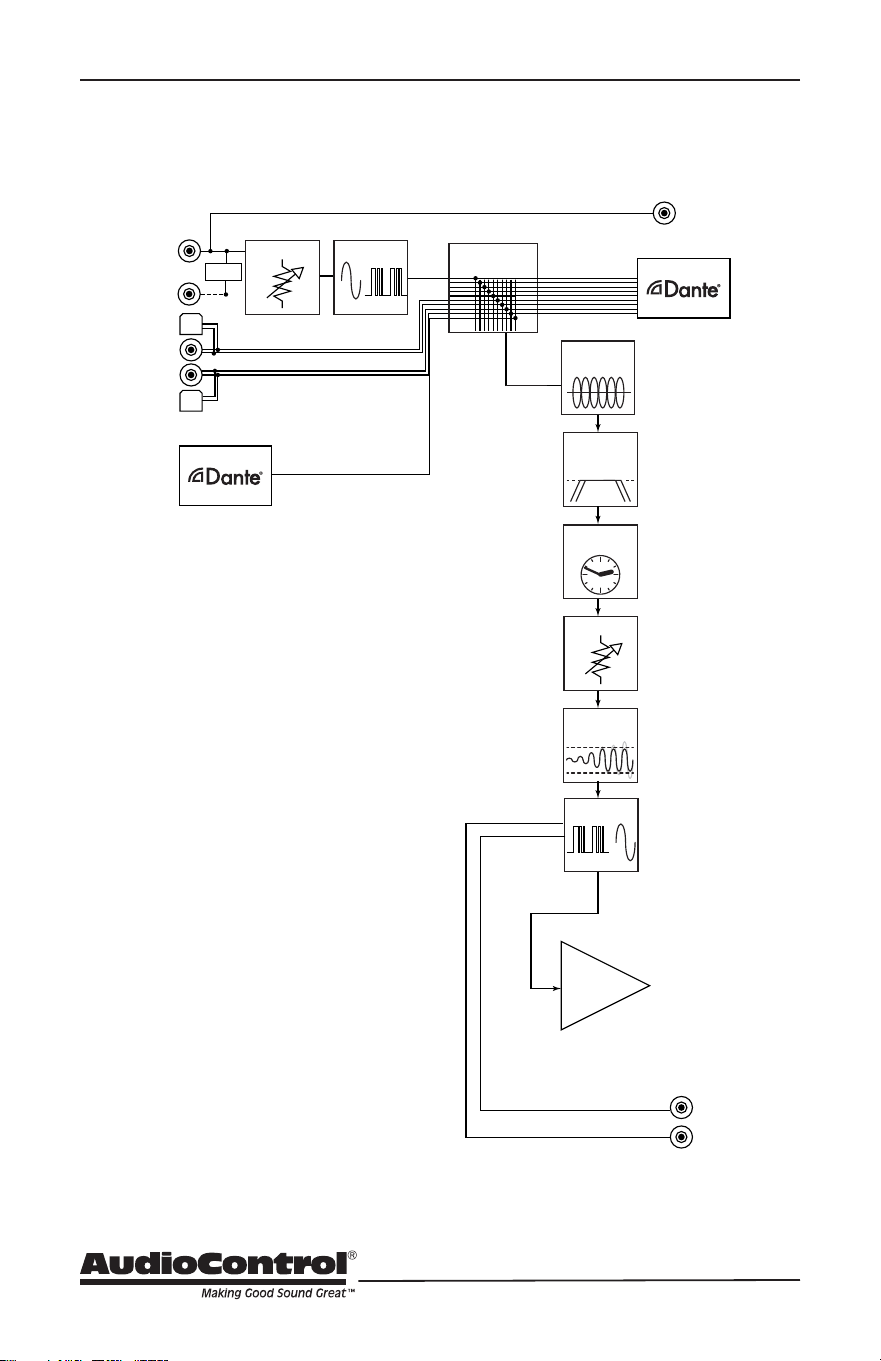
44
Block Diagram
Block Diagram
Signal
Delay
Analog
Pass Thrus
5 - 8
Analog
Inputs
1 - 8
DAC
ADC
Parametric
Graphic EQ
High Pass /
Low Pass
Filters
Volume
Gain
Digital
Inputs
A - B
Limiter
Amplifier
Speaker
Outputs
1 - 4
S/PDIF
Outputs
A - B
Matrix
Dante
Inputs
1-16
(Optional)
Dante Outputs
1-16
(Optional)
Sum Stereo
Input
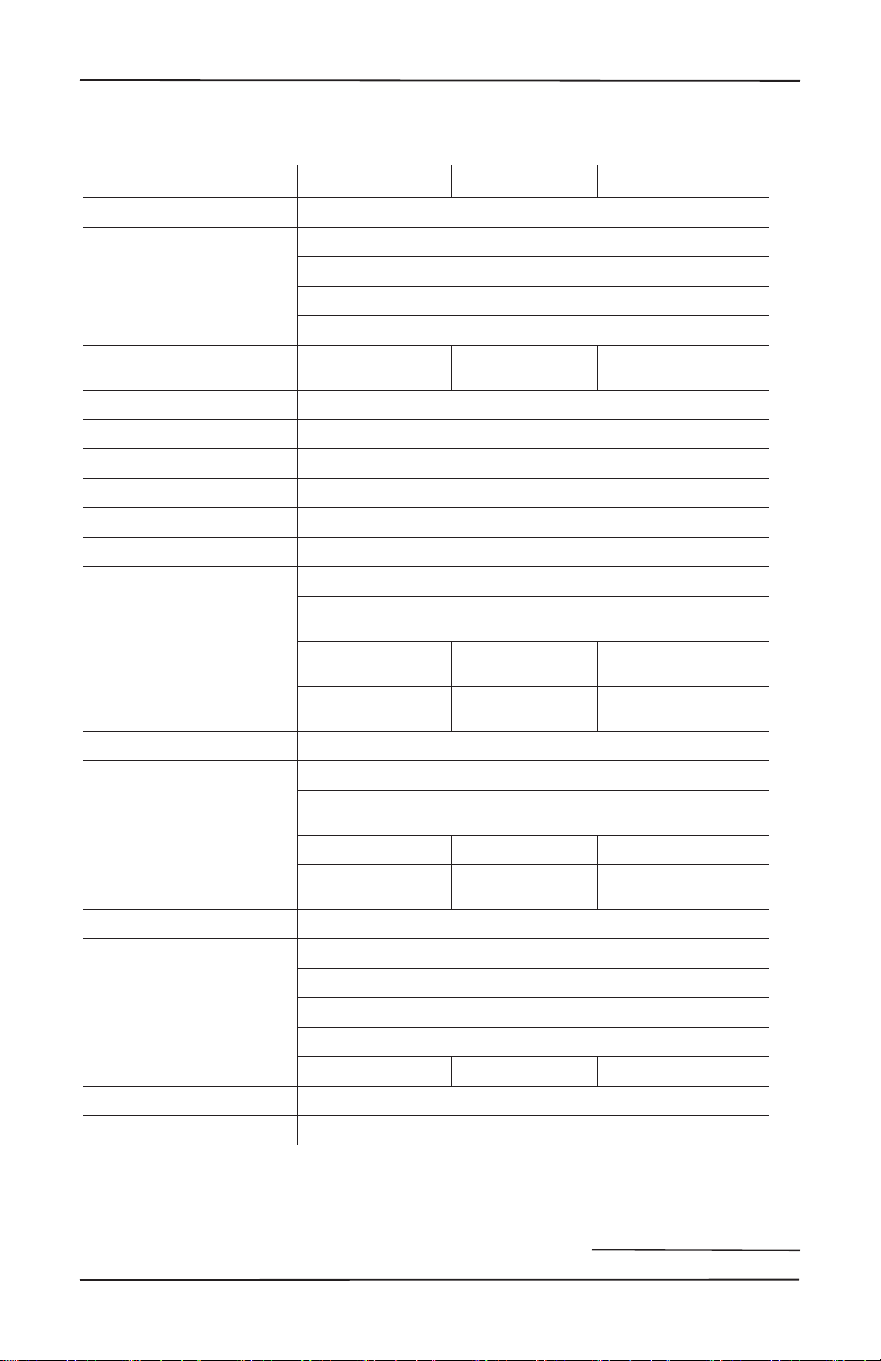
45
Installation Manual
CM2-750, CM3-750, CM4-750
CM SERIES
Specications
Specications
CM4-750 CM3-750 CM2-750
Output Power
Per Channel 625 Was @ 8 Ohm, 625 Was @ 4 Ohm
Bridged Mono 1250 Was @ 8 Ohm
70V 750 Was
100V Bridged 1500 Was
Signal to Noise Rao >104 (A wtd, ref full
output, 8 Ohm)
> 104 (A wtd, ref full
output, 8 Ohm)
> 103 (A wtd, ref full
output, 8 Ohm)
Crosstalk > 85 dB @ 1 kHz
Damping Factor > 200
Gain 36 dB
Analog Input Sensivity 1 Vrms for full output, level at maximum
DAC Specicaons 32 – 96 kHz sample rate, 16/24 bit depth
AC Power Requirements
Standby <3 Was
Idle (main power on, all
channels o)
37 Was
All channels 1/8th power
(normal listening level)
476 Was 374 Was 274 Was
Full Power (*20 A residenal
service limited)
3000 Was 2250 Was 2250 Was
BTU/hr Output
Standby 10 BTU/hr
Idle (main power on, all
channels o)
116 BTU/hr
All channels 1/8th power 224 BTU/hr 176 BTU/hr 176 BTU/hr
Full Power (*20 A residenal
service limited)
1413 BTU/hr 1060 BTU/hr 1060 BTU/hr
Dimensions
Height 3.5” (2U)
Width (ears on) 19.0”
Width (ears o) 17.0”
Depth 15.5”
Weight 20 lb 19 lbs 18 lbs
Network Sengs
Default IP Address 192.168.0.249

46
Service
What to do if you need service
First, if you need service, it is probably
best to go and see a trained health care
professional.
If the unit needs service, then please
contact AudioControl, either by e-mail or
phone. We will verify if there is anything
wrong in the system that you can correct
yourself, or if it needs to be sent back to
our factory.
Please include the following items when
returning the unit:
1. A copy of your proof of purchase. No
originals please. We cannot guarantee
returning them to you.
2. A brief explanation of the trouble you
are having with the unit. (You’d be
surprised how many people forget
this.) If you can supply a really detailed
description of the problem, this would
be so much better, and our service
technicians may add you to their
Christmas Card list. Please include
any notes about the system and other
components you are using. Is it an
intermittent problem that only occurs
on the rst full moon of Spring?
3. A return street address. (No PO Boxes,
please).
4. A daytime phone number in case our
technicians have a question about the
problem you are having, or if they are
just feeling lonely.
5. Package the unit in the original
packaging if you still have it, and if the
cat hasn’t had three litters of kittens
in the box. Use great care and plenty
of good packing materials to protect
the unit and prevent it from moving
about inside the box. Do not use loose
materials like packing peanuts or real
peanuts.
You are responsible for the freight charges
to us, but we’ll pay the return freight back
as long as the unit is under warranty. We
match whatever shipping method you
use to send it to us, so if you return the
unit overnight freight, we send it back
overnight. We recommend United Parcel
Service (UPS) for most shipments.
Please do not return the unit to Audio-
Control if you have not received an RMA
number from our masterful customer
support team.
Phone 425-775-8461
support.audiocontrolpro.com
www.audiocontrolpro.com/contact-us

47
Installation Manual
CM2-750, CM3-750, CM4-750
CM SERIES
The Warranty
In just the same way as being covered in
honey and thrown into a dark pit full of
hungry woodchucks, people are scared of
warranties. Lots of ne print. Months of
waiting around. Well, fear no more. This
warranty is designed to make you rave
about AudioControl. It’s a warranty that
looks out for you and your client, plus
helps you resist the temptation to have
your friend Sparky, who’s “good with elec-
tronics,” try to repair your AudioControl
product. So go ahead, grab a cup of tea,
and carefully read through this warranty.
Our warranty has conditional conditions!
“Conditional” doesn’t mean anything
ominous. The Federal Trade Commission
tells all manufacturers to use the term to
indicate that certain conditions have to
be met before they’ll honor the warranty.
If you meet all of these conditions, Au-
dioControl will, at its discretion, perform
warranty service on any AudioControl
products that exhibit defects in materials
and/or workmanship during the warranty
on your product for ve (5) years from
the date you bought it, and we will x or
replace it, at our option, during that time.
Here are the conditional conditions:
1. You need to hold on to your sales
receipt! All warranty service requires
original sales receipt documentation.
The warranty only applies to the
original purchaser from an authorized
AudioControl dealer. Note: Products
purchased from unauthorized dealers
are not covered under warranty.
2. If an authorized AudioControl dealer
installs your AudioControl product,
the warranty is ve years, otherwise
the warranty is limited to one year.
3. Our warranty covers AudioControl
products that have been installed
according to the instructions in the
installation manual.
4. You cannot let anybody who isn’t:
(A) the AudioControl factory; or (B)
somebody authorized in writing by
AudioControl service your AudioCon-
trol product. If anyone other than (A),
or (B) messes with your AudioControl
product, the warranty is void.
5. The warranty is void if the serial num-
ber is altered, defaced or removed,
or if your product has been used
improperly. Now that may sound like
a big loophole, but here is what we
mean by this: Unwarranted abuse is:
(A) physical damage (don’t use your
product to level your dining room
table); (B) improper connections (120
volts into the RCA jacks can fry the
poor thing); (C) sadistic things! This
is the best product we know how to
build, but for example if you mount it
to the front bumper of your car, drop
it over the Niagara Falls or use it for
Clay Pigeon shooting practice, some-
thing will go wrong.
Assuming you conform to 1 through 5,
and it really isn’t all that hard to do, we
will have you send your product to us for
warranty service.
Please Remain Calm

48
Please Remain Calm
Legalese Section
This is the only warranty issued by Audio-
Control. This warranty gives you specic
legal rights, and you may also have rights
that vary from state to state. Promises of
how well your AudioControl product will
work are not implied by this warranty.
Other than what we’ve said we’ll do in this
warranty, we have no obligation, express
or implied. We make no warranty of mer-
chantability or tness for any particular
purpose. Also neither we nor anyone else
who has been involved in the develop-
ment or manufacture of the unit will have
any liability of any incidental, consequen-
tial, special or punitive damages, includ-
ing but not limited to any lost prots or
damage to other parts of your system by
hooking up to the unit (whether the claim
is one for breach of warranty, negligence
of other tort, or any other kind of claim).
Some states do not allow limitations of
consequential damages.
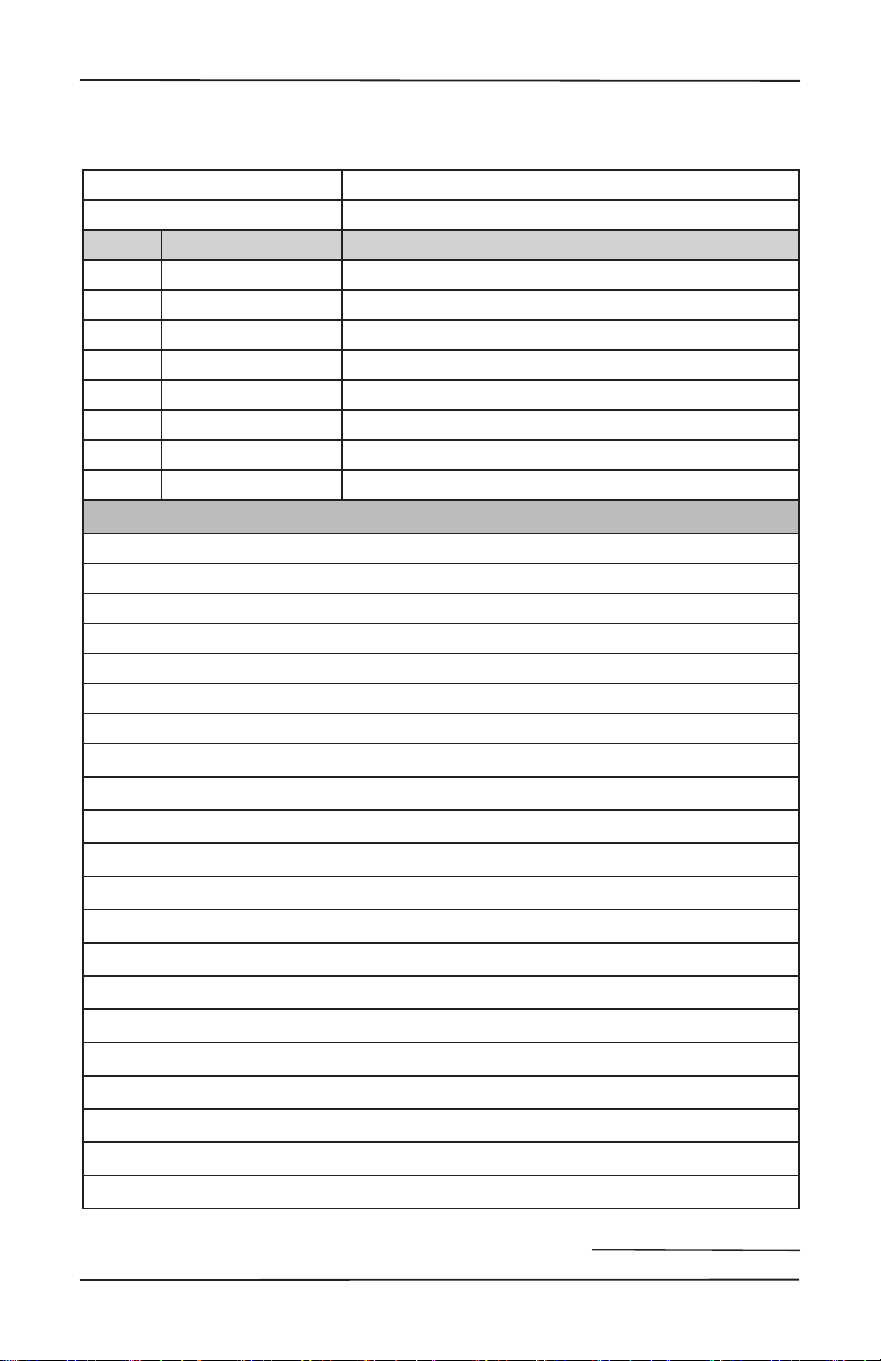
49
Installation Manual
CM2-750, CM3-750, CM4-750
CM SERIES
Installation Notes
Installation:
Installer:
Zone Room Source
1/2
3/4
5/6
7/8
1/2
3/4
5/6
7/8
Notes/Poems/Sagas/Odes
Installation Notes

50
Installation Notes

51
Installation Manual
CM2-750, CM3-750, CM4-750
CM SERIES
Installation Notes
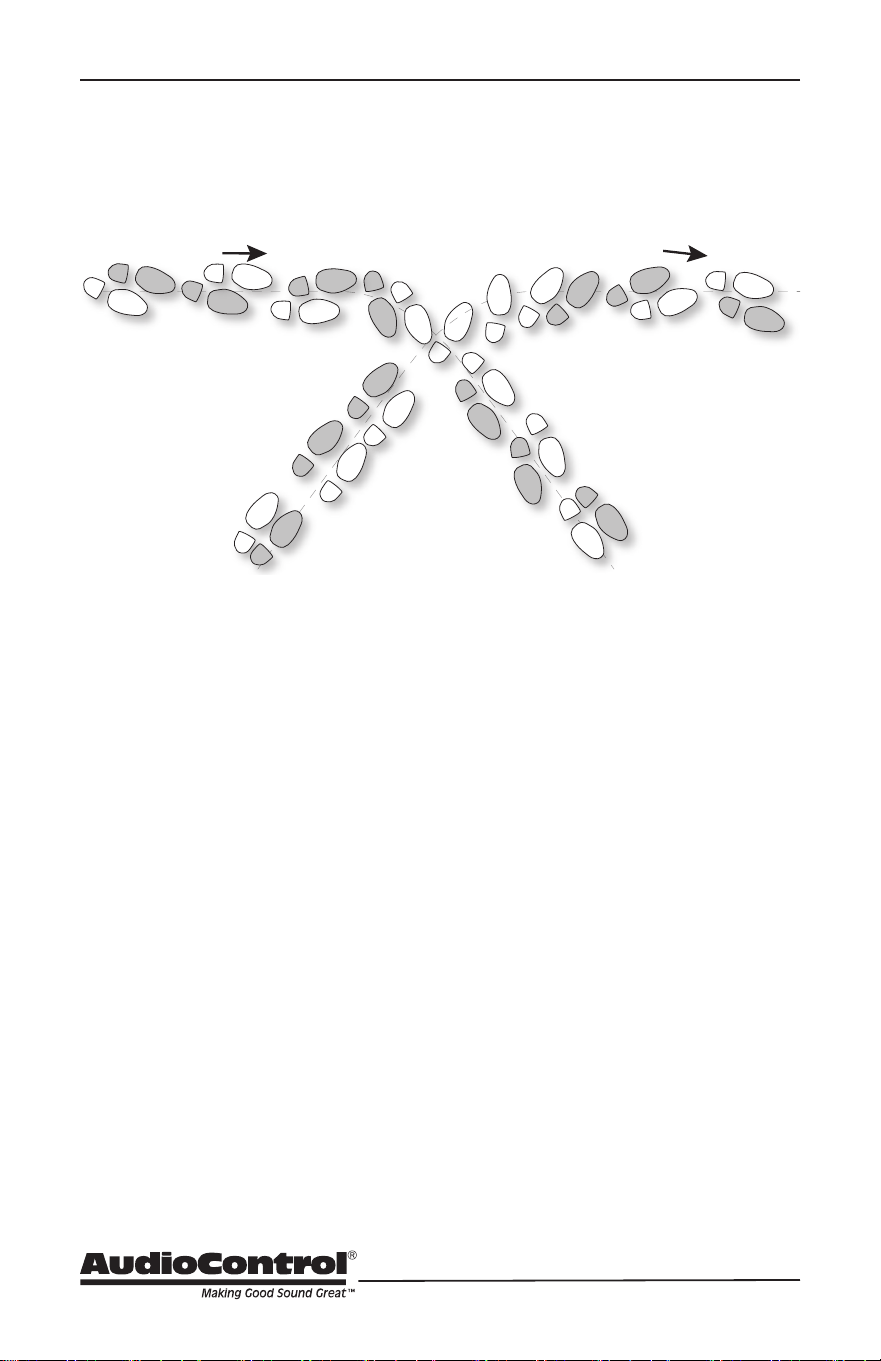
52
Hurrah, you are done!
Manual PN 913-154-0 Rev B
The Crossover Two-Step
2
1
3b
4
3a
5
7
6