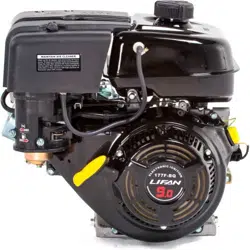
Ⅰ
173F
177F
182F
188F
190F
173F-D
177F-D
182F-D
188F-D
190F-D

Ⅰ
PREFACE
Thank you for choosing a general gasoline engine by the company.
The manual gives information with respect to operation and maintenance of the general gasoline engine,
and be sure to read it carefully first before operation. All the materials and diagrams of this manual are in
accordance with the newest products at the publishing time. Due to revision and other change, the information
described in this manual may be a little different from the actual status. The copy right of this book belongs to
our Co., any group or individual is forbidden to reprint or copy it .The manual is subject to change without
notice.
Please pay special attention to statements preceded by the following words:
WARNING:
Indicates a strong possibility of severe personal injury or death if instructions are not followed.
CAUTION:
Indicates a possibility of personal injury or equipment damage if instructions are not followed.
NOTE:
Give helpful information.
Although the engine conforms to the safety requirement of EN1679-1, the user must notice the possible danger
when they install the engine with other terminal products because the different installing purposes maybe will
result in new danger to the engine and its driving product. So, all users must be responsible to take action for
assuring the safety.

Ⅱ
CONTENTS
Safety precautions ……………………………………………………………………………………………(1)
Parts description ………………………………………………………………………………………………(2)
Battery connection (only for electric-start type) …………………………………………………………… (3)
Control connection of remote distance (option) ………………………………………………………………(4)
Pre-operate inspection ……………………………………………………………………………………… (6)
Starting the engine ………………………………………………………………………………………… (12)
Running the engine …………………………………………………………………………………………(14)
Stop……………………………………………………………………………………………………………(16)
Exhaust control system …………………………………………………………………………………… (18)
Maintenance …………………………………………………………………………………………………(20)
Transport, storage and removal from storage…………………………………………………………………(29)
Troubleshooting ……………………………………………………………………………………………(32)
Specifications ………………………………………………………………………………………………(44)
Electric diagram ……………………………………………………………………………………………(46)

1
SAFETY PRECAUTIONS
WARNING:
Before operating the engine, be sure to read and familiar with the manual carefully, otherwise personal
injury or equipment damage may produce.
Please pay special attention to the following:
1. Running the engine in a well-ventilated place, keep it at least one meter away from building walls or other
equipments, keep away from inflammables such as gasoline, matches and so on to avoid possibility of fire.
2. Keep the engine out of reach of children and pets to avoid accidents.
3. Operator of the engine has been specially trained.
4. Refuel in a well-ventilated area with the engine stopped, and in places refueling or storing gasoline, no
smoking and any flames or sparks.
5. Refuel the fuel tank not too full so as to avoid fuel’s spilling out. If there is spilled fuel around, be sure to
clean it thoroughly before starting.
6. Locate the engine on a level-working platform to avoid fuel’s spilling out.
7. Maker sure the fuel filler cap is tightened securely.
8. The exhaust muffler is very hot during running the engine even after the engine stops. Never touch it, or you
may get burns. Transport or store the engine with it cooling down entirely.
9. This machine should not be used underground or in areas where explosive conditions may be present.
10. It’s recommended that the operator wears the ear protection equipment during operation.
2
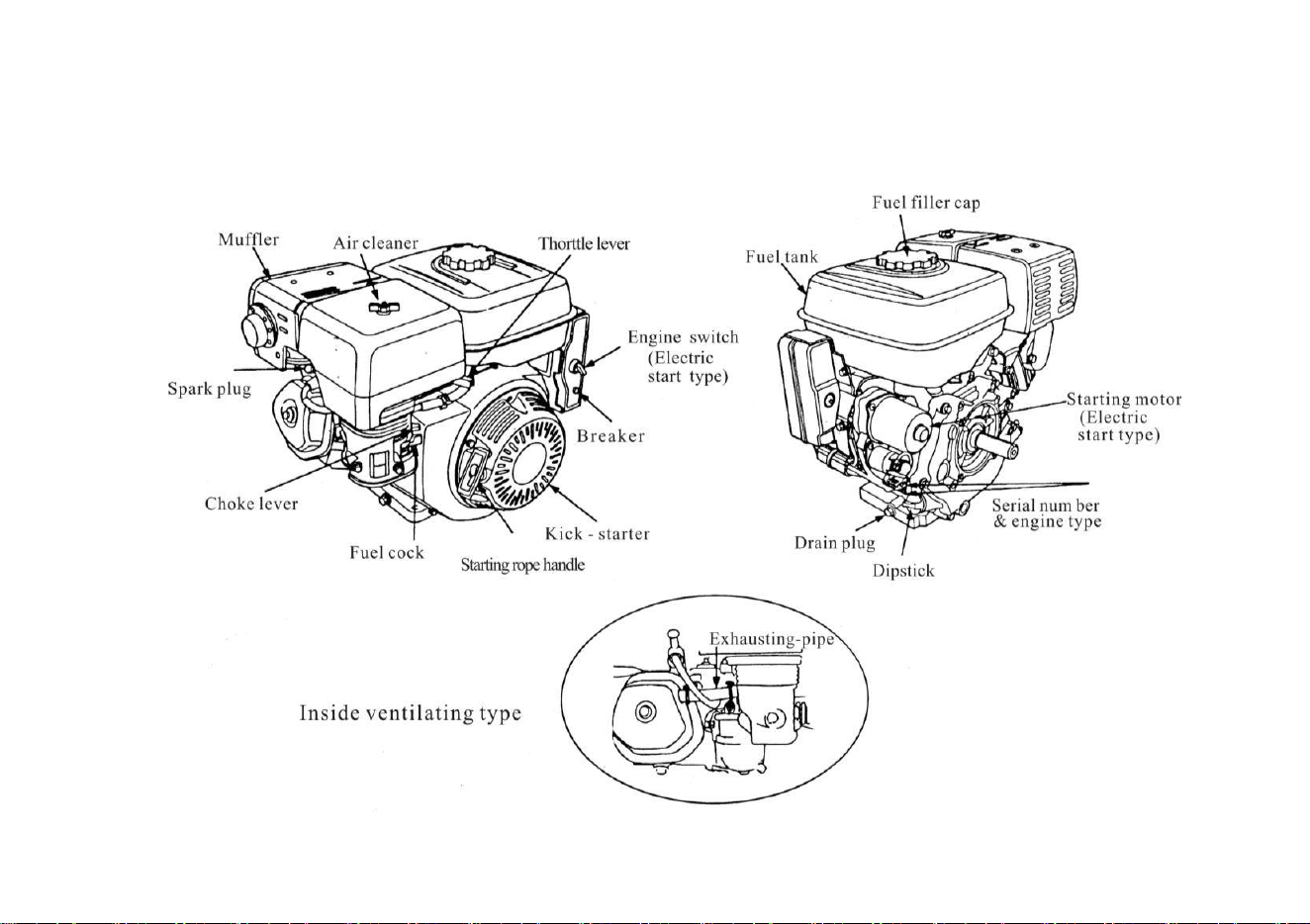
PARTS DESCRIPTION

3
BATTERY CONNECTION (electric-start type)
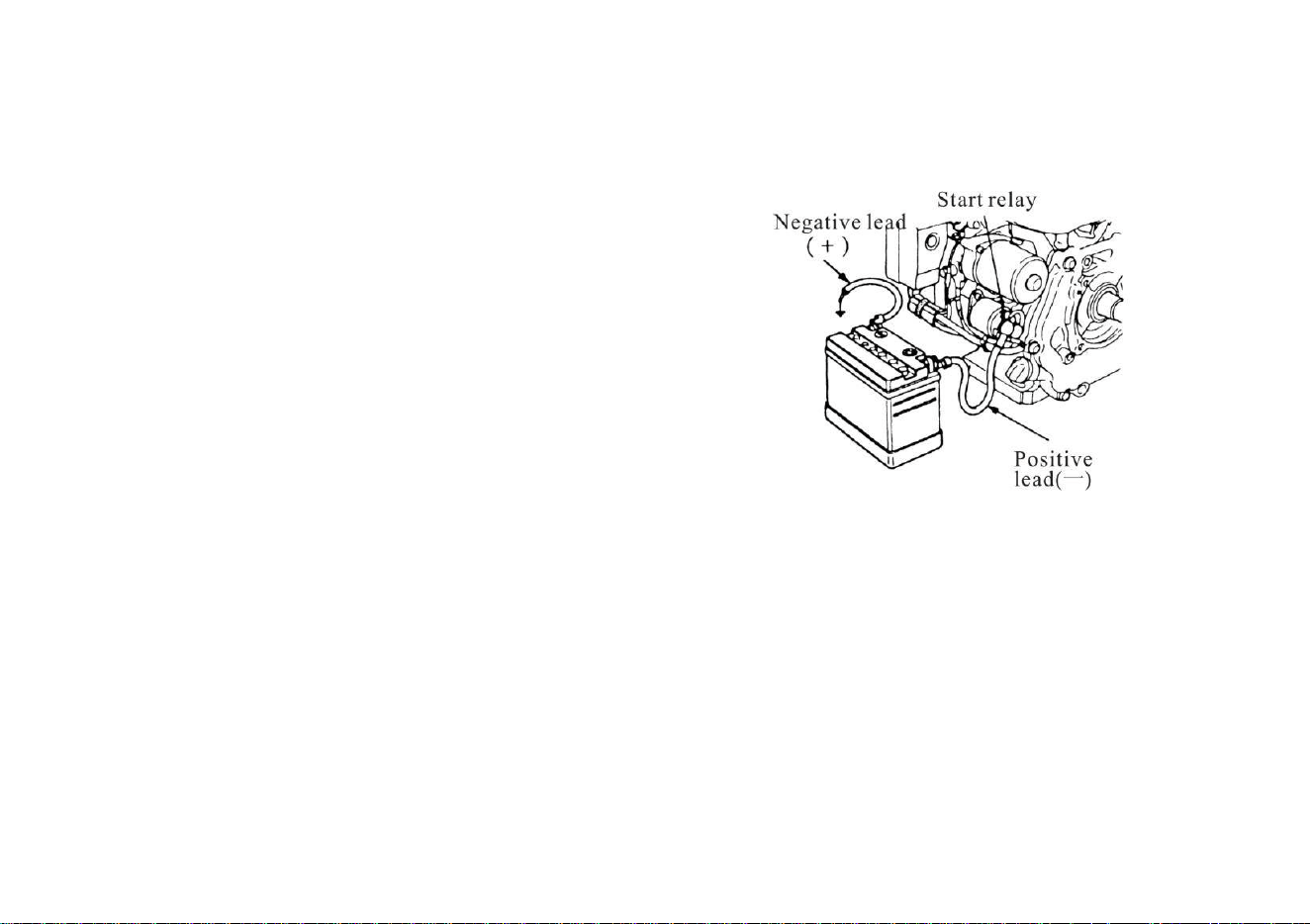
In the case that the specifications of the batte4ry are 12V and more than 18A.h, connect its positive lead to the
electromagnetic coil while connect its negative lead to engine mount strew, base screw or any place capable of
grounding with the engine well.
Make sure the battery leads are connected tightly and no corrosion is found. If any, eliminate it.
WARNING:
● The battery may give off explosive gas, keep sparks, flames and cigarettes away. Charge or use it in
an area with good ventilation.
● The battery contains euphonic acid (electrolyte). Contact with skin or eyes may cause severe burns.
Wear protective clothing and a face shield.
If electrolyte gets in your skin, flush with water; if gets in your eyes, flush with water for at least 15
minutes and call a physician at once.
● Electrolyte is poisonous. If swallowed, drink large quantities of water or milk, and follow with milk
of magnesia or vegetable oil and call a physician.
● Keep out of reach of children.
CAUTION:
● Do not add tap water to the battery instead of distilled water, or the battery life will be shortened.
● Do not add distilled water over electrolyte upper level mark, or electrolyte will spill out to corrupt
the engine parts. If so, be sure to wash them sway with water.
4
● Make sure not to connect the battery leads in reverse
order, or short-circuit or breaker’s cutting may result.
CONTROL CONNECTION OF REMOTE DISTANCE (OPTION)
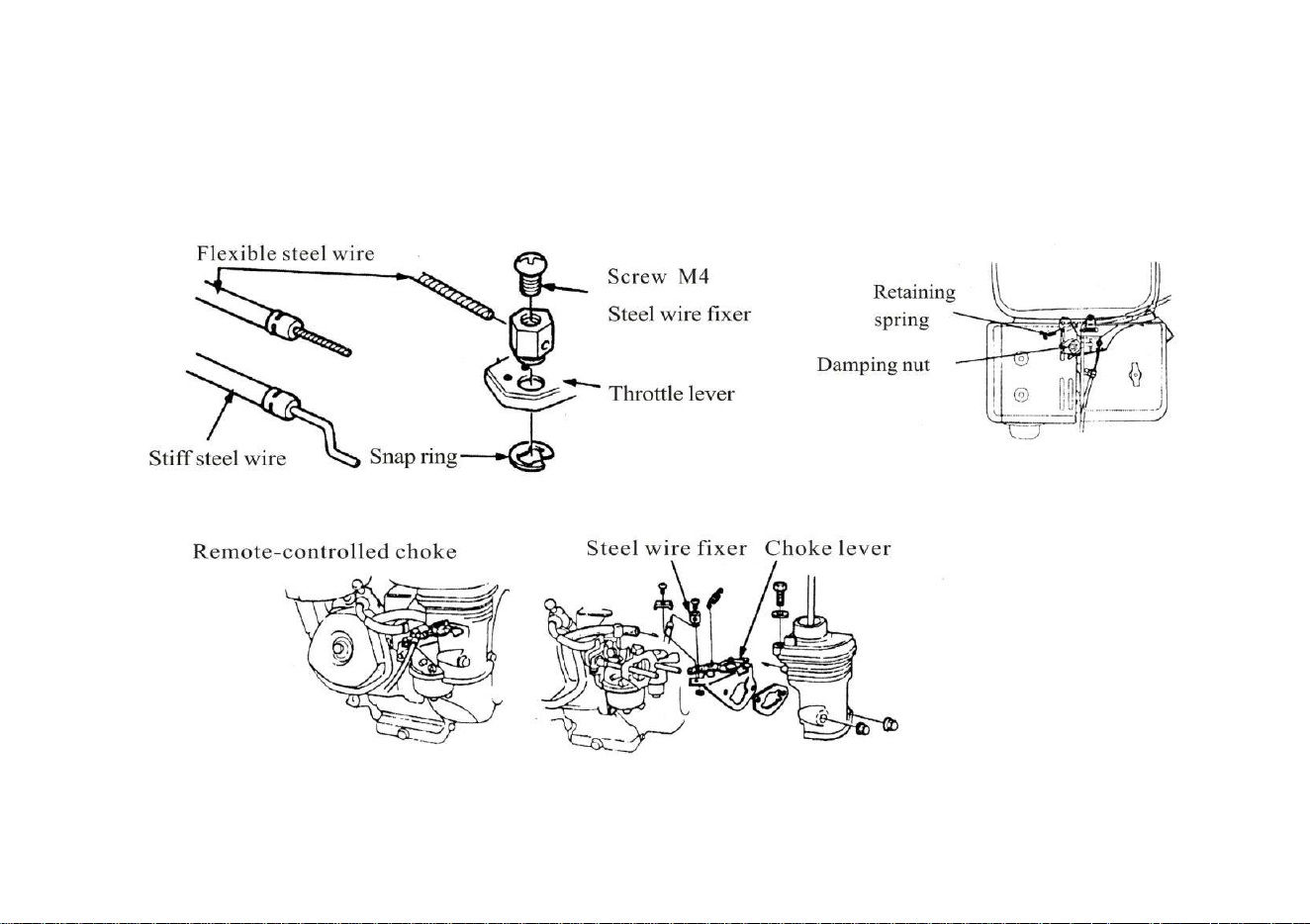
The holes in levers of both the choke and throttle are used for mounting optioned steel wires. The diagrams
shown illustrate how to mount a solid steel wire and a meshed steel wire. If choosing a meshed steel wire, a
retaining spring is in need.
If necessary, you may screw loose the damping nut on the throttle lever slightly when controlling the throttle by
a remote-controlled steel wire
5
Accessory options Remote-controlled throttle
6
PRE-OPERATE INSPECTION
ENGINE OIL
CAUTION:
● Engine oil is a key factor in deciding the engine’ s
Performace. Do not apply engine oil with additives
or 2-stroke gasoline engine oil, as they haven’t en-
ough lubrication, which may shorten the engines
service life.
● Check the engine with it stopped on a level ground.
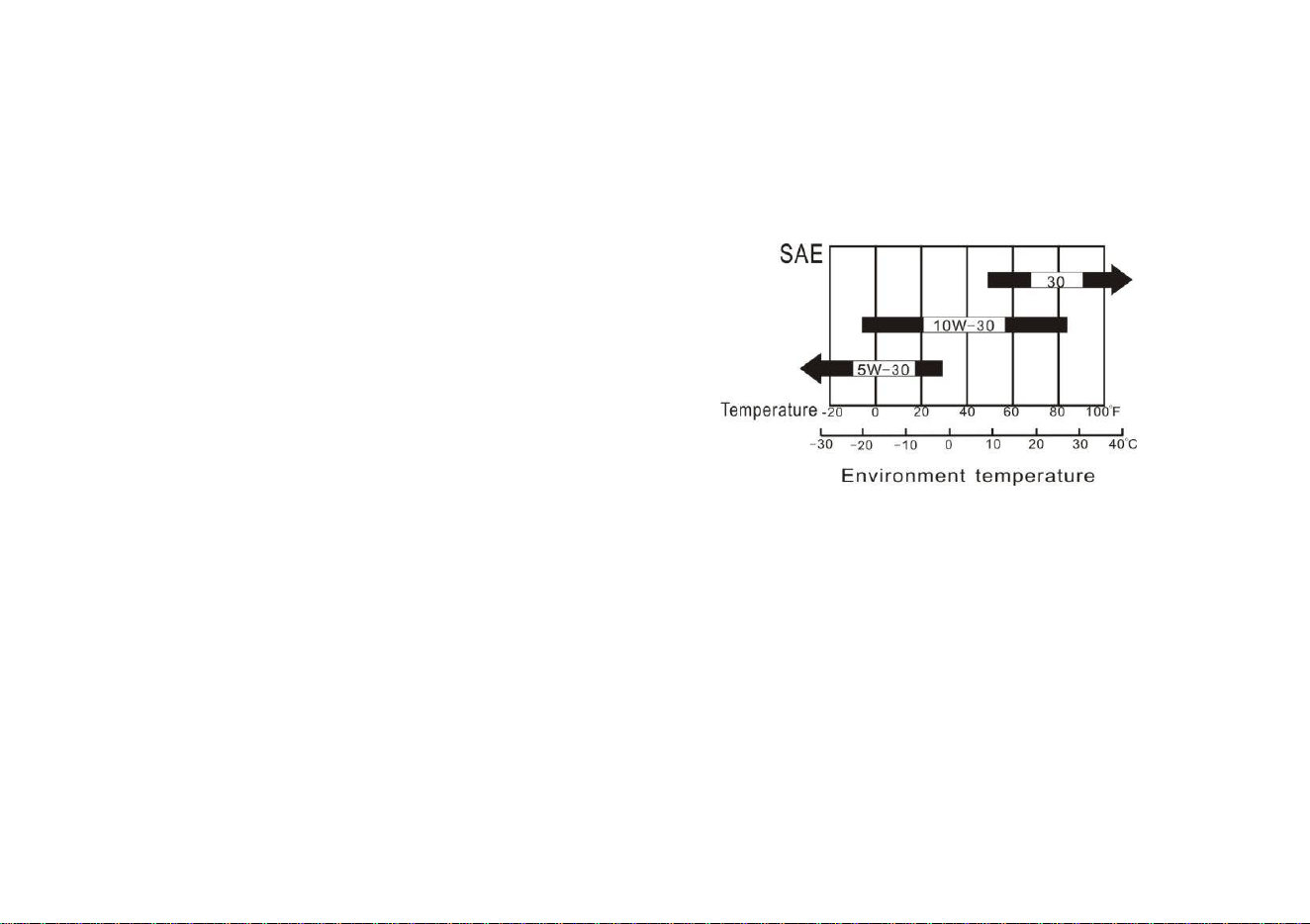
Engine oil recommended: SAE10W-30
As viscosity varies with regions and temperatures, so
the lubricant has to be selected in accordance with our
recommendation.
Check
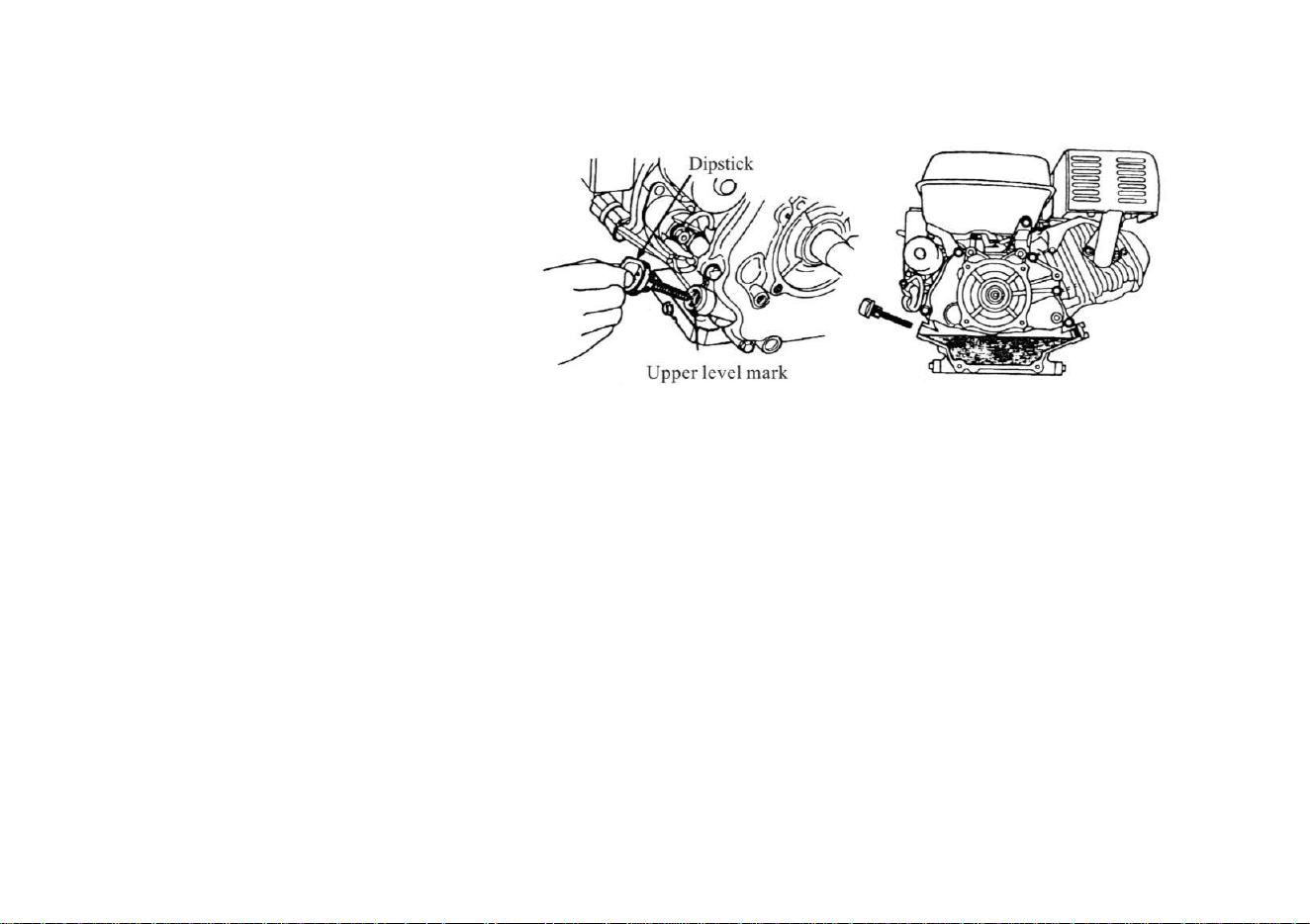
1. Ensure that the engine is stopped on a level ground.
2. Remove the dipstick and clean it.
3. Reinsert the dipstick into the oil filler without screwing it, and check oil level.
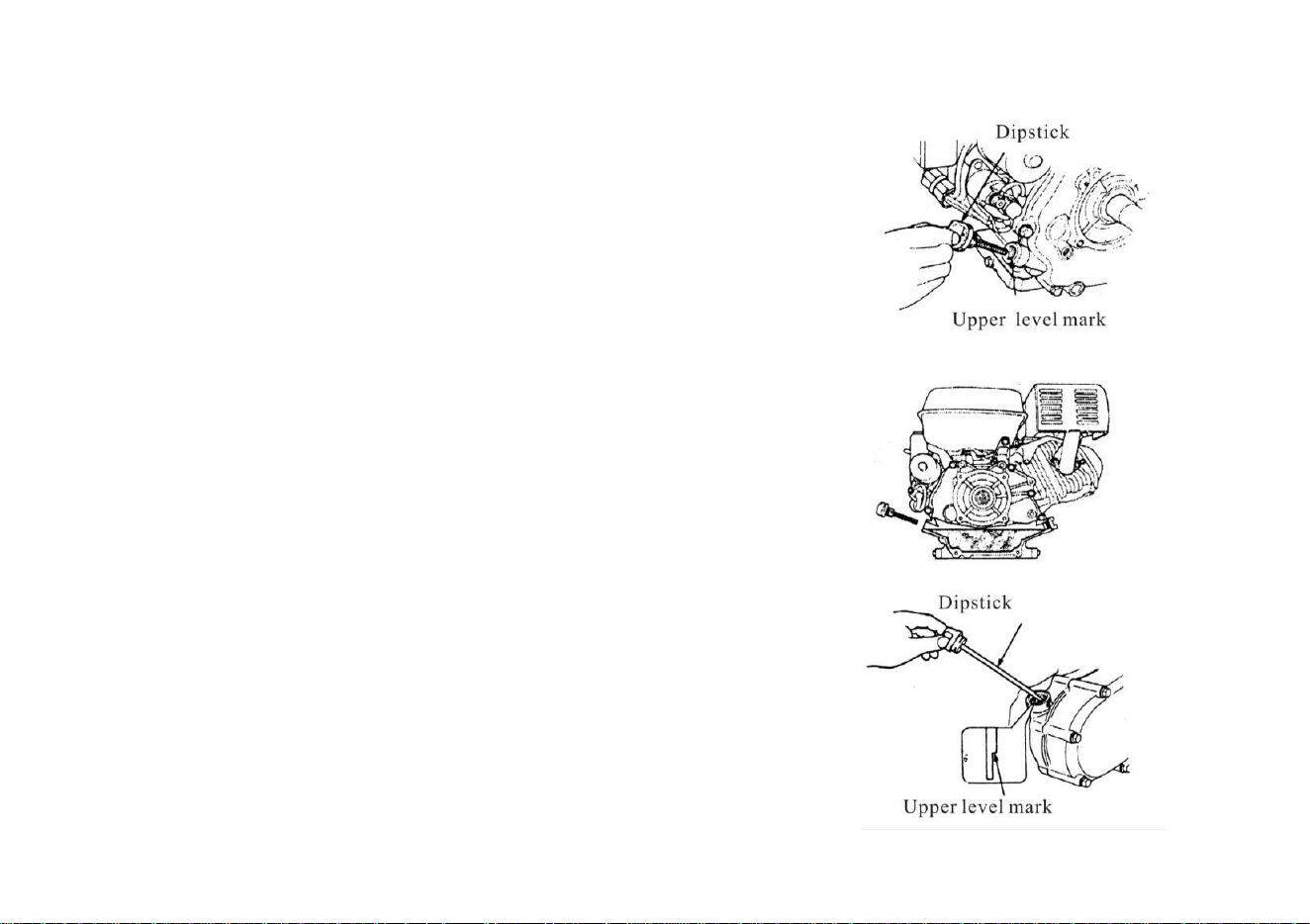
7
4. If the oil level is too low, add the recommended engine oil up to
the oil filler neck.
5. Reinstall the dipstick.
CAUTION: Run with insufficient engine oil may damage the engine
Severely.
OIL IN THE REDUCTION GEAR BOX (only for the
model equipped with it)
1/2 Reduction gear with an auto-centrifugal clutch
brand of box oil is the same as that of engine oil.
Oil capacity: 0.30 liters
1. Remove the dipstick and clean it .
2. Reinsert the dipstick without screwing it in, and then check oil level.
3. If the oil level is too low, add the recommended engine oil until it
arrives the upper level mark.
4. Reinstall the dipstick.
8
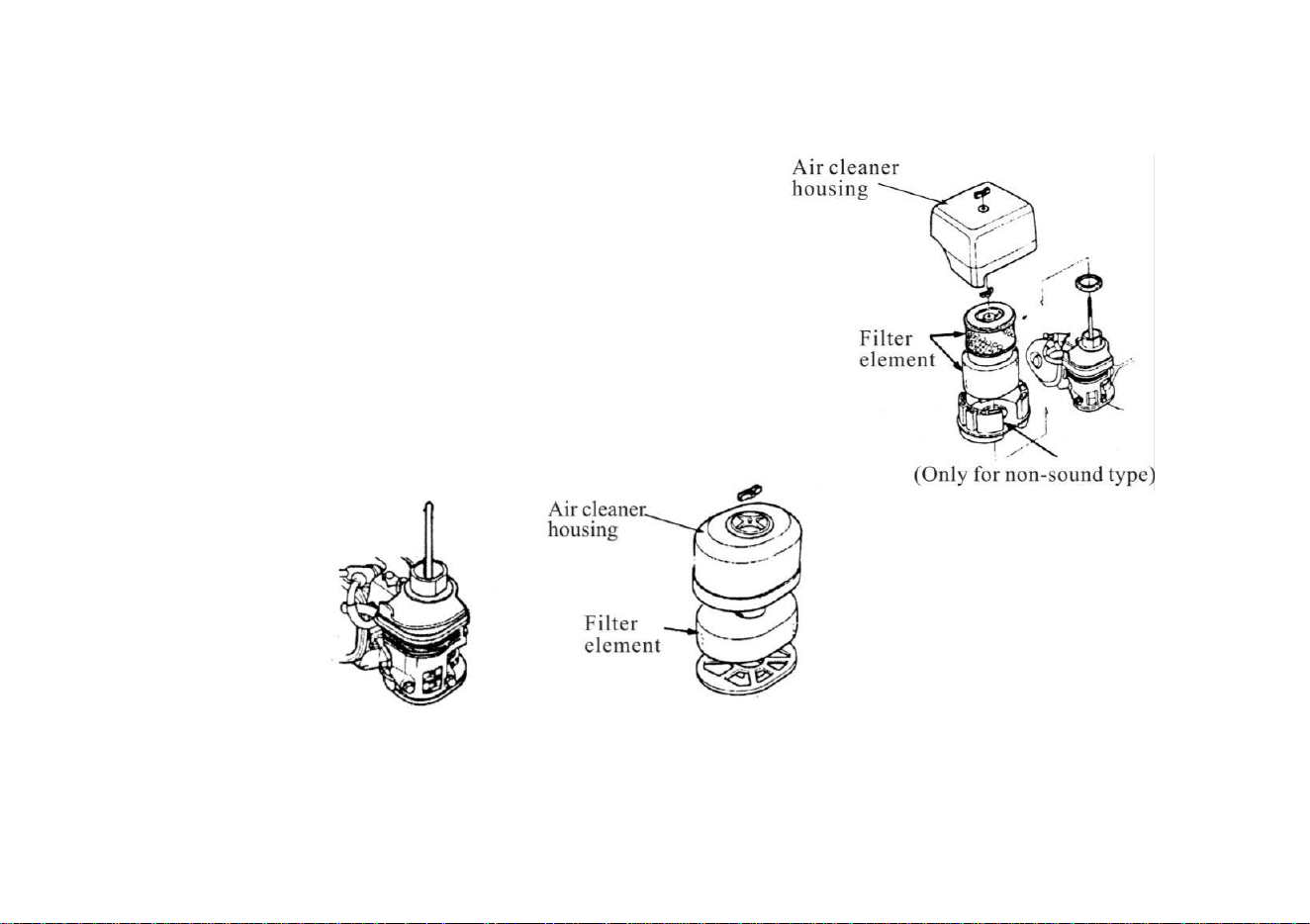
AIR CLEANER
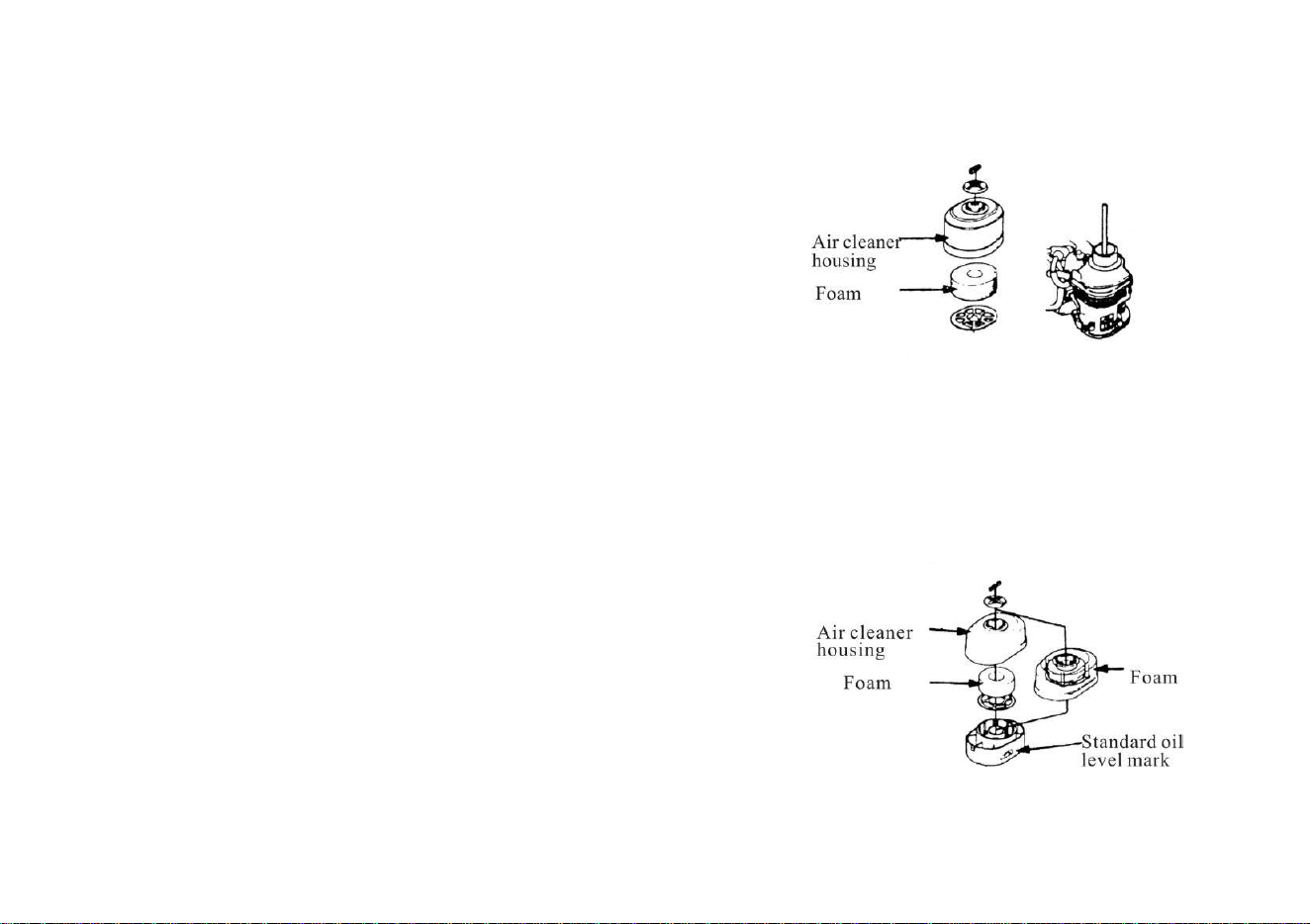
Ⅰ. Double-core type
Dismantle the air cleaner housing and check its filter element,
make sure it clean and intact, otherwise clean or replace it.
Ⅱ. Single-core type
Dismantle the air cleaner housing and check its filter element,
Make sure it is clean and intact, otherwise clean or replace.
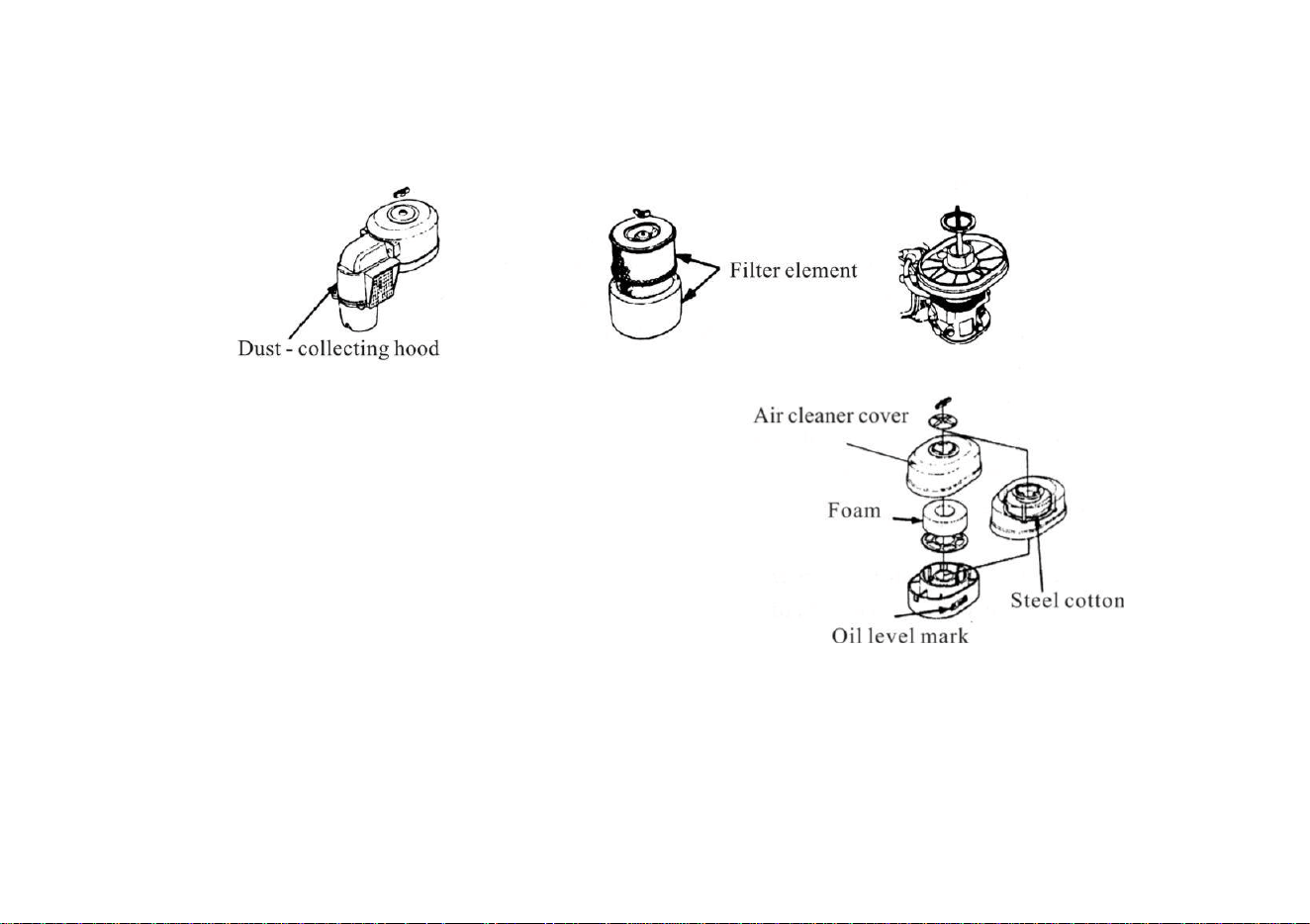
9
Ⅲ. Dust-collecting type
1. Dismantle the dust-collecting hood and check the filter
element of the air cleaner; make sure it is clean and intact,
otherwise clean or replace.
2. Check whether there is any dust or dirt inside the dust-
collecting hood, if any, clear away.
Ⅳ. Oil-bath type
1. Dismantle the air cleaner housing and check its core,
make sure it is clean and intact, otherwise clean or replace.
2. Check oil level and oil quality. If the oil level is too low, add the recommended engine oil up to oil level mark.
CAUTION:
Never run the engine without an air cleaner, or severe wear of the engine may result.
10
FUEL AND FUEL TANK
Fuel
The engine must apply unleaded gasoline with an octane number over 86. Using unleaded gasoline will decrease
the possibility of producing carbon deposit and will prolong the engine’s service life. Never apply used or
polluted gasoline or a mixture of gasoline with engine oil. Make sure the fuel is free of dirt and water.
Gasoline Containing Alcohol
If you decide to use a gasoline containing alcohol (fuel blend), be sure its octane rating is at least as high as high
as that recommended by the company. There are two types of“gasohol”. One contains ethanol, and the other
contains methanol. Neither gasoline containing more than 10% ethanol nor 5% methanol is allowed to be used. If
methanol content in the fuel blend exceeds 5%, it may bring bad effect on the engine performance, besides, it
may damage metals, rubber and plastic parts.
CAUTION:
If “spark knock” or “pinking”occurs
at a steady speed under normal load, change
brand of gasoline; if such phenomena still
happen, consult your dealer for help, otherwise
the engine may be damaged.

11
Fuel Tank
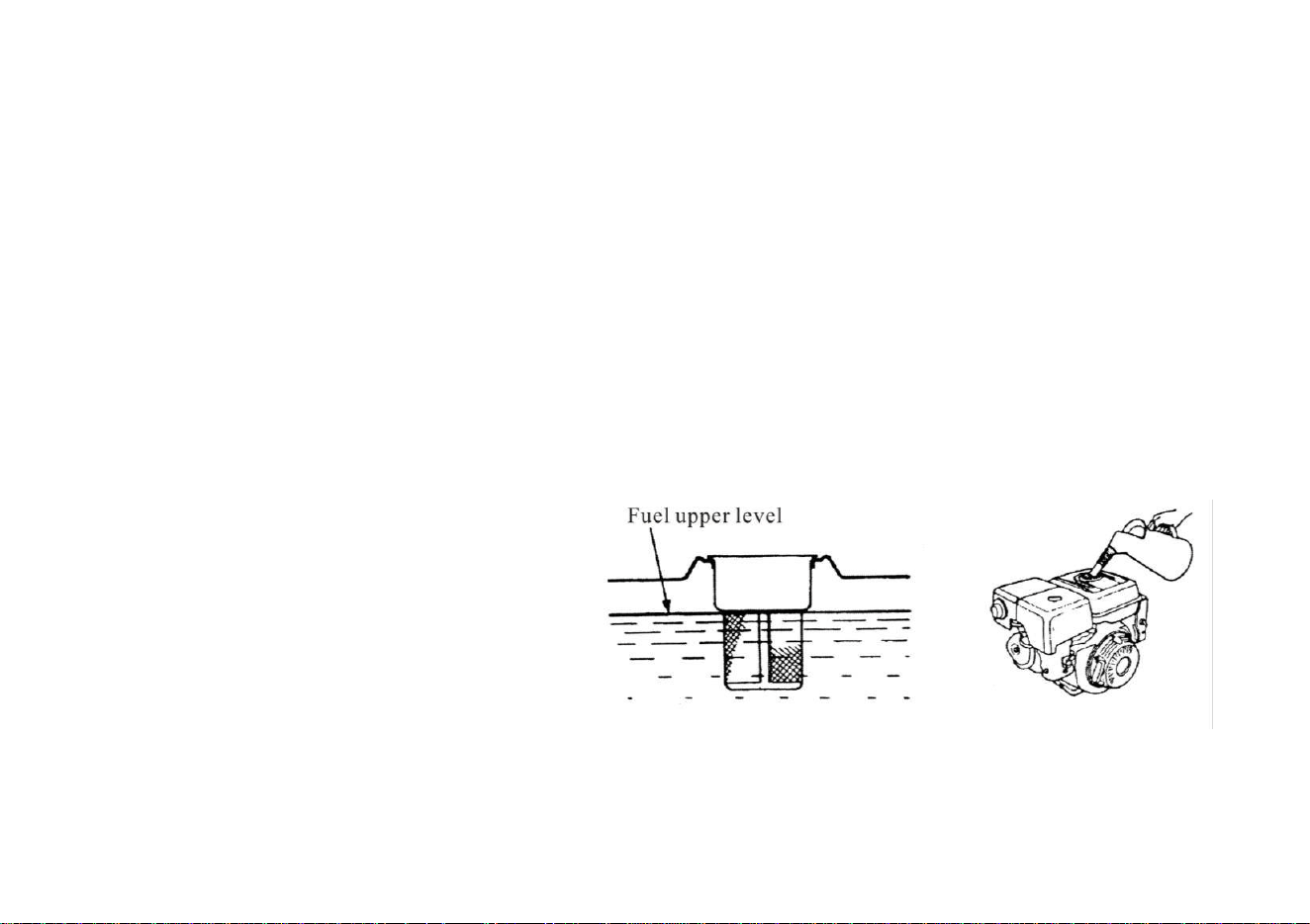
Fuel tank capacity 6.0 liters for 173F /177F, 6.5liters for 182F /188F/190F.
Fuel tank capacity 6.0 liters for 173FD /177FD, 6.5liters for 182FD /188FD/190FD.
Check
1. Remove the fuel filler cap and check fuel level.
2. If the level is too low, refuel the tank. Remember adding fuel not over the fuel filler shoulder.
WARNING:
● Gasoline is extremely flammable and is explosive under certain conditions. Refueling in a
well-ventilation area with the engine stopped. Do not smoke and allow flames or sparks in the area
where gasoline is stored or where the fuel tank is refueled.
● Do not overfill the tank (there should be no fuel in the filler neck). After refueling, make sure the fuel
filler cap is set back securely.
● Be careful not to spill fuel when refueling. Spilled fuel or fuel vapor may ignite. If any fuel is spilled,
make sure the area is dry before starting the engine.
● Avoid repeated or prolonged contact with skin or breathing of fuel vapor. Keep out of reach of
children.
12
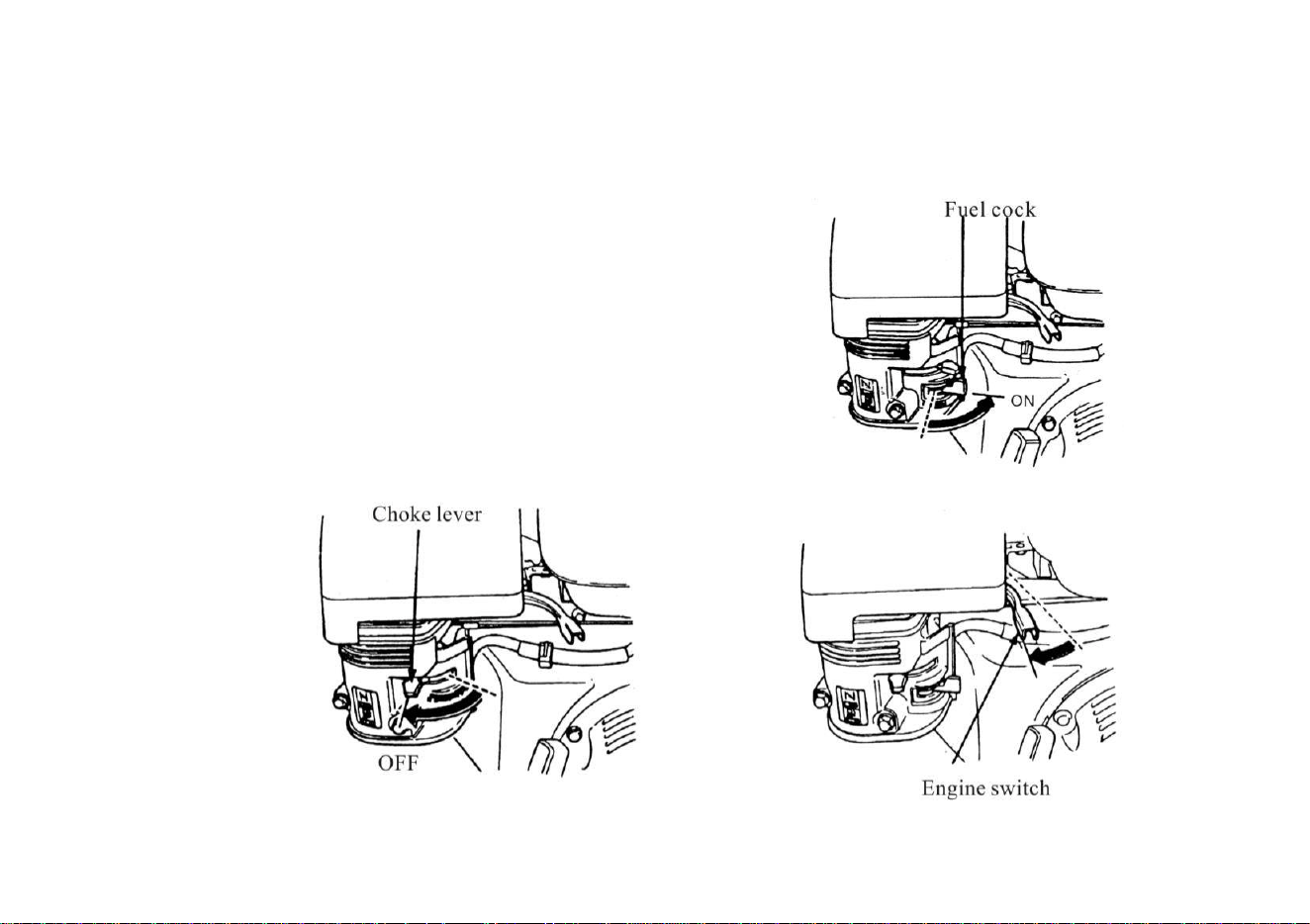
STARTING THE ENGINE
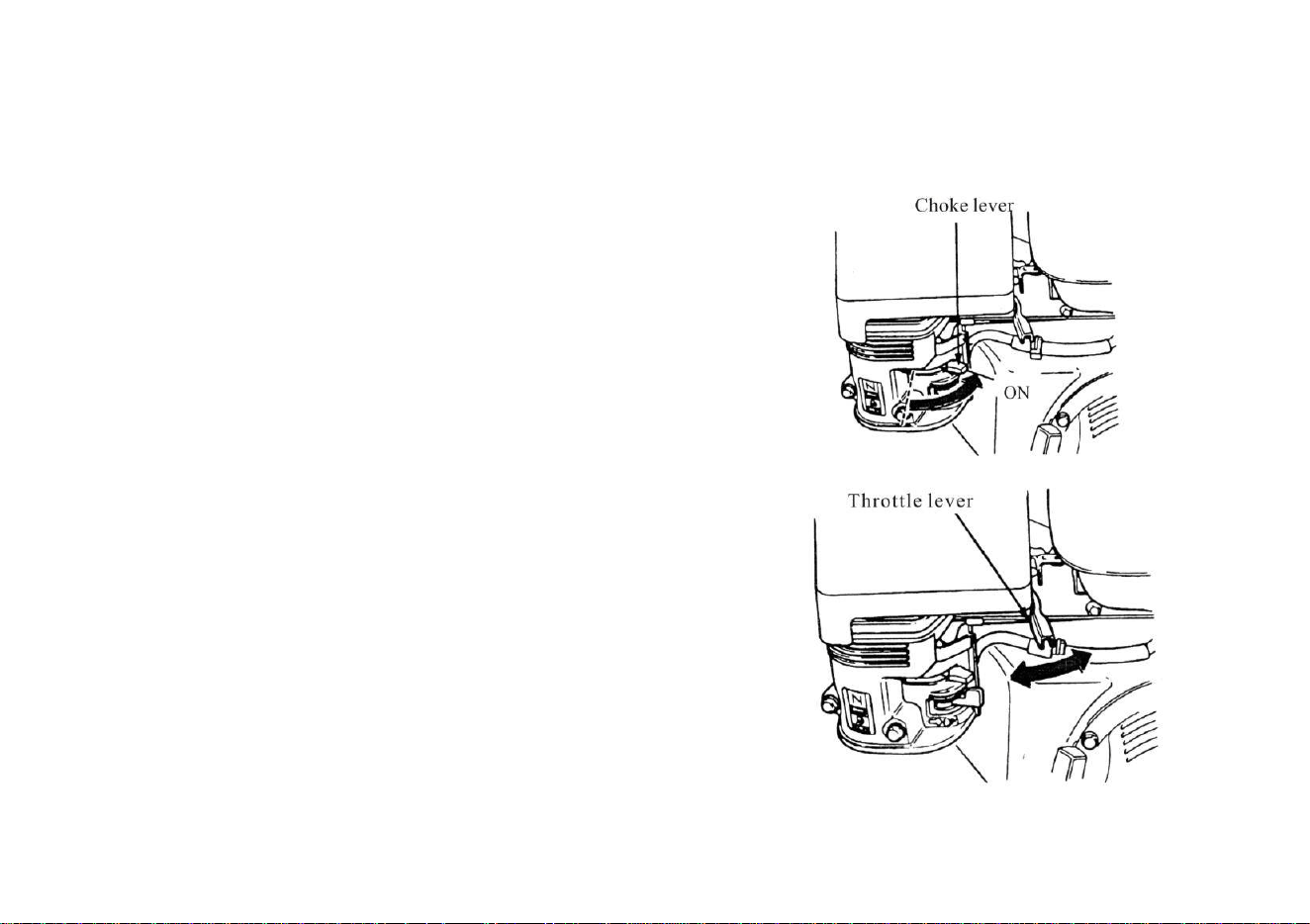
1. Push the fuel cock to “ ON ”.
2. Push the choke lever to “ CLOSE ”.
NOTE: if the engine is hot, closing the choke is unnecessary.
13
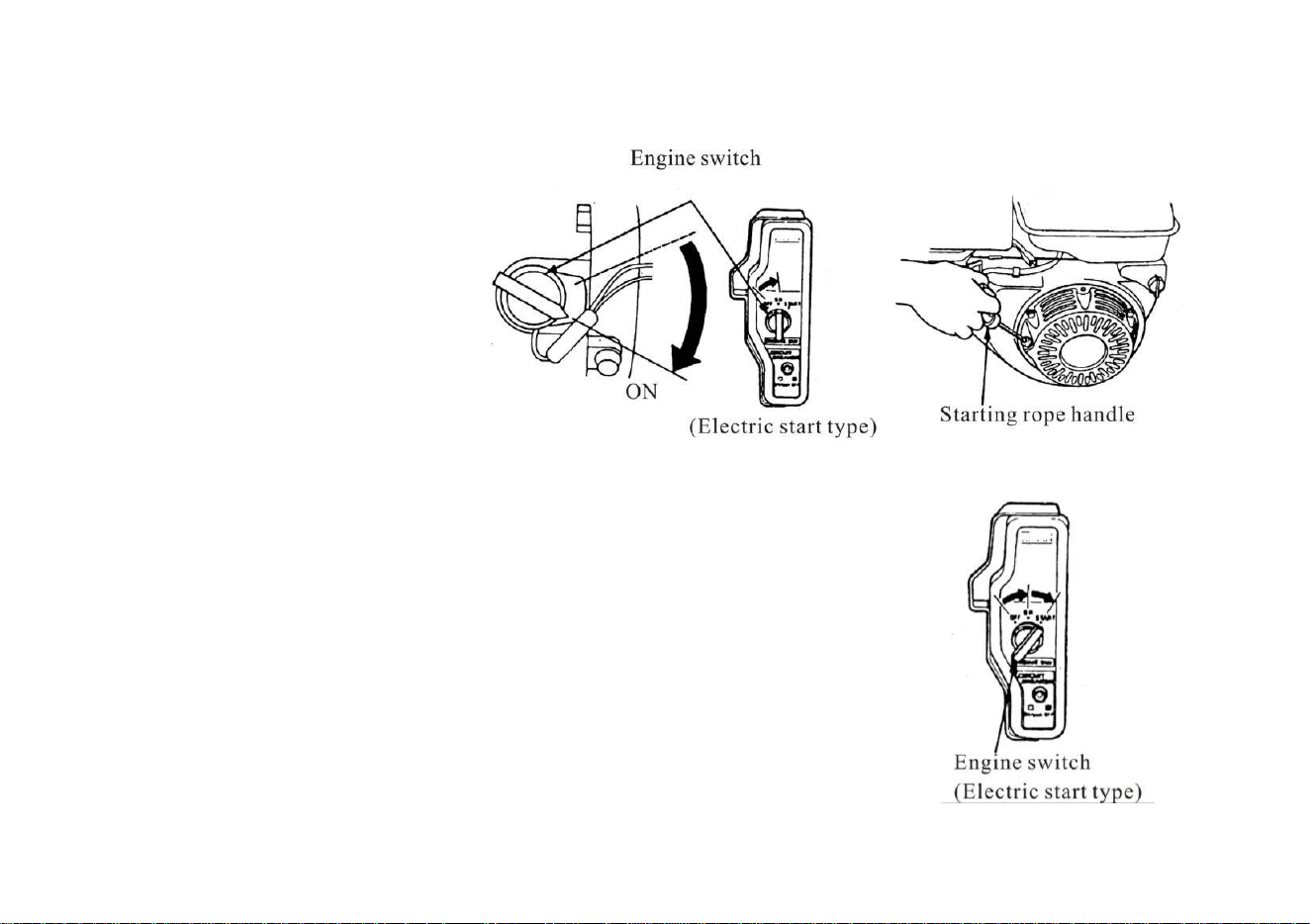
3. Move left the throttle lever a
little.
4. Start the engine as follows:
a) Hand-operated kick-starter
Push the engine switch to “ ON ”.
Pull slightly the starting rope
handle up until feeling anti-action,
and then make a rapid pull.
CAUTION:
Releasing the handle suddenly may make it hitting the engine. Release the
handle slowly conforming with its recoiling force.
b) Electric starter
Push the engine switch to “ START ” and remain there until the engine starts.
Once the engine starts, reset the engine switch to “ ON ”.
CAUTION:
Use the engine switch not than 5 minutes each time to avoid damage of the
14
engine. Try once more 10 minutes later after last attempt failures.
RUNNING THE ENGINE
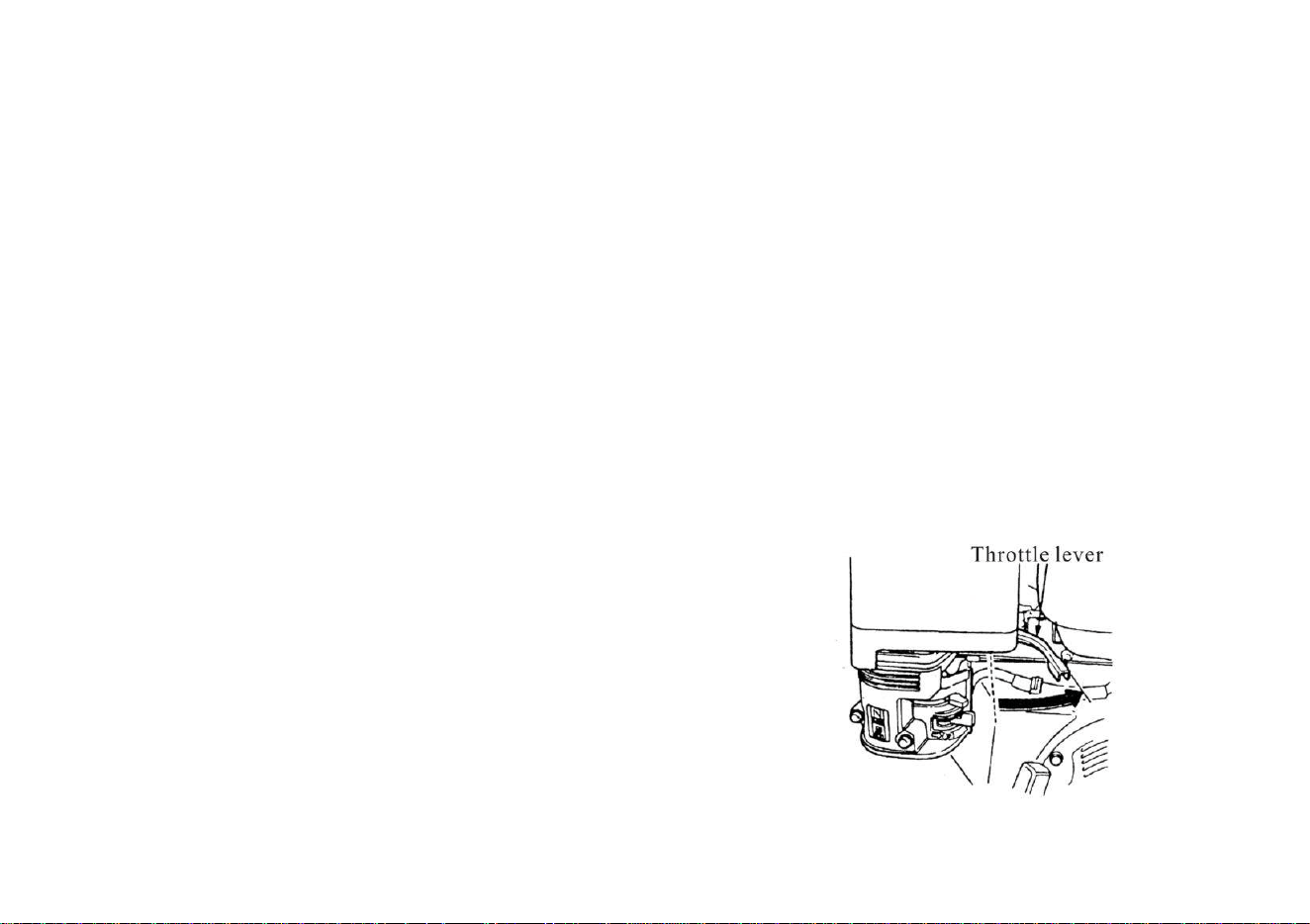
1. Preheat the engine and push back the choke lever to “ OPEN ”.
2. Set the throttle lever in proper position to ensure the engine runs
at required velocity.
15
ENGINE OIL ALARM
The engine oil alarm is designed to
function when the engine oil in the
crankcase is insufficient. Lack of
engine oil may damage the engine.
Once oil level in the crankcase is too
low, the engine oil alarm will stall the
engine automatically to make it free
of damage while the engine switch is still at “ ON ”.
CAUTION:
If cannot restart the engine, check the engine oil level first before go to other check items.
BREAKER (Electric-start type)
The breaker will cut off automatically to protect the charging circuit of the battery in the case that short circuit or
incorrect connection of the battery poles occurs.
The green indicator in the breaker will jump out with the circuit cutting off. After finding troubles and
troubleshooting, depress the breaker button to turn the breaker on.
16
OPERATING ON HIGHLANDS
On highlands, the standard mixture ratio is relatively too big so the engine performance may be impaired while
the fuel consumption may increase, besides, too big mixture ratio will pollute the spark plug to result in starting
the engine difficultly. This problem can be solved by amending the carburetor technological status. If always
using on highlands with a height above sea level of 1800 meters, ask your dealer for doing the job.
However, the engine power will decrease by about 3.5% with every 305 meters up in height.
CAUTION:
Amended engine applicable to highlands may be damaged seriously in area below altitude of 1800 meters
for overheating, because its mixture ratio is too small for operation in low altitude area. In the case, ask
your dealer to recover the engine to its normal technical status.
STOP
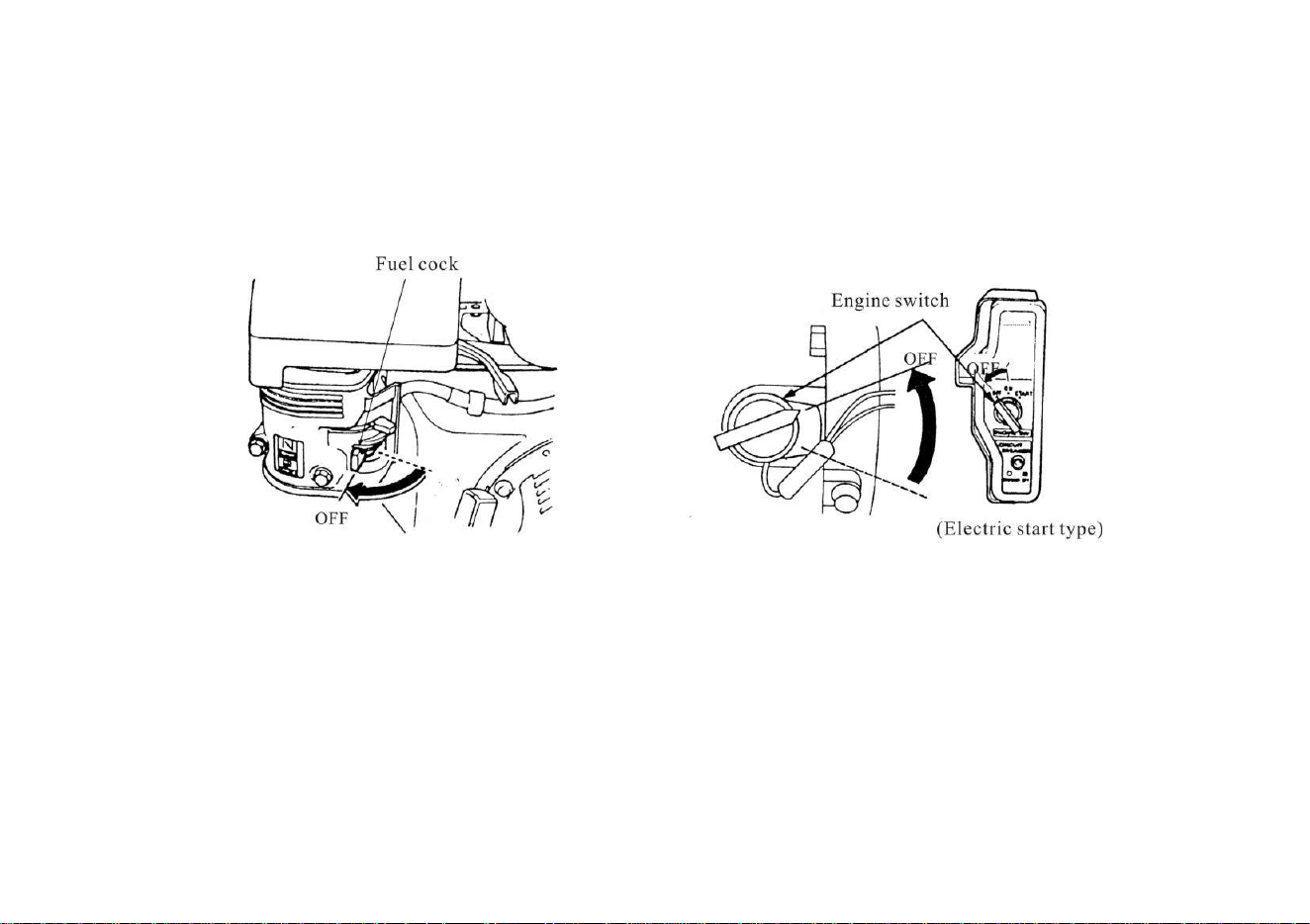
In emergency, push the engine switch to “ OFF ” to stall
The engine to stop it in normal, do as follows:
1. Push right the throttle lever to the bottom.
17
2. Push the engine switch to “ OFF ”.
3. Set the fuel cock to “ OFF ”.
CAUTION:
Sudden stopping at high speed under heavy load is forbidden, otherwise damage will result.

18
EXHAUST CONTROL SYSTEM
With the engine running, carbon monoxide, oxide of nitrogen and hydrocarbon will produce, and in certain
conditions, oxide of nitrogen and hydrocarbon will react chemically each other to make smoke while carbon
monoxide is toxic, so exhaust control of them is very important. The company decreases the exhaust emissions
by introducing poor-fuel carburetors and other devices into the engine to solve the problem.
To keep the exhaust of your engine with in the standard exhaust emission, pay attention to the following:
1. Maintenance
Maintain the engine periodically in accordance with the maintenance schedule in the manual. The maintenance
schedule is made out on the base of normal use in normal conditions, if using under heavy load, dusty or wet
circumstances or in high temperature, service of the engine should be done more often.
2. Replacement of parts
We recommend that you should choose such parts which are manufactured by the company or equivalent to
these in quality as replacement ones. Replacement without so high quality as the original may impair the exhaust
control system in effectiveness.

19
3. Modifying
Modifying the exhaust control system may make actual exhaust emissions exceeding statutory limit values.
Illegal modification as such:
a) Dismantle or modify any part of air intake or exhaust system.
b) Modify or take off speed – adjusting connection device or speed adjustment device to result in the engines
running beyond the set parameters.
4. Problems affecting exhaust emissions
a) Difficult starting or difficult stopping.
b) Unstable idling.
c) Give off back smoke or consume too much fuel.
d) Poor ignition sparks or sparks returned.
Once you find any of above problems, contact your dealer for help.
20
MAINTENANCE
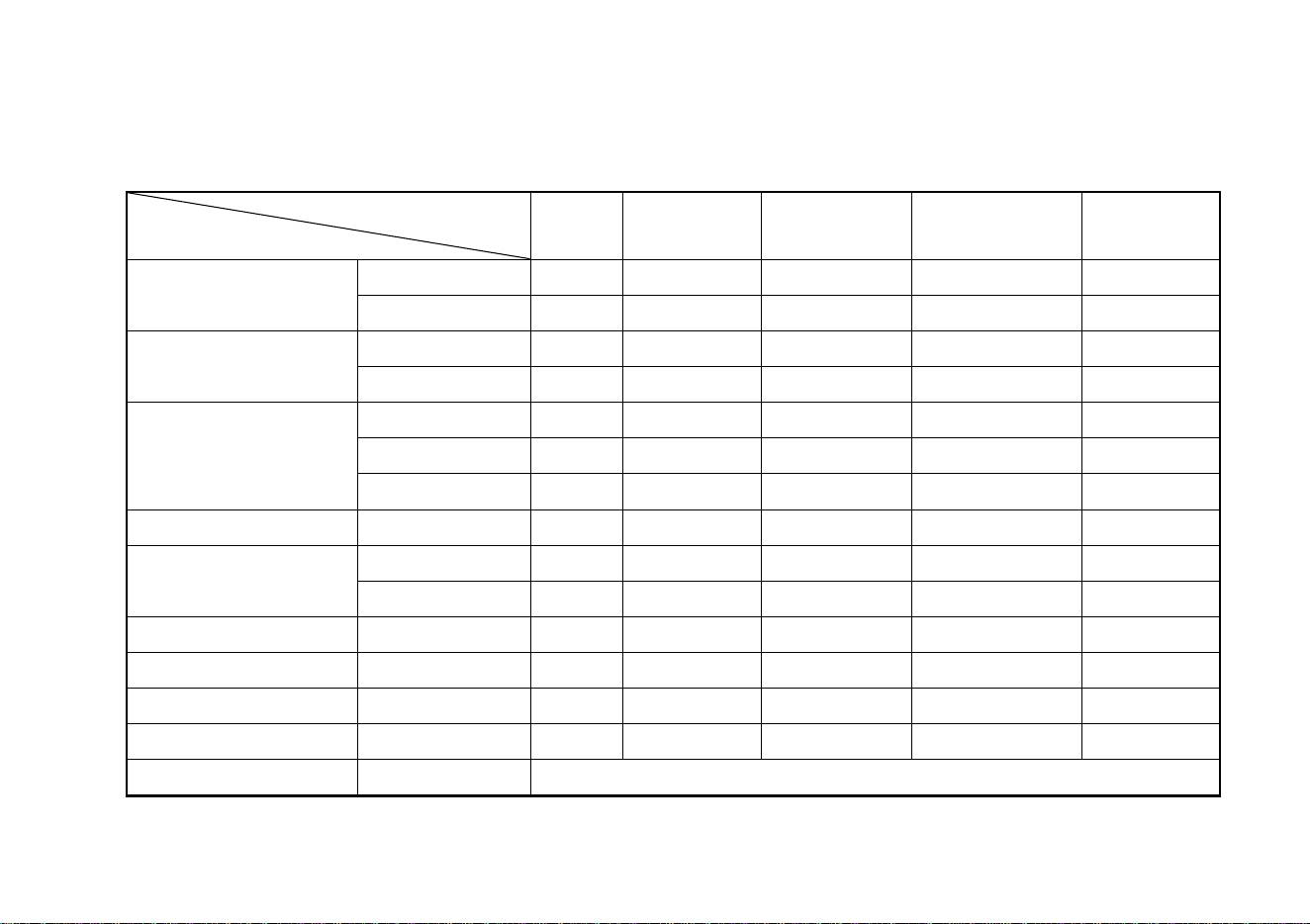
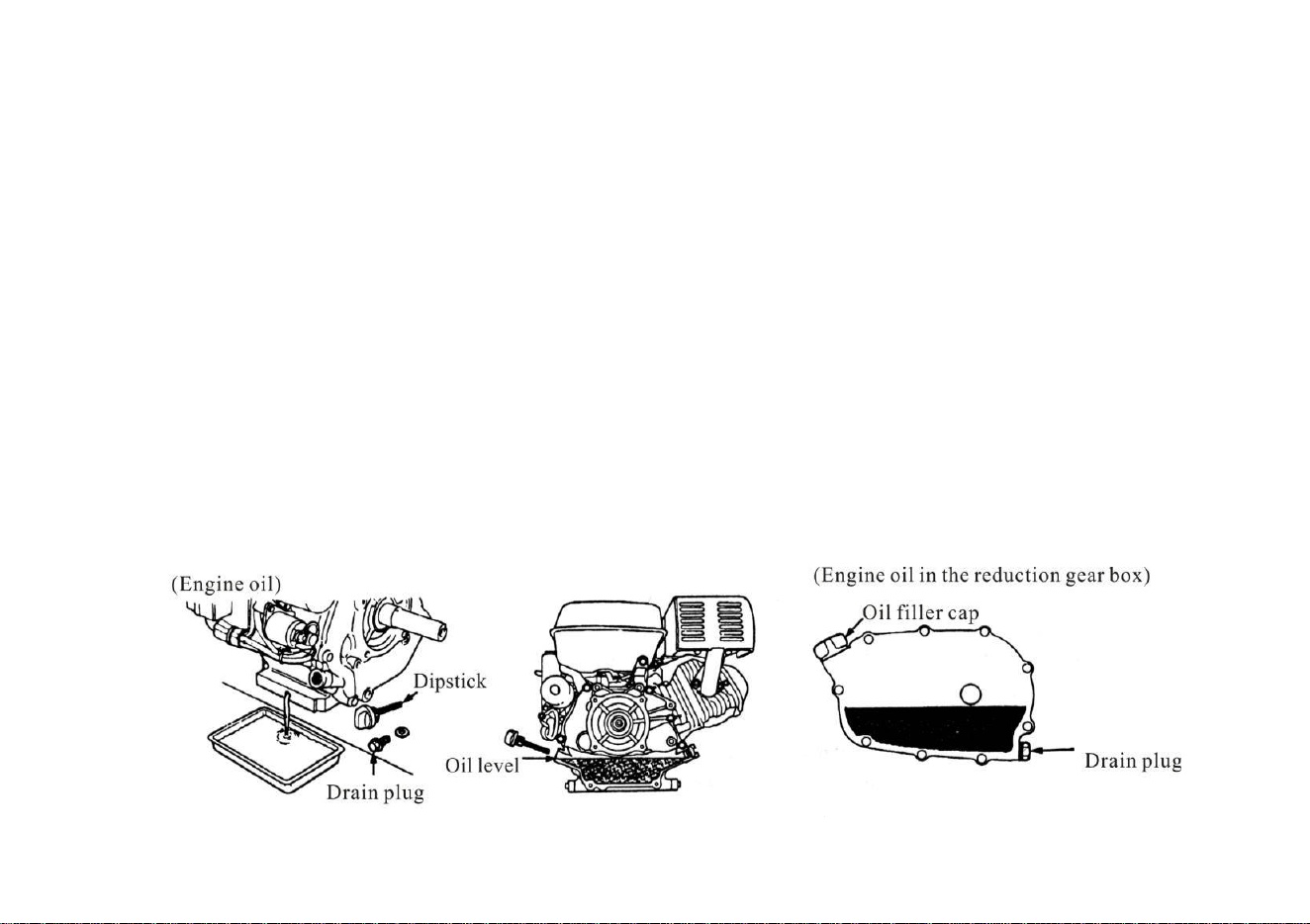
MAINTENANCE SCHEDULE
Frequency
Item
Each
time
First month
or 20 hrs
Each season
or 50 hrs
Every 6 month
or 100 hrs
Each year
or 300 hrs
Engine oil
Oil level check
√
Replace
√
√
Reduction gear oil
Oil level check
√
Replace
√
√
Air cleaner
Check
√
Clean
√①
√①*
Replace
√**
Deposit cup
Clean
√
Spark plug
Clean, adjust
√
Replace
√
Spark eliminator
Clean
√
Idling
Check-adjust
②
Valve clearance
Check-adjust
②
Fuel tank & fuel filter
Clean
②
Fuel supply line
Check
Every two years (do a replacement if necessary)
21
CAUTION
Use only parts from the company or equivalents in quality; otherwise engine damage may result.
NOTE:
*: only for inside-ventilating double-core carburetors.
**: only for paper core air cleaners. Every two years or 600 hour’s later for dust collecting air cleaners.
① More often than that in the schedule if in dusty circumstances.
② Should be done by your dealer unless you are specially trained and is well equipped with tools.
WARNING:
Stall the engine before service. If service is required with the engine running, be sure to keep good
ventilation in the area. The exhaust emissions from the engine contain toxic carbon monoxide, inbreathing
of it may result injury and even death.
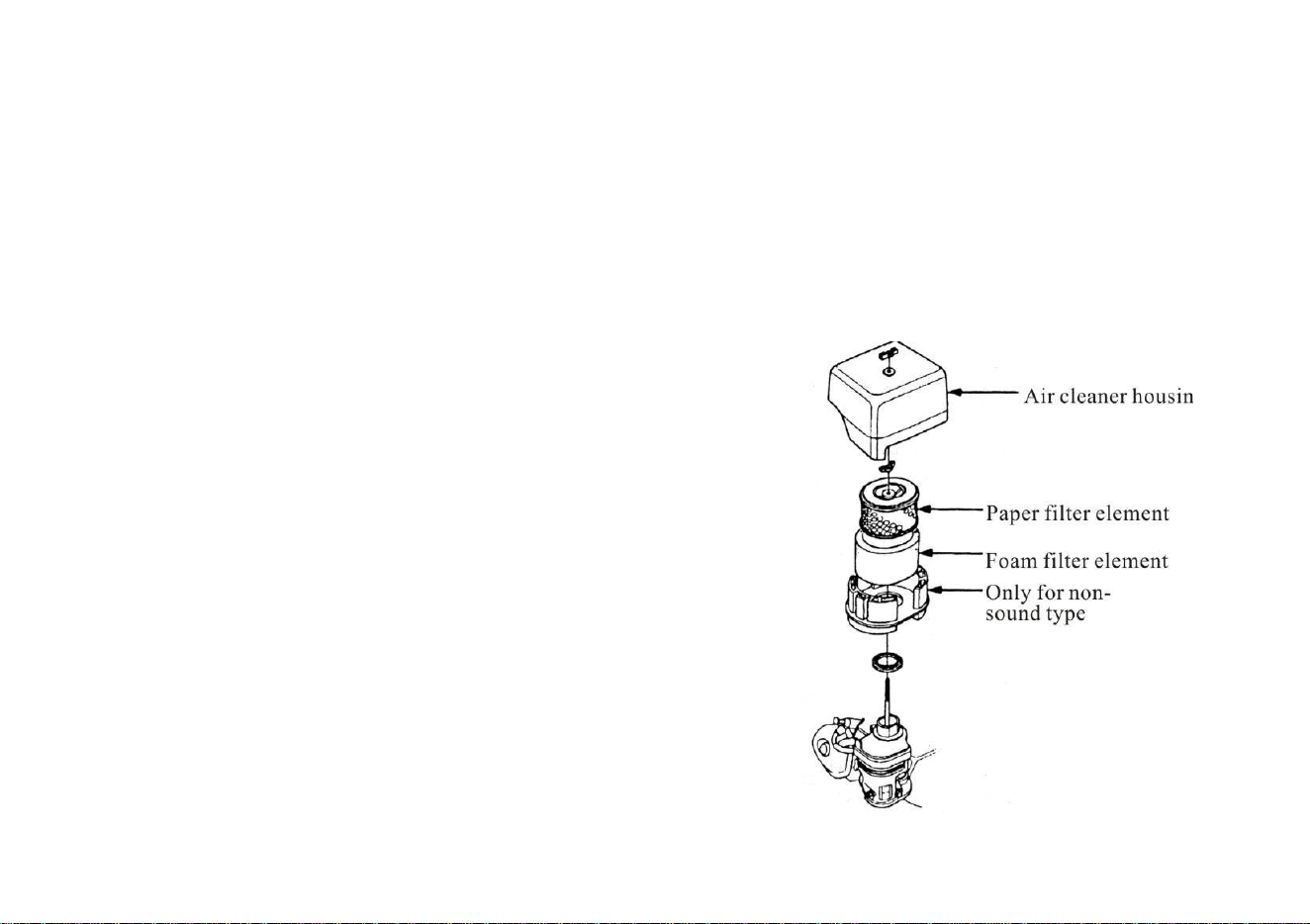
REPLACEMENT OF ENGINE OIL
22
A still hot engine is helpful to drain out the engine oil in the crankcase rapidly and entirely.
1. Turn off the oil filler cap and drain plug to drain engine oil thoroughly. Reinstall the drain plug and screw in
securely.
2. Fill the specified engine oil up to the upper level mark.
3. Reinstall the oil filler cap.
Engine oil capacity in the reduction gearbox is 0.3 liters, engine oil capacity in the crankcase is 1.1 liters.
NOTE:
Do not dump oil containers or discarded engine oil into rubbish
boxes or onto the ground. For the sake of environmental
protection, we suggest you take in discarded engine oil with a
closed container and bring to local recycling station.
SERVICE OF AIR CLEANER
A dirty air’s flowing into the carburetor. To keep the carburetor in
good working conditions, please service the air cleaner periodically.
If operating the engine in extremely dusty area, the job should be
done more often.
WARNING:
Never clean the air cleaner core in gasoline or low
flash-point detergents, or explosion may happen.
23
CAUTION:
Never run the engine without an air cleaner, or air with dirt and dust may enter the engine so speed the
engine’s wear.
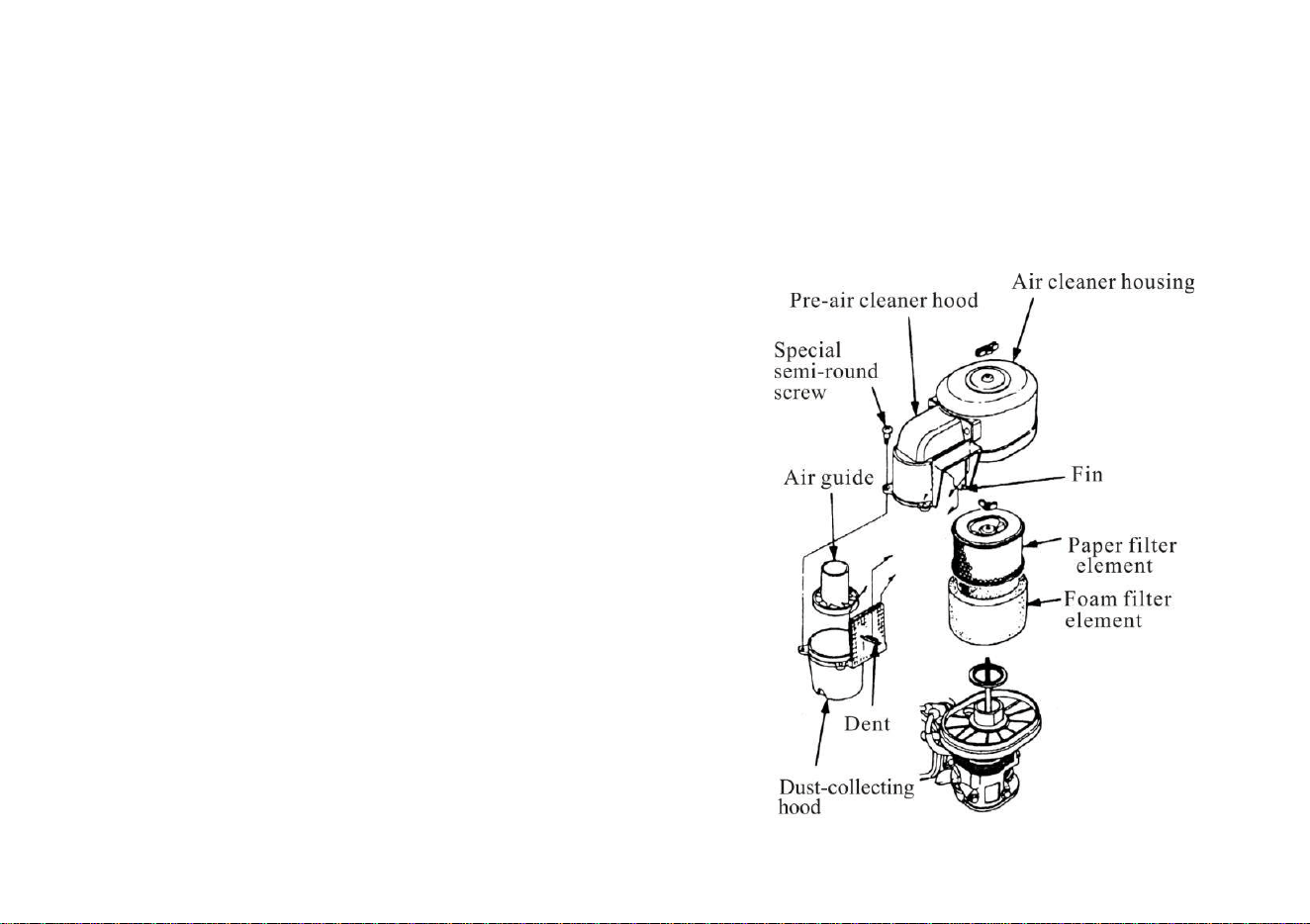
Unscrew the wing nut, dismantle the air cleaner housing. Check
if the two cores are damaged, if so, replace with new one.
a) Foam filter element: clean with home detergents and warm
water (or non-flammable or high flash-point cleansing solvents)
and dry up, then soak in clean engine oil until saturated. Squeeze
out excess oil, otherwise, the engine will discharge smoke in
starting stage.
b) Paper filter element: knock the core against a solid plane to
get rid of accumulated dust or blow out dust from inside to
outside with high-pressure air flow (not more than 30 psi). Never
clean with a brush, as brushing may force the dust into the core
fiber. If the core is extremely filthy, replace with a new one.
Dust-collecting type
1. Unscrew the wing nut, dismantle the air cleaner housing, check
if the two cores are damaged, if so, replace with new one.

24
a) Foam filter element: clean with home detergents and warm water (or non-flammable or high flash-point
cleansing solvents ) and dry up, then soak in clean engine oil until saturated. Squeeze out excess oil,
otherwise, the engine will discharge smoke in starting stage.
b) Paper filter element: knock the core against a solid plane to got rid of accumulated dust or blow out dust
from inside to outside with high-pressure air flow (not more than 30psi). Never clean with a brush, as
brushing may force the dust into the core fiber. If the core is extremely filthy, replace with a new one.
2. Clean the dust-collecting hood: screw off the three special semi-round screw and remove the hood, wash
parts with water and then dry up. Reinstall the hood.
CAUTION:
● When reinstalling the dust collecting core air cleaner, make sure to embed the fin on the pre-air
cleaner hood in the dent in the dust- collecting hood.
● Install the air guide in correct order.
Single-core type
1. Remove the wing nut and air cleaner housing, and take out the filter element.
2. Clean with home detergents (or high flash-point cleansing solvents) and warm water, and dry up.
3. Soak n clean engine oil until saturated; squeeze oil, or the engine will exhaust smoke in starting stage.
4. Reinstall the filter element and air cleaner housing.
25
Oil bath type
1. Remove the nut and air cleaner housing, and take out the filter
element.
2. Clean with home detergents (or high flash-point cleansing
solvents) and warm water, and dry up.
3. Soak in clean engine oil until saturated. Squeeze excess oil,
or the engine will discharge smoke in starting stage.
4. Empty the air cleaner housing of oil. Clear away the dust in
side with non-flammable or high flash-point cleansing solvents,
and dry it up.
5. Fill the air cleaner housing with the specified engine oil up to
the standard oil level mark.
6. Reinstall the air cleaner
Oil capacity: 1.1L.
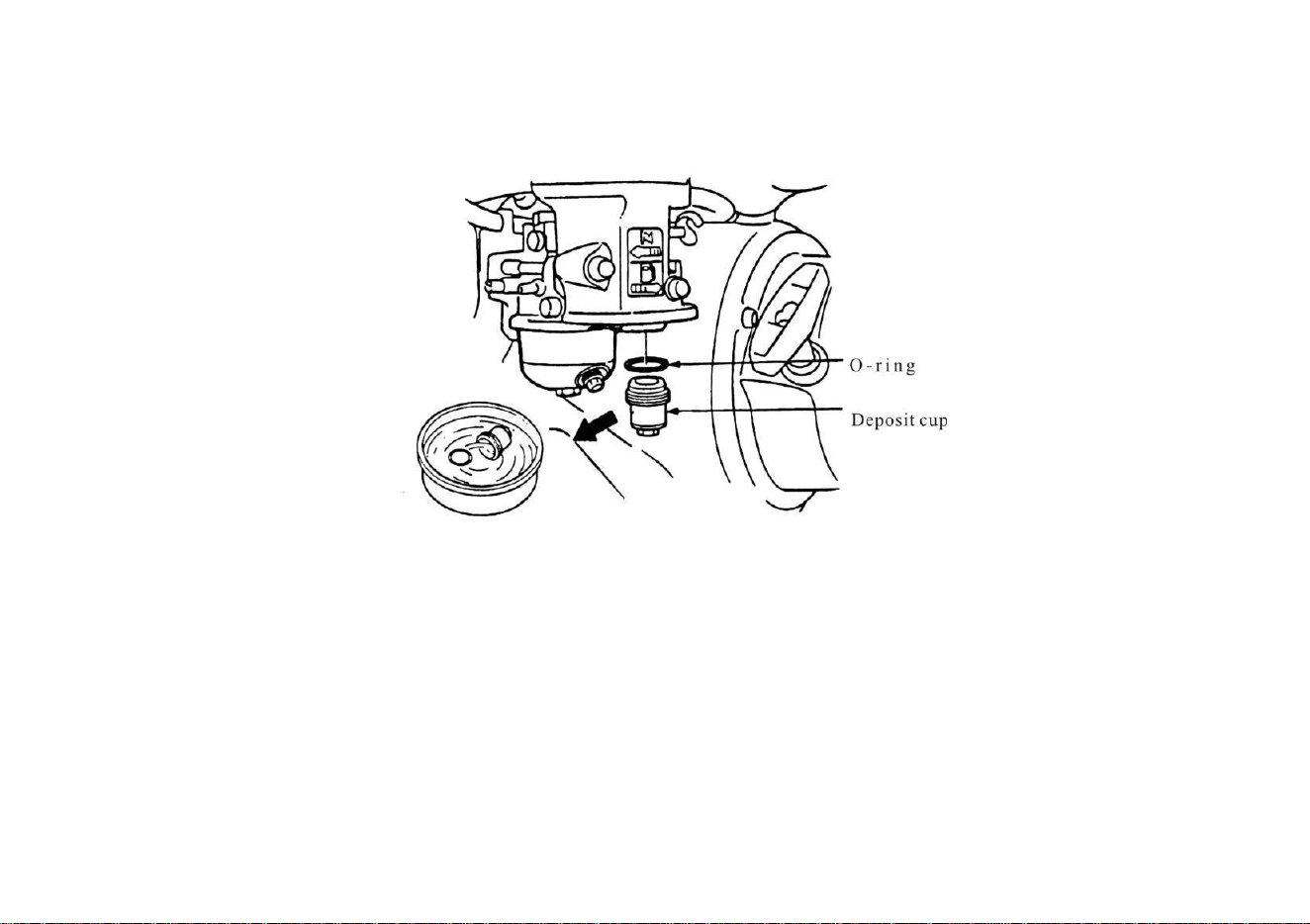
WASHING OF DEPOSIT CUP
Set the fuel cock at “ OFF ”, disconnect the deposit cup and
O-ring. Wash in non-flammable or high flash-point cleansing
solvents, and then try them up, at last, reinstall it. Set the fuel
cock to “ ON ”and check for leaks.
26
WARNING:
● Gasoline is extremely flammable and explosive in certain condition. Keep cigarette, sparks and open
flames away.
● After reinstalling the deposit cup, make sure the area around
spark plug
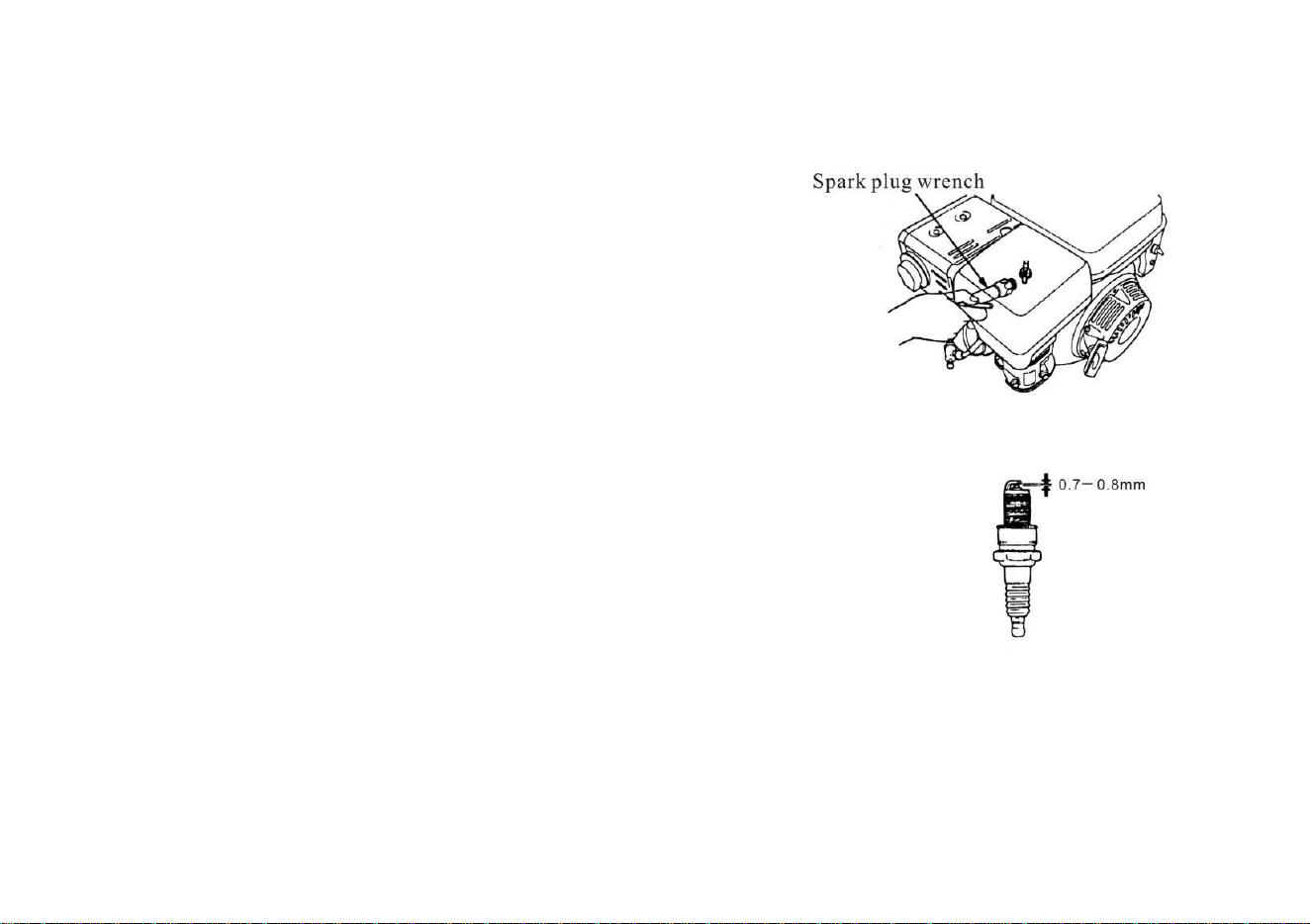
Spark plug type:BPR6ES (NGK) or NHSP LD F7RTC
Proper spark plug clearance ensures the engine’s normal running under no deposit around the spark plug.
27
1. Remove the spark plug cap.
2. Clear away dirt around the spark plug base.
3. Dismantle the spark plug with a spark plug wrench.
4. Clean with a steel brush. If the insulator is damaged, replace the
spark plug instead.
5. Measure the spark plug clearance with a feeler. The clearance
should be 0.7~0.8mm. If adjustment is necessary, bend the side
electrode carefully.
6. Check if the spark plug gasket is in good conditions, or replace
with a new one. Screw on the spark plug to the bottom first by hand
a then screw in by a spark plug wrench. If a new spark plug is used,
twist 1/2 more turns after impacting the gasket, if reinstall the original
one, just twist 1/8-1/4 more turns.
CAUTION:
● The spark plug must be tightened securely, or it may become very hot to damage the engine.
● Only use recommended spark plug or the equivalent. Incorrect heat range of the spark plug may
damage the engine.
28
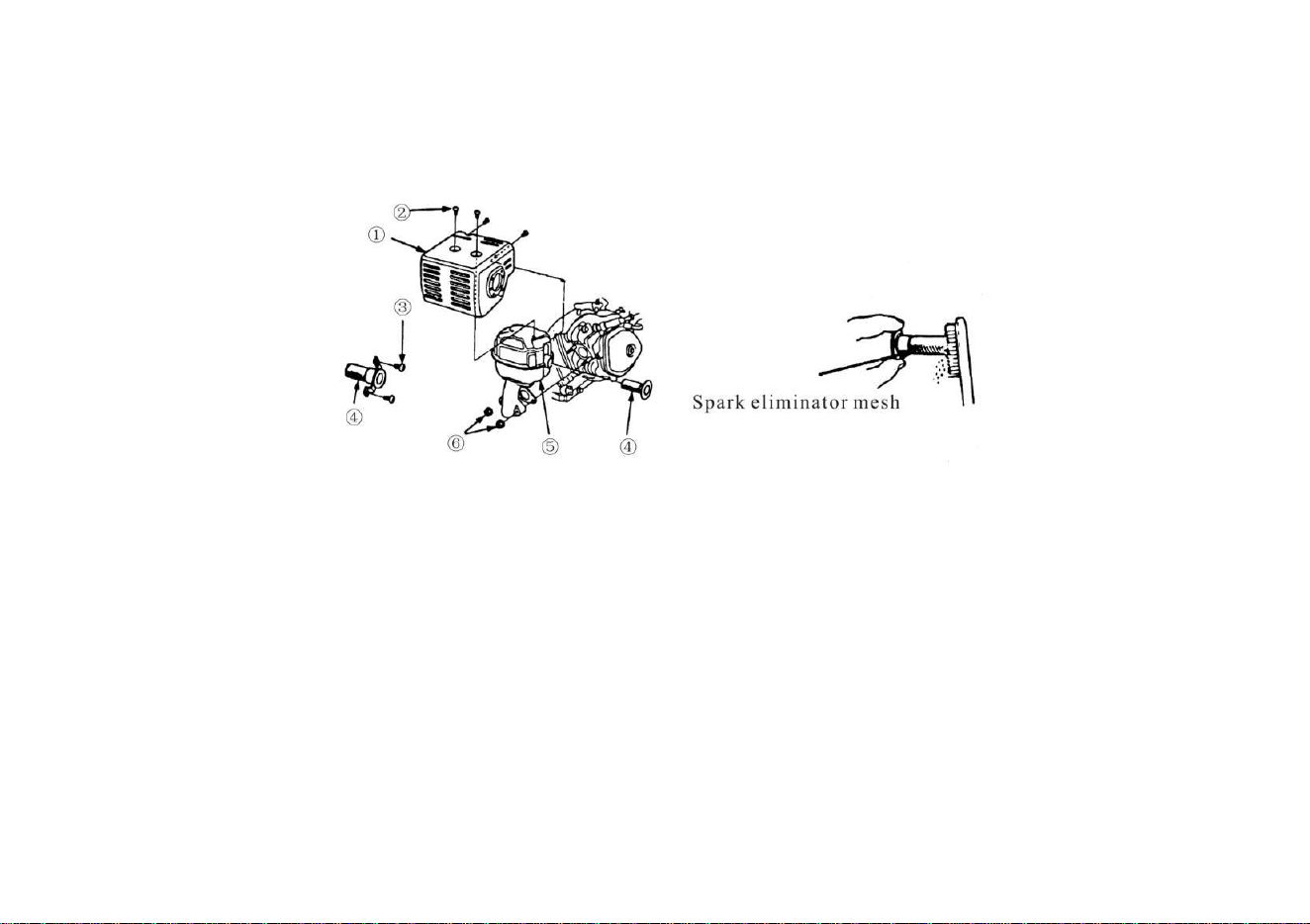
SPARK ELIMINATOR (Option)
The spark eliminator should be serviced at least once every 100 hour’s operation so as to keep it in a sound
condition.
WARNING:
The muffler is very hot during running the engine and even a long time after stopping. Never touch it, or
you may get burns. Service after the engine cools down.
1. Unscrew the two nuts M8⑥, and disconnect the muffler⑤ from the engine body.
2. Turn off the four screws M5② from the muffler hood① and disconnect the hood.
3. Turn off the screw M4③ from the spark eliminator④ and separate it from the muffler.
4. Clear away carbon deposit from the spark eliminator mesh with a brush.
5. Reinstall the spark eliminator in reverse order of removal.
29
CAUTION:
● Be careful not to damage the mesh of the spark eliminator.
● Never use a damaged spark eliminator.
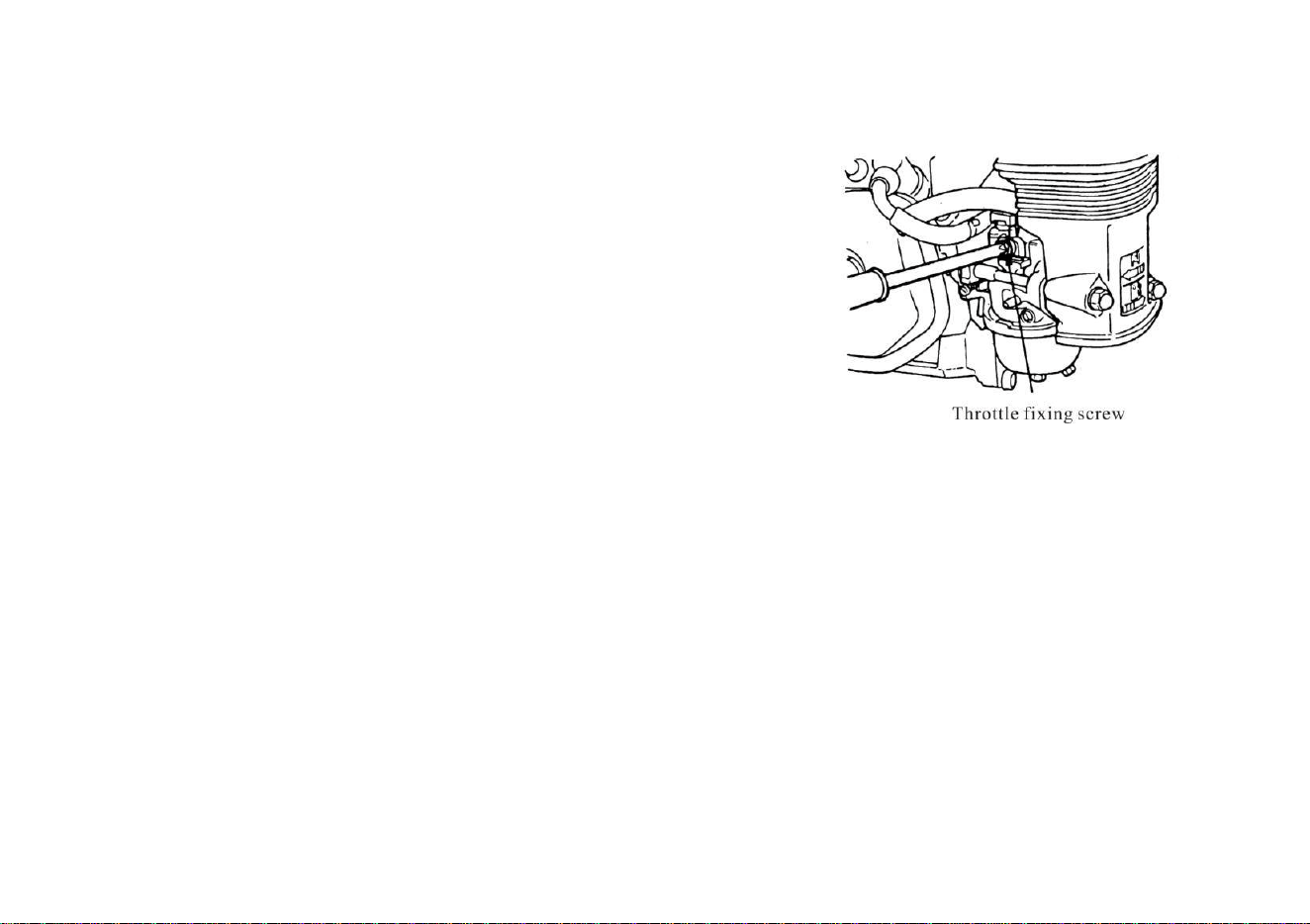
CARBURETOR IDLING ADJUSTMENT
1. Start and preheat the engine until arriving at the normal working
temperature.
2. Obtain standard idling by adjusting the throttle fixing screw under
the engine’s idling.
Standard idling: 1500±150rpm.
TRANSPORT, STORAGE AND REMOVAL FROM STORAGE
Transport
Transport with the fuel cock turned off. Transport or store the engine when it is cool so as to avoid getting burns
or fire.
CAUTION:
Do not incline the engine so as to avoid fuel’s spill. Spilled fuel or fuel vapor may ignite to cause fire.
Storage
If the engine is not kept in use for a long time, be sure to store it properly. Make sure the storage area is dry and
free of dust.
30
1. Replace engine oil.
2. Disconnect the spark plug. Fill about a spoon of fresh engine oil from the spark plug mount hole onto the
cylinder. Crank the engine up to distribute engine oil evenly. Reinstall the spark plug.
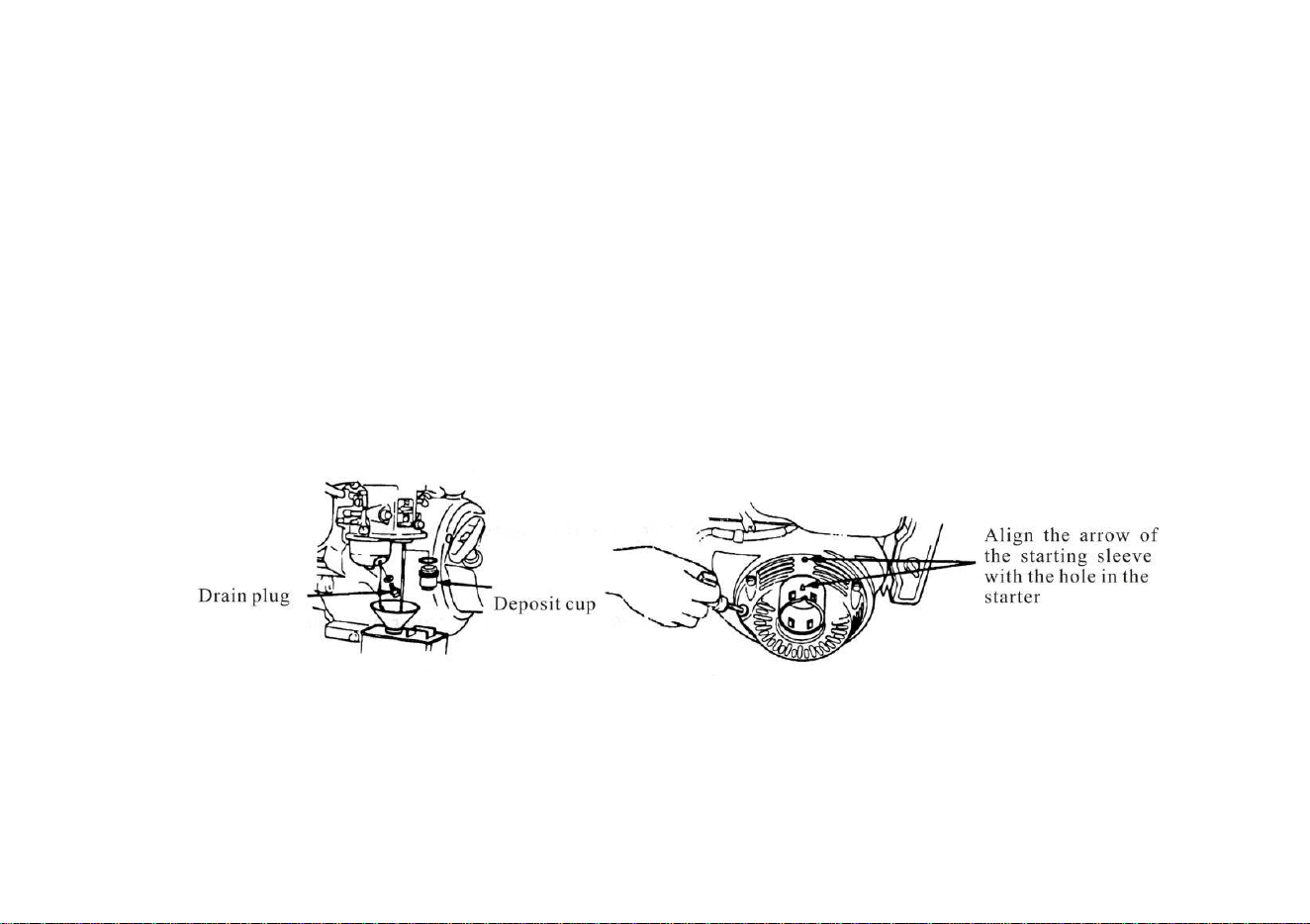
3. Pull the starting rope slowly until feeling a slight anti-action, and then keep pulling it so as to align the arrow
of the starting sleeve with the hole of the starter. At this time, both the inlet and outlet valves are closed so help
prevent the engine inside from rusting.
4. Electric starter: disconnect the battery and store in dry and cool area. Charge one every month.
5. Cover the engine so keep dust away.

31
Removal from storage
Before reusing, service the engine in accordance with the instruction of the table
(1) Screw off the drain plug and drain out fuel in the carburetor.
(2) Turn off the engine switch first, disconnect the deposit cup and empty it.
Note: for the sake of environmental protection, we recommend to fill the discarded fuel into a closed container
and bring to local recycling station. Never pour freely.
WARNING:
Fuel is extremely flammable and explosive under certain conditions. Keep cigarette, open flames and
sparks away from operating site.
STORAGE TIME
SERVICE ITEM
Within one month
Non
One ~ two months
Drain out original fuel of the fuel tank and refuel
Two month ~one year
Drain out original fuel of the fuel tank and refuel;
Drain out fuel in the carburetor①;
Empty the deposit cup②
Above one year
Drain out original fuel of the fuel tank and refuel;
Empty the fuel cup in the carburetor①;
Empty the deposit cup②

32
TROUBLESHOOTING
Ⅰ. START ENGINE DIFFICULTLY
1. By using kick-starter
TROUBLE
CAUSE
REMEDY
1. Normal cylinder compression.
2. Normal spark plug spark.
3. Something wrong with the fuel
system.
4. Fuel supply is not smooth or
no fuel supply.
There is no enough fuel in fuel
tank of fuel cock is closed.
Fill fuel, open fuel cock.
Air vent in the fuel filler cap is
clogged.
Dredge air vent.
Fuel cock is clogged.
Clean first and then dredge.
Improper or clogged main oil
flow hole.
Readjust or clean, blow to get
through.
Needle valve is not closed
properly or start hole is clogged.
Dismantle needle valve and
repair, clean, blow to get
through.
Float is damaged or sticking.
Repair float.

33
TROUBLE
CAUSE
REMEDY
1. Normal cylinder compression.
2. Normal spark plug spark.
3. Something wrong with the fuel
system.
4. Smooth fuel flow.
Fuel is too filthy or deteriorated.
Replace.
There is water in fuel.
Replace.
Too much fuel in engine.
Drain extra fuel, dry up spark plug
electrodes.
Wrong fuel brand.
Select proper fuel brand corresponding
with the requirements.
1. Normal cylinder compression.
2. Normal spark supply.
3. Normal high – pressure coil
spark.
4. Spark plug is in bad conditions.
Too much carbon deposit and dirt
around electrodes.
Clear away.
Electrodes are burn damaged
seriously or insulators damaged.
Replace spark plug.
Improper electrodes gap.
Adjust to proper value.

34
TROUBLE
CAUSE
REMEDY
1. Normal cylinder compression.
2. Normal fuel supply.
3. Normal high – pressure coil
spark.
4. Normal spark plug.
High – pressure coil is damaged.
Replace
Ignition coil is damaged.
Replace
Magneto loses magnetism.
Replace
1. Poor cylinder compression.
2. Normal fuel supply system.
3. Normal ignition system.
Piston ring is worn to or even
over its wear limit.
Replace
Piston ring is broken.
Replace
Piston ring is sticking.
Clear up carbon fouling.
Spark plug is not installed tighten
or without a gasket.
Tighten with a gasket in.
Air leakage between cylinder
block and cylinder head.
Check cylinder gasket, and the flatness
of the surface by which cylinder block
contacting with cylinder head, tighten
cylinder head bolts in stipulated order
to stipulated torque.

35
TROUBLE
CAUSE
REMEDY
Do.
Air leakage in valves.
Check valve. Clearance and tightness,
repair if necessary.
WARNING:
● When testing the spark plug, never hold the high- voltage wire of the spark plug with wet hand.
● Make sure there is no spilled fuel outside the engine and that the spark plug isn’t dipped with fuel.
● To prevent fire, keep sparks far away from the spark plug mount hole.
1. By using starting motor
ITEM
CAUSE
REMEDY
Check battery connection
Incorrect connection
Correct
Check battery
No charge or under charge,
corrosion
Check the breaker, charge up the
battery or replace it
Starting motor for functions
normally
Be the same as kick-starter
Conduct it in the same way of
kick-starter
Once you find any of above problems, contact the authorization entitle to the dealer of the privilege helps
for you.

36
Ⅱ. LOW GASOLING ENGINE POWER OUTPUT
TROUBLE
CAUSE
REMEDY
When turning throttle greater,
speed increase responds
slowly or speed is decreased
even engine stops running.
Ignition system
Incorrect ignition
time.
Readjust ignition
advance angle
Fuel supply system
Air in fuel line or fuel
line clogged.
Exhaust air or dredge
fuel line
Main oil flow hole is
not adjusted properly.
Readjust
In carburetor, needle
valve hole and main
oil flow hole clogged.
Clean and blow to get
through
Fuel cock is clogged
up.
Clean, replace damaged
part
Too much carbon
deposit in combusting
chamber.
Clear away

37
TROUBLE
CAUSE
REMEDY
do.
do.
Too much car bon
fouling in muffler and
exhaust pipe.
Clear away
Air cleaner is clogged
up.
Clean air cleaner filter element
Intake pipe is leaking.
Repair or replace
Poor compression
Piston or cylinder or
piston ring is worn.
Replace the worn
Air leakage from the
surface by which
cylinder block
contacting with cylinder
head.
Replace cylinder gasket
Too big or too small
valve clearance.
Readjust
Valve tightness is poor.
Repair

38
Ⅲ. GASOLINE ENGINE GANNOT RUN SMOOTHLY
TROUBLE
CAUSE
REMEDY
Engine is pinking
Piston, cylinder or piston ring is worn
excessively.
Replace the worn
Piston pin and piston pin hole are worn
excessively.
Replace piston or piston pin
Tie rod small head is worn excessively.
Replace tie rod
Roller bearing for crankshaft main shaft
is worn.
Replace roller bearing
Abnormal
combustion
Engine is too hot
Shoot trouble
Too much carbon deposit in combustion
chamber
Clear away
Improper gasoline brand or low gasoline
quality
Replace with qualified gasoline
Engine cannot start
because of spark
lacking
There is water in float chamber
Clean
Improper spark plug electrodes clearance
Adjust

39
TROUBLE
CAUSE
REMEDY
do.
Incorrect ignition time
Readjust
Something wrong with induced coil, and
so on
Check and replace damaged parts
Ⅳ. STOP SUDDENLY WHEN RUNNING
TROUBLE
CAUSE
REMEDY
Stop suddenly when
running.
Fuel supply
system
Fuel is used up
Refill fuel
Carburetor is clogged
Check fuel line and dredge
Float is leaking
Repair
Needle valve sticks
Dismantle float chamber and eliminate it
Ignition
system
Spark plug is struck
through, or short-circuited
by carbon deposit
Replace spark plug

40
TROUBLE
CAUSE
REMEDY
do.
do.
Side electrode of
spark plug is dropped
out
Replace spark plug
High-pressure wire is
dropped out
Weld on
Ignition coil is struck
through to be
short-circuited
Replace ignition coil
Parking wire is
located on engine
body
Find out meeting and insulate
The other
Cylinder is pulled
damage, valve is
dropped out
Repair or replace damaged parts

41
Ⅴ. GASOLINE ENGINE IS EXCEESIVELY HOT
TROUBLE
CAUSE
REMEDY
Gasoline engine is
excessively hot
Improper ignition time
Adjust ignition advance angle properly
Insufficient fuel supply
Refill engine oil
Exhaust pipe is blocked up
Dredge exhaust pipe
Flow guard is leaking
Repair damaged part
Dirt or something like this fill up
among air cooling fins
Clear away dirt or something like this
Cooling fan is loosen, losing function
Reinstall well
Tie rod deformation makes piston and
cylinder bushing side wear
Replace tie rod

42
TROUBLE
CAUSE
REMEDY
do.
Cylinder or piston or piston ring is
worn, resulting in air flow between
cylinder and crankcase
Replace the worn
Improper adjustment of engine speed
produces excessive rotational speed
Readjust engine speed to proper valve
by speed regulator
Crankshaft main bearing is burnt out
Replace main bearing
NOTE: the gasoline should run under cretin temperature. Generally, permitting temperature at the flow guard
outlet is between 80- 110℃, while the temperature of the crankcase is about 60℃ under the magneto. If
temperatures surpass the limits, it is an indication that the gasoline engine is excessive hot.

43
Ⅵ. THERE EXISTS ABNORMAL NOISE WHEN ENGINE RUNNING
TROUBLE
CAUSE
REMEDY
There is noise of beating
Piston, piston ring or cylinder is worn
Replace the worn
Tie rod or piston pin and piston pin
hole is worn
Replace the worn
Crankshaft main bearing is worn
Replace
Piston ring is broken
Replace
Too much carbon deposit in
combusting chamber
Clear away carbon deposit
Too small electrode clearance of
spark plug
Adjust electrode clearance properly
Engine is flooded with fuel
Check relative parts such as
carburetor
Improper fuel brand
Replace fuel
Engine is excessively hot
Find a cause and eliminate it

44
TROUBLE
CAUSE
REMEDY
The other
Improper valve clearance
Readjust valve clearance properly
Fly wheel is not connected with
crankshaft tightly
Connect tightly
SPECIFICATIONS
MAIN SPECIFICATION
Model
Items
173F/173FD
177F/177FD
182F/182FD
188F/188FD
190F/190FD
L×W×H (mm)
335×430×410
380×450×433
380×450×433
Dry weight (kg)
25
31
33
Engine type
4-stroke, OHV, single cylinder tilt 25 ℃
Displacement (cm
3
)
242
270
337
389
420

45
Model
Items
173F/173FD
177F/177FD
182F/182FD
188F/188FD
190F/190FD
Bore × Stroke (mm)
73×58
77×58
82×64
88×64
90×66
Max. theory power
【kW (PS)/r/min】
5.9 (8)/3600
6.6 (9)/3600
8.1 (11)/3600
9.6 (13)/3600
11 (15)/3600
Using power recommended
【kW (PS)/r/min】
5.1 (6.9)/3600
5.7 (7.7)/3600
7.1 (9.6)/3600
8.2
(11.1)/3600
8.5
(11.6)/3600
Max. torque (N·m/r/min)
14.5/2500
16.4/2500
21.0/2500
23.0/2500
25.0/2500
Fuel consume. (g/kWh)
374
Cooling system
Force air-cooled
Ignition system
TCI
Spark plug type
BPR6ES(NGK).NHSP LD F7TC
Lubrication mode
Splash
Output direction of power
shaft
Counterclockwise
DATE RELATING ADJUSTMENT
Item
Date
Spark plug clearance
0.7~0.8mm
Carburetor
1500±150rpm
Valve clearance (cold engine)
Intake: 0.15±0.02mm;
Exhaust: 0.20±0.02mm;
46
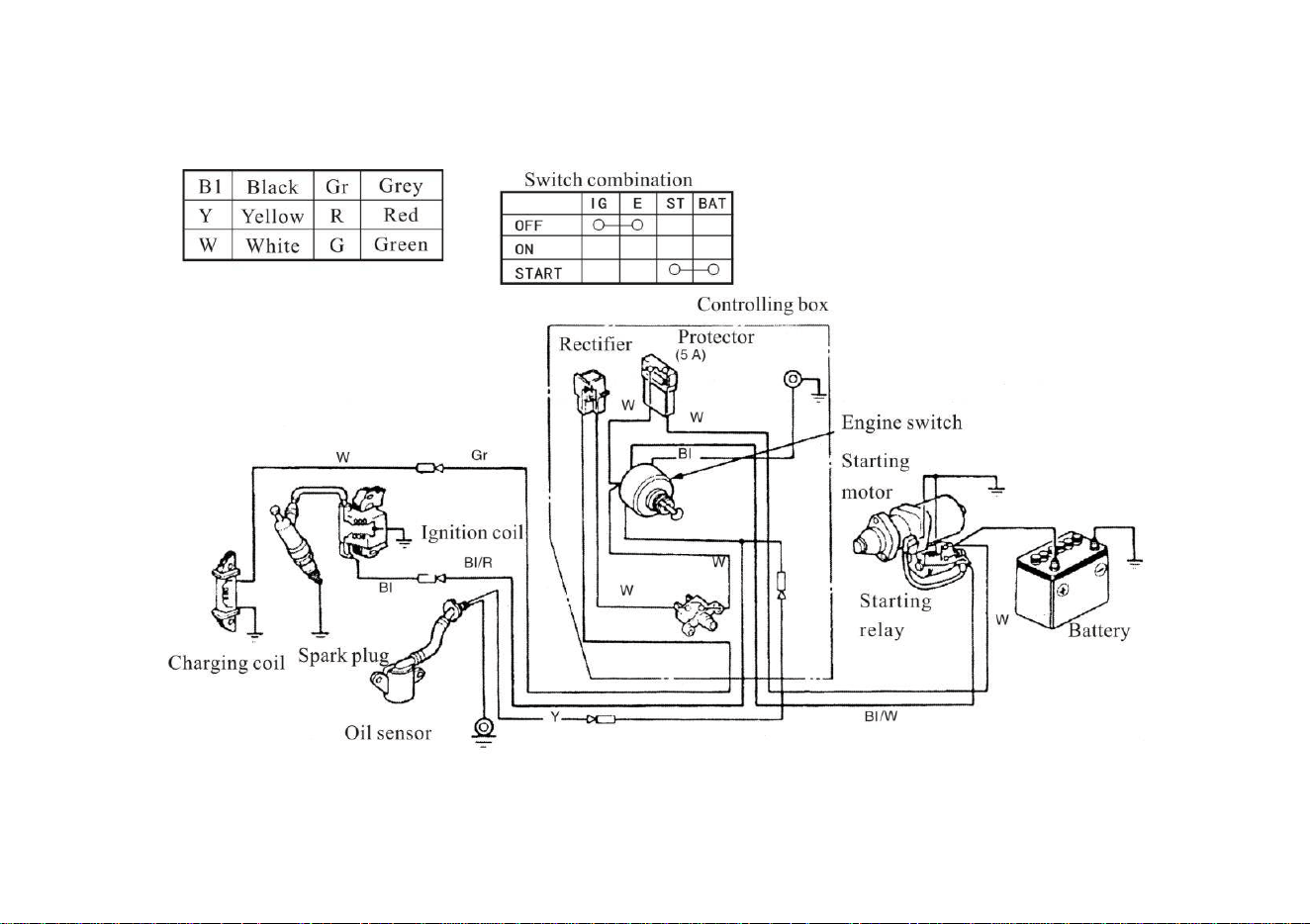
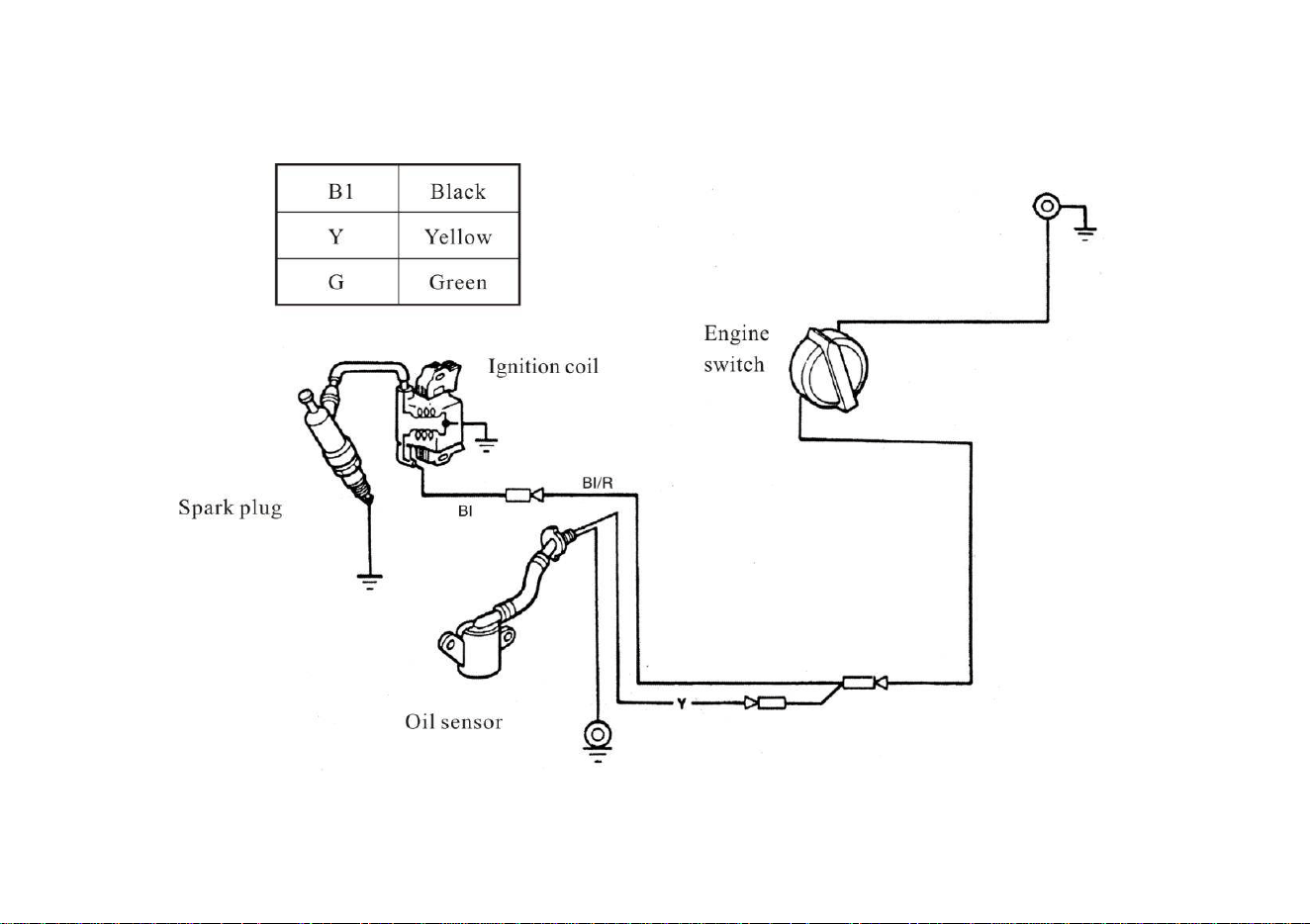
ELECTRIC DIAGRAM(for electric-start type)
47
Note: The diagram for other types may be different with the exception of electric-start type.