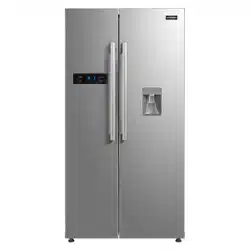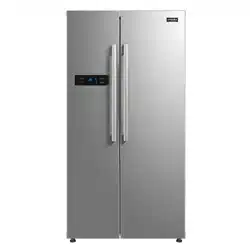
ST SXS909 Whi
ST SXS909 Sta
08xxxx
Contents
Safety Instruc
ns ………………………………………. 3-4
Electrical Safety ………………………………………. 4
Transporta
on & Handling ………………………………………. 5
Installing & Switching on your Appliance ………………………………………. 5
Before Switching On ………………………………………. 6
………………………………………. 7
………………………………………. 8-12
………………………………………. 13
………………………………………. 13
Energy Saving Advice ………………………………………. 14
Freezer Storage Advice ………………………………………. 14
Power Failure ………………………………………. 15
Maintenance & Cleaning ………………………………………. 16-17
Internal Cleaning ………………………………………. 16
External Cleaning ………………………………………. 16
………………………………………. 16
Defro
ng ………………………………………. 17
Product Fiche ………………………………………. 20
Trouble Shoo
………………………………………. 18-19
Your Appliance and Components
Reversing the Door
Bulb Replacement
When the appliance is not in use
Safety Instru ons
Important note: Please read this booklet before installing and switching on this
appliance. The manufacturer assumes no responsibility for incorrect in
on
and usage as described in this booklet.
• This model uses natural refrigerant gas as part of its cooling system. This
gas is known as R600a (Isobutene) and is environmentally friendly but can be
combus
ble. Care should therefore be taken when handling or transpo ng the
product to ensure that none of the refrig
on circuit components are
damaged,
• Do not obstruct ven
la on openings in the appliance
• The appliance must not be placed or rested on its power cord.
• Do not use mechanical devices or other ar
ficial means to accelerate the
defros
ng process, such as a heater or a hair dryer.
• Do not use electrical appliances in the refrigerator compartment of the
appliance.
• If this appliance is to replace an old refrigerator with a lock, the lock must be
removed as a safety measure before storing it or disposing of it. This is to
protect children from locking themselves inside the appliance.
• Old refrigerators and freezers contain insula
on gases and refrigerant, they
must be disposed of properly. Contact your local authority or your dealer if
you have any ques
ons. Please ensure that you do not damage the scrap unit
prior to being picked-up by the relevant waste disposal service.
• Do not use adaptors or extension leads when conne
ng the appliance to the
electrical power supply
• Do not plug in damaged plugs
• Do not pull, twist or damage the power cable.
• Do not plug-in or un-plug the applianc
e with wet hands to prevent electrical
shock.
3
• This appliance can be used by children aged from 8 years and above and
persons with reduced physical, sensory or mental capabili es or lack of
experience and knowledge if they have been given supervision or instruc on
concerning use of the appliance in a safe way and understand the hazards
involved. Children should not play with the appliance.
• This appliance is designed to be used by adults, do not allow children to play
with the appliance or let them hang over the door.
• Do not place explosive
o
r flammable material in your appliance for your own
safety.
• Bo
les containing a high percentage of alcohol must be sealed well and placed
ve
cally in the refrigerator.
• Do not cover the body or the top of the appliance
• Fix down the accessories in the appliance during transporta
on to prevent
damage to them.
Electrical Safety
THIS APPLIANCE MUST BE PLUGGED INTO AN EARTHED SOCKET
• Before switching on, make sure that the voltage of your electricity supply is the
same as that indicated on the
ng plate. This product is designed to operate
on 220 – 240V AC; 50Hz. C
onnec
on to any other power source may damage
the unit.
• This product may be
ed with a non re-wireable plug. If it is necessary to
change the fuse in the plug, the fuse cover must be
ed. If the fuse cover
becomes lost or damaged, the plug must not be used un
a suitable
replacement is obtained.
• If the plug has to be changed because it is not suitable for your socket, or
becomes damaged in any way, it should be cut off and an appropriate plug
ed following the wiring in ons. This should be carried out by a qualified
electrician. The plug removed must be d
isposed of safely, as inser
on into a 13
Amp socket is likely to cause an electrical hazard.
4
Transporta and Handling
For safe li
ng, the appliance backwards by no more than 45 degrees, hold the
base and rear corners of cabinet. L
the refrigerator carefully. Never use the door
handles for li
ing. To move the refrigerator on a flat level surface, it slightly
backwards and push backwards.
This unit is heavy and could cause injury – ensure there are adequate people
present to move the appliance.
Installing and Switching on Your Appliance
• Operating voltage for your appliance is 220-240V at 50Hz.
• Before plugging in the power supply, ensure that the voltage on the ra
ng label
corresponds to the working voltage of your electrical system in your home.
• Insert the plug into an efficient Ground (Earth) connection. If the socket has no
Ground (Earth) contact or the plug does not match, we suggest you call an authorised
electrician for assistance.
• Place your appliance in an area that is not exposed to direct sunlight.
• Your appliance should be placed at least 10cm away from stoves, ovens and other
heating cores.
• This appliance should never be used outdoors or left in the rain.
• When your appliance is placed next to a chest freezer or freezer, there should be at
least 10cms between them to prevent humidity on the outer surface.
• Do not place anything on your appliance and install the unit in a suitable place so that
there is at least 30cm clearance above the appliance.
• If placing your appliance next to kitchen cabinets, leave 10cm between them.
• The rear of the appliance should be at least 7.5cm away from the back wall.
• The appliance must be used in the vertical position and on
a flat surface.
• To level the a
ppliance, use the adjustable feet on the appliance.
• Do not place your appliance on a carpeted surface as this will prevent adequate
ventilation.
5
• This appliance should only be placed on a flat, firm surface.
• Choose a dry and well-v
ated space.
• The appliance should be po
oned so that the plug is easily accessible.
Before Switching On
• Before using your appliance, add a teaspoon of bicarbonate of soda to warm
water and with a damp cloth wipe down all parts of the new appliance, then
repeat the process with a clean damp cloth and dry. (ensure the appliance is
not connected to the power when performing this task).
• Remove all transport tapes and foam prote
on pieces . Clean the interior with
a cloth dampened in lukewarm soap and water. Wipe with clean water and
wipe dry.
• There may be an odour when you first switch on the appliance, it will disappear
when the appliance starts to cool.
• When the appliance has been po
oned, adjust the feet to ensure the unit is
stable. This is es
l to ensure quiet running and proper door opening
/closing.
• Connect to the electrical socket but do not switch the power to the refrigerator
on for at least 3 hours. The coolant within the product needs
me to se le
it has been transported and put in to po on, failure to do this will affect the
cooling performance of your appliance.
• Once the appliance has se
led switch on the power, the compressor will begin
to work. Locate the control panel and set the temperature of the fr
idge
compartment to 4°C and the freezer compartment to -18°C. Close the door
• You may hear faint gurgling or bubbling sounds when the refrigerant is pumped
to the cooling system and through the coils or tubing at the rear of the
appliance. When the compressor is in op
on you may hear a slight whirring
sound or pu
ng noise. The thermostat controls the op on of the
compressor, and you may hear a slight click as it cycles in and out (this is
normal).
• To save energy, you should minimize the frequency and du
on of door
opening.
6
7
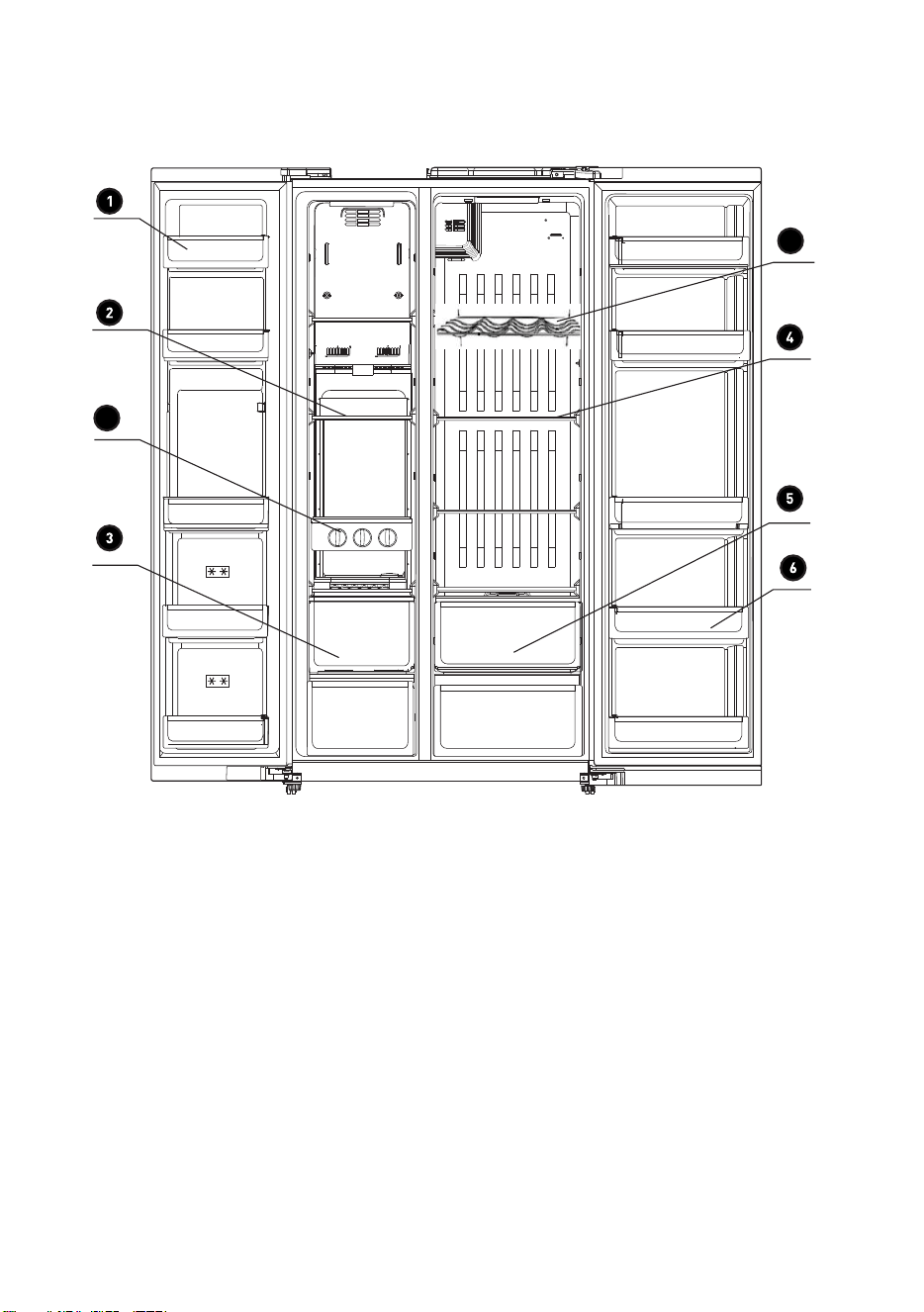
Your Appliance and Components
1 Freezer door rack
2 Freezer compartment glass shelf
3 Freezer compartment drawer
4 Refrigerator compartment glass shelf
5 Vegetable cripser
6 Refrigerator door rack
7 Twist ice maker
8 Wine rack
7
8
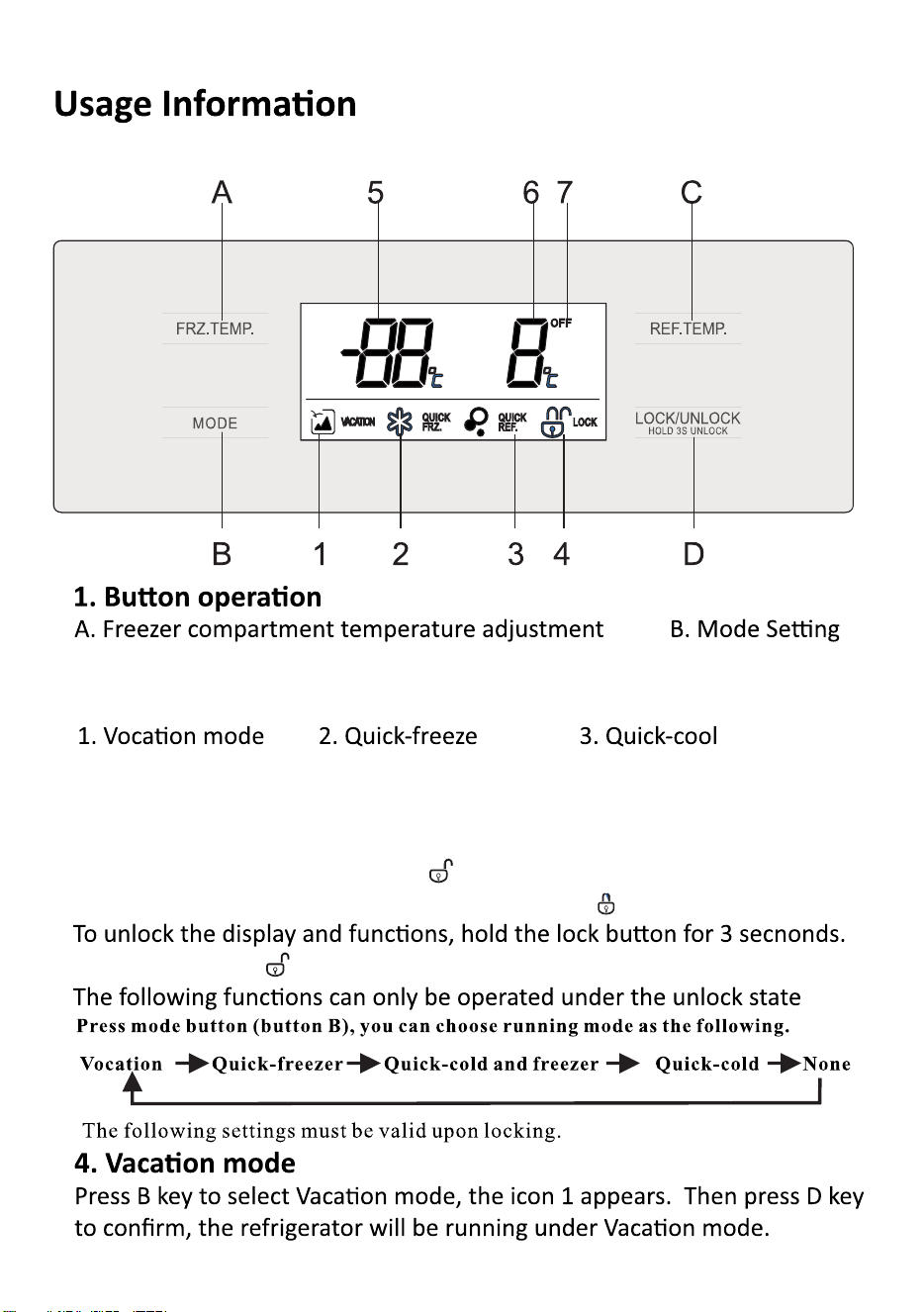
Control panel
8
2. Display
3. Lock / Unlock
C. Refrigerator compartment temperature adjustment D. Lock / Unlock
4. Lock icon 5. Freezer compartment temperature
6. Fridge compartment temperature 7. Close icon
At unlock state (the icon 4 shows ), press D key for 3 seconds, the
refrigerator will be LOCKED and the icon 4 shows .
(the icon 4 shows )
9
Usage Informaon
5. Rapid cooling mode
Press B key to select Quck-cool mode, the icon 3 appears, the press D key
to confirm, the refrigerator will be running under Quick-cool mode.
6. Quick-freezer mode
Press B key to choose Quick-freeze mode, the icon 2 appears, the press D
key to confirm, the refrigerator will be running under Quick-freeze mode.
7. Fridge compartment temperature seng
Press C key, the fridge compartment temperature display (icon 6) will flash,
press C key again and you can adjust the temperature of fridge, the range
of temperature is from 2 to 8 .
8. Freezer compartment temperature seng
Press A key, the freezer compartment temperature display (icon 5) will
flash. Press A key again and you can adjust the temperature of freezer.
the temperature range is from -16 to -24 .
Temperature se ng
• The temperature of the refrigerator is controlled electronically by the
control panel.
• Se
ng the temperature of the fridge and the freezer can be done
manually by pressing the fridge compartment temperature adjustment
bu
on and the freezer compartment temperature adjustment bu ons
u
the required temperatures are shown on the display.
• To change the temperature of the fridge compartment, press the fridge
temperature bu on. The temperature of the fridge can be set between
2°C and 8°C.
• To change the temperature of the freezer compartment, press the freezer
temperature bu on. The temperature of the freezer compartment can be
set between -16°C and -24°C.
• Alterna
vely the temperatures of the fridge compartment, freezer
compartment or both can be set by using the super cool, super freeze or
super cool and freeze modes.
• For short-term storage of food, you can set the temperatures to
between 2°C and 4°C (fridge) and -24°C and -21°C (freezer).
10
Usage Informa on
• Note: The temperature o he freshly stored food and how o
en the
door is opened aff
f
t
ects the temperature in the refrigerator
compartment. If required, change the temperature se
ng.
• When you first switch on the appliance, to enable suitable cooling, the
appliance should work 4 hours con
nuously un l it cools down to
sufficien
emperature.
• During this me do not open the door frequently or place a lot of
food inside the appliance.
• If the unit is switched offor unplugged, you must allow at least 5
minutes before restar
ng or re-plugging the unit in order not to
damage the compressor.
• Your appliance is designed to operate in the ambient temperature
intervals stated in the associated standards, according to the climate
class stated on the informa
on label. We do not recommend opera ng
your fridge out of the stated temperatures, as the appliance may
not operate to its op
mum level
• The ambient temperature range for this appliance is 10°C to 43°C.
11
Usage Informaon
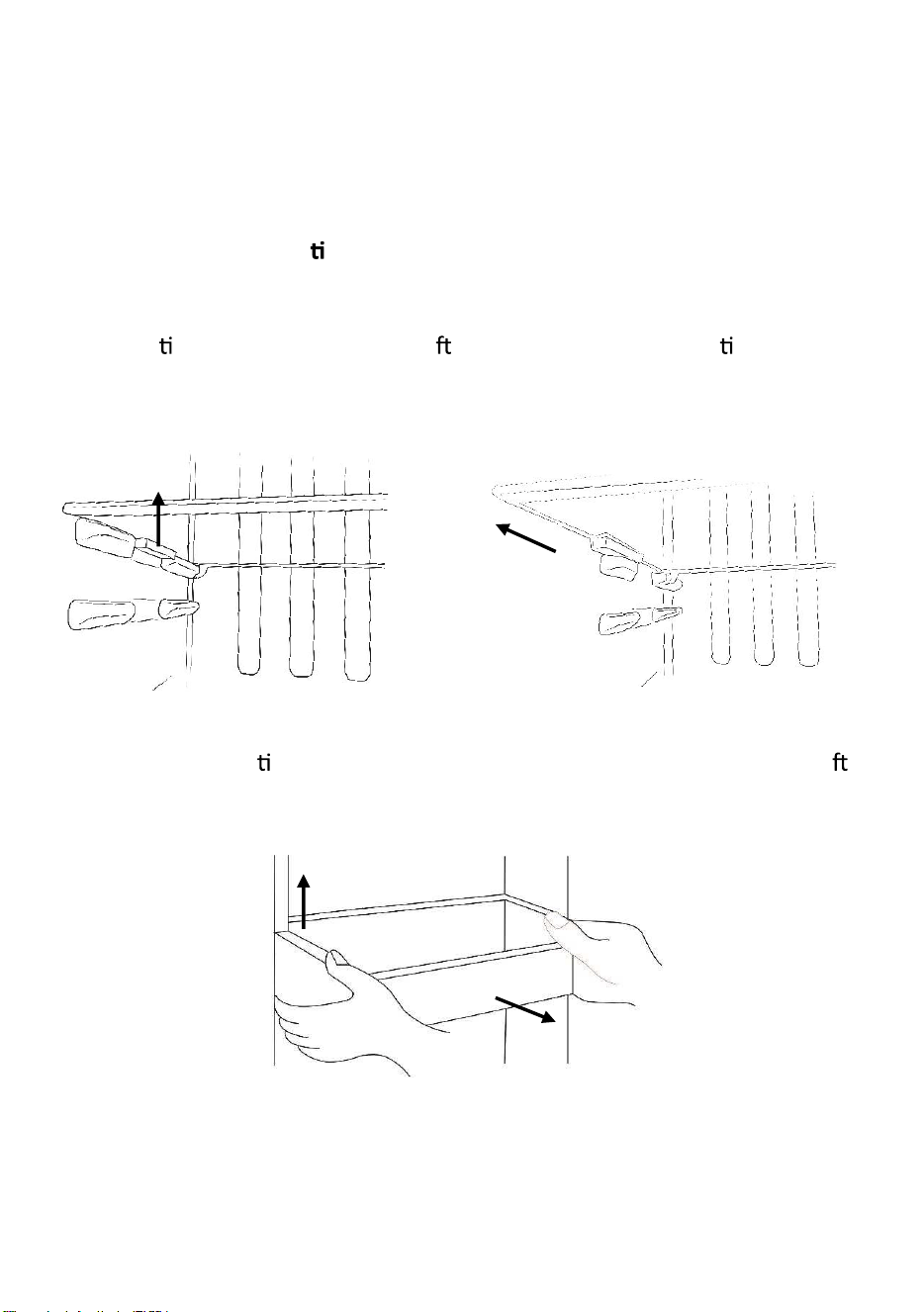
Shelving and rack adjustment
Important note: all food and drink should be removed from all shelves
and racks before adjus
ng or removing them
You can adjust the shelving in the fridge compartment to your required
configura
on. To remove a shelf, li it up slightly so the plas c stabilisers
that on either side of the shelf are above the shelf rails and then pull it
towards you.
You can adjust the racks in the
fridge and freezer compartments to your
required configura
on. To remove a rack hold both sides of the rack, li
it upwards (1) and then pull it towards you (2).
12
1
2

13
Bulb Replacement
The fridge and freezer lights are energy efficient, long life LEDs. Therefore, they should not
need replacing throughout the life of the product.
Reversing the Door
The doors cannot be reversed
14
Energy Saving Advice
• Do not install the appliance close to sources of heat, such as a cooker,
dishwasher or radiator.
• Locate the appliance in a cool well-ve
ted room and make sure that the air
vents are clear.
• Try to avoid keeping the doors open for a long
me, as warm air will enter the
cabinet and may cause a build-up of ice as well as
g the energy
consump
on. Ensure there are no ob ons prev ng the doors from
closing properly.
• Ensure that the door seals are clean and there are no tears or splits.
• Keep the most perishable foods, (those with a short shelf-life, such as cooke
d
meats), in the coldest part of the fridge. The Salad Crisper Box is the warmest
part of your fridge and should be used for vegetables, salads and fruits etc.
• Do not overload the appliance: the cooling air that circulates and keeps the
appliance cold gets blocked, and pockets of warm air form.
• Do not put hot food into the fridge or freezer – let it cool down first.
Freezer Storage Advice
• Store fresh food in air
ght boxes or wrap in bags or foil which are suitable for
freezing.
• Do not allow frozen food to come in to direct contact with food
to be frozen.
• Pre-frozen food must be placed in the freezer as quickly as possible
purchasing.
• To prevent frost damage to fresh vegetables or fruits they must be processed
appropriately before being placed into the freezer compartment.
• You must always follow the storage guidelines printed on all food packaging.
However, below is some suggested maximum storage es at -18°C (4 star
ng) for a variety of foods:
• Fresh meat & poultry – up to 12 months
• Cooked meat – up to 2 months
• Fresh fish – up to 6 months
• Fruit & vegetables – up to 12 months
• Bread & cakes – up to 6 months

15
Power Failure
If there is a power failure during the storage of frozen foods, keep the door closed.
If the temperature within your freezer should rise, do not refreeze the food
without checking it's cond
on.
• Ice Cream: Once thawed should be discarded.
• Fruit and Vegetables: If so
should be cooked and used up.
• Bread and Cakes: Can be refrozen without danger.
• Shellfish: Should be refrigerated and used up quickly.
• Cooked Dishes: i.e. casseroles should be refrigerated and used up.
• Large Pieces of Meat: Should be refrigerated and used up quickly
• Small Joints: Should be refrig
erated and used up quickly
• Chicken: Should be refrigerated and used up quickly

16
Maintenance & Cleaning
Disconnect the appliance from the power supply before cleaning.
Internal Cleaning
• Do not pour water over the appliance.
• The cavity should be cleaned periodically using a solu
on of bicarbonate of
soda and lukewarm water (5ml to 0.5 litre of water)
• Clean the accessories separately with soap and water. Do not put them in the
dishwasher.
• Do not use abrasive products, detergents or soaps.
• A er washing, rinse with clean water and dry carefully.
• When you have finished cleaning reconnect the plug with dry hands.
External Cleaning
• Wash the outer cabinet with warm soapy water. Do NOT use abrasive products.
• There are sharp edges on the underside of the product so care should be taken
when cleaning.
• Once or twice a year dust the rear of the appliance and the compressor at the
back of the appliance, with a brush or vacuum cleaner, as an accumula
on of
dust will affect the performance of the appliance and cause increased energy
consump
on.
When the appliance is not in use
When the appliance is not in use for long periods, disconnect from the electricity
supply, empty all of the food and clean the inside. Leave the door open to prevent
the
build-up of odours.
17
Never use sharp metal tools as it may damage the appliance.
Never use an electrical heater, this may cause an electric shock.
Maintenance & Cleaning
Defros
ng
Note: Care must be taken when performing the following procedure.
• The appliance is frost free, so there shouldn’t be any requirement to defrost the
freezer. However, in the unlikely event the appliance does need defros
ng please
follow the below steps:
• Try to use as much as possible of the food in the freezer, before defros
ng.
However, any food that is l
, wrap in newspaper and place aside un ready
to place back a
er cleaning.
• Switch the appliance off at the wall socket and remove the plug.
• Open the freezer door.
• Place a suitable container to collect the water created from the defrosted ice.
• A er defros ng, clean and dry the interior.
• Switch the appliance on and replace any frozen food.
Defros
ng can be accelerated by pu ng bowls of hot (not boiling) water in the freezer and
loosening the frost with a suitable plas
scraper.
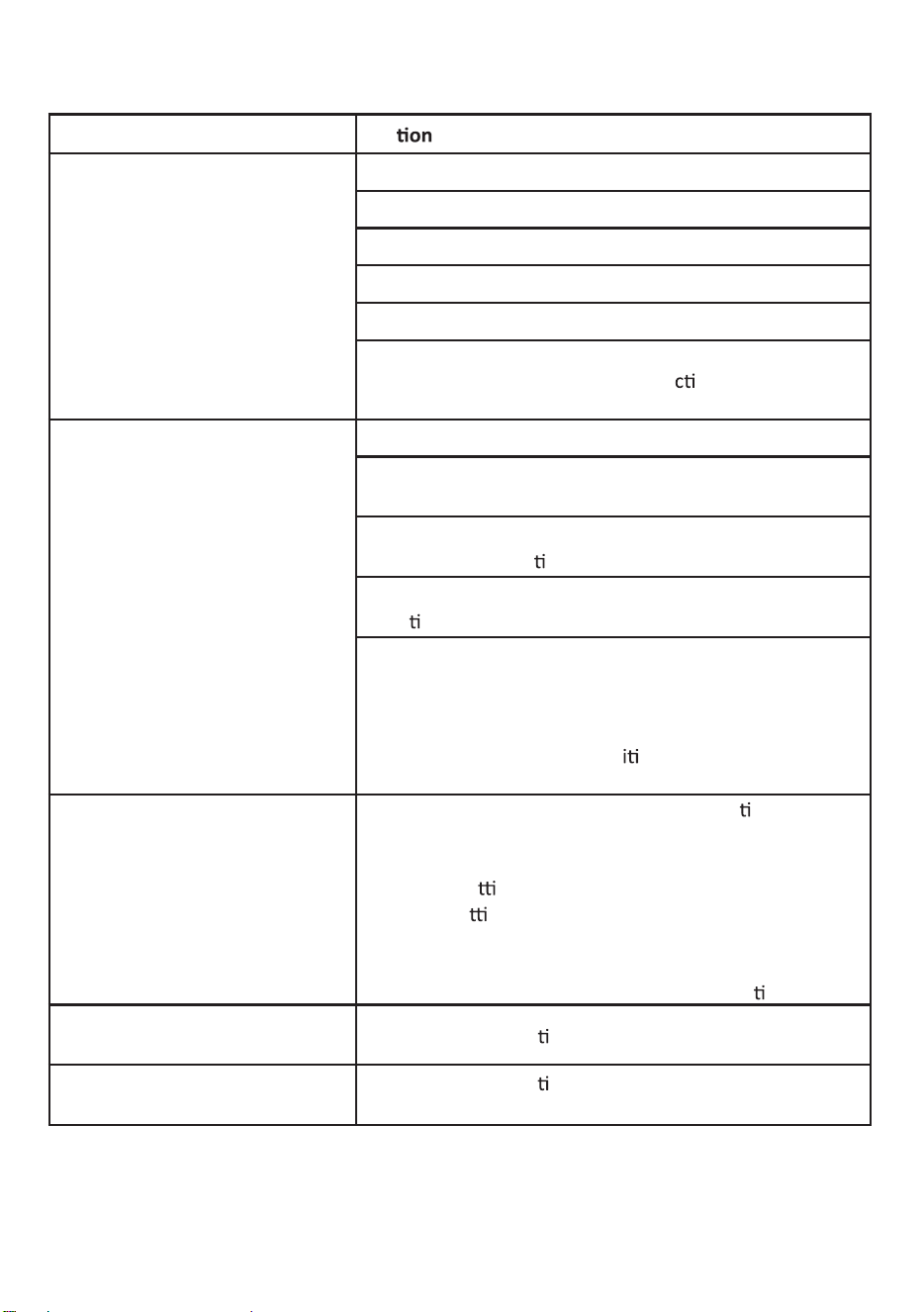
Trouble shoong
18
Problem Solu
The fridge/freezer doesn't work
Check that the appliance is switched on.
Check that there has not been a power cut.
Check that the plug is no aulty.
Check that the fuse has not blown.
Check that the voltage is correct for the appliance.
Are there any faults with the socket? For this purpose, try
the plug of your appliance by conne
ng it to a socket
which you are sure is working.
The temperature inside the
appliance is not cold enough
Check that there is not too much food in the appliance.
Check that the temperature is set to a suitable
temperature.
Check that the appliance is not placed in direct sunlight,
or too near to a hea
ng source.
Check that the ambient temperature is within the
opera
on limits of the appliance.
Are the doors of the appliance opened f
requently? Once
the door is opened, the humidity found in the air in the
room enters the appliance, especially if the humidity
levels in the room are very high. The more frequently the
door is opened in humid cond
ons the more chance of
the build up of moisture.
The temperature within the
appliance is too cold.
Increase the working temperature by adjus
ng the
temperature to a higher level.
The lowest se
ng/temperature should only be used as a
rapid cool se
ng and
should only be set 2 hours before a
large amount of food is placed in the fridge. If this is not
done the temperature in the fridge compartment could
fall below 0ºC as the compressor will run con
nuously.
The inner surfaces of the
appliance are wet
Caused by condensa
on - dry the inside of the appliance.
The outer surfaces of the
appliance are wet
Caused by condensa
on - dry the outer of the appliance
carefully.
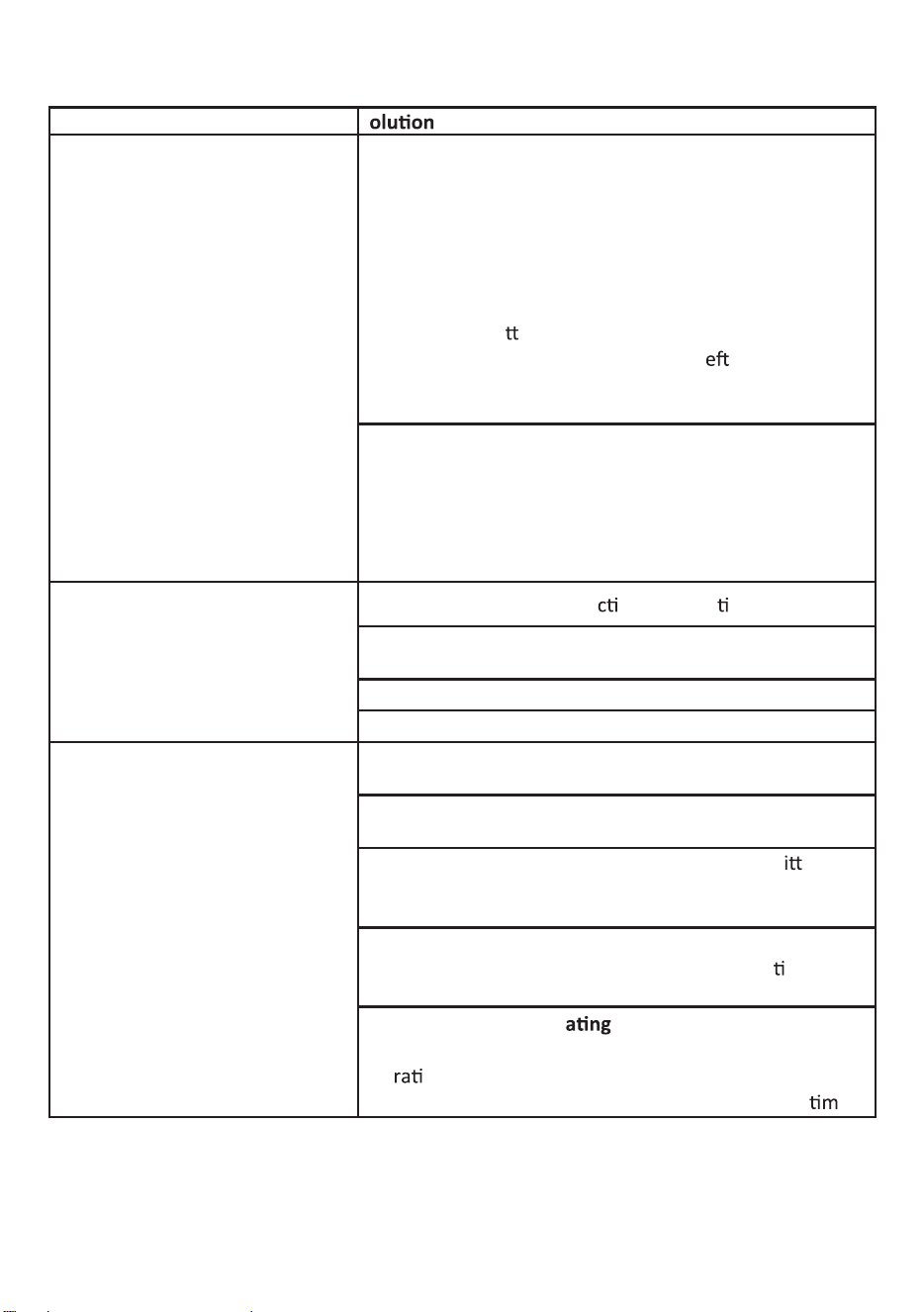
Trouble shoong
19
Problem S
Smell/odour
Check all the food and drink that is in the fridge is in date
and correctly packaged. If it isn’t then it should be
removed immediately or repackaged.
Check for spillages on each shelf, rack and drawer. You
may need to remove the drawers to check that no
spillages have se
led underneath them. As spillages that
have not been cleaned and have been l can cause
smells and unwanted odours.
Check the drainage pipe is not clogged or the drip tray at
the back of the app
liance is full. The pipe can be cleared
by pouring hot water through, but you must ensure the
appliance is turned off, the plug is removed from the
socket and a jug or bucket is in place to catch the flow of
water.
The doors do not close properly
Ensure there are no obstru
ons preven ng door closure.
Check the door compartments and shelves are correctly
in place.
Check the door seal is not warped or torn.
Check the appliance is level.
Unusual noises
Check that the appliance is on a flat, level surface and is
stable.
Check the spacing's around the appliance and ensure it is
not touching other items.
Bubbling and gurgling sound: • This noise is em
ed as
the coolant fluid flows through the pipes within the
system. This is normal.
Water flowing sound: • This is the normal sound of wate
r
flowing into the drain trough during the defros
ng
process.
If the appliance is oper
noisily (compressor noise):
This is normal. This noise indicates that the compressor is
ope
ng normally. As the compressor is being energized,
it might run a bit more noisily for a short period of
e.
20
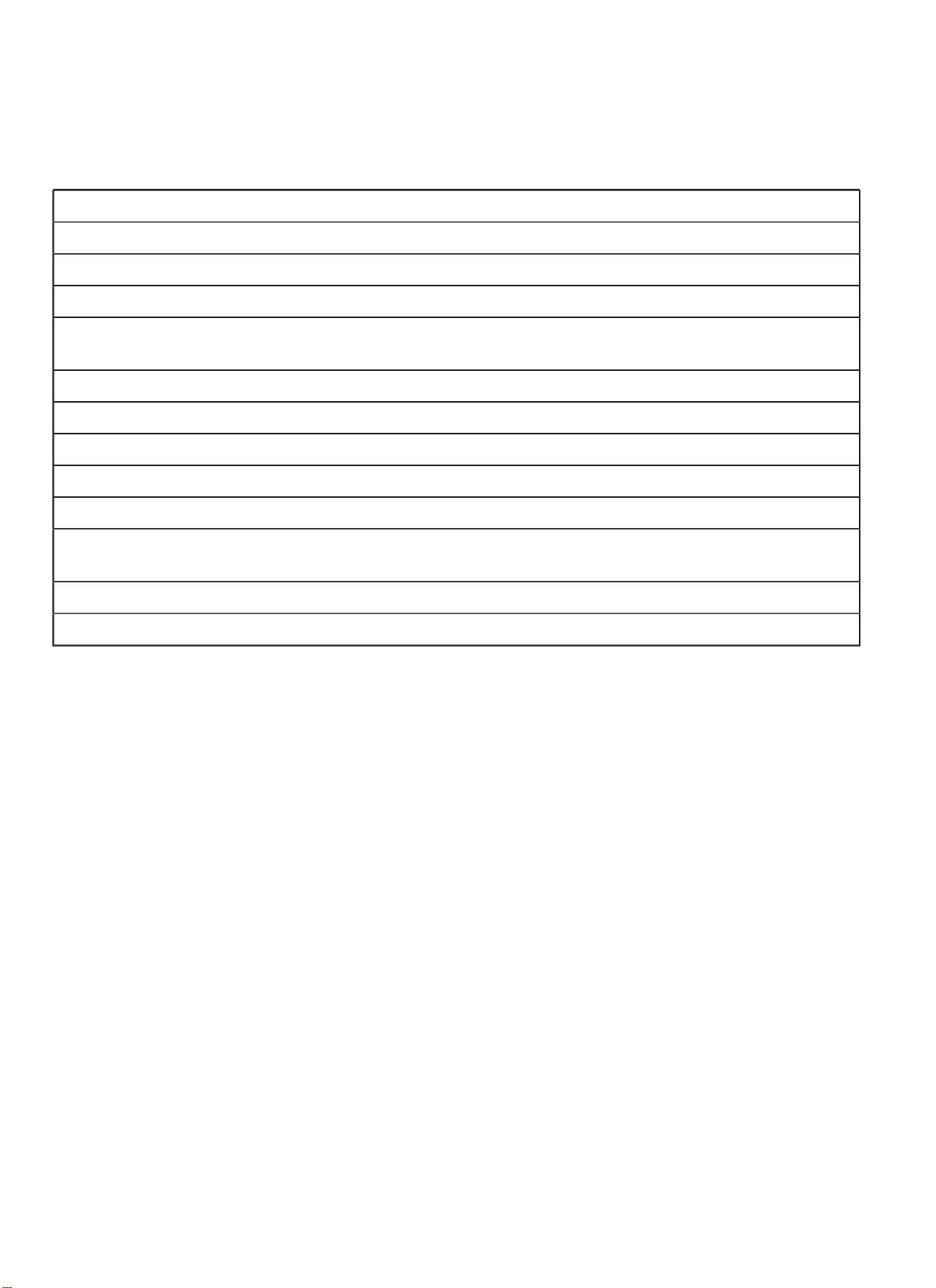
Product fiche concerning the "COMMISSION DELEGATED REGULATION
(EU) No 1060/2010"
Trade mark: STOVES
Moder Identifier: ST SXS909 Whi / ST SXS909 Sta
Category of the household refrigerating appliance model: Refrigerator-freezer
Energy efficiency class: A+
Energy consumption 405 kWh/annum, based on standard test results for 24 hours. Actual energy
consumption will depend on how the appliance is used and where it is located.
Storage volume cooling compartment (l) 335
Storage volume freezing compartment (l) 175
Frost free: Fridge and freezer
Temperature rise time: 10 h
Freezing capacity: 9 kg/24h
Climate class: SN-ST. This appliance is intended to be used at an ambient temperature between 10°C
and 38°C.
Airborne acoustical noise emissions: 43 dB(A) re 1pW
Free-standing