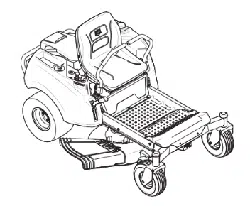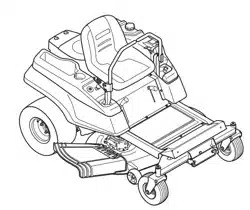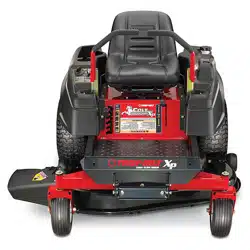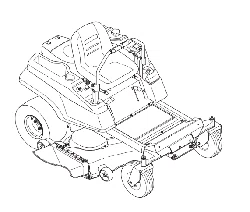
TROY-BILT LLC, P.O. BOX 361131 CLEVELAND, OHIO 44136-0019
Printed In USA
OperatOr’s Manual
Safe Operation Practices • Set-Up • Operation • Maintenance • Service • Troubleshooting • Warranty
WARNING
READ AND FOLLOW ALL SAFETY RULES AND INSTRUCTIONS IN THIS MANUAL
BEFORE ATTEMPTING TO OPERATE THIS MACHINE.
FAILURE TO COMPLY WITH THESE INSTRUCTIONS MAY RESULT IN PERSONAL INJURY.
Zero-Turn Tractor
Form No. 769-10952
(October 5, 2015)

Customer Support
Please do NOT return the machine to the retailer or dealer without first contacting the Customer Support Department.
If you have difficulty assembling this product or have any questions regarding the controls, operation, or maintenance of
this machine, you can seek help from the experts. Choose from the options below:
◊ Visit us on the web at www.troybilt.com
See How-to Maintenance and Parts Installation Videos at www.troybilt.com/tutorials
◊ Call a Customer Support Representative at (800) 828-5500 or (330) 558-7220
◊ Write to Troy-Bilt LLC • P.O. Box 361131 • Cleveland, OH • 44136-0019
Thank you for purchasing a Troy-Bilt Zero-Turn Tractor. It was
carefully engineered to provide excellent performance when
properly operated and maintained.
Please read this entire manual prior to operating the equipment.
It instructs you how to safely and easily set up, operate and
maintain your machine. Please be sure that you, and any other
persons who will operate the machine, carefully follow the
recommended safety practices at all times. Failure to do so could
result in personal injury or property damage.
All information in this manual is relative to the most recent
product information available at the time of printing. Review
this manual frequently to familiarize yourself with the machine,
its features and operation. Please be aware that this Operator’s
Manual may cover a range of product specifications for various
models. Characteristics and features discussed and/or illustrated
in this manual may not be applicable to all models. We reserve
the right to change product specifications, designs and
equipment without notice and without incurring obligation.
If applicable, the power testing information used to establish
the power rating of the engine equipped on this machine can be
found at www.opei.org or the engine manufacturer’s web site.
If you have any problems or questions concerning the machine,
phone a authorized Troy-Bilt service dealer or contact us directly.
Troy-Bilt’s Customer Support telephone numbers, website
address and mailing address can be found on this page. We want
to ensure your complete satisfaction at all times.
Throughout this manual, all references to right and left side of the
machine are observed from the operating position
The engine manufacturer is responsible for all engine-related
issues with regards to performance, power-rating, specifications,
warranty and service. Please refer to the engine manufacturer’s
Owner’s/Operator’s Manual, packed separately with your
machine, for more information.
Thank You
Record Product Information
Before setting up and operating your new equipment, please
locate the model plate on the equipment and record the
information in the provided area to the right. Pivot the seat
assembly forward to locate the model plate on the underside of
the seat pivot bracket. This information will be necessary, should
you seek technical support via our web site, Customer Support
Department, or with a local authorized service dealer.
Model NuMber
Serial NuMber
To The Owner
1
2
Safe Operation Practices ........................................ 3
Assembly & Set-Up .................................................. 9
Controls & Features ................................................ 13
Operation ................................................................16
Maintenance & Adjustment ................................ 24
Service ................................................................... .32
Troubleshooting .................................................... 36
Replacement Parts ................................................ 37
Attachments & Accessories .................................. 39
Warranties ............................................................. 42
Table of Contents
Important Safe Operation Practices
2
3
General Operation
1. Read, understand, and follow all instructions on the
machine and in the manual(s) before attempting to
assemble and operate. Keep this manual in a safe place for
future and regular reference and for ordering replacement
parts.
2. Be familiar with all controls and their proper operation.
Know how to stop the machine and disengage them
quickly.
3. Never allow children under 14 years of age to operate this
machine. Children 14 and over should read and understand
the instructions and safe operation practices in this manual
and on the machine and should be trained and supervised
by an adult.
4. Never allow adults to operate this machine without proper
instruction.
5. To help avoid blade contact or a thrown object injury,
keep bystanders, helpers, children and pets at least 75 feet
from the machine while it is in operation. Stop machine if
anyone enters the area.
6. Thoroughly inspect the area where the equipment is to be
used. Remove all stones, sticks, wire, bones, toys, and other
foreign objects which could be picked up and thrown by
the blade(s). Thrown objects can cause serious personal
injury.
7. Plan your mowing pattern to avoid discharge of material
toward roads, sidewalks, bystanders and the like. Also,
avoid discharging material against a wall or obstruction
which may cause discharged material to ricochet back
toward the operator.
8. Always wear safety glasses or safety goggles during
operation and while performing an adjustment or repair
to protect your eyes. Thrown objects which ricochet can
cause serious injury to the eyes.
9. Wear sturdy, rough-soled work shoes and close-fitting
slacks and shirts. Loose fitting clothes and jewelry can be
caught in movable parts. Never operate this machine in
bare feet or sandals.
10. Be aware of the mower and attachment discharge direction
and do not point it at anyone. Do not operate the mower
without the discharge cover or entire grass catcher in its
proper place.
11. Do not put hands or feet near rotating parts or under the
cutting deck. Contact with the blade(s) can amputate
hands and feet.
WARNING! This symbol points out important safety instructions which, if not followed,
could endanger the personal safety and/or property of yourself and others. Read and follow
all instructions in this manual before attempting to operate this machine. Failure to comply
with these instructions may result in personal injury.
When you see this symbol. HEED ITS WARNING!
DANGER! This machine was built to be operated according to the safe operation practices in
this manual. As with any type of power equipment, carelessness or error on the part of the
operator can result in serious injury. This machine is capable of amputating hands and feet
and throwing objects. Failure to observe the following safety instructions could result in
serious injury or death.
CALIFORNIA PROPOSITION 65
WARNING! Engine Exhaust, some of its constituents, and certain vehicle components
contain or emit chemicals known to State of California to cause cancer and birth defects
or other reproductive harm.
WARNING! Battery posts, terminals, and related accessories contain lead and lead
compounds, chemicals known to the State of California to cause cancer and reproductive
harm. Wash hands after handling

4 Section 2 — important Safe operation practiceS
12. A missing or damaged discharge cover can cause blade
contact or thrown object injuries.
13. Stop the blade(s) when crossing gravel drives, walks, or
roads and while not cutting grass.
14. Watch for traffic when operating near or crossing
roadways. This machine is not intended for use on any
public roadway.
15. Do not operate the machine while under the influence of
alcohol or drugs.
16. Mow only in daylight or good artificial light.
17. Never carry passengers.
18. Back up slowly. Always look down and behind before and
while backing to avoid a back-over accident. Be aware
and pay attention to the safety system function that
stops power to the blades when driving in reverse. If not
functioning properly, contact an authorized dealer for
safety system inspection and repair.
19. Slow down before turning. Operate the machine smoothly.
Avoid erratic operation and excessive speed.
20. Disengage blade(s), set parking brake, stop engine and wait
until the blade(s) come to a complete stop before removing
grass catcher, emptying grass, unclogging chute, removing
any grass or debris, or making any adjustments.
21. Never leave a running machine unattended. Always turn
off blade(s), place drive control levers/pedals in neutral,
set parking brake, stop engine and remove key before
dismounting.
22. Use extra care when loading or unloading the machine into
a trailer or truck. This machine should not be driven up or
down ramp(s), because the machine could tip over, causing
serious personal injury. The machine must be pushed
manually on ramp(s) to load or unload properly.
23. Muffler and engine become hot and can cause a burn. Do
not touch.
24. Check overhead clearances carefully before driving under
low hanging tree branches, wires, door openings etc.,
where the operator may be struck or pulled from the
machine, which could result in serious injury.
25. Disengage all attachment clutches, set the parking brake
to the ‘ON’ position or on control lever tractors move the
RH and LH drive control levers fully outward to the neutral
position before attempting to start the engine.
26. Your machine is designed to cut normal residential grass of
a height no more than 10”. Do not attempt to mow through
unusually tall, dry grass (e.g., pasture) or piles of dry leaves.
Dry grass or leaves may contact the engine exhaust and/
or build up on the mower deck presenting a potential fire
hazard.
27. Use only accessories and attachments approved for this
machine by the machine manufacturer. Read, understand
and follow all instructions provided with the approved
accessory or attachment.
28. Data indicates that operators, age 60 years and above, are
involved in a large percentage of riding mower-related
injuries. These operators should evaluate their ability
to operate the riding mower safely enough to protect
themselves and others from serious injury.
29. If situations occur which are not covered in this manual, use
care and good judgment. Contact your customer service
representative for assistance.
Slope Operation
Slopes are a major factor related to loss of control and tip-over
accidents which can result in severe injury or death. All slopes
require extra caution. If you cannot back up the slope or if you
feel uneasy on it, do not mow it.
For your safety, use the slope gauge included as part of this
manual to measure slopes before operating this machine on
a sloped or hilly area. If the slope is greater than 15 degrees as
shown on the slope gauge, do not operate this machine on that
area or serious injury could result.
Do:
1. Mow across slopes, not up and down. Exercise extreme
caution when changing direction on slopes.
2. Watch for holes, ruts, bumps, rocks, or other hidden
objects. Uneven terrain could overturn the machine. Tall
grass can hide obstacles.
3. Use slow speed. Choose a low enough speed so that you
will not have to stop while on the slope. Avoid starting
or stopping on a slope. If the tires are unable to maintain
traction, disengage the blades and proceed slowly and
carefully straight down the slope.
4. Follow the manufacturer’s recommendations for wheel
weights or counterweights to improve stability.
5. Use extra care with grass catchers or other attachments.
These can change the stability of the machine.
6. Keep all movement on the slopes slow and gradual. Do
not make sudden changes in speed or direction. Rapid
acceleration or deceleration could cause the front of the
machine to lift and rapidly flip over backwards, which
could cause serious injury.
Do Not:
1. Do not turn on slopes unless necessary; then turn slowly
uphill and use extra care while turning.
2. Do not mow near drop-offs, ditches or embankments. The
mower could suddenly turn over if a wheel is over the edge
of a cliff, ditch, or if an edge caves in.
3. Do not try to stabilize the machine by putting your foot on
the ground.
4. Do not use a grass catcher on steep slopes.
5. Do not mow on wet grass. Reduced traction could cause
sliding.
6. Do not tow heavy pull behind attachments (e.g. loaded
dump cart, lawn roller, etc.) on slopes greater than 5
degrees. When going down hill, the extra weight tends
to push the tractor and may cause you to loose control
(e.g. tractor may speed up, braking and steering ability are
reduced, attachment may jack-knife and cause tractor to
overturn).

5Section 2 — important Safe operation practiceS
Children
1. Tragic accidents can occur if the operator is not alert to the
presence of children. Children are often attracted to the
machine and the mowing activity. They do not understand
the dangers. Never assume that children will remain where
you last saw them.
a. Keep children out of the mowing area and in
watchful care of a responsible adult other than the
operator.
b. Be alert and turn machine off if a child enters the
area.
c. To avoid back-over accidents, always look behind
and down for small children.
d. Never carry children, even with the blade(s) shut off.
They may fall off and be seriously injured or interfere
with safe machine operation.
e. Use extreme care when approaching blind corners,
doorways, shrubs, trees or other objects that may
block your vision of a child who may run into the
path of the machine.
f. Keep children away from hot or running engines.
They can suffer burns from a hot muffler.
g. Remove key when machine is unattended to
prevent unauthorized operation.
2. Never allow children under 14 years of age to operate this
machine. Children 14 and over should read and understand
the instructions and safe operation practices in this manual
and on the machine and should be trained and supervised
by an adult.
Towing
1. Tow only with a machine that has a hitch designed for
towing. Do not attach towed equipment except at the
hitch point.
2. Follow the manufacturers recommendation for weight
limits for towed equipment and towing on slopes.
3. Never allow children or others in or on towed equipment.
4. On slopes, the weight of the towed equipment may cause
loss of traction and loss of control.
5. Travel slowly and allow extra distance to stop.
6. Do not shift to neutral and coast downhill.
Service
Safe Handling of Gasoline:
1. To avoid personal injury or property damage use extreme care
in handling gasoline. Gasoline is extremely flammable and
the vapors are explosive. Serious personal injury can occur
when gasoline is spilled on yourself or your clothes which can
ignite. Wash your skin and change clothes immediately.
a. Use only an approved gasoline container.
b. Extinguish all cigarettes, cigars, pipes and other
sources of ignition.
c. Never fuel machine indoors.
d. Never remove gas cap or add fuel while the engine
is hot or running. Allow engine to cool at least two
minutes before refueling.
e. Never over fill fuel tank. Fill tank to no more than ½
inch below bottom of filler neck to allow space for
fuel expansion.
f. Replace gasoline cap and tighten securely.
g. If gasoline is spilled, wipe it off the engine and
equipment. Move machine to another area. Wait 5
minutes before starting the engine.
h. To reduce fire hazards, keep machine free of grass,
leaves, or other debris build-up. Clean up oil or fuel
spillage and remove any fuel soaked debris.
i. Never store or re-fuel the machine or fuel container
inside where there is an open flame, spark or pilot
light as on a water heater, space heater, furnace,
clothes dryer or other gas appliances.
j. Allow a machine to cool at least five minutes before
storing.
2. Avoid Static Discharge
a. Never fill containers inside a vehicle or on a truck
or trailer bed with a plastic liner. Always place
containers on the ground away from your vehicle
before filling.
b. When practical, remove gas-powered equipment
from the truck or trailer and refuel it on the ground.
If this is not possible, then refuel such equipment on
a trailer with a portable container, rather than from a
gasoline dispenser nozzle.
c. Keep the nozzle in contact with the rim of the fuel
tank or container opening at all times until fueling is
complete. Do not use a nozzle lock-open device.
General Service
1. Never run an engine indoors or in a poorly ventilated area.
Engine exhaust contains carbon monoxide, an odorless,
and deadly gas.
2. Before cleaning, repairing, or inspecting, make certain the
blade(s) and all moving parts have stopped. Disconnect the
spark plug wire and ground against the engine to prevent
unintended starting.
3. Periodically check to make sure the blades come to
complete stop within approximately (5) five seconds after
operating the blade disengagement control. If the blades
do not stop within the this time frame, your machine
should be serviced professionally by an authorized dealer.
4. Regularly check the safety interlock system for proper
function, as described later in this manual. If the safety
interlock system does not function properly, have your
machine serviced professionally by an authorized dealer.
5. Check the blade(s) and engine mounting bolts at frequent
intervals for proper tightness. Also, visually inspect blade(s)
for damage (e.g., excessive wear, bent, cracked). Replace
the blade(s) with the original equipment manufacturer’s
(O.E.M.) blade(s) only, listed in this manual. “Use of parts
which do not meet the original equipment specifications
may lead to improper performance and compromise
safety!”

6 Section 2 — important Safe operation practiceS
WARNING! Your Responsibility—Restrict the use of this power machine to persons who read, understand and
follow the warnings and instructions in this manual and on the machine.
SAVE THESE INSTRUCTIONS!
6. Mower blades are sharp. Wrap the blade or wear gloves,
and use extra caution when servicing them.
7. Keep all nuts, bolts, and screws tight to be sure the
equipment is in safe working condition.
8. Never tamper with the safety interlock system or other
safety devices. Check their proper operation regularly.
9. After striking a foreign object, stop the engine, disconnect
the spark plug wire(s) and ground against the engine.
Thoroughly inspect the machine for any damage. Repair
the damage before starting and operating.
10. Never attempt to make adjustments or repairs to the
machine while the engine is running.
11. Grass catcher components and the discharge cover are
subject to wear and damage which could expose moving
parts or allow objects to be thrown. For safety protection,
frequently check components and replace immediately
with original equipment manufacturer’s (O.E.M.) parts only,
listed in this manual. “Use of parts which do not meet the
original equipment specifications may lead to improper
performance and compromise safety!”
12. Do not change the engine governor settings or over-speed
the engine. The governor controls the maximum safe
operating speed of the engine.
13. Maintain or replace safety and instruction labels, as
necessary.
14. Observe proper disposal laws and regulations for gas, oil,
etc. to protect the environment.
15. According to the Consumer Products Safety Commission
(CPSC) and the U.S. Environmental Protection Agency (EPA),
this product has an Average Useful Life of seven (7) years,
or 270 hours of operation. At the end of the Average Useful
Life have the machine inspected annually by an authorized
service dealer to ensure that all mechanical and safety
systems are working properly and not worn excessively.
Failure to do so can result in accidents, injuries or death.
Do not modify engine
To avoid serious injury or death, do not modify engine in any
way. Tampering with the governor setting can lead to a runaway
engine and cause it to operate at unsafe speeds. Never tamper
with factory setting of engine governor.
Notice Regarding Emissions
Engines which are certified to comply with California and federal
EPA emission regulations for SORE (Small Off Road Equipment)
are certified to operate on regular unleaded gasoline, and
may include the following emission control systems: Engine
Modification (EM) and Three Way Catalyst (TWC) if so equipped.
When required, models are equipped with low permeation fuel
lines and fuel tanks for evaporative emission control. California
models may also include a carbon canister. Please contact
Customer Support for information regarding the evaporative
emission control configuration for your model.
Spark Arrestor
WARNING! This machine is equipped with an
internal combustion engine and should not be used
on or near any unimproved forest-covered, brush-
covered or grass-covered land unless the engine’s
exhaust system is equipped with a spark arrestor
meeting applicable local or state laws (if any).
If a spark arrestor is used, it should be maintained in effective
working order by the operator. In the State of California the
above is required by law (Section 4442 of the California Public
Resources Code). Other states may have similar laws. Federal laws
apply on federal lands.
A spark arrestor for the muffler is available through your
nearest engine authorized service dealer or contact the service
department, P.O. Box 361131 Cleveland, Ohio 44136-0019.
7Section 2 — important Safe operation practiceS
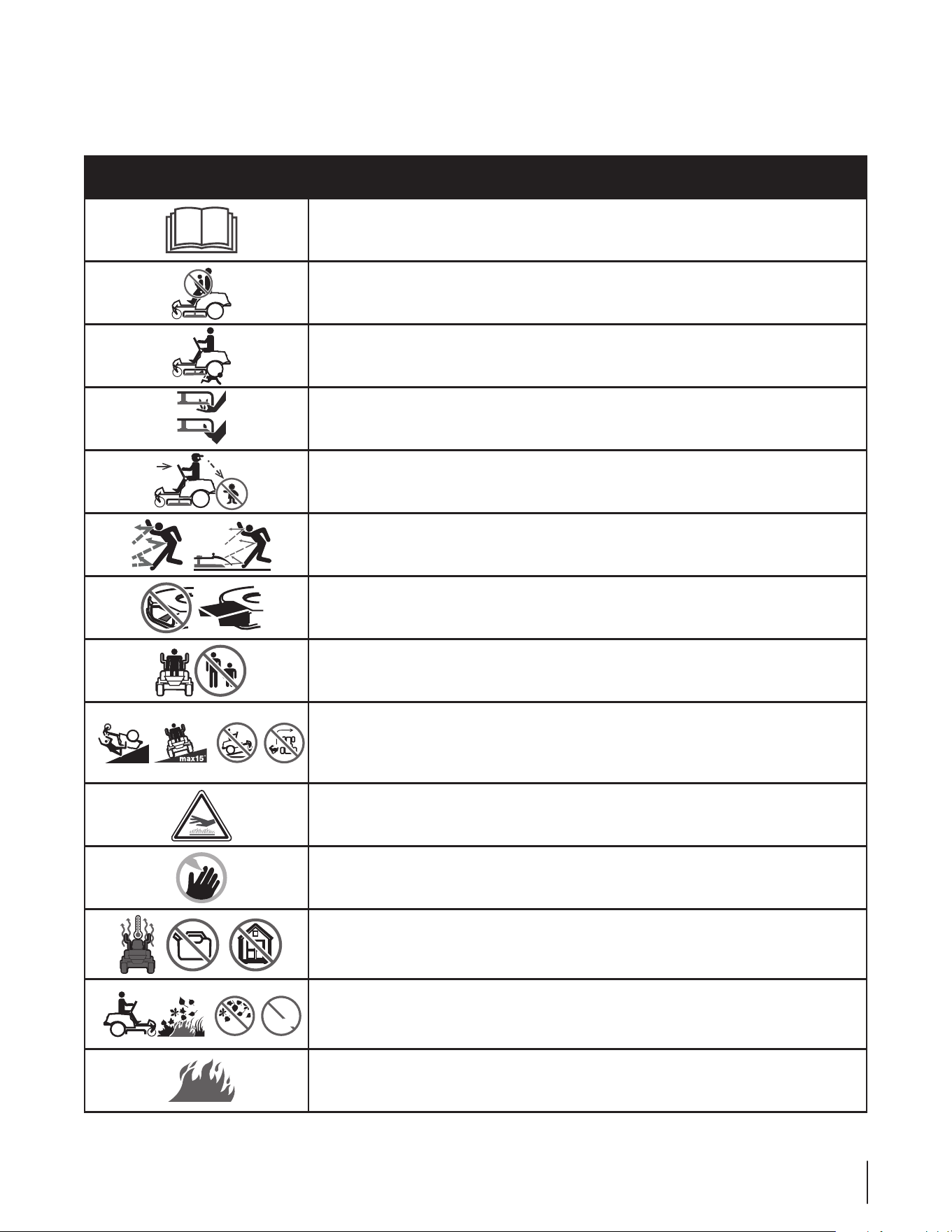
Safety Symbols
This page depicts and describes safety symbols that may appear on this product. Read, understand, and follow all instructions on the
machine before attempting to assemble and operate.
Symbol Description
READ THE OPERATOR’S MANUAL(S)
Read, understand, and follow all instructions in the manual(s) before attempting to
assemble and operate
DANGER — ROTATING BLADES
Never carry passengers. Never carry children, even with the blades off.
DANGER — ROTATING BLADES
Mowing in reverse is not recommended.
WARNING — ROTATING BLADES
Do not put hands or feet near rotating parts or under the cutting deck. Contact with the
blade(s) can amputate hands and feet.
DANGER — ROTATING BLADES
Look down and behind before and while backing to avoid a back-over accident.
WARNING — THROWN OBJECTS
This machine may pick up and throw and objects which can cause serious personal injury.
DANGER — SAFETY DEVICES
Keep safety devices (guards, shields, switches, etc.) in place and working.
WARNING — BYSTANDERS
Keep bystanders, helpers, children and pets at least 75 feet from the machine while it is in
operation.
WARNING — SLOPE OPERATION
Do not operate this machine on a slope greater than 15 degrees. Do not mow up and down
slopes. Mow across slopes no greater than 15 degrees. Avoid sudden turns. Use low speed. If
machine stops going uphill, stop blades and back down slowly.
WARNING — HOT SURFACE
Engine parts, especially the muffler, become extremely hot during operation. Allow engine
and muffler to cool before touching.
DANGER — ROTATING BLADES
To reduce the risk of injury, keep hands and feet away. Do not operate unless discharge cover
or grass catcher is in its proper place. If damaged, replace immediately.
WARNING — FIRE HAZARD
Allow machine to cool before fueling or storing.
max10"
WARNING — FIRE HAZARD
Do not drive through piles of dry leaves or tall grass.
WARNING — FIRE HAZARD
Do not allow debris to accumulate. The build up of debris can lead to a fire.
8 Section 2 — Safe operation practiceS
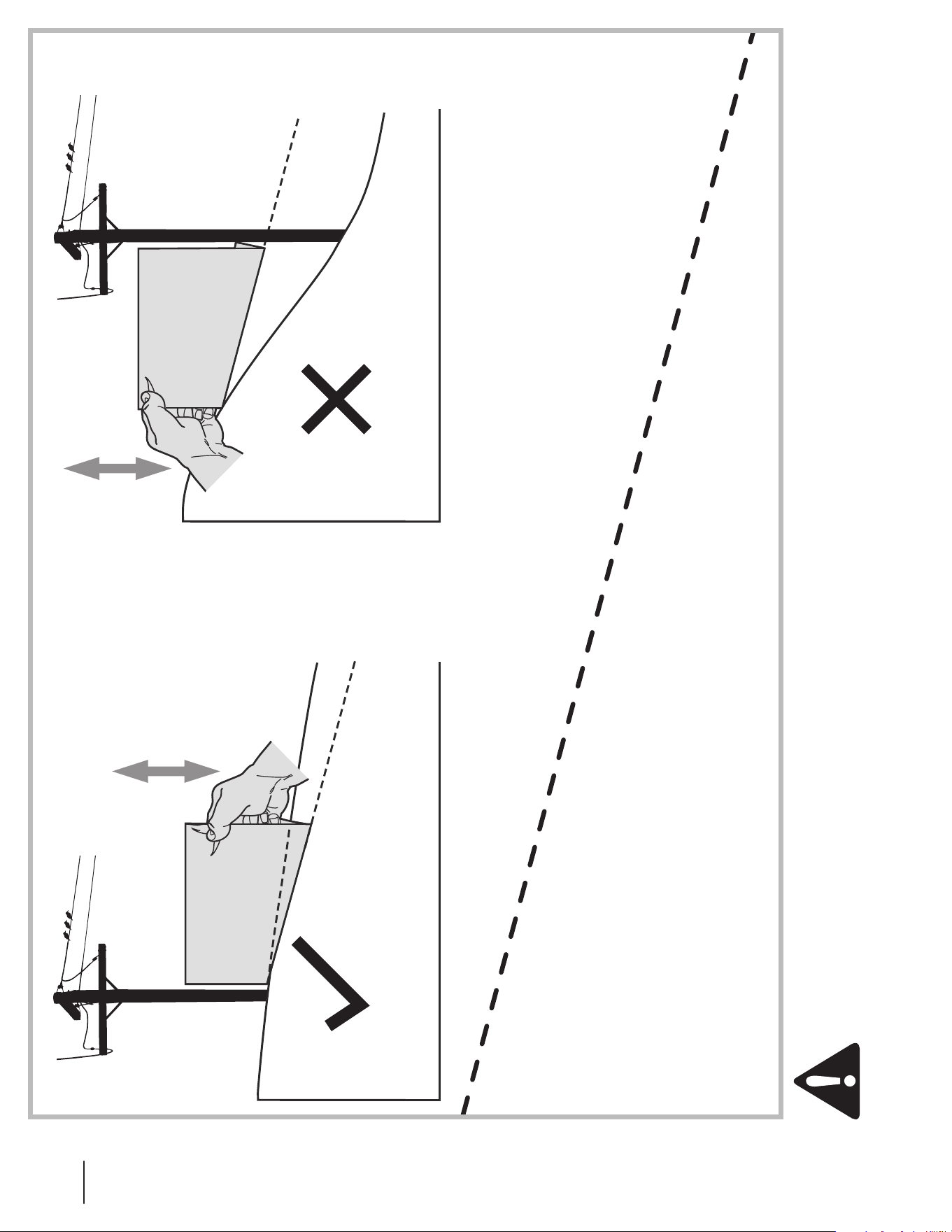
(OK) (TOO STEEP)
USE THIS SLOPE GAUGE TO DETERMINE
IF A SLOPE IS TOO STEEP FOR SAFE OPERATION!
To check the slope, proceed as follows:
1. Remove this page and fold along the dashed line.
2. Locate a vertical object on or behind the slope (e.g. a pole, building, fence, tree, etc.)
3. Align either side of the slope gauge with the object (See Figure 1 and Figure 2 ).
4. Adjust gauge up or down until the left corner touches the slope (See Figure 1 and Figure 2).
5. If there is a gap below the gauge, the slope is too steep for safe operation (See Figure 2 above).
15° dashed line
Slope Gauge
Figure 2Figure 1
15° Slope
15° Slope
WARNING! Slopes are a major factor related to tip-over and roll-over accidents which can result in severe injury or death.
Do not operate machine on slopes in excess of 15 degrees. All slopes require extra caution.
Always mow across the face of slopes, never up and down slopes.
Assembly & Set-Up
3
9
NOTE: This Operator’s Manual covers several models. Tractor
features may vary by model. Not all features in this manual are
applicable to all tractor models and the tractor depicted may
differ from yours.
NOTE: All references in this manual to the left or right side and
front or back of the tractor are from the operating position only.
Exceptions, if any, will be specified.
Tractor Preparation
Manually Moving the Tractor
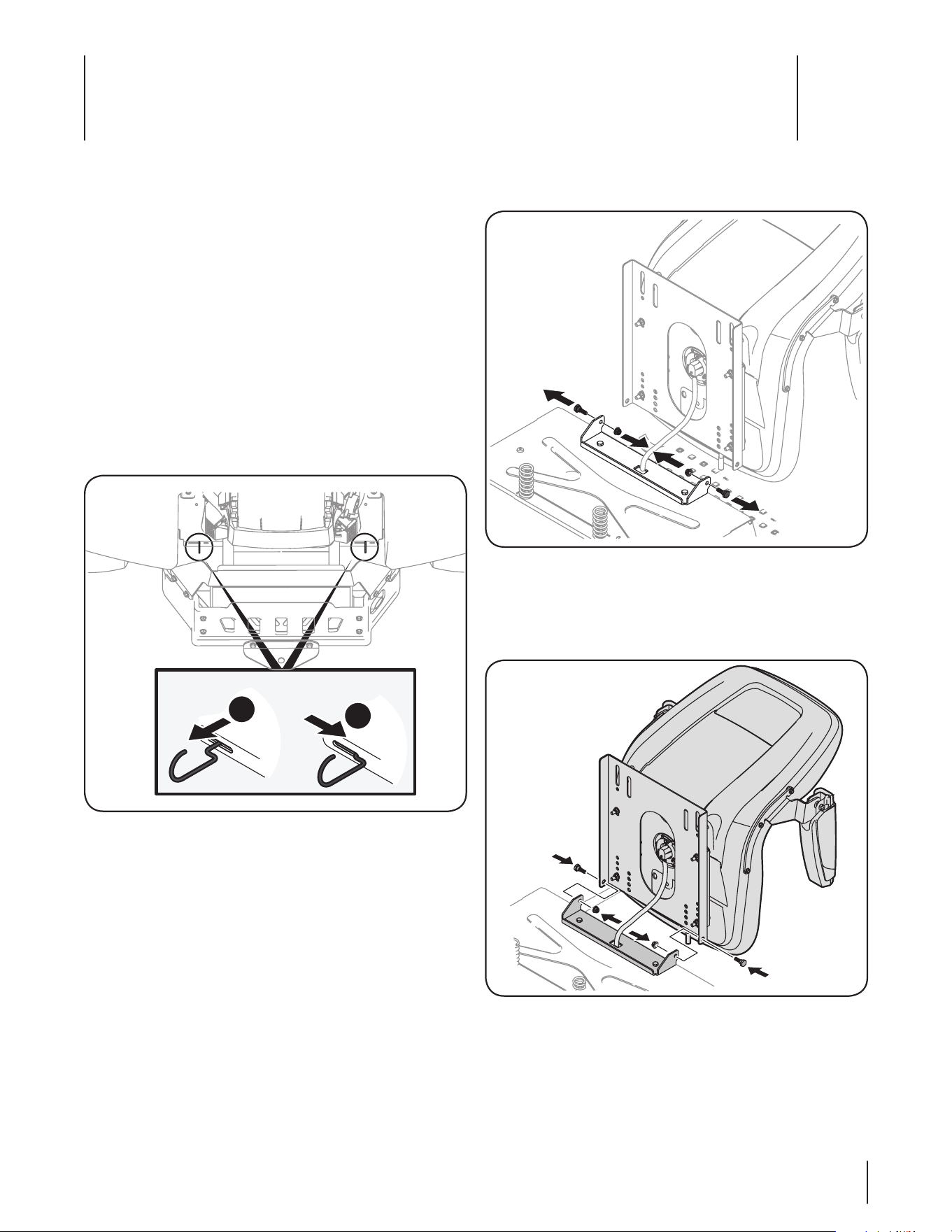
1. Engage the transmission bypass rods, one on each side of
the tractor, to move the tractor manually without starting it.
The transmission bypass rods are located on the rear of the
tractor, just inside each rear wheel. Engage the bypass rods
by pulling each one out (a) and to the right (b) to lock it into
place. See Figure 4-1.
a
a
b
Figure 4-1
2. Disengage the bypass rods by reversing steps a & b after
moving the tractor. See Figure 4-1.
3. Remove the deck wash system nozzle adapter from the
manual bag and store for future use.
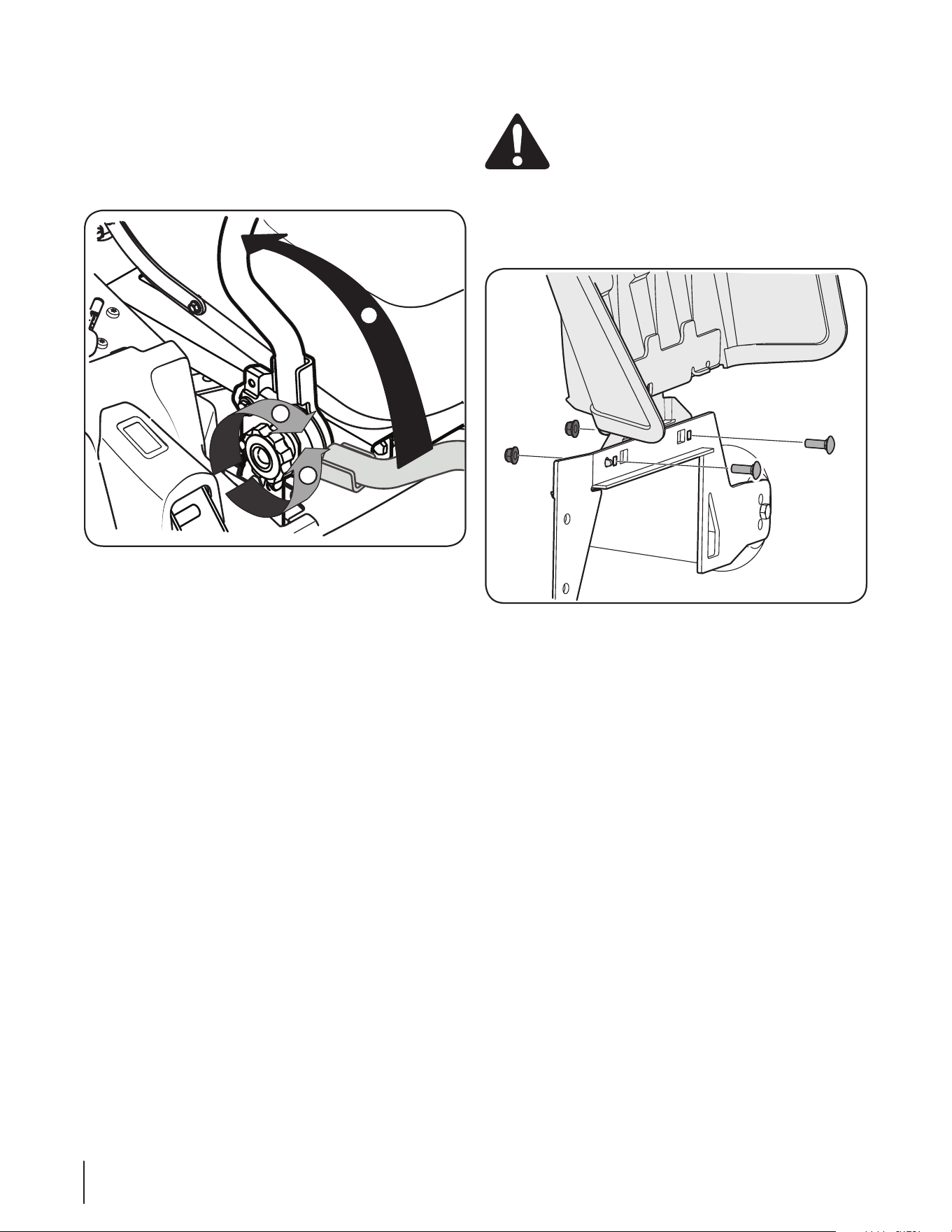
Install Operator’s Seat
To install the seat proceed as follows:
NOTE: The seat is shipped with the seat switch and seat
pan attached.
1. Cut any straps securing the seat assembly and the drive
control levers to the tractor. Remove any packing material.
NOTE: Be careful not to cut the wiring harness connecting
the seat and the seat switch.
2. Remove the two shoulder screws and flange lock nuts in
the seat bracket as shown in Figure 4-2.
Figure 4-2
3. Rotate the seat into position and secure the seat into place
with the previously removed shoulder screws and flange
lock nuts. Be careful not to crimp or damage the wire
harness while installing the seat. See Figure 4-3.
Figure 4-3
NOTE: Be sure to push the excess wire from the wire
harness into the seat box hole before continuing.
10 Section 3 — ASSembly & Set-Up
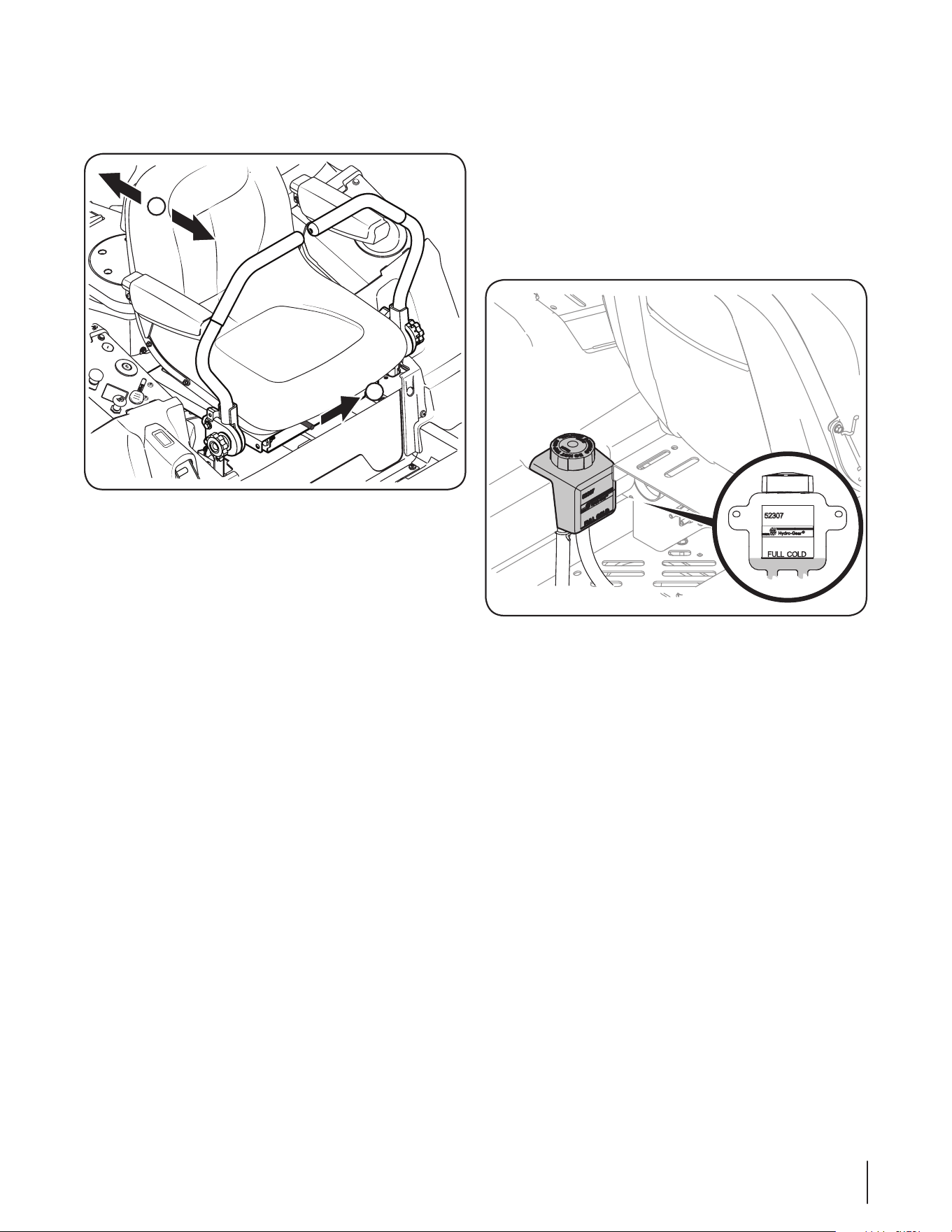
Position Drive Control levers
The drive control levers of the tractor are lowered for shipping
purposes. The levers must be repositioned to operate the tractor.
To reposition the control levers for operation, proceed as follows:
1. Loosen the control lever knobs on the side of the drive
control levers. See Figure 4-4.
2
2
1
Figure 4-4
2. Lift and swing that control lever upward into the desired
position and secure in place by tightening the control lever
knob. See Figure 4-4.
3. Note the relative position of the control lever to the pivot
bracket, then repeat the previous steps to reposition the
other control lever in approximately the same position.
4. Refer to “Adjusting the Drive Control Levers” in the
Maintenance & Adjustments for instructions for the final
adjustment of the levers.
Lower Deck Discharge Chute Deflector
WARNING! Never operate the mower deck
without the chute deflector installed and in the
down position.
The discharge chute deflector must be installed before operating
the mower. To install the chute deflector, proceed as follows:
1. Remove the carriage screws and flange lock nuts installed
on the mounting bracket on the deck. See Figure 4-5.
Figure 4-5
2. With the previously removed hardware, install the chute
deflector on the deck as shown in Figure 4-5.
11Section 3 — ASSembly & Set-Up
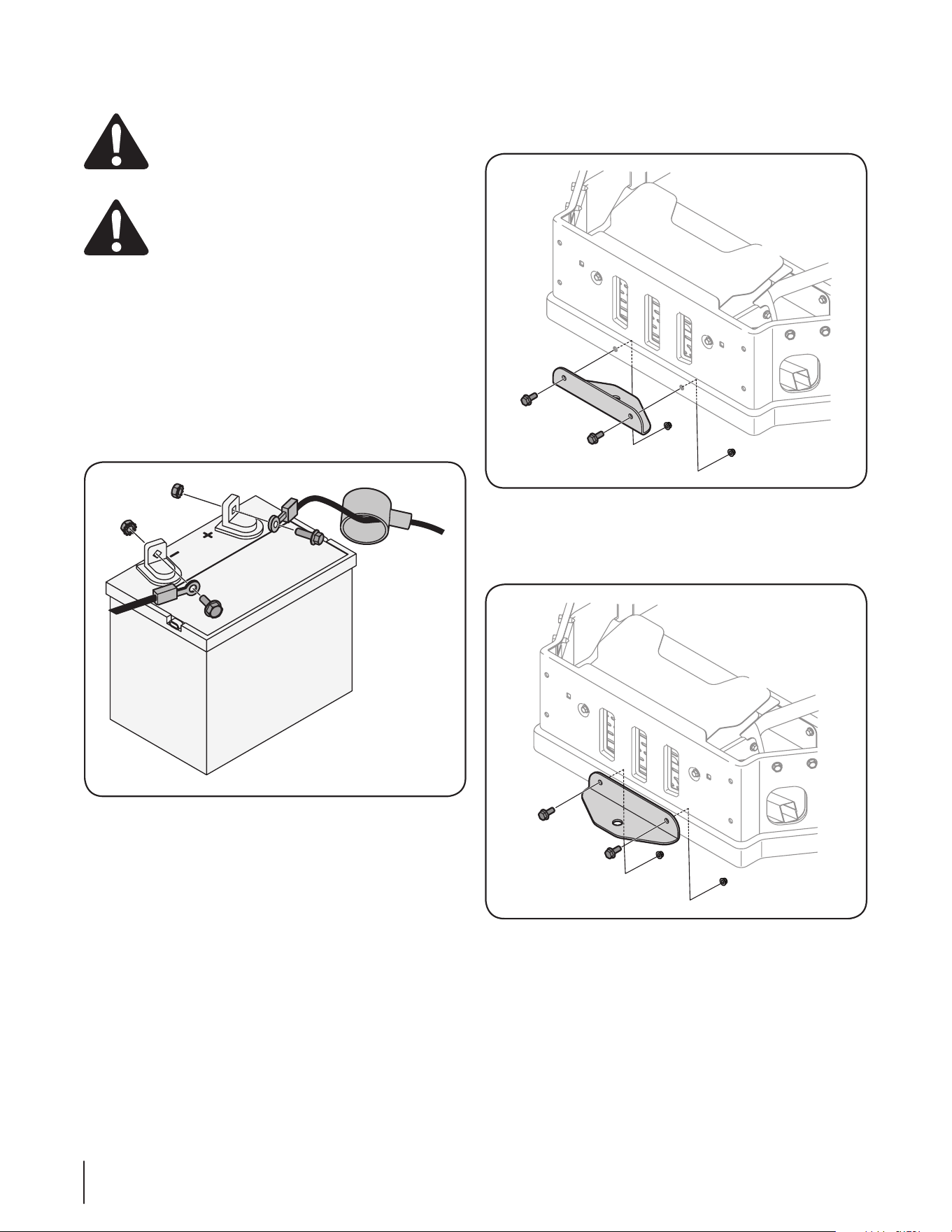
Adjusting the Seat
1. To adjust the position of the seat, push the seat adjustment
lever to the left. See Figure 4-6.
2
1
Figure 4-6
2. Slide the seat forward or rearward to the desired position;
then release the adjustment lever. Make sure seat is locked
into position before operating the tractor. See Figure 4-6.
Transmission Oil Expansion Reservoir
The transmission oil expansion reservoir is connected by hoses
to the RH and LH transmission assemblies, and is located behind
the seat box. The function of the reservoir is to hold the natural
expansion of transmission oil that occurs as the transmission
warms up during operation. DO NOT FILL THE RESERVOIR.
Under normal operating conditions, no oil should be added
to the reservoir. The COLD oil level should be no higher than
approximately 1⁄4” (the “Full Cold” mark) above the bottom of
the reservoir. See Figure 4-7.
Figure 4-7
NOTE: Prior to the initial operation of the tractor, the
oil level in the reservoir may be slightly higher than the
maximum due to air in the oil lines. Operation of the tractor
will eventually purge the air from the lines and the oil level
will settle to the maximum.
12 Section 3 — ASSembly & Set-Up
Connecting the Battery Cables
CALIFORNIA PROPOSITION 65 WARNING!
Battery posts, terminals, and related accessories
contain lead and lead compounds, chemicals known
to the State of California to cause cancer and
reproductive harm. Wash hands after handling.
CAUTION: When attaching battery cables, always
connect the POSITIVE (Red) wire to its terminal first,
followed by the NEGATIVE (Black) wire.
For shipping reasons, both battery cables on your equipment
may have been left disconnected from the terminals at the
factory. To connect the battery cables, proceed as follows:
NOTE: The positive battery terminal is marked Pos. (+). The
negative battery terminal is marked Neg. (–).
NOTE: If the positive battery cable is already attached, skip
ahead to step 2.
1. Remove the plastic cover, if present, from the positive battery
terminal and attach the red cable to the positive battery
terminal (+) with the bolt and hex nut. See Figure 4-8.
Figure 4-8
2. Remove the plastic cover, if present, from the negative
battery terminal and attach the black cable to the negative
battery terminal (–) with the bolt and hex nut. See Figure 4-8.
3. Position the red rubber boot over the positive battery
terminal to help protect it from corrosion.
NOTE: If the battery is put into service after the date shown
on top/side of battery, charge the battery as instructed in
the Maintenance section your Operator’s Manual prior to
operating the tractor.
Install the Rear Hitch Bracket
1. Remove the hex flange screws and flange lock nuts that
secure the hitch bracket to the bumper. See Figure 4-9.
Figure 4-9
2. Install the hitch bracket as shown in Figure 4-10 and secure
with the hex flange screws and flange lock nuts removed
in step 1.
Figure 4-10
Controls & Features
4
13
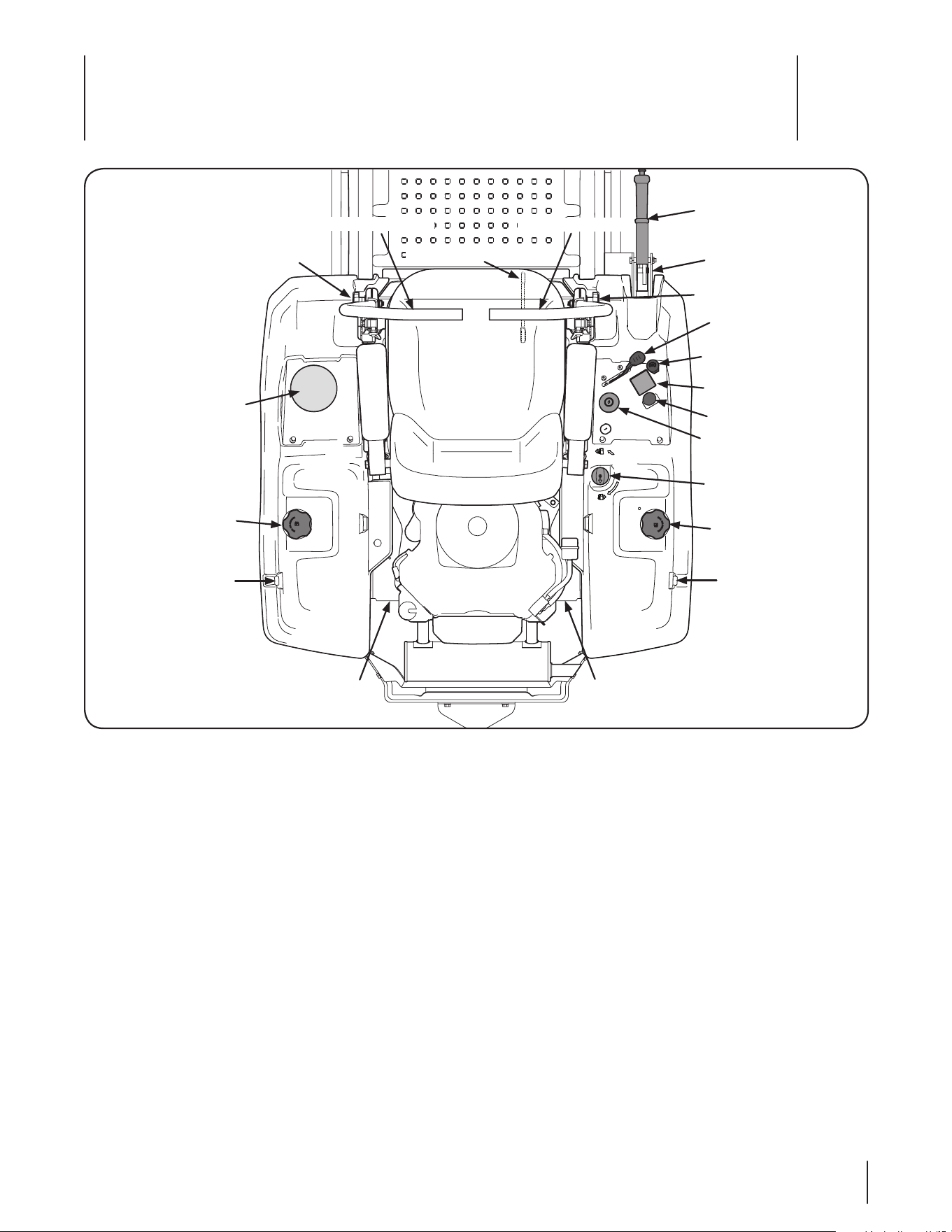
Deck Lift Handle
Deck Height Index
Control Lever
Adjustment Knob
Throttle Control
Choke Control
LCD Service Minder
& Hour Meter
PTO Switch
Ignition Switch
Fuel Valve
Fuel Tank Cap
Fuel Level Window
Seat Adjustment Lever
RH Control Lever
LH Control Lever
Control Lever
Adjustment Knob
Cup Holder
Fuel Tank Cap
Fuel Level Window
LH Transmission Bypass Rod
RH Transmission Bypass Rod
NOTE: This Operator’s Manual covers several models. Tractor
features may vary by model. Not all features in this manual are
applicable to all tractor models and the tractor depicted may
differ from yours.
NOTE: References to LEFT, RIGHT, FRONT, and REAR indicate that
position on the tractor when facing forward while seated in the
operator’s seat.
RH and LH Drive Control Levers
The RH and LH control levers are located on each side of the
operator’s seat. These hinged levers pivot outward to open
space to permit the operator to either sit in the tractor seat, or to
dismount the tractor. The levers must be fully opened out and in
the neutral position to start the tractor engine. When the levers
are fully outward, the parking brake is also engaged.
Each lever controls the respective RH or LH transmission.
Consequently, these levers control all of the movements of the tractor.
Driving and steering utilizing these control levers is quite different
from conventional tractors, and will take some practice to master.
Refer to Operation for instructions on using the control levers.
Control Lever Knobs
The control lever knobs are located near the base of RH and LH
control levers. The knobs allow the levers to be adjusted forward
or rearward. Refer to Maintenance & Adjustments section for
instructions on using the control levers knobs.
Cup Holder
The cup holder is located to the left of the operator’s seat on the
LH console.
Seat Adjustment Lever
The seat adjustment lever is located below the front/right of the
seat. The lever allows for adjustment forward or backward of
the operator’s seat. Refer to the Assembly & Set-Up section for
instructions on adjusting the seat position.
14 Section 4— controlS & FeatureS
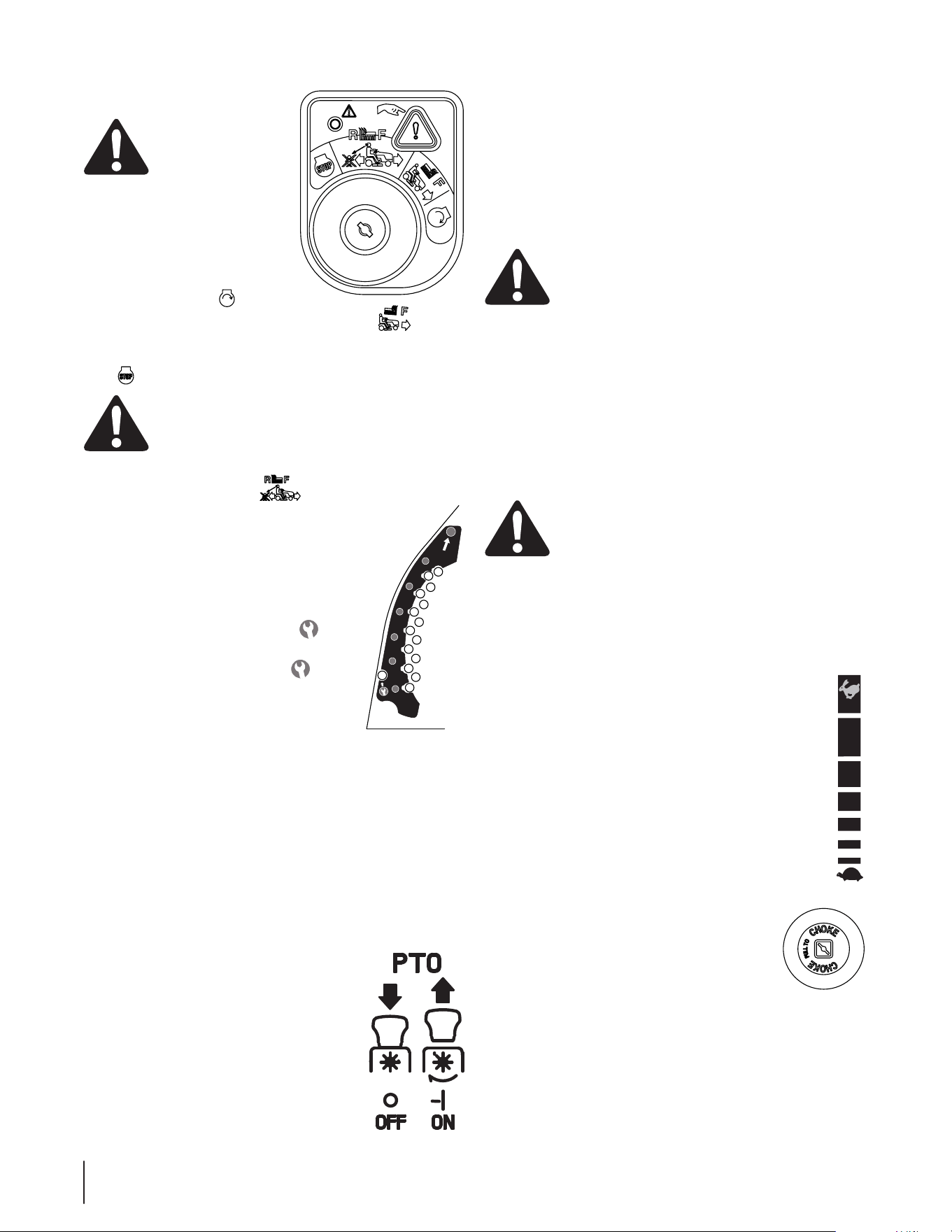
Ignition Switch Module
WARNING! Never
leave a running
machine unattended.
Always disengage PTO,
set parking brake, stop
engine and remove key
to prevent unintended
starting.
To start the engine, insert the key
into the ignition switch and turn
clockwise to the START position.
Release the key into the NORMAL MOWING MODE position
once the engine has fired.
To stop the engine, turn the ignition key counterclockwise to the
STOP position.
CAUTION: Prior to operating the tractor, refer to
both Safety Interlock Switches and Starting The
Engine in the Operation section of this manual for
detailed instructions regarding the Ignition Switch
Module and operating the tractor in REVERSE
CAUTION MODE .
Deck Height Index
The deck height index consists of several holes
located on the front of the RH console. Each hole
corresponds to a ⁄” change in the deck height
position ranging from 1” at the lowest notch to
4” at the highest notch. The highest notch is also
the transport position and the lowest position is
the deck removal/installation position .
NOTE: Do not cut grass in the deck
removal/installation position . Doing
so is detrimental to the belt life.
Deck Lift Handle
The deck lift handle is located on the front of
the RH console, and is used to raise and lower the mower deck.
Depress the button on the end of the handle and push downward to
lower the deck, or pull upward to raise the deck. When the desired
height is attained, secure the pin in the desired index hole and release
the button on the handle.
NOTE: Make certain the deck is secured and the pin is fully
inserted into the deck height index. The pin is keyed to
help keep it in place and fits into the slotted holes on the
deck height index.
NOTE: The deck lift handle must always be above the pin,
never hang the deck lift handle from the pin when mowing.
Power Take-Off (PTO) Switch
The PTO switch is located on the RH console to
the left of the hour meter/indicator panel.
The PTO switch operates the electric PTO
clutch mounted on the bottom of the engine
crankshaft. Pull the switch knob upward to
engage the PTO clutch, or push the knob
downward to disengage the clutch.
The PTO switch must be in the “disengaged”
position when starting the engine.
1.5
3
3
.
5
2
2
.
5
1"
4"
Transmission Bypass Rods
The transmission bypass rods (one for each the RH and LH
transmission) are located on the rear of the tractor, just inside
each rear wheel.
When engaged, the two rods open a bypass within the
hydrostatic transmissions, which allows the tractor to be pushed
short distances by hand. Refer to the Assembly & Set-Up section
for instructions on using the bypass feature.
CAUTION: Never tow your tractor. Towing the
tractor with the rear wheels on the ground may
cause severe damage to the transmissions.
Fuel Tank Caps
The fuel tank caps are located near the middle of the RH and LH
console. Turn the fill cap to remove. The fuel cap is tethered to the
tractor to prevent its loss. Do not attempt to remove the cap from
the tractor. Fill tank to the bottom of the filler neck, allowing some
space in the tank for fuel expansion. Do not overfill the tank.
Push the cap downward on the fuel tank fill neck and turn
clockwise until it clicks to tighten. Always re-install the fuel cap
tightly onto the fuel tank after removing.
WARNING! Never fill the fuel tank when the
engine is running. If the engine is hot from recently
running, allow to cool for several minutes before
refueling. Highly flammable gasoline could splash
onto the engine and cause a fire.
Fuel Level Windows
The fuel level windows are located on the outside of the LH and
RH consoles and shows the level of fuel in the gas tank.
Throttle Control
The throttle control is located on the RH console. When
set in a given position, a uniform engine speed will be
maintained.
Push the throttle control handle forward to increase the
engine speed. The tractor is designed to operate with the
throttle control in the fast position (full throttle) when the
tractor is being driven and the mower deck is engaged.
Pull the throttle control handle rearward to decrease the
engine speed.
Choke Control
The choke control is located on the RH console
.The choke control determines the position of
the engine choke. Pull the knob out to choke the
engine; push the knob in to open the choke.
FAST
SLOW
15Section 4 — controlS & FeatureS
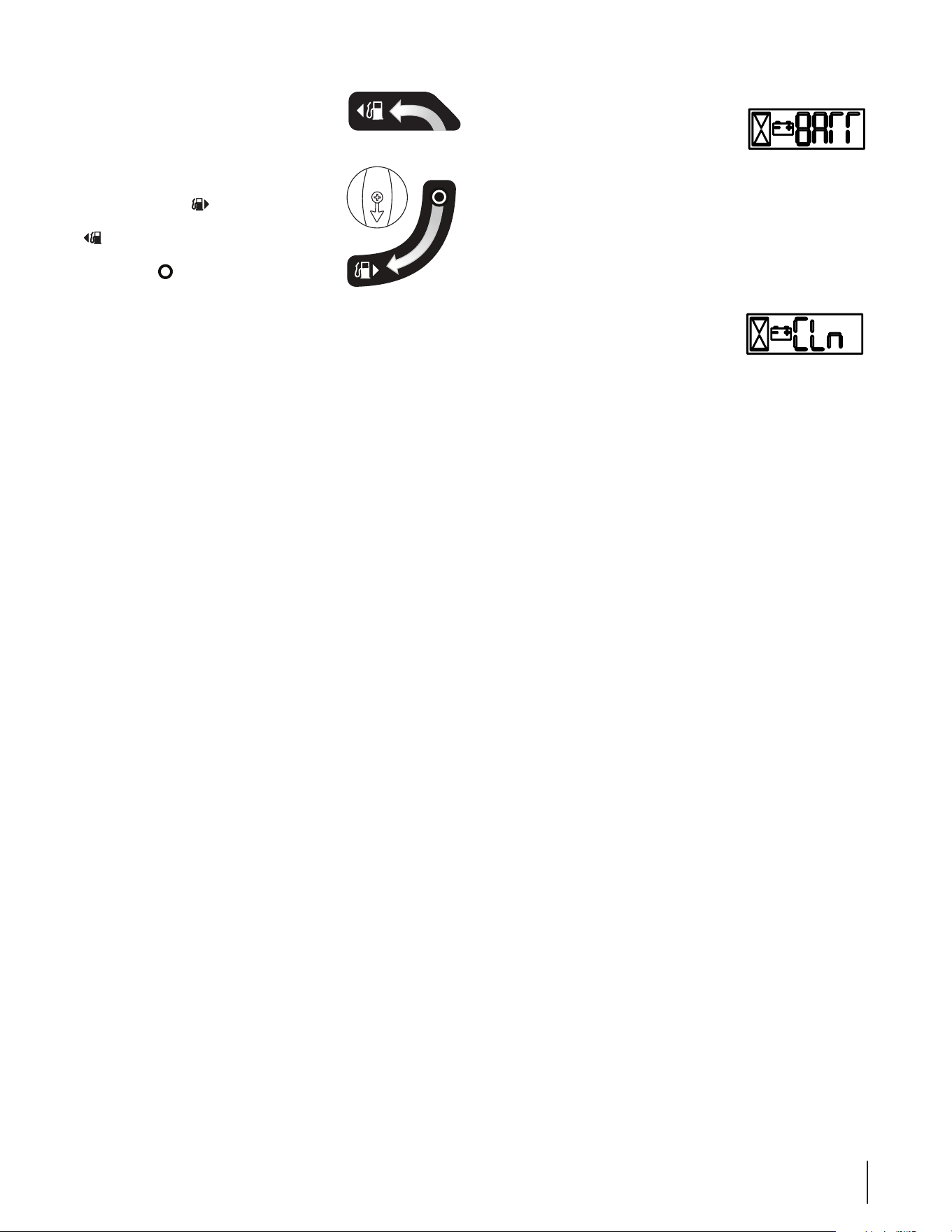
Fuel Valve
The fuel valve is located on the inner side of
the RH console. The valve switches the fuel
flow from the right and left tank and also
can shut off fuel flow to the engine. Rotate
the valve to the rear to open the flow from
the right fuel tank . Rotate the valve to
the front to open the flow from the left tank
. To shut off fuel from both tanks rotate
the valve towards the right of the tractor
and the OFF position. See the Operation
section for more information on using the
fuel valve.
Transmission Oil Expansion Reservoir
The transmission oil expansion reservoir is connected by hoses
to the RH and LH transmission assemblies, and is located behind
the seat box. The function of the reservoir is to hold the natural
expansion of transmission oil that occurs as the transmission warms
up during operation. See the Maintenance & Adjustments section
for more information on the transmission oil expansion reservoir.
LCD Service Minder & Hour Meter
When the ignition key is rotated out of the STOP position but not
into the START position, the LCD Service Minder and Hour Meter
will briefly display the battery voltage, followed by the tractor’s
accumulated hours.
NOTE: Hours of tractor operation are recorded any time the
ignition key is rotated out of the STOP position, regardless of
whether the engine is started.
The LCD Service Minder will remind the operator of maintenance
intervals for changing the engine oil, air filter service, low engine
and low battery warnings.
Change Oil
The LCD will display the letters “CHG”, followed by the letters
“OIL”, followed by the letters “SOON”, then finally followed by the
meter’s accumulated time. “CHG/OIL/SOON/TIME” will alternate
on the display for 7 minutes after the meter reaches 50 hours.
This oil service minder interval will occur every 50 hours. Before
the interval expires, change the engine oil as instructed in the
Maintenance section of this Operator’s Manual.
Low Oil Pressure
NOTE: The low oil pressure function only works if the engine is
equipped with an oil pressure switch.
The letters “LO” followed by the letters “OIL”, then followed by
the meter’s accumulated time will indicate the engine has low oil
pressure. This is common when starting an engine. The indicator
will remain active until the engine sufficiently builds pressure
after starting. If it remains on with the engine at full speed and
after a few minutes of operation, stop the tractor immediately
and check the engine oil level as instructed in this Operator’s
Manual. If the oil is low, add as instructed in the Engine
Operator’s Manual. If the oil level is correct and the indicator
persists, contact an authorized service dealer.
Low Battery
At startup, the battery voltage is briefly
displayed then changes to accumulated
hours. The letters “LO” will display
followed by the letters “BATT” and then followed by the meter’s
accumulated time. “LO/BATT/TIME” is displayed on the LCD when
the voltage drops below 11.5 volts. When this occurs, the battery
is in need of a charge or the engine’s charging system is not
generating sufficient amperage. Charge the battery as instructed
in the Service section of this manual or have the charging system
checked by your local service dealer.
Air Filter Service
The letters “CLN” will display, followed by
the letters “AIR”, followed by “FILT”, then
followed by the meter’s accumulated time.
“CLN/AIR/FILT/TIME” will alternate on the
display for 7 minutes after the meter reaches 25 hours. This air
filter service minder time interval will be every 25 hours. On
intervals that are common with oil service, the oil message will
be displayed first followed by the air filter message.

Operation
5
16
General Safety
• RECEIVE INSTRUCTION — Entirely read this operator’s
manual. Learn to operate this machine SAFELY. Do not risk
INJURY or DEATH. Allow only those who have become
competent in its usage to operate this tractor.
• Before starting the engine or beginning operation, be
familiar with the controls. The operator should be in the
operator’s seat. The PTO switch must be in the disengaged
position and the RH and LH drive control levers moved to
the neutral position engaging the parking brake.
• Keep all shields in place. Keep away from moving parts.
• NO RIDERS! Keep all people and pets a safe distance away.
Look behind and down to both sides of the tractor before
and while backing up.
• DO NOT direct the mower discharge at people. Never
walk or stand on the discharge side of the mower when
the engine is running. Turn off the PTO if another person
approaches while you are operating the mower.
• Avoid slopes where possible. Never operate on slopes
greater than 15°. Slopes with a greater incline present
dangerous operating conditions. Tractors can be rolled
over. Always mow across slopes, never up and down
the slope. Avoid turning downhill if possible, start at
the bottom and work up to the top. Use extra care and
go slowly when turning downhill. Control the speed
and direction of the zero turn machine “primarily” with
the speed/directional control (lap bar) of the downhill
side of the machine, i.e., maintain the uphill side lap bar
“essentially” in a fixed position.
• Before leaving the operator’s seat: Shut off the PTO, move
the RH and LH drive control levers fully outward in the
neutral position, engage the parking brake, shut off the
engine and remove the ignition key. Wait for all movement
to stop before servicing or cleaning.
• When operating this mower, in the forward direction, do
not allow the steering levers to return to neutral on their
own. Operate the drive control levers smoothly and avoid
any sudden movements of the levers when starting and
stopping. Keep a firm grip on the control levers.
• Be careful when operating near gravel paths and roadways.
Stop the blades and tractor motion and wait for vehicles to
pass before operating along the road.
• Do not operate the tractor with the mower deck removed.
Removal of the deck will change the balance of the tractor,
and could contribute to a tractor rollover.
• Avoid operation on traction surfaces that are unstable; use
extreme caution if the surface is slippery. Always remove
debris and other objects from the area to be mowed -
debris and loose grass will reduce traction.
• Mow only in daylight or good artificial light.
• Watch for holes, sprinkler heads, and other hidden hazards.
• Avoid driving too close to trees, creeks, ditches, sand traps,
and other obstacles.
• Slow down before turning and come to a complete stop
before any zero turn maneuver.
• If you hit a solid object while mowing, turn off the PTO,
place the steering levers in the neutral, opened-out
position, move the throttle to slow, set the parking brake,
shut off the engine, and take the key from the ignition
switch. Inspect for damage. Repair the damage. Make sure
the blades are in good condition and that the blade bolts
are tight before restarting the engine.
• Do not stop the tractor or park the tractor over
combustible materials such as dry grass, leaves, debris, etc.
• Keep the mower and especially the engine and hydraulic
components clean and free of grease, grass, and leaves to
reduce the chance of fire and permit proper cooling.
• Do not fill the fuel tank when the engine is running or
while the engine is hot. Allow the engine several minutes
to cool before refueling. Tighten the fuel cap securely.
Checking the Safety Interlock Circuits
Periodically check the safety interlock circuits to ensure they are
working properly. If a safety circuit is not working as designed,
contact your authorized dealer to have the tractor inspected. DO
NOT operate the tractor if any safety circuit is not functioning
properly. To check the safety circuits, proceed as follows:
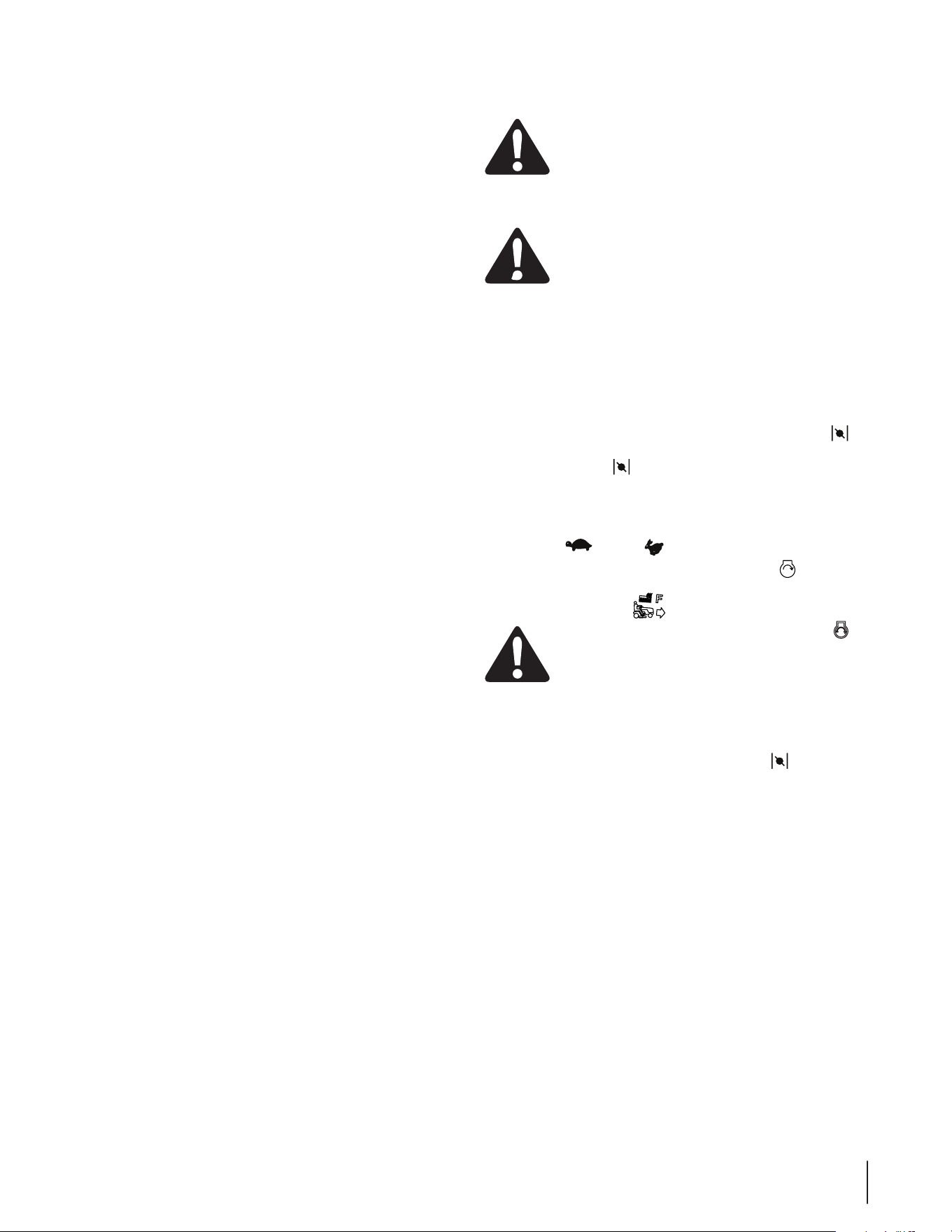
1. Pull the PTO switch upward to the engaged position.
Momentarily turn the ignition switch to the START
position; the engine should not crank.
2. Move both control levers fully inward in the neutral
position; then lift upward from the operator’s seat. The
engine should stop.
3. With both control levers fully outward in the neutral/
parking brake engaged position, engage the PTO. Lift
upward from the operator’s seat; the engine should stop.
4. Start the tractor and move the control levers inward to the
neutral operating position. Engage the PTO and move both
control lever slowly into the slow reverse position with
the key in the NORMAL MOWING ; the PTO should
disengage and the mower deck should stop.
Before Operating Your Tractor
1. Before you operate the tractor, study this manual carefully
to familiarize yourself with the operation of all the
instruments and controls. It has been prepared to help you
operate and maintain your tractor efficiently.
2. Fill the fuel tank with only clean, fresh, unleaded gasoline
with a pump sticker octane rating of 87 or higher and 10%
ethanol maximum. When the fuel reaches one inch from
the top of the tank, stop. DO NOT OVERFILL. Space must be
left for expansion.
3. Unleaded gasoline is recommended because it leaves less
combustion chamber deposits and reduces harmful exhaust
emissions. Leaded gasoline is not recommended and must
not be used where exhaust emissions are regulated.
NOTE: Purchase gasoline in small quantities. Do not use
gasoline left over from the previous season, to minimize
gum deposits in the fuel system.
4. Gasohol (up to 10% ethyl alcohol, 90% unleaded gasoline
by volume) is an approved fuel. Other gasoline/alcohol
blends are not approved.
17Section 5 — operation
5. Methyl Tertiary Butyl Ether (MTBE) and unleaded gas blends
(up to a maximum of 15% MTBE by volume) are approved
fuels. Other gasoline/ether blends are not approved.
6. Check the engine oil level. Refer to the Engine Operator’s
manual for instructions on checking the engine oil level.
7. Clean the air cleaner element if necessary.
8. Check the tire inflation pressures. See the tire side wall for
proper inflation pressures.
NOTE: New tires are overinflated in order to properly seat
the bead to the rim.
9. Check that all nuts, bolts and screws are tight.
10. Check the tension of the deck drive belts.
a. Remove the deck cover
b. The tension of the deck drive belts are maintained by
a spring mechanism that adjusts for wear and stretch.
c. Examine the belts for cuts, fraying, and excessive
wear. Replace if any of these are detected.
d. Replace the deck cover.
11. Check if deck is level. When correctly adjusted the mower
deck should be level side to side, and the front of the deck
should be approximately ⁄” lower than the rear of deck.
If deck needs to be leveled, refer to the Maintenance &
Adjustments section.
12. Lubricate all pivot points listed in the Maintenance &
Adjustments section.
13. Adjust the seat for operator’s maximum comfort, visibility
and for maintaining complete control of the tractor.
Safety Interlock System
This tractor is equipped with a safety interlock system for the
protection of the operator. If the interlock system should ever
malfunction, do not operate the tractor. Contact your authorized
dealer.
• The safety interlock system prevents the engine from
cranking or starting unless the RH and LH drive control levers
are moved fully outward in the neutral position — which
engages the parking brake — and the PTO is disengaged.
• The safety interlock system will shut off the engine if the
operator leaves the seat before the RH and LH drive control
levers are fully outward in the neutral position engaging
the parking brake.
• The safety interlock system will shut off the engine if the
operator leaves the seat with the PTO engaged, regardless of
whether the RH and LH drive control levers are fully outward
in the neutral position engaging the parking brake.
NOTE: The PTO switch must be moved to the “OFF”
position to restart the engine.
• The safety interlock system will shut off the PTO and the mower
blades will stop if both drive control levers are moved into the
reverse position. To restart the blades the PTO must be moved
to the “OFF” position and then back to the “ON” position.
Starting the Engine
WARNING! This tractor is equipped with a safety
interlock system designed for the protection of the
operator. Do not operate the tractor if any part of
the interlock system is malfunctioning. Periodically
check the functions of the interlock system for
proper operation.
WARNING! For personal safety, the operator must
be sitting in the tractor seat when starting the
engine.
1. Open the fuel shut-off valve by selecting the right or left tank.
2. Operator must be sitting in the tractor seat with the RH and
LH drive control levers fully outward in the neutral position
engaging the parking brake.
3. Make certain the PTO switch is in the disengaged (down)
position.
4. Pull the choke knob (if equipped) up into the CHOKE
position or move the throttle/choke control (if equipped)
into the CHOKE position.
NOTE: If the engine is warmed up, it may not be necessary
to choke the engine.
5. Move the throttle control (if equipped) to midway between
its slow and fast positions.
6. Turn the ignition key clockwise to the START position.
After the engine starts, release the key. It will return to the
NORMAL MOWING position.
CAUTION: Do NOT hold the key in the START
position for longer than ten seconds at a time. Doing
so may cause damage to your engine’s electric
starter.
7. Once the engine warms up, push the choke knob down
into the OFF position.
NOTE: Do NOT leave the throttle/choke control (if equipped)
or choke control (if equipped) in the CHOKE position
while operating the tractor. Doing so will result in a “rich”
fuel mixture and cause the engine to run poorly.
Cold Weather Starting
When starting the engine at temperatures near or below
freezing, ensure the correct viscosity motor oil is used in the
engine and the battery is fully charged. Start the engine as
follows:
1. Be sure the battery is in good condition. A warm battery
has much more starting capacity than a cold battery.
2. Use fresh winter grade fuel. Winter grade gasoline has
higher volatility to improve starting. Do not use gasoline
left over from summer.
3. Follow the previous instruction for Starting the Engine.
18 Section 5— operation
Using Jumper Cables To Start Engine
WARNING! Batteries contain sulfuric acid and
produce explosive gasses. Make certain the area is
well ventilated, wear gloves and eye protection, and
avoid sparks or flames near the battery.
If the battery charge is not sufficient to crank the engine, recharge
the battery. If a battery charger is unavailable and the tractor must
be started, the aid of a booster battery will be necessary. Connect
the booster battery as follows:
1. Connect the end of one cable to the disabled tractor
battery’s positive terminal; then connect the other end of
that cable to the booster battery’s positive terminal.
2. Connect one end of the other cable to the booster battery’s
negative terminal; then connect the other end of that cable
to the frame of the disabled tractor, as far from the battery
as possible.
3. Start the disabled tractor following the normal starting
instructions previously provided; then disconnect the
jumper cables in the exact reverse order of their connection.
4. Have the tractor’s electrical system checked and repaired
as soon as possible to eliminate the need for jump starting.
Stopping the Engine
1. Place the PTO switch in the OFF (down) position.
2. Move RH and LH drive control levers fully outward in the
neutral position engaging the parking brake.
3. Move the throttle control (if equipped) or throttle/choke
control (if equipped) to the SLOW position and allow
the engine to idle for about one minute.
4. Turn the ignition key to the STOP position and remove
the key from the ignition switch.
NOTE: Always remove the key from the ignition switch
to prevent accidental starting or battery discharge if the
equipment is left unattended.
5. Close the fuel shut-off valve.
Practice Operation (Initial Use)
Operating a zero-turn tractor is not like operating a conventional
type riding tractor. Although and because a zero turn tractor is
more maneuverable, getting used to operating the control levers
takes some practice.
We strongly recommend that you locate a reasonably large,
level and open “practice area” where there are no obstructions,
pedestrians, or animals. You should practice operating the
tractor for a minimum of 30 minutes.
Carefully move (or have moved) the tractor to the practice area.
When performing the practice session, the PTO should not be
engaged. While practicing, operate the tractor at approximately ⁄-
⁄ throttle and at less than full speed in both forward and reverse.
Use protective equipment for eyes, hands, hearing, feet, legs,
head and other areas of the body if needed — safety eye glasses,
gloves, earplugs, boots, hats, etc.
WARNING! Hearing Protection is required for all
operator exposure exceeding two (2) hours.
Carefully practice maneuvering the tractor using the instructions
in the following section “Driving the Tractor.” Practice until you
are confident that you can safely operate the tractor.
Driving the Tractor
WARNING! Avoid sudden starts, excessive speed
and sudden stops.
1. Adjust the operator’s seat to the most comfortable
position that allows you to operate the controls. See seat
adjustment in the Assembly & Set-Up section.
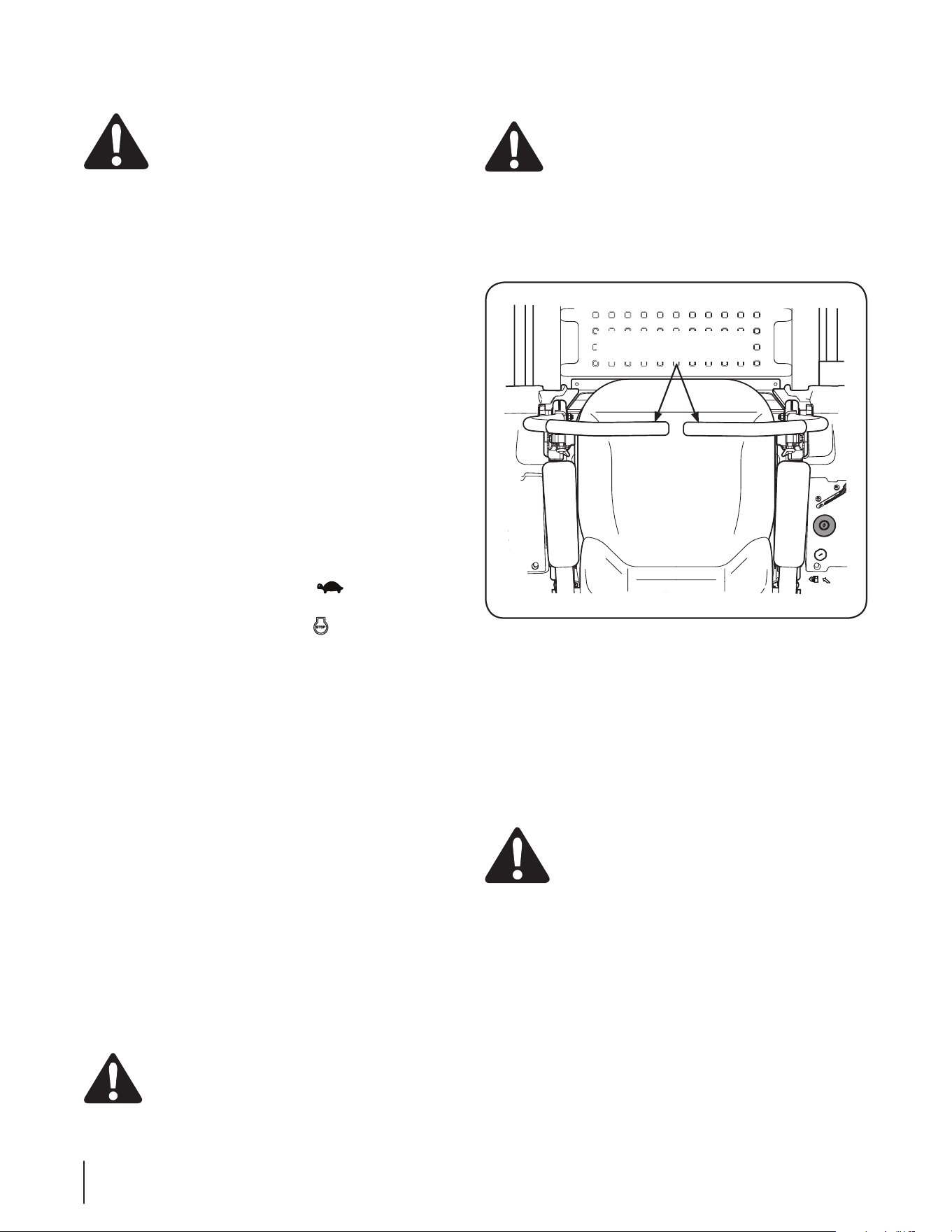
2. Move the RH and LH drive control levers inward in the
neutral position. Refer to Figure 6-1.
Control Levers Moved
Inward & in Neutral
Figure 6-1
NOTE: If the control levers are not even in the neutral
position, refer to Maintenance & Adjustments for
instructions to adjust the levers so that they are even.
3. Move the throttle control lever (if equipped) or throttle/
choke control lever forward to the full throttle position.
NOTE: Although the tractor’s engine is designed to run at
full throttle, when performing a practice session the tractor
must be operated at less than full throttle. This only applies
to practice.
WARNING! Always maintain a firm grip on the
control levers. DO NOT release the control levers to
slow or stop the tractor; move levers to neutral
position using your hands.
4. To drive the tractor, firmly grasp the respective drive
control levers with your right and left hands and continue
with Driving the Tractor Forward on the following page.
19Section 5 — operation
Driving the Tractor Forward
WARNING! Keep all movement of the drive control
levers slow and smooth. Abrupt movement of the
control levers can affect the stability of the tractor
and could cause the tractor to flip over, which may
result in serious injury or death to the operator.
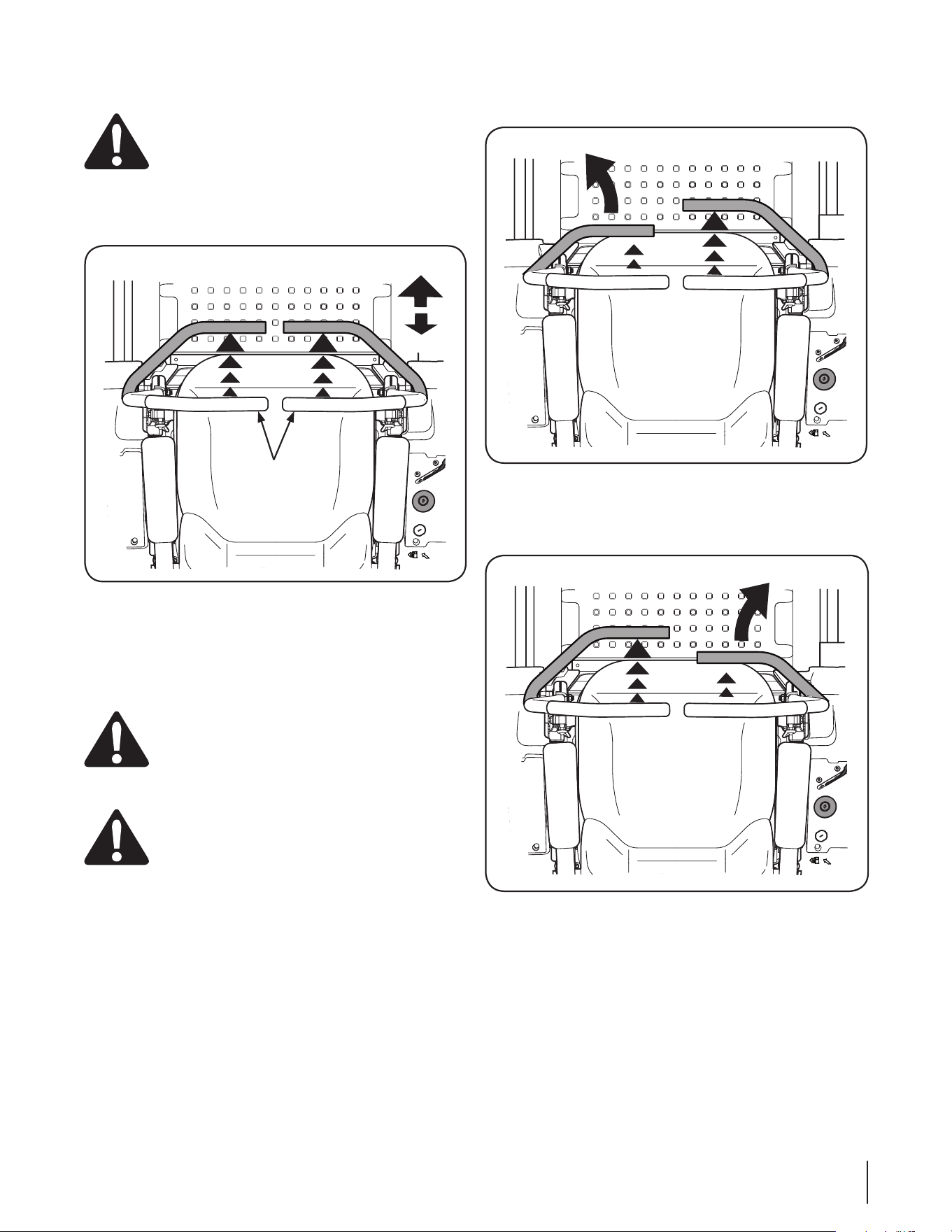
1. Slowly and evenly move both drive control levers forward.
The tractor will start to move forward. See Figure 6-2.
Driving Forward
Faster
Slower
Neutral
Position
Figure 6-2
2. As the control levers are pushed farther forward the speed
of the tractor will increase.
3. To slow the tractor move the controls lever rearward to
attain the desired speed, or move the levers to the neutral
position to stop the tractor.
WARNING! Always maintain your grasp on the
drive control levers. Do not release the levers to slow
the tractor or to return to neutral.
Turning the Tractor While Driving Forward
WARNING! When reversing the direction of travel,
we recommend performing gradual ‘U’ turns where
possible. Sharper turns increase the possibility of turf
defacement, and could affect control of the tractor.
ALWAYS slow the tractor before making sharp turns.
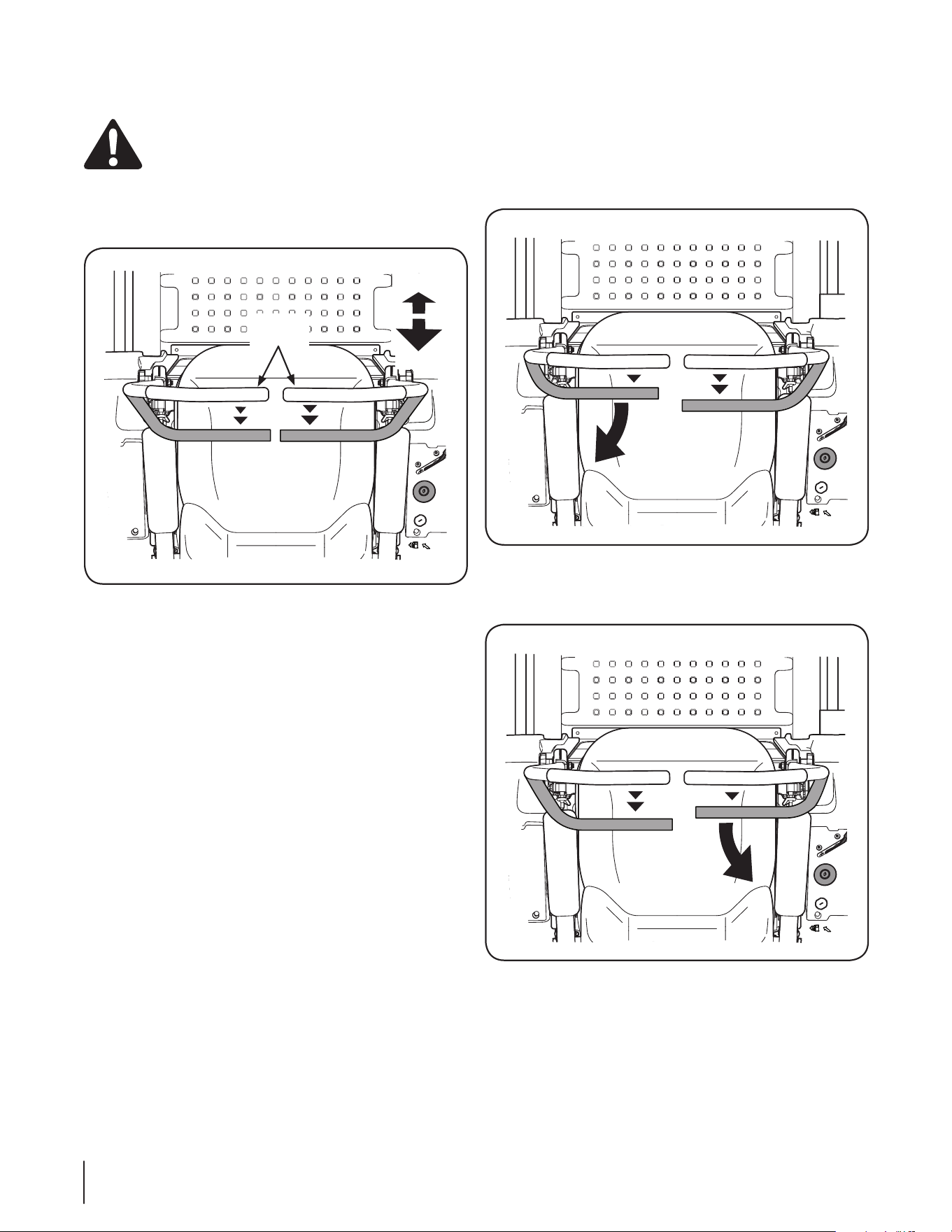
To turn the tractor while driving forward, move the control
levers as necessary so that one lever is rearward of the other. The
tractor will turn in the direction of the rearward control lever.
1. To turn to the left, move the left drive control lever
rearward of the right lever. See Figure 6-3.
Forward Left Turn
Figure 6-3
2. To turn to the right, move the right drive control lever
rearward of the left lever. See Figure 6-4.
Forward Right Turn
Figure 6-4
3. The greater the fore-to-aft distance between the two
levers, the sharper the tractor will turn.
4. To execute a “pivot turn,” move the turn side drive control
lever to the neutral position, while moving the other
control lever forward.
NOTE: Making a “pivot turn” on grass will greatly increase
the potential for defacement of the turf.
20 Section 5— operation
Driving the Tractor In Reverse
WARNING! Always look behind and down on both
sides of the tractor before backing up. Always look
behind while traveling in the reverse direction.
1. Slowly and evenly move both drive control levers rearward.
The tractor will start to move in the reverse direction. See
Figure 6-5.
Neutral
Position
Slower
Faster
Figure 6-5
2. As the control levers are pushed farther rearward the speed
of the tractor will increase.
3. To slow the tractor move the controls lever forward to
attain the desired speed, or move the levers to the neutral
position to stop the tractor.
Turning While Driving Rearward
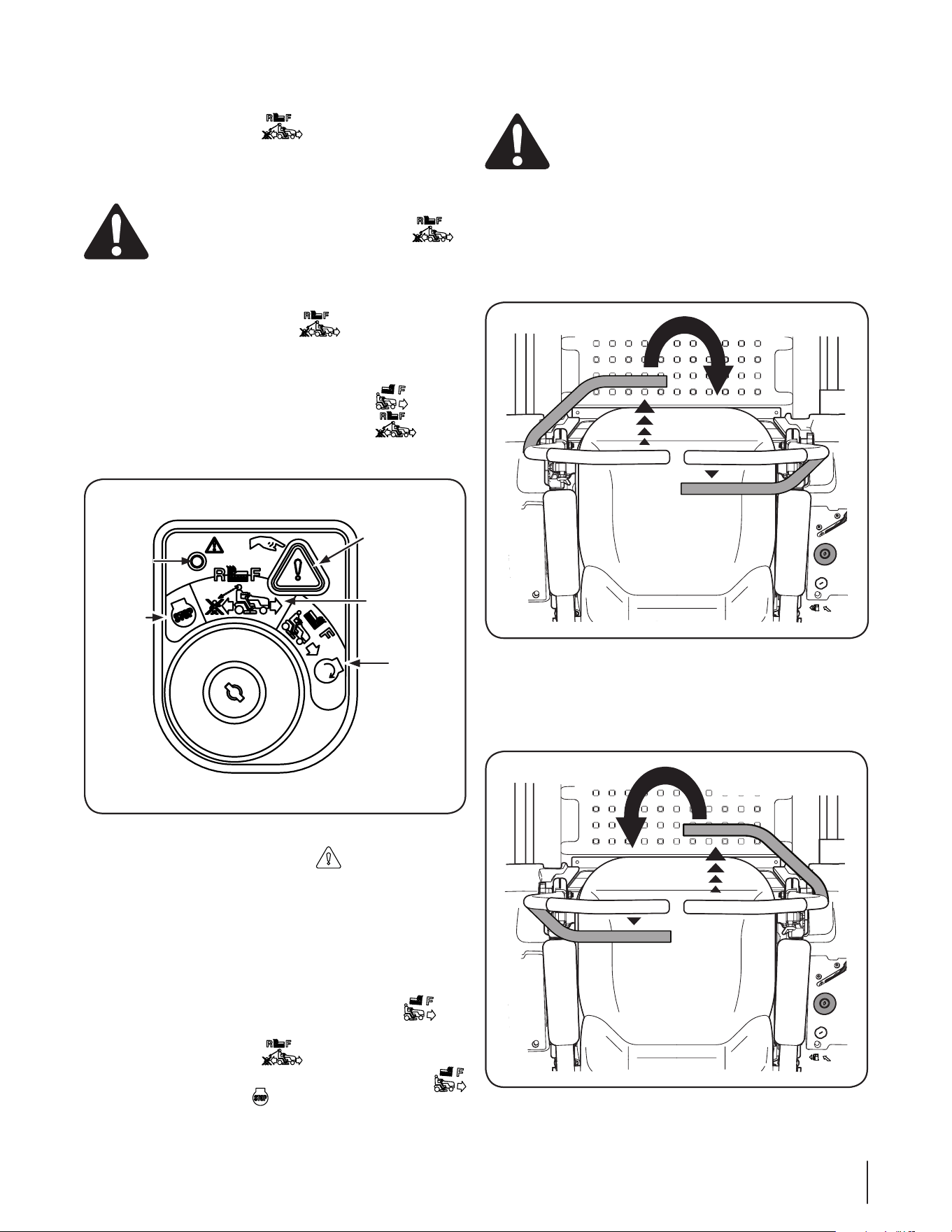
To turn the tractor while driving rearward, move the control
levers as necessary so that one lever is forward of the other. The
tractor will turn in the direction of the forward control lever.
1. To turn to the left while traveling in reverse, move the left
drive control lever forward of the right lever. See Figure 6-6.
Rearward Left Turn
Figure 6-6
2. To turn to the right while traveling in reverse, move the right
drive control lever forward of the left lever. See Figure 6-7.
Rearward Right Turn
Figure 6-7
3. The greater the fore-to-aft distance between the two
levers, the sharper the tractor will turn.
4. To execute a “pivot turn,” move the turn side drive control
lever to the neutral position, while moving the other
control lever rearward.
NOTE: Making a “pivot turn” on grass will greatly increase
the potential for defacement of the turf.
21Section 5 — operation
Reverse Caution Mode
The REVERSE CAUTION MODE position of the key switch
module allows the tractor to be operated in reverse with the
blades (PTO) engaged.
NOTE: Mowing in reverse is not recommended.
WARNING! Use extreme caution while operating
the tractor in the REVERSE CAUTION MODE .
Always look down and behind before and while
backing. Do not operate the tractor when children
or others are around. Stop the tractor immediately if
someone enters the area.
To use the REVERSE CAUTION MODE :
NOTE: The operator MUST be seated in the tractor seat.
1. Start the engine as instructed on the previous page.
2. Turn the key from the NORMAL MOWING (Green)
position to the REVERSE CAUTION MODE
(Yellow) position of the key switch module. See Figure
6-8.
Indicator
Light
Reverse
Push Button
Stop
Position
Start
Position
Reverse
Caution Mode
Position
Figure 6-8
3. Press the REVERSE PUSH BUTTON (Orange, Triangular
Button) at the top, right corner of the key switch module.
The red indicator light at the top, left corner of the key
switch module will be ON while activated. See Figure 6-8.
4. Once activated (indicator light ON), the tractor can be
driven in reverse with the cutting blades (PTO) engaged.
5. Always look down and behind before and while backing to
make sure no children are around. After resuming forward
motion, return the key to the NORMAL MOWING
position.
The REVERSE CAUTION MODE will remain activated until:
a. The key is placed in either the NORMAL MOWING
position or STOP position or
b. The operator leaves the seat.
Executing a Zero Turn
WARNING! When executing a zero turn, the
tractor MUST BE STOPPED. Executing a zero turn
while the tractor is moving can significantly reduce
your control of the tractor and will cause severe turf
defacement to occur.
1. Stop the forward or reverse motion of the tractor by
moving the two drive control levers to neutral.
2. To turn clockwise, move the left control lever forward while
simultaneously moving the right control lever rearward.
See Figure 6-9.
Clockwise Zero Turn
Figure 6-9
3. To turn counterclockwise, move the right control lever
forward while simultaneously moving the left control lever
rearward. See Figure 6-10.
Counterclockwise
Zero Turn
Figure 6-10
22 Section 5— operation
Executing a “Y” Manuever
For low traction conditions, follow these procedures for zero
turns (the “Y-manuever”):
To turn clockwise (front of machine moves toward RIGHT) when
traveling FORWARD:
1. Come to a stop,
2. Then slowly move both lap bars rearward (no more than ½
maximum reverse speed) to initiate REVERSE travel,
3. Then slowly move the LEFT lap bar forward while
maintaining the RIGHT lap bar in the rearward travel
position.
4. To stop the turn and re-initiate FORWARD travel, slowly
move the RIGHT lap bar from the REVERSE travel position
to a FORWARD travel position equal to that of the LEFT lap
bar.
5. For counterclockwise turns, reverse the above procedure.
Stopping the Tractor
1. Move both drive control levers to the neutral position to
stop the motion of the tractor.
2. Push the PTO switch downward to the disengaged position.
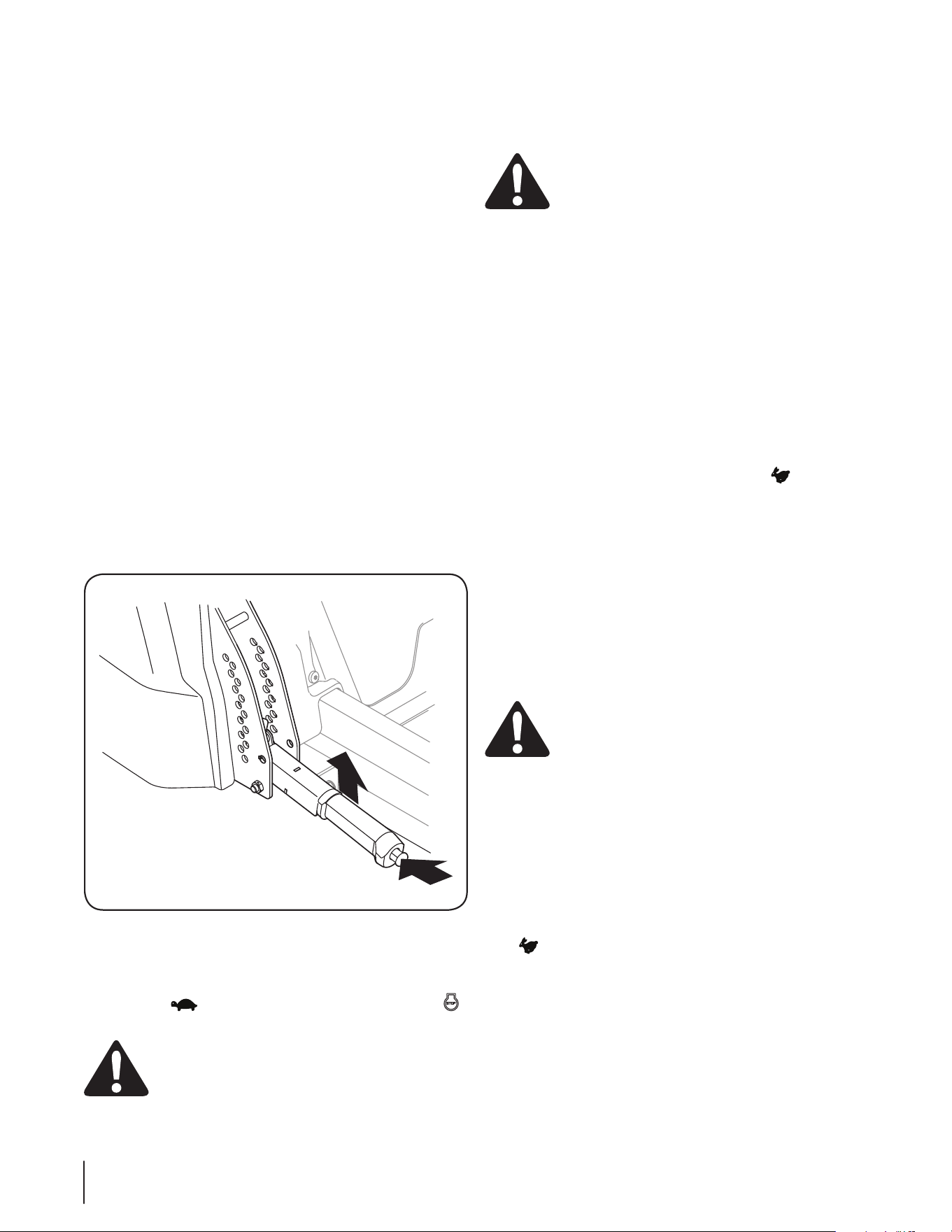
3. Use the deck lift handle to raise the deck to its highest position
by depressing the button at the end of the handle and pulling
upwards. Make sure the latch engages on the pin. See Figure
6 -11.
Figure 6-11
4. If dismounting the tractor, move the drive control handles
fully outward in the neutral position engaging the parking
brake, move the throttle control lever to the mid-throttle
or SLOW position, turn the ignition switch to STOP
and remove the key from the switch.
WARNING! Do not leave the seat of the tractor
without disengaging the PTO, moving drive control
levers fully outward in the neutral position engaging
the parking brake. If leaving the tractor unattended,
turn the ignition key off and remove key.
Driving On Slopes
Refer to the slope gauge in the Safe Operation Section to help
determine slopes where you may not operate safely.
WARNING! Do not operate on inclines with a slope
in excess of 15 degrees (a rise of approximately 2-⁄
feet every 10 feet). The tractor could overturn and
cause serious injury.
1. Always drive across slopes, never up and down. Control
the speed and direction of the tractor using primarily the
control lever on the downhill side of the tractor, with the
uphill control lever remaining essentially in a fixed position.
2. Avoid turning downhill if possible. Start at the bottom of a
slope and work upward. Always slow down before turning.
3. Use extra care and go slowly when turning downhill.
Engaging The PTO
Engage the PTO clutch as follows:
NOTE: During your units initial break-in period, in order to engage
the PTO and avoid engine stall, allow the engine to warm before
engaging the PTO. Break-In period varies depending on your engine.
1. Move the throttle control lever to the FAST position.
2. Pull the PTO switch upward to the ENGAGED position.
3. The operator must remain in the tractor seat at all times. If
the operator should leave the seat without disengaging the
PTO, the tractor’s engine will shut off.
4. The PTO clutch cannot be operated when the tractor is
driving in the reverse direction. The PTO will disengage
when both drive control levers are moved to the reverse
position and will re-engage when one (or both) control
lever(s) is moved to the neutral or forward position.
Mowing
WARNING! Make certain the area to be mowed is
free of debris, sticks, stones, wire or other objects
that can be thrown by the rotating blades.
NOTE: Do not engage the mower deck when lowered in grass.
Premature wear and possible failure of the ‘V” belt and PTO
clutch will result. Fully raise the deck or move to a non grassy
area before engaging the mower deck.
1. Mow across slopes, not up and down. If mowing a slope, start
at bottom and work upward to ensure turns are made uphill.
2. On the first pass pick a point on the opposite side of the
area to be mowed.
3. Engage the PTO and move the throttle control to the FAST
position.
4. Lower the mower deck to the desired height setting using
the deck lift handle.
5. Slowly and evenly push the RH and LH drive control levers
forward to move the tractor forward, and keep the tractor
headed directly toward the alignment point.
NOTE: The speed of the tractor will affect the quality of the
mower cut. Mowing at full speed will adversely affect the cut
quality. Control the ground speed with the control levers.
6. When approaching the other end of the strip, slow down
or stop before turning. A U-turn is recommended unless a
pivot or zero turn is required.
23Section 5 — operation
7. Align the mower with an edge of the mowed strip and
overlap approximately 3”.
8. Direct the tractor on each subsequent strip to align with a
previously cut strip.
9. To prevent rutting or grooving of the turf, if possible, change
the direction that the strips are mowed by approximately 45°
for the next and each subsequent mowing.
WARNING! Be careful when crossing gravel paths
or driveways. Disengage the PTO and raise the deck
to the highest position before crossing.
NOTE: When stopping the tractor for any reason while on a
grass surface, always:
• Place the control levers in the neutral/parking brake
engaged position,
• Shut engine off and remove the key.
• Doing so will minimize the possibility of having your
lawn ‘‘browned’’ by hot exhaust from your tractor’s
running engine.
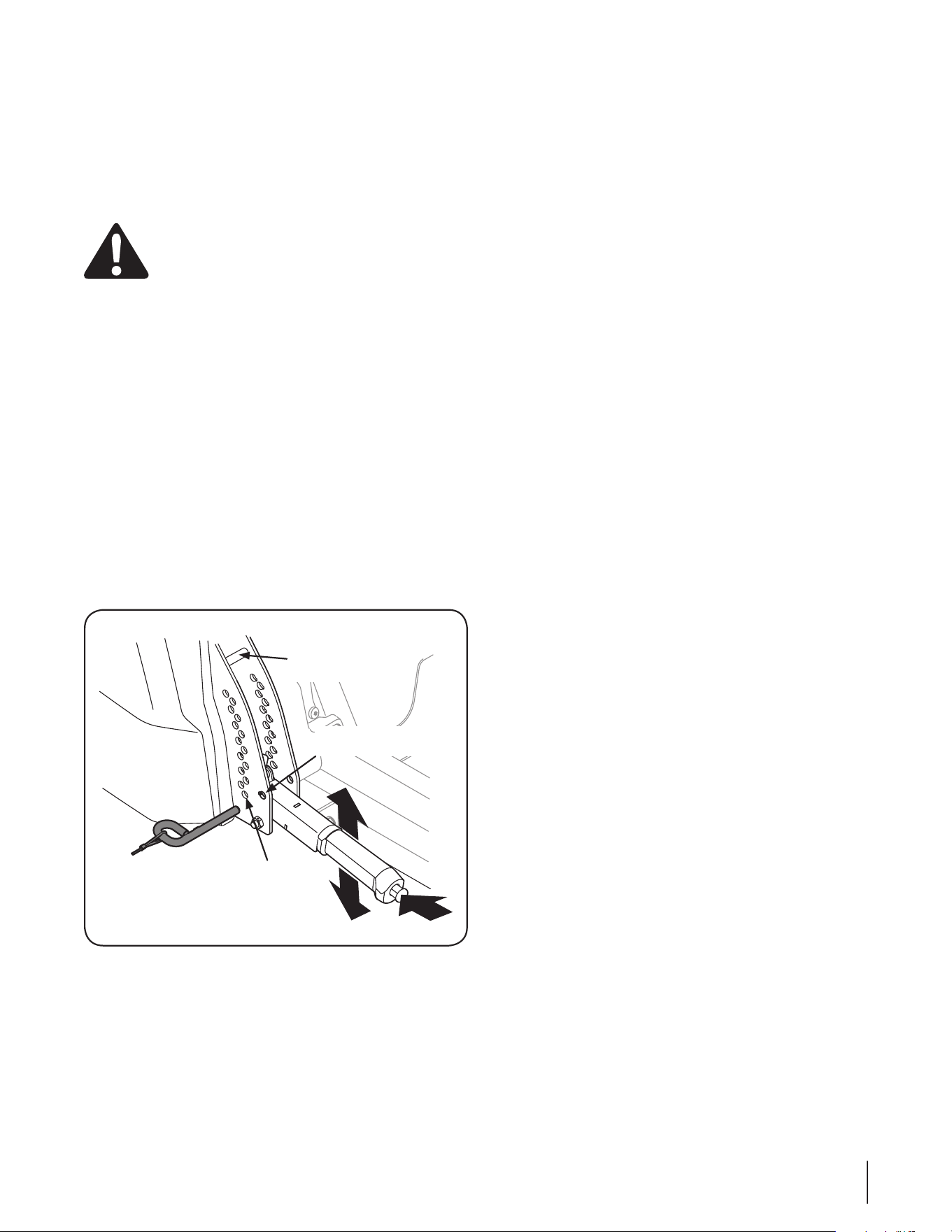
Deck Lift Lever
To raise or lower the cutting deck, depress the button on the
end of the handle and push downward to lower the deck, or pull
upward to raise the deck, then place it in the hole best suited for
your application. To place the deck in the transport position, lift
the handle all the way up and hang the top hook on the handle
from the upper spacer on the deck height index bracket. See
Figure 6-12.
Transport Position/
Highest Mowing
Position
Lowest Mowing
Position
Deck Removal/
Installation Position
Figure 6-12
NOTE: Make certain the deck is secured and the pin is fully
inserted into the deck height index. The pin is keyed to
help keep it in place and fits into the slotted holes on the
deck height index.
NOTE: The deck lift handle must always be above the pin,
never hang the deck lift handle from the pin when mowing.

Maintenance & Adjustments
6
24
Maintenance Schedule
Before
Each use
After First
5 Hours
Every 10
Hours
Every 25
Hours
Every 50
Hours
Every 100
Hours
Prior to
Storing
See
Engine
Manual
Check Intake Screen/Clean as Needed
P P
Check & Clean Engine Cooling Fans for Debris
P P
Check Engine Oil Level
P
Check Air Filter for Dirty, Loose or Damaged Parts
P
Clean Transmission Cooling Slots
P
Clean Battery Terminals
P P
Grease All Lubrication Points
P P
Check Blades/Sharpen or Replace as Needed
P P
Check Tire Pressure
P P
Lube Front Wheels
P P
Check/Clean Underside of Deck
P
Inspect & Lube Deck Wheels
P P
Check Deck Level/Pitch
P P
Lube Deck Spindles
P P
Check Belts & Pulleys for Damage/Wear
P
Check That All Hardware is in Place & Secure
P
Check Spark Plug Condition & Gap
P P P
Engine Break-In Oil Change
P P
Change Engine Oil
P P P
Replace Oil Filter
P P P
Clean or Change Air Filter
P P
Replace Fuel Filter
P P
Have Valve Lash Checked & Adjusted *
P
* -- Have this item performed by an authorized service dealer
25Section 6 — Maintenance & adjuStMentS
NOTE: This Operator’s Manual covers several models. Tractor
features may vary by model. Not all features in this manual are
applicable to all tractor models and the tractor depicted may
differ from yours.
Maintenance
WARNING! Before performing any maintenance or
repairs, disengage the PTO, move the drive control
levers fully outward in the neutral position engaging
the parking brake, stop the engine and remove the
key to prevent unintended starting.
Engine
Refer to the engine operator’s manual for all engine maintenance
procedures and instructions.
NOTE: Maintenance, repair, or replacement of the emission
control devices and systems which are being done at
owner’s expense may be performed by any engine repair
establishment or individual. Warranty repairs must be
performed by an authorized ealer.
Changing the Engine Oil
WARNING! If the engine has been recently run, the
engine, muffler and surrounding metal surfaces will
be hot and can cause burns to the skin. Exercise
caution to avoid burns.
To complete an oil change, proceed as follows:
1. Run the engine for a short time to warm the engine oil. The
oil will flow more freely and carry away more impurities.
Use care to avoid burns from hot oil.
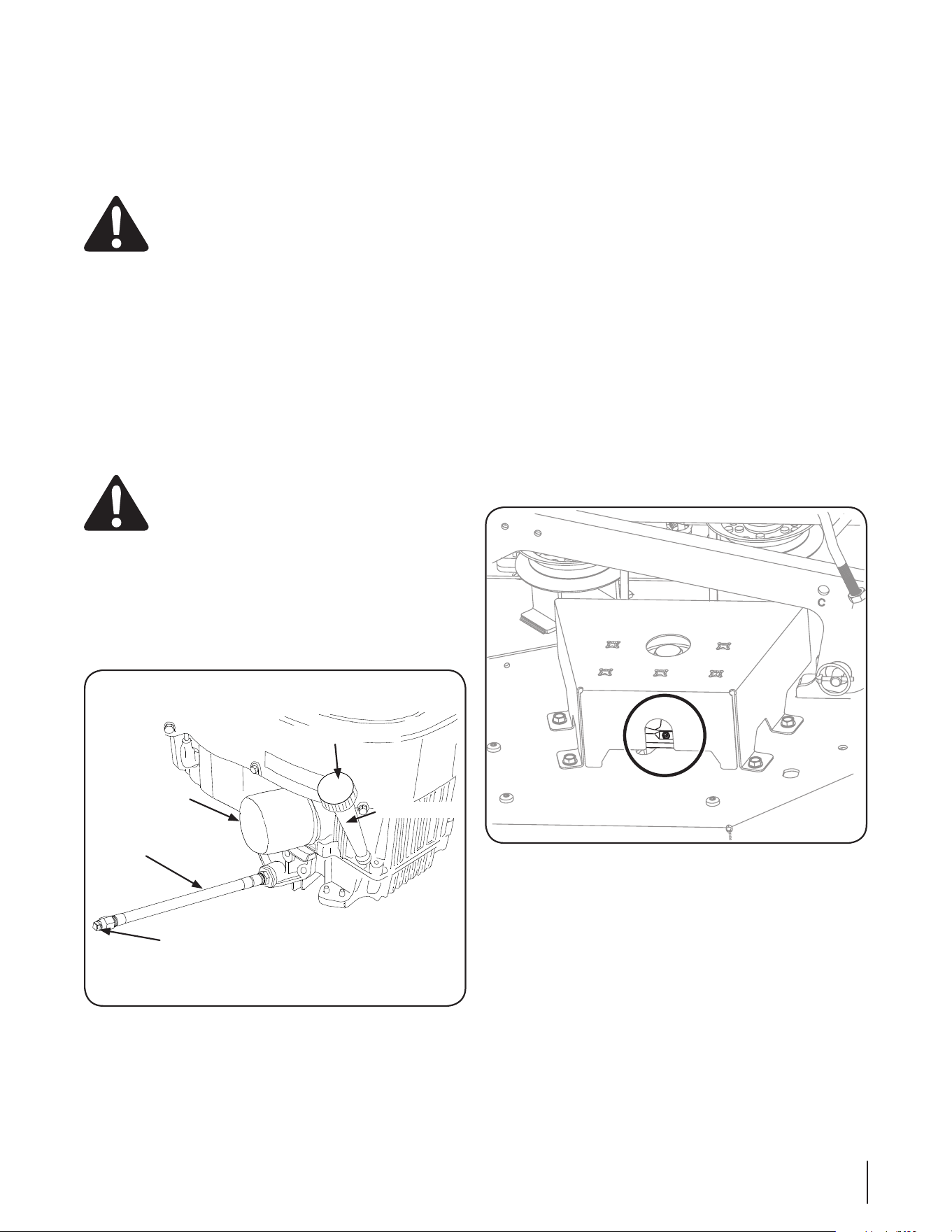
2. Locate the oil drain hose on the right side of the engine. See
Figure 7-1.
Oil Filler
Oil Fill Cap/Dipstick
Oil Fill Tube
Oil Drain Hose
Square-Head
Hose Plug
Figure 7-1
3. Route the free end of the oil drain hose toward an
appropriate oil collection container with at least a 2.5 quart
capacity, to collect the used oil. Remove the oil fill cap/
dipstick from the oil fill tube.
4. While holding the free end of the oil drain hose over the oil
collection container, unscrew the square head hose plug
from the end of the hose. SeeFigure 7-1. Drain the engine
oil into the collection container.
5. After draining the oil, wipe any residual oil from the oil
drain hose. Thread the square head plug into the drain
hose fitting and fully tighten the plug.
6. Replace the oil filter, and refill the engine with new oil as
instructed in the engine operator’s manual.
Lubrication
• Using a pressure lubricating gun, lubricate the front castor
wheel axles with grease after every 10 hours of service.
• Periodically lubricate all other pivot points with a quality
lubricating oil.
Cleaning & Lubricating the Spindle Pulleys
Once a month remove the belt covers to remove any
accumulation of grass clippings from around the spindle pulleys
and V-belt. Clean more often when mowing tall, dry grass.
Every 25 hours, lubricate the deck spindles. Locate the spindle
lube fitting and using a grease gun, lubricate the spindles. The
spindle holds 2.3 ounces of grease. See Figure 7-2.
Figure 7-2
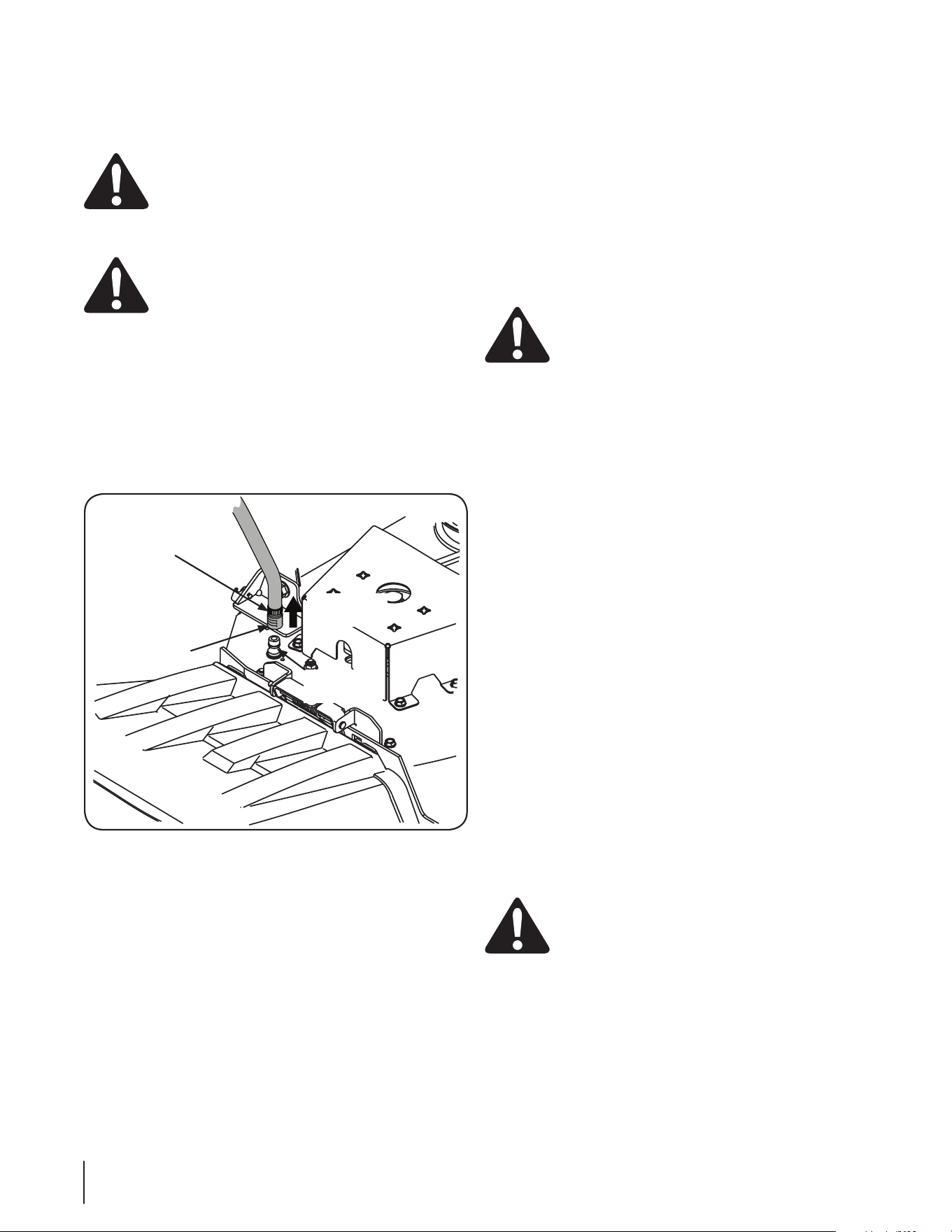
26 Section 6— Maintenance & adjuStMentS
Cleaning the Transmission Cooling Slots
Keep both sides of transmission cooling slots on the frame between
the engine and the seat box clear of grass clippings and leaves.
WARNING! If the engine has been recently run, the
engine, muffler and surrounding metal surfaces will
be hot and can cause burns to the skin. Exercise
caution to avoid burns.
Using the Deck Wash System
WARNING! When using the deck wash system, never
engage the deck from any position other than the
operator’s seat of the tractor. Do not use an assistant or
engage deck in the presence of any bystanders.
1. Attach the nozzle adapter to a standard garden hose
connected to a water supply.
2. Move the tractor to an area within reach of the hose where the
dispersal of wet grass clippings is acceptable to you. Disengage
the PTO, engage the parking brake and stop the engine.
3. Pull back the lock collar of the nozzle adapter and push the
adapter onto one of the deck wash nozzles at either end of
the mower deck. Release the lock collar to lock the adapter
on the nozzle. See Figure 7-3.
Nozzle
Adapter
Adapter
Lock Collar
Pull Lock
Collar Back
Deck Wash
Nozzle
Figure 7-3
4. Turn on the water supply.
5. From the tractor operator’s seat, start the engine and
engage the PTO. Allow to run as needed. Disengage the
PTO and stop the engine.
6. Turn off the water supply.
7. Pull back the lock collar of the nozzle adapter to disconnect
the adapter from the nozzle.
8. Repeat the previous steps to clean the deck using the
nozzle at the other end of the deck.
Tires
Check the tire air pressure after every 50 hours of operation or
weekly. Keep the tires inflated to the recommended pressures.
Improper inflation will shorten the tire service life. See the tire side
wall for proper inflation pressures. Observe the following guidelines:
• Do not inflate a tire above the maximum pressure shown
on the sidewall of the tire.
• Do not reinflate a tire that has been run flat or seriously under
inflated. Have it inspected and serviced by a qualified tire
mechanic.
General Battery Information
WARNING!
• Should battery acid accidentally splatter into
the eyes or onto the skin, rinse the affected area
immediately with clean cold water. If there is any
further discomfort, seek prompt medical attention.
• If acid spills on clothing, first dilute it with clean
water, then neutralize with a solution of ammonia/
water or baking soda/water.
• NEVER connect (or disconnect) battery charger
clips to the battery while the charger is turned on, as
it can cause sparks.
• Keep all sources of ignition (cigarettes, matches,
lighters) away from the battery. The gas generated
during charging can be combustible.
• As a further precaution, only charge the battery
in a well ventilated area.
• Always shield eyes and protect skin and clothing
when working near batteries.
• Batteries contain sulfuric acid and may emit
explosive gases. Use extreme caution when handling
batteries. Keep batteries out of the reach of children.
Battery Maintenance
• The battery is filled with battery acid and then sealed at
the factory. However, even a “maintenance free” battery
requires some maintenance to ensure its proper life cycle.
• Spray the terminals and exposed wire with a battery
terminal sealer, or coat the terminals with a thin coat of
grease or petroleum jelly, to protect against corrosion.
• Always keep the battery cables and terminals clean and
free of corrosion.
• Avoid tipping. Even a sealed battery will leak electrolyte
when tipped.
WARNING! Batteries contain sulfuric acid and may
emit explosive gases. Use extreme caution when
handling batteries. Keep batteries out of the reach
of children.
Battery Storage
1. When storing the tractor for extended periods, disconnect the
negative battery cable. It is not necessary to remove the battery.
2. All batteries discharge during storage. Keep the exterior
of the battery clean, especially the top. A dirty battery will
discharge more rapidly.
3. The battery must be stored with a full charge. A discharged
battery can freeze sooner than a charged battery. A fully
charged battery will store longer in cold temperatures than hot.
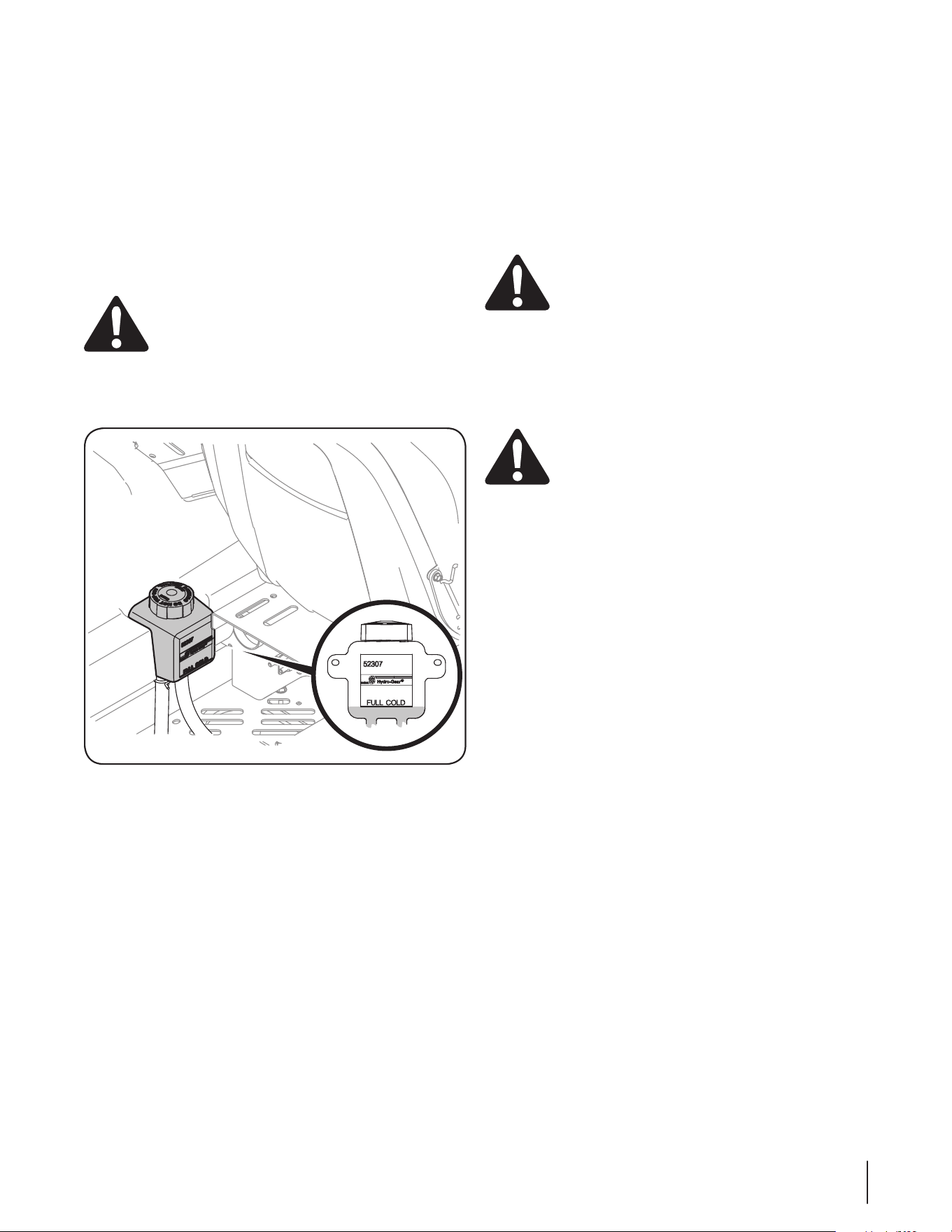
27Section 6 — Maintenance & adjuStMentS
4. Recharge the battery before returning to service. Although
the tractor may start, the engine charging system may not
fully recharge the battery.
Hydrostatic Transmission
Your zero turn tractor is equipped with dual integrated
hydrostatic pumps/transaxles that are sealed and are
maintenance-free. However, this model is equipped with a
transmission oil expansion reservoir. Under normal operating
conditions, the oil level in the expansion reservoir does not need
to be checked and no additional oil is needed. If checking the
reservoir oil level, proceed as follows:
WARNING! Check the oil level ONLY before
starting the tractor when the transmission oil is fully
cooled.
1. Pivot the operator’s seat forward and clean the reservoir
cap and the area around the cap to prevent debris from
contaminating the transmission oil. See Figure 7-4.
Figure 7-4
2. Turn the reservoir cap counterclockwise to re-move, then
check the oil level in the reservoir. Oil should be visible at
the bottom of the cup, but the oil level must NOT be above
the “FULL COLD” line. See Figure 7-4. DO NOT FILL THE
RESERVOIR.
3. If necessary to add oil because of some type of leakage, use a
quality 20W50 motor oil and add only enough oil to bring the
level to the “FULL COLD” line. Reinstall the cap and fully tighten.
NOTE: Prior to the initial operation of the tractor, the
oil level in the reservoir may be slightly higher than the
maximum due to air in the oil lines. Operation of the tractor
will eventually purge the air from the lines and the oil level
will settle to the maximum.
Tractor Storage
If your tractor is not going to be operated for an extended period
of time (thirty days to approximately six months), the tractor should
be prepared for storage. Store the tractor in a dry and protected
location. If stored outside, cover the tractor (including the tires) to
protect it from the elements. The procedures outlined below should
be performed whenever the tractor is placed in storage.
1. Change the engine oil and filter following the instructions
provided in the engine manual packed with this manual.
WARNING! Never store the tractor with fuel in the
tank indoors or in poorly ventilated enclosures, where
fuel fumes may reach an open flame, spark or pilot
light as on a furnace, water heater, clothes dryer, etc.
2. If storing the tractor for 30 days or more:
a. To prevent gum deposits from forming inside
the engine’s carburetor and causing possible
malfunction of the engine, the fuel system must be
either completely emptied, or the gasoline must be
treated with a stabilizer to prevent deterioration.
WARNING! Fuel left in the fuel tank deteriorates
and will cause serious starting problems.
b. Using a fuel stabilizer such as STA-BIL® for storage
between 30 and 90 days:
• Read the product manufacturer’s instructions
and recommendations.
• Add to clean, fresh gasoline the correct
amount of stabilizer for the capacity
(approximately 3 gallons) of the fuel system.
• Fill the fuel tank with treated fuel and run the
engine for 2-3 minutes to get stabilized fuel
into the carburetor.
c. Emptying the fuel system for storage of more than
90 days:
• Prior to putting the tractor in storage, monitor
fuel consumption with the goal of running
the fuel tank empty.
• Run the engine until it begins to stall. Use the
choke to keep the engine running until all fuel
in the carburetor has been exhausted.
• Referring to the engine manual, drain the fuel
from the carburetor bowl.
3. Clean the engine and the entire tractor thoroughly.
4. Fully charge the battery, then disconnect the negative
cable at the battery to prevent possible discharge.
Recharge the battery periodically when in storage.
NOTE: Remove the battery if exposed to prolonged periods
of sub-freezing temperatures. Store in a cool, dry location
where temperatures are above freezing.
5. Lubricate all lubrication points.
NOTE: Using a pressure washer or garden hose is not
recommended for cleaning your tractor. It may cause
damage to electrical components, spindles, pulleys,
bearings or the engine. The use of water will result in
shortened life and reduce serviceability.
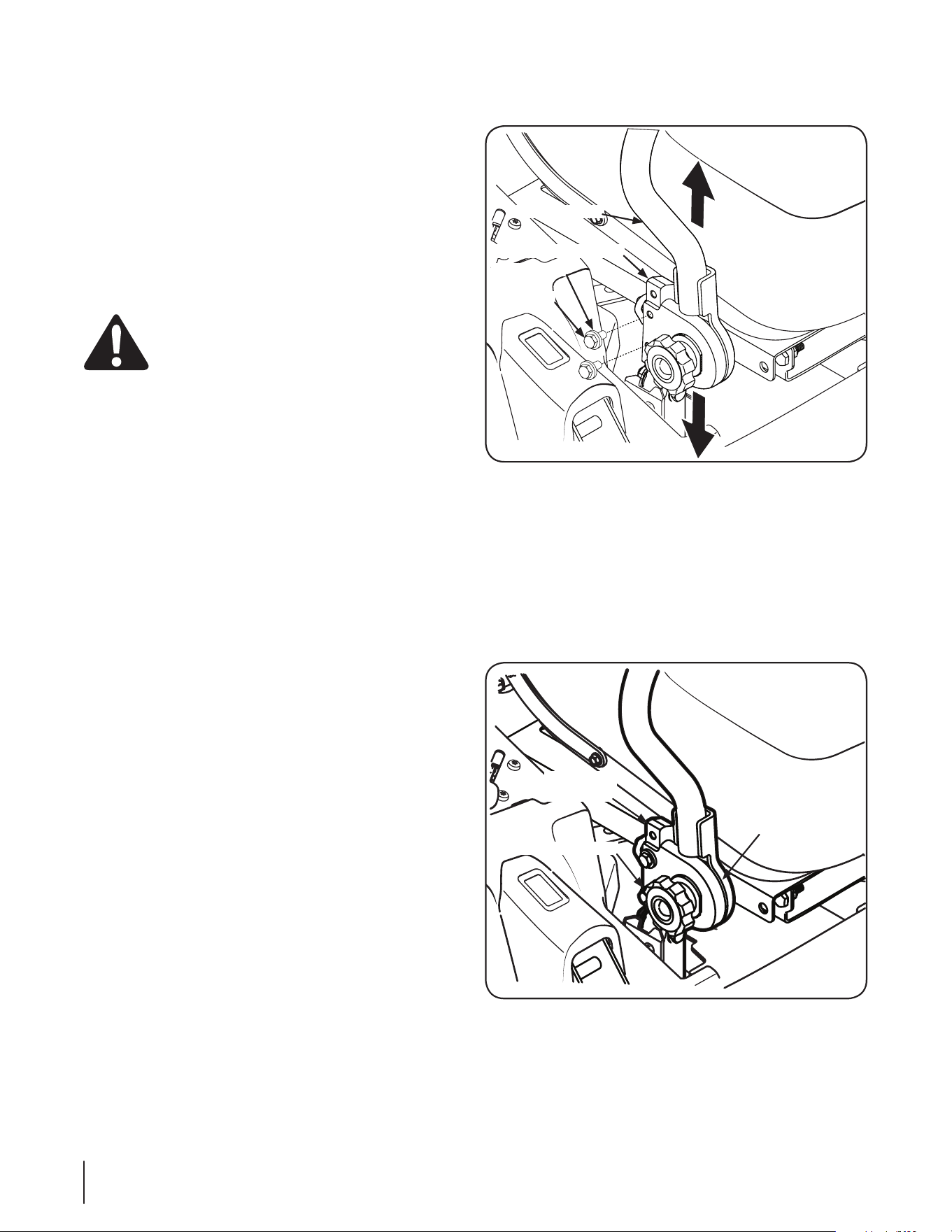
28 Section 6— Maintenance & adjuStMentS
Removing The Tractor From Storage
1. Check the engine oil.
2. Fully charge the battery and inflate the tires to the
recommended pressure.
3. Fill the fuel tank with clean, fresh gasoline.
4. Start the engine and allow to idle for a few minutes to
ensure engine is operating properly.
5. Drive the tractor without a load to make certain all the
tractor systems are functioning properly.
Adjustments
WARNING! Shut the engine off, remove the
ignition key and engage the parking brake before
making adjustments. Protect your hands by using
heavy gloves when handling the blades.
Adjusting RH & LH Drive Control Levers
The RH and LH drive control levers can be adjusted up or down
and forward or backward for the comfort of the operator. The drive
control levers can be placed in either of two height positions, and/
or can be moved forward or rearward. Proper drive control lever
and seat adjustment will result in the following:
1. In the neutral position with hands on the control levers,
the operator’s upper arms should be relaxed and
approximately vertical and their forearms should be
approximately horizontal.
2. In the full forward position, the operator’s back should stay
in contact with the seat back and the control levers should
not contact operator’s legs.
3. In the full reverse position, the control levers should not
contact the operator’s legs or torso.
4. Set the seat to the preferred operating position. The adjustment
lever is located under the front edge of the seat. The seat has
five inches of front-to-rear adjustment available.
5. Check factory settings of control levers for the conditions
listed above.
NOTE: If control lever adjustments are required, height
adjustments should be made prior to angular adjustments.
To adjust the drive control lever height, proceed as follows:
1. Remove the hex screws and flat washers securing the
control lever to the lower arm assembly. Refer to Figure 7-5.
Hex Screw
Flat Washer
Lower Arm Assembly
Control Lever
Figure 7-5
2. Reposition the control lever to align with the other set of
holes in the lower arm and insert the hex screws through
the flat washers and then the control lever then into the
lower arm. Tighten the hex screws until snug. Repeat the
steps on the other control arm.
To adjust the drive control levers forward/rearward, proceed as
follows:
1. Loosen the control lever knobs on the side of the drive
control levers. See Figure 7-6.
Control Lever
Adjuster
Control Lever Knob
Lower Arm
Assembly
Figure 7-6
2. Place the control lever in the desired position
3. Secure in place by tightening the control lever knob. See
Figure 7-6.
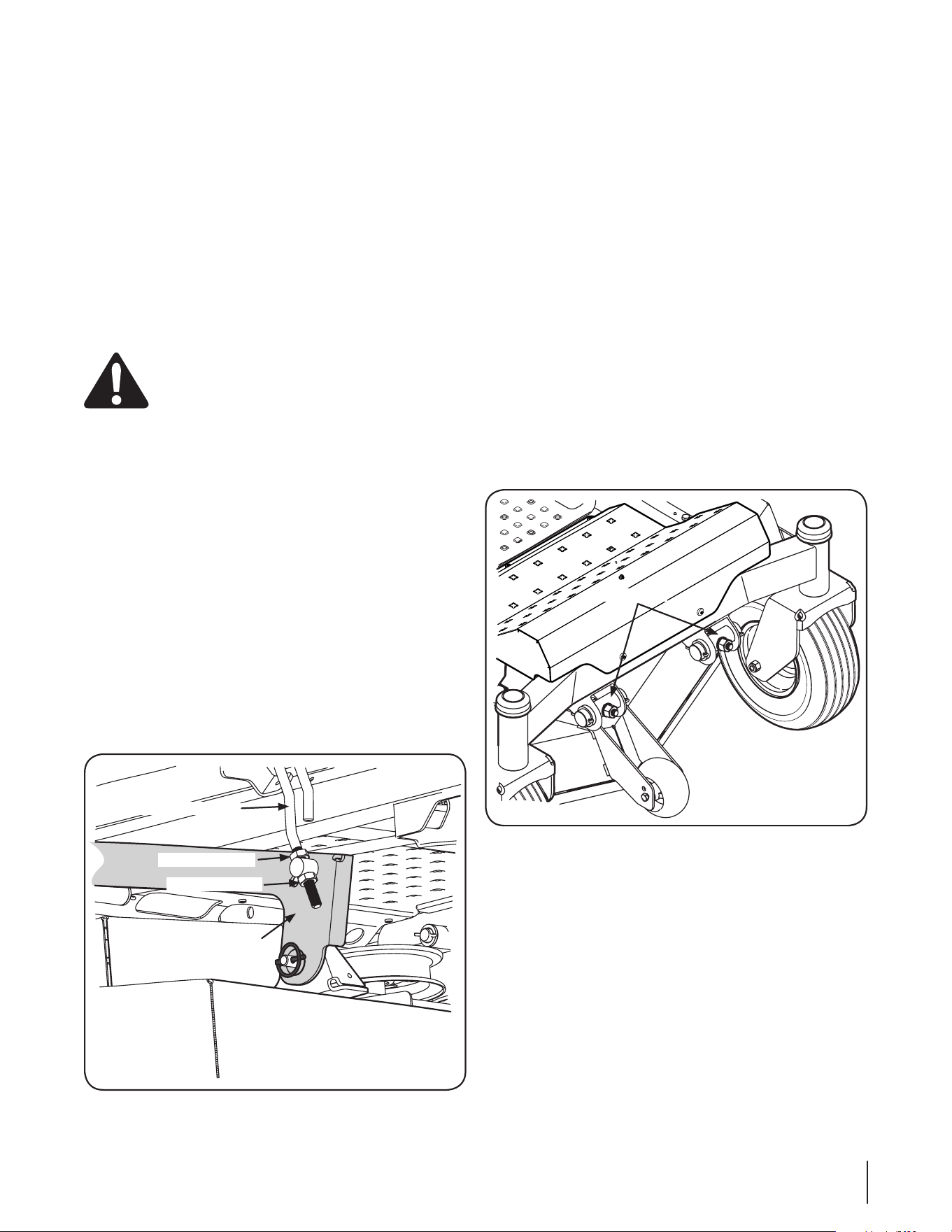
29Section 6 — Maintenance & adjuStMentS
Leveling the Deck (Front-To-Rear)
NOTE: Check the tractor’s tire pressure before performing
any deck leveling adjustments. Refer to Tires for information
regarding tire pressure. Always level the deck side-to-side before
front to rear.
The front of the deck should be between ⁄⁄” lower than the
rear of the deck. Adjust if necessary as follows:
1. Park the tractor on a firm, level surface and place the deck
lift handle in a middle position.
2. Rotate the blade nearest the discharge chute so that it is
parallel with the tractor.
3. Measure the distance from the front of the blade tip to the
ground and the rear of the blade tip to the ground. The
first measurement taken should be between ⁄” and ⁄” less
than the second measurement.
4. Determine the approximate distance necessary for proper
adjustment and proceed, if necessary.
5. Using a wrench, raise the front of deck by loosening the
lock nuts to the front of the pivot pin and then tighten the
jam nuts on the back of the pivot pin to raise the front of
the deck and secure in place. See Figure 7-8.
Pivot Pins
Figure 7-8
6. Using a wrench, lower the front of deck by loosening the
jam nuts on the back of the pivot pin and then tighten the
lock nut on the front of the pivot pin to lower the front of
the deck and secure in place. See Figure 7-8.
7. The deck is properly leveled when the front tip of the blade is
⁄” lower than the rear tip. Retighten the hex bolt on the left
rear deck hanger links when proper adjustment is achieved.
4. Note the relative position of the control lever to the pivot
bracket, then repeat the previous steps to reposition the
other control lever in approximately the same position.
5. A fine-tuning adjustment can be made if the drive control
levers are not lining up correctly. Be certain that the control
lever knob is secure and loosen the two bolts securing
the control lever adjuster to the lower arm assembly. Pivot
the control lever adjuster forward or rearward to align the
control levers. When the levers are aligned, re-tighten the
bolts to secure the control lever.
Deck Leveling
NOTE: Check the tractor’s tire pressure before performing
any deck leveling adjustments. Refer to Tires for information
regarding tire pressure.
WARNING! Shut the engine off, remove the
ignition key and engage the parking brake before
making adjustments. Protect your hands by using
heavy gloves when handling the blades.
Leveling the Deck (Side-to-Side)
NOTE: Check the tractor’s tire pressure before performing any deck
leveling adjustments. Refer to Tires for information regarding tire
pressure. Always level the deck side-to-side before front to rear.
If the cutting deck appears to be mowing unevenly, a side-to-
side adjustment can be performed. Adjust if necessary as follows:
1. With the tractor parked on a firm, level surface, place the
deck lift handle in a middle mowing position and rotate both
outside blades so that they are perpendicular with the tractor.
2. Measure the distance from the outside of the left blade
tip to the ground and the distance from the outside of the
right blade tip to the ground. Both measurements taken
should be equal. If they’re not, proceed to the next step.
3. Loosen the lower jam nut on the adjustable lift link
attached to the deck lift arm to lower the deck and tighten
the upper jam nut to secure the deck in place, loosen the
upper jam nut then tighten the lower jam nut to secure the
deck in place. See Figure 7-7.
Adjustable Lift Link
Upper Jam Nut
Lower Jam Nut
Deck Lift Arm
Figure 7-7
4. The deck is properly leveled when both blade tip
measurements are equal.
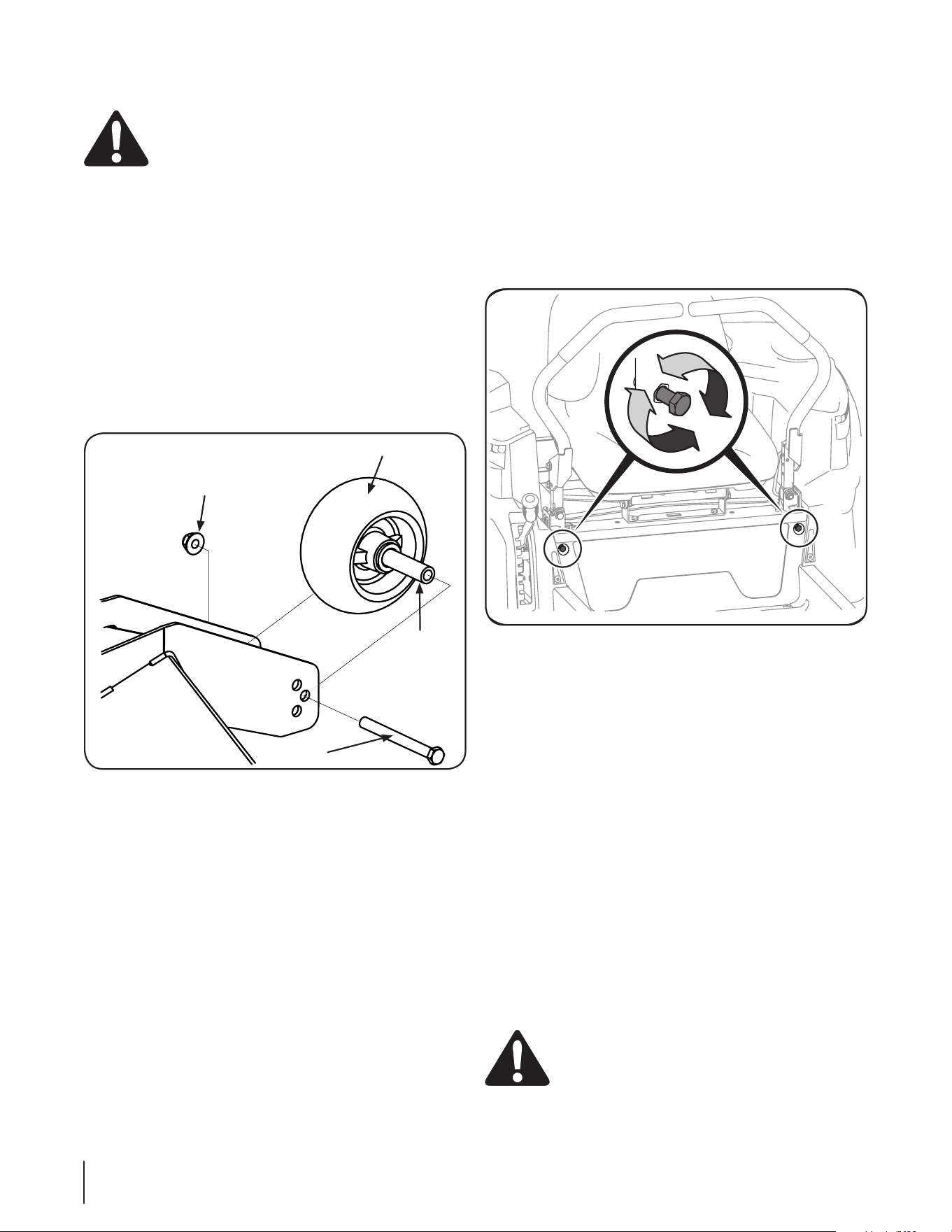
30 Section 6— Maintenance & adjuStMentS
Adjusting the Front Gauge Wheels
WARNING!: Keep hands and feet away from the
discharge opening of the cutting deck.
The front gauge wheels on the mower deck are an anti-scalp
feature, and should not ride on the ground. The front gauge
wheels should be approximately ⁄⁄” above the ground when
the deck is set in the desired height setting.
Using the deck lift handle, set the deck in the desired height
setting, then check the gauge wheel distance from the ground
below. If necessary adjust the front gauge wheels as follows:
1. Visually check the distance between the front gauge
wheels and the ground. If the gauge wheels are near or
touching the ground, they should be raised. If more than
⁄” above the ground, they should be lowered.
2. Remove the lock nut securing one of the front gauge wheel
hex screws to the deck. Remove the gauge wheel, hex
screw and spacer. See Figure 7-9.
Lock Nut
Wheel
Hex Screw
Spacer
Figure 7-9
3. Insert the hex screw into the one of three index holes in the
front gauge wheel bracket that will give the gauge wheel a
⁄⁄” clearance with the ground.
4. Note the index hole of the just adjusted wheel, and adjust
the other front gauge wheel into the respective index hole
of the other front gauge wheel bracket.
Drive Control Lever Stop Adjustment
When the drive control levers are both fully extended forward
to the full-speed position and the tractor drifts left or right, the
drive control lever stop adjustment can be adjusted to sync the
wheel speeds. To perform the adjustment, proceed as follows:
1. Identify the side that the tractor is drifting to and adjust the
opposite drive control lever. If the tractor drifts right, adjust
the left control lever down (decrease speed) and vice versa.
2. Locate the drive control lever stop adjustment bolts on the
front of the seat frame. See Figure 7-10.
Figure 7-10
3. To decrease the forward speed, turn the bolt clockwise.
To increase the forward speed, turn the bolt counter-
clockwise. Turn the bolt in the necessary direction ⁄-turn
at a time. After turning the bolt, check the adjustment by
driving the tractor.
4. Continue the adjustment until the wheel speeds are in sync
and the tractor drives straight with the drive control levers
fully extended forward in the full-speed position.
Off-Season Storage
Riding Mower Storage
If your riding mower is not going to be operated for an extended
period of time (thirty days to approximately six months), the riding
mower should be prepared for storage. Store the riding mower
in a dry and protected location. If stored outside, cover the riding
mower (including the tires) to protect it from the elements. The
procedures outlined below should be performed whenever the
riding mower is placed in storage.
1. Change the engine oil and filter following the instructions
provided in the Engine Manual.
WARNING! Never store the riding mower with fuel
in the tank indoors or in poorly ventilated
enclosures, where fuel fumes may reach an open
flame, spark or pilot light as on a furnace, water
heater, clothes dryer, etc.

31Section 6 — Maintenance & adjuStMentS
2. Service the engine as instructed in the separate engine manual.
3. Engines stored between 30 and 90 days need to be treated
with a gasoline stabilizer such as STA-BIL® and engines stored
over 90 days need to be drained of fuel to prevent deterioration
and gum from forming in fuel system or on essential carburetor
parts. If the gasoline in your engine deteriorates during storage,
you may need to have the carburetor, and other fuel system
components, serviced or replaced.
WARNING: Drain fuel only into unapproved
container outdoors, away from an open flame. Allow
engine to cool. Extinguish cigarettes, cigars, pipes,
and other sources of ignition prior to draining fuel.
3. Remove the spark plugs and pour approximately one
ounce of oil into each cylinder. Crank the engine one or
two turns to spread the oil evenly on the cylinder walls.
Replace the spark plugs.
4. Clean the engine and the entire riding mower thoroughly.
NOTE: Use of a pressure washer or garden hose is not
recommended to clean your riding mower. They may
cause damage to electrical components, spindles, pulleys,
bearings or the engine. The use of water will result in
shortened life and reduce serviceability.
5. Sharpen the blades so that the mower will be ready to use
when needed.
6. Protect the metal surfaces. Repair scratches with the
appropriate touch-up spray paint. Brush a rust preventive
oil on any unpainted surfaces including the pulleys and
blades. (Be careful not to get any oil on the drive belts.)
7. Clean and fully charge the battery, then disconnect the
negative cable at the battery to prevent possible discharge.
Recharge the battery periodically when in storage.
NOTE: Remove the battery if exposed to prolonged periods
of sub-freezing temperatures. Store in a cool, dry location
where temperatures are above freezing.
8. Lubricate all lubrication points.
9. Jack the mower up and store it on blocks to take the weight
off of the tires.
Removing the Riding Mower from Storage
1. Check the engine oil.
2. Fully charge the battery, lower riding mower off blocks,
and inflate the tires to the recommended pressure.
3. Remove the spark plugs and wipe them off. Using the
starter, crank the engine to pump the excess oil out of the
spark plug holes. Replace the spark plugs and the ignition
leads.
4. If drained before storing, fill the fuel tank with clean, fresh
gasoline.
5. Check the level of the engine oil in the crankcase and the
hydraulic reservoir tank.
6. Start the engine and allow to idle for a few minutes to
ensure engine is operating properly.
7. Drive the riding mower without a load to make certain all
the riding mower systems are functioning properly.
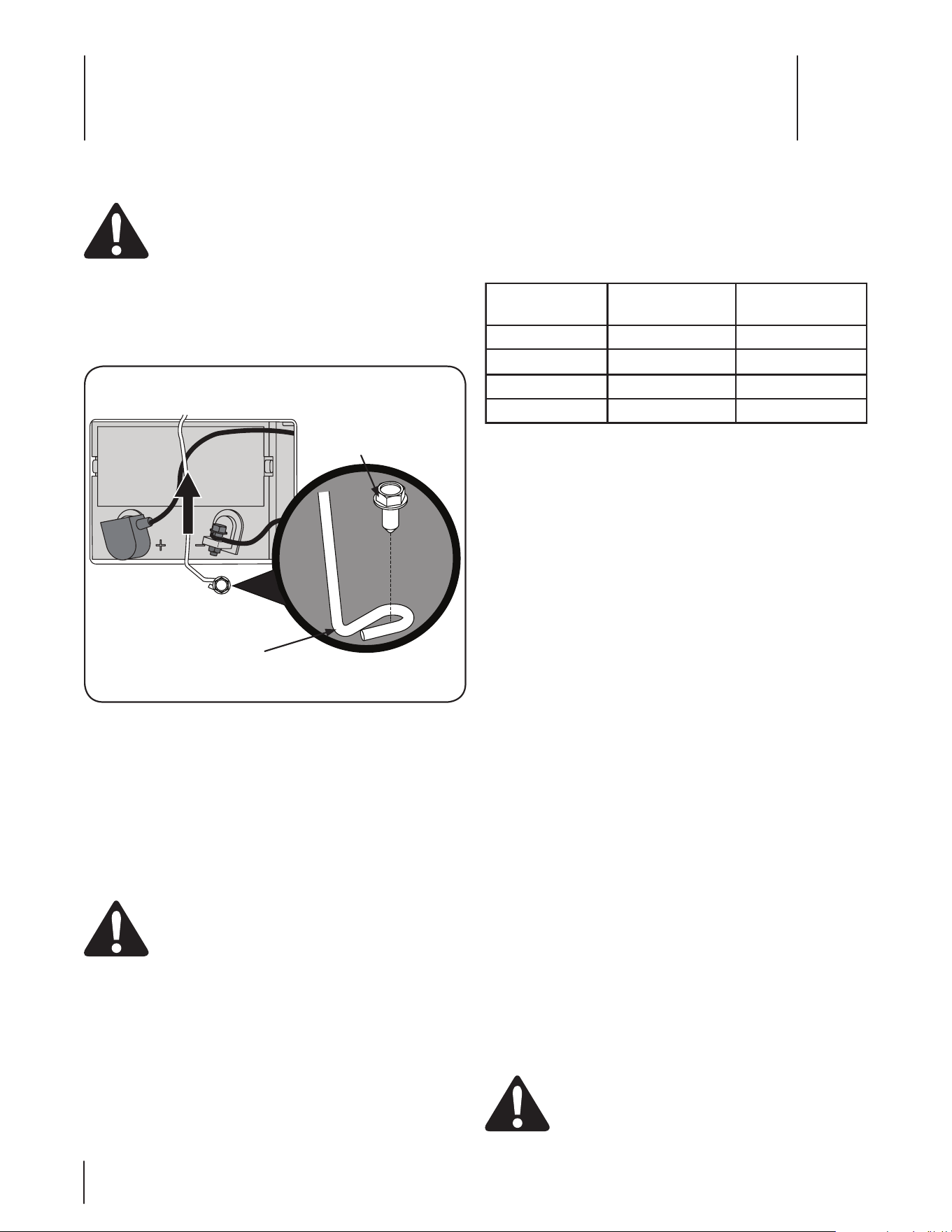
Se rvice
7
32
Battery Removal
WARNING! Battery posts, terminals and related
accessories contain lead and lead compounds. Wash
hands after handling.
The battery is located beneath the seat frame. To remove the battery:
1. Remove the hex washer screw securing the battery hold-
down bracket to the frame. Then flip the battery hold-
down bracket up to free the battery. See Figure 8-1.
Hex Washer Screw
Battery Hold-Down Bracket
Figure 8-1
2. Remove the hex cap screw and sems nut securing the black
negative battery lead to the negative battery post (marked
NEG). Move the cable away from the negative battery post.
3. Remove the hex cap screw and sems nut securing the red
positive battery lead to the positive battery post (marked POS).
4. Carefully lift the battery out of the tractor.
5. Install the battery by repeating the above steps in the
reverse order.
WARNING! Always connect the positive lead to
the battery before connecting the negative lead.
This will prevent sparking or possible injury from an
electrical short caused by contacting the tractor
body with tools being used to connect the cables.
Charging the Battery
Test and, if necessary, recharge the battery after the tractor has
been stored for a period of time.
• A voltmeter or load tester should read 12.6 volts (DC) or
higher across the battery terminals. See Figure 8-2.
Voltmeter
Reading
State of
Charge
Charging
Time
12.7 100% Full Charge
12.4 75% 90 Min.
12.2 50% 180 Min.
12.0 25% 280 Min.
Figure 8-2
• Charge the battery with a 12-volt battery charger at a
MAXIMUM rate of 10 amps.
Servicing Electrical System
A fuse is installed to protect the tractor’s electrical system from
damage caused by excessive amperage. Always use the same
capacity fuse for replacement. If the electrical system does not
function, check for a blown fuse.
If you have a recurring problem with blown fuses, have the tractor’s
electrical system checked by your authorized dealer.
Relays and Switches
There are several safety switches in the electrical system. If a
function of the safety interlock system described earlier is not
functioning properly, have the electrical system checked by your
authorized dealer.
Parking Brake Adjustment
If the tractor does not come to a complete stop when the control
levers are moved fully outward engaging the parking brake,
or if the tractor’s rear wheels can roll with the parking brake
engaged (and the hydrostatic relief valve open), the brake is in
need of adjustment. See your authorized dealer to have the brake
adjusted.
Deck Removal
Remove the mower deck from the tractor as follows:
1. Move the tractor to a level surface, disengage the PTO, stop
the engine place the control levers in the neutral/parking
brake engaged position.
2. Move the deck gauge wheels or rollers to their highest
setting (lowest deck setting).
3. Remove the ‘V’ belt from the PTO pulley, located on the bottom
of the engine, using one of the following two methods.
WARNING! The muffler at the rear of the tractor
may be extremely hot, and could cause serious
burns. Use extreme caution when near the muffler.
Allow the muffler to fully cool before removing the
belt from the PTO pulley.
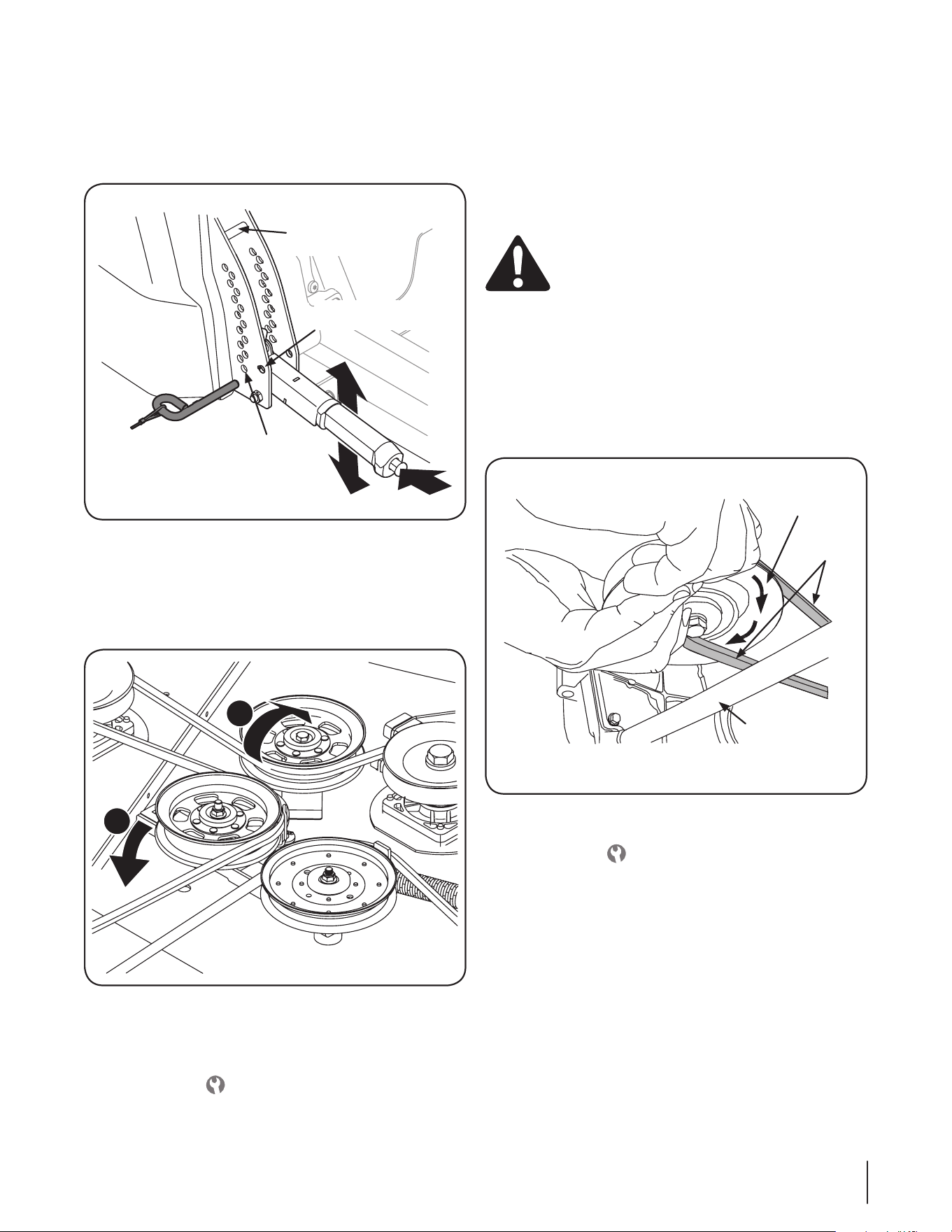
33Section 7 — Service
4. Releasing belt tension with the idler pulley:
a. Using the deck lift handle, raise the deck to the
position that provides the most horizontal run of
the belt between the deck idler pulleys and the PTO
pulley on the bottom of the engine. See Figure 8-3.
Transport Position/
Highest Mowing
Position
Lowest Mowing
Position
Deck Removal/
Installation Position
Figure 8-3
b. Working from the middle of the tractor, pivot the
idler bracket and movable idler pulley rearward
away from the backside of the ‘V” belt (a) just far
enough to lift the belt up and over the idler pulley
(b). See Figure 8-4.
b
a
Figure 8-4
c. From beneath the rear of the tractor, slide the belt
off of the PTO pulley on the bottom of the engine.
d. Lower the deck into the deck removal/installation
position using the deck lift handle. See Figure 8-3.
e. Skip ahead to step 6.
5. Rolling the belt off the PTO pulley:
a. Using the deck lift handle, raise the deck to the
position that provides the most horizontal run of the
belt between the deck idler pulleys and the PTO pulley
on the bottom of the engine.
b. Sitting behind the tractor facing forward, reach
beneath the tractor to grasp the belt at the front of
the PTO pulley.
WARNING! Use caution to avoid pinching your
fingers when rolling the belt off the PTO pulley.
c. Pull the left side of the belt rearward and downward
while manually turning the PTO pulley to the right
until the belt rides out onto the edge of the lower
sheave of the pulley.
NOTE: If pulling the right side of the belt, turn the pulley left.
d. While still holding the belt downward, continue
turning the PTO pulley until the belt is rolled off the
pulley. Refer to Figure 8-5.
PTO Pulley
PTO Belt
Transmission
Tube
Figure 8-5
e. Lower the deck into the deck removal/installation
position using the deck lift handle. See Figure 8-3.
f. Move on to step 6.
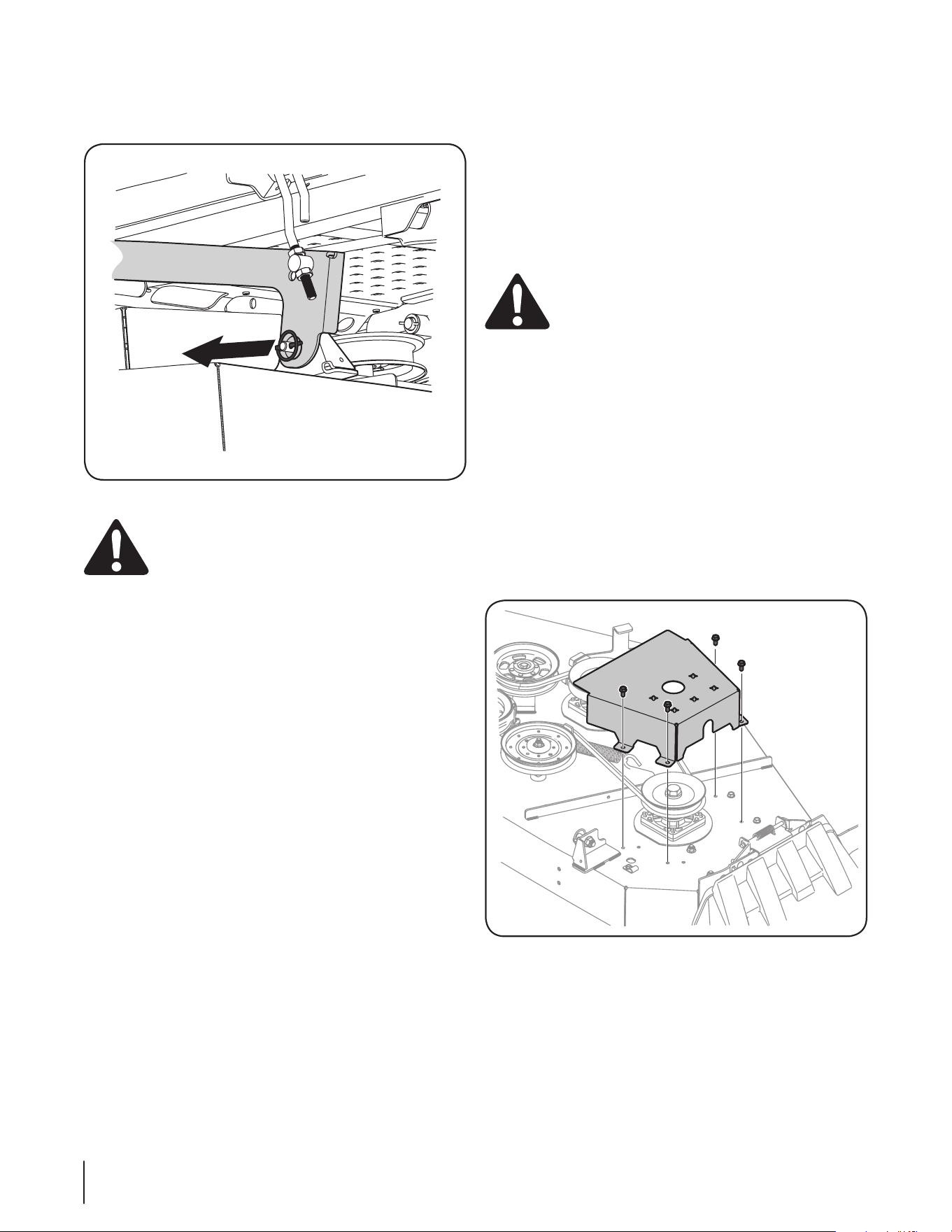
34 Section 7— Service
6. Locate the LH and RH deck release pins on each side of the
deck. Pull the release pins outward and release the deck
from the LH and RH deck lift arms. See Figure 8-6.
Figure 8-6
CAUTION: There is a certain amount of spring tension
due to the weight of the deck. When removing the lift
linkage from the deck the tension of the springs will go
from the deck to the deck lift handle and snap back.
7. Slide the front deck lift rod off the hanger brackets on the
front of the deck
8. Place the deck lift handle into the highest mowing position
and slide the deck out from the right side of the tractor.
Deck Installation
Install the deck on the tractor as follows:
1. Place the deck lift handle in the highest mowing position See
Figure 8-3.
2. Slide the deck under the tractor on the right side of the tractor
lining up the deck hanger brackets and the deck lift arms.
3. Once the deck is under the tractor, move the deck lift
handle to the lowest mowing position.
NOTE: To line the brackets up properly, it may be necessary to
place a small block of wood under each side of the deck.
4. Hook the front deck lift rod onto the hanger brackets on the
front of the deck.
5. Pull the deck release pins outward and maneuver the deck
as necessary to align the holes in the deck lift arms with the
pins. Refer to Figure 8-6.
6. When aligned, push each pin fully inward through the lift
arms to secure the arms in the rear hanger bracket slots.
7. Make certain the ‘V’ belt is in the spindle pulleys on the
deck; then route the belt rearward beneath the tractor
frame, above the transmission tube(s), to the PTO pulley on
the bottom of the engine.
8. Using the deck lift handle, raise the deck to the position
that provides the most horizontal run of the belt between
the deck idler pulleys and the PTO pulley on the bottom of
the engine.
9. Make certain the belt is in the spindle pulleys of the deck,
and that the backside of the belt is against both the fixed
and movable idler pulleys.
10. Sitting behind the tractor, facing forward, make certain the
belt is not twisted; then reach beneath the tractor to grasp
the belt and pull it toward the PTO pulley.
WARNING! Use caution to avoid pinching your
fingers when rolling the belt onto the PTO pulley.
11. Pull the right side of the belt rearward and place the narrow
V side of the belt into the PTO pulley. See Figure 8-5.
12. While holding the belt and pulley together, rotate the pulley
to the left (See Figure 8-5). Continue holding and rotating the
pulley and belt until the belt is fully rolled into the PTO pulley.
NOTE: Before using the tractor double-check the belt
routing to make sure that the belt has been routed properly.
Replacing the Belt
1. Remove the deck from beneath the tractor, (refer to Deck
Removal).
2. Remove the hex washer screws securing the belt covers to
the deck. See Figure 8-7.
Figure 8-7
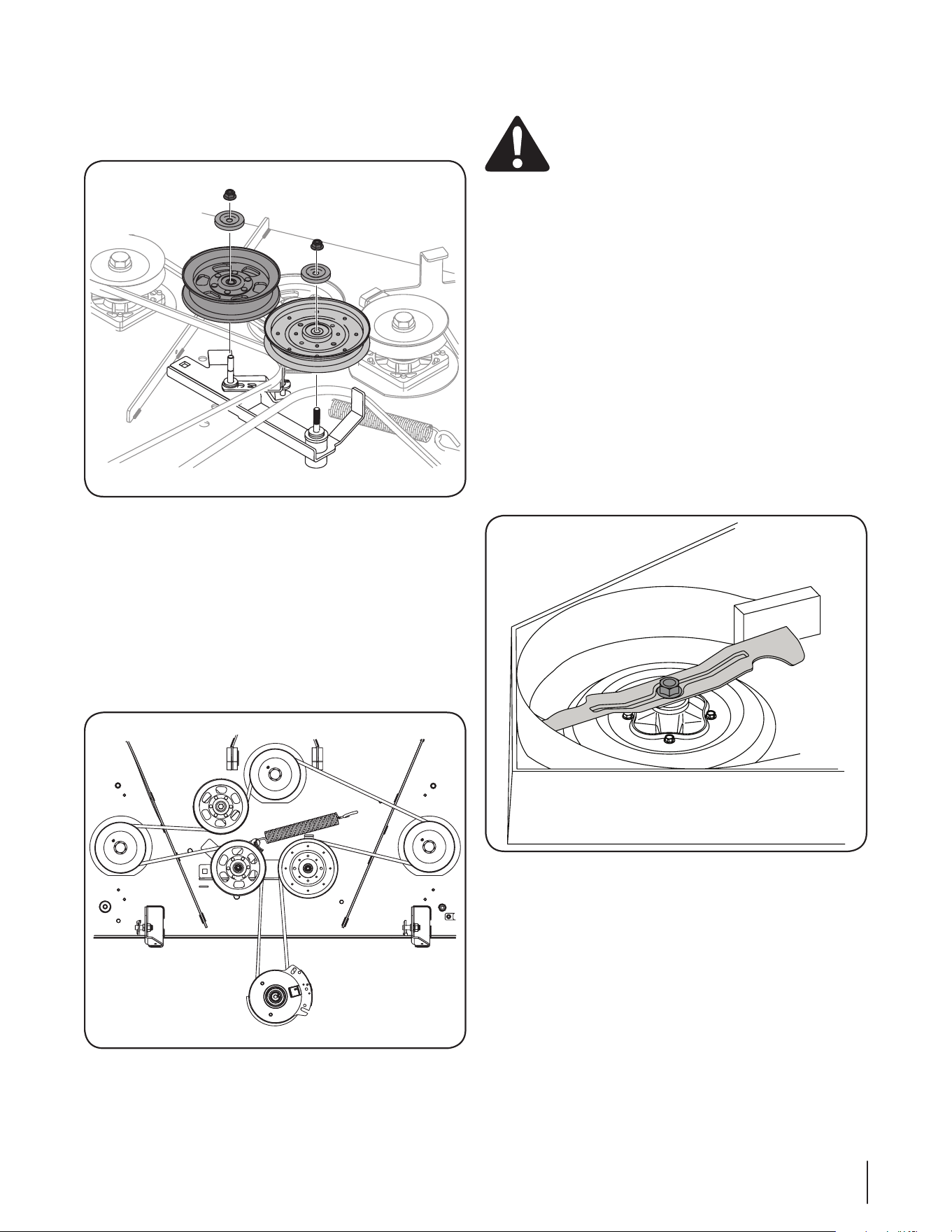
35Section 7 — Service
3. Remove the two idler pulleys by removing the hex screws
and flange lock nuts that secure them to the deck and the
idler arm. See Figure 8-7. Do not lose any of the hardware
when removing the hex screw and flange lock nut.
Figure 8-8
NOTE: Take note of the position of the belt guards to
ensure they are properly re-installed.
4. Remove the belt from the spindle pulleys.
5. Install the new belt around the spindle pulleys as shown
and reinstall the belt covers. See Figure 8-7.
6. Place the belt around the idler pulleys removed in step 3
with the “V” side facing in. Once in place, reinstall all the
hardware and tighten the flange lock nut to secure the
assembly. See Figure 8-9.
Figure 8-9
7. Route the belt as shown in Figure 8-9 and then reinstall the
deck (refer to Deck Installation).
Mower Blade Care
WARNING! Before performing any maintenance,
place the PTO switch in the “OFF” position, engage the
parking brake lever, turn the ignition key to the “OFF”
position and remove the key from the switch. Protect
your hands by using heavy gloves when handling the
blades. When servicing the mower deck, be careful not
to cut yourself on the sharpened blades.
The cutting blades must be kept sharp at all times. Sharpen the
cutting edges of the blades evenly so that the blades remain
balanced and the same angle of sharpness is maintained.
If the cutting edge of a blade has already been sharpened many
times, or if any metal separation is present, it is recommended
that new blades be installed. New blades are available at your
authorized dealer.
The blades may be removed as follows.
1. Remove the deck from beneath the tractor, (refer to Deck
Removal) then gently flip the deck over to expose its
underside.
2. Use a ⁄” wrench to hold the hex nut on top of the spindle
assembly when loosening the hex nut securing the blade.
A block of wood may be placed between the deck housing
and the cutting edge of the blade to help in breaking loose
the hex nut securing the blade. See Figure 8-10.
Figure 8-10
3. When reinstalling the blades, be sure they are installed so that
the wings are pointing upward toward the top of the deck.
4. Tighten the blade nuts to 70-90 ft. lbs.
5. Reinstall the deck (refer to Deck Installation).
Changing the Transmission Drive Belt
Several components must be removed and special tools used in
order to change the tractor’s transmission drive belt. See your
authorized dealer to have the transmission drive belt replaced.
Tractor Creeping
Creeping is the slight forward or backward movement of the
mower when the throttle is on and the speed control levers are
in the neutral position. If your mower creeps, see an authorized
service dealer.
Troubleshooting
8
36
Problem Cause Remedy
Excessive vibration 1. Cutting blade loose or unbalanced.
2. Damaged or bent cutting blade.
1. Tighten blade and spindle.
2. Replace blade.
Uneven cut 1. Deck not leveled properly.
2. Dull blade.
3. Uneven tire pressure.
1. Perform side-to-side deck adjustment.
2. Sharpen or replace blade.
3. Check tire pressure in all four tires.
Mower will not mulch grass
(If Equipped w/Mulching Kit)
1. Engine speed too low.
2. Wet grass.
3. Excessively high grass.
4. Dull blade.
1. Place throttle in FAST (rabbit) position.
2. Do not mulch when grass is wet.
3. Mow once at a high cutting height, then
mow again at desired height or make a
narrower cutting swath.
4. Sharpen or replace blade.
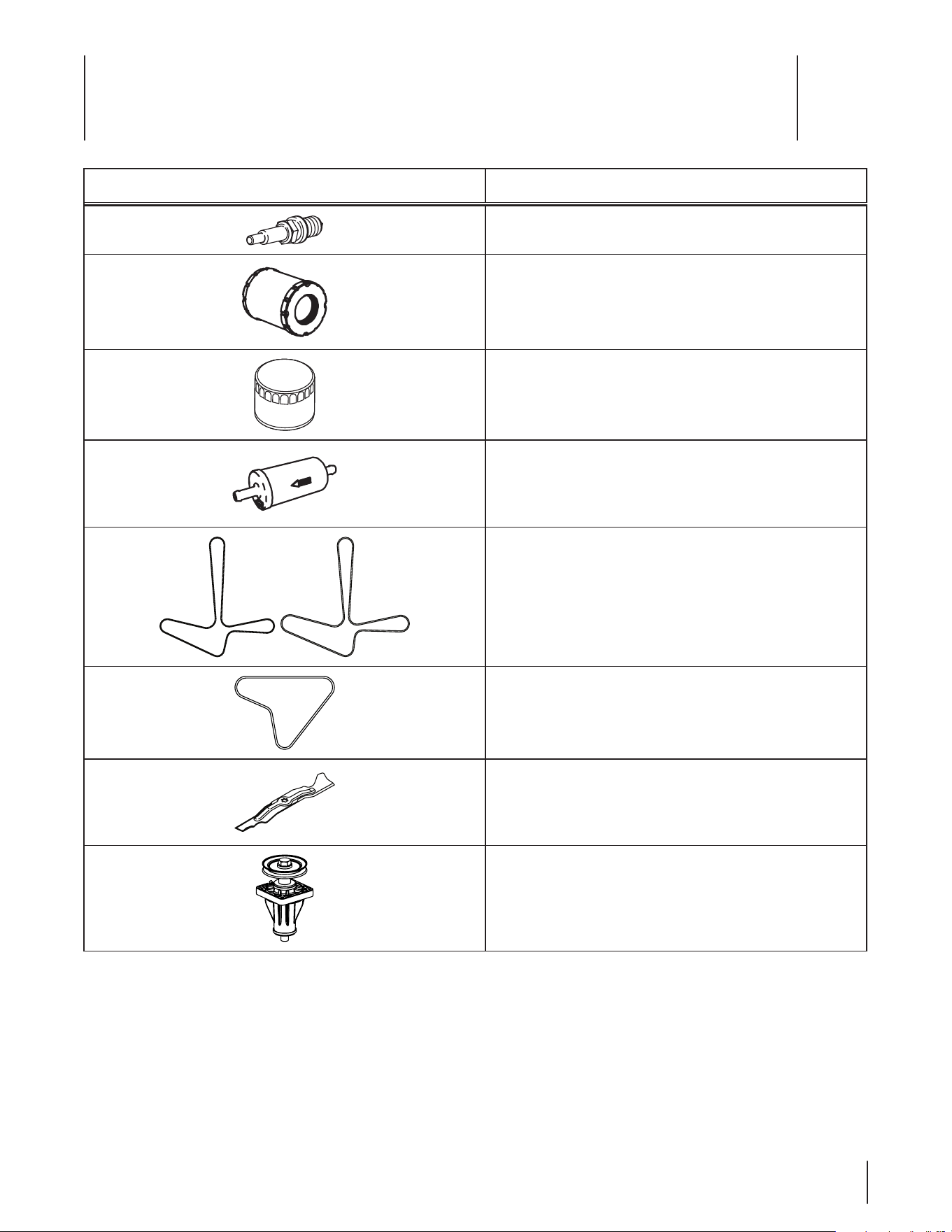
Replacement Parts
9
37
Phone (800) 828-5500 to order replacement parts or a complete Parts Manual (have your full model number and serial number ready).
Parts Manual downloads are also available free of charge at www.troybilt.com.
Component Part Number and Description
759-3336 Spark Plug
BS-798897 Air Filter
BS-696854 Oil Filter
BS-691035 Fuel Filter
954-05013 Deck Belt, 54” Deck
954-05015 Deck Belt, 60” Deck
954-04317A Drive Belt
942-04416 Blades, 54” Deck
02005018-X Xtreme Blades, 54” Deck
942-04415 Blades, 60” Deck
02005019-X Xtreme Blades, 60” Deck
918-06993A Deck Spindle, 54” Deck
918-06076A Deck Spindle, 60” Deck
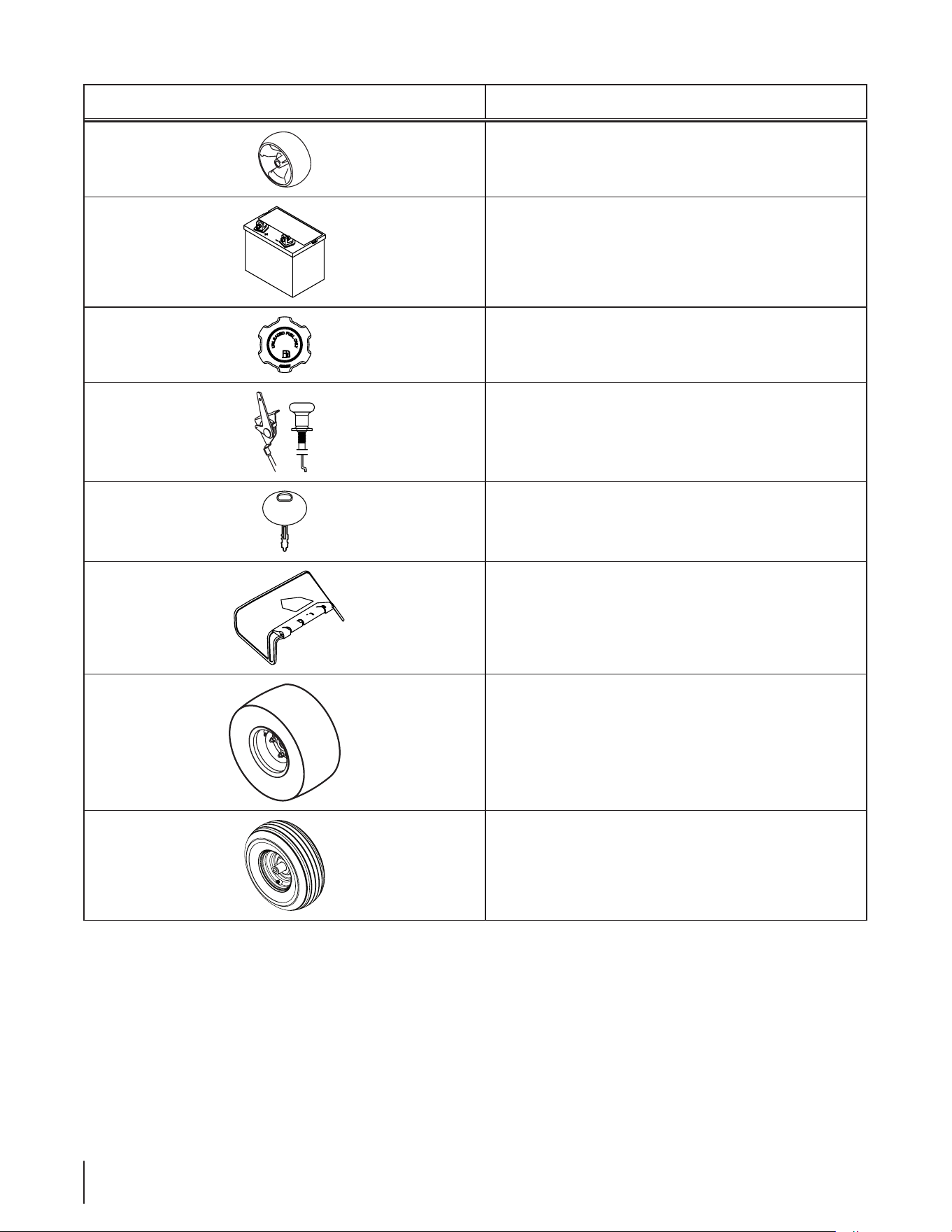
38 Section 9 — Replacement paRtS
Component Part Number and Description
734-04155 Deck Wheel
925-1707D Battery
951-12179B Gas Cap
746-05256A Throttle Control Cable
746-04235 Choke Control Cable
625-05002 Ignition Key
631-05176A Deck Chute
634-04295 Rear Wheel, 20 x 10 x 8
634-04626
Front Wheel, 13 x 5-6
Phone (800) 828-5500 to order replacement parts or a complete Parts Manual (have your full model number and serial number ready).
Parts Manual downloads are also available free of charge at www.troybilt.com.

Attachments & Accessories
10
39
Part No. Part
Bagger
19A70040000
Bagger Mounting Kit
19A70046000
Mulch Kit, 54”
19A70038OEM
Mulch Kit, 60”
19A70039OEM
EZ Stow Hauler
19A40026OEM
Hitch Kit
19A70025OEM
Tire Chains
490-241-0024
Oil Siphon
490-850-0008
Blade Removal Tool
490-850-0005
Oil Filter Wrench
490-900-0045
Tractor Cover
490-290-0013
Extended Spark Plug Wrench
490-850-0018

No tes
11
40

41Section 11 — noteS

FEDERAL and/or CALIFORNIA EMISSION CONTROL WARRANTY STATEMENT
YOUR WARRANTY RIGHTS AND OBLIGATIONS
MTD Consumer Group Inc, the United States Environmental Protection Agency (EPA), and for those products certified for sale in the state of
California, the California Air Resources Board (CARB) are pleased to explain the evaporative emission control system (ECS) warranty on your
2015-2016 small off-road equipment (outdoor equipment). In California, new outdoor equipment must be designed, built and equipped to
meet the State’s stringent anti-smog standards (in other states, outdoor equipment must be designed, built, and equipped to meet the U.S. EPA
small off-road spark ignition engine regulations). MTD Consumer Group Inc must warrant the ECS on your outdoor equipment for the period of
time listed below, provided there has been no abuse, neglect, or improper maintenance of the outdoor equipment.
Your ECS may include parts such as fuel tanks, fuel lines, fuel caps, valves, canisters, filters, vapor hoses, clamps, connectors, and other
associated emission-related components.
Where a warrantable condition exists, MTD Consumer Group Inc will repair your outdoor equipment at no cost to you including diagnosis,
parts, and labor.
MANUFACTURER’S WARRANTY COVERAGE:
This emission control system is warranted for two years. If any emission-related part on your outdoor equipment is defective, the part will be
repaired or replaced by MTD Consumer Group Inc.
OWNER’S WARRANTY RESPONSIBILITIES:
As the outdoor equipment owner, you are responsible for performance of the required maintenance listed in your owner’s manual. MTD
Consumer Group Inc recommends that you retain all receipts covering maintenance on your outdoor equipment, but MTD Consumer Group Inc
cannot deny warranty solely for the lack of receipts.
As the outdoor equipment owner, you should however be aware that MTD Consumer Group Inc may deny you warranty coverage if your
outdoor equipment or a part has failed due to abuse, neglect, improper maintenance, or unapproved modifications.
You are responsible for presenting your outdoor equipment to MTD Consumer Group Inc’s distribution center or service center as soon as
the problem exists. The warranty repairs should be completed in a reasonable amount of time, not to exceed 30 days. If you have a question
regarding your warranty coverage, you should contact the MTD Consumer Group Inc Service Department at 1-800-800-7310 or at
http://support.mtdproducts.com.
GENERAL EMISSIONS WARRANTY COVERAGE:
MTD Consumer Group Inc warrants to the ultimate purchaser and each subsequent purchaser that the outdoor equipment is: (1) designed,
built, and equipped so as to conform with all applicable regulations; and (2) free from defects in materials and workmanship that cause the
failure of a warranted part for a period of two years.
The warranty period begins on the date the outdoor equipment is delivered to an ultimate purchaser or first placed into service.
Subject to certain conditions and exclusions as stated below, the warranty on emission-related parts is as follows:
1. Any warranted part that is not scheduled for replacement as required maintenance in the written instructions supplied is warranted for
the warranty period stated above. If the part fails during the period of warranty coverage, the part will be repaired or replaced by MTD
Consumer Group Inc according to subsection (4) below. Any such part repaired or replaced under warranty will be warranted for the
remainder of the period.
2. Any warranted part that is scheduled only for regular inspection in the written instructions supplied is warranted for the warranty period
stated above. Any such part repaired or replaced under warranty will be warranted for the remaining warranty period.
3. Any warranted part that is scheduled for replacement as required maintenance in the written instructions supplied is warranted for the
period of time before the first scheduled replacement date for that part. If the part fails before the first scheduled replacement, the part
will be repaired or replaced by MTD Consumer Group Inc according to subsection (4) below. Any such part repaired or replaced under
warranty will be warranted for the remainder of the period prior to the first scheduled replacement point for the part.
4. Repair or replacement of any warranted part under the warranty provisions herein must be performed at a warranty station at no charge
to the owner.
5. Notwithstanding the provisions herein, warranty services or repairs will be provided at all of our distribution centers that are franchised to
service the subject engines or equipment.
6. The outdoor equipment owner will not be charged for diagnostic labor that is directly associated with diagnosis of a defective, emission-
related warranted part, provided that such diagnostic work is performed at a warranty station.
7. MTD Consumer Group Inc is liable for damages to other engine or equipment components proximately caused by a failure under
warranty of any warranted part.
8. Throughout the off-road engine and equipment warranty period stated above, MTD Consumer Group Inc will maintain a supply of
warranted parts sufficient to meet the expected demand for such parts.
9. Any replacement part may be used in the performance of any warranty maintenance or repairs and must be provided without charge to
the owner. Such use will not reduce the warranty obligations of MTD Consumer Group Inc.
10. Add-on or modified parts that are not exempted by the Air Resources Board may not be used. The use of any non-exempted add-on or
modified parts by the ultimate purchaser will be grounds for disallowing a warranty claim. MTD Consumer Group Inc will not be liable to
warrant failures of warranted parts caused by the use of a non-exempted add-on or modified part.

063015 Rev. C
WARRANTED PARTS:
The repair or replacement of any warranted part otherwise eligible for warranty coverage may be excluded from such warranty coverage
if MTD Consumer Group Inc demonstrates that the outdoor equipment has been abused, neglected, or improperly maintained, and that
such abuse, neglect, or improper maintenance was the direct cause of the need for repair or replacement of the part. That notwithstanding,
any adjustment of a component that has a factory installed, and properly operating, adjustment limiting device is still eligible for warranty
coverage. Further, the coverage under this warranty extends only to parts that were present on the off-road equipment purchased.
The following emission warranty parts are covered (if applicable):
1. Fuel Metering System
• Fuel pump
• Fuel tank
2. Evaporative Control
• Fuel hose
• Fuel hose clamps
• Tethered fuel cap
• Carbon canister
• Vapor lines

MANUFACTURER’S LIMITED WARRANTY FOR
GDOC-100020 REV. A
The limited warranty set forth below is given by Troy-Bilt LLC with
respect to new merchandise purchased and used in the United States
and/or its territories and possessions, and by MTD Products Limited
with respect to new merchandise purchased and used in Canada and/
or its territories and possessions (either entity respectively, “Troy-Bilt”).
This warranty is in addition to any applicable emissions warranty
provided with your product.
“Troy-Bilt” warrants this product (excluding its Normal Wear Parts
and Attachments as described below) against defects in material and
workmanship for a period of two (2) years commencing on the date of
original purchase and will, at its option, repair or replace, free of charge,
any part found to be defective in materials or workmanship. This
limited warranty shall only apply if this product has been operated and
maintained in accordance with the Operator’s Manual furnished with
the product, and has not been subject to misuse, abuse, commercial
use, neglect, accident, improper maintenance, alteration, vandalism,
theft, fire, water, or damage because of other peril or natural disaster.
Damage resulting from the installation or use of any part, accessory
or attachment not approved by Troy-Bilt for use with the product(s)
covered by this manual will void your warranty as to any resulting
damage.
Normal Wear Parts are warranted to be free from defects in material
and workmanship for a period of thirty (30) days from the date of
purchase. Normal wear parts include, but are not limited to items such
as: batteries, belts, blades, blade adapters, tines, grass bags, wheels,
rider deck wheels, seats, snow thrower skid shoes, friction wheels,
shave plates, auger spiral rubber and tires.
Attachments — Troy-Bilt warrants attachments for this product against
defects in material and workmanship for a period of one (1) year,
commencing on the date of the attachment’s original purchase or
lease. Attachments include, but are not limited to items such as: grass
collectors and mulch kits.
HOW TO OBTAIN SERVICE: Warranty service is available, WITH
PROOF OF PURCHASE, through your local authorized service dealer. To
locate the dealer in your area:
In the U.S.A.
Check your Yellow Pages, or contact Troy-Bilt LLC at P.O. Box 361131,
Cleveland, Ohio 44136-0019, or call 1-866-840-6483,
1-330-558-7220 or log on to our Web site at www.troybilt.com.
In Canada
Contact MTD Products Limited, Kitchener, ON N2G 4J1, or call 1-800-
668-1238 or log on to our Web site at www.mtdcanada.com.
This limited warranty does not provide coverage in the following cases:
a. The engine or component parts thereof. These items may
carry a separate manufacturer’s warranty. Refer to applicable
manufacturer’s warranty for terms and conditions.
b. Log splitter pumps, valves, and cylinders have a separate one-
year warranty.
c. Routine maintenance items such as lubricants, filters, blade
sharpening, tune-ups, brake adjustments, clutch adjustments,
deck adjustments, and normal deterioration of the exterior finish
due to use or exposure.
d. Service completed by someone other than an authorized service
dealer.
e. Troy-Bilt does not extend any warranty for products sold or
exported outside of the United States and/or Canada, and their
respective possessions and territories, except those sold through
Troy-Bilt’s authorized channels of export distribution.
f. Replacement parts that are not genuine Troy-Bilt parts.
g. Transportation charges and service calls.
h. Troy-Bilt does not warrant this product for commercial use.
No implied warranty, including any implied warranty of
merchantability or fitness for a particular purpose, applies
after the applicable period of express written warranty above
as to the parts as identified. No other express warranty,
whether written or oral, except as mentioned above, given by
any person or entity, including a dealer or retailer, with respect
to any product, shall bind Troy-Bilt. During the period of the
warranty, the exclusive remedy is repair or replacement of the
product as set forth above.
The provisions as set forth in this warranty provide the sole
and exclusive remedy arising from the sale. Troy-Bilt shall
not be liable for incidental or consequential loss or damage
including, without limitation, expenses incurred for substitute
or replacement lawn care services or for rental expenses to
temporarily replace a warranted product.
Some states do not allow the exclusion or limitation of incidental
or consequential damages, or limitations on how long an implied
warranty lasts, so the above exclusions or limitations may not apply to
you.
In no event shall recovery of any kind be greater than the amount of
the purchase price of the product sold. Alteration of safety features
of the product shall void this warranty. You assume the risk and
liability for loss, damage, or injury to you and your property and/or to
others and their property arising out of the misuse or inability to use
the product.
This limited warranty shall not extend to anyone other than the original
purchaser or to the person for whom it was purchased as a gift.
HOW STATE LAW RELATES TO THIS WARRANTY: This limited
warranty gives you specific legal rights, and you may also have other
rights which vary from state to state.
IMPORTANT: Owner must present Original Proof of Purchase to
obtain warranty coverage.
Troy-Bilt LLC, P.O. BOX 361131 CLEVELAND, OHIO 44136-0019; Phone: 1-866-840-6483, 1-330-558-7220
MTD Canada Limited - KITCHENER, ON N2G 4J1; Phone 1-800-668-1238
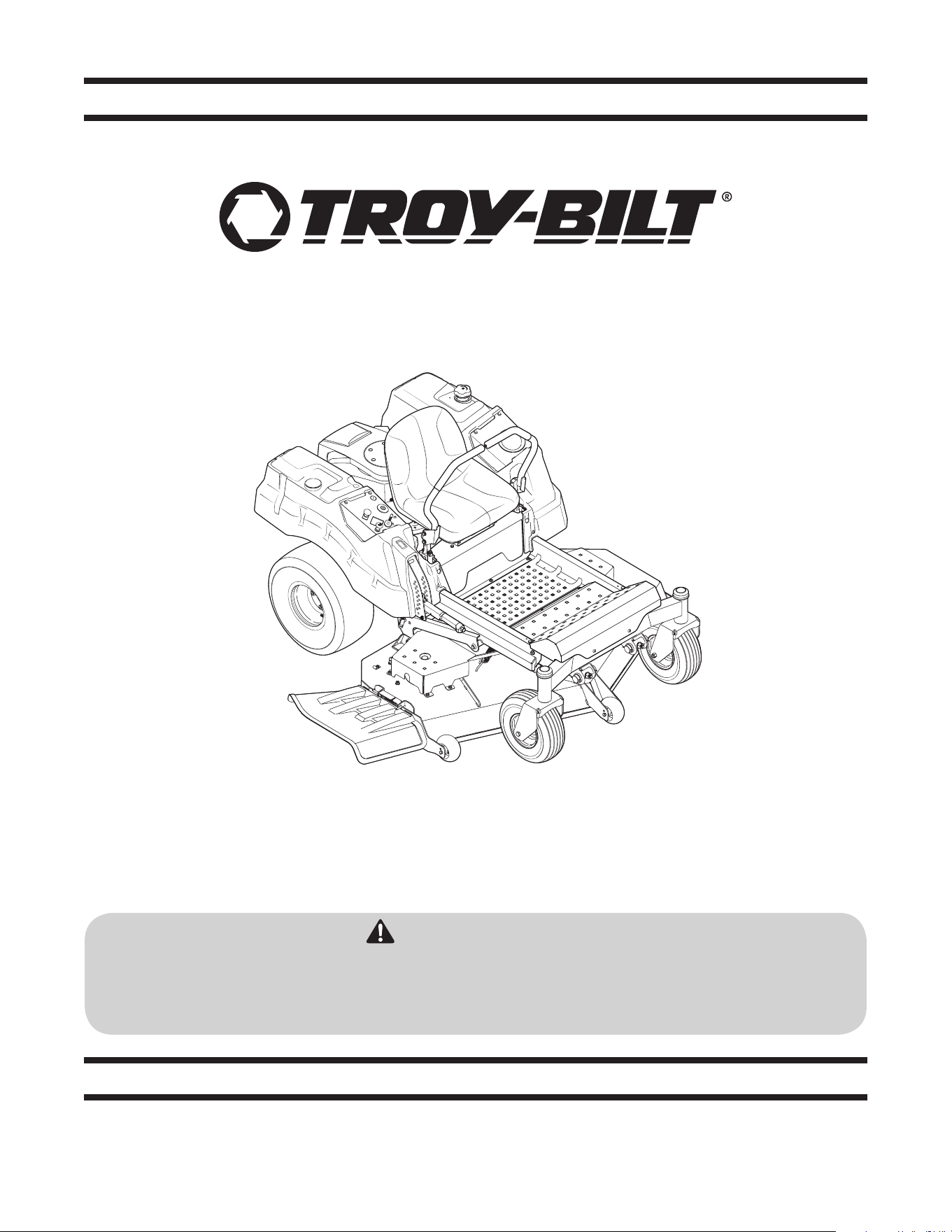
TROY-BILT LLC, P.O. BOX 361131 CLEVELAND, OHIO 44136-0019
Impreso en EE.UU.
Manual del OperadOr
Medidas de seguridad • Instalación • Funcionamiento • Mantenimiento • Servicio • Solución de problemas • Garantía
ADVERTENCIA
LEA Y CUMPLA TODAS LAS REGLAS Y LAS INSTRUCCIONES DE SEGURIDAD DE ESTE MA
NUAL ANTES DE INTENTAR OPERAR ESTA MÁQUINA.
SI NO SIGUE ESTAS INSTRUCCIONES PUEDE PROVOCAR LESIONES PERSONALES.
Tractor de Radio de Giro Cero
Formulario No. 769-10952
(5 de octubre de 2015)

Servicio de Atención al Cliente
Por favor, NO devuelva la máquina al minorista o distribuidor sin ponerse
en contacto primero con el Departamento de Atención al Cliente.
Si tiene dificultad para armar este producto o tiene dudas respecto a los controles, el funcionamiento o el mantenimiento
de esta máquina, puede solicitar la ayuda de expertos. Seleccione una de las opciones siguientes:
◊ Visite nuestro sitio web en www.troybilt.com
Vea videos instructivos sobre el mantenimiento y la instalación de piezas en www.troybilt.com/tutorials
◊ Llame a un representante de Asistencia al Cliente al (800) 828-5500 ó (330) 558-7220
◊ Escriba a Troy-Bilt LLC • P.O. Box 361131 • Cleveland, OH • 44136-0019
Gracias por comprar un tractor con radio de giro cero Troy Bilt. Ha sido
cuidadosamente diseñado para brindar excelente rendimiento si se lo
hace funcionar y se lo mantiene correctamente.
Por favor lea todo este manual antes de hacer funcionar el equipo.
El manual le indica cómo configurar, hacer funcionar y mantener la
máquina de manera fácil y segura. Por favor asegúrese de que usted,
y cualquier otra persona que utilice la máquina, siga atentamente y
en todo momento las medidas de seguridad recomendadas. De lo
contrario, se podrían producir lesiones personales o daños materiales.
Toda la información contenida en este manual hace referencia a la más
reciente información de producto disponible en el momento de la
impresión. Revise el manual frecuentemente para familiarizarse con la
máquina, sus características y su funcionamiento. Por favor tenga en
cuenta que este Manual del Operador puede abarcar una variedad de
especificaciones para productos de diversos modelos. Es posible que las
características y funciones incluidas y/o ilustradas en este manual no se
apliquen a todos los modelos. Nos reservamos el derecho de modificar
las especificaciones de los productos, diseños y equipos sin previo aviso
y sin generar responsabilidad por obligaciones de ningún tipo.
Si corresponde, la información sobre las prueba de potencia utilizada
para determinar la potencia nominal del motor equipado en esta
máquina se puede consultar en www.opei.org o en el sitio web del
fabricante del motor.
Si tiene algún problema o duda con respecto a la máquina, llame
a un distribuidor de servicio Troy-Bilt autorizado o comuníquese
directamente con nosotros. En esta página encontrará los números
de teléfono, dirección del sitio web y dirección postal de Atención al
cliente de Troy-Bilt. Queremos garantizar su entera satisfacción en todo
momento.
En este manual, todas las referencias al lado derecho e izquierdo de la
máquina se hacen observándola desde la posición de operación.
El fabricante del motor es el responsable de todas las cuestiones
relacionadas con el rendimiento, potencia de salida, especificaciones,
garantía y mantenimiento del motor. Para más información consulte el
Manual del Propietario/Operador entregado por el fabricante del motor
y que acompaña, embalado por separado, a su máquina.
Muchas gracias
Registro de información de producto
Antes de instalar y hacer funcionar su equipo nuevo, por favor
localice la placa de modelo en el equipo y registre la información
en el espacio de la derecha. Gire el conjunto del asiento hacia
adelante para ubicar la placa de modelo en el lado inferior del
soporte de pivote del asiento. Necesitará esta información si
tiene que solicitar soporte técnico a través de nuestro sitio web,
el Servicio de Atención al Cliente, o de un distribuidor local de
servicio autorizado.
NúMero de Modelo
NúMero de Serie
Al propietario
1
2
Medidas de Seguridad ............................................ 3
Armado e Instalación ............................................. 9
Controles y Características .................................. 13
Operación .............................................................. 16
Mantenimiento y Ajustes ..................................... 24
Servicio ................................................................... 32
Solución de Problemas ......................................... 36
Repuestos ............................................................... 37
Complementos y Accesorios ................................ 39
Garantías ............................................................... 42
Índice
Importantes medidas de seguridad
2
3
Funcionamiento general
1. Lea, entienda y cumpla todas las instrucciones incluidas en la
máquina y en el(los) manual(es) antes de intentar realizar el
montaje de la unidad y utilizarla. Guarde este manual
en un lugar seguro para consultas futuras y periódicas,
así como para solicitar repuestos.
2. Familiarícese con todos los controles y con el uso adecuado
de los mismos. Sepa cómo detener la máquina y desactivar los
controles rápidamente.
3. No permita nunca que los niños menores de 14 años utilicen
esta máquina. Los niños de 14 años en adelante deben leer y
entender las instrucciones de funcionamiento y las normas de
seguridad contenidas en este manual y
en la máquina y deben ser entrenados y supervisados por un
adulto.
4. Nunca permita que los adultos operen esta máquina sin recibir
antes la instrucción apropiada.
5. Para tratar de evitar el contacto con las cuchillas o una lesión
por un objeto que sea arrojado, mantenga a los observadores,
ayudantes, niños y mascotas alejados al menos 25 metros de la
máquina mientras está funcionando. Pare la máquina si alguien
ingresa a la zona.
6. Inspeccione minuciosamente el área donde utilizará el equipo.
Saque todas las piedras, palos, cables, huesos, juguetes y
demás objetos extraños que puedan ser recogidos y arrojados
por las cuchillas. Los objetos arrojados por la máquina pueden
causar lesiones graves.
7. Planifique el patrón de corte, para evitar que la descarga
de material se realice hacia los caminos, las veredas, los
observadores, etc. Evite además descargar material contra una
pared u obstrucción, ya que esto podría hacer que el material
descargado rebotara contra el operador.
8. Para protegerse los ojos utilice siempre anteojos o antiparras
de seguridad mientras hace funcionar la máquina o mientras le
hace ajustes o reparaciones.
Los objetos arrojados que rebotan pueden lesionar
gravemente los ojos.
9. Utilice zapatos de trabajo resistentes, de suela fuerte, así como
pantalones y camisas ajustados. Las prendas sueltas
y las alhajas pueden quedar atrapadas en las piezas móviles.
Nunca haga funcionar la máquina descalzo o con sandalias.
10. Esté atento a la dirección de descarga del tractor cortacésped
y sus accesorios y no los apunte a nadie. Nunca opere la
cortadora de césped sin tener bien colocada la cubierta de
descarga o el colector de césped.
11. No ponga las manos ni los pies cerca de las piezas rotatorias ni
debajo de la plataforma de corte. El contacto con las cuchillas
puede amputar manos y pies.
ADVERTENCIA! Este símbolo indica instrucciones de seguridad importantes que, de no
seguirse, pueden poner en peligro su seguridad personal y/o material y la de otras personas.
Lea y cumpla todas las instrucciones de este manual antes de intentar hacer funcionar esta
máquina. Si no respeta estas instrucciones puede provocar lesiones personales.
Cuando vea este símbolo. TENGA EN CUENTA LAS ADVERTENCIAS!
PELIGRO! Esta máquina está diseñada para ser utilizada respetando las normas de seguridad
contenidas en este manual. Al igual que con cualquier tipo de equipo motorizado, un descuido o
error por parte del operador puede producir lesiones graves. Esta máquina es capaz de amputar
manos y pies y de arrojar objetos. De no respetar las instrucciones de seguridad siguientes,
se pueden ocasionar lesiones graves o la muerte.
PROPOSICIÓN 65 DE CALIFORNIA
ADVERTENCIA! El escape del motor de este producto, algunos de sus componentes y algunos
componentes del vehículo contienen o liberan sustancias químicas que el Estado de California
considera que pueden producir cáncer, defectos de nacimiento u otros problemas reproductivos.
ADVERTENCIA! Los bornes y contactos de la batería y los accesorios afines contienen plomo
y compuestos de plomo, sustancias químicas que el Estado de California considera que pueden
producir cáncer y daños en el sistema reproductivo. Lávese las manos después de estar en
contacto con estos componentes.

4 Sección 2 — importanteS medidaS de Seguridad
12. Una cubierta de descarga faltante o dañada puede provocar
lesiones por contacto con la cuchilla o por objetos arrojados.
13. Detenga las cuchillas al cruzar sendas, senderos o caminos de
grava y cuando no corte césped.
14. Tenga cuidado con el tránsito cuando opere cerca de rutas o al
cruzarlas. Esta máquina no está diseñada para ser usada en la
vía pública.
15. No haga funcionar la máquina si se encuentra bajo los efectos
del alcohol o las drogas.
16. Úsela solamente con luz natural o con buena luz artificial.
17. Nunca lleve pasajeros.
18. Retroceda lentamente. Siempre mire hacia abajo y hacia atrás
antes y mientras retrocede para evitar accidentes.
Esté atento y vigile el funcionamiento del sistema de seguridad
que corta la energía de las cuchillas al conducir marcha atrás.
Si no funciona correctamente, póngase en contacto con un
distribuidor autorizado para que se inspeccione y repare el
sistema de seguridad.
19. Reduzca la velocidad antes de girar. Haga funcionar la máquina
de manera uniforme. Evite que funcione de manera errática y a
excesiva velocidad.
20. Desacople las cuchillas, ponga el freno de mano, apague
el motor y espere hasta que las cuchillas se detengan por
completo antes de retirar el colector de césped, vaciar
los recortes, destapar el canal, retirar restos de césped
o desechos, o hacer cualquier ajuste.
21. Nunca deje la máquina en funcionamiento sin vigilancia.
Desconecte siempre las cuchillas, coloque las palancas/pedales
de control de transmisión en neutral, coloque el freno de mano,
apague el motor y saque la llave antes de bajarse de la unidad.
22. Tenga mucho cuidado al cargar o descargar la máquina en
un remolque o camión. Esta máquina no debe conducirse
subiendo o bajando rampas, ya que la máquina podría volcar
y provocar lesiones personales graves. La máquina se debe
empujar a mano en rampas para cargarla o descargarla
correctamente.
23. El silenciador y el motor se calientan y pueden causar
quemaduras. No los toque.
24. Revise la holgura superior antes de conducir debajo de ramas
bajas, cables, cerramientos de puertas, etc., donde el operador
puede golpearse o ser tirado de la máquina, lo que podría
resultar en lesiones graves.
25. Desenganche todos los embragues de los accesorios,
coloque el freno de mano en posición ‘ON’ o en los tractores
con palancas de control, mueva las palancas de control de
transmisión derecha e izquierda totalmente hacia afuera a la
posición neutral antes de intentar arrancar el motor.
26. Su máquina está diseñada para cortar césped residencial
normal de una altura no mayor a 10 pulgadas. No intente
cortar césped demasiado crecido, seco (como un pastizal) ni
pilas de hojas secas. El césped o las hojas secas pueden entrar
en contacto con el escape del motor y/o acumularse en la
plataforma de corte presentando un potencial peligro
de incendio.
27. Utilice solamente accesorios y complementos aprobados por
el fabricante para esta máquina. Lea, comprenda y siga todas
las instrucciones incluidas con el accesorio o complemento
aprobado.
28. Los datos indican que los operadores mayores de 60 años
participan de un gran porcentaje de lesiones relacionadas
con tractores cortacésped. Estas personas deben evaluar su
capacidad para operar el tractor de manera suficientemente
segura para protegerse a sí mismos y a otros de lesiones graves.
29. Si se presentan situaciones que no están previstas en este
manual, tenga cuidado y use el sentido común. Póngase en
contacto con su representante de atención al cliente para
obtener ayuda.
Funcionamiento en pendiente
Las pendientes son uno de los principales factores asociados a los
accidentes por pérdida de control y vuelcos que pueden producir
lesiones graves o la muerte. Todas las pendientes exigen precaución
adicional. Si no puede retroceder por la pendiente
o si no se siente seguro, no realice ningún corte.
Para su seguridad, use el indicador de pendientes que se adjunta
a este manual para medir la pendiente antes de operar la máquina
en una zona inclinada. Si la pendiente es de más de 15º, como se
muestra en el medidor, no haga funcionar esta máquina en ese sector
o podría causar lesiones graves.
Haga lo siguiente:
1. Corte de forma transversal a la pendiente, no hacia arriba ni
hacia abajo. Tenga sumo cuidado al cambiar de dirección en
una pendiente.
2. Esté atento a los hoyos, surcos, baches, rocas, y otros objetos
ocultos. El terreno desnivelado puede voltear la máquina.
El césped alto puede ocultar obstáculos.
3. Conduzca a baja velocidad. Elija una velocidad lo
suficientemente baja, de modo que no tenga que detenerse
mientras está en la pendiente. Evite arrancar o detenerse en
una pendiente. Si los neumáticos no pueden mantener la
tracción, desenganche las cuchillas y baje lentamente y con
cuidado por la pendiente.
4. Siga las recomendaciones del fabricante sobre los pesos
o contrapesos de las ruedas para mejorar la estabilidad.
5. Tenga mucho cuidado con los colectores de césped y otros
complementos. Pueden modificar la estabilidad de la máquina.
6. Todos los movimientos en las pendientes deben ser lentos y
graduales. No haga cambios bruscos de velocidad o dirección.
La aceleración o la reducción repentina de velocidad pueden
hacer que el frente de la máquina se levante y dé una voltereta
hacia atrás, lo que podría producir lesiones graves.
No haga lo siguiente:
1. No gire en pendiente a menos que sea necesario; si lo hace,
gire lentamente cuesta arriba y tenga sumo cuidado
al hacerlo.
2. No corte el césped cerca de declives, zanjas o terraplenes.
La cortadora puede volcarse repentinamente si una de
las ruedas pasa el borde de un acantilado o zanja o si se
desmorona un borde.
3. No intente estabilizar la máquina poniendo el pie en el suelo.
4. No utilice colector de césped en pendientes empinadas.
5. No corte el césped húmedo. La falta de tracción puede hacer
que patine.
6. No remolque complementos de arrastrar pesados (como
carrito de basura cargado, podadora de rodillos, etc.) en
pendientes de más de 5º. Cuando se desplaza cuesta abajo,
el peso adicional tiende a empujar el tractor y puede hacerle
perder el control (por ejemplo, el tractor se puede acelerar, la
capacidad de conducir y frenar se reducen, el complemento
puede acodillarse y hacer que el tractor vuelque).

5Sección 2 — importanteS medidaS de Seguridad
Niños
1. Pueden ocurrir accidentes trágicos si el operador no está
atento a la presencia de niños. Por lo general, los niños se
sienten atraídos por la máquina y su actividad. No entienden
los riesgos ni los peligros. Nunca suponga que los niños
permanecerán en el lugar donde los vio por última vez.
a. Mantenga a los niños fuera del área de corte y bajo
estricta vigilancia de un adulto responsable además
del operador.
b. Esté alerta y apague la máquina si un niño ingresa
al área.
c. Para evitar accidentes al retroceder, siempre mire hacia
atrás y hacia abajo para ver si hay niños pequeños.
d. Nunca transporte niños, ni siquiera con las cuchillas
desactivadas. Podrían caerse y resultar gravemente
heridos o interferir con la operación segura de la
máquina.
e. Tenga mucho cuidado al aproximarse a las esquinas
ciegas, puertas, arbustos, árboles u otros objetos que
puedan obstaculizarle la vista de un niño que pudiese
correr al encuentro de la máquina.
f. Mantenga a los niños alejados de los motores en
marcha o calientes. Pueden sufrir quemaduras con un
silenciador caliente.
g. Retire la llave cuando la máquina queda sin vigilancia
para evitar el funcionamiento no autorizado.
2. No permita nunca que los niños menores de 14 años utilicen
esta máquina. Los niños de 14 años en adelante deben leer y
entender las instrucciones de funcionamiento y las normas de
seguridad contenidas en este manual y en la máquina y deben
ser entrenados y supervisados por un adulto.
Remolque
1. Remolque únicamente con una máquina que tenga un
enganche diseñado para remolcar. No acople equipo
remolcado excepto en el punto de enganche.
2. Siga las recomendaciones del fabricante en lo que respecta a
los límites de peso de los equipos a remolcar y al remolque en
pendientes.
3. Nunca permita que los niños y otras personas se suban a
equipos remolcados.
4. En las pendientes, el peso del equipo remolcado puede causar
pérdida de tracción y pérdida de control.
5. Desplácese lentamente y deje distancia adicional para detenerse.
6. No cambie a punto muerto para bajar por inercia.
Servicio
Manejo seguro de la gasolina:
1. Para evitar lesiones personales o daños materiales tenga
mucho cuidado al manipular la gasolina. La gasolina es
sumamente inflamable y sus vapores son explosivos. Si se
derrama gasolina encima o sobre la ropa se puede lesionar
gravemente ya que se podría prender fuego. Lávese la piel y
cámbiese de ropa de inmediato.
a. Utilice sólo los recipientes para gasolina autorizados.
b. Apague todos los cigarrillos, cigarros, pipas y otras
fuentes de combustión.
c. Nunca cargue combustible en la máquina en un espacio
cerrado.
d. Nunca saque la tapa del combustible ni agregue
combustible mientras el motor está caliente o en
marcha. Deje que el motor se enfríe por lo menos dos
minutos antes de volver a cargar combustible.
e. Nunca llene en exceso el depósito de combustible.
Llene el depósito no más de ½ pulgada por debajo
de la base del cuello de llenado para dejar espacio para
la expansión del combustible.
f. Vuelva a colocar el tapón de combustible y ajústelo
bien.
g. Limpie el combustible que se haya derramado sobre
el motor y el equipo. Traslade la máquina a otra zona.
Espere 5 minutos antes de arrancar el motor.
h. Para reducir el riesgo de incendio, mantenga la máquina
limpia de pasto, hojas y residuos acumulados. Limpie
los derrames de aceite o combustible y saque todos los
residuos embebidos en combustible.
i. Nunca guarde la máquina o los recipientes de
combustible, ni cargue combustible en un espacio
cerrado donde haya fuego, chispas o luz piloto, por
ejemplo, de calentadores de agua, calefactores de
ambientes, hornos, secadores de ropa u otros aparatos
a gas.
j. Deje que la máquina se enfríe por lo menos cinco
minutos antes de guardarla.
2. Evite la descarga estática
a. Nunca llene los recipientes dentro de un vehículo o
un camión o un remolque con recubrimiento plástico.
Coloque siempre los recipientes en el piso y lejos del
vehículo antes de llenarlo.
b. Cuando sea conveniente, retire el equipo a gasolina
del camión o remolque y llénelo sobre el suelo. Si esto
no es posible, llene el equipo en un remolque con un
recipiente portátil, en vez de hacerlo desde una boquilla
dispensadora de gasolina.
c. En todo momento mantenga la boquilla en contacto
con el borde del depósito de combustible o con la
abertura del recipiente, hasta terminar la carga. No
utilice un dispositivo de apertura/cierre de la boquilla.
Servicio general
1. Nunca encienda el motor en espacios cerrados o en una zona
con poca ventilación. El escape del motor contiene monóxido
de carbono, un gas inodoro y letal.
2. Antes de limpiar, reparar o inspeccionar la máquina,
compruebe que las cuchillas y todas las piezas móviles se
hayan detenido. Desconecte el cable de la bujía y póngalo
haciendo masa contra el motor para evitar que se encienda
accidentalmente.
3. Controle periódicamente para asegurarse que las cuchillas
se detienen completamente aproximadamente cinco (5)
segundos después de accionar el control de desacople. Si las
cuchillas no se detienen en este lapso, su máquina necesita un
servicio profesional de un distribuidor autorizado.
4. Controle periódicamente el funcionamiento del sistema de
bloqueo de seguridad, tal como se describe más adelante
en este manual. Si el sistema de bloqueo de seguridad no
funciona correctamente, lleve su máquina a hacerle un servicio
profesional de un distribuidor autorizado.
5. Controle las cuchillas y los pernos de montaje del motor a
intervalos frecuentes para verificar que estén bien apretados.
Además, inspeccione visualmente las cuchillas buscando
daño (por ejemplo: desgaste excesivo, abolladuras, rajaduras).
Reemplace las cuchillas únicamente por cuchillas de los
fabricantes del equipo original (O.E.M.) listados en este manual.
“El uso de piezas que no cumplen con las especificaciones del
equipo original podría resultar en rendimiento inadecuado
y además puede comprometer la seguridad.”

6 Sección 2 — importanteS medidaS de Seguridad
ADVERTENCIA! Su Responsabilidad. Esta máquina motorizada sólo puede ser usada por personas que lean,
comprendan y respeten las advertencias e instrucciones que aparecen en este manual y en la máquina.
¡GUARDE ESTAS INSTRUCCIONES!
6. Las cuchillas de la cortadora son filosas. Envuelva la cuchilla
o utilice guantes y extreme las precauciones cuando les haga
mantenimiento.
7. Mantenga todos los pernos, tuercas y tornillos bien ajustados
para asegurarse de que la máquina se encuentra en
condiciones seguras de funcionamiento.
8. Nunca altere el sistema de enclavamiento de seguridad u
otros dispositivos de seguridad. Controle periódicamente
que funcionen correctamente.
9. Después de golpear algún objeto extraño, detenga el motor,
desconecte los cables de la bujía y conéctelo a tierra con el
motor. Inspeccione minuciosamente la máquina para ver si
está dañada. Repare el daño antes de volver a arrancar y operar
la máquina.
10. Nunca intente hacer ajustes o arreglos con el motor en marcha.
11. Los componentes del colector de césped y la cubierta de
descarga están sujetos a desgaste y daños que podrían dejar
expuestas piezas móviles o permitir que se arrojen objetos.
Para proteger su seguridad, verifique frecuentemente todos
los componentes y reemplácelos inmediatamente sólo por
repuestos de los fabricantes del equipo original (O.E.M.)
listados en este manual. “El uso de piezas que no cumplen
con las especificaciones del equipo original podría resultar
en rendimiento inadecuado y además puede comprometer
la seguridad.”
12. No cambie la configuración del regulador del motor ni acelere
demasiado el motor. El regulador del motor controla la
velocidad máxima de funcionamiento seguro del motor.
13. Mantenga o reemplace las etiquetas de seguridad y de
instrucciones según sea necesario.
14. Respete las normas y reglamentaciones sobre la manera
correcta de eliminar gasolina, aceite, etc. para proteger el
medio ambiente.
15. Según la Comisión de Seguridad de Productos para el
Consumidor de los Estados Unidos (CPSC) y la Agencia de
Protección Ambiental de los Estados Unidos (EPA), este
producto tiene una vida útil media de siete (7) años o 270
horas de funcionamiento. Al finalizar la vida útil media haga
inspeccionar anualmente esta unidad por un distribuidor de
servicio autorizado para cerciorarse de que todos los sistemas
mecánicos y de seguridad funcionan correctamente y no
tienen excesivo desgaste. Si no lo hace, puede ocasionar
accidentes, lesiones o la muerte.
No modifique el motor
Para evitar lesiones graves o la muerte, no modifique el motor de
ninguna manera. Si altera la configuración del regulador, el motor
se puede desbocar y funcionar a velocidades que no son seguras.
Nunca cambie la configuración de fábrica del regulador del motor.
Aviso referido a emisiones
Los motores que están certificados y cumplen con las normas sobre
emisiones federales EPA y de California para SORE (Equipos pequeños
todo terreno) están certificados para funcionar con gasolina sin
plomo común y pueden incluir los siguientes sistemas de control
de emisiones: Modificación de motor (EM) y catalizador de tres vías
(TWC) si están equipados con esos sistemas.
Cuando sea necesario, los modelos están equipados con líneas de
combustible y tanques de combustible de baja penetración para
controlar las emisiones por evaporación. Los modelos para California
también pueden incluir un filtro de carbón. Por favor, póngase en
contacto con Atención al cliente para obtener información sobre
la configuración del control de emisiones por evaporación para
su modelo.
Amortiguador de chispas
ADVERTENCIA! Esta máquina está equipada con
un motor de combustión interno y no debe ser utilizada
en o cerca de un terreno agreste cubierto por bosque,
malezas o hierba excepto que el sistema de escape del
motor esté equipado con un amortiguador de chispas
que cumpla con las leyes locales o estatales
correspondientes (en caso de existir).
Si se utiliza un amortiguador de chispas el operador lo debe
mantener en condiciones de uso adecuadas. En el Estado de
California, las medidas anteriormente mencionadas son exigidas por
ley (Artículo 4442 del Código de Recursos Públicos de California).
Es posible que existan leyes similares en otros estados. Las leyes
federales se aplican en territorios federales.
Puede conseguir el amortiguador de chispas para el silenciador
a través de su distribuidor autorizado de motores más cercano o
poniéndose en contacto con el departamento de servicios,
P.O. Box 361131 Cleveland, Ohio 44136-0019.
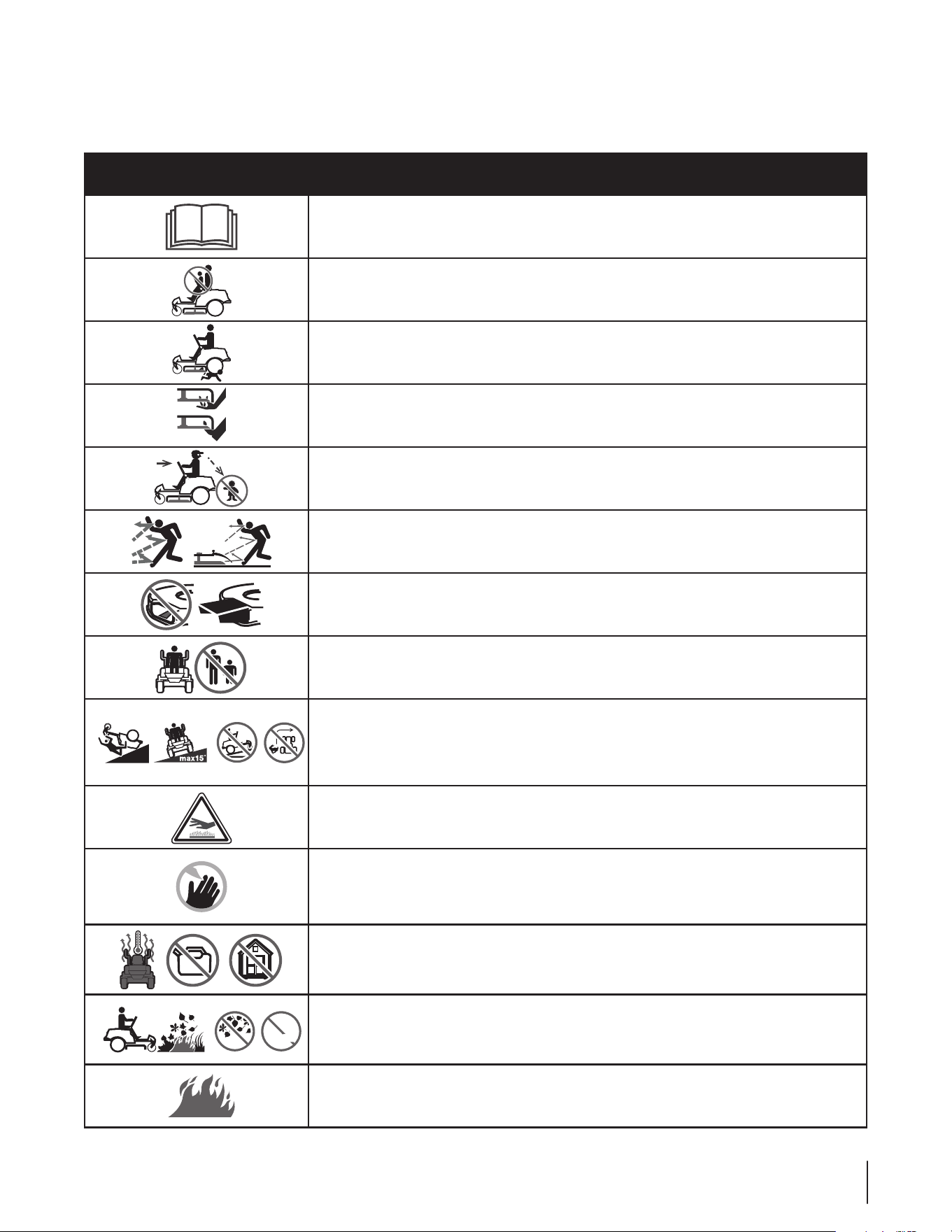
7Sección 2 — importanteS medidaS de Seguridad
Símbolos de seguridad
En esta página se presentan y describen los símbolos de seguridad que pueden aparecer en este producto. Lea, comprenda y siga todas las
instrucciones incluidas en la máquina antes de intentar armarla y hacerla funcionar.
Símbolo Descripción
LEA LOS MANUALES DEL OPERADOR
Lea, entienda y siga todas las instrucciones incluidas en los manuales antes de intentar armarla
y hacerla funcionar.
PELIGRO — CUCHILLAS GIRATORIASNunca lleve pasajeros. Nunca transporte niños, ni siquiera
después de haber desconectado las cuchillas.
PELIGRO — CUCHILLAS GIRATORIASSe recomienda no cortar marcha atrás.
PELIGRO — CUCHILLAS GIRATORIASNo coloque las manos ni los pies cerca de piezas que giran ni
debajo de la plataforma de corte. El contacto con las cuchillas puede amputar manos y pies.
PELIGRO — CUCHILLAS GIRATORIASMire hacia abajo y hacia atrás antes y mientras se desplaza
marcha atrás, para evitar un accidente.
ADVERTENCIA - OBJETOS LANZADOS
Esta máquina puede recoger y lanzar objetos que pueden causar lesiones personales graves.
PELIGRO — DISPOSITIVOS DE SEGURIDAD
Mantenga los dispositivos de seguridad (guardas, protectores, interruptores, etc.) en su lugar y
funcionando.
ADVERTENCIA — OBSERVADORES
Mantenga a los observadores, ayudantes, mascotas y niños por lo menos a 75 pies (23 m.) de la
máquina mientras está en funcionamiento.
ADVERTENCIA — OPERACIÓN EN PENDIENTE
No utilice esta máquina en una pendiente mayor de 15º. No corte el césped subiendo y bajando
la pendiente. Corte de forma transversal en pendientes no mayores de 15º. Evite realizar giros
abruptos. Conduzca a baja velocidad. Si la máquina se para mientras sube la pendiente, pare las
cuchillas y retroceda lentamente para abajo.
ADVERTENCIA— SUPERFICIE CALIENTE
Las piezas del motor, especialmente el silenciador, se recalientan durante la operación. Deje que el
motor y el silenciador se enfríen antes de tocarlos.
PELIGRO — CUCHILLAS GIRATORIAS
Para reducir el riesgo de lesiones, mantenga alejados manos y pies. No haga funcionar sin que
la tapa de descarga o el colector de césped se encuentren en el lugar que corresponde. Si están
dañados, reemplácelos inmediatamente.
ADVERTENCIA — RIESGO DE INCENDIO
Deje que la máquina se enfríe antes de cargar combustible o almacenarla.
max10"
ADVERTENCIA — RIESGO DE INCENDIO
No conduzca sobre pilas de hojas secas o pasto alto.
ADVERTENCIA — RIESGO DE INCENDIO
No permita que se acumulen residuos. La acumulación de desechos puede dar lugar a un
incendio.
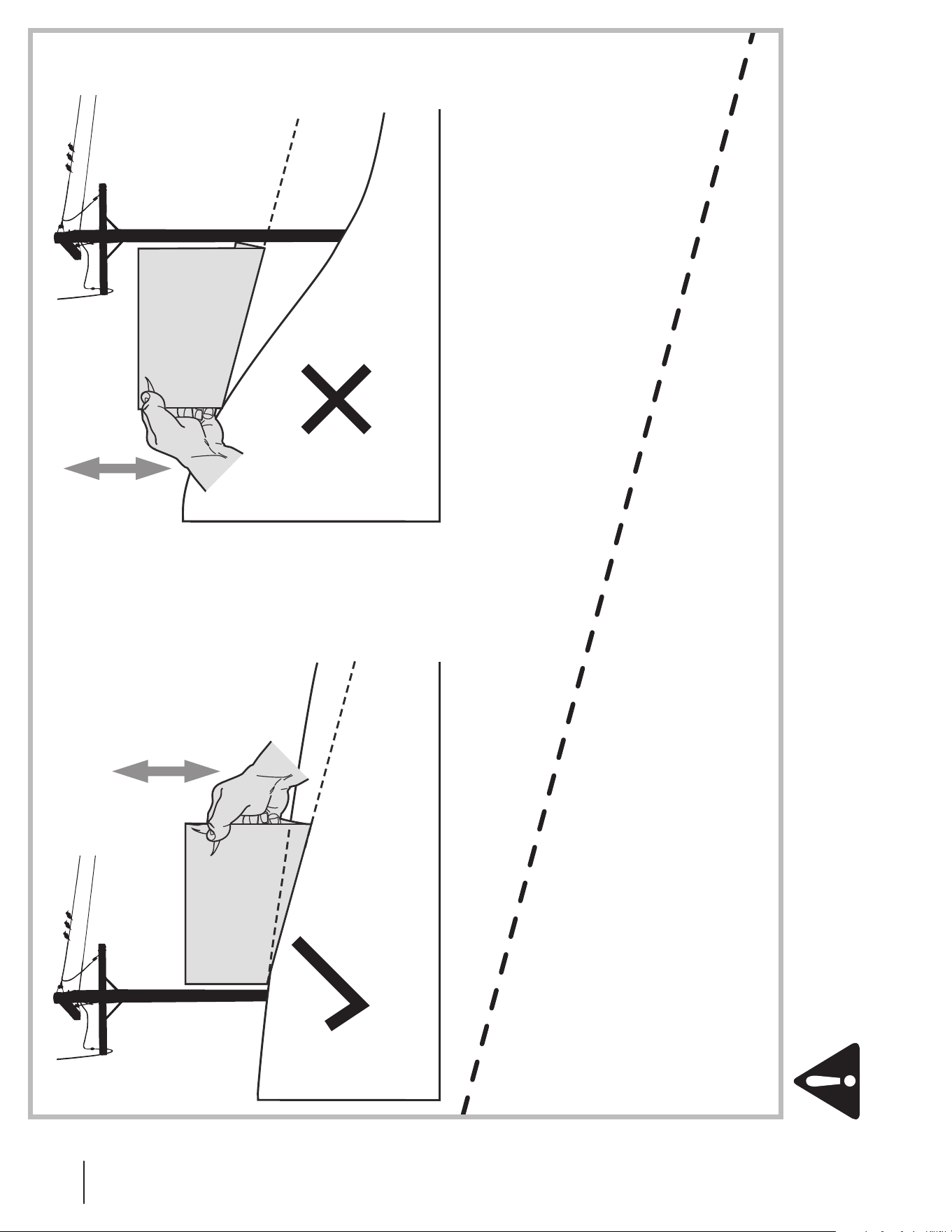
8 Sección 2 — MedidaS de Seguridad
(OK) (TOO STEEP)
USE THIS SLOPE GAUGE TO DETERMINE
IF A SLOPE IS TOO STEEP FOR SAFE OPERATION!
To check the slope, proceed as follows:
1. Remove this page and fold along the dashed line.
2. Locate a vertical object on or behind the slope (e.g. a pole, building, fence, tree, etc.)
3. Align either side of the slope gauge with the object (See Figure 1 and Figure 2 ).
4. Adjust gauge up or down until the left corner touches the slope (See Figure 1 and Figure 2).
5. If there is a gap below the gauge, the slope is too steep for safe operation (See Figure 2 above).
15° dashed line
Slope Gauge
Figure 2Figure 1
15° Slope
15° Slope
ADVERTENCIA! Las pendientes son uno de los principales factores asociados a los accidentes por tumbos y vuelcos que
pueden producir lesiones graves o la muerte.
No utilice la máquina en pendientes de más de 15°. Todas las pendientes exigen precaución adicional.
Corte siempre en sentido transversal a las caras de la pendiente, nunca hacia arriba y abajo.
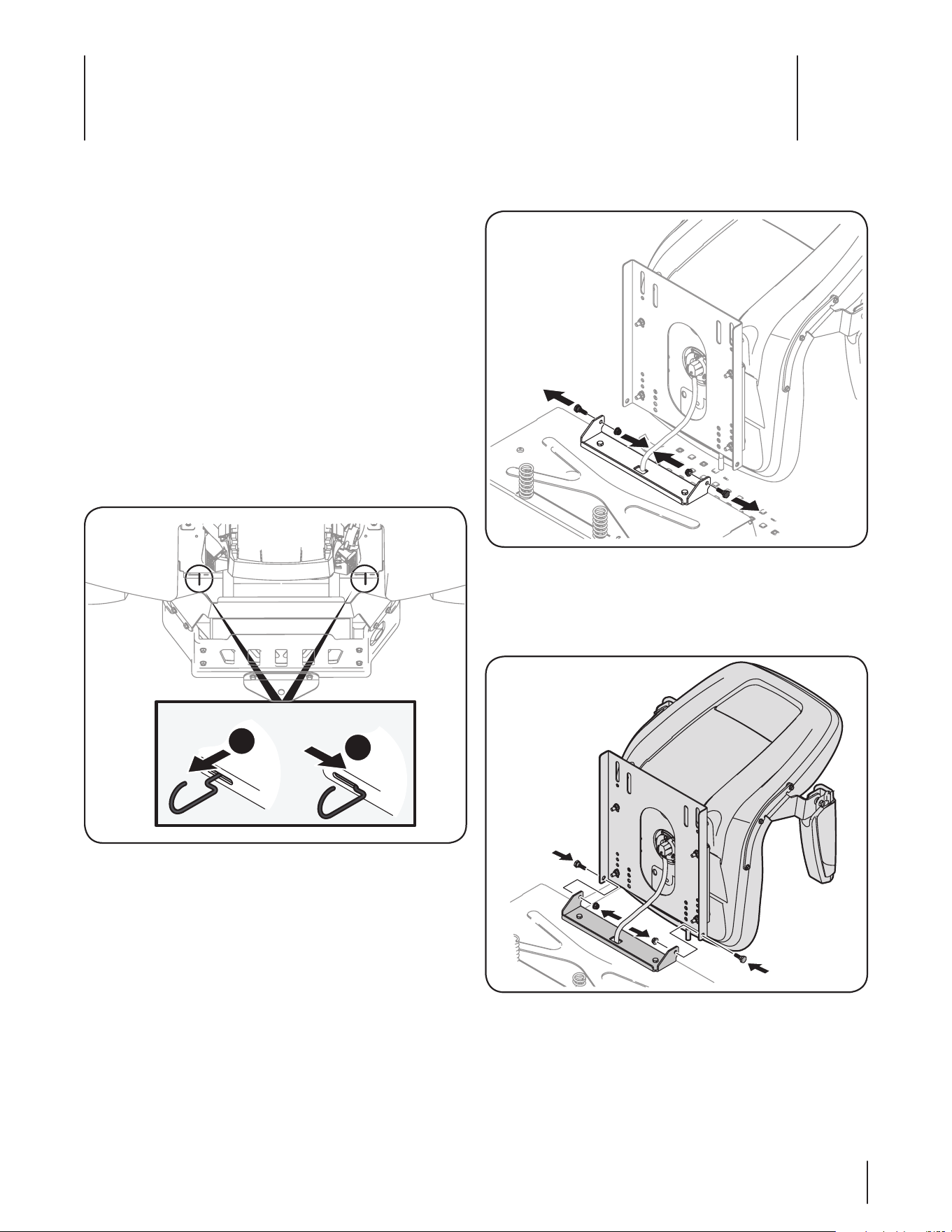
Armado e Instalación
3
9
NOTA: Este manual de operación, corresponde a numerosos modelos.
Las características del tractor pueden variar según los modelos. No todas
las características que se incluyen en este manual se aplican a todos los
modelos de tractor y la máquina que se ilustra aquí puede diferir de la
suya.
NOTA: Las referencias que contiene este manual sobre los lados
derecho o izquierdo y trasero o delantero del tractor se hacen siempre
desde la posición de operación. Las excepciones, si las hubiere, serán
especificadas.
Preparación del tractor
Movimiento manual del tractor
1. Enganche las varillas de derivación de la transmisión, una a cada
lado del tractor, para mover el tractor manualmente sin ponerlo en
marcha. Las varillas de derivación de la transmisión están ubicadas
en la parte trasera del tractor, justo en el interior de las ruedas
traseras. Enganche las varillas de derivación tirando de cada una
hacia afuera (a) y hacia la derecha (b) para trabarlas en su lugar. Vea
la Figura 4-1.
a
a
b
Figura 4-1
2. Después de mover el tractor, desenganche las varillas de derivación
invirtiendo los pasos a y b. Vea la Figura 4-1.
3. Retire el adaptador del pico del sistema de lavado de la plataforma
de la bolsa manual y guárdelo para uso futuro.
Instale el asiento del operador
Para instalar el asiento proceda de la siguiente manera:
NOTA: El asiento se envía con el interruptor de asiento y el
contenedor del asiento acoplados.
1. Corte cualquiera de las tiras que fijan el conjunto del asiento y las
palancas de control de la transmisión al tractor. Quite cualquier
material de empaque.
NOTA: Tenga cuidado para no cortar el cableado que conecta el
asiento al interruptor del asiento.
2. Saque los dos tornillos con reborde y las tuercas de seguridad con
brida del soporte del asiento tal como se muestra en Figura 4-2.
Figura 4-2
3. Gire el asiento hasta la posición deseada y asegúrelo en su lugar
con los tornillos de reborde y las tuercas de seguridad con brida
que extrajo antes. Tenga cuidado de no doblar o dañar el cableado
mientras instala el asiento. Vea la Figura 4-3.
Figura 4-3
NOTA: Asegúrese de empujar el cable excedente del cableado
para que ingrese en el orificio de la caja del asiento antes
de continuar.
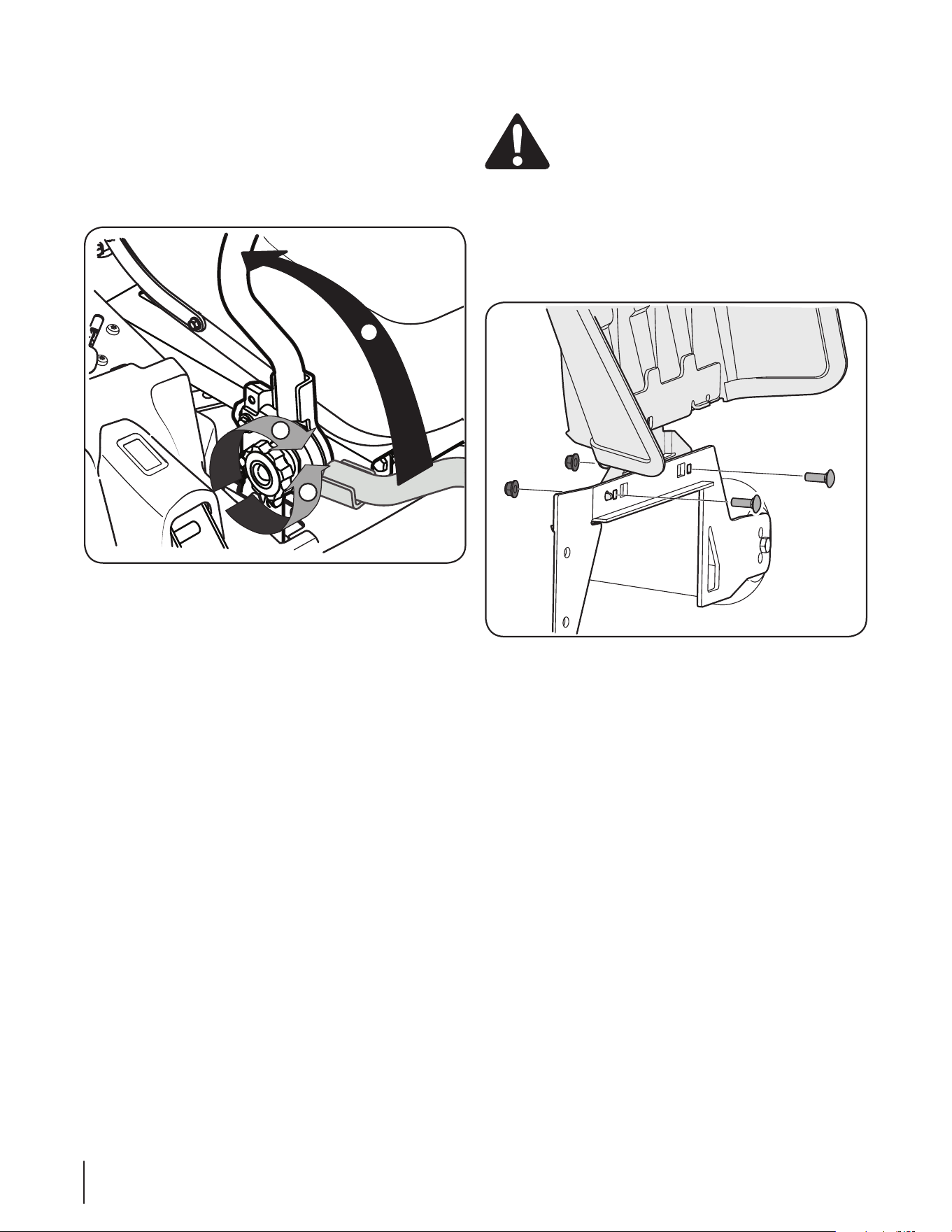
10 Sección 3 — ArmAdo e inStAlAción
Coloque las palancas de control de la transmisión en posición
Las palancas de control de la transmisión del tractor se bajan
para el envío. Las palancas se deben volver a posicionar para
hacer funcionar el tractor. Para volver a posicionar las palancas de
control para funcionar, haga lo siguiente:
1. Afloje las perillas de la palanca de control del lado de las
palancas de control de la transmisión. Vea la Figura 4-4.
2
2
1
Figura 4-4
2. Levante y gire esa palanca de control hacia arriba a la
posición deseada y asegure en su lugar ajustando la perilla
de la palanca de control. Vea la Figura 4-4.
3. Observe la posición relativa de la palanca de control
respecto del soporte de pivote, luego repita los pasos
precedentes para reubicar la otra palanca de control en
aproximadamente la misma posición.
4. Consulte las instrucciones para el ajuste final de las
palancas en la sección Mantenimiento y Ajustes bajo el
título "Ajuste de las palancas de control de la transmisión".
Baje el deflector del canal de descarga de la plataforma
ADVERTENCIA! Nunca opere la plataforma de
corte sin el deflector del canal de descarga instalado
y en posición baja.
Se debe instalar el deflector del canal de descarga antes de
operar la cortadora de césped. Para instalar el deflector del canal,
proceda de la siguiente manera:
1. Extraiga los pernos de carro y las tuercas de seguridad
con reborde instalados en el soporte de montaje de la
plataforma. Vea la Figura 4-5.
Figura 4-5
2. Con los herrajes que extrajo anteriormente, instale el
deflector del canal en la plataforma, como se indica en
la Figura 4-5.
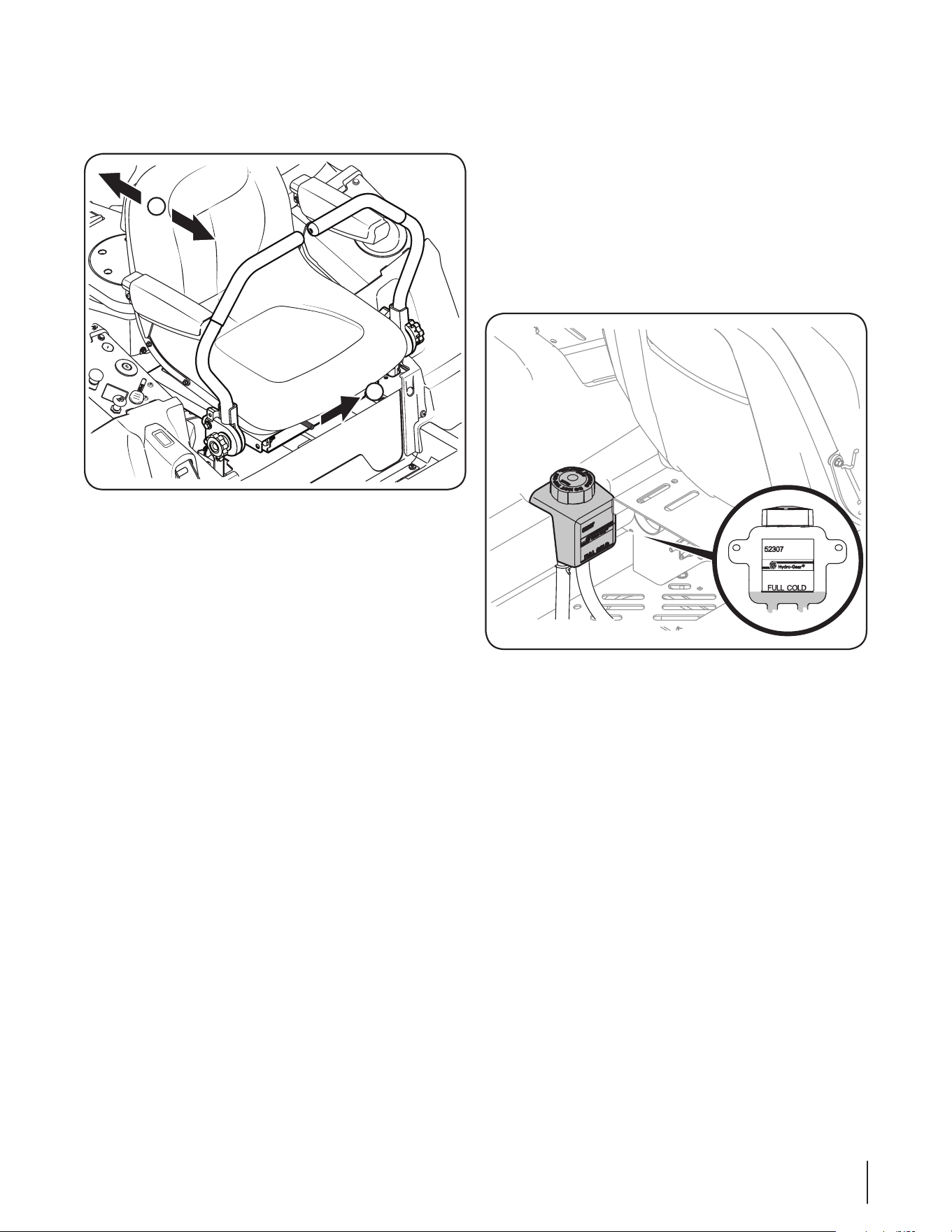
11Sección 3 — ArmAdo e inStAlAción
Ajuste del asiento
1. Para ajustar la posición del asiento, empuje la palanca de
ajuste del asiento hacia la izquierda. Vea la Figura 4-6.
2
1
Figura 4-6
2. Deslice el asiento hacia adelante o hacia atrás hasta la
posición deseada; luego suelte la palanca de ajuste.
Asegúrese de que el asiento esté fijo en su posición antes
de operar el tractor. Vea la Figura 4-6.
Depósito de expansión del aceite de transmisión
El depósito de expansión del aceite de transmisión está
conectado por mangueras a los conjuntos de transmisión
derecho e izquierdo, y está ubicado detrás de la caja del asiento.
La función del depósito es contener la expansión natural
del aceite de transmisión que se produce a medida que la
transmisión se calienta durante el funcionamiento de la
máquina NO LLENE EL DEPÓSITO.
En condiciones operativas normales, no se debe agregar
aceite al depósito. El nivel de aceite FRÍO no debe superar
aproximadamente 1/4" (marca de "Lleno frío") por encima de
la base del depósito. Vea la Figura 4-7.
Figura 4-7
NOTA: Antes del funcionamiento inicial del tractor, el nivel
de aceite del depósito puede estar levemente por encima
del máximo debido al aire que hay en las líneas de aceite. El
funcionamiento del tractor finalmente purgará el aire de las
líneas y el nivel de aceite se estabilizará en el máximo.
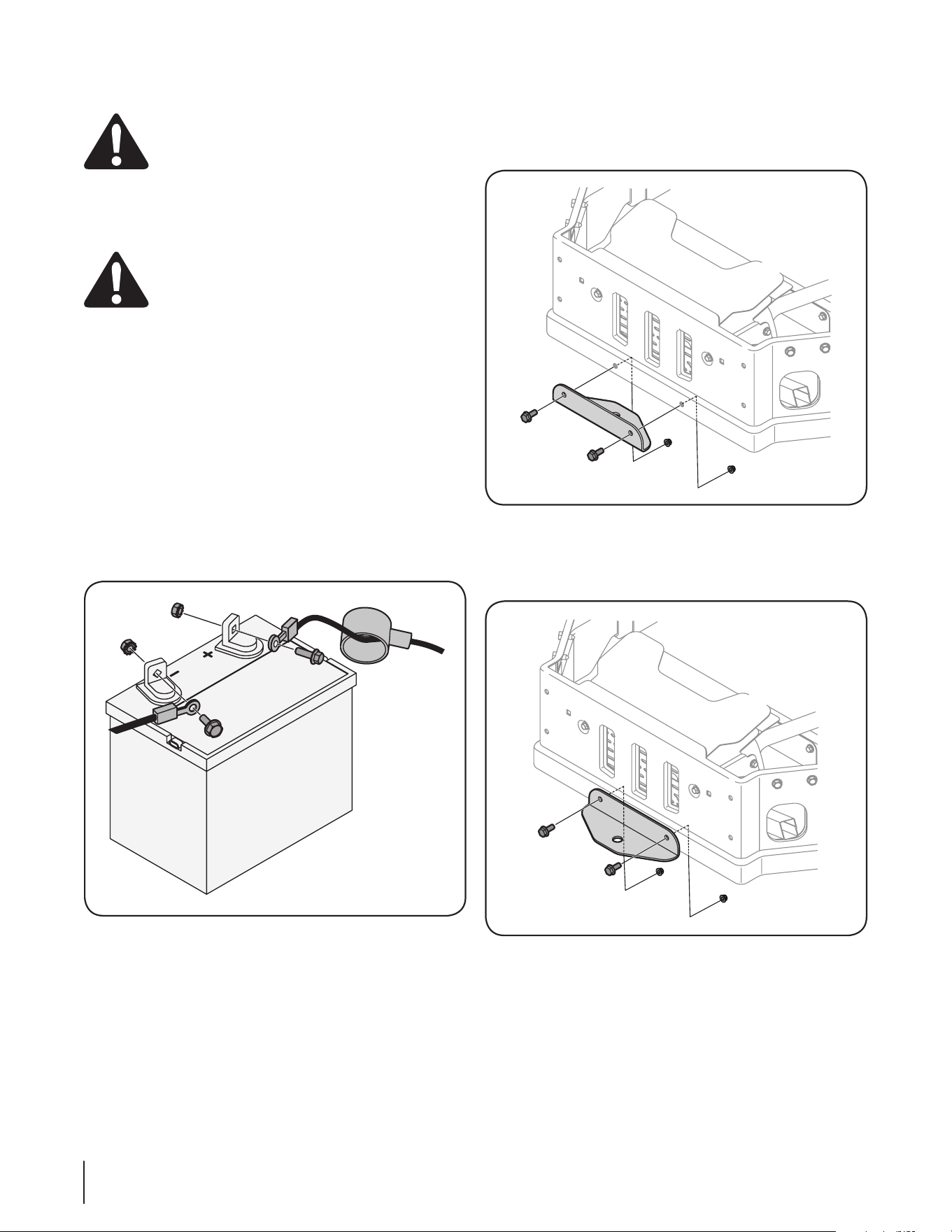
12 Sección 3 — ArmAdo e inStAlAción
Conexión de los cables de la batería
ADVERTENCIA PROPOSICIÓN 65 DE
CALIFORNIA Los bornes y contactos de la batería
y los accesorios afines contienen plomo y
compuestos de plomo, sustancias químicas que el
Estado de California considera que pueden producir
cáncer, defectos de nacimiento u otros problemas reproductivos.
Lávese las manos después de estar en contacto con estos
componentes.
PRECAUCIÓN: Cuando coloque los cables de la
batería, conecte siempre primero el cable POSITIVO
(rojo) a su borne, y a continuación el cable NEGATIVO
(negro).
Por razones relacionadas con el envío, los dos cables de la batería
de su equipo se pueden haber dejado desconectados de los
terminales en fábrica. Para conectar los cables de la batería,
proceda de la siguiente manera:
NOTA: El borne positivo de la batería está marcado como
Pos (+). El borne negativo de la batería está marcado como
Neg (-).
NOTA: Si el cable positivo de la batería ya está conectado,
siga con el paso 2.
1. Retire la cubierta plástica, si es que está presente, del borne
positivo de la batería y una el cable rojo al borne positivo de
la batería (+) utilizando el perno y la tuerca hexagonal. Vea
la Figura 4-8.
Figura 4-8
2. Retire la cubierta plástica, si es que está presente, del
borne negativo de la batería y una el cable negro al borne
negativo de la batería (–) utilizando el perno y la tuerca
hexagonal. Vea la Figura 4-8.
3. Coloque el capuchón de goma rojo por encima del borne
positivo de la batería para protegerlo contra la corrosión.
NOTA: Si la batería se pone en funcionamiento después
de la fecha indicada en su parte superior o al costado de la
misma, cárguela siguiendo las instrucciones de la sección
Mantenimiento de su Manual del Operador antes de hacer
funcionar el tractor.
Coloque la ménsula de enganche trasera
1. Extraiga los tornillos hexagonales con brida y las tuercas de
seguridad con brida que aseguran la ménsula de enganche
al tope. Vea la Figura 4-9.
Figura 4-9
2. Instale la ménsula de enganche como se muestra en Figura
4-10 y asegure con los tornillos hexagonales con brida y las
tuercas de seguridad con brida extraídas en el paso 1.
Figura 4-10
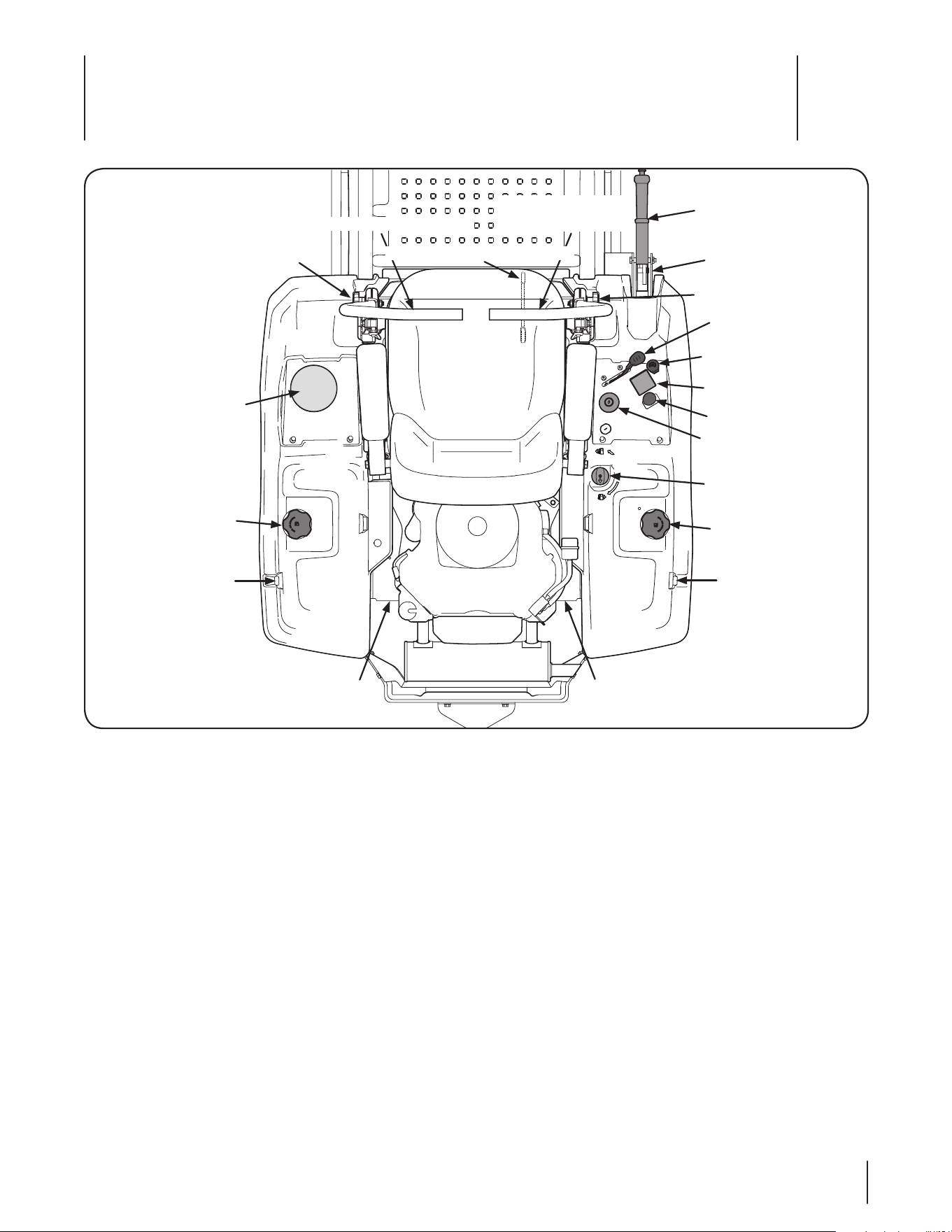
Controles y Características
4
13
Manija de elevación
de la plataforma
Posicionamiento de la
altura de la plataforma
Perilla de ajuste
de la palanca de control
Control del acelerador
Control del cebador
LCD avisador de servicio
y medidor horario
Interruptor de la PTO
Módulo de
Válvula de
combustible
Tapón del depósito
de combustible
Visor del nivel de
combustible
Palanca de ajuste del asiento
Palanca de control
derecha
Palanca de control izquierda
Perilla de ajuste
de la palanca de control
Portavasos
Tapón del depósito
de combustible
Visor del nivel de
combustible
Varilla de derivación de transmisión izquierda
Varilla de derivación de transmisión derecha
NOTA: Este manual de operación, corresponde a numerosos
modelos. Las características del tractor pueden variar según los
modelos. No todas las características que se incluyen en este manual
se aplican a todos los modelos de tractor y la máquina que se ilustra
aquí puede diferir de la suya.
NOTA: Las referencias a IZQUIERDA, DERECHA, ADELANTE Y ATRÁS
indican esa posición desde el asiento del operador en el tractor,
mirando hacia adelante.
Palancas de control de transmisión derecha e izquierda
Las palancas de control derecha e izquierda se encuentran a cada
lado del asiento del operador. Estas palancas abisagradas giran hacia
afuera, hacia el espacio abierto, para permitir al operador sentarse
en el asiento del tractor o descender del mismo. Las palancas deben
estar totalmente abiertas y en posición neutra para arrancar el motor
del tractor. Cuando las palancas están completamente hacia afuera,
también se activa el freno de mano.
Cada palanca controla la transmisión respectiva derecha o izquierda.
En consecuencia, estas palancas controlan todos los movimientos del
tractor. La conducción del tractor y la realización de maniobras con
estas palancas de control difieren mucho de las funciones respectivas
de los tractores convencionales, y es necesario practicar para poder
dominar las mismas. Consulte la Sección Funcionamiento para
obtener instrucciones sobre el uso de las palancas de control.
Perillas de las palancas de control
Las perillas de las palancas de control se encuentran cerca
de la base de las palancas de control derecha e izquierda. Las
perillas permiten ajustar las palancas hacia adelante o hacia
atrás. Consulte la sección Mantenimiento y Ajustes para obtener
instrucciones sobre el uso de las perillas de las palancas de
control.
Portavasos
El portavasos está ubicado en la consola izquierda, a la izquierda
del asiento del operador.
Palanca de ajuste del asiento
La palanca de ajuste del asiento se encuentra debajo del asiento,
adelante a la derecha. La palanca permite ajustar el asiento
del operador hacia adelante o hacia atrás. Consulte la sección
Armado e Instalación para ver instrucciones sobre el ajuste de la
posición del asiento.
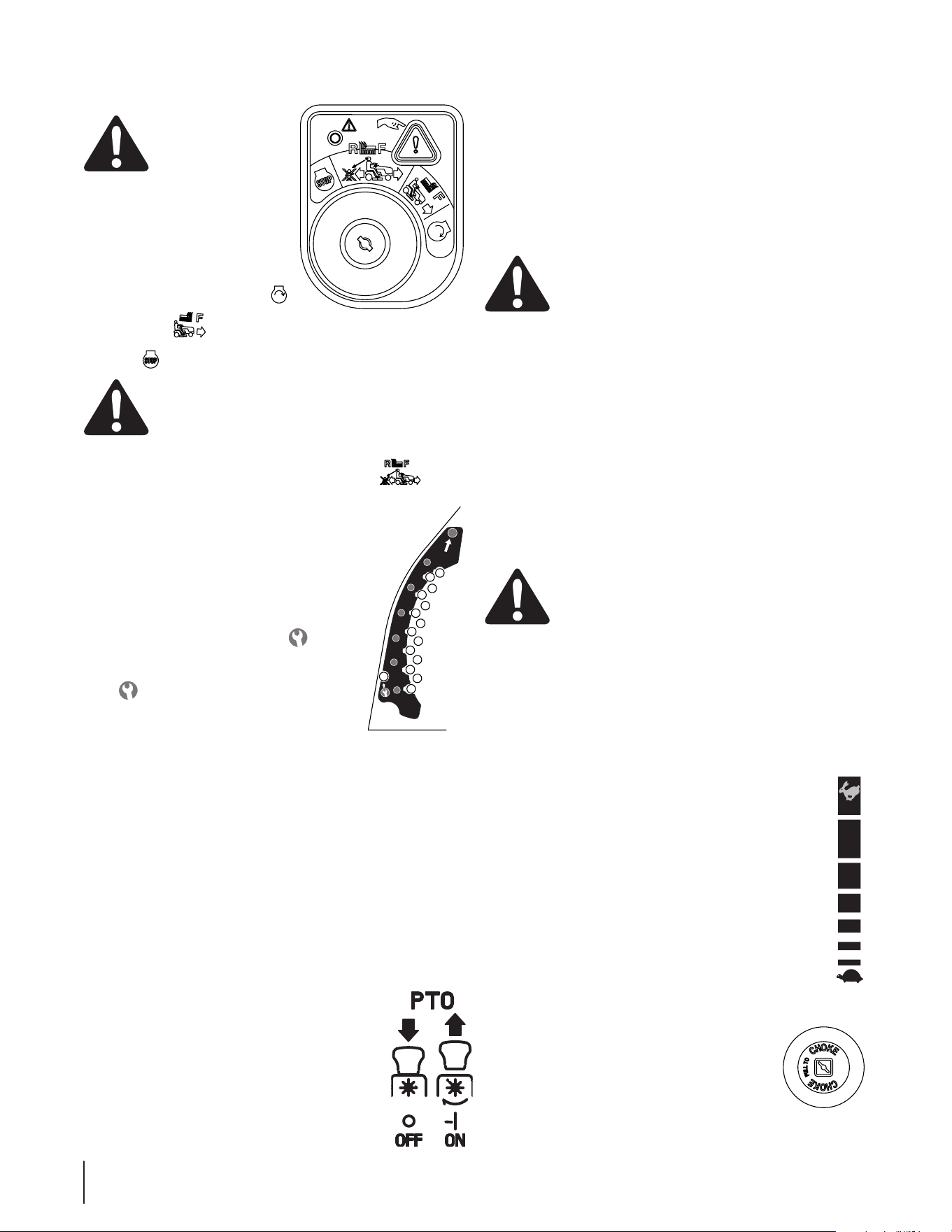
14 Sección 4 — controleS y caracteríSticaS
Módulo del interruptor de contacto
ADVERTENCIA! Nunca
deje la máquina en
funcionamiento sin
vigilancia. Siempre
desconecte la PTO, ponga
el freno de mano, pare el
motor y retire la llave, para
evitar que el motor
arranque accidentalmente.
Para arrancar el motor, inserte la llave en
el interruptor de encendido y gírela hacia
la derecha a la posición ARRANQUE
. Suelte la llave en la posición MODO DE
CORTE NORMAL cuando el motor haya arrancado.
Para detener el motor, gire la llave de encendido hacia la izquierda hasta
la posición PARADA.
PRECAUCIÓN:
Antes de hacer funcionar el tractor,
consulte tanto Interruptores de bloqueo de seguridad y
Arranque del motor en la sección Funcionamiento de este
manual para ver instrucciones detalladas sobre el módulo
del interruptor de encendido y cómo operar el tractor en
MODO DE PRECAUCIÓN MARCHA ATRÁS .
Posicionamiento de altura de la plataforma
El mecanismo de posicionamiento de altura de la
plataforma consiste en varios orificios ubicados
en el frente de la consola derecha. Cada orificio
corresponde a ⁄” de variación en la posición de la
altura de la plataforma de corte, en un rango que va
desde 1” en la muesca más baja hasta 4” en la muesca
más alta. La muesca más alta también es la posición
de transporte y la posición más baja es la posición de
extracción/instalación de la plataforma .
NOTA: No corte el césped en la posición
de extracción/instalación de la plataforma
. De lo contrario, se afecta negativamente
la vida útil de la correa.
Manija de elevación de la plataforma
La manija de elevación de la plataforma se encuentra en la parte
delantera de la consola derecha, y se utiliza para levantar y bajar la
plataforma de la cortadora de césped.
Oprima el botón que está en el extremo de la manija y empújela
hacia abajo para bajar la plataforma o tire hacia arriba para levantarla.
Una vez lograda la altura deseada, sujete el pasador en el orificio de
posicionamiento deseado y suelte el botón de la manija.
NOTA: Compruebe que la plataforma esté bien sujeta y que se
haya insertado completamente el pasador en el posicionamiento
de la altura de la plataforma. El pasador se sujeta para ayudar
a mantenerlo en su lugar y entra en los orificios ranurados del
mecanismo de posicionamiento de la altura de la plataforma.
NOTA: la manija de elevación de la plataforma siempre debe estar
por encima del pasador, nunca cuelgue la manija de elevación de
la plataforma del pasador cuando corte el césped.
Interruptor de la toma de fuerza (PTO)
El interruptor de la PTO está ubicado en la consola derecha, a la
izquierda del medidor horario/panel indicador.
El interruptor de la PTO hace funcionar el embrague eléctrico de
la PTO montado en la base del cigüeñal del motor. Tire de la perilla
del interruptor hacia arriba para enganchar el embrague de la PTO,
o empuje la perilla hacia abajo para desactivar el embrague.
Al arrancar el motor, el interruptor de la PTO debe estar en
posición "desengranada".
1.5
3
3
.
5
2
2
.
5
1"
4"
Varillas de derivación de transmisión
Las varillas de derivación de la transmisión (una para cada transmisión,
la derecha y la izquierda) están ubicadas en la parte trasera del tractor,
justo dentro de cada rueda trasera.
Cuando están engranadas, las dos varillas abren una derivación dentro
de las transmisiones hidrostáticas, lo cual permite empujar el tractor
a mano a lo largo de distancias cortas. Consulte la sección Montaje y
Configuración para obtener instrucciones sobre el uso de la función de
derivación.
PRECAUCIÓN: Nunca remolque su tractor. Si se remolca
el tractor con las ruedas traseras apoyadas en el suelo se
pueden causar daños graves a las transmisiones.
Tapones del depósito de combustible
Los tapones del depósito de combustible están cerca del medio de la
consola derecha e izquierda. Gire el tapón de llenado para retirarlo. El
tapón del combustible está amarrado al tractor para impedir que se
pierda. No intente retirar el tapón del tractor. Llene el depósito hasta la
base del cuello de llenado, dejando un poco de espacio en el depósito
para la dilatación del combustible. No llene en exceso el depósito
de combustible.
Empuje el tapón hacia abajo sobre el cuello de llenado del depósito de
combustible y gírelo hacia la derecha para ajustarlo. Siempre vuelva a
colocar el tapón de combustible bien ajustado en el depósito después
de quitarlo.
ADVERTENCIA! Nunca realice la recarga de
combustible en el depósito si el motor está en
funcionamiento. Si el motor está caliente por haber
funcionado hasta hace poco, déjelo enfriar varios minutos
antes de cargar combustible. La gasolina es muy
inflamable y podría salpicar el motor y causar un incendio.
Visores del nivel de combustible
Los visores del nivel de combustible están en la parte exterior de la
consola derecha e izquierda y muestran el nivel de combustible que
queda en el depósito.
Control del acelerador
El control del acelerador está ubicado en la consola derecha.
Cuando se lo coloca en determinada posición, se mantiene una
velocidad de motor uniforme.
Empuje la palanca de control del acelerador hacia adelante
para aumentar la velocidad del motor. El tractor está diseñado
para funcionar con el control del acelerador en posición rápida
(aceleración máxima) cuando se conduce el tractor y la plataforma
de la cortadora está activada.
Tire de la palanca de control del acelerador hacia atrás para
reducir la velocidad del motor.
Control del cebador
El control del cebador está ubicado en la consola
derecha. Dicho control determina la posición del
cebador del motor. Tire de la perilla hacia afuera para
cebar el motor; empuje la perilla hacia adentro para
abrir el cebador.
FAST
SLOW
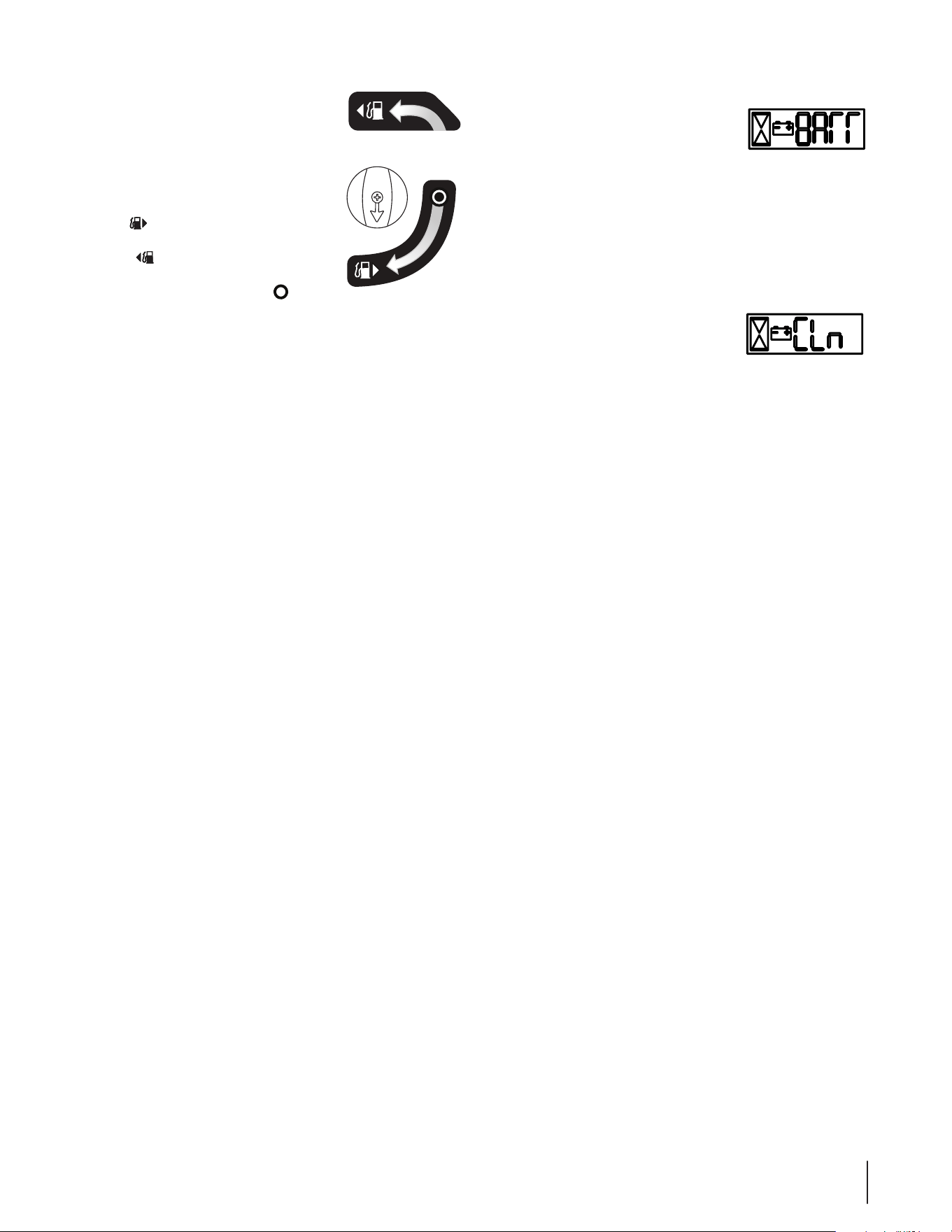
15Sección 4 — controleS y caracteríSticaS
Válvula de combustible
La válvula de combustible está en la parte
interior de la consola derecha. La válvula alterna
el flujo de combustible del tanque derecho al
izquierdo y también puede cortar el flujo de
combustible al motor. Rote la válvula hacia atrás
para abrir el flujo del tanque de combustible
derecho . Rote la válvula hacia adelante
para abrir el flujo del tanque de combustible
izquierdo . Para cortar el combustible de
ambos tanques rote la válvula hacia la derecha
del tractor y a la posición APAGADO . Vea la
sección Funcionamiento para obtener más información sobre el uso de la
válvula de combustible.
Depósito de expansión del aceite de transmisión
El depósito de expansión del aceite de transmisión está conectado
por mangueras a los conjuntos de transmisión derecho e izquierdo, y
está ubicado detrás de la caja del asiento. La función del depósito es
contener la expansión natural del aceite de transmisión que se produce
a medida que la transmisión se calienta durante el funcionamiento de la
máquina Consulte la sección Mantenimiento y Ajustes para obtener más
información sobre el depósito de expansión del aceite de la transmisión.
Avisador de servicio y medidor horario LCD
Cuando se gira la llave de encendido de la posición de parada, pero
no a la posición de arranque, el avisador de servicio y medidor horario
LCD muestra brevemente la tensión de la batería, seguido de las horas
acumuladas del tractor.
NOTA: Las horas de funcionamiento del tractor se registran cada
vez que se gira la llave de encendido de la posición de parada,
independientemente de si el motor arranca.
El avisador de servicio LCD le recuerda al operador los intervalos de
mantenimiento para cambiar el aceite del motor, el servicio del filtro de
aire, advertencias de poca presión y poca batería.
Cambiar el aceite
El LCD mostrará las letras "CHG" (cambiar), seguidas de las letras "OIL"
(aceite), seguidas de las letras "SOON" (pronto), y luego finalmente
seguidas por el tiempo acumulado del medidor. “CHG/OIL/SOON/
TIME” se alternarán en la pantalla durante 7 minutos después de que
el medidor llegue a 50 horas. Este intervalo del avisador de servicio de
aceite se producirá cada 50 horas. Antes de que finalice el intervalo,
cambie el nivel de aceite del motor según se indica en la sección
Mantenimiento de este Manual del Operador.
Baja presión de aceite
NOTA: La función Baja presión de aceite solo funciona si el motor tiene
un interruptor de presión de aceite.
Las letras “LO” (baja) seguidas de las letras “OIL” (aceite), seguidas luego
del tiempo acumulado del medidor indicarán que el tractor tiene baja
presión de aceite. Esto es común al arrancar el motor. El indicador
permanecerá activo hasta que el motor acumule suficiente presión
después de arrancar. Si el indicador permanece activo con el motor
a toda velocidad y luego de varios minutos de funcionamiento, pare
el tractor inmediatamente y compruebe el nivel de aceite del motor
según las instrucciones de este Manual del operador. Si hay poco aceite,
agregue aceite como se indica en el Manual del operador del motor. Si el
nivel de aceite es el correcto y el indicador permanece, comuníquese con
un distribuidor de servicio autorizado.
Poca batería
Al arrancar, se visualiza fugazmente el voltaje de
la batería y luego cambia a horas acumuladas.
Aparecen las letras “LO” (poca), seguidas de
las letras “BATT” (batería), seguidas luego del tiempo acumulado del
medidor. "LO/BATT/TIME" se muestra en la pantalla LCD cuando la
tensión cae por debajo de 11,5 voltios. Cuando esto ocurre, significa que
se debe cargar la batería o que el sistema de carga del motor no genera
suficiente amperaje. Cargue la batería como se indica en la sección
Servicio de este manual o haga controlar el sistema de carga por su
distribuidor de servicio local.
Mantenimiento del filtro de aceite
Aparecen las letras “CLN” (limpiar), seguidas de
las letras “AIR” (aire), seguidas por "FILT", seguidas
luego del tiempo acumulado del medidor.
“CLN/AIR/FILT/TIME” se alternarán en la pantalla
durante 7 minutos después de que el medidor llegue a 25 horas. Este
intervalo del avisador de servicio del filtro de aire será cada 25 horas.
En intervalos comunes con el servicio del aceite, aparece el mensaje del
aceite primero seguido por el mensaje del filtro de aire.

Funcionamiento
5
16
Seguridad general
• RECIBA LAS INSTRUCCIONES - Lea este manual del operador en su
totalidad. Aprenda a usar esta máquina DE MANERA SEGURA. No se
arriesgue a quedar expuesto a LESIONES o a la MUERTE. Solamente se
debe permitir operar este tractor a quienes se hayan familiarizado a
fondo con el uso del mismo.
• Antes de arrancar el motor o de empezar a operar, familiarícese con
los controles. El operador debe estar en el asiento del operador. El
interruptor de la PTO debe estar en posición desenganchado y se
deben haber movido las palancas de control de transmisión derecha e
izquierda a la posición neutral, aplicando el freno de mano.
• Mantenga todos los protectores en su lugar. Manténgase alejado de
las piezas móviles.
• ¡NO SE PERMITE TRASLADAR PERSONAS EN EL TRACTOR! Mantenga
a todas las personas y las mascotas a una distancia segura de la
máquina. Siempre mire hacia atrás y hacia abajo a ambos lados del
tractor antes de desplazarse marcha atrás.
• NO oriente la descarga de la cortadora hacia la gente. No camine ni
se detenga del lado de la descarga de la cortadora si el motor está en
marcha. Apague la toma de fuerza si otra persona se acerca mientras
está usando el tractor cortacésped.
• En lo posible evite las pendientes. Nunca opere en pendientes
mayores de 15º. Las pendientes con mayor inclinación presentan
condiciones de operación peligrosas. Los tractores pueden voltearse.
Siempre conduzca el tractor de forma transversal a la pendiente,
nunca hacia arriba y hacia abajo. En lo posible evite girar cuesta
abajo; arranque abajo y trabaje sin detenerse hasta la parte más alta.
Ponga especial cuidado y conduzca lentamente al girar cuesta abajo.
Controle la velocidad y la dirección de la máquina de radio de giro
cero “principalmente” con el control de velocidad/direccional (barra)
del lado cuesta abajo de la máquina, es decir, mantenga la barra del
lado cuesta arriba "esencialmente” en posición fija.
• Antes de dejar el asiento del operador: Desconecte la PTO, mueva las
palancas de control de la transmisión derecha e izquierda totalmente
hacia afuera en la posición punto muerto, aplique el freno de mano,
apague el motor y quite la llave de encendido. Antes de realizar el
mantenimiento o la limpieza de la máquina, espere hasta que cese
totalmente el movimiento.
• Cuando se desplace hacia adelante con el tractor cortacésped no deje
que las palancas de dirección vuelvan a la posición de punto muerto
por sí solas. Opere las palancas de control de transmisión de forma
pareja y evite realizar movimientos bruscos con las mismas al arrancar
y detenerse. Sujete bien las palancas de control.
• Tenga cuidado cuando use el tractor cortacésped cerca senderos
o caminos de grava. Detenga el movimiento de las cuchillas y del
tractor, y espere a que pasen los vehículos antes de operar a lo largo
de la ruta.
• No haga funcionar el tractor sin la plataforma de la cortadora. Si
se quita la plataforma varía el equilibrio del tractor y éste podría
voltearse.
• Evite operar en superficies de tracción inestables; tenga extrema
precaución si la superficie es resbaladiza. Retire siempre los residuos y
otros objetos del área donde se va a cortar el césped – los residuos y el
césped suelto reducen la tracción.
• Úsela solamente con luz natural o con buena luz artificial.
• Observe con cuidado para detectar pozos, cabezales aspersores y
otros peligros ocultos.
• Evite desplazarse demasiado cerca de árboles, arroyos, zanjas,
depósitos de arena y otros obstáculos.
• Reduzca la velocidad antes de girar y deténgase completamente antes
de cualquier maniobra de giro cero.
• Si golpea un objeto sólido mientras corta el césped, apague la PTO,
ponga las palancas de dirección en posición abierta de punto muerto,
mueva el acelerador a marcha lenta, aplique el freno de mano, apague
el motor y saque la llave del interruptor de encendido. Inspeccione la
máquina para ver si está dañada. Repare el daño. Compruebe que las
cuchillas estén en buenas condiciones y que los pernos de las cuchillas
estén bien apretados antes de volver a poner en marcha el motor.
• No detenga ni estacione el tractor sobre materiales combustibles tales
como pasto u hojas secas, desechos, etc.
• Mantenga la cortadora de césped y especialmente el motor y los
componentes hidráulicos limpios y sin grasa, pasto y hojas para
reducir las posibilidades de que se prendan fuego y permitir que se
enfríen de forma adecuada.
• No llene el tanque de combustible con el motor en funcionamiento o si
el mismo está caliente. Deje enfriar el motor varios minutos antes de la
recarga de combustible. Apriete el tapón de combustible con firmeza.
Control de los circuitos de bloqueo de seguridad
Controle periódicamente los circuitos de bloqueo de seguridad para estar
seguro de que funcionan adecuadamente. Si algún circuito de seguridad no
funciona según diseño, póngase en contacto con el distribuidor autorizado
para que inspeccione el tractor. NO use el tractor si algún circuito de
seguridad no está funcionando adecuadamente. Para controlar los circuitos
de seguridad proceda de la siguiente manera:
1. Tire del interruptor de la PTO hacia arriba a la posición de activación.
Gire momentáneamente el interruptor de encendido a la posición
ARRANQUE ; el motor no debería intentar arrancar.
2. Mueva las dos palancas de control totalmente hacia adentro hasta
la posición de punto muerto; luego levántelas desde el asiento del
operador. El motor debe dejar de funcionar.
3. Con las dos palancas de control totalmente hacia afuera en la posición
neutral/con el freno de mano aplicado, active la PTO. Levántelas desde
el asiento del operador; el motor se debe detener.
4. Arranque el tractor y mueva las palancas de control hacia adentro
hasta la posición de punto muerto. Enganche la PTO y mueva
ambas palancas de control lentamente hasta la posición de marcha
atrás lenta; con la llave en la posición CORTE NORMAL ; la
PTO debería desactivarse y la plataforma de la cortadora debería
detenerse.
Antes de hacer funcionar el tractor
1. Antes de hacer funcionar el tractor, lea este manual con atención
para familiarizarse con el funcionamiento de todos los instrumentos
y controles. El manual se preparó con la finalidad de ayudarlo a hacer
funcionar y mantener el tractor eficientemente.
2. Llene el depósito de combustible únicamente con gasolina sin plomo
limpia y fresca, en un surtidor que indique un octanaje igual a 87 o
más y 10% de etanol como máximo. Cuando el combustible llegue a
la altura de una pulgada de la parte superior del depósito, deténgase.
NO LLENE EL DEPÓSITO EN EXCESO. Debe quedar espacio para la
dilatación de la gasolina.
3. Se recomienda el uso de gasolina sin plomo porque deja menos
depósitos en la cámara de combustión y reduce las emisiones de
escape perjudiciales. No se recomienda el uso de gasolina con plomo;
no se la debe usar en los lugares en los cuales las emisiones de escape
se encuentran reguladas.
NOTA: Compre gasolina en pequeñas cantidades. No use gasolina que
haya quedado de la temporada anterior, para minimizar la formación
de depósitos de goma en el sistema de combustible.
4. El gasohol (hasta 10% de alcohol etílico, 90% de gasolina sin plomo
por volumen) es un combustible aprobado. No se aprueba el uso de
otras mezclas de gasolina/alcohol.
17Sección 5 — Funcionamiento
5. El éter metílico terciario-butílico (MTBE) y las mezclas de gasolina
sin plomo (hasta un máximo de 15% de MTBE por volumen) son
combustibles aprobados. No se aprueba el uso de otras mezclas de
gasolina/éter.
6. Revise el nivel de aceite del motor. Consulte el Manual del Operador
del Motor para más instrucciones sobre cómo controlar el nivel del
aceite del motor.
7. Limpie el filtro de aire si es necesario.
8. Controle la presión de inflado de los neumáticos. Consulte los laterales
de los neumáticos para averiguar las presiones de inflado adecuadas.
NOTA: Los neumáticos nuevos se inflan de forma excesiva para que el
reborde se asiente bien en la llanta.
9. Verifique que todas las tuercas, pernos y tornillos estén bien ajustados.
10. Verifique la tensión de las correas de transmisión de la plataforma.
a. Extraiga la cubierta de la plataforma
b. La tensión de las correas de la transmisión de la plataforma se
mantiene mediante un mecanismo de resorte que se ajusta
para corregir desgaste y estiramiento.
c. Examine las correas para detectar si están cortadas, raídas
y excesivamente desgastadas. Reemplácelas si se detecta
alguno de estos problemas.
d. Vuelva a colocar la cubierta de la plataforma.
11. Verifique que la plataforma esté nivelada. Cuando se encuentra
correctamente ajustada, la plataforma de corte debe estar nivelada de
lado a lado, y el frente de la plataforma debe estar aproximadamente
⁄” más bajo que la parte trasera de la plataforma. Si hace falta nivelar
la plataforma, consulte la sección Mantenimiento y Ajustes.
12. Lubrique todos los puntos de pivote indicados en la sección
Mantenimiento y Ajustes.
13. Ajuste el asiento para la mayor comodidad del operador, para una
adecuada visibilidad y para mantener el control completo del tractor.
Sistema de bloqueo de seguridad
Este tractor está equipado con un sistema de interbloqueo de seguridad para
protección del operador. Si el sistema de bloqueo funciona mal, no se debe
hacer funcionar el tractor. Contacte con su distribuidor autorizado.
• El sistema de bloqueo de seguridad evita que el motor intente
arrancar o arranque a menos que se muevan las palancas de control
de transmisión derecha e izquierda totalmente hacia afuera en
posición neutral (con lo que se aplica el freno de mano) y se desactiva
la PTO.
• El sistema de bloqueo de seguridad apaga el motor si el operador
abandona el asiento antes de que las palancas de control de
transmisión derecha e izquierda estén totalmente hacia afuera en la
posición neutral aplicando el freno de mano.
• El sistema de bloqueo de seguridad apaga el motor si el
operador abandona el asiento con la toma de fuerza activada,
independientemente de si las palancas de control de transmisión
derecha e izquierda están totalmente hacia afuera en la posición
neutral aplicando el freno de mano.
NOTA: El interruptor de la PTO se debe mover a la posición APAGADO
para volver a arrancar el motor.
• El sistema de bloqueo de seguridad apaga la toma de fuerza PTO y
las cuchillas de la cortadora se detienen si las dos palancas de control
de transmisión se mueven a la posición de marcha atrás. Para volver
a arrancar las cuchillas, se debe mover la toma de fuerza a la posición
APAGADO y luego nuevamente a la posición ENCENDIDO.
Arranque del motor
ADVERTENCIA! Esta unidad está equipada con
un sistema de bloqueo de seguridad para protección
del operador. No opere el tractor si alguna parte del
sistema de bloqueo funciona mal. Controle
periódicamente las funciones del sistema de
bloqueo para verificar que funcionen
adecuadamente.
ADVERTENCIA! Por razones de seguridad
personal, el operador debe estar sentado en el
asiento del tractor al arrancar el motor.
1. Abra la válvula de cierre de combustible seleccionando el depósito
de combustible derecho o izquierdo.
2. El operador debe estar sentado en el asiento del tractor con
las palancas de control de transmisión derecha e izquierda
totalmente hacia afuera en posición neutral aplicando el freno
de mano.
3. Verifique que el interruptor de la toma de fuerza (PTO) se
encuentre en posición desactivada (abajo).
4. Tire la perilla del cebador (si está equipada) hacia arriba a la
posición CEBADOR o mueva el control del acelerador/cebador
(si está equipado) a la posición CEBADOR.
NOTA: Si el motor está caliente, tal vez no sea necesario cebar
el motor.
5. Mueva el control del acelerador (si está instalado) a una distancia
media entre las posiciones lenta y rápida.
6. Gire la llave de encendido a la derecha a la posición
ARRANQUE. Una vez que arranque el motor, suelte la llave. Volverá
a la posición CORTE NORMAL.
PRECAUCIÓN: NO mantenga la llave en la posición
ARRANQUE durante más de diez segundos por vez. Si lo
hace, puede ocasionar daños al arrancador eléctrico
del motor.
7. Una vez que el motor se caliente, empuje la perilla del cebador
hacia abajo a la posición APAGADO.
NOTA: NO deje el control del acelerador/cebador (si está instalado)
o el control del cebador (si está instalado) en la posición
CEBADOR mientras opera el tractor. Si lo hace, se generará
una mezcla de combustible “rica”, lo cual hará que el motor no
funcione bien.
Arranque del motor en clima frío
Al arrancar el motor a temperaturas cercanas o inferiores al punto de
congelamiento, asegúrese de que se use aceite de motor de viscosidad
correcta y que la batería tenga carga completa. Arranque el motor de la
siguiente forma:
1. Asegúrese de que la batería se encuentre en buen estado. Una
batería caliente tiene una capacidad de arranque mucho mayor
que una batería fría.
2. Use combustible fresco para uso invernal. La gasolina para
uso invernal tiene mayor volatilidad a los efectos de mejorar el
arranque. No use gasolina que le haya quedado del verano.
3. Siga las instrucciones previas para Arrancar el motor.
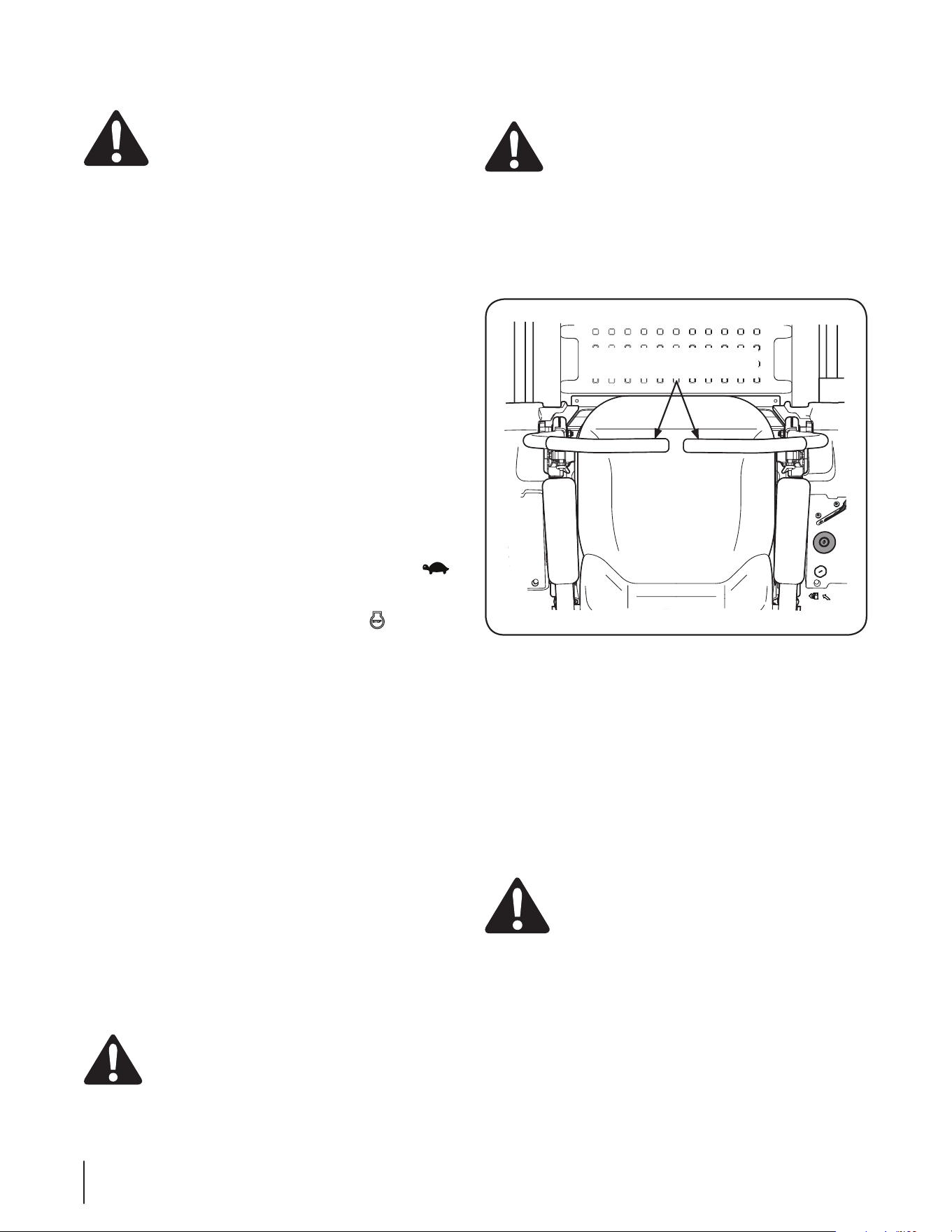
18 Sección 5 — Funcionamiento
Uso de cables de puente para arrancar el motor
ADVERTENCIA! Las baterías contienen ácido sulfúrico y
producen gases explosivos. Asegúrese de que el área esté
bien ventilada, use guantes y protectores de ojos y evite
chispas o llamas cerca de la batería.
Si la carga de la batería no es suficiente para dar arranque al motor,
vuelva a cargar la batería. Si no dispone de un cargador de batería y debe
arrancar el tractor, puede ser necesario usar una batería de urgencia.
Conecte la batería de urgencia de la siguiente forma:
1. Conecte el extremo de un cable al borne positivo de la batería
del tractor que no funciona; luego conecte el otro extremo de ese
cable al borne positivo de la batería de urgencia.
2. Conecte un extremo del otro cable al borne negativo de la batería
de urgencia; luego conecte el otro extremo de ese cable al marco
del tractor que no funciona, a la mayor distancia posible de la
batería.
3. Arranque el tractor que no funciona según las instrucciones de
arranque normales indicadas más arriba; luego desconecte los
cables de puente en orden exactamente inverso al de la conexión.
4. Haga controlar y reparar el sistema eléctrico del tractor lo más
pronto que fuere posible, para eliminar la necesidad de usar cables
de puente para arrancarlo.
Para parar el motor
1. Coloque el interruptor de la PTO en la posición APAGADO (abajo).
2. Mueva las palancas de control de transmisión derecha e izquierda
a la posición neutral aplicando el freno de mano.
3. Mueva el control del acelerador (si está equipado) o el control del
acelerador/cebador (si está equipado) a la posición LENTA y
deje que el motor funcione al ralentí durante aproximadamente
un minuto.
4. Gire la llave de encendido a la posición PARADA y retire la llave
del interruptor de encendido.
NOTA: Siempre quite la llave del interruptor de encendido para
evitar el arranque accidental o la descarga de la batería si el
equipo queda sin supervisión.
5. Cierre la válvula de paso del combustible.
Operación de práctica (uso inicial)
Operar un tractor con radio de giro cero no es lo mismo que operar un
tractor convencional. Si bien precisamente un tractor con radio de giro
cero es más maniobrable, es necesario practicar la operación de las
palancas de control para acostumbrarse a las mismas.
Se recomienda enfáticamente que encuentre un "área de práctica" de
superficie razonable, nivelada y abierta, en la cual no haya obstrucciones,
peatones ni mascotas. Debe practicar la operación del tractor durante 30
minutos por lo menos.
Lleve (o haga que alguien lleve) el tractor al área de práctica con
cuidado. Cuando esté practicando, la PTO no debe estar activada.
Mientras practica, haga funcionar el tractor a aproximadamente ⁄-⁄ de
aceleración y a menos de la velocidad máxima tanto en marcha adelante
como en marcha atrás.
Use equipo de protección para los ojos, las manos, los oídos, los pies, las
piernas, la cabeza y otras áreas del cuerpo si es necesario - anteojos de
seguridad, guantes, tapones para oídos, botas, casco, etc.
ADVERTENCIA! Se necesita protección auditiva
para toda exposición del operador que supere las
dos (2) horas.
Ejercite cuidadosamente las maniobras con el tractor, usando las
instrucciones de la sección siguiente "Conducción del tractor". Practique
hasta que se sienta confiado de poder manejar el tractor con seguridad.
Conducción del tractor
ADVERTENCIA! Evite arrancar súbitamente, desarrollar
excesiva velocidad y parar bruscamente.
1. Ajuste el asiento del operador a la posición más cómoda que le
permita operar los controles. Consulte la forma de hacerlo en la
sección Montaje y Configuración.
2. Coloque las palancas de control de transmisión derecha e
izquierda hacia adentro, en posición neutral. Consulte la
Figura 6-1.
Palancas de control colocadas
hacia adentro y en neutral
Figura 6-1
NOTA: Si las palancas de control no están niveladas en posición
neutra, consulte la Sección Mantenimiento y Ajustes ver las
instrucciones para ajustar las palancas de manera que queden
niveladas.
3. Mueva la palanca de control del acelerador (si está equipada) o la
palanca de control del acelerador/cebador hacia adelante hasta la
posición de aceleración máxima.
NOTA: Si bien el motor del tractor se ha diseñado para funcionar
a máxima aceleración, cuando practica el tractor debe funcionar a
menos del máximo. Esto se aplica únicamente al funcionamiento
del motor durante la práctica.
ADVERTENCIA! Siempre sujete las palancas de control
con firmeza. NO suelte las palancas de control para
desplazarse más despacio o para detener el tractor; lleve
las palancas a la posición de punto muerto con las manos.
4. Para conducir el tractor, tome firmemente las palancas de control
de la transmisión respectivas con las manos derecha e izquierda y
proceda con Conducción del Tractor marcha adelante, según las
instrucciones de la página siguiente.
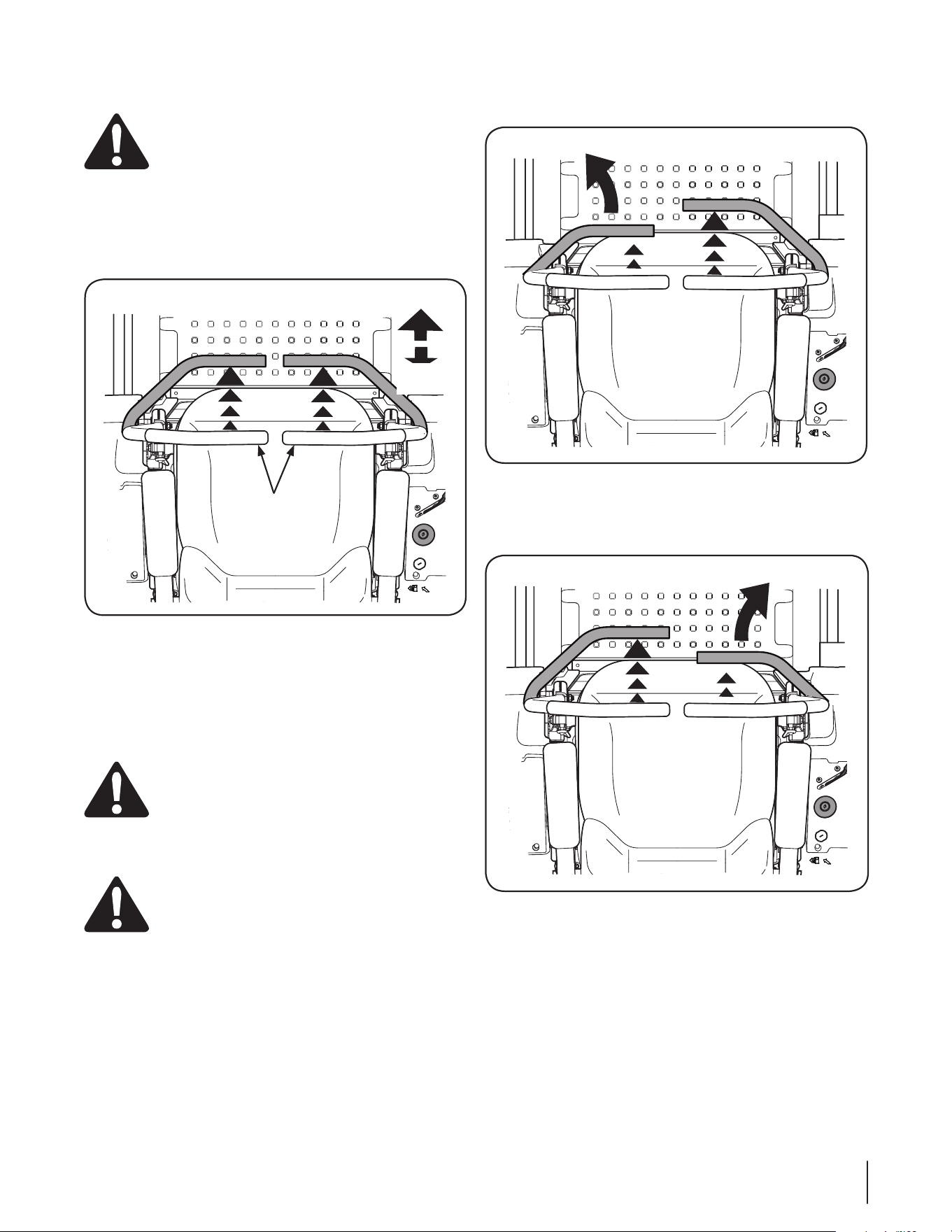
19Sección 5 — Funcionamiento
Conducción del tractor hacia adelante
ADVERTENCIA! Todos los movimientos de las palancas
de control deben ser lentos y suaves. El movimiento
abrupto de las palancas de control puede afectar la
estabilidad del tractor y podría hacer que el tractor
vuelque, con el resultado de lesiones graves o incluso la
muerte del operador.
1. Mueva las palancas de control lenta y suavemente hacia adelante.
El tractor comenzará a desplazarse hacia adelante. Vea la
Figura 6-2.
Conducción hacia adelante
Más rápido
Más
despacio
Posición
Neutral
Figura 6-2
2. A medida que las palancas de control se empujan más hacia
adelante, aumenta la velocidad del tractor.
3. Para que el tractor se desplace más lentamente, mueva la palanca
de control hacia atrás hasta alcanzar la velocidad deseada, o
coloque las palancas en la posición de punto muerto para detener
el tractor.
ADVERTENCIA! Siempre tome y sujete las palancas de
control con firmeza. No suelte las palancas para que el
tractor se desplace con mayor lentitud ni para volver a
posición de punto muerto.
Giro con el tractor en marcha adelante
ADVERTENCIA! Al invertir la dirección del
desplazamiento, le recomendamos que en lo posible
realice giros graduales en "U". Los giros más agudos
aumentan la posibilidad de que se deteriore el césped y
podrían afectar el control del tractor. Conduzca SIEMPRE el
tractor lentamente antes de girar en curvas cerradas.
Para que el tractor gire mientras se desplaza hacia adelante, mueva las
palancas de control según sea necesario para que una palanca quede
más atrás que la otra. El tractor girará en la dirección de la palanca que
queda más atrás.
1. Para girar a la izquierda, mueva la palanca de control izquierda
hacia atrás respecto de la palanca derecha. Vea la Figura 6-3.
Giro a la izquierda hacia adelante
Figura 6-3
2. Para girar a la derecha, mueva la palanca de control derecha hacia
atrás respecto de la palanca izquierda. Vea la Figura 6-4.
Giro a la derecha hacia adelante
Figura 6-4
3. Cuanto mayor sea la distancia de adelante hacia atrás entre las dos
palancas, más cerrado será el giro que dará el tractor.
4. Para realizar un "giro de pivote", mueva la palanca de control del
lado de giro a la posición neutra, mientras mueve la otra palanca
de control hacia adelante.
NOTA: Los "giros de pivote" sobre el pasto aumentan
significativamente el potencial de que se deteriore el césped.
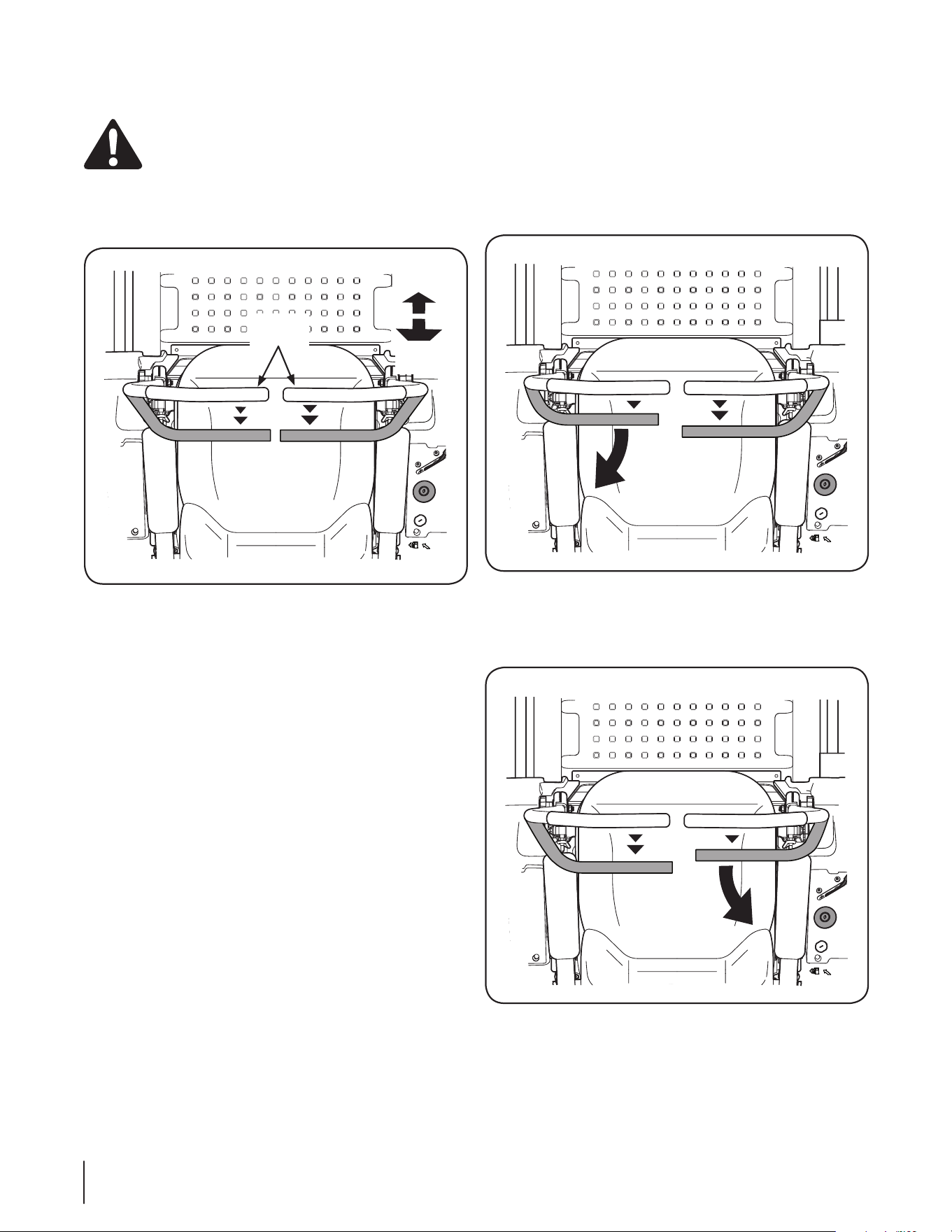
20 Sección 5 — Funcionamiento
Conducción del tractor en marcha atrás
ADVERTENCIA! Siempre mire hacia atrás y hacia abajo
a ambos lados del tractor antes de desplazarse marcha
atrás. Siempre mire hacia atrás cuando se desplaza en
marcha atrás.
1. Mueva las dos palancas de control lenta y suavemente hacia atrás.
El tractor comenzará a moverse hacia atrás. Vea la Figura 6-5.
Posición
Neutral
Más
despacio
Más
rápido
Figura 6-5
2. A medida que las palancas de control se empujan más hacia atrás,
aumenta la velocidad del tractor.
3. Para que el tractor se desplace más lentamente, mueva la palanca
de control hacia adelante hasta alcanzar la velocidad deseada, o
coloque las palancas en la posición de punto muerto para detener
el tractor.
Realizar un giro mientras se conduce marcha atrás
Para que el tractor gire mientras se desplaza hacia atrás, mueva las
palancas de control según sea necesario para que una palanca quede
más adelante que la otra. El tractor girará en la dirección de la palanca
que queda más adelante.
1. Para girar a la izquierda mientras se desplaza marcha atrás, mueva
la palanca de control izquierda hacia adelante respecto de la
palanca derecha. Vea la Figura 6-6.
Giro a la izquierda hacia atrás
Figura 6-6
2. Para girar a la derecha mientras se desplaza marcha atrás, mueva
la palanca de control derecha hacia adelante respecto de la
palanca izquierda. Vea la Figura 6-7.
Giro a la derecha hacia atrás
Figura 6-7
3. Cuanto mayor sea la distancia de adelante hacia atrás entre las dos
palancas, más cerrado será el giro que dará el tractor.
4. Para realizar un "giro de pivote", mueva la palanca de control del
lado de giro a la posición de punto muerto, mientras mueve la otra
palanca de control hacia atrás.
NOTA: Los "giros de pivote" sobre el pasto aumentan
significativamente el potencial de que se deteriore el césped.
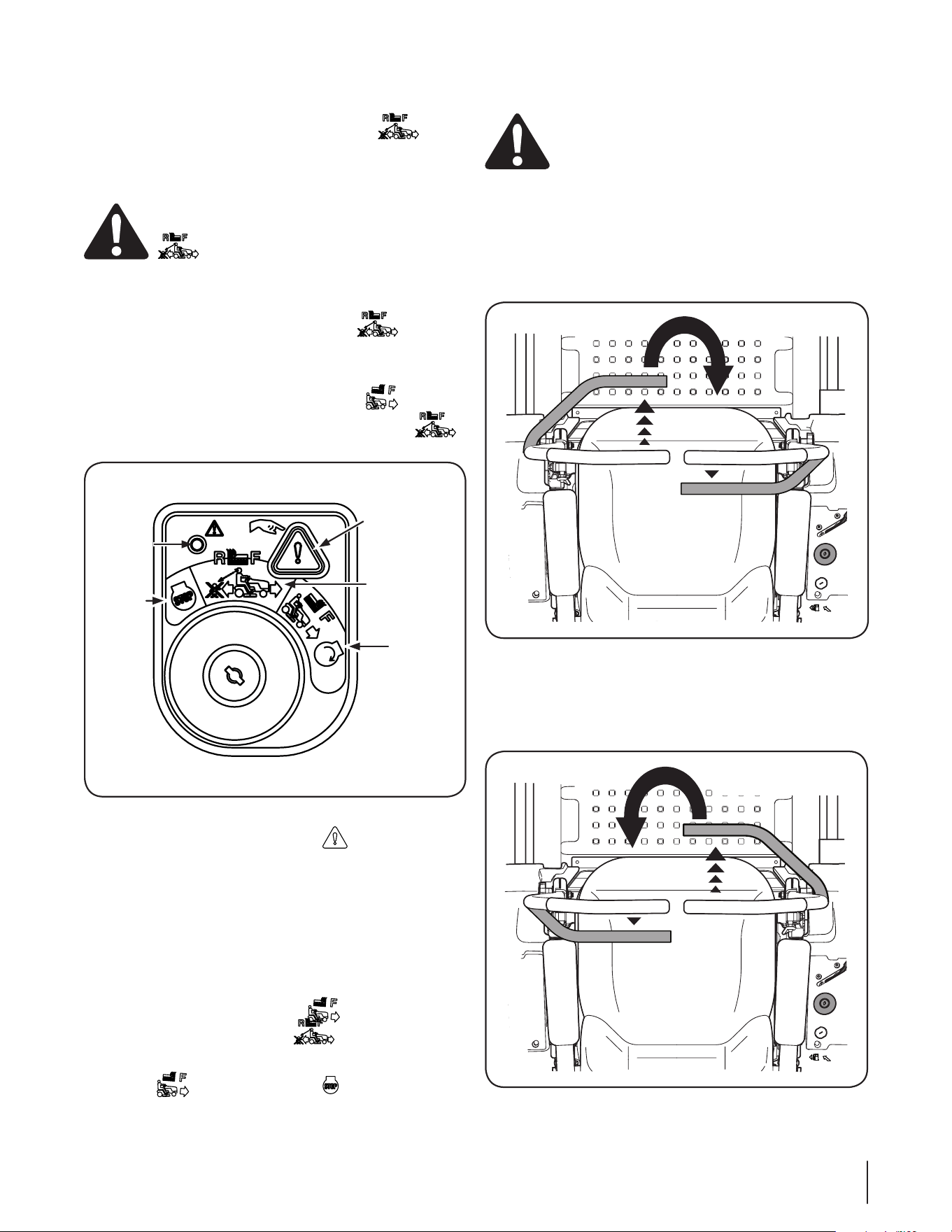
21Sección 5 — Funcionamiento
Modo marcha atrás con precaución
La posición MODO DE PRECAUCIÓN EN MARCHA ATRÁS del
módulo de la llave de contacto permite operar el tractor en marcha atrás
con las cuchillas (PTO) enganchadas.
NOTA: No se recomienda cortar el césped en marcha atrás.
ADVERTENCIA! Tenga sumo cuidado al operar el
tractor en el MODO MARCHA ATRÁS CON PRECAUCIÓN
. Mire siempre hacia abajo y detrás de usted antes
y durante la marcha atrás. No haga funcionar el tractor
cuando haya niños u otras personas cerca. Detenga el
tractor inmediatamente si alguien se acerca.
Para utilizar el MODO PRECAUCIÓN MARCHA ATRÁS :
NOTA: El operador DEBE estar sentado en el asiento del tractor.
1. Arranque el motor según las instrucciones de la página anterior.
2. Gire la llave desde la posición de PODA NORMAL (verde) hasta
la posición de MODO DE PRECAUCIÓN EN MARCHA ATRÁS
(amarillo) del módulo del interruptor de llave. Vea la Figura 6-8.
Luz
indicadora
Pulsador
marcha atrás
Posición
Parado
Posición
Arranque
Posición modo
precaución
marcha atrás
Figura 6-8
3. Presione el BOTÓN DE MARCHA ATRÁS (botón triangular de
color naranja) en la esquina superior derecha del módulo de la
llave interruptora. La luz indicadora roja en la esquina superior
izquierda del módulo del interruptor de llave se mantiene
ENCENDIDA mientras esté activado. Vea la Figura 6-8.
4. Una vez activada (luz indicadora ENCENDIDA), el tractor podrá
operar en marcha atrás con las cuchillas de corte (PTO) activadas.
5. Siempre mire hacia abajo y hacia atrás antes y mientras se
desplaza marcha atrás, para verificar que no haya niños cerca. Una
vez retomado el movimiento hacia adelante, vuelva a colocar la
llave en la posición CORTE NORMAL .
El MODO PRECAUCIÓN MARCHA ATRÁS permanece activado
hasta que:
a. La llave se coloque ya sea en la posición CORTE NORMAL
o la posición de PARADA o bien
b. El operador deja el asiento.
Giro de radio cero
ADVERTENCIA! Para realizar un giro de radio cero, el
tractor SE DEBE DETENER. La realización de un giro de
radio cero con el tractor en movimiento puede reducir
significativamente el grado de control que se tenga sobre
el mismo, y dará lugar a un grave deterioro del césped.
1. Detenga el movimiento del tractor hacia adelante o hacia atrás
colocando las dos palancas de control en punto muerto.
2. Para girar a la izquierda, mueva la palanca de control izquierda
hacia adelante mientras mueve simultáneamente la palanca de
control derecha hacia atrás. Vea la Figura 6-9.
Giro de radio cero a la derecha
Figura 6-9
3. Para girar a la izquierda, mueva la palanca de control derecha
hacia adelante mientras mueve simultáneamente la palanca de
control izquierda hacia atrás. Vea la Figura 6-10.
Giro de radio cero
a la izquierda
Figura 6-10
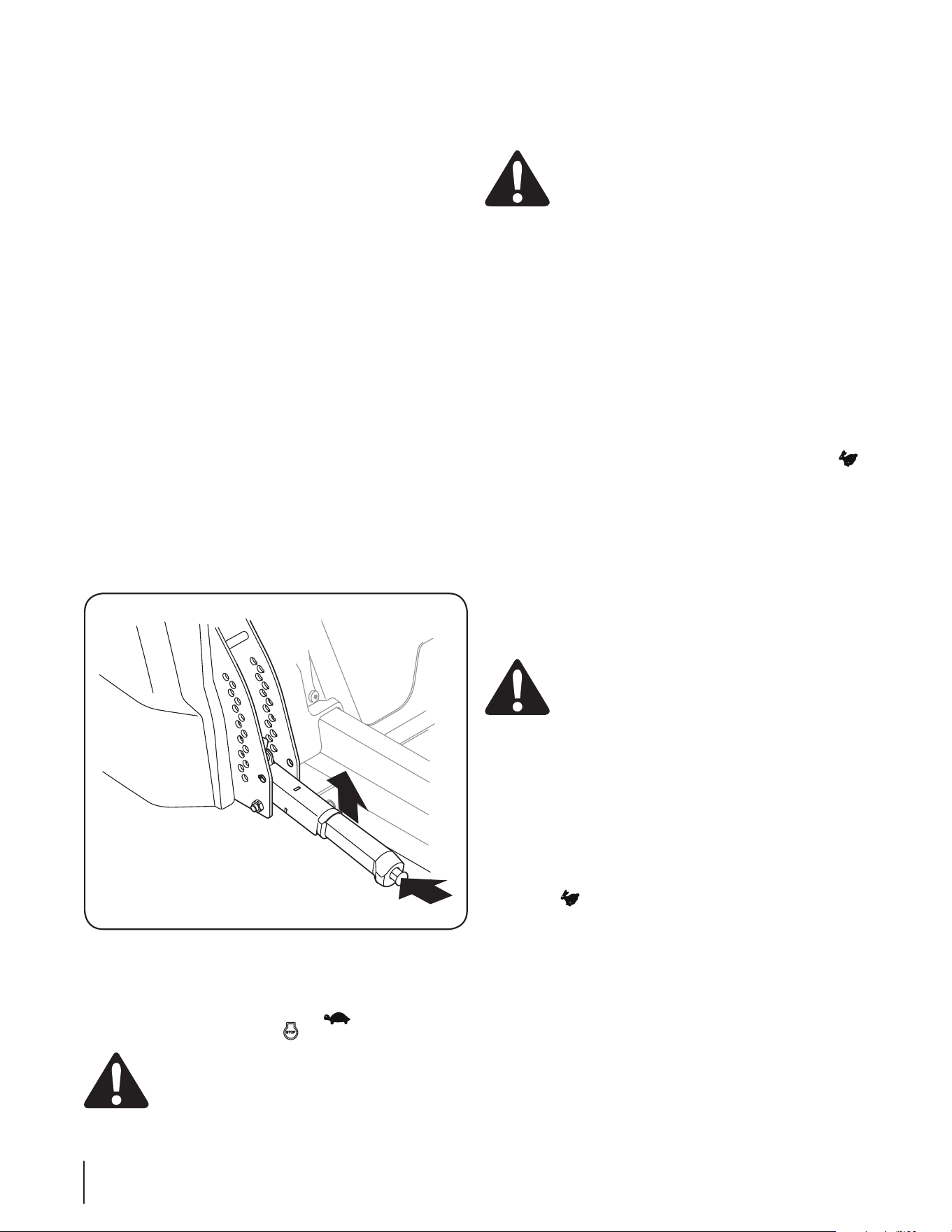
22 Sección 5 — Funcionamiento
Ejecución de una maniobra en “Y”
Cuando existen condiciones de baja tracción, realice estos
procedimientos para realizar giros de radio cero (la “maniobra en Y”):
Para girar hacia la derecha (el frente de la máquina se mueve hacia el
lado DERECHO) al desplazarse HACIA ADELANTE:
1. Detenga el tractor
2. Luego mueva lentamente las barras de seguridad hacia atrás (sin
superar la mitad de la velocidad máxima marcha atrás) para iniciar
el desplazamiento MARCHA ATRÁS,
3. Luego mueva lentamente la barra de seguridad IZQUIERDA hacia
adelante mientras mantiene la barra de seguridad DERECHA en la
posición de desplazamiento hacia atrás.
4. Para detener el giro y reiniciar el desplazamiento HACIA
ADELANTE, mueva lentamente la barra de seguridad DERECHA
de la posición de desplazamiento MARCHA ATRÁS a una posición
de desplazamiento HACIA ADELANTE igual a la de la barra de
seguridad IZQUIERDA.
5. Para girar hacia la izquierda, realice el procedimiento a la inversa.
Detención del tractor
1. Mueva las dos palancas de control a la posición de punto muerto
para detener el movimiento del tractor.
2. Presione el interruptor de la toma de fuerza (PTO) hacia abajo a la
posición desenganchada.
3. Use la manija de elevación de la plataforma para elevarla a la
posición más alta al oprimir el botón que está en el extremo de la
manija y al tirar hacia arriba. Compruebe que la traba se enganche
en el pasador. Vea la Figura 6-11.
Figura 6-11
4. Si desciende del tractor, mueva las palancas de control totalmente
hacia afuera en la posición de punto muerto, activando el freno de
mano, mueva la palanca de control del acelerador a la posición de
aceleración intermedia o posición LENTA y gire el interruptor de
encendido a la posición PARADA y retire la llave del interruptor.
ADVERTENCIA! Para abandonar el asiento del tractor
primero debe desactivar la PTO; colocar las palancas de
control de transmisión totalmente hacia afuera en posición
neutral y aplicar el freno de mano. Si deja el tractor sin
vigilancia, apague el motor girando la llave de encendido
y retírela.
Conducción en pendientes
Consulte indicador de pendiente en la Sección Funcionamiento Seguro para
determinar en qué pendientes no puede operar el tractor de manera segura.
ADVERTENCIA! No utilice la unidad en pendientes con
una inclinación mayor de 15º (elevación aproximada de 2-⁄
pies cada 10 pies). El tractor podría darse vuelta y causar
lesiones graves.
1. Siempre conduzca el tractor de forma transversal a la
pendiente, nunca hacia arriba y hacia abajo. Controle la velocidad y la
dirección del tractor usando principalmente la palanca de control del
tractor del lado 'cuesta abajo', mientras que la palanca de control del
lado 'cuesta arriba' permanece esencialmente fija.
2. En lo posible evite girar cuesta abajo. Comience en la base de la
pendiente y opere cuesta arriba. Siempre reduzca la velocidad antes
de dar la vuelta.
3. Ponga especial cuidado y conduzca lentamente al girar cuesta abajo.
Activación de la PTO
Enganche el embrague de la toma de fuerza (PTO) de la siguiente forma:
NOTA: Durante el período de ablande inicial de la unidad para activar la
PTO y evitar que el motor se cale, permita que el motor se caliente antes de
enganchar la PTO. El período de ablande varía según el motor.
1. Mueva la palanca de control del acelerador a la posición RÁPIDO .
2. Tire del interruptor de la PTO hacia arriba a la posición ACTIVADO.
3. El operador debe permanecer sentado en el tractor en todo momento.
Si el operador debe abandonar el asiento sin desactivar la toma de
fuerza, se apagará el motor del tractor.
4. No se puede utilizar el embrague de la PTO cuando el tractor se
desplaza marcha atrás. La PTO se desactivará cuando se desplazan
ambas palancas de control de la transmisión hasta la posición de
marcha atrás y volverá a activarse cuando se desplace una (o ambas)
palanca de control a la posición neutral o de marcha adelante.
Corte de césped
ADVERTENCIA! Asegúrese de que el área donde se va a
cortar esté libre de desechos, ramitas, piedras, cables u otros
objetos que puedan ser arrojados por las cuchillas rotativas.
NOTA: No active la plataforma de corte cuando esté baja
sobre el pasto. Se produce el desgaste prematuro y la posible
falla de la correa en "V" y del embrague de la toma de fuerza (PTO). Antes
de activar la plataforma de corte, levante totalmente la plataforma o lleve la
máquina a un área donde no haya césped.
1. Corte de forma transversal a la pendiente, no hacia arriba ni hacia
abajo. Si corta el césped en pendiente, comience por la base
y desplácese hacia arriba para asegurar que siempre se gire
cuesta arriba.
2. Al realizar la primera pasada elija un punto del lado opuesto al área
a cortar.
3. Active la PTO y mueva el control del acelerador a la posición
RÁPIDO .
4. Baje la plataforma de corte al ajuste de altura deseado usando la
manija de elevación de la plataforma.
5. Empuje las palancas de control derecha e izquierda lentamente y de
forma pareja hacia adelante para que el tractor avance hacia adelante,
y mantenga la orientación del tractor en línea recta hacia el punto
de alineación.
NOTA: La velocidad del tractor afecta la calidad del corte que realiza
la cortadora. Si realiza el corte a máxima velocidad la calidad se ve
afectada negativamente. Controle la velocidad absoluta con las
palancas de control.
6. Cuando se acerque al otro extremo de la franja, reduzca la velocidad o
pare antes de girar. Se recomienda realizar un giro en U a menos que
sea necesario realizar un giro de radio cero.
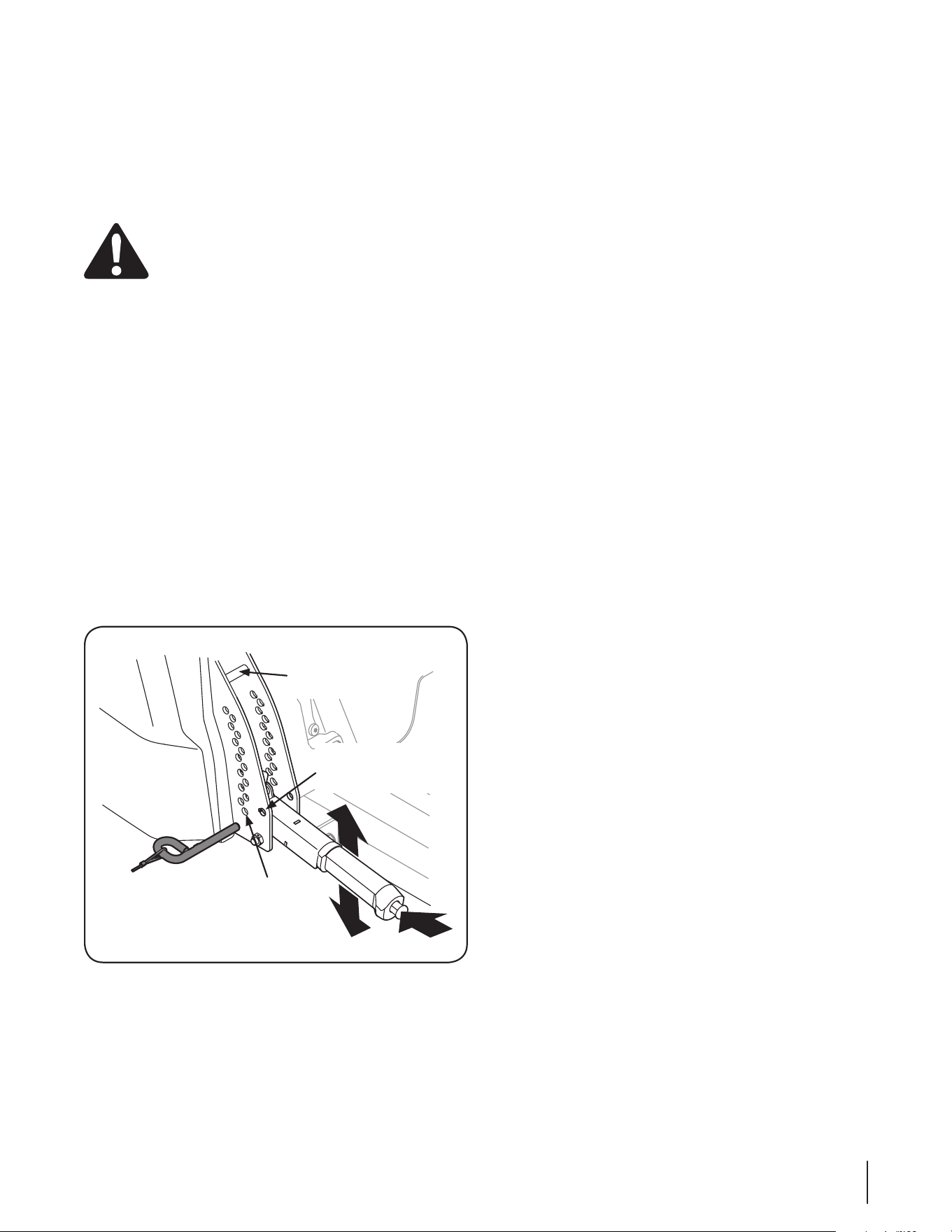
23Sección 5 — Funcionamiento
7. Alinee la cortadora de césped con un borde de la franja cortada y
superponga la pasada aproximadamente 3 pulgadas.
8. Oriente el tractor en cada franja subsiguiente de modo que se
alinee con la franja ya cortada.
9. Para evitar la formación de surcos o ranuras en el césped, en lo
posible varíe la dirección de las franjas de corte aproximadamente
45º en cada corte subsiguiente.
ADVERTENCIA! Tenga sumo cuidado al atravesar
senderos de grava o caminos de acceso. Desactive la toma
de fuerza (PTO) y levante la plataforma hasta la posición
más alta antes de cruzar.
NOTA: Siempre que detenga el tractor por cualquier razón en un
área de césped, haga lo siguiente:
• Coloque las palancas de control en la posición de punto
muerto/con freno de mano aplicado,
• Apague el motor y retire la llave.
• Eso permitirá reducir al mínimo la posibilidad de que su
césped resulte "quemado" por el escape caliente del motor
en funcionamiento.
Palanca de elevación de la plataforma
Para levantar o bajar la plataforma de corte, oprima el botón que
está en el extremo de la manija y empújela hacia abajo para bajar la
plataforma o tire hacia arriba para levantarla, luego ubíquela en el
orificio más adecuado para su aplicación. Para ubicar la plataforma en
la posición de transporte, eleve la manija completamente y enganche
el gancho superior en la palanca del espaciador superior del soporte de
posicionamiento de la altura de la plataforma. Vea la Figura 6-12.
Posición de transporte/
Posición de
corte más alta
Posición de corte
más baja
Posición de extracción/
instalación de la
plataforma
Figura 6-12
NOTA: Compruebe que la plataforma esté bien sujeta y que se
haya insertado completamente el pasador en el posicionamiento
de la altura de la plataforma. El pasador se sujeta para ayudar
a mantenerlo en su lugar y entra en los orificios ranurados del
mecanismo de posicionamiento de la altura de la plataforma.
NOTA: la manija de elevación de la plataforma siempre debe estar
por encima del pasador, nunca cuelgue la manija de elevación de
la plataforma del pasador cuando corte el césped.

Mantenimiento y Ajustes
6
24
Programa de Mantenimiento
Antes de
cada uso
Después de
las primeras
5 horas
Cada 10
horas
Cada 25
horas
Cada 50
horas
Cada 100
horas
Antes de
almacenar
Consulte el
manual del
motor
Revise el ltro de admisión/limpie si corresponde
P P
Revise y limpie de residuos los ventiladores de refrigeración del motor
P P
Revise el nivel de aceite del motor.
P
Revise si el ltro de aire está sucio, ojo o tiene piezas dañadas
P
Limpie las ranuras de enfriamiento de la transmisión
P
Limpie los bornes de la batería
P P
Engrase todos los puntos de lubricación
P P
Revise las cuchillas/ale o reemplace si corresponde
P P
Revise la presión de los neumáticos
P P
Lubrique las ruedas delanteras
P P
Revise/limpie la parte de abajo de la plataforma
P
Inspeccione y lubrique las ruedas de la plataforma
P P
Revise el nivel/inclinación de la plataforma
P P
Lubrique husillos de la plataforma
P P
Revise las correas y poleas viendo se están dañadas/gastadas
P
Compruebe que todo el hardware está en su lugar y asegurado
P
Controle el estado y la separación de la bujía de encendido
P P P
Cambio del aceite del motor de ablande
P P
Cambie el aceite del motor
P P P
Reemplace el ltro de aceite
P P P
Limpie o cambie el ltro de aire
P P
Reemplace el ltro de combustible
P P
Haga revisar y ajustar la holgura de la válvula *
P
* -- Solicite a un distribuidor de servicio autorizado que realice este servicio
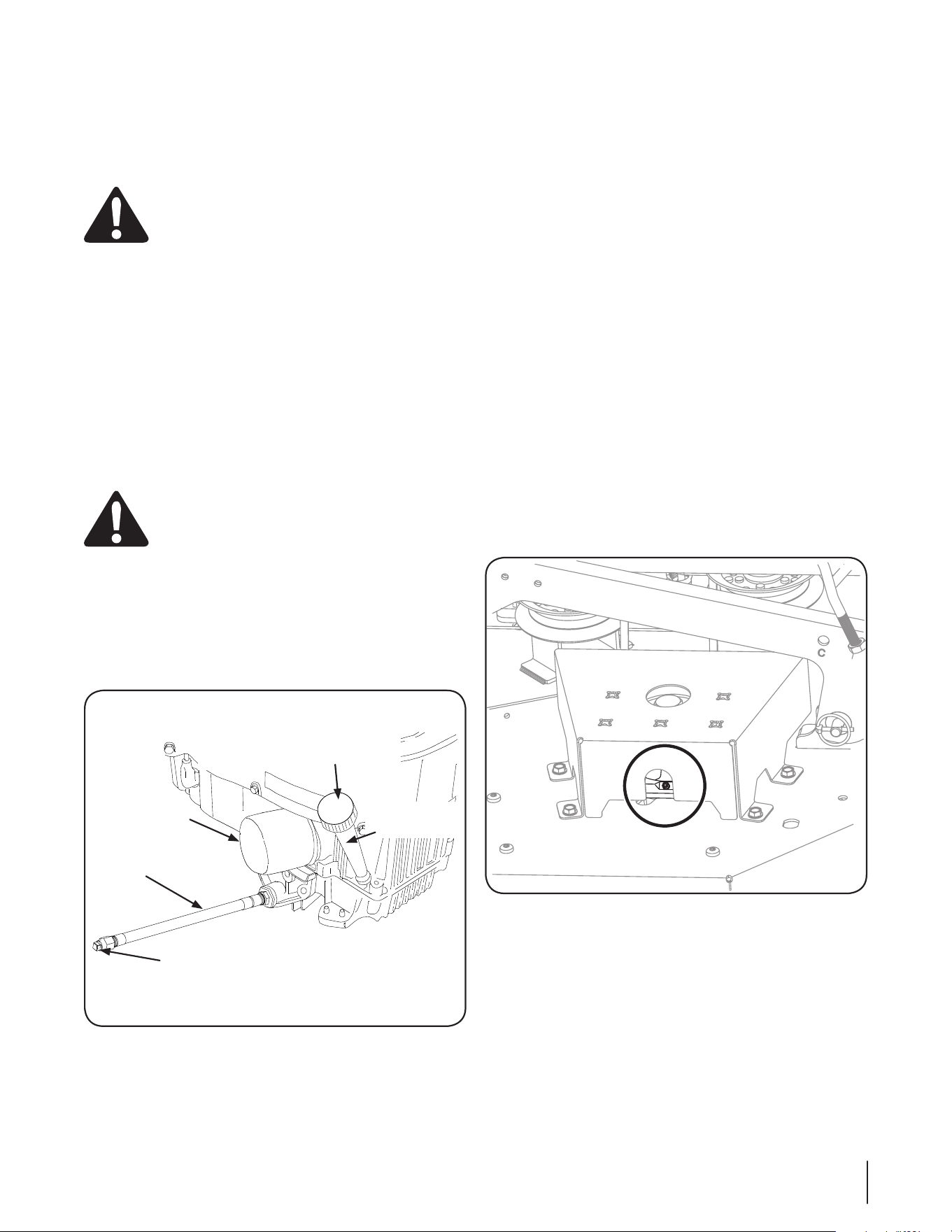
25Sección 6 — ManteniMiento y ajuSteS
NOTA: Este manual de operación, corresponde a numerosos modelos. Las
características del tractor pueden variar según los modelos. No todas las
características que se incluyen en este manual se aplican a todos los modelos
de tractor y la máquina que se ilustra aquí puede diferir de la suya.
Mantenimiento
ADVERTENCIA!
Antes de realizar tareas de
mantenimiento o reparaciones, desconecte la toma de
fuerza (PTO), mueva las palancas de control totalmente
hacia afuera a la posición neutral enganchando el freno de
mano, pare el motor y saque la llave para evitar arrancar el
motor accidentalmente.
Motor
Consulte las instrucciones y procedimientos de mantenimiento del
motor en el manual del operador del motor.
NOTA: El mantenimiento, reparación o reemplazo de los
dispositivos y sistemas del control de emisiones, que corre por
cuenta del cliente, puede realizarlo cualquier establecimiento o
individuo especializado en reparaciones de motores.
Los arreglos en garantía deben ser realizados por
un distribuidor autorizado.
Cambio de aceite del motor
ADVERTENCIA!
Si el motor ha estado en
funcionamiento recientemente, el motor, el silenciador y
las superficies metálicas circundantes estarán calientes y
pueden causar quemaduras en la piel. Tenga precaución
para evitar quemaduras.
Para realizar el cambio de aceite, proceda de la siguiente manera:
1. Haga funcionar el motor por un período corto para calentar el
aceite del motor. El aceite fluirá mejor y limpiará las impurezas.
Tenga cuidado y evite quemarse con el aceite caliente.
2. Ubique la manguera de drenaje de aceite del lado derecho del
motor. Vea la Figura 7-1.
Filtro de aceite
Tapón de llenado/Varilla de
medición de nivel de aceite
Tubo de llenado
de aceite
Manguera de drenaje
de aceite
Tapón de cabeza cuadrada
de la manguera
Figura 7-1
3. Coloque el extremo libre de la manguera de drenaje de aceite en
un depósito de recolección de aceite adecuado que posea una
capacidad de por lo menos 2.5 cuartos de galón (2.4 litros) para
recoger el aceite usado. Retire el tapón de llenado de aceite/la
varilla de nivel de aceite del tubo de llenado.
4. Mientras sostiene el extremo libre de la manguera de drenaje de
aceite sobre el recipiente de recolección de aceite, desatornille el
tapón de la manguera del extremo de la manguera. Vea la Figura
7-1. Drene el aceite del motor dentro del recipiente.
5. Una vez que haya drenado el aceite, limpie el aceite residual de
la manguera de drenaje. Enrosque el tapón de cabeza cuadrada
dentro del accesorio de la manguera de drenaje y apriete el tapón
por completo.
6. Vuelva a colocar el filtro de aceite y cargue el motor con aceite
nuevo según las instrucciones del manual de operador del motor.
Lubricación
• Con una pistola de lubricación a presión, engrase los ejes de las
ruedas pivotantes delanteras cada 10 horas de servicio.
• Lubrique periódicamente todos los otros puntos de pivote con un
aceite lubricante de calidad.
Limpieza y lubricación de las poleas del husillo
Una vez por mes retire las cubiertas de la correa para quitar cualquier
acumulación de recortes de césped que haya alrededor de las poleas del
husillo y de la correa en 'V'. Limpie con mayor frecuencia si corta césped
alto y seco.
Cada 25 horas, lubrique los husillos de la plataforma. Ubique los
accesorios de lubricación de los husillos y, con una pistola de engrase,
lubrique los husillos. El husillo tiene capacidad para 2.3 onzas de grasa.
Vea la Figura 7-2.
Figura 7-2
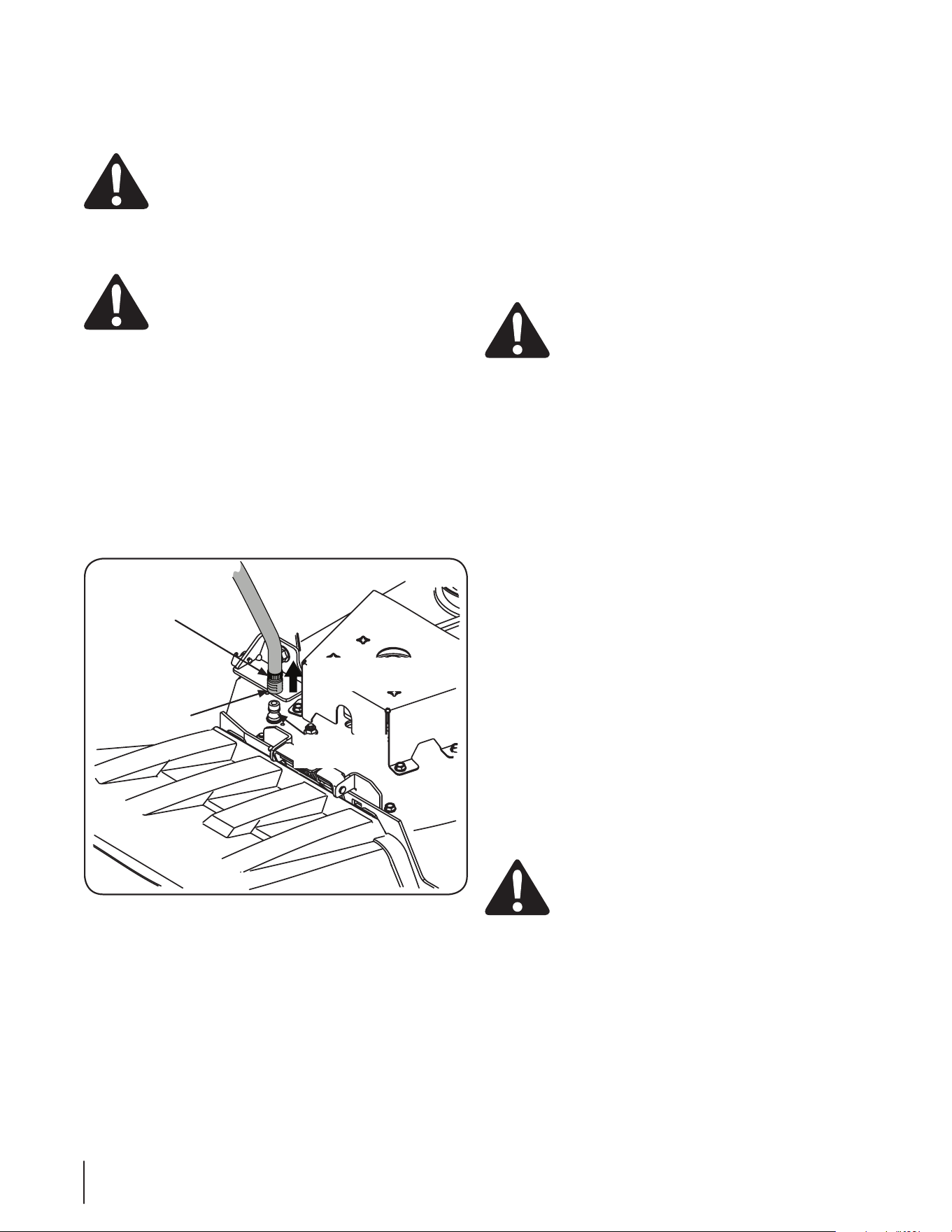
26 Sección 6 — ManteniMiento y ajuSteS
Limpieza de las ranuras de enfriamiento de la transmisión
Mantenga ambos lados de las ranuras de enfriamiento de la transmisión
entre el motor y la caja del asiento libre de recortes de césped y hojas.
ADVERTENCIA! Si el motor ha estado en
funcionamiento recientemente, el motor, el silenciador y
las superficies metálicas circundantes estarán calientes y
pueden causar quemaduras en la piel. Tenga precaución
para evitar quemaduras.
Uso del sistema de lavado de la plataforma
ADVERTENCIA! Cuando use el sistema de lavado de la
plataforma, nunca enganche la plataforma desde otra
posición que no sea la del asiento del operador del tractor.
No use un asistente ni active la plataforma en presencia de
ningún observador.
1. Una el adaptador del pico a una manguera de jardín estándar
conectada al suministro de agua.
2. Desplace el tractor a un área al alcance de la manguera, en la cual
la dispersión de recortes de pasto húmedo sea aceptable para
usted. Desconecte la toma de fuerza (PTO), aplique el freno de
mano y detenga el motor.
3. Tire hacia atrás el collarín de ajuste del adaptador del pico
y empuje el adaptador hacia uno de los picos de lavado de
plataforma de cualquiera de los dos extremos de la plataforma
de corte. Suelte el collarín de ajuste para trabar el adaptador en el
pico. Vea la Figura 7-3.
Adaptador de
boquilla
Collarín de ajuste
del adaptador
Tire del collarín
de ajuste hacia atrás
Boquilla del lavado
de la plataforma
Figura 7-3
4. Abra el suministro de agua.
5. Desde el asiento del operador del tractor, encienda el motor y
enganche la toma de fuerza (PTO). Deje funcionar según sea
necesario. Desactive la PTO y pare el motor.
6. Cierre el suministro de agua.
7. Tire del collarín de ajuste del adaptador del pico hacia atrás para
desconectar el adaptador del pico.
8. Repita los pasos anteriores para limpiar la plataforma usando el
pico del otro extremo de la plataforma.
Neumáticos
Controle la presión de aire de los neumáticos cada 50 horas de operación
o una vez por semana. Mantenga los neumáticos inflados a las presiones
recomendadas. El inflado inadecuado de un neumático reduce su vida útil.
Consulte los laterales de los neumáticos para averiguar las presiones de
inflado adecuadas. Respete las siguientes pautas:
• No infle los neumáticos por encima de la presión máxima que se
muestra en el lateral del neumático.
• No vuelva a inflar un neumático que se ha utilizado desinflado o
desinflado en extremo. Un gomero calificado debe inspeccionar y
reparar el neumático.
Información general sobre la batería
ADVERTENCIA!
• En caso de que se produzca una salpicadura accidental
de ácido en los ojos o la piel, enjuague el área afectada
inmediatamente con agua limpia fría. Si tiene algún malestar
adicional, consulte un médico inmediatamente.
• Si el ácido salpica la ropa, en primer lugar dilúyalo con agua
limpia, luego neutralícelo con una solución de agua/amoníaco
o bicarbonato/agua.
• NUNCA conecte (o desconecte) las abrazaderas del
cargador de la batería a la batería si el cargador está
encendido, ya que puede causar chispas.
• Mantenga todas las fuentes de combustión (cigarrillos,
cerillas, encendedores) lejos de la batería. El gas generado
durante la carga puede ser combustible.
• Como precaución adicional, cargue la batería únicamente
en un área bien ventilada.
• Siempre proteja sus ojos y su piel y vestimenta cuando
trabaje cerca de baterías.
• Las baterías contienen ácido sulfúrico y pueden producir
gases explosivos. Tenga extremo cuidado cuando manipule
baterías. Mantenga las baterías lejos del alcance de los niños.
Mantenimiento de la batería
• La batería se llena con ácido de batería y se sella en fábrica. Sin
embargo, para asegurar un ciclo de vida adecuado es necesario
realizar cierto mantenimiento en la batería, aún en el caso de las
baterías 'sin mantenimiento'.
• Rocíe los bornes y el cable expuesto con un sellador de bornes de
batería, o recubra los bornes con una capa delgada de grasa o vaselina
para protegerlos contra la corrosión.
• Siempre mantenga limpios y libres de corrosión los cables y los bornes
de la batería.
• Evite inclinar la batería. Hasta una batería sellada pierde electrolito si
se la inclina.
ADVERTENCIA! Las baterías contienen ácido sulfúrico y
pueden producir gases explosivos. Tenga extremo cuidado
cuando manipule baterías. Mantenga las baterías lejos del
alcance de los niños.
Almacenamiento de la batería
1. Cuando el tractor se guarda durante períodos prolongados,
desconecte el cable negativo de la batería. No es necesario retirar la
batería.
2. Todas las baterías se descargan durante el almacenamiento. Mantenga
el exterior de la batería limpio, especialmente la parte superior. Una
batería sucia se descarga con mayor rapidez.
3. La batería debe guardarse con carga completa. Una batería
descargada se puede congelar más pronto que una batería cargada.
Una batería con carga completa se guarda por más tiempo en
temperaturas frías que en temperaturas altas.
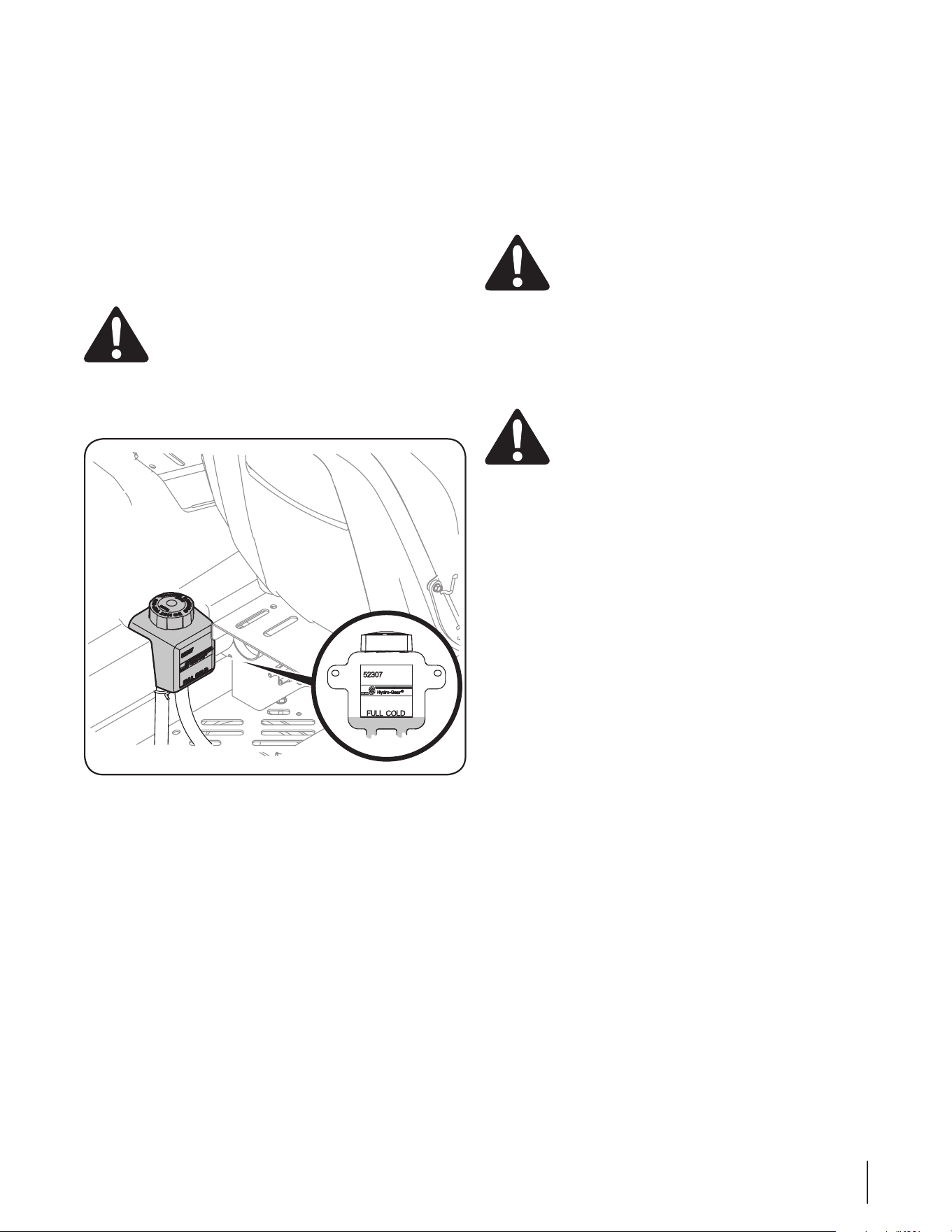
27Sección 6 — ManteniMiento y ajuSteS
4. Vuelva a cargar la batería antes de volver a ponerla en servicio.
Aun cuando el tractor pueda arrancar, el sistema de carga del
motor tal vez no recargue totalmente la batería.
Transmisión hidrostática
Su tractor con radio de giro cero está equipado con bombas
hidrostáticas integradas dobles/ transejes que están sellados y
no necesitan mantenimiento. Sin embargo, este modelo está
equipado con un depósito de expansión de aceite de transmisión.
En condiciones operativas normales, no es necesario controlar el
nivel de aceite del depósito de expansión y no hace falta aceite
adicional. Si controla el nivel de aceite de ese depósito, proceda
de la siguiente manera:
ADVERTENCIA! Controle el nivel de aceite
ÚNICAMENTE antes de arrancar el tractor cuando el
aceite de transmisión está totalmente refrigerado.
1. Gire el asiento del operador hacia adelante y limpie la tapa
del depósito y el área que la rodea para evitar que el aceite
de transmisión se contamine con residuos. Vea la Figura 7-4.
Figura 7-4
2. Gire la tapa del depósito en sentido contrario al de las
agujas del reloj para retirarla, luego controle el nivel de
aceite del depósito. El aceite debe ser visible en la base
de la cubeta, pero el nivel del mismo NO debe estar por
encima de la línea de “LLENO FRÍO”. Vea la Figura 7-4. NO
LLENE EL DEPÓSITO.
3. Si es necesario agregar aceite a causa de algún tipo de
pérdida, use aceite para motor de calidad 20W50 y agregue
solamente la cantidad suficiente para llevar el nivel a la
línea de “LLENO FRÍO”. Vuelva a colocar el tapón y ajústelo
completamente.
NOTA: Antes del funcionamiento inicial del tractor, el nivel
de aceite del depósito puede estar levemente por encima
del máximo debido al aire que hay en las líneas de aceite. El
funcionamiento del tractor finalmente purgará el aire de las
líneas y el nivel de aceite se estabilizará en el máximo.
Almacenamiento del tractor
Si el tractor no a va a funcionar por un período prolongado (desde treinta
días hasta aproximadamente seis meses), se lo debe preparar para el
almacenamiento. Guarde el tractor en un lugar seco y protegido. Si lo guarda
afuera, cúbralo (incluidos los neumáticos) para protegerlo de los fenómenos
climáticos. Cada vez que se prepara el tractor para dejarlo fuera de uso se
deben realizar los procedimientos descriptos más abajo.
1. Cambie el aceite y filtro de motor según las instrucciones
suministradas en el manual del motor entregado con este manual.
ADVERTENCIA!
Nunca guarde el tractor con
combustible en el depósito en un lugar cerrado o con escasa
ventilación, donde los gases del combustible pueden generar
fuego, chispas o encender una luz piloto como la de hornos,
calentadores de agua, secadores de ropa, etc.
2. Si guarda el tractor por 30 días o más:
a. Para evitar que se formen depósitos de goma dentro del
carburador del motor y posibles desperfectos en el motor, el
sistema de combustible debe ser vaciado completamente, o
se debe tratar la gasolina con un estabilizador para evitar el
deterioro.
ADVERTENCIA!
El combustible que queda en el
depósito se deteriora y causa graves problemas de arranque.
b. Uso de un estabilizador de combustible como el STA-BIL® para
almacenar entre 30 y 90 días:
• Lea las instrucciones y recomendaciones del fabricante
del producto.
• Agregue a la gasolina limpia y fresca la cantidad
correcta de estabilizador según la capacidad
(aproximadamente 3 galones) del sistema de
combustible.
• Llene el depósito de combustible con combustible
tratado y haga funcionar el motor 2-3 minutos para
estabilizar el combustible dentro del carburador.
c. Vaciado del sistema de combustible para almacenamiento de
más de 90 días:
• Antes de guardar el tractor, observe el consumo de
combustible a los efectos de hacer funcionar el tractor
hasta que el depósito esté vacío.
• Haga funcionar el motor hasta que comience a
detenerse. Use el cebador para mantener el motor en
funcionamiento hasta que se haya agotado todo el
combustible del carburador.
• Drene el combustible del recipiente del carburador,
consultando el manual del motor.
3. Limpie perfectamente el motor y toda la unidad.
4. Cargue totalmente la batería, luego desconecte el cable negativo de
la batería para evitar posibles descargas. Vuelva a cargar la batería
periódicamente durante el almacenamiento.
NOTA: Retire la batería si está expuesta a períodos prolongados
de temperaturas inferiores al congelamiento. Guarde en un lugar
fresco y seco, donde las temperaturas estén por encima del punto de
congelamiento.
5. Lubrique todos los puntos de lubricación.
NOTA: No se recomienda el uso de una lavadora de presión ni de
una manguera de jardín para limpiar el tractor. Puede dañar los
componentes eléctricos, los husillos, las poleas, los rodamientos o el
motor. El uso de agua acortará la vida útil de la máquina y reducirá su
capacidad de servicio.
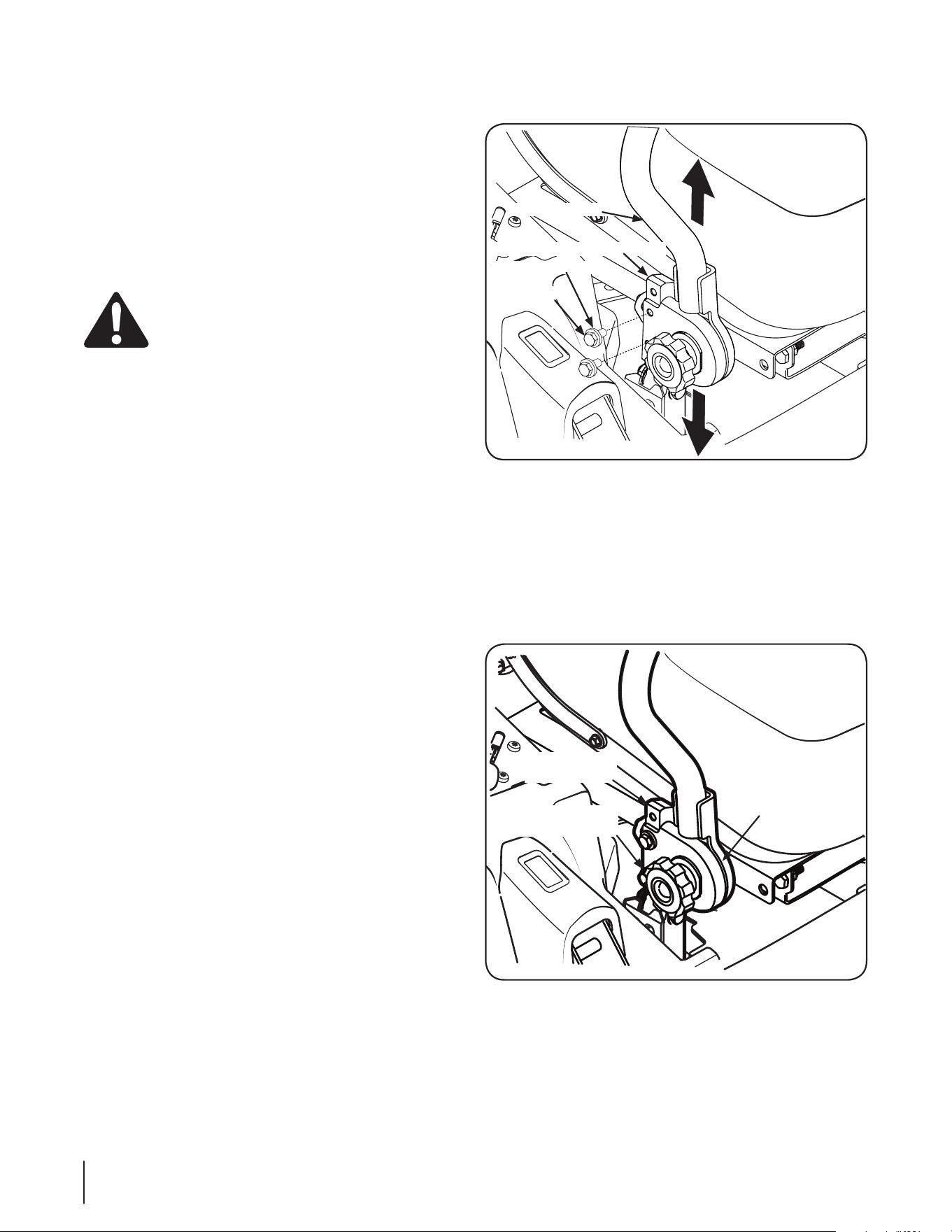
28 Sección 6 — ManteniMiento y ajuSteS
Retiro del tractor del lugar de guarda
1. Controle el nivel de aceite de motor.
2. Cargue totalmente la batería e infle los neumáticos a la presión
recomendada.
3. Llene el depósito de combustible con gasolina limpia y nueva.
4. Arranque el motor y déjelo andar en ralentí unos cuantos minutos
para asegurar que su funcionamiento sea adecuado.
5. Conduzca el tractor sin carga para estar seguro de que todos los
sistemas del tractor funcionan correctamente.
Ajustes
ADVERTENCIA!
Apague el motor, retire la llave de
encendido y coloque el freno de mano antes de realizar
ajustes. Proteja sus manos utilizando guantes reforzados
cuando manipule las cuchillas.
Ajuste de las palancas de control de la transmisión del lado
derecho y del lado izquierdo
Las palancas de control de la transmisión del lado derecho y del lado
izquierdo se pueden ajustar hacia arriba o hacia abajo y hacia adelante
y hacia atrás para proporcionar comodidad al operador. Las palancas de
control de transmisión se pueden colocar en una de dos posiciones de altura,
y/o se pueden desplazar hacia adelante o hacia atrás. El adecuado ajuste de
las palancas de control de transmisión y del asiento da como resultado:
1. En posición neutral, con las manos sobre las palancas de control,
la parte superior de los brazos del operador debe estar relajada,
aproximadamente en posición vertical, y los antebrazos deben estar
en posición aproximadamente horizontal.
2. En posición totalmente hacia adelante, la espalda del operador debe
estar en contacto con el respaldo del asiento y las palancas de control
no deben estar en contacto con las piernas del operador.
3. En posición totalmente hacia atrás, las palancas de control no deben
estar en contacto con las piernas o el torso del operador.
4. Ajuste el asiento a la posición operativa preferida. La palanca de
ajuste del asiento está ubicada debajo del borde frontal del asiento. El
asiento tiene cinco pulgadas disponibles para el ajuste adelante-atrás.
5. Verifique la configuración de fábrica de las pantallas de control para
ver las condiciones mencionadas arriba.
NOTA: Si es necesario ajustar las palancas de control, los ajustes de
altura se deben realizar antes de los ajustes angulares.
Para ajustar la altura de la palanca de control de la transmisión, proceda de la
siguiente forma:
1. Saque los tornillos hexagonales y las arandelas planas que sujetan la
palanca de control al montaje de brazo inferior. Consulte la Figura 7-5.
Tornillo hexagonal
Arandela plana
Montaje de brazo inferior
Palanca de control
Figura 7-5
2. Vuelva a ubicar la palanca de control para alinearla con el otro
conjunto de orificios del brazo inferior e inserte los tornillos
hexagonales a través de las arandelas planas y luego la palanca de
control y luego al brazo inferior. Ajuste los tornillos hexagonales hasta
que queden ajustados. Repita los pasos en el otro brazo de control.
Para ajustar las palancas de control de transmisión hacia adelante/atrás,
proceda de la siguiente forma:
1. Afloje las perillas de la palanca de control del lado de las palancas de
control de la transmisión. Vea la Figura 7-6.
Ajuste de
palanca de control
Perilla de palanca
de control
Brazo inferior
Montaje
Figura 7-6
2. Coloque la palanca de control en la posición deseada.
3. Asegúrela en su lugar ajustando la perilla de la palanca de control. Vea
la Figura 7-6.
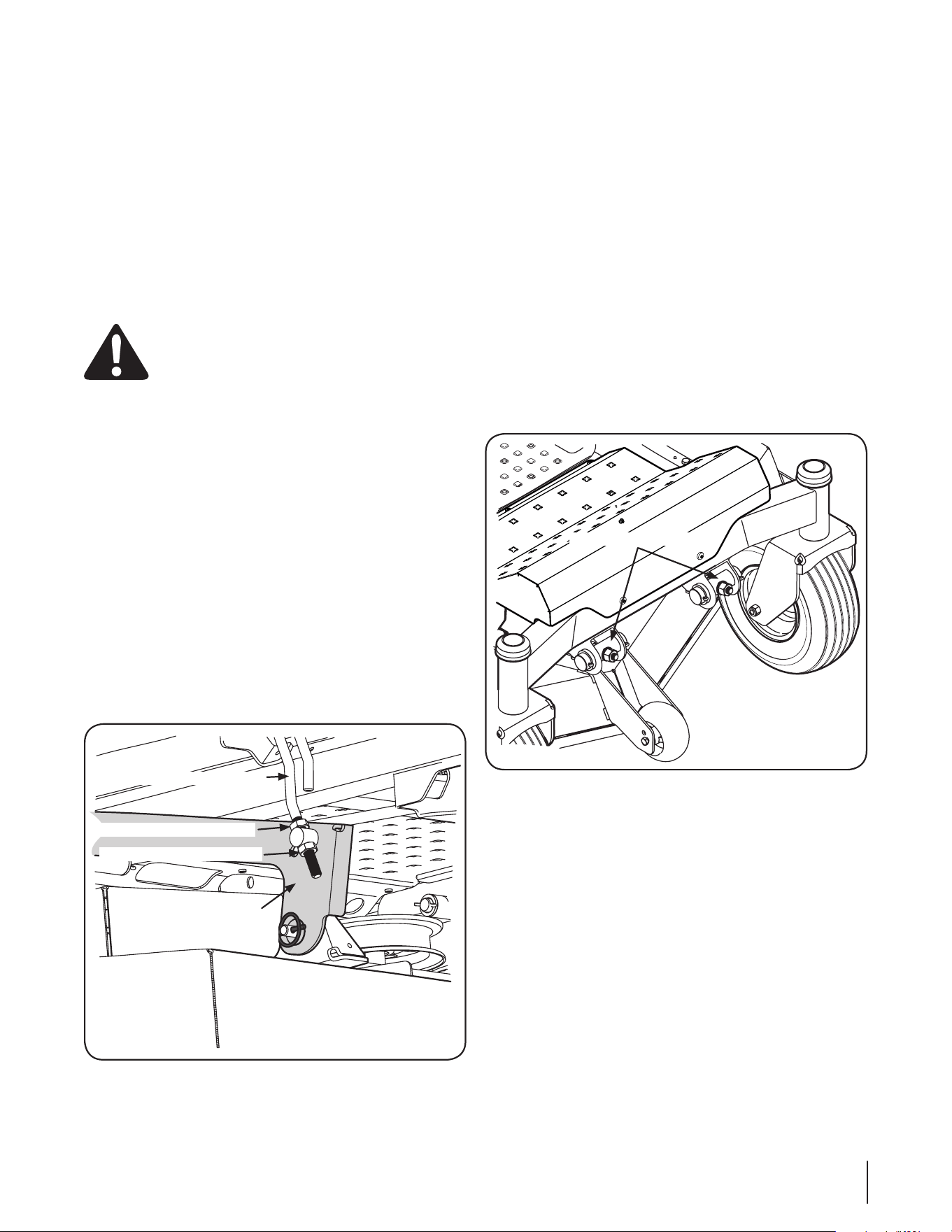
29Sección 6 — ManteniMiento y ajuSteS
Nivelación de la plataforma (de adelante hacia atrás)
NOTA: Controle la presión de neumáticos del tractor antes de realizar
cualquier nivelación de la plataforma. Consulte la sección Neumáticos para
obtener información sobre la presión de los neumáticos. Nivele siempre la
plataforma lado a lado antes de alinearla adelante atrás.
El frente de la plataforma debe estar entre ⁄⁄” más abajo que la parte
posterior. De ser necesario, realice un ajuste de la siguiente manera:
1. Estacione el tractor sobre una superficie firme y nivelada, y coloque la
manija de elevación de plataforma en una posición media.
2. Rote la cuchilla lo más cerca posible del canal de descarga de manera
que esté en paralelo con el tractor.
3. Mida la distancia desde la parte delantera de la punta de la cuchilla
hasta el piso, y desde la parte posterior de la punta de la cuchilla
hasta el piso. La primera medición debe ser entre ⁄” y ⁄” menor que
la segunda.
4. Determine la distancia aproximada necesaria para un ajuste adecuado
y, de ser necesario, proceda.
5. Con una llave, levante el frente de la plataforma aflojando las tuercas
de fijación al frente del perno de pivote y luego ajuste las contratuerca
de la parte posterior del pasador de pivote para levantar el frente de la
plataforma y sujetarla en su lugar. Vea la Figura 7-8.
Pasadores giratorios
Figura 7-8
6. Con una llave, baje el frente de la plataforma aflojando las
contratuercas de la parte posterior del pasador de pivote y luego
ajuste la tuerca de fijación del frente del pasador de pivote para bajar
el frente de la plataforma y sujetarla en su lugar. Vea la Figura 7-8.
7. La plataforma está correctamente nivelada cuando la punta delantera
de la cuchilla está ⁄4” más baja que la punta trasera. Una vez alcanzado
el ajuste necesario, vuelva a ajustar el tornillo de cabeza hexagonal del
gancho trasero izquierdo de la plataforma.
4. Observe la posición relativa de la palanca de control respecto del
soporte de pivote, luego repita los pasos anteriores para reubicar la
otra palanca de control en aproximadamente la misma posición.
5. Se puede hacer un ajuste fino si las palancas de control de transmisión
no están correctamente alineadas. Compruebe que la perilla de la
palanca de control está segura y afloje los dos pernos que sujetan el
ajuste de la palanca de control a la unidad del brazo inferior. Pivote
el ajuste de la palanca de control hacia adelante o atrás para alinear
las palancas de control. Cuando las palancas estén alineadas, vuelva a
ajustar los pernos para sujetar las palancas de control.
Nivelación de la plataforma
NOTA: Controle la presión de neumáticos del tractor antes de realizar
cualquier nivelación de la plataforma. Consulte la sección Neumáticos para
obtener información sobre la presión de los neumáticos.
ADVERTENCIA! Apague el motor, retire la llave de
encendido y coloque el freno de mano antes de realizar
ajustes. Proteja sus manos utilizando guantes reforzados
cuando manipule las cuchillas.
Nivelación de la plataforma (de lado a lado)
NOTA: Controle la presión de neumáticos del tractor antes de realizar
cualquier nivelación de la plataforma. Consulte la sección Neumáticos para
obtener información sobre la presión de los neumáticos. Nivele siempre la
plataforma lado a lado antes de alinearla adelante atrás.
Si la plataforma de corte estuviera realizando el corte de césped de forma
despareja, puede realizarse el ajuste lado a lado. De ser necesario, realice un
ajuste de la siguiente manera:
1. Con el tractor estacionado sobre una superficie firme y nivelada,
coloque la manija de elevación de la plataforma en una posición de
corte media y rote las dos cuchillas exteriores para que se sitúen de
forma perpendicular al tractor.
2. Mida la distancia desde la parte externa de la punta de la cuchilla
izquierda hasta el piso, y desde la parte externa de la punta de la
cuchilla derecha hasta el piso. Las dos mediciones obtenidas deben
ser iguales. Si no lo son, realice el siguiente paso.
3. Afloje la contratuerca inferior del brazo de elevación ajustable que
está conectado al brazo de elevación de la plataforma a fin de bajar la
plataforma y ajuste la contratuerca superior para sujetar la plataforma
en su lugar, afloje la contratuerca superior, luego ajuste la contratuerca
inferior para sujetar la plataforma en su lugar. Vea la Figura 7-7.
Brazo de elevación ajustable
Contratuerca superior
Contratuerca inferior
Brazo de elevación de la
plataforma
Figura 7-7
4. La plataforma se encuentra correctamente nivelada cuando las
dos mediciones desde las puntas de las cuchillas son iguales.
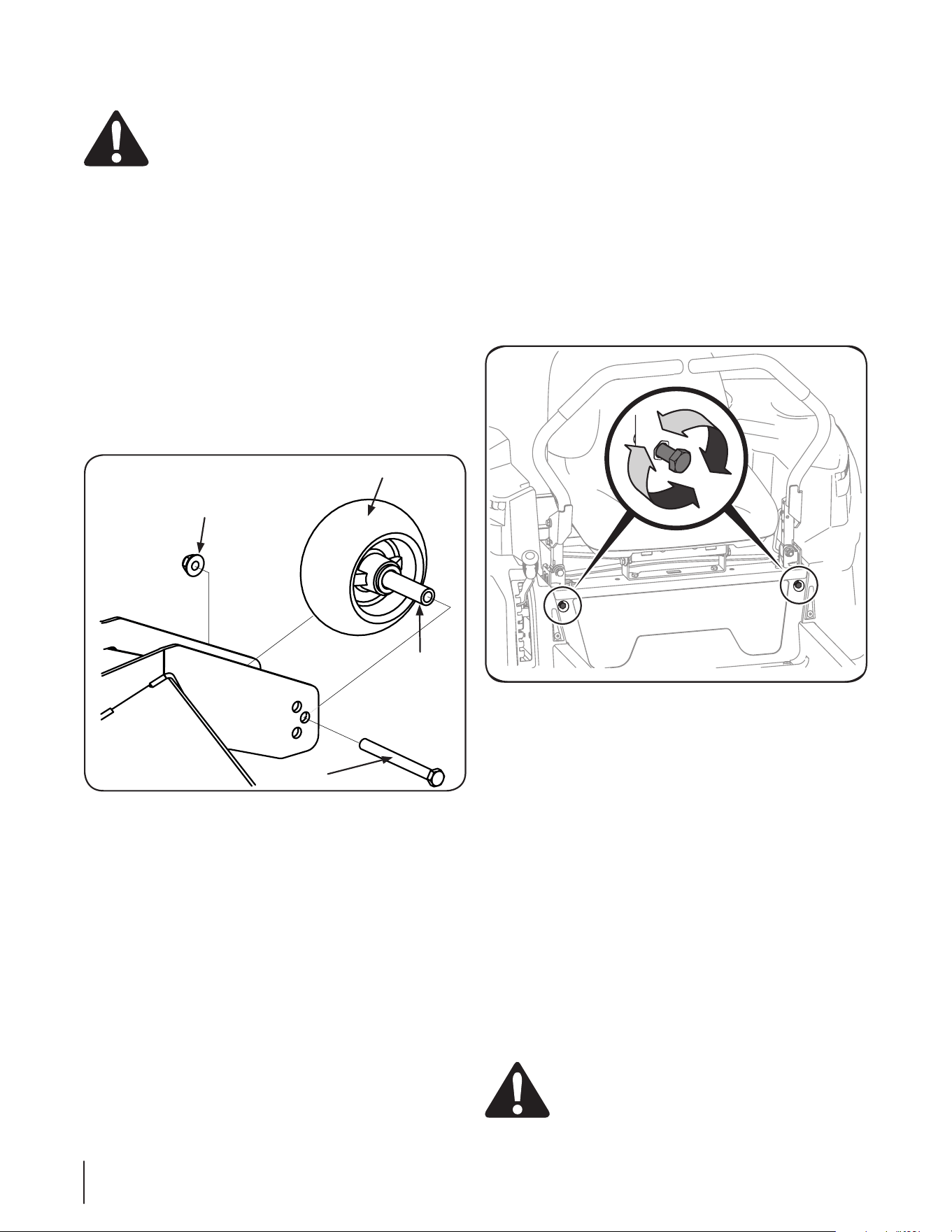
30 Sección 6 — ManteniMiento y ajuSteS
Ajuste de las ruedas de calibración delanteras
ADVERTENCIA!
Mantenga las manos y los pies
alejados de la abertura de descarga de la plataforma de
corte.
Las ruedas calibradoras delanteras de la plataforma de la cortadora de
césped constituyen un mecanismo para el cuidado del césped y no se deben
usar para desplazarse sobre el piso. Las ruedas de calibración delanteras
deben estar aproximadamente entre ⁄⁄2” por encima del suelo cuando la
plataforma se fija en el valor de altura deseado.
Usando la manija de elevación de la plataforma, fije la plataforma en el valor
de altura deseado, luego controle la distancia entre la rueda de calibración
y el piso. Si es necesario ajuste las ruedas de calibración delanteras de la
siguiente forma:
1. Controle visualmente la distancia entre las ruedas de calibración
delanteras y el suelo. Si las ruedas de calibración están cerca del suelo
o lo tocan, es necesario levantarlas. Si las ruedas de calibración se
encuentran a más de ⁄” del suelo, es necesario bajarlas.
2. Retire la tuerca de seguridad que fija uno de los tornillos hexagonales
de las ruedas de calibración delanteras a la plataforma. Retire la rueda
de calibración, el tornillo hexagonal y el espaciador. Vea la Figura 7-9.
Tuerca de seguridad
Rueda
Tornillo hexagonal
Separador
Figura 7-9
3. Inserte el tornillo hexagonal en uno de los tres orificios de
posicionamiento del soporte de la rueda de calibración delantera que
le dará a la rueda de calibración, una separación de ⁄⁄” del suelo.
4. Observe el orificio de posicionamiento de la rueda que acaba de
ajustar y ajuste la otra rueda de calibración delantera en el orificio de
posicionamiento respectivo del otro soporte de rueda de calibración
delantera de la plataforma.
Ajuste de detención de las palancas de control de
la transmisión
Cuando ambas palancas de control de la transmisión están completamente
extendidas hacia adelante hasta la posición de velocidad máxima y el
tractor se desplaza a la derecha o la izquierda, se puede regular el ajuste
de detención de las palancas de control de la transmisión para sincronizar
las velocidades de las ruedas. Para realizar el ajuste proceda de la siguiente
manera:
1. Identifique el lado hacia el que se desplaza el tractor y ajuste la
palanca de control de la transmisión del lado contrario. Si el tractor se
desplaza hacia la derecha, ajuste la palanca de control izquierda abajo
(reduzca la velocidad) y viceversa.
2. Ubique los pernos del ajuste de detención de las palancas de control
de la transmisión que están en el frente del marco del asiento. Vea la
Figura 7-10.
Figura 7-10
3. Para reducir la velocidad marcha adelante, gire el perno hacia la
derecha. Para incrementar la velocidad hacia adelante, gire el perno
hacia la izquierda. Gire el perno en la dirección necesaria ⁄4 de giro
por vez. Después de girar el perno, controle el ajuste conduciendo el
tractor.
4. Continúe el ajuste hasta que las velocidades de las ruedas estén
sincronizadas y el tractor circule en línea recta con las palancas de
control de la transmisión completamente extendidas hacia adelante
en la posición de velocidad máxima.
Almacenamiento fuera de temporada
Almacenamiento del tractor cortacésped
Si el tractor cortacésped no a va a funcionar por un período prolongado
(desde treinta días hasta aproximadamente seis meses), se lo debe preparar
para el almacenamiento. Guarde el tractor cortacésped en un lugar seco
y protegido. Si lo guarda afuera, cúbralo (incluidos los neumáticos) para
protegerlo de los fenómenos climáticos. Cada vez que se prepara el tractor
cortacésped para dejarlo fuera de uso se deben realizar los procedimientos
descritos más abajo.
1. Cambie el aceite y filtro de motor según las instrucciones
suministradas en el manual del motor.
ADVERTENCIA!
Nunca guarde el tractor cortacésped
con combustible en el depósito en un lugar cerrado o con
escasa ventilación, donde los gases del combustible pueden
generar fuego, chispas o encender una luz piloto como la de
hornos, calentadores de agua, secadores de ropa, etc.

31Sección 6 — ManteniMiento y ajuSteS
2. Realice el mantenimiento del motor como se indica en el manual
del motor por separado.
3. Para almacenar motores entre 30 y 90 días es necesario
tratarlos con un estabilizador de gasolina, como el STA-BIL® y
para almacenarlos durante más de 90 días se debe drenar el
combustible para evitar deterioros y la formación de depósitos de
goma en el sistema de combustible o en piezas fundamentales
del carburador. Si la gasolina en su motor se deteriora durante el
almacenamiento, puede resultar necesario reparar o reemplazar el
carburador y otros componentes del sistema de combustible.
ADVERTENCIA: Drene el combustible únicamente
dentro de un recipiente aprobado y al aire libre, lejos de
cualquier llama expuesta. Deje que el motor se enfríe.
Apague cigarrillos, cigarros, pipas y otras fuentes de
combustión antes de drenar el combustible.
3. Retire las bujías y vierta aproximadamente una onza de aceite en
cada cilindro. Haga arrancar el motor una o dos vueltas para que
el aceite se distribuya de forma pareja en las paredes del cilindro.
Vuelva a colocar las bujías.
4. Limpie perfectamente el motor y toda la unidad.
NOTA: No se recomienda el uso de una lavadora de presión ni
de una manguera de jardín para limpiar el tractor cortacésped.
Pueden producir daños a los componentes eléctricos, husillos,
poleas, rodamientos o al motor. El uso de agua acortará la vida útil
de la máquina y reducirá su capacidad de servicio.
5. Afile las cuchillas para que la máquina esté lista para el uso cuando
necesite usarla.
6. Proteja las superficies metálicas. Repare las rayas con pintura de
retoque adecuada en aerosol. Pincele cualquier superficie no
pintada, incluidas las poleas y las cuchillas, con aceite preventivo
de herrumbre. (Tenga cuidado para que el aceite no toque las
correas de transmisión).
7. Limpie y cargue totalmente la batería, luego desconecte el cable
negativo de la batería para evitar posibles descargas. Vuelva a
cargar la batería periódicamente durante el almacenamiento.
NOTA: Retire la batería si está expuesta a períodos prolongados
de temperaturas inferiores al congelamiento. Guarde en un lugar
fresco y seco, donde las temperaturas estén por encima del punto
de congelamiento.
8. Lubrique todos los puntos de lubricación.
9. Levante la máquina y guárdela sobre bloques para que el peso no
se apoye sobre los neumáticos.
Retiro del tractor cortacésped del lugar de almacenamiento
1. Controle el nivel de aceite de motor.
2. Cargue totalmente la batería, baje el tractor cortacésped de los
bloques e infle los neumáticos a la presión recomendada.
3. Retire las bujías y límpielas. Con el arrancador, arranque el motor
para bombear el exceso de aceite y sacarlo de los orificios de las
bujías. Vuelva a colocar las bujías y los conductores de encendido.
4. Si se vació el depósito de combustible antes de guardar el tractor,
llénelo con gasolina limpia y nueva.
5. Compruebe el nivel de aceite del motor dentro del cigüeñal y el
depósito de fluido hidráulico.
6. Arranque el motor y déjelo andar en ralentí unos cuantos minutos
para asegurar que su funcionamiento sea adecuado.
7. Conduzca el tractor cortacésped sin carga para estar seguro de
que todos los sistemas del tractor funcionan correctamente.
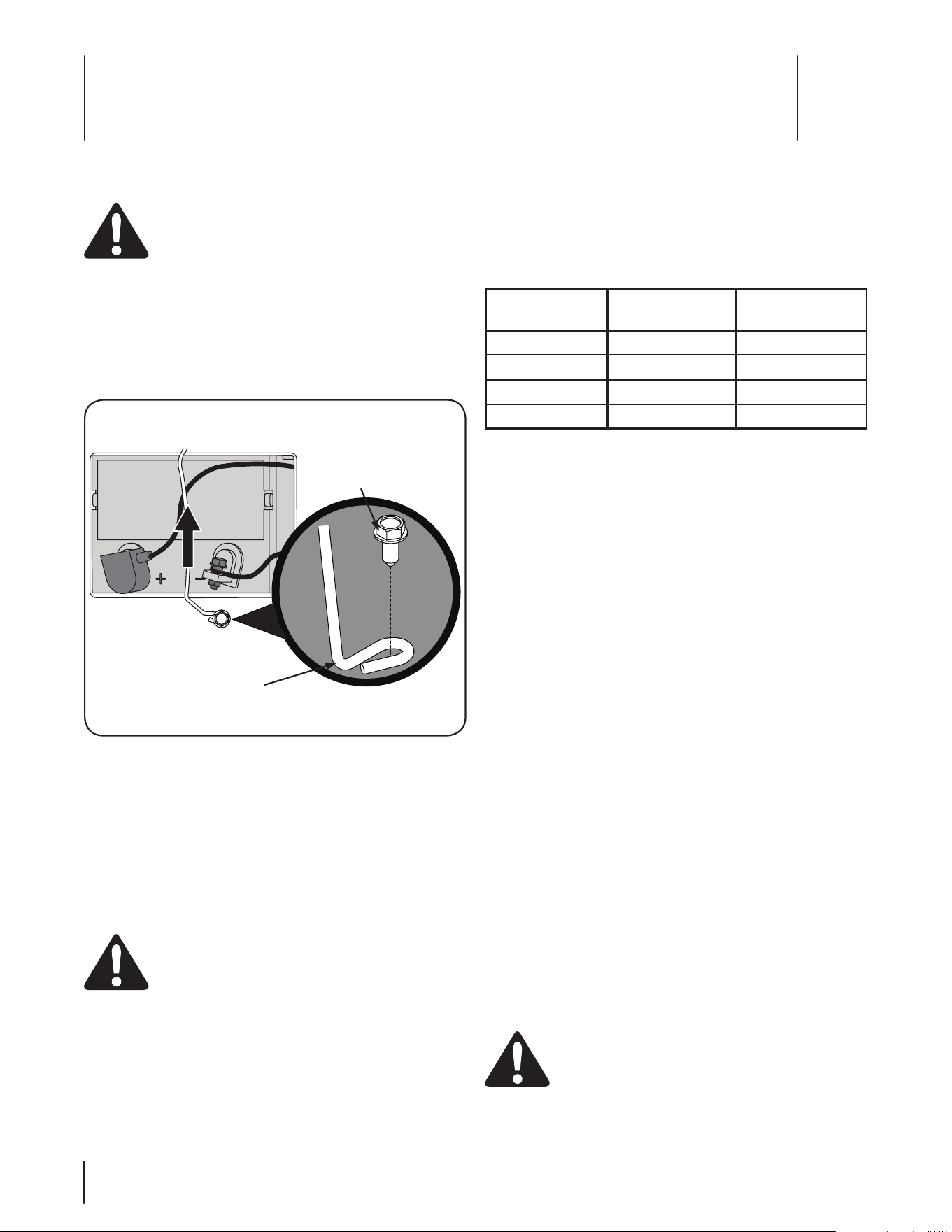
Servicio
7
32
Retiro de la batería
ADVERTENCIA!
Los postes, bornes y accesorios de la
batería contienen plomo y compuestos de plomo. Lávese
las manos después de estar en contacto con estos
componentes.
La batería está ubicada debajo del marco del asiento. Para retirar
la batería:
1. Extraiga el tornillo de la arandela hexagonal que sujeta el soporte
de sujeción de la batería al marco. Luego levante el soporte de
sujeción de la batería para liberar la batería. Vea la Figura 8-1.
Tornillo de arandela
hexagonal
Ménsula de sujeción
de batería
Figura 8-1
2. Retire el tornillo hexagonal y la tuerca Sems que fijan el conductor
negativo negro de la batería al borne negativo de la batería
(marcado 'NEG'). Aleje el cable del borne negativo de la batería.
3. Retire el tornillo hexagonal y la tuerca Sems que fijan el
conductor positivo rojo de la batería al borne positivo de la
batería (marcado 'POS').
4. Levante con cuidado la batería para sacarla del tractor.
5. Instale la batería repitiendo los pasos anteriores en orden inverso.
ADVERTENCIA!
Siempre conecte el conductor
positivo a la batería antes de conectar el conductor
negativo. Esto evita la generación de chispas o posibles
lesiones producidas por un cortocircuito eléctrico causado
por el contacto del cuerpo del tractor con las herramientas
que se usan para conectar los cables.
Carga de la batería
Si el tractor ha estado guardado durante un tiempo, pruebe la batería y, si es
necesario, recárguela.
• Un voltímetro o medidor de carga debería dar una lectura de
12.6 voltios (CC) o más en todos los bornes de la batería. Vea la
Figura 8-2.
Lectura del
voltímetro
Estado de
la carga
Tiempo de
carga
12.7 100% Carga completa
12.4 75% 90 Minutos
12.2 50% 180 Minutos
12.0 25% 280 Minutos
Figura 8-2
• Cargue la batería con un cargador de batería de 12 voltios a un
MÁXIMO de 10 amperios.
Mantenimiento del sistema eléctrico
El tractor tiene instalado un fusible para proteger el sistema eléctrico de los
daños causados por el exceso de amperaje. Siempre reemplace con fusibles
de la misma capacidad. Si el sistema eléctrico no funciona, controle si hay un
fusible quemado.
Si se repite el problema de los fusibles quemados, haga que el sistema
eléctrico del tractor sea revisado por el distribuidor autorizado.
Relés e interruptores
Hay varios interruptores de seguridad en el sistema eléctrico. Si una
función del sistema de bloqueo de seguridad descripto antes no funciona
adecuadamente, haga que el distribuidor autorizado revise el sistema
eléctrico.
Ajuste del freno de mano
Si el tractor no se detiene por completo cuando se colocan las palancas de
control totalmente hacia atrás enganchando el freno de mano, o si las ruedas
traseras del tractor siguen rodando con el freno de mano colocado (y la
válvula de descarga hidrostática abierta) el freno necesita un ajuste. Consulte
al distribuidor autorizado para realizar un ajuste
del freno.
Extracción de la plataforma
Extraiga la plataforma de corte del tractor de la siguiente forma:
1. Lleve el tractor a una superficie nivelada, desconecte la PTO, pare el
motor y coloque las palancas de control en posición neutral/de freno
de mano.
2. Mueva las ruedas de calibración de la plataforma o los rodillos a su
ajuste más alto (ajuste más bajo de la plataforma).
3. Retire la correa en 'V' de la polea de la toma de fuerza (PTO), ubicada
en la base del motor, usando uno de los dos métodos siguientes.
ADVERTENCIA!
El silenciador en la parte trasera del
tractor puede estar sumamente caliente y podría causar
quemaduras graves. Tenga mucho cuidado cuando se
encuentre cerca del silenciador. Deje que el silenciador se
enfríe totalmente antes de retirar la correa de la polea de la
toma de fuerza (PTO).
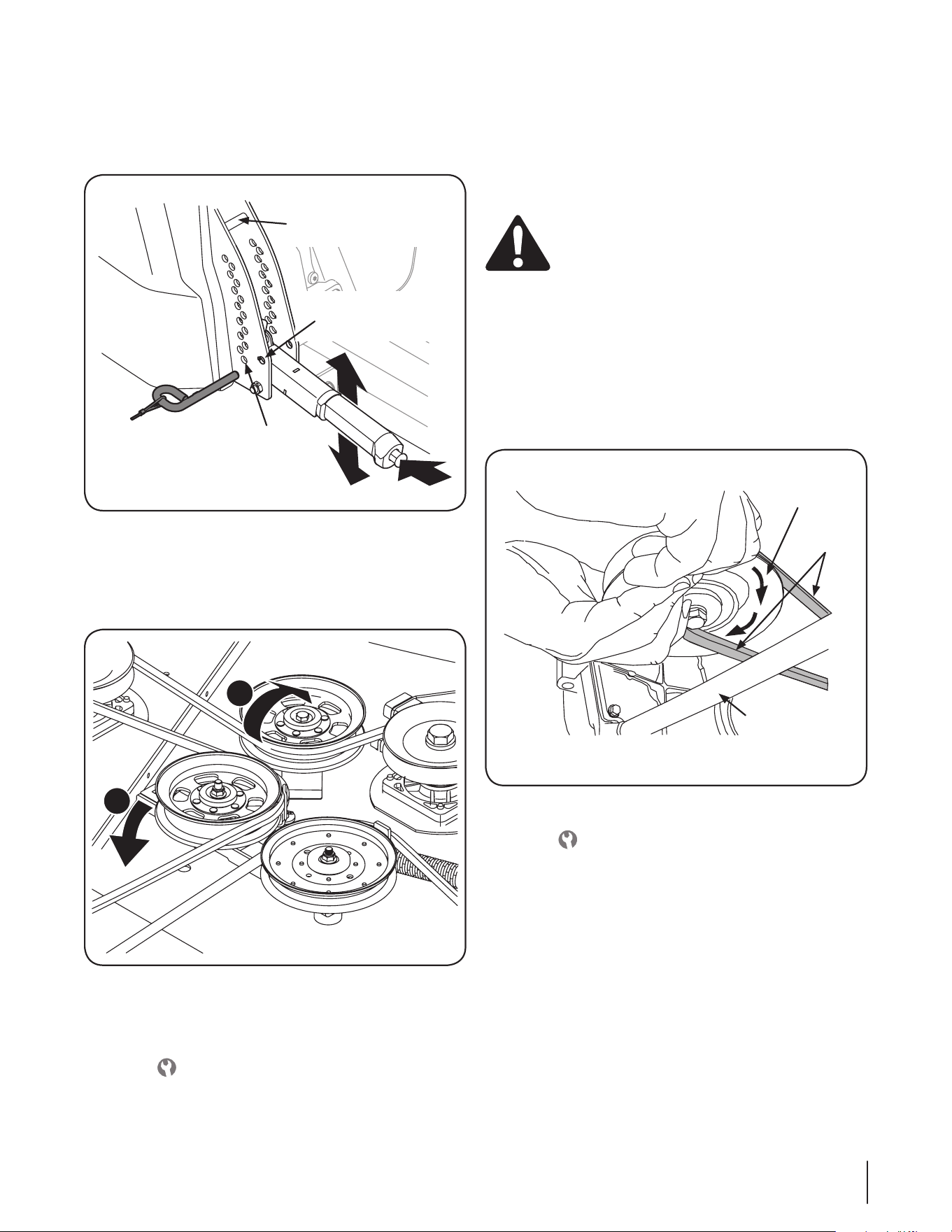
33Sección 7 — Servicio
4. Para aflojar la tensión de la correa con la polea loca:
a. Usando la manija de elevación de la plataforma, levante
la plataforma a la posición que le ofrece mayor recorrido
horizontal de la correa entre las poleas locas de la plataforma y
la polea de la PTO en la base del motor. Vea la Figura 8-3.
Posición de transporte/
Posición de corte
más alta
Posición de corte
más baja
Posición de extracción/
instalación de la
plataforma
Figura 8-3
b. Desde la parte media del tractor, haga girar el soporte de
polea loca y la polea loca móvil hacia atrás, separándolos de la
parte posterior de la correa en 'V' (a) a una distancia suficiente
que permita levantar la correa, por encima de la polea loca (b).
Vea Figura 8-4.
b
a
Figura 8-4
c. Desde abajo de la parte trasera del tractor, deslice la correa
para sacarla de la polea de la toma de fuerza (PTO) en la base
del motor.
d. Baje la plataforma hasta la posición de extracción/instalación
usando la manija de elevación de la plataforma. Vea la
Figura 8-3.
e. Prosiga con el paso 6.
5. Para rodar y saca la polea de la toma de fuerza (PTO):
a. Usando la manija de elevación de la plataforma, levante
la plataforma a la posición que le ofrece mayor recorrido
horizontal de la correa entre las poleas locas de la plataforma y
la polea de la PTO en la base del motor.
b. Sentado detrás del tractor, mirando hacia adelante, estire la
mano debajo del tractor para agarrar la correa por delante de
la polea de la PTO.
ADVERTENCIA!
Tenga cuidado de no pellizcarse los
dedos cuando saca la correa de la polea de la PTO.
c. Tire del lado izquierdo de la correa hacia atrás y hacia abajo
mientras gira manualmente la polea de la PTO hacia la derecha
hasta que la correa se deslice hacia afuera sobre el borde
inferior de la polea.
NOTA: Si tira del lado derecho de la correa, gire la polea hacia la
izquierda.
d. Mientras sostiene la correa hacia abajo, siga girando la polea
de la PTO hasta que la correa se deslice fuera de la polea.
Consulte la Figura 8-5.
Polea de la PTO
Correa de la
PTO
Tubo de la
transmisión
Figura 8-5
e. Baje la plataforma hasta la posición de extracción/instalación
usando la manija de elevación de la plataforma. Vea la
Figura 8-3.
f. Siga con el paso 6.
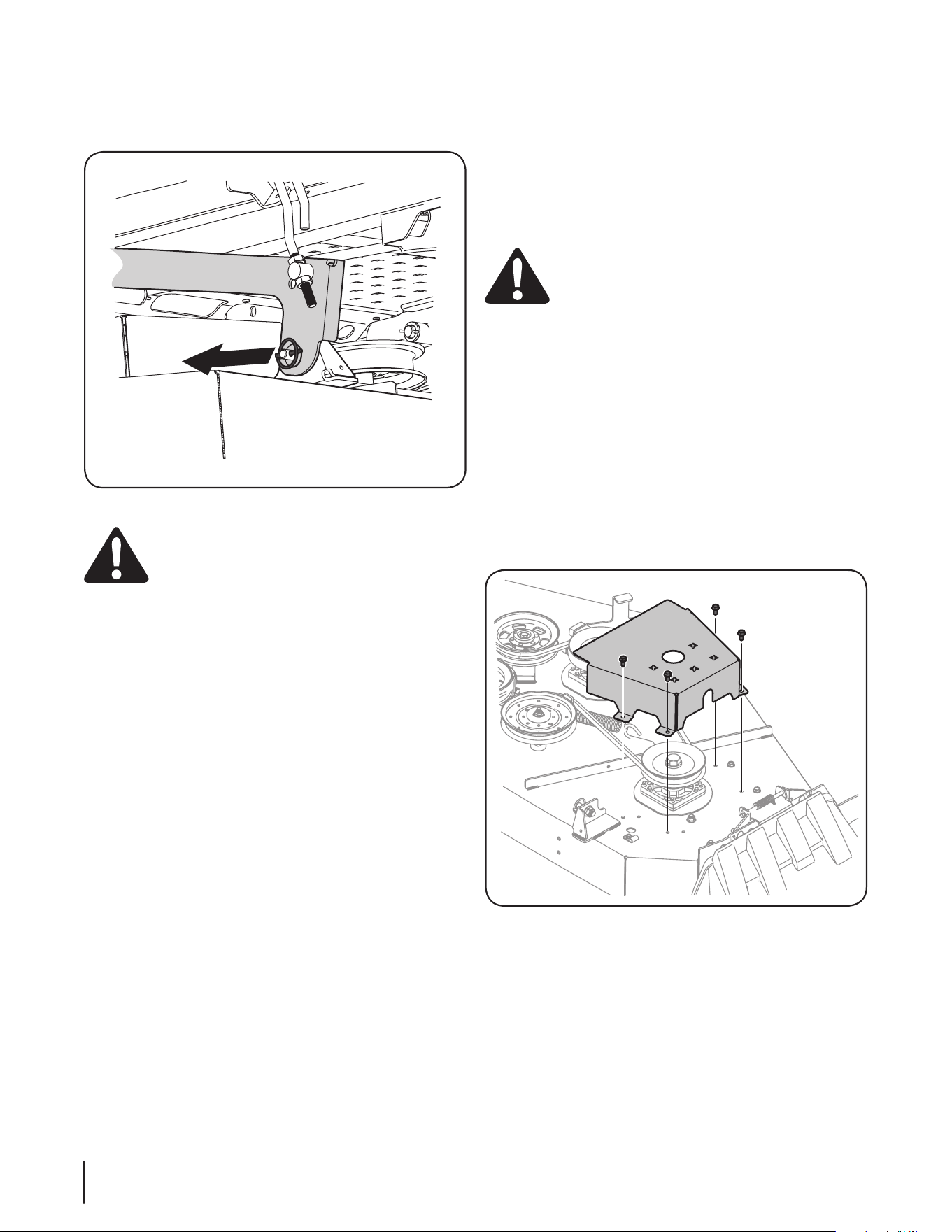
34 Sección 7 — Servicio
6. Ubique los pasadores de liberación de la plataforma izquierdo
y derecho a cada lado de la plataforma. Tire de los pasadores de
liberación hacia afuera y suelte la plataforma de los brazos de
elevación derecho e izquierdo de la plataforma. Vea la Figura 8-6.
Figura 8-6
PRECAUCIÓN:
Hay cierta tensión de los resortes debido
al peso de la plataforma. Al retirar el varillaje de elevación de
la plataforma, la tensión de los resortes pasará de la
plataforma a la manija de elevación de plataforma y
retrocederá a su posición original.
7. Deslice la varilla de elevación de la plataforma delantera para sacarla
de las ménsulas de suspensión del frente de la plataforma
8. Ubique la manija de elevación de la plataforma en la posición de corte
más elevada y deslice la plataforma hacia afuera del lado derecho del
tractor.
Instalación de la plataforma
Instale la plataforma sobre el tractor de la siguiente forma:
1. Coloque la manija de elevación de la plataforma en la posición de
corte más elevada. Vea la Figura 8-3.
2. Deslice la plataforma debajo del tractor del lado derecho del mismo,
alineando las ménsulas de suspensión de la plataforma y los brazos de
elevación de la plataforma.
3. Una vez que la plataforma esté debajo del tractor, mueva la manija de
elevación de la plataforma a la posición de corte más baja.
NOTA: Para que los soportes se alineen adecuadamente puede ser
necesario colocar un bloque de madera pequeño debajo de cada lado
de la plataforma.
4. Enganche la varilla de elevación de la plataforma delantera para en las
ménsulas de suspensión del frente de la plataforma
5. Tire de los pasadores de liberación de la plataforma hacia afuera y
ubique la plataforma según sea necesario para alinear los orificios de
los brazos de elevación de la plataforma con los pasadores. Consulte
la Figura 8-6.
6. Una vez alineados, empuje cada pasador totalmente hacia adentro a
través de los brazos de elevación para fijar los brazos en las ranuras de
las ménsulas de suspensión traseras.
7. Asegúrese de que la correa en 'V' esté en las poleas del husillo de la
plataforma, luego oriente la correa hacia atrás por debajo del bastidor
del tractor , por encima de los tubos de transmisión, hacia la polea de
la PTO en la base del motor.
8. Usando la manija de elevación de la plataforma, levante la plataforma
a la posición que le ofrece mayor recorrido horizontal de la correa
entre las poleas locas de la plataforma y la polea de la PTO en la base
del motor.
9. Asegúrese de que la correa esté en las poleas del husillo de la
plataforma y que el lado trasero de la correa esté contra las poleas
locas fija y móvil.
10. Sentado detrás del tractor, mirando hacia adelante, asegúrese de que
la correa no esté retorcida; luego estire la mano debajo del tractor
para agarrar la correa y tirar de la misma hacia la polea de la PTO.
ADVERTENCIA!
Tenga cuidado de no pellizcarse los
dedos cuando coloca la correa en la polea de la potencia de
arranque.
11. Tire del lado derecho de la correa hacia atrás y coloque el lado V
angosto de la correa en la polea de la PTO. Vea la Figura 8-5.
12. Mientras sostiene la correa y la polea juntas, rote la polea hacia la
izquierda (Vea la Figura 8-5). Siga sosteniendo y rotando la polea y la
correa hasta que la correa se enrolle totalmente en la polea de la PTO.
NOTA: Antes de usar el tractor, compruebe la instalación de la correa
para estar seguro de que la misma se ha colocado correctamente.
Cambio de la correa
1. Extraiga la plataforma de la parte inferior del tractor, (consulte la
sección Extracción de la plataforma).
2. Saque los tornillos de arandela hexagonal que sujetan las cubiertas de
las correas a la plataforma. Vea la Figura 8-7.
Figura 8-7
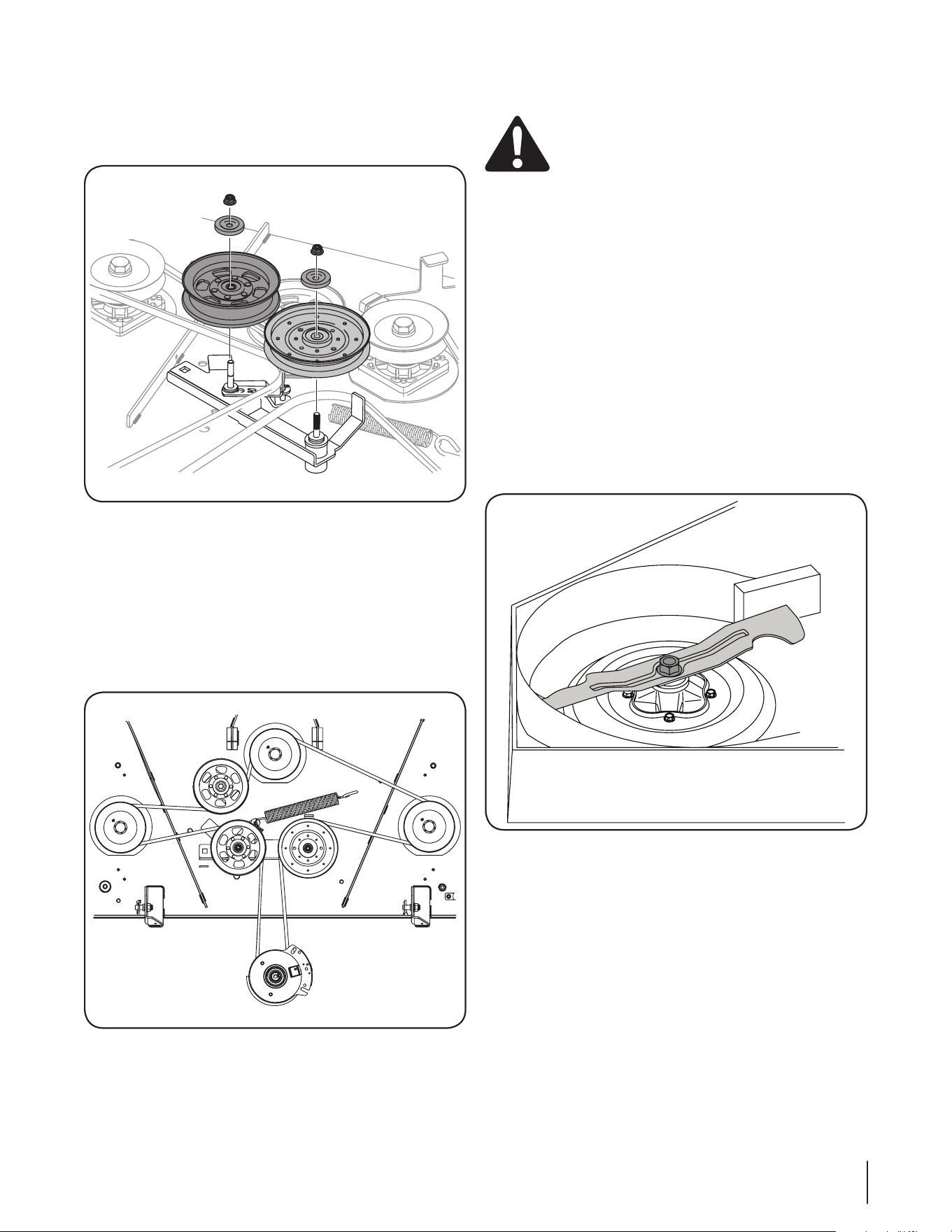
35Sección 7 — Servicio
3. Extraiga las dos poleas locas, para lo cual debe retirar los tornillos de
cabeza hexagonal y las tuercas de seguridad con brida que las sujetan
a la plataforma y el brazo de polea loca. Vea la Figura 8-7. No pierda
ningún herraje al sacar el tornillo de cabeza hexagonal y la tuerca de
seguridad con brida.
Figura 8-8
NOTA: Tome nota de la posición de las protecciones de correa para
asegurar que se hayan vuelto a instalar de manera correcta.
4. Retire la correa de las poleas del husillo.
5. Instale la nueva correa alrededor de las poleas del husillo tal como se
muestra y reinstale las cubiertas de las correas. Vea la Figura 8-7.
6. Coloque la correa alrededor de las poleas locas que extrajo en el paso
3 con el lado en “V” orientado hacia adentro. Una vez que todo esté en
su lugar, vuelva a colocar los elementos de ferretería y ajuste la tuerca
de seguridad con brida para sujetar el conjunto. Vea la Figura 8-9.
Figura 8-9
7. Pase la correa como se indica en la Figura 8-9 y vuelva a instalar la
plataforma (consulte Instalación de la plataforma).
Cuidado de las cuchillas de la cortadora de césped
ADVERTENCIA!
Antes de realizar cualquier tarea de
mantenimiento, coloque el interruptor de la toma de fuerza
(PTO) en la posición "OFF" (apagado), enganche la palanca del
freno de mano, gire la llave de encendido a la posición "OFF"
(apagado) y retire la llave del interruptor. Proteja sus manos
utilizando guantes reforzados cuando manipule las cuchillas.
Cuando realice el mantenimiento de la plataforma de corte,
tenga cuidado para no cortarse con las cuchillas filosas.
Las cuchillas de corte deben estar siempre afiladas. Afile los bordes de
corte de las cuchillas de forma pareja de modo que las cuchillas queden
balanceadas y se mantenga el mismo ángulo de filo.
Si el borde de corte de una cuchilla ya se ha afilado muchas veces, o si hay
alguna separación en el metal, se recomienda instalar cuchillas nuevas. El
distribuidor autorizado le puede proveer cuchillas nuevas.
Las cuchillas se pueden extraer de la siguiente manera.
1. Extraiga la plataforma de la parte inferior del tractor, (consulte la
sección Extracción de la plataforma de corte); luego voltee con
delicadeza la plataforma para dejar al descubierto su parte inferior.
2. Use una llave de ⁄” para sostener la tuerca hexagonal en la parte
superior del conjunto del husillo cuando afloje la tuerca hexagonal
que fija la cuchilla. Se puede colocar un bloque de madera entre el
alojamiento de la plataforma y el borde de corte de la cuchilla para
ayudar a aflojar la tuerca hexagonal que fija la cuchilla. Vea la
Figura 8-10.
Figura 8-10
3. Cuando reinstale las cuchillas, asegúrese de que se instalen de modo
que las aletas se orienten hacia arriba hacia la parte superior de la
plataforma.
4. Ajuste las tuercas de las cuchillas a 70-90 pies libras.
5. Reinstale la plataforma (consulte Instalación de la plataforma).
Cambio de la correa de transmisión
Para cambiar la correa de transmisión del tractor, se deben retirar varios
componentes y se necesitan herramientas especiales. Solicite a un
distribuidor autorizado que reemplace la correa de transmisión.
Desplazamiento lento del tractor
Desplazamiento lento es el movimiento de la máquina hacia adelante o
hacia atrás cuando el acelerador está activado y las palancas de control de
transmisión están en posición neutra. Si la cortadora de césped se desplaza
lentamente, consulte al distribuidor autorizado para el mantenimiento.
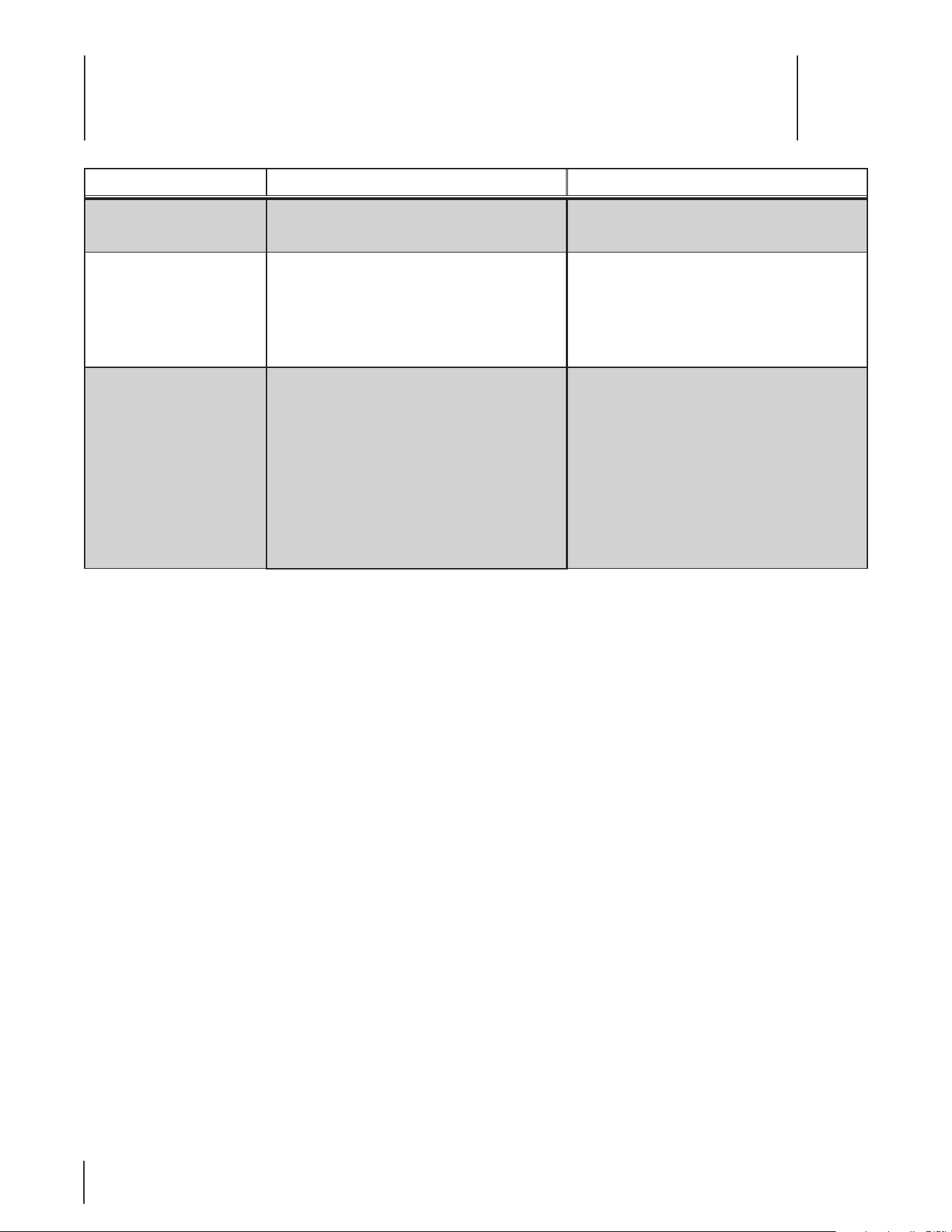
Solución de Problemas
8
36
Problema Causa Solución
Excesiva vibración 1. Cuchilla de corte floja o descentrada.
2. Cuchilla dañada o doblada.
1. Apriete la cuchilla y el husillo.
2. Reemplace la cuchilla.
Corte irregular 1. La plataforma no está correctamente
nivelada.
2. Cuchilla desafilada.
3. Presión de neumáticos desigual.
1. Haga un ajuste de la plataforma de lado a
lado.
2. Afile o cambie la cuchilla.
3. Verifique la presión de los cuatro
neumáticos.
La cortadora de césped no
procesa los recortes como
abono
(si está equipada con kit de
abono)
1. La velocidad del motor es demasiado lenta.
2. Pasto mojado.
3. Pasto demasiado alto.
4. Cuchilla desafilada.
1. Coloque el control del regulador en
la posición FAST (velocidad rápida,
representada por una liebre).
2. No procese abono cuando el pasto está
mojado.
3. Corte una vez con altura de corte elevada
y luego vuelva a cortar el césped a la altura
deseada, o haga una pasada de corte más
angosta.
4. Afile o cambie la cuchilla.

Notas
11
37

DECLARACIÓN FEDERAL y/o DE CALIFORNIA SOBRE GARANTÍAS EN EL CONTROL DE EMISIONES
SUS DERECHOS Y OBLIGACIONES EN CUANTO A LA GARANTÍA
MTD Consumer Group Inc, la Agencia de Protección Medioambiental de los Estados Unidos (EPA), y para aquellos productos certificados
para su venta en el estado de California, el Departamento de los Recursos del Aire de California (CARB) se complacen en explicar la garantía
que evaporativo sistema de control de emisiones (ECS) de su equipo (equipos de exteriores) de encendido por chispa para todo terreno,
pequeño, de exteriores del año 2015-2016. En California, los nuevos motores de equipos de exteriores deben estar diseñados, construidos y
equipados para cumplir con las estrictas normas antipolución del Estado (en otros estados, equipos de exteriores deben ser estar diseñados,
construidos y equipados para cumplir con las regulaciones de motores de encendido por chispa para todo terreno pequeños de la Agencia de
Protección Medioambiental de los Estados Unidos, (EPA). MTD Consumer Group Inc. debe garantizar el sistema de control de emisiones (ECS)
de su motor de equipos de exteriores por el período de tiempo indicado más abajo, siempre y cuando no exista uso incorrecto, negligencia o
mantenimiento inadecuado de equipos de exteriores.
Su ECS puede incluir piezas tales como el los depósitos de combustible, las líneas de combustible, los tapones de combustible, las válvulas,
contenedores, filtros, mangueras de vapor, abrazaderas, conectores y otros componentes afines relacionados con las emisiones.
Donde exista una condición cubierta por la garantía, MTD Consumer Group Inc. reparará de equipos de exteriores sin costo alguno incluyendo
el diagnóstico, las piezas y la mano de obra.
COBERTURA DE LA GARANTÍA DEL FABRICANTE:
Este sistema de control de emisiones se garantiza por el término de dos años. Si alguna pieza relacionada con las emisiones de su motor de
equipos de exteriores es defectuosa, MTD CONSUMER GROUP INC. reparará o sustituirá dicha pieza.
RESPONSABILIDADES DEL PROPIETARIO SEGÚN LA GARANTÍA:
En su carácter de propietario de equipos de exteriores, usted es responsable del mantenimiento requerido que se especifica en el manual del
propietario. MTD Consumer Group Inc le recomienda que conserve todos los recibos que cubren el mantenimiento de equipos de exteriores,
obstante lo cual MTD Consumer Group Inc no podrá denegar el cumplimiento de la garantía únicamente por la falta de los recibos.
Como propietario de equipos de exteriores, usted debe saber que MTD Consumer Group Inc. puede denegar la cobertura de la garantía si
su equipos de exteriores o una pieza del mismo fallan debido a uso incorrecto, negligencia, mantenimiento indebido o a modificaciones no
aprobadas.
Usted es responsable de presentar su equipos de exteriores al centro de distribución o servicio técnico de MTD Consumer Group Inc. tan pronto
como aparezca el problema. Las reparaciones cubiertas por la garantía se deben llevar a cabo en un lapso razonable que no exceda de 30
días. Si tiene alguna pregunta respecto de la cobertura de la garantía, póngase en contacto con el Departamento del Servicio Técnico de MTD
Consumer Group Inc. al teléfono 1-800-800-7310 o por correo electrónico en http://support.mtdproducts.com.
COBERTURA DE LA GARANTÍA DE EMISIONES GENERALES:
MTD Consumer Group Inc garantiza al comprador final y a cada comprador subsiguiente que el equipos de exteriores: está diseñado,
construido y equipado de modo de cumplir con todas las regulaciones aplicables y que se encuentra libre de defectos de materiales y de
fabricación que pudieren causar la falla de una pieza garantizada idéntica, en todos los aspectos materiales a la pieza descripta en la solicitud
de certificación de MTD Consumer Group Inc.
El período de garantía comienza en la fecha de entrega del equipos de exteriores al comprador final o en la fecha en que la máquina se pone en
funcionamiento por primera vez. El período de garantía es de dos años.
Sujeto a ciertas condiciones y exclusiones que se indican a continuación, la garantía de las piezas relacionadas con las emisiones es la siguiente:
1. Cualquier pieza garantizada que no esté programada para ser reemplazada como parte del mantenimiento requerido en las instrucciones
escritas suministradas se garantiza por el período de garantía arriba mencionado. Si la pieza falla durante el período de cobertura de la
garantía, la misma será reparada o reemplazada por MTD Consumer Group Inc. de acuerdo con el párrafo (4) a continuación. Cualquier
pieza reparada o reemplazada según la garantía se garantizará por el resto del período de garantía.
2. Cualquier pieza garantizada que esté programada solamente para inspección regular en las instrucciones escritas suministradas se
garantiza por el período de garantía arriba mencionado. Cualquier pieza reparada o reemplazada según la garantía se garantizará por el
resto del período.
3. Cualquier pieza garantizada que esté programada para reemplazo según el mantenimiento requerido de conformidad con las
instrucciones escritas suministradas, se garantiza por el período de tiempo anterior a la primera fecha de reemplazo programada para esa
pieza. Si la pieza falla antes del primer reemplazo programado, la misma será reparada o reemplazada por MTD Consumer Group Inc. de
acuerdo con el párrafo (4) a continuación. Cualquier pieza reparada o reemplazada bajo garantía se garantizará por el resto del período
anterior al primer reemplazo programado puntual para esa pieza.
4. La reparación o el reemplazo de cualquier pieza garantizada de conformidad con las disposiciones de la garantía que aquí se estipula se
deben realizar en un centro de garantía sin costo alguno para el propietario.
5. No obstante las disposiciones que aquí se estipulan, los servicios o reparaciones bajo garantía se suministrarán en todos nuestros centros
de distribución bajo franquicia de mantenimiento para los motores o equipos en cuestión.
6. El propietario de equipos de exteriores no deberá pagar el trabajo de diagnóstico directamente asociado con una pieza garantizada
defectuosa en relación con las emisiones, siempre y cuando dicho trabajo de diagnóstico se realice en un centro cubierto por la garantía.
7. MTD Consumer Group Inc es responsable por daños causados a otros componentes de motores o equipos derivados de la falla bajo
garantía de cualquier pieza garantizada.

063015 Rev. C
8. Durante la totalidad del período de garantía del motor y equipo para todo terreno arriba mencionado, MTD Consumer Group Inc
mantendrá un suministro
de piezas bajo garantía suficiente para satisfacer la demanda esperada de tales piezas.
9. Cualquier pieza de reemplazo se podrá usar para el cumplimiento del mantenimiento o las reparaciones bajo garantía y se suministrarán
sin cargo para
el propietario. Dicho uso no reducirá las obligaciones de garantía de MTD Consumer Group Inc.
10. No se podrán usar piezas adicionales ni modificadas que no estén exentas de acuerdo con el Departamento de los Recursos del Aire
(Air Resources Board). El uso de cualquier pieza adicional o modificada no exenta por el comprador final será causal de invalidez de los
reclamos bajo garantía. MTD Consumer Group Inc no tendrá responsabilidad por la garantía de fallas de piezas garantizadas que fueren
causadas por el uso de una pieza adicional no exenta
o modificada.
PIEZAS GARANTIZADAS:
La reparación o el reemplazo de cualquier pieza garantizada que de otro modo pudiese estar cubierta por la garantía podrá ser excluida de
tal cobertura de garantía si MTD Consumer Group Inc demuestra que el equipos de exteriores es objeto de uso incorrecto, negligencia o
mantenimiento inadecuado, y que tal uso incorrecto, negligencia o mantenimiento inadecuado fue causa directa de la necesidad de reparación
o reemplazo de dicha pieza. No obstante lo antedicho, cualquier ajuste de un componente con un dispositivo de limitación de ajuste instalado
en fábrica y que funcione adecuadamente, podrá ser cubierto por la garantía. Además, la cobertura bajo esta garantía se extiende solo a piezas
que estuvieron presentes en y equipo todo terreno adquiridos.
Están cubiertas las siguientes piezas con garantía para emisiones (de corresponder):
1. Sistema de medición de combustible
• Bomba de combustible
• Depósito de combustible
2. Control evaporativo
• Manguera de combustible
• Abrazaderas de la manguera de combustible
• Tapón del combustible atado por correa
• Caja de carbono
• Líneas de vapor

GARANTÍA LIMITADA DEL FABRICANTE PARA
GDOC-100020 REV. A
La siguiente garantía limitada es otorgada por Troy-Bilt LLC con
respecto a nuevos productos adquiridos y utilizados en Estados
Unidos y/o sus territorios y posesiones, y por MTD Products Limited
con respecto a nuevos productos adquiridos y utilizados en Canadá
y/o sus territorios y posesiones (cualquiera de las dos entidades,
respectivamente, “Troy-Bilt”).
Esta garantía es adicional a la garantía de emisiones aplicables
proporcionada con el producto.
“Troy-Bilt” garantiza este producto (excluidas las Piezas y Accesorios con
Desgaste Normal según se describe más abajo) contra defectos en los
materiales y mano de obra por un período de dos (2) años a partir de
la fecha de compra original y, a su opción, reparará o reemplazará, sin
costo alguno, cualquier pieza que presente defectos en los materiales o
de mano de obra. Esta garantía limitada sólo se aplicará si el producto
ha sido operado y mantenido de acuerdo con las instrucciones del
Manual del Operador que se proporciona con el producto y no ha sido
sujeto a uso inapropiado, abuso, uso comercial, abandono, accidente,
mantenimiento incorrecto, alteración, vandalismo, robo, incendio,
inundación o algún daño debido a otro peligro o desastre natural.
El daño resultante por la instalación o el uso de piezas, accesorios
o aditamentos no aprobados por Troy-Bilt para su uso con el(los)
producto(s) incluido(s) en este manual anulará la garantía en lo que
respecta a esos daños.
Se garantiza que las Piezas con Desgaste Normal están libres de defectos
en los materiales y mano de obra por un período de treinta (30) días
a partir de la fecha de compra. Las piezas sujetas a desgaste normal
incluyen pero no se limitan a: baterías, correas, cuchillas, adaptadores
para cuchillas, dientes, bolsas para pasto, ruedas, ruedas para la
plataforma de la podadora tractor, asientos, zapatas antideslizantes,
ruedas de fricción, placas de raspado, gomas helicoidales y neumáticos.
Accesorios — Troy-Bilt garantiza que los accesorios de este producto
están libres de defectos de material y mano de obra durante un
período de un (1) año a partir de la fecha de compra o arrendamiento
original del accesorio. Los accesorios incluyen, pero no se limitan a
elementos tales como: colectores de césped y kits para abono.
CÓMO SOLICITAR Y OBTENER SERVICIO TÉCNICO: El servicio de la
garantía está disponible, CON COMPROBANTE DE COMPRA, a través de
su distribuidor local autorizado para el mantenimiento. Para localizar al
distribuidor de su zona:
En Estados Unidos de América
Consulte las páginas amarillas, o póngase en contacto con Troy-Bilt LLC
en P.O. Box 361131, Cleveland, Ohio 44136-0019, llame al 1-866-840-
-6483, o visite nuestro sitio web en www.troybilt.com.
En Canadá
Póngase en contacto con MTD Products Limited, Kitchener, ON N2G
4J1, llame al 1-800-668-1238 ó visite nuestro sitio web en www.
mtdcanada.com.
Esta garantía limitada no suministra cobertura en los siguientes casos:
a. El motor o las piezas que lo componen. Estos productos pueden
tener garantía del fabricante por separado. Consulte los términos
y condiciones de la garantía aplicable del fabricante.
b. Las bombas, válvulas y cilindros del rompetroncos tienen una
garantía separada de un año.
c. Los artículos necesarios para el mantenimiento de rutina
como por ejemplo lubricantes, filtros, afiladores de cuchillas,
sincronización del motor, los ajustes de los frenos, del embrague
o de la plataforma y el deterioro normal del acabado exterior
debido al uso o exposición.
d. Mantenimiento no realizado por el distribuidor de servicio
autorizado.
e. Troy-Bilt no extiende ninguna garantía para los productos
vendidos o exportados fuera de los Estados Unidos de América
y/o Canadá, y sus respectivas posesiones y territorios, excepto
para aquellos vendidos a través de los canales autorizados de
distribución de exportaciones de Troy-Bilt.
f. Piezas de reemplazo que no son piezas originales de Troy-Bilt.
g. Gastos de transporte y visitas técnicas.
h. Troy-Bilt no garantiza este producto para uso comercial.
No existe ninguna garantía implícita, incluyendo cualquier
garantía implícita de comerciabilidad o adaptabilidad para un
propósito en particular, una vez transcurrido el período aplicable
de garantía escrita según lo antedicho en relación con las piezas
identificadas. Ninguna otra garantía expresa, ni oral ni escrita,
excepto la mencionada anteriormente, extendida por personas
reales o jurídicas, incluidos los distribuidores o los minoristas con
respecto a cualquier producto, obligará a Troy-Bilt. Durante el
plazo de la garantía el único recurso es la reparación o reemplazo
del producto como se indicó anteriormente.
Las disposiciones de esta garantía cubren el recurso de reparación
única y exclusiva que surge de la venta. Troy-Bilt no se hará
responsable de ninguna pérdida o daño incidental o resultante,
incluyendo sin limitación, los gastos incurridos para los servicios
de mantenimiento del césped, o los gastos de arrendamiento para
reemplazar de manera transitoria un producto bajo garantía.
Algunos estados no permiten la exclusión o limitación de los daños y
perjuicios incidentales o directos, o las limitaciones sobre la duración
de las garantías implícitas, por lo que las exclusiones o limitaciones
mencionadas anteriormente pueden no serle de aplicación.
En ningún caso se obtendrá una compensación de ningún tipo por un
monto mayor al precio de compra del producto vendido. La alteración
de las características de seguridad del producto anulará esta
garantía. Usted asume el riesgo y la responsabilidad de las pérdidas,
daños o lesiones que sufran usted y sus bienes y/u otras personas y sus
bienes como resultado del uso incorrecto o de la falta de capacidad
para usar este producto.
Esta garantía limitada cubre solamente al comprador original, o a la
persona que recibió el producto de regalo.
CÓMO SE RELACIONA LA LEGISLACIÓN ESTATAL CON ESTA
GARANTÍA: Esta garantía limitada le otorga derechos legales
específicos y usted también puede tener otros derechos que varían de
un estado a otro.
IMPORTANTE: El propietario debe presentar comprobante de compra
original para obtener la cobertura de la garantía.
Troy-Bilt LLC, P.O. BOX 361131 CLEVELAND, OHIO 44136-0019, Teléfono: 1-866-840-6483, 1-330-558-7220
MTD Canada Limited - KITCHENER, ON N2G 4J1; teléfono 1-800-668-1238