

Thank you for purchasing our product. If there is any questions or requests, please do not hesitate to
contact your dealer.
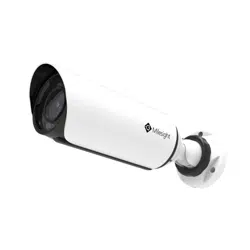
This manual is applicable to the Milesight H.264&H.265 Network Camera, series shown as follows, except
where otherwise indicated.
Milesight H.265 Network Camera
Type
Megapixel
2MP 2MP 3MP 4MP 5MP 4K
Mini Dome
Network Camera
—
UI-2A81-PC
V
— UI-4C81-PCV
UI-5D81-PC
V
—
IR Mini Dome
Network Camera
—
UI-2A83-PC
V
—
UI-4C83-PCV
UI-5D83-PC
V
—
Vandal-proof Mini Dome
Network Camera
—
UI-2A73-PC
V
—
UI-4C73-PCV
UI-5D73-PC
V
—
Weather-proof Mini Dome
Network Camera
—
UI-2A75-PC
V
— —
UI-5D75-PC
V
—
AF Motorized Mini Dome
Network Camera
—
UI-2A75-EP
CV
— —
UI-5D75-EPC
V
—
Mini Bullet Network Camera —
UI-2A63-(R)
PCV
UI-3B63-PC
V
UI-4C63-PCV
UI-5D63-PC
V
—
Vandal-proof Mini Bullet
Network Camera
—
UI-2A64-PC
V
— —
UI-5D64-PC
V
—
Motorized Mini Bullet
Network Camera
UI-2863-(R)F
(I)PCV
UI-2A63-(R)
F(I)PCV
UI-3B763-F(
I)PCV
UI-4C63-F(I)
PCV
UI-5D63-F(I)
PCV
—
Vandal-proof Motorized
Mini Bullet Network Camera
UI-2864-(R)F
(I)PCV/
UI-2864-TF(I
)PCV/
UI-2864-QF(I
)PCV/
UI-2864-FAP
CV
UI-2A64-(R)
F(I)PCV/
UI-2A64-TF(
I)PCV/
UI-2964-QF
(I)PCV/
UI-2A64-FA
PCV
—
UI-4C64-(H)F
(I)PCV
UI-5D64-(H)
F(I)PCV
—
Motorized Pro Bullet
Network Camera
UI-2862-(R)F
(I)PCV
UI-2A62-(R)
F(I)PCV
UI-3B762-F(
I)PCV
UI-4C62-F(I)
PCV
UI-5D62-F(I)
PCV
UI-8E62-F(I)
PCV
Motorized Pro Dome
Network Camera
UI-2872-(R)F
(I)PCV
UI-2A72-(R)
F(I)PCV
UI-3B72-F(I
)PCV
UI-4C72-F(I)
PCV
UI-5D72-F(I)
PCV
—
12x AF Motorized
Pro Bullet Network
Camera
—
UI-2A62-(R)
EPCV
—
UI-4C62-EPC
V
UI-5D62-EPC
V
—
(ABF) Pro Box Network
Camera
UI-2851-(R)P
CV
UI-2A51-(R)
(E)PCV
UI-3B51-PC
V
UI-4C51-(E)P
CV
UI-5D51-(E)
PCV
—
This Manual explains how to use and manage Milesight network cameras on your network. Previous
experience of networking will be of use when using the products. Please read this manual carefully before
operation and retain it for future reference.
This manual may contain several technically incorrect places or printing errors, and the content is subject to
change without notice. The updates will be added into the new version of this manual. We will readily
improve or update the products or procedures described in the manual.
Copyright Statement
This manual may not be reproduced in any form or by any means to create any derivative such as
translation, transformation, or adaptation without the prior written permission of Milesight Technology Co.,
Ltd(Hereinafter referred to as Milesight).
Milesight reserves the right to change this manual and the specifications without prior notice. The latest
specifications and user documentation for all Milesight products are available on our official website
www.milesight.com
Industry Canada ICES-003 Compliance:
This Class B digital apparatus complies with Canadian ICES-003.
Cet appareil numerique de la classe B est conforme a la norme NMB-003 du Canada.
Safety Instruction
These instructions are intended to ensure that user can use the product correctly to avoid danger or
property loss. The precaution measures are divided into “Warnings” and “Cautions”
Warnings: Serious injury or death may be caused if any of these warnings is neglected.
Cautions: Injury or equipment damage may be caused if any of these cautions are neglected.
Warnings: Please follow these safeguards to
prevent injury or death.
Cautions: Please follow these safeguards to
prevent potential injury or material damage.
Warnings
u This installation must be conducted by a qualified service person and should strictly comply with
the electrical safety regulations of the local region
u To avoid risk of fire and electric shock, do keep the product away from rain and moisture before
installed.
u Do not touch components such as heat sinks, power regulators, and processors, which may be hot
u Source with DC 12V or PoE
u Please make sure the plug is firmly inserted into the power socket
u When the product is installed on a wall or ceiling, the device should be firmly fixed
u If the product does not work properly, please contact your dealer. Never attempt to disassemble
the camera by yourself
Cautions
u Make sure that the power supply voltage is correct before using the camera
u Do not store or install the device in extremely hot or cold temperatures, dusty or damp locations,
and do not expose it to high electromagnetic radiation
u Only use components and parts recommended by manufacturer
u Do not drop the camera or subject it to physical shock
u To prevent heat accumulation, do not block air circulation around the camera
u Laser beams may damage image sensors. The surface of image sensors should not be exposed to
where a laser beam equipment is used
u Use a blower to remove dust from the lens cover
u Use a soft, dry cloth to clean the surface of the camera. Stubborn stains can be removed using a
soft cloth dampened with a small quantity of detergent solution, then wipe dry
u Do not use volatile solvents such as alcohol, benzene or thinners as they may damage the surface
finishes
u Save the package to ensure availability of shipping containers for future transportation
EU Conformity Statement
2012/19/EU (WEEE directive): Products marked with this symbol cannot be disposed of as
unsorted municipal waste in the European Union. For proper recycling, return this product
to your local supplier upon the purchase of equivalent new equipment, or dispose of it at
designated collection points. For more information see:www.recyclethis.info.
2006/66/EC (battery directive): This product contains a battery that cannot be disposed of
as unsorted municipal waste in the European Union. See the product documentation for
specific battery information. The battery is marked with this symbol, which may include
lettering to indicate cadmium (Cd), lead (Pb), or mercury(Hg). For proper recycling, return
the battery to your supplier or to a designated collection point. For more information
see:www.recyclethis.info.
Table of Contents
Chapter I Product Description ....................................................................................................................... 1
1.1 Product Overview ............................................................................................................................ 1
1.2 Key Features .................................................................................................................................... 1
1.3 Hardware Overview ......................................................................................................................... 2
1.4 How to Connect to Alarm Interface ................................................................................................ 15
1.5 How to Connect the Water-proof Connector .................................................................................. 15
1.6 System Requirements .................................................................................................................... 16
Chapter II Network Connection ................................................................................................................... 17
2.1 Setting the Camera over the LAN ................................................................................................... 17
2.1.1 Connect the Camera to the PC Directly ................................................................................ 17
2.1.2 Connect via a Switch or a Router.......................................................................................... 17
2.2 Dynamic IP Connection .................................................................................................................. 17
Chapter III Accessing the Network Camera .................................................................................................. 18
3.1 Assigning An IP Address ................................................................................................................. 18
3.1.1 Assigning An IP Address Using Smart Tools ........................................................................... 18
3.1.2 Assign An IP Address via Browser ..............................................Error! Bookmark not defined.
3.2 Accessing from the Web Browser ................................................................................................... 24
3.3 Accessing from Milesight VMS (Video Management Software)....................................................... 26
Chapter IV System Operation Guide ............................................................................................................ 27
4.1 Live Video ...................................................................................................................................... 27
4.2 Playback ........................................................................................................................................ 29
4.3 Local Settings ................................................................................................................................. 31
4.4 Basic Settings ................................................................................................................................. 32
4.4.1 Video .................................................................................................................................. 32
4.4.2 Image .................................................................................................................................. 34
4.4.3 Audio................................................................................................................................... 43
4.4.4 Network .............................................................................................................................. 45
4.4.5 Date&Time .......................................................................................................................... 54
4.5 Advanced Settings.......................................................................................................................... 55
4.5.1 Alarm .......................................................................................Error! Bookmark not defined.
4.5.2 Storage ................................................................................................................................ 63
4.5.3 Security ............................................................................................................................... 68
4.5.4 SIP ....................................................................................................................................... 70
4.5.5 Smart Event ......................................................................................................................... 72
4.5.6 Logs ..................................................................................................................................... 79
4.6 System ........................................................................................................................................... 79
4.7 Maintenance ................................................................................................................................. 80
Chapter V Services ...................................................................................................................................... 83

1
Chapter I Product Description
1.1 Product Overview
Milesight provides a consistent range of cost-effective and reliable network cameras to fully meet your
requirements. Based on embedded Linux operating system, Milesight network cameras could be easily
accessed and managed either locally or remotely with great reliability. With built-in high-performance
DSP video processing modules, the cameras pride on low power consumption and high stability. They
support state-of-the-art H.265/ H.264/ MJPEG video compression algorithm and industry-leading HD
dual-stream technology to achieve the highest level of video image quality under the limited network
resources. It is fully functional, supporting for flexible and comprehensive alarm linkage mechanism, day
and night auto switch and privacy masking, etc.
In practical applications, Milesight network cameras could either work independently in the LAN, or be
networked to form a powerful safety monitoring system. It is widely used in fields such as finance,
education, industrial production, civil defense, health care for security’s sake.
1.2 Key Features
²Based on Linux OS with high reliability
²H.265/ H.264/ MJPEG video compression capability
²Support Smart Stream
²Support ONVIF Profile S & G
²Support Primary Stream/ Secondary Stream/ Tertiary Stream
²Support PoE for power supply
²Support Video Content Analysis
²ICR filter with auto switch, true day/night
²Built-in WEB server, support IE/ Firefox/ Chrome/ Safari browser
²UPnP protocol for the easy management of IPC
²Support Milesight DDNS
²Motion Detection, Privacy Masking, Network Fault Detection and ROI
²FTP upload, SMTP upload, SD card record and SIP phone
²G.711/AAC audio compression capability
²Alarm I/O(built-in for pro bullet and box cameras, optional for dome cameras)
²Built-in Microphone(built-in for (IR) Mini Dome, Vandal-proof Mini Dome, Weather-proof Mini Dome
and AF Motorized Mini Dome, optional for Pro Dome)
²Real-time video electronic amplification
²Three-privilege levels of users for flexible management
²Micro SD/SDHC/SDXC card local storage support, expand the edge storage
²Local PAL/NTSC signal output
2
1.3 Hardware Overview
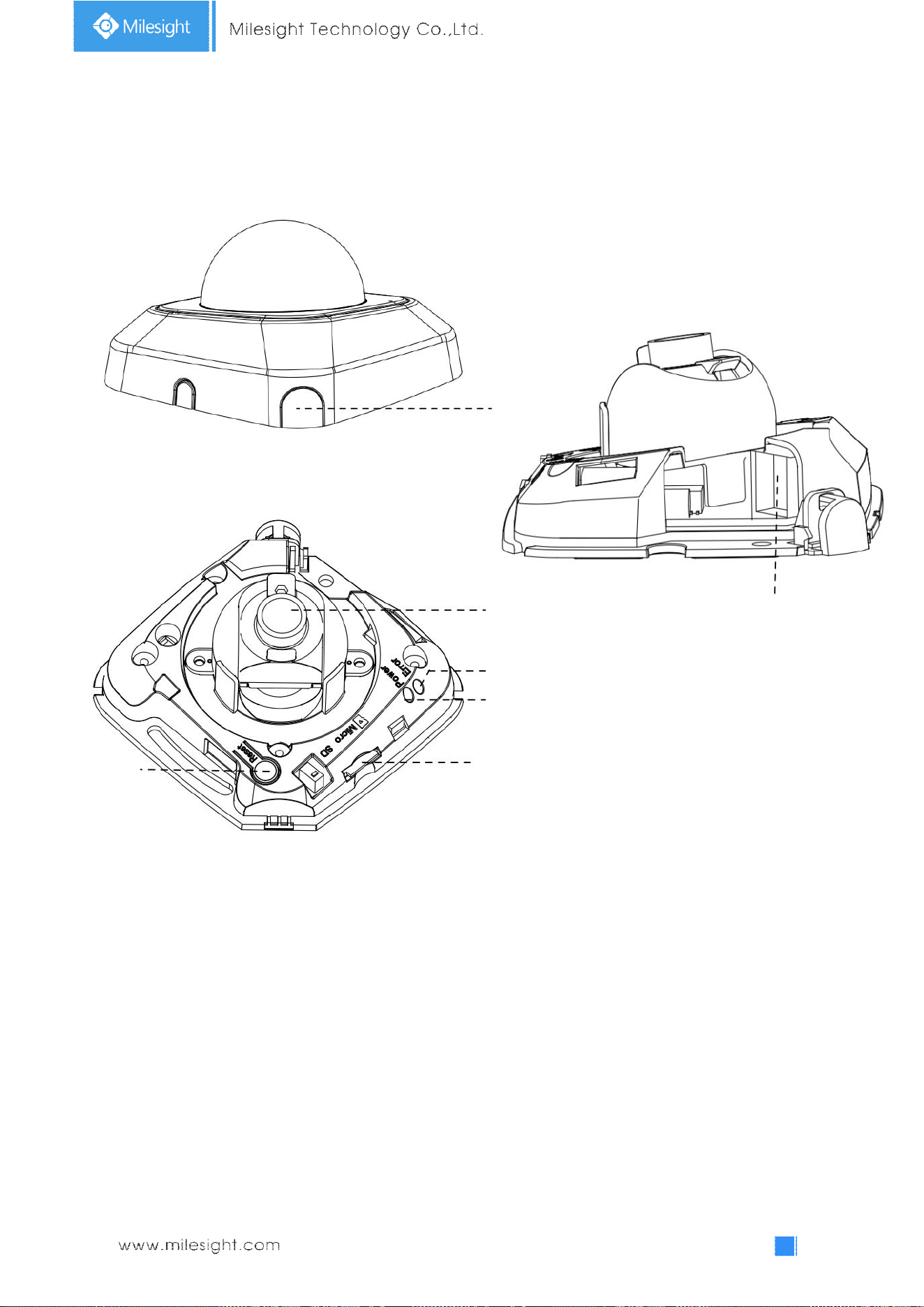
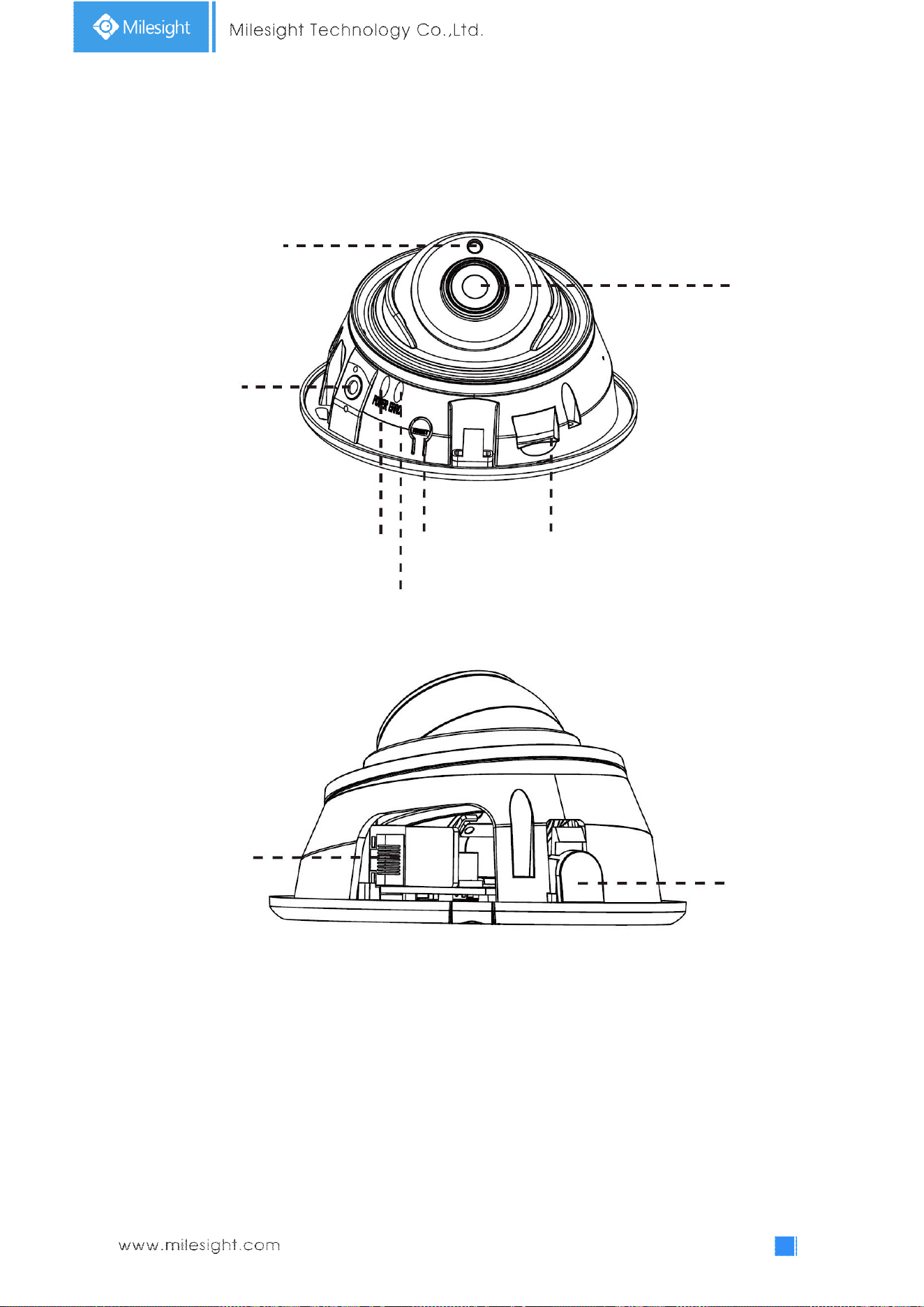
1. Mini Dome Network Camera
Figure 1-3-1 Mini Dome Network Camera
Note:
1) Error LED Indicator: Error LED Indicator is on when the device starts up or runs error.
2) Reset Button: Press “Reset” button for 5 seconds, then the device will be restored to factory
default.
3) Only PoE is available for power supply.
Press Button
Ethernet Port (PoE)
Lens
Error LED Indicator
Power LED Indicator
microSD/SDHC/SDXC Card Slot
Reset
3
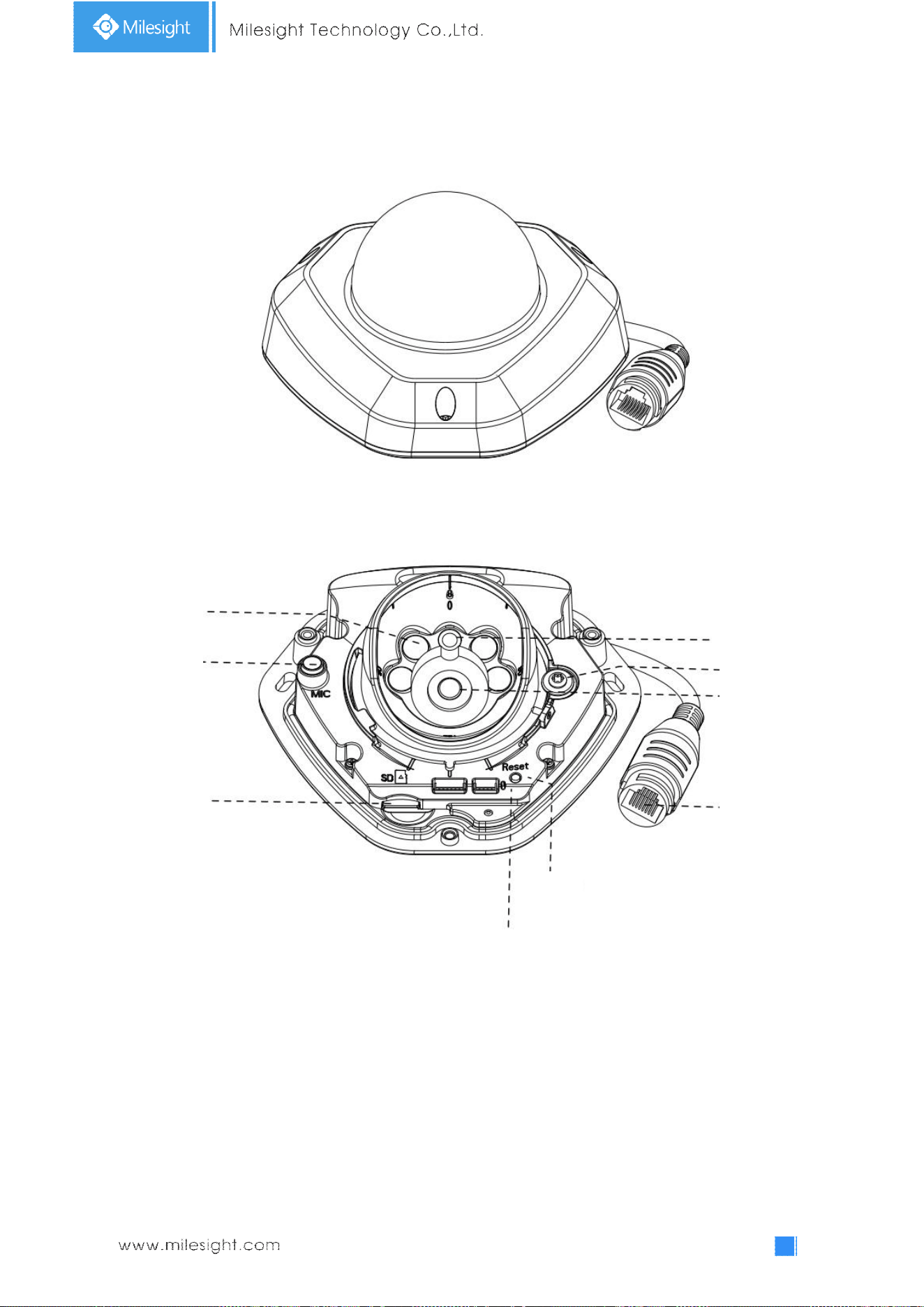
2. IR Mini Dome Network Camera
Figure 1-3-2 IR Mini Dome Network Camera
Note:
1) Error LED Indicator: Error LED Indicator is on when the device starts up or runs error.
2) Reset Button: Press “Reset” button for 5 seconds, then the device will be restored to factory default.
3) Only PoE is available for power supply.
Ethernet Port (PoE)
Press Button
Light Sensor
Lens
Power LED Indicator
Error LED Indicator
Reset
microSD/SDHC/SDXC Card Slot
Microphone
4
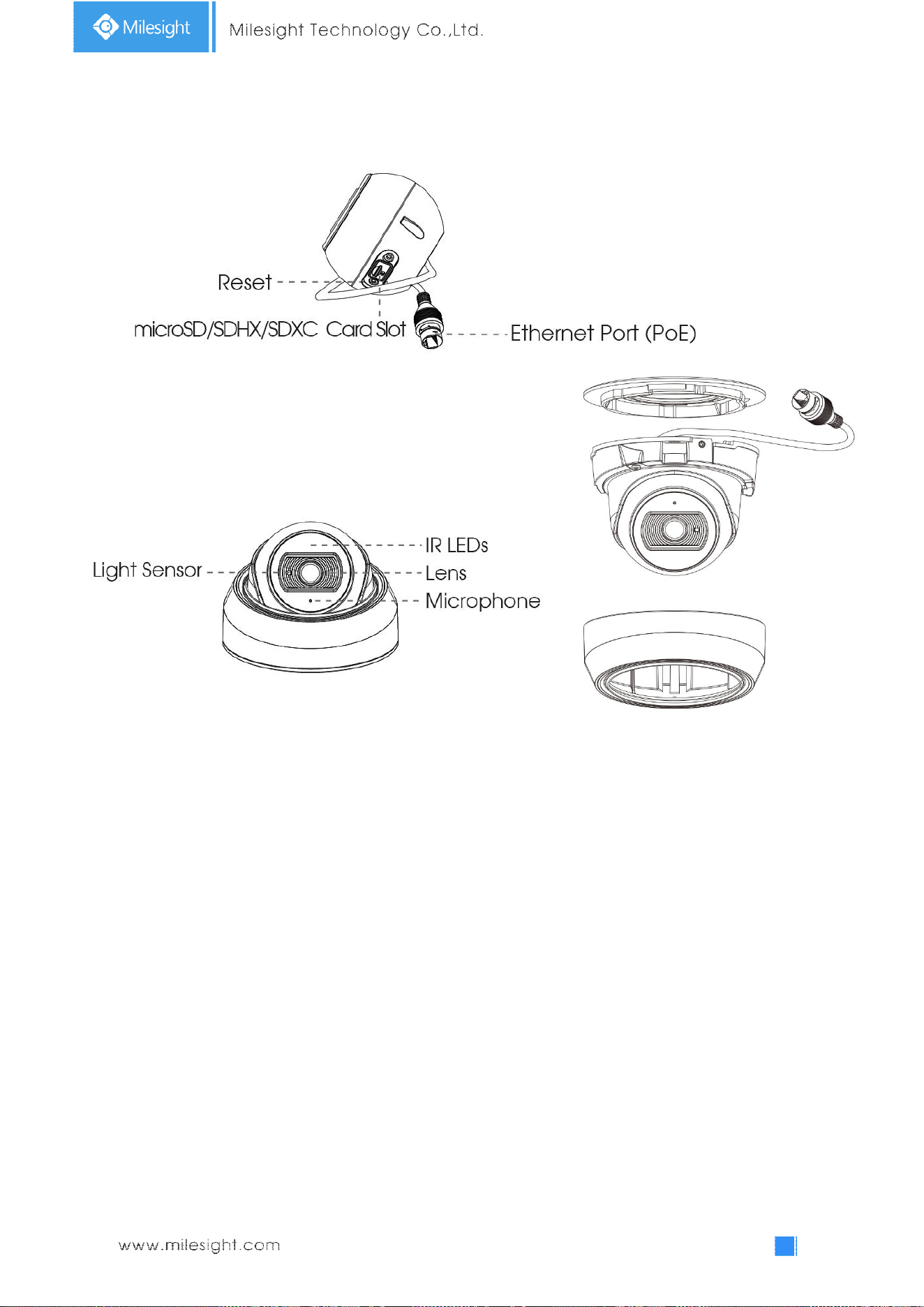
3. Vandal-proof Mini Dome Network Camera
Figure 1-3-3 Vandal-proof Mini Dome Network Camera
Note:
1) Error LED Indicator: Error LED Indicator is on when the device starts up or runs error.
2) Reset Button: Press “Reset” button for 5 seconds, then the device will be restored to factory default.
3) Only PoE is available for power supply.
IR LEDs
Light Sensor
Lens
Ethernet Port (PoE)
microSD/SDHC/SDXC
Card Slot
Microphone
Screw
Power and System LED Indicator
Reset
5
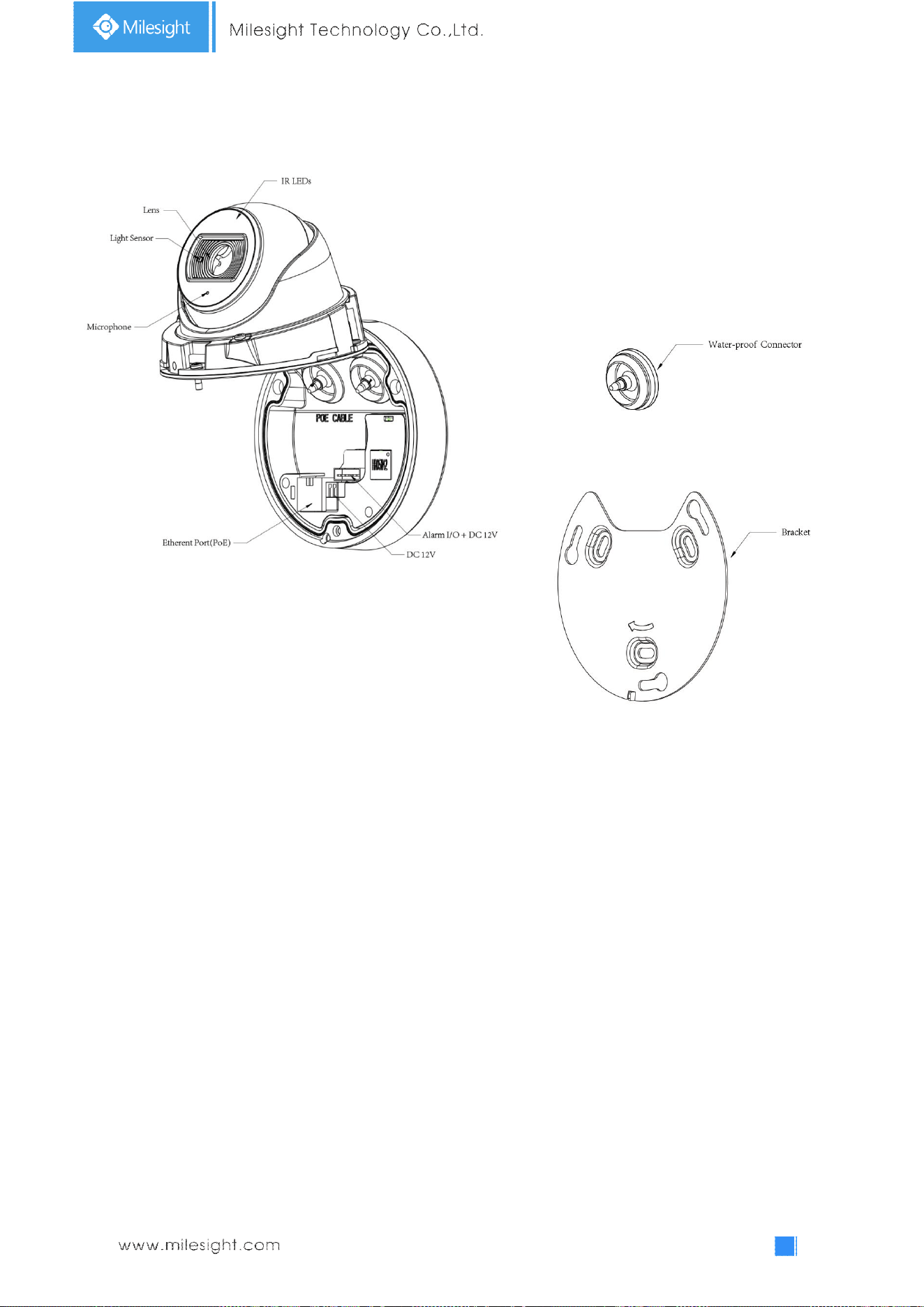
4. Weather-proof Mini Dome Network Camera
Figure 1-3-4 Weather-proof Mini Dome Network Camera
Note:
1) Reset Button: Press “Reset” button for 5 seconds, then the device will be restored to factory default.
2) Only PoE is available for power supply.
6
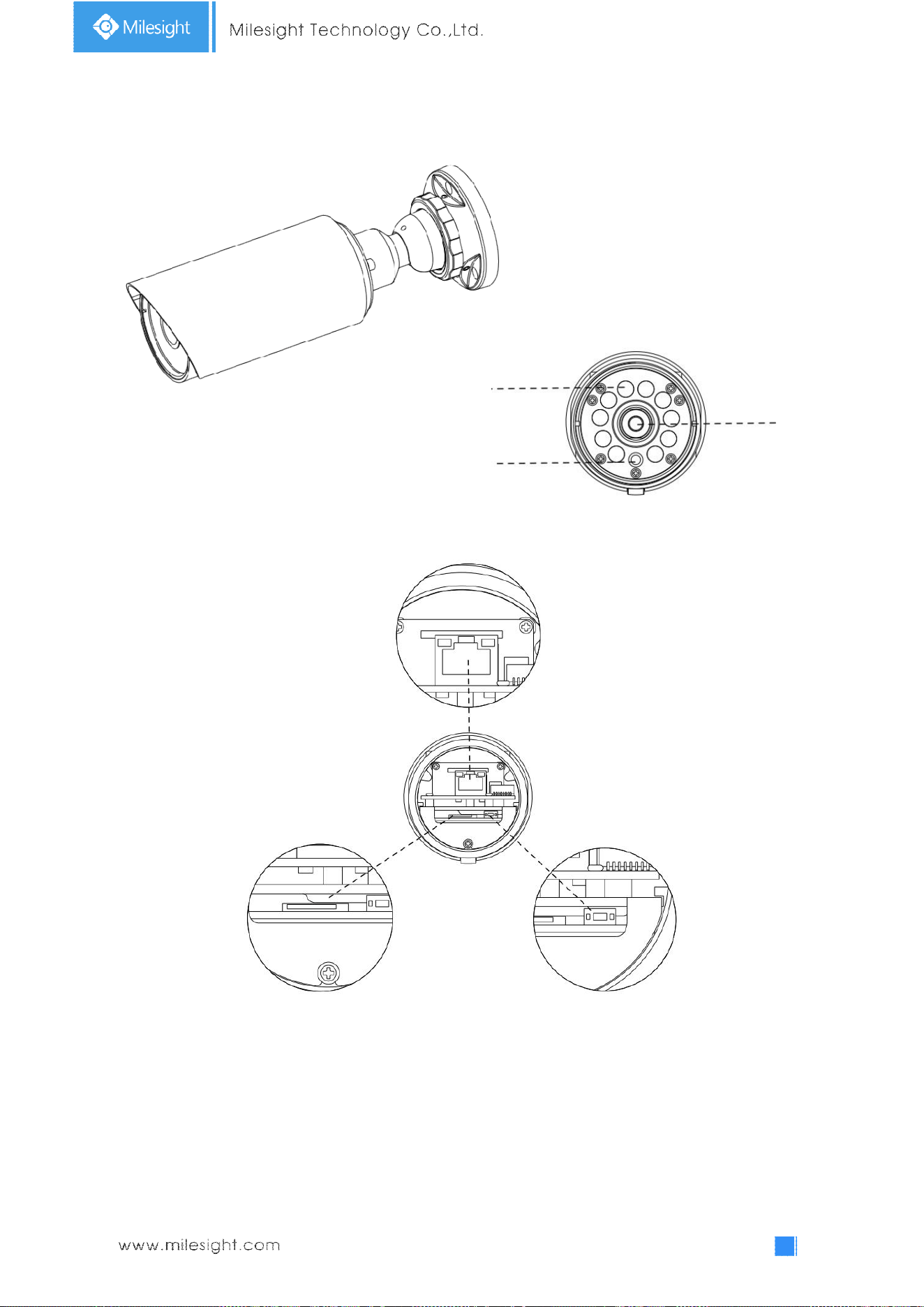
5. AF Motorized Mini Dome Network Camera
Figure 1-3-5 AF Motorized Mini Dome Network Camera
Note:
1) Reset Button: Press “Reset” button for 5 seconds, then the device will be restored to factory default.
2) DC 12V and PoE are available for power supply.
7
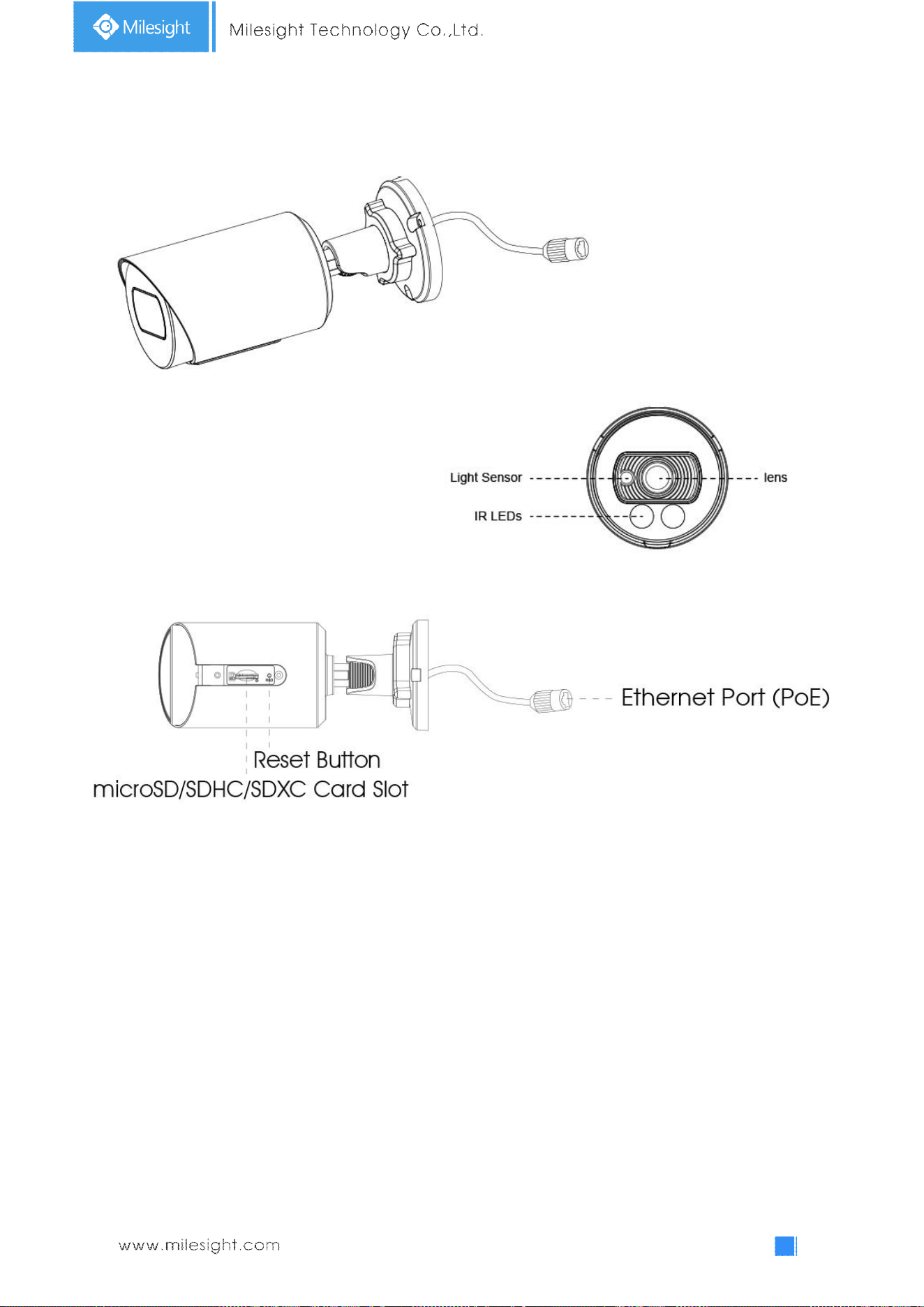
6. Mini Bullet Network Camera
Figure 1-3-6 Mini Bullet Network Camera
Note:
1) Only PoE is available for power supply.
2) Reset Button: Press “Reset” button for 5 seconds, then the device will be restored to factory default.
Lens
IR LEDs
Light Sensor
Ethernet Port (PoE)
microSD/SDHC/SDXC Card Slot
Reset Button
8
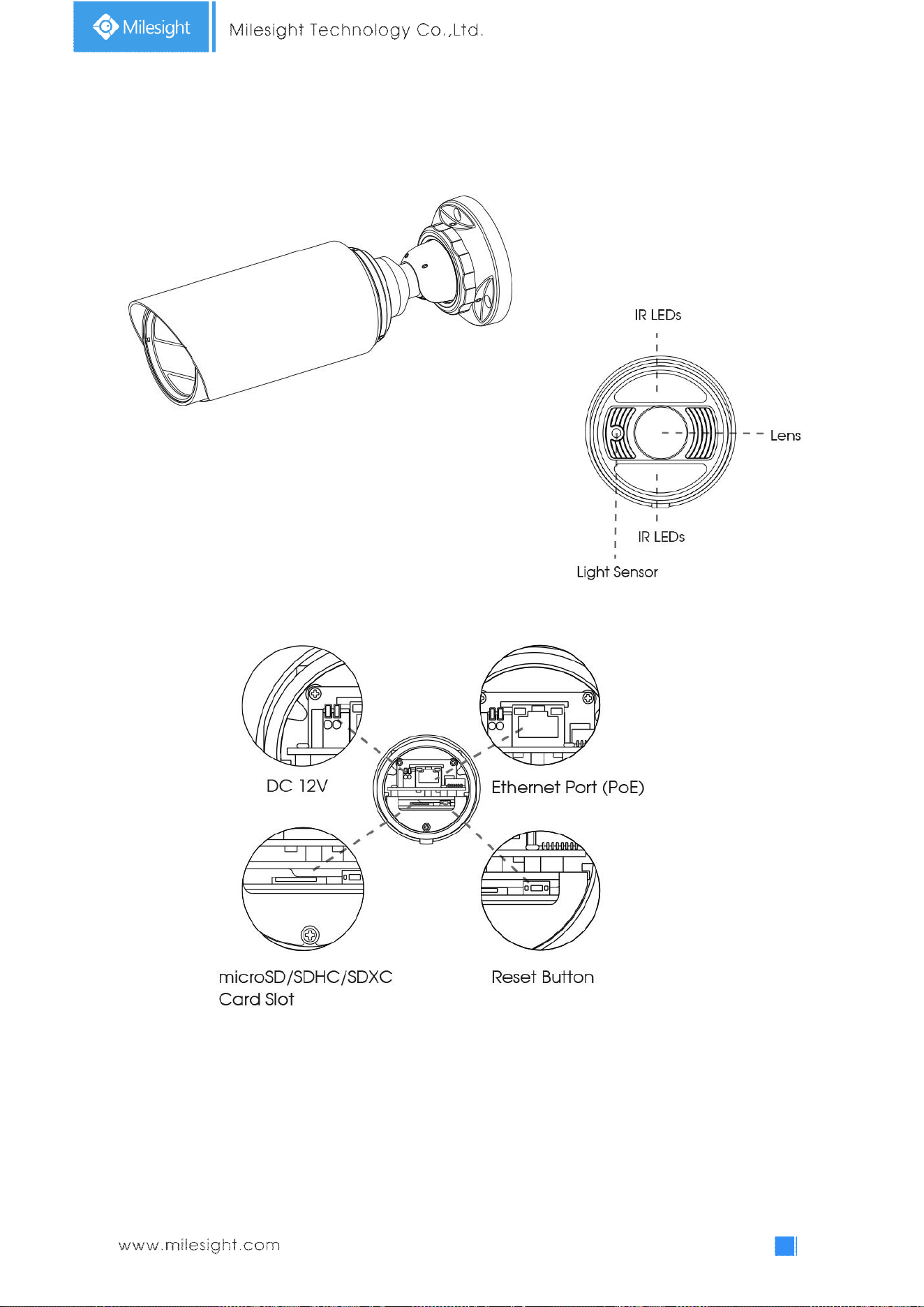
7. Vandal-proof Mini Bullet Network Camera
Figure 1-3-7 Vandal-proof Mini Bullet Network Camera
Note:
1) Only PoE is available for power supply.
2) Reset Button: Press “Reset” button for 5 seconds, then the device will be restored to factory default.
9
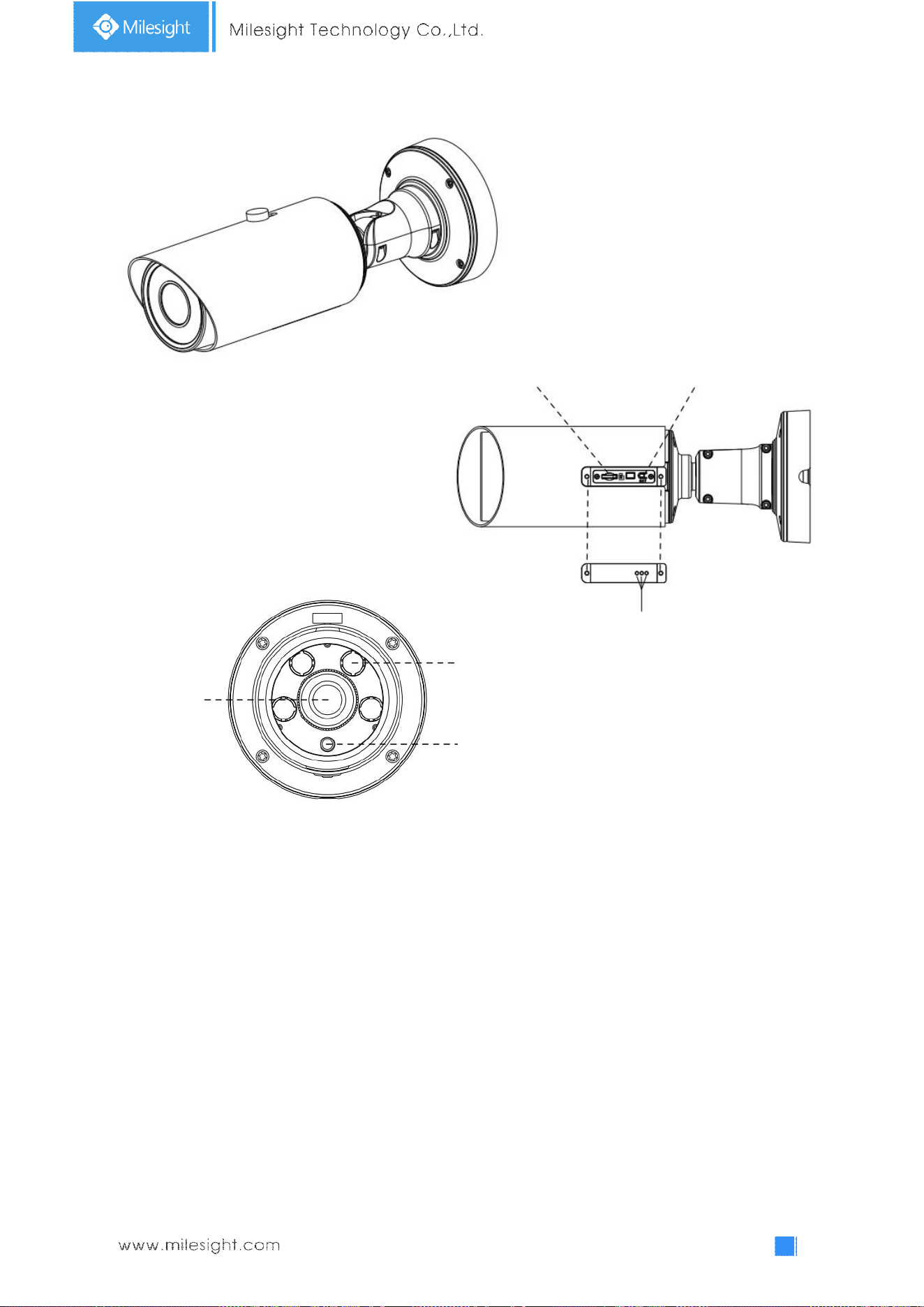
8. (Vandal-proof) Motorized Mini Bullet Network Camera
Figure 1-3-8 (Vandal-proof) Motorized Mini Bullet Network Camera
Note:
1) DC 12V and PoE are available for power supply.
2) Reset Button: Press “Reset” button for 5 seconds, then the device will be restored to factory default.
Ethernet Port (PoE)
10
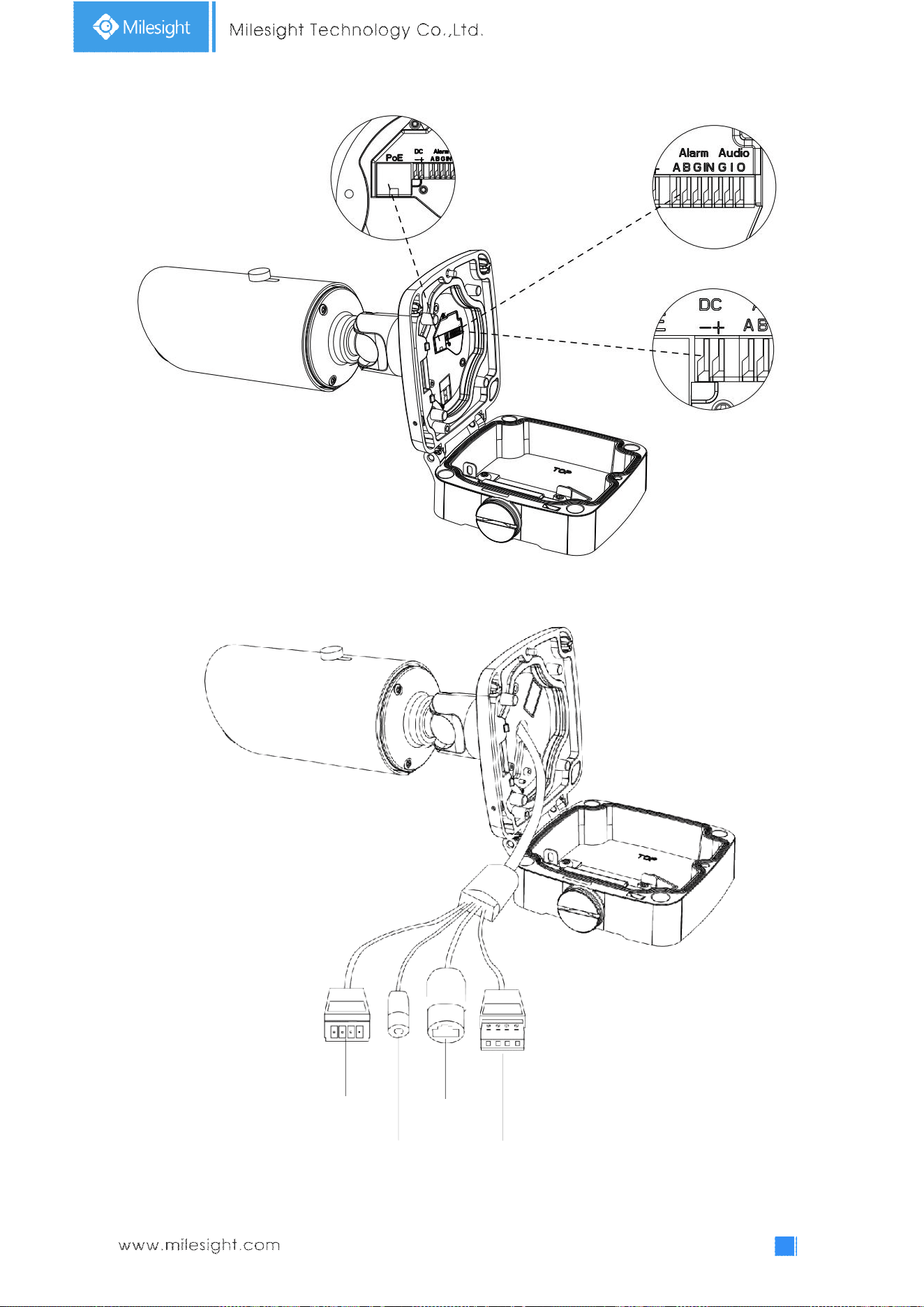
9. (12x AF) Motorized Pro Bullet Network Camera
Figure 1-3-9 (12x AF) Motorized Pro Bullet Network Camera
Note:
1) DC 12V and PoE are available for power supply.
2) Reset Button: Press “Reset” button for 5 seconds, then the device will be restored to factory default.
3) There are two versions for Pro Bullet: the interface’s pictures are as below.
m
icroSD/SDHC/SDXC Card Slot
Reset
PTFE Membrane
IR LEDs
Lens
Light Sensor
11
Figure 1-3-10 Motorized Pro Bullet Network Camera(Version A)
Figure 1-3-11 Motorized Pro Bullet Network Camera(Version B)
Ethernet Port (PoE)
DC 12V
DC 12V
Alarm/Audio
Ethernet Port
(PoE)
Alarm In/Out
Audio In/Out
12
Microphone
Lens
IR LEDs
Light Sensor
Reset
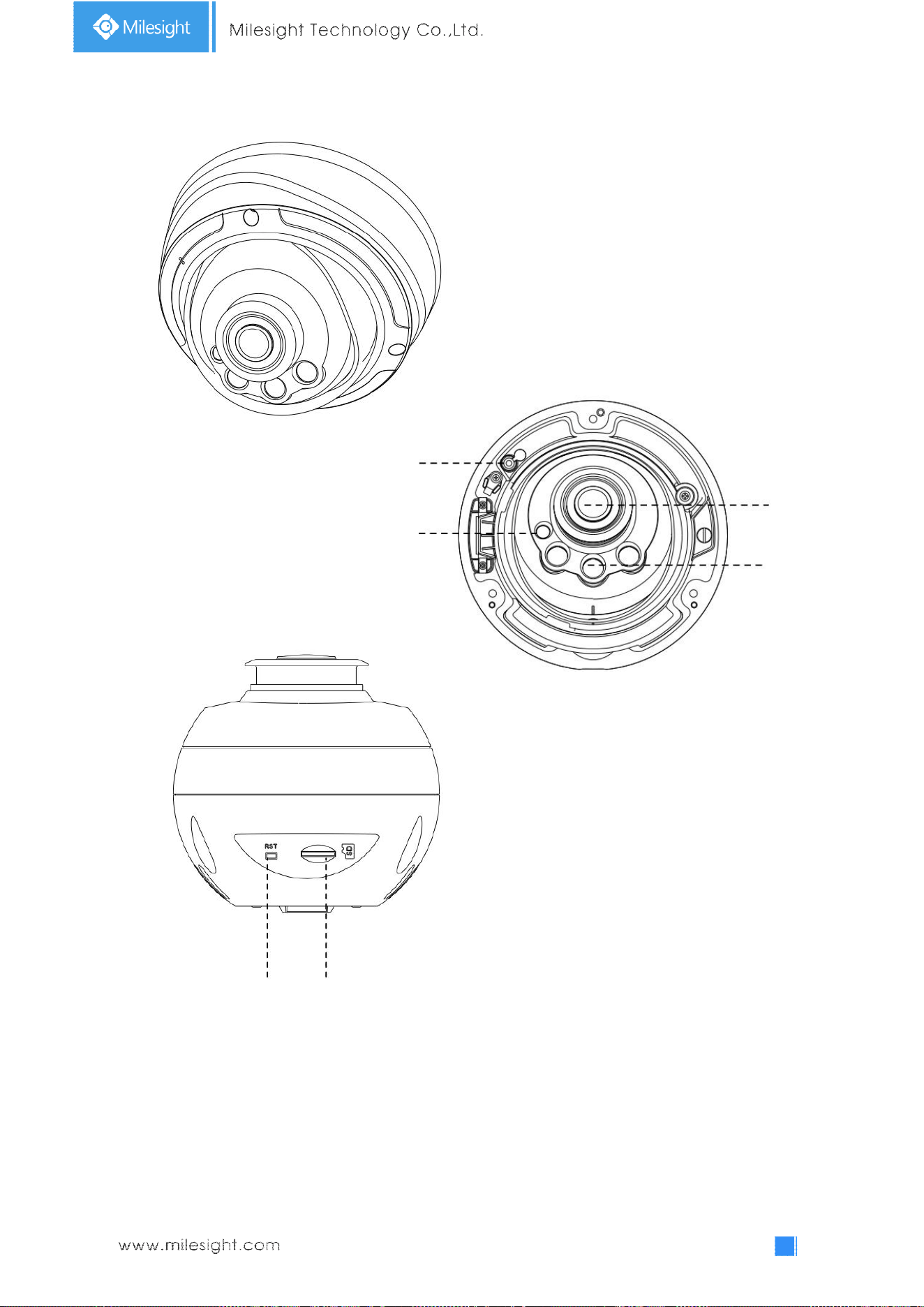
10. Motorized Pro Dome Network Camera
Figure 1-3-12 Motorized Pro Dome Network Camera
Note:
1) Reset Button: Press “Reset” button for 5 seconds, then the device will be restored to factory default.
m
icroSD/SDHC/SDXC Card Slot
13
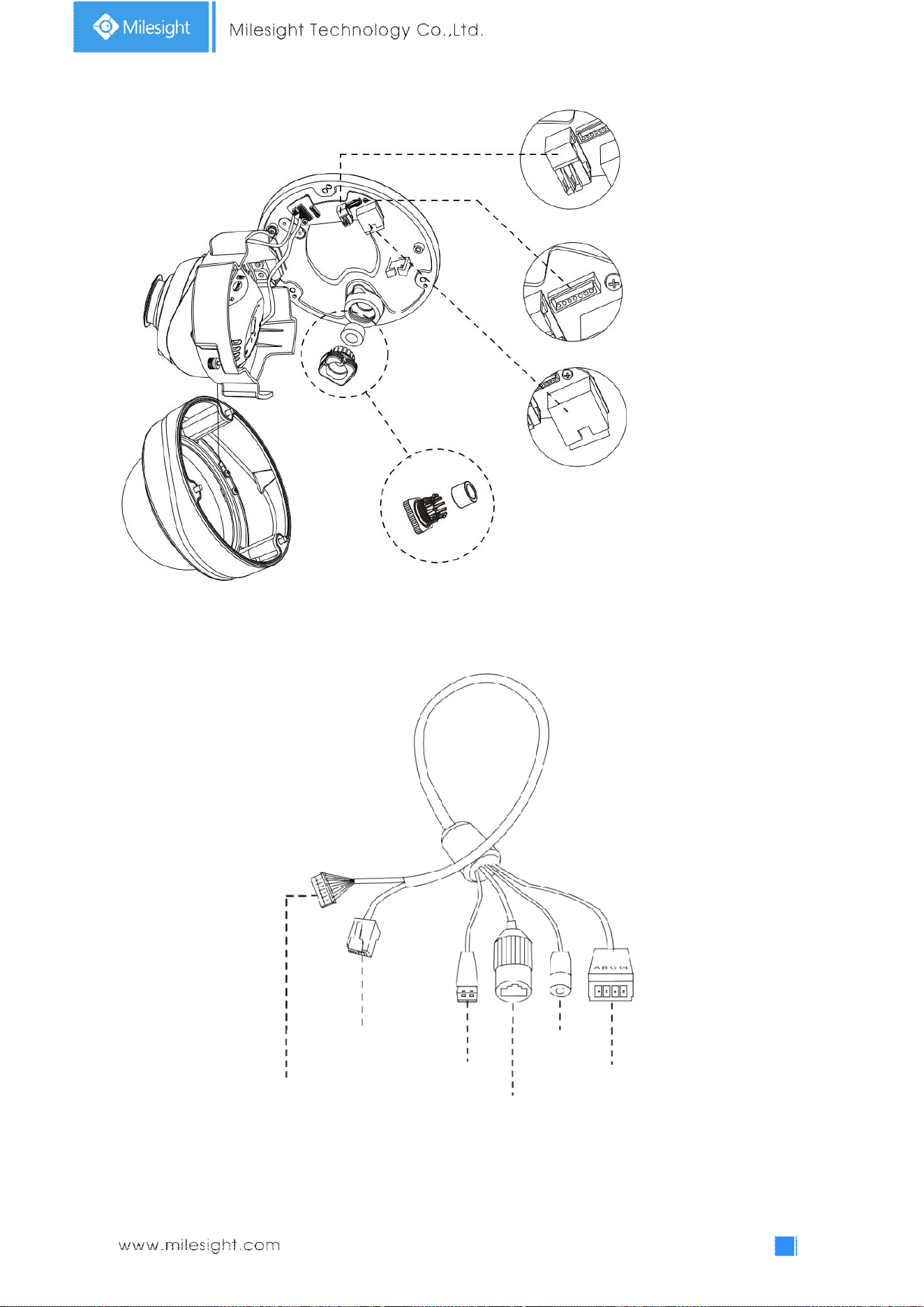
DC 12V
Alarm In/Out & Audio Out/DC 12V
Ethernet Port
(PoE)
Ethernet Port
(PoE)
Figure 1-3-13 Motorized Pro Dome Network Camera multiple interface
Here is one equipped cable for multiple interface usage:
Figure 1-3-14 Motorized Pro Dome Network Camera multiple interface cable
Ethernet Port (PoE)
Water-proof Connector
Alarm In/Out &
Audio Out/DC 12V
Audio Out
DC 12V
Alarm In/Out
14
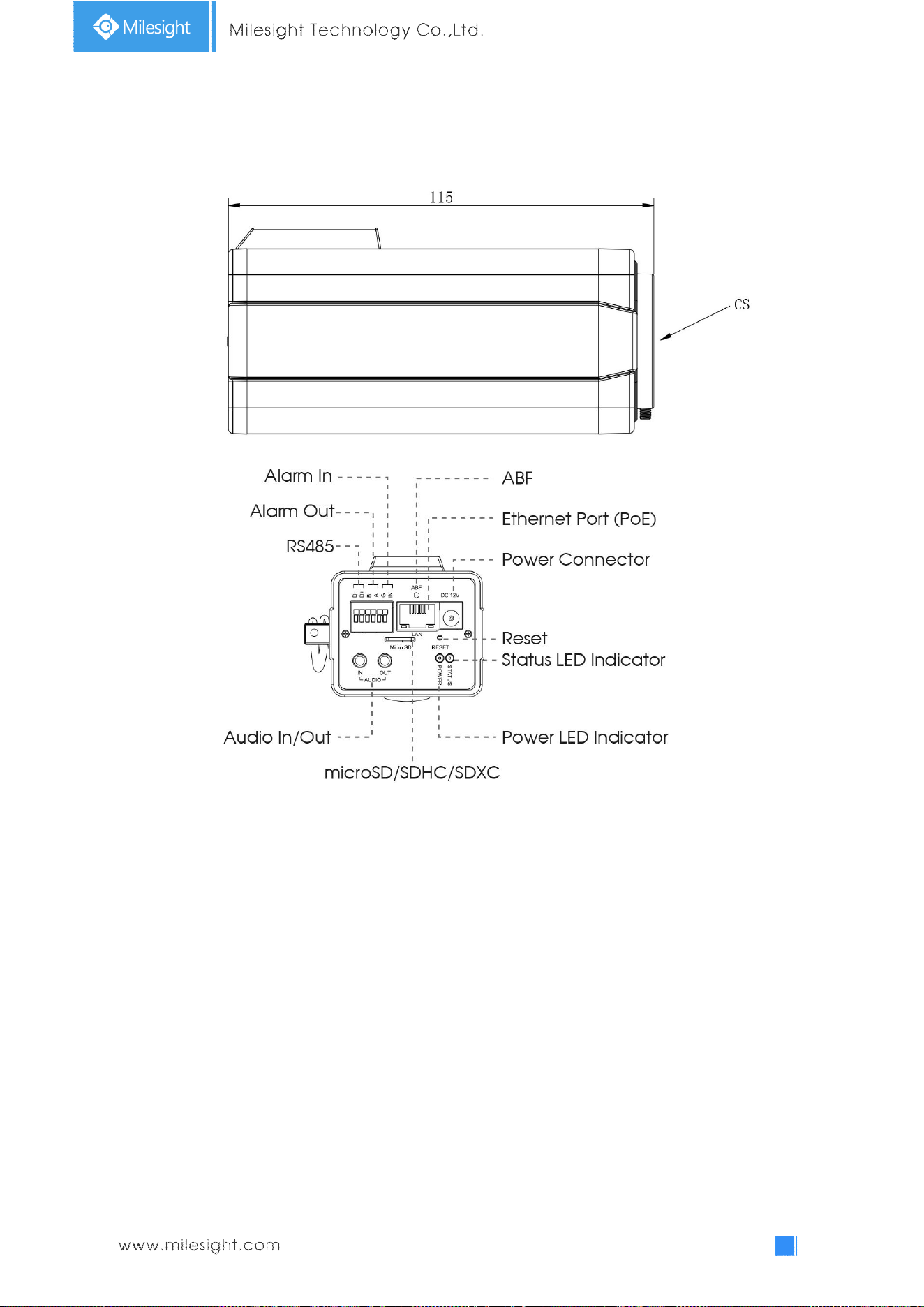
11. (ABF) Pro Box Network Camera
Figure 1-3-15 (ABF) Pro Box Network Camera
Note:
1) Reset Button: Press “Reset” button for 5 seconds, then the device will be restored to factory default.
2) DC 12V and PoE are available for power supply.
15
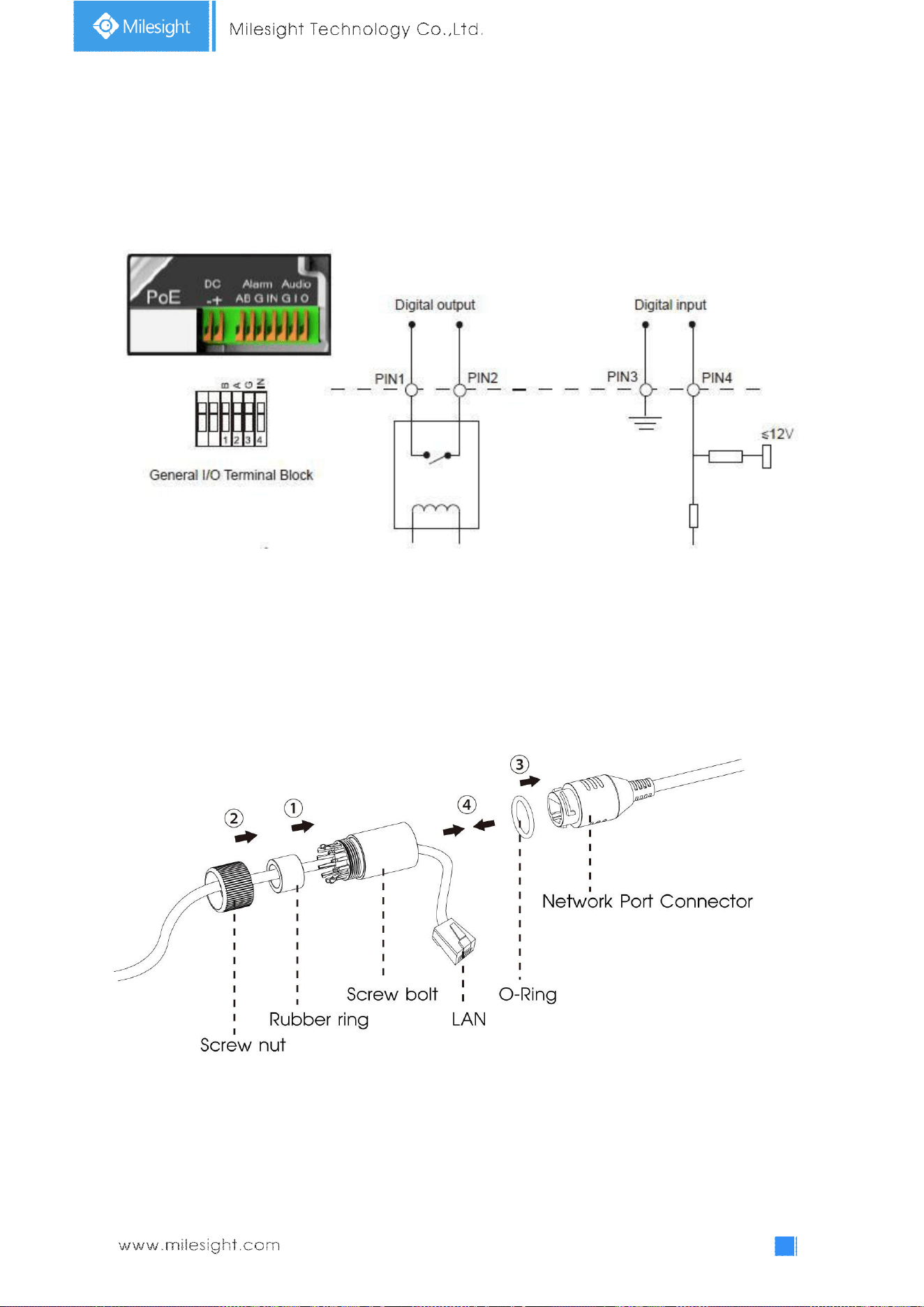
1.4 How to Connect to Alarm Interface
External interface of camera is as the following, you can refer to the picture to install the external alarm
device:
PIN1: Alarm Output NC/NO 24V DC 1A
PIN2: Alarm Output NC/NO 24V DC 1A
PIN3: Alarm Input NC/NO ≤12V
PIN4: Alarm Input NC/NO ≤12V
1.5 How to Connect the Water-proof Connector
Step1: Get the network cable through the screw nut, rubber ring and the screw bolt.
Step2: Insert the rubber ring into the screw bolt.
Step3: Connect the screw nut to the screw bolt.
Step4: Place the O-Ring on the network port connector.
Step5: Connect the RJ45 to the network port connector, and tighten the screw bolt and the connector.

16
1.6 System Requirements
Operating System: Windows XP/Vista/7/8/10/Server 2000/Server 2008
CPU: 1.66GHz or higher
RAM: 1G or higher
Graphic memory: 128MB or more
Internet protocol: TCP/IP (IPv4/IPv6)
Web Browsers: Internet Explorer 8.0 and above version, Mozilla Firefox, Google Chrome and Safari.
17
Chapter II Network Connection
2.1 Setting the Camera over the LAN
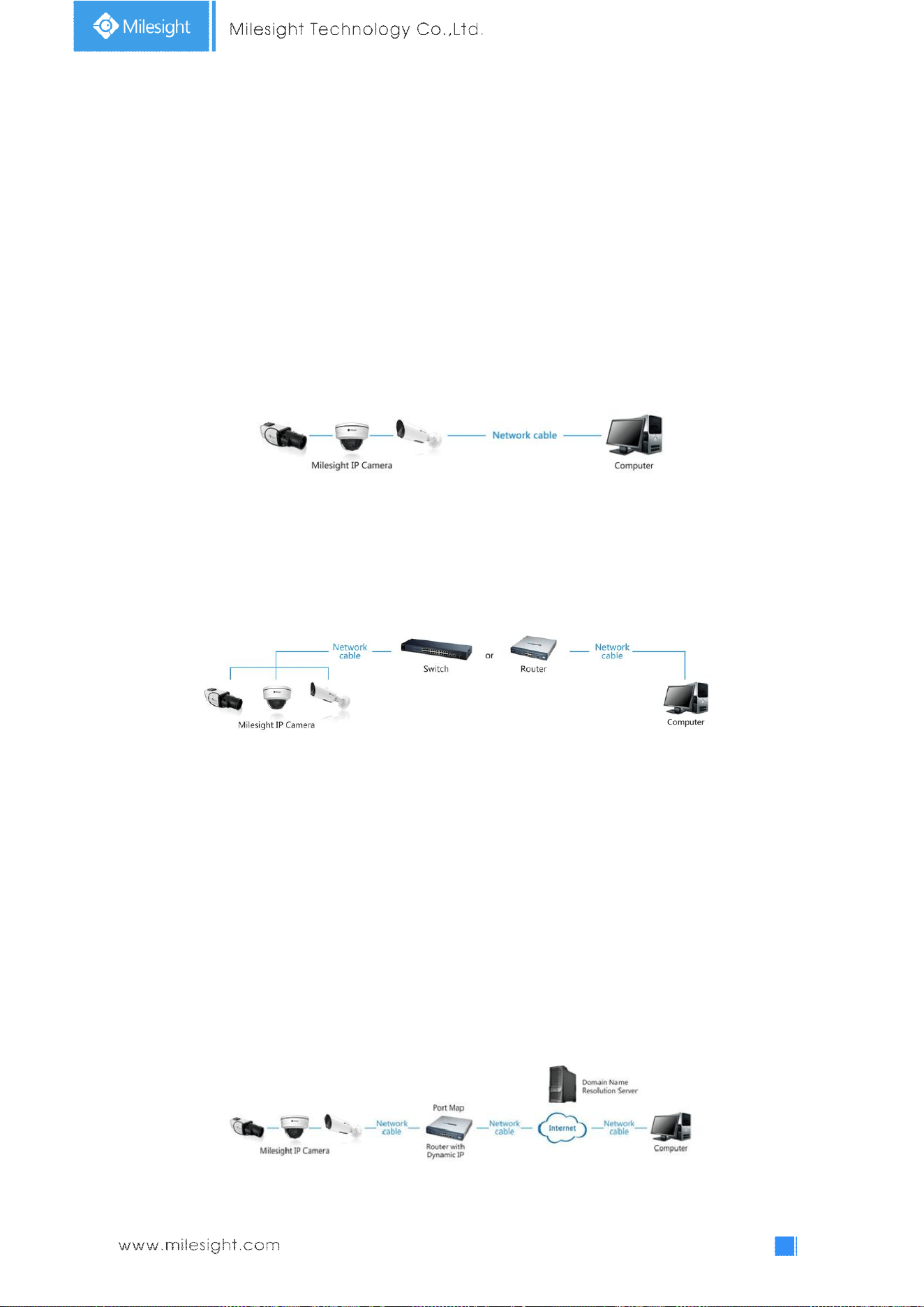
Connecting the camera to a switch or a router is the most common connection method. The camera must
be assigned an IP address that is compatible with its LAN.
2.1.1 Connect the Camera to the PC Directly
In this method, only the computer connected to the camera will be able to view the camera. The camera
must be assigned a compatible IP address to the computer. Details are shown as the following figure.
Figure 2-1-1 Connect the camera to the PC directly
2.1.2 Connect via a Switch or a Router
Refer to the following figure to set network camera over the LAN via the switch or router.
Figure 2-1-2 Connect via a switch or a Router
2.2 Dynamic IP Connection
u Connecting the network camera via a router
Step1: Connect the network camera to a router;
Step2: On the camera, assign a LAN IP address, the Subnet mask and the Gateway;
Step3: On the router, set port forwarding. E.g. 80, 8000 and 554 ports. The steps for port forwarding vary
depending on different routers. Please look up the router's user manual for assistance with port
forwarding;
Step4: Apply a domain name from a domain name provider;
Step5: Configure the DDNS settings in the setting interface of the router;
Step6: Visit the camera via the domain name.
Figure 2-2 Connect the network camera via a router using dynamic IP
18
Chapter III Accessing the Network Camera
The camera must be assigned an IP address to be accessible.
3.1 Assigning An IP Address
The Network Camera must be assigned an IP address to be accessible. The default IP address of Milesight
Network Camera is 192.168.5.190. The default user name is “admin”, and password is “ms1234”.
You can either change the IP address of the camera via Smart Tools or browser. Please connect the camera
in the same LAN of your computer.
3.1.1 Assigning An IP Address Using Smart Tools
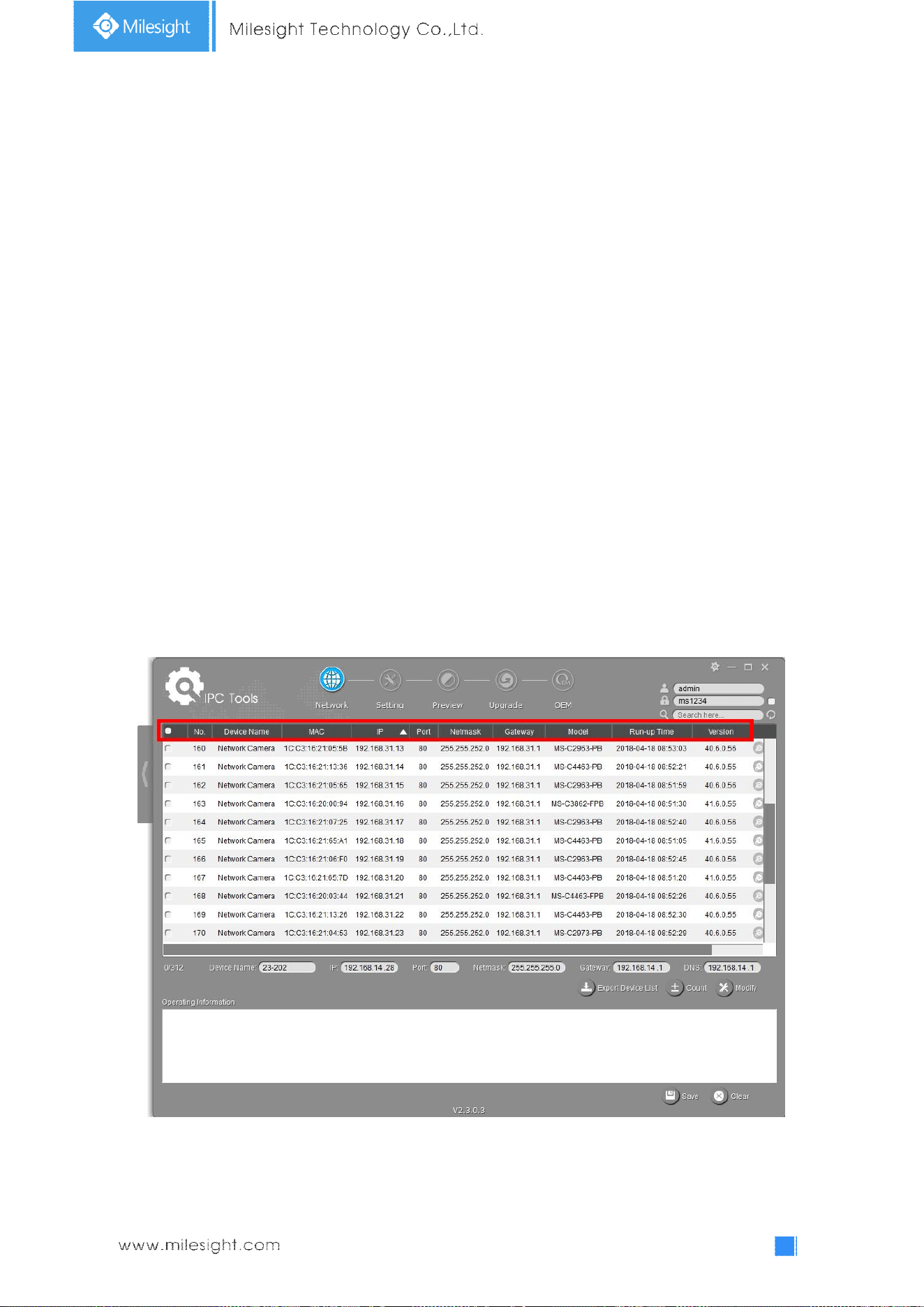
Smart Tools is a software tool which can automatically detect multiple online Milesight network cameras in
the LAN, set IP addresses, and manage firmware upgrades. It’s recommended to use when assigning IP
addresses for multiple cameras.
Step1: Install Smart Tools (The software could be downloaded from our website);
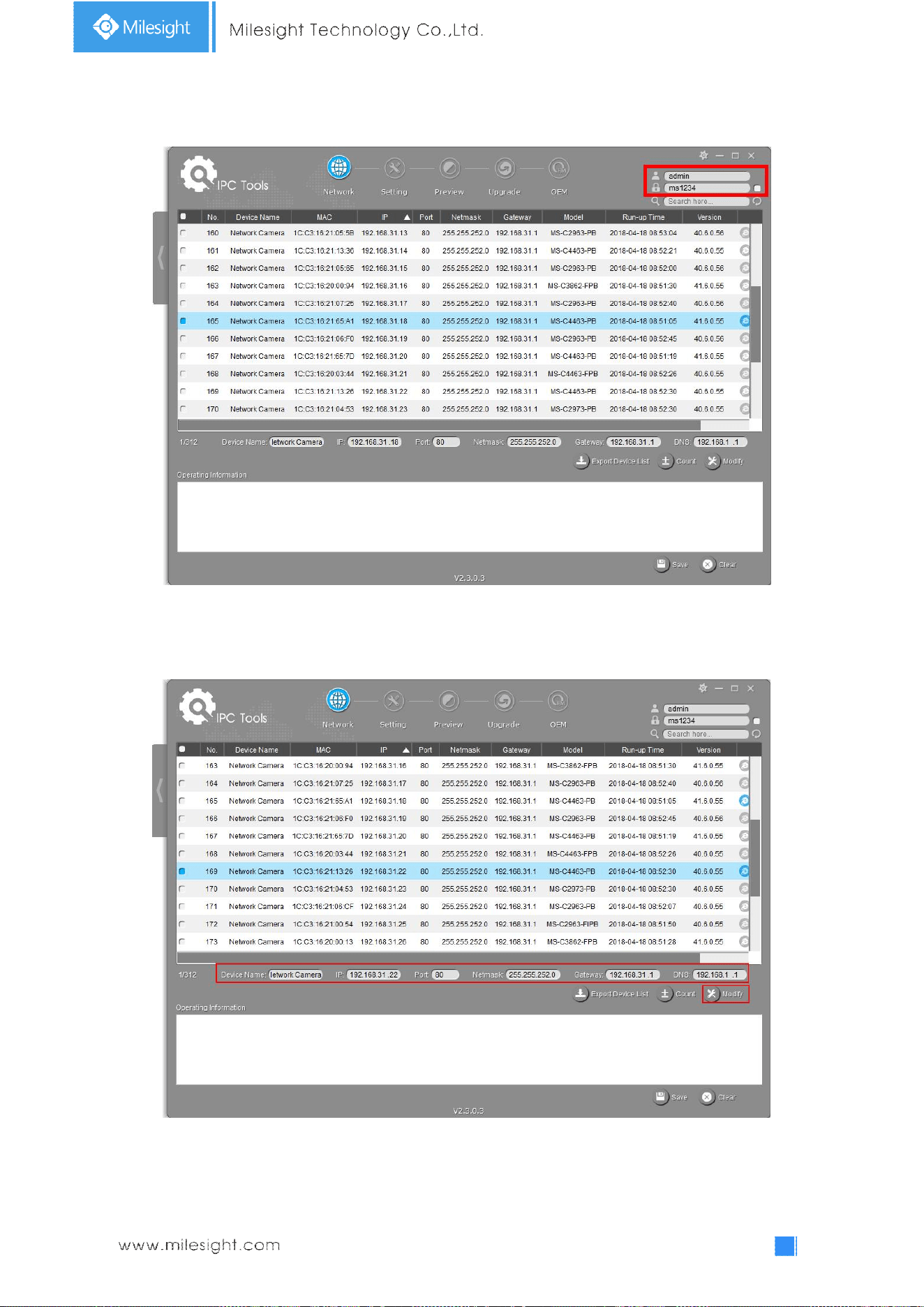
Step2: Start Smart Tools, click the IPC Tools page, then enter the device information, such as IP address,
MAC address, Port number, Netmask, and Gateway, then all related Milesight network cameras in
the same network that will be displayed. Details are shown as Figure 3-1-1;
Figure 3-1-1 Smart Tools
19
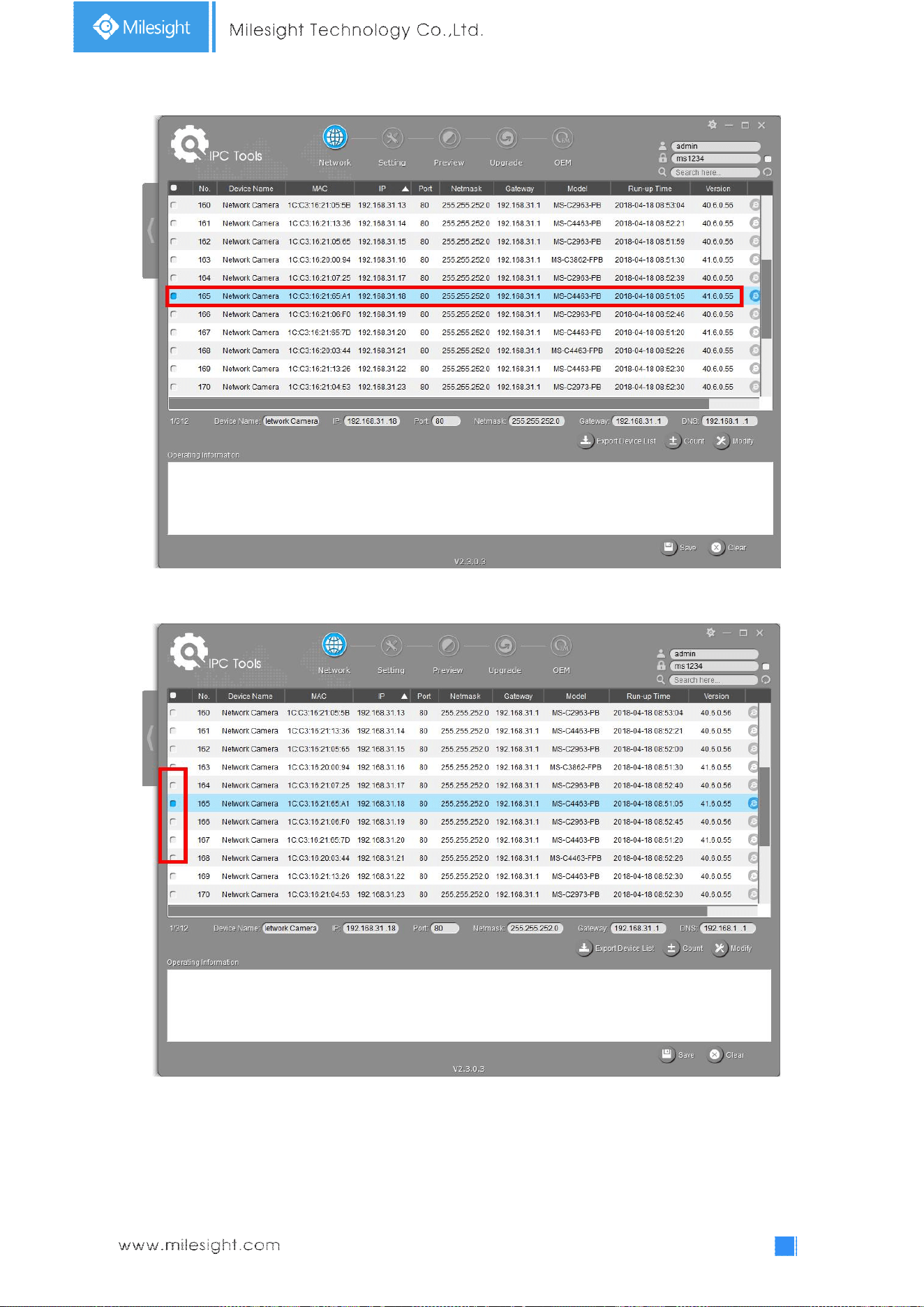
Step3: Select a camera or multiple cameras according to the MAC addresses;
Figure 3-1-2 Select single camera
Figure 3-1-3 Select multiple cameras
20
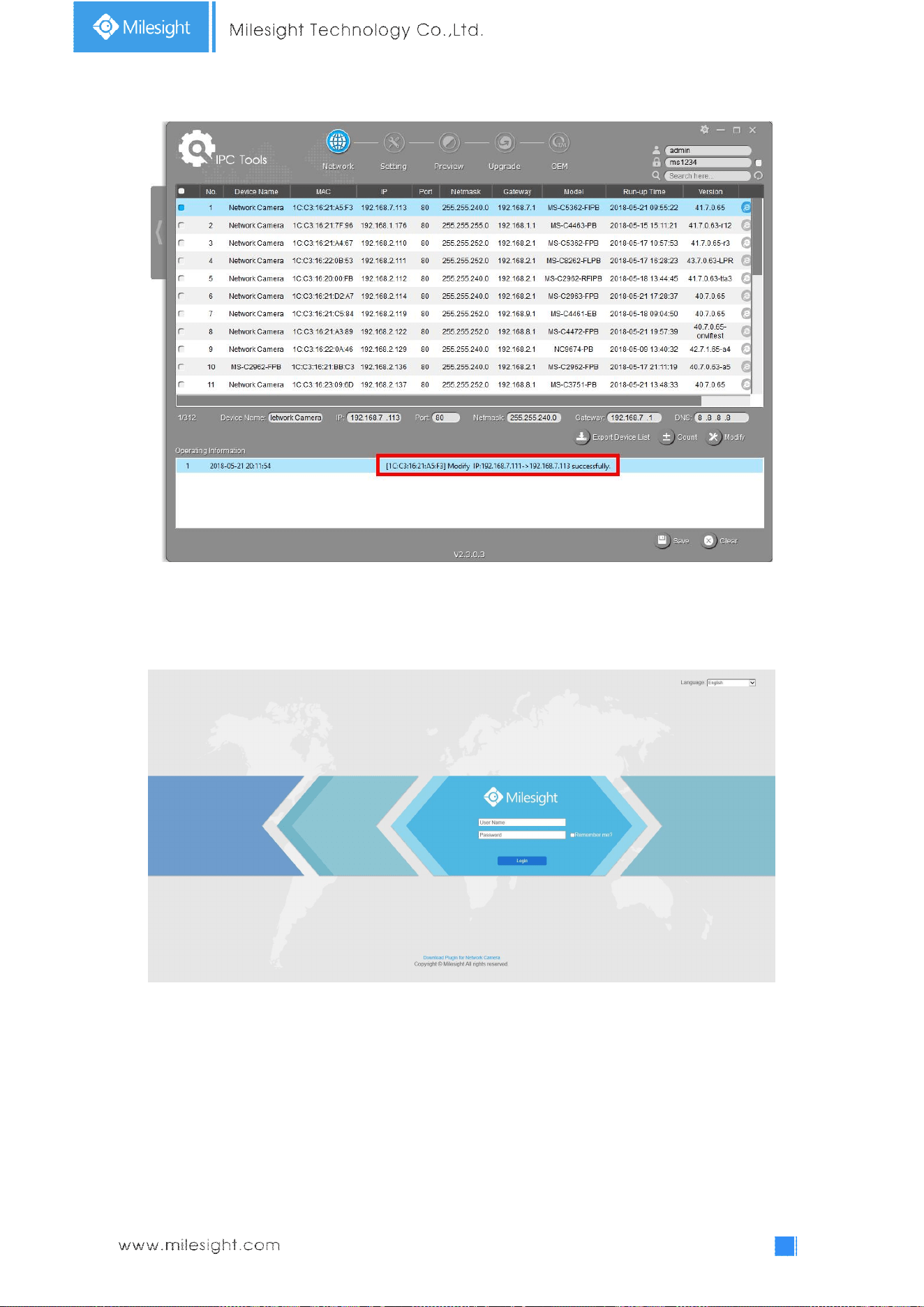
Step4: Type the User Name and Password (admin/ms1234 for default, please change your password for
your device security);
Figure 3-1-4 Type the User Name and Password
Step5: Change the IP address or other network values, and then click “Modify” button;
Figure 3-1-5 Modify
21
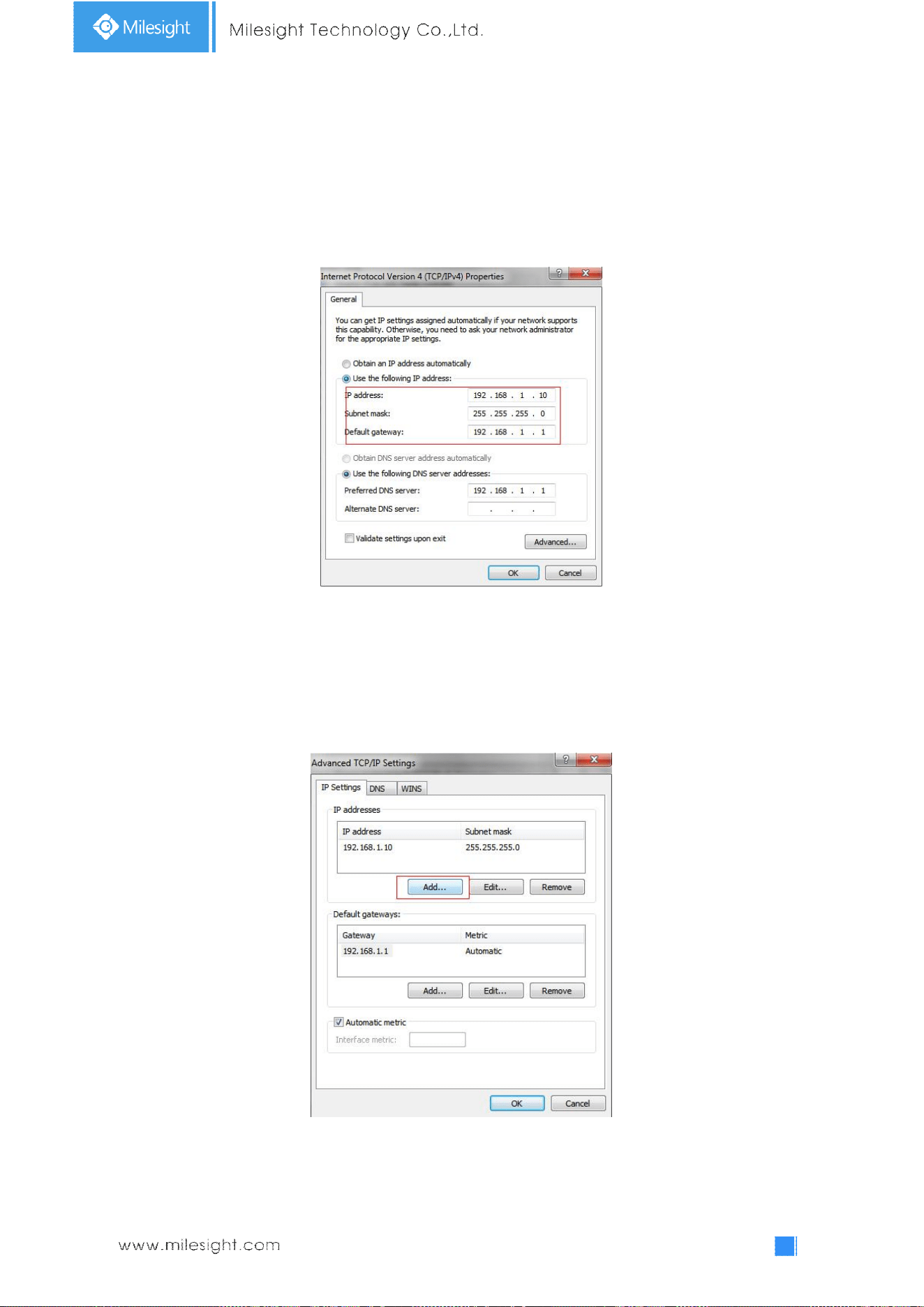
Step6: Change the IP address successfully;
Figure 3-1-6 Change IP address successfully
Step7: By double clicking the selected camera or the browser of interested camera, you can access the
camera via web browser directly. The Internet Explorer window will pop up.
Figure 3-1-7 Login interface
More usage of Smart Tools, please refer to the Smart Tools User Manual.
22
3.1.2 Assign an IP address via browser
If the network segment of the computer and that of the camera are different, please follow the steps to
change the IP address:
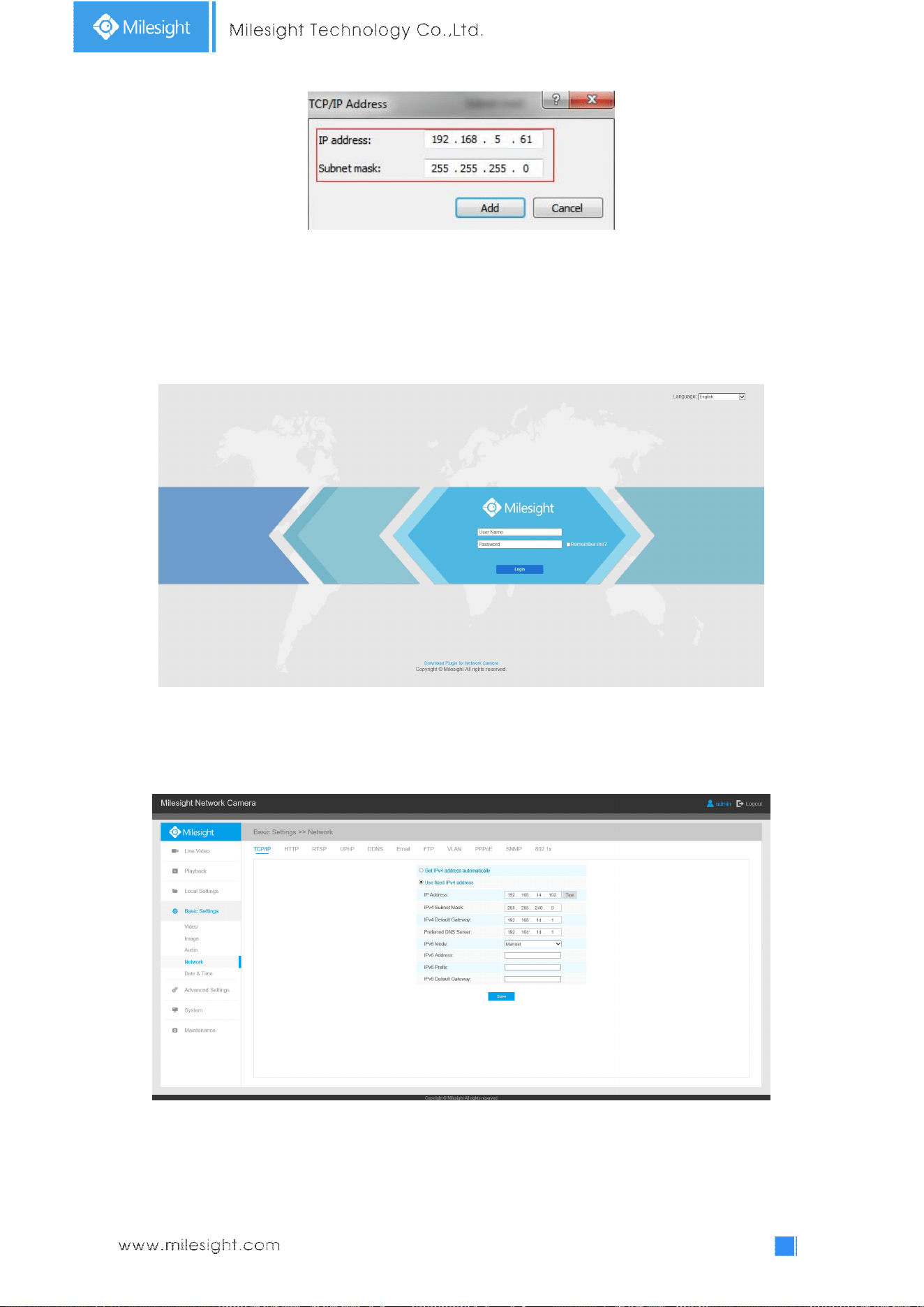
Step1: Change the IP address of computer to 192.168.5.0 segment, here are two ways as below:
a.Startà Control Panelà Network and Internet Connectionà Network Connectionà Local Area
Connection, and double click it. (Refer to Figure 3-1-8);
Figure 3-1-8 Setting Network Segment IP Address of Computer
b. Click “Advanced”, and then click “IP settings” à “IP address” à “Add” (See Figure 3-1-9). In
the pop-up window, enter an IP address that in the same segment with Milesight network
camera ( e.g. 192.168.5.61, but please note that this IP address shall not conflict with the IP
address on the existing network);
23
Figure 3-1-9 Setting IP Address of Computer
Step2: Start the browser. In the address bar, enter the default IP address of the camera:
http://192.168.5.190;
Step3: Enter the user name and password when the LOGIN page appears;
Default user name: admin
Default password: ms1234
Figure 3-1-10 Login
Step4: After login, please select “Configuration”à “Basic Settings”à “Network”à “TCP/IP”. The Network
Settings page appears (Shown as below Figure);
Figure 3-1-11 IP Address of Camera
Step5: Change the IP address or other network values. Then click “Save” button;
Step6: The change of default IP address is completed.
24
3.2 Accessing from the Web Browser
The camera can be used with the most standard operating systems and browsers. The recommended
browsers are Internet Explorer, Firefox, Chrome, Safari.
Access over IE Browser
Before using the browser to get access to your camera, you need to install the MsActiveX firstly. You can
refer the steps as follows:
Step1: Launch the IE browser and enter the IP address of the camera;
Step2: Enter the User Name and Password and click “Login”;
(The default user name is “admin”, password is “ms1234”)
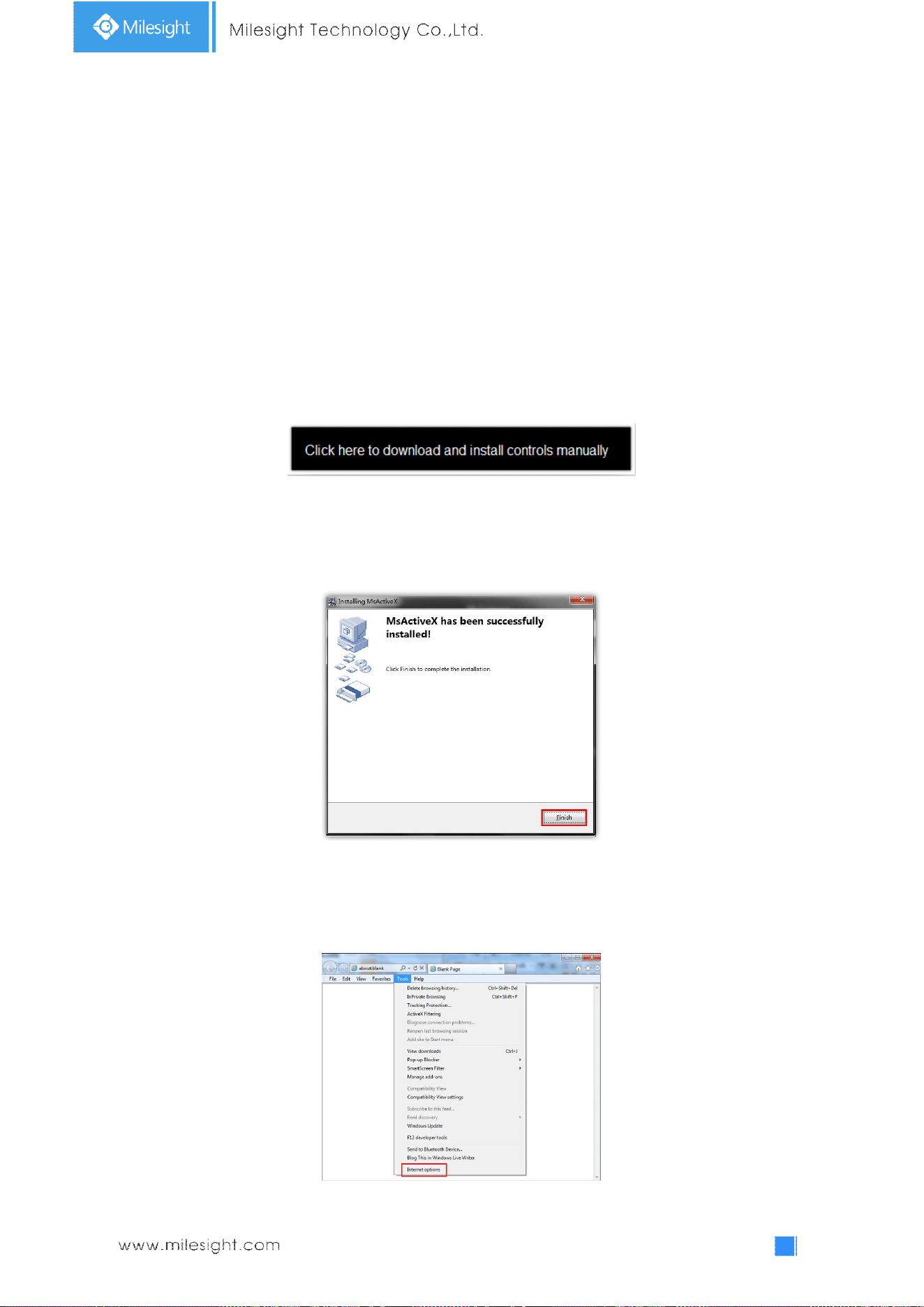
Step3: At the first time to log in the device, the browser will prompt to install Controls, please click “Click
here to download and install controls manually” as Figure 3-2-1;
Figure 3-2-1 To download and install controls
Note:During installing the controls, please keep the browsers close.
Step4: Follow the prompts to install the Controls, when it`s finished, it will pop out a window as Figure
3-2-2. Please click “Finish” and refresh the browser, then you will see the video.
Figure 3-2-2 Finish installation
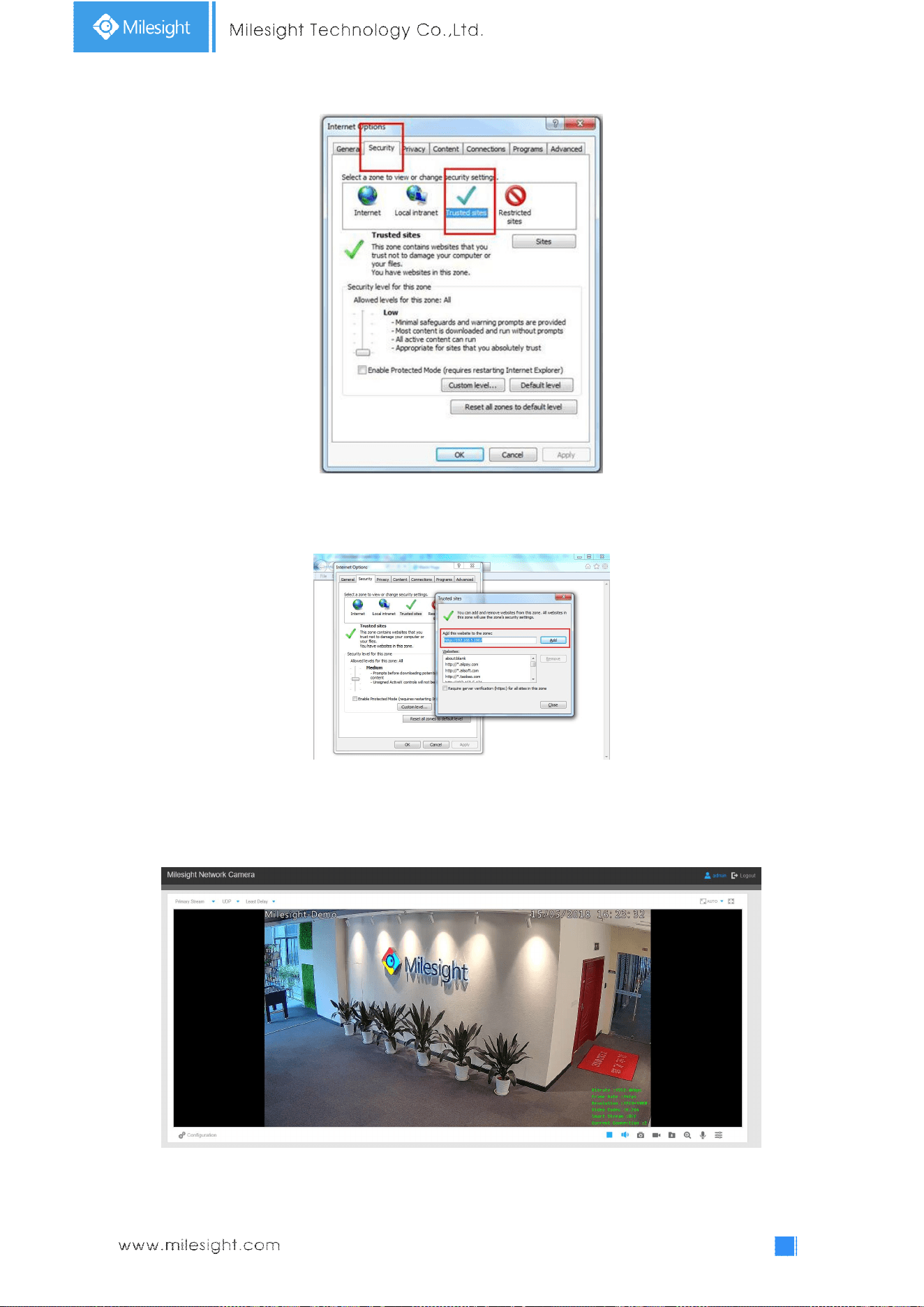
If IE9 or higher version browser is used, it is suggested that the Milesight camera web link should be added
as a trusted site. See the instructions as follows:
Step1: Start the IE9 or higher version browser, and select “Tools”à “Internet Options”;
Figure 3-2-3 To add the permission
25
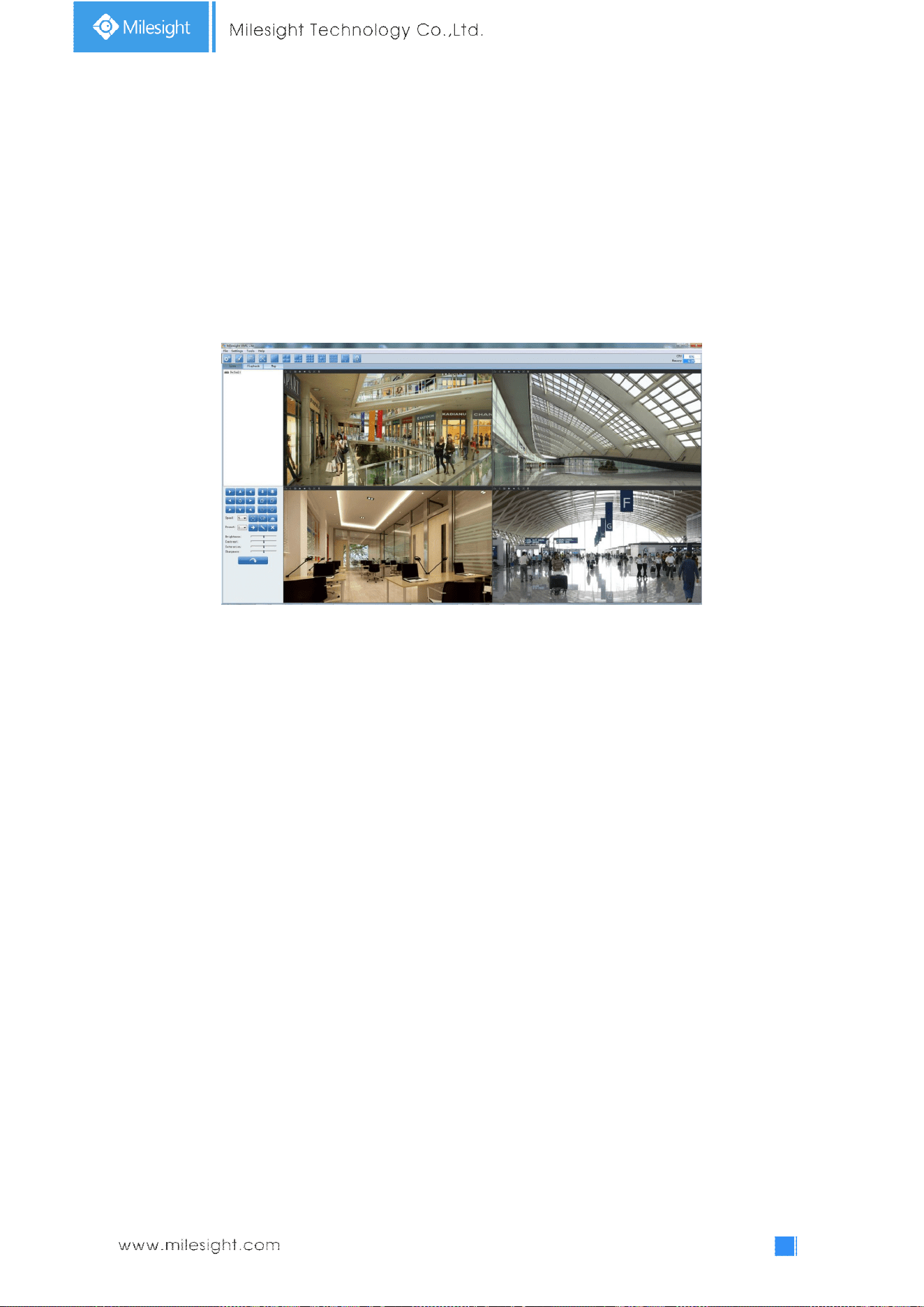
Step2: Select “Security” to “Trusted”;
Figure 3-2-4 To trust the control
Step3: Enter the IP address of the camera in the blank and click “Add”;
Figure 3-2-5 Add the website to the zone
Step4: Enter the IP address. After logging on network camera’s web GUI successfully, user is allowed to view
live video as follows.
Figure 3-2-6 Live View Interface
26
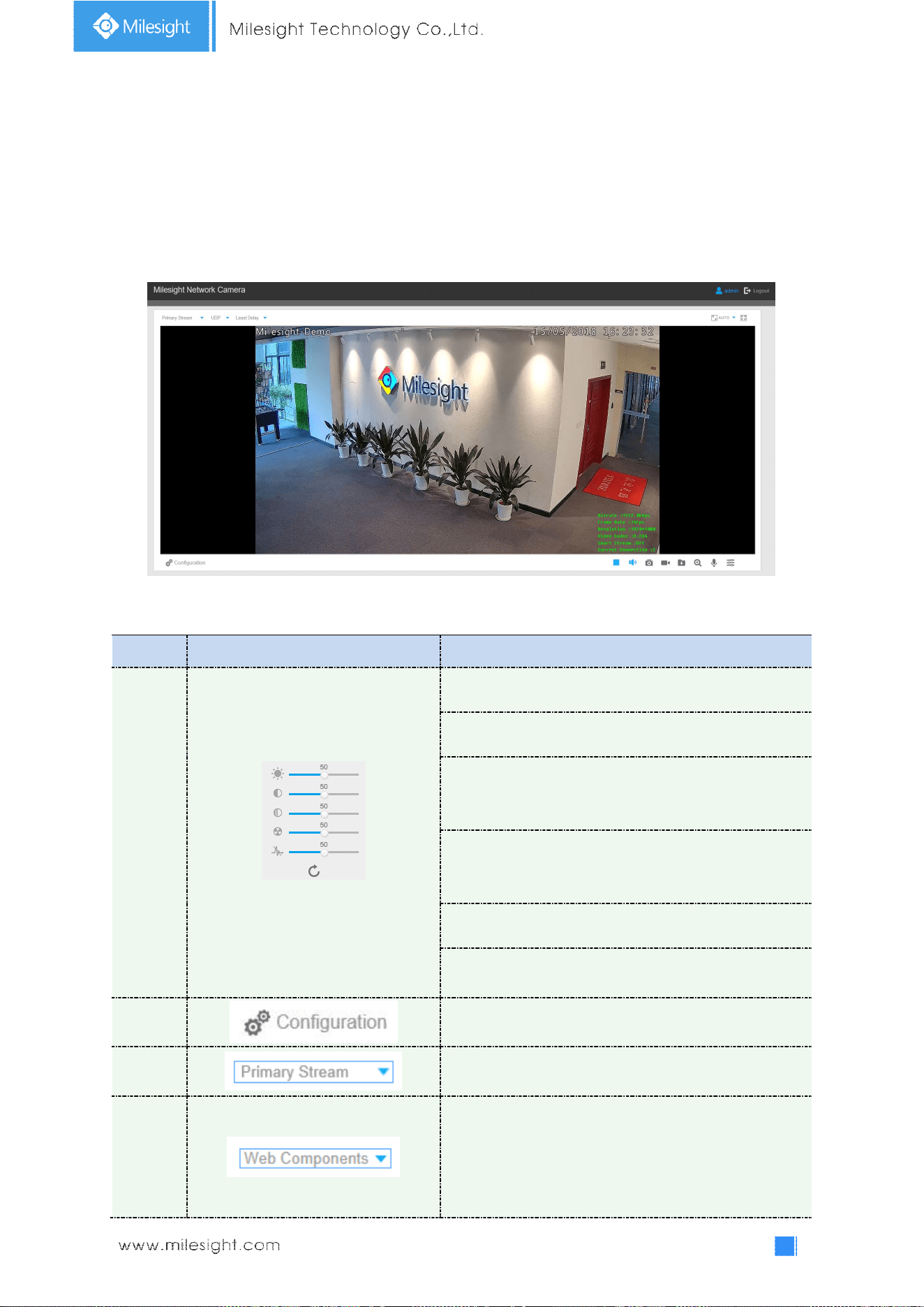
3.3 Accessing from Milesight VMS (Video Management Software)
Milesight VMS(ONVIF compatible) is a handy and reliable application designed to work with network
cameras in order to provide video surveillance, recording settings and event management functions. The
interface of Milesight VMS is very easy to use, intuitive, with easy access to the most common activities,
such as viewing live video, searching through recordings and exporting videos and snapshots. It's able to be
integrated with other devices through ONVIF. It is designed to work on Windows XP/ 7/ 8/ Vista/ Server
2000/ Server 2008. The software could be downloaded from our website www.milesight.com.
Please install Milesight VMS; then launch the program to add the camera to the channel list. For detailed
information about how to use the software, please refer to user manual of Milesight VMS.
Figure 3-3-1 Milesight VMS Live View
27
Chapter IV System Operation Guide
4.1 Live Video
After logging in the network camera web GUI successfully, user is allowed to view live video as follows.
Figure 4-1-1 Live view interface
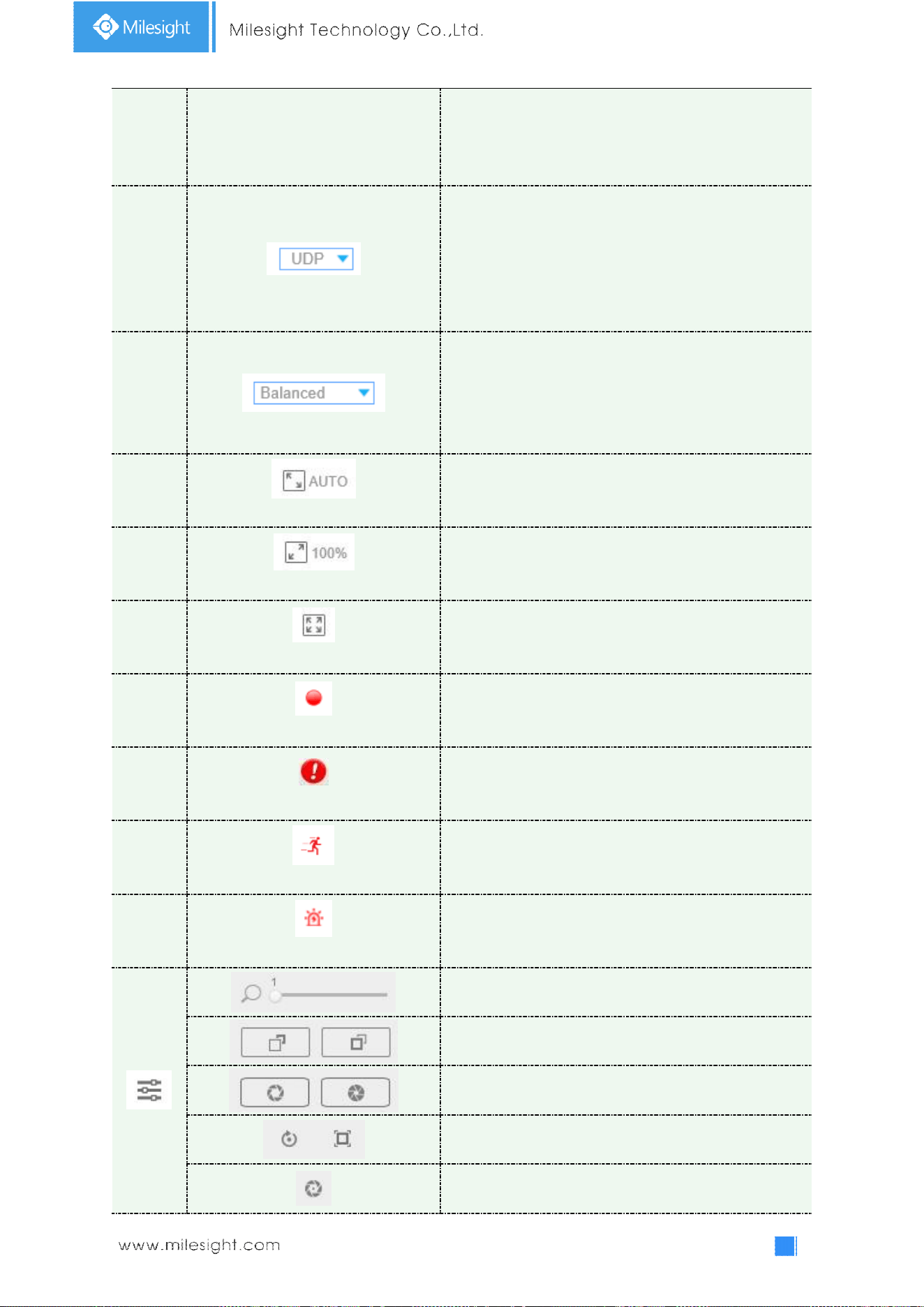
Table 4-1-1 Description of the buttons
No. Parameter Description
1
Image Adjustment
Brightness: Adjust the Brightness of the scene
Contrast: Adjust the color and light contrast
Saturation: Adjust the Saturation of the image.Higher
Saturation makes colors appear more "pure" while
lower one appears more “wash-out”
Sharpness: Adjust the Sharpness of image. Higher
Sharpness sharps the pixel boundary and makes the
image looks “more clear”
Noise Reduction Level: Adjust the noise reduction level
Default: Restore brightness, contrast and saturation to
default settings
Click to access the configuration page
2
Choose the Stream (Primary/Secondary/Tertiary)to
show on the current video window
3
Only available for camera whose software version is
43 or above
Web Components: Support Firefox, Safari, Chrome
(Chrome version 44 or below); need to install the
component to display the view;
28
MJPEG: Support to display the view on Firefox, Safari,
Chrome (Chrome version 45 or above);
(NOTE: IE choose Web Components mode for default, in this case, it
will not show the options)
4
TCP: More reliable connection;
UDP: More instantaneous connection, but if you cannot
get the live view successfully, please turn into TCP
connection;
HTTP: Faster and safer connection especially in Internet
environment.
5
Least Delay: The most instantaneous mode;
Balanced: A balanced mode between Least Delay and
Best Fluency, maintains the fluency while keeps an
acceptable delay;
Best Fluency: The most fluent mode;
6
Window size
Click to display images at a window size
7
Real size
Click to display images at a real size
8
Full Screen
Click to display images at full-screen
9
Recording
When recording, the icon will turn red
10
Alarm
When an alarm of Smart Event was triggered, the icon
appears
11
Alarm
When an alarm of Motion Detection was triggered,
the icon appears
12
Alarm
Except for the two kinds of alarms above, when other
alarms were triggered, the icon appears
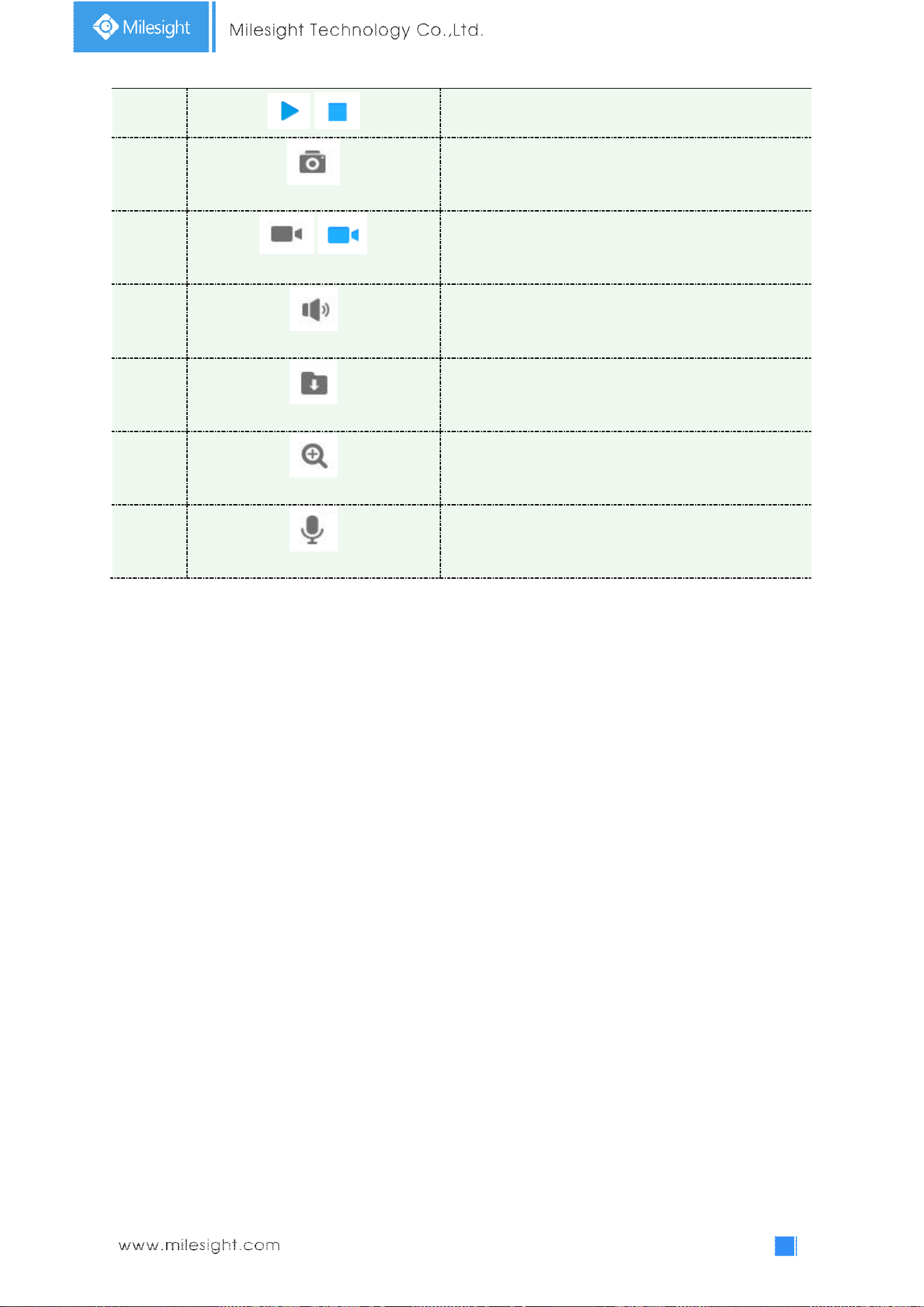
Adjust the Zoom length of the lens(Only work when
your camera is equipped with motorized lens)
Adjust focus of the lens(Only work when your camera is
equipped with motorized lens)
Adjust the size of Iris(Only work when your camera is
equipped with P-Iris)
Auxiliary Focus and Lens Initialization(Only work when
your camera is equipped with motorized lens)
Adjust iris automatically if check this box(Only work
when your camera is equipped with P-Iris)
29
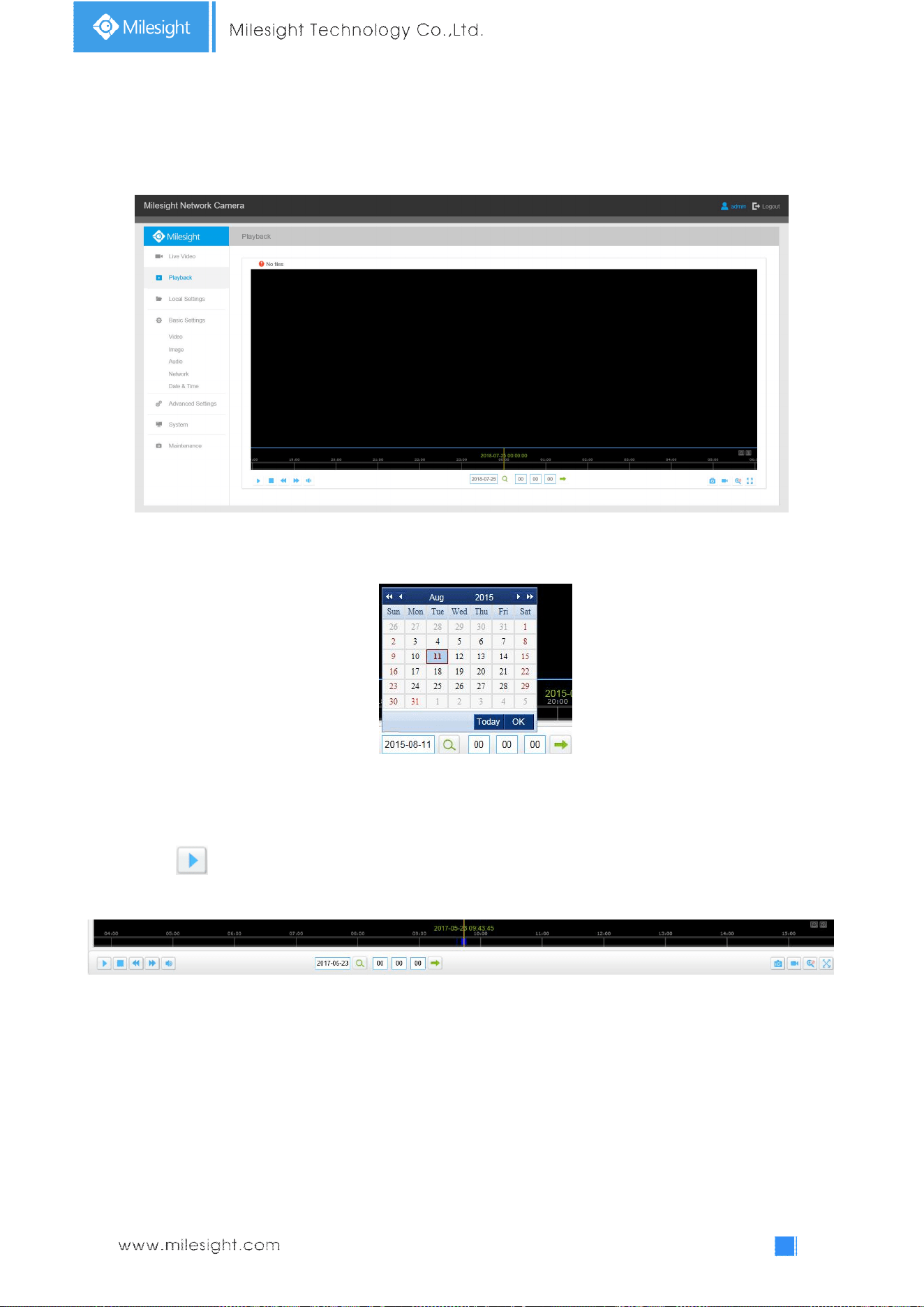
14
/
Start/Stop live view
15
Capture
Click to capture the current image and save to the
configured path. The default path is
C:VMS\+-1\ IMAGE-MANUAL
16
/
Start Recording
Click to start recording video and save to the configured
path. The default path is C:VMS\+-1\MS_Record. Click
again to stop recording
17
Play Audio
Enable Audio Input/Output. It can also be set in Audio
configuration page
18
Saving Path Settings
Set the saving path for captured images and video
recordings of operating on the live view
19
Enable Digital Zoom
When enabled, you can zoom in in a specific area of
video image with your mouse wheel
20
Start Talking
When it is enabled, you can start real-time talking.
30
4.2 Playback
This section explains how to view the recorded video files stored in SD cards.
Step1: Click [Playback] on the menu bar to enter playback interface;
Figure 4-2-1 Playback interface
Step2: Click the date button, choose the date when date window pops up;
Figure 4-2-2 Search Video
Note: The date with bright red means current date; one with a dark red number and white background means
weekend day; one with a dark red number and blue background means that the date is selected now.
Step3: Click
to play the video files found on this date.
The toolbar on the button of playback interface can be used to control playing progress.
Figure 4-2-3 Playback Toolbar
31
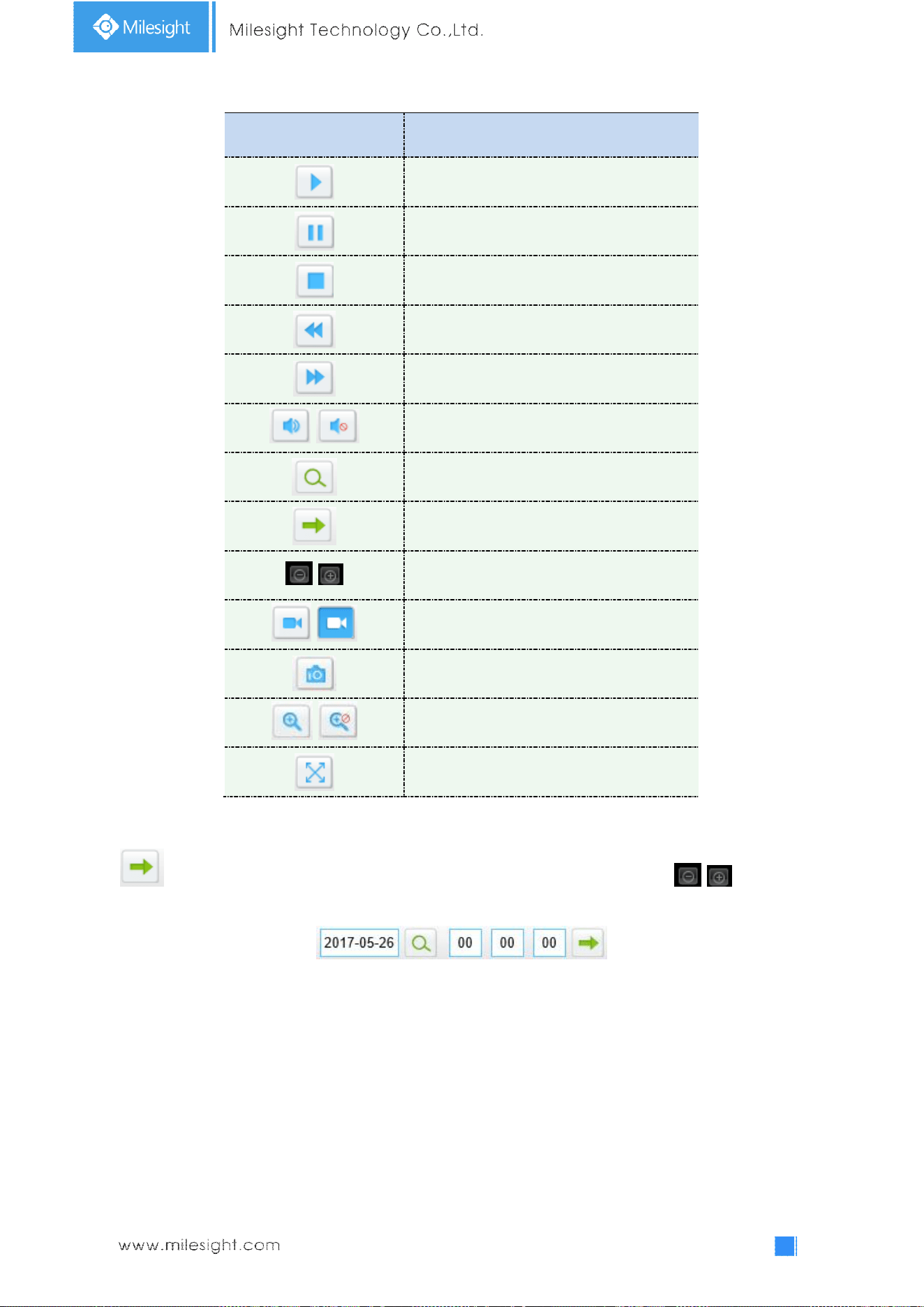
Table 4-2-1 Description of the buttons
Button Operation
Play
Pause
Stop
Speed Down
Speed Up
/
Audio On/Off
Search
Go To
/
Time Narrow/Expand
/
Start/Stop Recording
Snapshot
/
Zoom On/Off
Full Screen
Note:
1) Drag the progress bar with the mouse to locate the exact playback point. You can also input the time and click
to locate the playback point in the Set Playback Time filed. You can also click / to zoom out/in
the progress bar.
Figure 4-2-4 Set Payback Time
32
4.3 Local Settings
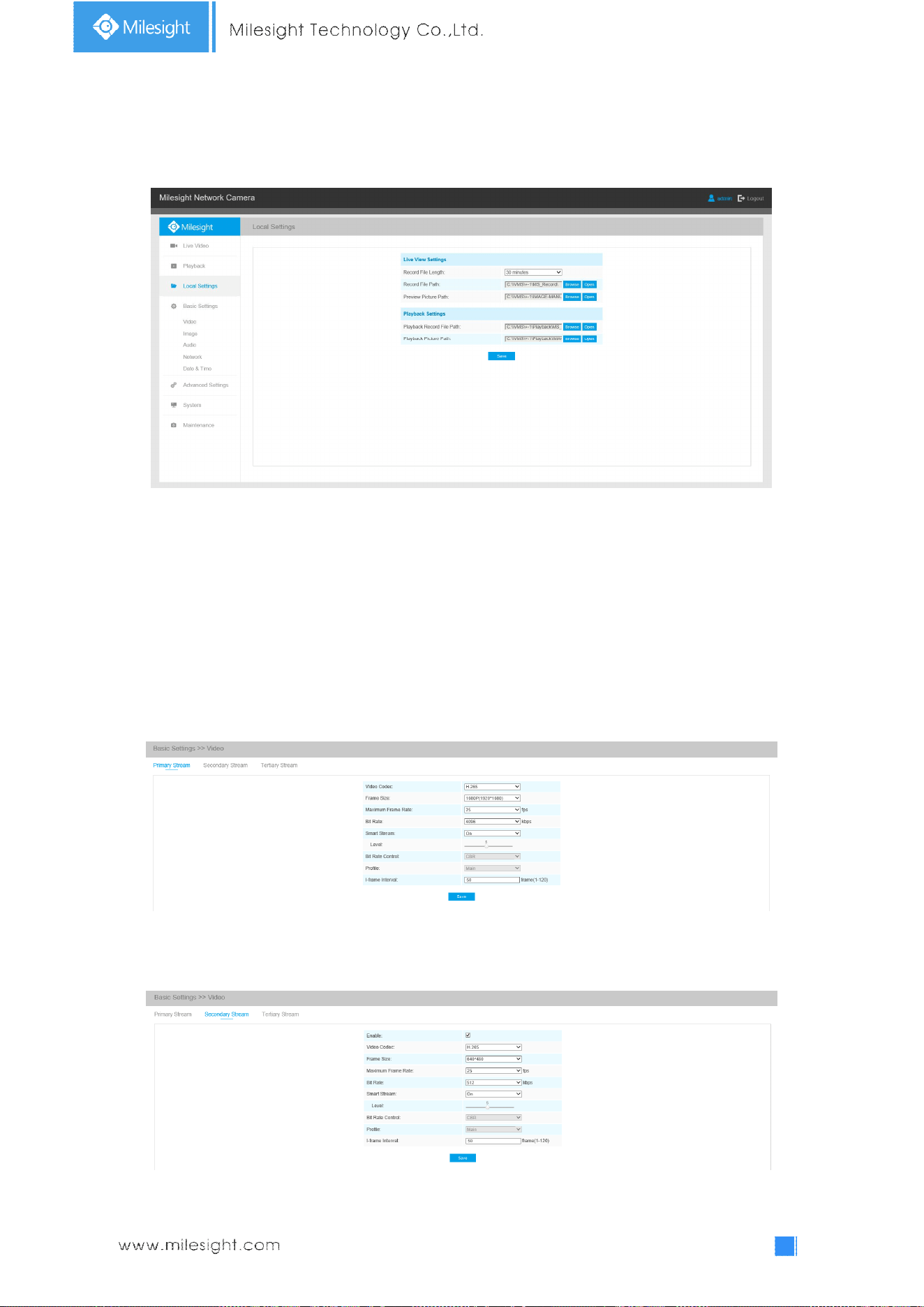
Record File Length and storage path can be customized in this setting page.
Figure 4-3-1 Local Settings
4.4 Basic Settings
4.4.1 Video
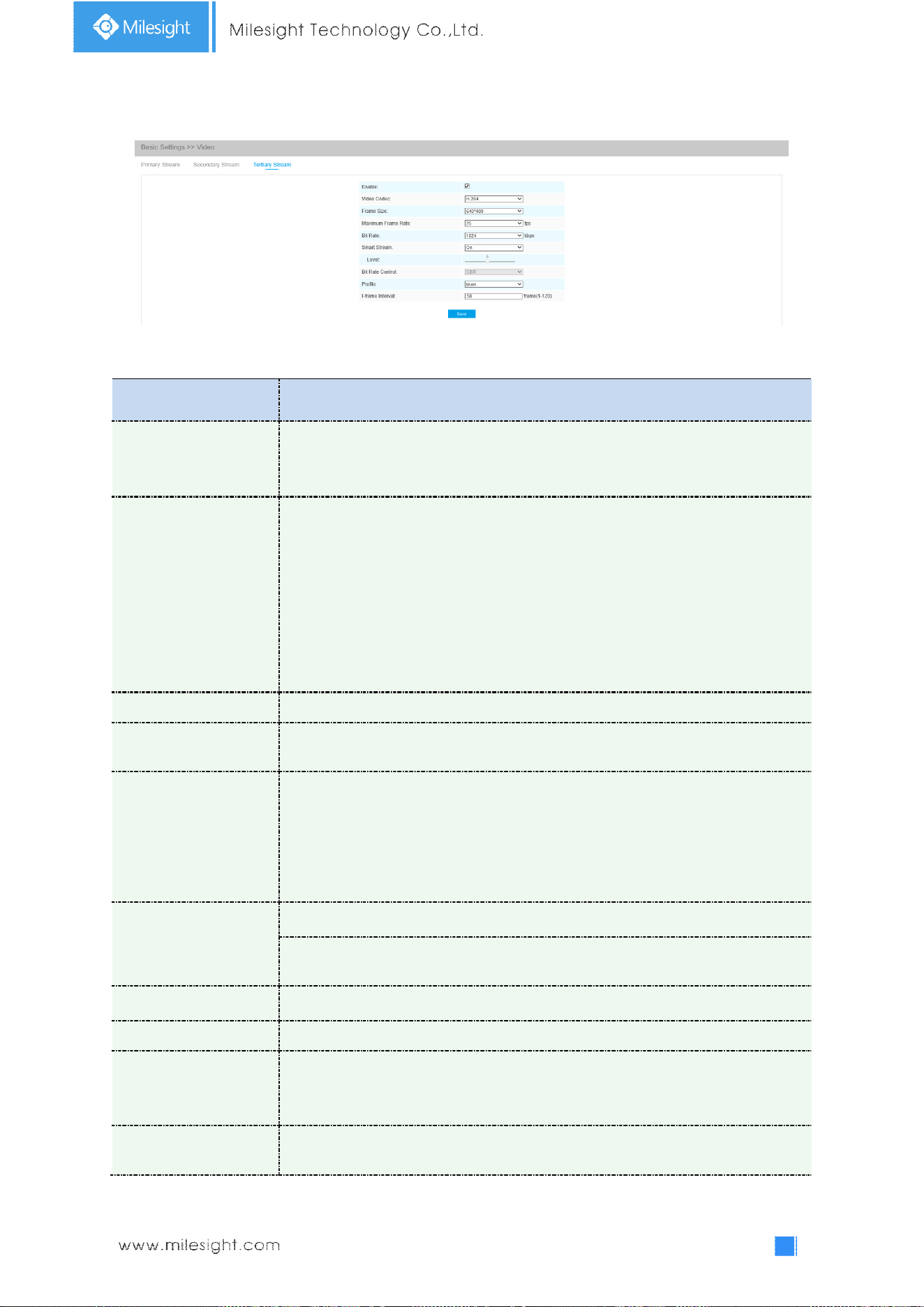
Stream parameters can be set in this module, adapting to different network environments and demands.
Primary Stream Settings
Figure 4-4-1 Primary Stream Settings
Secondary Stream Settings
Figure 4-4-2 Secondary Stream
33
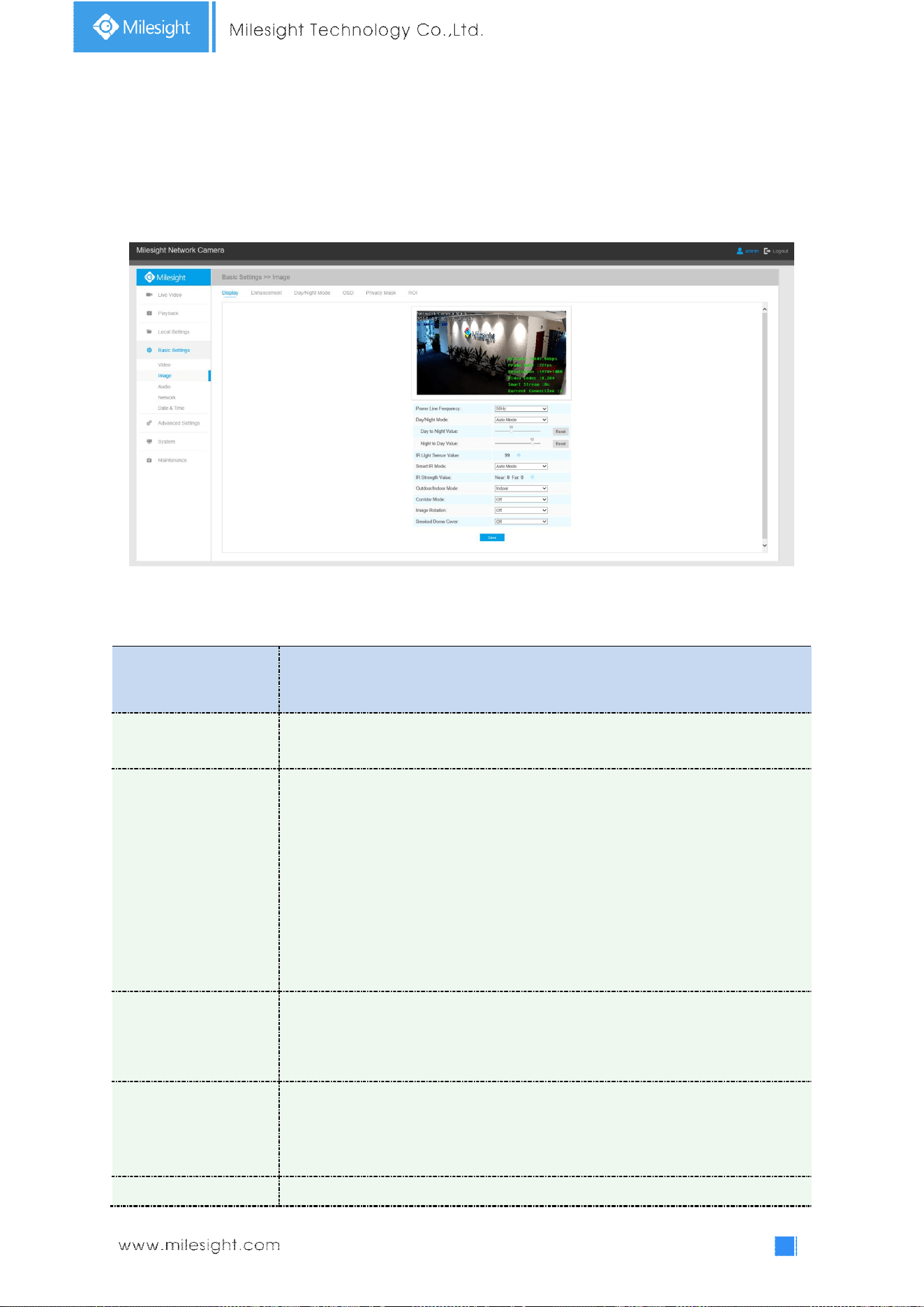
Tertiary Stream Settings
Figure 4-4-3 Tertiary Stream
Table 4-4-1 Description of the buttons
Parameters Function Introduction
Video Codec
There are differences for the camera with “-A” and “-B”
-A: H.264/MJPEG are available
-B: H.265/H.264/MJPEG are available
Frame Size
Options include 8M(3840×2160), 6M(3072×2048)(only for 4K Pro Bullet Camera),
5M(2560*1920), 4M(2592*1520), 3M(2304*1296), 3M(2048*1536),
1080P(1920*1080), 2M(1600 *1200), 1.3M(1280*960), 720P(1280*720),
D1(704*576).
For Secondary Stream, it includes 704*576, 640*480, 640*360, 352*288,
320*240, 320*192, 320*176.
For Tertiary Stream, it include 1920*1080, 1280*720, 704*576, 640*480,
640*360, 352*288, 320*240, 320*192, 320*176.
Maximum Frame Rate Maximum refresh frame rate of per second
Bit Rate
Transmitting bits of data per second, this item is optional only if you select the
H.265/H.264
Smart Stream
Smart Stream mode remarkably reduces the bandwidth and the data storage
requirements for network cameras while ensuring the high quality of images, and
it is a 10-level adjustable codec.
It is optional to turn On/Off Smart Stream mode.
Level: Level 1~10 are available to meet your need.
Bit Rate Control
CBR: Constant Bitrate. The rate of CBR output is constant
VBR: Variable Bitrate. VBR files vary the amount of output date per time
segment
Image Quality
Low/Medium/High are available, this item is optional only if you select VBR.
Profile
The option is for H.264, Main/High can be selected according to your needs.
I-frame Interval
Set the I-frame interval to 1~120, 50 for the default. This item is optional only if
you select the H.265/H.264. The number must be a multiple of the number of
frames.
JPEG Quality
Low/Medium/High/Higher are available, this item is optional only if you
selected the MJPEG
Note: The options of [Frame Size] are variable according to the model selected.
34
4.4.2 Image
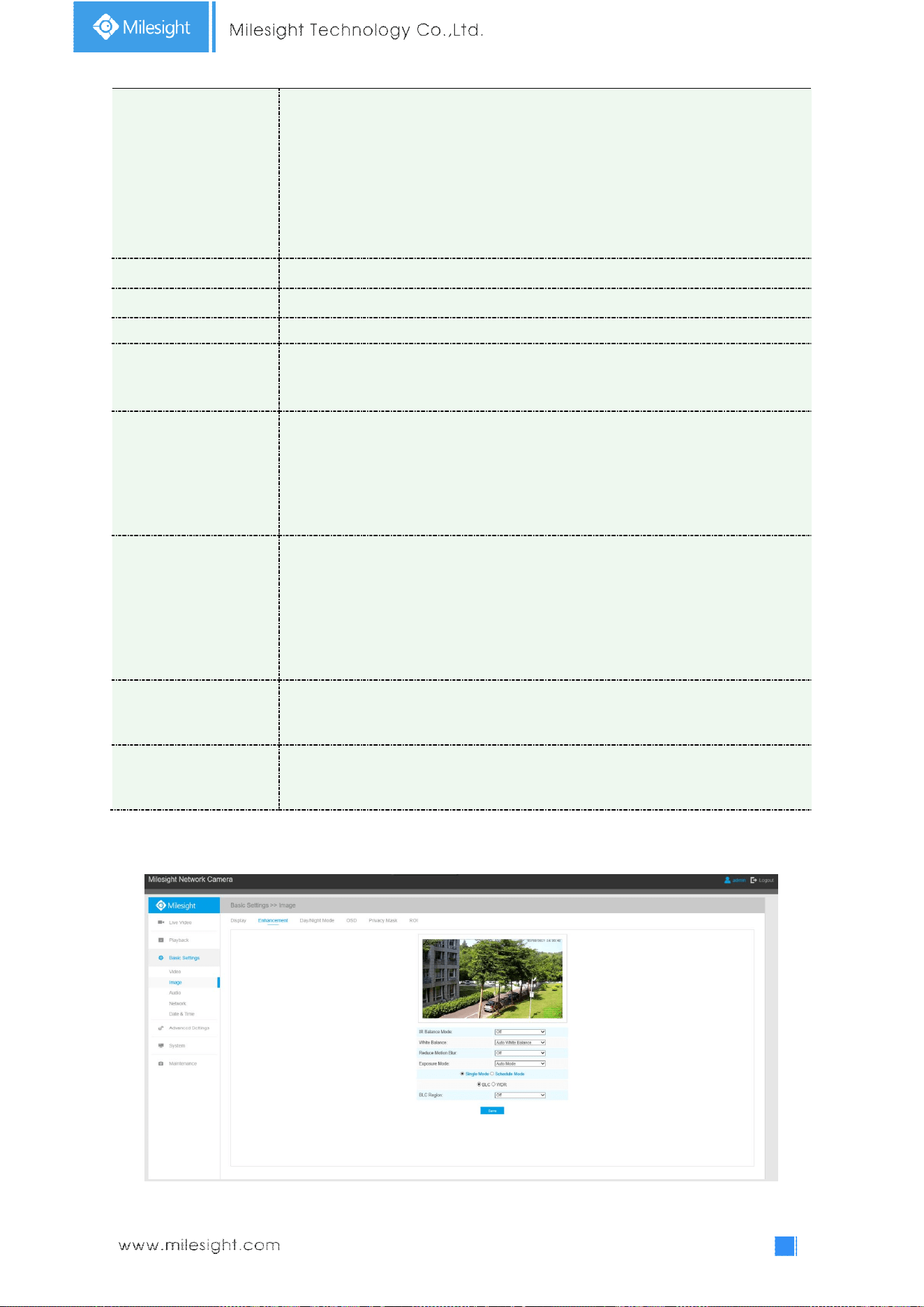
Display information, enhancement of image and Day/Night setting can be set in this module. OSD (On
Screen Display) content and video time can be displayed to rich the image information.
Display
Figure 4-4-4 Display
Table 4-4-2 Description of the buttons
Parameters Function Introduction
Power Line Frequency 60HZ flicker for NTSC mode and 50HZ flicker for PAL mode
Day/Night Mode
There are several parameters such as Exposure Level, Maximum Exposure Time
and IR-CUT Interval, etc, associated with this mode
Night Mode: Shown in live view based on Night Mode settings
Day Mode: Shown in live view based on Day Mode settings
Auto Mode: Shown in live view based on environment, set the sensitivity for
switching Day Mode to Night Mode, or Night Mode to Day Mode
Customize: Shown in live view based on your own settings’ time to start/end
Night Mode
Day To Night Value
This is the sensitivity for switchingDay Mode toNight Mode. When IR Light
Sensor Current Value is lower than this value, it will switch Day Mode to Night
Mode
Night To Day Value
This is the sensitivity for switchingNight Mode toDay Mode. When IR Light
Sensor Current Value is higher than this value, it will switch Night Mode to Day
Mode
IR Light Sensor Value
The current value of the IR light sensor
35
Smart IR Mode
With the combination of the High Beam and Low Beam, The IR LEDs technology
has been upgraded to provide better image clarity and quality regardless of the
object distance. Also, the Low Beam and High Beam's brightness can be adjusted
manually or automatically on the basis of the Zoom ratio. Moreover, with the IR
anti-reflection panel, the infrared light transmittance is highly increased.
Support to set the strength of the IR to Auto Mode or Customize to achieve the
best effect.
Near view level
Adjust the light strength of Low-Beams LED light level from 0 to 100.
Far view level
Adjust the light strength of High-Beams LED light level from 0 to 100.
IR Strength Value The current value of Low-Beams LED and High-Beams LED light value
Outdoor/Indoor Mode Select indoor or outdoor mode to meet your needs
Corridor Mode
There are three options available, you can select one to meet your need
Off: Keep the image in normal direction
Clockwise 90°: Rotate the image by 90° clockwise
Anticlockwise 90°: Rotate the image by 90° anticlockwise
Image Rotation
There are four options available, you can select one to meet your need
Off: Keep the image in normal direction
Rotating 180°: Upside down the image
Flip Horizontal: Flip the image horizontally
Flip vertical: Flip the image vertically
Local Display Video Select NTSC or PAL for local display
Smoked Dome Cover
This function is only for Pro Dome. If Pro Dome is equipped with a Smoked Dome
Cover, enable this function to display a normal image.
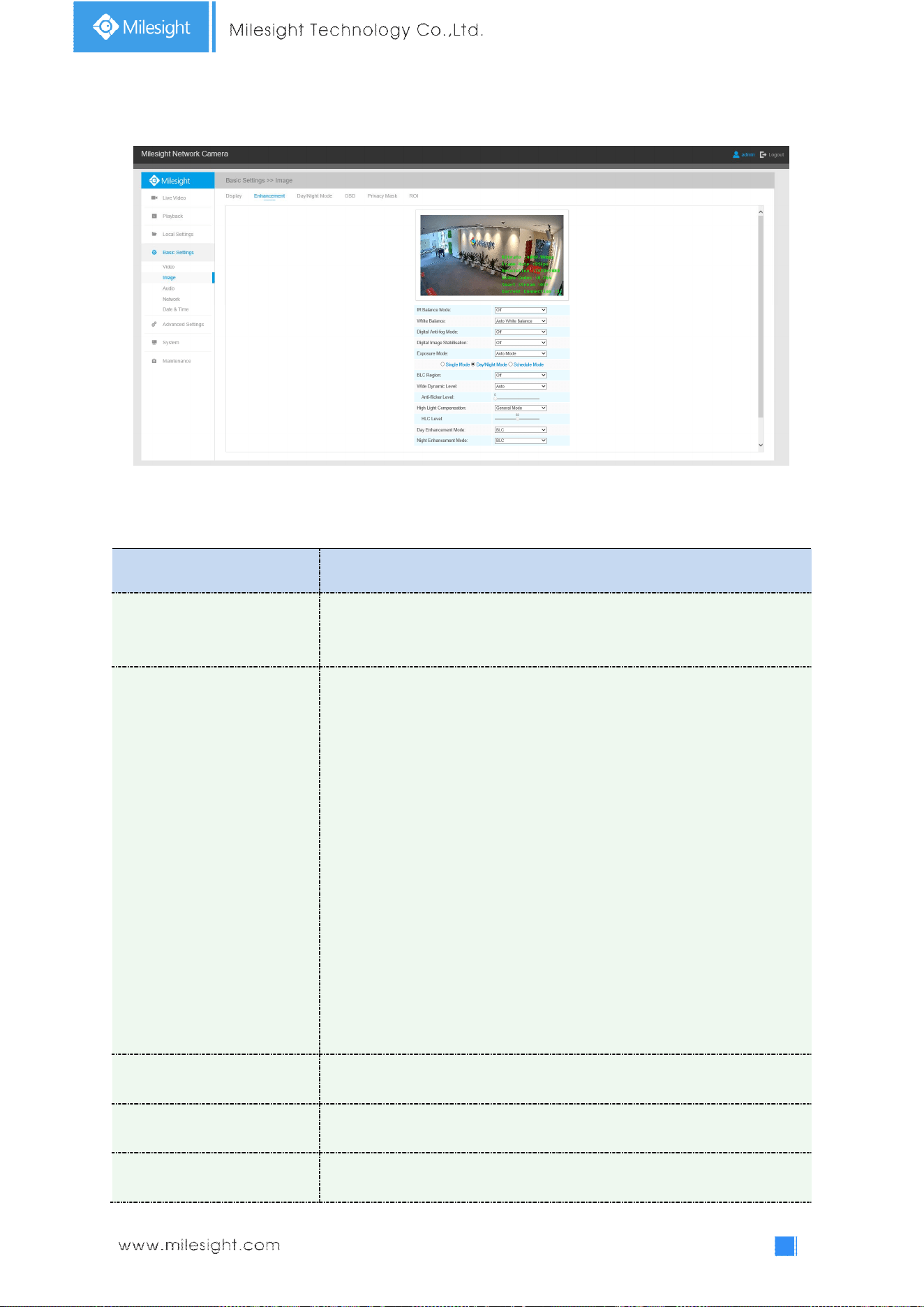
Enhancement
Figure 4-4-5 Enhancement (H.264 series)
36
Figure 4-4-6 Enhancement (H.265 series)
Table 4-4-3 Description of the buttons
Parameters Function Introduction
IR Balance Mode
There is an option to turn On/Off the IR LED.
IR Balance Mode would avoid the problem of overexposure and darkness,
and the IR LED will change according to the actual illumination.
White Balance
To restore white objects, removed color distortion caused by the light of
the environment
Auto White Balance: This option will automatically enable the White
Balance function
Manual White Balance: This option is only for H.265 series. Set Red Gain
Level and Blue Gain Level manually.
Incandescent Lamp: Select this option when light is similar with
incandescent lamp
Warm Light Lamp: Select this option when light is similar with warm light
lamp
Natural Light: Select this option when there is no other light but natural
light
Fluorescent Lamp: Select this option when light is similar with Fluorescent
Lamp
Schedule mode: Select this option that you can customize the schedule to
enable/disable above modes
Reduce Motion Blur
This function is only for H.264 series. Better image for moving objects, it
may lead worse quality for still objects
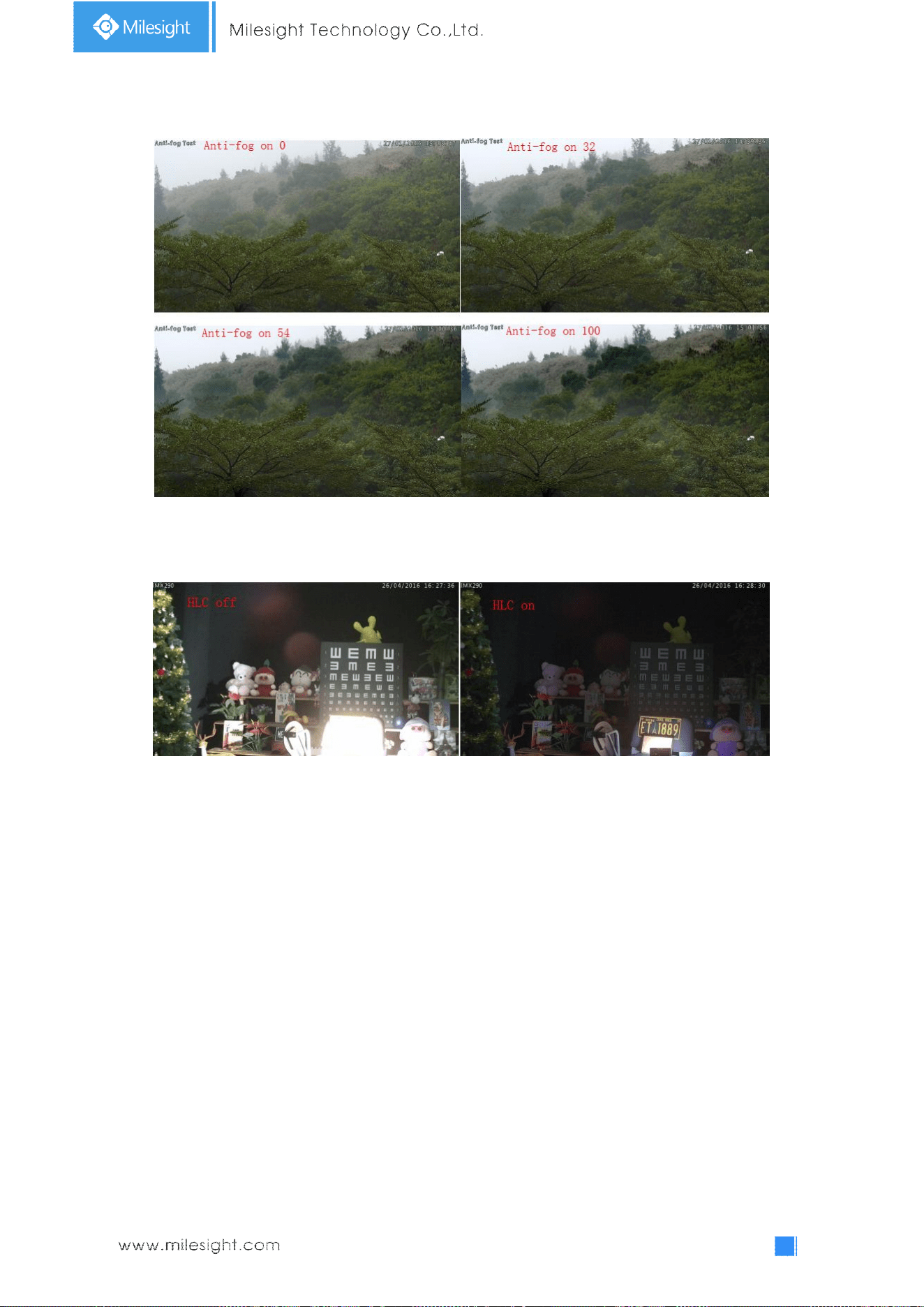
Digital Anti-fog Mode
This function is only for H.265 series. Better image effect in foggy weather,
refers to Figure 4-4-10
Digital Image Stabilisation
This function is only for H.265 series. Decrease the blur and shakiness of
the image.

37
Exposure Mode
Auto Mode, Manual Mode and Schedule Mode are available.
Auto Mode: The camera will adjust the brightness according to the light
environment automatically;
Manual Mode: The camera will adjust the brightness according to the
value you set, you can set the exposure time from 1~1/100000s, the higher
the value is, the brighter the image is;
Schedule Mode: You can customize the schedule to enable/disable Auto
Mode and Manual Mode.
Single Mode
Set single mode for BLC/WDR/HLC.
Day/Night Mode
Support BLC/WDR/HLC on Day Enhancement Mode/Night Enhancement
Mode separately.
Schedule Mode Set schedule mode for BLC/WDR/HLC.
BLC Region
Off, Customize, and Centre are available (in single mode, only enable when
WDR is disable)
Off: Calculate the full range of view and offer appropriate light
compensation
Customize: This option enables you to customize inclusive or exclusive
region manually
Centre: This option will automatically add an inclusive region in the middle
of the window and give the necessary light compensation
Wide Dynamic Range
This function which can capture and display both bright and dark areas in
the same frame enables details of objects in both bright and dark areas to
be visible.
Off: Disable WDR function
On: Enable the WDR, there are Low/High/Auto three levels
Customize: Customize the schedule to enable/disable the WDR function
and set the levels with Low/High/Auto
Wide Dynamic Level Set WDR with Low/High/Auto level
Anti-flicker Level
Reduce flickers that appear on screen in some lighting conditions and there
are 10 levels of anti-flicker adjustments
High Light Compensation
This function is only for H.265 series to adjust the brightness to a normal
range when the light is strong, refers to Figure 4-4-11
Off: Disable HLC function
General Mode: Enable the general mode of HLC, and there is a setting for
HLC Level
Enhanced Mode: Enable the enhanced mode of HLC, and there is a setting
for HLC Level
HLC Level
Select level for HLC
Day Enhancement Mode
BLC/WDR/HLC are available.
Night Enhancement Mode
BLC/WDR/HLC are available.
Schedule Setting Customize the schedule to enable/disable BLC/WDR/HLC mode
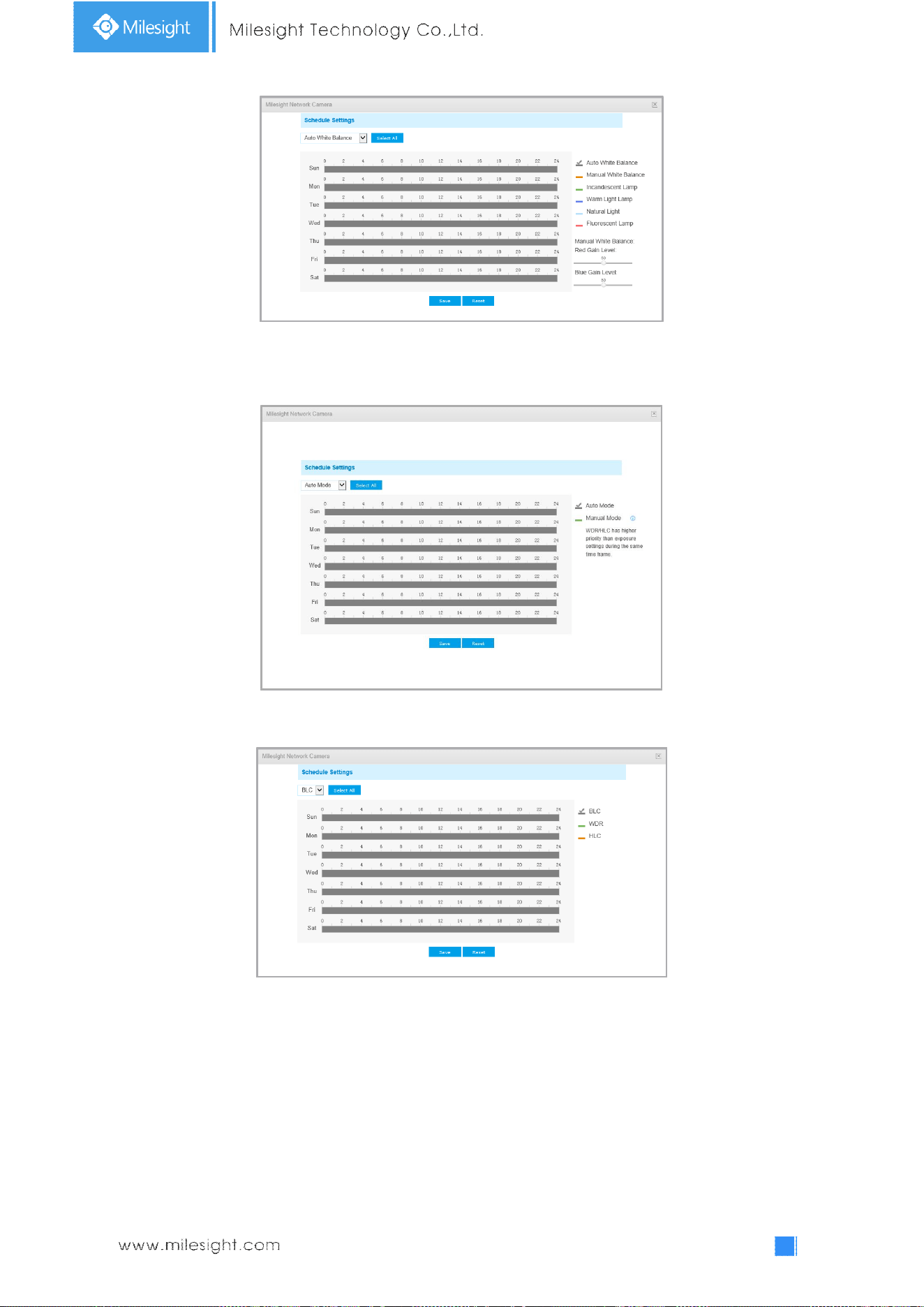
Note: You can customize the schedule to enable/disable the difference White Balance modes.
38
Figure 4-4-7 White Balance schedule settings
1) You can customize the schedule to enable/disable the difference exposure modes.
Figure 4-4-8 Exposure mode schedule settings
2) You can customize the schedule to enable/disable BLC/WDR/HLC mode.
Figure 4-4-9 BLC/WDR/HLC mode schedule settings
3) WDR/HLC has higher priority than exposure settings at the same time frame.
39
4) Anti-fog Image.
Figure 4-4-10 Anti-fog Image
5) HLC Image.
Figure 4-4-11 HLC Image
40
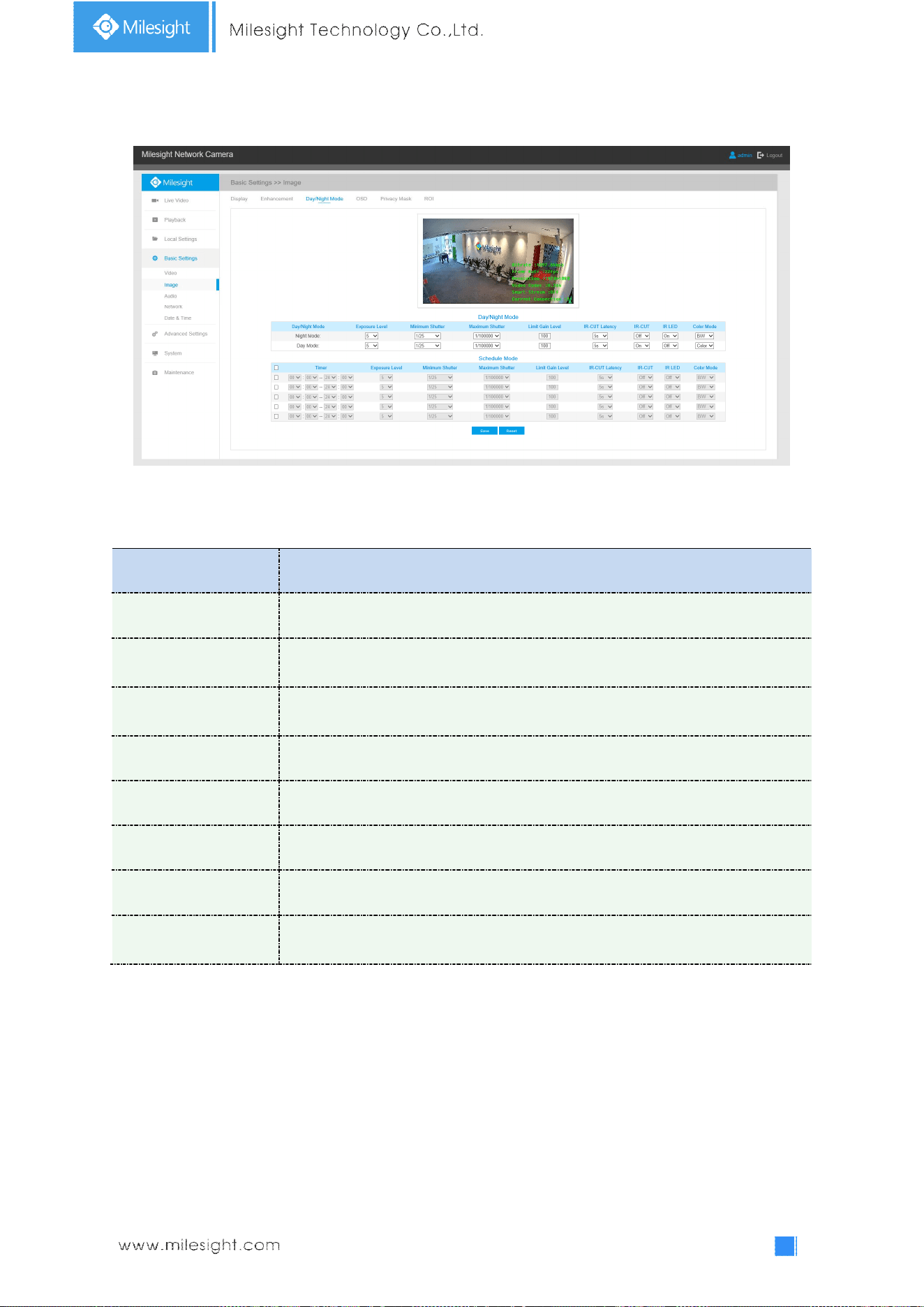
Day/Night Mode
Figure 4-4-12 Day/Night Mode
Table 4-4-4 Description of the buttons
Parameters Function Introduction
Exposure Level Level 0~10 are available to meet your need
Minimum Shutter
Minimum Shutter is the same as Maximum Exposure Time. Set the minimum
Shutter to 1~1/100000s
Maximum Shutter
Maximum Shutter is the same as Minimum Exposure Time. Set the maximum
Shutter to 1~1/100000s
IR-CUT Latency The interval time of switching one mode to another
IR-CUT
Turn on or turn off IR-CUT
IR LED
Turn on or turn off IR-LED
Color Mode Select B/W or Color mode under Day/Night mode
Schedule Mode
Here you can customize your special demands for different time, then the Day
mode and Night mode will switch automatically according to your settings
41
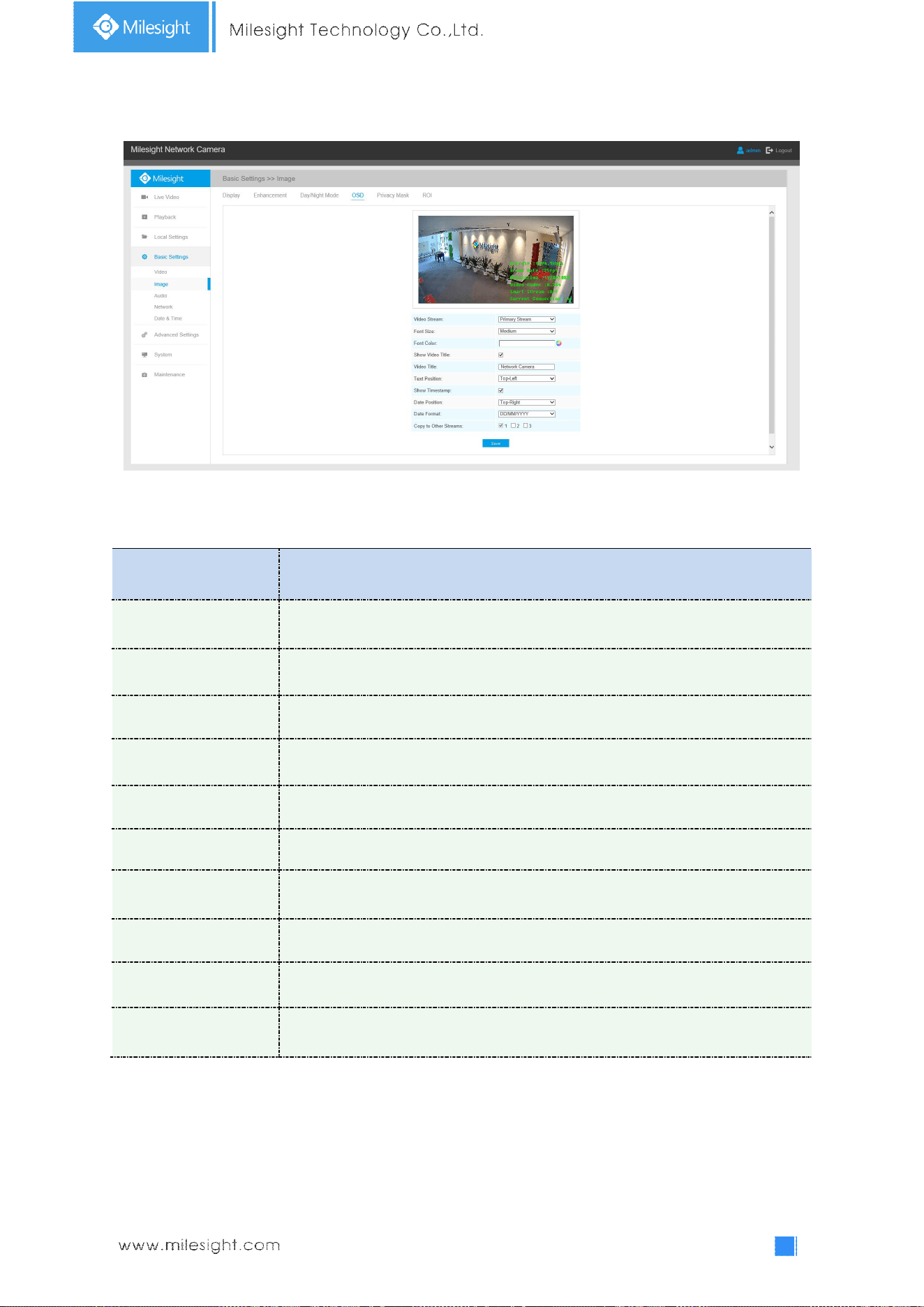
On Screen Display(OSD)
Figure 4-4-13 OSD
Table 4-4-5 Description of the buttons
Parameters Function Introduction
Video Stream Enable to set OSD for primary stream and secondary stream
Font Size Smallest/Small/Medium/Large/Largest/Auto are available for title and date
Font Color Enable to set different color for title and date
Show Video Title Check the checkbox to show video title
Video Title Customize the OSD content
Text Position OSD display position on the image
Show Timestamp Check the checkbox to display date on the image
Date Position
Date display position on the image
Date Format The format of date
Copy to Other Streams Copy the settings to other streams
42
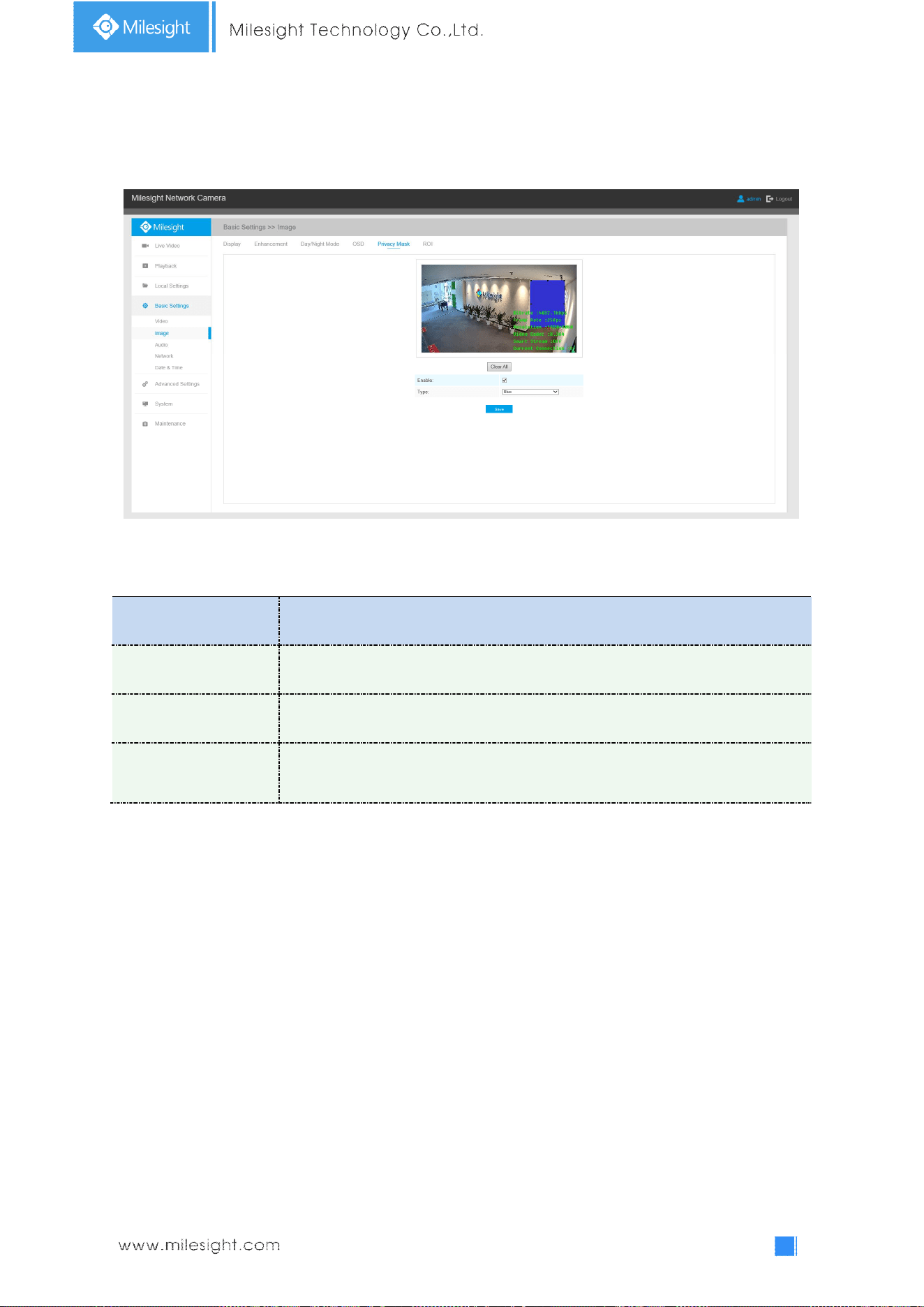
Privacy Mask
Privacy mask enables to cover certain areas on the live video to prevent certain spots in the surveillance
area from being viewed and recorded. You can set four mask areas at most.
Figure 4-4-14 Privacy Mask
Table 4-4-6 Description of the buttons
Parameters Function Introduction
Enable
Check the checkbox to enable the Privacy Mask function
Clear All Clear all areas you drew before
Type
Select the color to use for the privacy areas, there are eight colors available:
White, Black, Blue, Yellow, Green, Brown, Red and Violet
43
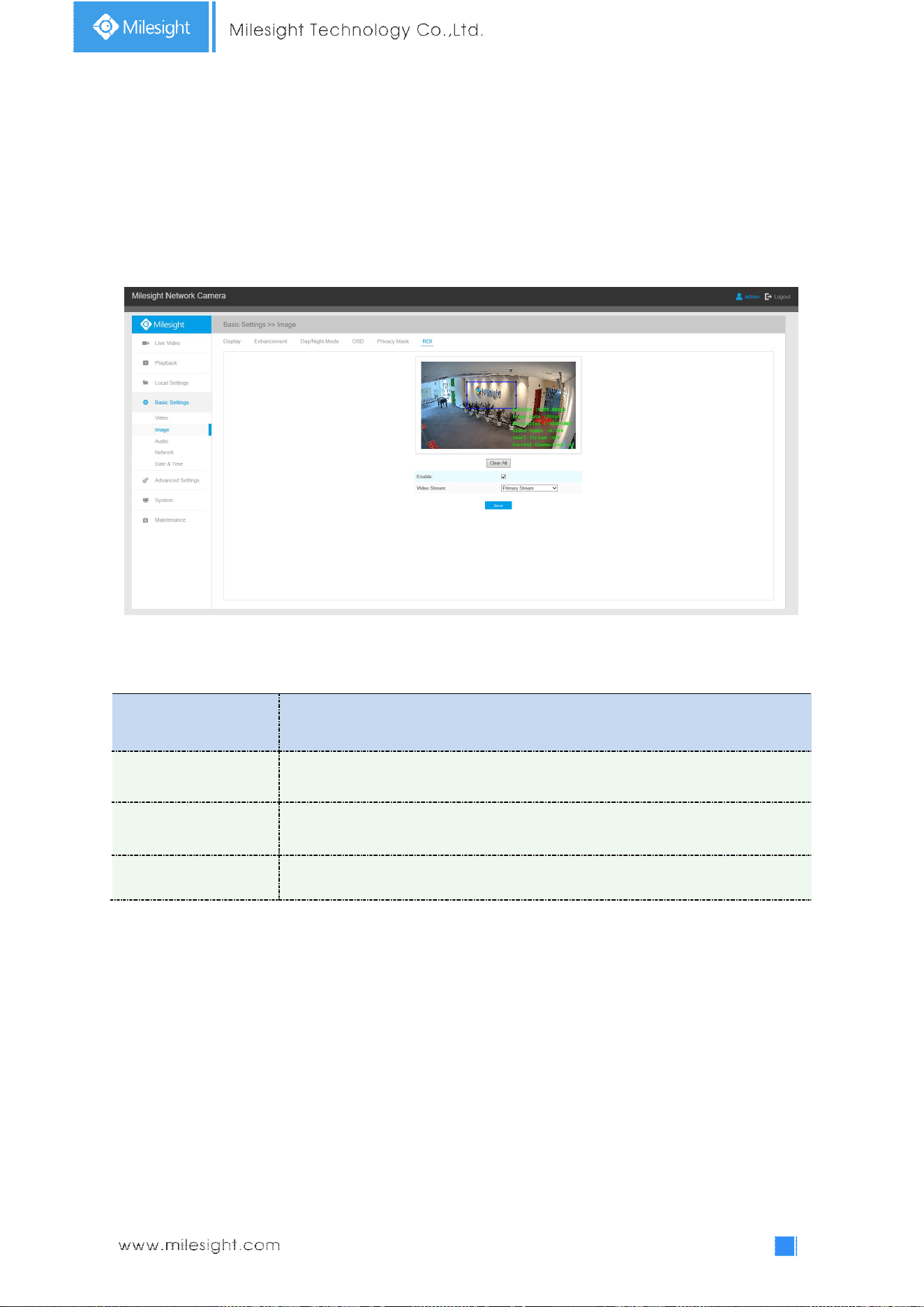
ROI
Region of interest(often abbreviate ROI), is a selected subset of samples within a dataset identified for a
particular purpose. Users can select up to 3 key regions of a scene to transmit through separate streams for
targeted preview and recording.
By using Milesight ROI technology, more than 50% of bit rate can be saved and therefore less bandwidth
demanded and the storage usage reduced. So according to this, you can set a small bit rate for high
resolution.
Figure 4-4-15 ROI Settings
Table 4-4-7 Description of the buttons
Parameters Function Introduction
Enable
Check the checkbox to enable the ROI function
Clear All Clear all areas you drew before
Video Stream Choose the Video Stream
Note: You can set a low bit rate. For example, you can set a bit rate with 512Kbps and a resolution with 1080P, then
you can see the image quality of ROI is more clear and fluent than the other region.
44
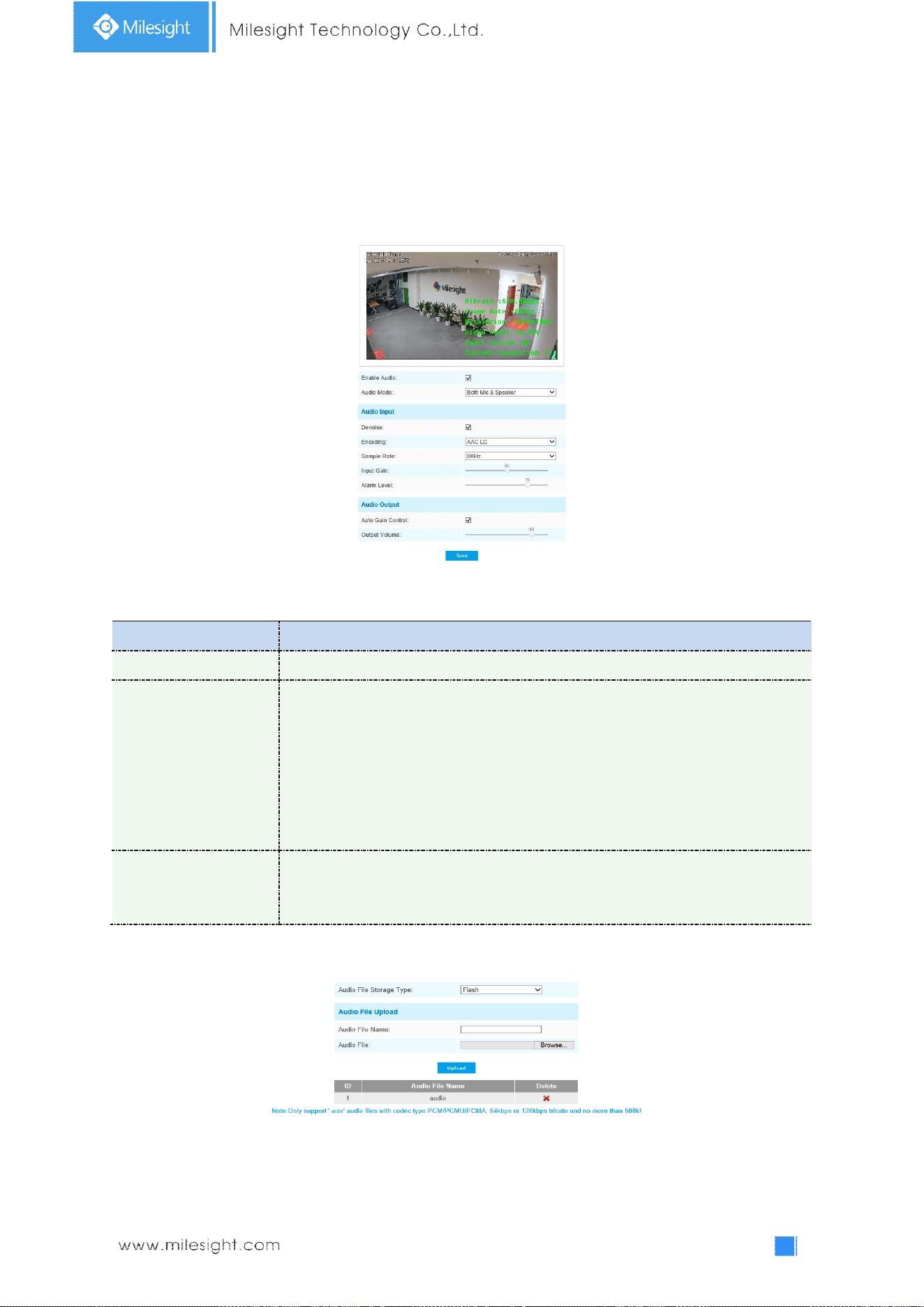
4.4.3 Audio
This audio function allows you to hear the sound from the camera or transmit your sound to the camera
side. A two-way communication is also possible to be achieved with this feature. Alarm can be triggered
when the audio input is above a certain alarm level you set, and configured audio can be played when an
alarm occurs.
Figure 4-4-16 Audio
Table 4-4-8 Description of the buttons
Parameters Function Introduction
Enable Audio
Check on the checkbox to enable audio feature
Audio Input
Denoise: Set it as On/Off. When you set the function on, the noise detected can
be filtered
Encoding:G711-ULaw, G711-ALaw and AAC LC are available
Sample Rate: There are 8KHz/16KHz two options
Input Gain: Input audio gain level, 0-100
Alarm Level: Alarm will be triggered if voice alarm is enabled and input gained
volume is higher than the alarm level, 1-100
Audio Output
Auto Gain Control: This function is only for H.265 series, improve the quality of
audio
Output Volume: Adjust volume of output
You can upload up to 3 audio files manually to Flash or SD Card on the Audio web page and you can also
edit the audio file’s name when upload.
Figure 4-4-17 Audio File
Note:
1) The Audio mode and Audio Output are only for certain modules.
2) Only support ‘.wav’ audio files with codec type PCM/PCMU/PCMA, 64kbps or 128 kbps and no more than 500k.
45
4.4.4 Network
TCP/IP
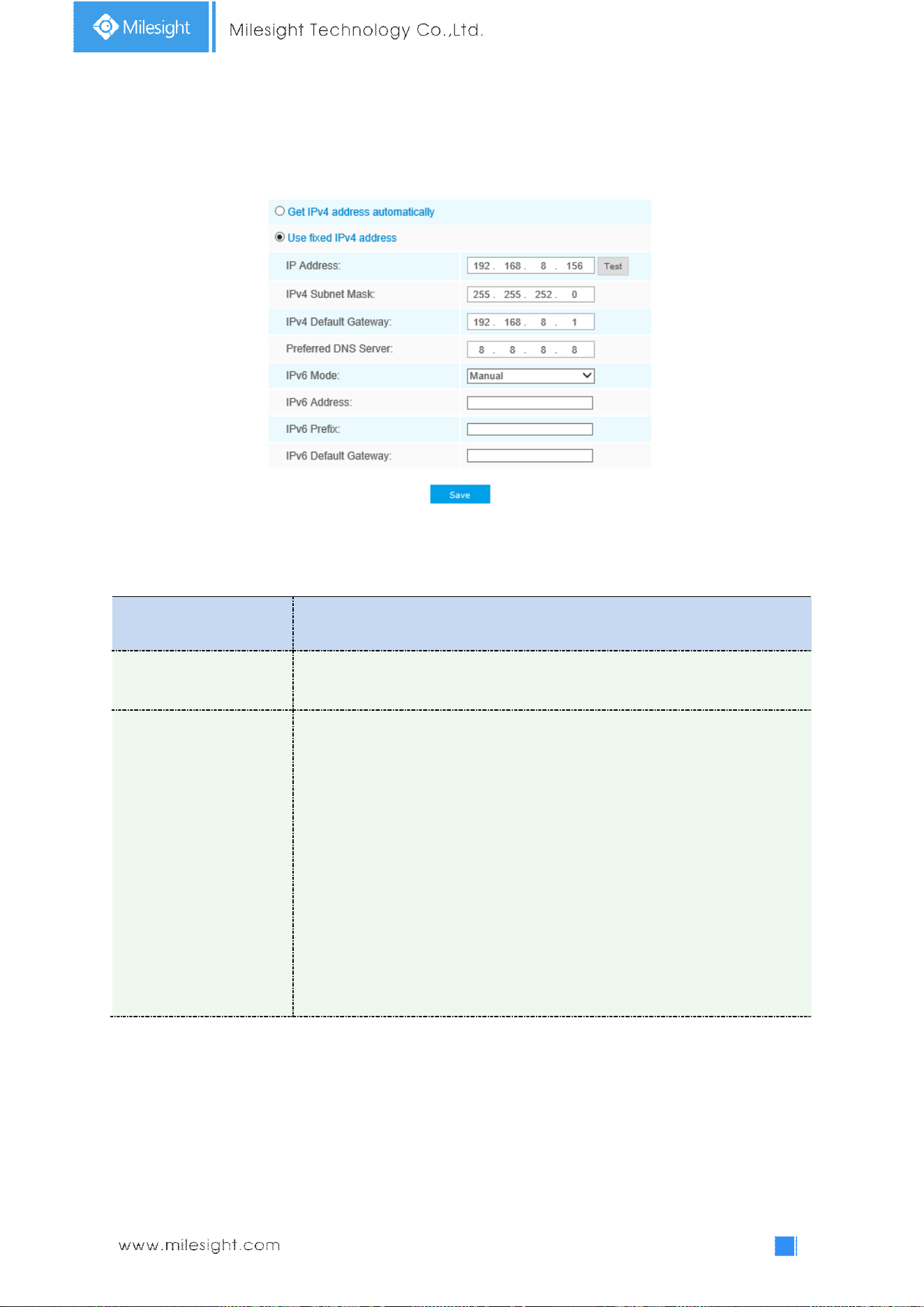
Figure 4-4-18 TCP/IP
Table 4-4-9 Description of the buttons
Parameters Function Introduction
Get IPv4 Address
Automatically
Get an IP address from the DHCP server automatically
Use fixed IP address
IPv4 Address: An address that used to identify a network camera on the
network
IPv4 Subnet Mask: It is used to identify the subnet where the network camera
is located
IPv4 Default Gateway: The default router address
Preferred DNS Server: The DNS Server translates the domain name to IP
address
IPv6 Mode: Choose different mode for IPv6: Manual/Route Advertisement/
DHCPv6
IPv6 Address: IPv6 Address used to identify a network camera on the network
IPv6 Prefix: Define the prefix length of IPv6 address
IPv6 Default Gateway: The default router IPv6 address
Note: The Test button is used to test if the IP is conflicting.
46
HTTP
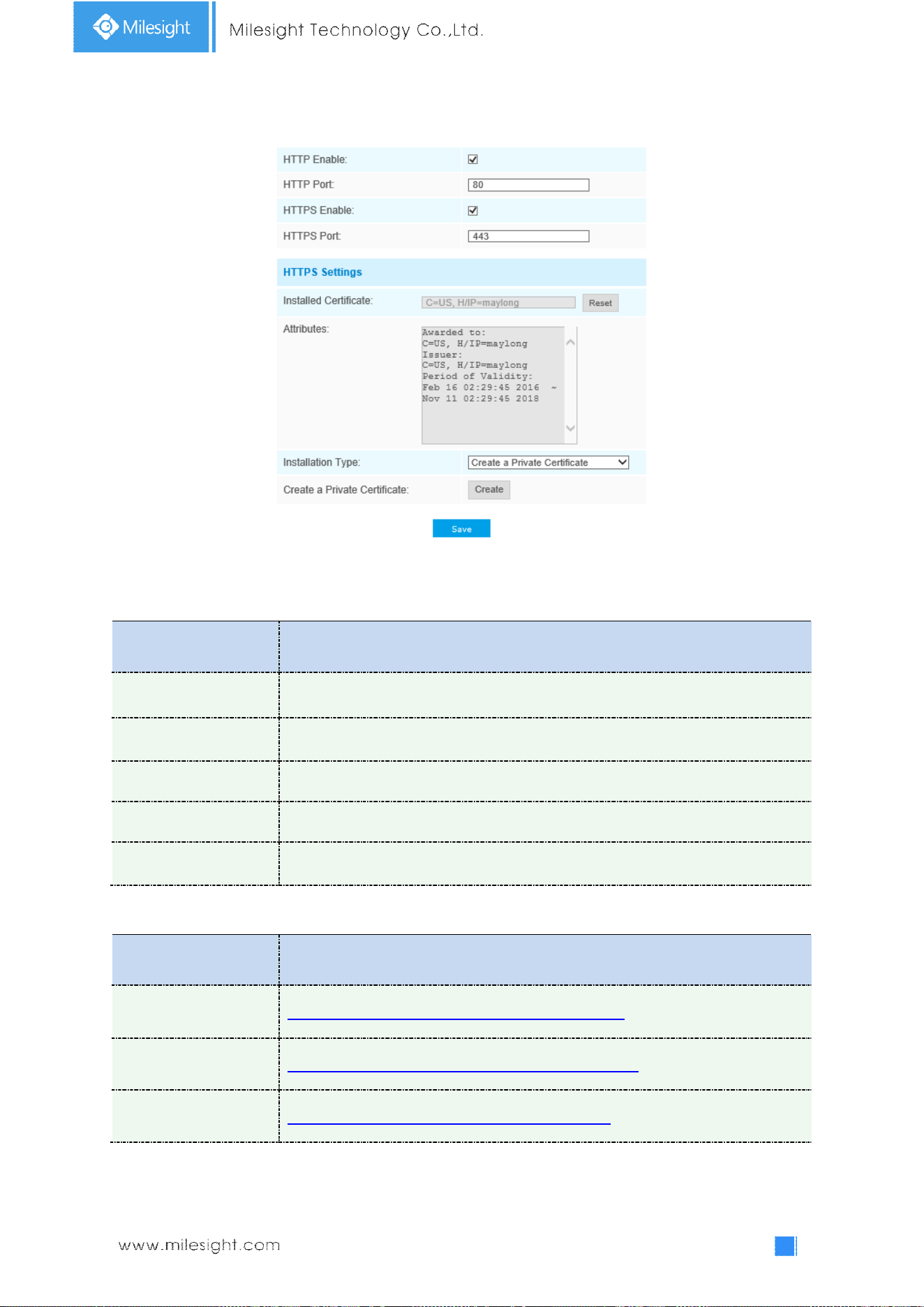
Figure 4-4-19 HTTP Port Settings
Table 4-4-10 Description of the buttons
Parameters Function Introduction
HTTP Enable Start or stop using HTTP
HTTP Port Web GUI login port, the default is 80, the same with ONVIF port
HTTPS Enable Start or stop using HTTPS
HTTPS Port Web GUI login port via HTTPS, the default is 443
HTTP Settings Upload and set the SSL certificate .
HTTP URL are as below:
Stream URL
Main Stream http://username:password@IP:port/ipcam/mjpeg.cgi
Secondary Stream http://username:password@IP:port/ipcam/mjpegcif.cgi
Tertiary Stream http://username:password@IP:port/mjpegthird.cgi
Note: You need to change the codec type of streams to MJPEG except the main stream of H.264 cameras whose
models with “-A”.
47
RTSP
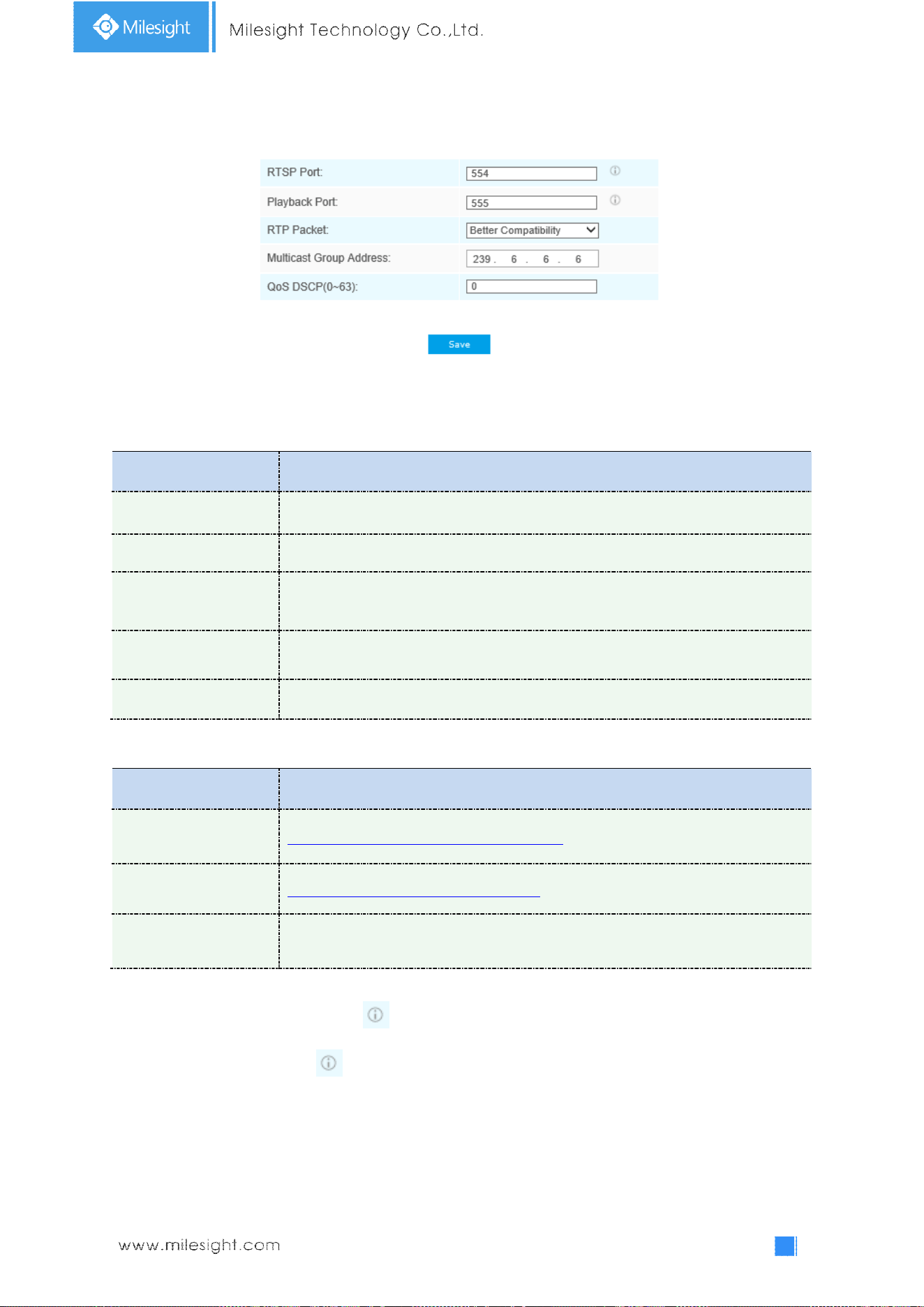
Figure 4-4-20 RTSP Settings
Table 4-4-11 Description of the buttons
Parameters Function Introduction
RTSP Port The port of RTSP, the default is 554
Playback Port The port of playback, the default is 555
RTP Packet
There are Better Compatibility and Better Performance two options, if your
camera’s image mess up, please switch this option
Multicast Group
Address
Support multicast function
QoS DSCP The valid value range of the DSCP is 0-63.
RTSP URL are as below:
Stream URL
Main Stream rtsp://username:password@IP:port/main
Secondary Stream rtsp://username:password@IP:port/sub
Tertiary Stream http://username:password@IP:port/third
Note:
1) Get the format of RTSP URL by clicking “ ”on the right side of RTSP Port.
2) Get the playback tip by clicking “
”on the right side of Playback Port.
3) DSCP refers to the Differentiated Service Code Point; and the DSCP value is used in the IP header to indicate the
priority of the data.
4) A reboot is required for the settings to take effect.
5) The tertiary stream is only equipped on camera whose model with “-A” or “-B”.
48
UPnP
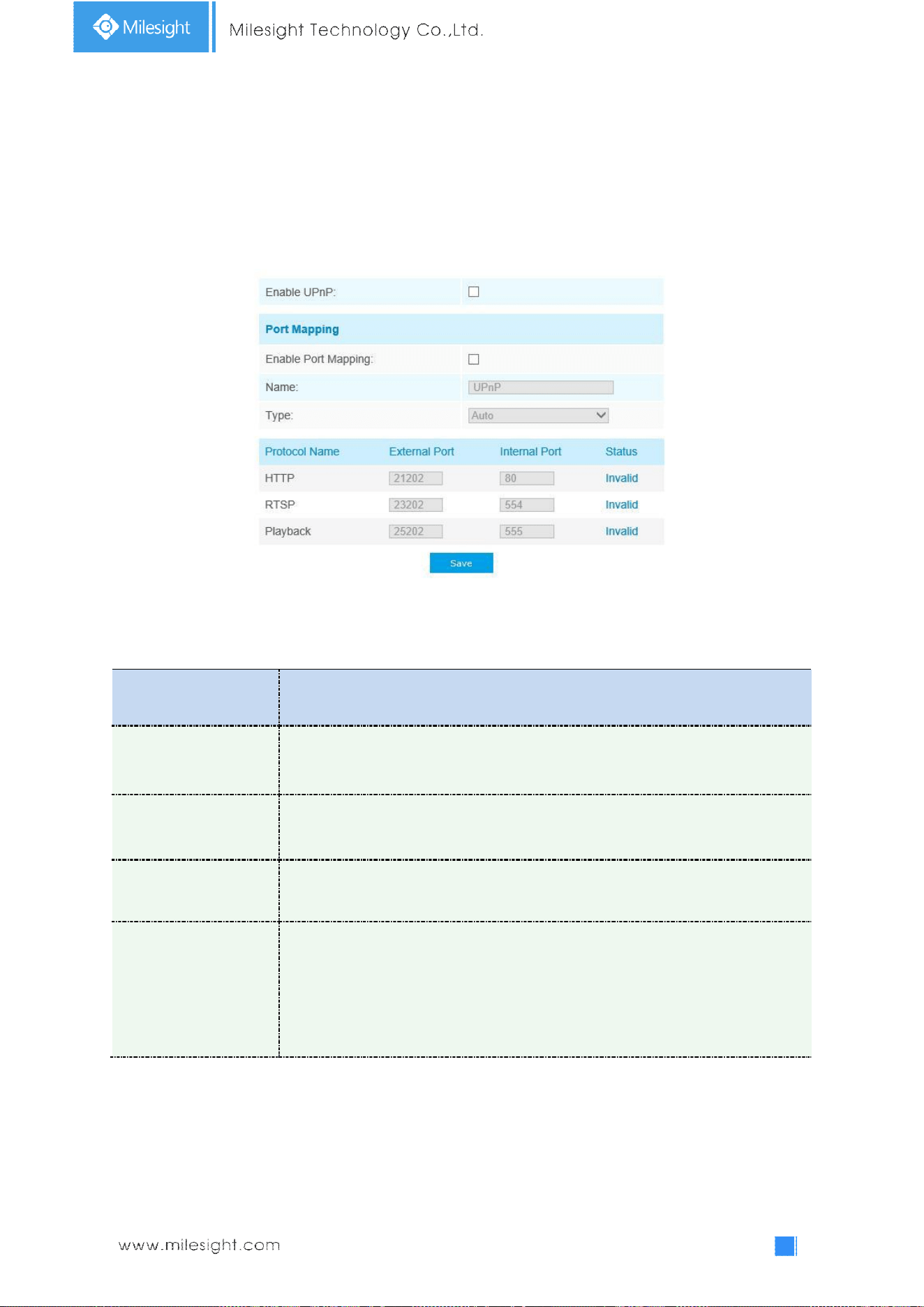
Universal Plug and Play (UPnP) is a networking architecture that provides compatibility among networking
equipment, software and other hardware devices. The UPnP protocol allows devices to connect seamlessly
and to simplify the implementation of networks in the home and corporate environments. With the
function enabled, you don’t need to configure the port mapping for each port, and the camera is connected
to the Wide Area Network via the router.
Figure 4-4-21 UPnP Settings
Table 4-4-12 Description of the buttons
Parameters Function Introduction
Enable
Check the checkbox to enable the UPnP function
Enable Port Mapping
Check the checkbox to enable the Port Mapping
Name The name of the device detected online can be edited
Type
Auto: Automatically obtain the corresponding HTTP and RTSP port, without any
settings
Manual: Need to manually set the appropriate HTTP port and RTSP Port. When
choose Manual, you can customize the value of the port number by yourself
49
DDNS
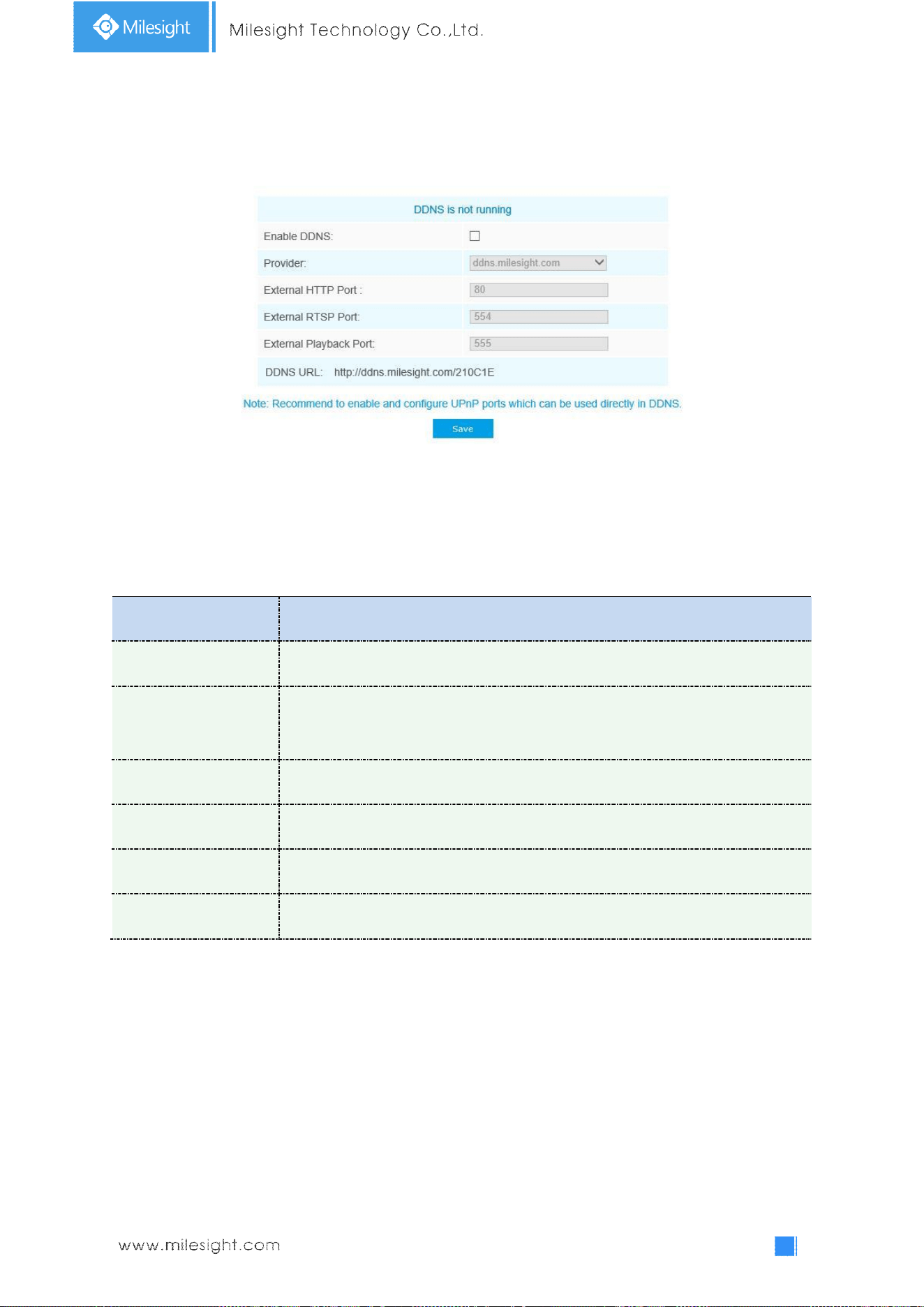
DDNS allows you to access the camera via domain names instead of IP address. It manages to change IP
address and update your domain information dynamically. You need to register an account from a provider.
Figure 4-4-22 DDNS Settings
You can choose “ddns.milesight.com” as provider for DDNS. After enabling it, you can access the device via
the URL “http://ddns.milesight.com/MAC address”.
Table 4-4-13 Description of the buttons
Parameters Function Introduction
Enable DDNS Check the checkbox to enable DDNS service
Provider
Get support from DDNS provider: ddns.milesight.com, freedns.afraid.org,
dyndns.org, www.no-ip.com, www.zoneedit.com. You can also customize the
provider for DDNS.
Hash A string used for verifying, only for "freedns.afraid.org"
User name Account name from the DDNS provider, unavailable for "freedns.afraid.org"
Password Account password, unavailable for "freedns.afraid.org"
Host name DDNS name enabled in the account
Note:
1)Please do the Port Forwarding of HTTP Port and RTSP Port before you use Milesight DDNS.
2)Make sure that the internal and the external port number of RTSP are the same.
50
Email
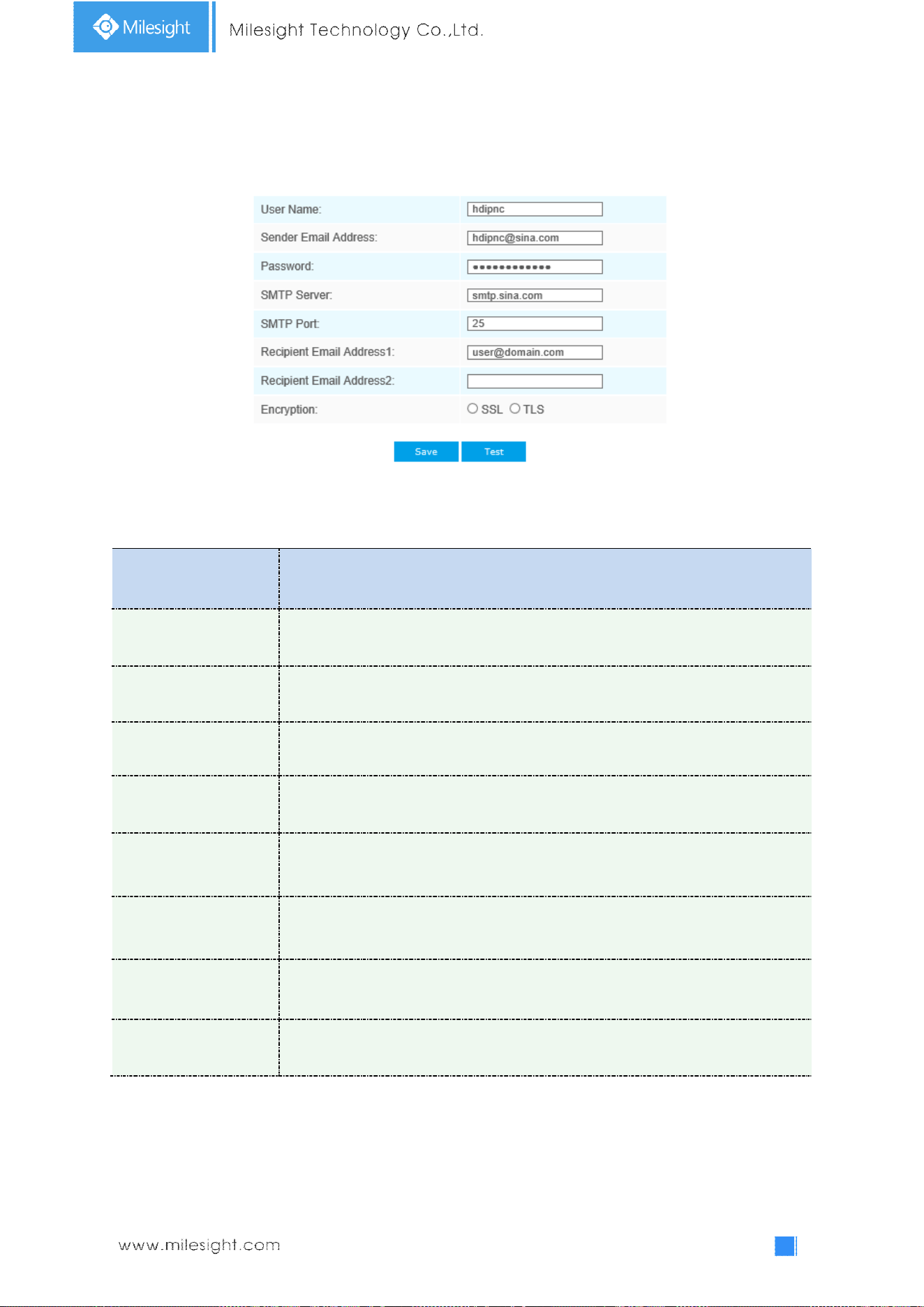
Alarm video files can be sent to specific mail account through SMTP server. You must configure the email
settings correctly before using it.
Figure 4-4-23 SMTP Settings
Table 4-4-14 Description of the buttons
Parameters Function Introduction
User Name The sender's name. It is usually the same as the account name
Sender Email Address
Email address to send video files attached emails
Password The password of the sender
SMTP Server The SMTP server IP address or host name(e.g. smtp.gmail.com)
SMTP Port
The default TCP/IP port for SMTP is 25(not secured). For SSL/TLS port, it depends
on the mail you use
Recipient Email
Address1
Email address to receive video files
Recipient Email
Address2
Email address to receive video files
Encryption Check the checkbox to enable SSL or TLS if it is required by the SMTP server.
51
FTP
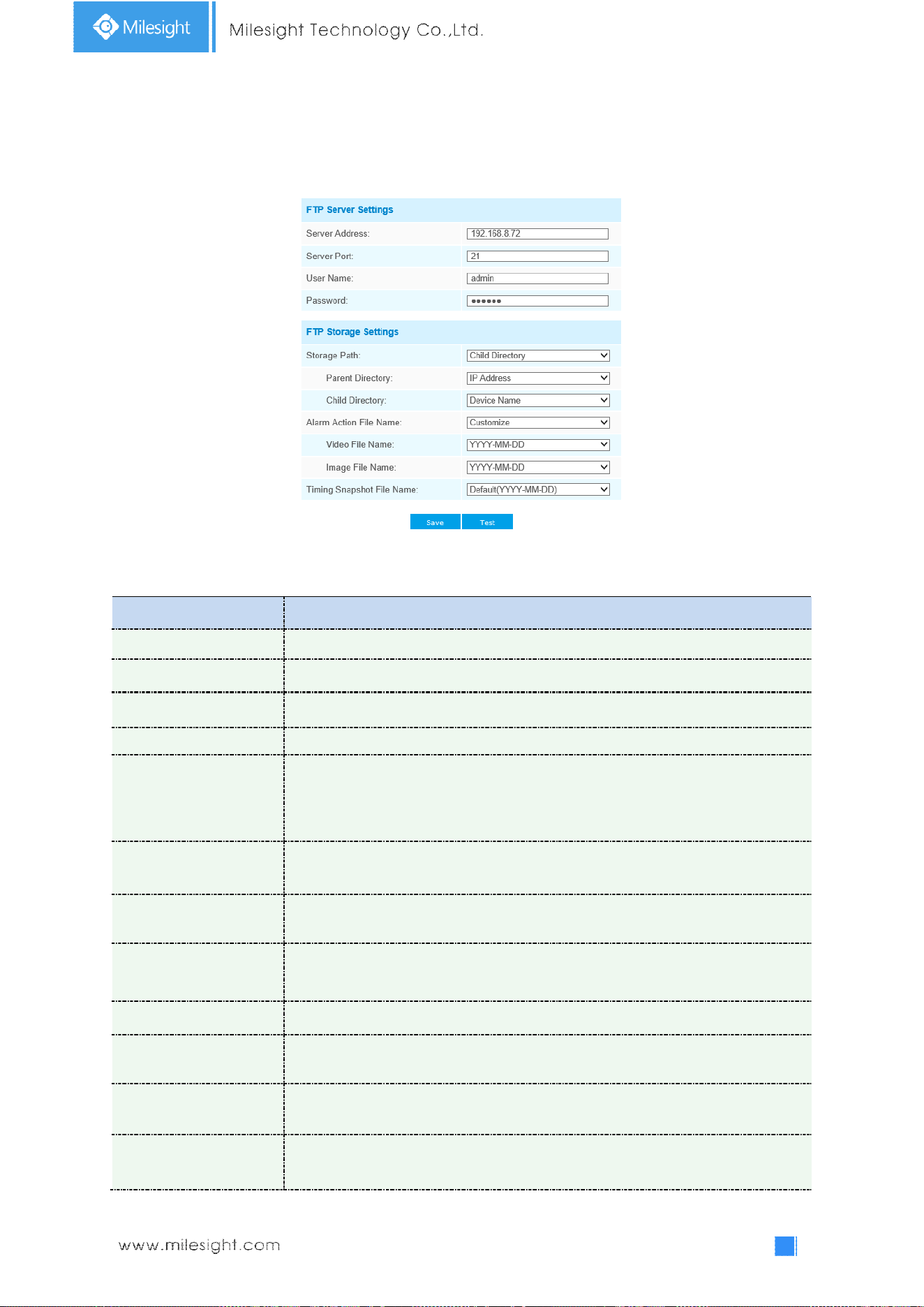
Alarm video files can be sent to specific FTP server. You must configure the FTP settings correctly before
using it.
Figure 4-4-24 FTP Settings
Table 4-4-15 Description of the buttons
Parameters Function Introduction
Server Address
FTP server address
Server Port The port of the FTP server. Generally it is 21
User Name User name used to log in to the FTP sever
Password User password
Storage Path
Storage Path where video and image will be uploaded to the FTP server.
Four FTP storage path types are available, including Root Directory, Parent
Directory, Child Directory and Customize.
Parent Directory
Choose IP Address/ Device Name/ Date as the folder name of Parent Directory,
or customize the folder name.
Child Directory
Choose IP Address/ Device Name/ Date as the folder name of Child Directory, or
customize the folder name.
Multilevel Folder Name
If the storage path is more than two levels, enter Multilevel FTP storage path
here manually.
Alarm Action File Name Choose the default(YYYY-MM-DD) or customize the alarm action file name.
Video File Name
If you choose to customize the alarm action file name, YYYY-MM-DD/
MM-DD-YYYY/ DD-MM-YYYY/ Add prefix are available.
Image File Name
If you choose to customize the alarm action file name, YYYY-MM-DD/
MM-DD-YYYY/ DD-MM-YYYY/ Add prefix are available.
Timing Snapshot File
Name
Default(YYYY-MM-DD) /MM-DD-YYYY/ DD-MM-YYYY/ Add prefix/ Overwrite with
the base file name are available.
Note: Parent Directory will be under Root Directory, and Child Directory will be under Parent Directory.
52
VLAN
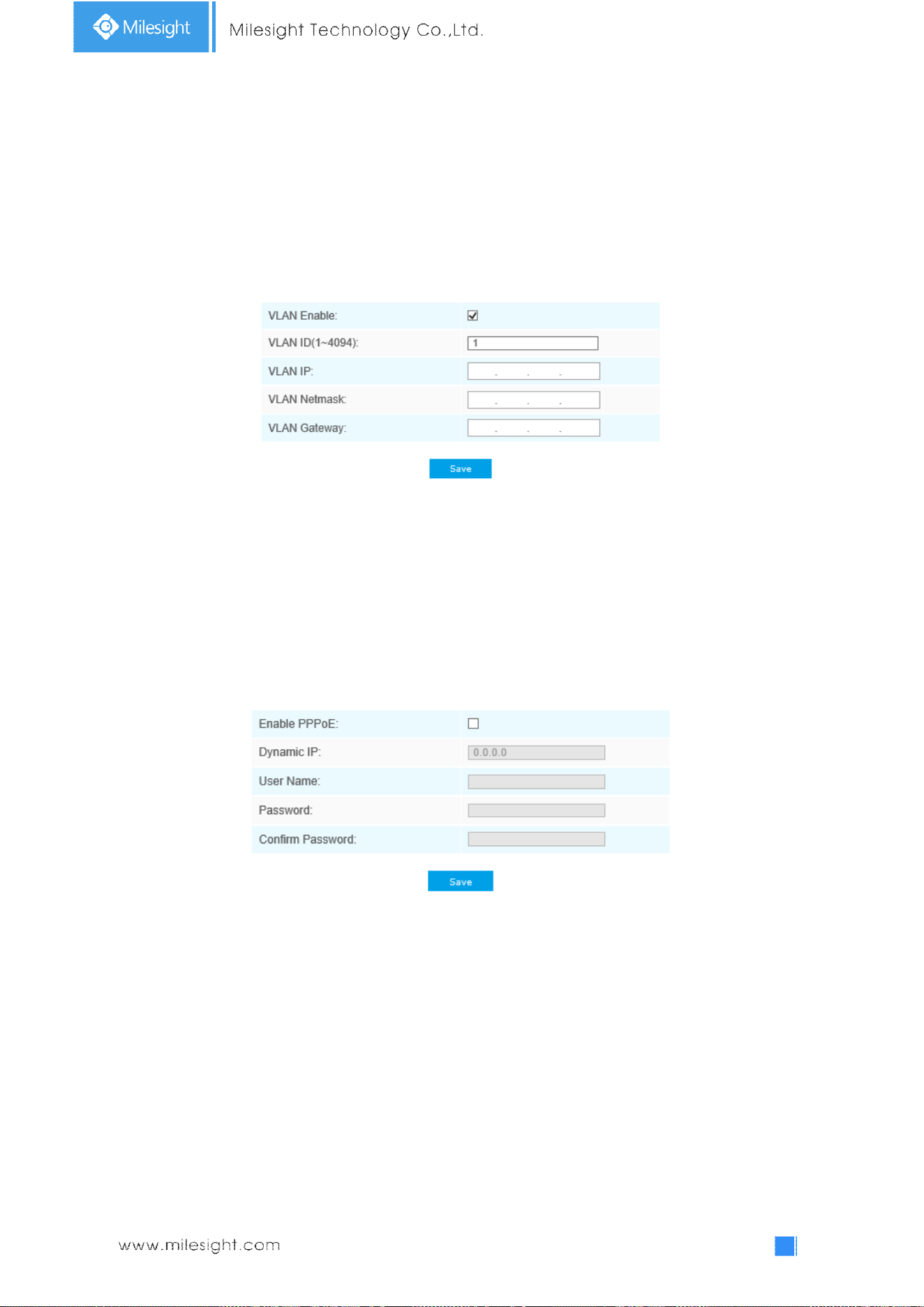
A virtual LAN (VLAN) is any broadcast domain that is partitioned and isolated in a computer network at
the data link layer (OSI layer 2). LAN is an abbreviation of local area network. VLANs allow network
administrators to group hosts together even if the hosts are not on the same network switch. This can
greatly simplify network design and deployment, because VLAN membership can be configured through
software. Without VLANs, grouping hosts according to their resource needs necessitates the labour of
relocating nodes or rewiring data links.
Figure 4-4-25 VLAN Settings
Note: How to set up VLAN in switches, please refers to your switches user manual.
PPPoE
This camera supports the PPPoE auto dial-up function. The camera gets a public IP address by ADSL dial-up
after the camera is connected to a modem. You need to configure the PPPoE parameters of the network
camera.
Figure 4-4-26 PPPoE Settings
Note:
1) The obtained IP address is dynamically assigned via PPPoE, so the IP address always changes after rebooting the
camera. To solve the inconvenience of the dynamic IP, you need to get a domain name from the DDNS provider
(e.g. DynDns.com).
2) The user name and password should be assigned by your ISP.
53
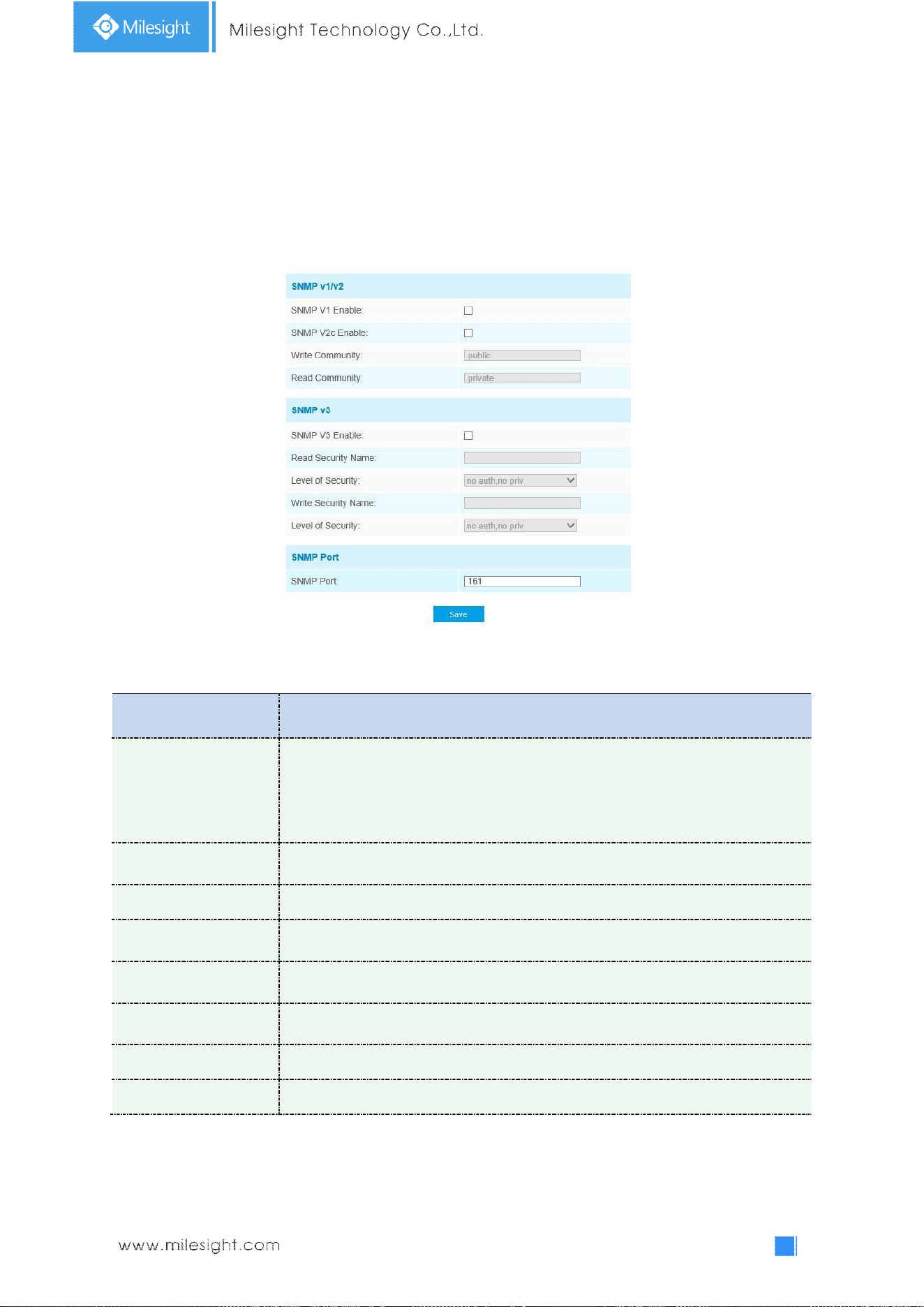
SNMP
You can set the SNMP function to get camera status, parameters and alarm related information and manage
the camera remotely when it is connected to the network.
Before setting the SNMP, please download the SNMP software and manage to receive the camera
information via SNMP port. By setting the Trap Address, the camera can send the alarm event and exception
messages to the surveillance center.
Figure 4-4-27 SNMP Settings
Table 4-4-16 Description of the buttons
Parameters Function Introduction
SNMP v1/2/3
The version of SNMP, please select the version of your SNMP software.
SNMP v1: Provide no security
SNMP v2: Require password for access
SNMP v3: Provide encryption and the HTTPS protocol must be enabled
Write Community Input the name of Write Community
Read Community Input the name of Read Community
Read Security Name Input the name of Read Security Community
Level of Security There are three levels available: (auth, priv), (auth, no priv) and (no auth, no priv)
Write Security Name Input the name of Write Security Community
Level of Security There are three levels available: (auth, priv), (auth, no priv) and (no auth, no priv)
SNMP Port The port of SNMP, the default is 161
Note:
1) The settings of SNMP software should be the same as the settings you configure here;
2) A reboot is required for the settings to take effect.
54
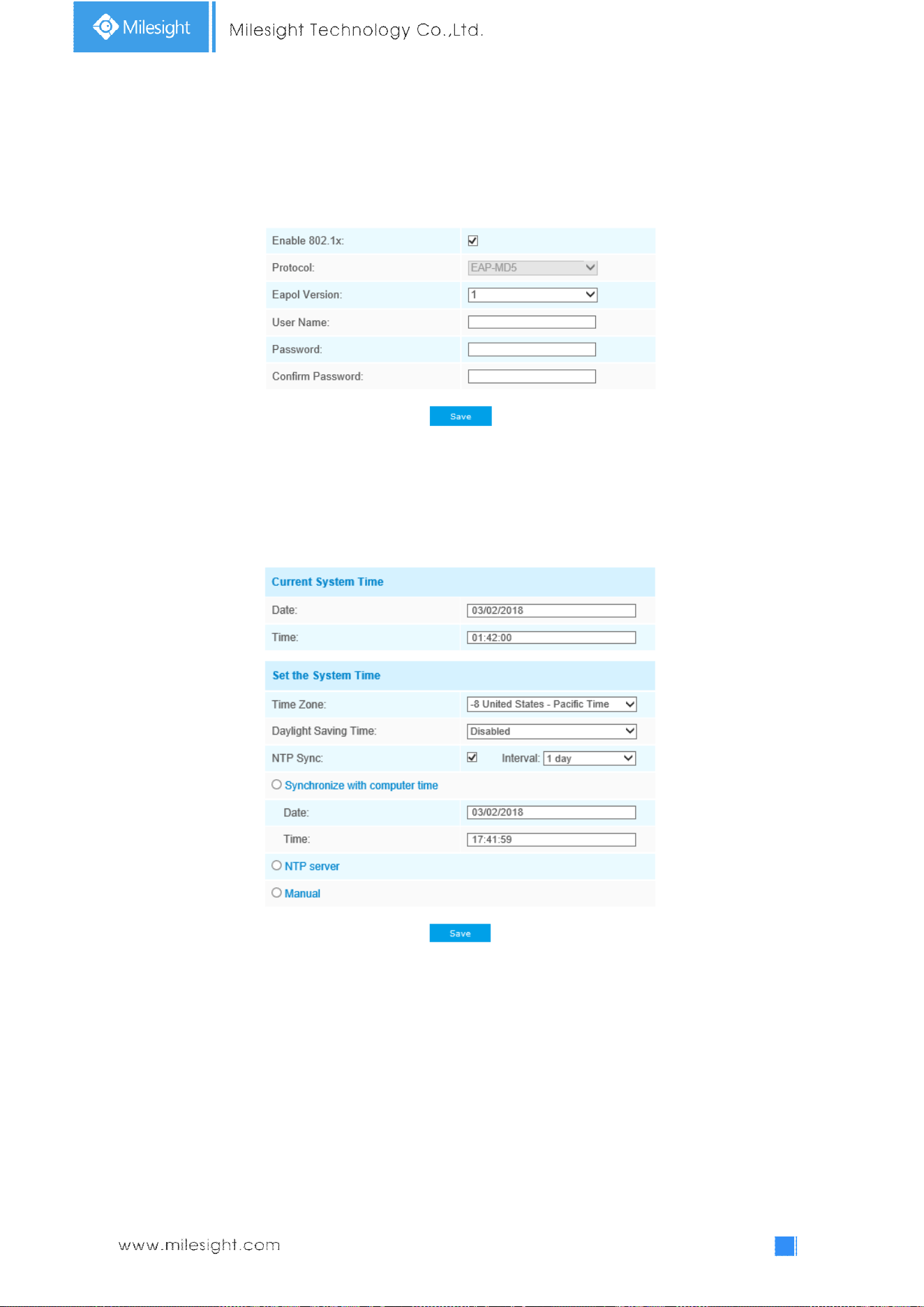
802.1x
The IEEE 802.1X standard is supported by the network cameras, and when the feature
is enabled, the camera data is secured and user authentication is needed when
connecting the camera to the network protected by the IEEE 802.1X.
Figure 4-4-28 802.1x Settings
4.4.5 Date & Time
Figure 4-4-31 Date&Time Settings
Current System Time
Current date & time of the system
55
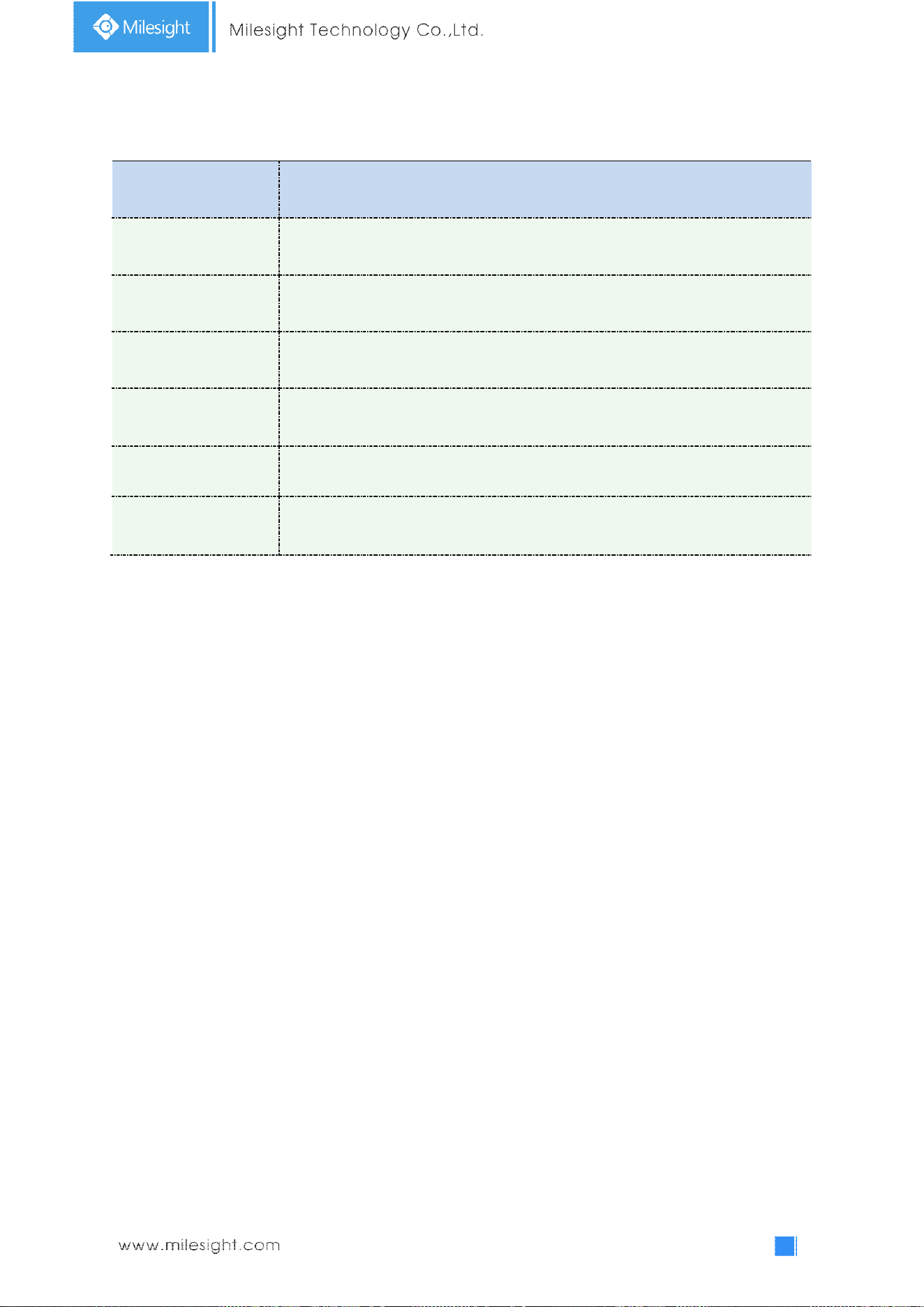
Set the System Time
Table 4-4-19 Description of the buttons
Parameters Function Introduction
Time Zone
Choose a time zone for your location
Daylight Saving time Enable the daylight saving time
NTP Sync Regularly update your time according to the interval time
Synchronize with
computer time
Synchronize the time with your computer
NTP server Input the address of NTP server
Manual Set the system time manually
56
4.5 Advanced Settings
4.5.1 Alarm
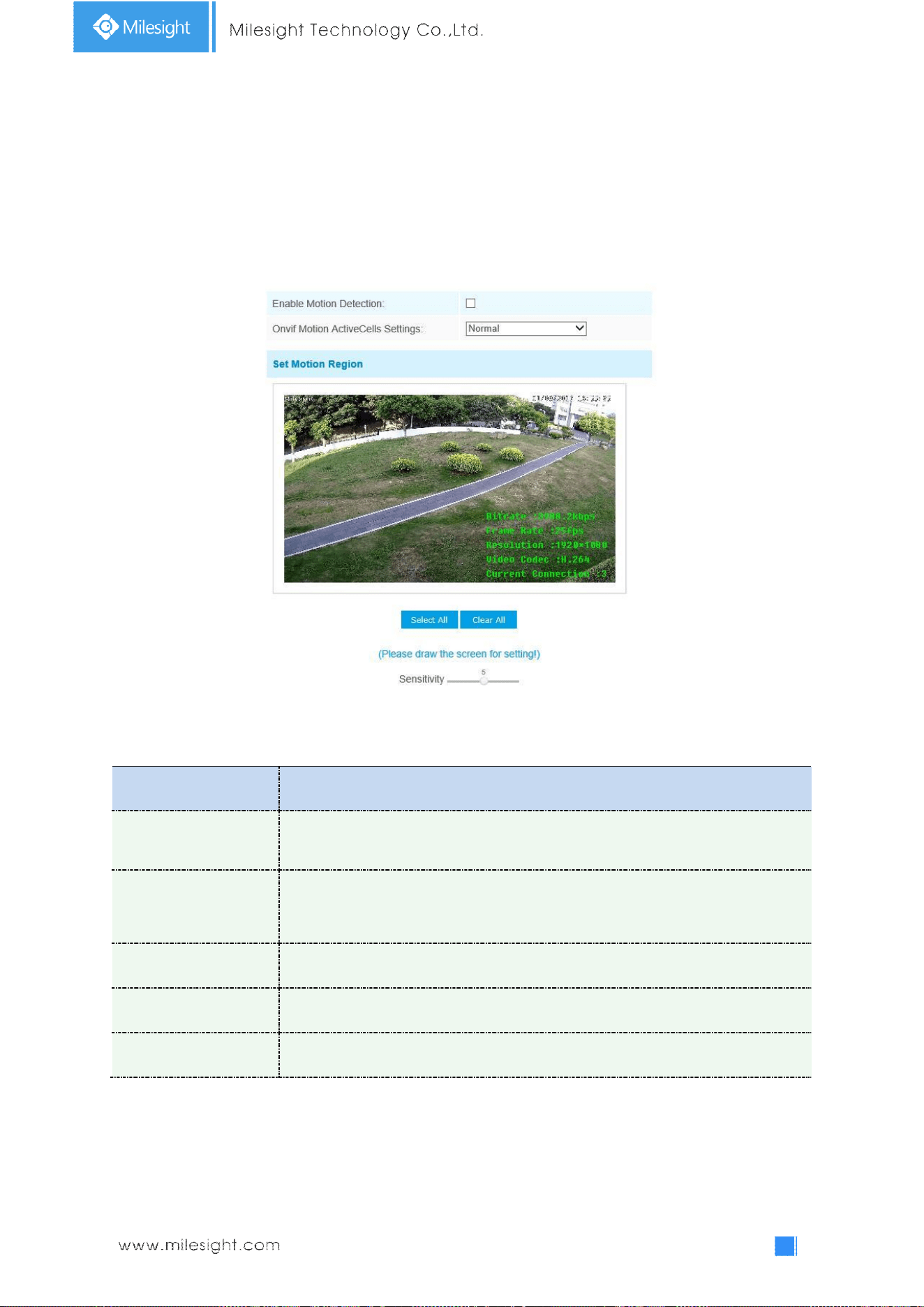
Motion Detection
Step1: Check the checkbox to enable the motion detection;
Step2: Set motion region;
Figure 4-5-1 Motion Region Settings
Table 4-5-1 Description of the buttons
Parameters Function Introduction
Enable Motion
Detection
Check the checkbox to enable Motion Detection function
Onvif Motion
ActiveCells Settings
Normal and Compatible are available for the option. If the setting of motion
region of the third-party software is different from ours, please set this option to
Compatible.
Select All Click the button, the motion in the area will be detected
Clear All Click the button, the area drawn before will be removed
Sensitivity Sensitivity level, 1~10
57
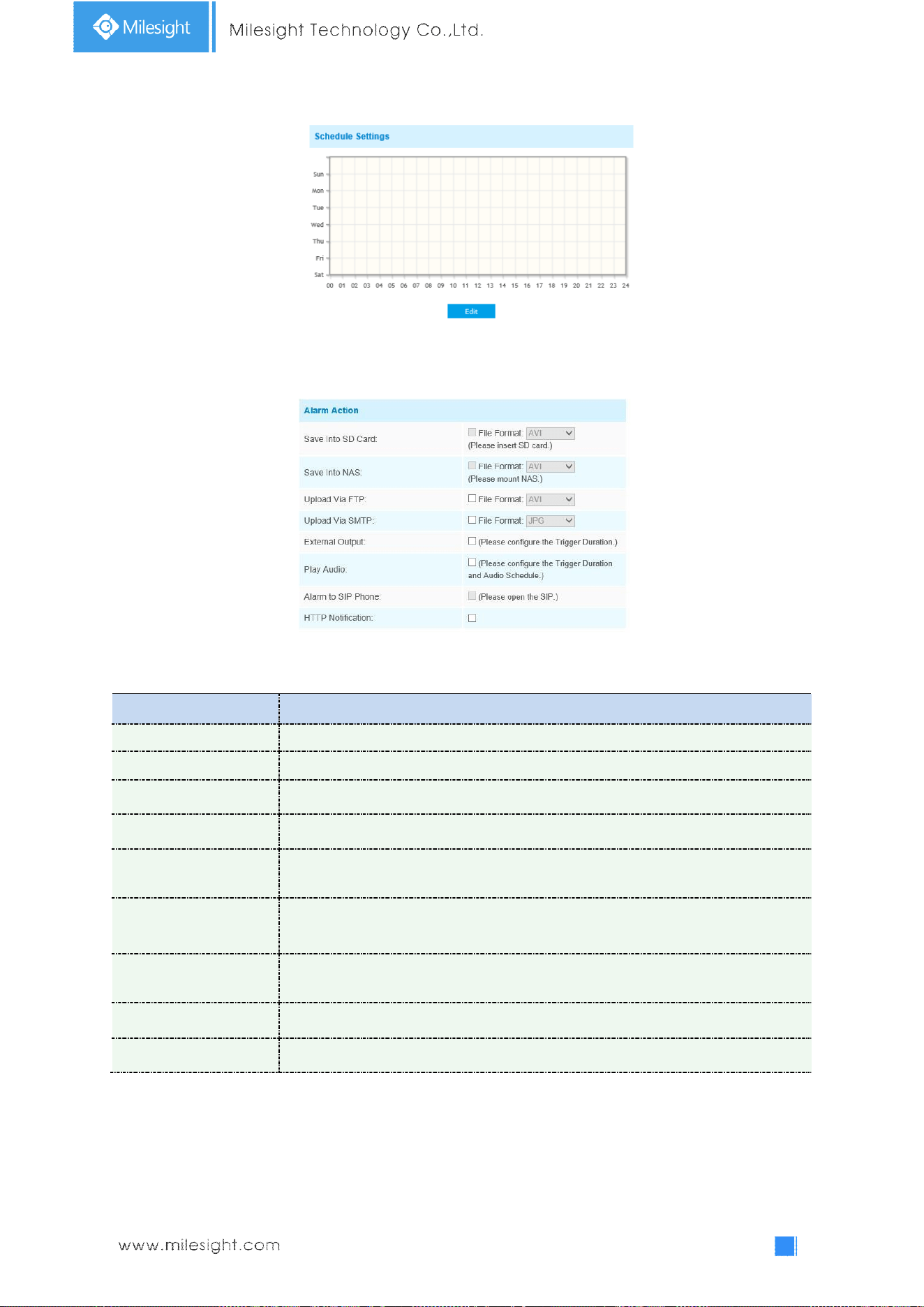
Step3: Set motion detection schedule;
Figure 4-5-2 Schedule Settings
Step4: Set alarm action;
Figure 4-5-3 Alarm Action
Table 4-5-2 Description of the buttons
Parameters Function Introduction
Save Into SD Card Save alarm recording files into SD Card
Save Into NAS Save alarm recording files into NAS
Upload Via FTP Upload the recording files via FTP
Upload Via SMTP Upload the files via SMTP
External Output
If the camera equips with External Output, you can en
able the action after
configuring the trigger duration
Play Audio
If the camera equips with Speaker, you can enable the action after configuring the
audio speaker
Play Buzzer
If the camera equips with Buzzer, you can check the checkbox to enable the
function.
Alarm to SIP Phone Support to call the SIP phone after enable the SIP function.
HTTP Notification Support to pop up the alarm news to specified HTTP URL.
NOTE:
1) The HTTP notification function is just one way for camera to send messages to VMS Software. And it's the VMS
that defines what the messages mean and decides what to do after receiving this kind of messages. So, we can
use the HTTP Notification function of our cameras only if the VMS supports this kind of message format.
58
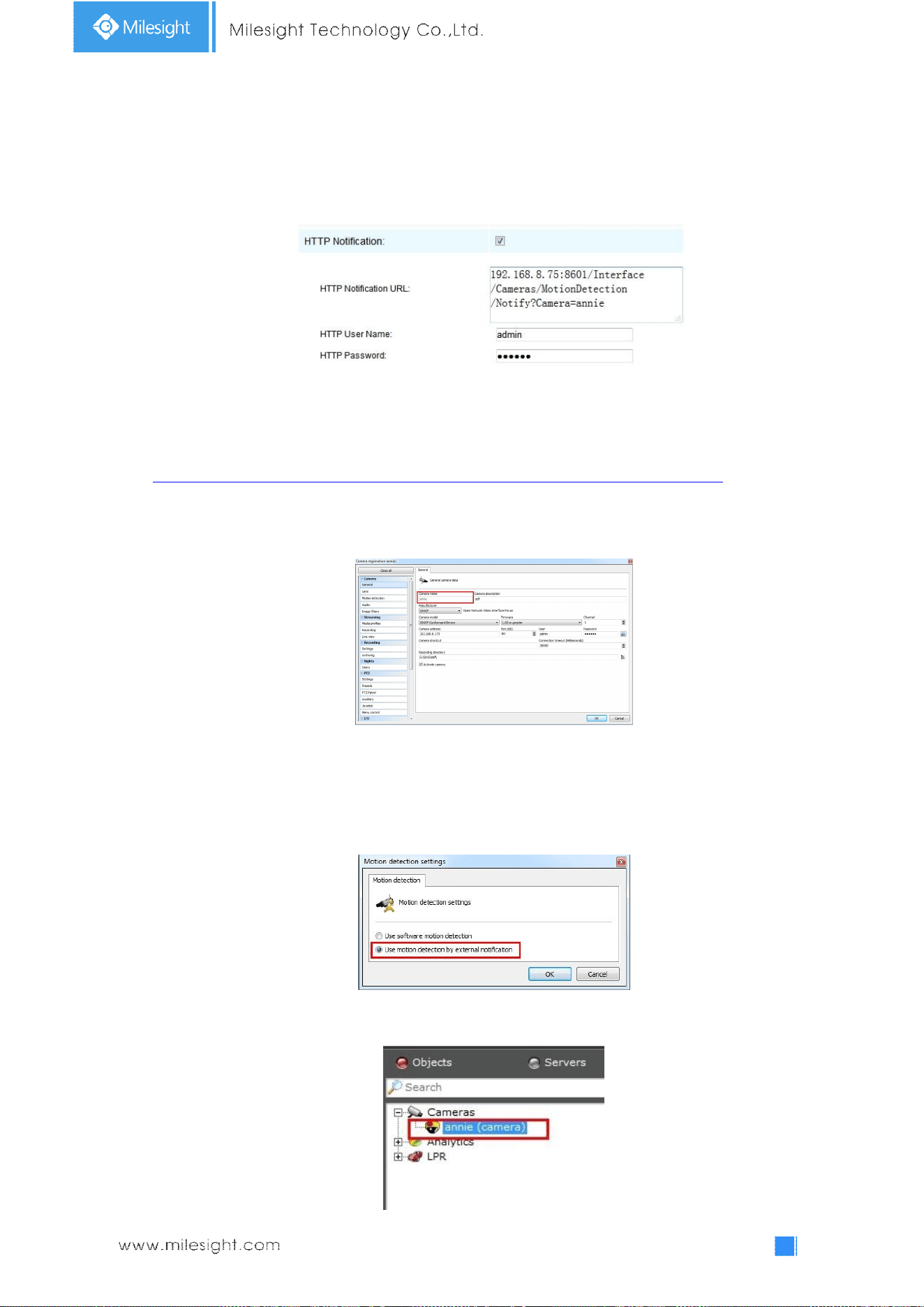
Here will take the Digifort as an example to introduce the HTTP Notification function.
The following are the detail steps of setting for HTTP Notification in Digifort VMS and our cameras.
Step1: Enable Alarm, set Motion Region and detection Schedule;
Step2: Check the HTTP Notification as Alarm Action, and fill the fields. Then save the alarm setting;
HTTP User Name: admin (the user name of your camera)
HTTP Password: ms1234 (the password of your camera)
HTTP Notification URL:
http://IP:8601/Interface/Cameras/MotionDetection/Notify?Camera=CameraName
IP refers to the PC's IP where the Digifort installed.
8601 is the port for Motion signal in Digifort.
CameraName is the camera name you set in Digifort VMS, like the picture shown below.
Example:
http://192.168.8.75:8601/Interface/Cameras/MotionDetection/Notify?Camera=annie,
this URL format is exactly supported by Digifort VMS, so we can set as above to our cameras and
get it work well.
Step3: choose use motion detection by external notification;
Step4: If successful, you can see the device icon turns yellow in the Surveillance when the camera
is under Motion Detection Alarm;
59
So, it's the VMS Software which decides whether we can use this function successfully.
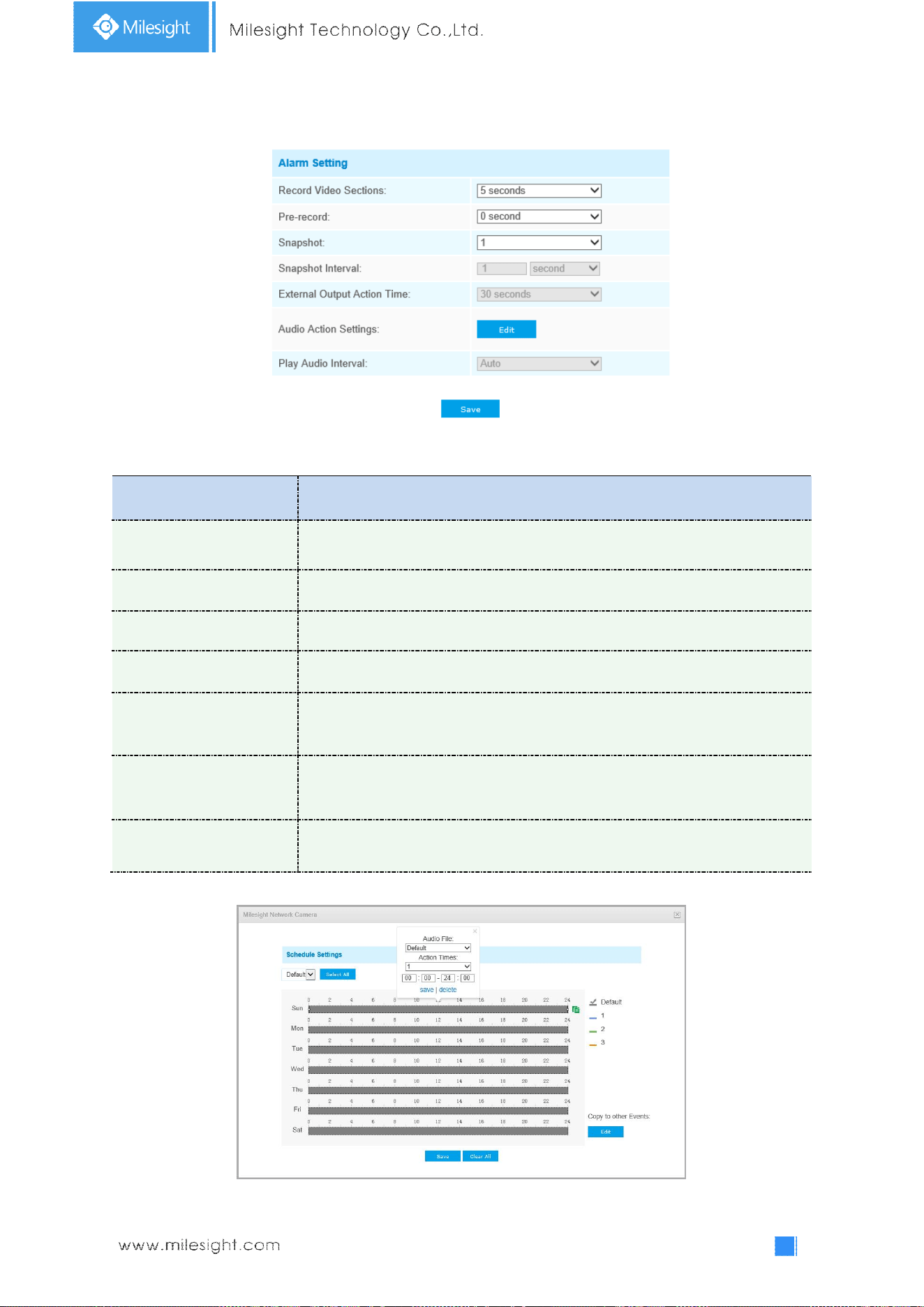
Step5: Set alarm settings.
Figure 4-5-4 Alarm Settings
Table 4-5-3 Description of the buttons
Parameters Function Introduction
Record Video Sections Six different periods are available(5, 10, 15, 20, 25, 30 sec)
Pre-record Reserve the record time before alarm, 0~10 sec
Snapshot The number of snapshot, 1~5
Snapshot Interval This cannot be edited unless you choose more than 1 to Snapshot
External Output Action
Time
Length of time an alarm lasts, this cannot be edited unless you enable the
External Output on the Alarm Action firstly.
Audio Action Settings
Set the audio schedule to trigger different audio files and action times in
different time, which is corresponded to alarm action.
Play Audio Interval Auto/ 10 seconds/ 30 seconds/ 1 minute/ 5 minutes/ 10 minutes are available.
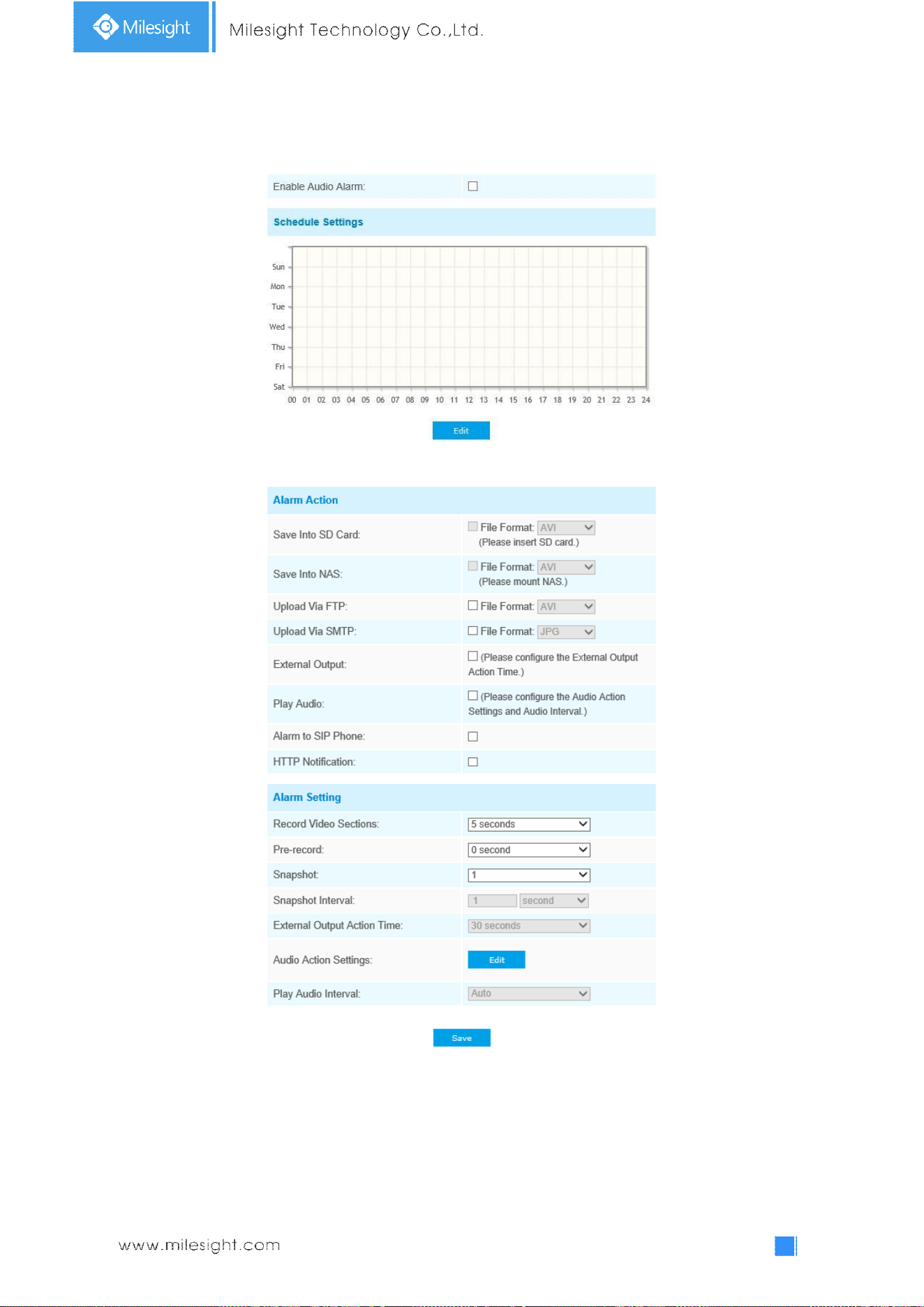
Note: You can customize the schedule of Audio Action.
Figure 4-5-5 Audio Action schedule settings
60
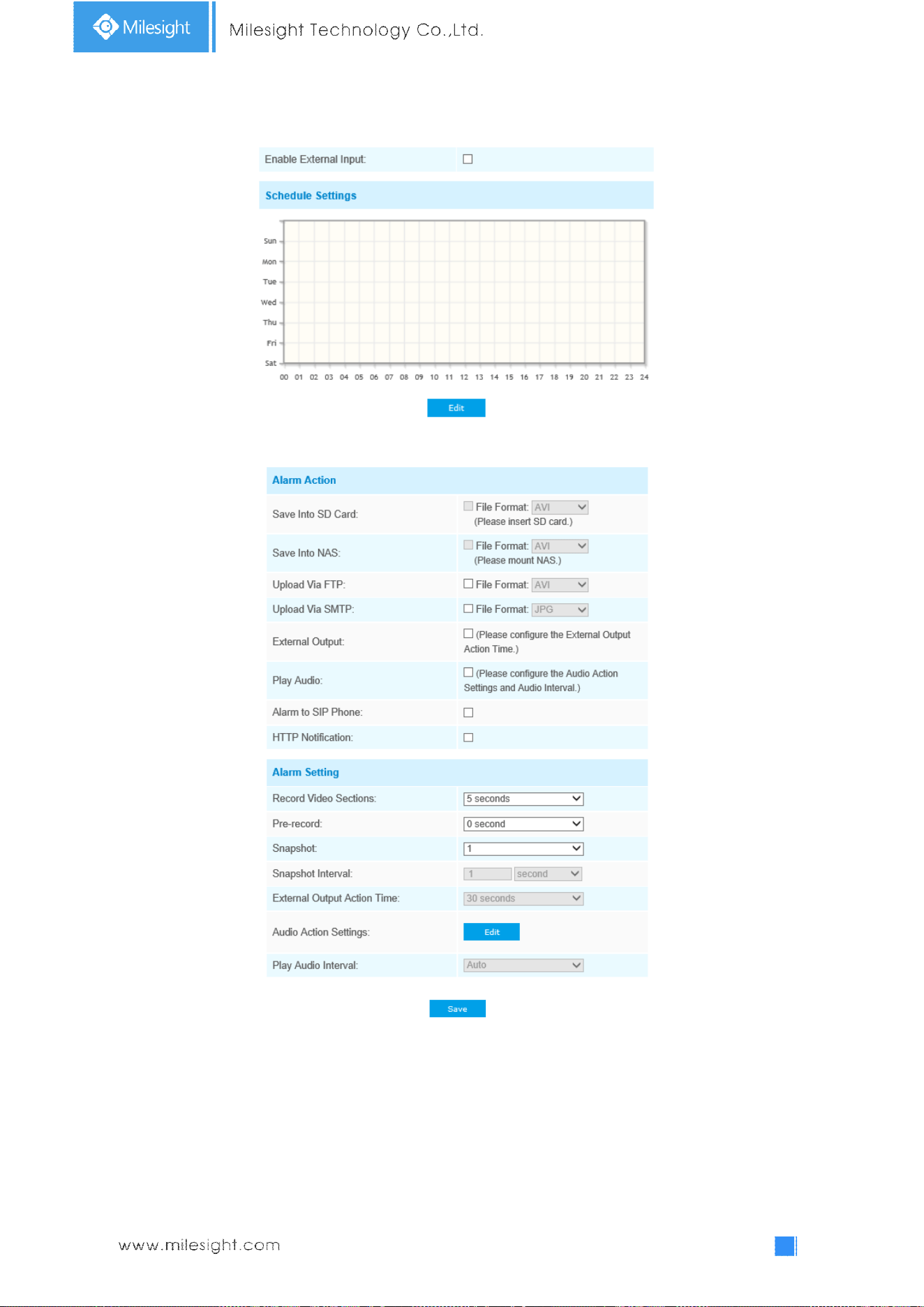
Audio Alarm
Enable the Audio before using Audio Alarm function.
Figure 4-5-6 Schedule Settings
Figure 4-5-7 Alarm Settings
The meaning of items please refer to table 4-5-2 and 4-5-3, here will not repeat again.
61
External Input
Figure 4-5-8 Schedule Settings
Figure 4-5-9 Alarm Settings
The meaning of items please refer to table 4-5-2 and 4-5-3, here will not repeat again.
62
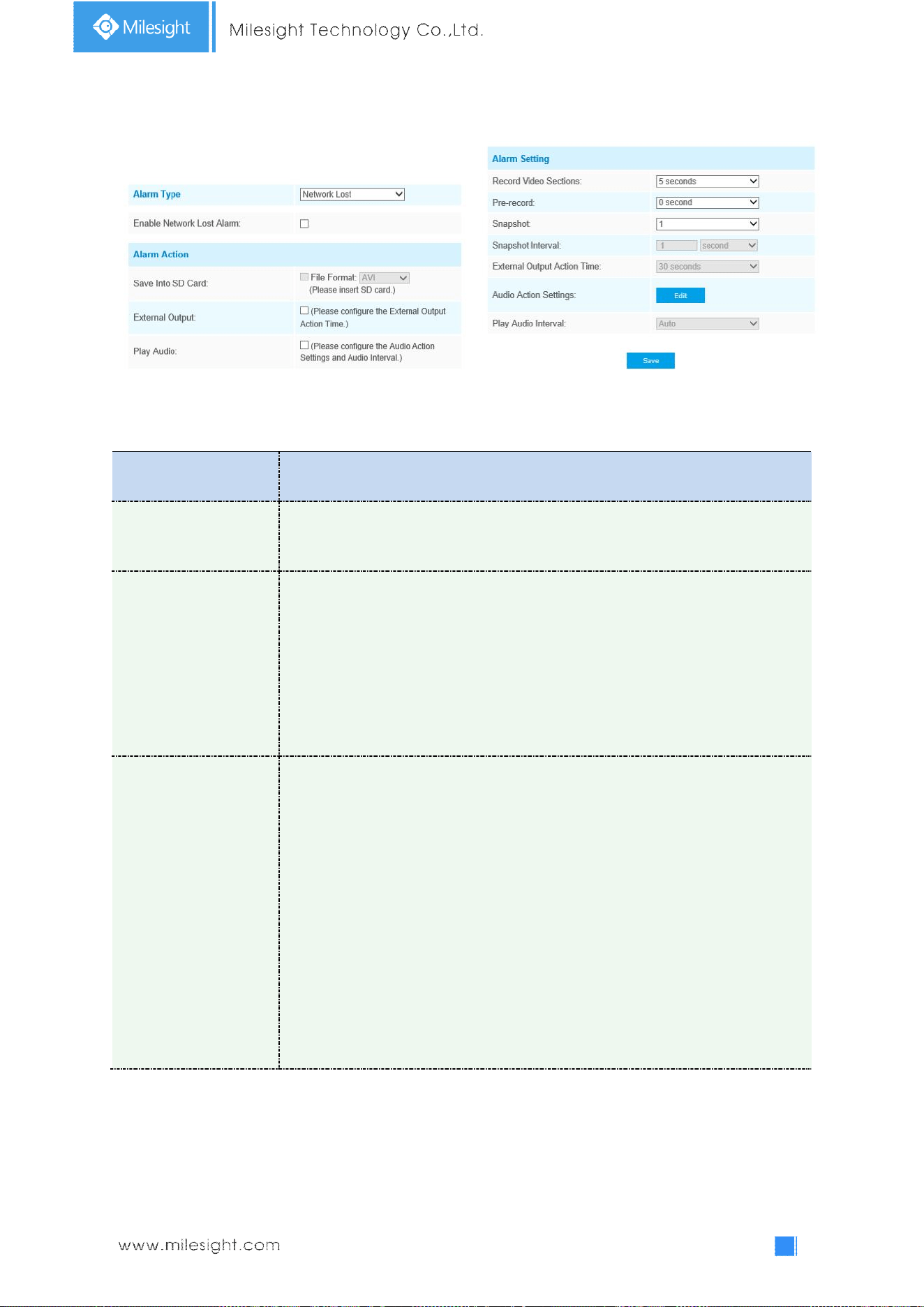
Other Alarm
Figure 4-5-10 Other Alarm
Table 4-5-4 Description of the buttons
Parameters Function Introduction
Alarm Type
Network Lost,Tampering and IP Address Conflicted are available
Check the checkbox to enable the alarm type you selected
Alarm Action
Save Into SD Card: Save alarm recording files into SD Card
External Output: If the camera equips with External Output, you can enable the
action after configuring the trigger duration
Play Audio: If the camera equips with Speaker, you can enable the action after
configuring the audio speaker
Play Buzzer: If the camera equips with Buzzer, you can check the checkbox to
enable the function
Alarm Setting
Record Video Sections: Six different periods are available(5, 10, 15, 20, 25, 30
sec)
Pre-record: Reserve the record time before alarm, 0~10 sec
Snapshot: The number of snapshot, 1~5
Snapshot Interval: This cannot be edited unless you choose more than 1 to
Snapshot
External Output Action Time: Length of time an alarm lasts, this cannot be edited
unless when you enable the External Output on the Alarm Action firstly
Audio Action Settings: Set the audio schedule to trigger different audio files and
action times in different time, which is corresponded to alarm action
Play Audio Interval: Auto/ 10 seconds/ 30 seconds/ 1 minute/ 5 minutes/ 10
minutes are available
63
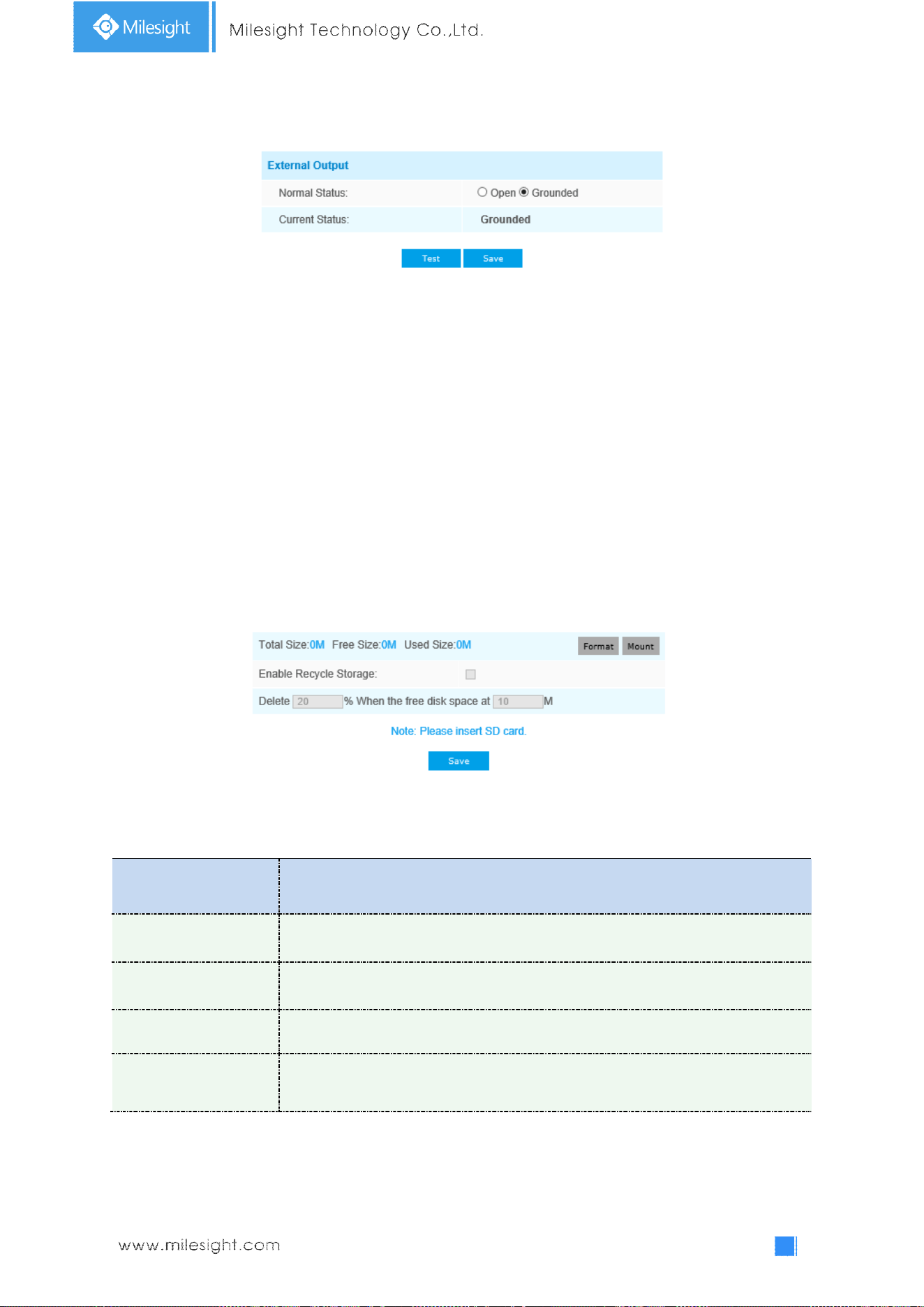
External Output
Figure 4-5-11 External Output Settings
Please set the Normal Status firstly, when the Current Status is different with Normal Status, it will lead to
the alarm.
4.5.2 Storage
Before you start:
To configure record settings, please make sure that you have the network storage device within the network
or the SD card inserted in your camera.
You can check “Enable cyclic storage”, then it will delete the files when the free disk space reach a certain
value. Choose the storage mode according to your needs.
SD Card
Figure 4-5-12 SD Card
Table 4-5-5 Description of the buttons
Parameters Function Introduction
Format Format SD card, the files in SD card will be removed
Mount/UnMount
Mount/Dismount SD card
Enable cyclic storage
Enable/Disable cyclic storage
Delete
Enable cyclic storage, when the free disk space reach at a certain value, it will
automatically delete the files at certain percentage according to your settings
64
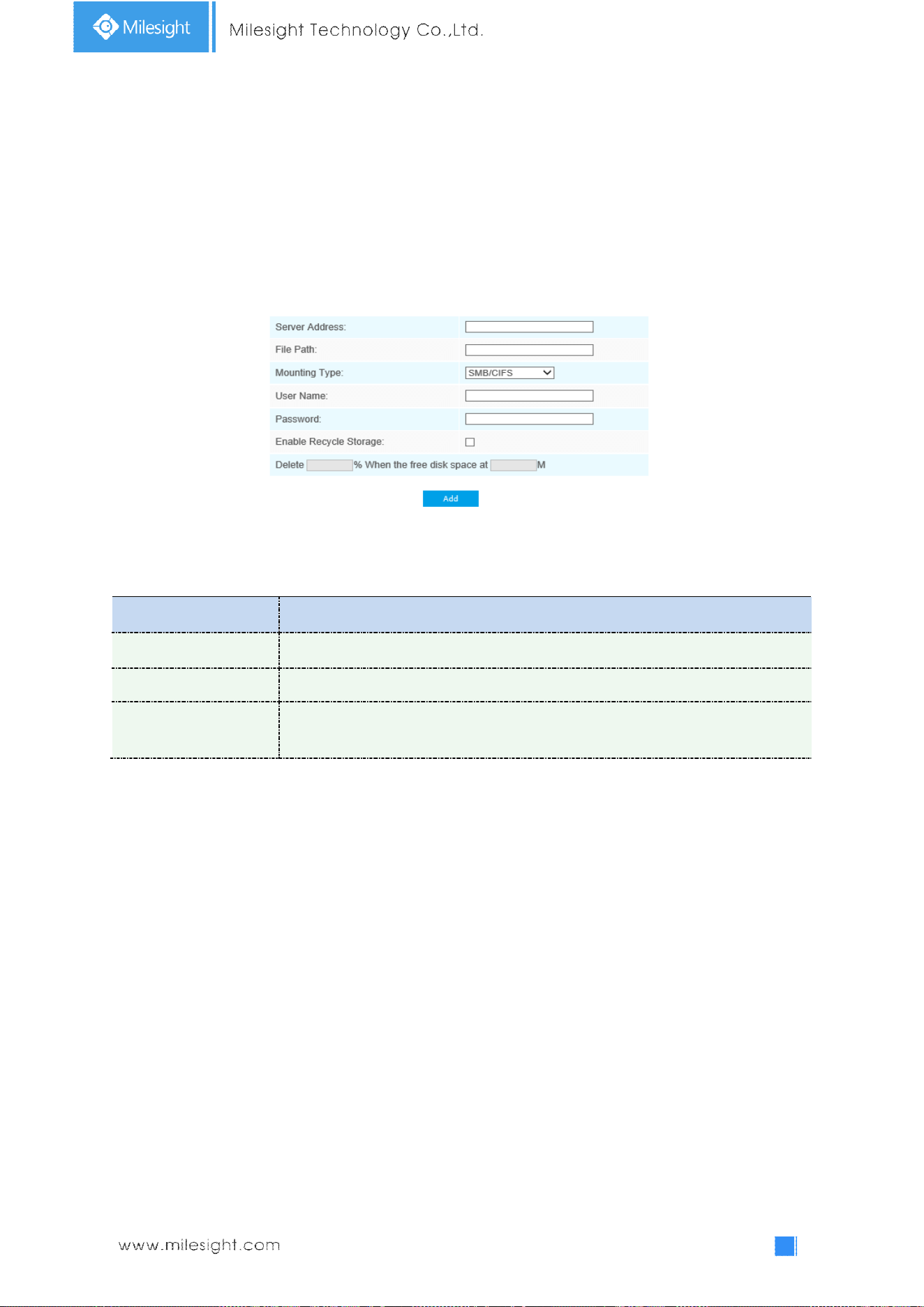
NAS
The network disk should be available within the network and properly configured to store the recorded files,
etc.
NAS (Network-Attached Storage), connecting the storage devices to the existing network, provides data and
files services.
Figure 4-5-13 NAS Settings
Table 4-5-7 Description of the buttons
Parameters Function Introduction
Server Address IP address of NAS server
File Path Input the NAS file path, e.g. “\path”.
Mounting Type
NFS and SMB/CIFS are available. And you can set the user name and password to
guarantee the security if SMB/CIFS is selected
Note: Up to 5 NAS disks can be connected to the camera.
65
Record Schedule
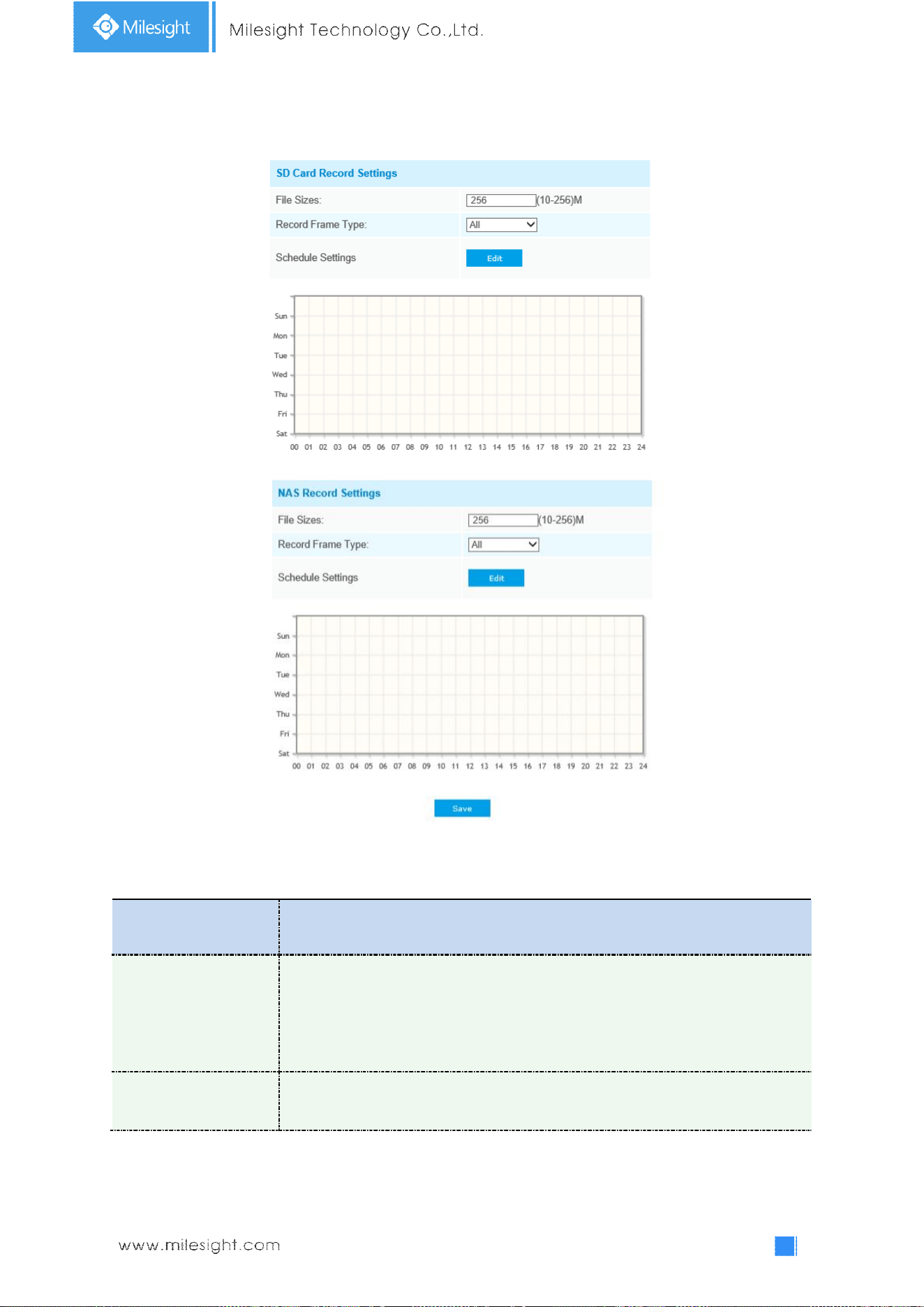
Figure 4-5-14 Record Schedule
Table 4-5-6 Description of the buttons
Parameters Function Introduction
Record Settings
File Sizes: Set record file size, (10-256)M
Record Frame Type: All/Key
(All: Record all the frame
Key: Only record I-frame)
Schedule Settings Click the Edit button to edit record schedule
Note: SD Card or NAS are available.
66
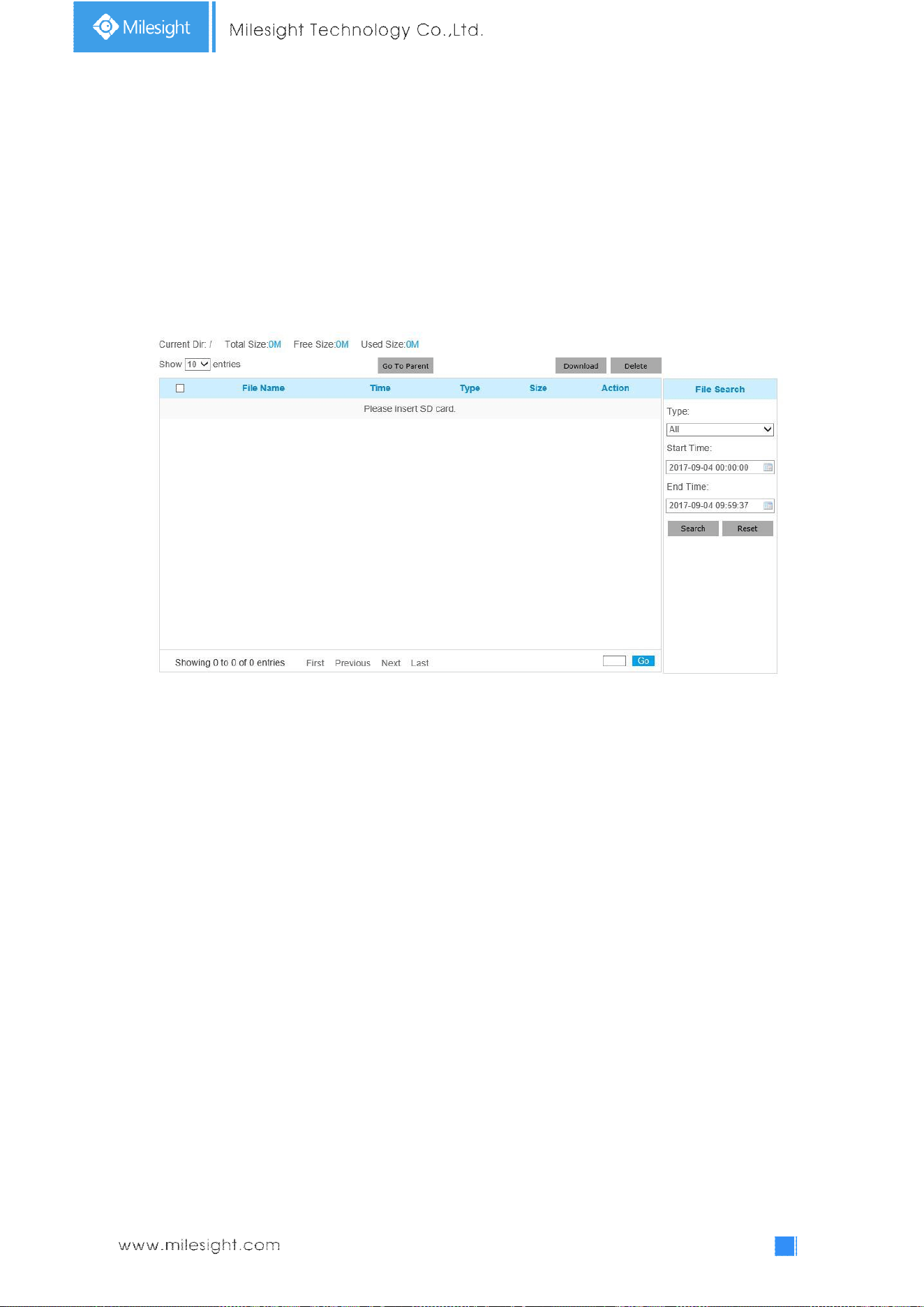
SD Card Explorer
Files will be seen on this page when they are configured to save into SD card.
You can set time schedule every day for recording videos and save video files to your desired location.
(Note: Files are visible once SD card is inserted. Don’t insert or plug out SD card when power on.)
SD card video files are arranged by date. Each day files will be displayed under the corresponding date, from
here you can copy and delete files etc. You can visit the files in SD card by ftp, for example,
ftp://username:[email protected](user name and password are the same as the camera account
and the IP followed is the IP of your device.).
Figure 4-5-15 SD Card Explorer
67
Snapshot
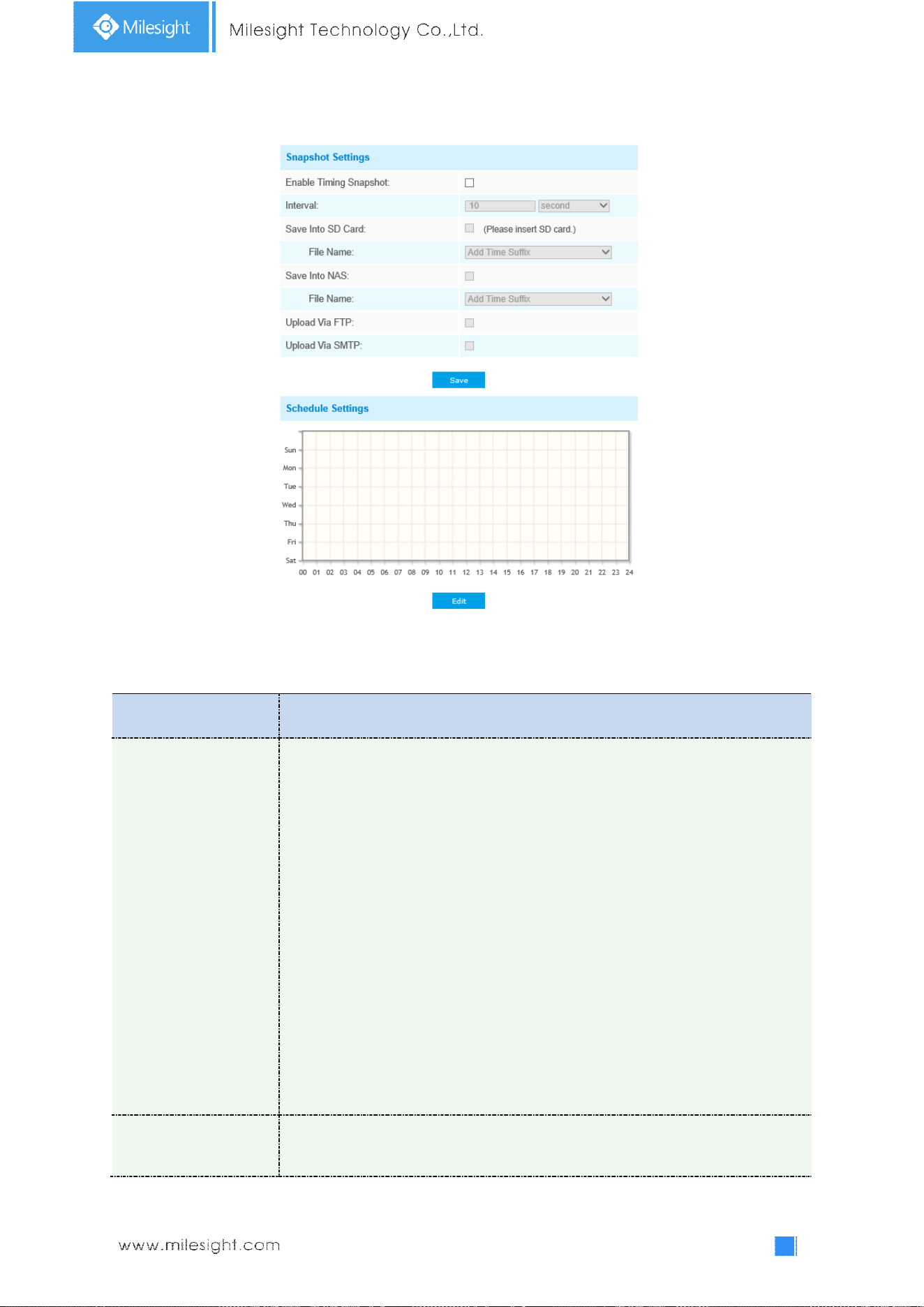
Figure 4-5-16 Snapshot Settings
Table 4-5-8 Description of the buttons
Parameters Function Introduction
Snapshot Settings
Enable Time Snapshot: Check the checkbox to enable the Timing Snapshot
function
Interval: Set the snapshots interval, input the number and choose the
unit(millisecond, second, minute, hour, day)
Save Into SD Card: Save the snapshots into SD card, and choose the file name to
add time suffix or overwrite the base file name.
Save Into NAS: Save the snapshots into NAS, and choose the file name to add
time suffix or overwrite the base file name
Upload Via FTP: Upload the snapshots via FTP
Upload Via SMTP: Upload the snapshots via SMTP
Please note:
If you choose to add time suffix, every snapshot picture will be saved, but if you choose to overwrite
the base file name, only one latest picture will be saved. When you choose add overwrite the base file
name to SD Card or NAS, it will create a file named “Snapshot” to place the snapshot.
Schedule Settings
Click the Edit button to edit record schedule
68
4.5.3 Security
User
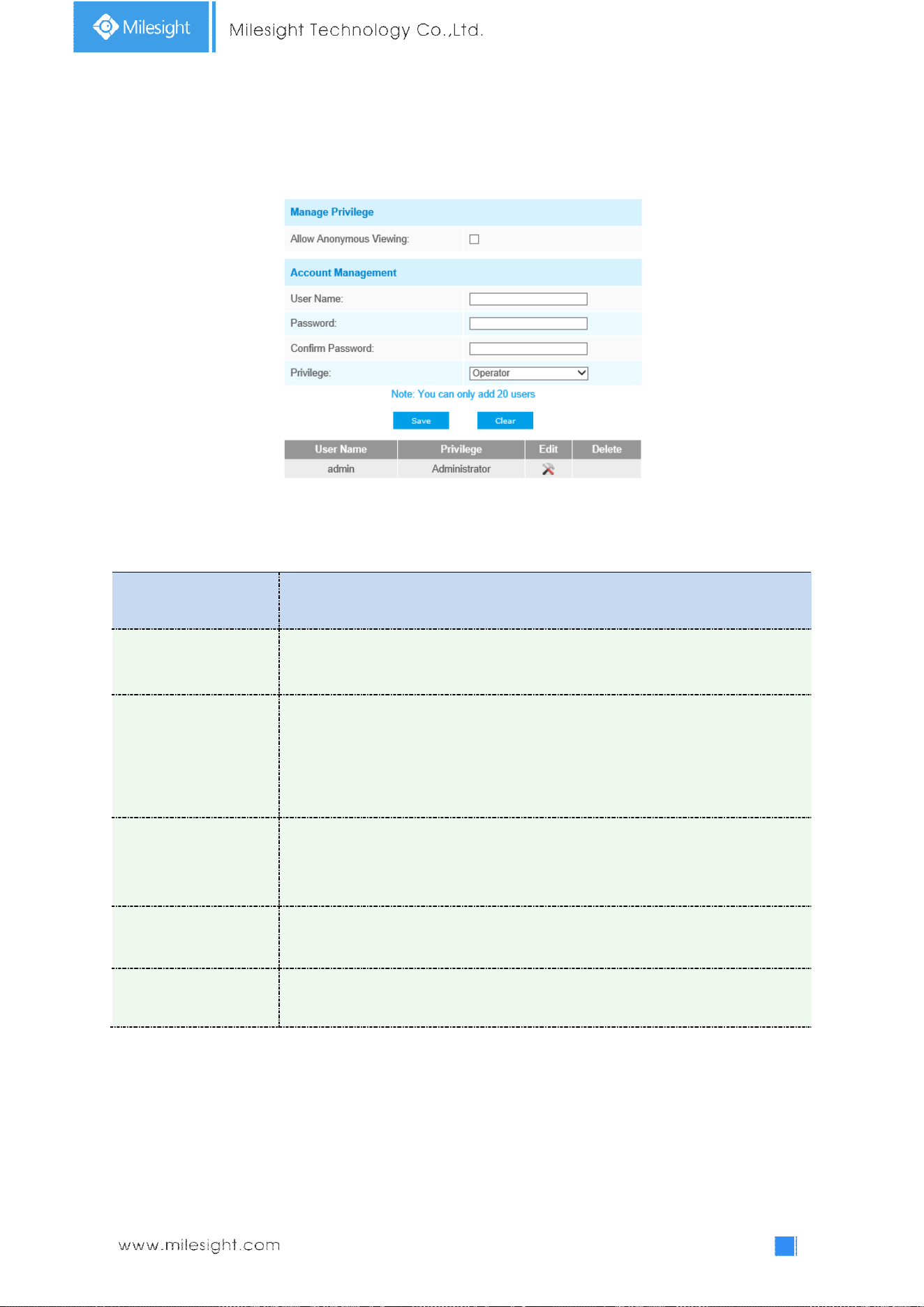
Figure 4-5-17 User Settings
Table 4-5-9 Description of the buttons
Parameters Function Introduction
Manage Privilege
Allow anonymous viewing: Check the checkbox to enable visit from whom
doesn’t have account of the device
Account Management
User Name: Input user name for creating an account
User Password: Input password for the account
Confirm User Password: Confirm the password
Privilege: Set the privilege for the account
Administrator
An administrator can manage all configuration pages of the device, including
change user password, add or delete users (the default user “admin” cannot be
deleted)
Operator An operator can manage all configuration pages except the User page
Viewer A viewer can`t change any settings
Note:
1) For versions after 54, the Operator and Viewer users are closed by default. But you still can add on the User
page.
2) You can only add 20 users.
69
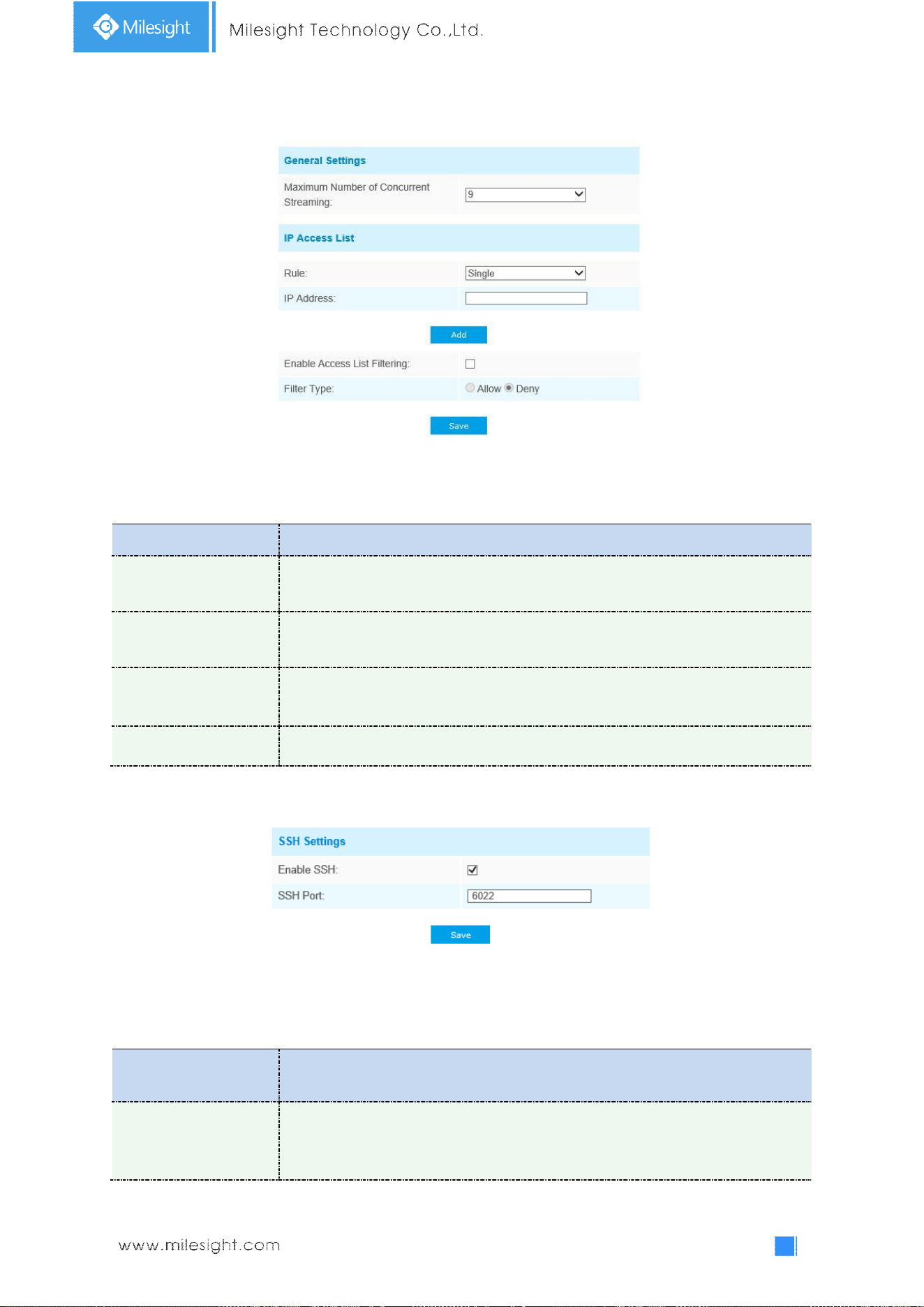
Access List
Figure 4-5-18 Access List
Table 4-5-10 Description of the buttons
Parameters Function Introduction
General Settings
Maximum number of concurrent streaming: Select the maximum number of
concurrent streaming. Options include No Limit, 1~9
IP access list
Rule: Single, Network and Range are available
IP address: Input the address to get the access to the device
Enable access list
filtering
Able to access or restrict access for some IP address
Filter type Access or restrict access
Security Service
Figure 4-5-19 Security Service
Table 4-5-11 Description of the buttons
Parameters Function Introduction
SSH Settings
Secure Shell (SSH) has many functions: it can replace Telnet and also provides a
secure channel for FTP, POP, even for PPP.
70
4.5.4 SIP
The Session Initiation Protocol(SIP) is a signaling communications protocol, widely used for
controlling multimedia communication sessions such as voice and video calls over Internet Protocol(IP)
networks. This page allows user to configure SIP related parameters. Milesight cameras can be configured as
SIP endpoint to call out when alarm triggered; or allow permitted number to call in to check the video if the
video IP phone is used. To use this function, the settings in SIP page must be configured properly. There are
two ways to get video through SIP, one is to dial the IP address directly, the other is account registration mode,
the details are as follows:
Method 1: IP Direct mode
Dial on the camera’s IP address directly through SIP phone, so you can see the video.
(Note: SIP phone and the camera should in the same network segment).
Method2: Account registration mode
1) Before using the SIP, you need to register an account for the camera from the SIP server;
2) Register another user account for the SIP device from the same SIP server;
3) Call the camera User ID from the SIP device, you will get the video on the SIP device.
SIP Settings
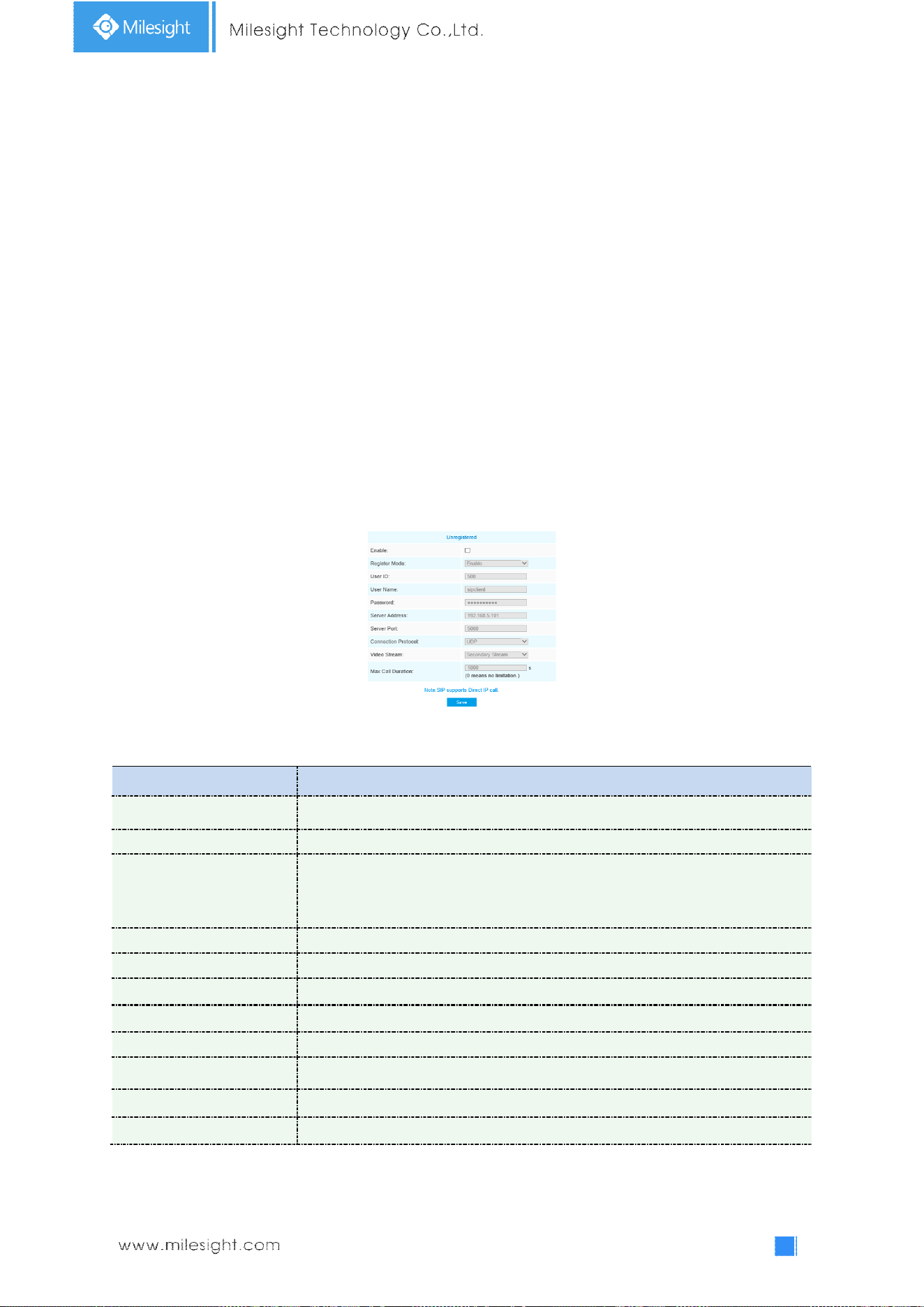
Figure 4-5-20 SIP Settings
Table 4-5-12 Description of the buttons
Parameters Function Introduction
Unregistered/Registered
SIP registration status. Display “Unregistered” or “Registered”
Enable Start or stop using SIP
Register Mode
Choose to use Enable mode or Disable mode. Enable mode means to use SIP
with register account. Disable mode refers to use SIP without register account,
just use the IP address to call.
User ID SIP ID
User Name SIP account name
Password SIP account password
Server Address Server IP address
Server Port Server port
Connection Protocol UDP/TCP
Video Stream Choose the video stream
Max Call Duration The max call duration when use SIP
Note:
1) SIP supports Directly IP call;
2) SIP only supports second stream with H.265/H.264 or MPEG4 Video Compression.
71
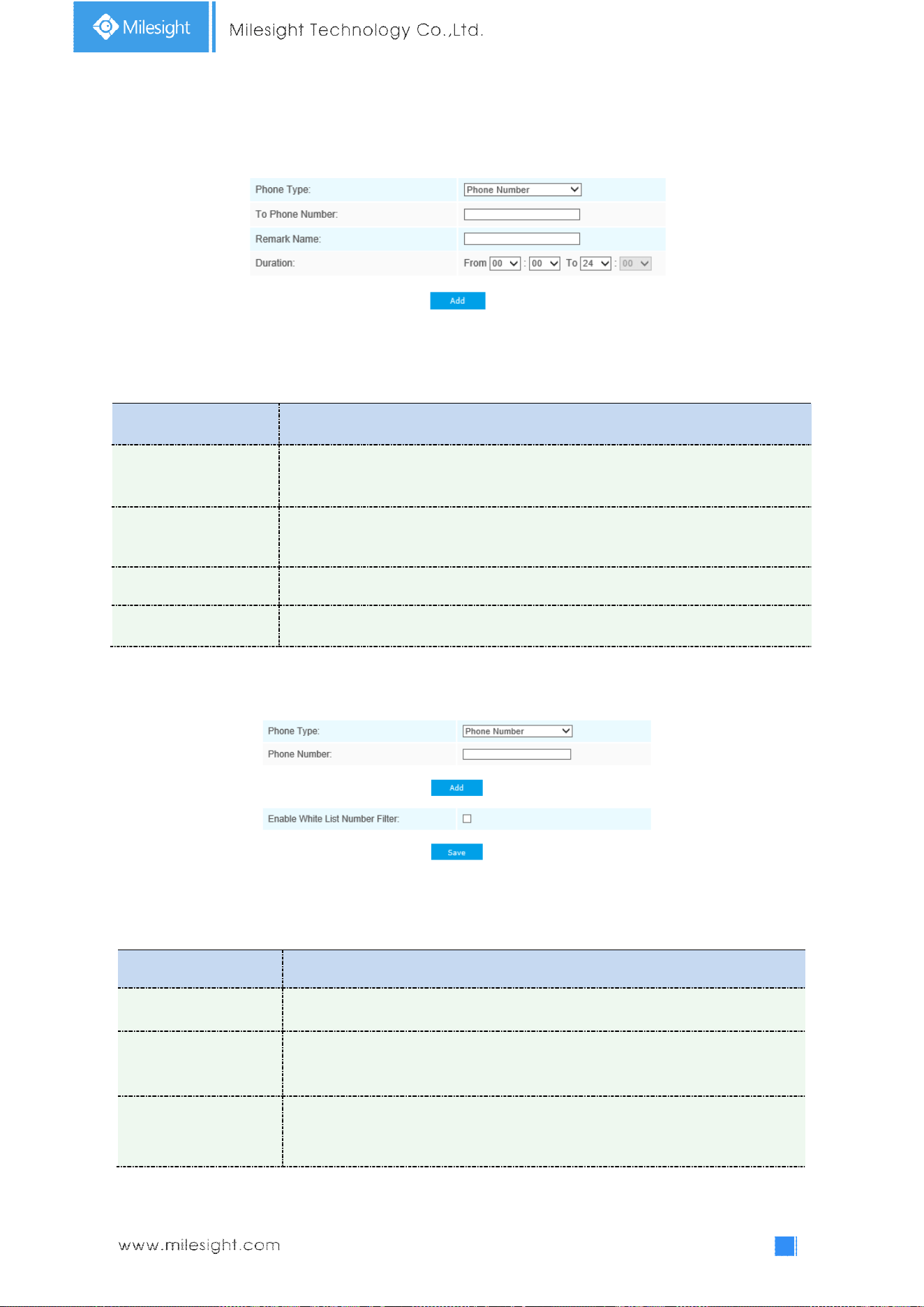
Alarm Phone List
Figure 4-5-21 Alarm Phone List
Table 4-5-13 Description of the buttons
Parameters Function Introduction
Phone Type
Phone Number(Call by phone number) & Direct IP Call(Check to accept peer to
peer IP call).
To Phone Number/
IP Address
Call by phone number or IP address.
Remark Name Display name.
Duration The time schedule to use SIP.
White List
Figure 4-5-22 White List
Table 4-5-14 Description of the buttons
Parameters Function Introduction
Phone Type Phone Number(Call by phone number) & Direct IP Call
Phone Number/
IP Address
Including the phone number or IP address on the white list
Enable White List
Number Filter
When enabled, only the designated phone number or IP address can visit
72
4.5.5 Smart Event
Smart Event uses Milesight Video Content Analysis technology. This technical capability is used in a wide
range of domains including entertainment, health-care, retail, automotive, transport, home automation,
safety and security. Milesight VCA provides advanced, accurate smart video analysis for Milesight network
cameras. It enhances the performance of network cameras through 8 detection modes which are divided
into basic function and advanced function, enabling the comprehensive surveillance function and quicker
response of cameras to different monitoring scenes.
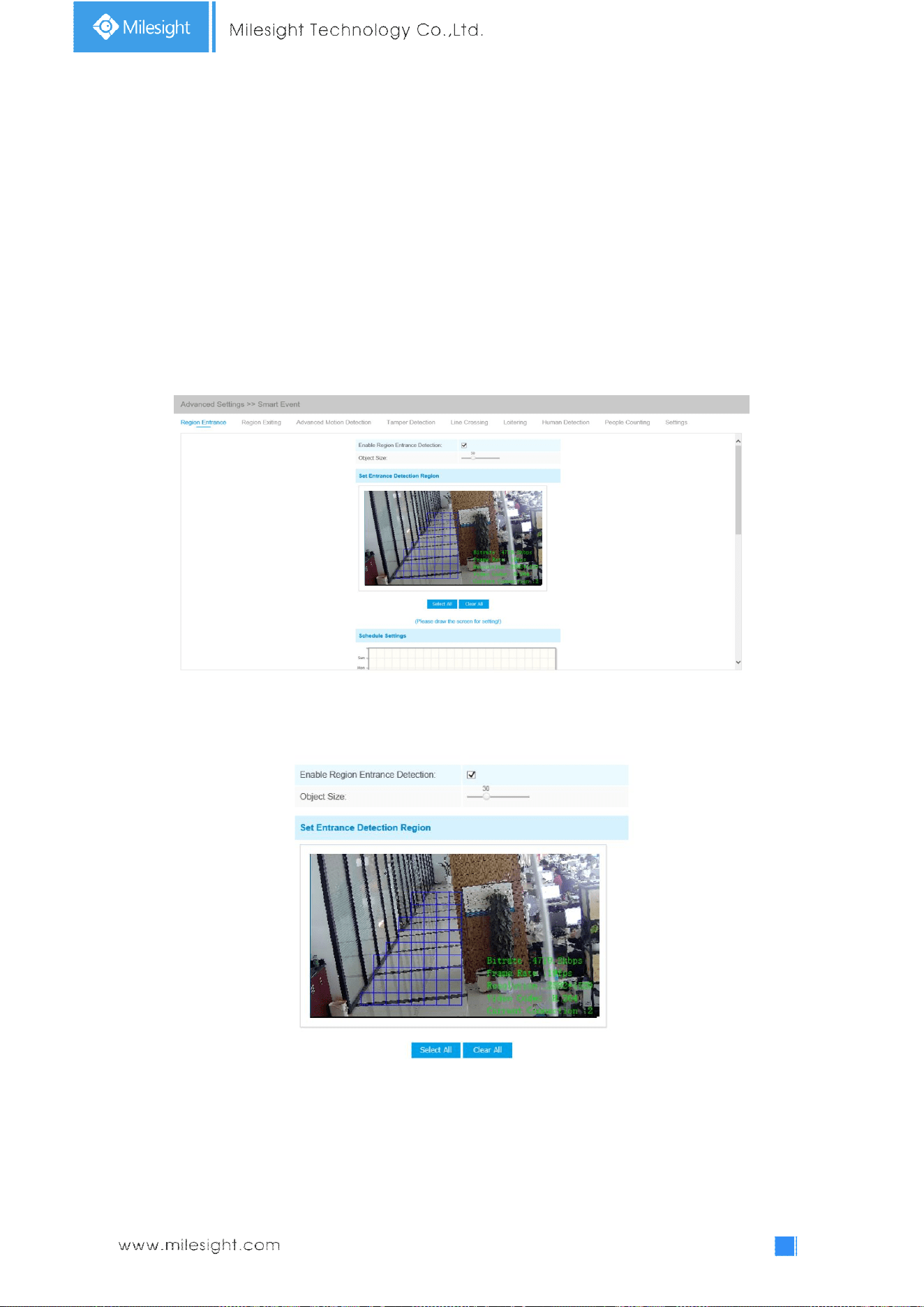
Region Entrance
Region entrance helps to protect a special area from potential threat of suspicious person’s or object’s
entrance. An alarm will be triggered when objects enter the selected regions by enabling region entrance.
Figure 4-5-23 Region Entrance
Step1: Set detecting object size;
Step2: Set entrance detection region;
Figure 4-5-24 Set Entrance Detection Region
Step3: Set detection schedule;
Step4: Set alarm action;
Step5: Set alarm settings.
Note: The “Object Size” can be set to define whether an object is big enough for triggering the alarm when enter into
the selected region.
73
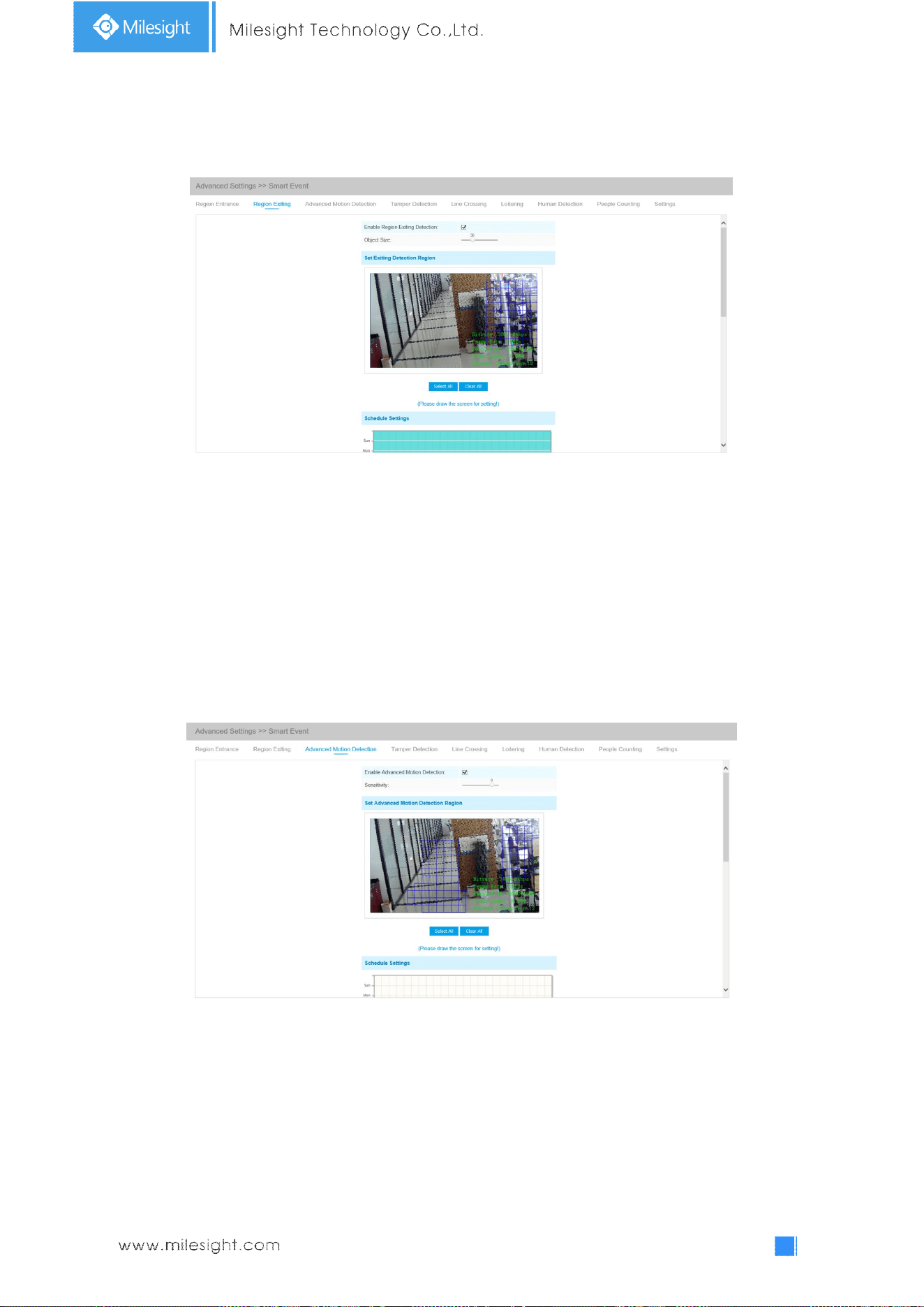
Region Exiting
Region exiting is to make sure that any person or object won't exit the area that is being monitored. Any exit
of people or objects will trigger an alarm.
Figure 4-5-25 Set Region Exiting
Step1: Set detecting object size;
Step2: Set exiting detection region;
Step3: Set detection schedule;
Step4: Set alarm action;
Step5: Set alarm settings.
Advanced Motion Detection
Different from traditional motion detection, Milesight advanced motion detection can filter out “noise”
such as lighting changes, natural tree movements, etc. When an object moves in the selected area, it will
trigger alarm.
Figure 4-5-26 Set Advanced Motion Detection
Step1: Set detecting sensitivity;
Step2: Set advanced motion detection region;
Step3: Set detection schedule;
Step4: Set alarm action;
Step5: Set alarm settings.
Note: The sensitivity can be configured to detect various movement according to different requirements. When the
level of sensitivity is low, slight movement won’t trigger the alarm.
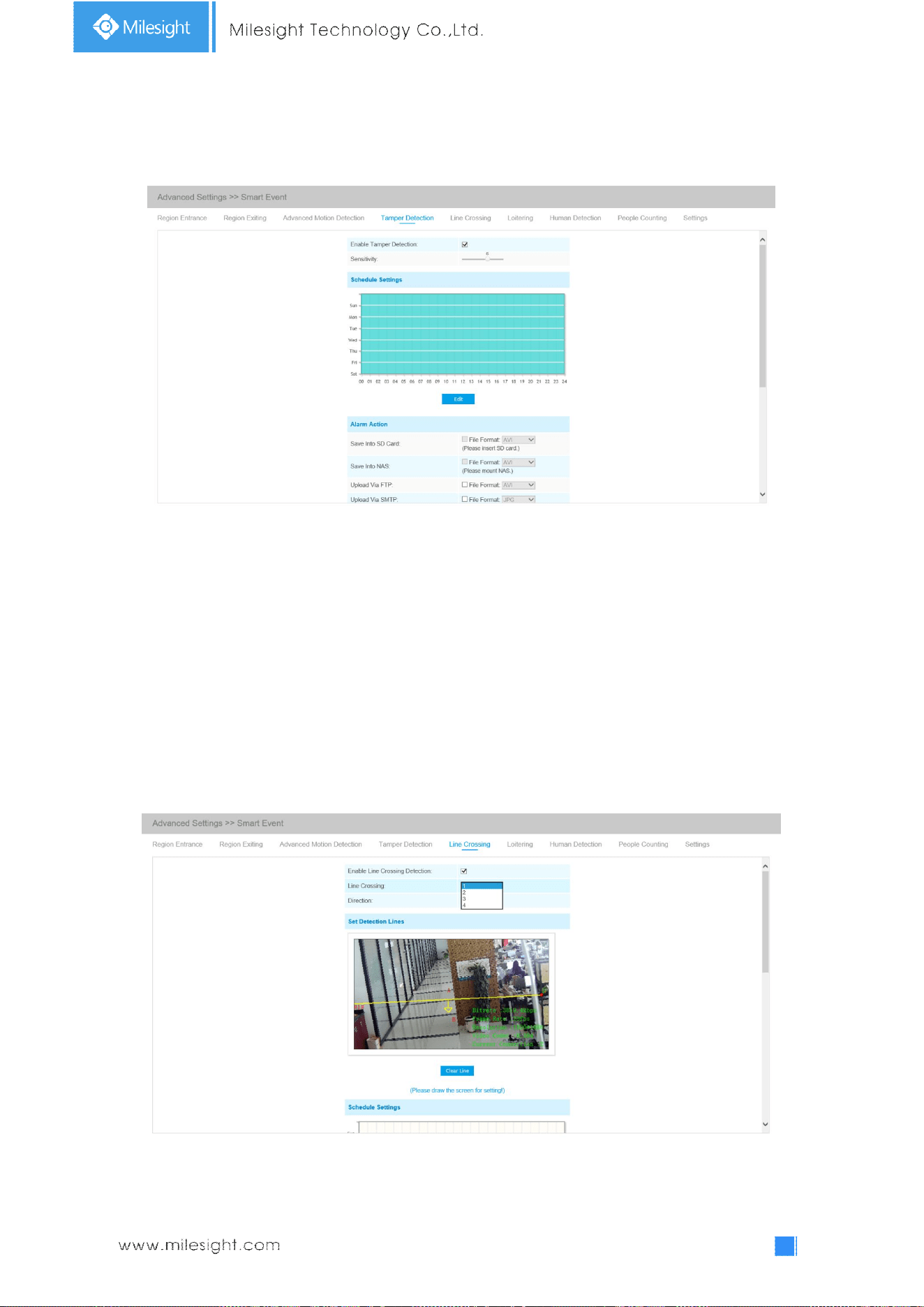
74
Tamper Detection
Tamper Detection is used to detect possible tampering like the camera being unfocused, obstructed or
moved. This functionality alerts security staff immediately when any above-mentioned actions occur.
Figure 4-5-27 Set Tamper Detection
Step1: Set detecting sensitivity;
Step2: Set detection schedule;
Step3: Set alarm action;
Step4: Set alarm settings.
Line Crossing
Line Crossing detection is designed to work in most indoor and outdoor environment. An event will be
triggered every time when the camera detects objects crossing a defined virtual line.
Settings steps are shown as follows:
Step1: Choose detection line number and define its direction;
Figure 4-5-28 Set Detection Lines
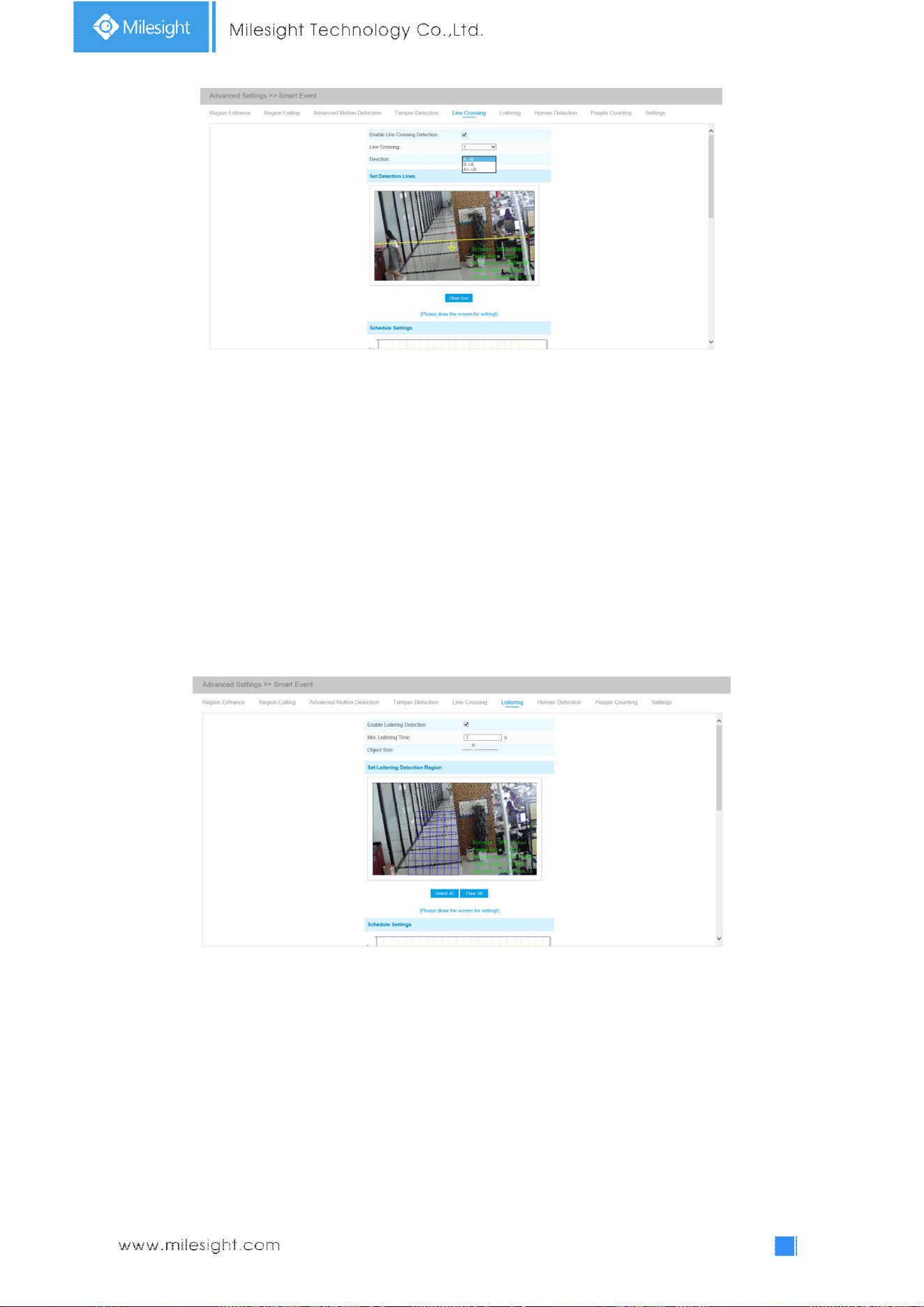
75
Figure 4-5-29 Set Line Direction
Step2: Draw detection lines;
Step3: Set detection schedule;
Step4: Set alarm action;
Step5: Set alarm settings.
Note: Milesight allows to set up to four lines at a time. There are three direction modes to choose for triggering alarm.
“A→B” means when there is any object crossing the line from the “A” side to the “B” side, the alarm will be triggered.
“B→A” vice versa. “A ↔ B” means that the alarm will be triggered when objects cross line from either side.
Loitering
When objects are loitering in a defined area for a specific period of time, it would trigger an alarm.
Figure 4-5-30 Set Loitering Detection
Step1: Set minimum loitering time;
Step2: Set object size;
Step3: Set loitering detection region;
Step4: Set detection schedule;
Step5: Set alarm action;
Step6: Set alarm settings.
Note: After setting minimum loitering time from 3s to 300s, any objects loitering in the selected area over the
minimum loitering time will trigger the alarm. Also Milesight loitering allows to set “Object Size”. Only the object
bigger than the set size will trigger the alarm.
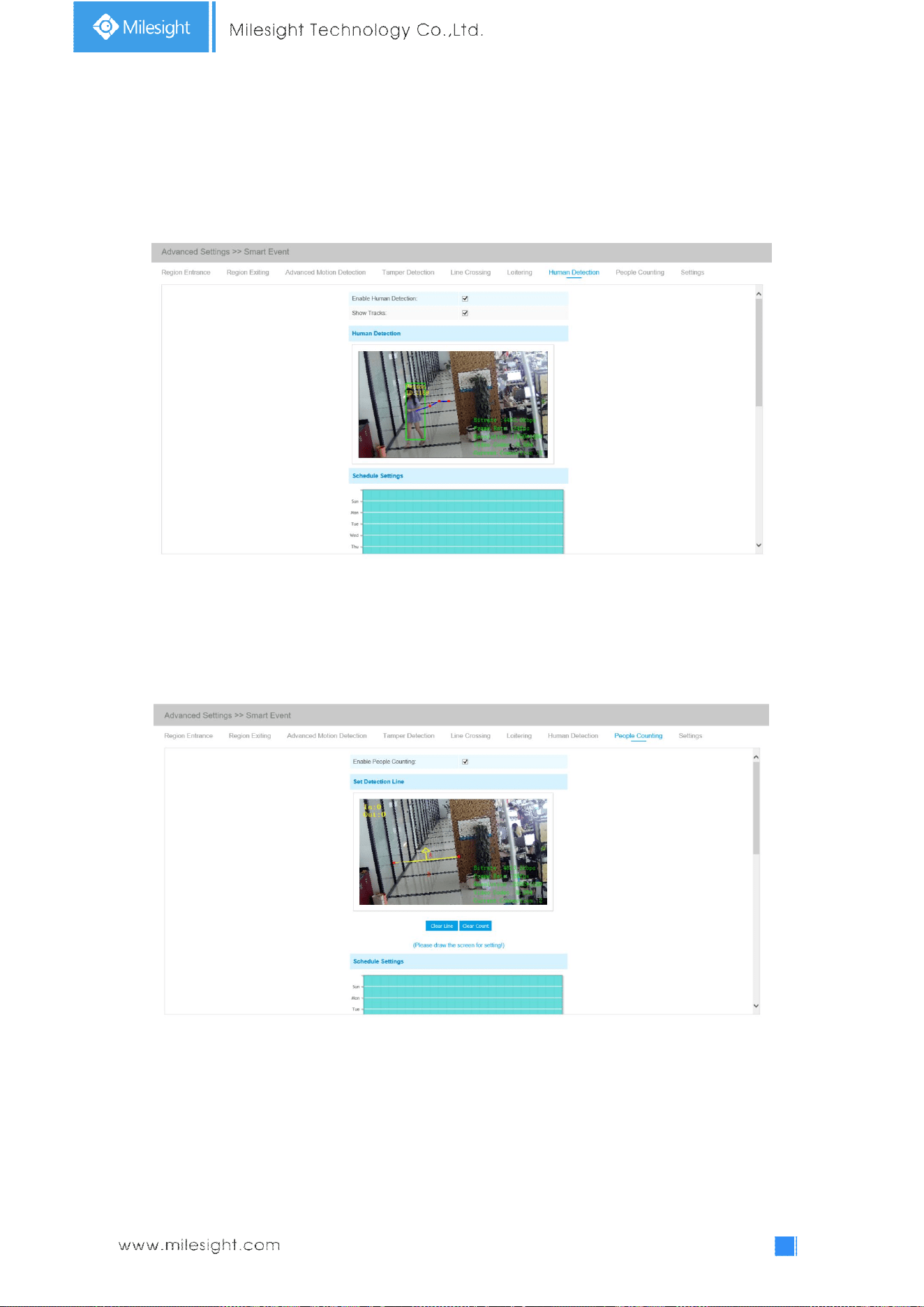
76
Human Detection
Human detection is used for figuring out whether an object is a human or not. Once human detection is
enabled, when there is an object appearing in the detecting area, an ID will show on the frame. If the object
is a person, it will mark as “person”. When the Show Tracks is enabled, the tracks of the moving object will
show on the screen.
Figure 4-5-31 Set Human Detection
People Counting
People counting is able to count that how many people enter or exit during the setting period.
Figure 4-5-32 Set Detection Line
Step1: Set detection line;
Step2: Set detection schedule;
Step3: Set counting OSD;
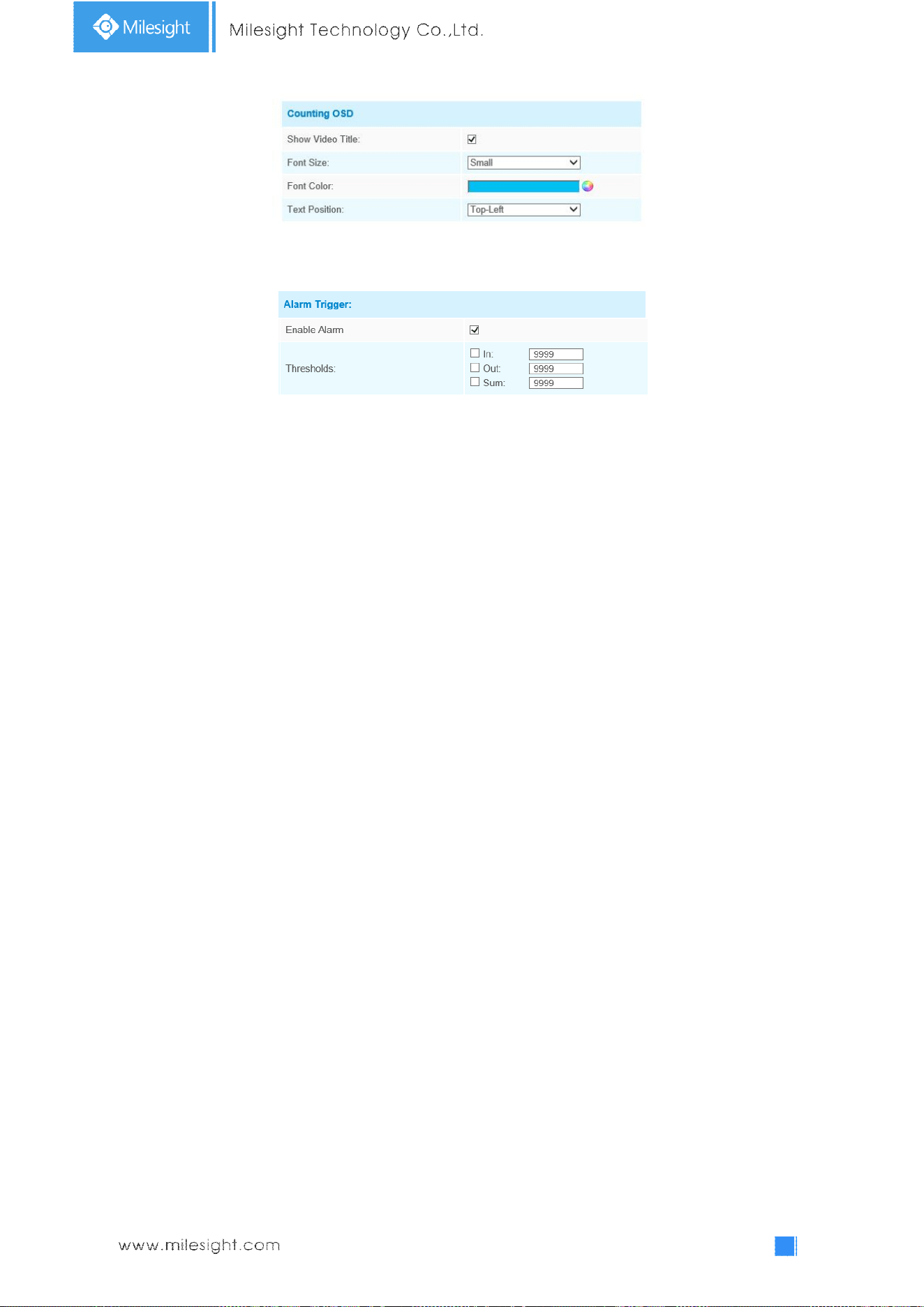
77
Figure 4-5-33 Set Counting OSD
Step3: Set alarm trigger;
Figure 4-5-34 Set Alarm Trigger
Step4: Set alarm action;
Step5: Set alarm settings.
Note:
1) To enable people counting, human detection should be enabled first;
2) Crossing along the direction of the arrow will record as “In”, opposite is “Out”;
3) Alarm will be triggered when the thresholds reaches to a certain value from 1 to 9999.
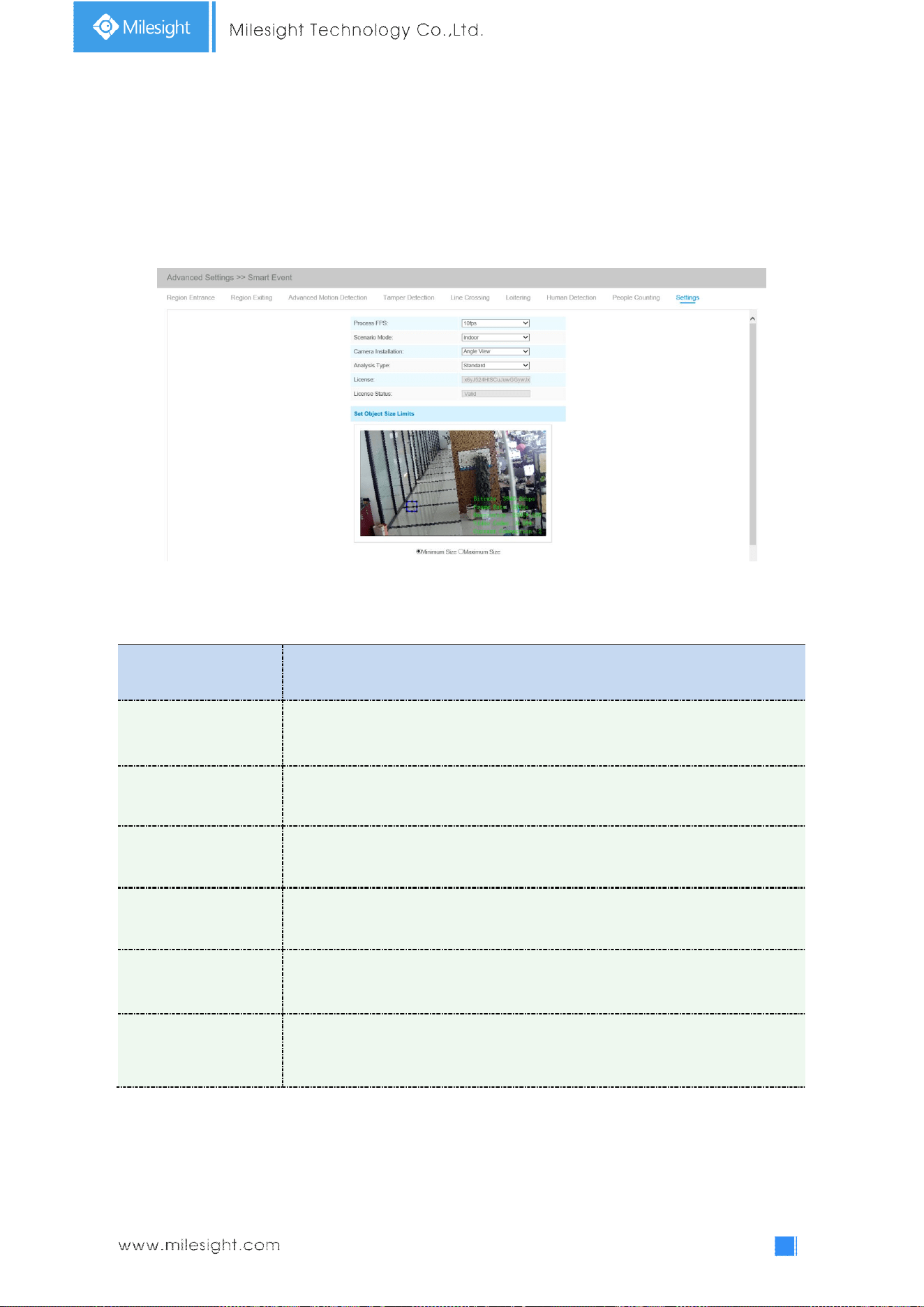
78
Setting
Milesight VCA provides the primary setting for the whole VCA functions. “Minimum Size” is to set the
whether an object is big enough to trigger other settings. The frame you draw on the screen means that
only if the object size is bigger than the frame, the settings for other VCA functions will take effect.
Maximum Size means opposite, the frame you draw on the screen stands for that only if the object size is
smaller than the frame, the settings for other VCA functions will take effect.
Figure 4-5-35 Smart Event Settings
Table 4-5-15 Description of the buttons
Parameters Function Introduction
Process FPS Five different periods are available(5, 10, 15, 20, 25, fps) for process fps
Scenario Mode Select Indoor or Outdoor mode to meet your needs
Camera Installation
Select camera installation view, including Angle View, Horizontal View and
Overhead View
Analysis Type Select Standard or Advanced analysis type
License Generated by camera’s information
License Status Show present license status, including Valid, Invalid, Expired, Unactivated
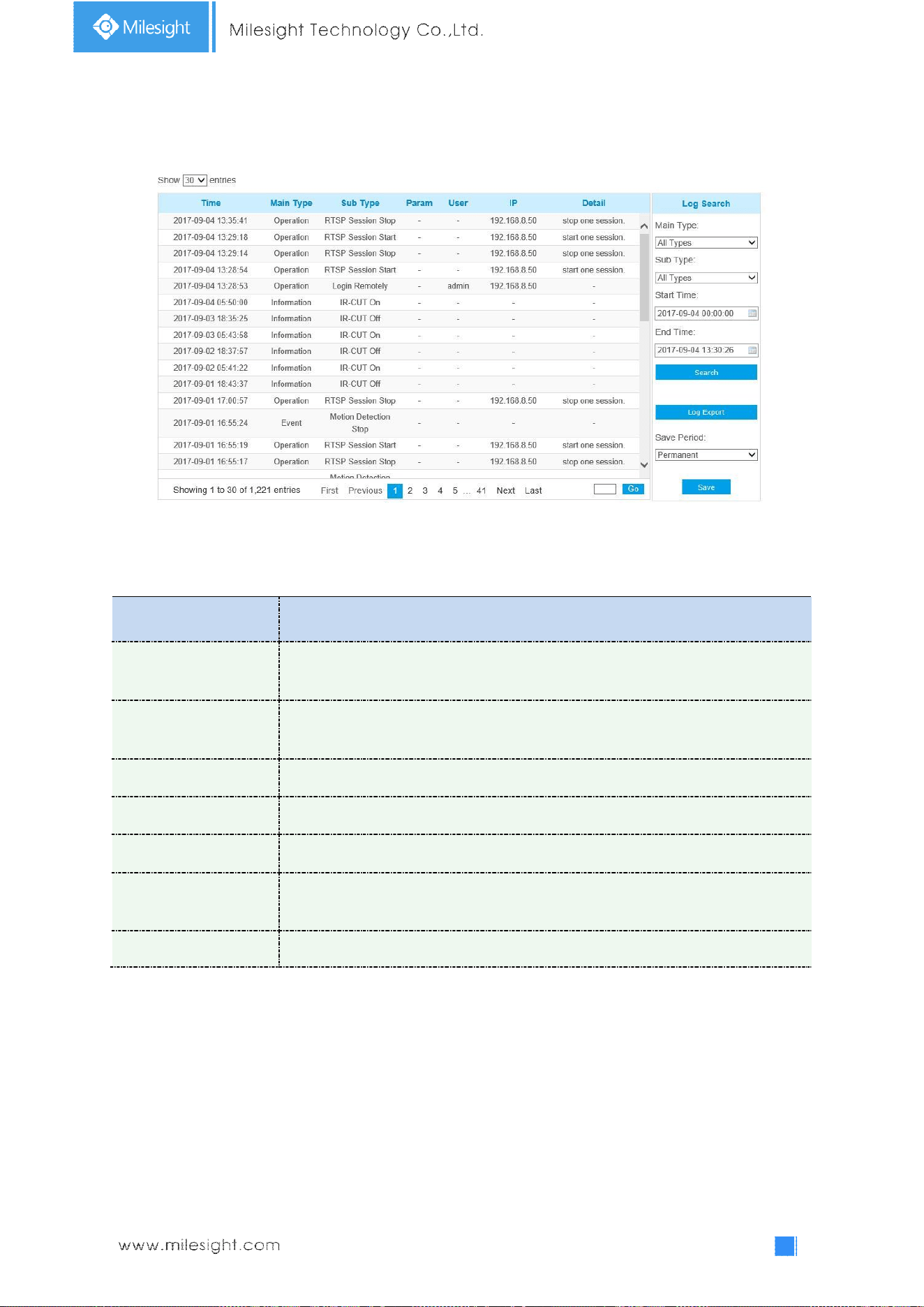
79
4.5.6 Logs
The logs contain the information about the time and IP that has accessed the camera through web.
Figure 4-5-36 Logs
Table 4-5-15 Description of the buttons
Parameters Function Introduction
Main Type
There are five main log types: All Type, Event, Operation, Information,
Exception, Event
Sub Type
On the premise of main type has been selected, select the sub type to narrow the
range of logs
Start Time The time log starts
End Time The time log ends
Log Export Export the logs
Save Period
Set the period of log saving, there are eight options to choose: Permanent and
30/60/120/180/240/300/360 Days
Go Input the number of logs’ page
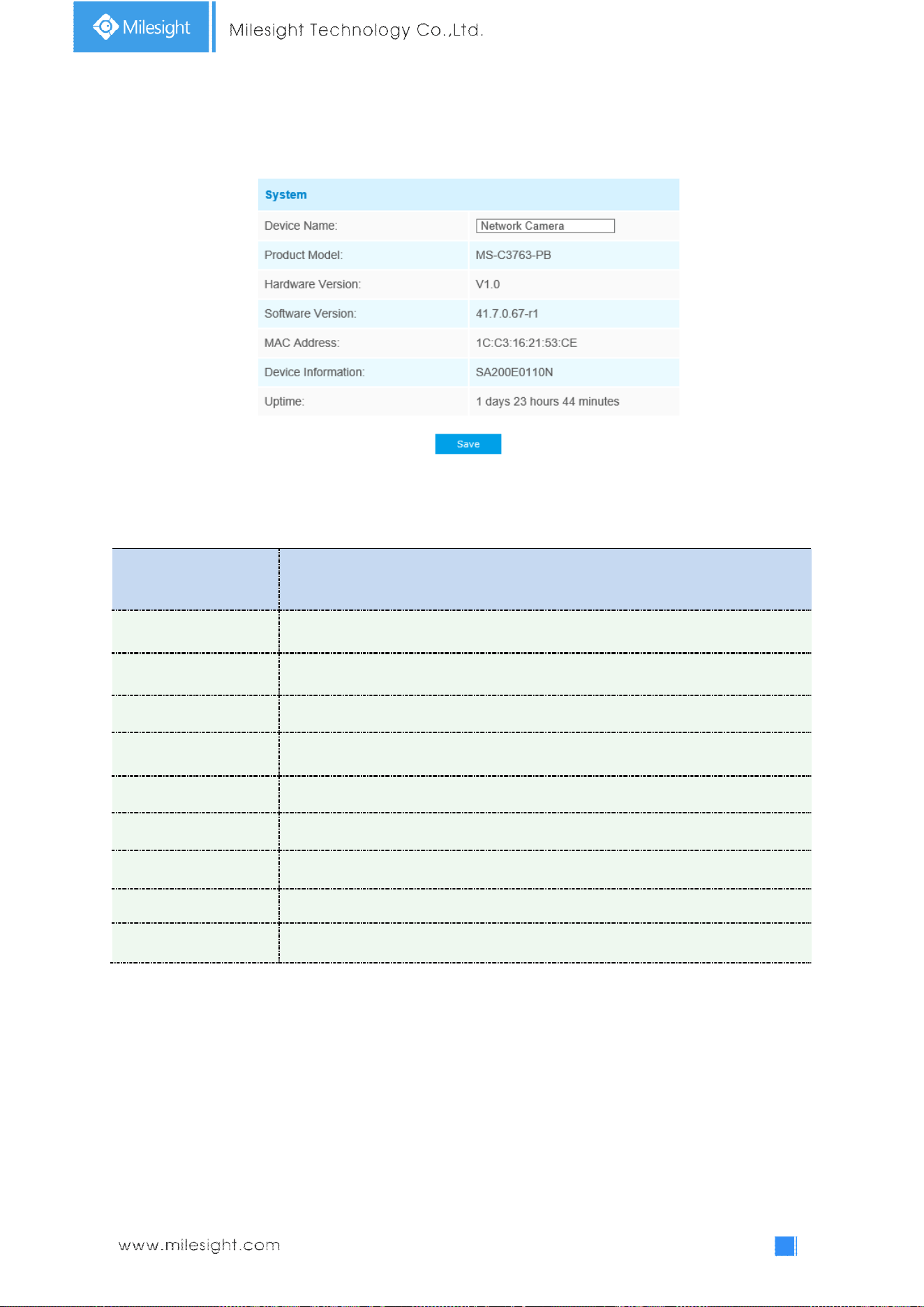
80
4.6 System
All information about the hardware and software of the camera can be checked on this page.
Figure 4-6-1 System Information
Table 4-6-1 Description of the buttons
Parameters Function Introduction
Device Name The device name can be customized. It will be seen in file names of video files
Product Model The product model of the camera
Hardware Version The hardware version of the camera
Software Version The software version of the camera can be upgraded
MAC Address Media Access Control address
Device Information The device information, including information about alarm I/O and clipper chip
Alarm Input The number of Alarm Input interface
Alarm Output The number of Alarm Output interface
Uptime The elapsed time since the last restarted of the device
Note:The Alarm Input/Alarm Output will appear only when the camera have alarm input/output interface.
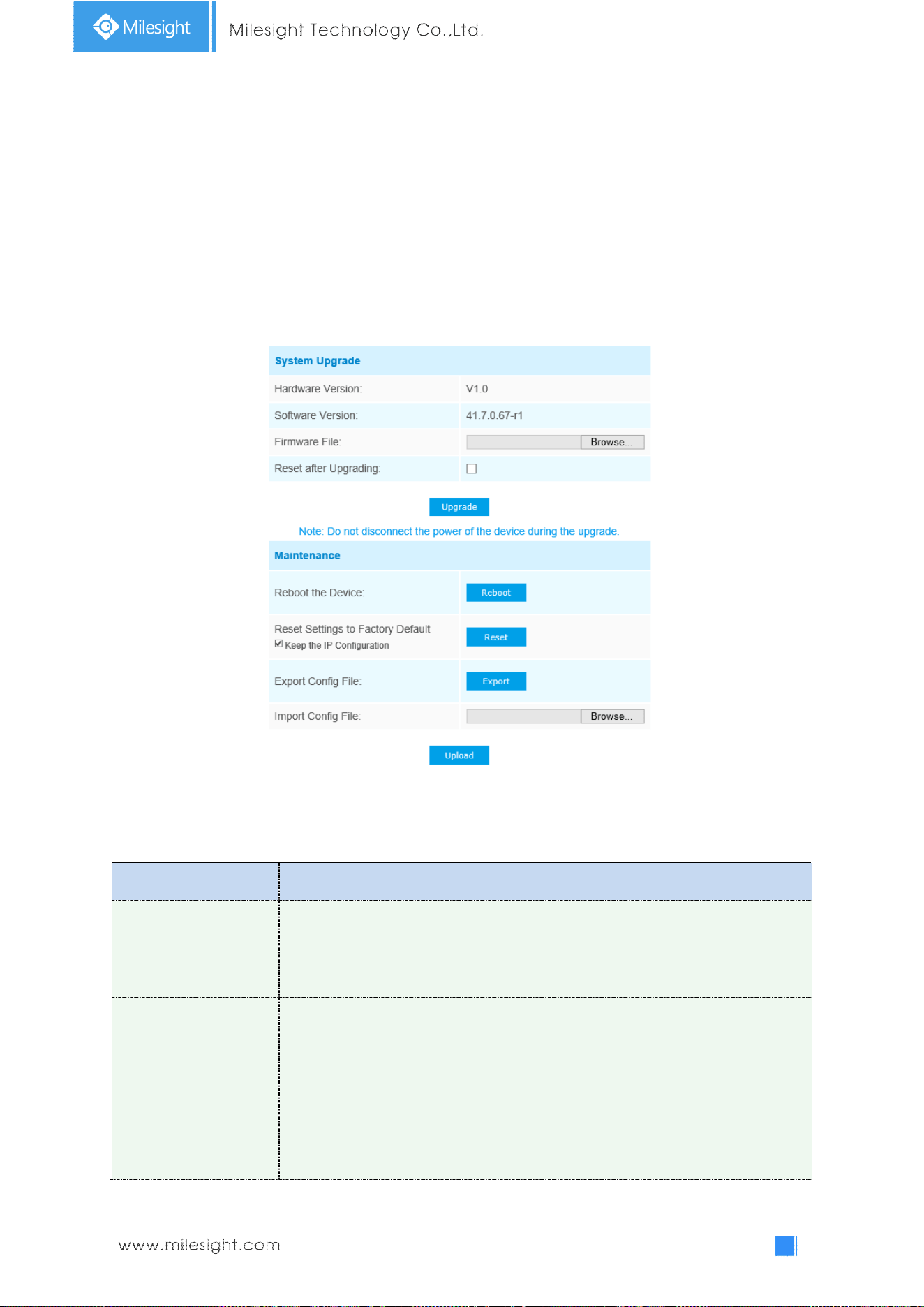
81
4.7 Maintenance
4.7.1 System Maintenance
The software can be upgraded by the following steps:
Step1: Browse and select the upgrading file;
Step2: Click the “upgrade” button after it prompts upload file successfully. After the system reboots
successfully, the update is done.
Note: Do not disconnect the power of the device during the update. The device will be restarted to complete the
upgrading.
Figure 4-7-1 System Maintenance
Table 4-7-1 Description of the buttons
Parameters Function Introduction
System Upgrade
Hardware Version: The hardware version of the camera
Software Version: The software version of the camera
Kernel Version: The kernel version
Firmware File: Select the firmware used to upgrade
Maintenance
Reboot the device: Click “Reboot” button to restart the device immediately
Reset settings: Click “Reset” button to reset the camera to factory default settings
Keep the IP Configuration: Select this option to keep the IP configuration when
resetting the camera
Export Config File:Click this button to export the configuration file
Import Config File: Click this button to import the old configuration file
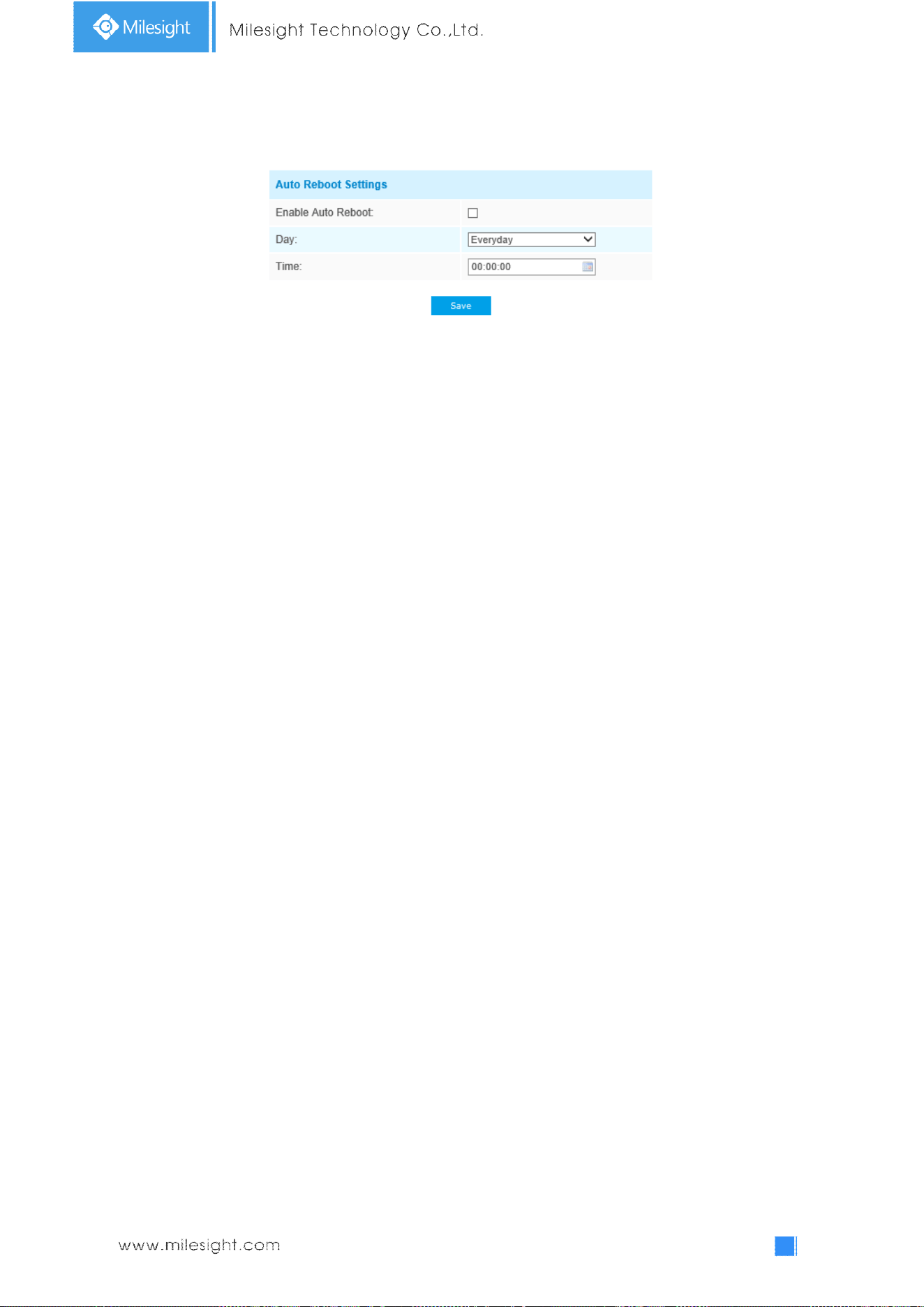
82
4.7.2 Auto Reboot
Set the date and time to enable Auto Reboot function.
Figure 4-7-2 Auto Reboot

83
Chapter V Services
Milesight Technology Co., Ltd provides customers with timely and comprehensive technical support services.
End-users can contact your local dealer to obtain technical support. Distributors and resellers can contact
directly with Milesight for technical support.
Technical Support Mailbox: support@milesight.com
Web: http://www.milesight.com
Online Problem Submission System: http://www.milesight.com/service/feedback.asp
MILESIGHT USA
TEL: +1-800-561-0485
Add: 7509 N.W. 36
th
Street, Miami, Florida 33166, USA
MILESIGHT KOREA
TEL: +82-2-839-3335
Add: 9F/901, Star Valley B/D Digital-ro 9gil 99, Geumcheon-gu, Seoul, Korea
MILESIGHT CHINA
TEL: +86-592-5922772
Add: No.23 Wanghai Road,2nd Software Park, Xiamen, China
Milesight
Better Inside, More in Sight