
EN
INSTALLATION MANUAL
USER AND MAINTENANCE MANUAL
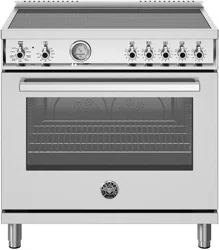
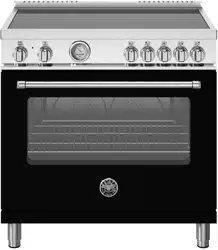
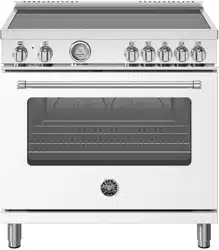
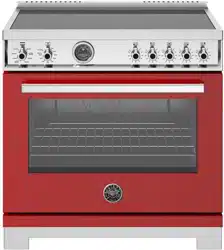
FREESTANDING ELECTRIC RANGES, INDUCTION WORKTOP,
ELECTRIC SELF CLEAN OVEN MODEL
www.bertazzoni.com

2
FROM THE DESK OF OUR PRESIDENT
Dear new owner of a Bertazzoni appliance,
I want to thank you for choosing one of our beautiful products for your home.
My family started manufacturing kitchen appliances in Italy in 1882, building a
reputation for quality of engineering and passion for good food.
Today, our products stand out because of their unique blend of authentic Italian
design and superior appliance technology. It is our mission to make products that
function perfectly and bring joy to their owners.
By making beautiful products we respond to our customers’ flair for good design. By
making them versatile and easy-to-use, cooking with Bertazzoni becomes a real
pleasure.
This manual will help you learn to use and care for your Bertazzoni appliance in the
safest and most effective way, so that it can give you the highest satisfaction for
years to come.
Enjoy!
Paolo Bertazzoni
President
3

4

USER MANUAL VALIDITY
The following manual is valid for all the product codes mentioned below:
• MAS365ICFEPXT
• PRO365ICFEPGIT
• PRO365ICFEPNET
• PRO365ICFEPROT
• PRO365ICFEPART
• PRO365ICFEPCAT
• PRO365ICFEPBIT
• PRO365ICFEPXT
• HER365ICFEPAVT
• HER365ICFEPNET
• HER365ICFEPXT
5

6
CONTENTS
INSTALLATION MANUAL . . . . . . . . . . . . . . . . . . . . . . . . . . . . . . . . . . . . . . . . . . . . . . . . . . . . . . . . . . . . . . . . . . . . . . . . . . . 9
WARNINGS . . . . . . . . . . . . . . . . . . . . . . . . . . . . . . . . . . . . . . . . . . . . . . . . . . . . . . . . . . . . . . . . . . . . . . . . . . . . . . . . . . 9
DATA RATING LABEL . . . . . . . . . . . . . . . . . . . . . . . . . . . . . . . . . . . . . . . . . . . . . . . . . . . . . . . . . . . . . . . . . . . . . 10
BEFORE INSTALLATION . . . . . . . . . . . . . . . . . . . . . . . . . . . . . . . . . . . . . . . . . . . . . . . . . . . . . . . . . . . . . . . . . . . . . . 11
ROOM VENTILATION . . . . . . . . . . . . . . . . . . . . . . . . . . . . . . . . . . . . . . . . . . . . . . . . . . . . . . . . . . . . . . . . . . . . . 11
VENTILATION PREPARATION . . . . . . . . . . . . . . . . . . . . . . . . . . . . . . . . . . . . . . . . . . . . . . . . . . . . . . . . . . . . . . . . . . 12
SELECT HOOD AND BLOWER MODELS . . . . . . . . . . . . . . . . . . . . . . . . . . . . . . . . . . . . . . . . . . . . . . . . . . . . . 12
HOOD PLACEMENT . . . . . . . . . . . . . . . . . . . . . . . . . . . . . . . . . . . . . . . . . . . . . . . . . . . . . . . . . . . . . . . . . . . . . . 12
CONSIDER MAKE-UP AIR . . . . . . . . . . . . . . . . . . . . . . . . . . . . . . . . . . . . . . . . . . . . . . . . . . . . . . . . . . . . . . . . . 12
SPECIFICATIONS . . . . . . . . . . . . . . . . . . . . . . . . . . . . . . . . . . . . . . . . . . . . . . . . . . . . . . . . . . . . . . . . . . . . . . . . . . . . 13
CLEARANCE DIMENSIONS . . . . . . . . . . . . . . . . . . . . . . . . . . . . . . . . . . . . . . . . . . . . . . . . . . . . . . . . . . . . . . . . . . . . 14
INSTALLATION ADJACENT TO KITCHEN CABINETS . . . . . . . . . . . . . . . . . . . . . . . . . . . . . . . . . . . . . . . . . . 14
CABINET . . . . . . . . . . . . . . . . . . . . . . . . . . . . . . . . . . . . . . . . . . . . . . . . . . . . . . . . . . . . . . . . . . . . . . . . . . . . . . . . 14
METAL HOOD . . . . . . . . . . . . . . . . . . . . . . . . . . . . . . . . . . . . . . . . . . . . . . . . . . . . . . . . . . . . . . . . . . . . . . . . . . . . 14
INSTALLATION REQUIREMENTS . . . . . . . . . . . . . . . . . . . . . . . . . . . . . . . . . . . . . . . . . . . . . . . . . . . . . . . . . . . . . . . 15
ELECTRICAL . . . . . . . . . . . . . . . . . . . . . . . . . . . . . . . . . . . . . . . . . . . . . . . . . . . . . . . . . . . . . . . . . . . . . . . . . . . . 15
ELECTRICAL CONNECTION . . . . . . . . . . . . . . . . . . . . . . . . . . . . . . . . . . . . . . . . . . . . . . . . . . . . . . . . . . . . . . . . . . . 16
ELECTRICAL GROUNDING . . . . . . . . . . . . . . . . . . . . . . . . . . . . . . . . . . . . . . . . . . . . . . . . . . . . . . . . . . . . . . . . 16
FOUR WIRES CONNECTION . . . . . . . . . . . . . . . . . . . . . . . . . . . . . . . . . . . . . . . . . . . . . . . . . . . . . . . . . . . . . . . 17
WIRING DIAGRAM . . . . . . . . . . . . . . . . . . . . . . . . . . . . . . . . . . . . . . . . . . . . . . . . . . . . . . . . . . . . . . . . . . . . . . . . . . . 18
INSTALLATION . . . . . . . . . . . . . . . . . . . . . . . . . . . . . . . . . . . . . . . . . . . . . . . . . . . . . . . . . . . . . . . . . . . . . . . . . . . . . . . 19
APPLIANCE INSTALLATION . . . . . . . . . . . . . . . . . . . . . . . . . . . . . . . . . . . . . . . . . . . . . . . . . . . . . . . . . . . . . . . . 19
REMOVING THE OVEN DOOR . . . . . . . . . . . . . . . . . . . . . . . . . . . . . . . . . . . . . . . . . . . . . . . . . . . . . . . . . . . . . 19
INSTALLING THE LEGS . . . . . . . . . . . . . . . . . . . . . . . . . . . . . . . . . . . . . . . . . . . . . . . . . . . . . . . . . . . . . . . . . . . 20
INSTALLING THE WORKTOP FRONTGUARD . . . . . . . . . . . . . . . . . . . . . . . . . . . . . . . . . . . . . . . . . . . . . . . . . 20
INSTALLING THE ISLAND TRIM . . . . . . . . . . . . . . . . . . . . . . . . . . . . . . . . . . . . . . . . . . . . . . . . . . . . . . . . . . . . 21
INSTALLING BACKGUARD (OPTIONAL) . . . . . . . . . . . . . . . . . . . . . . . . . . . . . . . . . . . . . . . . . . . . . . . . . . . . . 21
INSTALLING THE ANTI/TIP DEVICES . . . . . . . . . . . . . . . . . . . . . . . . . . . . . . . . . . . . . . . . . . . . . . . . . . . . . . . . . . . 22
ANTI-TIP BRACKETS . . . . . . . . . . . . . . . . . . . . . . . . . . . . . . . . . . . . . . . . . . . . . . . . . . . . . . . . . . . . . . . . . . . . . 22
ANTI/TILT CHAIN . . . . . . . . . . . . . . . . . . . . . . . . . . . . . . . . . . . . . . . . . . . . . . . . . . . . . . . . . . . . . . . . . . . . . . . . . 22
INSTALLATION CHECKLIST . . . . . . . . . . . . . . . . . . . . . . . . . . . . . . . . . . . . . . . . . . . . . . . . . . . . . . . . . . . . . . . . . . . 23
FINAL PREPARATION . . . . . . . . . . . . . . . . . . . . . . . . . . . . . . . . . . . . . . . . . . . . . . . . . . . . . . . . . . . . . . . . . . . . . . . . . 24
BERTAZZONI SERVICE . . . . . . . . . . . . . . . . . . . . . . . . . . . . . . . . . . . . . . . . . . . . . . . . . . . . . . . . . . . . . . . . . . . . . . . 25
USER AND MAINTENANCE MANUAL . . . . . . . . . . . . . . . . . . . . . . . . . . . . . . . . . . . . . . . . . . . . . . . . . . . . . . . . . . . . . . . 26
WARNINGS . . . . . . . . . . . . . . . . . . . . . . . . . . . . . . . . . . . . . . . . . . . . . . . . . . . . . . . . . . . . . . . . . . . . . . . . . . . . . . . . . 26
TO PREVENT FIRE OR SMOKE DAMAGE . . . . . . . . . . . . . . . . . . . . . . . . . . . . . . . . . . . . . . . . . . . . . . . . . . . . 26
IN CASE OF FIRE . . . . . . . . . . . . . . . . . . . . . . . . . . . . . . . . . . . . . . . . . . . . . . . . . . . . . . . . . . . . . . . . . . . . . . . . . 26
CHILD SAFETY . . . . . . . . . . . . . . . . . . . . . . . . . . . . . . . . . . . . . . . . . . . . . . . . . . . . . . . . . . . . . . . . . . . . . . . . . . 26
COOKING SAFETY . . . . . . . . . . . . . . . . . . . . . . . . . . . . . . . . . . . . . . . . . . . . . . . . . . . . . . . . . . . . . . . . . . . . . . . 27
RECOMMENDED UTENSILS . . . . . . . . . . . . . . . . . . . . . . . . . . . . . . . . . . . . . . . . . . . . . . . . . . . . . . . . . . . . . . . 27
INDUCTION COOKING SURFACES . . . . . . . . . . . . . . . . . . . . . . . . . . . . . . . . . . . . . . . . . . . . . . . . . . . . . . . . . 28
RADIO INTERFERENCE - INDUCTION RANGES . . . . . . . . . . . . . . . . . . . . . . . . . . . . . . . . . . . . . . . . . . . . . . 28
OVEN HEATING ELEMENTS . . . . . . . . . . . . . . . . . . . . . . . . . . . . . . . . . . . . . . . . . . . . . . . . . . . . . . . . . . . . . . . 28
CLEANING SAFETY . . . . . . . . . . . . . . . . . . . . . . . . . . . . . . . . . . . . . . . . . . . . . . . . . . . . . . . . . . . . . . . . . . . . . . 28
POWER FAILURE WARNING . . . . . . . . . . . . . . . . . . . . . . . . . . . . . . . . . . . . . . . . . . . . . . . . . . . . . . . . . . . . . . . 28
ELECTRICAL SHOCK HAZARD . . . . . . . . . . . . . . . . . . . . . . . . . . . . . . . . . . . . . . . . . . . . . . . . . . . . . . . . . . . . . 28
BURN HAZARD . . . . . . . . . . . . . . . . . . . . . . . . . . . . . . . . . . . . . . . . . . . . . . . . . . . . . . . . . . . . . . . . . . . . . . . . . . 28
WARNING-TIPPING HAZARD . . . . . . . . . . . . . . . . . . . . . . . . . . . . . . . . . . . . . . . . . . . . . . . . . . . . . . . . . . . . . . 29
WORKTOP AND KNOBS LAYOUT . . . . . . . . . . . . . . . . . . . . . . . . . . . . . . . . . . . . . . . . . . . . . . . . . . . . . . . . . . . . . . . 30
INDUCTION COOKTOP . . . . . . . . . . . . . . . . . . . . . . . . . . . . . . . . . . . . . . . . . . . . . . . . . . . . . . . . . . . . . . . . . . . . . . . 31
COOKING WITH INDUCTION . . . . . . . . . . . . . . . . . . . . . . . . . . . . . . . . . . . . . . . . . . . . . . . . . . . . . . . . . . . . . . . 31
TURNING ON THE INDUCTION ELEMENT . . . . . . . . . . . . . . . . . . . . . . . . . . . . . . . . . . . . . . . . . . . . . . . . . . . 31
USING SPECIAL FUNCTIONS . . . . . . . . . . . . . . . . . . . . . . . . . . . . . . . . . . . . . . . . . . . . . . . . . . . . . . . . . . . . . . 31
SUITABLE INDUCTION COOKWARE . . . . . . . . . . . . . . . . . . . . . . . . . . . . . . . . . . . . . . . . . . . . . . . . . . . . . . . . 32
NOISE DURING OPERATION . . . . . . . . . . . . . . . . . . . . . . . . . . . . . . . . . . . . . . . . . . . . . . . . . . . . . . . . . . . . . . . 32
RECOMMENDATIONS . . . . . . . . . . . . . . . . . . . . . . . . . . . . . . . . . . . . . . . . . . . . . . . . . . . . . . . . . . . . . . . . . . . . 32
INDUCTION GRIDDLE . . . . . . . . . . . . . . . . . . . . . . . . . . . . . . . . . . . . . . . . . . . . . . . . . . . . . . . . . . . . . . . . . . . . . . . . 33
SEASONING THE GRIDDLE . . . . . . . . . . . . . . . . . . . . . . . . . . . . . . . . . . . . . . . . . . . . . . . . . . . . . . . . . . . . . . . 33

7
CONTENTS
USE OF THE GRIDDLE . . . . . . . . . . . . . . . . . . . . . . . . . . . . . . . . . . . . . . . . . . . . . . . . . . . . . . . . . . . . . . . . . . . . 33
CLEANING THE GRIDDLE . . . . . . . . . . . . . . . . . . . . . . . . . . . . . . . . . . . . . . . . . . . . . . . . . . . . . . . . . . . . . . . . . 33
ELECTRIC OVEN . . . . . . . . . . . . . . . . . . . . . . . . . . . . . . . . . . . . . . . . . . . . . . . . . . . . . . . . . . . . . . . . . . . . . . . . . . . . 34
SHELVES POSITIONS . . . . . . . . . . . . . . . . . . . . . . . . . . . . . . . . . . . . . . . . . . . . . . . . . . . . . . . . . . . . . . . . . . . . . 34
COOLING FAN . . . . . . . . . . . . . . . . . . . . . . . . . . . . . . . . . . . . . . . . . . . . . . . . . . . . . . . . . . . . . . . . . . . . . . . . . . . 34
PREHEATING THE OVEN . . . . . . . . . . . . . . . . . . . . . . . . . . . . . . . . . . . . . . . . . . . . . . . . . . . . . . . . . . . . . . . . . . 34
USING THE OVEN . . . . . . . . . . . . . . . . . . . . . . . . . . . . . . . . . . . . . . . . . . . . . . . . . . . . . . . . . . . . . . . . . . . . . . . . 34
OVEN COOKING MODES . . . . . . . . . . . . . . . . . . . . . . . . . . . . . . . . . . . . . . . . . . . . . . . . . . . . . . . . . . . . . . . . . . 34
SPECIAL FUNCTIONS/MORE . . . . . . . . . . . . . . . . . . . . . . . . . . . . . . . . . . . . . . . . . . . . . . . . . . . . . . . . . . . . . . 35
TELESCOPIC GLIDES . . . . . . . . . . . . . . . . . . . . . . . . . . . . . . . . . . . . . . . . . . . . . . . . . . . . . . . . . . . . . . . . . . . . 43
KEEPING YOUR BERTAZZONI CLEAN . . . . . . . . . . . . . . . . . . . . . . . . . . . . . . . . . . . . . . . . . . . . . . . . . . . . . . . . . . 44
BURN HAZARD . . . . . . . . . . . . . . . . . . . . . . . . . . . . . . . . . . . . . . . . . . . . . . . . . . . . . . . . . . . . . . . . . . . . . . . . . . 44
THINGS TO AVOID . . . . . . . . . . . . . . . . . . . . . . . . . . . . . . . . . . . . . . . . . . . . . . . . . . . . . . . . . . . . . . . . . . . . . . . 44
CLEANING STAINLESS STEEL . . . . . . . . . . . . . . . . . . . . . . . . . . . . . . . . . . . . . . . . . . . . . . . . . . . . . . . . . . . . . 44
CLEANING PAINTED SURFACES . . . . . . . . . . . . . . . . . . . . . . . . . . . . . . . . . . . . . . . . . . . . . . . . . . . . . . . . . . . 44
CLEANING GLASS SURFACES . . . . . . . . . . . . . . . . . . . . . . . . . . . . . . . . . . . . . . . . . . . . . . . . . . . . . . . . . . . . . 44
CLEANING THE BROILER PAN . . . . . . . . . . . . . . . . . . . . . . . . . . . . . . . . . . . . . . . . . . . . . . . . . . . . . . . . . . . . . 44
CLEANING THE INDUCTION COOKTOP . . . . . . . . . . . . . . . . . . . . . . . . . . . . . . . . . . . . . . . . . . . . . . . . . . . . . 44
CLEANING THE OVEN CAVITY . . . . . . . . . . . . . . . . . . . . . . . . . . . . . . . . . . . . . . . . . . . . . . . . . . . . . . . . . . . . . 44
CLEANING OVEN RACKS AND SUPPORTS . . . . . . . . . . . . . . . . . . . . . . . . . . . . . . . . . . . . . . . . . . . . . . . . . . 44
SIMPLE MAINTENANCE . . . . . . . . . . . . . . . . . . . . . . . . . . . . . . . . . . . . . . . . . . . . . . . . . . . . . . . . . . . . . . . . . . . . . . 45
REPLACING OVEN LIGHTS . . . . . . . . . . . . . . . . . . . . . . . . . . . . . . . . . . . . . . . . . . . . . . . . . . . . . . . . . . . . . . . . 45
TROUBLESHOOTING . . . . . . . . . . . . . . . . . . . . . . . . . . . . . . . . . . . . . . . . . . . . . . . . . . . . . . . . . . . . . . . . . . . . . . . . . 47
THE OVEN WILL NOT OPERATE . . . . . . . . . . . . . . . . . . . . . . . . . . . . . . . . . . . . . . . . . . . . . . . . . . . . . . . . . . . . 47
THE OVEN DOES NOT HEAT . . . . . . . . . . . . . . . . . . . . . . . . . . . . . . . . . . . . . . . . . . . . . . . . . . . . . . . . . . . . . . . 47
THE CONTROL KNOBS ARE GETTING TOO HOT . . . . . . . . . . . . . . . . . . . . . . . . . . . . . . . . . . . . . . . . . . . . . 47
A CONTROL KNOB IS LOOSE ON ITS SHAFT . . . . . . . . . . . . . . . . . . . . . . . . . . . . . . . . . . . . . . . . . . . . . . . . 47
FOOD IS COOKING TOO QUICKLY . . . . . . . . . . . . . . . . . . . . . . . . . . . . . . . . . . . . . . . . . . . . . . . . . . . . . . . . . . 47
FOOD IS NOT COOKING EVENLY . . . . . . . . . . . . . . . . . . . . . . . . . . . . . . . . . . . . . . . . . . . . . . . . . . . . . . . . . . 47
GRILLING IN THE OVEN IS SLOW . . . . . . . . . . . . . . . . . . . . . . . . . . . . . . . . . . . . . . . . . . . . . . . . . . . . . . . . . . 47
CONDENSATION FORMS IN THE OVEN . . . . . . . . . . . . . . . . . . . . . . . . . . . . . . . . . . . . . . . . . . . . . . . . . . . . . 47
SMOKE IS GENERATED IN THE OVEN . . . . . . . . . . . . . . . . . . . . . . . . . . . . . . . . . . . . . . . . . . . . . . . . . . . . . . 47
TWO-YEAR LIMITED WARRANTY STATEMENT . . . . . . . . . . . . . . . . . . . . . . . . . . . . . . . . . . . . . . . . . . . . . . . . . . . 48
WHAT THIS LIMITED WARRANTY COVERS . . . . . . . . . . . . . . . . . . . . . . . . . . . . . . . . . . . . . . . . . . . . . . . . . . 48
GLASS PROTECTION POLICY . . . . . . . . . . . . . . . . . . . . . . . . . . . . . . . . . . . . . . . . . . . . . . . . . . . . . . . . . . . . . 48
HOW TO OBTAIN SERVICING . . . . . . . . . . . . . . . . . . . . . . . . . . . . . . . . . . . . . . . . . . . . . . . . . . . . . . . . . . . . . . 48
WARRANTY EXCLUSIONS – WHAT IS NOT COVERED . . . . . . . . . . . . . . . . . . . . . . . . . . . . . . . . . . . . . . . . 49

8
WARNINGS
To ensure proper and safe operation, the appliance must
be properly installed and grounded by a qualified technician.
DO NOT attempt to adjust, repair, service, or replace any
part of your appliance unless it is specifically recommended
in this manual. All other servicing should be referred to a
qualified servicer.
FOR THE INSTALLER: Before installing the Bertazzoni
appliance, please read these instructions carefully. This
appliance shall be installed in accordance with the
manufacturer’s installation instructions.
IMPORTANT
Leave these instructions with the owner,
who should save them for local inspector’s
use and for future reference. DO NOT
remove permanently affixed labels,
warnings, or plates from product. This may
void the warranty.
Installation must conform with all local codes.
This range is NOT designed for installation in manufactured
(mobile) homes or recreational park trailers.
DO NOT install this range outdoors.
This appliance must be properly grounded. Grounding
reduces the risk of electric shock by providing a safe
pathway for electric current in the event of a short circuit.
WARNING
To avoid risk of property damage, personal
injury or death; follow information in this
manual exactly to prevent a fire or
explosion.
NOTE
Installation and service must be performed
by a qualified installer, service agency or
the gas supplier.
DANGER
ELECTRIC SHOCK HAZARD!!!
To avoid risk of electrical shock, personal
injury or death, verify that the appliance has
been properly grounded in accordance with
local codes or in absence of codes, with the
National Electrical Code (NEC). ANSI/
NFPA 70 - latest edition.
Fig. 1
WARNING
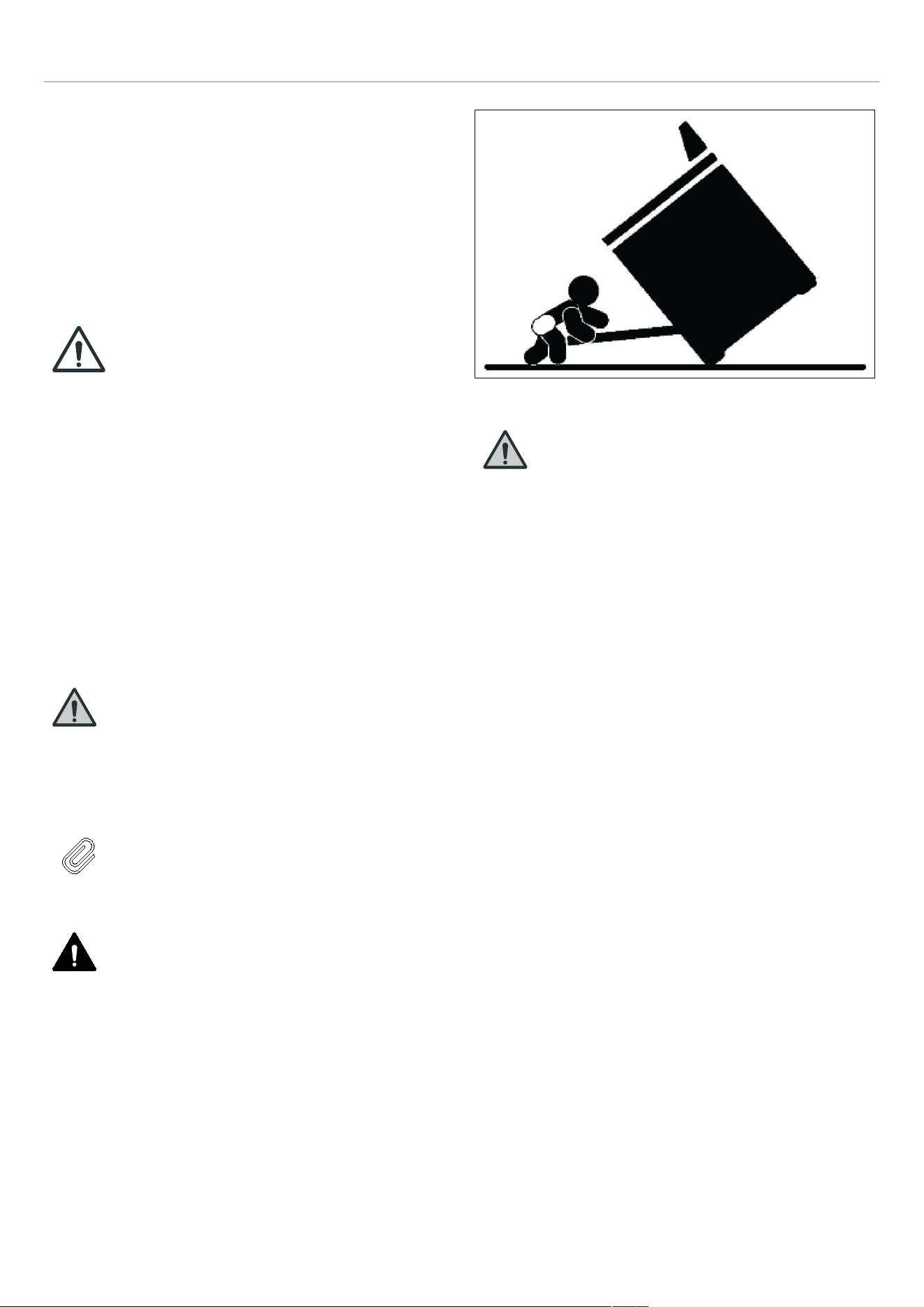
Warning-tipping hazard
A child or adult can tip over the range and
be killed.
Install the anti-tip device to the structure
and/or the range. Verify the anti-tip device
has been properly installed and engaged.
Engage the range to the anti-tip device by anti-tip brackets
or anti-tip chain (see installing the anti- tip device chapter).
Ensure the anti-tip device is re-engaged when the range is
moved.
Re-engage the anti-tip device if the range is moved. Do not
operate the range without the anti-tip device in place and
engaged.
See anti-tip device installation instructions for details.
Failure to do so can result in death or serious burns to
children or adults.
DO NOT lift the range by the oven door’s handle, as this
may damage the door hinges and cause the door to fit
incorrectly.
9

WARNINGS
DO NOT lift the appliance by the range’s control panel.
The unit is heavy and should be handled accordingly.
Proper safety equipment such as gloves and adequate
manpower of at least two people must be used in moving
the range to avoid injury and to avoid damage to the unit or
the floor. Rings, watches, and any other loose items that
may damage the unit or otherwise might become entangled
with the unit should be removed.
Hidden surfaces may have sharp edges. Use caution when
reaching behind or under appliance.
DO NOT use a hand truck or appliance dolly on the back or
front of the unit. Handle from the side only.
WARNING
Cancer and Reproductive Harm — www.
P65Warnings.ca.gov.
DATA RATING LABEL
The data rating label shows the model and serial number of
the range. It is located under the control panel and in the
last page of this manual.
10

BEFORE INSTALLATION
• This appliance shall only be installed by an authorized
professional.
• This appliance shall be installed in accordance with the
manufacturer’s installation instructions.
• This appliance must be installed in accordance with the
norms & standards of the country where it will be
installed.
• The appliance, when installed, must be electrically
grounded in accordance with local codes or, in the
absence of local codes, with the National Electrical Code,
ANSI/NFPA 70.
All opening and holes in the wall and floor, back and under
the appliance shall be sealed before installation of the
appliance.
ROOM VENTILATION
An exhaust fan may be used with the appliance; in each
case it shall be installed in conformity with the appropriate
national and local standards. Exhaust hood operation may
affect other vented appliances; in each case it shall be
installed in conformity with the appropriate national and
local standards.
WARNING
This appliance should not be installed with
a ventilation system that directs air in a
downward direction toward the range. This
type of ventilation system may cause
ignition and combustion problems with the
appliance resulting in personal injury,
property damage, or unintended operation.
Ventilating systems that direct the air
upwards do not have any restriction.
Do not use aerosol sprays in the vicinity of this
appliance while it is in operation.
11

VENTILATION PREPARATION
This range will best perform when installed with Bertazzoni
exhaust hoods. These hoods have been designed to work
in conjunction with the Bertazzoni range and have the
same finish for a perfect look.
Before installation of the exhaust hood, consult local or
regional building and installation codes for additional
specific clearance requirements. Refer to the range hood
installation instructions provided by the manufacturer for
additional information.
SELECT HOOD AND BLOWER MODELS
• For wall installations, the hood should be equal or larger
width than the range. Where space permits, a hood
larger than the range may be desirable for improved
ventilation performance.
• For island installations, the hood width should overhang
the range by a minimum of 3″ (76 mm) on each side.
HOOD PLACEMENT
• For best removal of smoke and odors, the lower edge of
the hood should be installed between 25 1/2″ (65 cm)
and 31 1/2″ (80 cm) above the range cooking surface.
• If the hood contains any combustible materials (i. e. a
wood covering), it must be installed at a minimum of 36″
(914 mm) above the cooking surface.
CONSIDER MAKE-UP AIR
Due to the high volume of ventilation air, a source of
outside replacement air is recommended. This is
particularly important for tightly sealed and insulated homes.
A qualified heating and ventilating contractor should be
consulted.
12
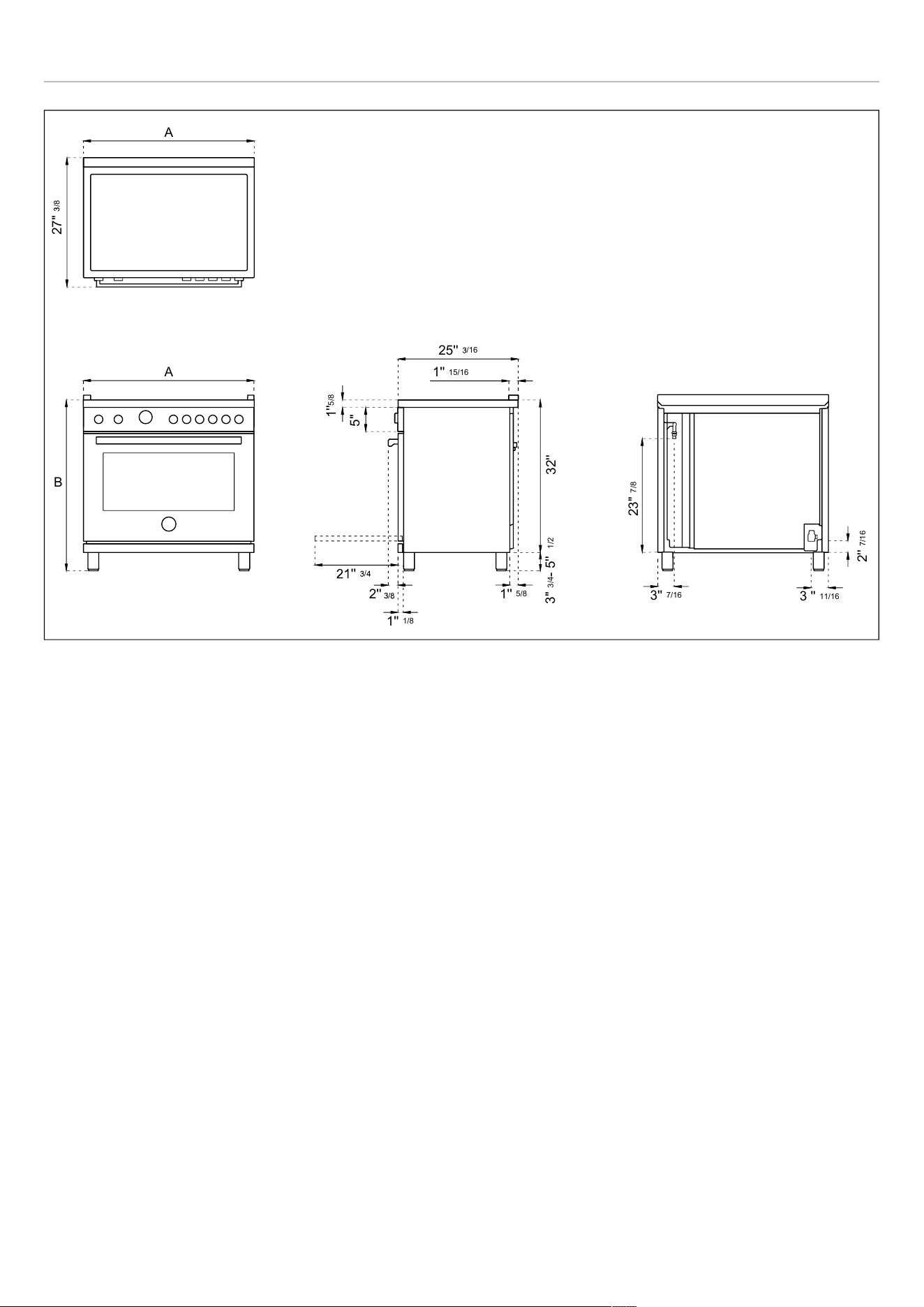
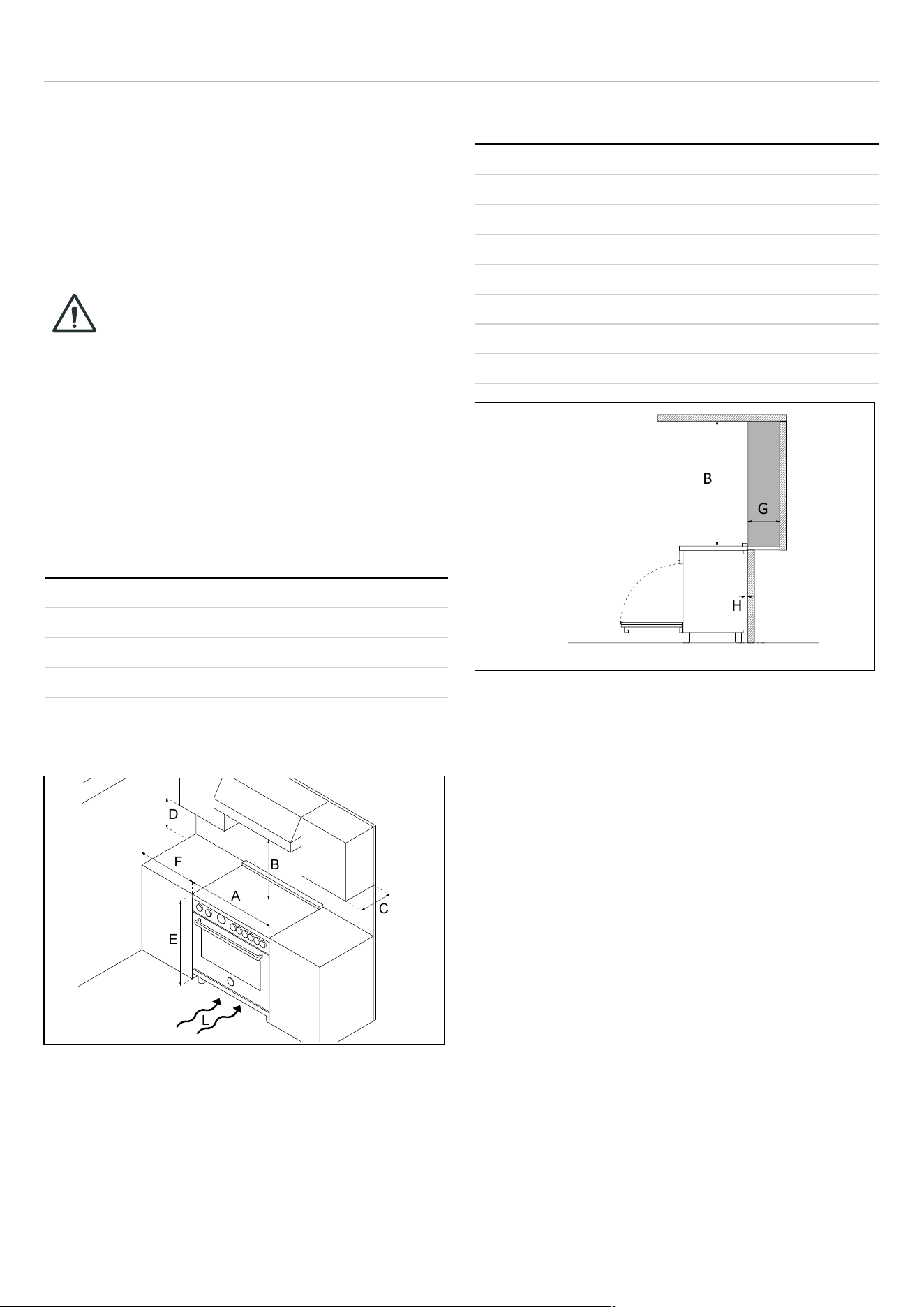
CLEARANCE DIMENSIONS
INSTALLATION ADJACENT TO KITCHEN
CABINETS
This range may be installed directly adjacent to existing
countertop high cabinets (36″ or 91.5 cm from the floor).
For the best look, the worktop should be level with the
cabinet countertop. This can be accomplished by raising
the unit using the adjustment spindles on the legs.
CAUTION
The range CANNOT be installed directly
adjacent to kitchen walls, tall cabinets, tall
appliances, or other vertical surfaces above
36″ (91.4 cm) high. The minimum side
clearance in such cases is 6″ (15.2 cm).
Wall cabinets with minimum side clearance must be
installed 18″ (45.7 cm) above the countertop with
countertop height between 35 ½″ (90.2 cm) and 37 ¼″
(94.6 cm). The maximum depth of wall cabinets above the
range shall be 13″ (33.0 cm).
CABINET
A
36″(91.5 cm)
B
36″ (91.5 cm) hood with combustible materials
C 13″ (33.0 cm)
D
18″ (45.7 cm)
E
35″ 1/2 (90.2 cm) / 37″ ¼ (94.6 cm)
F
6″ (15.2 cm)
Fig. 3
If installing toekick, verify that the sum of the cut out areas
equal the recommended ventilation (L)
36″ area 51 ½ sq. inches (33107 mm
2
).
METAL HOOD
A
36″(91.5 cm)
B
25 1/2″(65 cm) and 31 1/2″ (80 cm)
C 13″ (33.0 cm)
D
18″ (45.7 cm)
E
35″ 1/2 (90.2 cm) / 37″ 1/4 (94.6 cm)
F
6″ (15.2 cm)
G 12″(30.50 cm)
H
1″ 9/16 (4 cm)
Fig. 4
Shaded area behind range indicates minimum clearance to
combustible surfaces, combustible materials cannot be
located within this area. 12″ (305 mm) min. to combustible
surface with Flush Island Trim.
For Flush Island installations, counter surface should have
a cantilever edge meeting the back section of the Flush
Island Trim accessory. As defined in the “National Fuel Gas
Code” (ANSI Z223.1, Current Edition).
A
F
D
B
C
E
L
B
G
H
14
INSTALLATION REQUIREMENTS
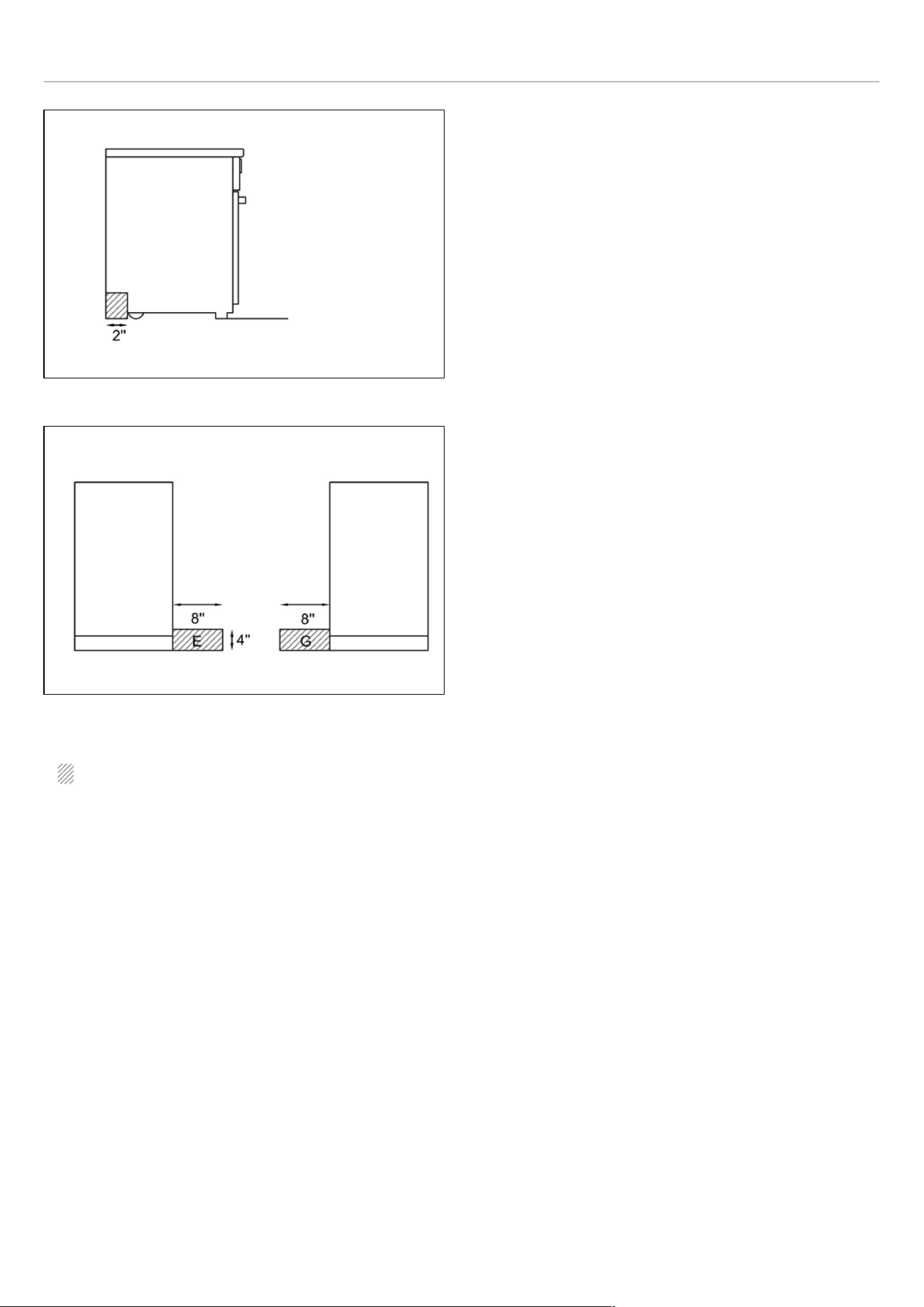
Fig. 5
Fig. 6
installation area for the connection
ELECTRICAL
A properly-grounded horizontally- mounted electrical
receptacle should be installed no higher than 3″ (7.6 cm)
above the floor, no less than 2″ (5 cm) and no more than 8″
(20.3 cm) from the left side (facing product).
Check all local code requirements.
15
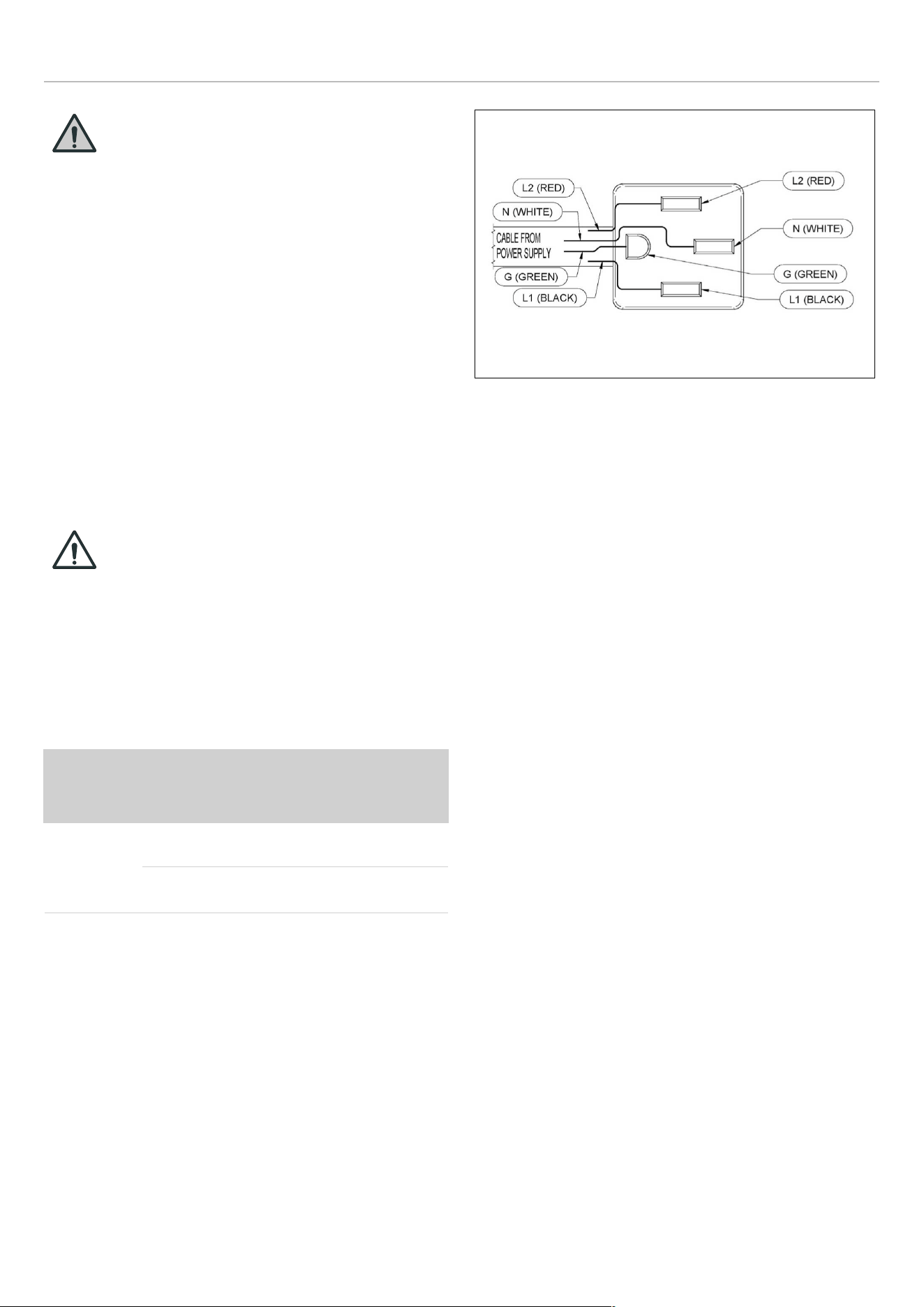
ELECTRICAL CONNECTION
WARNING
ELECTRICAL SHOCK HAZARD
Disconnect electrical power at the
circuit breaker box or fuse box before
installing the appliance.
Provide appropriate ground for the
appliance.
Use copper conductors only.
Failure to follow these instructions
could result in serious injury or death.
ELECTRICAL GROUNDING
This appliance is equipped with a three-prong plug for your
protection against shock hazard and should be plugged
directly into a properly grounded socket. Do not cut or
remove the grounding prong from this plug.
CAUTION
Label all wires prior to disconnecting
when servicing controls. Wiring errors
can cause improper and dangerous
operation. Verify proper operation after
servicing.
The appliance shall be connected to a single phase electric
line rated at 120/208Vac or 120/240Vac and 60Hz
frequency.
TYPE
VOLTAGE CIRCUIT
RATING
ELECTRI-
CAL
SUPPLY
36″ IND
DFS
120/208V 15600W
70.5A
50A
120/240V
17000W
73,5A
50A
Install a suitable electric power supply receptacle
connection type NEMA 14-50R able to support a load of at
least 30 A (per line) according to local code requirements.
For four or three wires power supply connection system
see diagram below.
Fig. 7 FOUR-WIRE CONN.RECEPTACLE NEMA 14-50R
Check your local code for which of the options below
should be used in grounding the receptacle power supply
connections.
16
ELECTRICAL CONNECTION
FOUR WIRES CONNECTION
• Connect the L1 receptacle terminal to the incoming
BLACK electrical supply wire (L1-hot wire)
• Connect the L2 receptacle terminal to the incoming RED
electrical supply wire (L2-hot wire)
• Connect the NEUTRAL receptacle terminal to the
incoming NEUTRAL (WHITE) electrical supply wire
• Connect the GROUND receptacle terminal to the
incoming GROUND (GREEN) electrical supply wire.
DO NOT USE EXTENSION CORDS WITH THIS
APPLIANCE AS IT MAY RESULT IN FIRE, ELECTRIC
SHOCK OR OTHER type of PERSONAL INJURY.
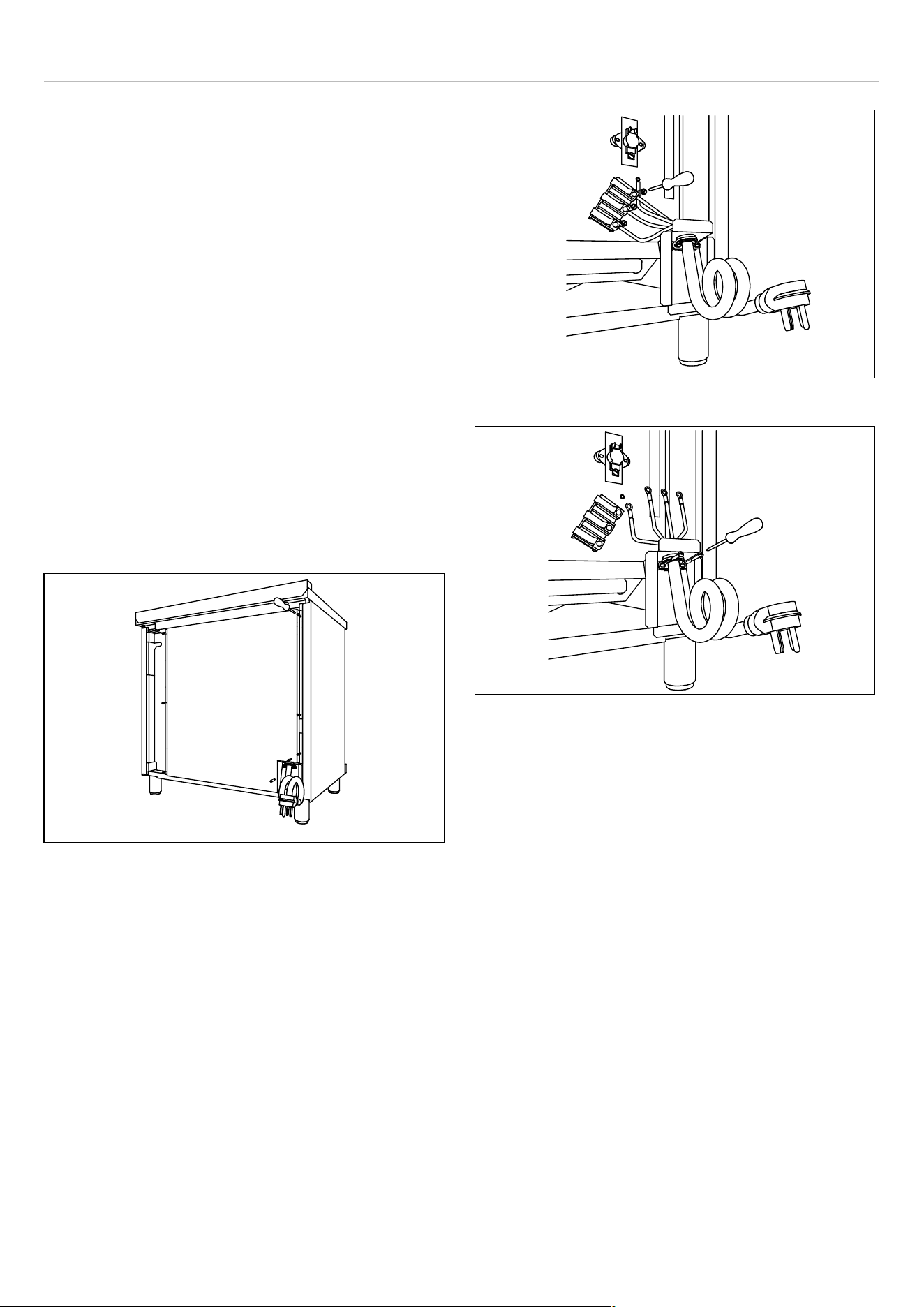
The appliance is equipped at the factory with an electric
supply cord set 4 wires type with ring terminals (L1, L2, N,
Ground) suitable for range use UL/CSA listed type
SRDT/DRT 2x6AWG (L1, L2)+2x8AWG (N, G) rated 300V,
40 or 50A with fused plug type NEMA 14-50P; cable length
1.5 m.; in case the supply cord set must be replaced, it
shall be replaced with an identical set having the same
technical specs and following carefully the instructions and
diagrams below:
Fig. 8
Fig. 9
Fig. 10
17
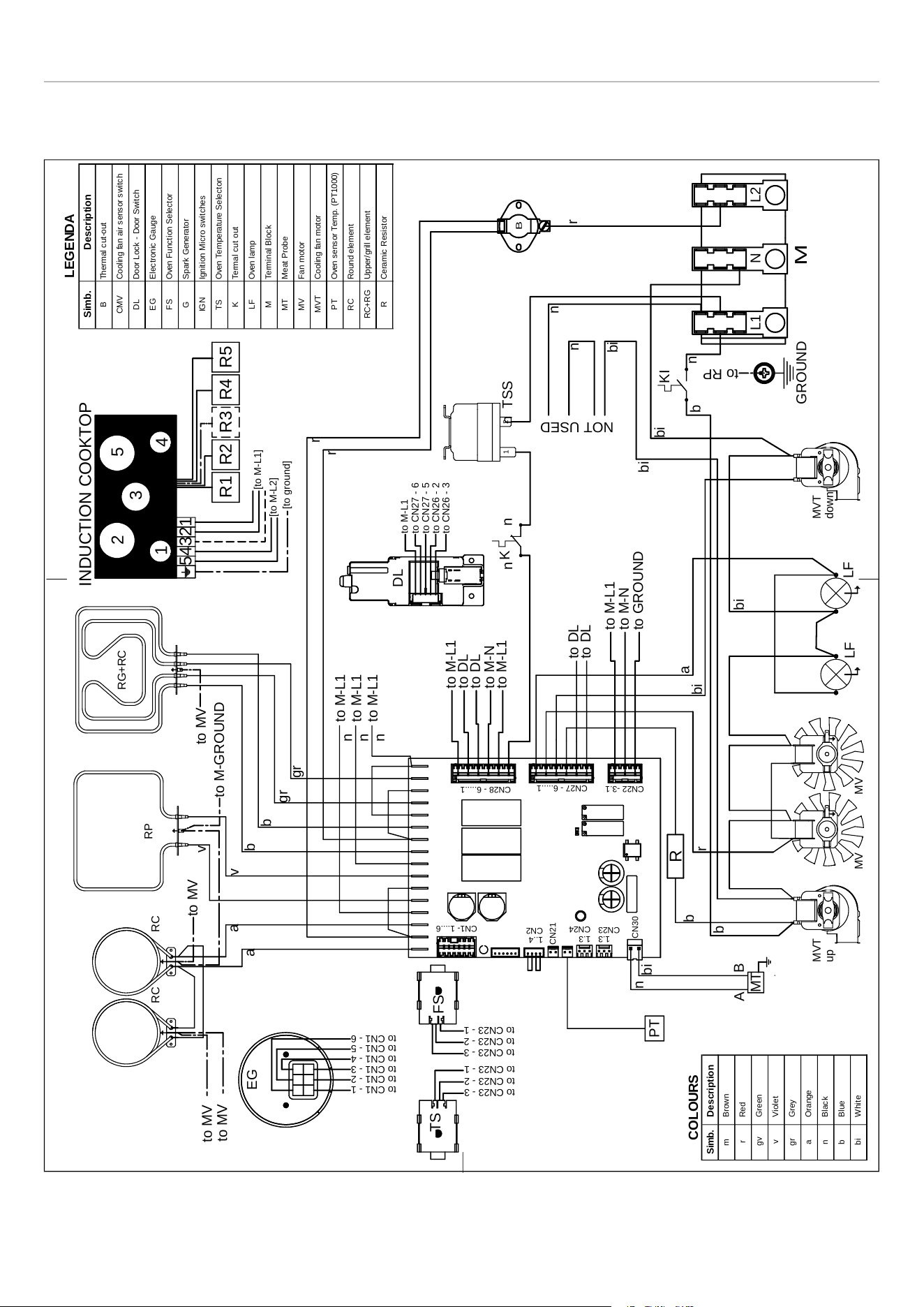
WIRING DIAGRAM
The electric wiring diagrams and schematics are attached behind the range, and should not be removed except by a
service technician, then replaced after service.
Fig. 11
to CN1 - 1
to CN1 - 2
to CN1 - 3
to CN1 - 4
to CN1 - 5
to CN1 - 6
EG
M
L1NL2
GROUND
LF
LF
MVMV
MVT
down
MVT
up
PT
RG+RC
RP
RC
RC
Simb.Description
mBrown
rRed
gvGreen
vViolet
grGrey
aOrange
nBlack
bBlue
biWhite
COLOURS
Simb.Description
BThermal cut-out
CMVCooling fan air sensor switch
DLDoor Lock - Door Switch
EGElectronic Gauge
FSOven Function Selector
GSpark Generator
IGNIgnition Micro switches
TSOven Temperature Selecton
KTermal cut out
LFOven lamp
MTerminal Block
MTMeat Probe
MVFan motor
MVTCooling fan motor
PTOven sensor Temp. (PT1000)
RCRound element
RC+RGUpper/grill element
RCeramic Resistor
LEGENDA
CN1- 1....6
1..4
CN2
CN21
1.3
CN24
1.3
CN23
CN30
CN22 -3.1
CN27 - 6.....1
CN28 - 6.....1
DL
to M-L1
to CN27 - 6
to CN27 - 5
to CN26 - 2
to CN26 - 3
to M-L1
to DL
to DL
to M-N
to M-L1
TS
to CN23 - 3
to CN23 - 2
to CN23 - 1
FS
to CN23 - 3
to CN23 - 2
to CN23 - 1
to DL
to DL
to M-L1
to M-N
to GROUND
TSS
1
2
K
B
n
to M-L1
to M-L1
to M-L1
R1
R2
R3
R4
R5
1
2
3
4
5
12345
INDUCTION COOKTOP
[to M-L2]
[to M-L1]
[to ground]
MT
A
B
a
a
v
v
b
b
gr
gr
r
r
n
n
n
n
n
bi
bi
bi
bi
b
r
a
bi
r
n
n
n
bi
to MV
to MV
to MV
to MV
to M-GROUND
to RP
NOT USED
R
b
b
KI
n
18
INSTALLATION
APPLIANCE INSTALLATION
UNPACKING THE RANGE
• Remove all packing materials from the shipping pallet
but leave the adhesive-backed foam layer over brushed-
metal surfaces to protect it from scratches until the
range is installed in its final position. Only the film on the
side panels should be removed before inserting the
range between the cabinets.
• Examine the appliance after unpacking it. In the event of
transport damage, do not plug it. Take pictures of the
damage and report it immediately to the freight forwarder.
• Remove the oven door(s). This will reduce the weight of
the range.
• The grates, griddle plate, burner caps, and oven racks
should be removed to facilitate handling.
• Before moving the range, protect the floor to prevent
damage.
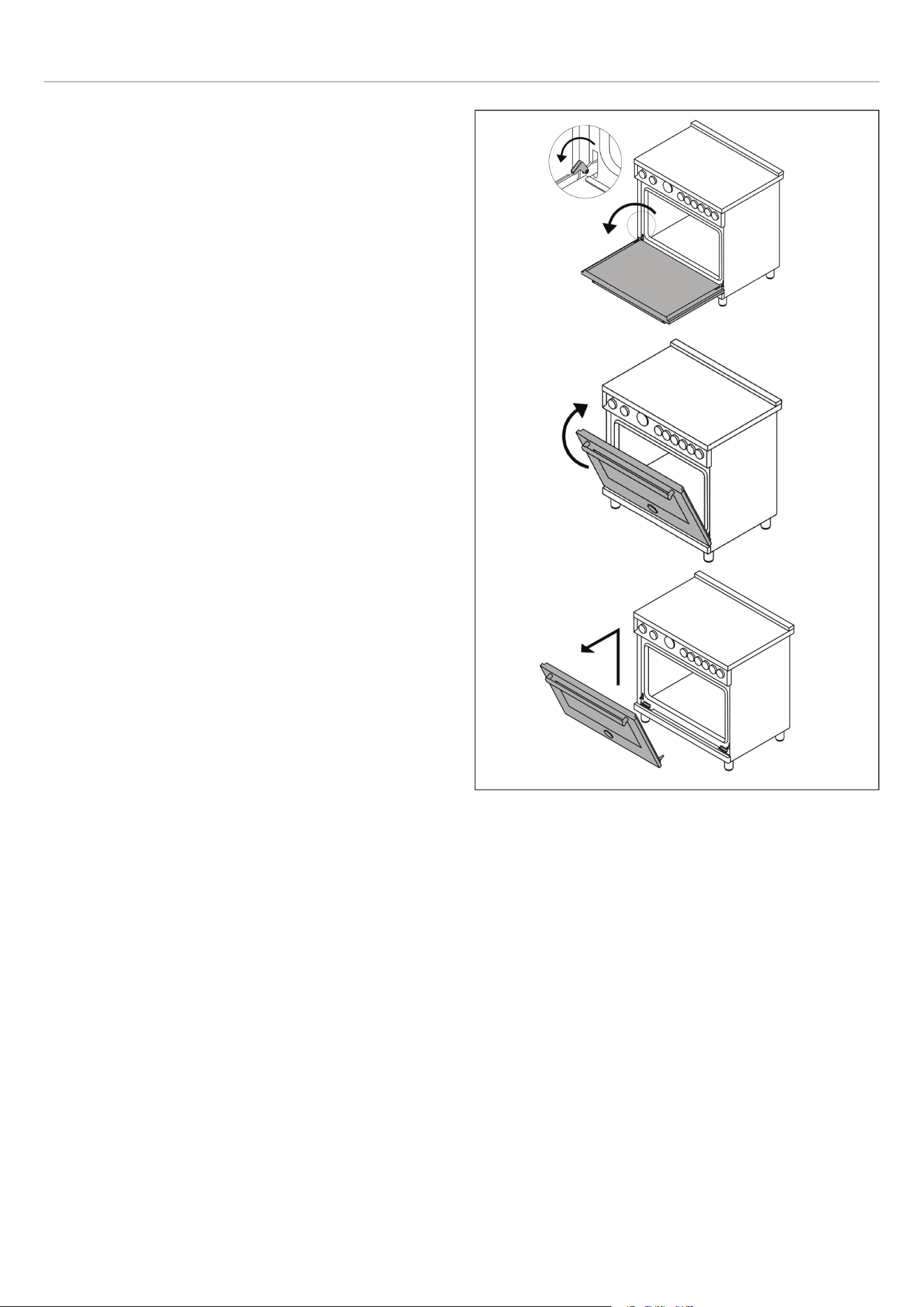
REMOVING THE OVEN DOOR
Prepare the door for removal. Flip up the locking clamps on
each door hinge. Slowly shut the door until the protruding
clamps stop the movement.
Pull oven door upwards and remove.
Do not lift or carry the oven door by its handle!
This may damage the hinges.
Fig. 12
19
INSTALLATION
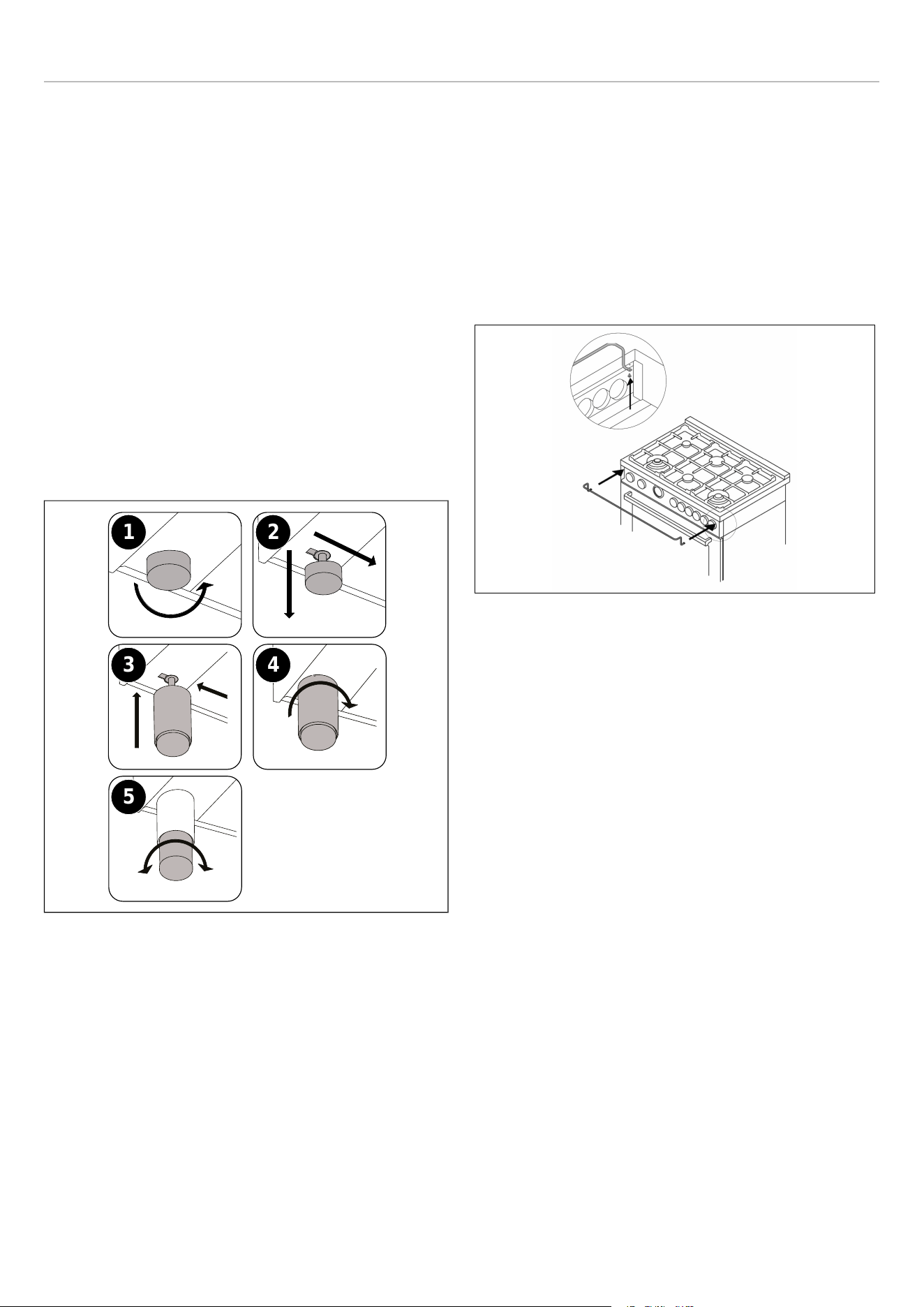
INSTALLING THE LEGS
Bertazzoni ranges must be used only with the legs properly
installed.
Four height-adjustable legs are supplied with the range in
the polystyrene container situated over the appliance.
Before installing the legs, position the appliance near its
final location as the legs are not suitable for moving the
appliance over long distances. After unpacking the range,
raise it enough to insert the legs in the appropriate
receptacles situated on the lower part of the appliance.
Lower the range gently to keep any undue strain from legs
and mounting hardware. If possible use a pallet or lift jack
instead of tilting the unit.
Adjust leg height to the desired level by twisting the inside
portion of the leg assembly until the proper height is
reached. Check with a level that the cooktop is perfectly
level.
Fig. 13
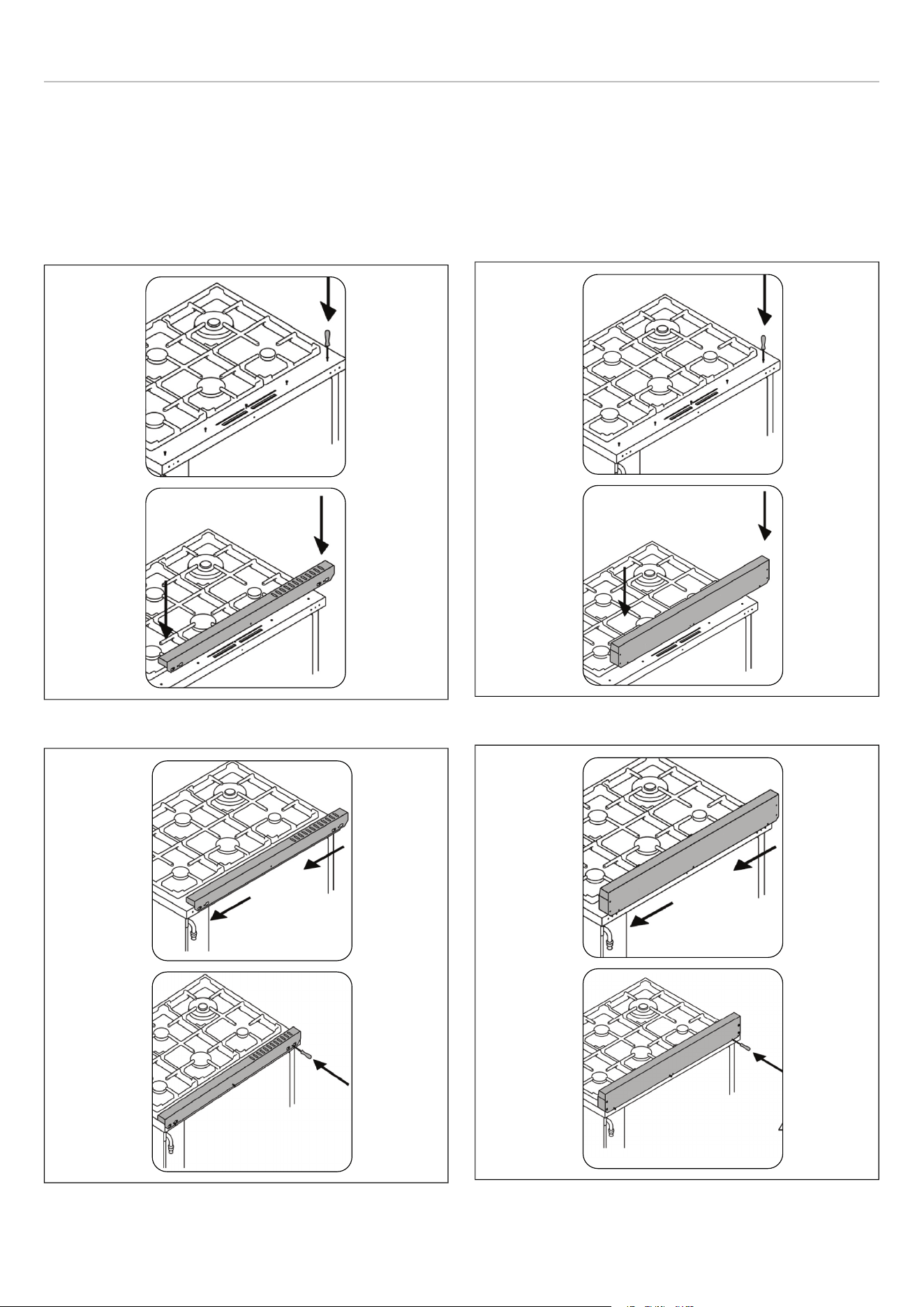
INSTALLING THE WORKTOP FRONTGUARD
To increase the clearance between the front edge of the
worktop and the burners, it is possible to install a front
guard for the worktop.
• To install the front guard, locate the two fixing holes on
the end of the front guard.
• Locate the two fixing holes on the bottom facet of the
worktop.
• Fix the front guard with its two screws.
Fig. 14
1 2
3
5
4
20
INSTALLATION
INSTALLING THE ISLAND TRIM
The island trim must be installed prior to operation of the
appliance for appropriate ventilation of the oven
compartment.
The island trim is only placed on the cooktop, remove all
tape and packaging before installing it.
Fig. 15
Fig. 16
INSTALLING BACKGUARD (OPTIONAL)
The backguard must be installed prior to operation of the
appliance for appropriate ventilation of the oven
compartment.
The backguard is an optional contact you dealer for buying
it.
Fig. 17
Fig. 18
21
INSTALLING THE ANTI/TIP DEVICES
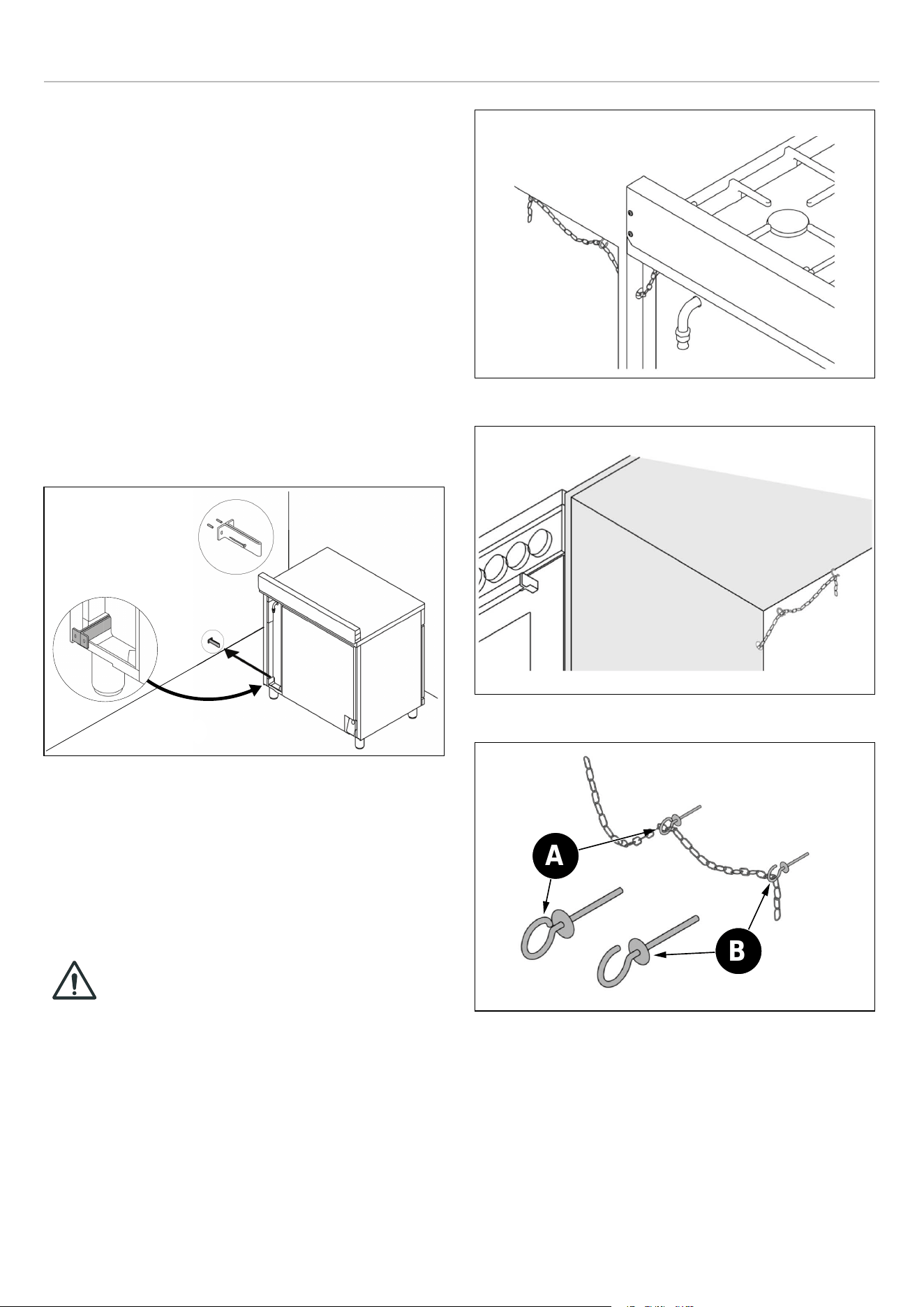
ANTI-TIP BRACKETS
The anti-tip bracket shipped with the range must be
properly secured to the rear wall as shown in the picture
below.
The height of the bracket from the floor must be determined
after the range legs have been adjusted to the desired
height and after the range has been levelled.
• Measure the distance from the floor to the bottom of the
anti-tip bracket receptacle on the back of the appliance.
• Position the anti-tip brackets on the wall at the desired
height plus 1/8″ (0.32 cm). The brackets must be placed
at 2″5/16 (6.0 cm) from the side of the range.
• Secure the brackets to the wall with appropriate
hardware.
• Slide the range against the wall until the brackets are
fully inserted into their receptacles on the back of the
range.
Fig. 19
ANTI/TILT CHAIN
The anti-tilt chain shall be installed on right or left side
alternatively according below instructions. The chain shall
be hand pulled and fixed to open hook through closed ring.
Disengage the chain prior to moving the appliance for
service.
CAUTION
Once servicing operation have been
completed the anti-tilt devices (brackets
and chain) shall be re-engaged according
above instruction/installations.
Fig. 20
Fig. 21
Fig. 22
• A CLOSED RING
• B OPEN HOOK
A
B
22


FINAL PREPARATION
• Before using the oven, remove any protective wrap from
the stainless steel.
• All stainless steel body parts should be wiped with hot,
soapy water and with a liquid stainless steel cleanser.
• If buildup occurs, do not use steel wool, abrasive cloths,
cleaners, or powders!
• If it is necessary to scrape stainless steel to remove
encrusted materials, soak with hot, wet cloths to loosen
the material, then use a wood or nylon scraper.
• Do not use a metal knife, spatula, or any other metal tool
to scrape stainless steel! Scratches are almost
impossible to remove.
• Before using the oven for food preparation, wash the
cavity thoroughly with a warm soap and water solution to
remove film residues and any dust or debris from
installation, then rinse and wiped dry.
CAUTION
When using the oven for the first time it
should be operated for 15-30 minutes at a
temperature of about 500℉/260℃ (main
oven) or 440℉/227℃ (auxiliary oven)
without cooking anything inside in order to
eliminate any moisture and odors from the
internal insulation.
24

BERTAZZONI SERVICE
Bertazzoni is committed to providing the best customer and
product service. We have a dedicated team of trained
professionals to answer your needs.
If you own a Bertazzoni appliance and need service in the
US or Canada please use the following contact information:
Telephone - Monday through Friday,
7.30am to 7.30pm EST (except US public holidays).
If located in the USA:
866 905 0010
https://us.bertazzoni.com/more/support
If located in CANADA:
800 561 7265
https://ca.bertazzoni.com/more/support
Make sure to keep the following information on hand. Our
customer service team will require it to open a service ticket
or troubleshoot.
• Purchase Date
• Model*
• Serial Number /Production Date*
• *Can be found on data plate
25

WARNINGS
Warning and Important Safety Instructions appearing in this
manual are not meant to cover all possible conditions and
situations that may occur. Common sense, caution, and
care must be exercised when installing, maintaining, or
operating the appliance.
Read and follow all instructions before using this
appliance to prevent the potential risk of fire, electric
shock, personal injury or damage to the appliance as a
result of improper usage of the appliance. Use
appliance only for its intended purpose as described in
this manual.
Save this Manual for local electrical inspector’s use. Read
and save these instructions for future reference. Observe
all governing codes, ordinances and regulations.
WARNING
To avoid risk of property damage, personal
injury or death; follow information in this
manual exactly to prevent a fire or
explosion. DO NOT store or use gasoline or
other flammable vapors and liquids near by
this or any appliance.
What to do if you smell gas:
Do not light any appliance. Do not touch
any electrical switch. Do not use any
phone in your building. Immediately call
your gas supplier from a neighbor’s
phone. Follow the gas supplier’s
instructions. If you cannot reach your
gas supplier, call the fire department.
NOTE
Installation and service must be performed
by a qualified installer, service agency or
the gas supplier.
In Massachusetts:
All gas products must be installed by a “Massachusetts”
licensed plumber or gas fitter. A “T” handle type manual
gas valve must be installed in the gas line connected to this
appliance.
To ensure proper and safe operation: Appliance must be
properly installed and grounded by a qualified technician.
DO NOT attempt to adjust, repair, service, or replace any
part of your appliance unless it is specifically recommended
in this manual. All other servicing should be referred to a
qualified servicer. Have the installer show you the location
of the gas shut-off valve and how to shut it off in an
emergency.
A certified technician is required for any adjustments or
conversions to Natural or LP gas.
TO PREVENT FIRE OR SMOKE DAMAGE
• Be sure all packing materials are removed from the
appliance before operating it.
• Never let clothing, potholders, or other flammable
materials come in contact with or too close to any
element, top burner or burner grate until it has cooled.
• If appliance is installed near a window, proper
precautions should be taken to prevent curtains from
blowing over burners.
• Never leave any items on the cooktop. The hot air from
the vent may ignite flammable items and may increase
pressure in closed containers which may cause them to
burst.
• Many aerosol-type spray cans are EXPLOSIVE when
exposed to heat and may be highly flammable. Avoid
their use or storage near an appliance.
IN CASE OF FIRE
Turn off appliance and ventilation hood to avoid spreading
the flame. Extinguish flame then turn on hood to remove
smoke and odor.
• Cooktop: Smother fire or flame in a pan with a lid or
cookie sheet.
• NEVER pick up or move a flaming pan.
• Oven: Smother fire or flame by closing the oven door.
DO NOT use water on grease fires. Use baking soda, a
dry chemical or foamtype extinguisher to smother fire or
flame, if available, a multipurpose dry chemical or foam
type extinguisher.
CHILD SAFETY
• NEVER leave children alone or unsupervised near the
appliance when it is in use or is still hot.
• NEVER allow children to sit or stand on any part of the
appliance as they could be injured or burned.
•
CAUTION
Do not store items of interest to children
in cabinets above the range or on the
backguard of the range. Children
climbing on the range to reach those
items could be seriously injured.
26

WARNINGS
COOKING SAFETY
• Once the unit has been installed as outlined in the
Installation Instructions, it is important that the fresh air
supply is not obstructed. The use of a gas cooking
appliance results in the production of heat and moisture
in the room in which it is installed.
• Ensure that the kitchen is well-ventilated. Keep natural
venting holes open or install a mechanical ventilation
device. Prolonged or intensive use of the appliance may
call for additional (such as opening a window) or more
effective ventilation (such as increasing the level of a
mechanical ventilation if present).
• NEVER use aluminum foil to cover oven racks or oven
bottom. This could result in risk of electric shock, fire, or
damage to the appliance. Use foil only as directed in this
guide.
• To eliminate the hazard of reaching over hot surface
burners, cabinet storage should not be provided directly
above a unit. Temperatures may be unsafe for some
items, such as volatile liquids, cleaners or aerosol
sprays.
• ALWAYS place a pan on a surface burner before turning
it on. Be sure you know which knob controls which
surface burner. Make sure the correct burner is turned
on and that the burner has ignited. When cooking is
completed, turn burner off before removing pan to
prevent exposure to burner flame.
• ALWAYS adjust surface burner flame so that it does not
extend beyond the bottom edge of the pan. An
excessive flame is hazardous, wastes energy and may
damage the appliance, pan or cabinets above the
appliance. This is based on safety considerations.
• NEVER leave a surface cooking operation unattended
especially when using a high heat setting or when deep
fat frying. Boilovers cause smoking and greasy
spillovers may ignite. Clean up greasy spills as soon as
possible. DO NOT use high heat for extended cooking
operations.
• DO NOT heat unopened food containers, build up of
pressure may cause the container to explode and result
in injury.
• ALWAYS let quantities of hot fat used for deep fat frying
cool before attempting to move or handle.
• NEVER wear garments made of flammable material or
loose fitting or long-sleeved apparel while cooking.
Clothing may ignite or catch utensil handles. DO NOT
drape towels or materials on oven door handles. These
items could ignite and cause burns.
• ALWAYS place oven racks in the desired positions while
oven is cool. Slide oven rack out to add or remove food,
using dry, sturdy potholders.
• ALWAYS avoid reaching into the oven to add or remove
food. If a rack must be moved while hot, use a dry pot-
holder.
• ALWAYS turn the oven off at the end of cooking.
• Use care when opening the oven door. Let hot air or
steam escape before moving or replacing food.
• DO NOT cook directly on the oven bottom. This could
result in damage to your appliance. Always use the oven
racks when cooking in the oven.
Do not connect any appliances to the plugs above or near
to the induction cooktop; connection cable insulation can
melt if in contact with heat, and this may result in an injury
and a property damage.
RECOMMENDED UTENSILS
• Use pans with flat bottoms and handles that are easily
grasped and stay cool. Avoid using unstable, warped,
easily tipped or loose-handled pans. Also avoid using
pans, especially small pans, with heavy handles as they
could be unstable and easily tip. Pans that are heavy to
move when filled with food may also be hazardous.
• Be sure utensil is large enough to properly contain food
and avoid boilovers. Pan size is particularly important in
deep fat frying. Be sure pan will accommodate the
volume of food that is to be added as well as the bubble
action of fat.
• To minimize burns, ignition of flammable materials and
spillage due to unintentional contact with the utensil, DO
NOT extend handles over adjacent surface burners.
ALWAYS turn pan handles toward the side or back of the
appliance, not out into the room where they are easily hit
or reached by small children.
• NEVER let a pan boil dry as this could damage the
utensil and the appliance.
• Follow the manufacturer’s directions when using oven
cooking bags.
• Only certain types of glass, glass/ceramic, ceramic or
glazed utensils are suitable for rangetop surface or oven
usage without breaking due to the sudden change in
temperature. Follow manufacturer’s instructions when
using glass.
27

WARNINGS
INDUCTION COOKING SURFACES
• Surface areas on or adjacent to the unit may be hot
enough to cause burns. Do not touch the cooking area
as long as the light indicating residual heat on the glass-
ceramic cooktop area, is “on”; this indicates that the
temperature in the relative area is still high.
• DO NOT COOK ON BROKEN COOKING SURFACE – If
cooking surface should break, cleaning solutions and
spillovers may penetrate the broken cooking surface and
create a risk of electric shock. Contact a qualified
technician immediately.
• Keep a close eye on children because they are unlikely
to see the residual heat warning lights. The cooking
zones are still very hot for some time after use, even if
they are switched off. Make sure that children never
touch them.
• NEVER use aluminum foil to hold the food while cooking
on a glass-ceramic cooktop area.
• Never place pan with bottoms which are not perfectly flat
and smooth on the cooktop area.
• If you drop a heavy pot on your cooktop area it will not
break. On the contrary, if a hard object, such as the salt
shaker or the spice bottle strikes the edge or the corner
of the cooktop area, the cooktop area may break.
• Never use the glass-ceramic cooktop area as support
surface.
• Only use cleaning products made specifically for
ceramic glass cooking surfaces.
• Metal items such as cutlery or lids must never be placed
on the surface of the cooktop area since they may
become hot.
RADIO INTERFERENCE - INDUCTION
RANGES
This unit generates, uses, and can radiate radio frequency
energy and, if not installed and used in accordance with the
instructions, may cause harmful interference to radio
communications. However, there is no guarantee that
interference will not occur in a particular installation. If this
unit does cause harmful interference to radio or television
reception, which can be determined by turning the unit off
and on, the user is encouraged to try to correct the
interference by one or more of the following measures:
• Reorient or relocate the receiving antenna
• Increase the distance between the unit and receiver
• Connect the unit into an outlet on a circuit different from
that to which the receiver is connected.
OVEN HEATING ELEMENTS
• NEVER touch oven bake and broil burner areas or
interior surfaces of oven.
• Bake and broil burners may be hot even though they are
dark in color. Areas near burners and interior surfaces of
an oven may become hot enough to cause burns.
• During and after use, DO NOT touch or let clothing or
other flammable materials contact heating elements,
areas near elements, or interior surfaces of oven until
they have had sufficient time to cool. Other surfaces of
the oven may become hot enough to cause burns, such
as the oven vent opening, the surface near the vent
opening, and the oven door window.
CLEANING SAFETY
• Turn off all controls and wait for appliance parts to cool
before touching or cleaning them. DO NOT touch the
burner grates or surrounding areas until they have had
sufficient time to cool.
• Clean the range with caution. Avoid steam burns; DO
NOT use a wet sponge or cloth to clean the range while
it is hot. Some cleaners produce noxious fumes if
applied to a hot surface. Follow directions provided by
the cleaner manufacturer.
• DO NOT clean, rub, damage, move or remove the door
gasket. It is essential for a good seal during baking. If
the gasket becomes worn or excessively soiled with food
particles, replace gasket to assure a tight seal.
POWER FAILURE WARNING
Due to safety considerations and the possibility of personal
injury in attempting to light and extinguish the oven burners,
the grill and the oven burner should not be used during a
power failure. The oven control knob should always remain
in the “OFF” position during a power failure.
NEVER use appliance as a space heater to heat or warm a
room to prevent potential hazard to the user and damage to
the appliance. Also, DO NOT use the rangetop or oven as a
storage area for food or cooking utensils.
ELECTRICAL SHOCK HAZARD
Make sure all controls are OFF and oven is COOL before
cleaning. Failure to do so can result in burns or electrical
shock.
DO NOT touch a hot oven light bulb with a damp cloth as
the bulb could break. Should the bulb break, disconnect
power to the appliance before removing bulb to avoid
electrical shock.
WARNING
NEVER cover any slots, holes or passages
in the oven bottom or cover an entire rack
with materials such as aluminum foil. Doing
so blocks air flow through the oven and
may cause carbon monoxide poisoning.
Aluminum foil linings may also trap heat,
causing a fire hazard.
BURN HAZARD
The oven door, especially the glass, can get hot. DO NOT
touch the oven door glass!
28
WARNINGS
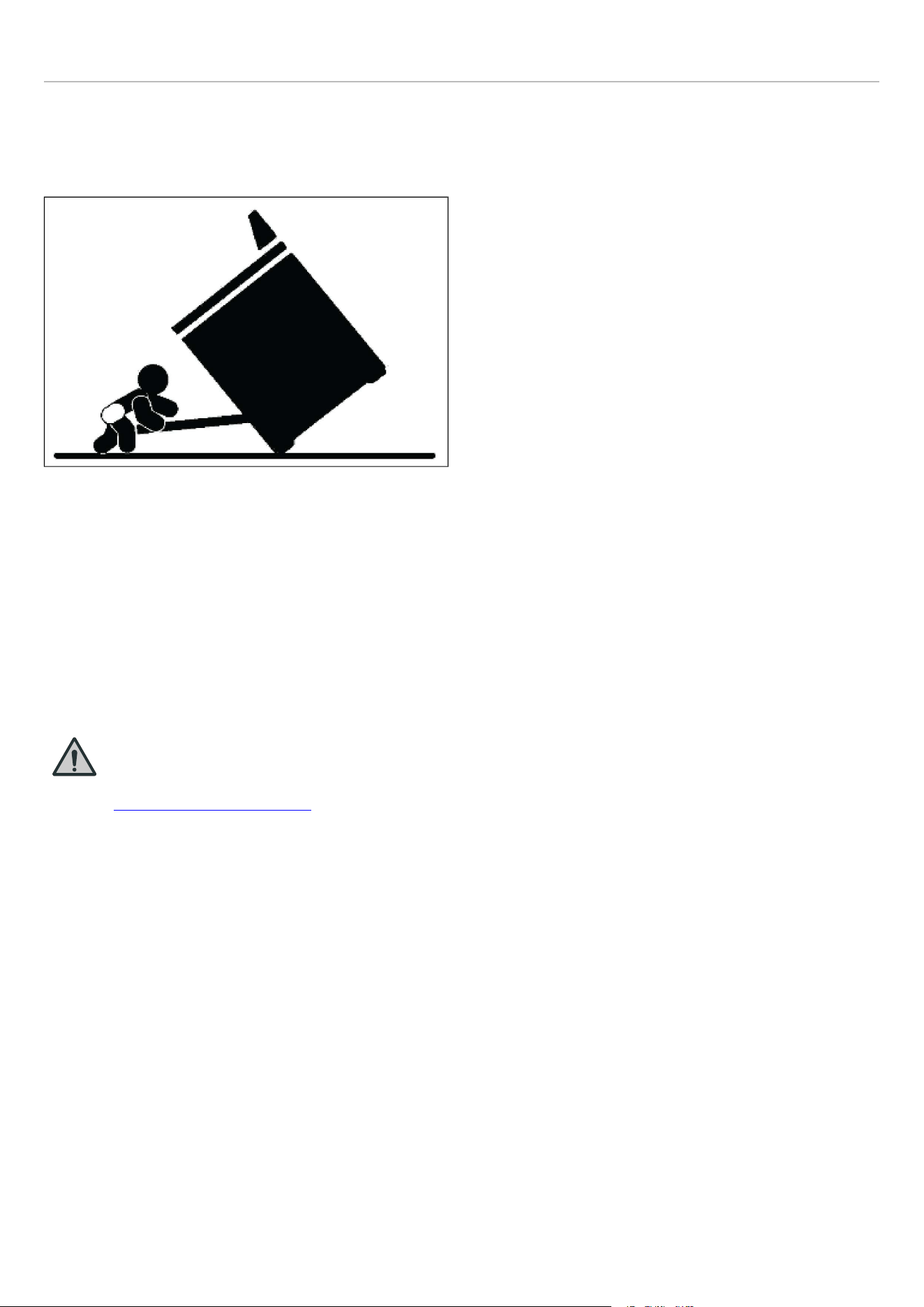
WARNING-TIPPING HAZARD
Children and adults can tip over the range if it has not been
secured. This may lead to fatal injuries.
To reduce the risk of the appliance tipping, it must be
secured and connected using the anti-tip device according
to the installation instructions. Re-engage the anti-tip
device if the range is moved.
Do not operate the range without the anti-tip device in place
and engaged. Do not use the range if the anti-tip device
has not been properly installed and engaged. See
installation instructions for details.
Failure to observe the information contained in the
installation instructions can lead to serious or fatal
injuries for children and adults.
WARNING
Cancer and Reproductive Harm
www.P65Warnings.ca.gov
29
INDUCTION COOKTOP
COOKING WITH INDUCTION
Underneath each cooking zone there is a coil called an
inductor. The inductor generates a variable magnetic field
using electric power. When a pan is placed inside this
magnetic field, the high frequency current radiates directly
on the bottom of the pan and produce the heat needed to
cook.
After use the display can show the symbol H if there is
residual heat. The symbol H go out when the temperature
drops to below about 140℉/60℃.
TURNING ON THE INDUCTION ELEMENT
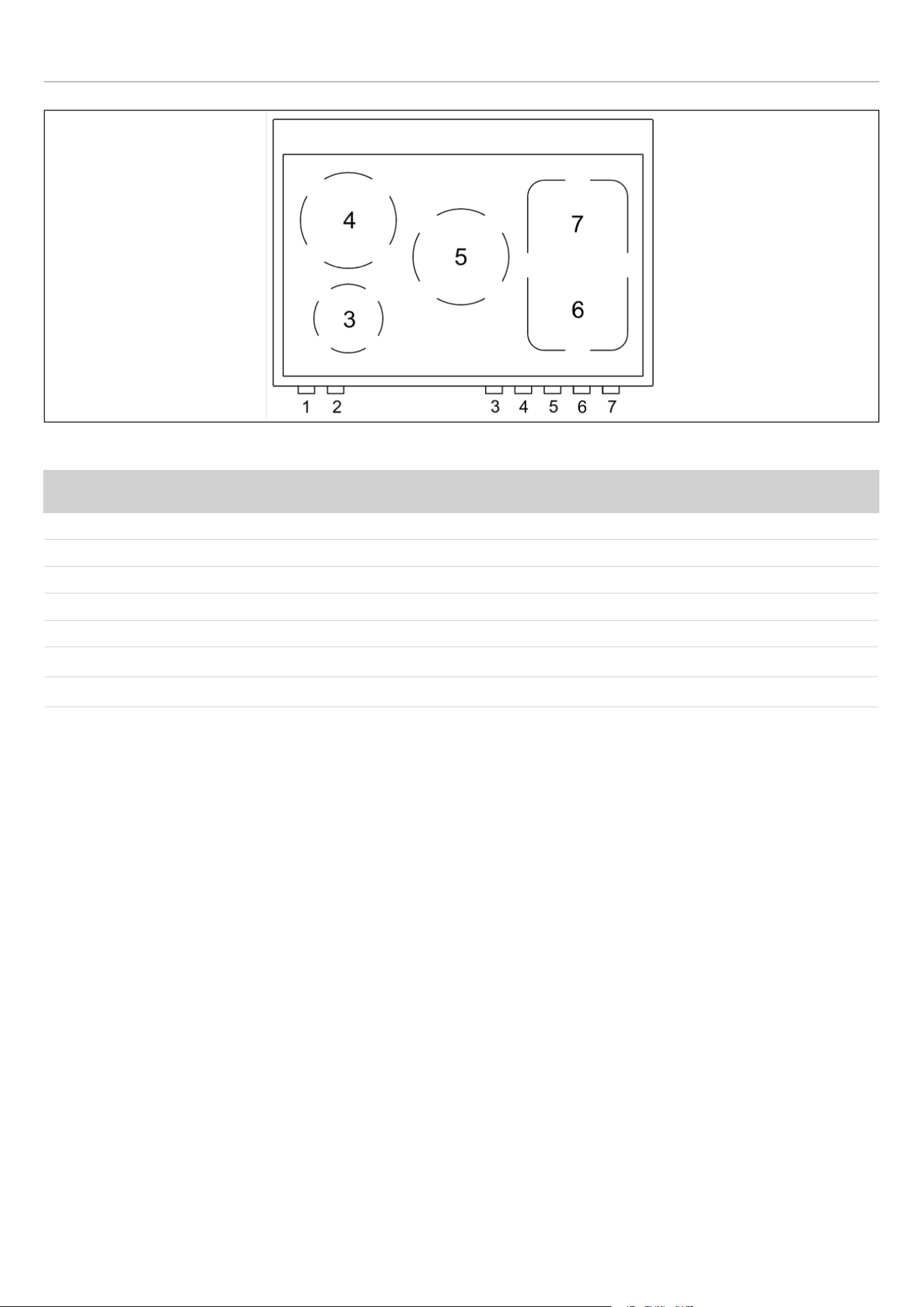
The symbol above each knob indicates which element that
knob controls.
The operation power is regulated through the knob and is
shown by a display on the cooktop surface.
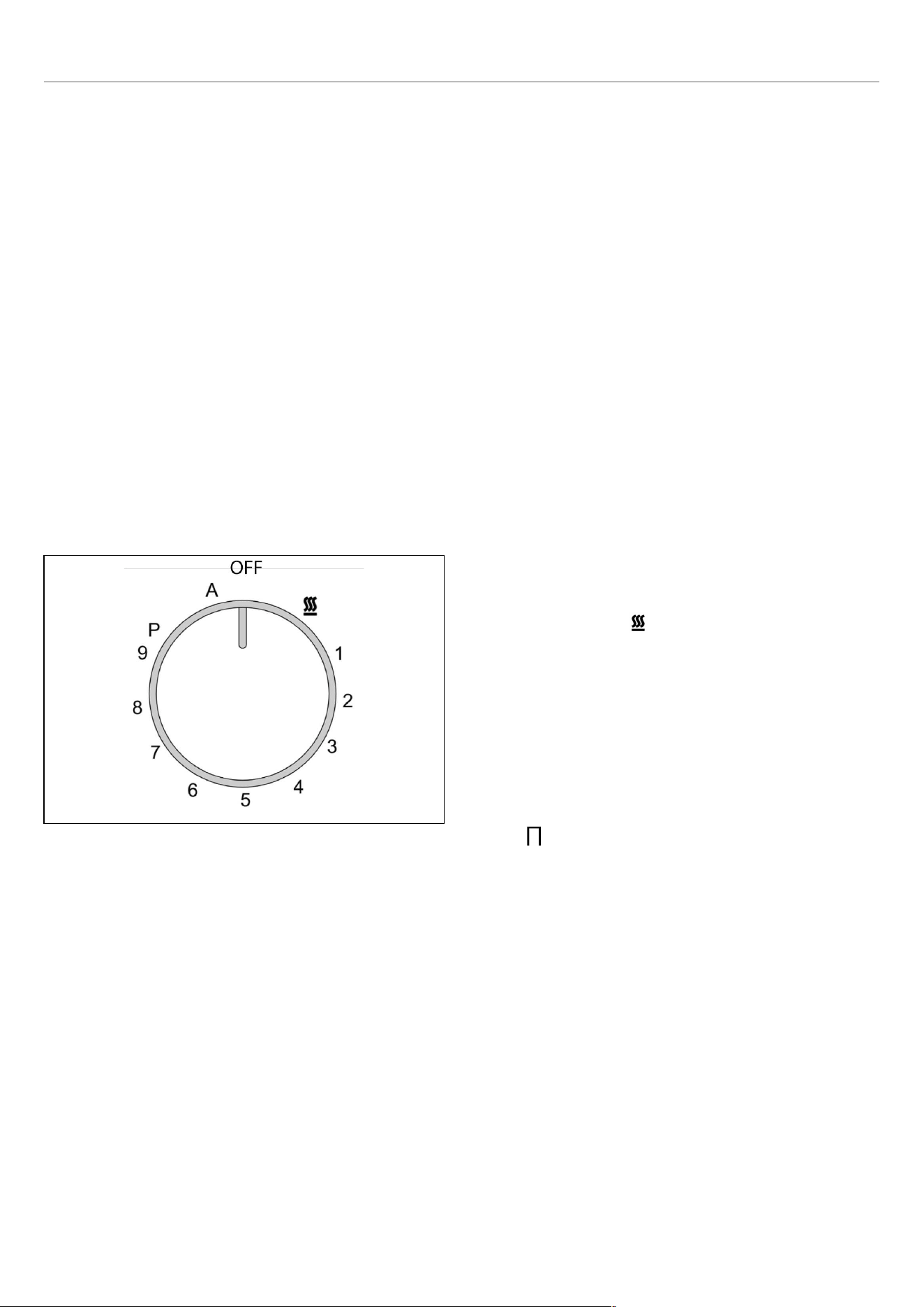
To turn on the heating zone, press in the control knob (Fig.
24 ) and turn it clockwise. Settings range from a minimum
of 1 to a maximum of 9.
Fig. 24
USING SPECIAL FUNCTIONS
HEATING ACCELERATOR MODE
The Heating Accelerator mode allows each zone to be
operated at peak power for a time proportional to the
heating power selected.
• Turn the knob anti-clockwise, select setting “A” and then
release. The letter A will appear on the display on the
cooktop area
• After 3 seconds, you may select the heating setting of
your choice. Once a setting between 1 and 9 has been
selected, A and the chosen setting will flashing
sequence on the display.
While the heating accelerator is in operation, the heating
level can be increased at any time. The “full power” time will
be modified accordingly. If the power is reduced by turning
the knob anticlockwise, option “A” is automatically
deactivated.
POWER MODE
The power mode allows the user to operate each heating
zone continuously at the maximum power for a time of no
more than 10 minutes. This mode can be used to bring a
large amount of water to the boil in a hurry, or to turn up the
heat under meat.
• Turn the knob clockwise and set heating level to 9, then
use the knob to set the “P” position and release it.
• The symbol P will appear on the corresponding zone
display.
• After 10 minutes, the power will be reduced
automatically to 9 and the P will disappear.
The power mode can be turned off at any time by reducing
the heating level. If a pan is removed from the cooking zone
while the power function is on, the function is switched off.
HOLDING MODE
The holding mode keeps the temperature of the bottoms of
pans at about 160℉/70℃. This allows foods to be heated
gently and kept hot with optimal energy consumption.
Holding mode can be kept in operation for up to 2 hours.
The holding mode is
and is indicated by the relevant
symbol on the cooking zones.
BRIDGE MODE
The bridge mode allows to use the 2 right-side cooking
zones as a single cooking zone. Power Mode is not allowed
when the zones are operated in Bridge mode.
• Rotate both knobs, rear right and front right, at the same
time in the “P” position and keep the knobs in that
position.
• The
symbol will blink in the display, then return to the
power level.
• To control the bridge power level, use the knob 4 (front
right zone). If you turn knob 3 (rear right zone) the
display shows a horizontal segment and the bridge
function ends.
CHILD LOCK FUNCTION
When not in use, the cooktop area can be “locked out” to
prevent children from accidentally switching it on.
With the cooking zones off, turn the knobs of zones 1 and 2
to the left simultaneously until L appears on the power
display and then release the knobs.
To deactivate it, repeat the same procedure: the cooking
zone displays will stop displaying the L, indicating that the
cooking zone LOCK has been deactivated.
31
INDUCTION COOKTOP
PAN DETECTION
Each cooking zone is equipped with a “pan detection”
device, which ensures that cooking cannot start unless a
suitable pan is present on the cooking zone and properly
positioned.
If the user attempts to switch on the cooking zone with the
pan not positioned properly or with a pan which is not of
suitable material, the
symbol will appear a few seconds
after the zone is switched on to warn the user that an error
has been made.
RESIDUAL HEAT
Each cooking zone is equipped with a device which warns
of residual heat. After any cooking zone is switched off, a
flashing H may appear on the display, warning that the
cooking zone is still very hot.
Cooking can be restarted while the H is flashing.
SUITABLE INDUCTION COOKWARE
Induction technology requires iron or magnetic steel
cookware in order to generate the magnetic field necessary
for the heating process.
Cookware made of glass, porcelain, ceramic or aluminum
will not work on an induction cooktop. Pots made of glass,
porcelain, ceramic are not suitable. Pots made with steel,
aluminium or copper without magnetic bottom will also not
work.
Most suitable pans are marked for use with induction. To
check whether a pan is suitable, simply place a magnet
close to its bottom: if the magnet sicks to the bottom of the
pan, the pan is suitable for induction cooking. If you don’t
have a magnet handy, place a small of water in the pan,
place the pan on any cooking zone and switch it on. If the
symbol
appears on the display, the pan is not suitable.
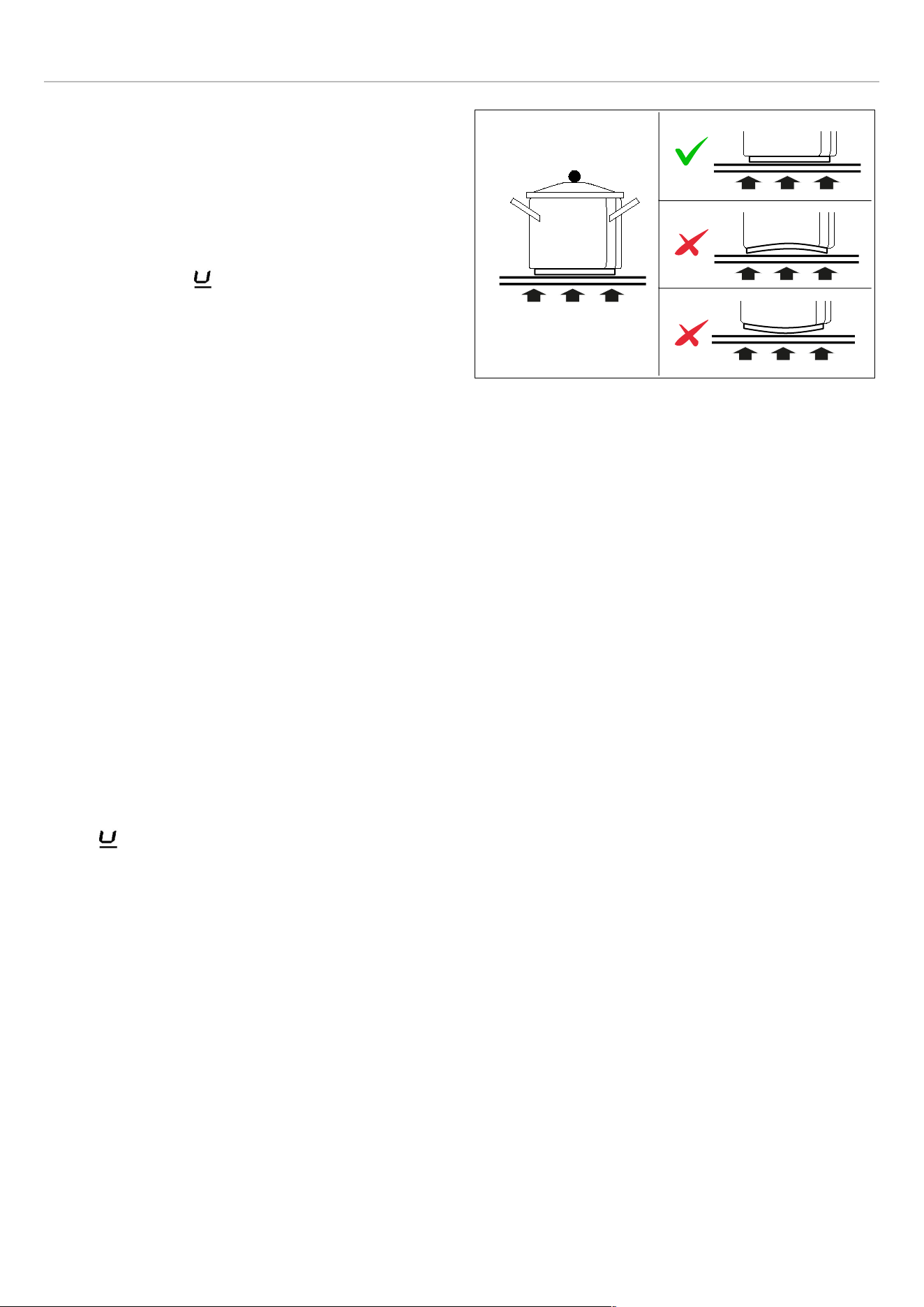
Use only vessels specially designed for induction cooking,
with thick, completely flat bottom. If these are not available,
the pans used must not have a round (concave or convex)
bottom.
Pans that are not completely flat and have a recessed
bottom leave an air gap between pot and cooktop, which
during operation can reach high temperatures that can
damage the glass top and the inductors below the glass.
The pans must have certain minimum diameter to ensure
optimal operation. Pans larger than the cooking zones can
also be used: make sure that the bottom of the pan does
not touch other cooking zones and that it is always
centered over the inductor.
Fig. 25
NOISE DURING OPERATION
A pulsating humming or buzzing sound during operation is
normal, and can vary in intensity with different types of
cookware.
It is normal to hear a fan noise after switching the induction
hob off.
RECOMMENDATIONS
• Always place your pan in such a way that its center is
aligned with the centre of the element.
• Pick-up your cookware when moving them around. Do
not slide them and avoid excessive rubbing of the top, as
this may leave scratches on the glass surface.
• Never leave an empty pot/pan on an induction heating
element, even when the element is turned OFF.
• Only use maximum power for boiling and frying.
• Avoid preheating your non-stick pans (e. g. with teflon
coating) at maximum heat.
• Avoid storing solids and heavy items in the cabinets
above your cooktop. They may accidentally be dropped
and damage the glass top.
• Place extra care to avoid spilling sugar or sweet
mixtures onto the cooktop area during cooking, and
avoid materials or substances which might melt
(plastic or aluminium foil) on it. If this occurs, turn
the heating off immediately and clean with the
scraper supplied while the cooking zone is still
warm. If the ceramic cooktop area is not cleaned
immediately, residues may form which may not be
removed once the cooktop area has cooled.
32
INDUCTION GRIDDLE
SEASONING THE GRIDDLE
Seasoning the griddle.
Before using the griddle for the first time, clean the griddle
thoroughly with hot and soapy water to remove any residue
and protective coating.
USE OF THE GRIDDLE
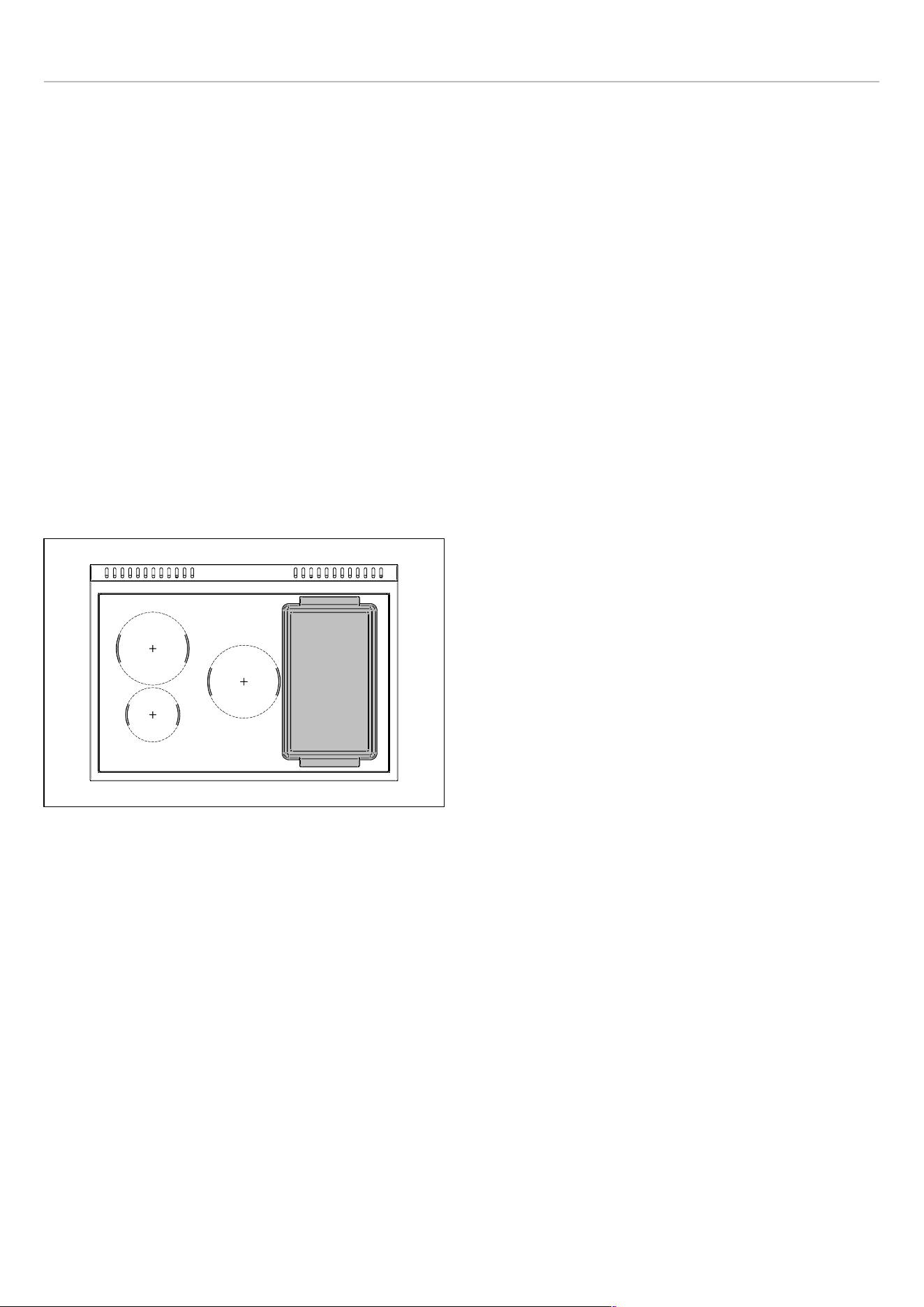
Place the griddle in the bridge area and power up the
induction area normally. Pre-heat at the high position for
few minutes, once temperature has stabilized at the set
level, place the food on the griddle and cook to the desired
temperature.
After the preheat period it is always suggested to reduce
power to the medium / minimum setting.
Do not use metal utensils with sharp point or rough edges,
they might damage the griddle.
Do not cut or chop food on the griddle.
Fig. 26
CLEANING THE GRIDDLE
Wash griddle with hot soapy water, rinse and dry. Do not
wash it in the dishwasher. Never expose the hot griddle to
cold water. This could cause the griddle to crack or warp.
33
ELECTRIC OVEN
CAUTION
When using the oven for the first time it
should be operated for 15-30 minutes at a
temperature of about 500℉/260℃ without
cooking anything inside in order to
eliminate any moisture and odors from the
internal insulation.
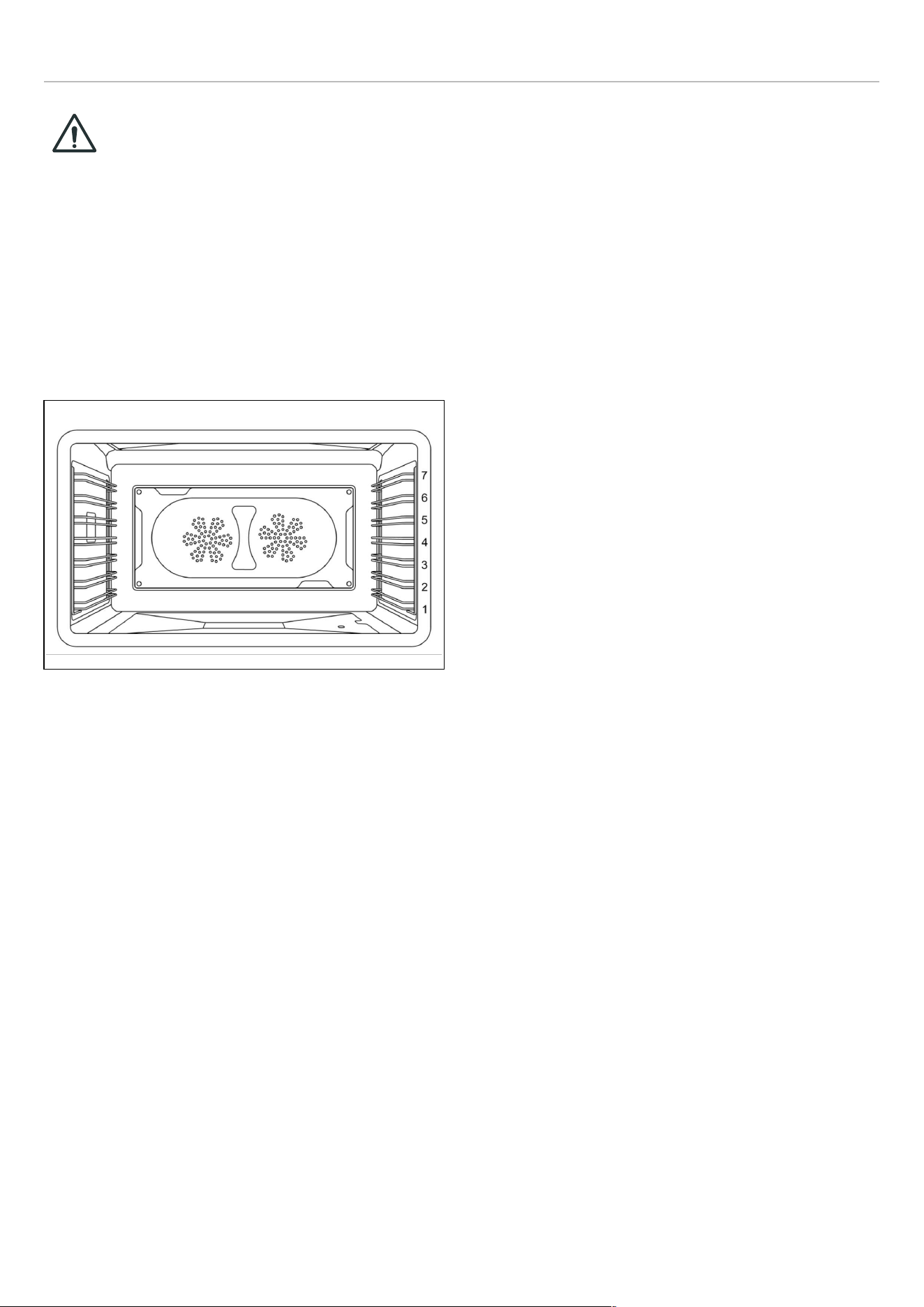
SHELVES POSITIONS
Shelves are mounted on the appropriate guides situated on
the sides of the oven compartment. Insert the shelf
between top and bottom guide in any of the 7 positions
indicated.
Fig. 27
COOLING FAN
The oven is equipped with a cooling system which operates
during cooking.
Air flow between the control panel and door allows the
controls to be kept at a usable temperature.
The cooling system turns on and off automatically (it is
normal for this to continue running after the oven is
switched off).
PREHEATING THE OVEN
Most cooking times in recipes are intended for a preheated
oven and require that the oven already be at the set
temperature before placing food in the oven. Preheating
time depends on the temperature setting and the number of
racks in the oven.
USING THE OVEN
1) Place rack in desired position and shut the door.
2) Select the oven function with the dedicated function
knob. The light in the cavity will turn on.
3) Set the desired temperature with the dedicated selector
knob.
The oven will start PRE-HEATING in a few second showing
the progress in the gauge. The end of pre-heating will be
confirmed with a tone. Place the food in the oven when the
desired temperature has been reached.
OVEN COOKING MODES
The oven is equipped with 4 heating elements, used alone
or in combination to create different cooking modes:
• Upper bake element
• Lower bake element
• Broil element
• Convection element
The temperature setting and cooking times can vary slightly
from one oven to another. It is possible that recipes and
cooking times need to be adjusted accordingly.
BAKE
Heat from upper and lower element.
Use this setting for baking, roasting, and casseroles on a
single rack.
• Standard bake: level 3 or 4.
• Taller items: level 3.
• Pies: level 2 or 3 to ensure the bottom of the crust is
done without over-browning the top.
• Large cuts of meat or poultry: level 2.
CONVECTION BAKE
Heat from upper and lower bake element and air flow
convection with fan.
Use this setting to bake and roast different foods at the
same time with no taste transfer. The fan circulates the hot
air around the oven for uniform cooking of larger quantities
of food. Use for roasting vegetables, meat and poultry, or
baked fish. This function is the best one for cooking frozen
products and breaded/battered chicken or fish. It may be
used for cakes, cookies, biscuits and other foods on
multiple racks.
Use the same rack position as BAKE. When using 2 racks,
use level 3 and 5.
PIZZA
Heat from lower bake element and circular element and
airflow convection with fan.
Use for cooking pizza, pastry or flat breads to get a
perfectly cooked base.
Use level 3 or level 2 to ensure the bottom of the crust is
done.
34

ELECTRIC OVEN
BROIL
Heat from the broil element only.
The BROIL setting creates intense heat from the top of the
cavity. The broil mode is effective when food is placed on
upper racks.
• Beef steaks, ground meat patties, and lamb chops 1
inch or less: level 6.
• Meat 1 inches or more thick, fish, poultry, pork chops,
ham steaks 1 inch or more: level 5.
• Browning food: level 6 (no longer than 15 mins).
CONVECTION BROIL
Heat from broil element and air flow convection with fan.
Use this setting for browning and cooking evenly food on all
sides, including bottom. Also recommended for food that is
too delicate to turn over such as fish. The fan circulates hot
air around the food helping to cook it all the way through.
The degree of browning on each side might be different.
The conv broil mode must be used on one rack,
• sausages and chicken portions: level 5 or 6
• foods with high water content such as bacon and chops:
level 5 or 6 (door closed 400℉).
CONVECTION
Heat from the convection element and airflow convection
with fan.
Use this mode for most recipes being careful at calibrating
the time. Less time is usually required to reach the desired
result when using convection. The temperature is kept
uniform throughout the oven, which is particularly suitable
for baking on several levels or for batch cooking.
• Single rack: use the same rack position as bake
• 2 racks: use level 3 and 5
• 3 racks: use level 2, 4, 6.
CLEAN
Heat from up and lower element.
Use this setting for cleaning the oven with a pyrolitic self-
cleaning cycle.
Turn the temperature knob to clean (see chapter SELF-
CLEANING).
SPECIAL FUNCTIONS/MORE
DEHYDRATE
Heat from lower element and air flow convection with fan.
Use this setting for dehydrate food, flowers, vegetables
(120℉). Turn the temperature knob to 0- 99℉.
Use level 2 or 3.
PROOFING
Heat from lower element.
Use this setting to maintain the warm, needed for proofing
yeast (120℉).
It is better to start with a cool oven when using the proofing
function.
Turn the temperature knob to 100°-199℉.
Do not open the oven door unnecessarily.
Use level 2 or 3.
WARMING
Heat from lower element.
Use this setting to keep warm the food at the temperature
of 170℉.
Turn the temperature knob to 200°-299℉.
Use level 2 or 3.
AIR FRY
Heat from broil element and air flow convection with fan.
Use this setting for air fry.
Set the desired temperature according with the recipe (from
300℉ to 500℉) One reached the settled temperature place
the tray with the food in the oven.
Food may be to be removed early and should be checked
at minimum recommended time to avoid overcooking/
browning.
Use level 4.
To get best results use the air fry tray supplied with the
range and arrange the food in single layer.
35

ELECTRIC OVEN
CONDENSATION
It is normal for a certain amount of moisture to evaporate
from the food during any cooking process. The amount
depends on the moisture content of the food. The moisture
will condense on any surface cooler than the inside of the
oven, such as the control panel.
USING ALUMINUM FOIL IN THE OVEN
Foil can be used to cover food in the oven but this should
not come into close proximity with the oven elements. Foil
should not be used to line the oven cavity or grill pan. This
can cause overheating, buckling and cracking of the
enamel surfaces.
GETTING THE BEST RESULTS
• Minimize opening and closing the oven door during
operation.
• Use the rack position recommended by the recipe and
fine-tune with personal experience.
• Use the bakeware recommended in the recipe.
• Store the broiler pan (s) outside the oven. An extra pan
without food will impact browning and cooking.
• For tender, golden brown crusts, use light non-stick/
anodized or shiny metal pans.
• For brown crisp crusts, use dark non-stick/anodized or
dark, dull metal pans or glass bakeware. These may
require lowering the bake temperature 25℉ (14℃).
• Allow at least 1″ (25.4 mm) of space between the pans
and the oven walls so heat can circulate around each
pan.
• To keep the oven as clean as possible, cook meat on a
pan and not directly on the racks.
• Cooking will continue with residual heat. remove the dish
from the oven immediately to avoid overcooking.
OVEN COOKING RECOMMENDATIONS
FOOD PAN SIZE CONTROL
TEMPERATURE SETTING
TOTAL SUGGESTED
COOKING TIME
Cookies 12″x15″ Cookie Sheet 375℉ 8 to 12 minutes
Layer Cakes 8″or 9″ Round 350℉ 25 to 35 minutes
Sheet Cakes
9″x13″ Pan 350℉ 30 to 40 minutes
Bunt Cakes 12 Cup 325℉ 60 to 75 minutes
Brownies or Bar Cookies 9″x9″ Pan 325℉ 20 to 25 minutes
Biscuits
12″x15″ Cookie Sheet 425℉ or Package
Directions
10 to 15 minutes
Quick Bread 8″x4″ Loaf Pan 350℉ 55 to 70 minutes
Muffins 12 cup Muffin Pan 425℉ 14 to 19 minutes
Fruit Pies 9″ Diameter 425℉ 35 to 45 minutes
Fruit Cobblers
9″x9″ Pan
400℉
25 to 30 minutes
Yeast Bread, Loaves
8″x4″ Loaf Pan 375℉ 25 to 30 minutes
Dinner Rolls 9″x13″ Pan 400℉ 12 to 18 minutes
Cinnamon Rolls
9″x13″ Pan 375℉ 25 to 30 minutes
Yeast Cotter and Cake 12″x15″ Cookie Sheet 400℉ 20 to 30 minutes
36

ELECTRIC OVEN
BROILING RECOMMENDATION
FOOD ITEM CONTROL
TEMPERATURE SETTING
SELECTOR
APPROXIMATE COOKING
TIME
SPECIAL INSTRUCTIONS
AND TIPS
BEEF
Ground Beef Patties, ½″
thick
500℉ fixed temperature
setting
15 to 20 minutes Broil until no pink in center
T-Bone Steak 500℉ fixed temperature
setting
12 to 20 minutes Time depends on rareness
of steak
Flank Steak 500℉ fixed temperature
setting
12 to 20 minutes Rare to Medium Rare
Eye of Round Roast 325℉ 20 to 25 min/lb Small roasts take more
minutes per pound; reduce
time by using Convection
Bake
PORK Loin Roast 325℉ 20 to 25 min/lb Cook until juices are clear
POULTRY
Boneless Skinless
Chicken Breasts
500℉ fixed temperature
setting
20 to 25 minutes Cook until juices are clear
Chicken Thighs 500℉ fixed temperature
setting
25 to 30 minutes
Remove skin; Cook until
juices are clear
Half Chickens 500℉ fixed temperature
setting
30 to 45 minutes
Turn with tongs; Cook until
juices are clear
Roast Chicken 350℉ 75 to 90 minutes Do not stuff; reduce time by
using Convection Bake
Turkey 325℉ 20 to 25 min/lb Do not stuff; reduce time by
using Convection Bake
37

ELECTRIC OVEN
AIR FRY RECOMMENDATIONS
ITEM
AMOUNT
TEMPERATURE TIME
Potatoes
Frozen French Fries Frozen 30-35 oz 420℉–440℉ 15-25 min
French Fries, Seasoned
25-30 oz 420℉–440℉ 20-25 min
Frozen Tater Tots 40–45 oz 400℉–430℉ 20-25 min
Frozen Hash Browns 25–30 oz 420℉–440℉ 20-25 min
Frozen Potato Wedges 30–35 oz 420℉–440℉ 20-25 min
Homemade French Fries* 20–25 oz 380℉–400℉ 25–30 min
Homemade Potato
Wedges*
20–25 oz 380℉–400℉ 25–30 min
Frozen food
Frozen Chicken Nuggets
25–30 oz 400℉–440℉ 10–15 min
Frozen Chicken Wings 30–35 oz 400℉–430℉ 20–30 min
Frozen Onion Rings
20–25 oz 380℉–400℉ 15–20 min
Frozen Fish Fingers 20–25 oz 380℉–400℉ 18–22 min
Frozen Chicken Strips 25–30 oz 400℉–430℉ 20–30 min
Frozen Churros
20–25 oz 380℉–400℉ 18–22 min
TROUBLESHOOTING COMMON PROBLEMS WITH OVEN COOKING
PROBLEMS CAUSE
REMEDY
Cakes burned on the sides or not
done in center
Oven too hot
Wrong pan size
Reduce temperature
Use recommended pan size
Cakes crack on top
Batter too thick
Oven too hot
Wrong pan size
Follow recipe or add liquid
Reduce temperature
Use recommended pan size
Food too brown on bottom
Oven door opened too often
Incorrect rack position
Wrong bake setting
Use door window to check food
Use recommended rack position
Adjust to conventional or convection
setting as needed
Food too brown on top Incorrect rack position
Oven not preheated
Use recommended rack position
Allow oven to preheat
Cookies too flat
Hot cookie sheet Allow sheet to cool between batches
Pies burned around edges
Oven too hot
Oven not preheated
Reduce temperature
Allow oven to preheat
Pies too light on top
Oven not hot enough
Oven not preheated
Increase temperature
Allow oven to preheat
38
ELECTRIC OVEN
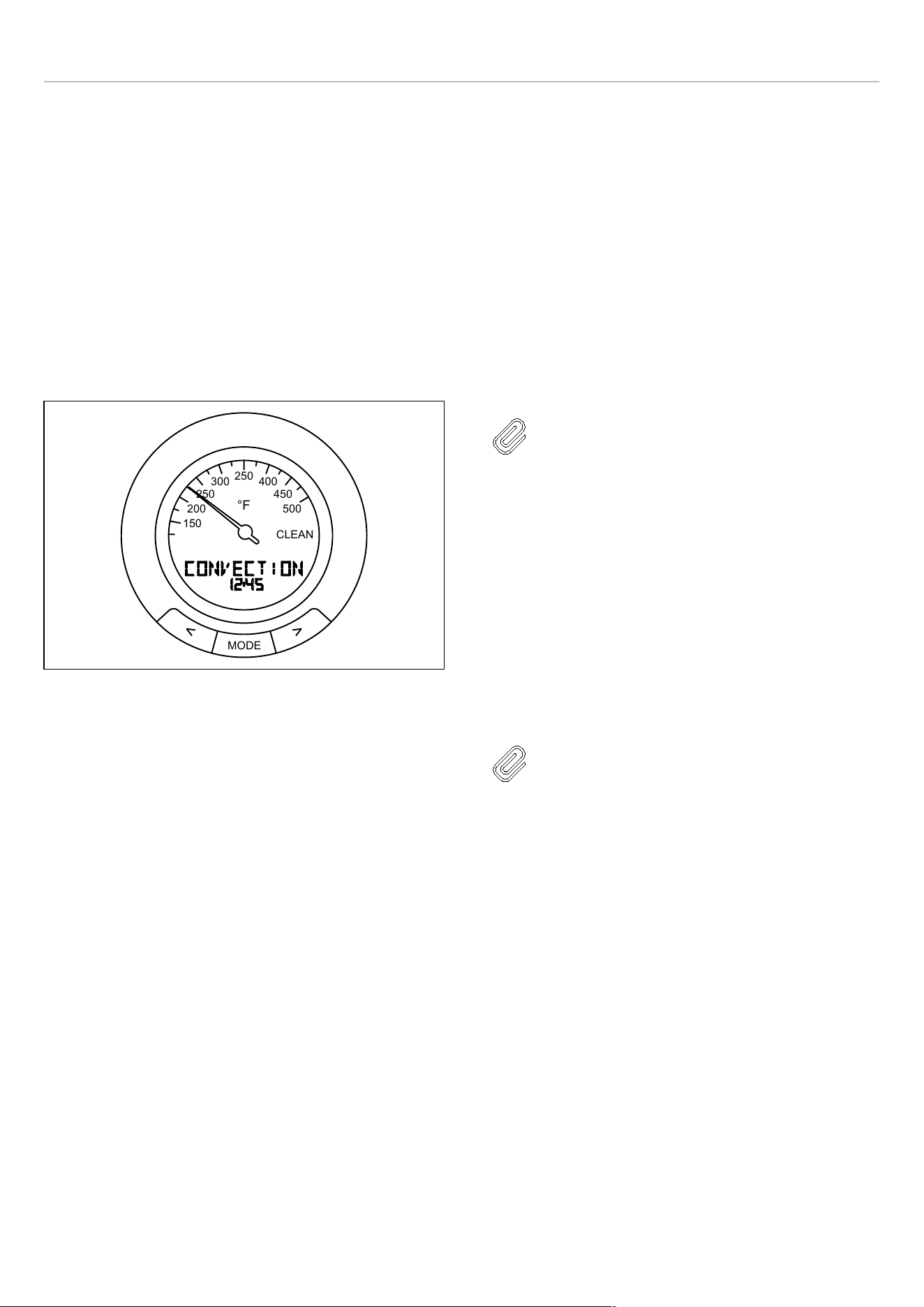
OVEN TEMPERATURE INDICATOR
The range is equipped with a device to indicate the
temperature in the middle of the oven. This let you check
the temperature inside the oven and adjust food cooking
temperatures more accurately.
When the oven is turned on, the heating elements will start
working at maximum and the thermometer dial will start to
move towards the set temperature. Heat is optimally
distributed inside the oven when the thermometer dial has
stopped and pre-heating is finished. When the oven is
turned off, the temperature on the thermometer will slowly
drop until it reaches room temperature.
• The gauge is for reference only.
Fig. 28
The gauge is equipped with a digital interface that show the
settled functions and manage the cooking time.
SET THE GAUGE
1) Press MODE.
2) Use the “<” and “>” buttons to select SET-UP.
3) Press MODE.
4) Press the “<” and “>” buttons to select desired functions:
language, 12h/24h, time, volume, alarm vol., showroom.
• Language press “<” and “>” buttons to select desired
language and press MODE to confirm
• 12h/24h press “<” and “>” buttons to select desired clock
indication and press MODE to confirm
• Time press “<” and “>” buttons to select desired time
(keep on press the button to fast for wording) and press
MODE to confirm volume
• Press “<” and “>” buttons to select desired volume
control and press MODE to confirm
• Alarm vol. press “<” and “>” buttons to select desired
alarm vol. control and press MODE to confirm
• Showroom: function reserved for retailer use only.
END/DELAY MODE
1) Press MODE.
2) Press the “<” and “>” buttons to select the desired
cooking time and press MODE.
3) Press M to start cooking, press < or > buttons to set a
different end of cooking time (in this function the set time
is the end of cooking) than press MODE to confirm.
4) Set function and temperature with the knobs.
5) If the delay start is settled the display will show the
cooking start time otherwise the oven will switch on.
6) Once the set end of cooking time is finished, a sound will
be heard and the oven automatically switches off.
NOTE
To change selected time restart from point
1.
TIMER
1) Press MODE.
2) Use the “<” and “>” buttons to select TIMER.
3) Press MODE.
4) Press the “<” and “>” buttons to select the desired time
and press MODE.
5) The countdown start immediately and the display will
show the remaining time.
6) Once the set time is finished, a sound will be heard.
NOTE
To change settled time restart from point 1.
This function is only a minute minder and
does not stop the cooking process.
150
200
250
300
250
400
450
500
CLEAN
°F
MODE
39

ELECTRIC OVEN
MEAT PROBE
The meat probe allows you more control over how your
foods are cooked by automatically disabling the specified
cooking mode when a dish's desired temperature, defined
by the cook, has been reached.
The probe will indicate the internal temperature of the meat
as it cooks.
Programming the meat probe.
1) Insert the food probe in the item to be cooked. For best
results, insert the probe as close as possible to the
center of the item and make sure it is not in contact with
bones or fat. Improper placement of the probe could
shut the oven off too early and result in uncooked food.
With poultry, make sure the probe does not rest in a
cavity.
2) Set function and temperature with the knobs.
3) Use the “<” and “>” buttons to select MEAT PROBE.
4) Press MODE.
5) Press the “<" and “>” buttons to select the desired
cooking temperature and press MODE.
6) Insert the items to be cooked on the oven then connect
the probe jack to the port located in the upper left side of
the oven cavity.
7) The display will show current meat probe temperature as
well as set meat probe temperature.
8) When the temperature selected will be reached a tone
will be heard and the oven automatically switches off.
NOTE
To change settled time restart from point 1.
This function does not stop the cooking
process.
NOTE
Once a time function is settle the other time
functions are not available.
According to the recipe the oven can be
pre-heated before use any time functions.
SELF-CLEANING
WARNING
Children should not be left alone or
unattended in an area where appliances
are in use.
• During the Self-Clean cycle, exterior
surfaces may become hotter than usual.
Parts of the appliance may become
potentially harmful to children, and to
persons who lack adult knowledge of
appliances and lack adult reactions to
potentially harmful conditions.
Keep these individuals away during self-
clean and while the appliance is in use.
• The elimination of soil during self-
cleaning may facilitate the emission of
small amounts of chemicals or other
substances that may be harmful upon
sufficient exposure. To minimize
exposure to these substances, provide
good ventilation with an open window, or
use a ventilation fan or hood.
• Keep pet birds out of the kitchen or other
rooms where kitchen fumes could reach
them. During self clean, fumes are
released that may be harmful to birds.
ELECTRIC OVEN
When set to the CLEAN mode, the oven reaches a high
temperature of approximately 840℉/450℃ that burns off all
food residues from the inside of the oven.
When the oven is set for CLEAN, the cooktop burners may
be used. It is common to see smoke and/or flames during
the clean cycle, depending on the content and amount of
greasy residues in the oven. If the flame persists, turn off
the oven and allow it to cool before opening the door and
wipe off the excessive residues.
At the end of the CLEAN cycle, some grey ash or burned
residue may remain inside the oven. This is a mineral
deposit that does not burn or melt. The amount of ash
depends on how heavily soiled the oven was before it was
cleaned. It is easily removed, when the oven is cold, using
a damp paper towel, sponge, or cloth.
Wipe off any smoke residue that remains on the front frame
with a cleaning product suitable for oven cavity cleaning. If
stains remain, use a mild liquid cleaner. The amount of
smoke stain is directly related to the amount of food
residues in the oven cavity before the start of the self-
cleaning cycle.
40
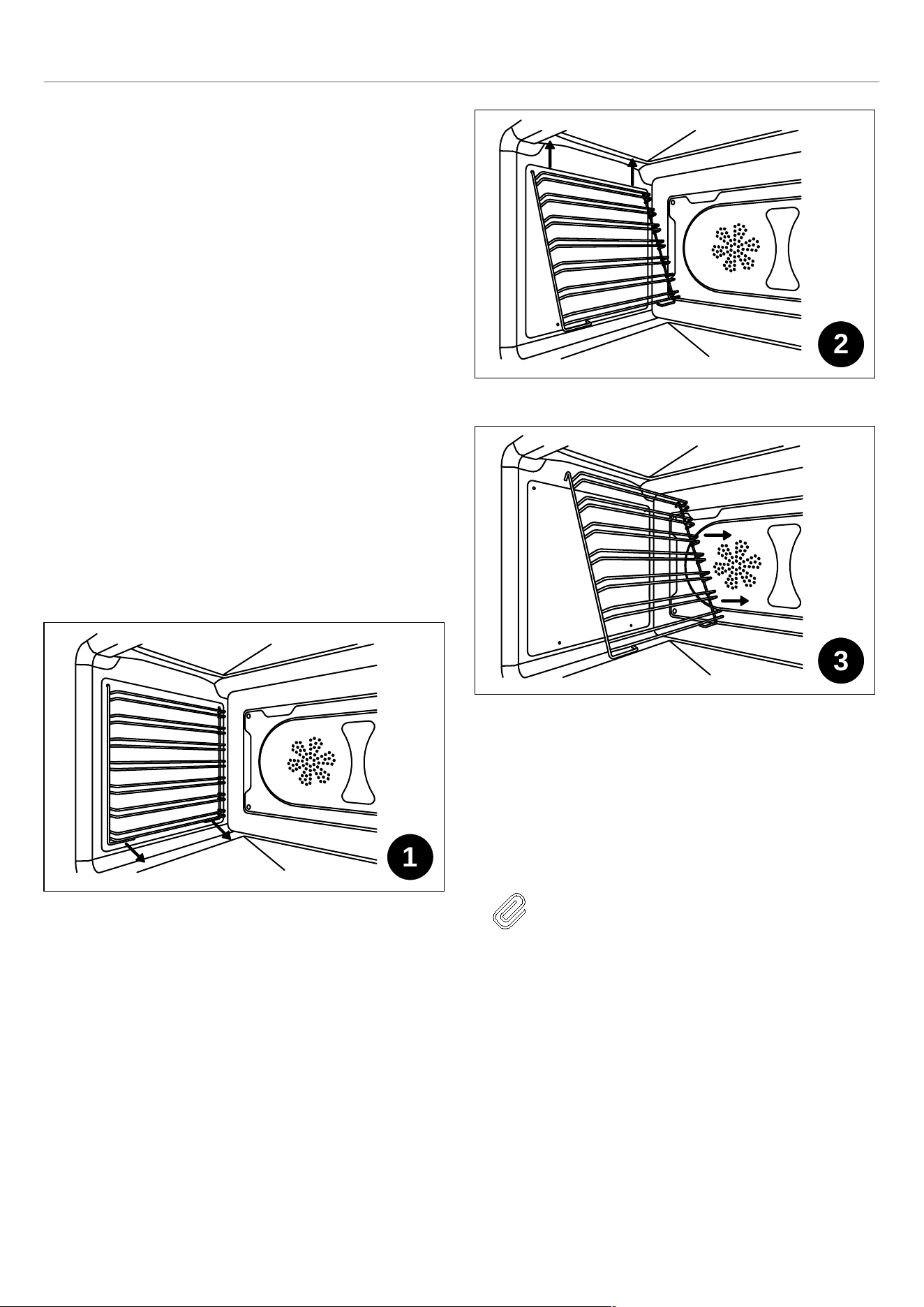
ELECTRIC OVEN
BEFORE SELF CLEANING THE OVEN
Wipe out large spillages, grease and any loose soil that can
be easily removed. Remove any soil that is outside the
door seal area. This appliance is designed to clean the
oven interior and the portion of the door that faces the oven
cavity. The outer edges of the door and the oven cavity are
not in the cleaning zone. Wipe this area clean before
starting the self-cleaning cycle.
Remove all utensils and racks.
Make sure the light bulbs and glass covers are in place.
Turn on the ventilator hood above the range and leave it on
until the self-clean cycle is completed (red indicator light
turning off).
Remove racks
1) Locate the two hooks at the bottom of the rack and
gently pull down contemporary the two hooks.
2) Pull the rack away from the oven side and remove
pulling up the upper hooks of the racks from the side of
the oven.
3) Remove the rack from the oven. Insert the probe closing
cap into the port located in the upper left side of the oven
cavity.
Fig. 29
Fig. 30
Fig. 31
DOOR LOCK
When the CLEAN cycle starts, the automatic door lock
cycle begins. Check the door to confirm that it is locked.
You can stop the self-cleaning cycle by turning the function
selector to the OFF position.
NOTE
Make sure that the oven door is locked at
the beginning of the self-cleaning cycle.
1
2
3
41

ELECTRIC OVEN
TO SET/START SELF-CLEAN CYCLE
1) Check that the oven cavity is completely empty and the
oven door correctly closed.
2) Turn the function control knob to CLEAN.
3) Turn the temperature control knob to CLEAN. After
these 3 steps the cooling fans will activate, the oven
door will lock automatically after 60 seconds and both
the pre-heating and clean light indicators will turn on.
As soon as clean light turns on check to ensure that the
oven door is correctly locked.
AT THE END OF THE SELF-CLEAN CYCLE
The self-cleaning cycle lasts approximately 2-2 ¼ hours;
30-40 minutes for pre-heating the oven (pre-heating and
clean light both on), 60 minutes for actual cleaning (heating
and clean light both on), 30-35 minutes for cool-down (only
clean light on).
When the CLEAN light is turned off the oven door is
unlocked. This will happen when the oven temperature
drops below 460-500℉/240-260℃ about.
At the end of the cycle turn both the oven mode selectors
and the temperature to the OFF position.
CAUTION
The interior of the oven will still be at baking
temperatures when the automatic lock
cycles to its open position and the oven
door can be opened.
42
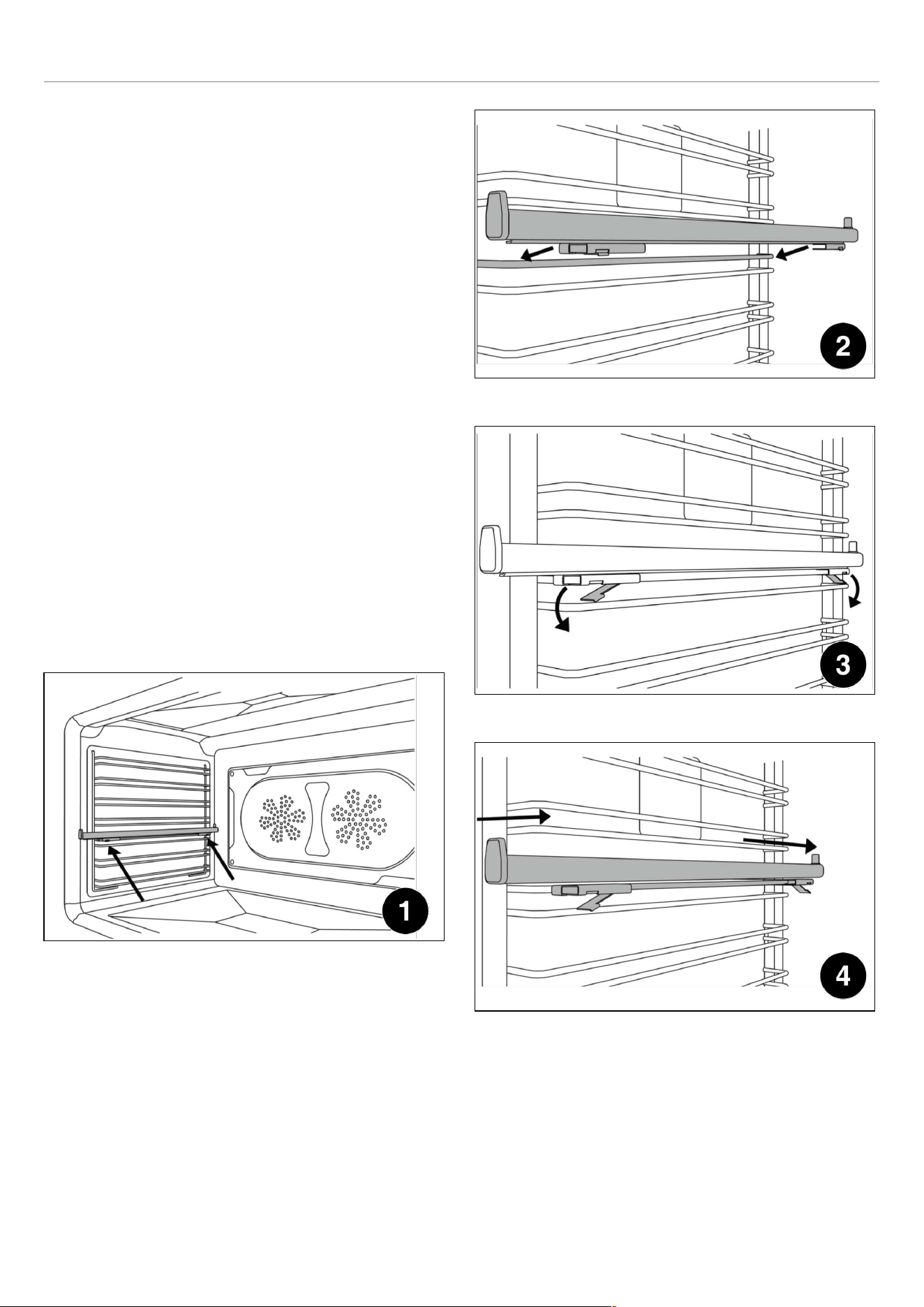
ELECTRIC OVEN
TELESCOPIC GLIDES
The telescopic glides fit any shelf level and work with the
wire shelves provided as standard equipment.
FITTING THE GLIDES
1) Locate the two spring clips at the front and back of the
glides.
2) Locate the pin on the glide that indicates the back.
3) Choose the right level and position the telescopic glide
near the upper wire.
4) Gently insert the front spring clip on the glide.
5) Insert the rear spring clip on the glide.
6) Pull and push each glide to ensure the correct
installation and smooth operation.
7) Extract both glides to the fully extended position and
place the shelf over them, making sure it is accurately
placed between the rear pin and the front pin.
REMOVING THE GLIDES
1) Locate the two spring clips at the front and back of the
glide.
2) Gently pull down the front spring clip.
3) Pull the glide away from the oven side - be careful not to
strain the clip.
4) Repeat steps 2 - 3 on rear spring clip to remove.
Fig. 32
Fig. 33
Fig. 34
Fig. 35
43

KEEPING YOUR BERTAZZONI CLEAN
BURN HAZARD
Make sure the heating elements are turned off and allowed
to cool completely before any cleaning and/or maintenance
operation.
THINGS TO AVOID
• Do not use a steam cleaner to clean the range: the
steam could reach electrical components and cause a
short.
• Do not spray liquids such as cleaning agents into the
openings on the bottom and top of the oven cavity.
• All surfaces can discolor or be damaged if unsuitable
cleaning agents are used. The front of the oven, in
particular, will be damaged by oven cleaners and
descalers. All surfaces are susceptible to scratching.
Scratches on glass surfaces may cause a breakage.
Immediately remove any residues by using suitable
cleaning products.
• The heating elements in the oven do not require
cleaning. The elements burn off any residue when the
oven is in use.
CLEANING STAINLESS STEEL
All stainless steel parts should be wiped with hot water and
soap solution at the end of each cycle. Wipe up spills and
boilovers immediately. Use suitable, non-abrasive stainless
cleaning products when water and soap solution will not do
the job. DO NOT use steel wool, abrasive cloths, cleansers,
or powders. If necessary, scrape stainless steel to remove
encrusted materials, soak the area with hot towels to soften
the residue, then use a wooden or nylon spatula or scraper.
DO NOT use a metal knife, spatula, or any other metal tool
to scrape stainless steel. DO NOT permit citrus or tomato
juice to remain on stainless steel surface, as citric acid will
permanently discolor stainless steel.
CLEANING PAINTED SURFACES
Clean with a soft cloth, warm water and non-abrasive
dishwashing liquid. Whilst still damp, polish dry with a clean
soft cloth.
CLEANING GLASS SURFACES
Clean with cleaning detergent and warm water. Glass
cleaner can be used to remove fingerprints. If using glass
cleaner containing ammonia, make sure that it does not
drip on exterior door surface.
CLEANING THE BROILER PAN
Clean with detergent and hot water. For stubborn spots,
use a soap-filled steel wool pad.
The porcelain enamel finish is acid resistant, but not acid
proof. Acidic foods, such as citrus juices, tomatoes,
rhubarb, vinegar, alcohol or milk, should be wiped up and
not allowed to bake onto the porcelain during the next use.
CLEANING THE INDUCTION COOKTOP
Allow the glass to cool down until the residual heat indicator
is off before cleaning. Never use scouring powders or paste,
metal scourers, oven cleaners or any abrasive cleaning
products on the hotplate. Clean spillovers before using the
cooktop again. For light cleaning, wipe with a soft cloth,
warm water and dishwashing liquid. For a streak free finish,
polish dry with a microfiber cloth. For more stubborn marks
and to condition the surface, use a good quality cooktop
cleaner/conditioner, following the manufacturer’s
instructions. For spillages with high sugar content such as
jam, or the accidental melting of plastic or alloy materials,
turn off the heating zone and remove the spillage
immediately.
Use caution because the heating area may be very hot.
CLEANING THE OVEN CAVITY
• Always allow the oven interior to cool before cleaning.
• Do not allow vinegar, wine, coffee, milk, salt water or fruit
juices to remain in contact with enamelled surfaces for
prolonged periods as they may stain or discolor the
surface.
• Never use sharp utensils to remove stains as this could
scratch the surface.
• Never use steam cleaners on the oven interiors as
steam may damage electronic parts.
• For light cleaning, wipe with a soft cloth, using warm
water and washing up liquid. For heavier residues, use a
cream cleaner and a nylon scourer.
• Oven cleaning products can be used according to the
manufacturer’s directions but care should be taken that
they do not come in contact with any stainless steel,
chrome, painted or alloy parts of the range or the door
seals and elements.
CLEANING OVEN RACKS AND SUPPORTS
Clean with detergent and hot water. Stubborn spots can be
scoured with a soap-filled steel wool pad.
44
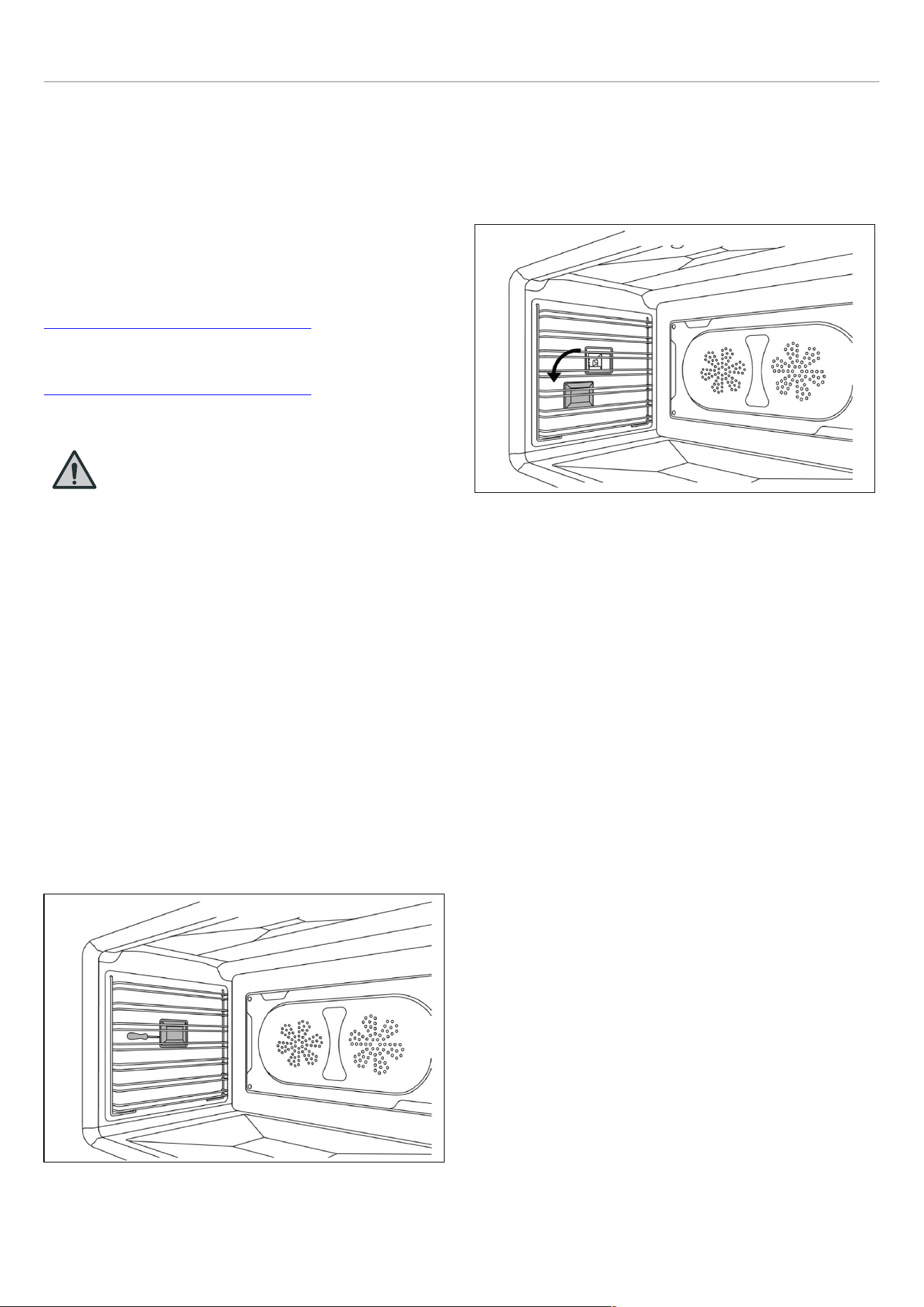
SIMPLE MAINTENANCE
Keeping appliance area clear and free from combustible
materials, gasoline and other flammable vapors or liquids.
Not obstructing the flow of combustion and ventilation air.
These simple tasks can be performed by the owner. For
any other maintenance task, we recommend employing a
trained service technician. Please call our toll free line to
identify service technicians in your area:
If located in the USA 866 905 0010
https://us.bertazzoni.com/more/support
If located in CANADA 800 561 7265
https://ca.bertazzoni.com/more/support
REPLACING OVEN LIGHTS
WARNING
Electric shock hazard!
Disconnect the electric power at the main
fuse or circuit breaker before replacing bulb.
DO NOT touch bulb with bare hands. Clean
off any signs of oil from the bulb and handle
with a soft cloth.
SIDE OVEN LIGHT
Bulb type: halogen G9 120 V, 40 W
• Make sure the heating elements are turned off and
allowed to cool completely. Disconnect the appliance
from the power supply. Remove the oven rack if it
interferes with the light housing.
• Slide the tip of a flat screw driver between the glass
cover and the lamp housing. Gently twist the screw
driver tip to loosen the glass lens cover, holding it in
place with your fingers to prevent it from falling and
breaking.
• Remove the glass lens cover and then remove the
halogen bulb.
Fig. 36
• Place a new halogen bulb in its slot. DO NOT touch bulb
with bare hands.
• Press the glass cover back into place and replace the
oven rack.
• Reconnect the oven to the electrical supply.
Fig. 37
45
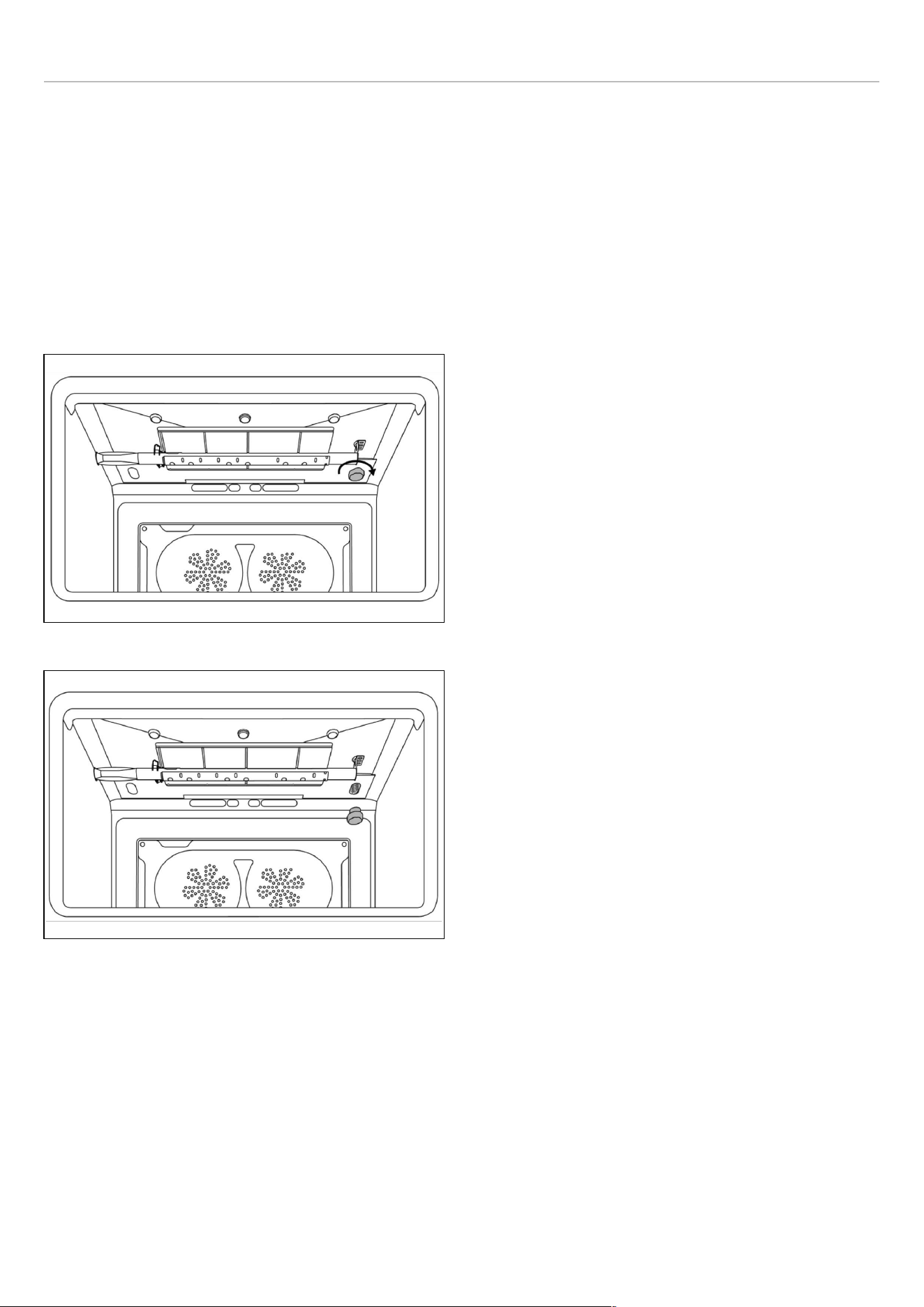
SIMPLE MAINTENANCE
TOP OVEN LIGHT
Bulb type: halogen G9 120 V, 40 W
• Make sure the heating elements are turned off and
allowed to cool completely. Disconnect the appliance
from the power supply.
• Unscrew the glass cover and remove the halogen bulb.
• Place a new halogen bulb in its slot. DO NOT touch bulb
with bare hands.
• Screw the glass cover back in place.
• Reconnect the oven to the electrical supply.
Fig. 38
Fig. 39
46

TROUBLESHOOTING
Here are answer to common problems you may experience.
You are also welcome to call our toll free Customer Service
line to troubleshoot any issue with your Bertazzoni.
If located in the USA
866 905 0010
https://us.bertazzoni.com/more/support
If located in CANADA
800 561 7265
https://ca.bertazzoni.com/more/support
THE OVEN WILL NOT OPERATE
Is there power to the range? Check the switch fuse or
circuit breaker.
THE OVEN DOES NOT HEAT
Check that the showroom function is not activated.
THE CONTROL KNOBS ARE GETTING TOO
HOT
Are you cooking with the oven door open? Keep the oven
door shut when not in use or when grilling/broiling.
A CONTROL KNOB IS LOOSE ON ITS SHAFT
The knob retaining spring clip may have been damaged.
Call our service department for advice and a replacement if
necessary.
FOOD IS COOKING TOO QUICKLY
Are you using a convection mode?
When using a fan-assisted oven cooking mode, it is
recommended to reduce the cooking temperature by 70℉
(20℃) compared to conventional cooking.
FOOD IS NOT COOKING EVENLY
Are you cooking large amount of food or are you using
large bakeware?
Air needs to circulate through the oven for even cooking.
Remove the grill pan from the oven when not in use and
always allow a gap on all four sides of dishes. You may
need to turn your bakeware during the cooking cycle.
Oversized baking sheets, roasting pans and cakeware will
act as a baffle and prevent hot air from moving evenly
around the cavity. Choose cooking equipment that allows a
minimum of 1 inch (2.5 cm) space on all sides to allow the
free movement of heat inside the cavity.
GRILLING IN THE OVEN IS SLOW
Have you selected the correct function?
CONDENSATION FORMS IN THE OVEN
Have you pre-heated the oven?
Condensation is less likely to form when the oven or grill is
pre-heated before use.
SMOKE IS GENERATED IN THE OVEN
Have you selected the right cooking temperature? Are you
cooking food with high fat? Do you rarely use the grill?
Have you cooked fat under the grill? Does the oven interior
need to be cleaned?
Remember to reduce the oven temperature by 70℉ (20℃)
if using a fan function with a recipe designed for
conventional cooking. Use high-sided dishes to contain fats
and splashes. Leave the grill on for a few minutes after
grilling or roasting to burn off fat deposits from the oven roof.
Oven surfaces should be cleaned regularly to prevent
build-up of cooking residues.
Please kindly register on our web site www.bertazzoni.com
to validate your new product warranty and help us to assist
you better in case of any inconvenience.
47

TWO-YEAR LIMITED WARRANTY STATEMENT
WHAT THIS LIMITED WARRANTY COVERS
The Warranty coverage provided by Bertazzoni SpA
(“Bertazzoni”) in this statement applies exclusively to the
original Bertazzoni appliance (“Product”) sold to the
consumer (“Purchaser”) by an authorized Bertazzoni
dealer/distributor/retailer, purchased and installed in the
United States, District of Columbia, or Canada, and which
has always remained within the country of original
purchase (United States, District of Columbia, or Canada).
The warranty coverage is activated on the date of original
retail purchase of the Product and has a duration of two (2)
years.
Warranty coverage is non-transferable.
In the event parts are replaced or the entire product is
replaced, the replacement Product (or parts) shall assume
the remaining original Warranty activated with the original
retail purchase document. This Warranty shall not be
extended with respect to such replacement.
Bertazzoni SpA will repair or replace any component/part
which fails or proves defective due to materials and/or
workmanship within 2 years from the date of original retail
purchase and under conditions of normal residential, non-
commercial use. Repair or replacement shall be free of
charge, including labor at standard rates and shipping
expenses. Purchaser is responsible for making the Product
reasonably accessible for servicing. Repair service must be
performed by a Bertazzoni Authorized Service company
during normal working hours. Labor performed at overtime
or premium rates shall not be covered by the Warranty.
IMPORTANT
Retain proof of original purchase to
establish the warranty period.
Bertazzoni’s liability on any claim of any kind, with respect
to the goods and/or services provided, shall in no event
exceed the value of the goods or service or part thereof
which gives origin to the claim.
30-Day Cosmetic warranty
Inspection of the product must be made by the Purchaser
at time of delivery. Bertazzoni warrants that the Product is
free from manufacturing defects in materials and
workmanship for a period of thirty (30) days from the date
of original retail purchase of the Product.
This coverage includes:
• Paint blemishes
• Chips
• Macroscopic finish defects.
Cosmetic warranty does NOT cover:
• issues resulting from incorrect transport, handling and/or
installation (i. e: dents, broken, bent or deformed
structures or components, broken glass components)
• slight color variations in painted/enameled components
• differences caused by natural or artificial lighting,
location or other similar factors
• stains/corrosion/discoloration caused by external
substances and/or environmental factors
• labor costs, display, floor, B-stock, out-of-box, “as
is” appliances and demo units.
GLASS PROTECTION POLICY
This warranty covers range oven door glass breakage for
the following duration:
EXTERNAL & MIDDLE GLASSES: 90 days after original
purchase date.
INNER GLASS: 180 days after original purchase date.
HOW TO OBTAIN SERVICING
To receive warranty servicing, the Purchaser must contact
Bertazzoni Service for determining the problem and correct
service procedures.
Model number, serial number and date of original retail
purchase will be requested.
IMPORTANT
Retain proof of original purchase to
establish the warranty period.
If located in the USA
866 905 0010
https://us.bertazzoni.com/more/support
If located in CANADA
866 561 7265
https://ca.bertazzoni.com/more/support
48

TWO-YEAR LIMITED WARRANTY STATEMENT
WARRANTY EXCLUSIONS – WHAT IS NOT
COVERED
• Use of the Product in any non-residential, commercial
application.
• Use of the Product for anything other than its intended
purpose.
• Repair service provided by a party other than a
Bertazzoni authorized service agency.
• Damage or repair service to correct servicing provided
by an unauthorized agency or the use of unauthorized
parts.
• Installation not in accordance with local/state/city/county
fire codes, electrical codes, gas codes, plumbing codes,
building codes, regulations, or laws.
• Defects or damage due to improper storage of the
Product.
• Defects or damage or missing parts on products sold out
of the original factory packaging or from displays.
• Service calls or repairs to correct the incorrect
installation of the product and/or related accessories.
• Replacement of parts/service calls to connect, convert
or otherwise repair the electrical wiring and/or gas line to
properly use the Product.
• Replacement of parts/service calls to provide
instructions and training on the use the Product.
• Replacement of parts/service calls to correct issues due
to product usage in a manner other than what is normal
and customary for residential use.
• Replacement of parts/service calls due to wear and tear
such as gaskets, knobs, pan supports, shelving, cutlery
baskets, buttons, touch displays, scratched or broken
ceramic glass tops.
• Replacement of parts/service calls for lack of/improper
maintenance such as but not limited to: residue build up,
stains, scratches, discoloration, corrosion.
• Replacement of glass components and light bulbs if
claim arises after 30 days from original retail purchase
date.
• Defects and damages arising from accidents, alteration,
misuse, abuse, improper installation.
• Defects and damages arising from transport, logistics
and handling of the Product. Inspection of the Product
must be made at the time of delivery. Any issues from
handling, transport or logistics must be notified to the
vending dealer/delivery company after receipt and
inspection.
• Defects and damage arising from external forces
beyond the control of Bertazzoni SpA, including, but not
limited to: wind, rain, sand, fires, floods, mudslides,
freezing temperatures, excessive moisture or extended
exposure to humidity, power surges, lightning, structural
failures surrounding the appliance and other acts of God.
• Products with altered/damaged/tampered serial number.
• Water line connection must be done by a trained and
licensed professional. Issues due to incorrect water line
connections such as, but not limited to, leakage and
water damage to flooring and/or cabinetry, are not
considered a Product issue and are not covered under
manufacturer warranty.
In no case shall Bertazzoni be held liable or responsible for
damage to surrounding property, including furniture,
cabinetry, flooring, panels and other structures surrounding
the Product.
Bertazzoni is not liable nor responsible for the Product if
located in a remote area or an area where certified trained
technicians are not reasonably available. The Purchaser
must bear any transportation and delivery costs of the
Product to the nearest authorized Service center or for the
additional displacement rates of a certified trained
technician.
49

TWO-YEAR LIMITED WARRANTY STATEMENT
THERE ARE NO EXPRESS WARRANTIES OTHER THAN
THOSE LISTED AND DESCRIBED ABOVE, AND NO
WARRANTIES WHETHER EXPRESS OR IMPLIED,
INCLUDING, BUT NOT LIMITED TO, ANY IMPLIED
WARRANTIES OF MARKETABILITY OR FITNESS FOR A
PARTICULAR PURPOSE, SHALL APPLY AFTER THE
EXPRESS WARRANTY PERIODS STATED ABOVE, AND
NO OTHER EXPRESS WARRANTY OR GUARANTEE
GIVEN BY ANY PERSON, FIRM OR CORPORATION
WITH RESPECT TO THIS PRODUCT SHALL BE
BINDING ON BERTAZZONI. BERTAZZONI SHALL NOT
BE HELD LIABLE FOR LOSS OF REVENUE OR
PROFITS, FAILURE TO REALIZE SAVINGS OR OTHER
BENEFITS, TIME AWAY FROM WORK, MEALS, LOSS OF
FOOD OR BEVERAGES, TRAVELING OR HOTEL
EXPENSES, EXPENSES TO RENT OR PURCHASE
APPLIANCES, REMODELING/CONSTRUCTION
EXPENSES IN EXCESS OF DIRECT DAMAGES WHICH
ARE DEFINITIVELY CAUSED EXCLUSIVELY BY
BERTAZZONI, OR ANY OTHER SPECIAL, INCIDENTAL
OR CONSEQUENTIAL DAMAGES CAUSED BY THE USE,
MISUSE OR INABILITY TO USE THIS PRODUCT,
REGARDLESS OF THE LEGAL THEORY ON WHICH THE
CLAIM IS BASED, AND EVEN IF BERTAZZONI HAS
BEEN ADVISED OF THE POSSIBILITY OF SUCH
DAMAGES. NOR SHALL RECOVERY OF ANY KIND
AGAINST BERTAZZONI BE GREATER IN AMOUNT
THAN THE PURCHASE PRICE OF THE PRODUCT SOLD
BY BERTAZZONI AND CAUSING THE ALLEGED
DAMAGE. WITHOUT LIMITING THE FOREGOING, THE
PURCHASER ASSUMES ALL RISK AND LIABILITY FOR
LOSS, DAMAGE OR INJURY TO PURCHASER AND
PURCHASER’S PROPERTY AND TO OTHERS AND
THEIR PROPERTY ARISING OUT OF THE USE, MISUSE
OR INABILITY TO USE THIS PRODUCT SOLD BY
BERTAZZONI NOT CAUSED DIRECTLY BY THE
NEGLIGENCE OF BERTAZZONI. THIS LIMITED
WARRANTY SHALL NOT EXTEND TO ANYONE OTHER
THAN THE ORIGINAL PURCHASER OF THIS PRODUCT,
IS NON-TRANSFERABLE AND STATES YOUR
EXCLUSIVE REMEDY.
Bertazzoni does not assume any responsibility for
incidental or consequential damages. Some states do
not allow the exclusion or limitation of incidental or
consequential damages, so the above limitation or
exclusion may not apply to you. This warranty gives you
specic legal rights and you may also have other rights
which may vary from state to state or province to province.
Any questions about this Limited Warranty may be
directed to Bertazzoni Customer Care.
If located in the USA
866 905 0010
https://us.bertazzoni.com/more/support
If located in CANADA
866 561 7265
https://ca.bertazzoni.com/more/support
50


last page
www.bertazzoni.com
Via Palazzina, 8,
42016 Guastalla RE
© 2023 BERTAZZONI. All rights reserved.
3100831_v.02