
COOKERS
PROFESSIONAL
User Instructions, Installation, Maintenance
Cookers characteristics
These warnings refer to different models of cookers.
Be sure that you have correctly identied the model that you possess (see the rating
plate).
cod. EI33960440000EN
27/2023
ZONA PER
TARGHETTA
MODEL
UP30”
UP36”
UP361”
UPD36”
UPD40”
UP48”
UP60”
UPI304”
UPI366”
UPI3616”
UPID366”
UPDI406”
UPI486”
EN
DIMENSIONS
29 7/8” (W) x 25 19/32” (D) x 35 55/64” (H)
35 7/8” (W) x 25 19/32” (D) x 35 55/64”- 36 7/32”] (H)
35 7/8” (W) x 25 19/32” (D) x 35 55/64”- 36 7/32”] (H)
35 7/8” (W) x 25 19/32” (D) x 35 55/64”- 36 7/32”] (H)
39 7/8” (W) x 25 19/32” (D) x 35 55/64”- 36 7/32”] (H)
47 7/8” (W) x 25 19/32” (D) x 35 55/64”- 36 7/32”] (H)
59 7/8” (W) x 25 19/32” (D) x 35 55/64”- 36 7/32”] (H)
29 7/8” (W) x 25 19/32” (D) x 35 55/64” (H)
35 7/8” (W) x 25 19/32” (D) x 35 55/64”- 36 7/32”] (H)
35 7/8” (W) x 25 19/32” (D) x 35 55/64”- 36 7/32”] (H)
35 7/8” (W) x 25 19/32” (D) x 35 55/64”- 36 7/32”] (H)
39 7/8” (W) x 25 19/32” (D) x 35 55/64”- 36 7/32”] (H)
47 7/8” (W) x 25 19/32” (D) x 35 55/64”- 36 7/32”] (H)


3
INSTRUCTIONS FOR USE
User manual
First system startup of the hob
Ignition of the “dual” burner
Use of the coup feu
Use of the electronic programmer
Use of the electric oven multifunction / static
Functions list for multifunction oven
Functions list for static oven
Accessories
INDUCTION APPLIANCES
COOKTOP
Instructions for use
Cleaning and maintenance induction appliances
Fan oven cooking chart
Natural convection oven cooking chart
ELECTRICAL SKETCHES
ELECTRICAL AND GAS POWER TABLE
Injectors for a device installed at an altitude abo-
ve 2000 ft
IMPORTANT SAFETY WARNINGS
Important - please read and follow
Important instruction
Induction appliance
INSTALLATION
Installation instructions
Instruction for base feet assembly
Pressure gas regulator installation instruction
Backguard installation instruction
Minimum spacing from combustible construction
Electrical connection
Induction appliance electrical connection
Gas connection
Performance checklist
Adjustment of the pressure regulator for use with
different type of gas
Changing the injectors
Conversion kit installation instructions
Burners of the top
Adjusting the minimum gas ow
CLEANING AND MAINTENANCE
Replacing the bulb
Door removal
Cleaning the door and glasses
CLEANING THE OVEN
INDEX
4
4
6
7
8
8
9
10
11
12
13
13
14
15
16
17
19
20
21
22
22
23
24
25
26
26
27
28
29
30
32
33
34
35
36
36
37
41
42
43
44
57
58
4
• Before beginning, please read these instructions completely and carefully.
• Do not remove permanently afxed labels, warnings, or plates from the product. This may void the warranty.
• Please observe all local and national codes and ordinances.
• Please ensure that this product is properly grounded.
• The installer should leave these instructions with the consumer who should retain them for local inspector’s use
and for future reference.
WARNING
IMPORTANT - PLEASE READ AND FOLLOW
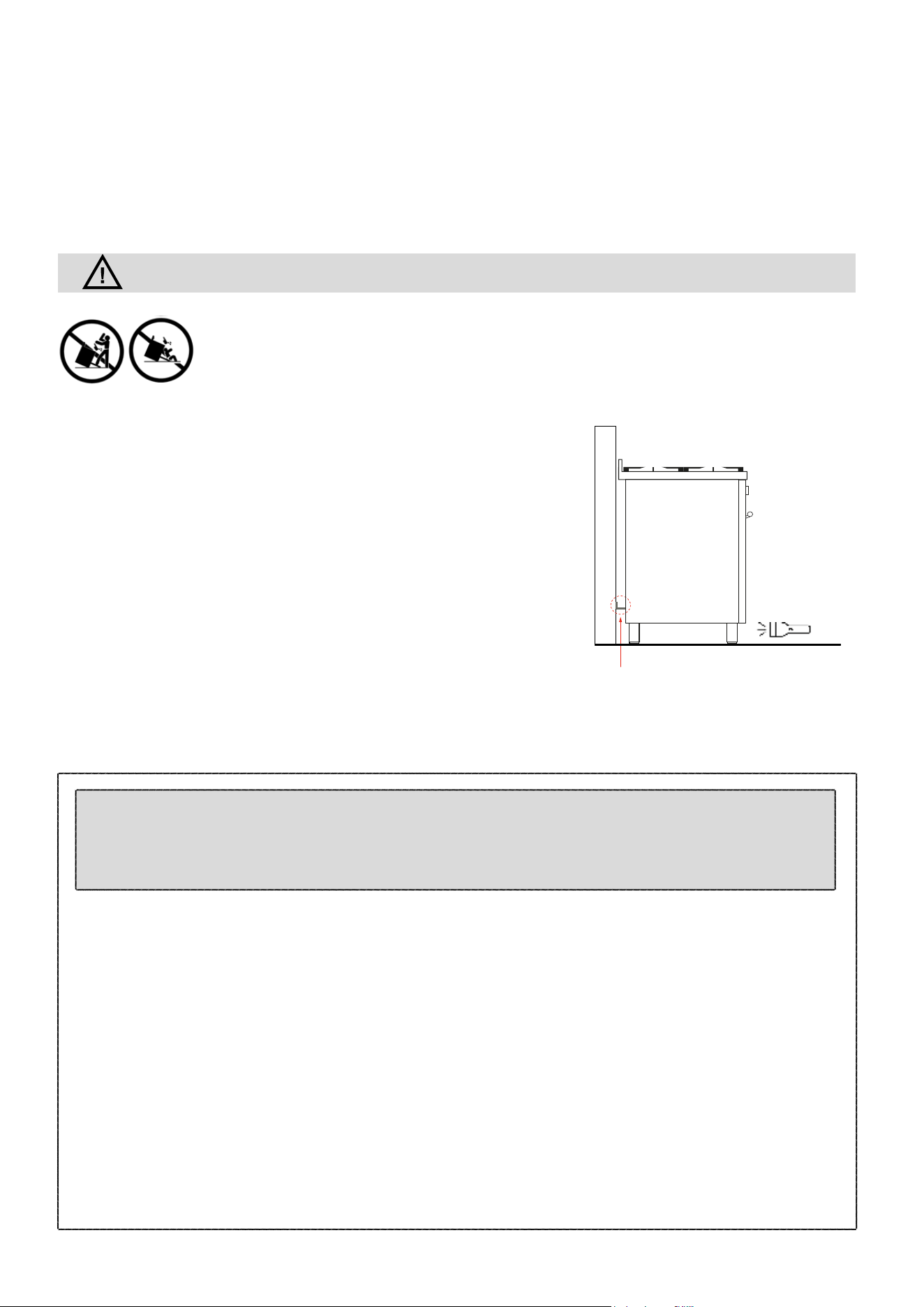
TIPPING HAZARD
To reduce the risk of the appliance tipping, it must be
secured by a properly installed anti-tip bracket(s). Ve-
rify that the anti-tip bracket has been properly atta-
ched to the oor or wall as directed in the installation
instructions. After removing the drawer, or the panel
under the door, using a ashlight, verify that the an-
ti-tip bracket has been installed properly
• THIS RANGE CAN TIP
• INJURIES TO PERSONS CAN RESULT
• INSTALL ANTI-TIP DEVICE PACKED
• WITH RANGE
• SEE INSTALLATION INSTRUCTIONS
WARNING If the informations in this instructions is not
followed exactly, a re or explosion may result causing
property damage, personal injury or death.
— Do not store or use gasoline or other ammable vapors and liquids
in the vicinity of this or any other appliance.
— WHAT TO DO IF YOU SMELL GAS:
• Do not try to light any appliance.
• Do not touch any electrical switch.
• Do not use any phone in your building.
• Immediately call your gas supplier from a neighbor’s phone.
Follow the gas supplier’s instructions.
• If you cannot reach your gas supplier, call the re department.
— Installation and service must be performed by a qualied installer,
service agency or the gas supplier.
Anti-tip bracket

5
WARNING
• NEVER use this appliance as a space heater to heat or warm the room. Doing so may result in carbon monoxide
poisoning (only for GAS cooking).
• IF YOU OR SOMEONE IN YOUR FAMILY HAS A PACEMAKER, PLEASE CONSULT WITH A PHYSICIAN BEFORE USING. Due to
high operating frequencies, a pacemaker may not function properly due to electromagnetic transmissions.
• Keep appliance area clear and free from combustible materials, gasoline and other ammable vapors and
liquids.
• A child or adult can tip the range and be killed.
• Install the anti-tip device to the structure and/or the range. Verify the anti-tip device has been properly installed
and engaged [2 options are available: please refer to the pictures at page 10].
• Engage the range to the anti-tip device by [2 options are available: please refer to the pictures at page 10]. En-
sure the anti-tip device is re-engaged when the range is moved.
• Re-engage the anti-tip device if the range is moved. Do not operate the range without the anti-tip device in place
and engaged.
• See installation instructions for details.
• If the enclosed hardware cannot be utilized, please refer to a qualied installer to properly fasten the appliance
so that it does not tip over.
• Failure to do so can result in death or serious burns to children or adults.
• Installation must conform with local codes or in absence of codes, the National Fuel Gas Code ANSIZ223.1/NFPA 54
latest edition. Electrical installation must be in accordance with the National Electrical Code, ANSI/NFPA70 latest edi-
tion and/or local codes. IN CANADA: Installation must be in accordance with the current CAN/CGA-B149.1 National
Gas.
• Installation Code or CAN/CGA-B 149.2, Propane. Installation Code and/or local codes. Electrical installation must be
in accordance with the current CSA C22.1 Canadian Electrical Codes Part 1 and/or local codes.
• Installation of any gas –red equipment should be made by a licensed plumber . A manual gas shut-off valve must
be installed in the gas supply line ahead of the oven in the gas stream for safety and ease of service.
• In Massachusetts: All gas products must be installed by a “Massachusetts” licensed plumber or gastter . A “T” handle
type manual gas valve must be installed in the gas supply line to this appliance. The manufacturer will not be respon-
sible for any damage to property or to persons caused by incorrect installation or improper use of the appliance.
• The manufacture reserves the right to make changes to its products when considered necessary and useful, without
affecting the essential safety and operating characteristics.
• This appliance has been designed for non-professional, domestic use only.
• This appliance must be used only for the purposes for which it was intended. Any other use is incorrect and therefore
dangerous.
• Possible hazards may result from using this appliance for storage space.
• Appliances are not intended for manufactured (mobile) home installation .
• Misuse of appliance doors or drawers such as stepping, leaning or sitting on them can result in damage or personal
hazards or injuries.
• DO NOT TOUCH HEATING ELEMENTS OR INTERIOR SURFACES OF OVEN – Heating elements may be hot even though
they are dark in color. Interior surfaces of an oven become hot enough to cause burns. During and after use, do not
touch, or let clothing or other ammable materials contact heating elements or interior surfaces of oven until they
have had sufcient time to cool. Other surfaces of the appliance may become hot enough to cause burns – among
these surfaces are (identication of surfaces – for example, oven vent openings and surfaces near these openings,
oven doors, and windows of oven doors).
• Care must be taken to prevent aluminum foil and meat probes from contacting the heater elements.
WARNING:
Never Operate the Top Surface Cookìng Section of this Appliance
Unattended
• Failure to follow this warning statement could result in re, explosion, or
burn hazard thai c:ould cause property damage, persona! injury, or death.
• lf a re should occur, keep away from the ap plìance and immediately
call your re department.
DO NOT ATTEMPT TO EXIT AN OIL / GREASE FIRE WITH WATER.

6
All Appliances:
CAUTION: Do Not Leave Children Alone - Children should not be left alone or unattended in area where appliance
is in use. They should never be allowed to sit or stand on any part of the appliance. Do not store items of interest to
children above or at the back of this appliance, as they could climb on the appliance to reach items and be
injured.
Wear Proper Apparel - Loose-tting or hanging garments should never be worn while using the appliance.
User Servicing - Do not repair or replace any part of the appliance unless specically recommended in the ma-
nual.
All other servicing should be referred to a qualied technician.
Storage in or on Appliance – Flammable materials should not be stored in an oven or near surface units.
Do Not Use Water on Grease Fires - Smother re or ame or use dry chemical or foam type extinguisher .
Use Only Dry Potholders - Moist or damp potholders on hot surfaces may result in burns from steam. Do not
let potholder touch hot heating elements. Do not use a towel or other bulky cloth.
When using this appliance, do not touch grates, burner caps, burner bases or any other parts in proximity to the
ame. These components may be hot enough to cause burns. Never leave this appliance unattended when in
use. Boilovers and greasy spills may smoke or ignite Do not heat unopened food containers, such as baby food
jars and cans. Pressure build-up may cause the container to burst and cause injury. Before performing service,
shut off gas by closing the gas shut-off valve and shut off electricy to this appliance For safety when cooking, set
burner controls so ame does not extend beyond the bottom of pan.
• Wear proper apparel. Loose-tting or hanging garments should never be worn while using this appliance.
• Use extreme caution when moving a grease kettle or disposing of hot grease.
• Clean only those parts listed in this guide.
• Do not repair or replace any part of this appliance unless specically recommended in literature accom-
panying this appliance.
• Do not obstruct the ow of air to ensure proper combustion and ventilation.
• IMPORTANT: Do not install a ventilation system that blows air downward toward this gas cooking appliance.
This type of ventilation system may cause ignition and combustion problems with this gas cooking appliance
resulting in personal injury or unintended operation.
• Proper Installation – Be sure your appliance is properly installed and grounded by a qualied technician.
• Never Use Your Appliance for Warming or Heating the Room.
Ovens:
1. Use Care When Opening Door - Let hot air or steam escape before removing or replacing food.
2. Do Not Unopened Food Containers - Build up of pressure may cause container to burst and results in injury.
3. Keep Oven Vent Ducts Unobstructed.
4. Placement Of Oven Racks - Always place oven racks in desired location while oven is cool. If rack must be
moved while oven is hot, do not let potholder contact hot heating element in oven.
5. Do Not Leave Children Alone – Children should not be left alone or unattended in area where appliance is in
use. They should never be allowed to sit or stand on any part of the appliance.
6. Wear Proper Apparel – Loose-tting or hanging garments should never be worn while using the appliance.
IMPORTANT INSTRUCTION

7
• Use Proper Pan Size – This appliance is equipped with one or more surface units of different size. Select utensil
shaving at bottoms large enough to cover the surface unit heating element. Proper ratio of utensil to cooking
zone will also improve efciency.
• Protective Liners – Do not use aluminum foil to line oven bottom, installation of these liners may result in a risk
of electric shock, or re.
• Avoid spilling water or other liquids onto the Induction Cooker, and never immerse the unit in water.
• Do not touch the Ceramic Plate immediately after cooking - it may be hot from residual heat from the utensil.
• Do not place or store very heavy objects on the ceramic plate.
• The heating area is warmed up from the heat of the pan. To avoid injuries (burning) do not touch the heating
• area.
• Do not insert any piece of paper, cardboard, cloth, etc. Between the pan and the heating area, as this might
initiate a re.
• As metallic objects are heated up very quickly when placed on the operating heating area, do not place any
otherobjects (closed cans, aluminium foil, cutlery, jewelry, watches etc.) on the induction cooker.
• Aluminium foil and plastic vessels are not to be placed on the hot surface.
• The surface must not be used for storage.
• Do not place credit cards, phone cards, cassette tapes, or other objects that are sensitive to magnetism on
the ceran plate.
• Do not use pans with an uneven bottom. This might cause internal damage.
• If the supply cord is damaged, it must be replaced by the manufacturer, its service agent or a similarly quali-
ed person in order to avoid a hazard.
• Do Not Cook on Broken Cook-Top- Il cook-top should break, deaning sotutioos and spillovers may penetrate
the broken cook-top and aeate a risi< of electric shock. Cootact a qualied technician immediately.
• Clean cook-top with caution — if a wet sponge or cloth is used to wipe spills on a hot cooking area, be careful
to avoid steam burn. some cleaners can produce noxious fumes if applied to a hot surface.
• Do not place metallic objects such as knives, forks, spoons, and lids on the cooktop surface since they can
get hot
INDUCTION APPLIANCE
8
This appliance shall only be installed by an authorized person. This appliance shall be installed in accordance
with the manufactures installation instructions, IMPORTANT: this appliance must be installed in accordance with the
norms in force of the country concerned.
The installation of this appliance must conform to local codes and ordinances. In the absence of local codes.
Installations must conforms to American National Standards, National Fuel Gas Code ANSI Z223.1-NFPA54.
If local codes permit, a exible metal appliance connection with the new AGA or CGA certi ed design, max. 5
feet (1,5m) long, ½” I.D. recommended for connecting this cooktop to the gas supply line. Do not bend or dama-
ge the exible connector when moving the cooktop. The pressure regulator has ½” female pipe thread. You will
need to determine the tting required, depending on the size of your gas supply line, the exible metal connector
and the shutoff valve.
The appliance , when installed, must be electrically grounded in accordance with local codes or, in absence
of local codes, with the National Electrical Code, ANSI/NFPA 70, CSA C22.1-02.
The appliance and its individual shut off valve must be disconnected from the gas supply piping system during any
pressure testing of that system at test pressure in excess of ½psi (3,5kPa).
The appliance must be isolated from the gas supply piping system by closing its individual manual shutoff valve
during any pressure testing of the gas supply piping system at test pressure equal to or less than ½psi (3,5kPa).
For use with a pressure regulator. The regulator supplied must be used with this appliance; it shall be properly in-
stalled in order to be accessible when appliance is installed in denitive position.
The gas appliance pressure regulator must be set for the gas with which the appliance is used.
This appliance can be used with Natural gas and Propane. It is shipped from the factory adjusted for use with Na-
tural gas: CONVERSION FIXED ORIFICES ARE LOCATED IN THE LITERATURE PACK SUPPLIED WITH THE UNIT.
Injectors kit for the change of type of gas are contained inside the package jointly with the hob installation kit
and Instruction booklet. The maximum inlet gas supply pressure incoming to the gas appliance pressure regulator
is 14” water column (5kPa). The minimum gas supply pressure for checking the regulator setting shall be at least
1”w.c.(249Pa) above the inlet speci ed manifold pressure to the appliance (this operating pressure is 5”w.c. for
Natural Gas and 10”w.c. for Propane.All opening and holes in the wall and oor, back and under the appliance
shall be sealed before installation of the appliance.
ATTENTION: A manual valve shall be installed in an accessible location in the gas line external to the appliance
for the purpose of turning on or shutting off gas to the appliance.
WARNING: Do not use aerosol sprays in the vicinity of this appliance while it is in operation.
The appliances should not be installed with a ventilation system that blows air downward toward the range.
WARNING: Before removing the appliance disconnect the electric power supply cable and close the relevant
shut off valve. Make sure that the electric power supply cable is not damaged during cleaning/maintenance
operations. When repositioning the appliance make sure that the anti-tip device is correctly tted again as
before removal.
NOTE 1:possible risks may result from abnormal usage, including excessive
loading of the oven door.
NOTE 2: reinstall the appliance in accordance with the manufacturer’s
instructions to avoid the risk of tip-over
INSTALLATION INSTRUCTIONS
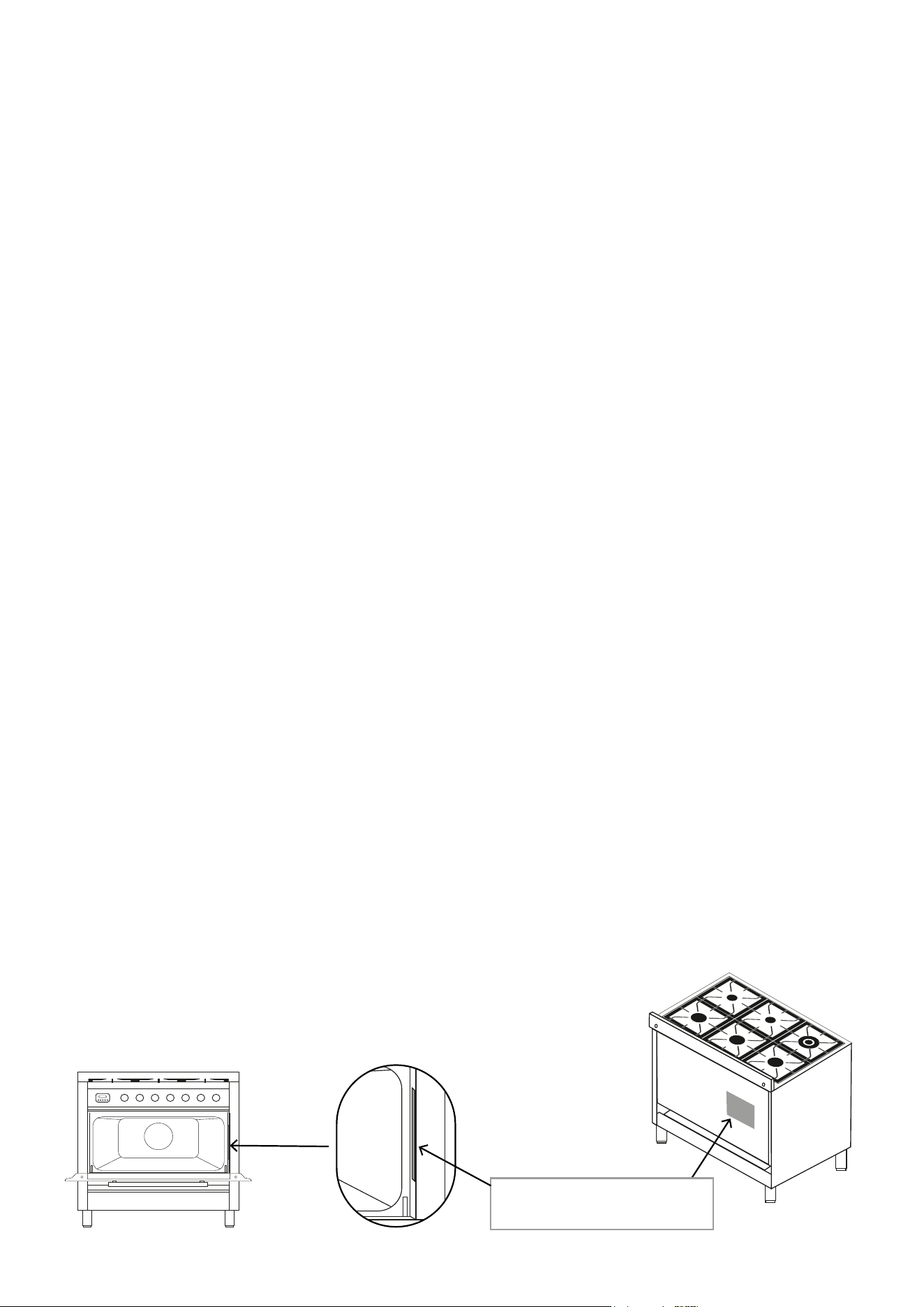
Product Model/Serial Label
and Rating Label Locations
9
INSTALLATION
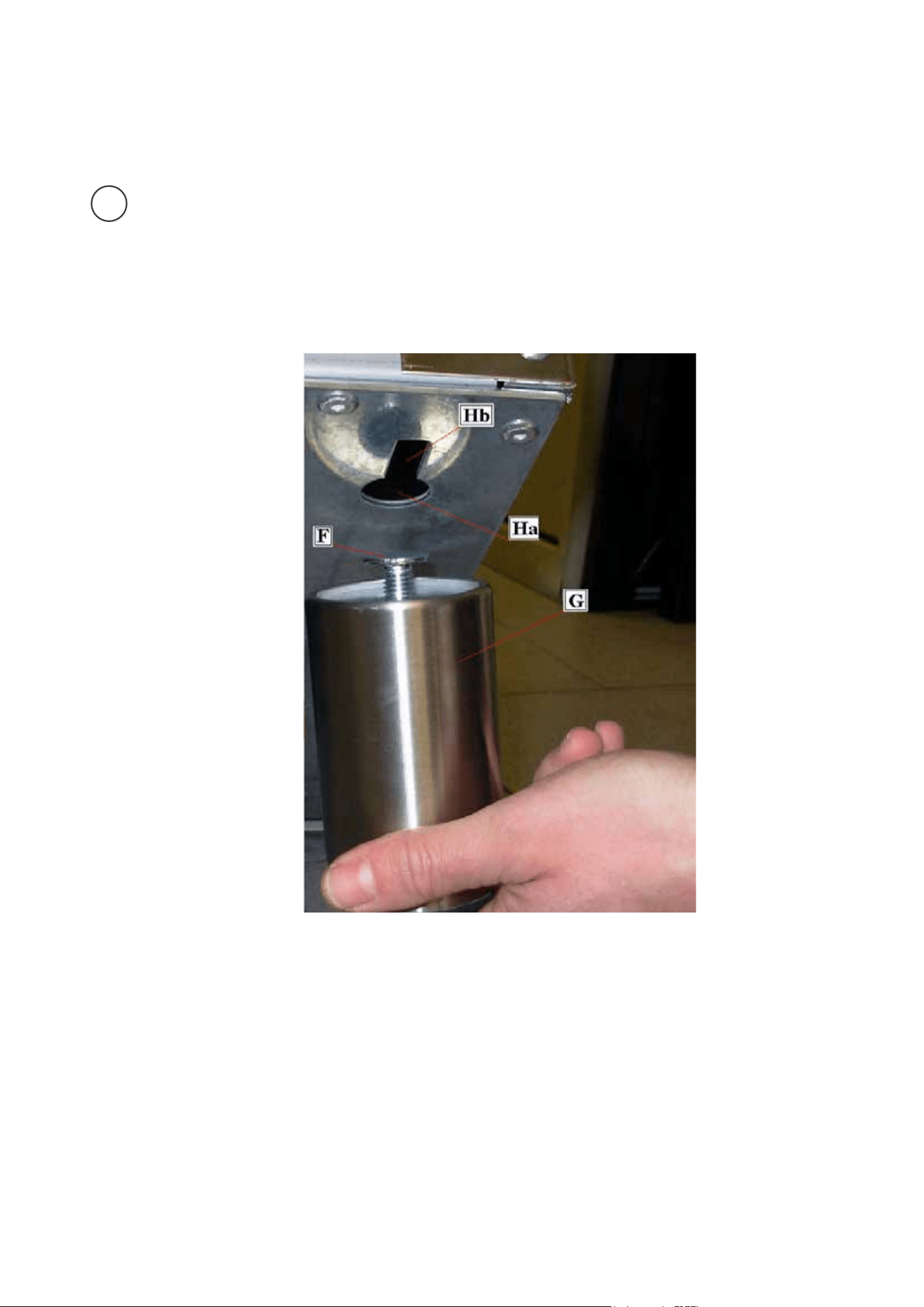
Instruction for base feet assembly
Legs are packed in carton box. Legs should be installed near to where the appliance is to be used,
as they are not secure for long transit. After unpacking the range, raise it about a foot to remove the
bottom shipping skid. Keep the unit raised to permit legs to be screwed into our couplings and lower
it gently to keep any undue strain from the legs and internal mounting hardware. It is strongly recom-
mended that a pallet or lift jack be used rather than tilting.
PROFESSIONAL
1
1) Screw partially bolt (F) into the base feet (G).
2) Insert base feet (G) into the hole (Ha), move to the hole (Hb) and screw completely bolt (F).
10
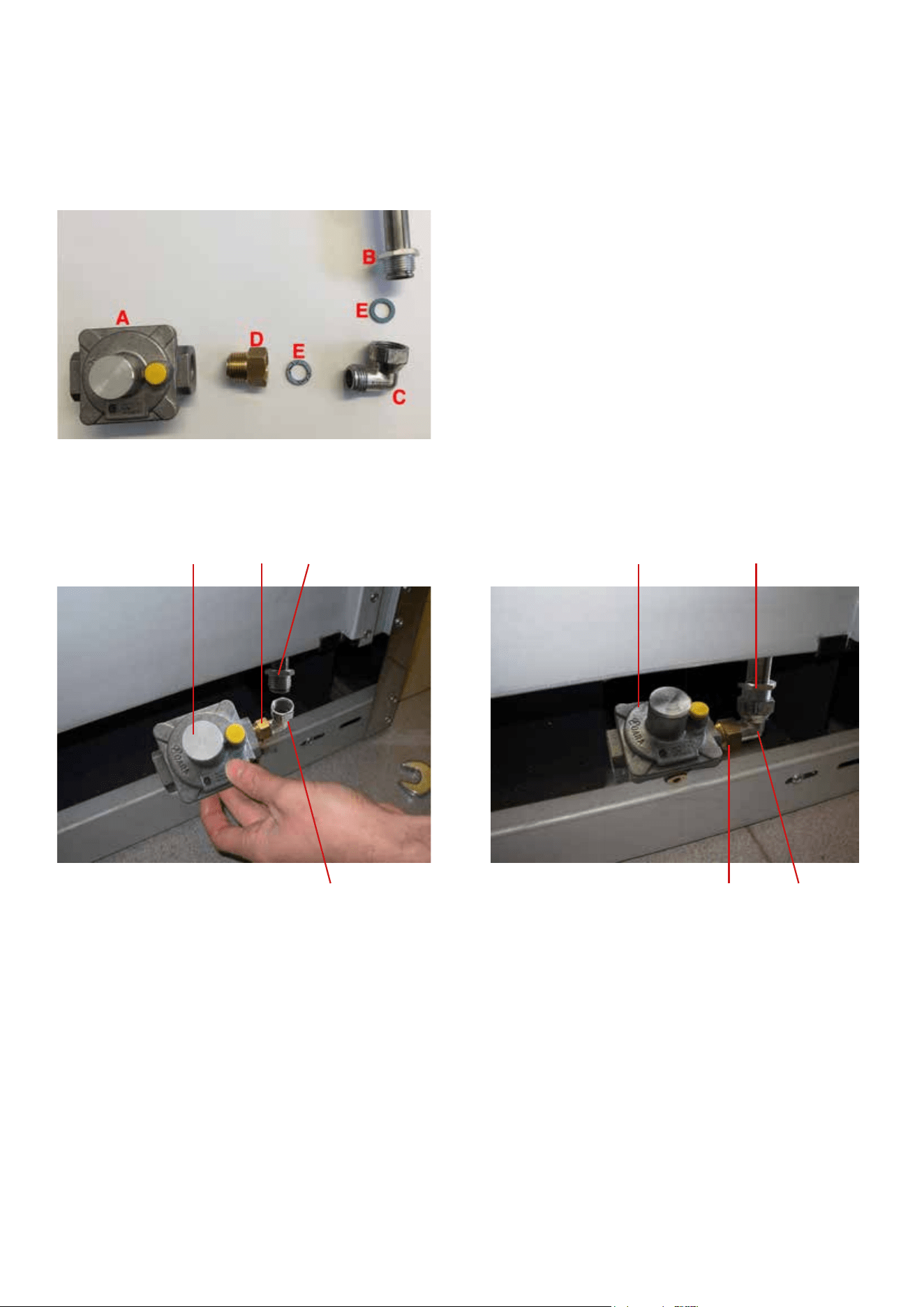
PRESSURE GAS REGULATOR INSTALLATION INSTRUCTION
Pressure gas regulator is supplied with the appliance. It is stored in the oven.
A
A
CC D
D
B
B
Fig. 2a
Fig.1
• As show in g. 2a, unscrew “B“ part from “C” part.
• Screw “C” part into “D” part. Please use a proper gasket for this connection.
• Screw “D” part into “A” part.
• As show in g.2b, screw “A”+”D”+”C” part into “B” part.
NOTE: Tor connection “B”+”C”+”D” PART USE “E” GASKET
Fig. 2b

11
BACKGUARD INSTALLATION INSTRUCTION
HOW TO INSTALL THE ANTI-TIP BRACKET
Please follow the following installation instructions in
sequence:
• Place the backguard and fasten it with the two
screws as shown in gure.
• Please refer to a qualied installer in case the
enclosed hardware cannot be utilized.
Fig. 3
Two bottom screw x backguard
• A child or adult can tip the range and be killed
Install the anti-tip device to the structure and/or the ran-
ge ( see pictures for details) Engage the range to the
anti-tip device as explained in the pictures.
Re-engage the anti-tip device if the range is moved See
pictures for details. Failure to do so can result in death or
serious burns to children or adults
WARNING
• Mark the total height on the rear wall at the centre
of the cooker width. Make two holes and install
the xing bracket.
OPTION 1: wall mounted bracket
ATTENTION: check that the cooker is leaning against
the rear wall to avoid tipping.
Fig. 4a
• Adjust the height of the xing brackets based on the
measurement made as explained above. Fix them to
the oor as shown in the picture below.
OPTION 2: oor mounted bracket
ATTENTION: in this case 2 brackets are needed
• Unpack the cooker and mount the feet and adjust
the height.
• Measure the height from the oor to the top edge of
the back-cross bar (Fig. 4) and add 15mm.
Fig. 4
Fig. 4 b
Fig. 4c
12
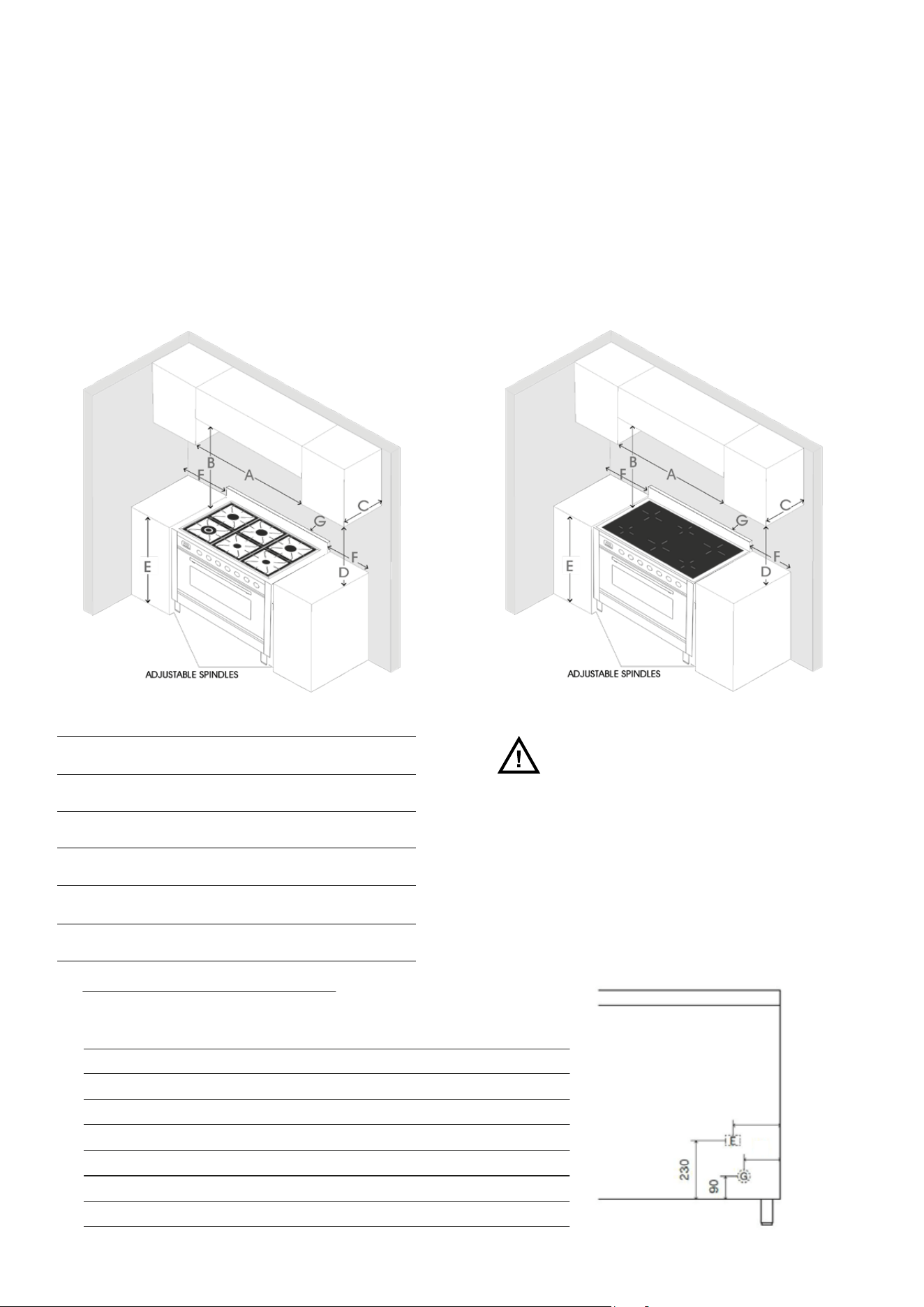
MINIMUM SPACING FROM COMBUSTIBLE CONSTRUCTION
1. This range shall be installed directly adjacent to existing [33
15/32
” - 36
20/32
”] high base cabinets. IMPORTANT:
The top border of the worktop should be at the same level of the adjacent cabinets counter top. This may be
accomplished by raising using the adjustment spindles on the legs.
2. The range CANNOT be installed directly adjacent to sidewall, as cabinets, appliances, or other side vertical
surface above 36
20/32
” high. There must be a minimum of 5” side clearance.
3. Within the side clearance to combustible vertical surfaces above 36
20/32
”, the maximum wall cabinet depth
must be 13” and wall cabinets within this side clearance within this side clearance must be 18” above the 36”
high countertop.
4. Distance A cannot be less than width of the appliance.
5. Distance G this range shall be installed directly adjacent to back wall ( zero clearance).
6. 36’’ minimum clearance between the top of the cooking surface and the bottom of an unprotected wood or
metal cabinet (B).
TABLE 1
A
B
C
D
E
F
≥ [35
7/8
” – 47
7/8
”]
36” (91,5cm)
13” (33cm)
18” (45,7cm)
36” (91,5cm)
5” (12,7cm)
CAUTION
Burn hazard
To avoid risk of personal injury; the use of cabinets
for storage above the appliance may result in a po-
tential burn hazard. Combustible items may ignite,
metallic items may become hot and cause burns. If
a cabinet storage is to be provided the risk can be
reduced by installing a range hood that projects
horizontally a minimum 5” (12.7 cm) beyond the
bottom of cabinets. 390mm= 152
3⁄64
in
ELECTRICAL AND GAS CONNECTION
Mod. / mm A B
UP30 5
3/64
26
27/64
UP36
7
23/64
6
31/32
4
9/16
UPD36
4
1/16
UP361
7
23/64
6
21/32
UPD40 4
3/8
3
55/64
UP48
5
43/64
5
5/32
7
9/16
UP60
6
27/32
C (230) D (90)
7
3/32
4
49/64
6
47/64
4
13/32
6
47/64
4
13/32
6
47/64
4
13/32
6
47/64
4
13/32
6
47/64
4
13/32
6
47/64
4
13/32
C
D
B
A

13
ELECTRICAL CONNECTION
INDUCTION APPLIANCE
ELECTRICAL CONNECTION
The appliance shall be connected to a single phase electric line rated at 120/240Vac and 60Hz
frequency.
The appliance is equipped at the factory with a exible hose . Inside the exible hose you have 4 cables: green
cable must be connected to the ground, white cable (NEUTRAL), red and black cables: supply wire (F – F1). Check
the electrical sketch available at the end in our instructions booklet.Electric power absorption values for each
model are shown in the Electrical and Gas Power Table enclosed.
Before connecting the appliance to the electric network, follow the instructions below:
1. fuse and electric supply installation of your home must bear the load of the appliance (see registration label).
2. The power supply system must have an efcient earth connection.
3. The outlet or multiple-switch, with a minimum1/8” (3mm) contact opening, has to be easily reached once the
appliance has been installed.
The connection of the electrical supply must be done by approved in-
stallation contractors in accordance with specic National and Local in-
stallation standards in conformity with all safety regulations. The warning
signs and rating plates on the appliances must strictly be followed.
This unit is manufactured for a polarized, grounded 120/240 volt 60Hz (2
phases 6 AWG, 1 neutral 8 AWG, 1 ground 8 AWG 0with plug, see Fig. A).
Check and ensure that the supply voltage and the line current matches
the specications given on the rating plate.
Before connecting the appliance to the electric network, follow the in-
structions below:
• fuse and electric feeding installation of your home must support the
load of the appliance (see registration label);
• power supply system must be properly grounded;
• the outlet or multiple-switch, with 1”3/8 inch diameter connection
opening, has to be easily reached once the appliance has been
installed;
• the power supply cable should not reach a 120°F temperature.
Fig. A
WARNING
WARNING
If the voltage is wrong, the
cooker can be damaged.
Dangerous electric voltage inside! DO NOT OPEN
induction unit.
WARNING
Electrical Grounding Instructions
This appliance is equipped with a (four-prong) grounding
plug for your protection against shock hazard and should
be plugged directly into a properly grounded receptacle.
Do not cut or remove the grounding prong from this plug.

14
GAS CONNECTION
All gas connections must be made according to national and local codes. This gas supply (service) line must be
the same size or greater than the inlet line of the appliance. This range uses a ½”NPT inlet. Sealant on all pipe joints
must be resistant to Propane.
1. Manual Shut-off Valve: This installer-supplied valve must be installed in the gas service line ahead of the ap-
pliance in the gas stream and in a position where it can be reached quickly in the event of an emergency.
The manual shut-off valve shall be installed properly in order to be accessible when appliance is installed in
its nal position. In Massachusetts: A ‘T’ handle type manual gas valve must be installed in the gas supply line
to this appliance.
2. Pressure Regulator
1. All heavy duty, commercial type cooking equipment must have a pressure regulator on the incoming service
line for safe and efcient operation, since service pressure may uctuate with local demand. The pressure re-
gulator is supplied separately with the appliance; regulator has two female threads ½” NPT ; it shall be installed
properly in order to be accessible when appliance is installed in its nal position position.
2. This range can be used with Natural or Propane gas. It is shipped from the factory adjusted for use with natural
gas. The orice hoods must be screwed snug when Propane gas is used(see Propane conversion).
3. The appliance, its individual shut-off valve, and pressure regulator must be disconnected from the gas supply
piping system during any pressure testing of that system at pressure in excess of 1/2psig(3.45kPa).
4. The appliance must be isolated from the gas supply piping system by closing its individual manual shut-off
valve during any pressure testing of gas supply piping system at test pressures equal to or less than 1/2psi-
g(3.45kPa).
3. Flexible Connections:
1. If the unit is to be installed with exible couplings and/or quick disconnect ttings, the installer must use heavy
duty, AGA design-certi +ed commercial exible connector of at least ½”(1.3cm)ID NPT(with suitable strain
relieves) in compliance with ANSI Z21.41 and Z21.69 standards.
2. In Massachusetts: The unit must be installed with a 36” (3-foot) long exible gas connector.
3. In Canada: CAN 1-6.10-88 metal connectors for gas appliances and CAN 1-6.9M79 quick disconnect device
for use with gas fuel.
CAUTION: Leak testing of the device should be performed in accordance with the manu-
facturer’s instructions. Before turning on the oven, always check for leaks with a soapy water
solution of another acceptable method. DO NOT USE AN OPEN FLAME TO CHECK FOR LEAKS!
The appliance is supplied without prong: you need a normal one suited for the electric load.
The power supply cable should not reach a 120°F temperature above the ambient.

15
PERFORMANCE CHECKLIST
All burners are tested before leaving the factory. There are no adjustments for the burners if connected according
to the information on the rating plate. Check each burner for proper operations. Flames should be blue in all set-
tings. If service is required, contact your dealer for the name of their authorized service agency. Gas conversions
and initial installation are not responsibility of the manufacturer.:
The installer should carry out the following performance checks. Refer to instructions below.
1. Check surface burner ignition.
2. Check low ame adjustment
3. Check for gas leaks (odors) at all gas connections.
REQUIREMENTS
Room ventilation – Location and venting.
ATTENTION: A exhaust fan may be used with the appliance; in each case it shall be installed in conformity with
the national standards in force.
ATTENTION: Exhaust hood operation may affect other vented appliances; in each case it shall be installed in
conformity with the national standards in force.
CONVERSION TO DIFFERENT TYPES OF GAS
Any conversion required must be performed by your dealer or a qualied licensed plumber or gas service com-
pany.
Please provide the service person with this manual before work is started on the range.(Gas conversions are the
responsibility of the dealer or end user.)
CAUTION
Before proceeding with the conversion, shut off the gas supply to the appliance prior to disconnecting the electr
ical power.
The appliance is supplied for use with a certain type of gas; if this has to be varied, you must change the bur-
ner injectors, adjust the minimum gas ow.
Before carrying out these operations you must disconnect the electric power supply of the cooker to avoid
accidental contacts.
Before carrying out any maintenance work, disconnect the appliance from the gas and electric supply.
16
ADJUSTMENT OF THE PRESSURE REGULATOR FOR USE WITH
DIFFERENT TYPE OF GAS
The pressure regulator supplied with the appliance is a convertible type pressure regulator for use with Natural Gas
at a nominal outlet pressure of 5”w.c. or Propane at a nominal outlet pressure of 10”w.c. and it is pre-arranged
from the factory to operate with one of these gas/pressure as indicated in the pre-arranging labels afxed on the
appliance, package and Instruction booklet.
If Natural gas is converted to Propane, also the by-pass orice has to be changed.
The regulating screw of the by-pass orice must be fully screwed in.
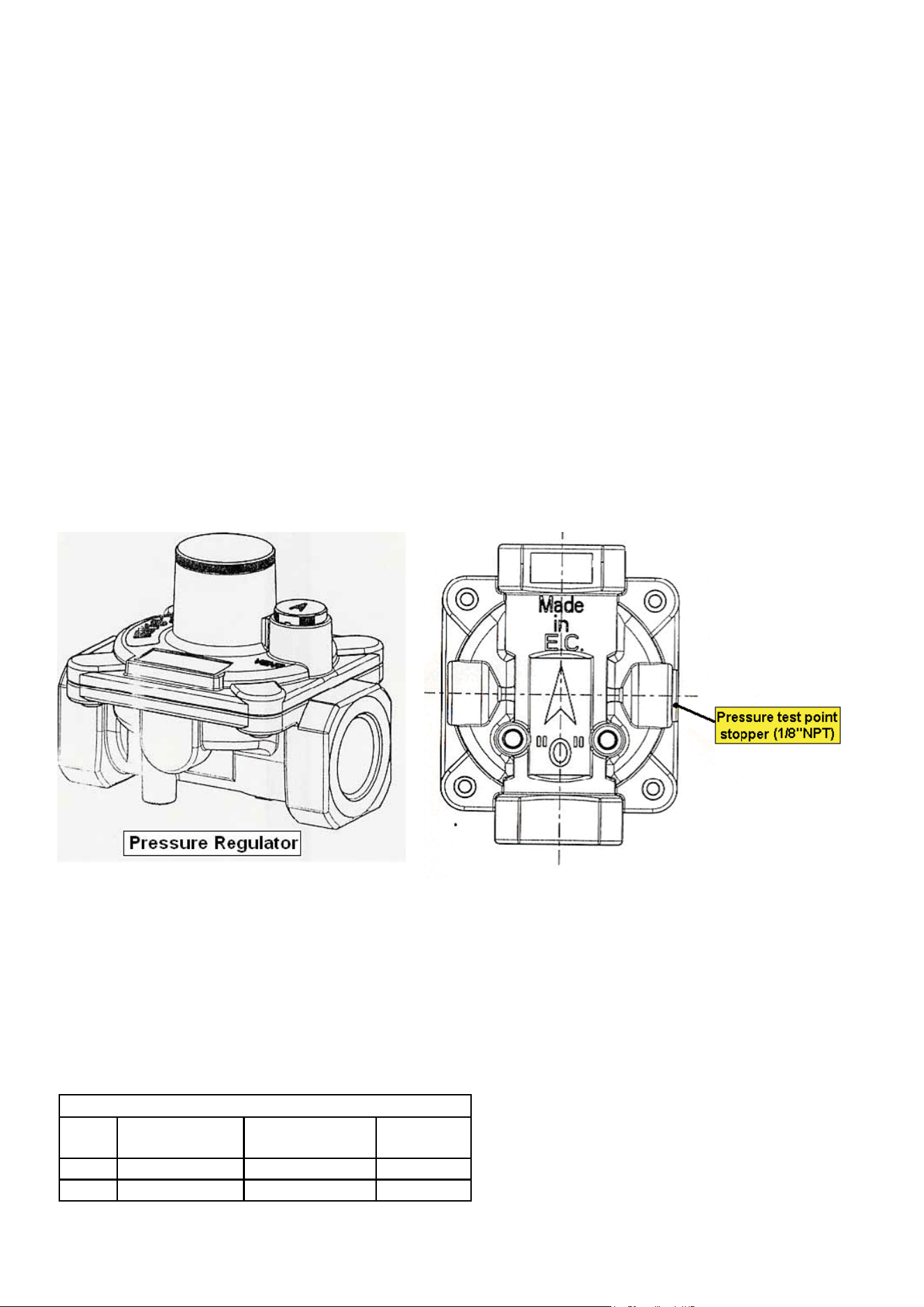
To convert the regulator (Fig.6 and Fig.7) for use with the other gas (different from the one for which it is pre-arran-
ged) it is enough perform the following operations:
1. Unscrew by hand the upper metal stopper of the regulator.
2. Unscrew by hand the white plastic piece screwed under the above mentioned metal stopper, afterward screw
it again in opposite way under the metal stopper(for gas reference see the written “Propane” and “NAT” with
relative indicating arrows on the white piece).
3. Screw again by hand the metal stopper in the original position on the regulator. Operating in this way the gas
regulator is converted for use with the other gas/pressure
Fig. 6 Pressure regulator
See the table below for gas supply pressure requirements.
Fig. 7 Pressure regulator; pressure test-point stopper
is pointed out
If the line pressure is in excess of that amount, a step
down regulator will be required.
The appliance must be disconnected from the GAS
supply piping system during any pressure testing of
that system.
Gas Supply Specifications
Gas
Type
Manifold
Pressure* (WC) Pressure
Max. Input Min. Gas Supply
Pressure (WC)
Natural 5 6 1/2 psi
LP 10 11 1/2 psi
Propane

17
CHANGING THE INJECTORS
BURNER
SR
R
DCC
DUAL
DUAL (only AUX)
P
CDF
SR
R
DCC
DUAL
DUAL (only AUX)
P
CDF
GAS
NATURAL (A)
NATURAL (A)
NATURAL (A)
NATURAL (A)
NATURAL (A)
NATURAL (A)
NATURAL (A)
PROPANE (E)
PROPANE (E)
PROPANE (E)
PROPANE (E)
PROPANE (E)
PROPANE (E)
PROPANE (E)
ORIFICE SIZE
(1/100) mm
120
145
190
75+220
75
145
110
75
90
117
44+135
44
92
65
SIMMER RATE [Btu/h]
1400
2000
6200
6000
900
3100
/
1400
2000
6200
6000
900
3100
/
BY-PASS ORIFICE
SIZE
(1/100) mm
Adj.*
Adj.*
Adj.*
Adj.*
Adj.*
Adj.*
/
32
40
75
27+60
27
52
/
IMPUT RATE
[Btu/h]
7000
10500
16500
25000
2800
10500
5500
7000
10500
16500
25000
2800
10500
5500
TABLE 2
The kit for the gas conversion of the burners is relevant to the model of the appliance indicated on the label sti-
cking to the rst page of this booklet.
The kit contains the number and type of orices necessary for the conversion and a label to stick onto the old one
to show the new setting ( see table 2)
The appliance is pre-adjusted in factory for the gas indicated on the label put on the gas inlet pipe. For the con-
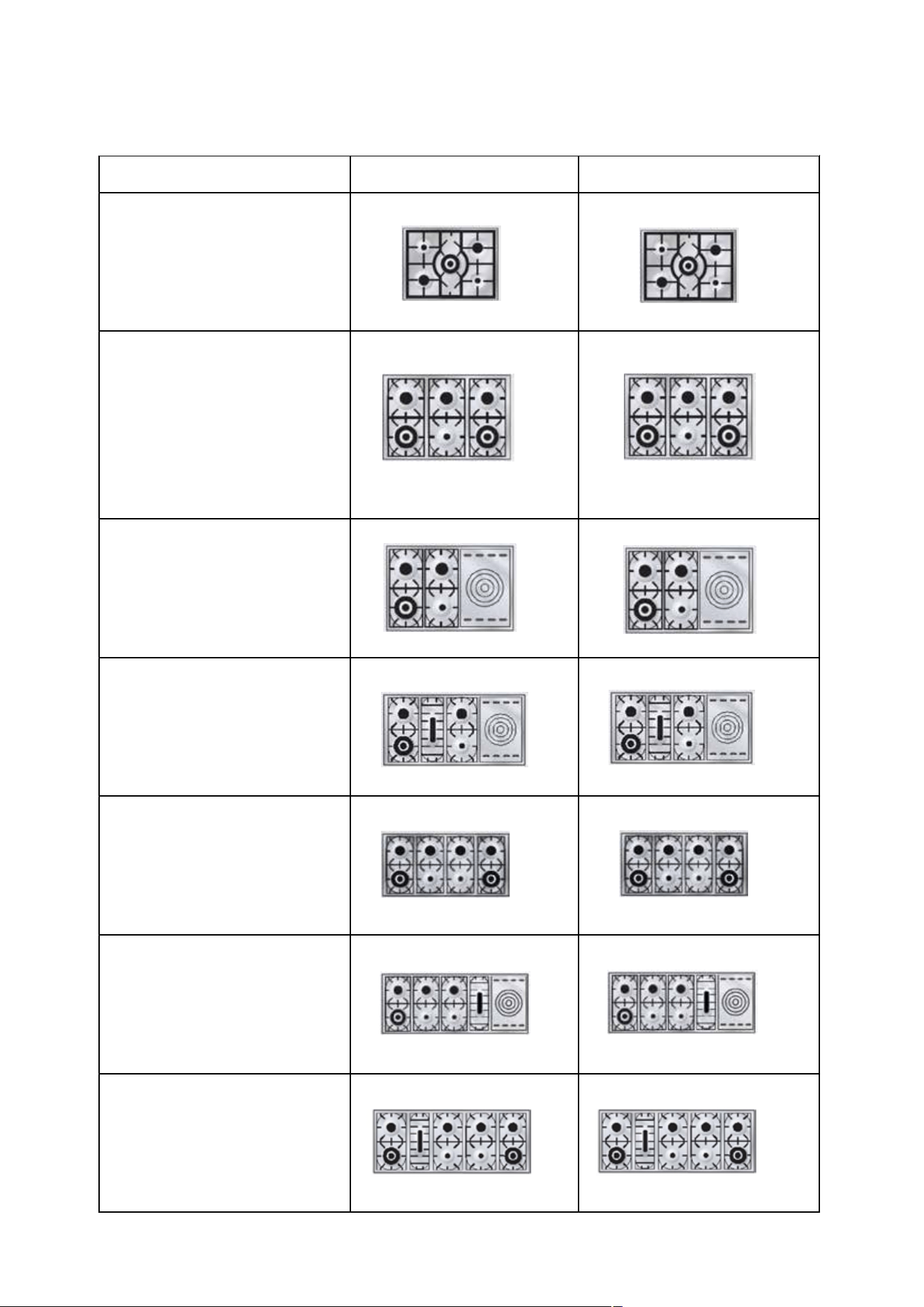
version to another gas refer to table 3 at page 16.
The positions, types of burner and relevant orices for the models included in this booklet are depicted in table 3
at page 16.
The only operation to perform after conversion to a gas different from that shown on the rating plate/label is the
adjustment of the minimum gas ow ( see page 18 of this booklet). After conversion remember to put the new gas
indication label ( supplied in the conversion kit) as close as possible to the existing rating plate , then check the
regular ignition of the burners ( see page 24, “Lighting the burners”).
If the appliance is installed at an altitude exceeding 2,000 ft, a new set of orices can be requested from the
supplier or an authorised service parts distributor.
NOTE: Due to the lower atmospheric pressure at higher altitudes, foods tend to take longer to cook. Therefore, reci-
pe adjustments should be made in some cases. In general, no recipe adjustment is necessary for yeast-risen ba-
ked goods, although allowing the dough or batter to rise twice before the nal pan rising develops a better avor.
Try making the adjustments below for successful recipes. Take note of the changes that work best and mark your
recipesaccordingly. You may also consult a cookbook on highaltitude cooking for specic recommendations.
18
CONVERSION KIT INSTALLATION INSTRUCTIONS
TABLE 3
2
3
4
5
6
7
8
9
A B C
CODE NATURAL GAS PROPANE GAS
UP30(W/N/Q)(MP/S3)
UN30(W/Q/N/QN)(MP/S3)
UT30(W)(S3)
UP36(6/F)(W/N/Q)(MP/S3)
UN36(6/F)(W/Q/N/QN)(MP/S3)
UT36(6/F)(W)(S3)
UP361(6/F)(W/N/Q)(MP/S3)
UN361(6/F)(W/Q/N/QN)(MP/S3)
UT361(6/F)(W)(S3)
UPD36(6/F)(W/N/Q)(MP/S3)
UND36(6/F)(W/Q/N/QN)(MP/S3)
UTD36(6/F)(W)(S3)
UPD40(6/F)(W/N/Q)(MP/S3)
UND40(6/F)(W/Q/N/QN)(MP/S3)
UTD40(6/F)(W)(S3)
UPD40(S)(W/N/Q)(MP/S3)
UND40(S)(W/Q/N/QN)(MP/S3)
UTD40(S)(W)(S3)
UP48(S)(W/N/Q)(MP/S3)
UN48(S)(W/Q/N/QN)(MP/S3)
UT48(S)(W)(S3)
UP48(8/F)(W/N/Q)(MP/S3)
UN48(8/F)(W/Q/N/QN)(MP/S3)
UT48(8/F)(W)(S3)
UP60(S/FS)(W/N/Q)(MP/S3)
UN60(S/FS)(W/Q/N/QN)(MP/S3)
UT60(S/FS)(W)(S3)
UP60(9/F)(W/N/Q)(MP/S3)
UN60(9/F)(W/Q/N/QN)(MP/S3)
UT60(9/F)(W)(S3)
120
75
145
145 145 90 90
90
220+75
135+44
220+75
135+44
145
145 110
90 90
65
120
75135+44220+75
145
145
120
120
220+75
75
75
90
90 135+44
145
145
110
120
145
220+75
90
90
65
75
92
135+44
145
145
145145 90
90
9090
120
220+75
120220+75
75 75 135+44135+44
145
145 145145
120
110
120
220+75
90 929090
75 75
65
135+44
145
145
145145
120
220+75120220+75
90
909092
75 75 135+44
135+44
145
90

19
CONVERSION KIT INSTALLATION INSTRUCTIONS
WARNING: save the orices removed from the appliance for
future use
NOTE: To go back to the original set replace old orices as
shown
WARNING:
This conversion kit shall be installed by a qualied service agency
in accordance with the manufacturer’s instructions and all appli-
cable codes and requirements of the authority having jurisdiction.
If the information in these instructions is not followed exactly, a re,
explosion or production of carbon monoxide may result causing
property damage, personal injury or loss of life. The qualied ser-
vice agency is responsible for the proper installation of this kit. The
installation is not proper and complete until the operation of the
converted appliance is checked as specied in the manufacturer’s
instructions supplied with the kit.
20
BURNERS OF THE TOP
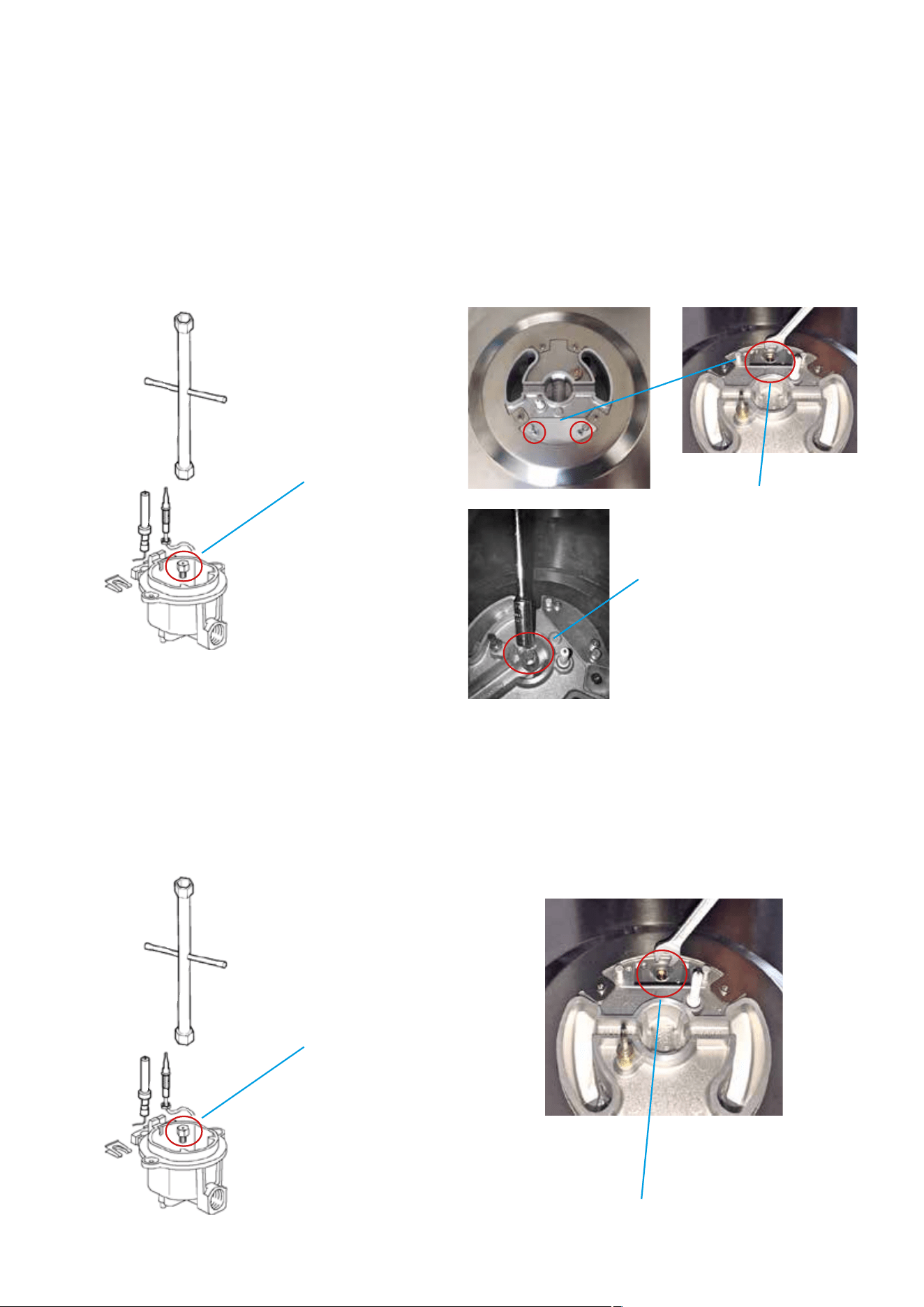
- Replacement of the injectors
Procedure: SR - R
• Remove the grill and the burners from the hob.
• Burners SR – R:
unscrew injectors “U” using a 7 mm spanner (g. 1) and
replace them with those for the new gas according to
table number 2 on page 18. Save the orices remo-
ved from the appliance for future use.
Procedure: DUAL
• Remove the grill and the burners from the hob.
• Unscrew injectors “U” using a 7-mm spanner (g. 8, g 10) and replace them with those for the new gasaccor-
ding to table number 2 on page 18. Save the orices removed from the appliance for future use.
Procedure: DCC
• DCC – Dual burners: unscrew the 2 screws “P” and
remove cover “C” g.2.
• unscrew injectors “U” using a 7 mmspanner (g.3,
g.4) and replace them with those for the new gas
according to table number 2 on page 18. Save the
orices removed from the appliance for future use.
2
4
U
U
1 2
U
U
1
U
3
PP
CC
PP
21
ADJUSTING THE MINIMUM GAS FLOW
SERVICE & MAINTENANCE INSTRUCTIONS
When installing the cooker you must check that the minimum gas ow of the burners on is correctly regulated. If the
type of gas is changed it is indispensable to adjust the minimum ow. The regulating procedure is as follows.
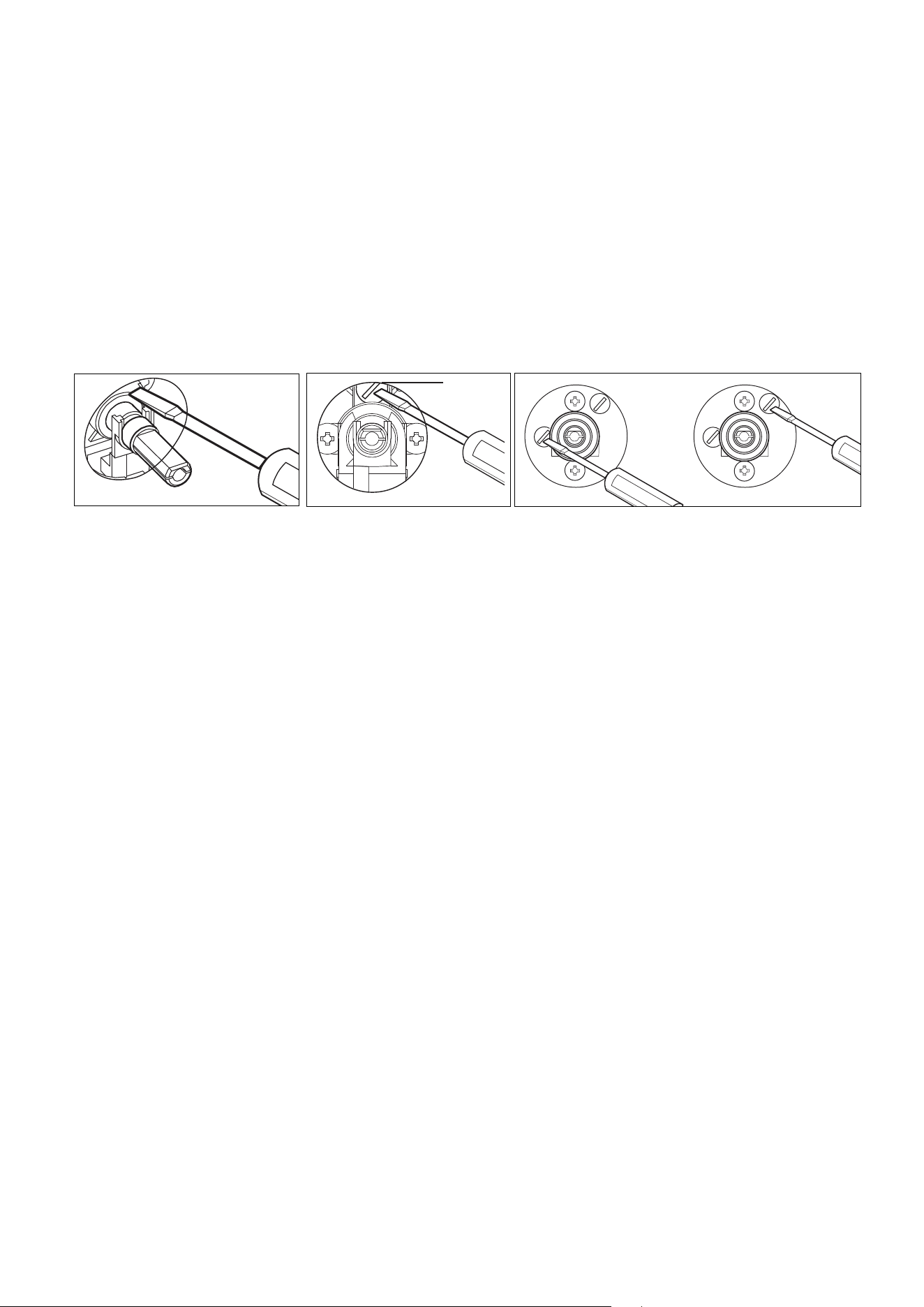
A) Burners on the hob (g. 13)
1. Light one burner at a time and turn the ame up to maximum.
2. Remove the knob of the corresponding gas tap and insert screwdriver in the screw as shown in gure 14a or
14b (DUAL).
3. Turn the tap to minimum position.
4. Unscrew, turning to the left, to increase the ame, or screw to the right to decrease it.
5. If a liquid gas is used (Butane - Propane), the regulating screw must be fully screwed in.
Replacement Parts.
Authorized replacement parts may be used in performing service on the appliance. Replacement parts are avai-
lable from factory authorized part distributors.
Service and maintenance only to be carried out by an authorised person.
To replace parts such burners, valves and electric components, the hotplate must be removed from the bench
top by releasing the attachment hooks, loosening the attachment screws of each burner, unscrewing the hotplate
attachments nuts which are visible at the bottom of the surface, removing the hotplate top and nally replacing the
defective parts.
Note 1: if the valves must be replaced, rst disassemble the ignitions switches wires.
It is recommended to replace the valve gaskets each time the valve is replaced.
Note 2: if the main gas pipe needs replacement, make sure it has the correct welded metal supports for assem-
bly.
WARNING: after rst installation of the appliance, after gas conversion kit installation or after any service intervention
concerning main gas parts of the appliance , make the leak test using water with soap on the gas connections in
order to verify the correct installation. Do not use re for gas leak testing. The test is valid if there is no bubble or foam
build-up during a period of one minute.
NON WORKING APPLIANCES
Before calling the After Sales Service, check that the appliance is connected or that the main switch is activated.
After, call the After Sales Service. The faults must be checked by an experienced technician.
Remark: the appliance is equipped with a safety thermostat, adjusted at a certain temperature. In case it reaches
a higher temperature, the appliance switches off
By-pass
regulating
Figure 14b (DUAL)
AUX
AUX
Figure 13 Figure 14a
22
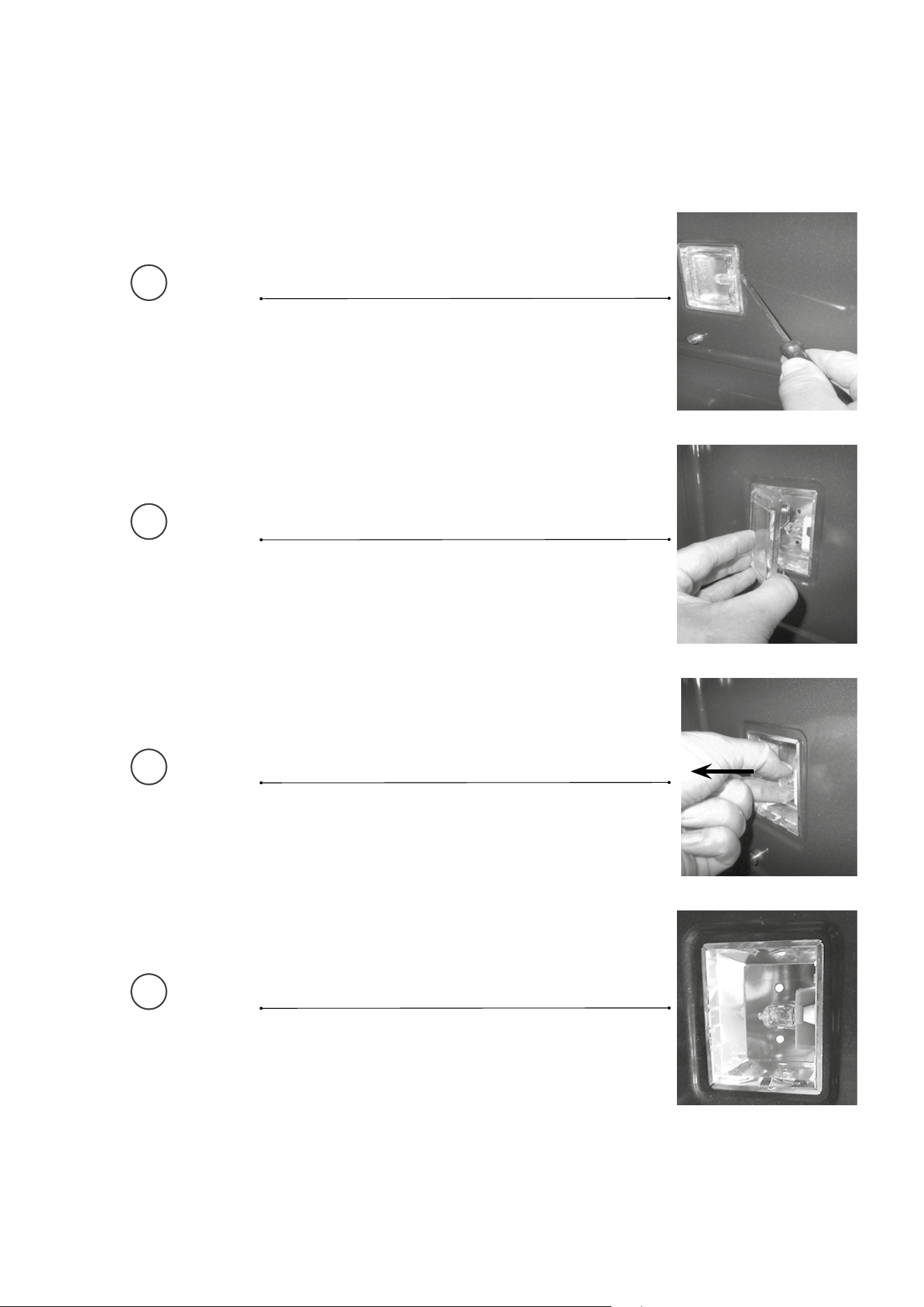
CLEANING AND MAINTENANCE – Replacing the bulb
Losen whit a athead screwdriver
Remove the glass cover
Pull out the light
Replace and close again
Procedure to follow
Should the oven light not work, disconnect the appliance from the mains, remove the lamp protection glass and
replace the bulb. The new bulb must, naturally, be suitable for use at high temperatures and has the characteristi-
cs for such use.
1
2
3
4

23
CLEANING AND MAINTENANCE – Door removal
Procedure to follow
For ease of intensive cleaning it is practical to dismantle the door following these in-
structions:
– open the door
– mow the hook C to the hince zone D, following the speps
Hook C
Zone D
1
2
3
4
24
CLEANING AND MAINTENANCE – Cleaning the door and glasses
Procedure to follow
The oven door is composed of 3 sheets of plate glass (two in some cases). The plate glass parts may be
cleaned using absorbent kitchen paper and an ordinary non-abrasive detergent. Do not use coarse abrasive
cleaning materials or sharp metal scrapers to clean the oven’s glass doors since they can scratch the surface
and cause the glass to shatter.
The inside glass may be removed to facilitate cleaning. To do this it is necessary to dismantle the oven door
or, alternatively, to set it in the intermediate click position.
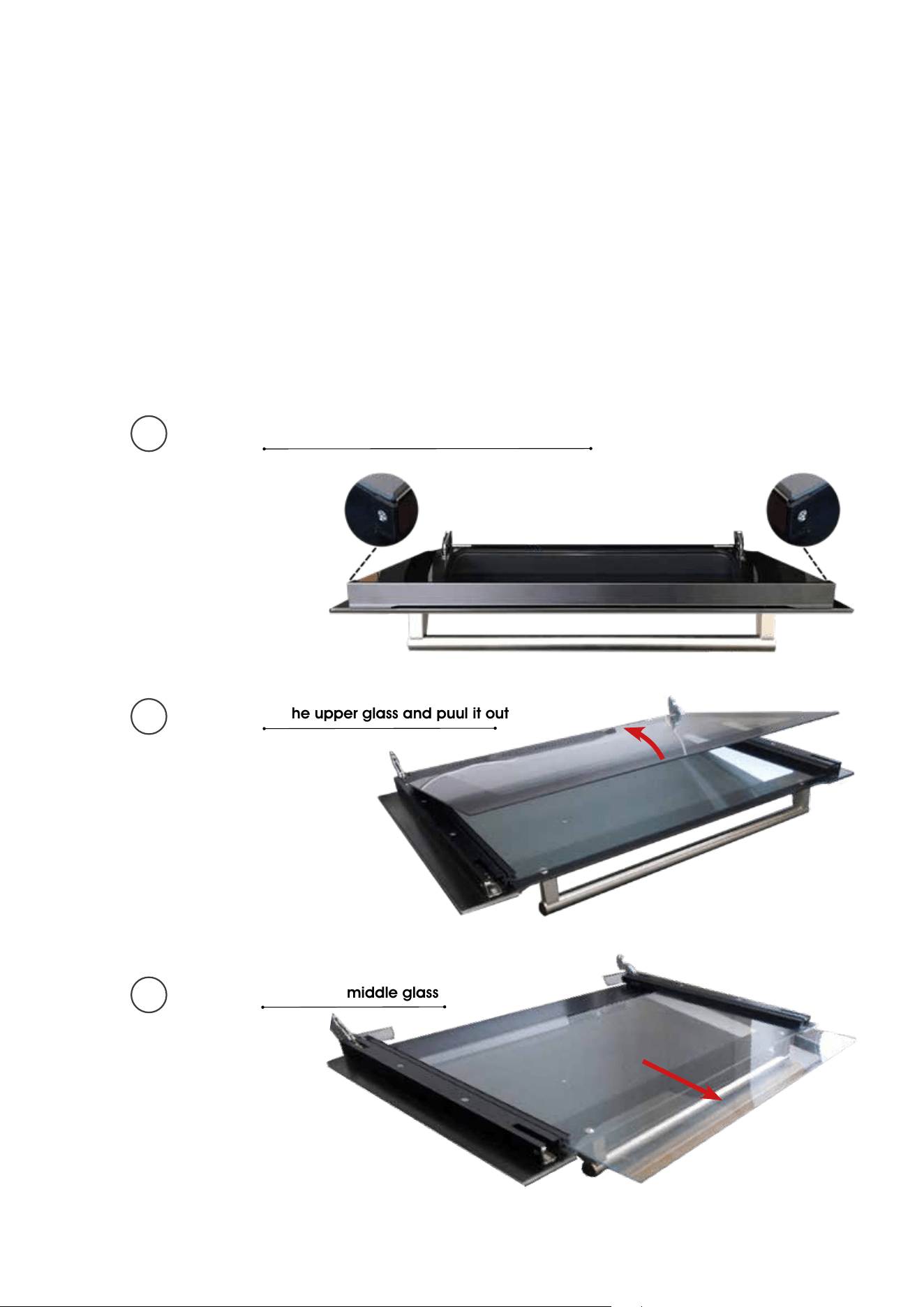
Sequence for removing the glasses
ATTENTION! every procedure must be done whith the door removed and placed on an adequate surface
in order to not damage the door’s facade.
Unscrew the 2 screw on/the sides in the upper baton
Lift the upper glass and puul it out
Pull out the middle glass
1
2
3

25
CLEANING THE OVEN
ATTENTION! Before carrying out any cleaning operations, disconnect the appliance from the mains
and close the gas valve. The cooktop must be cleaned after it has been let cooling down.
WARNINGS
Do not use vapor cleaner to clean the
interior of the oven. Do not use abrasi-
ve/corrosive detergents or sharp tools to
clean the glass of the door as they could
damage and break the surface.
Remove residual food immediately after
use.
Acidic substances such as lemon juice or
other acidic detergents may permanent-
ly damage the enamel of the grills. Ca-
refully dry the grills with a cloth right after
the cleansing. It is not recommended to
wash them in the washing machine.
COMPONENT
Oven inside
Tray
Grills
OVEN
CLEANING METHOD
It is recommended to clean the oven
after every use. Dirt is cleaned more easily
avoiding to let it burn several times at high
temperatures. Remove every removable
part and clean it separately with hot wa-
ter and non-abrasive detergent. The cavi-
ty is cleaned with a soft cloth soaked with
a solution made of water and ammonia.
Rinse and dry.
Immerse in a solution made of water and
neutral soap. Dry afterwards.
Clean with a NON-acidic detergent.

26
USER MANUAL
IMPORTANT: keep children away from the appliance when it operates. The oven door becomes very hot. Safety rules
do not always cover any type of accident. The appliance must not be used for heating purposes. If other electric
appliances are connected to outlets placed near the appliance, make sure that the connection cables will not be
trapped in the oven door while operating.
GENERAL NOTES: for safety reasons and to ensure proper functioning of the appliance, any required maintenance
must be undertaken by skilled technicians or after sales service in warranty period. Clean the oven regularly after
the use. The dirt can be easily removed, in this way it will not burn at high temperatures. Choose heat-resisting pans
according to the quantity of food you want to cook. Stainless steel containers are not recommended as they re ect
heat. Shelf height should be adjusted as necessary according to the food to be cooked and the recipe.
FIRST SYSTEM STARTUP: all removable parts of the oven, should be washed with detergent and then reassembled.
Start the oven for about 60 minutes and set the thermostat to 440°F. During this initial heating period some unpleasant
smell will be experienced, which is unavoidable and quite normal. When the oven has completely cooled down,
clean it referring to the paragraph «Cleaning and care».
IMPORTANT: be sure that you have correctly identied the model that you possess (see the data plate).The various
operations are described below, one after the other. Not all concern the cooker you have bought, select the ones
that do.
b
a
b
c
d
Position the ame divider “b” correctly. To do
this, align the 4 teeth “c” of the ame divider
with the recess “d” of the aluminium Cup “a”.
IMPORTANT: when you are using the oven for the rst time,
let it work empty for one hour, leaving possibly the windows of
the kitchen open. The oven will emanate bad smells due to
production residuals such as greases, oils or resins. After that
the oven is ready for the rst cooking.
USE OF THE TURNSPIT (Fig. 23, 24)
Spit the meats to be cooked. Put the spit on the proper base
and insert it on the spit motor. Place the collector plate on the
lower shelf, ignite the grill, turn on the spit motor.
Figure 21
27
INSTRUCTIONS FOR USE - First system startup of the hob
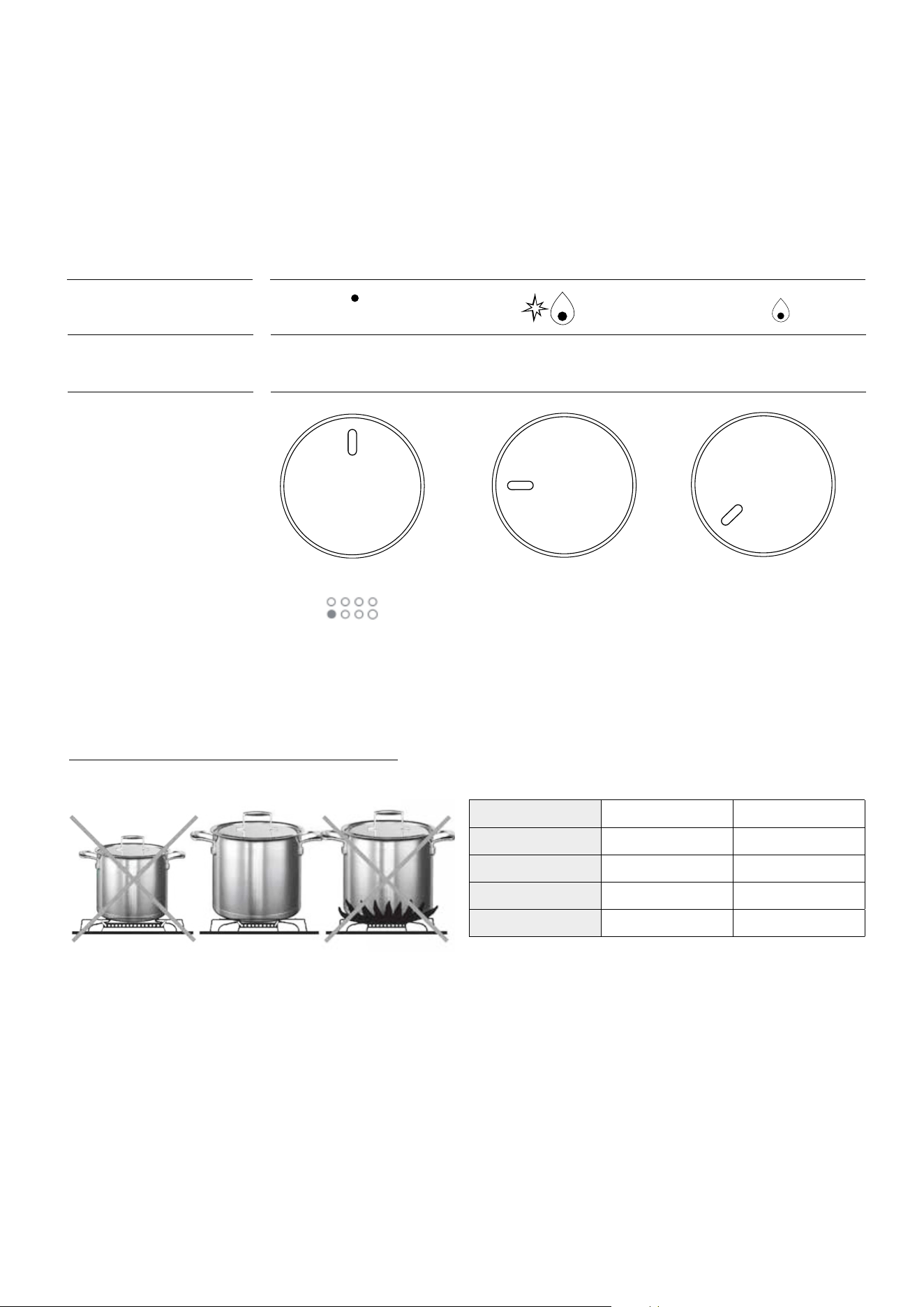
Lighting the burners
The index above the knobs will help you to nd the corresponding burner. Press the knob by turning it anti- clockwise
and bring it to the ignition position; keep the knob pressed for about 5 seconds so that upon its release the ame
remains alight. In case of unsuccessful ignition wait 5 minutes before relighting and repeat the operation. By turning
the knob, the outer ring lights up red to indicate the GAS burner in operation
Recommended pans according to burner size:
ADJUSTING THE MINIMUM GAS FLOW
When installing the cooker you must check that the minimum gas flow of the burners on is correctly regulated. If the
type of gas is changed it is indispensable to adjust the minimum flow. The adjustment procedure is as follows.
Burners on the hob (g. 13)
1. Light one burner at a time and turn the flame up to maximum
2. Remove the knob of the corresponding gas tap and insert screwdriver in the screw as shown in figure 14a
or 14b (DUAL).
3. Turn the tap to minimum position.
4. Unscrew, turning to the left, to increase the flame, or screw to the right to decrease it
5. If a liquid gas is used (Butane - Propane), the regulating screw must be fully screwed in
By-pass
r egula-
ting
Figure 14b (DUAL)
AUX AUX
Figure 13 Figure 14a
LIGHTING THE BURNERS
The index above the knobs will help you to find the corresponding burner. Press the knob by turning it
counterclockwise and bring it to the ignition position; keep the knob pressed for about 5 seconds so that upon its
release the flame remains alight. In case of unsuccessful ignition wait 5 minutes before relighting and repeat the
operation.
SymbolSymbol Function
off
maximum
minimum
index
lighting
OFF
Burners
Meduim
Large
Fish burner
Ring
Dual - Ring
ID
SR
R
P
TC/DCC
DUAL
Diameter Ø (cm)
10 ÷ 20
20 ÷ 24
oval pans (380 x 185)
22 ÷ 28
24 ÷ 30
Recommended pans according to burner size:
44
Burners ID Diameter Ø (cm)
Burners SR 10 ÷ 20
Large R 20 ÷ 24
Ring TC/DCC 22 ÷ 28
Dual - Ring DUAL 24 ÷ 30
LEGEND
Symbol
Function
Knob
Index
off maximum minimum
OFF
OFF
OFF
28
LEGEND AUX
Symbol
Function
Index
LEGEND DUAL
Symbol
Function
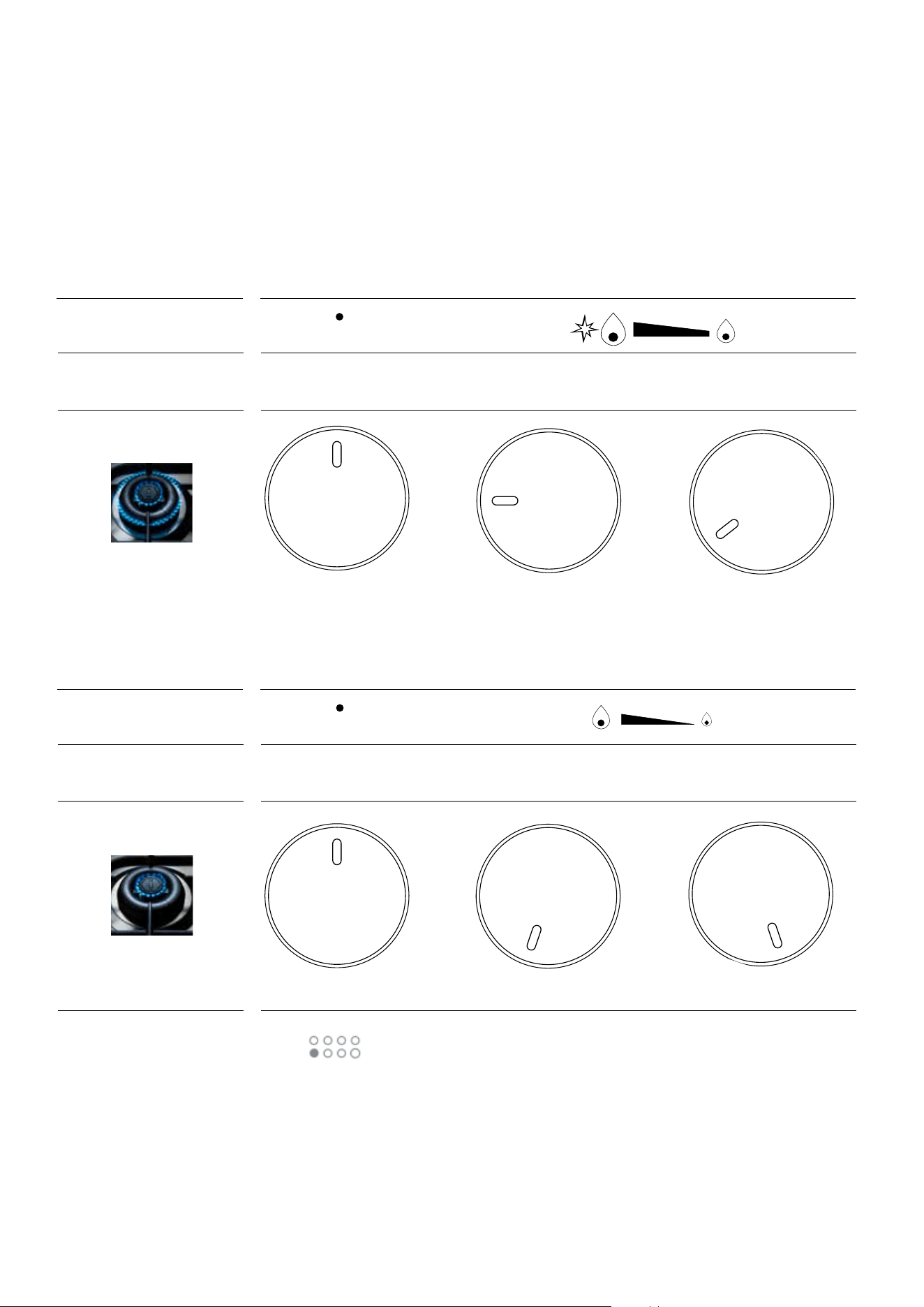
IGNITION OF THE “DUAL” BURNER
ldentify the knob with the help of the index near the knobs. Press and turn the knob to the symbol (maximum) for 5
seconds. Once the burner is on, by turning the knob counterclockwise it gets to its rst block that corresponds to the
middle one By applying a bit of torce, the rst block is overrun and the outer ring goes out leaving only the little cen-
trai burner (called AUXILIARY) turned on. To adjust the auxiliary burner on minimum, rotate the knob counterclockwise
until it stops. At this point, to turn the burner back on, rotate the knob clockwise up to the desired value. By turning the
knob, the outer ring lights up red to indicate the GAS burner in operation
off maximum minimum
OFF
OFF
off maximum minimum
OFF
OFF
29
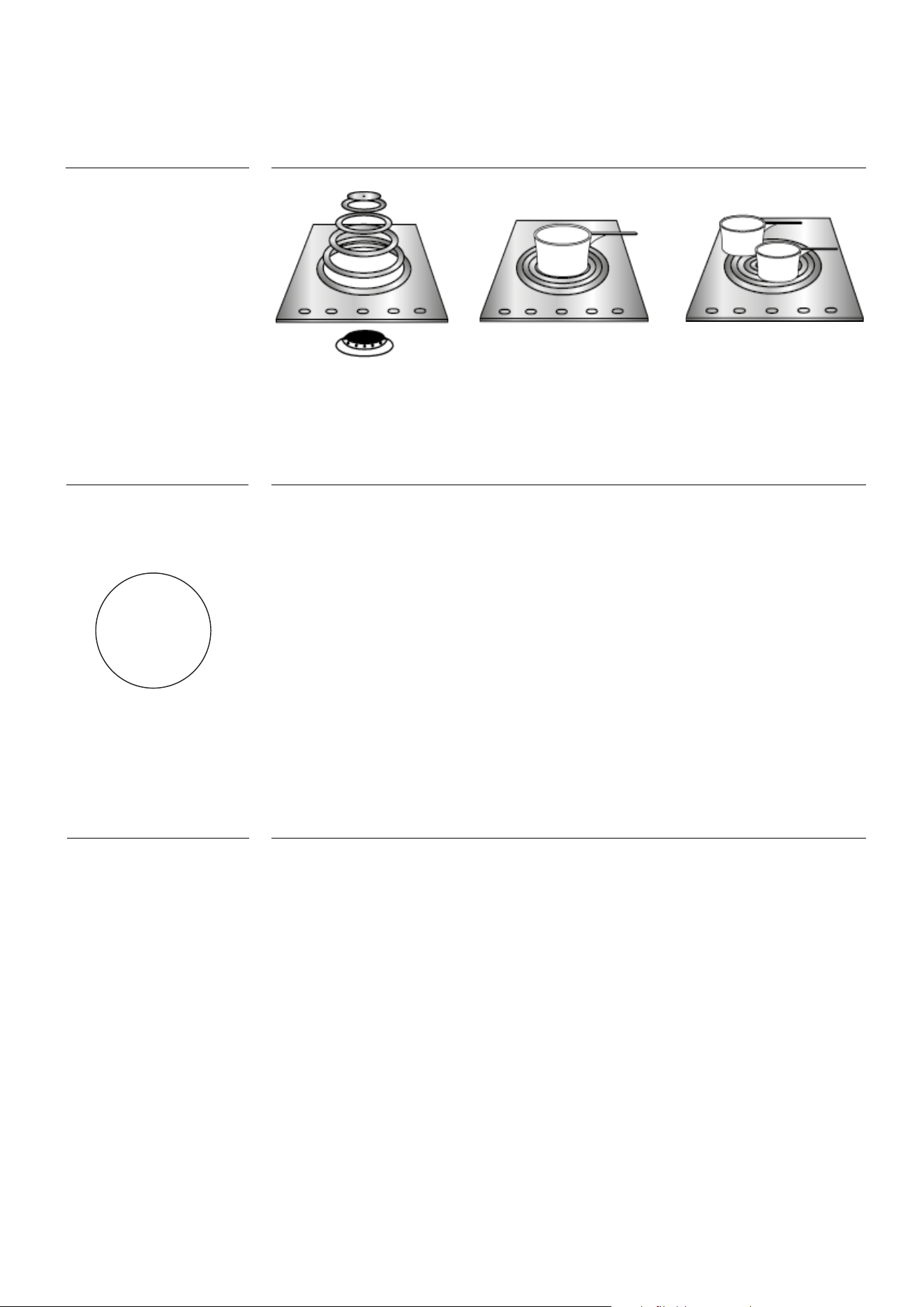
The “Coup feu” solid cast iron plate made of concentric rings allows you to rest the pan
(or even several pans) directly on the surface (g. B, C). It is heated by means of a gas
burner (g. A). The plate is designed to provide a moderately intense heat which is well
distributed over the surface.
To use the appliance, light the ame below the plate by means of the corresponding
knob Fig.D and ensure that there is a ame.
This is ideal for slow cooking and particularly for sauces, browning and grilling, heating
dishes or keeping them warm. Switch the burner on 15/20 minutes before use to allow
the cast iron plate to accumulate heat.
You will then be able to use the plate even when switched off for a further 10/15 minu-
tes. The middle of the plate is the area where the highest temperatures are reached
whereas the outer part is cooler. By simply moving the pan from the middle to the
outside of the plate, you can obtain different cooking intensities without regulating the
ame. Pan dimensions permitting, several dishes can be cooked at the same time
(g. C). If necessary it can be used as a handy top, providing ample space for resting
pots and pans.
The hotplate should be cleaned while still warm using the products normally used in
the kitchen for metal surfaces. Rub with a wire pad, following the direction of the satin
nish. Dry well immediately. If you want to give the plate a better appearance, after
cleaning, apply a coat of a specialist cleaning paste / cream.
If you do not intend to use the hotplate for long periods, after normal cleaning apply a
thin lm of liquid parafn (Vaseline oil) with a wad of cotton wool This treatment is
necessary to prevent any formation of surface oxides.
When next turning on the plate you will notice the evaporation of the parafn oil used.
This phenomenon will disappear in a few seconds.
The hotplate may sometimes present phenomena of surface oxidation due to the
presence of humidity, but above all due to lack of use. You are therefore advised to
use it frequently to prevent any oxidation. Never leave the hotplate damp. If the oxi-
dation phenomenon still appears, use lightly abrasive paper to remove the oxidation,
taking care to rub gently, always in the direction of the plate satin nish.
Do not cook food directly on the plate surface. Always use suitable containers.
COUP FEU
Functioning
Cleaning the Coup feu
plate
USE OF THE COUP FEU
Fig. A Fig. B Fig. C
Fig. D
O
F
F
•
•
•
1
2
•
•
•
8
•
•
•
4
•
•
1
30
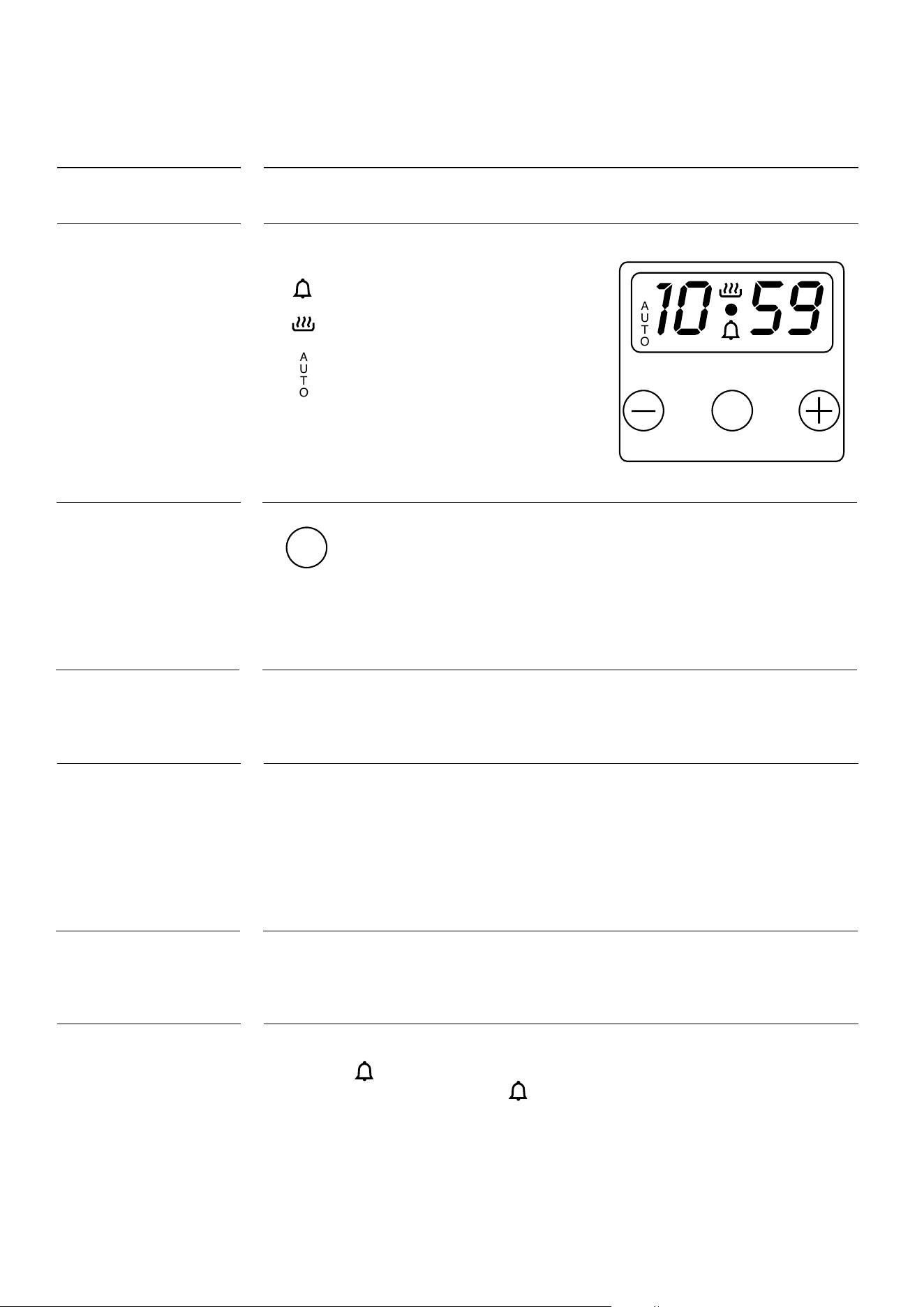
Cooking duration • end of cooking • clock • timer • manual function
Symbols relative to the functions in progress:
Timer
Manual function
Automatic programme
End time of automatic cooking
Automatic cooking duration
OK button: press this button to set the following functions: timer, cooking
duration, cooking end, clock time, volume of the acoustic signal.
Press button “+” to increase the time and button “-” to decrease the
time
at a rate directly proportional to how long you hold the button pressed.
When the oven is rst turned on, the symbol AUTO and the time 0•00 ash on the
display. Simultaneously press the buttons
A
[–]/[+]
for 4 seconds to switch to manual
mode. By doing so, the oven is ready for operation.
Simultaneously press the buttons
A
[–]/[+]
for more than two seconds. The central dot
“•” will start ashing on the display. Then, repeatedly press the “OK” button to enter the
setting mode of the following functions::
• volume
• timer
• duration of the automatic programme
• end time of the automatic programme
Simultaneously press the buttons
A
[–]/[+]
for 3 seconds to enter the time setting mode.
Then, set the time using the buttons
A
[–]/[+]
After adjustment wait 5 seconds for con-
rmation.
Press the “OK” button for 2 seconds and select the timer function.
The symbol “
OK
AUTO
” will start ashing. Set the desired time using the buttons
A
[–]/[+]
.
With the timer active, the symbol “
OK
AUTO
” remains lit and the current time is displayed.
By tapping the “OK” button, the display shows the remaining time.
At the end of the programmed time, an acoustic signal will be emitted and the bell
symbol will start ashing. To stop the acoustic signal, tap any button.
To exit the timer mode, press the buttons
A
[–]/[+]
for 2 seconds. .
USE OF THE ELECTRONIC PROGRAMMER
OK
AUTO
Functions
Display
Key of buttons
WARNING
Function selection
Time setting
Timer
A
[–]/[+]
OK
AUTO
OK
AUTO
OK
AUTO
OK
AUTO

31
USE OF THE ELECTRONIC PROGRAMMER
Press the OK button for 2 seconds to enter the programming mode. Then, press the
OK button until ‘dur’ appears on the display
A
[–]/[+]
Now set the desired cooking time
using the buttons. Press the OK button for conrmation: ‘End’ will be shown on the di-
splay. Use the buttons
A
[–]/[+]
to set the end time of cooking and press the OK button
for conrmation. Turn on the oven and set the cooking temperature: cooking will start
at the previously calculated programmed time by subtracting the ‘dur’ time from the
‘End’ time. When the programmed time expires, an acoustic signal will be emitted,
and ‘AUTO’ will be ashing on the display. To exit the end of cooking mode, press the
OK button or press simultaneously the buttons
A
[–]/[+]
for 3 seconds.
To set the manual mode, simultaneously press the buttons
A
[–]/[+]
for 3 seconds. By doing so, the programmed cooking settings are reset.
Press the OK button for 2 seconds to enter the programming mode. Then, press the OK
button until ‘dur’ appears on the display.
Set the cooking time with the buttons
A
[–]/[+]
and wait 5 seconds for its conrmation
(the display will show ‘AUTO’). Turn on the oven and set the cooking temperature. After
the programmed time has expired, the oven will turn off, an acoustic signal will be
emitted, and the symbol ‘AUTO’ will start ashing on the display.
To exit the end of cooking mode, press the OK button or press simultaneously the but-
tons
A
[–]/[+]
for 3 seconds.
Automatic function with
duration and end of
cooking
Manual mode
Semi-automatic function
with end of cooking

32
0
OFF
S. Multifunction / static electric oven selector
T. Temperatures, from 100°F to 500°F, can be selected by using this knob.
Choose one of the cooking operations by turning the selector (S) and adjust the
temperature with the thermostat (T).
We recommend putting into the oven after preheating.
Choose one of the cooking functions pag.35-36 by turning the selector (S) and adjust
the temperature (100°F to 500°F) with the thermostat (T). If your model is equipped with
a programmer, prepare it for cooking.
Description
S. Selector
T. Thermostat
Command of the oven
multifunction
Turning on and off
Function oven
INSTRUCTIONS FOR USE
Use of the electric oven multifunction / static
T
SS
0
0
9
8
7
6
5
4
3
2
1

33
Pizza cooking
This function is particularly suitable for cooking pizza, focaccia and bread. The main source of heat is from
the bottom heating element that works in combination with the oven’s other resistances.
Normal static cooking
It is the oven’s classic function particularly suited to cooking the following foods: pork chops, sausages, cod,
braised beef, game, roast veal, meringues and biscuits, baked fruit, etc.
Cooking from underneath
This is the most suitable mode to nish the food cooking, in particular confectionery (biscuits, meringues,
leavened cakes, fruit desserts, etc.) and other foods.
Cooking from above
Especially suitable for browning and to give the nal touch of colour to many foods; it is recommended for
ham- burgers, pork chops, veal steaks, sole, cuttlesh, etc.
Closed door grill cooking
The suitable function for fast and deep grilling, to brown and roast meats in general, llet steaks, Florentine
steaks, grilled sh and also grilled vegetables.
Fan grill cooking
Particularly fast and deep with signicant energy savings, this function is suitable for many foods such as pork
chops, sausages, pork or mixed spits, game, gnocchi alla romana, etc.
Intensive cooking
Is the quick and intense cooking function for various dishes; best for: baked sh, braised vegetables, spits,
duck, chicken, etc.
Multiple fan cooking
It is the function that allows simultaneous cooking of different dishes without the smells blending; you can
cook lasagne, pizza, croissants and brioches, tarts, cakes, etc.
Quick Start (only available on some models)
This function speeds up your oven’s pre-heating. We suggest you use this function when you set a cooking
temperature from between 400 and 575 ° F. Use of the QuickStart function for temperatures under 400 ° F
is not advantageous.
Once the oven has reached the temperature, select the desired cooking function and the temperature.
WARNING: the Quick Start function is not suitable for cooking foods, it is only for quickly pre-heating the
oven.
DO NOT USE THE QUICK START FUNCTION FOR MORE THAN TWENTY MINUTES.
INSTRUCTIONS FOR USE
– Functions list for multifunction oven
1
2
3
4
5
6
7
8
9
•
•
•
•
•
•
•
•
•
•
•
•

34
INSTRUCTIONS FOR USE
– Functions list for static oven
Upper & lower elements
Is the classical function of the electric oven and particularly adapted for cooking: pork chops, sausages,
dried salt-cured cod, pot roast, game, roast veal, meringues and biscuits, baked fruit, etc.
Lower element
This setting is most suitable for nishing cooking, particularly pastries (biscuits, meringues, desserts, puff pastry,
fruit cakes, etc.) and other foods.
Upper element
Especially suitable for browning and to add the nishing touches of colour to different dishes. We suggest this
setting when cooking hamburgers, pork cutlets, steaks, sole, cuttlesh, etc.
Grill-baking
A suitable setting for grilling au gratin and roasting quickly and well, meat in general, llet, T-bone steak,
grilled sh and vegetables too.
2
3
4
5

35
Slide the meat to be cooked onto the spit, blocking it with the special forks. Place the spit on the
special supports previously inserted in the drip pan and insert it in the spit-roast horn. Turn on the
static grill with closed door function. To extract the spit together with the drip pan pull it out just
enough to allow complete extraction.
This solution has been studied to increase the orgonomics, the practica and safety when moving
baking trays in the oven. The kit includes completely extendible lateral runners, which slide on
ball bearings to facilitate the removal and positioning of the trays. The runners are anti tip-over
for better safety. It is possible to remove them to clean them or move them as illustrated in the
pictures below.
Repeat the operations backwards to repositions the grills.
turn-spit
(only on some models)
Telescopic runners
(only in certain models)
Pul down the part highlighted in
red to remove it from the oven.
Turn over the grill and place it on
a at surface whit the telescopic
runner facing down.
To un nook the clip, loosen whit a
athead screwdriver
INSTRUCTIONS FOR USE

36
INDUCTION APPLIANCES
COOKTOP
BEFORE THE FIRST USE
Clean your hob with a damp cloth, and then dry the surface thoroughly. Do not use detergent which risks causing
bluetinted colour on the glass surface.
INDUCTION PRINCIPLE
An induction coil is located under each heating zone. When it is engaged, it produces a variable electromagnetic
eld which produces inductive currents in the ferromagnetic bottom plate of the pan. The result is a heating-up of
the pan located on the heating zone.
Of course the pan has to be suitable:
• All ferromagnetics pans are recommended (please verify it thanks a little magnet): cast iron and steel pans,
enamelled pans, stainless-steel pans with ferromagnetic bottoms…
• Are excluded : copper, pure stainless-steel, aluminium, glass, wood, ceramic, stoneware,…
The induction heating zone adapts automatically the size of the pan. With a too small diameter the pans doesn’t
work. This diameter is varying in function of the heating zone diameter.If the pan is not suitable to the induction hob
the display will show [ U ].
Induction based cookware
Induction current/energy
Magnetic eld
Glass ceramic plate
37
INSTRUCTIONS FOR USE
IMPORTANT
The ceramic hob remains hot for a long time after use. Do not touch the hob with your hands or let children near it.
The residual heat indicator will remain lit until the hob has cooled down.
If any cracks appear in the ceramic hob, disconnect the appliance immediately from the mains and call an au-
thorized technical service centre.
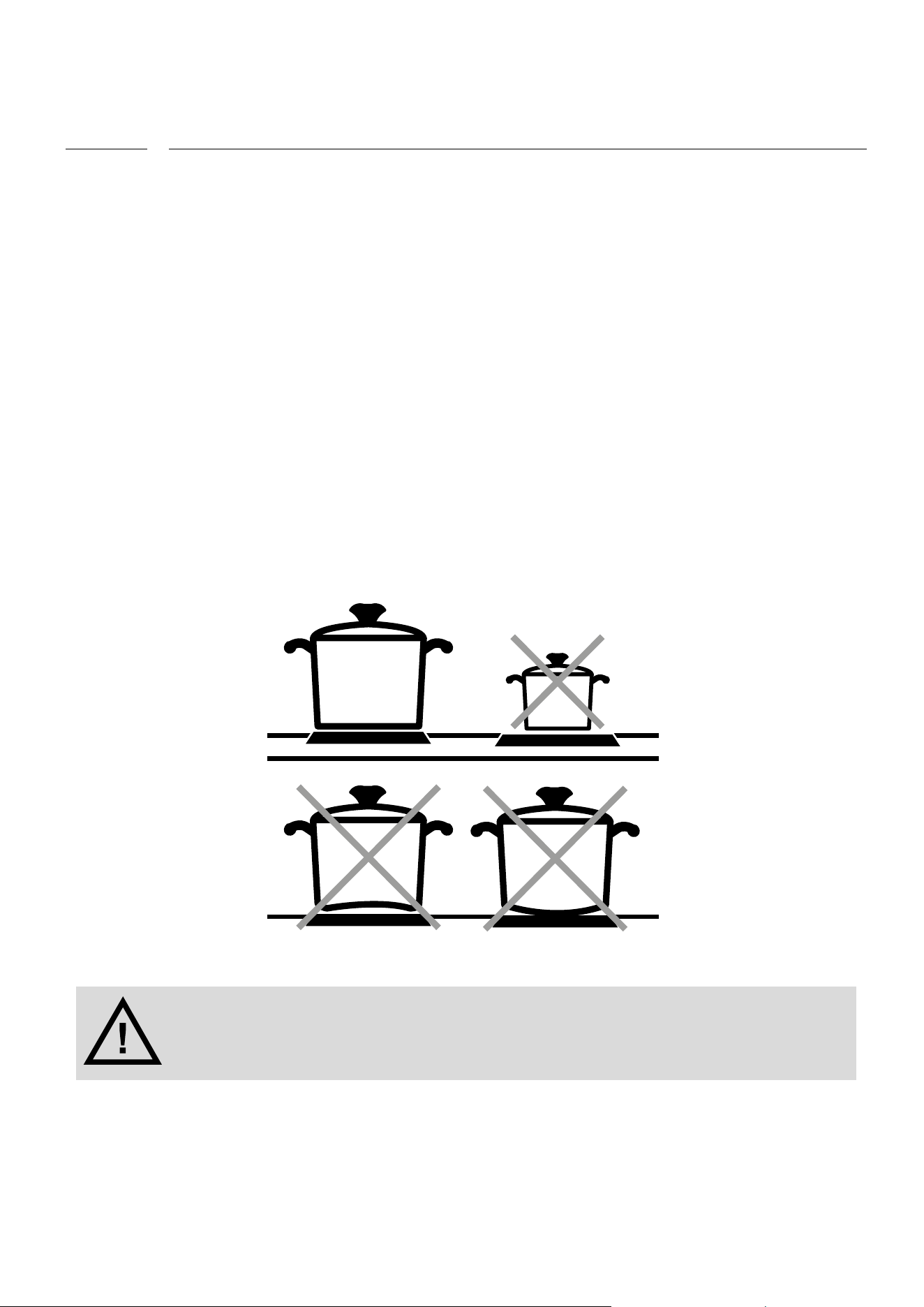
The hob has cooking areas with different power values and diameters. The positions are clearly indicated by the rings
(see Fig. 12) during operation, heat is located exclusively within these rings and the remaining area stays cold. Each
cooking area is designed to operate with specic pans for induction cooking, having a diameter just smaller than
the diameter of the chosen cooking area. The bottom of the pan must be thick and at. Its diameter must be as
similar as possible to that of the cooking ring (Fig. 11). The surface of the hob and the bottom of the pan must be
kept clean.
A - Do not wet or overheat the plates.
B - Avoid sudden changes of temperature on the ceramic hob. For example, do not pour cold water onto the hot
hob.
C- Do not leave the pan handles sticking out as they could be ipped accidentally.
D- It is preferable not to cook on the ceramic hob with pans that have been used on gas burners The ames will have
deformed the bottom of the pans.
WARNING
The glass ceramic cooking zone is warmed up
from the heat of the pan. To avoid injuries (burning)
do not touch this area.
38
INDUCTION APPLIANCES
SWITCHING ON A COOKING AREA
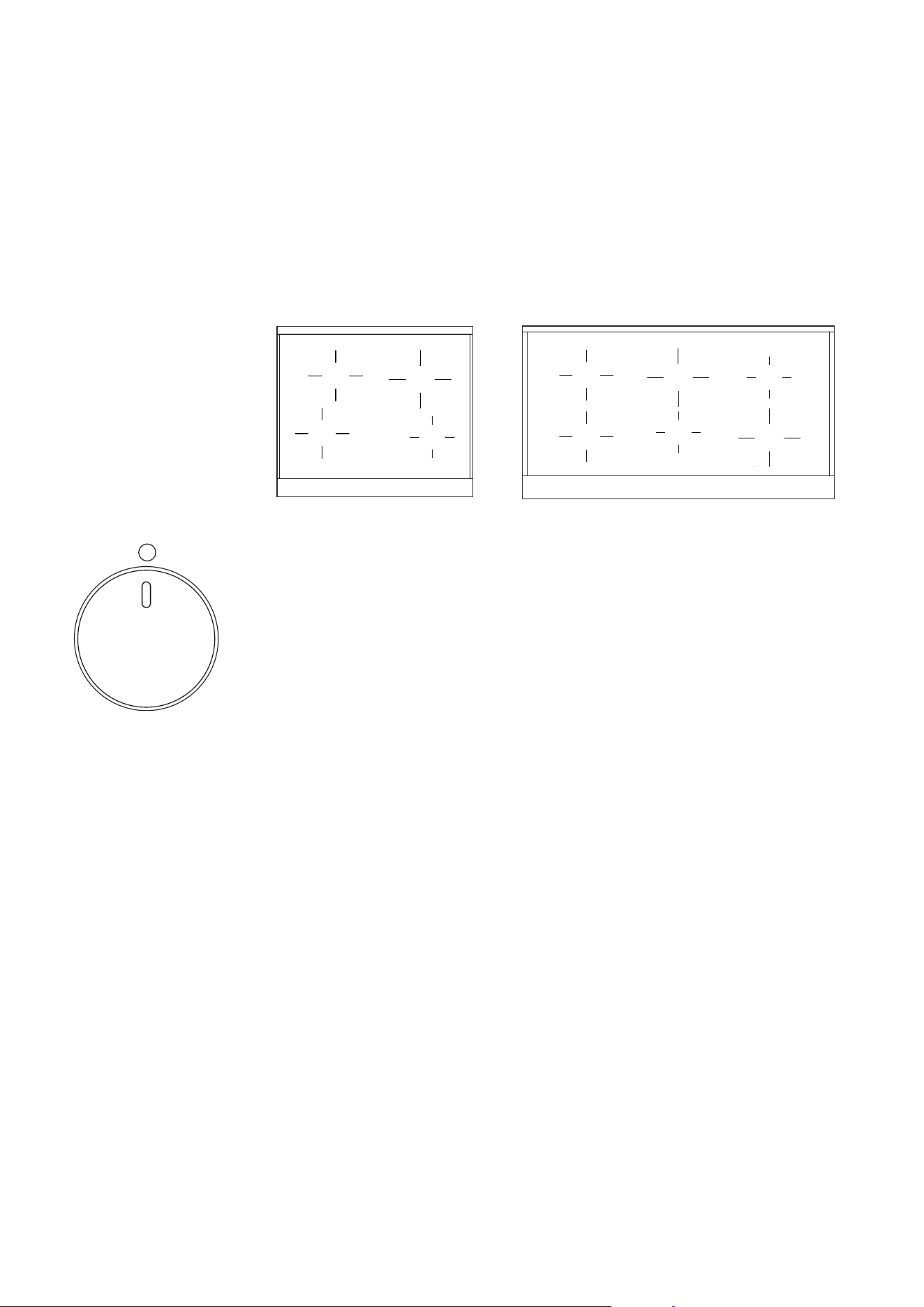
A cooking area is switched on by pushing and turning the relevant knob (g. 13) clockwi-
se. The set power level appears on the hob display (from 1 to 9).
SWITCHING OFF A COOKING AREA
A cooking area is switched off by turning the relevant knob anticlockwise. The symbol
[0] appears on the hob display for 3 seconds, then it disappears from the display chan-
ges to the symbol [H], if the cooking area is still hot.
AUTOMATIC SWITCHING OFF OF THE DEVICE
The device switches off automatically if any conditions of excess temperature (185°F)
or errors in power supply occur.
BRIDGE function for the induction hob:
Place the pan in the middle of the two heating zones that will be connected (the two
equal-sized zones).
Turn the knobs of the two affected zones clockwise and until the end of the stroke.
Hold them for 3 seconds to activate the function.
Adjust the power of the bridge with the front left area knob.
BOOSTER FUNCTION
The purpose of the booster function is to give more power to a determined area in
order to reduce the necessary cooking time.
This function is activated by pushing and turning the knob clockwise from position 0 (off)
to the nal position (* g. 13). The symbol [P] appears on the display, meaning that the
booster function is activated.
The Booster function has a maximum duration of 10 minutes. The area concerned then
returns to level [9].
The Booster function ends before this time when:
- a lower power level is set
- the pan is removed
- there is overheating of the appliance or of the heating area
The Booster function has precedence over the “Heat-up” function. This means that, if
the heat-up function has been activated in an area at the time of activating the Boo-
ster function, the heat-up function will be interrupted.
Burners
A
B
C
Cooking area (inch)
ø 5”
3/4
ø 7”
1/4
ø 8”
11/16
Electric power (watt)
1400W / Booster 1800W
1850W / Booster 2500W
2300W / Booster 3200W
B
C
B
A
B
C
A
B
A
C
Fig.13

39
INDUCTION APPLIANCES
B
C
A
B
A
C
RECOGNIZING THE PRESENCE OF A PAN
Each cooking area is designed to operate with specic pans for induction cooking, having a diameter just smaller
than the diameter of the chosen cooking area. If the pan is not suitable, the display for the area shows the symbol
indicating absence of the pan (U) and the appliance does not start up. This prevents the appliance being switched
on until a container is placed on the coo king area, or until a container suitable for induction is used. If the container
used on the cooking area is removed during this time, the area is switched off.
RESIDUAL HEAT INDICATION
If the cooking area is still very hot, even though it is switched off, the symbol H appears on the display.
“HEAT-UP” FUNCTION
The Heat-up function, or quick heating, is available on each cooking area. This means that for a well dened time
the cooking area works at maximum power and at the end of this time the power is automatically brought to the
set level. In this case the duration depends on the set power level. The Heat-up function is activated by pushing and
turning the knob anticlockwise from position 0 to the nal position (* g. 1a). As soon as the control is turned to the
left, a letter [A] is shown on the display for the area. After it has been activated you must set a power level to continue
cooking within 3 to 5 seconds; if this is not done, the Heat-up function is interrupted.
KEY-LOCK FUNCTION
The Key-lock function is useful if there are children at home. However, it is always advisable for an adult to be present
when the appliance is in operation. When the Key-lock function is activated all the cooking areas are switched off
and they cannot be switched on accidentally.
The Key-lock function is activated, with the knobs in position 0, by turning the controls 1 and 2 simultaneously in an
counterclockwise direction.
Heating function 108°F AND 149°F
Turn the knob (A) clockwise. Between the off position (0) and the power position (1) there is the position (u) which
identies the function for heating food at 108°F. Only for 5 and 6-zone models: turn the knob (A) clockwise again.
Between the (u) position and the power position (1) there is the position (U) which identies the function for heating
food at 149°F. The maximum time of use for both functions is limited to 120 minutes. Both functions are prioritized
over the ‘HEAT-UP’ mode.
The Key-lock function is activated, with the knobs in position 0, by turning the controls 2 and 3 in a counterclockwise
direction. The letters [L][L][L][L] appear on the display. The Key-lock function is deactivated by repeating the same
operation. The letters [O][F] appear on the display. If a knob is turned when the key-lock function is active, the letters
[L][L][L][L] appear on the disp.
DISPLAY
A display is associated with each cooking area (g. 14).
-Set power level: (1-9)
-Food heating 108°F 149°F (U)
-Booster: (P)
-Heat-up: (A)
-Residual heat: (H)
-Pan absent or not suitable: (U)
-External error: (E)
-Fault: (F)
-Key-lock function: [L][L][L][L]
-Knob permanent rotation:
Fig. 14.
B
A
B
A
C
C
induction

40
LIMIT OF THE DURATION OF OPERATION
A maximum time of continuous operation is associated with each cooking area.
This depends on the set power level. If the limit of the duration of operation is reached, the respective area is swi-
tched off
OPERATING TABLE
(purely indicative values)
TIME LIMIT OPERATION TABLE
Knob
position
1-2
2-4
4-5
5-6
6-7
8-9
Type of cooking
melting butter, chocolate, etc.
heating small amounts of liquids, keeping food warm, preparing sauces.
heating solid foods, thawing frozen foods, omelettes with 2-3 eggs, fruit and vegetables.
cooking meat and sh, pulses in sauces, dishes with water, making jam.
roasting meat or sh, steaks, liver, eggs.
boiling large amounts of water, frying chips, etc.
Power Level
U
1
2
3
4
5
6
7
8
9
P
Approximate limit of the duration of operation (hours)
2
6
6
5
5
4
1,5
1.5
1,5
1,5
(10 min. [P], later 80 min. [9])
INDUCTION APPLIANCES

41
CLEANING AND MAINTENANCE
List with common types of soiling and recommendations how to treat them:
List with common types of soiling and recommendations how to treat them:
The cleaning of the Ceran glass is identical to other similar surfaces like glass. Do not use corrosive or abrasive clea-
ning agents, such as grill and oven-sprays, stain- and rust-removers, scouring powder and rough sponges.
Before being cleaned, the Ceran glass must be cooled down.
Other maintenance and servicing work other than cleaning as described here, must be done by authorized service
personnel.
Make sure that no liquid can enter in the induction unit.
A good maintenance of the induction cooker requires a regular cleaning, care and servicing.
The operator has to ensure that all components relevant for safety are in perfect working order at all times.
The cooker should be examined at least once a year by an authorized technician.
CAUTION Do not open the induction unit, dangerous electric voltage inside
The cookers may only be opened by authorized personnel.
Type of soiling
Slight soiling,
no burned residues
Sticky soiling
Lime deposits, caused by
water which has boiled over
Sugar, sugar containing food,
plastic, aluminum foil
Drawer
Treatment
Wipe with a moist cloth (scotch), without cleaning agent
Remove with a scraper. Then wipe the heating area with a moist cloth
These spots can be removed with vinegar or a special cleaning agent
Immediately scrape off the sugar, plastic or aluminum foil residues thoroughly
from the hot cooking area, e.g. with a razor blade. After removal of the residues,
clean it with a cleaning agent. If the heating area is soiled with residues of sugar,
plastic or aluminum foil cools down without prior cleaning, the ceramic surface
might become deformed by pinheadsized pits.
Cleaning is the only maintenance that is required.
Warning! Cleaning must be performed with the cooker disconnected from the
power supply.
Do not use aggressive or abrasive cleaning products, abrasive sponges or sharp
objects that can leave marks of abrasion. Do not use steam cleaners for internal
cleaning of the drawer.
Front panel
To clean the front panel, use specic cleaning products such as warm water and
non-abrasive detergents. Apply a small amount of product on a soft cloth and
rub on the surface.
Inside the drawer
Clean the inside of the drawer with a damp cloth. If it is very dirty, add a few drops
of detergent (non-aggressive universal degreaser) to the wash water. Clean the
surface with a dry cloth to dry. Reuse the drawer only when it is completely dry.

42
CLEANING AND MAINTENANCE
Total black burners
Maintenance and
cleaning
ATTENTION: burners with nanotechnological coating
Some cleaning and washing methods are recommended in order to preserve the
quality of the coating.
• Allow the product to cool down at room temperature before cleaning it.
It is recommended not to dip it in cold water when it is still hot.
• Wash with warm water and a minimum of neutral detergent. Rub with a cloth,
better if in natural cellulose, or non-abrasive sponge.
• Do not use dust, iron wool, cloths and abrasive sponges.
• Do not let food be charred on the burner. In case stains/colorations may appear
on the surface. These traces do not alter the functionality of the product, and in
some cases can be eliminated with this procedure: immerse the product in hot
water, with detergent, wipe gently with a cloth, better if in natural cellulose; in
any case, do not use abrasive cloths or sponges. For the most resistant stains, it is
advisable to warm white vinegar and rub as indicated above.
• Avoid leaving the burners in contact with food for a long time, especially if acidic,
such as tomato sauce.
• Avoid contact with metal objects; if really needed, use wooden or plastic
objects.
• Avoid washing in the dishwasher, a part of the product is not coated and would
get irrepara
• Jotta DUAL-poltin toimisi oikein, pidä alla olevassa kuvassa korostettu sytytyskanava
puhtaana.

43
FAN OVEN COOKING CHART
MEATS
Roast beef
Roast ox
Roast veal
Roast lamb
Rare roast beef
Roast hare
Roast rabbit
Roast turkey
Roast goose
Roast duck
Roast chicken
FISH
CAKES
Fruit cake
Plain square cake
Brioches
Sponge cake
Plain ring cake
Sweet biscuits
Yeast cake
Strudel
Savoy biscuits
Apple fritters
Biscuits pudding
Toast
Bread
Pizza
TEMPERATURE [°F]
340 - 360
340 – 370
320 – 360
285 – 320
360 -370
340 - 360
320 - 360
320 – 360
320 – 370
340 – 360
360
320 - 360
360 - 390
360 – 375
340 – 360
375 – 390
320 -360
360 - 390
375 - 390
320
300 – 360
360 – 390
340 - 360
370 - 385
390 – 360
430 - 465
POSITION
2/3
2/3
2/3
2
2/3
2/3
2
2
2/3
2/3
2/3
1/2
2
2
2
2
2
2
2
2
2
2
2
2
3
2/3
TIME [min]
40/50
40/60
65/90
100/130
40/45
30/50
80/100
160/240
120/160
100/160
70/95
15/25
40/50
40/45
40/60
25/35
35/45
20/30
30/40
25/35
50/60
18/25
30/40
7
40
15/20
4
3
2
1
5

44
NATURAL CONVECTION OVEN COOKING CHART
MEATS
Roast beef
Roast ox
Roast veal
Roast lamb
Rare roast beef
Roast hare
Roast rabbit
Roast turkey
Roast goose
Roast duck
Roast chicken
FISH
CAKES
Fruit cake
Plain square cake
Brioches
Sponge cake
Plain ring cake
Sweet biscuits
Yeast cake
Strudel
Savoy biscuits
Apple fritters
Biscuits pudding
Toast
Bread
Pizza
TEMPERATURE [°F]
440
450 – 500
440
440
450
450 - 500
450 - 500
450 - 500
440
450 - 500
450 - 500
390 - 440
440
350 – 390
350 – 390
430 – 500
360 -390
390 - 430
450-500
360
360 – 390
390 – 430
390 - 430
450-500
430
450-500
POSITION
2/3
2/3
2/3
2
2/3
2/3
2
2
2/3
2/3
2/3
1/2
2
2
2
2
2
2
2
2
2
2
2
3
3
2
TIME [min]
60/80
50/60
60/80
40/50
50/60
40/50
40/50
50/60
60/70
45/60
40/45
15/25
35/40
50/60
25/30
20/30
30/40
15/20
25/35
20/30
40/50
15/20
20/30
5
30
15/20
4
3
2
1
5

45
ELECTRICAL SKETCHES
- KEYS
NTC
PT100
EN
DU
MP
MG
CP
PB
SE
SD
SA
VT
TS
TS1
L1
L2
VR
M
11
22
33
44
45
55
66
TT
EL
T
K1
Temperature probe
Temperature probe
Encoder
Vax motor
Door microswitch
Spit motor
Meat probe connector
Power board
Auxiliary power board
Display Board
Power supply board
Cooling fan
Safety thermostat
Safety thermostat
Oven lamp
Ampoule du four
Ventilateur du four
Terminal board
Brown
Red
White
Yellow
Jaune - vert
Gris
Blue
Cooling fan thermostat
Solenioid valve
Thermostat
Earth wire for terminal board
K2
K3
K4
K5
K6
K7
K8
K15
R1
R2
R3
R4
N
F
F1
SP
MA
RE
PE
SI
AA
RL
R5
SWD
DS1
CCDF
Earth wire for lower resistance
Earth wire for oven fan
Earth wire for circular resistance
Earth wire for upper resistance
Earth wire for oven lamp 1
Earth wire for oven lamp 2
Earth wire for spit motor
Earth wire for appliance chassis
Uppper heating element
Lower heating element
Grill heating element
Circular heating element
Neutral
Phase
Phase 1
Ignition electrode
Ignition microswitch
Electric encoder
Inductor
Interface board
Ignition transformer
Limiting resistance
Warming drawer element
Warming drawer control board
Burner control
Coup the feu selector
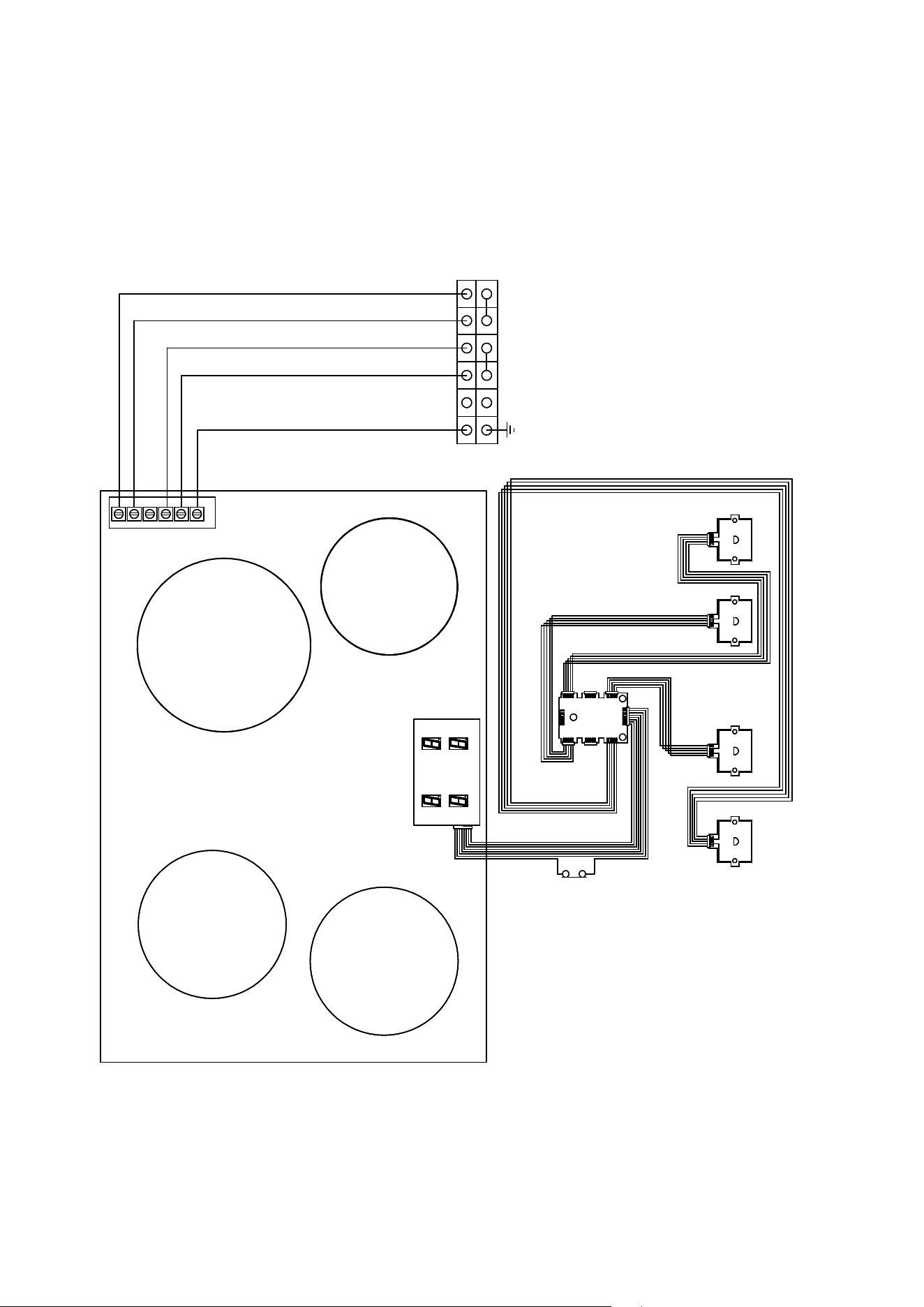
46
ELECTRICAL SKETCHES
4 INDUCTION ZONES
M
22
22
00
00
45
PE1
PE2
PE4
PE3
(1850 W)
(1850 W)
(2300 W)
(1400 W)
1
2
3
4
5
SI
4ER1ER 3ER2ER
RR
RC
RL
FR
FC
FL
N F F
F1
F1
22
22
22
22
00
00
0000
45
45
TS
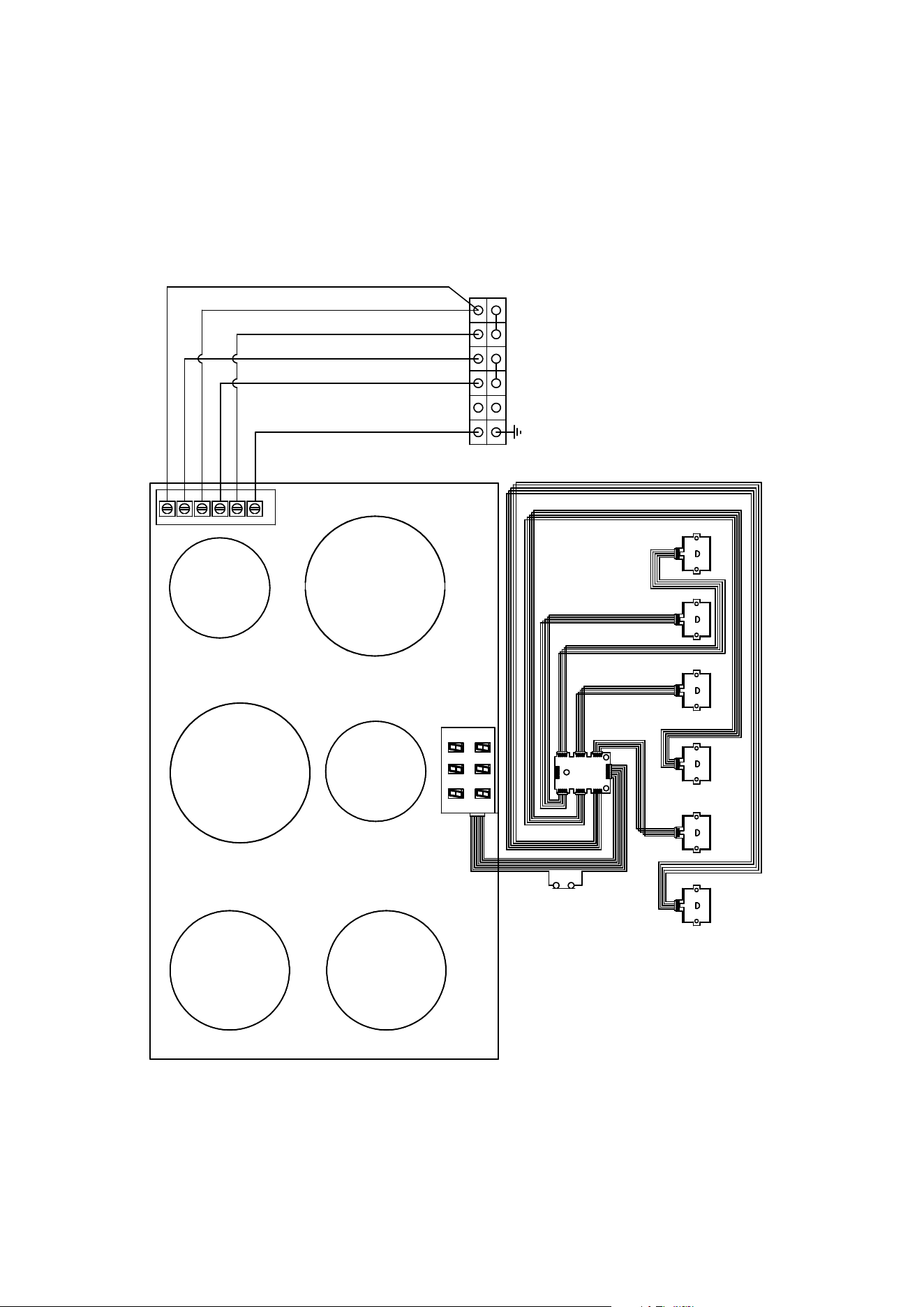
47
PE1
PE2
(1850 W)
(1850 W)
PE6
(1400 W)
PE5
(2300 W)
PE3
(2300 W)
PE4
(1400 W)
SI
5ER1ER 6ER2ER
RE3
RR
RC
RL
FR
FC
FL
RE4
1
2
3
4
5
M
22
00
00
22
45
N F F
F1
F1
22
22
22
22
00
00
0000
45
45
22
22
22
00
00
22 22
22
TS
ELECTRICAL SKETCHES
6 INDUCTION ZONES
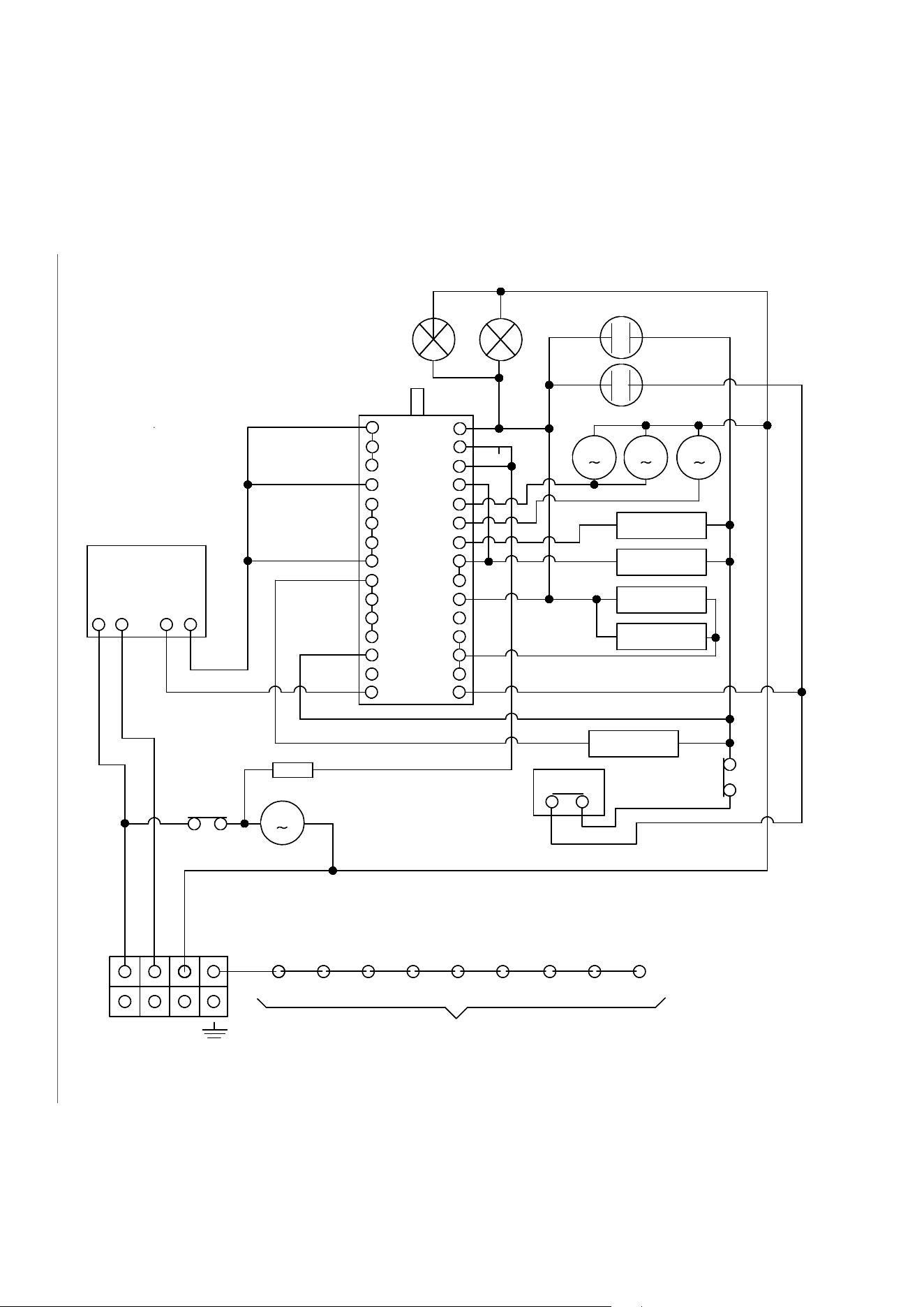
48
C
5
4
8
6
7
11
9
10
C
E
G
M
I
L
3
12
N
D
F
H
O
13
2
A 1
B
P
14
K1
45
K3 K5 K6
F F1
M
K7 K9 K13 K15K8
22
22
M
VT
22
P
IN
OUT
00
00
R4
11
55
R1
R2
11
00
00
00
R3
22
T
S1
S2
00
M
M
MG
VR
L1
L2
00
00
22
22
00
66
66
66
44
11
33
33
22
00
Q
15
N
TT
33
33
33
33
33
33
33
00
66
00
11
11
11
11
55
RL
TS
22
55
55
M
VR
R4
22
22
ELECTRICAL SKETCHES
U (P/N) 30...MP
U (P/N) I 30...MP

49
C
5
4
8
6
7
11
9
10
C
E
G
M
I
L
3
12
N
D
F
H
O
13
2
A1
B
P
14
K1
45
K3 K5 K6
F F1
M
K7 K9 K13 K15K8
22
22
M
VT
22
P
IN
OUT
00
00
R4
11
55
R1
R2
11
00
00
00
R3
22
T
S1
S2
00
M
M
MG
VR
L1
L2
00
00
22
22
00
66
66
66
44
11
33
33
22
00
Q
15
N
TT
33
33
33
33
33
33
33
00
66
00
11
11
11
11
55
RL
TS
22
55
55
ELECTRICAL SKETCHES
U(P/N) 36MP - U(P-N) 361MP
U(P/N) I 36MP - U(P-N) I 361MP
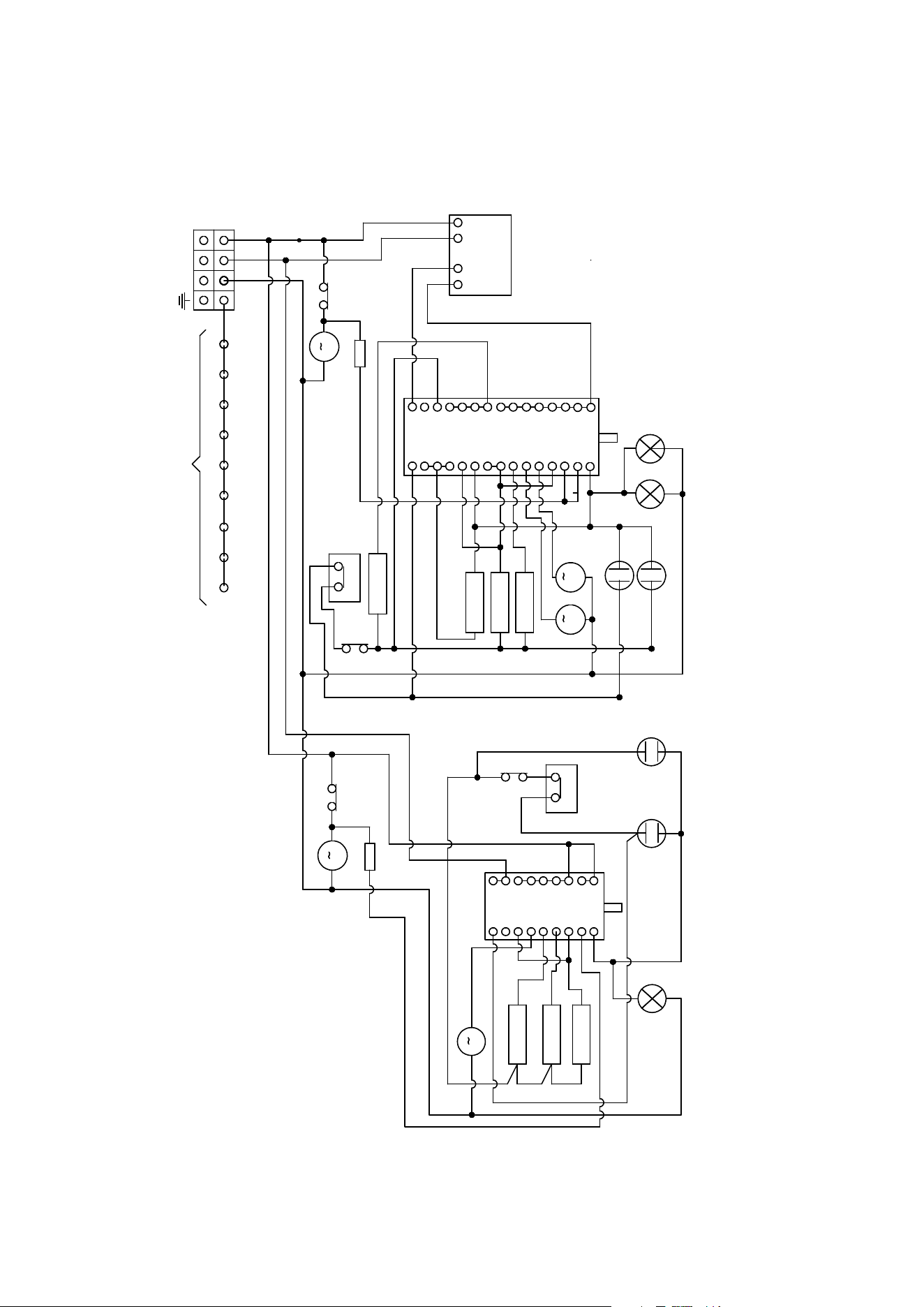
50
C mf
5
4
8
6
7
11
9
10
C
E
G
M
I
L
3
12
N
D
F
H
O
13
2
A1
B
P
14
K1
45
K3 K5 K6
F F1
M
K7 K9 K13 K15K8
22
22
M
VT
22
P
IN
OUT
00
00
R4 mf
11
55
R1 mf
R2 mf
11
00
00
00
R3 mf
22
T
S1
S2
00
M
M
MG
VR
L1
L2
00
00
22
22
00
66
66
66
44
11
33
33
22
00
Q
15
11
M
33
66
3
2
R1
R2
00
00
66
66
00
00
00
6
4
5
9
7
8
A
B
F
D
I
G
H
1
R3
11
66
00
11
22
00
66
00
11
11
00
22
22
00
00
M
VT
11
S1
S2
L1
C st
MG
TT
N
TT
33
33
33
33
33
33
33
00
66
00
11
11
11
11
55
RL
22
22
22
22
00
00
00
22
TS
22
33
33
33
33
33
TS
RL
22
55
55
55
55
55
55
T
ELECTRICAL SKETCHES
U (P/N) 48...MP
U (P/N) I 48...MP
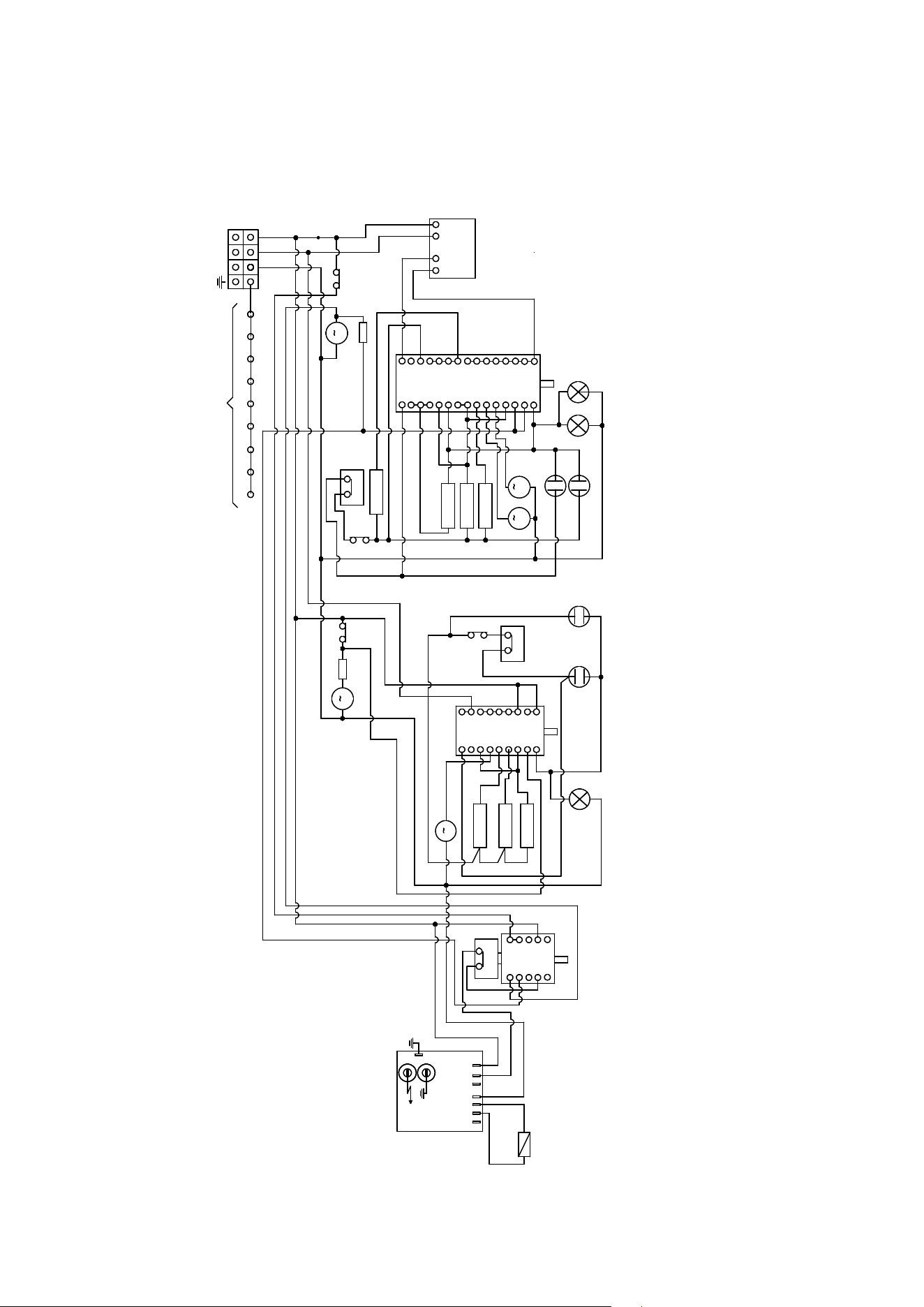
51
C mf
5
4
8
6
7
11
9
10
C
E
G
M
I
L
3
12
N
D
F
H
O
13
2
A 1
B
P
14
K1
45
K3 K5 K6
F F1
M
K7 K9 K13 K15K8
22
22
M
VT
22
P
IN
OUT
00
00
R4 mf
11
55
R1 mf
R2 mf
11
00
00
00
R3 mf
22
T
S1
S2
00
M
M
MG
VR
L1
L2
00
00
22
22
00
66
66
66
44
11
33
33
22
00
Q
15
11
M
33
66
3
2
R1
R2
00
00
66
66
00
00
00
6
4
5
9
7
8
A
B
F
D
I
G
H
1
R3
11
66
00
11
22
00
66
00
11
11
00
22
22
00
00
M
VT
S1
S2
L1
C st
MG
TT
N
TT
33
33
33
33
33
33
33
00
66
00
11
11
11
11
55
RL
22
22
22
22
00
00
00
22
TS
22
33
33
33
33
TS
22
55
55
55
11
55
55
T
C cdf
S2SCS1NH2H1A
J3
TF2
TF1
EL
DS1
45
SP
T
55
55
22
22
22
22
33
33
33
22
11
11
11
11
11
00
00
00
00
RL
55
55
55
22
11
11
11
11
4
3
5
B
C
E
2
D
A
1
ELECTRICAL SKETCHES
U (P/N) 48...S MP
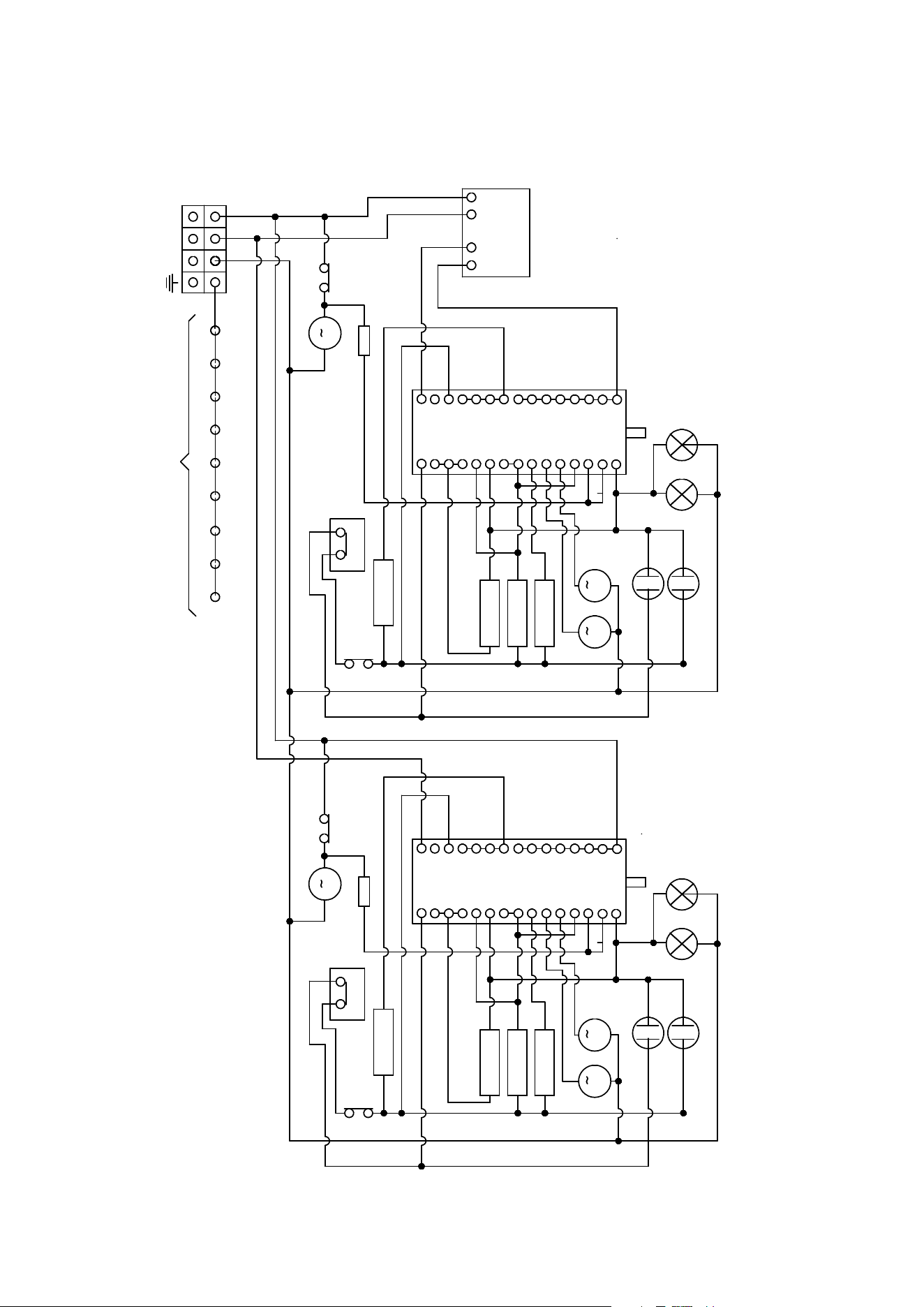
52
C
5
4
8
6
7
11
9
10
C
E
G
M
I
L
3
12
N
D
F
H
O 13
2
A1
B
P
14
K1
45
K3 K5 K6
F F1
M
K7 K9 K13 K15K8
22
22
M
VT
22
P
IN
OUT
00
00
R4
11
55
R1
R2
11
00
00
00
R3
22
T
S1
S2
00
M
M
MG
VR
L1
L2
00
00
22
22
00
66
66
66
44
11
33
33
22
00
Q
15
N
TT
33
33
33
33
33
33
33
00
66
00
11
11
11
11
55
RL
TS
22
55
55
C mf
5
4
8
6
7
11
9
10
C
E
G
M
I
L
3
12
N
D
F
H
O 13
2
A1
B
P
14
22
M
VT
00
R4
11
55
R1
R2
11
00
00
00
R3
22
T
S1
S2
00
M
M
MG
VR
L1
L2
00
00
22
22
00
66
66
66
44
11
33
33
Q
15
TT
33
33
33
33
33
33
33
66
00
11
11
11
11
55
RL
TS
22
55
55
22
22
00
00
ELECTRICAL SKETCHES
U (P/N) 60...MP
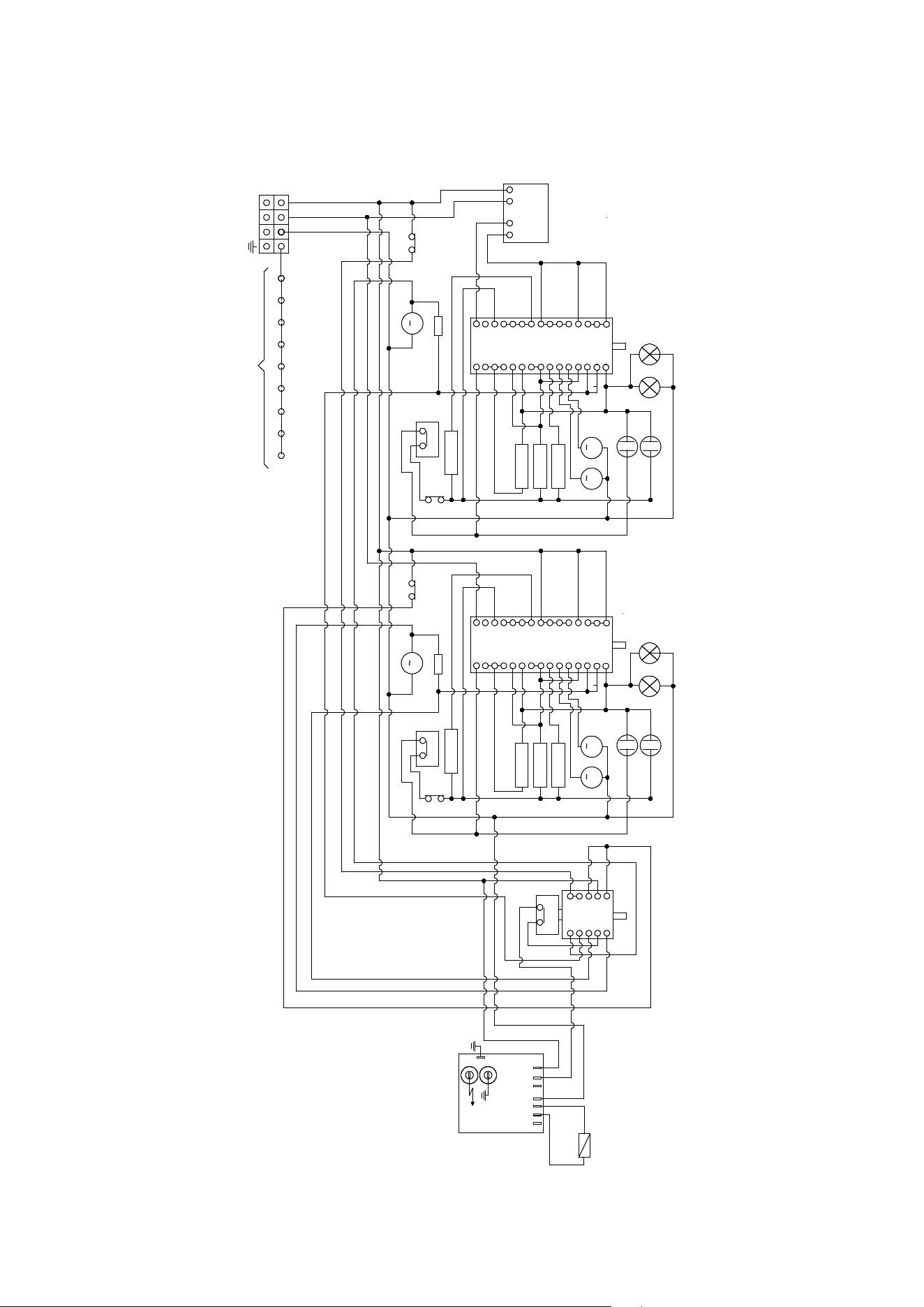
53
C
5
4
8
6
7
11
9
10
C
E
G
M
I
L
3
12
N
D
F
H
O 13
2
A 1
B
P
14
K1
45
K3 K5 K6
F F1
M
K7 K9 K13 K15K8
22
22
M
VT
22
P
IN
OUT
00
00
R4
11
55
R1
R2
11
00
00
00
R3
22
T
S1
S2
00
M
M
MG
VR
L1
L2
00
00
22
22
00
66
66
66
44
11
33
33
22
00
Q
15
N
TT
33
33
33
33
33
33
33
00
66
00
11
11
11
11
55
RL
TS
22
55
55
C mf
5
4
8
6
7
11
9
10
C
E
G
M
I
L
3
12
N
D
F
H
O 13
2
A 1
B
P
14
22
M
VT
00
R4
11
55
R1
R2
11
00
00
00
R3
22
T
S1
S2
00
M
M
MG
VR
L1
L2
00
00
22
22
00
66
66
66
44
11
33
33
Q
15
TT
33
33
33
33
33
33
33
66
00
11
11
11
11
55
TS
22
11
55
22
22
00
00
C cdf
S2SCS1NH2H1A
J3
TF2
TF1
EL
DS1
45
SP
T
55
55
22
22
22
22
33
33
33
11
11
11
00
00
00
00
22
22
11
11
11
55
55
55
11
11
11
11
4
3
5
B
C
E
2
D
A
1
22
55
55
55
11
11
11
11
11
11
11
11
11
11
22
22
22
22
RL
ELECTRICAL SKETCHES
U (P/N) 60... S MP
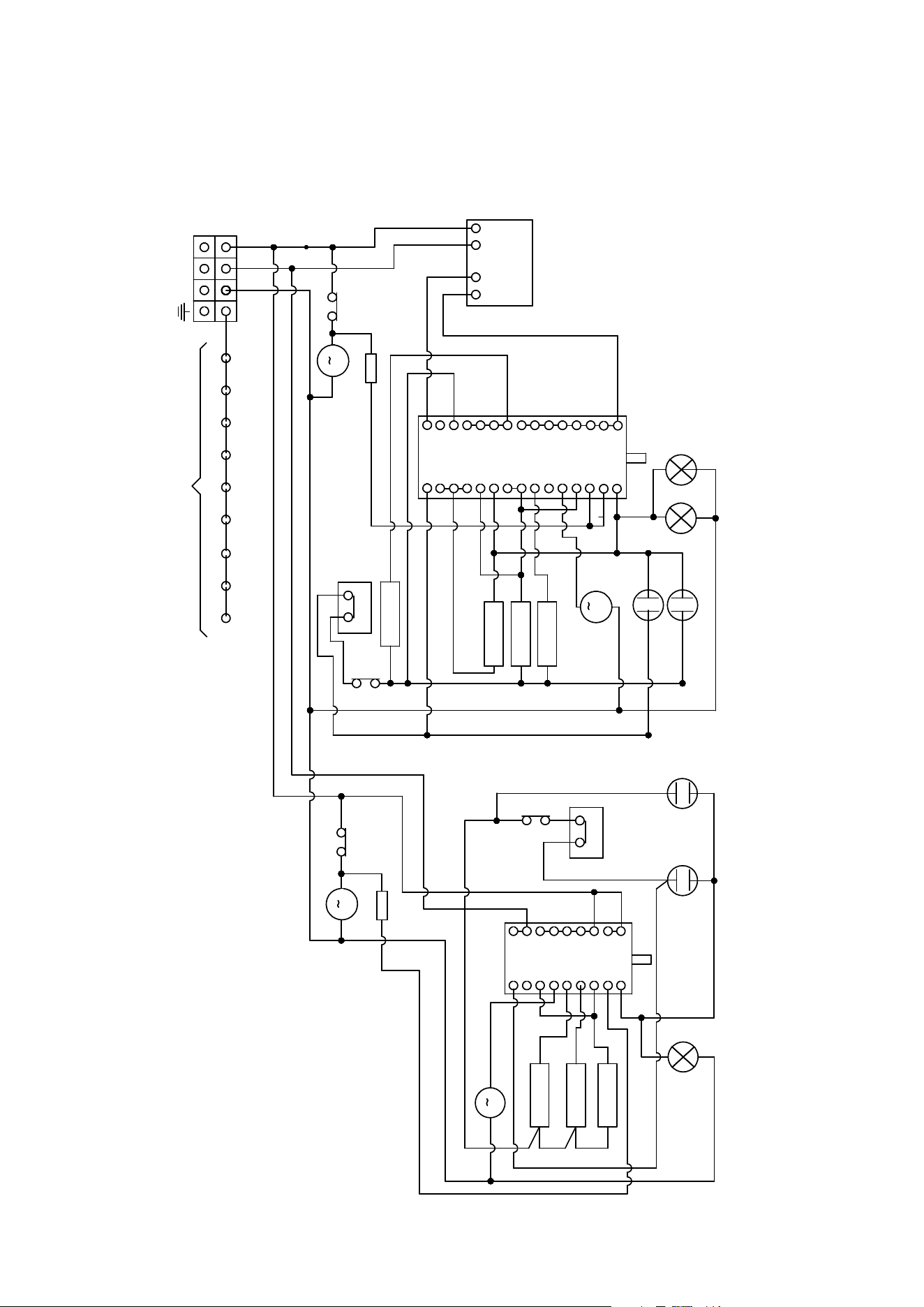
54
ELECTRICAL SKETCHES
U (P/N/) D 36...MP - U (P/N) D I 36...MP
U (P/N/) D 40...MP - U (P/N) D I 40...MP
C mf
5
4
8
6
7
11
9
10
C
E
G
M
I
L
3
12
N
D
F
H
O
13
2
A1
B
P
14
K1
45
K3 K5 K6
F F1
M
K7 K9 K13 K15K8
22
22
M
VT
22
P
IN
OUT
00
00
R4 mf
11
55
R1 mf
R2 mf
11
00
00
00
R3 mf
22
T
S1
S2
00
M
VR
L1
L2
00
00
22
22
00
66
66
66
44
11
33
33
22
00
Q
15
11
M
33
66
3
2
R1
R2
00
00
66
66
00
00
00
6
4
5
9
7
8
A
B
F
D
I
G
H
1
R3
11
66
00
11
22
00
66
00
11
11
00
22
22
00
00
M
VT
11
S1
S2
L1
C st
MG
TT
N
TT
33
33
33
33
33
33
00
66
00
11
11
11
11
55
RL
22
22
22
22
00
00
00
22
TS
22
33
33
33
33
33
TS
RL
22
55
55
55
55
55
55
T
55
ELECTRICAL AND GAS POWER TABLE
TYPE U(P/N/T)
PROFESSIONAL COOK ING BLOCK
SR
C.D.F. (coup de feu)
R
DUAL
P
DCC
60cm El. multifunction oven (65 litres)
80cm El. multifunction oven (97 litres)
90cm El. multifunction oven (110 litres)
30'' El. Multifunction oven (114 litres)
30cm El. conventional oven (43 litres)
40cm El. conventional oven (57 litres)
30cm ELECTRONIC conventional oven (43 litres)
40cm ELECTRONIC conventional oven (57 litres)
30'' induction cooktop (4 zones)
100cm induction cooktop (6 zones)
warming drower
COMPLETE APPLIANCE GAS RATING [Btu/h]
COMPLETE APPLIANCE ELECTRIC RATED
INPUT [kW]
COMPLETE APPLIANCE ELECTRIC RATED
INPUT [A]
Models
7000
5500
####
####
####
####
3,5 3,7 3,7 3,7 2,5 2,8 2,5 2,9 7,7 11,5 0,65
UP30(W/N/Q)(MP)
UN30(W/Q/N/QN)(MP) 2 2 1 1 60000 3,70 15,4
UP30(W/N/Q)(S3)
UN30(W/Q/N/QN)(S3)
UT30 (W)S3 2 2 1 1 1 60000 4,35 18,1
UPI304(W/N/Q)(MP)
UNI304 (W/Q/N/QN)(MP) 1 1 0 11,40 47,5
UPI304(W/N/Q)(S3)
UNI304(W/Q/N/QN)(S3)
UTI304(W)S3
1 1 1 0 12,05 50,2
UP36(6 /F)(W/N/Q)(MP )
UN36(6 /F)(W/Q/N/QN)(MP) 1 3 2 1 88500 3,70 15,4
UP36(6 /F)(W/N/Q)(S 3)
UN36(6 /F)(W/Q/N/QN)(S3)
UT36 (6/F)(W)(S3) 1 3 2 1 1 88500 4,35 18,1
UPI366(W/N/Q)(MP)
UNI366 (W/Q/N/QN)(MP) 1 1 0 15,20 63,3
UPI366(W/N/Q)(S3)
UNI366(W/Q/N/QN)(S3)
UTI366(W)(S3)
1 1 1 0 15,85 66,0
UP361 (6/F)(W/N/Q)(MP)
UN361 (6/F)(W/Q/N/QN)(MP) 1 3 2 1 88500 3,70 15,4
UP361 (6/F)(W/N/Q)(S3)
UN361 (6/F)(W/Q/N/QN)(S3)
UT36 1(6/F)(W)(S3)
1 3 2 1 1 88500 4,35 18,1
UPI3616 (W/N/Q)(MP)
UNI361 6(W/Q/N/QN)(MP) 1 1 0 15,20 63,3
UPI3616(W/N/Q)(S3)
UNI3616(W/Q/N/QN)(S3)
UTI3616(W)(S3)
1 1 1 0 15,85 66,0
UPD36(6 /F)(W/N/Q)(MP)
UND36 (6/F)(W/Q/N/QN)(MP) 1 3 2 1 1 88500 6,00 25,0
UPD36(6 /F)(W/N/Q)(S3)
UND36 (6/F)(W/Q/N/QN)(S3)
UTD3 6(6/F)(W)(S3)
1 3 2 1 1 1 88500 6,65 27,7
UPDI366 (W/N/Q)(MP)
UNDI366(W/Q/N/QN)(MP) 1 1 1 0 17,50 72,9
UPDI366(W/N/Q)(S3)
UNDI366(W/Q/N/QN)(S3)
UTDI366(W)(S3)
1 1 1 1 0 18,15 75,6
UPD40(6 /F)(W/N/Q)(MP)
UND40 (6/F)(W/Q/N/QN)(MP) 1 3 2 1 1 88500 6,25 26,0
UPD40(6 /F)(W/N/Q)(S3)
UND40 (6/F)(W/Q/N/QN)(S3)
UTD4 0(6/F)(W)(S3)
1 3 2 1 1 1 88500 7,05 29,4
UPD40(S )(W/N/Q)(MP)
UND40 (S)(W/Q/N/QN)(MP) 1 1 2 1 1 1 58500 6,25 26,0
UPD40(S )(W/N/Q)(S3 )
UND40 (S)(W/Q/N/QN)(S3 )
UTD4 0(S)(W)(S3) 1 1 2 1 1 1 1 58500 7,05 29,4
UPDI406 (W/N/Q)(MP)
UNDI406(W/Q/N/QN)(MP) 1 1 1 0 17,75 74,0
UPDI406(W/N/Q)(S3)
UNDI406(W/Q/N/QN)(S3)
UTDI406(W)(S3)
1 1 1 1 0 18,55 77,3
UP48(8 /F)(W/N/Q)(MP )
UN48(8 /F)(W/Q/N/QN)(MP) 2 4 2 1 1 106000 6,20 25,8
UP48(8 /F)(W/N/Q)(S 3)
UN48(8 /F)(W/Q/N/QN)(S3)
UT48 (8/F)(W)(S3) 2 4 2 1 1 1 106000 6,85 28,5
UP48(S)(W/N/Q)(MP)
UN48(S)(W/Q/N/QN)(MP) 1 1 2 1 1 1 1 69000 6,20 25,8
UP48(S)(W/N/Q)(S3)
UN48(S)(W/Q/N/QN)(S3)
UT48 (S)(W)(S3) 1 1 2 1 1 1 1 1 69000 6,85 28,5
UPI486(W/N/Q)(MP)
UNI486 (W/Q/N/QN)(MP) 1 1 1 0 17,70 73,8
UPI486(W/N/Q)(S3)
UNI486(W/Q/N/QN)(S3)
UTI486(W)(S3)
1 1 1 1 0 18,35 76,5
UP60(9 /F)(W/N/Q)(MP )
UN60(9 /F)(W/Q/N/QN)(MP) 2 4 2 1 1 1 116500 7,20 30,0
UP60(9 /F)(W/N/Q)(S 3)
UN60(9 /F)(W/Q/N/QN)(S3)
UT60 (9/F)(W)(S3) 2 4 2 1 1 1 1 116500 7,85 32,7
UP60(S/FS)(W/N/Q)(MP)
UN60(S/FS)(W/Q/N/QN)(MP) 2 1 3 1 1 1 1 86500 7,20 30,0
UP60(S/FS)(W/N/Q)(S3 )
UN60(S/FS)(W/Q/N/QN)(S3 )
UT60 (S/FS)(W)(S3)
2 1 3 1 1 1 1 1 86500 7,85 32,7
kW
Btu/h
GAS POWER
TOP BURNER TYPE
ELECTRICAL POWER
ELECTRICAL OVEN
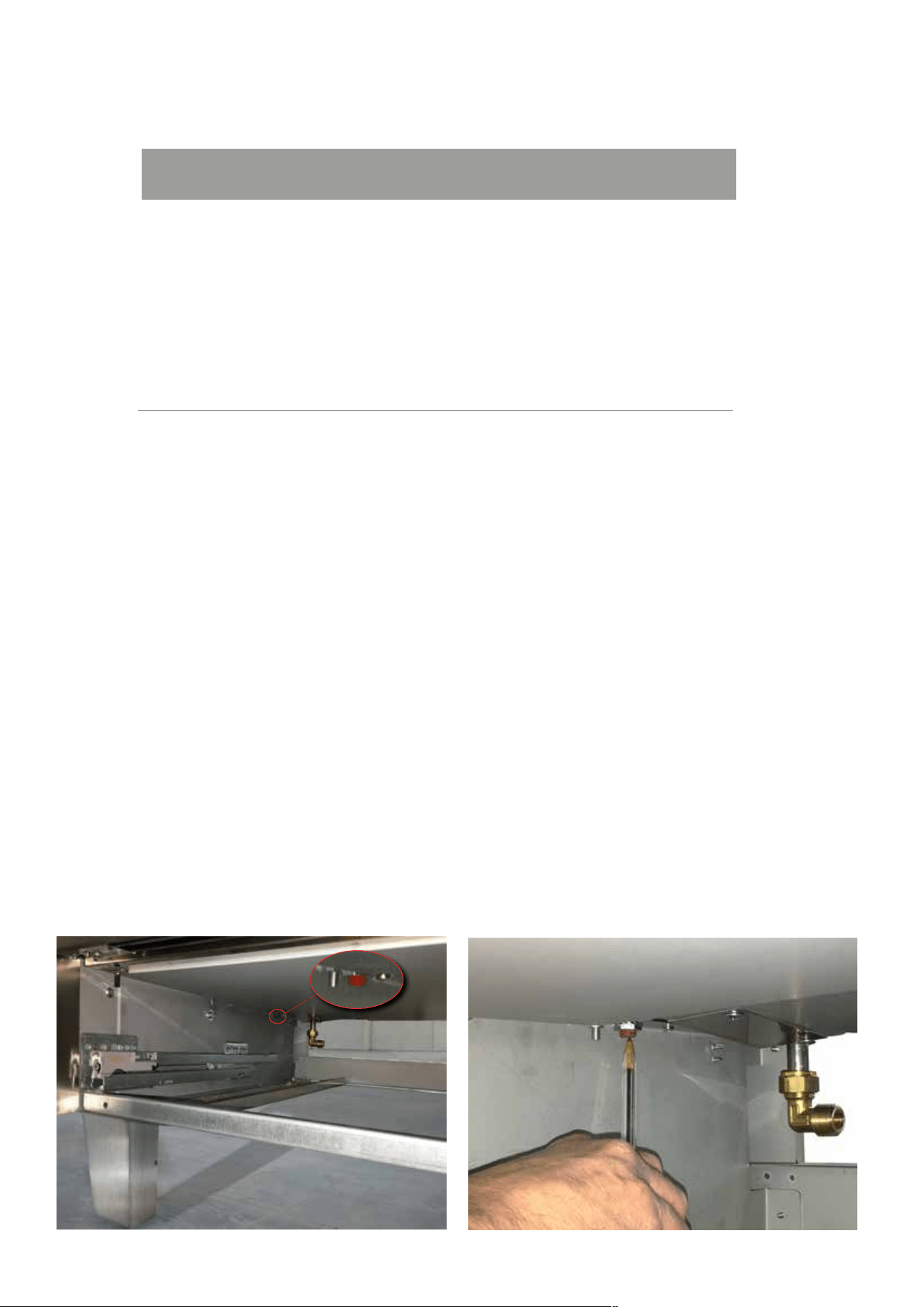
56
NOTE
Injectors for a device installed at an altitude above 2000 ft
Safety Warnings - Thermostat
The cooker is tted with a safety thermostat that stops the operation in case the oven temperature rises too high.
Each oven has its own device. After the appliance has cooled down, it is possible to try to restart it (if the safety
thermostat tripped) by manually resetting the contact. To perform the manual reset follow this procedure:
• First of all, disconnect the appliance from the mains by pulling the plug from the wall socket or switching OFF
the bipolar switch in the house wiring.
• Open and remove the drawer under the ovens (pull outwards and lift), or remove the front panel (pull outwards
to disengage the spring pins).
• Locate the safety thermostat, screwed to the chassis on the side and in backward position (for cookers with
only one oven it is on the left side). See picture A
• Insert from underneath upwards the point of a sharp object (e.g. a pen) into the thermostat recess until a click
is heard. See picture B
• Reassemble the drawer or the front panel and connect again the appliance to the mains.
• Check if the oven works. (If not, it is necessary to call the Customer Service).
BURNERS
SR
R
DCC
DUAL
P
CDF
SR
R
DCC
DUAL
P
CDF
GAS
NATURAL (A)
NATURAL (A)
NATURAL (A)
NATURAL (A)
NATURAL (A)
NATURAL (A)
PROPANE (E)
PROPANE (E)
PROPANE (E)
PROPANE (E)
PROPANE (E)
PROPANE (E)
ORIFICE SIZE
(1/100) mm
117
141
185
74+215
141
108
74
87
112
43+130
88
62

57
NOTE

NOTE