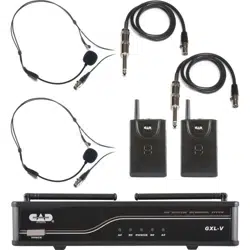
GXLV
VHF
Wireless
Microphone System
Manual and
Quick Start-up Guide

2
GXLV
VHF Wireless
Microphone System
Introduction
Please enjoy the easy and exciting performance that the GXL™
Wireless Series provides for your next performance. CAD Audio
has been creating valued product since 1938 and prides itself on
developing and supporting the live performer. Our design criterion
was straightforward. Develop a high value wireless microphone
system that can cope with today’s challenging RF environment that
is both easy to use and exciting to operate.
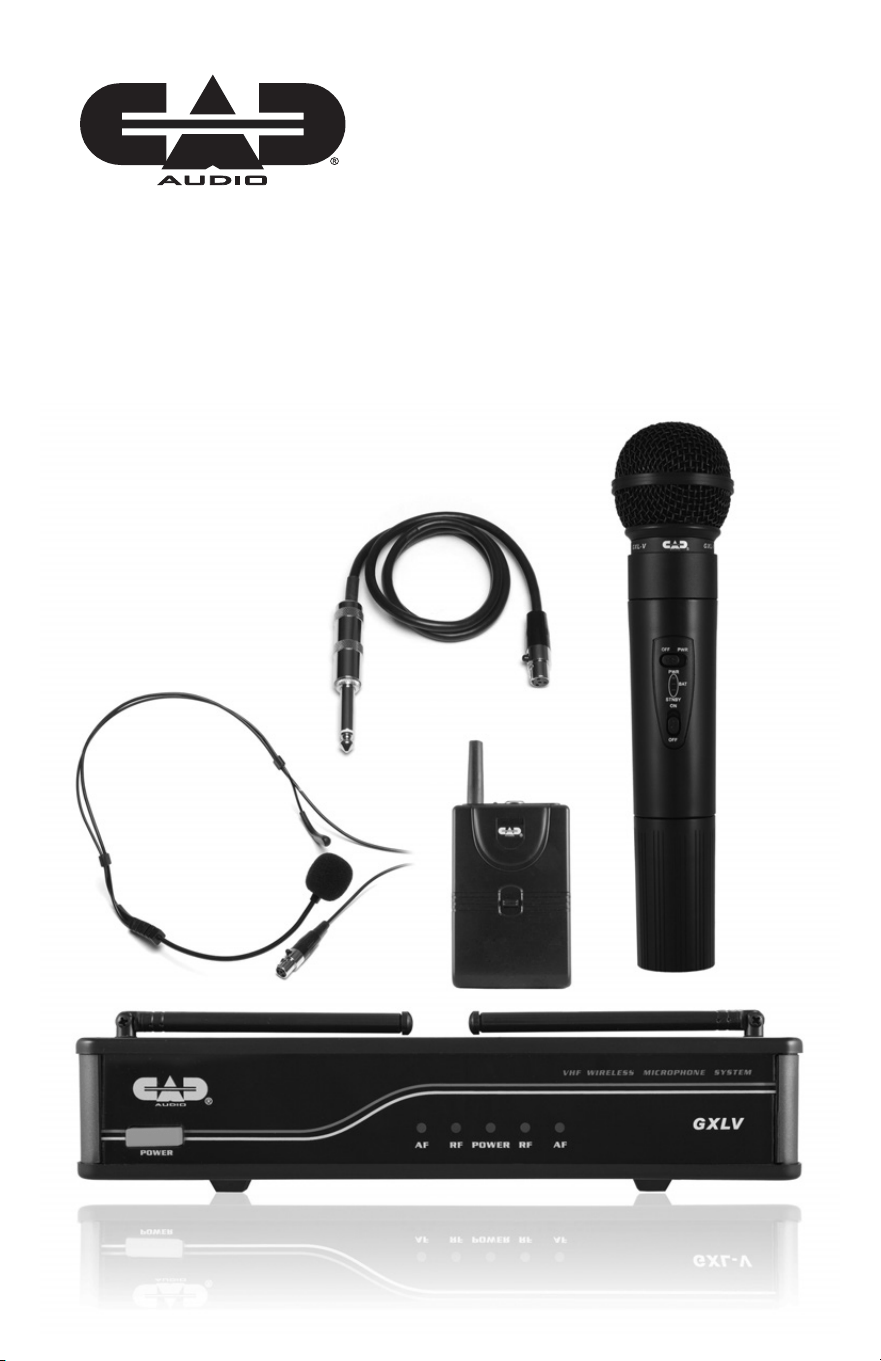
The GXLV Wireless includes the following features:
• Two discrete channels of wireless packaged in
one receiver chassis.
• Each channel has RF and AF indicator lights that indicate
the presence of connectivity and audio source.
• VHF Frequency Operation for increased operating range
• Advanced dipole antenna technology for increased
operating range.
• Three output options on the receiver for maximum
performance and exibility of use.
- Professional balanced XLRM-type discrete output
- Professional balanced XLRM-type mixed output
- Professional ¼ inch output for easy output to a guitar amp
or mixer equipped with ¼ inch input connections.
• Handheld transmitter outtted with on/off and mute function
for exibility of use.
• Bodypack transmitter outtted with on/off, mute function
for exibility of use.
• Handheld transmitter features battery life indicator.
• Battery life of >10hrs.
• All Bodypack systems ship with WXGTR guitar cable and
WXHW condenser headworn mic included.

3
• Insert new high quality alkaline batteries into your transmitter.
• Utilize the exible output format of the receiver to match your
application. Connect to mixer or amplier appropriately.
• Power up the receiver.
• Power up the transmitters.
• The RF indicator light will show connectivity between the
receiver and the transmitter. The AF indicator light shows the
presence of an audio source.
Operating Instructions
4
5 7 98 86
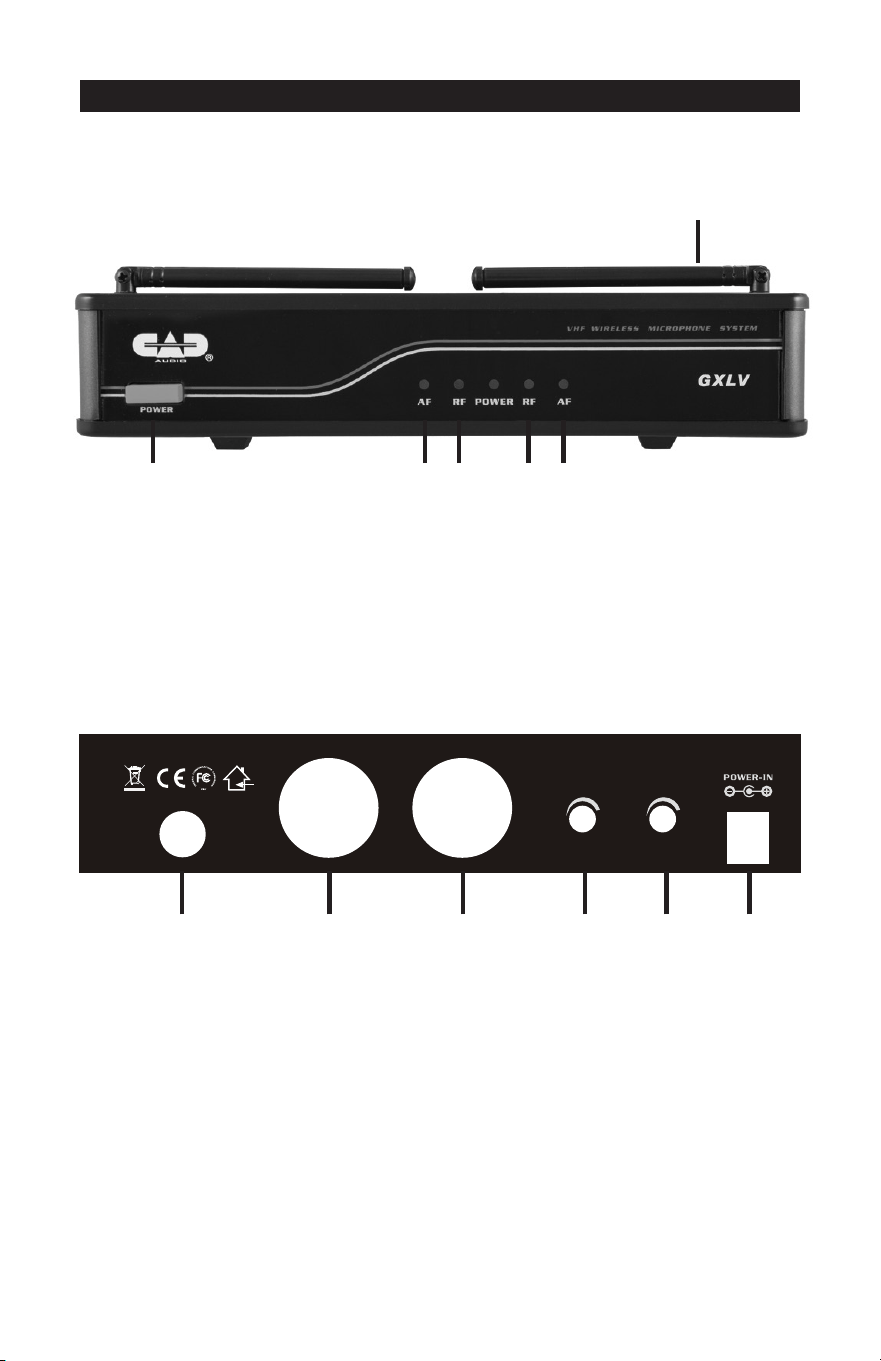
5. ¼ inch output channel B
6. Balanced XLRM-type output mix of channels A and B
7. Balanced XLRM-type output channel A
8. Volume Control
9. DC power jack (use supplied power adapter)
Specications RXGXLV Receiver
Maximum Output Level .................................................................-6dBV
Output Impedance .................................................................... 600ohms
Frequency Response .......................................................... 50Hz - 18KHz
Frequency Band ................................................................................. VHF
RF Sensitivity ............................................................................. -105dBm
Output Connectors ..............................................2x XLRM-type, 1x 1/4"
1. On/Off switch
2. AF indicator light
3. RF indicator light
4. Dipole Antenna
Receiver RXGXLV
1 2 3 3 2
4
Unbalanced B Balanced A and B Balanced A
Vol B Vol A
DC 13V-18V/350mA

5
• Transmitter Switch
- Power on/off switch
- Mute on/off switch
• Power indicator light
• Battery life indicator light
Specications TXHGXLV Handheld
Operating Principal ................................................Moving coil dynamic
Polar Pattern ................................................................................Cardioid
Frequency Response ..........................................................80Hz – 13KHz
Sensitivity ............................................................. -26dBV (50mV) @ 1Pa
Maximum SPL .................................................................................135dB
Dynamic Range .......................................................................... >100dBA
RF Transmitter Output .................................................................... 10mW
Modulation ...........................................................................................FM
Power requirements ...................... 9V alkaline or rechargeable battery
Battery Life ...............................................................>10 hours (alkaline)
Handheld TXHGXLV Transmitter

6
• On/Off, mute switch
• TB4M-type connector receives
TA4F-type terminated connection
• Battery compartment
• Antenna
• LED indicator light
Specications TXBGXLV Bodypack
Frequency Response ..........................................................50Hz – 18KHz
Dynamic Range .......................................................................... >100dBA
Maximum Input Level
Microphone Input: .............................................................-6dBV
Instrument Input: ............................................................ +10dBV
RF Transmitter Output .................................................................... 10mW
Modulation ...........................................................................................FM
Power Requirements ..................... 9V alkaline or rechargeable battery
Battery Life ............................................................... >10 hours (alkaline)
Bodypack TXBGXLV Transmitter

7
The GXLV system is available in the following frequencies:
H = 185.8MHz / 213.74MHz
J = 187.75 MHz / 205.75MHz
Channelization
Interfacing to TXBGXLV input connector
3k3
3k3
3-wire type electret mic
2-wire type electret mic
3k3
3k3
Dynamic mic
Instrument

CAD Audio
6573 Cochran Rd., Bldg. I Solon, OH 44139 U.S.A.
Tel: (440) 349-4900 Fax: (440) 248-4904
Sales: 800-762-9266 cadaudio.com
©2013 CAD Audio Part No. 62155- 00-00 Feb2013
Individuals with cardiac pacemakers and other similar medical devices
should consult with their physician before using any RF devices. Though
the output level of this wireless system is below 50 milliwatts, the
proximity of the transmitter to the implant device could pose a threat.
As with any wireless product, environmental conditions can reduce or in
some cases prohibit a successful connection between the transmitter
and the receiver.
Most users of CAD Audio wireless products in the United States do not
need a license for operation. However, the rules for unlicensed operation
state that this device must not operate in excess of 50 milliwatts and it
must not cause harmful interference to other wireless devices. Wireless
products meeting CAD factory standards adhere to these rules. The FCC
reserves the right to change these rules at any time.
For more information contact the FCC at 1-888 - CALL- FCC (TTY:
1-888-TELL-FCC) or visit the FCC’s wireless microphone website at:
www.fcc.gov/cgb/wirelessmicrophones
Please visit our support page for more help or information