

AXIS P5532-E/P5534-E User’s Manual
Notices
This manual is intended for administrators and users of the AXIS
P5532-E/P5534-E PTZ Dome Network Camera, and is applicable for
firmware release 5.20 and later. It includes instructions for using and
managing the camera on your network. Previous experience of
networking will be of use when using this product. Some knowledge of
UNIX or Linux-based systems may also be beneficial for advanced users,
for developing shell scripts and applications. Later versions of this
document will be posted to the Axis Website, as required. See also the
product’s online help, available via the Web-based interface.
Liability
Every care has been taken in the preparation of this manual. Please
inform your local Axis office of any inaccuracies or omissions. Axis
Communications AB cannot be held responsible for any technical or
typographical errors and reserves the right to make changes to the
product and manuals without prior notice. Axis Communications AB
makes no warranty of any kind with regard to the material contained
within this document, including, but not limited to, the implied
warranties of merchantability and fitness for a particular purpose. Axis
Communications AB shall not be liable nor responsible for incidental or
consequential damages in connection with the furnishing, performance
or use of this material.
Intellectual Property Rights
Axis AB has intellectual property rights relating to technology
embodied in the product described in this document. In particular, and
without limitation, these intellectual property rights may include one or
more of the patents listed at http://www.axis.com/patent.htm and one
or more additional patents or pending patent applications in the US and
other countries.
This product contains licensed third-part
y software. See the menu item
“About” in the product’s user interface for more information.
This product contains source code
copyright Apple Computer, Inc.,
under the terms of Apple Public Source License 2.0 (see
http://www.opensource.apple.com/apsl/).
The source code is available from:
http
://developer.apple.com/darwin/projects/bonjour/
Equipment Modifications
This equipment must be installed and used in strict accordance with the
instructions given in the user documentation. This equipment contains
no user-serviceable components. Unauthorized equipment changes or
modifications will invalidate all applicable regulatory certifications and
approvals.
Trademark Acknowledgments
Apple, Boa, Bonjour, Ethernet, Internet Explorer, Linux, Microsoft,
Mozilla, Netscape Navigator, OS/2, Real, SMPTE, QuickTime, UNIX,
Windows, WWW are registered trademarks of the respective holders.
Java and all Java-based trademarks and logos are trademarks or
registered trademarks of Sun Microsystems, Inc. in the United States
and other countries. Axis Communications AB is independent of Sun
Microsystems Inc.
UPnP
TM
is a certification mark of the UPnP
TM
Implementers Corporation.
Support
Should you require any technical assistance, please contact your Axis
reseller. If your questions cannot be answered immediately, your
reseller will forward your queries through the appropriate channels to
ensure a rapid response. If you are connected to the Internet, you can:
• download user documentation and firmware updates
• find answers to resolved problems in the FAQ database. Search by
product, category, or phrases
• report problems to Axis support by logging in to your private support
area
• visit Axis Support at www
.axis.com/techsup
AXIS P5532-E/P5534-E PTZ Dome Network Camera User’s Manual
Rev. 1.0
Copyright© Axis Communications AB, 2010
June 2010 Part no. 39647

3
AXIS P5532-E/P5534-E - Table of contents
Contents
Notices . . . . . . . . . . . . . . . . . . . . . . . . . . . . . . . . . . . . . . . . . . . . . . . . . . . . . . . . . . . . . . . . . . . . . . . . . . . . . . . . . . . . . . . . . . . . . 2
Product Description . . . . . . . . . . . . . . . . . . . . . . . . . . . . . . . . . . . . . . . . . . . . . . . . . . . . . . . . . . . . . . . . . . . . . . . . . . . . . . . . . . 4
Key features . . . . . . . . . . . . . . . . . . . . . . . . . . . . . . . . . . . . . . . . . . . . . . . . . . . . . . . . . . . . . . . . . . . . . . . . . . . . . . . . . . 4
Overview . . . . . . . . . . . . . . . . . . . . . . . . . . . . . . . . . . . . . . . . . . . . . . . . . . . . . . . . . . . . . . . . . . . . . . . . . . . . . . . . . . . . 5
Status Indicators . . . . . . . . . . . . . . . . . . . . . . . . . . . . . . . . . . . . . . . . . . . . . . . . . . . . . . . . . . . . . . . . . . . . . . . . . . . . . . 6
Accessing the Camera . . . . . . . . . . . . . . . . . . . . . . . . . . . . . . . . . . . . . . . . . . . . . . . . . . . . . . . . . . . . . . . . . . . . . . . . . . . . . . . . 7
Access from a browser . . . . . . . . . . . . . . . . . . . . . . . . . . . . . . . . . . . . . . . . . . . . . . . . . . . . . . . . . . . . . . . . . . . . . . . . . 7
Access from the Internet . . . . . . . . . . . . . . . . . . . . . . . . . . . . . . . . . . . . . . . . . . . . . . . . . . . . . . . . . . . . . . . . . . . . . . . 7
Setting the root password . . . . . . . . . . . . . . . . . . . . . . . . . . . . . . . . . . . . . . . . . . . . . . . . . . . . . . . . . . . . . . . . . . . . . . 8
Video Streams . . . . . . . . . . . . . . . . . . . . . . . . . . . . . . . . . . . . . . . . . . . . . . . . . . . . . . . . . . . . . . . . . . . . . . . . . . . . . . . . . . . . . . 11
How to stream H.264 . . . . . . . . . . . . . . . . . . . . . . . . . . . . . . . . . . . . . . . . . . . . . . . . . . . . . . . . . . . . . . . . . . . . . . . . . 11
Motion JPEG . . . . . . . . . . . . . . . . . . . . . . . . . . . . . . . . . . . . . . . . . . . . . . . . . . . . . . . . . . . . . . . . . . . . . . . . . . . . . . . . 11
Alternative methods of accessing the video stream . . . . . . . . . . . . . . . . . . . . . . . . . . . . . . . . . . . . . . . . . . . . . . . . 12
Setup Tools . . . . . . . . . . . . . . . . . . . . . . . . . . . . . . . . . . . . . . . . . . . . . . . . . . . . . . . . . . . . . . . . . . . . . . . . . . . . . . . . . . . . . . . . 13
Basic Setup . . . . . . . . . . . . . . . . . . . . . . . . . . . . . . . . . . . . . . . . . . . . . . . . . . . . . . . . . . . . . . . . . . . . . . . . . . . . . . . . . 13
Video . . . . . . . . . . . . . . . . . . . . . . . . . . . . . . . . . . . . . . . . . . . . . . . . . . . . . . . . . . . . . . . . . . . . . . . . . . . . . . . . . . . . . . . . . . . . . 14
Video Stream . . . . . . . . . . . . . . . . . . . . . . . . . . . . . . . . . . . . . . . . . . . . . . . . . . . . . . . . . . . . . . . . . . . . . . . . . . . . . . . . 14
Camera Settings . . . . . . . . . . . . . . . . . . . . . . . . . . . . . . . . . . . . . . . . . . . . . . . . . . . . . . . . . . . . . . . . . . . . . . . . . . . . . 16
Overlay Image . . . . . . . . . . . . . . . . . . . . . . . . . . . . . . . . . . . . . . . . . . . . . . . . . . . . . . . . . . . . . . . . . . . . . . . . . . . . . . . 17
Privacy mask . . . . . . . . . . . . . . . . . . . . . . . . . . . . . . . . . . . . . . . . . . . . . . . . . . . . . . . . . . . . . . . . . . . . . . . . . . . . . . . . 17
Live View Config . . . . . . . . . . . . . . . . . . . . . . . . . . . . . . . . . . . . . . . . . . . . . . . . . . . . . . . . . . . . . . . . . . . . . . . . . . . . . . . . . . . . 18
Layout . . . . . . . . . . . . . . . . . . . . . . . . . . . . . . . . . . . . . . . . . . . . . . . . . . . . . . . . . . . . . . . . . . . . . . . . . . . . . . . . . . . . . 18
PTZ (Pan Tilt Zoom) . . . . . . . . . . . . . . . . . . . . . . . . . . . . . . . . . . . . . . . . . . . . . . . . . . . . . . . . . . . . . . . . . . . . . . . . . . . . . . . . . . 20
Preset Positions . . . . . . . . . . . . . . . . . . . . . . . . . . . . . . . . . . . . . . . . . . . . . . . . . . . . . . . . . . . . . . . . . . . . . . . . . . . . . . 20
Guard Tour . . . . . . . . . . . . . . . . . . . . . . . . . . . . . . . . . . . . . . . . . . . . . . . . . . . . . . . . . . . . . . . . . . . . . . . . . . . . . . . . . . 20
OSDI Zones . . . . . . . . . . . . . . . . . . . . . . . . . . . . . . . . . . . . . . . . . . . . . . . . . . . . . . . . . . . . . . . . . . . . . . . . . . . . . . . . . 20
Advanced . . . . . . . . . . . . . . . . . . . . . . . . . . . . . . . . . . . . . . . . . . . . . . . . . . . . . . . . . . . . . . . . . . . . . . . . . . . . . . . . . . . 21
Applications . . . . . . . . . . . . . . . . . . . . . . . . . . . . . . . . . . . . . . . . . . . . . . . . . . . . . . . . . . . . . . . . . . . . . . . . . . . . . . . . . . . . . . . . 22
Events . . . . . . . . . . . . . . . . . . . . . . . . . . . . . . . . . . . . . . . . . . . . . . . . . . . . . . . . . . . . . . . . . . . . . . . . . . . . . . . . . . . . . . . . . . . . 23
Event Servers . . . . . . . . . . . . . . . . . . . . . . . . . . . . . . . . . . . . . . . . . . . . . . . . . . . . . . . . . . . . . . . . . . . . . . . . . . . . . . . . 23
Event Types . . . . . . . . . . . . . . . . . . . . . . . . . . . . . . . . . . . . . . . . . . . . . . . . . . . . . . . . . . . . . . . . . . . . . . . . . . . . . . . . . 23
Gatekeeper . . . . . . . . . . . . . . . . . . . . . . . . . . . . . . . . . . . . . . . . . . . . . . . . . . . . . . . . . . . . . . . . . . . . . . . . . . . . . . . . . 25
Recording List . . . . . . . . . . . . . . . . . . . . . . . . . . . . . . . . . . . . . . . . . . . . . . . . . . . . . . . . . . . . . . . . . . . . . . . . . . . . . . . . . . . . . . 28
Continuous Recording . . . . . . . . . . . . . . . . . . . . . . . . . . . . . . . . . . . . . . . . . . . . . . . . . . . . . . . . . . . . . . . . . . . . . . . . 29
System Options . . . . . . . . . . . . . . . . . . . . . . . . . . . . . . . . . . . . . . . . . . . . . . . . . . . . . . . . . . . . . . . . . . . . . . . . . . . . . . . . . . . . . 30
Security . . . . . . . . . . . . . . . . . . . . . . . . . . . . . . . . . . . . . . . . . . . . . . . . . . . . . . . . . . . . . . . . . . . . . . . . . . . . . . . . . . . . 30
Network . . . . . . . . . . . . . . . . . . . . . . . . . . . . . . . . . . . . . . . . . . . . . . . . . . . . . . . . . . . . . . . . . . . . . . . . . . . . . . . . . . . . 32
Storage . . . . . . . . . . . . . . . . . . . . . . . . . . . . . . . . . . . . . . . . . . . . . . . . . . . . . . . . . . . . . . . . . . . . . . . . . . . . . . . . . . . . 37
Maintenance . . . . . . . . . . . . . . . . . . . . . . . . . . . . . . . . . . . . . . . . . . . . . . . . . . . . . . . . . . . . . . . . . . . . . . . . . . . . . . . . 37
Support . . . . . . . . . . . . . . . . . . . . . . . . . . . . . . . . . . . . . . . . . . . . . . . . . . . . . . . . . . . . . . . . . . . . . . . . . . . . . . . . . . . . 37
Advanced . . . . . . . . . . . . . . . . . . . . . . . . . . . . . . . . . . . . . . . . . . . . . . . . . . . . . . . . . . . . . . . . . . . . . . . . . . . . . . . . . . . 38
About . . . . . . . . . . . . . . . . . . . . . . . . . . . . . . . . . . . . . . . . . . . . . . . . . . . . . . . . . . . . . . . . . . . . . . . . . . . . . . . . . . . . . . . . . . . . . 39
Resetting to the Factory Default Settings . . . . . . . . . . . . . . . . . . . . . . . . . . . . . . . . . . . . . . . . . . . . . . . . . . . . . . . . . . . . . . . 39
Troubleshooting . . . . . . . . . . . . . . . . . . . . . . . . . . . . . . . . . . . . . . . . . . . . . . . . . . . . . . . . . . . . . . . . . . . . . . . . . . . . . . . . . . . . 40
Checking the Firmware . . . . . . . . . . . . . . . . . . . . . . . . . . . . . . . . . . . . . . . . . . . . . . . . . . . . . . . . . . . . . . . . . . . . . . . . 40
Upgrading the Firmware . . . . . . . . . . . . . . . . . . . . . . . . . . . . . . . . . . . . . . . . . . . . . . . . . . . . . . . . . . . . . . . . . . . . . . . 40
Emergency Recovery Procedure . . . . . . . . . . . . . . . . . . . . . . . . . . . . . . . . . . . . . . . . . . . . . . . . . . . . . . . . . . . . . . . . . 40
AXIS Support . . . . . . . . . . . . . . . . . . . . . . . . . . . . . . . . . . . . . . . . . . . . . . . . . . . . . . . . . . . . . . . . . . . . . . . . . . . . . . . . 41
Symptoms, possible causes and remedial actions . . . . . . . . . . . . . . . . . . . . . . . . . . . . . . . . . . . . . . . . . . . . . . . . . . 42
LED Indicator flash routine . . . . . . . . . . . . . . . . . . . . . . . . . . . . . . . . . . . . . . . . . . . . . . . . . . . . . . . . . . . . . . . . . . . . 44
Technical Specifications . . . . . . . . . . . . . . . . . . . . . . . . . . . . . . . . . . . . . . . . . . . . . . . . . . .
. . . . . . . . . . . . . . . . . . . . . . . . . . . 45
Gen
eral performance considerations . . . . . . . . . . . . . . . . . . . . . . . . . . . . . . . . . . . . . . . . . . . . . . . . . . . . . . . . . . . . . 47
Glossary of Terms . . . . . . . . . . . . . . . . . . . . . . . . . . . . . . . . . . . . . . . . . . . . . . . . . . . . . . . . . . . . . . . . . . . . . . . . . . . . . . . . . . . 48
Index . . . . . . . . . . . . . . . . . . . . . . . . . . . . . . . . . . . . . . . . . . . . . . . . . . . . . . . . . . . . . . . . . . . . . . . . . . . . . . . . . . . . . . . . . . . . . 54

4
AXIS P5532-E/P5534-E - Product Description
Product Description
This manual applies to the following products:
• AXIS P5532-E PTZ Dome Network Camera.
• AXIS P5534-E PTZ Dome Network Camera.
The information provided here applies to both models,
except where otherwise indicated.
Key features
• HDTV 720p
AXIS P5534-E offers HDTV 720p in compliance with SMPTE 296M standard of 1280 x 720 pixel
resolution, full frame rate, high color fidelity and a 16:9 format. AXIS P5532-E offers D1 and
4CIF resolution (720 x 480/576 pixels).
• Outdoor-ready
AXIS P5532-E/P5534-E is designed for quick and easy installation in
demanding indoor and outdoor environments.
There is no need to purchase and mount a separate outdoor housing. They eliminate the cost and complexity of
pre-mounting a camera in an enclosure and minimizes the risk of incorrect mounting, which helps to ensure optimal
camera performance.
With an IP66 and NEMA 4X rating, it is dust tight and offer protection against high-pressure wat
er jets. AXIS
P5532-E/P5534-E have a built-in heater, fans and a removable sunshield, allowing the camera to be used in
temperatures ranging from -20 °C up to 50 °C (-4 °F up to 122 °F).
• Zoom fun
ctionality with autofocus
AXIS P5532-E offers a powerful 29x optical and 12x digital zoom,
providing crisp, clear and rich detail of both zoomed
in and zoomed out images. AXIS P5534-E offers 18x optical and 12x digital zoom in HDTV. Due to its HDTV resolution,
the 18x zoom provides not only a level of detail that is comparable to a 36x-zoom, 4CIF camera, but also the extra
advantage of a wider, 16:9 field of view in zoomed-in views.
• High PoE (Power over Ethernet)
AXIS P5532-E/P5534-E can be powered through High PoE, which simplifies installation since only one cable is needed
for carrying power, as well as video and pan/tilt/zoom controls. With High PoE, the cameras can operate even during a
power failure as the network can be connected to an Uninterruptible Power Supply. A High PoE midspan is supplied
with the camera.
• Advanced Gatekeeper functionality
The Advanced Gatekeeper functionality enables the camera to automatically pan, tilt and zoom in when there is
activity in the scene, and to return to a pre-determined position after a preset time.
• Multiple H.264 and Motion JPEG streams
AXIS P5532-E/P5534-E offers the most efficient video compression format H.264 (MPEG-4 Part 10/AVC), which saves
up to 80% in bandwidth and storage use compared with Motion JPEG without compromising image quality. The
camera also supports Motion JPEG for increased flexibility. AXIS P5534 supports simultaneous, individually configured
streams in HDTV 720p.
• Local storage
The camera comes with a built-in slot for an SD/SDHC memory card,
enabling several days of recordings to be stored
locally without any external equipment.
• Progressive Scan
Progressive scan provides full resolution images of moving objects
without distortion.
• Advan
ced security and network management
AXIS P5532-E/P5534-E offers the highest degree of secur
ity, including HTTPS encrypted video streams without
affecting performance and IPv6 support in addition to IPv4. IPv6 is a requirement in many large installations.
5
AXIS P5532-E/P5534-E - Product Description
Overview
Note:
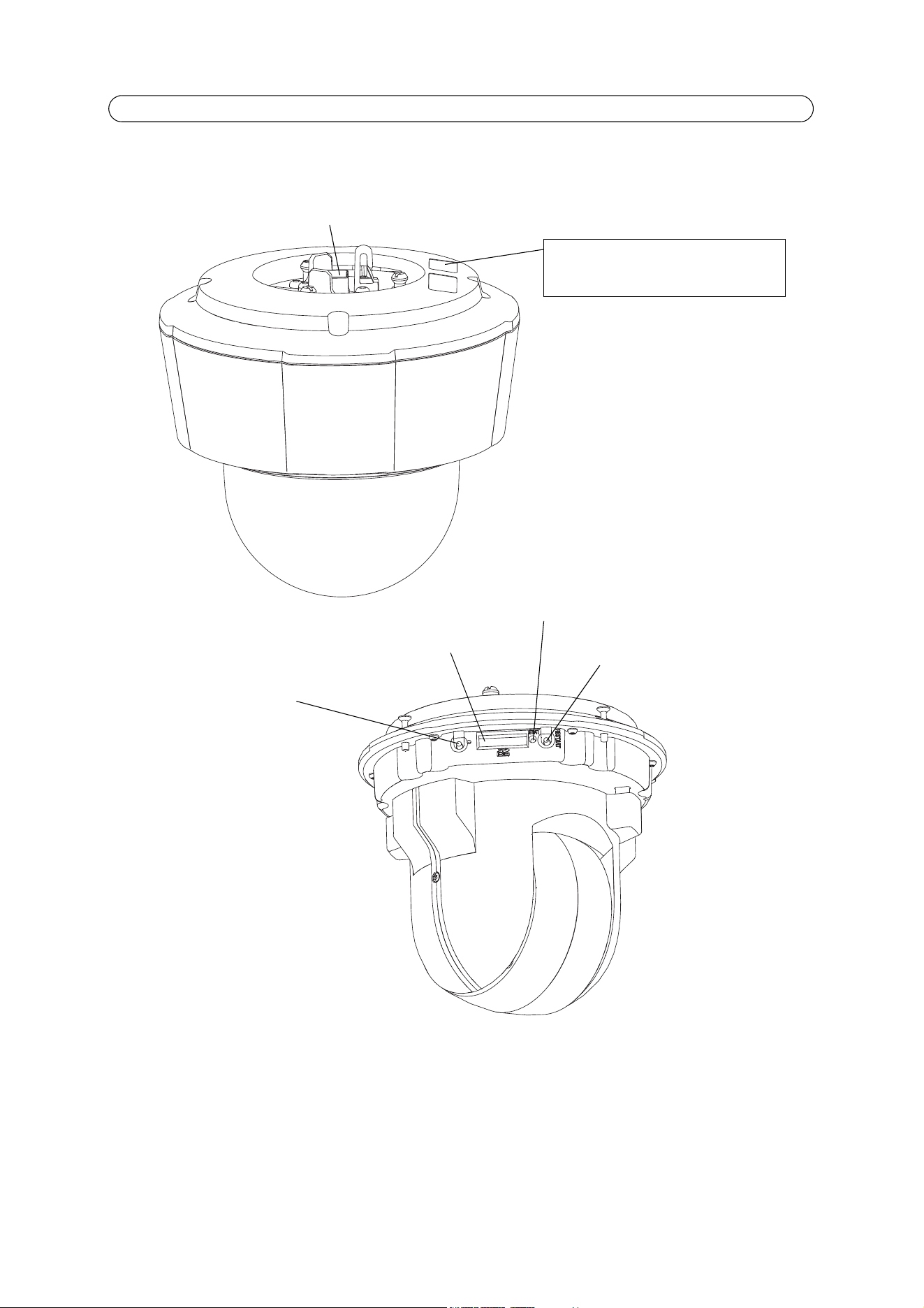
To insert and remove an SD card, or access the camera’s control and restart buttons, the sunshield and top cover must
first be removed; for instructions please refer to the Installation Guide.
Network connector - RJ-45 Ethernet connector. Supports High Power over Ethernet (IEE 802.3at). Use Axis T8123 Midspan
(included). Shielded cable shall be used to comply with EMC.
Network connector
Part number (P/N) & Serial number (S/N).
The serial number may be required
during the installation.
Status indicator
Control button
SDHC memory card slot
Restart button

6
AXIS P5532-E/P5534-E - Product Description
Control button - The control button is used for
• Connecting to an AXIS Video Hosting System service, see page 33. To connect, press and hold the button until the
Status LED flashes green.
• Connecting to AXIS Internet Dynamic
DNS Service, see page 33. To connect, press the button once.
• Restoring the camera to factory default settings, see Resett
ing to Factory Default Settings, on
Resetting to the Factory
Default Settings,
on page 39.
Restart button - Press the button to restart the camera.
Serial number label - Part number (P/N) and Serial number (S/N). The serial
number may be required during installation.
SDHC memory card slot - A standard or high capacity SD memory card (not
included) can be used for local recording with
removable storage. To insert and remove an SD card, the camera’s sunshield and top cover must first be removed; for
instructions please refer to the Installation Guide.
Note:
Bef
ore removal, the SD card should be unmounted to prevent corruption of recordings. To unmount the SD card, go to
Setup > System Options > Storage > SD Card and click Unmount.
Status Indicators
After the startup ad self test routines the indicator flashes as follows.
See also
LED Indicator flash routine,
on page 44.
Unit Color Description
AXIS P5532-E
AXIS P5534-E
Unlit Steady during connect
ion/normal operation.
Amber Steady during system
initiating. Flashes during firmware upgrade and reset to fac-
tory default.
Amber/red No network connection
Red Firmware upgrade failure.
Green Steady for 10 sec. after successful restart.
Unit LED Color Description
AXIS T8123 Port Unlit No camera connected.
Yellow Insufficient power for camera and heater. Ch
eck cable.
Flashing Power overload
Green Camera connected, normal behavior.
AC input Steady green AC power connected.
7
AXIS P5532-E/P5534-E - Accessing the Camera
Accessing the Camera
To install the network camera, refer to the Installation Guide supplied with your product.
The network camera can be used with most operating systems and
browsers. The recommended browsers are Internet Explorer
with Windows, Safari with Macintosh and Firefox with other operating systems. See
Technical Specifications,
on page 45.
Notes:
• To view streaming video in Microsoft Internet Explorer, set
your browser to allow ActiveX controls and install AXIS
Media Control (AMC) on your workstation.
• QuickTime
TM
is also supported for viewing streaming H.264 video.
• If your computer restricts the use of additional software components, the camera can be configured to use a Java
applet for viewing Motion JPEG.
• The network camera includes one (1) decoder license for viewing H.264 video streams. This is automatically installed
with AMC. The administrator can disable the installation of the H.264 decoder, to prevent installation of unlicensed
copies.
Access from a browser
1. Start a browser (Internet Explorer, Firefox, Safari).
2. Enter the IP address or host name of the camera in the Location/Address field of your browser.
To access the camera from a Macintosh computer (Mac OS X), click on the Bonjour tab and select the network camera
from the drop-down list.
3. If this is the first time you are accessing the camera, see
Setting the root password,
on page 8. Otherwise enter your
user name and password, set by the administrator.
4. The camera’s Live View page appears in your browser.
Note:
The layout of the Live View page may have been customized to specific requirements. Consequently, some of the
examples and functions featured here may differ from those displayed on your own Live View page.
Access from the Internet
Once connected, the camera is accessible on your local network (LAN). To access the camera from the Internet you must
configure your broadband router to allow incoming data traffic to the camera. To do this, enable the NAT-traversal feature,
which will attempt to automatically configure the router to allow access to the camera. This is enabled from Setup > System
Options > Network > TCP/IP Advanced.
For more information, please see
NAT traversal (port mapping) for IPv4
, on page 34. See also AXIS Internet Dynamic DNS
Service at www.axiscam.net For Technical notes on this and other topics, visit the Axis Support web at www.axis.com/techsup
8
AXIS P5532-E/P5534-E - Accessing the Camera
Setting the root password
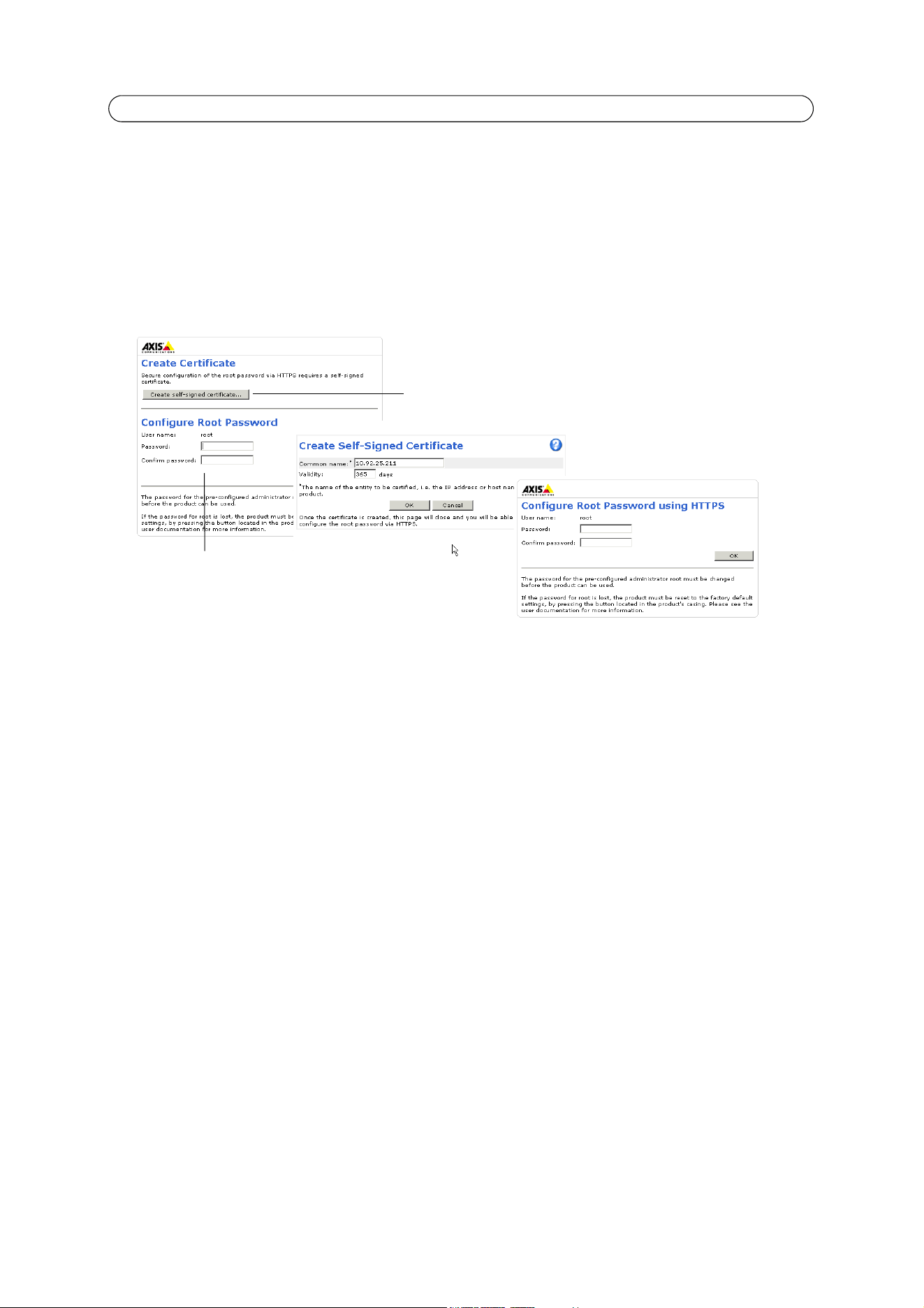
To gain access to the product, you must set the password for the default administrator user - ‘root’. This is done in the
‘Configure Root Password’ dialog, which is displayed when the network camera is accessed for the first time. To prevent
network eavesdropping the root password can be set via an encrypted HTTPS connection, which requires an HTTPS certificate
Note:
HTTPS (Hypertext Transfer
Protocol over SSL) is a protocol used to encrypt the traffic between web browsers and serv-
ers. The HTTPS certificate ensures encrypted exchange of information.
To set the password via a standard HTTP connection, enter it direct
ly in the first dialog shown above.
To set the password via an encrypted HTTPS connection, follow these steps:
1. Click Create self-signed certificate.
2. Provide the requested information and click OK. The certificate is created and the password can now be set securely.
All traffic to and from the network camera is encrypted from this point on.
3. Enter a password and then re-enter it to confirm the spelling. Click OK. The password has now been configured.
Notes:
• The default administrator user name ‘root‘ is permanent and cannot be deleted.
• If the password for root is lost, the camera must be reset to the factory default settings. See page 39.
• If prompted, click Yes to install AXIS Media Control, which allows viewing of the video stream in Internet Explorer.
You will need administrator rights on the computer to do this. If using Windows 7 or Windows Vista, you must also
run Internet Explorer as administrator; right-click the Internet Explorer icon and select Run as Administrator.
To configure the password
directly via an unencrypted
connection, enter the password here.
To create an HTTPS connection,
start by clicking this button.
9
AXIS P5532-E/P5534-E - Accessing the Camera
The Live View page
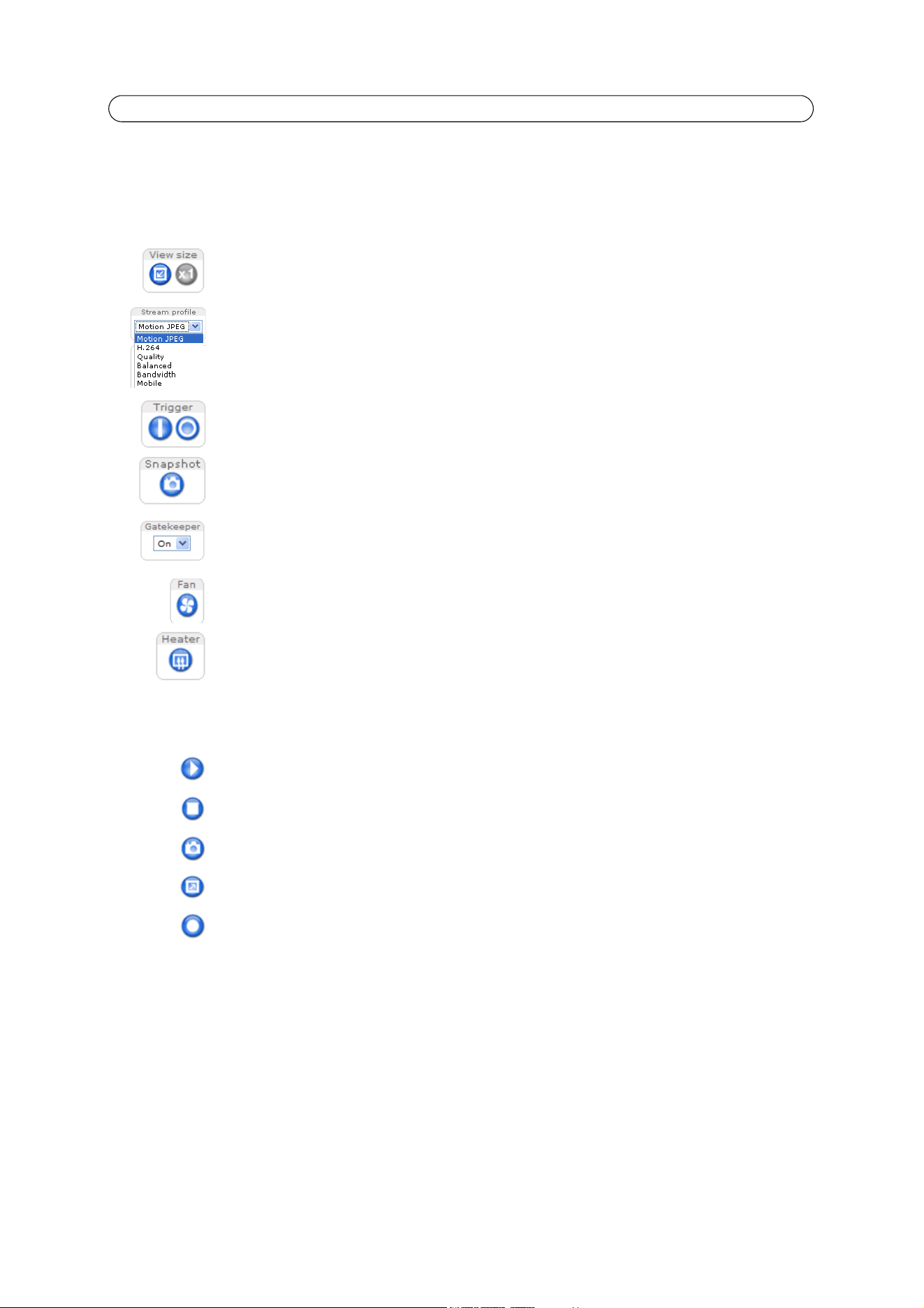
How you customize the Live View page determines which buttons are visible. Not all the buttons described below will show
up, unless configured to do so. These are configured under Setup > Live View Config > Layout.
View size – Click to scale the image down to 800 pixels wide or to full scale. Only available in MJPEG.
The Stream Profile drop-down list allows you to select a customized or pre-programmed stream profile on
the Live View page. Stream profiles are configured under Setup > Video > Stream Profiles, see
Stream Pro-
files,
on page 16 for more information.
The Trigger buttons can trigger an event directly from the Live View page. The buttons are configured under
Setup > Live View Config > Layout.
The Snapshot button saves a snapshot of the video image currently on display. Right-click on the video
image to save it in JPEG format on your computer. This button is primarily intended for use when the AMC
Media Control viewer toolbar is not available.
Enable/disable the Gatekeeper by selecting On or Off from the drop-down list. The Gatekeeper is configured
under Setup > Events > Gatekeeper, see page 25.
Activate the camera’s Fan manually with this button.
Activate the camera’s Heater manually with this button.
AXIS Media Control viewer toolbar
The AXIS Media Control viewer toolbar is available in Internet Explorer only. See
AXIS Media Control (AMC),
on page 12 for
more information. AMC displays the following buttons:
The Play button connects to the Axis product and starts playing a media stream.
The Stop button stops the video stream.
The Snapshot button takes a snapshot of the current image. The location where the image is saved can be
specified in the AMC Control Panel.
Click the View Full Screen button and the video image will fill the entire screen. Press Esc (Escape) on the
computer keyboard to cancel full screen view.
The Record button is used to record the current video stream. The location where the recording is saved can
be specified in the AMC Control Panel.
10
AXIS P5532-E/P5534-E - Accessing the Camera
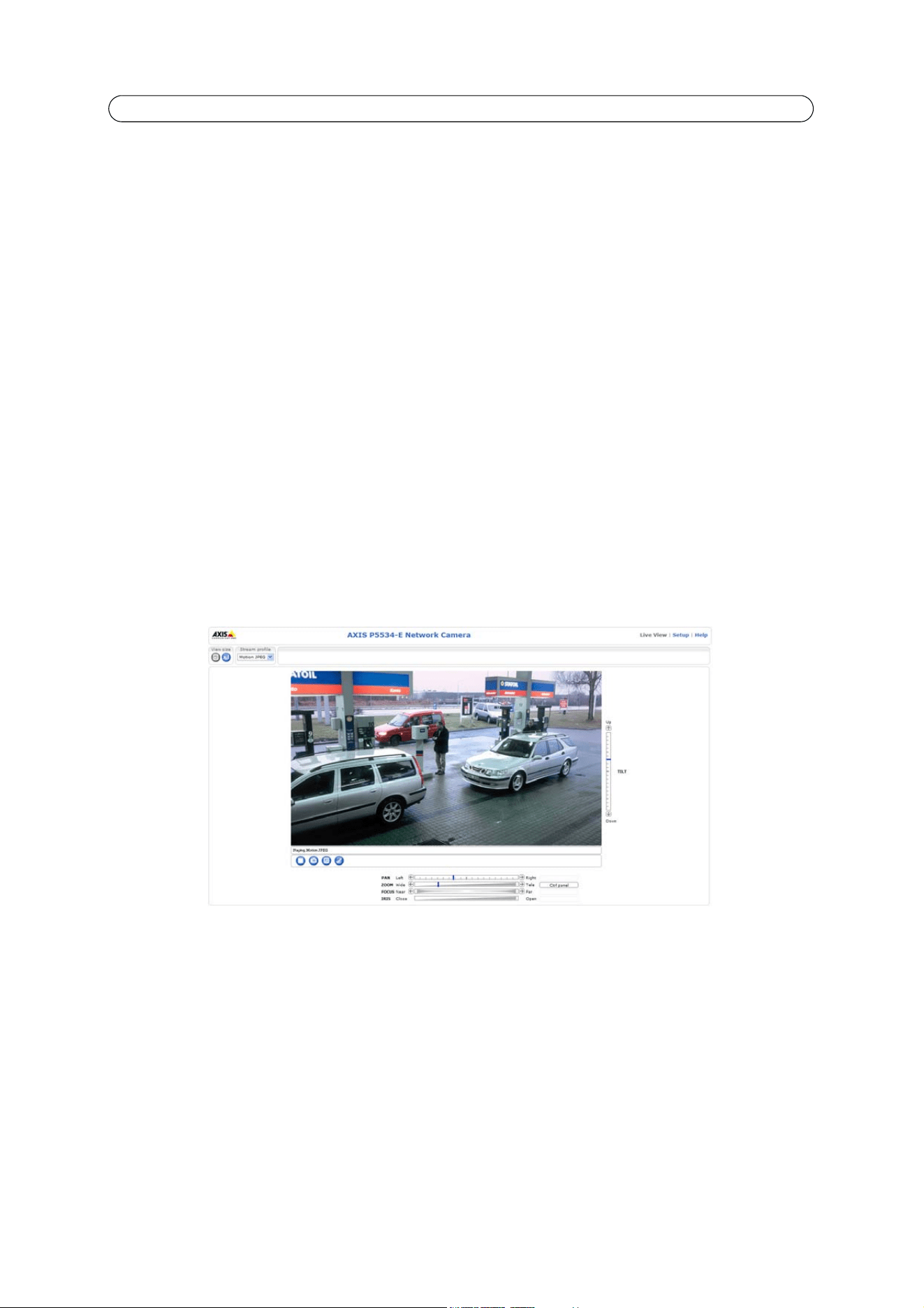
Pan/Tilt/Zoom Controls
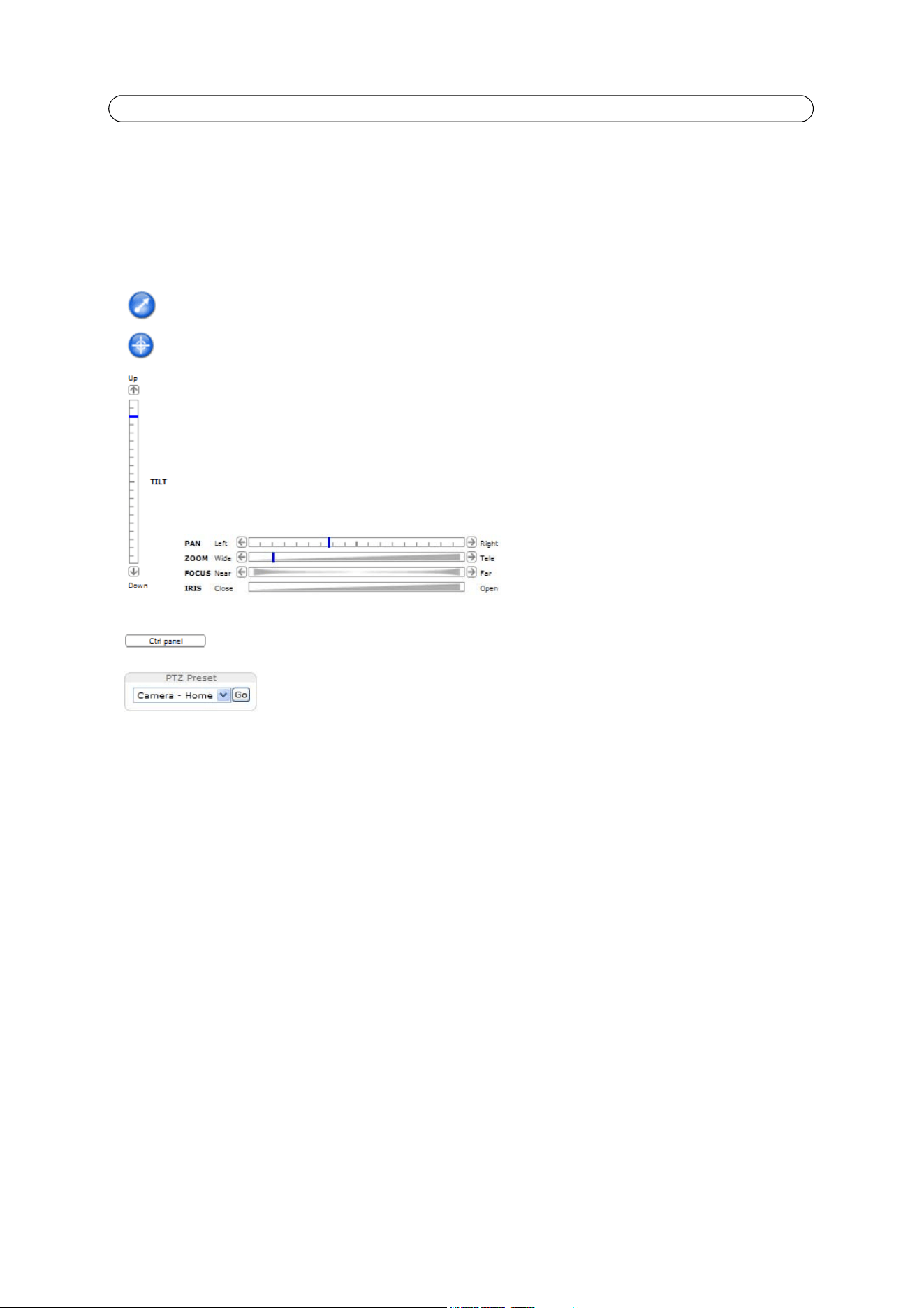
The Live View page also displays the Pan/Tilt/Zoom (PTZ) controls. The administrator can enable/disable controls for specified
users under System Options > Security > Users.
With the P
TZ Control Queue enabled the time each user is in control of the PTZ settings is limited. Click the buttons to
request or release control of the PTZ controls. The PTZ Control Queue is set up under PTZ > Control Queue.
Click the Emu
late joystick mode button and click in the image to move the camera view in the direction of the
mouse pointer.
Click the Center mode button and click on a position in the image to center the camera view on that position.
Pan and Tilt bars –
Click a position directly on the bar to steer the camera view directly to the new position in one
smooth movement or click on the arrows at the ends of the bar
s to steer the camera in steps.
Zoom bar –
Click a position directly on the zoom bar to zoom all the way to the new position in one movement or
click the arrows at the ends of the bar to zoom in steps.
Focus bar –
Click a position directly on the focus bar to set focus at a new position in one movement or click the
arrows at the ends of the bar to change focus in steps.
Iris bar – Click a position directly
on the iris bar to change the degree the iris opens to in one movement or click
the arrows at the ends of the bar to change the iris in steps.
Click the Ct
rl panel button to open the PTZ control panel which provides additional PTZ controls.
User-defined buttons can also appear in the Control panel, see
Controls,
on page 21.
Select a PTZ preset position to steer the camera view to the saved position, see
Preset Positions,
on page 20.

11
AXIS P5532-E/P5534-E - Video Streams
Video Streams
The network camera provides several image and video stream formats. Your requirements and the properties of your network
will determine the type you use.
The Live View page in the network camera provides access to
H.264 and Motion JPEG video streams, and to the list of
available stream profiles. Other applications and clients can also access these video streams/images directly, without going via
the Live View page.
How to stream H.264
This video compression standard makes good use of bandwidth, and can provide high quality video streams at less than
1 Mbit/s.
Deciding which combination of protocols and methods to use depends
on your viewing requirements, and on the properties of
your network. The available options in Axis Media Control are:
Axis Media Control negotiates with the camera
to determine the transport protocol to use. The order of priority, listed in the
AMC Control Panel, can be changed and the options disabled, to suit specific requirements.
Important!
H.2
64 is licensed technology. The network camera includes one H.264 viewing client license. Installing additional
unlicensed copies of the viewing client is prohibited. To purchase additional licenses, contact your Axis reseller.
Motion JPEG
This format uses standard JPEG still images for the video stream. These images are then displayed and updated at a rate
sufficient to create a stream that shows constantly updated motion.
The Motion JPEG stream uses considerable amounts of bandwidth, but
provides excellent image quality and access to every
image contained in the stream. The recommended method of accessing Motion JPEG live video from the network camera is to
use the AXIS Media Control (AMC) in Internet Explorer in Windows.
Unicast RTP This unicast method (RTP over UDP) is used
for live unicast video, especially when it is
important to always have an up-to-date
video stream, even if some images are
dropped.
Unicasting is used for video-on-demand transmission,
so that there is no video traffic on the network until a
client connects and requests the stream.
Note that there are a maxim
um of 20 simultaneous
unicast connections.
RTP over RTSP This unicast method (RTP tunneled over
RTSP) is useful as it is relatively simple to
configure firewalls to allow RTSP traffic.
RTP over RTSP over
HTTP
This unicast method can be used to
traverse
firewalls. Firewalls are commonly configured
to allow the HTTP protocol, thus allowing
RTP to be tunneled.
Multicast RTP This method (RTP over UDP) should be used for live multicast video. The video stream is always
up-to-date, even if some images are dropped.
Multicasting provides the most efficient usage of bandwidth when there are large numbers of cli-
ents viewing simultaneously. A multicast broadcast
cannot however, pass a network router unless
the router is configured to allow this. It is not possible to multicast over the Internet, for example.
Note also that all multicast viewers count as one unicast
viewer in the maximum total of 20
simultaneous connections.
12
AXIS P5532-E/P5534-E - Video Streams
AXIS Media Control (AMC)
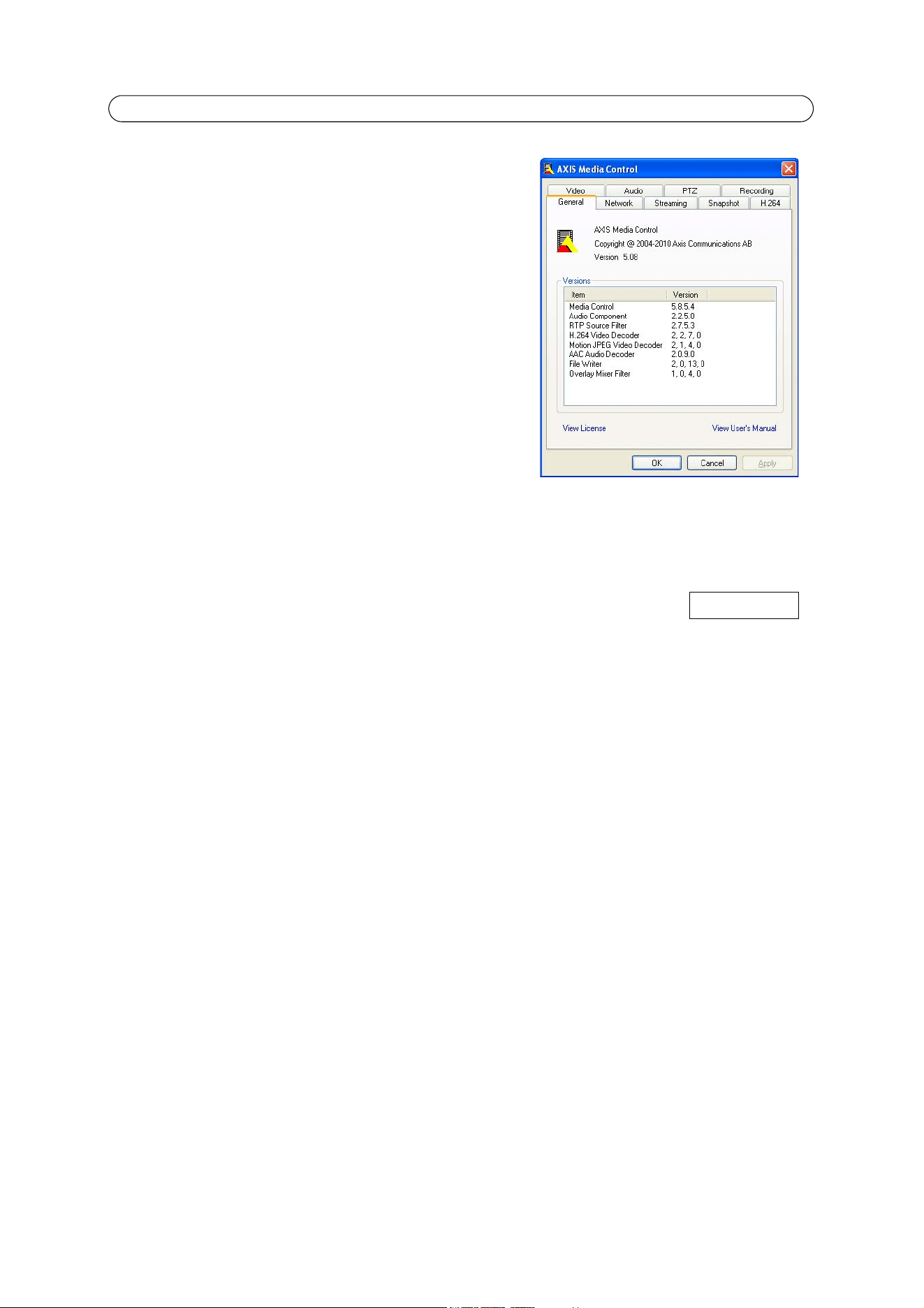
AXIS Media Control (AMC) in Internet Explorer in Windows is the
recommended method of accessing live video from the network camera.
The AMC Control Panel can be used to con
figure various video settings.
Please see the AXIS Media Control User’s Manual for more information.
The AMC Control Panel is automatically installed on first
use, after which it
can be configured. Open the AMC Control Panel from:
• Windows Control Panel (from the Start menu)
• Alternatively, right-click the video image in In
ternet Explorer and
click Settings to access the AMC window.
Alternative methods of accessing the video stream
You can also access video/images from the network camera in the
following ways:
• Motion JPEG server push (if supported by the client, Firef
ox, for example). This option maintains an open HTTP con-
nection to the browser and sends data as and
when required, for as long as required.
• Still JPEG images in a browser. Enter the path - http://<ip>/axis-cgi/jpg/image.cgi
• Windows Media Player. This requires AXIS Media Co
ntrol and the H.264 decoder to be installed. The paths that can be
used are listed below in the order of preference:
• Unicast via RTP: axrtpu://<ip>/axis-media/media.amp
•
Unicast via RTSP: axrtsp://<ip>/axis-media/media.amp
• Unicast via RTSP, tunneled via HTTP: axrtsphttp://<ip>/axis-media/media.amp
• Multicast: axrtpm://<ip>/axis-media/media.amp
• To access the video stream from Qu
ickTime™ the following paths can be used:
• rtsp://<ip>/axis-media/media.amp
• rtsp://<ip>/axis-media/media.3gp
Notes:
•
• The network camera supports QuickTime 6.5.1 and later.
• QuickTime adds latency to the video stream (up to 3 seconds).
• It may be possible to use other players to view the H.264 stream using the paths above, although Axis does not
guarantee this.
• <ip> = IP address
<ip> = IP address
13
AXIS P5532-E/P5534-E - Setup Tools
Setup Tools
AXIS P5532-E/P5534-E can be configured by users with administrator or operator rights. To access the product’s Setup tools,
click Setup in the top right-hand corner of the Live View page.
• Admi
nistrators have unrestricted access to all settings.
• Operators have access to Vid
eo & Audio, Live View Config, PTZ, Events and Recording List.
See also the online help available by clicking on each Setup page.
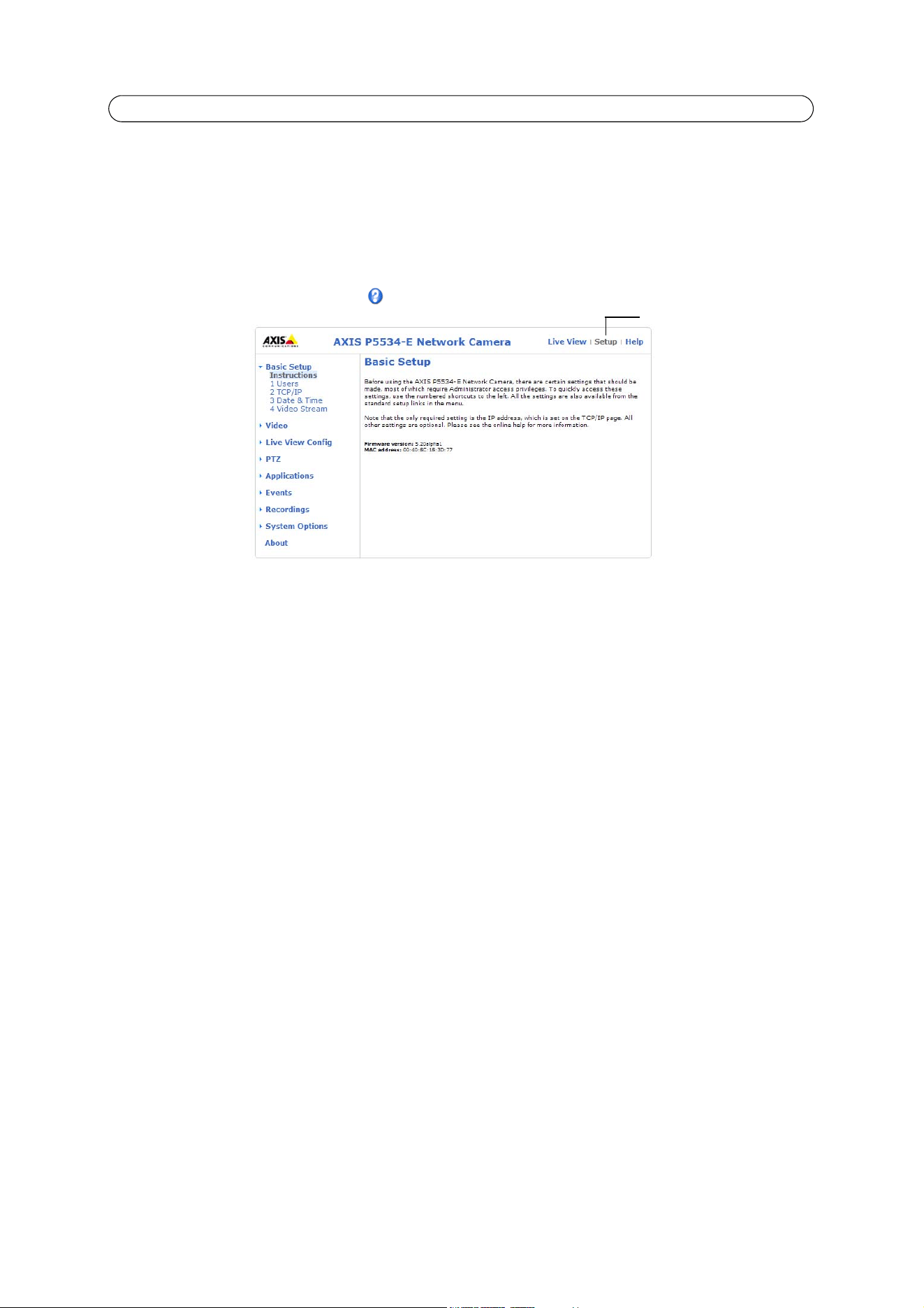
Basic Setup
Basic Setup provides shortcuts to the settings that should be made before using the network camera:
1. Users, see page 30.
2.
TCP/IP, see page 32.
3. Date & Time, see page 32.
4. Video Stream, see page 14.
Setup link
14
AXIS P5532-E/P5534-E - Video
Video
Click to access the online help that explains the Setup tools.
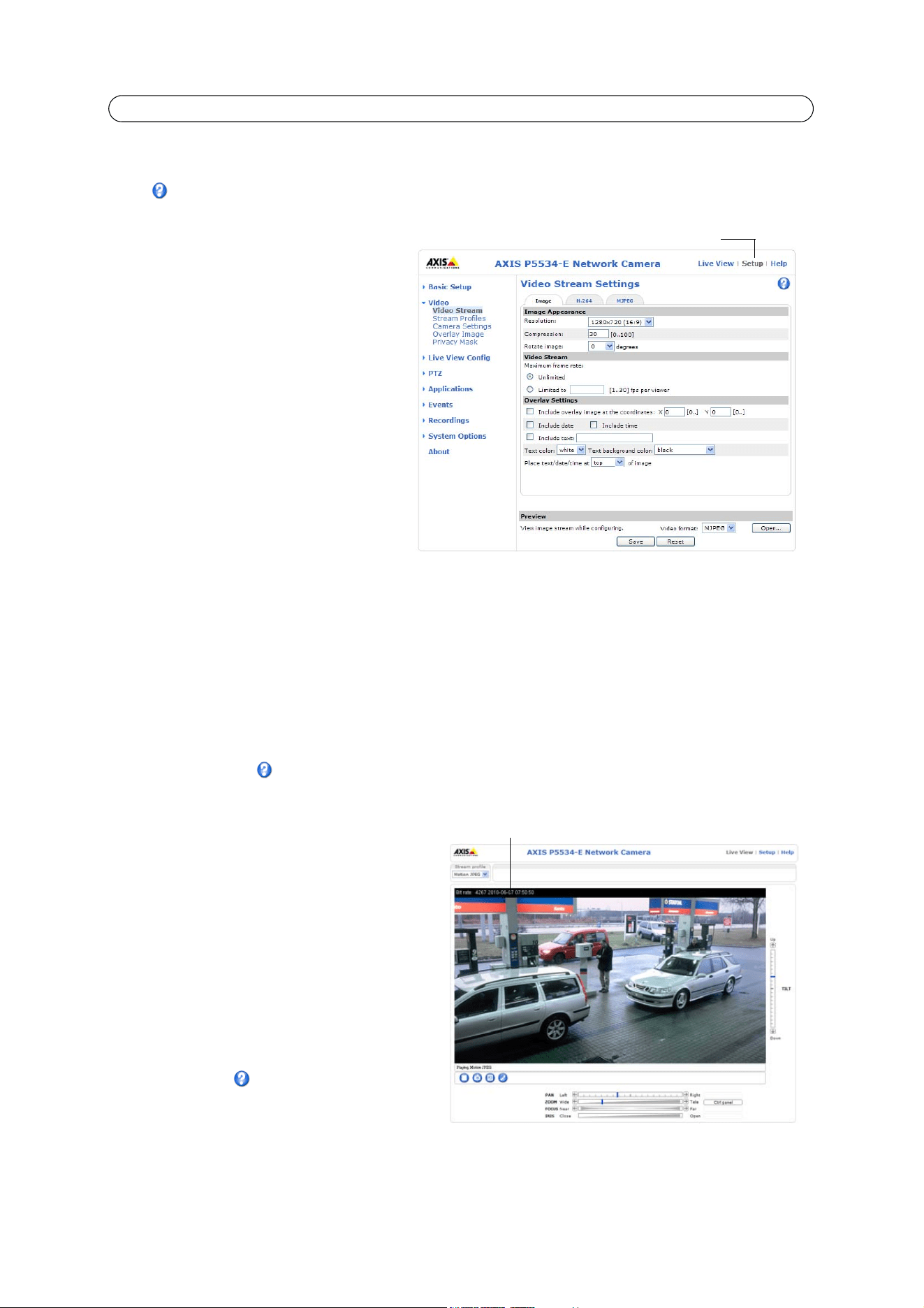
Video Stream
The video stream settings appear under in three
different tabs:
•Image
• H.264
•MJPEG
Preview
For a preview of the image before saving, select
the Vide
o format and click Open.
The pixel cou
nter shows the number of pixels in
an area of the image and can be used to ensure
that the size of the image fulfills certain
requirements, for example for face recognition.
Use the mouse to move and resize the rectangle,
or enter the number of pixels in the Width and
Height fields and click Apply.
When satisfied with the settings, click Save.
Image
Image Appearance
Use these settings to modify the image resolution and compression. Sett
ing the compression level affects the image quality
and the amount of bandwidth required, the lower the compression, the higher the image quality with higher bandwidth
requirements. The image can also be rotated.
See the online help files for more information.
Video Stream
To avoid bandwidth problems on the network, the
frame
rate allowed to each viewer can be limited.
Select the Unlimited radio button option to allow the
highest available frame rate or select the Limited to
radio button and enter a value (1-30) fps in the field.
Overlay Settings
To place an overlay image at specific coordinates,
check th
e Include overlay image at coordinates and
enter the X and Y coordinates. The overlay image must
first be uploaded to the network camera, see
Overlay
Image,
on page 17.
Text, date and time can also be used as an overlay. See
the online help files for information on available
options.
Setup link
Text, date & time overlay

15
AXIS P5532-E/P5534-E - Video
H.264
GOV Settings
The GOV structure describes the composition of the video stream and sett
ing the GOV-length to a higher value saves
considerably on bandwidth but may have an adverse effect on image quality.
Bit Rate Control
The bit rate can be set as Va
riable Bit Rate (VBR) or Constant Bit Rate (CBR). VBR adjusts the bit rate according to the image
complexity, using up bandwidth for increased activity in the image, and less for lower activity in the monitored area.
CBR allows you to set a fixed Target bit rate th
at consumes a predictable amount of bandwidth. As the bit rate would usually
need to increase for increased image activity, but in this case cannot, the frame rate and image quality are affected
negatively. To partly compensate for this, it is possible to prioritize either the frame rate or the image quality whenever the bit
rate needs to be increased. Not setting a priority means the frame rate and image quality are equally affected.
Note:
To
determine a reasonable bit rate, go to Setup > Video > Video Stream > Image. Under Overlay Settings, check the
Include checkbox and enter the code #b in the Include text: field. The current bit rate will display as a text overlay on
the Live View page.
To preview the image stream while configuring the G
OV settings and Bit rate control, select Open under Preview.
MJPEG
Sometimes the image size is large due to low light or complex scenery. Adjusting the Maximum frame size helps to control
the bandwidth and storage used by the Motion JPEG video stream in these situations. Defining the frame size as Default
provides consistently good image quality at the expense of increased bandwidth and storage usage during low light. Limiting
the frame size optimizes bandwidth and storage usage, but may give poor image quality. To prevent increased bandwidth and
storage usage, the maximum frame size should be set to an optimal value.

16
AXIS P5532-E/P5534-E - Video
Stream Profiles
There are four pre-programmed stream profiles available for quick set-up. These settings can be adjusted and new, customized
profiles can be created. Each profile has a descriptive name, describing its usage and/or purpose. The profiles can be accessed
from the Live View page.
• To create a new stream profile, click Add to bring up th
e Stream Profile Settings dialog.
1. Enter a unique name and a description for your profile.
2. Select a Video encoding type (H.264 or MJPEG) from the drop-down list.
3. Modify the stream settings under the Image, H.264 and MJPEG tabs. See
Video Stream,
on page 14
4. Click OK to save the profile.
• To copy an existing stream profile, click Copy and ente
r a new name. Change the stream profile settings as above.
• To modify an existing stream profile, click Mo
dify and change the settings as above. The original settings for the
pre-programmed profiles can always be restored by clicking Restore.
• To remove a stream profile, click Re
move. Pre-programmed profiles cannot be removed.
Camera Settings
This page provides access to the image settings for the network camera.
Image Appearance
Color level - Select an appropriate level by entering a value in the range 0-10
0. Lower values mean less color saturation,
whilst the value 100 gives maximum color saturation.
Brightness - The image brightness can be adjusted in the range 0-100, wh
ere a higher value produces a brighter image.
Sharpness - Controls the amount of sharpening applied to the image. A sh
arper image might increase image noise, especially
in low light conditions. A lower setting reduces image noise, but the image would be less sharp.
White balance
White balance is used to compensate for the different colors present
in different light sources, to make the colors in the image
appear the same. The network camera can be set to automatically identify the light source and compensate for its color.
Alternatively, the type of light source can be manually selected from the drop-down list. Please see the online help
files for a description of each available setting.
Wide dynamic range
Wide dynamic range can improve the exposure w
hen there is a considerable contrast between light and dark areas in the
image.
Exposure Settings
Configure the exposure settings to suit the image quality requirements in relation
to lighting, frame rate and bandwith
considerations.
Exposure control - This setting is used to adapt to the amount or type of light used. Aut
omatic is the default setting and
can be used in most situations. The shutter speed is automatically set to produce optimum image quality.
Max exposure time - Select the maximum exposure time from the drop-down list. Increasing the exposu
re time will
improve image quality, but may decrease the frame rate. There may also be an increase in motion blur. Checking Allow slow
shutter decreases the shutter speed in low light to improve image brightness.
Enable Backlight compensation - Enable this option if a bright spot of light, for
example a light bulb, causes other areas in
the image to appear to dark.
Exposure zones - This setting determines which part of the image is used to c
alculate the exposure. For most situations, the
Auto settings can be used.

17
AXIS P5532-E/P5534-E - Video
IR cut filter - Set the filter to Off to allow the camera to “see” infrared light; it increases the light sensitivity, for example at
night. The image is shown in black & white when the IR cut filter is off. Set to Auto to automatically switch between On and
Off according to the lighting conditions.
Max gain - Measured in decibels (dB). A high level of amplification may pr
ovide a better image in very low light situations. A
high gain will also increase the amount of image noise.
Image Settings
Autofocus enabled - Autofocus is enabled by default.
Image freeze on PTZ - Select Al
l movements to freeze the image while the camera is moving during a pan, tilt or zoom
operation. Once the camera reaches its new position the current image is shown. Presets freezes the image only when the
camera moves between preset positions.
View Image Settings
Click View to view the video stream with the current configuration. Once satisfied, click Save.
Overlay Image
An overlay image is a static image superimposed over the video image. The overlay image can be used to provide extra
information, or to mask a part of the video image. See the online help for supported image formats and sizes.
To use your own image, e.g. a logo, it must first be
uploaded to the network camera. Click Browse and locate the image file on
the computer. Click Upload. When uploaded, the file can be selected in the Use overlay image drop-down list.
To place the overlay image in the live view imag
e, select Include overlay image at coordinates under Video > Video Stream
> Image, see
Overlay Settings,
on page 14.
Once satisfied, click Save.
Privacy mask
A privacy mask is an area of solid color that prohibits users from viewing parts of the monitored area. Up to eight privacy
masks can be used. Privacy masks cannot be bypassed via the VAPIX® Application Programming Interface (API).
Privacy Mask List
The Privacy Mask List shows all the masks that are currently configured
in the network camera and if they are enabled.
Add/Edit Privacy mask
To define a new mask:
1. Click Add mask. A rectangle appears
on the image.
2. Use the mouse to move the rectangle. To resize, click and pull the bottom right-hand corner.
3. Choose a color, black, white, gray or red, from the Privacy mask color drop-down list.
4. Enter a descriptive name in the Mask name field.
5. Click Save.
To edit a privacy mask, select the mask and re
shape, move or change color as needed.
18
AXIS P5532-E/P5534-E - Live View Config
Live View Config
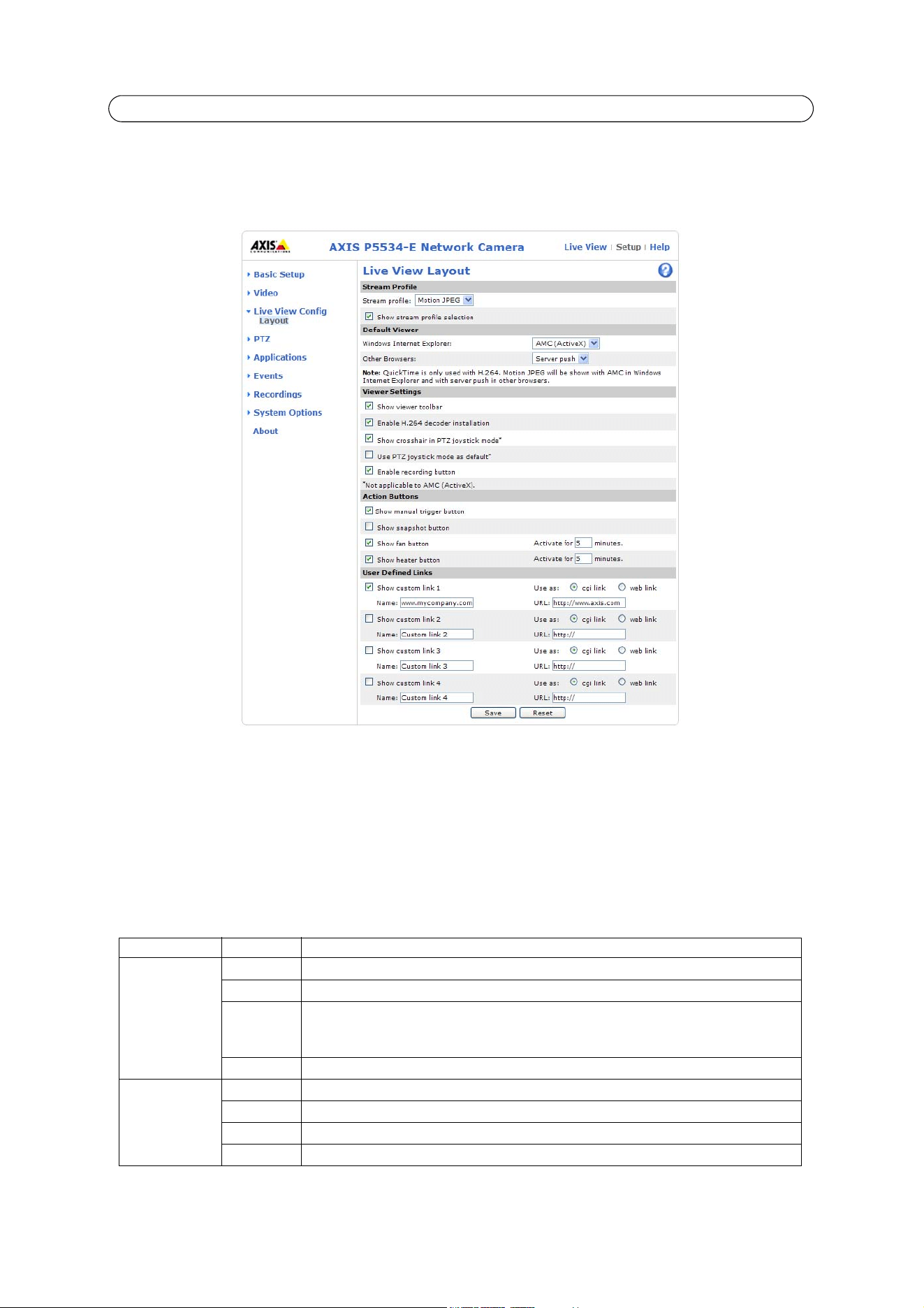
Layout
Stream Profile
From the Str
eam Profile drop-down list, select the stream profile that is to be used for the Live View page. Listed are the
pre-programmed stream profiles as well as the ones created under Video > Stream Profiles. See
Stream Profiles,
on page 16,
for more information
Default Viewer
From the drop-down lists, select the default method for viewing video
images for your browser. The camera attempts to show
the video images in the selected video format and viewer. If this is not possible, the camera overrides the settings and selects
the best available combination.
Browser Viewer Description
Windows Internet
Explorer
AMC Recommended viewer in Windows Internet Explorer (H.264/Motion JPEG).
QuickTime H.264
Java applet A slower imaging alternative to AMC. Requires one of the following installed on
the client:
• JVM (J2SE) 1.4.2 or higher
• JRE (J2SE) 5.0 or higher
Still image Displays still images only. Click the Refresh button in your browser to view a new image.
Other browsers
Server Push Recommended viewer for other browsers (Motion JPEG).
QuickTime H.264
Java applet A slower imaging alternative to Server Push (Motion JPEG only).
Still image Displays still images only. Click the Refresh button in
your browser to view a new image.
19
AXIS P5532-E/P5534-E - Live View Config
Viewer Settings
Check the Show viewer toolbar box to display the AXIS Media Control (AMC) or the QuickTime viewer toolbar under the video
image in your browser.
The administrator can disable the installat
ion of the H.264 decoder included with AXIS Media Control. This is used to prevent
the installation of unlicensed copies. Further decoder licenses can be purchased from your Axis dealer.
Enable Show
crosshair in PTZ joystick mode and a cross will indicate the center of the image in PTZ joystick mode.
Check Use PTZ joyst
ick mode as default to enable joystick mode. The mode can be changed temporarily from the PTZ control
panel.
Check Enable recording button to enable recording from the Live View page. The recordings are saved to the location
specified in the AMC Control Panel, see
AXIS Media Control (AMC),
on page 12.
Action Buttons
Check the boxes to display the action buttons in the Li
ve View page.
The manual trigger button can be used to manually trigger and stop an event. See
Events,
on page 23.
The snapsh
ot button can be used to save a snapshot from the video stream. This button is mainly intended for use with
browsers other than Internet Explorer, or when not using AXIS Media Control to view the video stream. AXIS Media Control for
Internet Explorer has its own snapshot button.
The fan butto
n is used to manually start the camera’s fan. Specify the number of minutes the fan should run for.
The heater butt
on is used to manually start the camera’s heater. Specify the number of minutes the heater should run for.
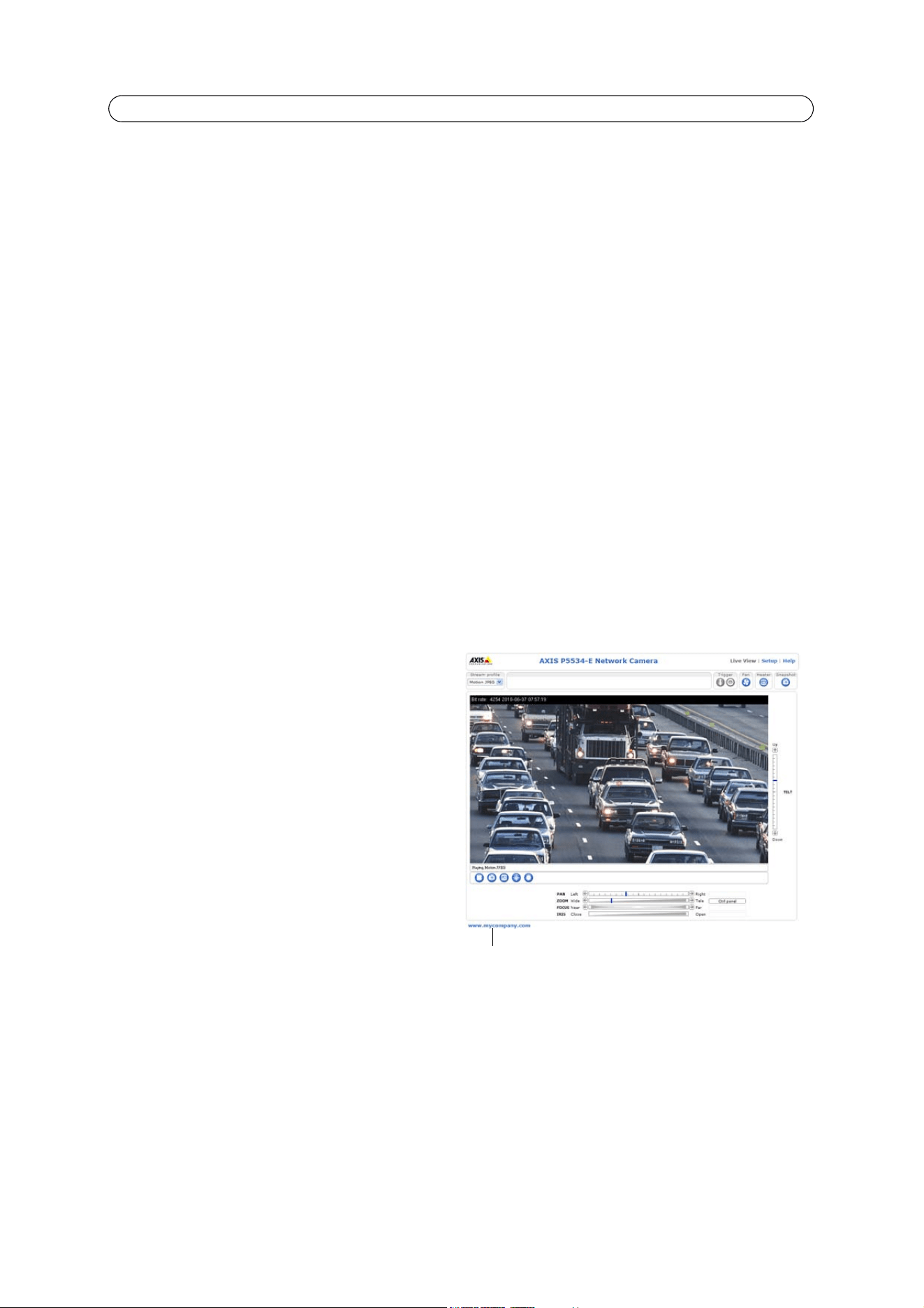
User Defined Links
User defined links can link to web pages, or can be used to
run scrip
ts or activate and control external devices connected
to the network camera. Once configured, the link appear on
the Live View page.
To set up a link, check the Show
custom link box, select the
cgi or web link radio button, enter the URL and a descriptive
name in the provided field.
A link defined as a web link will open in a new window, while
a cgi link will
run for example a script in the background.
User defined CGI links can be used to
issue API requests. For
more information on the VAPIX Application Programming
Interface (API), see the Video developer pages at Axis Web
site www. axis.com/developer.
User defined link
20
AXIS P5532-E/P5534-E - PTZ (Pan Tilt Zoom)
PTZ (Pan Tilt Zoom)
Preset Positions
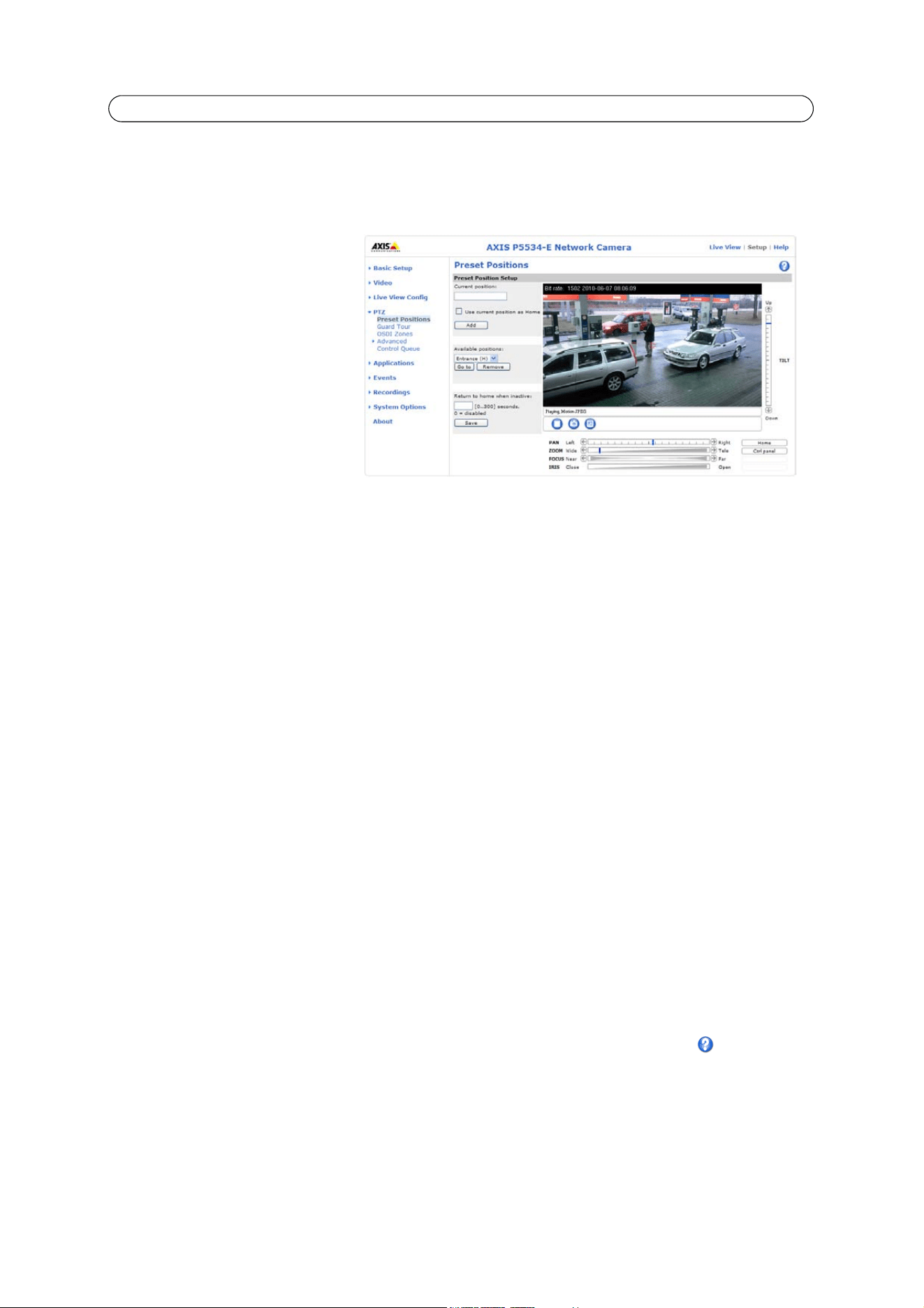
A preset position is a pre-defined camera
view than can be used to quickly move the
camera to a specific location.
From Preset Position
Setup, use the Pan,
Tilt and Zoom (PTZ) controls to steer the
camera view to the required position.
When satisfied with the camera's position,
enter a descriptive name and click Add.
The camera position, iris and focus
settings are then saved as a preset
position.
This position can be assumed at
any time,
by selecting the preset's name from the
Available positions drop-down list. Preset
positions can be selected in Live View
page, from Event Types, Guard Tour and in the Gatekeeper.
One position can be set as the Home position, which
is readily accessible by clicking the Home button in both the Preset
Positions window and the Live View window. The name will have (H) added, for example, Entrance (H).
The network camera can also be configured to return to the Home position wh
en the camera has been inactive for a specified
length of time. Enter the length of time in the field Return to home when inactive and click Save. Setting the time to zero
prevents the camera from automatically returning to the Home position.
The preset position name can be includ
ed in the overlay image text, see
Overlay Settings,
on page 14.
Guard Tour
A guard tour displays the video stream from different preset positions, one-by-one, in a pre-determined order or randomly,
and for configurable time periods. The guard tour will keep running after the user has logged off or closed the browser.
Note:
The pause between
guard tour runs must be set to at least 10 minutes.
OSDI Zones
On-Screen Direction Indicator (OSDI) Zones can be included in the overlay text (see page 14) to aid the user to navigate the
camera. Each OSDI Zone is set up with coor
dinates and a descriptive name.
The camera uses the coordinates of the center of the image
to set the lower left and upper right zone areas. First navigate to
where you would like the lowermost left point of the OSDI Zone to be located. By clicking Get the coordinates are set. Proceed
to where the upper right point of the zone should be located and click its Get button. Give the zone a descriptive name and
click OK.
To include the name of the OSDI Zone in the overlay text, go to Video > Video St
ream > Overlay Settings. Check the Include
text box and enter the modifier #L in the field. See File Naming & Date/Time Formats in the online help for more
information about modifiers.

21
AXIS P5532-E/P5534-E - PTZ (Pan Tilt Zoom)
Advanced
Limits
Define the pan, tilt, zoom and focus limits for the network camera. Movements to the left and right, up and down, can be
restricted to narrow the area under surveillance. The near focus limit can be set to avoid focusing on objects too close to the
camera.
Once a limit has been saved, this position cannot be exceeded by the network camera unless the values have
been reset and
saved to a greater value first (reset the default values of the mechanical restrictions).
Move speed sets the speed of t
he camera's Pan/Tilt movements. The default setting is maximum speed.
Enable proportional speed - – When using a joystick (or emulating one with the mouse),
this setting can be used to reduce
the maximum pan/tilt movement speed, i.e. the speed the camera moves at when the joystick is pushed all the way out in any
pan/tilt direction. This is useful when the camera is zoomed in on an object and a pan/tilt movement is performed.
Enable Auto-flip - – The network camera will simulate continuous pan
movement in the same direction, i.e. the camera will
pan the full 360 degrees, even though there is a mechanical stop at ±180 degrees.
Enable movement prediction - The network camera will attempt to predict the
new position in the pan movement, after
compensating for the slight delay while the camera changes direction after an auto-flip. This is useful for tracking moving
objects or persons when using the joystick or emulated joystick mode.
See the online help for more information.
Controls
Panel Shortcut Command Buttons can be configured to provide direct access to commands issued via
the VAPIX® Application Programming Interface. The buttons will be displayed in the PTZ control panel,
which is available on the Live View page by clicking the Ctrl panel button.
Enable/Disable controls - – Uncheck the boxes to disable the pan, tilt,
zoom, focus and iris controls.
Note:
Di
sabling PTZ controls will affect preset positions. For example, if the tilt control is disabled, the camera cannot move
to preset positions that require a tilt movement.
Control Queue
The administrator can set up a queue for the PTZ controllers. Once set up, the PTZ Control Queue buttons appear on the Live
View page offering one viewer exclusive control for a limited amount of time. Other users will be placed in queue.
22
AXIS P5532-E/P5534-E - Applications
Applications
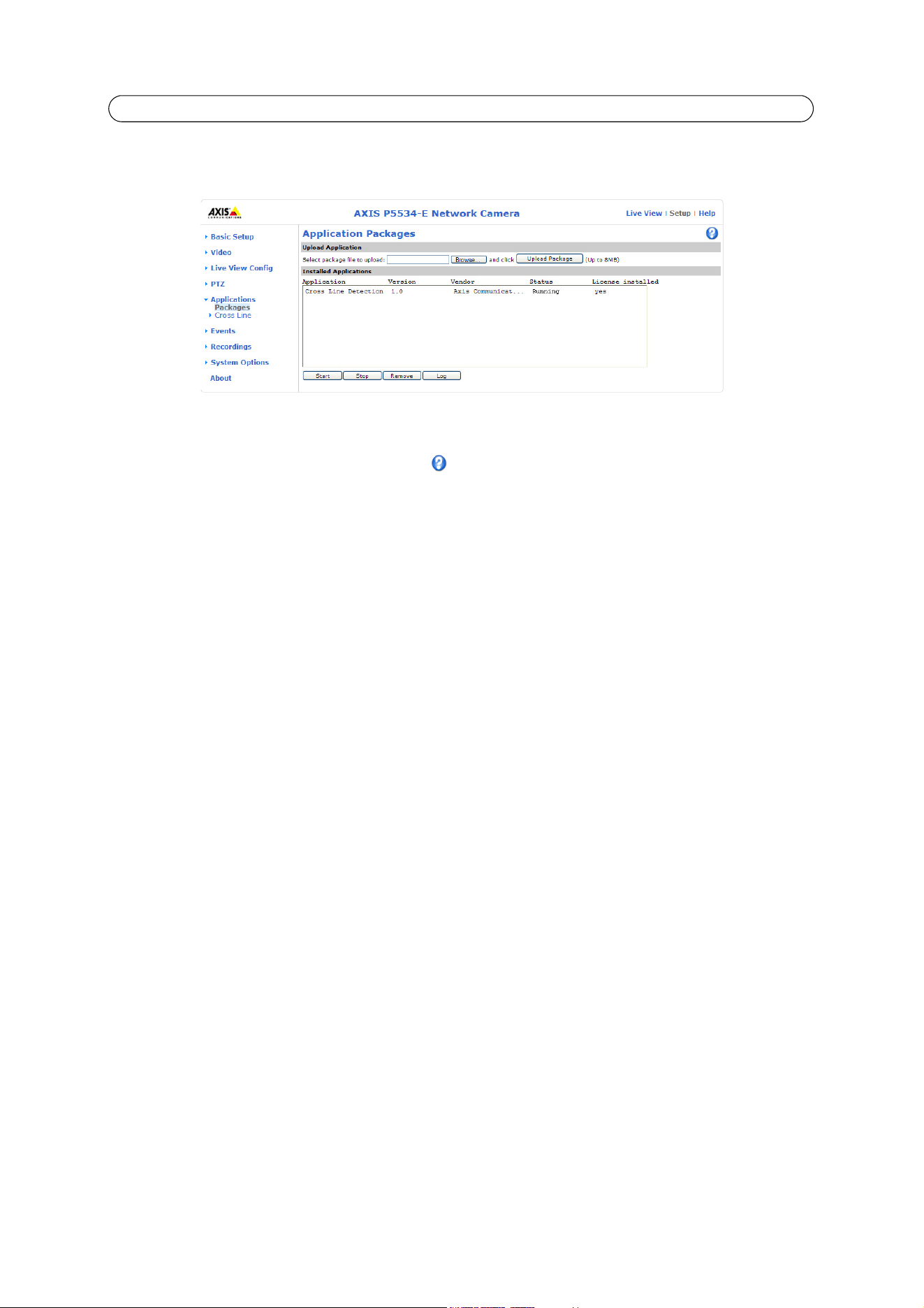
The Application packages feature allows you to upload third party application packages for use on the network camera. Listed
under Applications > Packages are the packages that have already been installed. Click on the name to open the menu
options Settings, License and About. See the online help for more information.
Settings - Application-specific settings.
License - Some applications require a license. If there is an Internet
connection Automatic Installation appears on the web
page. If there is no Internet connection, visit www.axis.com from another computer to acquire a License key file. To receive the
license key, you will need a license code and the camera’s serial number (found on the product’s label, see page 5).
About - Details about the installed application.
Upload Applications
To upload an application, browse to th
e package and click Upload Package.
Installed Applications
Uploaded applications are listed under Installed Applicat
ions together with information about the application’s version,
vendor, status (running or not running) and license information.
To start and stop an application, click the Start and St
op buttons.
To remove an uploaded application, select the application and click Re
move.
Click Lo
g to generate a log of the application happenings. The log is helpful when requesting support from the application’s
vendor.
For information on how to use the uploaded application, please ref
er to the documentation of the application package.
Note:
It is recommended to
run one application at a time. Avoid running applications when motion detection is active.
23
AXIS P5532-E/P5534-E - Events
Events
Pre-defined parameters, known as an event or Event Type can trigger certain actions in the camera. A common event type is
an alarm that causes the camera to upload images. Many event types use an Event Server, to receive uploaded images.
An event that is triggered by a signal, such as a detection of motion or syst
em event, is called a triggered event, see page 24.
A s
cheduled event runs at pre-programmed times.
An Action refers to what happens when the event occurs.
This section describes how to conf
igure the camera to perform certain actions when events occur.
Event Servers
Event servers are used to receive uploaded image files and/or notification messages. To set up Event Server connections in
your camera, go to Setup > Events > Event Servers and enter the required information for the server type.
For details on each setting, see the online help available from each web page.
When the setup is complete, the connection can be tested by clicking the Test button (the connection test takes
approximately 10 seconds).
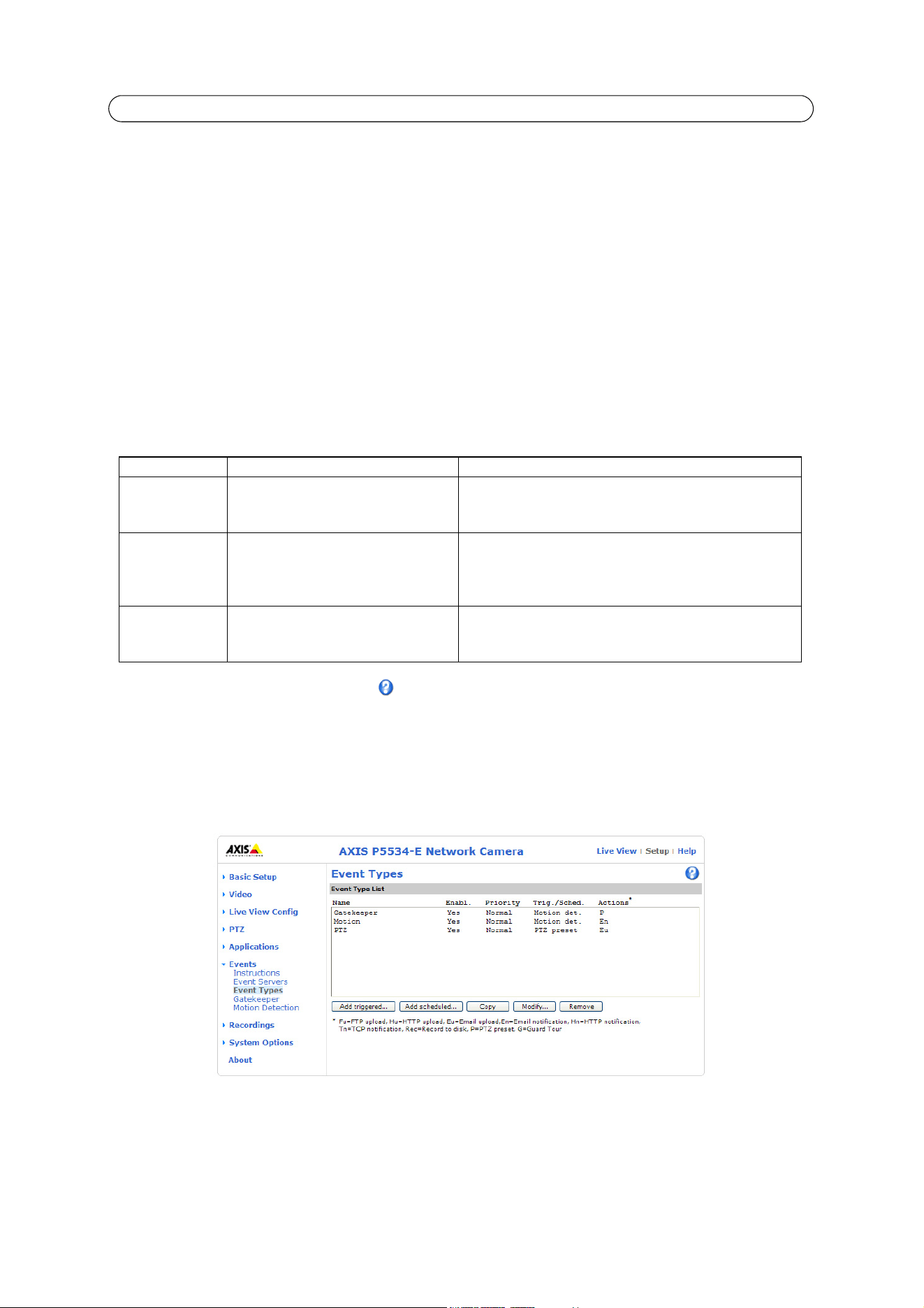
Event Types
An Event Type describes how and when the camera is to perform certain actions.
Example: If somebody passes in front of a camera and an event has been configured to detect and respond to motion,
the camera can record and save images to an FTP server, and can send a notification e-mail to an e-mail address. Images
can be sent as e-mail attachments.
Server type Purpose Information required
FTP Server
• Receives uploaded images • Descriptive name
• Network address and Upload path
• User Name and Password
HTTP Server
• Receives notification messages
• Receives uploaded images
• Descriptive name
• URL (IP address or host name)
• User Name and Password
• Proxy settings
TCP Server
• Receives notification messages • Descriptive name
• Network address (IP address or host name)
• Port number

24
AXIS P5532-E/P5534-E - Events
Triggered Event
A triggered event can be activated by:
• A manual trigger - using the manual trigger button on the Live View page or through the VAPIX® Application
Programming Interface (API)
• An application trigger - a third party application installed on the camera.
• Movement in a motion detection window
• On boot - for example after power loss
• Temperature - when the temperature of the camera rises or falls outside the operating range
• Pan Tilt Zoom - when the camera stops at a preset position
• Disk full - when the local storage disk (SD memory card) has less than 1MB of free memory left
• Fan malfunction
How to set up a triggered event
The following example describes how to set up the camera to upload images when a door is opened.
1. Click Add trig
gered on the Event types page. The Triggered Event Type Setup page appears
2. Enter a descriptive Name for the event, such as Door open.
3. Set the Priority - High, Normal or Low.
4. Set the Respond to Trigger parameters to define when the event is active, for example, after office hours.
5. Select the trigger alternative from the Triggered by drop-down list. For example, motion detection.
6. Set the When Triggered parameters, that is, define what the camera will do if the main door is opened. To upload
images, select Save stream and enter the required information. See
Save stream,
on page 24.
7. Click OK to save the event in the Event Types list.
Please see the online help for descriptions of each available option.
Note:
Up to 10
event types can be configured in the camera, and up to three of these can be configured to upload images.
File names can be formatted according to specific requirements. See File Naming & Date/Time Formats in the online
help .
Save stream
To upload images to an FTP or HTTP server, save the video stream to the local storage card or to send images by email, check
the Save stream box.
Image frequency - Set the image frequency to a desired frame rate. The frame rate
will be the best possible, but might not
be as high as specified, especially if uploading via a slow connection.
Pre-trigger and Post-trigger buffers
This function is very useful when checking
to see what happened immediately before and/or after a trigger, for example, 20
seconds before and/or after a door was opened. All uploaded images are JPEG images.
Include pre-trigger buffer - Imag
es stored internally in the server from the time immediately preceding the trigger. Check the
box to enable the pre-trigger buffer and specify the buffer length in seconds, minutes or hours.
Include post-trigger buffer
- Contains images from the time immediately after the trigger. The post-trigger buffer is
configured in the same way as the pre-trigger buffer.
Notes
•
Pre-trigger and Post-trigger buffers will be lost if the connection to the event server fails
• The maximum length of the pre-/post-buffer depends on the video image size and selected frame rate
• If the pre- or post-buffer is too large for the camera’s internal memory, the frame rate is reduced and individual
images may be missing. If this occurs, an entry is created in the unit's log file

25
AXIS P5532-E/P5534-E - Events
Continue image upload (unbuffered) - Upload video images for a fixed length of time or for as long as the trigger is active.
Select type - Upload images to an FTP or HTTP server, send images by e-mail or save the video stream to the local storage
disk.
Create folder - Images uploaded to FTP and HTTP servers can be saved to designated folders. Fold
ers can for example be
named using the current date and time, see File Naming & Date/Time formats in the online help .
Base file name - Used to name all uploaded images. Add a
suffix or use your own file format to give the images unique
names, see File Naming & Date/Time formats in the online help .
Use stream profile - Select the stream profile to upload, send as e-mail or save to the local disk. When sav
ing to the local
disk, the video format (JPEG or H.264) must first be selected.
Scheduled Event
A Scheduled event can be activated at preset times, in a repeating pattern on selected weekdays.
How to set up a scheduled event
The following example describes how to configure the camera to save images from pre-programmed time periods.
1. Click Add sc
heduled on the Event Types page.
2. Enter a descriptive Name for the event, such as Scheduled e-mail upload.
3. Set the Priority (High, Normal or Low).
4. Set the Activation Time parameters (24h clock) for the event. For example, select Recurrence pattern and let the
event start on Sundays at 13.00 with a duration of 12 hours.
5. Set the When Activated parameters, that is, define what the camera should do when the event is active. To upload
images, select Save stream and enter the required information. See
Save stream,
on page 24.
6. Click OK to save the Event in the Event Types list.
Please see the online help for descriptions of each available option.
Gatekeeper
The Gatekeeper monitors an area such as an entrance gate and can pan, tilt, zoom in and take a snapshot of, for example, a
face, triggered by movement in the area. The camera will then automatically return to the Home position and continue to
overview the monitored area. Follow the online instructions to configure Gatekeeper.
26
AXIS P5532-E/P5534-E - Events
Motion Detection
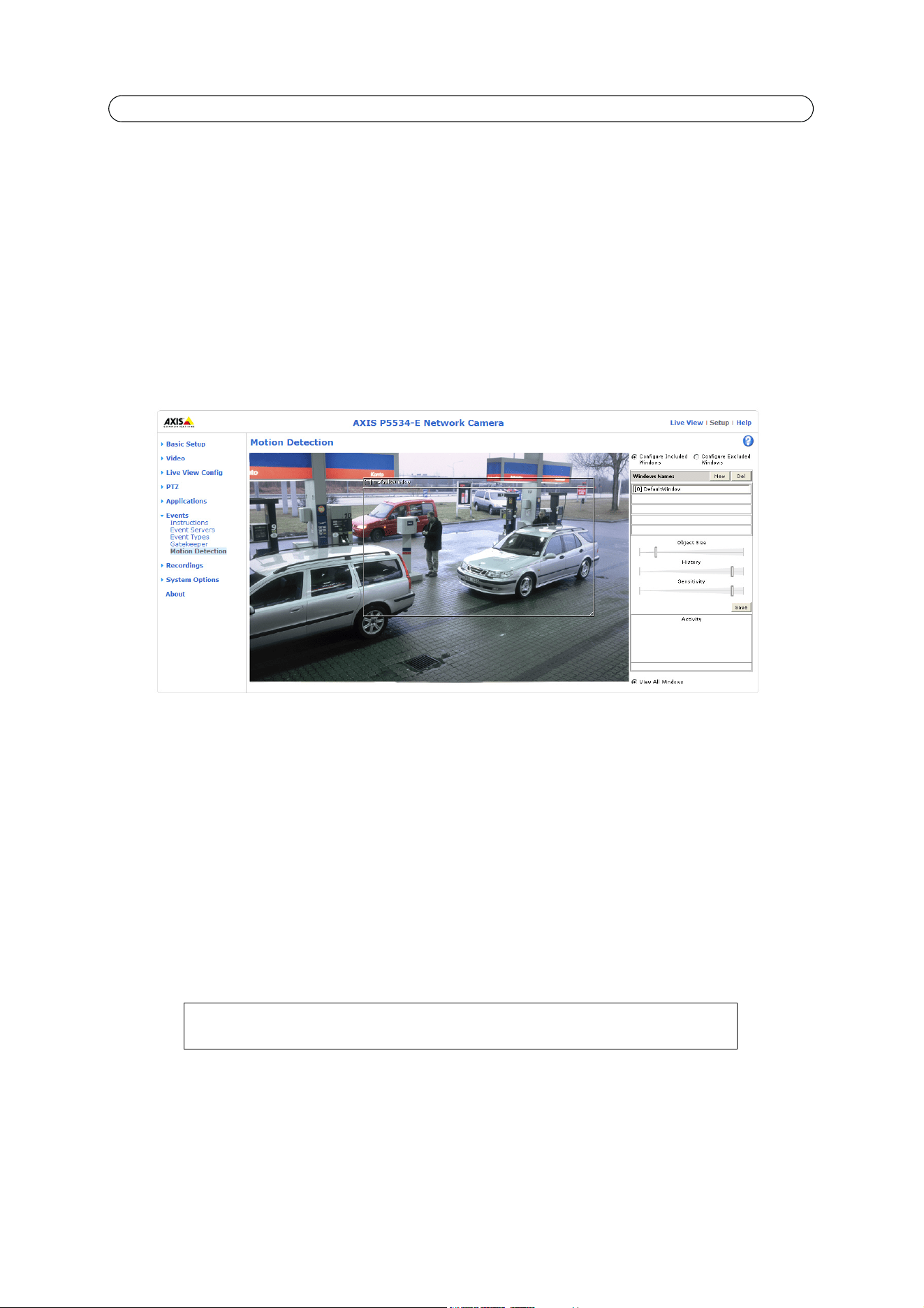
Motion detection is used to generate an alarm whenever movement occurs (or stops) in the video image. Up to 10 Include and
Exclude windows can be configured.
• Inclu
ded windows target specific areas within the whole video image
• Excluded windows define areas within an Include window that should be ignored (areas outside Include windows are
automatically ignored)
Once configured, the motion detection windows appear in the
list of available triggers, for triggering events. See
How to set
up a triggered event,
on page 24.
Note:
Using the motion detection feature may decrease the camera’s overall performance.
Set up a motion detection include window
The following example describes how to configure the camera for motion detection.
1. Go to Setup > Events > Motion
Detection.
2. Create a new motion detection window:
a. Using AXIS Media Control (Internet Explorer): Select the radi
o button Configure Included Windows and click
New. Select the new window in the list of windows and enter a descriptive name.
b. Using the Java applet: Click Add Wi
ndow. Select the Include radio button and enter a descriptive name in the
field.
3. Adjust the size (drag the bottom right-hand corner) and positi
on (click on the text at the top and drag to the desired
position) of the active window.
4. Adjust the Object Size, History and Sensitivity profile sliders (see table below for details). Any detected motion within
an active window is then indicated by red peaks in the Activity window (the active window has a red frame).
5. Click Save.
To delete an Include or Exclude window:
a. Using AXIS Media Control (Internet Explorer): Select the wi
ndow in the list ow windows and click Del.
b. Using the Java applet: Select the window and click on th
e cross in the upper right corner.
To exclude parts of the Include window, select the Exclu
de option and position the
Exclude window as required, within the Include window.

27
AXIS P5532-E/P5534-E - Events
Please see the online help for descriptions of each available option.
• Avoid triggering on small objects in the video image by setting the object si
ze level to high.
• Use several small Motion Detection windows rather than one large window, if triggers on small movements or
objects are desired.
• To reduce the number of triggers if there is a lot of movement during a short period of time, select a high history
level.
• To only detect flashing light, select low sensitivity. In other cases, a high sensitivity level is recommended.
Object Size History Sensitivity
High level Only very large objects
trigger motion detection
An object that appears in the region
will trigger the motion detection for a
long period
Ordinary colored objects on ordinary
backgrounds will trigger the motion
detection
Low level Even very small objects
trigger motion detection
An object that appears in the region
will trigger motion detection for only a
very short period
Only very bright objects on a dark
background trigger motion detection
Default value Low High High
28
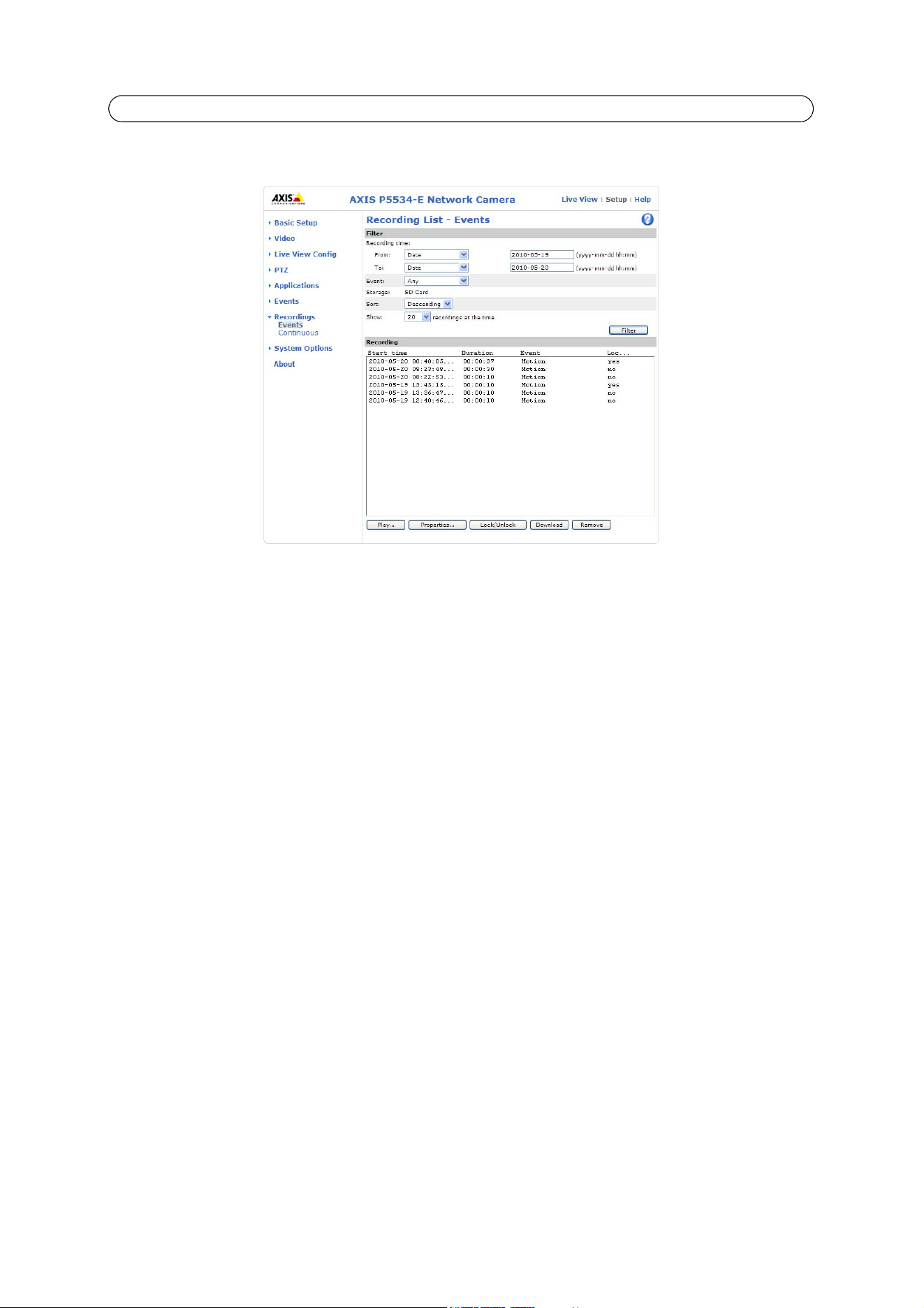
AXIS P5532-E/P5534-E - Recording List
Recording List
The Recording List web page contains a list of recordings made to the SD memory card. It shows each recording's start time,
length, the event type, and indicates if the recording is locked so that it can neither be deleted nor recorded over.
To view a recording, select it from the list and click Play.
For detailed recording and video information, select
an individual recording from the list and click Properties.
Use the Loc
k/Unlock button to define whether a recording can be removed or recorded over, or if the recording is important
and needs to be saved for future use. Locking the recording can help prevent its accidental removal.
Recordings can be downloaded in a zip file co
ntaining a minimum of three files of which the .mkv or Matroska file is the
actual recording. Select one or more recordings and click Download.
The Re
move button is used to delete unlocked recordings.
Recordings are made to the SD memory card once an
event has been set up on under Setup > Event Types > Add triggered
/Add scheduled > Save stream > Select type. Select Local Storage from the drop-down list.
See Syst
em Options > Storage > SD Card to mount, format and monitor the status and available recording space of the SD
memory card.
Please refer to the Installation Guide supplied with the product for inst
ructions on how to insert and remove the SD memory
card.
Notes:
•
The SD memory card is optional and not included in the product.
• To play recordings in Windows Media Player download and install AXIS Matroska File Splitter from
www.axis.com/techsup/software
Filter
Use the filter to narrow down the list according to certain
criteria such as a particular time frame.

29
AXIS P5532-E/P5534-E - Recording List
Recording time - Filter out a group of recordings based on their start and end dates or times. The recording date and time is
listed according to the device's time zone. If the local time zone is different than the device's time zone, you will need to
consider that the filter is done by the local time zone. First recording/Now are the default settings. Use Date if you want to
specify a certain date or date and time for when the recording started.
Event - Select a group of recordings based on what
type of event triggered the recording.
Storage - Select a group of recordings based on whe
re the recordings are stored.
Sort - Select whether the filtered recording list should be sorted
in ascending or descending order of start time.
Show - Select how many recordings to view in the window at one time.
See the online help files for more information.
Continuous Recording
The camera can be configured to continuously save video to an SD Card. Configure continuous recordings for different stream
profiles.
Recording Settings
The Enabled box must be checked to recor
d continuously. Select a Stream Profile in the drop-down list and click Save to
apply the new settings.
Note:
The recordi
ng will be restarted and all previous continuous recordings will be removed if Disk or Stream profile is
changed.
Recording
Start time - Shows the time the current continuous recording began. If no c
ontinuous recording is taking place the status
will show as Not started.
Duration - Shows the length of the current continuous recording. Click Re
start to start a new recording. Note that all
previous continuous recording data will be removed.
From - To play or download the recording from a point in time, enter
the year, month, day and the time in hours and minutes.
The time set here is also used for naming the file.
Duration - Enter the amount of the recording to play or download in hours and minutes.
To view a selected continuos recording, click Play.
To download a selected continuos recording, click Dow
nload. The package downloaded is a zip file containing a minimum of 3
files, of which the .mkv or Matroska file is the actual recording.
See the online help files for more information.

30
AXIS P5532-E/P5534-E - System Options
System Options
Security
Users
User access control is enabled by default. An administrator can set up other users, by giving them user names and passwords.
It is also possible to allow anonymous viewer login, which means that anybody may access the Live View page, as described
below:
The user list displays the authorized u
sers and user groups (levels):
HTTP/RTSP Password Settings - Select the type of password. You may need to allow unencrypted passwords if there are
viewing clients that do not support encryption, or if you recently upgraded the firmware and the existing clients do support
encryption, but need to log in again, and be configured to use this functionality.
User Settings
• Check the box to enable a
nonymous viewer login to allow any viewer direct access to the Live View page.
• Check the box to enable ano
nymous PTZ control login to allow anonymous users to join a queue for gaining control
of the PTZ controls.
• Enab
le Basic Setup - Before using the network camera, there are certain settings that should be made, most of which
require Administrator access privileges. To quickly access these settings, use the Basic Setup in the menu. All settings
are also available from the standard setup links in the menu. Basic Setup is enabled by default but can be disabled
and removed from the menu.
IP Address Filter
Enable IP Address Filtering to allow or deny access to the network cameras. Once enabled, the IP addresses in the list are
allowed or denied access according to the choice made in the drop-down list Allow/Deny the following IP addresses.
The administrator can add up to 256 IP address entries to the list (a single entry can contain multiple IP addr
esses). The users
from these IP addresses need to be specified in the user list with the appropriate access rights. This is done from Setup >
System Options > Security > Users.
HTTPS
The network cameras support encrypted browsing using HTTPS.
A self-signed c
ertificate can be used until a Certificate Authority-issued certificate has been obtained. Click the Create
self-signed Certificate button to install a self-signed certificate. Although self-signed certificates are free and offer some
protection, true security is only implemented after the installation of a signed certificate issued by a Certificate Authority.
A signed certificate can be obtained from an issuing Certificat
e Authority by clicking the Create Certificate Request button.
When the signed certificate is returned, click the Install signed certificate button to import the certificate. The properties of
any certificate request currently resident in the camera or installed can also be viewed by clicking Properties. The HTTPS
Connection Policy must also be set in the drop-down lists to enable HTTPS in the camera.
For more information, refer to the online help .
Viewer
Provides the lowest level of access, which only allows access to the Live View page.
Operator
An operator can view the Live View page, create and modify events, and adjust certain
other settings. Operators have no access to System Options.
Administrator
An administrator has unrestricted access to the Setup tools and can determine the regis-
tration of all other users.

31
AXIS P5532-E/P5534-E - System Options
IEEE 802.1X
IEEE 802.1X is a standard for port-based Network Admission Control providing secure authentication of wired and wireless
network devices. IEEE 802.1X is based on EAP (Extensible Authentication Protocol).
To access a network protected by IEEE 802.1X, devic
es must authenticate themselves. The authentication is performed by a
third-party entity called an authentication server, typically a RADIUS server, examples of which are FreeRADIUS and Microsoft
Internet Authentication Service. In Axis implementation, the network device and the authentication server authenticate
themselves with the help of digital certificates using EAP-TLS (Extensible Authentication Protocol - Transport Layer Security).
The certificates are provided by an Certification Authority (CA). You need:
• a CAcertificate to validate the identity of the auth
entication server
• a CA-signed client certificate and a private
key to authenticate the network device.
To allow the network device to access a netw
ork protected by IEEE 802.1X:
1. Obtain a CA certificate, a client certificate and a client
private key (contact your network administrator).
2. Go to Setup > System Options > Security > IEEE 802.1X and upload the CA certificate, the client certificate and the
client private key.
3. Under Settings, select the EAPOL version, provide your EAP identity and private key password.
4. Check the box to enable IEEE 802.1X and click Save.
Certificates
CA Certificate - The CA certificate is used to validate the identity of the authent
ication server. Enter the path to the
certificate directly, or locate the file using the Browse button. Then click Upload. To remove a certificate, click Remove.
Client Certificate/Client
private key - The client certificate and private key are used to authenticate the network device.
They can be uploaded as separate files or in one combined file (e.g. a PFX file or a PEM file). Use the Client private key field if
uploading one combined file. For each file, enter the path to the file, or locate the file using the Browse button. Then click
Upload. To remove a file, click Remove.
Settings
Eapol version - Select the EAPOL version (1 or 2) as used in your network switch.
Eap identity - Enter the user identity (maximum 16 characters) associated with your certificate.
Private key password - Enter the password (maximum 16 characters) for the private key.
Enable IEEE 802.1X - Check the box to enable the IEEE 802.1X protocol.

32
AXIS P5532-E/P5534-E - System Options
Date & Time
Current Server Time
Displays the current date and time (24h clock). The time
can be displayed in 12h clock format in the overlay (see below).
New Server Time
Select your ti
me zone from the drop-down list. If you want the server clock to automatically adjust for daylight savings time,
select the Automatically adjust for daylight saving time changes option.
Note:
The time zone setting only
apply when the device’s time is synchronized with an NTP server.
From the Time Mode section, select the preferred method to use for setting the time:
• Synch
ronize with computer time - Sets the time from the clock on your computer.
• Synchronize with NTP Server - The camera will obtain the time from an NTP server.
• Set manually - This option allows you to manually set the time and date.
Note:
If using a host name for the NTP server, a DNS server must be configured under TCP/IP settings.
See
Basic TCP/IP Settings
, below.
Date & Time Format Used in Images
Specify the formats for the date and time (12h or 24h) displayed in th
e video streams. Use the predefined formats or use your
own custom date and time formats. See File Naming & Date/Time Formats in the online help for information on how to
create your own date and time formats.
Network
Basic TCP/IP Settings
The camera supports both IP version 4 and IP version 6. Both versions may be enabled simultaneously, and at least one version
must always be enabled. When using IPv4, the IP address for the camera can be set automatically via DHCP, or a static IP
address can be set manually. If IPv6 is enabled, the network cameras receive an IP address according to the configuration in
the network router. There are also options for using AXIS Internet Dynamic DNS Service and AVHS (AXIS Video Hosting
System). For more information on setting the IP address, please refer to the Installation Guide supplied with the product.
Network Settings
Click the Vie
w button for an overview of the IP configuration of the network camera.
IPv4 Address Configuration
Check the Enable IPv4
box option to enable IPv4.
Obtain IP address via DHCP - Dynamic Host Configuration Protocol (DHCP) is a protocol that lets network administrators
centrally manage and automate the assignment of IP addresses on a network. DHCP is enabled by default. Although a DHCP
server is mostly used to set an IP address dynamically, it is also possible to use it to set a static, known IP address for a
particular MAC address.
Note:
DHCP should only
be enabled if using dynamic IP address notification, or if your DHCP server can update a DNS server,
which then allows you to access the network camera by name (host name). If DHCP is enabled and you cannot access
the unit, run AXIS IP Utility to search the network for connected Axis products or reset the network camera to factory
default settings and then perform the installation again.

33
AXIS P5532-E/P5534-E - System Options
Use the following IP address - To use a static IP address for the network camera, check the radio button and then make the
following settings:
• IP address - Speci
fy a unique IP address for your network camera. (To check if the IP address you intend to use is
available or not, click the Test button)
• Subnet mask - Specif
y the mask for the subnet the network camera is located on
• Default router - Specify the IP address of the default router (gateway) used for connecting devices attached to differ-
ent networks and network segments.
IPv6 Address Configuration
Check the Enable IPv6 box to enable IPv6. Other settings for IPv6 are configured in the network router.
Services
Enable ARP/Ping setting of IP address - Th
e IP address can be set using the ARP/Ping method, which associates the unit's
MAC address with an IP address. Check this box to enable the service. Leave disabled to prevent unintentional resetting of the
IP address.
Notes:
• The ARP/Ping service is automatically disabled two minutes after the unit
is started, or as soon as an IP address is set.
In order to reset the IP address, the camera must be restarted to activate ARP/Ping for an additional two minutes.
• Pinging the unit is still possible when this service is disabled.
AXIS Video Hosting System (AVHS)
AVHS used in conjunction with an AVHS service provides easy and secure
Internet access to live and recorded video accessible
from any location. For more information and help to find a local AVHS Service Provider go to www.axis.com/hosting
Enable AVHS - Enabled by default, if AVHS is not to be used this option can be disabled.
• One-click enabled
- Press the camera’s control button (see Hardware overview, on page 5) to connect to an AVHS
service over the Internet. Once registered, Always is enabled and the cameras stays connected to the AVHS service. If
the camera is not registered within 24 hours from when the button is pressed, the camera will disconnect from the
AVHS service.
• Alw
ays -The camera will constantly attempt to connect to the AVHS service over the Internet. Once registered, the
camera will stay connected to the service. This option can be used when the camera is already installed and it is not
convenient to use the one-click installation.
AXIS Internet Dynamic DNS Service - Enable this option to use AXIS Internet Dynamic DNS service to assign a host name
for easy
access to your network camera (requires access to the Internet).
Click Se
ttings to register the camera with AXIS Internet Dynamic DNS service, or to modify the existing settings. The domain
name currently registered at AXIS Internet Dynamic DNS service for your product can at any time be removed.
For more information, please refer to
www.axiscam.net and to the online help .
Advanced TCP/IP Settings
DNS Configuration
DNS (Domain Name Service) provides
the translation of host names to IP addresses on your network.
Obtain DNS server address via DHCP - Automatically use the DNS server settings provided by the DHCP server. Click the
View button to see the current settings.
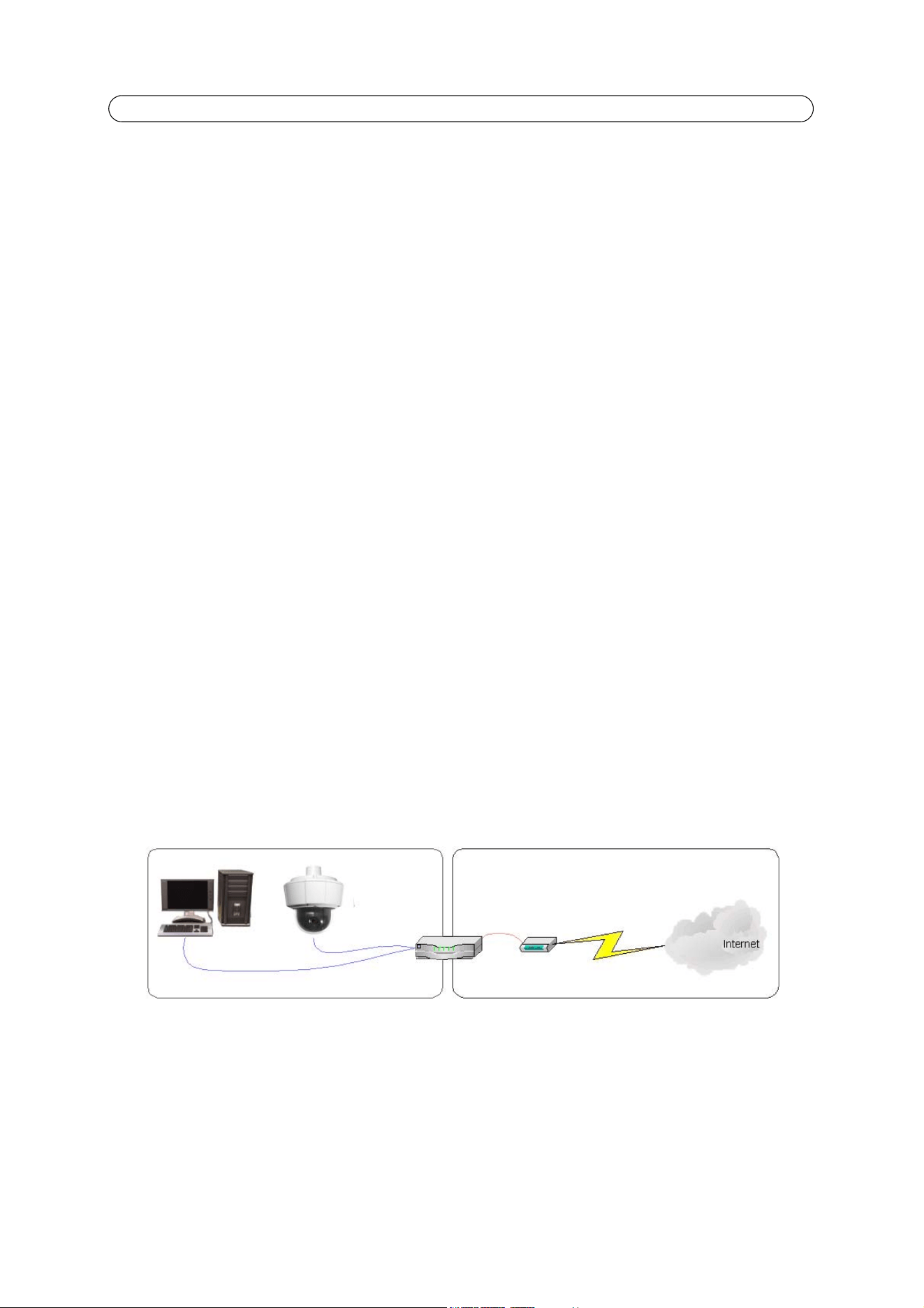
34
AXIS P5532-E/P5534-E - System Options
Use the following DNS server address - Enter the desired DNS server by specifying the following:
• Domain name - Enter the domain(s) to search for the host name used by the network camera. Multiple domains can
be separated by semicolons (;). The host name is always the first part of a Fully Qualified Domain Name, for example,
myserver is the host name in the Fully Qualified Domain Name myserver.mycompany.com where mycompany.com is
the Domain name.
• DNS ser
vers - Enter the IP addresses of the primary, and secondary DNS servers.
Note: This is not mandatory with regard to secondary DNS servers.
NTP Configuration
Obtain NTP server address via DHCP -
Check this radio button to automatically look up and use the NTP server settings as
provided by DHCP. Click the View button to see the current settings.
Use the following NTP server address - To creat
e manual settings, check this radio button and enter the host name or IP
address of the NTP server.
Host Name Configuration
The network cameras can be accessed using a host name, instead of an IP address. The host name is usually
the same as the
assigned DNS Name.
Link-Local IPv4 Address
This is enabled by default and assigns the net
work cameras an additional IP address for use with UPnP™. The camera can have
both a Link-Local IP and a static/DHCP-supplied IP address at the same time - these will not affect each other.
HTTP and HTTPS
The default HTTP/HTTPS port numbers (80 and 443 respectively) can be changed
to any port within the range 1024-65535.
This is useful for simple security port mapping, for example.
NAT traversal (port mapping) for IPv4
A broadband router allows devices on a private network (LAN) to share a single connection to the Internet. This is done by
forwarding network traffic from the private network to the “outside”, that is, the Internet. Security on the private network
(LAN) is increased since most broadband routers are pre-configured to stop attempts to access the private network (LAN) from
the public network/Internet.
Use NA
T traversal when your network cameras are located on an intranet (LAN) and you wish to make it available from the
other (WAN) side of a NAT router. With NAT traversal properly configured, all HTTP traffic to an external HTTP port in the NAT
router is forwarded to the camera.
Notes:
• For NAT traversal to work, this must be supported by the broadband router. The router must also support UPnP™.
•
The broadband router has many different names: “NAT router”, “Network router“, Internet Gateway”, “Broadband
sharing device” or “Home firewall” but the essential purpose of the device is the same.
LAN (intranet)
WAN (Internet)
Broadband
(NAT)
router
ISP

35
AXIS P5532-E/P5534-E - System Options
Enable/Disable - When enabled, the network camera attempts to configure port mapping in a NAT router on your network,
using UPnP™. Note that UPnP™ must be enabled in the camera (see System Options > Network > UPnP).
Use manually selected NAT router - Select this option to manually select a NAT router and enter the IP a
ddress for the
router in the field provided.
If a router is not manually specified, the network cameras automatically sea
rch for NAT routers on your network. If more than
one router is found, the default router is selected.
Alternative HTTP port - select this option to manually define an external HTTP por
t. Enter the port number in the field
provided. If no port is entered here a port number is automatically selected when NAT traversal is enabled.
Notes:
• An alternative HTTP port can be used/be active even if NAT traversal is disabled. This is useful if your NAT router does
not su
pport UPnP and you need to manually configure port forwarding in the NAT router.
• If you attempt to manually enter a port that is already in use, another available port is automatically selected.
• When the port is selected automatically it is displayed in this field. To change this enter a new port number and click
Save.
FTP
The FTP server running in the network cameras enables the upload of new
firmware, and user applications. Check the box to
enable the service.
RTSP
The RTSP protocol allows a connecting client to start an H.264 stream. Check the box to enable the server and enter the RTSP
port number to use. The default setting is 554. Note that H.264 video streams will not be available if this service is not
enabled.
SOCKS
SOCKS is a networking proxy protocol. The network camera can be configured to use a SOCKS server to reach networks on the
other side of a firewall/proxy server. This functionality is useful if the network camera is located on a local network behind a
firewall, and notifications, uploads, alarms, and such need to be sent to a destination outside the local network (such as the
Internet). See the online help for more information.
Quality of Service (QoS)
Quality of Service (QoS) guarantees a certain level of a specified resource to selected traffic on a network. Quality can be
defined as a maintained level of bandwidth, low latency, and no packet losses. The main benefits of a QoS-aware network can
be summarized as:
• The ability to prioritize traffic and thus allow critical flo
ws to be served before flows with lesser priority.
• Greater reliability in the network, thanks to the control of the amount of bandwidth an appli
cation may use, and thus
control over bandwidth races between applications.
The QoS in Axis network video products marks the data packets for various types of network traffic originating from the
product. This makes it possible for network routers and switches to reserve a fixed amount of bandwidth for these types of
traffic. The network camera marks the following types of traffic:
•video
•event/alarm
• management network traffic
QoS Settings
For each type of network traffic supported by your Axis network video product,
enter a DSCP (Differentiated Services
Codepoint) value. This value is used to mark the traffic’s IP header. When the marked traffic reaches a network router or
switch, the DSCP value in the IP header tells the router or switch the type of treatment to apply to this type of traffic, for
example, how much bandwidth to reserve for it. Note that DSCP values can be entered in decimal or hex form, but saved
values are always shown in decimal.

36
AXIS P5532-E/P5534-E - System Options
For more information on Quality of Service, please see the Axis support web at www.axis.com/techsup
SMTP (email)
Enter the host names (or IP addresses) and port numbers for your primary and secondary mail servers in the fields provided, to
enable the sending of notifications and image email messages from the camera to predefined addresses via SMTP.
If your mail server requires authen
tication, check the box for Use authentication to log in to this server and enter the
necessary information. See the online help for more information.
SNMP
The Simple Network Management Protocol (SNMP) allows remote management of network devices. An SNMP community is
the group of devices and management station running SNMP. Community names are used to identify groups.
Depending on the level of security required, select the version of SNMP to use.
SNMP v1/v2
Select either SNMP V1 that includes no security, or SNMP v2c that uses very simple security.
The community name can be specified as a password for read or read/write access to all
supported SNMP objects. The
community is the group of network devices using SNMP. The default password for the Read Community is public and the
default password for the Write community is write.
Traps for SNMP v1/v2
Traps are used by the camera to send messages to a management system for important events or status changes.
If Enable traps is selected, enter the email address where the trap message is to be sent as well as the Trap community that
should receive the message.
There are four types of traps available for the network camer
a.
• Cold start
•Warm start
•Link up
• Authentication failed
SNMP v3
SNMP v3 provides encryption and secure passwords. HTTPS mu
st be enabled. To use traps with SNMP v3 an SNMP v3
management application is required.
If the Enable S
NMP v3 option is enabled, provide the Initial user password. Note that the initial password is activated only
when HTTPS is enabled and can only be set once.
If HTTPS is enabled, SNMP v1 and SNMP v2c should be disabled.
When SNMP configuration is ready, click Save to u
se the new settings or Reset to return to the default values.
UPnP™
The network camera includes support for UPnP™. UPnP™ is enabled by default, and the network camera then is automatically
detected by operating systems and clients that support this protocol.
RTP/H.264
These settings are the port range, IP address, port number, and Time-To-Live value to use for the video stream(s) in multicast
H.264 format. Only certain IP addresses and port numbers should be used for multicast streams. For more information, please
see the online help .

37
AXIS P5532-E/P5534-E - System Options
Bonjour
The network camera includes support for Bonjour. When enabled, the camera is automatically detected by operating systems
and clients that support this.
Storage
SD Card
The Disk Management window is used to set up and manage local storage. it is used to connect memory cards for recording
video, monitoring a disk’s status, enabling automatic cleanup and preventing a memory card’s memory from being
overwritten.
Storage Device
Storage device is used to identify and monitor the status of the SD card. it shows the size of the SD card and how much free
space is available for storage. It is also used to mount and format SD cards for local storage.
Storage Device Settings
Storage device settings is used to configure remova
l of recorded video. Automatic disk cleanup can be enabled and set up
according to a schedule, and an SD card can be locked to prevent storage removal.
Maintenance
Maintain Server
Restart - The camera is restarted without changing any settings.
Restore - The unit is restarted and most current settings are reset to factory default values. Th
e settings that do not reset are:
• the boot protocol (DHCP or static)
• the static IP address
• the default router
• the subnet mask
• the product interface language
• the system time
• the 802.1x settings
Default - The default button should be used with caution. Pressing this
returns the camera's settings to the factory default
values (including the IP address).
Dome Status - Click the test button to check the pan, tilt, zoom mechanics and camera for
errors. If you receive an error
message, contact Axis Customer Services at www.axis.com/techsup
Upgrade Server
See
Upgrading the Firmware
, on page 40.
Support
Support Overview
The Support Overview page provides valuable information on troubleshooting and contact information, should you require
technical assistance.
System Overview
System Overview is an overview of the camera’s status and settings. Information that can be found here includes the
camera’s firmware version, IP address, security, event and image settings and recent log items. Many of the captions are also
links to the proper Setup page to conveniently make adjustments in the camera’s settings.
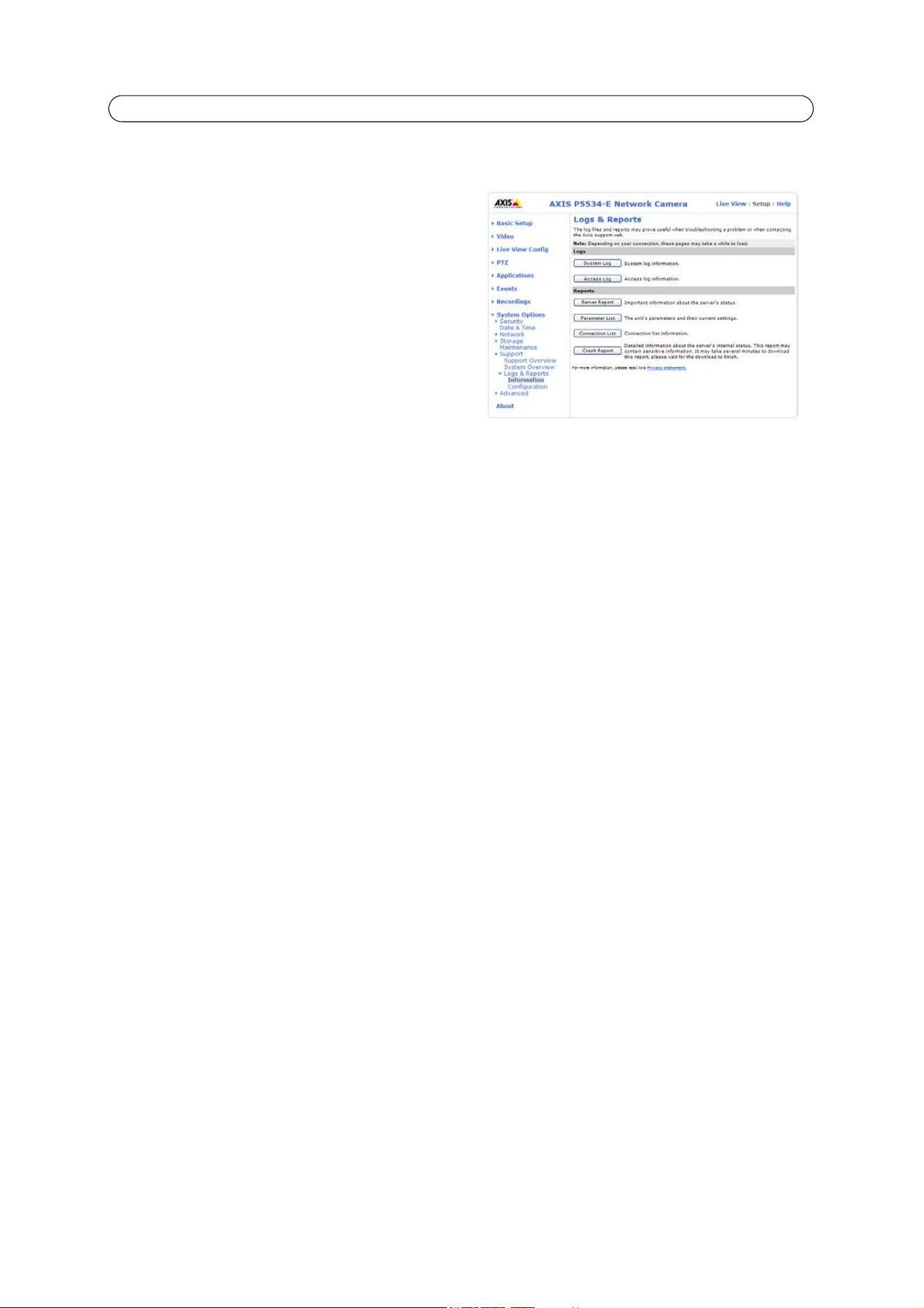
38
AXIS P5532-E/P5534-E - System Options
Logs & Reports
When contacting Axis support, please be sure to provide a valid
Server Report with your query. The Access Log is automatically
included in the server report.
Information
the Serv
er Report and Parameter List may prove useful when
troubleshooting a problem or when contacting the Axis support.
• System
Log - Provides information about system events.
• Access Log - By def
ault, the Access Log lists all failed
attempts to access the camera but can be configured to
list all connections to the camera, whether successful or
not. Go to Support > Logs & Reports > Configuration
and select the desired level of information from the list.
See
Configuration,
on page 38 for more information.
The Access Log is useful for various purposes
such as tracking all access to the camera, simple web attraction tracking,
system analysis and troubleshooting.
• Server Report -
Provides information about the server status and should always be included when requesting support.
• Parameter List - Shows the unit's parameters and their current settings.
• Conn
ection List - Lists all clients that are currently accessing video. It is also used for system analysis and trouble-
shooting.
• Cra
sh Report - Generates an archive with debugging information. Note that the report takes several minutes to gen-
erate.
Configuration
From the drop-down lists, select the level of information
to be added to the System Log and Access Log files and the
permitted size of the log files.
The default information level for the Access Log is set to Critical & Warnings, i.e.
failed connections. However, in an error
situation and when requesting support, set it to the highest information level - Critical & Warnings & Info.
For the Log Level for Email, select from t
he drop-down list the level of information to send as email and enter the destination
email address.
Advanced
Scripting
Scripting is an advanced function that enables you to customize and use scripts.
Caution!
Incorrect scripting may cause unexpected behavior or even cause loss of contact with the unit. If a script does cause problems,
reset the unit to its factory default settings. A backup file may be of use to return the unit to its latest configuration.
Axis strongly recommends that you do not use this func
tion unless you understand the consequences. Note that Axis
support does not provide assistance for problems with customized scripts.
For more information, please visit the Developer pages at www.axi
s.com/developer
File upload
Files (e.g. web pages and images) can be uploaded to the network camera and used as custom settings. Uploaded files are
accessed through http://<ip address>/local/<user>/<filename> w
here <user> is the selected user access group (viewer,
operator or administrator) for the uploaded file.

39
AXIS P5532-E/P5534-E - About
Plain Config
Plain Config is for the advanced user with experience of Axis network camera configuration. All parameters can be set and
modified from this page. Help is available from the standard help pages.
About
Here you can find basic information about your network camera. You can also view third party software licenses.
Resetting to the Factory Default Settings
To reset the camera to the original factory default settings, go to the System Options > Maintenance web page (as described
in
Maintenance,
on page 37). Alternatively, use the Control button and the Power switch on the side of the camera as
described below:
Using the control and restart buttons
This will reset all parameters, including the IP address, to the Factory Default settings:
1. Remove the top cover, for instructi
ons please refer to the Installation Guide supplied with the camera.
2. Press and hold the control and restart buttons at the same time.
3. Release the restart button but continue to hold down the control button.
4. Continue to hold down the control button until the status indicator flashes amber at regular intervals (this may take
up to 15 seconds).
5. Release the control button.
6. When the Status indicator changes to green (which may take up to 1 minute), the process is complete and the camera
has been reset. The unit now has the default IP address 192.168.0.90
7. Replace the top cover.
8. Re-assign the IP address, see the Installation Guide for instructions.
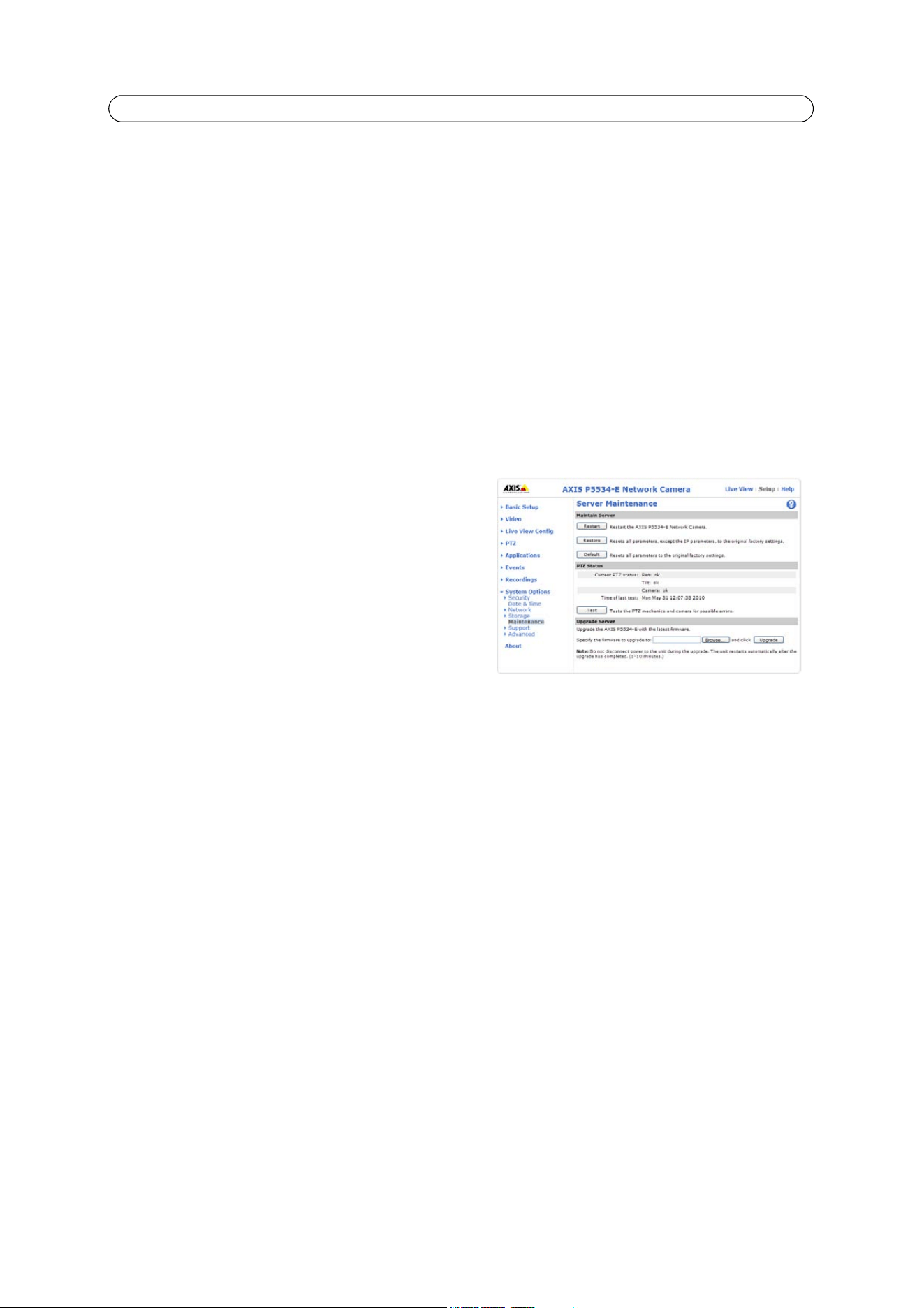
40
AXIS P5532-E/P5534-E - Troubleshooting
Troubleshooting
Checking the Firmware
Firmware is software that determines the functinality of network cameras. One of your first actions when troubleshooting a
problem should be to check the current firmware version. The latest version may contain a correction that fixes your particular
problem. The current firmware in your camera is displayed on the page Setup > Basic Setup or under About.
Upgrading the Firmware
When you upgrade your camera with the latest firmware from the Axis web site, your camera receives the latest available
functionality. Always read the upgrade instructions and release notes available with each new release, before updating the
firmware.
Note:
P
reconfigured and customized settings are retained for use when the new firmware is running (providing that the fea-
tures are available in the new firmware) although this is not guaranteed by Axis Communications.
1. Save the firmware file to your computer. The latest
version of the firmware is available free of charge from
the Axis web site at http://www.axis.com/techsup
2. Go to Setup > System Options > Maintenance in the
camera’s web pages.
3. In the Upgrade Server section, click Browse to locate the
desired firmware file on your computer. Click Upgrade.
Note:
• After starting the upgrade process, you should always
wait at least 5-10 minutes before restarting the camera,
even if you suspect the upgrade has failed.
• Your dealer reserves the right to charge for any repair attributable to faulty upgrading by the user.
• AXIS Camera Management can be used for multiple upgrades. Please see the Axis website at www.axis.com for more
information.
Emergency Recovery Procedure
If power or the network connection to the camera is lost during the upgrade, the process will fail and the unit becomes
unresponsive. A flashing red status indicator indicates a failed upgrade. To recover the unit, follow the steps below. The serial
number is found on the label on the product casing and is included on an extra label included in the package.
1. Unix/Li
nux - From the command line, type the following:
arp -s <IP address of camera> <Serial number> temp
ping -s 408 <IP address of camera>
Windows - From a command/DOS prompt, type the following:
arp -s <IP address of camera> <Serial number>
ping -l 408 -t <IP address of camera>
2. If the unit does not reply within a few seconds, restart it and wait for a reply. Press CTRL+C to stop Ping.
3. Open a browser and type in the camera’s IP address. In the page that appears, use the Browse button to select the
upgrade file to use, for example, axisq6032_e.bin. Then click the Load button to restart the upgrade process.
4. After the upgrade is complete (1-10 minutes), the unit automatically restarts and shows a steady green (for about 10
seconds) on the status indicator before returning to its normal unlit status.
5. Reinstall the camera, for more information, see the Installation Guide provided with the product.
If the emergency recovery procedure does not get the camera up and running again, contact Axis support at
www.axis.com/techsup

41
AXIS P5532-E/P5534-E - Troubleshooting
AXIS Support
If you contact Axis Customer Services, please help us to resolve your problems expediently by providing a Server Report and a
brief description of the problem.
The Server Report contains important information about the server and its sof
tware, as well as a list of the current
parameters. The Access log files are also included in the Server Report. Go to Setup > System Options > Support > Support
Overview to generate a Server Report.

42
AXIS P5532-E/P5534-E - Troubleshooting
Symptoms, possible causes and remedial actions
Problems setting the IP address
When using ARP/Ping Try the installation again. The IP address must be
set within two minutes after power has been
applied to the camera. Ensure the Ping length is set to 408. See the Installation Guide.
The camera is locat
ed on a different
subnet
If the IP address intended for the camera and the IP address of your computer are located on dif-
ferent subnets, you will not be able to set the IP address. Contact your network administrator to
obt
ain an appropriate IP address.
The IP address is being used by another
device
Disconnect the camera from the network. Run th
e Ping command (in a Command/DOS window,
type ping and the IP address of the unit).
If you receive: Reply from <IP addr
ess>: bytes = 32; time = 10 ms..... - this means that the IP
address may already be in use by another device on your network. You must obtain a new IP
address and reinstall the unit.
If you receive: Re
quest timed out - this means that the IP address is available for use with your
camera. In this case, check all cabling and reinstall the unit.
The camera cannot be accessed from
a web browser
Cannot log in When HTTPS is enabled, ensure that t
he correct protocol (HTTPS or HTTPS) is used when attempt-
ing to log in. You may need to manually type h
ttp or https in the browser’s address field.
The IP address has been changed by
DH
CP
If the camera and client are on the same network. Run AXIS IP Utility to locate the camera. Iden-
tify the camera using its model or serial number.
Alternatively:
1) Move the camera to an isolated network or to
one with no DHCP or BOOTP server. Set the IP
address again, using AXIS IP Utility or the ARP Ping command.
2) Access the unit and disable BOOTP and DHCP in th
e TCP/IP settings. Return the unit to the
main network. The unit now has a fixed IP address that will not change.
3) As an alternative to 2), if dynamic IP addres
s via DHCP or BOOTP is required, select the
required service and then configure IP address change notification from the network settings.
Return the unit to the main network. The unit will now have a dynamic IP address, but will notify
you if the address changes.
Other networking problems Test the network cable by connecting it to anoth
er network device, then Ping that device from
your workstation. See instructions above.
Camera is accessible locally, but not externally
Broadband router configuration To configure your broadband router to allow incoming data traffic to the camera, enable the
NAT-traversal feature which will attempt to automatically configure the router to allow access
to the camera.
This is enabled from S
etup > System Options > Network > TCP/IP Advanced.
Note that the router must support UPnP
TM
.
Firewall protection Check the Internet firewall with your system administrator.
Default routers required Check if you need to configure the default router settings.
Problems with the H.264 format
No H.264 displayed in the client Check that the correct network interface is select
ed in the AMC control panel (streaming tab).
Check that the relevant H.264 connection methods ar
e enabled in the AMC control panel applet
(streaming tab).
In the AMC Control Panel, select the H.264 tab and
click the button Set to default H.264
decoder.
No multicast H.264 displayed in the
cli
ent.
Check with your network administrator that the multicast addresses used by the camera are
valid for your network.
Check with your network administrator to see
if there is a firewall preventing viewing.
Multicast H.264 only accessible by
local clients.
Check if your router supports multicasting, or if the router settings between the client and the
server need to be configured. The TTL (Time To Live) value may need to be increased.
Poor rendering of H.264 images. Color depth set incorrectly on clients. Set to 16-bit or 32-bit color.
In text overlays are blurred, or if there are other rendering
problems, you may need to enable
Advanced Video Rendering from the H.264 tab in the AMC Control Panel.
Ensure that your graphics card is using the latest device
driver. The latest drivers can usually be
downloaded from the manufacturer's web site.
Color saturation is different in H.264
and Motion
JPEG
Modify the settings for your graphics adapter. Please see the adapter's documentation for more
information.

43
AXIS P5532-E/P5534-E - Troubleshooting
For further assistance, please contact your reseller or check the support pages on the Axis web site at www.axis.com/techsup
Lower frame rate than expected Reduce number of applications running on the client computer.
Limit the number of simultaneous viewers.
Check with the system administrator that there is eno
ugh bandwidth available. See also the
online help.
Check in the AMC control panel applet (H.264 tab)
that video processing is not set to Decode
only I frames.
Lower the image resolution.
Why do I not get 30 frames per sec-
ond?
See
General performance considerations,
on page 47
Image degeneration Decrease the GOV length, see the online help for more information.
The status indicator flashes red and the
camera is inaccessible
A firmware upgrade has been inter-
rupted o
r the firmware has in some
other way been damaged.
See
Emergency Recovery Procedure,
on page 40.
No images are displayed on web page
Problem with AXIS Media Control
(
Internet Explorer only
)
To enable the updating of video imag
es in Internet Explorer, set your browser to allow ActiveX
controls. Also, make sure that AXIS Media Control is installed on your workstation.
Installation of addit
ional ActiveX com-
ponent restricted or prohibited
Configure your camera to use a Java applet for updating the images under
Live View Config > Layout >
Default Viewer for Internet Explorer. See the online help for more
information.
Video/Image problems, general
Image too dark or too light. Check the video image settings. See the online help
on Video Stream and Camera Settings
Missing images in uploads This can occur when trying to use a larger image buffer
than is actually available. Try lowering
the frame rate or the upload period.
Slow image update Configuring pre-buffers, motion detection, high-resol
ution images, high frame rates will affect
the performance of the camera.
Poor performance Poor performance may be caused by heavy network traffic, multip
le users accessing the unit, low
performance clients, use of features such as motion detection, event handling and image rota-
tion other than 180 degrees.
Image not clear Check that the dome cover is clean.
Do
not clean a dome cover that looks clean to the eye and never polish the surface. Excessive
cleaning can damage the surface.
For general cleaning of a dome cover it is recommended to use a non-abrasive, solvent-free neu-
tral soap or detergent with water and a soft clo
th. Rinse well with clean lukewarm water. Dry
with a soft cloth to prevent water spotting.
Never use harsh detergents, gasoline, benzene or aceto
ne etc. and avoid cleaning in direct sun-
light or at elevated temperatures.
Poor quality snapshot images
Screen incorrectly configured on your
workstation
In Display Properties, configure your screen to show at least 65000 colors, that is, at least 16-bit.
Using only 16 or 256 colors will produce dithering artifacts in the image.
Overlay/Privacy mask is not displayed
Incorrect size or location of overlay or
privacy mask.
The overlay or privacy mask may have been positioned incorrectly or may be too large. Refer to
Overlay Image Settings in the online help for more information.
Browser freezes
Netscape 7.x or Mozilla 1.4 (or later)
can sometimes freeze on a slow com-
puter
Lower the image resolution.
Problems uploading files
Limited space There is only limited space available for the upload of your own files. Try deleting existing files to
free up space.
Motion Detection triggers unexpectedly
Changes in luminance Motion detection is based on changes in luminance in the image. This means that if there are
sudden changes in the lighting, motion detection may be triggered mistakenly. Lower the sensi-
tivity setting to avoid problems with luminance.
Storage/Disk management problems
Video cannot be recorded Check that the SD Card is not write protected (i.e., Read only).
SD Card cannot be mounted If the SD Card cannot be mounted, reformat it and then click Mount.

44
AXIS P5532-E/P5534-E - Troubleshooting
LED Indicator flash routine
* RFL (Resident Firmware Loader) check is a checksum method used to ensure that the software loading and starting the firmware works
correctly.
Case Color Description
Normal boot sequence Unlit Power on
RFL check*
Amber Kernel booting
System initiating
Green Shows steady green for 10 sec. for normal operation af
ter restart.
Unlit Steady connection/normal operation
Hard Factory Default Unlit Power on
RFL check*
Amber Steady - Kernel booting
Flashes - Firmware restore
Steady - System initiating
Green Shows steady green for 10 sec. for normal operation af
ter restart.
Unlit Steady connection/normal operation
Flash Upgrade Unlit Steady connection/normal operation
Amber Flashes - Firmware upgrade
Unlit Reset
RFL check*
Amber Steady - Kernel booting
Flashes - Firmware restore
Steady - System initiating
Green Shows steady green for 10 sec. for normal operation af
ter restart.
Unlit Steady connection/normal operation
No Network Unlit Power on
RFL check*
Amber Kernel booting
System initiating
Amber/red Flashes - No network
Green Shows steady green for 10 seconds for normal operation after restart
Unlit Steady connection/normal operation
AXIS DynDNS Unlit Steady connection/normal operation
Green Flashes- Dyn DNS connecting
Steady - DynDNS connection successful
Unlit Steady connection/normal operation
AVHS
Unlit Steady connection/normal operation
Green Flashes - Initiating
Amber Flashes - Connection successful
Unlit Steady connection/normal operation
Bad Checksum Red Flashes - RFL check* failed
See
Emergency Recovery Procedure,
on page 40.

45
AXIS P5532-E/P5534-E - Technical Specifications
Technical Specifications
Function/group Item Specification
Camera Models AXIS P5532-E 60 Hz, AXIS P5
532-E 50 Hz
AXIS P5534-E 60 Hz, AXIS P5
534-E 50 Hz
Image sensor AXIS P5532-E: 1/4” Progressive scan CCD
AXIS P5534-E: 1/3” Progressive scan CCD 1.3 Megapixel
Lens AXIS P5532-E: • Zoom 3.6 mm — 104.4 mm
• F1.4 — 3.7
• Autofocus
• Automatic day and night functionality
• Horizontal angle of view: 53.1° — 2.0°
AXIS P5534-E: • Zoom 4.7 mm — 84.6 mm
• F1.6 — 2.8
• Autofocus
• Automatic day and night functionality
• Horizontal angle of view: 55.2° — 3.2°
Light sensitivity AXIS P5532-E: • Color: 0.5 lux at 30 IRE F1.4
• B/W: 0.01 lux at 30 IRE F1.4
AXIS P5534-E • Color: 0.74 lux at 30 IRE F1.6
• B/W: 0.04 lux at 30 IRE F1.6
Shutter time AXIS P5532-E • 1/30000 s to 1 s (60 Hz)
• 1/30000 s to 1/0.75 s (50 Hz)
AXIS P5534-E 1/10000 s to 1/4 s
Pan/Tilt/Zoom • E-flip, auto-flip
• 100 preset positions
• Pan: 360° (with auto-flip), 0.2 — 300°/s
• Tilt: 180°, 0.2 - 300°/s
• AXIS P5532: 29x optical zoom and 12x digital zoom, total 348x zoom
• AXIS P5534: 18x optical zoom and 12x digital zoom, total 216x zoom
Pan/Tilt/Zoom
fun
ctionalities
Guard Tour, control queue
On-screen directional indicator
Video Video compression • H.264 (MPEG-4 Part 10/AVC, Baseline profile)
• Motion JPEG
Resolutions AXIS P5532-E D1 720x480 to 176x120 (60 Hz)
D1 720x576 to 176x144 (50 Hz)
AXIS P5534-E HDTV 720p 1280x720 to 320x180)
Frame rate H.264 Up to 30/25fps (60/50 Hz) in all resolutions
Frame rate
Mot
ion JPEG
Up to 30/25fps (60/50 Hz) in all resolutions
Video streaming • Multiple, individually configurable streams in H.264 and Motion JPEG
• Controllable frame rate and bandwidth
• VBR/CBR H.264
Image settings • Wide Dynamic Range (WDR), manual shutter time, compression, color,
brightness, sharpness, white balance, exposure control, exposure zones,
backlight compensation, fine tuning of behavior at low light
• AX
IS P5532-E: Electronic Image Stabilization (EIS), noise reduction
• Rotation 0°, 180°
• Text and image overlay
• Privacy mask
• Image freeze on PTZ

46
AXIS P5532-E/P5534-E - Technical Specifications
Network Security Password protection, IP address filtering, HTTPS encryption, IEEE 802.1X
network access control*, digest authentication, user access log
*This product includes software developed by the
Open SSL Project for use in
the Open SSL Tool kit (www.openssl.org)
Supported protocols IPv4/v6, HTTP, HTTPS*, SSL/TLS*, QoS Layer 3
DiffServ, FTP, SMTP, Bonjour,
UPnP, SNMPv1/v2c/v3(MIB-II), DNS, DynDNS, NTP, RTSP, RTP, TCP, UDP,
IGMP, RTCP, ICMP, DHCP, ARP, SOCKS, etc.
*This product includes software developed by the
Open SSL Project for use in
the Open SSL Tool kit (www.openssl.org)
System
Integration
Application
Programming
Interface
Open API for software integration, including VAPIX® from Axis
Communications, specification available at www.axis.com
Support for AXIS Video Hosting System (AVHS) with One-Click Camera
Connection
Intelligent video Video motion detection, Advanced Gatekeeper
Alarm triggers Video motion detection, external input, PTZ preset,
temperature, memory card full
Alarm events • File upload via FTP, HTTP and email
• Notification via email, HTTP and TCP
• External output activation
• Go to PTZ preset
• Run guard tour
• Recording to local storage
Video buffer 96 MB pre- and post alarm
Video access from
web browser
• Camera live view
• Video recording to file (ASF)
• Customizable HTML pages
• Windows 7, Windows Vista, XP, Server 2003, Server 2008
• DirectX 9c or higher
• For other operating systems and browers see
www.axis.com/techsup
Installation,
management and
maintenance
• AXIS Camera Management tool on CD and web-based configuration
• Configuration of backup and restore
• Firmware upgrades over HTTP or FTP, firmware available at www.axis.com
General Casing IP66-rated, metal casing (aluminum)
Acrylic (PMMA) clear dome cover
Sunshield (PC/ASA))
Processors, memory ARTPEC-3, 256 MB RAM, 128 MB Flash
Battery backed-up real-time clock
Power • High Power over Ethernet (High PoE) IEEE 8
02.3at, max 30 W
• AXIS T8123 High PoE Midspan 1-port included: 100-240 V AC
Connectors • RJ-45 10BASE-T/100BASE-TX PoE
• IP66-rated RJ-45 connector kit included
Local storage SD/SDHC memory card slot (card not included)
Operating conditions • Operating conditions camera unit
-20°C to 50 °C (-4°F to 122 °F)
• Humidity up to 93% RH
(non-condensing)
• Operating conditions midspan
-10°C to 55 °C (14°F to 131 °F)
Storage conditions • Storage conditions camera unit
-40°C to 70 °C (-40°F to 158 °F)
Function/group Item Specification

47
AXIS P5532-E/P5534-E - Technical Specifications
General performance considerations
When setting up your system, it is important to consider how various settings and situations will affect performance. Some
factors affect the amount of bandwidth (the bit rate) required, others can affect the frame rate, and some affect both. If the
load on the CPU reaches its maximum, this will also affect the frame rate.
The following factors are among the most important to consider:
• High image resolutions and/or lower compression levels
result in larger images. Bandwidth affected.
• Access by large numbers of Motion JPEG and/or
unicast H.264 clients. Bandwidth affected.
• Simultaneous viewing of different streams (resolution, compression) by different clients.
Effect on frame rate and
bandwidth.
• Accessing both Motion JPEG and H.264 video streams simultaneously.
Frame rate and bandwidth affected.
• Heavy usage of event settings affects the camera’s CPU load. Frame rate affected.
• Enabled motion detection. Frame rate and bandwidth affected.
• Heavy network utilization due to poor infr
astructure. Bandwidth affected.
• Viewing on poorly performing client PCs lowers perceived performance. Frame rate affected.
Approvals • EN 55022 Class B, EN 61000-3-2
• EN 61000-3-3
• EN 61000-6-1, EN 61000-6-2, EN 55024
• FCC Part 15 Subpart B Class B
• ICES-003 Class B
• VCCI Class B
• C-tick AS/NZS CISPR 22
• KCC Class B
• IP66
• NEMA 4X
• IEC 60721-4-3 Class 3K3, 3M3, EN/IEC 60068-2
• EN 60950-1 (IEC 60950-1)
• Midspan: EN 60950-1, GS, UL, cUL, UL-AR,
CE, VCCI, CB, KCC
Dimensions (HxWxD) 195 mm x 210 mm x 210 mm (7.7” x 8.4”. x 8.4”)
Weight 2.0 kg (4.4 lb.)
Included accessories AXIS T8123 High Power of Ethernet Midspan 1-port, IP66-rated RJ45
con
nector kit, clear and smoked dome cover, Installation Guide, CD with
User’s Manual, recording software, installation and management tools,
Windows decoder 1-user license
Video management
software
(not included)
AXIS Camera Station - Video management software for viewing and
recording up to 50 cameras
See www.axis.com/products/video/software/ for more software applica
tions
via partners
Optional accessories • AXIS T91A Mounting accessories
• AXIS T8310 Video Surveillance Control Board
• AXIS Camera Station
• AXIS T90A Illuminators
• Multi-user decoder license pack
Function/group Item Specification

48
AXIS P5532-E/P5534-E - Glossary of Terms
Glossary of Terms
ActiveX - A standard that enables software components to
interact with one another in a networked environment,
regardless of the language(s) used to create them. Web
browsers may come into contact with ActiveX controls, ActiveX
documents, and ActiveX scripts. ActiveX controls are often
downloaded and installed automatically as required.
Angle - The field of view, relative to a standard lens in a 35mm
st
ill camera, expressed in degrees, e.g. 30°. For practical
purposes, this is the area that a lens can cover, where the angle
of view is determined by the focal length of the lens. A
wide-angle lens has a short focal length and covers a wider
angle of view than standard or telephoto lenses, which have
longer focal lengths.
ARP (Address Resolution Protocol) - This protocol is used to
associat
e an IP address to a hardware MAC address. A request
is broadcast on the local network to discover the MAC address
for an IP address.
ARTPEC (Axis Real Time Picture Encoder) - This chip is used
for im
age compression.
ASIC (Application Specific Integrated Circuit) - A circuit
des
igned for a specific application, as opposed to a general
purpose circuit, such as a microprocessor.
Aspect ratio - A ratio of width to height in images. A common
aspect
ratio used for television screens and computer monitors
is 4:3. High-definition television (HDTV) uses an aspect ratio of
16:9.
Autoiris (DC-Iris) - This special type of iris is electrically
co
ntrolled by the camera, to automatically regulate the amount
of light allowed to enter.
Bitmap - A bitmap is a data file representi
ng a rectangular grid
of pixels. It defines a display space and color for each pixel (or
‘bit’) in the display space. This type of image is known as a
‘raster graphic.’ GIFs and JPEGs are examples of image file types
that contain bitmaps.
Because a bitmap uses this fixed raste
r method, it cannot easily
be rescaled without losing definition. Conversely, a vector
graphic image uses geometrical shapes to represent the image,
and can thus be quickly rescaled.
Bit rate - The bit rate (in kbit/s or Mbit/s) is often referred to
as speed,
but actually defines the number of bits/time unit and
not distance/time unit.
Bonjour - Also known as zero-configuration networking,
Bonjo
ur enables devices to automatically discover each other
on a network, without having to enter IP addresses or configure
DNS servers. Bonjour is a trademark of Apple Computer, Inc.
Broadband - In network engineering t
erms, this describes
transmission methods where two or more signals share the
same carrier. In more popular terminology, broadband is taken
to mean high-speed data transmission.
CCD (Charged Coupled Device) - This light-sensitive image
device used
in many digital cameras is a large integrated circuit
that contains hundreds of thousands of photo-sites (pixels)
that convert light energy into electronic signals. Its size is
measured diagonally and can be 1/4", 1/3", 1/2" or 2/3".
CGI (Common Gateway Interface) - A specification for
communicat
ion between a web server and other (CGI)
programs. For example, a HTML page that contains a form
might use a CGI program to process the form data once it is
submitted.
CIF (Common Intermediate Format) - CIF refers to the analog
video res
olutions 352x288 pixels (PAL) and 352x240 pixels
(NTSC). See also
Resolution
.
Client/Server - Client/server describes the relationship
bet
ween two computer programs in which one program, the
client, makes a service request from another program, the
server, which fulfils the request. Typically, multiple client
programs share the services of a common server program. A
web browser is a client program that requests services (the
sending of web pages or files) from a web server.
CMOS (Complementary Metal O
xide Semiconductor) - A
CMOS is a widely used type of semiconductor that uses both
negative and positive circuits. Since only one of the circuit
types is on at any given time, CMOS chips require less power
than chips using just one type of transistor. CMOS image
sensors also allow processing circuits to be included on the
same chip, an advantage not possible with CCD sensors, which
are also much more expensive to produce.
Codec - In communications engineering
, a codec is usually a
coder/decoder. Codecs are used in integrated circuits or chips
that convert e.g. analog video and audio signals into a digital
format for transmission. The codec also converts received
digital signals back into analog format. A codec uses
analog-to-digital conversion and digital-to-analog conversion
in the same chip.
Codec can also mean compression/decompres
sion, in which
case it is generally taken to mean an algorithm or computer
program for reducing the size of large files and programs.
Compression - See
Image compression
.
CVBS - analog video format (composite video).
DC-Iris (Autoiris) - This special type of iris is electrically
co
ntrolled by the camera, to automatically regulate the amount
of light allowed to enter.
DHCP (Dynamic Host Config
uration Protocol) - DHCP is a
protocol that lets network administrators automate and
centrally manage the assignment of Internet Protocol (IP)
addresses to network devices in a network.
DHCP uses the concept of a ‘lease’ or amount of time that a
given
IP address will be valid for a computer. The lease time can
vary, depending on how long a user is likely to require the
network connection at a particular location.
DHCP also supports static addresses for e.g. computers running
web
servers, which need a permanent IP address.
DNS (Domain Name System) - DNS is used to locate and
t
ranslate Internet domain names into IP (Internet Protocol)
addresses. A domain name is a meaningful and
easy-to-remember name for an Internet address. For example
the domain name www.example.com is much easier to

49
AXIS P5532-E/P5534-E - Glossary of Terms
remember than 192.0.34.166. The translation tables for domain
names are contained in Domain name servers.
Domain Server - Domains can also be used by organizations
who
wish to centralize the management of their (Windows)
computers. Each user within a domain has an account that
usually allows them to log in to and use any computer in the
domain, although restrictions may also apply. The domain
server is the server that authenticates the users on the network.
Duplex - See
Full-duplex.
Ethernet - Ethernet is the most widely installed local area
network technology. An Ethernet LAN typically uses special
grades of twisted pair wires. The most commonly installed
Ethernet systems are 10BASE-T and 100BASE-T10, which
provide transmission speeds up to 10 Mbps and 100 Mbps
respectively.
ETRAX (Ethernet Token Ring AXIS) - Axis' own
microprocesso
r.
Factory default settings - These are the settings that
originally
applied for a device when it was first delivered from
the factory. If it should become necessary to reset a device to
its factory default settings, this will, for many devices,
completely reset any settings that were changed by the user.
Firewall - A firewall works as a barrier between networks, e.g.
bet
ween a Local Area Network and the Internet. The firewall
ensures that only authorized users are allowed to access the
one network from the other. A firewall can be software running
on a computer, or it can be a standalone hardware device.
Focal length - Measured in millimeters, the focal length of a
camera lens
determines the width of the horizontal field of
view, which in turn is measured in degrees.
FTP (File Transfer Protocol) - An application protocol that
uses the TCP
/IP protocols. It is used to exchange files between
computers/devices on networks.
Frame - A frame is a complete video image. In the 2:1
interlaced scanning
format of the RS-170 and CCIR formats, a
frame is made up of two separate fields of 262.5 or 312.5 lines
interlaced at 60 or 50 Hz to form a complete frame, which
appears at 30 or 25 Hz. In video cameras with a progressive
scan, each frame is scanned line-by-line and not interlaced;
most are also displayed at 30 and 25 Hz.
Frame rate - The frame rate used to describe the frequency at
which a
video stream is updated is measured in frames per
second (fps). A higher frame rate is advantageous when there is
movement in the video stream, as it maintains image quality
throughout.
Full-duplex - Transmission of data in two directions
simultaneously. In an
audio system this would describe e.g. a
telephone systems. Half-duplex also provides bi-directional
communication, but only in one direction at a time, as in a
walkie-talkie system. See also
Simplex
.
Gain - Gain is the amplification factor an
d the extent to which
an analog amplifier boosts the strength of a signal.
Amplification factors are usually expressed in terms of power.
The decibel (dB) is the most common way of quantifying the
gain of an amplifier.
Gateway - A gateway is a point in a network that acts as an
entry po
int to another network. In a corporate network for
example, a computer server acting as a gateway often also acts
as a proxy server and a firewall server. A gateway is often
associated with both a router, which knows where to direct a
given packet of data that arrives at the gateway, and a switch,
which furnishes the actual path in and out of the gateway for a
given packet.
GIF (Graphics Interchange Format) - GIF is one of the most
common
file formats used for images in web pages. There are
two versions of the format, 87a and 89a. Version 89a supports
animations, i.e. a short sequence of images within a single GIF
file. A GIF89a can also be specified for interlaced presentation.
GOV (Group Of VOPs) - A group of VOPs is the basic unit of
an H.264 video stream. The
GOV contains different types and
numbers of VOPs (I-VOPs, P-VOPs) as determined by the GOV
length and GOV structure. See also
VOP
.
GOV length - The GOV length determines the number of
imag
es (VOPs) in the GOV structure. See also
GOV
and
VOP
.
GOV structure - The GOV structure describes the composition
of
an H.264 video stream, as regards the type of images (I-VOPs
or P-VOPs) included in the stream, and their internal order. See
also
GOV
and
VOP
.
H.264 - A standard for video compression, also known as
MPEG-4 Part
10.
Half-duplex - See
Full-duplex
.
HDTV - High-definition television, high resolution digital
video.
HTML (Hypertext Markup Language) - HTML is the set of
"markup"
symbols or codes inserted in a file intended for
display in web browser. The markup tells the browser how to
display the page's words and images for the user.
HTTP (Hypertext Transfer Protocol) - HTTP is the set of rules
for e
xchanging files (text, graphic images, sound, video, and
other multimedia files) on the web. The HTTP protocol runs on
top of the TCP/IP suite of protocols.
Hub - A (network) hub is used to connect multiple devices to
th
e network. The hub transmits all data to all devices
connected to it, whereas a switch will only transmit the data to
the device it is specifically intended for.
IEEE 802.11 - A family of standards for wireless LANs. The
802.11 s
tandard supports 1 or 2 Mbit/s transmission on the 2.4
GHz band. IEEE 802.11b specifies an 11 Mbit/s data rate on the
2.4 GHz band, while 802.11a allows up to 54 Mbit/s on the 5
GHz band.
Image compression - Image compression minimizes the file
siz
e (in bytes) of an image. Two of the most common
compressed image formats are JPEG and GIF.
Interlacing - Interlaced video is video captured at 50 pictures
(know
n as fields) per second, of which every 2 consecutive
fields (at half height) are then combined into 1 frame.

50
AXIS P5532-E/P5534-E - Glossary of Terms
Interlacing was developed many years ago for the analog TV
world and is still used widely today. It provides good results
when viewing motion in standard TV pictures, although there is
always some degree of distortion in the image.
To view interlaced video on e.g. a computer monitor, the video
mus
t first be de-interlaced, to produce progressive video, which
consists of complete images, one after the other, at 25 frames
per second. See also
Progressive scan
.
IP (Internet Protocol) - The Internet Protocol is a method
transmitt
ing data over a network. Data to be sent is divided
into individual and completely independent "packets." Each
computer (or host) on the Internet has at least one address that
uniquely identifies it from all others, and each data packet
contains both the sender's address and the receiver's address.
The Internet Protocol ensures that th
e data packets all arrive at
the intended address. As IP is a connectionless protocol, which
means that there is no established connection between the
communication end-points, packets can be sent via different
routes and do not need to arrive at the destination in the
correct order.
Once the data packets have arrived at
the correct destination,
another protocol - Transmission Control Protocol (TCP) - puts
them in the right order. See also
TCP
.
IP Address - An IP address is simply an addres
s on an IP
network used by a computer/device connected to that network.
IP addresses allow all the connected computers/devices to find
each other and to pass data back and forth.
To avoid conflicts, each IP address
on any given network must
be unique. An IP address can be assigned as fixed, so that it
does not change, or it can be assigned dynamically (and
automatically) by DHCP.
An IP address consists of four groups (or quads) of decimal
digit
s separated by periods, e.g. 130.5.5.25. Different parts of
the address represent different things. Some part will represent
the network number or address, and some other part will
represent the local machine address.
See also
IP (Internet Protocol).
I-VOP - See
VOP
.
JPEG (Joint Photographic Experts Group) - Together with
the
GIF file format, JPEG is an image file type commonly used
on the web. A JPEG image is a bitmap, and usually has the file
suffix '.jpg' or ".jpeg." When creating a JPEG image, it is
possible to configure the level of compression to use. As the
lowest compression (i.e. the highest quality) results in the
largest file, there is a trade-off between image quality and file
size.
kbit/s (kilobits per second) - A measure of the bit rate, i.e. the
rate
at which bits are passing a given point. See also
Bit rate
.
LAN (Local Area Network) - A LAN is a group of computers
an
d associated devices that typically share common resources
within a limited geographical area.
Linux - Linux is an open source operat
ing system within the
UNIX family. Because of its robustness and availability, Linux
has won popularity in the open source community and among
commercial application developers.
Local storage - If a camera or video encoder supports local
st
orage, an SD card can be inserted into the SD card slot to
locally record and store a video stream.
MAC address (Media Access Control address) - A MAC
address
is a unique identifier associated with a piece of
networking equipment, or more specifically, its interface with
the network. For example, the network card in a computer has
its own MAC address.
Manual iris - This is the opposite to an aut
oiris, i.e. the camera
iris must be adjusted manually to regulate the amount of light
allowed to reach the image sensor.
Mbit/s (Megabits
per second) - A measure of the bit rate, i.e.
the rate at which bits are passing a given point. Commonly
used to give the ‘speed’ of a network. A LAN might run at 10 or
100 Mbit/s. See also
Bit rate
.
Monitor - A monitor is very similar to a standard television set,
bu
t lacks the electronics to pick up regular television signals.
Motion JPEG - Motion JPEG is a simple
compressi
on/decompression technique for networked video.
Latency is low and image quality is guaranteed, regardless of
movement or complexity of the image. Image quality is
controlled by adjusting the compression level, which in turn
provides control over the file size, and thereby the bit rate.
High-quality individual images from
the Motion JPEG stream
are easily extracted. See also JPEG.
Megapixel - See
Pixel
.
MPEG (Moving Picture Experts Group) - The Moving Picture
Experts
Group develops standards for digital video and audio
compression. It operates under the auspices of the
International Organization for Standardization (ISO). The MPEG
standards are an evolving series, each designed for a different
purpose.
MPEG-2 - MPEG-2 is the designation for a group of audio and
video co
ding standards, and is typically used to encode audio
and video for broadcast signals, including digital satellite and
Cable TV. MPEG-2, with some modifications, is also the coding
format used by standard commercial DVD movies.
Multicast - Bandwidth-conserving technology that
reduces
bandwidth usage by simultaneously delivering a single stream
of information to multiple network recipients.
Network connectivity - The physical (wired or wireless) and
logical
(protocol) connection of a computer network or an
individual device to a network, such as the Internet or a LAN.
NTSC (National Television Syst
em Committee) - NTSC is the
television and video standard in the United States. NTSC
delivers 525 lines at 60 half-frames/second.
NWay - A network protocol that auto
matically negotiates the
highest possible common transmission speed between two
devices.
PAL (Phase Alternating Line) - PAL is the dominant television
st
andard in Europe. PAL delivers 625 lines at 50
half-frames/second.
Ping - Ping is a basic network program used diagnostically to

51
AXIS P5532-E/P5534-E - Glossary of Terms
check the status of a network host or device. Ping can be used
to see if a particular network address (IP address or host name)
is occupied or not, or if the host at that address is responding
normally. Ping can be run from e.g. the Windows Command
prompt or the command line in UNIX.
Pixel - A pixel is one of the many tiny dots that make up a
digit
al image. The color and intensity of each pixel represents a
tiny area of the complete image.
PoE (Power over Ethernet) - Power over Ethernet provides
power to a network device
via the same cable as used for the
network connection. This is very useful for IP-Surveillance and
remote monitoring applications in places where it may be too
impractical or expensive to power the device from a power
outlet.
PPP (Point-to-Point Protocol) - A protocol that uses a serial
interface for
communication between two network devices. For
example, a PC connected by a phone line to a server.
PPTP (Point-to-Point Tunneling Protocol) - A protocol (set
of communication rules
) that allows corporations to extend
their own corporate network through private "tunnels" over the
public Internet. In this way a corporation can effectively use a
WAN (Wide Area Network) as a large single LAN (Local Area
Network). This kind of interconnection is known as a virtual
private network (VPN).
Pre/post alarm images - The images from immediately before
an
d after an alarm. These images are stored in a buffer for later
retrieval.
Progressive scan - Progressive scan, as opposed to interlaced
video, scans
the entire picture, line by line every sixteenth of a
second. In other words, captured images are not split into
separate fields as in interlaced scanning.
Computer monitors do not need interlace to show the picture
on the screen, but instead show t
hem progressively, on one line
at a time in perfect order, i.e. 1, 2, 3, 4, 5, 6, 7 etc., so there is
virtually no ‘flickering’ effect. In a surveillance application, this
can be critical when viewing detail within a moving image,
such as a person running. A high-quality monitor is required to
get the best from progressive scan. See also
Interlacing
.
Protocol - A special set of rules governing how two entities
wil
l communicate. Protocols are found at many levels of
communication, and there are hardware protocols and software
protocols.
Proxy server - In an organization that uses the Internet, a
proxy server acts
as an intermediary between a workstation
user and the Internet. This provides security, administrative
control, and a caching service. Any proxy server associated with
a gateway server, or part of a gateway server, effectively
separates the organization’s network from the outside network
and the local firewall. It is the firewall server that protects the
network against outside intrusion.
A proxy server receives requests for
Internet services (such as
web page requests) from many users. If the proxy server is also
a cache server, it looks in its local cache of previously
downloaded web pages. If it finds the page, it is returned to the
user without forwarding the request to the Internet. If the page
is not in the cache, the proxy server, acting as a client on behalf
of the user, uses one of its own IP addresses to request the page
from another server over the Internet. When the requested
page is returned, the proxy server forwards it to the user that
originally requested it.
P-VOP - See
VOP
.
Resolution - Image resolution is a measure of how much detail
a digit
al image can hold: the greater the resolution, the greater
the level of detail. Resolution can be specified as the number of
pixel-columns (width) by the number of pixel-rows (height),
e.g. 320x240.
Alternatively, the total number of pix
els (usually in megapixels)
in the image can be used. In analog systems it is also common
to use other format designations, such as CIF, QCIF, 4CIF, etc.
RTCP (Real-Time Cont
rol Protocol) - RTCP provides support
for real-time conferencing of groups of any size within an
intranet. This support includes source identification and
support for gateways like audio and video bridges as well as
multicast-to-unicast translators.
RTCP offers quality-of-service feedback from receivers to the
mult
icast group as well as support for the synchronization of
different media streams.
RTP (Real-Time Transport Protocol) - RTP is an Internet
proto
col for the transport of real-time data, e.g. audio and
video. It can be used for media-on-demand as well as
interactive services such as Internet telephony.
RTSP (Real Time Streaming Protocol) - RTSP is a control
proto
col, and a starting point for negotiating transports such as
RTP, multicast and Unicast, and for negotiating codecs.
RTSP can be considered a ‘remote control’ for controlling the
media stre
am delivered by a media server. RTSP servers typically
use RTP as the protocol for the actual transport of audio/video
data.
Router - A device that determines the next network point to
which a
packet should be forwarded on its way to its final
destination. A router creates and/or maintains a special routing
table that stores information on how best to reach certain
destinations. A router is sometimes included as part of a
network switch. See also
switch
.
Server - In general, a server is a c
omputer program that
provides services to other computer programs in the same or
other computers. A computer running a server program is also
frequently referred to as a server. In practice, the server may
contain any number of server and client programs. A web server
is the computer program that supplies the requested HTML
pages or files to the client (browser).
Sharpness - This is the control of fine detail within a picture.
This
feature was originally introduced into color TV sets that
used notch filter decoders. This filter took away all high
frequency detail in the black and white region of the picture.
The sharpness control attempted to put some of that detail
back in the picture. Sharpness controls are mostly superfluous
in today's high-end TVs. The only logical requirement for it
nowadays is on a VHS machine.
Simplex - In Simplex operation, a network cable or
comm
unications channel can only send information in one
direction.

52
AXIS P5532-E/P5534-E - Glossary of Terms
SMTP (Simple Mail Transfer Protocol) - SMTP is used for
sending and receiving e-mail. However, as it is ‘simple,’ it is
limited in its ability to queue messages at the receiving end,
and is usually used with one of two other protocols, POP3 or
IMAP. These other protocols allow the user to save messages in
a server mailbox and download them periodically from the
server.
SMTP authentication is an extension of SMTP, whereby the
client is
required to log into the mail server before or during the
sending of email. It can be used to allow legitimate users to
send email while denying the service to unauthorized users,
such as spammers.
SNMP (Simple Network Management Protocol) - SNMP
forms part
of the Internet Protocol suite, as defined by the
Internet Engineering Task Force. The protocol can support
monitoring of network-attached devices for any conditions
that warrant administrative attention.
Sockets - Sockets are a method for communication between a
client program and a
server program over a network. A socket is
defined as ‘the endpoint in a connection.’ Sockets are created
and used with a set of programming requests or ‘function calls’
sometimes called the sockets application programming
interface (API).
SSL/TSL (Secure Socket Layer/Tran
sport Layer Security)
These two protocols (SSL is succeeded by TSL) are cryptographic
prot
ocols that provide secure communication on a network. SSL
is commonly used over HTTP to form HTTPS, as used e.g. on the
Internet for electronic financial transactions. SSL uses public
key certificates to verify the identity of the server.
Subnet/subnet mask - A subnet is an identifiably separate
part
of an organization's network. Typically, a subnet may
represent all the machines at one geographic location, in one
building, or on the same local area network (LAN). Having an
organization's network divided into subnets allows it to be
connected to the Internet with a single shared network address.
The subnet mask is the part of th
e IP address that tells a
network router how to find the subnet that the data packet
should be delivered to. Using a subnet mask saves the router
having to handle the entire 32-bit IP address; it simply looks at
the bits selected by the mask.
Switch - A switch is a network device th
at connects network
segments together, and which selects a path for sending a unit
of data to its next destination. In general, a switch is a simpler
and faster mechanism than a router, which requires knowledge
about the network and how to determine the route. Some
switches include the router function. See also
Router
.
TCP (Transmission Control Protocol) - TCP is used along with
the
Internet Protocol (IP) to transmit data as packets between
computers over the network. While IP takes care of the actual
packet delivery, TCP keeps track of the individual packets that
the communication (e.g. requested a web page file) is divided
into, and, when all packets have arrived at their destination, it
reassembles them to re-form the complete file.
TCP is a connection-oriented protocol, which means that a
connecti
on is established between the two end-points and is
maintained until the data has been successfully exchanged
between the communicating applications.
Telnet - Telnet is a simple method with which to access
anot
her network device, e.g. a computer. The HTTP protocol and
the FTP protocols allow you to request specific files from
remote computers, but do not allow you logon as a user of that
computer. With Telnet, you log on as a regular user with
whatever privileges you may have been granted for specific
applications and data residing on that computer.
UDP (User Datagram Protocol) - UDP is a communications
proto
col that offers limited service for exchanging data in a
network that uses the Internet Protocol (IP). UDP is an
alternative to the Transmission Control Protocol (TCP). The
advantage of UDP is that it is not required to deliver all data
and may drop network packets when there is e.g. network
congestion. This is suitable for live video, as there is no point in
re-transmitting old information that will not be displayed
anyway.
Unicast - Communication between a single sender and a single
receiver
over a network. A new connection is established for
each new user.
URL (Uniform Resource Locator) - An "address" on the
net
work.
Varifocal lens - A varifocal lens provides a wide range of focal
lengths, as
opposed to a lens with a fixed focal length, which
only provides one.
VPN (Virtual Private Network) - This creates a secure
"t
unnel" between the points within the VPN. Only devices with
the correct "key" will be able to work within the VPN. The VPN
network can be within a company LAN (Local Area Network),
but different sites can also be connected over the Internet in a
secure way. One common use for VPN is for connecting a
remote computer to the corporate network, via e.g. a direct
phone line or via the Internet.
VOP (Video Object Plane) - A VOP is an image frame in an
H.
264 video stream. There are several types of VOP:
- An I-VOP is complete image frame.
- A P-VOP codes the differences between images, as long as it
i
s more efficient to do so. Otherwise it codes the whole image,
which may also be a completely new image.
WAN (Wide-Area-Network) - Similar to a LAN, but on a
larger g
eographical scale.
W-LAN (Wireless LAN) - A wireless LAN is a wireless local
a
rea network that uses radio waves as its carrier: where the
network connections for end-users are wireless. The main
network structure usually uses cables.
Web server - A web server is a program, which allows web
brows
ers to retrieve files from computers connected to the
Internet. The web server listens for requests from web browsers
and upon receiving a request for a file sends it back to the
browser.
The primary function of a web server is to serve pages to other
remote comput
ers; consequently, it needs to be installed on a
computer that is permanently connected to the Internet. It also
controls access to the server whilst monitoring and logging
server access statistics.
WEP (Wireless Equivalent Privacy) - A wireless security
proto
col, specified in the IEEE 802.11 standard, which is

53
AXIS P5532-E/P5534-E - Glossary of Terms
designed to provide a wireless local area network (WLAN) with
a level of security and privacy comparable to that usually
expected of a wired LAN. Security is at two different levels;
40-bit and 128-bit encryption. The higher the bit number, the
more secure the encryption.
WPA-PSK (Wi-Fi Protected Access - Pre-Shared Key) - This
wire
less encryption method uses a pre-shared key (PSK) for key
management. Keys can usually be entered as manual hex
values, as hexadecimal characters, or as a Passphrase.
WPA-PSK provides a greater degree of security than WEP.
YPbPr - analog video signal for component video.
Zoom lens - A zoom lens can be moved (zoomed) to enlarge
the vi
ew of an object to show more detail.

AXIS P5532-E/P5534-E - Index
54
Index
A
Access Log 38
Action Buttons 9, 19
Administrator 13, 30
Alarm 26
AMC 7
ARP/Ping 33
Axis Media Control viewer Toolbar 9
B
Backlight compensation 16
Backup 37
Bit Rate 15
Bonjour 7, 37
Brightness 16
Buffer Size 24
Buffers 24
C
Color level 16
Connection List 38
Constant Bit Rate 15
Continuous Recording 29
Control Queue 21
D
Date & Time 32
Default Viewer 18
Disk full 24
DNS Configuration 33
DNS Server 33, 34
Domain Name 34
E
Emergency recovery 40
Enable ARP/Ping 33
Event Servers 23
Event Types 23
Events 23
Exposure Settings 16
Exposure zones 16
F
Factory Default Settings 39
Fan 9, 24
Firmware 40
Frame Rate 14
FTP 35
FTP Server 23
G
Gatekeeper 25
GOV Settings 15
Guard Tour 20
H
H.264 14, 15
Heater 9
Host Name 34
HTTP Server 23
HTTPS 8, 30, 34
I
IEEE 802.1X 31
Image freeze on PTZ 17
IP Address Filtering 30
IPv4 32, 34
IPv6 33
IR cut filter 17
L
LED 44
LED Indicator 6, 44
Live View 9
Live View Config 18
Local storage 4
Logs & Reports 38
M
Mask 17
MJPEG 14, 15
Motion Detection 26
Motion detection 24
N
NAT traversal 7, 34
Network Settings 32
NTP Configuration 34
NTP Server 32
O
Operator 30
OSDI Zones 20
Overlay Settings 14
P
Pan Tilt Zoom 24
Pan/Tilt/Zoom Controls 10
Parameter List 38
Password Settings 30
Port Status 28
Post-trigger Buffer 24
Pre-trigger Buffer 24
Proportional speed 21
PTZ control panel 10
Q
QoS 35
QuickTime 11, 18
R
Recording List 28

AXIS P5532-E/P5534-E - Index
55
Recovery 40
Referrals 30
Restore 37
RTSP 35
S
Scheduled Event 25
Security 30
Self-signed certificate 8
Server Report 38
Server Time 32
Sharpness 16
SMTP 36
Snapshot button 9
SNMP 36
Storage 37
Storage Device 37
Support 37, 41
System Log 38
System Options 30
T
TCP Server 23
TCP/IP Settings 32
Time Mode 32
Troubleshooting 40
U
Upgrade Server 37
UPnP 34, 36
Users 30
V
Variable Bit Rate 15
Video Stream 14
Viewer 30
W
White balance 16
Wide dynamic range 16