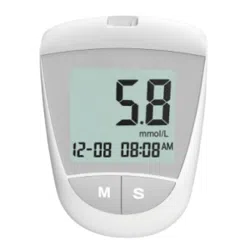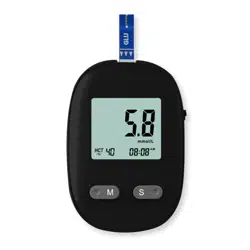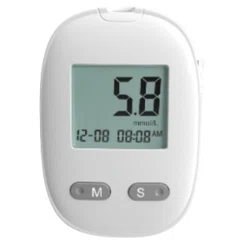
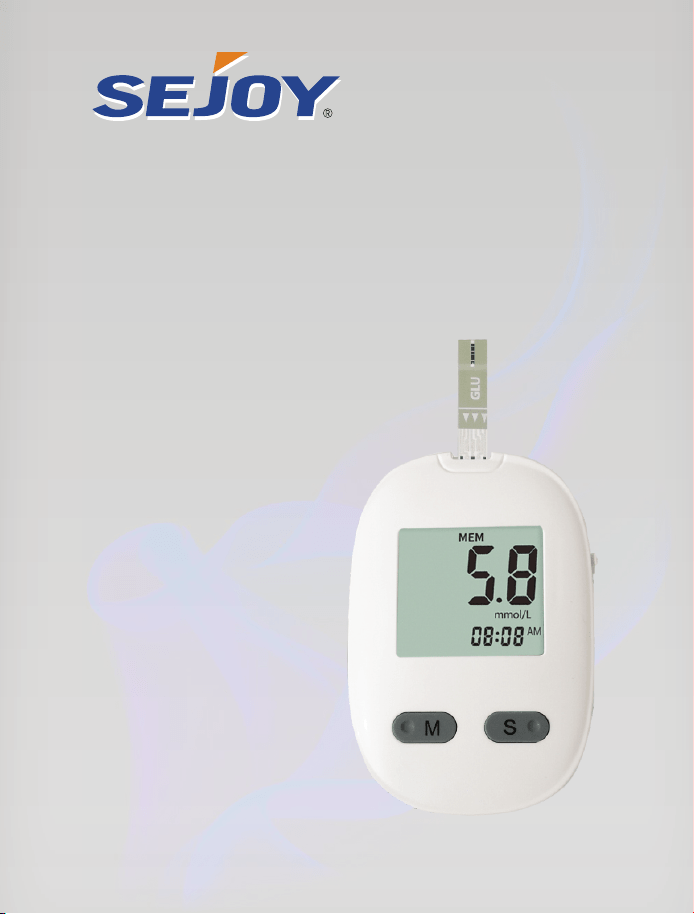
Owner’s Booklet
BG-207b Blood Glucose Monitoring System
Advanced Diabetes Management System

Contents
Important Safety information
·····································
··
Important Health-Related information ····························
Meter (battery included) ··········································
Test Strips ························································
Lancing Device ····················································
Lancet ····························································
Control Solution ···················································
Setting the date and time ··········································
Setting the measuring unit ········································
Setting the test reminder ·········································
Bluetooth connection ···········································
Preparing the lancing device ······································
Blood sampling
··········
··········································
Testing ····························································
Interpreting unexpected test results ·····························
When to perform a control test ···································
Performing a control test ·········································
Understanding out-of-range control test results ··················
Maintenance ······················································
Replacing the battery ·············································
Introduction ························································
Getting to know your system ··································
Setting up your meter·············································
Testing your blood glucose ·····································
Memory and averages ··········································
Control solution testing ·········································
01
02
03
06
06
07
08
09
09
10
10
11
12
13
15
15
18
20
23
26
28
28
29
30
33
33
Comparing Your Meter Result to a Laboratory Result····
25
Limitations ·························································
05

Troubleshooting ························································
Technical information ·················································
Specifications ··························································
Disposing of the meter, test strips, lancets and batteries ·····
Warranty ·································································
Symbol Index ····························································
Traceability ·······························································
Performance Characteristics ········································
FCC Information ························································
36
39
39
41
42
46
43
44
48
Caring for your system ····················································
34
Appendix ··································································49

Introduction
Thank you for choosing Sejoy BG-207b blood glucose monitoring
system. Before you start testing, carefully read this .Owner’s Booklet
Intended Use
It’s intended to be used for the quantitative measurement of glucose(sugar)
in fresh capillary whole blood. The system is intended for use outside the
body (in vitro diagnostic use) by people with diabetes at home and by health
care professional in a clinical setting as an aid to monitor the effectiveness
of diabetes control. It should not be used for the diagnosis.
Test Principle
1
Peel off the insulation film from battery compartment before first use.
*
The strip measures glucose by using amperometric technology
employing a glucose oxidaes reaction.When whole blood or con-trol
solution is drawn into the tip of a test strip,glucose in the sample reacts
with chemicals and produces an electrical current. The meter
measures electrical current and calculates amount of glucose. The
glucose result is displayed as a calculated plasma value.
Introduction
Important Safety information
Warning
• During normal testing, any blood glucose meter or lancing device may
come in contact with blood. All parts of the kit are considered
biohazardous and can potentially transmit infectious diseases from
blood borne pathogens, even after you have performed cleaning and
disinfecting.
• The meter and lancing device should never be used by more than one
person. Do not share the meter and lancing device with anyone, including
family members, due to the risk of infection from blood borne pathogens.
• Cleaning and disinfecting the meter and lancing device destroys most,
but not necessarily all, blood borne pathogens.
• If the meter is being operated by a second person who is providing testing
assistance to the user, the meter and lancing device should be cleaned
and disinfected prior to use by the second person.
• Disinfect the meter and lancing device before allowing anyone else to
handle them. Do not allow anyone else to test with the meter or lancing
device.
• It is important to keep the meter and lancing device clean and disinfected.
Clean and disinfect the lancing device once per week to remove visible dirt or
3
other material for safe handling and/or prior to disinfecting.
For instructions on how to clean and disinfect the meter and lancing device,
see Chapter Maintenance.
• Wash hands thoroughly before and after handling the meter, lancing device,
or test strips.
• Choking hazard. Small parts. Keep away from children.
• Strong electromagnetic fields may interfere with the proper operation of the
meter. Do not use this meter close to sources of strong electromagnetic
radiation.
• To avoid electrostatic discharge, do not use the meter in a very dry
environment, especially one in which synthetic materials are present.
2

Introduction
Important Health-Related information
·Patients undergoing oxygen therapy may receive inaccurate results.
·Some people with diabetes do not experience symptoms of low blood
sugar (hypoglycemia). Others, such as children or people who are
unconscious or have certain disabilities, may not be able to
communicate their symptoms to caregivers. For these reasons, do
not change any treatment without first talking to your doctor
·Run a control test when you open a new box of test strips or if you think
that your test result is incorrect. Running a control test lets you know
that the meter and test strips are working properly.
·DO NOT CHANGE YOUR TREATMENT BASED ON A SINGLE RESULT
THAT DOES NOT MATCH HOW YOU FEEL OR IF YOU BELIEVE THAT
YOUR TEST RESULT COULD BE INCORRECT. If your blood sugar
result doesn’ t match how you feel and you have followed the instructions
in this manual, follow your doctor’s instructions, or call your doctor.
·Children should be taught how to use the meter and any other medical
products appropriately
·Being severely dehydrated or losing a lot of water may give you false
(low) test results. If you think you’re suffering from dehydration, call
your doctor right away.
·If you have followed all the instructions in this booklet and still have
symptoms that don’t seem to match your test results – or if you have
questions – talk to your doctor.
3

Introduction
·The system is designed for using with whole blood samples. Do not use
serum or plasma samples.
·Inaccurate test results may be obtained at high altitude more than
about 3, 048 meters above sea level.
4
·BS-302 blood glucose test strip: less than 20%, more than 70% of the
hematocrit ratio will affect the measurement results. Please contact
your doctor to determine your hematocrit ratio.
·Some substances may cause false results with enzymatic tests.
Introduction
5
Limitations
Substance Concentration
The interference listed below have been tested and shown no apparent
influence on results at the normal or higher therapy levels.
Other interfering substances in ISO 15197 Annex A are not verified, it may
also affect the test results.
Acetaminophen 1.11 mmol/L (20 mg/dL)
Bilirubin 2.22 mmol/L (40 mg/dL)
Creatinine 0.56 mmol/L (10 mg/dL)
Gentisic acid 55.56 mmol/L (1000 mg/dL)
Hemoglobin 27.78 mol/L (500 mg/dL)
Ibuprofen 2.78 mmol/L (50 mg/dL)
L-Dopa 0.03 mmol/L (0.5 mg/dL)
Methyldopa 55.56 mmol/L (1000 mg/dL)
Tolbutamide 5.55 mmol/L (100 mg/dL)
Triglycerides 83.33 mmol/L (1500 mg/dL)
Xylose 11.11 mmol/L (200 mg/dL)
EDTA 11.11 mmol/L (200 mg/dL)
Substance Concentration
Ascorbic acid 0.17 mmol/L (3 mg/dL)
Cholesterol 27.78 mmol/L (500 mg/dL)
Dopamine 0.11 mmol/L (2 mg/dL)
Glutathione 5.11 mmol/L (92 mg/dL)
Heparin 500 IU/dL
Icodextrin 60.8 mmol/L (1094.4 mg/dL)
Maltose 555.56 mmol/L (10,000 mg/dL)
Salicylic acid 3.33 mmol/L (60 mg/dL)
Tolazamide 2.22 mmol/L (40 mg/dL)
Getting to know your system
a
b
c
d
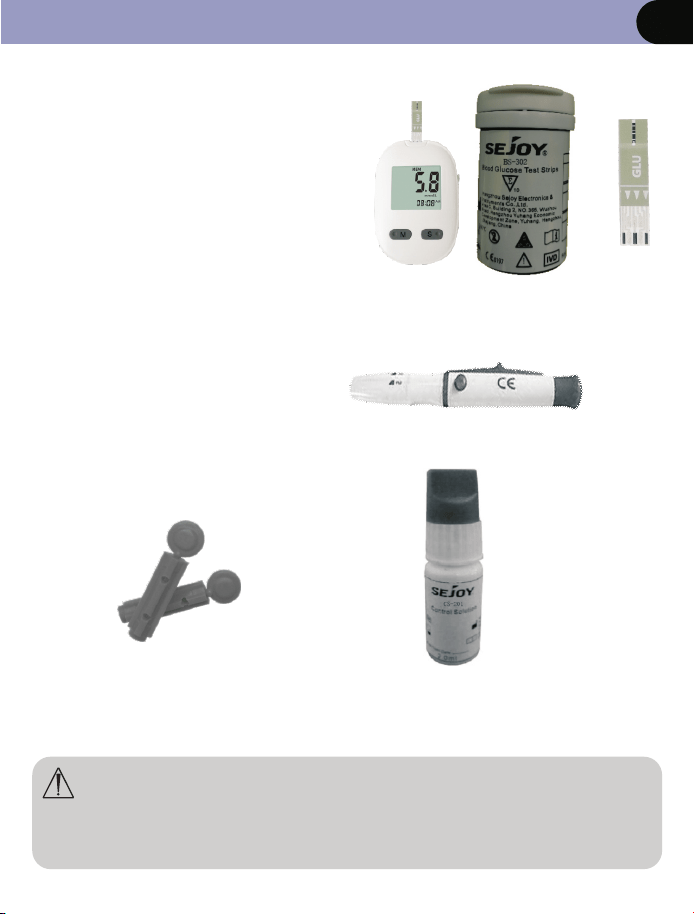
a. Meter (battery included)
b. Test Strips
c. Lancing Device
d. Sterile Lancet
e. Control Solution
INCLUDED WITH YOUR KIT
WARNING: Keep the meter and testing supplies away from young
children. Small items such as the battery cover, batteries, test strips,
lancets, protective covers on the lancets, and control solution vial
cap are choking hazards.
e
6
Getting to know your system
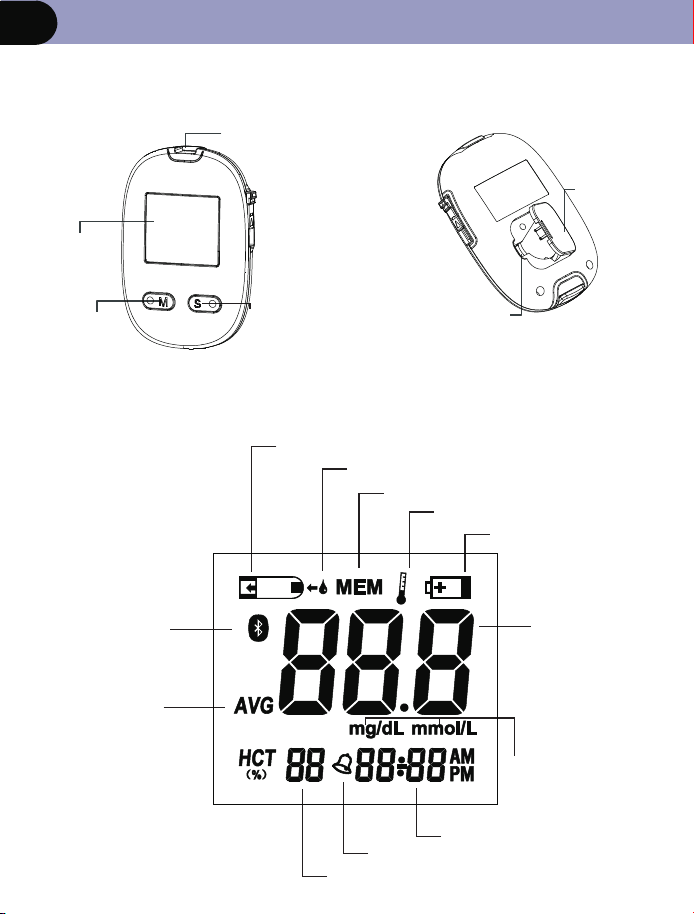
a. Meter
Display
Measuring Unit
Test Strip Reminder
Apply Blood Sample Reminder
Memory
Over Operating Temperature
Low Battery Reminder
Test Result
Alarm Clock Reminder
Date And Time
Average
7
Strip Port
LCD
“M”Button
“S” Button
Battery Compartment
Battery Cover
Alarm Clock Reminder
HCT Result
Bluetooth
Getting to know your system
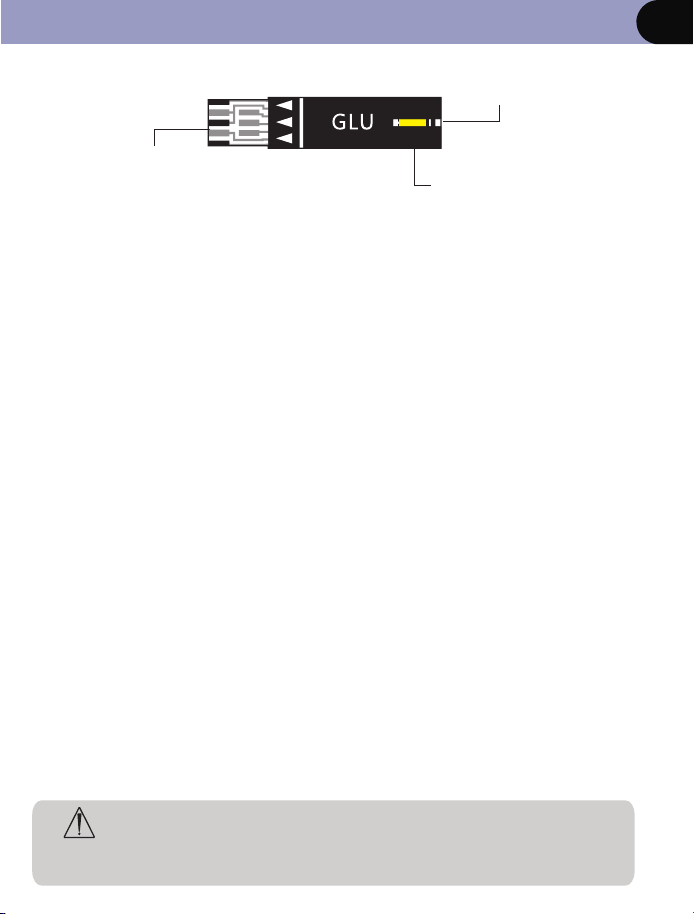
b. Test Strip
Contact Bar: Insert it into strip port. Push it all the way until it will go
no further.
Top Edge: Apply blood sample here
Confirmation Window: Sample checking area
Important: the meter should only be used with BS-302 test strips.
Using other Test strips with this meter can produce inaccurate results.
Important Test Strip Information
• The system has an operating range of 5℃~45℃(41℉~113℉).
• Store the test strip package in a cool, dry place between 1℃ ~ 30℃
(33.8 ℉ ~ 86℉).
• Use test strips only within the system operating temperature range.
• Keep away from direct sunlight or heat.
• Store your test strips in their original vial only; never transfer them to
another vial or any other container.
• Never store individual test strips outside the vial.
• After removing a test strip from the vial, immediately close the vial cap
tightly.
• With clean, dry hands, you may touch the test strip anywhere when
removing it from the vial or inserting it into the meter.
• Do not use test strips beyond the expiration date. This may cause
inaccurate results.
• Do not bend, cut, or alter test strips.
Warning: The cap or vial contains drying agents that may be
harmful if inhaled or swallowed and may cause skin or eye
irritation.
8
Contact Bars
Top Edge
Confirmation Window
Getting to know your system
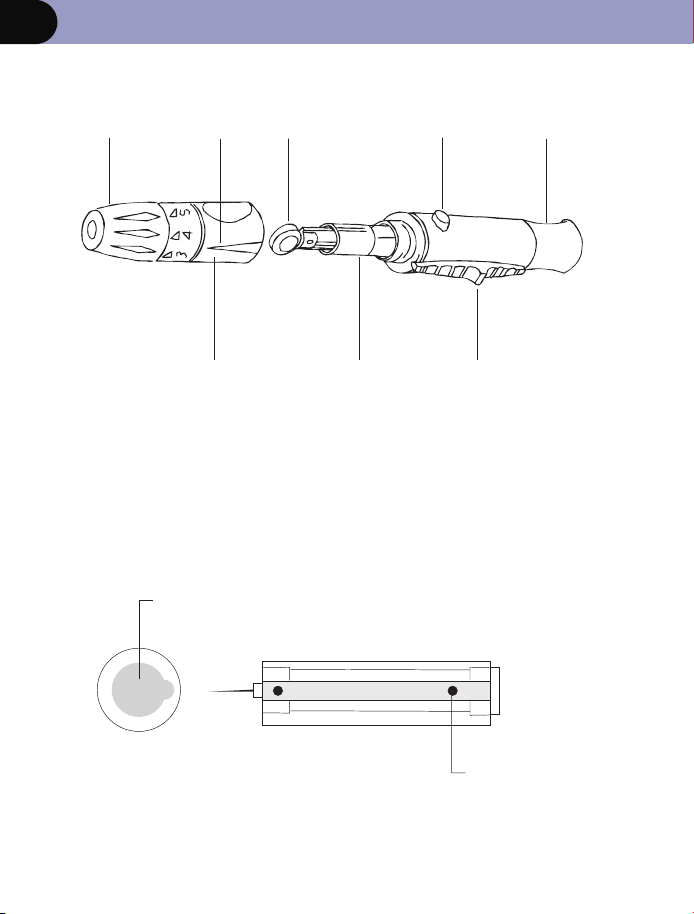
d. Lancet
c. Lancing Device
Protective Cover
Lancet Pin
Lancet Ejector
Trigger Button
Sliding Barrel
Lancet Carrier
Lancet Needle Cover
Lancing Device Cover
Arrow
Adjustable Tip
9
Setting up your meter
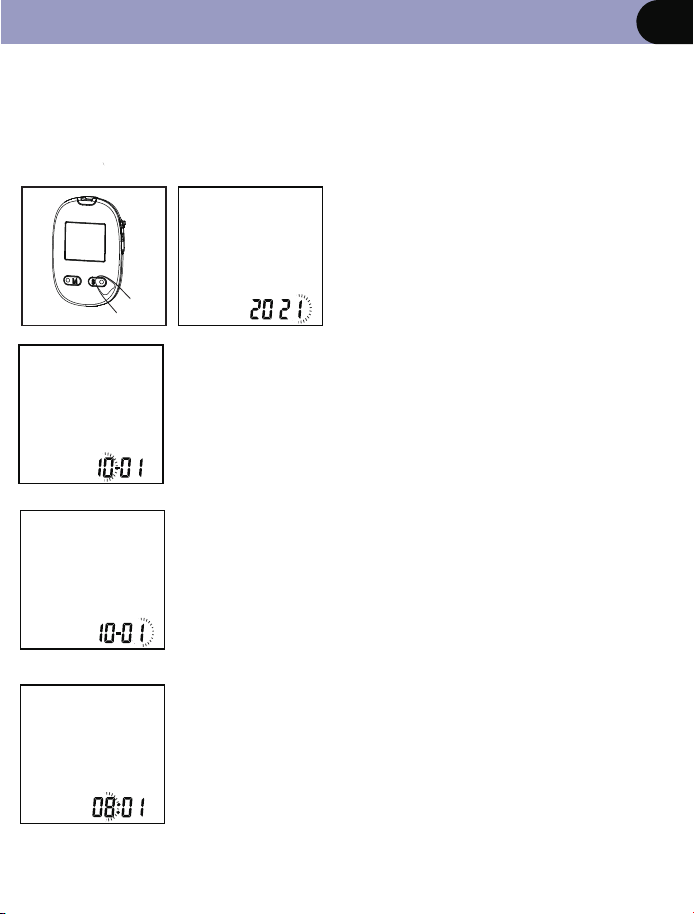
When use the meter for the first time, please set the parameters of the
meter. With the meter off, long press button “S” to enter into setting mode.
Set the year
Press and release the button “M”
to advance one year until the correct
year appears
.
After the month is set, press button “S”,
the month figure is flashing automatically.
Set the date
Press and release the button “M” to advance one
day until the correct date appears.
After the date is set, press button “S”, the Hour
figure is flashing automatically.
Set the hour
Press and release the button “M” to advance one
hour until the correct hour appears.
After the hour is set, press button “S”, the Minute
figure is flashing automatically.
①
②
③
10
Set the month
Press and release the button “M” to advance one
month month until the correct appears.
After the is set, press button “S”, the date month
figure is flashing automatically.
②
Setting up your meter
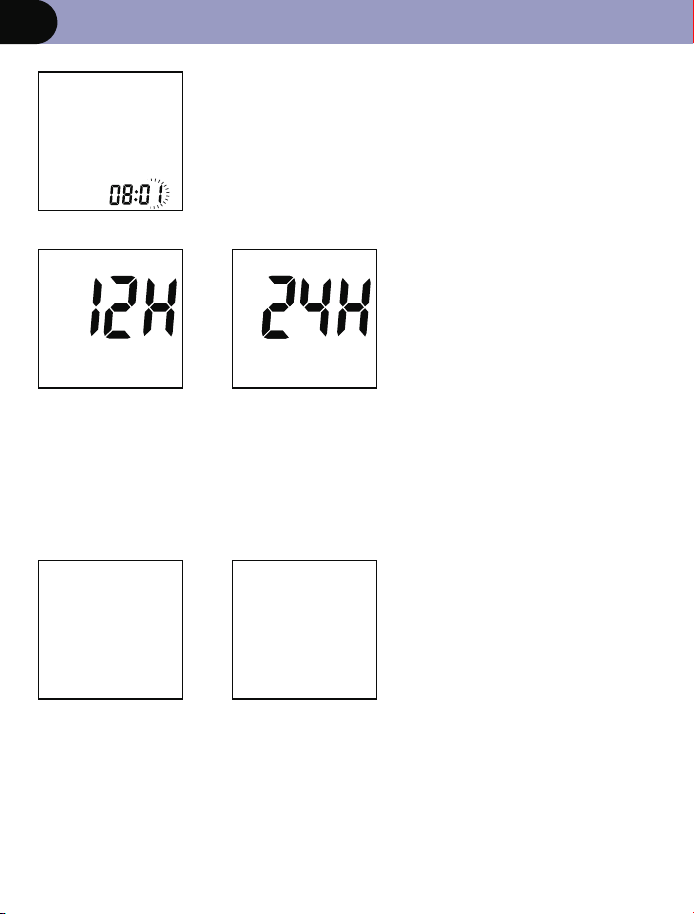
Set the minute
Press and release the button “M” to advance one
minute until the correct minute appears. After the
minute is set, press button “S”, the Time format
figure will appear.
The meter can display the time
in either an AM/PM (12-hour) or
a 24:00 (24-hour) format. Press
and release button “M” to select
the format.
With the preferred time format
on the display, press button “S”,
the measuring unit figure will
appear.
OR
Set the measuring unit
The meter can display test
results in either milligrams per
decilitre (mg/dL) or millimoles
per litre (mmol/L). Press and hold
button"S" and
"M" for 5 seconds
With the measuring unit preferred
format on the display, press button
mg/dL mmol/L
OR
④
Set the time format
⑤
⑥
to select the preferred format.
“S” to enter the Alarm Clock setting.
11
Setting up your meter
OR
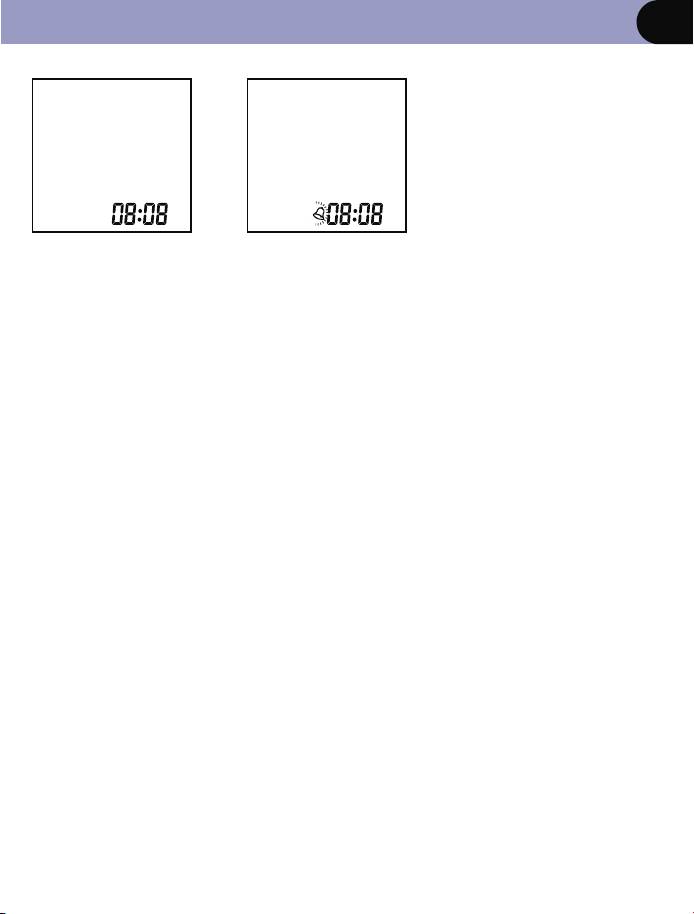
Set the alarm clock
The meter can set an alarm
clock to remind you the
time for testing.
Press button “M” to check
the alarm function.
If the alarm is on, press
button “S”, the time figure
is flashing. Please refer to
step 3 and 4 for the time
setting. After the time is
set, press button “S” button
to exit the setting mode.
If there is no alarm function
requirement, press button “S”
to exit the setting mode.
⑦
12

Bluetooth connection
13
Bluetooth requirements
-The monitor requires a device with:
.Bluetooth 4.0 or later
.Android 6.0 or later
.IOS 8.0 or later
And works with:
.iphone , iPod, iPad
. Android Phones and Tablets
Bluetooth connection
-Using for the first time
1.Download the free “JOYTECH healthcare” APP: On your
mobile phone or table go to “www.sejoy.com”.
2.Open the App on your phone or tablet. If requested,you should
enable Bluetooth on your device. You can enable Bluetooth
under the Settings menu on your smart phone or table.
3. Create a new user login, or login with your existing user name
and password.
4. Selection device “Glucose meter system”.
-Pairing your monitor with a Smart Device
1. Open the “Glucose meter system” and follow the pairing
instructions shown on your smart phone.The date and time on
your monitor will automatically be set when you pair it with your
smart device.
2. Confirm that your monitor is connected successfully.When your
monitor is connected successfully to your smart phone, the
“ ” symbol flshes.

Bluetooth connection
14
-Transfer your readings
1. As soon as your measurement is complete, open
the app on your smart phone to transfer your
reedings.
2.You can view your blood sugar readings on the APP.
Testing your blood glucose
Preparing the lancing device
Warning
• During normal testing, any blood glucose meter or lancing device
may come in contact with blood. All parts of the kit are considered
biohazardous and can potentially transmit infectious diseases
from bloodborne pathogens, even after you have performed
1,2
cleaning and disinfecting.
• The meter and lancing device should never be used by more than
one person. Do not share the meter and lancing device with
anyone, including family members, due to the risk of infection
from bloodborne pathogens.
• Cleaning and disinfecting the meter and lancing device destroys
most, but not necessarily all, bloodborne pathogens.
• If the meter is being operated by a second person who is
providing testing assistance to the user, the meter and lancing
device should be cleaned and disinfected prior to use by the
second person.
• Disinfect the meter and lancing device before allowing anyone
else to handle them. Do not allow anyone else to test with the
meter or lancing device.
• It is important to keep the meter and lancing device clean and
disinfected. For instructions on how to clean and disinfect the
meter and lancing device, see Chapter Maintenance.
• Wash hands thoroughly before and after handling the meter,
lancing device, or test strips.
• You must not insert the lancet cap into the lancing device and
simultaneously press the release button or hold the lancing
device with the release button resting on a surface such as a
table top. This could release a lancet and inadvertently cause
injury.
15
Testing your blood glucose
Preparing the lancing device
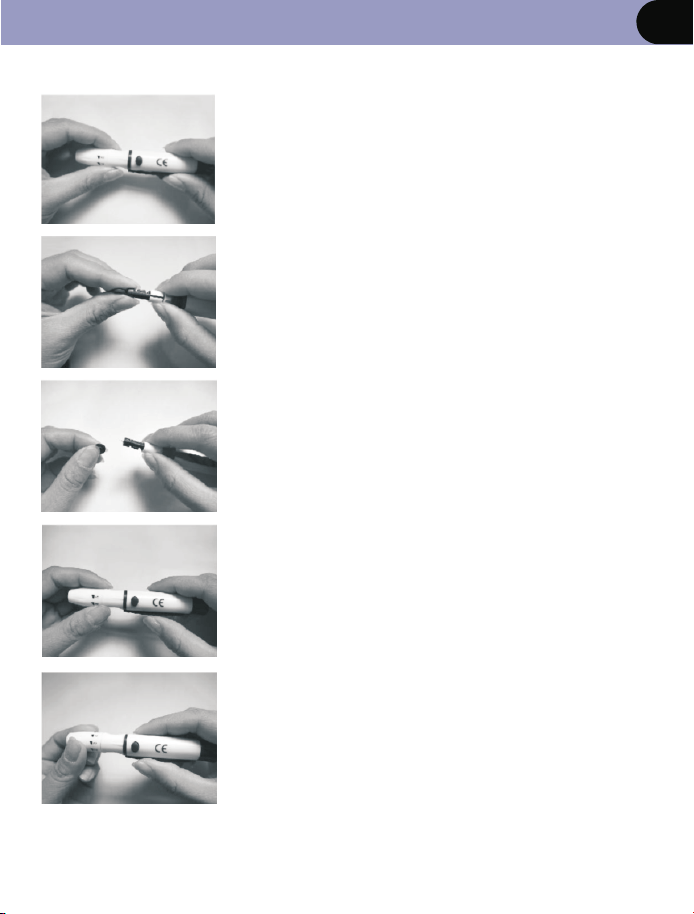
① Twist off the lancing device cover.
② Insert a new lancet into the lancet carrier firmly.
③ Hold the lancet needle cover and gently twist
it until it separates from the lancet.
④ Replace the lancing device cap.
Avoid touching the lancet pin.
⑤ Adjust the depth setting
The adjustable tip offers 5 levels of skin
penetration. Twist the lancing device cap
until the desired setting appears.
Note: To select the best depth:
1-2 for soft or thin skin 3 for average skin.
4-5 for thick or calloused skin.
①
16
Testing your blood glucose
Preparing the lancing device
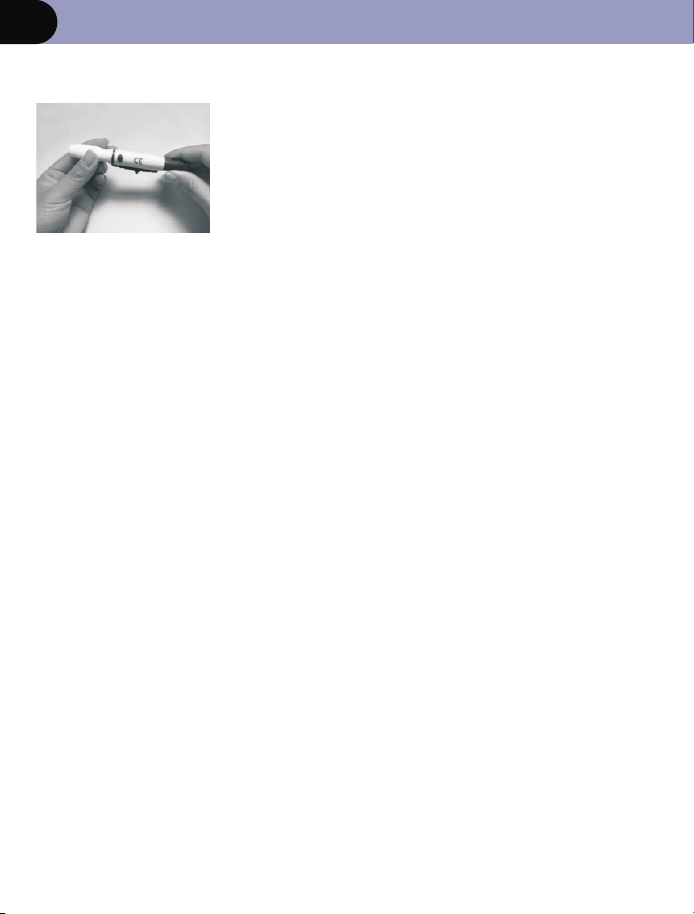
⑥ Hold the lancing device cover in one hand.
Using the other hand, slowly pull the sliding
Barrel away from the lancing device cover.
You will hear a click, indicating that the lancet
carrier is locked into position. Release sliding
barrel to return it to its original position.
17
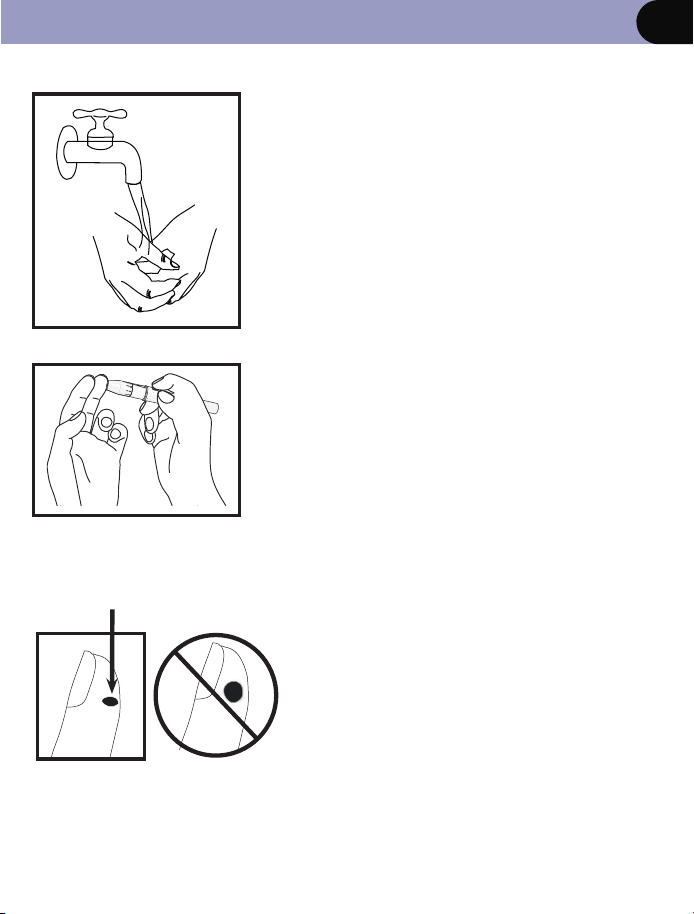
Testing your blood glucose
Blood Sampling
① Wash your hands and the puncture site
with an alcohol swab or soapy water.
Rinse and dry thoroughly.
③ Gently squeeze your finger until you
get a round drop of blood. Discard the first drop.
If the blood smears or runs, Do Not use that
sample. Wipe the area and gently squeeze
another drop of blood or puncture a new site.
Approximate size
against the side-tip of the finger. Press the
trigger button, and then lift the lancing device
away from the finger after the puncture is
complete. Place the lancing device aside and
wait a few seconds for a blood drop to form.
② Position the end of the adjustable comfort tip
18

Testing your blood glucose
Blood Sampling
IMPORTANT:
• Use only Test Strips BS-302.
• Make sure your meter and test strips are about the same temperature
before you test.
• Testing must be done within the operating temperature range
.5℃~45℃(41℉~113℉)
For the most accurate results, try to test as close to room temperature
20℃ ~ 25℃ (68 ℉ ~ 77 ℉)as you can.
• Tightly close the cap on the vial immediately after use to avoid
contamination and damage.
• Store unused test strips only in their original vial.
• Do Not open the test strip vial until you are ready to remove a test strip
and perform a test. Use the test strip immediately after removing it from
the vial.
• Do Not return the used test strip to the vial after performing a test.
• Do Not re-use a test strip that had blood or control solution applied to it.
Test strips are for single use only.
• Write the first open date on the vial label when you first open it. Discard
the vial 3 months after first open date.
19
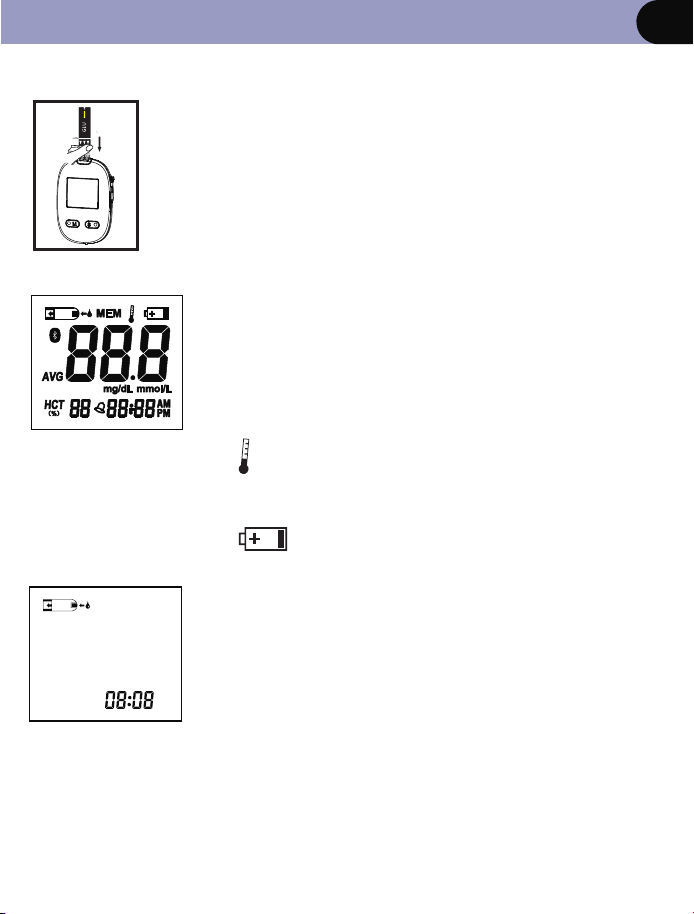
Testing your blood glucose
Testing
① With meter off or in setting mode and memory mode,
insert a test strip to enter into testing mode.
Note: If you do not start the test within three minutes, the
meter will turn off. To restart your meter, take out the
unused test strip and reinsert it into the meter.
Important: The meter should only be used with BS-302
test strips. Using other test strips with this meter can
produce inaccurate results.
② System check screen
Each time the meter powers on, this screen briefly
appears so that you can make sure the display is
working properly.
Note:
•If appears, it indicates the operating temperature is
over range. Place the system in operating temperature
room for half hour. Then test again.
•If appears, it indicates the battery is almost out
of power. Replace the battery now.
③ The blood drop symbol flashes on the display screen.
Your meter is now ready to apply blood sample.
20
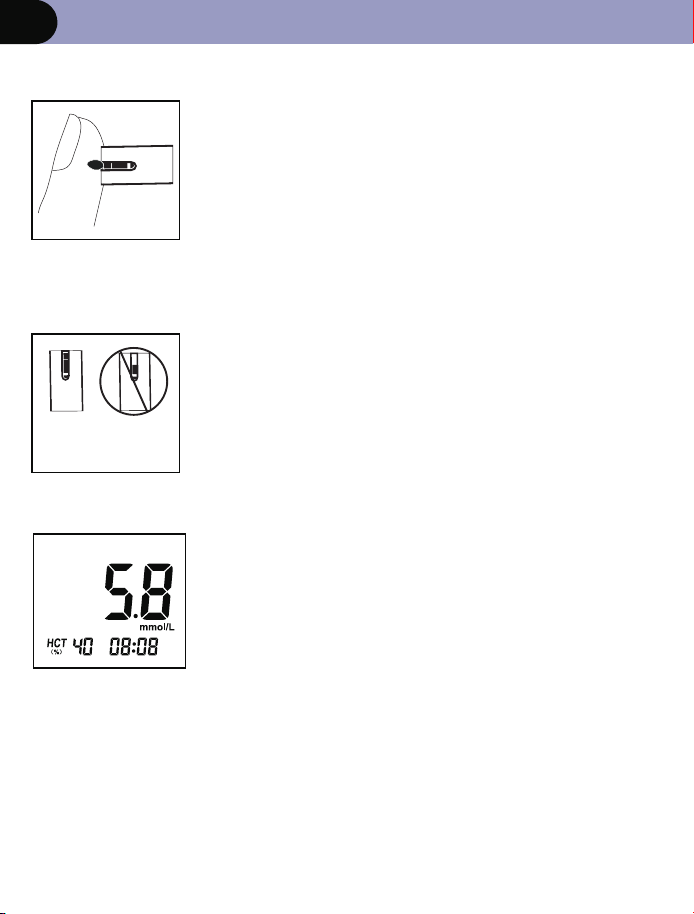
Testing your blood glucose
Testing
⑥
Your blood glucose level appears on the display, along
with the unit of measure, the date and time of the test.
Blood glucose results are automatically stored in the
meter’s memory.
Read your result on the meter
④ Apply the sample
Gently touch the channel to the edge of the blood drop.
Note:
• Discard the first drop of blood. Do Not smear or scrape
the drop of blood with the test strip.
• Do Not apply more blood to the test strip after you have
moved the drop of blood away.
• Do Not move the test strip in the meter during a test.
⑤ Wait for the confirmation window to fill completely
The blood drop will be drawn into the narrow channel
and the confirmation window should fill completely.
When the confirmation window is full, this means
you have applied enough blood. Now you can move
the test strip away from the blood drop and wait for
the meter to count down from 5 to 1with 1 beep sounds
indicating the end of test.
Full
Not full
21
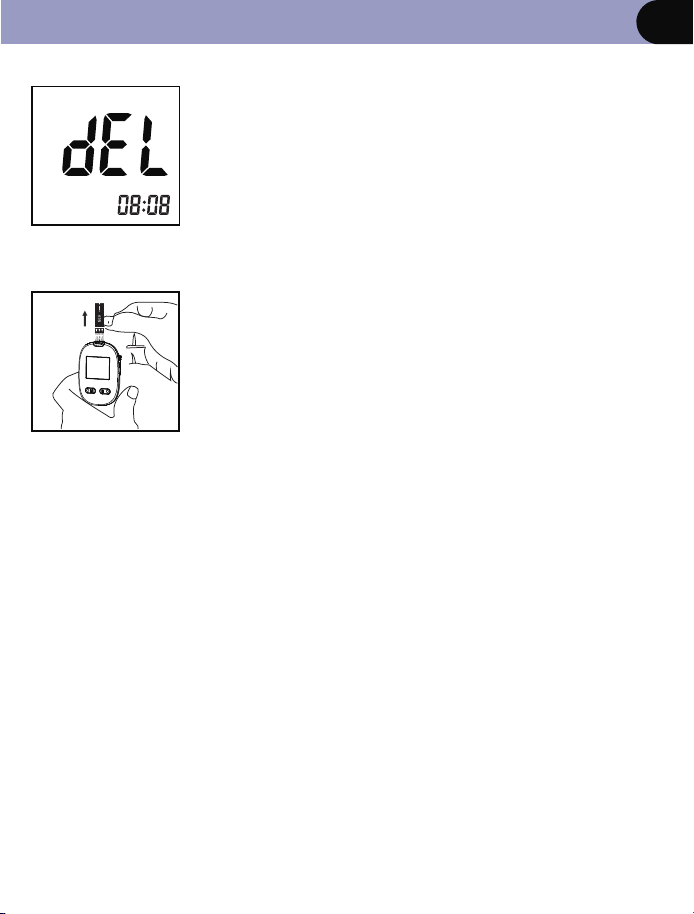
Testing your blood glucose
⑦ Delete the memory
If you don’t want to keep the test result, press “S”
⑧ Turn your meter off.
Simply remove the test strip. Carefully dispose the
used test strip.
22
button and “M” button to delete it at the same time.
After memory cleared, the mete will display “dEL”
for aprrox. 3 minutes, and the nautomatically turn off.
Testing your blood glucose
Interpreting unexpected test results
The meter can accurately measure blood glucose concentrations
between 0.5 to 33.3mmol/L(9 to 600mg/dL)
Expected Blood Glucose Level:
Normal Blood Glucose Range
≤8.9 mmol/L (less than160 mg/dL)
≤ 6.7 mmol/L(less than 120 mg/dL)
≤3.9 mmol/L(Greater than70 mg/dL)
Before breakfast
Before lunch or supper
1 hour after meal
2 hour after meal
Between 2 am and 4 am
Time
Refer to the following cautions whenever your test results are lower or
higher than what you expect.
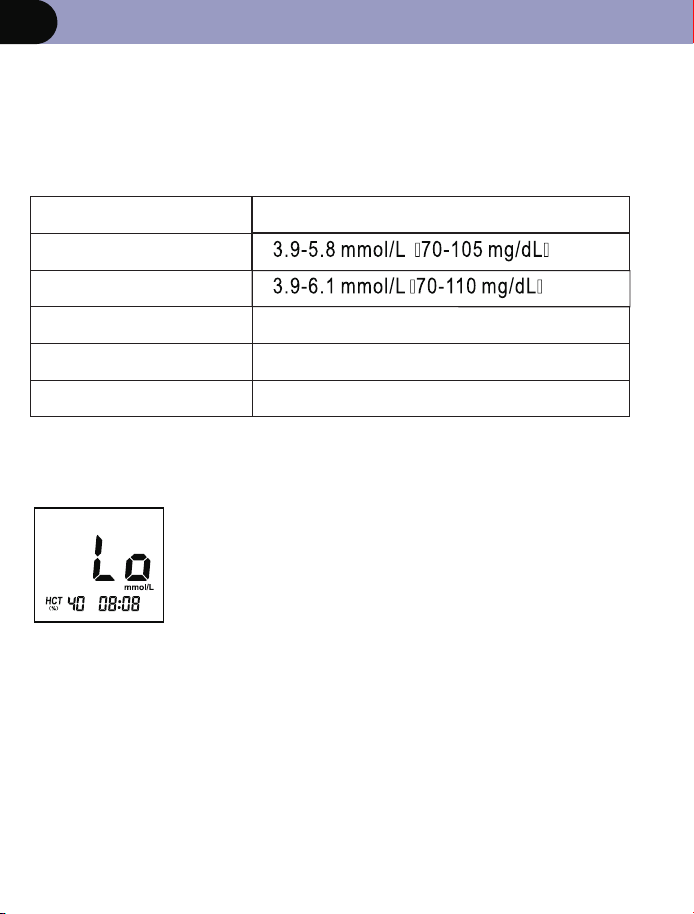
① Low glucose results
If your test result is lower than , 0.5mmol/L(9mg/dL)
LO will appear on the meter display screen. This
reading indicates severe hypoglycemia (low blood
glucose).
• LO Reading with Symptoms
If you have a LO reading and have symptoms such as weakness,
sweating, nervousness, headache or confusion, then follow your
doctor’s recommendation to treat hypoglycemia.
• LO Reading without Symptoms
If you get a LO reading, but have no symptoms of low blood glucose,
then retest with a new test strip on your fingers. If you still get a LO
reading, follow your doctor’s recommendation to treat hypoglycemia.
23
Testing your blood glucose
Interpreting unexpected test results
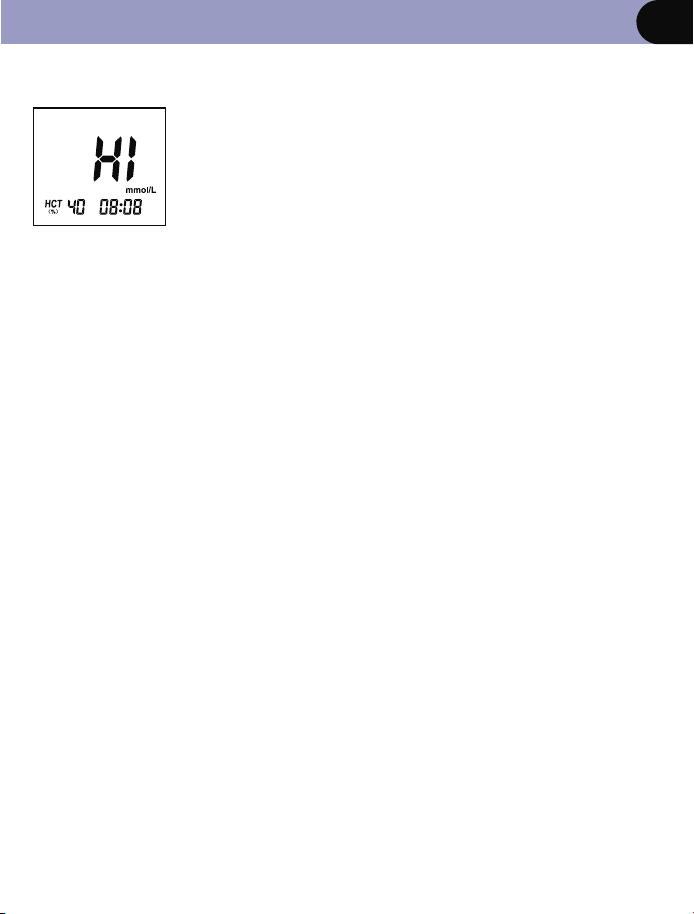
② High glucose results
If your test is above ( ), HI 33.3 mmol/L 600 mg/dL
will appear on the display screen. This indicates
severe hyperglycemia (high blood glucose).
• HI Reading with Symptoms
If you feel symptoms such as fatigue, thirst, excess urination, or blurry
vision, then follow your doctor’s recommendation to treat
hyperglycemia.
• HI Reading without Symptoms
If you get a HI reading, but have no symptoms of high blood glucose,
then retest with a new test strip. If you still get a HI reading, follow your
doctor’s recommendation to treat hyperglycemia.
③ Unusual red blood cell count
24
·BS-302 blood glucose test strip: less than 20%, more than 70% of the
hematocrit ratio will affect the measurement results. Please contact
your doctor to determine your hematocrit ratio.

Comparing Your Meter result to a Laboratory result
Comparing your meter's results with laboratory results periodically.
The results of the Sejoy BG-207b meter are plasma equivalent. This method
• If your blood glucose is below 5.5mmol/L( 100 mg/dL), your results generally
should fall within 0.83mmol/L ( 15 mg/dL) of the laboratory result.± ±
• If your blood glucose is equal to or over 100 mg/dL), your results5.5mmol/L(
generally should fall within ±15 % of the laboratory result.
To maximize your chances of an accurate comparison between meter
and laboratory results, follow a few basic guidelines: please
Before going to the lab
• Perform a control solution test to make sure the meter is working
properly.
• Do Not eat for at least eight hours before you test your blood glucose.
• Take the meter to the lab
While at the lab
• Conduct your meter test of the lab test within 15 minutes.
• Use only fresh, capillary blood obtained from the fingertip.
• Follow all instructions in this Owner’s Booklet to performing a blood
glucose test by your meter.
will help you and your healthcare professional compare your meter results
w ith laboratory test results. The Sejoy BG-207b meter's test result and laboratory
t e st results both are expressed in plasma-equivalent units. However, your
blood glucose meter result may differ from your laboratory result due to normal
variation. Your blood glucose meter results can be affected by factors and
conditions that do not affect laboratory results in the same way.
25
Memory and averages
Storing Blood glucose and Control Test results
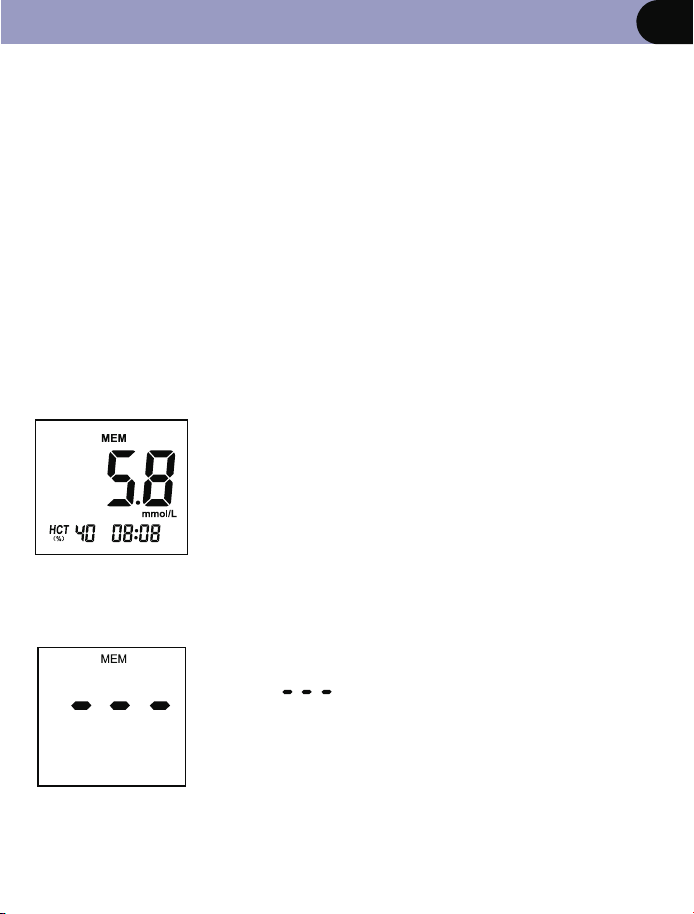
① Entering Memory Mode
Start with the meter off (no test strip inserted). Press and release the “M”
button to enter memory mode.
② Viewing previous memory in order
Press and release “M” button to scroll forward to all
results. Your most recent result will display first.
Note: If there is no test result stored, the meter will
display “ ” for a few seconds then automatically
turn off.
The meter automatically stores up to 360 blood glucose test results with
the time and date of the test and any test markers. Results can
at any time. Test results are stored from the newest to
the time and date correctly in the meter. Having the correct time and date
setting helps ensure appropriate interpretation of stored blood glucose
results by you and your healthcare professional.
be reviewed
the oldest, so set
26
Memory and averages
Exiting
In memory mode, press and hold the “M” button for few seconds until the
meter turns off.
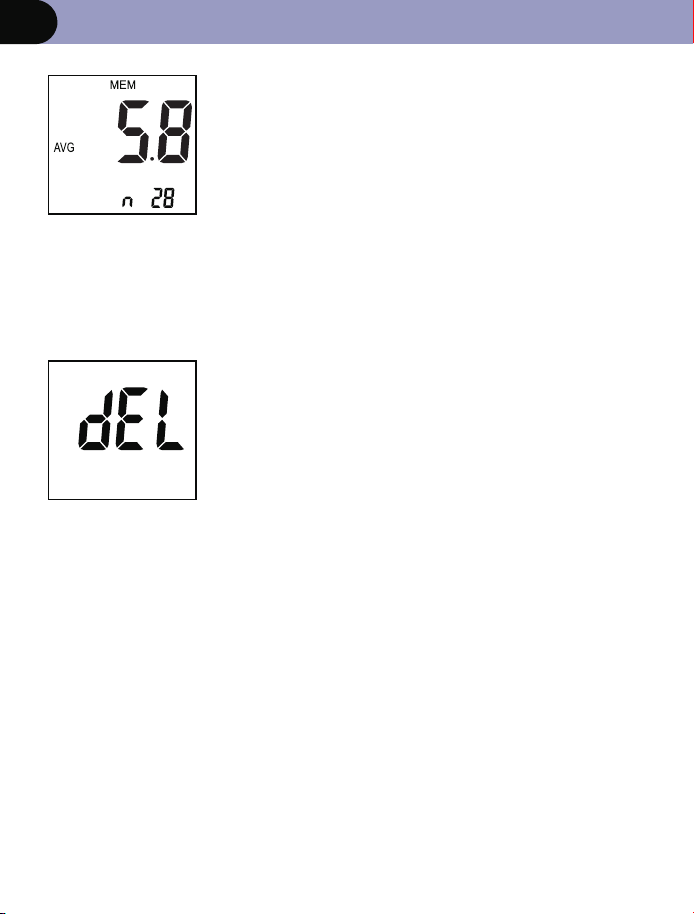
Viewing7-, 14-, 28-day average
Press and release “S” button to scroll forward to
averages.
The first memory display screen you see is your
7-day average.
This average includes all the readings from the
last period days.
n = indicates the number of results
included in your average
Deleting all memory
Press and hold “S” button approximately 3 seconds.
After memory cleared, the meter will display “dEL”
for aprrox. 3 minutes, and then automatically turns off.
③
④
⑤
mmol/L
27
Control solution testing
When to perform a control test
Control Solution contains a known amount of glucose and is used to
check that the meter and the test strips are working properly.
Do a control solution test:
• Whenever you open a new vial of test strips.
• Whenever you want to check if you are testing correctly
• If you suspect the meter and test strips are not working properly.
• If you have had repeated unexpected blood glucose results.
• If you drop or damage the meter.
• If you left the test strip container open or you think the test strips
have been damaged
• If the test strips were stored in extreme temperatures and/or humidity
• Your test result does not match how you feel
NOTE:
• Only use the Sejoy CS-201 control solution.
• Close the control solution bottle tightly after use
• Write the date you open the control solution bottle on the bottle label.
The control solution must be discarded 3 months from the
first open date or the expire date on the vial label, whichever comes
first.
• Do not use control solution that is past the Exp. Date or discard date.
• Refer to the control solution label for control solution storage
conditions.
• The control solution can stain fabric. Remove stains by washing with
soap and water.
CAUTION: Do Not swallow control solution. It is not for human
consumption. Do Not apply control solution to the skin or eyes
as it may cause irritation.
28
Control solution testing
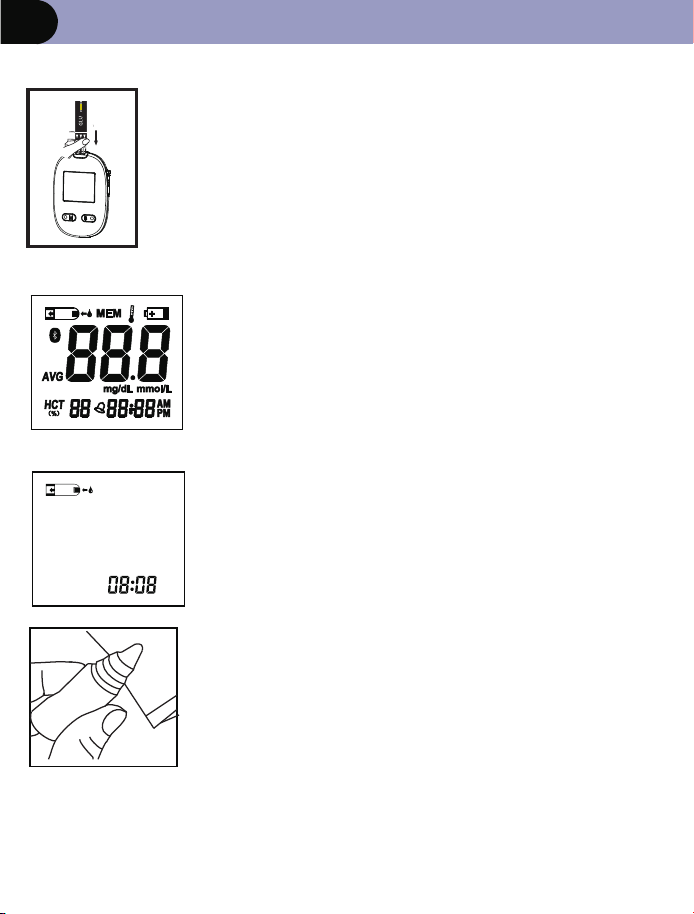
Performing a control test
① Insert a test strip to turn the meter on
② System check screen
Each time the meter powers on, this screen briefly
appears so that you can make sure the display is
working properly.
③ The blood drop symbol flashes on the display screen.
Your meter is now ready to apply blood sample.
④ Shake the control solution vial before each test.
Remove the cap and squeeze the vial to discard the first
drop. Then wipe the tip with a clean tissue or cloth. Hold
the vial upside down and gently squeeze a hanging drop.
29
Control solution testing
Performing a control test
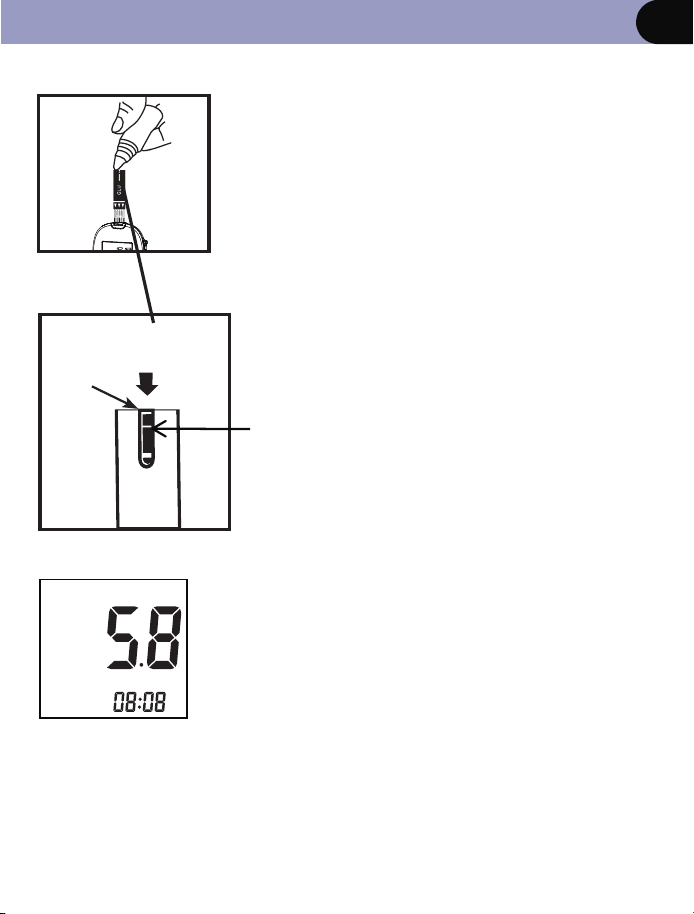
⑤ Touch and hold the hanging drop of control
solution where the narrow channel meets the
TOP EDGE of the test strip. Make sure the
confirmation window fills completely. Control
solution should not be applied to the flat face of
the test strip.
⑥ Read the result on the meter
When the confirmation window is full, the meter will
count down from 5 to 1. blood glucose level appears
on the display, along with the unit of measure, the
date and time of the test.
The results are automatically stored in the meter’s
memory.
CONFIRMATION
WINDOW
TOP
EDGE
NARROW CHANNEL
Apply Drop Here
mmol/L
30
Control solution testing
Understanding out-of-range control test results
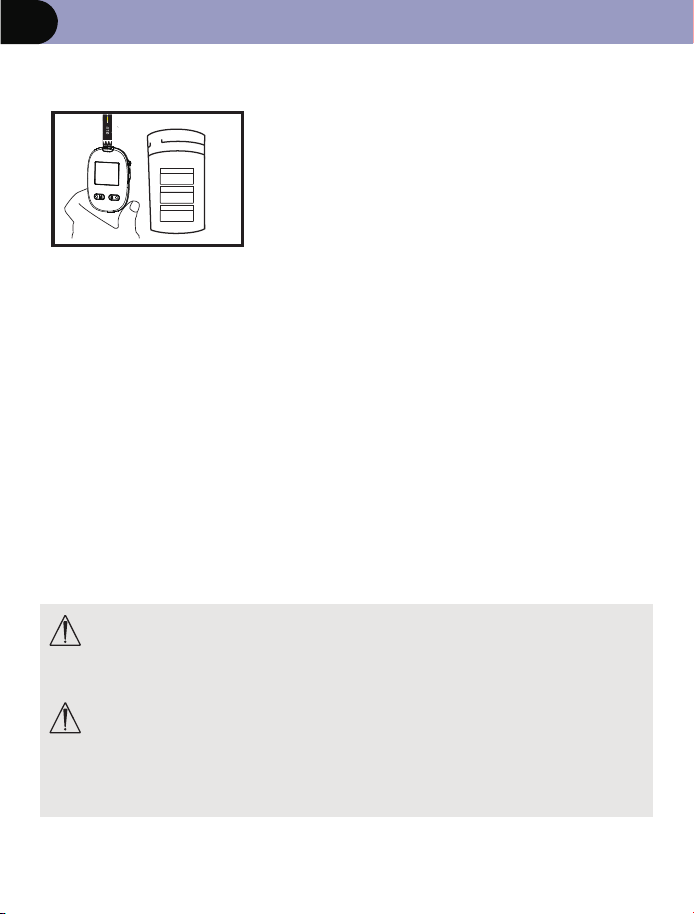
Compare the result displayed on the meter
to the control solution range printed on the
test strip vial. Each control solution have a
different control solution range. Please refer
refer to the quality control solution instructions.
Out-of-range results may be due to:
• not following the instructions detailed in steps 1–6
• expired or contaminated control solution
• expired or damaged test strip
• use of a test strip or control solution passed its discard date
• a problem with the meter.
CAUTION: The control solution range printed on the test strip
vial is for Sejoy Control Solution only. It is not a recommended
range for your blood glucose level.
CAUTION: If you continue to get control solution test results
that fall outside the range printed on the test strip vial, Do Not use
the meter, the test strips, or the control solution. Contact the
vendor.
31
CTRL
Mmol/L
mg/dl
CTRL
Mmol/L
mg/dl
CTRL
Mmol/L
mg/dl
3-5
54- 90
7.5- 12.5
135- 225
12- 20
216- 360
Control solution testing
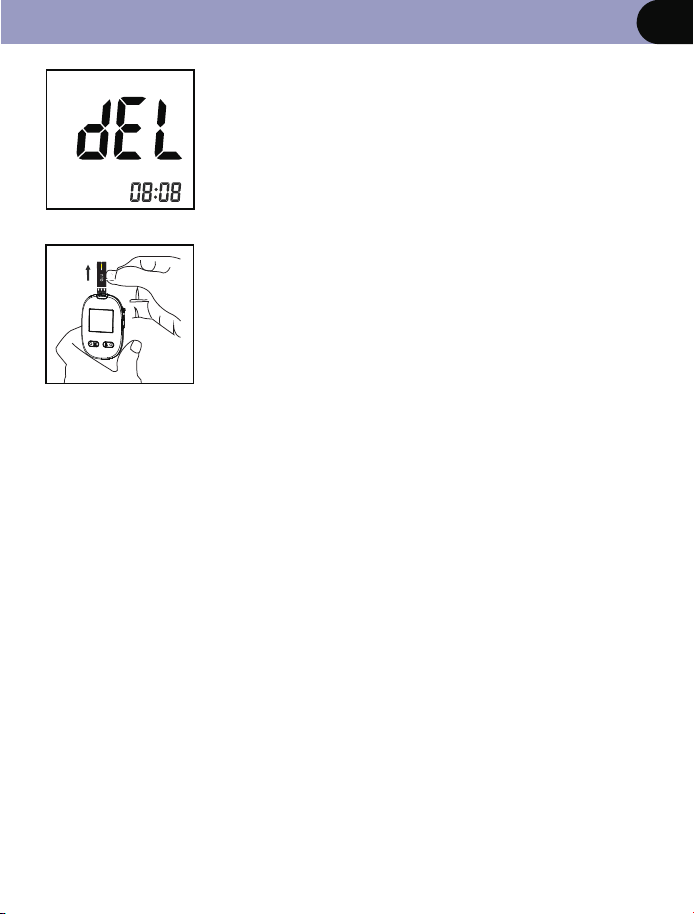
⑦ Delete the memory
If you don’t want to keep the test result, press the “S”
and “M” button to delete it at the same time. After
memory cleared, the meter will display “dEL” about 3
minutes, and then automatically turns off.
⑧ To turn your meter off, simply remove the test
strip. Carefully dispose of the used test strip.
32
Maintenance
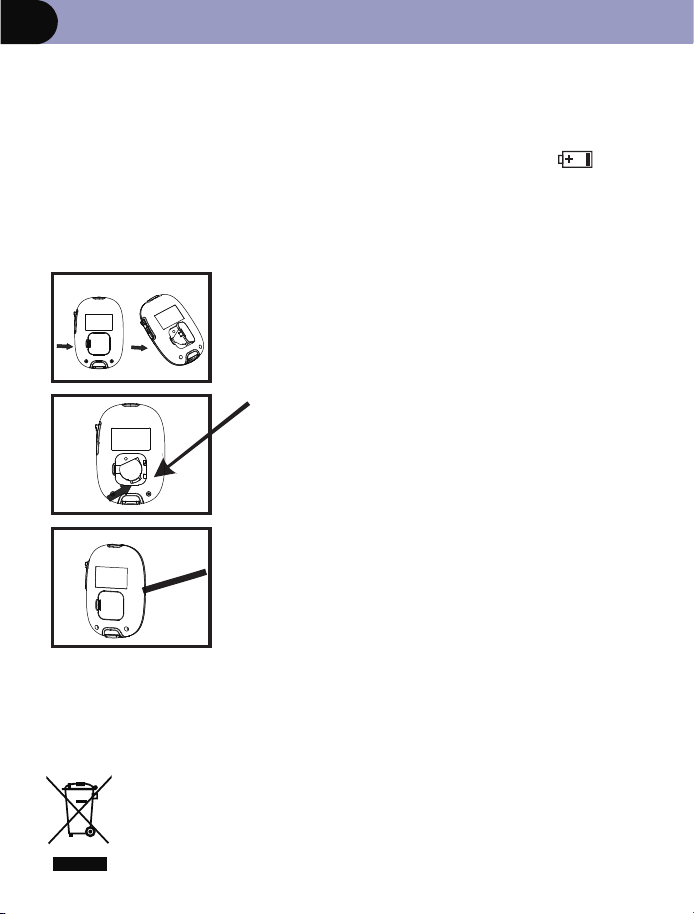
Replacing the battery
Your meter comes with one preinstalled, 3 volt, type 2032, lithium
battery. The battery provides enough power for the meter to perform
about 1000 tests. If your battery runs low, the battery symbol
appears on every display screen until you change the battery.
Important: When this symbol appears, you should replace the battery
immediately.
① With the meter off, open the battery cover.
(+) side facing up
② Remove the old batteries and place the new
ones in the battery compartment with the (+) side
facing up.
③ Put the battery cover back into position until it
locks into place.
④ Check your meter settings
Replacing the battery does not affect your stored
results. However, you may need to re-set your
meter settings. See Setting Up Your Meter section.
Note: Batteries need to be properly disposed of. Contact
your local government for disposal or recycling practices
in your area.
“
”
33

Maintenance
Caring for your system
Avoid getting dirt, dust, blood, control solution, water, or any other liquid
in the meter’s test strip port.
Important: Never immerse the meter in water or any other liquid. This
may cause inaccurate reading or meter malfunction.
Storing your system
Store your meter, test strips, control solution and other items in your
carrying case after each use. Store each item in a cool, dry place.
Do Not refrigerate. Keep all items away from direct sunlight and heat.
Tightly close the cap on the test strip vial and/or control solution vial
immediately after use to avoid contamination or damage. Store test
strips only in their original vial.
Checking for expiration or damages to test strips and control
solution
Expiration dates for test strips and control solutions are printed on
their vial labels. When you first open a new vial of test strips or control
solution, record the discard date on the label. Refer to the test strip or
control solution vial for instructions on determining the discard date.
-20℃~ 55℃( -4℉~131℉).
Cleaning and disinfection
Cleaning and disinfection are different , both of them should be performed.
Cleaning is a part of normal care and maintenance that should be
performed prior to disinfection, but cleaning does not kill germs.
Disinfection is a important way to reduce your exposure to disease.
Even though you are the only person who use it,
Test strips and control solution should be stored between 1℃~ 30℃
( 33.8℉~86℉).Meter and other items should be stored between
34

Maintenance
Cleaning your meter and lancing device
To clean your meter and lancing device, wipe the outside with a soft
cloth dampened with water and mild detergent. Do not use alcohol
o r another solvent. Do not get any liquids, dirt, dust, blood, or control
solution inside the meter through the strip port. Never spray cleaning
solution on the meter or immerse it in any liquid. Do not immerse the
lancing device in any liquid.
Disinfecting your meter and lancing device
The meter and lancing device should be disinfected periodically.
Clean your meter and lancing device prior to disinfecting.
To disinfect, prepare a solution of 1 part household bleach and 9 parts
water. Hold the meter with the strip port and pointed down. Use a soft
cloth dampened with this solution to wipe the outside of the meter and
lancing device until the surface is damp. Be sure to squeeze out any
excess liquid before you wipe the meter.
After wiping, cover the surface you are disinfecting with the soft cloth
dampened with the bleach solution for 1 minute. Then wipe with a clean
damp soft cloth and allow to air dry.
Wash hands thoroughly with soap and water after handling the meter
and lancing device.
we recommend to disinfect periodically. When you assist others to make
blood glucose testing, If you take the meter, please disinfect it or wear
gloves to protect yourself.
35
Troubleshooting
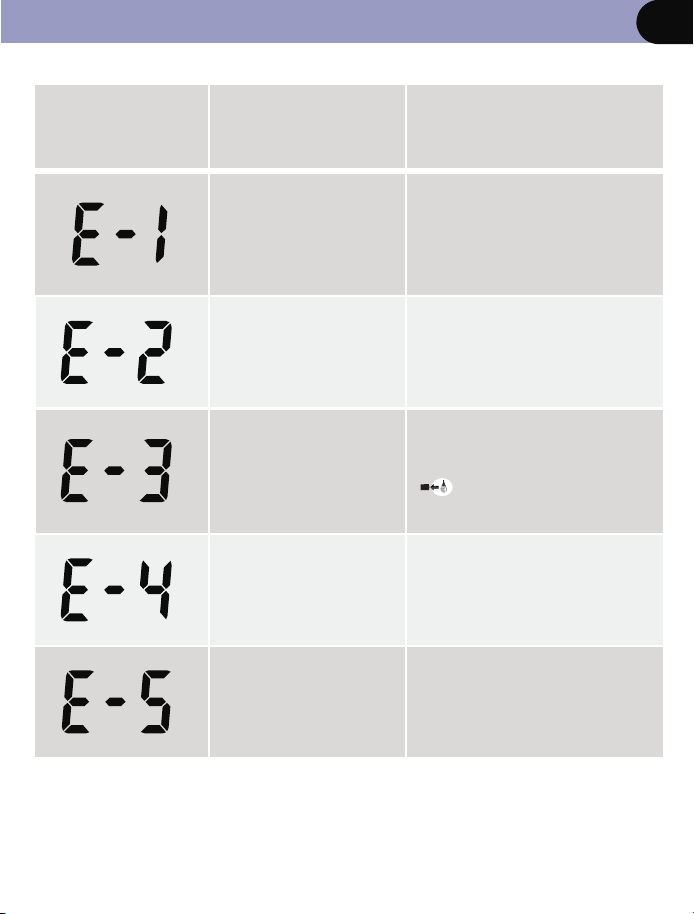
Message
Possible Cause
What to do
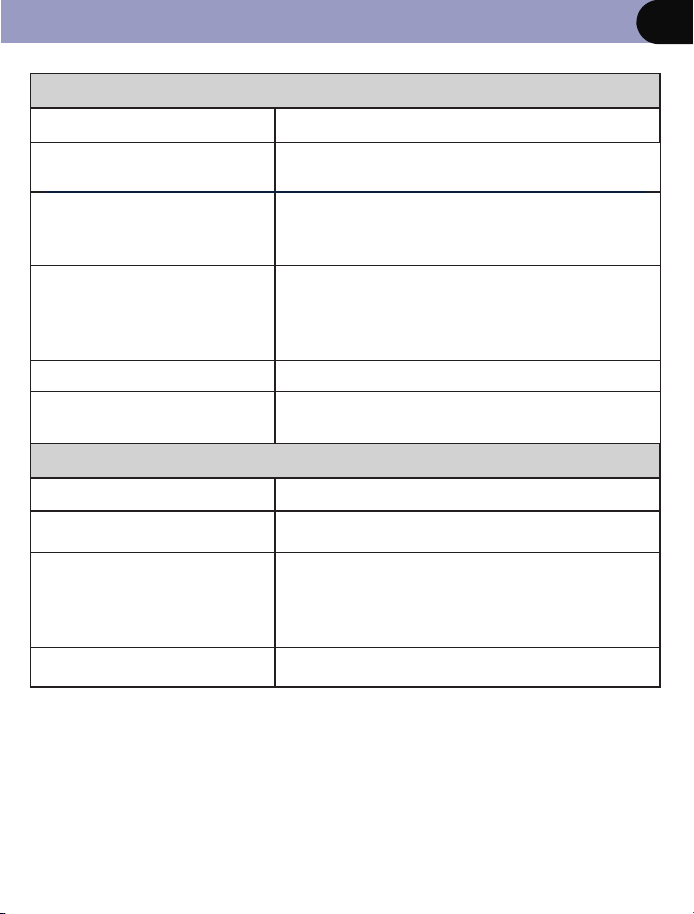
The test strip may be
used or damaged.
The sample was
applied before the
m. eter was ready.
The system check
may be failed
The test strip may be
moved during testing
The strip check
has problem
Repeat with a new strip.
Remove the battery and
reinsert it after 30 seconds.
If it still doesn’t work,
please contact the vendor.
Retest with a new strip. Make
sure that the method of
applying sample is correct,
and test strip can not be
moved during testing.
Applying blood after the
symbol flashes on the
screen.
or sampling data is
unstable.
36
Retest with a new strip.
Make sure that the Strip
model is correct and
Retest with a new strip.
Make sure that the Strip
model is correct and
Troubleshooting
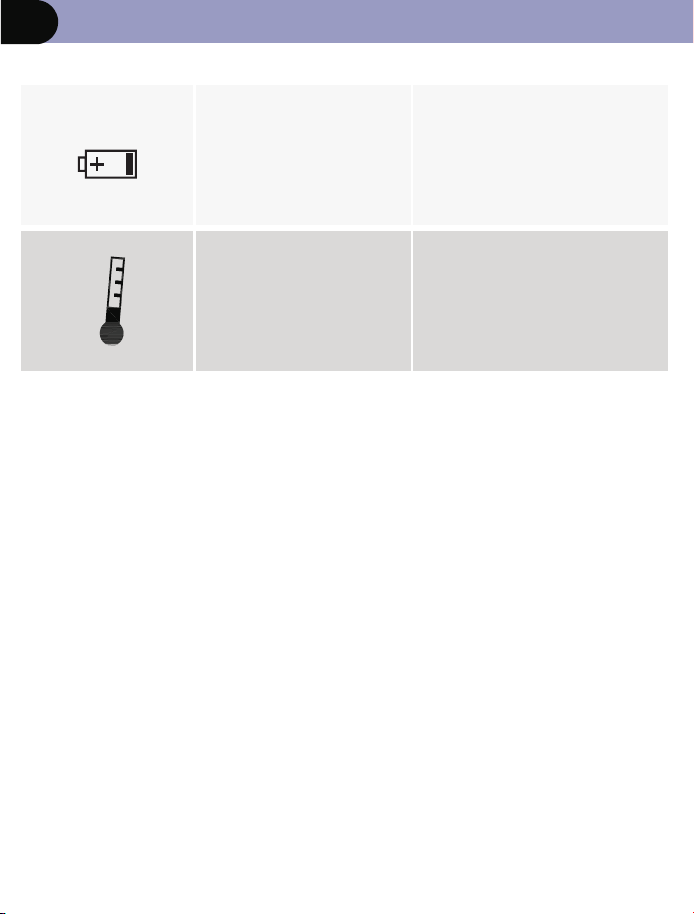
Battery power is low.
The meter is out of
operating temperature
range.
Replace the battery soon
Place the system in
appropriate operating
environment for 30
minutes before retesting.
37
Contact the vendor.
Contact the vendor.
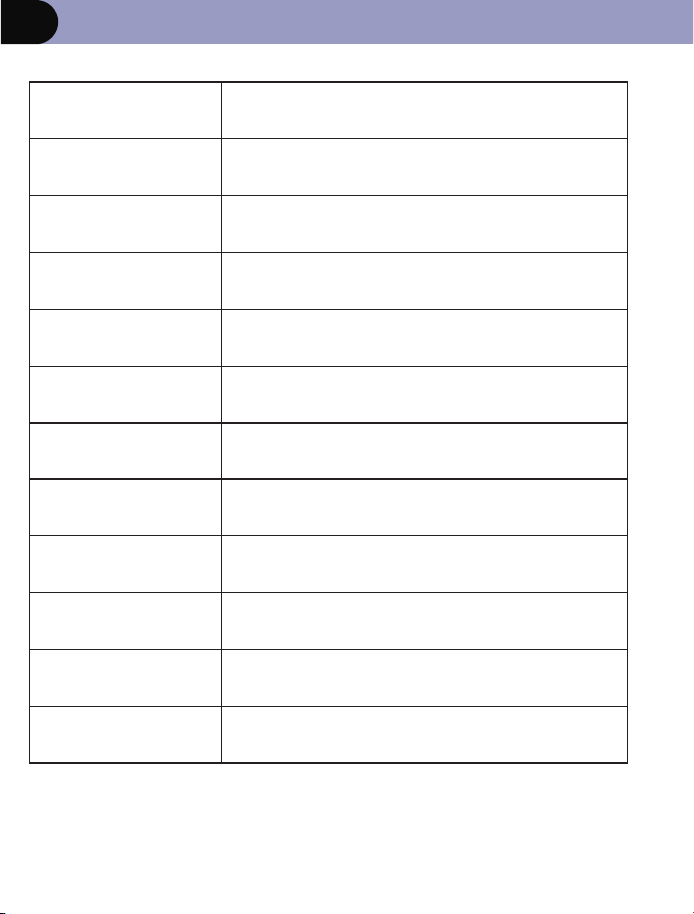
Meter does not enter the test mode after inserting a test strip.
Probable Cause
What to Do
The battery is dead.
Replace the battery (and reset the date and
time,if necessary.)
The battery is installed
incorrectly or there is no
battery in the meter.
Check that the battery is installed correctly
with the positive(+)sign facing upward,
toward you.
Test strip inserted upside
down,or
incompletely inserted
into the meter.
Insert the test strip with the
printed side up
Defective meter or test strips.
Contact the vendor.
Blood or foreign objects put
into the test strip port.
Test does not start after applying the blood sample.
Probable Cause
What to Do
Defective test strip.
Repeat the test with a new test strip.
Sample applied after meter
times out and
turns off.
Defective meter or test strips.
Troubleshooting
meter.
and the top of the strip in the
Remove the test strip, and repeat the test using
test strip symbols on the display screen before
you apply the blood sample.
a new test strip. Wait until you see the blood and
38
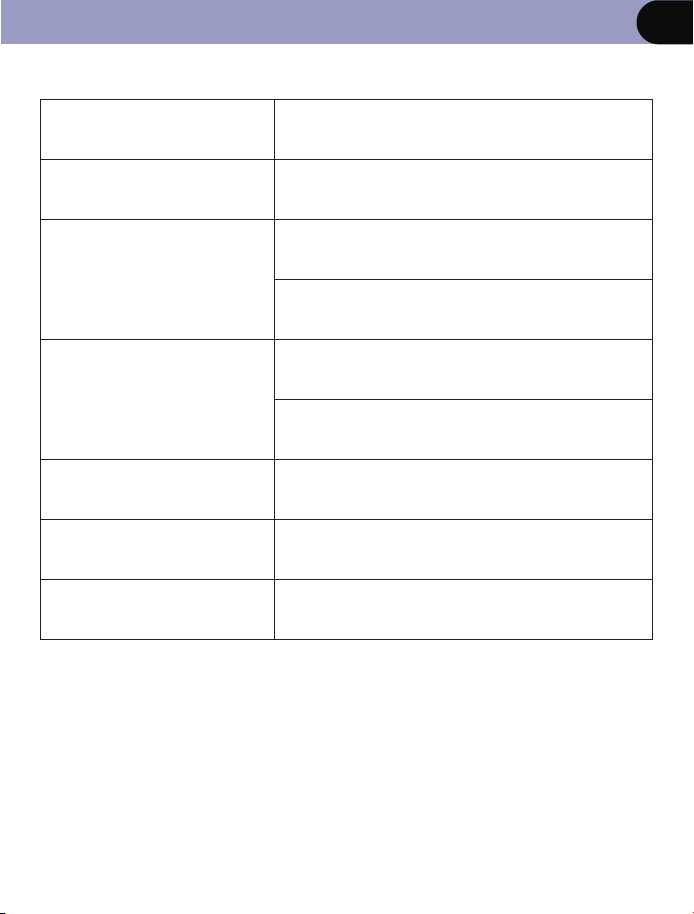
Technical information
Specifications
Product description
Assay method
Measurement range
Sample
Unit of measure
Memory
Size
BG-207b Blood Glucose Monitoring System
Glucose oxidase biosensor
0.5-33.3 mmol/L ( )9~600 mg/dL
Fresh capillary whole blood
Approximate 0.6 microlitre
5 seconds
One 3.0V CR2032 lithium battery, replaceable
Approximately 1,000 tests
mmol/L or mg/dL; switchable
360 blood glucose results with date and time
90*61*18.1 mm (L*W*H)
Sample size
Response time
Battery
Battery life
Plasma equivalent glucose values
Calibration
39
Technical information
Specifications
Weight
Operating environment
Meter storage environment
Hematocrit
Altitude
Automatic power off
Approximate 51.6 g, battery not included
5℃~45℃(41℉~113℉)
10 ~ 80% RH (non-condensing)
-20℃~ 55℃ ( -4℉~131℉)
BS-302 blood glucose test strip:
Up to 10,000 feet (3,048 meters)
above sea level
Approx. 3 minutes after last user action
10 ~ 80% RH (non-condensing)
LCD size
35.4*30.9 mm (L*H)
40
Electromagnetic Compatibility
This meter meets the electromagnetic immunity requirements as standard
I S O 15197 immunity testing . The chosen basis for electrostatic discharge
emissions EN 61326 Its electromagnetic emission requirements as standrard .
is thus low. to other electrically-driven equipment Interference from the meter
is not anticipated.
was basic standard EN61326.In addition.it meets the electromagnetic
20%~70%

Disposing of the meter, test strips, lancets and batteries
Warning
• Any product coming in contact with blood is considered contaminated
(potentially infectious).
• During normal testing, any blood glucose meter may come in contact
with blood.
• Lancing devices may also be considered sharps. Disposal of sharps
is regulated by law in many jurisdictions.
Comply with any laws or ordinances relating to the disposal of sharps
and/or contaminated products. Contact your local health department
or other appropriate authorities for proper handling and disposal of
used meters, used test strips, used lancets, and used batteries.
Please consider the following points when disposing of used testing
materials:
• Consider recycling of the meters and batteries at an appropriate
facility. Be aware the meter is potentially hazardous electronics
scrap (e-scrap) and should be disposed of accordingly. The batteries
are potentially hazardous also and should be disposed of accordingly.
• Disinfect the meter before recycling or disposing.
* 29 CFR 1910.1030 – Bloodborne pathogens
* Directive 2002/96/EC – Directive on waste electrical and electronic
equipment (WEEE)
41

Warranty
Limited 2-Year Warranty
The meter is guaranteed for 2-year from the date of purchase. If the
meter does not function properly due to defective components or poor
workmanship, we will repair or replace it freely. This warranty does not
cover damage due to improper handling in any way. Battery does not
included in the warranty.
42

Traceability
43
The calibrator of the Sejoy Blood Glucose Monitoring System BG-207b is control
solution. The traceability of the control solution is referenced to the YSI glucose
analyzer. The YSI is the reference method used to assess the accuracy with
which glucose results are obtained using the system. The value of the calibrator
for glucose is traceable to the National Institute of Standards and Technology
(NIST) Standard Reference Material (SRM) 917b (D-Glucose).Concentration: 12
mmol/L0.25mmol/L, diluted 51-fold, ready for use.
Performance Characteristics
44
This study shows that the system compares well with a laboratory method
and meets the minimum acceptable performance criteria defined in
ISO 15197.
The performance of the system has been evaluated both in laboratory and
in clinical tests.
Range: The display range of the meter is 0.5mmol/L to 33.3 mmol/L
(9mg/dL to 600 mg/dL). "HI" and "Lo" messages indicate results
outside of this range.
• Accuracy: The accuracy of the system was assessed by comparing
blood glucose results obtained using Glucose Analyzer, a laboratory
instrument.
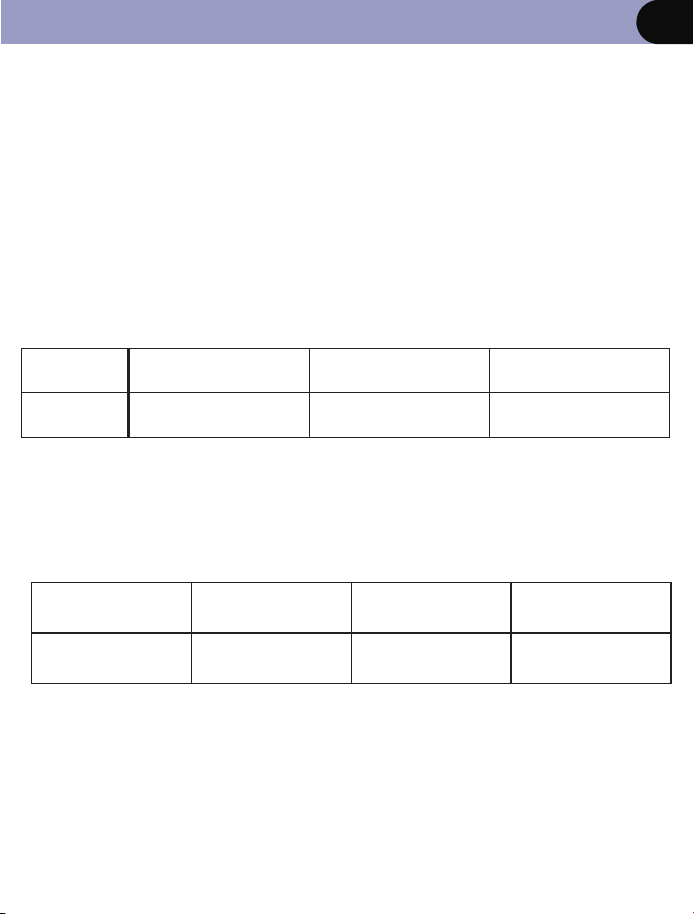
Table1. System accuracy results for glucose concentration <5.5 mmol/L
YSI
Table2. System accuracy results for glucose concentration ≥5.5mmol/L
generally should fall within 0.83mmol/L (15 mg/dL) of the laboratory
result.
If the blood glucose is below 5.5mmol/L(100mg/dL), the results
the results generally should fall within ±15 % of the laboratory result.
If the blood glucose is equal to or over 5.5mmol/L(100mg/dL),
Within ±0,28 mmol/L
118/150(78.7%)
Within ±0,56 mmol/L
150/150(100%) 150/150(100%)
Within± 0,83 mmol/L
Bias
Percentage
(within±5mg/dl)
(within±10mg/dl)
(within±15mg/dl)
Percentage
Within ±5 %
277/450(61.6%)
Within ±10 %
400/450(88.9%)
Within ±15 %
446/450(99.1%)
Bias
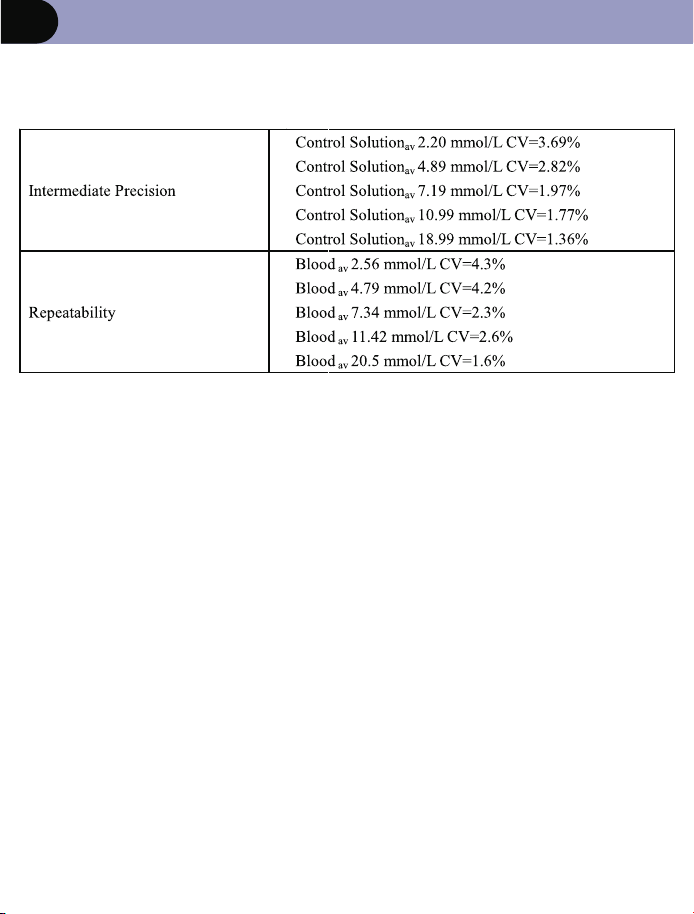
Performance Characteristics
45
Precision:
To maximize your chances of an accurate comparison between meter
and laboratory results, follow a few basic guidelines:
Before going to the lab
·Perform a control solution test to make sure the meter is working properly.
·Do Not eat for at least eight hours before you test your blood.
Take your meter with you to the lab.·
While at the lab
Conduct your meter test within 15 minutes of the lab test.·
Use only fresh, capillary blood obtained from the fingertip.·
Follow all instructions in this Owners Booklet for performing a blood ·
glucose test with your meter.
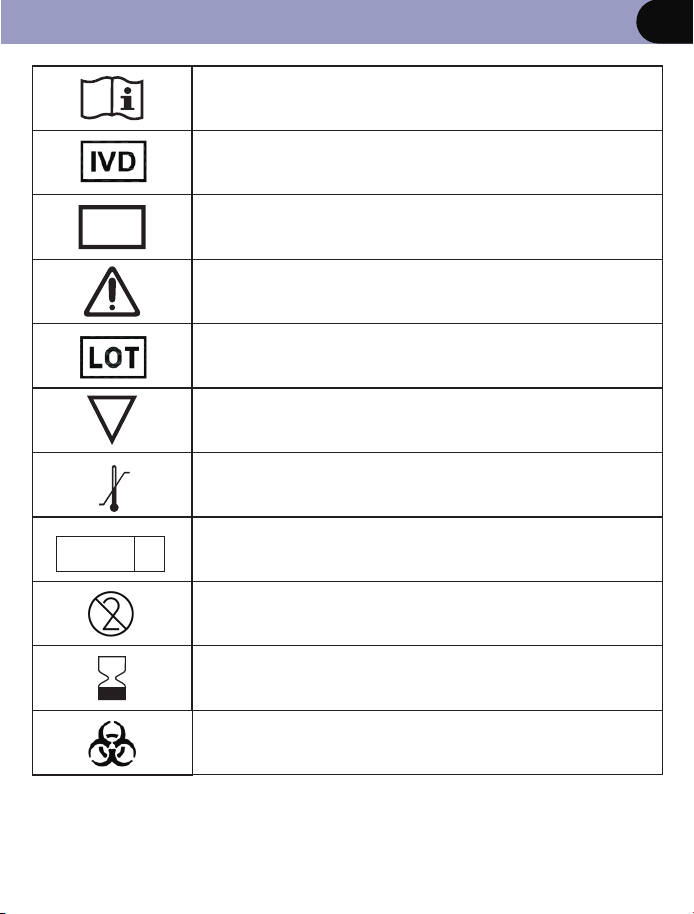
Symbol Index
SN
∑
Consult instructions for use
In vitro diagnostic medical device
Serial number
Batch code
Contain sufficient for < n > tests
Caution
Do not reuse
Use by
STERILE EO
Sterilized using ethylene oxide
Storage temperature limitation
46
Biological risks
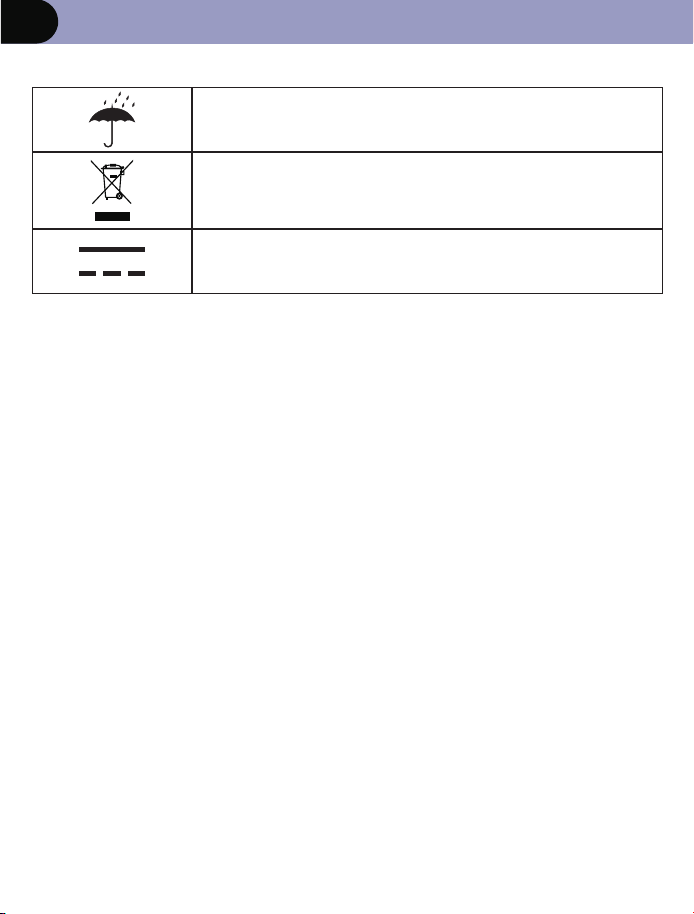
Symbol Index
Keep dry
This symbol indicates that you should not discard
waste electrical or electronic equipment (WEEE)
in the trash. For proper disposal, contactyour local
Direct Current
47

FCC Information
48
Caution: Changes or modifications to this unit not expressly
approved by the party responsible for compliance could void the
user authority to operate the equipment. This device complies
with Part 15 of the FCC Rules. Operation is subject to the
following two conditions:
(1) this device may not cause harmful interference, and
(2) this device must accept any interference received, including
interference that may cause undesired operation.
*Note:
The device has been evaluated to meet general RF exposure
requirement.The device can be used in portable exposure
condition without restriction.
This equipment has been tested and found to comply with the
limits for a Class B digital device,pursuant to Part 15 of the FCC
Rules. These limits are designed to provide reasonable protection
against harmful interference in a residential installation. This
equipment generates, uses, and can radiate radiofrequency
energy. If this equipment does cause harmful interference to
radio or television reception,which can be determined by turning
the equipment off and on, the user is encouraged to try and
correct the interference by one or more of the following measures:
- Reorient or relocate the receiving antenna.
- Increase the distance between the equipment and the receiver.
- Connect the equipment to an outlet on a circuit different from
that to which the receiver is connected.
- Consult the dealer or an experienced radio/TV technician for
help.

Appendix
1. Use of Fingerstick Devices on More Than One Person Poses Risk for
Transmitting Bloodborne Pathogens: Initial Communication, (2010)
http://www.fda.gov/MedicalDevices/Safety/AlertsandNotices/ucm224025.htm.
Accessed June 8, 2011
2. CDC Clinical Reminder:"Use of Fingerstick Devices on More than One Person
Poses Risk for Transmitting Bloodborne Pathogens,(2010)
http://www.cdc.gov/injectionsafety/Fingerstick-DevicesBGM.html.
Accessed June 8,2011
3. Healthcare Infection Control Pratices Advisory Committee (HICPAC),
William A. Rutala, Ph.D.,M.P.H., and David J. Weber,M.D.,M.P.H. Centers for
Disease Control and Prevention, 2008."Guideline for Disinfection and
Sterilization in Healthcare Facilities,Atlanta."
49

Document No.: DBG-1204-044
Version: Z
Date of Issue:20XX.XX
Manufactured by Hangzhou Sejoy Electronics & Instruments Co., Ltd.
Area C, Building 2, No.365,Wuzhou Road,Yuhang Economic
Development Zone,HangZhou City,311100 ZheJiang,China