
Guaranty and Declaration
Copyright
© 2021 RIGOL TECHNOLOGIES CO., LTD. All Rights Reserved.
Trademark Information
RIGOL
®
is the trademark of RIGOL TECHNOLOGIES CO., LTD.
Notices
• RIGOL products are covered by P.R.C. and foreign patents, issued and pending.
• RIGOL reserves the right to modify or change parts of or all the specifications and pricing
policies at the company's sole decision.
• Information in this publication replaces all previously released materials.
• Information in this publication is subject to change without notice.
• RIGOL shall not be liable for either incidental or consequential losses in connection with the
furnishing, use, or performance of this manual, as well as any information contained.
• Any part of this document is forbidden to be copied, photocopied, or rearranged without prior
written approval of RIGOL.
Product Certification
RIGOL guarantees that this product conforms to the national and industrial standards in China as
well as the ISO9001:2015 standard and the ISO14001:2015 standard. Other international standard
conformance certifications are in progress.
Contact Us
If you have any problem or requirement when using our products or this manual, please contact
RIGOL.
E-mail: ser[email protected]
Website:
http://www.rigol.com
Section Description Page
List of Figures...........................................................................................................................VIII
List of Tables.............................................................................................................................XIV
1 Safety Requirement............................................................................................. 1
1.1 General Safety Summary.......................................................................................................1
1.2 Safety Notices and Symbols.................................................................................................3
1.3 Measurement Category.........................................................................................................3
1.4 Ventilation Requirement........................................................................................................4
1.5 Working Environment.............................................................................................................4
1.6 Care and Cleaning....................................................................................................................6
1.7 Environmental Considerations............................................................................................ 6
1.8 Keep Hands Clear.....................................................................................................................7
2 Product Features ..................................................................................................8
3 Document Overview......................................................................................... 10
4 Quick Start............................................................................................................12
4.1 General Inspection................................................................................................................ 12
4.2 Appearance and Dimensions.............................................................................................12
4.3 To Prepare for Use.................................................................................................................13
4.3.1 To Connect to AC Power............................................................................................... 13
4.3.2 Turn-on Checkout............................................................................................................14
4.3.3 To Set the System Language....................................................................................... 15
4.3.4 To Connect the Probe.................................................................................................... 15
4.3.5 Function Inspection........................................................................................................17
4.3.6 Probe Compensation..................................................................................................... 19
4.4 Product Overview.................................................................................................................. 19
4.4.1 Front Panel Overview.....................................................................................................20
4.4.2 Rear Panel Overview.......................................................................................................22
4.4.3 User Interface....................................................................................................................25
4.4.4 Secondary 3.5-inch Touch Screen..............................................................................27
4.5 Touch Screen Gestures.........................................................................................................31
4.5.1 Tap........................................................................................................................................ 31
4.5.2 Pinch&Stretch...................................................................................................................32
Copyright ©RIGOL TECHNOLOGIES CO., LTD.
All rights reserved.
DS70000 User Guide
I
4.5.3 Drag .................................................................................................................................... 32
4.6 Parameter Setting Method.................................................................................................33
4.7 To Use the Built-in Help System....................................................................................... 39
4.8 To View the Option Information and the Option Installation................................40
5 To Set the Vertical System...............................................................................42
5.1 To Enable or Disable the Analog Channel.....................................................................42
5.2 To Adjust the Vertical Scale................................................................................................43
5.3 To Adjust the Vertical Offset..............................................................................................45
5.4 Channel Coupling..................................................................................................................46
5.5 BW Limit....................................................................................................................................46
5.6 Input Impedance....................................................................................................................47
5.7 Waveform Invert.................................................................................................................... 48
5.8 Probe..........................................................................................................................................49
5.9 Amplitude Unit.......................................................................................................................52
5.10 Bias ............................................................................................................................................ 53
5.11 Channel Delay.........................................................................................................................53
5.12 Channel Label..........................................................................................................................54
6 To Set the Horizontal System.........................................................................55
6.1 To Adjust the Horizontal Time Base ...............................................................................56
6.2 To Adjust the Horizontal Position.................................................................................... 56
6.3 Delayed Sweep....................................................................................................................... 57
7 To Set the Sample System...............................................................................59
7.1 Acquisition Mode.................................................................................................................. 59
7.2 Sampling Mode......................................................................................................................61
7.3 Sample Rate.............................................................................................................................61
7.4 Memory Depth.......................................................................................................................62
7.5 Anti-Aliasing............................................................................................................................64
7.6 Horizontal Expansion........................................................................................................... 64
7.7 XY Mode................................................................................................................................... 65
8 To Trigger the Oscilloscope............................................................................ 68
8.1 Trigger Source.........................................................................................................................68
8.2 Trigger Level............................................................................................................................ 69
8.3 Trigger Mode...........................................................................................................................70
8.4 Trigger Coupling.................................................................................................................... 71
8.5 Trigger Holdoff....................................................................................................................... 72
DS70000 User Guide
II
Copyright ©RIGOL TECHNOLOGIES CO., LTD.
All rights reserved.
8.6 Noise Rejection.......................................................................................................................73
8.7 Trigger Type.............................................................................................................................73
8.7.1 Edge Trigger...................................................................................................................... 73
8.7.2 Pulse Trigger......................................................................................................................75
8.7.3 Slope Trigger.....................................................................................................................79
8.7.4 Video Trigger.....................................................................................................................82
8.7.5 Pattern Trigger..................................................................................................................85
8.7.6 Duration Trigger...............................................................................................................88
8.7.7 Timeout Trigger................................................................................................................91
8.7.8 Runt Trigger.......................................................................................................................93
8.7.9 Window Trigger................................................................................................................96
8.7.10 Delay Trigger.....................................................................................................................99
8.7.11 Setup/Hold Trigger.......................................................................................................102
8.7.12 Nth Edge Trigger...........................................................................................................106
8.7.13 RS232 Trigger (Option)............................................................................................... 108
8.7.14 I2C Trigger (Option)..................................................................................................... 111
8.7.15 SPI Trigger (Option)......................................................................................................115
8.7.16 CAN Trigger (Option)...................................................................................................119
8.7.17 FlexRay Trigger (Option).............................................................................................123
8.7.18 LIN Trigger (Option).....................................................................................................126
8.7.19 I2S Trigger (Option)......................................................................................................129
8.7.20 MIL-STD-1553 Trigger (Option)............................................................................... 133
8.8 Trigger Output Connector................................................................................................138
9 Math Operation................................................................................................139
9.1 Arithmetic Operation.........................................................................................................141
9.2 Function Operation............................................................................................................ 144
9.3 FFT Operation.......................................................................................................................147
9.4 Logic Operation...................................................................................................................153
9.5 Digital Filter...........................................................................................................................156
10 Measure.............................................................................................................. 160
10.1 Measurement Parameter..................................................................................................160
10.1.1 Time Parameters............................................................................................................161
10.1.2 Count Values...................................................................................................................162
10.1.3 Delay and Phase Parameters.....................................................................................163
10.1.4 Voltage Parameters...................................................................................................... 165
Copyright ©RIGOL TECHNOLOGIES CO., LTD.
All rights reserved.
DS70000 User Guide
III
10.1.5 Other Parameters..........................................................................................................166
10.2 To Select the Measurement Item...................................................................................167
10.3 Measurement Settings...................................................................................................... 170
10.4 Remove the Measurement Results................................................................................174
10.5 Auto Measurement.............................................................................................................174
10.6 Cursor Measurement......................................................................................................... 176
10.6.1 Manual Mode.................................................................................................................177
10.6.2 Track Mode......................................................................................................................180
10.6.3 XY Mode...........................................................................................................................183
11 Digital Voltmeter (DVM)and Frequency Counter................................. 185
11.1 Digital Voltmeter (DVM)................................................................................................... 185
11.1.1 Measurement Settings................................................................................................186
11.1.2 Remove the Measurement.........................................................................................187
11.2 Frequency Counter............................................................................................................. 187
11.2.1 Measurement Settings................................................................................................188
11.2.2 Reset Statistics................................................................................................................189
11.2.3 Remove the Measurement.........................................................................................189
12 Real-time Eye Analysis (Option)................................................................. 190
12.1 To Enable or Disable the Eye Analysis Function....................................................... 191
12.2 To Select the Source of the Eye Diagram....................................................................191
12.3 Threshold Settings..............................................................................................................191
12.4 To Set Clock Recovery........................................................................................................192
12.5 To Set the Data Rate...........................................................................................................193
12.6 Eye Measurement Result.................................................................................................. 193
12.7 To Set the Display-related Parameters.........................................................................195
13 Jitter Analysis (Option)...................................................................................196
13.1 To Enable or Disable the Jitter Function......................................................................197
13.2 To Set Parameters................................................................................................................197
13.3 To View the Jitter Measurement.................................................................................... 198
14 Reference Waveform...................................................................................... 200
14.1 To Enable Ref Function......................................................................................................200
14.2 To Set the Reference Waveform.....................................................................................201
14.3 To Set the Ref Waveform Display.................................................................................. 201
14.4 Export and Import Operation......................................................................................... 202
15 Pass/Fail Test......................................................................................................205
DS70000 User Guide
IV
Copyright ©RIGOL TECHNOLOGIES CO., LTD.
All rights reserved.
15.1 To Enable or Disable the Pass/Fail Test Function..................................................... 205
15.2 To Start or Stop the Pass/Fail Test Operation............................................................206
15.3 To Select the Source...........................................................................................................206
15.4 Mask.........................................................................................................................................206
15.5 To Set the Output Form of the Test Results............................................................... 207
15.6 To Enable or Disable the Display of the Statistics of the Test Results...............208
16 RTSA (Option)................................................................................................... 209
16.1 Basic Settings........................................................................................................................209
16.1.1 FREQ.................................................................................................................................. 210
16.1.2 SPAN..................................................................................................................................211
16.1.3 BW......................................................................................................................................211
16.1.4 AMPT.................................................................................................................................212
16.2 Peak Search........................................................................................................................... 213
17 Protocol Decoding.......................................................................................... 215
17.1 Parallel Decoding................................................................................................................ 215
17.1.1 Clock Setting (CLK).......................................................................................................217
17.1.2 Bus Setting...................................................................................................................... 217
17.1.3 Display-related Setting............................................................................................... 218
17.1.4 Event Table .....................................................................................................................218
17.2 RS232 Decoding (Option)................................................................................................ 219
17.2.1 Source Setting................................................................................................................221
17.2.2 To Set Data Package.....................................................................................................222
17.2.3 Display-related Setting............................................................................................... 223
17.2.4 Event Table...................................................................................................................... 223
17.3 I2C Decoding (Option)...................................................................................................... 224
17.3.1 Source Setting................................................................................................................225
17.3.2 Display-related Setting............................................................................................... 226
17.3.3 Event Table...................................................................................................................... 226
17.4 SPI Decoding (Option).......................................................................................................228
17.4.1 To Set the Source.......................................................................................................... 229
17.4.2 To Set Mode and Data.................................................................................................229
17.4.3 Display-related Setting............................................................................................... 230
17.4.4 Event Table...................................................................................................................... 231
17.5 LIN Decoding (Option)......................................................................................................232
17.5.1 Signal Configuration....................................................................................................232
Copyright ©RIGOL TECHNOLOGIES CO., LTD.
All rights reserved.
DS70000 User Guide
V
17.5.2 Display-related Setting............................................................................................... 233
17.5.3 Event Table...................................................................................................................... 233
17.6 CAN Decoding (Option)....................................................................................................235
17.6.1 Signal Configuration....................................................................................................235
17.6.2 Display-related Setting............................................................................................... 237
17.6.3 Event Table...................................................................................................................... 237
17.7 FlexRay Decoding (Option)..............................................................................................239
17.7.1 Signal Configuration ...................................................................................................240
17.7.2 Display-related Setting............................................................................................... 241
17.7.3 Event Table...................................................................................................................... 241
17.8 I2S Decoding (Option).......................................................................................................242
17.8.1 Source Setting................................................................................................................243
17.8.2 Bus Setting...................................................................................................................... 244
17.8.3 Display-related Setting............................................................................................... 244
17.8.4 Event Table...................................................................................................................... 245
17.9 1553B Decoding (Option)................................................................................................ 246
17.9.1 To Set the Data Channel Source and the Threshold.........................................247
17.9.2 Display-related Setting............................................................................................... 247
17.9.3 Event Table...................................................................................................................... 247
18 Bus Analysis (Option)..................................................................................... 250
18.1 ETH Bus Analysis..................................................................................................................250
18.2 USB Bus Analysis................................................................................................................. 251
19 Multi-pane Windowing..................................................................................254
20 Waveform Recording and Playing............................................................. 256
20.1 Common Settings............................................................................................................... 256
20.2 Record Options....................................................................................................................257
20.3 Play Option............................................................................................................................258
21 Display Control.................................................................................................261
21.1 Display Type .........................................................................................................................261
21.2 Persistence Time..................................................................................................................262
21.3 Intensity..................................................................................................................................262
21.4 To Set the Screen Grid.......................................................................................................263
21.5 Display Setting..................................................................................................................... 263
21.6 Show Scale.............................................................................................................................263
21.7 Color Grade...........................................................................................................................263
DS70000 User Guide
VI
Copyright ©RIGOL TECHNOLOGIES CO., LTD.
All rights reserved.
21.8 Waveform Freeze.................................................................................................................263
22 Storage................................................................................................................ 265
22.1 To Enter the Storage Menu..............................................................................................265
22.2 To Save a File.........................................................................................................................265
22.2.1 Save Image......................................................................................................................265
22.2.2 Save Wave........................................................................................................................267
22.2.3 Save Setup.......................................................................................................................269
22.2.4 Binary Data Format (.bin)...........................................................................................271
22.3 Load a File..............................................................................................................................274
22.4 System Upgrade.................................................................................................................. 275
22.5 Disk Management...............................................................................................................276
22.6 Factory Settings................................................................................................................... 278
23 System Utility Function Setting.................................................................. 286
23.1 I/O Setting............................................................................................................................. 286
23.2 Object Missing..................................................................................................................... 288
23.3 About this Oscilloscope....................................................................................................289
23.4 Other Setting........................................................................................................................ 289
23.5 SelfCal......................................................................................................................................290
23.6 Option List............................................................................................................................. 290
23.7 Quick Settings...................................................................................................................... 291
23.8 Self-check...............................................................................................................................293
24 Remote Control................................................................................................297
24.1 Remote Control via USB .................................................................................................. 298
24.2 Remote Control via LAN...................................................................................................298
24.3 Remote Control via GPIB..................................................................................................299
25 Troubleshooting...............................................................................................301
26 Appendix............................................................................................................ 303
26.1 Appendix A: Options and Accessories.........................................................................303
26.2 Appendix B Warranty ........................................................................................................304
Copyright ©RIGOL TECHNOLOGIES CO., LTD.
All rights reserved.
DS70000 User Guide
VII
List of Figures
Figure 4.1 Front View ..............................................................................................................
12
Figure 4.2 Side View ................................................................................................................13
Figure 4.3 To Connect to AC Power ...................................................................................14
Figure 4.4 To Connect the Passive Probe ........................................................................ 15
Figure 4.5 To Connect the Probe Head to the PA of the Active Probe ................. 16
Figure 4.6 To Connect the Active Probe .......................................................................... 17
Figure 4.7 To Use the Compensation Signal .................................................................. 18
Figure 4.8 Waveform Signal .................................................................................................18
Figure 4.9 Probe Compensation .........................................................................................19
Figure 4.10 Front Panel ..........................................................................................................20
Figure 4.11 Rear Panel ............................................................................................................22
Figure 4.12 User Interface .....................................................................................................25
Figure 4.13 Smart Quick-Responsive Keyboard Interface ......................................... 28
Figure 4.14 Flip Screen Adjustment Interface ................................................................30
Figure 4.15 Tap Gesture .........................................................................................................32
Figure 4.16 Pinch&Stretch Gesture ....................................................................................32
Figure 4.17 Drag Gesture ......................................................................................................33
Figure 4.18 English Input Interface ....................................................................................34
Figure 4.19 Chinese Input Interface .................................................................................. 35
Figure 4.20 String Keypad .....................................................................................................37
Figure 4.21 Numeric Keypad ................................................................................................38
Figure 4.22 Help Information .............................................................................................. 39
Figure 5.1 Vertical Menu for Channel ...............................................................................42
Figure 5.2 Input Impedance Modification .......................................................................48
Figure 5.3 Waveform Invert ..................................................................................................49
Figure 5.4 Probe Setting Menu ...........................................................................................49
Figure 5.5 RP7000/PVA7000/PVA8000 Series Probe Setting Menu .......................50
DS70000 User Guide
VIII
Copyright ©RIGOL TECHNOLOGIES CO., LTD.
All rights reserved.
Figure 5.6 SelfCal ..................................................................................................................... 52
Figure 5.7 Zero Offset ............................................................................................................ 54
Figure 6.1 Horizontal System Menu ..................................................................................55
Figure 6.2 Delayed Sweep Mode ........................................................................................58
Figure 7.1 Horizontal System Menu ..................................................................................59
Figure 7.2 Memory Depth .................................................................................................... 63
Figure 7.3 XY Setting Menu ................................................................................................. 65
Figure 7.4 Measurement Schematic Diagram of Phase Deviation ......................... 66
Figure 8.1 Schematic Diagram of the Acquisition Memory ......................................70
Figure 8.2 Trigger Holdoff .....................................................................................................72
Figure 8.3 Edge Trigger Setting Menu ..............................................................................74
Figure 8.4 Positive Pulse Width/Negative Pulse Width ..............................................76
Figure 8.5 Pulse Trigger Setting Menu .............................................................................77
Figure 8.6 Positive Slope Time/Negative Slope Time ................................................. 79
Figure 8.7 Slope Trigger Setting Menu ............................................................................ 80
Figure 8.8 Video Trigger Setting Menu ............................................................................83
Figure 8.9 Pattern Trigger ..................................................................................................... 86
Figure 8.10 Pattern Trigger Setting Menu .......................................................................86
Figure 8.11 Duration Trigger ................................................................................................88
Figure 8.12 Duration Trigger Setting Menu ....................................................................89
Figure 8.13 Timeout Trigger .................................................................................................91
Figure 8.14 Timeout Trigger Menu ....................................................................................92
Figure 8.15 Runt Trigger ........................................................................................................94
Figure 8.16 Runt Trigger Setting Menu ............................................................................94
Figure 8.17 Window Trigger Setting Menu .....................................................................97
Figure 8.18 Delay Trigger ......................................................................................................99
Figure 8.19 Delay Trigger Setting Menu ....................................................................... 100
Figure 8.20 Setup/Hold Trigger ........................................................................................103
Figure 8.21 Setup/Hold Trigger Setting Menu ............................................................104
Copyright ©RIGOL TECHNOLOGIES CO., LTD.
All rights reserved.
DS70000 User Guide
IX
Figure 8.22 Nth Edge Trigger ............................................................................................ 106
Figure 8.23 Nth Edge Trigger Setting Menu ................................................................107
Figure 8.24 Schematic Diagram of RS232 Protocol ...................................................109
Figure 8.25 RS232 Trigger Setting Menu ...................................................................... 109
Figure 8.26 Schematic Diagram of I2C Protocol .........................................................111
Figure 8.27 I2C Trigger Setting Menu ............................................................................ 112
Figure 8.28 Bin Format Setting .........................................................................................114
Figure 8.29 Hex Format Setting ....................................................................................... 114
Figure 8.30 Sequential Chart of SPI Bus ........................................................................116
Figure 8.31 SPI Trigger Setting Menu ............................................................................ 116
Figure 8.32 Data Frame Format of the CAN Bus ........................................................ 119
Figure 8.33 CAN Trigger Setting Menu ..........................................................................120
Figure 8.34 Sample Position ..............................................................................................121
Figure 8.35 Frame Format of FlexRay Bus .................................................................... 123
Figure 8.36 FlexRay Trigger Setting Menu ....................................................................124
Figure 8.37 Data Frame Format of the LIN Bus .......................................................... 126
Figure 8.38 LIN Trigger Setting Menu ............................................................................127
Figure 8.39 Sample Position ..............................................................................................128
Figure 8.40 Sequential Chart of I2S Bus ........................................................................130
Figure 8.41 I2S Trigger Setting Menu .............................................................................130
Figure 8.42 Formats of the Command Word, Data Word, and Status Word of
the 1553B Bus ....................................................................................................................134
Figure 8.43 MIL-STD-1553 Trigger Setting Menu ......................................................135
Figure 9.1 Math Operation Menu ....................................................................................140
Figure 9.2 Waveform Display Window of the Operation Results .........................141
Figure 9.3 Arithmetic Operation Menu ..........................................................................142
Figure 9.4 Operation Result Display Window ..............................................................143
Figure 9.5 Function Operation Menu .............................................................................145
Figure 9.6 Operation Result Display Window ..............................................................146
DS70000 User Guide
X
Copyright ©RIGOL TECHNOLOGIES CO., LTD.
All rights reserved.
Figure 9.7 FFT Operation Menu ....................................................................................... 148
Figure 9.8 FFT Operation Window .................................................................................. 149
Figure 9.9 Peak Search .........................................................................................................152
Figure 9.10 Logic Operation Menu .................................................................................153
Figure 9.11 Operation Result Display Window ........................................................... 155
Figure 9.12 Digital Filter Menu .........................................................................................157
Figure 9.13 Operation Result Display Window ........................................................... 158
Figure 10.1 Time Parameters .............................................................................................161
Figure 10.2 Delay and Phase Parameters ......................................................................163
Figure 10.3 Voltage Parameters ....................................................................................... 165
Figure 10.4 Vertical Measurement Items ...................................................................... 168
Figure 10.5 Horizontal Measurement Items ................................................................ 169
Figure 10.6 Other Measurement Items ..........................................................................170
Figure 10.7 Measurement Settings ................................................................................. 171
Figure 10.8 Cursor .................................................................................................................176
Figure 10.9 Cursor Measurement Result .......................................................................177
Figure 10.10 Manual Mode Setting Menu ....................................................................178
Figure 10.11 Manual Cursor Measurement Example ................................................180
Figure 10.12 Track Mode Setting Menu ........................................................................ 181
Figure 10.13 Track Measurement (before Horizontal Expansion) ........................ 182
Figure 10.14 Track Measurement (after Horizontal Expansion) ............................183
Figure 10.15 XY Mode ......................................................................................................... 183
Figure 11.1 DVM Setting Menu ........................................................................................186
Figure 11.2 Frequency Counter Setting Menu ............................................................188
Figure 12.1 Eye Diagram Setting Menu .........................................................................190
Figure 12.2 Eye Measurement Result .............................................................................191
Figure 12.3 Diagram of Eye Measurement Parameters ............................................194
Figure 13.1 Jitter Setting Menu ........................................................................................196
Figure 14.1 Reference Waveform Menu ........................................................................200
Copyright ©RIGOL TECHNOLOGIES CO., LTD.
All rights reserved.
DS70000 User Guide
XI
Figure 14.2 Disk Management Interface .......................................................................203
Figure 15.1 Pass/Fail Test Menu ....................................................................................... 205
Figure 16.1 Basic Setting Menu ........................................................................................209
Figure 16.2 Peak Search Menu ......................................................................................... 213
Figure 17.1 Schematic Diagram of Parallel Decoding .............................................. 216
Figure 17.2 Parallel Decoding Menu .............................................................................. 216
Figure 17.3 Parallel Decoding Event Table ....................................................................219
Figure 17.4 Schematic Diagram of RS232 Serial Bus ................................................ 220
Figure 17.5 Schematic Diagram of Negative Logic ................................................... 220
Figure 17.6 RS232 Decoding Menu ................................................................................ 221
Figure 17.7 RS232 Decoding Event Table ..................................................................... 224
Figure 17.8 I2C Serial Bus ...................................................................................................224
Figure 17.9 I2C Decoding Menu ...................................................................................... 225
Figure 17.10 I2C Decoding Event Table .........................................................................227
Figure 17.11 SPI Serial Bus .................................................................................................228
Figure 17.12 SPI Decoding Menu ....................................................................................228
Figure 17.13 SPI Decoding Event Table ......................................................................... 231
Figure 17.14 LIN Decoding Menu ....................................................................................232
Figure 17.15 LIN Decoding Event Table .........................................................................234
Figure 17.16 CAN Decoding Menu ................................................................................. 235
Figure 17.17 Sample Position ............................................................................................236
Figure 17.18 CAN Decoding Event Table ...................................................................... 238
Figure 17.19 FlexRay Decoding Menu ........................................................................... 239
Figure 17.20 Sample Position ............................................................................................240
Figure 17.21 FlexRay Decoding Event Table ................................................................ 241
Figure 17.22 I2S Decoding Menu .................................................................................... 243
Figure 17.23 I2S Decoding Event Table ......................................................................... 245
Figure 17.24 1553B Decoding Menu ..............................................................................246
Figure 17.25 1553B Decoding Event Table ...................................................................248
DS70000 User Guide
XII
Copyright ©RIGOL TECHNOLOGIES CO., LTD.
All rights reserved.
Figure 18.1 ETH Bus Analysis Configuration Menu ...................................................250
Figure 18.2 USB Bus Analysis Configuration Menu ...................................................252
Figure 19.1 "Add Window" Interface ..............................................................................254
Figure 20.1 Waveform Recording Interface ................................................................. 256
Figure 20.2 Play Operation Interface ..............................................................................259
Figure 21.1 Display Setting Menu ................................................................................... 261
Figure 21.2 Vector Display ..................................................................................................262
Figure 22.1 Image Saving Setting Menu .......................................................................266
Figure 22.2 Waveform Saving Setting Menu ...............................................................268
Figure 22.3 Setup Saving Setting Menu ........................................................................270
Figure 22.4 Load Setting Menu ........................................................................................275
Figure 22.5 Upgrade Menu ................................................................................................276
Figure 22.6 Disk Management Interface .......................................................................277
Figure 23.1 Self-calibration Menu ................................................................................... 290
Figure 23.2 Quick Settings Menu .................................................................................... 291
Figure 23.3 Key Test Interface ...........................................................................................293
Figure 23.4 Touch Screen Test Interface ........................................................................294
Figure 23.5 Touch-Enabled Gesture Operation Interface ........................................295
Figure 23.6 Board Test Interface .......................................................................................296
Figure 24.1 Search for the Available Device .................................................................300
Figure 24.2 Confirm the Available Device .....................................................................300
Copyright ©RIGOL TECHNOLOGIES CO., LTD.
All rights reserved.
DS70000 User Guide
XIII
List of Tables
Table 5.1 BW Limit ...................................................................................................................
47
Table 5.2 Probe Ratio ..............................................................................................................50
Table 8.1 Video Standard ...................................................................................................... 84
Table 9.1 Window Function ................................................................................................150
Table 9.2 Logic Operation .................................................................................................. 154
Table 17.1 Bus Setting ..........................................................................................................217
Table 22.1 File Header ..........................................................................................................271
Table 22.2 Waveform Header ............................................................................................272
Table 22.3 Waveform Data Header ................................................................................. 273
Table 22.4 Factory Settings ................................................................................................278
DS70000 User Guide
XIV
Copyright ©RIGOL TECHNOLOGIES CO., LTD.
All rights reserved.
1 Safety Requirement
1.1 General Safety Summary
Please review the following safety precautions carefully before putting the instrument
into operation so as to avoid any personal injury or damage to the instrument and
any product connected to it. To prevent potential hazards, please follow the
instructions specified in this manual to use the instrument properly.
• Use Proper Power Cord.
Only the exclusive power cord designed for the instrument and authorized for
use within the local country could be used.
• Ground the Instrument.
The instrument is grounded through the Protective Earth lead of the power cord.
To avoid electric shock, it is essential to connect the earth terminal of the power
cord to the Protective Earth terminal before connecting any inputs or outputs.
• Connect the Probe Correctly.
If a probe is used, the probe ground lead must be connected to earth ground.
Do not connect the ground lead to high voltage. Improper way of connection
could result in dangerous voltages being present on the connectors, controls or
other surfaces of the oscilloscope and probes, which will cause potential hazards
for operators.
• Observe All Terminal Ratings.
To avoid fire or shock hazard, observe all ratings and markers on the instrument
and check your manual for more information about ratings before connecting
the instrument.
• Use Proper Overvoltage Protection.
Ensure that no overvoltage (such as that caused by a bolt of lightning) can reach
the product. Otherwise, the operator might be exposed to the danger of an
electric shock.
• Do Not Operate Without Covers.
Do not operate the instrument with covers or panels removed.
• Do Not Insert Objects Into the Air Outlet.
Do not insert objects into the air outlet, as doing so may cause damage to the
instrument.
• Use Proper Fuse.
Please use the specified fuses.
Safety Requirement
Copyright ©RIGOL TECHNOLOGIES CO., LTD.
All rights reserved.
DS70000 User Guide
1
• Avoid Circuit or Wire Exposure.
Do not touch exposed junctions and components when the unit is powered.
• Do Not Operate With Suspected Failures.
If you suspect damage occurs to the instrument, have it inspected by RIGOL
authorized personnel before further operations. Any maintenance, adjustment or
replacement especially to circuits or accessories must be performed by RIGOL
authorized personnel.
• Keep Well Ventilation.
Inadequate ventilation may cause an increase of instrument temperature which
would cause damage to the instrument. So please keep the instrument well
ventilated and inspect the intake and fan regularly.
• Do Not Operate in Wet Conditions.
In order to avoid short circuiting to the interior of the device or electric shock,
please do not operate the instrument in a humid environment.
• Do Not Operate in an Explosive Atmosphere.
In order to avoid damage to the device or personal injuries, it is important to
operate the device away from an explosive atmosphere.
• Keep Instrument Surfaces Clean and Dry.
To avoid dust or moisture from affecting the performance of the instrument,
keep the surfaces of the instrument clean and dry.
• Prevent Electrostatic Impact.
Operate the instrument in an electrostatic discharge protective environment to
avoid damage induced by static discharges. Always ground both the internal and
external conductors of cables to release static before making connections.
• Use the Battery Properly.
Do not expose the battery (if available) to high temperature or fire. Keep it out of
the reach of children. Improper change of a battery (lithium battery) may cause
an explosion. Use the RIGOL specified battery only.
• Handle with Caution.
Please handle with care during transportation to avoid damage to keys, knobs,
interfaces, and other parts on the panels.
Warning
Equipment meeting Class A requirements may not offer adequate protection to broadcast
services within residential environment.
Safety Requirement
DS70000 User Guide
2
Copyright ©RIGOL TECHNOLOGIES CO., LTD.
All rights reserved.
1.2 Safety Notices and Symbols
Safety Notices in this Manual:
Warning
Indicates a potentially hazardous situation or practice which, if not avoided, will result in
serious injury or death.
Caution
Indicates a potentially hazardous situation or practice which, if not avoided, could result
in damage to the product or loss of important data.
Safety Terms on the Product:
• DANGER
It calls attention to an operation, if not correctly performed, could result in injury
or hazard immediately.
• WARNING
It calls attention to an operation, if not correctly performed, could result in
potential injury or hazard.
• CAUTION
It calls attention to an operation, if not correctly performed, could result in
damage to the product or other devices connected to the product.
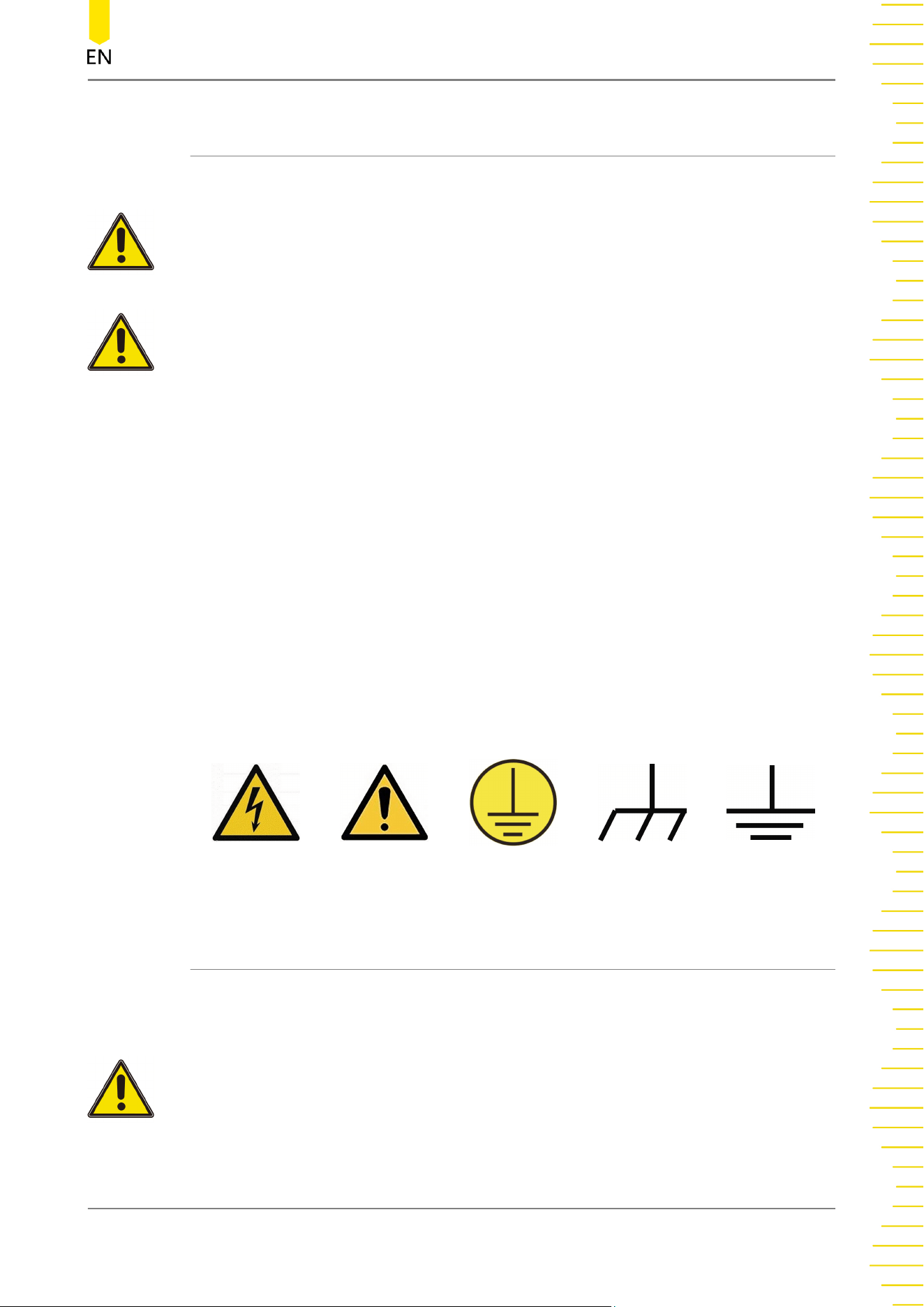
Safety Symbols on the Product:
Hazardous
Voltage
Safety Warning Protective Earth
Terminal
Chassis Ground Test Ground
1.3 Measurement Category
Measurement Category
This instrument can make measurements in Measurement Category I.
Warning
This instrument can only be used for measurements within its specified measurement
categories.
Safety Requirement
Copyright ©RIGOL TECHNOLOGIES CO., LTD.
All rights reserved.
DS70000 User Guide
3
Measurement Category Definitions
• Measurement category I is for measurements performed on circuits not directly
connected to MAINS. Examples are measurements on circuits not derived from
MAINS, and specially protected (internal) MAINS derived circuits. In the latter
case, transient stresses are variable. Thus, you must know the transient withstand
capability of the equipment.
• Measurement category II is for measurements performed on circuits directly
connected to low voltage installation. Examples are measurements on household
appliances, portable tools and similar equipment.
• Measurement category III is for measurements performed in the building
installation. Examples are measurements on distribution boards, circuit-breakers,
wiring (including cables, bus-bars, junction boxes, switches and socket-outlets) in
the fixed installation, and equipment for industrial use and some other
equipment. For example, stationary motors with permanent connection to a
fixed installation.
• Measurement category IV is for measurements performed at the source of a
low-voltage installation. Examples are electricity meters and measurements on
primary overcurrent protection devices and ripple control units.
1.4 Ventilation Requirement
This instrument uses a fan to force cooling. Please make sure that the air inlet and
outlet areas are free from obstructions and have free air. When using the instrument
in a bench-top or rack setting, provide at least 10 cm clearance beside, above and
behind the instrument for adequate ventilation.
Caution
Inadequate ventilation may cause an increase of temperature in the instrument, which
would cause damage to the instrument. So please keep the instrument well ventilated and
inspect the air outlet and the fan regularly.
1.5 Working Environment
Temperature
Operating: 0℃ to +50℃
Non-operating: -30℃ to +70℃
Humidity
• Operating:
Below +30℃: ≤90%RH (without condensation)
+30℃ to +40℃: ≤75% RH (without condensation)
Safety Requirement
DS70000 User Guide
4
Copyright ©RIGOL TECHNOLOGIES CO., LTD.
All rights reserved.
+40℃ to +50℃: ≤45%RH (without condensation)
• Non-operating:
Below +65℃: ≤90%RH (without condensation)
Warning
To avoid short circuit inside the instrument or electric shock, never operate the
instrument in a humid environment.
Altitude
• Operating: below 3 km
• Non-operating: below 15 km
Protection Level Against Electric Shock
ESD ±8kV
Installation (Overvoltage) Category
This product is powered by mains conforming to installation (overvoltage) category II.
Warning
Ensure that no overvoltage (such as that caused by a bolt of lightning) can reach the
product. Otherwise, the operator might be exposed to the danger of an electric shock.
Installation (Overvoltage) Category Definitions
Installation (overvoltage) category I refers to signal level which is applicable to
equipment measurement terminals connected to the source circuit. Among these
terminals, precautions are done to limit the transient voltage to a low level.
Installation (overvoltage) category II refers to the local power distribution level which
is applicable to equipment connected to the AC line (AC power).
Pollution Degree
Pollution Degree 2
Pollution Degree Definition
• Pollution Degree 1: No pollution or only dry, nonconductive pollution occurs.
The pollution has no effect. For example, a clean room or air-conditioned office
environment.
• Pollution Degree 2: Normally only nonconductive pollution occurs. Temporary
conductivity caused by condensation is to be expected. For example, indoor
environment.
• Pollution Degree 3: Conductive pollution or dry nonconductive pollution that
becomes conductive due to condensation occurs. To be found in industrial
Safety Requirement
Copyright ©RIGOL TECHNOLOGIES CO., LTD.
All rights reserved.
DS70000 User Guide
5
environment or construction sites (harsh environments). For example, sheltered
outdoor environment.
• Pollution Degree 4: The pollution generates persistent conductivity caused by
conductive dust, rain, or snow. For example, outdoor areas.
Safety Class
Class 1 – Grounded Product
1.6 Care and Cleaning
Care
Do not store or leave the instrument where it may be exposed to direct sunlight for
long periods of time.
Cleaning
Clean the instrument regularly according to its operating conditions.
1 Disconnect the instrument from all power sources.
2 Clean the external surfaces of the instrument with a soft cloth dampened with mild
detergent or water. Avoid having any water or other objects into the chassis via the
heat dissipation hole. When cleaning the LCD, take care to avoid scarifying it.
Caution
To avoid damage to the instrument, do not expose it to caustic liquids.
Warning
To avoid short-circuit resulting from moisture or personal injuries, ensure that the
instrument is completely dry before connecting it to the power supply.
1.7 Environmental Considerations
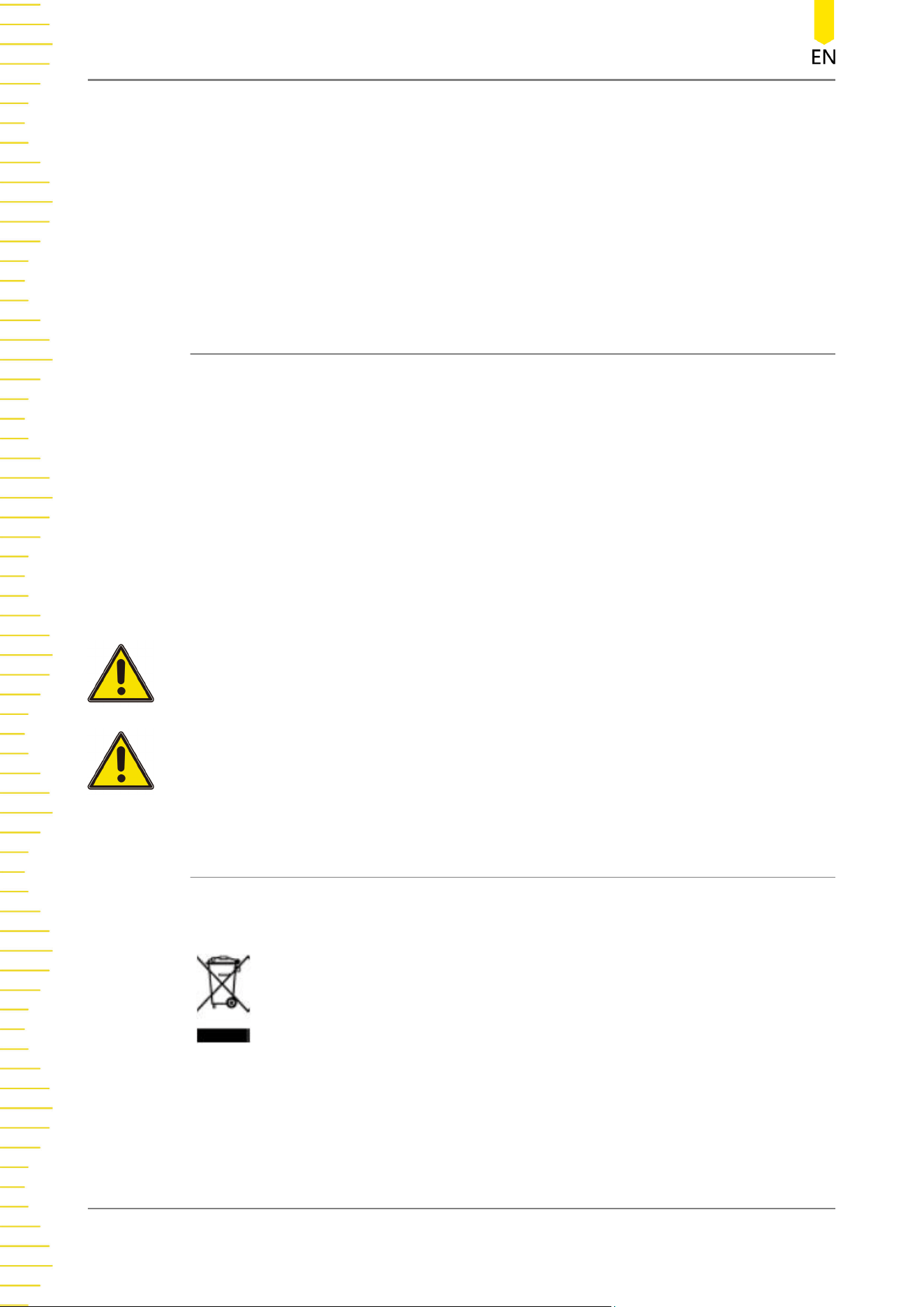
The following symbol indicates that this product complies with the WEEE Directive
2002/96/EC.
The equipment may contain substances that could be harmful to the environment or
human health. To avoid the release of such substances into the environment and
avoid harm to human health, we recommend you to recycle this product
appropriately to ensure that most materials are reused or recycled properly. Please
contact your local authorities for disposal or recycling information.
Safety Requirement
DS70000 User Guide
6
Copyright ©RIGOL TECHNOLOGIES CO., LTD.
All rights reserved.
You can click on the following link
https://www.rigol.com/services/declaration.html
to
download the latest version of the RoHS&WEEE certification file.
1.8 Keep Hands Clear
Warning
While the small screen is opening or closing, keep hands clear from the inclination angle
between the large screen and its instrument body to avoid being pinched.
Safety Requirement
Copyright ©RIGOL TECHNOLOGIES CO., LTD.
All rights reserved.
DS70000 User Guide
7
2 Product Features
Product Features
• Analog channel bandwidth: Max. 5 GHz bandwidth, 4 analog channels and 1
EXT channel
• Up to 20 GSa/s sample rate
• Max. 2 Gpts memory depth
• Waveform capture rate 1,000,000 wfms/s
• Vertical sensitivity range: 1 mV/div~10 V/div (1 MΩ), 1 mV/div~1 V/div (50 Ω)
• Timebase range: 50 ps/div~1000 s/div
• Up to 2,000,000 frames of hardware real-time and ceaseless waveforms
recording and playback functions
• Integrates 5 independent instruments into 1, including digital oscilloscope,
real-time spectrum analyzer (option), digital voltmeter, 8-digit frequency
counter and totalizer, and protocol analyzer (option)
• Standard trigger functions: Edge trigger, Pulse trigger, Slope trigger, Video
trigger, Pattern trigger, Duration trigger, Timeout trigger, Runt trigger, Window
trigger, Delay trigger, Setup/Hold trigger, Nth Edge trigger, RS232, I2C, SPI,
CAN, FlexRay, LIN, I2S, and MIL-STD-1553
• A variety of serial decoding functions (option): RS232, I2C, SPI, CAN, FlexRay,
LIN, I2S, MIL-STD-1553, and CAN-FD; supporting 4 decoding channels
• Auto measurement of 41 waveform parameters; full-memory hardware
measurement function
• A variety of math operations: A+B, A-B, A×B, A/B, FFT, A&&B, A||B, A^B, !A,
Intg, Diff, Lg, Ln, Exp, Sqrt, Abs, AX+B, LowPass, HighPass, BandPass, BandStop,
built-in enhanced FFT analysis and peak search function
• Eye diagram and jitter analysis (option)
• Unique UltraVision III technical platform
• Multiple interfaces available: USB HOST&DEVICE, LAN(LXI), HDMI, AUX OUT;
Web Control supported
• Main 15.6'' HD capacitive multi-touch screen equipped with electronically
controlled one-button screen inclination for signal visualization, analysis, and
results; multi-window split screen display
• The photoelectric encoder operating knob prolongs its service life,
guaranteeing more than 100,000 times of pressing operation and 1 million
times of rotation operation, greatly improving its service life
• Secondary 3.5-inch touch screen separates menus and functions from signals
and analysis with a customized function and shortcut menu
Product Features
DS70000 User Guide
8
Copyright ©RIGOL TECHNOLOGIES CO., LTD.
All rights reserved.
Product Features
• Electronic label display of the model and main parameters of the product,
sustaining the display contents up to 20 years, and capable to be updated
when any option is upgraded
• Support online version upgrade
• 7 GHz high-end active differential probe PVA8700 (option)
DS70000 series digital oscilloscope adopts RIGOL's chipset "Phoenix", delivering
excellent performance with a maximum sample rate of 20 GSa/s, 5 GHz bandwidth.
RIGOL's brand new UltraVison III technical platform guarantees the specifications to
reach the advanced level in the industry, with the capture rate up to millions of
waveforms per second, 2 Gpts memory depth, 8-16 bits adjustable resolution, and
10,000 FFTs/s. In addition to the improved hardware specifications, the DS70000
series digital oscilloscope has a main 15.6-inch HD capacitive multi-touch screen
equipped with electronically controlled one-button screen inclination for signal
visualization, analysis, and results; a secondary 3.5-inch small screen with a
customized function and shortcut menu display; and other user-friendly designs,
bringing users an extraordinary human-machine interface experience.
Product Features
Copyright ©RIGOL TECHNOLOGIES CO., LTD.
All rights reserved.
DS70000 User Guide
9
3 Document Overview
This manual gives you a quick review about the front and rear panel of DS70000
series, the user interface, and the basic operation method.
Tip
For the latest version of this manual, download it from the official website of RIGOL (
http://
www.rigol.com
).
Publication Number
UGA28100-1110
Software Version
Software upgrade might change or add product features. Please acquire the latest
version of the manual from RIGOL website or contact RIGOL to upgrade the software.
Format Conventions in this Manual
1 Key
The front panel key is denoted by the menu key icon. For example,
indicates the “Default” key.
2 Menu
The menu item is denoted by the format of "Menu Name (Bold) + Character
Shading" in the manual. For example,
Setup indicates clicking or tapping the
"Setup" sub-menu under the "Utility" function menu to view the basic setting
configuration items.
3 Operation Procedures
The next step of the operation is denoted by ">" in the manual. For example,
> Storage indicates that first clicking or tapping the icon , then clicking or
tapping Storage.
4 Knob
Label Knob Label Knob
Channel
Channel On/Off
Button
Multifunction
Multi-function
Button
Multifunction
Multi-function
Knob
Multifunction
Multi-function
Knob
Document Overview
DS70000 User Guide
10
Copyright ©RIGOL TECHNOLOGIES CO., LTD.
All rights reserved.
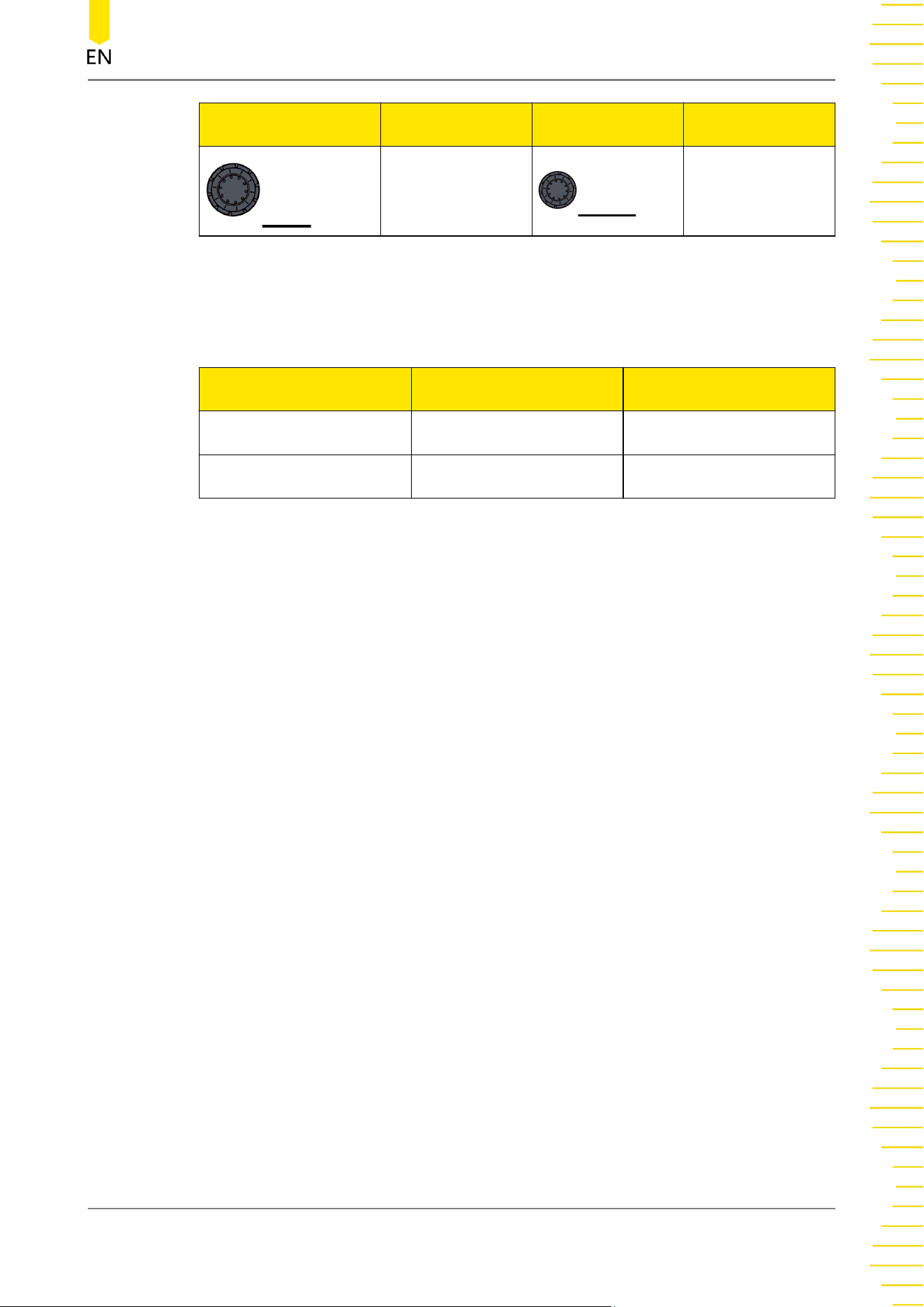
Label Knob Label Knob
SCALE
Channel Vertical
Scale Knob
OFFSET
Channel Vertical
Position Knob
Content Conventions in this Manual
DS70000 series includes the following models. Unless otherwise specified, this
manual takes DS70504 as an example to illustrate the functions and operation
methods of DS70000 series power supply.
Model Max. Analog Bandwidth Analog Channel
DS70504 5 GHz 4
DS70304 3 GHz 4
Document Overview
Copyright ©RIGOL TECHNOLOGIES CO., LTD.
All rights reserved.
DS70000 User Guide
11
4 Quick Start
4.1 General Inspection
1 Inspect the packaging
If the packaging has been damaged, do not dispose the damaged packaging or
cushioning materials until the shipment has been checked for completeness and
has passed both electrical and mechanical tests.
The consigner or carrier shall be liable for the damage to the instrument resulting
from shipment. RIGOL would not be responsible for free maintenance/rework or
replacement of the instrument.
2 Inspect the instrument
In case of any mechanical damage,missing parts, or failure in passing the electrical
and mechanical tests, contact your RIGOL sales representative.
3 Check the accessories
Please check the accessories according to the packing lists. If the accessories are
damaged or incomplete, please contact your RIGOL sales representative.
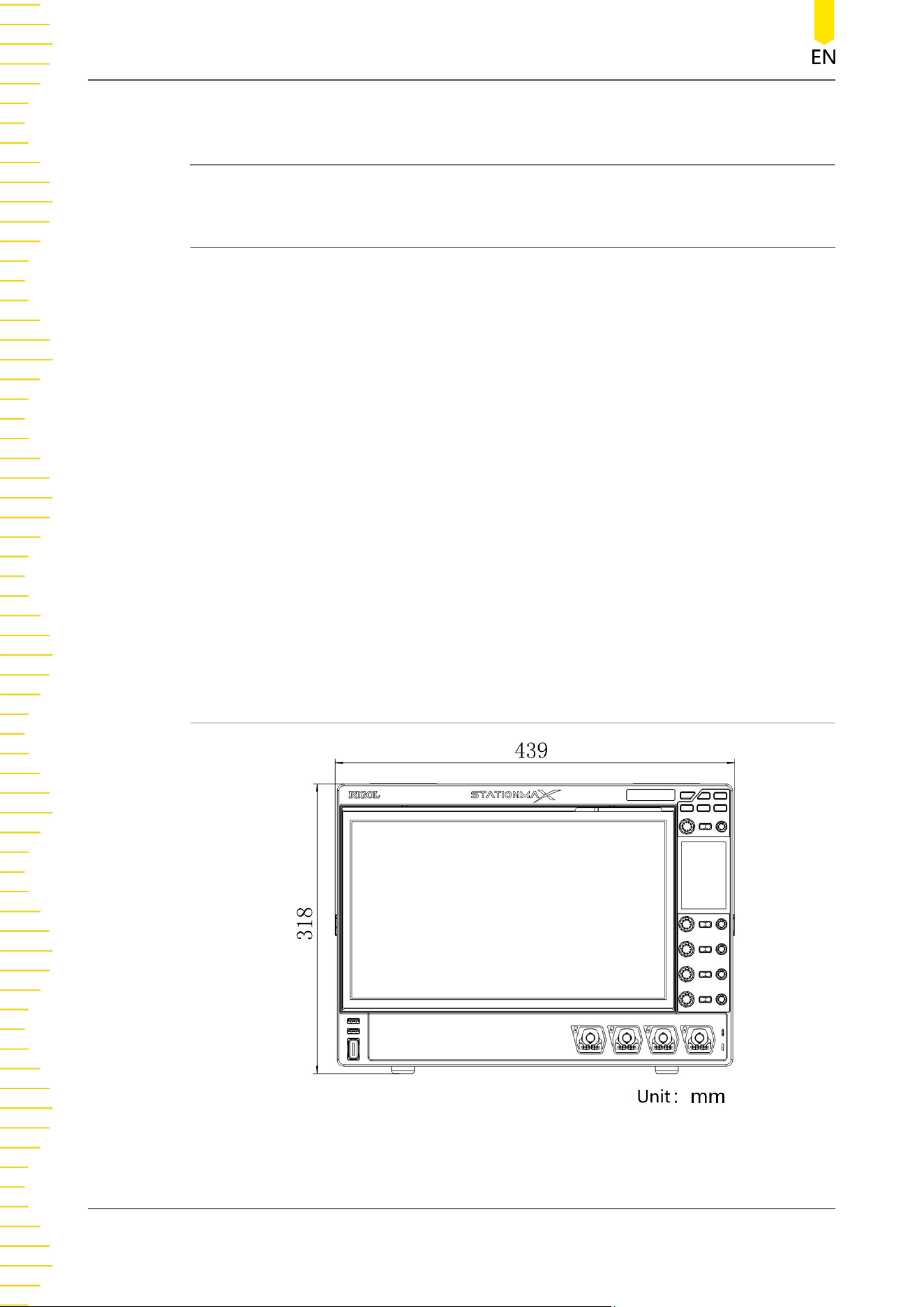
4.2 Appearance and Dimensions
Figure 4.1 Front View
Quick Start
DS70000 User Guide
12
Copyright ©RIGOL TECHNOLOGIES CO., LTD.
All rights reserved.
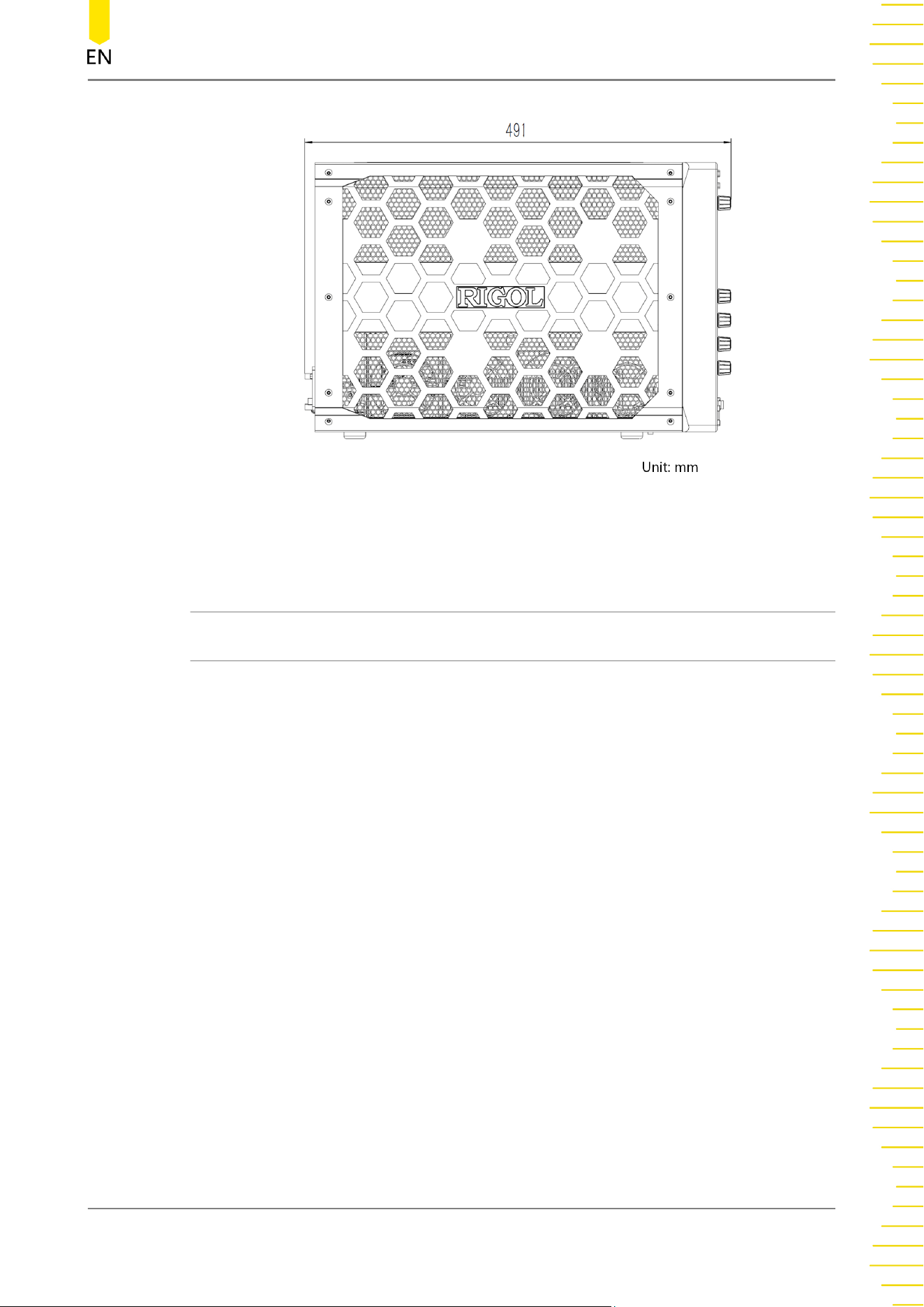
Figure 4.2 Side View
4.3 To Prepare for Use
4.3.1 To Connect to AC Power
The power requirements of the oscilloscope are 100-240 V, 45-440 Hz. Please use the
power cord provided in the accessories to connect the oscilloscope to the AC power
source, as shown in
Figure 4.3
.
Quick Start
Copyright ©RIGOL TECHNOLOGIES CO., LTD.
All rights reserved.
DS70000 User Guide
13
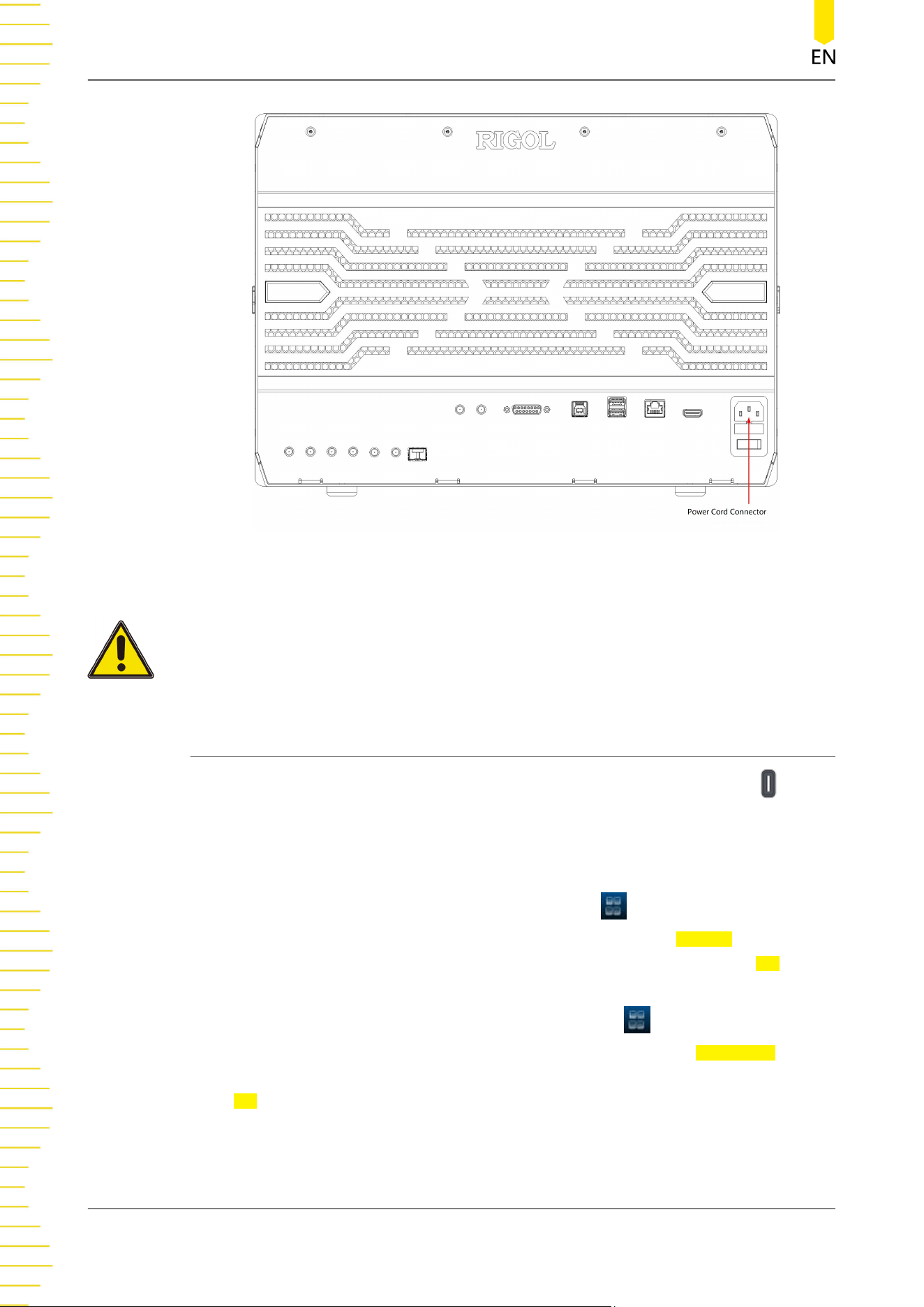
Figure 4.3 To Connect to AC Power
Warning
To avoid electric shock, ensure that the instrument is correctly grounded.
4.3.2 Turn-on Checkout
After the instrument is connected to the power source, press the power key at the
lower-left corner of the front panel to power on the instrument. During the start-up
process, the instrument performs a series of self-tests. After the self-test, the splash
screen is displayed.
• Restart: Click or tap the function navigation icon
at the lower-left corner of
the screen to open the function navigation. Click or tap the Restart icon, then a
prompt message “Are you sure to reboot?” is displayed. Click or tap OK to
restart the instrument.
• Shutdown: Click or tap the function navigation icon
at the lower-left corner
of the screen to open the function navigation. Click or tap the Shutdown icon,
then a prompt message “Are you sure to shutdown?” is displayed. Click or tap
OK to shut down the instrument.
Quick Start
DS70000 User Guide
14
Copyright ©RIGOL TECHNOLOGIES CO., LTD.
All rights reserved.
4.3.3 To Set the System Language
This oscilloscope supports multiple languages. You can click or tap > Utility >
Setup > Language to set the system language.
4.3.4 To Connect the Probe
RIGOL provides passive and active probes for DS70000 series. For specific probe
models, please refer to
DS70000 Datasheet
. For detailed technical information of the
probes, please refer to the corresponding Probe User Guide.
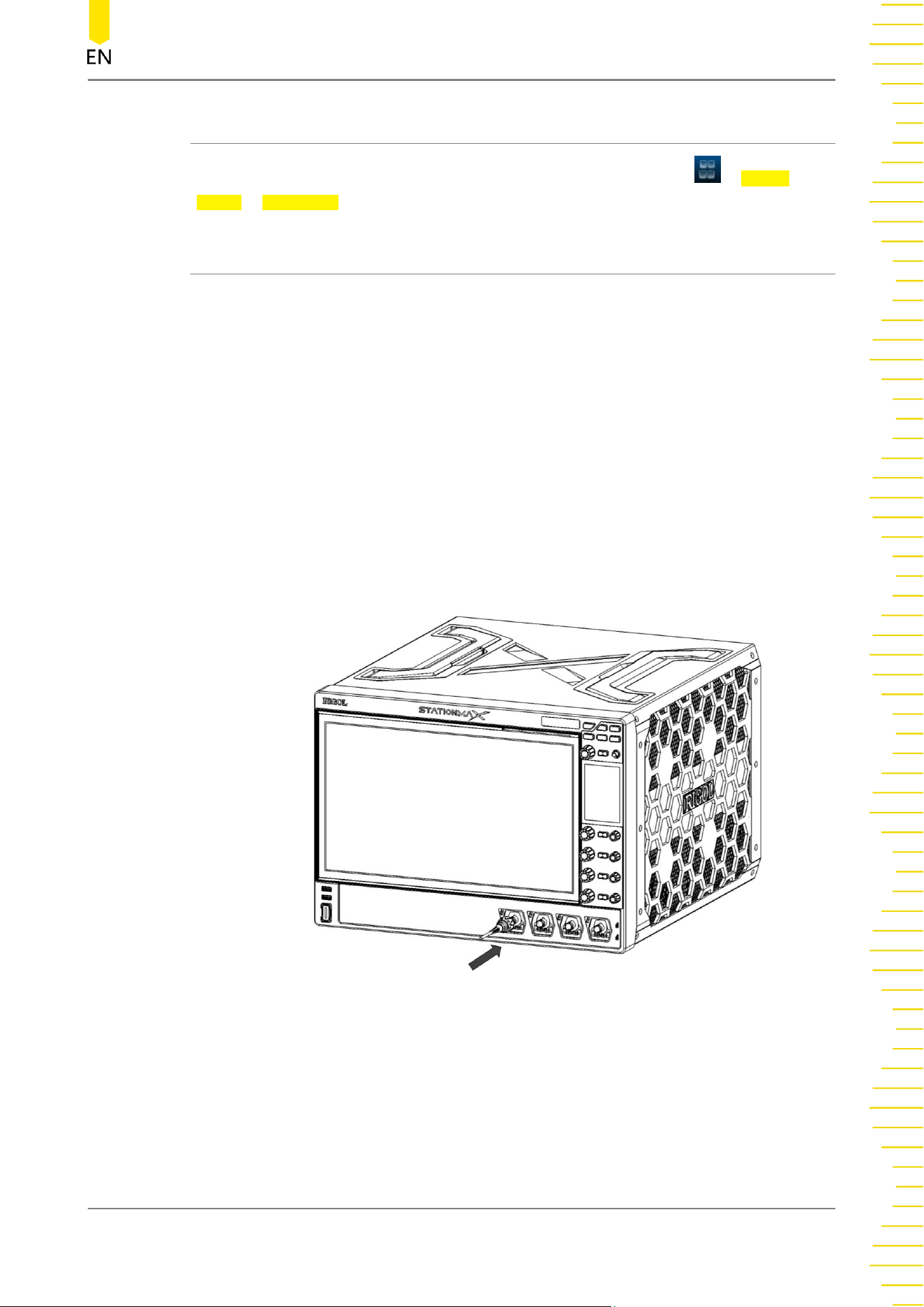
To Connect the Passive Probe
1 Connect the BNC terminal of the probe to an analog channel input terminal of the
oscilloscope on the front panel as shown in
Figure 4.4
.
2 Connect the ground alligator clip or spring of the probe to the circuit ground
terminal, and then connect the probe tip to the circuit point to be tested.
Figure 4.4 To Connect the Passive Probe
After you connect the passive probe, check the probe function and probe
compensation adjustment before making measurements. For detailed procedures,
refer to
Function Inspection
and
Probe Compensation
.
Quick Start
Copyright ©RIGOL TECHNOLOGIES CO., LTD.
All rights reserved.
DS70000 User Guide
15
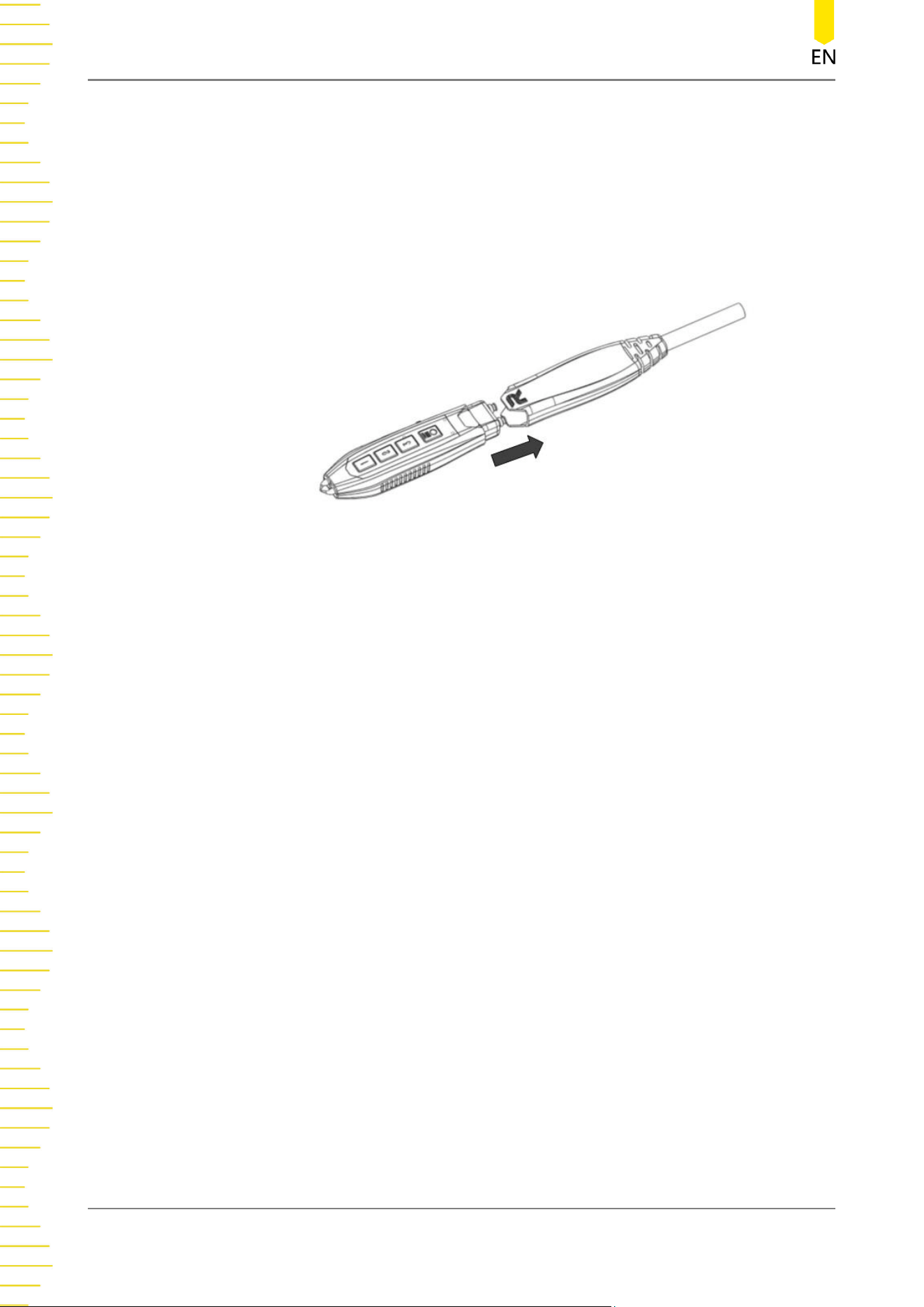
To Connect the Active Probe
Take PVA8000 (active differential probe) as an example.
1 Connect the probe head to the preamp of the active probe, as shown in the figure
below.
Figure 4.5 To Connect the Probe Head to the PA of the Active Probe
2 Connect the other end of the preamp to an analog channel input terminal of the
oscilloscope on the front panel, as shown in the figure below. Note that you need
to push the probe to the due position to lock it firmly.
Quick Start
DS70000 User Guide
16
Copyright ©RIGOL TECHNOLOGIES CO., LTD.
All rights reserved.
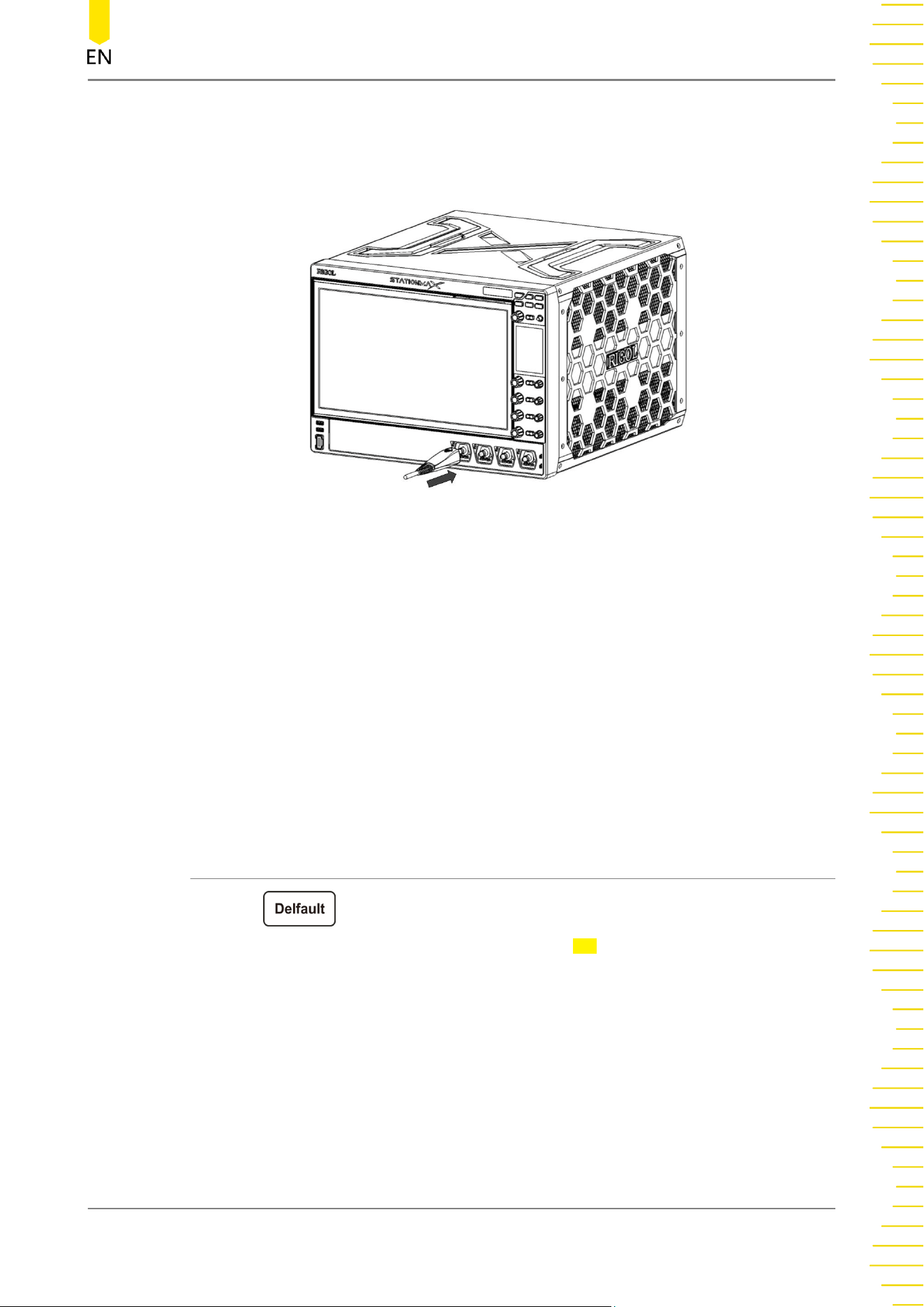
Figure 4.6 To Connect the Active Probe
3 Use the probe's auxiliary device to connect the probe head to the circuit under
test. For detailed information of the probes, please refer to
User Guide for
PVA8000 Series Active Probe
.
After connecting the active probe, you can perform probe calibration and offset
voltage adjustment if necessary. For detailed procedures, refer to the "Active Probe"
section in User Guide.
4.3.5 Function Inspection
1 Press on the front panel, then a prompt message displaying “Restore
default settings?” appears on the screen. Click OK to restore the instrument to its
factory default settings.
2 Connect the ground alligator clip of the probe to the "Ground Terminal" as shown
in
Figure 4.7
below.
3 Use the probe to connect the input terminal of CH1 of the oscilloscope and the
"Compensation Signal Output Terminal" of the probe, as shown in
Figure 4.7
.
Quick Start
Copyright ©RIGOL TECHNOLOGIES CO., LTD.
All rights reserved.
DS70000 User Guide
17
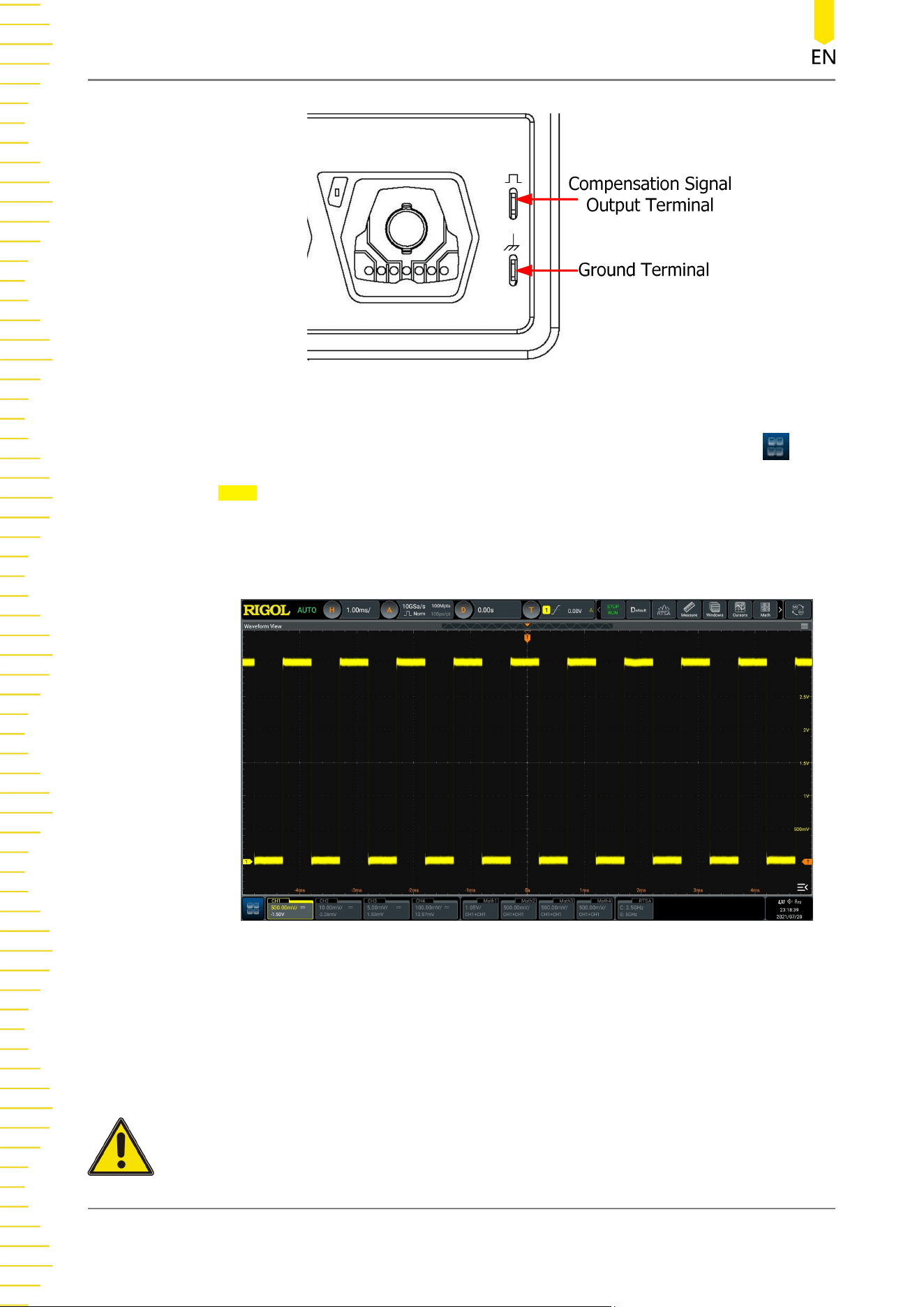
Figure 4.7 To Use the Compensation Signal
4 Set the probe ratio based on the attenuation of the probe, and then click
>
Auto.
5 Observe the waveform on the display. In normal condition, the square waveform as
shown in the figure below should be displayed.
Figure 4.8 Waveform Signal
6 Use the same method to test the other channels. If the square waveforms actually
shown do not match that in the figure above, please perform "Probe
Compensation" introduced in the next section.
Warning
Quick Start
DS70000 User Guide
18
Copyright ©RIGOL TECHNOLOGIES CO., LTD.
All rights reserved.
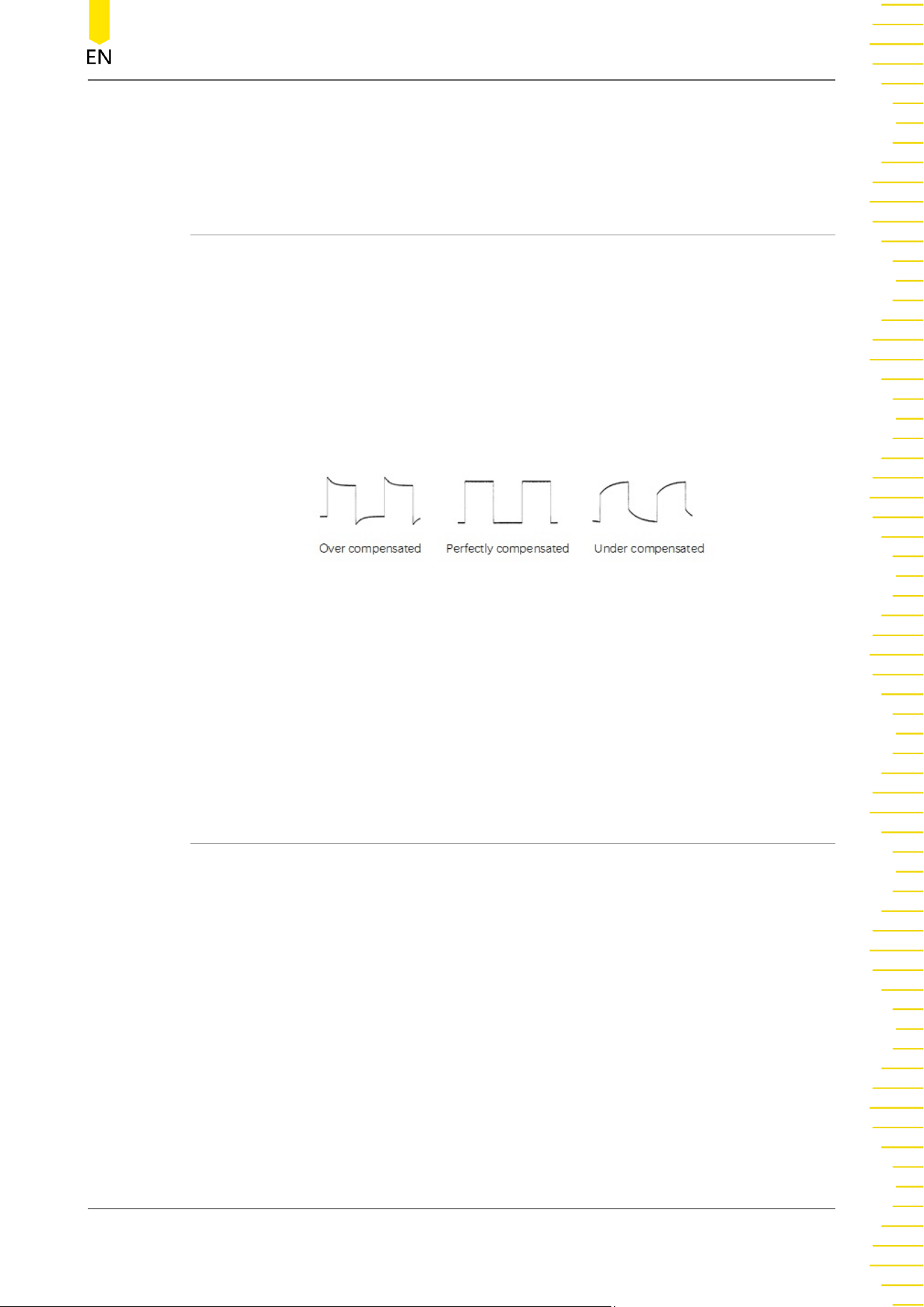
To avoid electric shock when using the probe, please make sure that the insulated wire of
the probe is in good condition. Do not touch the metallic part of the probe when the
probe is connected to high voltage source.
4.3.6 Probe Compensation
When the probes are used for the first time, you should compensate the probes to
make them match the input channels of the oscilloscope. Non-compensated or
poorly compensated probes may cause measurement inaccuracy or errors. The probe
compensation procedures are as follows:
1 Perform Step 1, 2, 3 and 4 in
Function Inspection
.
2 Check the displayed waveforms and compare them with the waveforms shown in
Figure 4.9
.
Figure 4.9 Probe Compensation
3 Use the probe compensation adjustment tool provided in the accessories to adjust
the low-frequency compensation adjustment hole on the probe until the displayed
waveform is consistent with the "Perfectly compensated" waveform shown in the
above figure.
4.4 Product Overview
This chapter introduces the front/rear panel of the oscilloscope and its user interface.
Quick Start
Copyright ©RIGOL TECHNOLOGIES CO., LTD.
All rights reserved.
DS70000 User Guide
19
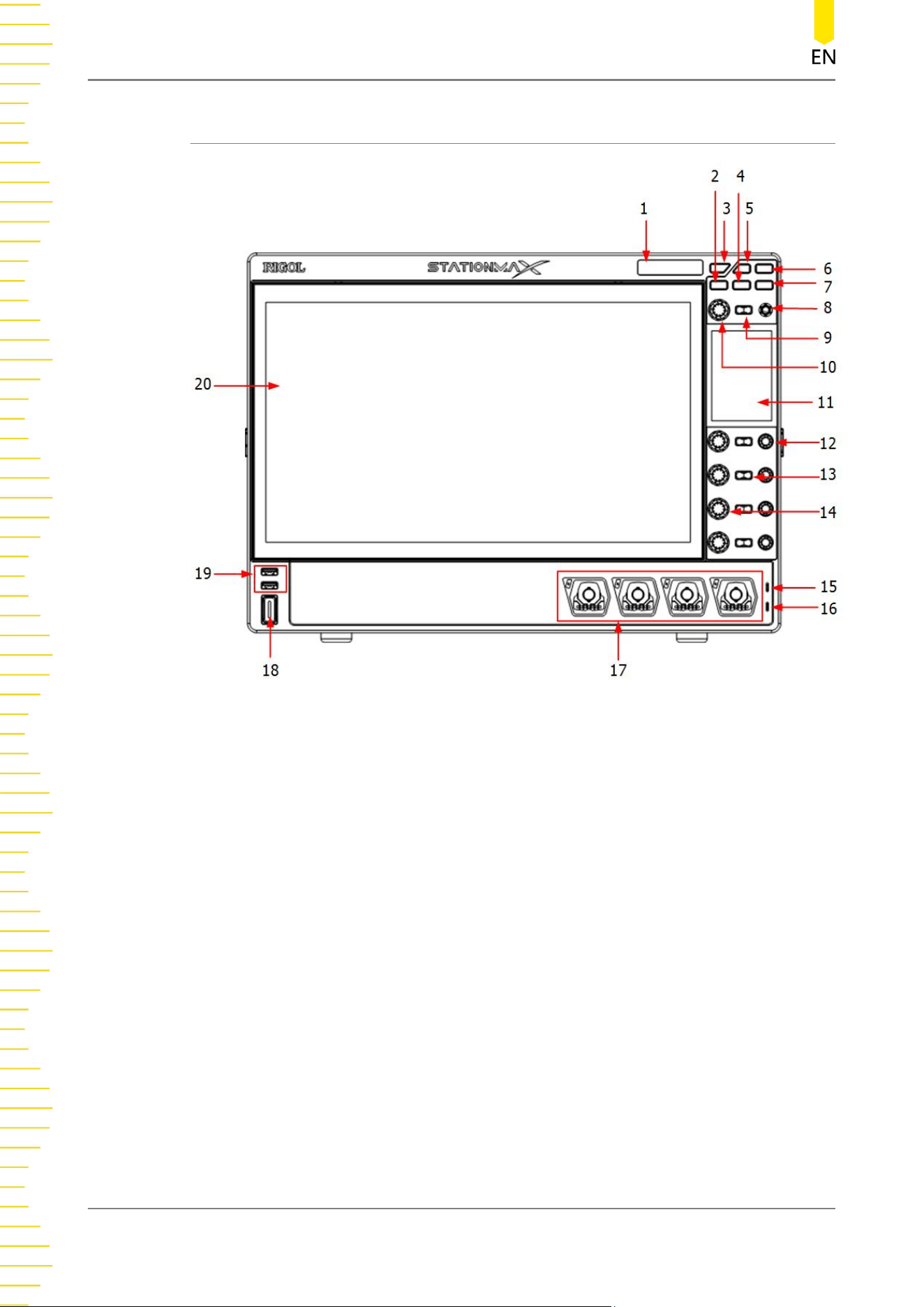
4.4.1 Front Panel Overview
Figure 4.10 Front Panel
1 Electronic Label
The product model and its main parameters displayed on the electronic label,
sustaining its contents up to 20 years even at power-off state. The parameters will
be updated automatically after upgrade to keep the information displayed on the
electronic label consistent with that of the current instrument.
2 Screen Tilt Adjustment Key
Controls whether to adjust the tilt of the large and high-definition 15.6-inch touch
screen.
3 Run/Stop Key
Controls the operating status of the channel output signal.
4 Default
Press this key to restore the instrument to its default settings.
5 Working Mode Switchover Key
Press this key to switch between DSO and AWG modes.
Quick Start
DS70000 User Guide
20
Copyright ©RIGOL TECHNOLOGIES CO., LTD.
All rights reserved.
6 Quick Operation Key
Related to quick operation setting. It is used to customize the quick operation key
for a specified function. By default, it's a shortcut key for screen capture.
7 Key
Temporally unavailable to use.
8 Multifunction Knob
Its function corresponds with the function key currently selected on the secondary
high-definition smart and quick-responsive touch screen.
9 Multifunction Key
Its function corresponds with the function key currently selected on the secondary
high-definition smart and quick-responsive touch screen.
10 Multifunction Knob
Its function corresponds with the function key currently selected on the secondary
high-definition smart and quick-responsive touch screen.
11 High-Definition Smart and Quick-responsive Shortcut Menu Display
Operates the instrument with the functions icons available on the small screen.
When you press the tilt adjustment key, you can adjust the tilt of the main display
on this screen.
12 Channel Vertical Offset Knob
Adjusts the vertical offset of the channel.
13 Channel On/Off Button
Pressing this button continuously can enable or disable the specified analog input
channel.
14 Channel Vertical Scale Knob
Adjusts the vertical scale of the channel.
15 Probe Compensation Signal Output Terminal
16 Probe Compensation Signal Ground Terminal
17 Analog Channel Input Terminals
Can be connected to the probe and inputs the analog signal.
18 Power Key
Powers on or off the instrument.
19 USB HOST Interface
Quick Start
Copyright ©RIGOL TECHNOLOGIES CO., LTD.
All rights reserved.
DS70000 User Guide
21
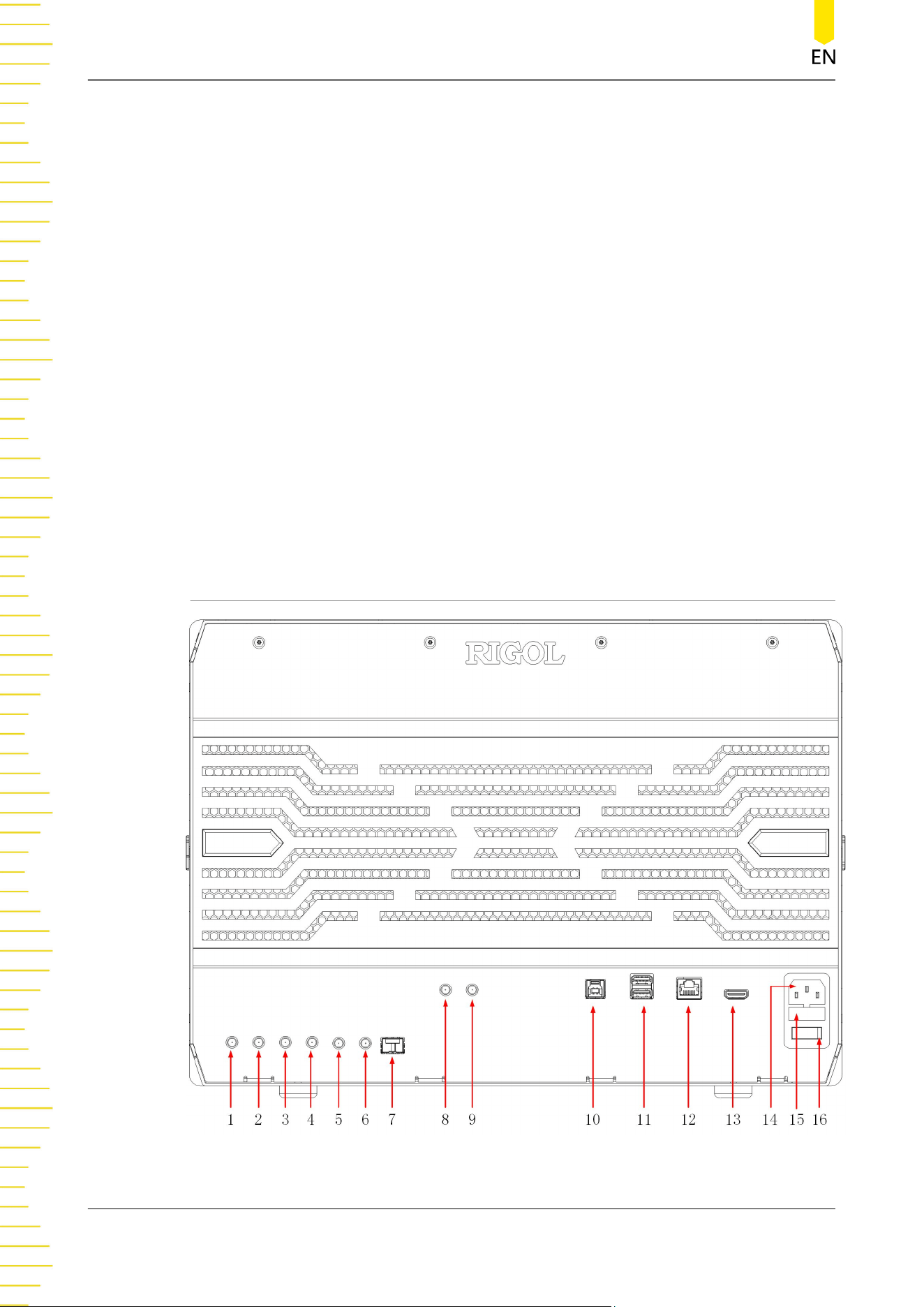
Supports FAT32 format Flash type USB storage device, RIGOL TMC digital
oscilloscope, and the USB-GPIB interface converter.
- USB storage device: reads the waveform or sequence files saved in the USB
storage device; stores the edited waveform and sequence data into the USB
storage device; saves the contents displayed on the screen to the USB storage
device in the format of a captured image.
- TMC DS: seamlessly interconnects with the RIGOL DS that meets the TMC
standard; reads and stores the waveform data collected by the DS and then
rebuilds waveforms without distortion.
- USB-GPIB interface converter (standard accessory): extends the GPIB
interface for RIGOL instruments that integrates the USB HOST interface but not
the GPIB interface.
20 Main Display with One-Button Electronic Tilt
15.6-inch high-definition large touch screen, available to be adjusted its tilt
electronically. Displays the menu label and parameter settings of the current
function, system state, prompt messages, and other information.
4.4.2 Rear Panel Overview
Figure 4.11 Rear Panel
Quick Start
DS70000 User Guide
22
Copyright ©RIGOL TECHNOLOGIES CO., LTD.
All rights reserved.
1 Pulse Source Input
(temporally unavailable)
2 Pulse Source Output
(temporally unavailable)
3 Pulse Source Reverse Output
(temporally unavailable)
4 Pulse Source Reverse Input
(temporally unavailable)
5 AUX OUT
- Trig Out:
The oscilloscope can output a signal that can reflect the current capture rate of
the oscilloscope at each trigger via this SMA connector interface. Connect the
signal to a waveform display device and measure the frequency of the signal.
The measurement result is the same as the current capture rate.
- Pass/Fail:
In the pass/fail test, the instrument will output a pulse via the SMA connector
when a passed or failed waveform is detected during the pass/fail test.
6 EXT 1MΩ/18pF
Inputs the external trigger signal.
7 SFP+ Interface
SFP+ (Small Form Factor Pluggable), an optical transceiver electrical interface,
supports hot-plugging. The interface supports 10 Gbit/s data transmission.
8 10 MHz OUT
A SMA connector that can output the 10 MHz clock signal generated by the
internal crystal oscillator inside the instrument.
9 10 MHz IN
A SMA connector that can input the external reference clock signal.
10 USB DEVICE
Connects the instrument to the PC via this interface. Then you can use the PC
software Ultra Scope to send the SCPI commands or use the user-defined
programming to control the instrument.
11 USB HOST Interface
Connects the compatible storage device to the instrument, supporting FAT32
format Flash type USB storage device, RIGOL TMC digital oscilloscope, and the
USB-GPIB interface converter.
Quick Start
Copyright ©RIGOL TECHNOLOGIES CO., LTD.
All rights reserved.
DS70000 User Guide
23
- USB storage device: reads the waveform files or state files saved in the USB
storage device; or stores the current instrument states or edited waveform data
into the USB storage device; saves the contents displayed on the screen to the
USB storage device in the format of a captured image.
- TMC DS: seamlessly interconnects with the RIGOL DS that meets the TMC
standard; reads and stores the waveform data collected by the DS and then
rebuilds waveforms without distortion.
- USB-GPIB interface converter (optional accessory): extends the GPIB
interface for RIGOL instruments that integrates the USB HOST interface but not
the GPIB interface.
12 LAN
Connects the instrument to network via this interface. The instrument is in
compliance with the standards specified in LXI Device Specification 2011. It can be
used to set up a test system with other standard devices. Then you can use the
Web Control or PC software Ultra Scope to send the SCPI commands or use the
user-defined programming to control the instrument. When update is available,
you can perform online upgrading for the system software of the instrument via
the LAN interface. When it is connected to network, once a network printer is
connected, you can print the waveform displayed on the screen with the printer.
13 HDMI
You can connect the instrument to an external display that has the HDMI interface
(e.g. monitor or projector) via this interface to better observe the waveform display
clearly. At this time, you can also view the waveforms on the LCD of the
instrument.
14 AC Power Cord Connector
The rated AC power source supported by the instrument is (90 V-264 V, 47 Hz~ 63
Hz), and its maximum input power shall not exceed 650 W. Please use the power
cord provided in the accessories to connect the instrument to the AC power
source.
15 Fuse
If you need to replace the fuse, use only the specified fuse.
16 Power Switch
Quick Start
DS70000 User Guide
24
Copyright ©RIGOL TECHNOLOGIES CO., LTD.
All rights reserved.
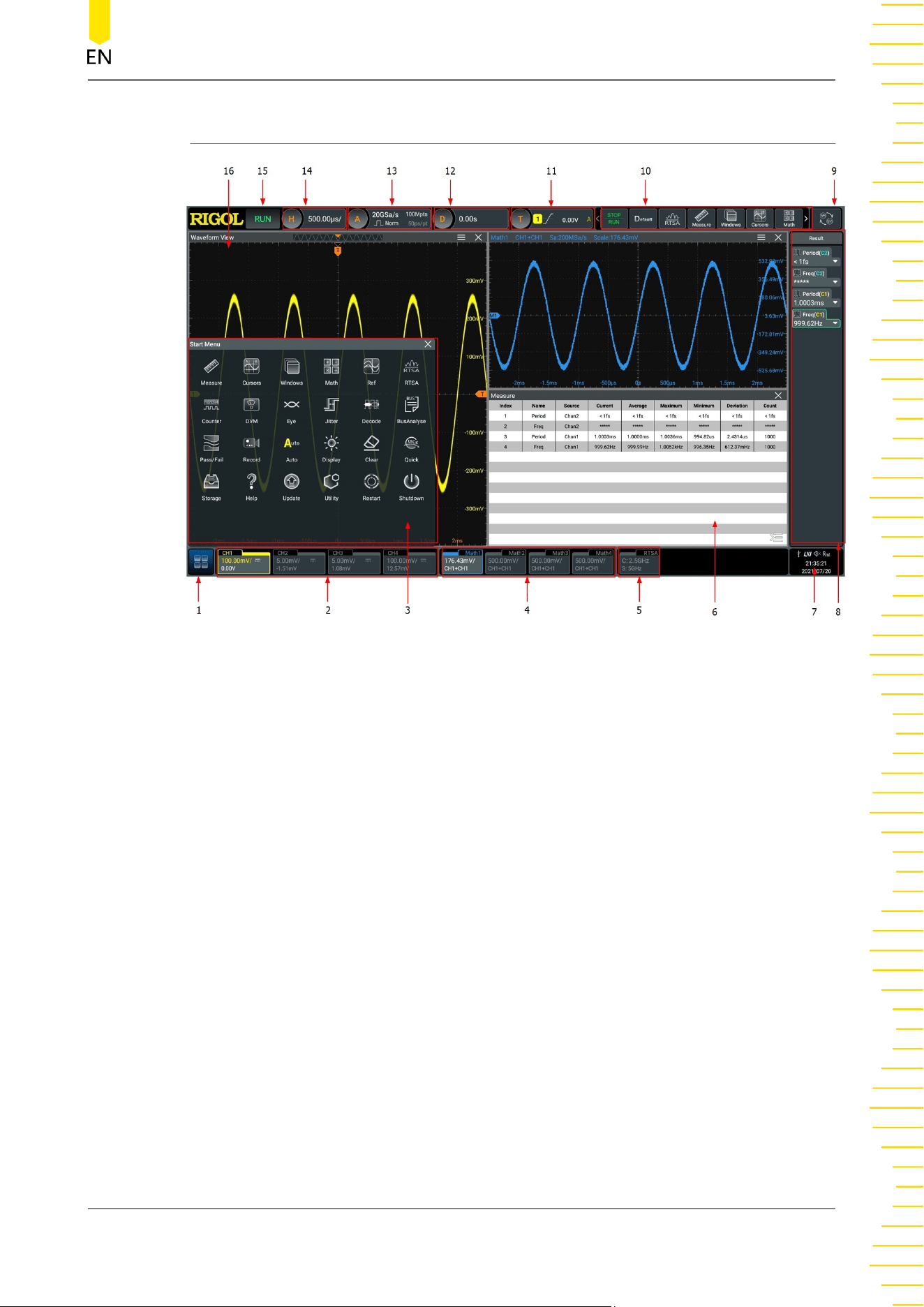
4.4.3 User Interface
Figure 4.12 User Interface
1 Function Navigation Icon
Tap this icon to open the function navigation menu.
2 Channel Label
- Displays the on/off status of CH1~CH4 respectively.
- Displays the coupling mode of the channel.
- Displays the vertical scale of the channel.
- Displays the offset of the channel.
3 Function Navigation Menu
In this menu, tap the specified function icon to enter the desired function menu to
make configurations.
4 Channel Operation Label
Displays the on/off status of the operation channel Math1~Math4, its operation
type, and vertical scale.
5 RTSA Label
Quick Start
Copyright ©RIGOL TECHNOLOGIES CO., LTD.
All rights reserved.
DS70000 User Guide
25
Displays the status of RTSA mode.
6 Multi-window Display Area
If you enable multi-window display, then multiple windows can be displayed on
the screen at one time.
7 Notification Area
Displays the sound icon, USB icon, time, and LAN icon.
- USB storage device icon: When a USB storage device is detected,
will be
displayed.
- LAN connection icon: When the LAN interface is successfully connected,
is
displayed.
- Sound icon: In the “Utility” menu, click or tap Setup > Beeper to enable or
disable the sound. When on,
will be displayed; when off, will be
displayed.
- Web Control icon: When you control the instrument through Web Control
remote operation,
appears.
- Time: displays the system time. For the setting of the system time, refer to
descriptions in
#unique_28/unique_28_Connect_42_SECTION_ULS_CLJ_X4B
.
8 Result Display Window
Displays the measurement results and statistics of various functions. Click or tap
the icon
at the lower-right corner of the screen to open or close the statistics
result display window.
9 Mode Switchover Icon
Temporally unavailable.
10 Function Icon Bar
Lists some of the function icons available in the navigation menu, easy for you to
perform quick operation for some functions.
11 Trigger Information Label
- Displays the trigger information of the system, including the trigger type,
trigger level, trigger mode, and etc.
- Click or tap the trigger information label, then the trigger setting window is
displayed. You can set the parameters for the trigger.
12 Horizontal Position Label
Quick Start
DS70000 User Guide
26
Copyright ©RIGOL TECHNOLOGIES CO., LTD.
All rights reserved.
Displays the current horizontal position. Click or tap this label to enter the
horizontal setting menu.
13 Sample Rate and Memory Depth Label
Displays the current sample rate and memory depth. Click or tap this label to enter
the horizontal setting menu.
14 Horizontal Time Base Label
Displays the current horizontal time base. Click or tap this label to enter the
horizontal setting menu.
15 Operating Status
Displays the operating status of the instrument.
16 Waveform Display Area
Displays the measurement waveform window for CH1-CH4. Click or tap at the
upper-right corner of the window to close the window. Click or tap
to enter
the configuration menu of the specified function.
4.4.4 Secondary 3.5-inch Touch Screen
The 3.5-inch small screen at the right side of the front panel is called a secondary
touch screen. The secondary touch screen separates menus and functions from
signals and analysis with a customized function and shortcut menu. You can adjust
the inclination of the main display.
Smart Quick-Responsive Shortcut Key Menu
The touch-enabled operation of DS70000 series oscilloscope can be operated on
both the main and secondary touch screens.
Quick Start
Copyright ©RIGOL TECHNOLOGIES CO., LTD.
All rights reserved.
DS70000 User Guide
27
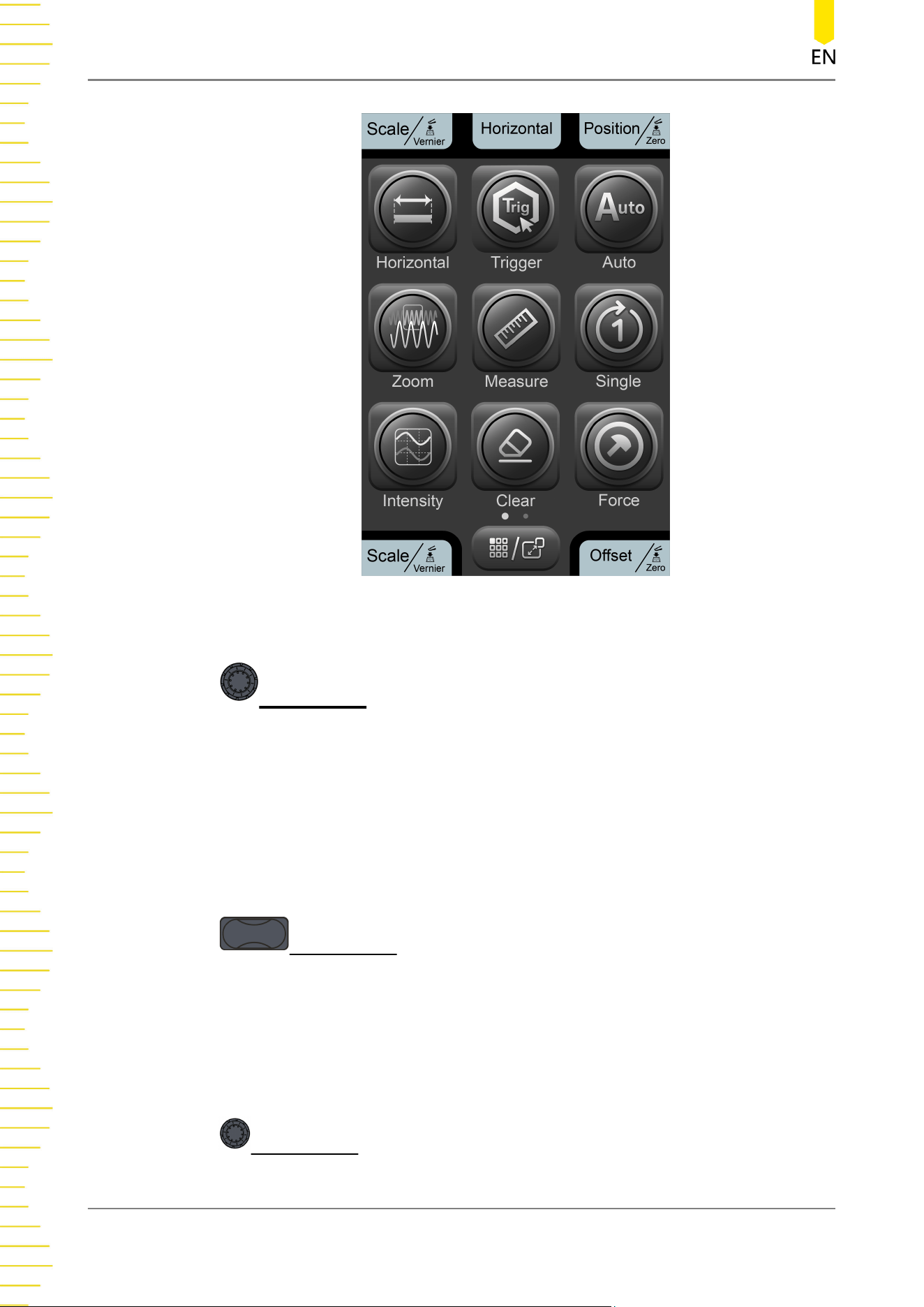
Figure 4.13 Smart Quick-Responsive Keyboard Interface
1 Multifunction Knob Operation Icon
The icon under the multifunction knob shows the current function of the knob. The
icon changes with the selected quick shortcut key. You can use the multifunction
knob above the icon to perform the specified function operation.
Let's take an example by illustrating the knob operation in
Figure 4.13
. In the
current interface, rotating this knob can adjust the horizontal time base of the
oscilloscope; pressing down the knob can switch between the fine adjustment and
coarse adjustment for the horizontal time base.
2
Multifunction Knob Operation Icon
The icon under the multifunction knob shows the current function of the knob. The
icon changes with the selected quick shortcut key. You can use the multifunction
knob above the icon to perform the specified function operation.
Let's take an example by illustrating the knob operation in
Figure 4.13
. In the
current interface, pressing down the knob can open or close the horizontal menu.
3 Multifunction Knob Operation Icon
Quick Start
DS70000 User Guide
28
Copyright ©RIGOL TECHNOLOGIES CO., LTD.
All rights reserved.
The icon under the multifunction knob shows the current function of the knob. The
icon changes with the selected quick shortcut key. You can use the multifunction
knob above the icon to perform the specified function operation.
Let's take an example by illustrating the knob operation in
Figure 4.13
. In the
current interface, rotating this knob can adjust the horizontal position of the
oscilloscope; pressing down the knob can set the horizontal position to zero.
4 SCALE Knob Operation Icon
The icon above the SCALE knob shows function of the knob. The knob below the
icon is used to adjust the vertical scale of the four channels. Rotating the knob for
the specified channel can adjust the vertical scale of the channel; pressing down
the knob can switch between the fine adjustment and coarse adjustment for the
vertical scale.
5 OFFSET Knob Operation Icon
The icon above the SCALE knob shows function of the knob. The knob below the
icon is used to adjust the vertical offset of the four channels. Rotating the knob for
the specified channel can adjust the vertical offset of the channel; pressing down
the knob can set the vertical offset to zero.
6 Quick-Responsive Shortcut Key Menu
Tap the quick shortcut key on the secondary touch screen to enter the specified
function menu or enable the specified function. There are two menu pages and
you can tap left and right to switch between the menu pages.
Flip Screen Adjustment Interface
The main display of the DS70000 series oscilloscope can be adjusted with one-button
electric tilt. You can tilt the main display on the secondary touch screen. Press the
button at the upper-right corner of the front panel to enter the tilt
adjustment menu interface for the main display, as shown in
Figure 4.14
. Press the
button again to go back to the quick-responsive shortcut key menu
interface.
Quick Start
Copyright ©RIGOL TECHNOLOGIES CO., LTD.
All rights reserved.
DS70000 User Guide
29
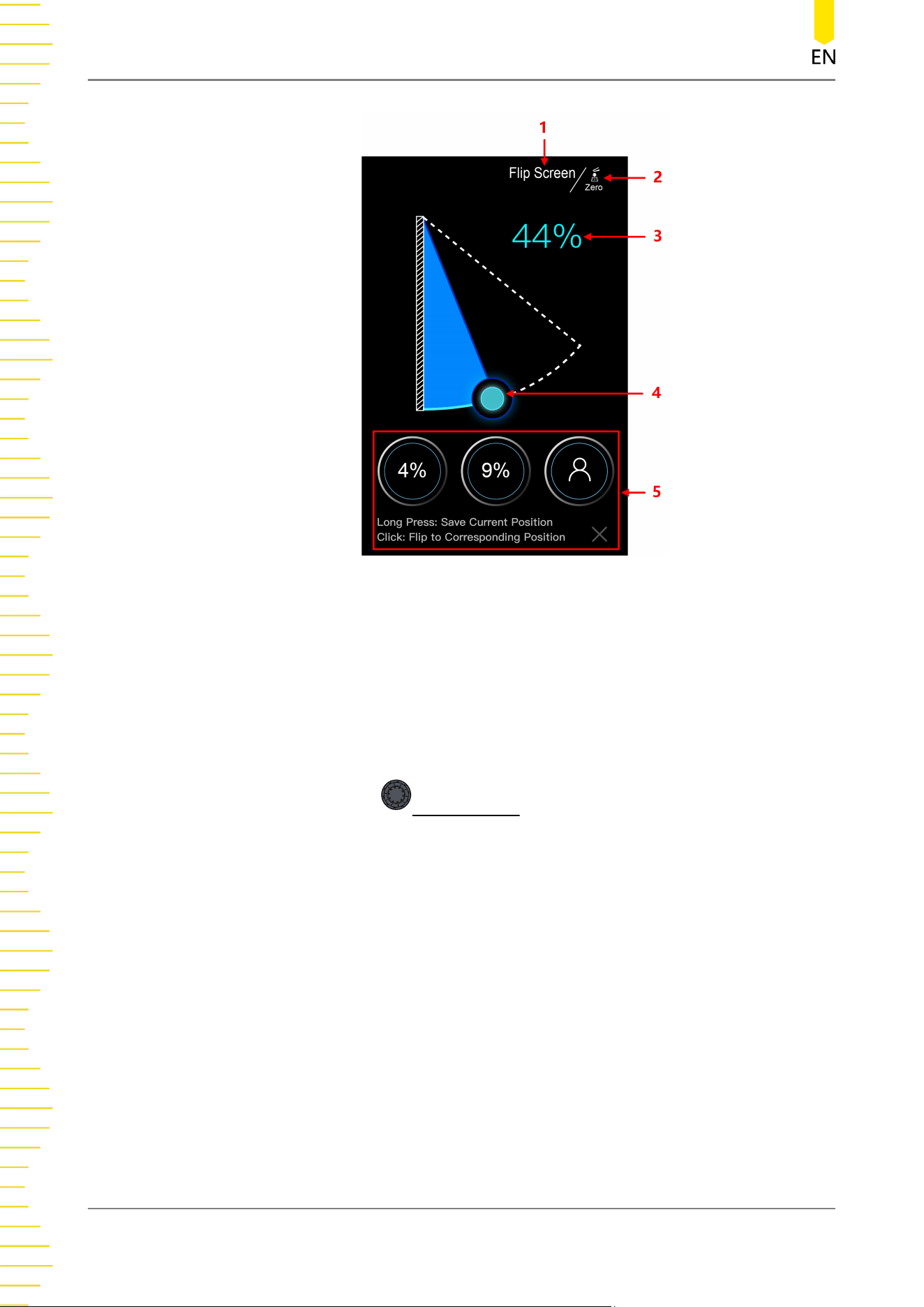
Figure 4.14 Flip Screen Adjustment Interface
1 Current Interface Operation
"Flip Screen" indicates that in the current interface, you can tilt the main display of
the oscilloscope.
2 Multifunction Knob Function Icon
Above the icon is the Multifunction knob. The icon shows the function of this
knob. Pressing down this knob can reset the tilt of the main display to zero;
rotating the knob can adjust the tilt.
3 Flip Screen Angle Percentage
Indicates the tilt percentage of the main display to the max. tilt available for the
main display.
4 Tilt Adjustment
Tap to drag the icon to adjust the tilt of the main display.
5 Saved Tilt Angle
This oscilloscope supports users to save three commonly used tilt angle values for
the main display. The instructions below show how to adjust the tilt of the main
display.
Quick Start
DS70000 User Guide
30
Copyright ©RIGOL TECHNOLOGIES CO., LTD.
All rights reserved.
a Drag the "Tilt Adjustment" icon to adjust the main display to a required tilt
angle.
b Long press the "Saved Tilt Angle" icon to save the current tilt angle of the main
display. After completing setting a tilt angle for the main display, the tilt
percentage value will be shown on the icon.
c For future use, you just need to tap the icon with a specified tilt angle on it to
make the main display to reach the specified tilt.
Caution
During adjusting the tilt of the main display, keep hands clear of the flip screen to avoid
being pinched.
4.5 Touch Screen Gestures
The instrument provides a super large capacitive touch screen, which is convenient for
users to operate and make configurations. It has strong waveform display capability
and excellent user experience. It features great convenience, high flexibility, and great
sensitivity. The actions supported by the touch screen controls include tapping,
pinching&stretching, as well as dragging.
4.5.1 Tap
Use one finger to tap the symbol or characters on the screen slightly, as shown in
Figure 4.15
. With the Tap gesture, you can perform the following operation:
• Tap the menu displayed on the screen to operate on the menu.
• Tap the function navigation icon
at the lower-left corner of the touch screen
to enable the function navigation.
• Tap the displayed numeric keypad to set the parameters.
• Tap the virtual keypad to set the label name and the filename.
• Tap the close window icon at the upper-right corner of the prompt message box
to close it.
• Tap the other windows displayed on the screen to operate on the window.
Quick Start
Copyright ©RIGOL TECHNOLOGIES CO., LTD.
All rights reserved.
DS70000 User Guide
31
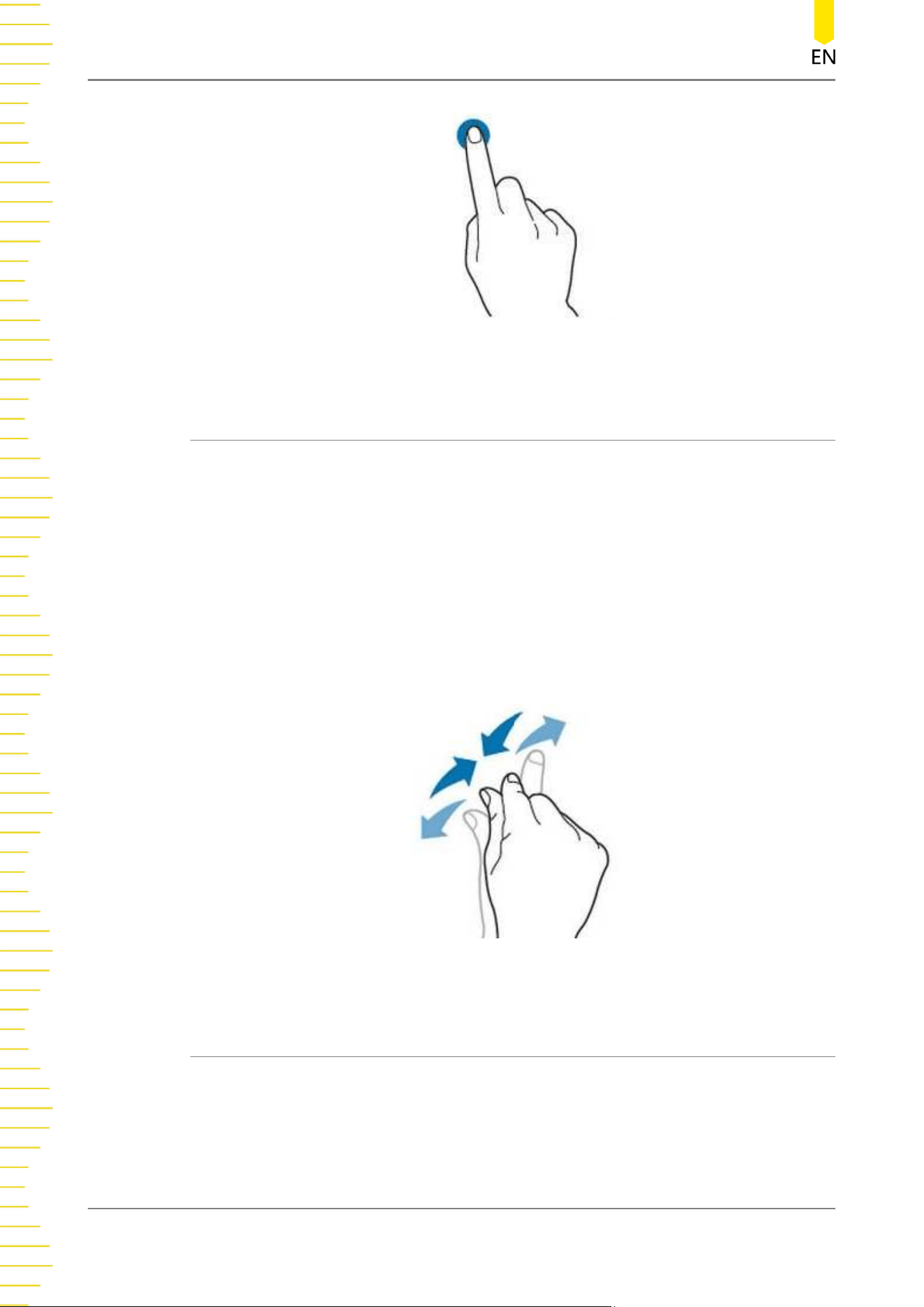
Figure 4.15 Tap Gesture
4.5.2 Pinch&Stretch
Pinch or stretch two points on the screen with two fingers to zoom in or out the
waveform. To zoom in the waveform, first pinch the two fingers and then stretch the
fingers; to zoom out the waveform, first stretch the two fingers, and then pinch the
fingers together, as shown in the figure below. With the pinch&stretch gesture, you
can perform the following operation:
• Pinching&stretching in the horizontal direction can adjust the horizontal time
base of the waveform.
• Pinching&stretching in the vertical direction can adjust the vertical scale of the
waveform.
Figure 4.16 Pinch&Stretch Gesture
4.5.3 Drag
Use one finger to select the object, and then drag the object to a destination place, as
shown in
Figure 4.17
. With the drag gesture, you can perform the following
operation:
• Drag the waveform to change its position or scale.
Quick Start
DS70000 User Guide
32
Copyright ©RIGOL TECHNOLOGIES CO., LTD.
All rights reserved.
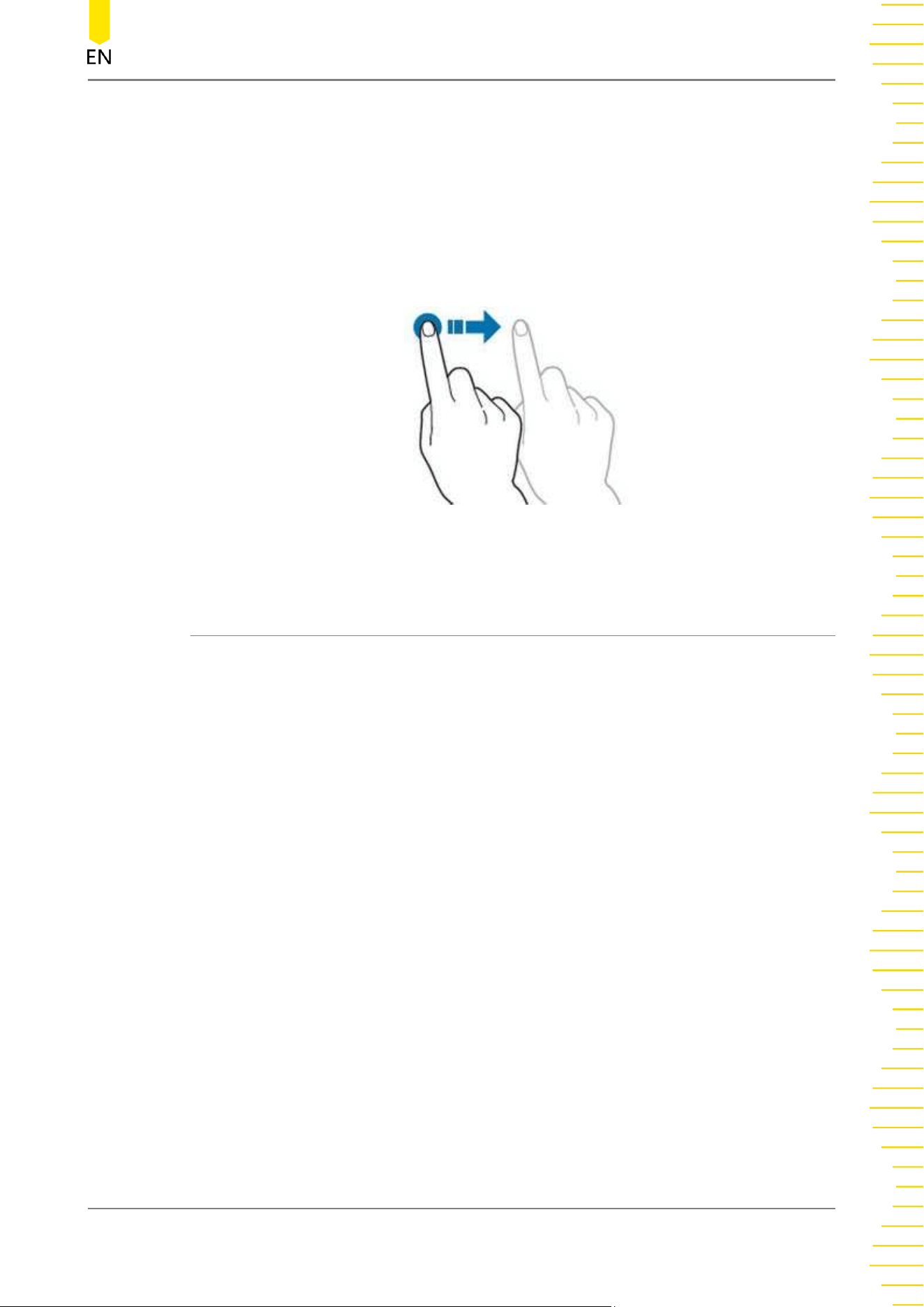
• Drag the window controls to change the position of the window (e.g. numeric
keypad).
• Drag the cursor to change the position of the cursor.
• In multi-window display, drag one of the displayed windows to change its
position on the screen.
Figure 4.17 Drag Gesture
4.6 Parameter Setting Method
For this instrument, you can use the knob and touch screen operation to set
parameters. The common parameter setting methods are as follows:
• Method 1: Some parameters can be adjusted by rotating the knob on the front
panel.
• Method 2: Click or tap the input field of a specified parameter, then a virtual
keypad is displayed. Complete the parameter setting with the keypad.
Input Chinese and English Characters
When naming a label, this instrument supports Chinese/English input method. The
following part introduces how to input Chinese and English characters with the
Chinese/English input method.
• Input English Characters
Quick Start
Copyright ©RIGOL TECHNOLOGIES CO., LTD.
All rights reserved.
DS70000 User Guide
33
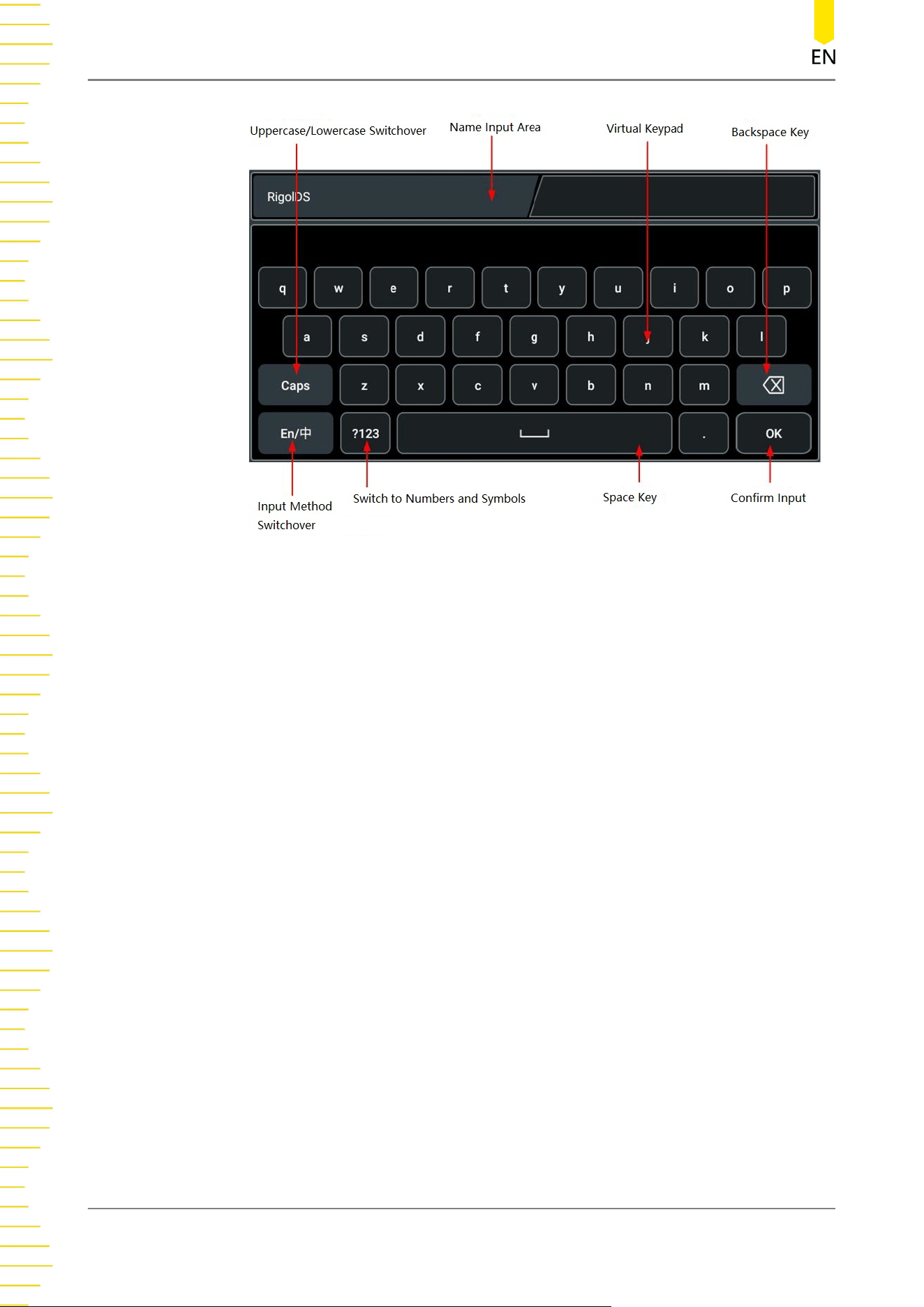
Figure 4.18 English Input Interface
1 Select English input method
First check the input method type. If it shows “En/中”, then go to Step 2; if it
shows “中/En”, click or tap the input method switchover key to switch to
“En/中” (English input method).
2 Clear the name input area
If there is no character in the "Name Input Area", please go to the next step. If
there are characters in the "Name Input Area", click or tap the Backspace key
to delete all the characters from the "Name Input Area" in order.
3 Input the upper-case letter
If you want to input an upper-case letter, first use the Caps key to switch
between the upper-case and lower-case mode. If the Caps key is selected,
input the upper-case letter with the virtual keypad. If not, first click or tap the
Caps key to ensure it is selected, then input the upper-case letter. All the input
letters will be displayed in the "Name Input Area”.
4 Input the lower-case letter
Refer to the operation specified in the previous step. If the Caps key is not
selected, directly input the lower-case letter.
5 Input numbers or symbols
If the letter keypad is displayed, you need to tap the numeric switchover key
to switch to the numeric keypad, and input numbers or symbols with the
Quick Start
DS70000 User Guide
34
Copyright ©RIGOL TECHNOLOGIES CO., LTD.
All rights reserved.
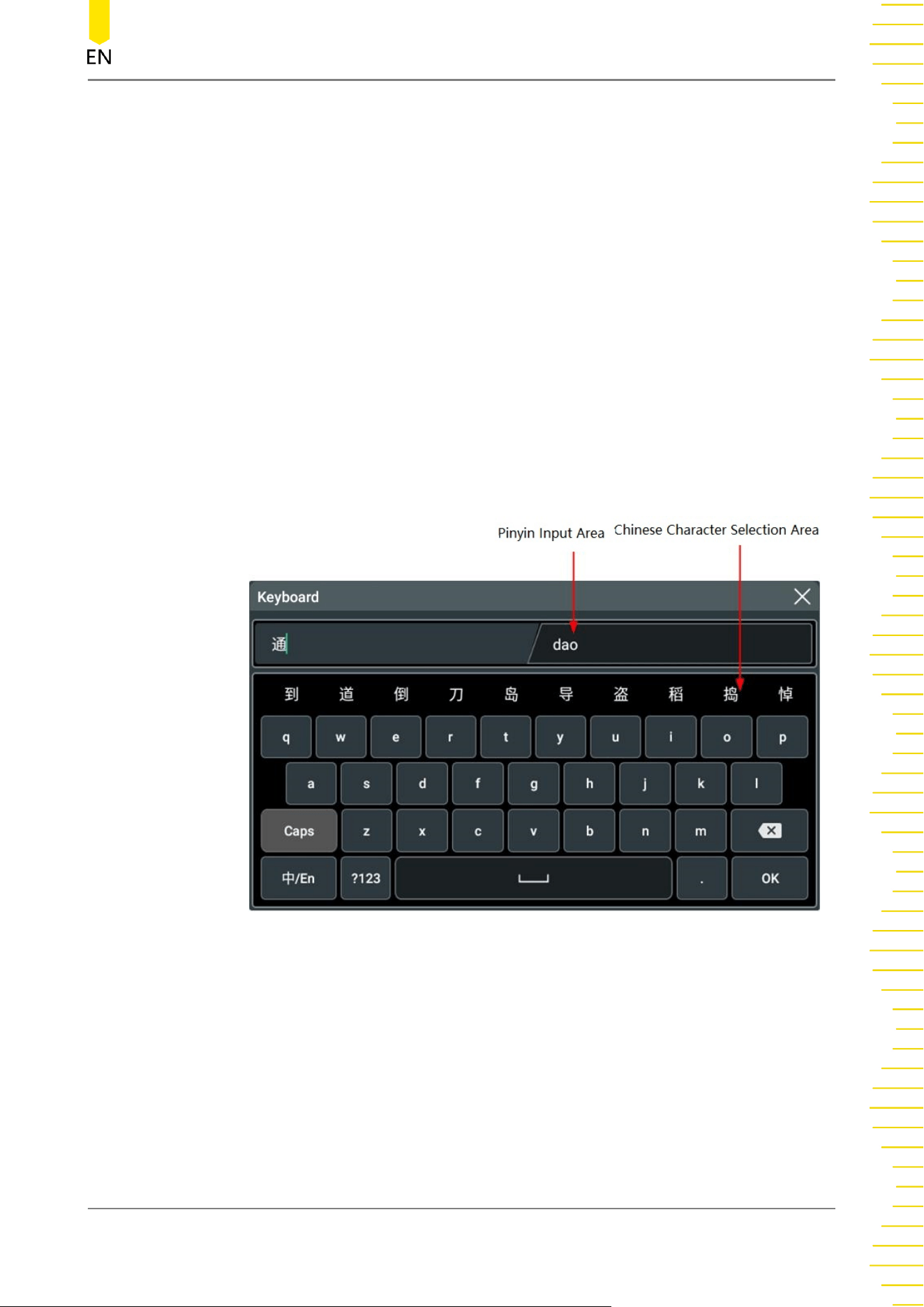
numeric keypad. All the input letters will be displayed in the "Name Input
Area”.
6 Modify or delete the unwanted characters that have been input
During the name input process, you can modify or delete the unwanted
character if necessary. To delete the characters that have been input, click or
tap the Backspace key in the virtual keypad to delete the characters. To
modify the characters that have been input, delete the unwanted characters
first and then input the new characters.
You can directly move the cursor to the character to be modified or deleted,
delete the desired character or input the new characters after deleting the
unwanted character.
7 Confirm the input
After completing the input operation, click or tap “OK”.
• Input Chinese Characters
Figure 4.19 Chinese Input Interface
1 Select Chinese input method
First check the input method type. If it shows “中/En””, then go to Step 2;
if it shows “En/中”, click or tap the input method switchover key to switch to
“中/En” (Chinese input method).
2 Clear the name input area
Quick Start
Copyright ©RIGOL TECHNOLOGIES CO., LTD.
All rights reserved.
DS70000 User Guide
35
If there is no character in the "Name Input Area", please go to the next step. If
there are characters in the "Name Input Area", click or tap the Backspace key
to delete all the characters from the "Name Input Area" in order.
If there are characters in the "Pinyin Input Area", when you delete characters
from the name input area, the characters in the Pinyin input area will be
deleted first.
3 Input Chinese characters
Click or tap the characters in the virtual keypad to input Pinyin into the input
area, then the characters to be selected will be displayed in the Chinese
character selection area. Slide to view more Chinese characters for you to
choose. Select the desired Chinese character, and then the selected character
will be displayed in the input area.
4 Modify or delete the unwanted characters that have been input
During the name input process, you can modify or delete the unwanted
character if necessary. To delete the characters that have been input, click or
tap the Backspace key in the virtual keypad. To modify the characters that
have been input, delete the unwanted characters first and then input the new
characters.
5 Confirm the input
After completing the input operation, click or tap “OK”.
Input a String
When naming a file or folder, you need to input a string with the keypad shown in
Figure 4.20
.
Quick Start
DS70000 User Guide
36
Copyright ©RIGOL TECHNOLOGIES CO., LTD.
All rights reserved.
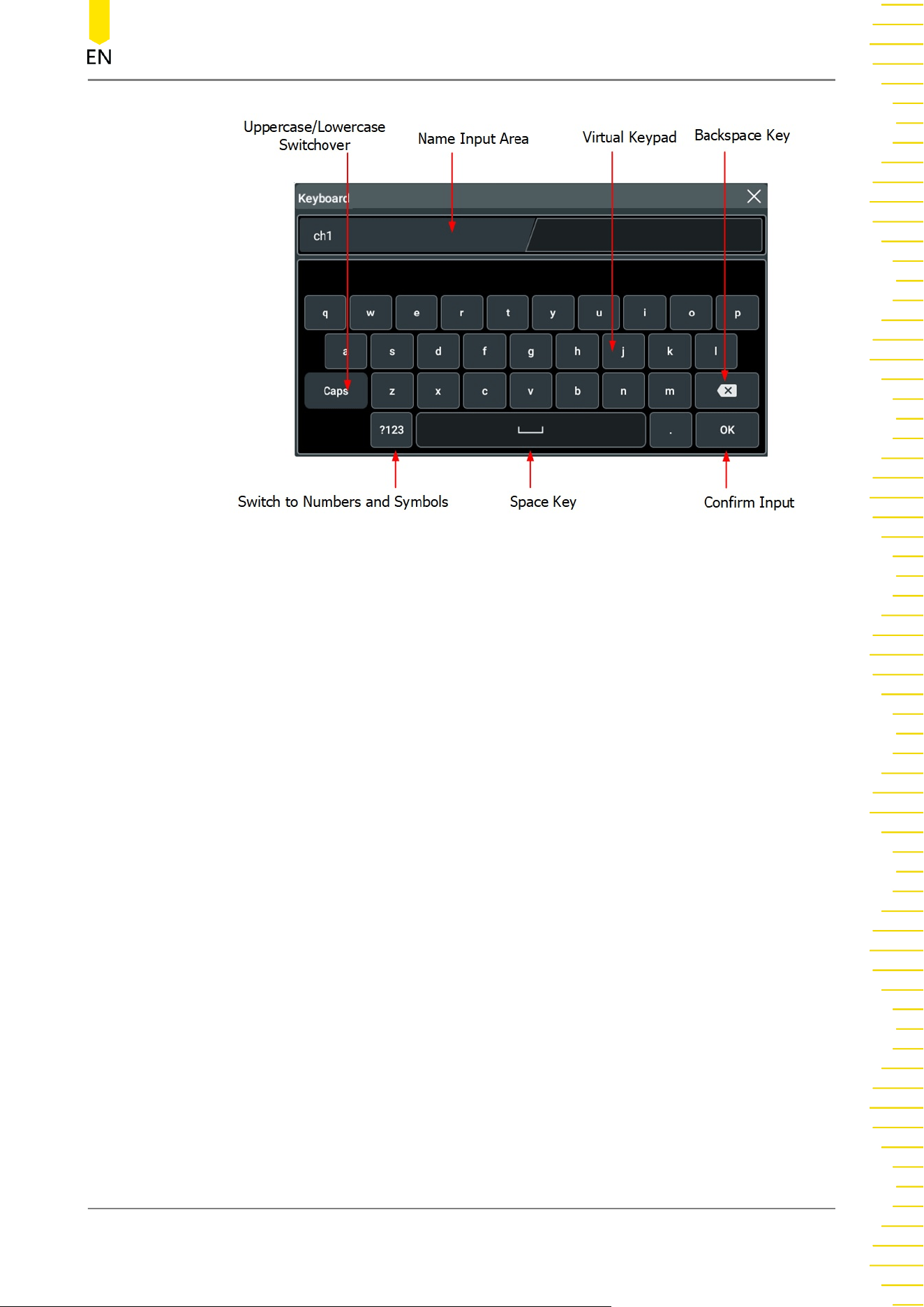
Figure 4.20 String Keypad
1 Clear the name input area
If there is no character in the "Name Input Area", please go to the next step. If
there are characters in the "Name Input Area", click or tap the Backspace key to
delete all the characters from the "Name Input Area" in order.
2 Input the upper-case letter
If you want to input an upper-case letter, first use the Caps key to switch between
the upper-case and lower-case mode. If the Caps key is selected, input the upper-
case letter with the virtual keypad. If not, first click or tap the Caps key to ensure it
is selected, then input the upper-case letter. All the input letters will be displayed
in the "Name Input Area”.
3 Input the lower-case letter
Refer to the operation specified in the previous step. If the Caps key is not
selected, directly input the lower-case letter.
4 Input numbers or symbols
If the letter keypad is displayed, you need to click or tap the numeric switchover
key to switch to the numeric keypad, and input numbers or symbols with the
numeric keypad. All the input letters will be displayed in the "Name Input Area”.
5 Modify or delete the unwanted characters that have been input
During the name input process, you can modify or delete the unwanted character
if necessary. To delete the characters that have been entered, click or tap the
Quick Start
Copyright ©RIGOL TECHNOLOGIES CO., LTD.
All rights reserved.
DS70000 User Guide
37
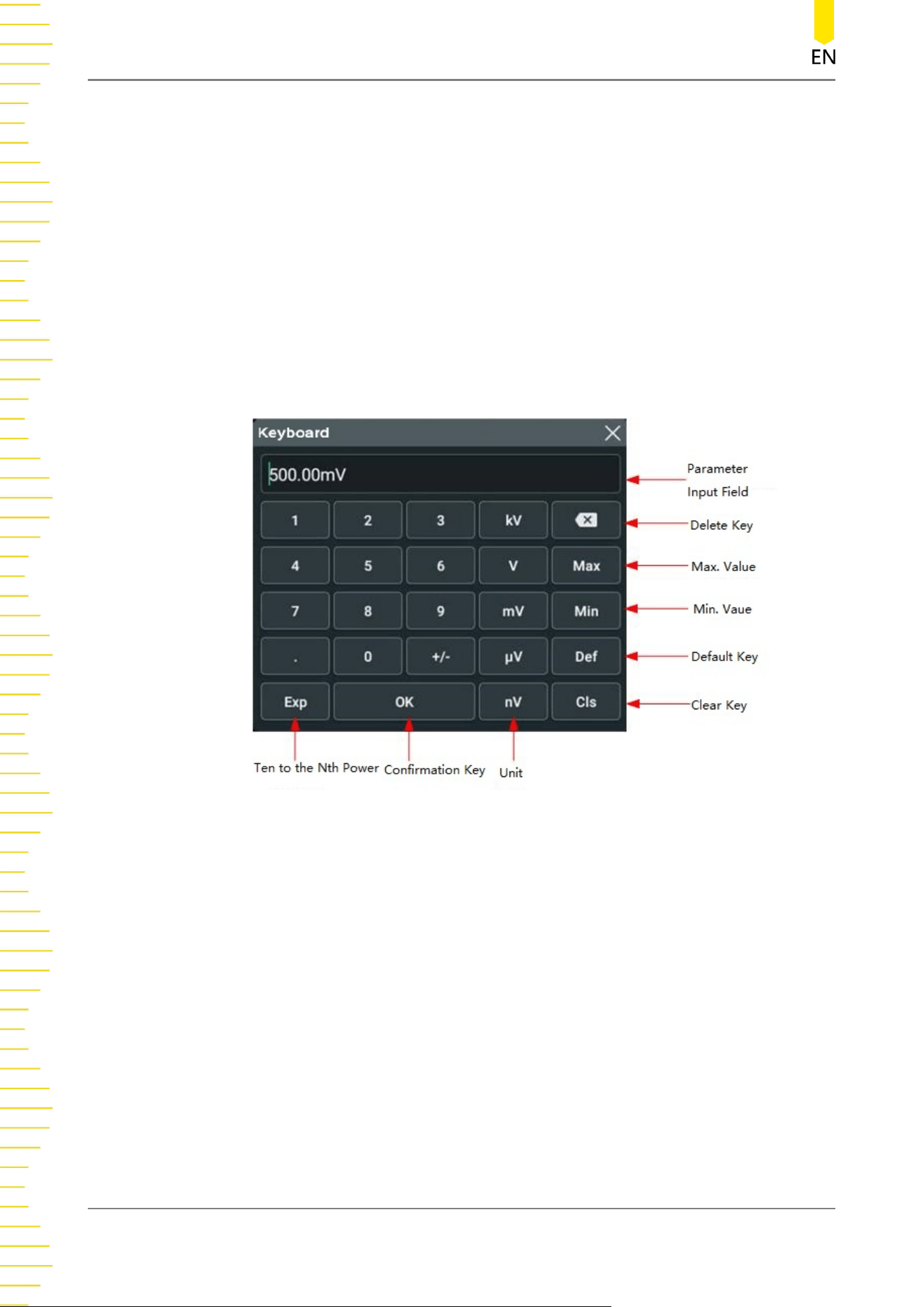
Backspace key in the virtual keypad. To modify the characters that have been
entered, delete the unwanted characters first and then input the new characters.
You can directly move the cursor to the character to be modified or deleted, delete
the desired character or input the new characters after deleting the unwanted
character.
6 Confirm the input
After completing the input operation, click or tap “OK”.
Input a Value
When setting or modifying a parameter, input an appropriate value with the keypad
in
Figure 4.21
.
Figure 4.21 Numeric Keypad
Click or tap the value or unit in the numeric keypad to complete the input. After you
input all the values and select the desired units, the numeric keypad is turned off
automatically. This indicates that you have completed parameter setting. Besides,
after you have input the values, you also also press “OK“ directly to close the
numeric keypad. At this time, the unit of the parameter is the default unit. In the
numeric keypad, you can perform the following operation:
• Deletes the parameter value that has been input;
• Sets the parameter value to a maximum or minimum value;
• Sets the parameter to a default value;
• Clears the parameter value.
Quick Start
DS70000 User Guide
38
Copyright ©RIGOL TECHNOLOGIES CO., LTD.
All rights reserved.
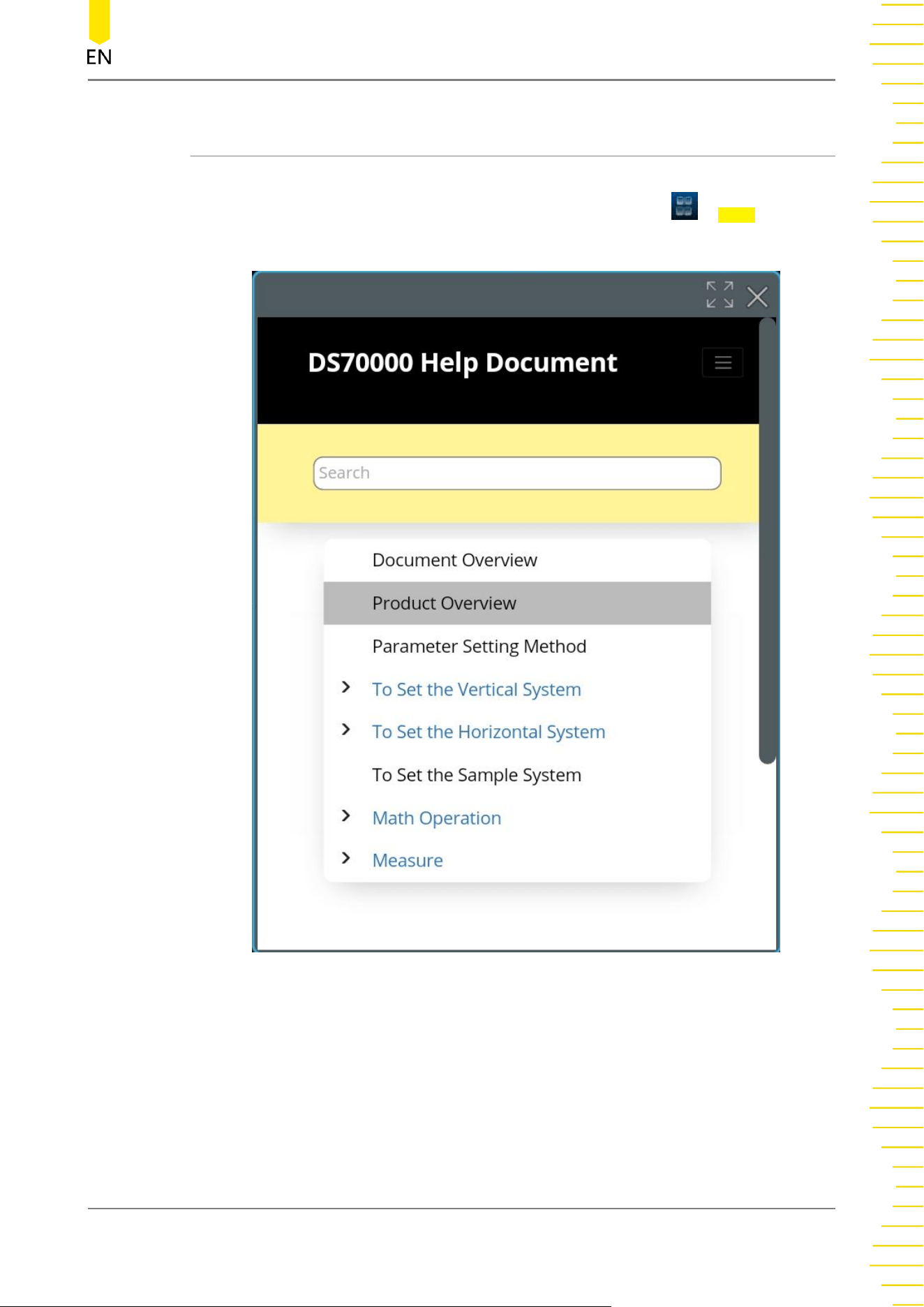
4.7 To Use the Built-in Help System
The help system of this oscilloscope provides instructions for all the function keys on
the front panel and their corresponding menu keys. Click or tap
> Help to enter
the help system.
Figure 4.22 Help Information
After opening the help interface, you can get its help information by clicking on or
tapping the link for the desired item.
Quick Start
Copyright ©RIGOL TECHNOLOGIES CO., LTD.
All rights reserved.
DS70000 User Guide
39
4.8 To View the Option Information and the Option
Installation
DS70000 series oscilloscope provides multiple options to fulfill your measurement
requirements. If you need any of these options, order them according to the Order
No. available in "
Appendix A: Options and Accessories
", and then install the options
according to this section. Besides, you can also view the options currently installed on
the oscilloscope or activate the newly purchased option.
1 View the installed option
The instrument is installed with the trial versions of the options before leaving
factory. When you power on the instrument for the first time, the trial time is
about 2,160 minutes. If your instrument has currently installed the options,
perform the following operations to view the name of the installed option and
other detailed information about the option.
- Click or tap the function navigation icon
at the lower-left corner of the
screen, and then select Utility to enter the utility function menu.
- Click or tap Option list to view the options currently installed.
2 Install the option
The option license is a string of fixed characters. The license file should be in
specific format, with the filename extension ".lic". After you purchase an option,
you will obtain a key (used for obtaining desired the option license code). Then,
you can install the option according to the following steps.
a Obtain an option license
a Log in to the RIGOL official website (
http://www.rigol.com
), click License
Activation to enter the "Registered product license code" interface.
b In the software license registration interface, input the correct key, serial
number (click or tap the function navigation icon
at the lower-left corner
of the screen, then select Utility > About to obtain the serial number of the
instrument), and verification code. Then click Generate to obtain the option
license. If you need to use the option license file, please click the link to
download the file to the root directory of the USB storage device.
b Install the option
a Confirm that the option license file is located in the root directory of the USB
storage device, and connect the USB storage device to the oscilloscope
properly.
b Install the option by sending SCPI commands. For details, refer to
DS70000
Programming Guide.
Quick Start
DS70000 User Guide
40
Copyright ©RIGOL TECHNOLOGIES CO., LTD.
All rights reserved.
c After installation, a prompt message "Option activated successfully" is
displayed. After the option has been installed, you are recommended to
restart the instrument.
Tip
• Only 1 option license file of one instrument is allowed to be stored in the same USB
storage device, but the USB storage device can store the option license file of several
different instruments. You are not allowed to modify the licensed filename.
• During the installation process, you are not allowed to power off the instrument or pull
out the USB storage device.
• Sending the SCPI commands (:SYSTem:OPTion:INSTall <license>) to install options is
supported. Installing options by inputting the license code manually is not supported.
Quick Start
Copyright ©RIGOL TECHNOLOGIES CO., LTD.
All rights reserved.
DS70000 User Guide
41
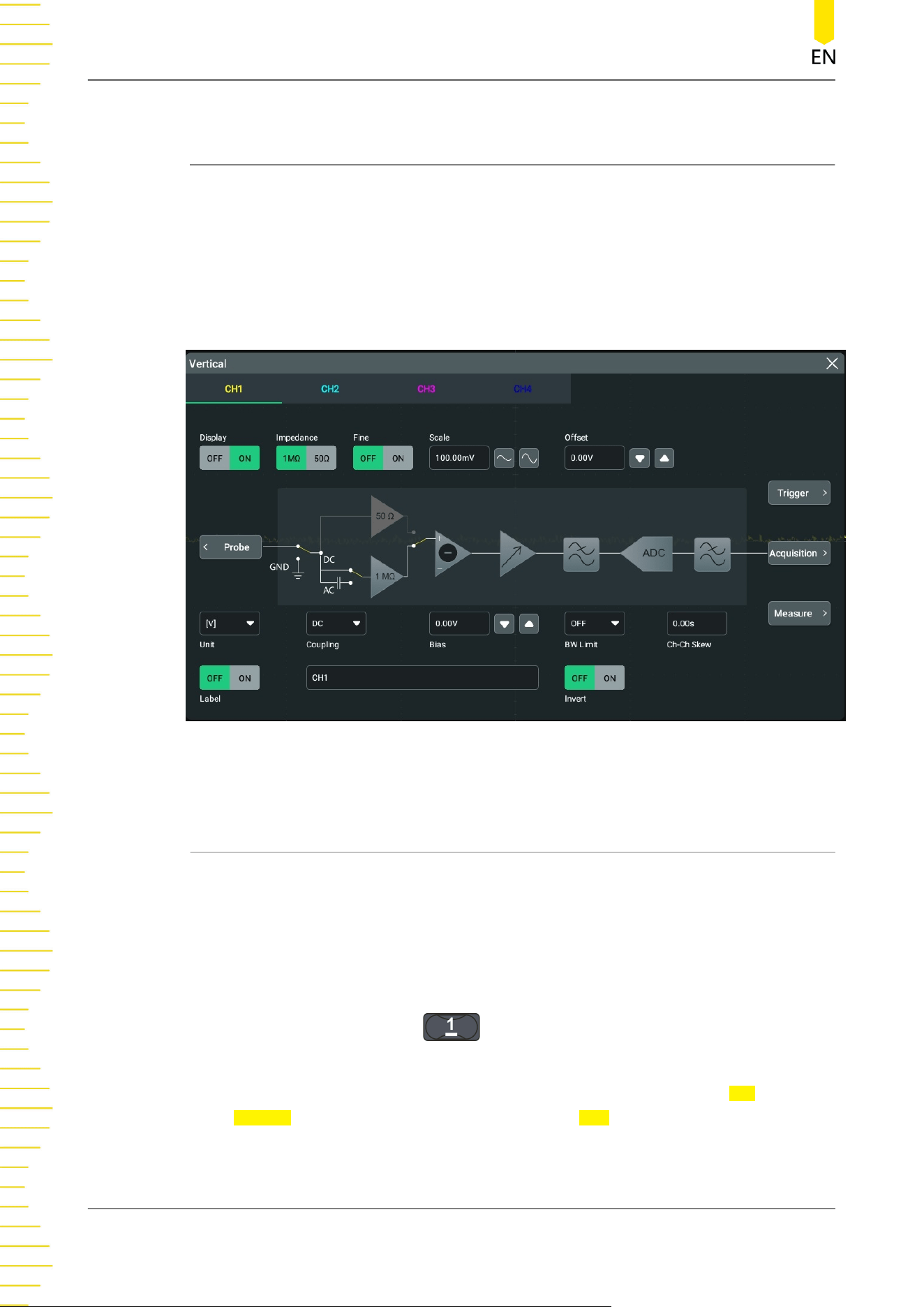
5 To Set the Vertical System
DS70000 series oscilloscope provides four analog input channels (CH1-CH4), and
each channel is equipped with an independent vertical control system. The setting
methods for the vertical systems of the four channels are the same. This chapter takes
CH1 as an example to introduce the setting method for the vertical system.
Enable the touch screen operation and tap the channel status label at the bottom of
the screen. Then the menu shown in the following figure is displayed.
Figure 5.1 Vertical Menu for Channel
5.1 To Enable or Disable the Analog Channel
Enable the analog channel
When a signal is connected to CH1, you can enable the channel by the following
methods.
• Click or tap the channel status label at the bottom of the screen to enable the
channel.
• Press the front-panel key to enable the channel, and the backlight of this
key and the corresponding channel key is illuminated.
• In
To Set the Vertical System
menu, select the CH1 tab, click or tap ON for the
Display menu item to turn CH1 on, and select OFF to turn CH1 off.
When the channel is selected, its channel status label at the bottom of the screen is
shown in the figure below.
To Set the Vertical System
DS70000 User Guide
42
Copyright ©RIGOL TECHNOLOGIES CO., LTD.
All rights reserved.
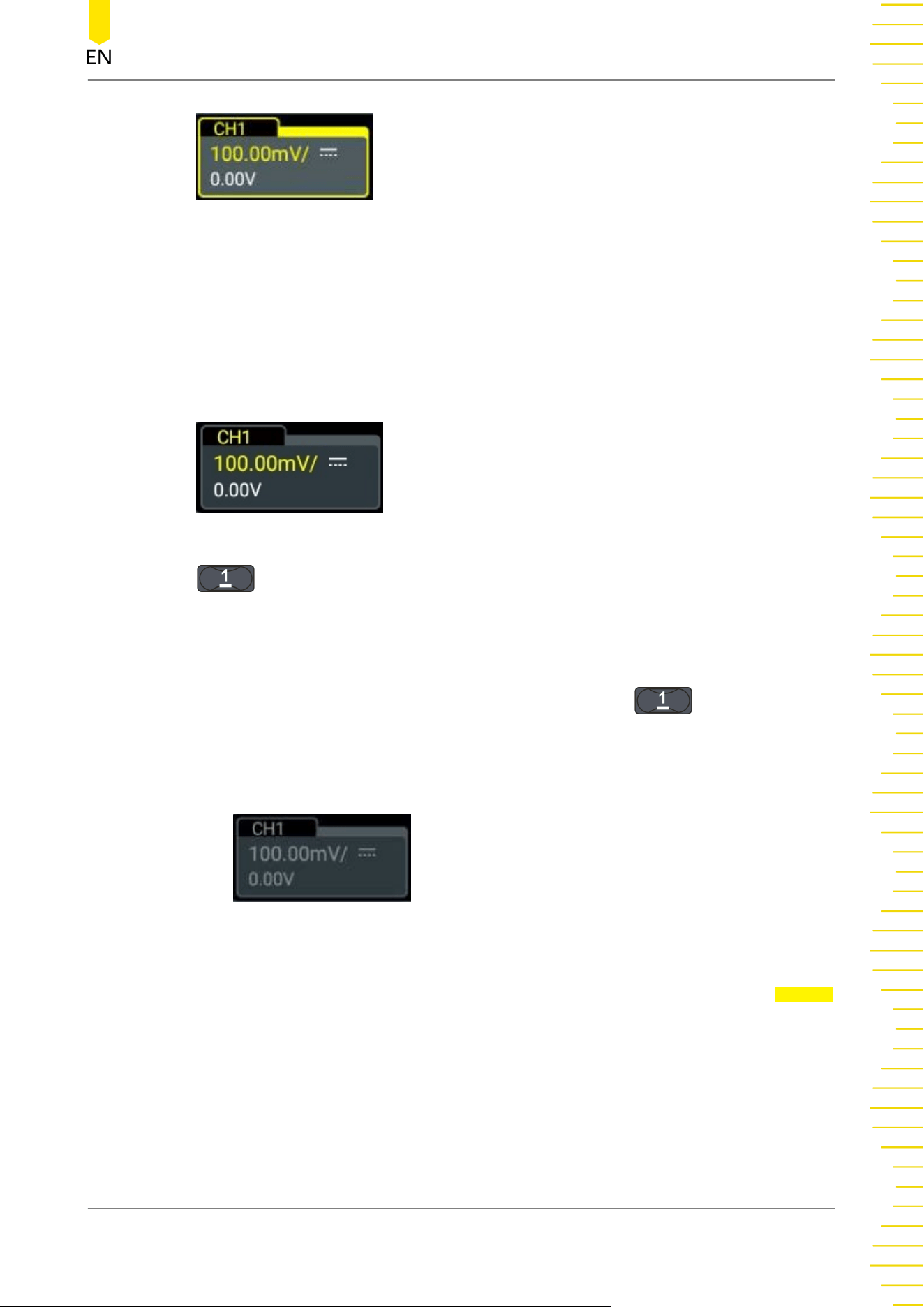
The information displayed in the channel status label is related to the current channel
setting (irrelevant with the on/off status of the channel). After the channel is turned
on, modify the parameters such as the vertical scale, horizontal time base, trigger
mode, and trigger level according to the input signal for easy observation and
measurement of the waveform.
If CH1 is enabled but not activated, the channel status label is shown in the following
figure.
Click/tap the channel status label at the bottom of the screen or press the button
on the front panel to activate the channel CH1.
Disable the analog channel
Disable the analog channels by using the following several methods.
• If CH1 has been enabled and activated, you can press on the front panel
to disable it directly. You can also click or tap the channel status label at the
bottom of the screen to disable the channel. If CH1 is disabled, the channel
status label is shown in the figure below.
• If CH1 has been enabled but not activated, first click or tap the CH1 channel
status label at the bottom of the screen, then click or tap it again to disable CH1.
• In
To Set the Vertical System
, you can also disable the channel by setting Display
to OFF.
• Also, you can tap to slide down the channel label to disable the channel.
5.2 To Adjust the Vertical Scale
Vertical scale indicates the voltage value per grid in the vertical axis of the screen. It is
often expressed in V/div. While you adjust the vertical scale, the display amplitude of
To Set the Vertical System
Copyright ©RIGOL TECHNOLOGIES CO., LTD.
All rights reserved.
DS70000 User Guide
43
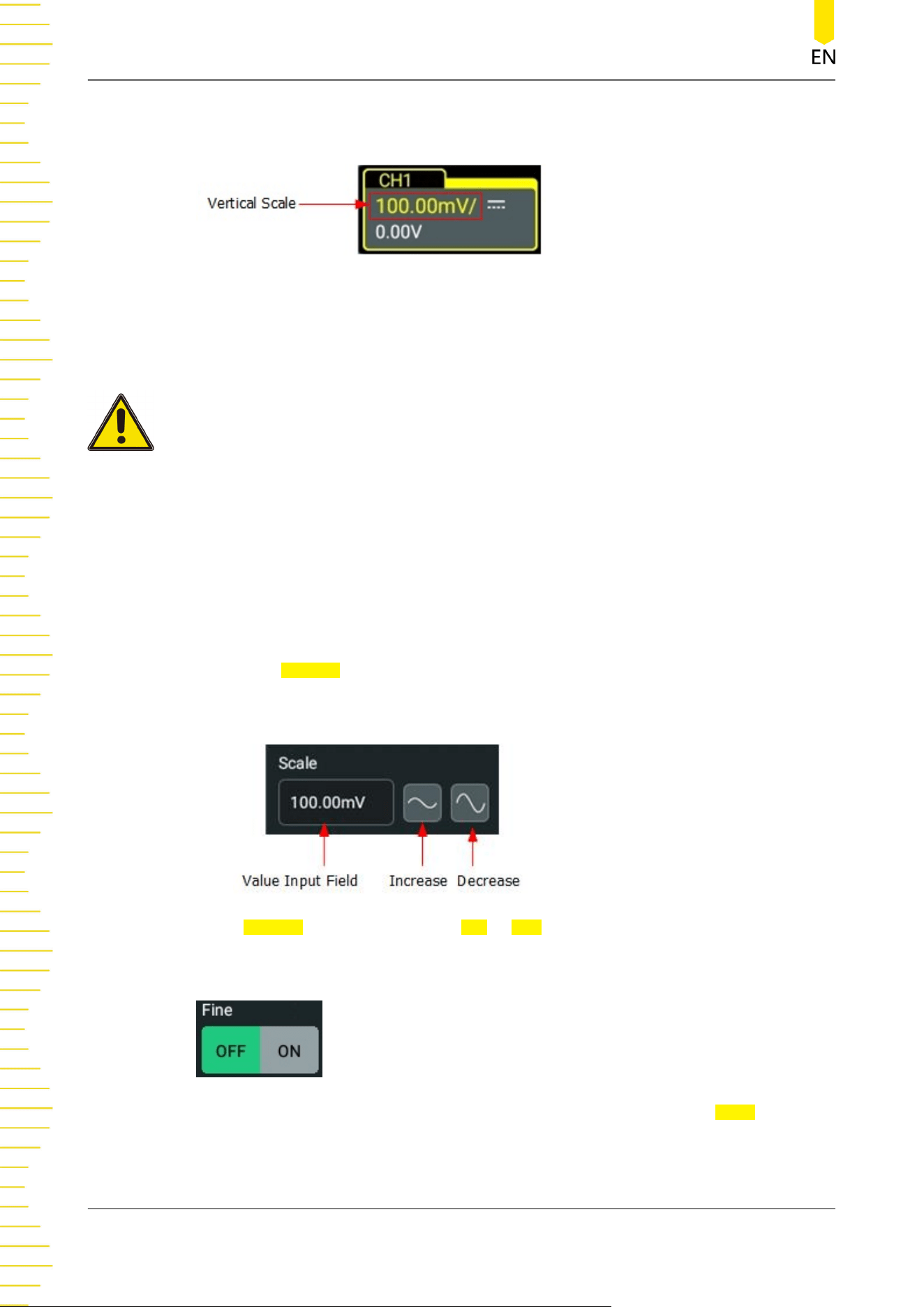
the waveform would enlarge or reduce. The scale information of the channel status
label at the bottom of the screen would change accordingly.
The adjustable range of the vertical scale is related to the currently set probe ratio
and input impedance. By default, the probe ratio is 1X and the input impedance is 1
MΩ. In this case, the adjustable range of the vertical scale is from 1 mV/div to 10 V/
div.
Caution
When the vertical scale is 1 mV/div and 2 mV/div, the 250M bandwidth limit will be
enabled automatically.
When CH1 is turned on, you can adjust the vertical scale with the following methods:
• Rotate the knob that corresponds to CH1 to adjust the vertical scale (clockwise
to reduce the scale and counterclockwise to increase).
• Enable the touch screen function, and then adjust the vertical scale with the
pinch & stretch gesture on the touch screen. For details, refer to descriptions in
Pinch&Stretch
.
• In the Vertical system menu, click or tap the icon at the right side of the input
field of Scale to increase or decrease the scale value. You can also tap the input
field to input a specific value with the displayed numeric keypad.
In the Vertical system menu, select ON or OFF to enable or disable the fine
adjustment. By default, it is OFF. You can also press down the vertical scale knob on
the small screen to enable or disable the fine adjustment.
• Fine adjustment: Click or tap the icon at the right section of the Scale menu to
further adjust the vertical scale within a relatively smaller range to improve
vertical resolution. If the amplitude of the input waveform is a little bit greater
than the full scale under the current scale and the amplitude would be a little bit
To Set the Vertical System
DS70000 User Guide
44
Copyright ©RIGOL TECHNOLOGIES CO., LTD.
All rights reserved.
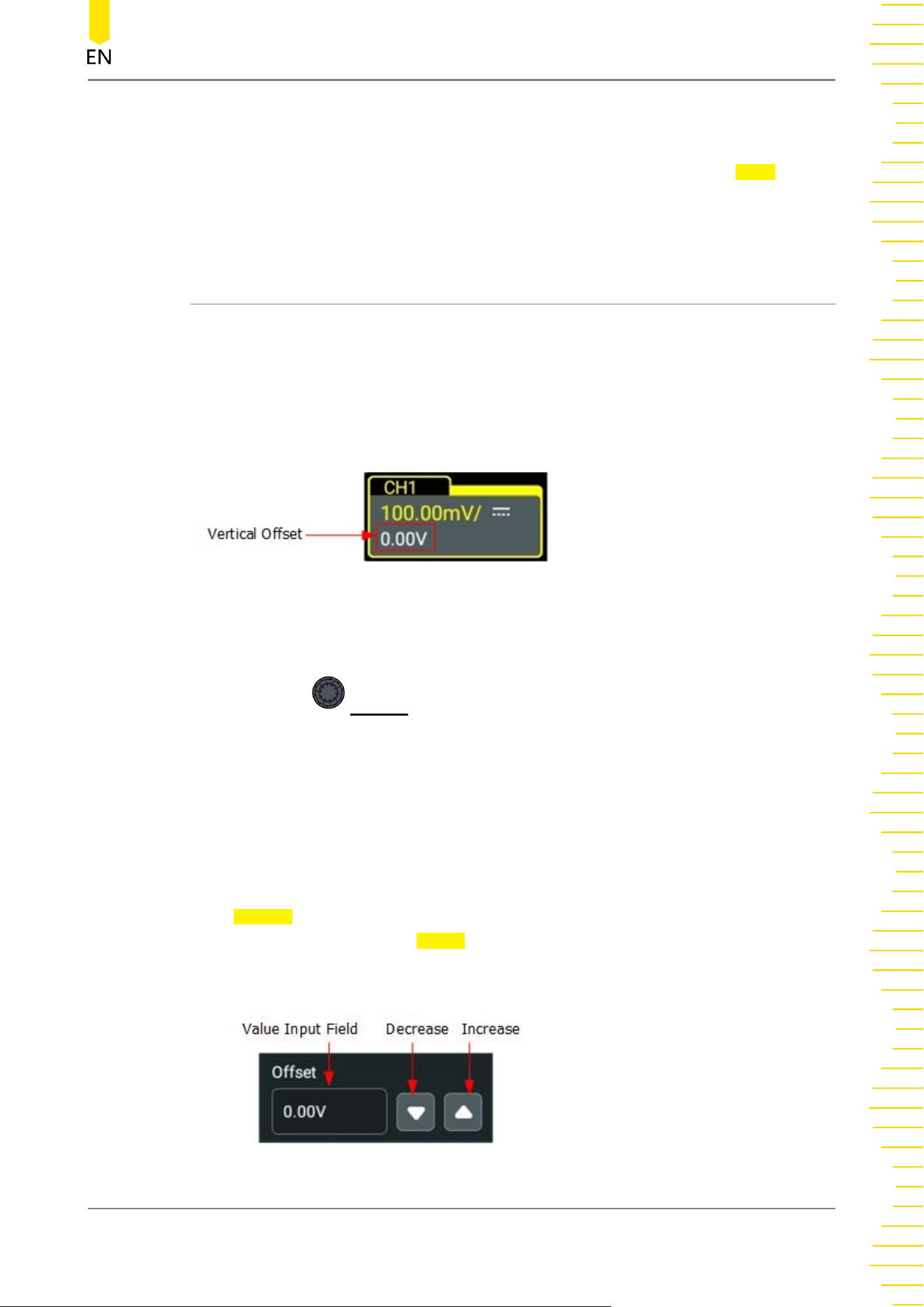
lower if the next scale is used, fine adjustment can be used to improve the
amplitude of waveform display to view signal details.
• Coarse adjustment: Click or tap the icon at the right section of the Scale menu
to adjust the vertical scale at 1-2-5 step, i.e. 1 mV/div, 2 mV/div, 5 mV/div, 10
mV/div…10 V/div.
5.3 To Adjust the Vertical Offset
Vertical offset indicates the offset of the signal ground level position of the waveform
from the screen center in the vertical direction. Its unit is consistent with the currently
selected amplitude unit (refer to "
Amplitude Unit
"). When adjusting the vertical offset,
the waveforms of the corresponding channel moves up and down. The vertical offset
information (as shown in the following figure) in the channel status label at the
bottom of the screen will change accordingly.
The adjustable range of the vertical scale is related to the currently set probe ratio
and input impedance.
When CH1 is turned on, you can adjust the vertical scale with the following methods:
• Rotate the OFFSETknob at the right section of the front panel to adjust the
vertical offset within the adjustable range. Rotate this knob clockwise to increase
the vertical offset, and rotate it counterclockwise to reduce the vertical offset.
Pressing down the knob can quickly reset the vertical offset (set the vertical
offset to 0).
• Enable the touch screen function, and then adjust the vertical offset with the
drag gesture. For details, refer to the "
Drag
" section.
• Click or tap the channel status label at the bottom of the screen. Then the
Vertical menu is displayed. Click or tap the Up and Down arrow icon at the right
side of the input field of Offset to increase or decrease the offset value. You can
also tap the input field to input a specific value with the displayed numeric
keypad.
To Set the Vertical System
Copyright ©RIGOL TECHNOLOGIES CO., LTD.
All rights reserved.
DS70000 User Guide
45
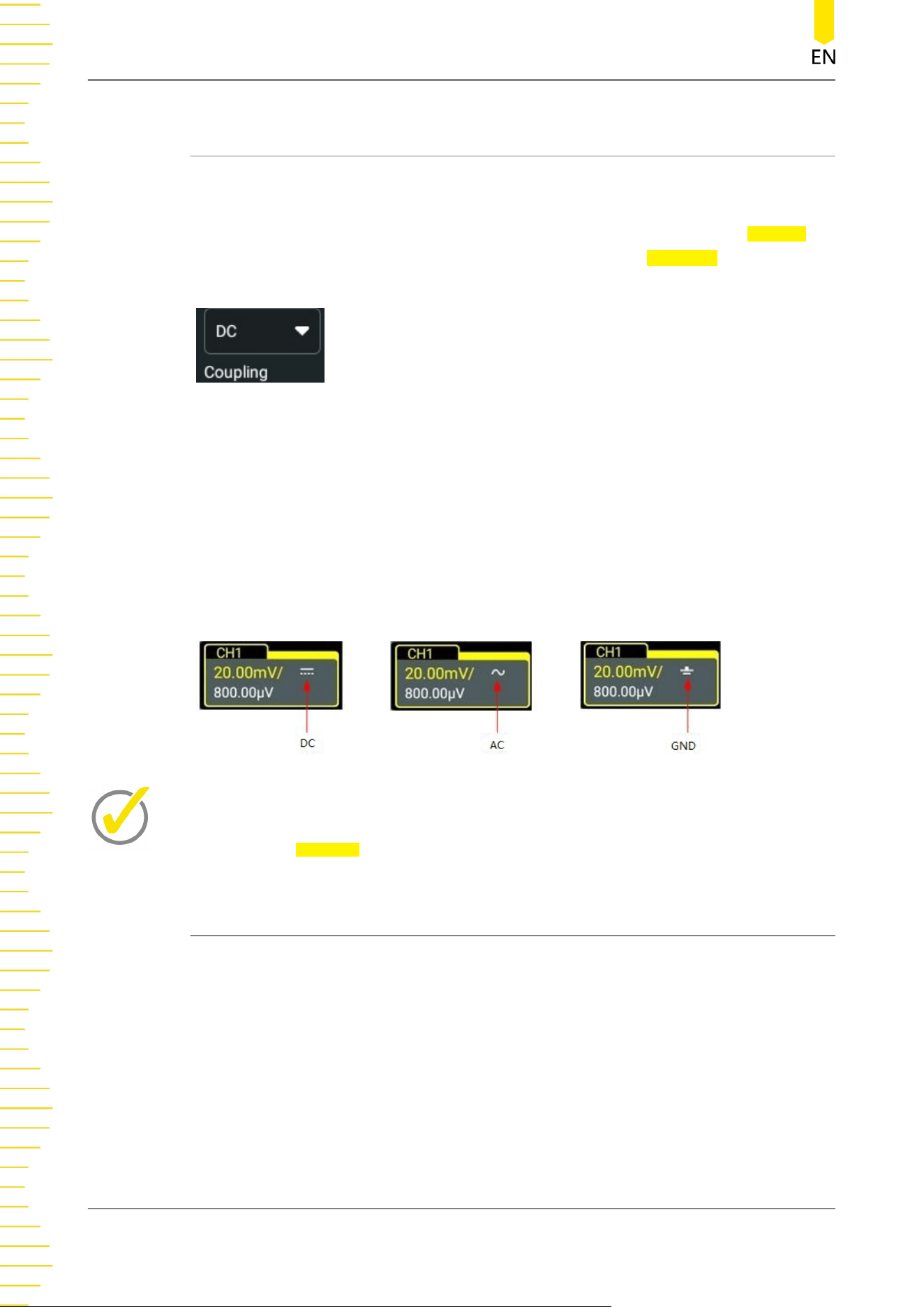
5.4 Channel Coupling
The undesired signals can be filtered out by setting the coupling mode. For example,
the signal under test is a square waveform with DC offset.
Click or tap the channel status label at the bottom of the screen. Then the Vertical
menu is displayed. Click or tap the drop-down button of the Coupling menu to select
the coupling mode.
• When the coupling mode is "DC": the DC and AC components of the signal
under test can both pass the channel.
• When the coupling mode is "AC": the DC components of the signal under test
are blocked.
• When the coupling mode is "GND": the DC and AC components of the signal
under test are blocked.
After selecting the coupling mode, the currently selected coupling mode is displayed
in the channel status label at the bottom of the screen, as shown in the figure below.
Tip
When the input impedance is set to "50 Ω", the channel coupling is set to DC coupling by
force, and the
Coupling menu is grayed out and cannot be modified.
5.5 BW Limit
This oscilloscope supports the bandwidth limit function. Setting the bandwidth limit
can reduce the noises in the displayed waveforms. For example, the signal under test
is a pulse with high frequency oscillation.
• When the bandwidth limit is disabled, the high frequency components of the
signal under test can pass the channel.
• If you enable the bandwidth limit and limit it to 20 MHz or 250 MHz, the high
frequency components found in the signal under test that are greater than 20
MHz or 250 MHz are attenuated.
To Set the Vertical System
DS70000 User Guide
46
Copyright ©RIGOL TECHNOLOGIES CO., LTD.
All rights reserved.
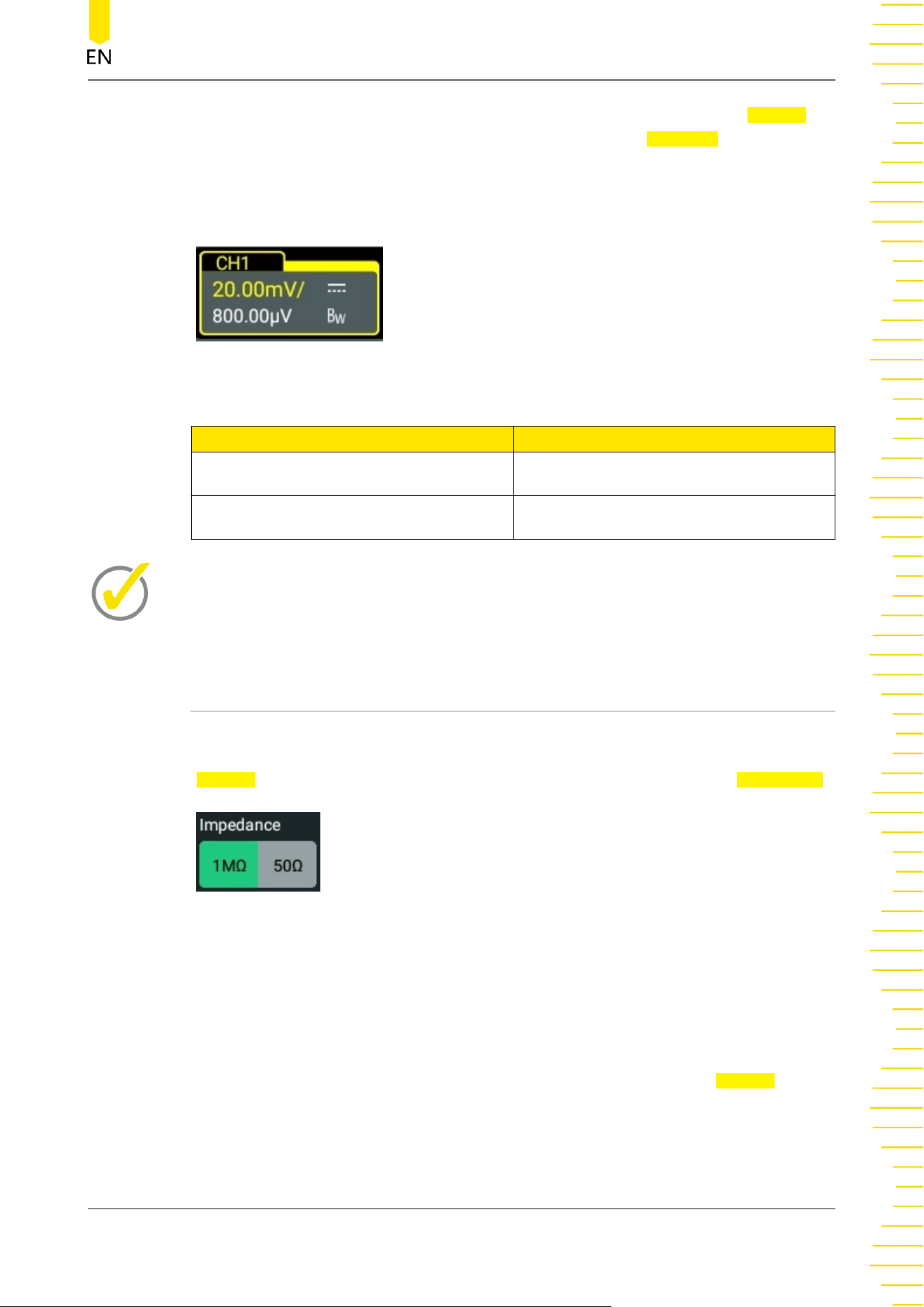
Click or tap the channel status label at the bottom of the screen. Then the Vertical
menu is displayed. Click or tap the drop-down button of the BW Limit menu to select
OFF, 20 M, or 250 M. By default is OFF.
When the bandwidth limit is enabled, the character "Bw" will be displayed in the
channel status label at the bottom of the screen.
Table 5.1 BW Limit
Input Impedance of the Oscilloscope Available Bandwidth Limit
50 Ω 20 MHz, 250 MHz, 1 GHz or 2 GHz
1 MΩ 20 MHz, 250 MHz
Tip
Bandwidth limit can not only reduce the noise, but also can attenuate or eliminate the high
frequency components of the signal.
5.6 Input Impedance
To reduce the circuit load between the oscilloscope and the circuit under test, this
oscilloscope provides two input impedance modes: 1 MΩ (default) and 50 Ω. In the
Vertical system menu, click or tap to select “1 MΩ” or “50 Ω” under Impedance.
• 1 MΩ: The input impedance of the oscilloscope is very high, and the current
flowed from the circuit under test can be ignored.
• 50 Ω: makes the oscilloscope match with the device whose input impedance is
50 Ω.
After modifying the input impedance value, the circuit diagram in the Vertical system
menu will also be changed, as shown in the figure below.
To Set the Vertical System
Copyright ©RIGOL TECHNOLOGIES CO., LTD.
All rights reserved.
DS70000 User Guide
47
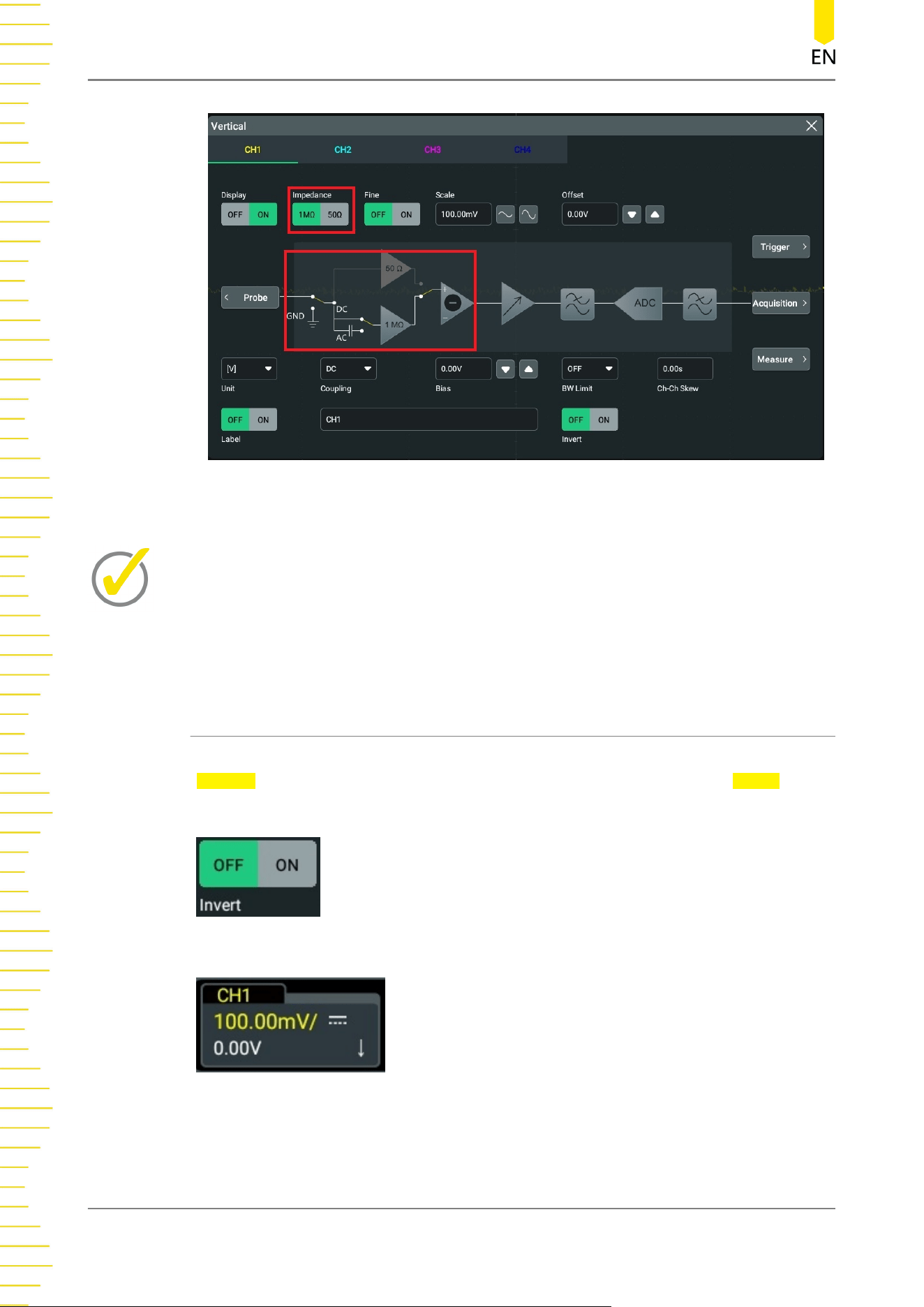
Figure 5.2 Input Impedance Modification
Tip
• After the oscilloscope recognizes the probe automatically, the input impedance will also
be auto recognized. You do not have to set it manually.
• The setting of the input impedance will affect the ranges of channel vertical scale and
offset.
5.7 Waveform Invert
Click or tap the channel status label at the bottom of the screen, and then the
Vertical menu is displayed. Then click or tap the ON/OFF button for the Invert menu
item to enable/disable the waveform invert function.
When enabled, the channel label is shown in the following figure.
When the waveform invert is turned off, the waveform is displayed normally; when
the waveform invert is turned on, the voltage values of the displayed waveform are
inverted, as shown in the figure below. Enabling the waveform invert will also change
the result of math function, waveform measurement, etc.
To Set the Vertical System
DS70000 User Guide
48
Copyright ©RIGOL TECHNOLOGIES CO., LTD.
All rights reserved.
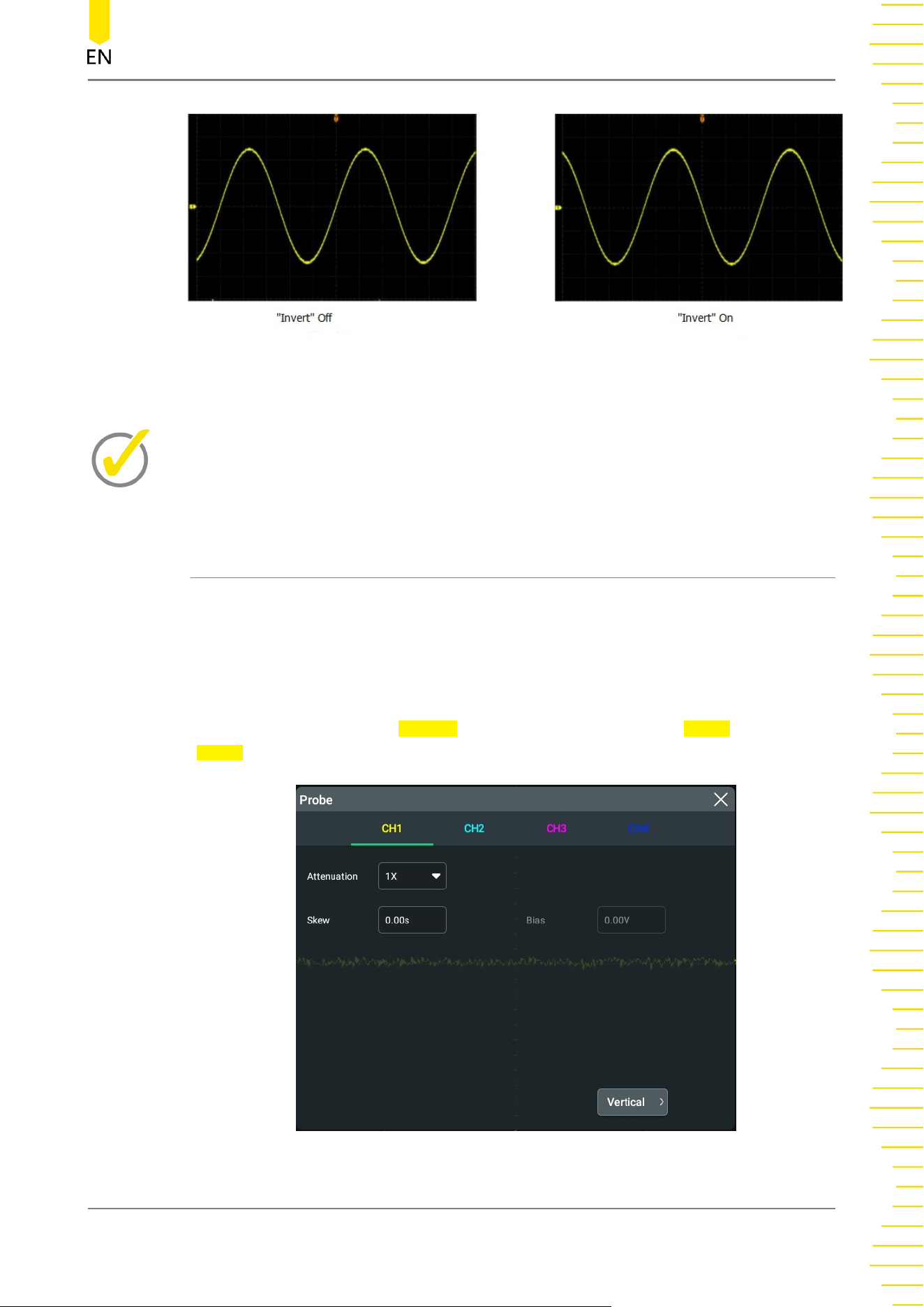
Figure 5.3 Waveform Invert
Tip
When the waveform invert is turned on, the trigger (e.g. Edge trigger, Pulse trigger, or Slope
trigger) edge or polarity will be changed.
5.8 Probe
The analog channel of this oscilloscope not only supports the common passive probe,
but also the active probe. It can automatically recognize the currently connected
probe type and its probe ratio. For detailed technical information of the probes,
please refer to the corresponding Probe User Guide.
Enable the touch screen operation and tap the channel status label at the bottom of
the screen. Then the menu Vertical is displayed. Then click or tap Probe to enter the
Probe setting menu, as shown in the figure below.
Figure 5.4 Probe Setting Menu
To Set the Vertical System
Copyright ©RIGOL TECHNOLOGIES CO., LTD.
All rights reserved.
DS70000 User Guide
49
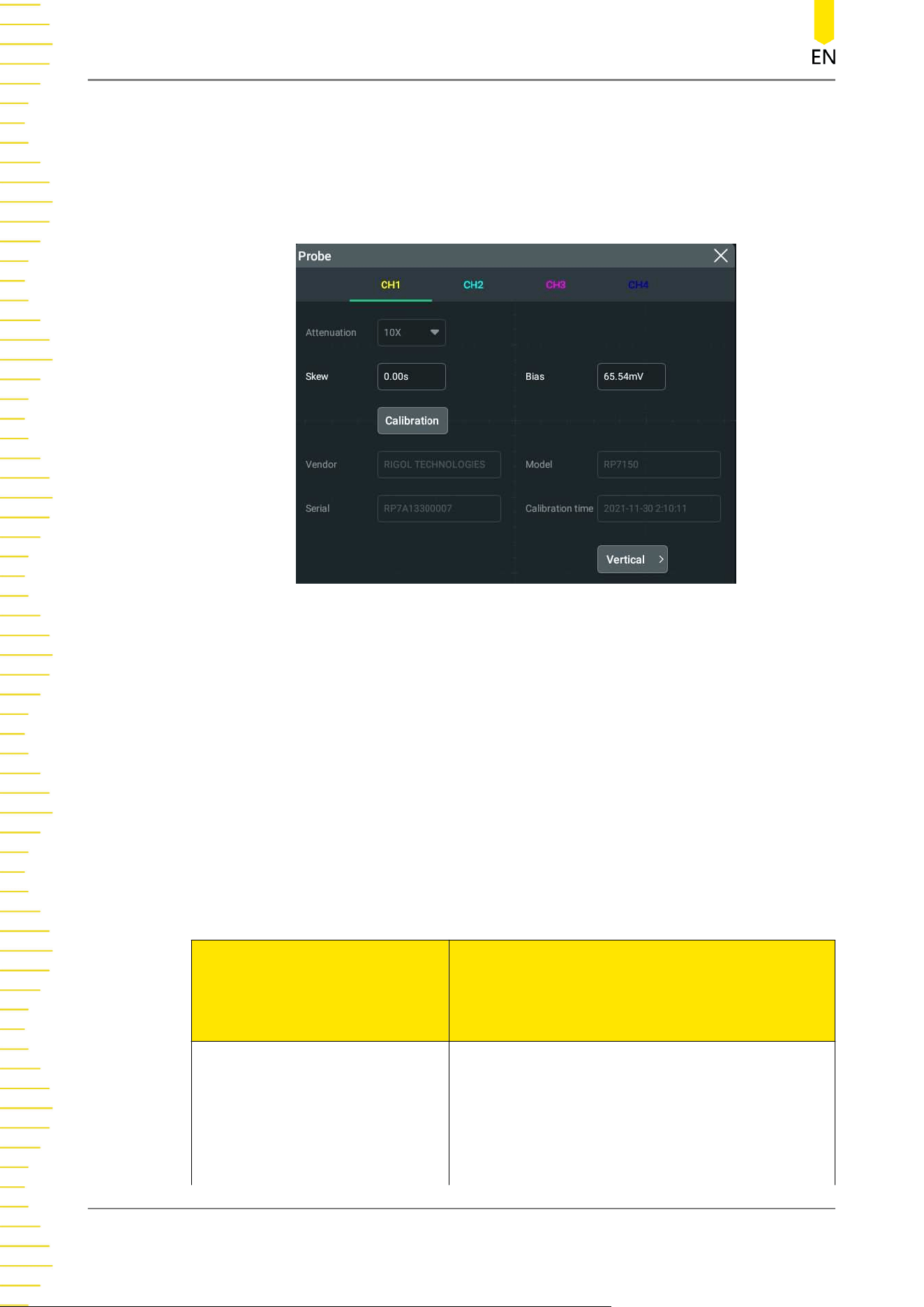
If the instrument works with the RP7000, PVA7000, or PVA8000 series probe, the
probe menu is shown in the figure below. You cannot set the probe ratio and need to
calibrate the probe. For specific probe models, please refer to
DS70000 Data Sheet
.
For detailed technical information of the probes, please refer to the corresponding
Probe User Guide.
Figure 5.5 RP7000/PVA7000/PVA8000 Series Probe Setting Menu
Slide to select the channel number (CH1-CH4), or click/tap the channel number to
switch to probe setting interface for different channels.
Probe Ratio
The oscilloscope allows you to set the probe attenuation manually. To obtain the
correct measurement results, you must set the probe ratio properly. By default, the
probe ratio is 1X.
The probe ratio values available are as shown in the following table.
Table 5.2 Probe Ratio
Menu
Attenuation
(display amplitude of the signal: actual
amplitude of the signal)
0.0001X
0.0002X
0.0005X
0.001X
0.0001:1
0.0002:1
0.0005:1
0.001:1
To Set the Vertical System
DS70000 User Guide
50
Copyright ©RIGOL TECHNOLOGIES CO., LTD.
All rights reserved.
Menu
Attenuation
(display amplitude of the signal: actual
amplitude of the signal)
0.002X
0.005X
0.01X
0.02X
0.05X
0.1X
0.2X
0.5X
1X (default)
2X
5X
10X
20X
50X
100X
200X
500X
1000X
2000X
5000X
10000X
20000X
50000X
0.002:1
0.005:1
0.01:1
0.02:1
0.05:1
0.1:1
0.2:1
0.5:1
1:1
2:1
5:1
10:1
20:1
50:1
100:1
200:1
500:1
1000:1
2000:1
5000:1
10000:1
20000:1
50000:1
Tip
The oscilloscope auto-recognizes certain probes with a fixed attenuation ratio. After being
recognized, the probe ratio will also be auto recognized. You do not have to set it manually.
Skew
Click or tap the input field of Skew to set the delay time for the probe. Its range is
from -100.00 ns to 100.00 ns. The default value is 0.00 s.
To Set the Vertical System
Copyright ©RIGOL TECHNOLOGIES CO., LTD.
All rights reserved.
DS70000 User Guide
51
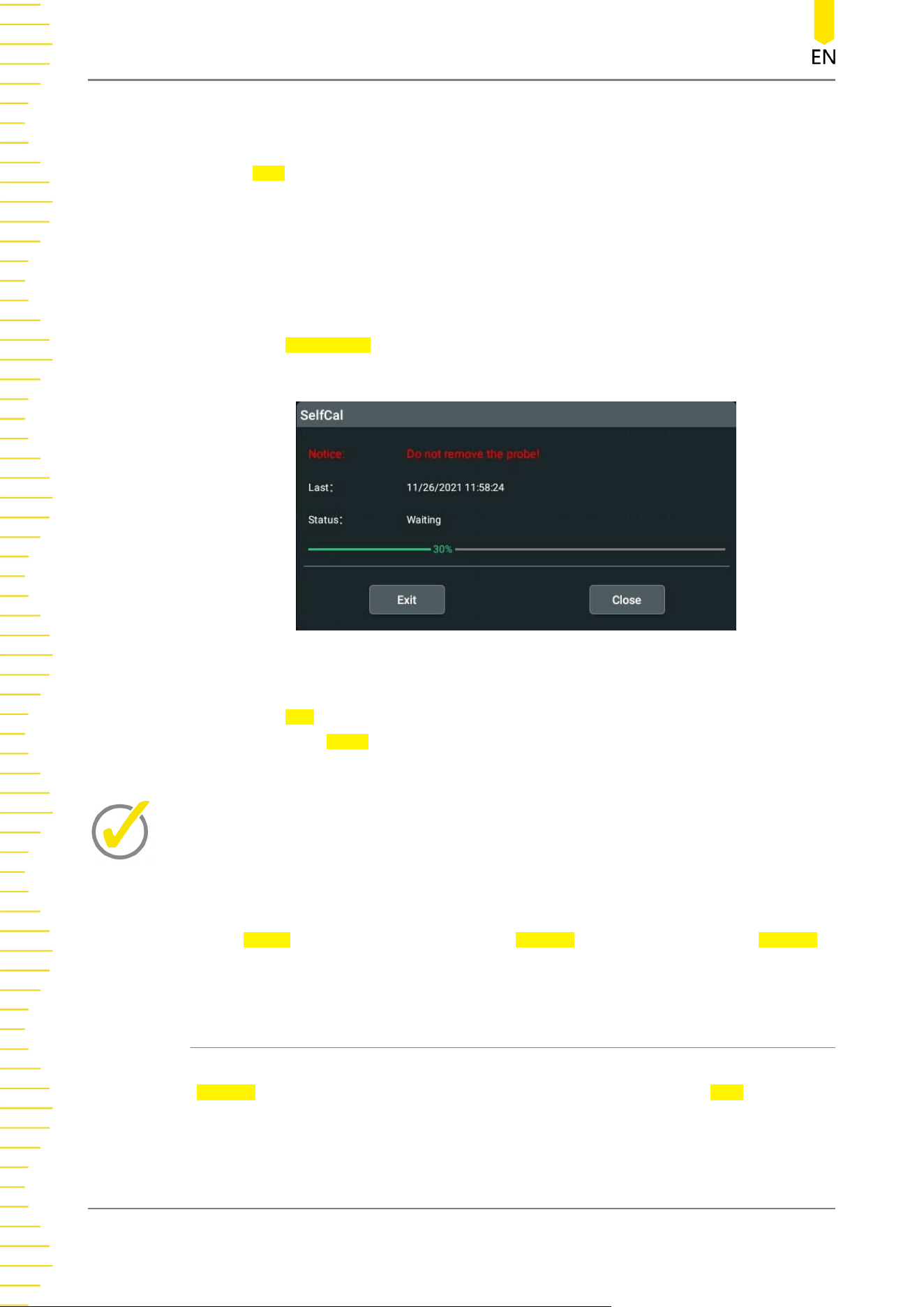
Bias
When working with the RP7000/PVA7000/PVA8000 series probe, click or tap the input
field of Bias to set the bias voltage of the probe.
Probe Information
In the probe menu, you can view information about the currently connected probe,
such as the vendor, model, serial number, and the last calibration time.
Probe Calibration
Click or tap Calibration to start the calibration operation. Then the self-calibration
window is displayed, as shown in the figure below.
Figure 5.6 SelfCal
Click or tap Exit in the self-calibration window to cancel the probe calibration at any
time. Click or tap Close to close the current self-calibration window. After completing
the calibration for the probe, the measurement results can be more accurate.
Tip
If the current channel is disabled, launching the self-calibration will enable the current channel
automatically. During the self-calibration, the touch-enabled operation is disabled.
Go Back to the Vertical System Menu
In the
Probe setting menu, click or tap the Vertical menu to go back to the Vertical
system menu.
5.9 Amplitude Unit
Click or tap the channel status label at the bottom of the screen, and then the
Vertical menu is displayed. Click or tap the drop-down button of the Unit text box to
select W, A, V, or U. The default unit is V.
To Set the Vertical System
DS70000 User Guide
52
Copyright ©RIGOL TECHNOLOGIES CO., LTD.
All rights reserved.
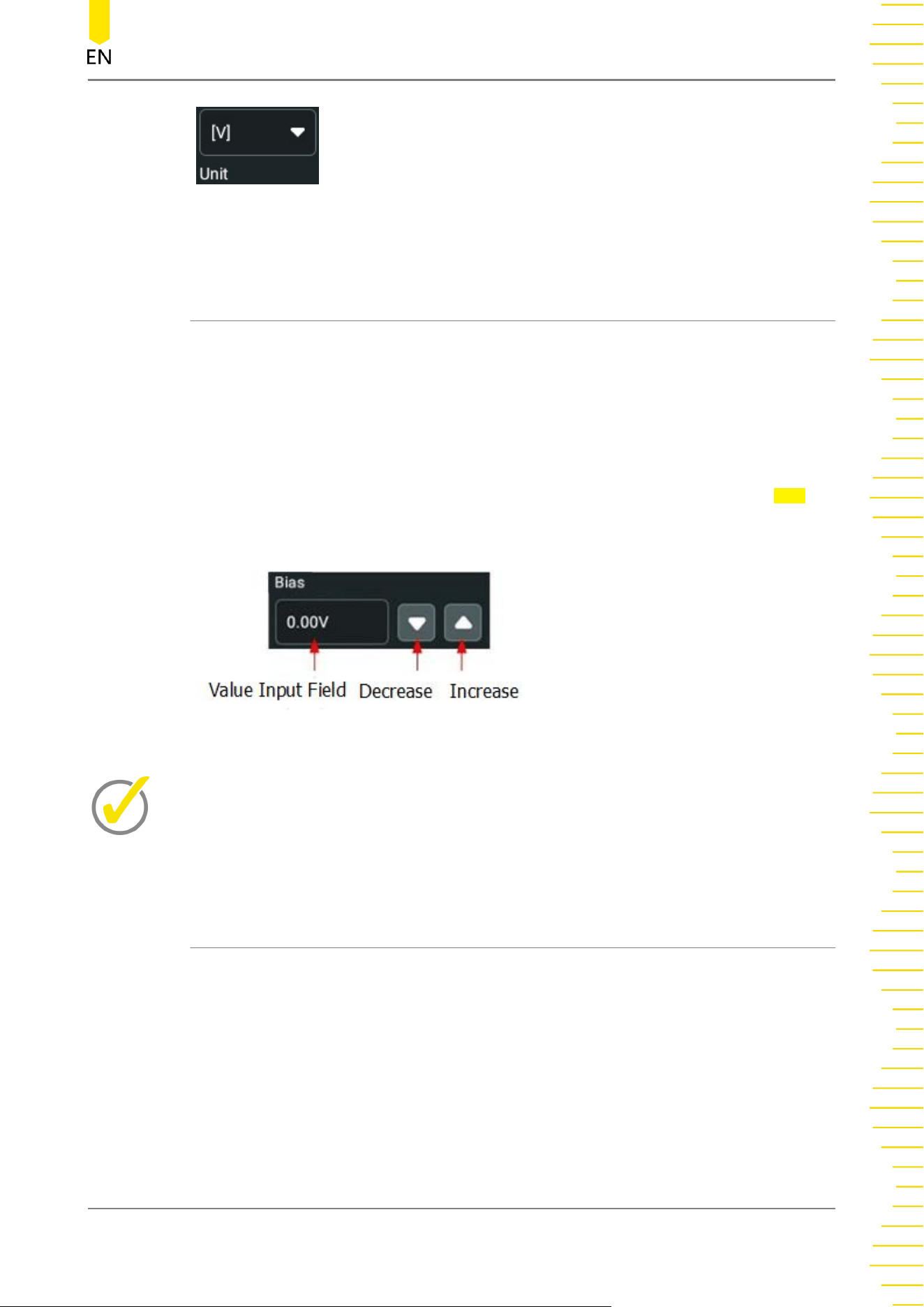
When the amplitude unit is changed, the unit related to the channel will also be
changed accordingly.
5.10 Bias
When you use an oscilloscope to make actual measurements, a small offset that arises
from the temperature drift of the component or external environment disturbance
may occur on the zero-cross voltage of the channel, which will affect the
measurement results of the vertical parameters. DS70000 series oscilloscope allows
you to set an offset calibration voltage for calibrating the zero point of the
corresponding channel, so as to improve the accuracy of the measurement results.
Click or tap the Up and Down arrow icon at the right side of the input field of Bias to
increase or decrease the bias value. You can also tap the input field to input a specific
value with the displayed numeric keypad.
The range of bias is related to the input impedance and the vertical scale.
Tip
If the zero-cross voltage of the channel has a larger amplitude offset that exceeds the
adjustable null range, please perform self-calibration for the instrument to ensure the
measurement accuracy.
5.11 Channel Delay
When using an oscilloscope for actual measurement, the transmission delay of the
probe cable may bring relatively greater errors (zero offset). This series oscilloscope
allows you to set a delay time for calibrating the zero offset of the corresponding
channel. Zero offset is defined as the offset of the crossing point of the waveform and
trigger level line relative to trigger position, as shown in the figure below.
To Set the Vertical System
Copyright ©RIGOL TECHNOLOGIES CO., LTD.
All rights reserved.
DS70000 User Guide
53
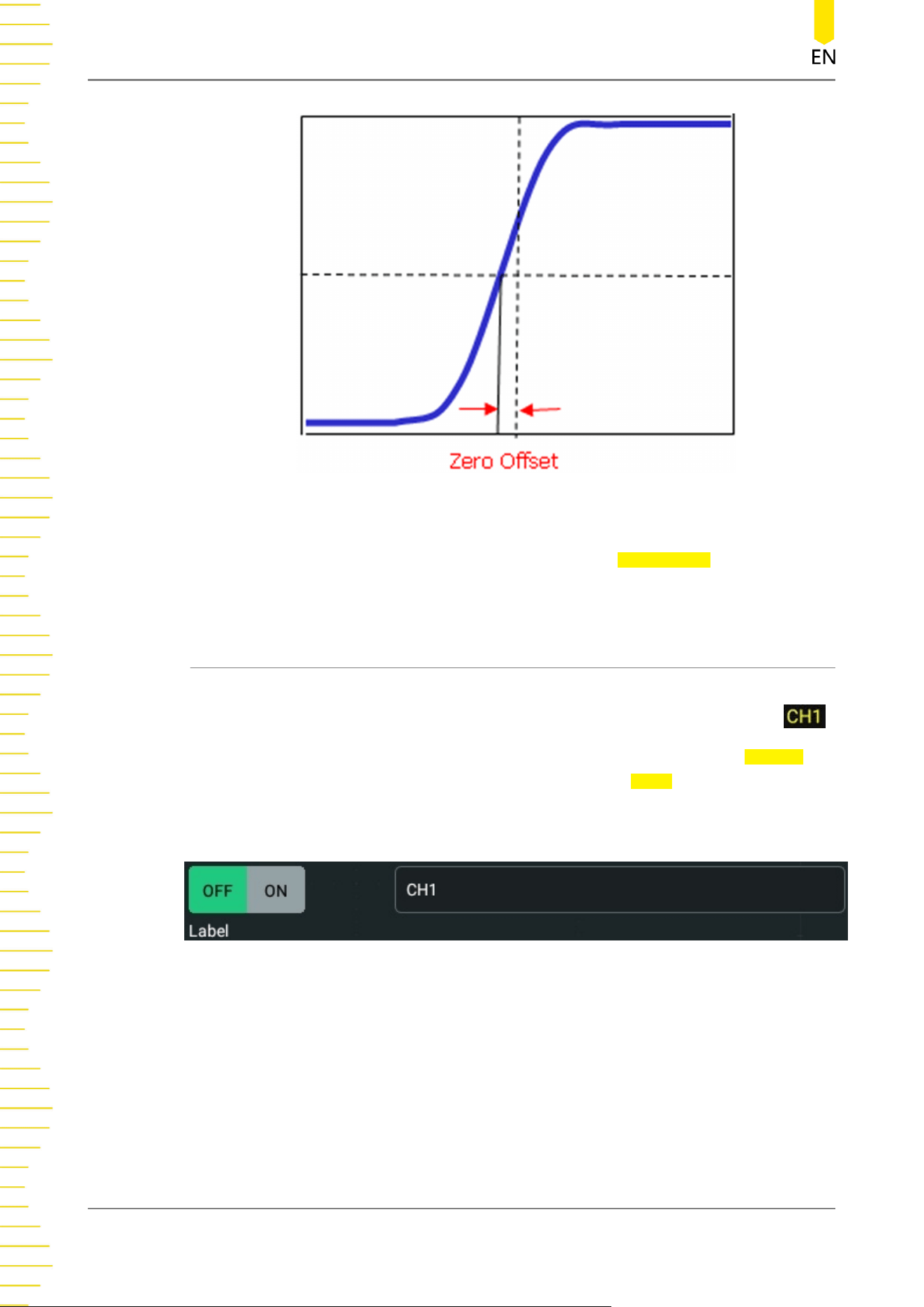
Figure 5.7 Zero Offset
In the "Vertical" menu, click or tap the input field for the Ch-Ch Skew item to set the
channel-to-channel skew time. The available range is from -100 ns to 100 ns.
5.12 Channel Label
The instrument uses the channel number to mark the corresponding channel by
default. For ease of use, you can also set a label for each channel. For example,
.
Click or tap the channel status label at the bottom of the screen, then the Vertical
menu is displayed. Click or tap the ON/OFF button for the Label menu item to select
whether to display the channel label. You can can also tap the channel label input
field to input a specific name for the channel label with the pop-up numeric keypad.
For the methods of using the numeric keypad, refer to descriptions in
Parameter
Setting Method
.
To Set the Vertical System
DS70000 User Guide
54
Copyright ©RIGOL TECHNOLOGIES CO., LTD.
All rights reserved.
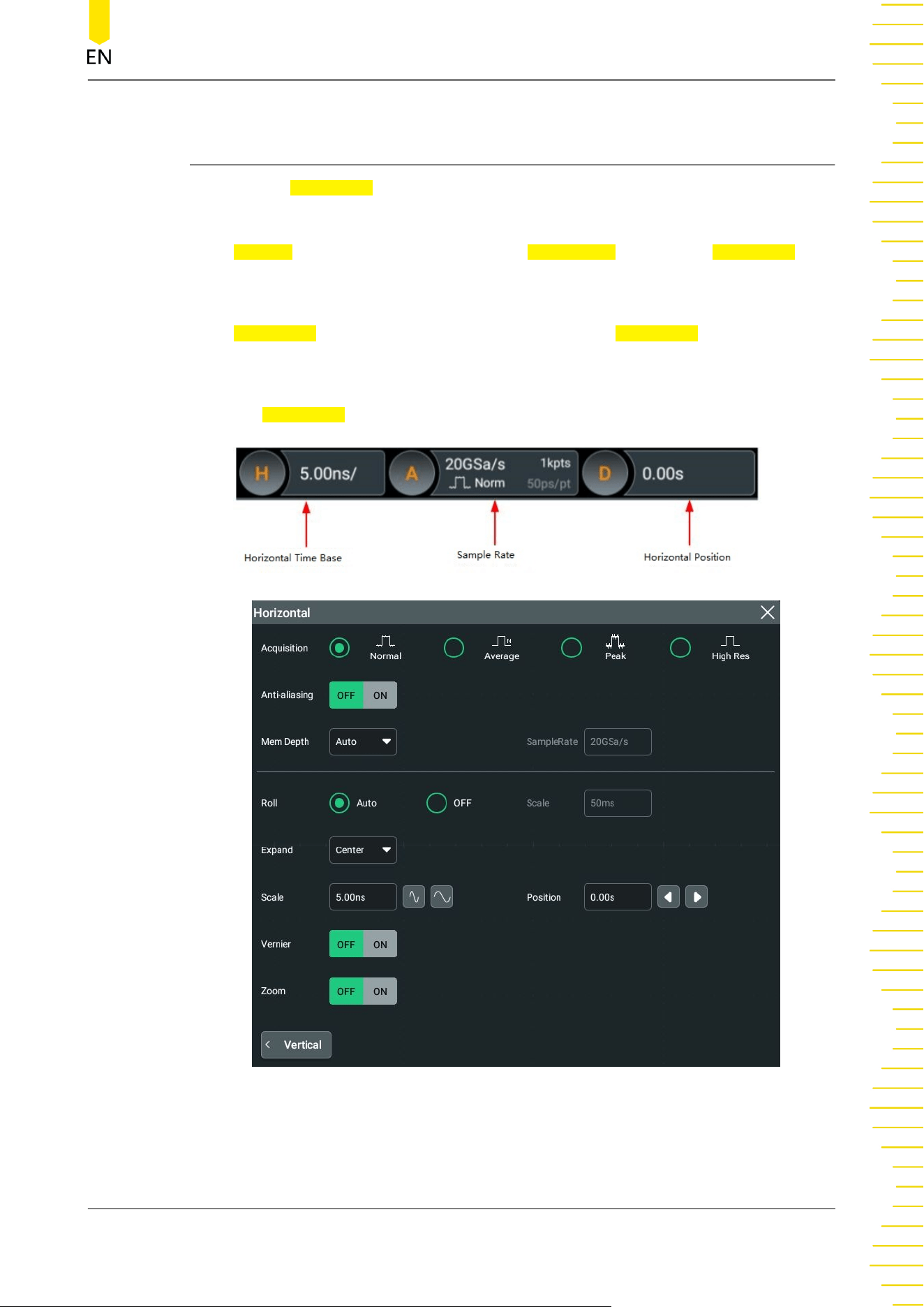
6 To Set the Horizontal System
To enter the Horizontal system menu, perform any of the following operations:
• Click or tap the channel status label at the bottom of the screen. Then the
Vertical menu is displayed. Click or tap Acquisition to enter the Horizontal
system menu.
• When the multi-function knob selects the horizontal function, tap the
Horizontal button on the small screen to enter the Horizontal system menu.
• Click or tap the horizontal time base label (“H” icon), acquisition label (“A”
icon), or horizontal position label (“D” icon) at the top of the screen to enter
the Horizontal system menu.
Figure 6.1 Horizontal System Menu
To Set the Horizontal System
Copyright ©RIGOL TECHNOLOGIES CO., LTD.
All rights reserved.
DS70000 User Guide
55
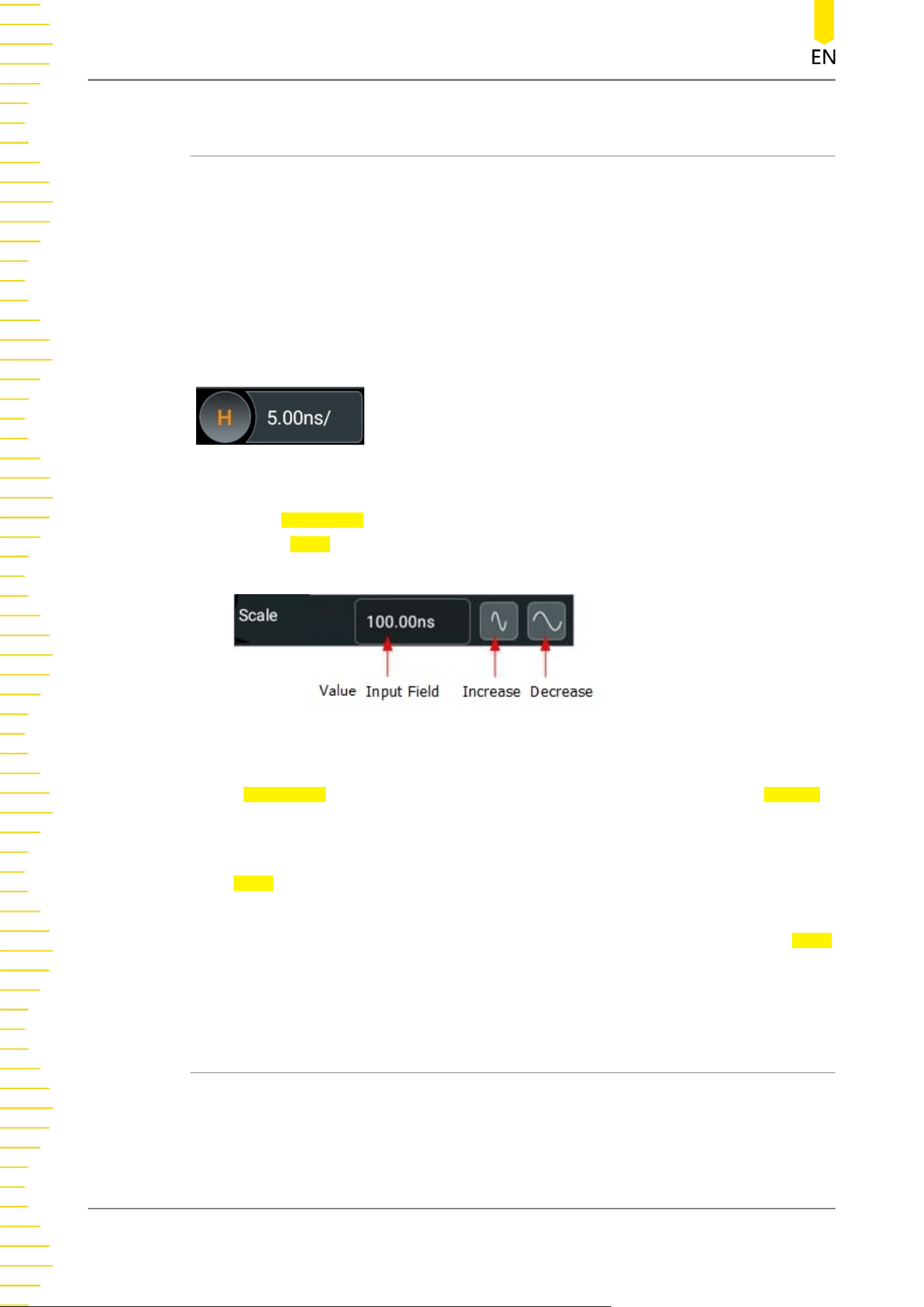
6.1 To Adjust the Horizontal Time Base
Horizontal time base, also called the horizontal scale, refers to the time of each grid in
the horizontal direction of the screen. It is usually expressed in s/div. The range of the
horizontal time base is from 50.00 ps/div to 1.00 ks/div. By default, it is 5 ns/div.
While you change the horizontal time base, the displayed waveforms of all channels
are expanded or compressed (refer to “
Horizontal Expansion
”) horizontally relative
to the current selected horizontal reference baseline. The horizontal time base at the
upper-left corner of the screen will be changed accordingly, as shown in the figure
below.
You can adjust the horizontal time base with the following methods.
• In the Horizontal system menu, click or tap the icon at the right side of the input
field of Scale to increase or decrease the horizontal time base. You can also click
the input field to input a specific value with the displayed numeric keypad.
• Enable the touch screen function, and then adjust the horizontal time base with
the Pinch&Stretch gesture. For details, refer to the "
Pinch&Stretch
" section.
In the Horizontal system menu, you can click or tap the ON/OFF tab for the Vernier
menu to enable or disable the fine adjustment function.
• Coarse adjustment: Click or tap the icon at the right side of the input field of
Scale to adjust the horizontal time base of the waveforms of all channels at
1-2-5 step within the adjustable range.
• Fine adjustment: Click or tap the icon at the right side of the input field of Scale
to adjust the horizontal time base of the waveforms of all channels at a smaller
step within the adjustable range.
6.2 To Adjust the Horizontal Position
Horizontal position, also called trigger position, refers to the trigger point position of
the waveforms of all channels in the horizontal direction relative to the screen center.
When the waveform trigger point is at the left (right) side of the screen center, the
horizontal position is a positive (negative) value.
To Set the Horizontal System
DS70000 User Guide
56
Copyright ©RIGOL TECHNOLOGIES CO., LTD.
All rights reserved.
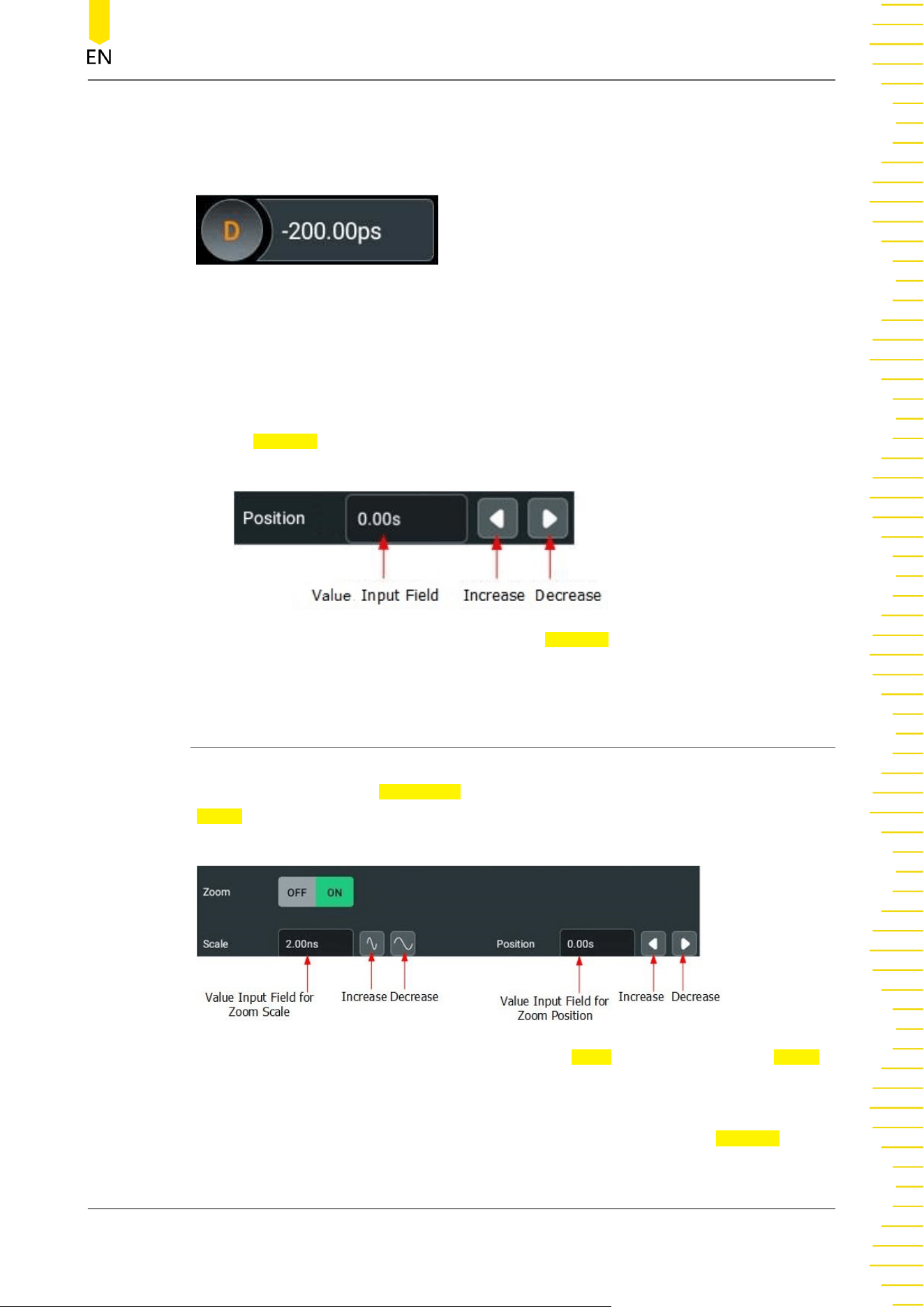
While you change the horizontal position, the waveform trigger points and the
displayed waveforms of all channels are moved left and right. The horizontal position
at the top of the screen changes accordingly, as shown in the figure below.
You can adjust the horizontal position with the following methods.
• Enable the touch screen function, and then adjust the horizontal position with
the drag gesture. For details, refer to the "
Drag
" section.
• In the "Horizontal" menu, click or tap the icon at the right side of the input field
of Position to increase or decrease the horizontal position, as shown in the
figure below.
• You can also click or tap the input field of Position to input a specific value with
the displayed numeric keypad.
6.3 Delayed Sweep
Delayed sweep can be used to enlarge a length of waveform horizontally to view
waveform details. In the Horizontal system menu, click or tap the ON/OFF tab for the
Zoom menu to enable or disable the delayed sweep function. When the delayed
sweep is enabled, you can set the scale and offset for the delayed sweep.
• Scale: Click or tap the icon at the right of the Scale input field under the Zoom
menu to increase or decrease the zoom scale. You can also click or tap the value
input box to input the specific value directly via the pop-up numeric keypad.
• Position:Click or tap the Left/Right arrow icon at the right of the Position input
field to increase/decrease the position. You can also click or tap the value input
box to input the specific value directly via the pop-up numeric keypad.
To Set the Horizontal System
Copyright ©RIGOL TECHNOLOGIES CO., LTD.
All rights reserved.
DS70000 User Guide
57
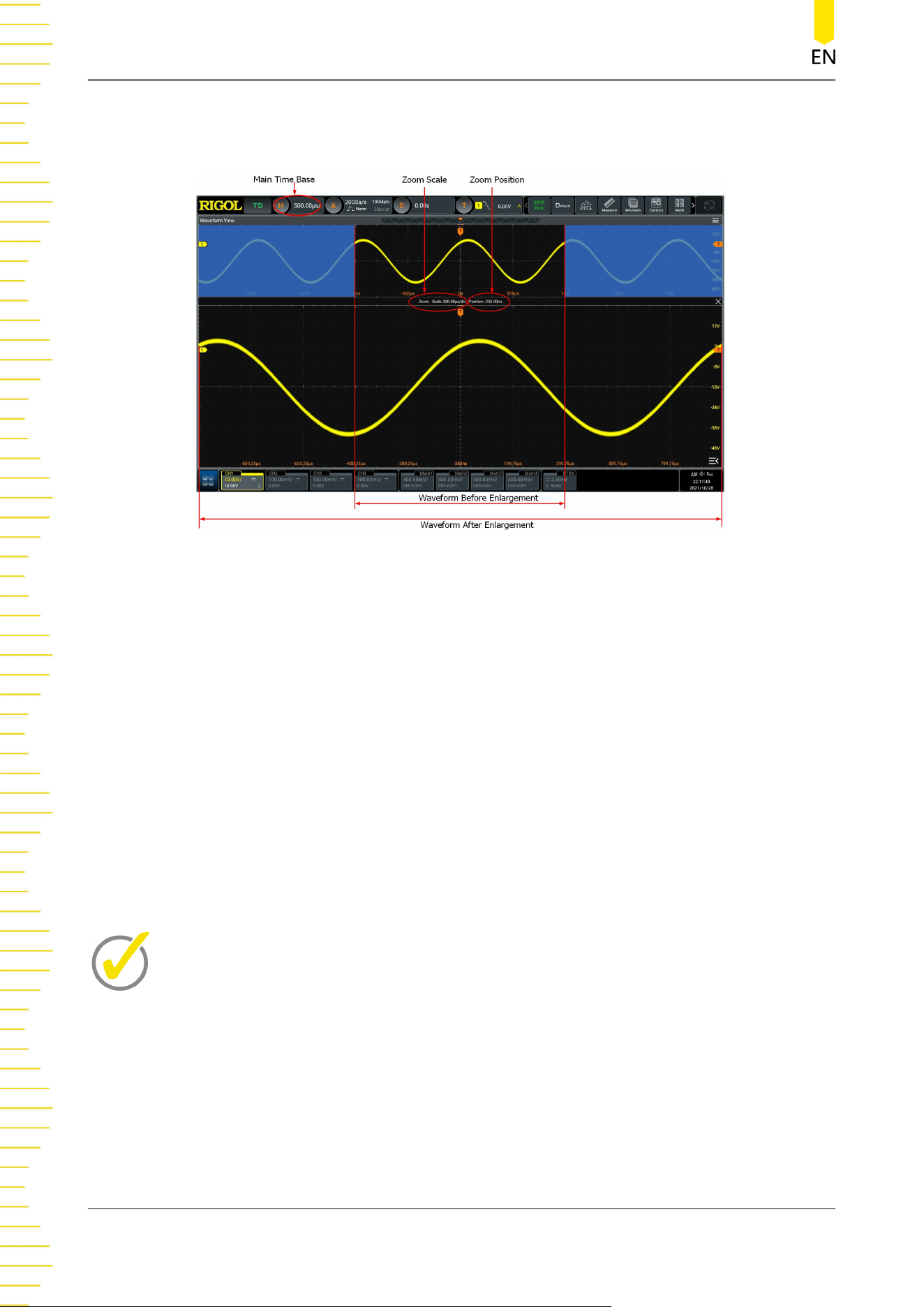
In delayed sweep mode, the screen is divided into two display areas, as shown in the
following figure.
Figure 6.2 Delayed Sweep Mode
• Waveform before enlargement:
The waveform in the area that is not covered by subtransparent blue in the
upper part of the screen is the waveform before enlargement. Its horizontal time
base (also called main time base) is displayed at the upper-left corner of the
screen. You can move the area left and right by adjusting the horizontal position;
increase or decrease the size of the area by adjusting the horizontal scale.
• Waveform after enlargement:
The waveform in the lower part of the screen is the horizontally expanded
delayed sweep waveform. Its horizontal time base (also called the time base of
the delayed sweep) is displayed on the screen. Compared with the main time
base, the time base of the delayed sweep has increased the waveform resolution.
Tip
The time base of the delayed sweep should be smaller than or equal to the main time base.
To Set the Horizontal System
DS70000 User Guide
58
Copyright ©RIGOL TECHNOLOGIES CO., LTD.
All rights reserved.
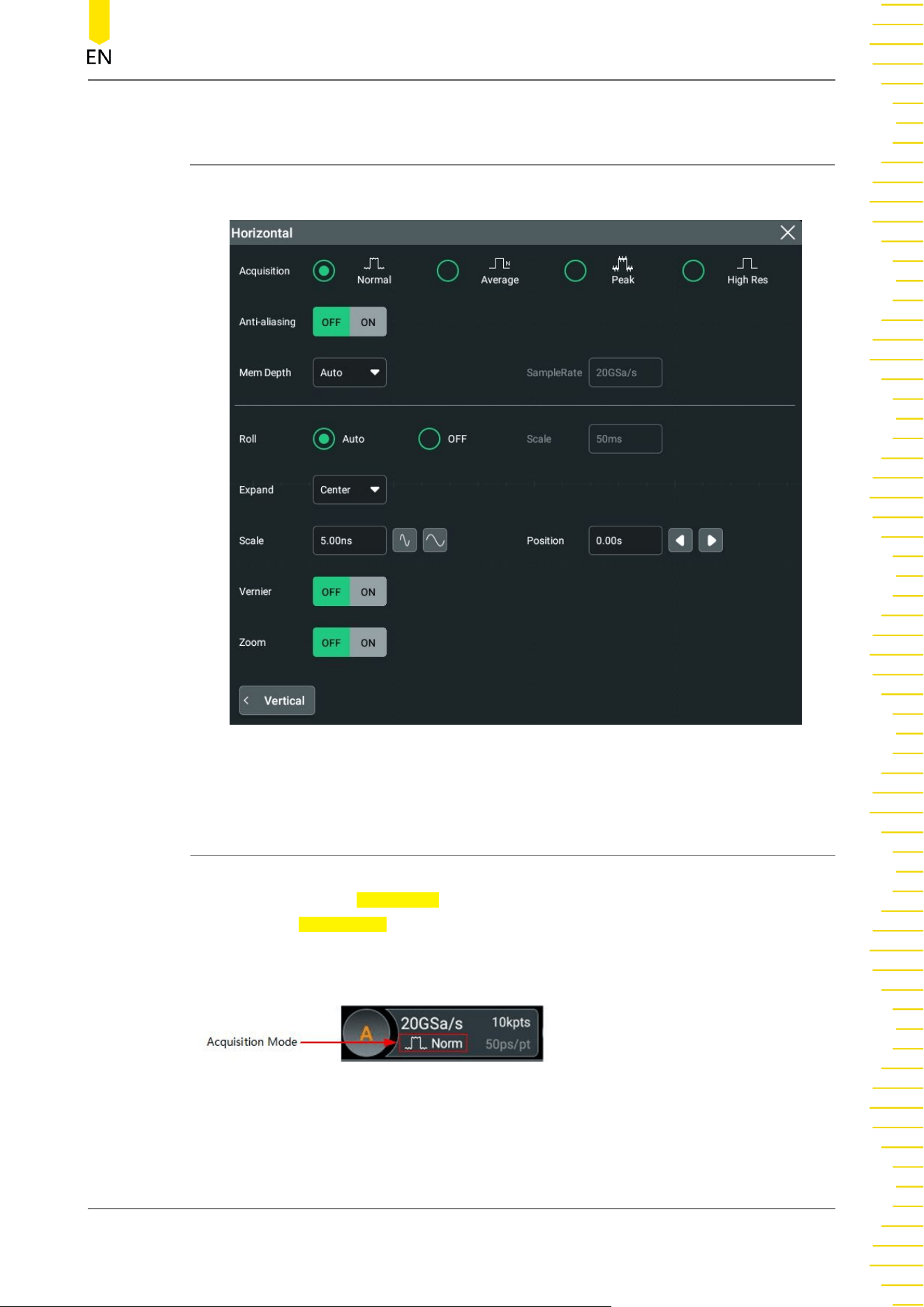
7 To Set the Sample System
You can set the sample system in the
To Set the Horizontal System
menu.
Figure 7.1 Horizontal System Menu
7.1 Acquisition Mode
The acquisition mode is used to control how to generate waveform points from the
sample points. In the Horizontal system menu, click or tap the desired acquisition
mode for the Acquisition menu. The available choices include Normal, Average, Peak,
High Res. By default, the acquisition mode is Normal. The acquisition mode will be
displayed in the acquisition label at the top of the screen.
Normal
In this mode, the oscilloscope samples the signal at a specified fixed time interval to
rebuild the waveform. For most of the waveforms, using this mode can produce the
optimal display effects.
To Set the Sample System
Copyright ©RIGOL TECHNOLOGIES CO., LTD.
All rights reserved.
DS70000 User Guide
59
Average
In this mode, the oscilloscope averages the waveforms from multiple samples to
reduce the random noise of the input signal and improve the vertical resolution.
Greater number of averages can lower the noise and increase the vertical resolution;
while at the same time, it will slow the response of the displayed waveform to the
waveform changes.
When you select "Average" mode, click or tap the input field for the Averages menu
item to set it by using the pop-up numeric keypad. Its range is from 2 to 65534. Its
default value is 8.
Tip
The number of averages must be the Nth power of 2. When it is not in N power-of-2
increments, a prompt message "Truncation average error" is displayed. At this time, a value
that is smaller than the one you input and the closest to N power-of-2 increments will be input
automatically. For example, if you input 9 with the numeric keypad, the average count will be
input 8 automatically.
Peak
In this mode, the oscilloscope acquires the maximum and minimum values of the
signal within the sample interval to get the envelope of the signal or the narrow pulse
that might be lost. In this mode, signal aliasing can be prevented, but the noise
displayed would be larger.
In this mode, the oscilloscope can display all the pulses whose pulse widths are at
least the same as the sample period.
High Resolution
This mode uses a kind of ultra-sample technique to average the neighboring points
of the sample waveform to reduce the random noise on the input signal and generate
much smoother waveforms on the screen. This is generally used when the sample
rate of the digital converter is higher than the storage rate of the acquisition memory.
When you select "High Res" mode, click or tap the drop-down button of bits to select
9, 10, 12, 14, or 16. Its default value is 9.
Tip
• The averaging modes of the "Average" and "High Res" are different. The former uses
"Multi-sample Average" and the latter uses "Single Sample Average".
• In "High Res" mode, the oscilloscope improves the measurement accuracy at the cost of
bandwidth. Each time the sampling rate changes, a window displaying the current
bandwidth appears in the sample rate menu.
To Set the Sample System
DS70000 User Guide
60
Copyright ©RIGOL TECHNOLOGIES CO., LTD.
All rights reserved.
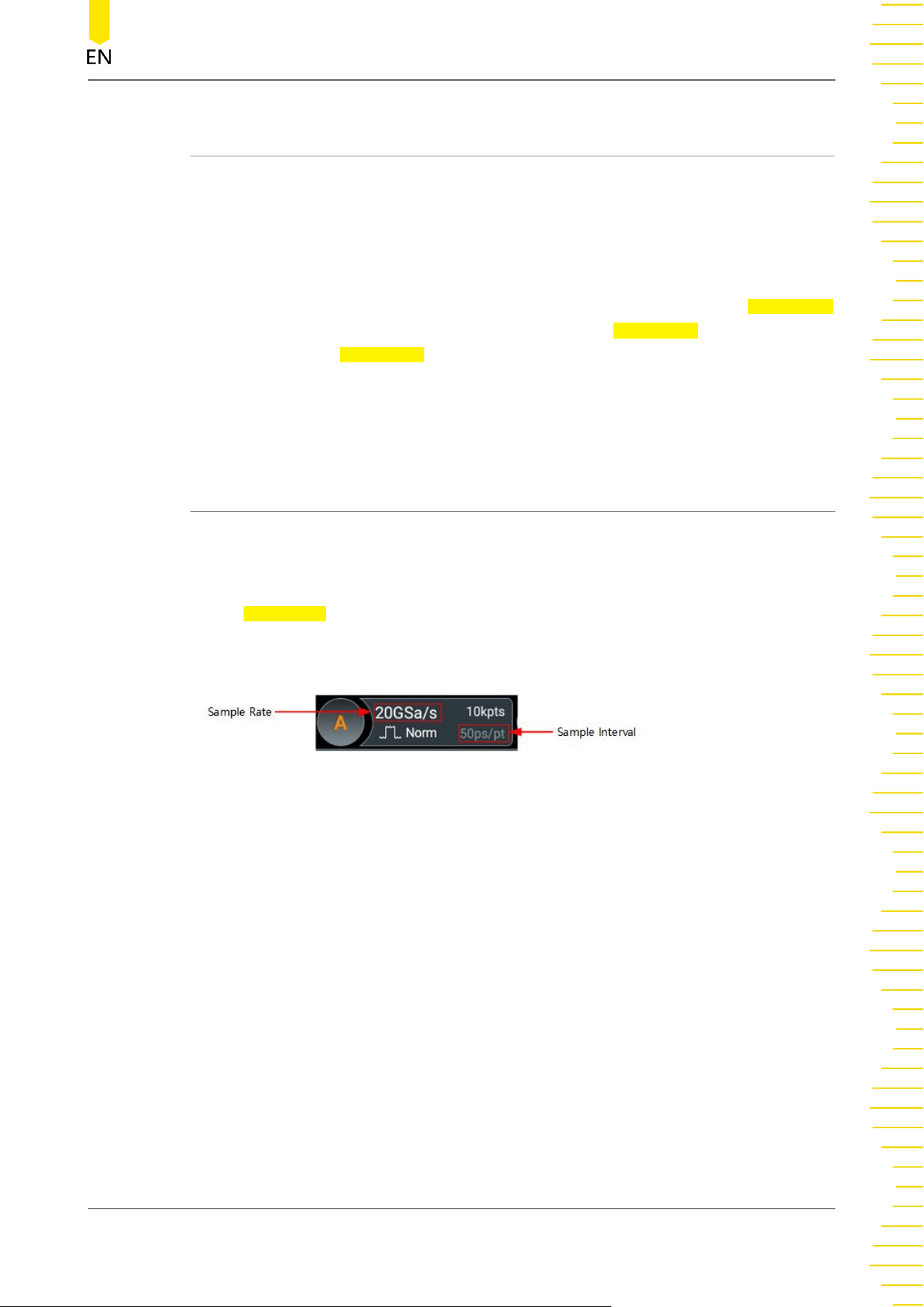
7.2 Sampling Mode
This oscilloscope only supports the real-time sampling mode. In this mode, the
oscilloscope produces the waveform display from samples collected during one
trigger event. The max. real-time sample rate of this series is 20 GSa/s. The current
sample rate is displayed in the acquisition label at the top of the screen.
By default, the operating status label at the left top of the screen is in green,
indicating that the instrument is undergoing real-time sampling. Then the STOP/RUN
icon at the top of the screen is in green. Click or tap the STOP/RUN icon to stop
sampling, then the STOP/RUN icon turns red. The operating status label at the left
top of the screen shows STOP in red. At this time, the oscilloscope will maintain its
last captured graph. You can still expand or zoom the waveforms by using the
horizontal and vertical control menu.
7.3 Sample Rate
Sampling is the process of converting the analog signal into the digital signal at a
specified time interval and then restoring them in sequence. The sample rate is the
reciprocal of the time interval.
In the Horizontal system menu, "SampleRate" shows the current sample rate. The
current sample rate is displayed in the acquisition label at the top of the screen, as
shown in the figure below.
The sample rate of the analog channel is related to the current channel mode. The
maximum real-time sample rate in the single-channel mode is 20 GSa/s, and the
maximum real-time sample rate in the half-channel mode and full-channel mode is
10 GSa/s.
• Single-channel mode: CH1 and CH2 are considered as a group; CH3 and CH4
are considered as another group. If one of the two channels in each group is
enabled, it is called single-channel mode.
• Half-channel mode: CH1 and CH2 are considered as a group; CH3 and CH4 are
considered as another group. If two channels in either one of the groups are
enabled, it is called half-channel mode.
• Full-channel mode: CH1, CH2, CH3, and CH4 are all enabled.
The impact of low sample rate on the waveform:
• Waveform Distortion: when the sample rate is too low, some waveform details
are lost, and the sample waveform displayed is rather different from the actual
waveform of the signal.
To Set the Sample System
Copyright ©RIGOL TECHNOLOGIES CO., LTD.
All rights reserved.
DS70000 User Guide
61
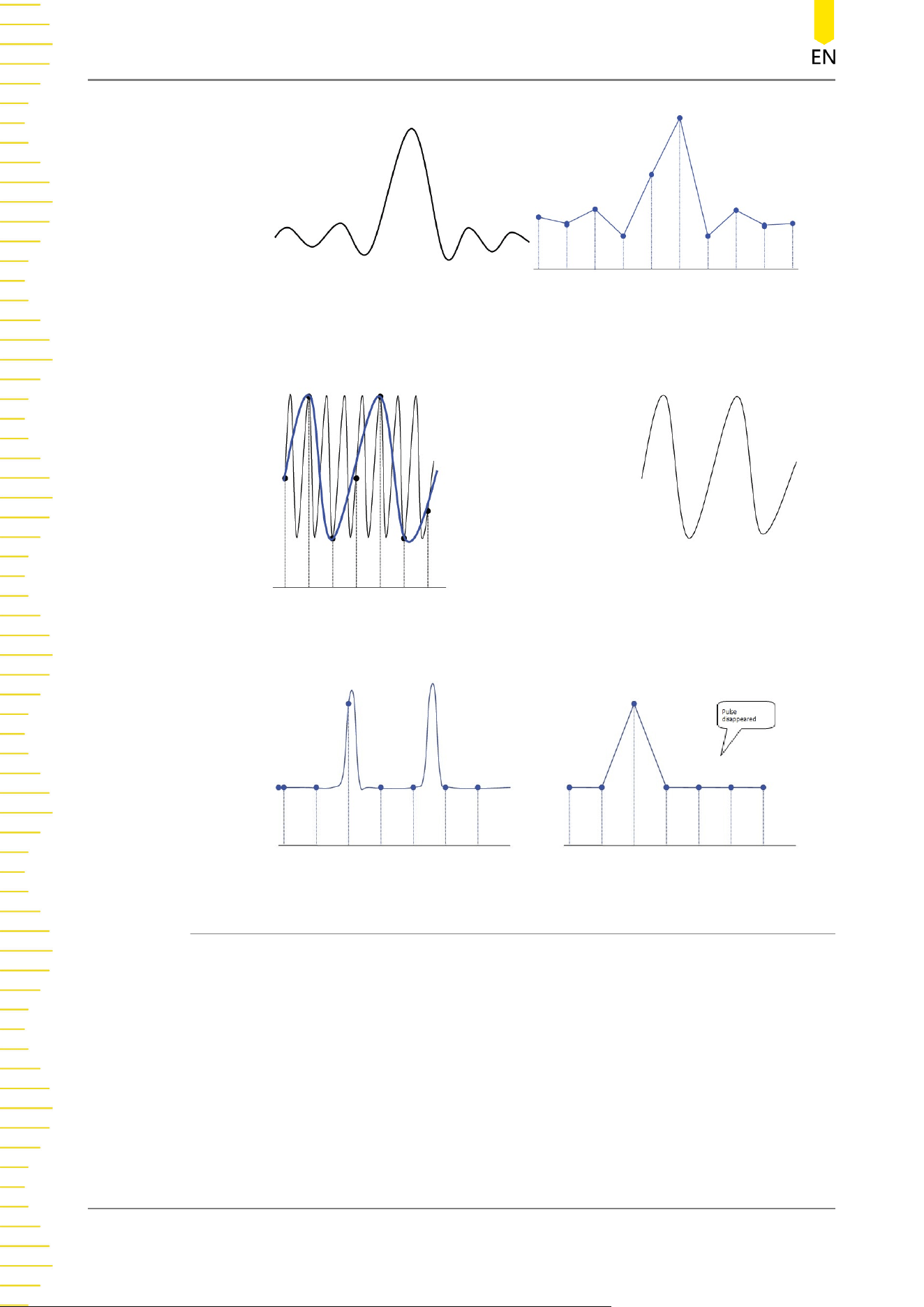
• Waveform Aliasing: when the sample rate is twice lower than the actual signal
frequency (Nyquist Frequency), the frequency of the waveform rebuilt from the
sample data is smaller than the actual signal frequency.
• Waveform Leakage: when the sample rate is too low, the waveform rebuilt from
the sample data does not reflect all the actual signal information.
7.4 Memory Depth
Memory depth refers to the number of points of the oscilloscope that can store in
one trigger acquisition. It reflects the storage capability of the acquisition storage.
This oscilloscope is equipped with a standard memory depth of up to 1 Gpts (2 Gpts
for option).
To Set the Sample System
DS70000 User Guide
62
Copyright ©RIGOL TECHNOLOGIES CO., LTD.
All rights reserved.
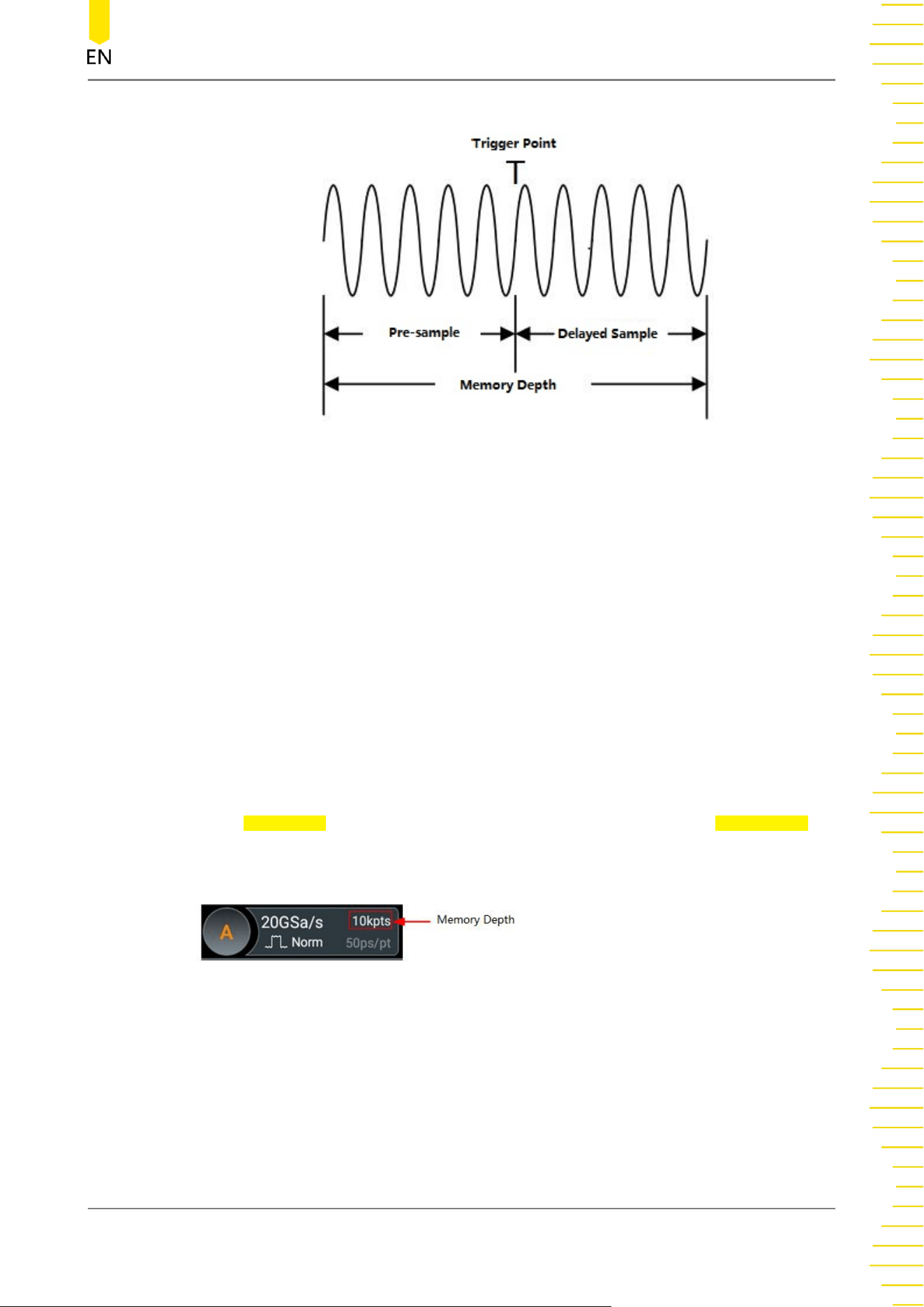
Figure 7.2 Memory Depth
The following equation shows the relations among memory depth, sample rate, and
horizontal time base scale:
MDepth = SRate x TSCale x HDivs
•
MDepth:
indicates the memory depth. The unit is pts.
•
SRate:
indicates the sample rate. The unit is Sa/s.
•
TSCale:
indicates the horizontal time base scale. The unit is s/div.
•
HDivs:
indicates the number of grids in the horizontal direction. The unit is div.
Therefore, under the same horizontal time base scale, a higher memory depth can
ensure a higher sample rate.
In the Horizontal system menu, click or tap the drop-down button of Mem Depth to
select the memory depth. By default, the memory depth is 10 Kpts. The memory
depth value will be displayed in the sample rate label at the top of the screen.
• When only one of the following channels is enabled, the memory depths
available include Auto, 1 Kpts, 10 Kpts, 100 Kpts, 1 Mpts, 10 Mpts, 100 Mpts, 200
Mpts, 500 Mpts, 1 Gpts, and 2 Gpts (option).
• When any two or multiple channels are enabled, the memory depths available
include Auto, 1 Kpts, 10 Kpts, 100 Kpts, 1 Mpts, 10 Mpts, 100 Mpts, 200 Mpts,
500 Mpts, and 1 Gpts.
To Set the Sample System
Copyright ©RIGOL TECHNOLOGIES CO., LTD.
All rights reserved.
DS70000 User Guide
63
Tip
In "Auto" mode, the oscilloscope selects the memory depth automatically according to the
current sample rate.
7.5 Anti-Aliasing
At a slower sweep speed, the sample rate is reduced, and a dedicated display
algorithm can be used to minimize the possibility of aliasing.
In the Horizontal system menu, the user can select the on or off tab for the Anti-
aliasing menu to enable or disable the anti-aliasing function.
This function should be enabled when the horizontal time base has a large deviation
from the period of the signal under test (e.g. when the horizontal time base is greater
than five-fold the period of the signal under test).
7.6 Horizontal Expansion
Horizontal expansion indicates the reference position that the screen waveform is
referenced to when it is horizontally expanded or compressed in adjusting the
horizontal time base. In the Horizontal system menu, click or tap the drop-down
button of Expand to select the horizontal reference baseline. The available choices
include Center, Left, Right, Trigger, and User. The default is "Center".
• Center: when the horizontal time base is modified, the waveform will be
expanded or compressed horizontally relative to the screen center.
• Left: when the horizontal time base is modified, the waveform will be expanded
or compressed horizontally relative to the leftmost position of the screen.
• Right: when the horizontal time base is modified, the waveform will be
expanded or compressed horizontally relative to the rightmost position of the
screen.
• Trigger: when the horizontal time base is modified, the waveform will be
expanded or compressed horizontally relative to the trigger point.
• User: when the horizontal time base is modified, the waveform displayed will be
expanded or compressed horizontally relative to the user-defined reference
position.
When you select "User", click or tap the input field of Expand User. Input the
horizontal expansion reference value with the displayed numeric keypad. Its
range is from -500 to 500. Its default value is 0.
To Set the Sample System
DS70000 User Guide
64
Copyright ©RIGOL TECHNOLOGIES CO., LTD.
All rights reserved.
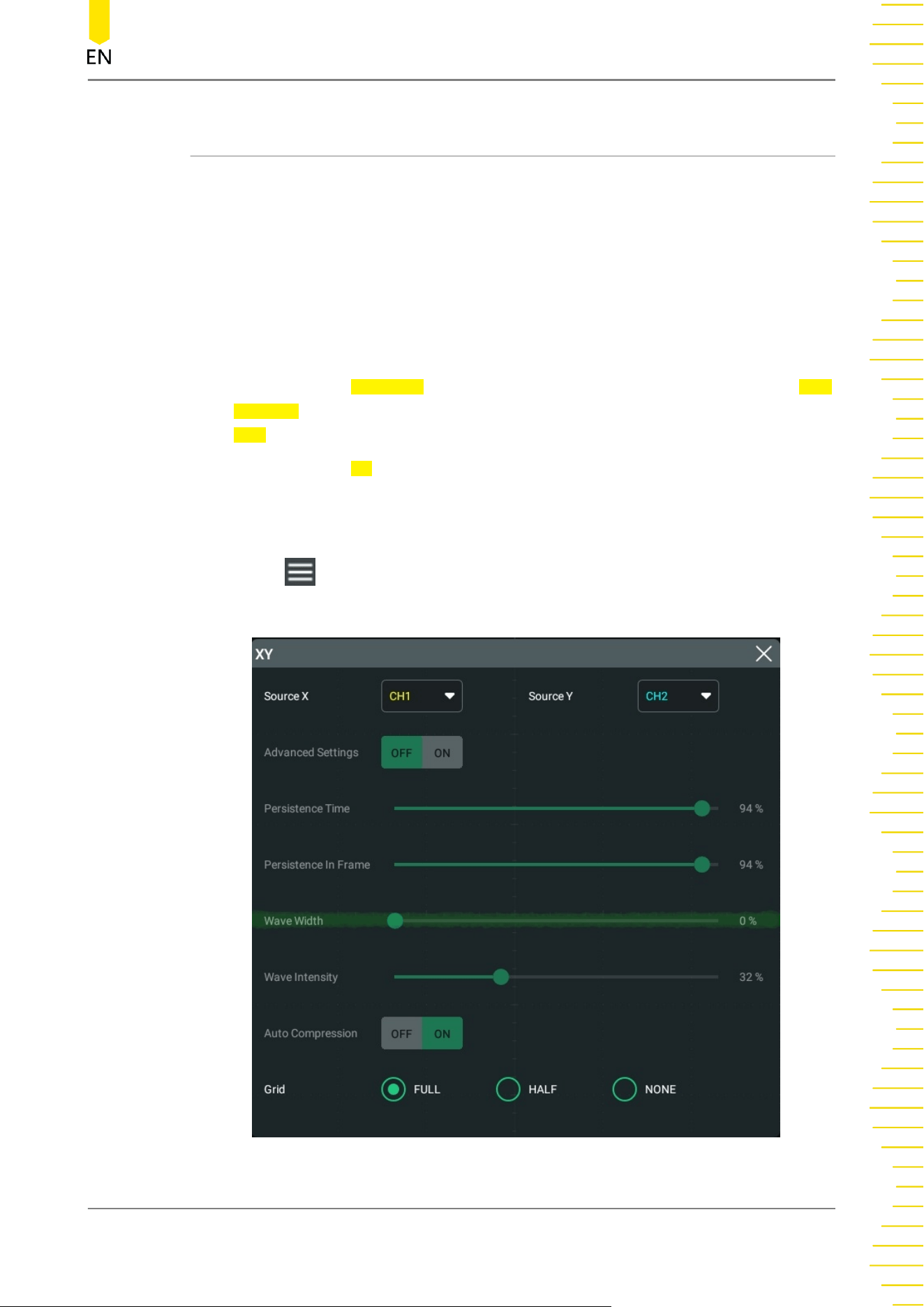
7.7 XY Mode
By default, DS70000 series digital oscilloscope uses the YT mode for waveform
display window. In this mode, Y-axis indicates the Voltage, X-axis indicates the Time.
Besides, it supports XY display window. In this display window, X-axis and Y-axis
indicate voltage. The two input channels display from "Voltage-Time" to "Voltage-
Voltage".
Open the XY Window
To open the XY window, perform the following operations:
• Click or tap the Windows icon in the function navigation menu to enter the Add
Window interface. In the Diagram menu, click or tap "XY", and then click or tap
Add to open the XY mode display window.
• Click or tap the XY icon at the upper-right part of the screen to open the XY
window.
Configure the XY Window
Click or tap
at the upper-right corner of the XY window to enter the XY
configuration menu.
Figure 7.3 XY Setting Menu
To Set the Sample System
Copyright ©RIGOL TECHNOLOGIES CO., LTD.
All rights reserved.
DS70000 User Guide
65
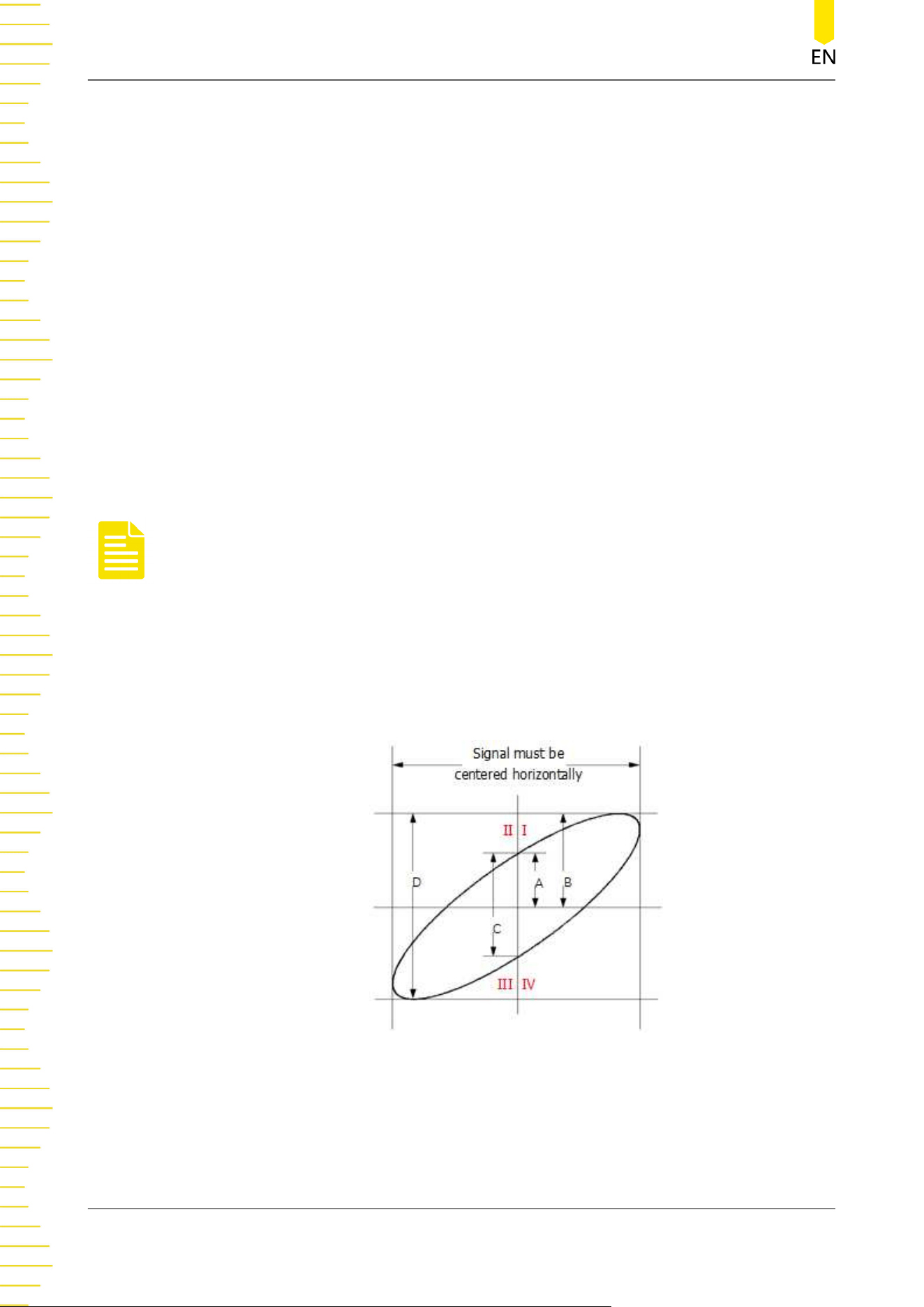
• Source: Click or tap the drop-down button of "Source X" to select the source
channel of the X-axis in the XY window. Click or tap the drop-down button of
"Source Y" to select the source channel of the Y-axis in the XY window.
In the
Add Window
menu, you can also configure Source Z. Source Z, as the Z-
axis input in the XY display mode, is used to control whether to display the X-Y
waveforms in the XY display mode. This function is called "blanking".
- When "None" is selected for "Source Z", the blanking function is disabled,
and you can only see the X-Y waveforms.
- When you select "CH1-CH4" for "Source Z", the blanking function is
enabled. The Z-axis input from the external connector determines whether
to display the X-Y waveforms. When Z is high (the input level is greater than
0 V), the X-Y waveforms are displayed; when Z is low (the input level is
smaller than 0 V), the waveforms are hidden.
• Grid: Refer to
To Set the Screen Grid
.
Note
Advanced settings are not supported temporally. The current settings show the most optimal
display effects.
Measurement Schematic Diagram of Phase Deviation
In this mode, you can use the Lissajous method to measure the phase deviation of the
two input signals whose frequencies are the same. The following figure shows the
measurement schematic diagram of phase deviation.
Figure 7.4 Measurement Schematic Diagram of Phase Deviation
According to sinƟ = A/B or C/D, Ɵ is the phase deviation angle between the two
channels. The definitions of A, B, C, and D are shown in the above figure. The phase
deviation angle is obtained, that is:
To Set the Sample System
DS70000 User Guide
66
Copyright ©RIGOL TECHNOLOGIES CO., LTD.
All rights reserved.
Ɵ = ±arcsin(A/B) or ±arcsin(C/D)
If the principal axis of the ellipse is within Quadrant I and III, the phase deviation
angle obtained should be within Quadrant I and IV, namely within (0 to π/2) or (3π/2
to 2π). If the principal axis of the ellipse is within Quadrant II and IV, the phase
deviation angle obtained should be within Quadrant II and III, namely within (π/2 to
π) or (π to 3π/2).
The XY mode can be used to measure the phase deviation occurred when the signal
under test passes through a circuit network. Connect the oscilloscope to the circuit to
monitor the input and output signals of the circuit.
To Set the Sample System
Copyright ©RIGOL TECHNOLOGIES CO., LTD.
All rights reserved.
DS70000 User Guide
67
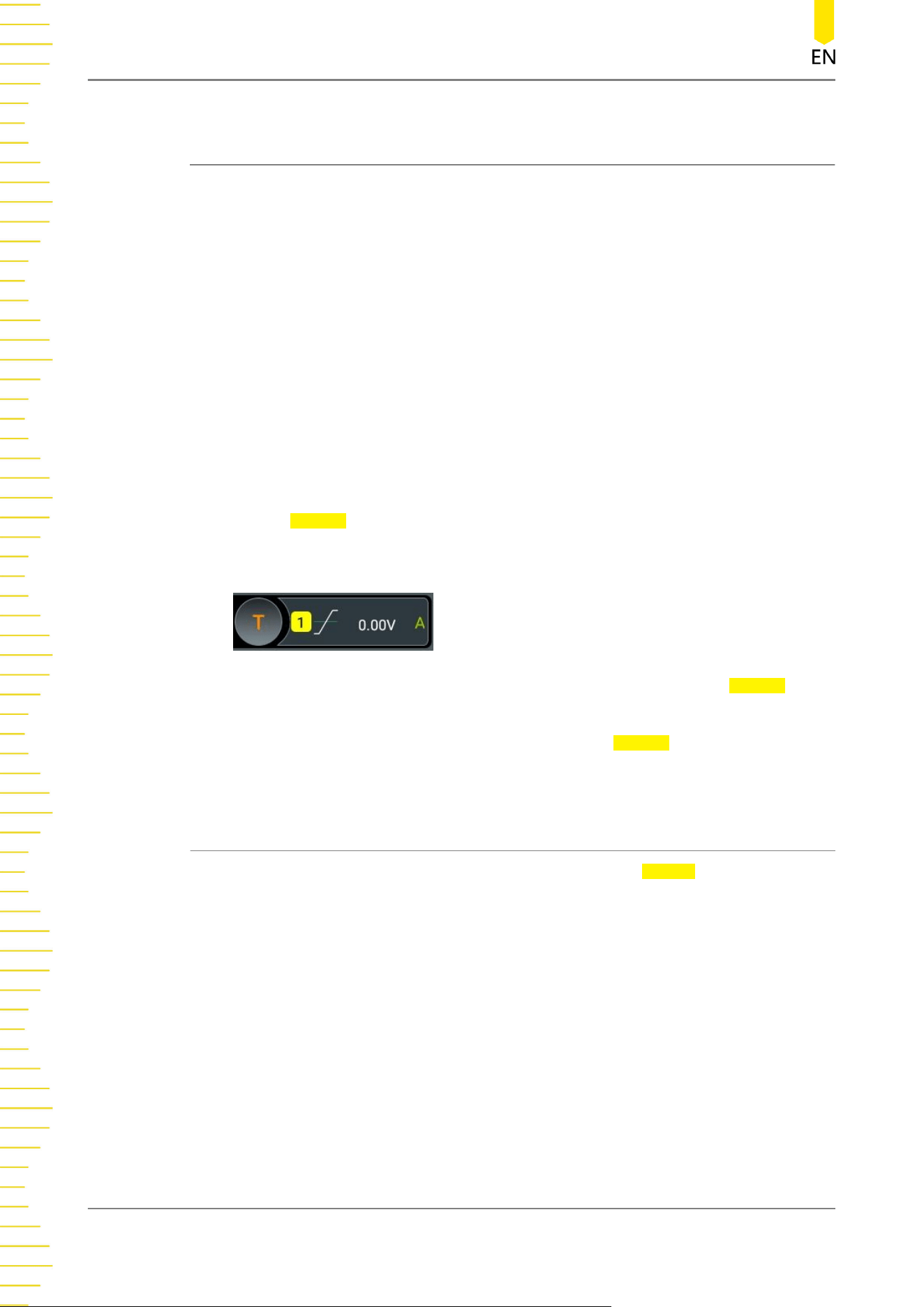
8 To Trigger the Oscilloscope
As for trigger, you set certain trigger condition according to the requirement and
when a waveform in the waveform stream meets this condition, the oscilloscope
captures this waveform as well as the neighboring part, and displays them on the
screen. For the digital oscilloscope, it samples waveform continuously no matter
whether it is stably triggered, but only stable trigger can be stably displayed. The
trigger module ensures that every time base sweep or acquisition starts from the
user-defined trigger condition, namely every sweep is synchronous with the
acquisition and the waveforms acquired is overlapped so as to display the stable
waveforms.
Trigger settings should be based on the features of the input signal. To quickly
capture the desired waveform, you need to understand the signal under test. This
oscilloscope provides abundant trigger types that help you focus on the desired
waveform details.
To enter the Trigger menu, perform any of the following operations:
• Click or tap the trigger icon (“T” icon) at the top of the screen;
• When the multi-function knob selects the trigger function, tap the Trigger icon
on the small screen at the right side of the large screen.
• In
To Set the Vertical System
menu, click or tap the Trigger button to enter the
trigger setting menu.
8.1 Trigger Source
In the "Trigger" menu, click or tap the drop-down button of Source to select the
desired source from the drop-down list. Analog channels (CH1-CH4), AC Line, or EXT
(external trigger) can all be selected as the trigger source.
Analog channel input
Signals input from analog channels CH1-CH4 can all be used as trigger sources. No
matter whether the channel selected is enabled, the channel can work normally.
AC line input
The trigger signal is obtained from the AC power input of the oscilloscope. AC trigger
is usually used to measure signals relevant to the AC power frequency. For example,
stably triggering the waveform output from the transformer of a transformer
substation. It is mainly used in related measurements of the power industry.
To Trigger the Oscilloscope
DS70000 User Guide
68
Copyright ©RIGOL TECHNOLOGIES CO., LTD.
All rights reserved.
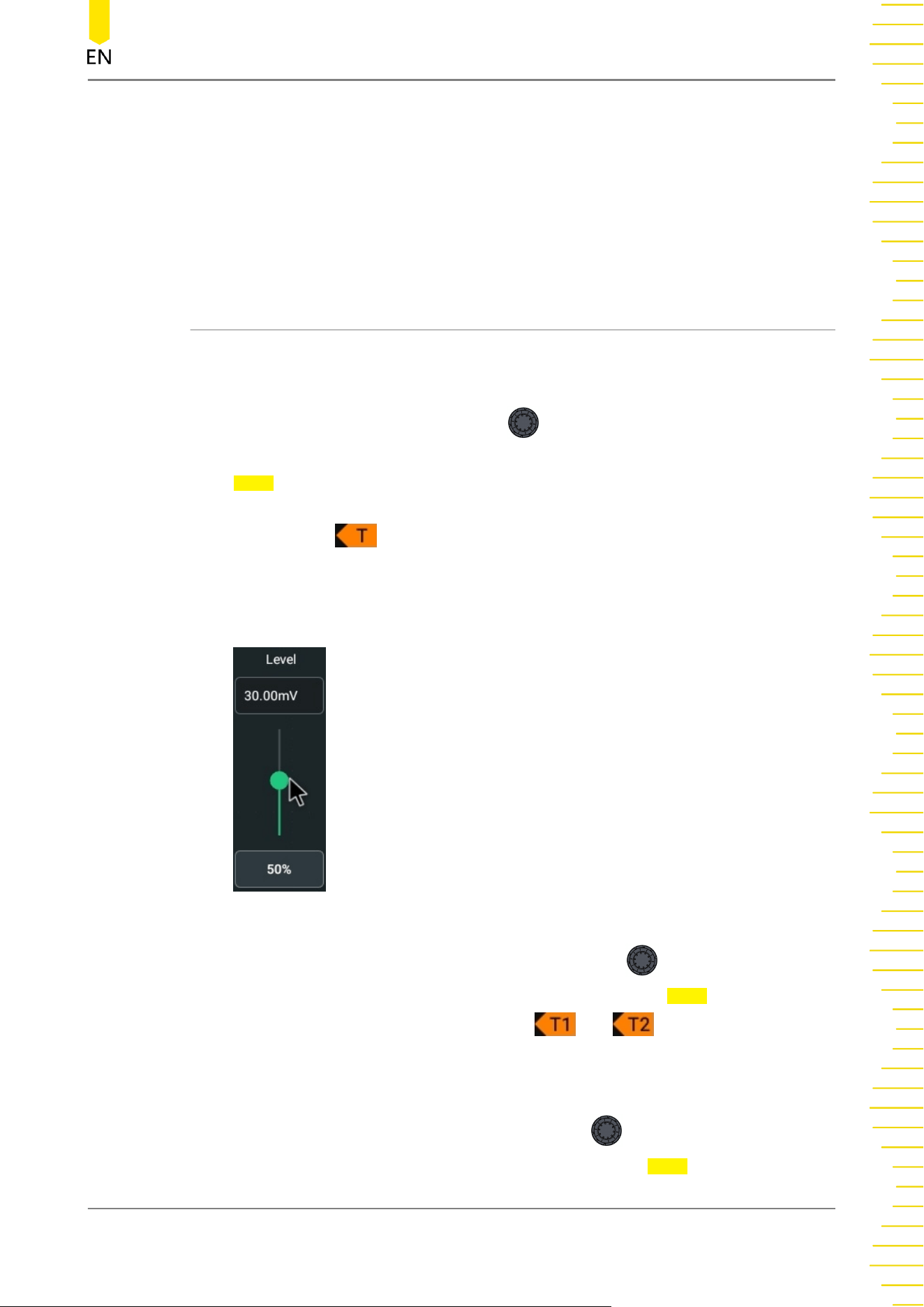
External trigger input
The external trigger source can be used to trigger on the fifth channel while all the
other four channels are acquiring data. The trigger signal (e.g. external clock or signal
of the circuit under test) will be connected to EXT trigger source via the external
trigger input terminal [EXT] connector. You can set the trigger conditions within the
range of the trigger level (from -8 V to +8 V).
8.2 Trigger Level
The adjustment of the trigger level is related to the type of the trigger source.
• When the trigger source is CH1-CH4, and when the multifunction knob selects
the trigger function, rotate the knob at the upper-right part of the small
screen or drag the adjustment icon (as shown in the figure below) under the
Level menu to adjust the trigger level. During the adjustment, a trigger level line
(the color of the trigger level line is the same as that of the channel) and a
trigger label " " are displayed on the screen, and they move up and down
with the variation of the trigger level. When you stopping modifying the trigger
level, the trigger level line disappears in about 2 s. The current trigger level is
displayed in the the trigger information label at the top of the screen.
In Runt Trigger, Slope Trigger, and Window trigger, you need to set the upper
and lower limits of the trigger level. Rotate the knob
at the upper-right part
of the small screen or drag the adjustment icon under the Level menu to adjust
the trigger level. Two trigger level labels
and are displayed at the
right section of the screen.
• When the trigger source is AC Line, there is no trigger level.
• When the trigger source is EXT, rotate the knob
at the upper-right part of
the small screen or drag the adjustment icon under the
Level menu to adjust the
To Trigger the Oscilloscope
Copyright ©RIGOL TECHNOLOGIES CO., LTD.
All rights reserved.
DS70000 User Guide
69
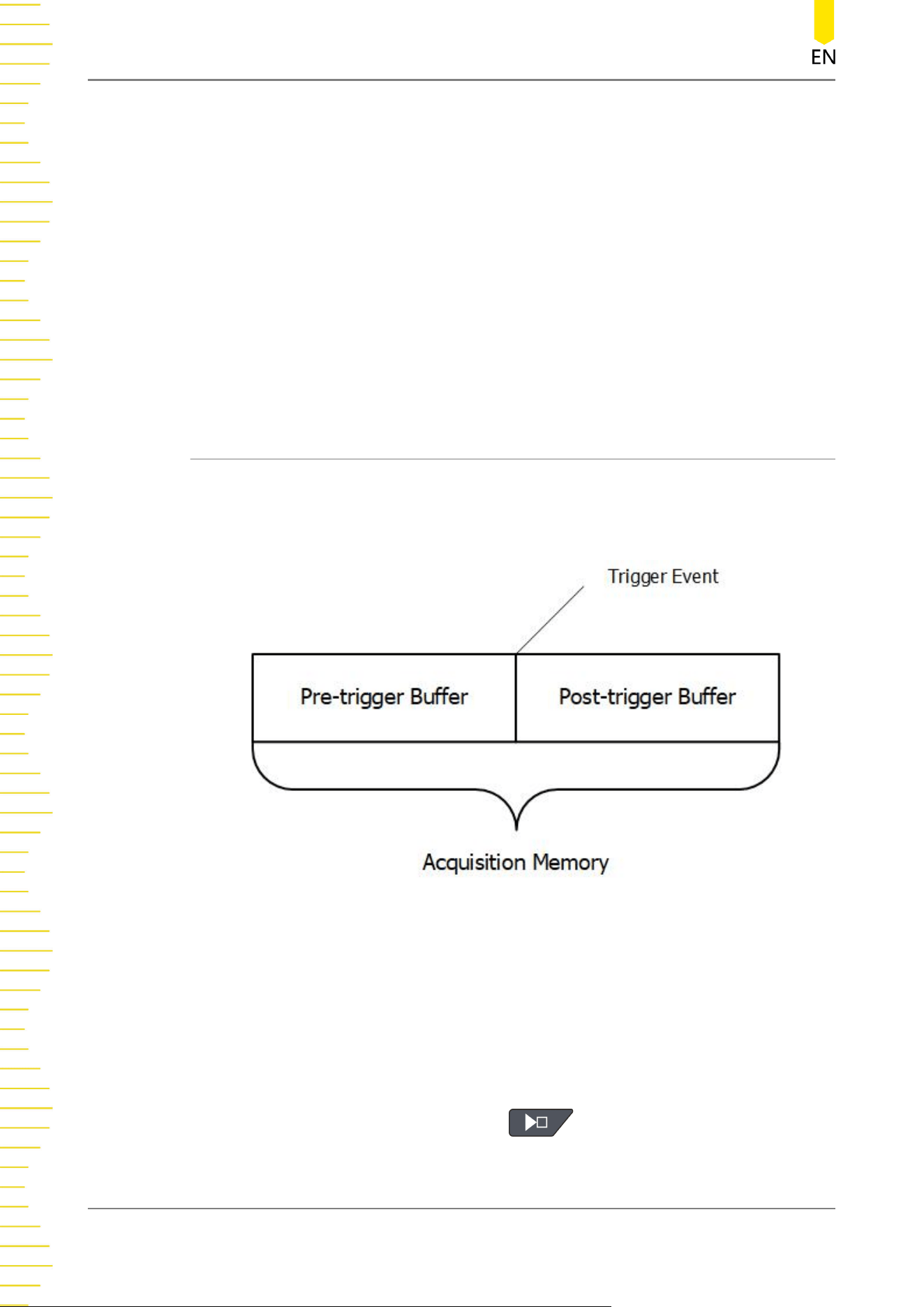
trigger level. The current trigger level is displayed in the the trigger information
label at the top of the screen.
For this trigger source, only the variation of the trigger level value is displayed
on the screen during the adjustment of the trigger level, without displaying the
trigger level lines on the screen.
To ensure the waveforms to be better triggered, for a trigger with a single level, you
can directly click or tap "50%" in the level menu or press down the trigger level knob
to make the level move to the middle of the waveform. However, for a trigger (e.g.
Slope trigger, Runt trigger, Window trigger, and MIL-STD-1553) with two levels, you
need to click or tap "90%" and "10%" in the level menu or press down the trigger
level knob to make the level move to within the range of the waveform amplitude.
8.3 Trigger Mode
The following is the schematic diagram of the acquisition memory. To easily
understand the trigger event, we classify the acquisition memory into the pre-trigger
buffer and post-trigger buffer.
Figure 8.1 Schematic Diagram of the Acquisition Memory
After the system runs, the oscilloscope operates by first filling the pre-trigger buffer.
It starts searching for a trigger after the pre-trigger buffer is filled. While searching for
the trigger, the data sampled will still be transmitted to the pre-trigger buffer (the
new data will continuously overwrite the previous data). When a trigger is found, the
pre-trigger buffer contains the data acquired just before the trigger. Then, the
oscilloscope will fill the post-trigger buffer and display the data in the acquisition
memory. If the acquisition is activated via (RUN/STOP), the oscilloscope will
repeat this process; if the acquisition is activated via tapping the "Single" icon on the
To Trigger the Oscilloscope
DS70000 User Guide
70
Copyright ©RIGOL TECHNOLOGIES CO., LTD.
All rights reserved.
small screen, the oscilloscope will stop after finishing a single acquisition (you can
pan and zoom the currently displayed waveform).
DS70000 provides Auto, Normal, and Single trigger modes, and the default is Auto.
Click or tap the trigger information label at the top of the screen or the "Trigger" icon
on the small screen to open the "Trigger" menu. Click or tap the sub-items for the
Sweep menu to quickly switch the current trigger mode. The trigger mode is
displayed in the trigger information label at the top of the screen: A (Auto), N
(Normal), and S (Single).
• Auto: In this trigger mode, if the specified trigger conditions are not found,
triggers are forced and acquisitions are made so as to display the waveforms.
This trigger mode should be used when the signal level is unknown or the DC
should be displayed as well as when forcible trigger is not necessary as the
trigger condition always occurs.
• Normal: In this trigger mode, triggers and acquisitions only occur when the
specified trigger conditions are found. This trigger mode should be used when
the signal is with low repetition rate or only the event specified by the trigger
setting needs to be sampled as well as when auto trigger should be prevented to
acquire stable display.
• Single: In this trigger mode, the oscilloscope performs a single trigger and
acquisition when the specified trigger conditions are found, and then stops. This
trigger mode should be used when you need to perform a single acquisition of
the specified event and analyze the acquisition result (you can pan and zoom the
currently displayed waveform, and the subsequent waveform data will not
overwrite the current waveform). After a single trigger mode is initiated, the
operating status of the oscilloscope is in "STOP" state.
In Normal and Single trigger modes, pressing Force in the trigger menu or the
"Force" icon on the small screen can generate a trigger signal forcibly.
8.4 Trigger Coupling
Trigger coupling decides which kind of components will be transmitted to the trigger
module. Please distinguish it from "
Channel Coupling
". This function is only valid
when the trigger type is Edge and the trigger source is an analog channel.
Click/tap the trigger information label at the top of the screen (as shown in the figure
below) or tap the "Trigger" icon on the small screen to open the "Trigger" menu. Click
or tap the drop-down button of
Coupling to select the desired coupling mode (by
default, it is DC.) from the drop-down list.
To Trigger the Oscilloscope
Copyright ©RIGOL TECHNOLOGIES CO., LTD.
All rights reserved.
DS70000 User Guide
71
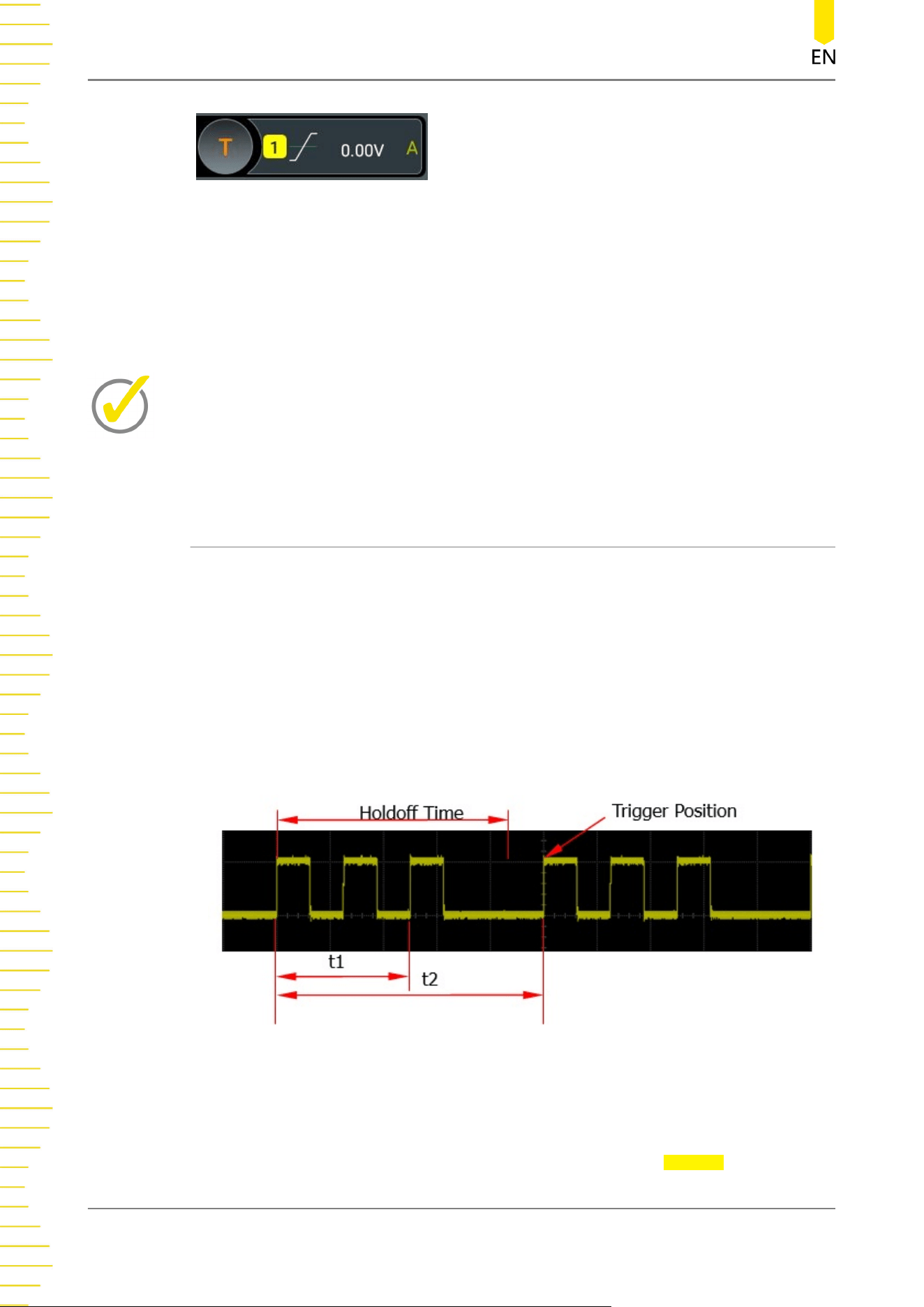
• DC: allows DC and AC components to pass the trigger path.
• AC: blocks the DC components and attenuates the signals.
• LFR: blocks the DC components and rejects the low-frequency components.
• HFR: rejects the high frequency components.
Tip
When "AC" or "LFR" is selected for the coupling mode, no trigger level lines and trigger icons
are displayed. When you adjust the trigger level, you can only see the changes of the trigger
level values in the trigger information label at the top of the screen.
8.5 Trigger Holdoff
Trigger holdoff can be used to stably trigger on complex repetitive waveforms that
have multiple edges (or other events) between waveform repetitions (such as pulse
series). Holdoff time indicates the time that the oscilloscope waits for re-arming the
trigger module after generating a correct trigger. The oscilloscope will not trigger
even if the trigger condition is met during the holdoff time and will only re-arm the
trigger module after the holdoff time expires.
For example, to stably trigger the repetitive pulse series as shown in the figure below,
the holdoff time should be set to a value that is greater than t1 and smaller than t2.
Figure 8.2 Trigger Holdoff
Click or tap the trigger setting label (as shown in the figure below) on the top of the
screen to open the "Trigger" menu. You can also tap the "Trigger" icon on the small
screen to open the trigger menu. Click or tap the input field of
Holdoff to input the
holdoff time (the holdoff to this time when the waveforms are stably triggered; by
To Trigger the Oscilloscope
DS70000 User Guide
72
Copyright ©RIGOL TECHNOLOGIES CO., LTD.
All rights reserved.
default, the holdoff time is 8 ns) with the pop-up numeric keypad. The adjustable
range of the holdoff time is from 8 ns to 10 s.
8.6 Noise Rejection
Noise rejection can reject the high frequency noise in the signal and reduce the
possibility of miss-trigger of the oscilloscope.
Click or tap the trigger information label at the top of the screen or the "Trigger" icon
on the small screen to open the "Trigger" menu. Click or tap the ON/OFF tab for the
Noise Reject menu to enable or disable the noise rejection function.
Tip
This function is only valid when the trigger source is an analog channel or EXT.
8.7 Trigger Type
DS70000 series oscilloscope provides the following trigger functions.
8.7.1 Edge Trigger
Triggers on the trigger level of the specified edge of the input signal.
Trigger Type
Click/tap the trigger information label at the top of the screen or tap the Trigger icon
on the small screen to open the "Trigger" menu. Click or tap the drop-down button of
Type to select "Edge" from the drop-down list.
To Trigger the Oscilloscope
Copyright ©RIGOL TECHNOLOGIES CO., LTD.
All rights reserved.
DS70000 User Guide
73
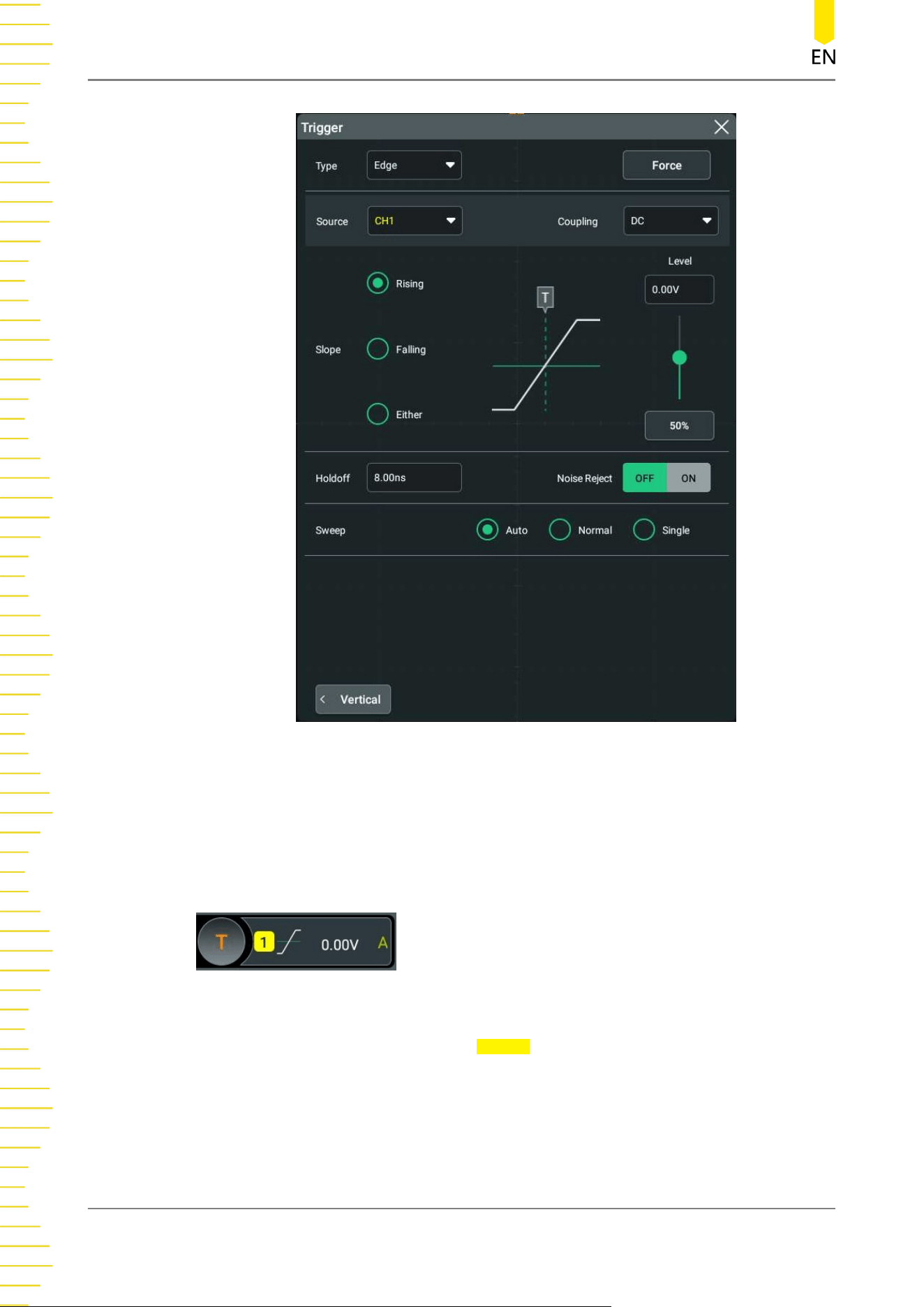
Figure 8.3 Edge Trigger Setting Menu
After selecting the trigger type, and then the current trigger setting information
(including trigger type, trigger source, and trigger level) Back is displayed in the
trigger information label at the top of the screen, as shown in the figure below. The
information will change based on the trigger settings.
Source Selection
Click or tap the drop-down button of Source to select CH1-CH4, AC Line, or EXT. For
details, refer to descriptions in
Trigger Source
. The current trigger source is displayed
in the trigger information label at the top of the screen.
Only when we select the channel (that has been input with signals) as the trigger
source, can we obtain a stable trigger.
To Trigger the Oscilloscope
DS70000 User Guide
74
Copyright ©RIGOL TECHNOLOGIES CO., LTD.
All rights reserved.
Edge Type
Click or tap the sub-item for the Slope menu to select the input signal edge on which
the oscilloscope triggers. It will be displayed in the trigger information label.
• Rising: triggers on the rising edge of the input signal when the voltage level
meets the specified trigger level.
• Falling: triggers on the falling edge of the input signal when the voltage level
meets the specified trigger level.
• Either: triggers on the rising or falling edge of the input signal when the voltage
level meets the preset trigger level.
Trigger Mode
In Sweep menu, select Auto, Normal, or Single as the trigger mode. For details, refer
to descriptions in
Trigger Mode
.
Trigger Parameter Setting
Sets the trigger parameters (trigger coupling, trigger holdoff, and noise rejection)
under this trigger type. For details, refer to descriptions in
Trigger Coupling
,
Trigger
Holdoff
, and
Noise Rejection
.
Trigger Level
Tap the "Trigger" icon on the small screen. When the multi-function knob selects the
trigger function, rotate the knob at the upper-right part of the small screen or
drag the adjustment icon under the Level menu to adjust the trigger level. For details,
refer to descriptions in
Trigger Level
. The current trigger level is displayed in the
trigger information label at the top of the screen.
8.7.2 Pulse Trigger
Triggers on the positive or negative pulse with a specified width. In this mode, the
oscilloscope will trigger when the pulse width of the input signal satisfies the
specified pulse width condition.
In this oscilloscope, positive pulse width is defined as the time difference between the
two crossing points of the trigger level and positive pulse; negative pulse width is
defined as the time difference between the two crossing points of the trigger level
and negative pulse, as shown in the figure below.
To Trigger the Oscilloscope
Copyright ©RIGOL TECHNOLOGIES CO., LTD.
All rights reserved.
DS70000 User Guide
75
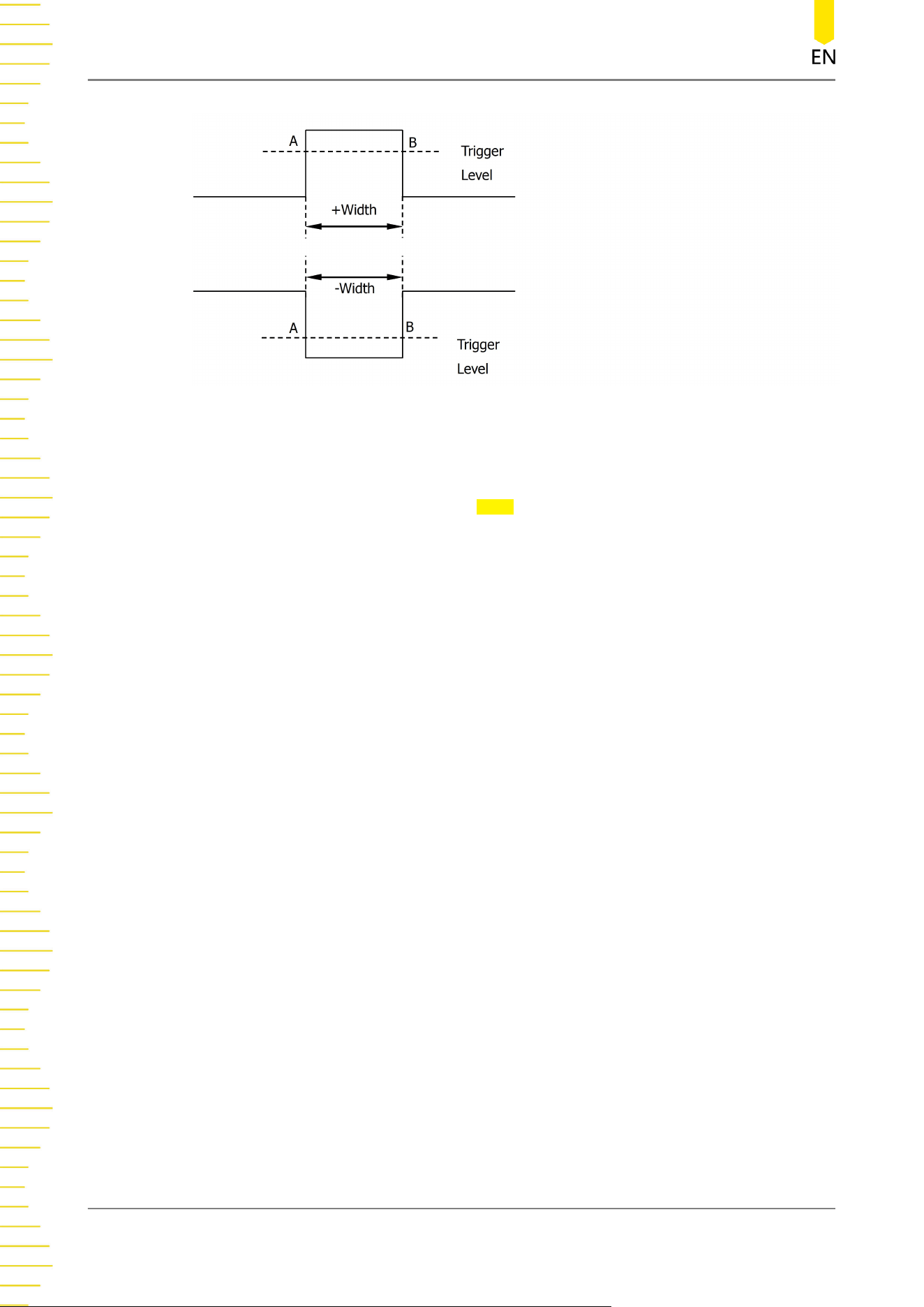
Figure 8.4 Positive Pulse Width/Negative Pulse Width
Trigger Type
Click or tap the drop-down button of Type to select "Pulse" from the drop-down list.
Then set the parameters for Pulse trigger.
To Trigger the Oscilloscope
DS70000 User Guide
76
Copyright ©RIGOL TECHNOLOGIES CO., LTD.
All rights reserved.
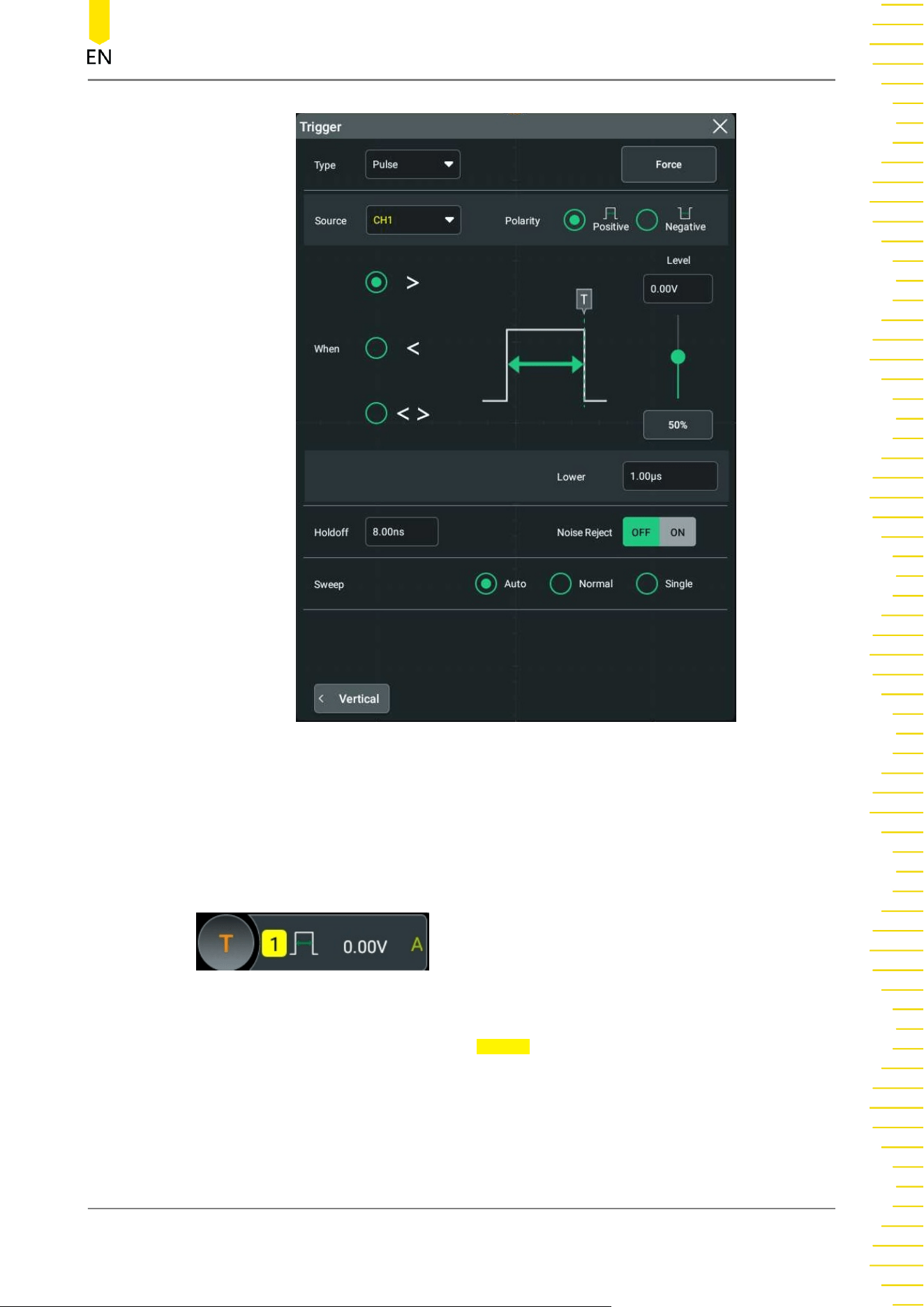
Figure 8.5 Pulse Trigger Setting Menu
After selecting the trigger type, and then the current trigger setting information
(including trigger type, trigger source, and trigger level) is displayed in the trigger
label at the top of the screen, as shown in the figure below. The information will
change based on the trigger settings.
Source Selection
Click or tap the drop-down button of Source to select CH1-CH4. For details, refer to
descriptions in
Trigger Source
. The current trigger source is displayed in the trigger
information label at the top of the screen.
Only when we select the channel (that has been input with signals) as the trigger
source, can we obtain a stable trigger.
To Trigger the Oscilloscope
Copyright ©RIGOL TECHNOLOGIES CO., LTD.
All rights reserved.
DS70000 User Guide
77
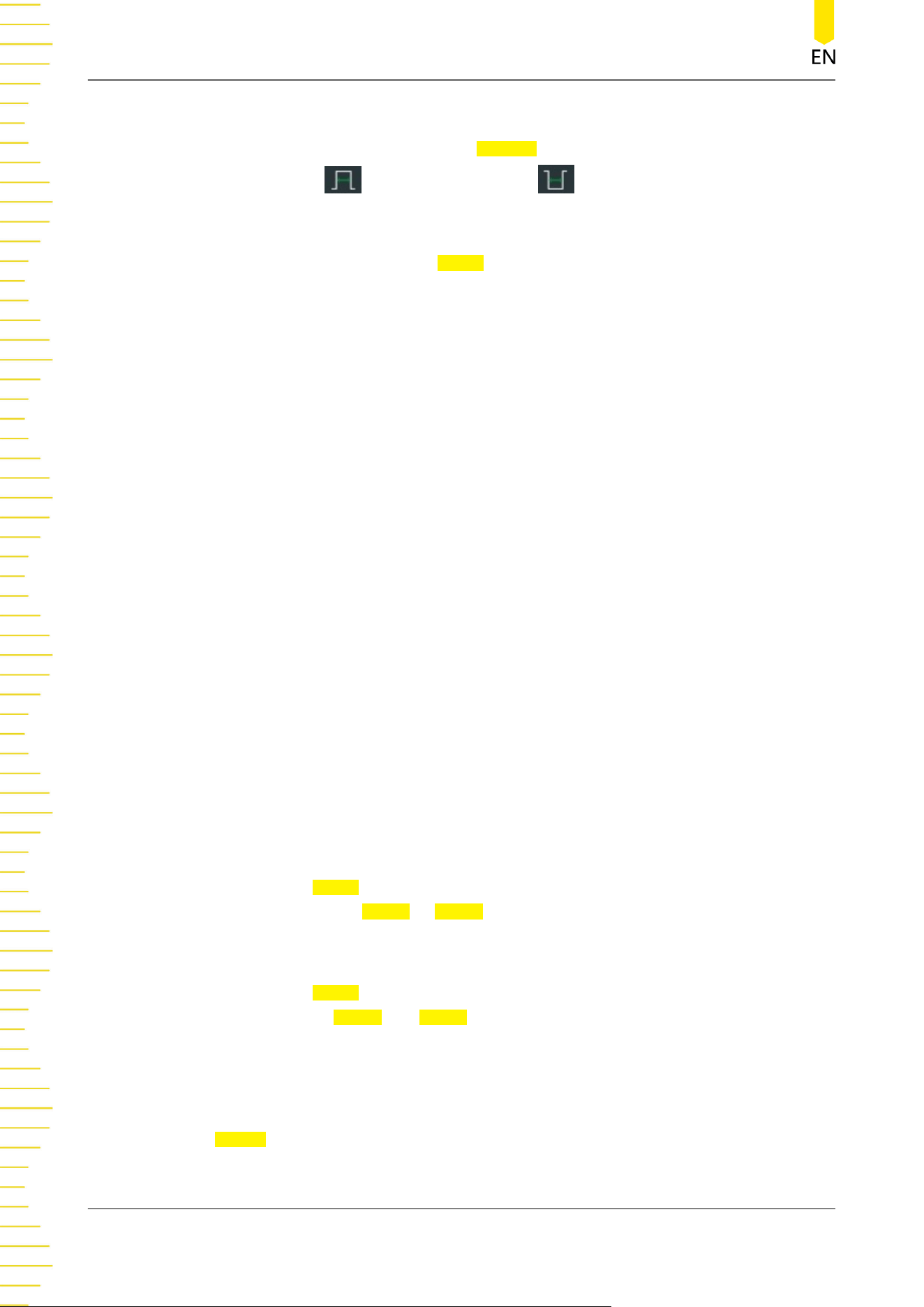
Polarity
Selects the desired polarity.under the Polarity menu. The polarities available are
positive polarity ( ) and negative polarity ( ).
Trigger Condition
Sets the trigger condition in the When menu.
• When you select "Positive" for polarity, ">" for trigger condition, the oscilloscope
triggers when the positive pulse width of the input signal is greater than the
specified pulse width.
• When you select "Positive" for polarity, "<" for trigger condition, the oscilloscope
triggers when the positive pulse width of the input signal is smaller than the
specified pulse width.
• When you select "Positive" for polarity, "< >" for trigger condition, the
oscilloscope triggers when the positive pulse width of the input signal is greater
than the specified lower limit of pulse width and smaller than the specified
upper limit of pulse width.
• When you select "Negative" for polarity, ">" for trigger condition, the
oscilloscope triggers when the negative pulse width of the input signal is greater
than the specified pulse width.
• When you select "Negative" for polarity, "<" for trigger condition, the
oscilloscope triggers when the negative pulse width of the input signal is smaller
than the specified pulse width.
• When you select "Negative" for polarity, "< >" for trigger condition, the
oscilloscope triggers when the negative pulse width of the input signal is greater
than the specified lower limit of pulse width and smaller than the specified
upper limit of pulse width.
Pulse Width Setting
• Under the When menu, when ">" or "<" is set to trigger conditions, click or tap
the input field of Lower or Upper to set the lower limit value or the upper limit
value with the pop-up numeric keypad. The pulse range available is from 100 ps
to 10 s.
• Under the When menu, when "< >" is set to trigger conditions, click or tap the
input field of
Upper and Lower respectively to set the lower limit value and the
upper limit value with the pop-up numeric keypad. The lower limit of the pulse
width must be smaller than the upper limit.
Trigger Mode
In Sweep menu, select Auto, Normal, or Single as the trigger mode. For details, refer
to descriptions in
Trigger Mode
.
To Trigger the Oscilloscope
DS70000 User Guide
78
Copyright ©RIGOL TECHNOLOGIES CO., LTD.
All rights reserved.
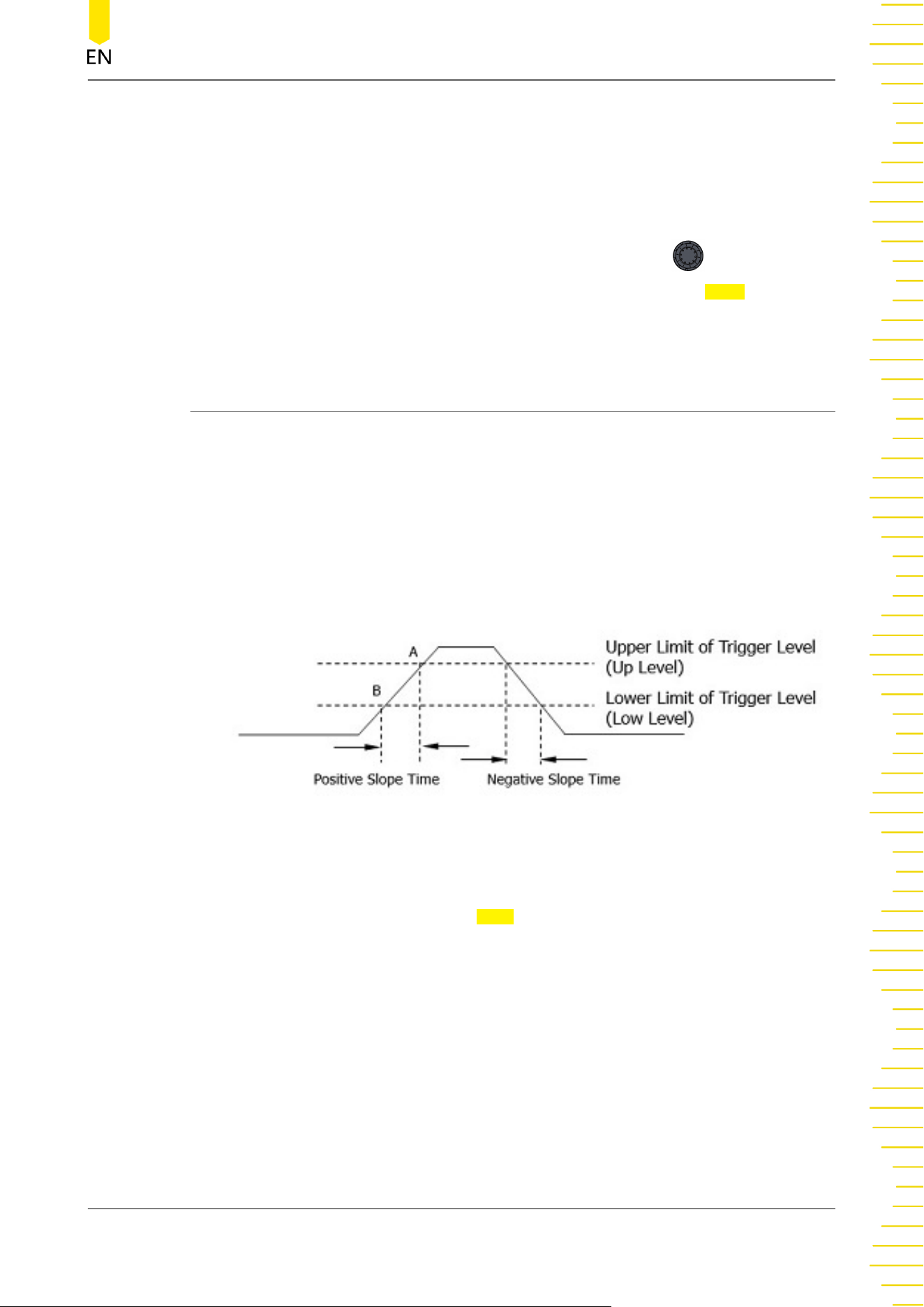
Trigger Parameter Setting
Sets the trigger parameters (trigger holdoff and noise rejection) under this trigger
type. For details, refer to descriptions in
Trigger Holdoff
and
Noise Rejection
.
Trigger Level
Tap the "Trigger" icon on the small screen, then rotate the knob at the upper-
right part of the small screen or drag the adjustment icon under the Level menu to
adjust the trigger level. For details, refer to descriptions in
Trigger Level
. The current
trigger level is displayed in the trigger information label at the top of the screen.
8.7.3 Slope Trigger
In Slope trigger, the oscilloscope triggers on the positive or negative slope of the
specified time. This trigger mode is applicable to ramp and triangle waveforms.
In this oscilloscope, positive slope time is defined as the time difference between the
two crossing points of trigger level line A and B with the rising edge; negative slope
time is defined as the time difference between the two crossing points of trigger level
line A and B with the falling edge as shown in the figure below. as shown in the figure
below.
Figure 8.6 Positive Slope Time/Negative Slope Time
Trigger Type
Click or tap the drop-down button of Type to select "Slope" from the drop-down list.
Then set the parameters for Slope trigger.
To Trigger the Oscilloscope
Copyright ©RIGOL TECHNOLOGIES CO., LTD.
All rights reserved.
DS70000 User Guide
79
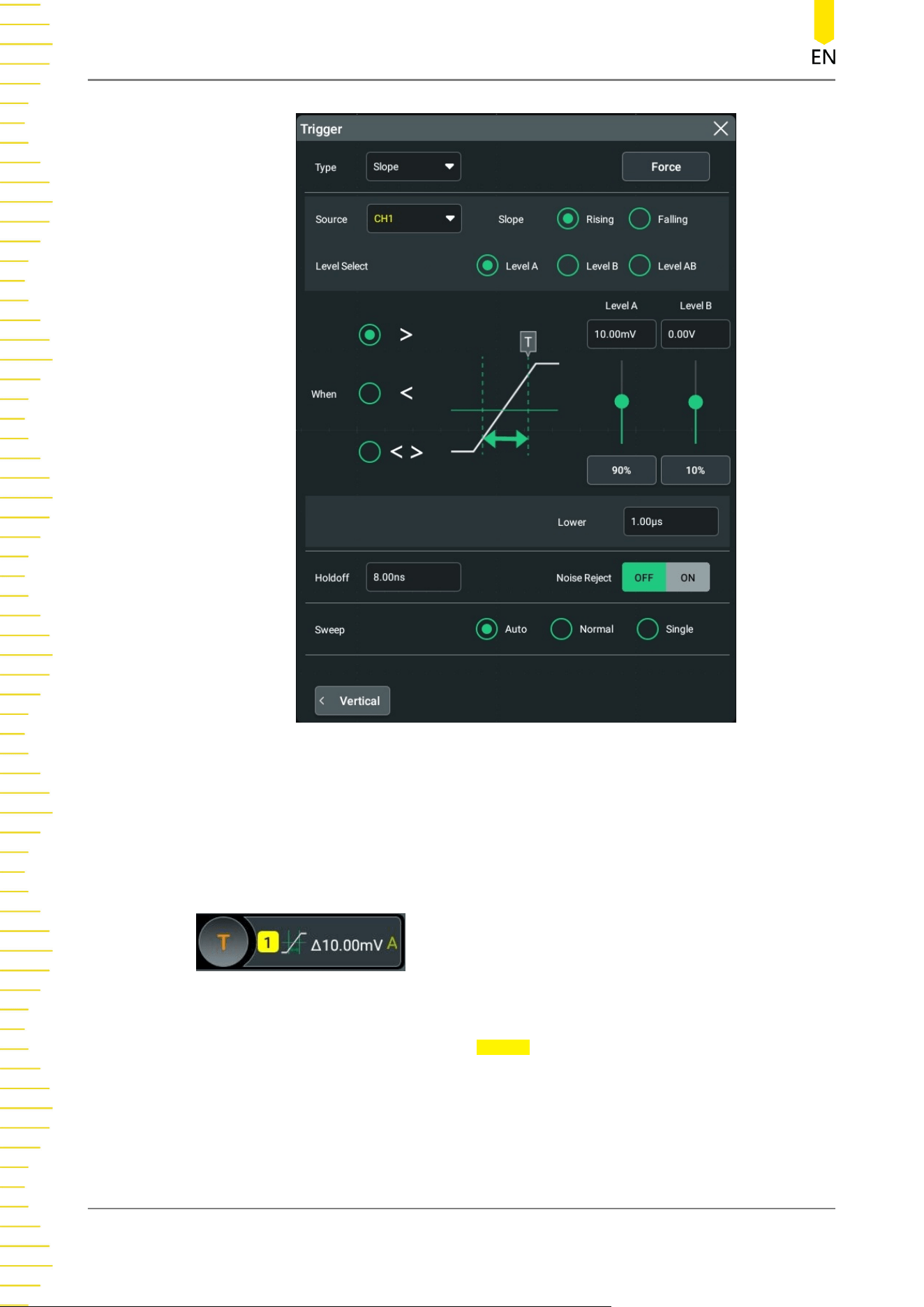
Figure 8.7 Slope Trigger Setting Menu
After selecting the trigger type, and then the current trigger setting information
(including trigger type, trigger source, and trigger level) is displayed in the trigger
information label at the top of the screen, as shown in the figure below. The
information will change based on the trigger settings.
Source Selection
Click or tap the drop-down button of Source to select CH1-CH4. For details, refer to
descriptions in
Trigger Source
. The current trigger source is displayed in the trigger
information label at the top of the screen.
Only when we select the channel (that has been input with signals) as the trigger
source, can we obtain a stable trigger.
To Trigger the Oscilloscope
DS70000 User Guide
80
Copyright ©RIGOL TECHNOLOGIES CO., LTD.
All rights reserved.
Edge Type
Select the input signal edge (under the Slope menu) on which the oscilloscope
triggers.
• Rising: triggers on the rising edge of the input signal.
• Falling: triggers on the falling edge of the input signal.
Trigger Condition:
Sets the trigger condition in the When menu.
• When you select "Rising" for the edge type, ">" for trigger condition, the
oscilloscope triggers when the positive slope time of the input signal is greater
than the specified time.
• When you select "Rising" for the edge type, "<" for trigger condition, the
oscilloscope triggers when the positive slope time of the input signal is smaller
than the specified time.
• When you select "Rising" for the edge type, "< >" for trigger condition, the
oscilloscope triggers when the positive slope time of the input signal is greater
than the specified lower limit time and smaller than the specified upper limit
time.
• When you select "Falling" for the edge type, ">" for trigger condition, the
oscilloscope triggers when the negative slope time of the input signal is greater
than the specified time.
• When you select "Falling" for the edge type, "<" for trigger condition, the
oscilloscope triggers when the negative slope time of the input signal is smaller
than the specified time.
• When you select "Falling" for the edge type, "< >" for trigger condition, the
oscilloscope triggers when the negative slope time of the input signal is greater
than the specified lower limit time and smaller than the specified upper limit
time.
Slope Time Setting
• Under the When menu, when ">" or "<" is set to trigger conditions, click or tap
the input field of Lower or Upper to set the lower limit value or the upper limit
value with the pop-up numeric keypad. The available range of the slope time is
from 100 ps to 10 s.
• Under the
When menu, when "< >" is set to trigger conditions, click or tap the
input field of Upper and Lower respectively to set the lower limit value and the
upper limit value with the pop-up numeric keypad.
The lower slope time limit must be smaller than the upper slope time limit.
To Trigger the Oscilloscope
Copyright ©RIGOL TECHNOLOGIES CO., LTD.
All rights reserved.
DS70000 User Guide
81
Trigger Mode
In Sweep menu, select Auto, Normal, or Single as the trigger mode. For details, refer
to descriptions in
Trigger Mode
.
Trigger Parameter Setting
Sets the trigger parameters (trigger holdoff and noise rejection) under this trigger
type. For details, refer to descriptions in
Trigger Holdoff
and
Noise Rejection
.
Level Selection and Setting
After the trigger condition setting is completed, you need to adjust the trigger level
to correctly trigger the signal and obtain a stable waveform.
Select the level adjustment type under the Level Select menu.
• Level A: only adjusts the upper limit of the trigger level, and the lower limit of
the trigger level remains unchanged.
• Level B: only adjusts the lower limit of the trigger level, and the upper limit of the
trigger level remains unchanged.
• Level AB: adjusts the upper and lower limits of the trigger level at the same time,
and the trigger level deviation (the difference between the upper limit and lower
limit of the trigger level) remains unchanged.
When setting the trigger level, first select a level type and then tap the "Trigger" icon
on the small screen, rotate the knob at the upper-right part of the small screen
or drag the adjustment icon under the Level A and Level B menu item to adjust the
level of Source A and Source B. For details, refer to descriptions in
Trigger Level
. The
current trigger level is displayed in the trigger information label at the top of the
screen.
8.7.4 Video Trigger
The video signal can include image information and timing information, which adopts
different standards and formats. DS70000 series can trigger on the standard video
signal field or line of NTSC (National Television Standards Committee), PAL (Phase
Alternating Line), or SECAM (Sequential Couleur A Memoire).
Trigger Type
Click or tap the drop-down button of Type to select "Video" from the drop-down list.
Then set the parameters for Video trigger.
To Trigger the Oscilloscope
DS70000 User Guide
82
Copyright ©RIGOL TECHNOLOGIES CO., LTD.
All rights reserved.
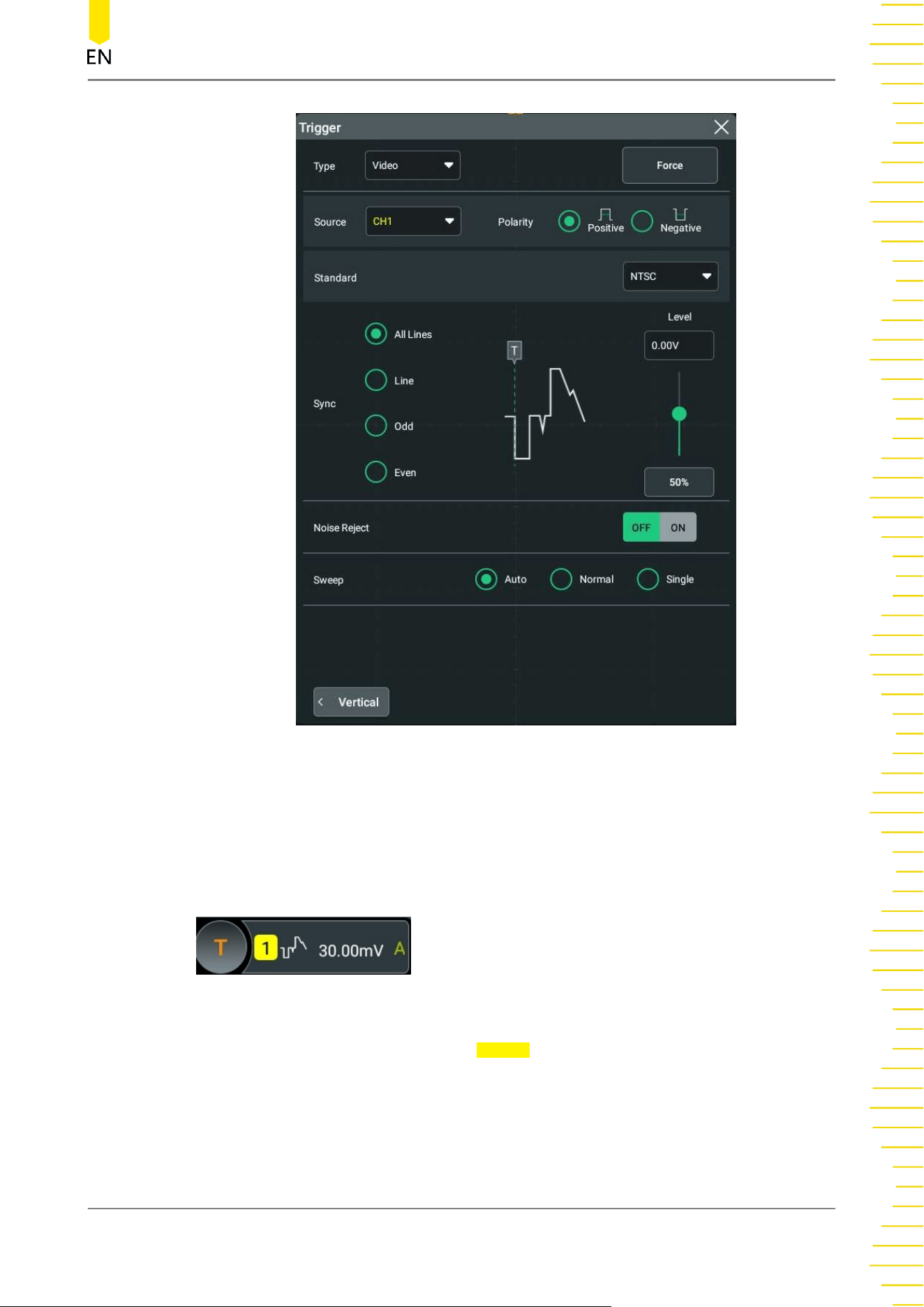
Figure 8.8 Video Trigger Setting Menu
After selecting the trigger type, and then the current trigger setting information
(including trigger type, trigger source, and trigger level) is displayed in the trigger
information label at the top of the screen, as shown in the figure below. The
information will change based on the trigger settings.
Source Selection
Click or tap the drop-down button of Source to select CH1-CH4. For details, refer to
descriptions in
Trigger Source
. The current trigger source is displayed in the trigger
information label at the top of the screen.
Only when we select the channel (that has been input with signals) as the trigger
source, can we obtain a stable trigger.
To Trigger the Oscilloscope
Copyright ©RIGOL TECHNOLOGIES CO., LTD.
All rights reserved.
DS70000 User Guide
83
Video Polarity
Selects the desired polarity under the Polarity menu. The polarities available are
positive polarity ( ) and negative polarity ( ).
Video Standard
Click or tap the drop-down button of Standard to select the desired video standard.
Table 8.1 Video Standard
Video Standard
Frame Frequency
(Frame)
Scan Type TV Scan Line
NTSC 30 Interlaced Scan 525
PAL/SECAM 25 Interlaced Scan 625
480p/60Hz 60 Progressive Scan 525
576p/50Hz 50 Progressive Scan 625
720p/60Hz 60 Progressive Scan 750
720p/50Hz 50 Progressive Scan 750
720p/30Hz 30 Progressive Scan 750
720p/25Hz 25 Progressive Scan 750
720p/24Hz 24 Progressive Scan 750
1080p/60Hz 60 Progressive Scan 1125
1080p/50Hz 50 Progressive Scan 1125
1080p/30Hz 30 Progressive Scan 1125
1080p/25Hz 25 Progressive Scan 1125
1080p/24Hz 24 Progressive Scan 1125
1080i/60Hz 60 Interlaced Scan 1125
1080i/50Hz 50 Interlaced Scan 1125
Sync
Selects the desired sync type from the drop-down list of the Sync menu.
• All Lines: triggers on the first line found.
• Line: triggers on the specified line.
When this sync type is selected, you can specify a line number. Click or tap the
input field of Line to set the line number by using the pop-up numeric keypad.
The range of the line number is related to the currently selected video standards.
The range is from 1 to 525 (NTSC), 1 to 625 (PAL/SECAM, 1 to 525 (480p), 1 to
625 (576p), 1 to 750 (720p), or 1 to 1125 (1080p/ 1080i).
• Odd: triggers on the rising edge of the first ramp pulse in the odd field. It is only
available when the video standard is set to "NTSC" or "PAL/SECAM".
To Trigger the Oscilloscope
DS70000 User Guide
84
Copyright ©RIGOL TECHNOLOGIES CO., LTD.
All rights reserved.
• Even: triggers on the rising edge of the first ramp pulse in the even field. It is
only available when the video standard is set to "NTSC" or "PAL/SECAM".
Trigger Mode
In Sweep menu, select Auto, Normal, or Single as the trigger mode. For details, refer
to descriptions in
Trigger Mode
.
Trigger Parameter Setting
Sets the trigger parameter (noise rejection) under this trigger type. For details, refer
to descriptions in "
Noise Reject
".
Trigger Level
Tap the "Trigger" icon on the small screen, then rotate the knob at the upper-
right part of the small screen or drag the adjustment icon under the Level menu to
adjust the trigger level. For details, refer to descriptions in
Trigger Level
. The current
trigger level is displayed in the trigger information label at the top of the screen.
Tip
• For a better observation of the waveform details in the video signal, you can set a larger
memory depth first.
• In the trigger debugging process of video signals, the frequency in different part of the
signal can be reflected by a different brightness, as RIGOL's digital oscilloscope provides
the intensity graded color display function. Experienced users can quickly judge the
signal quality and discover abnormalities during the debugging process.
8.7.5 Pattern Trigger
Identifies a trigger condition by searching for a specified pattern. This pattern is a
logical "AND" combination of channels. Each channel can be set to H (high), L (low),
or X (don't care). A rising or falling edge (you can only specify a single edge) can be
specified for one channel included in the pattern. When an edge is specified, the
oscilloscope will trigger at the edge specified if the pattern set for the other channels
are true (namely the actual pattern of the channel is the same as the preset pattern). If
no edge is specified, the oscilloscope will trigger on the last edge that makes the
pattern true. If all the channels in the pattern are set to "X", the oscilloscope will not
trigger.
To Trigger the Oscilloscope
Copyright ©RIGOL TECHNOLOGIES CO., LTD.
All rights reserved.
DS70000 User Guide
85
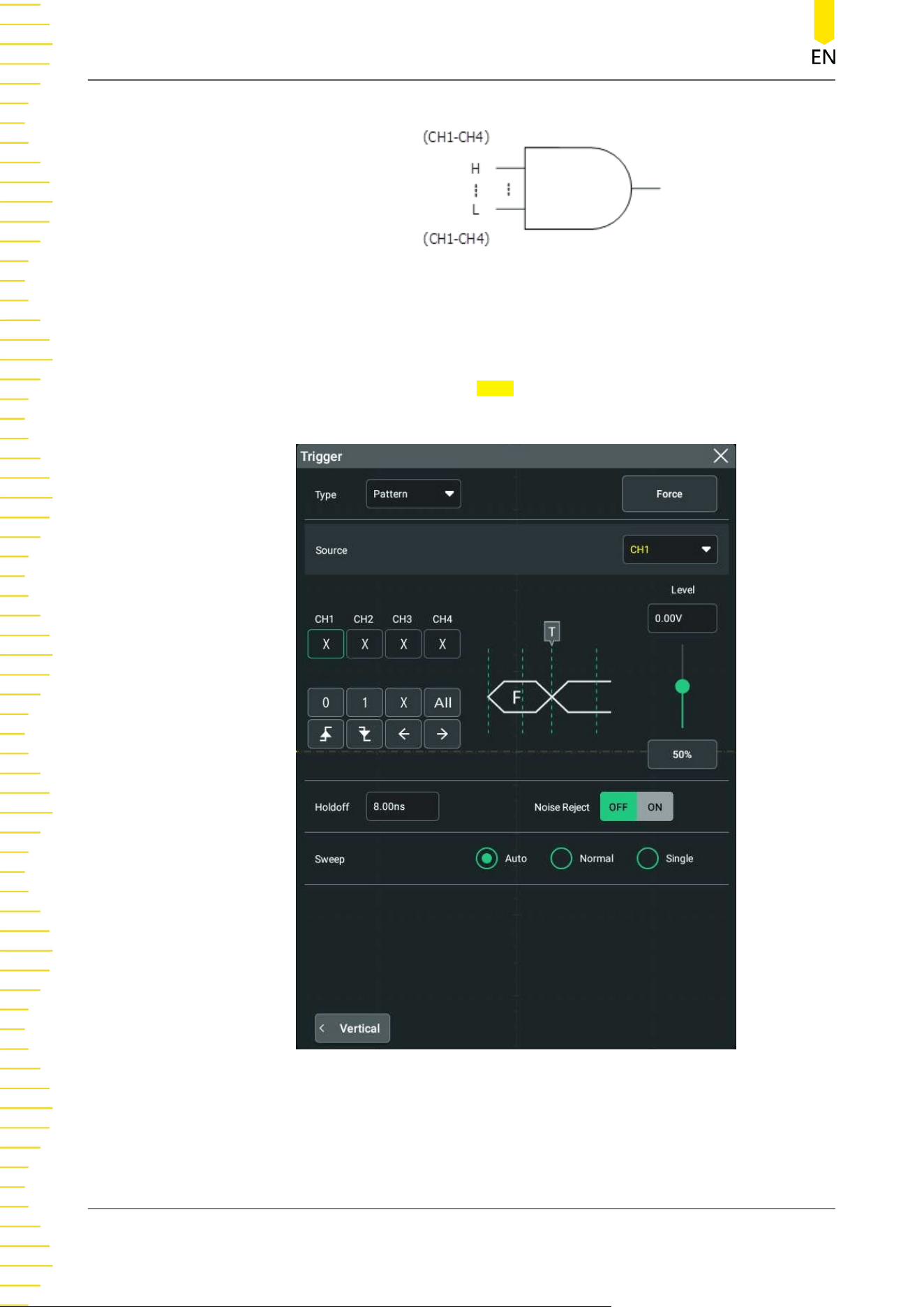
Figure 8.9 Pattern Trigger
Trigger Type
Click or tap the drop-down button of Type to select "Pattern" from the drop-down
list. Then set the parameters for the Pattern trigger.
Figure 8.10 Pattern Trigger Setting Menu
After selecting the trigger type, and then the current trigger setting information
(including trigger type, trigger source, and trigger level) is displayed in the trigger
To Trigger the Oscilloscope
DS70000 User Guide
86
Copyright ©RIGOL TECHNOLOGIES CO., LTD.
All rights reserved.
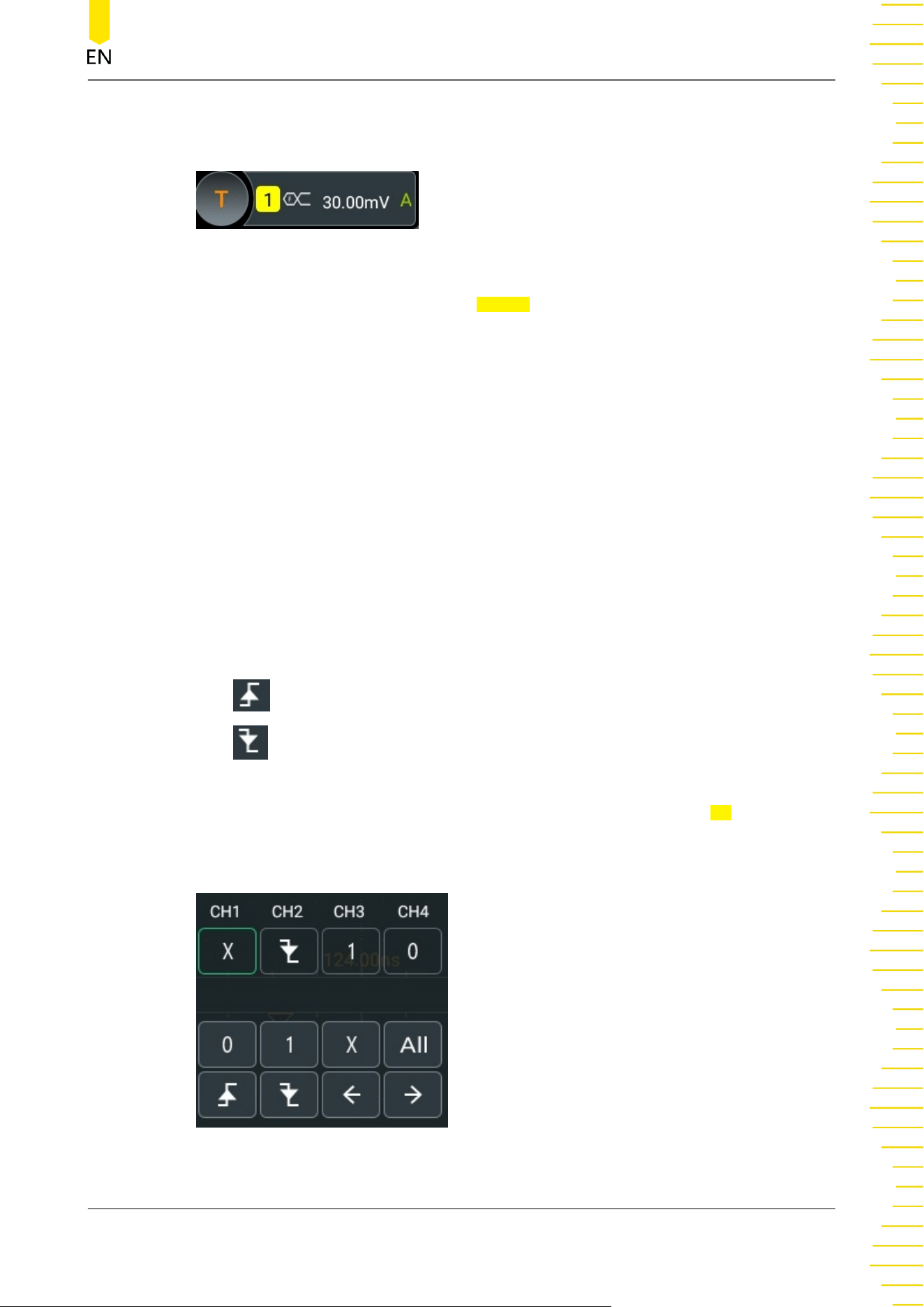
information label at the top of the screen, as shown in the figure below. The
information will change based on the trigger settings.
Source Selection
Click or tap the drop-down button of Source to select CH1-CH4. For details, refer to
descriptions in
Trigger Source
. The current trigger source is displayed in the trigger
information label at the top of the screen.
Only when we select the channel (that has been input with signals) as the trigger
source, can we obtain a stable trigger.
Pattern Setting
The following five patterns are available:
• 1: sets the pattern of the channel selected to "1", i.g. the voltage level is higher
than the trigger level of the channel.
• 0: sets the pattern of the channel selected to "0", i.g. the voltage level is lower
than the trigger level of the channel.
• X: sets the pattern of the channel selected to "X", i.g. this channel is not used as
a part of the pattern. When all channels in the pattern are set to "X", the
oscilloscope will not trigger.
• : sets the pattern to the rising edge of the channel selected.
• : sets the pattern to the falling edge of the channel selected.
The Left/Right arrow key indicates moving left/right to switch the channel pattern.
"All" indicates all bits. Select a pattern for a channel, then click or tap All. The patterns
of all the other channels will be set to the currently selected pattern. The pattern
setting is shown in the figure below:
To Trigger the Oscilloscope
Copyright ©RIGOL TECHNOLOGIES CO., LTD.
All rights reserved.
DS70000 User Guide
87
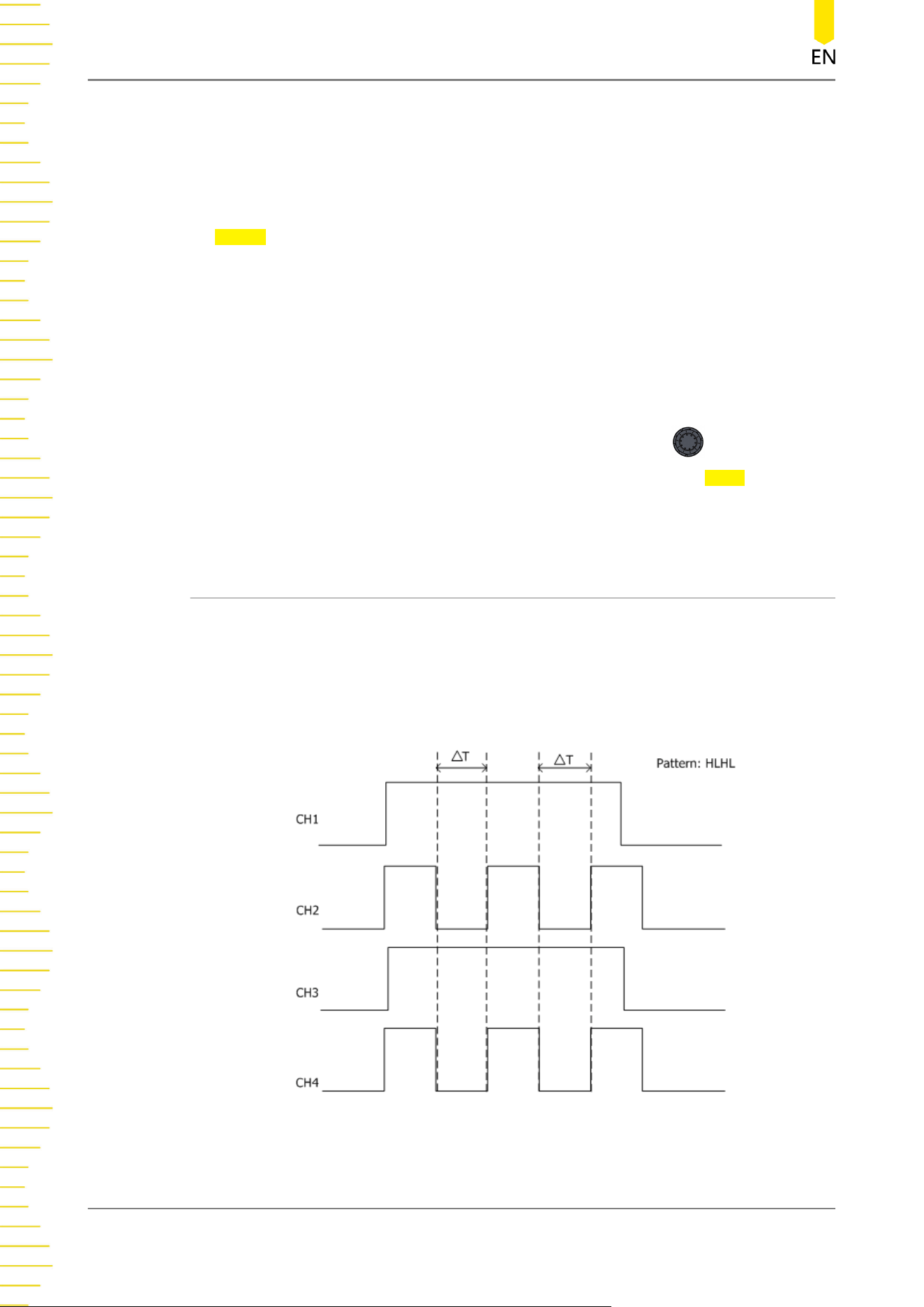
Only one edge (rising or falling edge) can be specified in the pattern. If one edge item
is currently defined and then another edge item is defined in another channel in the
pattern, then a prompt message "Invalid input" is displayed.
Trigger Mode
In Sweep menu, select Auto, Normal, or Single as the trigger mode. For details, refer
to descriptions in
Trigger Mode
.
Trigger Parameter Setting
Sets the trigger parameters (trigger holdoff and noise rejection) under this trigger
type. For details, refer to descriptions in
Trigger Holdoff
and
Noise Rejection
.
Trigger Level
Tap the "Trigger" icon on the small screen, then rotate the knob at the upper-
right part of the small screen or drag the adjustment icon under the Level menu to
adjust the trigger level. For details, refer to descriptions in
Trigger Level
. The current
trigger level is displayed in the trigger information label at the top of the screen.
8.7.6 Duration Trigger
In duration trigger, the instrument identifies a trigger condition by searching for the
duration of a specified pattern. This pattern is a logical "AND" combination of the
channels. Each channel can be set to 1 (high), 0 (low), or X (don't care). The
instrument triggers when the duration (∆T) of this pattern meets the preset time, as
shown in the figure below.
Figure 8.11 Duration Trigger
To Trigger the Oscilloscope
DS70000 User Guide
88
Copyright ©RIGOL TECHNOLOGIES CO., LTD.
All rights reserved.
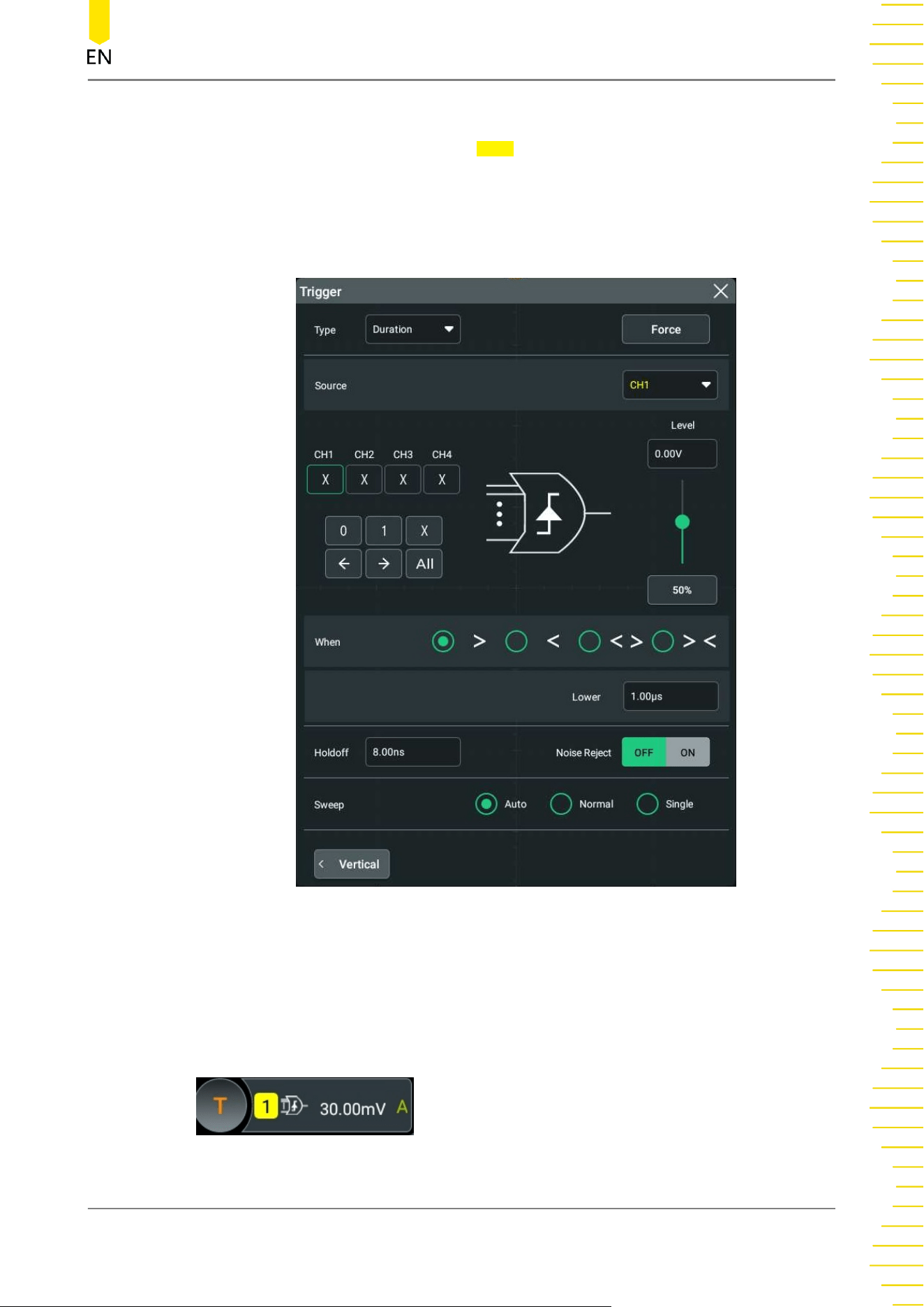
Trigger Type:
Click or tap the drop-down button of Type to select "Duration" from the drop-down
list. After selecting the trigger type, then the current trigger setting information
(including trigger type, trigger source, and trigger level) is displayed in the trigger
information label at the top of the screen, as shown in the figure below. The
information will change based on the trigger settings.
Figure 8.12 Duration Trigger Setting Menu
After selecting the trigger type, and then the current trigger setting information
(including trigger type, trigger source, and trigger level) is displayed in the trigger
information label at the top of the screen, as shown in the figure below. The
information will change based on the trigger settings.
To Trigger the Oscilloscope
Copyright ©RIGOL TECHNOLOGIES CO., LTD.
All rights reserved.
DS70000 User Guide
89
Source Selection
Click or tap the drop-down button of Source to select CH1-CH4. For details, refer to
descriptions in
Trigger Source
. The current trigger source is displayed in the trigger
information label at the top of the screen.
Only when we select the channel (that has been input with signals) as the trigger
source, can we obtain a stable trigger.
Pattern Setting
The following three patterns are available:
• 1: sets the pattern of the channel selected to "1", i.g. the voltage level is higher
than the trigger level of the channel.
• 0: sets the pattern of the channel selected to "0", i.g. the voltage level is lower
than the trigger level of the channel.
• X: sets the pattern of the channel selected to "X", i.g. this channel is not used as
a part of the pattern. When all channels in the pattern are set to "X", the
oscilloscope will not trigger.
The Left/Right arrow key indicates moving left/right to switch the channel pattern.
"All" indicates all bits. Select a pattern for a channel, then click or tap All. The patterns
of all the other channels will be set to the currently selected pattern.
Trigger Condition
Sets the trigger condition in the When menu.
• >: triggers when the duration of the pattern is greater than the preset time. Click
or tap the input field of Lower to set the lower limit of the duration of the
pattern with the pop-up numeric keypad. Its range is from 100 ps to 10 s.
• <: triggers when the duration of the pattern is smaller than the preset time. Click
or tap the input field of Upper to set the upper limit of the duration of the
pattern. Its range is from 100 ps to 10 s.
• < >: triggers when the duration of the pattern is smaller than the upper limit of
the preset time and greater than the lower limit of the preset time. Click or tap
the input field of Upper to set the upper limit of the duration of the pattern, and
the range is from 101 ps to 10 s. Click or tap the input field of Lower to set the
lower limit of the duration of the pattern, and the range is from 100 ps to 9.9 s.
The lower time limit must be smaller than the upper time limit.
• > <: triggers when the duration of the pattern is greater than the upper limit of
the preset time or smaller than the lower limit of the preset time. Click or tap the
input field of
Upper to set the upper limit of the duration of the pattern, and the
range is from 100 ps to 10 s. Click or tap the input field of Lower to set the lower
limit of the duration of the pattern, and the range is from 100 ps to 9.9 s. The
lower time limit must be smaller than the upper time limit.
To Trigger the Oscilloscope
DS70000 User Guide
90
Copyright ©RIGOL TECHNOLOGIES CO., LTD.
All rights reserved.
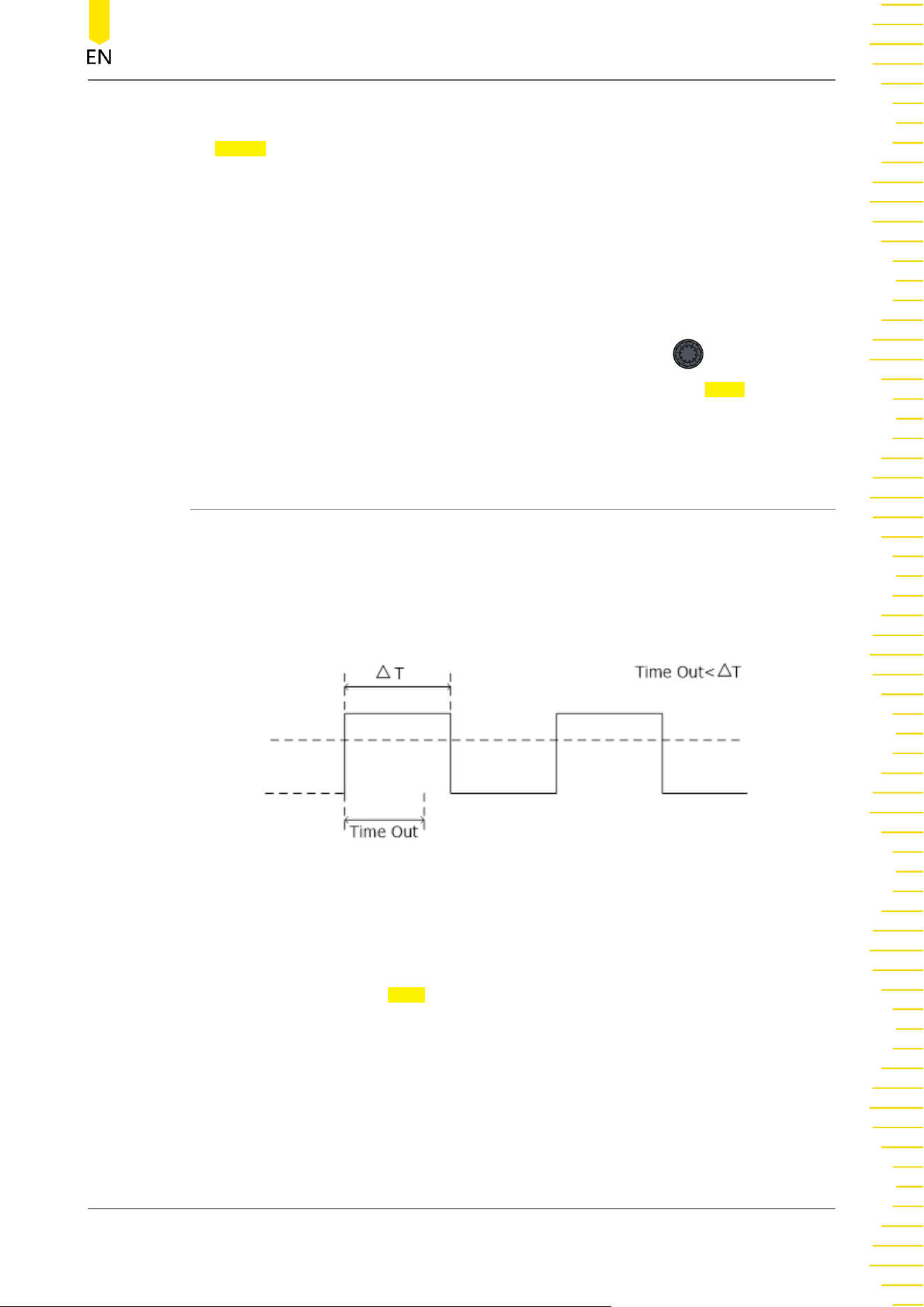
Trigger Mode
In Sweep menu, select Auto, Normal, or Single as the trigger mode. For details, refer
to descriptions in
Trigger Mode
.
Trigger Parameter Setting
Sets the trigger parameters (trigger holdoff and noise rejection) under this trigger
type. For details, refer to descriptions in
Trigger Holdoff
and
Noise Rejection
.
Trigger Level
Tap the "Trigger" icon on the small screen, then rotate the knob at the upper-
right part of the small screen or drag the adjustment icon under the Level menu to
adjust the trigger level. For details, refer to descriptions in
Trigger Level
. The current
trigger level is displayed in the trigger information label at the top of the screen.
8.7.7 Timeout Trigger
In Timeout trigger, the instrument triggers when the time interval (∆T) (the time from
when the rising edge (or falling edge) of the input signal passes through the trigger
level to the time from when the neighboring falling edge (or rising edge) passes
through the trigger level) is greater than the preset timeout value, as shown in
Figure
8.13
.
Figure 8.13 Timeout Trigger
Trigger Type
Click or tap the trigger information label at the top of the screen, and then click or tap
the drop-down button of Type to select "Timeout" from the drop-down list. Then set
the parameters for the Timeout trigger in
Figure 8.14
.
To Trigger the Oscilloscope
Copyright ©RIGOL TECHNOLOGIES CO., LTD.
All rights reserved.
DS70000 User Guide
91
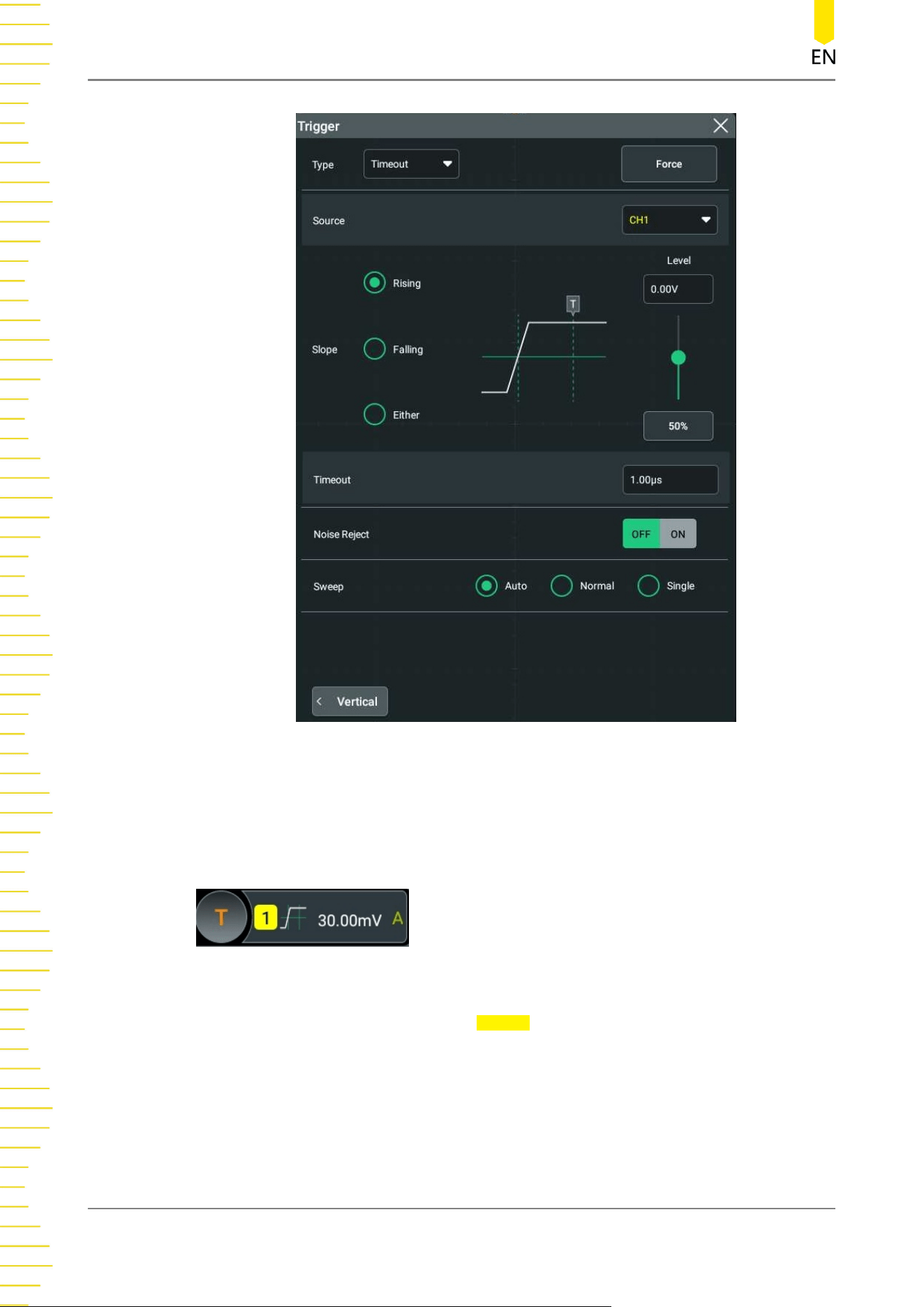
Figure 8.14 Timeout Trigger Menu
At this time, the current trigger setting information (including trigger type, trigger
source, and trigger level) is displayed at the top of the screen, as shown in the figure
below. The information will change based on the trigger settings.
Source Selection
Click or tap the drop-down button of Source to select CH1-CH4. For details, refer to
descriptions in
Trigger Source
. The current trigger source is displayed in the trigger
information label at the top of the screen.
Only when we select the channel (that has been input with signals) as the trigger
source, can we obtain a stable trigger.
To Trigger the Oscilloscope
DS70000 User Guide
92
Copyright ©RIGOL TECHNOLOGIES CO., LTD.
All rights reserved.
Edge Type
Click or tap the edge type (under Slope) from which the input signal passes through
the trigger level.
• Rising: starts timing when the rising edge of the input signal passes through the
trigger level.
• Falling: starts timing when the falling edge of the input signal passes through
the trigger level.
• Either: starts timing when either edge of the input signal passes through the
trigger level.
Timeout Value
Timeout value represents the maximum time that the signal remains idle before the
signal passes through the trigger level. Click or tap the input field of Timeout, and
then use the pop-up numeric keypad to set the timeout value of Timeout trigger. The
available range is from 16 ns to 10 s.
Trigger Mode
In Sweep menu, select Auto, Normal, or Single as the trigger mode. For details, refer
to descriptions in
Trigger Mode
.
Trigger Parameter Setting
Sets the trigger parameter (noise rejection) under this trigger type. For details, refer
to descriptions in
Noise Reject
.
Trigger Level
Tap the "Trigger" icon on the small screen, then rotate the knob at the upper-
right part of the small screen or drag the adjustment icon under the Level menu to
adjust the trigger level. For details, refer to descriptions in
Trigger Level
. The current
trigger level is displayed in the trigger information label at the top of the screen.
8.7.8 Runt Trigger
This trigger mode is used to trigger pulses that pass through one trigger level but fail
to pass through another trigger level, as shown in the figure below.
To Trigger the Oscilloscope
Copyright ©RIGOL TECHNOLOGIES CO., LTD.
All rights reserved.
DS70000 User Guide
93
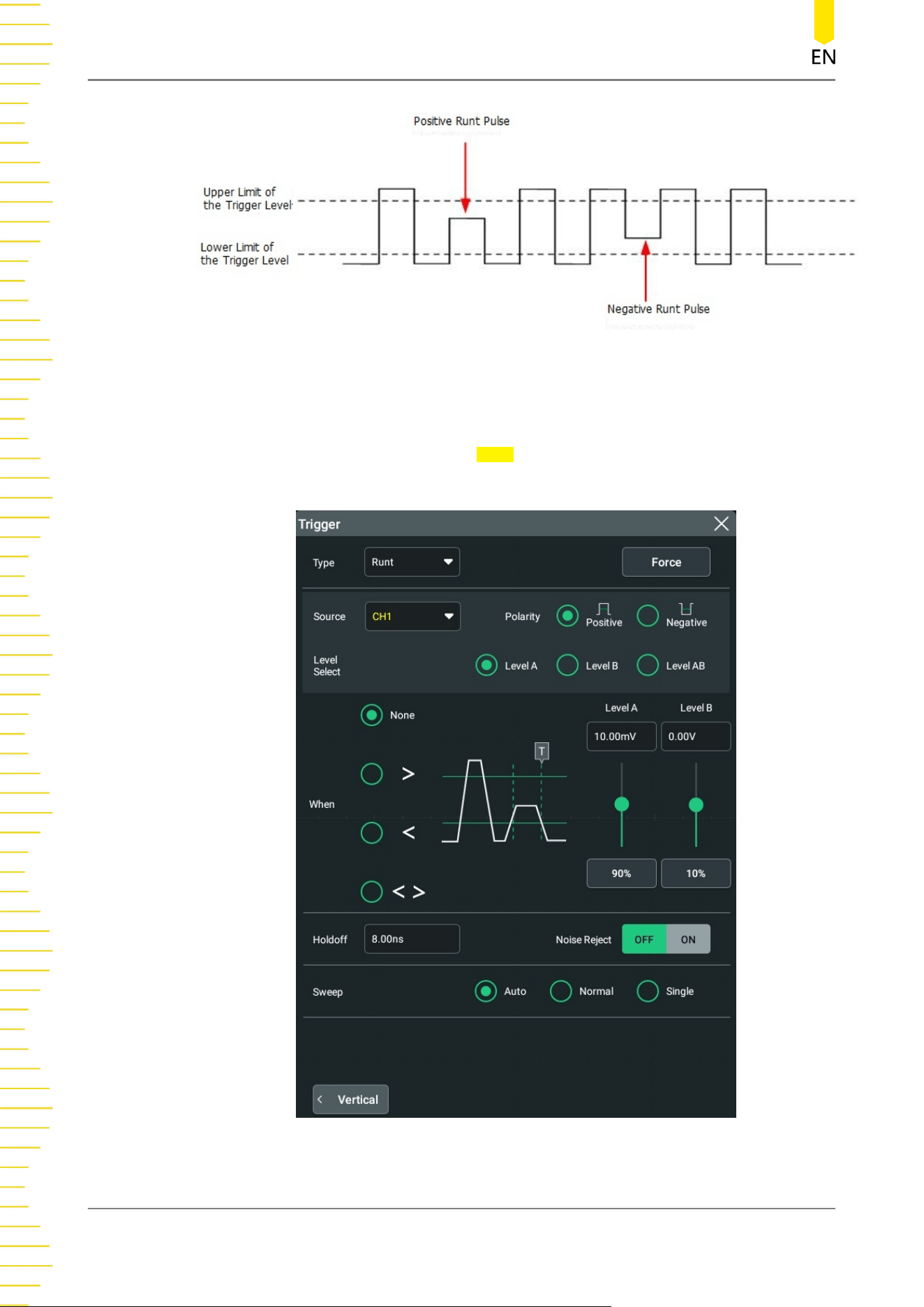
Figure 8.15 Runt Trigger
Trigger Type
Click or tap the drop-down button of Type to select "Runt" from the drop-down list.
Then set the parameters for Runt trigger.
Figure 8.16 Runt Trigger Setting Menu
To Trigger the Oscilloscope
DS70000 User Guide
94
Copyright ©RIGOL TECHNOLOGIES CO., LTD.
All rights reserved.
After selecting the trigger type, and then the current trigger setting information
(including trigger type, trigger source, and trigger level) is displayed at the top of the
screen, as shown in the figure below. The information will change based on the
trigger settings.
Source Selection
Click or tap the drop-down button of Source to select CH1-CH4. For details, refer to
descriptions in
Trigger Source
. The current trigger source is displayed in the trigger
information label at the top of the screen.
Only when we select the channel (that has been input with signals) as the trigger
source, can we obtain a stable trigger.
Polarity
Selects the pulse polarity of Runt trigger under the Polarity menu.
• Positive : triggers on the positive runt pulse.
• Negative : triggers on the negative runt pulse.
Trigger Condition
Sets the Runt trigger condition in the When menu.
• None: indicates not setting the trigger condition of Runt trigger.
• >: triggers when the runt pulse width is greater than the lower limit of pulse
width. Click or tap the input field of Lower to set the minimum pulse width of
Runt trigger with the pop-up numeric keypad.
• <: triggers when the runt pulse width is smaller than the upper limit of pulse
width. Click or tap the input field of Upper to set the maximum pulse width of
Runt trigger with the pop-up numeric keypad.
• < >: triggers when the runt pulse width is greater than the lower limit and
smaller than the upper limit of pulse width. Click or tap the input field of Upper
to set the maximum pulse width of Runt trigger with the pop-up numeric
keypad. Click or tap the input field of Lower to set the minimum pulse width of
Runt trigger with the pop-up numeric keypad. The lower limit of the pulse width
must be smaller than the upper limit.
Level Selection and Setting
After the trigger condition setting is completed, you need to adjust the trigger level
to correctly trigger the signal and obtain a stable waveform.
To Trigger the Oscilloscope
Copyright ©RIGOL TECHNOLOGIES CO., LTD.
All rights reserved.
DS70000 User Guide
95
Select the level adjustment type under the Level Select menu.
• Level A: only adjusts the upper limit of the trigger level, and the lower limit of
the trigger level remains unchanged.
• Level B: only adjusts the lower limit of the trigger level, and the upper limit of the
trigger level remains unchanged.
• Level AB: adjusts the upper and lower limits of the trigger level at the same time,
and the trigger level deviation (the difference between the upper limit and lower
limit of the trigger level) remains unchanged.
When setting the trigger level, first select a level type and then tap the "Trigger" icon
on the small screen, rotate the knob at the upper-right part of the small screen
or drag the adjustment icon under the Level A and Level B menu item to adjust the
level of Source A and Source B. For details, refer to descriptions in
Trigger Level
. The
current trigger level is displayed in the trigger information label at the top of the
screen.
Trigger Mode
In Sweep menu, select Auto, Normal, or Single as the trigger mode. For details, refer
to descriptions in
Trigger Mode
.
Trigger Parameter Setting
Sets the trigger parameters (trigger holdoff and noise rejection) under this trigger
type. For details, refer to descriptions in
Trigger Holdoff
and
Noise Rejection
.
8.7.9 Window Trigger
Window trigger provides a high trigger level and a low trigger level. The instrument
triggers when the input signal passes through the high trigger level or the low trigger
level.
Trigger Type
Click or tap the drop-down button of Type to select "Window" from the drop-down
list. Then set the parameters for Window trigger.
To Trigger the Oscilloscope
DS70000 User Guide
96
Copyright ©RIGOL TECHNOLOGIES CO., LTD.
All rights reserved.
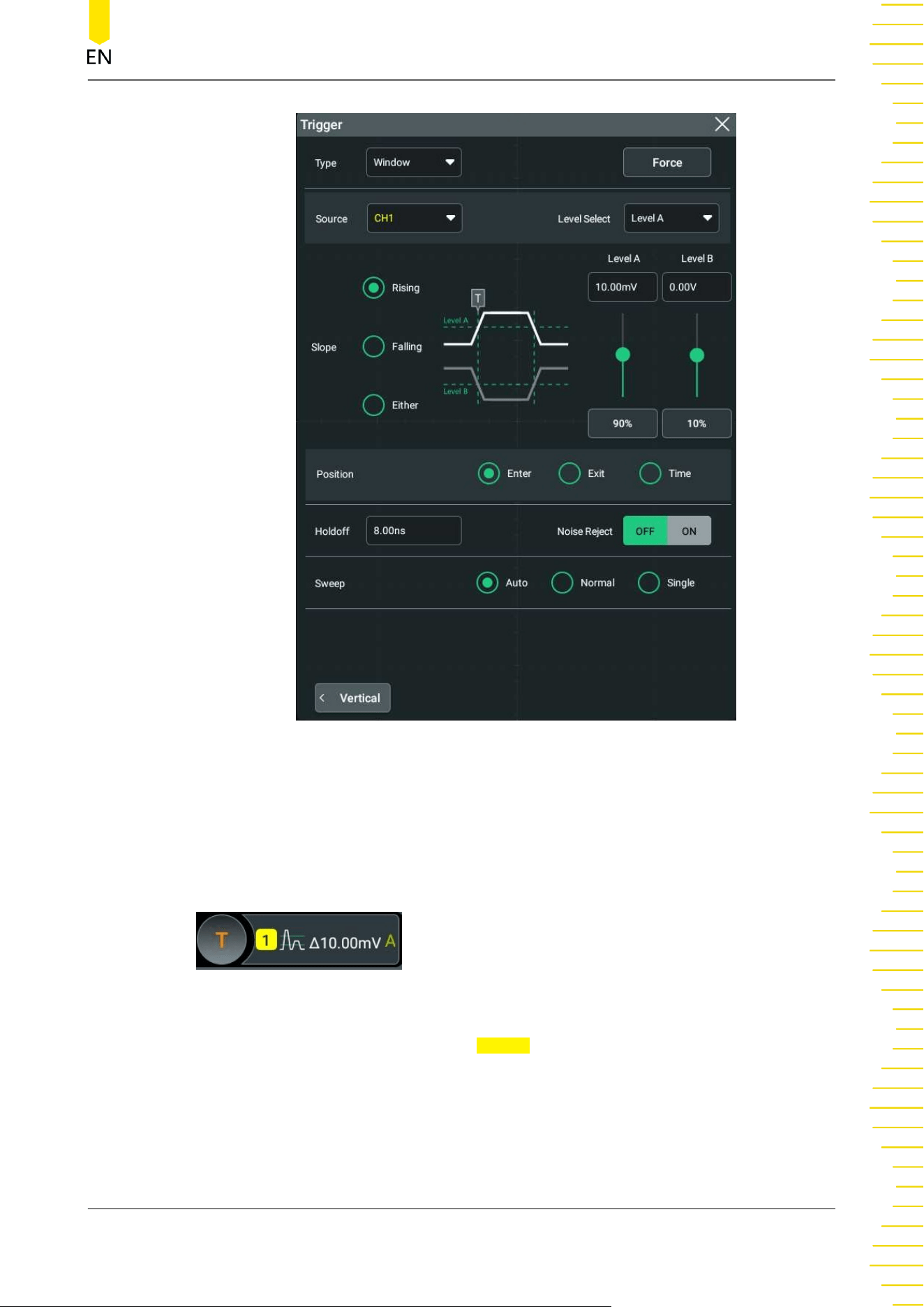
Figure 8.17 Window Trigger Setting Menu
After selecting the trigger type, and then the current trigger setting information
(including trigger type, trigger source, and trigger level) is displayed in the trigger
information label at the top of the screen, as shown in the figure below. The
information will change based on the trigger settings.
Source Selection
Click or tap the drop-down button of Source to select CH1-CH4. For details, refer to
descriptions in
Trigger Source
. The current trigger source is displayed in the trigger
information label at the top of the screen.
Only when we select the channel (that has been input with signals) as the trigger
source, can we obtain a stable trigger.
To Trigger the Oscilloscope
Copyright ©RIGOL TECHNOLOGIES CO., LTD.
All rights reserved.
DS70000 User Guide
97
Edge Type
Selects the input signal edge (under the Slope menu) on which the oscilloscope
triggers.
• Rising: triggers on the rising edge of the input signal when the voltage level is
higher than the preset high trigger level.
• Falling: triggers on the falling edge of the input signal when the voltage level is
lower than the preset low trigger level.
• Either: triggers on the rising or falling edge of the input signal when the voltage
level meets the preset trigger level.
Trigger Position
After selecting the window type, click Position to further specify the time point of
trigger by selecting the trigger position.
• Enter: triggers when the input signal enters the specified trigger level range.
• Exit: triggers when the input signal exits the specified trigger level range.
• Time: triggers when the accumulated hold time since the input signal entered
the specified trigger level range is equal to the window time. After you select
this type, click or tap the input field of Time to set it by using the pop-up
numeric keypad. The available range is from 8 ns to 10 s.
Level Selection and Setting
After the trigger condition setting is completed, you need to adjust the trigger level
to correctly trigger the signal and obtain a stable waveform.
Select the level adjustment type under the Level Select menu.
• Level A: only adjusts the upper limit of the trigger level, and the lower limit of
the trigger level remains unchanged.
• Level B: only adjusts the lower limit of the trigger level, and the upper limit of the
trigger level remains unchanged.
• Level AB: adjusts the upper and lower limits of the trigger level at the same time,
and the trigger level deviation (the difference between the upper limit and lower
limit of the trigger level) remains unchanged.
When setting the trigger level, first select a level type and then tap the "Trigger" icon
on the small screen, rotate the knob
at the upper-right part of the small screen
or drag the adjustment icon under the Level A and Level B menu item to adjust the
level of Source A and Source B. For details, refer to descriptions in
Trigger Level
. The
current trigger level is displayed in the trigger information label at the top of the
screen.
To Trigger the Oscilloscope
DS70000 User Guide
98
Copyright ©RIGOL TECHNOLOGIES CO., LTD.
All rights reserved.
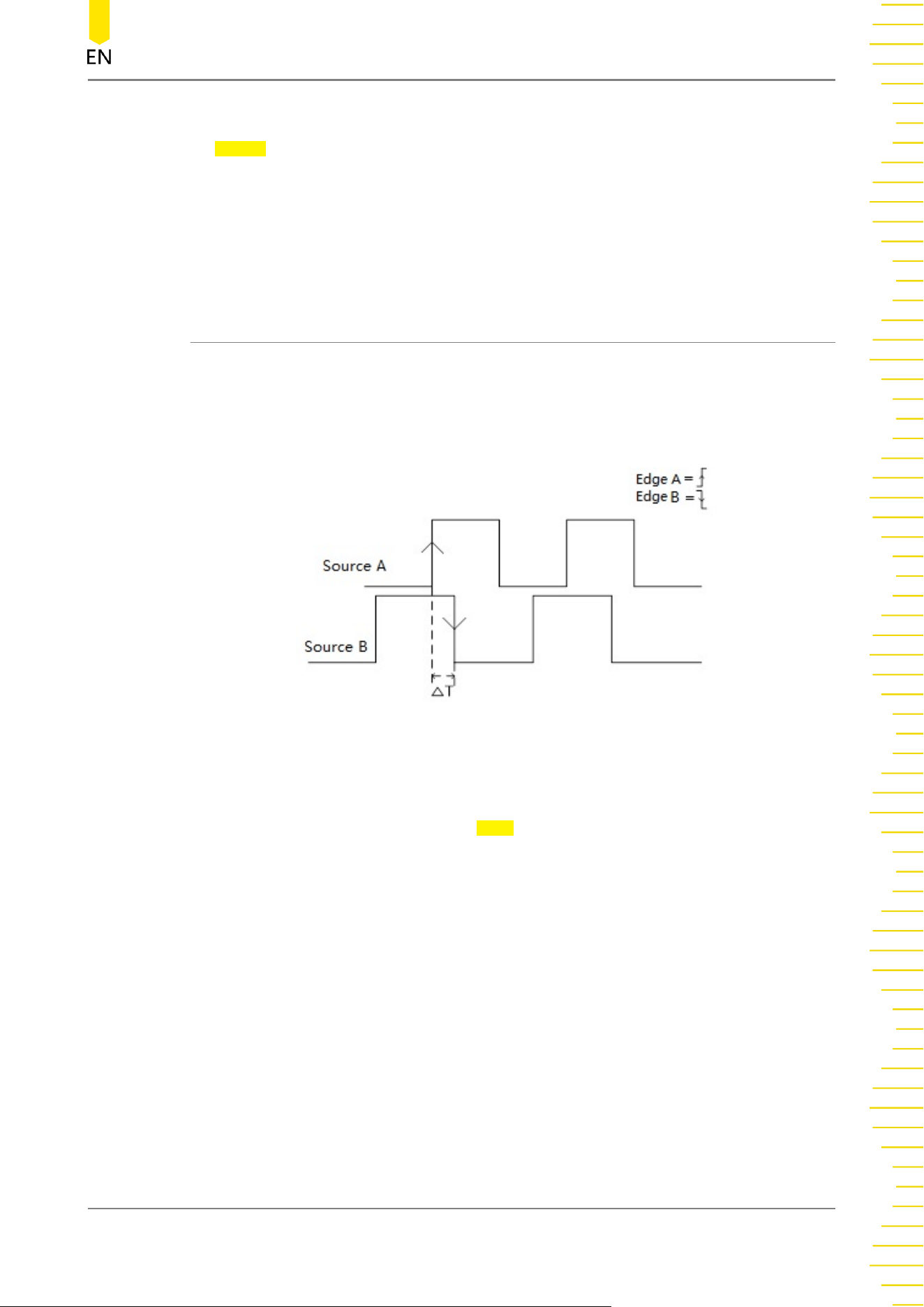
Trigger Mode
In Sweep menu, select Auto, Normal, or Single as the trigger mode. For details, refer
to descriptions in
Trigger Mode
.
Trigger Parameter Setting
Sets the trigger parameters (trigger holdoff and noise rejection) under this trigger
type. For details, refer to descriptions in
Trigger Holdoff
and
Noise Rejection
.
8.7.10 Delay Trigger
In Delay trigger, you need to set Source A and Source B. The oscilloscope triggers
when the time difference (∆T) between the specified edges (Edge A and Edge B) of
Source A and Source B meets the preset time limit, as shown in the figure below.
Edge A and Edge B must be two neighboring edges.
Figure 8.18 Delay Trigger
Trigger Type
Click or tap the drop-down button of Type to select "Delay" from the drop-down list.
Then set the parameters for Delay trigger.
To Trigger the Oscilloscope
Copyright ©RIGOL TECHNOLOGIES CO., LTD.
All rights reserved.
DS70000 User Guide
99
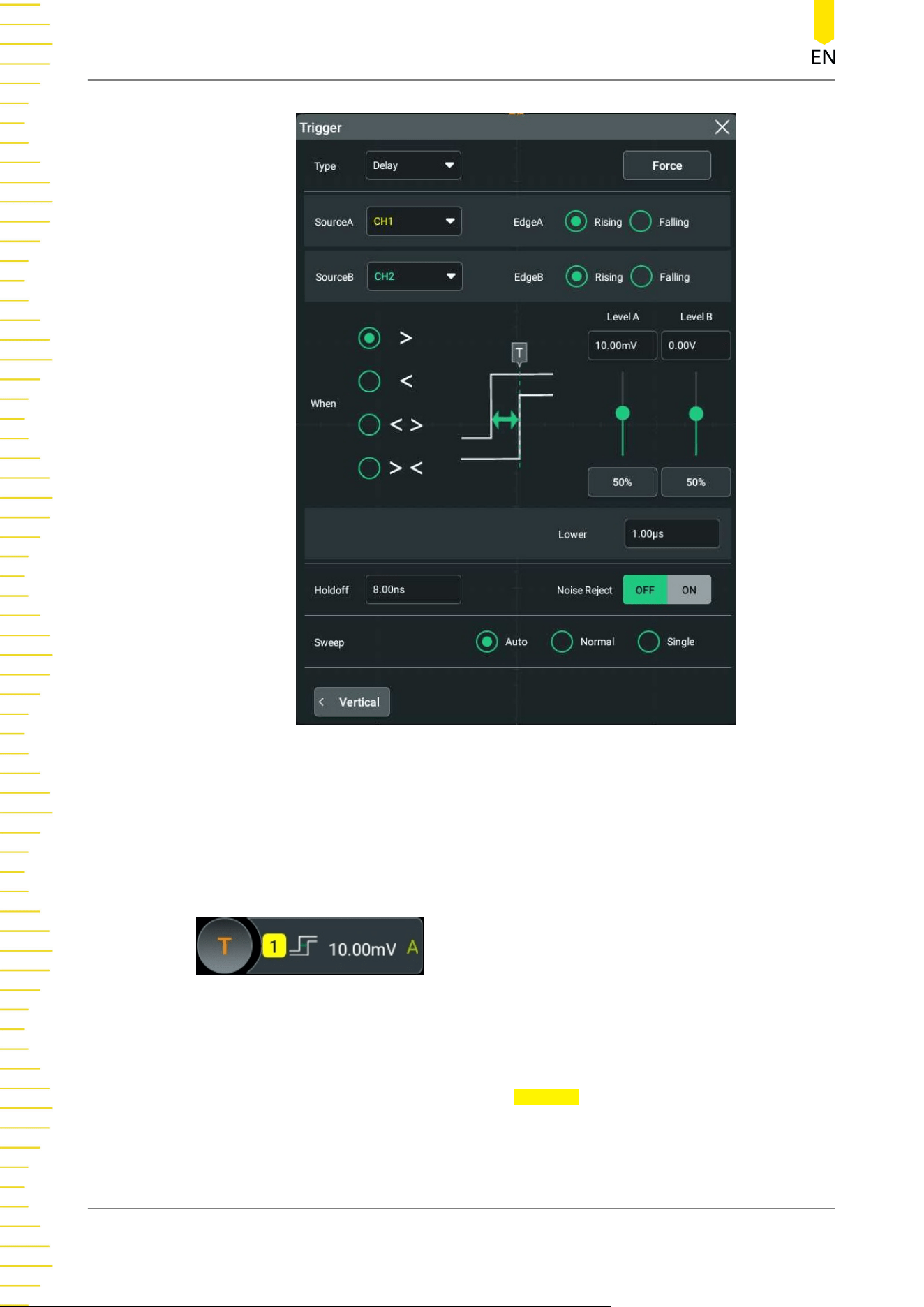
Figure 8.19 Delay Trigger Setting Menu
After selecting the trigger type, and then the current trigger setting information
(including trigger type, trigger source, and trigger level) is displayed in the trigger
information label at the top of the screen, as shown in the figure below. The
information will change based on the trigger settings.
Source Setting
• Source A:
Click or tap the drop-down button of SourceA to select CH1-CH4. For details,
refer to descriptions in
Trigger Source
. The current trigger source is displayed in
the trigger information label at the top of the screen.
To Trigger the Oscilloscope
DS70000 User Guide
100
Copyright ©RIGOL TECHNOLOGIES CO., LTD.
All rights reserved.
Only when we select the channel (that has been input with signals) as the trigger
source, can we obtain a stable trigger.
• Edge A:
Click or tap the trigger edge type ("Rising" or "Falling") of Source A in Delay
trigger under the EdgeA menu.
• Source B:
Click or tap the drop-down button of SourceB to select CH1-CH4. For details,
refer to descriptions in
Trigger Source
. The current trigger source is displayed in
the trigger information label at the top of the screen.
Only when we select the channel (that has been input with signals) as the trigger
source, can we obtain a stable trigger.
• Edge B:
Click or tap the trigger edge type ("Rising" or "Falling") of Source B in Delay
trigger under the EdgeB menu.
Set the trigger condition
Sets the time limit condition of Delay trigger in the When menu.
• >: triggers when the time difference (∆T) between the specified edges of Source
A and Source B is greater than the preset time lower limit. Click or tap the input
field of Lower to set the delay time lower limit in Delay trigger with the pop-up
numeric keypad.
• <: triggers when the time difference (∆T) between the specified edges of Source
A and Source B is smaller than the preset time upper limit. Click or tap the input
field of Upper to set the delay time upper limit in Delay trigger with the pop-up
numeric keypad.
• < >: triggers when the time difference (∆T) between the specified edges of
Source A and Source B is greater than the lower limit of the preset time and
smaller than the upper limit of the preset time. Click or tap the input field of
Upper to set the delay time upper limit in Delay trigger with the pop-up numeric
keypad. Click or tap the input field of Lower to set the delay time lower limit in
Delay trigger with the pop-up numeric keypad. The lower time limit must be
smaller than the upper time limit.
• > <: triggers when the time difference (∆T) between the specified edges of
Source A and Source B is smaller than the lower limit of the preset time or
greater than the upper limit of the preset time. Click or tap the input field of
Upper to set the delay time upper limit in Delay trigger with the pop-up numeric
keypad. Click or tap the input field of Lower to set the delay time lower limit in
Delay trigger with the pop-up numeric keypad. The lower time limit must be
smaller than the upper time limit.
To Trigger the Oscilloscope
Copyright ©RIGOL TECHNOLOGIES CO., LTD.
All rights reserved.
DS70000 User Guide
101
Level Selection and Setting
After the trigger condition setting is completed, you need to adjust the trigger level
to correctly trigger the signal and obtain a stable waveform.
• Level A:
Click or tap the input field of Level A to input the level of Source A with the pop-
up numeric keypad. You can also tap the "Trigger" icon on the small screen, then
rotate the knob at the upper-right part of the small screen or drag the
adjustment icon under the Level A menu to adjust the level of Source A. For
details, refer to descriptions in
Trigger Level
. The current trigger level is displayed
in the trigger information label at the top of the screen.
• Level B:
Click or tap the input field of Level B to input the level of Source B with the pop-
up numeric keypad. You can also tap the "Trigger" icon on the small screen, then
rotate the knob at the upper-right part of the small screen or drag the
adjustment icon under the Level B menu to adjust the level of Source B. For
details, refer to descriptions in
Trigger Level
. The current trigger level is displayed
in the trigger information label at the top of the screen.
Trigger Mode
In Sweep menu, select Auto, Normal, or Single as the trigger mode. For details, refer
to descriptions in
Trigger Mode
.
Trigger Parameter Setting
Sets the trigger parameters (trigger holdoff and noise rejection) under this trigger
type. For details, refer to descriptions in
Trigger Holdoff
and
Noise Rejection
.
8.7.11 Setup/Hold Trigger
In setup&hold trigger, you need to set the clock source and data source. The setup
time starts when the data signal passes the trigger level and ends at the coming of
the specified clock edge; the hold time starts at the coming of the specified clock
edge and ends when the data signal crosses the trigger level again, as shown in the
figure below. The oscilloscope triggers when the setup time or hold time is smaller
than the preset time.
To Trigger the Oscilloscope
DS70000 User Guide
102
Copyright ©RIGOL TECHNOLOGIES CO., LTD.
All rights reserved.
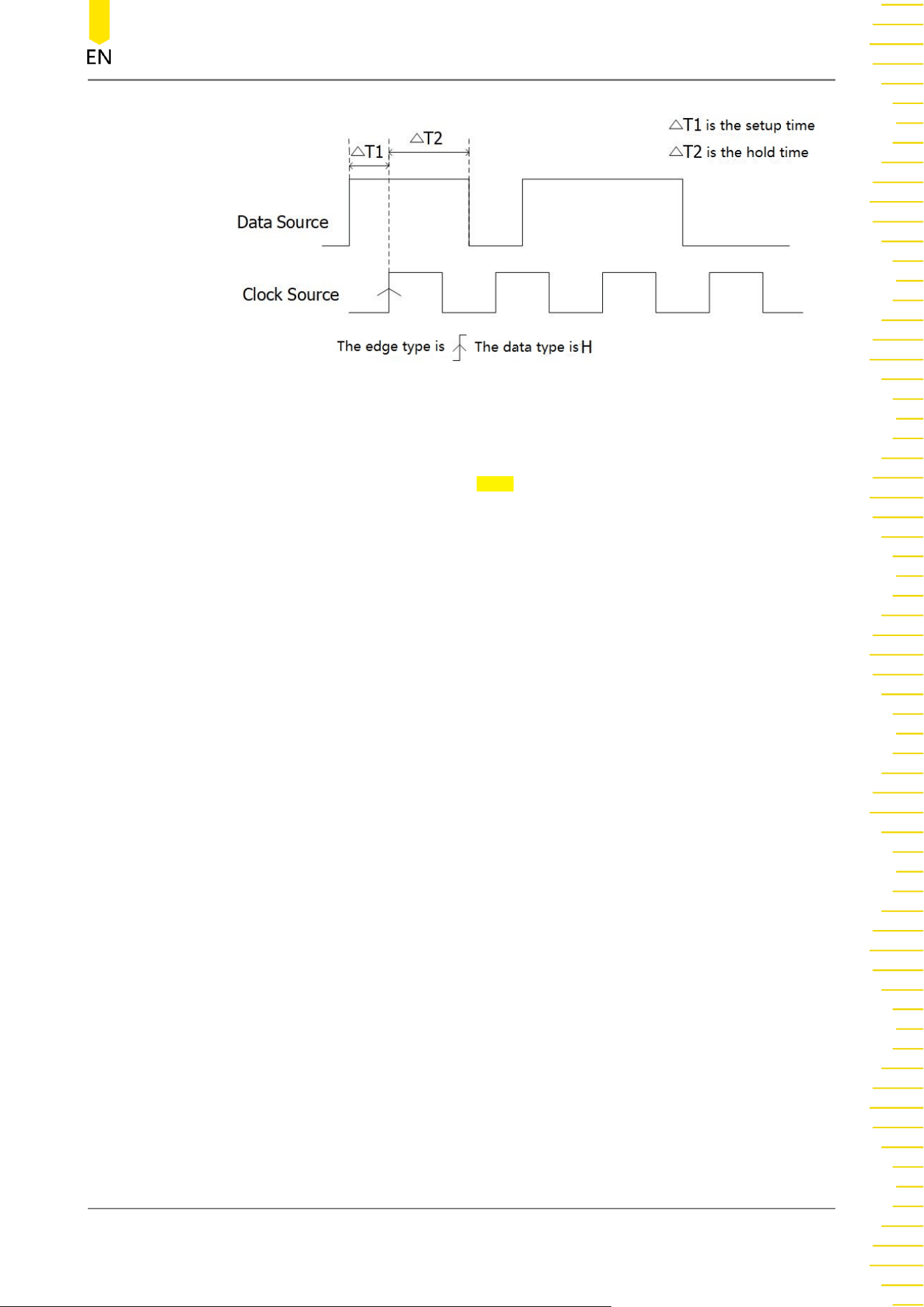
Figure 8.20 Setup/Hold Trigger
Trigger Type
Click or tap the drop-down button of Type to select "Setup/Hold" from the drop-
down list. Then set the parameters for Setup/Hold trigger.
To Trigger the Oscilloscope
Copyright ©RIGOL TECHNOLOGIES CO., LTD.
All rights reserved.
DS70000 User Guide
103
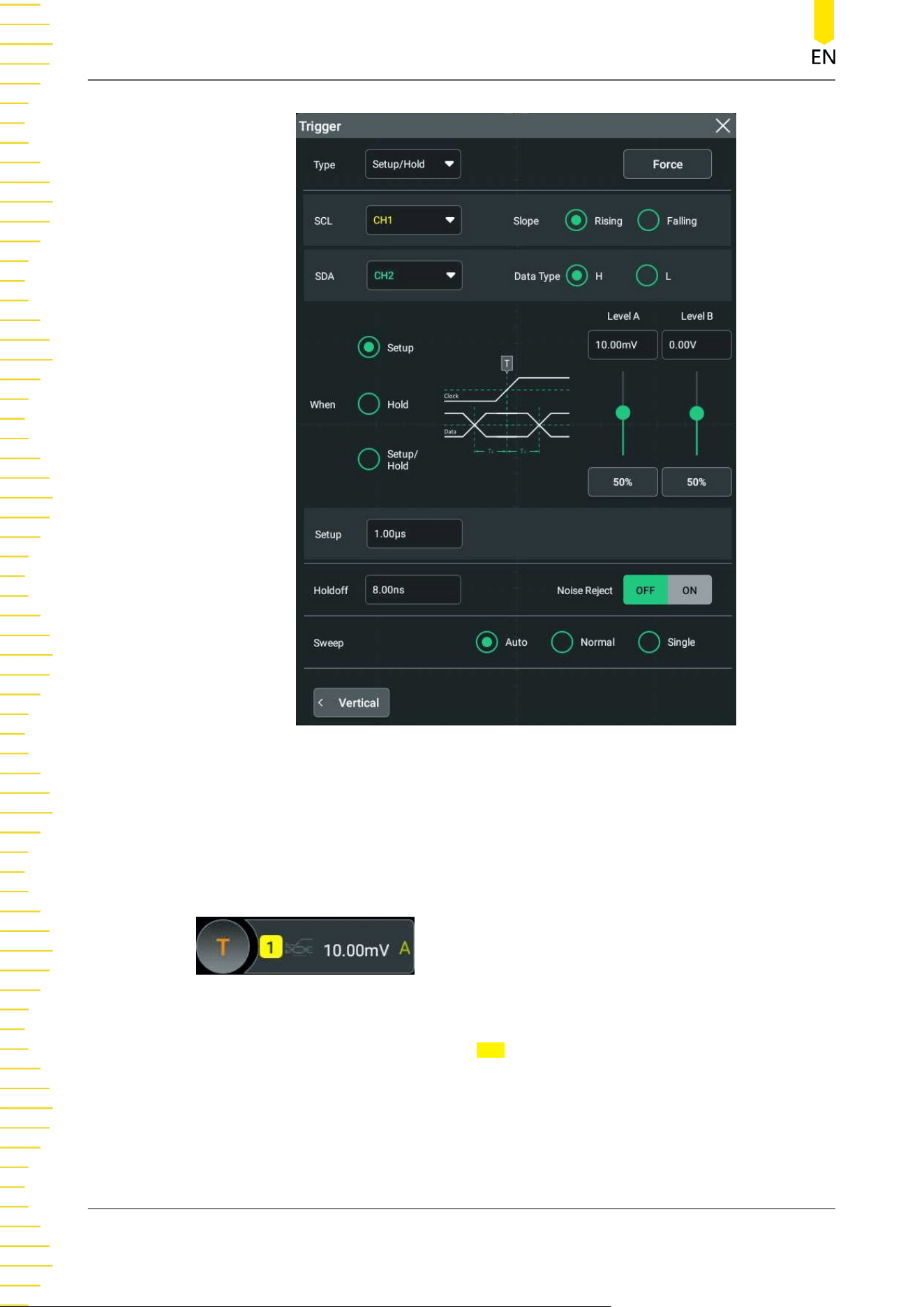
Figure 8.21 Setup/Hold Trigger Setting Menu
After selecting the trigger type, and then the current trigger setting information
(including trigger type, trigger source, and trigger level) is displayed at the top of the
screen, as shown in the figure below. The information will change based on the
trigger settings.
Clock Source
Click or tap the drop-down button of SCL to select CH1-CH4. For details, refer to
descriptions in
Trigger Source
. The current trigger source is displayed in the trigger
information label at the top of the screen.
Only when we select the channel (that has been input with signals) as the trigger
source, can we obtain a stable trigger.
To Trigger the Oscilloscope
DS70000 User Guide
104
Copyright ©RIGOL TECHNOLOGIES CO., LTD.
All rights reserved.
Edge Type
Selects the desired clock edge type under the Slope menu, and it can be set to
"Rising" or "Falling".
Data Source
Click or tap the drop-down button of SDA to select CH1-CH4. For details, refer to
descriptions in
Trigger Source
. The current trigger source is displayed in the trigger
information label at the top of the screen.
Only when we select the channel (that has been input with signals) as the trigger
source, can we obtain a stable trigger.
Data Type
Selects the desired item under the Data Type menu to set the effective pattern of the
data signal. It can be set to H (high level) or L (low level).
Trigger Condition
Sets the Setup/Hold trigger condition in the When menu.
• Setup: the oscilloscope triggers when the setup time is smaller than the
specified setup time. After selecting this type, click or tap the input field of
Setup to set the setup time with the pop-up numeric keypad.
• Hold: the oscilloscope triggers when the hold time is smaller than the specified
hold time. After selecting this type, click or tap the input field of Hold to set the
hold time with the pop-up numeric keypad.
• Setup/Hold: the oscilloscope triggers when the setup time or hold time smaller
than the specified time value. After selecting this type, click or tap the input field
of Setup and Hold respectively to set the setup and hold time with the pop-up
numeric keypad.
Trigger Mode
In Sweep menu, select Auto, Normal, or Single as the trigger mode. For details, refer
to descriptions in
Trigger Mode
.
Trigger Parameter Setting
Sets the trigger parameters (trigger holdoff and noise rejection) under this trigger
type. For details, refer to descriptions in
Trigger Holdoff
and
Noise Rejection
.
Level Selection and Setting
• Level A
After the trigger condition setting is completed, you need to adjust the trigger
level to correctly trigger the signal and obtain a stable waveform.
Click or tap the input field of
Level A to input the level of Source A with the pop-
up numeric keypad. You can also tap the "Trigger" icon on the small screen, then
To Trigger the Oscilloscope
Copyright ©RIGOL TECHNOLOGIES CO., LTD.
All rights reserved.
DS70000 User Guide
105
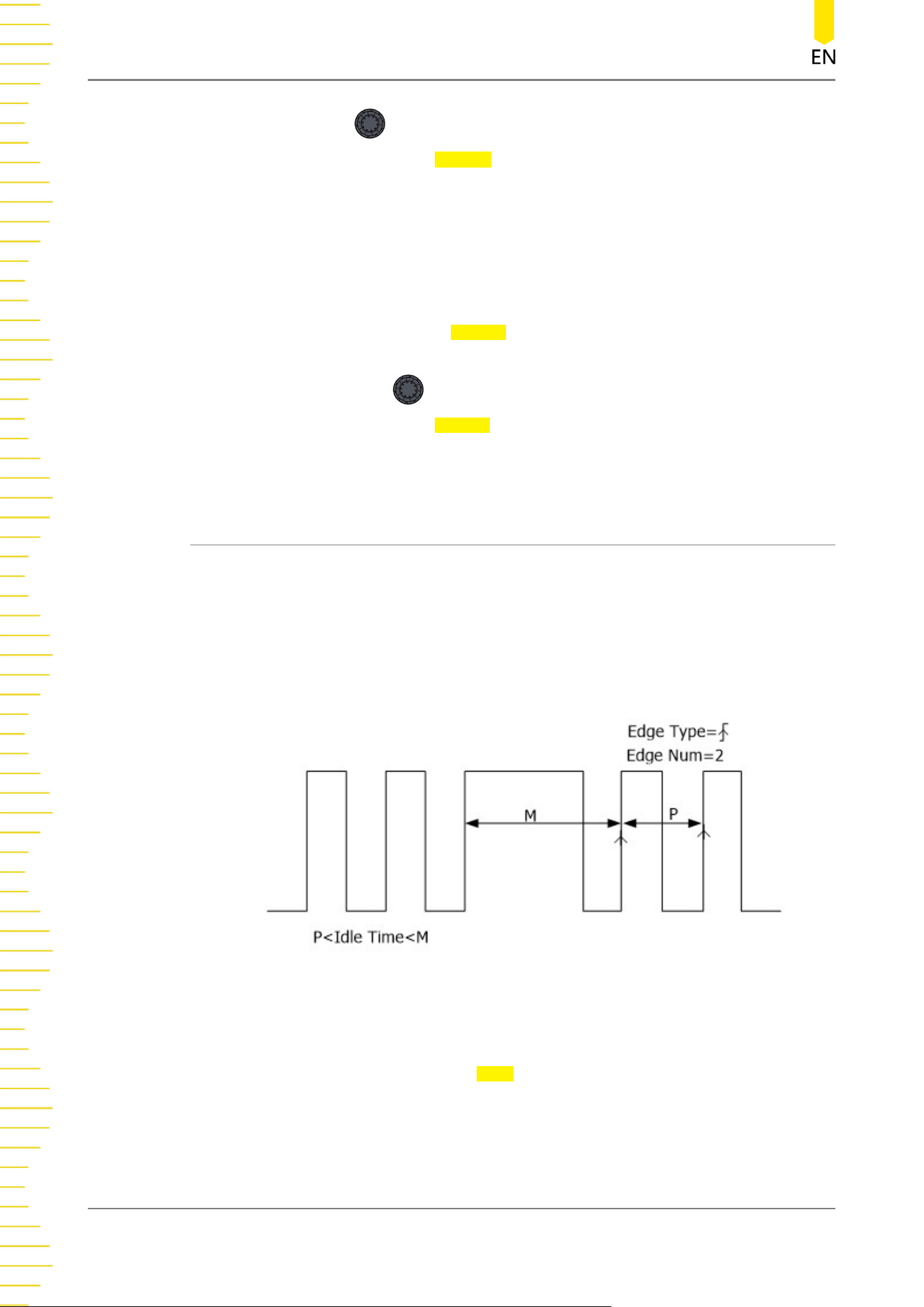
rotate the knob at the upper-right part of the small screen or drag the
adjustment icon under the Level A menu to adjust the level of the clock source.
For details, refer to descriptions in
Trigger Level
. The current trigger level is
displayed in the trigger information label at the top of the screen.
• Level B
After the trigger condition setting is completed, you need to adjust the trigger
level to correctly trigger the signal and obtain a stable waveform.
Click or tap the input field of Level B to input the level of data source with the
pop-up numeric keypad. You can also tap the "Trigger" icon on the small screen,
then rotate the knob at the upper-right part of the small screen or drag the
adjustment icon under the Level B menu to adjust the level of data source. For
details, refer to descriptions in
Trigger Level
. The current trigger level is displayed
in the trigger information label at the top of the screen.
8.7.12 Nth Edge Trigger
Triggers on the Nth edge that appears after the specified idle time. For example, in
the waveform shown in the figure below, the instrument should trigger on the second
rising edge after the specified idle time (the time between two neighboring rising
edges), and the idle time should be within the range between P and M (P< Idle
Time<M). Wherein, M is the time between the first rising edge and its previous rising
edge; P is the maximum time between the rising edges that participate in counting.
Figure 8.22 Nth Edge Trigger
Trigger Type
Click or tap the drop-down button of Type to select "Nth Edge" from the drop-down
list. Then set the parameters for Nth Edge trigger.
To Trigger the Oscilloscope
DS70000 User Guide
106
Copyright ©RIGOL TECHNOLOGIES CO., LTD.
All rights reserved.
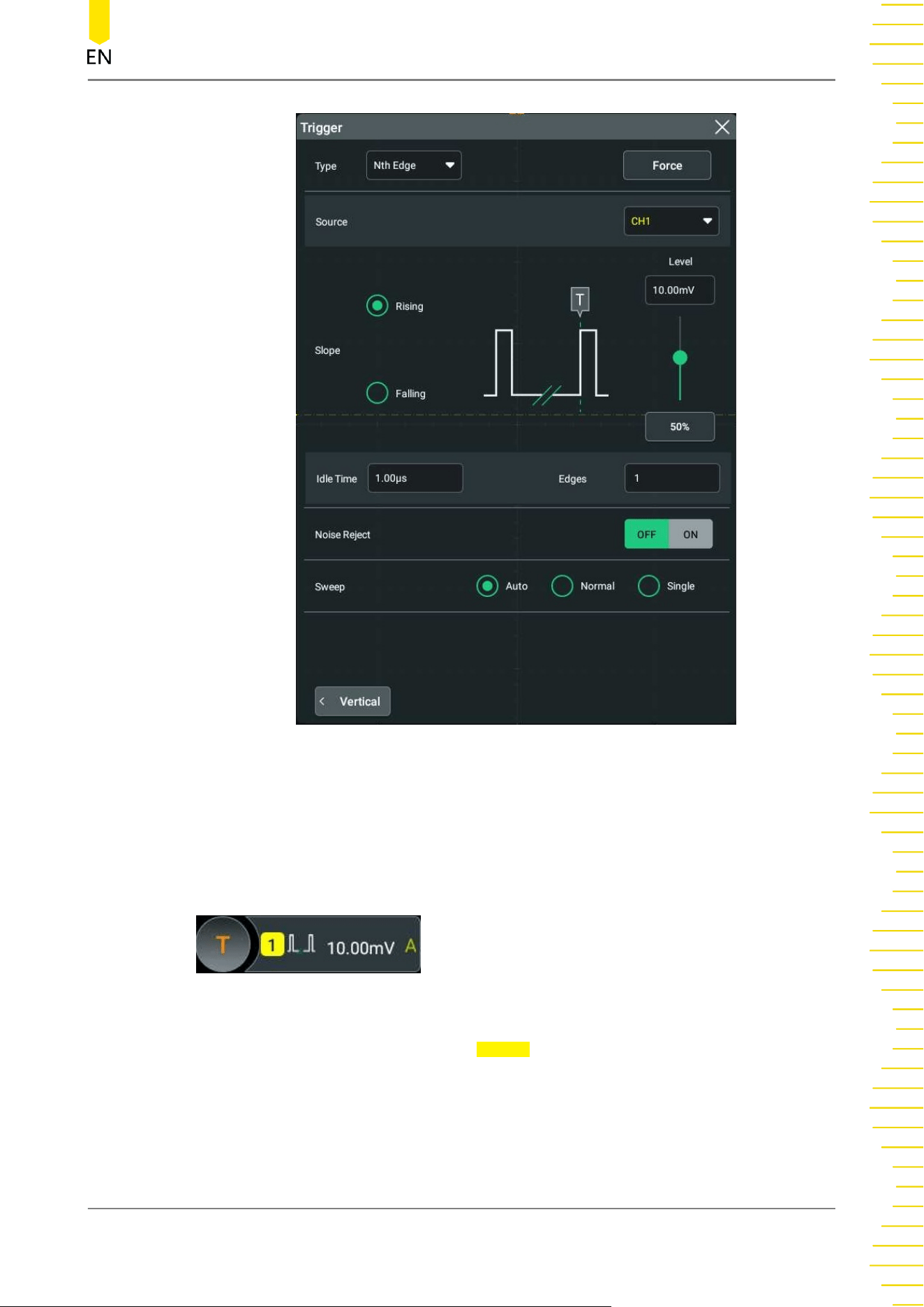
Figure 8.23 Nth Edge Trigger Setting Menu
After selecting the trigger type, and then the current trigger setting information
(including trigger type, trigger source, and trigger level) is displayed in the trigger
information label at the top of the screen, as shown in the figure below. The
information will change based on the trigger settings.
Source Selection
Click or tap the drop-down button of Source to select CH1-CH4. For details, refer to
descriptions in
Trigger Source
. The current trigger source is displayed in the trigger
information label at the top of the screen.
Only when we select the channel (that has been input with signals) as the trigger
source, can we obtain a stable trigger.
To Trigger the Oscilloscope
Copyright ©RIGOL TECHNOLOGIES CO., LTD.
All rights reserved.
DS70000 User Guide
107
Edge Type
Select the input signal edge (under the Slope menu) on which the oscilloscope
triggers.
• Rising: triggers on the rising edge of the input signal when the voltage level
meets the specified trigger level.
• Falling: triggers on the falling edge of the input signal when the voltage level
meets the specified trigger level.
Idle Time
Click or tap the input field of Idle Time, then use the pop-up numeric keypad to set
the idle time before the edge counting in Nth edge trigger.
Edge Count
Click or tap the input field of Edges, then use the pop-up numeric keypad to set the
value of "N" in Nth edge trigger. The available range is from 1 to 65,535.
Trigger Mode
In Sweep menu, select Auto, Normal, or Single as the trigger mode. For details, refer
to descriptions in
Trigger Mode
.
Trigger Parameter Setting
Sets the trigger parameter (noise rejection) under this trigger type. For details, refer
to descriptions in
Noise Reject
.
Trigger Level
Tap the "Trigger" icon on the small screen, then rotate the knob at the upper-
right part of the small screen or drag the adjustment icon under the Level menu to
adjust the trigger level. For details, refer to descriptions in
Trigger Level
. The current
trigger level is displayed in the trigger information label at the top of the screen.
8.7.13 RS232 Trigger (Option)
RS232 bus is a serial communication mode used in data transmission between PCs or
between a PC and a terminal. In RS232 serial protocol, a character is transmitted as a
frame of data. The frame consists of 1 start bit, 5-8 data bits, 1 check bit, and 1-2 stop
bits. Its format is as shown in the figure below. DS70000 series oscilloscope triggers
when the start frame, error frame, check error, or the specified data of the RS232
signal is detected.
To Trigger the Oscilloscope
DS70000 User Guide
108
Copyright ©RIGOL TECHNOLOGIES CO., LTD.
All rights reserved.
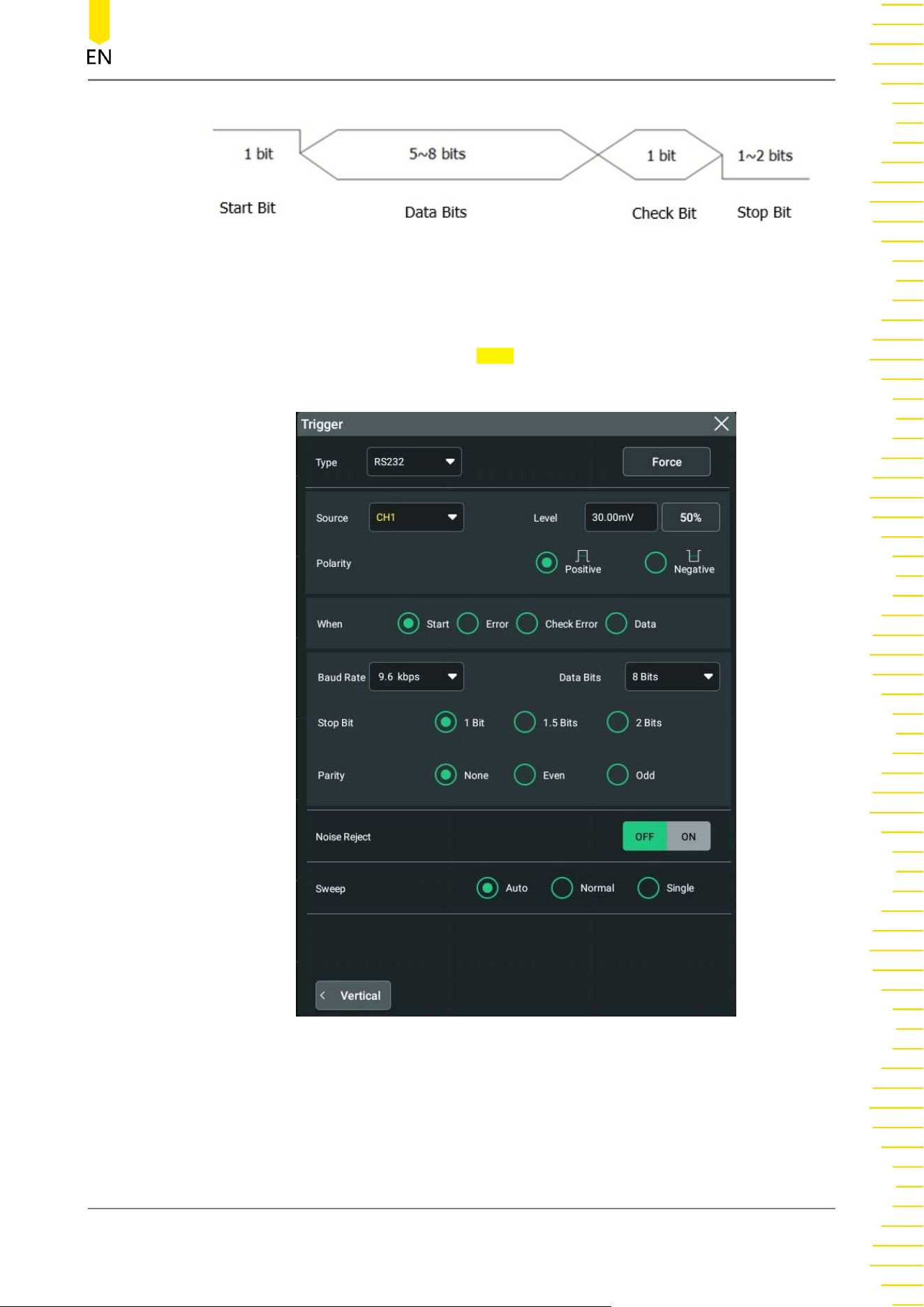
Figure 8.24 Schematic Diagram of RS232 Protocol
Trigger Type
Click or tap the drop-down button of Type to select "RS232" from the drop-down list.
Then set the parameters for RS232 trigger.
Figure 8.25 RS232 Trigger Setting Menu
After selecting the trigger type, and then the current trigger setting information
(including trigger type, trigger source, and trigger level) is displayed at the top of the
screen, as shown in the figure below. The information will change based on the
trigger settings.
To Trigger the Oscilloscope
Copyright ©RIGOL TECHNOLOGIES CO., LTD.
All rights reserved.
DS70000 User Guide
109
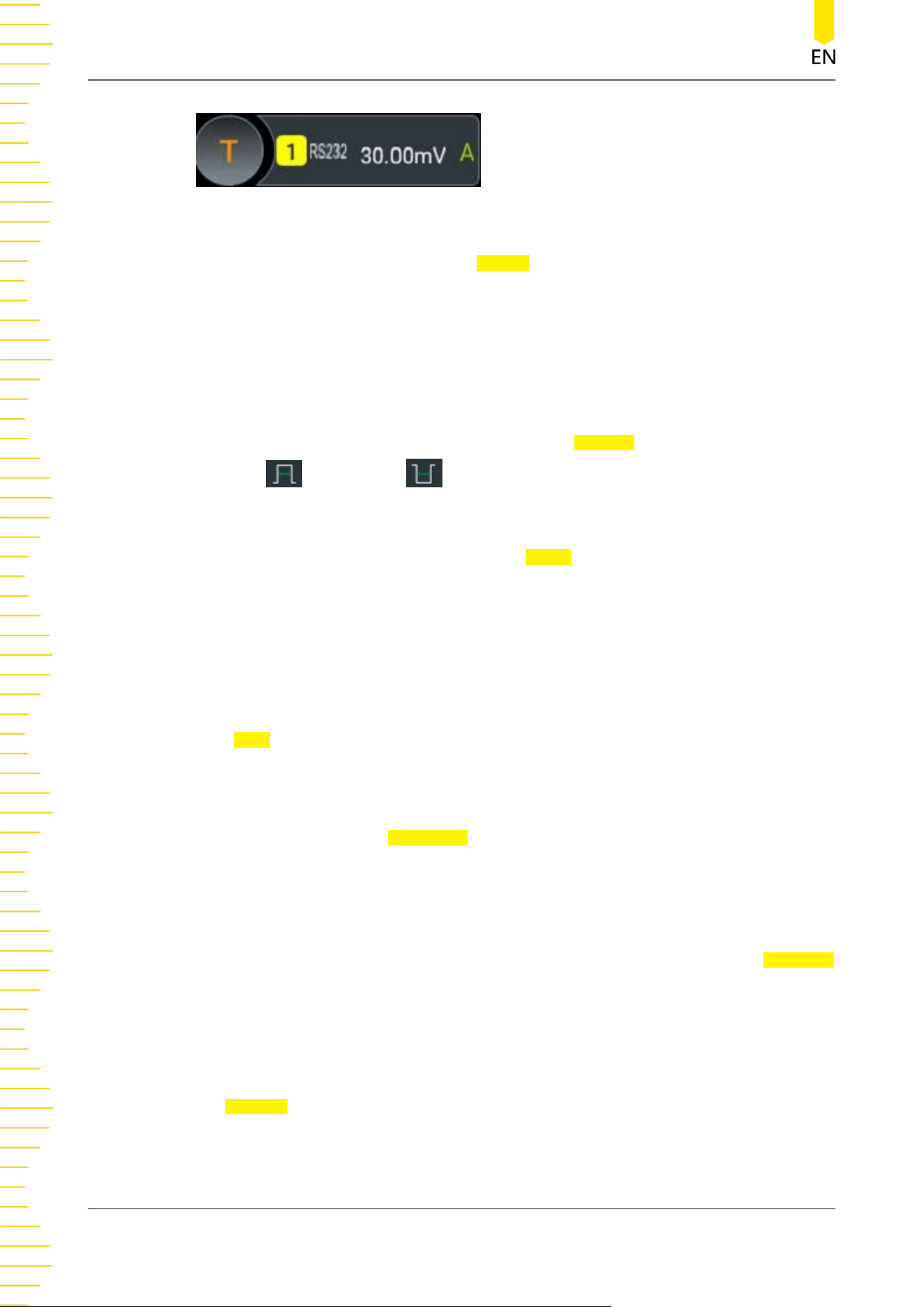
Source Selection
Click or tap the drop-down button of Source to select CH1-CH4. For details, refer to
descriptions in
Trigger Source
. The current trigger source is displayed in the trigger
information label at the top of the screen.
Only when we select the channel (that has been input with signals) as the trigger
source, can we obtain a stable trigger.
Polarity
Selects the polarity of data transmission under the Polarity menu. It can be set to
"Positive" or "Negative" .
Trigger Condition
Sets the the desired trigger condition in the When menu.
• Start: triggers on the start frame position.
• Error: triggers when an error frame is detected.
• Check Error: triggers when a check error is detected.
• Data: triggers on the last bit of the preset data bits. Click or tap the input field of
Data, and then use the pop-up numeric keypad to set the data of RS232 trigger.
Baud Rate
Sets the baud rate of data transmission (i.g. specifies a clock frequency). Click or tap
the drop-down button of Baud Rate, then select the preset baud rate from the drop-
down list. The available baud rates include 50 bps, 75 bps, 110 bps, 134 bps, 150 bps,
300 bps, and etc.
Data Bits
Indicate the number of bits per frame. Click or tap the drop-down button of Data Bits
to select the desired data bits. The available data bits include "5 Bits", "6 Bits", "7 Bits",
and "8 Bits".
Stop Bit
Stop Bit: indicates when to stop outputting data. Selects the desired stop bit under
the Stop Bit menu. The available data bits include 1 Bit, 1.5 Bits, and 2 Bits.
To Trigger the Oscilloscope
DS70000 User Guide
110
Copyright ©RIGOL TECHNOLOGIES CO., LTD.
All rights reserved.
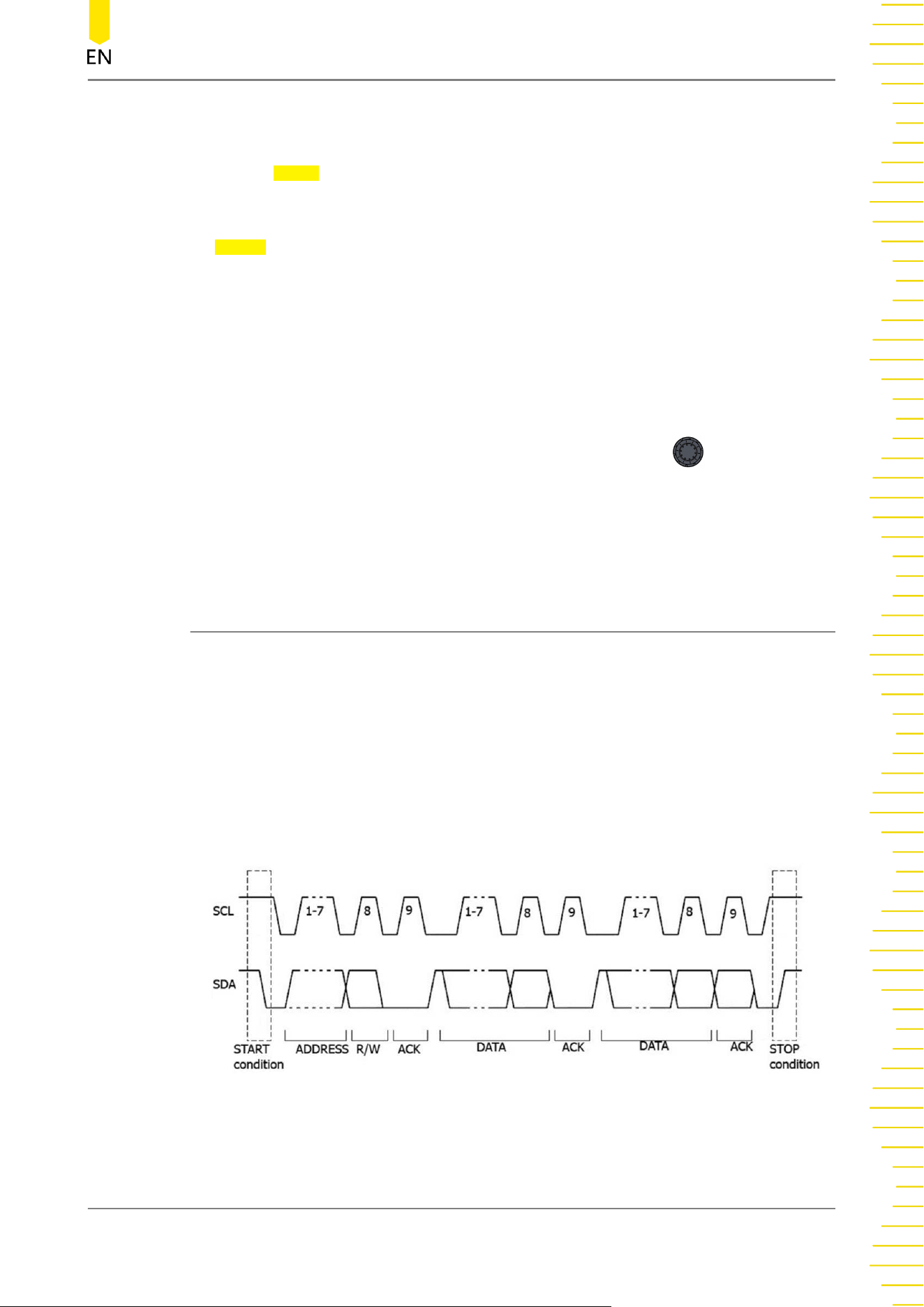
Parity
Used to check whether the data are properly transmitted. Selects None, Even, or Odd
under the Parity menu.
Trigger Mode
In Sweep menu, select Auto, Normal, or Single as the trigger mode. For details, refer
to descriptions in
Trigger Mode
.
Trigger Parameter Setting
Sets the trigger parameter (noise rejection) under this trigger type. For details, refer
to descriptions in
Noise Reject
.
Trigger Level
Tap the "Trigger" icon on the small screen, then rotate the knob at the upper-
right part of the small screen to adjust the trigger level. You can also set the trigger
level with the pop-up numeric keypad. For details, refer to descriptions in
Trigger
Level
. The current trigger level is displayed in the trigger information label at the top
of the screen.
8.7.14 I2C Trigger (Option)
I2C is a 2-wire serial bus used to connect the microcontroller and its peripheral
device. It is a bus standard widely used in the microelectronic communication control
field.
The I2C serial bus consists of SCL and SDA. Its transmission rate is determined by SCL,
and its transmission data is determined by SDA, as shown in the figure below. The
instrument series triggers on the start condition, restart, stop, missing
acknowledgment, specific device address, or data value. Besides, it can also trigger on
the specific device address and data values at the same time.
Figure 8.26 Schematic Diagram of I2C Protocol
To Trigger the Oscilloscope
Copyright ©RIGOL TECHNOLOGIES CO., LTD.
All rights reserved.
DS70000 User Guide
111
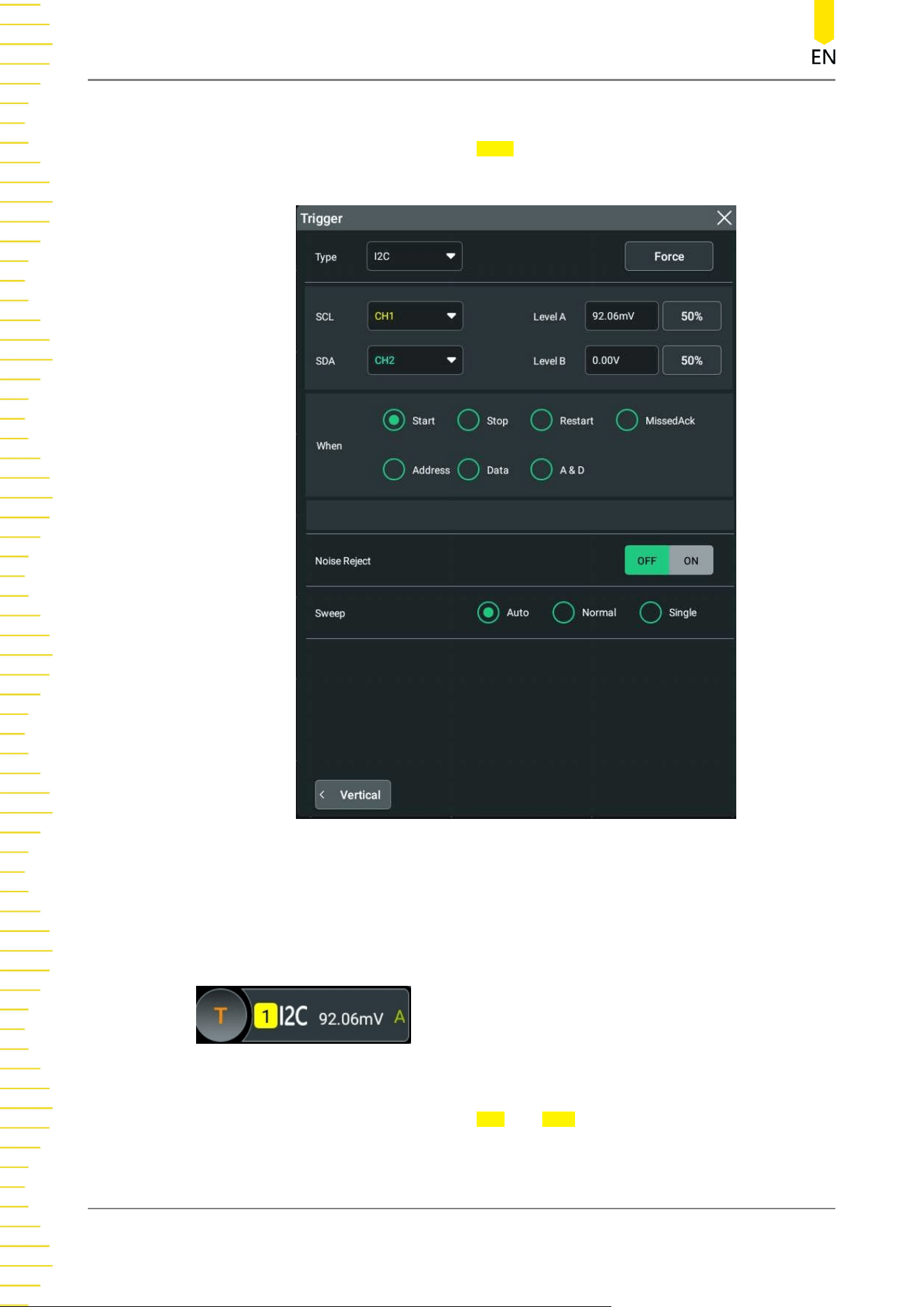
Trigger Type
Click or tap the drop-down button of Type to select "I2C" from the drop-down list.
Then set the parameters for I2C trigger.
Figure 8.27 I2C Trigger Setting Menu
At this time, the current trigger setting information (including trigger type, trigger
source, and trigger level) is displayed at the top of the screen, as shown in the figure
below. The information will change based on the trigger settings.
Source Selection
Click or tap the drop-down button of SCL and SDA to select CH1-CH4 to the specify
the sources of SCL and SDA respectively. For details, refer to descriptions in
Trigger
To Trigger the Oscilloscope
DS70000 User Guide
112
Copyright ©RIGOL TECHNOLOGIES CO., LTD.
All rights reserved.
Source
. The current trigger source is displayed in the trigger information label at the
top of the screen.
Only when we select the channel (that has been input with signals) as the trigger
source, can we obtain a stable trigger.
Trigger Condition
Sets the the desired trigger condition in the When menu.
• Start: triggers when SDA data transitions from high level to low level while SCL
is high level.
• Stop: triggers when SDA data transitions from low level to high level while SCL is
high level.
• Restart: triggers when another start condition occurs before a stop condition.
• MissedAck: triggers when the SDA data is high level during any
acknowledgment of SCL clock position.
• Address: the trigger searches for the specified address value. When this event
occurs, the oscilloscope will trigger on the read/write bit. After this trigger
condition is selected:
- Click or tap the drop-down button of Direction to select "Write", "Read", or
"R/W".
This setting is not available when AddrBits is set to "8 Bits".
- Click or tap the drop-down button of AddrBits to select the desired
address bits. The available address bits are "7 Bits", "8 Bits", and "10 Bits".
- Click or tap the input field of Address, and then use the pop-up numeric
keypad to set the address of I2C trigger.
• Data: the trigger searches for the specified data value on the data line (SDA).
When this event occurs, the oscilloscope will trigger on the clock line (SCL)
transition edge of the last bit of data. After this trigger condition is selected, you
can set the length of bytes, the address width, and data.
- Click or tap the input field of Bytes, and then use the pop-up numeric
keypad to set the length of the data. Its range is from 1 to 5.
- Click or tap the drop-down button of AddrBits to select the desired
address bits. The available address bits are "7 Bits", "8 Bits", and "10 Bits".
- Click or tap the input field of Data, and then the "Format" interface is will
displayed. As shown in the figure below, you can select "Bin" or "Hex"
format to set the data format.
To Trigger the Oscilloscope
Copyright ©RIGOL TECHNOLOGIES CO., LTD.
All rights reserved.
DS70000 User Guide
113
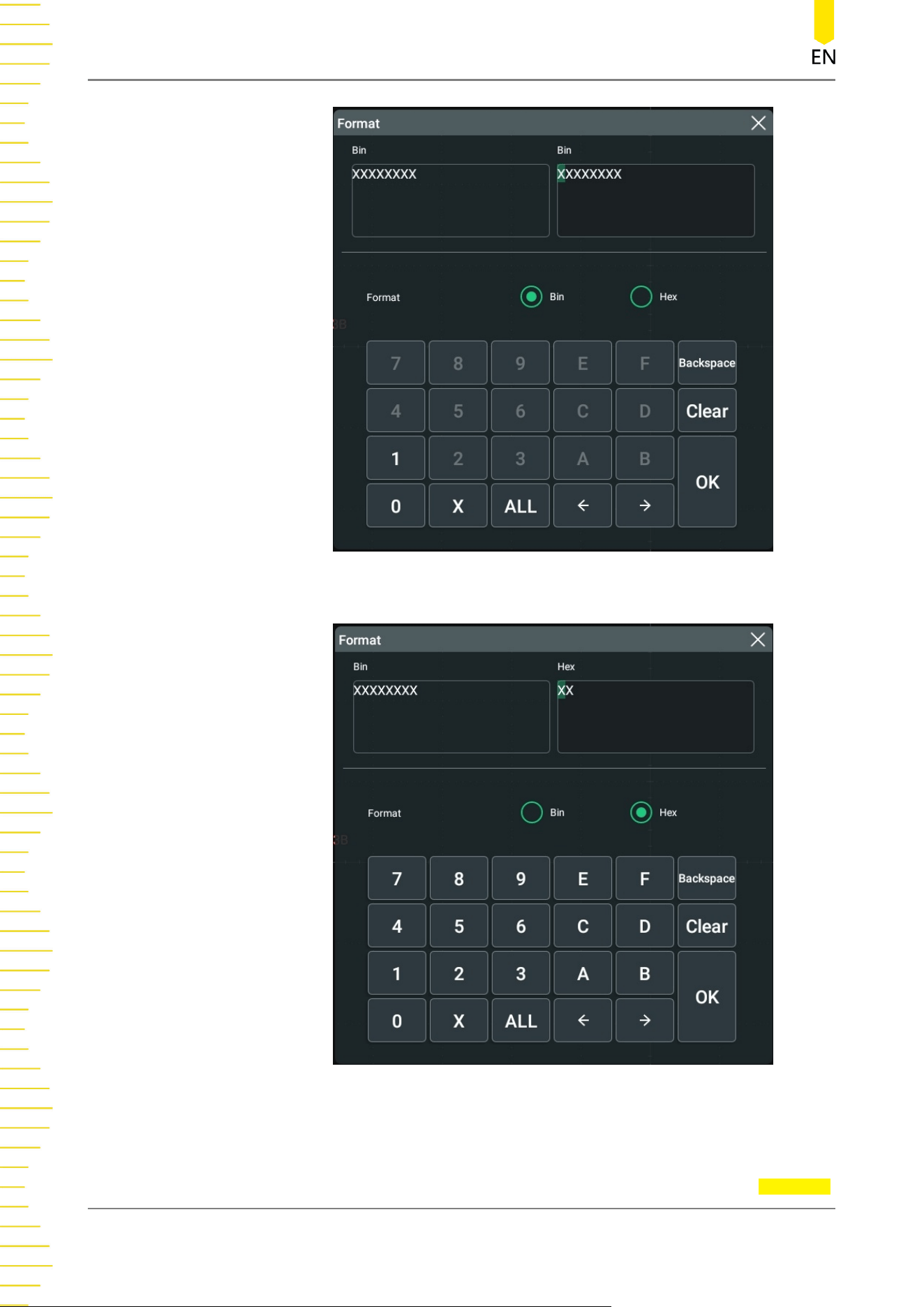
Figure 8.28 Bin Format Setting
Figure 8.29 Hex Format Setting
• A&D: the oscilloscope searches for the specified address and data at the same
time, then triggers when both the address and data meet the conditions. After
this condition is selected, you need to set the sub-menu items such as
Direction,
To Trigger the Oscilloscope
DS70000 User Guide
114
Copyright ©RIGOL TECHNOLOGIES CO., LTD.
All rights reserved.
Bytes, AddrBits, Address, and Data. For the setting methods, refer to
descriptions in "Address" and "Data" conditions.
Trigger Mode
In Sweep menu, select Auto, Normal, or Single as the trigger mode. For details, refer
to descriptions in
Trigger Mode
.
Trigger Parameter Setting
Sets the trigger parameter (noise rejection) under this trigger type. For details, refer
to descriptions in
Noise Reject
.
Level Selection and Setting
• Level A
After the trigger condition setting is completed, you need to adjust the trigger
level to correctly trigger the signal and obtain a stable waveform.
Click or tap the input field of Level A to input the level of SCL with the pop-up
numeric keypad. You can also tap the "Trigger" icon on the small screen, then
rotate the knob at the upper-right part of the small screen to adjust the
level of SCL. For details, refer to descriptions in
Trigger Level
. The current trigger
level is displayed in the trigger information label at the top of the screen.
• Level B
After the trigger condition setting is completed, you need to adjust the trigger
level to correctly trigger the signal and obtain a stable waveform.
Click or tap the input field of Level B to input the level of SDA with the pop-up
numeric keypad. You can also tap the "Trigger" icon on the small screen, then
rotate the knob at the upper-right part of the small screen to adjust the
level of SDA. For details, refer to descriptions in
Trigger Level
. The current trigger
level is displayed in the trigger information label at the top of the screen.
8.7.15 SPI Trigger (Option)
In SPI trigger, after the CS or timeout condition is satisfied, the oscilloscope triggers
when the specified data is found. When using SPI trigger, you need to specify the CLK
clock sources and MISO data sources.
Below is the sequential chart of SPI bus.
To Trigger the Oscilloscope
Copyright ©RIGOL TECHNOLOGIES CO., LTD.
All rights reserved.
DS70000 User Guide
115
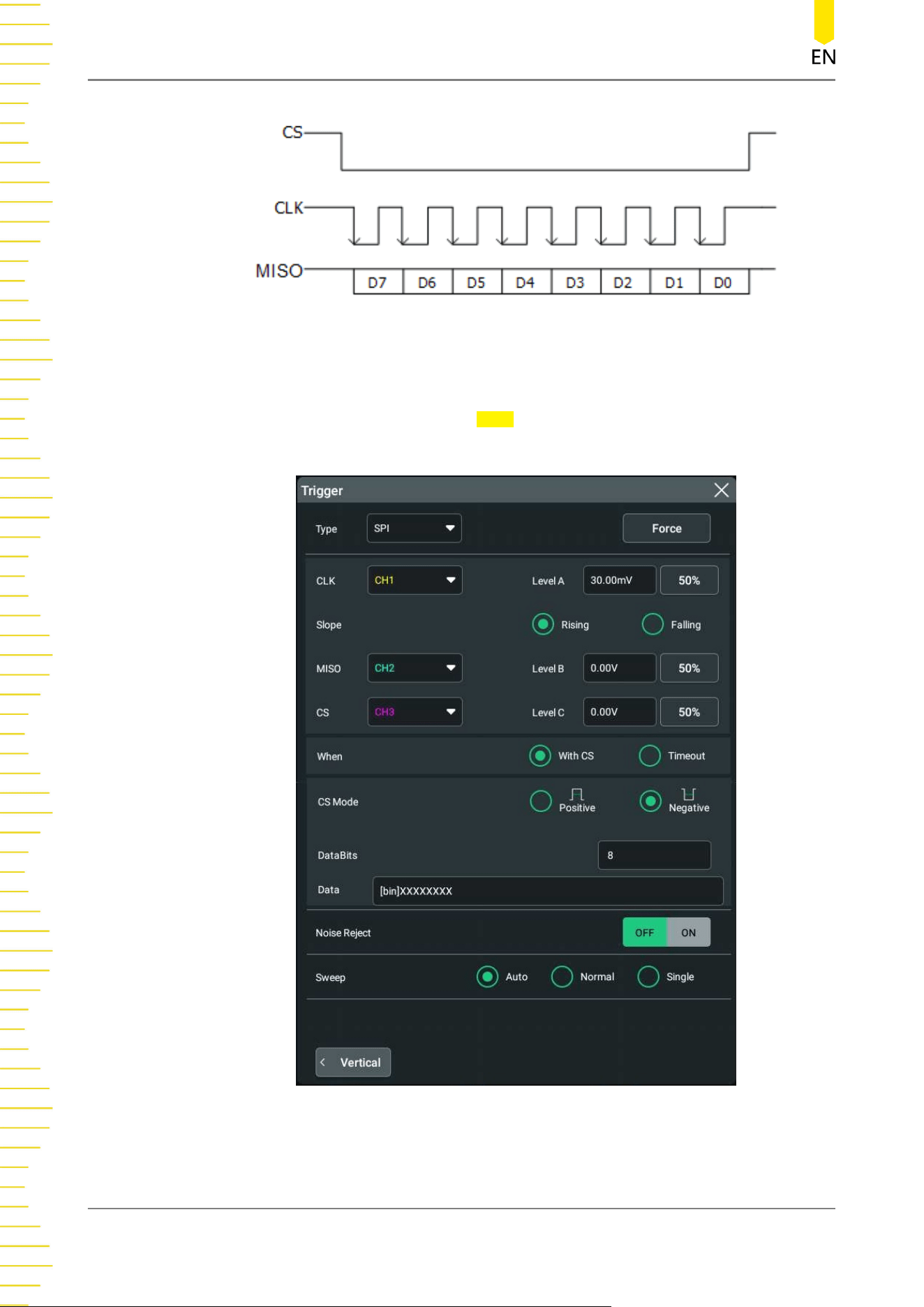
Figure 8.30 Sequential Chart of SPI Bus
Trigger Type
Click or tap the drop-down button of Type to select "SPI" from the drop-down list.
Then set the parameters for SPI trigger.
Figure 8.31 SPI Trigger Setting Menu
To Trigger the Oscilloscope
DS70000 User Guide
116
Copyright ©RIGOL TECHNOLOGIES CO., LTD.
All rights reserved.
After selecting the trigger type, and then the current trigger setting information
(including trigger type, trigger source, and trigger level) is displayed in the trigger
information label at the top of the screen, as shown in the figure below. The
information will change based on the trigger settings.
Source Selection
Click or tap the drop-down button of CLK and MISO to select CH1-CH4 to the specify
the sources of CLK and MISO respectively. For details, refer to descriptions in
Trigger
Source
. The current trigger source is displayed in the trigger information label at the
top of the screen.
Only when we select the channel (that has been input with signals) as the trigger
source, can we obtain a stable trigger.
Edge Type
Selects the desired clock edge type under Slope.
• Rising: samples the MISO data on the rising edge of the clock.
• Falling: samples the MISO data on the falling edge of the clock.
Trigger Condition
Selects the desired trigger condition under When.
• With CS: if the CS signal is valid, the oscilloscope will trigger when the data
(SDA) satisfying the trigger conditions is found.
- Click or tap the drop-down button of CS to select CH1-CH4 as the CS signal
line.
- After selecting this condition, you can click or tap "Positive" (high level is
valid) or "Negative" (low level is valid) under CS Mode.
• Timeout: the oscilloscope starts to search for the data (MISO) on which to
trigger after the clock signal (CLK) stays in the idle state for a specified period of
time. After selecting this condition, you can click or tap Timeout, then use the
numeric keypad to set the idle time. The range is from 8 ns to 10 s.
Data
Click or tap the of field of Data, and then the "Format" interface is will displayed. You
can set the data bit that needs to be operated on. For details, refer to descriptions in
I2C Trigger (Option)
.
To Trigger the Oscilloscope
Copyright ©RIGOL TECHNOLOGIES CO., LTD.
All rights reserved.
DS70000 User Guide
117
Data Bits
Click or tap the input field of DataBits, and then use the pop-up numeric keypad to
set the number of bits in the serial data string. The number of bits in the string can be
set to any integer ranging from 4 to 32.
Trigger Mode
In Sweep menu, select Auto, Normal, or Single as the trigger mode. For details, refer
to descriptions in
Trigger Mode
.
Trigger Parameter Setting
Sets the trigger parameter (noise rejection) under this trigger type. For details, refer
to descriptions in
Noise Reject
.
Level Selection and Setting
• Level A:
After the trigger condition setting is completed, you need to adjust the trigger
level to correctly trigger the signal and obtain a stable waveform.
Click or tap the input field of Level A to input the level of CLK with the pop-up
numeric keypad. You can also tap the "Trigger" icon on the small screen, then
rotate the knob at the upper-right part of the small screen to adjust the
level of CLK. For details, refer to descriptions in
Trigger Level
. The current trigger
level is displayed in the trigger information label at the top of the screen.
• Level B:
After the trigger condition setting is completed, you need to adjust the trigger
level to correctly trigger the signal and obtain a stable waveform.
Click or tap the input field of Level B to input the level of MISO with the pop-up
numeric keypad. You can also tap the "Trigger" icon on the small screen, then
rotate the knob at the upper-right part of the small screen to adjust the
level of MISO. For details, refer to descriptions in
Trigger Level
. The current
trigger level is displayed in the trigger information label at the top of the screen.
• Level C:
After the trigger condition setting is completed, you need to adjust the trigger
level to correctly trigger the signal and obtain a stable waveform.
Click or tap the input field of
Level C to input the level of CS with the pop-up
numeric keypad. You can also tap the "Trigger" icon on the small screen, then
rotate the knob at the upper-right part of the small screen to adjust the
level of CS. For details, refer to descriptions in
Trigger Level
. The current trigger
level is displayed in the trigger information label at the top of the screen.
To Trigger the Oscilloscope
DS70000 User Guide
118
Copyright ©RIGOL TECHNOLOGIES CO., LTD.
All rights reserved.
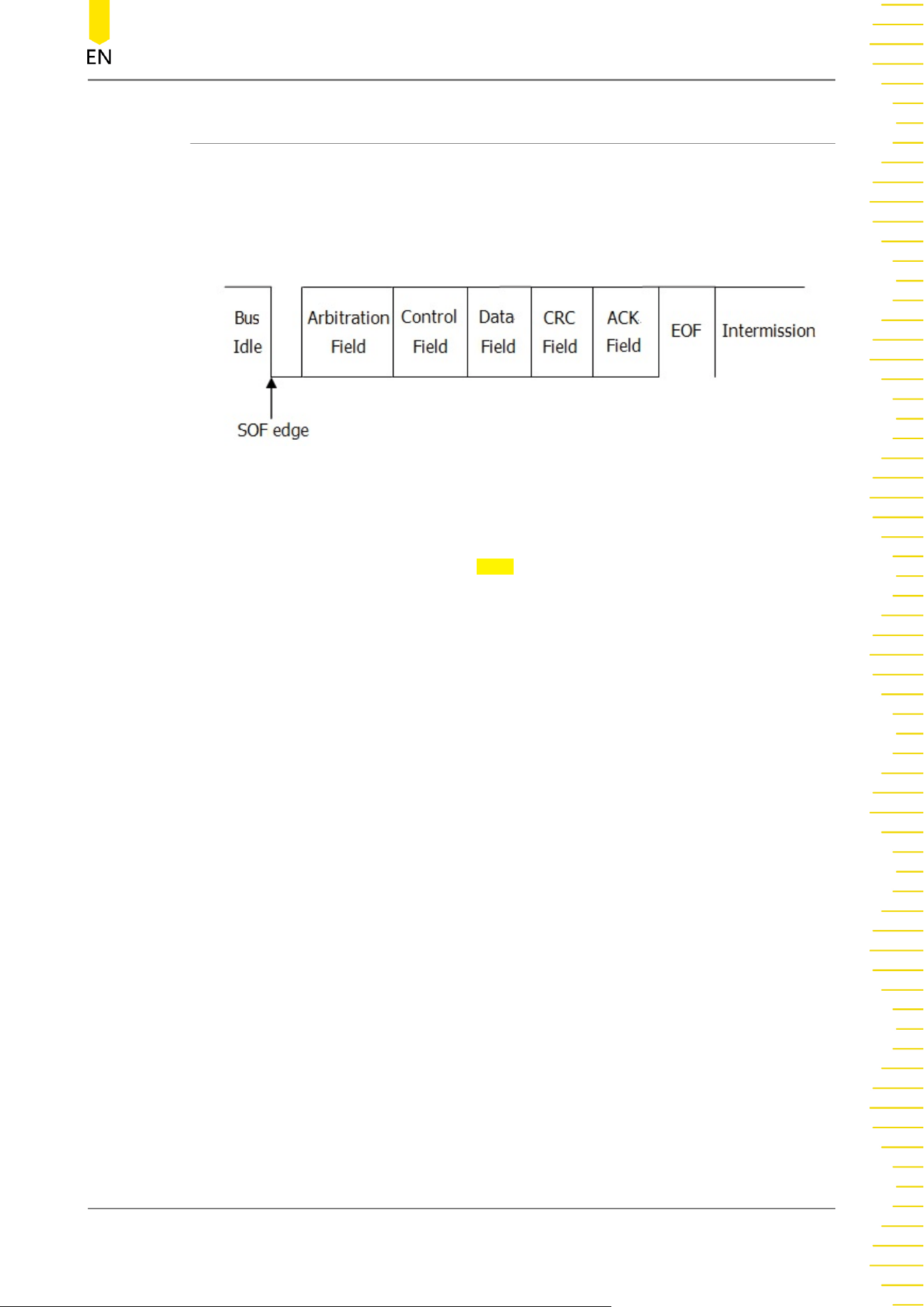
8.7.16 CAN Trigger (Option)
DS70000 can trigger on the start of a frame, end of a frame, frame of the specified
type (e.g. Remote, Overload, Data, etc.), or error frame of the specified type (e.g.
Answer Error, Check Error, Format Error, etc.) of the CAN signal.
The data frame format of the CAN bus is as shown in the figure below.
Figure 8.32 Data Frame Format of the CAN Bus
Trigger Type
Click or tap the drop-down button of Type to select "CAN" from the drop-down list.
Then set the parameters for CAN trigger.
To Trigger the Oscilloscope
Copyright ©RIGOL TECHNOLOGIES CO., LTD.
All rights reserved.
DS70000 User Guide
119
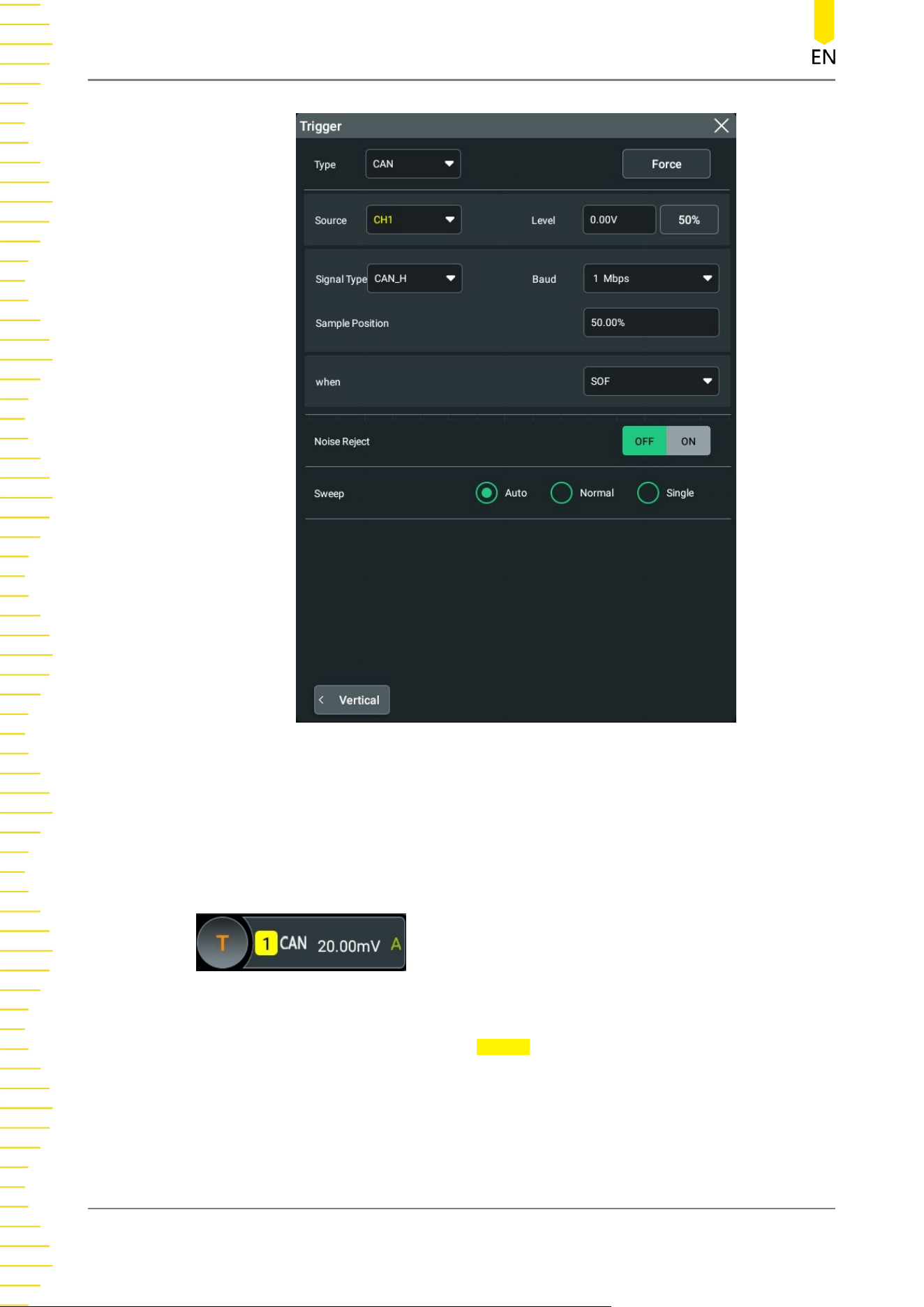
Figure 8.33 CAN Trigger Setting Menu
After selecting the trigger type, and then the current trigger setting information
(including trigger type, trigger source, and trigger level) is displayed in the trigger
information label at the top of the screen, as shown in the figure below. The
information will change based on the trigger settings.
Source Selection
Click or tap the drop-down button of
Source to select CH1-CH4. For details, refer to
descriptions in
Trigger Source
. The current trigger source is displayed in the trigger
information label at the top of the screen.
Only when we select the channel (that has been input with signals) as the trigger
source, can we obtain a stable trigger.
To Trigger the Oscilloscope
DS70000 User Guide
120
Copyright ©RIGOL TECHNOLOGIES CO., LTD.
All rights reserved.
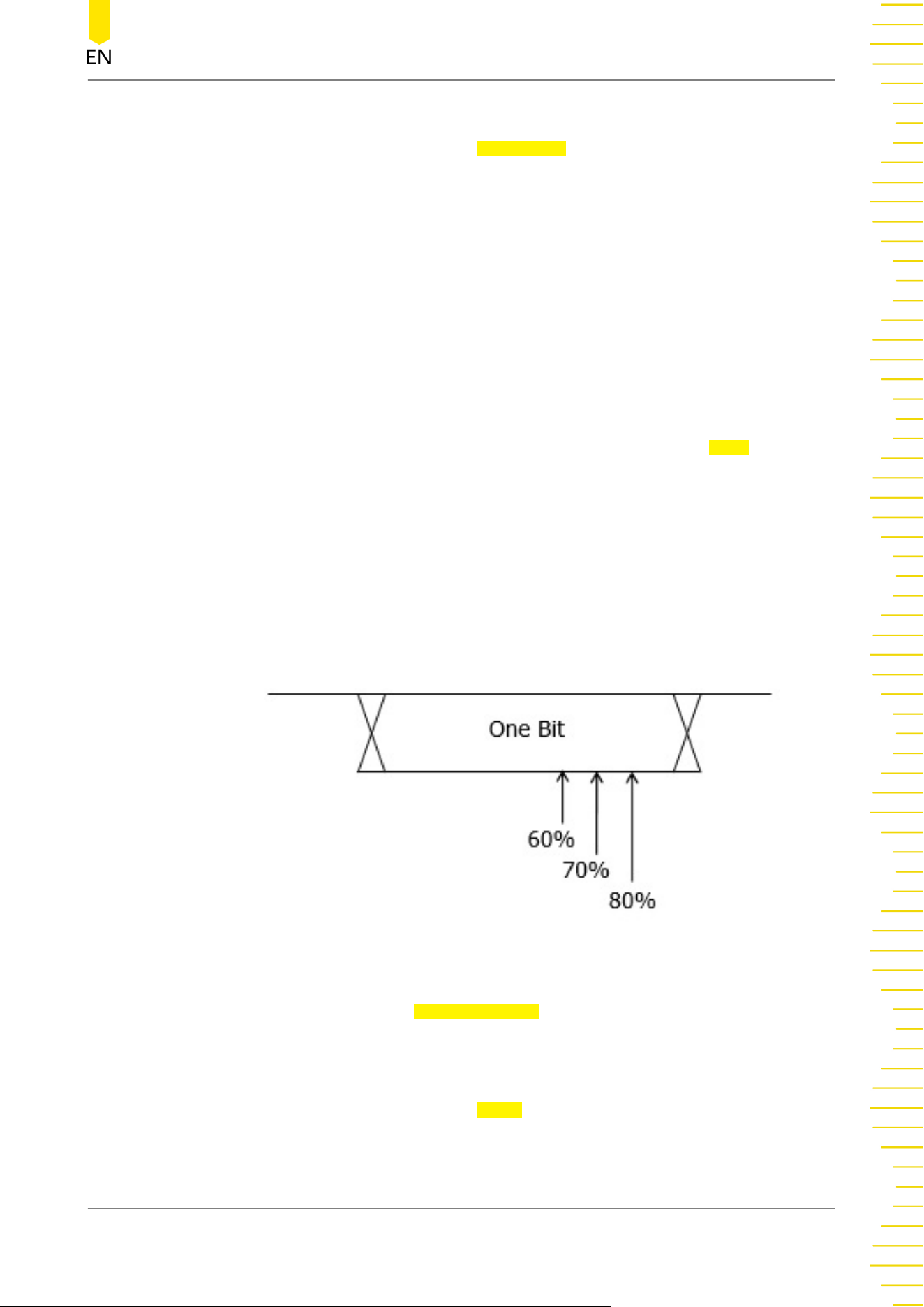
Signal Type
Click or tap the drop-down button of Signal Type to select the desired signal type.
• CAN_H: indicates the actual CAN_H bus signal.
• CAN_L: indicates the actual CAN_L bus signal.
• TX/RX: indicates the Transmit signal and Receive signal from the CAN bus
transceiver.
• DIFF: indicates the CAN differential bus signals connected to an analog channel
by using a differential probe. Connect the probe's positive lead to the CAN_H
bus signal and connect the negative lead to the CAN_L bus signal.
Baud Rate
Set the baud rate of the signal. Click or tap the drop-down button of Baud to select
the preset baud rate from the drop-down list. The available baud rates include 10
kbps, 20 kbps, 33.3 kbps, 50 kbps, 62.5 kbps, 83.3 kbps, and etc.
Sample Position
Sample position is a point within a bit's time. The oscilloscope samples the bit level at
this point. The sample position is represented by the proportion of "the time from the
start of the bit to the sample position" to the "bit time", as shown in the figure below.
Figure 8.34 Sample Position
Click or tap the input field of Sample Position to set it by using the pop-up numeric
keypad. The settable range is from 10% to 90%.
Trigger Condition
Click or tap the drop-down button of When to select the desired trigger condition.
• SOF: triggers at the start of a frame.
To Trigger the Oscilloscope
Copyright ©RIGOL TECHNOLOGIES CO., LTD.
All rights reserved.
DS70000 User Guide
121
• EOF: triggers at the end of a frame.
• Remote ID: triggers on the specified ID of Remote frame. When you select
Remote ID, you need to set the following parameters.
- Click or tap the ON/OFF tab for the Extended ID menu to enable or disable
the extended ID.
- Click or tap the input field of Data, and then the "Format" interface is
displayed. You can set the data bit that needs to be operated on. For
details, refer to descriptions in
I2C Trigger (Option)
.
• Overload: triggers on the overload frames.
• Frame ID: triggers on the data frames with the specified ID. When you select
Frame ID, you need to set the following parameters.
- Click or tap the ON/OFF tab for the Extended ID menu to enable or disable
the extended ID.
- Click or tap the input field of Data, and then the "Format" interface is
displayed. You can set the data bit that needs to be operated on. For
details, refer to descriptions in
I2C Trigger (Option)
.
• Frame Data: triggers on the data frames with the specified Data. When you
select Frame Data, you need to set the following parameters.
Click or tap the input field of Data, and then the "Format" interface is displayed.
You can set the data bit that needs to be operated on. For details, refer to
descriptions in
I2C Trigger (Option)
.
• Data & ID: triggers on the data frames with the specified ID and data. When you
select Data & ID, click or tap to select "Data" or "ID" under the Define menu.
When you select "Data", click or tap the input field of Data, and then the
"Format" interface is displayed. You can set the data bit that needs to be
operated on. For details, refer to descriptions in
I2C Trigger (Option)
. When you
select "ID", you need to set the following parameters.
- Click or tap the ON/OFF tab for the Extended ID menu to enable or disable
the extended ID.
- Click or tap the input field of Data, and then the "Format" interface is
displayed. You can set the data bit that needs to be operated on. For
details, refer to descriptions in
I2C Trigger (Option)
.
• Frame Error: triggers on the error frame.
• Bit Fill: triggers on the error frame with the bit fill.
• Answer Error: triggers on the answer error frame.
• Check Error: triggers on the check error frame.
• Format Error: triggers on the format error frame.
To Trigger the Oscilloscope
DS70000 User Guide
122
Copyright ©RIGOL TECHNOLOGIES CO., LTD.
All rights reserved.
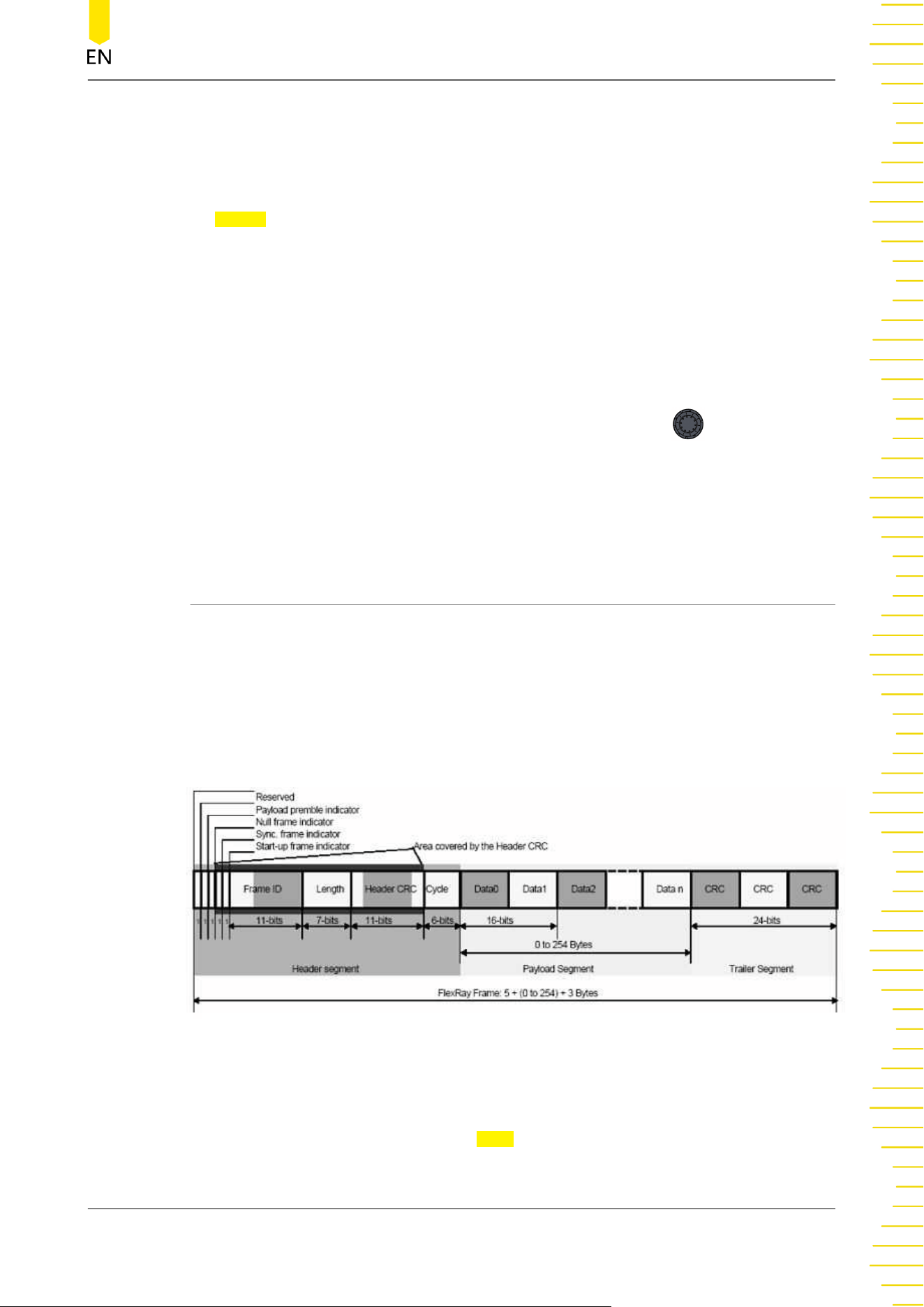
• Random Error: triggers on the random error frame, such as the format error
frame, answer error frame, etc.
Trigger Mode
In Sweep menu, select Auto, Normal, or Single as the trigger mode. For details, refer
to descriptions in
Trigger Mode
.
Trigger Parameter Setting
Sets the trigger parameter (noise rejection) under this trigger type. For details, refer
to descriptions in
Noise Reject
.
Trigger Level
Tap the "Trigger" icon on the small screen, then rotate the knob at the upper-
right part of the small screen to adjust the trigger level. You can also set the trigger
level with the pop-up numeric keypad. For details, refer to descriptions in
Trigger
Level
. The current trigger level is displayed in the trigger information label at the top
of the screen.
8.7.17 FlexRay Trigger (Option)
DS70000 can trigger on the specified frame, symbol, error, or position of the FlexRay
bus. FlexRay is a type of differential serial bus configured with three consecutive
segments (i.g. packet header, payload, and packet trailer). Its data transmission rate is
up to 10 Mb/s. Each frame contains a static segment and a dynamic segment, and
ends with the bus idle time.
Its format is as shown in the figure below.
Figure 8.35 Frame Format of FlexRay Bus
Trigger Type
Click or tap the drop-down button of Type to select "FlexRay" from the drop-down
list. Then set the parameters for FlexRay trigger.
To Trigger the Oscilloscope
Copyright ©RIGOL TECHNOLOGIES CO., LTD.
All rights reserved.
DS70000 User Guide
123
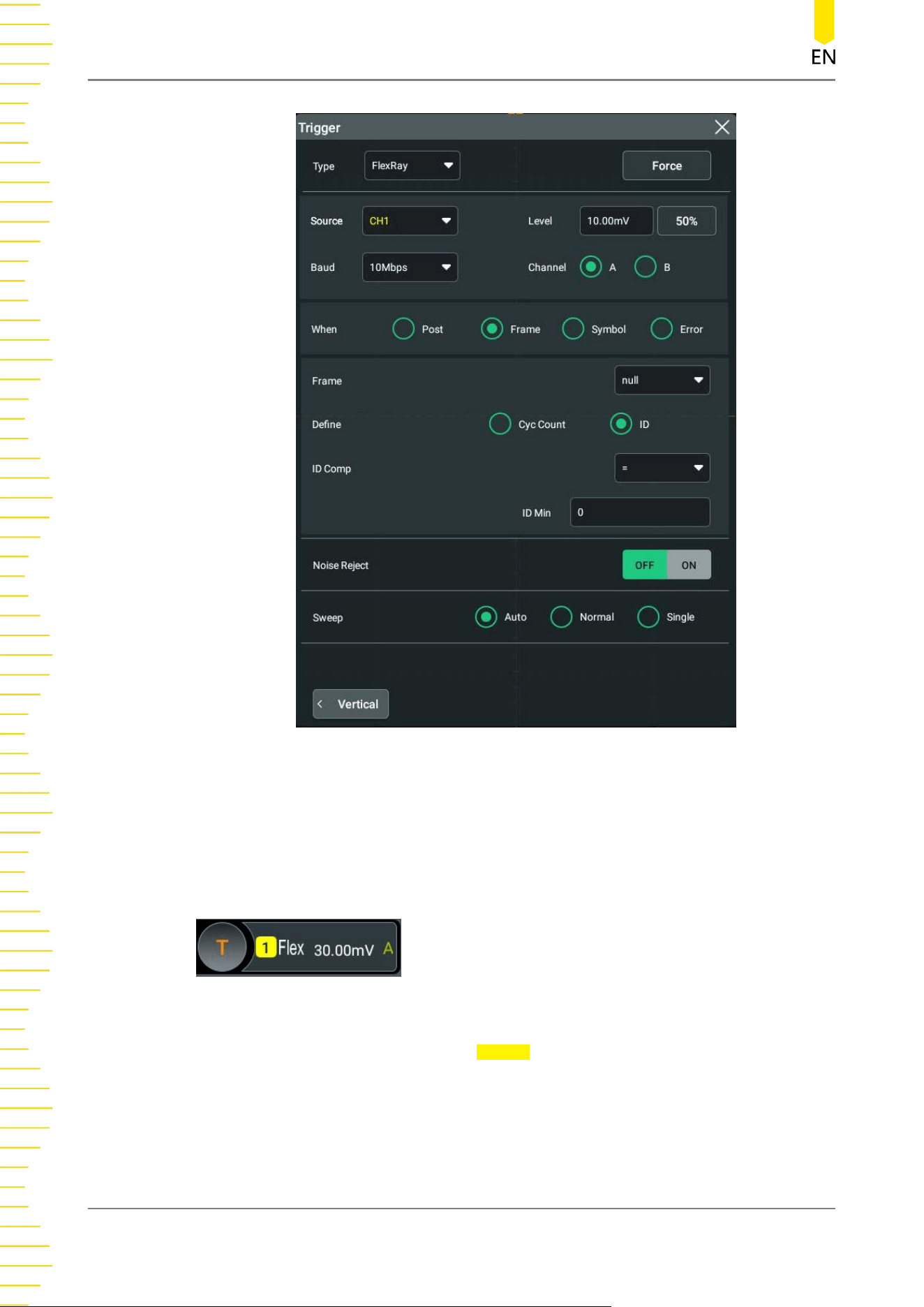
Figure 8.36 FlexRay Trigger Setting Menu
After selecting the trigger type, and then the current trigger setting information
(including trigger type, trigger source, and trigger level) is displayed in the trigger
information label at the top of the screen, as shown in the figure below. The
information will change based on the trigger settings.
Source Selection
Click or tap the drop-down button of Source to select CH1-CH4. For details, refer to
descriptions in
Trigger Source
. The current trigger source is displayed in the trigger
information label at the top of the screen.
Only when we select the channel (that has been input with signals) as the trigger
source, can we obtain a stable trigger.
To Trigger the Oscilloscope
DS70000 User Guide
124
Copyright ©RIGOL TECHNOLOGIES CO., LTD.
All rights reserved.
Baud Rate
Set the baud rate of the signal. Click or tap the drop-down button Baud to select a
FlexRay baud rate that matches the FlexRay bus signal. Select the preset baud rate
from the drop-down list. The available baud rates include 2.5 Mbps, 5 Mbps, and 10
Mbps.
Trigger Condition
Click or tap the drop-down button of When to select the desired trigger condition.
• Post: triggers on the specified position of the FlexRay bus. Select Post as the
trigger condition, and then click or tap its drop-down button to select "TSS End",
"FSS_BSS End", "FES End", or "DTS End" from the drop-down list.
• Frame: triggers on the frame of FlexRay bus.
- Click or tap the drop-down button of Frame to select the frame type. The
types of frames include null, Syns, Start, and All.
- Select "ID" or "Cyc Count" under the Define menu.
When you select "Cyc Count", set the following parameters: Cyc Comp,
Count Min, and Count Max. Click or tap the drop-down button of Cyc
Comp to select the comparison conditions. The available choices include =,
≠, >, <, ><, and <>. When a certain condition is selected, click or tap the
input field of Count Min or Count Max, then set the number of cycles with
the pop-up numeric keypad.
When you select "ID", set the following parameters: ID Comp, ID Min, and
ID Max. Click or tap the drop-down button of ID Comp to select the
comparison conditions. The available choices include =, ≠, >, <, ><, and
<>. When a certain condition is selected, click or tap the input field of ID
Max or ID Min, then use the numeric keypad to set the frame ID.
• Symbol: triggers on the CAS/MTS (Collision Avoidance Symbol/Media Access
Test Symbol) and WUP (Wakeup Pattern) of FlexRay bus.
- Click or tap the drop-down button of Symbol to select the symbol type.
The symbol type includes CAS/MTS and WUS.
- Click or tap the drop-down button of ID Comp to select the comparison
conditions. The available choices include =, ≠, >, <, ><, and <>. When a
certain condition is selected, click or tap the input field of ID Max or ID
Min, then use the numeric keypad to set the frame ID.
• Error: triggers when an error occurs to the FlexRay bus. Click or tap the drop-
down button of Error to select the error type. It includes Head CRC Err, Tail CRC
Err, Decode Err, and Random Err.
As the occurrence possibility of specified FlaxRay frame is very low, it is
recommended that you set the oscilloscope to "Normal" trigger mode when the
To Trigger the Oscilloscope
Copyright ©RIGOL TECHNOLOGIES CO., LTD.
All rights reserved.
DS70000 User Guide
125
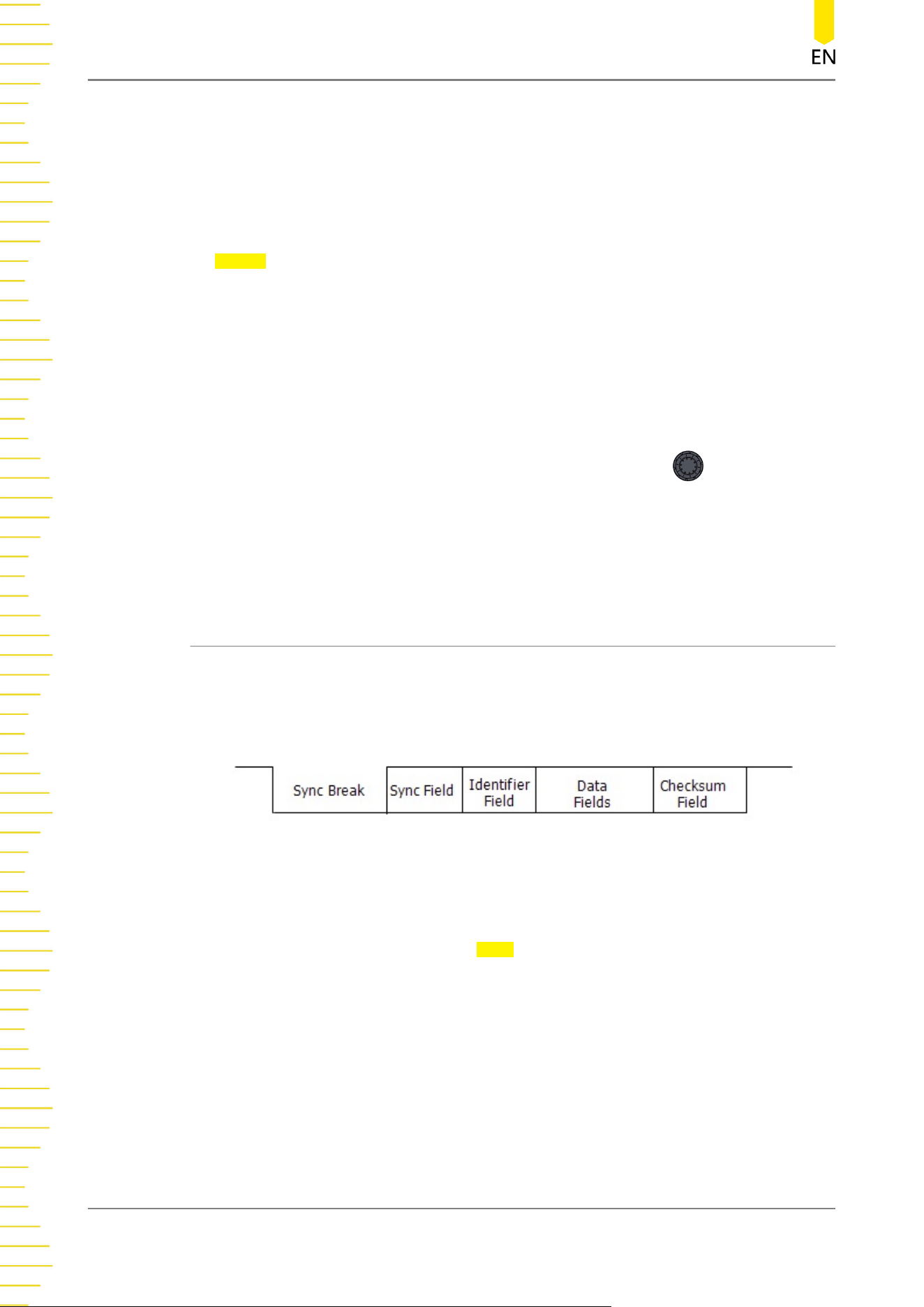
trigger condition is set to "Frame", so as to prevent the instrument from triggering
automatically while waiting for the specified frame. The same goes for "Error" trigger
condition. In addition, when multiple FlexRay errors occur at the same time, you need
to adjust the trigger holdoff so as to view the specific error.
Trigger Mode
In Sweep menu, select Auto, Normal, or Single as the trigger mode. For details, refer
to descriptions in
Trigger Mode
.
Trigger Parameter Setting
Sets the trigger parameter (noise rejection) under this trigger type. For details, refer
to descriptions in
Noise Reject
.
Trigger Level
Tap the "Trigger" icon on the small screen, then rotate the knob at the upper-
right part of the small screen to adjust the trigger level. You can also set the trigger
level with the pop-up numeric keypad. For details, refer to descriptions in
Trigger
Level
. The current trigger level is displayed in the trigger information label at the top
of the screen.
8.7.18 LIN Trigger (Option)
DS70000 can trigger on the sync field of LIN signal, and can also trigger on the
specified identifier, data, or frame.
The data frame format of the LIN bus is as shown in the figure below.
Figure 8.37 Data Frame Format of the LIN Bus
Trigger Type
Click or tap the drop-down button of Type to select "LIN" from the drop-down list.
Then set the parameters for LIN trigger.
To Trigger the Oscilloscope
DS70000 User Guide
126
Copyright ©RIGOL TECHNOLOGIES CO., LTD.
All rights reserved.
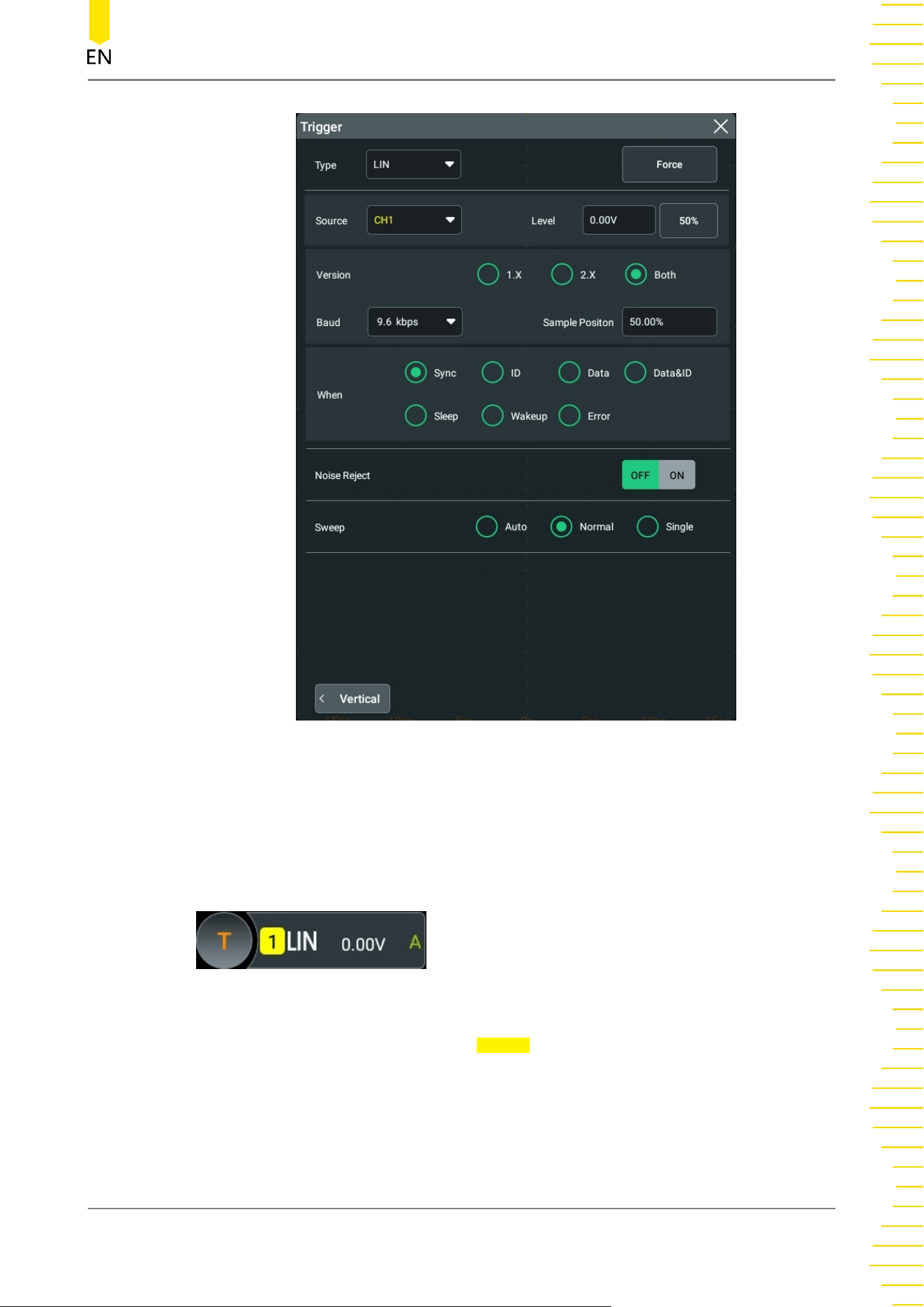
Figure 8.38 LIN Trigger Setting Menu
After selecting the trigger type, then the current trigger setting information (including
trigger type, trigger source, and trigger level) is displayed in the trigger information
label at the top of the screen, as shown in the figure below. The information will
change based on the trigger settings.
Source Selection
Click or tap the drop-down button of
Source to select CH1-CH4. For details, refer to
descriptions in
Trigger Source
. The current trigger source is displayed in the trigger
information label at the top of the screen.
Only when we select the channel (that has been input with signals) as the trigger
source, can we obtain a stable trigger.
To Trigger the Oscilloscope
Copyright ©RIGOL TECHNOLOGIES CO., LTD.
All rights reserved.
DS70000 User Guide
127
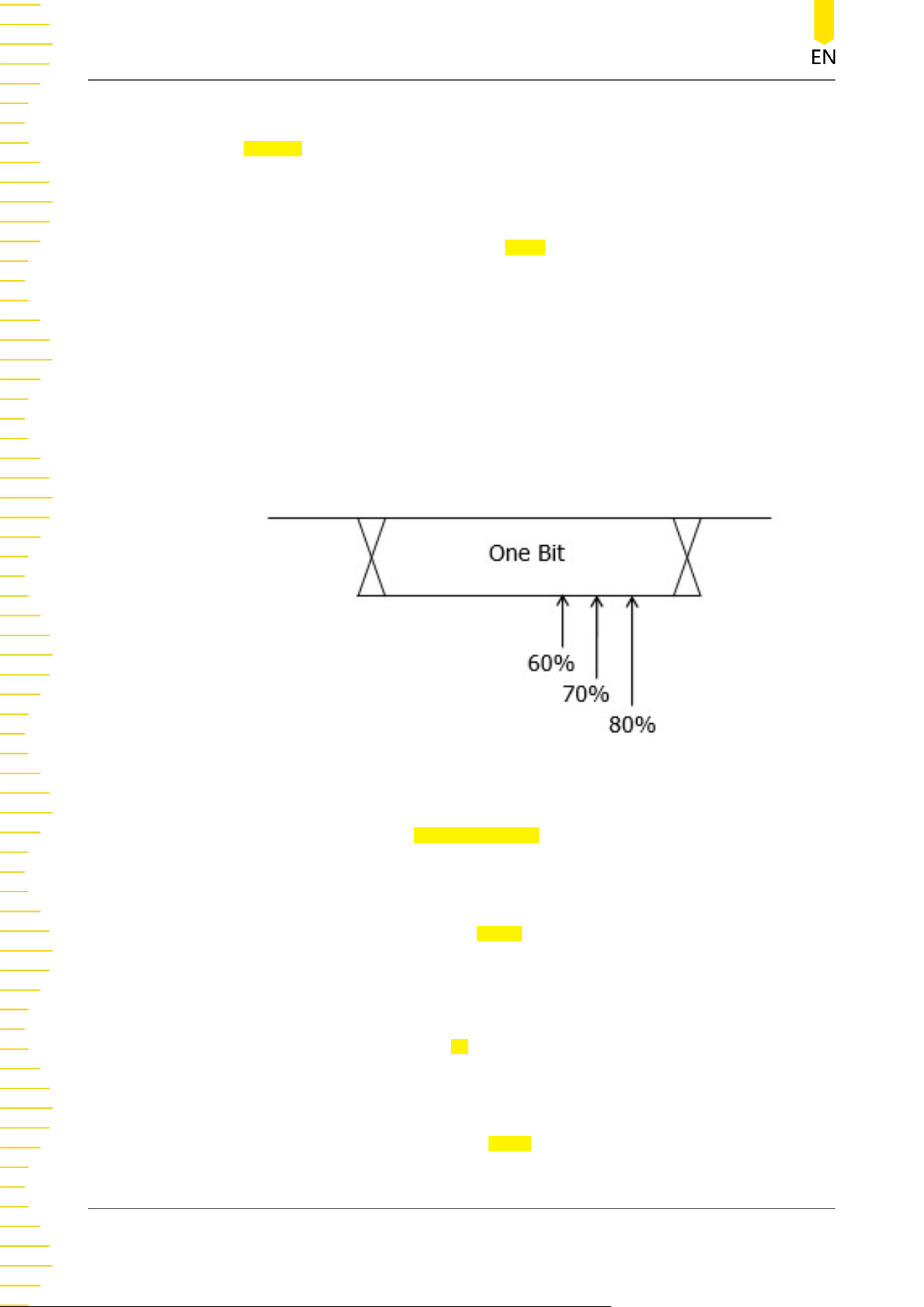
Protocol Version
In the Version menu, select the protocol version that matches the signal under test.
The available versions include 1.X, 2.X and Both.
Baud Rate
Click or tap the drop-down button of the Baud menu to select the preset baud rate
from the drop-down list. The available baud rates include 1.2 kbps, 2.4 kbps, 4.8 kbps,
9.6 kbps, 19.2 kbps, and etc.
Sample Position
Sample position is a point within a bit’s time. The oscilloscope samples the bit level
at this point. The sample position is represented by the proportion of "the time from
the start of the bit to the sample position" to the "bit time", as shown in the figure
below.
Figure 8.39 Sample Position
Click or tap the input field of Sample Position to set it by using the pop-up numeric
keypad. The settable range is from 10% to 90%.
Trigger Condition
Click or tap the drop-down button of When to select the desired trigger condition.
• Sync: triggers on the last bit of the sync field.
• ID: triggers when the frames with the specified ID are found.
Click or tap the input field of ID, and then use the pop-up numeric keypad to set
ID.
• Data: triggers when the data that meet the preset conditions are found.
- Click or tap the input field of Bytes, and then use the pop-up numeric
keypad to set the length of the data. Its range is from 1 to 8.
To Trigger the Oscilloscope
DS70000 User Guide
128
Copyright ©RIGOL TECHNOLOGIES CO., LTD.
All rights reserved.
- Click or tap the input field of Data, and then the "Format" interface is
displayed. You can set the data bit that needs to be operated on. For
details, refer to descriptions in
I2C Trigger (Option)
.
• Data&ID: triggers when the frames with the specified ID and data that meet the
preset conditions are both found.
- Click or tap the input field of Bytes, and then use the pop-up numeric
keypad to set the length of the data. Its range is from 1 to 8.
- Click or tap the input field of ID, and then use the pop-up numeric keypad
to set ID.
- Click or tap the input field of Data, and then the "Format" interface is
displayed. You can set the data bit that needs to be operated on. For
details, refer to descriptions in
I2C Trigger (Option)
.
• Sleep: triggers when the sleep frame is found.
• Wakeup: triggers when the wakeup frame is found.
• Error: triggers on the specified type of error frame. Click or tap the drop-down
button of Error Type to select the error type: Sync, Even Odd, or Check Sum.
Trigger Mode
In Sweep menu, select Auto, Normal, or Single as the trigger mode. For details, refer
to descriptions in
Trigger Mode
.
Trigger Parameter Setting
Sets the trigger parameter (noise rejection) under this trigger type. For details, refer
to descriptions in
Noise Reject
.
Trigger Level
Tap the "Trigger" icon on the small screen, then rotate the knob at the upper-
right part of the small screen to adjust the trigger level. You can also set the trigger
level with the pop-up numeric keypad. For details, refer to descriptions in
Trigger
Level
. The current trigger level is displayed in the trigger information label at the top
of the screen.
8.7.19 I2S Trigger (Option)
In I2S trigger, the oscilloscope searches for the specified data value and take it as the
condition for identifying the trigger. You need to specify the serial clock line (SCLK, 1
pulse is found on the clock line once 1 bit of digital audio data is sent), frame clock
line (WS, used for switch the audio channel data), and serial data line (SDA, used for
transmit audio data represented in binary (2's complement)).
Below is the sequential chart of I2S bus.
To Trigger the Oscilloscope
Copyright ©RIGOL TECHNOLOGIES CO., LTD.
All rights reserved.
DS70000 User Guide
129
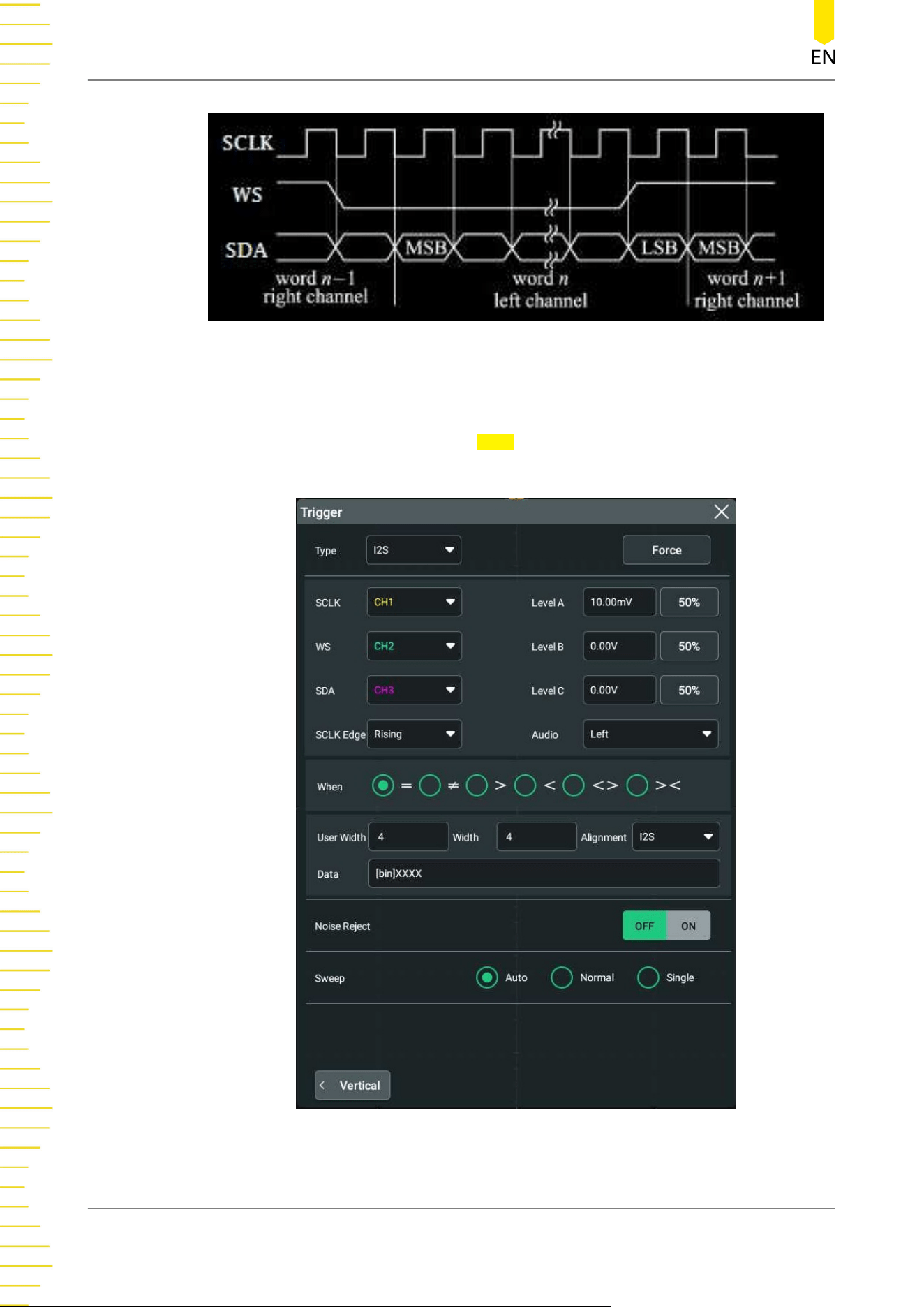
Figure 8.40 Sequential Chart of I2S Bus
Trigger Type
Click or tap the drop-down button of Type to select "I2S" from the drop-down list.
Then set the parameters for I2S trigger.
Figure 8.41 I2S Trigger Setting Menu
To Trigger the Oscilloscope
DS70000 User Guide
130
Copyright ©RIGOL TECHNOLOGIES CO., LTD.
All rights reserved.
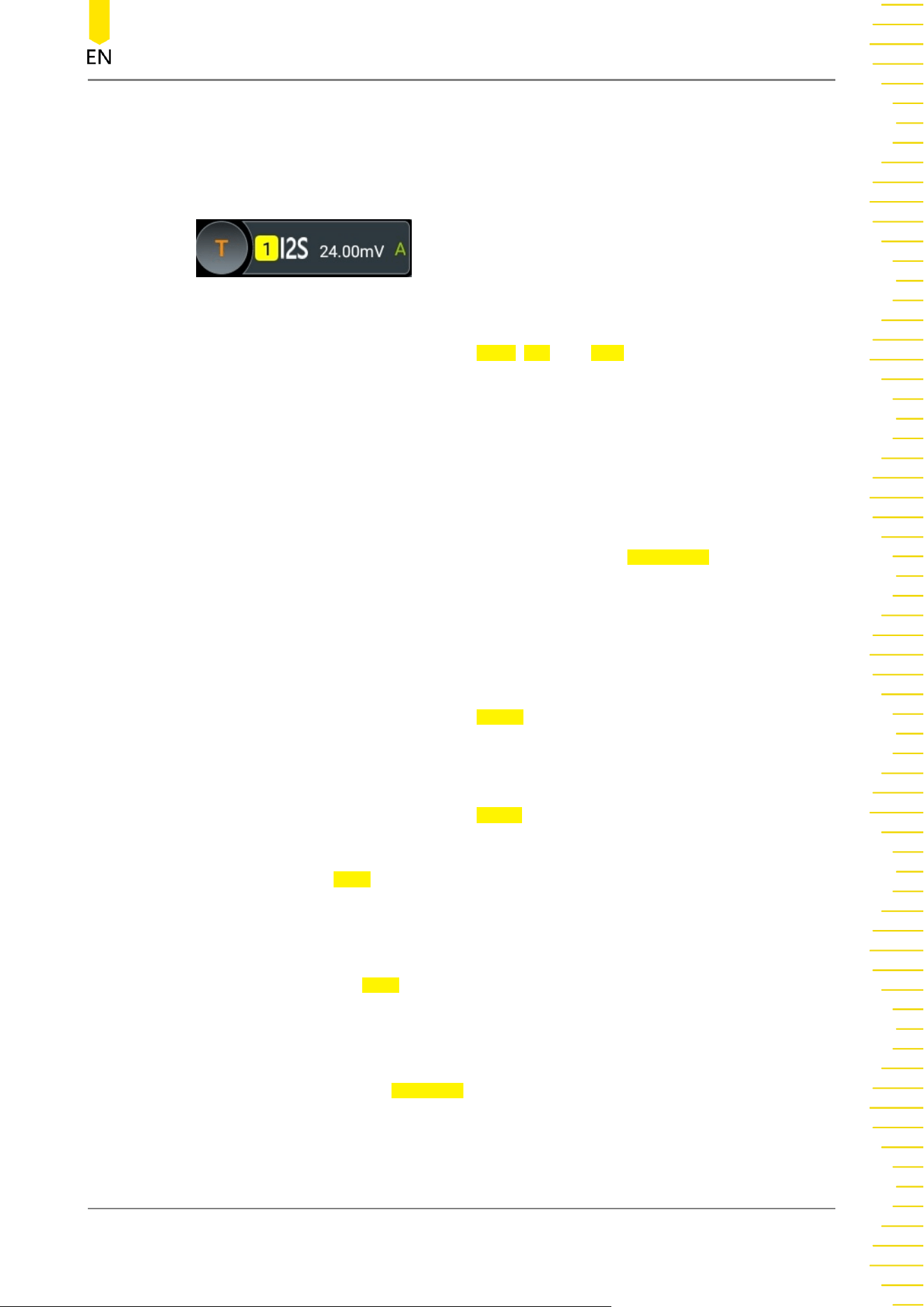
After selecting the trigger type, then the current trigger setting information (including
trigger type, trigger source, and trigger level) is displayed in the trigger information
label at the top of the screen, as shown in the figure below. The information will
change based on the trigger settings.
Source Selection
Click or tap the drop-down button of SCLK, WS, and SDA to select CH1-CH4 to the
specify the sources of SCLK, WS, and SDA respectively. For details, refer to
descriptions in
Trigger Source
. The current trigger source is displayed in the trigger
information label at the top of the screen.
Only when we select the channel (that has been input with signals) as the trigger
source, can we obtain a stable trigger.
Edge Type
Selects the desired clock edge from the drop-down list of SCLK Edge.
• Rising: samples the SDA data on the rising edge of the clock.
• Falling: samples the SDA data on the falling edge of the clock.
Audio
Click or tap the drop-down button of Audio to select the audio channel ("Left",
"Right", or "Either").
Trigger Condition
Click or tap the drop-down button of When to select the desired trigger condition.
• =: triggers when the channel's data equal the set data value. Click or tap the
input field of Data, and then the "Format" interface is displayed. You can set the
data bit that needs to be operated on. For details, refer to descriptions in
I2C
Trigger (Option)
.
• ≠: triggers when the channel's data do not equal the set data value. Click or tap
the input field of Data, and then the "Format" interface is displayed. You can set
the data bit that needs to be operated on. For details, refer to descriptions in
I2C
Trigger (Option)
.
• >: triggers when the channel's data are greater than the set data value. Click or
tap the input field of Data Min, and then the "Format" interface is displayed. You
can set the lower limit of the data bit. For details, refer to descriptions in
I2C
Trigger (Option)
.
To Trigger the Oscilloscope
Copyright ©RIGOL TECHNOLOGIES CO., LTD.
All rights reserved.
DS70000 User Guide
131
• <: triggers on when the channel's data are smaller than the set data value. Click
or tap the input field of Data Max, and then the "Format" interface is displayed.
You can set the upper limit of the data bit. For details, refer to descriptions in
I2C
Trigger (Option)
.
• < >: triggers when the channel's data are smaller than the upper limit of the
data value and greater than the lower limit of the data value.. Click or tap the
input field of Data Max and Data Min, and then the "Format" interface is
displayed. You can set the upper limit and lower limit of the data bit. For details,
refer to descriptions in
I2C Trigger (Option)
.
• > <: triggers when the channel's data are greater than the upper limit of the
data value and smaller than the lower limit of the data value. Click or tap the
input field of Data Max and Data Min, and then the "Format" interface is
displayed. You can set the upper limit and lower limit of the data bit. For details,
refer to descriptions in
I2C Trigger (Option)
.
User Width
Click or tap the input field of User Width to set it by using the pop-up numeric
keypad. Its range is from 4 to 32.
The user width is smaller than or equal to the width.
Width
Click or tap the input field of Width to set it by using the pop-up numeric keypad. Its
range is from 4 to 32.
Alignment
Click or tap the drop-down button of Alignment to select the alignment way for data
signal.
• I2S: MSB (Most Significant Bit) of data for each sample is sent first, and LSB
(Least Significant Bit) is sent last. The MSB appears on the SDA line one bit clock
after the edge of the WS transition.
• LJ: data transmission (MSB first) begins at the edge of the WS transition.
• RJ: data transmission (MSB first) is right-justified to the WS transition.
Trigger Mode
In Sweep menu, select Auto, Normal, or Single as the trigger mode. For details, refer
to descriptions in
Trigger Mode
.
Trigger Parameter Setting
Sets the trigger parameter (noise rejection) under this trigger type. For details, refer
to descriptions in
Noise Reject
.
To Trigger the Oscilloscope
DS70000 User Guide
132
Copyright ©RIGOL TECHNOLOGIES CO., LTD.
All rights reserved.
Trigger Level
• Level A
Sets the trigger level of SCLK. Tap the "Trigger" icon on the small screen, then
rotate the knob at the upper-right part of the small screen to adjust the
trigger level. You can also set the trigger level with the pop-up numeric keypad.
For details, refer to descriptions in
Trigger Level
. The current trigger level is
displayed in the trigger information label at the top of the screen.
• Level B
Sets the trigger level of WS. Tap the "Trigger" icon on the small screen, then
rotate the knob at the upper-right part of the small screen to adjust the
trigger level. You can also set the trigger level with the pop-up numeric keypad.
For details, refer to descriptions in
Trigger Level
. The current trigger level is
displayed in the trigger information label at the top of the screen.
• Level C
Sets the trigger level of SDA. Tap the "Trigger" icon on the small screen, then
rotate the knob at the upper-right part of the small screen to adjust the
trigger level. You can also set the trigger level with the pop-up numeric keypad.
For details, refer to descriptions in
Trigger Level
. The current trigger level is
displayed in the trigger information label at the top of the screen.
8.7.20 MIL-STD-1553 Trigger (Option)
1553B is the abbreviation for the MIL-STD-1553 bus. DS70000 can trigger on the sync
field of 1553B bus, and can also trigger on the specified data word, command word,
status word, or error type.
The command word, data word, and status word format of the 1553B bus is as shown
in the figure below.
To Trigger the Oscilloscope
Copyright ©RIGOL TECHNOLOGIES CO., LTD.
All rights reserved.
DS70000 User Guide
133
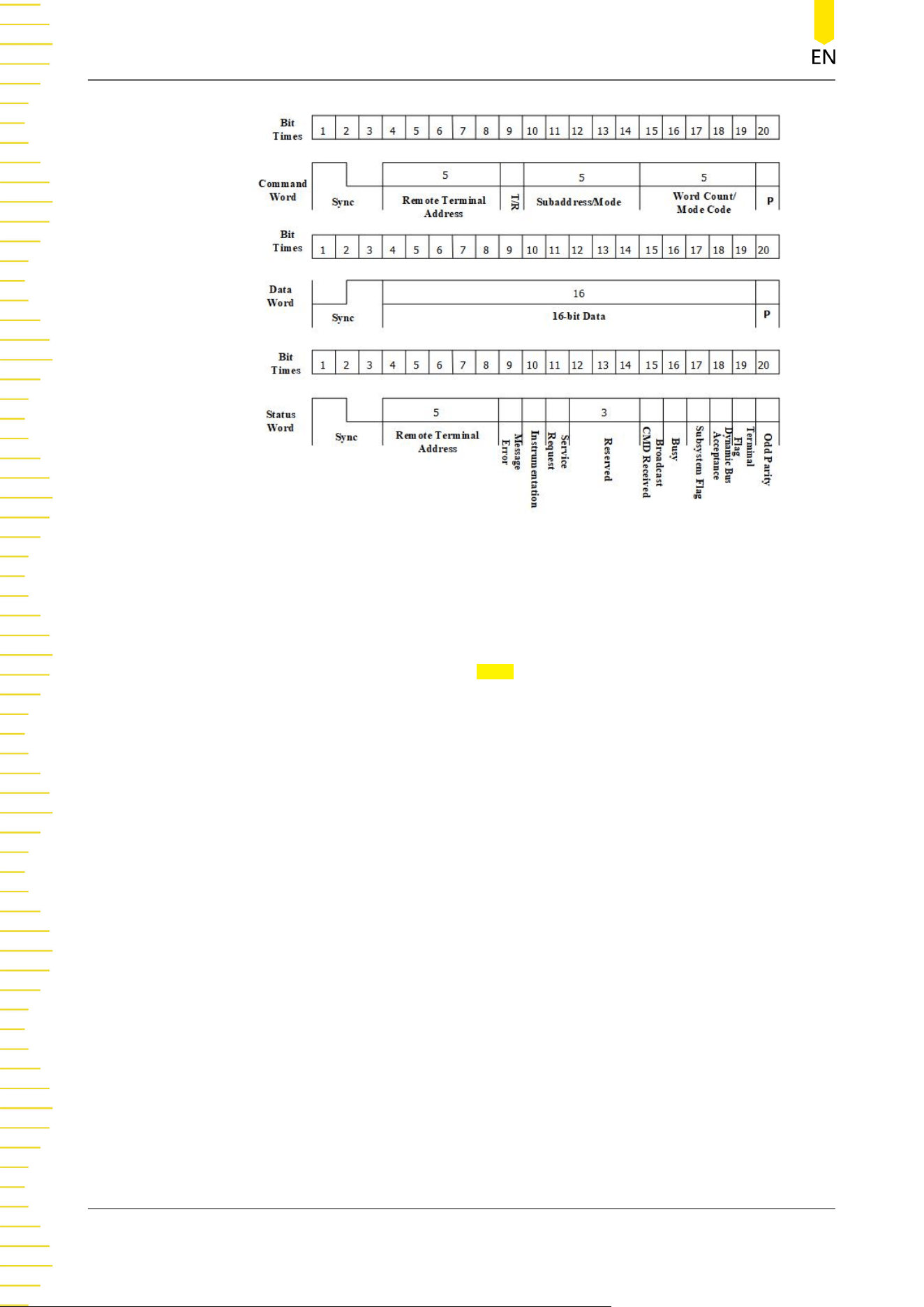
Figure 8.42 Formats of the Command Word, Data Word, and Status Word of the
1553B Bus
Trigger Type
Click or tap the drop-down button of Type to select "MIL-STD-1553" from the drop-
down list. Then set the parameters for MIL-STD-1553 trigger.
To Trigger the Oscilloscope
DS70000 User Guide
134
Copyright ©RIGOL TECHNOLOGIES CO., LTD.
All rights reserved.
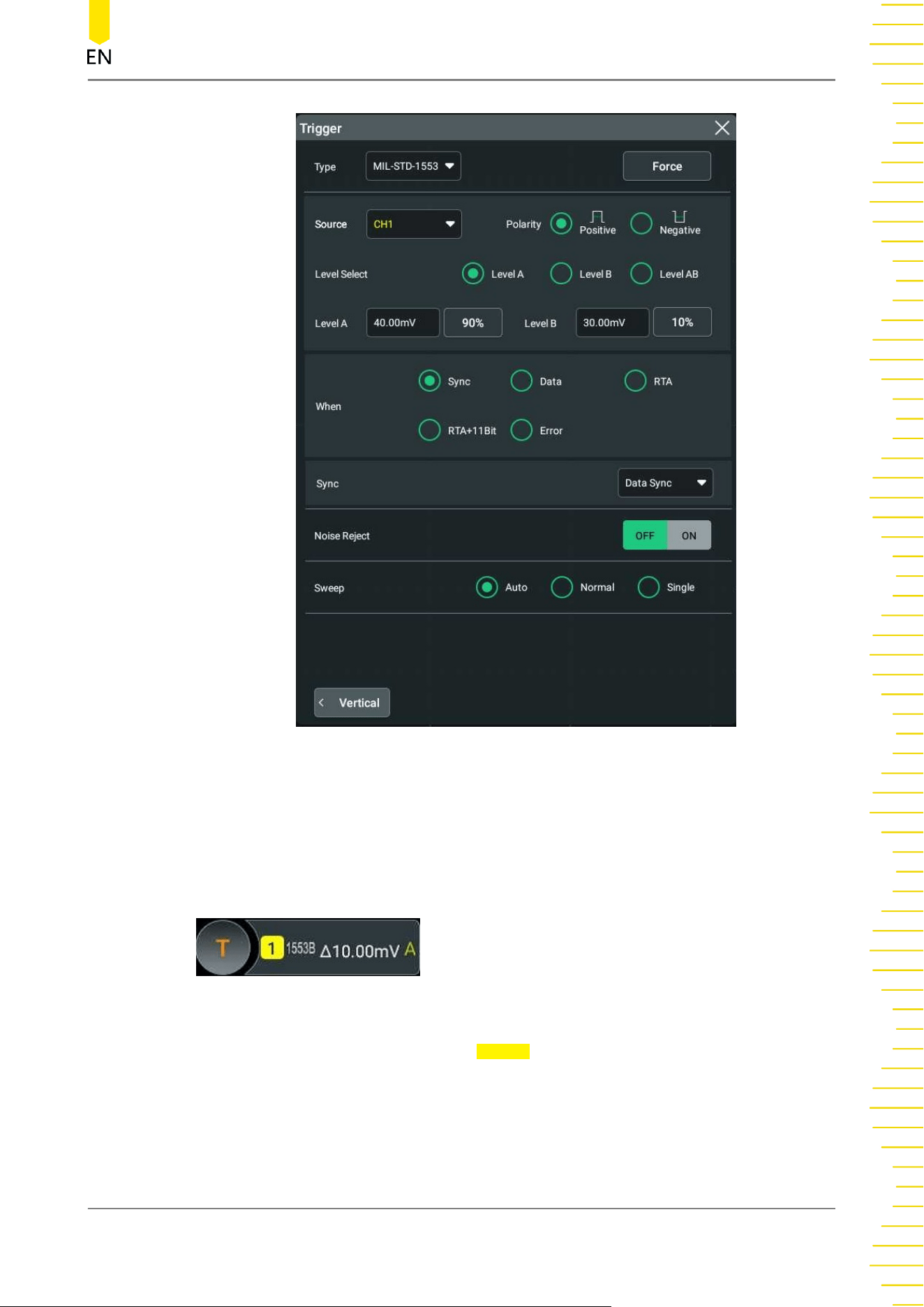
Figure 8.43 MIL-STD-1553 Trigger Setting Menu
After selecting the trigger type, and then the current trigger setting information
(including trigger type, trigger source, and trigger level) is displayed in the trigger
information label at the top of the screen, as shown in the figure below. The
information will change based on the trigger settings.
Source Selection
Click or tap the drop-down button of Source to select CH1-CH4. For details, refer to
descriptions in
Trigger Source
. The current trigger source is displayed in the trigger
information label at the top of the screen.
Only when we select the channel (that has been input with signals) as the trigger
source, can we obtain a stable trigger.
To Trigger the Oscilloscope
Copyright ©RIGOL TECHNOLOGIES CO., LTD.
All rights reserved.
DS70000 User Guide
135
Polarity
Selects the desired polarity.under the Polarity menu. The polarities available are
positive polarity ( ) and negative polarity ( ).
Level Selection and Setting
After the trigger condition setting is completed, you need to adjust the trigger level
to correctly trigger the signal and obtain a stable waveform.
Select the level adjustment type under the Level Select menu.
• Level A: only adjusts the upper limit of the trigger level, and the lower limit of
the trigger level remains unchanged.
• Level B: only adjusts the lower limit of the trigger level, and the upper limit of the
trigger level remains unchanged.
• Level AB: adjusts the upper and lower limits of the trigger level at the same time,
and the trigger level deviation (the difference between the upper limit and lower
limit of the trigger level) remains unchanged.
In MIL-STD-1553 trigger, pressing down the trigger level knob at the upper-right part
of the small screen can quickly switch the current level adjustment type.
When setting the trigger level, first select a level type and then tap the "Trigger" icon
on the small screen, rotate the knob at the upper-right part of the small screen
or drag the adjustment icon under the Level A and Level B menu item to adjust the
level of Source A and Source B. For details, refer to descriptions in
Trigger Level
. The
current trigger level is displayed in the trigger information label at the top of the
screen.
Trigger Condition
Click or tap the drop-down button of When to select the desired trigger condition.
• Sync: triggers on the specified sync type. After this trigger condition is selected,
click or tap the drop-down button of Sync to select the desired sync type: Data
Sync, Cmd/Status Sync, or All Sync.
• Data: triggers on the specified data word. After this trigger condition is selected,
click or tap the comparison conditions from the
Comp menu. The available
choices include =, ≠, >, <, ><, and <>.
- =: triggers when the channel's data word equals the set data word. Click or
tap the input field of Min, and then the "Format" interface is displayed. You
can set the lower limit of the data word. For details, refer to descriptions in
I2C Trigger (Option)
.
- ≠: triggers when the channel's data word does not equal the set data word.
Click or tap the input field of
Min, and then the "Format" interface is
To Trigger the Oscilloscope
DS70000 User Guide
136
Copyright ©RIGOL TECHNOLOGIES CO., LTD.
All rights reserved.
displayed. You can set the lower limit of the data word. For details, refer to
descriptions in
I2C Trigger (Option)
.
- >: triggers when the channel's data word is greater than the set data word.
Click or tap the input field of Min, and then the "Format" interface is
displayed. You can set the lower limit of the data word. For details, refer to
descriptions in
I2C Trigger (Option)
.
- <: triggers when the channel's data word is smaller than the set data word.
Click or tap the input field of Max, and then the "Format" interface is
displayed. You can set the upper limit of the data word. For details, refer to
descriptions in
I2C Trigger (Option)
.
- < >: triggers when the channel's data word is smaller than the upper limit
of the data word and greater than the lower limit of the data word. Click or
tap the input field of Max and Min, and then the "Format" interface is
displayed. You can set the upper limit and lower limit of the data word. For
details, refer to descriptions in
I2C Trigger (Option)
.
- > <: triggers when the channel's data word is greater than the upper limit
of the data word and smaller than the lower limit of the data word. Click or
tap the input field of Max and Min, and then the "Format" interface is
displayed. You can set the upper limit and lower limit of the data word. For
details, refer to descriptions in
I2C Trigger (Option)
.
• RTA: triggers on the specified remote terminal address. After this trigger
condition is selected, click or tap the input field of RTA, and then the "Format"
interface is displayed. You can set the remote terminal address. For details, refer
to descriptions in
I2C Trigger (Option)
.
• RTA+11Bit: triggers on the RTA and the remaining 11 bits.
After this trigger condition is selected:
- Click or tap the input field of RTA, and then the "Format" interface is
displayed. You can set the remote terminal address. For details, refer to
descriptions in
I2C Trigger (Option)
.
- Click or tap the input field of Bit time, and then the "Format" interface is
displayed. You can set the bit time position value to 0 (low), 1 (high), or X
(don't care). For details, refer to descriptions in
I2C Trigger (Option)
.
• Error: triggers on the specified error type. After this trigger condition is selected,
click or tap the drop-down button of Err Type to select the error type.
- Sync Error: triggers when an invalid sync pulse is found.
- Check Error: triggers when the parity bit is incorrect for the data in the
word.
To Trigger the Oscilloscope
Copyright ©RIGOL TECHNOLOGIES CO., LTD.
All rights reserved.
DS70000 User Guide
137
Trigger Mode
In Sweep menu, select Auto, Normal, or Single as the trigger mode. For details, refer
to descriptions in
Trigger Mode
.
Trigger Parameter Setting
Sets the trigger parameter (noise rejection) under this trigger type. For details, refer
to descriptions in
Noise Reject
.
8.8 Trigger Output Connector
The trigger output connector ([AUX OUT]) on the rear panel of DS70000 series can
output trigger signals (trigger hardware) determined by the current setting.
Click or tap the function navigation icon
at the lower-left corner of the screen,
and then select "Utility" to enter the utility function menu. Click or tap Setup, and
then in the Aux Out menu, select "TrigOut". You can also tap the Utility icon on the
small screen to enter the utility function menu. A signal which reflects the current
oscilloscope capture rate can be output from [AUX OUT] connector each time a
trigger is generated by the oscilloscope. If this signal is connected to a waveform
display device to measure the frequency, the measurement result is the same as the
current capture rate.
If "PassFail" is selected for the Aux Out menu, the instrument can output a pulse from
the [AUX OUT] connector when a pass/failed event is detected during the pass/fail
test.
To Trigger the Oscilloscope
DS70000 User Guide
138
Copyright ©RIGOL TECHNOLOGIES CO., LTD.
All rights reserved.
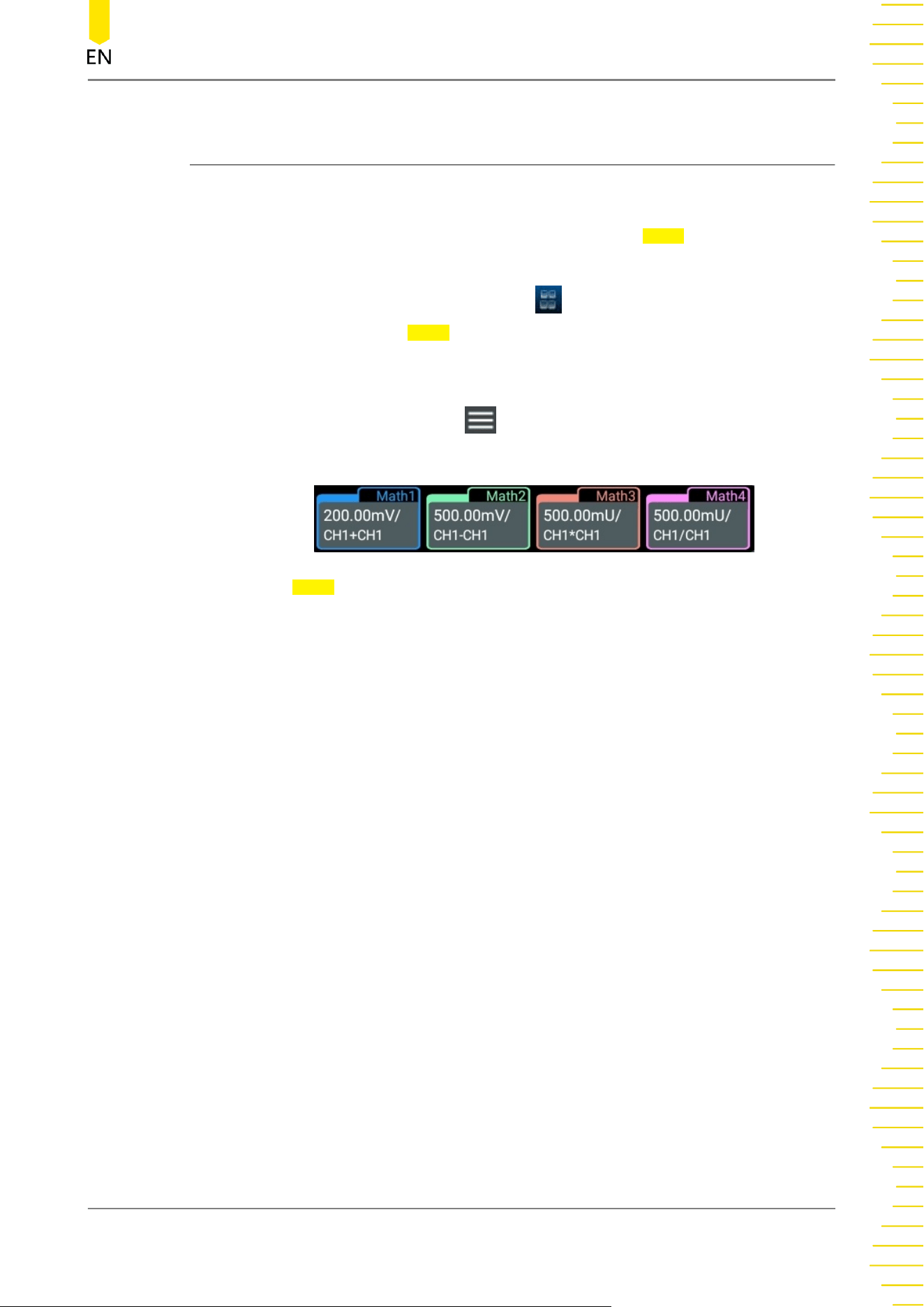
9 Math Operation
This series of oscilloscopes can realize multiple math operations between waveforms
of different channels, including arithmetic operation, spectrum operation, logic
operation, function operation, and digital filter. To enter the Math menu, perform any
of the following operations:
• Click or tap the function navigation icon
at the lower-left corner of the
screen, and then select Math to enter the “Math” menu.
• Click or tap the Math1 ~ Math4 label at the bottom of the screen, and the
corresponding interface appears on the screen, as shown in
Figure 9.2
. Click or
tap the label again, or the icon
at the upper-right corner of the window to
enter the math operation menu.
• Tap the Math icon on the small screen at the right side of the device to enter the
math operation menu.
Math Operation
Copyright ©RIGOL TECHNOLOGIES CO., LTD.
All rights reserved.
DS70000 User Guide
139
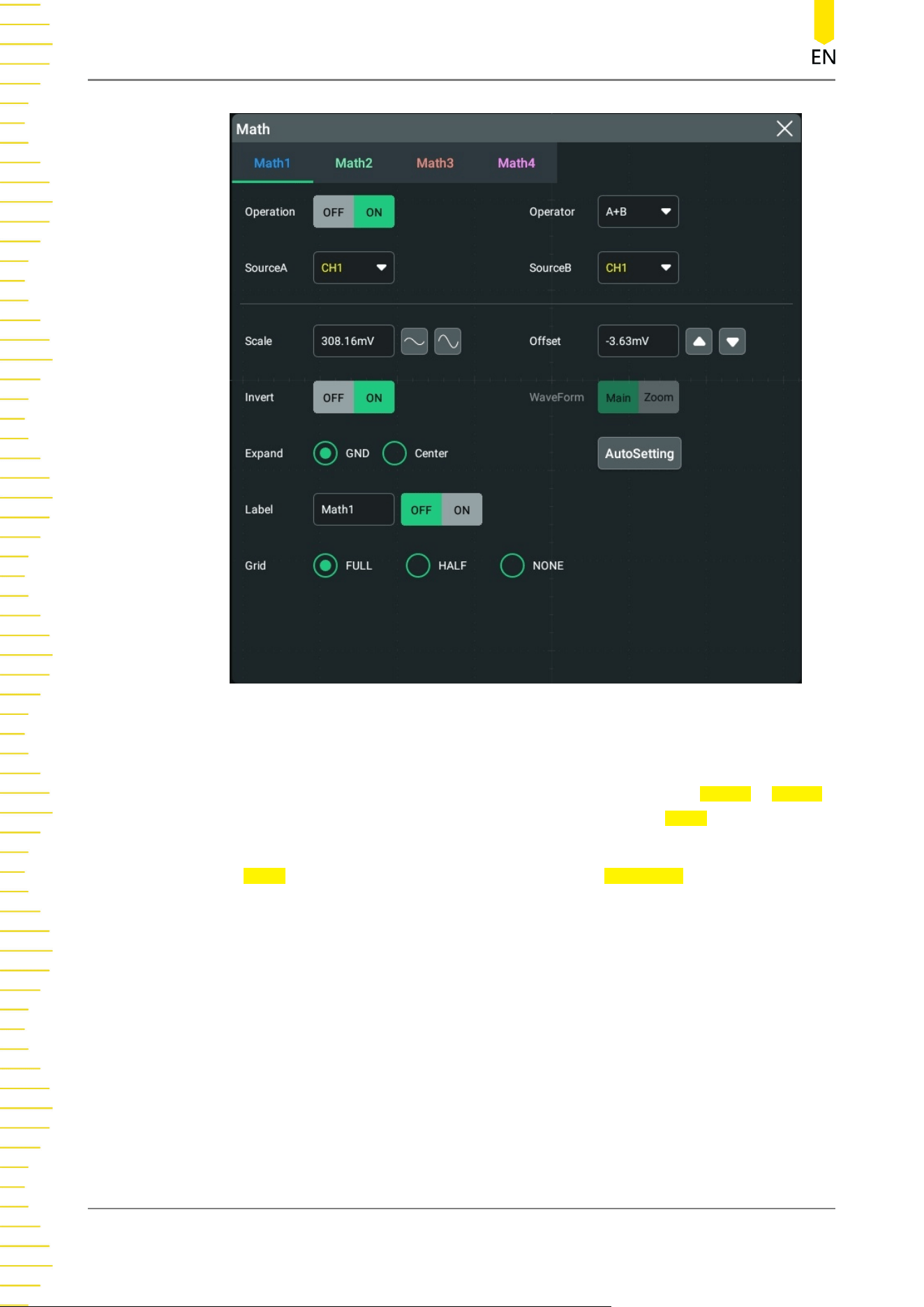
Figure 9.1 Math Operation Menu
This oscilloscope provides four math operations: Math1, Math2, Math3, and Math4.
Users can select the math operation type by clicking or tapping the Math1 ~ Math4
label or by sliding the menu left and right to select the desired Math menu item. This
manual section takes Math1 as an example to introduce math operation.
In the Math menu, click or tap the ON/OFF tab for the Operation menu to show or
hide the waveform display window of the operation results. By default, it is OFF. When
set to ON, the figure as shown in
Figure 9.2
is displayed on the screen.
Math Operation
DS70000 User Guide
140
Copyright ©RIGOL TECHNOLOGIES CO., LTD.
All rights reserved.
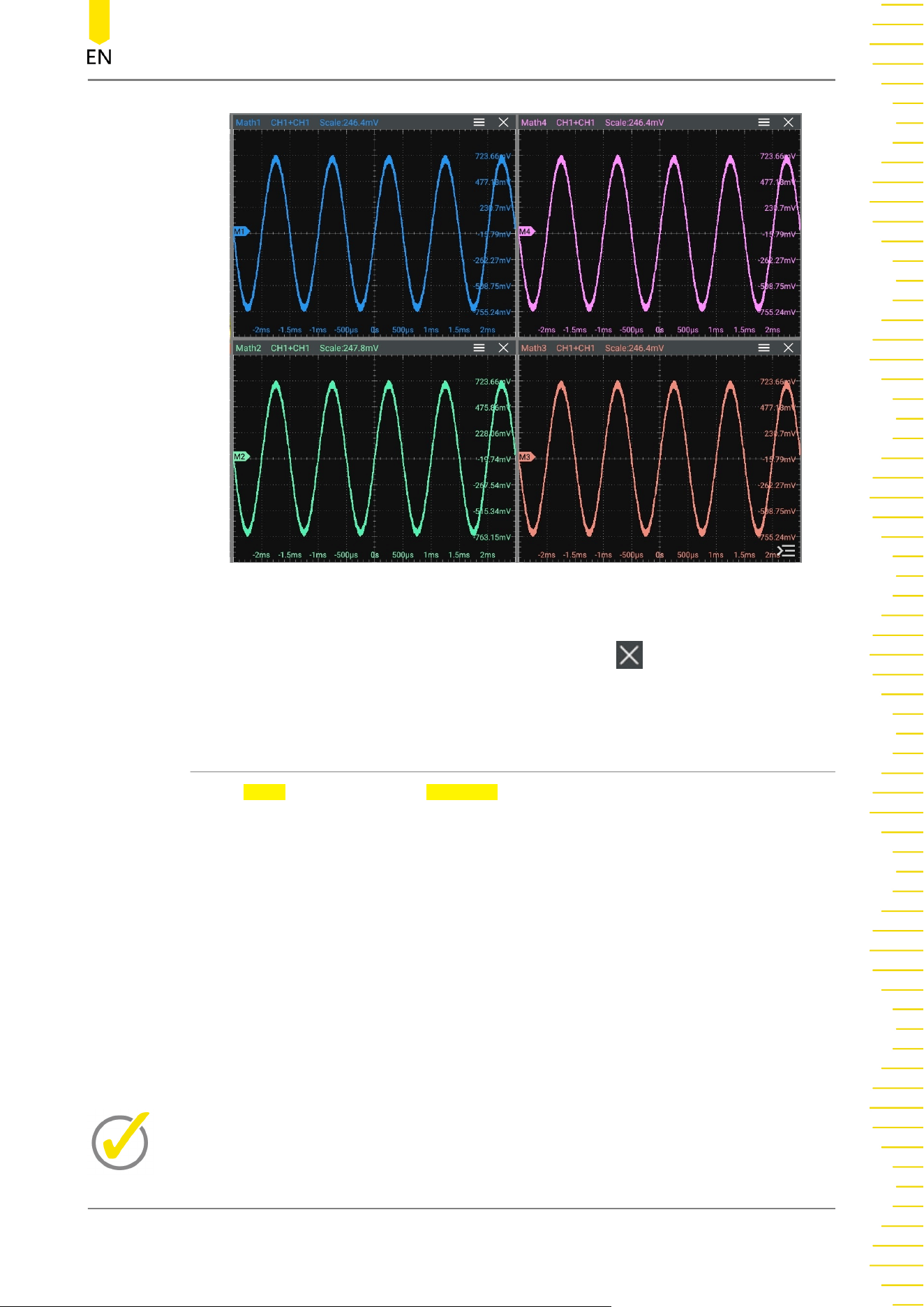
Figure 9.2 Waveform Display Window of the Operation Results
Users can drag the window or click/tap the close button at the upper-right corner
of the window to close it, if needed.
9.1 Arithmetic Operation
In the Math menu, click or tap Operator to select the desired math operation. The
arithmetic operations supported by this oscilloscope include A+B, A-B, A×B, and A÷B.
• A+B: adds the waveform voltage values of signal source A and B point by point
and displays the results.
• A-B: subtracts the waveform voltage values of signal source B from that of
source A point by point and displays the results.
• A×B: multiplies the waveform voltage values of signal source A and B point by
point and displays the results.
• A÷B: divides the waveform voltage values of signal source A by that of source B
point by point and displays the results. It can be used to analyze the Multiple
relation of the two channels waveforms.
Tip
When the voltage of signal source B is 0 V, the division result is treated as 0.
Math Operation
Copyright ©RIGOL TECHNOLOGIES CO., LTD.
All rights reserved.
DS70000 User Guide
141
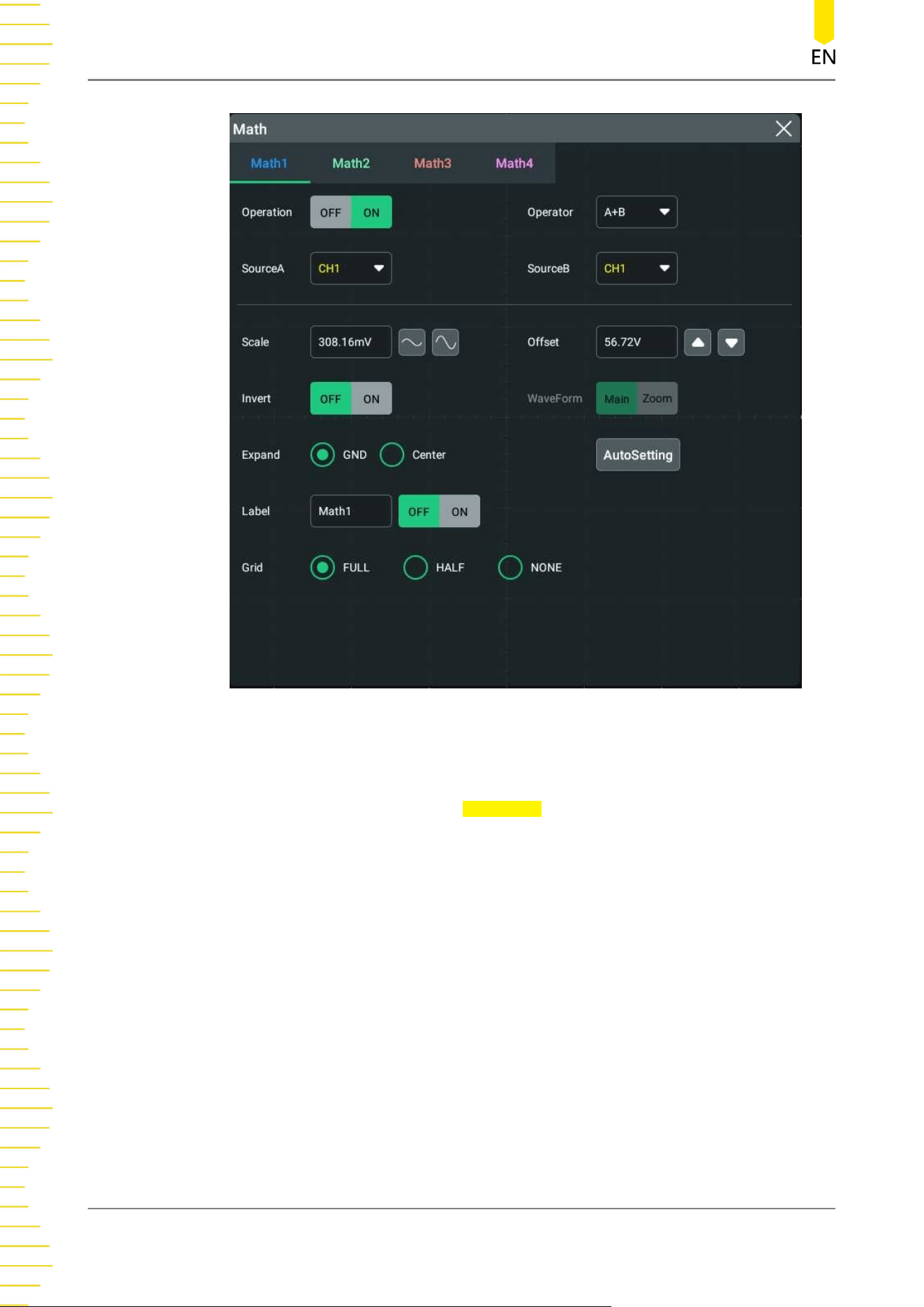
Figure 9.3 Arithmetic Operation Menu
Operation Result Display Window
Click or tap the ON/OFF tab for the Operation menu to enable or disable the display
of the arithmetic operation result window. The source and the vertical scale
parameters are displayed at the top of the window, as shown in the figure below.
Math Operation
DS70000 User Guide
142
Copyright ©RIGOL TECHNOLOGIES CO., LTD.
All rights reserved.
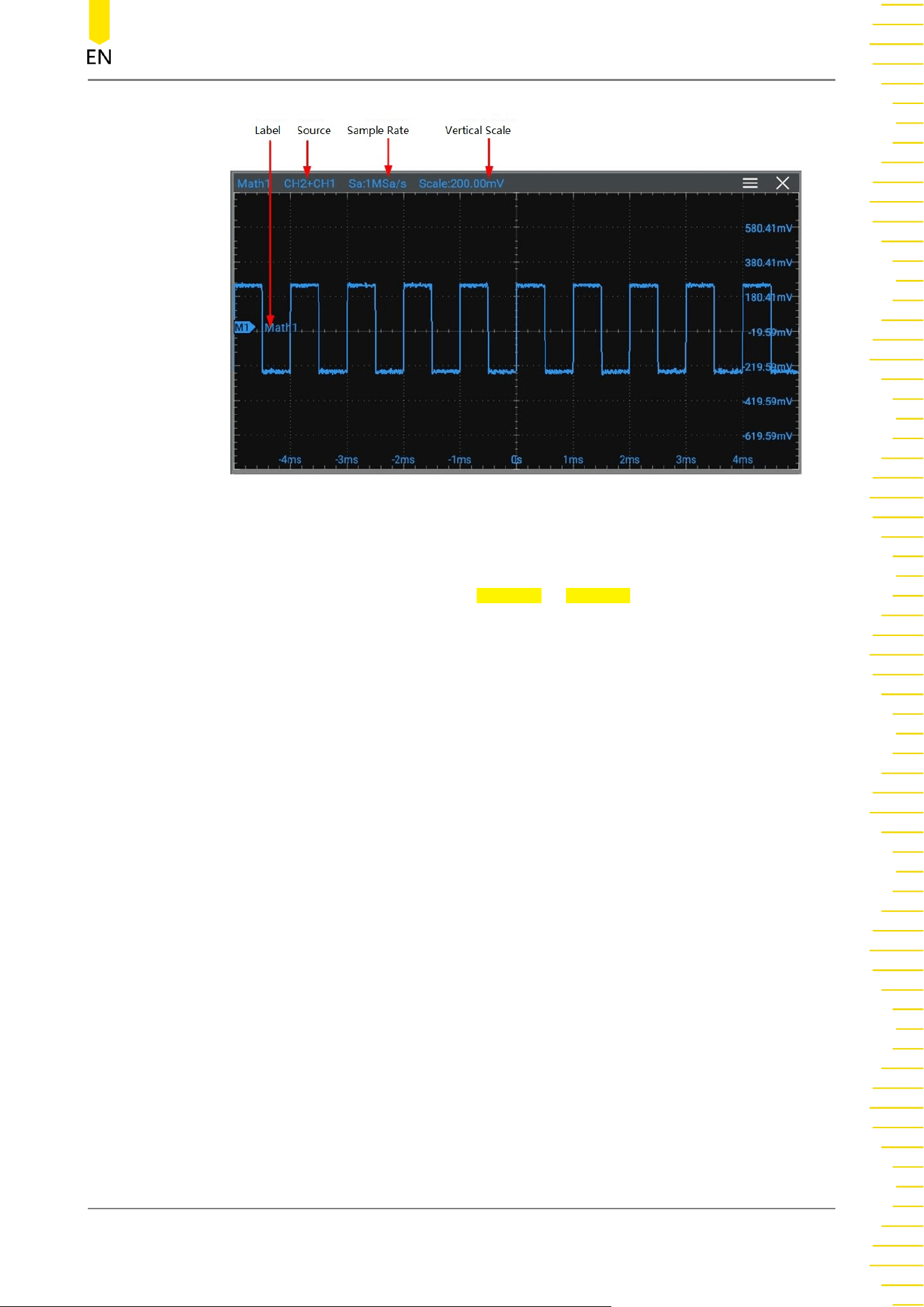
Figure 9.4 Operation Result Display Window
Source
Click or tap the drop-down button of SourceA or SourceB to select CH1, CH2, CH3,
or CH4. When a source channel is selected, the selected channel automatically
switches to the ON state.
Scale
Scale is used to set the vertical scale of the operation result. For setting methods,
refer to descriptions in
To Adjust the Vertical Scale
.
Offset
Offset is used to set the vertical offset of the operation result. For setting methods,
refer to descriptions in
To Adjust the Vertical Offset
.
Invert
Invert is used to enable or disable the inverted display function of the waveform. For
setting methods, refer to descriptions in
Waveform Invert
.
WaveForm
This oscilloscope supports Main and Zoom. By default, it is Main.
• MAIN: indicates that the measurement range is within the main time base
region.
• ZOOM: indicates that the measurement range is within the zoomed time base
region.
Math Operation
Copyright ©RIGOL TECHNOLOGIES CO., LTD.
All rights reserved.
DS70000 User Guide
143
When you select "Zoom", you need to enable
Delayed Sweep
in
To Set the Horizontal
System
.
Expand
The oscilloscope supports two vertical expansion modes: GND and Center. By default,
it is "GND".
• GND: when the vertical scale is changed, the math operation waveform will be
expanded or compressed around the signal ground level position.
• Center: when the vertical scale is changed, the math operation waveform will be
expanded or compressed around the screen center.
Auto Set
Click or tap AutoSetting to adjust the vertical scale and the offset of the operation
results to the optimal value according to the current configuration, so as to better to
observe.
Label
Label is used to set the label for the math operation results. For setting methods,
refer to descriptions in
Channel Label
.
Grid
For setting methods, refer to the descriptions in
To Set the Screen Grid
.
9.2 Function Operation
In the Math menu, click or tap the drop-down button of Operator to select the
desired function operation. The available function operation types of this oscilloscope
include Intg, Diff, Sqrt, Lg (Base 10 Exponential), Ln, Exp, Abs, and AX+B.
• Intg: calculates the integral of the selected source. For example, you can use
integral to measure the area under a waveform or the pulse energy.
• Diff: calculates the discrete time derivative of the selected source. For example,
you can use differentiate to measure the instantaneous slope of a waveform.
• Sqrt: calculates the square roots of the selected source point by point and
displays the results.
• Lg (Base 10 Exponential): calculates the base 10 exponential of the selected
source point by point and displays the results.
• Ln: calculates the natural logarithm (Ln) of the selected source point by point
and displays the results.
Math Operation
DS70000 User Guide
144
Copyright ©RIGOL TECHNOLOGIES CO., LTD.
All rights reserved.
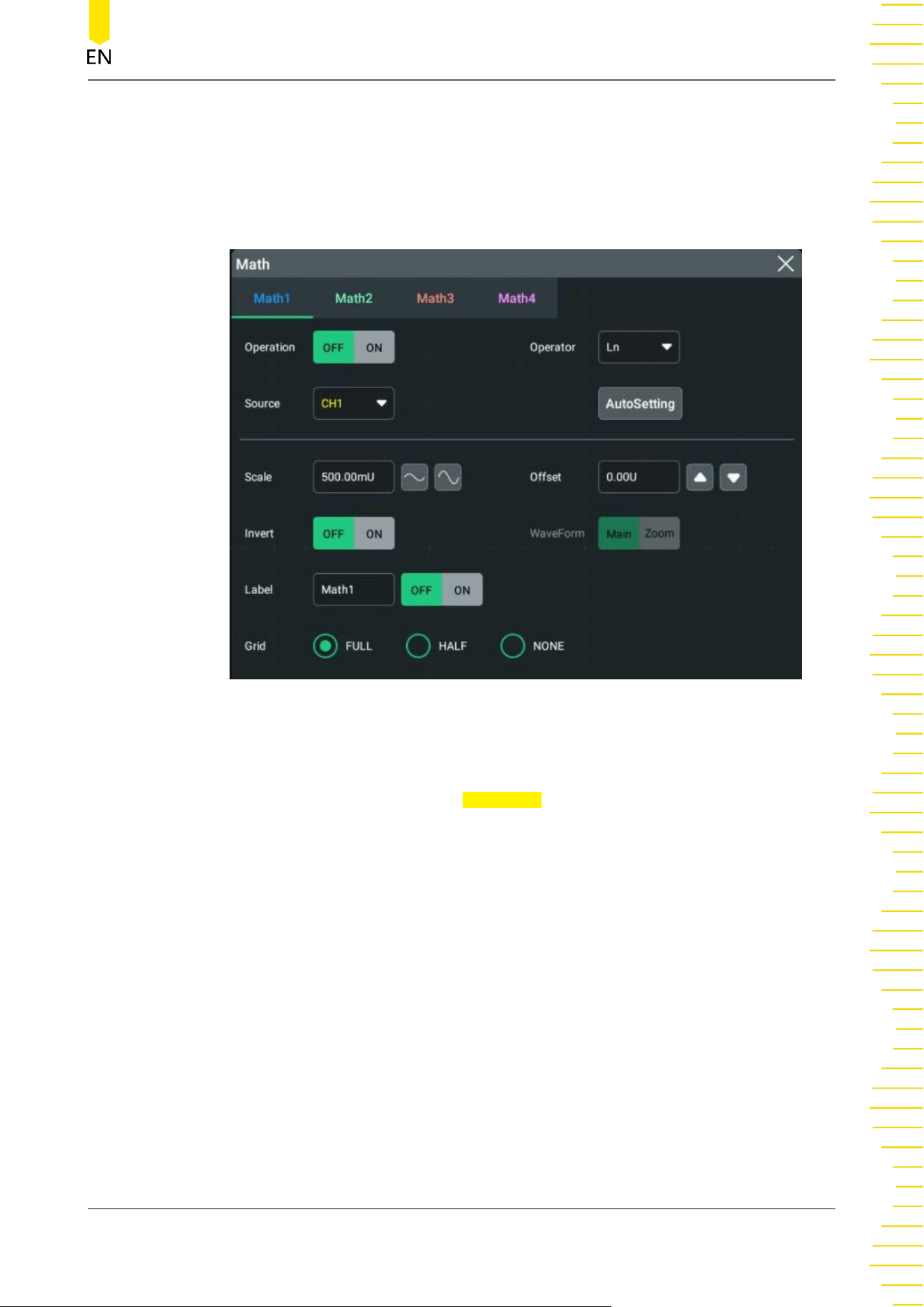
• Exp: calculates the exponential of the selected source point by point and
displays the results.
• Abs: calculates the absolute value of the selected source and displays the results.
• AX+B: applies a linear function to the selected source, and displays the results.
Figure 9.5 Function Operation Menu
Operation Result Display Window
Click or tap the ON/OFF tab for the Operation menu to enable or disable the display
of the operation result window. The source and the vertical scale parameters are
displayed at the top of the window, as shown in the figure below.
Math Operation
Copyright ©RIGOL TECHNOLOGIES CO., LTD.
All rights reserved.
DS70000 User Guide
145
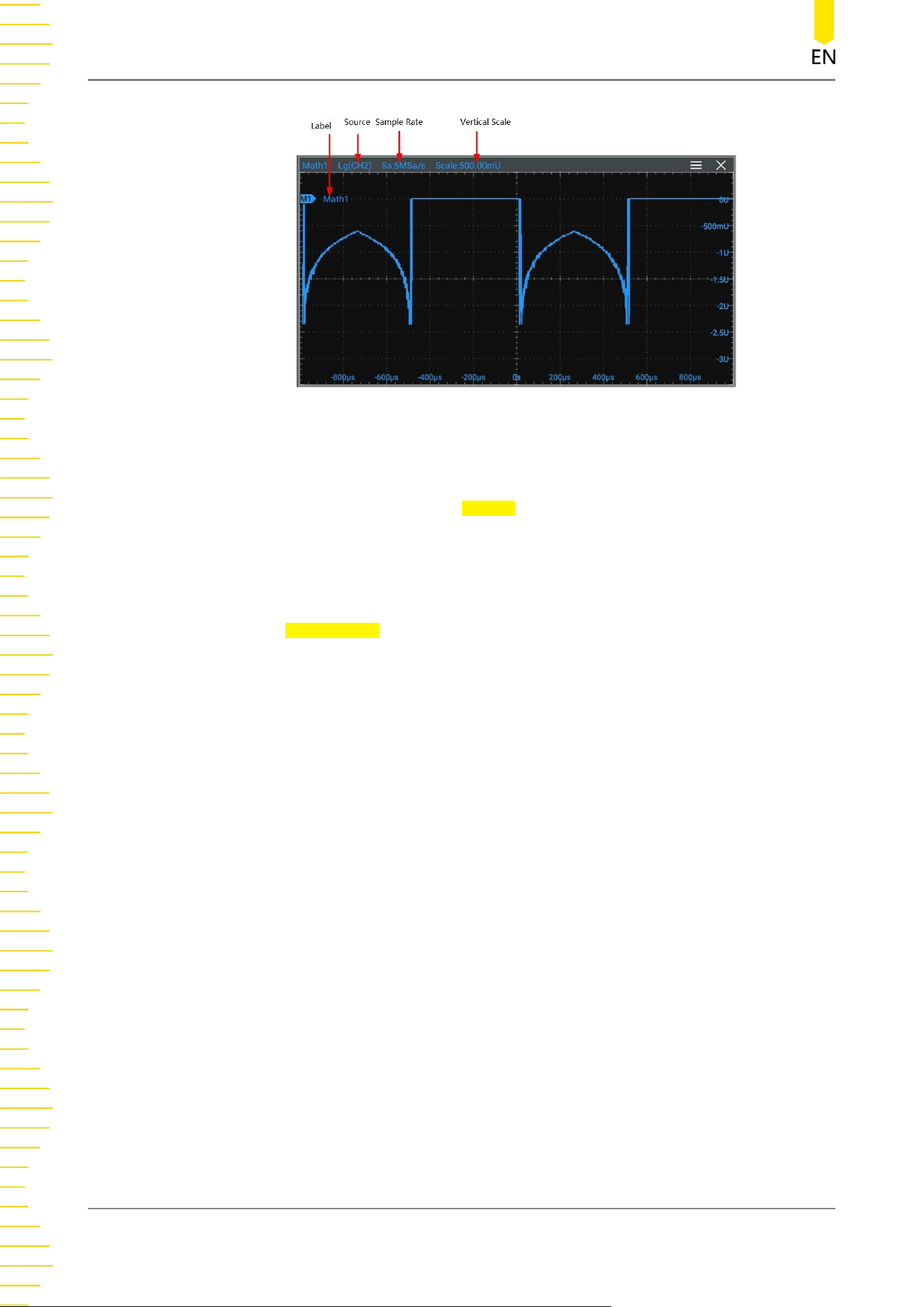
Figure 9.6 Operation Result Display Window
Source
Click the drop-down button for the Source menu to select the source as CH1, CH2,
CH3, and CH4. When a source channel is selected, the selected channel automatically
switches to the ON state.
Auto Set
Click or tap AutoSetting to adjust the vertical scale and the offset of the operation
results to the optimal value according to the current configuration, so as to better to
observe.
Scale
Scale is used to set the vertical scale of the operation result. For setting methods,
refer to descriptions in
To Adjust the Vertical Scale
.
Offset
Offset is used to set the vertical offset of the operation result. For setting methods,
refer to descriptions in
To Adjust the Vertical Offset
.
Invert
Invert is used to enable or disable the inverted display function of the waveform. For
setting methods, refer to descriptions in
Waveform Invert
.
WaveForm
This oscilloscope supports Main and Zoom. By default, it is Main.
• MAIN: indicates that the measurement range is within the main time base
region.
Math Operation
DS70000 User Guide
146
Copyright ©RIGOL TECHNOLOGIES CO., LTD.
All rights reserved.
• ZOOM: indicates that the measurement range is within the zoomed time base
region.
When you select "Zoom", you need to enable
Delayed Sweep
in
To Set the Horizontal
System
.
Label
Label is used to set the label for the math operation results. For setting methods,
refer to descriptions in
Channel Label
.
Grid
For setting methods, refer to the descriptions in
To Set the Screen Grid
.
Parameter Setting
• When the operator is "Intg", click or tap the input field for the Offset menu item
and use the pop-up numeric keypad to set the DC offset calibration factor of the
input signal.
• When the operator is "Diff", click or tap the input field for the Smooth menu
item and use the pop-up numeric keypad to set the number of smooth times for
the differential operation.
9.3 FFT Operation
FFT (Fast Fourier Transform) is used to transform time-domain signals to frequency-
domain components (frequency spectrum). This oscilloscope provides FFT operation
function which enables you to observe the time-domain waveform and spectrum of
the signal at the same time. FFT operation can facilitate the following works:
• Measure harmonic components and distortion in the system;
• Display the characteristics of the noise in DC power;
• Analyze vibration.
In the Math menu, click or tap the drop-down button of Operator to select FFT to go
to the menu shown in
Figure 9.7
. Then configure the parameters of FFT.
Math Operation
Copyright ©RIGOL TECHNOLOGIES CO., LTD.
All rights reserved.
DS70000 User Guide
147
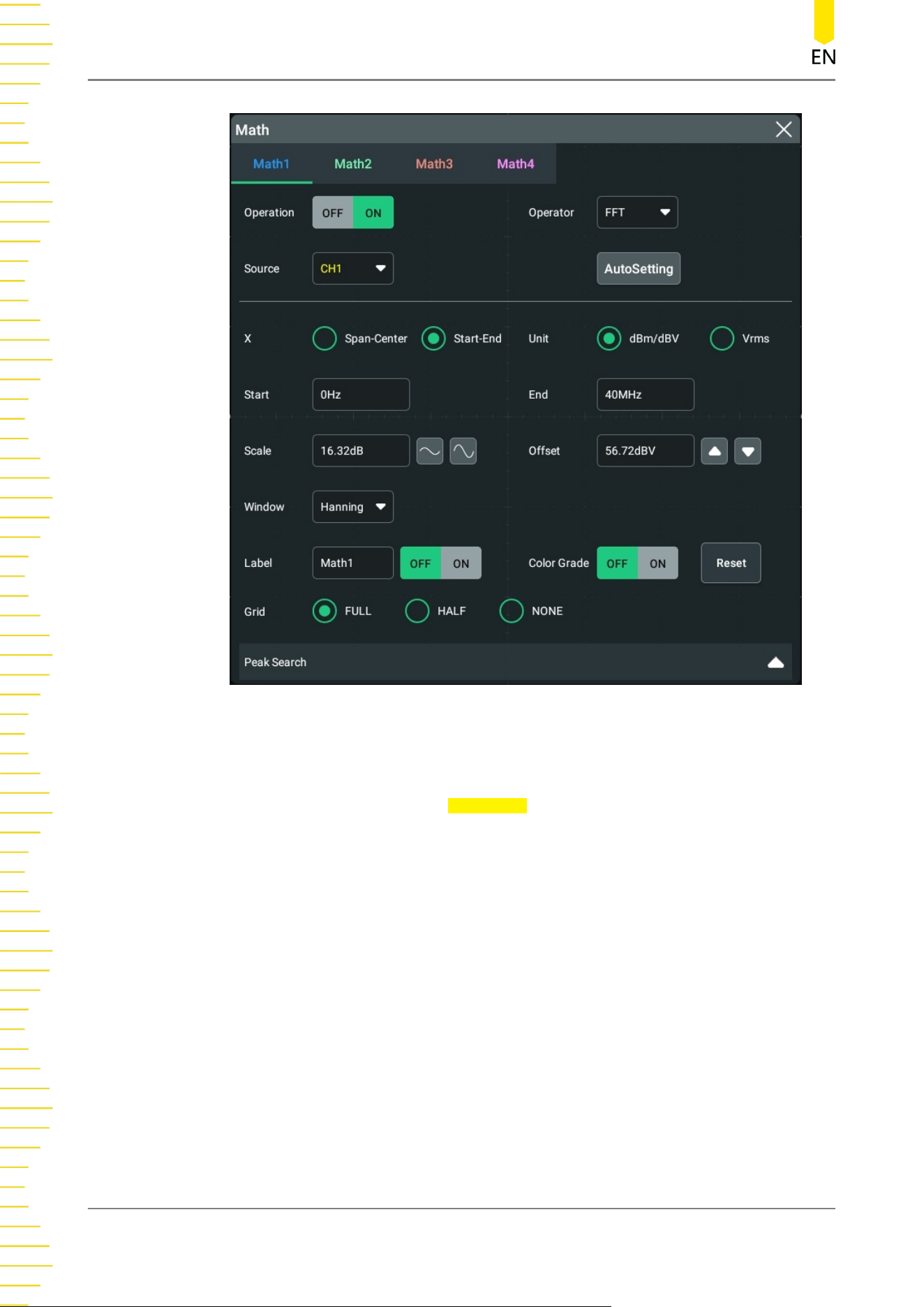
Figure 9.7 FFT Operation Menu
Operation
Click or tap the on/off tab for the Operation menu to enable or disable the FFT
operation result window. The parameters such as center frequency, frequency range,
and resolution are displayed at the top of the window, as shown in the figure below.
Of which, FFT resolution is the quotient of the sample rate and the number of FFT
points. If the number of FFT points is a fixed value (65535 at most), then the lower the
sample rate, the higher the resolution.
Math Operation
DS70000 User Guide
148
Copyright ©RIGOL TECHNOLOGIES CO., LTD.
All rights reserved.
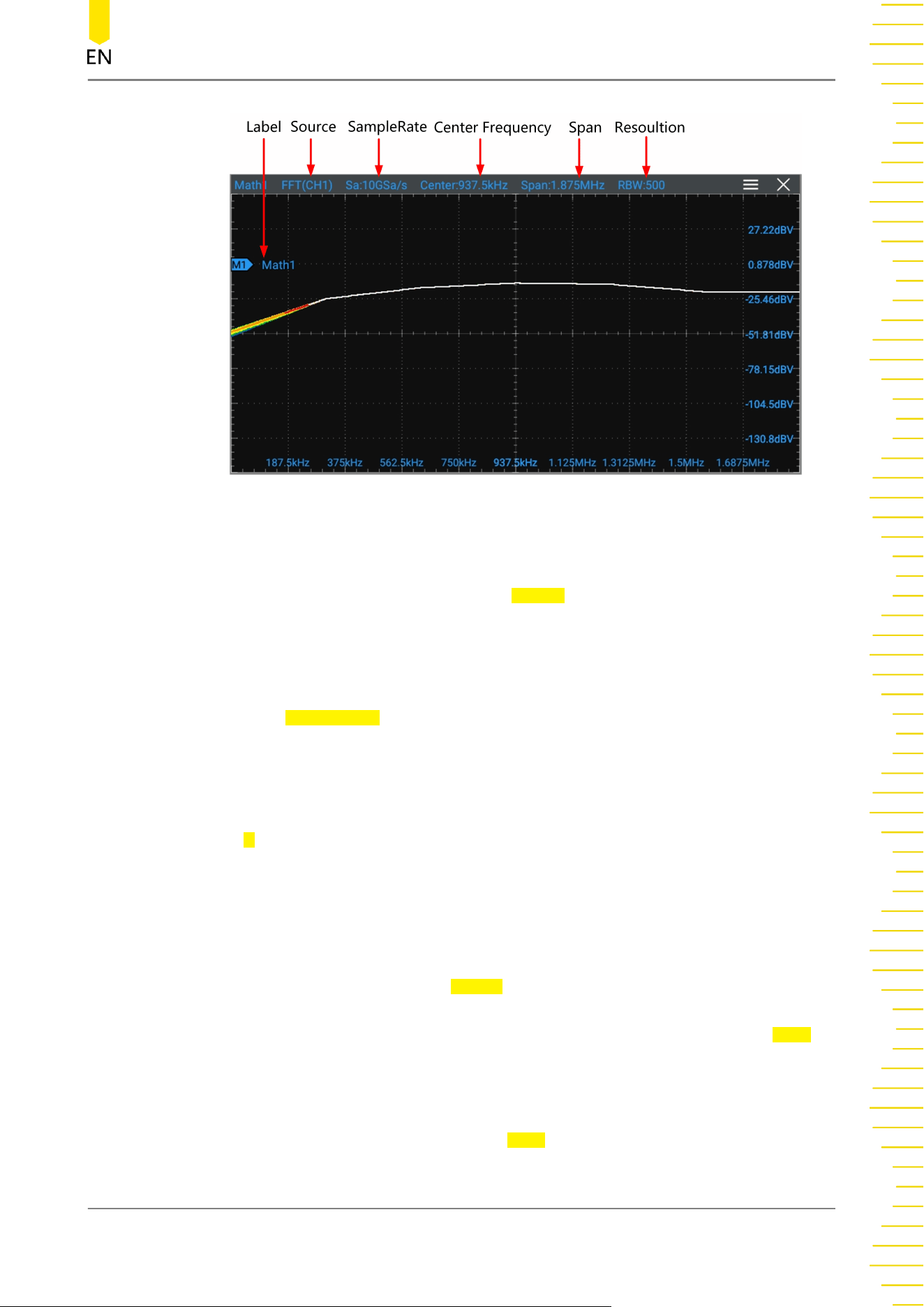
Figure 9.8 FFT Operation Window
Source
Click or tap the drop-down button for the Source to select CH1, CH2, CH3, or CH4 as
the source. When a source channel is selected, the selected channel automatically
switches to the ON state.
Auto Set
Click or tap AutoSetting to adjust the vertical scale and the offset of the operation
results to the optimal value according to the current configuration, so as to better to
observe.
Frequency Range
In the X menu, select "Span-Center" (frequency range to center frequency) or "Start-
End" (start frequency to stop frequency) as a frequency range mode.
• Span-Center (frequency range to center frequency): the frequency range
refers to the screen width, and you can divide the frequency range by 10 to
obtain the frequency per division.
Click or tap the input field of Center to set the frequency of the frequency-
domain waveform relative to the horizontal center of the screen. Its range is
from 5 Hz to 5 GHz. By default, it is 5 MHz. Click or tap the input field of Span to
set the frequency range of the frequency-domain waveform. Its range is from 10
Hz to 5 GHz. By default, it is 10 MHz.
• Start-End: Start frequency refers to the frequency shown at the left side of the
screen. Click or tap the input field of
Start to set the start frequency of the
frequency-domain waveform. Its range is from 0 Hz to (stop frequency - 10 Hz).
By default it is 0 Hz. Stop frequency refers to the frequency shown at the right
Math Operation
Copyright ©RIGOL TECHNOLOGIES CO., LTD.
All rights reserved.
DS70000 User Guide
149
side of the screen. Click or tap the input field of End to set the stop frequency of
the frequency-domain waveform. Its range is from (start frequency + 10 Hz) to 5
GHz. By default, it is 10 MHz.
Vertical Scale/Offset
Selects dBm/dBV or Vrms as the unit for Scale and Offset.
For setting methods of Scale, refer to the descriptions in
To Adjust the Vertical Scale
.
For setting methods of Offset, refer to the descriptions in
To Adjust the Vertical
Offset
.
Window Function
Spectral leakage can be considerably decreased when a window function is used. The
oscilloscope provides 6 FFT window functions which have different characteristics and
are applicable to measure different waveforms. You need to select the window
function according to the characteristics of the waveform to be measured. Click or tap
the drop-down button of Window to select the desired window function.
Table 9.1 Window Function
Window
Function
Characteristics
Waveforms Applicable to the
Window Function
Rectangular
Best frequency resolution
Poorest amplitude resolution
Similar to the situation when no
window is applied.
Transient or short pulse, the
signal levels before and after the
multiplication are basically the
same
Sine waveforms with the same
amplitudes and rather similar
frequencies
Wide band random noise with
relatively slow change of
waveform spectrum
Blackman-
Harris
Best amplitude resolution
Poorest frequency resolution
Single frequency signal,
searching for higher order
harmonics
Hanning
Better frequency resolution and
poorer amplitude resolution
compared with Rectangular
Sine, periodic, and narrow band
random noise
Hamming
A little bit better frequency
resolution than Hanning
Transient or short pulse, the
signal levels before and after the
multiplication are rather different
Math Operation
DS70000 User Guide
150
Copyright ©RIGOL TECHNOLOGIES CO., LTD.
All rights reserved.
Window
Function
Characteristics
Waveforms Applicable to the
Window Function
Flattop Measure the signals accurately
Measure the signal that has no
accurate reference and requires
an accurate measurement
Triangle Better frequency resolution
Measure the narrow band signal
and that has strong noise
interference
Color Grade
Click or tap the ON/OFF button for the Color Grade item to enable/disable the color
grade display of FFT operation results. When enabled, different colors are displayed
on the screen to indicate the times of data acquisition or acquisition probability. Click
or tap the Reset button for the Color Grade menu to clear the color grade display and
display the color grade again.
Peak Search
Click or tap the icon
at the right side of Peak Search to enter the peak search
menu, as shown in the figure below.
Math Operation
Copyright ©RIGOL TECHNOLOGIES CO., LTD.
All rights reserved.
DS70000 User Guide
151
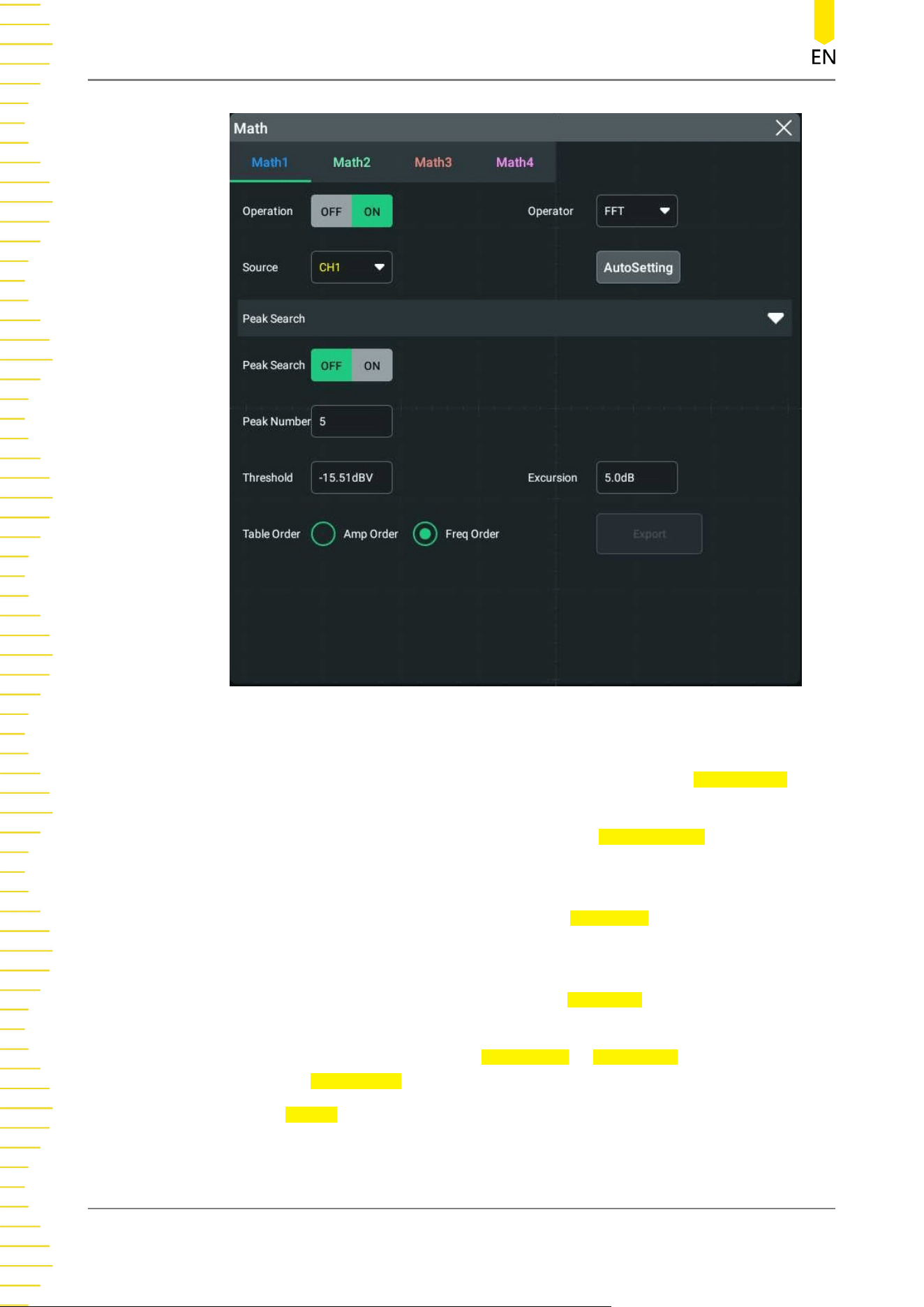
Figure 9.9 Peak Search
• Peak Search ON/OFF: click or tap the ON/OFF button for the Peak Search menu
to enable or disable the display of the peak search window. By default, it is OFF.
• Peak Number: click or tap the input field for the Peak Number menu item and
use the pop-up numeric keypad to set the number of peaks. Its range is from 1
to 15. Its default value is 5.
• Threshold: click or tap the input field for the Threshold menu item to set the
threshold of the peak with the pop-up numeric keypad. The range of the
threshold is related to the current FFT scale and offset.
• Excursion: click or tap the input field for the Excursion menu item to set the
excursion of the peak. The min. value of Excursion is 0 and its unit is dB.
• Table Order: click o tap to select Amp Order or Freq Order as the sorting mode
under the Table Order menu. By default, it is "Amp Order".
Click or tap Export, then the save setting interface is displayed. You can export the
peak search results to the internal memory or the external USB storage device in CSV
format. For detailed saving operation, refer to
To Save a File
and
Disk Management
.
Math Operation
DS70000 User Guide
152
Copyright ©RIGOL TECHNOLOGIES CO., LTD.
All rights reserved.
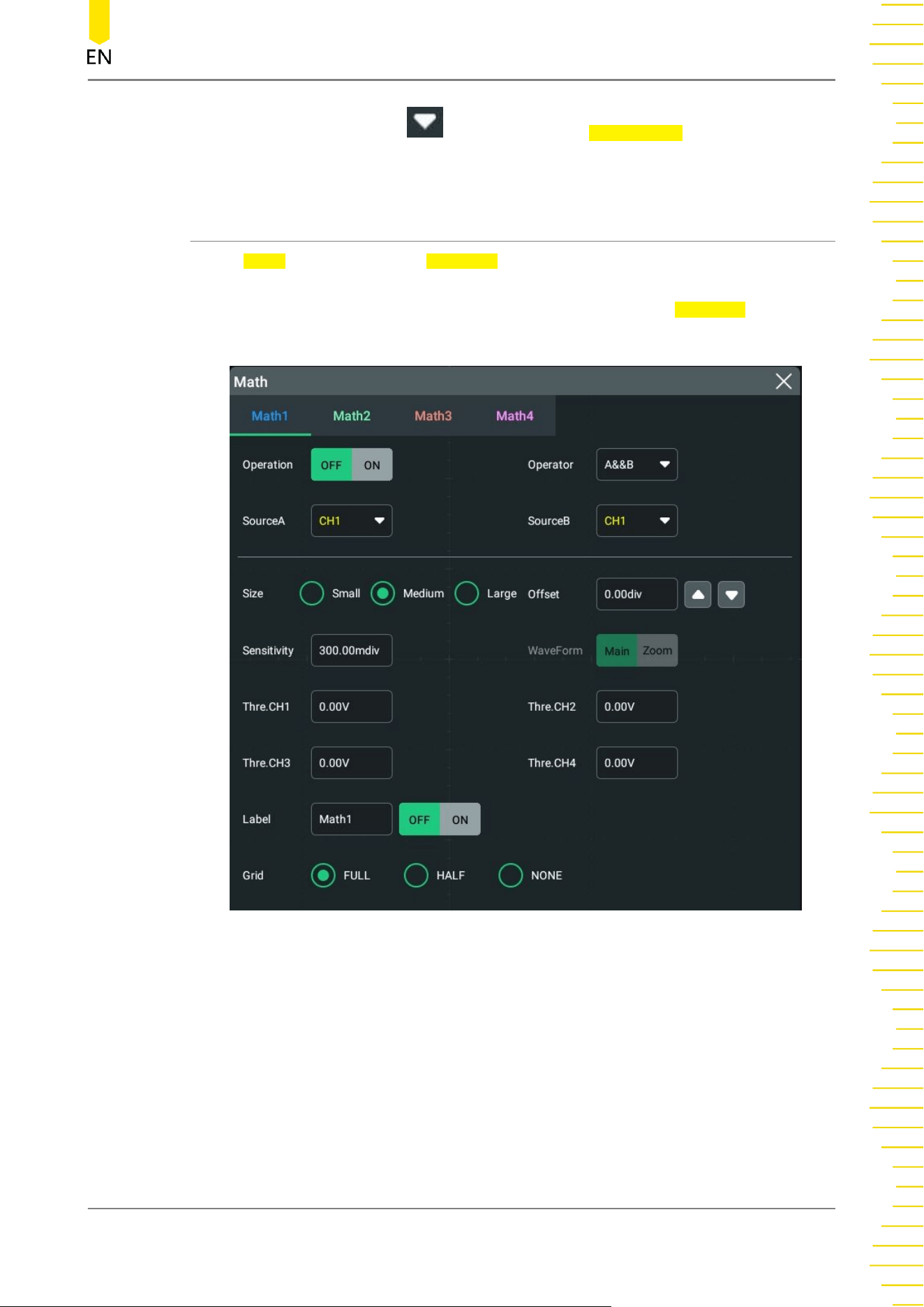
Clicking or tapping the icon at the right side of Peak Search can close the the
peak search menu.
9.4 Logic Operation
In the Math menu, click or tap Operator to select the desired math operation. The
logic operation supported by this oscilloscope include A&&B, A||B, A^B, and !A. After
selecting the desired logic operation from the drop-down list of Operator, you can
configure its settings for the selected logic operation type.
Figure 9.10 Logic Operation Menu
• A&&B: Performs logic "AND" operation on the waveform voltage values of the
specified sources point by point and displays the results. In operation, when the
voltage value of the source channel is greater than the threshold of the
corresponding channel, it is regarded as logic "1"; otherwise it is logic "0". The
results of logic AND operation of two binary bits are shown in
Table 9.2 Logic
Operation
.
• A||B: Performs logic "OR" operation on the waveform voltage values of the
specified sources point by point and displays the results. In operation, when the
Math Operation
Copyright ©RIGOL TECHNOLOGIES CO., LTD.
All rights reserved.
DS70000 User Guide
153
voltage value of the source channel is greater than the threshold of the
corresponding channel, it is regarded as logic "1"; otherwise it is logic "0". The
results of logic OR operation of two binary bits are shown in
Table 9.2 Logic
Operation
.
• A^B: Performs logic "XOR" operation on the waveform voltage values of the
specified sources point by point and displays the results. In operation, when the
voltage value of the source channel is greater than the threshold of the
corresponding channel, it is regarded as logic "1"; otherwise it is logic "0". The
results of logic XOR operation of two binary bits are shown in
Table 9.2 Logic
Operation
.
• !A: Performs logic "NOT" operation on the waveform voltage values of the
specified sources point by point and displays the results. In operation, when the
voltage value of the source channel is greater than the threshold of the
corresponding channel, it is regarded as logic "1"; otherwise it is logic "0". The
results of logic "NOT" operation of one binary bit are shown in
Table 9.2 Logic
Operation
.
Table 9.2 Logic Operation
A B A&&B A||B A^B !A
0 0 0 0 0 1
0 1 0 1 1 1
1 0 0 1 1 0
1 1 1 1 0 0
Operation Result Display Window
Click or tap the ON/OFF tab for the Operation menu to enable or disable the display
of the operation result window. The source and the waveform sizes parameters are
displayed at the top of the window, as shown in the figure below.
Math Operation
DS70000 User Guide
154
Copyright ©RIGOL TECHNOLOGIES CO., LTD.
All rights reserved.
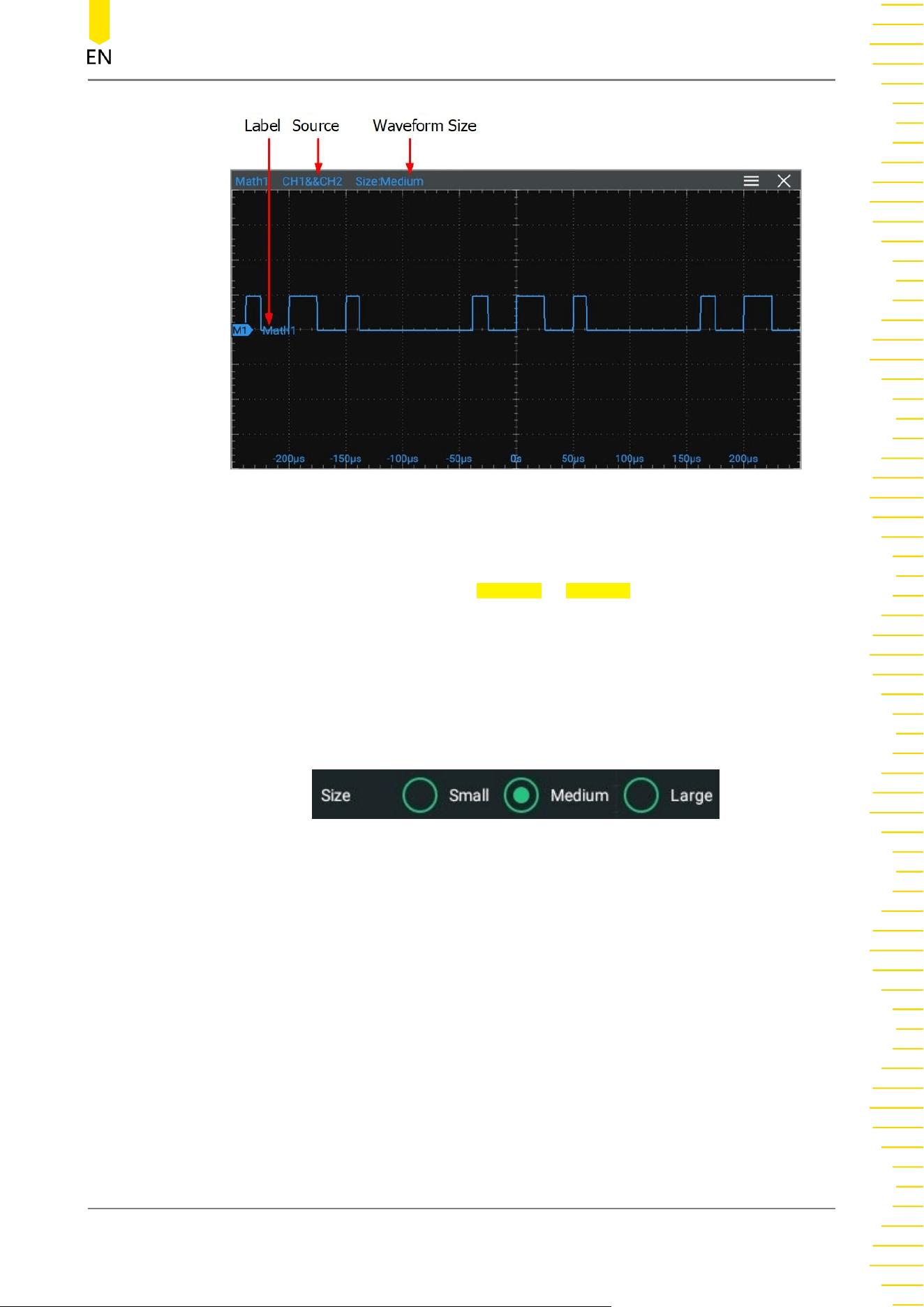
Figure 9.11 Operation Result Display Window
Source
Click or tap the drop-down button of SourceA or SourceB to select CH1, CH2, CH3,
or CH4. When a source channel is selected, the selected channel automatically
switches to the ON state.
Wave Size
Click or tap to select "Small", "Medium", or "Large" as the the waveform display
mode.
Offset
Offset is used to set the vertical offset of the operation result. For setting methods,
refer to descriptions in
To Adjust the Vertical Offset
.
Sensitivity
Sets the sensitivity of the digital signal converted from the analog signal on the
source. Click or tap the input field of this menu to set the sensitivity with the pop-up
numeric keypad. For detailed operations, refer to the descriptions in
Parameter
Setting Method
.
WaveForm
This oscilloscope supports Main and Zoom. By default, it is Main.
Math Operation
Copyright ©RIGOL TECHNOLOGIES CO., LTD.
All rights reserved.
DS70000 User Guide
155
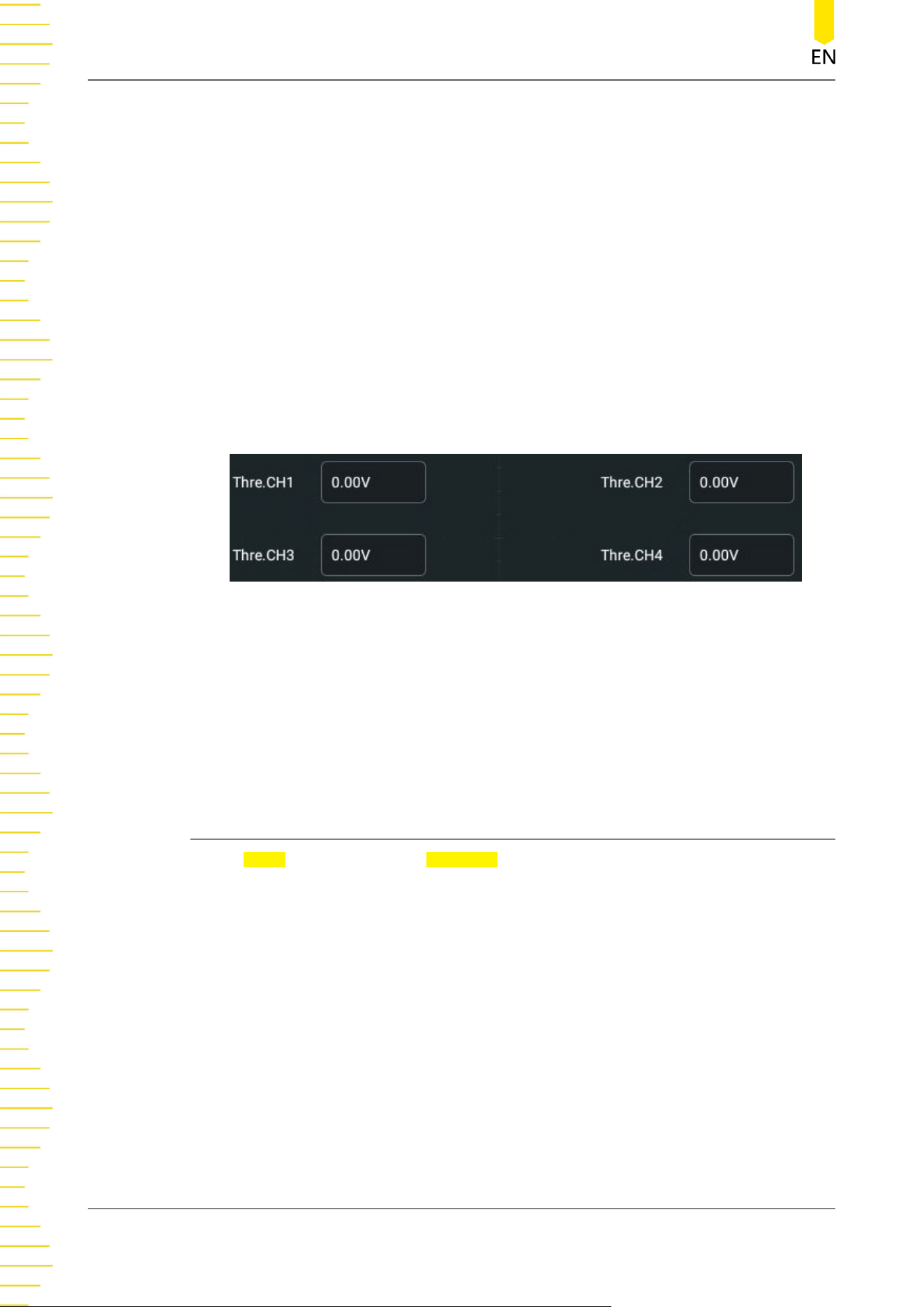
• MAIN: indicates that the measurement range is within the main time base
region.
• ZOOM: indicates that the measurement range is within the zoomed time base
region.
When you select "Zoom", you need to enable
Delayed Sweep
in
To Set the Horizontal
System
.
Threshold
Click or tap the input field for the threshold menu of the specified channel and use
the pop-up numeric keypad to set the threshold. For detailed operations, refer to the
descriptions in
Parameter Setting Method
.
Label
Label is used to set the label for the math operation results. For setting methods,
refer to descriptions in
Channel Label
.
Grid
For setting methods, refer to the descriptions in
To Set the Screen Grid
.
9.5 Digital Filter
In the Math menu, click or tap Operator to select the desired math operation. The
digital filter supported by this oscilloscope includes: low-pass filter, high-pass filter,
band-pass filter, and band-stop filter.
• LowPass: only allows the signals whose frequencies are lower than the current
upper limit frequency to pass.
• HighPass: only allows the signals whose frequencies are higher than the current
lower limit frequency to pass.
• BandPass: only allows the signals whose frequencies are higher than the current
lower limit frequency and lower than the current upper limit frequency to pass.
• BandStop: only allows the signals whose frequencies are lower than the current
lower limit frequency or higher than the current upper limit frequency to pass.
Math Operation
DS70000 User Guide
156
Copyright ©RIGOL TECHNOLOGIES CO., LTD.
All rights reserved.
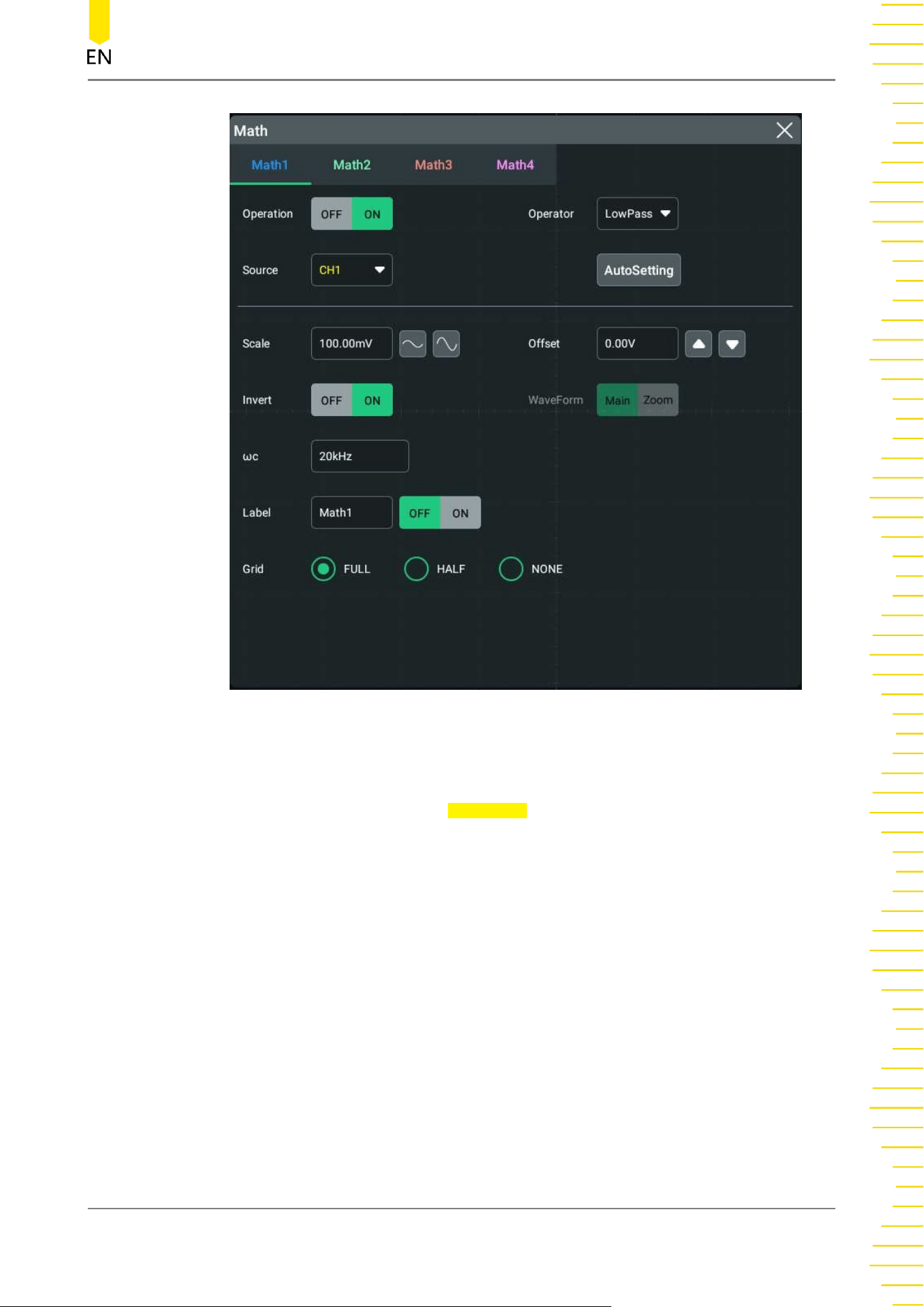
Figure 9.12 Digital Filter Menu
Operation Result Display Window
Click or tap the on/off tab for the Operation menu to enable or disable the display of
the operation result window. The source and the vertical scale parameters are
displayed at the top of the window, as shown in the figure below.
Math Operation
Copyright ©RIGOL TECHNOLOGIES CO., LTD.
All rights reserved.
DS70000 User Guide
157
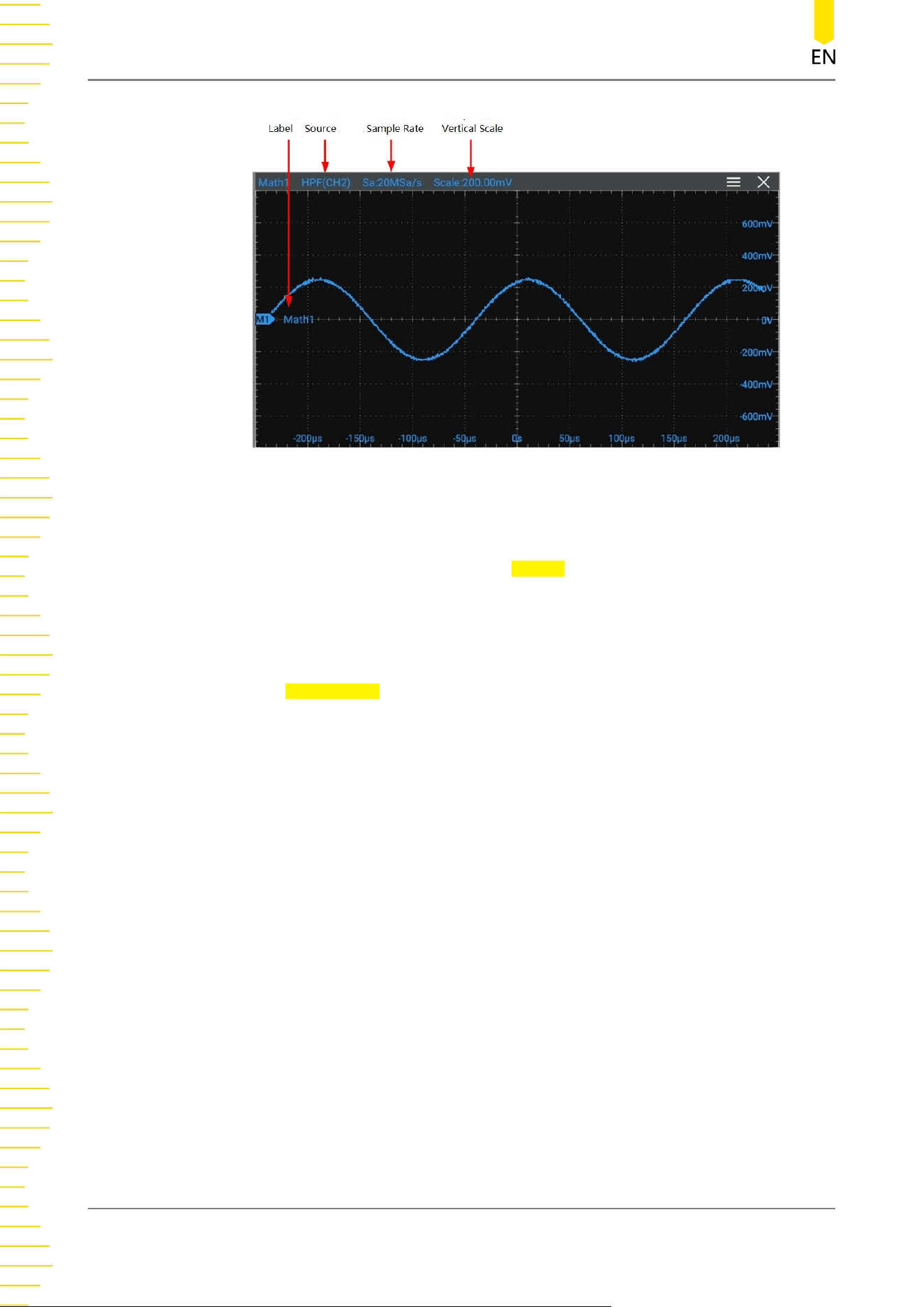
Figure 9.13 Operation Result Display Window
Source
Click or tap the drop-down button for the Source to select CH1, CH2, CH3, or CH4 as
the source. When a source channel is selected, the selected channel automatically
switches to the ON state.
Auto Set
Click or tap AutoSetting to adjust the vertical scale and the offset of the operation
results to the optimal value according to the current configuration, so as to better to
observe.
Scale
Scale is used to set the vertical scale of the operation result. For setting methods,
refer to descriptions in
To Adjust the Vertical Scale
.
Offset
Offset is used to set the vertical offset of the operation result. For setting methods,
refer to descriptions in
To Adjust the Vertical Offset
.
Invert
Invert is used to enable or disable the inverted display function of the waveform. For
setting methods, refer to descriptions in
Waveform Invert
.
WaveForm
This oscilloscope supports Main and Zoom. By default, it is Main.
Math Operation
DS70000 User Guide
158
Copyright ©RIGOL TECHNOLOGIES CO., LTD.
All rights reserved.
• MAIN: indicates that the measurement range is within the main time base
region.
• ZOOM: indicates that the measurement range is within the zoomed time base
region.
When you select "Zoom", you need to enable
Delayed Sweep
in
To Set the Horizontal
System
.
Frequency Limit
• LowPass: click or tap the input field for the ωc menu item and use the pop-up
numeric keypad to set the upper limit frequency.
• HighPass: click or tap the input field for the ωc menu item and use the pop-up
numeric keypad to set the lower limit frequency.
• BandPass: click or tap the input field for the ωc1 menu item and use the pop-up
numeric keypad to set the lower limit frequency. Click or tap the input field for
the ωc2 menu item and use the pop-up numeric keypad to set the upper limit
frequency.
• BandStop: click or tap the input field for the ωc1 menu item and use the pop-
up numeric keypad to set the lower limit frequency. Click or tap the input field
for the ωc2 menu item and use the pop-up numeric keypad to set the upper
limit frequency.
The settable ranges of the upper and lower limit frequencies are related to the Math
sample rate (displayed at the bottom of the screen when the Math function is
enabled). The sample rate of the analog channel or the changes of the memory depth
can affect the Math sample rate.
Label
Label is used to set the label for the math operation results. For setting methods,
refer to descriptions in
Channel Label
.
Grid
For setting methods, refer to the descriptions in
To Set the Screen Grid
.
Math Operation
Copyright ©RIGOL TECHNOLOGIES CO., LTD.
All rights reserved.
DS70000 User Guide
159
10 Measure
To enter the Measure menu, perform any of the following operations:
• Click or tap the function navigation icon
at the lower-left corner of the
screen, and then select Measure to enter the “Measure” menu.
• Tap the Measure icon on the small screen at the right side of the screen to enter
the “Measure” menu.
• Click or tap the Measure icon at the upper right part of the screen enter the
“Measure” menu.
• In
To Set the Vertical System
menu, click or tap the Measure button to enter the
measurement setting menu.
10.1 Measurement Parameter
This oscilloscope allows you to set the measurement source, enable or disable the all
measurement function, the statistical function, and etc. You can make quick
measurements for many waveform parameters. The measurement results will be
displayed at the right section of the screen under the Result list.
Tip
If there is no signal input for the current source or the measurement result is not within the
valid range (too large or too small), then the measurement results are invalid, and "*****" is
displayed on the screen. Please re-input the signal or set the signal.
Measure
DS70000 User Guide
160
Copyright ©RIGOL TECHNOLOGIES CO., LTD.
All rights reserved.
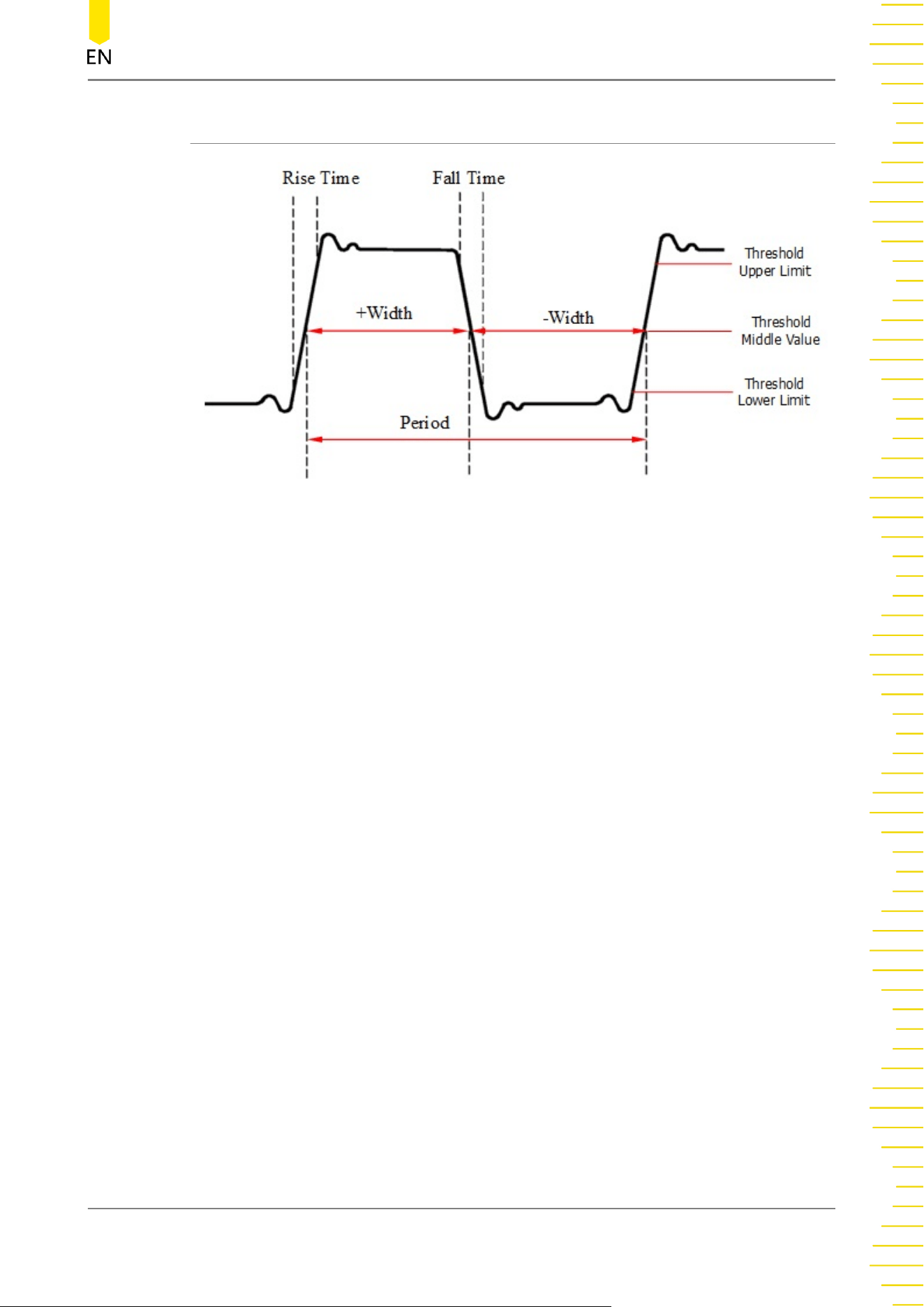
10.1.1 Time Parameters
Figure 10.1 Time Parameters
• Period: defined as the time between the middle threshold points of two
consecutive, like-polarity edges.
• Frequency: defined as the reciprocal of period.
• Rise Time: indicates the time for the signal amplitude to rise from the threshold
lower limit to the threshold upper limit.
• Fall Time: indicates the time for the signal amplitude to rise from the threshold
upper limit to the threshold lower limit.
• +Width: indicates the time between the threshold middle value of a rising edge
to the threshold middle value of the next falling edge.
• -Width: indicates the time between the threshold middle value of a falling edge
to the threshold middle value of the next rising edge.
• +Duty:indicates the ratio of the positive pulse width to the period.
• -Duty:indicates the ratio of the negative pulse width to the period.
• Tvmax: indicates the time that corresponds to the maximum value of the
waveform (Vmax).
• Tvmin: indicates the time that corresponds to the minimum value of the
waveform (Vmin).
The default values for threshold upper limit, threshold middle value, and threshold
low limit are 90%, 50%, and 10%, respectively.
Measure
Copyright ©RIGOL TECHNOLOGIES CO., LTD.
All rights reserved.
DS70000 User Guide
161
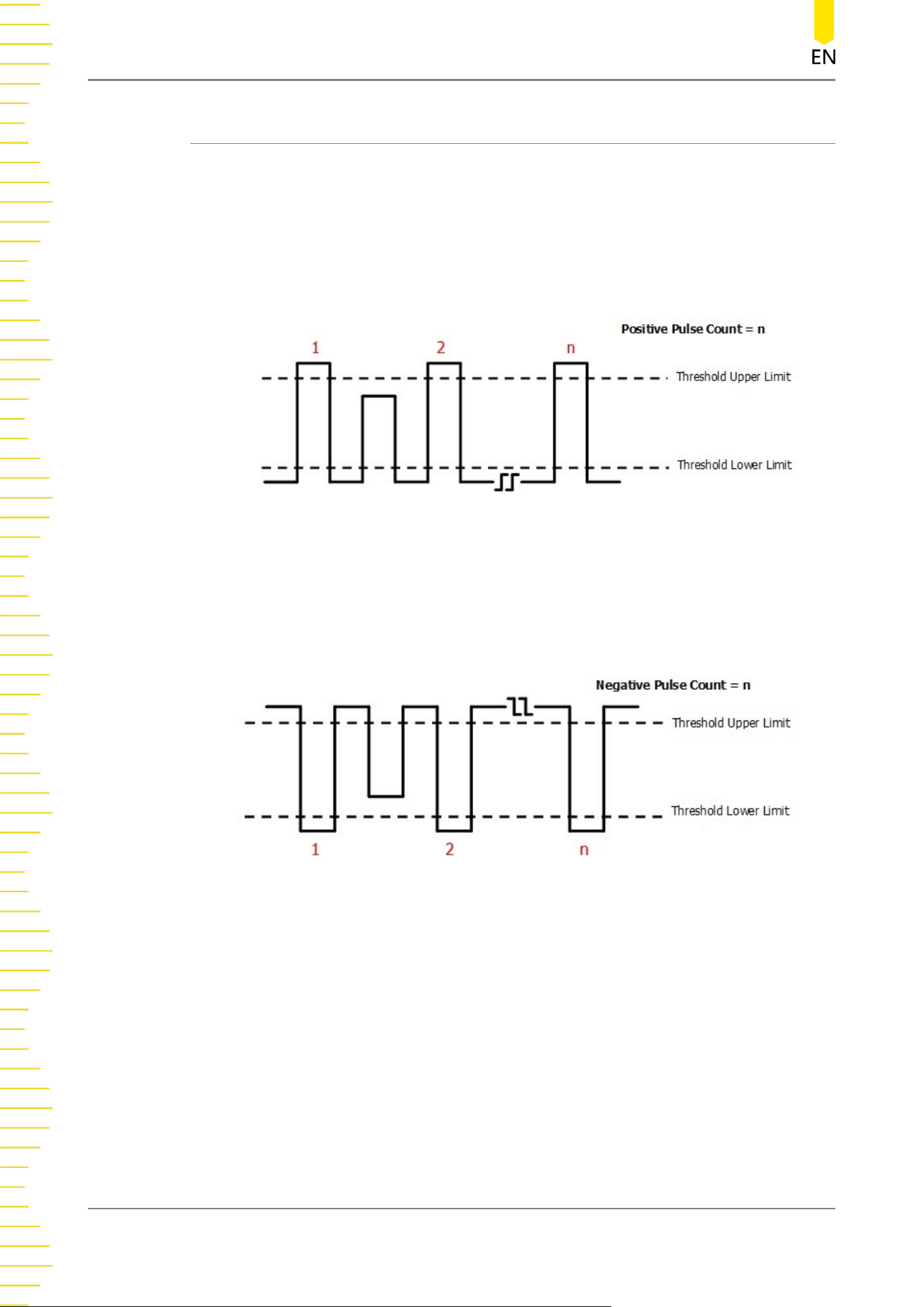
10.1.2 Count Values
The default values for threshold upper limit and threshold low limit are 90% and 10%,
respectively.
Positive Pulse Count
The number of positive pulses that rise from under the threshold lower limit to above
the threshold upper limit.
Negative Pulse Count
The number of negative pulses that fall from above the threshold upper limit to
below the threshold lower limit.
Rising Edge Count
The number of rising edges that rise from under the threshold lower limit to above
the threshold upper limit.
Measure
DS70000 User Guide
162
Copyright ©RIGOL TECHNOLOGIES CO., LTD.
All rights reserved.
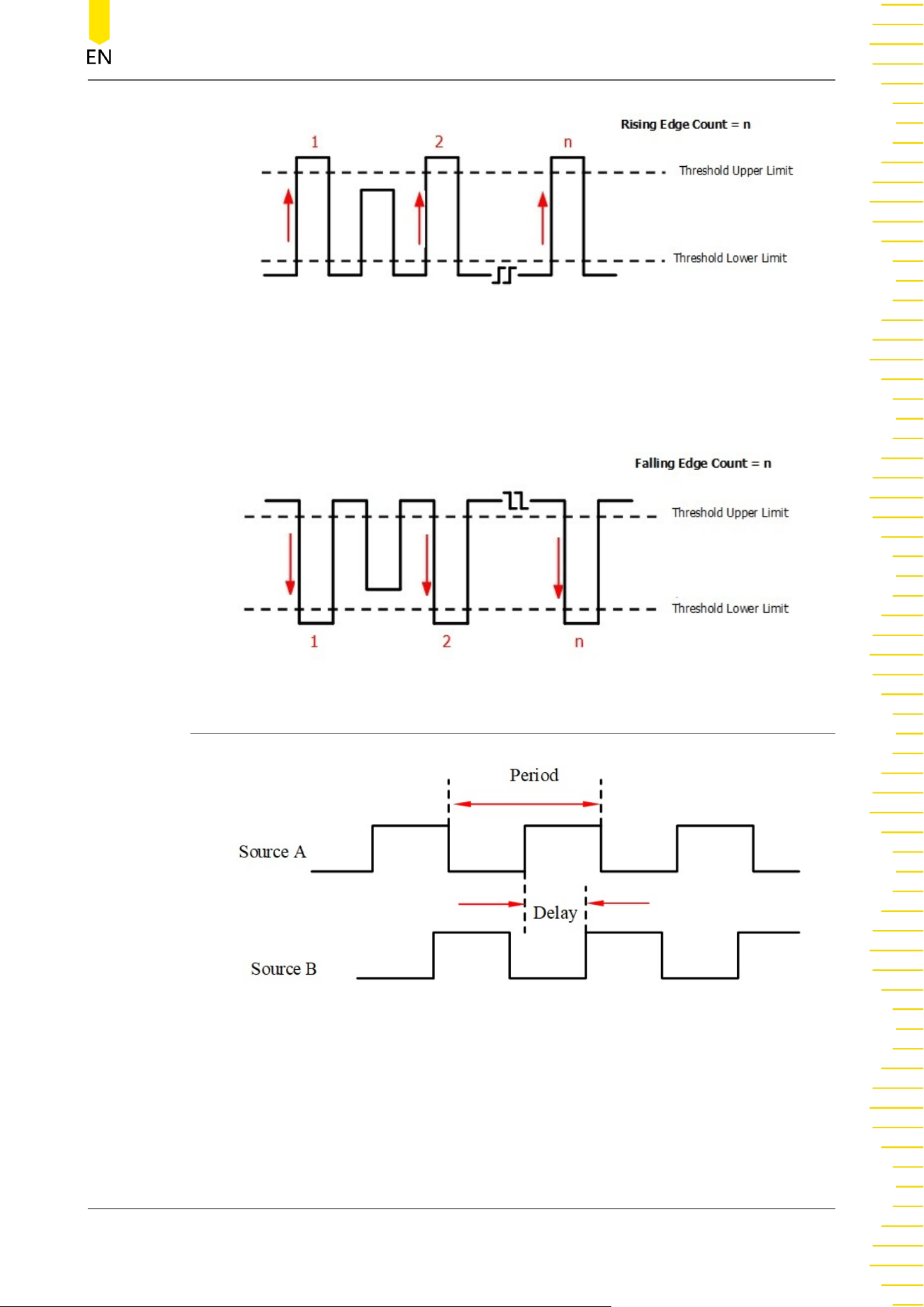
Falling Edge Count
The number of falling edges that fall from above the threshold upper limit to below
the threshold lower limit.
10.1.3 Delay and Phase Parameters
Figure 10.2 Delay and Phase Parameters
1 Delay(r-r): indicates the time difference between the threshold middle values of
the rising edge of Source A and that of Source B. Negative delay indicates that the
rising edge of Source A occurred after that of Source B.
Measure
Copyright ©RIGOL TECHNOLOGIES CO., LTD.
All rights reserved.
DS70000 User Guide
163
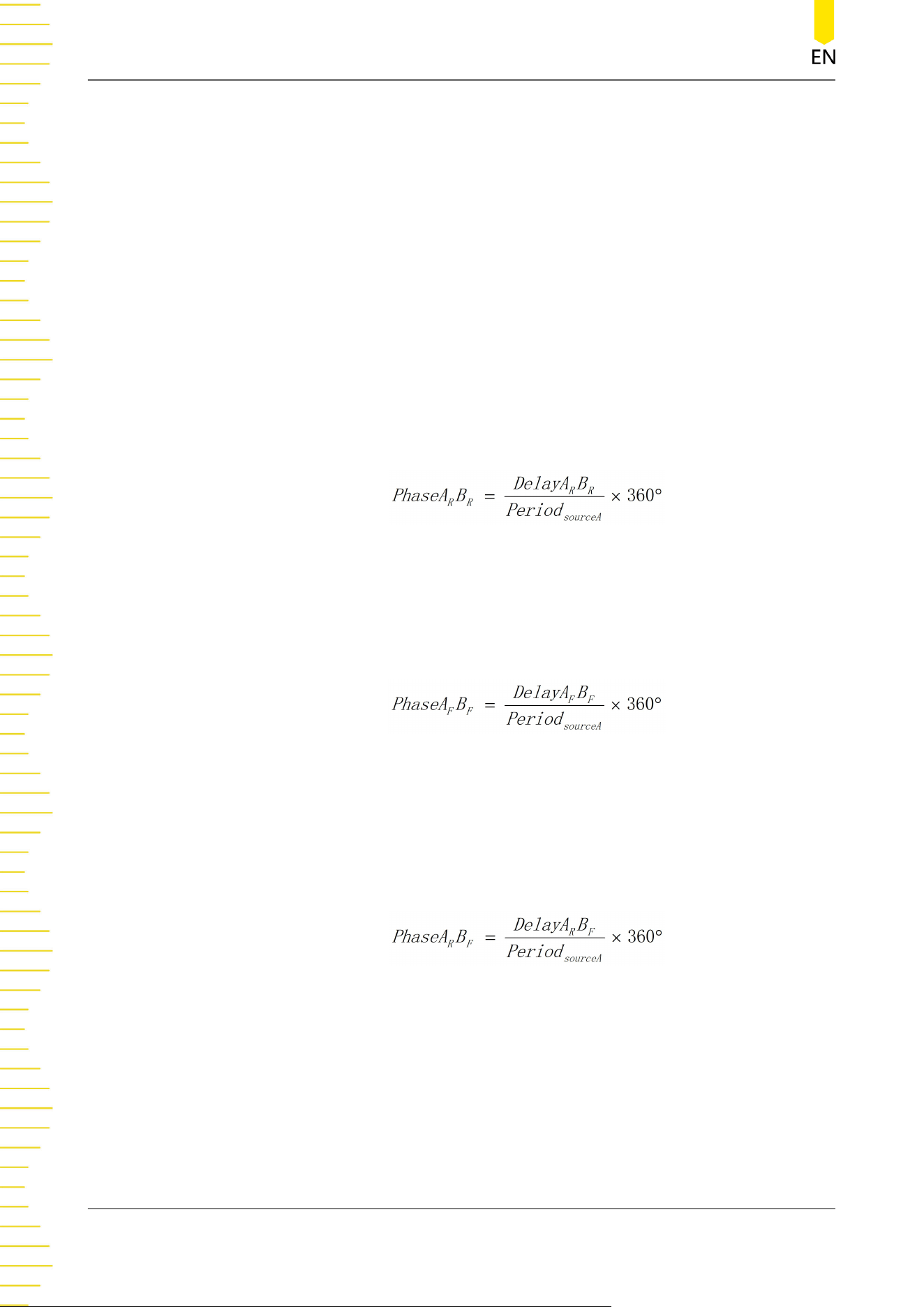
2 Delay(f-f): indicates the time difference between the threshold middle values of
the falling edge of Source A and that of Source B. Negative delay indicates that the
falling edge of Source A occurred after that of Source B.
3 Delay(r-f): indicates the time difference between the threshold middle values of
the rising edge of Source A and the falling edge of Source B. Negative delay
indicates that the rising edge of Source A occurred after the falling edge of Source
B.
4 Delay(f-r): indicates the time difference between the threshold middle values of
the falling edge of Source A and the rising edge of Source B. Negative delay
indicates that the falling edge of Source A occurred after the rising edge of Source
B.
5 Phase(r-r): indicates the phase deviation between the threshold middle values of
the rising edge of Source A and that of Source B. The phase formula is as follows:
Wherein,
PhaseA
R
B
R
represents Phase(r-r),
DelayA
R
B
R
represents Delay(r-r), and
Period
sourceA
represents period of Source A.
6 Phase(f-f): indicates the phase deviation between the threshold middle values of
the falling edge of Source A and that of Source B. The phase formula is as follows:
Wherein,
PhaseA
R
B
R
represents Phase(r-r),
DelayA
R
B
R
represents Delay(r-r), and
Period
sourceA
represents period of Source A.
7 Phase(r-f): indicates the phase deviation between the threshold middle values of
the rising edge of Source A and the falling edge of Source B. The phase formula is
as follows:
Wherein,
PhaseA
R
B
R
represents Phase(r-r),
DelayA
R
B
R
represents Delay(r-r), and
Period
sourceA
represents period of Source A.
8 Phase(f-f): indicates the phase deviation between the threshold middle values of
the falling edge of Source A and the rising edge of Source B. The phase formula is
as follows:
Measure
DS70000 User Guide
164
Copyright ©RIGOL TECHNOLOGIES CO., LTD.
All rights reserved.
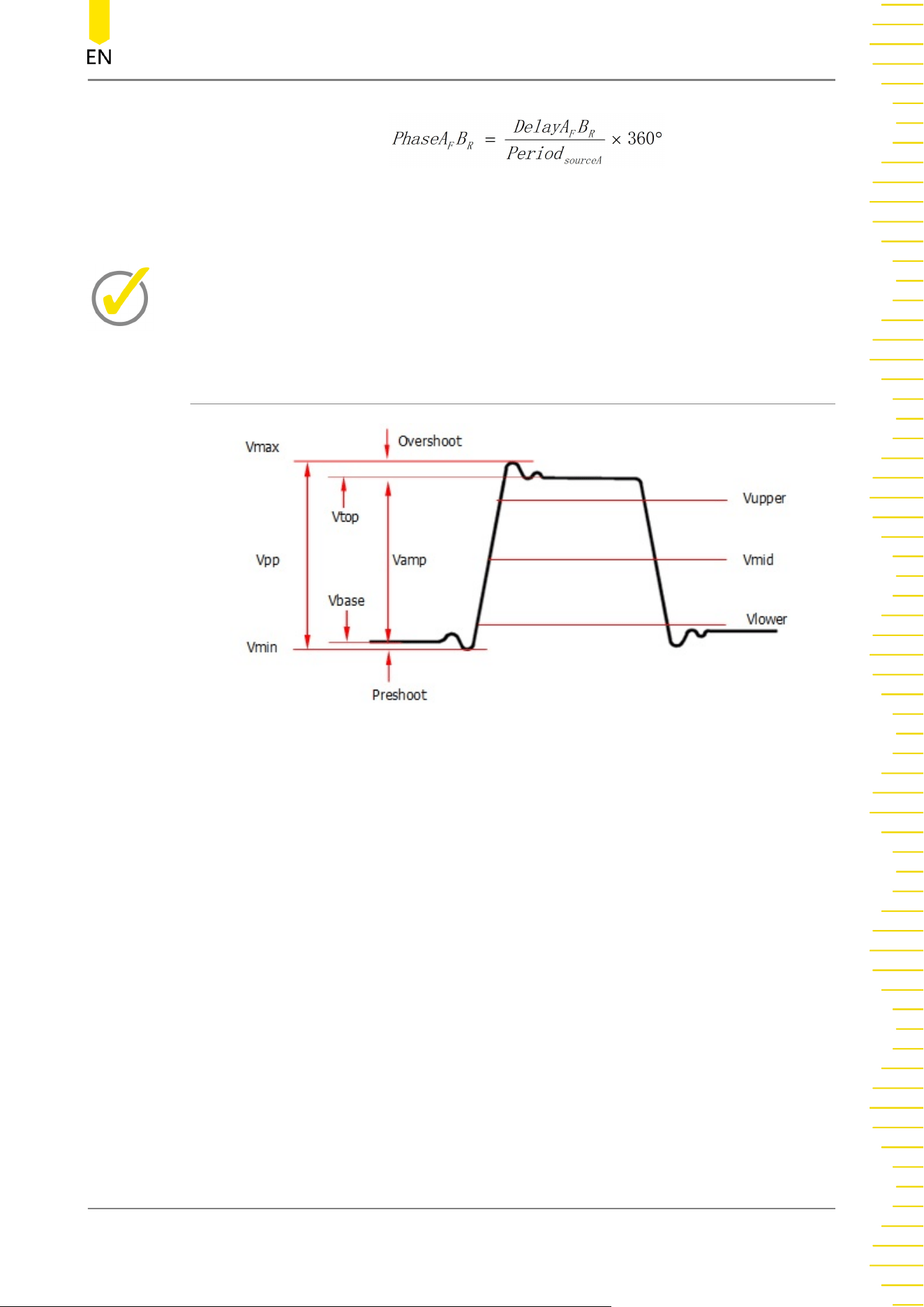
Wherein,
PhaseA
R
B
R
represents Phase(r-r),
DelayA
R
B
R
represents Delay(r-r), and
Period
sourceA
represents period of Source A.
Tip
• Source A and Source B can be any channel among CH1~ CH4 and Math1~ Math4.
• The default threshold middle value is 50%.
10.1.4 Voltage Parameters
Figure 10.3 Voltage Parameters
1 Vmax: indicates the voltage value from the highest point of the waveform to the
GND.
2 Vmin: indicates the voltage value from the lowest point of the waveform to the
GND.
3 Vpp: the voltage value from the highest point to the lowest point of the waveform.
4 Vtop: indicates the voltage value from the flat top of the waveform to the GND.
5 Vbase: indicates the voltage value from the flat base of the waveform to the GND.
6 Vamp: indicates the voltage value from the top of the waveform to the base of the
waveform.
7 Vupper: indicates the actual voltage value that corresponds to the threshold
maximum value.
8 Vmid: indicates the actual voltage value that corresponds to the threshold middle
value.
Measure
Copyright ©RIGOL TECHNOLOGIES CO., LTD.
All rights reserved.
DS70000 User Guide
165
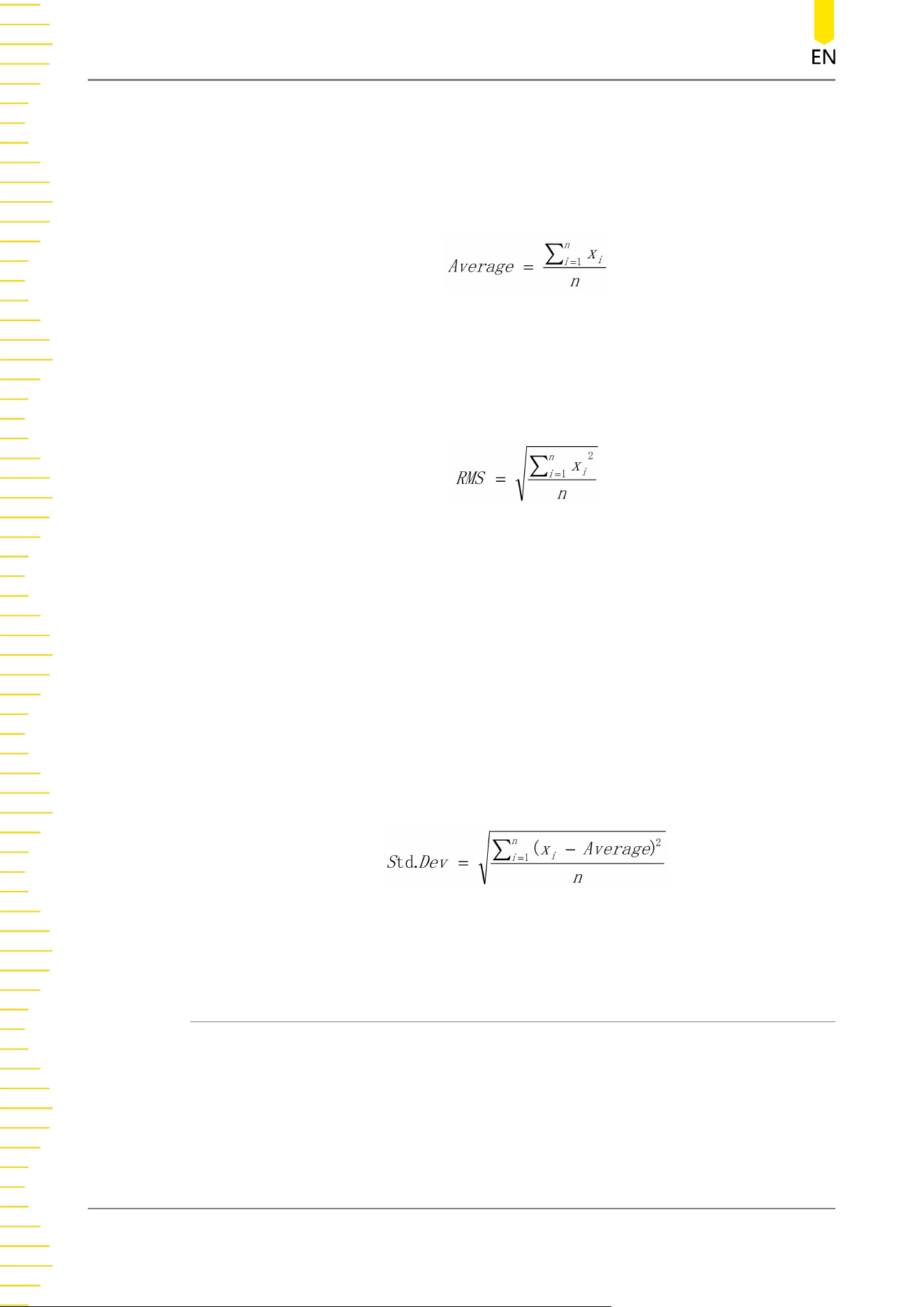
9 Vlower: indicates the actual voltage value that corresponds to the threshold
minimum value.
10 Vavg: indicates the arithmetic average value on the whole waveform or in the
gating area. The formula is shown as follows:
Wherein,
x
i
is the measurement result of the
ith
point, and
n
is the number of
points being measured.
11 VRMS: indicates the root mean square value on the whole waveform or in the
gating area. The formula is as follows:
Wherein,
x
i
is the measurement result of the
ith
point, and
n
is the number of
points being measured.
12 Per.VRMS: indicates the root mean square value within a period. The formula is as
shown above.
13 Overshoot: indicates the ratio of the difference between the maximum value and
the top value of the waveform to the amplitude value.
14 Preshoot: indicates the ratio of the difference between the minimum value and
the base value of the waveform to the amplitude value.
15 AC RMS: indicates the root-mean-square value of the waveforms, with the DC
component removed. The formula is shown as follows:
Wherein,
x
i
is the amplitude of the
ith
point,
Average
is the waveform average
value, and
n
is the number of points being measured.
10.1.5 Other Parameters
• Positive Slew Rate: On the rising edge, first calculate the difference between the
high value and the low value, then use the difference to divide the
corresponding time value to obtain the positive slew rate.
• Negative Slew Rate: On the falling edge, first calculate the difference between
the low value and the high value, then use the difference to divide the
corresponding time value to obtain the negative slew rate.
Measure
DS70000 User Guide
166
Copyright ©RIGOL TECHNOLOGIES CO., LTD.
All rights reserved.
• Area: indicates the area of the whole waveform within the screen. The unit is V*s.
The area of the waveform above the zero reference (namely the vertical offset) is
positive, and the area of the waveform below the zero reference is negative. The
area measured is the algebraic sum of the area of the whole waveform within the
screen.
• Period Area: indicates the area of the first period of waveform on the screen.
The unit is V*s. The area of the waveform above the zero reference (namely the
vertical offset) is positive, and the area of the waveform below the zero reference
is negative. The area measured is the algebraic sum of the whole period area.
10.2 To Select the Measurement Item
In the Measure menu, click or tap Horizontal, Vertical, or Other to go to the desired
menu. You can also slide to select the measurement item to enter the corresponding
interface. as shown in
Figure 10.4
,
Figure 10.5
, and
Figure 10.6
.
• Vertical: Vmax, Vmin, Vpp, Vtop, Vbase, Vamp, Vupper, Vmid, Vlower, Vavg,
VRMS, Per. VRMS, AC.RMS, Overshoot, Preshoot, Area, and Period Area.
Measure
Copyright ©RIGOL TECHNOLOGIES CO., LTD.
All rights reserved.
DS70000 User Guide
167
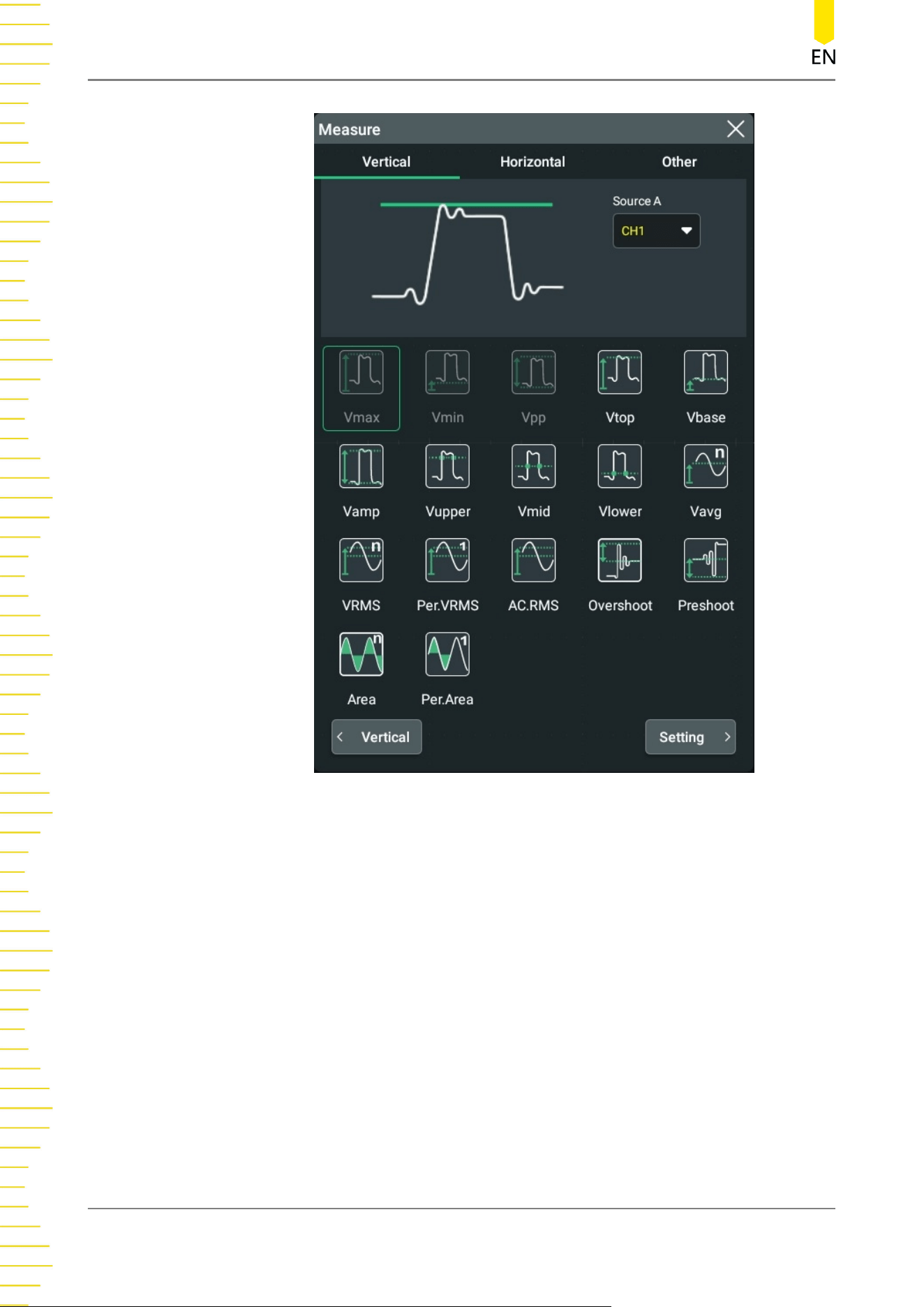
Figure 10.4 Vertical Measurement Items
• Horizontal: Period, Frequency, Rise Time, Fall Time, +Width, -Width, +Duty, -
Duty, Positive Pulse Count, Negative Pulse Count, Rising Edge Count, Falling
Edge Count, Tvmax, Tvmin, +Slew Rate, and -Slew Rate.
Measure
DS70000 User Guide
168
Copyright ©RIGOL TECHNOLOGIES CO., LTD.
All rights reserved.
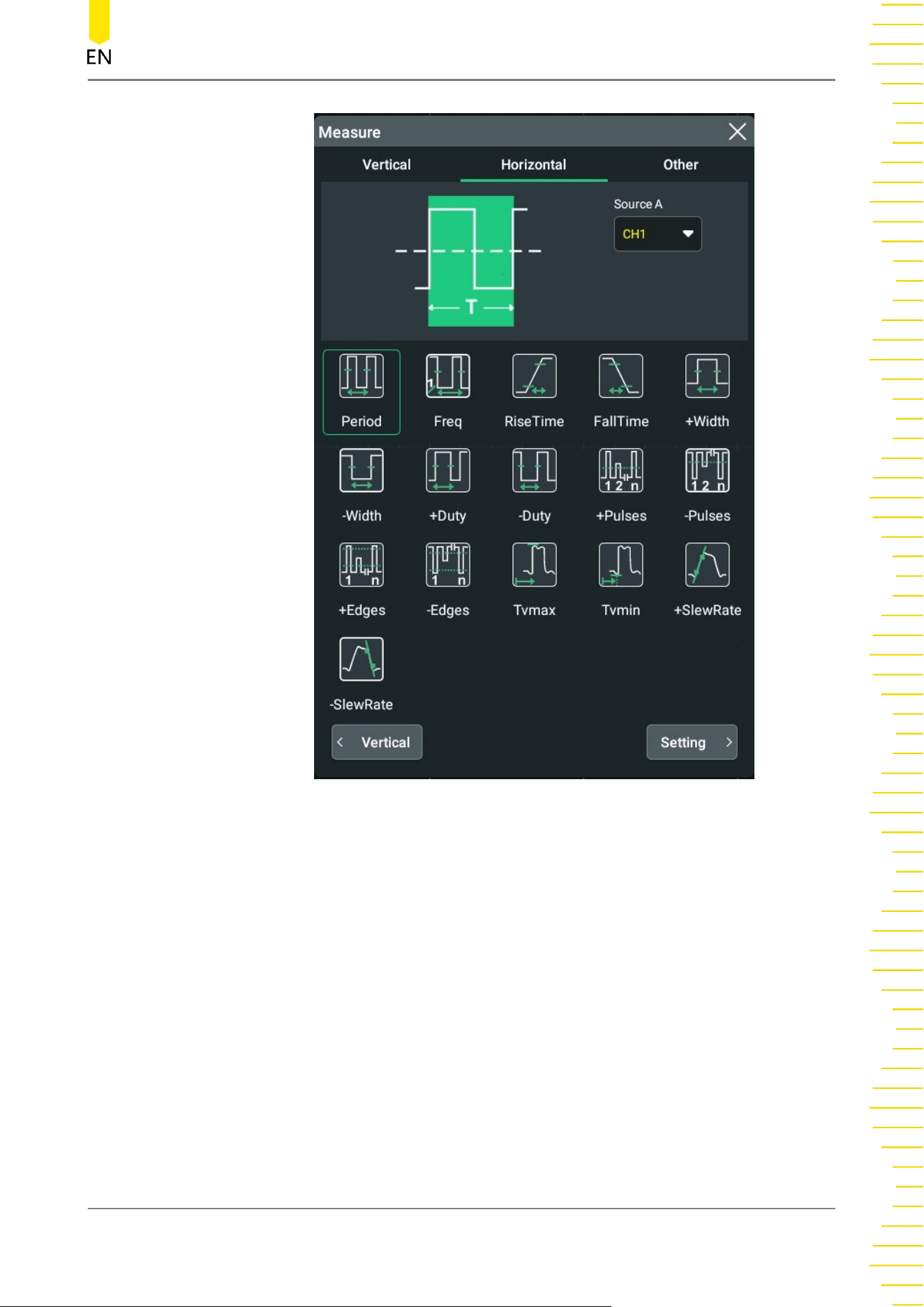
Figure 10.5 Horizontal Measurement Items
• Other: Delay (r-r), Delay (r-f), Delay (f-r), Delay (f-f), Phase (r-r), Phase (r-f), Phase
(f-r), and Phase (f-f).
Measure
Copyright ©RIGOL TECHNOLOGIES CO., LTD.
All rights reserved.
DS70000 User Guide
169
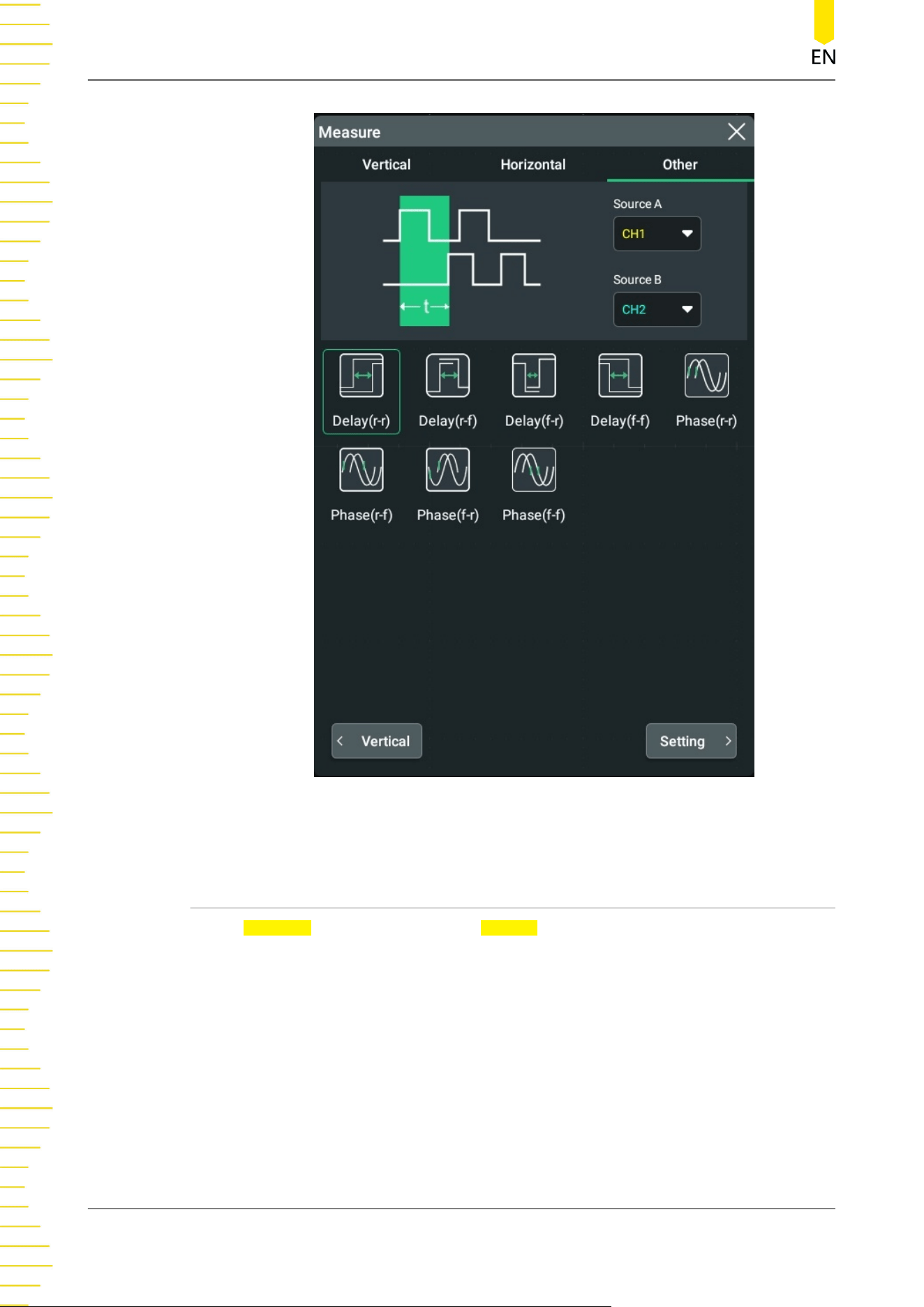
Figure 10.6 Other Measurement Items
10.3 Measurement Settings
In the Measure menu, click or tap the Setting button to enter the measurement
setting menu.
Measure
DS70000 User Guide
170
Copyright ©RIGOL TECHNOLOGIES CO., LTD.
All rights reserved.
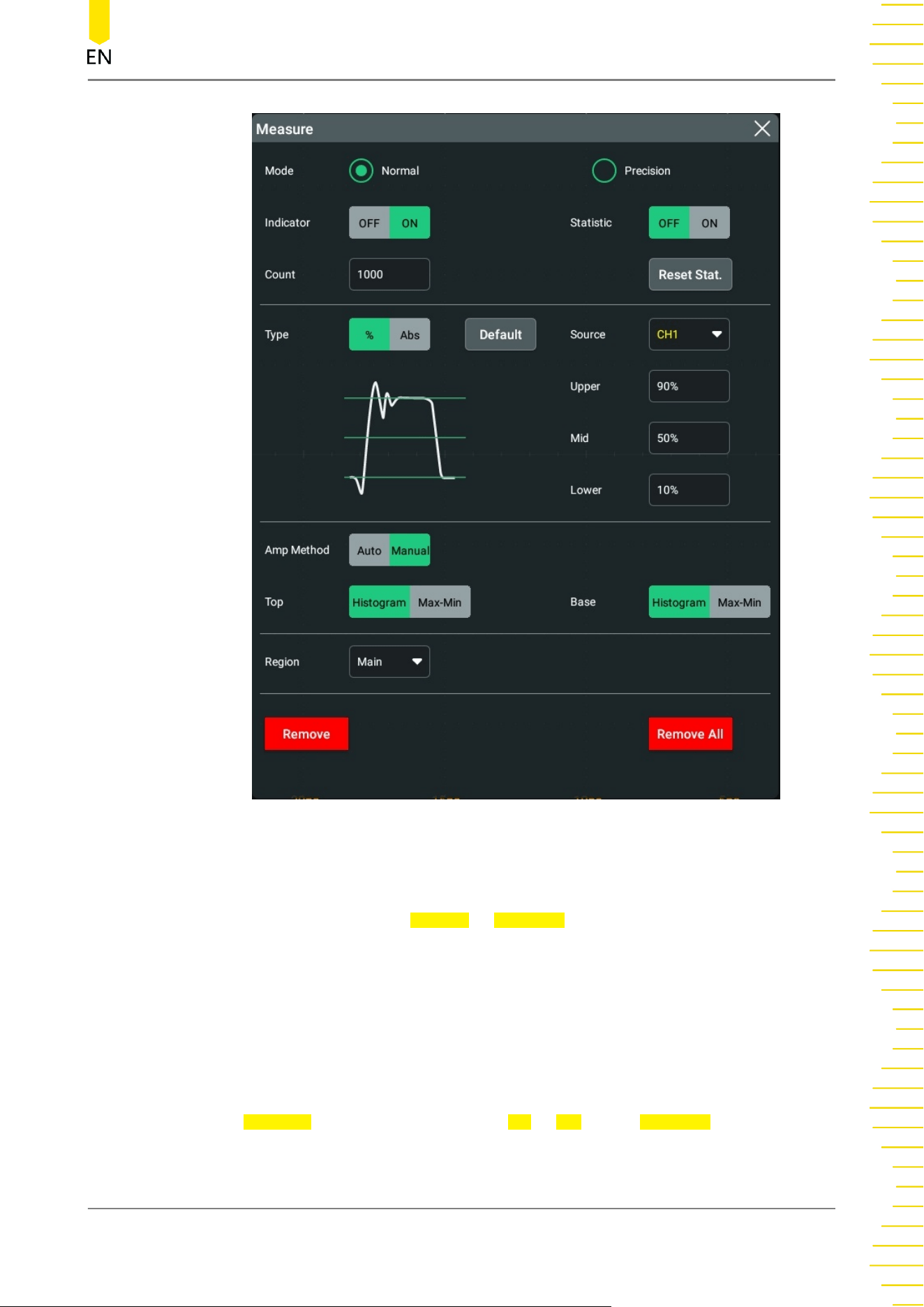
Figure 10.7 Measurement Settings
Measurement Mode
Selects measurement mode: Normal or Precision.
• Normal: executes measurement of up to 1 Mpts.
• Precision: executes measurement of up to 200 Mpts, improving the resolution of
measurement results. In this mode, the refresh rate of the waveforms may be
reduced.
Indicator
In the Measure setting menu, click or tap On or Off for the Indicator menu item to
enable or disable the indicator.
Measure
Copyright ©RIGOL TECHNOLOGIES CO., LTD.
All rights reserved.
DS70000 User Guide
171
If enabled, one or multiple cursors will be displayed on the screen. Before enabling
the indicator, you need to at least enable one auto measurement parameter and the
number of cursors will change with the measurement parameter enabled.
Measurement Threshold
• First click or tap % or Abs as the display type.
• Click or tap the drop-down button of Source to select the desired channel
(CH1~CH4 or Math1~Math4).
• Click or tap the input field of Upper and use the pop-up numeric keypad to set
the upper limit of the measurement. When the upper limit is set to be smaller
than or equal to the current middle value, a prompt message "Set at lower limit"
is displayed. Then, the oscilloscope will automatically adjust the upper limit and
make it greater than the middle value. By default, it is 90%. The default absolute
value varies with the vertical setting of the channel.
• Click or tap the input field of Mid and use the pop-up numeric keypad to set the
middle value of the measurement. The middle value is limited by the settings of
the upper limit and lower limit. By default, it is 50%. The default absolute value
varies with the vertical setting of the channel.
• Click or tap the input field of Lower and use the pop-up numeric keypad to set
the lower limit of the measurement. When the lower limit is set to be greater
than or equal to the current middle value, a prompt message "Set at upper limit"
is displayed. Then, the oscilloscope will automatically adjust the lower limit and
make it smaller than the middle value. By default, it is 10%. The default absolute
value varies with the vertical setting of the channel.
• Click the Default button to return the upper, middle, and lower limits to their
default values.
Tip
Modifying the threshold will affect the measurement results of time, delay, and phase
parameters.
Measurement Range
Click or tap the drop-down button of the
Region menu or "Main" ".
• Main: indicates that the measurement range is within the main time base region.
• Zoom: indicates that the measurement range is within the zoomed time base
region.
Tip
Only when you enable the delayed sweep function first, can "Zoom" be enabled.
Measure
DS70000 User Guide
172
Copyright ©RIGOL TECHNOLOGIES CO., LTD.
All rights reserved.
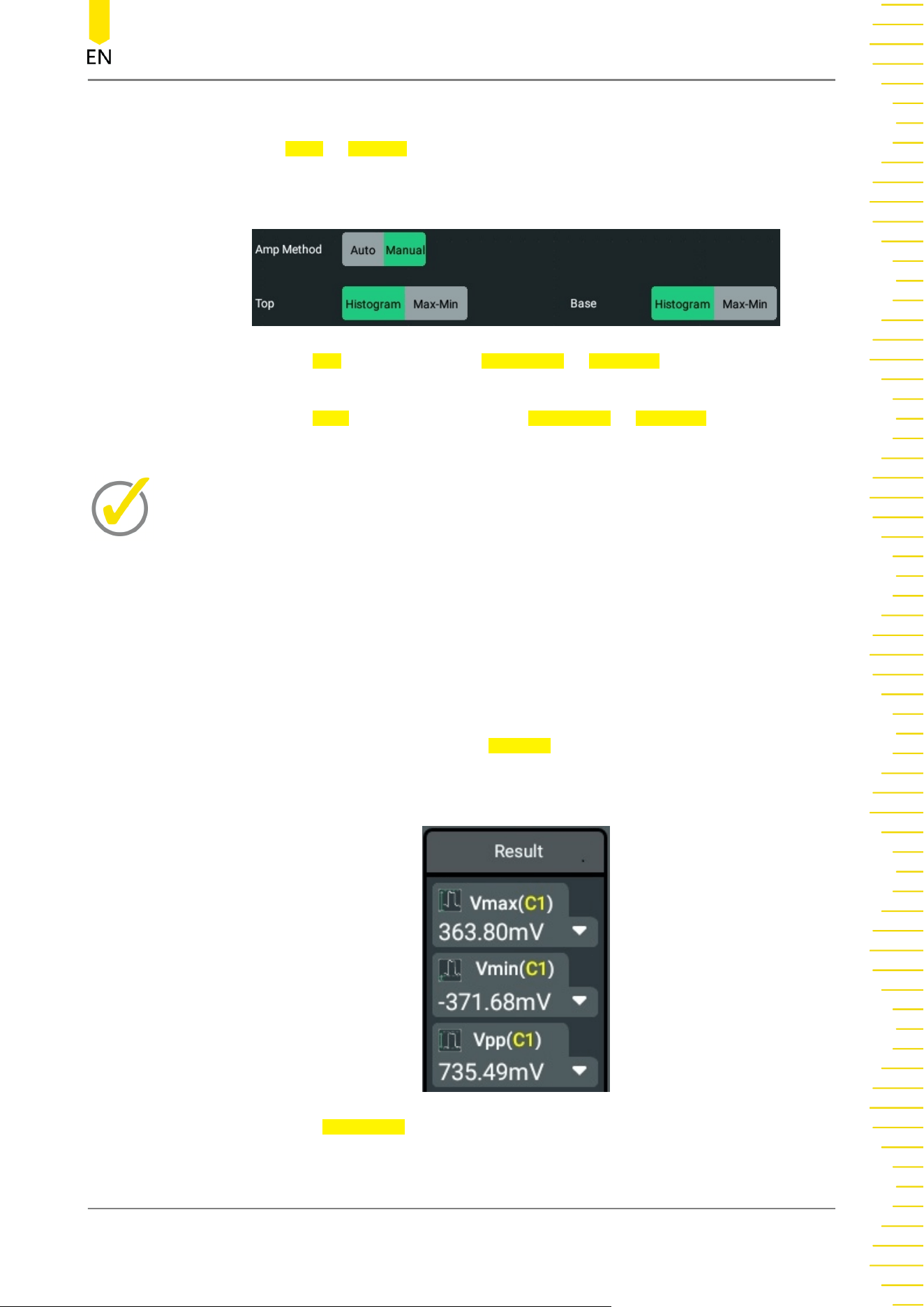
Amplitude Measurement Method
Click or tap Auto or Manual as the amplitude measurement method, which affects
the measurement method for the top and base values. If you select "Manual", set the
following parameters:
• Under the Top menu item, select Histogram or Max-min as the top value
measurement method.
• Under the Base menu item, click or tap Histogram or Max-min as the base
value measurement method.
Tip
If you select "Manual" for the amplitude method, the measurement results of other parameters
may be affected.
“"Histogram" and "Max-Min" are the internal measurement algorithm for the oscilloscope.
The "Histogram" method here is different from the Histogram function of the oscilloscope.
Remove the Measurement Results
Refer to
Remove the Measurement Results
.
Statistics
Click or tap the ON/OFF button for the Statistic item to enable/disable the statistical
function. This oscilloscope can make a statistics and display the current values of the
multiple parameters, as shown in the figure below.
• Click or tap Reset Stat. to clear the history statistics data and makes statistics
again.
Measure
Copyright ©RIGOL TECHNOLOGIES CO., LTD.
All rights reserved.
DS70000 User Guide
173
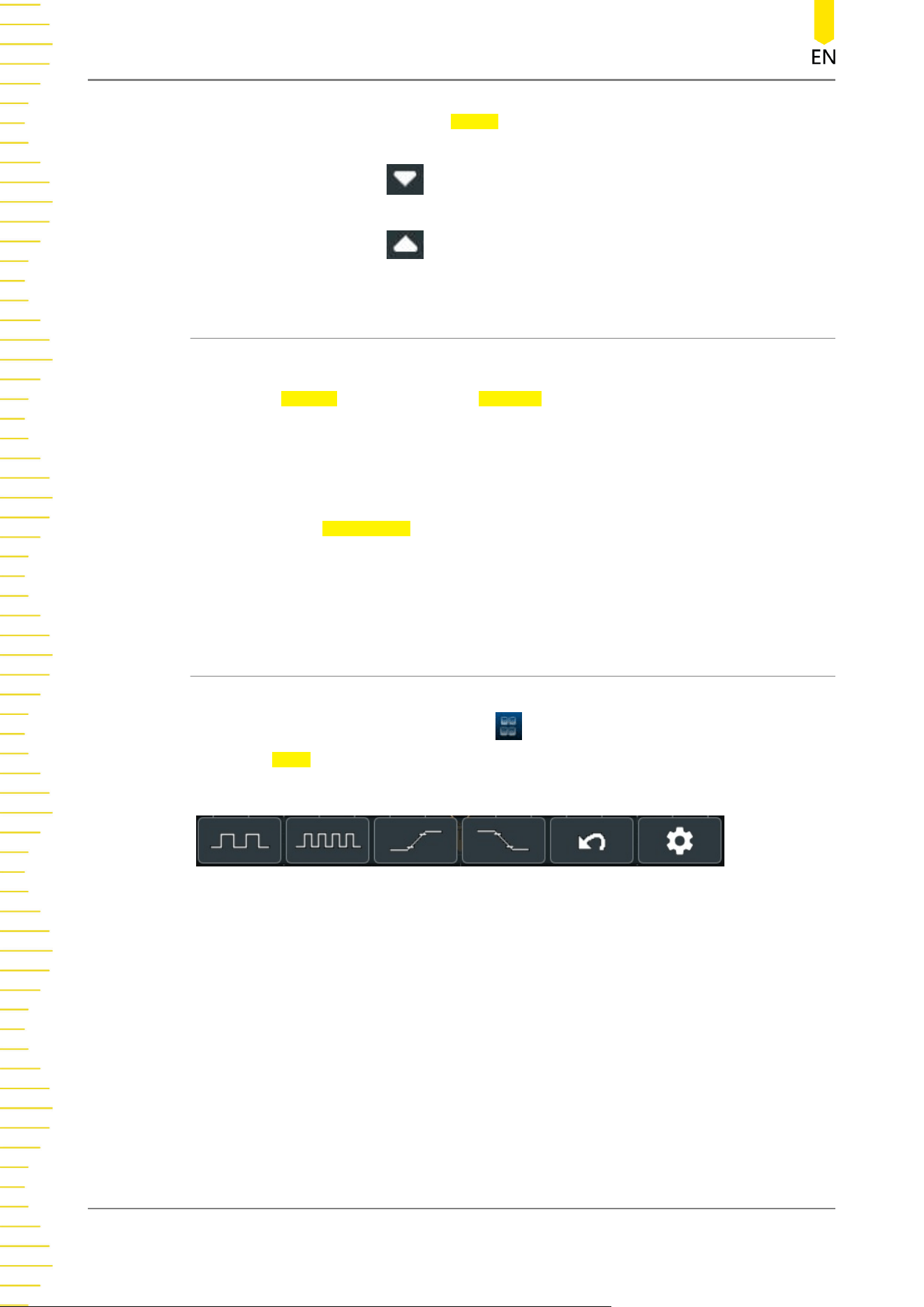
• Click or tap the input field of Count and use the pop-up numeric keypad to set
the count value. Its range is from 2 to 100000. Its default value is 1000.
• Click or tap the icon at the lower-right corner of the measurement statistics
label to unfold the statistics result to display all the measurement statistics items.
Click or tap the icon
to fold the measurement statistics label.
10.4 Remove the Measurement Results
This oscilloscope allows you to delete the measurement results of the parameters.
• In the Setting menu, click or tap Remove to delete the currently selected
measurement item that you’ve added. Each time you click or tap this button,
only one item will be deleted. Each time when one measurement item is selected
to be removed, the item following the deleted one under the result list will be
moved up.
• Click or tap Remove All to delete all the displayed measurement items.
• Click or tap to select the measurement item and drag it to the right to delete it
quickly.
10.5 Auto Measurement
When the oscilloscope is correctly connected and has detected a valid input signal,
click or tap the function navigation icon
at the lower-left corner of the screen to
select the Auto icon to enable the waveform auto setting function and open the auto
setting function menu.
• Click or tap the first icon, and then the single period of the signal is displayed
automatically on the screen. Meanwhile, the system will make measurements for
the "period" and "frequency" of the currently displayed waveforms in a single
period. The measurement results are displayed at the right side of the screen
under the "Result" list.
• Click or tap the second icon, and then multiple periods of the signal are
displayed automatically on the screen. Meanwhile, the system will make
measurements for the "period" and "frequency" of the currently displayed
waveforms in a multiple periods. The measurement results are displayed at the
right side of the screen under the "Result" list.
• Click or tap the third icon, and then one rising edge of the signal is displayed
automatically on the screen. Meanwhile, the system will make measurements for
Measure
DS70000 User Guide
174
Copyright ©RIGOL TECHNOLOGIES CO., LTD.
All rights reserved.
the "rise time" of the currently displayed rising edge. The measurement results
are displayed at the right side of the screen under the "Result" list. By default, it
is intended for the fast edge signal.
• Click or tap the fourth icon, and then one falling edge of the signal is displayed
automatically on the screen. Meanwhile, the system will make measurements for
the "Fall time" of the currently displayed falling edge. The measurement results
are displayed at the right side of the screen under the "Result" list. By default, it
is intended for the fast edge signal.
• Click or tap the fifth icon to cancel the auto setting and recovers to the
parameter settings prior to pressing the Auto key.
• Click or tap the sixth icon to enter the Auto Config sub-menu under the Utility
menu.
- Click or tap the ON/OFF tab for the Peak to Peak menu to enable or
disable the peak-peak priority setting. This function is intended for the
shifted signal. If there is a large deviation, you can view the signal waveform
in priority when you enable the function.
- Click or tap the ON/OFF tab for the Live CH menu to enable or disable test
the enabled channel.
If you select "OFF", the system will test the 4 analog channels (CH1-CH4) in
sequence. If no signal is found on the channel, then the channel is disabled.
If a signal is found on the channel, adjust the channel to an optimal scale to
display the signal. If you select "ON", the system will only test the enabled
channels.
- Click or tap the ON/OFF tab for the Overlay menu to enable or disable the
waveform overlay display function. If enabled, waveforms of different
channels will be displayed in the same position of the screen. If disabled,
waveforms of different channels will be displayed on the screen from top to
bottom in sequence.
- Click or tap ON/OFF tab for the Coupling menu to enable or disable the
coupling hold function. If enabled, after performing the auto measurement
operation, the settings for the channel coupling remain unchanged. If
disabled, then the channel coupling is, by default, set to "DC".
Tip
The waveform auto setting function requires that the frequency of the signal should be greater
than or equal to 35 Hz, the amplitude greater than or equal to 5 mV. If not meeting the
conditions, the waveform auto setting function may be invalid.
Measure
Copyright ©RIGOL TECHNOLOGIES CO., LTD.
All rights reserved.
DS70000 User Guide
175
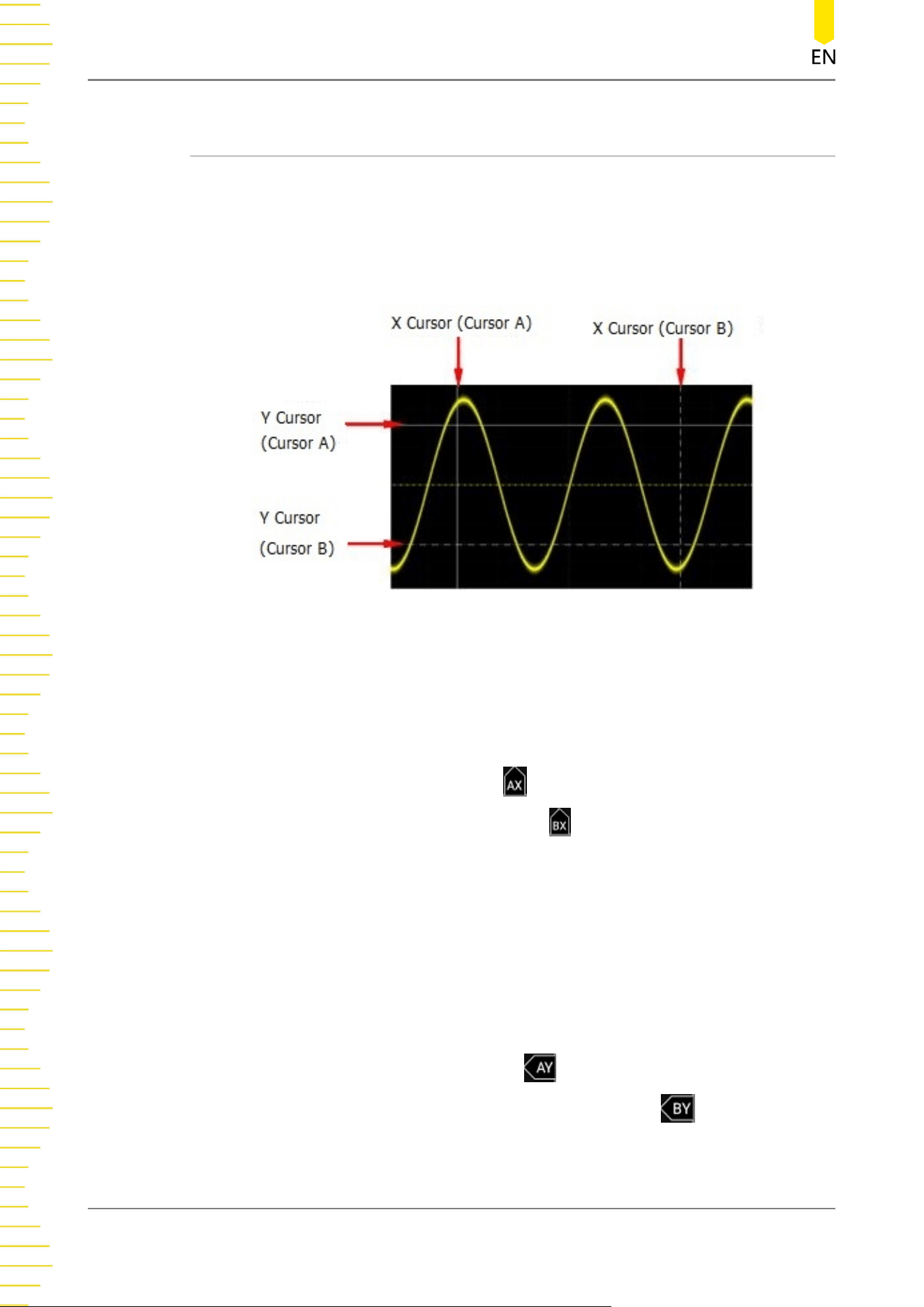
10.6 Cursor Measurement
Cursor measurement can measure the X axis values (e.g Time) and Y axis values (e.g.
Voltage) of the selected waveform. Before making cursor measurement, connect the
signal to the oscilloscope to acquire stable display. All the parameters supported by
the "
Auto Measurement
" function can be measured with cursor measurement. The
cursor measurement function provides the following two cursors.
Figure 10.8 Cursor
• X Cursor
X cursor is a vertical solid/dotted line that is used to make horizontal
adjustments. It can be used to measure time (s) and frequency (Hz).
- Cursor A is a vertical solid line (
is displayed at the bottom of the screen),
and Cursor B is a vertical dotted line (
is displayed at the bottom of the
screen).
- In the XY cursor mode, X cursor is used to measure the waveform
amplitude of CH1.
• Y Cursor
Y cursor is a horizontal solid/dotted line that is used to make vertical
adjustments. It can be used to measure amplitude (the unit is the same as that of
the source channel amplitude).
- Cursor A is a horizontal solid line (
is displayed at the right section of
the screen), and Cursor B is a horizontal dotted line (
is displayed at the
right section of the screen).
Measure
DS70000 User Guide
176
Copyright ©RIGOL TECHNOLOGIES CO., LTD.
All rights reserved.
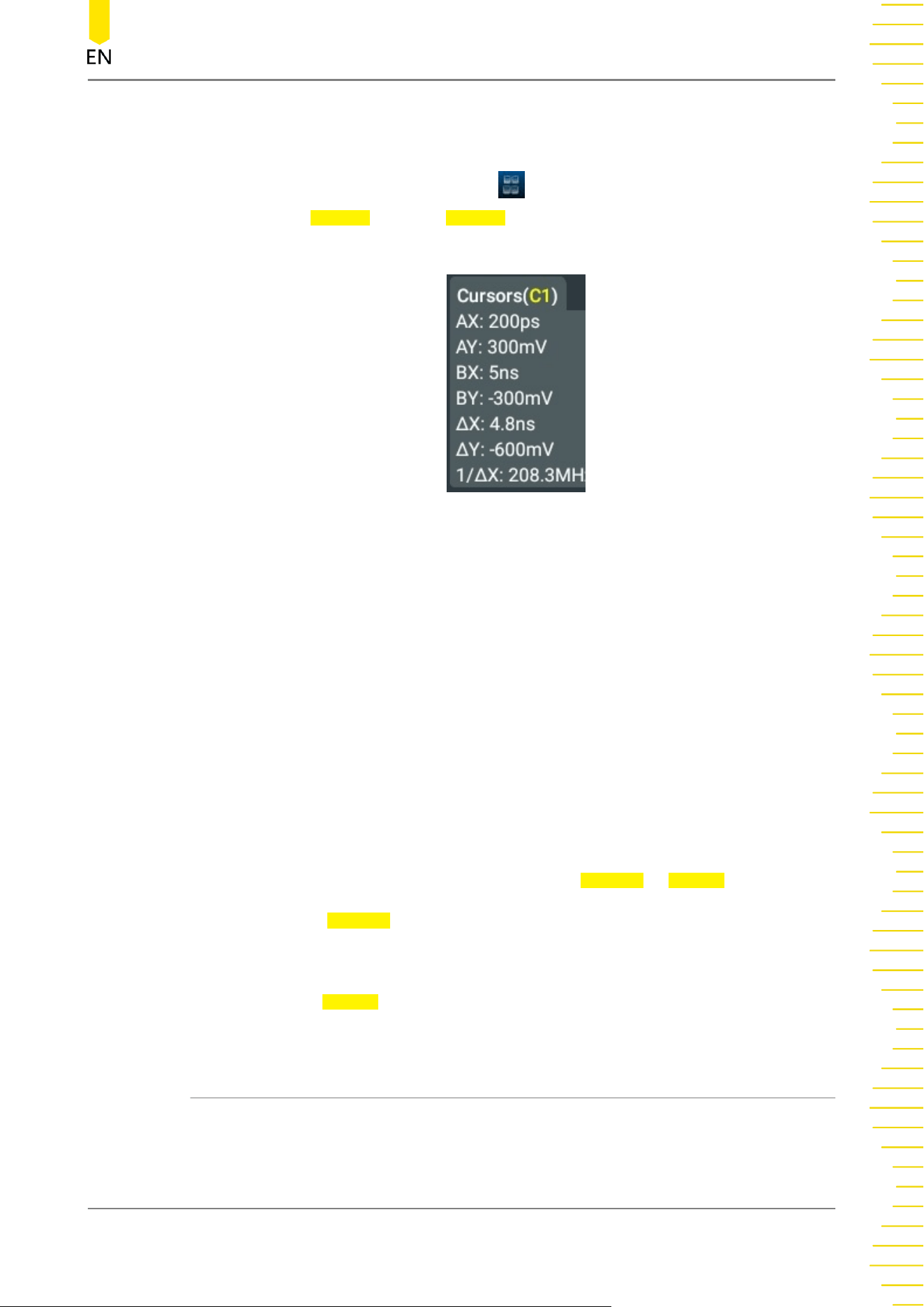
- In the XY cursor mode, Y cursor is used to measure the waveform amplitude
of CH2.
Click or tap the function navigation icon
at the lower-left corner of the screen,
then select the Cursors icon. The Cursors measurement results will be displayed in
the "Result" list at the right section of the screen.
Figure 10.9 Cursor Measurement Result
• AX: indicates the X value at Cursor A.
• AY: indicates the Y value at Cursor A.
• BX: indicates the X value at Cursor B.
• BY: indicates the Y value at Cursor B.
• ∆X: indicates the horizontal spacing between Cursor A and Cursor B.
• ∆Y: indicates the vertical spacing between Cursor A and Cursor B.
• 1/∆X: indicates the reciprocal of the horizontal spacing between Cursor A and
Cursor B.
Click or tap the measurement result list, then select Remove or Setting.
• If you select
Remove, the current cursor measurement results will be cleared and
the instrument will make new measurements. The new measurement results will
be displayed at the right side of the screen under the "Result" list.
• Click or tap Setting. Then the "Cursors" interface is displayed. You can select the
cursor mode: Manual, Track, and XY.
10.6.1 Manual Mode
In the manual cursor mode, you can adjust the cursor manually to measure the value
of the waveforms of the specified source at the current cursor. If the settings for the
Measure
Copyright ©RIGOL TECHNOLOGIES CO., LTD.
All rights reserved.
DS70000 User Guide
177
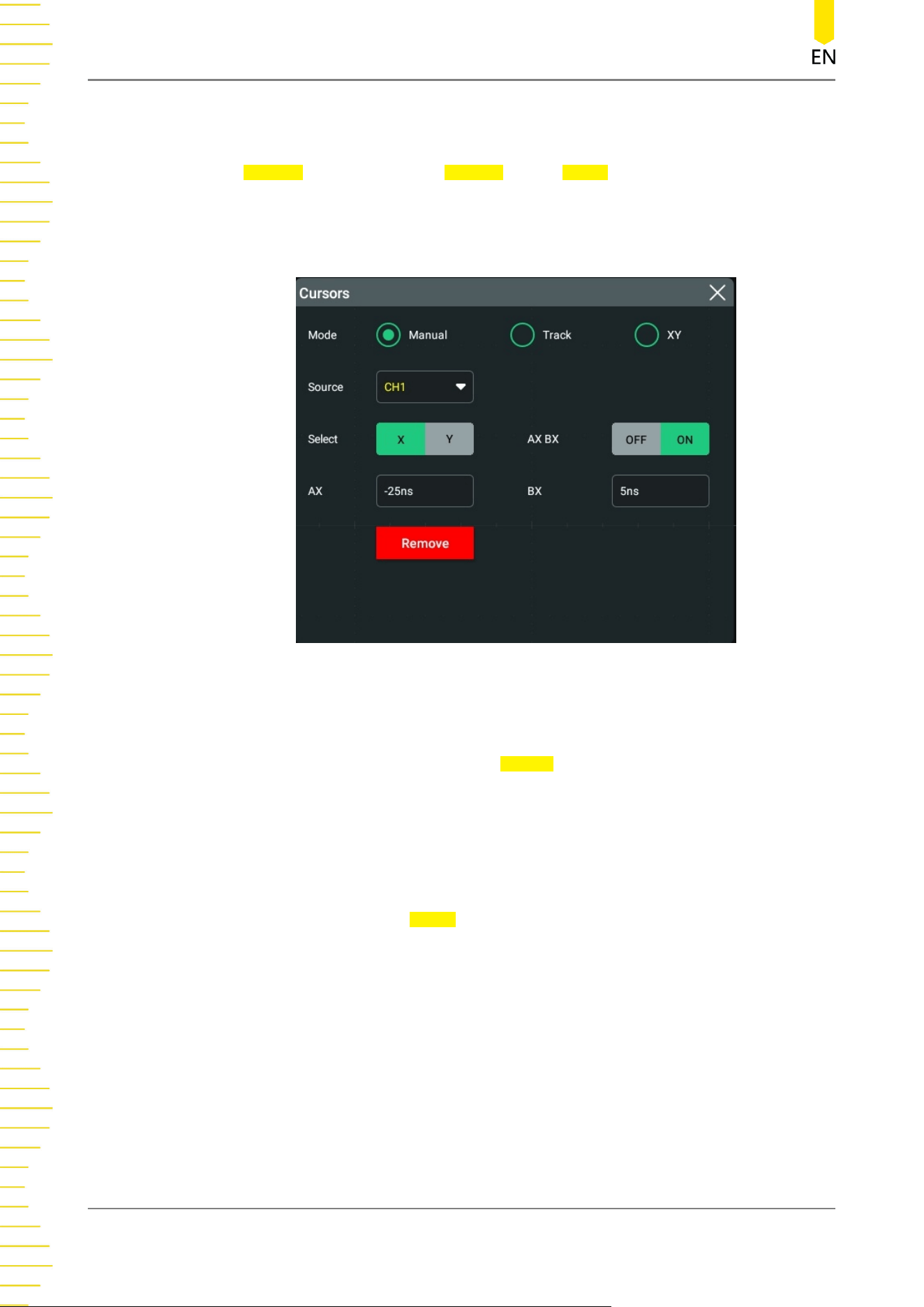
parameter such as the cursor type and measurement source are different, the
measurement results will be different for cursor measurement.
In the Cursors menu, click or tap Manual for the Mode item to enable the Manual
cursor measurement function. The measurement results are displayed at the right
side of the screen under the "Result" list. When you change the cursor position, the
measurement results will be changed accordingly.
Figure 10.10 Manual Mode Setting Menu
Select Measurement Source
Click or tap the drop- of down button of Source to select the desired channel (None,
CH1~CH4, or Math1~Math4).
If the specified channel is selected as the source, the channel will be enabled
automatically.
Select Cursor Type
Click or tap "X" or "Y" under Select to select the cursor type.
• X: It is a pair of vertical solid (Cursor A)/dotted (Cursor B) lines, used for
measuring time parameters. The measurement results include AX, BX, △X, and
1/△X.
• Y: It is a pair of horizontal solid (Cursor A)/dotted (Cursor B) lines, used for
measuring voltage parameters. The measurement results include AY, BY, and ∆Y.
Adjust Cursor Position
1 When "X" is selected under Select, you can adjust the position of X cursor.
Measure
DS70000 User Guide
178
Copyright ©RIGOL TECHNOLOGIES CO., LTD.
All rights reserved.
- Click or tap the input field of AX and use the pop-up numeric keypad set the
horizontal position of Cursor A (X cursor). The horizontal axis indicates time,
and the unit of its setting value is the same as that of the horizontal unit. Its
adjustable range is limited within the screen.
- Click or tap the input field of BX and then use the pop-up numeric keypad to
set the horizontal position of Cursor B (X cursors). The horizontal axis indicates
time, and the unit of its setting value is the same as that of the horizontal unit.
Its adjustable range is limited within the screen.
- Click or tap the ON/OFF tab for the AX BX menu item to adjust the horizontal
position of Cursor A and Cursor B (X cursors) simultaneously. Its adjustable
range is limited within the screen. The horizontal spacing between Cursor A and
Cursor B (X cursors) remains unchanged.
2 When "Y" is selected under Select, you can adjust the position of Y cursor.
- Click or tap the input field of AY, and then use the pop-up numeric keypad to
set the vertical position of Cursor A (Y cursors). The vertical axis indicates
voltage, and the unit of its setting value is the same as that of the vertical unit.
- Click or tap the input field of BY, and then use the pop-up numeric keypad to
set the vertical position of Cursor B (Y cursor). The vertical axis indicates
voltage, and the unit of its setting value is the same as that of the vertical unit.
- Click or tap the ON/OFF tab for the AY BY menu item to adjust the vertical
position of Cursor A and Cursor B (Y cursors) simultaneously. The vertical
spacing between Cursor A and Cursor B (Y cursors) remains unchanged.
You can also use the multifunction knob at the right side of the front panel or
tap the screen to adjust the cursor.
Measurement Example
Measure the period of a sine wave by using the manual cursor measurement and
auto measurement respectively. The measurement results are both 1 ms .
Measure
Copyright ©RIGOL TECHNOLOGIES CO., LTD.
All rights reserved.
DS70000 User Guide
179
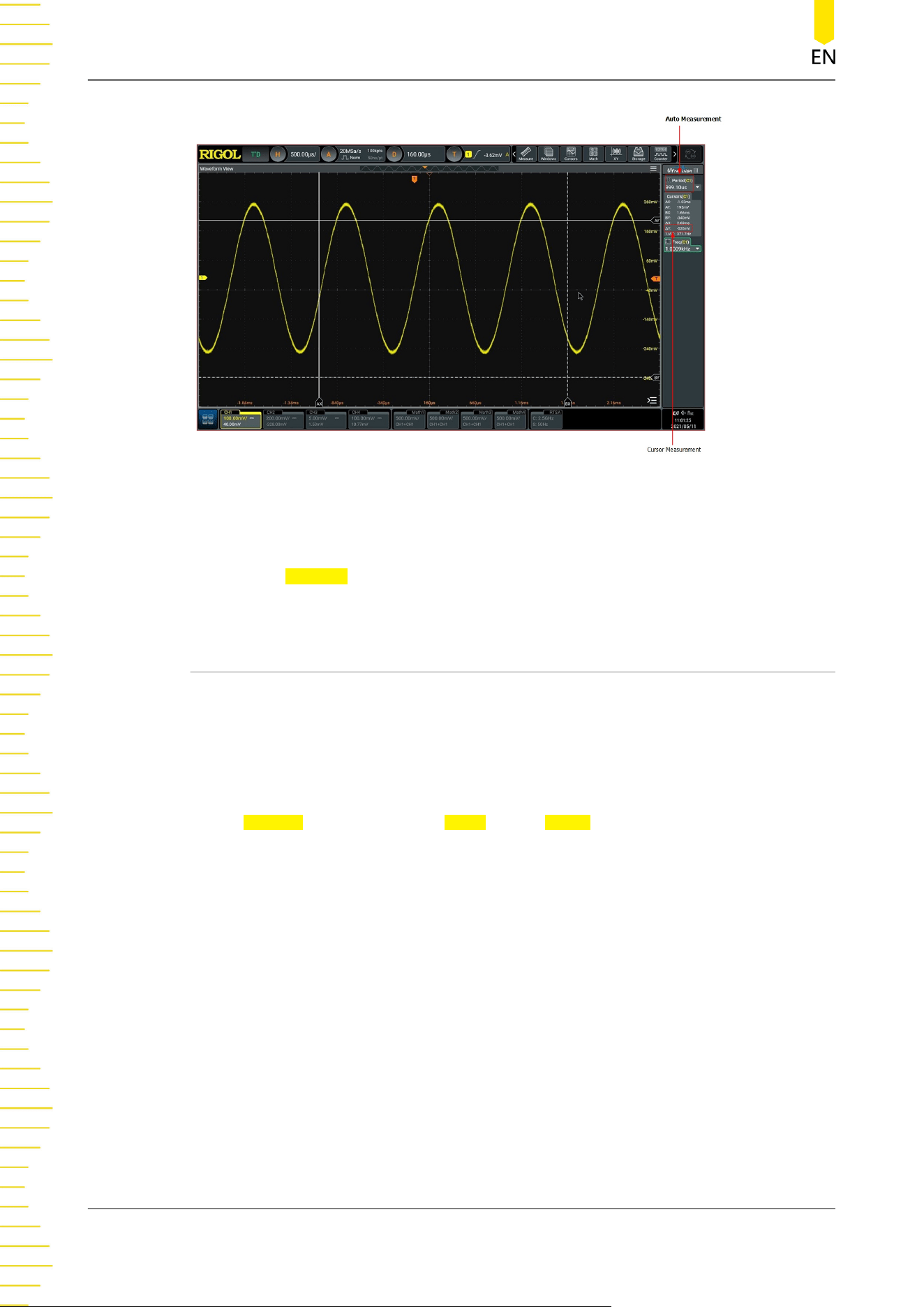
Figure 10.11 Manual Cursor Measurement Example
Close the Cursor Measurement Result Window
Click or tap Remove to close the cursor measurement result display window at the
right side of the screen.
10.6.2 Track Mode
In the Track mode, you can adjust the two pairs of cursors (Cursor A and Cursor B) to
measure the X and Y values on two different sources respectively. When the cursors
are moved horizontally/vertically, the markers will position on the waveform
automatically. When the waveform is expanded or compressed horizontally/vertically,
the markers will track the points being marked at the last adjustment of the cursors.
In the Cursors menu, click or tap Track for the Mode item to enable the Track cursor
measurement function. The measurement results are displayed at the right side of the
screen under the "Result" list.
Measure
DS70000 User Guide
180
Copyright ©RIGOL TECHNOLOGIES CO., LTD.
All rights reserved.
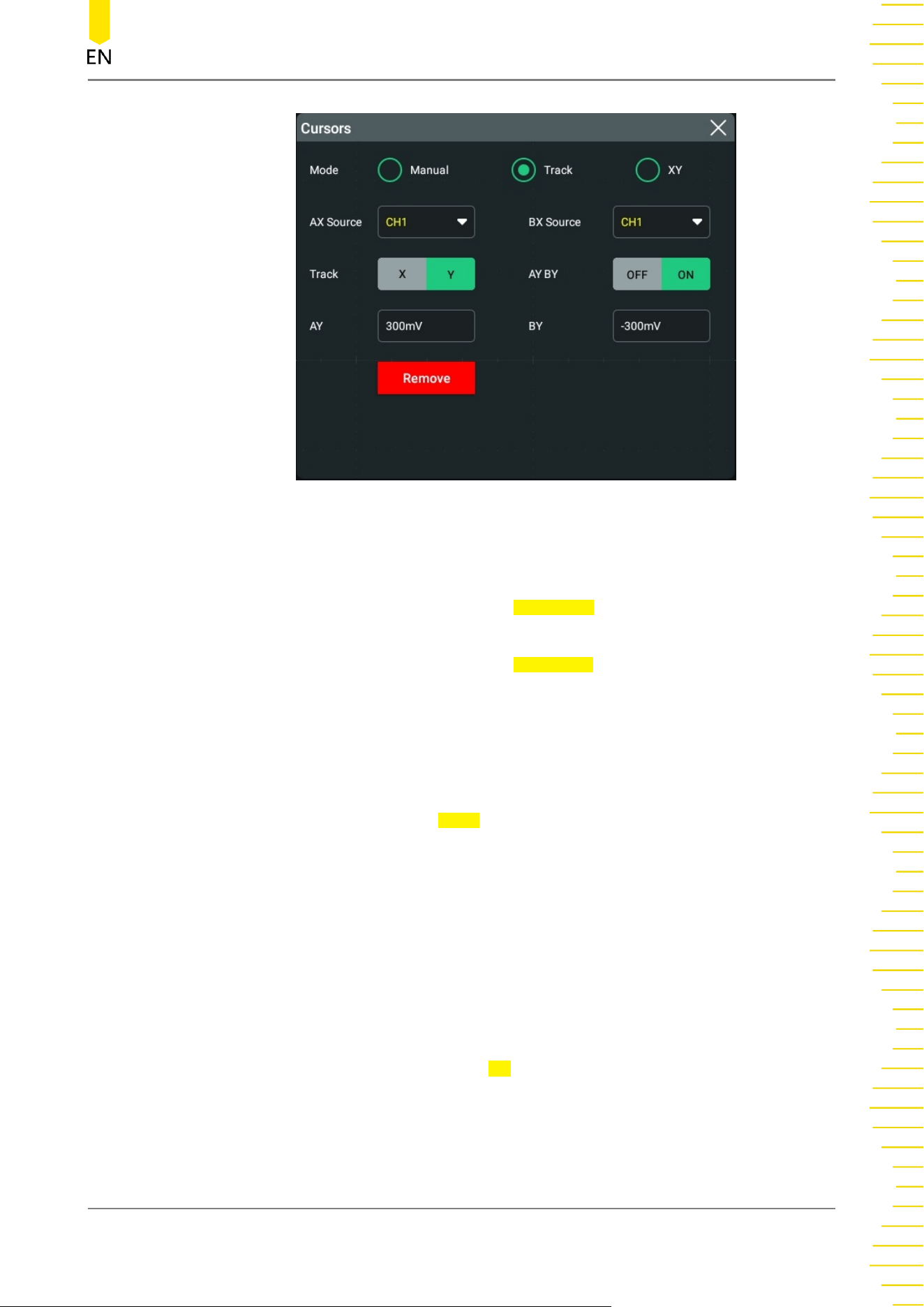
Figure 10.12 Track Mode Setting Menu
Select Measurement Source
• Click or tap the drop-down button of AX Source to select the desired channel
(None, CH1~CH4, or Math1~Math4).
• Click or tap the drop-down button of BX Source to select the desired channel
(None, CH1~CH4, or Math1~Math4).
If the specified channel is selected as the source, the channel will be enabled
automatically.
Select the Track Mode
Click or tap "X" or "Y" under the Track menu item as the current track axis. By default,
it is "X".
• X: tracks X Cursor and measures the value at X Cursor.
• Y: tracks Y Cursor and measures the time of the first point at the left side of the
screen.
Adjust Cursor Position
• When "X" is selected for the track mode, you can adjust the position of X cursor.
- Click or tap the input field of AX and use the pop-up numeric keypad to set
the horizontal position of Cursor A (X cursor). Its adjustable range is limited
within the screen.
Measure
Copyright ©RIGOL TECHNOLOGIES CO., LTD.
All rights reserved.
DS70000 User Guide
181
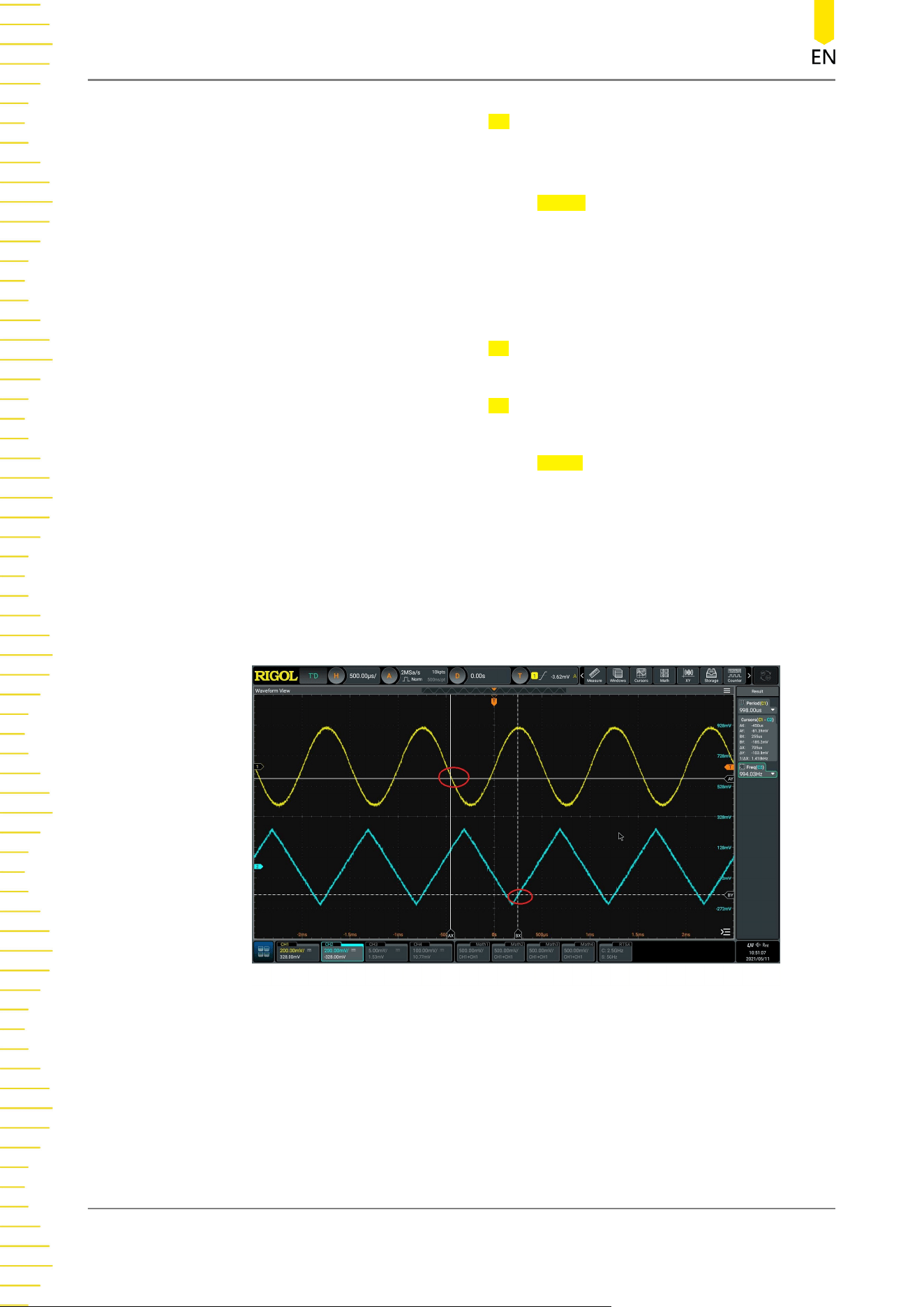
- Click or tap the input field of BX and use the pop-up numeric keypad to set
the horizontal position of Cursor B (X cursors). Its adjustable range is
limited within the screen.
- Click or tap the ON/OFF tab for the AX BX menu item to adjust the
horizontal position of Cursor A and Cursor B (X cursors) simultaneously. Its
adjustable range is limited within the screen. The horizontal spacing
between Cursor A and Cursor B (X cursors) remains unchanged.
• When "Y" is selected for the track mode, you can adjust the position of Y cursor.
- Click or tap the input field of AY and use the pop-up numeric keypad to set
the vertical position of Cursor A (Y cursor).
- Click or tap the input field of BY and use the pop-up numeric keypad to set
the vertical position of Cursor B (Y cursor).
- Click or tap the ON/OFF tab for the AY BY menu item to adjust the vertical
position of Cursor A and Cursor B (Y cursors) simultaneously. The vertical
spacing between Cursor A and Cursor B (Y cursors) remains unchanged.
Measurement Example
Measure the waveforms of CH1 and CH2 with Cursor A and Cursor B, respectively.
Then, expand the waveforms horizontally, and you will find that the cursor will track
the point that has been marked, as shown in the following figure.
Figure 10.13 Track Measurement (before Horizontal Expansion)
Measure
DS70000 User Guide
182
Copyright ©RIGOL TECHNOLOGIES CO., LTD.
All rights reserved.
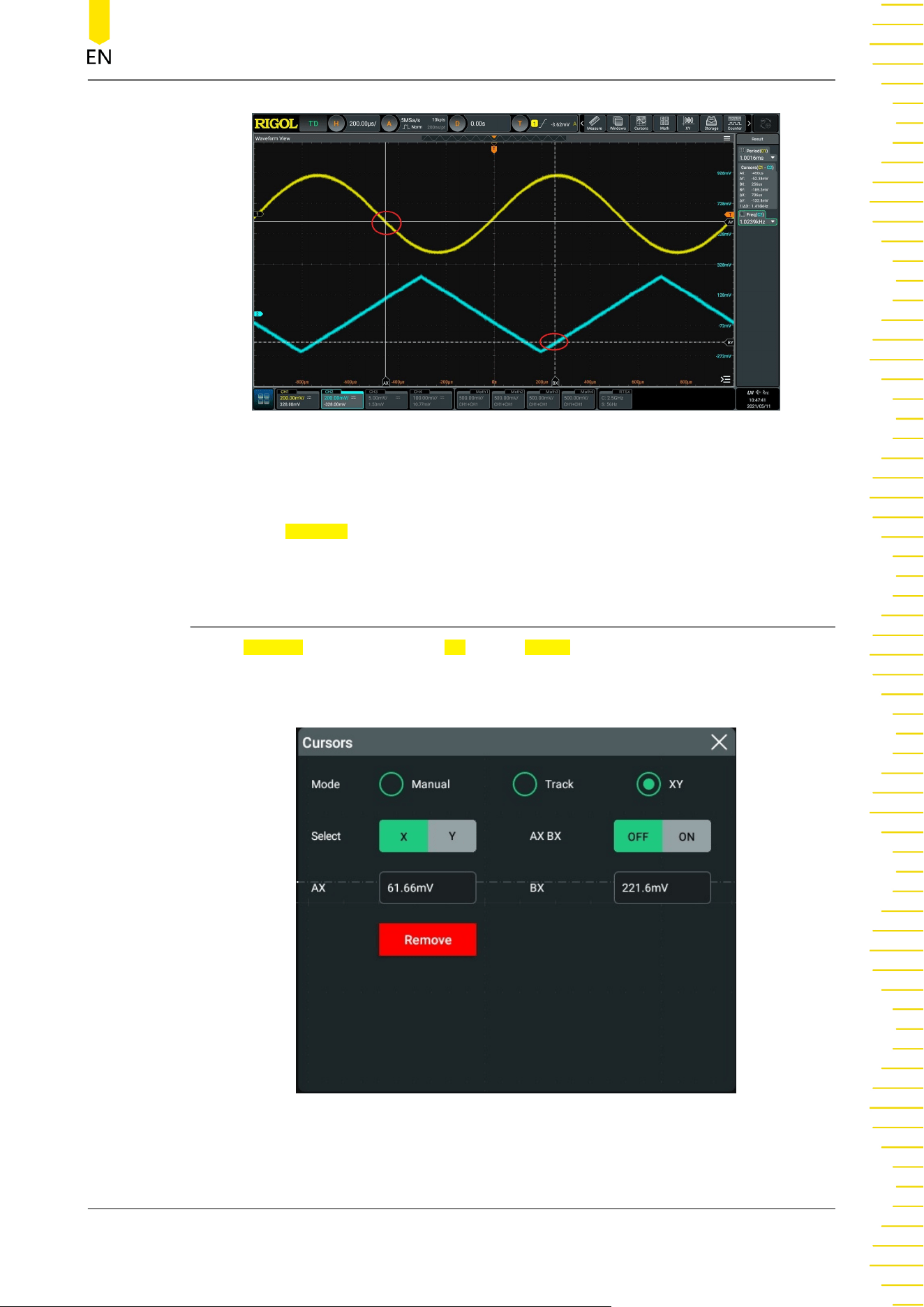
Figure 10.14 Track Measurement (after Horizontal Expansion)
Close the Cursor Measurement Result Window
Click or tap Remove to close the cursor measurement result display window at the
right side of the screen.
10.6.3 XY Mode
In the Cursors menu, click or tap XY for the Mode item to enable the XY cursor
measurement function. The measurement results are displayed at the right side of the
screen under the "Result" list.
Figure 10.15 XY Mode
Measure
Copyright ©RIGOL TECHNOLOGIES CO., LTD.
All rights reserved.
DS70000 User Guide
183
Tip
By default, XY mode is unavailable. It is only available when the horizontal time base mode is
"XY".
To add the XY mode, click or tap the
Windows icon at the upper-right part of the screen to
enter the Add Window interface. In the Diagram menu, click or tap "XY", and then click or tap
Add to open the "XY horizontal time base window". Only when you have made such
settings, can the XY mode be available for the cursor mode under the Cursors menu.
Adjust Cursor Position
• Click or tap to select the "X" tab under the
Select menu item to set the X value
for the specified cursor.
- Click or tap the input field of AX and use the pop-up numeric keypad to set
the X value at Cursor A.
- Click or tap the input field of BX and use the pop-up numeric keypad to set
the X value at Cursor B.
- Click or tap to select "ON" for the AX BX menu item to adjust the X value at
Cursor A and the X value at Cursor B simultaneously.
• Click or tap to select the "Y" tab under the Select menu item to set the Y value
for the specified cursor.
- Click or tap the input field of AY and use the pop-up numeric keypad to set
the Y value at Cursor A.
- Click or tap the input field of BY and use the pop-up numeric keypad to set
the Y value at Cursor B.
- Click or tap to select "ON" for the AY BY menu item to adjust the Y value at
Cursor A and the Y value at Cursor B simultaneously.
During the adjustment, the measurement results will change accordingly. The
adjustable range is limited within the screen.
Close the Cursor Measurement Result Window
Click or tap Remove to close the cursor measurement result display window at the
right side of the screen.
Measure
DS70000 User Guide
184
Copyright ©RIGOL TECHNOLOGIES CO., LTD.
All rights reserved.
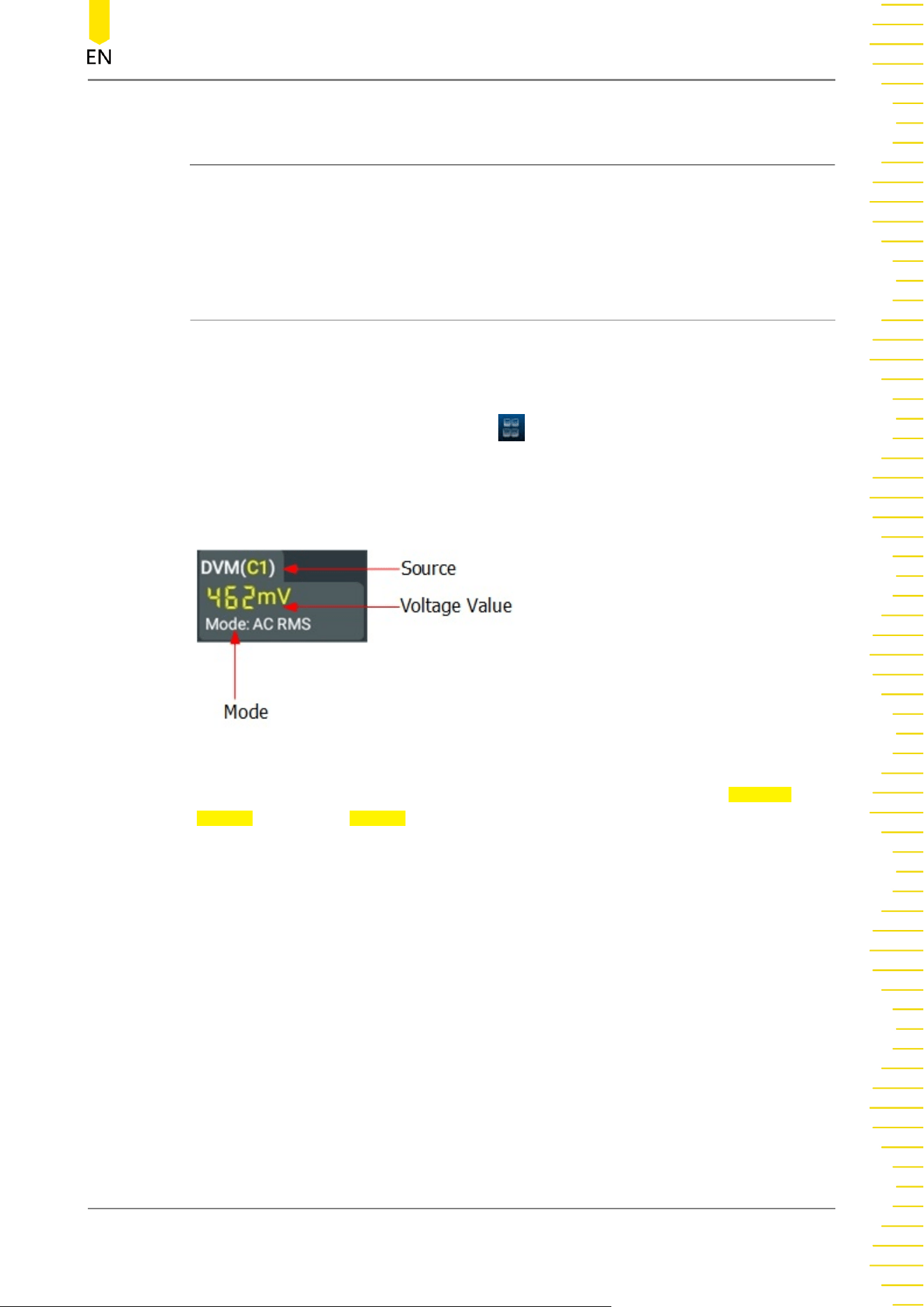
11 Digital Voltmeter (DVM)and Frequency Counter
DS70000 series oscilloscope provides a built-in digital voltmeter (DVM) and frequency
counter, which enable you to perform an accurate measurement, improving user
experience in counter and frequency measurement.
11.1 Digital Voltmeter (DVM)
The built-in DVM of this oscilloscope provides 3-digit voltage measurements on any
analog channel. DVM measurements are asynchronous from the oscilloscope's
acquisition system and are always acquiring.
Click or tap the function navigation icon
at the lower-left corner of the screen to
enable the DVM measurement menu. You can also click or tap the "DVM" icon at the
top of the screen to enable the DVM measurement. At this time, the result list is
displayed at the right section of the screen, showing the voltage and mode. As shown
in the figure below:
The specific value above shows the measurement extrema over the last 3 seconds.
Click or tap the DVM result list, and then two sub-menus are displayed: Remove and
Setting. Click or tap Setting to enter the DVM setting menu.
Digital Voltmeter (DVM)and Frequency Counter
Copyright ©RIGOL TECHNOLOGIES CO., LTD.
All rights reserved.
DS70000 User Guide
185
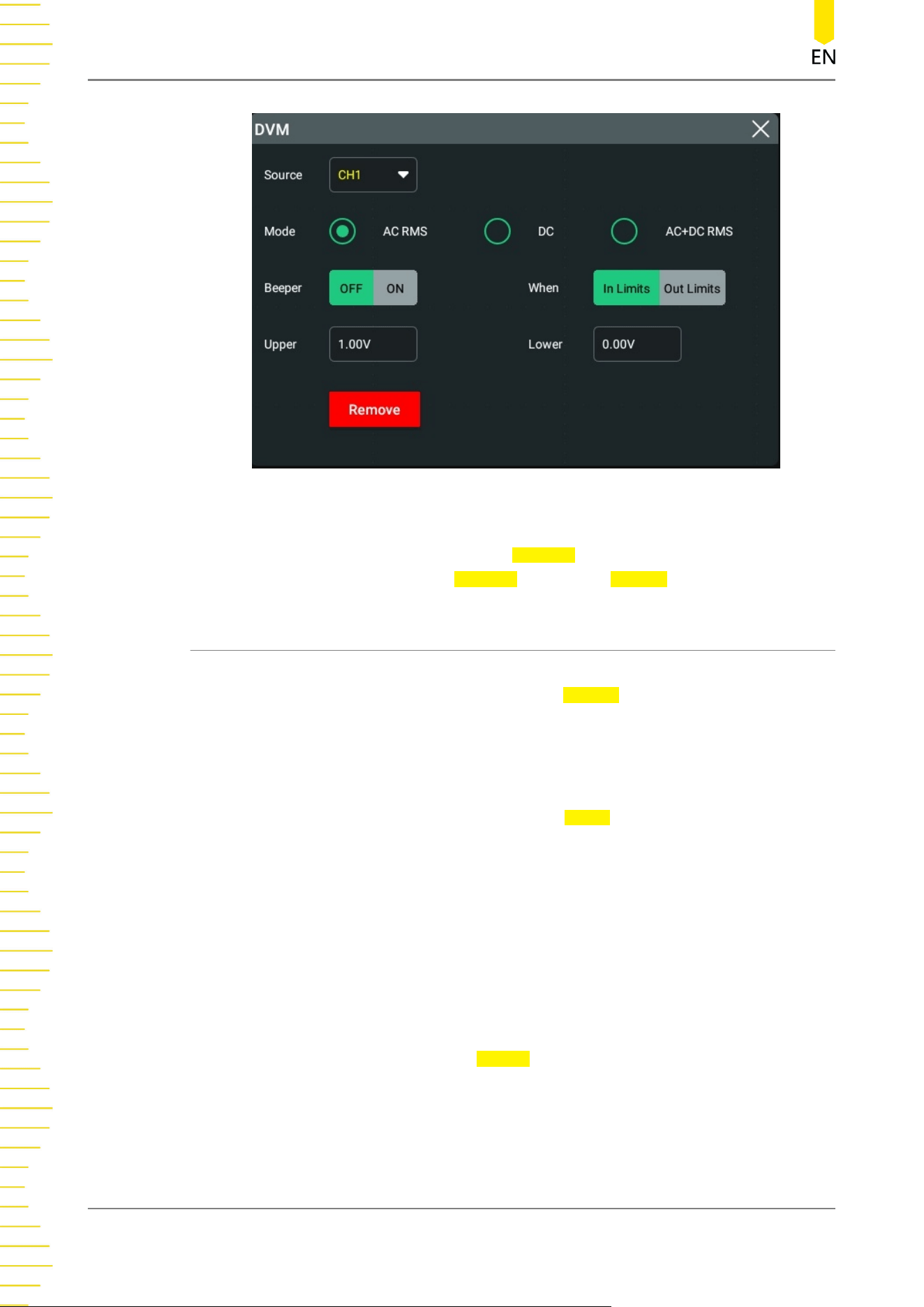
Figure 11.1 DVM Setting Menu
To exit the DVM setting menu, click or tap Remove shown at the left side of the DVM
result list. You can also click or tap Remove in the DVM Setting menu.
11.1.1 Measurement Settings
After the DVM is enabled, the DVM result list displayed at the right section of the
screen. Click or tap the result list, and then select Setting. Then the DVM interface is
displayed. You can set the DVM parameters such as measurement source, mode, and
limit value setting.
Select Measurement Mode
Click or tap to select the desired mode under the Mode menu. The DVM
measurement modes include AC RMS, DC, and AC+DC RMS.
• AC RMS: displays the root-mean-square value of the acquired data, with the DC
component removed.
• DC: displays the average value of the acquired data.
• AC+DC RMS: displays the root-mean-square value of the acquired data.
Select the Measurement Source
Click or tap the drop-down button of Source to select the desired source from the
drop-down list. The analog channel (CH1-CH4) can be selected to be the
measurement source.
Even if the analog channel (CH1-CH4) is not enabled, you can still perform the DVM
measurement.
Digital Voltmeter (DVM)and Frequency Counter
DS70000 User Guide
186
Copyright ©RIGOL TECHNOLOGIES CO., LTD.
All rights reserved.
Set the Limits
When setting the limits, you can select when to turn on or off the beeper once it
reaches the limit line.
• Limits Condition Setting
Click or tap to select the desired condition under the When menu. The limits
conditions include "In Limits" and "Out Limits".
- In Limits: when the voltage value is within the limits, you can enable or
disable the beeper to sound an alarm.
- Out Limits: when the voltage value is outside of the limits, you can enable
or disable the beeper to sound an alarm.
• Upper/Lower Limit Setting
Click or tap the input field of Upper, then use the pop-up numeric keypad to set
the upper limit of the voltage.
Click or tap the input field of Lower, and then use the pop-up numeric keypad to
set the lower limit of the voltage.
11.1.2 Remove the Measurement
Click or tap the DVM result list, and then two menu items are displayed at its left side.
Click or tap Remove to clear the measurement result. Then the DVM result list is
disappeared. You can also click or tap Remove in the DVM setting menu shown by
clicking or tapping Setting at the left side of DVM result list.
11.2 Frequency Counter
The frequency counter analysis function provides frequency, period, or edge event
counter measurements on any analog channel.
Click or tap the function navigation icon
at the lower-left corner of the screen to
enable the frequency counter. You can also click or tap the "Counter" icon at the top
of the screen to enable the frequency counter. At this time, the result list is displayed
at the right section of the screen, showing the current measurement results of the
frequency counter. As shown in the figure below:
Digital Voltmeter (DVM)and Frequency Counter
Copyright ©RIGOL TECHNOLOGIES CO., LTD.
All rights reserved.
DS70000 User Guide
187
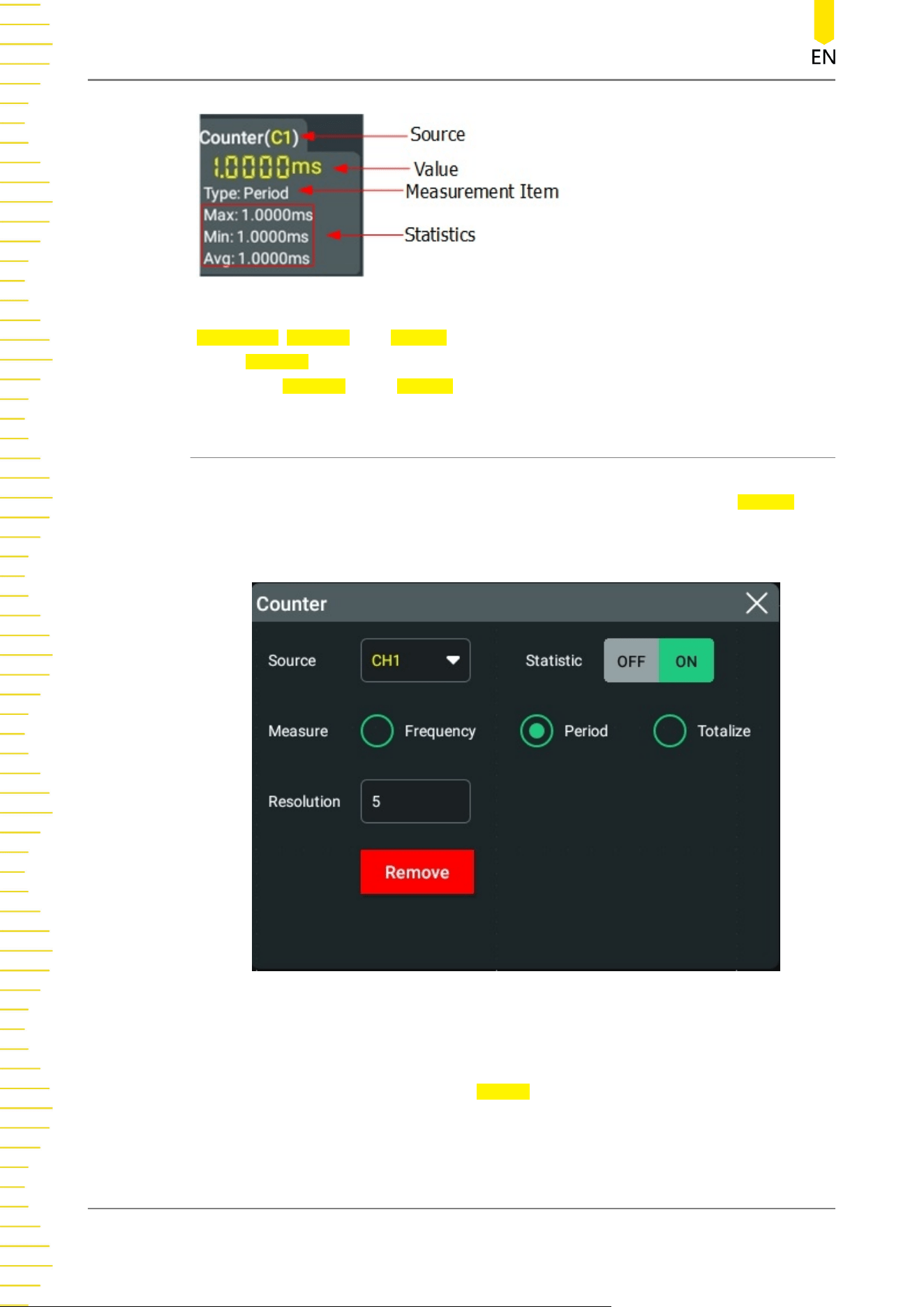
Click or tap the frequency counter result list, and then three sub-menus are displayed:
Reset Stat., Remove, and Setting. To exit the frequency counter setting menu, click
or tap Remove shown at the left side of the frequency counter result list. You can also
click or tap Remove in the Setting menu of the frequency counter.
11.2.1 Measurement Settings
After the frequency counter is enabled, the frequency counter result list displayed at
the right section of the screen. Click or tap the result list, and then select Setting.
Then the frequency counter interface is displayed. You can set the parameters such as
measurement source, measurement item, and resolution.
Figure 11.2 Frequency Counter Setting Menu
Select the Measurement Source
Click or tap the drop-down button of Source to select the desired source from the
drop-down list. Analog channels (CH1-CH4) and EXT can be selected as the source of
the frequency counter.
Digital Voltmeter (DVM)and Frequency Counter
DS70000 User Guide
188
Copyright ©RIGOL TECHNOLOGIES CO., LTD.
All rights reserved.
Set Resolution
For Period and Frequency measurements, you need to set the readout resolution.
Click or tap the input field of Resolution to set the resolution by using the pop-up
numeric keypad. The range of resolution is from 3 bits to 8 bits. By default, it is 5 bits.
The greater the resolution, the longer the gate time. In this way, the measurement
time will be longer.
Select the Measurement Item
The measurement items supported by the frequency counter of this oscilloscope
include Frequency, Period, and Totalize measurements. Wherein, Totalize indicates the
count of edge events on the signal.
Select the desired measurement item from the Measure menu: Frequency, Period,
and Totalize.
Clear Count
When "Totalize" is selected as the measurement item, the oscilloscope measures the
count of edge events on the signal. At this time, click or tap Clear Count to clear the
measurement results.
Statistics Results
Click or tap the ON/OFF button for the Statistic item to enable/disable the statistical
function. When enabled, all the statistical results will be displayed in the "frequency
counter" result list.
11.2.2 Reset Statistics
Click or tap Reset Stat. to reset the statistics.
11.2.3 Remove the Measurement
Click or tap the frequency counter result list, and then three menu items are displayed
at its left side. Click or tap Remove to clear the measurement result. The frequency
counter result list is disappeared. You can also click or tap Remove in the counter
setting menu shown by clicking or tapping Setting at the left side of the frequency
counter result list.
Digital Voltmeter (DVM)and Frequency Counter
Copyright ©RIGOL TECHNOLOGIES CO., LTD.
All rights reserved.
DS70000 User Guide
189
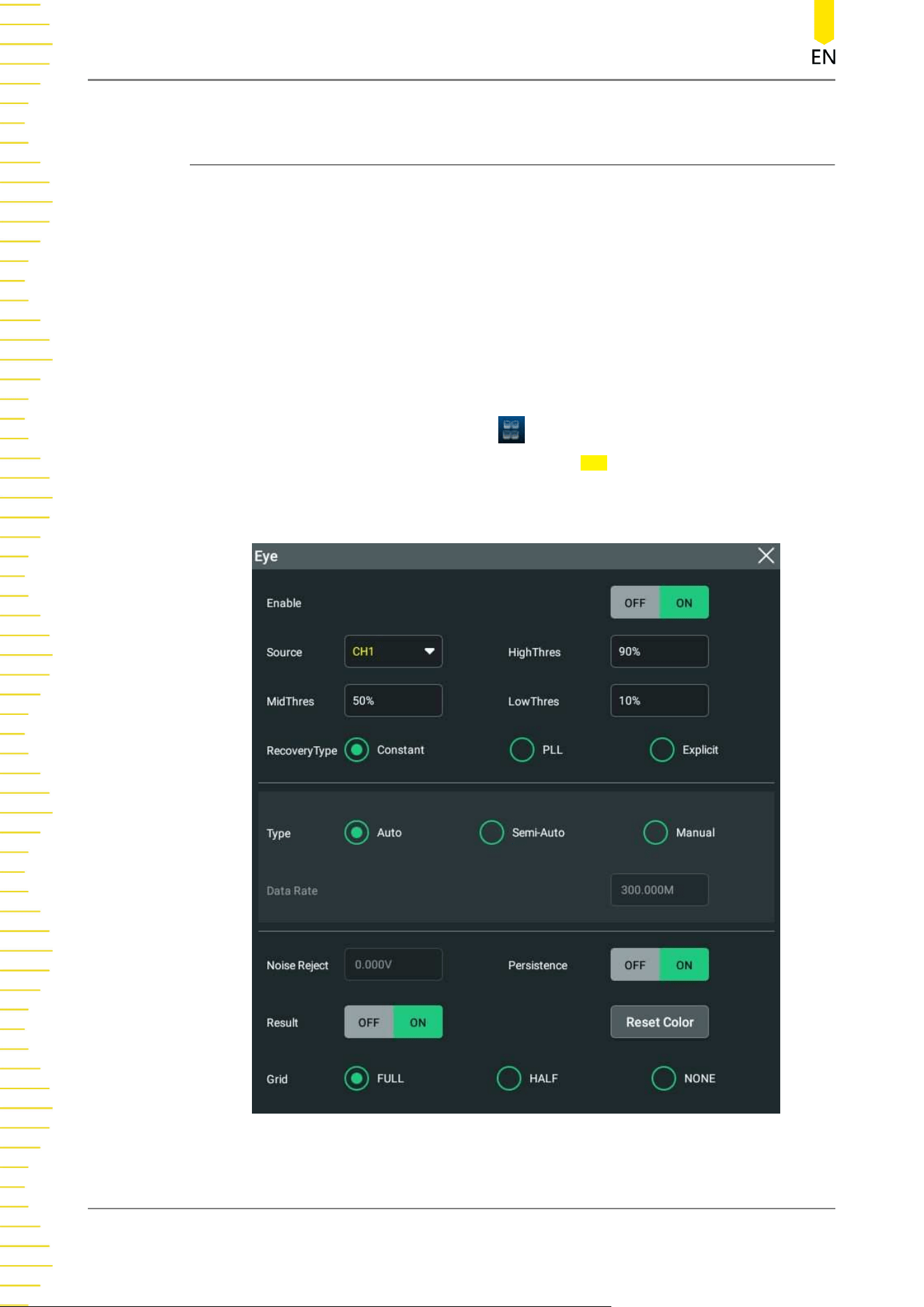
12 Real-time Eye Analysis (Option)
The DS70000 series oscilloscope provides the real-time eye plot and measurement
with the clock recovery function. If you have purchased and activated the DS70000-
JITTA option, the oscilloscope also supports the real-time eye diagram function.
An eye diagram is a view of a signal. A real- time eye accomplishes this by acquiring
data, performing clock recovery, then superimposing (folding) successive unit
intervals within a single plot. This is a statistical view in the form of a color grade. The
eye analysis function is usually used to observe the waveforms of the Receive signal
to analyze the impact of inter-symbol interference (ISI) and noise on the system
performance.
Click or tap the function navigation icon
at the lower-left corner of the screen to
open the function navigation. Then, click or tap the Eye icon to enter the "Eye" setting
menu. You can also click or tap the "Eye" icon at the top of the screen to enter the
"Eye" setting menu.
Figure 12.1 Eye Diagram Setting Menu
Real-time Eye Analysis (Option)
DS70000 User Guide
190
Copyright ©RIGOL TECHNOLOGIES CO., LTD.
All rights reserved.
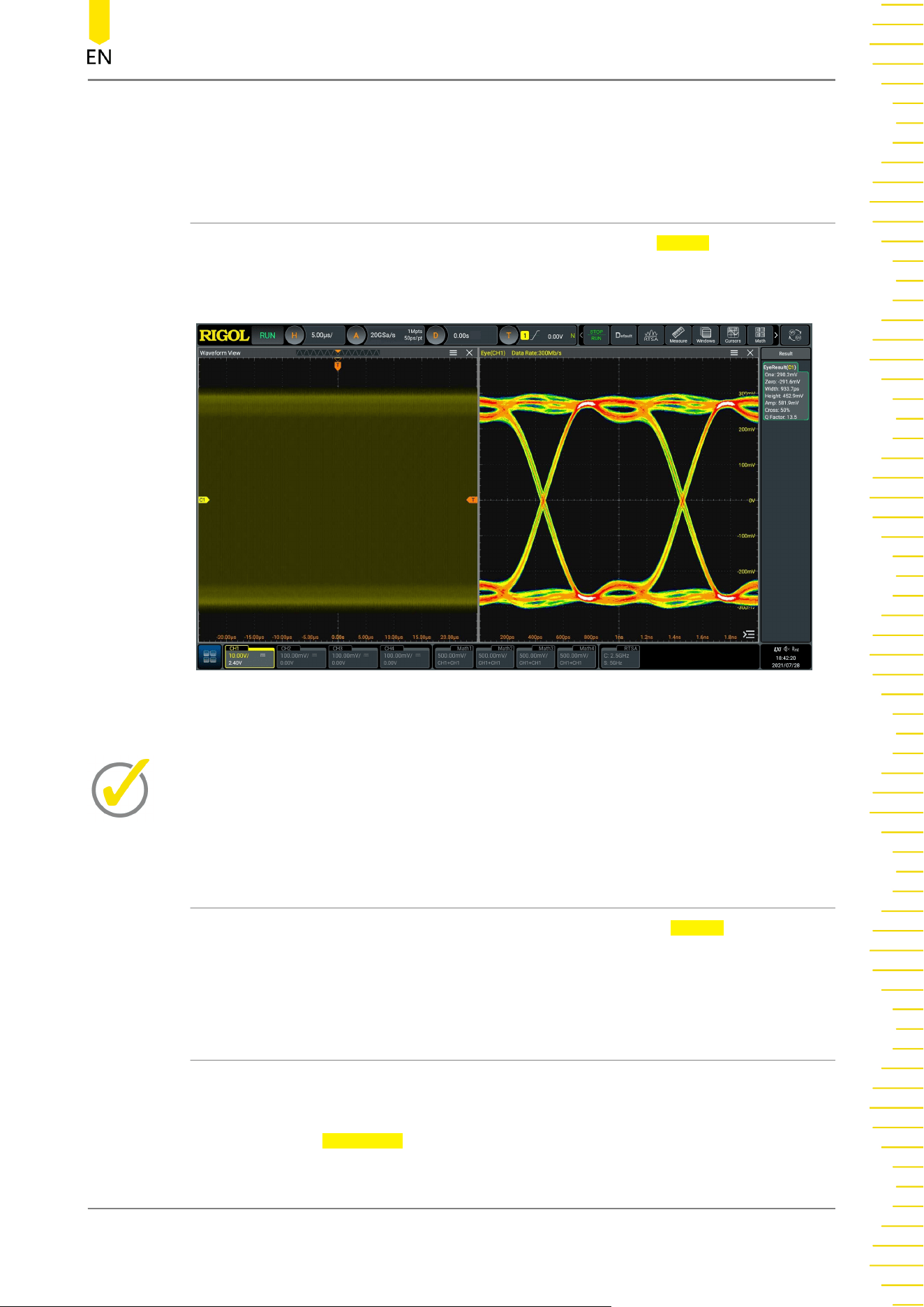
If you have purchased the decoding option, activate it according the descriptions in
To View the Option Information and the Option Installation
.
12.1 To Enable or Disable the Eye Analysis Function
In the "eye" setting menu, click or tap the ON/OFF tab for the Enable menu to enable
or disable the eye analysis function. When enabled, the eye diagram window is
displayed on the screen.
Figure 12.2 Eye Measurement Result
Tip
The eye diagram can only be obtained when the horizontal time base is less than or equal to 1
ms/div.
12.2 To Select the Source of the Eye Diagram
In the "Eye" setting menu, click or tap the drop-down button of Source to select the
desired source from the drop-down list. The analog channel (CH1-CH4) can be
selected to be the eye source.
12.3 Threshold Settings
In the eye setting menu, you can set the high, middle, and low threshold values.
• Set the high threshold
Click or tap HighThres, then use the pop-up numeric keypad to set the high
threshold.
Real-time Eye Analysis (Option)
Copyright ©RIGOL TECHNOLOGIES CO., LTD.
All rights reserved.
DS70000 User Guide
191
If you reduce the high threshold to a value below the set middle threshold, the
oscilloscope will adjust the high threshold automatically to make it greater than
the middle threshold.
• Set the middle threshold
Click or tap the input field of MidThres, then use the pop-up numeric keypad to
set the middle threshold.
The middle threshold is limited by the set low threshold and high threshold.
• Set the low threshold
Click or tap LowThres, then use the pop-up numeric keypad to set the low
threshold.
If you increase the low threshold to a value above the set middle threshold, the
oscilloscope will decrease the low threshold automatically to make it smaller
than the middle threshold.
12.4 To Set Clock Recovery
The clock recovery provides an ideal clock for comparison to actual signal edges.
In the "Eye" setting menu, click or tap Constant, PLL, or Explicit under the
RecoveryType menu.
1 Setting method for constant clock recovery
Click or tap to select "Constant" in the RecoveryType menu.
- Set the data rate type.
Click or tap to select the desired data rate type under the Type menu. The data
rate type for Constant includes Auto, Semi-Auto, and Manual.
- Auto: recovers the clock based on the narrowest pulse of the signal.
- Semi-Auto: recovers the clock by the manually preset data rate and the
signal edge.
- Manual: recovers the clock by the data rate input manually.
- Set the data rate
Click or tap the input field of Data Rate, then use the pop-up numeric keypad
to set the data rate.
2 Setting method for phase-locked loop (PLL)
Click or tap to select "PLL" in the RecoveryType menu.
- Set the data rate
Real-time Eye Analysis (Option)
DS70000 User Guide
192
Copyright ©RIGOL TECHNOLOGIES CO., LTD.
All rights reserved.
Click or tap the input field of Data Rate, then use the pop-up numeric keypad
to set the data rate.
- Set the PLL order
This oscilloscope supports first-order PLL and second-order PLL. Select "1st
Order" or "2nd Order" from the PLL Order menu.
- Set the loop BW
Click or tap the input field of Loop BW to set the loop bandwidth by using the
pop-up numeric keypad.
- Set the damping factor
When PLL order is set to "2nd Order", you need to set the damping factor. It is
the damping factor of the transfer function. Click or tap the input field of
DampFactor to set the damping factor by using the pop-up numeric keypad.
The typical damping factor is 1.0 and 0.707. The former is critically damped, and
the latter is the ideal or optimal value.
3 Setting method for external clock recovery
Click or tap to select "Explicit" in the RecoveryType menu.
Click or tap the drop-down button of Source to select the desired source from the
drop-down list. The analog channel (CH1-CH4) can be selected to be the source of
the external clock.
12.5 To Set the Data Rate
In the eye setting menu, you can set the data rate type and data rate.
Type
Click or tap the data rate type: Auto, Semi-Auto, and Manual.
Data Rate
When the data rate type is set to "Semi-Auto" or "Manual", you can set the data rate.
Click or tap the input field of Data Rate and use the pop-up numeric keypad to set
the data rate. Its range is from 100 k to 4 G. Its default value is 10 M.
12.6 Eye Measurement Result
In the "eye" setting menu, click or tap the ON/OFF tab for the Result menu to enable
or disable the display of the measurement results. When enabled, the "Result" list at
the right side of the screen shows the eye measurement result.
Real-time Eye Analysis (Option)
Copyright ©RIGOL TECHNOLOGIES CO., LTD.
All rights reserved.
DS70000 User Guide
193
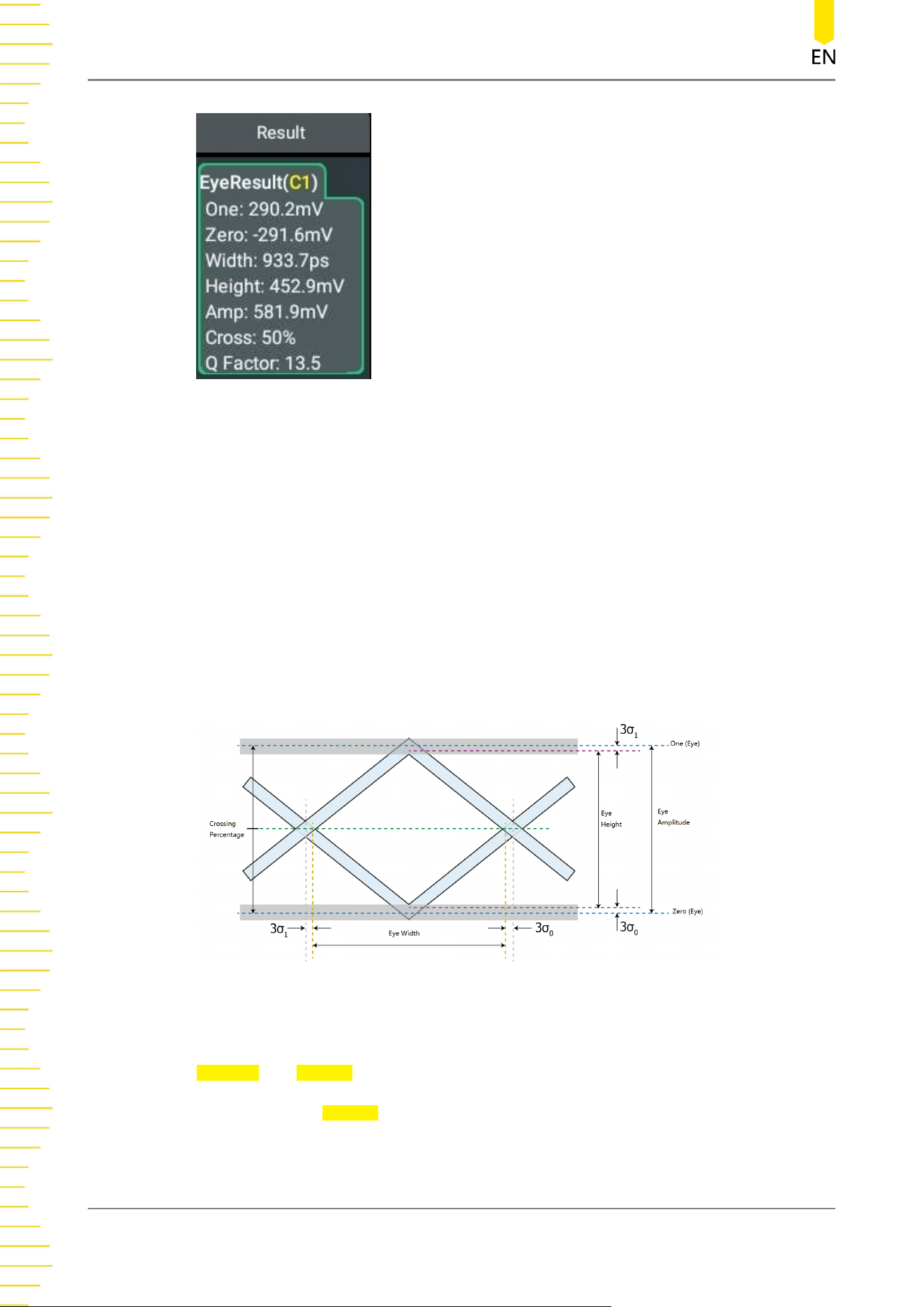
• One: indicates "1" level.
• Zero: indicates "0" level.
• Width: indicates the width of an eye diagram.
• Height: indicates the height of an eye diagram.
• Amp: indicates the amplitude of an eye diagram.
• Cross: indicates the crossing percentage of an eye diagram.
• Q Factor: indicates the Q factor.
The diagram of the eye measurement parameters are as shown in the figure below:
Figure 12.3 Diagram of Eye Measurement Parameters
Click or tap the eye measurement result list, and then two sub-menus are displayed:
Remove and Setting.
• Click or tap Setting, then the eye diagram menu is displayed, as shown in
Figure
12.1
Real-time Eye Analysis (Option)
DS70000 User Guide
194
Copyright ©RIGOL TECHNOLOGIES CO., LTD.
All rights reserved.
• To close the measurement result list, click or tap Remove.
12.7 To Set the Display-related Parameters
Noise Rejection
Noise rejection can eliminate the burst glitch in the actual circuit. The noise rejection
is set automatically by the system and cannot be modified manually.
Persistence
Click or tap the ON/OFF tab for the Persistence menu to enable or disable the
persistence function.
Reset Color
Click or tap Reset Color to clear the color level counter.
Grid
Sets the Grid of the instrument. For details, refer to
To Set the Screen Grid
.
Real-time Eye Analysis (Option)
Copyright ©RIGOL TECHNOLOGIES CO., LTD.
All rights reserved.
DS70000 User Guide
195
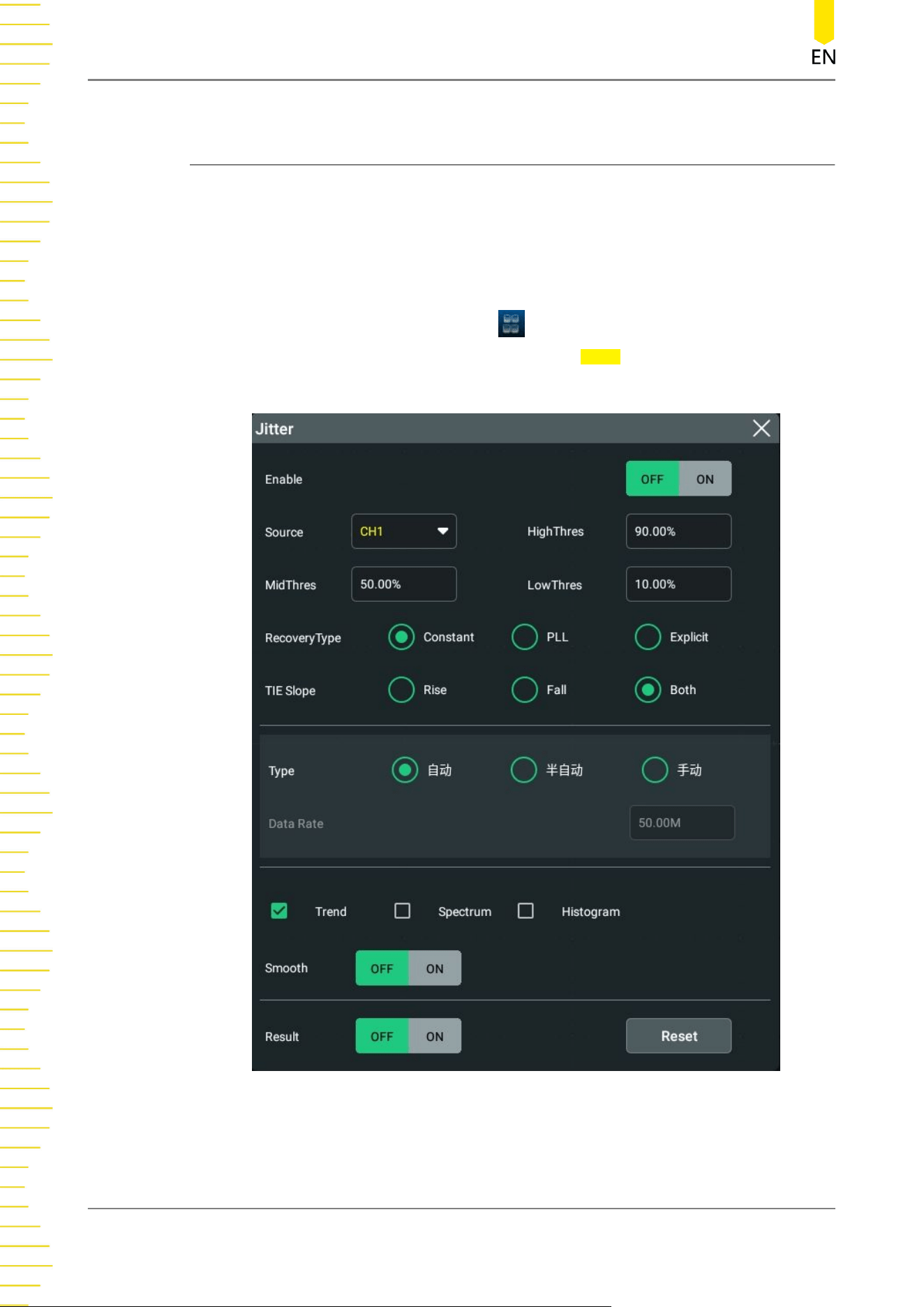
13 Jitter Analysis (Option)
The jitter analysis function is mainly used to analyze the integrity of the high-speed
serial signal and measure the variance of a measurement over time. The measurement
items include total jitter (TJ), random jitter (RJ), deterministic jitter (DJ), period jitter
(PJ), data-dependent jitter (DDJ), duty cycle distortion (DCD), inter-symbol
interference (ISI), and bit ratio (BR).
Click or tap the function navigation icon
at the lower-left corner of the screen to
open the function navigation. Then, click or tap the Jitter icon to enter the "Jitter"
setting menu.
Figure 13.1 Jitter Setting Menu
If you have purchased the decoding option, activate it according the descriptions in
To View the Option Information and the Option Installation
.
Jitter Analysis (Option)
DS70000 User Guide
196
Copyright ©RIGOL TECHNOLOGIES CO., LTD.
All rights reserved.
13.1 To Enable or Disable the Jitter Function
In the "jitter" setting menu, click or tap the ON/OFF tab for the Enable menu to
enable or disable the jitter analysis function. When enabled, the jitter diagram
window is displayed on the screen.
13.2 To Set Parameters
In the "Jitter" setting menu, set the following parameters.
Select the Source
Click or tap the drop-down button of Source to select the desired source from the
drop-down list. The analog channel (CH1-CH4) can be selected to be the jitter source.
Threshold Settings
For details about setting the jitter measurement threshold, refer to
Threshold
Settings
.
Set Clock Recovery
For setting methods of the clock recovery in the jitter, refer to descriptions in
To Set
Clock Recovery
.
TIE Slope
TIE indicates the time interval error. The TIE measurement compares the edges in a
data signal with the edges in an ideal data signal determined by the clock recovery
feature to generate error statistics.
Set the Data Rate
For the jitter data rate type and data rate, refer to descriptions in
To Set the Data
Rate
.
To Set the Display Format of the Jitter Measurement Result
The jitter measurement results will be displayed in the jitter window. You can click or
tap to select "Trend", "Spectrum", or "Histogram" as the display format.
• Trend: The trend graph can display the trend of the jitter measurement results.
The data obtained from the waveforms of the same frame are generated to form
a curve, which enables users to find out the cause for jitter.
When the clock recovery method is set to "PLL", the PLL system cannot reach the
expected ideal clock frequency until it reaches the specified lock time. During the
lock time, the TIE jitter measurement results based on the ideal recovery clock
are incorrect. The data produced during this time will be discarded in data
processing. Therefore, in the TIE jitter trend graph based on the PLL recovery,
part of trend graph at the left section of the screen will be lost.
Jitter Analysis (Option)
Copyright ©RIGOL TECHNOLOGIES CO., LTD.
All rights reserved.
DS70000 User Guide
197
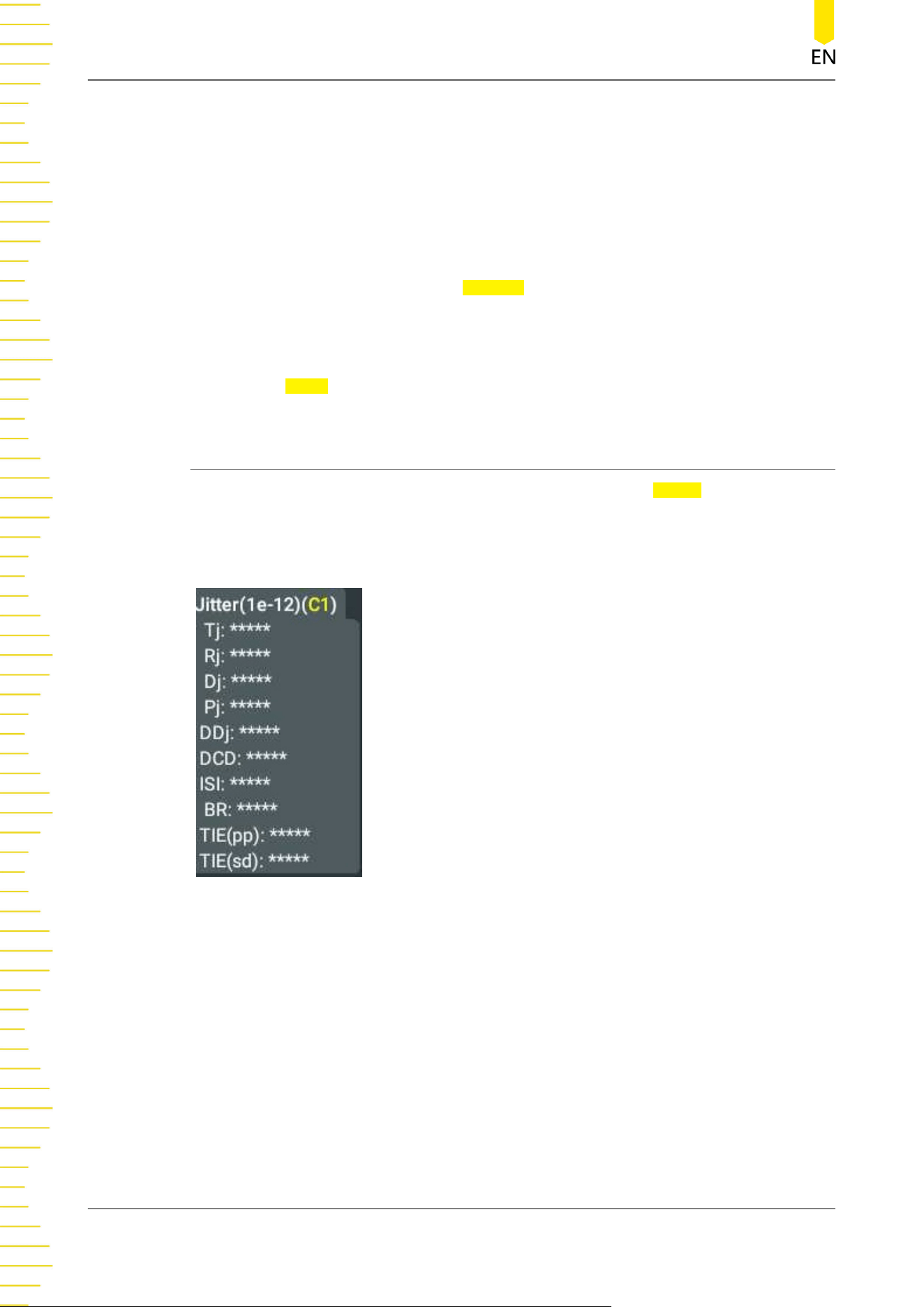
• Spectrum: The spectrum graph shows the waveforms of the trend diagram
through the FFT (Fast Fourier Transform).
• Histogram: The histogram shows the distribution of the jitter measurement
results. Wherein, Gaussian distributions indicates random jitter, and non-
Gaussian jitter has deterministic components.
Smooth
Click or tap the ON/OFF tab for the Smooth menu item to enable/disable the the
smooth operation for the jitter.
Reset
Click or tap Reset, and then the instrument will restart the jitter measurement.
13.3 To View the Jitter Measurement
In the jitter setting menu, click or tap the ON/OFF tab for the Result menu to enable
or disable the display of the jitter measurement results. By default, it is OFF. When
enabled, the jitter measurement results are displayed at the right side of the screen
under the "Result" list.
The measurement results includes the following measurement items:
• Tj: indicates the total jitter.
• Rj: indicates the random jitter. It is compliant with the Gaussian distribution, and
its source can be thermal noise, shot noise, and random noise, with non-
stationary interference.
• Dj: indicates the deterministic jitter. It has non-Gaussian distribution and is
bounded. It is characterized by Gaussian Probability Density Function (PDF) and
in scattered distribution. It may be generated due to the bandwidth, reflection,
crosstalk, EMI, ground bounce, and period modulation.
Jitter Analysis (Option)
DS70000 User Guide
198
Copyright ©RIGOL TECHNOLOGIES CO., LTD.
All rights reserved.
• Pj: indicates the periodic jitter. The TIE time trend of the periodic jitter is
repeated and periodic. It is caused by external deterministic noise sources
coupling into a system, such as measuring teh periodic waveforms, system clock
(with the jitter frequency above MHz level), or switching power supply (with the
jitter frequency above KHz level).
• DDJ: indicates data-dependent jitter. It refers to any jitter that is correlated with
the bit sequence in a data stream. DDJ is often caused by the frequency
response of a cable or device.
• DCD: indicates duty cycle distortion. It is caused by the asymmetrical rise time
and fall time; or the non-optimal choice of reference level. The crossing
percentage in the eye diagram is similar to DCD.
• ISI: indicates the inter-symbol interference. It is also called data-dependent jitter
(DDJ) or pattern-dependent jitter. It is caused by the effects of the transmission
link, reflection, etc.
The signal transmits due to unmatched impedance. The transmitted signal is
superimposed on the original signal, increasing the signal amplitude, causing
more time spent on level conversion. The constant unchanged symbol pattern
will reach a higher level, and more time is required to reach the threshold level
during hopping, causing signal jitter. As the amplitude of the jitter is related to
the pattern, it is also called pattern-dependent jitter (PDJ).
• BR: indicates bit ratio.
Click or tap the jitter measurement result list, and then two sub-menus are displayed:
Remove and Setting.
• Click or tap Setting, then the jitter diagram menu is displayed, as shown in
Figure 13.1
.
• To close the measurement result list, click or tap Remove.
Jitter Analysis (Option)
Copyright ©RIGOL TECHNOLOGIES CO., LTD.
All rights reserved.
DS70000 User Guide
199
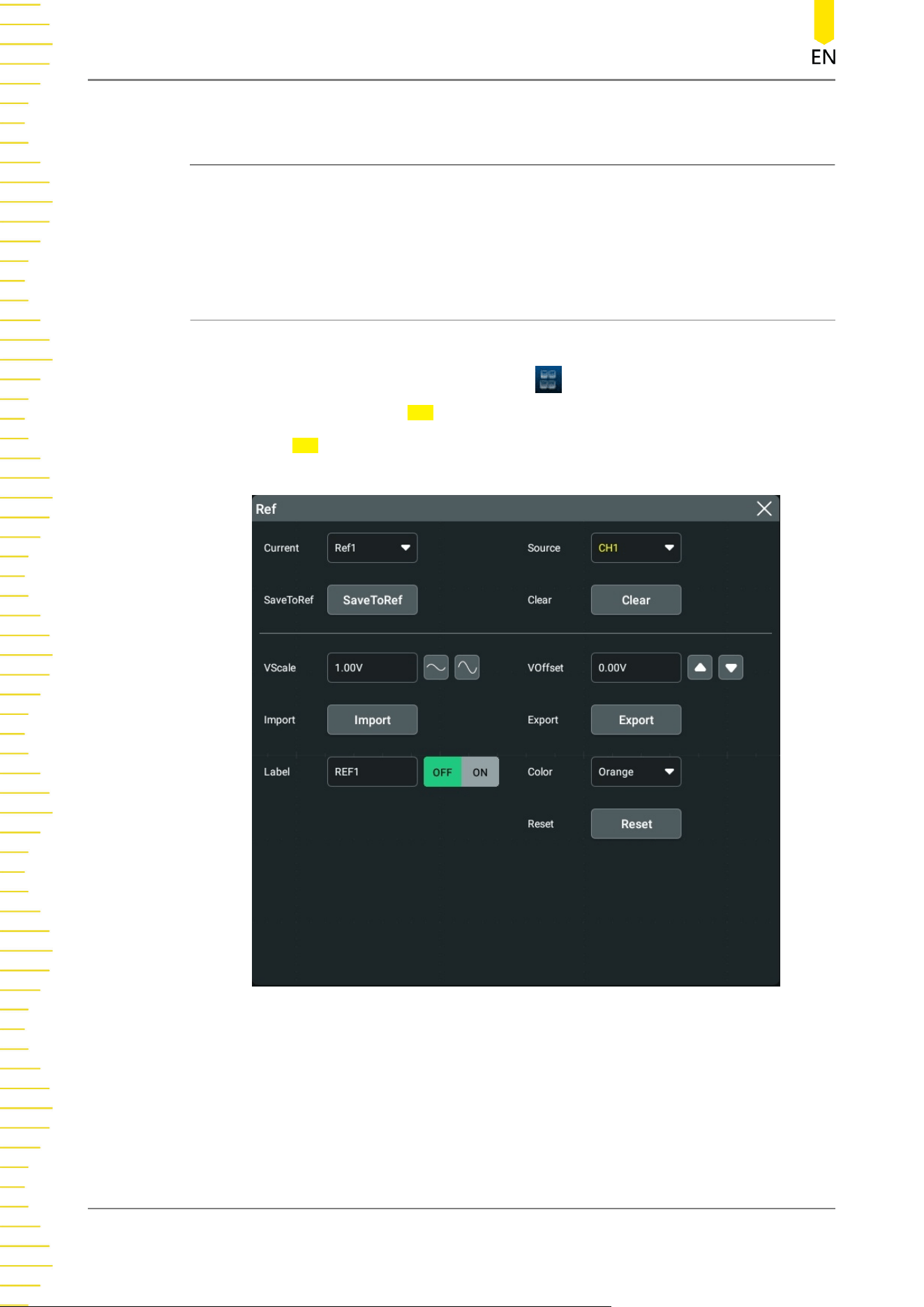
14 Reference Waveform
DS70000 series oscilloscope provides 10 reference waveform positions (Ref1 ~ Ref10).
In the actual test process, you can compare the signal waveform with the reference
waveform to locate the failure.
14.1 To Enable Ref Function
To enter the Ref menu, perform any of the following operations:
• Click or tap the function navigation icon
at the lower-left corner of the
screen, and then select Ref to enter the reference waveform function menu.
• Tap the Ref icon on the small screen at the right side of the screen to enter the
“Ref” menu.
Figure 14.1 Reference Waveform Menu
When the Ref function is enabled, you can select different color for each reference
waveform, set the source of each reference channel, adjust the vertical scale and
offset of the reference waveform, save the reference waveform to the internal or
external memory, and recall it when needed.
Reference Waveform
DS70000 User Guide
200
Copyright ©RIGOL TECHNOLOGIES CO., LTD.
All rights reserved.
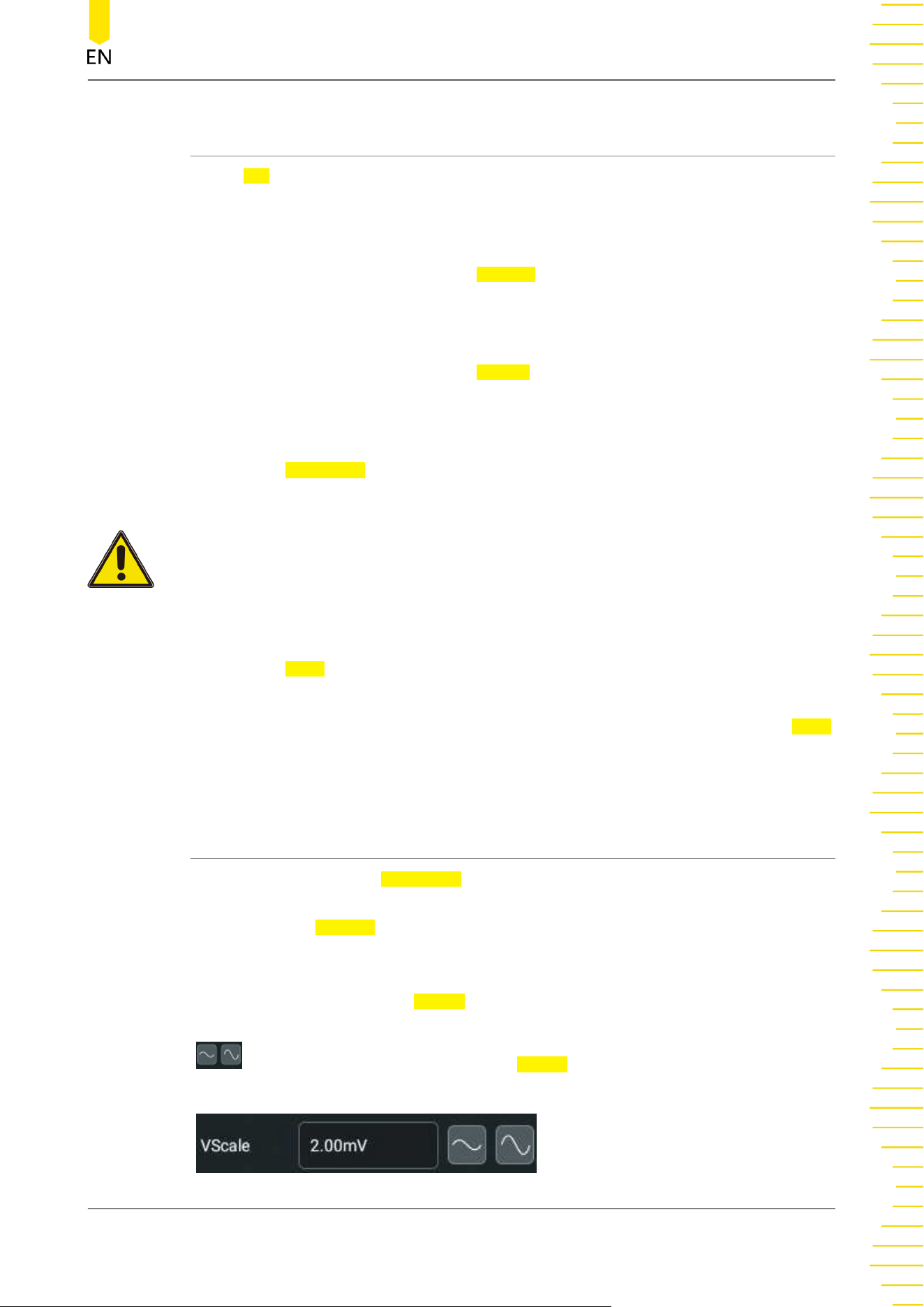
14.2 To Set the Reference Waveform
In the Ref menu, you can specify a channel to serve as the reference channel. You can
save or clear the reference channel.
To Select the Reference Channel
Click or tap the drop-down button of Current to select the reference waveform
channel (Ref1-Ref10) from the drop-down list. By default, Ref1 is enabled.
To Select the Ref Source
Click or tap the drop-down button of Source to select the desired reference
waveform source (CH1~ CH4 or Math1~ Math4).
To Save the Reference Waveform to Internal Memory
Click or tap SaveToRef to save the displayed waveform for the specified source to the
internal memory as the reference waveform.
Caution
This operation only saves the reference waveform to the volatile memory, and the
waveform will be cleared at power-off or restoring to the default settings.
To Clear the Specified Reference Waveform
Click or tap Clear to clear the specified reference waveform for the "current
channel".
You can also click or tap the "Clear" icon in the function navigation menu or the Clear
icon on the small screen to clear the reference waveforms of all the reference
channels.
14.3 To Set the Ref Waveform Display
After clicking or tapping SaveToRef to save the reference waveform to the internal
memory, you can adjust the vertical scale and offset of the reference waveform
specified under Current.
Modify the Vertical Scale
Click or tap the input field of VScale, and then use the pop-up numeric keypad to set
the vertical scale of the reference waveform. You can also directly click or tap the icon
at the right side of the input field of VScale to increase or decrease the vertical
scale value. As shown in the figure below:
Reference Waveform
Copyright ©RIGOL TECHNOLOGIES CO., LTD.
All rights reserved.
DS70000 User Guide
201
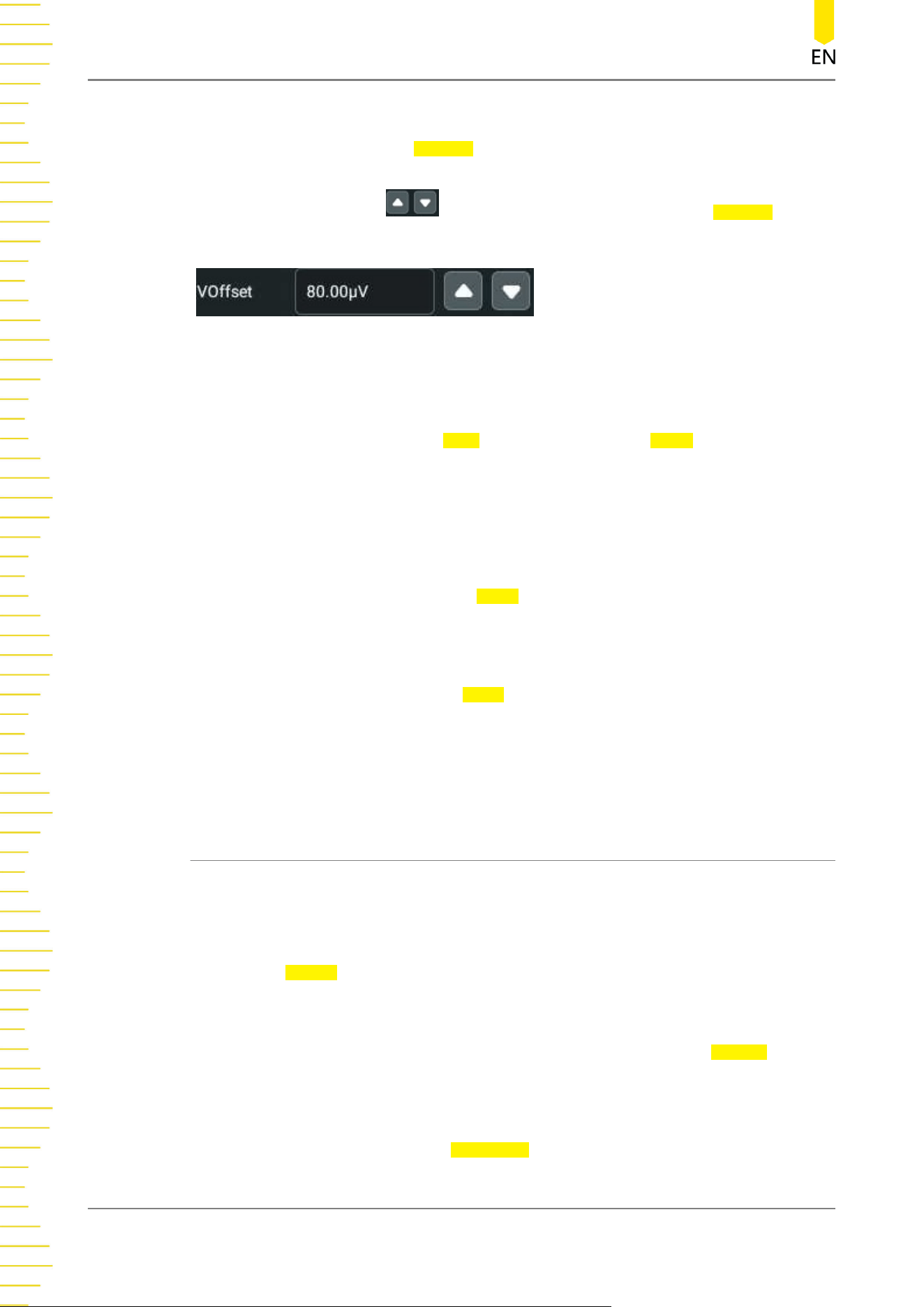
Modify the Vertical Offset
Click or tap the input field of VOffset, and then use the pop-up numeric keypad to
set the vertical offset of the reference waveform. You can also directly click or tap the
Up and Down arrow icon at the right side of the input field of VOffset to
increase or decrease the vertical offset value. As shown in the figure below:
Restore the Reference Waveform
If you have adjusted the vertical scale and offset for the specified reference waveform
of the current channel, to reset the reference waveform to the position where the
source channel stays prior to the Save operation, click or tap Reset.
Set the Reference Waveform Color
DS70000 series oscilloscope provides five colors (gray, green, light blue, red, and
orange) to mark the reference waveforms of different channels in order to distinguish
them.
Click or tap the drop-down button of Color to select the color of the reference
waveform of the channel.
Set the Reference Waveform Label
Click or tap the ON/OFF tab for the Label menu to enable or disable the label display
of the specified reference waveform.
Click or tap the input field of "Label" to set the label of the specified reference
channel with the pop-up numeric keypad.
14.4 Export and Import Operation
To Export to Internal or External Memory
You can save the current reference waveform to the internal memory or external USB
storage device. The file format of the reference waveform is "*.ref", "*.bin", or "*.csv".
Click or tap Export to enter the reference waveform file saving interface.
• Set the Format
In the file saving interface, click or tap the drop-down button of Format to select
"*.ref", "*.bin", or "*.csv" as the saving format.
• Set the Filename
Click or tap the input field of
File Name, then the filename editing interface is
displayed. Input the filename with the pop-up numeric keypad.
Reference Waveform
DS70000 User Guide
202
Copyright ©RIGOL TECHNOLOGIES CO., LTD.
All rights reserved.
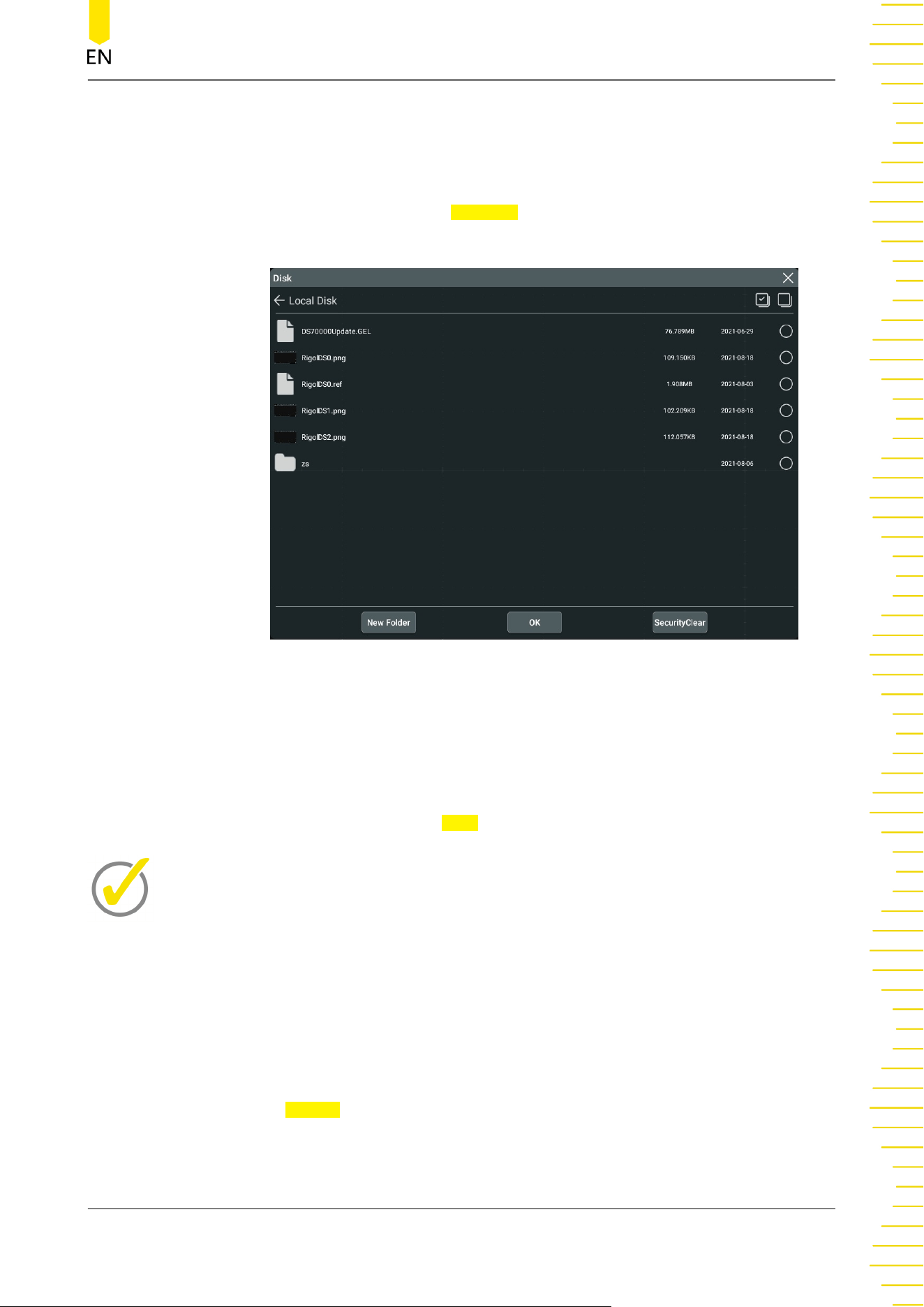
For the methods of using the numeric keypad, refer to descriptions in
Parameter
Setting Method
.
• Set the Save Path
Click or tap the input field of File Path, then the disk management interface is
displayed. The interface is shown in the following figure:
Figure 14.2 Disk Management Interface
Through the disk management menu, you can save the current reference
waveform to the internal memory or external USB storage device. Only when the
reference waveform is saved, can this export function be valid. For details about
the disk management operation, refer to the
Disk Management
section in
Store
and Load
. Then, click or tap Save to complete the save operation.
Tip
DS70000 series oscilloscope only supports the flash memory USB storage device of FAT32
format.
For the "*.bin" format file, refer to
Binary Data Format (.bin)
.
To Import from Internal or External Memory
You can import the stored reference waveform file from the internal memory or
external USB storage device to the internal instrument and display the file on the
screen.
Click or tap
Import to enter the reference waveform file loading interface.
• Set the Format
Reference Waveform
Copyright ©RIGOL TECHNOLOGIES CO., LTD.
All rights reserved.
DS70000 User Guide
203
In the file loading interface, click or tap the drop-down button of Format to
select "*.ref" as the loading format.
• Set the Load Path
Click or tap the input field of File Path, then the disk management interface is
displayed.
Through the disk management menu, you can load the current reference
waveform to the waveform view of the oscilloscope. For details about the disk
management operation, refer to the
Disk Management
section in
Store and
Load
. Then, click or tap Load to complete the load operation.
Reference Waveform
DS70000 User Guide
204
Copyright ©RIGOL TECHNOLOGIES CO., LTD.
All rights reserved.
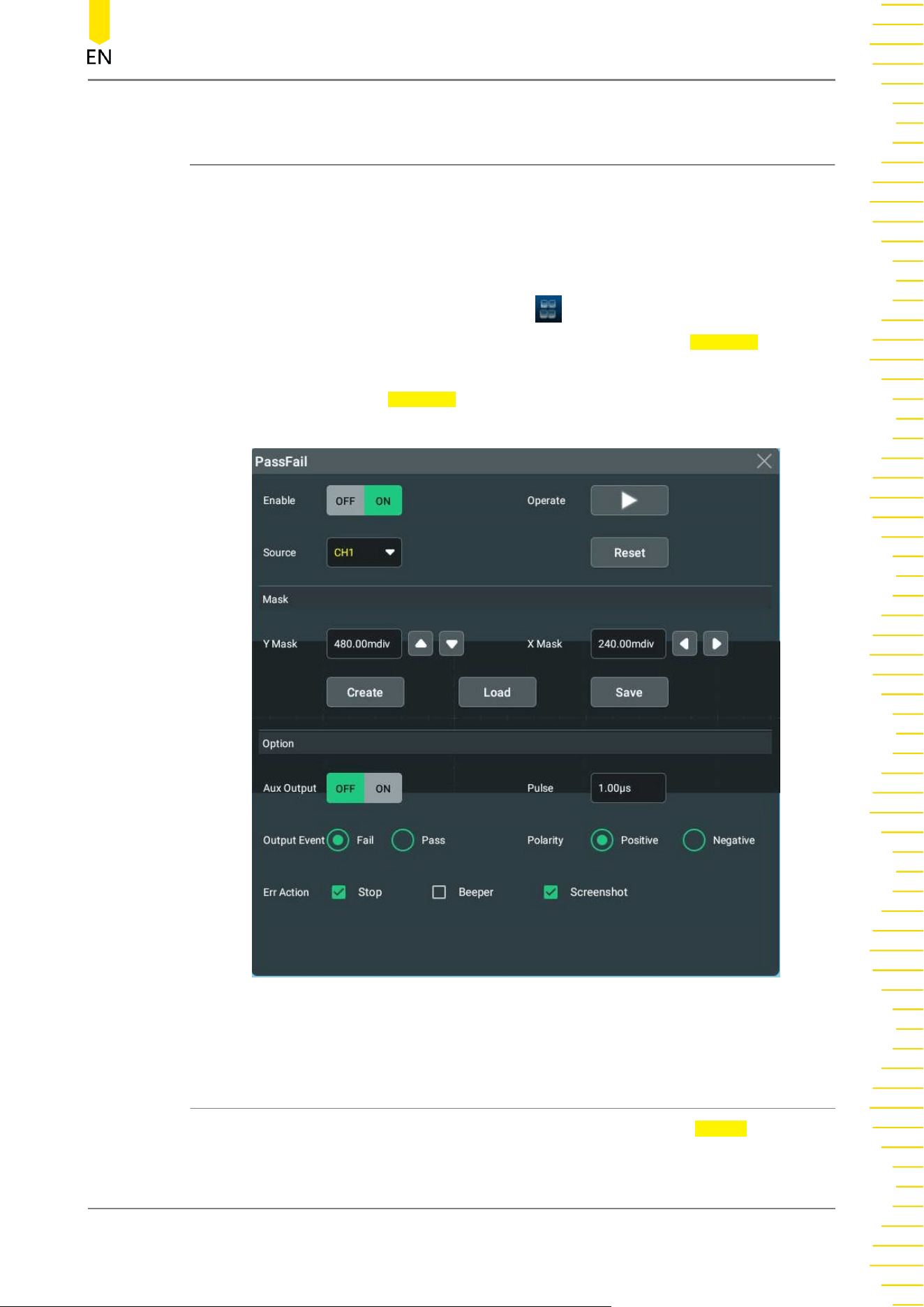
15 Pass/Fail Test
During the product design and manufacturing process, you usually need to monitor
the variations of the signal or judge whether the product is up to standard. The pass/
fail test function of DS70000 series oscilloscope can accomplish this task perfectly.
To enter the Pass/Fail menu, perform any of the following operations:
• Click or tap the function navigation icon
at the lower-left corner of the
screen to open the function navigation. Then, click or tap the Pass/Fail icon to
enter the "Pass/Fail" setting menu.
• You can also tap the Pass/Fail icon on the small screen to enter the "Pass/Fail"
setting menu.
Figure 15.1 Pass/Fail Test Menu
15.1 To Enable or Disable the Pass/Fail Test Function
In the "Pass/Fail" setting menu, click or tap the ON/OFF tab for the Enable menu to
enable or disable the pass/fail test function.
Pass/Fail Test
Copyright ©RIGOL TECHNOLOGIES CO., LTD.
All rights reserved.
DS70000 User Guide
205
15.2 To Start or Stop the Pass/Fail Test Operation
After the Pass/Fail test function is enabled, click or tap Operate to start or stop the
test operation.
During the test process, the oscilloscope will test the waveforms, display the test
information, and output the test information based on the current of settings. You
can set the test mask, the display status of the test information, and the output form
of a pass/ failed test based on the selected source channel for the test. Then save the
test mask range to the internal or external memory, and then recall it when needed.
Tip
• Only when the pass/fail test function is enabled, can you start or stop the pass/fail test
operation, enable or disable the display of the test information, save and recall the test
mask range.
• After starting the test operation, you can neither modify the source channel nor adjust
the test mask.
The "Pass/Fail" result will be displayed at the right side of the screen under the
"Result" list.
15.3 To Select the Source
Click or tap the drop-down button of Source to select the desired source from the
drop-down list. The available output channels include CH1-CH4.
15.4 Mask
In the Pass/Fail menu, You can self-define the mask of the pass/fail test.
To Create a Mask
Click or tap Create to self-define the mask of the pass/fail test.
Click or tap X Mask and Y Mask respectively to set the horizontal tolerance range
and vertical tolerance range with the pop-up numeric keypad. Then click or tap
Create to apply the currently created mask (the region not covered by blue within the
screen).
To Load a Mask
When the pass/fail test function is enabled, you can load the test mask files from the
internal memory or external USB storage device (when detected) and apply them to
the current pass/fail test function.
Click or tap Load to enter the file loading interface. Click or tap the input field of File
Path to load the specified test mask files (in *.pf format) and apply them to the
Pass/Fail Test
DS70000 User Guide
206
Copyright ©RIGOL TECHNOLOGIES CO., LTD.
All rights reserved.
current pass/fail test function. For details, refer to descriptions in
Disk Management
section in
Store and Load
.
Save the Mask
When the pass/fail test function is enabled, you can save the current test mask range
to the internal memory or external USB storage device (when detected) in "*.pf"
format.
Click or tap Save to enter the file saving interface. Click or tap the input field of File
Name and File Path to input the filename and select the desired file path to save the
test mask file to the internal or external memory. For details, refer to descriptions in
Disk Management
section in
Store and Load
.
15.5 To Set the Output Form of the Test Results
In the Option menu, you can set what the oscilloscope will execute when test results
are detected according to your needs.
Set the output event and Aux output
• Click or tap the ON/OFF tab for the Aux Output to enable or disable the Aux
output. When enabled, in the Utility menu, the sub-menu AUX Out is
automatically set to "PassFail". When a successful or failed event test is detected,
a pulse will be output from the [AUX OUT] connector. If disabled, the sub-menu
AUX Out is automatically set to "TrigOut", and the output of the [AUX OUT]
connector is irrelevant with the pass/fail test.
• Click or tap "Pass" or "Fail" under Output Event.
Set the output polarity and output pulse width
Click or tap "Positive" or "Negative" under Polarity, then click or tap the input field of
Pulse to set the pulse width. Its range is from 100 ns to 10 ms. By default, it is 1 μs.
Set the error action
Click or tap the check box of Err Action to select one operation that the oscilloscope
will execute once a pass/fail test is detected.
• Stop: indicates stopping test when a a pass/fail test event is found.
• Beeper: indicates that the beeper sounds an alarm when a pass/fail test event is
found (irrelevant with the on/off status of the beeper).
• Screenshot: performs the screenshot operation when a pass/fail test event is
found. If an external storage device is detected, the screenshot will be saved to
the external storage device directly. Otherwise, it will be saved to the local disk.
Pass/Fail Test
Copyright ©RIGOL TECHNOLOGIES CO., LTD.
All rights reserved.
DS70000 User Guide
207
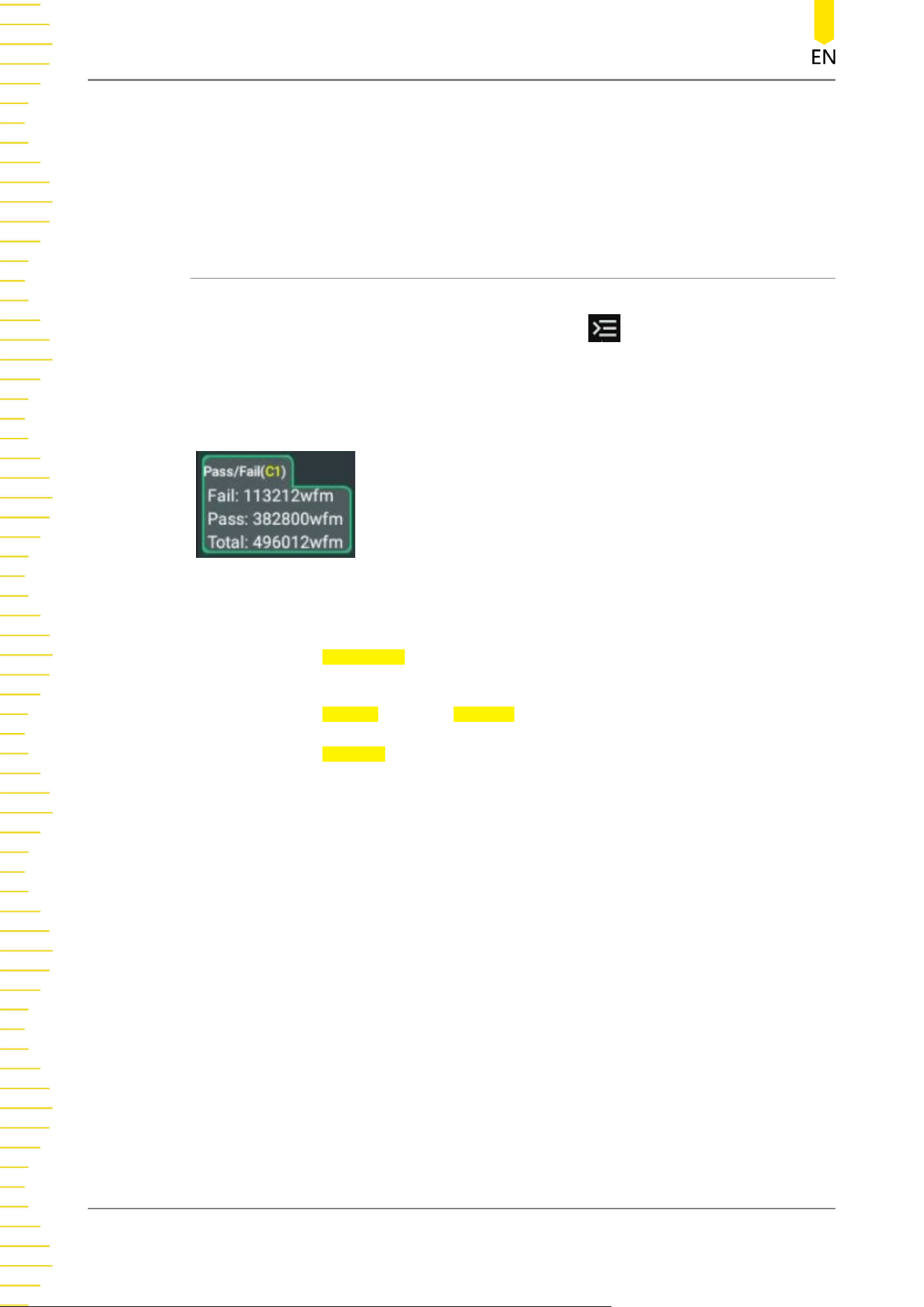
If "Screenshot" is selected, "Stop" action will be executed forcibly. The test will be
stopped automatically. After the Screenshot operation is completed, the test will
continue.
15.6 To Enable or Disable the Display of the Statistics of
the Test Results
After the "Pass/Fail" function is enabled, the test result list will be displayed at the
right side of the screen. You can click or tap the icon
at the lower-right corner of
the screen to hide the test result list.
The test results statistics include the number of failed frames, the number of
successful frames, and total number of frames, as shown in the figure below.
Click or tap "Pass/Fail" test result list, the following menu items can be displayed and
you can perform the following operations.
• Click or tap Reset Stat., then the statistics in the "Pass/Fail" test result list will be
reset to 0.
• Click or tap Setting, then the PassFail setting interface is displayed.
• Click or tap Remove, then the pass/fail function is disabled.
Pass/Fail Test
DS70000 User Guide
208
Copyright ©RIGOL TECHNOLOGIES CO., LTD.
All rights reserved.
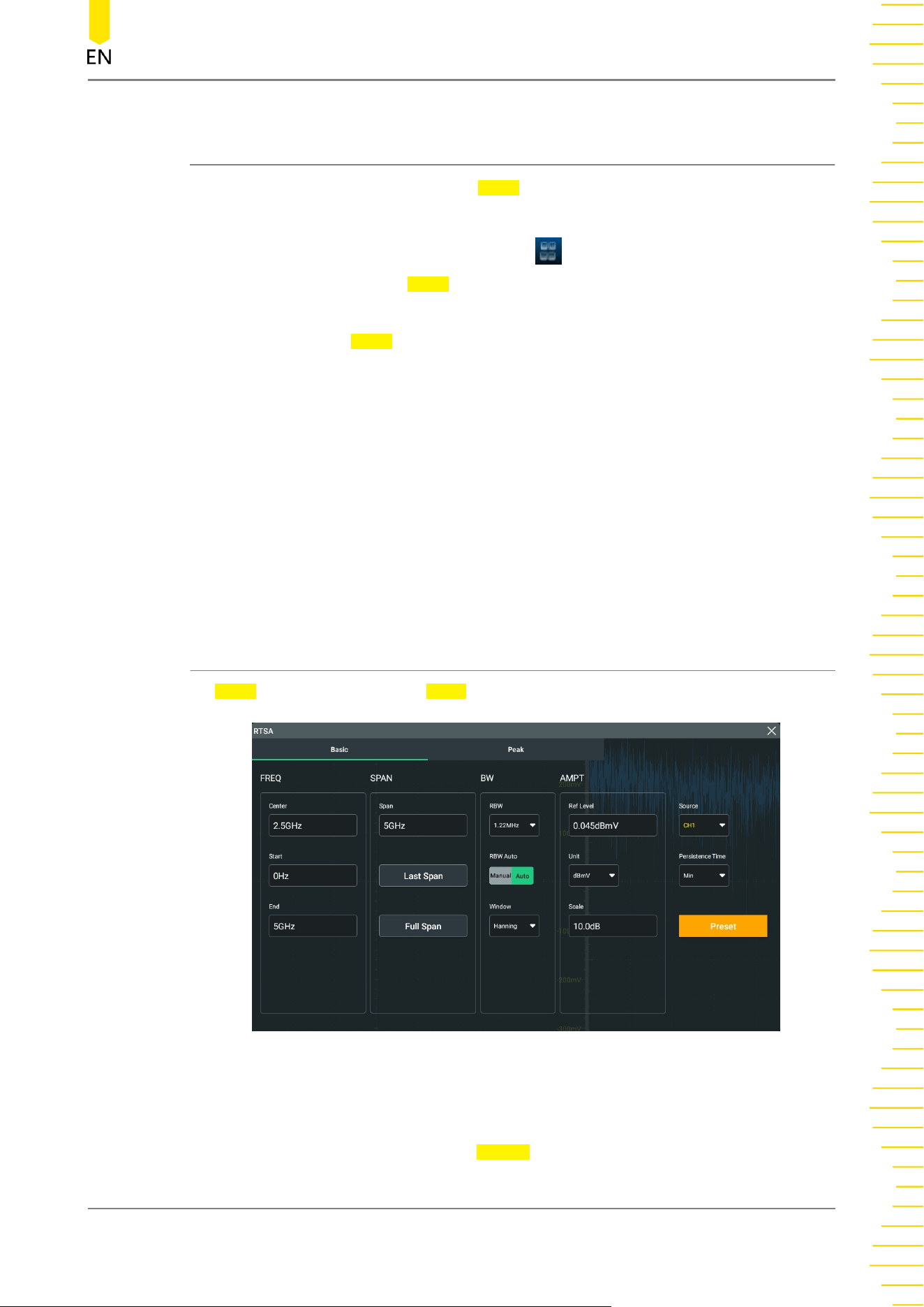
16 RTSA (Option)
DS70000 supports RTSA. To enter the RTSA menu, perform any of the following
operations:
• Click or tap the function navigation icon
at the lower-left corner of the
screen, and then select RTSA to open the RTSA measurement display window
and enter the RTSA function menu.
• Click or tap the RTSA icon in the quick operation menu bar at the top of the
screen to open the RTSA measurement display window and enter the RTSA
function menu.
• Click or tap the RTSA information label at the bottom of the screen to open the
RTSA measurement display window. Click or tap the label again to enter the
RTSA function menu.
In RTSA, you can set AMPT, BW, FREQ, and SPAN parameters. You can also search the
peak according to the set parameters.
If you have purchased the decoding option, activate it according the descriptions in
To View the Option Information and the Option Installation
.
16.1 Basic Settings
In RTSA menu, click or tap the Basic tab, then you can set the relevant parameters.
Figure 16.1 Basic Setting Menu
Set the Source
Click or tap the drop-down button of
Source to select the desired source from the
drop-down list. The available sources for RTSA include CH1-CH4.
RTSA (Option)
Copyright ©RIGOL TECHNOLOGIES CO., LTD.
All rights reserved.
DS70000 User Guide
209
Preset
Click or tap Preset, and all the configurations in the RTSA menu will be restored to
the default settings.
Persistence Time
Click or tap the drop-down button of Persistence Time to select the persistence time
from the drop-down list. The available choices include Min, 100 ms, 200 ms, 500 ms, 1
s, 2 s, 5 s, 10 s, and Infinite. By default, it is Min and the persistence function is
disabled.
16.1.1 FREQ
In RTSA, the frequency range of a channel can be expressed by either of two groups
of parameters: Start Frequency/Stop Frequency; Center Frequency/Span.
Sets the frequency range of RTSA. Each time the parameters are modified, the
instrument restarts to sweep.
The frequency range of a channel can be set by either of two groups of parameters:
• Start Frequency/Stop Frequency
(f
start
/f
stop
)
• Center Frequency/Span
(f
center
/f
span
)
If any of the four parameters is changed, the other three parameters will make
adjustment automatically to ensure the coupling relationship among them:
f
center
= (f
start
+ f
stop
)/2
f
span
= f
stop
- f
start
Center Freq
Click or tap the input field of Center, and use the pop-up numeric keypad to set the
center frequency. Its range is from 5.00 kHz to 5.00 GHz. Its default value is 2.5 GHz.
• In
SPAN
, when you modify the center frequency, the start and stop frequency
will be modified automatically if the Span value remains unchanged.
• Modifying the center frequency indicates that the frequency is changed along
the current channel horizontally, and the adjustable range should be within the
frequency range specified in the technical specifications of the instrument.
Start Freq
Click or tap the input field of Start, and use the pop-up numeric keypad to set the
start frequency. The minimum value is 0.00 Hz. After configuration, the scale value at
the bottom of the RTSA measurement window will be changed accordingly.
RTSA (Option)
DS70000 User Guide
210
Copyright ©RIGOL TECHNOLOGIES CO., LTD.
All rights reserved.
When you modify the start frequency, the span and center frequency will be changed.
The changes of span will affect other system parameters. For details, please refer to
the Span section in
SPAN
.
Stop Freq
Click or tap the input field of End, and use the pop-up numeric keypad to set the stop
frequency. The Max. value is 5.00 GHz. After configuration, the scale value at the
bottom of the RTSA measurement window will be changed accordingly.
When you Data stop frequency, the span and center frequency will be changed. The
changes of span will affect other system parameters. For details, please refer to the
Span section in
SPAN
.
16.1.2 SPAN
Span indicates the frequency span measured within the RTSA measurement window
range. When you modify the span, the start frequency, the center frequency, and stop
frequency will be modified automatically. For details, refer to
FREQ
. After setting the
span, the sweep restarts.
Sets the span
Click or tap the input field of Span, and then use the pop-up numeric keypad to set
the span. Its range is from 10.00 kHz to 5.00 GHz. When the span is set to a maximum
value, the analyzer enters full span mode.
Last Span
Click or tap Last Span to set the span to its last set value.
Full Span
Click or tap Full Span, and the span is set to its maximum value.
16.1.3 BW
Under the BW menu, you can set the parameters such as resolution bandwidth (RBW)
and window.
Set RBW
RBW indicates the resolution bandwidth. It is used to distinguish two signals whose
frequencies are close with each other. Reducing RBW can gain a higher frequency
resolution, but will also prolong the sweep time.
Click or tap the drop-down button of RBW to select the RBW value from the drop-
down list. The available values include 152.59 kHz, 305.18 kHz, 610.35 kHz, 1.22 MHz,
2.44 MHz, 4.88 MHz, 9.77 MHz, and Auto. By default, it is 1.22 MHz. When "Auto" is
selected, the instrument will generate a value not available in the current drop-down
list based on the current configurations.
RTSA (Option)
Copyright ©RIGOL TECHNOLOGIES CO., LTD.
All rights reserved.
DS70000 User Guide
211
RBW Mode
Click or tap "Manual" or "Auto" under RBW Auto.
• Manual: selects the desired value from the drop-down button of RBW.
• Auto: selects a proper value automatically from the available values (e.g. 152.59
kHz, 305.18 kHz, 610.35 kHz, 1.22 MHz, 2.44 MHz, 4.88 MHz, and 9.77 MHz) of
the drop-down list of RBW. When Auto is selected for RBW mode, the value of
RBW may be changed.
Set Window Function
Click or tap the drop-down button of Window to select the type of the window
function. The available window type includes Hanning, Rectangular, Blackman-Harris,
Hamming, Flattop, and Triangle. By default, it is Hanning. For details, refer to
descriptions in
Window Function
.
16.1.4 AMPT
You can modify AMPT parameters to make the signals under test be displayed with
minimal errors in the current window, easy for you to observe.
Set the Reference Level
Click or tap the input field of Ref Level to set the reference level with the pop-up
numeric keypad. Its range and default value are related to the actually input source.
After configuring the reference level, the vertical axis of RTSA measurement result
display window changes according to the configuration. The value of Scale also
changes with the modification of Ref Level.
Set the Reference Level Unit
Click or tap the drop-down button of Unit to select the reference level unit from the
drop-down list. The available units include dBmV, dBµV, and Volts. By default, it is
dBmV. Wherein, dBmV and dBµV are for Log scale; Volts is for Linear scale.
The conversion relations between units are as follows (R indicates reference
impedance):
RTSA (Option)
DS70000 User Guide
212
Copyright ©RIGOL TECHNOLOGIES CO., LTD.
All rights reserved.
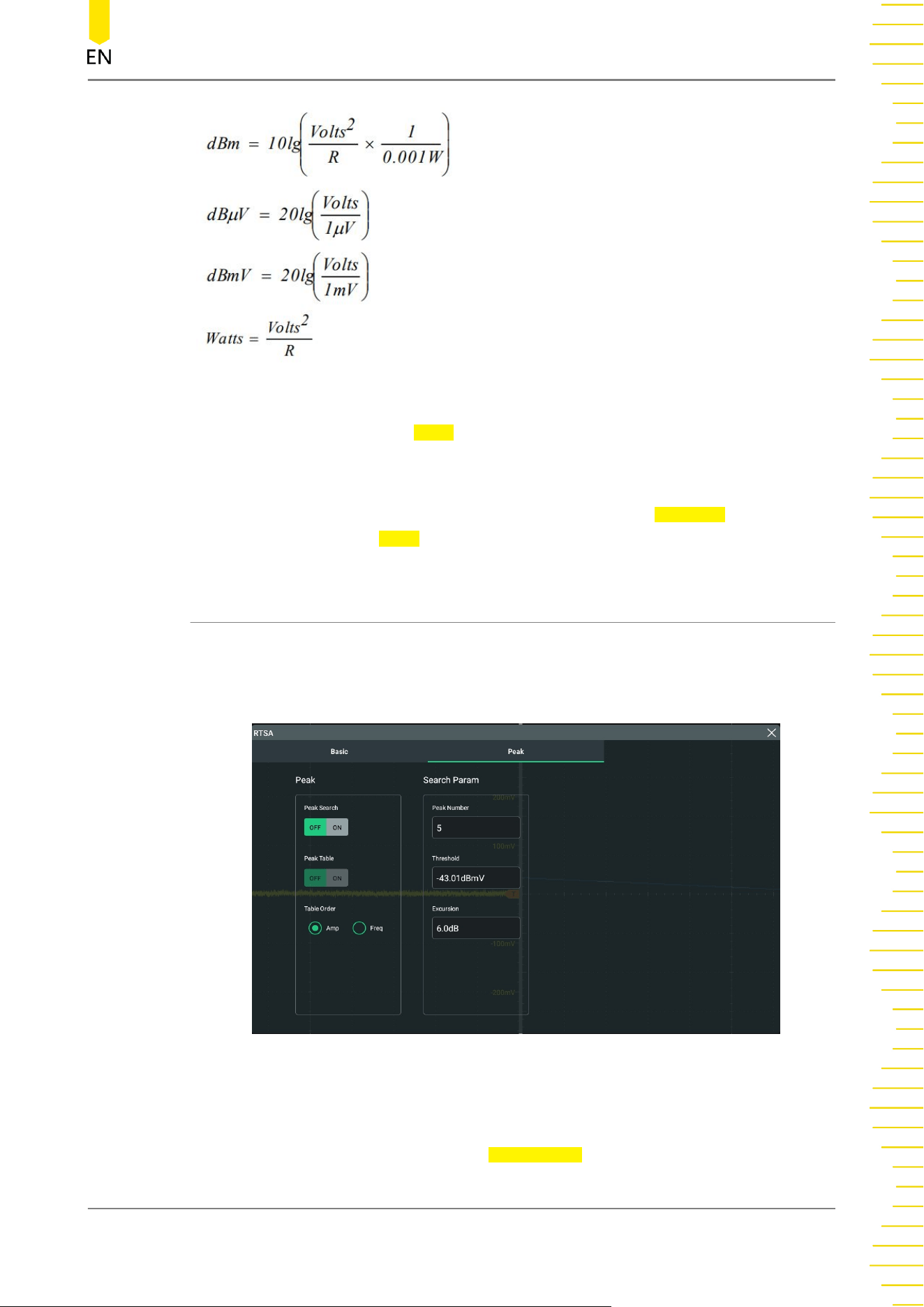
Set the Scale
Click or tap the input field of Scale to set the scale with the pop-up numeric keypad.
Its range is from 100.00 mdB to 20.00 dB. By default, it is 10.00 dB.
After configuring the scale value, the vertical axis of RTSA measurement result display
window changes according to the configuration. The value of Ref Level also changes
with the modification of Scale.
16.2 Peak Search
The peak search function enables the marker to move to the specific signal peak
point, and then in combination with the function of Delta marker, it can provide a
powerful analysis capability.
Figure 16.2 Peak Search Menu
Enable the peak search function
Click or tap the ON/OFF button for the
Peak Search menu to enable or disable the
display of the peak search window. By default, it is OFF.
RTSA (Option)
Copyright ©RIGOL TECHNOLOGIES CO., LTD.
All rights reserved.
DS70000 User Guide
213
Set the peak search result list
Click or tap the ON/OFF tab for the Peak Table menu to enable or disable the display
of the peak table. By default, it is OFF.
When the peak table is turned on, the RTSA display window is split into a
measurement window and a peak table display window. The peak table will be
displayed at the lower section of the screen, displaying the searched parameters
(frequency and amplitude) that meet the criteria.
Click or tap "Amp" or "Freq" as a sorting rule for Table Order.
Set the peak parameters
• Click or tap the input field of Peak Number, and then use the pop-up numeric
keypad to set the number of peaks. Its range is from 1 to 15. Its default value is
5.
• Click or tap the input field of Threshold, and then use the pop-up numeric
keypad to set the minimum value of the peak amplitude. Only when the peak is
greater than the peak threshold, can it be judged as a peak.
• Click or tap the input field of Excursion, and then use the pop-up numeric
keypad to set the excursion of the peak. It defines the minimum amplitude of
the time the required for a signal to be identified as peak. Its range is from 0.00
dB to 100.00 dB. Its default value is 0 dB.
RTSA (Option)
DS70000 User Guide
214
Copyright ©RIGOL TECHNOLOGIES CO., LTD.
All rights reserved.
17 Protocol Decoding
You can use the protocol analysis to discover errors, debug hardware, and accelerate
development easily, ensuring you to accomplish the projects with high speed and
good quality. Protocol decoding is the basis of protocol analysis. Only protocol
analyses with correct protocol decoding are acceptable, and only correct protocol
decoding can identify more error information. This oscilloscope provides four bus
decoding modules (Decode 1, Decode 2, Decode 3, and Decode 4) to make common
protocol decoding (including Parallel (standard), RS232 (option), I2C (option), SPI
(option), LIN (option), CAN (option), FlexRay (option), I2S (option), and 1553B
(option)) for the input signals of the analog channels (CH1-CH4). As the decoding
functions and setting methods of Decode1, Decode2, Decode3, and Decode4, this
chapter takes Decode1 as an example for illustration.
• Click or tap the function navigation icon
at the lower-left corner of the
screen, and then select Decode to enter the "Decode" menu.
• Tap the Decode icon on the small screen at the right side of the screen to enter
the "Decode" menu.
• Click or tap the Decode icon at the top of the screen to enter the "Decode"
menu.
To get the decoding option information, refer to descriptions in
Appendix A: Options
and Accessories
.
If you have purchased the decoding option, activate it according the descriptions in
To View the Option Information and the Option Installation
.
17.1 Parallel Decoding
Parallel bus consists of clock line and data line. As shown in the figure below, CLK is
the clock line, whereas Bit0 and Bit1 are the 0 bit and 1st bit on the data line
respectively. The oscilloscope will sample the channel data on the rising edge, falling
edge, or the rising/falling edge of the clock and judge each data point (logic "1" or
logic "0") according to the preset threshold level.
Protocol Decoding
Copyright ©RIGOL TECHNOLOGIES CO., LTD.
All rights reserved.
DS70000 User Guide
215
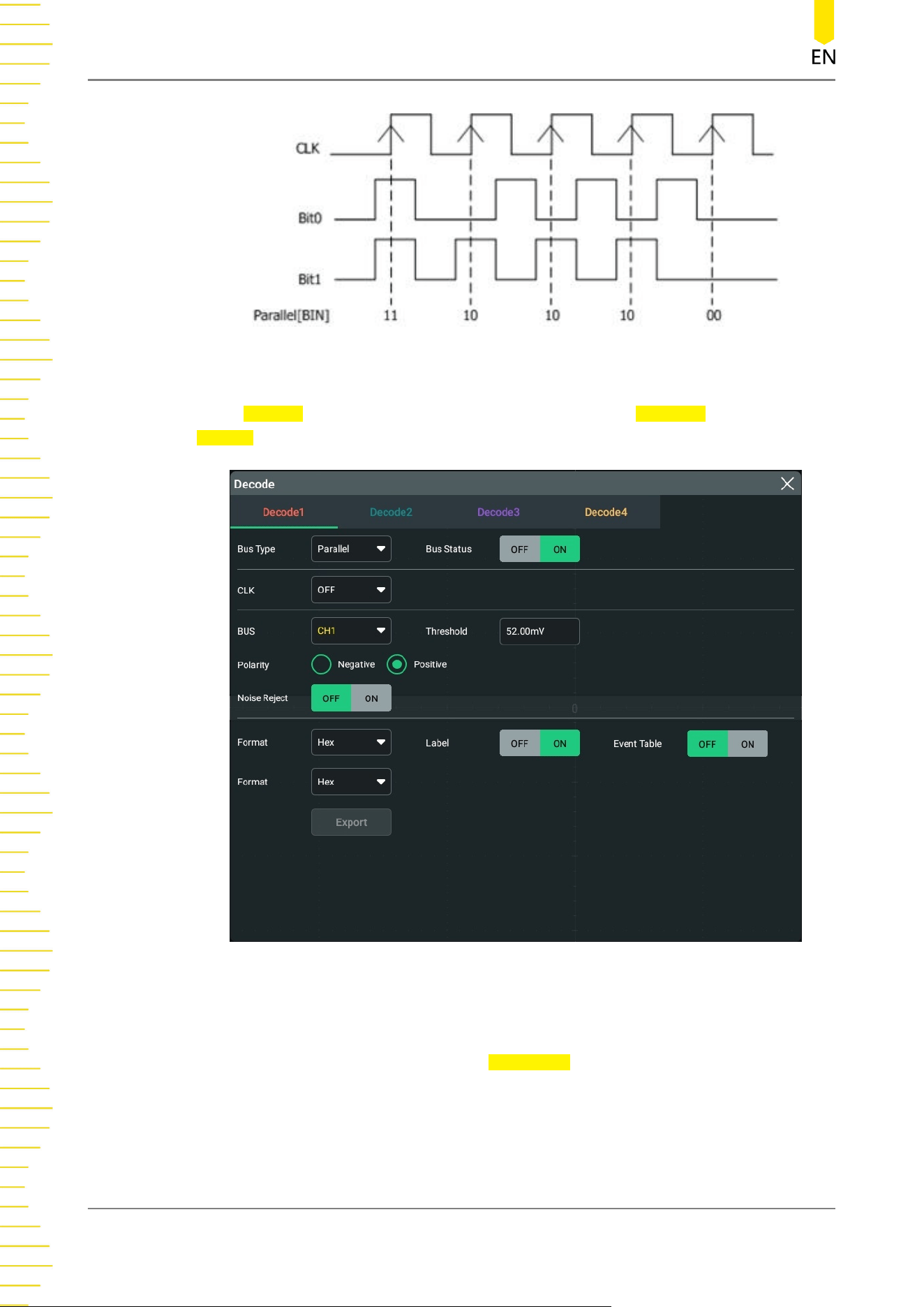
Figure 17.1 Schematic Diagram of Parallel Decoding
In the Decode menu, click or tap the drop-down button of Bus Type to select
Parallel, then configure the parameters for Parallel decoding.
Figure 17.2 Parallel Decoding Menu
Bus Status
Click or tap the ON/OFF button for the Bus Status menu item to enable/disable the
bus decoding.
Protocol Decoding
DS70000 User Guide
216
Copyright ©RIGOL TECHNOLOGIES CO., LTD.
All rights reserved.
17.1.1 Clock Setting (CLK)
Clock Setting (CLK)
Click or tap the drop-down button of CLK select the desired source of the clock
channel (CH1-CH4) from the drop-down list. If "OFF" is selected, no clock channel is
set, and sampling is performed when a hop occurs to the data of the data channel
during decoding.
Threshold
When the clock signal is an analog channel (CH1-CH4), you need to set a threshold.
Click or tap the input field of Threshold, and then use the pop-up numeric keypad to
set the threshold. The range of the threshold is related to the current vertical scale
and offset.
CLK Edge
In CLK Edge menu, click or tap to select to sample the channel data on the rising
edge, falling edge, or both edges of the clock signal.
• Rising: samples the channel data on the rising edge of the clock.
• Falling: samples the channel data on the falling edge of the clock.
• Both: samples the channel data on the rising edge or the falling edge of the
clock.
17.1.2 Bus Setting
Set the Bus
Click or tap drop-down button of BUS to select the digital bus (CH1-CH4) for Parallel
decoding from the drop-down list.
Table 17.1 Bus Setting
Bus Width Bit X Channel Remarks
CH1 1 0 CH1
Width, Bit X, and CH are
set automatically, and you
cannot modify them.
CH2 1 0 CH2
Width, Bit X, and CH are
set automatically, and you
cannot modify them.
CH3 1 0 CH3
Width, Bit X, and CH are
set automatically, and you
cannot modify them.
CH4 1 0 CH4
Width, Bit X, and CH are
set automatically, and you
cannot modify them.
User
1 to 4, 1 for
default
1 (Default) CH1~CH4
Bit1 to Bit4 are set to CH1
to CH4 respectively.
Protocol Decoding
Copyright ©RIGOL TECHNOLOGIES CO., LTD.
All rights reserved.
DS70000 User Guide
217
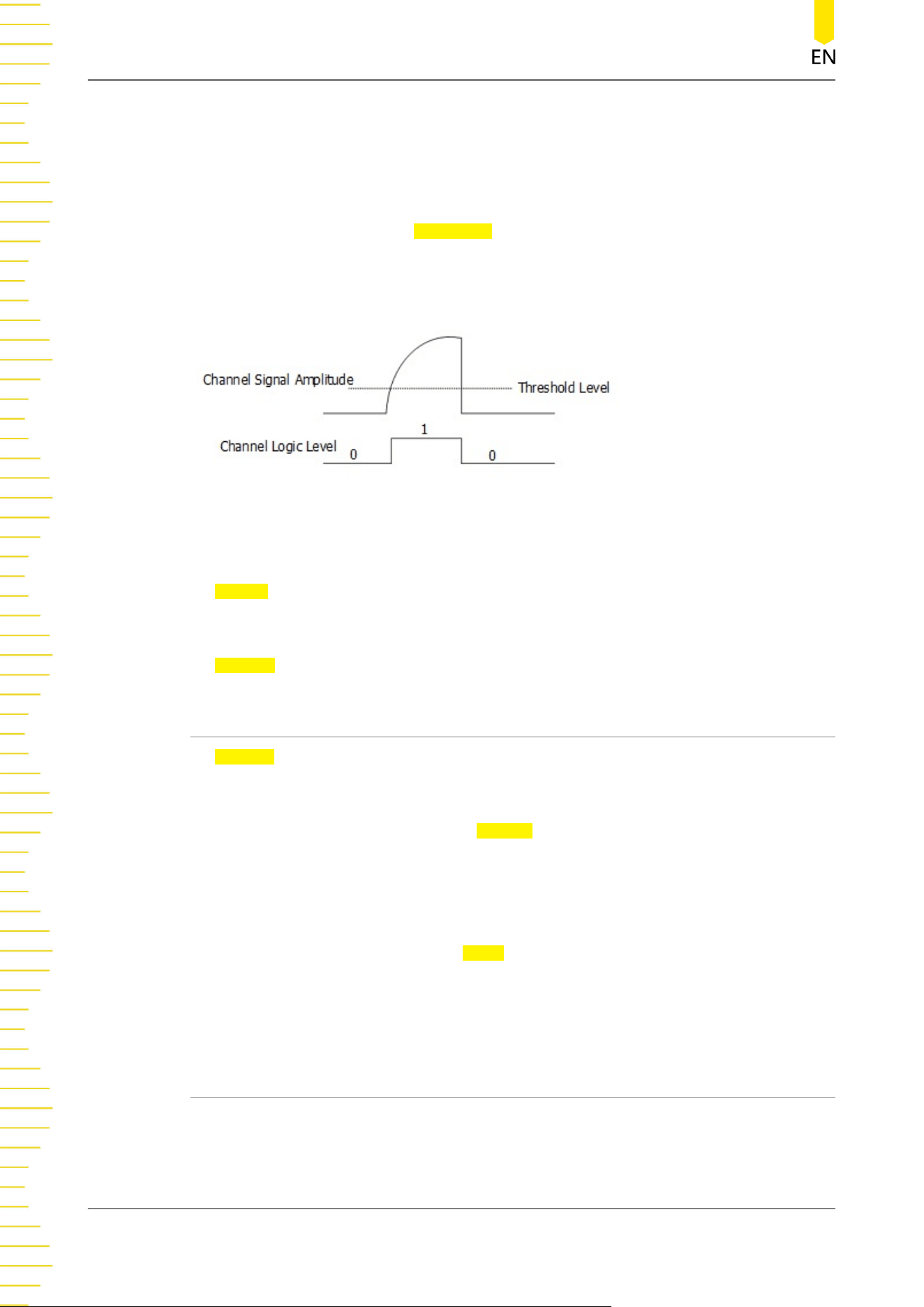
Set the Threshold Level
To judge logic "1" and logic "0" of the buses, you need to set a threshold for each
analog channel (CH1~ CH4). When the channel signal amplitude is greater than the
preset threshold, it is judged as logic "1"; otherwise logic "0".
Click or tap the input field of Threshold, and then use the pop-up numeric keypad to
set the threshold. The range of the threshold is related to the current vertical scale
and offset.
Endian
In Endian menu, click or tap to select "Invert" or "Normal" as the endian of the bus.
Polarity
In Polarity menu, click or tap to select "Positive" or "Negative" as the data polarity.
17.1.3 Display-related Setting
In Decode menu, set the following display-related parameters.
Set the Display Format
Click or tap the drop-down button of Format to select the display format of the bus
data from the drop-down list. The available options include "Hex", "Dec", "Bin", or
"ASCII".
Set the Label Display
Click or tap the ON/OFF tab for the Label menu to enable or disable the label display
of the decoding bus. When enabled, the bus label will be displayed at the upper-left
side of the bus (when the bus display is enabled). The label shows the current bus
type.
17.1.4 Event Table
The event table displays the decoded data and the corresponding decoding
information in time order in the form of a table. It can be used to observe relatively
Protocol Decoding
DS70000 User Guide
218
Copyright ©RIGOL TECHNOLOGIES CO., LTD.
All rights reserved.
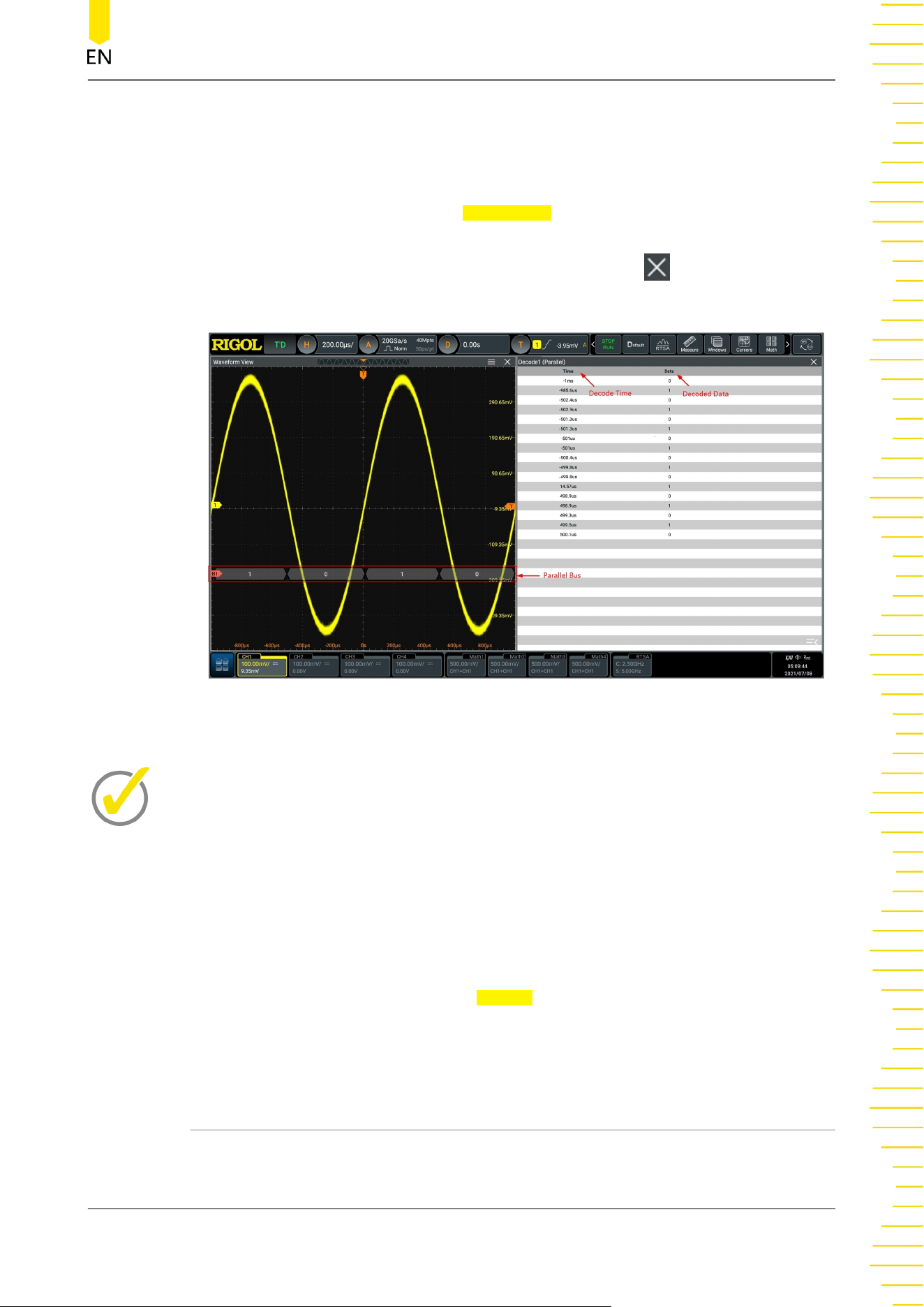
longer decoded data. The decoding information includes the decoded data, the
corresponding line number, and time information.
Open or Close the Event Table
Click or tap the ON/OFF tab for the Event Table menu to enable or disable the
display of the event table. When enabled, the following event table is displayed, as
shown in the figure below. You can also click or tap the icon at the upper-right
corner of the table to close the event table.
Figure 17.3 Parallel Decoding Event Table
Tip
• When you adjust the horizontal time base, the waveform displayed on the screen will also
change, and the total number of lines containing the decoding information in the event
table will also be changed.
• The displayed decoded data information in the bus is related to the value of the
horizontal time base. Reducing the horizontal time base can help you view the detailed
information.
Set the Event Table Format
Click or tap the drop-down button of Format to select the display format of "Data" in
the event table from the drop-down list. The available options include "Hex", "Dec",
"Bin", or "ASCII".
17.2 RS232 Decoding (Option)
RS232 serial bus consists of the transmitting data line (TX) and the receiving data line
(RX).
Protocol Decoding
Copyright ©RIGOL TECHNOLOGIES CO., LTD.
All rights reserved.
DS70000 User Guide
219
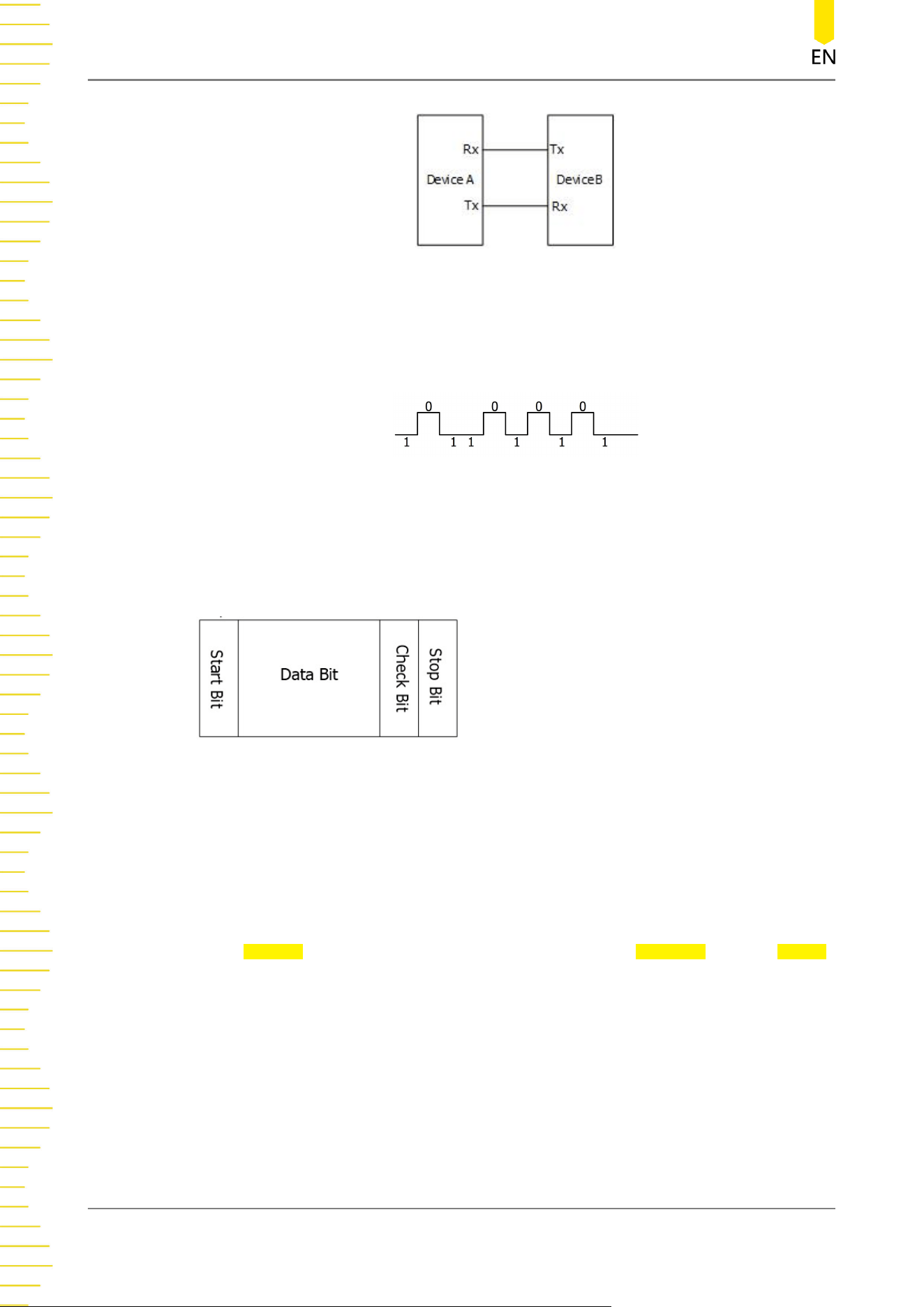
Figure 17.4 Schematic Diagram of RS232 Serial Bus
The industry standard of RS232 uses "Negative Logic", i.g. high level is logic "0" and
low level is logic "1".
Figure 17.5 Schematic Diagram of Negative Logic
In RS232, baud rate is used to represent the transmission rate (namely bits per
second) of the data. You need to set the start bit, data bits, check bit (optional), and
stop bits for each frame of data.
• Start Bit: indicates when to output data.
• Data Bit: indicates the number of data bits actually contained in each frame of
data.
• Check Bit: used to check whether the data are properly transmitted.
• Stop Bit: indicates when to stop outputting data.
In the
Decode menu, click or tap the drop-down button of Bus Type to select RS232,
then configure the parameters for RS232 decoding.
Protocol Decoding
DS70000 User Guide
220
Copyright ©RIGOL TECHNOLOGIES CO., LTD.
All rights reserved.
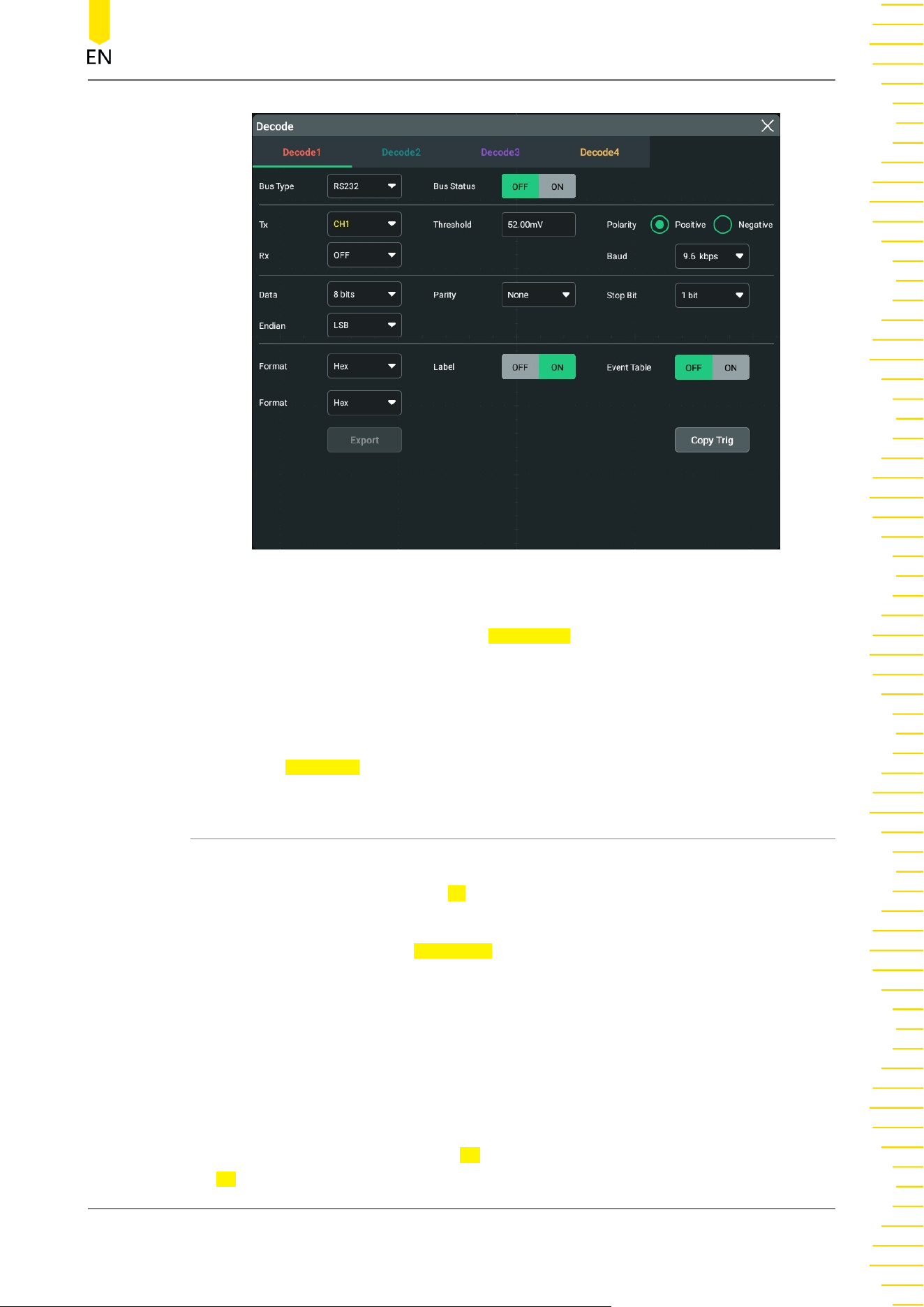
Figure 17.6 RS232 Decoding Menu
Click or tap the ON/OFF button for the Bus Status menu item to enable/disable the
bus decoding.
Quickly apply trigger settings to decoding
Copy trig indicates applying the trigger settings to the specified decoding setting.
Click or tap Copy Trig to apply the trigger settings to the specified decoding setting.
17.2.1 Source Setting
Set the Tx source and the threshold
Click or tap drop-down button of Tx to select the desired source from the drop-down
list. The sources include CH1-CH4.
Click or tap the input field of Threshold, and then use the pop-up numeric keypad to
set the threshold of Tx source. The range value is from -5.00 V to 5.00 V. Its default
value is 0 V.
When you modify the threshold of the Tx source channel, a dotted line displaying the
current threshold level is displayed on the screen. It disappears in about 2 s after you
stop modifying the threshold.
Set the Rx source and the threshold
Use the same method to select the Rx source and set the threshold. The default state
of Rx is OFF.
Protocol Decoding
Copyright ©RIGOL TECHNOLOGIES CO., LTD.
All rights reserved.
DS70000 User Guide
221
Polarity
Click or tap "Positive" or "Negative" under Polarity.
• Positive: Uses negative logic. High level is logic "0" and low level is logic "1".
• Negative: Uses positive logic. High level is logic "1” and low level is logic "0".
Set the baud rate
Click or tap the drop-down button of Baud to select the preset baud rate from the
drop-down list. The available baud rates include 50 bps, 75 bps, 110 bps, 134 bps, 150
bps, and etc.
The oscilloscope supports users to self-define the baud rate. Click or tap the drop-
down button of Baud to select "User" from the drop-down list. Then set the baud rate
with the pop-up numeric keypad.
17.2.2 To Set Data Package
Data
Click or tap the drop-down button of Data to select the data bits from the drop-down
list. The available data bits are 5 bits, 6 bits, 7 bits, 8 bits, and 9 bits.
Parity
It is used to check whether the data transmission is correct. Click or tap the drop-
down button of Parity to select the desired parity mode.
• None: indicates that no check bit appears during the transmission.
• Even: indicates that the total number of "1" in the data bit and check bit is an
even number. For example, when 0x55 (01010101) is sent, "0" should be added
to the check bit.
• Odd: indicates that the total number of "1" in the data bit and check bit is an
odd number. For example, when 0x55 (01010101) is sent, "1" should be added to
the check bit.
Stop Bit
Click or tap the drop-down button of Stop Bit to set the stop bits after each frame of
data. It can be set to 1 bit, 1.5 bits, or 2 bits.
Endian
Click or tap the drop-down button of Endian to select the desired endian.
• LSB: indicates Least Significant Bit transmission sequence, i.g. the lowest bit of
the data is transmitted first.
Protocol Decoding
DS70000 User Guide
222
Copyright ©RIGOL TECHNOLOGIES CO., LTD.
All rights reserved.
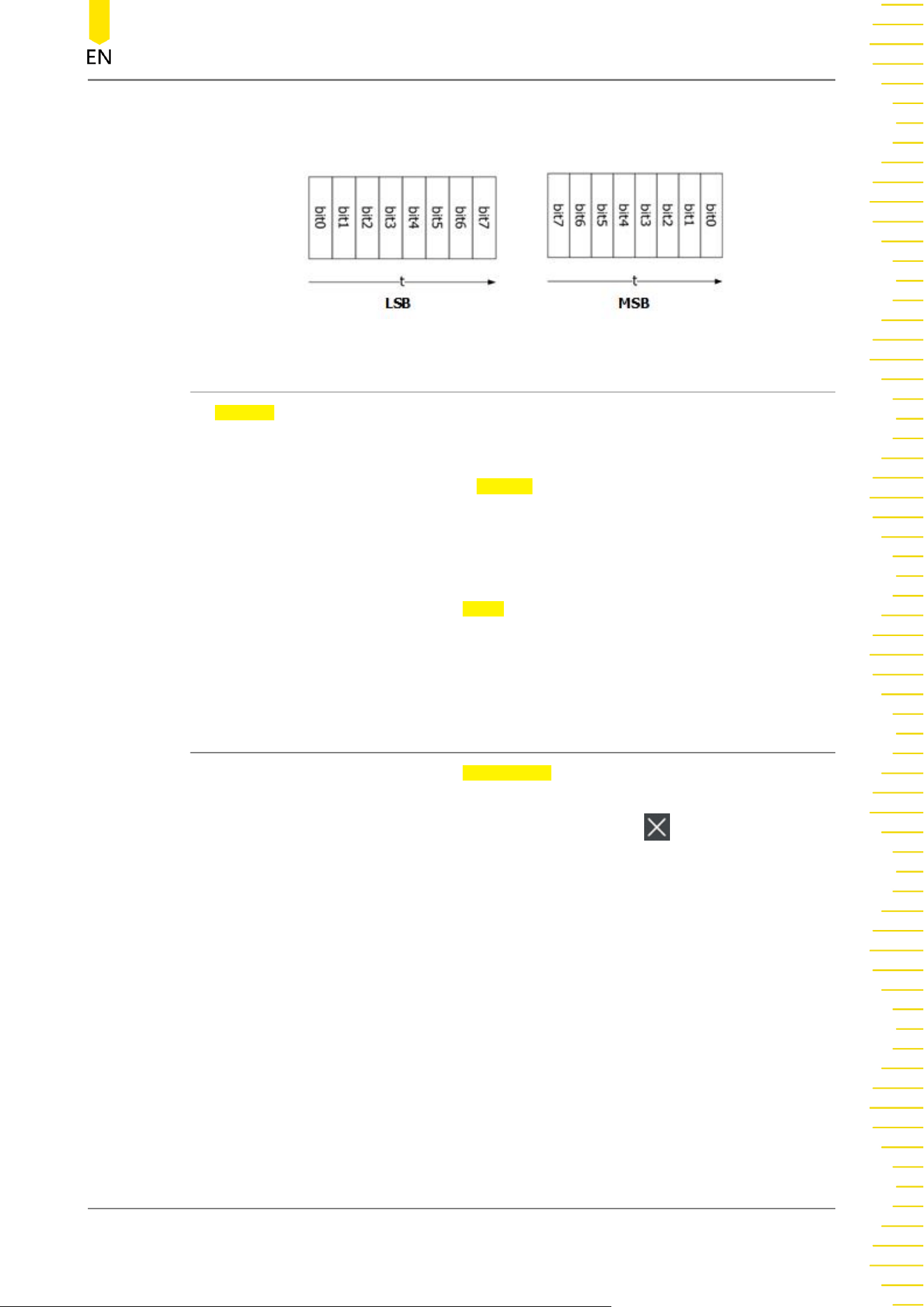
• MSB: indicates Most Significant Bit transmission sequence, i.g. the highest bit of
the data is transmitted first.
17.2.3 Display-related Setting
In Decode menu, set the following display-related parameters.
Set the Display Format
Click or tap the drop-down button of Format to select the display format of the bus
data from the drop-down list. The available options include "Hex", "Dec", "Bin", or
"ASCII".
Set the Label Display
Click or tap the ON/OFF tab for the Label menu to enable or disable the label display
of the decoding bus. When enabled, the bus label will be displayed at the upper-left
side of the bus (when the bus display is enabled). The label shows the current bus
type.
17.2.4 Event Table
Click or tap the ON/OFF tab for the Event Table menu to enable or disable the
display of the event table. When enabled, the following event table is displayed, as
shown in the figure below. You can also click or tap the icon at the upper-right
corner of the table to close the event table.
Protocol Decoding
Copyright ©RIGOL TECHNOLOGIES CO., LTD.
All rights reserved.
DS70000 User Guide
223
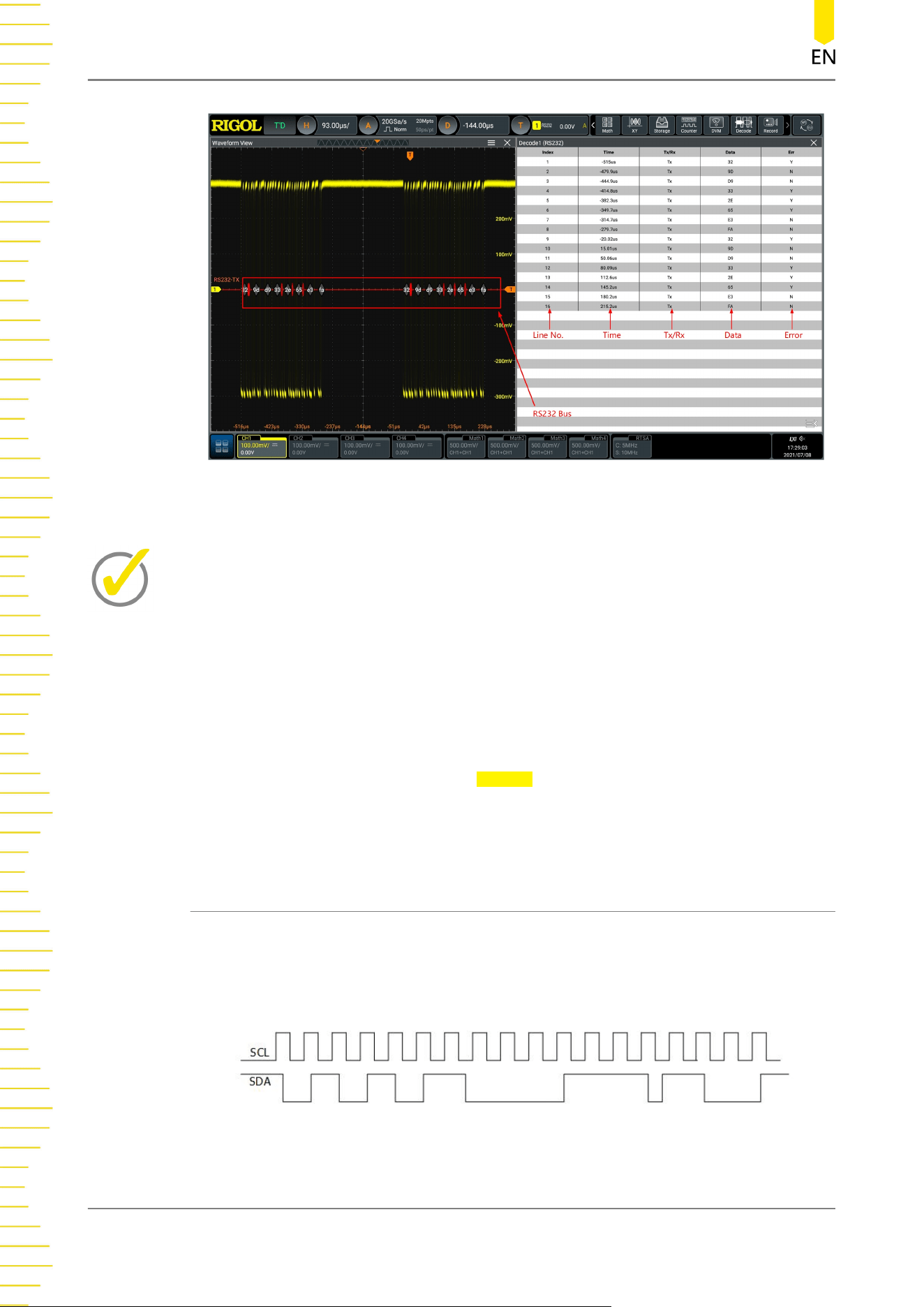
Figure 17.7 RS232 Decoding Event Table
Tip
• When you adjust the horizontal time base, the waveform displayed on the screen will also
change, and the total number of lines containing the decoding information in the event
table will also be changed.
• The displayed decoded data information in the bus is related to the value of the
horizontal time base. Reducing the horizontal time base can help you view the detailed
information.
Set the Event Table Format
Click or tap the drop-down button of Format to select the display format of "Data" in
the event table from the drop-down list. The available options include "Hex", "Dec",
"Bin", or "ASCII".
17.3 I2C Decoding (Option)
I2C serial bus consists of the clock line (SCL) and the data line (SDA).
SCL: samples SDA on the of rising or falling edge of the clock.
SDA: indicates the data channel.
Figure 17.8 I2C Serial Bus
Protocol Decoding
DS70000 User Guide
224
Copyright ©RIGOL TECHNOLOGIES CO., LTD.
All rights reserved.
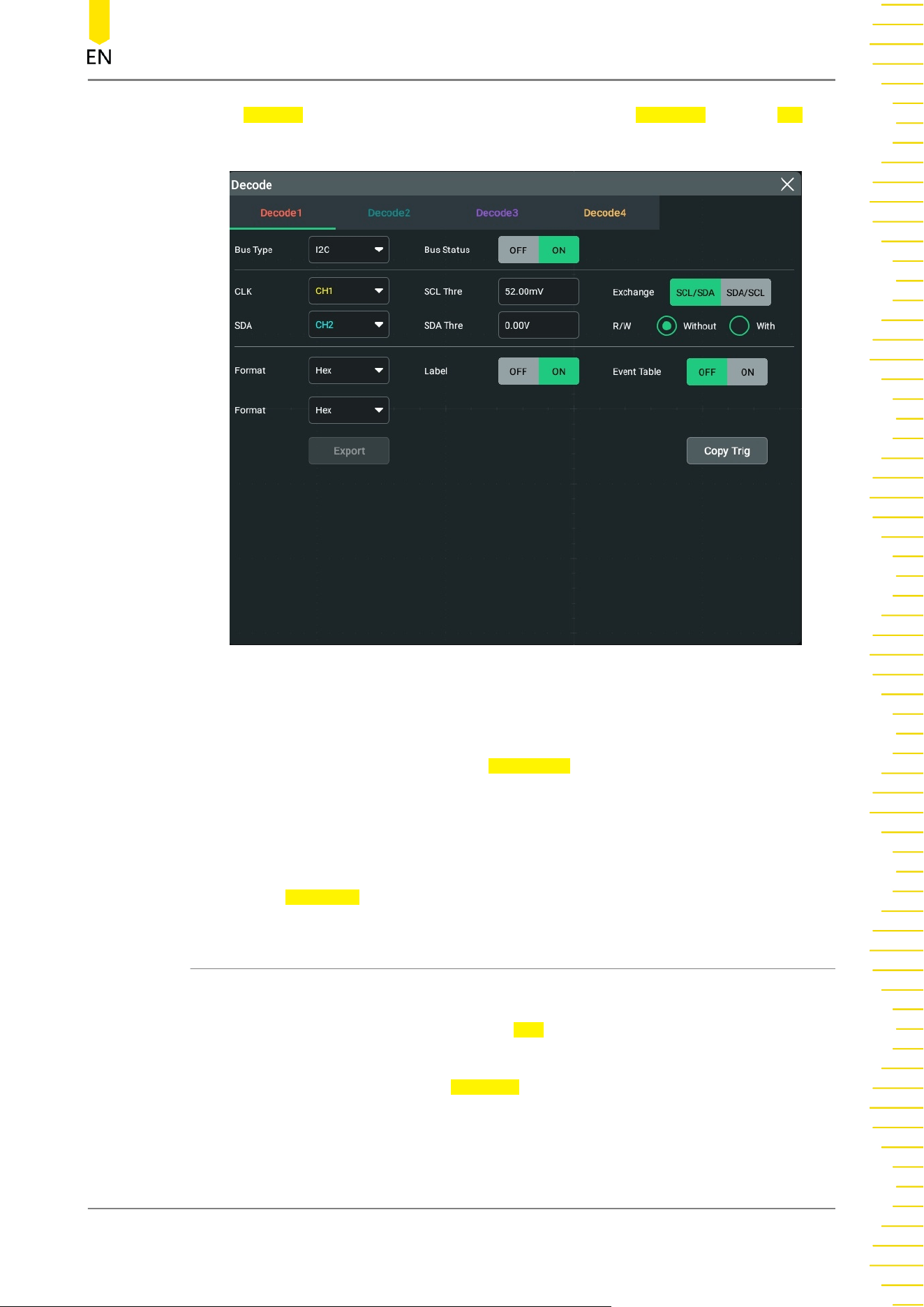
In the Decode menu, click or tap the drop-down button of Bus Type to select I2C,
then configure the parameters for I2C decoding.
Figure 17.9 I2C Decoding Menu
Bus Status
Click or tap the ON/OFF button for the Bus Status menu item to enable/disable the
bus decoding.
Quickly apply trigger settings to decoding
Copy trig indicates applying the trigger settings to the specified decoding setting.
Click or tap Copy Trig to apply the trigger settings to the specified decoding setting.
17.3.1 Source Setting
Set the clock channel source and the threshold
• Click or tap the drop-down button of CLK to select the desired source of the
clock channel (CH1-CH4) from the drop-down list.
• Click or tap the input field of SCL Thre, and then use the pop-up numeric
keypad to set the threshold of the clock channel.
Protocol Decoding
Copyright ©RIGOL TECHNOLOGIES CO., LTD.
All rights reserved.
DS70000 User Guide
225
When you modify the threshold of the clock channel, a dotted line displaying the
current threshold level is displayed on the screen. It disappears in about 2 s after
you stop modifying the threshold.
Set the data channel source and the threshold
• Click or tap the drop-down button of SDA to select the desired source of the
data channel (CH1-CH4) from the drop-down list.
• Click or tap the input field of SDA Thre, and then use the pop-up numeric
keypad to set the threshold of the data channel.
Exchange Sources
Click or tap "SCL/SDA" or "SDA/SCL" under Exchange to exchange the sources of the
current clock channel and data channel.
Specify whether the address information includes the "R/W" bit
For I2C bus, each frame of data starts with the address information. The address
information includes the read address and the write address.
Click or tap "Without" or "With" under R/W to select whether the address
information includes the "R/W" bit. When "With" is selected, the "R/W" bit will be
included in the address information and located at the lowest bit; when "Without" is
selected, the "R/W" bit will not be included in the address information.
17.3.2 Display-related Setting
In Decode menu, set the following display-related parameters.
Set the Display Format
Click or tap the drop-down button of Format to select the display format of the bus
data from the drop-down list. The available options include "Hex", "Dec", "Bin", or
"ASCII".
Set the Label Display
Click or tap the ON/OFF tab for the Label menu to enable or disable the label display
of the decoding bus. When enabled, the bus label will be displayed at the upper-left
side of the bus (when the bus display is enabled). The label shows the current bus
type.
17.3.3 Event Table
Open or Close the Event Table
Click or tap the ON/OFF tab for the Event Table menu to enable or disable the
display of the event table. When enabled, the following event table is displayed, as
Protocol Decoding
DS70000 User Guide
226
Copyright ©RIGOL TECHNOLOGIES CO., LTD.
All rights reserved.
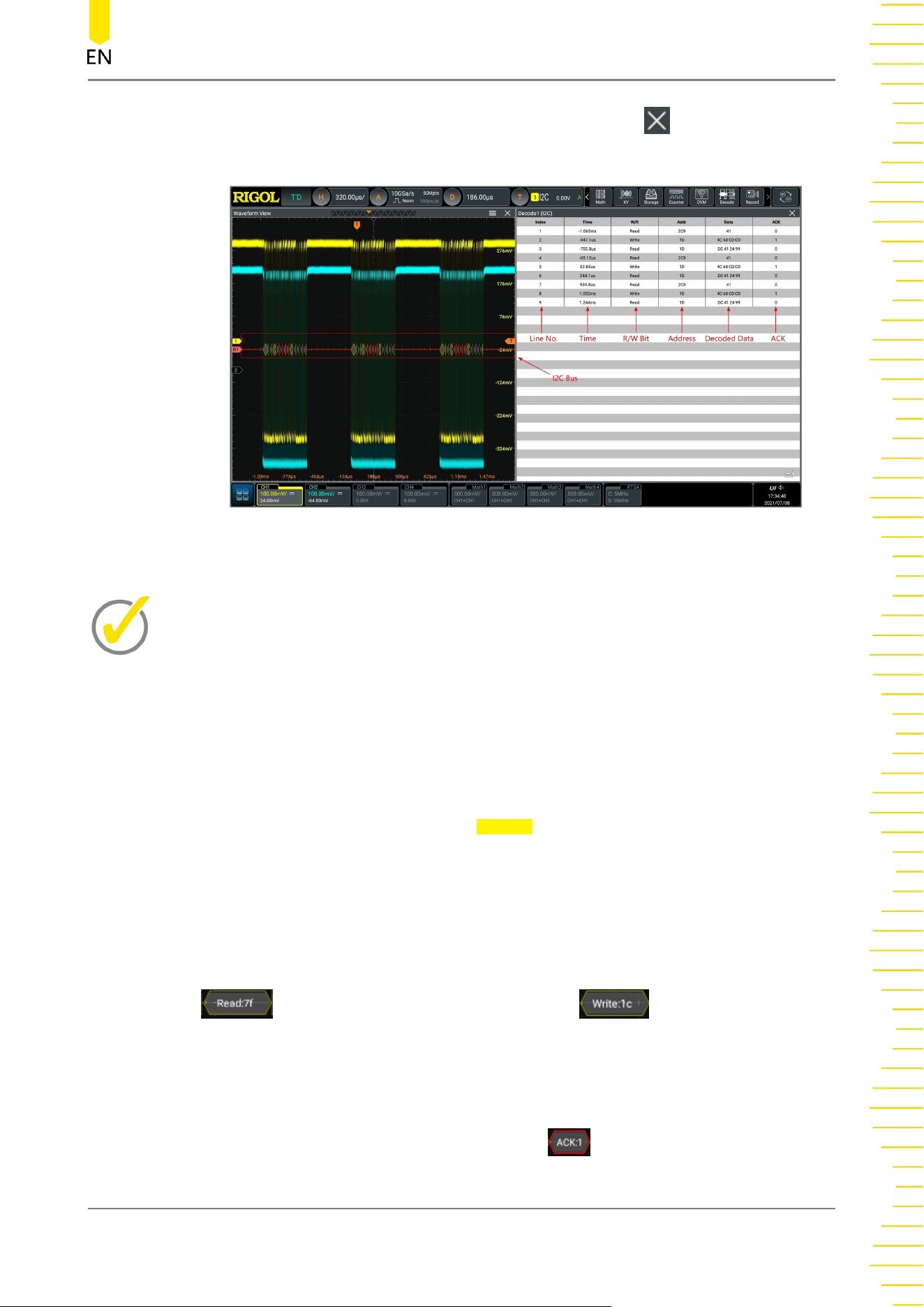
shown in the figure below. You can also click or tap the icon at the upper-right
corner of the table to close the event table.
Figure 17.10 I2C Decoding Event Table
Tip
• When you adjust the horizontal time base, the waveform displayed on the screen will also
change, and the total number of lines containing the decoding information in the event
table will also be changed.
• The displayed decoded data information in the bus is related to the value of the
horizontal time base. Reducing the horizontal time base can help you view the detailed
information.
Set the Event Table Format
Click or tap the drop-down button of Format to select the display format of "Data" in
the event table from the drop-down list. The available options include "Hex", "Dec",
"Bin", or "ASCII".
Address information in decoding
For I2C bus, each frame of data starts with the address information (read address and
write address). In the address information, "Read" indicates the read address
(
) and "Write" indicates the write address ( ). You can decide
whether to include or exclude the "R/W" bit for the address information.
Error expressions in decoding
In I2C decoding, when ACK (acknowledgment) is 1, ACK error occurs. When the
detected ACK is 1, red error report information (the display form is related to
the value of the horizontal time base) is displayed.
Protocol Decoding
Copyright ©RIGOL TECHNOLOGIES CO., LTD.
All rights reserved.
DS70000 User Guide
227
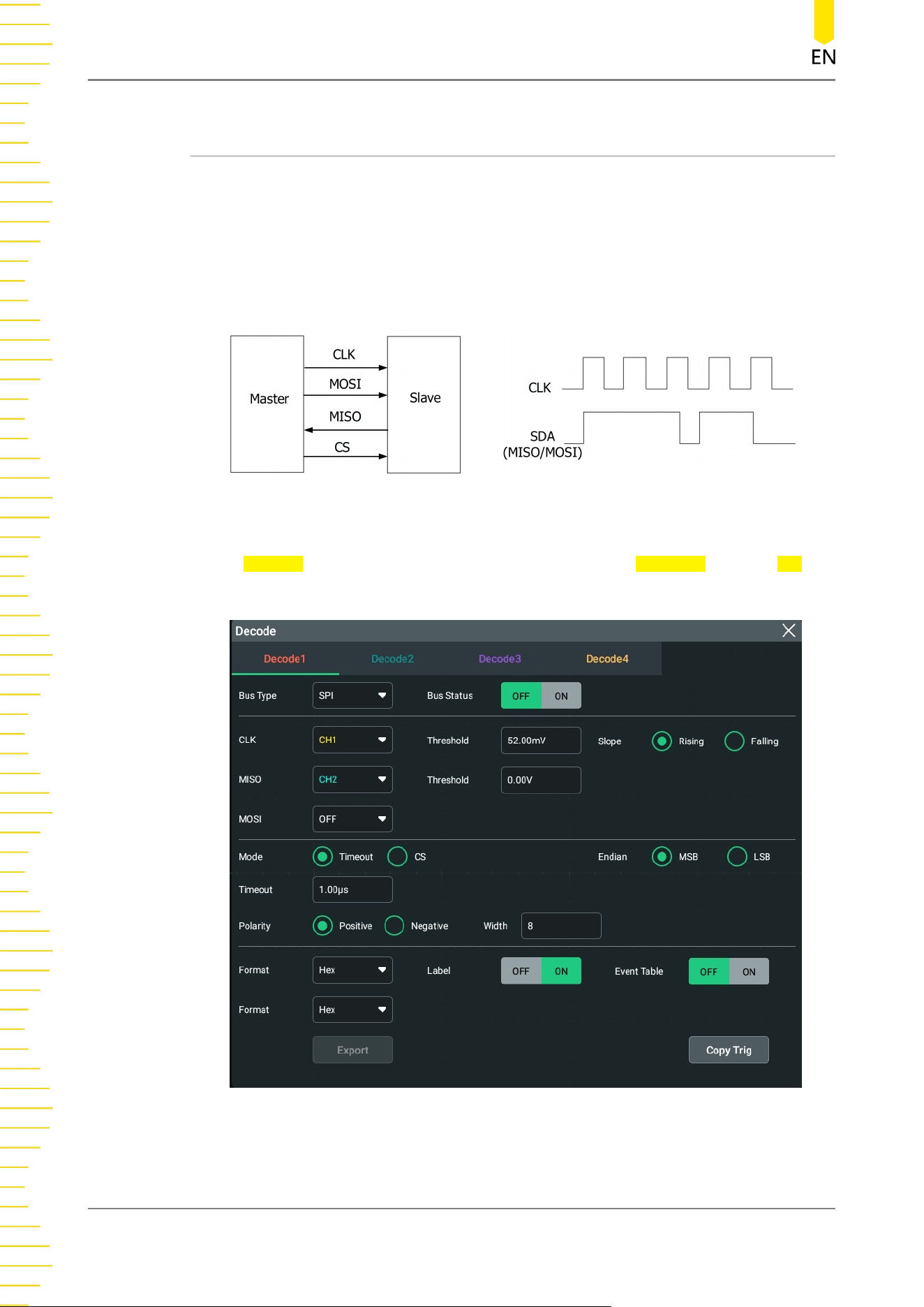
17.4 SPI Decoding (Option)
SPI bus is based on the master— slave configuration and usually consists of chip
select line (CS), clock line (CLK), and data line (SDA). Wherein, the data lines include
the master input/slave output (MISO) data line and master output/slave input (MOSI)
data line. The oscilloscope samples the channel data on the rising or falling edge of
the clock signal (if the source is an analog channel, the oscilloscope will also judge
each data point (logic "1" or logic "0") according to the preset threshold level).
Figure 17.11 SPI Serial Bus
In the Decode menu, click or tap the drop-down button of Bus Type to select SPI,
then configure the parameters for SPI decoding.
Figure 17.12 SPI Decoding Menu
Protocol Decoding
DS70000 User Guide
228
Copyright ©RIGOL TECHNOLOGIES CO., LTD.
All rights reserved.
Bus Status
Click or tap the ON/OFF button for the Bus Status menu item to enable/disable the
bus decoding.
Quickly apply trigger settings to decoding
Copy trig indicates applying the trigger settings to the specified decoding setting.
Click or tap Copy Trig to apply the trigger settings to the specified decoding setting.
17.4.1 To Set the Source
Set the Clock Signal
• Click or tap the drop-down button of CLK to select the desired source of the
clock channel from the drop-down list. The sources include CH1-CH4.
• Click or tap the input field of Threshold at the right side of the CLK menu, and
then use the pop-up numeric keypad to set the threshold of the clock channel.
• Click or tap "Rising" or "Falling" under Slope to set the instrument to sample
MISO and MOSI on the CLK.
MISO and MOSI Setting
• Click or tap drop-down button of MISO to select the desired source of MISO
from the drop-down list. The sources include CH1-CH4 and OFF.
• Click or tap the input field of Threshold at the right side of MISO, and then use
the pop-up numeric keypad to set the threshold of the MISO channel.
• Click or tap drop-down button of MOSI to select the desired source of MOSI
from the drop-down list. The sources include CH1-CH4 and OFF.
Tip
The source channels of MISO and MOSI cannot be set to "OFF" at the same time.
17.4.2 To Set Mode and Data
Mode
Click or tap "Timeout" or "CS" under Mode.
• Timeout:
you can perform frame synchronization according to the timeout, and the
timeout value must be greater than half of the clock cycle. Click or tap the input
field of Timeout, and then use the pop-up numeric keypad to set the timeout
value. The adjustable range of the timeout value is from 8 ns to 10 s. By default,
it is 1 μs.
Protocol Decoding
Copyright ©RIGOL TECHNOLOGIES CO., LTD.
All rights reserved.
DS70000 User Guide
229
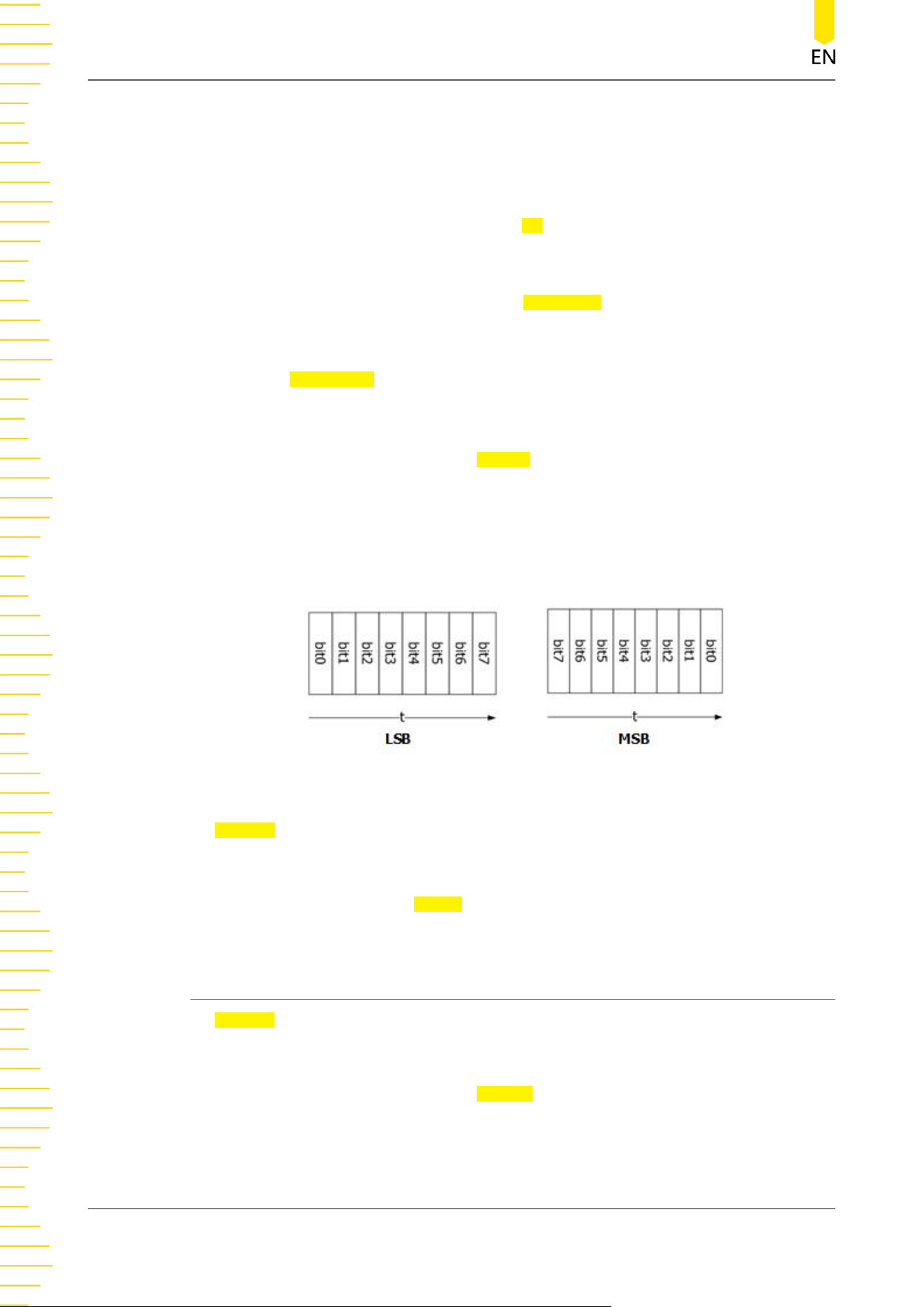
• CS:
contains a chip select line (CS). You can perform frame synchronization
according to CS. When "CS" is selected,
- Click or tap drop-down button of CS to select the desired source from the
drop-down list. The sources include CH1-CH4.
- Click or tap the input field for the Threshold menu item to set the
threshold with the pop-up numeric keypad.
- In CS Polarity menu, click or tap to select "Positive" or "Negative".
Endian
Click or tap the drop-down button of Endian to select the desired endian.
• LSB: indicates Least Significant Bit transmission sequence, i.g. the lowest bit of
the data is transmitted first.
• MSB: indicates Most Significant Bit transmission sequence, i.g. the highest bit of
the data is transmitted first.
Polarity
In Polarity menu, click or tap to select "Positive" or "Negative".
Width Setting
Click or tap the input field of Width, and then use the pop-up numeric keypad to set
the bits of each frame of data. The setting range is from 4 to 32. By default, it is 8.
17.4.3 Display-related Setting
In Decode menu, set the following display-related parameters.
Set the Display Format
Click or tap the drop-down button of Format to select the display format of the bus
data from the drop-down list. The available options include "Hex", "Dec", "Bin", or
"ASCII".
Protocol Decoding
DS70000 User Guide
230
Copyright ©RIGOL TECHNOLOGIES CO., LTD.
All rights reserved.
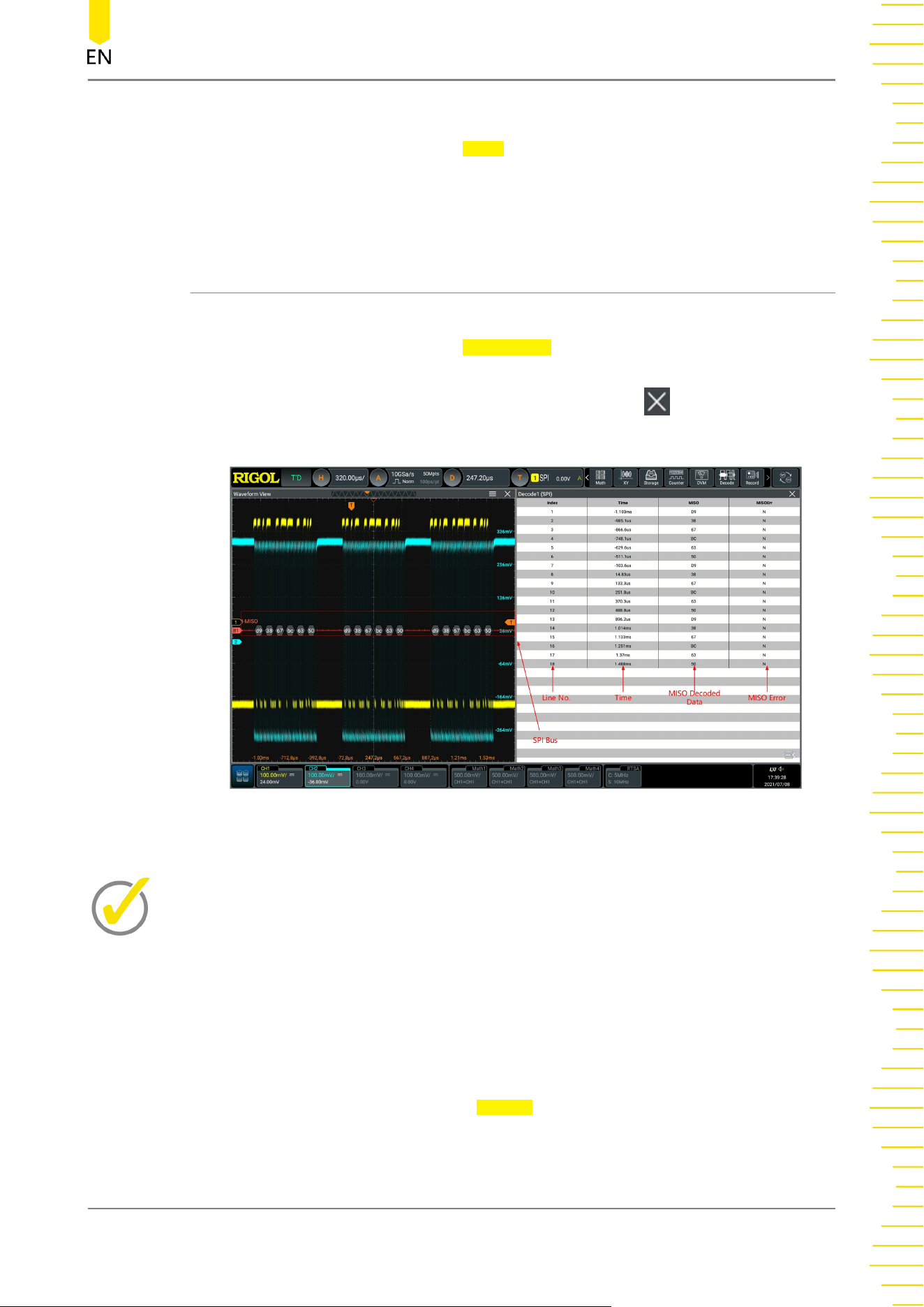
Set the Label Display
Click or tap the ON/OFF tab for the Label menu to enable or disable the label display
of the decoding bus. When enabled, the bus label will be displayed at the upper-left
side of the bus (when the bus display is enabled). The label shows the current bus
type.
17.4.4 Event Table
Open or Close the Event Table
Click or tap the ON/OFF tab for the Event Table menu to enable or disable the
display of the event table. When enabled, the following event table is displayed, as
shown in the figure below. You can also click or tap the icon at the upper-right
corner of the table to close the event table.
Figure 17.13 SPI Decoding Event Table
Tip
• When you adjust the horizontal time base, the waveform displayed on the screen will also
change, and the total number of lines containing the decoding information in the event
table will also be changed.
• The displayed decoded data information in the bus is related to the value of the
horizontal time base. Reducing the horizontal time base can help you view the detailed
information.
Set the Event Table Format
Click or tap the drop-down button of Format to select the display format of "Data" in
the event table from the drop-down list. The available options include "Hex", "Dec",
"Bin", or "ASCII".
Protocol Decoding
Copyright ©RIGOL TECHNOLOGIES CO., LTD.
All rights reserved.
DS70000 User Guide
231
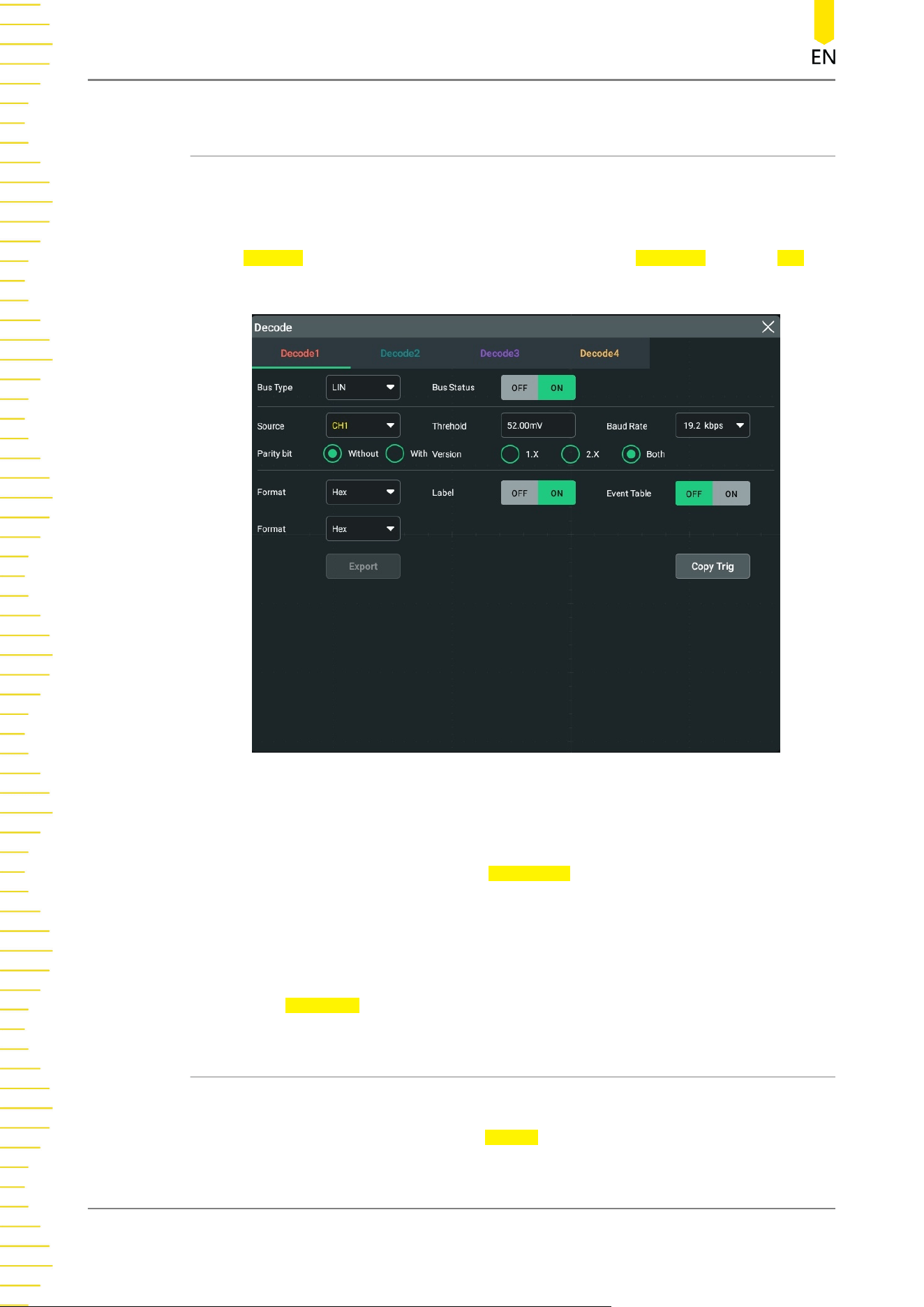
17.5 LIN Decoding (Option)
The oscilloscope samples the LIN signal, and judges each data point to be logic "1" or
logic "0" according to the preset threshold level. The LIN decoding is required to
specify the LIN signal protocol version.
In the Decode menu, click or tap the drop-down button of Bus Type to select LIN,
then configure the parameters for LIN decoding.
Figure 17.14 LIN Decoding Menu
Bus Status
Click or tap the ON/OFF button for the Bus Status menu item to enable/disable the
bus decoding.
Quickly apply trigger settings to decoding
Copy trig indicates applying the trigger settings to the specified decoding setting.
Click or tap Copy Trig to apply the trigger settings to the specified decoding setting.
17.5.1 Signal Configuration
Set the source and the threshold
• Click or tap drop-down button of Source to select the desired source from the
drop-down list. The sources include CH1-CH4.
Protocol Decoding
DS70000 User Guide
232
Copyright ©RIGOL TECHNOLOGIES CO., LTD.
All rights reserved.
• Click or tap the input field of Threshold, and then use the pop-up numeric
keypad to set the threshold of the source channel.
When you modify the threshold of the clock channel, a dotted line displaying the
current threshold level is displayed on the screen. It disappears in about 2 s after
you stop modifying the threshold.
Set the signal
• Click or tap the drop-down button of Baud Rate from the drop-down list. The
available baud rates include 2.4 kbps, 4.8 kbps, 9.6 kbps, 10.0 kbps, 19.2 kbps,
and etc.
• In Parity bit menu, click or tap "With" or "Without" to select whether the data
contain the parity bit.
• In Version menu, select the protocol version that matches the LIN bus signal.
The available versions include "1.X", "2.X", and "Both".
17.5.2 Display-related Setting
In Decode menu, set the following display-related parameters.
Set the Display Format
Click or tap the drop-down button of Format to select the display format of the bus
data from the drop-down list. The available options include "Hex", "Dec", "Bin", or
"ASCII".
Set the Label Display
Click or tap the ON/OFF tab for the Label menu to enable or disable the label display
of the decoding bus. When enabled, the bus label will be displayed at the upper-left
side of the bus (when the bus display is enabled). The label shows the current bus
type.
17.5.3 Event Table
Open or Close the Event Table
Click or tap the ON/OFF tab for the Event Table menu to enable or disable the
display of the event table. When enabled, the following event table is displayed, as
shown in the figure below. You can also click or tap the icon at the upper-right
corner of the table to close the event table.
Protocol Decoding
Copyright ©RIGOL TECHNOLOGIES CO., LTD.
All rights reserved.
DS70000 User Guide
233
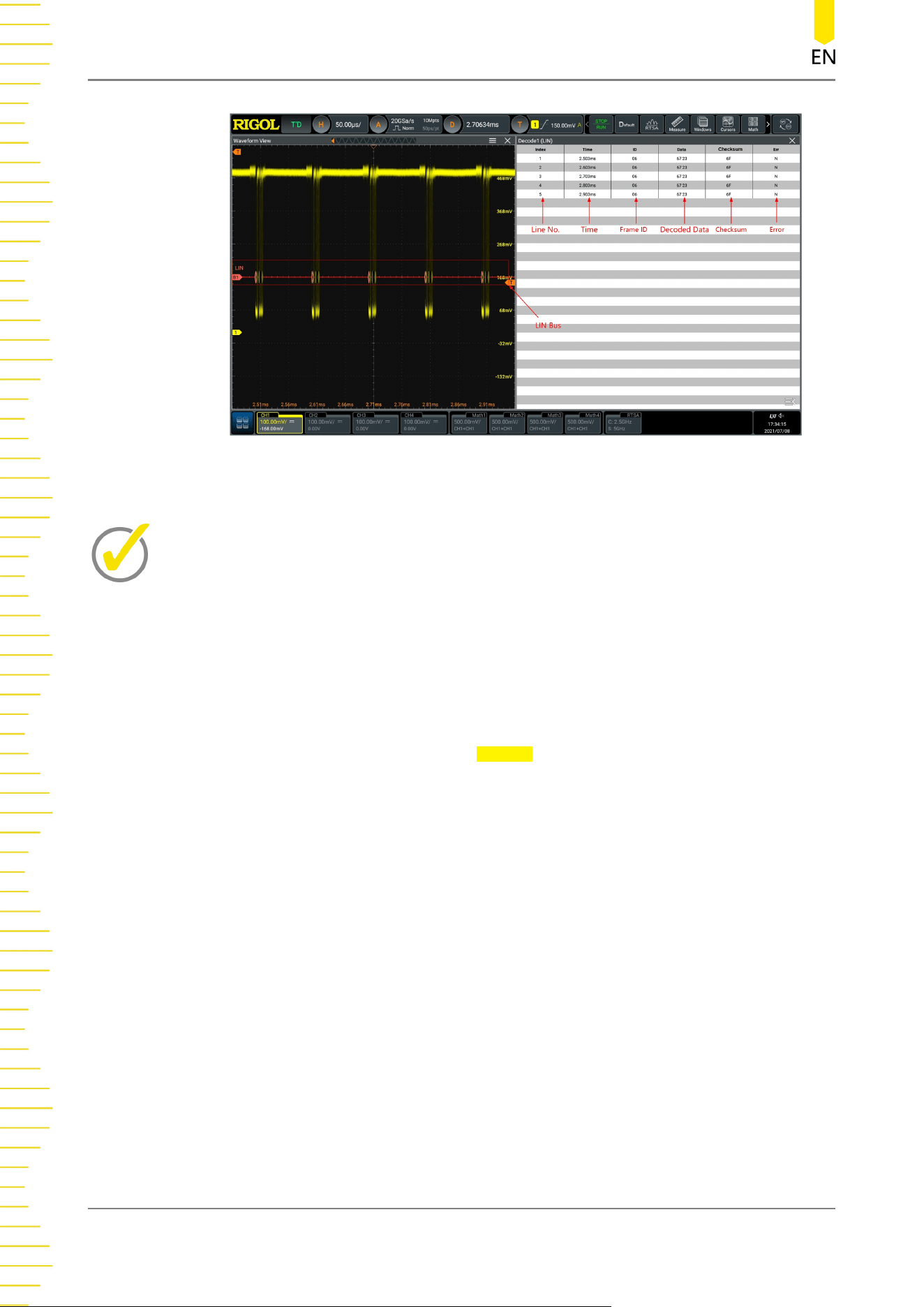
Figure 17.15 LIN Decoding Event Table
Tip
• When you adjust the horizontal time base, the waveform displayed on the screen will also
change, and the total number of lines containing the decoding information in the event
table will also be changed.
• The displayed decoded data information in the bus is related to the value of the
horizontal time base. Reducing the horizontal time base can help you view the detailed
information.
Set the Event Table Format
Click or tap the drop-down button of Format to select the display format of "Data" in
the event table from the drop-down list. The available options include "Hex", "Dec",
"Bin", or "ASCII".
Interpret the Decoded LIN Data
• Break (Sync Break): expressed in Hex, identified as "Break:".
• SYNC (Sync): expressed in Hex, identified as "SYNC:".
• ID (Frame ID): expressed in Hex, identified as "ID:".
• Data (Data): Its display format is the same as that of the bus data (Hex, Dec, Bin,
or ASCII), identified as "Data:".
• CRC (Cyclic Redundancy Check): expressed in Hex, identified as "CRC:". When
errors occur, it is displayed as a red patch for the checksum error.
• Wakeup (wake up symbol): identified as "Wakeup:".
Protocol Decoding
DS70000 User Guide
234
Copyright ©RIGOL TECHNOLOGIES CO., LTD.
All rights reserved.
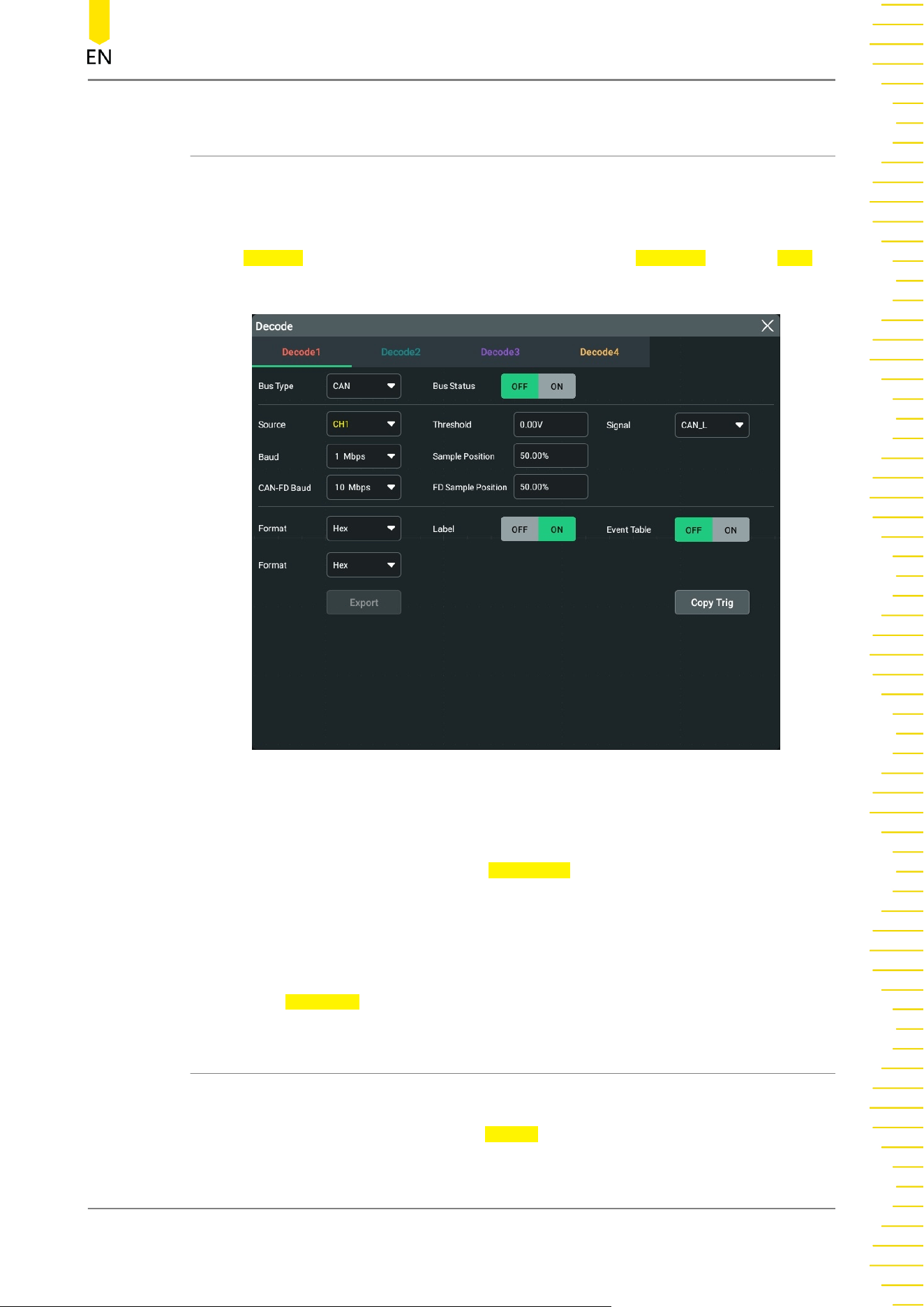
17.6 CAN Decoding (Option)
The oscilloscope samples the CAN signal at the specified sample position, and judges
each data point to be logic "1" or logic "0" according to the preset threshold level.
You need to specify the CAN signal type and sample position for CAN decoding.
In the Decode menu, click or tap the drop-down button of Bus Type to select CAN,
then configure the parameters for CAN decoding.
Figure 17.16 CAN Decoding Menu
Bus Status
Click or tap the ON/OFF button for the Bus Status menu item to enable/disable the
bus decoding.
Quickly apply trigger settings to decoding
Copy trig indicates applying the trigger settings to the specified decoding setting.
Click or tap Copy Trig to apply the trigger settings to the specified decoding setting.
17.6.1 Signal Configuration
Set the source and the threshold
• Click or tap drop-down button of Source to select the desired source from the
drop-down list. The sources include CH1-CH4.
Protocol Decoding
Copyright ©RIGOL TECHNOLOGIES CO., LTD.
All rights reserved.
DS70000 User Guide
235
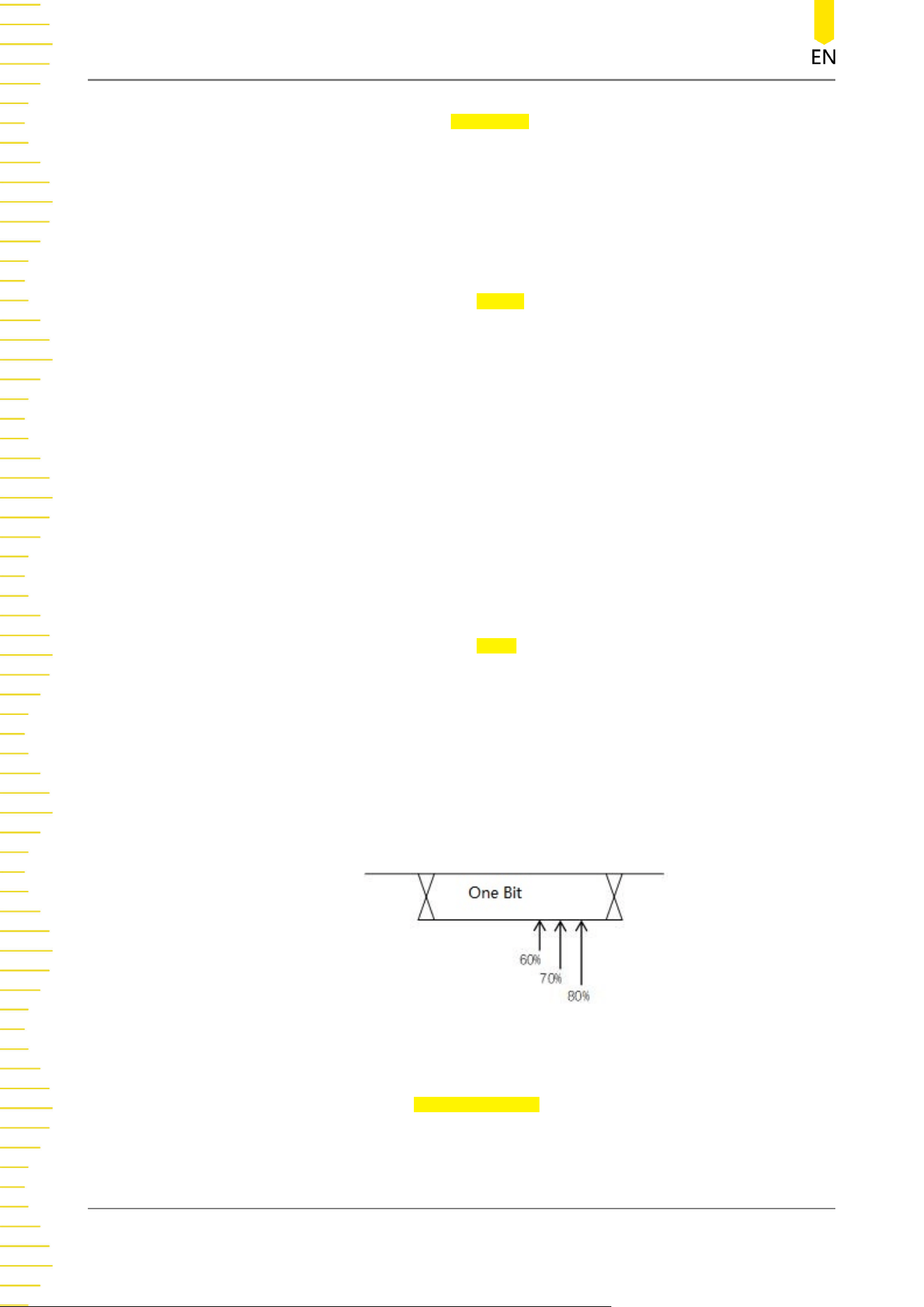
• Click or tap the input field of Threshold, and then use the pop-up numeric
keypad to set the threshold of the source channel.
When you modify the threshold of the clock channel, a dotted line displaying the
current threshold level is displayed on the screen. It disappears in about 2 s after
you stop modifying the threshold.
Select the Signal Type
Click or tap the drop-down button of Signal to select a signal type that matches the
CAN bus signal. The available signal types include CAN_H, CAN_L, Rx, Tx, and Diff.
• CAN_H: indicates the actual CAN_H bus signal.
• CAN_L: indicates the actual CAN_L bus signal.
• Rx: indicates the Receive signal from the CAN bus transceiver.
• Tx: indicates the Transmit signal from the CAN bus transceiver.
• DIFF: The CAN differential bus signals connected to an analog source channel by
using a differential probe. Connect the probe's positive lead to the CAN_H bus
signal and connect the negative lead to the CAN_L bus signal.
Specify the Standard Signal Rate
Click or tap the drop-down button of Baud to select the preset baud rate from the
drop-down list. The available baud rates include 10.0 kbps, 19.2 kbps, 20.0 kbps, 33.3
kbps, 38.4 kbps, 50.0 kbps, and etc.
Sample Position
Sample position is a point within a bit’s time. The oscilloscope samples the bit level
at this point. The sample position is represented by the proportion of "the time from
the start of the bit to the sample point" to the "bit time", as shown in the figure
below.
Figure 17.17 Sample Position
Click or tap the input field of Sample Position to set it by using the pop-up numeric
keypad. The settable range is from 10% to 90%.
Protocol Decoding
DS70000 User Guide
236
Copyright ©RIGOL TECHNOLOGIES CO., LTD.
All rights reserved.
Set the Signal Variable Rate
Click or tap the drop-down button of CAN-FD Baud to select the variable baud rate
from the drop-down list. The available baud rates include 1 Mbps, 2 Mbps, 3 Mbps, 4
Mbps, and etc.
Sample Position (FD)
Click or tap the input field of FD Sample Position to set it by using the pop-up
numeric keypad. The settable range is from 10% to 90%.
17.6.2 Display-related Setting
In Decode menu, set the following display-related parameters.
Set the Display Format
Click or tap the drop-down button of Format to select the display format of the bus
data from the drop-down list. The available options include "Hex", "Dec", "Bin", or
"ASCII".
Set the Label Display
Click or tap the ON/OFF tab for the Label menu to enable or disable the label display
of the decoding bus. When enabled, the bus label will be displayed at the upper-left
side of the bus (when the bus display is enabled). The label shows the current bus
type.
17.6.3 Event Table
Open or Close the Event Table
Click or tap the ON/OFF tab for the Event Table menu to enable or disable the
display of the event table. When enabled, the following event table is displayed, as
shown in the figure below. You can also click or tap the icon at the upper-right
corner of the table to close the event table.
Protocol Decoding
Copyright ©RIGOL TECHNOLOGIES CO., LTD.
All rights reserved.
DS70000 User Guide
237
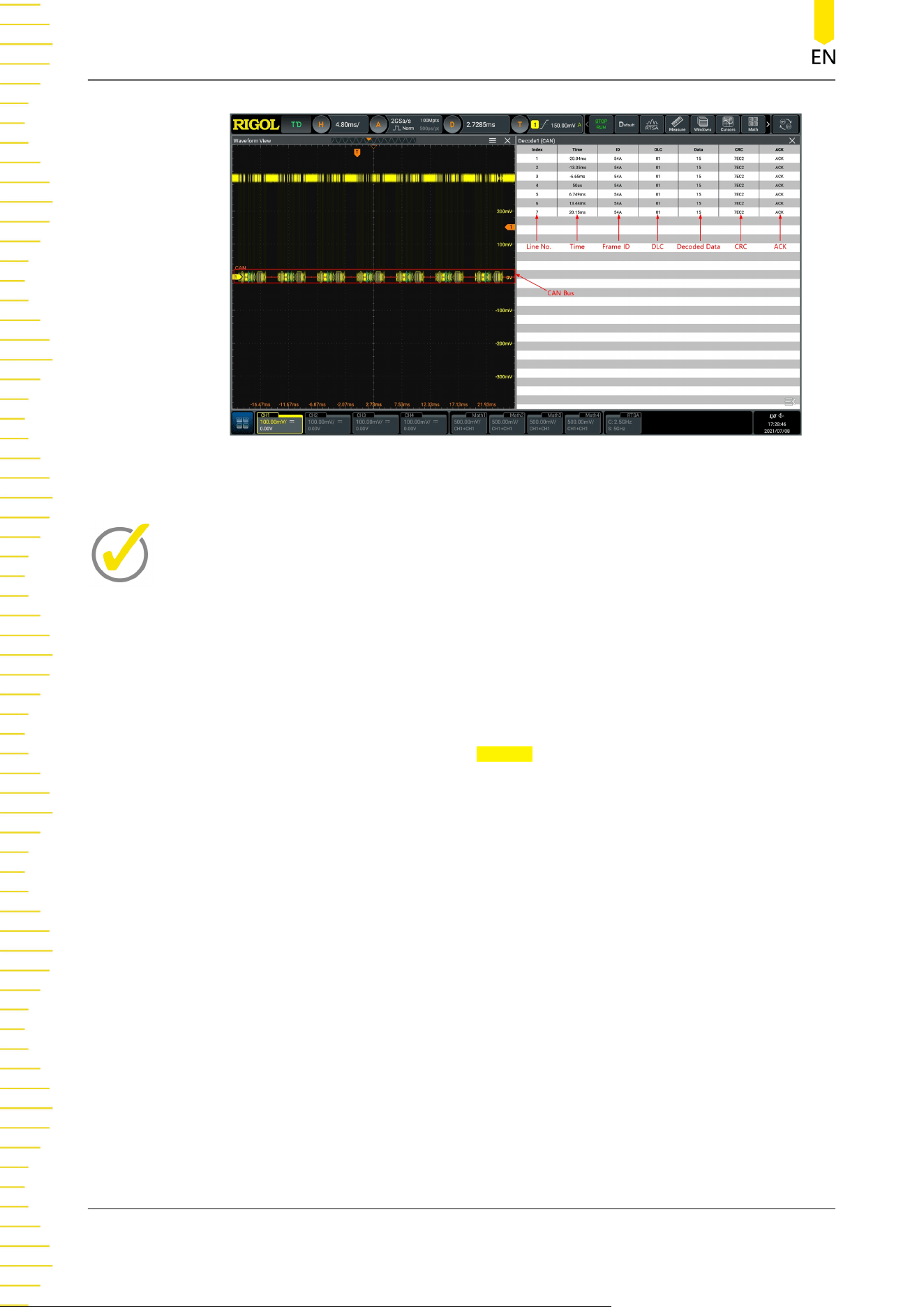
Figure 17.18 CAN Decoding Event Table
Tip
• When you adjust the horizontal time base, the waveform displayed on the screen will also
change, and the total number of lines containing the decoding information in the event
table will also be changed.
• The displayed decoded data information in the bus is related to the value of the
horizontal time base. Reducing the horizontal time base can help you view the detailed
information.
Set the Event Table Format
Click or tap the drop-down button of Format to select the display format of "Data" in
the event table from the drop-down list. The available options include "Hex", "Dec",
"Bin", or "ASCII".
Interpret the Decoded CAN Data
• Frame ID: expressed in Hex, identified as "ID:".
• DLC (Data Length Code): expressed in Hex, identified as "DLC:".
• Data: Its display format is the same as that of the bus data (Hex, Dec, Bin, or
ASCII), identified as "Data:".
• CRC (Cyclic Redundancy Check): expressed in Hex, identified as "CRC:".
• ACK (Acknowledgement): identified as "ACK". When errors (ACK is detected to
be 1) occur, displayed as a red patch.
• R (remote frame): identified as "R:".
Protocol Decoding
DS70000 User Guide
238
Copyright ©RIGOL TECHNOLOGIES CO., LTD.
All rights reserved.
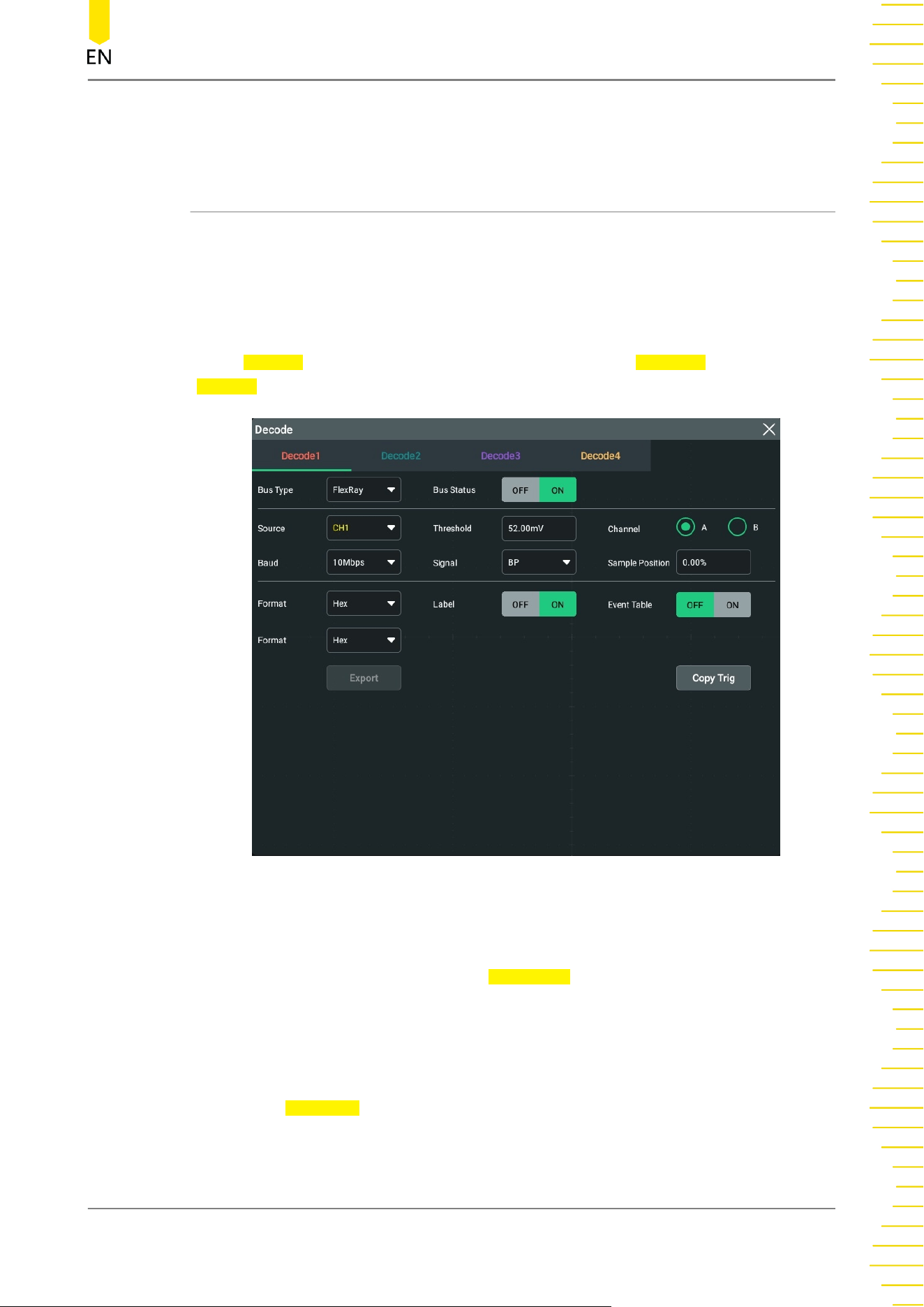
• Stuff (Bit filling error): identified as "Stuff".
17.7 FlexRay Decoding (Option)
FlexRay is a type of differential serial bus configured with three consecutive segments
(i.g. packet header, payload, and packet trailer). The oscilloscope samples the FlexRay
signal at the specified sample position and judges each data point as logic "1" or
logic "0" according to the preset threshold level. The FlexRay decoding is required to
specify the signal type and baud rate.
In the Decode menu, click or tap the drop-down button of Bus Type to select
FlexRay, then configure the parameters for FlexRay decoding.
Figure 17.19 FlexRay Decoding Menu
Bus Status
Click or tap the ON/OFF button for the
Bus Status menu item to enable/disable the
bus decoding.
Quickly apply trigger settings to decoding
Copy trig indicates applying the trigger settings to the specified decoding setting.
Click or tap Copy Trig to apply the trigger settings to the specified decoding setting.
Protocol Decoding
Copyright ©RIGOL TECHNOLOGIES CO., LTD.
All rights reserved.
DS70000 User Guide
239
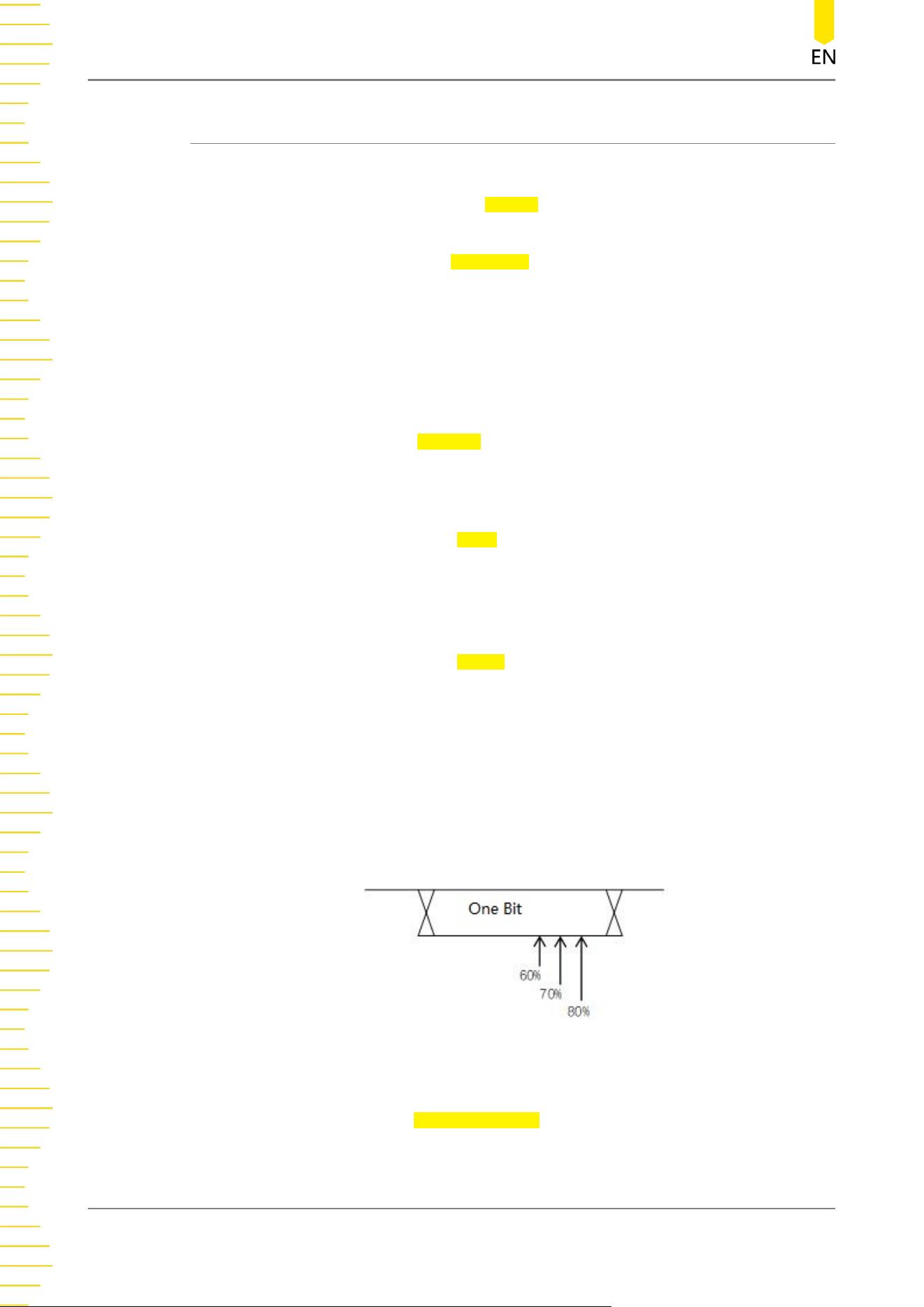
17.7.1 Signal Configuration
Set the source and the threshold
• Click or tap drop-down button of Source to select the desired source from the
drop-down list. The sources include CH1-CH4.
• Click or tap the input field of Threshold, and then use the pop-up numeric
keypad to set the threshold of the source channel.
When you modify the threshold of the clock channel, a dotted line displaying the
current threshold level is displayed on the screen. It disappears in about 2 s after
you stop modifying the threshold.
To Select the Signal
Click or tap "A" or "B" under Channel to select a channel that matches the actual
FlexRay bus signal.
Specify the Signal Rate
Click or tap the drop-down button Baud to select a FlexRay baud rate that matches
the FlexRay bus signal. The available baud rate includes "2.5 Mbps", "5 Mbps", and
"10 Mbps".
Set the Signal Type
Click or tap the drop-down button Signal to select a signal type that matches the
actual FlexRay bus signal. The available signal types include "BP", "BM", and "RX/
TX".
Sample Position
Sample position is a point within a bit’s time. The oscilloscope samples the bit level
at this point. The sample position is represented by the proportion of "the time from
the start of the bit to the sample point" to the "bit time", as shown in the figure
below.
Figure 17.20 Sample Position
Click or tap the input field of Sample Position to set it by using the pop-up numeric
keypad. The settable range is from 10% to 90%.
Protocol Decoding
DS70000 User Guide
240
Copyright ©RIGOL TECHNOLOGIES CO., LTD.
All rights reserved.
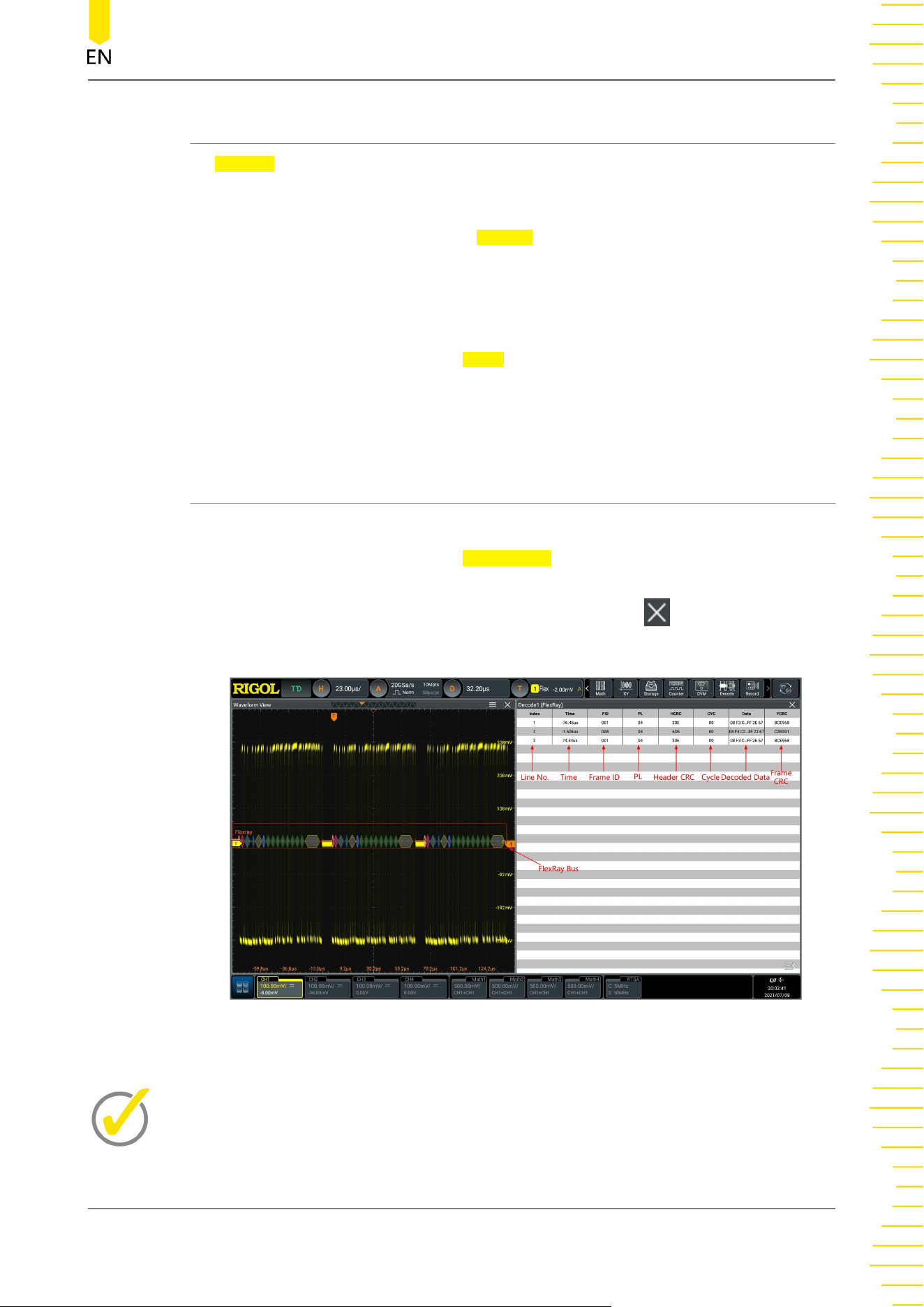
17.7.2 Display-related Setting
In Decode menu, set the following display-related parameters.
Set the Display Format
Click or tap the drop-down button of Format to select the display format of the bus
data from the drop-down list. The available options include "Hex", "Dec", "Bin", or
"ASCII".
Set the Label Display
Click or tap the ON/OFF tab for the Label menu to enable or disable the label display
of the decoding bus. When enabled, the bus label will be displayed at the upper-left
side of the bus (when the bus display is enabled). The label shows the current bus
type.
17.7.3 Event Table
Open or Close the Event Table
Click or tap the ON/OFF tab for the Event Table menu to enable or disable the
display of the event table. When enabled, the following event table is displayed, as
shown in the figure below. You can also click or tap the icon at the upper-right
corner of the table to close the event table.
Figure 17.21 FlexRay Decoding Event Table
Tip
• When you adjust the horizontal time base, the waveform displayed on the screen will also
change, and the total number of lines containing the decoding information in the event
table will also be changed.
Protocol Decoding
Copyright ©RIGOL TECHNOLOGIES CO., LTD.
All rights reserved.
DS70000 User Guide
241
• The displayed decoded data information in the bus is related to the value of the
horizontal time base. Reducing the horizontal time base can help you view the detailed
information.
Set the Event Table Format
Click or tap the drop-down button of
Format to select the display format of "Data" in
the event table from the drop-down list. The available options include "Hex", "Dec",
"Bin", or "ASCII".
Interpret the decoded FlexRay frame data
• TSS: transmission start sequence, identified as "TSS:".
• Sync Frame: identified as "SYNC:".
• ID (Frame ID): expressed in Hex, identified as "ID:".
• PL (Payload Length): expressed in Hex, identified as "PL:".
• HCRC (Header Cyclic Redundancy Check): expressed in Hex, identified as
"HCRC:". When error occurs, it is displayed as a red patch.
• CYC (Cycle Number): expressed in Hex, identified as "CYC:".
• Data: Its display format is the same as that of the bus data (Hex, Dec, Bin, or
ASCII), identified as "Data:".
• TCRC (Header Cyclic Redundancy Check): expressed in Hex, identified as "TCRC:".
When error occurs, it is displayed as a red patch.
17.8 I2S Decoding (Option)
The oscilloscope samples the I2S signal, and judges each data point to be logic "1" or
logic "0" according to the preset threshold level. I2S decoding is required to specify
the serial clock, channel signal, and the data's source channel. You need to set
Alignment, WS Low, and other parameters.
In the Decode menu, click or tap the drop-down button of Bus Type to select I2S,
then configure the parameters for I2S decoding.
Protocol Decoding
DS70000 User Guide
242
Copyright ©RIGOL TECHNOLOGIES CO., LTD.
All rights reserved.
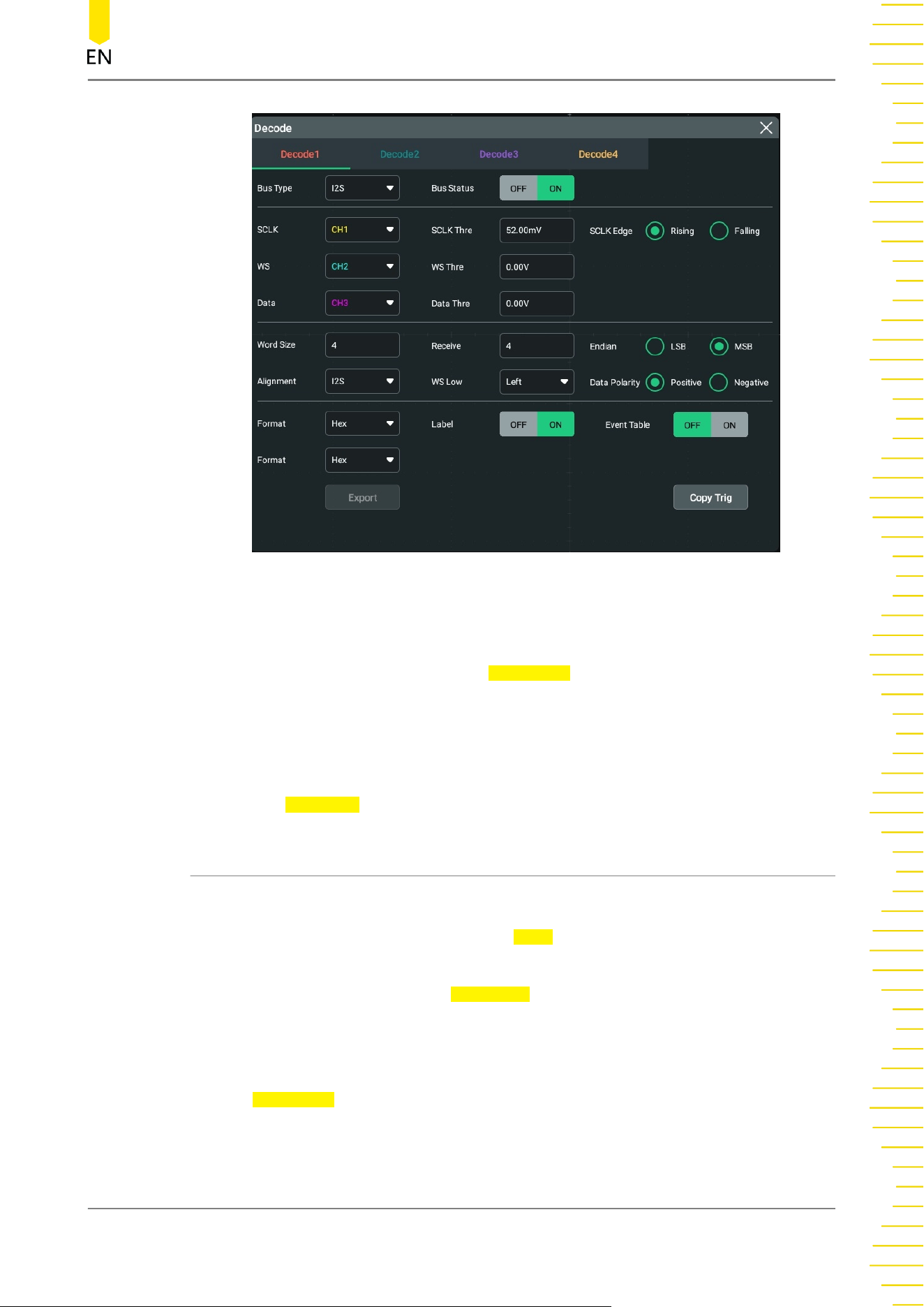
Figure 17.22 I2S Decoding Menu
Bus Status
Click or tap the ON/OFF button for the Bus Status menu item to enable/disable the
bus decoding.
Quickly apply trigger settings to decoding
Copy trig indicates applying the trigger settings to the specified decoding setting.
Click or tap Copy Trig to apply the trigger settings to the specified decoding setting.
17.8.1 Source Setting
Set the SCLK source and threshold
• Click or tap the drop-down button of SCLK to select the desired channel (CH1-
CH4) from the drop-down list as the serial clock source.
• Click or tap the input field of SCLK Thre, and then use the pop-up numeric
keypad to set the threshold of the SCLK. When you modify the threshold of the
clock channel, a dotted line displaying the current threshold level is displayed on
the screen. It disappears in about 2 s after you stop modifying the threshold.
• In SCLK Edge menu, click or tap to select "Rising" or "Falling" as the desired
clock edge.
Protocol Decoding
Copyright ©RIGOL TECHNOLOGIES CO., LTD.
All rights reserved.
DS70000 User Guide
243
Set the WS source and threshold
• Click or tap the drop-down button of WS to select the desired channel (CH1-
CH4) from the drop-down list as the WS source.
• Click or tap the input field of WS Thre, and then use the pop-up numeric keypad
to set the threshold of the WS signal. When you modify the WS threshold, a
dotted line displaying the current threshold level is displayed on the screen. It
disappears in about 2 s after you stop modifying the threshold.
Set the SDA source and threshold
• Click or tap the drop-down button of SDA to select the desired SDA source
(CH1-CH4) from the drop-down list.
• Click or tap the input field of Data Thre, and then use the pop-up numeric
keypad to set the threshold of the data signal. When you modify the data
threshold, a dotted line displaying the current threshold level is displayed on the
screen. It disappears in about 2 s after you stop modifying the threshold.
17.8.2 Bus Setting
Set the word size
Click or tap the input field of Word Size, and then use the pop-up numeric keypad to
set the word size. Its range is from 4 to 32.
Set the receiver word size
Click or tap the input field of Receive, and then use the pop-up numeric keypad to
set the receiver word size. Its range is from 4 to 32.
Set the endian
In Endian menu, click or tap to select "LSB" or "MSB". By default, it is "MSB".
Set the alignment mode
Click or tap the drop-down button of Alignment to select the alignment way for data
signal. The available choices include "I2S", "LJ", and "RJ".
Set the audio polarity
Click or tap the drop-down button of WS Low to select "Left" or "Right".
Set the data polarity
In Data Polarity menu, click or tap to select "Positive" or "Negative".
17.8.3 Display-related Setting
In Decode menu, set the following display-related parameters.
Protocol Decoding
DS70000 User Guide
244
Copyright ©RIGOL TECHNOLOGIES CO., LTD.
All rights reserved.
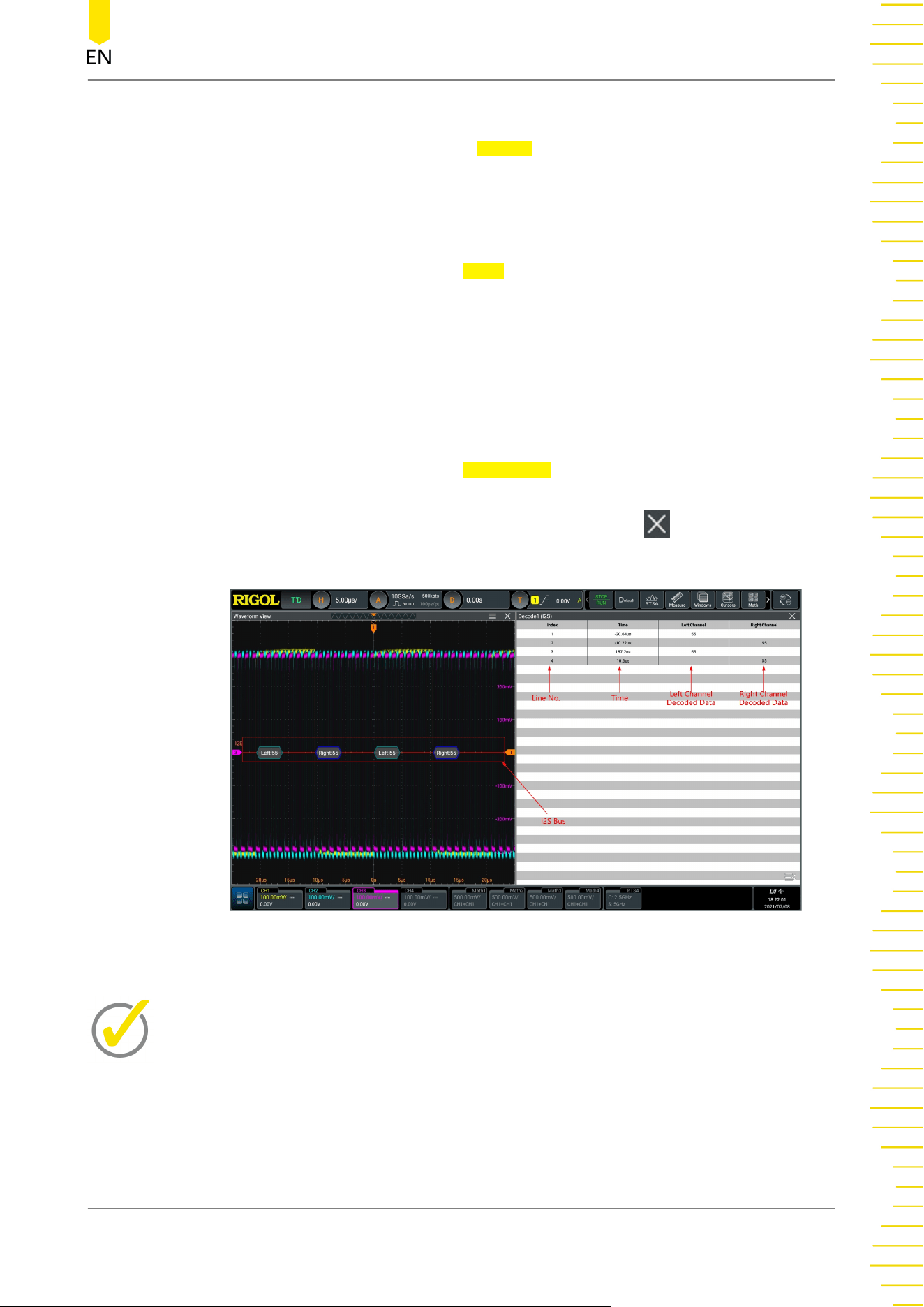
Set the Display Format
Click or tap the drop-down button of Format to select the display format of the bus
data from the drop-down list. The available options include "Hex", "Dec", "Bin", or
"ASCII".
Set the Label Display
Click or tap the ON/OFF tab for the Label menu to enable or disable the label display
of the decoding bus. When enabled, the bus label will be displayed at the upper-left
side of the bus (when the bus display is enabled). The label shows the current bus
type.
17.8.4 Event Table
Open or Close the Event Table
Click or tap the ON/OFF tab for the Event Table menu to enable or disable the
display of the event table. When enabled, the following event table is displayed, as
shown in the figure below. You can also click or tap the icon at the upper-right
corner of the table to close the event table.
Figure 17.23 I2S Decoding Event Table
Tip
• When you adjust the horizontal time base, the waveform displayed on the screen will also
change, and the total number of lines containing the decoding information in the event
table will also be changed.
• The displayed decoded data information in the bus is related to the value of the
horizontal time base. Reducing the horizontal time base can help you view the detailed
information.
Protocol Decoding
Copyright ©RIGOL TECHNOLOGIES CO., LTD.
All rights reserved.
DS70000 User Guide
245
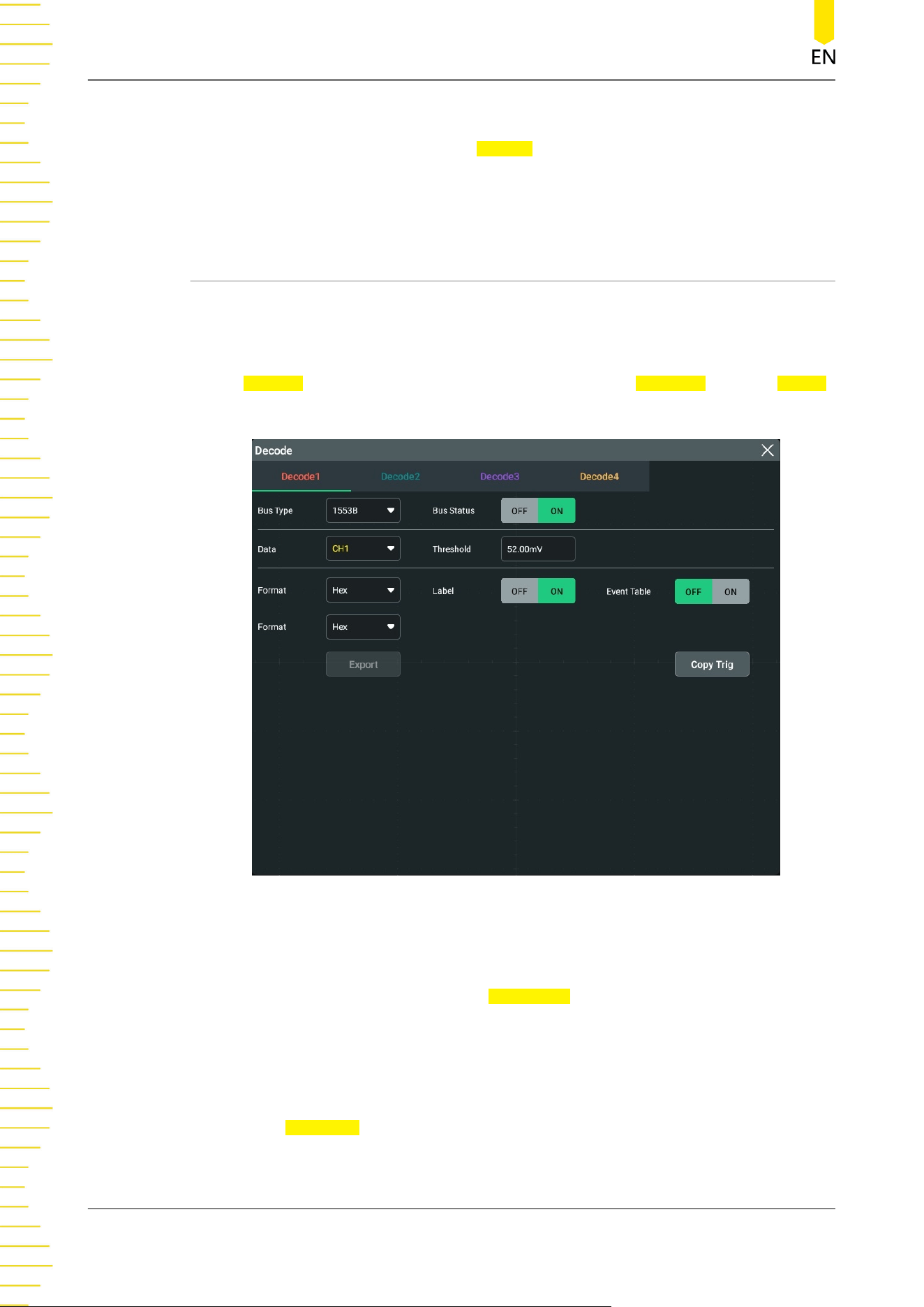
Set the Event Table Format
Click or tap the drop-down button of Format to select the display format of "Data" in
the event table from the drop-down list. The available options include "Hex", "Dec",
"Bin", or "ASCII".
17.9 1553B Decoding (Option)
The oscilloscope samples the 1553B signal, and judges each data point to be logic "1"
or logic "0" according to the preset threshold level. 1553B decoding is required to
specify the data channel source and the threshold.
In the Decode menu, click or tap the drop-down button of Bus Type to select 1553B,
then configure the parameters for 1553B decoding.
Figure 17.24 1553B Decoding Menu
Bus Status
Click or tap the ON/OFF button for the Bus Status menu item to enable/disable the
bus decoding.
Quickly apply trigger settings to decoding
Copy trig indicates applying the trigger settings to the specified decoding setting.
Click or tap Copy Trig to apply the trigger settings to the specified decoding setting.
Protocol Decoding
DS70000 User Guide
246
Copyright ©RIGOL TECHNOLOGIES CO., LTD.
All rights reserved.
17.9.1 To Set the Data Channel Source and the Threshold
Select the Data Channel
Click or tap the drop-down button of Data to select the desired data channel source
(CH1-CH4) from the drop-down list.
Set the Threshold
Click or tap the input field of Threshold, and then use the pop-up numeric keypad to
set the threshold of the source channel.
When you modify the threshold of the channel, a dotted line displaying the current
threshold level is displayed on the screen. It disappears in about 2 s after you stop
modifying the threshold.
17.9.2 Display-related Setting
In Decode menu, set the following display-related parameters.
Set the Display Format
Click or tap the drop-down button of Format to select the display format of the bus
data from the drop-down list. The available options include "Hex", "Dec", "Bin", or
"ASCII".
Set the Label Display
Click or tap the ON/OFF tab for the Label menu to enable or disable the label display
of the decoding bus. When enabled, the bus label will be displayed at the upper-left
side of the bus (when the bus display is enabled). The label shows the current bus
type.
17.9.3 Event Table
Open or Close the Event Table
Click or tap the ON/OFF tab for the Event Table menu to enable or disable the
display of the event table. When enabled, the following event table is displayed, as
shown in the figure below. You can also click or tap the icon at the upper-right
corner of the table to close the event table.
Protocol Decoding
Copyright ©RIGOL TECHNOLOGIES CO., LTD.
All rights reserved.
DS70000 User Guide
247
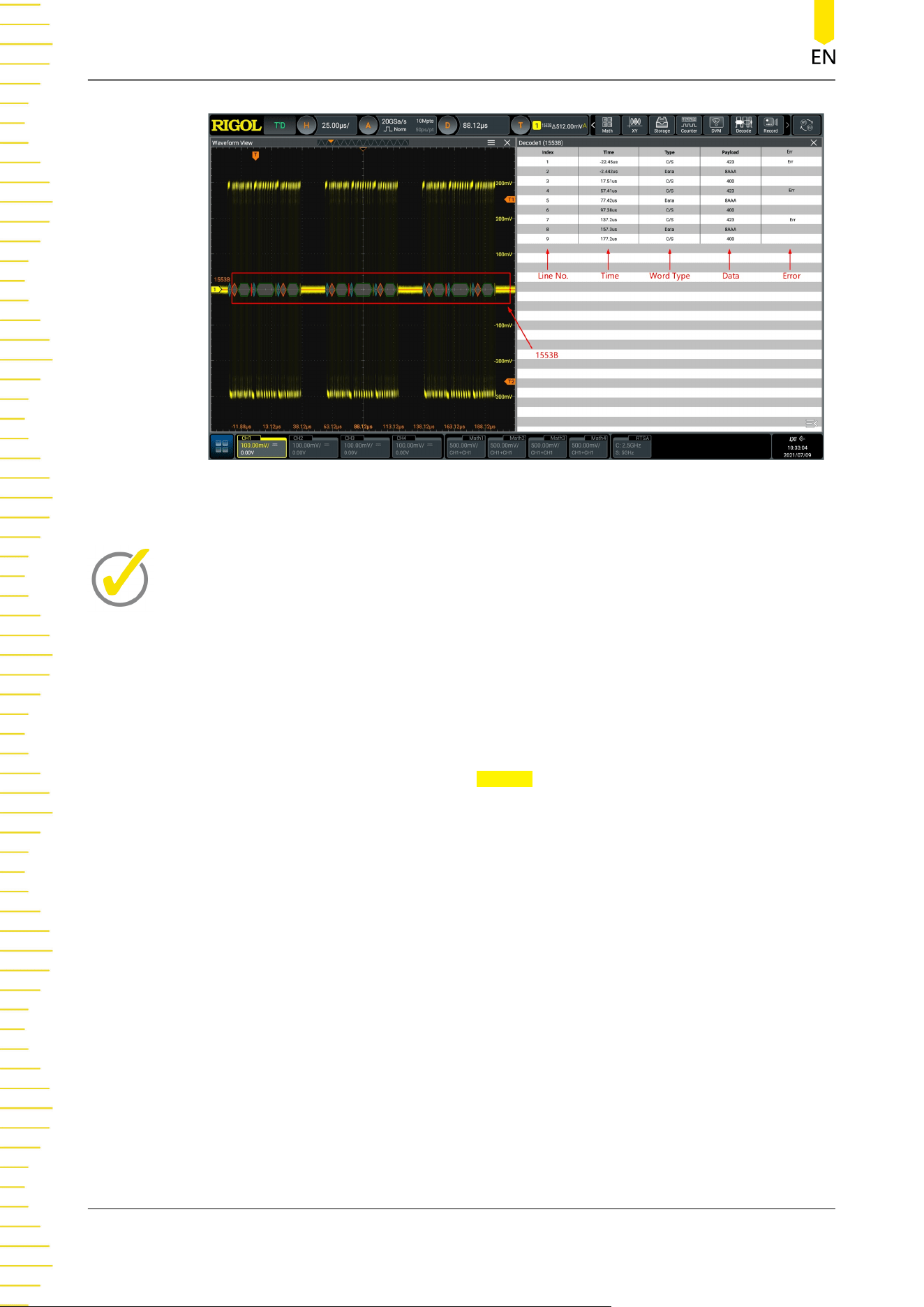
Figure 17.25 1553B Decoding Event Table
Tip
• When you adjust the horizontal time base, the waveform displayed on the screen will also
change, and the total number of lines containing the decoding information in the event
table will also be changed.
• The displayed decoded data information in the bus is related to the value of the
horizontal time base. Reducing the horizontal time base can help you view the detailed
information.
Set the Event Table Format
Click or tap the drop-down button of Format to select the display format of "Data" in
the event table from the drop-down list. The available options include "Hex", "Dec",
"Bin", or "ASCII".
Interpret the Decoded 1553B Data
• C/S: command/status word. It is expressed in "C/S" form.
• RTA: remote terminal address of the command/status word. It is expressed in
"RTA:" form.
• C/S data: the rest data value of the command/status word. Its display format is
the same as that of the bus data (Hex, Dec, Bin, or ASCII), displayed as "C/S:".
• Parity bit: displayed as a yellow-green patch; when errors occur, displayed as a
red patch.
Protocol Decoding
DS70000 User Guide
248
Copyright ©RIGOL TECHNOLOGIES CO., LTD.
All rights reserved.
• Data word data: data of the data word. Its display format is the same as that of
the bus data (Hex, Dec, Bin, or ASCII), displayed as "Data:".
Protocol Decoding
Copyright ©RIGOL TECHNOLOGIES CO., LTD.
All rights reserved.
DS70000 User Guide
249
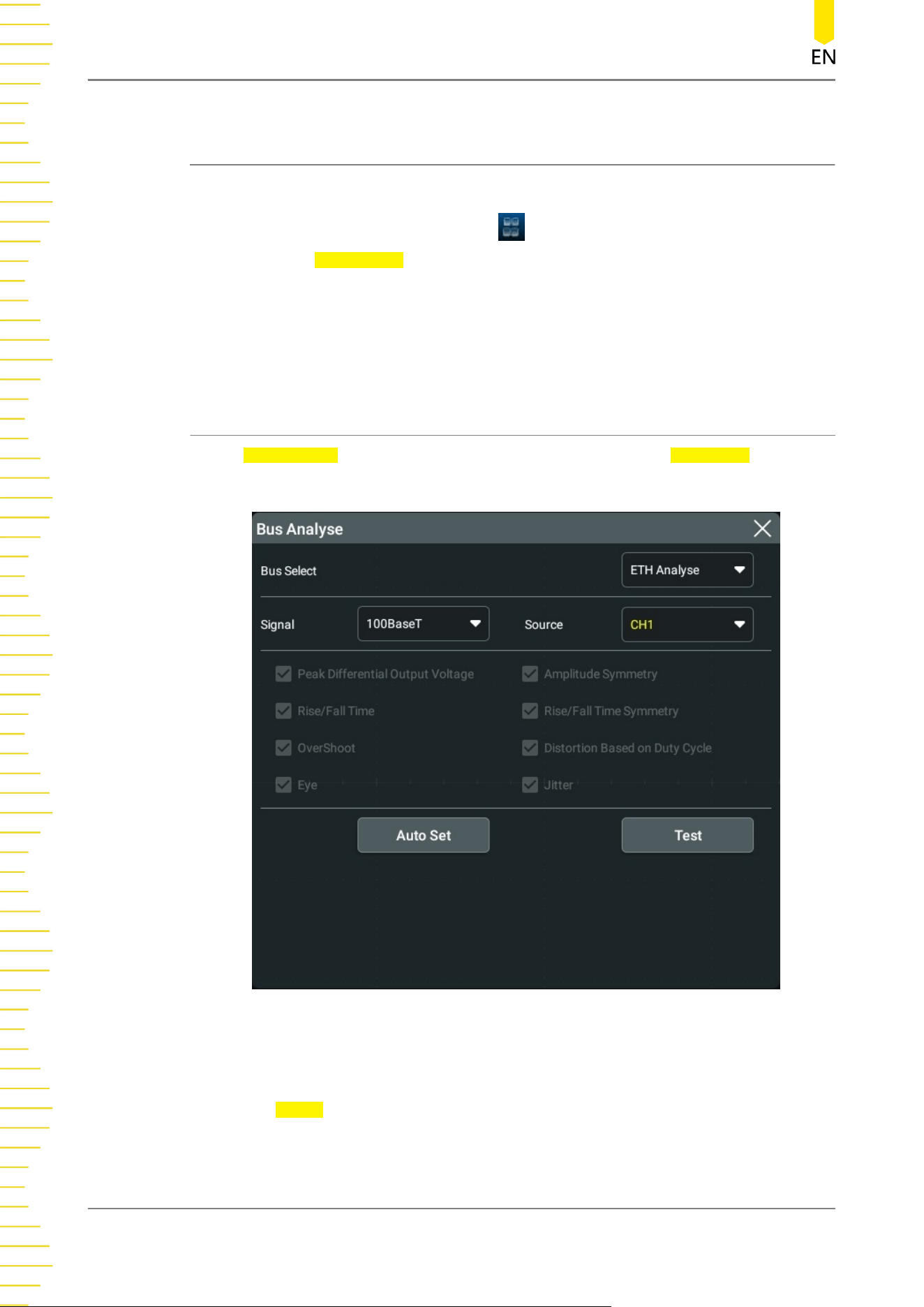
18 Bus Analysis (Option)
DS70000 series supports USB and ETH bus analysis.
Click or tap the function navigation icon
at the lower-left corner of the screen,
and then select BusAnalyse to enter the "Bus Analyse" setting menu.
After the measurement, the test report will be generated automatically and displayed.
If you have purchased the decoding option, activate it according the descriptions in
"
To View the Option Information and the Option Installation
".
18.1 ETH Bus Analysis
In the Bus Analyse menu, click or tap the drop-down button of Bus Select to select
"ETH Analyse" from the drop-down list. Then configure the ETH bus analysis settings.
Figure 18.1 ETH Bus Analysis Configuration Menu
Select the ETH signal protocol
Under the Signal menu, only "100BaseT" is available for you to choose.
Bus Analysis (Option)
DS70000 User Guide
250
Copyright ©RIGOL TECHNOLOGIES CO., LTD.
All rights reserved.
Configure the source
Click or tap drop-down button of Source to select the desired source from the drop-
down list. The sources include CH1-CH4.
Measurement items
The available measurement items include: "Peak Differential Output Voltage",
"Amplitude Symmetry", "Rise/Fall Time", "Rise/Fall Time Symmetry",
"Overshoot", "Distortion Based on Duty Cycle", "Eye", and "Jitter".
Auto Set
Click or tap Auto Set, then the system will complete the setting for the measurement
parameters.
Launch the test
Click or tap Test, then the system starts to make bus analysis. After the test, the test
results are displayed.
18.2 USB Bus Analysis
In the Bus Analyse menu, click or tap the drop-down button of the Bus Select text
box to select “USB Analyse” from the drop-down list and configure the USB bus
analysis settings.
Bus Analysis (Option)
Copyright ©RIGOL TECHNOLOGIES CO., LTD.
All rights reserved.
DS70000 User Guide
251
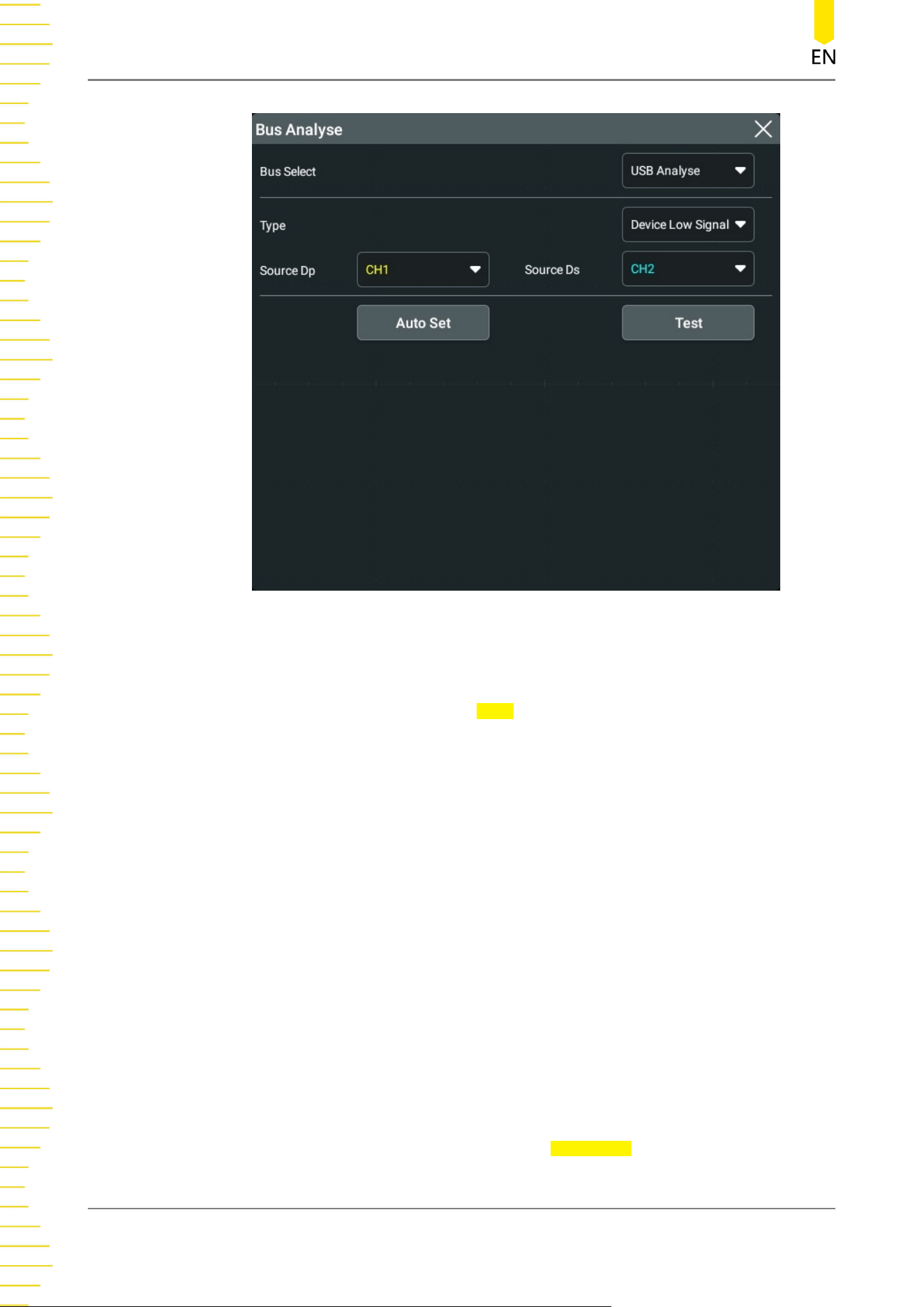
Figure 18.2 USB Bus Analysis Configuration Menu
Select the USB bus type
Click or tap the drop-down button of Type to select the type of the USB bus analysis.
The available types include:
• Device Low Signal
• Host Low Signal
• Device Full Signal
• Host Full Signal
• Device High Signal
• Host High Signal
Configure the source
• When the USB bus type is "Device Low Signal", "Host Low Signal", "Device Full
Signal", or "Host Full Signal", you can configure the parameters: Source Dp and
Source Ds.
- Click or tap the drop-down button of
Source Dp to select the desired
source from the drop-down list. The sources include CH1-CH4.
Bus Analysis (Option)
DS70000 User Guide
252
Copyright ©RIGOL TECHNOLOGIES CO., LTD.
All rights reserved.
- Click or tap drop-down button of Source Ds to select the desired source
from the drop-down list. The sources include CH1-CH4.
• When the USB bus type is "Device High Signal" or "Host High Signal", you can
configure the parameters: Source Diff and Point.
- Click or tap the drop-down button of Source Diff to select the desired
source from the drop-down list. The sources include CH1-CH4.
- Click or tap the drop-down button of Point to select "Near"or "Far" from
the drop-down list.
Auto Set
Click or tap Auto Set, then the system will complete the setting for the measurement
parameters.
Launch the test
Click or tap Test, then the system starts to make bus analysis. After the test, the test
results are displayed.
Bus Analysis (Option)
Copyright ©RIGOL TECHNOLOGIES CO., LTD.
All rights reserved.
DS70000 User Guide
253
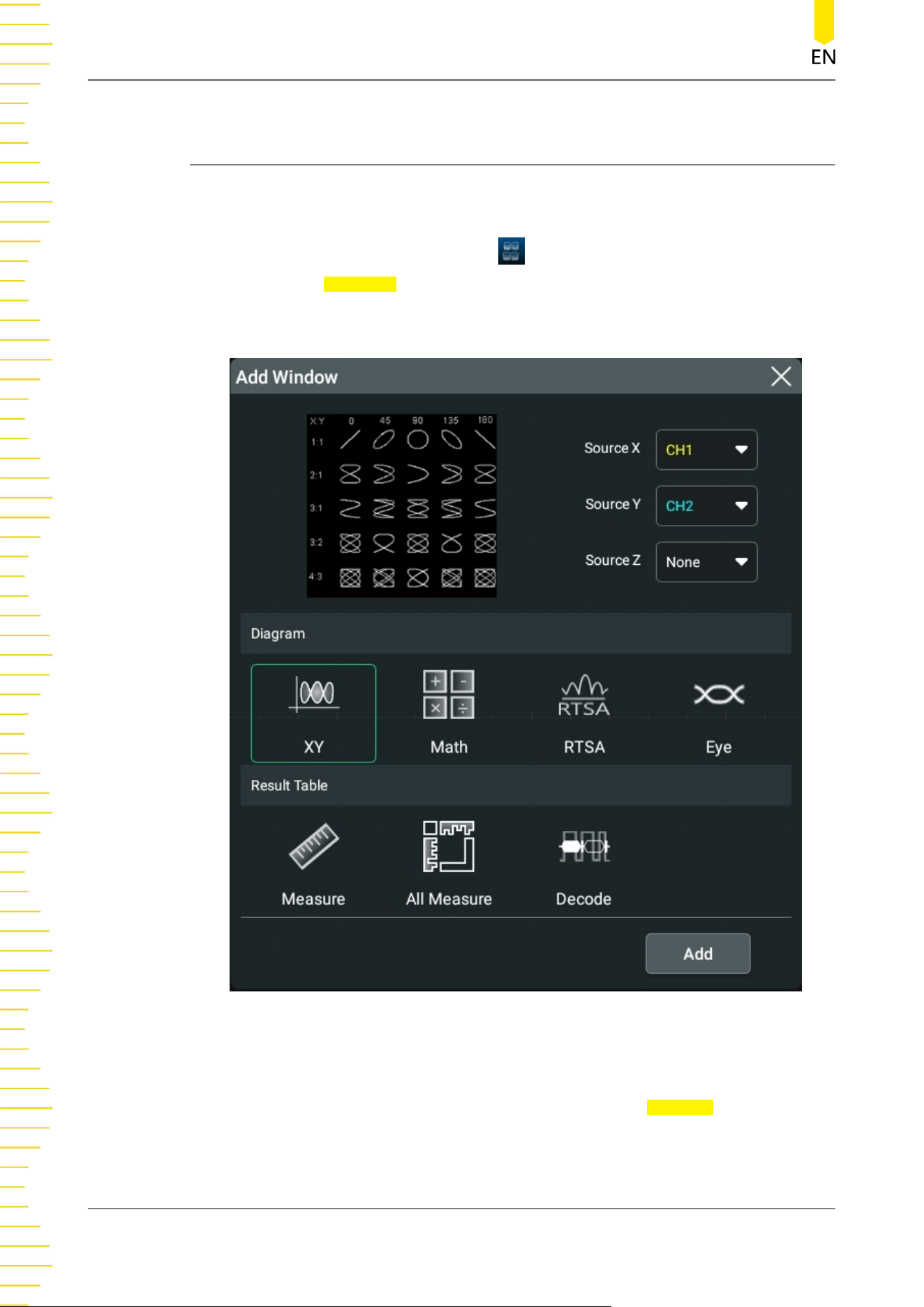
19 Multi-pane Windowing
DS70000 supports multi-pane windowing. Users can add multiple windows and result
display windows for display and view.
Click or tap the function navigation icon
at the lower-left corner of the screen.
Then click or tap Windows to enter the "Add Window" interface. You can also click or
tap the "Windows" icon in the quick operation bar at the top of the screen to enter
the "Add Window" interface. As shown in the figure below:
Figure 19.1 "Add Window" Interface
Add Diagram Windows
1 First, click or tap "XY", "Math", "RTSA", or "Eye" under the Diagram menu. When a
diagram is selected, its preview and parameter setting items can be displayed at
the upper part of the "Add Window" interface.
Multi-pane Windowing
DS70000 User Guide
254
Copyright ©RIGOL TECHNOLOGIES CO., LTD.
All rights reserved.
2 You can set the corresponding parameters according to your needs. For detailed
setting methods, refer to descriptions of relevant chapters.
3 Click or tap Add, then the selected diagram is displayed on the screen.
Add Result Table Window
Click or tap "Measure", "All Measure", or "Decode" under the Result Table menu,
then click or tap Add. The corresponding measurement results will be displayed on
the screen.
Multi-pane Windowing
Copyright ©RIGOL TECHNOLOGIES CO., LTD.
All rights reserved.
DS70000 User Guide
255
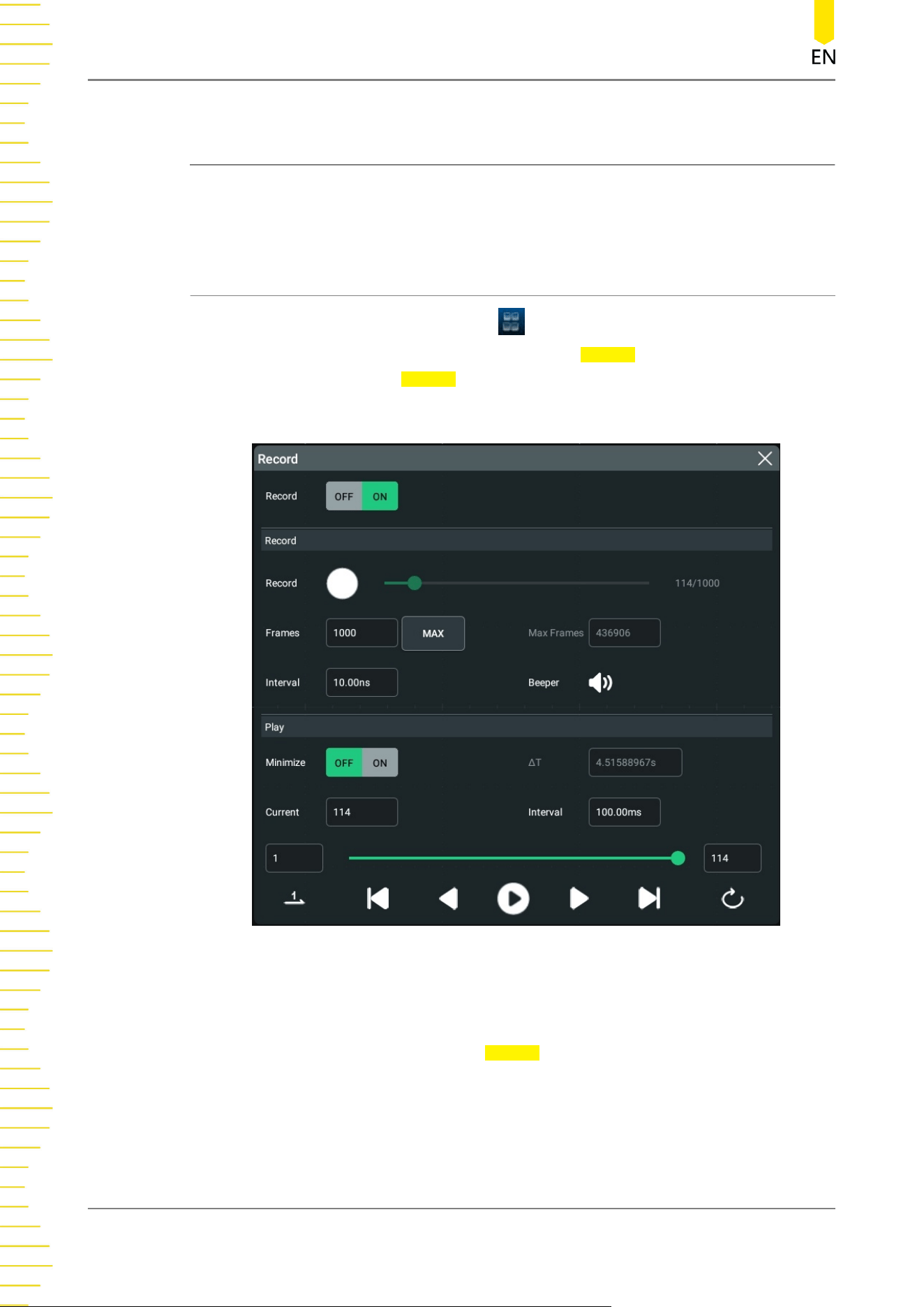
20 Waveform Recording and Playing
Waveform recording/playing function can play the recorded waveforms of the analog
input channels (CH1-CH4), enabling you to analyze the waveforms better.
20.1 Common Settings
Click or tap the function navigation icon at the lower-left corner of the screen to
open the function navigation. Then, click or tap the Record icon to enter the "Record"
menu. You can also tap the Record icon on the small screen at the right side of the
front panel or the quick operation bar at the top of the screen to enter the "Record"
menu.
Figure 20.1 Waveform Recording Interface
1 Recording Operation
Click or tap the ON/OFF tab for the Record menu to enable or disable the
waveform recording function. Before recording the waveform, you can refer to
descriptions in "
Record Options
" to set the waveform recording parameters.
Waveform Recording and Playing
DS70000 User Guide
256
Copyright ©RIGOL TECHNOLOGIES CO., LTD.
All rights reserved.
- Click or tap the Record button under the Record menu to start recording
the waveforms. Then the record icon turns " " from " ".
- During the recording, you can view the recording information under the Play
menu. In the Play menu, the input field of Current shows the number of
currently recorded frames. Under Current is the play progress bar. The left input
field is the start frame and the right input field is the total number of currently
recorded frames. ∆T indicates the time interval between the current frame and
the first frame during the recording process.
- After the recording is completed, the recording marker " " turns out to be
" " and recording stops automatically.
- During recording, you can also click or tap to suspend recording manually.
2 Play Operation
Click or tap the play icon under Play to start playing the recorded waveforms.
Then the play icon turns from the play action " " to the pause action " ". For
details about playing, refer to descriptions in "
Play Option
". During waveform
playing, the value of Current changes dynamically. During playing, you can also
click or tap the icon again to suspend playing manually.
20.2 Record Options
During the waveform recording, the oscilloscope records the waveforms of the
currently enabled channel at a specified interval until you manually stops the
recording operation or the number of recorded frames has reached the set value.
Before recording the waveforms, set the following parameters.
1 Interval
The recording interval indicates the time interval between the frames during the
recording process.
Click or tap Interval, then use the pop-up numeric keypad to set the time interval
between frames. The available range is from 10 ns to 10 s.
2 Frames
The recording frames refer to the number of frames that can be recorded actually.
After starting the recording operation, the oscilloscope stops the recording
operation automatically when the number of recorded frames reaches the set
value.
Waveform Recording and Playing
Copyright ©RIGOL TECHNOLOGIES CO., LTD.
All rights reserved.
DS70000 User Guide
257
Click or tap Frames to set the number of waveform frames to be recorded
currently.The range available is from 1 to the maximum number of frames that can
be recorded currently.
3 Max Frames
The input field of Max Frames displays the maximum number of frames that can
be recorded currently. Click or tap Max, and the maximum number of recorded
waveform frames is automatically input into the input field of Frames.
As the capacity of the waveform memory is fixed, the more the number of points
each frame of waveform has, the less the number of waveform frames that can be
recorded. Therefore, the maximum number of recorded frames is related to the
currently selected "memory depth" (refer to
Memory Depth
). The current memory
depth refers to the number of waveform points per frame. Memory Depth =
Sample Rate x Horizontal Time Base x Number of Grids in the Horizontal Direction.
Therefore, the Max value of waveform recording is also related to the "Sample
Rate" and "Horizontal Time Base". This oscilloscope supports up to 2,000,000
frames real-time and ceaseless waveforms recording.
4 Beeper
: the beeper sounds at the end of recording.
: the beeper does not sound at the end of recording.
20.3 Play Option
Waveform playing function can play back the waveforms currently recorded. In Play
menu, click or tap the ON/OFF tap for the Minimize menu to select whether to
minimize the window. When you click or tap ON, the play window is minimized,
making the interface more simplified, easy for observation and operation. As shown
in the figure below:
Waveform Recording and Playing
DS70000 User Guide
258
Copyright ©RIGOL TECHNOLOGIES CO., LTD.
All rights reserved.
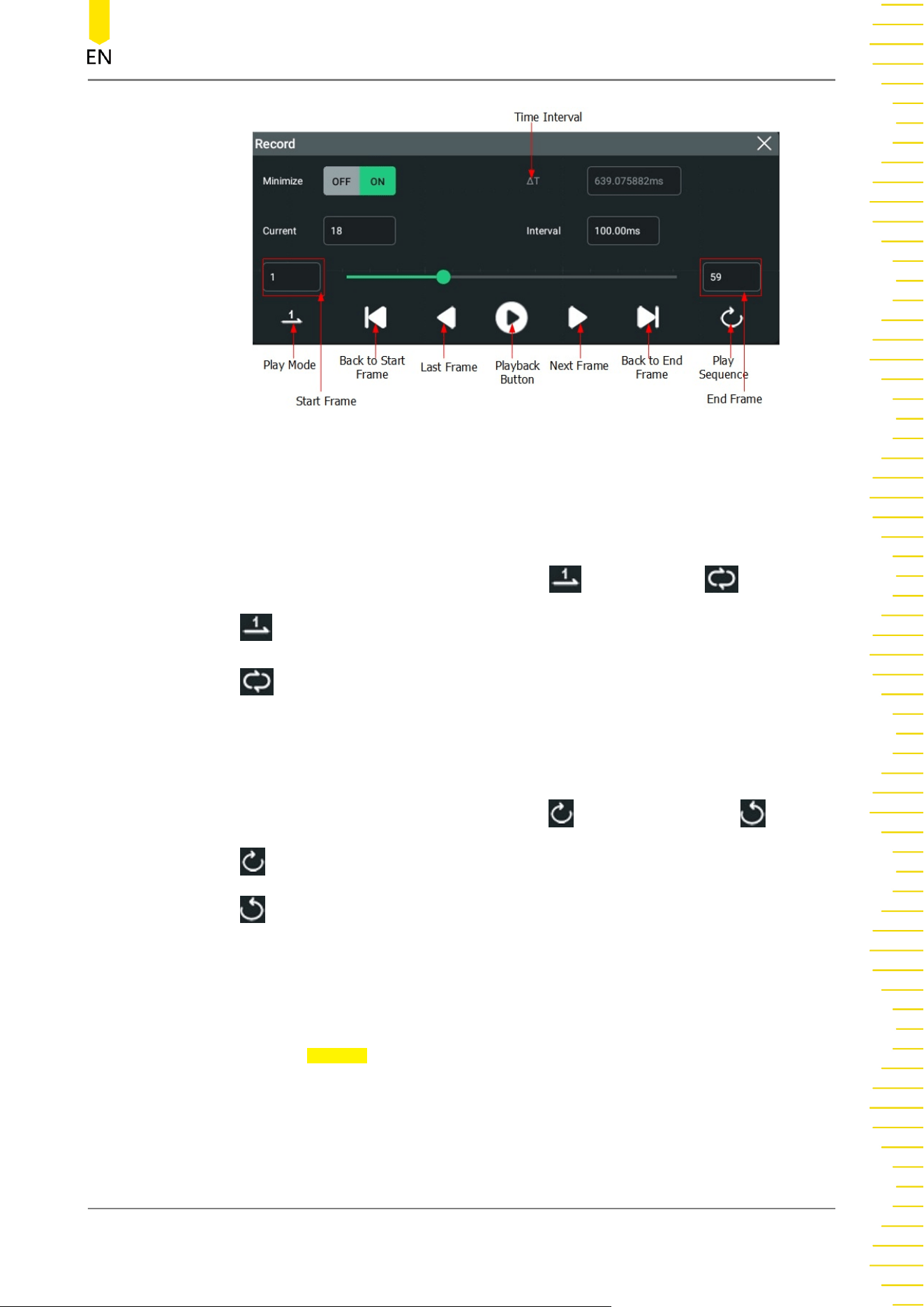
Figure 20.2 Play Operation Interface
Before playing the waveforms, set the following parameters.
1 Play Mode
You can play the waveforms in single mode ( ) or cycle mode ( ).
- : plays from the start frame to the end frame, and then stops automatically.
-
: plays from the start frame to the end frame, then such playback operation
is repeated until you stop it manually.
2 Play Sequence
You can play back the waveforms clockwise ( ) or counterclockwise ( ).
- : plays from the start frame to the end frame.
- : plays from the end frame to the start frame.
3 Interval
The playback interval indicates the time interval between the frames during the
playing process.
Click or tap Interval, then use the pop-up numeric keypad to set the time interval
between frames. The available range is from 1 ms to 10 s.
4 Start Frame
Waveform Recording and Playing
Copyright ©RIGOL TECHNOLOGIES CO., LTD.
All rights reserved.
DS70000 User Guide
259
Click or tap the input field of "Start Frame" in
Figure 20.2
to set the start frame for
playing back the waveforms. The default is 1, and the maximum value is the
maximum number of frames recorded.
5 End Frame
Click or tap the input field of "End Frame" in
Figure 20.2
to set the end frame for
playing back the waveforms. The default is the number of frames of the recorded
waveforms.
Waveform Recording and Playing
DS70000 User Guide
260
Copyright ©RIGOL TECHNOLOGIES CO., LTD.
All rights reserved.
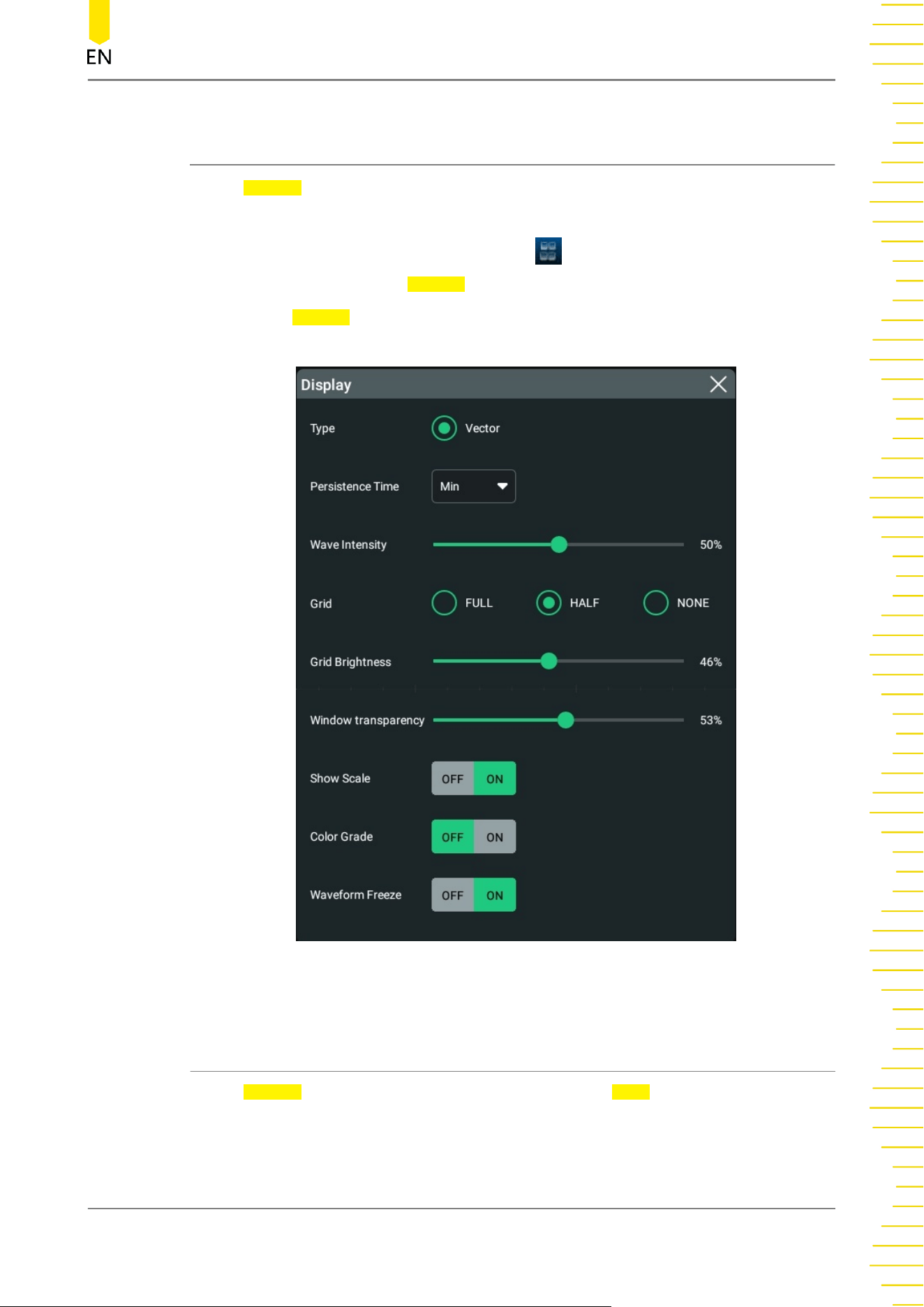
21 Display Control
In the Display setting menu, you can set the type, persistence time, waveform
intensity, grid type, grid brightness, and etc.
• Click or tap the function navigation icon
at the lower-left corner of the
screen, and then select Display to enter the "Display" menu.
• Tap the Display icon on the small screen at the right side of the screen to enter
the "Display" menu.
Figure 21.1 Display Setting Menu
21.1 Display Type
In the Display setting menu, click or tap "Vector" under Type to select the waveform
display mode.
Display Control
Copyright ©RIGOL TECHNOLOGIES CO., LTD.
All rights reserved.
DS70000 User Guide
261
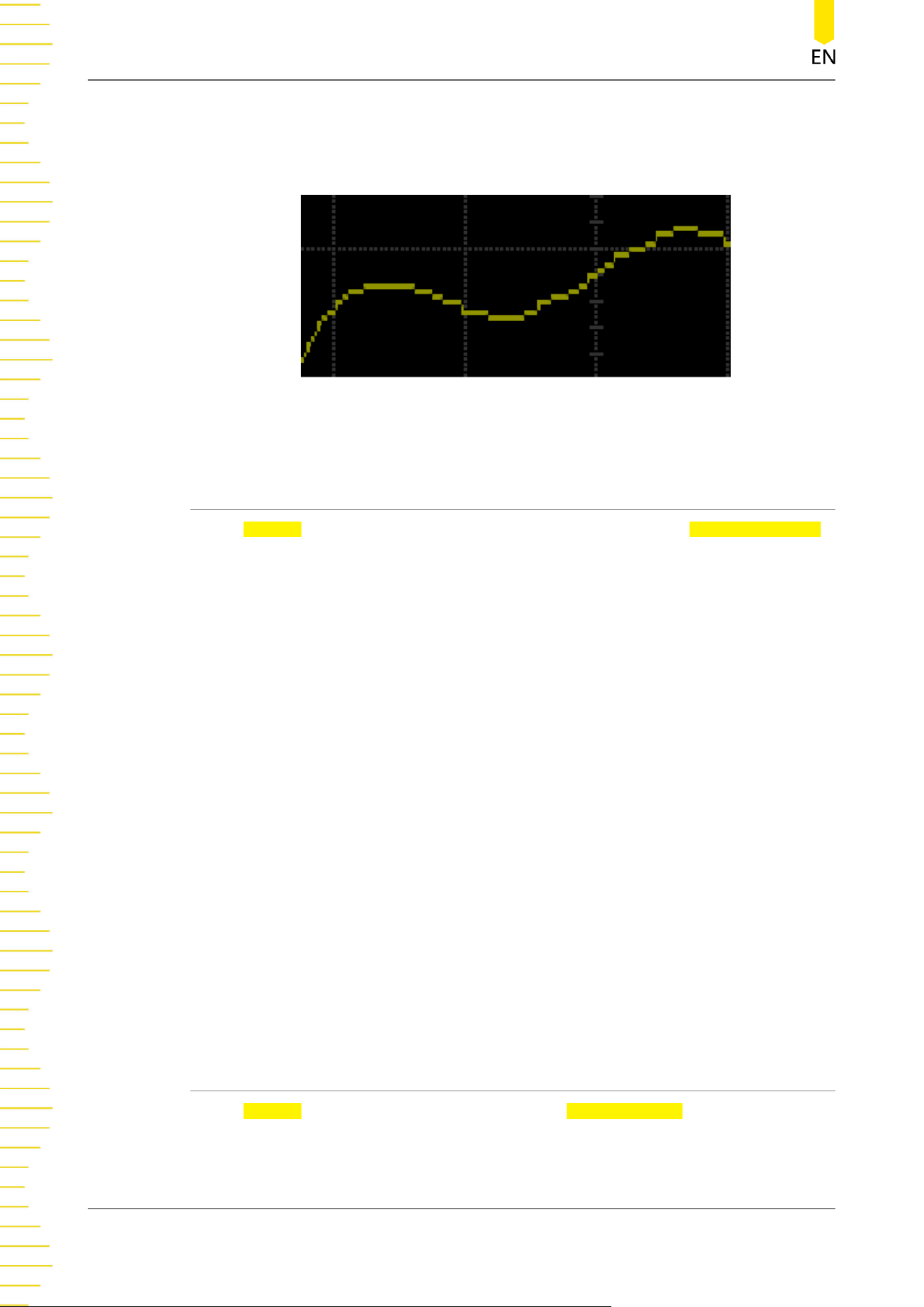
For the Vector type, the sample points are connected by lines and displayed. In most
cases, this mode can provide the most vivid waveform for you to view the steep edge
of the waveform (such as square waveform).
Figure 21.2 Vector Display
21.2 Persistence Time
In the Display setting menu, click or tap the drop-down button of Persistence Time
to select the persistence time from the drop-down list. The available values are Min,
specific values (i.g. 100 ms, 200 ms, 500 ms, 1 s, 2 s, 5 s, 10 s), and Infinite.
In the following part, a frequency sweep signal of the sine waveform is used to show
the waveform effects in different persistence times.
• Min
Enables you to view waveform changing in high refresh rate.
• Specific Values
Enables to view glitches that change relatively slowly or glitches with lower
occurrence probability. The persistence time can be set to 100 ms, 200 ms, 500
ms, 1 s, 2 s, 5 s, or 10 s.
• Infinite
In this mode, the oscilloscope displays the waveform newly acquired without
clearing the waveforms acquired formerly. The waveforms acquired formerly will
be displayed in relatively low-brightness color and the newly acquired
waveforms will be displayed in normal brightness and color. Infinite persistence
can be used to measure noise and jitter and to capture incidental events.
21.3 Intensity
In the Display setting menu, drag the slide bar of Wave Intensity to set the
waveform intensity. The default is 50%, and the range available is from 1% to 100%.
Display Control
DS70000 User Guide
262
Copyright ©RIGOL TECHNOLOGIES CO., LTD.
All rights reserved.
21.4 To Set the Screen Grid
In the Display setting menu, click or tap "FULL", "HALF", or "NONE" for the Grid
menu.
• FULL: turns the background grid and coordinate on.
• HALF: turns the background grid off.
• NONE: turns the background grid and coordinate off.
21.5 Display Setting
Grid Brightness
In the Display setting menu, drag the slide bar of Grid Brightness to set the grid
brightness. The default is 50%, and the range available is from 1% to 100%.
Window Transparency
In the Display setting menu, drag the slide bar of Window transparency to set the
window transparency. The default is 50%, and the range available is from 0% to 100%.
21.6 Show Scale
In the Display setting menu, click or tap the ON/OFF tab for the Show Scale menu to
enable or disable scale display on the screen. By default, it is ON.
21.7 Color Grade
In the Display setting menu, click or tap the ON/OFF tab for the Color Grade menu
to enable or disable the color grade display of the analog channel waveforms on the
screen. By default, it is OFF.
When enabled, different colors are displayed on the screen to indicate the times of
data acquisition or acquisition probability.
21.8 Waveform Freeze
In the Display setting menu, click or tap the ON/OFF tab for the Waveform Freeze
menu to enable or disable the waveform freeze function. By default, it is ON.
Display Control
Copyright ©RIGOL TECHNOLOGIES CO., LTD.
All rights reserved.
DS70000 User Guide
263
When enabled, the oscilloscope displays the waveform after multiple sampling and
superposition when sampling is stopped by clicking or tapping the STOP/RUN icon
at the top of the screen. If disabled, the last triggered waveform is displayed.
Display Control
DS70000 User Guide
264
Copyright ©RIGOL TECHNOLOGIES CO., LTD.
All rights reserved.
22 Storage
You can save the current setups, waveforms, screen image, and parameters of the
oscilloscope to the internal memory or external USB storage device (such as USB
storage device) in various formats and load the stored setups or waveforms when
needed. Also you can load the upgrade software to the system and perform the
upgrade operation for the instrument.
You can also copy, delete, or rename the specified type of file from the internal
memory or external USB storage device via the disk management menu.
This oscilloscope provides two USB HOST interfaces on the front panel and two USB
HOST interfaces on the rear panel, which can all be connected to the USB storage
device for external storage. The USB storage devices connected are marked as
"Removable USB Disk (D)", "Removable USB Disk (E)", "Removable USB Disk (F)",
"Removable USB Disk (G)", and etc.
Tip
This oscilloscope only supports the flash memory USB storage device of FAT32 format.
22.1 To Enter the Storage Menu
To enter the storage setting menu, perform the following operations:
• Click or tap the function navigation icon
at the lower-left corner corner of
the screen, and then select Storage to enter the storage setting menu.
• Tap the Storage icon on the small screen to enter the storage setting menu.
• Click or tap the Storage icon in the quick operation bar of the large screen to
enter the storage setting menu.
In the Storage setting menu, there are three sub-menus (Save, Load, and Upgrade)
for you to choose. Click or tap to enter the specified sub-menu and configure the
corresponding parameters.
22.2 To Save a File
In the Storage menu, click or tap the Save tab to enter the save setting menu. In this
menu, you can save the image, waveform or setup files.
22.2.1 Save Image
In the Storage menu, click or tap the Save tab to enter the save operation menu. In
this menu, click or tap the drop-down button of Choose to select "Save Image" to
Storage
Copyright ©RIGOL TECHNOLOGIES CO., LTD.
All rights reserved.
DS70000 User Guide
265
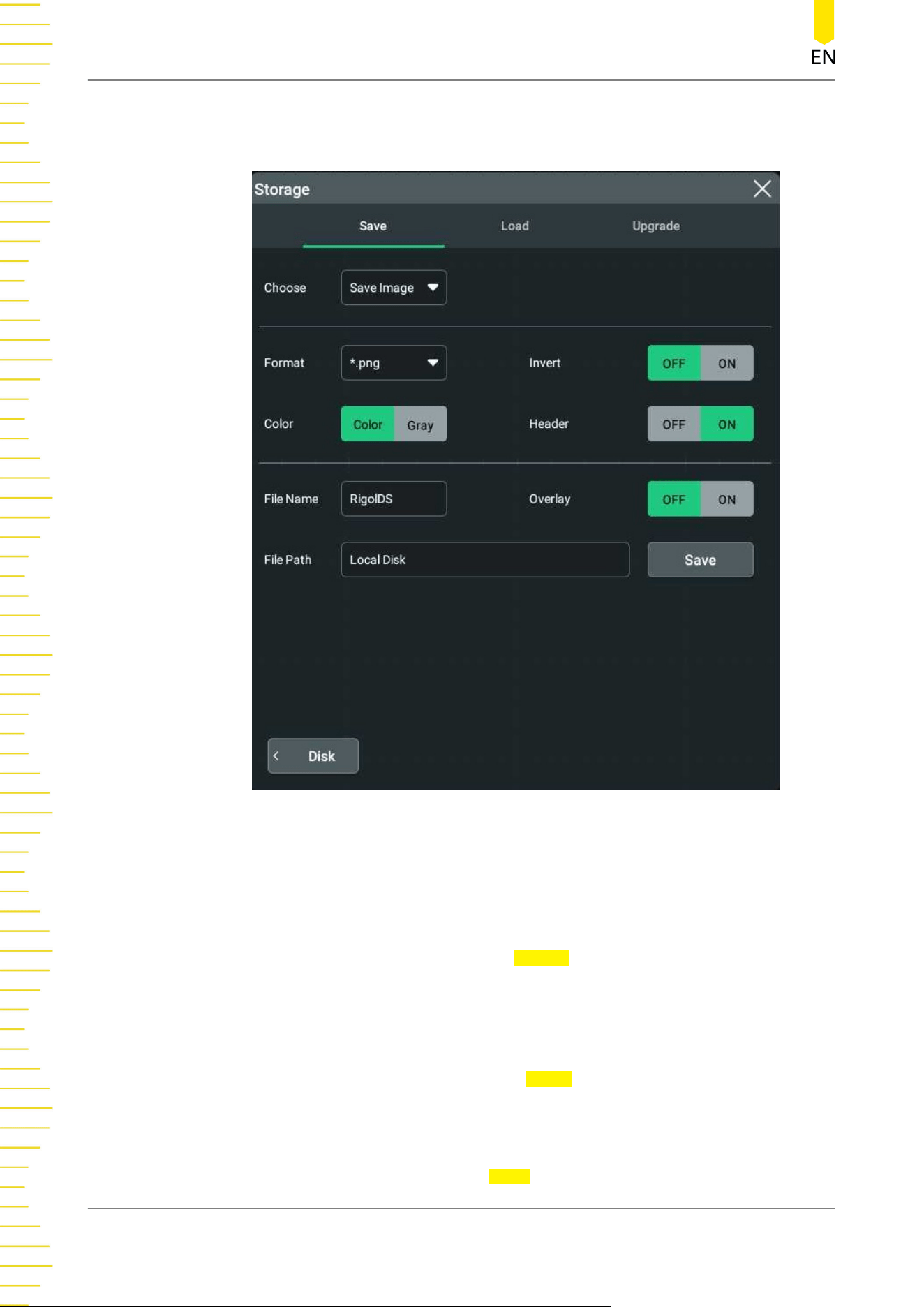
enter the "Save Image" setting menu. Set the relevant parameters and save the image
to the internal or external memory.
Figure 22.1 Image Saving Setting Menu
Set the image format
• Format:
Click or tap the drop-down button of Format to select "*.png", "*.bmp", or
"*.jpg" from the drop-down list. Then the screen image will be saved to the
internal or external memory in ".png", ".bmp", or ".jpg" format.
• Invert:
Click or tap the ON/OFF button for the Invert menu to enable or disable the
waveform invert function.
• Color:
Click or tap "Color" or "Gray" for
Color to select the desired storage color.
Storage
DS70000 User Guide
266
Copyright ©RIGOL TECHNOLOGIES CO., LTD.
All rights reserved.
• Header:
Click or tap the ON/OFF tab for the Header menu to enable or disable the
display of the header. If you select "ON", the instrument model and the image
creation date will be displayed in the header of the image when you save the
image file.
Set the file saving parameters
• Set the filename
Click or tap the input field of File Name to input the file name to be saved with
the pop-up virtual keypad.
• Set the file path
Click or tap the input field of File Path, then the disk management interface is
displayed. You can click or tap the saved file to view the saved image file. For
detailed operations, refer to descriptions in
Disk Management
.
• Overlay
Click or tap the ON/OFF button for the Overlay menu to enable or disable the
overwriting function. When enabled, the existing file in the specified file path will
be overwritten by the newly saved file that has the same filename as the existing
one.
After a USB storage device (FAT32, Flash type) is connected, press
on the front
panel to make a quick save. If no external USB device is found to be connected to
instrument, the file is saved to the internal memory by default. If an external USB
device is connected, the file is saved to the USB device by default.
22.2.2 Save Wave
In the Storage menu, click or tap the Save tab to enter the save operation menu. In
this menu, click or tap the drop-down button of Choose to select "Save Wave" to
enter the "Save Wave" setting menu. The main setting information (e.g. "On/Off" state
of the channel, vertical scale, and horizontal time base) and waveform data of all
enabled channel will be save to the internal or external memory.
Storage
Copyright ©RIGOL TECHNOLOGIES CO., LTD.
All rights reserved.
DS70000 User Guide
267
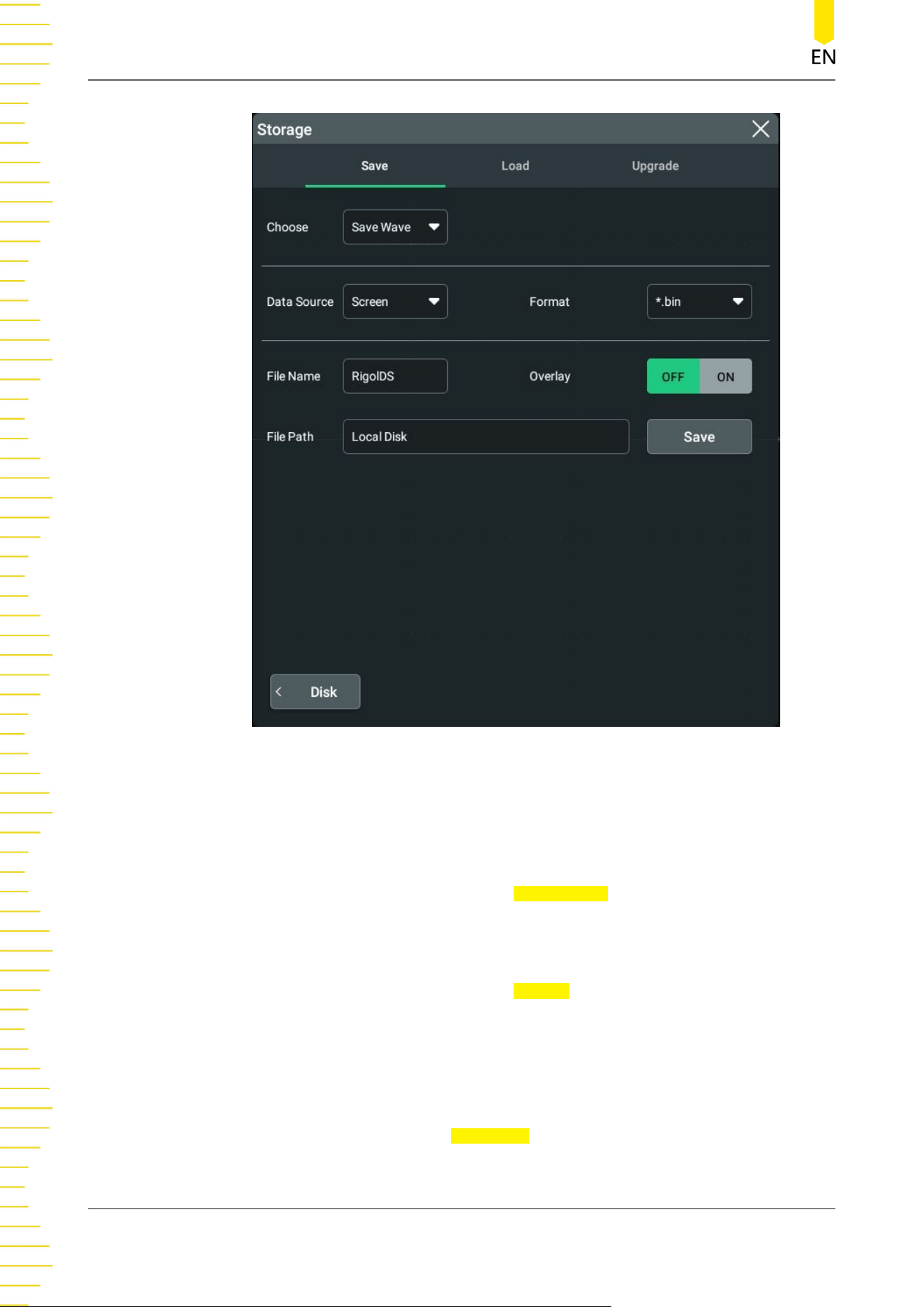
Figure 22.2 Waveform Saving Setting Menu
Set the waveform source and format
• Data Source
Click or tap the drop-down button of Data Source to select "Screen" or
"Memory" from the drop-down list.
• Waveform Format
Click or tap the drop-down button of Format to select "*.bin" or "*.csv" as the
format of the waveform storage.
Set the file saving parameters
• Set the filename
Click or tap the input field of File Name to input the file name to be saved with
the pop-up virtual keypad.
Storage
DS70000 User Guide
268
Copyright ©RIGOL TECHNOLOGIES CO., LTD.
All rights reserved.
• Set the file path
Click or tap the input field of File Path, then the disk management interface is
displayed. You can click or tap the saved file to view the saved image file. For
detailed operations, refer to descriptions in
Disk Management
.
• Overlay
Click or tap the ON/OFF button for the Overlay menu to enable or disable the
overwriting function. When enabled, the existing file in the specified file path will
be overwritten by the newly saved file that has the same filename as the existing
one.
After a USB storage device (FAT32, Flash type) is connected, press on the front
panel to make a quick save. If no external USB device is found to be connected to
instrument, the file is saved to the internal memory by default. If an external USB
device is connected, the file is saved to the USB device by default.
22.2.3 Save Setup
In the Storage menu, click or tap the Save tab to enter the save operation menu. In
this menu, click or tap the drop-down button of Choose to select "Save Setup" to
enter the "Save Setup" setting menu. Save the settings of the oscilloscope to the
internal or external memory in "*.stp" format. When loading, the stored settings can
be recalled.
Storage
Copyright ©RIGOL TECHNOLOGIES CO., LTD.
All rights reserved.
DS70000 User Guide
269
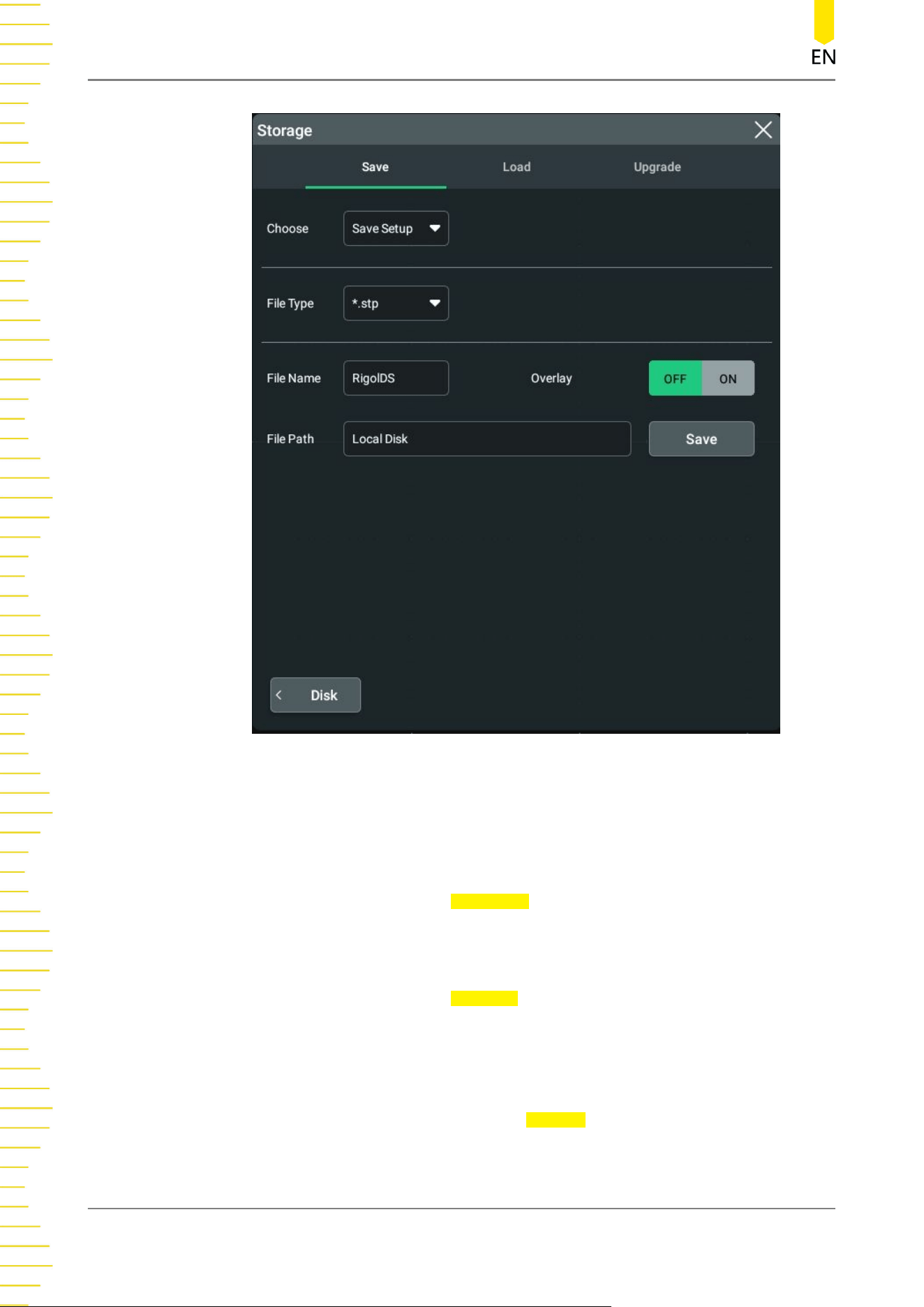
Figure 22.3 Setup Saving Setting Menu
Set the file saving parameters
• Set the filename
Click or tap the input field of File Name to input the file name to be saved with
the pop-up virtual keypad.
• Set the file path
Click or tap the input field of File Path, then the disk management interface is
displayed. You can click or tap the saved file to view the saved image file. For
detailed operations, refer to descriptions in
Disk Management
.
• Overlay
Click or tap the ON/OFF button for the Overlay menu to enable or disable the
overwriting function. When enabled, the existing file in the specified file path will
Storage
DS70000 User Guide
270
Copyright ©RIGOL TECHNOLOGIES CO., LTD.
All rights reserved.
be overwritten by the newly saved file that has the same filename as the existing
one.
After a USB storage device (FAT32, Flash type) is connected, press on the front
panel to make a quick save. If no external USB device is found to be connected to
instrument, the file is saved to the internal memory by default. If an external USB
device is connected, the file is saved to the USB device by default.
22.2.4 Binary Data Format (.bin)
Binary data format stores waveform data in binary format and provides data headers
that describe these data. As data is displayed in binary format, its file size is much
more smaller than that in ASCII format. If several channels are enabled, then all the
displayed channels will be saved (save the first channel then save the second, and
then it goes on like this until all the displayed channels are saved).
In BIN file format, the data are displayed as follows:
• CH1 data
• CH2 data
• CH3 data
• CH4 data
• Math Waveform Data
Binary Header Format
1 File Header
There is only one file header in a binary file. The file header contains the following
information.
Table 22.1 File Header
Cookie
Two-byte characters, RG, indicating that the file is the RIGOL
binary data file format.
Version Two bytes, indicating the file version.
File Size
A 4-byte integer, indicating the number of bytes in the file. It
includes the header.
Number of
Waveforms
A 4-byte integer, indicating the number of waveforms that are
stored in the file.
2 Waveform Header
Storage
Copyright ©RIGOL TECHNOLOGIES CO., LTD.
All rights reserved.
DS70000 User Guide
271
It is possible to store several waveforms in the file. Each stored waveform has a
waveform header. When several channels are stored, each channel can be
considered as a separate waveform. The waveform header contains the
information about the type of waveform data that are stored following the
waveform data header.
Table 22.2 Waveform Header
Header Size A 4-byte integer, indicating the number of bytes in the header.
Waveform Type
A 4-byte integer, indicating the type of the waveform stored in
the file.
0 = Unknown
1 = Normal
2 = Peak Detection
3 = Average
4 = Not Used
5 = Not Used
6 = Logic
Number of
Waveform Buffers
A 4-byte integer, indicating the number of waveform buffers
required to read the data.
Number of Points
A 4-byte integer, indicating the number of waveform points in
the data.
Count
A 4-byte integer, indicating the number of hits at each time
interval during waveform recording when using a certain
sample mode (e.g. Average) to create the waveforms. For
example, when averaging, a count of 4 indicates that each
waveform data point in the waveform recording has been
averaged at least 4 times. The default value is 0.
X Display Range
A 4-byte float, indicating the X-axis duration of the waveform
that is displayed. For time-domain waveforms, it indicates the
duration of time across the display. If the value is zero, then no
data has been acquired.
X Display Origin
A 8-byte double, indicating the X-axis value at the left edge of
the screen. For time-domain waveforms, it indicates the time
at the start of the display. The value is treated as a double
Storage
DS70000 User Guide
272
Copyright ©RIGOL TECHNOLOGIES CO., LTD.
All rights reserved.
precision 64-bit float point number. If the value is zero, then
no data has been acquired.
X Increment
A 8-byte double, indicating the duration between data points
on the X axis. For time-domain waveforms, it indicates the
time between points. If the value is zero, then no data has
been acquired.
X Origin
An 8-byte double, indicating the X-axis value of the first data
point in the data recording. For time-domain waveforms, it
indicates the time of the first point. The value is treated as a
double precision 64-bit float point number. If the value is zero,
then no data has been acquired.
X Units
- A 4-byte integer, indicating the unit of measurement for X
values in the acquired data.
- 0 = Unknown
- 1 = Volts (V)
- 2 = Seconds (s)
- 3 = Constant
- 4 = Amps (A)
- 5 = dB
- 6 = Hz
Y Units
A 4-byte integer, indicating the unit of measurement for Y
values in the acquired data. The possible values are listed
above under X Units.
Date A 16-byte character array, not used
Time A 16-byte character array, not used
Frame
A 24-byte character array, indicating the model number and
serial number of the oscilloscope in the format:
MODEL#:SERIAL#。
Waveform Label
A 16-byte character array that contains the label assigned to
the waveform.
3 Waveform Data Header
A waveform may have multiple data sets. Each waveform data set has a waveform
data header. The waveform data header consists of information about the
waveform data set. The header is stored before the data set.
Table 22.3 Waveform Data Header
Header Size
A 4-byte integer, indicating the number of bytes in the
waveform data header.
Storage
Copyright ©RIGOL TECHNOLOGIES CO., LTD.
All rights reserved.
DS70000 User Guide
273
Buffer Type
- A 2-byte integer, indicating the type of the waveform data
stored in the file.
- 0 = Unknown
- 1 = Normal 32-bit float data
- 2 = Maximum float data
- 3 = Minimum float data
- 4 = Not Used
- 5 = Not Used
- 6 = Digital unsigned 8-bit character data (for digital
channels)
Bytes Per Point
A 2-byte short integer, indicating the number of bytes per
data point.
Buffer Size
A 4-byte integer, indicating the size of the buffer required to
hold the data points.
22.3 Load a File
In the storage setting menu, click or tap the Load tab to switch to the load menu. In
this menu, you can load the local file to the instrument.
Storage
DS70000 User Guide
274
Copyright ©RIGOL TECHNOLOGIES CO., LTD.
All rights reserved.
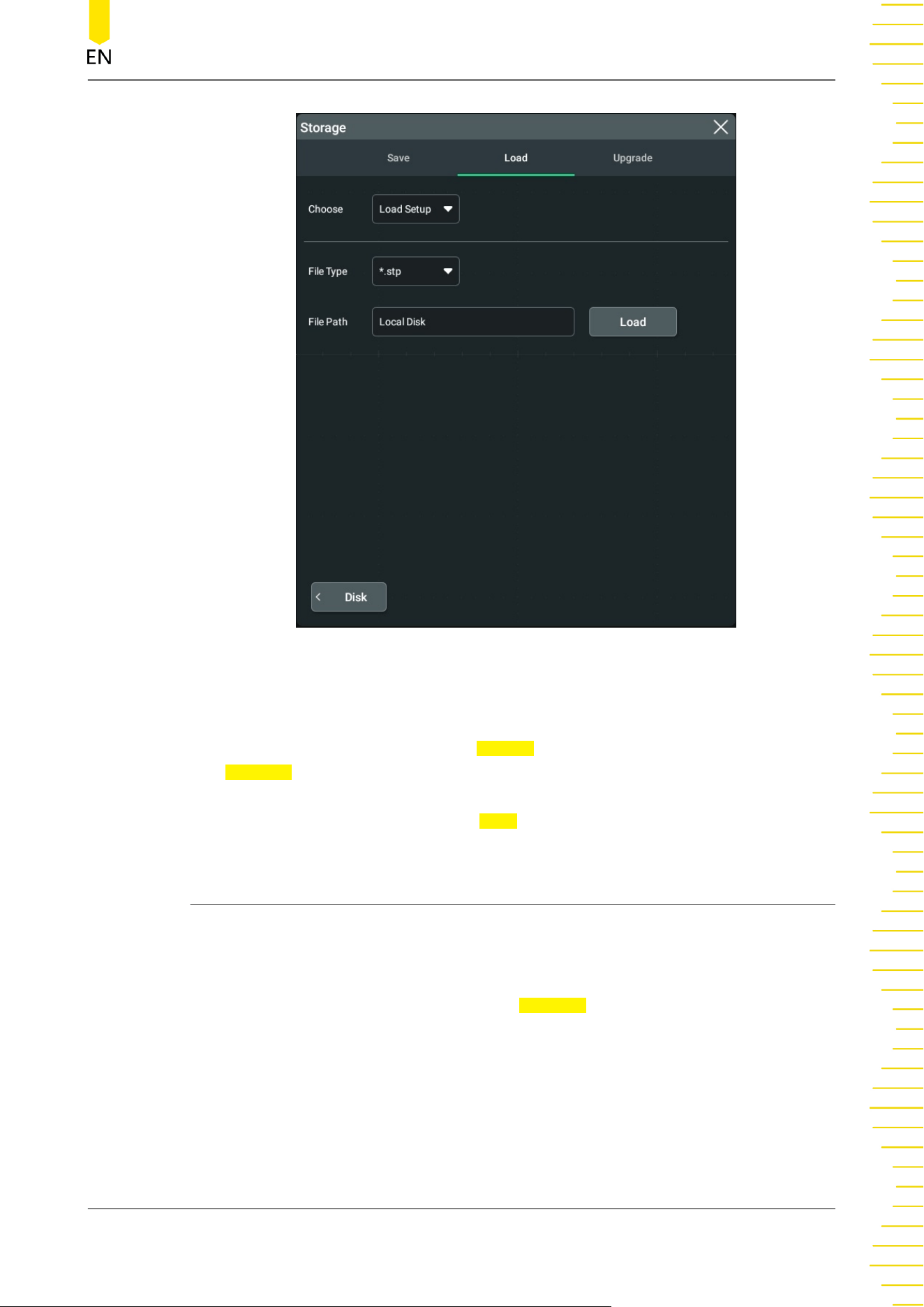
Figure 22.4 Load Setting Menu
Load setup
Click or tap the drop-down button of Choose to select "Load Setup". Then, click or
tap File Path to load the setups from the internal memory or the external USB disk.
The default file type is "*.stp", and no other options are available. Select the file to be
loaded from the memory. Click or tap Load to load the selected file.
22.4 System Upgrade
This instrument supports local upgrade and online upgrade.
Local upgrade
1 In the storage setting menu, click or tap Upgrade to enter the local upgrade
setting menu.
Storage
Copyright ©RIGOL TECHNOLOGIES CO., LTD.
All rights reserved.
DS70000 User Guide
275
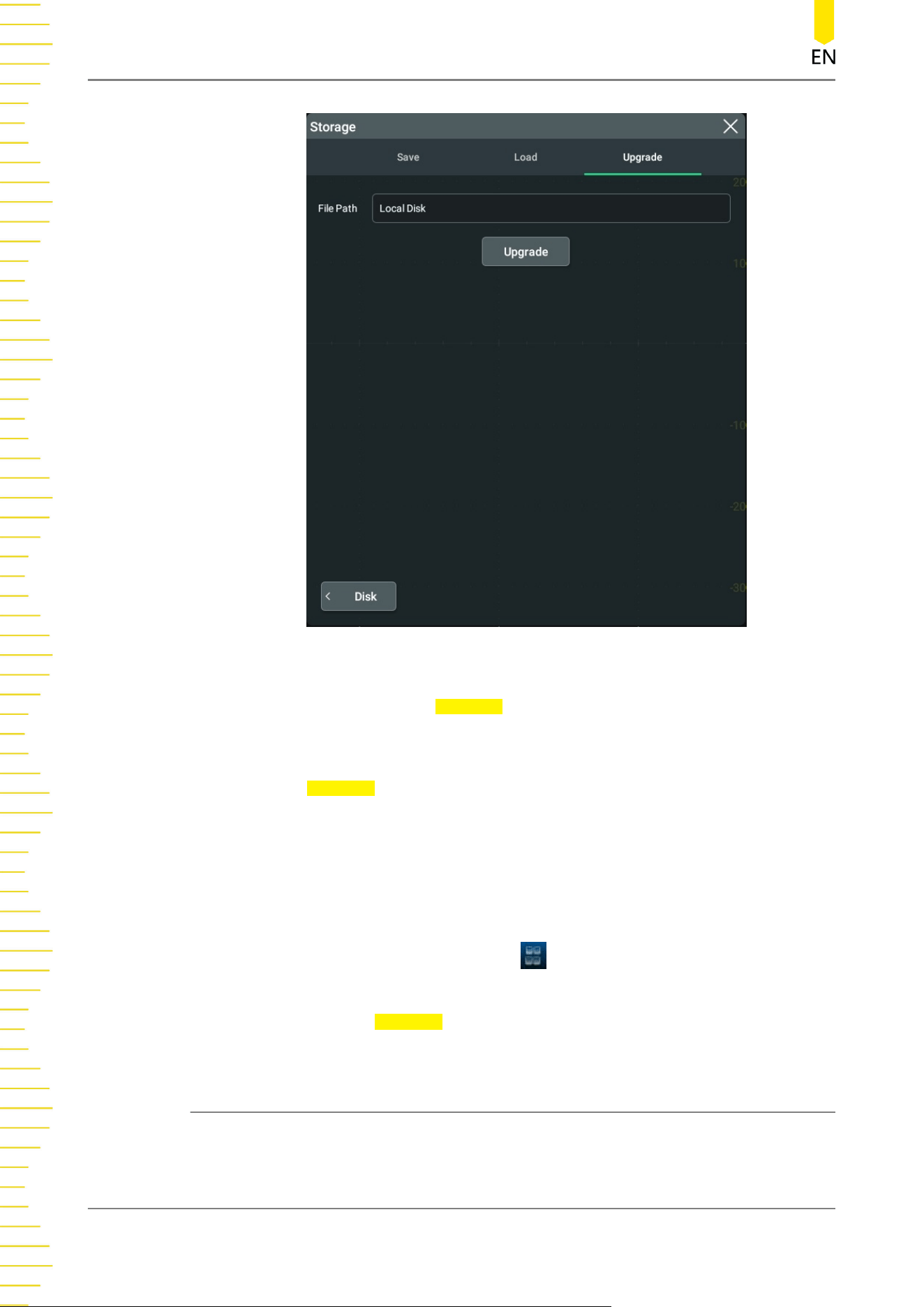
Figure 22.5 Upgrade Menu
2 Click or tap the input field of File Path, then the disk management interface is
displayed. Select the upgrade file. For detailed operations, refer to the descriptions
in
Disk Management
.
3 Click or tap Upgrade to complete the local upgrade.
Online upgrade
1 First ensure that the rear-panel LAN interface is connected to the network (if you
do not have the access to the Internet, please ask the administrator to open the
specified network authority).
2 Click or tap the function navigation icon
at the lower-left corner of the screen
to enter the function navigation.
3 Then click or tap the Upgrade icon to perform the upgrade operation.
22.5 Disk Management
To enter the storage setting menu, perform the following operations:
Storage
DS70000 User Guide
276
Copyright ©RIGOL TECHNOLOGIES CO., LTD.
All rights reserved.
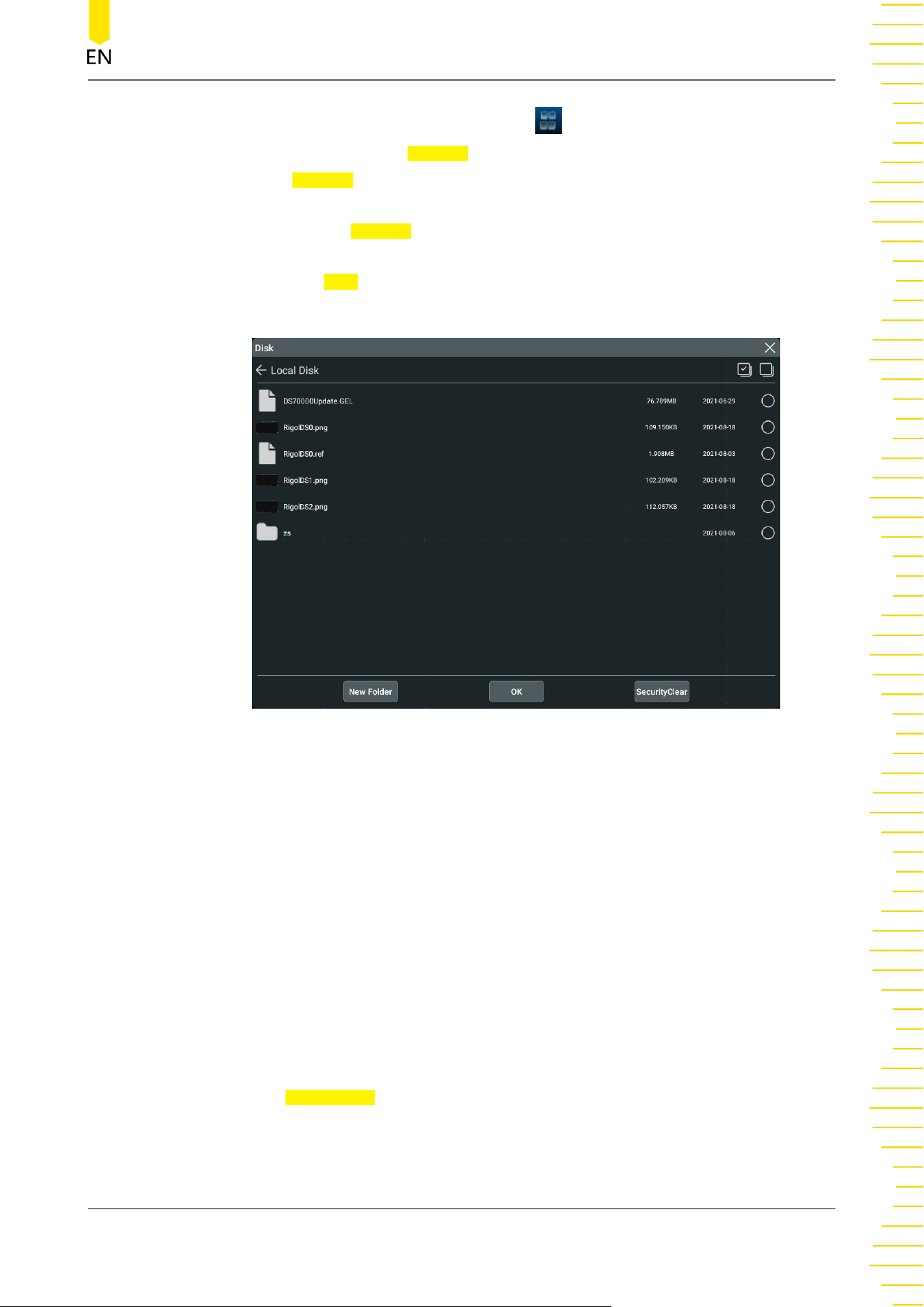
• Click or tap the function navigation icon at the lower- corner corner of the
screen, and then select Storage to enter the storage setting menu.
• Tap the Storage icon on the small screen at the right side of enter the storage
setting menu.
• Click or tap the Storage icon at the top of the screen to enter the storage setting
menu.
Then click or tap Disk at the lower-left corner of the "Storage" menu to enter the disk
management interface, as shown in the figure below.
Figure 22.6 Disk Management Interface
Execute the following operations through the disk management menu:
Select a disk
Before using the external storage device, make sure that a USB storage device (FAT32
format, flash memory) is connected correctly.
By default, the "Local Disk(C)" is selected. If an external storage device is inserted,
under the "Disk" menu, two available storage disks can be selected at the upper-left
corner of the "Disk" interface: Local Disk (C) and Removable USB Disk (D). If you select
an external storage device, for example, if you select "Removable USB Disk (D)", the
contents in USB Disk(D) will be displayed.
Create a folder
Click or tap
New Folder, then a folder name input keyboard is displayed.
For the methods of using the keypad, refer to descriptions in
Parameter Setting
Method
. Click or tap any place on the screen to exit the keyboard.
Storage
Copyright ©RIGOL TECHNOLOGIES CO., LTD.
All rights reserved.
DS70000 User Guide
277
Clear the Internal Memory Safely
Click or tap SecurityClear, then a prompt message "Execute secure memory wipe?" is
displayed. Click or tap OK to clear all the files stored in the internal disk. Click or tap
Cancel to cancel security clear operation.
Select a File
Before operating on the file or folder, first select the desired file or folder.
Click or tap the check box at the right side of the file or folder, if checked, it is
selected, with an icon . Click/tap the check box again or click/tap to deselect
it. The check box restores its original state.
DS70000 supports selecting multiple files or folders to operate on. You can also click
or tap the icon at the upper-right corner of the interface to select all the files and
folders under the current disk. Click or tap to cancel the select-all operation.
22.6 Factory Settings
Press on the front panel or click/tap the Default icon at the top of the
screen, then a prompt message "Restore default settings?" is displayed. Click or tap
OK to restore the instrument to its factory default settings, as shown in the table
below.
Table 22.4 Factory Settings
Parameter Factory Settings
Horizontal
Horizontal Scale 5 ns
Horizontal Position 0 s
Delayed Sweep OFF
Roll Auto
Fine OFF
Horizontal Expansion Center
Memory Depth Auto
Vertical
VScale 100 mV
VOffset 0 V
CH1 ON
CH2 OFF
CH3 OFF
Storage
DS70000 User Guide
278
Copyright ©RIGOL TECHNOLOGIES CO., LTD.
All rights reserved.
Parameter Factory Settings
CH4 OFF
Channel Coupling DC
BW Limit OFF
Attenuation 1X
Impedance 1 MΩ
Invert OFF
Fine OFF
Channel Unit [V]
Display Label OFF
Channel Delay 0 s
Bias 0 V
Acquire
Acquisition Mode Normal
Memory Depth Auto
Anti-Aliasing OFF
Trigger
Trigger Type Edge Trigger
Source Selection CH1
Slope Rising
Trigger Mode Auto
Trigger Coupling DC
Trigger Holdoff 8 ns
Noise Rejection OFF
Display
Display Type Vector
Persistence Time Min
Intensity 50%
Grid FULL
Grid Brightness 50%
Window Transparency 50%
Show Scale ON
Color Grade OFF
Waveform Freeze ON
Measure
Mode Normal
Indicator OFF
Statistics OFF
Count 1,000
Storage
Copyright ©RIGOL TECHNOLOGIES CO., LTD.
All rights reserved.
DS70000 User Guide
279
Parameter Factory Settings
Display Type %
Source CH1
Upper 90%
Mid 50%
Lower 10%
Amplitude Measurement
Method
Auto
Region Main
Storage
Auto Name ON
Header ON
Save Image
Format *.png
Invert OFF
Color Color
Save Wave
Data Source Screen
Format *.bin
Save Setup
File Type *.stp
Load Setup
File Type *.stp
System Setting
Language Simplified Chinese
Load last Default
Beeper OFF
AUX Out TrigOut
Vibration ON
Screen Lock OFF
Expand GND
Show Time ON
Other Setting
DSP ON
EXT 10M IN OFF
Auto Config
Peak to Peak ON
Live CH OFF
Overlay ON
Coupling OFF
Storage
DS70000 User Guide
280
Copyright ©RIGOL TECHNOLOGIES CO., LTD.
All rights reserved.
Parameter Factory Settings
Quick Settings
Operation Save Image
Format *.png
Invert OFF
Color Color
Pass/Fail Test
Enable OFF
Source CH1
Operate OFF
X Mask 240 mdiv
Y Mask 480 mdiv
Format *.pf
Format *.pf
File Name RigolDS
Aux Output OFF
Output Event Fail
Polarity Positive
Pulse 1 μs
Error Action N/A
Waveform Recording
Waveform Recording OFF
Record
Play
Record
Interval 10 ns
Frames 1,000
Max Frames 10000
Beeper
Play
Mode
Sequence
Interval 100 ms
Math Operation
Invert OFF
Expand GND
Display Label OFF
Grid FULL
A+B
Storage
Copyright ©RIGOL TECHNOLOGIES CO., LTD.
All rights reserved.
DS70000 User Guide
281
Parameter Factory Settings
Operation OFF
SourceA CH1
SourceB CH1
Offset 0 V
Scale 500 mV
A-B
Operation OFF
SourceA CH1
SourceB CH1
Offset 0 V
Scale 500 mV
A×B
Operation OFF
SourceA CH1
SourceB CH1
Offset 0 U
Scale 500 mU
A÷B
Operation OFF
SourceA CH1
SourceB CH1
Offset 0 U
Scale 500 mU
FFT
Operation OFF
Source CH1
Offset 0 dBV
VScale 20 dBV
Unit dBm/dBV
X Start-End
Start Freq 0 Hz
Stop Freq 10 MHz
Window Function Hanning
Color Grade OFF
Peak Search OFF
Peak Number 5
Threshold 5.5 dBV
Excursion 1.8 dBV
Table Order Amp Order
A&&B
Operation OFF
Storage
DS70000 User Guide
282
Copyright ©RIGOL TECHNOLOGIES CO., LTD.
All rights reserved.
Parameter Factory Settings
SourceA CH1
SourceB CH1
Wave Size Medium
Thre.CH1 0 V
Thre.CH2 0 V
Thre.CH3 0 V
Thre.CH4 0 V
Sensitivity 300 mdiv
Offset 0 div
A||B
Operation OFF
SourceA CH1
SourceB CH1
Wave Size Medium
Thre.CH1 0 V
Thre.CH2 0 V
Thre.CH3 0 V
Thre.CH4 0 V
Sensitivity 300 mdiv
Offset 0 div
A^B
Operation OFF
SourceA CH1
SourceB CH1
Wave Size Medium
Thre.CH1 0 V
Thre.CH2 0 V
Thre.CH3 0 V
Thre.CH4 0 V
Sensitivity 300 mdiv
Offset 0 div
!A
Operation OFF
SourceA CH1
Wave Size Medium
Thre.CH1 0 V
Thre.CH2 0 V
Thre.CH3 0 V
Thre.CH4 0 V
Sensitivity 300 mdiv
Offset 0 div
Storage
Copyright ©RIGOL TECHNOLOGIES CO., LTD.
All rights reserved.
DS70000 User Guide
283
Parameter Factory Settings
Intg
Operation OFF
Source CH1
Scale 500 mV*s
Offset 0 V*s
Bias 0
Diff
Operation OFF
Source CH1
Scale 500 mV/s
Offset 0 V/s
Smooth 5
Sqrt
Operation OFF
Source CH1
Scale 500 mU
Offset 0 U
Lg
Operation OFF
Source CH1
Scale 500 mU
Offset 0 U
Ln
Operation OFF
Source CH1
Scale 500 mU
Offset 0 U
Exp
Operation OFF
Source CH1
Scale 500 mU
Offset 0 U
Abs
Operation OFF
Source CH1
Scale 500 mV
Offset 0 V
Low Pass
Operation OFF
Source CH1
Scale 500 mV
Storage
DS70000 User Guide
284
Copyright ©RIGOL TECHNOLOGIES CO., LTD.
All rights reserved.
Parameter Factory Settings
Offset 0 V
ωc 20 MHz
High Pass
Operation OFF
Source CH1
Scale 500 mV
Offset 0 V
ωc 20 MHz
Band Pass
Operation OFF
Source CH1
Scale 500 mV
Offset 0 V
ωc1 20 MHz
ωc2 40 MHz
Band Stop
Operation OFF
Source CH1
Scale 500 mV
Offset 0 V
ωc1 20 MHz
ωc2 40 MHz
AX+B
Operation OFF
Source CH1
Scale 500 mV
Offset 0 V
A 1
B 0
Ref
Current Ref1
Source CH1
VScale 1 V
VOffset 0 V
Label REF0
Label Display OFF
Color Orange
Storage
Copyright ©RIGOL TECHNOLOGIES CO., LTD.
All rights reserved.
DS70000 User Guide
285
23 System Utility Function Setting
In the Utility menu, you can set the I/O parameters and the system-related function
parameters. To enter the "Utility" menu, perform the following operations.
• Click or tap the Notification Area at the lower-right corner of the screen. Then
the Utility menu is displayed.
• Click or tap the function navigation icon
at the lower- corner corner of the
screen, then select Utility to enter the Utility menu.
• Tap the Utility icon on the small screen at the right side of the screen to enter
the Utility menu.
23.1 I/O Setting
In Utility menu, click or tap IO to enter the I/O setting menu to configure the
following parameters.
Network Status
Different prompts will be displayed according to the current network connection
status.
• Network Config Succeeded!
• Acquiring IP...
• IP Conflict!
• Disconnected!
• DHCP Config Failed
• Read Status Fail!
• CONNECTED
• Invalid IP
• IP lost
• Please wait...
MAC Address
For each instrument, the MAC address is unique. When assigning the IP address for
the oscilloscope, the system uses the MAC address to identify the instrument.
System Utility Function Setting
DS70000 User Guide
286
Copyright ©RIGOL TECHNOLOGIES CO., LTD.
All rights reserved.
VISA Address
Displays the VISA address currently used by the the instrument.
IP Configuration Type
The configuration type of the IP address can be DHCP, Auto IP, or Static IP. In different
IP configuration types, the configurations for IP address and other network
parameters are different.
• DHCP
If "DHCP" is selected, the DHCP server in the current network will assign the
network parameters (e.g. IP address, Subnet, Gateway, and DNS) for the the
instrument.
• Auto IP
When "Auto IP" is selected, the instrument will acquire the IP address ranging
from "169.254.0.1" to "169.254.255.254" and the subnet mask (255.255.0.0)
automatically based on the current network configuration. The "Auto IP" works
only when "DHCP" is not selected or connection is failed.
• Static IP
If "Static IP" is selected, the instrument is configured with static IP. In this case,
you need to disable DHCP and Auto IP manually. Then you need to configure the
parameters such as "IP address", "Subnet", "Gateway", and "DNS" manually. At
this time, you can self-define the network parameters (e.g. IP address) of the
oscilloscope.
- Set the IP address
The format of the IP address is nnn.nnn.nnn.nnn. The range of the first
segment (nnn) of the address is from 0 to 255 (except 127); wherein, the
valid range is from 0 to 223. The range for the other three segments is from
0 to 255. You are recommended to ask your network administrator for an IP
address available.
This setting will be saved to the non-volatile memory; if "Load last" is set to
"Last", then DHCP and Auto IP are disabled at the next power-on. The
instrument will load the preset IP address automatically.
- Set the subnet mask
The format of the subnet mask is nnn.nnn.nnn.nnn. Wherein, the range of
"nnn" is from 0 to 255. You are recommended to ask your network
administrator for a subnet mask available.
This setting will be saved in the non-volatile memory; if "Power On" is set to
"Last", then DHCP and Auto IP are disabled at the next power-on. The
instrument will load the preset subnet mask automatically.
- Set the default gateway
System Utility Function Setting
Copyright ©RIGOL TECHNOLOGIES CO., LTD.
All rights reserved.
DS70000 User Guide
287
You can set this parameter in Static IP mode. The format of the gateway is
nnn.nnn.nnn.nnn. The range of the first segment (nnn) is from 0 to 223
(except 127), and the range for the other three segments is from 0 to 255.
You are recommended to ask your network administrator for a gate address
available.
This setting will be saved in the non-volatile memory; if "Power On" is set to
"Last", then DHCP and Auto IP are disabled at the next power-on. The
instrument will load the preset gateway automatically.
- Set the DNS address
You can set this parameter in Static IP mode. The format of the DNS address
is "nnn.nnn.nnn.nnn". The range for the first segment (nnn) of the address is
from 0 to 223 (except 127); and the range for the other three segments is
from 0 to 255. You are recommended to ask your network administrator for
an address available.
Generally, you do not need to set the DNS, therefore this parameter setting
can be ignored.
Tip
• When the three IP configuration types are all turned on, the priority of the parameter
configuration from high to low is "DHCP", "Auto IP", and "Static IP".
• The three IP configuration types cannot be all turned off at the same time.
mDNS
Click or tap the ON/OFF tab for mDNS to enable or disable the multicast Domain
Name System (mDNS). This system is used to provide the function of DNS server for
service discovery in a small network without a DNS server.
Host Name
If mDNS is enabled, you need to configure the mDNS host name, supporting
inputting a maximum of 26-byte strings.
GPIB
When using the GPIB interface, use the USB-GPIB interface converter (an option that
requires to be ordered separately) to extend the GPIB interface, and then use the GPIB
cable to connect the instrument to the PC. Configure the GPIB address. Its settable
range is from 1 to 30. By default, it is 1.
Apply the Network Parameter Setting
Click or tap Apply to validate the current network parameter setting.
23.2 Object Missing
This object is not available in the repository.
System Utility Function Setting
DS70000 User Guide
288
Copyright ©RIGOL TECHNOLOGIES CO., LTD.
All rights reserved.
23.3 About this Oscilloscope
In Utility menu, click or tap About, and then you can view the model, version, and
other information about this instrument in About menu.
• Model
Indicates the product model.
• Serial number
Indicates the serial number of the product, the unique identification for the
product.
• Firmware
Indicates the firmware version number of the product.
• Hardware
Indicates the hardware version number of the product.
• Build
Indicates the creation time for the software version.
• Android.Build
Indicates the creation time of the Android operating system.
• Android.Version
Indicates the version number of the Android operating system. For example, 7.1.
0.
• Launcher
Indicates the desktop UI version number of the Android operating system.
• WebControl
Indicates the version number of browser remote control module.
23.4 Other Setting
EXT 10M IN
Indicates the rear-panel 10 MHz IN reference clock input interface. When ON, the
interface is enabled; when OFF, the interface is disabled.
Electronic Tag
When you select ON, the backlight of the electronic tag at the upper-right corner of
the front panel is illuminated; when you select OFF, the backlight turns off.
System Utility Function Setting
Copyright ©RIGOL TECHNOLOGIES CO., LTD.
All rights reserved.
DS70000 User Guide
289
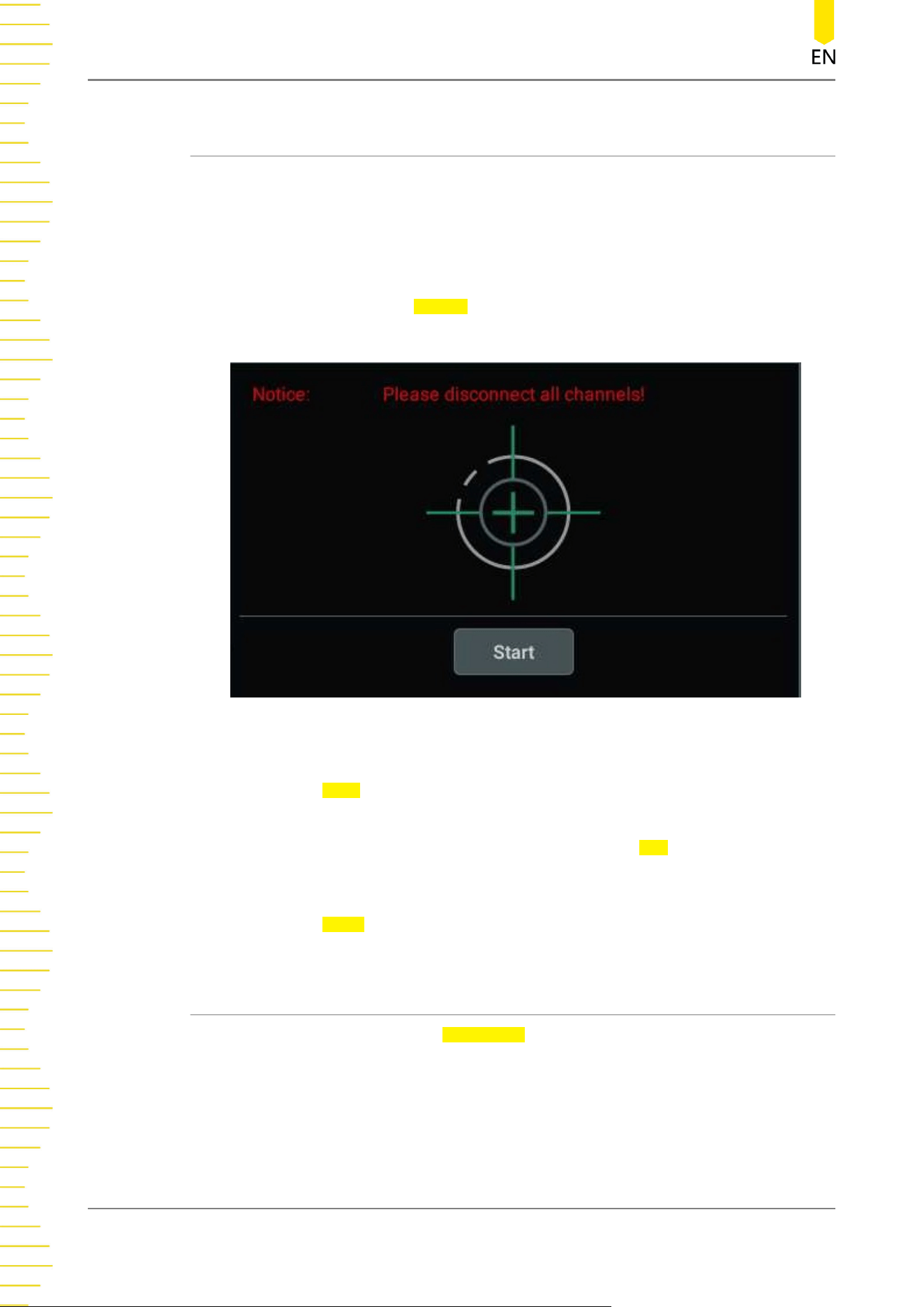
23.5 SelfCal
The self-calibration program can quickly make the oscilloscope to work in an optimal
state to get the precise measurement results. You can perform self-calibration at any
time, especially when the changes of the ambient temperature reach or above 5℃.
Make sure that the oscilloscope has been warmed up or operating for more than 30
minutes before the self-calibration.
In "Utility" menu, click or tap SelfCal, the following self-calibration interface is shown
below.
Figure 23.1 Self-calibration Menu
• Click or tap Start, and then the oscilloscope will start to execute the self-
calibration program.
• After starting the self-calibration program, click or tap Exit to cancel self-
calibration operation at any time.
• Click or tap Close to close the self-calibration information window.
23.6 Option List
In the "Utility" menu, click or tap Option list, then all the options that have currently
been installed can be displayed. For the procedures of installing the options, refer to
To View the Option Information and the Option Installation
.
System Utility Function Setting
DS70000 User Guide
290
Copyright ©RIGOL TECHNOLOGIES CO., LTD.
All rights reserved.
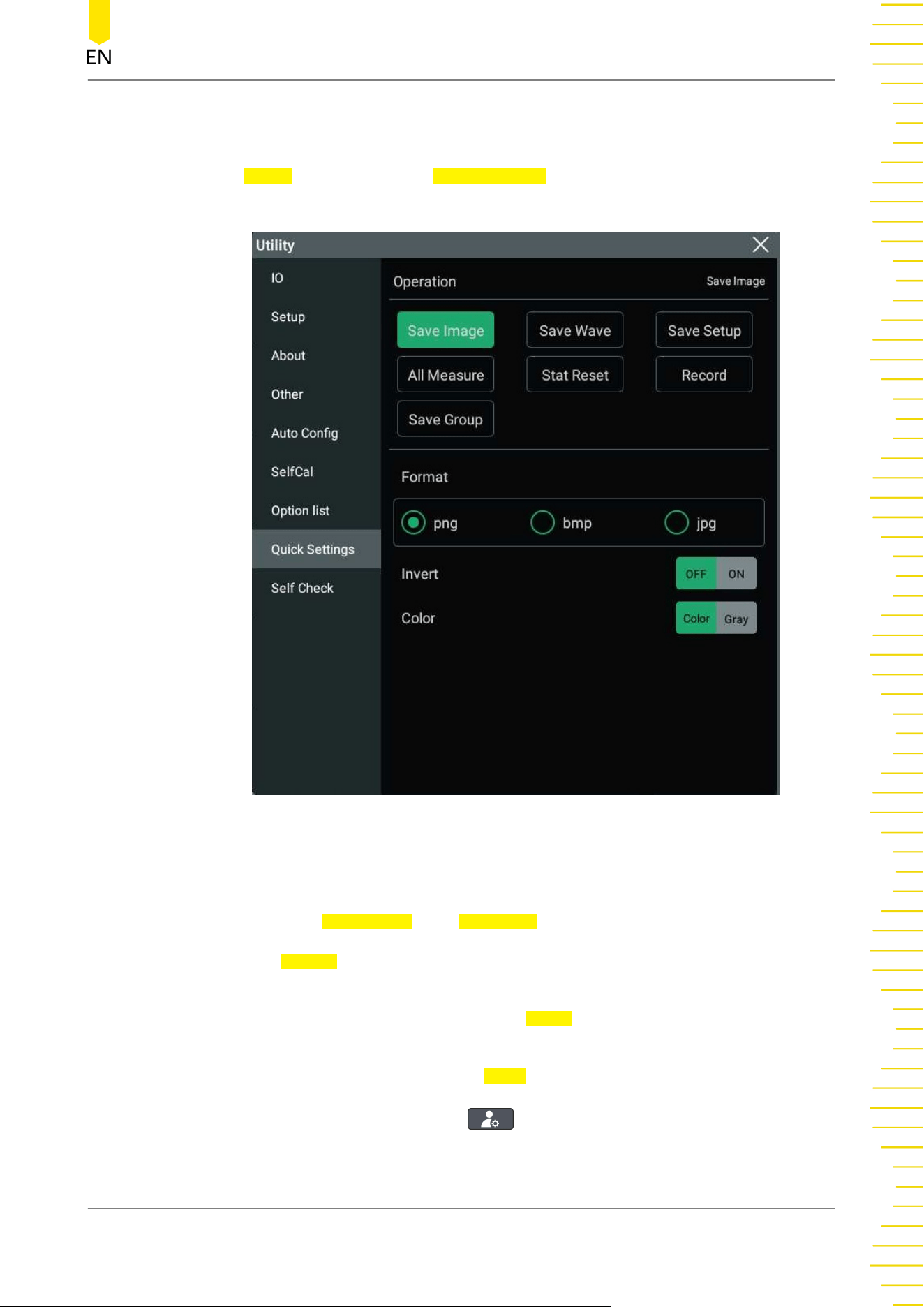
23.7 Quick Settings
In the Utility menu, click or tap Quick Settings to enter the quick setting operation
menu.
Figure 23.2 Quick Settings Menu
Save Image
• Click or tap Save Image, then Operation is set to "Save Image".
• In the Format menu item, the available image type can be "*.png", ".*bmp", or
".*jpg".
• Click or tap the ON/OFF button for the
Invert menu item to enable or disable
the invert function.
• Click or tap "Color" or "Gray" for Color to select the desired storage color.
After setting, click or tap the button at the upper-right corner of the
instrument to capture the current screen and save the image with the specified
System Utility Function Setting
Copyright ©RIGOL TECHNOLOGIES CO., LTD.
All rights reserved.
DS70000 User Guide
291
format. If an USB storage device is connected, by default, it is saved to the external
memory, otherwise, it will be saved to the specified path in the internal memory.
Save Wave
• Click or tap Save Wave, then Operation is set to "Save Wave".
• Click or tap to select "Memory" or "Screen" under Data Source as the source of
the saved waveform.
• The available choices under Format include "*.bin" and "*.csv".
After setting, click or tap the button at the upper-right corner of the
instrument to save the waveform based on the settings. If an USB storage device is
connected, by default, it is saved to the external memory, otherwise, it will be saved
to the specified path in the internal memory.
Save Setup
Click or tap Save Setup, then Operation is set to "Save Setup".
After setting, click or tap the button
at the upper-right corner of the
instrument to save the setup file suffixed with "*.stp". If an USB storage device is
connected, by default, it is saved to the external memory, otherwise, it will be saved
to the specified path in the internal memory.
All Measurement
• Click or tap All Measure, then Operation is set to "All Measure".
• In All Measure menu item, click or tap the drop-down button to select the
measurement channel (CH1-CH4).
After setting, click or tap the button
at the upper-right corner of the
instrument to perform the measurement on the specified channel.
Reset Statistics
• Click or tap Stat Reset, then Operation is set to "Stat Reset".
• Under Stat Reset, click or tap "Measure" or "Pass/Fail" to reset the statistics of
the specified function.
After setting, click or tap the button at the upper-right corner of the
instrument, then the statistics of the specified function under the Result list at the
right side of the screen will be cleared and new measurement will be launched.
Waveform Recording
Click or tap
Record, then Operation is set to "Record".
System Utility Function Setting
DS70000 User Guide
292
Copyright ©RIGOL TECHNOLOGIES CO., LTD.
All rights reserved.
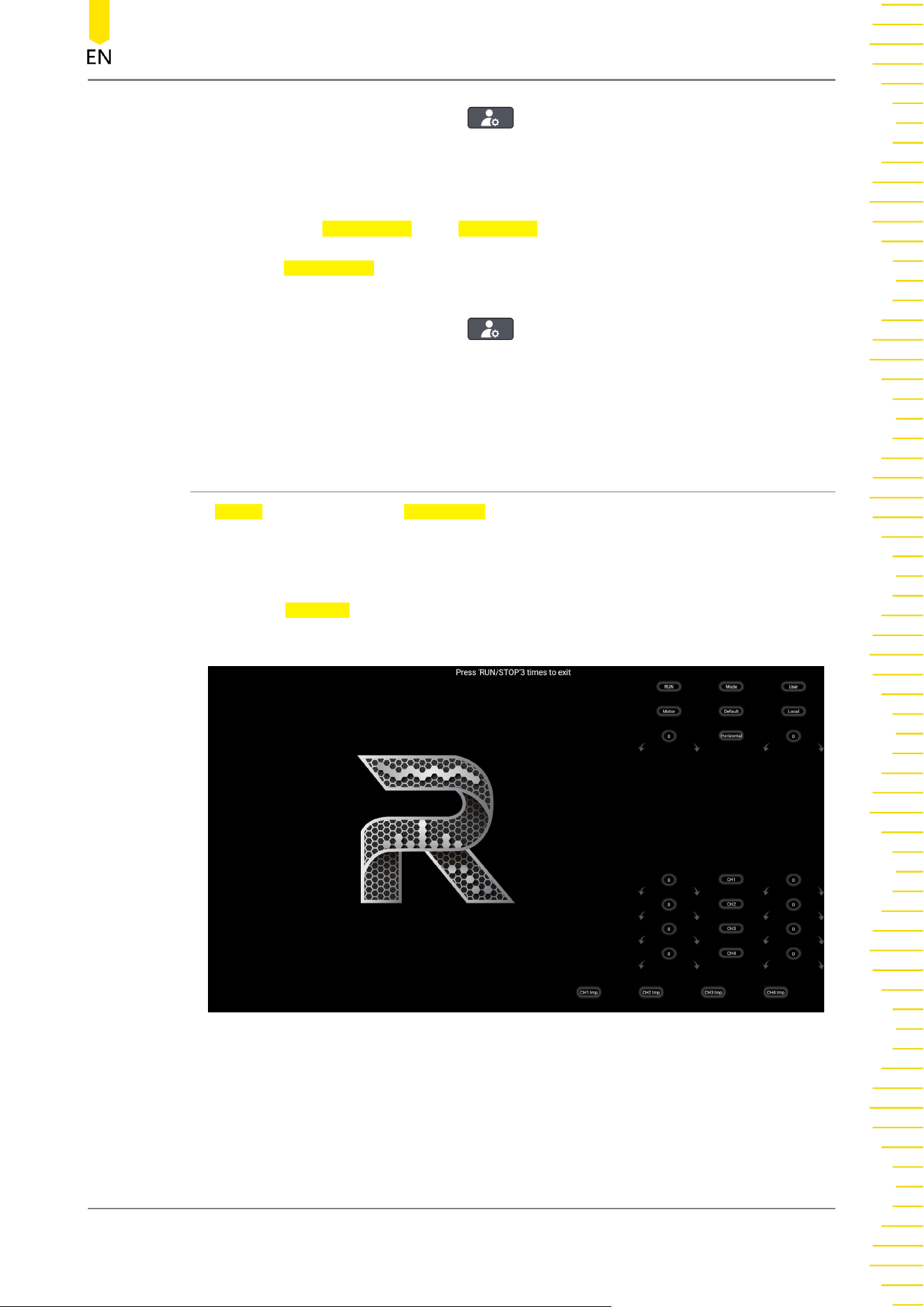
After setting, click or tap the button at the upper-right corner of the
instrument to perform the waveform recording.
Save Group
• Click or tap Save Group, then Operation is set to "Save Group".
• Under Save Group, select one or multiple items from "Save Image", "Save
Wave", and "Save Setup".
After setting, click or tap the button
at the upper-right corner of the
instrument to save the selected items based on the settings. If an USB storage device
is connected, by default, it is saved to the external memory, otherwise, it will be saved
to the specified path in the internal memory.
23.8 Self-check
In Utility menu, click or tap Self Check to enter the "Self Check" setting menu. You
can test the following self-check items for the device.
Key Test
Click or tap Key Test to enter the key test interface (virtual front panel key), as shown
in the figure below.
Figure 23.3 Key Test Interface
At this time, you can press the keys on the front panel to check whether the virtual
keys are highlighted. If yes, it indicates that the keys work normally; if no, it indicates
that there's something wrong with the keys. If the virtual key is not illuminated, the
System Utility Function Setting
Copyright ©RIGOL TECHNOLOGIES CO., LTD.
All rights reserved.
DS70000 User Guide
293
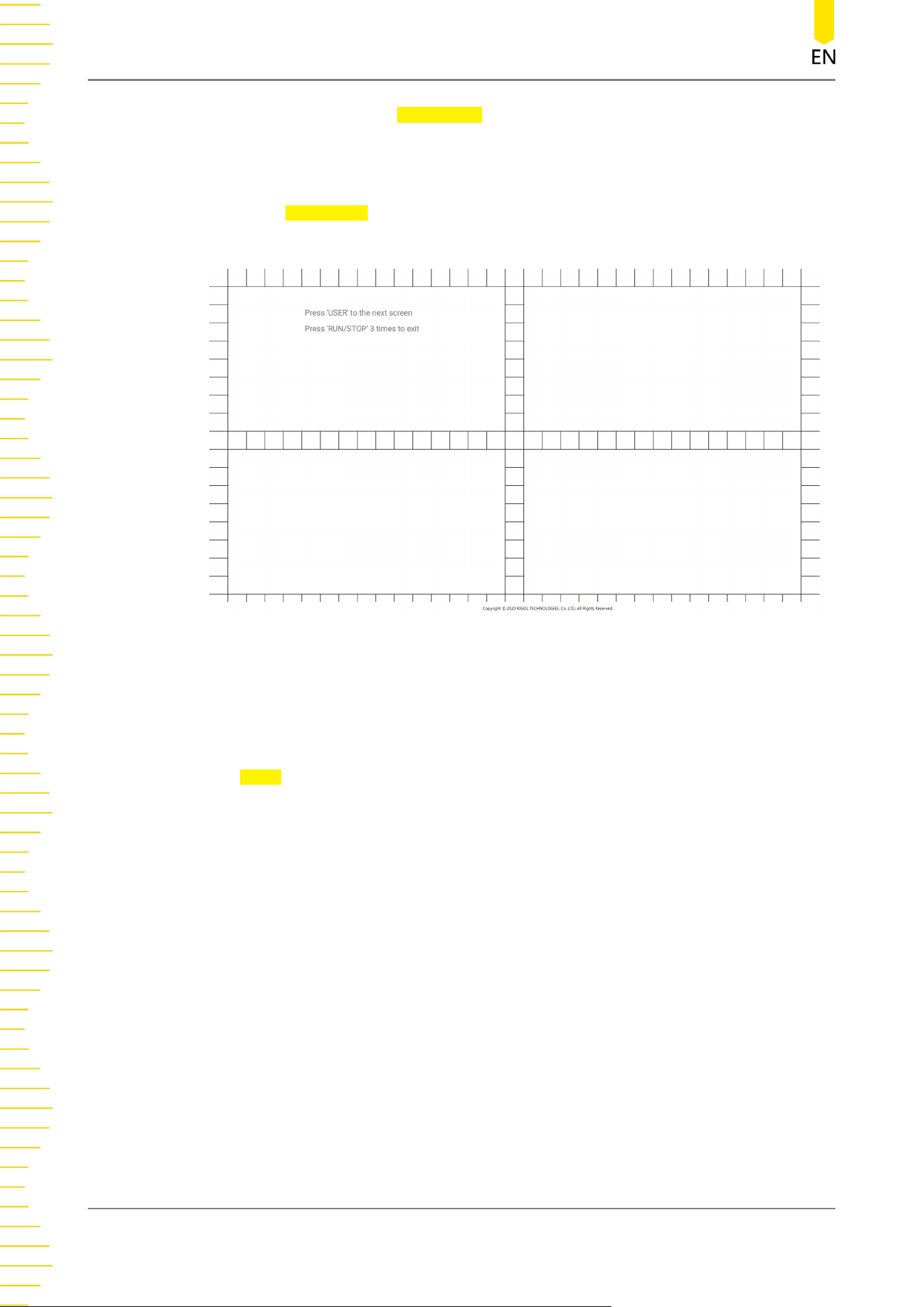
key may fail to work. Press RUN/STOP for three consecutive times to exit the key test
interface.
Touch Test
Click or tap Touch Test to enter the touch screen test interface, as shown in the figure
below.
Figure 23.4 Touch Screen Test Interface
Slide with your finger on the screen. If there is a line displaying at the empty area
where you slide on the screen and the box that you tap turns out to be filled with
green background, it indicates that the touch function of this area is normal. Then
press USER to switch to the next touch screen test interface, as shown in the figure
below.
System Utility Function Setting
DS70000 User Guide
294
Copyright ©RIGOL TECHNOLOGIES CO., LTD.
All rights reserved.
Figure 23.5 Touch-Enabled Gesture Operation Interface
At this time, you can pinch or stretch the icon R to zoom out or zoom in the icon to
check whether the touch-enabled gestures work normally. Press RUN/STOP for three
consecutive times to exit the touch screen test interface.
Screen Test
Click or tap Screen Test to enter the screen test interface and check whether the
defective pixel exists.
There are 15 screen test interfaces. Press USER to switch to the next screen test
interface. Press RUN/STOP for three consecutive times to exit the screen test
interface.
Board Test
Click or tap Board Test, then the board test interface is displayed. Check whether the
status of each module is in good condition.
System Utility Function Setting
Copyright ©RIGOL TECHNOLOGIES CO., LTD.
All rights reserved.
DS70000 User Guide
295
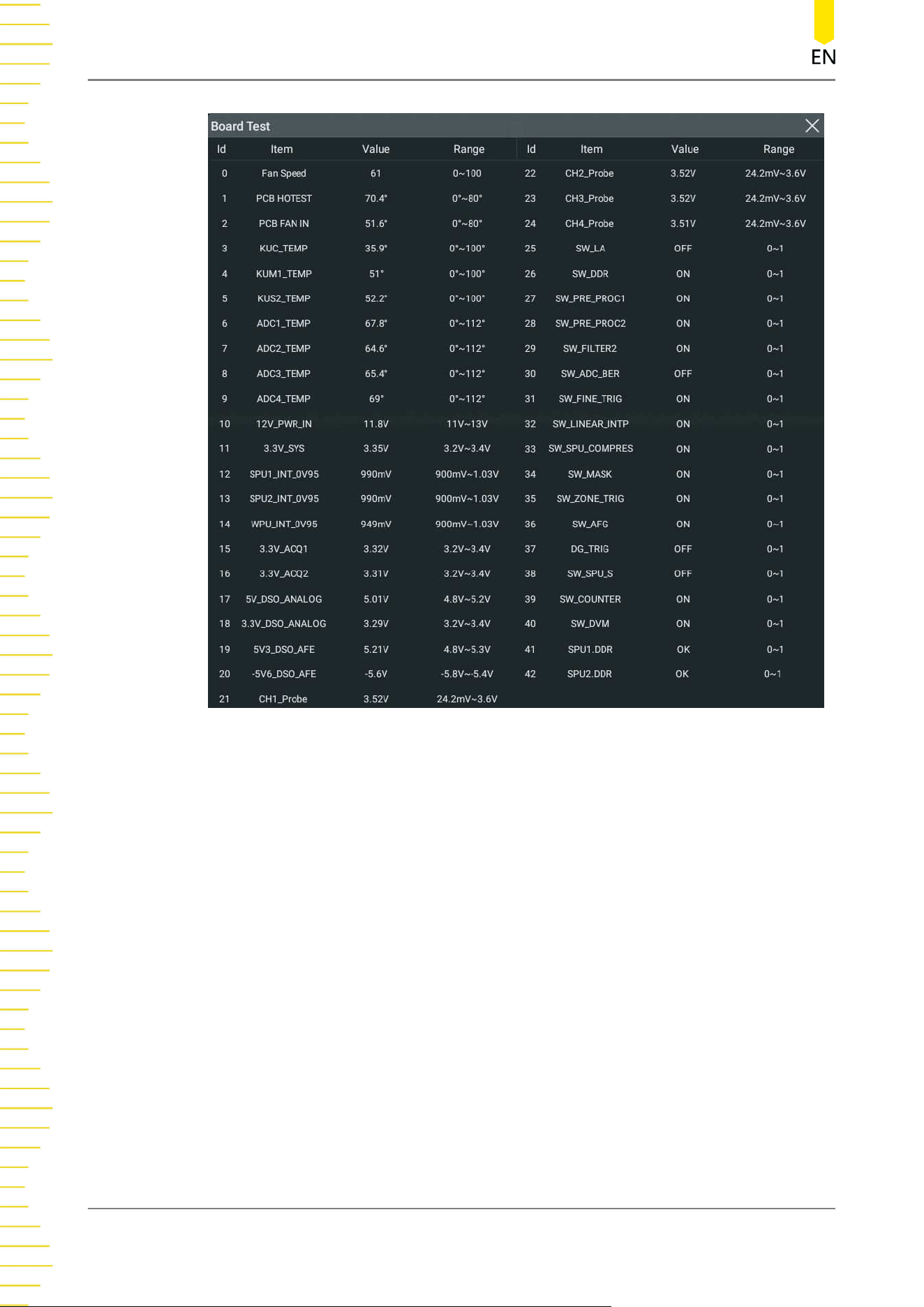
Figure 23.6 Board Test Interface
System Utility Function Setting
DS70000 User Guide
296
Copyright ©RIGOL TECHNOLOGIES CO., LTD.
All rights reserved.
24 Remote Control
The instrument can be remotely controlled by the following three methods:
• User-defined Programming
Users can program and control the instrument by using the SCPI (Standard
Commands for Programmable Instruments) commands. For details about the
SCPI commands and programming, refer to
Programming Guide
.
• PC Software
Users can use the PC software to send commands to control the instrument
remotely. RIGOL Ultra Sigma is recommended. You can download the software
from RIGOL official website (
http://www.rigol.com
).
Operation Procedures:
- Set up communication between the instrument and PC.
- Run Ultra Sigma and search for the instrument resource.
- Open the remote command control panel to send commands.
• Web Control
This instrument supports Web Control. Connect the instrument to the network,
then input the IP address of the instrument into the address bar of the browser
of your computer. The web control interface is displayed. Click Web Control to
enter the web control page. Then you can view the display of the real-time
interface of the instrument. Through the Web Control method, you can migrant
the device control to the control terminals (e.g. PC, Mobile, iPad, and other smart
terminals) to realize remote control of the instrument. When you first log in to
the Web Control, the user name is "admin" and password is "rigol".
This instrument can be connected to the PC via the USB, LAN, or GPIB interface to set
up communication and realize remote control through the PC. The remote control can
be realized by using SCPI (Standard Commands for Programmable Instruments)
commands.
This chapter will illustrate how to use the to work with RIGOL Ultra Sigma software to
remotely control the instrument via various interfaces. Note: When communicating
with the PC via GPIB, the instrument does not support large data transmission
operation such as screen shot and waveform reading.
Caution
Before setting up communication, please turn off the instrument to avoid causing
damage to the communication interfaces.
Remote Control
Copyright ©RIGOL TECHNOLOGIES CO., LTD.
All rights reserved.
DS70000 User Guide
297
24.1 Remote Control via USB
1 Connect the device
Use the USB cable to connect the rear-panel USB DEVICE interface of the
instrument to the USB HOST interface of the PC.
2 Search for the device resource
Start up Ultra Sigma and the software will automatically search for the resource
currently connected to the PC via the USB interface. You can also click USB-TMC to
search for the resource.
3 View the device resource
The resources found will appear under the "RIGOL Online Resource" directory, and
the model number and USB interface information of the instrument will also be
displayed.
4 Control the instrument remotely
Right-click the device resource name and select "SCPI Panel Control" to open the
remotely command control panel. Then you can send commands and read data
through the panel. For details about the SCPI commands and programming, refer
to the Programming Guide of this instrument.
24.2 Remote Control via LAN
1 Connect the device
Use the network cable to connect the instrument to your local area network (LAN).
2 Configure network parameters
Configure the network parameters of the instrument according to "
I/O Setting
".
3 Search for the device resource
Start up Ultra Sigma and click LAN to open the panel as shown in the figure below.
Click Search and the software searches for the instrument resources currently
connected to the LAN and the resources found are displayed at the right section of
the window as shown in the figure below. Click OK to add it.
Remote Control
DS70000 User Guide
298
Copyright ©RIGOL TECHNOLOGIES CO., LTD.
All rights reserved.
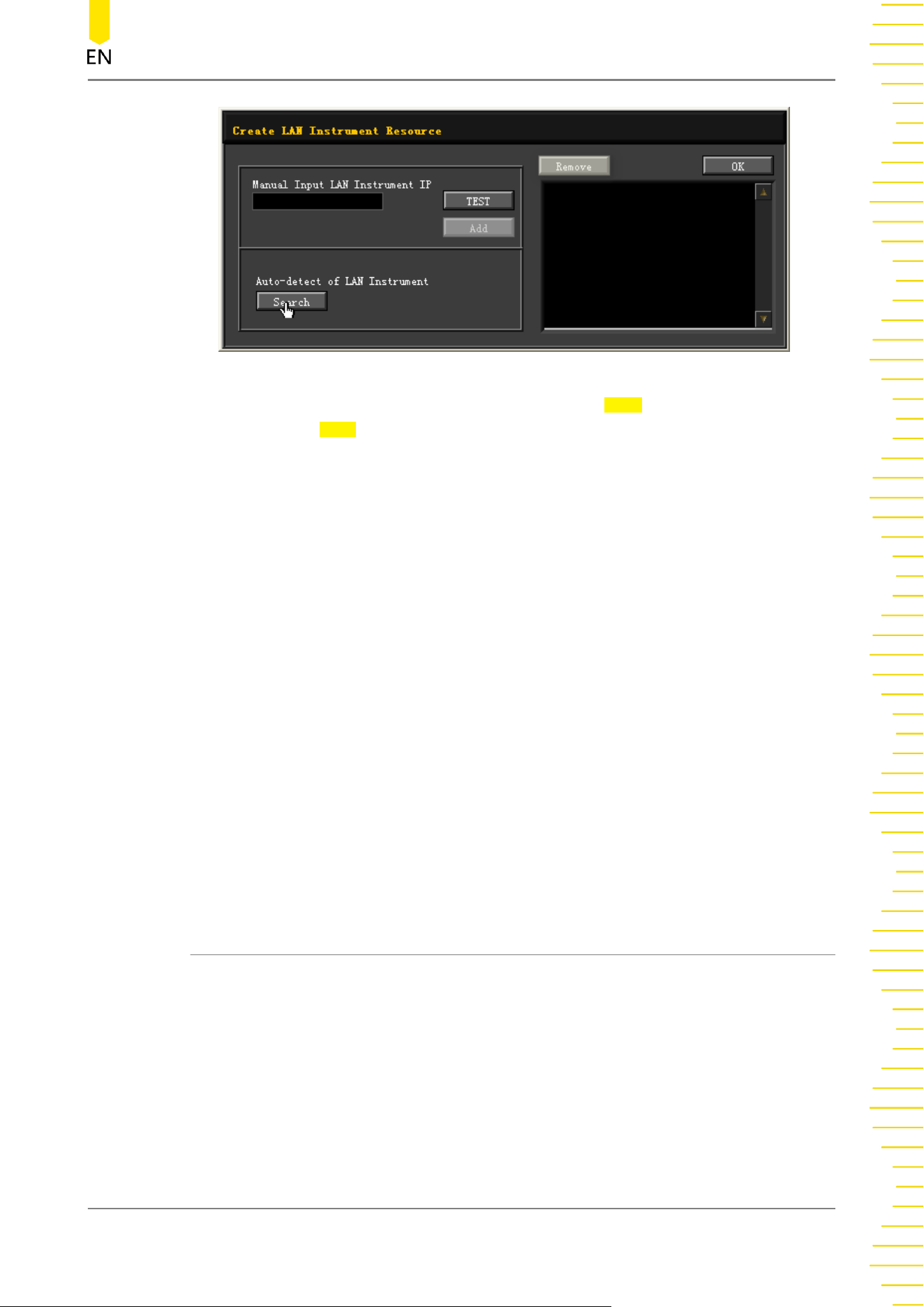
Besides, you can input the IP address of the instrument manually into the text field
under "Manual Input LAN Instrument IP", then click TEST. If the instrument passes
the test, click ADD to add the instrument to the LAN instrument resource list in the
right section; if the instrument fails the test, please check whether the IP address
that you input is correct, or use the auto search method to add the instrument
resource.
4 View the device resource
The resources found will appear under the “RIGOL Online Resource” directory.
5 Control the instrument remotely
Right-click the device resource name and select "SCPI Panel Control" to open the
remotely command control panel. Then you can send commands and read data
through the panel.
6 Load LXI webpage
As this instrument conforms to LXI CORE 2011 DEVICE standards, you can load LXI
webpage through Ultra Sigma (right-click the instrument resource name and select
"LXI-Web"). Various important information about the instrument (including the
model, manufacturer, serial number, description, MAC address, and IP address) will
be displayed on the webpage. You can also directly input the IP address of the
instrument in the address bar of the PC browser to load the LXI webpage.
24.3 Remote Control via GPIB
1 Connect the device
Use the USB-GPIB interface converter to extend the GPIB interface for the
instrument, and then use the GPIB cable to connect the instrument to the PC to
realize remote control.
2 Install the driver of GPIB card
Correctly install the driver of the GPIB card which has been connected to the PC.
3 Set the GPIB address
Remote Control
Copyright ©RIGOL TECHNOLOGIES CO., LTD.
All rights reserved.
DS70000 User Guide
299
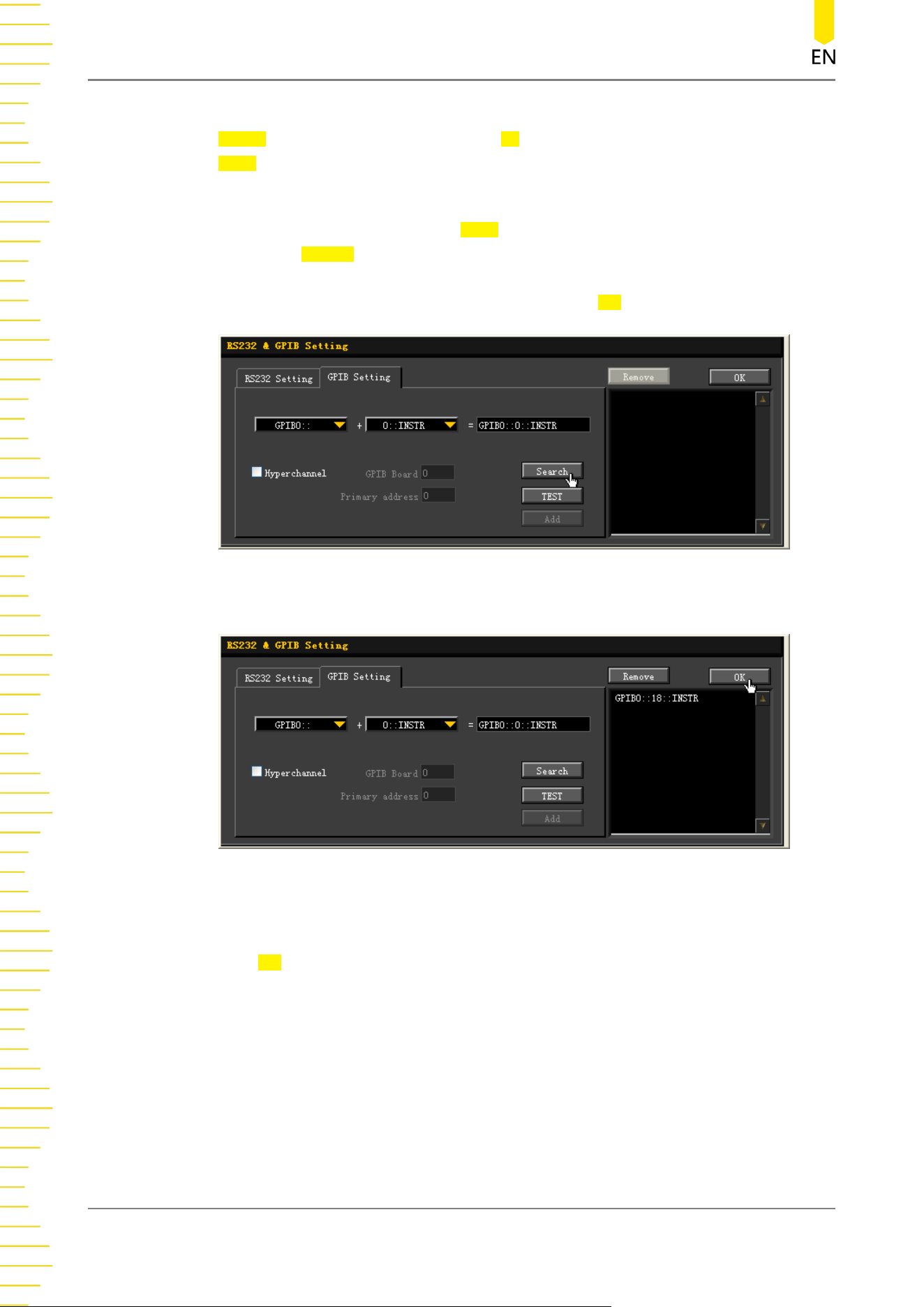
Click or tap the Notification Area at the lower-right corner of the screen, then the
Utility menu is displayed. Click or tap IO, and then click or tap the input field of
GPIB to input the GPIB address with the pop-up numeric keypad.
4 Search for the device resource
Start Ultra Sigma, and then click GPIB. A window is displayed as shown in
Figure
24.1
. Click Search and the software searches for the instrument resource currently
connected to the PC via the GPIB interface. The resource found is displayed at the
right of the window, as shown in
Figure 24.2
. Click OK to add it.
Figure 24.1 Search for the Available Device
Figure 24.2 Confirm the Available Device
5 View the device resource
Click OK to go back to the main interface of Ultra Sigma. The searched instrument
resource will be displayed under the directory of "RIGOL Online Resource".
6 Control the instrument remotely
Right-click the device resource name. In the displayed menu, select "SCPI Panel
Control" to open the programming command control panel. Then you can send
commands and read data through the panel.
Remote Control
DS70000 User Guide
300
Copyright ©RIGOL TECHNOLOGIES CO., LTD.
All rights reserved.
25 Troubleshooting
1 When I power on the instrument, the instrument stays black and does not
display anything.
a Check whether the power is correctly connected.
b Check whether the power key is really pressed.
c Check whether the fuse is blown. If you need to replace the fuse, use only the
specified fuse that conforms to the product.
d Restart the instrument after finishing the above inspections.
e If the problem still persists, please contact RIGOL.
2 No waveform of the signal is displayed on the screen.
a Check whether the probe is properly connected to the item under test.
b Check whether there are signals generated from the item to be tested (you can
connect the probe compensation output signal to the faulty channel to locate
the problem, and then determine whether the channel or the item to be tested
has a problem).
c Resample the signal.
d If the problem still persists, please contact RIGOL.
3 The USB storage device cannot be recognized.
a Check whether the USB storage device can work normally when connected to
other instruments or PC.
b Make sure that the USB storage device is FAT32 format and flash type. The
insrument doesn't support hardware USB storage device.
c After restarting the instrument, insert the USB storage device again to check
whether it can work normally.
d If the USB storage device still cannot work normally, please contact RIGOL.
4 How do you set the amplitude of the waveform in dBm?
a Select the desired channel.
b In the channel setting interface, check whether HighZ under OutputSet is set to
"On". If yes, you cannot set the amplitude of the waveform in dBm at this time.
Select "Off" to disable the HighZ, and use the numeric keypad, the arrow keys,
and knob to set it to a proper value.
Troubleshooting
Copyright ©RIGOL TECHNOLOGIES CO., LTD.
All rights reserved.
DS70000 User Guide
301
c Select the desired waveform, tap the Amplitude menu label, and then input the
desired value by using the numeric keypad. Then select the unit "dBm" from the
pop-up menu.
5 The touch functions cannot be used normally.
a Check whether you have locked the touch screen. If yes, refer to instructions in
#unique_28/unique_28_Connect_42_SECTION_HDF_TKJ_X4B
to unlock it.
b Check whether the screen or your finger is stained with oil or sweat. If yes,
please clean the screen or dry your hands.
c Check whether there is a strong magnetic field around the instrument. If the
instrument is close to the strong magnetic field (e.g. a magnet), please move
the instrument away from the magnet field.
d If the problem still persists, please contact RIGOL.
Troubleshooting
DS70000 User Guide
302
Copyright ©RIGOL TECHNOLOGIES CO., LTD.
All rights reserved.
26 Appendix
26.1 Appendix A: Options and Accessories
Order Information Order No.
Model
3 GHz, 20 GSa/s, 500 Mpts, 4CH High-End DS DS70304
5 GHz, 20 GSa/s, 500 Mpts, 4CH High-End DS DS70504
Standard Accessories
Power Cord Conforming to the Standard of the
Destination Country
— —
USB Cable — —
4 Passive HighZ Probes (500 MHz) RP3500A
Recommended Accessories
Active Differential Probe (3.5 GHz BW) PVA8350
Active Differential Probe (7 GHz BW) PVA8700
Current Probe (50 MHz, 30A) PCA1030
Current Probe (100 MHz, 30A) PCA2030
Current Probe (10 MHz, 150A) PCA1150
High-Voltage Differential Probe (70 MHz, 1400 V) PHA0150
High-Voltage Differential Probe (100 MHz, 1400 V) PHA1150
USB-GPIB Interface Converter USB-GPIB
Upgrade Option
2 Gpts Memory Depth Upgrade Option DS70000-RL-20
Serial Protocol Analysis Option
Embedded Serial Bus Trigger and Analysis (RS232/UART,
I2C, and SPI)
DS70000-EMBDA
Auto Serial Bus Trigger and Analysis (CAN, CAN-FD, LIN,
FlexRay)
DS70000-AUTOA
Audio Serial Bus Trigger and Analysis (I2S) DS70000-AUDIOA
Aerospace Serial Bus Trigger and Analysis (MIL-
STD-1553)
DS70000-AEROA
Measurement Application Option
Advanced Eye Diagram and Jitter Analysis (Option) DS70000-JITTA
Pre-compliance Test Software
USB2.0 Pre-compliance Test DS70000-USBC
100Base-T Ethernet Pre-compliance Test DS70000-ENETC
Real-Time Spectrum Analysis (RTSA)
RTSA DS70000-RTSA
For all the mainframes, accessories and options, please contact the local office of
RIGOL.
Appendix
Copyright ©RIGOL TECHNOLOGIES CO., LTD.
All rights reserved.
DS70000 User Guide
303
26.2 Appendix B Warranty
RIGOL TECHNOLOGIES CO., LTD. (hereinafter referred to as RIGOL) warrants that the
product mainframe and product accessories will be free from defects in materials and
workmanship within the warranty period.
If a product proves defective within the warranty period, RIGOL guarantees free
replacement or repair for the defective product. To get repair service, please contact
with your nearest RIGOL sales or service office.
There is no other warranty, expressed or implied, except such as is expressly set forth
herein or other applicable warranty card. There is no implied warranty of
merchantability or fitness for a particular purpose. Under no circumstances shall
RIGOL be liable for any consequential, indirect, ensuing, or special damages for any
breach of warranty in any case.
Appendix
DS70000 User Guide
304
Copyright ©RIGOL TECHNOLOGIES CO., LTD.
All rights reserved.