Default Login Details
User’s Guide
XMG1915 Series
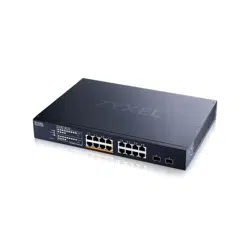
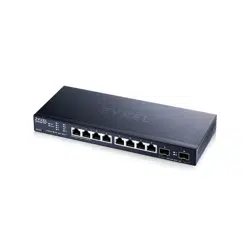
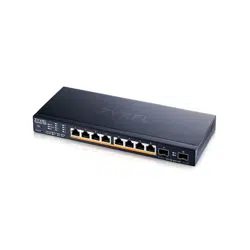
8/16-port Multi-Gigabit Smart Managed Switch
Copyright © 2023 Zyxel and/or its affiliates. All Rights Reserved.
Management IP
Address
http://setup.zyxel
or
http://DHCP-assigned IP
or
192.168.1.1
User Name admin
Password 1234
Version 4.80 Edition 1, 06/2023

XMG1915 Series User’s Guide
2
IMPORTANT!
READ CAREFULLY BEFORE USE.
KEEP THIS GUIDE FOR FUTURE REFERENCE.
This is a User’s Guide for a series of products. Not all products support all firmware features. Screenshots
and graphics in this book may differ slightly from your product due to differences in your product
firmware or your computer operating system. Every effort has been made to ensure that the information
in this manual is accurate.
Related Documentation
•Quick Start Guide
The Quick Start Guide shows how to connect the Switch.
• Online Help
Click the help link for a description of the fields in the Switch menus.
• Nebula Control Center (NCC) User’s Guide
Go to nebula.zyxel.com or support.zyxel.com to get this User’s Guide on how to configure the Switch
using Nebula.
•More Information
Go to https://community.zyxel.com/en for product discussions.
Go to support.zyxel.com to find other information on the Switch.

XMG1915 Series User’s Guide
3
Document Conventions
Warnings and Notes
These are how warnings and notes are shown in this guide.
Warnings tell you about things that could harm you or your device.
Note: Notes tell you other important information (for example, other things you may need to
configure or helpful tips) or recommendations.
Syntax Conventions
• All models may be referred to as the “Switch” in this guide.
• Product labels, screen names, field labels and field choices are all in bold font.
• A right angle bracket ( > ) within a screen name denotes a mouse click. For example, SYSTEM > IP
Setup > Network Proxy Configuration means you first click SYSTEM in the navigation panel, then the IP
Setup sub menu, then Network Proxy Configuration to get to that screen.
Icons Used in Figures
Figures in this user guide may use the following generic icons. The Switch icon is not an exact
representation of your device.
Switch Generic Router Wireless Router / Access Point
Generic Switch Smart TV Desktop
Laptop IP Camera Printer
Server

Contents Overview
XMG1915 Series User’s Guide
4
Contents Overview
User’s Guide ......................................................................................................................................20
Getting to Know Your Switch .............................................................................................................. 21
Hardware Installation and Connection ............................................................................................. 31
Hardware Panels .................................................................................................................................. 37
Technical Reference ........................................................................................................................49
Web Configurator ................................................................................................................................. 50
Initial Setup Example ............................................................................................................................ 78
Tutorials .................................................................................................................................................. 83
DASHBOARD .......................................................................................................................................... 91
MONITOR ............................................................................................................................................... 96
ARP Table .............................................................................................................................................. 97
IP Table ................................................................................................................................................... 99
IPv6 Neighbor Table ........................................................................................................................... 101
MAC Table ........................................................................................................................................... 103
Neighbor ............................................................................................................................................. 106
Path MTU Table ................................................................................................................................... 110
Port Status ............................................................................................................................................ 111
Routing Table ...................................................................................................................................... 118
System Information ............................................................................................................................. 120
System Log .......................................................................................................................................... 122
SYSTEM ................................................................................................................................................. 123
Cloud Management .......................................................................................................................... 124
General Setup ..................................................................................................................................... 126
Interface Setup ................................................................................................................................... 129
IP Setup ................................................................................................................................................ 131
IPv6 ....................................................................................................................................................... 138
Logins ................................................................................................................................................... 155
SNMP .................................................................................................................................................... 157
Switch Setup ........................................................................................................................................ 166
Syslog Setup ........................................................................................................................................ 168
Time Range ......................................................................................................................................... 171
PORT ..................................................................................................................................................... 174
Green Ethernet ................................................................................................................................... 175
Link Aggregation ................................................................................................................................ 177
Link Layer Discovery Protocol (LLDP) ................................................................................................ 186
PoE Setup ............................................................................................................................................. 207
Port Setup ............................................................................................................................................ 214

Contents Overview
XMG1915 Series User’s Guide
5
SWITCHING .......................................................................................................................................... 216
Loop Guard ......................................................................................................................................... 217
Mirroring ............................................................................................................................................... 220
Multicast .............................................................................................................................................. 222
Static Multicast Forwarding ............................................................................................................... 228
Differentiated Services ....................................................................................................................... 231
Queuing Method ................................................................................................................................ 235
Priority Queue ..................................................................................................................................... 238
Bandwidth Control ............................................................................................................................. 240
Spanning Tree Protocol ...................................................................................................................... 242
Static MAC Filtering ............................................................................................................................ 261
Static MAC Forwarding ...................................................................................................................... 263
VLAN .................................................................................................................................................... 266
NETWORKING ...................................................................................................................................... 283
ARP Setup ............................................................................................................................................ 284
DHCP .................................................................................................................................................... 290
Static Route ......................................................................................................................................... 304
SECURITY .............................................................................................................................................. 309
AAA ...................................................................................................................................................... 310
Access Control .................................................................................................................................... 318
Storm Control ...................................................................................................................................... 327
Error-Disable ........................................................................................................................................ 329
DHCP Snooping .................................................................................................................................. 335
Port Security ......................................................................................................................................... 347
MAINTENANCE .................................................................................................................................... 350
Troubleshooting and Appendices .................................................................................................371
Troubleshooting .................................................................................................................................. 372

Table of Contents
XMG1915 Series User’s Guide
6
Table of Contents
Document Conventions ......................................................................................................................3
Contents Overview..............................................................................................................................4
Table of Contents.................................................................................................................................6
Part I: User’s Guide..........................................................................................20
Chapter 1
Getting to Know Your Switch ............................................................................................................21
1.1 Introduction ..................................................................................................................................... 21
1.1.1 Management Modes ........................................................................................................... 22
1.1.2 Mode Changing ................................................................................................................... 23
1.1.3 ZON Utility ............................................................................................................................... 25
1.1.4 PoE .......................................................................................................................................... 25
1.2 Example Applications .................................................................................................................... 26
1.2.1 PoE Example Application ..................................................................................................... 26
1.2.2 Backbone Example Application ......................................................................................... 27
1.2.3 Bridging or Fiber Optic Uplink Example Application ......................................................... 28
1.2.4 High Performance Switching Example ............................................................................... 28
1.2.5 IEEE 802.1Q VLAN Application Examples ........................................................................... 29
1.3 Ways to Manage the Switch ......................................................................................................... 29
1.4 Good Habits for Managing the Switch ........................................................................................30
Chapter 2
Hardware Installation and Connection ...........................................................................................31
2.1 Installation Scenarios ...................................................................................................................... 31
2.2 Safety Precautions .......................................................................................................................... 31
2.3 Freestanding Installation Procedure ............................................................................................ 31
2.4 Wall Mounting (XMG1915-10E and XMG1915-10EP Only) ......................................................... 32
2.4.1 Installation Requirements ..................................................................................................... 32
2.5 Mounting the Switch on a Rack ................................................................................................... 34
2.5.1 Installation Requirements ..................................................................................................... 34
2.5.2 Precautions ............................................................................................................................ 35
2.5.3 Attaching the Mounting Brackets to the Switch ............................................................... 35
2.5.4 Mounting the Switch on a Rack .......................................................................................... 35
Chapter 3
Hardware Panels................................................................................................................................37

Table of Contents
XMG1915 Series User’s Guide
7
3.1 Front Panel Connections ............................................................................................................... 37
3.1.1 Multi-Gigabit Ethernet Ports ................................................................................................. 38
3.1.2 PoE (XMG1915-10EP and XMG1915-18EP) ......................................................................... 39
3.1.3 SFP/SFP+ Slots ......................................................................................................................... 39
3.2 Rear Panel ....................................................................................................................................... 41
3.2.1 Grounding .............................................................................................................................. 41
3.2.2 AC Power Connection ......................................................................................................... 43
3.3 LEDs .................................................................................................................................................. 47
Part II: Technical Reference...........................................................................49
Chapter 4
Web Configurator...............................................................................................................................50
4.1 Overview ......................................................................................................................................... 50
4.2 System Login .................................................................................................................................... 50
4.3 Zyxel One Network (ZON) Utility .................................................................................................... 53
4.3.1 Requirements ......................................................................................................................... 54
4.3.2 Run the ZON Utility ................................................................................................................. 54
4.4 Wizard .............................................................................................................................................. 58
4.4.1 Basic ....................................................................................................................................... 59
4.4.2 Protection .............................................................................................................................. 64
4.4.3 VLAN ....................................................................................................................................... 66
4.4.4 QoS ......................................................................................................................................... 67
4.5 Web Configurator Layout .............................................................................................................. 68
4.5.1 Tables and Lists ...................................................................................................................... 74
4.5.2 Change Your Password ........................................................................................................ 75
4.6 Save Your Configuration ................................................................................................................ 76
4.7 Switch Lockout ................................................................................................................................ 76
4.8 Reset the Switch ............................................................................................................................. 76
4.8.1 Restore Button ....................................................................................................................... 76
4.9 Log Out of the Web Configurator ................................................................................................ 77
4.10 Help ................................................................................................................................................ 77
Chapter 5
Initial Setup Example.........................................................................................................................78
5.1 Overview ......................................................................................................................................... 78
5.1.1 Create a VLAN ...................................................................................................................... 78
5.1.2 Set Port VID ............................................................................................................................ 79
5.1.3 Configure Switch Management IP Address ....................................................................... 80
Chapter 6
Tutorials...............................................................................................................................................83

Table of Contents
XMG1915 Series User’s Guide
8
6.1 Overview ......................................................................................................................................... 83
6.2 How to Use DHCPv4 Snooping on the Switch ............................................................................. 83
6.3 How to Use DHCPv4 Relay on the Switch .................................................................................... 87
6.3.1 DHCP Relay Tutorial Introduction ........................................................................................ 87
6.3.2 Create a VLAN ...................................................................................................................... 87
6.3.3 Configure DHCPv4 Relay ..................................................................................................... 89
6.3.4 Troubleshooting ..................................................................................................................... 89
Chapter 7
DASHBOARD .......................................................................................................................................91
7.1 New User Interface ......................................................................................................................... 91
7.2 DASHBOARD .................................................................................................................................... 91
7.2.1 Port Status .............................................................................................................................. 94
7.2.2 Quick Links to Use .................................................................................................................. 94
Chapter 8
MONITOR.............................................................................................................................................96
Chapter 9
ARP Table............................................................................................................................................97
9.1 ARP Table Overview ....................................................................................................................... 97
9.1.1 What You Can Do ................................................................................................................. 97
9.1.2 What You Need to Know ..................................................................................................... 97
9.2 Viewing the ARP Table ................................................................................................................... 97
Chapter 10
IP Table................................................................................................................................................99
10.1 IP Table Overview ......................................................................................................................... 99
10.2 Viewing the IP Table ................................................................................................................... 100
Chapter 11
IPv6 Neighbor Table.........................................................................................................................101
11.1 IPv6 Neighbor Table Overview .................................................................................................. 101
11.2 Viewing the IPv6 Neighbor Table ............................................................................................. 101
Chapter 12
MAC Table........................................................................................................................................103
12.1 MAC Table Overview ................................................................................................................. 103
12.1.1 What You Can Do ............................................................................................................. 103
12.1.2 What You Need to Know ................................................................................................. 103
12.2 Viewing the MAC Table ............................................................................................................. 104
Chapter 13
Neighbor ..........................................................................................................................................106

Table of Contents
XMG1915 Series User’s Guide
9
13.1 Neighbor Overview .................................................................................................................... 106
13.1.1 What You Can Do ............................................................................................................. 106
13.2 Neighbor ...................................................................................................................................... 106
13.2.1 Neighbor Details ................................................................................................................ 107
Chapter 14
Path MTU Table.................................................................................................................................110
14.1 Path MTU Overview .................................................................................................................... 110
14.2 Viewing the Path MTU Table ..................................................................................................... 110
Chapter 15
Port Status .........................................................................................................................................111
15.0.1 What You Can Do ............................................................................................................. 111
15.1 Port Status .................................................................................................................................... 111
15.1.1 Port Details ......................................................................................................................... 112
15.2 DDMI ............................................................................................................................................ 115
15.2.1 DDMI Details ...................................................................................................................... 115
15.3 Port Utilization .............................................................................................................................. 117
Chapter 16
Routing Table....................................................................................................................................118
16.1 Routing Table Overview ............................................................................................................ 118
16.1.1 What You Can Do ............................................................................................................. 118
16.2 IPv4 Routing Table ...................................................................................................................... 118
16.3 IPv6 Routing Table ...................................................................................................................... 119
Chapter 17
System Information..........................................................................................................................120
17.0.1 What You Can Do ............................................................................................................. 120
17.1 System Information ..................................................................................................................... 120
Chapter 18
System Log........................................................................................................................................122
18.1 System Log Overview ................................................................................................................. 122
18.2 System Log .................................................................................................................................. 122
Chapter 19
SYSTEM ..............................................................................................................................................123
Chapter 20
Cloud Management........................................................................................................................124
20.1 Cloud Management Overview ................................................................................................ 124
20.2 Nebula Center Control Discovery ............................................................................................ 124

Table of Contents
XMG1915 Series User’s Guide
10
Chapter 21
General Setup..................................................................................................................................126
21.1 General Setup ............................................................................................................................. 126
21.2 Hardware Monitor Setup ........................................................................................................... 128
Chapter 22
Interface Setup.................................................................................................................................129
22.1 Interface Setup Overview ......................................................................................................... 129
22.2 Interface Setup ........................................................................................................................... 129
22.2.1 Add/Edit Interfaces ........................................................................................................... 130
Chapter 23
IP Setup .............................................................................................................................................131
23.1 IP Setup Overview ...................................................................................................................... 131
23.1.1 What You Can Do ............................................................................................................. 131
23.2 IP Status ........................................................................................................................................ 131
23.2.1 IP Status Details .................................................................................................................. 132
23.3 IP Setup ........................................................................................................................................ 134
23.3.1 Add/Edit IP Interfaces ....................................................................................................... 135
23.4 Network Proxy Configuration .................................................................................................... 136
Chapter 24
IPv6....................................................................................................................................................138
24.1 IPv6 Overview ............................................................................................................................. 138
24.1.1 What You Can Do ............................................................................................................. 138
24.2 IPv6 Status .................................................................................................................................... 138
24.2.1 IPv6 Interface Status Details ............................................................................................. 139
24.3 IPv6 Global Setup ....................................................................................................................... 141
24.4 IPv6 Interface Setup ................................................................................................................... 142
24.4.1 Edit an IPv6 Interface ........................................................................................................ 143
24.5 IPv6 Link-Local Address Setup ................................................................................................... 143
24.5.1 Edit an IPv6 Link-Local Address ........................................................................................ 144
24.6 IPv6 Global Address Setup ........................................................................................................ 145
24.6.1 Add/Edit an IPv6 Global Address .................................................................................... 145
24.7 IPv6 Neighbor Discovery Setup ................................................................................................. 146
24.7.1 Edit an IPv6 Neighbor Discovery ..................................................................................... 147
24.8 IPv6 Router Discovery Setup ...................................................................................................... 148
24.8.1 Edit IPv6 Router Discovery ................................................................................................ 148
24.9 IPv6 Prefix Setup .......................................................................................................................... 149
24.9.1 Add/Edit IPv6 Prefix ........................................................................................................... 150
24.10 IPv6 Neighbor Setup ................................................................................................................. 151
24.10.1 Add/Edit IPv6 Neighbor .................................................................................................. 152
24.11 DHCPv6 Client Setup ................................................................................................................ 152

Table of Contents
XMG1915 Series User’s Guide
11
24.11.1 Edit DHCPv6 Client .......................................................................................................... 153
Chapter 25
Logins................................................................................................................................................155
25.1 Set Up Login Accounts ............................................................................................................... 155
Chapter 26
SNMP .................................................................................................................................................157
26.1 SNMP Overview .......................................................................................................................... 157
26.1.1 What You Can Do ............................................................................................................. 157
26.2 Configure SNMP .......................................................................................................................... 157
26.3 Configure SNMP User ................................................................................................................. 159
26.3.1 Add/Edit SNMP User .......................................................................................................... 159
26.4 SNMP Trap Group ....................................................................................................................... 161
26.5 Enable or Disable Sending of SNMP Traps on a Port .............................................................. 162
26.6 Technical Reference .................................................................................................................. 162
26.6.1 About SNMP ....................................................................................................................... 163
Chapter 27
Switch Setup.....................................................................................................................................166
27.1 Switch Setup Overview .............................................................................................................. 166
27.1.1 Introduction to VLANs ....................................................................................................... 166
27.2 Switch Setup ................................................................................................................................ 166
Chapter 28
Syslog Setup .....................................................................................................................................168
28.1 Syslog Overview .......................................................................................................................... 168
28.1.1 What You Can Do ............................................................................................................. 168
28.2 Syslog Setup ................................................................................................................................ 168
28.2.1 Add/Edit a Syslog Server .................................................................................................. 170
Chapter 29
Time Range.......................................................................................................................................171
29.1 Time Range Overview ................................................................................................................ 171
29.1.1 What You Can Do ............................................................................................................. 171
29.2 Configuring Time Range ............................................................................................................ 171
29.2.1 Add/Edit Time Range ....................................................................................................... 172
Chapter 30
PORT ..................................................................................................................................................174
Chapter 31
Green Ethernet.................................................................................................................................175
31.1 Green Ethernet Overview .......................................................................................................... 175

Table of Contents
XMG1915 Series User’s Guide
12
31.2 Configuring Green Ethernet ...................................................................................................... 175
Chapter 32
Link Aggregation .............................................................................................................................177
32.1 Link Aggregation Overview ....................................................................................................... 177
32.1.1 What You Can Do ............................................................................................................. 177
32.1.2 What You Need to Know ................................................................................................. 177
32.2 Link Aggregation Status ............................................................................................................. 179
32.3 Link Aggregation Setting ........................................................................................................... 180
32.4 Link Aggregation Control Protocol ........................................................................................... 182
32.5 Technical Reference .................................................................................................................. 184
32.5.1 Static Trunking Example ................................................................................................... 184
Chapter 33
Link Layer Discovery Protocol (LLDP) .............................................................................................186
33.1 LLDP Overview ............................................................................................................................ 186
33.2 LLDP-MED Overview ................................................................................................................... 187
33.2.1 What You Can Do – LLDP ................................................................................................. 188
33.2.2 What You Can Do – LLDP MED ........................................................................................ 188
33.3 LLDP Local Status ........................................................................................................................ 188
33.3.1 LLDP Local Port Status Details ..........................................................................................190
33.4 LLDP Remote Status .................................................................................................................... 192
33.4.1 LLDP Remote Port Status Details ...................................................................................... 193
33.5 LLDP Setup ................................................................................................................................... 197
33.6 Basic TLV Setting ......................................................................................................................... 199
33.7 Org-specific TLV Setting ............................................................................................................. 200
33.8 LLDP-MED Setup .......................................................................................................................... 201
33.9 LLDP-MED Network Policy .......................................................................................................... 202
33.9.1 Add/Edit LLDP-MED Network Policy ................................................................................ 202
33.10 LLDP-MED Location .................................................................................................................. 203
33.10.1 Add/Edit LLDP-MED Location ........................................................................................ 204
Chapter 34
PoE Setup..........................................................................................................................................207
34.1 PoE Status (for PoE models only) ............................................................................................... 207
34.2 PoE Setup ..................................................................................................................................... 209
34.3 PoE Time Range Setup ............................................................................................................... 212
34.3.1 Add/Edit PoE Time Range ................................................................................................ 213
Chapter 35
Port Setup..........................................................................................................................................214
35.1 Port Setup .................................................................................................................................... 214

Table of Contents
XMG1915 Series User’s Guide
13
Chapter 36
SWITCHING........................................................................................................................................216
Chapter 37
Loop Guard ......................................................................................................................................217
37.1 Loop Guard Overview ............................................................................................................... 217
37.1.1 What You Can Do ............................................................................................................. 217
37.1.2 What You Need to Know ................................................................................................. 217
37.2 Loop Guard Setup ...................................................................................................................... 219
Chapter 38
Mirroring............................................................................................................................................220
38.1 Mirroring Overview ..................................................................................................................... 220
38.2 Port Mirroring Setup .................................................................................................................... 220
Chapter 39
Multicast............................................................................................................................................222
39.1 Multicast Overview ..................................................................................................................... 222
39.1.1 What You Can Do – IPv4 Multicast ................................................................................. 222
39.1.2 What You Need to Know ................................................................................................. 222
39.2 IPv4 Multicast Status ................................................................................................................... 223
39.3 IGMP Snooping ........................................................................................................................... 224
39.4 IGMP Snooping VLAN ................................................................................................................ 226
39.4.1 Add/Edit IGMP Snooping VLANs ..................................................................................... 227
Chapter 40
Static Multicast Forwarding.............................................................................................................228
40.1 Static Multicast Forwarding Overview ..................................................................................... 228
40.1.1 What You Can Do ............................................................................................................. 228
40.1.2 What You Need To Know ................................................................................................. 228
40.2 Static Multicast Forwarding By MAC ........................................................................................229
40.2.1 Add/Edit Static Multicast Forwarding By MAC .............................................................. 230
Chapter 41
Differentiated Services ....................................................................................................................231
41.1 DiffServ Overview ....................................................................................................................... 231
41.1.1 What You Can Do ............................................................................................................. 231
41.1.2 What You Need to Know ................................................................................................. 231
41.2 Activating DiffServ ...................................................................................................................... 232
41.3 DSCP-to-IEEE 802.1p Priority Settings ......................................................................................... 233
41.3.1 Configuring DSCP Settings ...............................................................................................234
Chapter 42
Queuing Method..............................................................................................................................235

Table of Contents
XMG1915 Series User’s Guide
14
42.1 Queuing Method Overview ...................................................................................................... 235
42.1.1 What You Can Do ............................................................................................................. 235
42.1.2 What You Need to Know ................................................................................................. 235
42.2 Configuring Queuing ................................................................................................................. 236
Chapter 43
Priority Queue...................................................................................................................................238
43.1 Priority Queue Overview ............................................................................................................ 238
43.1.1 What You Can Do ............................................................................................................. 238
43.2 Assign Priority Queue .................................................................................................................. 238
Chapter 44
Bandwidth Control...........................................................................................................................240
44.1 Bandwidth Control Overview .................................................................................................... 240
44.1.1 What You Can Do ............................................................................................................. 240
44.2 Bandwidth Control Setup .......................................................................................................... 240
Chapter 45
Spanning Tree Protocol ...................................................................................................................242
45.1 Spanning Tree Protocol Overview ............................................................................................ 242
45.1.1 What You Can Do ............................................................................................................. 242
45.1.2 What You Need to Know ................................................................................................. 242
45.2 Spanning Tree Protocol Status .................................................................................................. 244
45.3 Spanning Tree Setup .................................................................................................................. 245
45.4 Rapid Spanning Tree Protocol Status .......................................................................................247
45.5 Configure Rapid Spanning Tree Protocol ................................................................................ 249
45.6 Multiple Spanning Tree Protocol Status ....................................................................................251
45.7 Configure Multiple Spanning Tree Protocol ............................................................................ 254
45.7.1 Add/Edit Multiple Spanning Tree .................................................................................... 255
45.8 Multiple Spanning Tree Protocol Port Setup ............................................................................ 257
45.9 Technical Reference .................................................................................................................. 258
45.9.1 MSTP Network Example ....................................................................................................258
45.9.2 MST Region ......................................................................................................................... 259
45.9.3 MST Instance ...................................................................................................................... 259
45.9.4 Common and Internal Spanning Tree (CIST) ................................................................. 259
Chapter 46
Static MAC Filtering..........................................................................................................................261
46.1 Static MAC Filtering Overview .................................................................................................. 261
46.1.1 What You Can Do ............................................................................................................. 261
46.2 Configure a Static MAC Filtering Rule ...................................................................................... 261
46.2.1 Add/Edit a Static MAC Filtering Rule .............................................................................. 262

Table of Contents
XMG1915 Series User’s Guide
15
Chapter 47
Static MAC Forwarding....................................................................................................................263
47.1 Static MAC Forwarding Overview ............................................................................................263
47.1.1 What You Can Do ............................................................................................................. 263
47.2 Configure Static MAC Forwarding ...........................................................................................263
47.2.1 Add/Edit Static MAC Forwarding Rules .......................................................................... 264
Chapter 48
VLAN..................................................................................................................................................266
48.1 VLAN Overview ........................................................................................................................... 266
48.1.1 What You Can Do ............................................................................................................. 266
48.1.2 What You Need to Know ................................................................................................. 266
48.2 Introduction to IEEE 802.1Q Tagged VLANs ............................................................................. 266
48.3 VLAN Status ................................................................................................................................. 269
48.3.1 VLAN Details ...................................................................................................................... 269
48.4 Configure a Static VLAN ............................................................................................................ 270
48.4.1 Add/Edit a Static VLAN .................................................................................................... 271
48.5 VLAN Port Setup .......................................................................................................................... 272
48.6 Voice VLAN ................................................................................................................................. 273
48.6.1 Add/Edit a Voice VLAN .................................................................................................... 275
48.7 MAC Based VLAN ....................................................................................................................... 275
48.7.1 Add/Edit a MAC Based VLAN ......................................................................................... 276
48.8 Vendor ID Based VLAN .............................................................................................................. 277
48.8.1 Add/Edit a Vendor ID Based VLAN ................................................................................. 278
48.9 Port-Based VLAN Setup .............................................................................................................. 278
48.10 Configure a Port-Based VLAN ................................................................................................. 279
Chapter 49
NETWORKING....................................................................................................................................283
Chapter 50
ARP Setup..........................................................................................................................................284
50.1 ARP Overview ............................................................................................................................. 284
50.1.1 What You Can Do ............................................................................................................. 284
50.1.2 What You Need to Know ................................................................................................. 284
50.2 ARP Learning ............................................................................................................................... 286
50.3 Static ARP .................................................................................................................................... 287
50.3.1 Add/Edit Static ARP .......................................................................................................... 288
Chapter 51
DHCP .................................................................................................................................................290
51.1 DHCP Overview .......................................................................................................................... 290
51.1.1 What You Can Do ............................................................................................................. 290

Table of Contents
XMG1915 Series User’s Guide
16
51.1.2 What You Need to Know ................................................................................................. 290
51.2 DHCPv4 Relay Status .................................................................................................................. 291
51.3 DHCPv4 Relay ............................................................................................................................. 291
51.3.1 DHCPv4 Relay Agent Information ................................................................................... 292
51.4 DHCPv4 Option 82 Profile .......................................................................................................... 293
51.4.1 Add/Edit a DHCPv4 Option 82 Profile ............................................................................. 293
51.5 Configuring DHCPv4 Smart Relay ............................................................................................. 294
51.5.1 Add/Edit DHCPv4 Global Relay Port .............................................................................. 295
51.5.2 DHCP Smart Relay Configuration Example .................................................................... 296
51.6 DHCPv4 VLAN Setting ................................................................................................................ 298
51.6.1 Add/Edit DHCPv4 VLAN Setting ...................................................................................... 298
51.6.2 Add/Edit DHCPv4 VLAN Port ........................................................................................... 299
51.6.3 Example: DHCP Relay for Two VLANs ............................................................................. 300
51.7 DHCPv6 Relay ............................................................................................................................. 301
51.7.1 Add/Edit DHCPv6 Relay ...................................................................................................302
Chapter 52
Static Route.......................................................................................................................................304
52.1 Static Routing Overview ............................................................................................................ 304
52.1.1 What You Can Do ............................................................................................................. 305
52.2 IPv4 Static Route ......................................................................................................................... 305
52.2.1 Add/Edit IPv4 Static Route ............................................................................................... 306
52.3 IPv6 Static Route ......................................................................................................................... 307
52.3.1 Add/Edit IPv6 Static Route ............................................................................................... 307
Chapter 53
SECURITY ...........................................................................................................................................309
Chapter 54
AAA...................................................................................................................................................310
54.1 Authentication, Authorization and Accounting (AAA) ......................................................... 310
54.1.1 What You Can Do ............................................................................................................. 310
54.1.2 What You Need to Know ................................................................................................. 310
54.2 RADIUS Server Setup ................................................................................................................... 311
54.3 AAA Setup ................................................................................................................................... 313
54.4 Technical Reference .................................................................................................................. 315
54.4.1 Vendor Specific Attribute ................................................................................................ 315
54.4.2 Supported RADIUS Attributes ........................................................................................... 316
54.4.3 Attributes Used for Authentication .................................................................................. 316
54.4.4 Attributes Used for Accounting ....................................................................................... 316
Chapter 55
Access Control.................................................................................................................................318
55.1 Access Control Overview .......................................................................................................... 318

Table of Contents
XMG1915 Series User’s Guide
17
55.1.1 What You Can Do ............................................................................................................. 318
55.2 Service Access Control .............................................................................................................. 318
55.3 Remote Management ............................................................................................................... 319
55.4 Account Security ........................................................................................................................ 320
55.5 Technical Reference .................................................................................................................. 322
55.5.1 SSH Overview ..................................................................................................................... 322
55.5.2 Introduction to HTTPS ........................................................................................................ 324
55.5.3 Google Chrome Warning Messages .............................................................................. 326
Chapter 56
Storm Control....................................................................................................................................327
56.1 Storm Control Overview ............................................................................................................. 327
56.1.1 What You Can Do ............................................................................................................. 327
56.2 Storm Control Setup ................................................................................................................... 327
Chapter 57
Error-Disable.....................................................................................................................................329
57.1 Error-Disable Overview ............................................................................................................... 329
57.1.1 CPU Protection Overview ................................................................................................ 329
57.1.2 Error-Disable Recovery Overview .................................................................................... 329
57.1.3 What You Can Do ............................................................................................................. 329
57.2 Error-Disable Status ..................................................................................................................... 330
57.3 CPU Protection Setup ................................................................................................................. 331
57.4 Error-Disable Detect Setup ........................................................................................................ 332
57.5 Error-Disable Recovery Setup .................................................................................................... 333
Chapter 58
DHCP Snooping................................................................................................................................335
58.1 DHCP Snooping Overview ......................................................................................................... 335
58.1.1 What You Can Do ............................................................................................................. 336
58.2 DHCP Snooping Status ............................................................................................................... 336
58.3 DHCP Snooping Setup ............................................................................................................... 339
58.4 DHCP Snooping Port Setup ....................................................................................................... 340
58.5 DHCP Snooping VLAN Setup ..................................................................................................... 342
58.6 DHCP Snooping VLAN Port Setup .............................................................................................343
58.6.1 Add/EDIT DHCP Snooping VLAN Ports ............................................................................ 343
58.7 Technical Reference .................................................................................................................. 344
58.7.1 DHCP Snooping Overview ............................................................................................... 344
Chapter 59
Port Security......................................................................................................................................347
59.1 Port Security Overview ............................................................................................................... 347
59.2 About Port Security ..................................................................................................................... 347

Table of Contents
XMG1915 Series User’s Guide
18
59.3 Port Security Setup ...................................................................................................................... 347
Chapter 60
MAINTENANCE..................................................................................................................................350
60.1 Overview ..................................................................................................................................... 350
60.1.1 What You Can Do ............................................................................................................. 350
60.2 Certificates .................................................................................................................................. 350
60.2.1 HTTPS Certificates .............................................................................................................. 351
60.3 Technical Reference .................................................................................................................. 352
60.3.1 FTP Command Line ........................................................................................................... 352
60.3.2 Filename Conventions ...................................................................................................... 353
60.3.3 FTP Command Line Procedure ........................................................................................ 353
60.3.4 GUI-based FTP Clients ....................................................................................................... 354
60.3.5 FTP Restrictions ................................................................................................................... 354
60.4 Cluster Management Overview ...............................................................................................355
60.4.1 What You Can Do ............................................................................................................. 355
60.5 Cluster Management Status ..................................................................................................... 355
60.6 Clustering Management Setup ................................................................................................ 356
60.7 Technical Reference .................................................................................................................. 358
60.7.1 Cluster Member Switch Management ........................................................................... 358
60.8 Restore Configuration ................................................................................................................ 360
60.9 Backup Configuration ................................................................................................................ 360
60.10 Erase Running-Configuration .................................................................................................. 361
60.11 Save Configuration .................................................................................................................. 362
60.12 Configure Clone ....................................................................................................................... 362
60.13 Diagnostic ................................................................................................................................. 364
60.14 Firmware Upgrade .................................................................................................................... 365
60.15 Reboot System .......................................................................................................................... 367
60.16 Tech-Support ............................................................................................................................. 368
60.16.1 Tech-Support Download ................................................................................................ 369
Part III: Troubleshooting and Appendices..................................................371
Chapter 61
Troubleshooting................................................................................................................................372
61.1 Power, Hardware Connections, and LEDs ............................................................................... 372
61.2 Switch Access and Login ........................................................................................................... 373
61.3 Switch Configuration .................................................................................................................. 375
61.4 PoE Supply ................................................................................................................................... 375
61.5 Nebula Registration .................................................................................................................... 376
Appendix A Customer Support ..................................................................................................... 377

Table of Contents
XMG1915 Series User’s Guide
19
Appendix B Common Services...................................................................................................... 382
Appendix C IPv6.............................................................................................................................. 385
Appendix D Legal Information ...................................................................................................... 393
Index.................................................................................................................................................398

20
PART I
User’s Guide

XMG1915 Series User’s Guide
21
CHAPTER 1
Getting to Know Your Switch
1.1 Introduction
This chapter introduces the main features and applications of the Switch.
The XMG1915 Series consists of the following models:
• XMG1915-10E
• XMG1915-10EP
• XMG1915-18EP
References to PoE model in this User's Guide only apply to XMG1915-10EP and XMG1915-18EP.
All models are referred to as the “Switch” in this guide.
The Switch is a smart managed switch supporting Multi-Gigabit ports. The Switch provides SFP+ slots for
uplink. By integrating static route functions, the Switch performs wire-speed layer-3 routing in addition to
layer-2 switching.
The Switch supports NebulaFlex for hybrid mode which can set the Switch to operate in either
standalone or Nebula cloud management mode. When the Switch is in standalone mode, it can be
configured and managed by the Web Configurator. When the Switch is in Nebula cloud management
mode, it can be managed and provisioned by the Zyxel Nebula Control Center (NCC).
The following table describes the hardware features of the Switch by model.
Table 1 XMG1915 Series Comparison Table
FEATURES XMG1915-10E XMG1915-10EP XMG1915-18EP
Number of 100 Mbps / 1 Gbps / 2.5
Gbps Ethernet ports
80 8
Number of 100 Mbps / 1 Gbps / 2.5
Gbps PoE ports
08 8
1G, 10G SFP+ Interface 2 2 2
Total system ports 10 10 18
Auto-Fan Fanless Fanless Yes
Rubber feet for desktop placement Yes Yes Yes
Wall-mount Yes Yes No
Rack-mount No No Yes
Retainer clip for power cord No No Yes
Reboot Function Yes Yes Yes
Note: Press the RESTORE button for 2 to 6 seconds.
Chapter 1 Getting to Know Your Switch
XMG1915 Series User’s Guide
22
See the following table for the cables required and distance limitation to attain the corresponding
speed.
Note: Make sure to select the correct speed for the port in PORT > Port Setup.
1.1.1 Management Modes
NebulaFlex means you can set the Switch to operate in either standalone or cloud mode (but not both
at the same time).
Use the DHCP-assigned IP address to access the Web Configurator. To know the IP address, use the
NCC, the ZON utility, or the console port if available. You can also use the domain name “setup.zyxel” to
access the Web Configurator when you are directly connected to the Switch.
Note: Make sure your computer can connect to a DNS server through the Switch.
Use the Web Configurator to configure and manage the Switch directly in standalone mode or use
Nebula Control Center (NCC) to configure and manage the Switch in cloud mode. The Nebula Control
Center (NCC) is an alternative cloud-based network management system that allows you to remotely
manage and monitor the Switch. You may also access a minimized version of the Web Configurator in
cloud mode.
Nebula Cloud Management
To have Nebula manage the Switch, you must first register it at the Nebula web portal at https://
nebula.zyxel.com, and ensure that Nebula Control Center (NCC) Discovery is enabled in SYSTEM >
Cloud Management in the Switch Web Configurator.
Note: See the Switch’s datasheet for the feature differences between standalone and
Nebula cloud management modes. You can find the Switch’s datasheet at the Zyxel
website.
See the NCC (Nebula Control Center) User’s Guide for how to configure the Switch using Nebula.
Reset to Factory Default Function Yes Yes Yes
Note: Press the RESTORE button for more than 6 seconds.
Table 2 Cable Types
CABLE TRANSMISSION SPEED MAXIMUM DISTANCE BANDWIDTH CAPACITY
Category 5 100M 100 m 100 MHz
Category 5e or better 1G / 2.5G 100 m 100 MHz
Table 1 XMG1915 Series Comparison Table (continued)
FEATURES XMG1915-10E XMG1915-10EP XMG1915-18EP
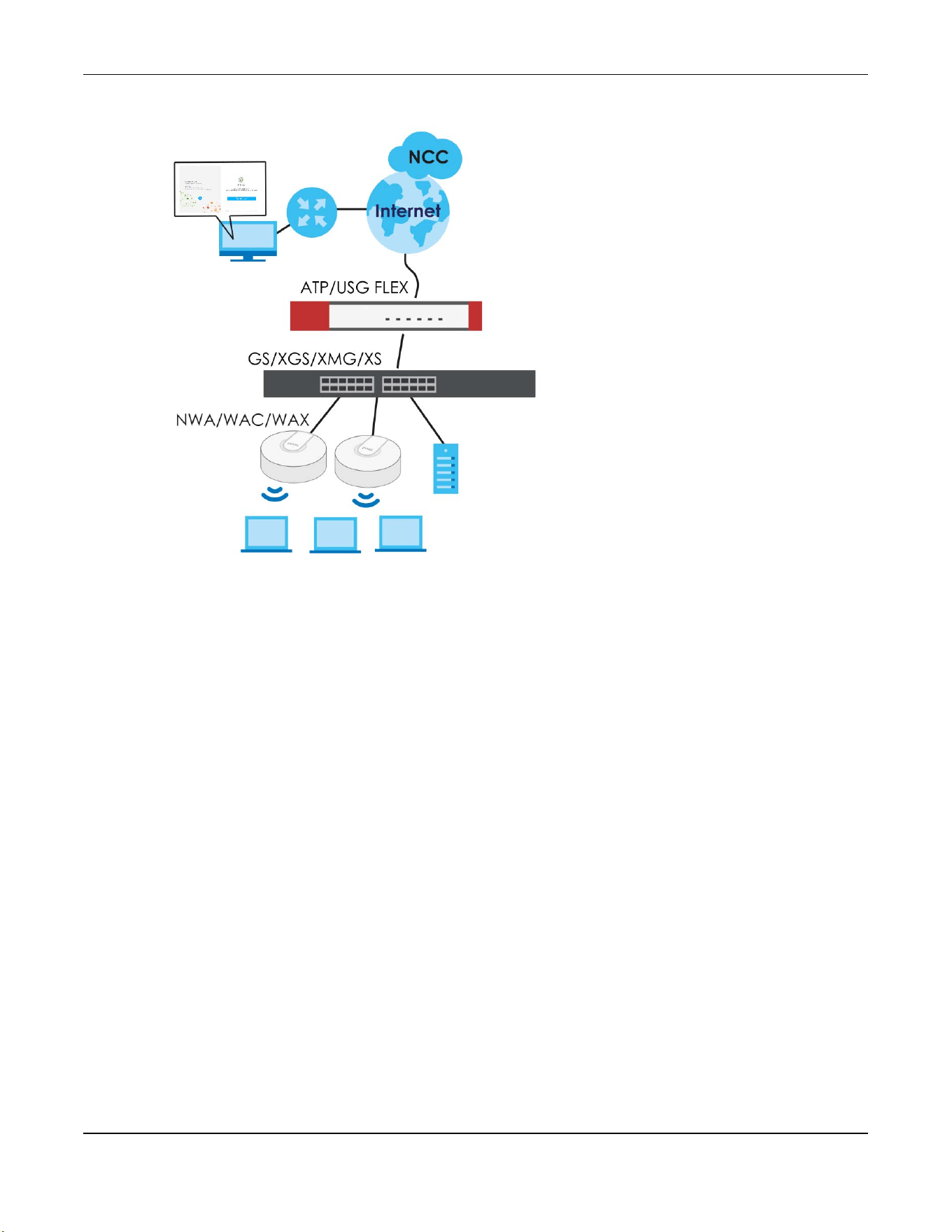
Chapter 1 Getting to Know Your Switch
XMG1915 Series User’s Guide
23
Figure 1 NCC Example Network Topology
1.1.2 Mode Changing
This section describes how to change the Switch’s management mode. Refer to the Switch’s
standalone mode User’s Guide for LED descriptions, including CLOUD LED behavior.
From Standalone to Nebula Cloud Management
To manage your Switch through Nebula, connect the Switch to the Internet, and register it to a site and
organization at the Nebula web portal (https://nebula.zyxel.com).
See the following steps or the Switch Quick Start Guide for registering the Switch.
Go to the NCC to Register the Switch
1 Go to the Nebula web portal in one of three ways.
• Enter https://nebula.zyxel.com in a supported web browser. See the Nebula User’s Guide for more
information about supported browsers.
• Click Visit Nebula in the Switch’s login page.
• Click the Nebula Control Center icon in the upper right of the Switch’s Web Configurator.
2 Click Get Started in the Nebula web portal. Enter your myZyxel account information. You will be
redirected to another screen where you can sign up for a myZyxel account if you do not have one.
3 Create an organization and a site (using the Nebula setup wizard) or select an existing site.
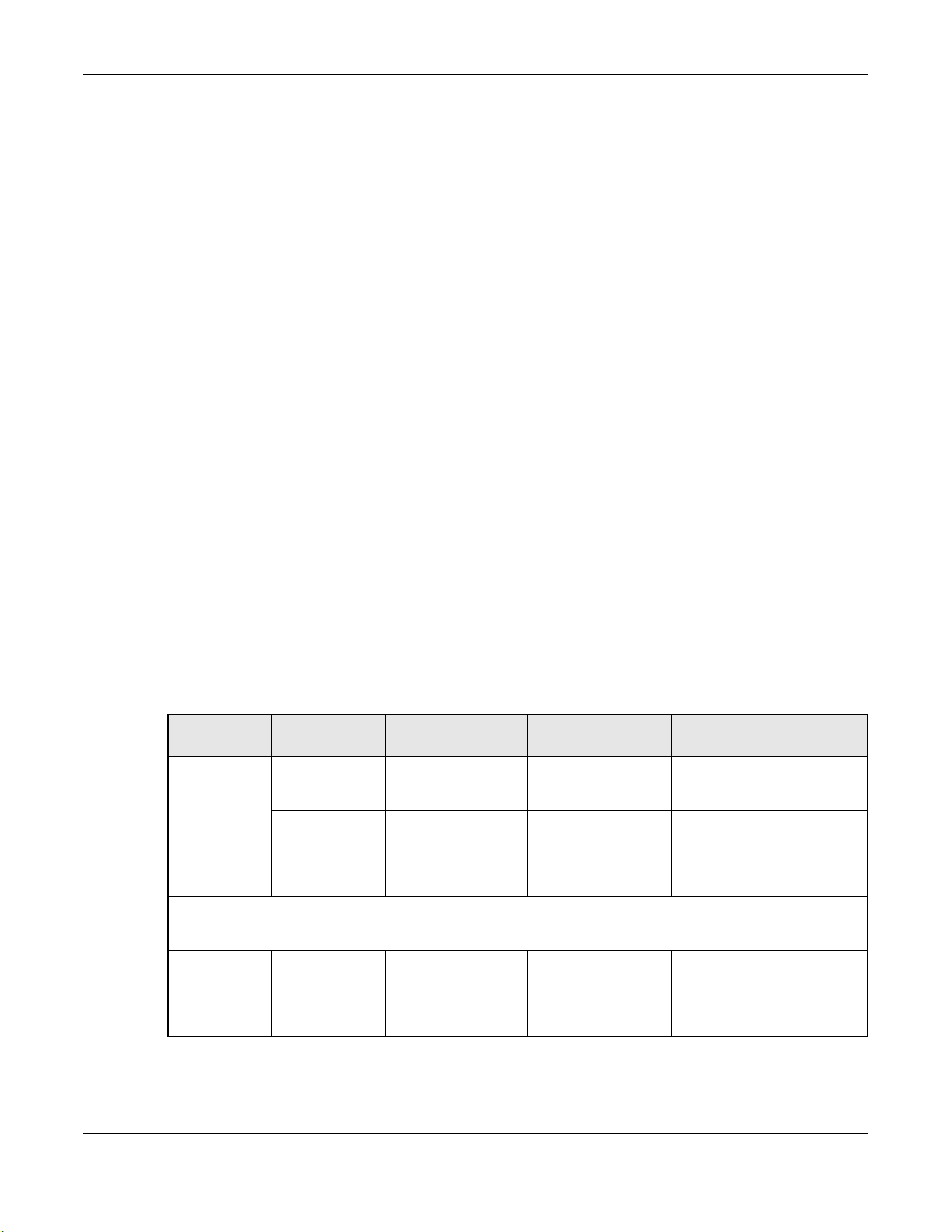
Chapter 1 Getting to Know Your Switch
XMG1915 Series User’s Guide
24
4 Register the Switch by entering its Registration MAC address and serial number and assign it to the site.
The serial number and Registration MAC address can be found in the DASHBOARD screen or the device
back label on the Switch.
Use the Zyxel Nebula Mobile App to Register the Switch
1 Download and open the Zyxel Nebula Mobile app in your mobile device (see Section on page 125 to
download the app). Click Start on the first page. Click Create account to create a myZyxel account or
enter your existing account information to log in.
2 Create an organization and site, or select an existing site using the Zyxel Nebula Mobile app.
3 Select a site and scan the Switch's QR code or manually enter the information to add it to the site. You
can find the QR code:
• On a label on the Switch or
• On its box or
• In the Web Configurator at SYSTEM > Cloud Management.
See Section 3.3 on page 47 for more information about the CLOUD LED or Section Table 23 on page 92
for more information about the Cloud Control Status field in the DASHBOARD screen to see if the Switch
goes into Nebula cloud management mode successfully.
The Switch goes into Cloud mode automatically after it can access the
Nebula web portal and is successfully registered there. Its login
password and settings are then overwritten with what you have
configured in the Nebula web portal. To access the Web Configurator
when the Switch is in Cloud mode, use the Local credentials password
to login.
Table 3 Management Method Comparison
MODE ACCESS LOGIN USER NAME LOGIN PASSWORD
LOGIN IP ADDRESS/URL/
DOMAIN NAME
Cloud mode NCC (Nebula
Control Center)
portal
myZyxell account
name
myZyxel account
password
https://nebula.zyxel.com
Web
Configurator
(Local GUI)
admin Local credentials
password
http://setup.zyxel
OR
http://DHCP-assigned IP
OR
a configured static IP address
Note: The Web Configurator (Local GUI) of Cloud mode supports limited features for troubleshooting
use only.
Standalone
mode
Web
Configurator
admin 1234 http://setup.zyxel
OR
http://DHCP-assigned IP
OR
http://192.168.1.1

Chapter 1 Getting to Know Your Switch
XMG1915 Series User’s Guide
25
From Nebula-managed to Standalone
To return to direct management standalone mode, remove (unregister) the Switch from the inventory in
the Nebula web portal.
Note: When you change the Switch’s management mode from Cloud mode to standalone
mode, the Switch will reboot and restore its factory-default settings.
To unregister the Switch:
1 Go to the Nebula Control Center (https://nebula.zyxel.com).
2 Go to the Organization-wide > License & inventory > Devices screen.
3 Select the Switch you want to remove (unregister) from the organization.
4 Click Actions, then click Remove from organization.
It will take a while for the Switch to reboot and reset to factory default.
1.1.3 ZON Utility
With its built-in Web Configurator, including the Neighbor Management feature (Section 13.1 on page
106), viewing, managing and configuring the Switch and its neighboring devices is simplified.
In addition, Zyxel offers a proprietary software program called Zyxel One Network (ZON) Utility, it is a
utility tool that assists you to set up and maintain network devices in a more simple and efficient way.
You can download the ZON Utility at www.zyxel.com and install it on a PC (Windows operation system).
For more information on ZON Utility see Section 4.3 on page 53.
1.1.4 PoE
The Switch is a Power Sourcing Equipment (PSE) because it provides a source of power through its
Ethernet ports. Each device that receives power through an Ethernet port is a Powered Device (PD).
The Switch can adjust the power supplied to each PD according to the PoE standard the PD supports.
PoE standards are:
• IEEE 802.3af Power over Ethernet (PoE)
• IEEE 802.3at Power over Ethernet (PoE) +
• IEEE 802.3bt Power over Ethernet (PoE) ++
The following table describes the PoE features of the Switch by PoE standard.
Table 4 XMG1915 Series Models and PoE Features
POE FEATURES XMG1915-10EP XMG1915-18EP
IEEE 802.3af PoE Yes Yes
IEEE 802.3at PoE+ Yes Yes
IEEE 802.3bt PoE++ Yes Yes

Chapter 1 Getting to Know Your Switch
XMG1915 Series User’s Guide
26
1.2 Example Applications
This section shows a few examples of using the Switch in various network environments. Note that the
Switch in the figure is just an example Switch and not your actual Switch.
1.2.1 PoE Example Application
The following example figure shows a Switch supplying PoE (Power over Ethernet) to Powered Devices
(PDs) such as an IP camera, a wireless router, an IP telephone and a general outdoor router that are not
within reach of a power outlet.
Power Management Mode Consumption mode (default) /
Classification mode
Consumption mode (default) /
Classification mode
PoE Power Budget 130 W 180 W
Table 5 PoE Standards
PoE FEATURES PoE PoE+ PoE++
IEEE Standard IEEE 802.3af IEEE 802.3at IEEE 802.3bt
PoE Type Type 1 Type 2 Type 3
Switch Port Power
IEEE Power Classification Class 0, 1, 2, 3 Class 4 Class 5, 6
Maximum Power Per Port 15.4 W 30 W 60 W
Port Voltage Range 44 – 57 V 50 – 57 V 50 – 57 V
Cables
Twisted Pairs Used 2-pair 2-pair 4-pair
Supported Cables Cat3 or better Cat5 or better Cat5 or better
Table 4 XMG1915 Series Models and PoE Features (continued)
POE FEATURES XMG1915-10EP XMG1915-18EP
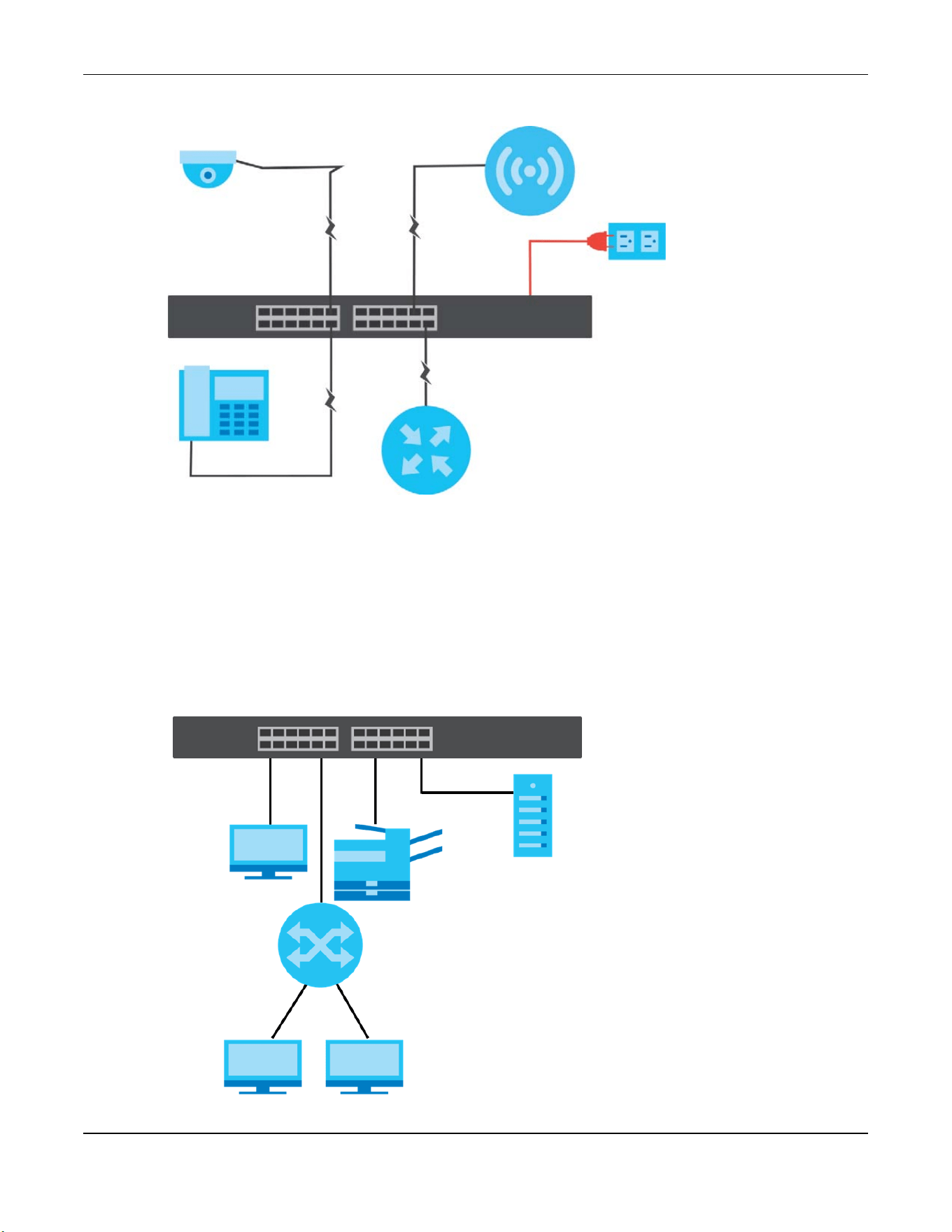
Chapter 1 Getting to Know Your Switch
XMG1915 Series User’s Guide
27
Figure 2 PoE Example Application
1.2.2 Backbone Example Application
The Switch is an ideal solution for small networks where rapid growth can be expected in the near future.
The Switch can be used standalone for a group of heavy traffic users. You can connect computers and
servers directly to the Switch’s port or connect other switches to the Switch.
In this example, all computers can share high-speed applications on the server. To expand the network,
simply add more networking devices such as switches, routers, computers, print servers, and so on.
Figure 3 Backbone Application
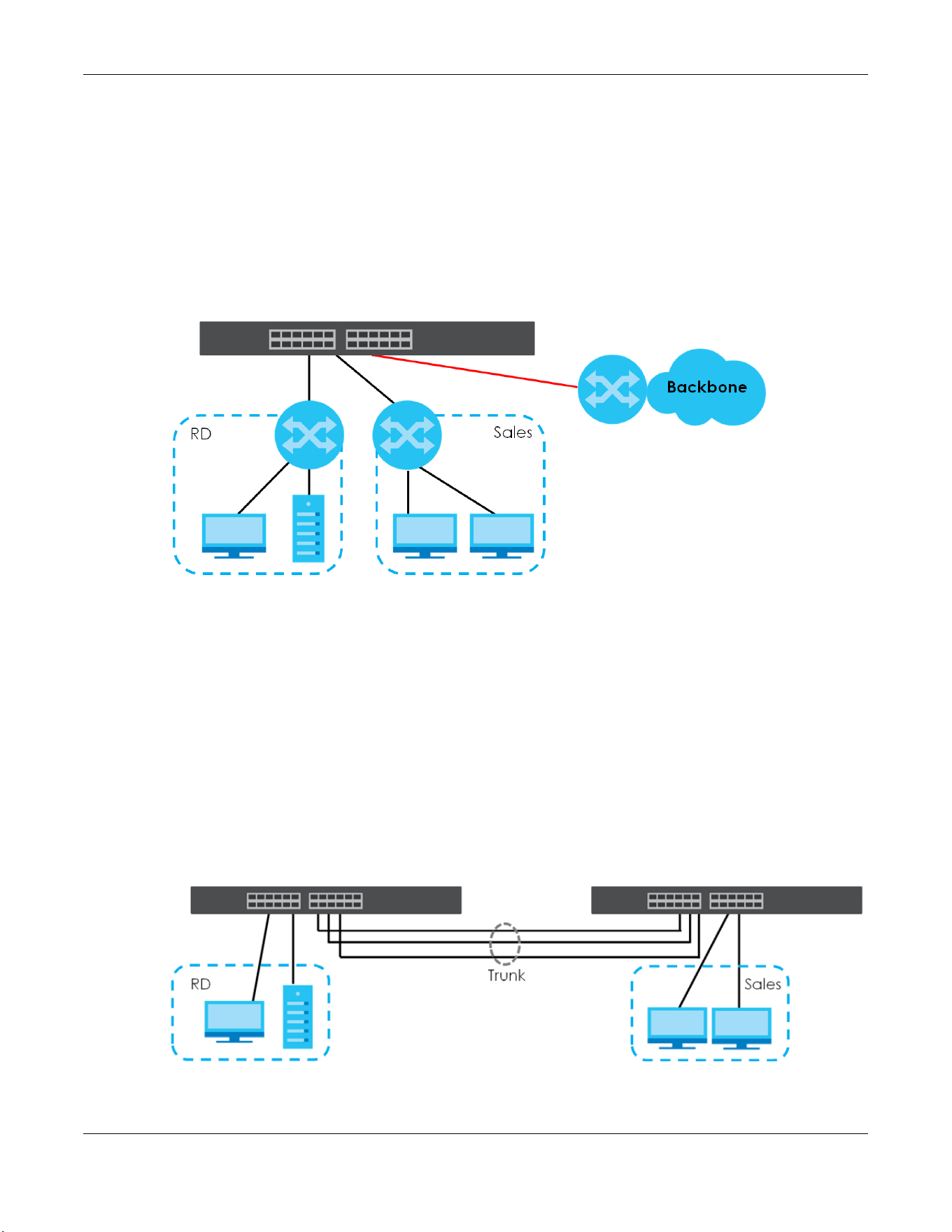
Chapter 1 Getting to Know Your Switch
XMG1915 Series User’s Guide
28
1.2.3 Bridging or Fiber Optic Uplink Example Application
In this example, the Switch connects different company departments (RD and Sales) to the corporate
backbone. It can alleviate bandwidth contention and eliminate server and network bottlenecks. All
users that need high bandwidth can connect to high-speed department servers through the Switch.
You can provide a super-fast uplink connection by using a Gigabit Ethernet or SFP port on the Switch.
Moreover, the Switch eases supervision and maintenance by allowing network managers to centralize
multiple servers at a single location.
Figure 4 Bridging Application
1.2.4 High Performance Switching Example
The Switch is ideal for connecting two networks that need high bandwidth. In the following example, use
link aggregation (trunking) to connect these two networks.
Switching to higher-speed LANs such as ATM (Asynchronous Transmission Mode) is not feasible for most
people due to the expense of replacing all existing Ethernet cables and adapter cards, restructuring
your network and complex maintenance. The Switch can provide the same bandwidth as ATM at much
lower cost while still being able to use existing adapters and switches. Moreover, the current LAN
structure can be retained as all ports can freely communicate with each other.
This helps you switch to higher-speed LANs without the need for replacing all existing Ethernet cables
and adapter cards, restructuring your network and complex maintenance.
Figure 5 High Performance Switched Workgroup Application

Chapter 1 Getting to Know Your Switch
XMG1915 Series User’s Guide
29
1.2.5 IEEE 802.1Q VLAN Application Examples
A VLAN (Virtual Local Area Network) allows a physical network to be partitioned into multiple logical
networks. Stations on a logical network belong to one or more groups. With VLAN, a station cannot
directly talk to or hear from stations that are not in the same groups unless such traffic first goes through
a router.
1.2.5.1 Tag-based VLAN Example
Ports in the same VLAN group share the same frame broadcast domain thereby increase network
performance through reduced broadcast traffic. VLAN groups can be modified at any time by adding,
moving or changing ports without any re-cabling.
Shared resources such as a server can be used by all ports in the same VLAN as the server. In the
following figure only ports that need access to the server need to be part of VLAN 1. Ports can belong to
other VLAN groups too.
Figure 6 Shared Server Using VLAN Example
1.3 Ways to Manage the Switch
Use any of the following methods to manage the Switch.
• NCC (Zyxel Nebula Control Center). With the NCC, you can remotely manage and monitor the
Switch through a cloud-based network management system. See the NCC User’s Guide for detailed
information about how to access the NCC and manage your Switch through the NCC. See the NCC
User’s Guide for how to configure Nebula managed devices.
• Web Configurator. This is recommended for everyday management of the Switch using a (supported)
web browser. See Chapter 4 on page 50.
• FTP. Use File Transfer Protocol for firmware upgrades and configuration backup or restore. See Section
60.3.1 on page 352.
• SNMP. The Switch can be monitored and/or managed by an SNMP manager. See Section 26.6.1 on
page 163.
• Cluster Management. Cluster Management allows you to manage multiple switches through one
switch, called the cluster manager. See Chapter 60 on page 355.
• ZON Utility. ZON Utility is a program designed to help you deploy and perform initial setup on a
network more efficiently. See Section 4.3 on page 53.

Chapter 1 Getting to Know Your Switch
XMG1915 Series User’s Guide
30
1.4 Good Habits for Managing the Switch
Do the following regularly to make the Switch more secure and to manage the Switch more effectively.
• Change the password. Use a password that is not easy to guess and that consists of different types of
characters, such as numbers and letters.
• Write down the password and put it in a safe place.
• Back up the configuration (and make sure you know how to restore it). Restoring an earlier working
configuration may be useful if the device becomes unstable or even crashes. If you forget your
password, you will have to reset the Switch to its factory default settings. If you backed up an earlier
configuration file, you would not have to totally re-configure the Switch. You could simply restore your
last configuration.

XMG1915 Series User’s Guide
31
CHAPTER 2
Hardware Installation and
Connection
2.1 Installation Scenarios
This chapter shows you how to install and connect the Switch.
The Switch can be:
• Placed on a desktop.
• Wall-mounted on a wall.
• Rack-mounted on a standard EIA rack.
2.2 Safety Precautions
Please observe the following before using the Switch:
• It is recommended to ask an authorized technician to attach the Switch on a desk or to the rack or
wall. Use the proper screws to prevent damage to the Switch. See the Installation Requirements
sections in this chapter to know the types of screws and screwdrivers for each mounting method.
• Make sure there is at least 2 cm of clearance on the top and bottom of the Switch, and at least 5 cm
of clearance on all four sides of the Switch. This allows air circulation for cooling.
• Do NOT block the ventilation holes nor store cables or power cords on the Switch. Allow clearance for
the ventilation holes to prevent your Switch from overheating. This is especially crucial when your
Switch does not have fans. Overheating could affect the performance of your Switch, or even
damage it.
• The surface of the Switch could be hot when it is functioning. Do NOT put your hands on it. You may
get burned. This could happen especially when you are using a fanless Switch.
• The Switches with fans are not suitable for use in locations where children are likely to be present.
To start using the Switch, simply connect the power cables to turn it on.
2.3 Freestanding Installation Procedure
1 Make sure the Switch is clean and dry.
2 Remove the adhesive backing from the rubber feet.
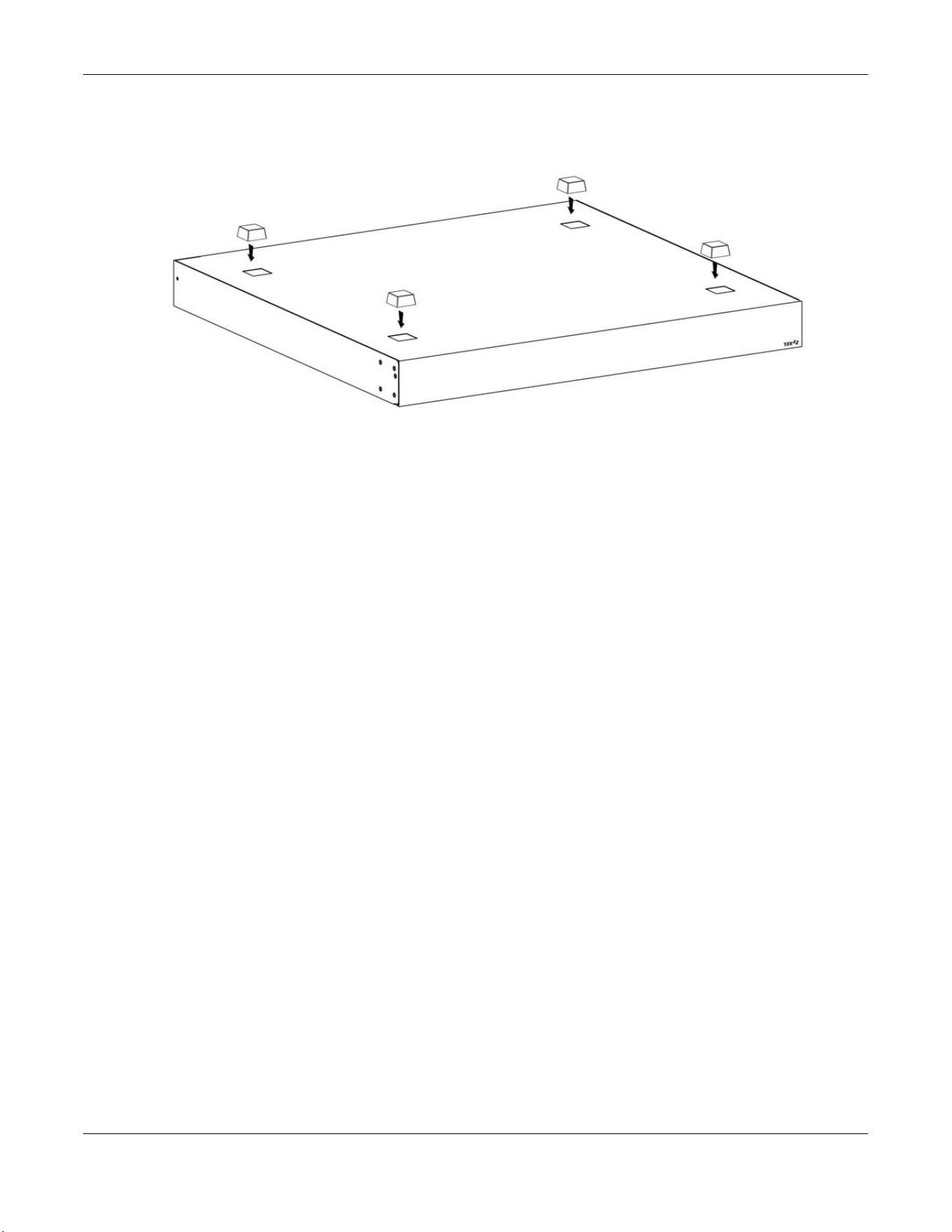
Chapter 2 Hardware Installation and Connection
XMG1915 Series User’s Guide
32
3 Attach the rubber feet to each corner on the bottom of the Switch. These rubber feet help protect the
Switch from shock or vibration and ensure space between devices when stacking.
Figure 7 Attaching Rubber Feet
4 Set the Switch on a smooth, level surface strong enough to support the weight of the Switch and the
connected cables. Make sure there is a power outlet nearby.
Cautions:
• Avoid stacking fanless Switches to prevent overheating.
• Ensure enough clearance around the Switch to allow air circulation for cooling.
• Do NOT remove the rubber feet as it provides space for air circulation.
2.4 Wall Mounting (XMG1915-10E and XMG1915-10EP
Only)
The Switch can be mounted on a wall. You may need screw anchors if mounting on a concrete or brick
wall.
2.4.1 Installation Requirements
• Use screws with 6 mm – 8 mm (0.24" – 0.31") wide heads.
• The distance between the screws: 176 mm.
The following figure shows the screw specifications used for wall mounting.
• D = 7.00 mm
• H = 2.00 mm
• L= 15.50 mm
• d = 3.50 mm
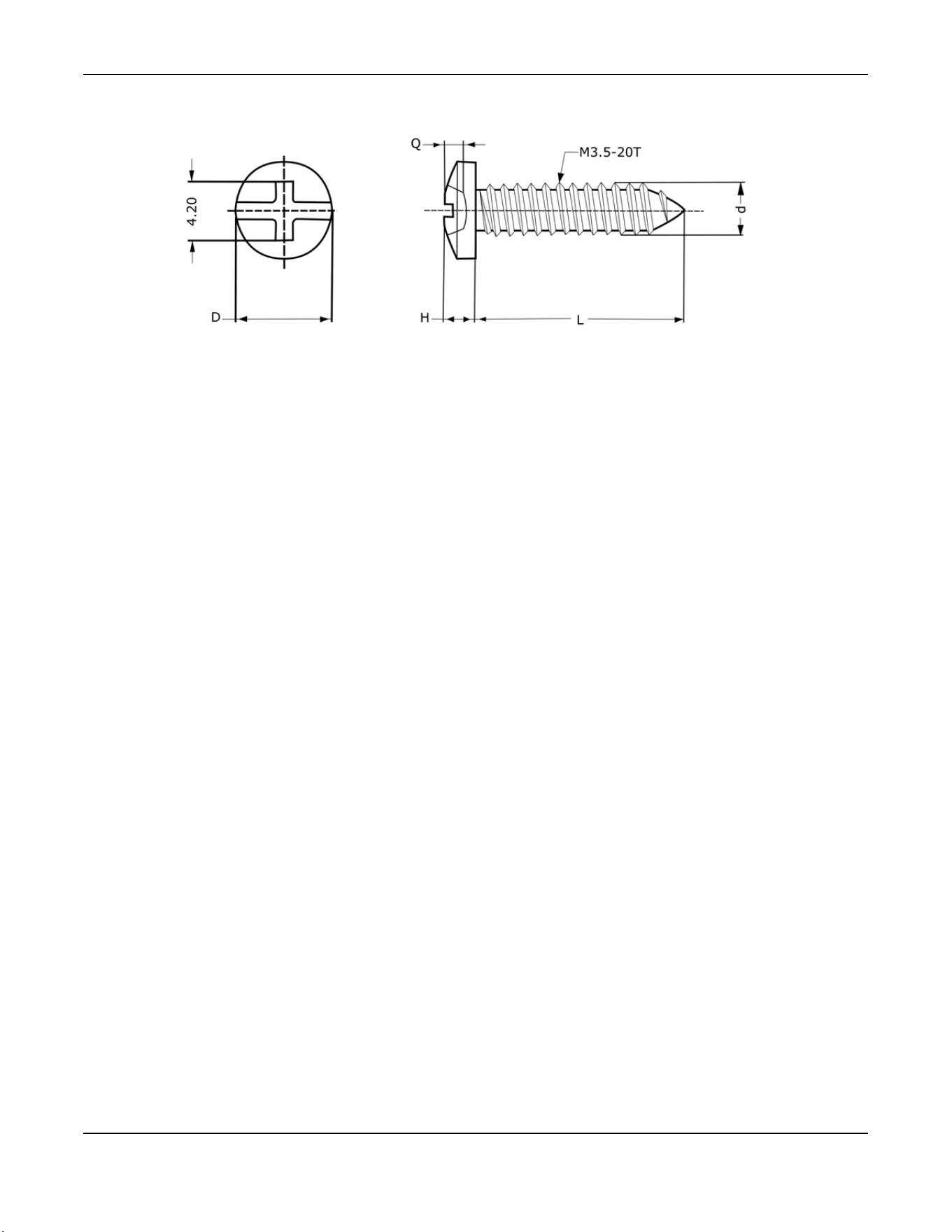
Chapter 2 Hardware Installation and Connection
XMG1915 Series User’s Guide
33
Do the following to attach your Switch to a wall.
1 Select a position free of obstructions on a wall strong enough to hold the weight of the Switch.
2 Mark two holes on the wall at the appropriate distance apart for the screws.
WARNING! Be careful to avoid damaging pipes or cables located inside
the wall when drilling holes for the screws.
3 If using screw anchors, drill two holes for the screw anchors into the wall. Push the anchors into the full
depth of the holes, then insert the screws into the anchors. Do NOT insert the screws all the way in –
leave a small gap of about 0.5 cm.
If not using screw anchors, use a screwdriver to insert the screws into the wall. Do NOT insert the screws
all the way in – leave a gap of about 0.5 cm.
4 Make sure the screws are fastened well enough to hold the weight of the Switch with the connection
cables.
5 Align the holes on the back of the Switch with the screws on the wall. Hang the Switch on the screws.
Note: Make sure there is enough clearance between the wall and the Switch to allow
ventilation.

Chapter 2 Hardware Installation and Connection
XMG1915 Series User’s Guide
34
WARNING! The Switch should be wall-mounted horizontally, and make sure
the front panel is facing down. The Switch's side panels with ventilation slots
should not be facing up or down as this position is less safe.
2.5 Mounting the Switch on a Rack
The Switch can be mounted on an EIA standard size, 19-inch rack or in a wiring closet with other
equipment. Follow the steps below to mount your Switch on a standard EIA rack using a rack-mounting
kit.
Note: Make sure there is enough clearance between each equipment on the rack for air
circulation.
2.5.1 Installation Requirements
• Two mounting brackets.

Chapter 2 Hardware Installation and Connection
XMG1915 Series User’s Guide
35
• Eight M3 flat head screws and a #2 Philips screwdriver.
• Four M5 flat head screws and a #2 Philips screwdriver.
2.5.2 Precautions
• Make sure the rack will safely support the combined weight of all the equipment it contains. The
maximum weight a bracket can hold is 21.5 kg.
• Make sure the position of the Switch does not make the rack unstable or top-heavy. Take all
necessary precautions to anchor the rack securely before installing the unit.
2.5.3 Attaching the Mounting Brackets to the Switch
1 Position a mounting bracket on one side of the Switch, lining up the four screw holes on the bracket with
the screw holes on the side of the Switch.
Figure 8 Attaching the Mounting Brackets
2 Using a #2 Philips screwdriver, install the M3 flat head screws through the mounting bracket holes into
the Switch.
3 Repeat steps 1 and 2 to install the second mounting bracket on the other side of the Switch.
4 You may now mount the Switch on a rack. Proceed to the next section.
2.5.4 Mounting the Switch on a Rack
1 Position a mounting bracket (that is already attached to the Switch) on one side of the rack, lining up
the two screw holes on the bracket with the screw holes on the side of the rack.
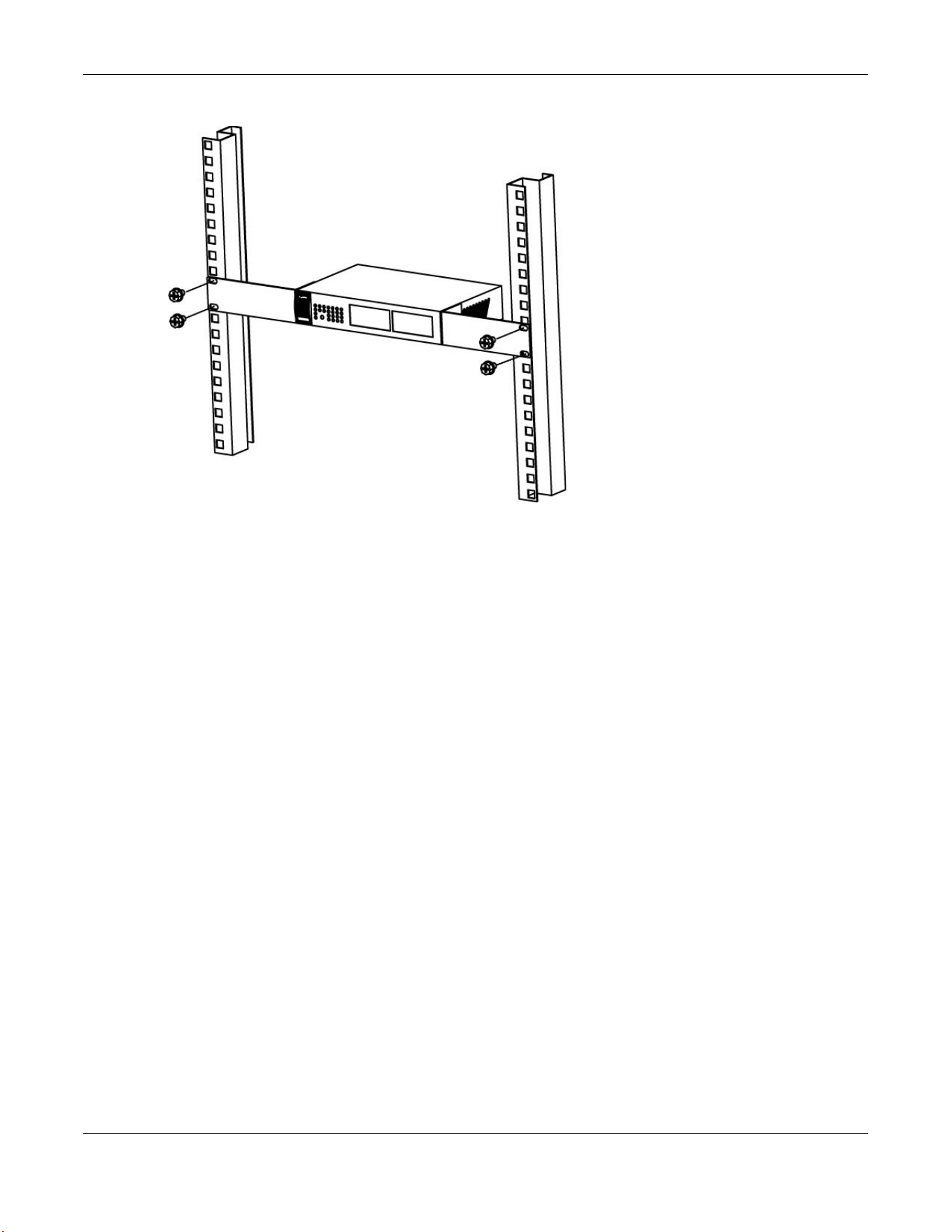
Chapter 2 Hardware Installation and Connection
XMG1915 Series User’s Guide
36
Figure 9 Mounting the Switch on a Rack (XMG1915-18EP)
2 Using a #2 Philips screwdriver, install the M5 flat head screws through the mounting bracket holes into
the rack.
Note: Make sure you tighten all the four screws to prevent the Switch from getting slanted.
3 Repeat steps 1 and 2 to attach the second mounting bracket on the other side of the rack.
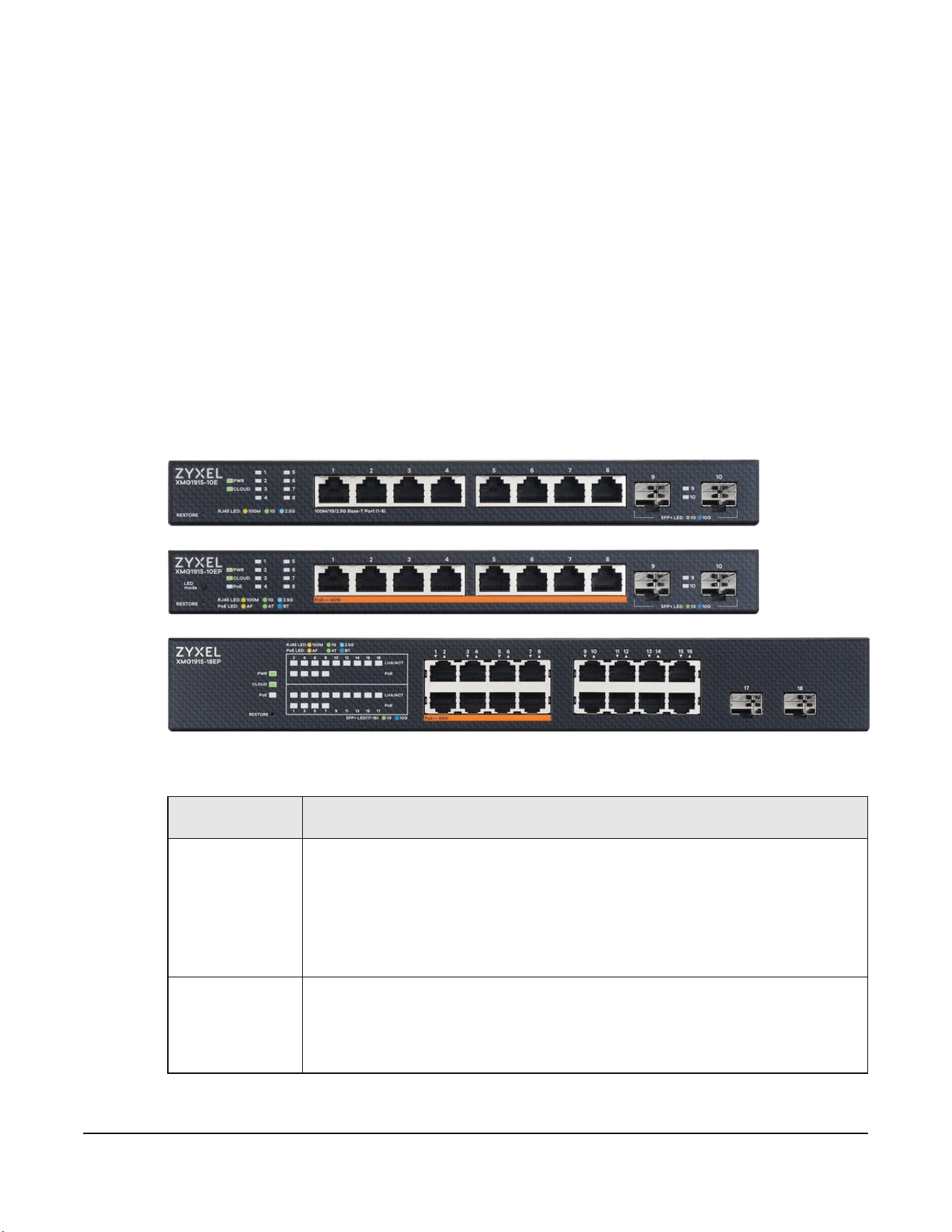
XMG1915 Series User’s Guide
37
CHAPTER 3
Hardware Panels
This chapter describes the front panel and rear panel of the Switch and shows you how to make the
hardware connections.
3.1 Front Panel Connections
The following figures show the front panels of the Switch.
Figure 10 Front Panel: XMG1915-10E
Figure 11 Front Panel: XMG1915-10EP
Figure 12 Front Panel: XMG1915-18EP
The following table describes the ports.
Table 6 Panel Connections
CONNECTOR /
BUTTON
DESCRIPTION
100M/1G/2.5G RJ-
45 Ethernet Ports
Port 1 – 8 (XMG1915-
10E / XMG1915-
10EP)
Port 1 – 16
(XMG1915-18EP)
These are 100M/1000M/2.5GBase-T auto-negotiating and auto-crossover Ethernet ports.
Connect these ports to a computer, a hub, a router, or an Ethernet switch.
100M/1G/2.5G RJ-
45 PoE Ports
Port 1 – 8 (XMG1915-
10EP / XMG1915-
18EP)
These are 100M/1000M/2.5GBase-T auto-negotiating and auto-crossover IEEE802.3bt PoE++
60 W ports.
A PoE port is an Ethernet port that can supply power to a connected device. Connect these
ports to a PoE-enabled IP camera / IP phone / AP, or an Ethernet switch.
Chapter 3 Hardware Panels
XMG1915 Series User’s Guide
38
3.1.1 Multi-Gigabit Ethernet Ports
The Switch has 2.5 GbE auto-negotiating, auto-crossover Ethernet ports. In 100/1000 Mbps/2.5 Gbps
multi-gigabit Ethernet, the speed can be 100 Mbps, 1000 Mbps, or 2.5 Gbps. The duplex mode is full
duplex.
An auto-negotiating port can detect and adjust to the optimum Ethernet speed (100/1000 Mbps/2.5
Gbps) of the connected device in full duplex mode.
An auto-crossover (auto-MDI/MDI-X) port automatically works with a straight-through or crossover
Ethernet cable.
When auto-negotiation is turned on, an Ethernet port negotiates with the peer automatically to
determine the connection speed and duplex mode. If the peer Ethernet port does not support auto-
negotiation or turns off this feature, the Switch determines the connection speed by detecting the signal
on the cable and using half duplex mode. When the Switch’s auto-negotiation is turned off, an Ethernet
port uses the pre-configured speed and duplex mode when making a connection, thereby requiring
you to make sure that the settings of the peer Ethernet port are the same in order to connect.
3.1.1.1 Default Ethernet Negotiation Settings
The factory default negotiation settings for the Gigabit ports on the Switch are:
• Speed: Auto
•Duplex: Auto
• Flow control: Off
• Link Aggregation: Disabled
1G/10G SFP+ Slots
Port 9 – 10
(XMG1915-10E /
XMG1915-10EP)
Port 17 – 18
(XMG1915-18EP)
Use SFP+ transceivers in these ports for high-bandwidth backbone connections. You can
also insert an SFP+ Direct Attach Copper (DAC) in the SFP+ slot.
Restore Press the RESTORE button for 2 to 6 seconds to have the Switch automatically reboot. See
Section 3.3 on page 47 for more information about the LED behavior.
Press the RESTORE button for more than 6 seconds to have the Switch restore the factory
default file. See Section 3.3 on page 47 for more information about the LED behavior.
LED Mode
(only available for
XMG1915-10EP)
Push this button to toggle the Ethernet port’s LED between Link/ACT LED and PoE LED. By
default, the Ethernet port’s LED acts as a Link/ACT LED.
• Push this button to change the Ethernet port’s LED to act as a PoE LED. The PoE status LED
will light when power is supplied to the PoE Ethernet port(s). See Section 3.3 on page 47
for more information on the PoE status LED.
• Push this button again to change the Ethernet port’s LED to act as a Link/ACT LED. The
PoE status LED will turn off even when power is supplied to the PoE Ethernet port(s).
View the LEDs to ensure proper functioning of the Switch and as an aid in troubleshooting.
Table 6 Panel Connections (continued)
CONNECTOR /
BUTTON
DESCRIPTION

Chapter 3 Hardware Panels
XMG1915 Series User’s Guide
39
3.1.1.2 Auto-crossover
All ports support auto-crossover, that is auto-MDIX ports (Media Dependent Interface Crossover), so you
may use either a straight-through Ethernet cable or crossover Ethernet cable for all Gigabit port
connections. Auto-crossover ports automatically sense whether they need to function as crossover or
straight ports, so crossover cables can connect both computers and switches or hubs.
3.1.2 PoE (XMG1915-10EP and XMG1915-18EP)
The Switch supports both the IEEE 802.3af Power over Ethernet (PoE), IEEE 802.3at Power over Ethernet
(PoE) plus, and IEEE 802.3bt Power over Ethernet (PoE) plus plus standards. The Switch is a Power
Sourcing Equipment (PSE) because it provides a source of power through its Ethernet ports. Each device
that receives power through an Ethernet port is a Powered Device (PD).
3.1.3 SFP/SFP+ Slots
These are two slots for Small Form-Factor Pluggable (SFP) or SFP+ modules, such as an SFP or SFP+
transceiver. The SFP+ (SFP Plus) is an enhanced version of the SFP and supports data rates of 10 Gbps. A
transceiver is a single unit that houses a transmitter and a receiver. Use a transceiver to connect a fiber
optic cable to the Switch. The Switch does not come with transceivers. You must use transceivers that
comply with the Small Form-Factor Pluggable (SFP) Transceiver MultiSource Agreement (MSA). See the
SFF committee’s INF-8074i specification Rev 1.0 for details.
You can change transceivers while the Switch is operating. You can use different transceivers to
connect to Ethernet switches with different types of fiber optic connectors.
• Type: SFP or SFP+ connection interface
• Connection speed: 1 or 10 Gigabit per second (Gbps)
WARNING! To avoid possible eye injury, do not look into an operating
fiber optic module’s connectors.
HANDLING! All transceivers are static sensitive. To prevent damage from
electrostatic discharge (ESD), it is recommended you attach an ESD
preventive wrist strap to your wrist and to a bare metal surface when
you install or remove a transceiver.
STORAGE! All modules are dust sensitive. When not in use, always keep
the dust plug on. Avoid getting dust and other contaminant into the
optical bores, as the optics do not work correctly when obstructed with
dust.
3.1.3.1 Transceiver Installation
Use the following steps to install a transceiver.
1 Attach an ESD preventive wrist strap to your wrist and to a bare metal surface.
2 Align the transceiver in front of the slot opening.
3 Make sure the latch is in the lock position (latch styles vary), then insert the transceiver into the slot with
the exposed section of PCB board facing down.
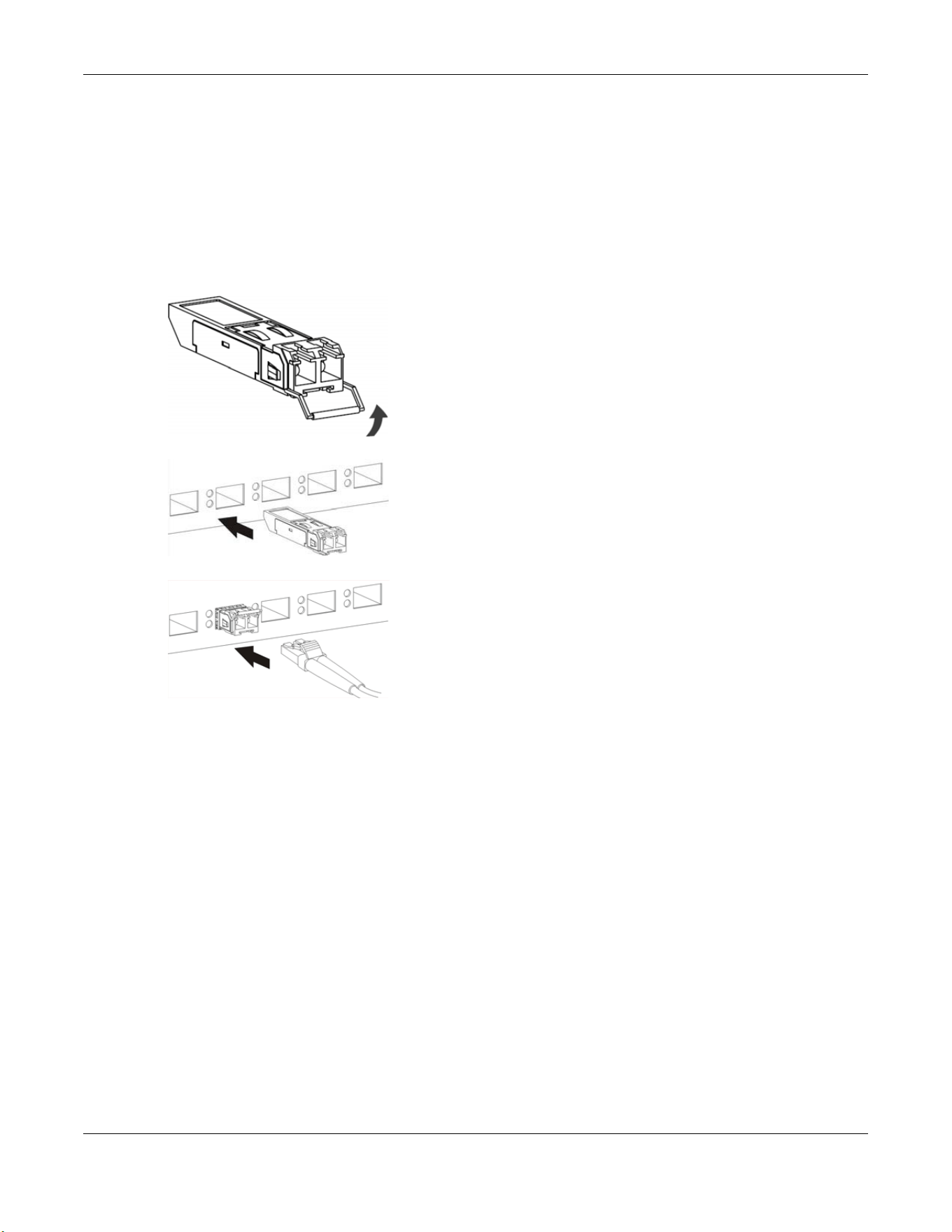
Chapter 3 Hardware Panels
XMG1915 Series User’s Guide
40
4 Press the transceiver firmly until it clicks into place.
5 The Switch automatically detects the installed transceiver. Check the LEDs to verify that it is functioning
properly.
6 Remove the dust plugs from the transceiver and cables (dust plug styles vary).
7 Identify the signal transmission direction of the fiber optic cables and the transceiver. Insert the fiber
optic cable into the transceiver.
Figure 13 Latch in the Lock Position
Figure 14 Transceiver Installation Example
Figure 15 Connecting the Fiber Optic Cables
3.1.3.2 Transceiver Removal
Use the following steps to remove an SFP transceiver.
1 Attach an ESD preventive wrist strap to your wrist and to a bare metal surface on the chassis.
2 Remove the fiber optic cables from the transceiver.
3 Pull out the latch and down to unlock the transceiver (latch styles vary).
Note: Make sure the transceiver’s latch is pushed all the way down, so the transceiver can be
pulled out successfully.
4 Pull the latch, or use your thumb and index finger to grasp the tabs on both sides of the transceiver, and
carefully slide it out of the slot.
Note: Do NOT pull the transceiver out by force. You could damage it. If the transceiver will not
slide out, grasp the tabs on both sides of the transceiver with a slight up or down motion
and carefully slide it out of the slot. If unsuccessful, contact Zyxel Support to prevent
damage to your Switch and transceiver.
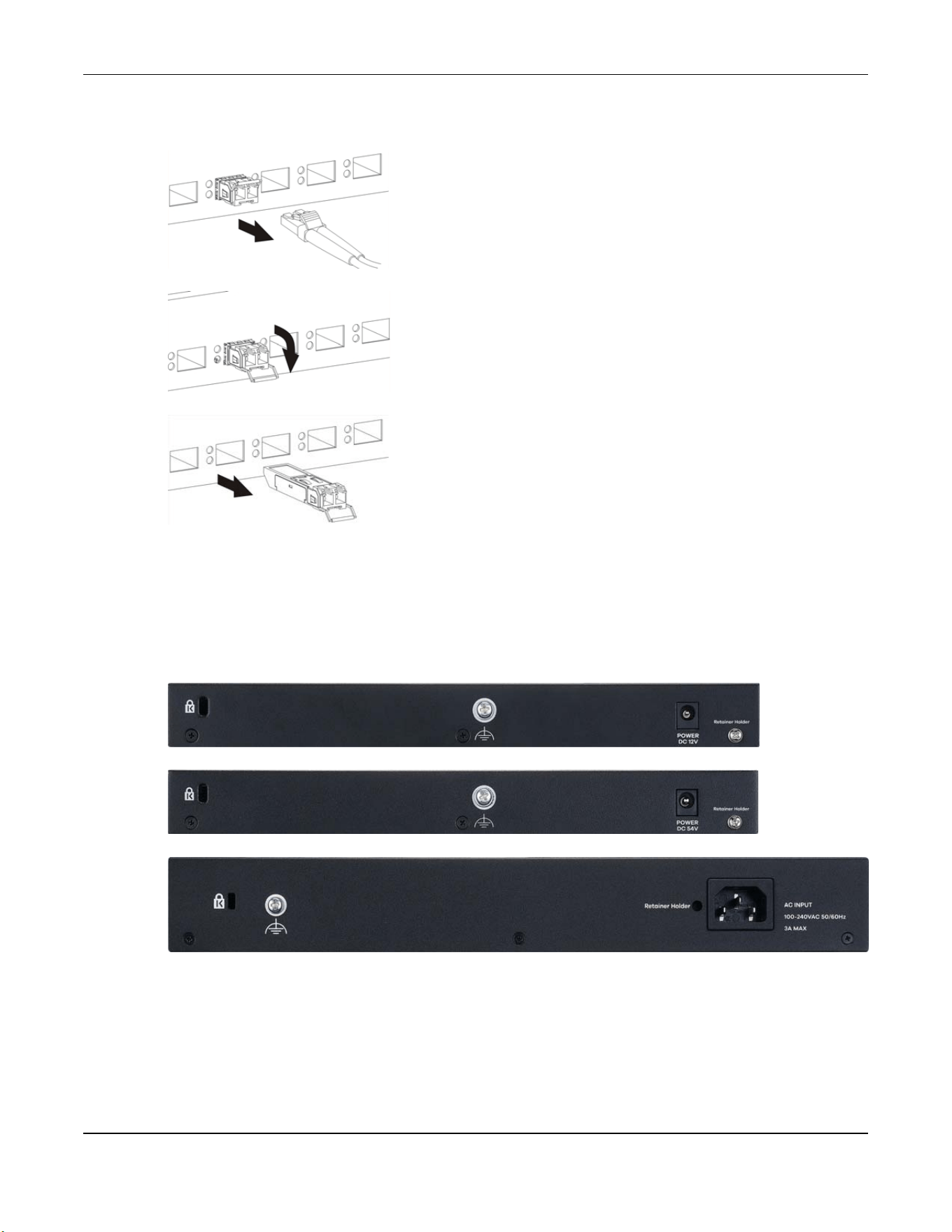
Chapter 3 Hardware Panels
XMG1915 Series User’s Guide
41
5 Insert the dust plug into the ports on the transceiver and the cables.
Figure 16 Removing the Fiber Optic Cables
Figure 17 Opening the Transceiver’s Latch Example
Figure 18 Transceiver Removal Example
3.2 Rear Panel
The following figures show the rear panel of the Switch. The rear panel contains:
Figure 19 Front Panel: XMG1915-10E
Figure 20 Front Panel: XMG1915-10EP
Figure 21 Front Panel: XMG1915-18EP
3.2.1 Grounding
Grounding is a safety measure to direct excess electric charge to the ground. It prevents damage to
the Switch, and protects you from electrocution. Use the grounding screw on the rear panel and the
ground wire of the AC power supply to ground the Switch.
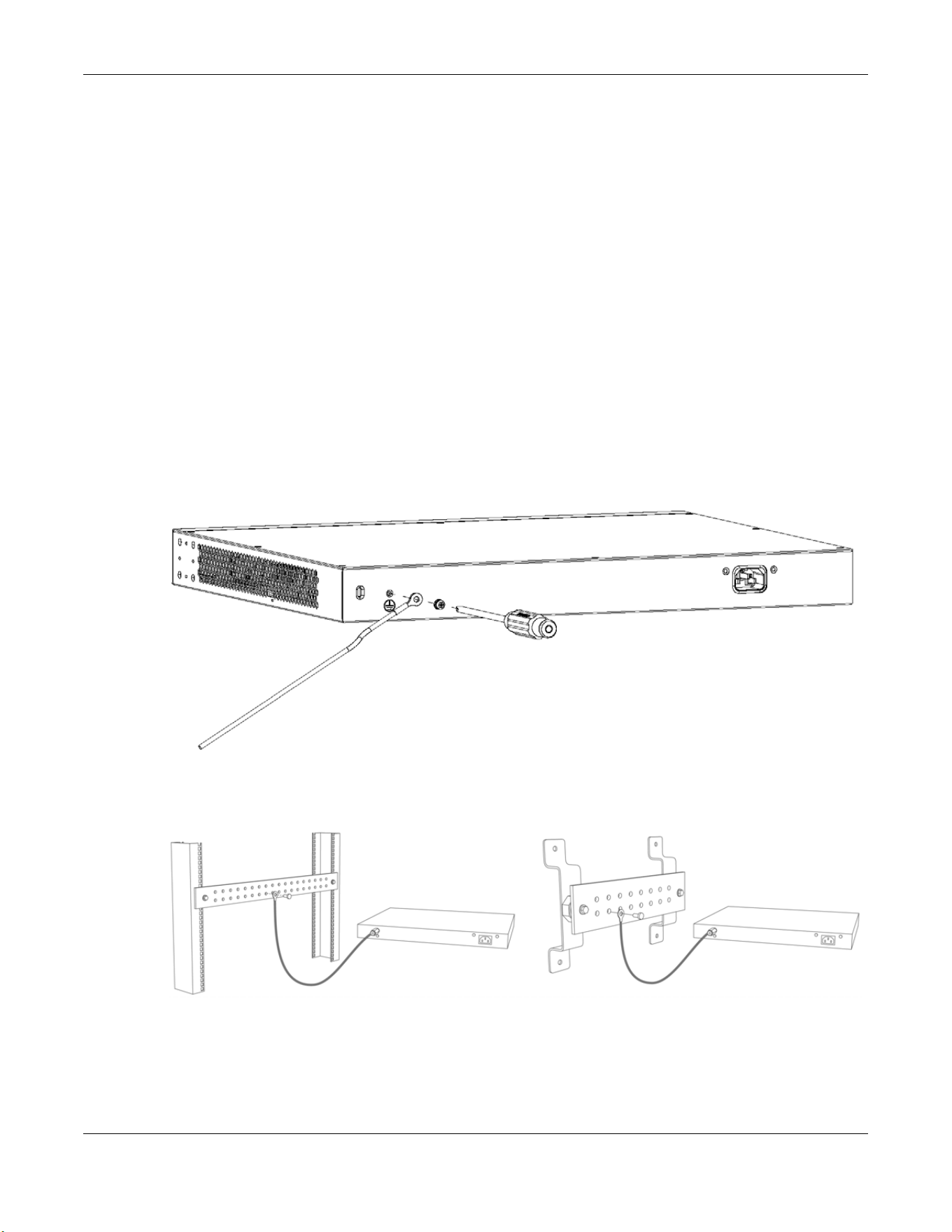
Chapter 3 Hardware Panels
XMG1915 Series User’s Guide
42
The grounding terminal and AC power ground where you install the Switch must follow your country’s
regulations. Qualified service personnel must ensure the building’s protective earthing terminals are
valid terminals.
Installation of Ethernet cables must be separate from AC power lines. To avoid electric surge and
electromagnetic interference, use a different electrical conduit or raceway (tube/trough or enclosed
conduit for protecting electric wiring) that is 15 cm apart, or as specified by your country’s electrical
regulations.
Any device that is located outdoors and connected to this product must be properly grounded and
surge protected. To the extent permissible by your country’s applicable law, failure to follow these
guidelines could result in damage to your Switch which may not be covered by its warranty.
Note: The specification for surge or ESD protection assumes that the Switch is properly
grounded.
1 Remove the M4 ground screw from the Switch’s rear panel.
2 Secure a green or yellow ground cable (16 AWG or smaller) to the Switch's rear panel using the M4
ground screw.
Figure 22 Grounding
3 Attach the other end of the ground cable to a grounding bar located on the rack where you install the
Switch or to an on-site grounding terminal.
Figure 23 Attach Ground Cable to Grounding Bar or On-site Grounding Terminal
4 The grounding terminal of the server rack or on-site grounding terminal must also be grounded and
connected to the building’s main grounding electrode. Make sure the grounding terminal is connected
to the buildings grounding electrode and has an earth resistance of less than 10 ohms, or according to
your country’s electrical regulations.
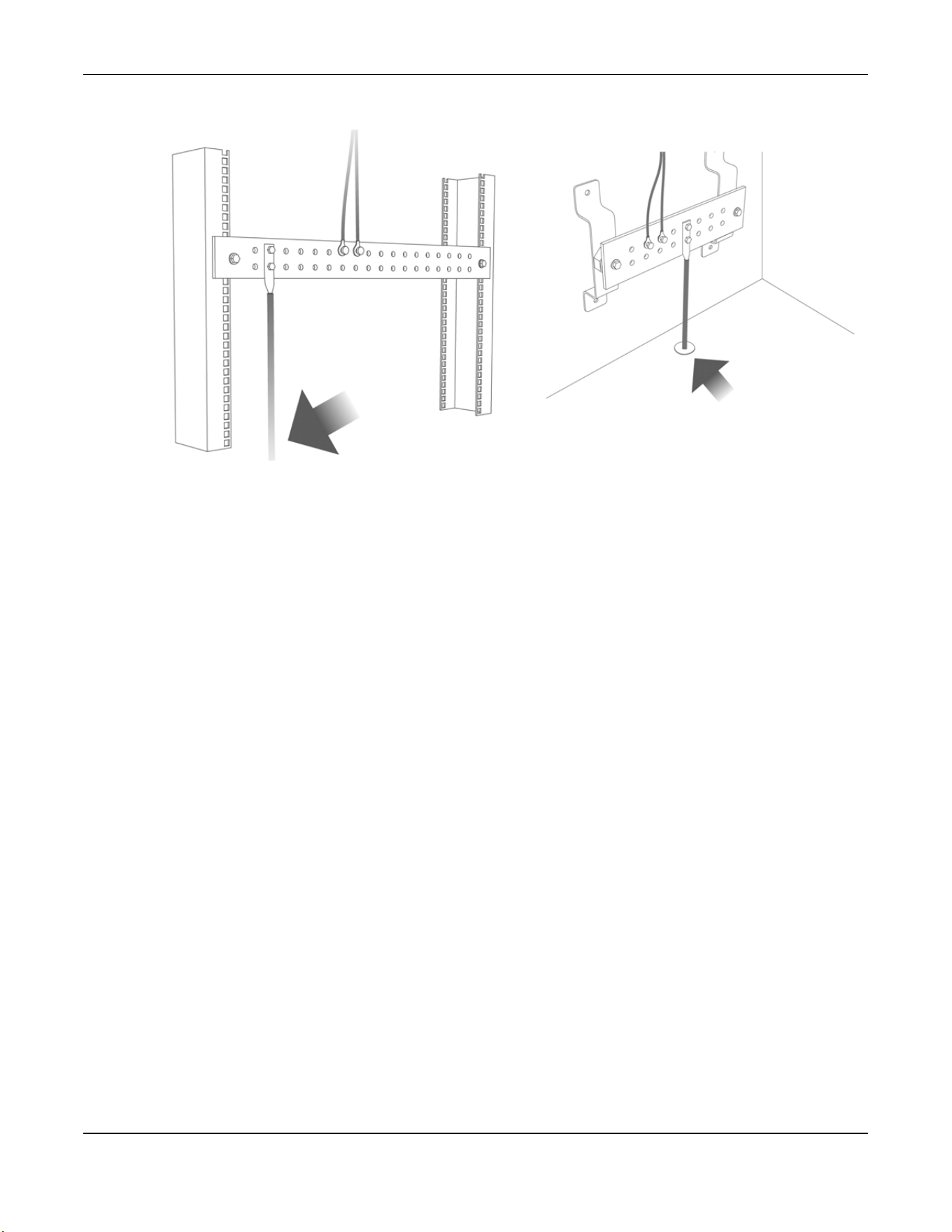
Chapter 3 Hardware Panels
XMG1915 Series User’s Guide
43
Figure 24 Connecting to the Building’s Main Grounding Electrode
If you are uncertain that suitable grounding is available, contact the appropriate electrical inspection
authority or an electrician.
This device must be grounded. Do this before you make other
connections.
3.2.2 AC Power Connection
Note: Make sure you are using the correct power source as shown on the panel and that no
objects obstruct the airflow of the fans (located on the side of the unit).
To connect power to the Switch, insert the female end of the power cord to the AC power receptacle
on the rear panel. Connect the other end of the supplied power cord to a power outlet.
Installing the Retainer Clip (for XMG1915-10E and XMG1915-10EP)
Install the retainer clip to prevent accidental removal of the power cord.
1 Remove the Retainer Holder screw from the rear panel.
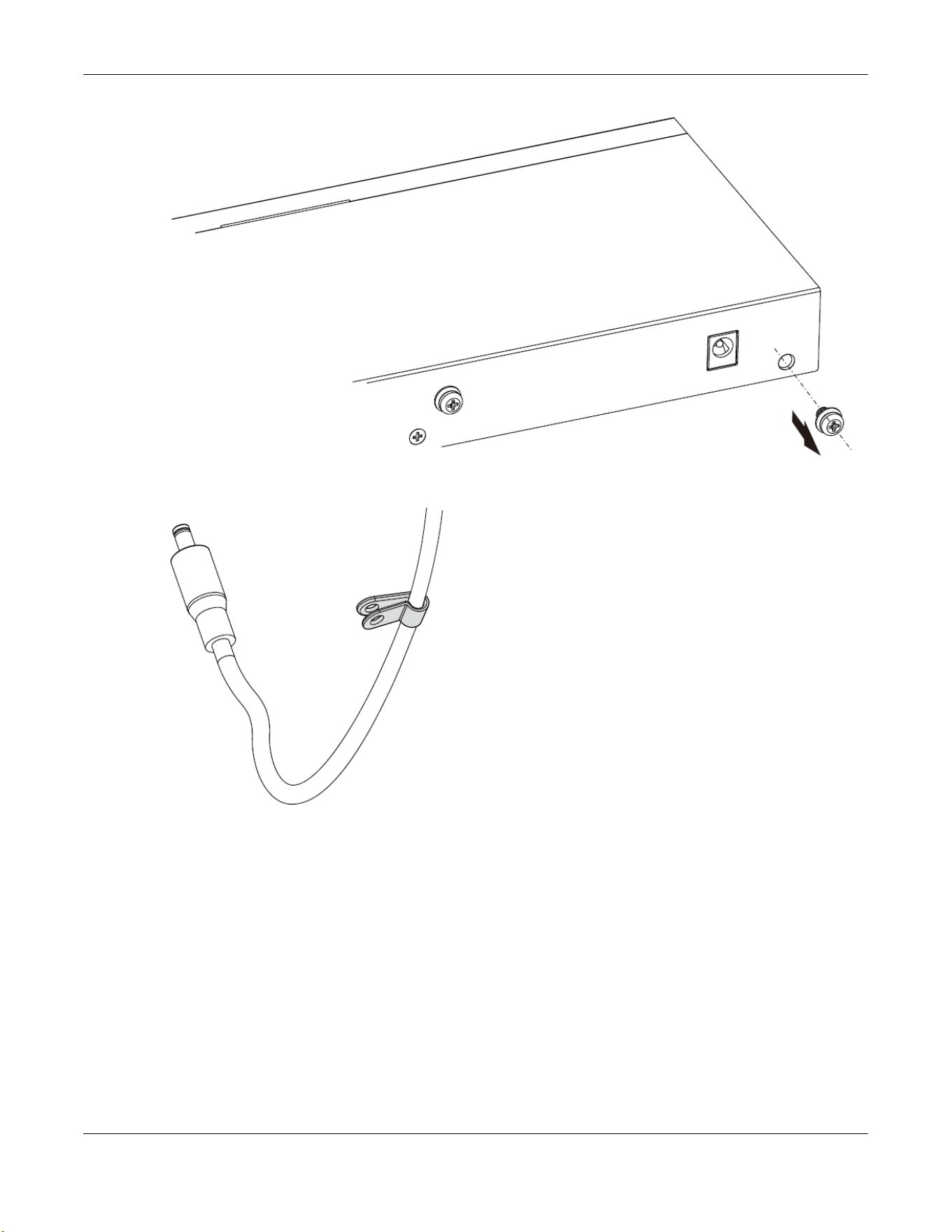
Chapter 3 Hardware Panels
XMG1915 Series User’s Guide
44
2 Wrap the retainer clip on the power cord.
3 Align the retainer clip holes with the Retainer Holder hole and fasten the screw to secure it.
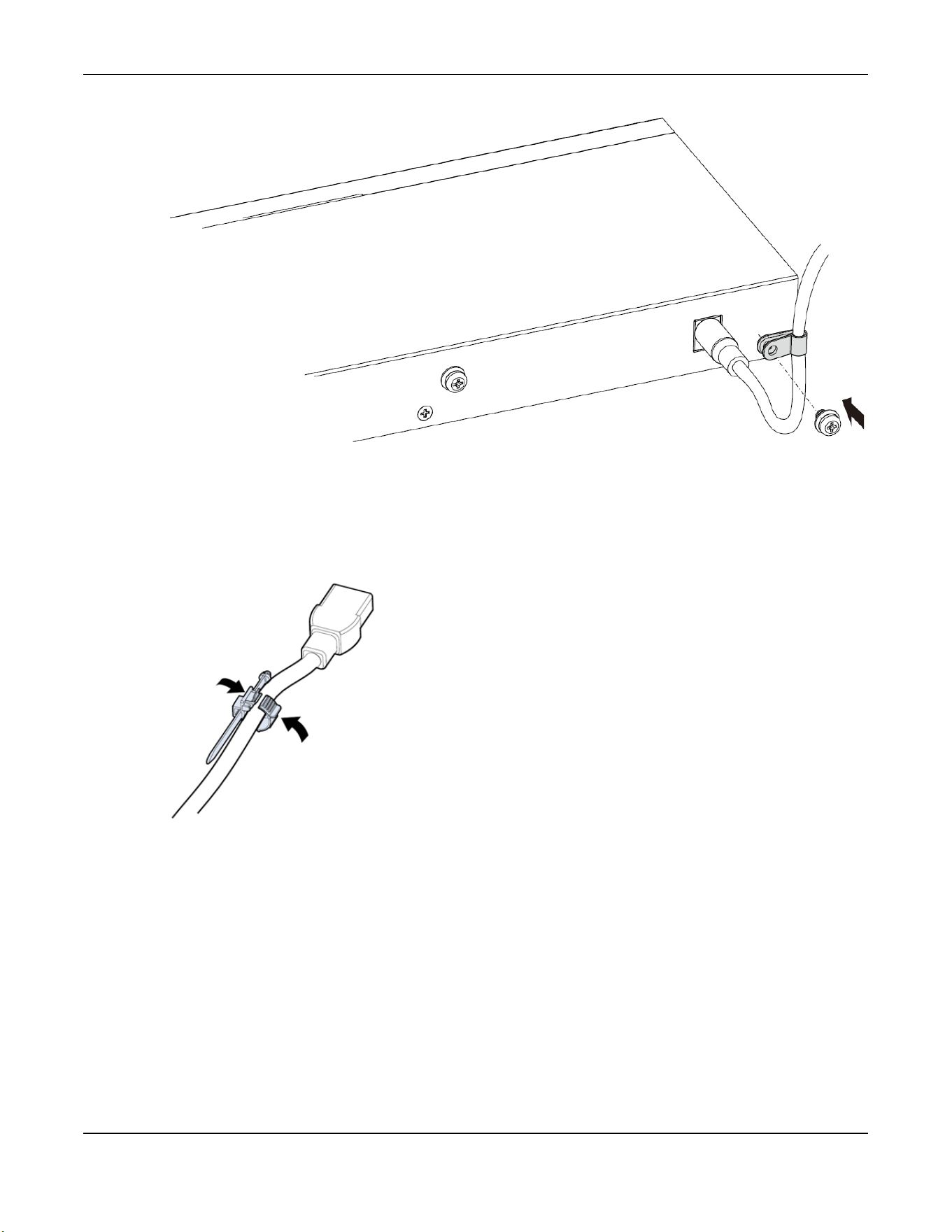
Chapter 3 Hardware Panels
XMG1915 Series User’s Guide
45
Installing the Retainer Clip (for XMG1915-18EP)
Install the retainer clip to prevent accidental removal of the power cord.
1 Loosely wrap the clip on the retainer to the power cord.
2 Push the pronged-end of the retainer clip into the Retainer Holder hole until it locks into place.
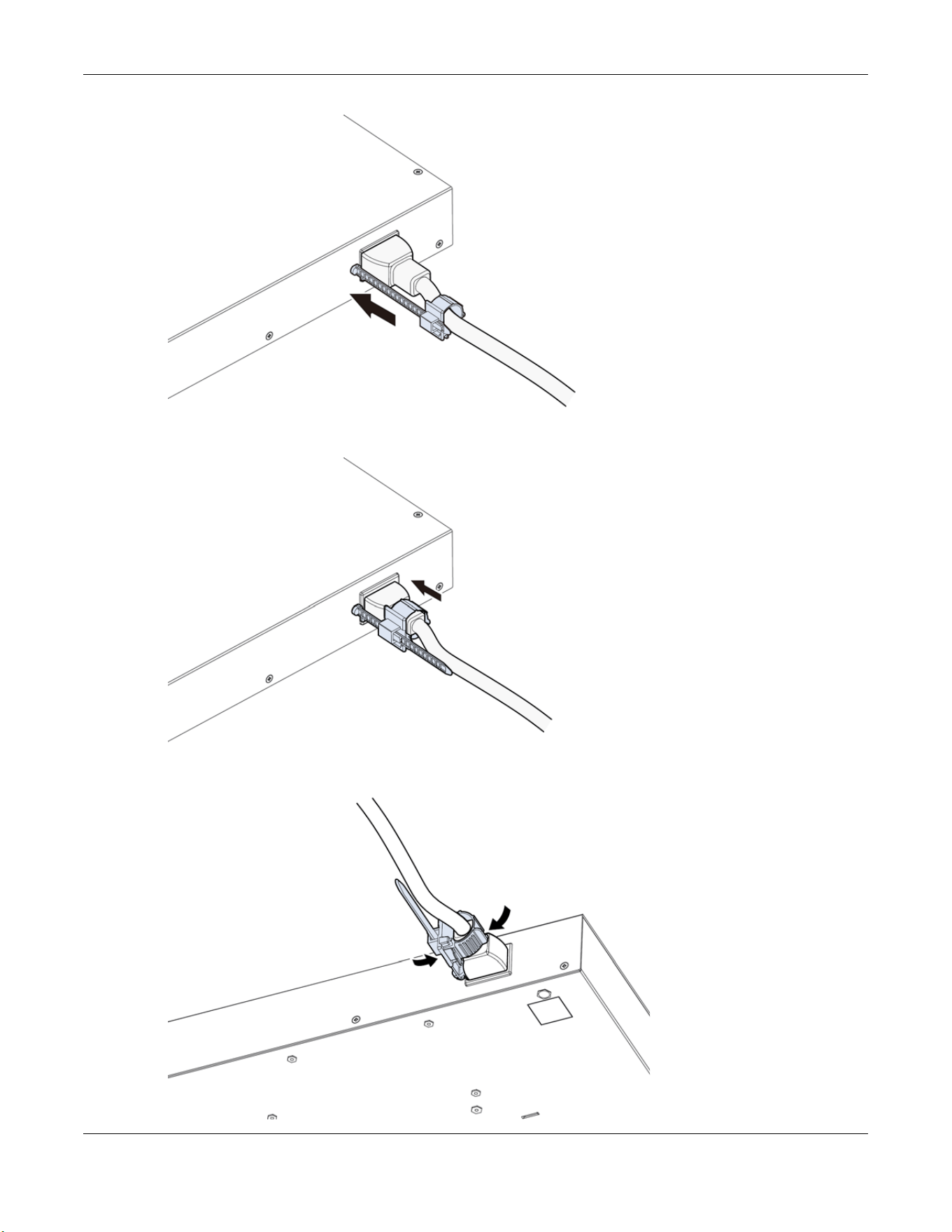
Chapter 3 Hardware Panels
XMG1915 Series User’s Guide
46
3 Slide the clip up to the end of the power cord.
4 Close the clip tightly around the power cord until secure.
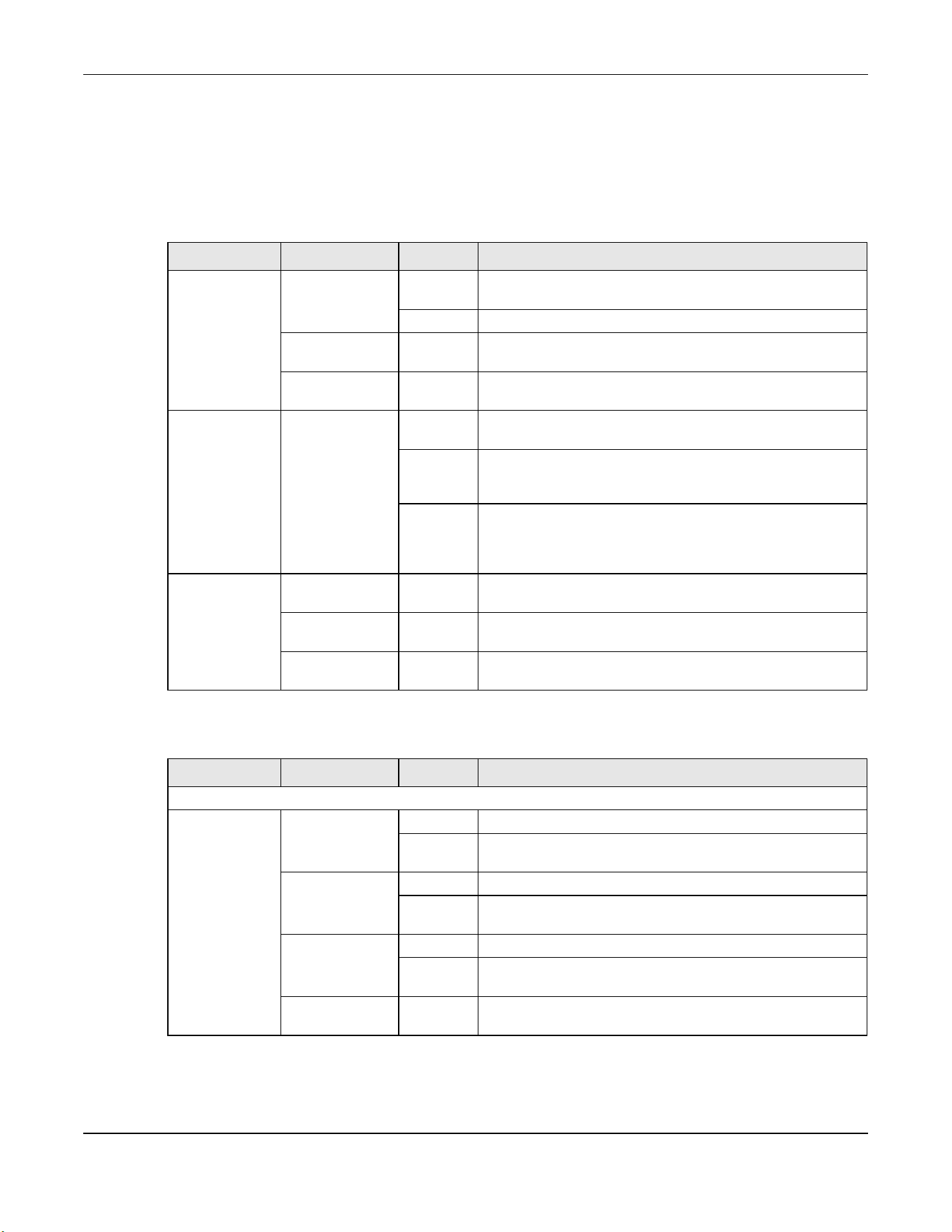
Chapter 3 Hardware Panels
XMG1915 Series User’s Guide
47
3.3 LEDs
After you connect the power to the Switch, view the LEDs to ensure proper functioning of the Switch
and as an aid in troubleshooting.
Table 7 LED Descriptions
LED COLOR STATUS DESCRIPTION
PWR Green On The Switch is receiving power from the power module in the
power slot.
Blinking The Switch is rebooting.
Red
(XMG1915-18EP)
On The Switch has system error.
Off The Switch is not receiving power from the power module in
the power slot or is malfunctioning.
CLOUD Green On The Switch has successfully connected to the NCC (Nebula
Control Center).
Blinking The Switch cannot connect to the NCC because it is not
registered or due to the Internet connection and other
possible problems.
Off The Switch is operating in standalone mode. Nebula Control
Center Discovery is disabled in SYSTEM > Cloud Management >
Nebula Control Center Discovery in the Switch Web
Configurator.
PoE LED
(XMG1915-10EP
/ XMG1915-
18EP)
Red On PoE power usage is more than 95 percent of the power
supplied budget.
Yellow On PoE power usage is below 95 percent of the power supplied
budget, but over 80 percent of the power supplied budget.
Green On PoE power usage is below 80 percent of the power supplied
budget.
LED COLOR STATUS DESCRIPTION
100M/1000M/2.5G Base-T Ports
Link / ACT
1 – 8
(XMG1915-10E /
XMG1915-10EP)
1 – 16
(XMG1915-18EP)
Sky Blue On The link to a 2.5G Ethernet network is up.
Blinking The Switch is transmitting/receiving to/from a 2.5G Ethernet
network.
Green On The link to a 1000M Ethernet network is up.
Blinking The Switch is transmitting/receiving to/from a 1000M Ethernet
network.
Yellow On The link to a 100M Ethernet network is up.
Blinking The Switch is transmitting/receiving to/from a 100M Ethernet
network.
Off The link to an Ethernet network is down or the port is
administratively shut down.
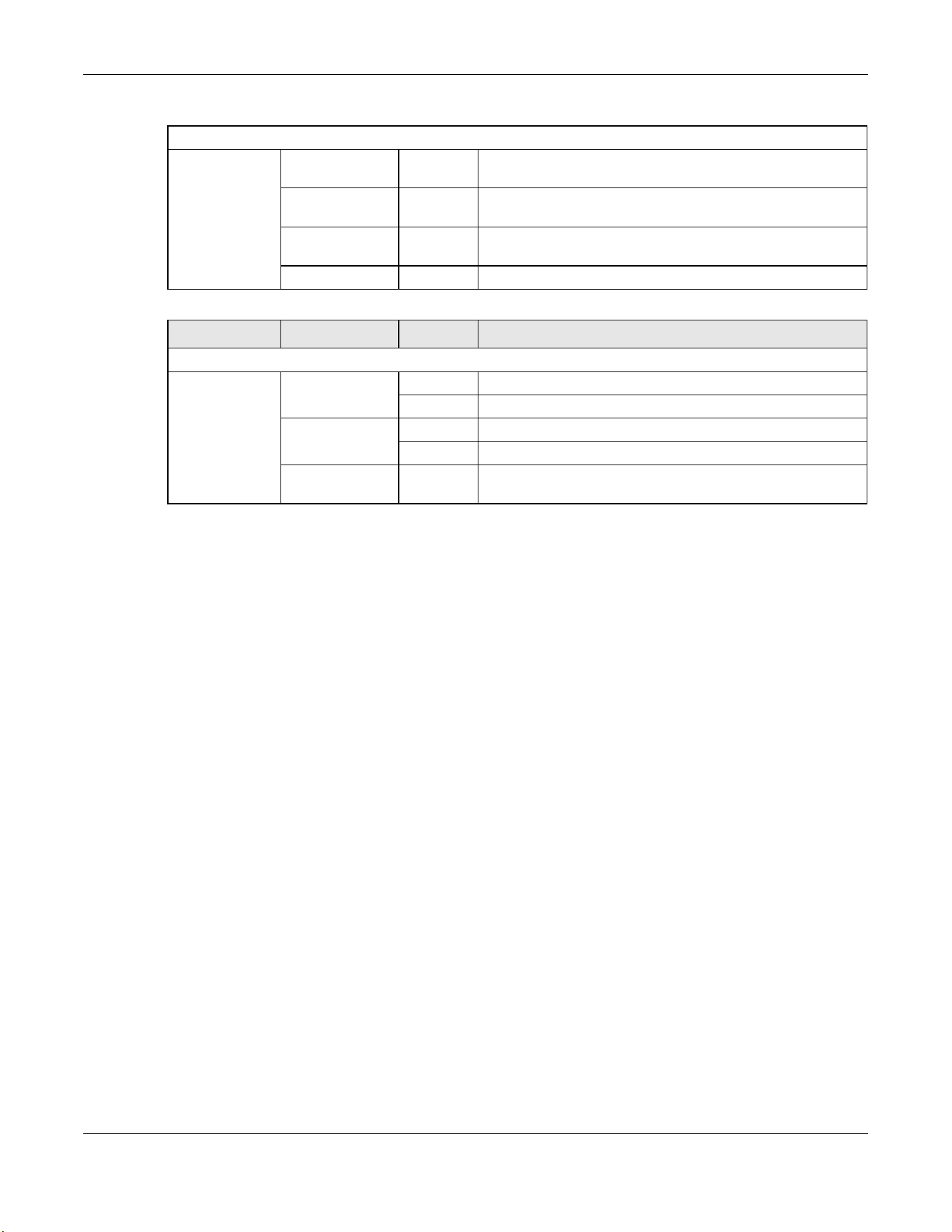
Chapter 3 Hardware Panels
XMG1915 Series User’s Guide
48
PoE Mode
1 – 8
(XMG1915-10EP
/ XMG1915-
18EP)
Blue On Power supplied to all PoE Ethernet ports meets the IEEE 802.3bt
standard.
Green On Power supplied to all PoE Ethernet ports meets the IEEE 802.3at
standard.
Yellow On Power supplied to all PoE Ethernet ports meets the IEEE 802.3af
standard.
Off There is no power supplied.
LED COLOR STATUS DESCRIPTION
1G/10G SFP+ Slots
Link / ACT
9 – 10
(XMG1915-10E /
XMG1915-10EP)
17 – 18
(XMG1915-18EP)
Blue On The port has a successful 10G connection.
Blinking The port is transmitting or receiving data at 10G.
Green On The port has a successful 1000M connection.
Blinking The port is transmitting or receiving data at 1000M.
Off This link is disconnected or the port is administratively shut
down.

49
PART II
Technical Reference

XMG1915 Series User’s Guide
50
CHAPTER 4
Web Configurator
4.1 Overview
This section introduces the configuration and functions of the Web Configurator.
The Web Configurator is an HTML-based management interface that allows easy system setup and
management through Internet browser. Use a browser that supports HTML5, such as Microsoft Edge,
Mozilla Firefox, or Google Chrome. The recommended minimum screen resolution is 1024 by 768 pixels.
In order to use the Web Configurator you need to allow:
• Web browser pop-up windows on your computer.
• JavaScript (enabled by default).
• Java permissions (enabled by default).
4.2 System Login
1 Start your web browser.
2 The Switch is a DHCP client by default. Type “http://DHCP-assigned IP” in the Location or Address field.
Press [ENTER].
Note: You can always use the domain name “setup.zyxel” to access the Web Configurator
whether the Switch is using a DHCP-assigned IP or static IP address. This requires your
computer to be directly connected to the Switch. Make sure your computer can
connect to a DNS server through the Switch.
If the Switch is not connected to a DHCP server, type “http://” and the static IP address of the Switch (for
example, the default management IP address is 192.168.1.1) in the Location or Address field. Press
[ENTER]. Your computer must be in the same subnet in order to access this website address.
Also, you can use the ZON Utility to check your Switch’s IP address. See Section 4.3 on page 53 for more
information on the ZON utility.
3 The Login screen appears.
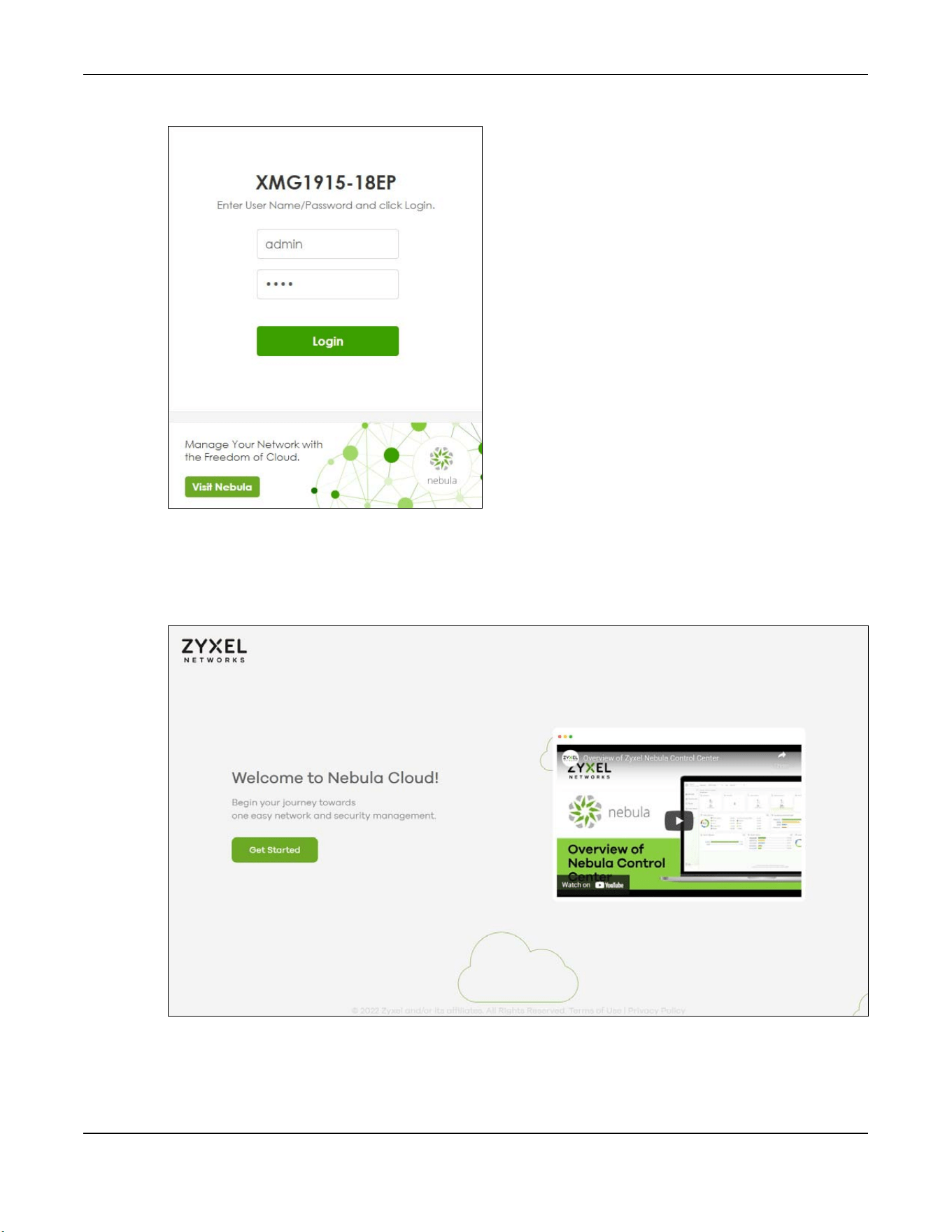
Chapter 4 Web Configurator
XMG1915 Series User’s Guide
51
Figure 25 Web Configurator: Login
4 Click the Visit Nebula button if you want to open the Zyxel Nebula Control Center (NCC) login page in a
new tab or window. The NCC is a cloud-based network management system that allows you to
remotely manage and monitor the Switch. See Section 1.1.2 on page 23 for information on changing
your Switch to Nebula Cloud management.
Figure 26 Visit Nebula
5 Alternatively, click Login to log into the Web Configurator to manage the Switch directly. The default
user name is admin and associated default password is 1234.
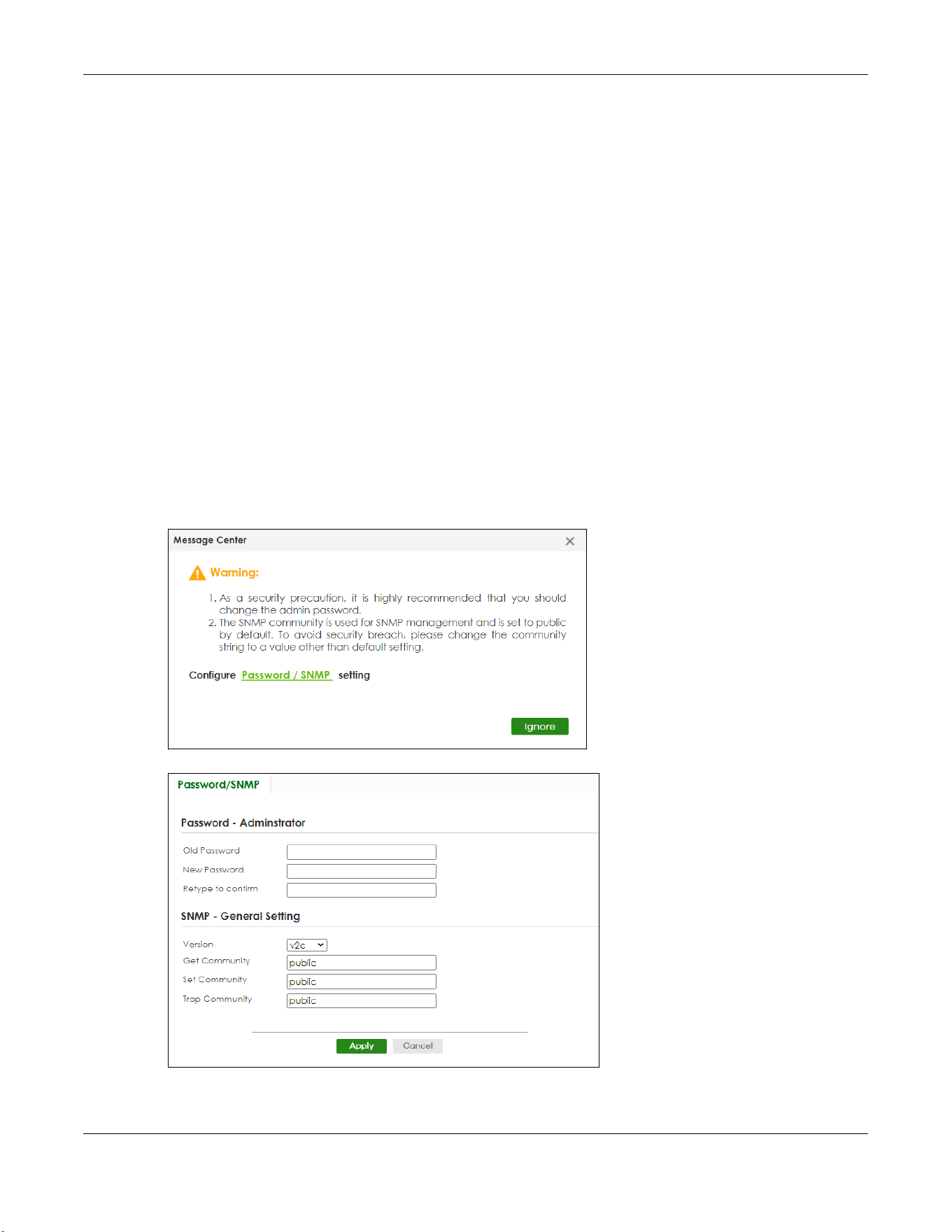
Chapter 4 Web Configurator
XMG1915 Series User’s Guide
52
6 The Setup Wizard screen will appear. You can use the Setup Wizard screen to configure the Switch’s IP,
login password, SNMP community, link aggregation, and view a summary of the settings. When you finish
configuring the settings, you can click the Apply & Save button to make the settings take effect, and
save your configuration into the Switch’s non-volatile memory at once. Check the screens to see if the
settings are applied.
Once you click the Finish button, the settings configured in the Setup Wizard screen will overwrite the
existing settings.
Otherwise, click the Exit button. You can select the Ignore this wizard next time check box and click
Apply
& Save if you do not want the Setup Wizard screen to appear the next time you log in. If you want
to open the Setup Wizard screen later, click the Wizard icon in the upper right hand corner of the Web
Configurator.
7 If you did not change the default administrator password and/or SNMP community values, a warning
screen displays each time you log into the Web Configurator. Click Password / SNMP to open a screen
where you can change the administrator password and SNMP community string simultaneously.
Otherwise, click Ignore to close it.
Password/SNMP Setting
Figure 27 Web Configurator: Warning
Figure 28 Web Configurator: Password/SNMP
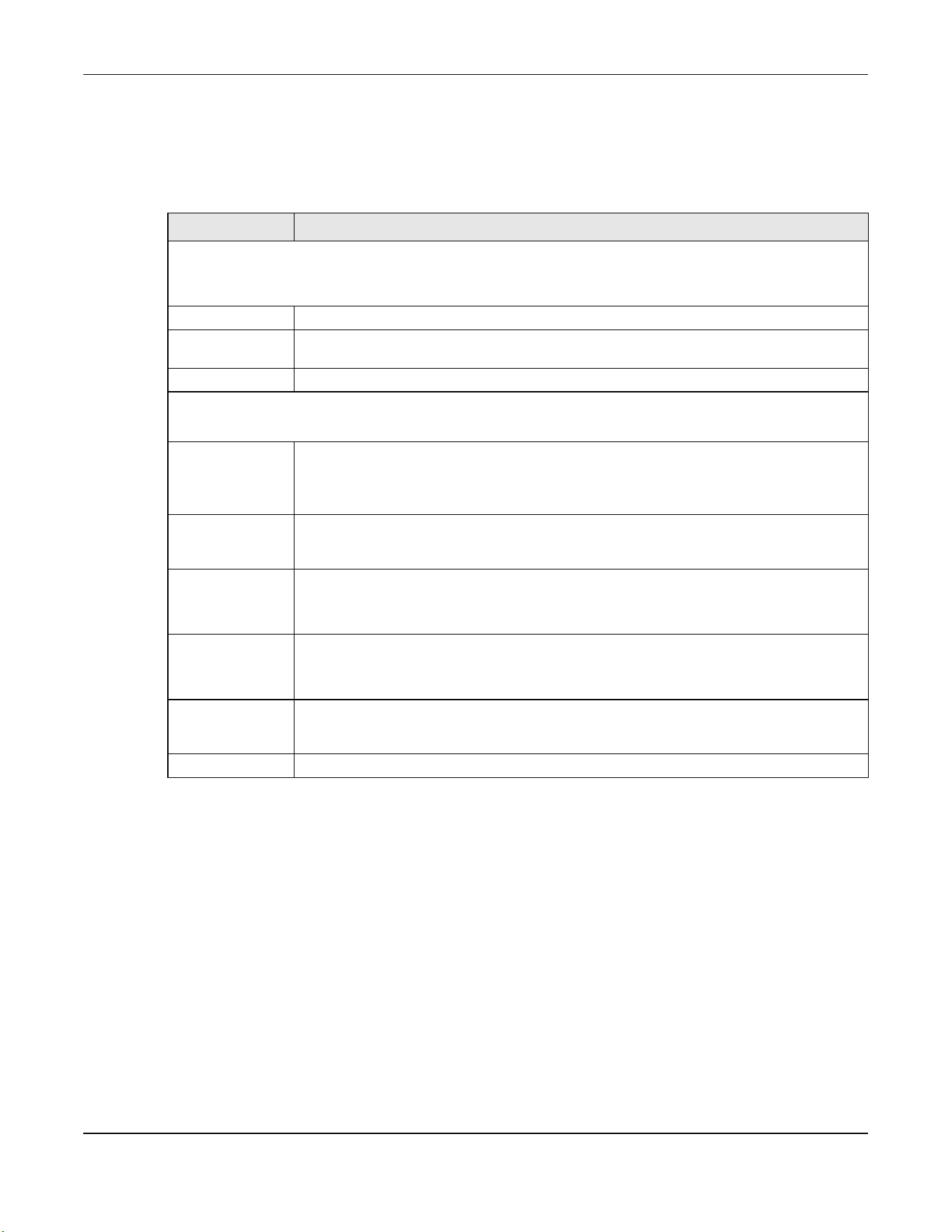
Chapter 4 Web Configurator
XMG1915 Series User’s Guide
53
Note: The input string of any field in this screen should not contain [ ? ], [ | ], [ ' ], [ " ], or [ , ].
In the Password fields, [ space ] is also not allowed.
Change the default administrator and/or SNMP passwords, and then click Apply to save your changes.
4.3 Zyxel One Network (ZON) Utility
ZON Utility is a program designed to help you deploy and manage a network more efficiently. It detects
devices automatically and allows you to do basic settings on devices in the network without having to
be near it.
The ZON Utility issues requests through Zyxel Discovery Protocol (ZDP) and in response to the query, the
device responds back with basic information including IP address, firmware version, location, system
and model name in the same broadcast domain. The information is then displayed in the ZON Utility
screen and you can perform tasks like basic configuration of the devices and batch firmware upgrade
in it. You can download the ZON Utility at https://www.zyxel.com/global/en/form/zon-utility-download
and unzip it first before installing it in a computer (Windows operating system).
Table 8 Web Configurator: Password/SNMP
LABEL DESCRIPTION
Password – Administrator
This is the default administrator account with the “admin” user name. You cannot change the default administrator
user name.
Old Password Enter the existing system password (1234 is the default password when shipped).
New Password Enter your new system password. Up to 32 printable ASCII characters are allowed for the new
password.
Retype to confirm Re-enter your new system password for confirmation.
SNMP – General Setting
Use this section to specify the SNMP version and community (password) values.
Version Select the SNMP version for the Switch. The SNMP version on the Switch must match the version
on the SNMP manager. Choose SNMP version 2c (v2c), SNMP version 3 (v3) or both (v3v2c).
Note: SNMP version 2c is backwards compatible with SNMP version 1.
Get Community Enter the Get Community string, which is the password for the incoming Get- and GetNext-
requests from the management station. The Get Community string is only used by SNMP
managers using SNMP version 2c or lower.
Set Community Enter the Set Community string, which is the password for the incoming Set- requests from the
management station.
The Set Community string is only used by SNMP managers using SNMP version 2c or lower.
Trap Community Enter the Trap Community string, which is the password sent with each trap to the SNMP
manager.
The Trap Community string is only used by SNMP managers using SNMP version 2c or lower.
Apply Click Apply to save your changes to the Switch’s run-time memory. The Switch loses these
changes if it is turned off or loses power, so use the Save link on the top navigation panel to
save your changes to the non-volatile memory when you are done configuring.
Cancel Click Cancel to begin configuring this screen afresh.

Chapter 4 Web Configurator
XMG1915 Series User’s Guide
54
4.3.1 Requirements
Before installing the ZON Utility in your computer, please make sure it meets the requirements listed
below.
Operating System
At the time of writing, the ZON Utility is compatible with:
• Windows 7 (both 32-bit / 64-bit versions)
• Windows 8 (both 32-bit / 64-bit versions)
• Windows 8.1 (both 32-bit / 64-bit versions)
• Windows 10 (both 32-bit / 64-bit versions)
• Windows 11 (both 32-bit / 64-bit versions)
Hardware
Here are the minimum hardware requirements to use the ZON Utility on your computer.
• Core i3 processor
•2 GB RAM
• 100 MB free hard disk
• WXGA (Wide XGA 1280 by 800)
4.3.2 Run the ZON Utility
1 Double-click the ZON Utility to run it.
2 The first time you run the ZON Utility, you will see if your device and firmware version support the ZON
Utility. Click the OK button to close this screen.
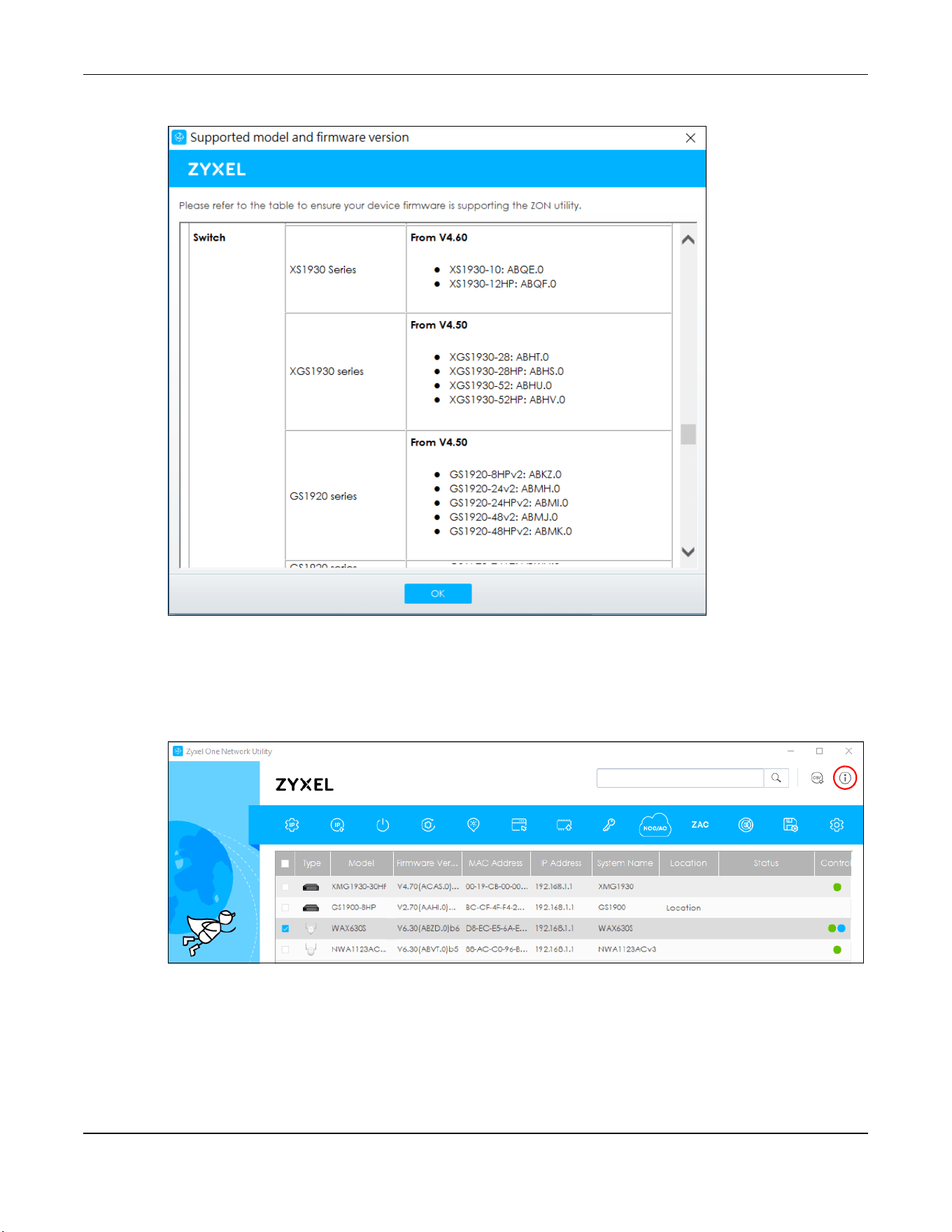
Chapter 4 Web Configurator
XMG1915 Series User’s Guide
55
Figure 29 Supported Devices and Versions
If you want to check the supported models and firmware versions later, you can click the Show
information about ZON icon in the upper right of the screen. Then select the Supported model and
firmware version link. If your device is not listed here, see the device release notes for ZON Utility support.
The release notes are in the firmware zip file on the Zyxel web site.
Figure 30 ZON Utility Screen
3 Select a network adapter to which your supported devices are connected.

Chapter 4 Web Configurator
XMG1915 Series User’s Guide
56
Figure 31 Network Adapter
4 Click the Go button for the ZON Utility to discover all supported devices in your network.
Figure 32 Discovery
5 The ZON Utility screen shows the devices discovered.
Figure 33 ZON Utility Screen
6 Select a device and then use the icons to perform actions. Some functions may not be available for
your devices.
Note: You must know the selected device admin password before taking actions on the
device using the ZON Utility icons.

Chapter 4 Web Configurator
XMG1915 Series User’s Guide
57
Figure 34 Password Prompt
The following table describes the icons numbered from left to right in the ZON Utility screen.
The following table describes the fields in the ZON Utility main screen.
Table 9 ZON Utility Icons
ICON DESCRIPTION
1 IP Configuration Change the selected device’s IP address.
2 Renew IP Address Update a DHCP-assigned dynamic IP address.
3 Reboot Device Use this icon to restart the selected devices. This may be useful when troubleshooting
or upgrading new firmware.
4 Reset Configuration to
Default
Use this icon to reload the factory-default configuration file. This means that you will
lose all previous configurations.
5 Locator LED Use this icon to locate the selected device by causing its Locator LED to blink.
6 Web GUI Use this to access the selected device Web Configurator from your browser. You will
need a user name and password to log in.
7 Firmware Upgrade Use this icon to upgrade new firmware to selected devices of the same model. Make
sure you have downloaded the firmware from the Zyxel website to your computer and
unzipped it in advance.
8 Change Password Use this icon to change the admin password of the selected device. You must know
the current admin password before changing to a new one.
9 Configure NCC
Discovery
You must have Internet access to use this feature. Use this icon to enable or disable the
Nebula Control Center (NCC) discovery feature on the selected device. If it is
enabled, the selected device will try to connect to the NCC. Once the selected
device is connected to and has registered in the NCC, it will go into the Nebula cloud
management mode.
10 ZAC Use this icon to run the Zyxel AP Configurator of the selected AP.
11 Clear and Rescan Use this icon to clear the list and discover all devices on the connected network again.
12 Save Configuration Use this icon to save configuration changes to permanent memory on a selected
device.
13 Settings Use this icon to select a network adapter for the computer on which the ZON utility is
installed, and the utility language.
Table 10 ZON Utility Fields
LABEL DESCRIPTION
Type This field displays an icon of the kind of device discovered.
Model This field displays the model name of the discovered device.
Firmware Version This field displays the firmware version of the discovered device.
MAC Address This field displays the MAC address of the discovered device.
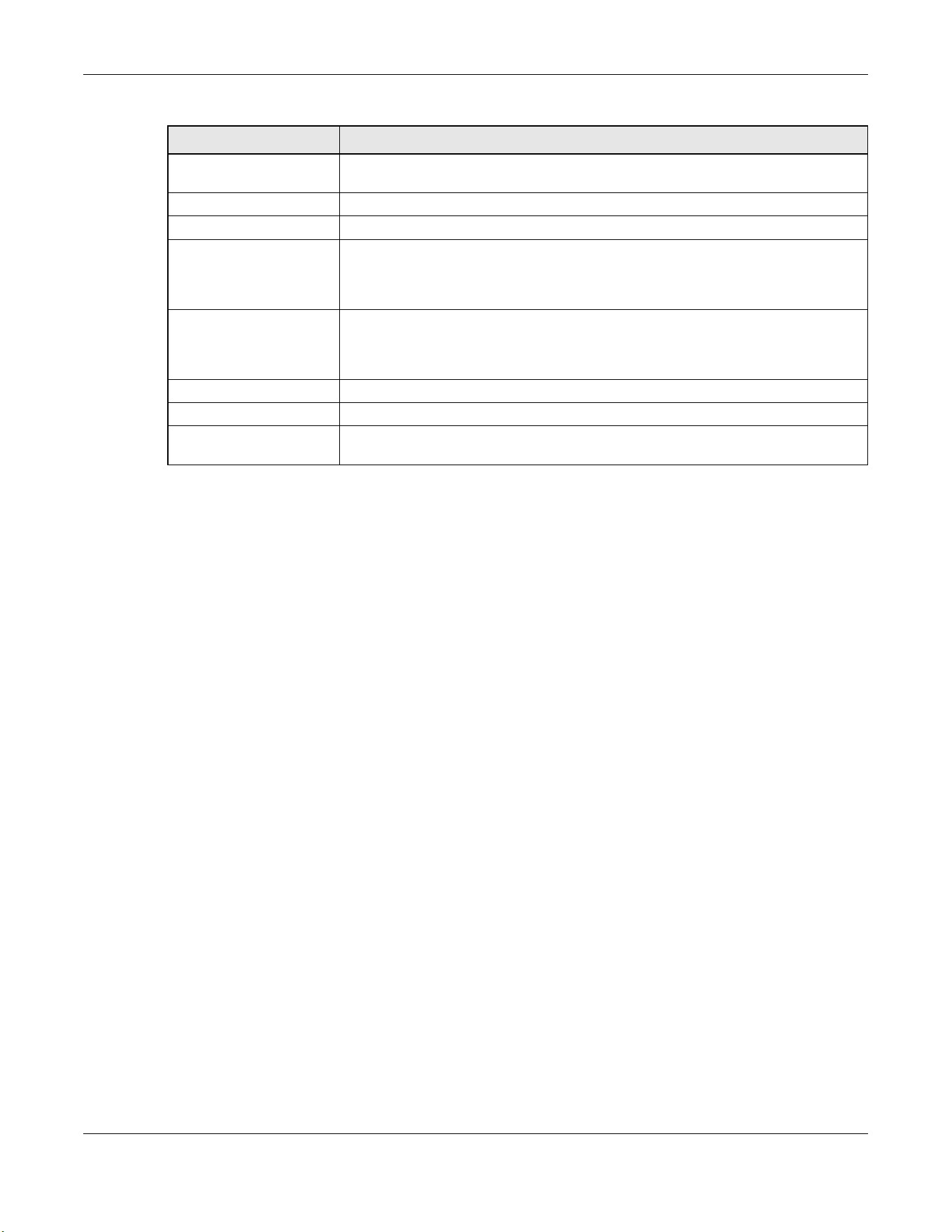
Chapter 4 Web Configurator
XMG1915 Series User’s Guide
58
4.4 Wizard
The Setup Wizard contains the following parts:
• Basic
– to configure the Switch IP address, DNS server, system password, SNMP community and link
aggregation (trunking).
• Protection – to enable loop guard and broadcast storm control on the Switch and its ports.
• VLAN – to create a static VLAN, assign ports to the VLAN and set the ports to tag or untag outgoing
frames.
• QoS – to determine a port’s IEEE 802.1p priority level for QoS.
IP Address This field displays the IP address of an internal interface on the discovered device that
first received a ZDP discovery request from the ZON Utility.
System Name This field displays the system name of the discovered device.
Location This field displays where the discovered device is.
Status This field displays whether changes to the discovered device have been done
successfully. As the Switch does not support IP Configuration, Renew IP address and
Flash Locator LED, this field displays “Update failed”, “Not support Renew IP address”
and “Not support Flash Locator LED” respectively.
Controller Discovery This field displays if the discovered device supports the Nebula Control Center (NCC)
discovery feature. If it is enabled, the selected device will try to connect to the NCC.
Once the selected device is connected to and has registered in the NCC, it will go
into the Nebula cloud management mode.
Serial Number Enter the admin password of the discovered device to display its serial number.
Hardware Version This field displays the hardware version of the discovered device.
IPv6 Address This field displays the IPv6 address on the discovered device that first received a ZDP
discovery request from the ZON Utility.
Table 10 ZON Utility Fields (continued)
LABEL DESCRIPTION
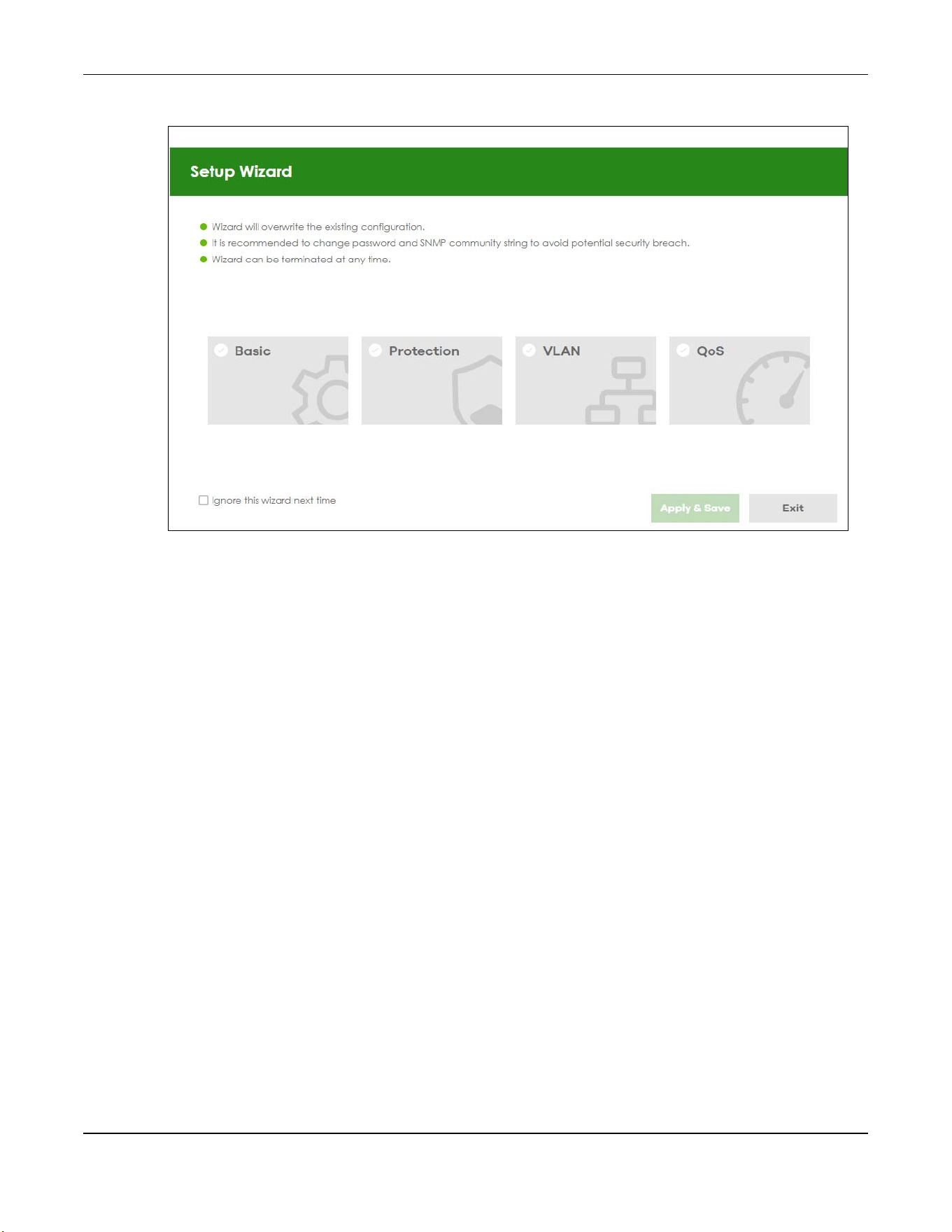
Chapter 4 Web Configurator
XMG1915 Series User’s Guide
59
Figure 35 Setup Wizard
4.4.1 Basic
In Basic, you can set up IP/DNS, set up your password, SNMP community, link aggregation, and view
finished results.
In order to set up your IP/DNS, please do the following. Click Wizard > Basic > Step 1 IP to access this
screen.
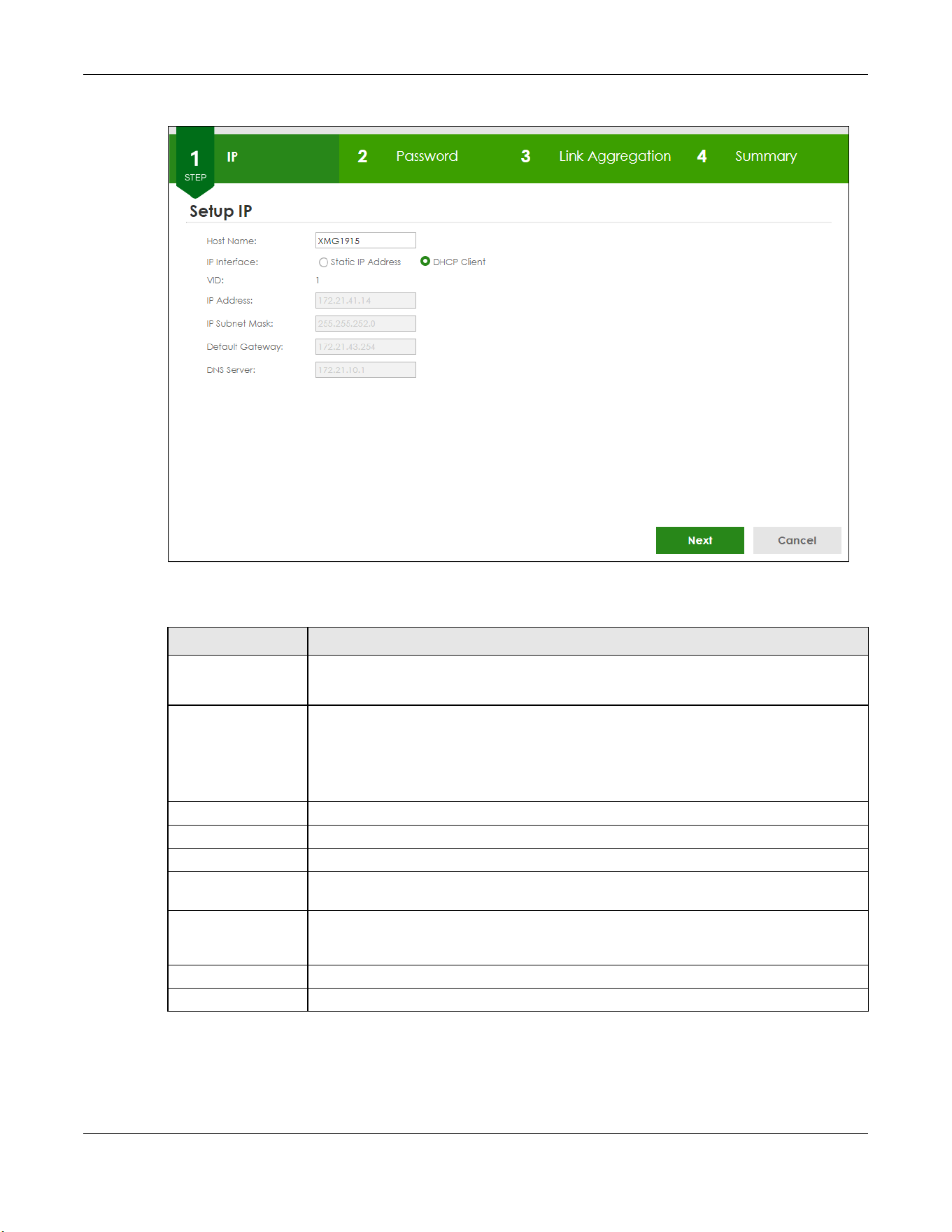
Chapter 4 Web Configurator
XMG1915 Series User’s Guide
60
Figure 36 Wizard > Basic > Step 1 IP
Each field is described in the following table.
After clicking Next, the Password screen appears.
Table 11 Wizard > Basic > Step 1 IP
LABEL DESCRIPTION
Host Name This field displays a host name. Enter a string to set a new host name.
The host name should not contain [ ? ], [ | ], [ ' ], [ " ], or [ , ].
IP Interface Select DHCP Client if the Switch is connected to a router with the DHCP server enabled. You
then need to check the router for the IP address assigned to the Switch in order to access
the Switch’s Web Configurator again.
Select Static IP Address when the Switch is NOT connected to a router or you want to assign
it a fixed IP address.
VID This field displays the VLAN ID.
IP Address The Switch needs an IP address for it to be managed over the network.
IP Subnet Mask The subnet mask specifies the network number portion of an IP address.
Default Gateway Type the IP address of the default outgoing gateway in dotted decimal notation, for
example 192.168.1.254.
DNS Server DNS (Domain Name System) is for mapping a domain name to its corresponding IP address
and so forth. Enter a domain name server IP address in order to be able to use a domain
name instead of an IP address.
Next Click Next to show the next screen.
Cancel Click Cancel to exit this screen without saving.
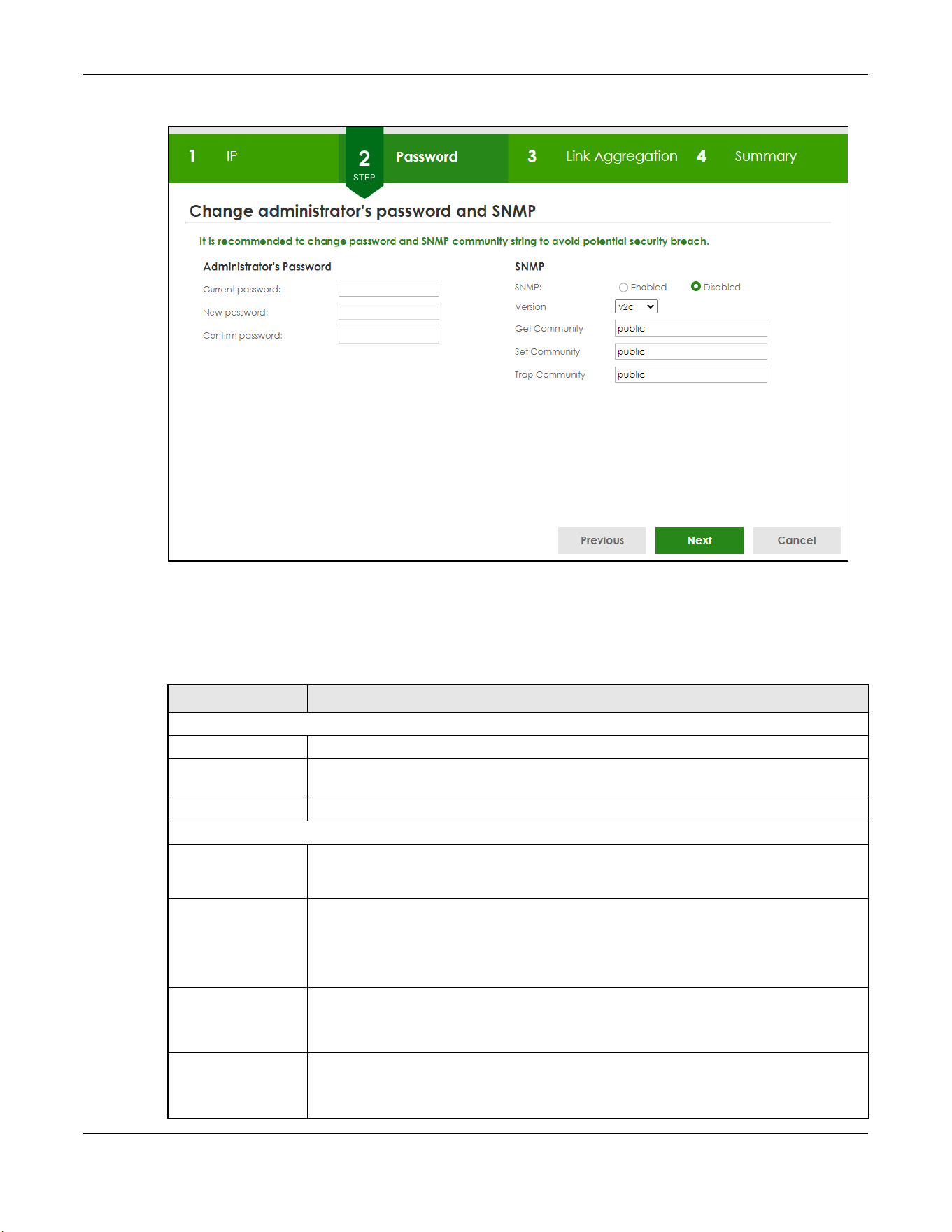
Chapter 4 Web Configurator
XMG1915 Series User’s Guide
61
Figure 37 Wizard > Basic > Step 2 Password
Note: The input string of any field in this screen should not contain [ ? ], [ | ], [ ' ], [ " ], or [ , ].
In the Password fields, [ space ] is also not allowed.
Each field is described in the following table.
Table 12 Wizard > Basic > Step 2 Password
LABEL DESCRIPTION
Administrator's Password
Current password Type the existing system password (1234 is the default password when shipped).
New password Enter your new system password. Up to 32 printable ASCII characters are allowed for the
new password.
Confirm password Retype your new system password for confirmation.
SNMP
SNMP Select Enabled to let the Switch act as an SNMP agent, which allows a manager station to
manage and monitor the Switch through the network. Select Disabled to turn this feature
off.
Version Select the SNMP version for the Switch. The SNMP version on the Switch must match the
version on the SNMP manager. Choose SNMP version 2c (v2c), SNMP version 3 (v3) or both
(v3v2c).
Note: SNMP version 2c is backwards compatible with SNMP version 1.
Get Community Enter the Get Community string, which is the password for the incoming Get- and
GetNextrequests from the management station.
The Get Community string is only used by SNMP managers using SNMP version 2c or lower.
Set Community Enter the Set Community string, which is the password for the incoming Set- requests from
the management station.
The Set Community string is only used by SNMP managers using SNMP version 2c or lower.
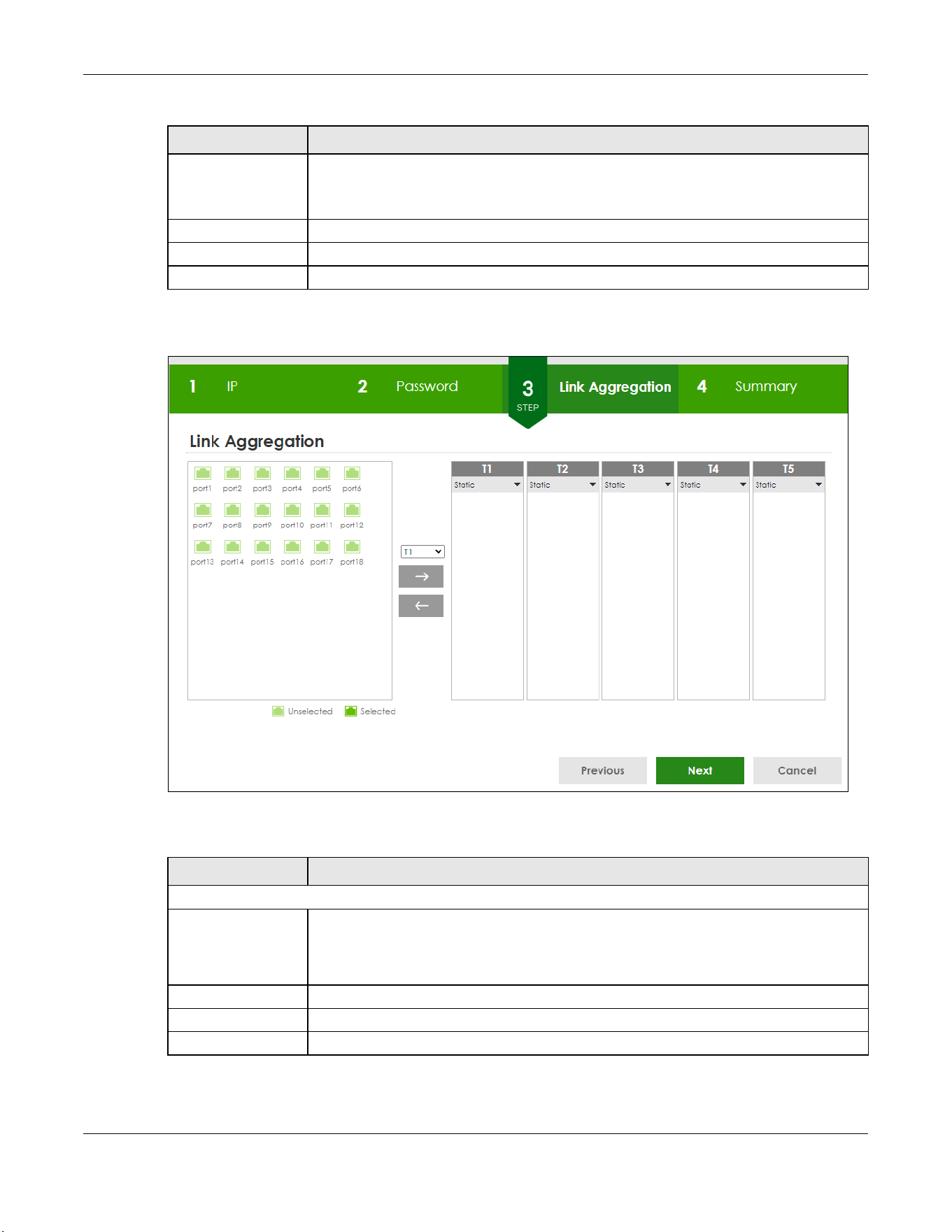
Chapter 4 Web Configurator
XMG1915 Series User’s Guide
62
After clicking Next, the Link Aggregation screen appears.
Figure 38 Wizard > Basic > Step 3 Link Aggregation
Each field is described in the following table.
After clicking Next, the Summary screen appears.
Trap Community Enter the Trap Community string, which is the password sent with each trap to the SNMP
manager.
The Trap Community string is only used by SNMP managers using SNMP version 2c or lower.
Previous Click Previous to show the previous screen.
Next Click Next to show the next screen.
Cancel Click Cancel to exit this screen without saving.
Table 13 Wizard > Basic > Step 3 Link Aggregation
LABEL DESCRIPTION
Link Aggregation
T1-Tx Click the arrows to add or delete icons located on the left to desired preference.
Select Static if the ports are configured as static members of a trunk group.
Select LACP if the ports are configured to join a trunk group through LACP.
Previous Click Previous to show the previous screen.
Next Click Next to show the next screen.
Cancel Click Cancel to exit this screen without saving.
Table 12 Wizard > Basic > Step 2 Password (continued)
LABEL DESCRIPTION

Chapter 4 Web Configurator
XMG1915 Series User’s Guide
63
Figure 39 Wizard > Basic > Step 4 Summary
Each field is described in the following table.
Table 14 Wizard > Basic > Step 4 Summary
LABEL DESCRIPTION
Setup IP
Host Name This field displays a host name.
IP Interface This field displays whether the WAN interface is using a DHCP IP address or a static IP
address.
VID This field displays the VLAN ID.
IP Address The Switch needs an IP address for it to be managed over the network.
IP Subnet Mask The subnet mask specifies the network number portion of an IP address.
Default Gateway Type the IP address of the default outgoing gateway in dotted decimal notation, for
example 192.168.1.254.
DNS Server DNS (Domain Name System) is for mapping a domain name to its corresponding IP address
and vice versa. Enter a domain name server IP address in order to be able to use a domain
name instead of an IP address.
Change administrator's password and activate SNMP
New Password This field displays asterisks when a new password has been created.
SNMP This field displays whether the Switch acts as an SNMP agent.
Version This field displays the SNMP version for the Switch.
Get Community This field displays the Get Community string.
Set Community This field displays the Set Community string.
Trap Community This field displays the Trap Community string.
Link Aggregation
Group This field displays the group number.
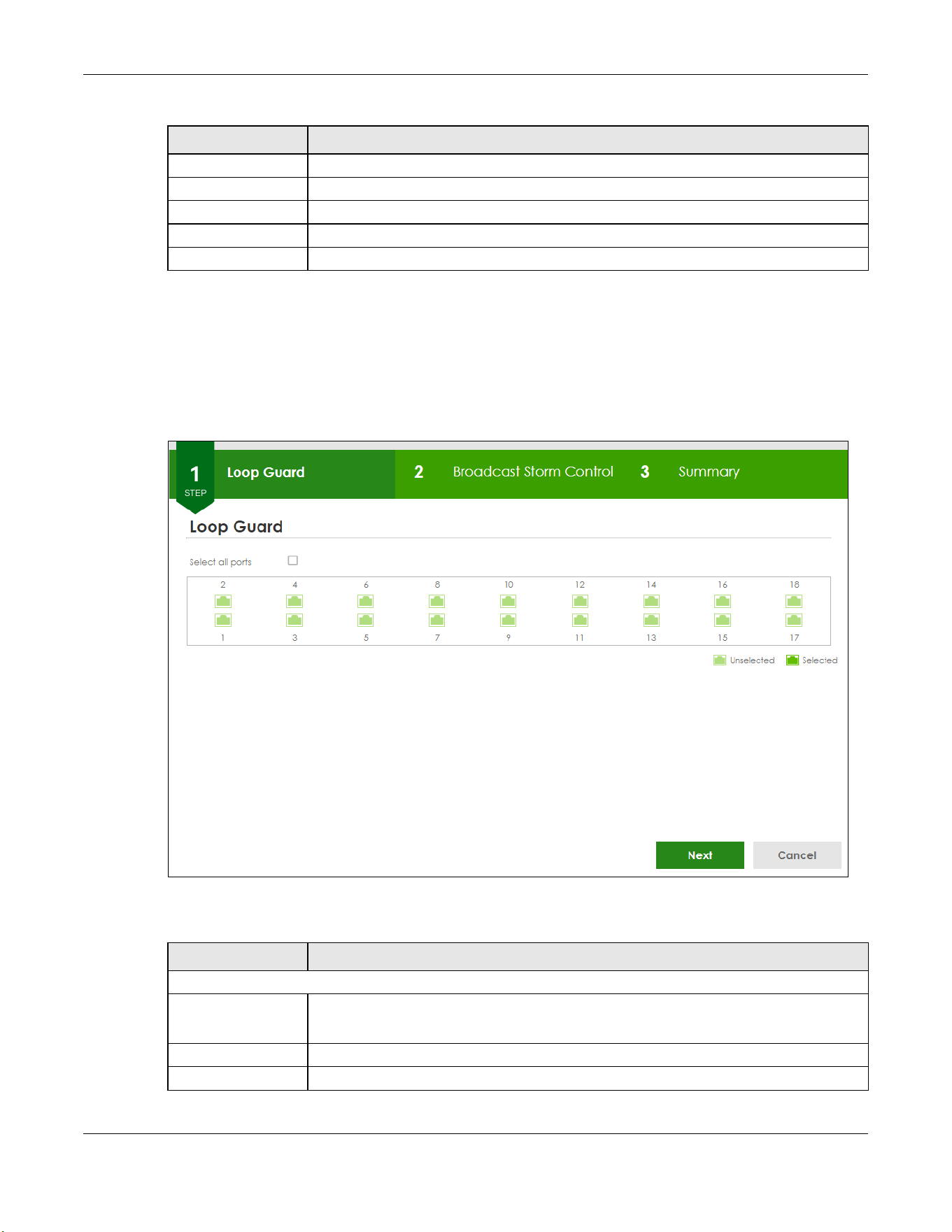
Chapter 4 Web Configurator
XMG1915 Series User’s Guide
64
4.4.2 Protection
In Protection, you can set up loop guard and broadcast storm control.
In order to set up loop guard, please do the following. Click Wizard > Protection > Step 1 Loop Guard to
access this screen.
Figure 40 Wizard > Protection > Step 1 Loop Guard
Each field is described in the following table.
Type This field displays Static or LACP of this group.
Member This field displays the members of this group.
Previous Click Previous to show the previous screen.
Finish Review the information and click Finish to create the task.
Cancel Click Cancel to exit this screen without saving.
Table 14 Wizard > Basic > Step 4 Summary (continued)
LABEL DESCRIPTION
Table 15 Wizard > Protection > Step 1 Loop Guard
LABEL DESCRIPTION
Loop Guard
Select all ports Select all ports to enable the loop guard feature on all ports.
You can select a port by clicking it.
Next Click Next to show the next screen.
Cancel Click Cancel to exit this screen without saving.

Chapter 4 Web Configurator
XMG1915 Series User’s Guide
65
After clicking Next, the Broadcast Storm Control screen appears.
Figure 41 Wizard > Protection > Step 2 Broadcast Storm Control
Each field is described in the following table.
After clicking Next, the Summary screen appears.
Table 16 Wizard > Protection > Step 2 Broadcast Storm Control
LABEL DESCRIPTION
Broadcast Storm Control
Select all ports Select all ports to apply settings on all ports.
You can select a port by clicking it.
Broadcast pkt/s Specify how many broadcast packets the port receives per second.
Previous Click Previous to show the previous screen.
Next Click Next to show the next screen.
Cancel Click Cancel to exit this screen without saving.
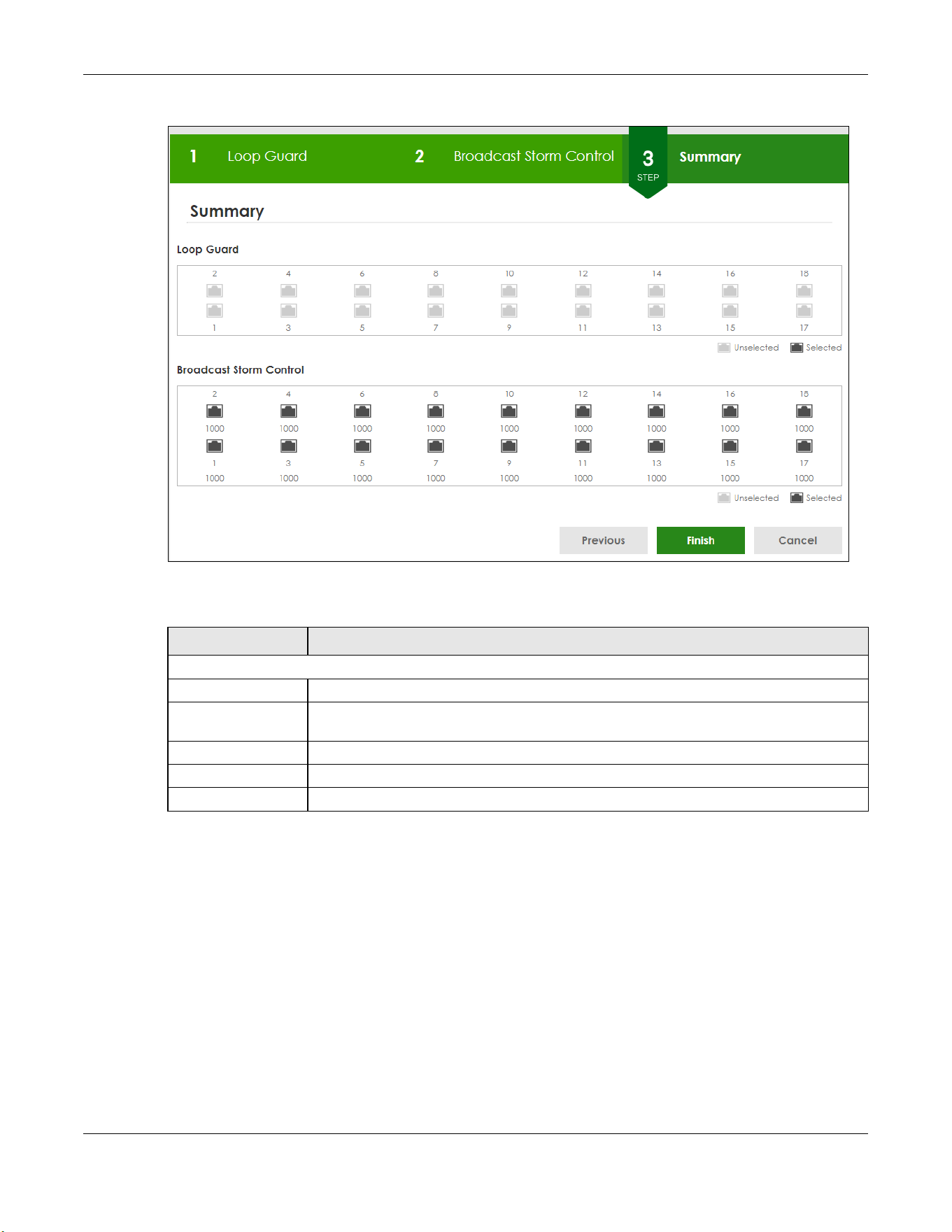
Chapter 4 Web Configurator
XMG1915 Series User’s Guide
66
Figure 42 Wizard > Protection > Step 3 Summary
Each field is described in the following table.
4.4.3 VLAN
In VLAN, you can create VLAN, and tag VLAN settings.
Click Wizard > VLAN > VLAN Setting to access this screen.
Table 17 Wizard > Protection > Step 3 Summary
LABEL DESCRIPTION
Summary
Loop Guard If the loop guard feature is enabled on a port, the Switch will prevent loops on this port.
Broadcast Storm
Control
If the broadcast storm control feature is enabled on a port, the number of broadcast
packets the Switch receives per second will be limited on this port.
Previous Click Previous to show the previous screen.
Finish Review the information and click Finish to create the task.
Cancel Click Cancel to exit this screen without saving.
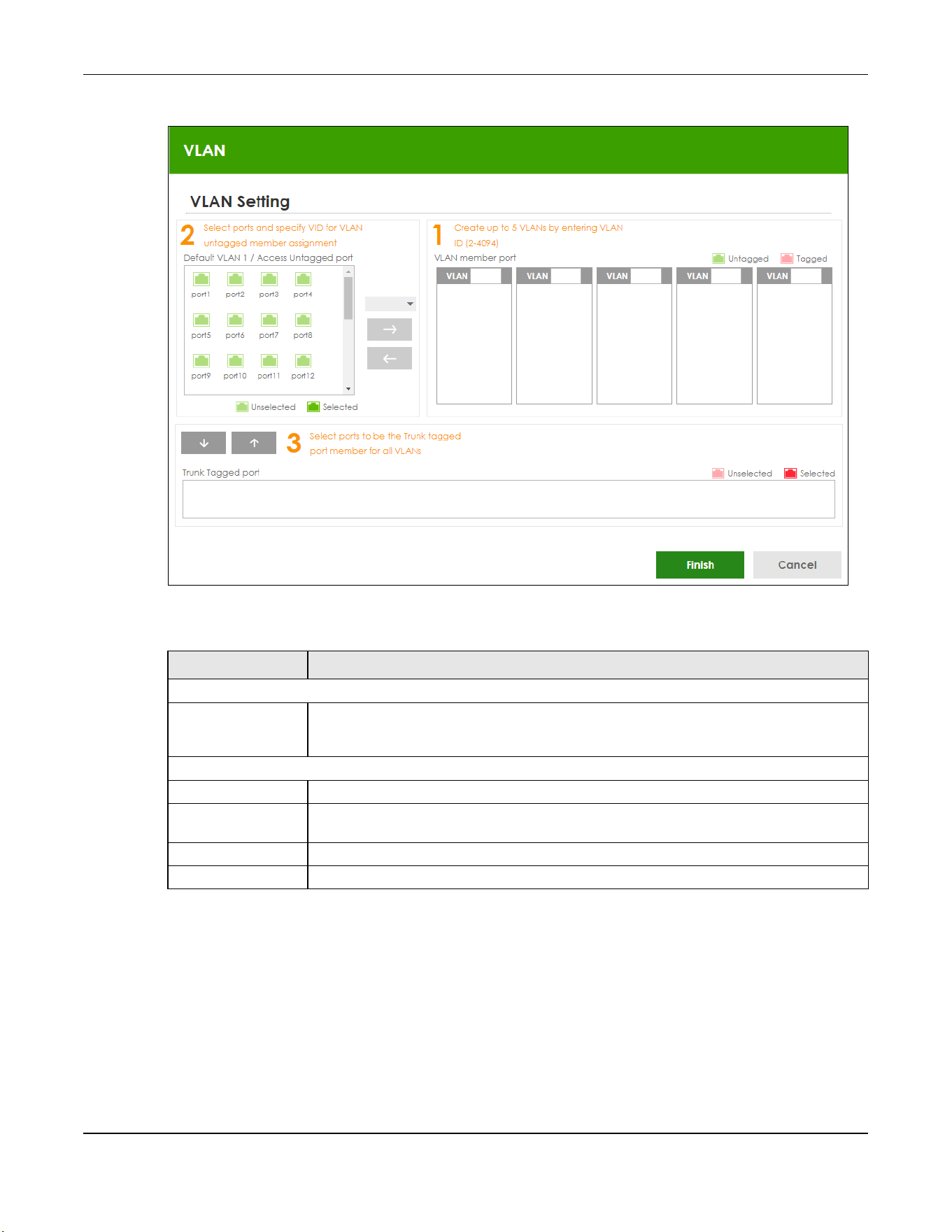
Chapter 4 Web Configurator
XMG1915 Series User’s Guide
67
Figure 43 Wizard > VLAN > VLAN Setting
Each field is described in the following table.
4.4.4 QoS
In QoS, you can create QoS settings.
In order to create QoS settings, please do the following. Click Wizard > QoS > QoS Setting to access this
screen.
Table 18 Wizard > VLAN > VLAN Setting
LABEL DESCRIPTION
VLAN Setting
Default VLAN 1 /
Access Untagged
port
After you create a VLAN and select the VLAN ID from the drop-down list box, select ports
and use the right arrow to add them as the untagged ports to a VLAN group.
VLAN member port
VLAN Type a number between 2 and 4094 to create a VLAN.
Trunk Tagged port Select ports and use the downward arrow to add them as the tagged ports to the VLAN
groups you created.
Finish Review the information and click Finish to create the task.
Cancel Click Cancel to exit this screen without saving.

Chapter 4 Web Configurator
XMG1915 Series User’s Guide
68
Figure 44 Wizard > QoS > QoS Setting
Each field is described in the following table.
4.5 Web Configurator Layout
The DASHBOARD screen is the first screen that displays when you access the Web Configurator.
Table 19 Wizard > QoS > QoS Setting
LABEL DESCRIPTION
QoS Setting
Select all ports Select all ports to apply settings on all ports.
You can select a port by clicking it.
High Select ports and click the High button, so they will have high priority.
The port’s IEEE 802.1p priority level will be set to 5. Use the PORT > Port Setup screen to adjust
the value.
Medium Select ports and click the Medium button and, so they will have medium priority.
The port’s IEEE 802.1p priority level will be set to 3. Use the PORT > Port Setup screen to adjust
the value.
Low Select ports and click the Low button, so they will have low priority.
The port’s IEEE 802.1p priority level will be set to 1. Use the PORT > Port Setup screen to adjust
the value.
Finish Review the information and click Finish to create the task.
Cancel Click Cancel to exit this screen without saving.
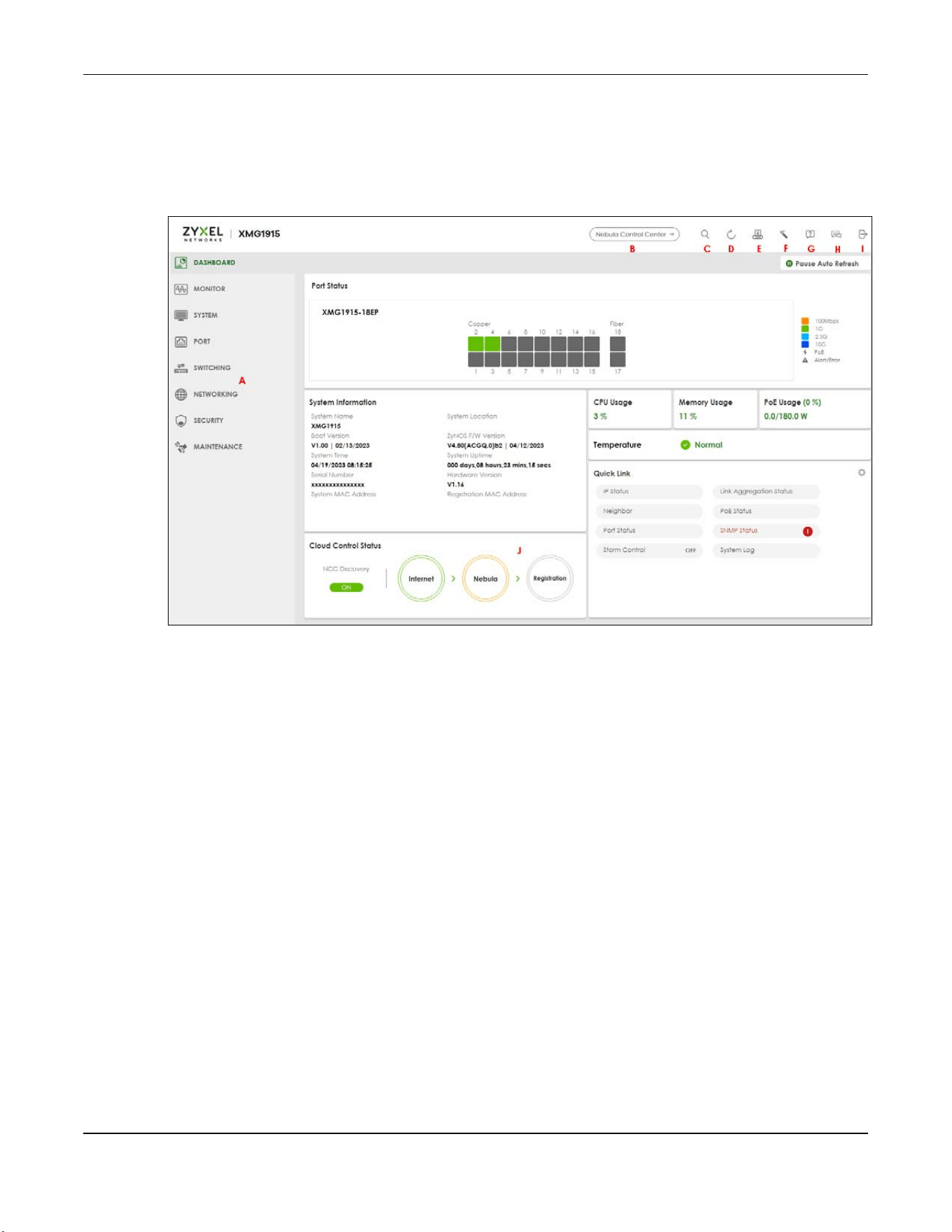
Chapter 4 Web Configurator
XMG1915 Series User’s Guide
69
This guide uses the XMG1915-18EP screens as examples. The screens may vary slightly for different
models.
The following figure shows the navigating components of a Web Configurator screen.
Figure 45 Web Configurator Layout
A
– Click the menu items to open sub-menu links, and then click on a sub-menu link to open the screen
in the main window.
B, C, D, E, F, G, H, I
– These are quick links which allow you to perform certain tasks no matter which
screen you are currently working in.
B
– Click this icon to go to the NCC (Nebula Control Center) portal website.
C – Click this icon to search for specific configurations or status you are looking for. Enter the keywords
and click the result link. This will direct you to the specific configuration or status page.
D – Click this icon to update the information in the screen you are currently viewing.
E
– Click this icon to save your configuration into the Switch’s non-volatile memory. Non-volatile memory
is the configuration of your Switch that stays the same even if the Switch’s power is turned off.
F
– Click this icon to display the Setup Wizard that contains the Basic, Protection, VLAN, and QoS setup
screens.
G
– Click this icon to display web help pages. The help pages provide descriptions for all of the
configuration screens.
H
– Click this icon to go to the Zyxel Community Biz Forum.
I
– Click this icon to log out of the Web Configurator.

Chapter 4 Web Configurator
XMG1915 Series User’s Guide
70
J – This displays the Nebula Cloud Control Status. The ON/OFF switch displays if NCC Discovery is
enabled. If a status circle turns Orange, it means the Switch is unable to connect to NCC. Hover the
mouse over the status circle to check the diagnostic message. You can also click the ON/OFF switch to
go to the SYSTEM > Cloud Management screen and check the diagnostic messages. See Section Table
39 on page 125 for more information.
In the navigation panel, click a main link to reveal a list of sub-menu links.
The following table describes the links in the navigation panel. The navigation panel varies depending
on the product model you use.
Table 20 Navigation Panel Links
LINK DESCRIPTION
DASHBOARD This link takes you to the main dashboard screen that displays general system and device infor-
mation.
MONITOR
ARP Table This link takes you to a screen that displays the current ARP table of the Switch. You can view the
IP and MAC address mapping, VLAN ID, ARP aging time, and ARP entry type of a device
attached to a port.
IP Table This link takes you to a screen where you can view the IP address and VLAN ID of a device
attached to a port.
IPv6 Neighbor
Table
This link takes you to a screen where you can view the Switch’s IPv6 neighbor table.
MAC Table This link takes you to a screen where you can view the MAC address and VLAN ID of a device
attach to a port. You can also view what kind of MAC address it is.
Neighbor This link takes you to a screen where you can view neighbor devices (including non-Zyxel
devices) connected to the Switch.
Path MTU Table This link takes you to a screen where you can view the IPv6 path MTU information on the Switch.
Port Status This link takes you to a screen where you can view the port statistics.
Routing Table Click the link to unfold the following sub-link menu.
IPv4
Routing
Table
This link takes you to a screen where you can view the IPv4 routing table for routing information
including IP interface and hop count to certain network destinations.
IPv6
Routing
Table
This link takes you to a screen where you can view the IPv6 routing table for routing information
including IP interface and hop count to certain network destinations.
System Infor-
mation
This link takes you to a screen that displays general system information.
System Log This link takes you to a screen where you can view the system log including fail log and system
status.
SYSTEM
Cloud Man-
agement
This link takes you to a screen where you can enable or disable the Nebula Control Center (NCC)
Discovery feature and view the NCC connection status. If Nebula Control Center (NCC) Discov-
ery is enabled, you can have the Switch search for the NCC (Nebula Control Center). The screen
also displays a QR code containing the Switch’s serial number and MAC address for handy regis-
tration of the Switch at NCC.
General Setup This link takes you to a screen where you can configure general identification information about
the Switch.
Hardware
Monitor Setup
(XMG1915-
18EP)
This link takes you to a screen where you can configure hardware monitor related features such
as SFP Detect.

Chapter 4 Web Configurator
XMG1915 Series User’s Guide
71
Interface Setup This link takes you to a screen where you can configure settings for individual interface type and
ID.
IP Setup This link takes you to a screen where you can configure the DHCP client, and a static IP address
(IP address and subnet mask).
IPv6 Click the link to unfold the following sub-link menu.
IPv6 Status This link takes you to a screen where you can view the IPv6 table and DNS server.
IPv6 Global
Setup
This link takes you to a screen where you can configure the global IPv6 settings.
IPv6
Interface
Setup
This link takes you to a screen where you can view and configure IPv6 interfaces.
IPv6
Addressing
This link takes you to a screen where you can view and configure IPv6 link-local and global
addresses.
IPv6
Neighbor
Discovery
This link takes you to a screen where you can view and configure neighbor discovery settings on
each interface.
IPv6
Neighbor
Setup
configure static IPv6 neighbor entries in the Switch’s IPv6 neighbor table.
DHCPv6
Client
Setup
This link takes you to a screen where you can configure the Switch’s DHCP settings when it is act-
ing as a DHCPv6 client.
Logins This link takes you to a screen where you can change the system login password, as well as con-
figure up to four login details.
SNMP This link takes you to screens where you can specify the SNMP version and community (password)
values, configure where to send SNMP traps from the Switch, enable loopguard/errdisable/poe/
linkup/linkdown/lldp/transceiver-ddm/storm-control on the Switch, specify the types of SNMP
traps that should be sent to each SNMP manager, and add/edit user information.
Switch Setup This link takes you to a screen where you can set up global Switch parameters such as VLAN type.
Syslog Setup This link takes you to a screen where you can configure the Switch’s system logging settings and
configure a list of external syslog servers.
Time Range This link takes you to a screen where you can configure time range for time-oriented features like
Classifier.
PORT
Green Ethernet This link takes you to a screen where you can configure the Switch to reduce port power con-
sumption.
Link Aggrega-
tion
This link takes you to a screen where you can logically aggregate physical links to form one logi-
cal, higher-bandwidth link.
LLDP Click the link to unfold the following sub-link menu.
LLDP This link takes you to screens where you can view LLDP information and configure LLDP and TLV
settings.
LLDP MED This link takes you to screens where you can configure LLDP-MED parameters.
PoE Setup For PoE models.
This link takes you to a screen where you can set priorities, PoE power-up settings and schedule so
that the Switch is able to reserve and allocate power to certain PDs.
Port Setup This link takes you to a screen where you can configure settings for individual Switch ports.
SWITCHING
Loop Guard This link takes you to a screen where you can configure protection against network loops that
occur on the edge of your network.
Mirroring Click the link to unfold the following sub-link menu.
Table 20 Navigation Panel Links (continued)
LINK DESCRIPTION

Chapter 4 Web Configurator
XMG1915 Series User’s Guide
72
Mirroring This link take you to a screen where you can copy traffic from one port or ports to another port in
order to examine the traffic from the first port without interference.
Multicast Click the link to unfold the following sub-link menu.
IPv4
Multicast
This link takes you to screen where you can configure various IPv4 multicast features, IGMP snoop-
ing, filtering and create multicast VLANs.
Static
Multicast
Forwarding
By MAC
This link takes you to a screen where you can configure static multicast MAC addresses for port(s).
These static multicast MAC addresses do not age out.
QoS Click the link to unfold the following sub-link menu.
Diffserv This link takes you to screens where you can enable DiffServ, configure marking rules and set
DSCP-to-IEEE802.1p mappings.
Queuing
Method
This link takes you to a screen where you can set priorities for the queues of the Switch. This distrib-
utes bandwidth across the different traffic queues.
Priority
Queue
This link takes you to a screen where you can set priority tags for different traffic types and specify
the priority levels.
Bandwidth
Control
This link takes you to a screen where you can cap the maximum bandwidth allowed on a port.
Spanning Tree
Protocol
Click the link to unfold the following sub-link menu.
Spanning
Tree
Protocol
Status
This link takes you to a screen where you can view the STP status in the different STP modes (RST-
Por MSTP) you can configure on the Switch.
Spanning
Tree Setup
This link takes you to a screen where you can activate one of the STP modes (RSTP or MSTP) on the
Switch.
RSTP This link takes you to a screen where you can configure the RSTP (Rapid Spanning Tree Protocol)
settings on the Switch.
MSTP This link takes you to a screen where you can configure the MSTP (Multiple Spanning Tree Proto-
col) settings on the Switch.
Static MAC Fil-
tering
This link takes you to a screen to set up static MAC filtering rules.
Static MAC For-
warding
This link takes you to a screen where you can configure static MAC addresses for a port. These
static MAC addresses do not age out.
VLAN Click the link to unfold the following sub-link menu.
VLAN
Status
This link takes you to a screen where you can view and search all VLAN groups.
VLAN Setup This link takes you to screens where you can:
• configure port-based or 802.1Q VLAN.
• view detailed port settings and status of the VLAN group.
• configure and view 802.1Q VLAN parameters for the Switch.
• configure the static VLAN settings on a port.
Voice
VLAN Setup
This link takes you to a screen where you can set up VLANs that allow you to group voice traffic
with defined priority and enable the Switch port to carry the voice traffic separately from data
traffic to ensure the sound quality does NOT deteriorate.
MAC Based
VLAN Setup
This link takes you to a screen where you can set up VLANs that allow you to group untagged
packets into logical VLANs based on the source MAC address of the packet. This eliminates the
need to reconfigure the Switch when you change ports. The Switch will forward the packets
based on the source MAC address you set up previously.
Table 20 Navigation Panel Links (continued)
LINK DESCRIPTION

Chapter 4 Web Configurator
XMG1915 Series User’s Guide
73
Vendor ID
Based
VLAN Setup
This link takes you to screens where you can set up VLANs that allow you to group untagged
packets into logical VLANs based on the source MAC address of the packet. You can specify a
mask for the MAC address to create a MAC address filter and enter a weight to set the VLAN
rule’s priority.
NETWORKING
ARP Setup Click the link to unfold the following sub-link menu.
ARP
Learning
This link takes you to a screen where you can configure ARP learning mode on a per-port basis.
Static ARP This link takes you to a screen where you can create static ARP entries which do not age out.
DHCP Click the link to unfold the following sub-link menu.
DHCPv4
Relay
This link takes you to screens where you can view DHCPv4 relay status, mode, and configure
DHCPv4 relay settings.
DHCPv6
Relay
This link takes you to a screen where you can enable and configure DHCPv6 relay.
Static Routing Click the link to unfold the following sub-link menu.
IPv4 Static
Route
This link takes you to a screen where you can configure IPv4 static routes. A static route defines
how the Switch should forward traffic by destination IP address and subnet mask.
IPv6 Static
Route
This link takes you to a screen where you can configure IPv6 static routes. A static route defines
how the Switch should forward traffic by destination IP address and prefix length.
SECURITY
AAA Click the link to unfold the following sub-link menu.
RADIUS
Server
Setup
This link takes you to a screen where you can configure your RADIUS (Remote Authentication Dial-
In User Service) server settings for authentication.
AAA Setup This link takes you to a screen where you can configure authentication, authorization and
accounting services through external RADIUS servers.
Access Control Click the link to unfold the following sub-link menu.
Service
Access
Control
This link takes you to a screen where you can decide what services you may use to access the
Switch.
Remote
Managem
ent
This link takes you to a screen where you can specify a group of one or more “trusted computers”
from which an administrator may use a service to manage the Switch.
Account
Security
This link takes you to a screen where you can configure account security settings on the Switch.
Storm Control This link takes you to a screen to set up broadcast filters.
Errdisable This link takes you to screens where you can view errdisable status and configure errdisable set-
tings in CPU protection, errdisable detect, and errdisable recovery.
DHCP
Snooping
This link takes you to screens where you can view DHCP snooping database details and configure
DHCP snooping settings on ports or VLANs. You can use DHCP snooping to filter unauthorized
DHCP packets on the network and to build the binding table dynamically.
Port Security This link takes you to a screen where you can activate MAC address learning and set the
maximum number of MAC addresses to learn on a port.
MAINTENANCE
Certificates The link takes you to a screen where you can import the Switch's CA-signed certificates.
Cluster Man-
agement
This link takes you to a screen where you can configure clustering management and view its sta-
tus.
Configuration Click the link to unfold the following sub-link menu.
Table 20 Navigation Panel Links (continued)
LINK DESCRIPTION
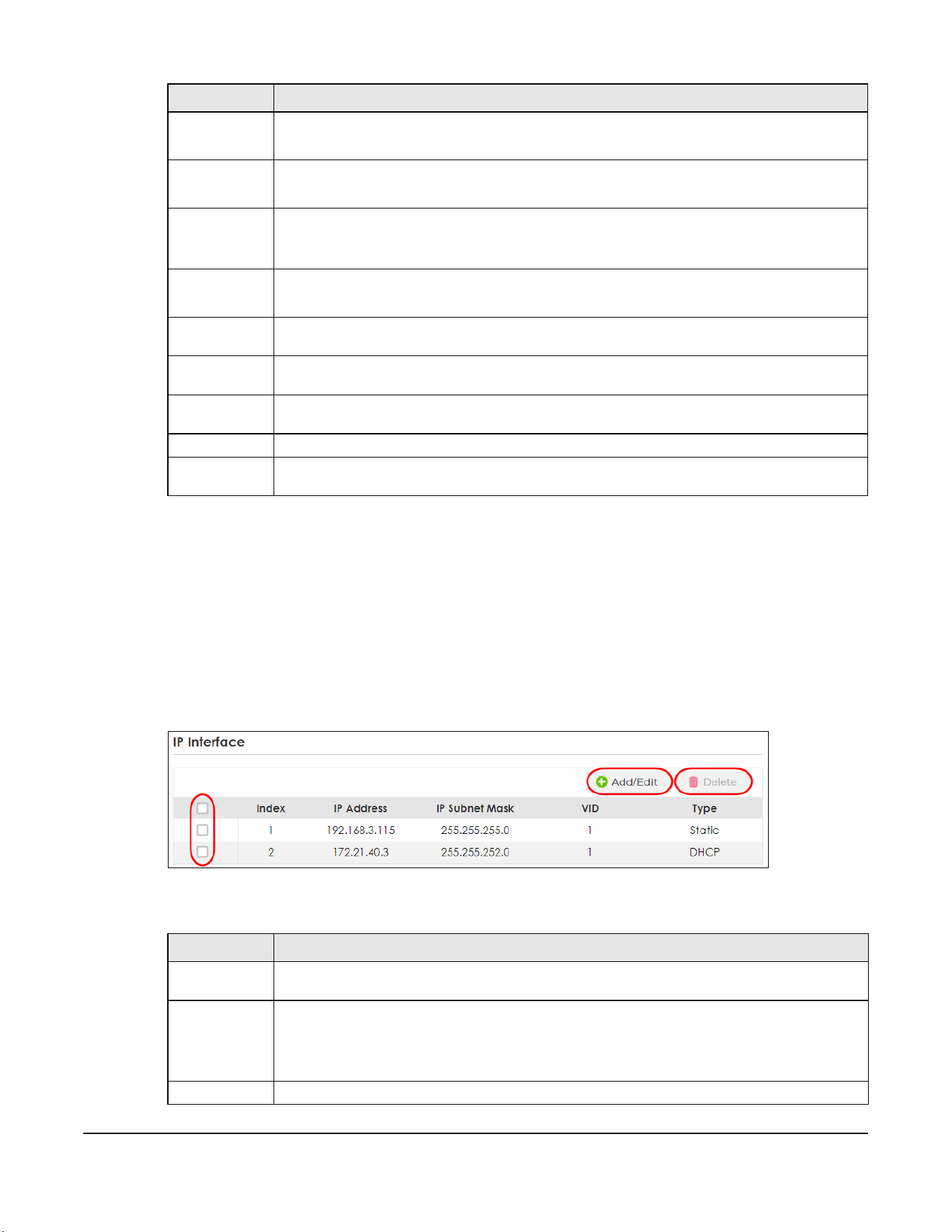
XMG1915 Series User’s Guide
74
4.5.1 Tables and Lists
The Web Configurator tables and lists provide several options for how to work with their entries.
4.5.1.1 Working with Table Entries
Tables have tool icons for working with table entries as shown next. You can select one or more entries,
or select the check box in the heading row to select all entries. Use the tool icons to modify the selected
entries.
Figure 46 Working with a Table
The following table describes the most common table icons.
Restore
Configurati
on
This link takes you to a screen where you can upload a stored device configuration file.
Backup
Configurati
on
This link takes you to a screen where you can save your Switch’s configurations (settings) for later
use.
Erase
Running-
Configurati
on
This link takes you to a screen where you can reset the configuration to the Zyxel default configu-
ration settings.
Save
Configurati
on
This link takes you to a screen where you can save the current configuration (settings) to a spe-
cific configuration file on the Switch.
Configure
Clone
This link takes you to a screen where you can copy the basic and advanced settings from a
source port to a destination port or ports.
Diagnostic This link takes you to a screen where you can ping IP addresses, run traceroute, test ports and
show the location of the Switch.
Firmware
Upgrade
This link takes you to a screen to upload firmware to your Switch.
Reboot System This link takes you to a screen to reboot the Switch without turning the power off.
Tech-Support This link takes you to a screen where you can download related log reports for issue analysis. Log
reports include CPU history and utilization, crash and memory.
Table 20 Navigation Panel Links (continued)
LINK DESCRIPTION
Table 21 Common Table Icons
LABEL DESCRIPTION
Select an entry’s check box to select a specific entry. Otherwise, select the check box in the
table heading row to select all entries.
Add/Edit Click this to create a new entry or edit a selected entry. A configuration screen where you can
add a new entry or modify the settings of the selected entry will open.
In some configuration screens, the Add/Edit button is replaced by the Edit button. This means you
can only edit the existing entries in the table.
Delete To remove entries, select the entries and click Delete.
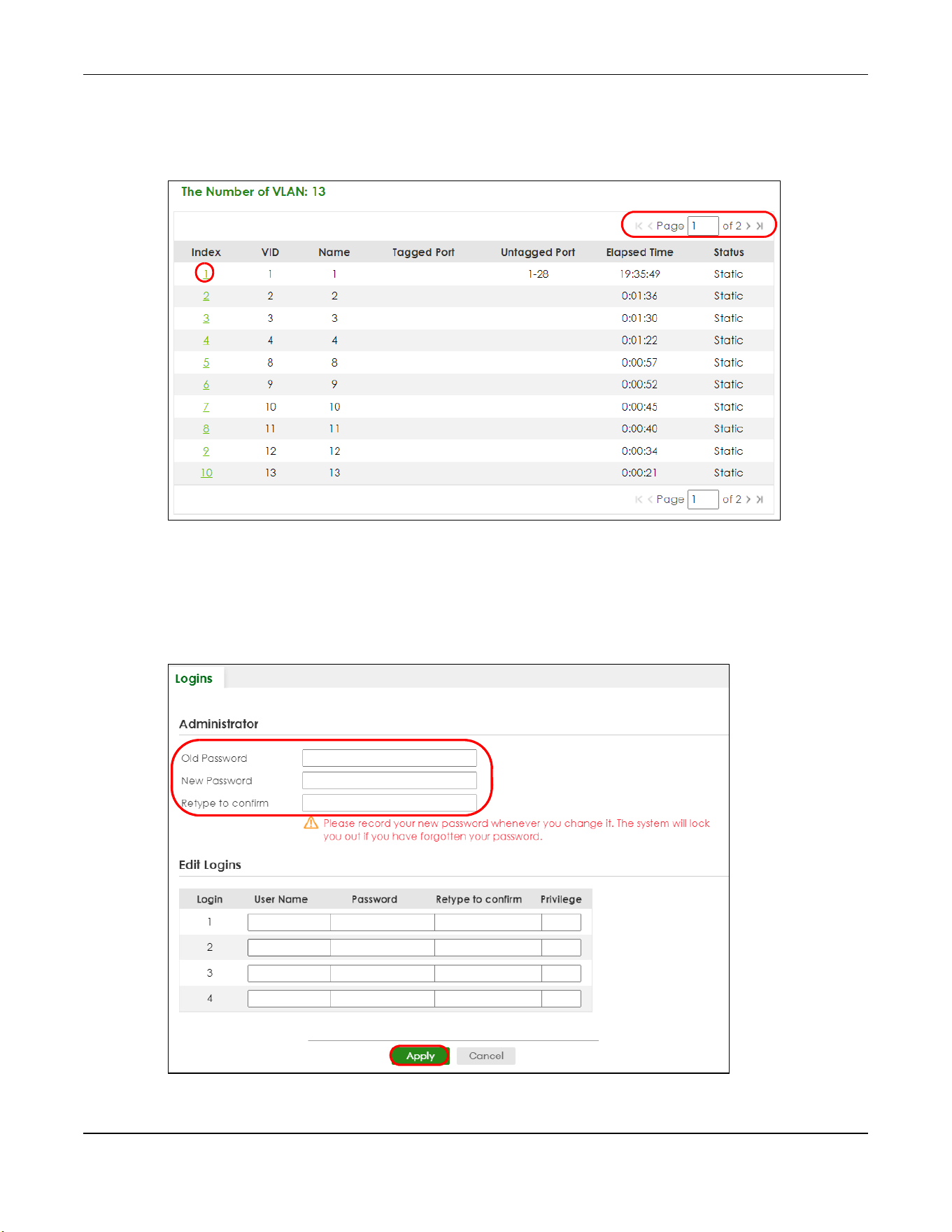
Chapter 4 Web Configurator
XMG1915 Series User’s Guide
75
When viewing a list, you can click on an index number to view more details about the entry. If the list has
more than one page, click the arrow button to navigate to different pages of entries.
Figure 47 Working on a List
4.5.2 Change Your Password
After you log in for the first time, it is recommended you change the default administrator password.
Click SYSTEM > Logins to display the next screen.
Figure 48 Change Administrator Login Password

Chapter 4 Web Configurator
XMG1915 Series User’s Guide
76
4.6 Save Your Configuration
When you are done modifying the settings in a screen, click Apply to save your changes back to the
run-time memory. Settings in the run-time memory are lost when the Switch’s power is turned off.
Click the Save link in the upper right of the Web Configurator to save your configuration to non-volatile
memory. Non-volatile memory refers to the Switch’s storage that remains even if the Switch’s power is
turned off.
Note: Use the Save link when you are done with a configuration session.
4.7 Switch Lockout
You could block yourself (and all others) from managing the Switch if you do one of the following:
1 Delete the management VLAN (default is VLAN 1).
2 Delete all port-based VLANs with the CPU port as a member. The “CPU port” is the management port of
the Switch.
3 Filter all traffic to the CPU port.
4 Disable all ports.
5 Misconfigure the text configuration file.
6 Forget the password and/or IP address.
7 Prevent all services from accessing the Switch.
8 Change a service port number but forget it.
9 You forgot to log out of the Switch from a computer before logging in again on another computer.
Note: Be careful not to lock yourself and others out of the Switch.
4.8 Reset the Switch
If you lock yourself (and others) from the Switch or forget the administrator password, you will need to
reload the factory-default configuration file or reset the Switch back to the factory defaults.
4.8.1 Restore Button
Press the RESTORE button for 2 to 6 seconds to have the Switch automatically reboot.
Press the RESTORE button for more than 6 seconds to have the Switch restore the factory default file.
See Section 3.3 on page 47 for more information about the LED behavior.

Chapter 4 Web Configurator
XMG1915 Series User’s Guide
77
4.9 Log Out of the Web Configurator
Click Logout in a screen to exit the Web Configurator. You have to log in with your password again after
you log out. This is recommended after you finish a management session for security reasons.
Figure 49 Logout button
4.10 Help
The Web Configurator’s online help has descriptions of individual screens and some supplementary
information.
Click the Help icon on a Web Configurator screen to view an online help description (shown as below)
of that screen.
Figure 50 Online Web Help
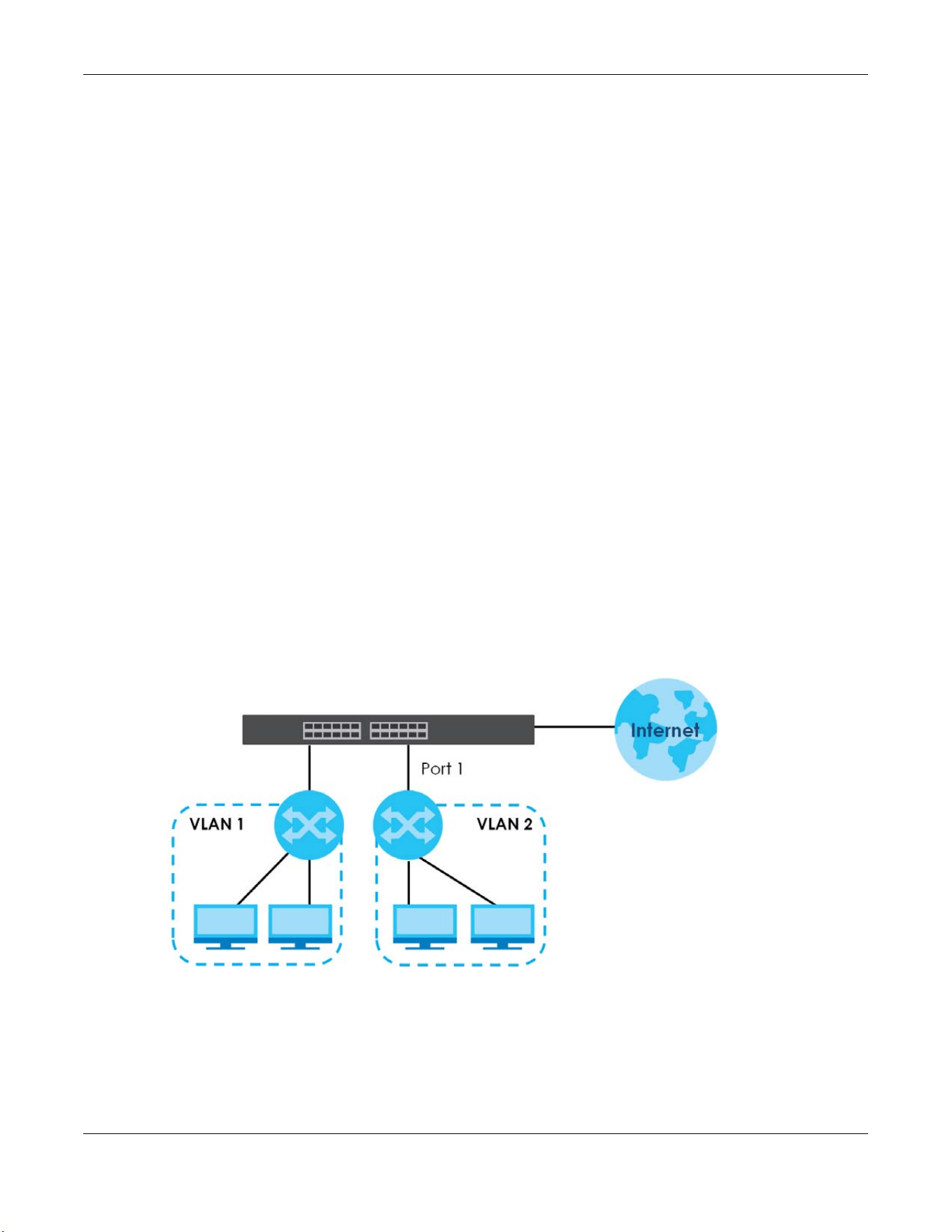
Chapter 5 Initial Setup Example
XMG1915 Series User’s Guide
78
CHAPTER 5
Initial Setup Example
5.1 Overview
This chapter shows how to set up the Switch for an example network.
The following lists the configuration steps for the initial setup:
• Create a VLAN
• Set Port VID
• Configure Switch Management IP Address
5.1.1 Create a VLAN
VLANs confine broadcast frames to the VLAN group in which the ports belongs. You can do this with
port-based VLAN or tagged static VLAN with fixed port members.
In this example, you want to configure port 1 as a member of VLAN 2.
Figure 51 Initial Setup Network Example: VLAN
1 Go to the SWITCHING > VLAN > VLAN Setup > Static VLAN screen. Click Add/Edit.
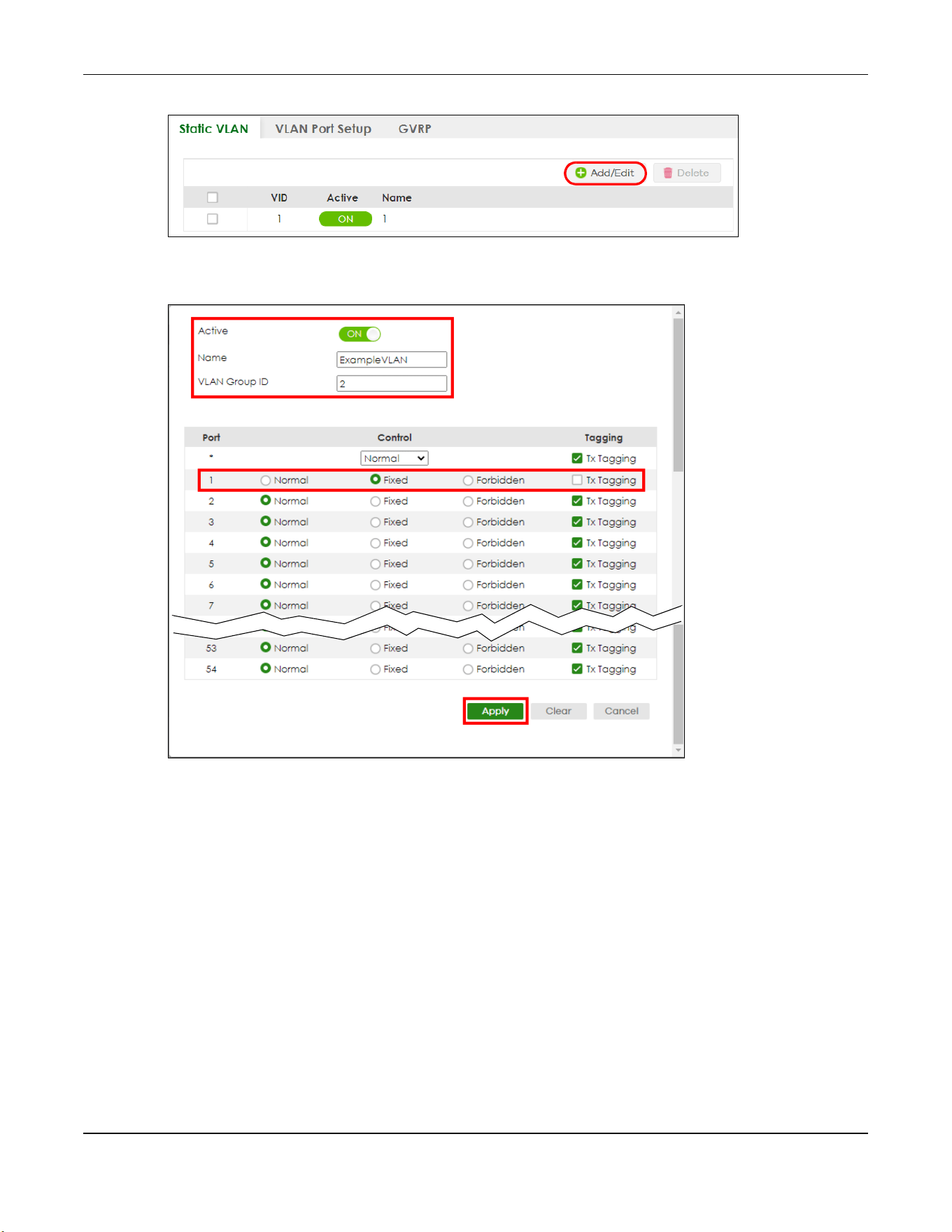
Chapter 5 Initial Setup Example
XMG1915 Series User’s Guide
79
2 The following screen appears. Click the switch to set this VLAN to Active, enter a descriptive name in the
Name field and enter “2” in the VLAN Group ID field for the VLAN2 network.
Note: The VLAN Group ID field in this screen and the VID field in the SYSTEM > IP Setup > IP
Status screen refer to the same VLAN ID.
3 Since the VLAN2 network is connected to port 1 on the Switch, select Fixed to configure port 1 to be a
permanent member of the VLAN only.
4 To ensure that VLAN-unaware devices (such as computers and hubs) can receive frames properly, clear
the Tx Tagging check box to set the Switch to remove VLAN tags before sending.
5 Click Apply to save the settings to the run-time memory. Settings in the run-time memory are lost when
the Switch’s power is turned off.
5.1.2 Set Port VID
Use PVID to add a tag to incoming untagged frames received on that port so that the frames are
forwarded to the VLAN group that the tag defines.
In the example network, configure 2 as the port VID on port 1 so that any untagged frames received on
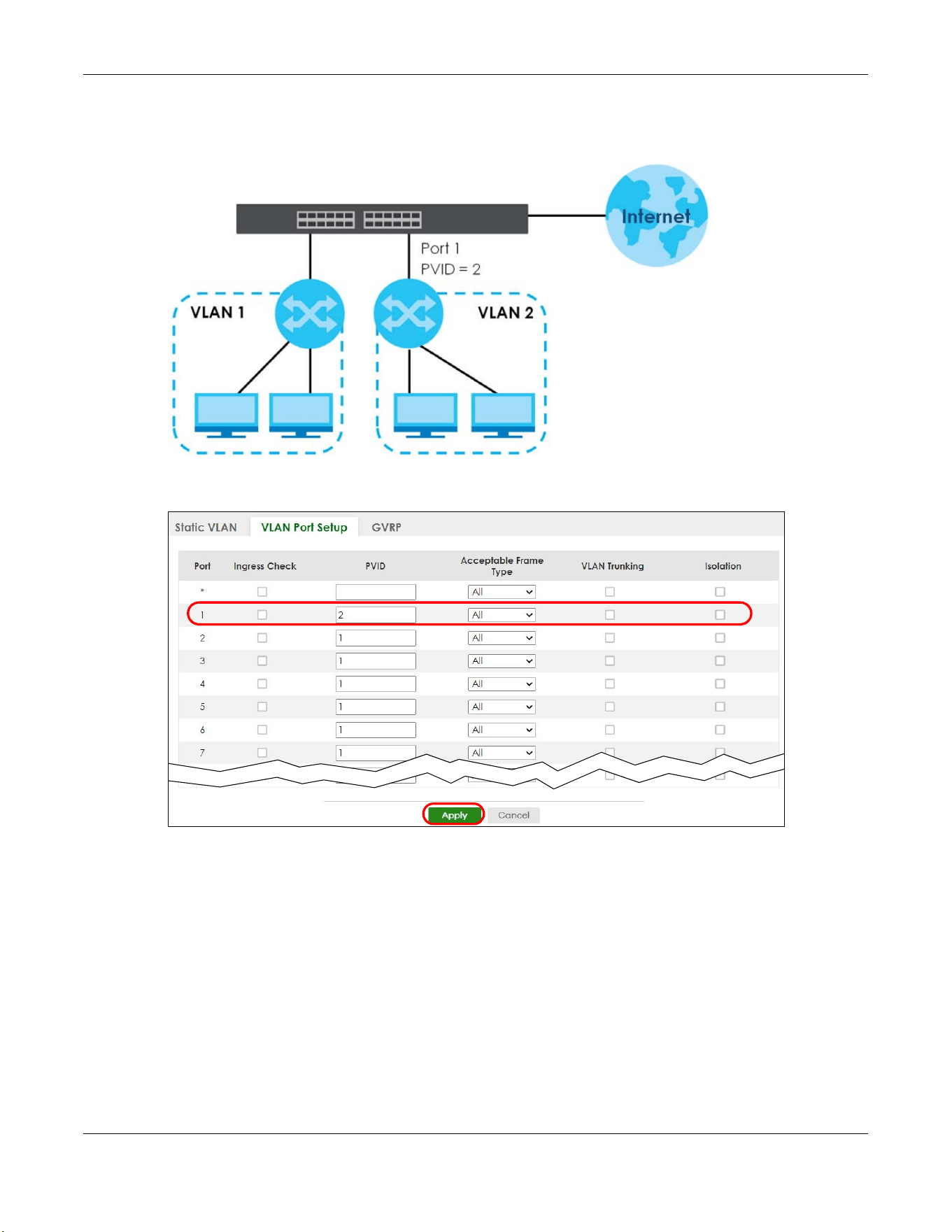
Chapter 5 Initial Setup Example
XMG1915 Series User’s Guide
80
that port get sent to VLAN 2.
Figure 52 Initial Setup Network Example: Port VID
1 Go to the SWITCHING > VLAN > VLAN Setup > VLAN Port Setup screen.
2 Enter 2 in the PVID field for port 1 and click Apply to save your changes back to the run-time memory.
Settings in the run-time memory are lost when the Switch’s power is turned off.
5.1.3 Configure Switch Management IP Address
If the Switch fails to obtain an IP address from a DHCP server, the Switch will use 192.168.1.1 as the
management IP address. You can configure another IP address in a different subnet for management
purposes. The following figure shows an example.
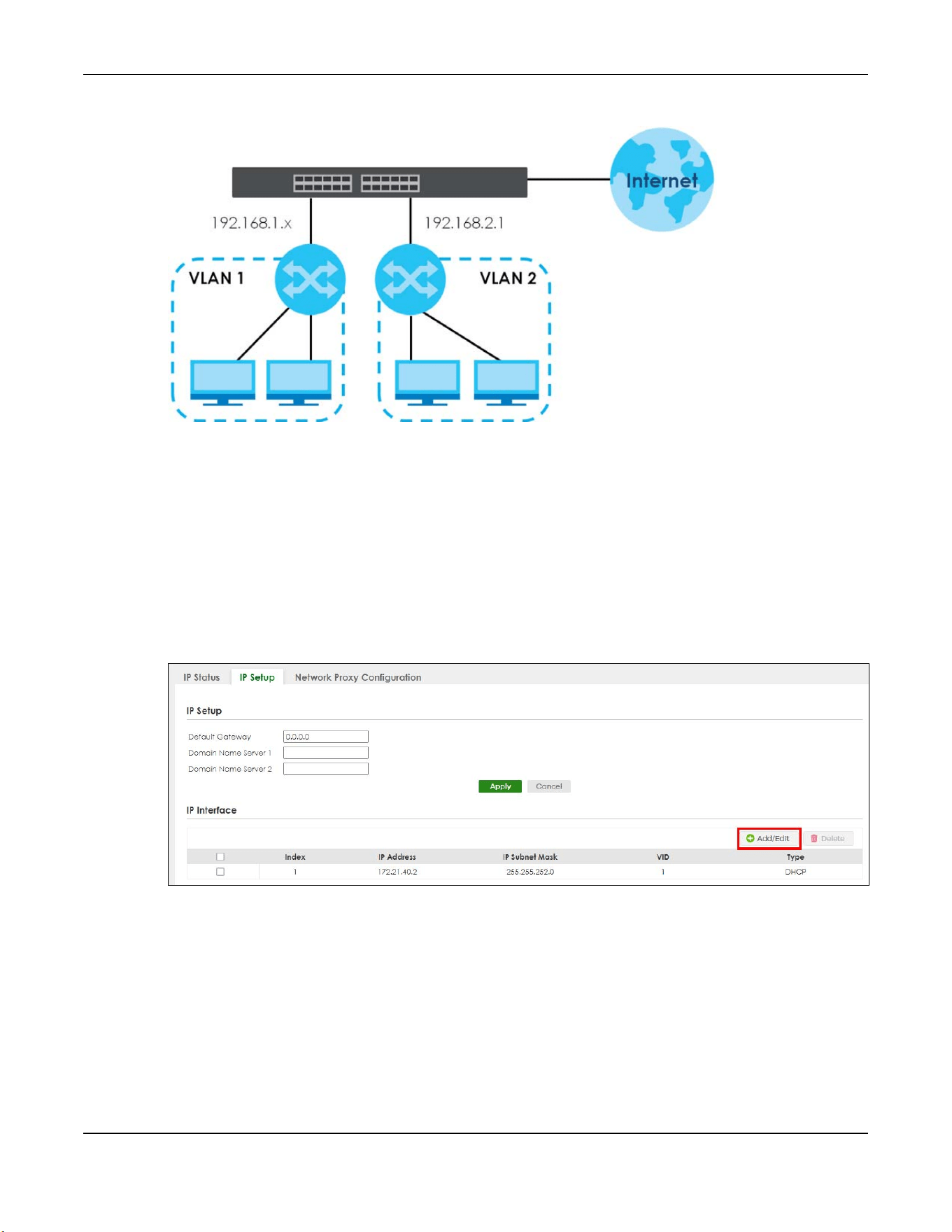
Chapter 5 Initial Setup Example
XMG1915 Series User’s Guide
81
Figure 53 Initial Setup Example: Management IP Address
1 Connect your computer to any Ethernet port on the Switch. Make sure your computer is in the same
subnet as the Switch.
2 Open your web browser and enter “setup.zyxel” or “192.168.1.1” (the default IP address) in the address
bar to access the Web Configurator. See Section 4.2 on page 50 for more information.
Note: You can always use the domain name “setup.zyxel” to access the Web Configurator
whether the Switch is using a DHCP-assigned IP or static IP address. This requires your PC
to be directly connected to the Switch.
3 Go to the SYSTEM > IP Setup > IP Setup screen. Click Add/Edit.
The following screen appears.
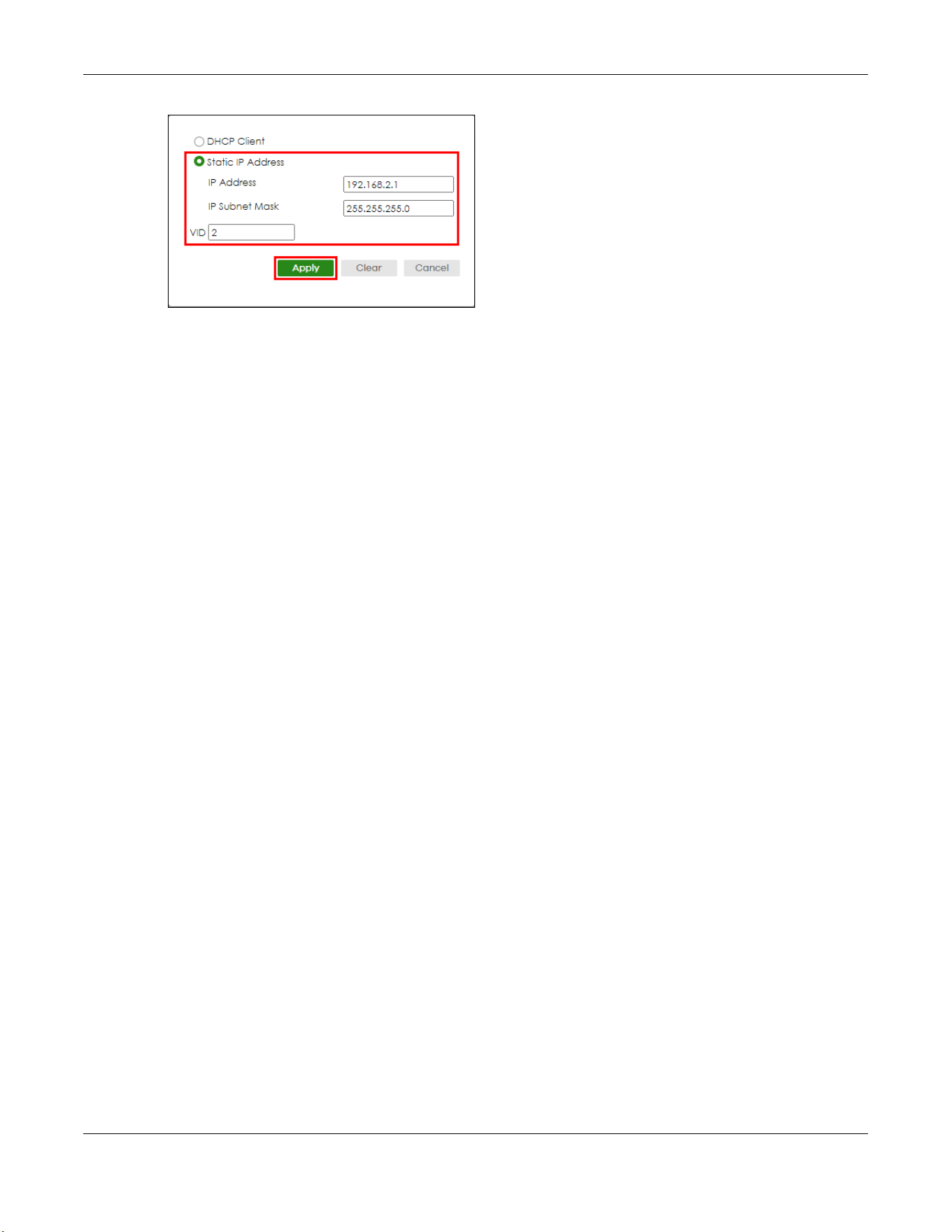
Chapter 5 Initial Setup Example
XMG1915 Series User’s Guide
82
4 For the VLAN2 network, enter 192.168.2.1 as the IP address and 255.255.255.0 as the subnet mask.
5 In the VID field, enter the ID of the VLAN group to which you want this management IP address to
belong. In this example, enter VLAN ID 2. This is the same as the VLAN ID you configure in the Static VLAN
screen.
6 Click Apply to save your changes back to the run-time memory. Settings in the run-time memory are lost
when the Switch’s power is turned off.
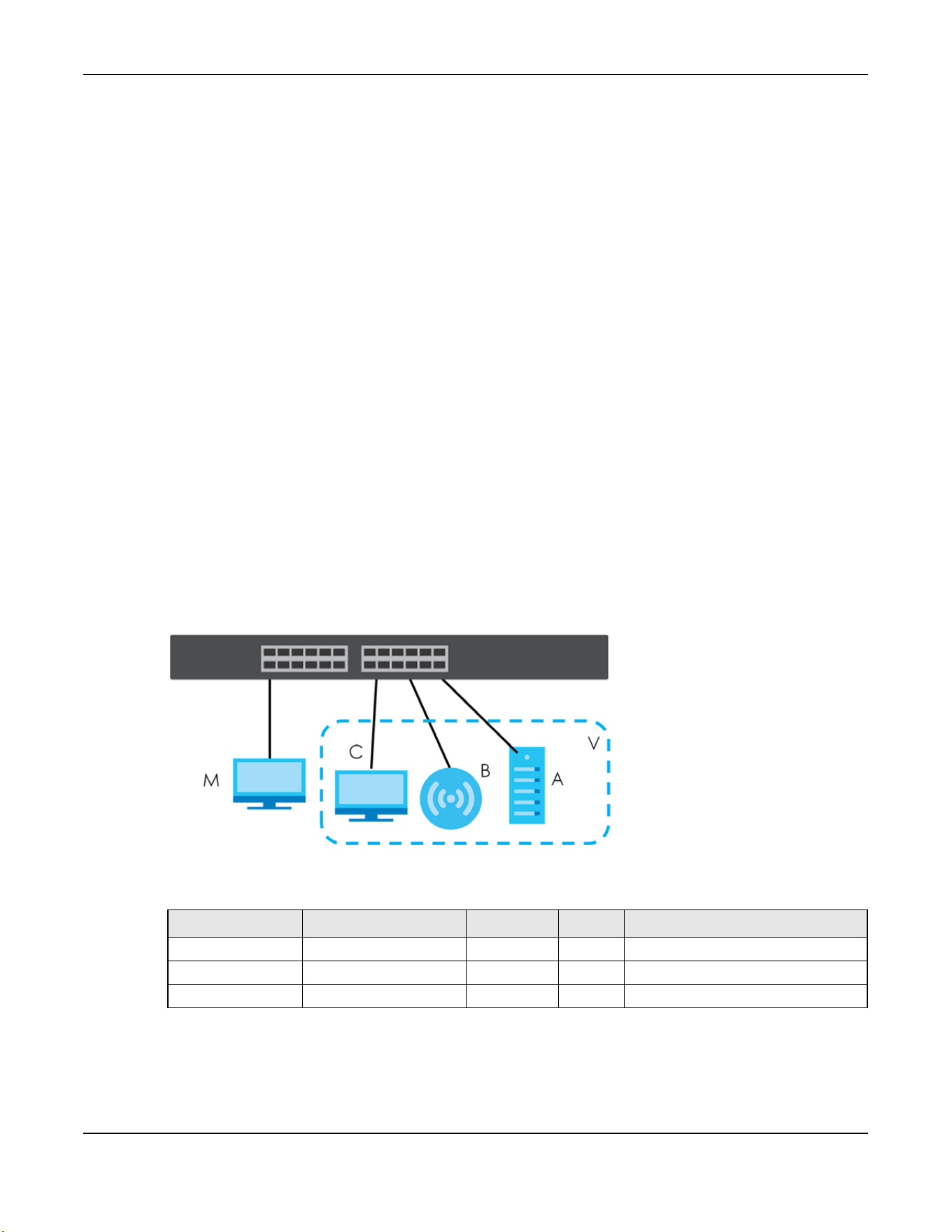
Chapter 6 Tutorials
XMG1915 Series User’s Guide
83
CHAPTER 6
Tutorials
6.1 Overview
This chapter provides some examples of using the Web Configurator to set up and use the Switch. The
tutorials include:
• How to Use DHCPv4 Snooping on the Switch
• How to Use DHCPv4 Relay on the Switch
6.2 How to Use DHCPv4 Snooping on the Switch
You only want DHCP server A connected to port 5 to assign IP addresses to all devices in VLAN network
(V). Create a VLAN containing ports 4, 5 and 6. Connect a computer M to the Switch for management.
Figure 54 Tutorial: DHCP Snooping Tutorial Overview
The settings in this tutorial are as the following.
1 Access the Switch through http://192.168.1.1 by default. Log into the Switch by entering the user name
(default: admin) and password (default: 1234).
2 Go to SWITCHING > VLAN > VLAN Setup > Static VLAN. Click Add/Edit.
Table 22 Tutorial: Settings in this Tutorial
HOST PORT CONNECTED VLAN PVID DHCP SNOOPING PORT TRUSTED
DHCP Server (A) 4 1 and 100 100 Yes
DHCP Client (B) 5 1 and 100 100 No
DHCP Client (C) 6 1 and 100 100 No
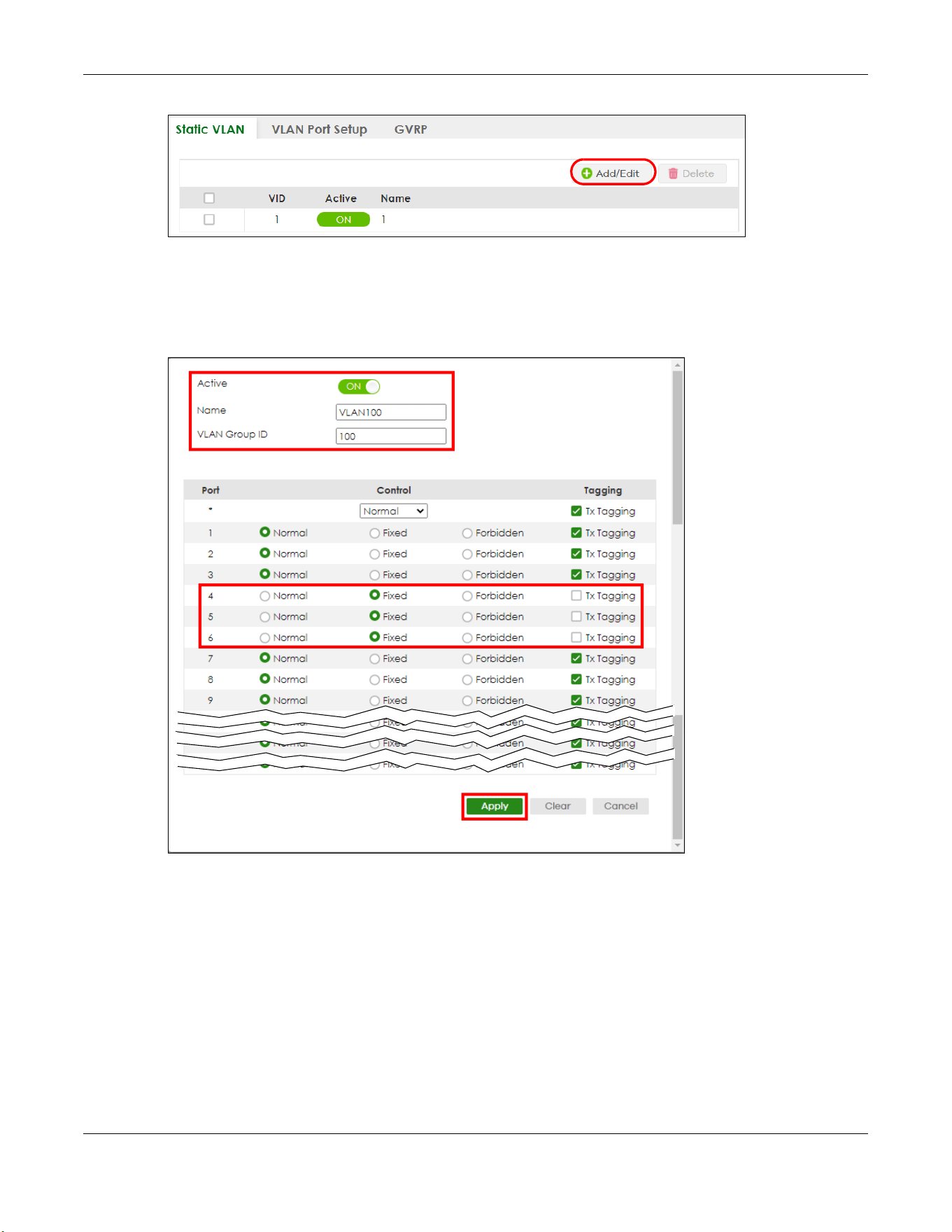
Chapter 6 Tutorials
XMG1915 Series User’s Guide
84
3 The following screen appears. Enable the switch button to set this VLAN to ACTIVE. Create a VLAN with
ID of 100. Add ports 4, 5 and 6 in the VLAN by selecting Fixed in the Control field as shown.
De-select Tx Tagging because you do not want outgoing traffic to contain this VLAN tag.
Click Apply.
4 Go to SWITCHING > VLAN > VLAN Setup > VLAN Port Setup, and set the PVID of the ports 4, 5 and 6 to
100. This tags untagged incoming frames on ports 4, 5 and 6 with the tag 100. Click Apply.
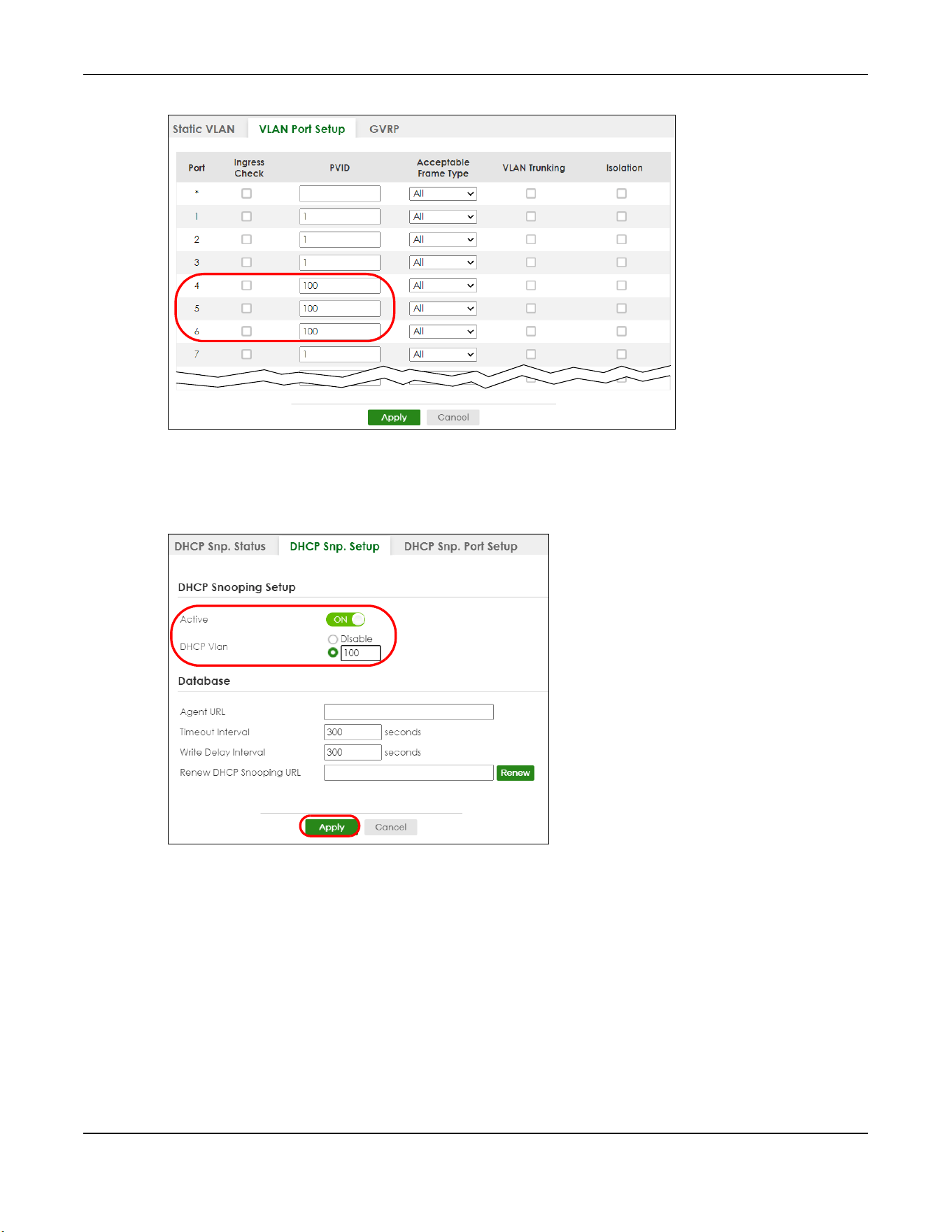
Chapter 6 Tutorials
XMG1915 Series User’s Guide
85
Tutorial: Tag Untagged Frames
5 Go to SECURITY > DHCP Snooping > DHCP Snp. Setup, activate and specify VLAN 100 as the DHCP VLAN
as shown. Click Apply.
IP requests from VLANs you enable on the SECURITY > DHCP Snooping > DHCP Snp. VLAN Setup screen
will be broadcast to the DHCP VLAN you set on this screen, which is VLAN100 in this example.
Tutorial: Specify DH CP VLAN
6 Go to SECURITY > DHCP Snooping > DHCP Snp. Port Setup. Select Trusted in the Server Trusted state field
for port 4 because the DHCP server is connected to port 4. Keep ports 5 and 6 Untrusted because they
are connected to DHCP clients. Click Apply.

Chapter 6 Tutorials
XMG1915 Series User’s Guide
86
7 Go to SECURITY > DHCP Snooping > DHCP Snp. VLAN Setup, show VLAN 100 by entering 100 in the VLAN
Search by VID field and click Search.
Select Yes in the Enabled field of the VLAN 100 entry shown in the search result. Click Apply.
This enables DHCP snooping on VLAN100 (and other VLANs you enabled on this screen).
If you want the Switch to add more information in the DHCP request packets, such as source VLAN ID or
system name, you can select an Option82 Profile in the entry. The Switch will add DHCP option 82
information to DHCP requests that the Switch relays to a DHCP server for the specified VLAN.
8 Connect your DHCP server to port 4 and a DHCP client (an AP, for example) to either port 5 or 6. The AP
should be able to get an IP address from the DHCP server. If you put the DHCP server on port 5 or 6, the
computer will NOT be able to get an IP address.
9 Click Save at the top right of the Web Configurator to save the configuration permanently.
10 To check if DHCP snooping works, go to SECURITY > IPv4 Source Guard > IP Source Guard, you should
see an IP assignment with the type DHCP-Snooping as shown.
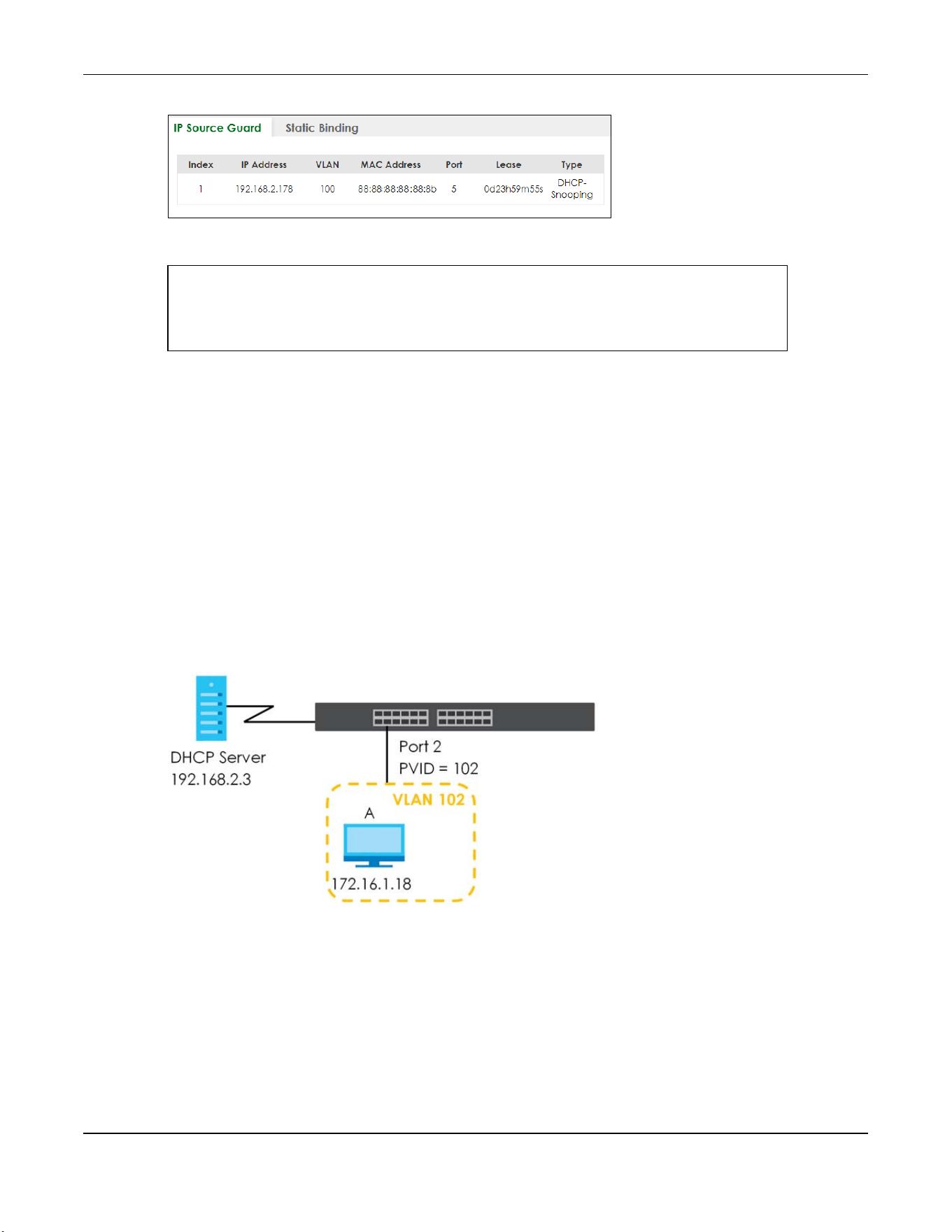
Chapter 6 Tutorials
XMG1915 Series User’s Guide
87
You can also use telnet. Use the command “show dhcp snooping binding” to see the DHCP
snooping binding table as shown next.
6.3 How to Use DHCPv4 Relay on the Switch
This tutorial describes how to configure your Switch to forward DHCP client requests to a specific DHCP
server. The DHCP server can then assign a specific IP address based on the information in the DHCP
requests.
6.3.1 DHCP Relay Tutorial Introduction
In this example, you have configured your DHCP server (192.168.2.3) and want to have it assign a
specific IP address (say 172.16.1.18) to DHCP client A based on the system name, VLAN ID and port
number in the DHCP request. Client A connects to the Switch’s port 2 in VLAN 102.
Figure 55 Tutorial: DHCP Relay Scenario
6.3.2 Create a VLAN
Follow the steps below to configure port 2 as a member of VLAN 102.
1 Access the Web Configurator through the Switch’s management port.
2 Go to SYSTEM > Switch Setup and set the VLAN Type to 802.1Q. Click Apply to save the settings to the
run-time memory.
sysname# show dhcp snooping binding
MacAddress IpAddress Lease Type VLAN Port
----------------- --------------- ------------ ------------- ---- -----
88:88:88:88:88:8b 192.168.2.178 0d23h59m20s dhcp-snooping 100 5
Total number of bindings: 1
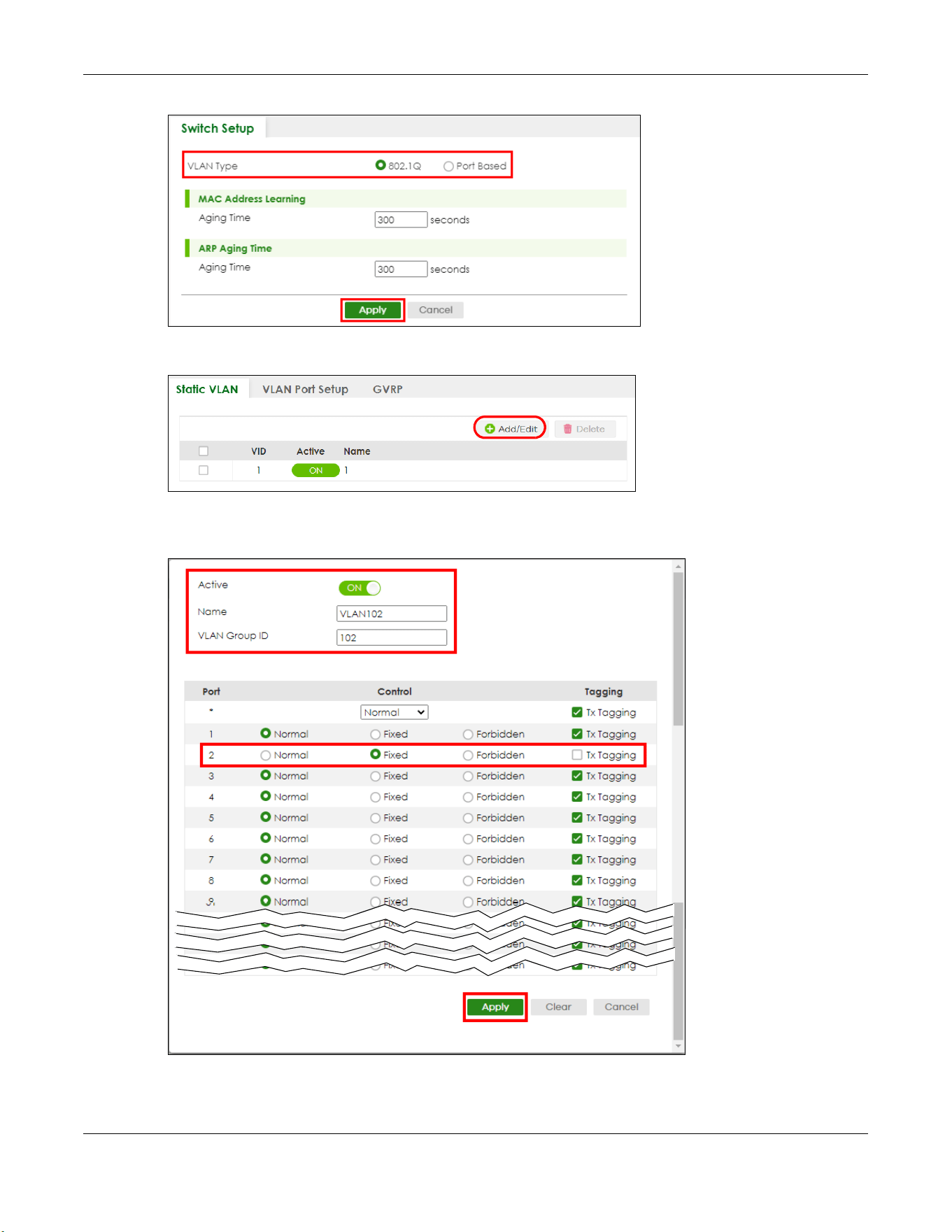
Chapter 6 Tutorials
XMG1915 Series User’s Guide
88
3 Go to SWITCHING > VLAN > VLAN Setup > Static VLAN. Click Add/Edit.
4 The following screen appears. Enable the switch button to set this VLAN to Active. Enter a descriptive
name (VLAN 102 for example) in the Name field and enter “102” in the VLAN Group ID field.
5 Set port 2 to be a permanent member of this VLAN by selecting Fixed in the Control field.
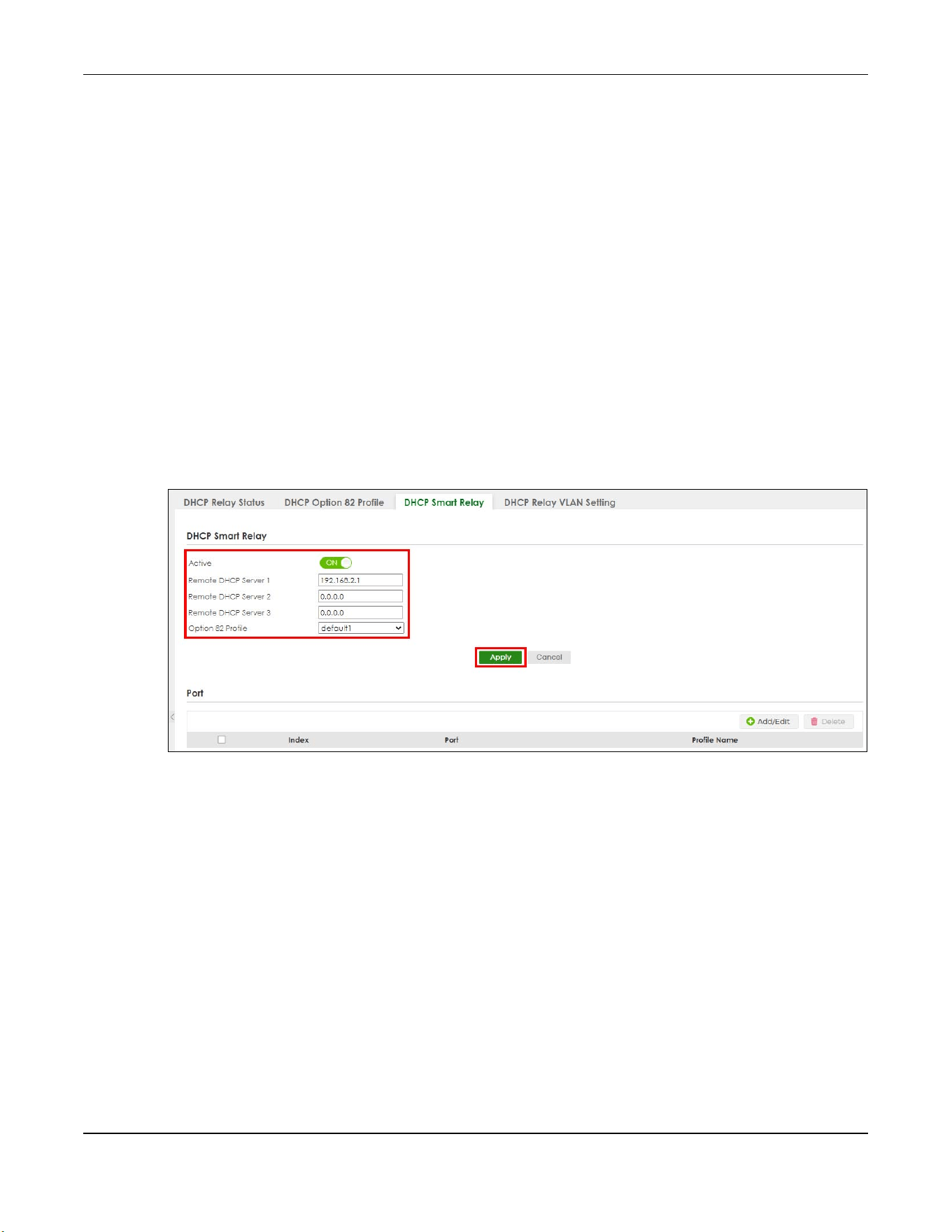
Chapter 6 Tutorials
XMG1915 Series User’s Guide
89
6 Clear the Tx Tagging check box to set the Switch to remove VLAN tags before sending.
7 Click Apply to save the settings to the run-time memory. Settings in the run-time memory are lost when
the Switch’s power is turned off.
8 Go to VLAN > VLAN Setup >VLAN Port Setup. Enter “102” in the PVID field for port 2 to add a tag to
incoming untagged frames received on that port so that the frames are forwarded to the VLAN group
that the tag defines.
9 Click Apply to save your changes back to the run-time memory.
10 Click the Save link in the upper right of the Web Configurator to save your configuration permanently.
6.3.3 Configure DHCPv4 Relay
Follow the steps below to enable DHCP relay on the Switch and allow the Switch to add relay agent
information (such as the VLAN ID) to DHCP requests.
1 Click NETWORKING > DHCP > DHCPv4 Relay > DHCP Smart Relay. Enable the Active switch button.
2 Enter the DHCP server’s IP address (192.168.2.3 in this example) in the Remote DHCP Server 1 field.
3 Select default1 or default2 in the Option 82 Profile field.
4 Click Apply to save your changes back to the run-time memory.
5 Click the Save link in the upper right of the Web Configurator to save your configuration permanently.
6 The DHCP server can then assign a specific IP address based on the DHCP request.
6.3.4 Troubleshooting
Check client A’s IP address. If it did not receive the IP address 172.16.1.18, make sure:
1 Client A is connected to the Switch’s port 2 in VLAN 102.
2 You configured the correct VLAN ID, port number and system name for DHCP relay on both the DHCP
server and the Switch.

Chapter 6 Tutorials
XMG1915 Series User’s Guide
90
3 You clicked the Save link on the Switch to have your settings take effect.

XMG1915 Series User’s Guide
91
CHAPTER 7
DASHBOARD
This chapter gives a quick introduction on the DASHBOARD screen.
The DASHBOARD screen automatically appears after you log into the Web Configurator.
7.1 New User Interface
With ZyNOS 4.80 and later, the Web Configurator’s user interface is restructured. In the new DASHBOARD
screen, you can easily monitor the system status with the following tools (see DASHBOARD for more
information):
• Visualized Port Status section with clickable port icons that provide information of that port, an ON/
OFF switch button to enable/disable the port, and a Power Cycle button to turn the power off to the
PoE port and then back on again (see Port Status).
• Visualized Cloud Control Status section that displays the NCC connection status using three
connection-stage circles.
• Clickable hardware status monitoring sections that directly link to the MONITOR > System Information
screen.
•Editable Quick Link section which provides shortcuts to configuration screens that you might
frequently use (See Quick Links to Use).
•A Search tool on the upper right of the screen that you can use to search for the configuration
screens you want to access (see Web Configurator Layout).
The left navigation panel is also restructured into task-based UI. You can display the sub-menu in the
MONITOR, SYSTEM, PORT, SWITCHING, NETWORKING, SECURITY, or the MAINTENANCE section by clicking
their icons. See Web Configurator Layout for more information.
Find the latest release note in: Download Library on www.zyxel.com.
7.2 DASHBOARD
This screen displays general device information, system status, system resource usage, and port status.
This guide uses XMG1915-18EP screens as an example. The screens may vary slightly for different models.
Click DASHBOARD in the navigation panel to open the following screen.
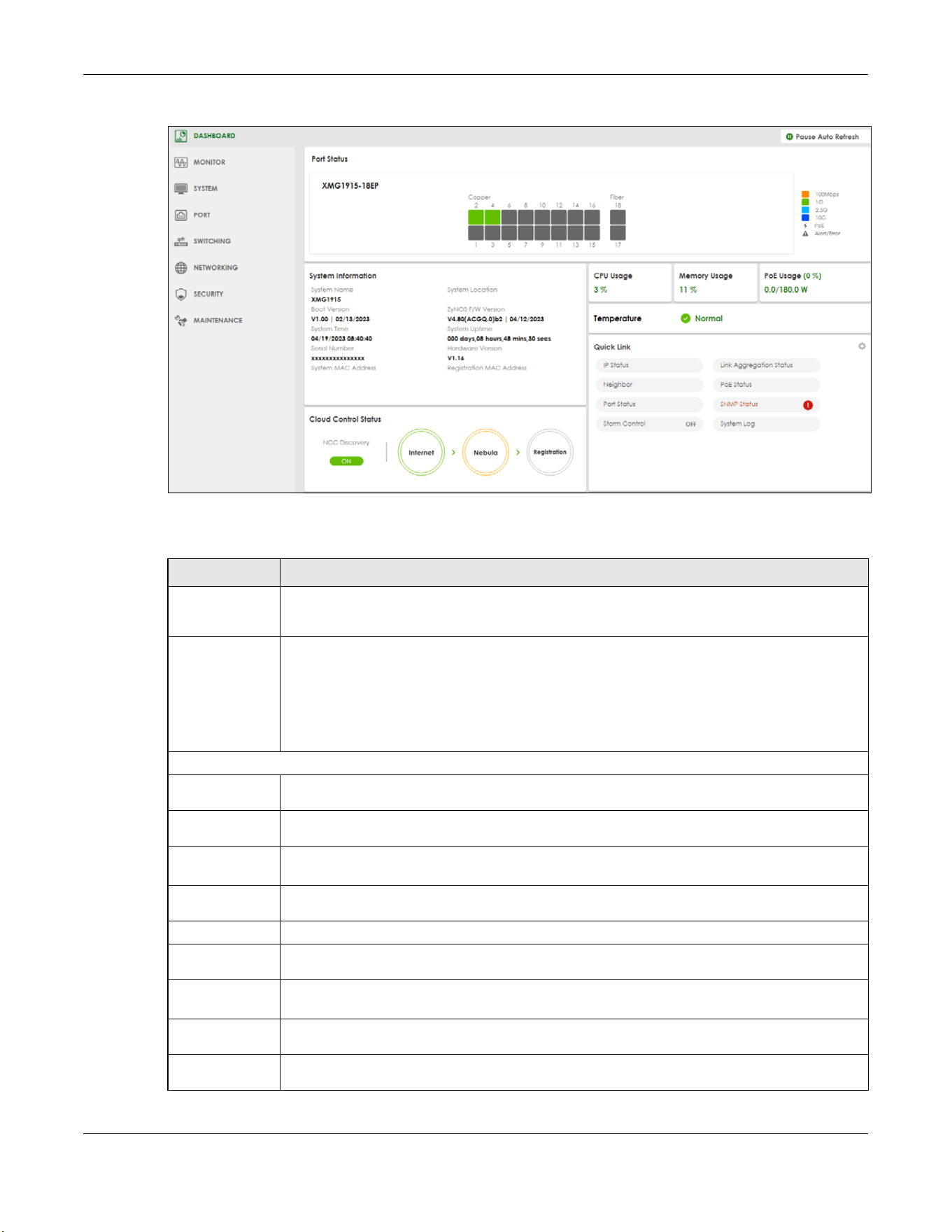
Chapter 7 DASHBOARD
XMG1915 Series User’s Guide
92
Figure 56 DASHBOARD (example PoE model)
The following table describes the labels in this screen.
Table 23 DASHBOARD
LABEL DESCRIPTION
Pause Auto
Refresh
The DASHBOARD screen automatically refreshes every 30 seconds.
Click this to disable the auto refresh. Click Resume Auto Refresh to enable.
Port Status This displays individual port type, status, and connection speed of the Switch.
Click on a port to open the port’s status panel. Use the status panel to enable/disable a port,
power cycle a PoE port, and view its basic information. For example, link speed and port
utilization.
Note: The port status may vary for non-PoE and PoE models.
System Information
System
Name
This field displays the name used to identify the Switch on any network.
System
Location
This field displays the geographic location name you set for the Switch.
Boot Version This field displays the version number and date of the boot module that is currently on the
Switch.
ZyNOS F/W
Version
This field displays the version number and date of the firmware the Switch is currently running.
System Time This field displays the current date and time in the UAG. The format is mm/dd/yyyy hh:mm:ss.
System
Uptime
This field displays how long the Switch has been running since it last restarted or was turned on.
Serial
Number
This field displays the serial number of this Switch. The serial number is used for device tracking
and control.
Hardware
Version
This field displays the hardware version of the Switch.
System MAC
Address
This field displays the MAC address of the Switch.

Chapter 7 DASHBOARD
XMG1915 Series User’s Guide
93
Registration
MAC
Address
This is the MAC address reserved for NCC registration. Use this MAC address to register the Switch
on NCC.
Cloud Control
Status
This field displays:
• The Switch Internet connection status.
• The connection status between the Switch and NCC.
• The Switch registration status on NCC.
Mouse over the circles to display detailed information.
To pass your Switch management to NCC, first make sure your Switch is connected to the
Internet. Then go to NCC and register your Switch.
Click Cloud Control Status or the switch button to go to the SYSTEM > Cloud Management
screen. You can enable/disable NCC Discovery or view the NCC connection status in the Cloud
Management screen.
1. Internet
Green – The Switch is connected to the Internet.
Orange – The Switch is not connected to the Internet.
2. Nebula
Green – The Switch is connected to NCC.
Orange – The Switch is not connected to NCC.
3. Registration
Green – The Switch is registered on NCC.
Gray – The Switch is not registered on NCC.
Note: All circles will gray out if you disable Nebula Discovery.
Note: If a circle displays orange or gray, hover the mouse over the circle to check the
diagnostic message.
NCC
Discovery
This displays if NCC discovery is enabled on the Switch. The Switch will connect to NCC and
change to the NCC management mode if it:
• is connected to the Internet.
• has been registered on NCC.
CPU Usage This displays the current CPU usage percentage.
Click to go to the MONITOR > System Information screen to check the detailed information.
Memory Usage This displays the current RAM usage percentage.
Click to go to the MONITOR > System Information screen to check the detailed information.
PoE Usage For PoE models.
This field displays the amount of power the Switch is currently supplying to the connected PoE-
enabled devices and the total power the Switch can provide to the connected PDs. It also
shows the percentage of PoE power usage.
When PoE usage reaches 100%, the Switch will shut down PDs one-by-one according to the PD
priority which you configured in PORT > PoE Setup > PoE Setup.
Table 23 DASHBOARD (continued)
LABEL DESCRIPTION
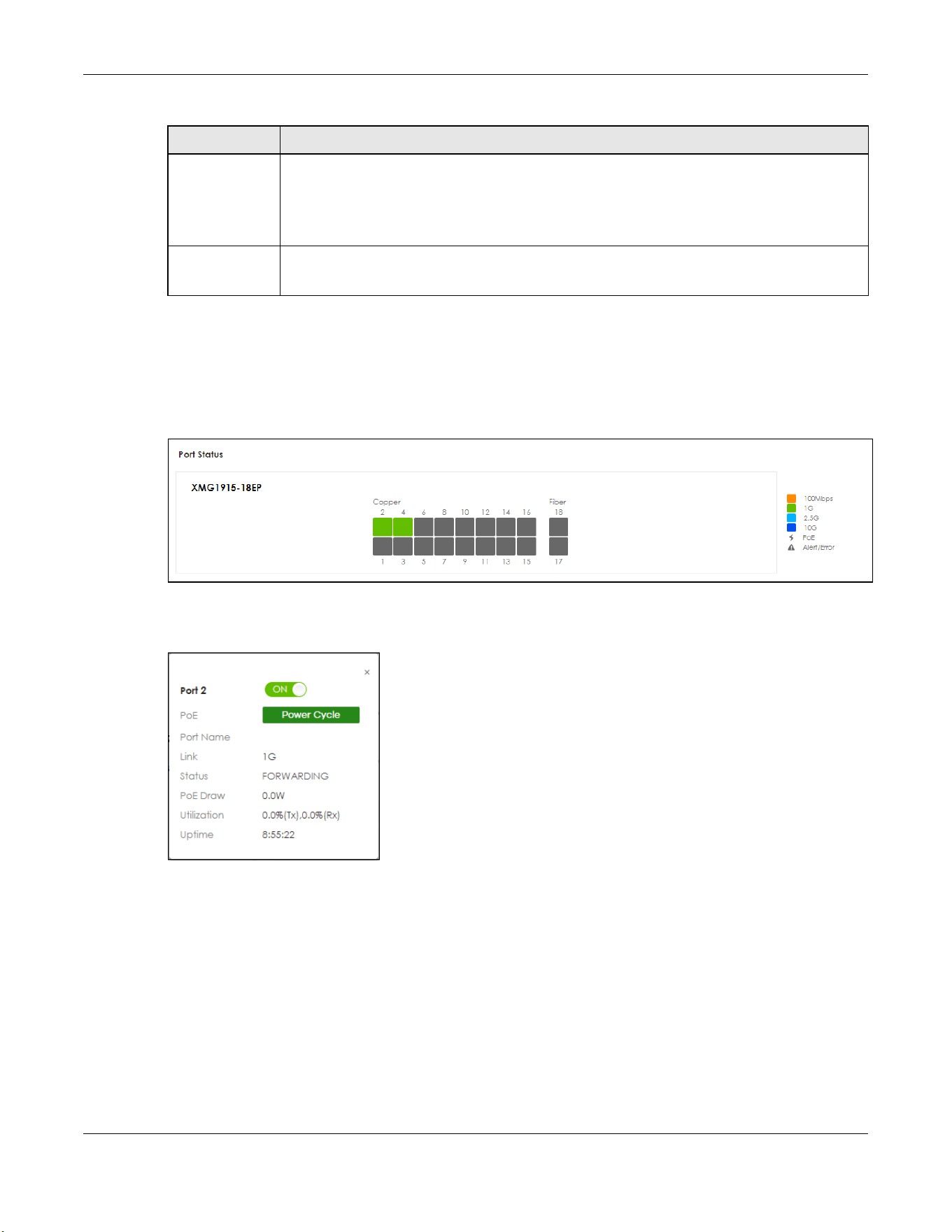
Chapter 7 DASHBOARD
XMG1915 Series User’s Guide
94
7.2.1 Port Status
The Port Status section provides visualized port status for monitoring. Each port displays a status color
determined by the their link speed.
Figure 57 Port Status (example PoE model)
Click on a port to display a port’s status pane.
Figure 58 Port details Pane (example PoE model)
The port details pane includes the Power Cycle button for PoE models (turn the power off and then
back on again), displays information such as link speed, status, PoE draw (for PoE models), port
utilization, up time and has an ON/OFF switch button. Click the switch button to enable/disable the port.
7.2.2 Quick Links to Use
The quick links in the Quick Link section provide shortcuts to specific configuration screens. You can use
the quick links to directly access the screens that you would frequently use. You can also decide which
quick links to be put on the DASHBOARD screen using the Edit button.
Temperature The Switch has temperature sensors that are capable of detecting and reporting if the
temperature rises above the threshold.
This displays the Switch’s current device temperature level.
Click to go to the MONITOR > System Information screen to check the detailed information.
Quick Link This section provides shortcut links to specific configuration screens.
Click the edit button to choose the quick links to show.
Table 23 DASHBOARD (continued)
LABEL DESCRIPTION
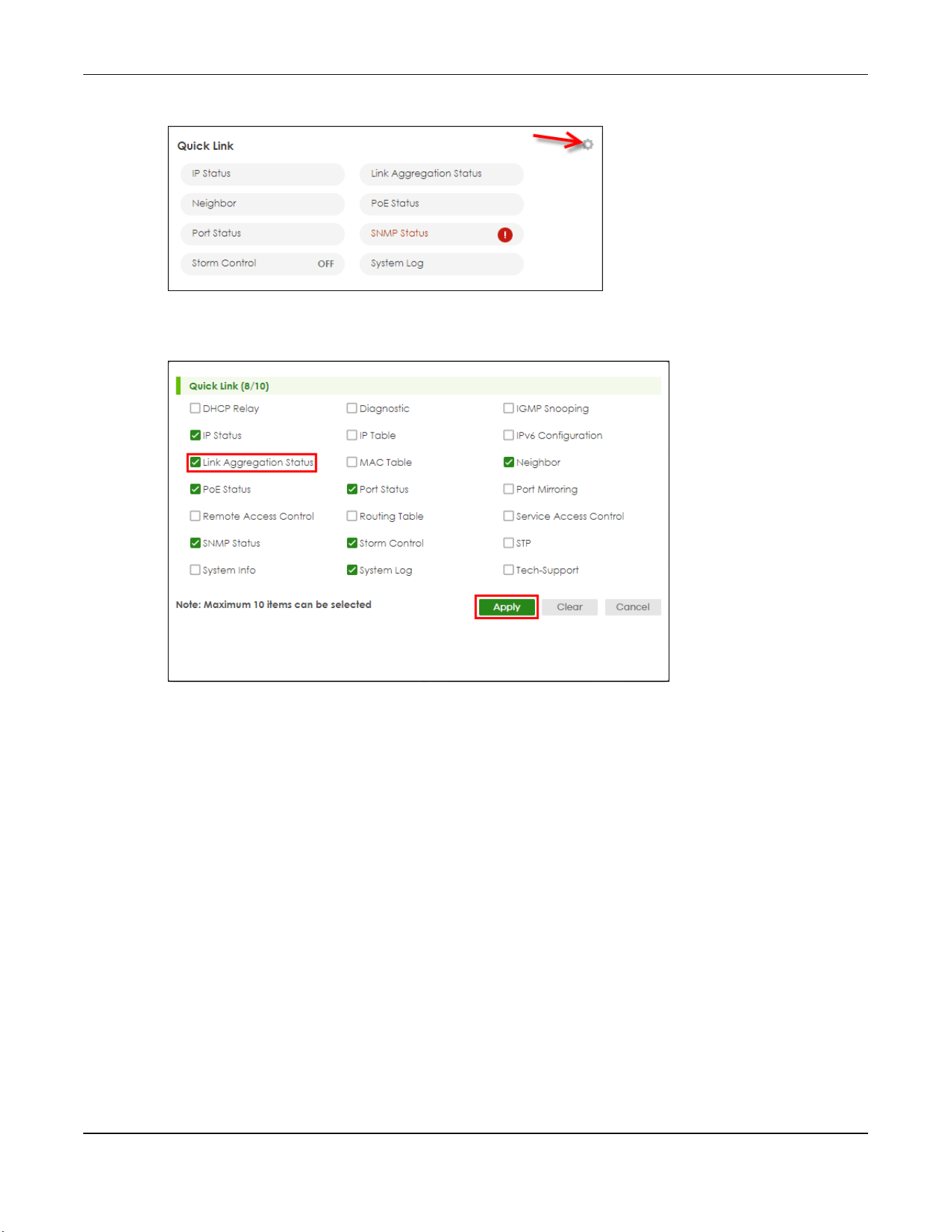
Chapter 7 DASHBOARD
XMG1915 Series User’s Guide
95
Figure 59 Quick Links (example PoE model)
The setup panel displays after you click the Edit button.
Figure 60 Quick Link Selection (example PoE model)
Select the quick links you want and click Apply. The selected quick links will be displayed in the Quick
Link section on the DASHBOARD screen.

Chapter 8 MONITOR
XMG1915 Series User’s Guide
96
CHAPTER 8
MONITOR
The following chapters introduces the configurations of the links under the MONITOR navigation panel.
Quick links to chapters:
• ARP Table
• IP Table
• IPv6 Neighbor Table
• MAC Table
• Neighbor
• Path MTU Table
• Port Status
• Routing Table
• System Information
• System Log

Chapter 9 ARP Table
XMG1915 Series User’s Guide
97
CHAPTER 9
ARP Table
9.1 ARP Table Overview
This chapter introduces the ARP Table.
Address Resolution Protocol (ARP) is a protocol for mapping an Internet Protocol address (IP address) to
a physical machine address, also known as a Media Access Control or MAC address, on the local area
network.
An IP (version 4) address is 32 bits long. In an Ethernet LAN, MAC addresses are 48 bits long. The ARP
Table maintains an association between each MAC address and its corresponding IP address.
9.1.1 What You Can Do
Use the ARP Table screen (Section 9.2 on page 97) to view IP-to-MAC address mappings.
9.1.2 What You Need to Know
When an incoming packet destined for a host device on a local area network arrives at the Switch, the
Switch's ARP program looks in the ARP Table and if it finds the address, it sends it to the device.
If no entry is found for the IP address, ARP broadcasts the request to all the devices on the LAN. The
Switch fills in its own MAC and IP address in the sender address fields, and puts the known IP address of
the target in the target IP address field. In addition, the Switch puts all ones in the target MAC field
(FF.FF.FF.FF.FF.FF is the Ethernet broadcast address). The replying device (which is either the IP address of
the device being sought or the router that knows the way) replaces the broadcast address with the
target's MAC address, swaps the sender and target pairs, and unicasts the answer directly back to the
requesting machine. ARP updates the ARP Table for future reference and then sends the packet to the
MAC address that replied.
9.2 Viewing the ARP Table
Use the ARP table to view IP-to-MAC address mappings and remove specific dynamic ARP entries.
Click MONITOR > ARP Table in the navigation panel to open the following screen.
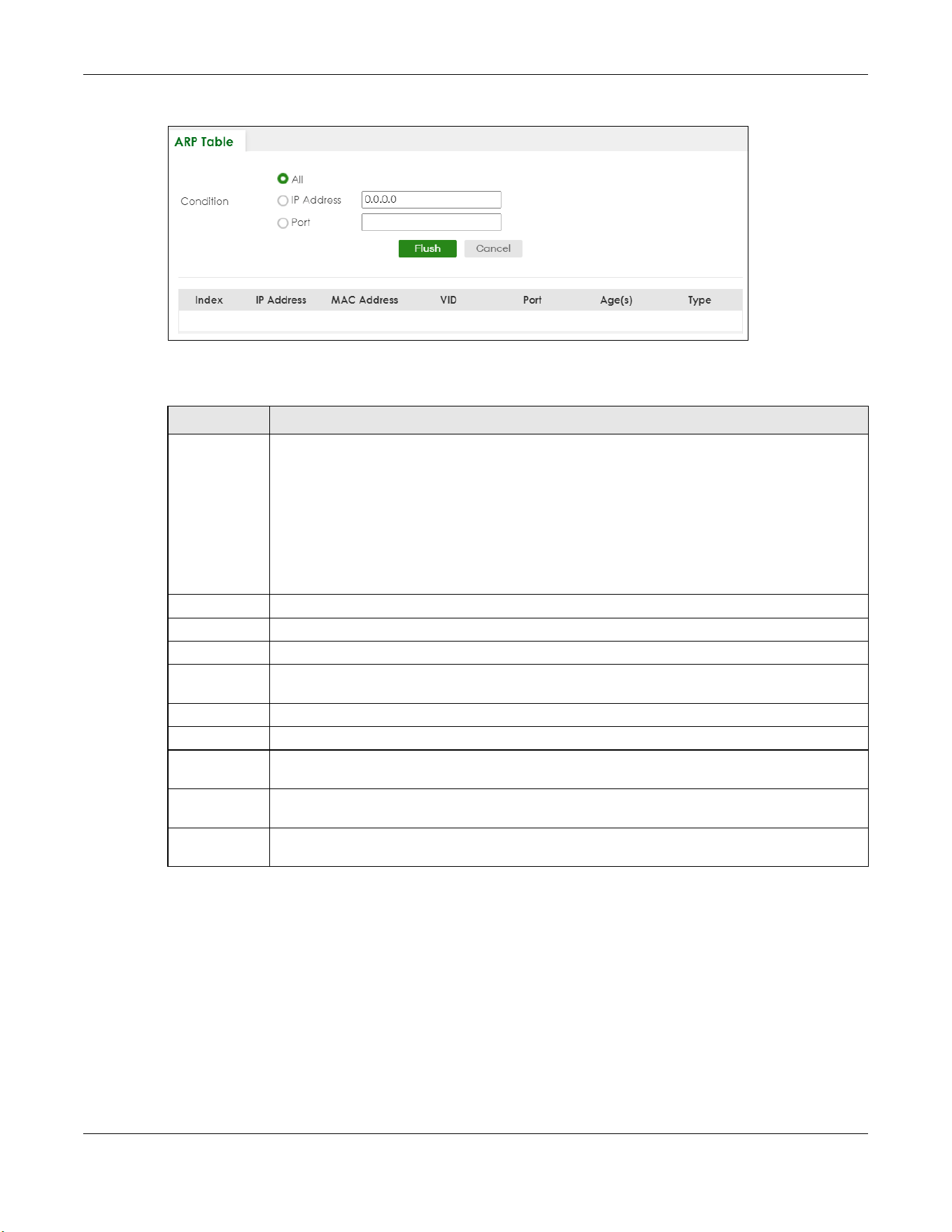
Chapter 9 ARP Table
XMG1915 Series User’s Guide
98
Figure 61 MONITOR > ARP Table
The following table describes the labels in this screen.
Table 24 MONITOR > ARP Table
LABEL DESCRIPTION
Condition Specify how you want the Switch to remove ARP entries when you click Flush.
Select All to remove all of the dynamic entries from the ARP table.
Select IP Address and enter an IP address to remove the dynamic entries learned with the
specified IP address.
Select Port and enter a port number to remove the dynamic entries learned on the specified port.
You can enter multiple ports separated by (no space) comma (,) or hyphen (-) for a range. For
example, enter “3-5” for ports 3, 4, and 5. Enter “3,5,7” for ports 3, 5, and 7.
Flush Click Flush to remove the ARP entries according to the condition you specified.
Cancel Click Cancel to return the fields to the factory defaults.
Index This is the ARP table entry number.
IP Address This is the IP address of a device connected to a Switch port with the corresponding MAC address
below.
MAC Address This is the MAC address of the device with the corresponding IP address above.
VID This field displays the VLAN to which the device belongs.
Port This field displays the port to which the device connects. CPU means this IP address is the Switch’s
management IP address.
Age(s) This field displays how long (in seconds) an entry can still remain in the ARP table before it ages out
and needs to be relearned. This shows 0 for a static entry.
Type This shows whether the IP address is dynamic (learned by the Switch) or static (manually
configured in SYSTEM > IP Setup > IP Setup or NETWORKING > ARP Setup > Static ARP).

Chapter 10 IP Table
XMG1915 Series User’s Guide
99
CHAPTER 10
IP Table
This chapter introduces the IP table screen.
10.1 IP Table Overview
The IP Table screen shows how packets are forwarded or filtered across the Switch’s ports. When a
device (which may belong to a VLAN group) sends a packet which is forwarded to a port on the Switch,
the IP address of the device is shown on the Switch’s IP Table. The IP Table also shows whether the IP
address is dynamic (learned by the Switch) or static (belonging to the Switch).
The Switch uses the IP Table to determine how to forward packets. See the following figure.
1 The Switch examines a received packet and learns the port from which this source IP address came.
2 The Switch checks to see if the packet's destination IP address matches a source IP address already
learned in the IP Table.
• If the Switch has already learned the port for this IP address, then it forwards the packet to that
port.
• If the Switch has not already learned the port for this IP address, then the packet is flooded to all
ports. Too much port flooding leads to network congestion then the Switch sends an ARP to request
the MAC address. The Switch then learns the port that replies with the MAC address.
• If the Switch has already learned the port for this IP address, but the destination port is the same as
the port it came in on, then it filters the packet.
Figure 62 IP Table Flowchart
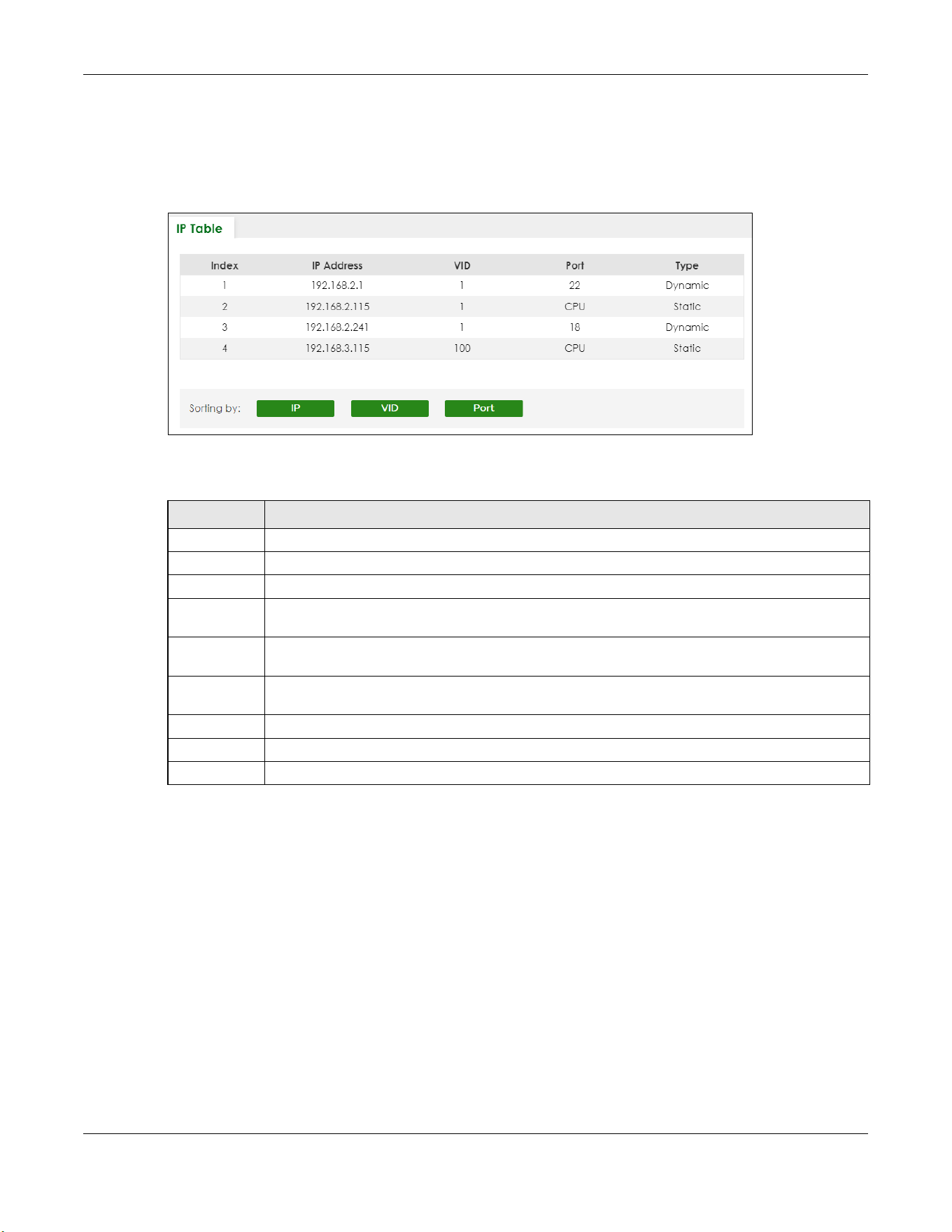
Chapter 10 IP Table
XMG1915 Series User’s Guide
100
10.2 Viewing the IP Table
Click MONITOR > IP Table in the navigation panel to display the following screen.
Figure 63 MONITOR > IP Table
The following table describes the labels in this screen.
Table 25 MONITOR > IP Table
LABEL DESCRIPTION
Index This field displays the index number.
IP Address This is the IP address of the device from which the incoming packets came.
VID This is the VLAN group to which the packet belongs.
Port This is the port from which the above IP address was learned. This field displays CPU to indicate the
IP address belongs to the Switch.
Type This shows whether the IP address is Dynamic (learned by the Switch) or Static (belonging to the
Switch).
Sorting by Click one of the following buttons to display and arrange the data according to that button type.
The result is then displayed in the IP table.
IP Click this button to display and arrange the data according to IP address.
VID Click this button to display and arrange the data according to VLAN group.
Port Click this button to display and arrange the data according to port number.
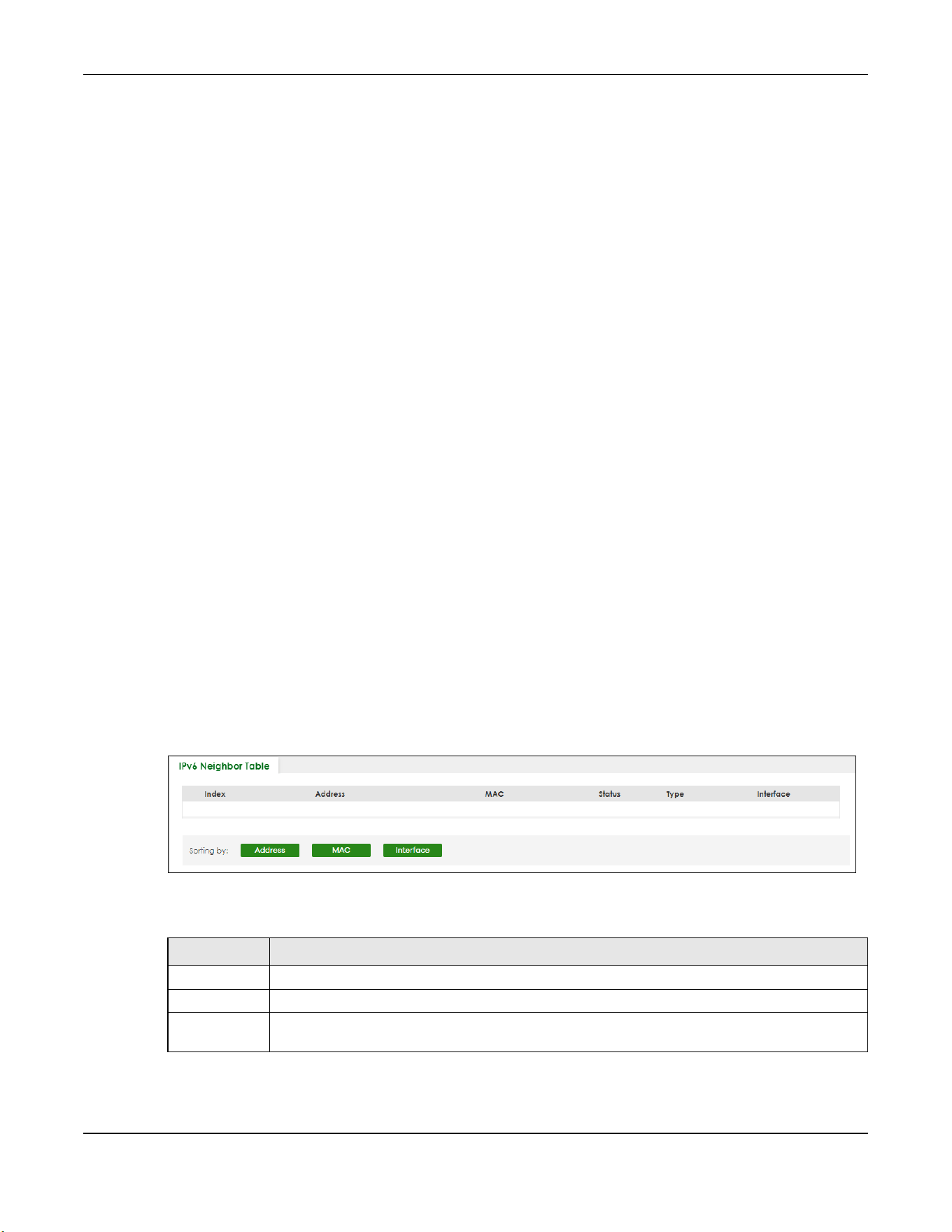
Chapter 11 IPv6 Neighbor Table
XMG1915 Series User’s Guide
101
CHAPTER 11
IPv6 Neighbor Table
11.1 IPv6 Neighbor Table Overview
This chapter introduces the IPv6 neighbor table.
An IPv6 host is required to have a neighbor table. If there is an address to be resolved or verified, the
Switch sends out a neighbor solicitation message. When the Switch receives a neighbor advertisement
in response, it stores the neighbor’s link-layer address in the neighbor table. You can also manually
create a static IPv6 neighbor entry using the SYSTEM > IPv6 > IPv6 Neighbor Setup screen.
When the Switch needs to send a packet, it first consults other table to determine the next hop. Once
the next hop IPv6 address is known, the Switch looks into the neighbor table to get the link-layer address
and sends the packet when the neighbor is reachable. If the Switch cannot find an entry in the
neighbor table or the state for the neighbor is not reachable, it starts the address resolution process. This
helps reduce the number of IPv6 solicitation and advertisement messages.
11.2 Viewing the IPv6 Neighbor Table
Use this screen to view IPv6 neighbor information on the Switch. Click MONITOR > IPv6 Neighbor Table in
the navigation panel to display the screen as shown.
Figure 64 MONITOR > IPv6 Neighbor Table
The following table describes the labels in this screen.
Table 26 MONITOR > IPv6 Neighbor Table
LABEL DESCRIPTION
Index This field displays the index number of each entry in the table.
Address This field displays the IPv6 address of the Switch or a neighboring device.
MAC This field displays the MAC address of the IPv6 interface on which the IPv6 address is configured or
the MAC address of the neighboring device.

Chapter 11 IPv6 Neighbor Table
XMG1915 Series User’s Guide
102
Status This field displays whether the neighbor IPv6 interface is reachable. In IPv6, “reachable” means an
IPv6 packet can be correctly forwarded to a neighbor node (host or router) and the neighbor
can successfully receive and handle the packet. The available options in this field are:
• reachable (R): The interface of the neighboring device is reachable. (The Switch has received
a response to the initial request.)
• stale (S): The last reachable time has expired and the Switch is waiting for a response to
another initial request. The field displays this also when the Switch receives an unrequested
response from the neighbor’s interface.
• delay (D): The neighboring interface is no longer known to be reachable, and traffic has been
sent to the neighbor recently. The Switch delays sending request packets for a short to give
upper-layer protocols a chance to determine reachability.
• probe (P): The Switch is sending request packets and waiting for the neighbor’s response.
• invalid (IV): The neighbor address is with an invalid IPv6 address.
• unknown (?): The status of the neighboring interface cannot be determined for some reason.
• incomplete (I): Address resolution is in progress and the link-layer address of the neighbor has
not yet been determined. The interface of the neighboring device did not give a complete
response.
Type This field displays the type of an address mapping to a neighbor interface. The available options in
this field are:
• other (O): none of the following type.
• local (L): A Switch interface is using the address.
• dynamic (D): The IP address to MAC address can be successfully resolved using IPv6 Neighbor
Discovery protocol. Is it similar as IPv4 ARP (Address Resolution protocol).
• static (S): The interface address is statically configured.
Interface This field displays the ID number of the IPv6 interface on which the IPv6 address is created or
through which the neighboring device can be reached.
Sorting by Click one of the following buttons to display and arrange the data according to that button type.
The result is then displayed in the summary table above.
Address Click this button to display and arrange the data according to IPv6 address.
MAC Click this button to display and arrange the data according to MAC address.
Interface Click this button to display and arrange the data according to IPv6 interface.
Table 26 MONITOR > IPv6 Neighbor Table (continued)
LABEL DESCRIPTION

Chapter 12 MAC Table
XMG1915 Series User’s Guide
103
CHAPTER 12
MAC Table
12.1 MAC Table Overview
This chapter introduces the MAC Table screen.
The MAC Table screen (a MAC table is also known as a filtering database) shows how frames are
forwarded or filtered across the Switch’s ports. It shows what device MAC address, belonging to what
VLAN group (if any) is forwarded to which ports and whether the MAC address is dynamic (learned by
the Switch) or static (manually entered in the SWITCHING > Static MAC Forwarding screen).
12.1.1 What You Can Do
Use the MAC Table screen (Section 12.2 on page 104) to check whether the MAC address is dynamic or
static.
12.1.2 What You Need to Know
The Switch uses the MAC Table to determine how to forward frames. See the following figure.
1 The Switch examines a received frame and learns the port on which this source MAC address came.
2 The Switch checks to see if the frame's destination MAC address matches a source MAC address
already learned in the MAC Table.
• If the Switch has already learned the port for this MAC address, then it forwards the frame to that port.
• If the Switch has not already learned the port for this MAC address, then the frame is flooded to all
ports. Too much port flooding leads to network congestion, then the Switch sends an ARP to request
the MAC address. The Switch then learns the port that replies with the MAC address.
• If the Switch has already learned the port for this MAC address, but the destination port is the same as
the port it came in on, then it filters the frame.

Chapter 12 MAC Table
XMG1915 Series User’s Guide
104
Figure 65 MAC Table Flowchart
12.2 Viewing the MAC Table
Use this screen to search specific MAC addresses. You can also directly add dynamic MAC addresses
into the static MAC forwarding table or MAC filtering table from the MAC table using this screen.
Click MONITOR > MAC Table in the navigation panel to display the following screen.
Figure 66 MONITOR > MAC Table

Chapter 12 MAC Table
XMG1915 Series User’s Guide
105
The following table describes the labels in this screen.
Table 27 MONITOR > MAC Table
LABEL DESCRIPTION
Condition Select one of the below search conditions and click Search to only display the data which
matches the criteria you specified.
Select All to display any entry in the MAC table of the Switch.
Select Static to display the MAC entries manually configured on the Switch.
Select MAC and enter a MAC address in the field provided to display a specified MAC entry.
Select VID and enter a VLAN ID in the field provided to display the MAC entries belonging to the
specified VLAN.
Select Port and enter a port number in the field provided to display the MAC addresses which
are forwarded on the specified port.
Select Trunk and type the ID of a trunk group to display all MAC addresses learned from the ports
in the trunk group.
Sort by Define how the Switch displays and arranges the data in the summary table below.
Select MAC to display and arrange the data according to MAC address.
Select VID to display and arrange the data according to VLAN group.
Select PORT to display and arrange the data according to port number.
Type Transfer Select Dynamic to MAC forwarding and click the Transfer button to change all dynamically
learned MAC address entries in the summary table below into static entries. They also display in
the SWITCHING > Static MAC Forwarding screen.
Select Dynamic to MAC filtering and click the Transfer button to change all dynamically learned
MAC address entries in the summary table below into MAC filtering entries. These entries will then
display only in the SWITCHING > Static MAC Filtering screen and the default filtering action is
Discard source.
Search Click this to search data in the MAC table according to your input criteria.
Transfer Click this to perform the MAC address transferring you selected in the Type Transfer field.
Cancel Click Cancel to change the fields back to their last saved values.
Index This is the incoming frame index number.
MAC Address This is the MAC address of the device from which this incoming frame came.
VID This is the VLAN group to which this frame belongs.
Port This is the port where the above MAC address is forwarded.
Type This shows whether the MAC address is Dynamic (learned by the Switch) or Static (manually
entered in the SWITCHING > Static MAC Forwarding screen).
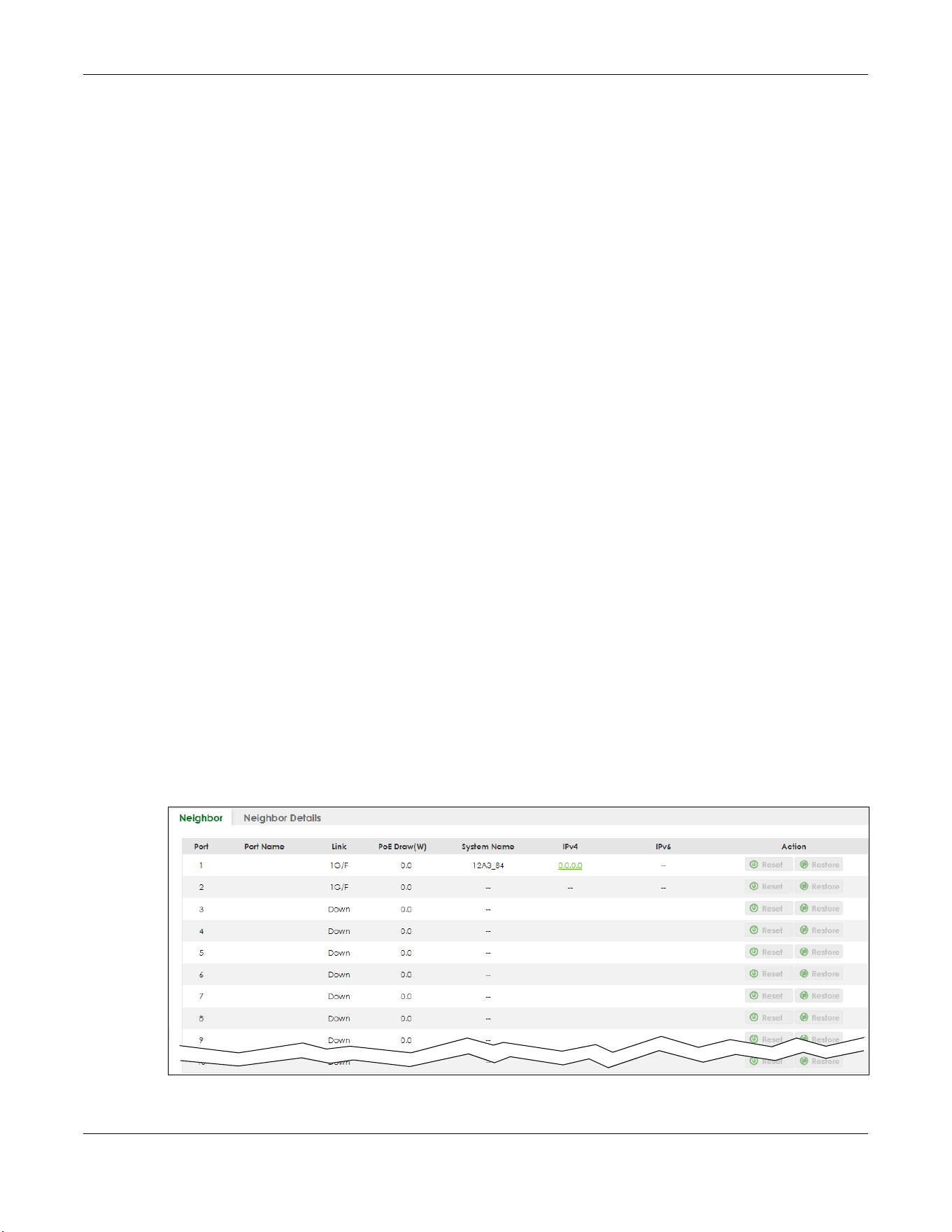
Chapter 13 Neighbor
XMG1915 Series User’s Guide
106
CHAPTER 13
Neighbor
13.1 Neighbor Overview
The Neighbor screen allows you to view a summary and manage the Switch’s neighboring devices. It
uses Layer Link Discovery Protocol (LLDP) to discover all neighbor devices connected to the Switch
including non-Zyxel devices. You can use this screen to perform tasks on the neighboring devices like
login, power cycle (turn the power off and then back on again), and reset to factory default settings.
This screen shows the neighboring device first recognized on an Ethernet port of the Switch. Device
information is displayed in gray when the neighboring device is offline.
13.1.1 What You Can Do
Use the Neighbor screen (Section 13.2 on page 106) to view a summary and manage the Switch’s
neighbor devices.
Use the Neighbor Details screen (Section 13.2.1 on page 107) to view more detailed information on the
Switch’s neighbor devices.
13.2 Neighbor
Click MONITOR > Neighbor to see the following screen.
Figure 67 MONITOR > Neighbor > Neighbor (example PoE model)

Chapter 13 Neighbor
XMG1915 Series User’s Guide
107
The following table describes the fields in the above screen.
13.2.1 Neighbor Details
Use this screen to view detailed information about the neighboring devices. Device information is
displayed in gray when the neighboring device is currently offline.
Up to 10 neighboring device records per Ethernet port can be retained in this screen even when the
devices are offline. When the maximum number of neighboring device records per Ethernet port is
reached, new device records automatically overwrite existing offline device records, starting with the
oldest existing offline device record first.
Click MONITOR > Neighbor > Neighbor Details to see the following screen.
Table 28 MONITOR > Neighbor > Neighbor
LABEL DESCRIPTION
Port This shows the port of the Switch, on which the neighboring device is discovered.
Port Name This shows the port description of the Switch.
Link This shows the speed (either 100M for 100 Mbps, 1G for 1 Gbps, or 2.5G for 2.5 Gbps) and
the duplex (F for full duplex or H for half). This field displays Down if the port is not connected
to any device.
PoE Draw (W) For PoE models.
This shows the consumption that the neighboring device connected to this port draws from
the Switch. This allows you to plan and use within the power budget of the Switch.
System Name This shows the system name of the neighbor device.
IPv4 This shows the IPv4 address of the neighbor device. The IPv4 address is a hyper link that you
can click to log into and manage the neighbor device through its Web Configurator.
IPv6 This shows the IPv6 address of the neighbor device. The IPv6 address is a hyper link that you
can click to log into and manage the neighbor device through its Web Configurator.
Action For PoE models.
Click the Reset button to turn OFF the power of the neighbor device and turn it back ON
again. A count down button (from 5 to 0) starts.
Note: The Switch must support power sourcing (PSE) or the network device is a
powered device (PD).
Click the Restore button to restore the neighboring device to its factory default settings. A
warning message “Are you sure you want to load factory default?” appears prompting you
to confirm the action. After confirming the action a count down button (from 5 to 0) starts.
Note:
• The Switch must support power sourcing (PSE) or the network device is a powered
device (PD).
• If multiple neighbor devices use the same port, the Reset button is not available.
• You can only reset Zyxel powered devices that support the ZON utility.

Chapter 13 Neighbor
XMG1915 Series User’s Guide
108
Figure 68 MONITOR > Neighbor > Neighbor Details (example PoE model)
The following table describes the fields in the above screen.
Table 29 MONITOR > Neighbor > Neighbor Details
LABEL DESCRIPTION
Search Ports... Enter the port number to search and display the ports you specified. The result will display
in the below list.
You can enter multiple ports separated by comma (“,”) or hyphen (“-”) for a range. For
example, enter “3-5” for ports 3, 4, and 5. Enter “3,5,7” for ports 3, 5, and 7.
Port This shows the port of the Switch, on which the neighboring device is discovered.
Desc. This shows the port description of the Switch.
Link Speed This shows the speed (either 100M for 100 Mbps, 1G for 1 Gbps, or 2.5G for 2.5 Gbps) and
the duplex (F for full duplex or H for half). This field displays Down if the port is not
connected to any device.
PoE Draw (W) For PoE models.
This shows the consumption that the neighboring device connected to this port draws
from the Switch. This allows you to plan and use within the power budget of the Switch.
Reset Click this button to turn OFF the power of the neighbor device and turn it back ON again.
A count down button (from 5 to 0) starts.
Note: The Switch must support power sourcing (PSE) or the network device is a
powered device (PD).
Remote
System Name This shows the system name of the neighbor device.
Port Bridge This shows the neighboring device’s MAC address or the port number connected to the
Switch.
Model This shows the model name of the neighbor device. This field will show “–” for devices that
do not support the ZON utility.
MAC This shows the MAC address of the neighbor device.
Firmware This shows the firmware version of the neighbor device. This field will show “–” for devices
that do not support the ZON utility.

Chapter 13 Neighbor
XMG1915 Series User’s Guide
109
Location This shows the geographic location of the neighbor device. This field will show “–” for
devices that do not support the ZON utility.
Desc. This shows the description of the neighbor device’s port which is connected to the
Switch.
IPv4 This shows the IPv4 address of the neighbor device. The IPv4 address is a hyper link that
you can click to log into and manage the neighbor device through its Web Configurator.
IPv6 This shows the IPv6 address of the neighbor device. The IPv6 address is a hyper link that
you can click to log into and manage the neighbor device through its Web Configurator.
Restore Click this button to restore the neighbor device to its factory default settings. A warning
message “Are you sure you want to load factory default?” appears prompting you to
confirm the action. After confirming the action a count down button (from 5 to 0) starts.
Note:
• The Switch must support power sourcing (PSE) or the network device is a powered
device (PD).
• If multiple neighbor devices use the same port, the Reset button is not available.
• You can only reset Zyxel powered devices that support the ZON utility.
Flush Click the Flush button on the port tab to remove information about neighbors learned on
a specific ports.
Flush All Click the Flush All button to remove information about neighbors learned on all ports.
Table 29 MONITOR > Neighbor > Neighbor Details (continued)
LABEL DESCRIPTION

Chapter 14 Path MTU Table
XMG1915 Series User’s Guide
110
CHAPTER 14
Path MTU Table
14.1 Path MTU Overview
This chapter introduces the IPv6 Path MTU table.
The largest size (in bytes) of a packet that can be transferred over a data link is called the Maximum
Transmission Unit (MTU). The Switch uses Path MTU Discovery to discover Path MTU (PMTU), that is, the
minimum link MTU of all the links in a path to the destination. If the Switch receives an ICMPv6 Packet Too
Big error message after sending a packet, it fragments the next packet according to the suggested MTU
in the error message.
14.2 Viewing the Path MTU Table
Use this screen to view IPv6 path MTU information on the Switch. Click MONITOR > Path MTU Table in the
navigation panel to display the screen as shown.
Figure 69 MONITOR > Path MTU Table
The following table describes the labels in this screen.
Table 30 MONITOR > Path MTU Table
LABEL DESCRIPTION
Path MTU
aging time
This field displays how long an entry remains in the Path MTU table before it ages out and needs to
be relearned.
Index This field displays the index number of each entry in the table.
Destination
Address
This field displays the destination IPv6 address of each path or entry.
MTU This field displays the maximum transmission unit of the links in the path.
Expire This field displays how long (in minutes) an entry can still remain in the Path MTU table before it
ages out and needs to be relearned.
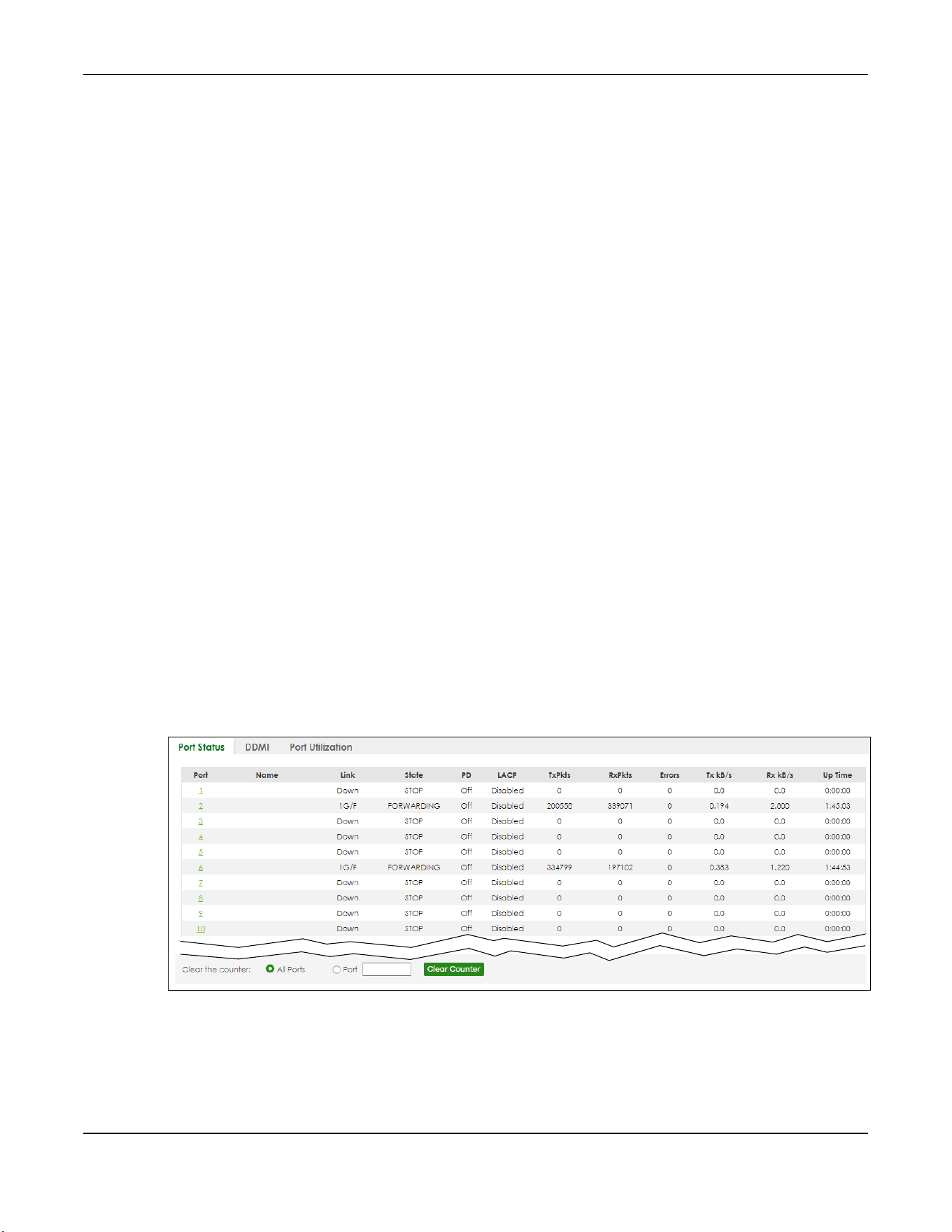
Chapter 15 Port Status
XMG1915 Series User’s Guide
111
CHAPTER 15
Port Status
This chapter introduces the Port Status screens.
15.0.1 What You Can Do
Use the Port Status screen (Section 15.1 on page 111) to view the port status of the Switch.
Use the DDMI screen (Section 15.2 on page 115) to view the DDMI (Digital Diagnostics Monitoring
Interface) status of the SFP transceivers on the Switch.
Use the Port Utilization screen (Section 15.3 on page 117) to view the current data rate and utilization
percentage of each port on the Switch.
15.1 Port Status
This screen displays a port statistical summary with links to each port showing statistical details. To view
the port statistics, click MONITOR > Port Status to display the Port Status screen as shown next. You can
also click the Port Status link in the Quick Link section of the DASHBOARD screen to see the following
screen.
Figure 70 MONITOR > Port Status > Port Status
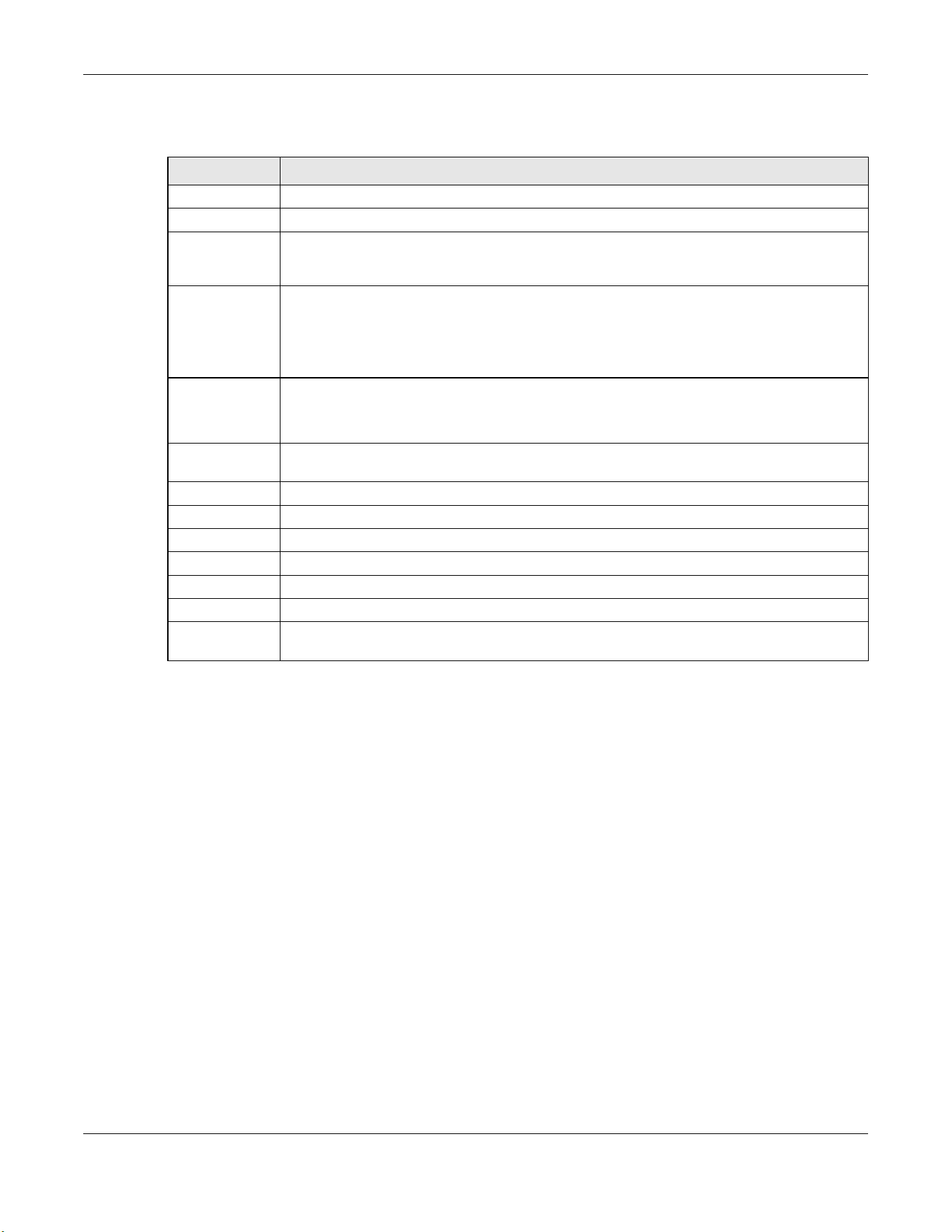
Chapter 15 Port Status
XMG1915 Series User’s Guide
112
The following table describes the labels in this screen.
15.1.1 Port Details
Click an index in the Port column in the MONITOR > Port Status > Port Status screen to display individual
port statistics. Use this screen to check status and detailed performance data about an individual port
on the Switch.
Table 31 MONITOR > Port Status > Port Status
LABEL DESCRIPTION
Port This identifies the Ethernet port. Click a port number to display the Port Details screen.
Name This is the name you assigned to this port in the PORT > Port Setup screen.
Link This field displays the speed (such as 100M for 100 Mbps, 1G for 1000 Mbps or 1 Gbps, or 2.5G for
2.5 Gbps) and the duplex (F for full duplex). This field displays Down if the port is not connected
to any device.
State If STP (Spanning Tree Protocol) is enabled, this field displays the STP state of the port.
If STP is disabled, this field displays FORWARDING if the link is up, otherwise, it displays STOP.
When LACP (Link Aggregation Control Protocol) and STP are in blocking state, it displays
BLOCKING.
PD For PoE models only.
This field displays whether or not a powered device (PD) is allowed to receive power from the
Switch on this port.
LACP This fields displays whether LACP (Link Aggregation Control Protocol) has been enabled on the
port.
TxPkts This field shows the number of transmitted frames on this port.
RxPkts This field shows the number of received frames on this port.
Errors This field shows the number of received errors on this port.
Tx kB/s This field shows the number of kilobytes per second transmitted on this port.
Rx kB/s This field shows the number of kilobytes per second received on this port.
Up Time This field shows the total amount of time in hours, minutes and seconds the port has been up.
Clear the
counter
Select Port, enter a port number and then click Clear Counter to erase the recorded statistical
information for that port, or select ALL Ports to clear statistics for all ports.
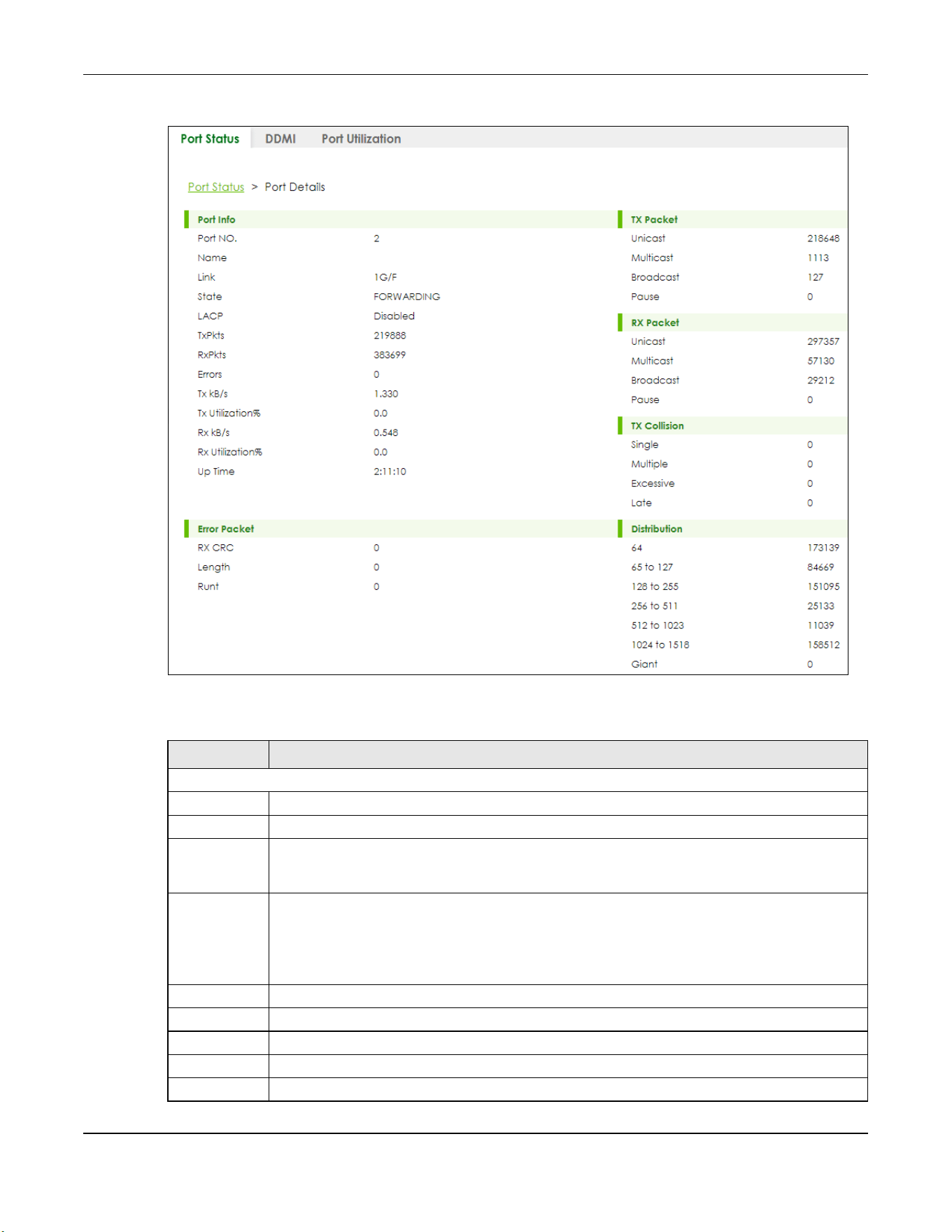
Chapter 15 Port Status
XMG1915 Series User’s Guide
113
Figure 71 MONITOR > Port Status > Port Status > Port Details
The following table describes the labels in this screen.
Table 32 MONITOR > Port Status > Port Status > Port Details
LABEL DESCRIPTION
Port Info
Port NO. This field displays the port number you are viewing.
Name This field displays the name of the port.
Link This field displays the speed (such as 100M for 100Mbps, 1G for 1000 Mbps or 1 Gbps, or 2.5G for 2.5
Gbps) and the duplex (F for full duplex). This field displays Down if the port is not connected to any
device.
State If STP (Spanning Tree Protocol) is enabled, this field displays the STP state of the port.
If STP is disabled, this field displays FORWARDING if the link is up, otherwise, it displays STOP.
When LACP (Link Aggregation Control Protocol), STP, and dot1x are in blocking state, it displays
BLOCKING.
LACP This field shows if LACP is enabled on this port or not.
TxPkts This field shows the number of transmitted frames on this port.
RxPkts This field shows the number of received frames on this port.
Errors This field shows the number of received errors on this port.
Tx kB/s This field shows the number of kilobytes per second transmitted on this port.

Chapter 15 Port Status
XMG1915 Series User’s Guide
114
Tx
Utilization%
This field shows the percentage of actual transmitted frames on this port as a percentage of the
Link speed.
Rx kB/s This field shows the number of kilobytes per second received on this port.
Rx
Utilization%
This field shows the percentage of actual received frames on this port as a percentage of the Link
speed.
Up Time This field shows the total amount of time the connection has been up.
TX Packet
The following fields display detailed information about packets transmitted.
Unicast This field shows the number of good unicast packets transmitted.
Multicast This field shows the number of good multicast packets transmitted.
Broadcast This field shows the number of good broadcast packets transmitted.
Pause This field shows the number of 802.3x pause packets transmitted.
RX Packet
The following fields display detailed information about packets received.
Unicast This field shows the number of good unicast packets received.
Multicast This field shows the number of good multicast packets received.
Broadcast This field shows the number of good broadcast packets received.
Pause This field shows the number of 802.3x pause packets received.
TX Collision
The following fields display information on collisions while transmitting.
Single This is a count of successfully transmitted packets for which transmission is inhibited by exactly one
collision.
Multiple This is a count of successfully transmitted packets for which transmission was inhibited by more
than one collision.
Excessive This is a count of packets for which transmission failed due to excessive collisions. Excessive
collision is defined as the number of maximum collisions before the retransmission count is reset.
Late This is the number of times a late collision is detected, that is, after 512 bits of the packets have
already been transmitted.
Error Packet
The following fields display detailed information about packets received that were in error.
RX CRC This field shows the number of packets received with CRC (Cyclic Redundant Check) errors.
Length This field shows the number of packets received with a length that was out of range.
Runt This field shows the number of packets received that were too short (shorter than 64 octets),
including the ones with CRC errors.
Distribution
64 This field shows the number of packets (including bad packets) received that were 64 octets in
length.
65 to 127 This field shows the number of packets (including bad packets) received that were between 65
and 127 octets in length.
128 to 255 This field shows the number of packets (including bad packets) received that were between 128
and 255 octets in length.
256 to 511 This field shows the number of packets (including bad packets) received that were between 256
and 511 octets in length.
Table 32 MONITOR > Port Status > Port Status > Port Details (continued)
LABEL DESCRIPTION
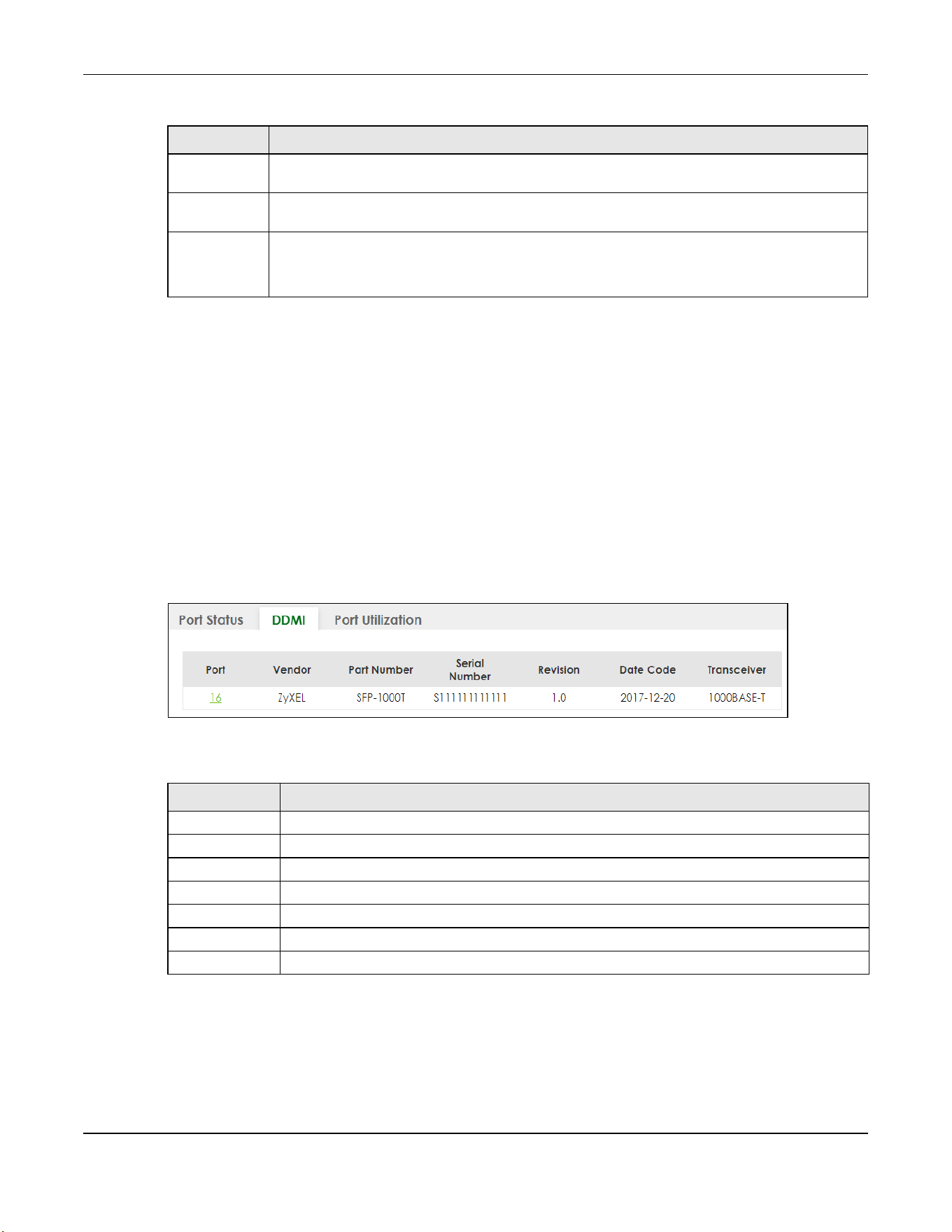
Chapter 15 Port Status
XMG1915 Series User’s Guide
115
15.2 DDMI
The optical SFP transceiver’s support for the Digital Diagnostics Monitoring Interface (DDMI) function lets
you monitor the transceiver’s parameters to perform component monitoring, fault isolation and failure
prediction tasks. This allows proactive, preventative network maintenance to help ensure service
continuity.
Use this screen to view the DDMI status of the Switch’s SFP transceivers. Click MONITOR > Port Status >
DDMI to see the following screen. Alternatively, click DASHBOARD from any Web Configurator screen
and then the Port Status link in the Quick Link section of the DASHBOARD screen to display the Port Status
screen and then click the DDMI link tab.
Figure 72 MONITOR > Port Status > DDMI
The following table describes the labels in this screen.
15.2.1 DDMI Details
Use this screen to view the real-time SFP (Small Form Factor Pluggable) transceiver information and
operating parameters on the SFP port. The parameters include, for example, transmitting and receiving
power, and module temperature.
512 to
1023
This field shows the number of packets (including bad packets) received that were between 512
and 1023 octets in length.
1024 to
1518
This field shows the number of packets (including bad packets) received that were between 1024
and 1518 octets in length.
Giant This field shows the number of packets (including bad packets) received that were between 1519
octets and the maximum frame size.
The maximum frame size varies depending on your switch model.
Table 32 MONITOR > Port Status > Port Status > Port Details (continued)
LABEL DESCRIPTION
Table 33 MONITOR > Port Status > DDMI
LABEL DESCRIPTION
Port This identifies the SFP port. Click a port number to display the DDMI Details screen.
Vendor This displays the vendor name of the optical transceiver.
Part Number This displays the part number of the optical transceiver.
Serial Number This displays the serial number of the optical transceiver.
Revision This displays the revision number of the optical transceiver.
Date Code This displays the date when the optical transceiver was manufactured.
Transceiver This displays the type of optical transceiver installed in the SFP slot.

Chapter 15 Port Status
XMG1915 Series User’s Guide
116
Click an index in the Port column in the DDMI screen to view current transceivers’ status.
Figure 73 MONITOR > Port Status > DDMI > DDMI Details
The following table describes the labels in this screen.
Table 34 MONITOR > Port Status > DDMI > DDMI Details
LABEL DESCRIPTION
Transceiver Information
Port No This identifies the SFP port.
Connector Type This displays the connector type of the optical transceiver.
Vendor This displays the vendor name of the optical transceiver.
Part Number This displays the part number of the optical transceiver.
Serial Number This displays the serial number of the optical transceiver.
Revision This displays the revision number of the optical transceiver.
Date Code This displays the date when the optical transceiver was manufactured.
Transceiver This displays details about the type of transceiver installed in the SFP slot.
Calibration This field is available only when an SFP transceiver is inserted into the SFP slot.
Internal displays if the measurement values are calibrated by the transceiver. External displays
if the measurement values are raw data which the Switch calibrates.
DDMI Information
Type This displays the DDMI parameter.
Temperature
(C/F)
This displays the temperature inside the SFP transceiver in degrees Celsius or Fahrenheit.
Voltage (V) This displays the level of voltage being supplied to the SFP transceiver.
TX Bias (mA) This displays the milliamps (mA) being supplied to the SFP transceiver’s Laser Diode Transmitter.
TX Power
(dbm)
This displays the amount of power the SFP transceiver is transmitting.
RX Power
(dbm)
This displays the amount of power the SFP transceiver is receiving from the fiber cable.
Current This displays the current status for each monitored DDMI parameter.
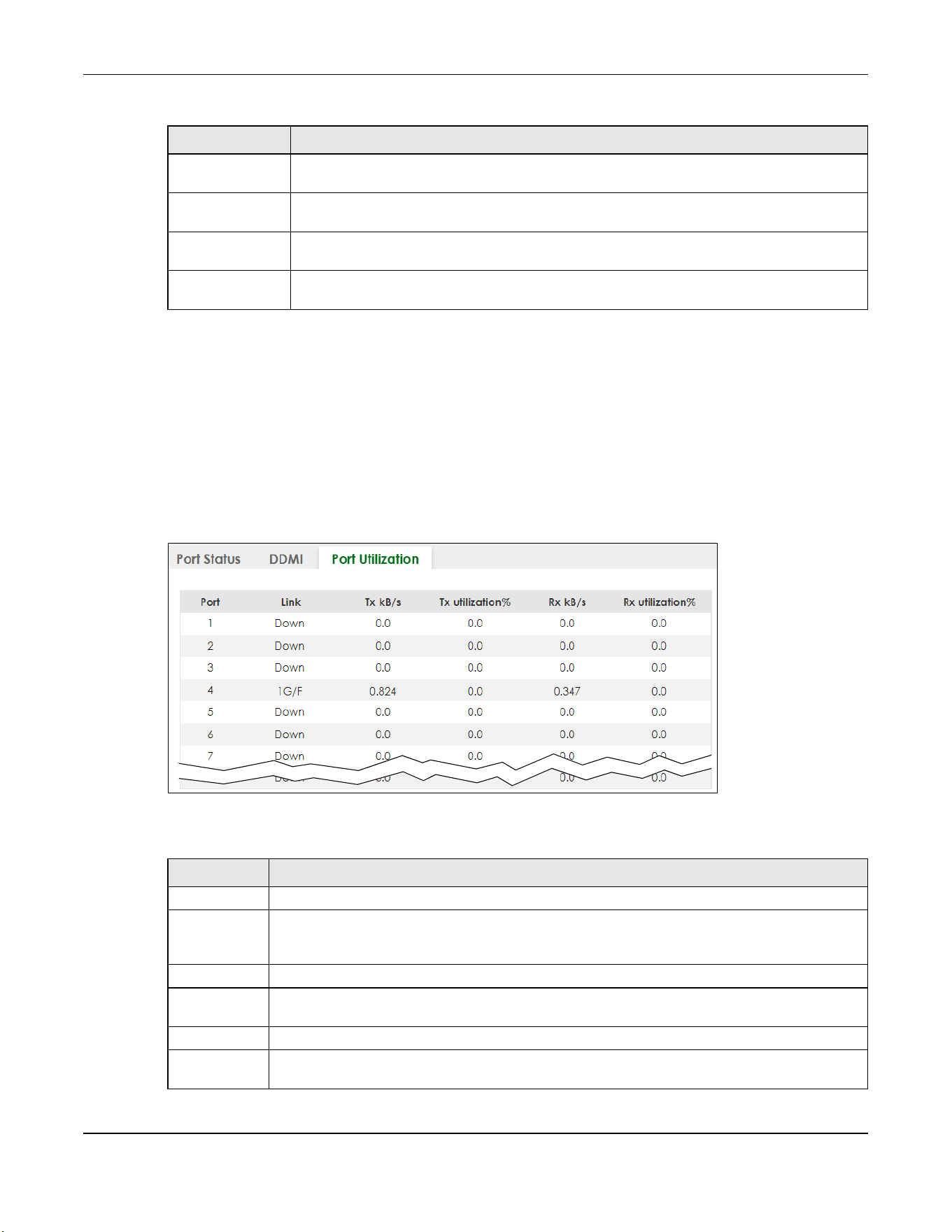
Chapter 15 Port Status
XMG1915 Series User’s Guide
117
15.3 Port Utilization
This screen displays the percentage of actual transmitted or received frames on a port as a percentage
of the Link speed. To view port utilization, click MONITOR > Port Status > Port Utilization to see the
following screen. Alternatively, click DASHBOARD from any Web Configurator screen and then the Port
Status link in the Quick Link section of the DASHBOARD screen to display the Port Status screen and then
click the Port Utilization link tab.
Figure 74 MONITOR > Port Status > Port Utilization
The following table describes the labels in this screen.
High Alarm
Threshold
This displays the high value alarm threshold for each monitored DDMI parameter. An alarm
signal is reported to the Switch if the monitored DDMI parameter reaches this value.
High Warn
Threshold
This displays the high value warning threshold for each monitored DDMI parameter. A warning
signal is reported to the Switch if the monitored DDMI parameter reaches this value.
Low Warn
Threshold
This displays the low value warning threshold for each monitored DDMI parameter. A warning
signal is reported to the Switch if the monitored DDMI parameter reaches this value.
Low Alarm
Threshold
This displays the low value alarm threshold for each monitored DDMI parameter. An alarm
signal is reported to the Switch if the monitored DDMI parameter reaches this value.
Table 34 MONITOR > Port Status > DDMI > DDMI Details (continued)
LABEL DESCRIPTION
Table 35 MONITOR > Port Status > Port Utilization
LABEL DESCRIPTION
Port This identifies the Ethernet port.
Link This field displays the speed (such as 100M for 100 Mbps, 1000M for 1000 Mbps, or 2.5G for 2.5
Gbps) and the duplex (F for full duplex). This field displays Down if the port is not connected to any
device.
Tx kB/s This field shows the transmission speed of data sent on this port in kilobytes per second.
Tx Utilization% This field shows the percentage of actual transmitted frames on this port as a percentage of the
Link speed.
Rx kB/s This field shows the transmission speed of data received on this port in kilobytes per second.
Rx Utilization% This field shows the percentage of actual received frames on this port as a percentage of the Link
speed.
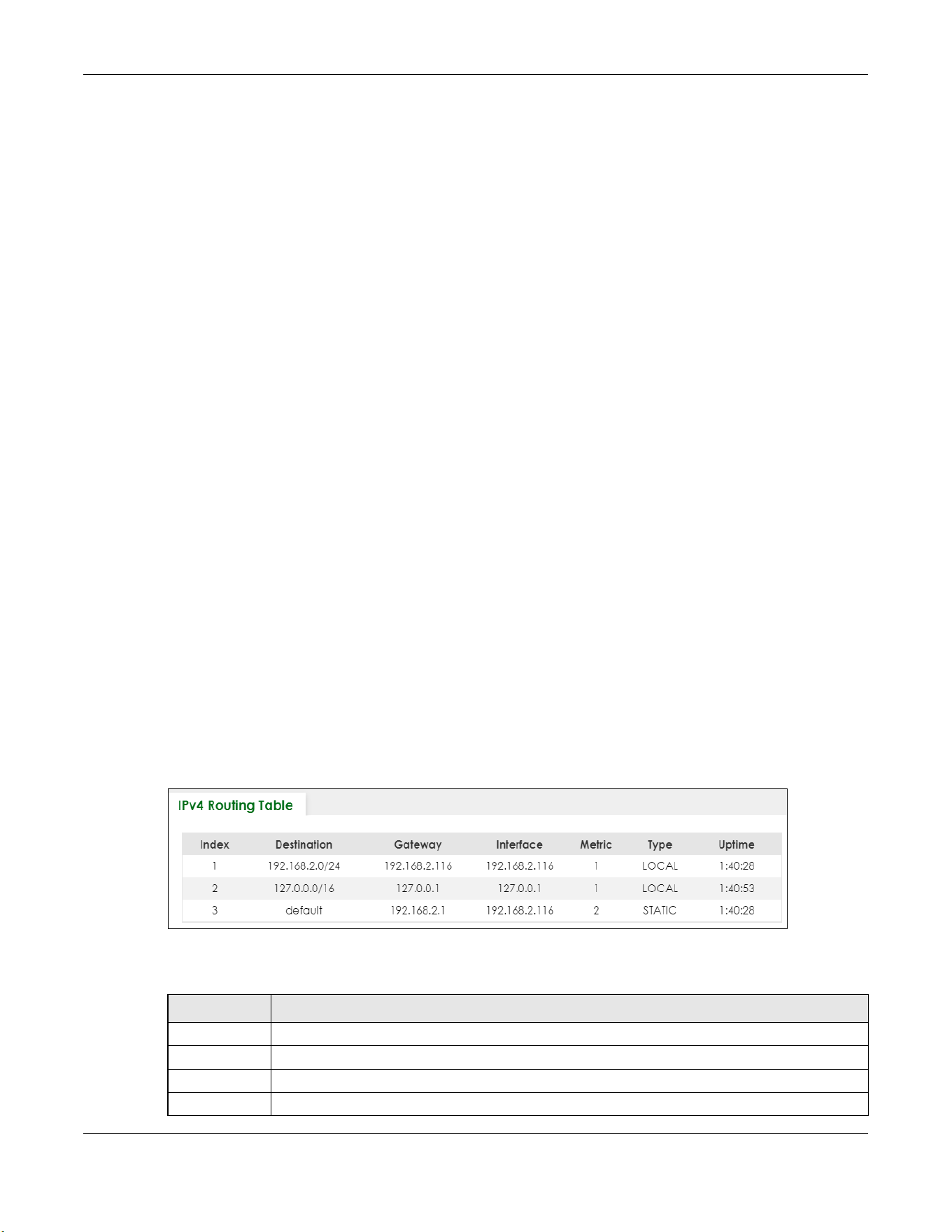
Chapter 16 Routing Table
XMG1915 Series User’s Guide
118
CHAPTER 16
Routing Table
16.1 Routing Table Overview
This chapter introduces the IPv4/IPv6 routing tables.
The IPv4/IPv6 routing tables record routing information of the best path to destinations where packets
were forwarded. Use this table to check information like routing destination, gateway, interface IP
addresses, hop count, and routing methods.
16.1.1 What You Can Do
Use the IPv4 Routing Table screen (Section 16.2 on page 118) to view the Switch’s IPv4 routing table
information.
Use the IPv6 Routing Table screen (Section 16.3 on page 119) to view the Switch’s IPv6 routing table
information.
16.2 IPv4 Routing Table
Use this screen to view IPv4 routing table information. Click MONITOR > Routing Table > IPv4 Routing
Table in the navigation panel to display the screen as shown.
Figure 75 MONITOR > Routing Table > IPv4 Routing Table
The following table describes the labels in this screen.
Table 36 MONITOR > Routing Table > IPv4 Routing Table
LABEL DESCRIPTION
Index This field displays the index number.
Destination This field displays the destination IP routing domain.
Gateway This field displays the IP address of the gateway device.
Interface This field displays the IP address of the IPv4 Interface.

Chapter 16 Routing Table
XMG1915 Series User’s Guide
119
16.3 IPv6 Routing Table
Use this screen to view IPv6 routing table information. Click MONITOR > Routing Table > IPv6 Routing
Table in the navigation panel to display the screen as shown.
Figure 76 MONITOR > Routing Table > IPv6 Routing Table
The following table describes the labels in this screen.
Metric This field displays the cost of the route.
Type This field displays the method used to learn the route.
STATIC – added as a static entry.
LOCAL – added as a local interface entry.
Uptime This field displays how long the route has been running since the Switch learned the route and
added an entry in the routing table.
Table 36 MONITOR > Routing Table > IPv4 Routing Table (continued)
LABEL DESCRIPTION
Table 37 MONITOR > Routing Table > IPv6 Routing Table
LABEL DESCRIPTION
Index This field displays the index number.
Route
Destination/
Prefix Length
This field displays the IPv6 subnet prefix and prefix length of the final destination.
Next Hop This field displays the IPv6 address of the gateway that helps forward the packet to the
destination.
Interface This field displays the descriptive name of the IPv6 interface that is used to forward the packets to
the destination.
Metric This field displays the cost of the route.
Type This field displays the method used to learn the route.
STATIC – added as a static entry.
Connect – added as a local interface entry.

Chapter 17 System Information
XMG1915 Series User’s Guide
120
CHAPTER 17
System Information
17.0.1 What You Can Do
Use the System Information screen (Section 17.1 on page 120) to view general system information and
hardware status of the Switch.
17.1 System Information
In the navigation panel, click MONITOR > System Information to display the screen as shown. Use this
screen to view general system information.
Figure 77 MONITOR > System Information
The following table describes the labels in this screen.
Table 38 MONITOR > System Information
LABEL DESCRIPTION
System Information
System
Name
This displays the descriptive name of the Switch for identification purposes.
Product
Model
This displays the product model of the Switch. Use this information when searching for firmware
upgrade or looking for other support information in the website.
ZyNOS F/W
Version
This displays the version number of the Switch 's current firmware including the date created.
Ethernet
Address
This refers to the Ethernet MAC (Media Access Control) address of the Switch.

Chapter 17 System Information
XMG1915 Series User’s Guide
121
CPU
Utilization
Current (%)
This displays the current percentage of CPU utilization.
Memory Utilization
Memory utilization shows how much DRAM memory is available and in use. It also displays the current percentage
of memory utilization.
Name This displays the name of the memory pool.
Total (byte) This displays the total number of bytes in this memory pool.
Used (byte) This displays the number of bytes being used in this memory pool.
Utilization
(%)
This displays the percentage (%) of memory being used in this memory pool.
Hardware Monitor
Temperature
Unit
The Switch has temperature sensors that are capable of detecting and reporting if the
temperature rises above the threshold. You may choose the temperature unit (Centigrade or
Fahrenheit) in this field.
Temperature
(C/F)
CPU / MAC refers to the location of the temperature sensor on the Switch printed circuit board.
Status This field displays Normal for temperatures below the threshold and Error for those above.
Current This shows the current temperature at this sensor.
MAX This field displays the maximum temperature measured at this sensor.
MIN This field displays the minimum temperature measured at this sensor.
Threshold This field displays the upper temperature limit at this sensor.
Table 38 MONITOR > System Information (continued)
LABEL DESCRIPTION
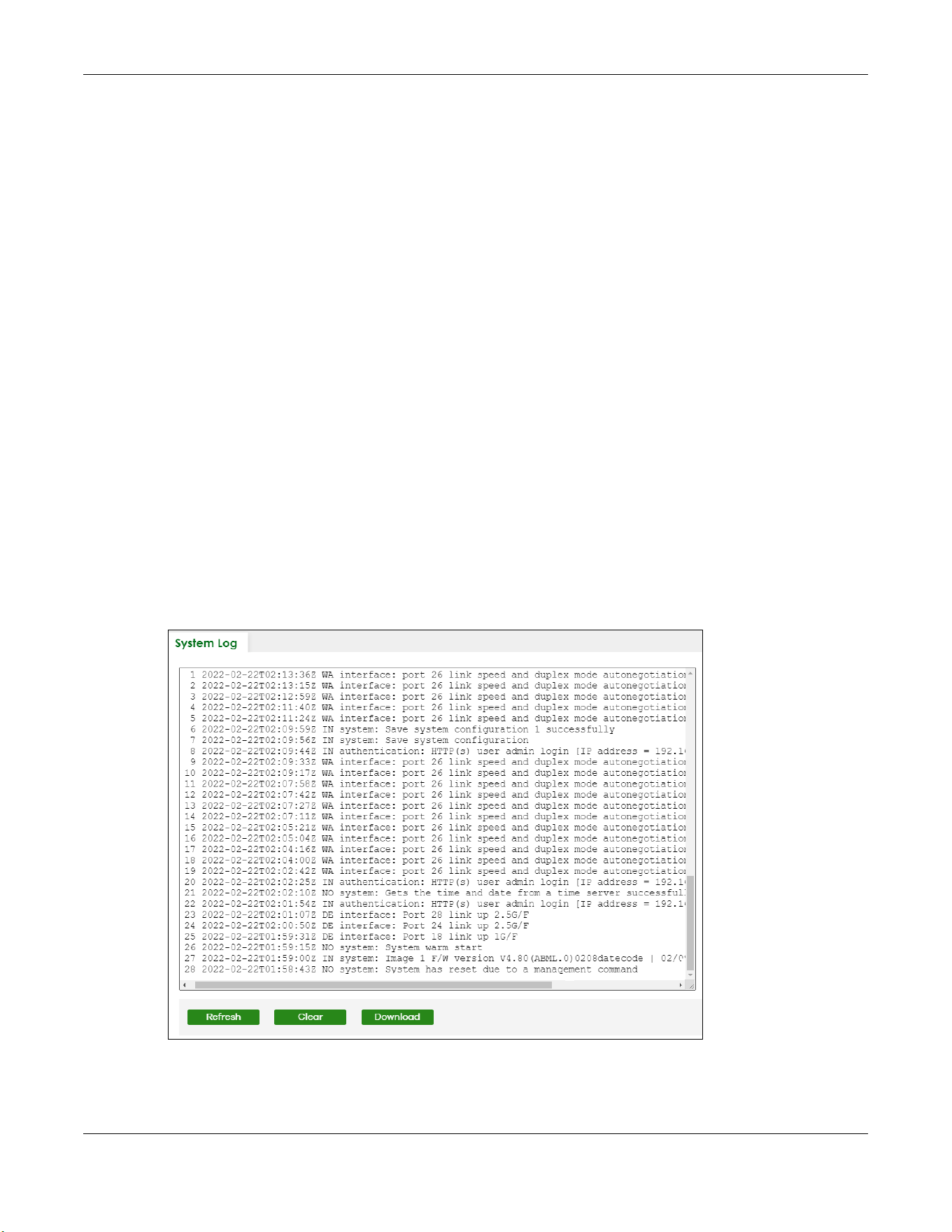
Chapter 18 System Log
XMG1915 Series User’s Guide
122
CHAPTER 18
System Log
18.1 System Log Overview
A log message stores the system history information for viewing.
18.2 System Log
Click MONITOR > System Log in the navigation panel to open this screen. Use this screen to check
current system logs.
Note: When a log reaches the maximum number of log messages, new log messages
automatically overwrite existing log messages, starting with the oldest existing log
message first.
Figure 78 MONITOR > System Log
The summary table shows the time the log message was recorded and the reason the log message was
generated. Click Refresh to update this screen. Click Clear to clear the whole log, regardless of what is
currently displayed on the screen. Click Download to save the log to your computer.

XMG1915 Series User’s Guide
123
CHAPTER 19
SYSTEM
The following chapters introduces the configurations of the links under the SYSTEM navigation panel.
Quick links to chapters:
• Cloud Management
• General Setup
• Hardware Monitor Setup
• Interface Setup
• IP Setup
• IPv6
• Logins
• SNMP
• Switch Setup
• Syslog Setup
• Time Range
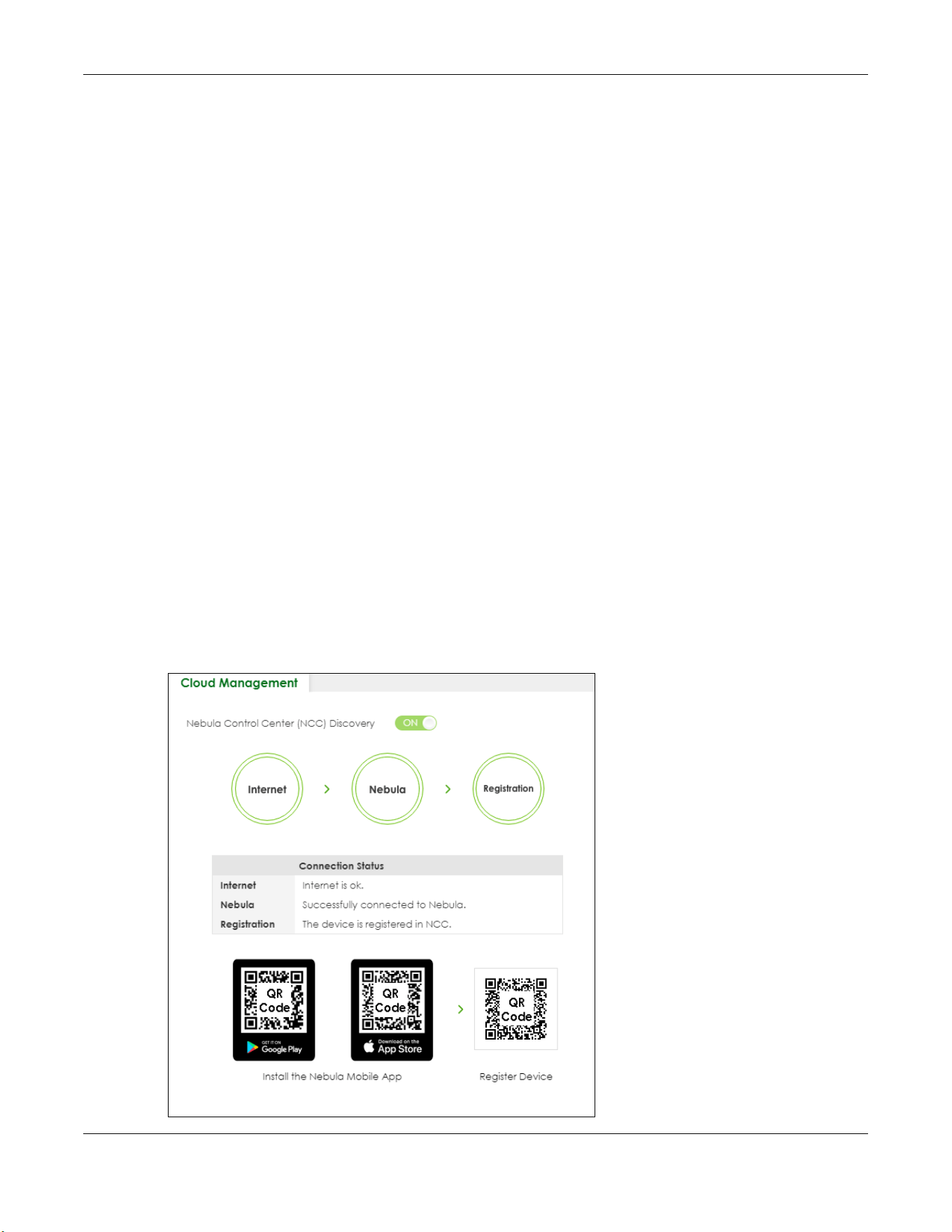
Chapter 20 Cloud Management
XMG1915 Series User’s Guide
124
CHAPTER 20
Cloud Management
20.1 Cloud Management Overview
The Zyxel Nebula Control Center (NCC) is a cloud-based network management system that allows you
to remotely manage and monitor Zyxel Nebula APs, Ethernet switches and security gateways.
The Switch is managed and provisioned automatically by the NCC (Nebula Control Center) when:
• It is connected to the Internet.
• The Nebula Control Center (NCC) Discovery feature is enabled.
• It has been registered in the NCC.
20.2 Nebula Center Control Discovery
Click SYSTEM > Cloud Management to display this screen.
Figure 79 SYSTEM > Cloud Management

Chapter 20 Cloud Management
XMG1915 Series User’s Guide
125
The following table describes the labels in this screen.
Cloud Management Mode
Enable the switch button to turn on NCC discovery on the Switch. If the Switch has Internet access and
has been registered on the NCC, it will automatically go into cloud management mode. Follow the
steps to register your Switch on NCC:
1 Download the Nebula Mobile App
First, download the app from the Google Play store for Android devices or the App Store for iOS devices
and create an organization and site.
You can scan an app store QR code to open the app installation page on the app store.
2 Scan the Device QR code
The Register Device QR code in this screen contains the Switch’s serial number and the registration MAC
address for handy NCC registration of the Switch using the Nebula Mobile app.
Follow the wizard in the Nebula Mobile app to scan the QR code to register the Switch on NCC and add
the Switch into a site.
If Nebula Control Center (NCC) Discovery is disabled, the Switch will NOT discover the NCC and remain
in Standalone mode.
Table 39 SYSTEM > Cloud Management
LABEL DESCRIPTION
Nebula Control
Center (NCC)
Discovery
Enable the switch button to turn on Nebula Control Center (NCC) discovery on the Switch.
This field displays:
• The Switch Internet connection status.
• The connection status between the Switch and NCC.
• The Switch registration status on NCC.
To pass your Switch management to NCC, first make sure your Switch is connected to the
Internet. Then go to NCC and register your Switch.
1. Internet
Green – The Switch is connected to the Internet.
Orange – The Switch is not connected to the Internet.
2. Nebula
Green – The Switch is connected to NCC.
Orange – The Switch is not connected to NCC.
3. Registration
Green – The Switch is registered on NCC.
Gray – The Switch is not registered on NCC.
Note: All circles will gray out if you disable Nebula Discovery.
Connection
Status
This table displays the NCC connection status information.
Use status logs in the Internet, Nebula, and Registration fields for connection troubleshooting.
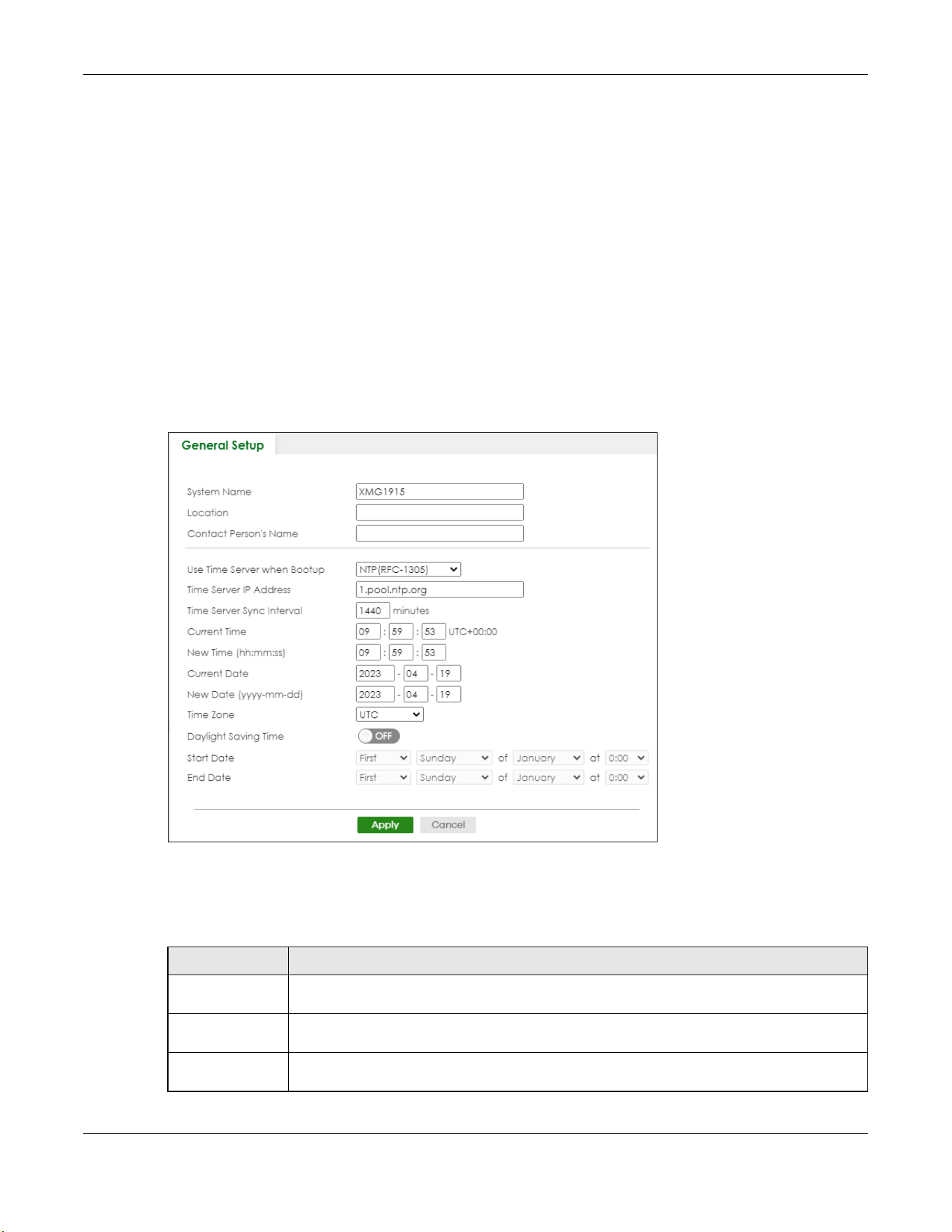
Chapter 21 General Setup
XMG1915 Series User’s Guide
126
CHAPTER 21
General Setup
21.1 General Setup
Use this screen to configure general settings such as the system name and time. Click SYSTEM > General
Setup in the navigation panel to display the screen as shown.
Figure 80 SYSTEM > General Setup
Note: The input string of any field in this screen should not contain [ ? ], [ | ], [ ' ], [ " ], or [ , ].
The following table describes the labels in this screen.
Table 40 SYSTEM > General Setup
LABEL DESCRIPTION
System Name Choose a descriptive name for identification purposes. This name consists of up to 64 printable
ASCII characters; spaces are allowed.
Location Enter the geographic location of your Switch. You can use up to 128 printable ASCII
characters; spaces are allowed.
Contact Person's
Name
Enter the name of the person in charge of this Switch. You can use up to 32 printable ASCII
characters; spaces are allowed.

Chapter 21 General Setup
XMG1915 Series User’s Guide
127
Use Time Server
when Bootup
Enter the time service protocol that your time server uses. Not all time servers support all
protocols, so you may have to use trial and error to find a protocol that works. The main
differences between them are the time format.
When you select the Daytime (RFC-867) format, the Switch displays the day, month, year and
time with no time zone adjustment. When you use this format it is recommended that you use a
Daytime timeserver within your geographical time zone.
Time (RFC-868) format displays a 4-byte integer giving the total number of seconds since 1970/
1/1 at 00:00:00.
NTP (RFC-1305) is similar to Time (RFC-868).
None is the default value. Enter the time manually. Each time you turn on the Switch, the time
and date will be reset to 2022-01-01 00:00:00.
Time Server IP
Address
Enter the IP address or domain name of your timeserver. The Switch searches for the timeserver
for up to 60 seconds.
Time Server Sync
Interval
Enter the period in minutes between each time server synchronization. The Switch checks the
time server after every synchronization interval.
Current Time This field displays the time you open this menu (or refresh the menu).
New Time
(hh:mm:ss)
Enter the new time in hour, minute and second format. The new time then appears in the
Current Time field after you click Apply.
Current Date This field displays the date you open this menu.
New Date (yyyy-
mm-dd)
Enter the new date in year, month and day format. The new date then appears in the Current
Date field after you click Apply.
Time Zone Select the time difference between UTC (Universal Time Coordinated, formerly known as GMT,
Greenwich Mean Time) and your time zone from the drop-down list box.
Daylight Saving
Time
Daylight saving is a period from late spring to early fall when many countries set their clocks
ahead of normal local time by one hour to give more daytime light in the evening.
Enable the switch button if you use Daylight Saving Time.
Start Date Configure the day and time when Daylight Saving Time starts if you selected Daylight Saving
Time. The time is displayed in the 24 hour format. Here are a couple of examples:
Daylight Saving Time starts in most parts of the United States on the second Sunday of March.
Each time zone in the United States starts using Daylight Saving Time at 2 A.M. local time. So in
the United States you would select Second, Sunday, March and 2:00.
Daylight Saving Time starts in the European Union on the last Sunday of March. All of the time
zones in the European Union start using Daylight Saving Time at the same moment (1 A.M. GMT
or UTC). So in the European Union you would select Last, Sunday, March and the last field
depends on your time zone. In Germany for instance, you would select 2:00 because
Germany's time zone is one hour ahead of GMT or UTC (GMT+1).
End Date Configure the day and time when Daylight Saving Time ends if you selected Daylight Saving
Time. The time field uses the 24 hour format. Here are a couple of examples:
Daylight Saving Time ends in the United States on the first Sunday of November. Each time
zone in the United States stops using Daylight Saving Time at 2 A.M. local time. So in the United
States you would select First, Sunday, November and 2:00.
Daylight Saving Time ends in the European Union on the last Sunday of October. All of the time
zones in the European Union stop using Daylight Saving Time at the same moment (1 A.M. GMT
or UTC). So in the European Union you would select Last, Sunday, October and the last field
depends on your time zone. In Germany for instance, you would select 2:00 because
Germany's time zone is one hour ahead of GMT or UTC (GMT+1).
Table 40 SYSTEM > General Setup (continued)
LABEL DESCRIPTION
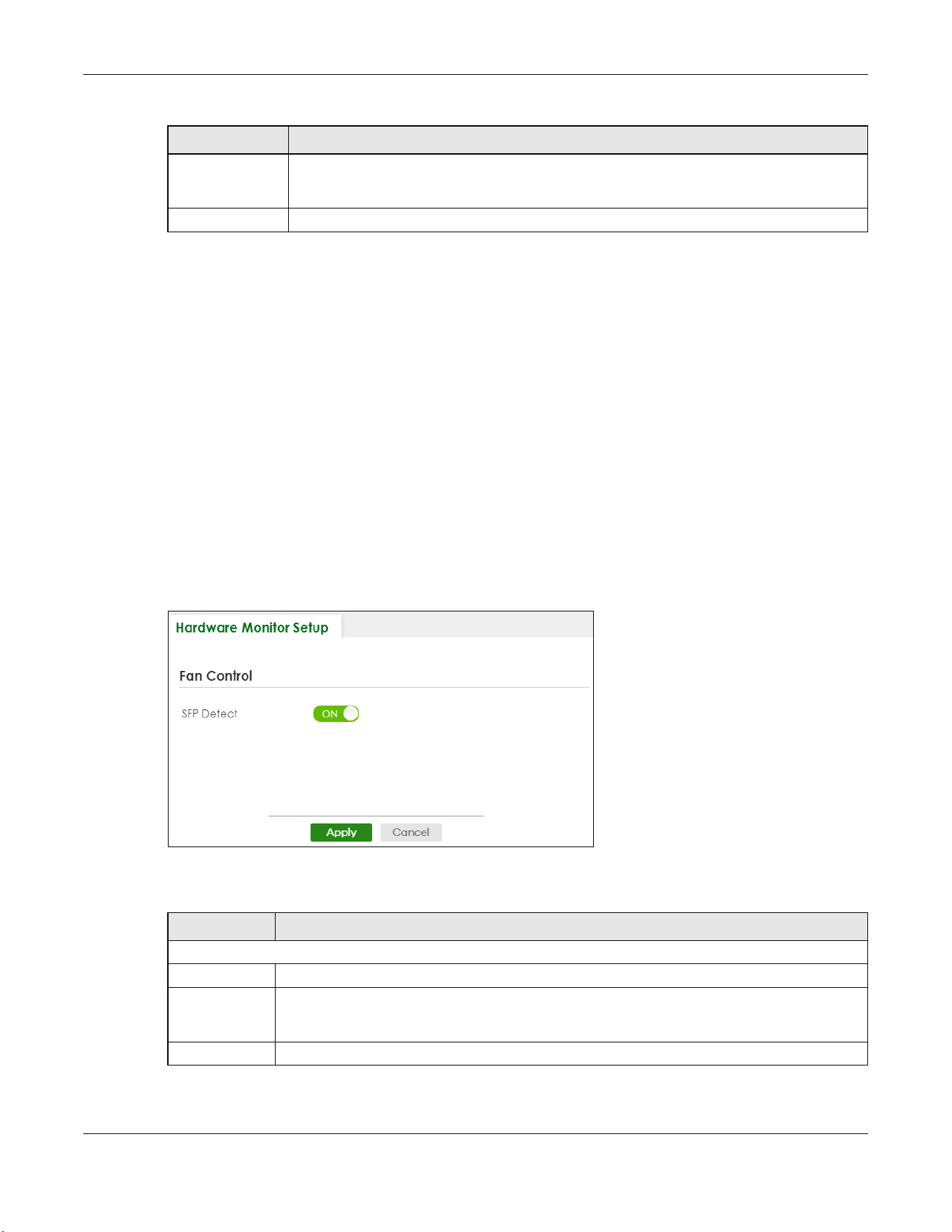
Chapter 21 General Setup
XMG1915 Series User’s Guide
128
21.2 Hardware Monitor Setup
This section introduces Fan Control for the temperature of the SFP transceiver inserted in the Switch.
When the SFP transceiver temperature exceeds the temperature threshold (see your transceiver
documentation), the Switch automatically turns on the fans with maximum fan speed to cool down the
system.
The fans do not automatically turn off after the SFP transceiver temperature returns below threshold. To
turn off the fans, you have to temporarily disable SFP Detect or reboot the Switch.
Click SYSTEM > Hardware Monitor Setup to display the screen as shown below.
Note: The SFP Detect feature only functions if at least one of your SFP transceiver(s) support
DDMI (Digital Diagnostic Monitoring Interface). See the transceiver documentation.
Figure 81 SYSTEM > Hardware Monitor Setup
The following table describes the labels in this screen.
Apply Click Apply to save your changes to the Switch’s run-time memory. The Switch loses these
changes if it is turned off or loses power, so use the Save link on the top navigation panel to
save your changes to the non-volatile memory when you are done configuring.
Cancel Click Cancel to begin configuring this screen afresh.
Table 40 SYSTEM > General Setup (continued)
LABEL DESCRIPTION
Table 41 SYSTEM > Hardware Monitor Setup
LABEL DESCRIPTION
Fan Control
SFP Detect Enable the switch button to enable SFP Detect on the Switch.
Apply Click Apply to save your changes to the Switch’s run-time memory. The Switch loses these
changes if it is turned off or loses power, so use the Save link on the top navigation panel to save
your changes to the non-volatile memory when you are done configuring.
Cancel Click Cancel to begin configuring this screen afresh.
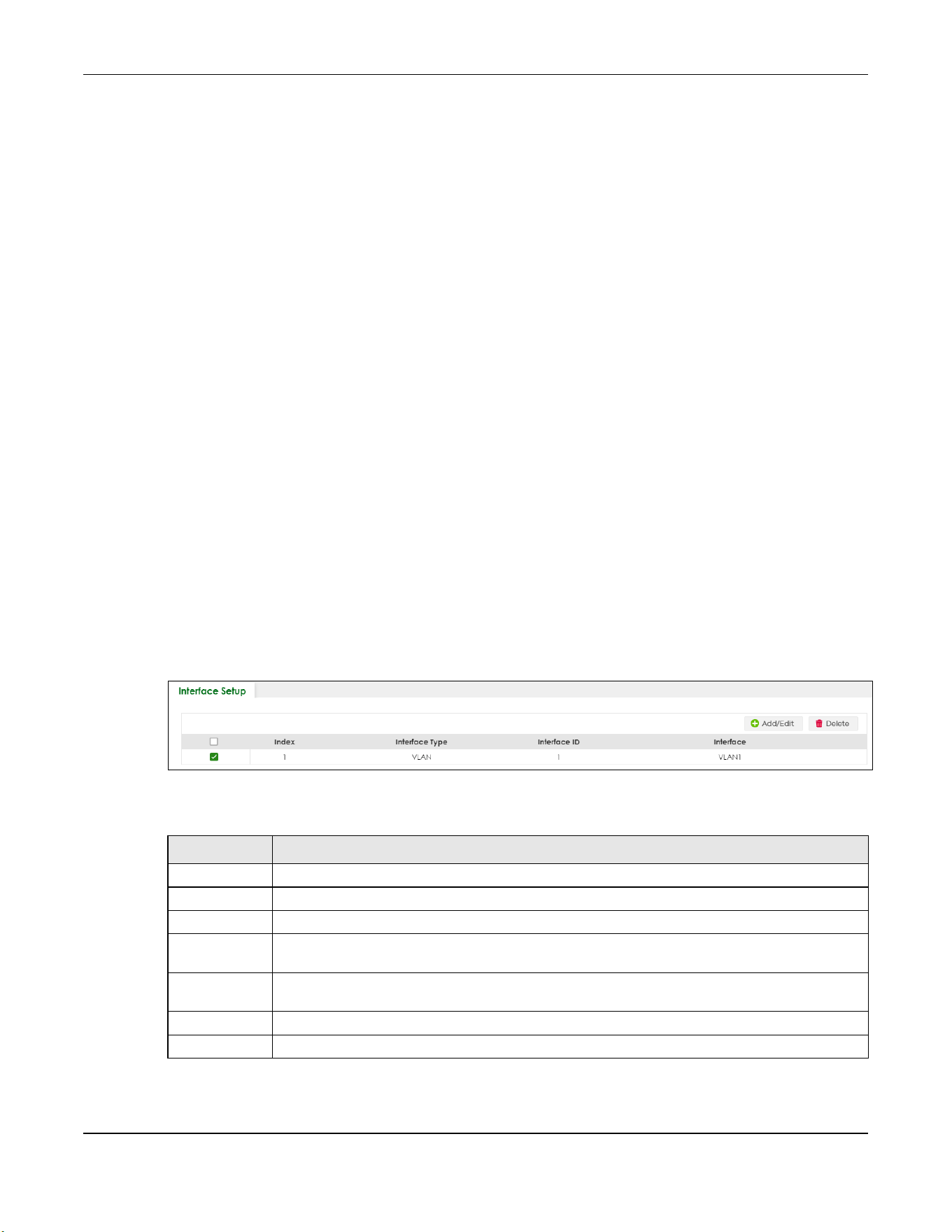
Chapter 22 Interface Setup
XMG1915 Series User’s Guide
129
CHAPTER 22
Interface Setup
22.1 Interface Setup Overview
This chapter shows you how to create virtual interfaces for interface-based configurations. An IPv6
address is configured on a per-interface basis. The interface can be a physical interface (for example,
an Ethernet port) or a virtual interface (for example, a VLAN).
22.2 Interface Setup
Use this screen to view and set IPv6 interfaces on which you can configure an IPv6 address to access
and manage the Switch.
The interfaces you create here will only take effect after you configure them in the SYSTEM > IPv6
screens.
Click SYSTEM > Interface Setup in the navigation panel to display the configuration screen.
Figure 82 SYSTEM > Interface Setup
The following table describes the labels in this screen.
Table 42 SYSTEM > Interface Setup
LABEL DESCRIPTION
Index This field displays the index number of an entry.
Interface Type This field displays the type of interface.
Interface ID This field displays the identification number of the interface.
Interface This field displays the interface’s descriptive name which is generated automatically by the
Switch. The name is from a combination of the interface type and ID number.
Select an entry’s check box to select a specific entry. Otherwise, select the check box in the
table heading row to select all entries.
Add/Edit Click Add/Edit to add a new interface or edit a selected one.
Delete Click Delete to remove the selected interfaces.
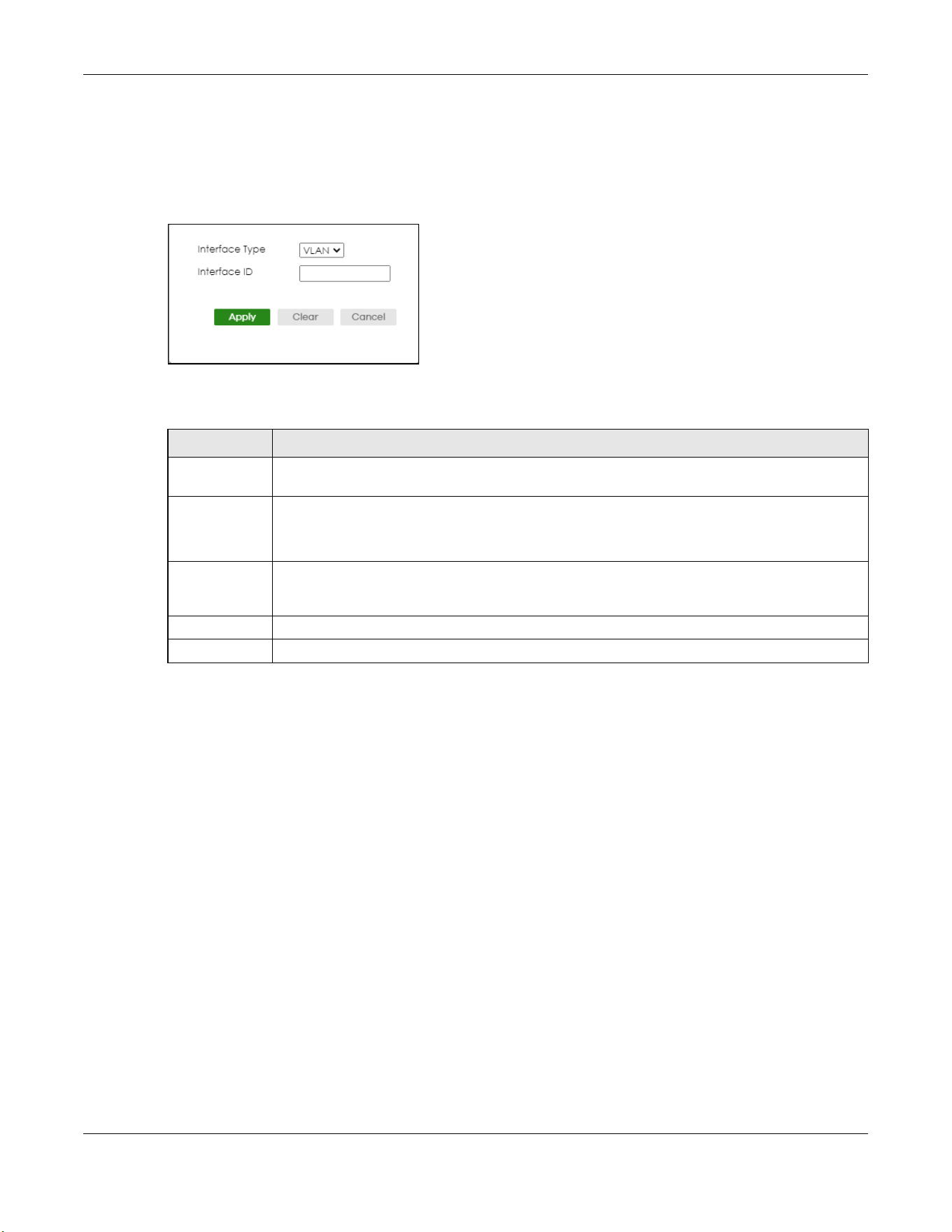
Chapter 22 Interface Setup
XMG1915 Series User’s Guide
130
22.2.1 Add/Edit Interfaces
Click Add/Edit, or select an entry and click Add/Edit in the SYSTEM > Interface Setup screen to display
the configuration screen.
Figure 83 SYSTEM > Interface Setup > Add/Edit
The following table describes the labels in this screen.
Table 43 SYSTEM > Interface Setup > Add/Edit
LABEL DESCRIPTION
Interface Type Select the type of IPv6 interface for which you want to configure. The Switch supports the VLAN
interface type for IPv6 at the time of writing.
Interface ID Specify a unique identification number (from 1 to 4094) for the interface.
To have IPv6 function properly, you should configure a static VLAN with the same ID number in the
SWITCHING > VLAN screens.
Apply Click Apply to save your changes to the Switch’s run-time memory. The Switch loses these
changes if it is turned off or loses power, so use the Save link on the top navigation panel to save
your changes to the non-volatile memory when you are done configuring.
Clear Click Clear to clear the fields to the factory defaults.
Cancel Click Cancel to not save the configuration you make and return to the last screen.

Chapter 23 IP Setup
XMG1915 Series User’s Guide
131
CHAPTER 23
IP Setup
23.1 IP Setup Overview
This chapter shows you how to configure IP settings and set up IP interfaces on the Switch using the IP
Setup screens.
23.1.1 What You Can Do
• Use the IP Status screen (Section 23.2 on page 131) to view the current IP interfaces and DNS server
settings on the Switch.
• Use the IP Setup screen (Section 23.3 on page 134) to configure the default gateway device, the
default domain name server and add IP domains.
• Use the Network Proxy Configuration screen (Section 23.4 on page 136) to configure network proxy
configurations.
The Switch needs an IP address for it to be managed over the network. When the Switch (in Standalone
mode) fails to obtain an IP address from a DHCP server, the default static IP address 192.168.1.1 will be
automatically added and used as the Switch’s management IP address. The subnet mask specifies the
network number portion of an IP address. The factory default subnet mask is 255.255.255.0.
On the Switch, an IP address is not bound to any physical ports. Since each IP address on the Switch
must be in a separate subnet, the configured IP address is also known as IP interface (or routing
domain). In addition, this allows routing between subnets based on the IP address without additional
routers.
You can configure multiple routing domains on the same VLAN as long as the IP address ranges for the
domains do not overlap. To change the IP address of the Switch in a routing domain, simply add a new
routing domain entry with a different IP address in the same subnet.
You can configure up to 8 IP domains which are used to access and manage the Switch from the ports
belonging to the pre-defined VLANs.
Note: You must configure a VLAN first. Each VLAN can have multiple management IP
addresses, and you can log into the Switch through different management IP
addresses simultaneously.
23.2 IP Status
Click SYSTEM > IP Setup > IP Status to display the screen as shown.
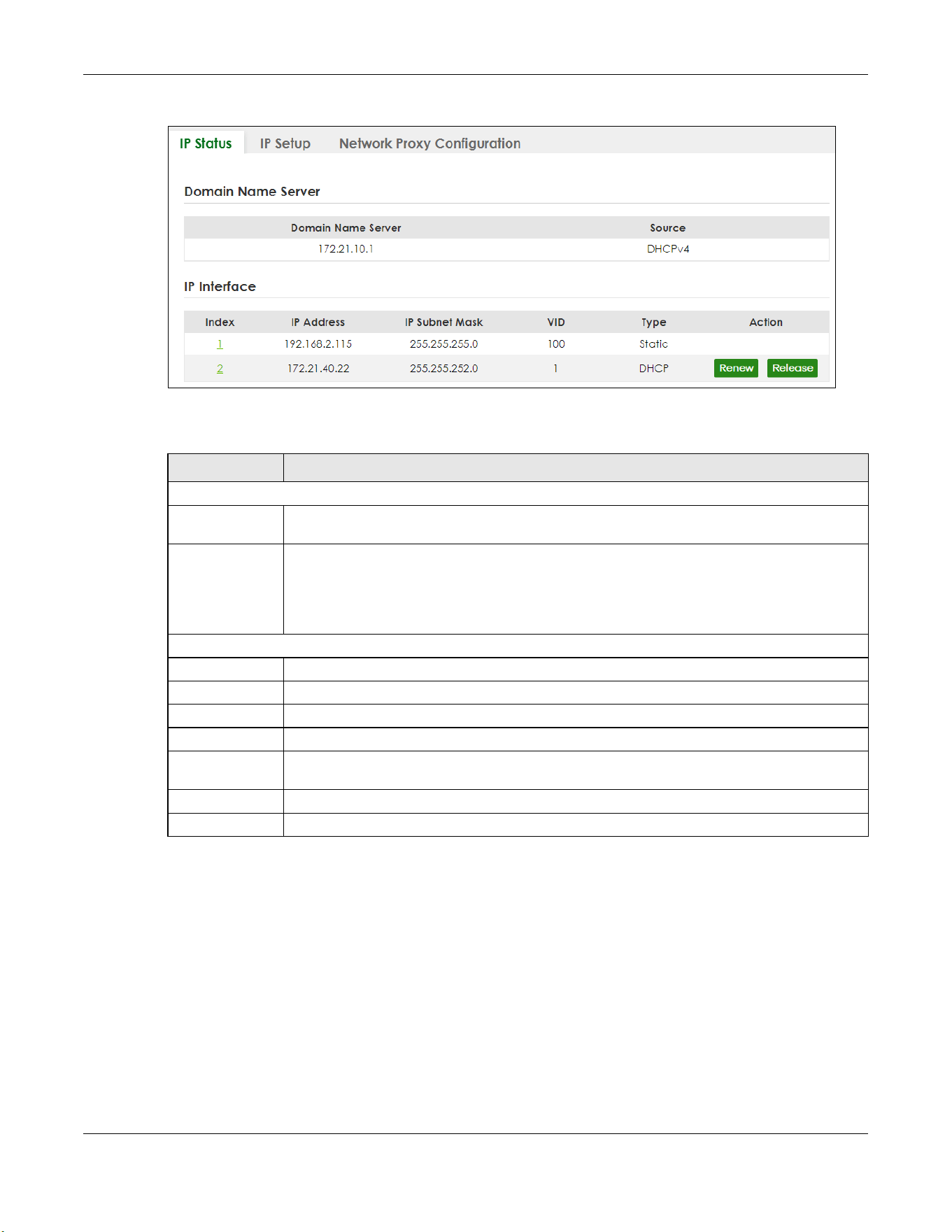
Chapter 23 IP Setup
XMG1915 Series User’s Guide
132
Figure 84 SYSTEM > IP Setup > IP Status
The following table describes the labels in this screen.
23.2.1 IP Status Details
Use this screen to view IP status details. Click a number in the Index column in the SYSTEM > IP Setup > IP
Status screen to display the screen as shown next.
Table 44 SYSTEM > IP Setup > IP Status
LABEL DESCRIPTION
Domain Name Server
Domain Name
Server
This field displays the IP address of the DNS server.
Source This field displays whether the DNS server address is configured manually (Static) or obtained
automatically using DHCPv4.
Note: If DNS server is not configured or configuration is deleted, the system
automatically uses the default Backup server.
IP Interface
Index This field displays the index number of an entry.
IP Address This field displays the IP address of the Switch in the IP domain.
IP Subnet Mask This field displays the subnet mask of the Switch in the IP domain.
VID This field displays the VLAN identification number of the IP domain on the Switch.
Type This shows whether this IP address is dynamically assigned from a DHCP server (DHCP) or
manually assigned (Static).
Renew Click this to renew the dynamic IP address.
Release Click this to release the dynamic IP address.
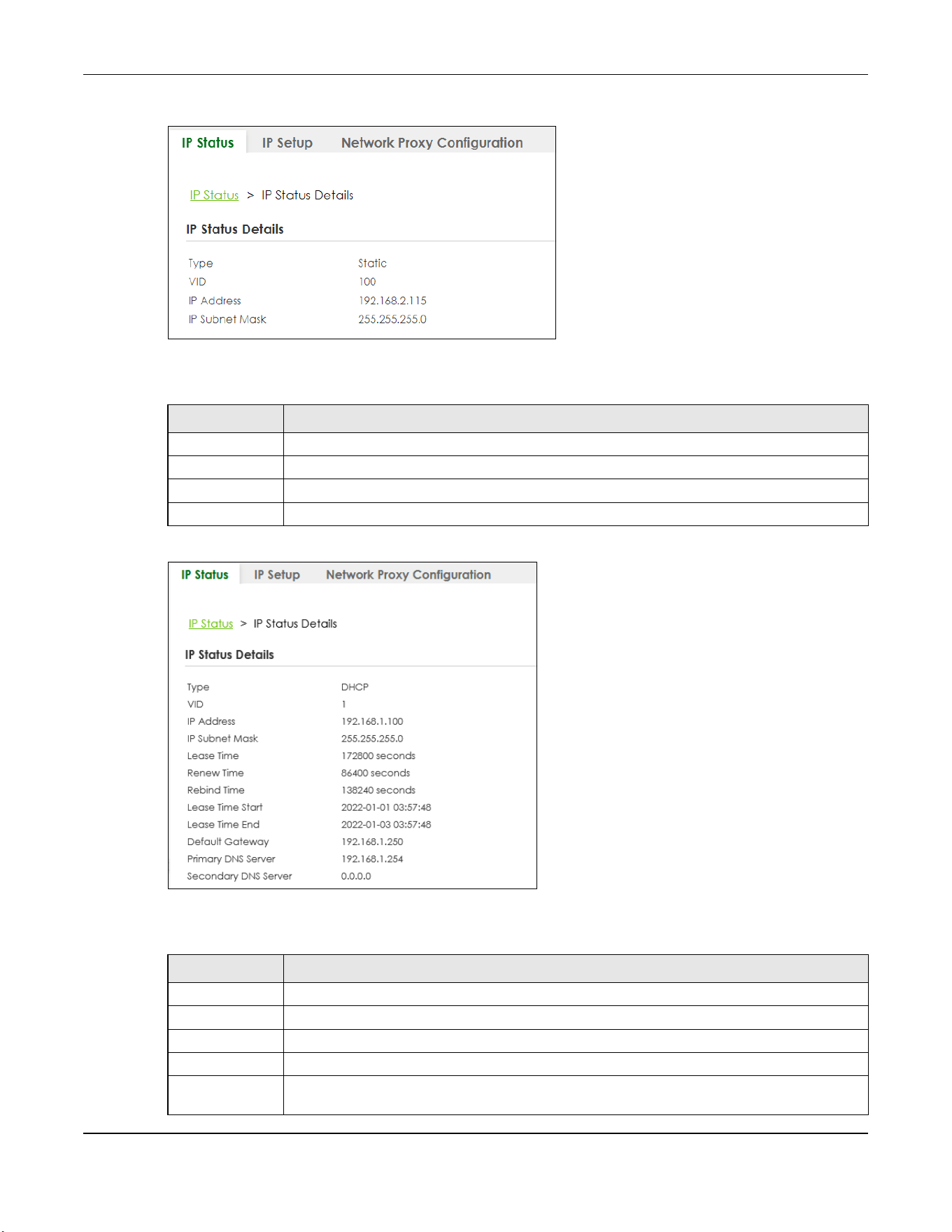
Chapter 23 IP Setup
XMG1915 Series User’s Guide
133
Figure 85 SYSTEM > IP Setup > IP Status > IP Status Details: Static
The following table describes the labels in this screen.
Figure 86 SYSTEM > IP Setup > IP Status > IP Status Details: DHCP
The following table describes the labels in this screen.
Table 45 SYSTEM > IP Setup > IP Status > IP Status Details: Static
LABEL DESCRIPTION
Type This shows the IP address is manually assigned (Static).
VID This is the VLAN identification number to which an IP routing domain belongs.
IP Address This is the IP address of your Switch in dotted decimal notation for example 192.168.1.1.
IP Subnet Mask This is the IP subnet mask of your Switch in dotted decimal notation for example 255.255.255.0.
Table 46 SYSTEM > IP Setup > IP Status > IP Status Details: DHCP
LABEL DESCRIPTION
Type This shows the IP address is dynamically assigned from a DHCP server (DHCP).
VID This is the VLAN identification number to which an IP routing domain belongs.
IP Address This is the IP address of your Switch in dotted decimal notation for example 192.168.1.1.
IP Subnet Mask This is the IP subnet mask of your Switch in dotted decimal notation for example 255.255.255.0.
Lease Time This displays the length of time in seconds that this interface can use the current dynamic IP
address from the DHCP server.
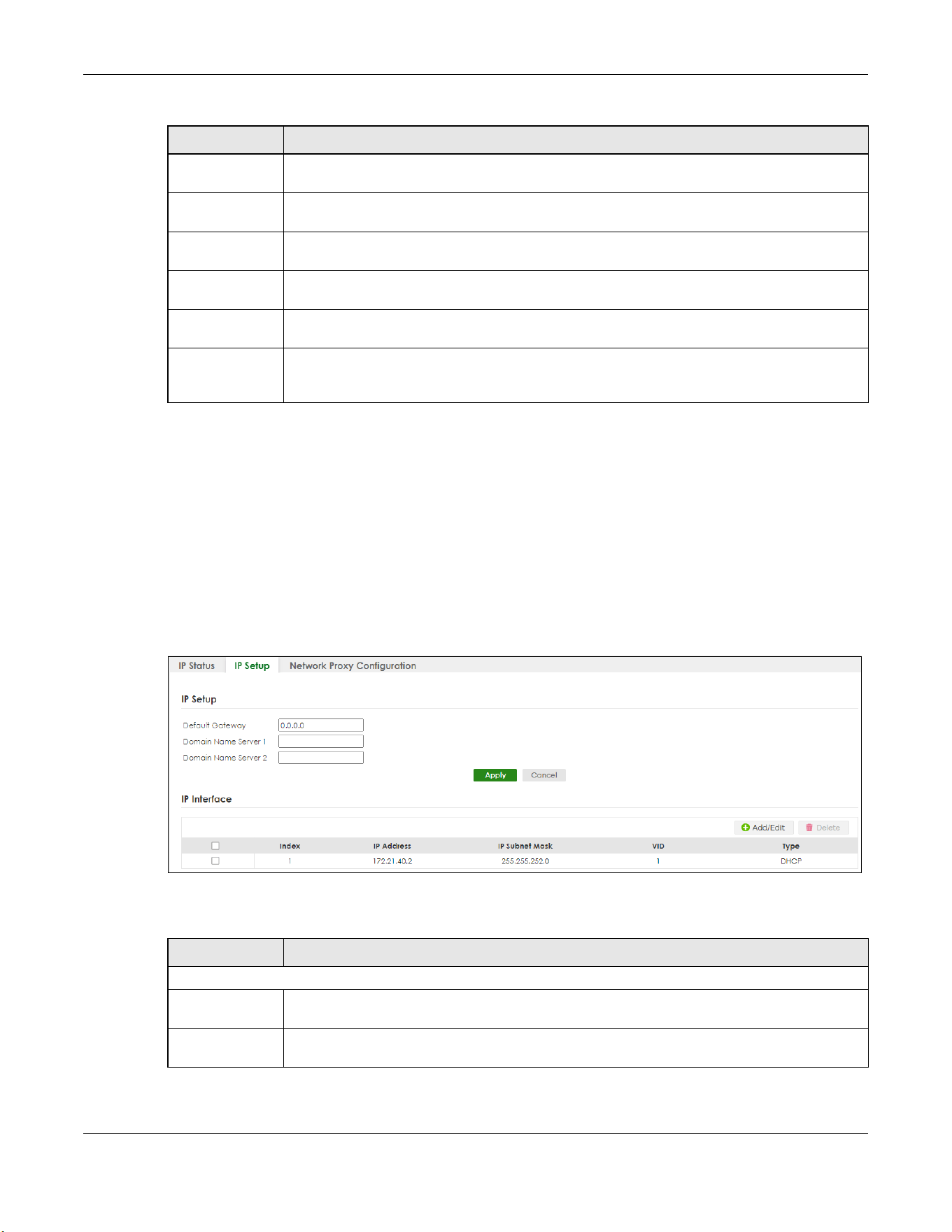
Chapter 23 IP Setup
XMG1915 Series User’s Guide
134
23.3 IP Setup
Use this screen to configure the default gateway device, the default domain name server and add IP
domains. Click SYSTEM > IP Setup > IP Setup in the navigation panel to display the screen as shown.
Note: The Switch allows you to set a static IP interface in the same subnet that already has a
DHCP-assigned IP interface on the Switch. The Switch will use the static IP you set and
the DHCP-assigned IP will be set to 0.0.0.0.
Figure 87 SYSTEM > IP Setup > IP Setup
The following table describes the labels in this screen.
Renew Time This displays the length of time from the lease start that the Switch will request to renew its
current dynamic IP address from the DHCP server.
Rebind Time This displays the length of time from the lease start that the Switch will request to get any
dynamic IP address from the DHCP server.
Lease Time Start This displays the date and time that the current dynamic IP address assignment from the DHCP
server began. You should configure date and time in SYSTEM > General Setup.
Lease Time End This displays the date and time that the current dynamic IP address assignment from the DHCP
server will end. You should configure date and time in SYSTEM > General Setup.
Default
Gateway
This displays the IP address of the default gateway assigned by the DHCP server. 0.0.0.0 means
no gateway is assigned.
Primary /
Secondary DNS
Server
This displays the IP address of the primary and secondary DNS servers assigned by the DHCP
server. 0.0.0.0 means no DNS server is assigned.
Table 46 SYSTEM > IP Setup > IP Status > IP Status Details: DHCP (continued)
LABEL DESCRIPTION
Table 47 SYSTEM > IP Setup > IP Setup
LABEL DESCRIPTION
IP Setup
Default
Gateway
Type the IP address of the default outgoing gateway in dotted decimal notation, for example
192.168.1.254.
Domain Name
Server 1/2
Enter a domain name server IPv4 address in order to be able to use a domain name instead of
an IP address.
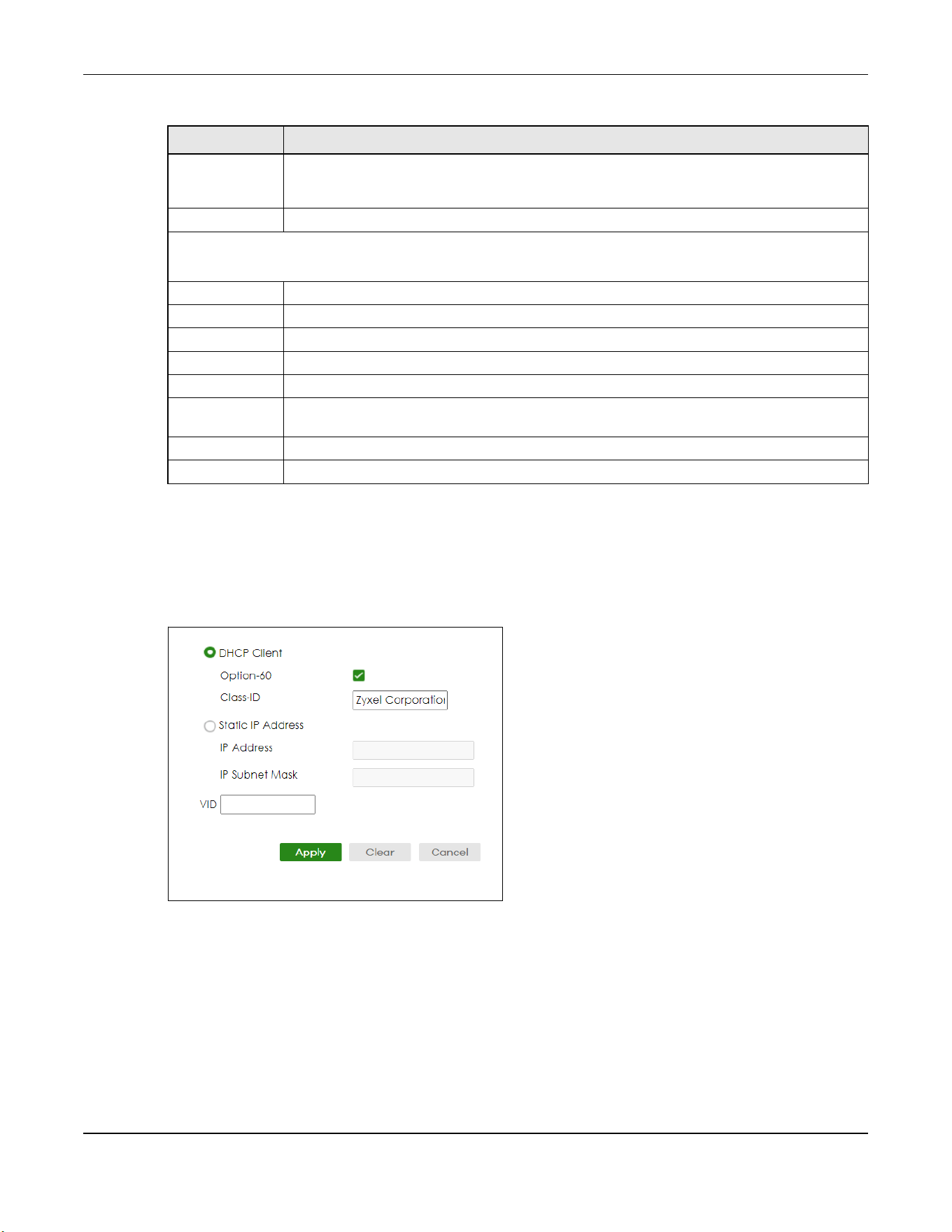
Chapter 23 IP Setup
XMG1915 Series User’s Guide
135
23.3.1 Add/Edit IP Interfaces
Use this screen to add or edit IP interfaces. Click Add/Edit, or select an entry and click Add/Edit in the
SYSTEM > IP Setup > IP Setup screen to display this screen.
Figure 88 SYSTEM > IP Setup > IP Setup > Add/Edit
Apply Click Apply to save your changes to the Switch’s run-time memory. The Switch loses these
changes if it is turned off or loses power, so use the Save link on the top navigation panel to save
your changes to the non-volatile memory when you are done configuring.
Cancel Click Cancel to reset the fields to your previous configuration.
IP Interface
Use this section to view and configure IP routing domains on the Switch.
Index This field displays the index number of an entry.
IP Address This field displays the IP address of the Switch in the IP domain.
IP Subnet Mask This field displays the subnet mask of the Switch in the IP domain.
VID This field displays the VLAN identification number of the IP domain on the Switch.
Type This field displays the type of IP address status. Static or DHCP.
Select an entry’s check box to select a specific entry. Otherwise, select the check box in the
table heading row to select all entries.
Add/Edit Click Add/Edit to add a new IP interface or edit a selected one.
Delete Click Delete to remove the selected IP interfaces.
Table 47 SYSTEM > IP Setup > IP Setup (continued)
LABEL DESCRIPTION
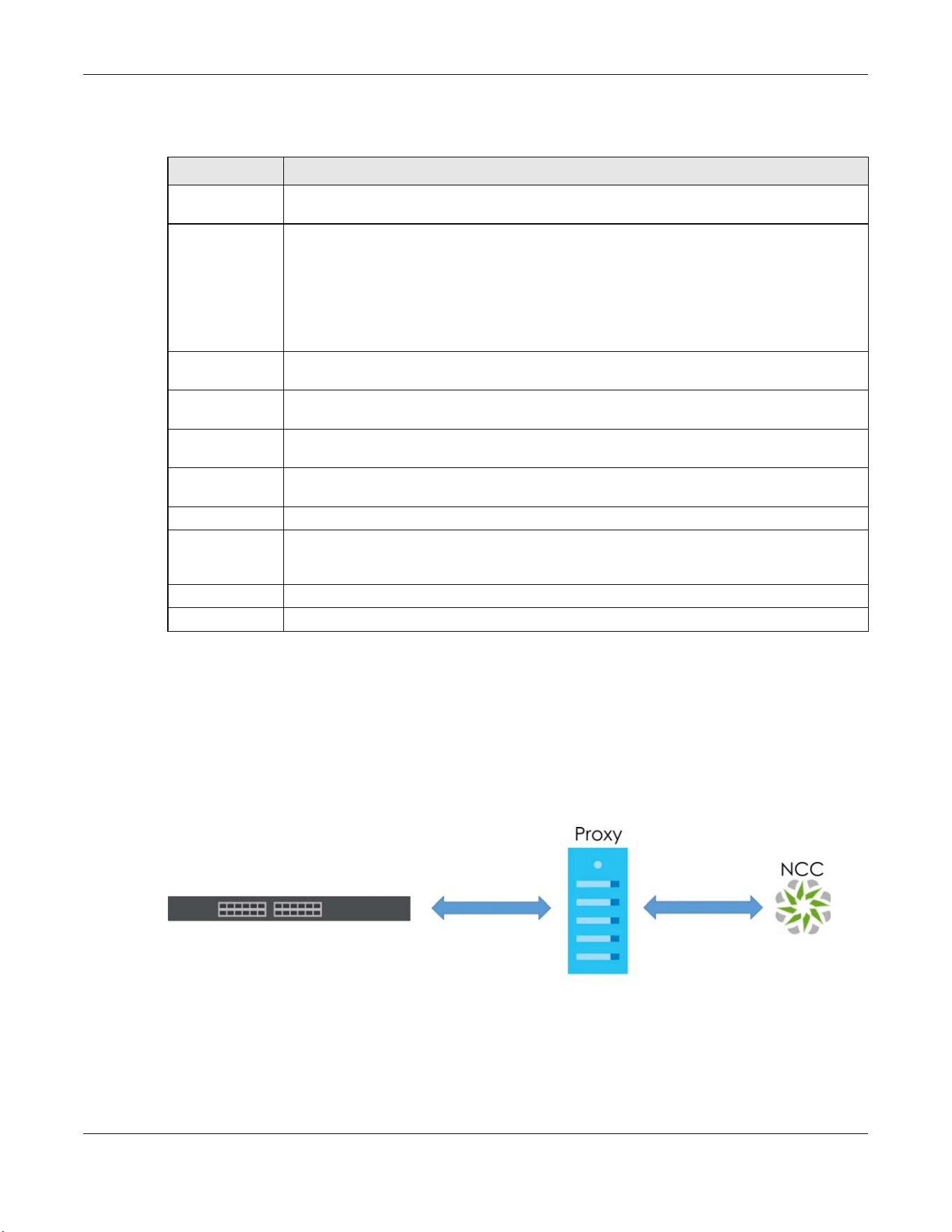
Chapter 23 IP Setup
XMG1915 Series User’s Guide
136
The following table describes the labels in this screen.
23.4 Network Proxy Configuration
The proxy server of an organization may prohibit communication between the Switch and NCC (Nebula
Control Center) (See Section 20.1 on page 124). Use this screen to enable communication between the
Switch and NCC through the proxy server.
Figure 89 Network Proxy Configuration Application
As of this writing, this setting only allows communication between the Switch and the NCC.
Table 48 SYSTEM > IP Setup > IP Setup > Add/Edit
LABEL DESCRIPTION
DHCP Client Select this option if you have a DHCP server that can assign the Switch an IP address, subnet
mask, a default gateway IP address and a domain name server IP address automatically.
Option-60 DHCP Option 60 is used by the Switch for identification to the DHCP server using the VCI
(Vendor Class Identifier) on the DHCP server. The Switch adds it in the initial DHCP discovery
message that a DHCP client broadcasts in search of an IP address. The DHCP server can assign
different IP addresses or options to clients with the specific VCI or reject the request from clients
without the specific VCI.
Select this and enter the device identity you want the Switch to add in the DHCP discovery
frames that go to the DHCP server. This allows the Switch to identify itself to the DHCP server.
Class-ID Enter a string of up to 32 printable ASCII characters to identify this Switch to the DHCP server. For
example, Zyxel-TW. The string should not contain [ ? ], [ | ], [ ' ], [ " ], or [ , ].
Static IP Address Select this option if you do not have a DHCP server or if you wish to assign static IP address
information to the Switch. You need to fill in the following fields when you select this option.
IP Address Enter the IP address of your Switch in dotted decimal notation, for example, 192.168.1.1. This is
the IP address of the Switch in an IP routing domain.
IP Subnet
Mask
Enter the IP subnet mask of an IP routing domain in dotted decimal notation, for example,
255.255.255.0.
VID Enter the VLAN identification number to which an IP routing domain belongs.
Apply Click Apply to save your changes to the Switch’s run-time memory. The Switch loses these
changes if it is turned off or loses power, so use the Save link on the top navigation panel to save
your changes to the non-volatile memory when you are done configuring.
Clear Click Clear to clear the fields to the factory defaults.
Cancel Click Cancel to not save the configuration you make and return to the last screen.
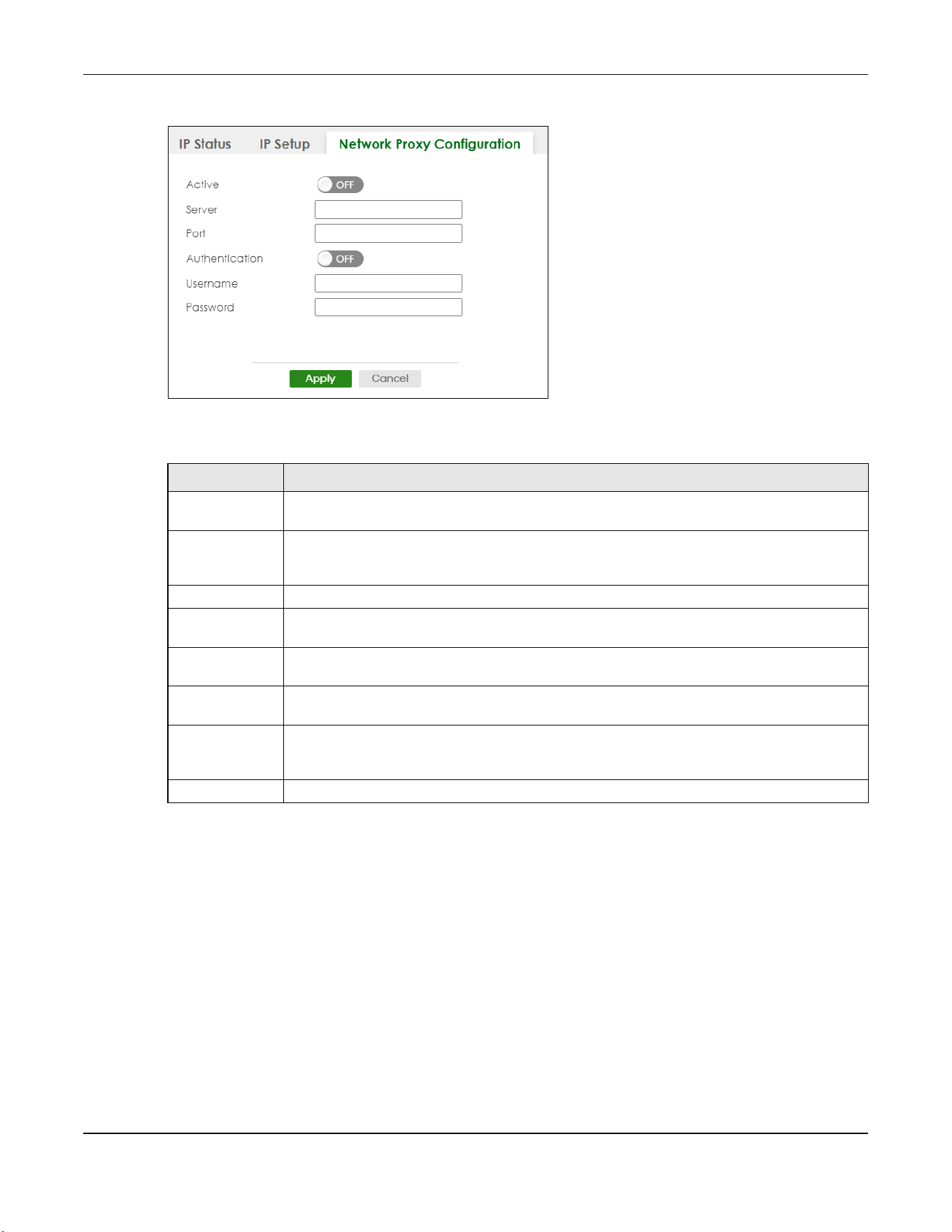
Chapter 23 IP Setup
XMG1915 Series User’s Guide
137
Figure 90 SYSTEM > IP Setup > Network Proxy Configuration
The following table describes the labels in this screen.
Table 49 SYSTEM > IP Setup > Network Proxy Configuration
LABEL DESCRIPTION
Active Enable the switch button to enable communication between the Switch and NCC through a
proxy server.
Server Enter the IP address (dotted decimal notation) or host name of the proxy server. When entering
the host name, up to 128 alphanumeric characters are allowed for the Server except [ ? ], [ | ],
[ ' ], or [ " ].
Port Enter the port number of the proxy server (1 – 65535).
Authentication Enable the switch button to enable proxy server authentication using a Username and
Password.
Username Enter a login user name from the proxy server administrator. Up to 32 alphanumeric characters
are allowed for the Username except [ ? ], [ | ], [ ' ], or [ " ].
Password Enter a login password from the proxy server administrator. Up to 32 alphanumeric characters
are allowed for the Password except [ ? ], [ | ], [ ' ], or [ " ].
Apply Click Apply to save your changes to the Switch’s run-time memory. The Switch loses these
changes if it is turned off or loses power, so use the Save link on the top navigation panel to save
your changes to the non-volatile memory when you are done configuring.
Cancel Click Cancel to reset the fields to your previous configuration.

Chapter 24 IPv6
XMG1915 Series User’s Guide
138
CHAPTER 24
IPv6
24.1 IPv6 Overview
This chapter introduces the IPv6 screens.
24.1.1 What You Can Do
• Use the IPv6 Status screen (Section 24.2 on page 138) to view the IPv6 table and DNS server
information.
• Use the IPv6 Global Setup screen (Section 24.3 on page 141) to configure the global IPv6 settings.
• Use the IPv6 Interface Setup screen (Section 24.4 on page 142) to view and configure IPv6 interfaces.
• Use the IPv6 Link-Local Address Setup screen (Section 24.5 on page 143) to view and configure IPv6
link-local addresses.
• Use the IPv6 Global Address Setup screen (Section 24.6 on page 145) to view and configure IPv6
global addresses.
• Use the IPv6 Neighbor Discovery Setup screen (Section 24.7 on page 146) to view and configure
neighbor discovery settings on each interface.
• Use the IPv6 Router Discovery Setup screen (Section 24.8 on page 148) to view and configure router
discovery settings on each interface.
• Use the IPv6 Prefix Setup screen (Section 24.9 on page 149) to configure the Switch’s IPv6 prefix list for
each interface.
• Use the IPv6 Neighbor Setup screen (Section 24.10 on page 151) to configure static IPv6 neighbor
entries in the Switch’s IPv6 neighbor table.
• Use theDHCPv6 Client Setup screen (Section 24.11 on page 152) to configure the Switch’s DHCP
settings when it is acting as a DHCPv6 client.
24.2 IPv6 Status
Click SYSTEM > IPv6 > IPv6 Status in the navigation panel to display the IPv6 status screen as shown next.
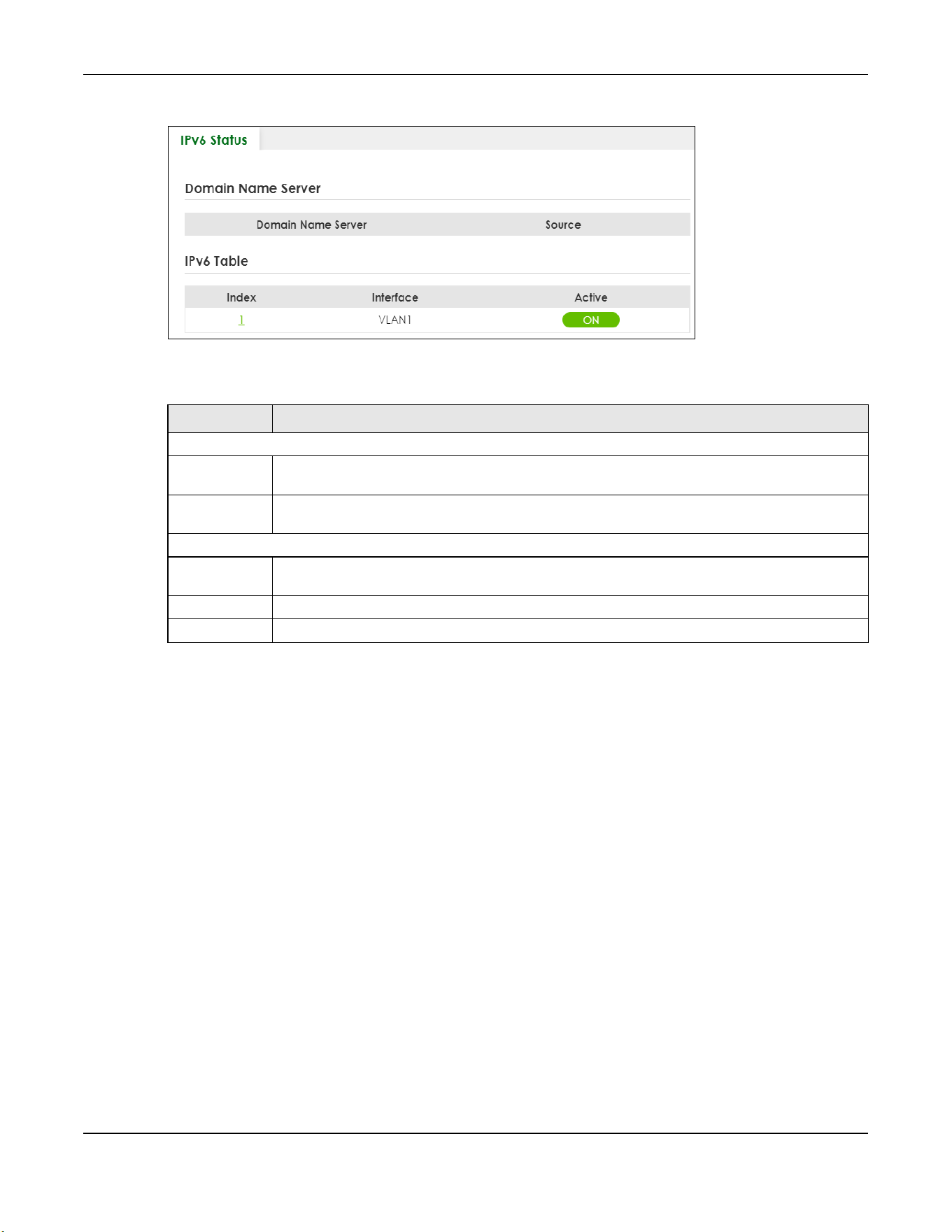
Chapter 24 IPv6
XMG1915 Series User’s Guide
139
Figure 91 SYSTEM > IPv6 > IPv6 Status
The following table describes the labels in this screen.
24.2.1 IPv6 Interface Status Details
Use this screen to view a specific IPv6 interface status and detailed information. Click an interface index
number in the SYSTEM > IPv6 > IPv6 Status screen. The following screen opens.
Table 50 SYSTEM > IPv6 > IPv6 Status
LABEL DESCRIPTION
Domain Name Server
Domain Name
Server
This field displays the IP address of the DNS server.
Source This field displays whether the DNS server address is configured manually (Static) or obtained
automatically using DHCPv6.
IPv6 Table
Index This field displays the index number of an IPv6 interface. Click on an index number to view more
interface details.
Interface This is the name of the IPv6 interface you created.
Active This field displays whether the IPv6 interface is activated or not.
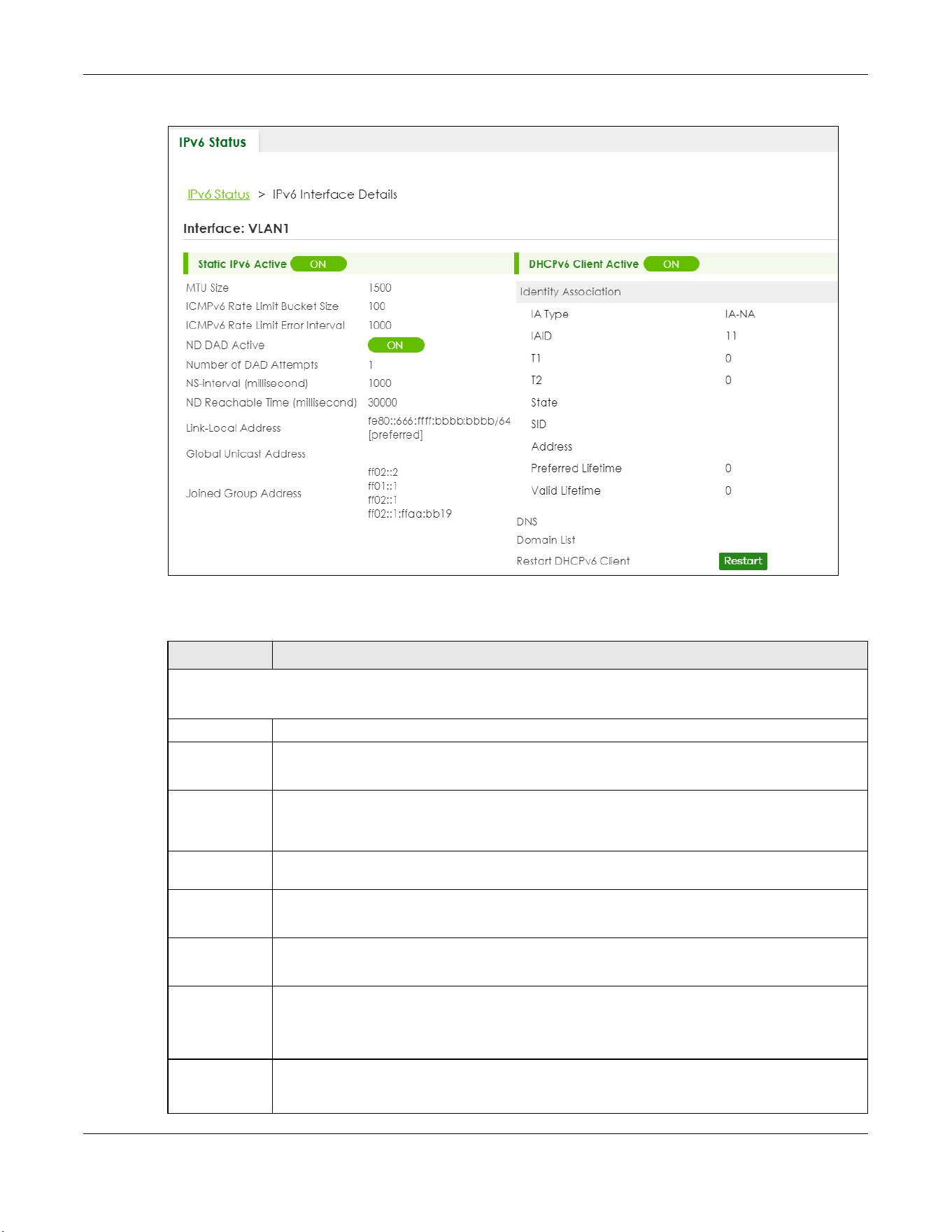
Chapter 24 IPv6
XMG1915 Series User’s Guide
140
Figure 92 SYSTEM > IPv6 > IPv6 Status > IPv6 Interface Details
The following table describes the labels in this screen.
Table 51 SYSTEM > IPv6 > IPv6 Status > IPv6 Interface Details
LABEL DESCRIPTION
Static IPv6 Active
This field displays whether the IPv6 interface is activated or not.
MTU Size This field displays the Maximum Transmission Unit (MTU) size for IPv6 packets on this interface.
ICMPv6
Rate Limit
Bucket Size
This field displays the maximum number of ICMPv6 error messages which are allowed to transmit
in a given time interval. If the bucket is full, subsequent error messages are suppressed.
ICMPv6
Rate Limit
Error
Interval
This field displays the time period (in milliseconds) during which ICMPv6 error messages of up to
the bucket size can be transmitted. 0 means no limit.
ND DAD
Active
This field displays whether Neighbor Discovery (ND) Duplicate Address Detection (DAD) is
enabled on the interface.
Number of
DAD
Attempts
This field displays the number of consecutive neighbor solicitations the Switch sends for this
interface.
NS-Interval
(millisecon
d)
This field displays the time interval (in milliseconds) at which neighbor solicitations are re-sent for
this interface.
ND
Reachable
Time
(millisecon
d)
This field displays how long (in milliseconds) a neighbor is considered reachable for this interface.
Link-Local
Address
This field displays the Switch’s link-local IP address and prefix generated by the interface. It also
shows whether the IP address is preferred, which means it is a valid address and can be used as a
sender or receiver address.

Chapter 24 IPv6
XMG1915 Series User’s Guide
141
24.3 IPv6 Global Setup
Use this screen to configure the global IPv6 settings. Click SYSTEM > IPv6 > IPv6 Global Setup to display
the screen as shown next.
Global
Unicast
Address
This field displays the Switch’s global unicast address to identify this interface.
Joined
Group
Address
This field displays the IPv6 multicast addresses of groups the Switch’s interface joins.
DHCPv6 Client Active
This field displays whether the Switch acts as a DHCPv6 client to get an IPv6 address from a DHCPv6 server.
Identity Association
An Identity Association (IA) is a collection of addresses assigned to a DHCP client, through which the server and
client can manage a set of related IP addresses. Each IA must be associated with exactly one interface.
IA Type The IA type is the type of address in the IA. Each IA holds one type of address. IA_NA means an
identity association for non-temporary addresses and IA_TA is an identity association for
temporary addresses.
IAID Each IA consists of a unique IAID and associated IP information.
T1 This field displays the DHCPv6 T1 timer. After T1, the Switch sends the DHCPv6 server a Renew
message.
An IA_NA option contains the T1 and T2 fields, but an IA_TA option does not. The DHCPv6 server
uses T1 and T2 to control the time at which the client contacts with the server to extend the
lifetimes on any addresses in the IA_NA before the lifetimes expire.
T2 This field displays the DHCPv6 T2 timer. If the time T2 is reached and the server does not respond,
the Switch sends a Rebind message to any available server.
State This field displays the state of the TA. It shows
Active when the Switch obtains addresses from a DHCpv6 server and the TA is created.
Renew when the TA’s address lifetime expires and the Switch sends out a Renew message.
Rebind when the Switch does not receive a response from the original DHCPv6 server and sends
out a Rebind message to another DHCPv6 server.
SID This field displays the DHCPv6 server’s unique ID.
Address This field displays the Switch’s global address which is assigned by the DHCPv6 server.
Preferred
Lifetime
This field displays how long (in seconds) that the global address remains preferred.
Valid
Lifetime
This field displays how long (in seconds) that the global address is valid.
DNS This field displays the DNS server address assigned by the DHCPv6 server.
Domain List This field displays the address record when the Switch queries the DNS server to resolve domain
names.
Restart
DHCPv6 Client
Click Restart to send a new DHCP request to the DHCPv6 server and update the IPv6 address and
DNS information for this interface.
Table 51 SYSTEM > IPv6 > IPv6 Status > IPv6 Interface Details (continued)
LABEL DESCRIPTION
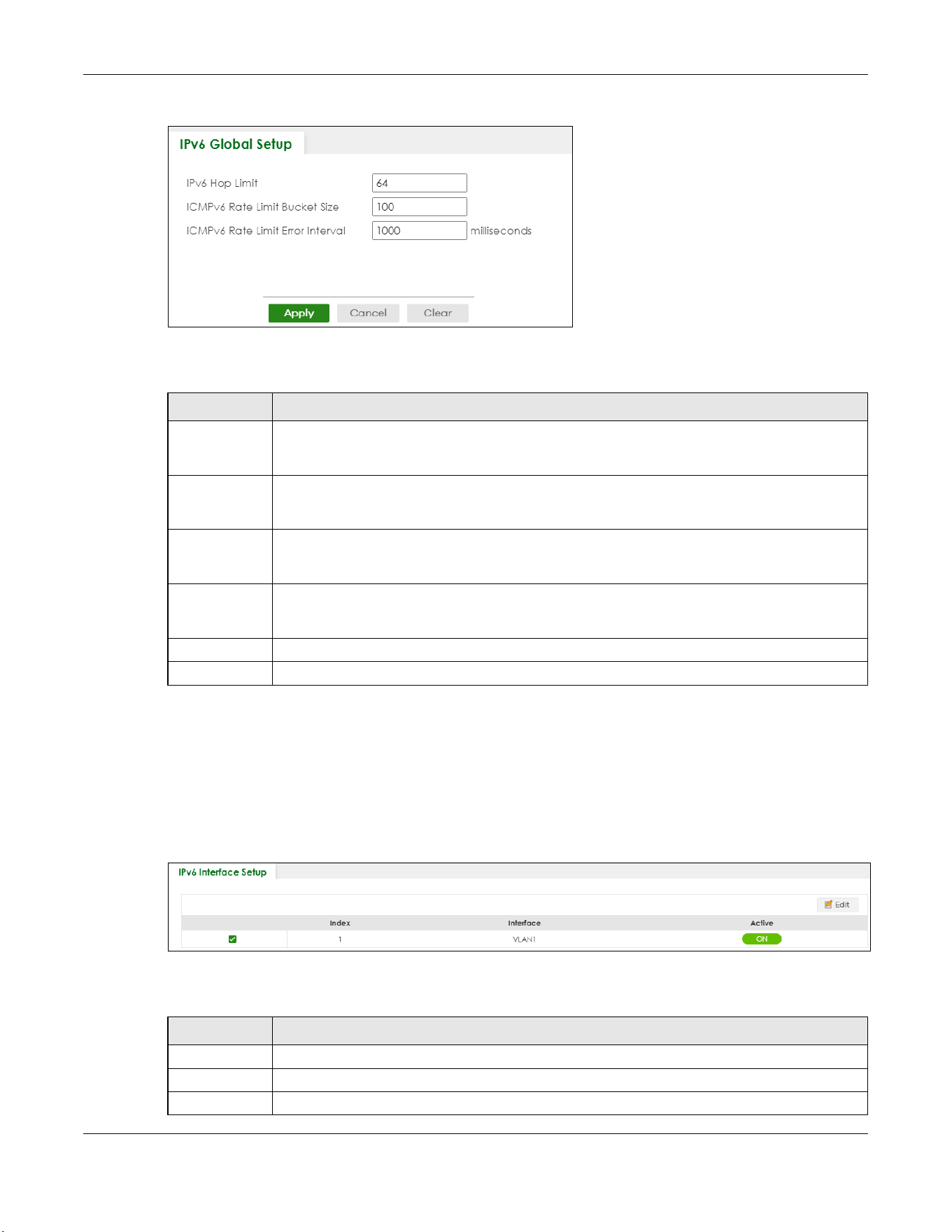
Chapter 24 IPv6
XMG1915 Series User’s Guide
142
Figure 93 SYSTEM > IPv6 > IPv6 Global Setup
The following table describes the labels in this screen.
24.4 IPv6 Interface Setup
Use this screen to view and configure an IPv6 interface you create in the SYSTEM > Interface Setup
screen. Click SYSTEM > IPv6 > IPv6 Interface Setup to display the screen as shown next.
Figure 94 SYSTEM > IPv6 > IPv6 Interface Setup
The following table describes the labels in this screen.
Table 52 SYSTEM > IPv6 > IPv6 Global Setup
LABEL DESCRIPTION
IPv6 Hop Limit Specify the maximum number of hops (from 1 to 255) in router advertisements. This is the
maximum number of hops on which an IPv6 packet is allowed to transmit before it is discarded by
an IPv6 router, which is similar to the TTL field in IPv4.
ICMPv6 Rate
Limit Bucket
Size
Specify the maximum number of ICMPv6 error messages (from 1 to 200) which are allowed to
transmit in a given time interval. If the bucket is full, subsequent error messages are suppressed.
ICMPv6 Rate
Limit Error
Interval
Specify the time period (from 0 to 2147483647 milliseconds) during which ICMPv6 error messages
of up to the bucket size can be transmitted. 0 means no limit.
Apply Click Apply to save your changes to the Switch’s run-time memory. The Switch loses these
changes if it is turned off or loses power, so use the Save link on the top navigation panel to save
your changes to the non-volatile memory when you are done configuring.
Cancel Click Cancel to begin configuring this screen afresh.
Clear Click Clear to reset the fields to the factory defaults.
Table 53 SYSTEM > IPv6 > IPv6 Interface Setup
LABEL DESCRIPTION
Index This is the interface index number.
Interface This is the name of the IPv6 interface you created.
Active This field displays whether the IPv6 interface is activated or not.
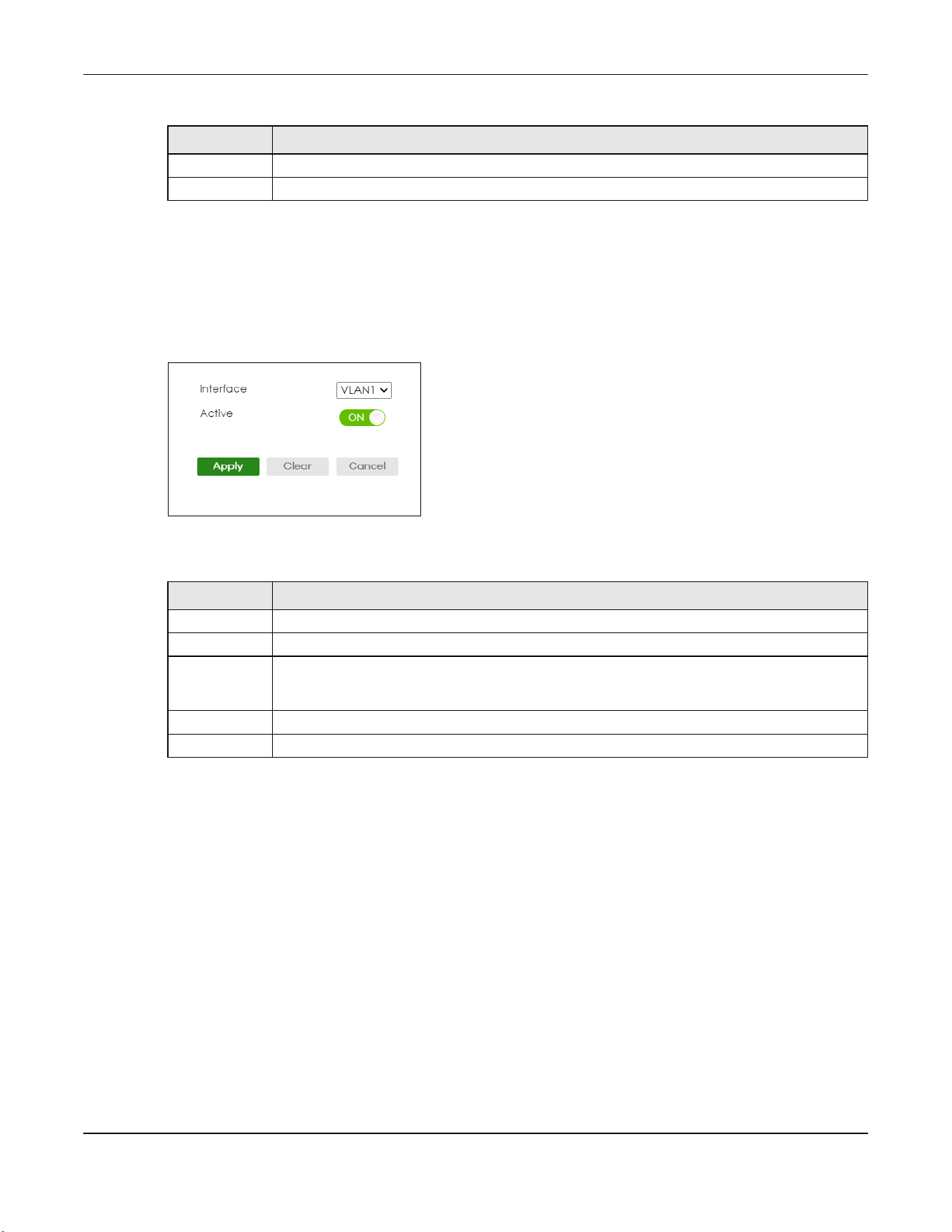
Chapter 24 IPv6
XMG1915 Series User’s Guide
143
24.4.1 Edit an IPv6 Interface
Use this screen to turn on or off an IPv6 interface you create in the SYSTEM > Interface Setup screen.
Select an entry and click Edit in the SYSTEM > IPv6 > IPv6 Interface Setup screen to display the screen as
shown next.
Figure 95 SYSTEM > IPv6 > IPv6 Interface Setup > Edit
The following table describes the labels in this screen.
24.5 IPv6 Link-Local Address Setup
A link-local address uniquely identifies a device on the local network (the LAN). It is similar to a “private IP
address” in IPv4. You can have the same link-local address on multiple interfaces on a device. A link-
local unicast address has a predefined prefix of fe80::/10.
Use this screen to view and configure the interface’s link-local address and default gateway. Click
SYSTEM > IPv6 > IPv6 Addressing > IPv6 Link-Local Address Setup to display the screen as shown next.
Note: You should first create an IPv6 interface in the SYSTEM > Interface Setup screen.
Select an entry’s check box to select a specific entry.
Edit Click Edit to edit the selected interface.
Table 53 SYSTEM > IPv6 > IPv6 Interface Setup (continued)
LABEL DESCRIPTION
Table 54 SYSTEM > IPv6 > IPv6 Interface Setup > Edit
LABEL DESCRIPTION
Interface Select the IPv6 interface you want to configure.
Active Enable the switch button to enable the interface.
Apply Click Apply to save your changes to the Switch’s run-time memory. The Switch loses these
changes if it is turned off or loses power, so use the Save link on the top navigation panel to save
your changes to the non-volatile memory when you are done configuring.
Clear Click Clear to clear the fields to the factory defaults.
Cancel Click Cancel to not save the configuration you make and return to the last screen.
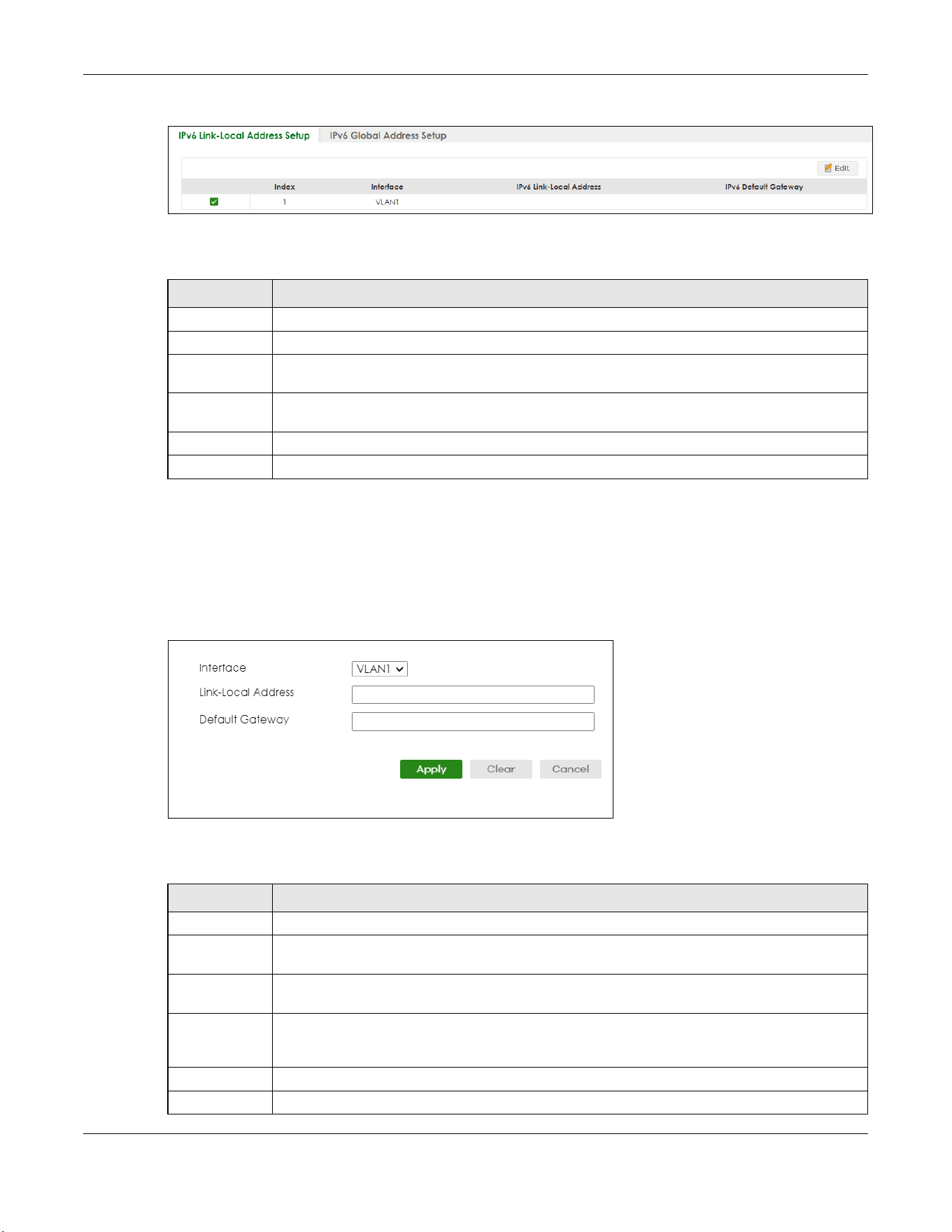
Chapter 24 IPv6
XMG1915 Series User’s Guide
144
Figure 96 SYSTEM > IPv6 > IPv6 Addressing > IPv6 Link-Local Address Setup
The following table describes the labels in this screen.
24.5.1 Edit an IPv6 Link-Local Address
Use this screen to configure the link-local address and default gateway of an IPv6 interface you create
in the SYSTEM > Interface Setup screen. Select an entry and click Edit in the SYSTEM > IPv6 > IPv6
Addressing > IPv6 Link-Local Address Setup screen to display this screen.
Figure 97 SYSTEM > IPv6 > IPv6 Addressing > IPv6 Link-Local Address Setup > Edit
The following table describes the labels in this screen.
Table 55 SYSTEM > IPv6 > IPv6 Addressing > IPv6 Link-Local Address Setup
LABEL DESCRIPTION
Index This is the interface index number.
Interface This is the name of the IPv6 interface you created.
IPv6 Link-Local
Address
This is the static IPv6 link-local address for the interface.
IPv6 Default
Gateway
This is the default gateway IPv6 address for the interface.
Select an entry’s check box to select a specific entry.
Edit Click Edit to edit the selected entry.
Table 56 SYSTEM > IPv6 > IPv6 Addressing > IPv6 Link-Local Address Setup > Edit
LABEL DESCRIPTION
Interface Select the IPv6 interface you want to configure.
Link-Local
Address
Manually configure a static IPv6 link-local address for the interface.
Default
Gateway
Set the default gateway IPv6 address for the interface. When an interface cannot find a routing
information for a frame’s destination, it forwards the packet to the default gateway.
Apply Click Apply to save your changes to the Switch’s run-time memory. The Switch loses these
changes if it is turned off or loses power, so use the Save link on the top navigation panel to save
your changes to the non-volatile memory when you are done configuring.
Clear Click Clear to clear the fields to the factory defaults.
Cancel Click Cancel to not save the configuration you make and return to the last screen.
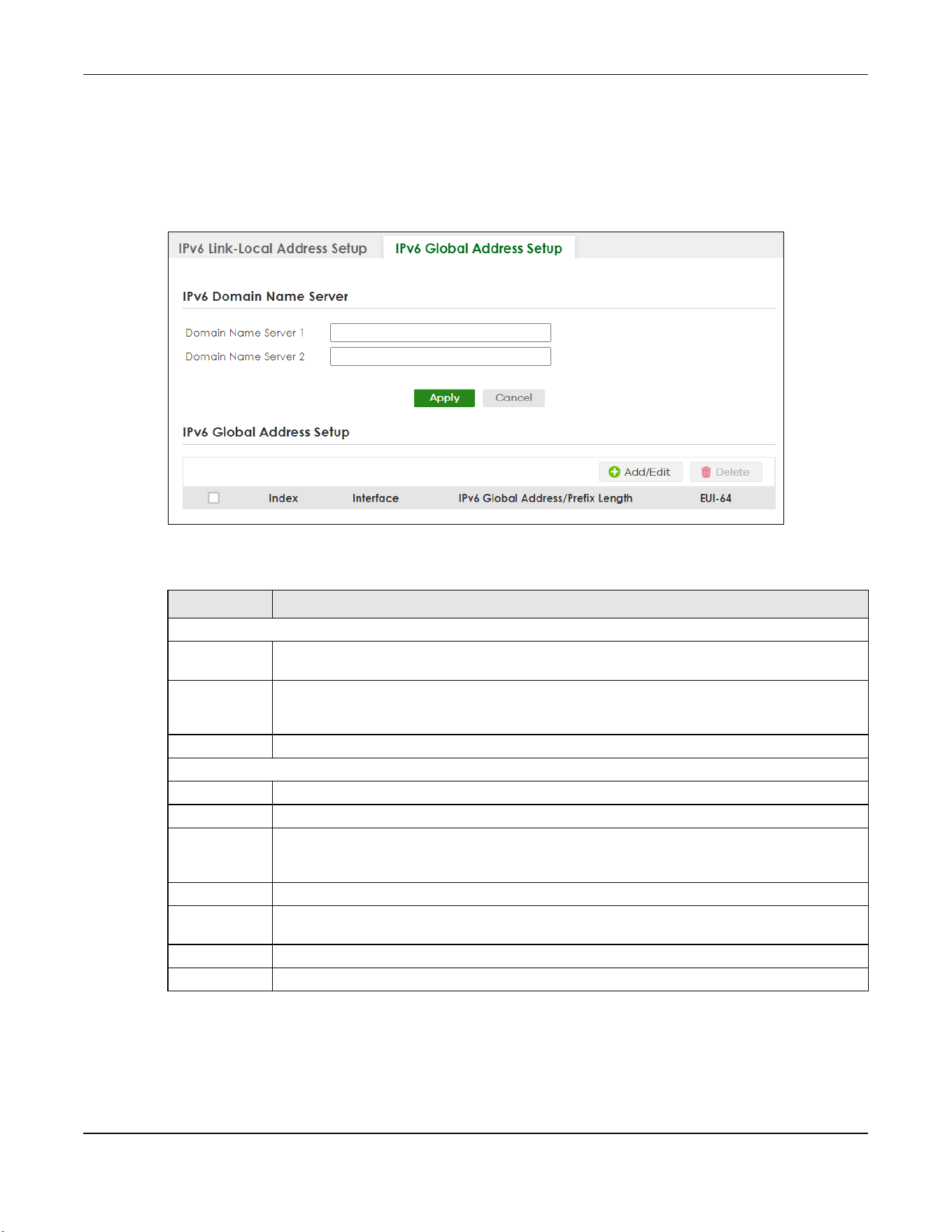
Chapter 24 IPv6
XMG1915 Series User’s Guide
145
24.6 IPv6 Global Address Setup
Use this screen to view and configure the interface’s IPv6 global address. Click SYSTEM > IPv6 Addressing
> IPv6 Global Address Setup to display the screen as shown next.
Figure 98 SYSTEM > IPv6 > IPv6 Addressing > IPv6 Global Address Setup
The following table describes the labels in this screen.
24.6.1 Add/Edit an IPv6 Global Address
Use this screen to configure the interface’s IPv6 global address. Click Add/Edit, or select an entry and
click Add/Edit in the SYSTEM > IPv6 Addressing > IPv6 Global Address Setup screen to display this screen.
Table 57 SYSTEM > IPv6 > IPv6 Addressing > IPv6 Global Address Setup
LABEL DESCRIPTION
IPv6 Domain Name Server
Domain Name
Server 1/2
Enter a domain name server IPv6 address in order to be able to use a domain name instead of an
IP address.
Apply Click Apply to save your changes to the Switch’s run-time memory. The Switch loses these
changes if it is turned off or loses power, so use the Save link on the top navigation panel to save
your changes to the non-volatile memory when you are done configuring.
Cancel Click this to reset the Domain Name Server values in this screen to their last-saved values.
IPv6 Global Address Setup
Index This is the interface index number.
Interface This is the name of the IPv6 interface you created.
IPv6 Global
Address/Prefix
Length
This field displays the IPv6 global address and prefix length for the interface.
EUI-64 This shows whether the interface ID of the global address is generated using the EUI-64 format.
Select an entry’s check box to select a specific entry. Otherwise, select the check box in the
table heading row to select all entries.
Add/Edit Click Add/Edit to add a new entry or edit a selected one.
Delete Click Delete to remove the selected entries.
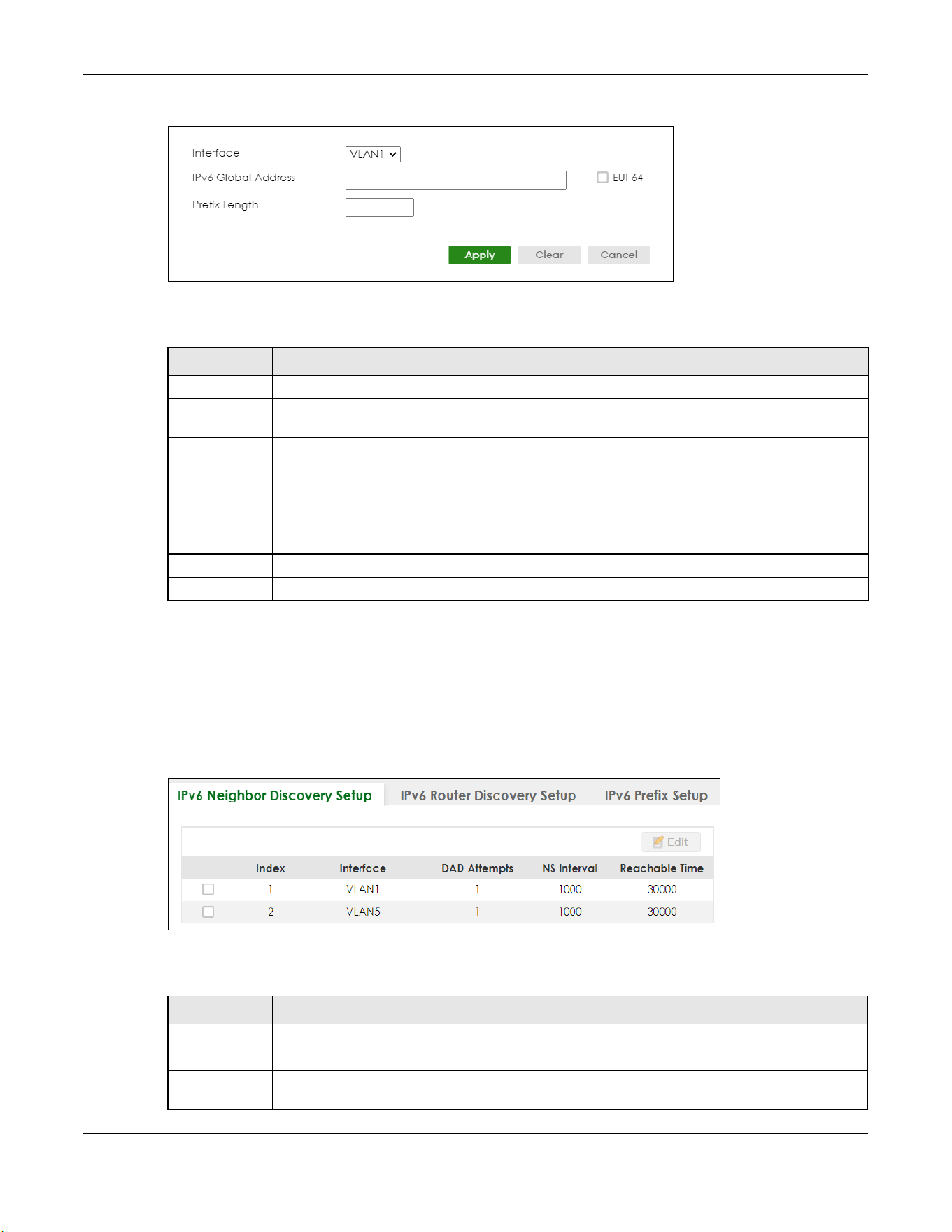
Chapter 24 IPv6
XMG1915 Series User’s Guide
146
Figure 99 SYSTEM > IPv6 > IPv6 Addressing > IPv6 Global Address Setup > Add/Edit
The following table describes the labels in this screen.
24.7 IPv6 Neighbor Discovery Setup
Use this screen to configure neighbor discovery settings for each interface. Click SYSTEM > IPv6 > IPv6
Neighbor Discovery > IPv6 Neighbor Discovery Setup to display the screen as shown next.
Figure 100 SYSTEM > IPv6 > IPv6 Neighbor Discovery > IPv6 Neighbor Discovery Setup
The following table describes the labels in this screen.
Table 58 SYSTEM > IPv6 > IPv6 Addressing > IPv6 Global Address Setup > Add/Edit
LABEL DESCRIPTION
Interface Select the IPv6 interface you want to configure.
IPv6 Global
Address
Manually configure a static IPv6 global address for the interface.
Prefix Length Specify an IPv6 prefix length that specifies how many most significant bits (start from the left) in
the address compose the network address.
EUI-64 Select this option to have the interface ID be generated automatically using the EUI-64 format.
Apply Click Apply to save your changes to the Switch’s run-time memory. The Switch loses these
changes if it is turned off or loses power, so use the Save link on the top navigation panel to save
your changes to the non-volatile memory when you are done configuring.
Clear Click Clear to clear the fields to the factory defaults.
Cancel Click Cancel to not save the configuration you make and return to the last screen.
Table 59 SYSTEM > IPv6 > IPv6 Neighbor Discovery > IPv6 Neighbor Discovery Setup
LABEL DESCRIPTION
Index This is the interface index number.
Interface This is the name of the IPv6 interface you created.
DAD Attempts This field displays the number of consecutive neighbor solicitations the Switch sends for this
interface.
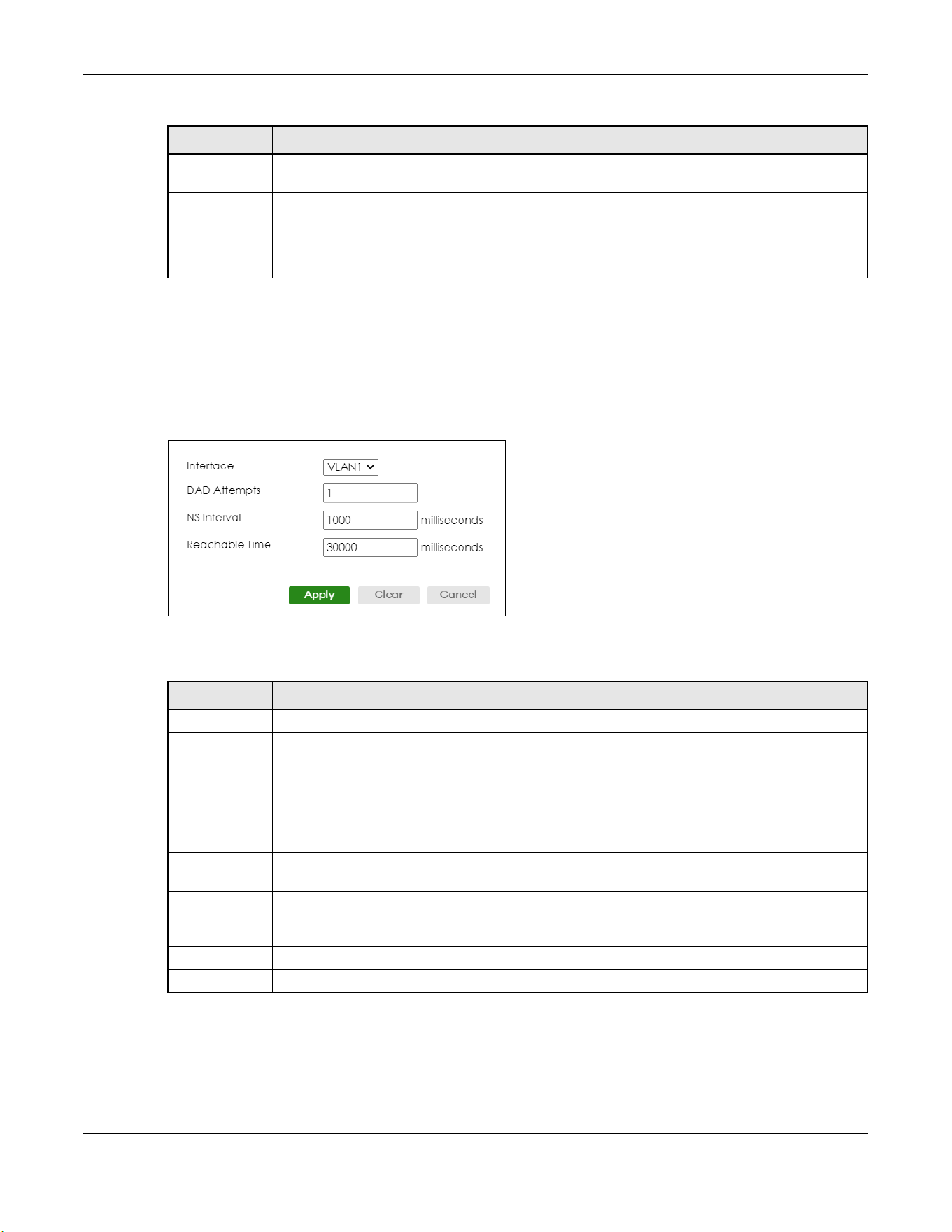
Chapter 24 IPv6
XMG1915 Series User’s Guide
147
24.7.1 Edit an IPv6 Neighbor Discovery
Use this screen to configure neighbor discovery settings for each interface. Select an entry and click Edit
in the SYSTEM > IPv6 > IPv6 Neighbor Discovery > IPv6 Neighbor Discovery Setup screen to display this
screen.
Figure 101 SYSTEM > IPv6 > IPv6 Neighbor Discovery > IPv6 Neighbor Discovery Setup > Edit
The following table describes the labels in this screen.
NS Interval This field displays the time interval (in milliseconds) at which neighbor solicitations are re-sent for
this interface.
Reachable
Time
This field displays how long (in milliseconds) a neighbor is considered reachable for this interface.
Select an entry’s check box to select a specific entry.
Edit Click Edit to edit the selected entry.
Table 59 SYSTEM > IPv6 > IPv6 Neighbor Discovery > IPv6 Neighbor Discovery Setup (continued)
LABEL DESCRIPTION
Table 60 SYSTEM > IPv6 > IPv6 Neighbor Discovery > IPv6 Neighbor Discovery Setup > Edit
LABEL DESCRIPTION
Interface Select the IPv6 interface you want to configure.
DAD Attempts The Switch uses Duplicate Address Detection (DAD) with neighbor solicitation and advertisement
messages to check whether an IPv6 address is already in use before assigning it to an interface.
Specify the number of consecutive neighbor solicitations (from 0 to 600) the Switch sends for this
interface. Enter 0 to turn off DAD.
NS Interval Specify the time interval (from 1000 to 3600000 milliseconds) at which neighbor solicitations are re-
sent for this interface.
Reachable
Time
Specify how long (from 1000 to 3600000 milliseconds) a neighbor is considered reachable for this
interface.
Apply Click Apply to save your changes to the Switch’s run-time memory. The Switch loses these
changes if it is turned off or loses power, so use the Save link on the top navigation panel to save
your changes to the non-volatile memory when you are done configuring.
Clear Click Clear to clear the fields to the factory defaults.
Cancel Click Cancel to not save the configuration you make and return to the last screen.
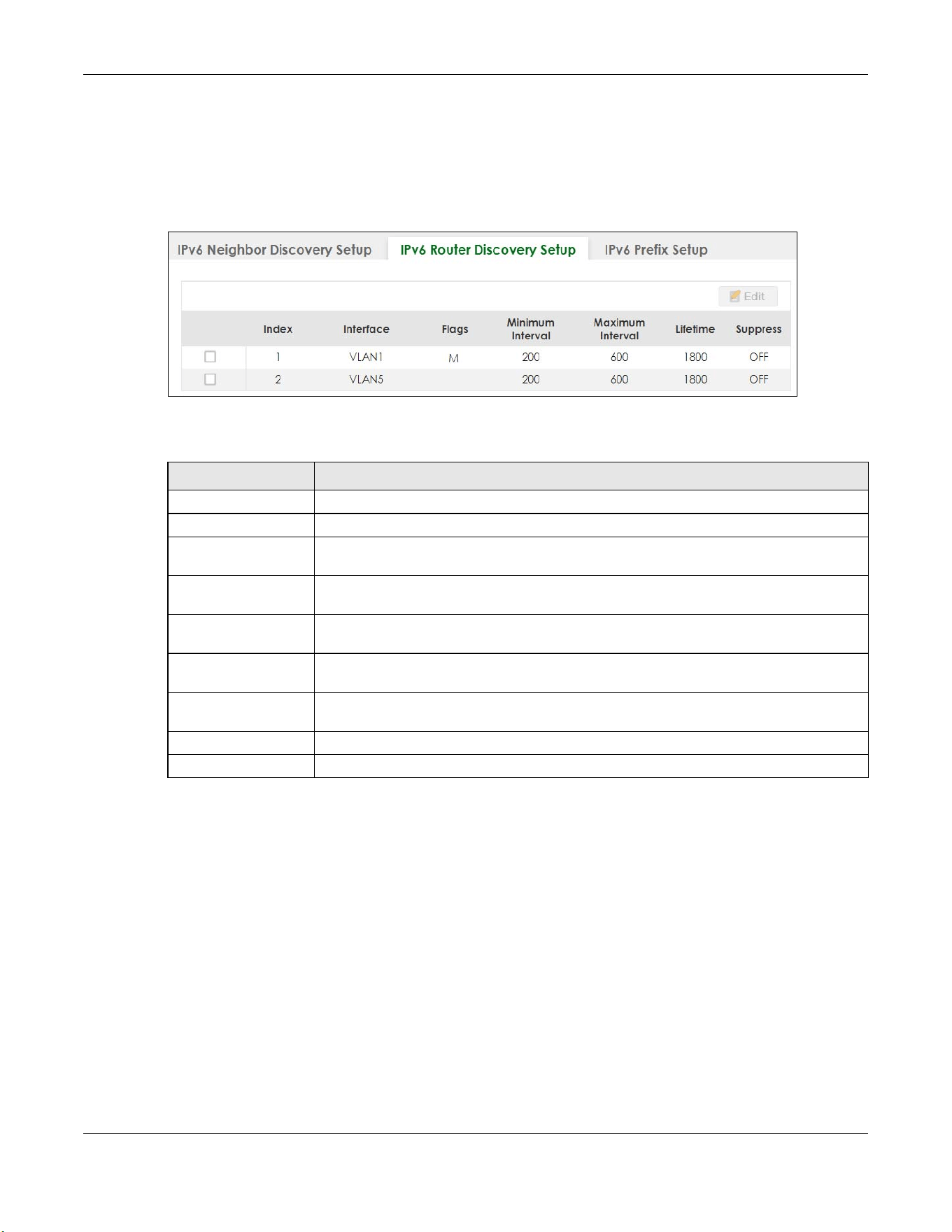
Chapter 24 IPv6
XMG1915 Series User’s Guide
148
24.8 IPv6 Router Discovery Setup
Use this screen to configure router discovery settings for each interface. Click SYSTEM > IPv6 > IPv6
Neighbor Discovery > IPv6 Router Discovery Setup to display the screen as shown next.
Figure 102 SYSTEM > IPv6 > IPv6 Neighbor Discovery > IPv6 Router Discovery Setup
The following table describes the labels in this screen.
24.8.1 Edit IPv6 Router Discovery
Use this screen to configure router discovery settings for each interface. Select an entry and click Edit in
the SYSTEM > IPv6 > IPv6 Neighbor Discovery > IPv6 Router Discovery Setup screen to display the screen
as shown next.
Table 61 SYSTEM > IPv6 > IPv6 Neighbor Discovery > IPv6 Router Discovery Setup
LABEL DESCRIPTION
Index This is the interface index number.
Interface This is the name of the IPv6 interface you created.
Flags This field displays whether IPv6 hosts use DHCPv6 to obtain IPv6 stateful addresses (M) and/
or additional configuration settings (O).
Minimum Interval This field displays the minimum time interval at which the Switch sends router
advertisements for this interface.
Maximum Interval This field displays the maximum time interval at which the Switch sends router
advertisements for this interface.
Lifetime This field displays how long the router in router advertisements can be used as a default
router for this interface.
Suppress This field displays whether the Switch sends router advertisements and responses to router
solicitations on this interface (ON) or not (OFF).
Select an entry’s check box to select a specific entry.
Edit Click Edit to edit the selected entry.
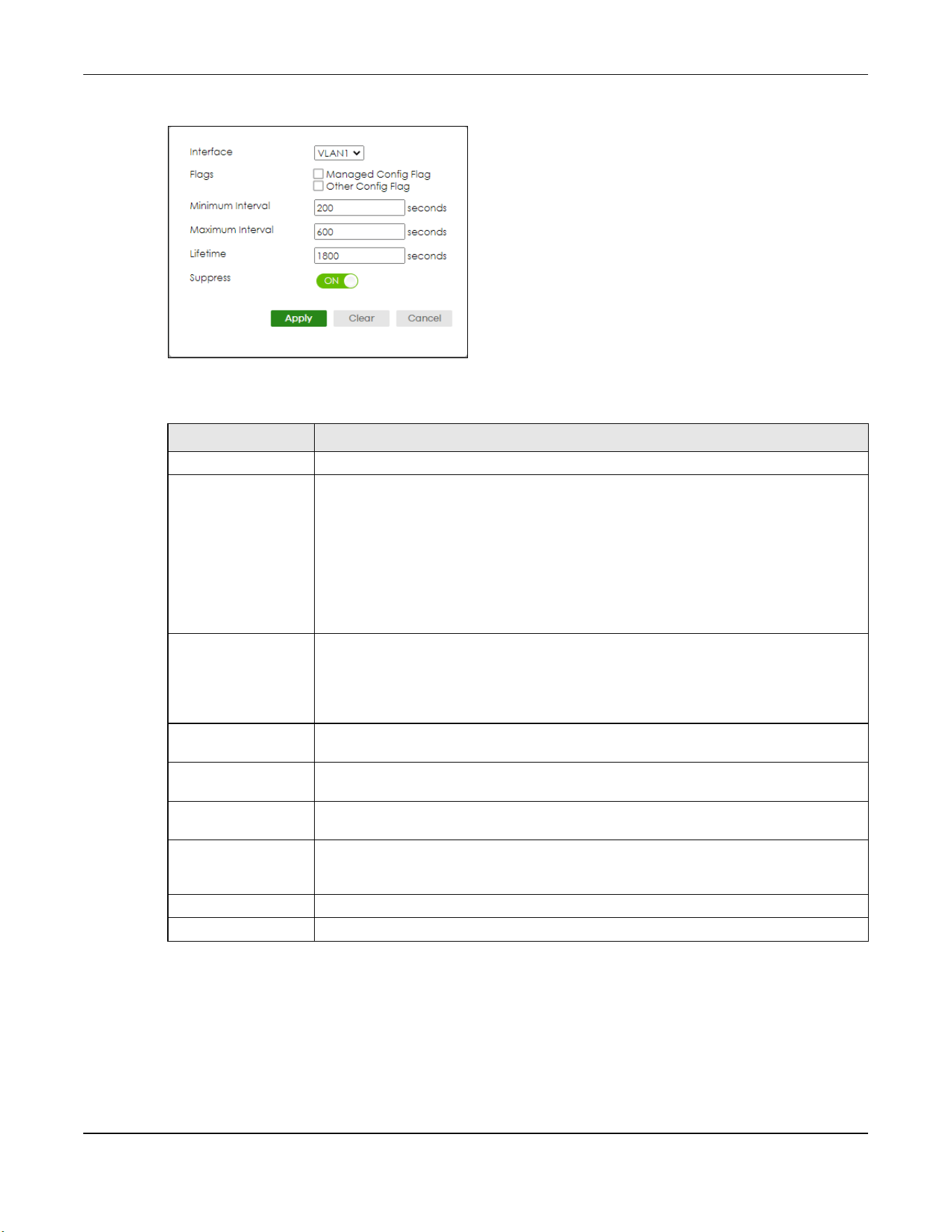
Chapter 24 IPv6
XMG1915 Series User’s Guide
149
Figure 103 SYSTEM > IPv6 > IPv6 Neighbor Discovery > IPv6 Router Discovery Setup > Edit
The following table describes the labels in this screen.
24.9 IPv6 Prefix Setup
Use this screen to configure the Switch’s IPv6 prefix list for each interface. Click SYSTEM > IPv6 > IPv6
Neighbor Discovery > IPv6 Prefix Setup to display the screen as shown next.
Table 62 SYSTEM > IPv6 > IPv6 Neighbor Discovery > IPv6 Router Discovery Setup > Edit
LABEL DESCRIPTION
Interface Select the IPv6 interface you want to configure.
Flags Select the Managed Config Flag option to have the Switch set the “managed address
configuration” flag (the M flag) to 1 in IPv6 router advertisements, which means IPv6 hosts
use DHCPv6 to obtain IPv6 stateful addresses. De-select the option to set the flag to 0 and
the host will not use DHCPv6 to obtain IPv6 stateful addresses.
Select the Other Config Flag option to have the Switch set the “Other stateful
configuration” flag (the O flag) to 1 in IPv6 router advertisements, which means IPv6 hosts
use DHCPv6 to obtain additional configuration settings, such as DNS information. De-select
the option to set the flag to 0 and the host will not use DHCPv6 to obtain additional
configuration settings.
Minimum Interval Specify the minimum time interval (from 3 to 1350 seconds) at which the Switch sends
router advertisements for this interface.
Note: The minimum time interval cannot be greater than three-quarters of the
maximum time interval.
Maximum Interval Specify the maximum time interval (from 4 to 1800 seconds) at which the Switch sends
router advertisements for this interface.
Lifetime Specify how long (from 0 to 9000 seconds) the router in router advertisements can be used
as a default router for this interface.
Suppress Enable the switch button to set the Switch to not send router advertisements and
responses to router solicitations on this interface.
Apply Click Apply to save your changes to the Switch’s run-time memory. The Switch loses these
changes if it is turned off or loses power, so use the Save link on the top navigation panel to
save your changes to the non-volatile memory when you are done configuring.
Clear Click Clear to clear the fields to the factory defaults.
Cancel Click Cancel to not save the configuration you make and return to the last screen.
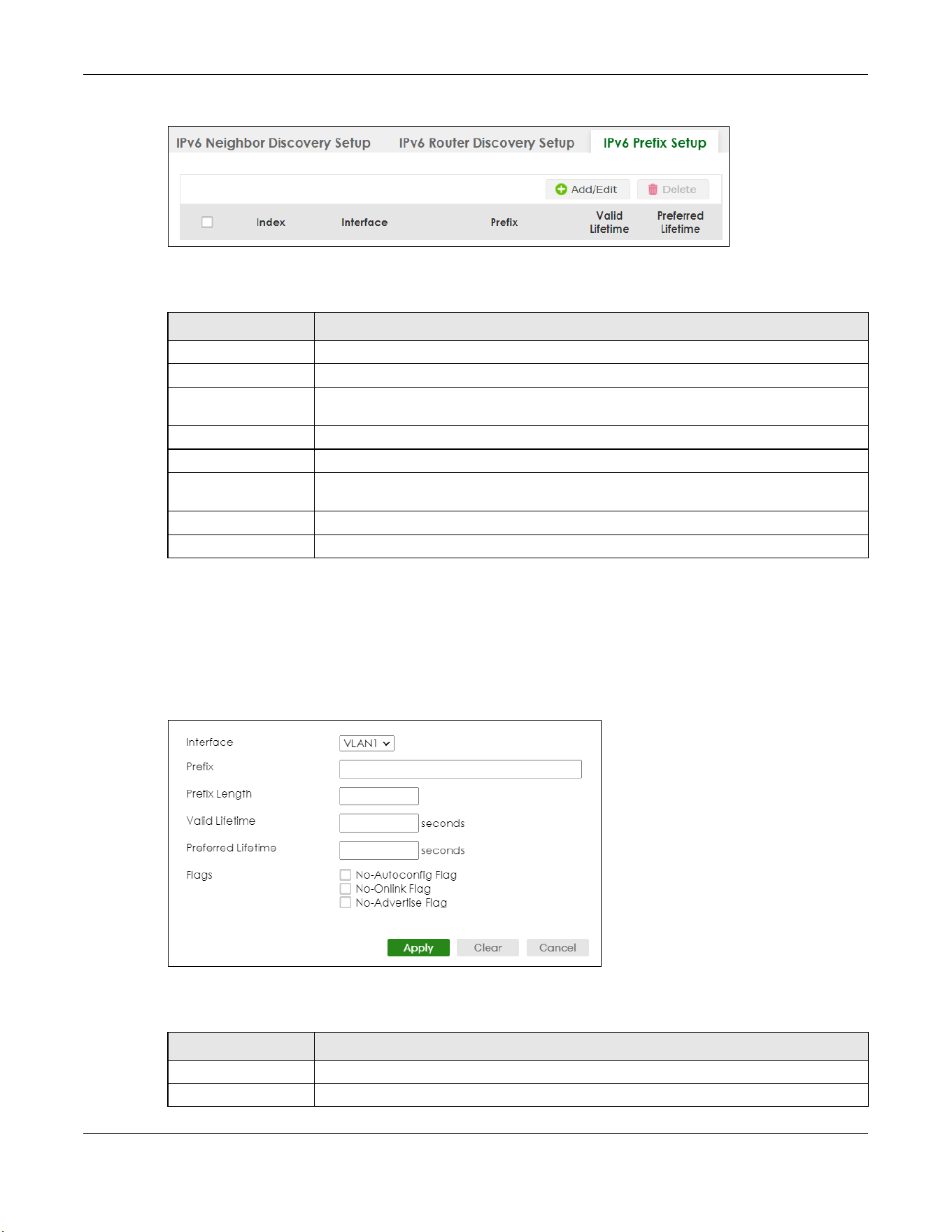
Chapter 24 IPv6
XMG1915 Series User’s Guide
150
Figure 104 SYSTEM > IPv6 > IPv6 Neighbor Discovery > IPv6 Prefix Setup
The following table describes the labels in this screen.
24.9.1 Add/Edit IPv6 Prefix
Use this screen to configure the Switch’s IPv6 prefix list for each interface. Click Add/Edit, or select an
entry and click Add/Edit in the SYSTEM > IPv6 > IPv6 Neighbor Discovery > IPv6 Prefix Setup screen to
display this screen.
Figure 105 SYSTEM > IPv6 > IPv6 Neighbor Discovery > IPv6 Prefix Setup > Add/Edit
The following table describes the labels in this screen.
Table 63 SYSTEM > IPv6 > IPv6 Neighbor Discovery > IPv6 Prefix Setup
LABEL DESCRIPTION
Index This is the interface index number.
Interface This is the name of the IPv6 interface you created.
Prefix This field displays the IPv6 prefix and prefix length that the Switch includes in router
advertisements for this interface.
Valid Lifetime This field displays the IPv6 prefix valid lifetime.
Preferred Lifetime This field displays the preferred lifetime of an IPv6 address generated from the prefix.
Select an entry’s check box to select a specific entry. Otherwise, select the check box in
the table heading row to select all entries.
Add/Edit Click Add/Edit to add a new entry or edit a selected one.
Delete Click Delete to remove the selected entries.
Table 64 SYSTEM > IPv6 > IPv6 Neighbor Discovery > IPv6 Prefix Setup > Add/Edit
LABEL DESCRIPTION
Interface Select the IPv6 interface you want to configure.
Prefix Set the IPv6 prefix that the Switch includes in router advertisements for this interface.
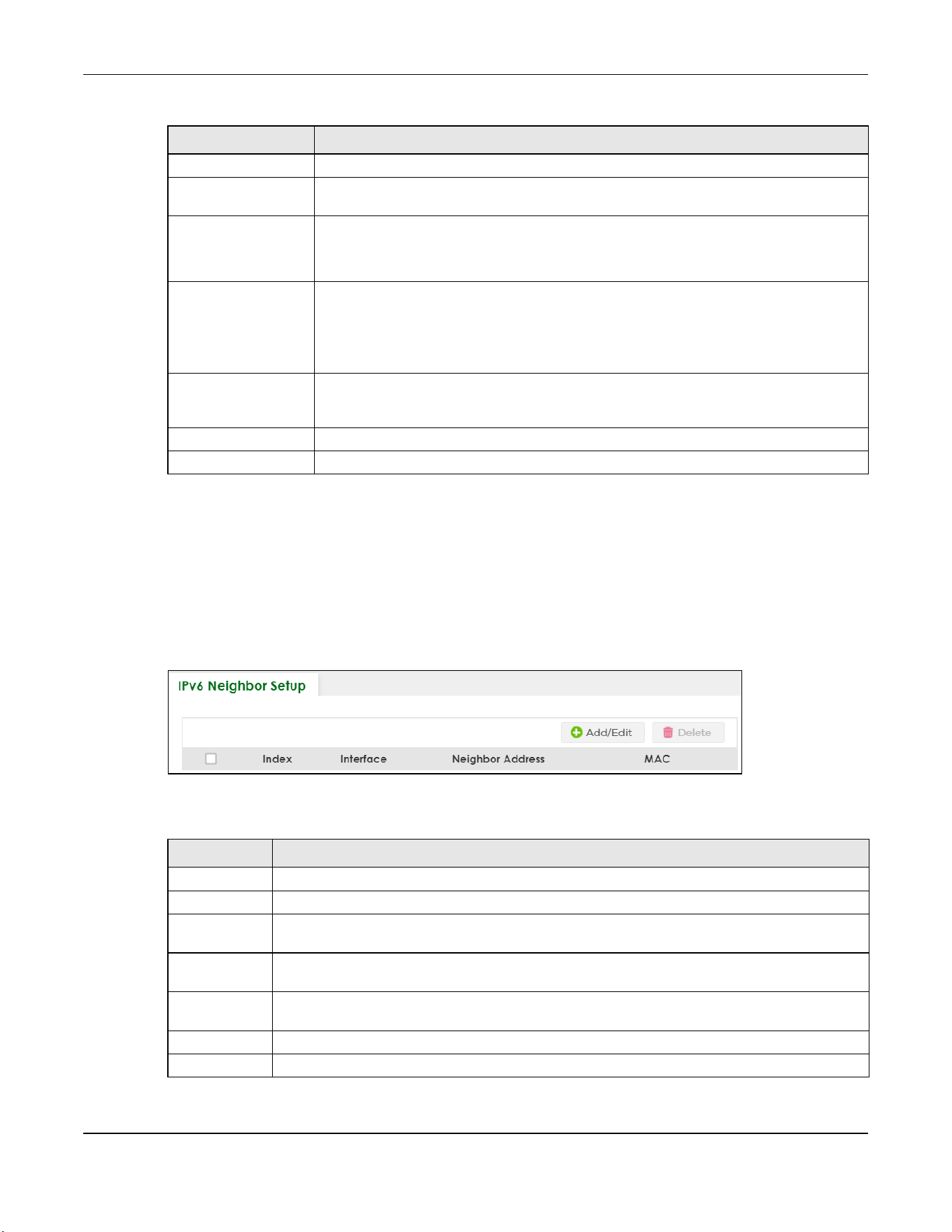
Chapter 24 IPv6
XMG1915 Series User’s Guide
151
24.10 IPv6 Neighbor Setup
Use this screen to view and configure static IPv6 neighbor entries in the Switch’s IPv6 neighbor table to
store the neighbor information permanently. Click SYSTEM > IPv6 > IPv6 Neighbor Setup to display the
screen as shown next.
Figure 106 SYSTEM > IPv6 > IPv6 Neighbor Setup
The following table describes the labels in this screen.
Prefix Length Set the prefix length that the Switch includes in router advertisements for this interface.
Valid Lifetime Specify how long (from 0 to 4294967295 seconds) the prefix is valid for on-link
determination.
Preferred Lifetime Specify how long (from 0 to 4294967295 seconds) that addresses generated from the prefix
remain preferred.
The preferred lifetime cannot exceed the valid lifetime.
Flags Select No-Autoconfig Flag to not allow IPv6 hosts to use this prefix.
Select No-Onlink Flag to not allow the specified prefix to be used for on-link determination.
Select No-Advertise Flag to set the Switch to not include the specified IPv6 prefix, prefix
length in router advertisements for this interface.
Apply Click Apply to save your changes to the Switch’s run-time memory. The Switch loses these
changes if it is turned off or loses power, so use the Save link on the top navigation panel to
save your changes to the non-volatile memory when you are done configuring.
Clear Click Clear to clear the fields to the factory defaults.
Cancel Click Cancel to not save the configuration you make and return to the last screen.
Table 64 SYSTEM > IPv6 > IPv6 Neighbor Discovery > IPv6 Prefix Setup > Add/Edit (continued)
LABEL DESCRIPTION
Table 65 SYSTEM > IPv6 > IPv6 Neighbor Setup
LABEL DESCRIPTION
Index This is the interface index number.
Interface This is the name of the IPv6 interface you created.
Neighbor
Address
This field displays the IPv6 address of the neighboring device which can be reached through the
interface.
MAC This field displays the MAC address of the neighboring device which can be reached through the
interface.
Select an entry’s check box to select a specific entry. Otherwise, select the check box in the table
heading row to select all entries.
Add/Edit Click Add/Edit to add a new entry or edit a selected one.
Delete Click Delete to remove the selected entries.
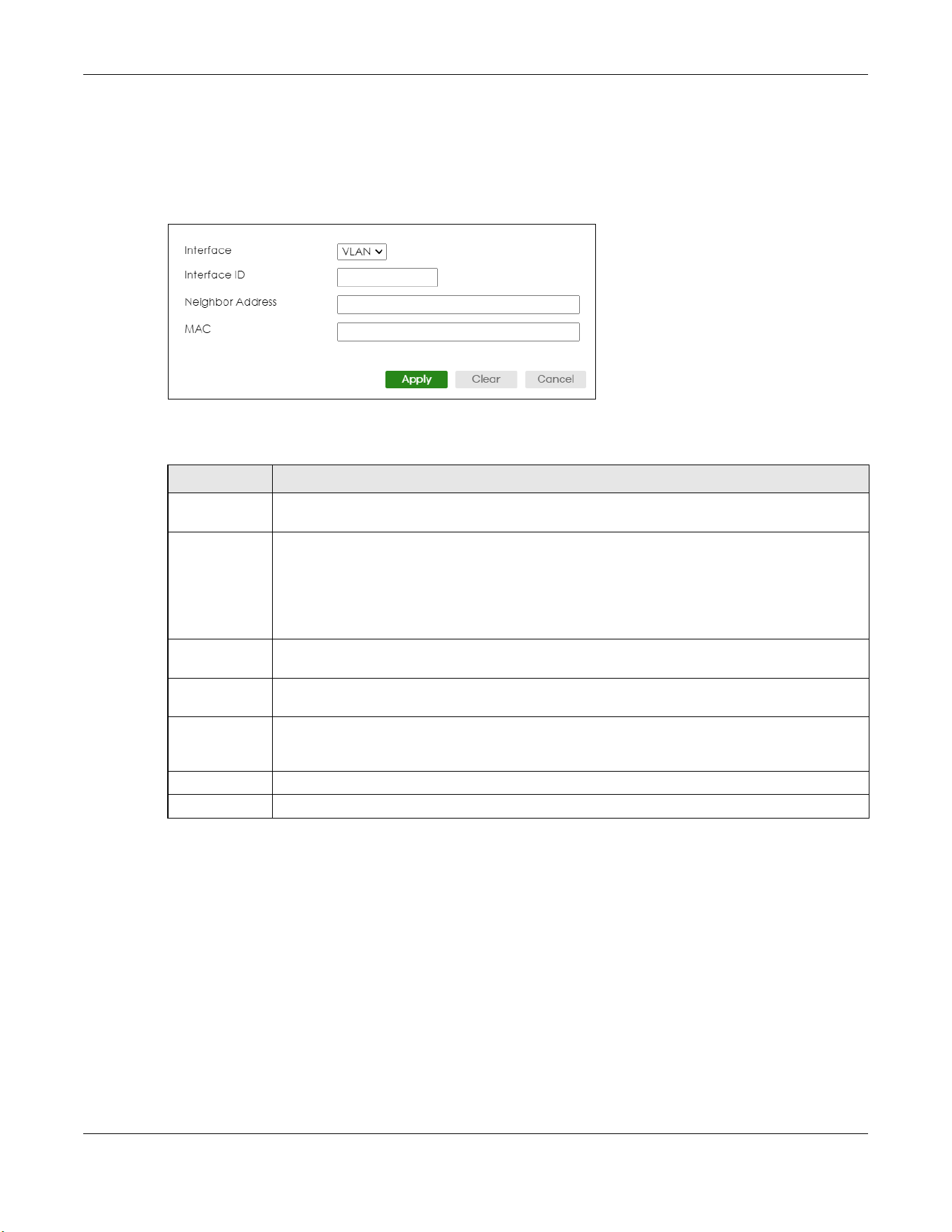
Chapter 24 IPv6
XMG1915 Series User’s Guide
152
24.10.1 Add/Edit IPv6 Neighbor
Use this screen to create a static IPv6 neighbor entry. Click Add/Edit, or select an entry and click Add/
Edit in the SYSTEM > IPv6 > IPv6 Neighbor Setup screen to display this screen.
Figure 107 SYSTEM > IPv6 > IPv6 Neighbor Setup > Add/Edit
The following table describes the labels in this screen.
24.11 DHCPv6 Client Setup
Use this screen to configure the Switch’s DHCP settings when it is acting as a DHCPv6 client. Click SYSTEM
> IPv6 > DHCPv6 Client Setup to display the screen as shown next.
Table 66 SYSTEM > IPv6 > IPv6 Neighbor Setup > Add/Edit
LABEL DESCRIPTION
Interface Select the type of IPv6 interface for which you want to configure. The Switch supports the VLAN
interface type for IPv6 at the time of writing.
Interface ID Specify a unique identification number (from 1 to 4094) for the interface.
A static IPv6 neighbor entry displays in the MONITOR > IPv6 Neighbor Table screen only when the
interface ID is also created in the SYSTEM > Interface Setup screen.
To have IPv6 function properly, you should configure a static VLAN with the same ID number in the
SWITCHING > VLAN screens.
Neighbor
Address
Specify the IPv6 address of the neighboring device which can be reached through the interface.
MAC Specify the MAC address of the neighboring device which can be reached through the
interface.
Apply Click Apply to save your changes to the Switch’s run-time memory. The Switch loses these
changes if it is turned off or loses power, so use the Save link on the top navigation panel to save
your changes to the non-volatile memory when you are done configuring.
Clear Click Clear to clear the fields to the factory defaults.
Cancel Click Cancel to not save the configuration you make and return to the last screen.
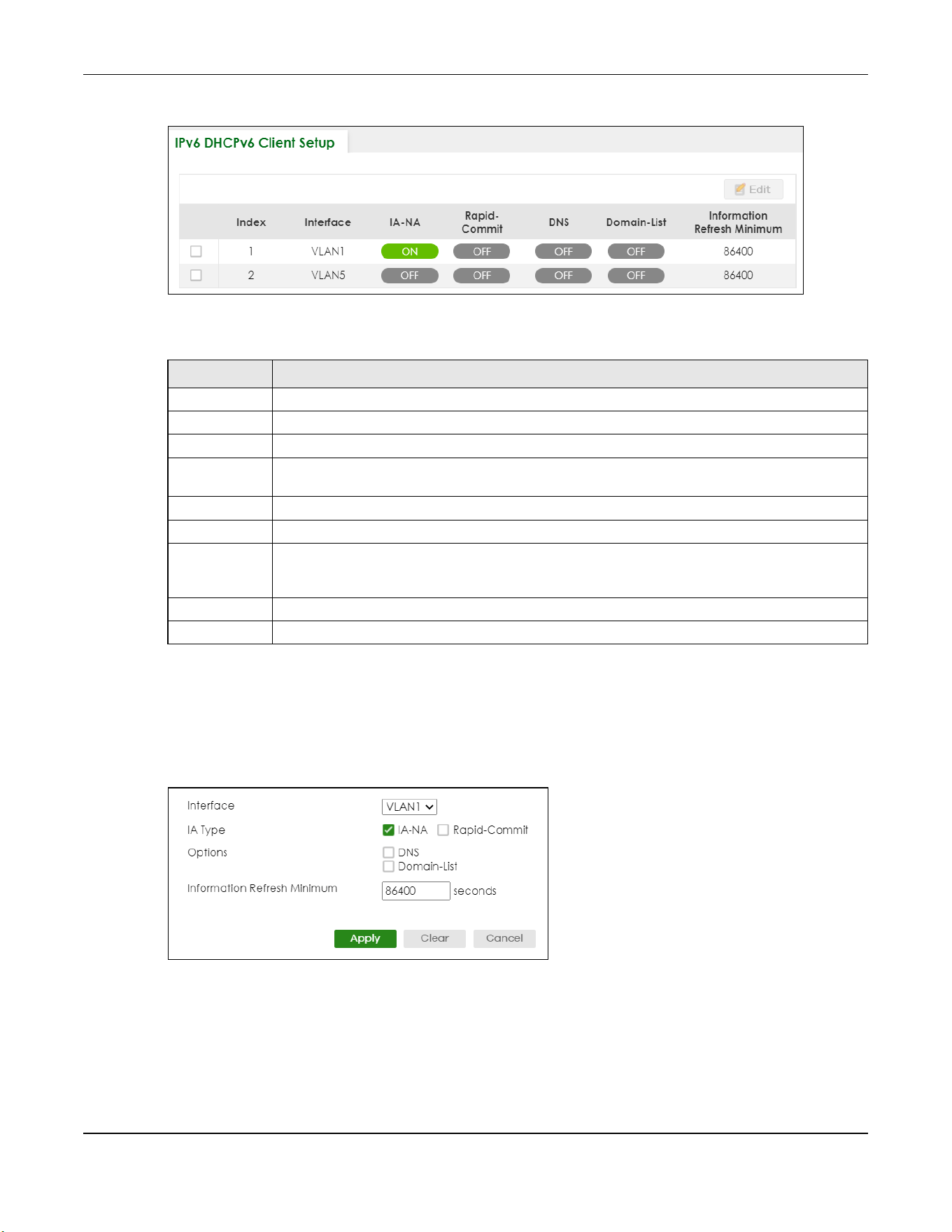
Chapter 24 IPv6
XMG1915 Series User’s Guide
153
Figure 108 SYSTEM > IPv6 > DHCPv6 Client Setup
The following table describes the labels in this screen.
24.11.1 Edit DHCPv6 Client
Use this screen to configure the Switch’s DHCP settings when it is acting as a DHCPv6 client. Select an
entry and click Edit in the SYSTEM > IPv6 > DHCPv6 Client Setup screen to display this screen.
Figure 109 SYSTEM > IPv6 > DHCPv6 Client Setup > Edit
Table 67 SYSTEM > IPv6 > DHCPv6 Client Setup
LABEL DESCRIPTION
Index This is the interface index number.
Interface This is the name of the IPv6 interface you created.
IA-NA This field displays whether the Switch obtains a non-temporary IP address from the DHCPv6 server.
Rapid-Commit This field displays whether the Switch obtains information from the DHCPv6 server by a rapid two-
message exchange.
DNS This field displays whether the Switch obtains DNS server IPv6 addresses from the DHCPv6 server.
Domain-List This field displays whether the Switch obtains a list of domain names from the DHCP server.
Information
Refresh
Minimum
This field displays the time interval (in seconds) at which the Switch exchanges other configuration
information with a DHCPv6 server again.
Select an entry’s check box to select a specific entry.
Edit Click Edit to edit the selected entry.
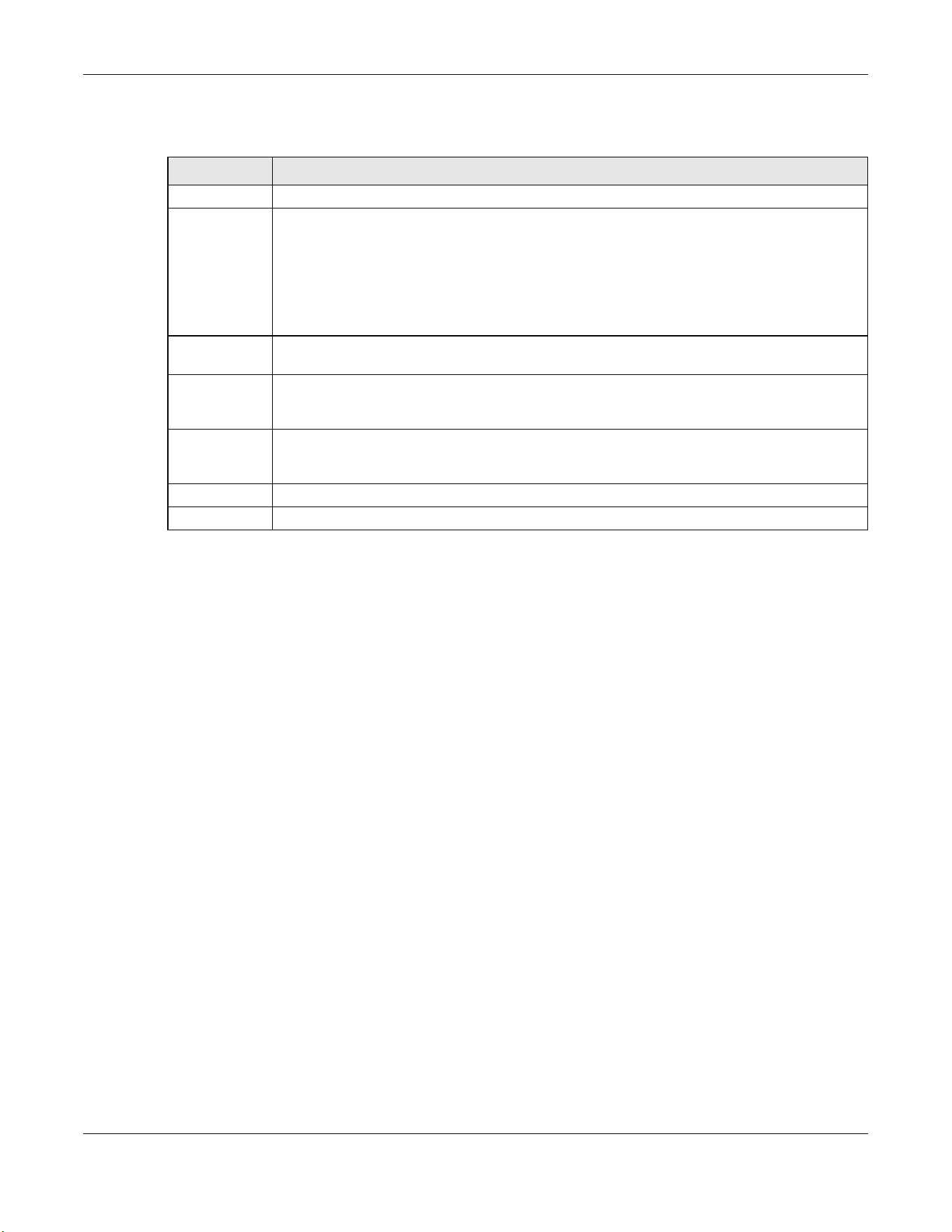
Chapter 24 IPv6
XMG1915 Series User’s Guide
154
The following table describes the labels in this screen.
Table 68 SYSTEM > IPv6 > DHCPv6 Client Setup > Edit
LABEL DESCRIPTION
Interface Select the IPv6 interface you want to configure.
IA Type Select IA-NA to set the Switch to get a non-temporary IP address from the DHCPv6 server for this
interface.
Optionally, you can also select Rapid-Commit to have the Switch send its DHCPv6 Solicit message
with a Rapid Commit option to obtain information from the DHCPv6 server by a rapid two-
message exchange. The Switch discards any Reply messages that do not include a Rapid
Commit option. The DHCPv6 server should also support the Rapid Commit option to have it work
well.
Options Select DNS to have the Switch obtain DNS server IPv6 addresses and/or select Domain-List to
have the Switch obtain a list of domain names from the DHCP server.
Information
Refresh
Minimum
Specify the time interval (from 600 to 4294967295 seconds) at which the Switch exchanges other
configuration information with a DHCPv6 server again.
Apply Click Apply to save your changes to the Switch’s run-time memory. The Switch loses these
changes if it is turned off or loses power, so use the Save link on the top navigation panel to save
your changes to the non-volatile memory when you are done configuring.
Clear Click Clear to clear the fields to the factory defaults.
Cancel Click Cancel to not save the configuration you make and return to the last screen.
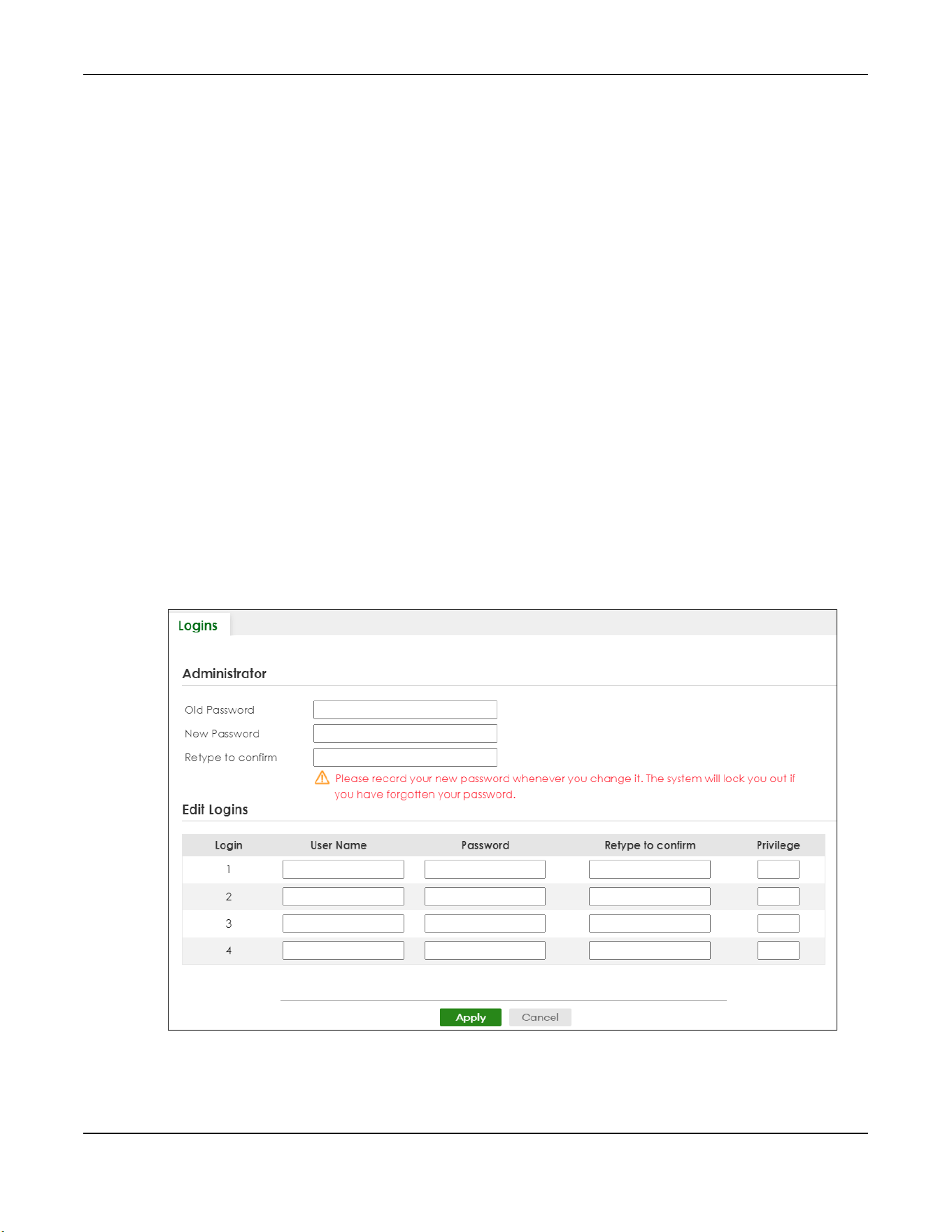
Chapter 25 Logins
XMG1915 Series User’s Guide
155
CHAPTER 25
Logins
25.1 Set Up Login Accounts
Up to five people (one administrator and four non-administrators) may access the Switch through Web
Configurator at any one time.
• An administrator is someone who can both view and configure Switch changes. The user name for
the Administrator is always admin. The default administrator password is 1234.
Note: It is highly recommended that you change the default administrator password (1234).
• A non-administrator (user name is something other than admin) is someone who can view and/or
configure Switch settings. The configuration right varies depending on the user’s privilege level.
Click SYSTEM> Logins to view the screen as shown.
Figure 110 SYSTEM > Logins
Note: The input string in any field of this screen should not contain [ ? ], [ | ], [ ' ], [ " ] or [ , ].
In the Password fields, [ space ] is also not allowed.
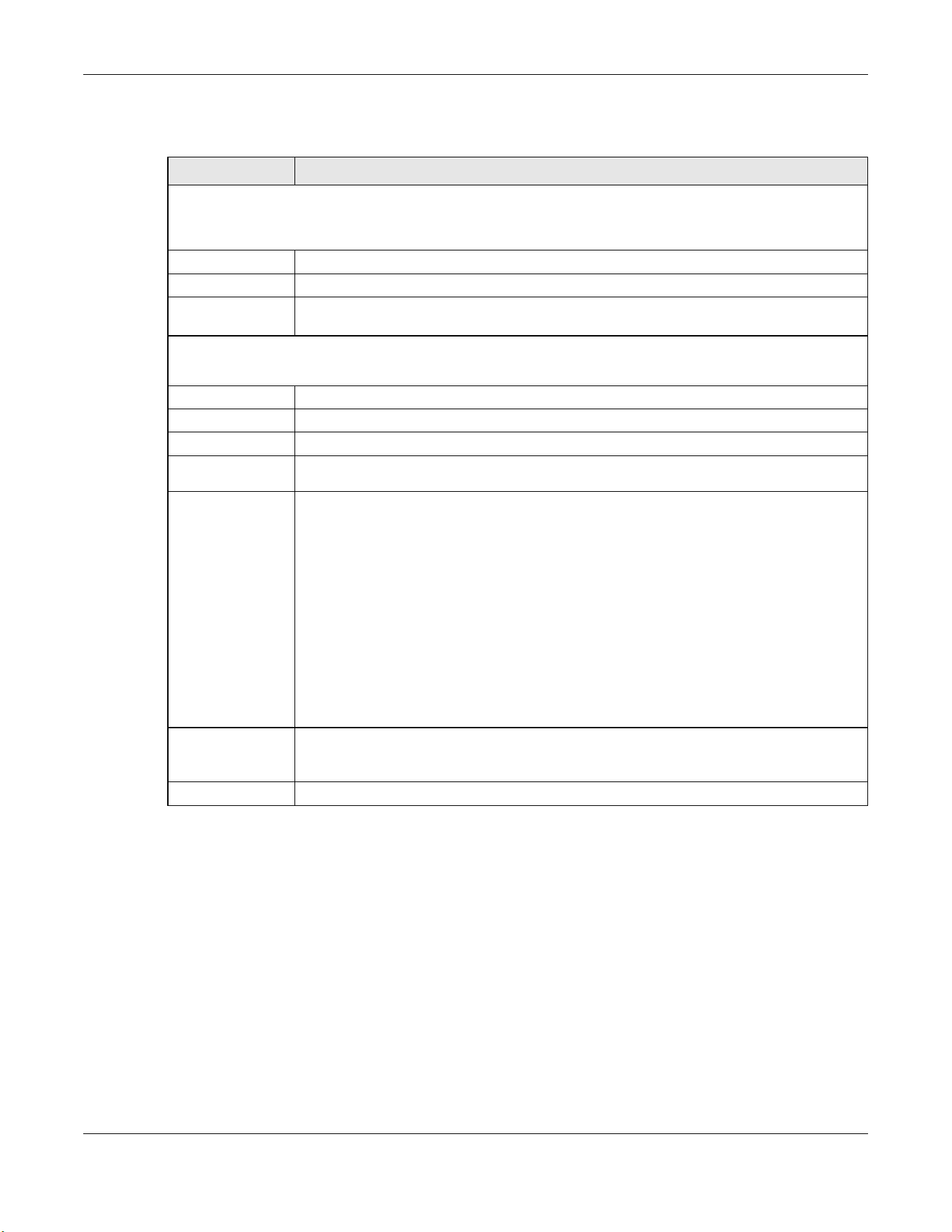
Chapter 25 Logins
XMG1915 Series User’s Guide
156
The following table describes the labels in this screen.
Table 69 SYSTEM > Logins
LABEL DESCRIPTION
Administrator
This is the default administrator account with the “admin” user name. You cannot change the default administrator
user name.
Old Password Type the existing system password (1234 is the default password when shipped).
New Password Enter your new system password. You can enter up to 32 printable ASCII characters.
Retype to
confirm
Retype your new system password for confirmation. You can enter up to 32 printable ASCII
characters.
Edit Logins
You may configure passwords for up to four users. These users can have read-only or read/write access.
Login This is the index of an user account.
User Name Set a user name (up to 32 printable ASCII characters except [ ? ], [ | ], [ ' ], [ " ], or [ , ]).
Password Enter your new system password.
Retype to
confirm
Retype your new system password for confirmation.
Privilege Type the privilege level for this user. At the time of writing, users may have a privilege level of 0,
3, 13, or 14 representing different configuration rights as shown below.
• 0 – Display basic system information.
• 3 – Display configuration or status.
• 13 – Configure features except for login accounts, SNMP user accounts, the
authentication method sequence and authorization settings, multiple logins, administrator
and enable passwords, and configuration information display.
• 14 – Configure login accounts, SNMP user accounts, the authentication method
sequence and authorization settings, multiple logins, and administrator and enable
passwords, and display configuration information.
Users can run command lines if the session’s privilege level is greater than or equal to the
command’s privilege level. The session privilege initially comes from the privilege of the login
account. For example, if the user has a privilege of 5, he or she can run commands that
requires privilege level of 5 or less but not more.
Apply Click Apply to save your changes to the Switch’s run-time memory. The Switch loses these
changes if it is turned off or loses power, so use the Save link on the top navigation panel to
save your changes to the non-volatile memory when you are done configuring.
Cancel Click Cancel to begin configuring this screen afresh.

Chapter 26 SNMP
XMG1915 Series User’s Guide
157
CHAPTER 26
SNMP
26.1 SNMP Overview
This chapter introduces the SNMP screens and shows you how to setup SNMP settings for management.
26.1.1 What You Can Do
• Use the SNMP screen (Section 26.2 on page 157) to configure general SNMP settings.
• Use the SNMP User screen (Section 26.3 on page 159) to create SNMP users for authentication with
managers using SNMP v3 and associate them to SNMP groups.
• Use the SNMP Trap Group screen (Section 26.4 on page 161) to specify the types of SNMP traps that
should be sent to each SNMP manager.
• Use the SNMP Trap Port screen (Section 26.5 on page 162) to enable/disable sending SNMP traps on a
port.
26.2 Configure SNMP
Use this screen to configure your SNMP settings.
Click SYSTEM > SNMP to view the screen as shown.
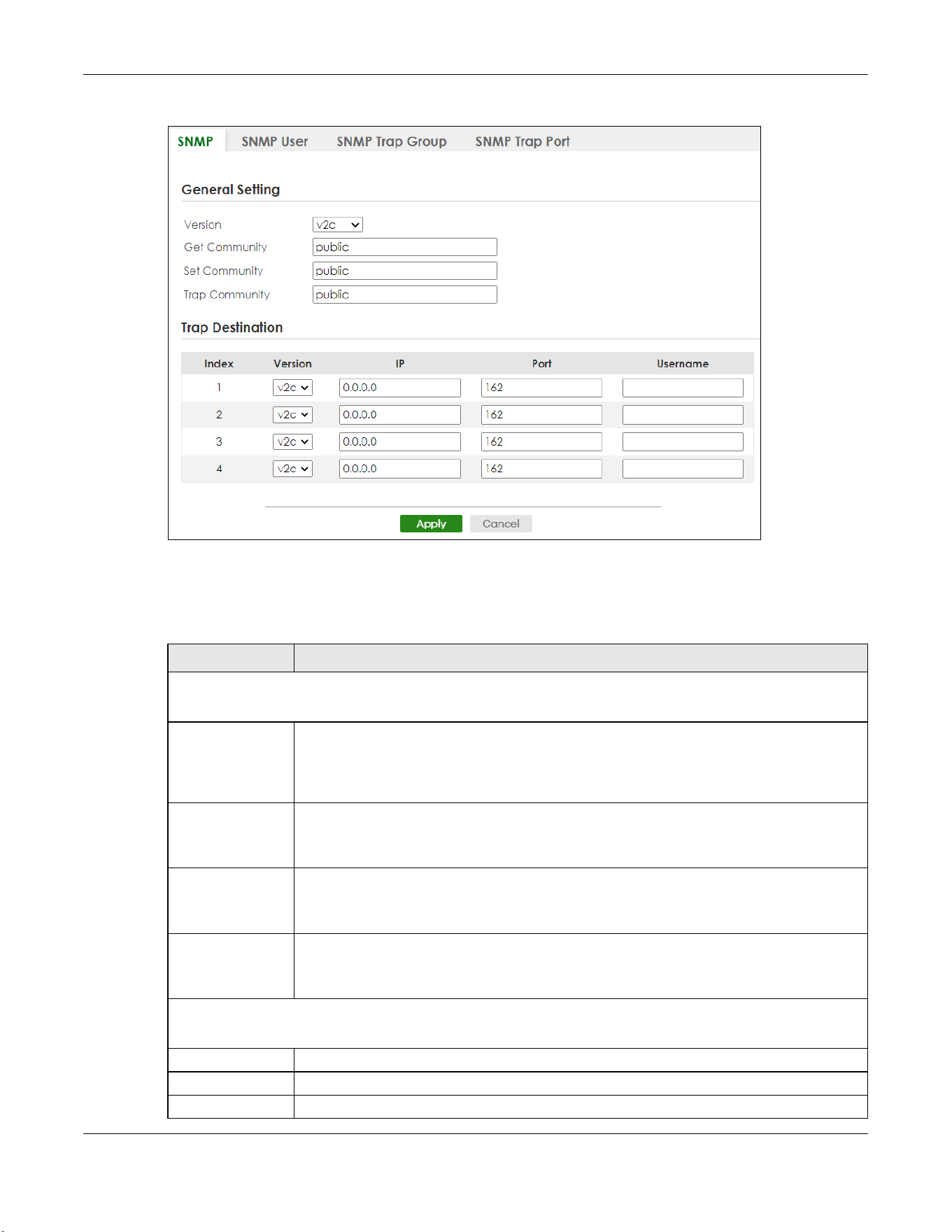
Chapter 26 SNMP
XMG1915 Series User’s Guide
158
Figure 111 SYSTEM > SNMP
Note: The string of any field in this screen should not contain [ ? ], [ | ], [ ' ], [ " ] or [ , ].
The following table describes the labels in this screen.
Table 70 SYSTEM > SNMP
LABEL DESCRIPTION
General Setting
Use this section to specify the SNMP version and community (password) values.
Version Select the SNMP version for the Switch. The SNMP version on the Switch must match the
version on the SNMP manager. Choose SNMP version 2c (v2c), SNMP version 3 (v3) or both
(v3v2c).
SNMP version 2c is backwards compatible with SNMP version 1.
Get Community Enter the Get Community string, which is the password for the incoming Get- and GetNext-
requests from the management station.
The Get Community string is only used by SNMP managers using SNMP version 2c or lower.
Set Community Enter the Set Community string, which is the password for incoming Set- requests from the
management station.
The Set Community string is only used by SNMP managers using SNMP version 2c or lower.
Trap Community Enter the Trap Community string, which is the password sent with each trap to the SNMP
manager.
The Trap Community string is only used by SNMP managers using SNMP version 2c or lower.
Trap Destination
Use this section to configure where to send SNMP traps from the Switch.
Index This is the index of a trap destination.
Version Specify the version of the SNMP trap messages.
IP Enter the IP addresses of up to four managers to send your SNMP traps to.
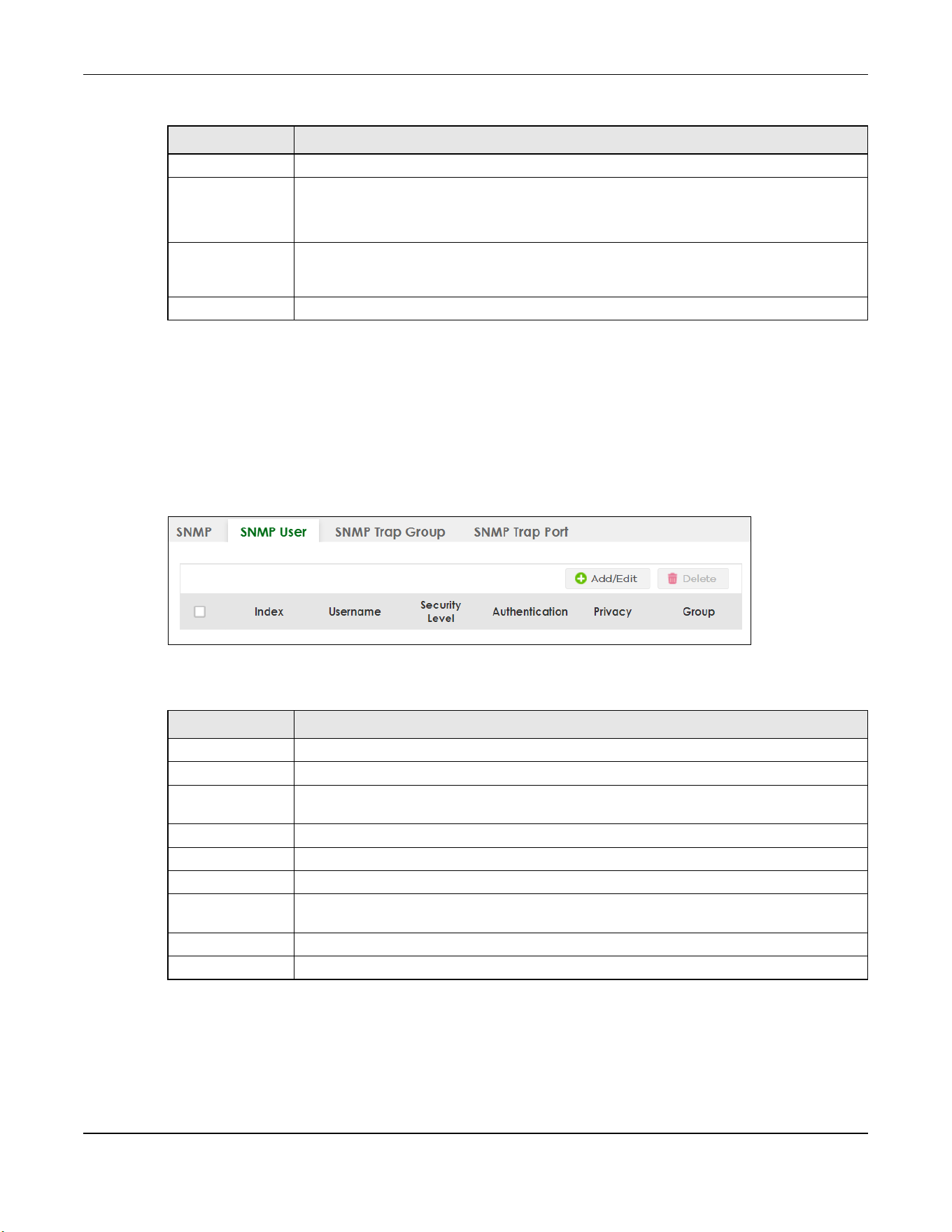
Chapter 26 SNMP
XMG1915 Series User’s Guide
159
26.3 Configure SNMP User
Use this screen to create SNMP users for authentication with managers using SNMP v3 and associate
them to SNMP groups. An SNMP user is an SNMP manager. Click SYSTEM > SNMP > SNMP User to view the
screen as shown.
Figure 112 SYSTEM > SNMP > SNMP User
The following table describes the labels in this screen.
26.3.1 Add/Edit SNMP User
Use this screen to create SNMP users for authentication with managers using SNMP v3 and associate
them to SNMP groups. An SNMP user is an SNMP manager. Click Add/Edit, or select an entry and click
Add/Edit in the SYSTEM > SNMP > SNMP User screen to view the screen.
Port Enter the port number upon which the manager listens for SNMP traps.
Username Enter the user name to be sent to the SNMP manager along with the SNMP v3 trap.
This user name must match an existing account on the Switch (configured in the SYSTEM >
SNMP > SNMP User screen).
Apply Click Apply to save your changes to the Switch’s run-time memory. The Switch loses these
changes if it is turned off or loses power, so use the Save link on the top navigation panel to
save your changes to the non-volatile memory when you are done configuring.
Cancel Click Cancel to begin configuring this screen afresh.
Table 70 SYSTEM > SNMP (continued)
LABEL DESCRIPTION
Table 71 SYSTEM > SNMP > SNMP User
LABEL DESCRIPTION
Index This is a read-only number identifying a login account on the Switch.
Username This field displays the user name of a login account on the Switch.
Security Level This field displays whether you want to implement authentication and/or encryption for SNMP
communication with this user.
Authentication This field displays the authentication algorithm used for SNMP communication with this user.
Privacy This field displays the encryption method used for SNMP communication with this user.
Group This field displays the SNMP group to which this user belongs.
Select an entry’s check box to select a specific entry. Otherwise, select the check box in the
table heading row to select all entries.
Add/Edit Click Add/Edit to add a new entry or edit a selected one.
Delete Click Delete to remove the selected entries.

Chapter 26 SNMP
XMG1915 Series User’s Guide
160
Note: Use the user name and password of the login accounts you specify in this screen to
create accounts on the SNMP v3 manager.
Figure 113 SYSTEM > SNMP > SNMP User > Add/Edit
The following table describes the labels in this screen.
Table 72 SYSTEM > SNMP > SNMP User > Add/Edit
LABEL DESCRIPTION
Username Specify the user name (up to 32 printable ASCII characters) of a login account on the Switch.
The string should not contain [ ? ], [ | ], [ ' ], [ " ] or [ , ].
Security Level Select whether you want to implement authentication and/or encryption for SNMP
communication from this user. Choose:
• no auth – to use the user name as the password string to send to the SNMP manager. This is
equivalent to the Get, Set and Trap Community in SNMP v2c. This is the lowest security
level.
• auth – to implement an authentication algorithm for SNMP messages sent by this user.
• priv – to implement authentication and encryption for SNMP messages sent by this user.
This is the highest security level.
Note: The settings on the SNMP manager must be set at the same security level or
higher than the security level settings on the Switch.
Authentication Select an authentication algorithm. MD5 (Message Digest 5) and SHA (Secure Hash Algorithm)
are hash algorithms used to authenticate SNMP data. SHA authentication is generally
considered stronger than MD5, but is slower.
Password Enter the password of up to 32 printable ASCII characters (except [ ? ], [ | ], [ ' ], [ " ], [ space ],
or [ , ]) for SNMP user authentication.
Privacy Specify the encryption method for SNMP communication from this user. You can choose one
of the following:
• DES – Data Encryption Standard is a widely used (but breakable) method of data
encryption. It applies a 56-bit key to each 64-bit block of data.
• AES – Advanced Encryption Standard is another method for data encryption that also
uses a secret key. AES applies a 128-bit key to 128-bit blocks of data.
Password Enter the password of up to 32 printable ASCII characters (except [ ? ], [ | ], [ ' ], [ " ], [ space ],
or [ , ]) for encrypting SNMP packets.
Group SNMP v3 adopts the concept of View-based Access Control Model (VACM) group. SNMP
managers in one group are assigned common access rights to MIBs. Specify in which SNMP
group this user is.
admin – Members of this group can perform all types of system configuration, including the
management of administrator accounts.
read-write – Members of this group have read and write rights, meaning that the user can
create and edit the MIBs on the Switch, except the user account and AAA configuration.
read-only – Members of this group have read rights only, meaning the user can collect
information from the Switch.
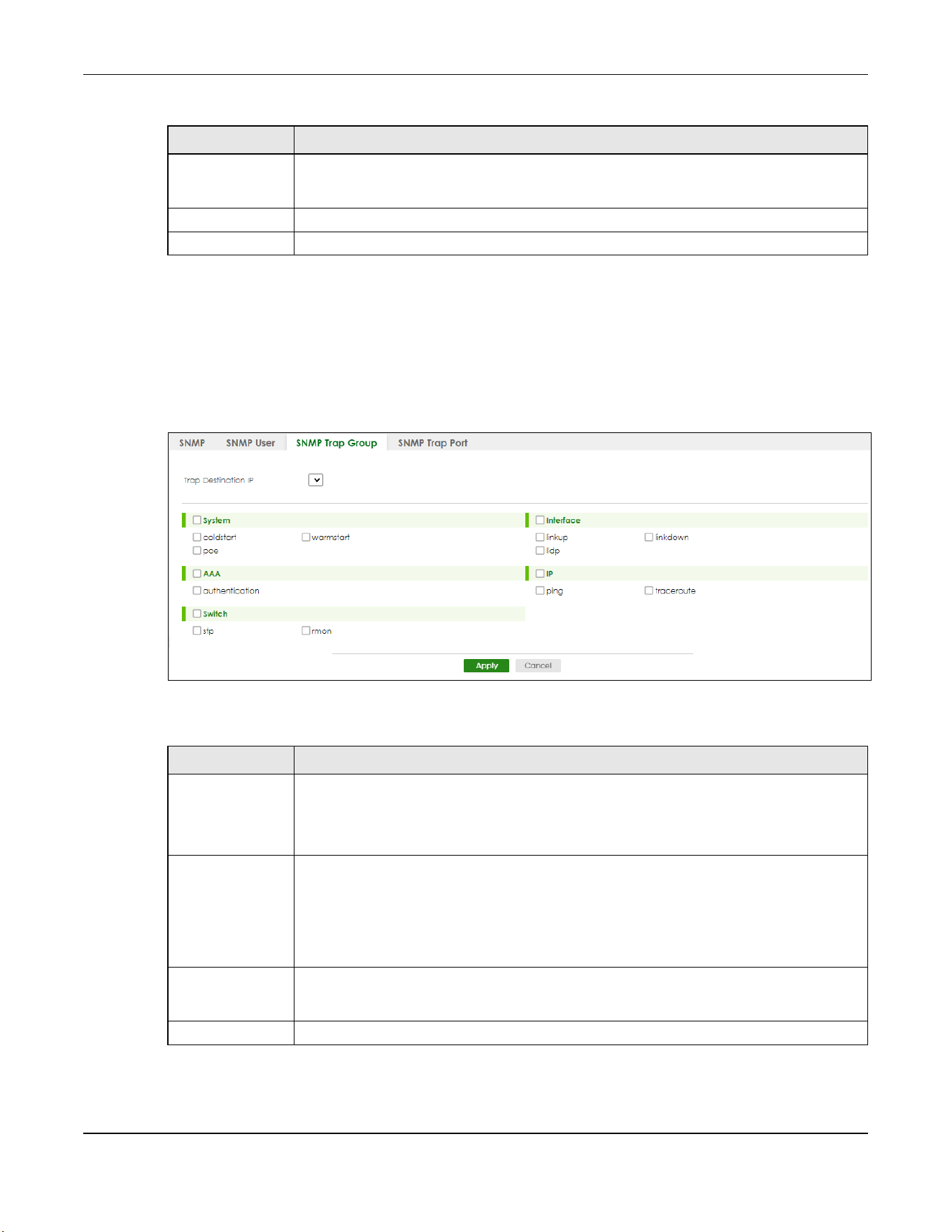
Chapter 26 SNMP
XMG1915 Series User’s Guide
161
26.4 SNMP Trap Group
Use this screen to specify the types of SNMP traps that should be sent to each SNMP manager. Click
SYSTEM > SNMP > SNMP Trap Group to view the screen as shown.
Figure 114 SYSTEM > SNMP > SNMP Trap Group
The following table describes the labels in this screen.
Apply Click Apply to save your changes to the Switch’s run-time memory. The Switch loses these
changes if it is turned off or loses power, so use the Save link on the top navigation panel to
save your changes to the non-volatile memory when you are done configuring.
Clear Click Clear to clear the fields to the factory defaults.
Cancel Click Cancel to not save the configuration you make and return to the last screen.
Table 72 SYSTEM > SNMP > SNMP User > Add/Edit (continued)
LABEL DESCRIPTION
Table 73 SYSTEM > SNMP > SNMP Trap Group
LABEL DESCRIPTION
Trap Destination IP Select one of your configured trap destination IP addresses. These are the IP addresses of the
SNMP managers. You must first configure a trap destination IP address in the SYSTEM > SNMP >
SNMP screen.
Use the rest of the screen to select which traps the Switch sends to that SNMP manager.
Select the individual SNMP traps that the Switch is to send to the SNMP station.
The traps are grouped by category. Selecting a category in the heading row automatically
selects all of the SNMP traps under that category. Clear the check boxes for individual traps
that you do not want the Switch to send to the SNMP station. Clearing a category’s check
box automatically clears all of the category’s trap check boxes (the Switch only sends traps
from selected categories).
Apply Click Apply to save your changes to the Switch’s run-time memory. The Switch loses these
changes if it is turned off or loses power, so use the Save link on the top navigation panel to
save your changes to the non-volatile memory when you are done configuring.
Cancel Click Cancel to begin configuring this screen afresh.
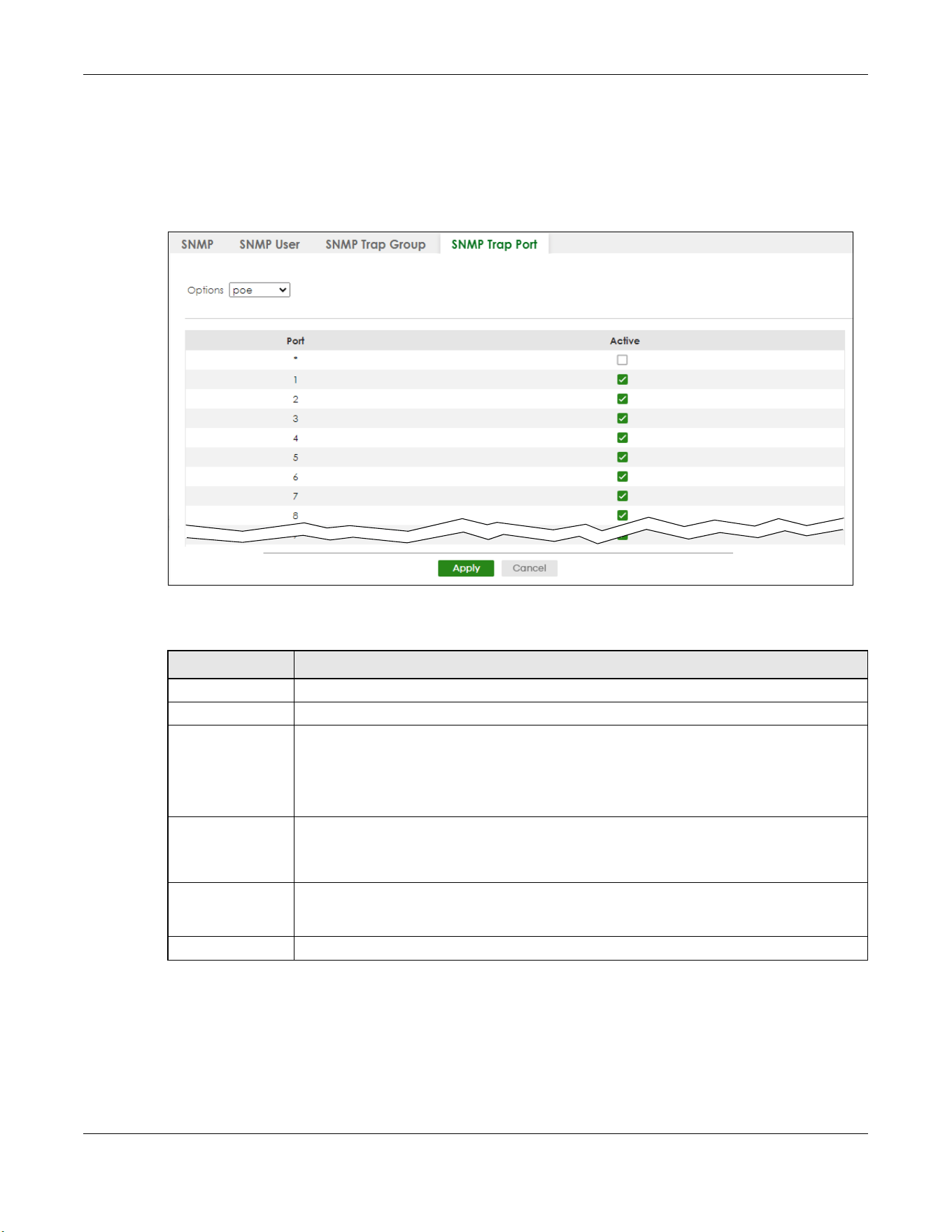
Chapter 26 SNMP
XMG1915 Series User’s Guide
162
26.5 Enable or Disable Sending of SNMP Traps on a Port
Click SYSTEM > SNMP > SNMP Trap Port to view the screen as shown. Use this screen to set whether a trap
received on the ports would be sent to the SNMP manager.
Figure 115 SYSTEM > SNMP > SNMP Trap Port
The following table describes the labels in this screen.
26.6 Technical Reference
This section provides technical background information on the topics discussed in this chapter.
Table 74 SYSTEM > SNMP > SNMP Trap Port
LABEL DESCRIPTION
Options Select the trap type you want to configure here.
Port This field displays a port number.
* Settings in this row apply to all ports.
Use this row only if you want to make some of the settings the same for all ports. Use this row
first to set the common settings and then make adjustments on a port-by-port basis.
Changes in this row are copied to all the ports as soon as you make them.
Active Select this check box to enable the trap type of SNMP traps on this port. The Switch sends the
related traps received on this port to the SNMP manager.
Clear this check box to disable the sending of SNMP traps on this port.
Apply Click Apply to save your changes to the Switch’s run-time memory. The Switch loses these
changes if it is turned off or loses power, so use the Save link on the top navigation panel to
save your changes to the non-volatile memory when you are done configuring.
Cancel Click Cancel to begin configuring this screen afresh.

Chapter 26 SNMP
XMG1915 Series User’s Guide
163
26.6.1 About SNMP
Simple Network Management Protocol (SNMP) is an application layer protocol used to manage and
monitor TCP/IP-based devices. SNMP is used to exchange management information between the
network management system (NMS) and a network element (NE). A manager station can manage and
monitor the Switch through the network through SNMP version 1 (SNMPv1), SNMP version 2c or SNMP
version 3. The next figure illustrates an SNMP management operation. SNMP is only available if TCP/IP is
configured.
Figure 116 SNMP Management Model
An SNMP managed network consists of two main components: agents and a manager.
An agent is a management software module that resides in a managed Switch (the Switch). An agent
translates the local management information from the managed Switch into a form compatible with
SNMP. The manager is the console through which network administrators perform network management
functions. It executes applications that control and monitor managed devices.
The managed devices contain object variables or managed objects that define each piece of
information to be collected about a Switch. Examples of variables include number of packets received,
node port status, and so on. A Management Information Base (MIB) is a collection of managed objects.
SNMP allows a manager and agents to communicate for the purpose of accessing these objects.
SNMP itself is a simple request or response protocol based on the manager or agent model. The
manager issues a request and the agent returns responses using the following protocol operations:
SNMP v3 and Security
SNMP v3 enhances security for SNMP management. SNMP managers can be required to authenticate
with agents before conducting SNMP management sessions.
Security can be further enhanced by encrypting the SNMP messages sent from the managers.
Table 75 SNMP Commands
LABEL DESCRIPTION
Get Allows the manager to retrieve an object variable from the agent.
GetNext Allows the manager to retrieve the next object variable from a table or list within an agent. In
SNMPv1, when a manager wants to retrieve all elements of a table from an agent, it initiates a
Get operation, followed by a series of GetNext operations.
Set Allows the manager to set values for object variables within an agent.
Trap Used by the agent to inform the manager of some events.
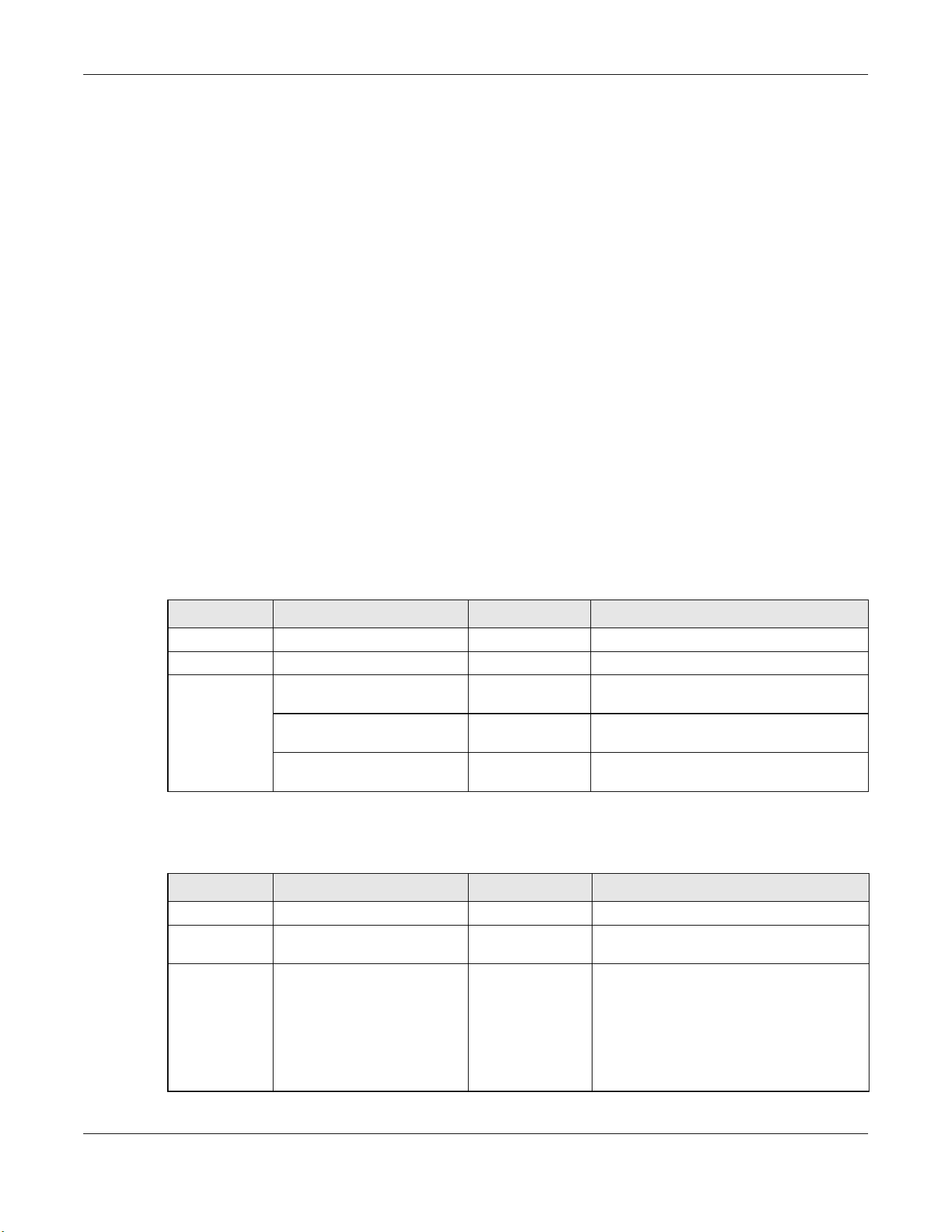
Chapter 26 SNMP
XMG1915 Series User’s Guide
164
Encryption protects the contents of the SNMP messages. When the contents of the SNMP messages are
encrypted, only the intended recipients can read them.
Supported MIBs
A MIB is a collection of managed objects that is organized according to hierarchy. The objects define
the attributes of the managed device, which includes the names, status, access rights, and data types.
Each object can be addressed through an object identifier (OID).
MIBs let administrators collect statistics and monitor status and performance. The Switch uses standard
public (RFC-defined) MIBs for standard functionality
To view a list of standard MIBs supported by your Switch, see the product datasheet at www.zyxel.com
(Support > Download Library > Datasheet).
To get the private MIBs supported by your Switch, download (and unzip) the correct model MIB from
www.zyxel.com (Support > Download Library > MIB File).
SNMP Traps
The Switch sends traps to an SNMP manager when an event occurs. The following tables outline the
SNMP traps by category.
Table 76 SNMP System Traps
OPTION OBJECT LABEL OBJECT ID DESCRIPTION
coldstart coldStart 1.3.6.1.6.3.1.1.5.1 This trap is sent when the Switch is turned on.
warmstart warmStart 1.3.6.1.6.3.1.1.5.2 This trap is sent when the Switch restarts.
poe
(For PoE models
only)
pethPsePortOnOffNotification 1.3.6.1.2.1.105.0.1 This trap is sent when the PoE port delivers
power or delivers no power to a PD.
pethMainPowerUsageOnNo
tification
1.3.6.1.2.1.105.0.2 This trap is sent when the usage power is
above the usage indication threshold.
pethMainPowerUsageOffNo
tification
1.3.6.1.2.1.105.0.3 This trap is sent when the usage power is
below the usage indication threshold.
Table 77 SNMP Interface Traps
OPTION OBJECT LABEL OBJECT ID DESCRIPTION
linkup linkUp 1.3.6.1.6.3.1.1.5.4 This trap is sent when the Ethernet link is up.
linkdown linkDown 1.3.6.1.6.3.1.1.5.3 This trap is sent when the Ethernet link is
down.
lldp lldpRemTablesChange 1.0.8802.1.1.2.0.0.1 The trap is sent when entries in the remote
database have any updates.
Link Layer Discovery Protocol (LLDP), defined
as IEEE 802.1ab, enables LAN devices that
support LLDP to exchange their configured
settings. This helps eliminate configuration
mismatch issues.

Chapter 26 SNMP
XMG1915 Series User’s Guide
165
Table 78 SNMP AAA Traps
OPTION OBJECT LABEL OBJECT ID DESCRIPTION
authentication authenticationFailure 1.3.6.1.6.3.1.1.5.5 This trap is sent when authentication fails
due to incorrect user name and/or
password.
Table 79 SNMP IP Traps
OPTION OBJECT LABEL OBJECT ID DESCRIPTION
ping pingProbeFailed 1.3.6.1.2.1.80.0.1 This trap is sent when a single ping probe
fails.
pingTestFailed 1.3.6.1.2.1.80.0.2 This trap is sent when a ping test (consisting
of a series of ping probes) fails.
pingTestCompleted 1.3.6.1.2.1.80.0.3 This trap is sent when a ping test is
completed.
traceroute traceRouteTestFailed 1.3.6.1.2.1.81.0.2 This trap is sent when a traceroute test fails.
traceRouteTestCompleted 1.3.6.1.2.1.81.0.3 This trap is sent when a traceroute test is
completed.
Table 80 SNMP Switch Traps
OPTION OBJECT LABEL OBJECT ID DESCRIPTION
stp STPNewRoot 1.3.6.1.2.1.17.0.1 This trap is sent when the STP root switch
changes.
STPTopologyChange 1.3.6.1.2.1.17.0.2 This trap is sent when the STP topology
changes.
rmon RmonRisingAlarm 1.3.6.1.2.1.16.0.1 This trap is sent when a variable goes over
the RMON "rising" threshold.
RmonFallingAlarm 1.3.6.1.2.1.16.0.2 This trap is sent when the variable falls below
the RMON "falling" threshold.

Chapter 27 Switch Setup
XMG1915 Series User’s Guide
166
CHAPTER 27
Switch Setup
27.1 Switch Setup Overview
Use this screen to do the Switch’s basic setup configuration, for example, VLAN (Virtual Local Area
Network) type, enabling switching protocols, and MAC learning aging time setup.
27.1.1 Introduction to VLANs
A VLAN (Virtual Local Area Network) allows a physical network to be partitioned into multiple logical
networks. Devices on a logical network belong to one group. A device can belong to more than one
group. With VLAN, a device cannot directly talk to or hear from devices that are not in the same groups;
the traffic must first go through a router.
In MTU (Multi-Tenant Unit) applications, VLAN is vital in providing isolation and security among the
subscribers. When properly configured, VLAN prevents one subscriber from accessing the network
resources of another on the same LAN, thus a user will NOT see the printers and hard disks of another
user in the same building.
VLAN also increases network performance by limiting broadcasts to a smaller and more manageable
logical broadcast domain. In traditional switched environments, all broadcast packets go to each and
every individual port. With VLAN, all broadcasts are confined to a specific broadcast domain.
Note: VLAN is unidirectional; it only governs outgoing traffic.
27.2 Switch Setup
Click SYSTEM > Switch Setup in the navigation panel to display the screen as shown. The VLAN setup
screens change depending on whether you choose 802.1Q or Port Based in the VLAN Type field in this
screen.
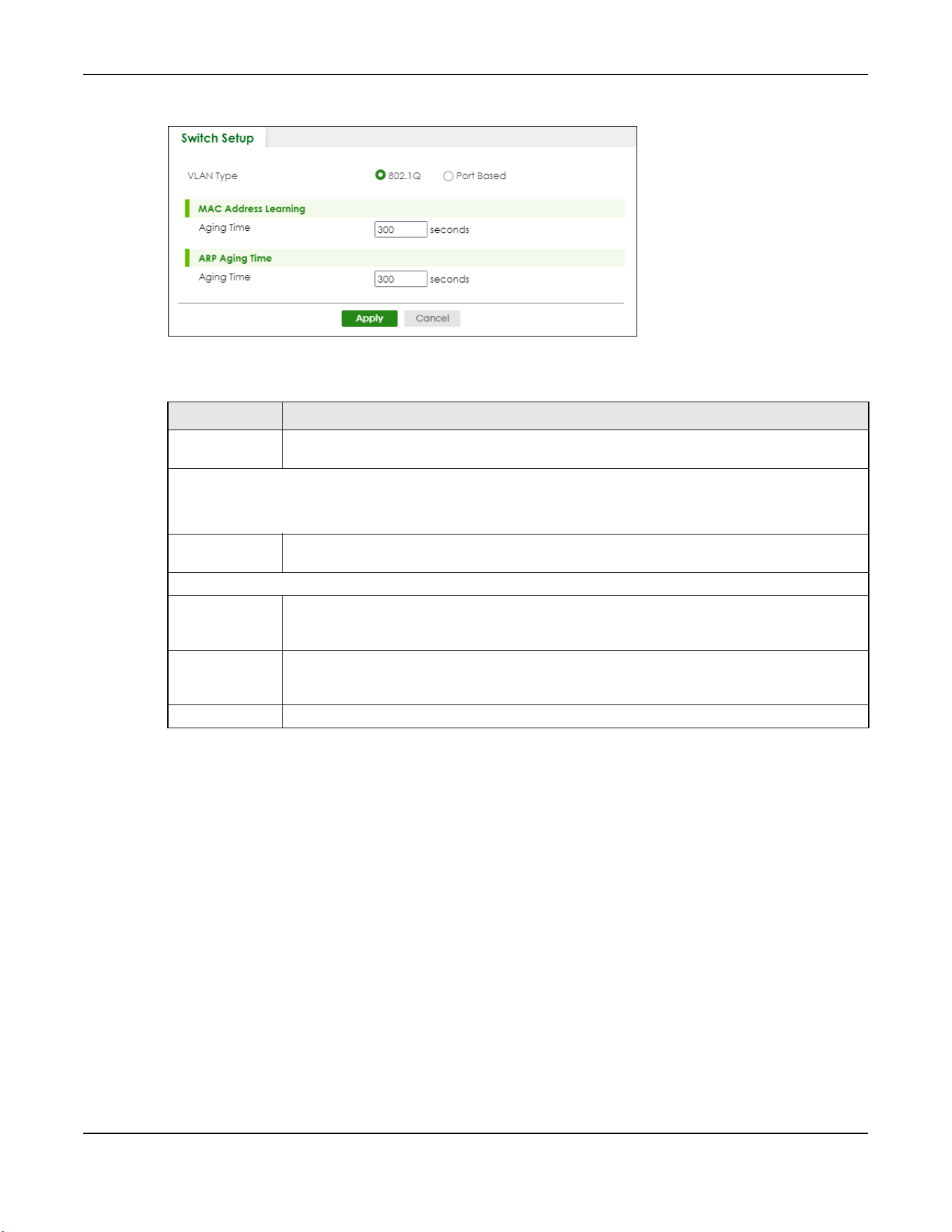
Chapter 27 Switch Setup
XMG1915 Series User’s Guide
167
Figure 117 SYSTEM > Switch Setup
The following table describes the labels in this screen.
Table 81 SYSTEM > Switch Setup
LABEL DESCRIPTION
VLAN Type Choose 802.1Q or Port Based. The SWITCHING > VLAN link and its sub-links only appears when
you choose 802.1Q VLAN type in this screen.
MAC Address Learning
MAC address learning reduces outgoing traffic broadcasts. For MAC address learning to occur on a port, the port
must be active.
Aging Time Enter a time from 10 to 1000000 seconds. This is how long all dynamically learned MAC
addresses remain in the MAC address table before they age out (and must be relearned).
ARP Aging Time
Aging Time Enter a time from 60 to 1000000 seconds. This is how long dynamically learned ARP entries
remain in the ARP table before they age out (and must be relearned). The setting here applies
to ARP entries which are newly added in the ARP table after you click Apply.
Apply Click Apply to save your changes to the Switch’s run-time memory. The Switch loses these
changes if it is turned off or loses power, so use the Save link on the top navigation panel to save
your changes to the non-volatile memory when you are done configuring.
Cancel Click Cancel to begin configuring this screen afresh.

Chapter 28 Syslog Setup
XMG1915 Series User’s Guide
168
CHAPTER 28
Syslog Setup
28.1 Syslog Overview
This chapter explains the Syslog screens.
The syslog protocol allows devices to send event notification messages across an IP network to syslog
servers that collect the event messages. A syslog-enabled device can generate a syslog message and
send it to a syslog server.
Syslog is defined in RFC 3164. The RFC defines the packet format, content and system log related
information of syslog messages. Each syslog message has a facility and severity level. The syslog facility
identifies a file in the syslog server. Refer to the documentation of your syslog program for details. The
following table describes the syslog severity levels.
28.1.1 What You Can Do
Use the Syslog Setup screen (Section 28.2 on page 168) to configure the device’s system logging
settings and configure a list of external syslog servers.
28.2 Syslog Setup
The syslog feature sends logs to an external syslog server. Use this screen to configure the device’s
system logging settings and configure a list of external syslog servers.
Click SYSTEM > Syslog Setup in the navigation panel to display this screen.
Table 82 Syslog Severity Levels
CODE SEVERITY
0 Emergency: The system is unusable.
1 Alert: Action must be taken immediately.
2 Critical: The system condition is critical.
3 Error: There is an error condition on the system.
4 Warning: There is a warning condition on the system.
5 Notice: There is a normal but significant condition on the system.
6 Informational: The syslog contains an informational message.
7 Debug: The message is intended for debug-level purposes.
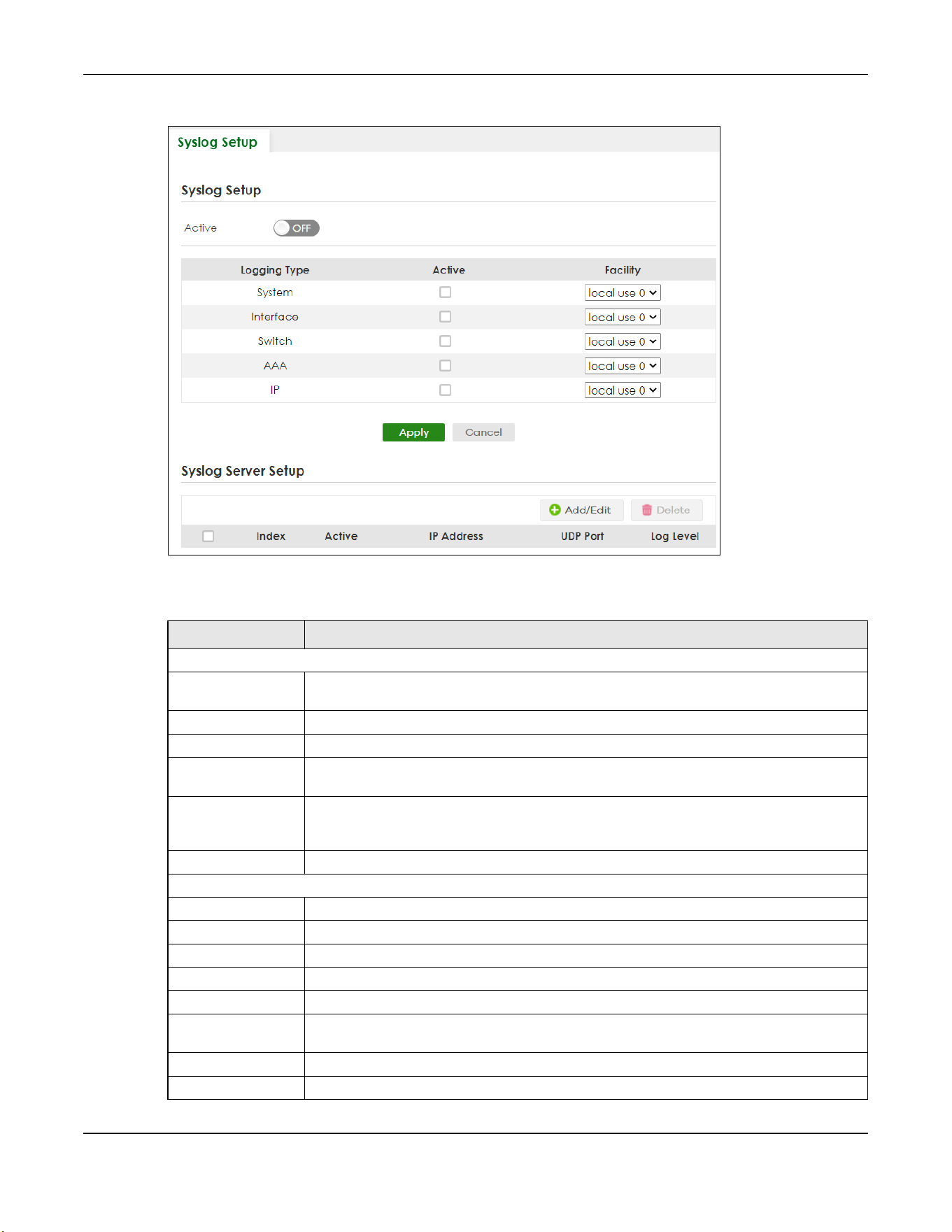
Chapter 28 Syslog Setup
XMG1915 Series User’s Guide
169
Figure 118 SYSTEM > Syslog Setup
The following table describes the labels in this screen.
Table 83 SYSTEM > Syslog Setup
LABEL DESCRIPTION
Syslog Setup
Active Enable the switch button to turn on syslog (system logging) and then configure the syslog
setting.
Logging Type This column displays the names of the categories of logs that the device can generate.
Active Select this option to set the device to generate logs for the corresponding category.
Facility The log facility allows you to send logs to different files in the syslog server. Refer to the
documentation of your syslog program for more details.
Apply Click Apply to save your changes to the Switch’s run-time memory. The Switch loses these
changes if it is turned off or loses power, so use the Save link on the top navigation panel to
save your changes to the non-volatile memory when you are done configuring.
Cancel Click Cancel to begin configuring this screen afresh.
Syslog Server Setup
Index This is the index number of a syslog server entry.
Active This field displays if the device is activated to send logs to the syslog server.
IP Address This field displays the IP address of the syslog server.
UDP Port This field displays the port of the syslog server.
Log Level This field displays the severity level of the logs that the device is to send to this syslog server.
Select an entry’s check box to select a specific entry. Otherwise, select the check box in the
table heading row to select all entries.
Add/Edit Click Add/Edit to add a new entry or edit a selected one.
Delete Click Delete to remove the selected entries.

Chapter 28 Syslog Setup
XMG1915 Series User’s Guide
170
28.2.1 Add/Edit a Syslog Server
Use this screen to configure an external syslog server.
Click Add/Edit, or select an entry and click Add/Edit in the SYSTEM > Syslog Setup screen to display this
screen.
Figure 119 SYSTEM > Syslog Setup > Add/Edit
The following table describes the labels in this screen.
Table 84 SYSTEM > Syslog Setup > Add/Edit
LABEL DESCRIPTION
Active Enable the switch button to have the device send logs to this syslog server. Clear the check
box if you want to create a syslog server entry but not have the device send logs to it (you
can edit the entry later).
Server Address Enter the IPv4 or IPv6 address of the syslog server.
UDP Port The default syslog server port is 514. If your syslog server uses a different port, configure the
one it uses here.
Log Level Select the severity levels of the logs that you want the device to send to this syslog server.
The lower the number, the more critical the logs are.
Apply Click Apply to save your changes to the Switch’s run-time memory. The Switch loses these
changes if it is turned off or loses power, so use the Save link on the top navigation panel to
save your changes to the non-volatile memory when you are done configuring.
Clear Click Clear to clear the fields to the factory defaults.
Cancel Click Cancel to not save the configuration you make and return to the last screen.
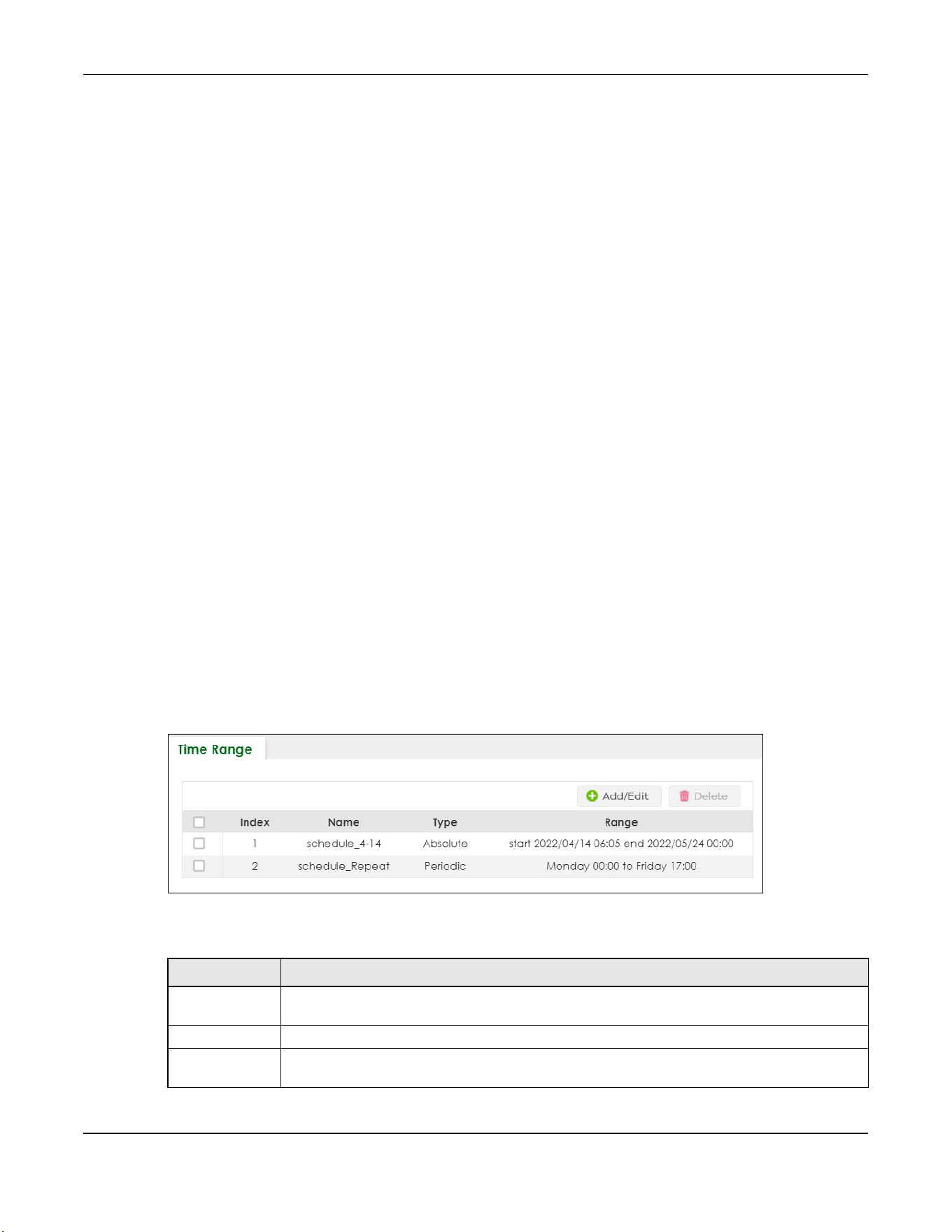
Chapter 29 Time Range
XMG1915 Series User’s Guide
171
CHAPTER 29
Time Range
29.1 Time Range Overview
You can set up one-time and recurring schedules for time-oriented features, such as PoE and classifier.
The UAG supports one-time and recurring schedules. One-time schedules are effective only once, while
recurring schedules usually repeat. Both types of schedules are based on the current date and time in
the Switch.
The time range can be configured in two ways – Absolute and Periodic. Absolute is a fixed time range
with a start and end time. Periodic is recurrence of a time range and does not have an end time.
29.1.1 What You Can Do
Use the Time Range screen (Section 29.2 on page 171) to view or define a schedule on the Switch.
29.2 Configuring Time Range
Click SYSTEM > Time Range in the navigation panel to display the screen as shown.
Figure 120 SYSTEM > Time Range
The following table describes the labels in this screen.
Table 85 SYSTEM > Time Range
LABEL DESCRIPTION
Select an entry’s check box to select a specific entry. Otherwise, select the check box in the
table heading row to select all entries.
Index This field displays the index number of the rule.
Name This field displays the descriptive name for this rule. This is for identification purpose only. You can
enter up to 32 printable ASCII characters except [ ? ], [ | ], [ ' ], [ " ] or [ , ].
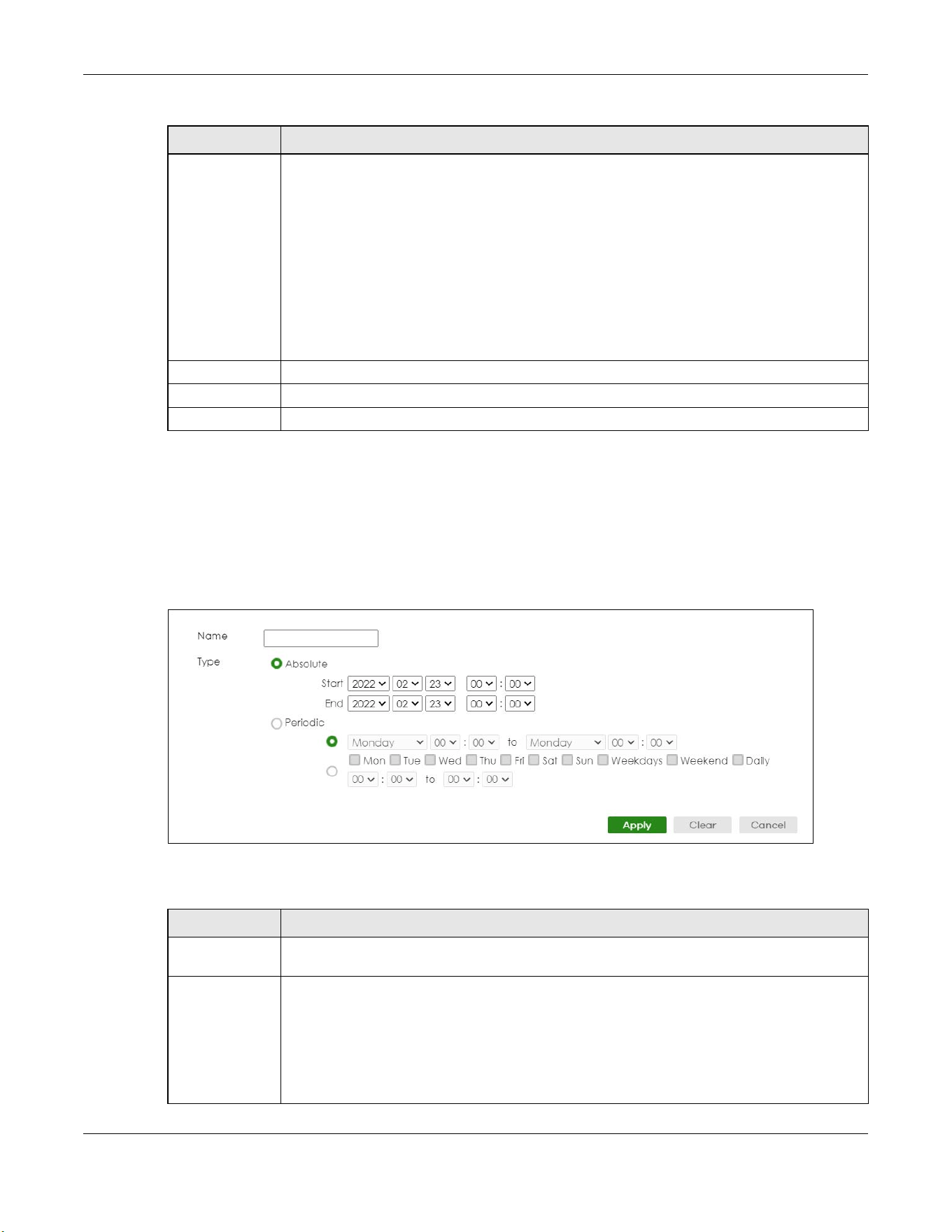
Chapter 29 Time Range
XMG1915 Series User’s Guide
172
29.2.1 Add/Edit Time Range
This screen allows you to create a new time range or edit an existing one.
To access this screen, click the Add/Edit button or select an entry from the list and click the Add/Edit
button.
Figure 121 SYSTEM > Time Range > Add/Edit
The following table describes the labels in this screen.
Type This displays the schedule type of the time range rule.
Absolute
An one-time schedule. One-time schedules begin on a specific start date and time and end on
a specific stop date and time. One-time schedules are useful for long holidays and vacation
periods.
Periodic
A recurring schedule. Recurring schedules begin at a specific start time and end at a specific
stop time on selected days of the week (Sunday, Monday, Tuesday, Wednesday, Thursday,
Friday, and Saturday). Recurring schedules are useful for defining the workday and off-work
hours.
Range This field displays the time periods to which this schedule applies.
Add/Edit Click Add/Edit to add a new schedule rule or edit a selected one.
Delete Click Delete to remove the selected rules.
Table 85 SYSTEM > Time Range (continued)
LABEL DESCRIPTION
Table 86 SYSTEM > Time Range > Add/Edit
LABEL DESCRIPTION
Name Enter a descriptive name for this rule for identifying purposes. The string should not contain [ ? ], [
| ], [ ' ], [ " ] or [ , ].
Type Select Absolute to create a one-time schedule. One-time schedules begin on a specific start
date and time and end on a specific stop date and time. One-time schedules are useful for
long holidays and vacation periods.
Alternatively, select Periodic to create a recurring schedule. Recurring schedules begin at a
specific start time and end at a specific stop time on selected days of the week (Sunday,
Monday, Tuesday, Wednesday, Thursday, Friday, and Saturday). Recurring schedules are useful
for defining the workday and off-work hours.

Chapter 29 Time Range
XMG1915 Series User’s Guide
173
Absolute This section is available only when you set Type to Absolute.
Start Specify the year, month, day, hour and minute when the schedule begins.
End Specify the year, month, day, hour and minute when the schedule ends.
Periodic This section is available only when you set Type to Periodic.
Select the first option if you want to define a recurring schedule for a consecutive time period.
You then select the day of the week, hour and minute when the schedule begins and ends
respectively.
Select the second option if you want to define a recurring schedule for multiple non-
consecutive time periods. You need to select each day of the week the recurring schedule is
effective. You also need to specify the hour and minute when the schedule begins and ends
each day. The schedule begins and ends in the same day.
Apply Click Apply to save your changes to the Switch’s run-time memory. The Switch loses these
changes if it is turned off or loses power, so use the Save link on the top navigation panel to save
your changes to the non-volatile memory when you are done configuring.
Clear Click Clear to clear the fields to the factory defaults.
Cancel Click Cancel to not save the configuration you make and return to the last screen.
Table 86 SYSTEM > Time Range > Add/Edit (continued)
LABEL DESCRIPTION


Chapter 31 Green Ethernet
XMG1915 Series User’s Guide
175
CHAPTER 31
Green Ethernet
This chapter shows you how to configure the Switch to reduce the power consumed by switch ports.
31.1 Green Ethernet Overview
Green Ethernet reduces switch port power consumption in the following ways.
IEEE 802.3az Energy Efficient Ethernet (EEE)
If EEE is enabled, both sides of a link support EEE and there is no traffic, the port enters Low Power Idle
(LPI) mode. LPI mode turns off some functions of the physical layer (becomes quiet) to save power.
Periodically the port transmits a REFRESH signal to allow the link partner to keep the link alive. When there
is traffic to be sent, a WAKE signal is sent to the link partner to return the link to active mode.
Auto Power Down
Auto Power Down turns off almost all functions of the port’s physical layer functions when the link is
down, so the port only uses power to check for a link up pulse from the link partner. After the link up
pulse is detected, the port wakes up from Auto Power Down and operates normally.
31.2 Configuring Green Ethernet
Click PORT > Green Ethernet in the navigation panel to display the screen as shown.
Note: This feature is only available on copper ports. Check boxes of SFP ports are grayed out
and cannot be selected.
Note: EEE and Auto Power Down are NOT supported on an uplink port.
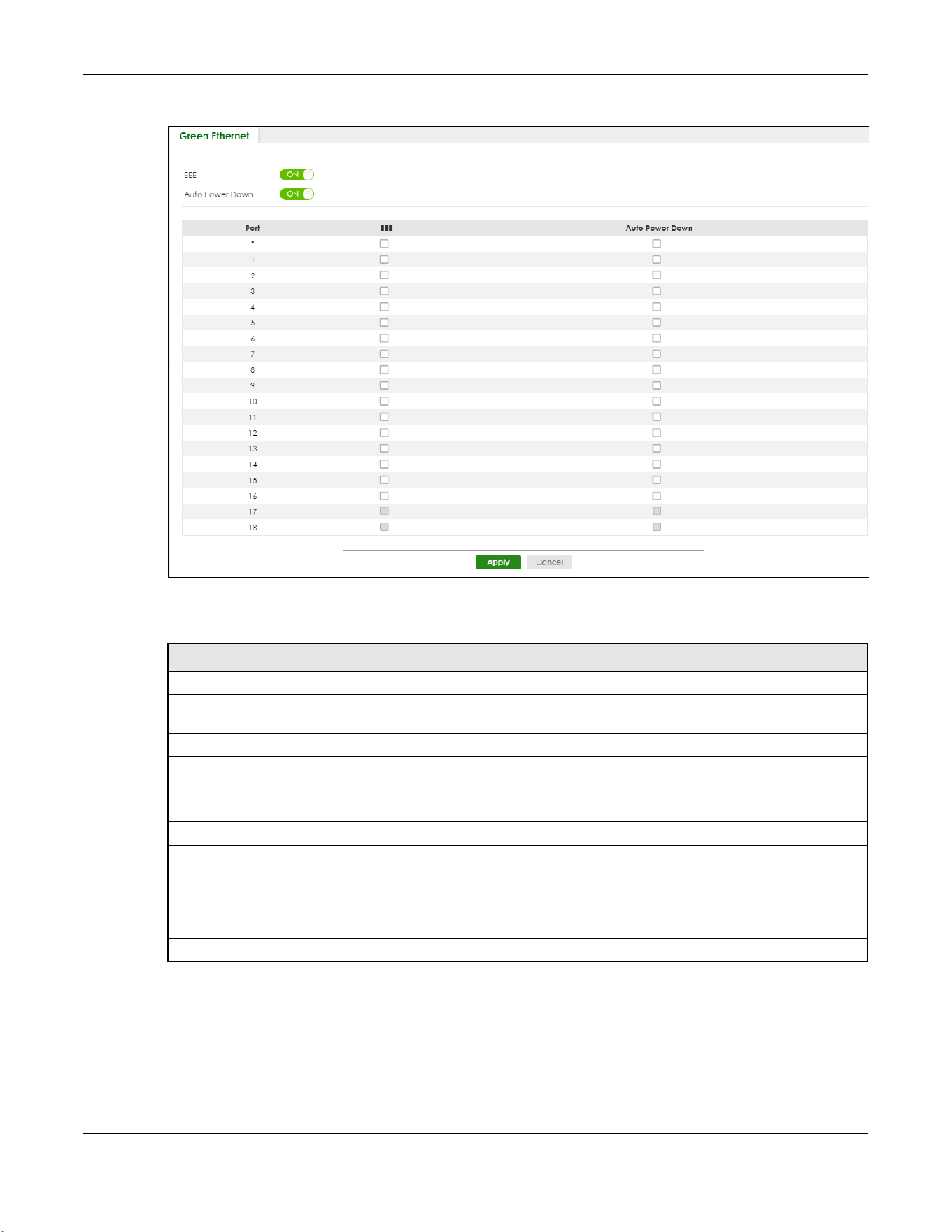
Chapter 31 Green Ethernet
XMG1915 Series User’s Guide
176
Figure 122 PORT > Green Ethernet
The following table describes the labels in this screen.
Table 87 PORT > Green Ethernet
LABEL DESCRIPTION
EEE Enable the switch button to activate Energy Efficient Ethernet globally.
Auto Power
Down
Enable the switch button to activate Auto Power Down globally.
Port This field displays the port number.
* Use this row to make the setting the same for all ports. Use this row first and then make
adjustments to each port if necessary.
Changes in this row are copied to all the ports as soon as you make them.
EEE Select this to activate Energy Efficient Ethernet on this port.
Auto Power
Down
Select this to activate Auto Power Down on this port.
Apply Click Apply to save your changes to the Switch’s run-time memory. The Switch loses these
changes if it is turned off or loses power, so use the Save link on the top navigation panel to save
your changes to the non-volatile memory when you are done configuring.
Cancel Click Cancel to begin configuring this screen afresh.

Chapter 32 Link Aggregation
XMG1915 Series User’s Guide
177
CHAPTER 32
Link Aggregation
32.1 Link Aggregation Overview
This chapter shows you how to logically aggregate physical links to form one logical, higher-bandwidth
link.
Link aggregation (trunking) is the grouping of physical ports into one logical higher-capacity link. You
may want to trunk ports if for example, it is cheaper to use multiple lower-speed links than to under-utilize
a high-speed, but more costly, single-port link. However, the more ports you aggregate then the fewer
available ports you have. A trunk group is one logical link containing multiple ports.
The beginning port of each trunk group must be physically connected to form a trunk group.
32.1.1 What You Can Do
• Use the Link Aggregation Status screen (Section 32.2 on page 179) to view ports you have configured
to be in the trunk group, ports that are currently transmitting data as one logical link in the trunk group
and so on.
• Use the Link Aggregation Setting screen (Section 32.3 on page 180) to configure static link
aggregation.
• Use the Link Aggregation Control Protocol screen (Section 32.4 on page 182) to enable Link
Aggregation Control Protocol (LACP).
32.1.2 What You Need to Know
The Switch supports both static and dynamic link aggregation.
Note: In a properly planned network, it is recommended to implement static link aggregation
only. This ensures increased network stability and control over the trunk groups on your
Switch.
See Section 32.5.1 on page 184 for a static port trunking example.
Dynamic Link Aggregation
The Switch adheres to the IEEE 802.3ad standard for static and dynamic (LACP) port trunking.
The IEEE 802.3ad standard describes the Link Aggregation Control Protocol (LACP) for dynamically
creating and managing trunk groups.
When you enable LACP link aggregation on a port, the port can automatically negotiate with the ports
at the remote end of a link to establish trunk groups. LACP also allows port redundancy, that is, if an
Chapter 32 Link Aggregation
XMG1915 Series User’s Guide
178
operational port fails, then one of the “standby” ports become operational without user intervention.
Please note that:
• You must connect all ports point-to-point to the same Ethernet switch and configure the ports for
LACP trunking.
• LACP only works on full-duplex links.
• All ports in the same trunk group must have the same media type, speed, duplex mode and flow
control settings.
Configure trunk groups or LACP before you connect the Ethernet switch to avoid causing network
topology loops.
Link Aggregation ID
LACP aggregation ID consists of the following information
1
:
Traffic Distribution Criteria
The Switch supports both unicast and non-unicast traffic (broadcast and multicast) network load sharing
over link aggregation. Load sharing works by statically splitting the traffic based on source or destination
IP/MAC address, and then distributing the load across multiple paths. In link aggregation, this allows the
trunk group (ports) to transmit data as one logical link to a single or group of hosts on the network.
Unicast and non-unicast traffic network load sharing over link aggregation (trunking) is enabled by
default.
Algorithm Types Limitation
The maximum number of link aggregation algorithm types (Criteria) that can link up at the same time
depends on your Switch model. See Table 91 on page 179 for the list of Criteria that your Switch currently
supports.
The following table shows the maximum number of link aggregation algorithm types that can link up at
the same time.
Table 88 Link Aggregation ID: Local Switch
SYSTEM PRIORITY MAC ADDRESS KEY PORT PRIORITY PORT NUMBER
0000 00-00-00-00-00-00 0000 00 0000
Table 89 Link Aggregation ID: Peer Switch
SYSTEM PRIORITY MAC ADDRESS KEY PORT PRIORITY PORT NUMBER
0000 00-00-00-00-00-00 0000 00 0000
1. Port Priority and Port Number are 0 as it is the aggregator ID for the trunk group, not the individual port.
Table 90 Link Aggregation Algorithm Types Limitation
MODEL LINK AGGREGATION ALGORITHM TYPES (MAXIMUM)
XMG1915 Series 2
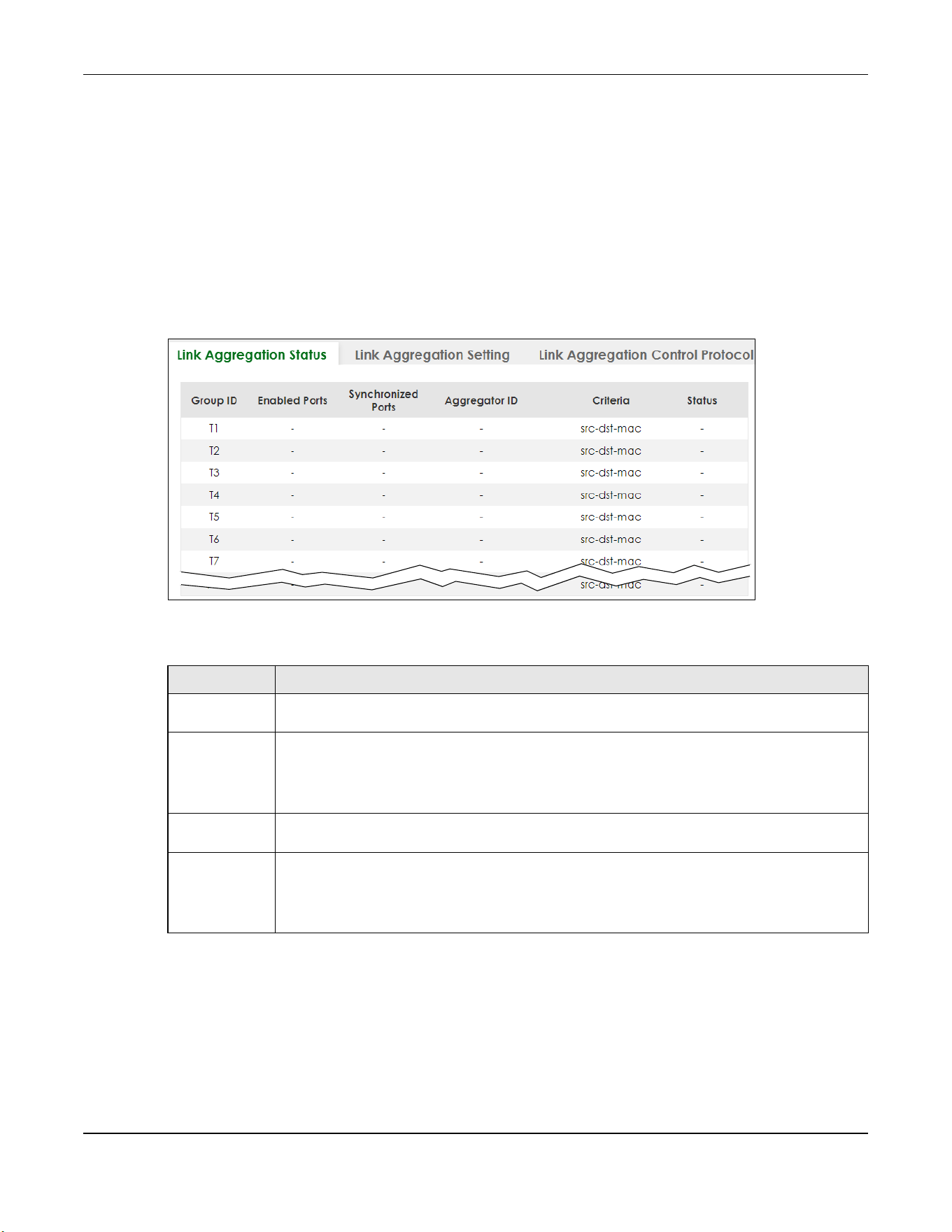
Chapter 32 Link Aggregation
XMG1915 Series User’s Guide
179
For example, if your Switch has two link aggregation algorithm types that are currently online. The third
link aggregation algorithm type can only go online when one of the online link aggregation algorithm
type goes offline.
32.2 Link Aggregation Status
Click PORT > Link Aggregation > Link Aggregation Status in the navigation panel to display the screen as
shown. See Section 32.1 on page 177 for more information.
Figure 123 PORT > Link Aggregation > Link Aggregation Status
The following table describes the labels in this screen.
Table 91 PORT > Link Aggregation > Link Aggregation Status
LABEL DESCRIPTION
Group ID This field displays the group ID to identify a trunk group, that is, one logical link containing multiple
ports.
Enabled Ports These are the ports you have configured in the Link Aggregation Setting screen to be in the trunk
group.
The port numbers displays only when this trunk group is activated and there is a port belonging to
this group.
Synchronized
Ports
These are the ports that are currently transmitting data as one logical link in this trunk group.
Aggregator ID Link Aggregator ID consists of the following: system priority, MAC address, key, port priority and
port number.
The ID displays only when there is a port belonging to this trunk group and LACP is also enabled
for this group.

Chapter 32 Link Aggregation
XMG1915 Series User’s Guide
180
32.3 Link Aggregation Setting
Click PORT > Link Aggregation > Link Aggregation Setting to display the screen shown next. See Section
32.1 on page 177 for more information on link aggregation.
Criteria This shows the outgoing traffic distribution algorithm types used in this trunk group. Sending of
packets are from the same source and/or to the same destination over the same link within the
trunk.
src-mac means the Switch distributes traffic based on the packet’s source MAC address.
dst-mac means the Switch distributes traffic based on the packet’s destination MAC address.
src-dst-mac means the Switch distributes traffic based on a combination of the packet’s source
and destination MAC addresses.
src-ip means the Switch distributes traffic based on the packet’s source IP address.
dst-ip means the Switch distributes traffic based on the packet’s destination IP address.
src-dst-ip means the Switch distributes traffic based on a combination of the packet’s source
and destination IP addresses.
Note: To find the number of link aggregation algorithm types that can link up at the
same time, see Algorithm Types Limitation on page 178.
Status This field displays how these ports were added to the trunk group. It displays:
• Static – if the ports are configured as static members of a trunk group.
• LACP – if the ports are configured to join a trunk group through LACP.
Table 91 PORT > Link Aggregation > Link Aggregation Status (continued)
LABEL DESCRIPTION
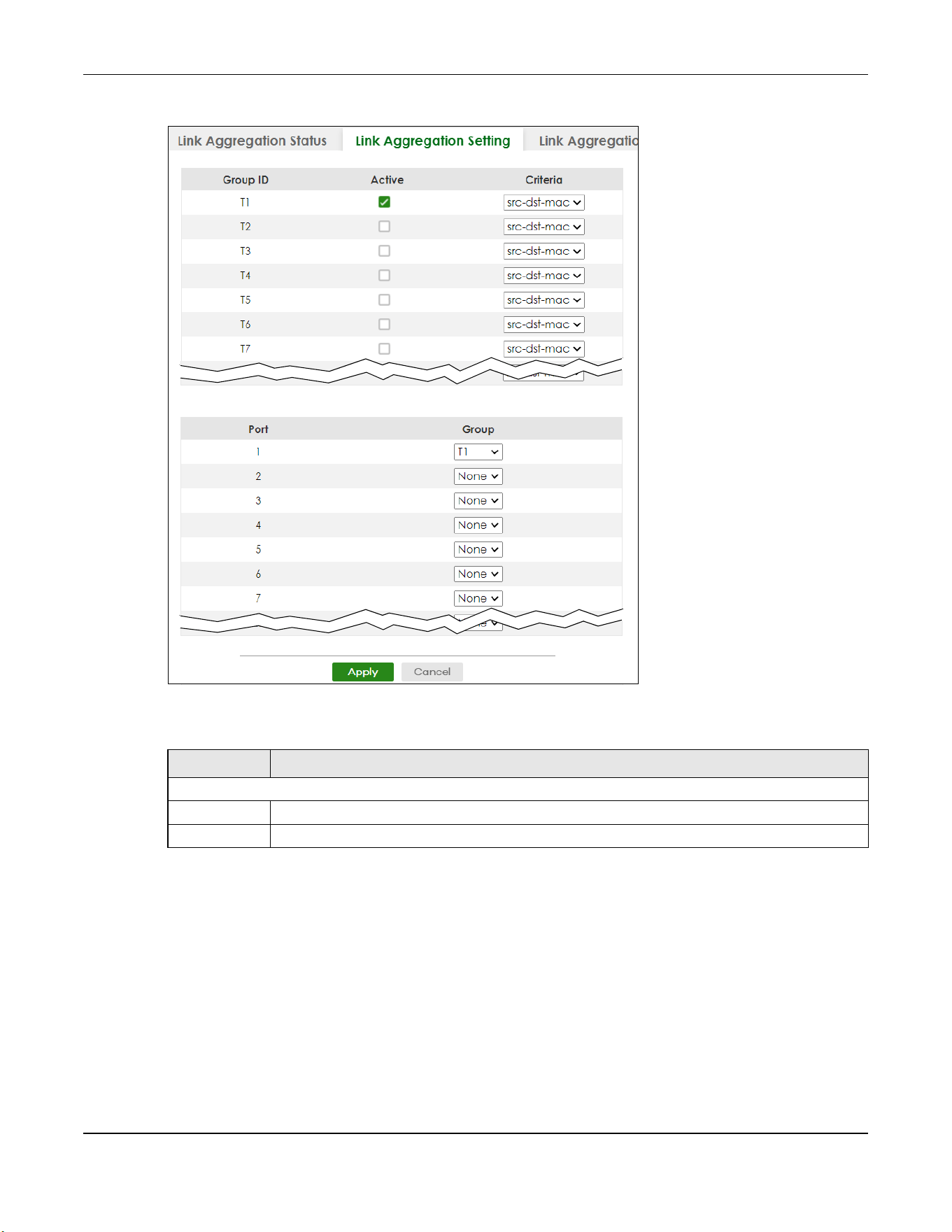
Chapter 32 Link Aggregation
XMG1915 Series User’s Guide
181
Figure 124 PORT > Link Aggregation > Link Aggregation Setting
The following table describes the labels in this screen.
Table 92 PORT > Link Aggregation > Link Aggregation Setting
LABEL DESCRIPTION
This is the only screen you need to configure to enable static link aggregation.
Group ID The field identifies the link aggregation group, that is, one logical link containing multiple ports.
Active Select this to activate a trunk group.

Chapter 32 Link Aggregation
XMG1915 Series User’s Guide
182
32.4 Link Aggregation Control Protocol
Click PORT > Link Aggregation > Link Aggregation Control Protocol to display the screen shown next. See
Dynamic Link Aggregation on page 177 for more information on dynamic link aggregation.
Note: Do NOT configure this screen unless you want to enable dynamic link aggregation.
Criteria Select the outgoing traffic distribution type. Packets from the same source and/or to the same
destination are sent over the same link within the trunk. By default, the Switch uses the src-dst-mac
distribution type. If the Switch is behind a router, the packet’s destination or source MAC address
will be changed. In this case, set the Switch to distribute traffic based on its IP address to make
sure port trunking can work properly.
Select src-mac to distribute traffic based on the packet’s source MAC address.
Select dst-mac to distribute traffic based on the packet’s destination MAC address.
Select src-dst-mac to distribute traffic based on a combination of the packet’s source and
destination MAC addresses.
Select src-ip to distribute traffic based on the packet’s source IP address.
Select dst-ip to distribute traffic based on the packet’s destination IP address.
Select src-dst-ip to distribute traffic based on a combination of the packet’s source and
destination IP addresses.
Port This field displays the port number.
Group Select the trunk group to which a port belongs.
Note: When you enable the port security feature on the Switch and configure port
security settings for a port, you cannot include the port in an active trunk group.
Apply Click Apply to save your changes to the Switch’s run-time memory. The Switch loses these
changes if it is turned off or loses power, so use the Save link on the top navigation panel to save
your changes to the non-volatile memory when you are done configuring.
Cancel Click Cancel to begin configuring this screen afresh.
Table 92 PORT > Link Aggregation > Link Aggregation Setting (continued)
LABEL DESCRIPTION
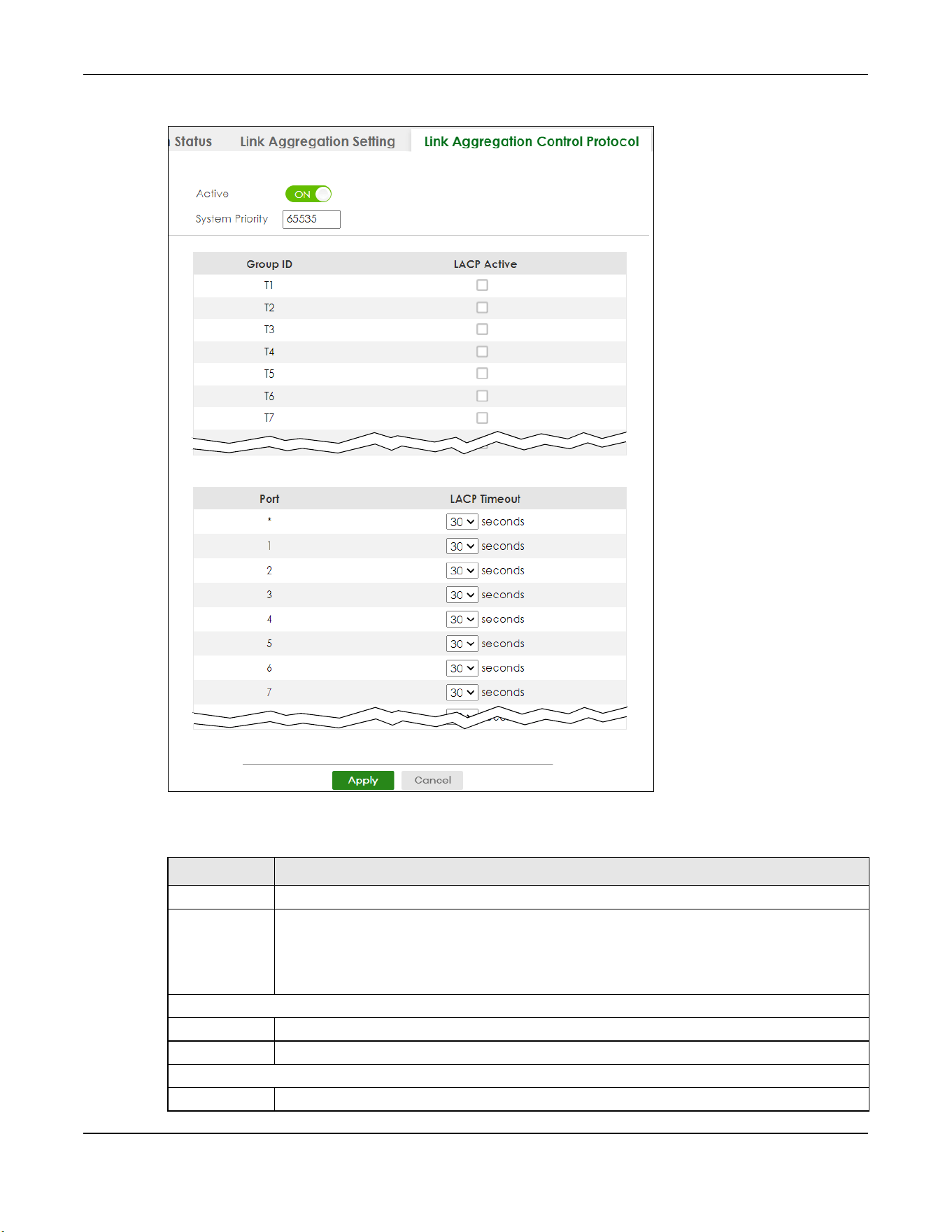
Chapter 32 Link Aggregation
XMG1915 Series User’s Guide
183
Figure 125 PORT > Link Aggregation > Link Aggregation Control Protocol
The following table describes the labels in this screen.
Table 93 PORT > Link Aggregation > Link Aggregation Control Protocol
LABEL DESCRIPTION
Active Enable the switch button to enable Link Aggregation Control Protocol (LACP).
System Priority LACP system priority is a number between 1 and 65535. The switch with the lowest system priority
(and lowest port number if system priority is the same) becomes the LACP “server”. The LACP
“server” controls the operation of LACP setup. Enter a number to set the priority of an active port
using Link Aggregation Control Protocol (LACP). The smaller the number, the higher the priority
level.
Use this section to enable LACP on trunks.
Group ID The field identifies the link aggregation group, that is, one logical link containing multiple ports.
LACP Active Select this option to enable LACP for a trunk.
Use this section to configure LACP timeout on ports.
Port This field displays the port number.

Chapter 32 Link Aggregation
XMG1915 Series User’s Guide
184
32.5 Technical Reference
This section provides technical background information on the topics discussed in this chapter.
32.5.1 Static Trunking Example
This example shows you how to create a static port trunk group for ports 2 – 5.
1 Make your physical connections – make sure that the ports that you want to belong to the trunk group
are connected to the same destination. The following figure shows ports 2 – 5 on switch A connected to
switch B.
Figure 126 Trunking Example
– Physical Connections
2 Configure static trunking
– Click PORT > Link Aggregation > Link Aggregation Setting. In this screen
activate trunk group T1, select the traffic distribution algorithm used by this group and select the ports
that should belong to this group as shown in the figure below. Click Apply when you are done.
* Settings in this row apply to all ports.
Use this row only if you want to make some settings the same for all ports. Use this row first to set
the common settings and then make adjustments on a port-by-port basis.
Note: Changes in this row are copied to all the ports as soon as you make them.
LACP Timeout Timeout is the time interval between the individual port exchanges of LACP packets in order to
check that the peer port in the trunk group is still up. If a port does not respond after three tries,
then it is deemed to be “down” and is removed from the trunk. Set a short timeout (1 second) for
busy trunked links to ensure that disabled ports are removed from the trunk group as soon as
possible.
Select either 1 second or 30 seconds.
Apply Click Apply to save your changes to the Switch’s run-time memory. The Switch loses these
changes if it is turned off or loses power, so use the Save link on the top navigation panel to save
your changes to the non-volatile memory when you are done configuring.
Cancel Click Cancel to begin configuring this screen afresh.
Table 93 PORT > Link Aggregation > Link Aggregation Control Protocol (continued)
LABEL DESCRIPTION
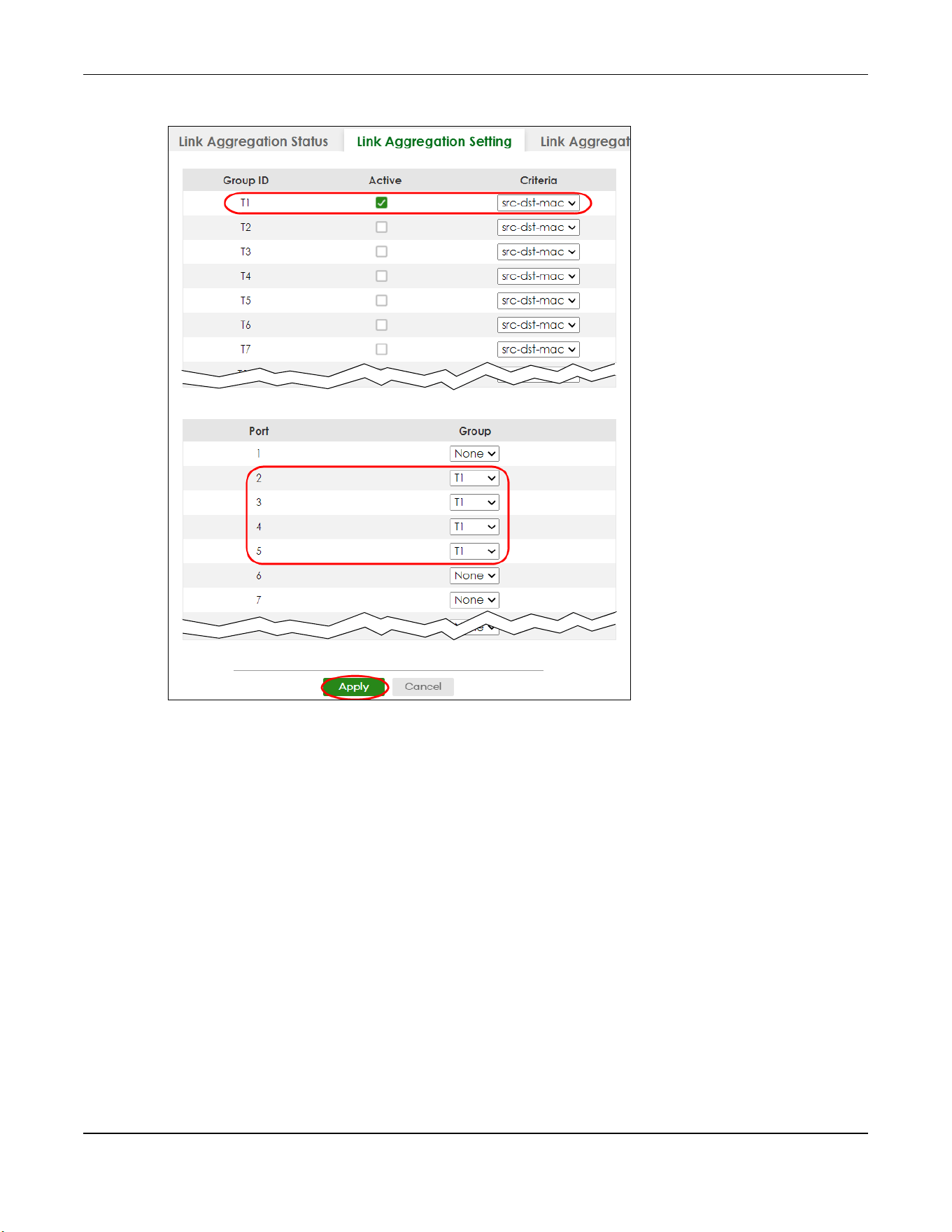
Chapter 32 Link Aggregation
XMG1915 Series User’s Guide
185
Figure 127 Trunking Example – Configuration Screen
Your trunk group 1 (T1) configuration is now complete.

Chapter 33 Link Layer Discovery Protocol (LLDP)
XMG1915 Series User’s Guide
186
CHAPTER 33
Link Layer Discovery Protocol
(LLDP)
33.1 LLDP Overview
The LLDP (Link Layer Discovery Protocol) is a layer 2 protocol. It allows a network device to advertise its
identity and capabilities on the local network. It also allows the device to maintain and store information
from adjacent devices which are directly connected to the network device. This helps an administrator
discover network changes and perform necessary network reconfiguration and management. The
device information is encapsulated in the LLDPDUs (LLDP data units) in the form of TLV (Type, Length,
Value). Device information carried in the received LLDPDUs is stored in the standard MIB.
The Switch supports these basic management TLVs.
• End of LLDPDU (mandatory)
•Chassis ID (mandatory)
•Port ID (mandatory)
• Time to Live (mandatory)
• Port Description (optional)
• System Name (optional)
• System Description (optional)
• System Capabilities (optional)
• Management Address (optional)
The Switch also supports the IEEE 802.1 and IEEE 802.3 organizationally-specific TLVs.
IEEE 802.1 specific TLVs:
• Port VLAN ID TLV (optional)
• Port and Protocol VLAN ID TLV (optional)
IEEE 802.3 specific TLVs:
• MAC/PHY Configuration/Status TLV (optional)
• Power via MDI TLV (optional, For PoE models only)
• Link Aggregation TLV (optional)
• Maximum Frame Size TLV (optional)
The optional TLVs are inserted between the Time To Live TLV and the End of LLDPDU TLV.
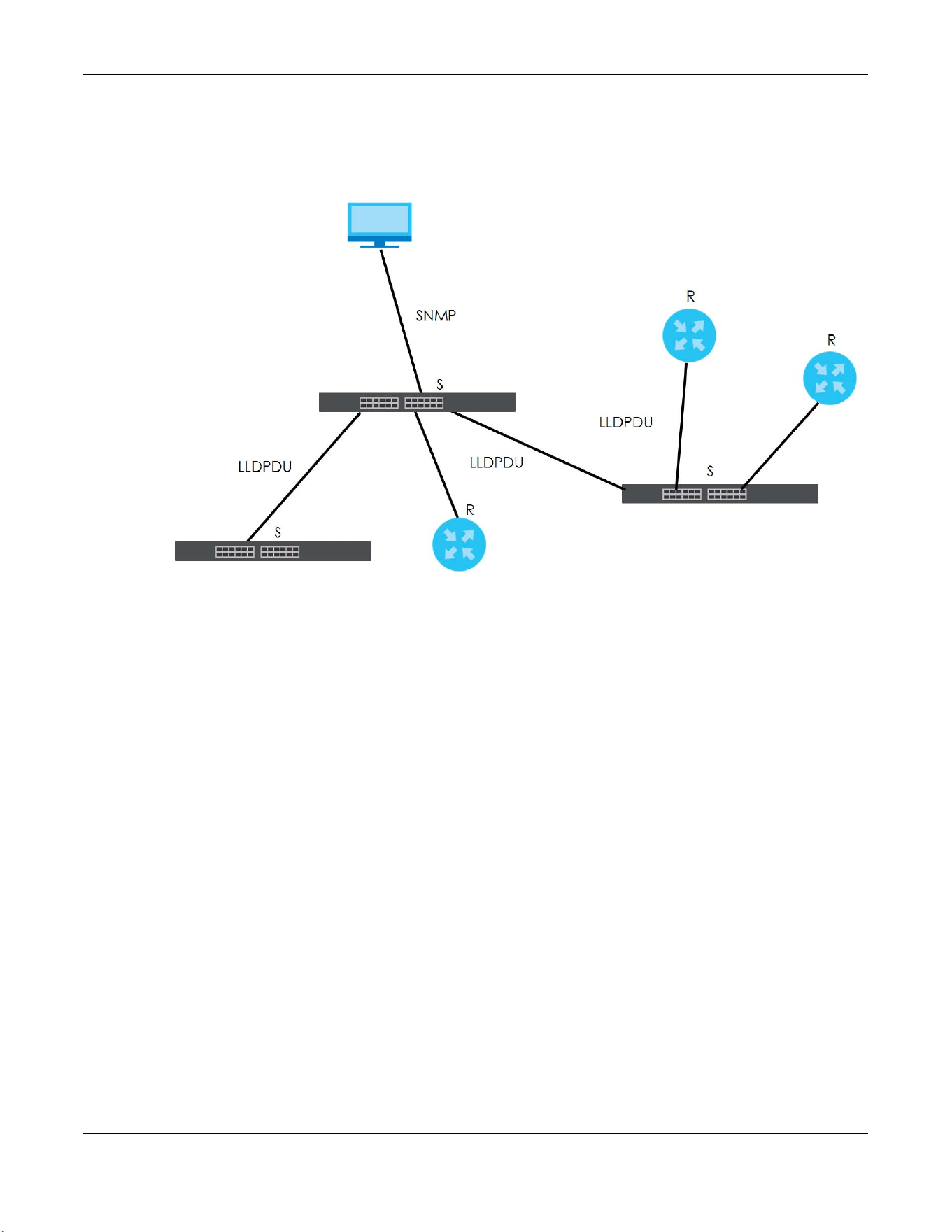
Chapter 33 Link Layer Discovery Protocol (LLDP)
XMG1915 Series User’s Guide
187
The next figure demonstrates that the network devices Switches and Routers (S and R) transmit and
receive device information through LLDPDU and the network manager can query the information using
Simple Network Management Protocol (SNMP).
Figure 128 LLDP Overview
33.2 LLDP-MED Overview
LLDP-MED (Link Layer Discovery Protocol for Media Endpoint Devices) is an extension to the standard
LLDP developed by the Telecommunications Industry Association (TIA) TR-41.4 subcommittee which
defines the enhanced discovery capabilities, such as VoIP applications, to enable network
administrators manage their network topology application more efficiently. Unlike the traditional LLDP,
which has some limitations when handling multiple application devices, the LLDP-MED offers display of
accurate physical topology, interoperability of devices, and easy trouble shooting for mis-configured IP
addresses. There are three classes of endpoint devices that the LLDP-MED supports:
Class I: IP Communications Controllers or other communication related servers
Class II: Voice Gateways, Conference Bridges or Media Servers
Class III: IP-Phones, PC-based Softphones, End user Communication Appliances supporting IP Media
The following figure shows that with the LLDP-MED, network connectivity devices (NCD) like Switches
and Routers will transmit LLDP TLV to endpoint device (ED) like IP Phone first (1), to get its device type
and capabilities information, then it will receive that information in LLDP-MED TLV back from endpoint
devices (2), after that the network connectivity devices will transmit LLDP-MED TLV (3) to provision the
endpoint device to such that the endpoint device’s network policy and location identification
information is updated. Since LLDPDU updates status and configuration information periodically,
network managers may check the result of provision through remote status. The remote status is
updated by receiving LLDP-MED TLVs from endpoint devices.
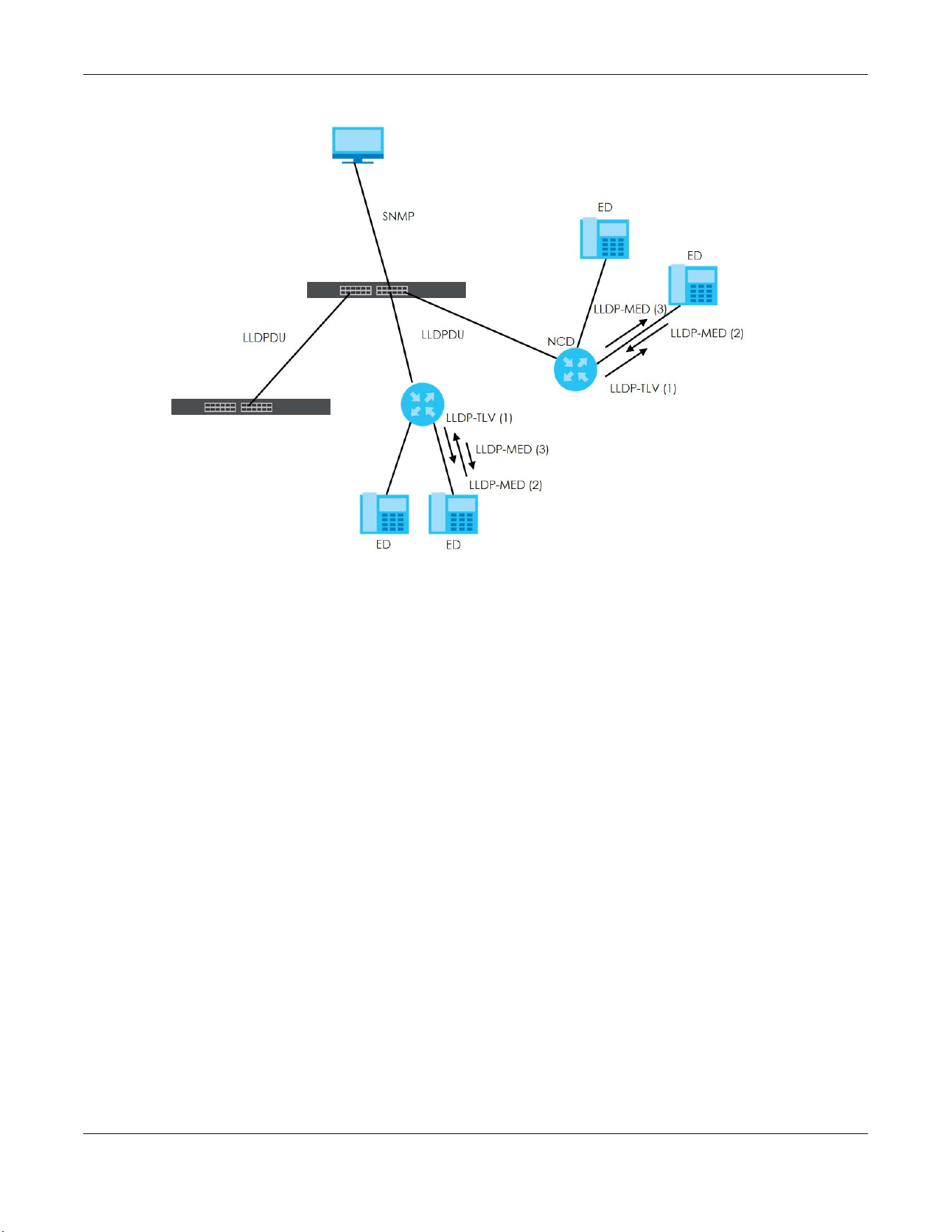
Chapter 33 Link Layer Discovery Protocol (LLDP)
XMG1915 Series User’s Guide
188
Figure 129 LLDP-MED Overview
33.2.1 What You Can Do – LLDP
• Use the LLDP Local Status screen (Section 33.3 on page 188) to view the Switch’s LLDP information.
• Use the LLDP Remote Status screen (Section 33.4 on page 192) to view LLDP information from the
neighboring devices.
• Use the LLDP Setup screen (Section 33.5 on page 197) to configure LLDP on the Switch.
• Use the Basic TLV Setting screen (Section 33.6 on page 199) to configure basic TLV settings on each
port.
• Use the Org-specific TLV Setting screen (Section 33.7 on page 200) to configure organization-specific
TLV settings on each port.
33.2.2 What You Can Do – LLDP MED
• Use the LLDP-MED Setup screen (Section 33.8 on page 201) to configure LLDP-MED (Link Layer
Discovery Protocol for Media Endpoint Devices) parameters.
• Use the LLDP-MED Network Policy screen (Section 33.9 on page 202) to configure LLDP-MED (Link
Layer Discovery Protocol for Media Endpoint Devices) network policy parameters.
• Use the LLDP-MED Location screen (Section 33.10 on page 203) to configure LLDP-MED (Link Layer
Discovery Protocol for Media Endpoint Devices) location parameters.
33.3 LLDP Local Status
This screen displays a summary of LLDP status on this Switch. Click PORT > LLDP > LLDP > LLDP Local Status
to display the screen as shown next.
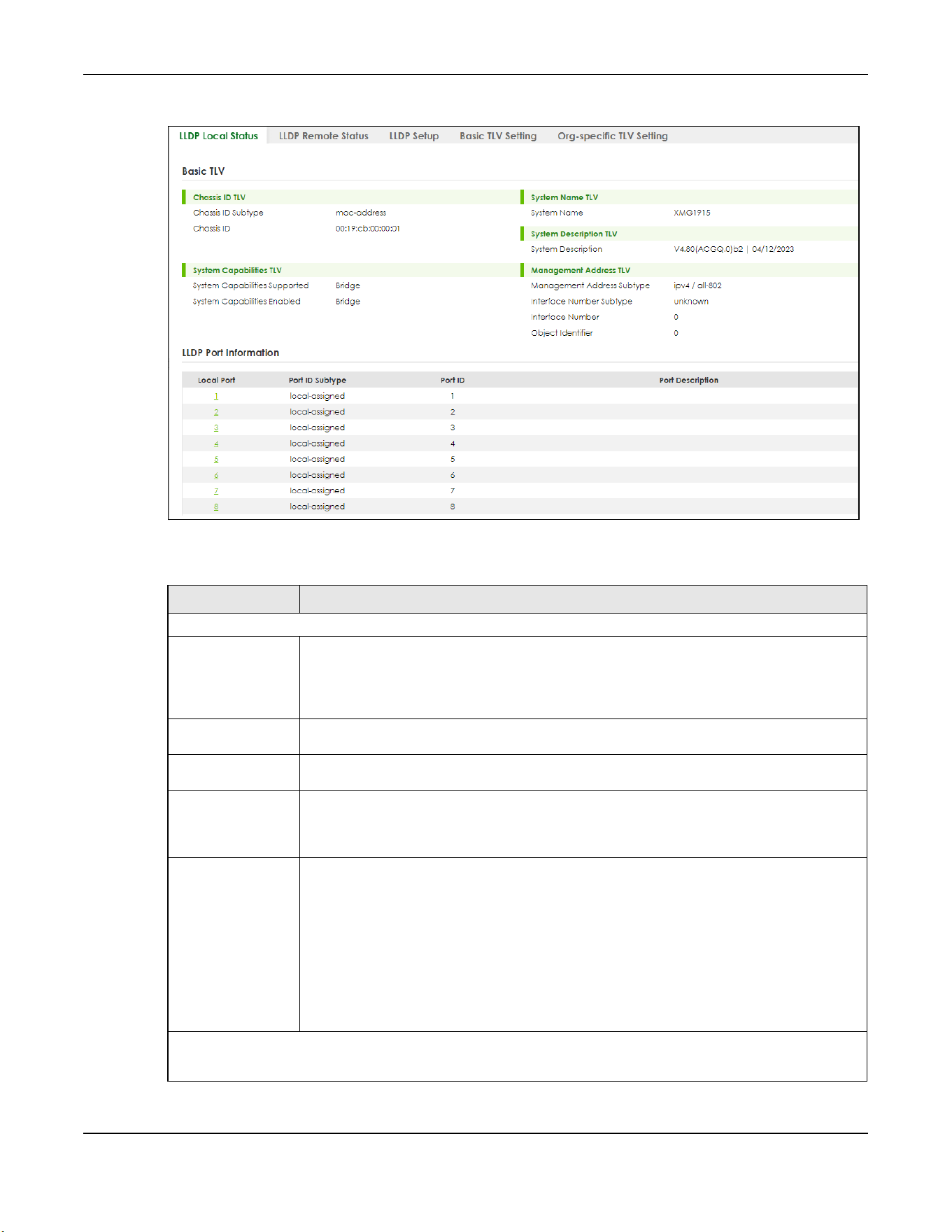
Chapter 33 Link Layer Discovery Protocol (LLDP)
XMG1915 Series User’s Guide
189
Figure 130 PORT > LLDP > LLDP > LLDP Local Status
The following table describes the labels in this screen.
Table 94 PORT > LLDP > LLDP > LLDP Local Status
LABEL DESCRIPTION
Basic TLV
Chassis ID TLV This displays the chassis ID of the local Switch, that is the Switch you are configuring. The
chassis ID is identified by the chassis ID subtype.
• Chassis ID Subtype – This displays how the chassis of the Switch is identified.
• Chassis ID – This displays the chassis ID of the local Switch.
System Name
TLV
System Name – This shows the host name of the Switch.
System
Description TLV
System Description – This shows the firmware version of the Switch.
System
Capabilities TLV
This shows the System Capabilities enabled and supported on the local Switch.
• System Capabilities Supported – Bridge
• System Capabilities Enabled – Bridge
Management
Address TLV
The Management Address TLV identifies an address associated with the local LLDP agent
that may be used to reach higher layer entities to assist discovery by network management.
The TLV may also include the system interface number and an object identifier (OID) that are
associated with this management address.
This field displays the Management Address settings on the specified ports.
• Management Address Subtype – ipv4 or all-802
• Interface Number Subtype – unknown
• Interface Number – 0 (not supported)
• Object Identifier – 0 (not supported)
LLDP Port Information
This displays the local port information.
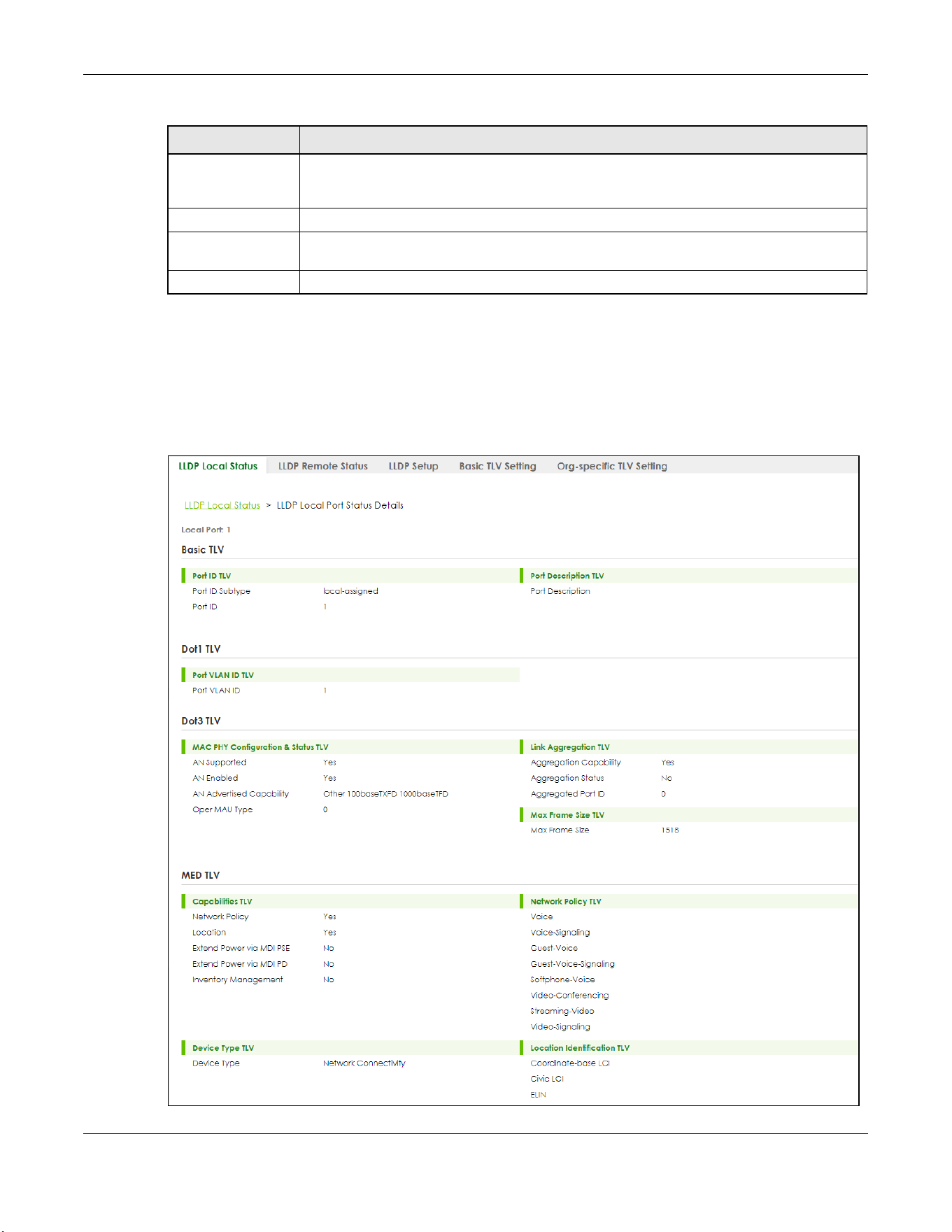
Chapter 33 Link Layer Discovery Protocol (LLDP)
XMG1915 Series User’s Guide
190
33.3.1 LLDP Local Port Status Details
This screen displays detailed LLDP status for each port on this Switch. Click PORT > LLDP > LLDP > LLDP
Local Status and then, click a port number, for example 1 in the local port column to display the screen
as shown next.
Figure 131 PORT > LLDP > LLDP > LLDP Local Status > LLDP Local Port Status Details
Local Port This displays the number of the Switch port which receives the LLDPDU from the remote
device. Click a port number to view the detailed LLDP status on this port in the LLDP Local
Port Status Details screen.
Port ID Subtype This indicates how the port ID field is identified.
Port ID This is an alpha-numeric string that contains the specific identifier for the port from which this
LLDPDU was transmitted.
Port Description This shows the port description that the Switch will advertise from this port.
Table 94 PORT > LLDP > LLDP > LLDP Local Status (continued)
LABEL DESCRIPTION
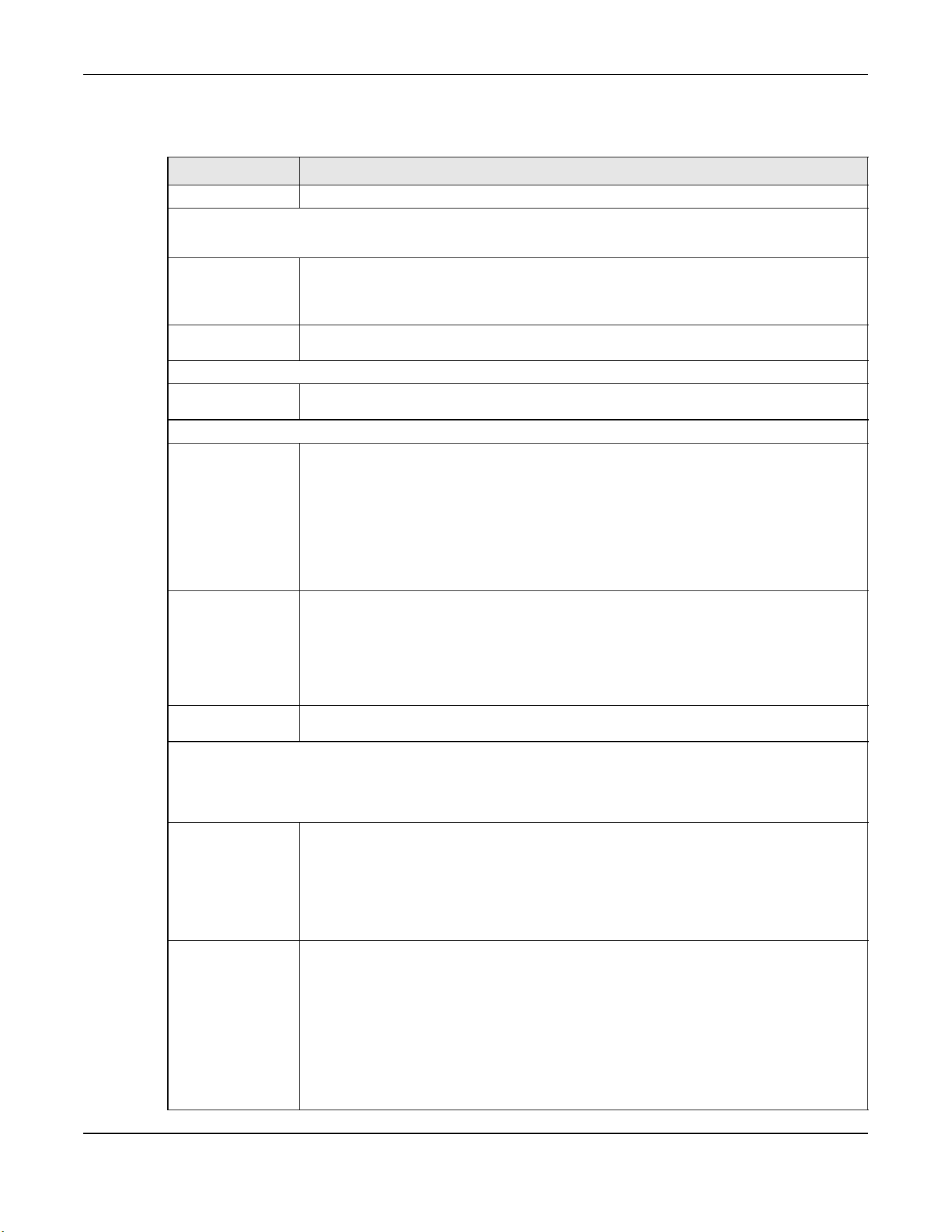
Chapter 33 Link Layer Discovery Protocol (LLDP)
XMG1915 Series User’s Guide
191
The following table describes the labels in this screen.
Table 95 PORT > LLDP > LLDP > LLDP Local Status > LLDP Local Port Status Details
LABEL DESCRIPTION
Local Port This displays the number of the Switch’s port.
Basic TLV
These are the Basic TLV flags
Port ID TLV The port ID TLV identifies the specific port that transmitted the LLDP frame.
• Port ID Subtype – This shows how the port is identified.
• Port ID – This is the ID of the port.
Port Description
TLV
Port Description – This displays the local port description.
Dot1 TLV
Port VLAN ID
TLV
Port VLAN ID – This displays the VLAN ID sent by the IEEE 802.1 Port VLAN ID TLV.
Dot3 TLV
MAC PHY
Configuration &
Status TLV
The MAC/PHY Configuration/Status TLV advertises the bit-rate and duplex capability of the
sending 802.3 node. It also advertises the current duplex and bit-rating of the sending node.
Lastly, it advertises whether these setting were the result of auto-negotiation during link
initiation or manual override.
• AN Supported – Displays if the port supports or does not support auto-negotiation.
• AN Enabled – The current auto-negotiation status of the port.
• AN Advertised Capability – The auto-negotiation capabilities of the port.
• Oper MAU Type – The current Medium Attachment Unit (MAU) type of the port.
Link
Aggregation
TLV
The Link Aggregation TLV indicates whether the link is capable of being aggregated,
whether the link is currently in an aggregation, and if in an aggregation, the port
identification of the aggregation.
• Aggregation Capability – The current aggregation capability of the port.
• Aggregation Status – The current aggregation status of the port.
• Aggregation Port ID – The aggregation ID of the current port.
Max Frame Size
TLV
This displays the maximum supported frame size in octets.
MED TLV
LLDP Media Endpoint Discovery (MED) is an extension of LLDP that provides additional capabilities to support
media endpoint devices. MED enables advertisement and discovery of network policies, device location discovery
to allow creation of location databases, and information for troubleshooting.
Capabilities TLV This field displays which LLDP-MED TLV are capable to transmit on the Switch.
• Network Policy
• Location
• Extend Power via MDI PSE
• Extend Power via MDI PD
• Inventory Management
Network Policy
TLV
This displays a network policy for the specified application.
•Voice
• Voice-Signaling
•Guest-Voice
• Guest-Voice-Signaling
• Softphone-Voice
• Video-Conferencing
•Streaming-Video
• Video-Signaling
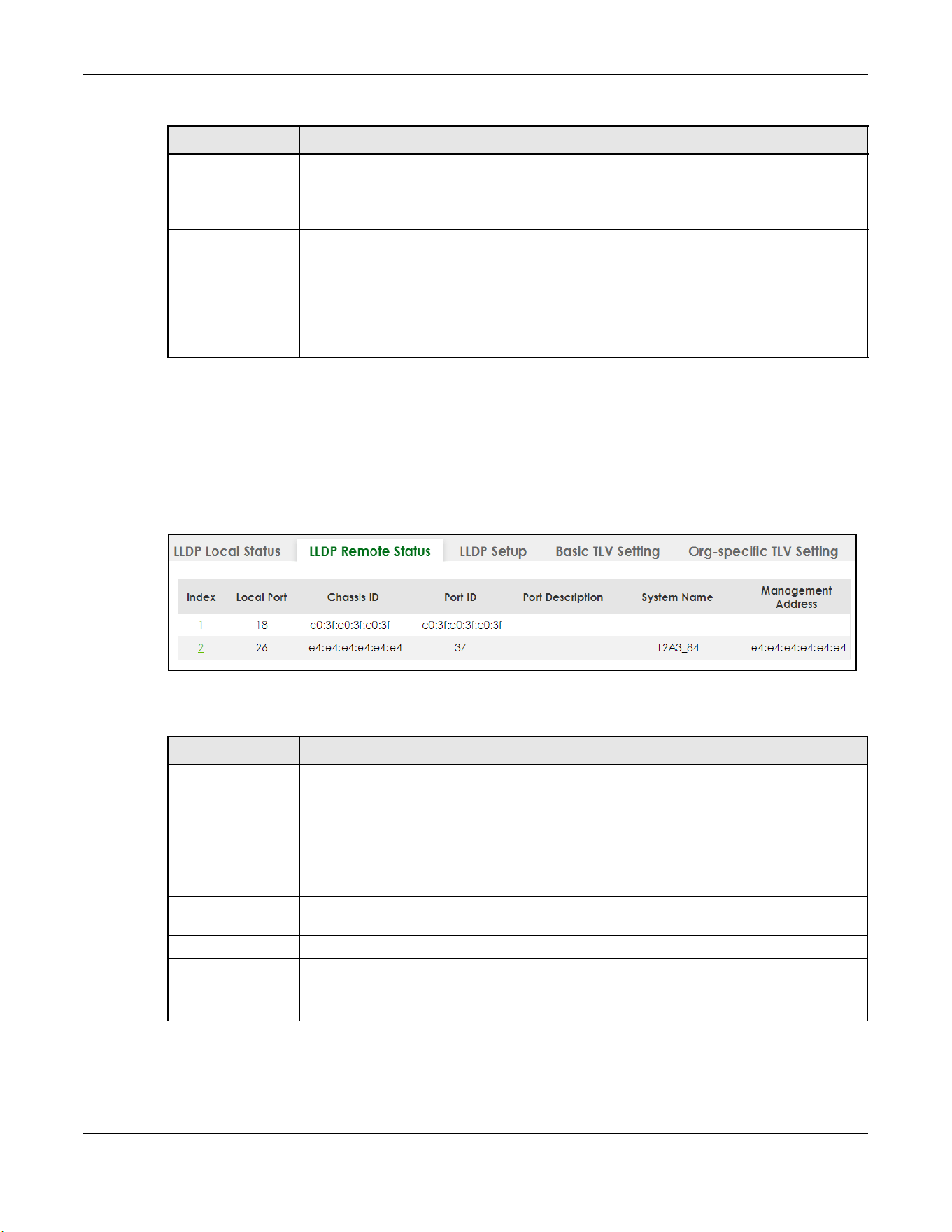
Chapter 33 Link Layer Discovery Protocol (LLDP)
XMG1915 Series User’s Guide
192
33.4 LLDP Remote Status
This screen displays a summary of LLDP status for each LLDP connection to a neighboring Switch. Click
PORT > LLDP > LLDP > LLDP Remote Status to display the screen as shown next.
Figure 132 PORT > LLDP > LLDP > LLDP Remote Status
The following table describes the labels in this screen.
Device Type
TLV
Device Type – This is the LLDP-MED device class.
The Zyxel Switch device type is:
• Network Connectivity
Location
Identification
TLV
This shows the location information of a caller by its ELIN (Emergency Location Identifier
Number) or the IETF Geopriv Civic Address based Location Configuration Information (Civic
Address LCI).
• Coordinate-based LCI – Latitude, longitude and altitude coordinates of the location
Configuration Information (LCI)
• Civic LCI – IETF Geopriv Civic Address based Location Configuration Information
• ELIN – (Emergency Location Identifier Number)
Table 95 PORT > LLDP > LLDP > LLDP Local Status > LLDP Local Port Status Details (continued)
LABEL DESCRIPTION
Table 96 PORT > LLDP > LLDP > LLDP Remote Status
LABEL DESCRIPTION
Index The index number shows the number of remote devices that are connected to the Switch.
Click on an index number to view the detailed LLDP status for this remote device in the LLDP
Remote Port Status Details screen.
Local Port This is the number of the Switch’s port that received LLDPDU from the remote device.
Chassis ID This displays the chassis ID of the remote device associated with the transmitting LLDP agent.
The chassis ID is identified by the chassis ID subtype. For example, the MAC address of the
remote device.
Port ID This is an alpha-numeric string that contains the specific identifier for the port from which this
LLDPDU was transmitted. The port ID is identified by the port ID subtype.
Port Description This displays a description for the port from which this LLDPDU was transmitted.
System Name This displays the system name of the remote device.
Management
Address
This displays the management address of the remote device. It could be the MAC address or
IP address.
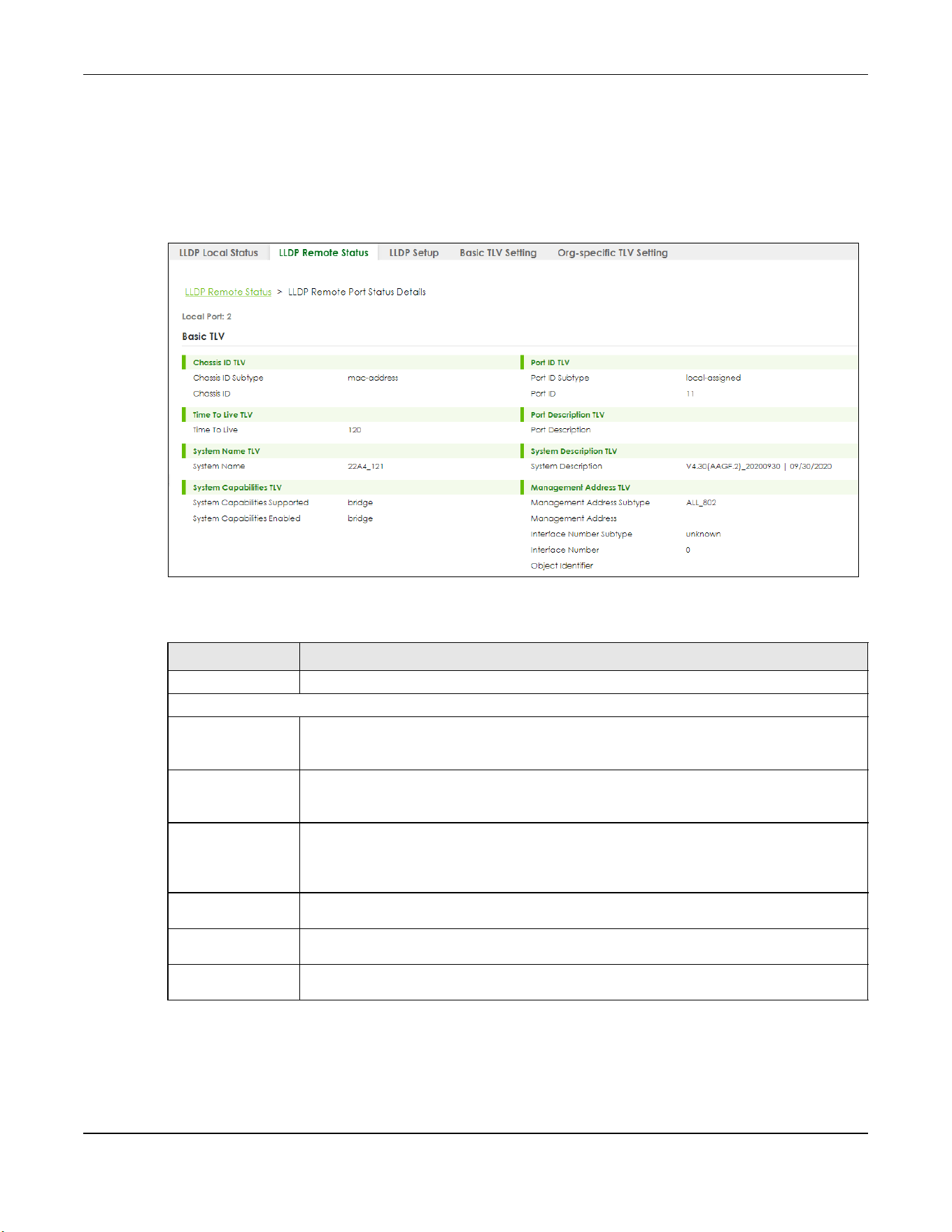
Chapter 33 Link Layer Discovery Protocol (LLDP)
XMG1915 Series User’s Guide
193
33.4.1 LLDP Remote Port Status Details
This screen displays detailed LLDP status of the remote device connected to the Switch. Click PORT >
LLDP > LLDP > LLDP Remote Status and then click an index number, for example 1, in the Index column in
the LLDP Remote Status screen to display the screen as shown next.
Figure 133 PORT > LLDP > LLDP > LLDP Remote Status > LLDP Remote Port Status Details (Basic TLV)
The following table describes the labels in Basic TLV part of the screen.
Table 97 PORT > LLDP > LLDP > LLDP Remote Status > LLDP Remote Port Status Details (Basic TLV)
LABEL DESCRIPTION
Local Port This displays the number of the Switch’s port to which the remote device is connected.
Basic TLV
Chassis ID TLV • Chassis ID Subtype – This displays how the chassis of the remote device is identified.
• Chassis ID – This displays the chassis ID of the remote device. The chassis ID is identified by
the chassis ID subtype.
Port ID TLV • Port ID Subtype – This displays how the port of the remote device is identified.
• Port ID – This displays the port ID of the remote device. The port ID is identified by the port
ID subtype.
Time To Live TLV Time To Live – This displays the time-to-live (TTL) multiplier of LLDP frames. The device
information on the neighboring devices ages out and is discarded when its corresponding
TTL expires. The TTL value is to multiply the TTL multiplier by the LLDP frames transmitting
interval.
Port Description
TLV
Port Description – This displays the remote port description.
System Name
TLV
System Name – This displays the system name of the remote device.
System
Description TLV
System Description – This displays the system description of the remote device.
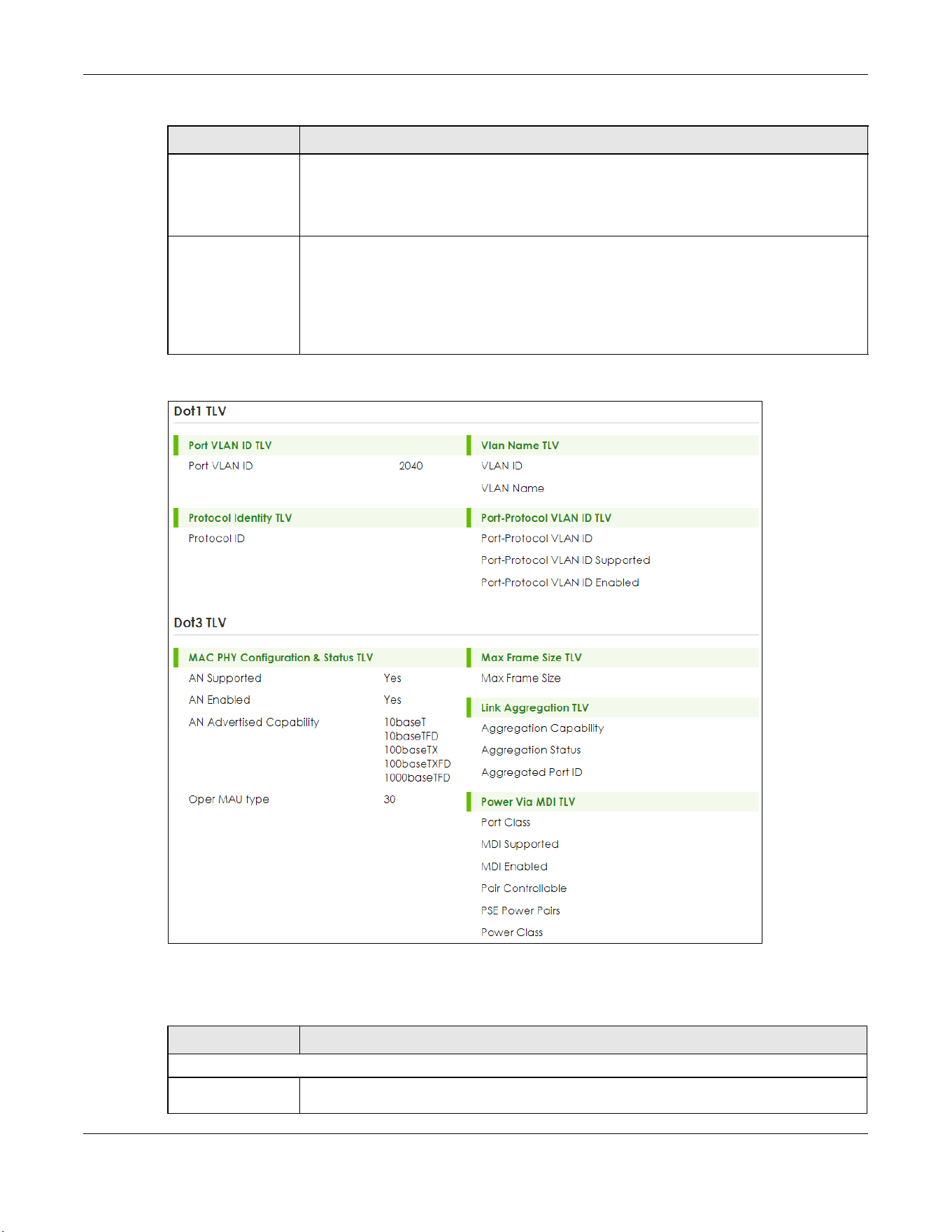
Chapter 33 Link Layer Discovery Protocol (LLDP)
XMG1915 Series User’s Guide
194
Figure 134 PORT > LLDP > LLDP > LLDP Remote Status > LLDP Remote Port Status Details (Dot1 and Dot3
TLV)
The following table describes the labels in the Dot1 and Dot3 parts of the screen.
System
Capabilities TLV
This displays whether the system capabilities are enabled and supported on the remote
device.
• System Capabilities Supported
• System Capabilities Enabled
Management
Address TLV
This displays the management address (IPv4 and IPv6) of the remote device.
• Management Address Subtype
• Management Address
• Interface Number Subtype
• Interface Number
• Object Identifier
Table 98 PORT > LLDP > LLDP > LLDP Remote Status > LLDP Remote Port Status Details (Dot1 and Dot3
TLV)
LABEL DESCRIPTION
Dot1 TLV
Port VLAN ID
TLV
Port VLAN ID – This displays the VLAN ID of this port on the remote device.
Table 97 PORT > LLDP > LLDP > LLDP Remote Status > LLDP Remote Port Status Details (Basic TLV)
LABEL DESCRIPTION

Chapter 33 Link Layer Discovery Protocol (LLDP)
XMG1915 Series User’s Guide
195
Vlan Name TLV This shows the VLAN ID and name for remote device port.
•VLAN ID
• VLAN Name
Protocol
Identity TLV
Protocol ID – The Protocol Identity TLV allows the Switch to advertise the particular protocols
that are accessible through its port.
Port-Protocol
VLAN ID TLV
This displays the IEEE 802.1 Port Protocol VLAN ID TLV, which indicates whether the VLAN ID
and whether it is enabled and supported on the port of remote Switch which sent the
LLDPDU.
• Port-Protocol VLAN ID
• Port-Protocol VLAN ID Supported
• Port-Protocol VLAN ID Enabled
Dot3 TLV
MAC PHY
Configuration &
Status TLV
The MAC/PHY Configuration/Status TLV advertises the bit-rate and duplex capability of the
sending 802.3 node. It also advertises the current duplex and bit-rating of the sending node.
Lastly, it advertises whether these setting were the result of auto-negotiation during link
initiation or manual override.
• AN Supported – Displays if the port supports or does not support auto-negotiation.
• AN Enabled – The current auto-negotiation status of the port.
• AN Advertised Capability – The auto-negotiation capabilities of the port.
• Oper MAU Type – The current Medium Attachment Unit (MAU) type of the port.
Max Frame Size
TLV
Max Frame Size – This displays the maximum supported frame size in octets.
Link
Aggregation
TLV
The Link Aggregation TLV indicates whether the link is capable of being aggregated,
whether the link is currently in an aggregation, and if in an aggregation, the port
identification of the aggregation.
• Aggregation Capability – The current aggregation capability of the port.
• Aggregation Status – The current aggregation status of the port.
• Aggregated Port ID – The aggregation ID of the current port.
Power Via MDI
TLV
The Power Via MDI TLV allows network management to advertise and discover the MDI
power support capabilities of the sending port on the remote device.
•Port Class
• MDI Supported
• MDI Enabled
• Pair Controllable
• PSE Power Pairs
•Power Class
Table 98 PORT > LLDP > LLDP > LLDP Remote Status > LLDP Remote Port Status Details (Dot1 and Dot3
TLV) (continued)
LABEL DESCRIPTION
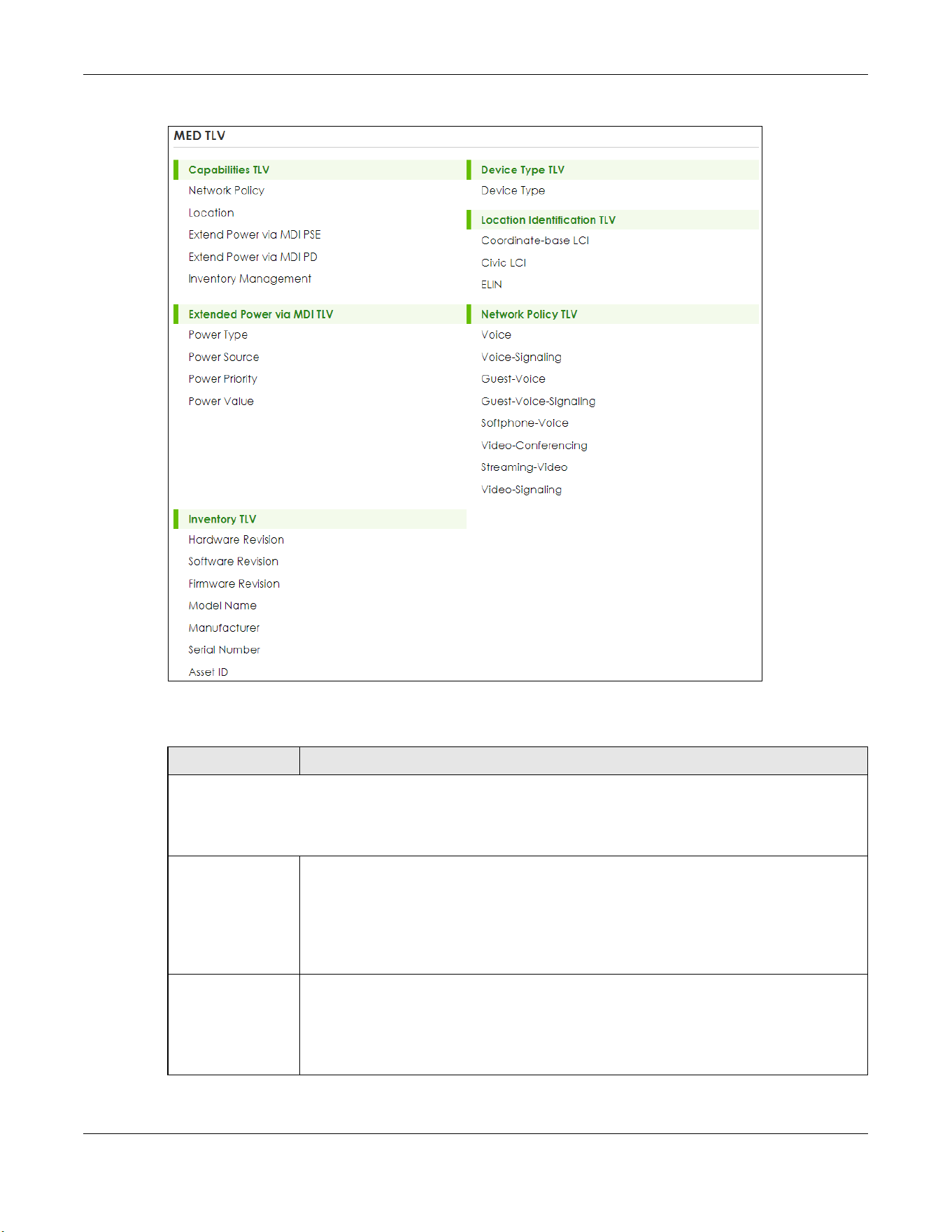
Chapter 33 Link Layer Discovery Protocol (LLDP)
XMG1915 Series User’s Guide
196
Figure 135 PORT > LLDP > LLDP > LLDP Remote Status > LLDP Remote Port Status Details (MED TLV)
The following table describes the labels in the MED TLV part of the screen.
Table 99 PORT > LLDP > LLDP > LLDP Remote Status > LLDP Remote Port Status Details (MED TLV)
LABEL DESCRIPTION
MED TLV
LLDP Media Endpoint Discovery (MED) is an extension of LLDP that provides additional capabilities to support
media endpoint devices. MED enables advertisement and discovery of network policies, device location discovery
to allow creation of location databases, and information for troubleshooting.
Capabilities TLV This displays the MED capabilities the remote port supports.
• Network Policy
• Location
• Extend Power via MDI PSE
• Extend Power via MDI PD
• Inventory Management
Device Type
TLV
LLDP-MED endpoint device classes:
• Endpoint Class I
• Endpoint Class II
• Endpoint Class III
• Network Connectivity

Chapter 33 Link Layer Discovery Protocol (LLDP)
XMG1915 Series User’s Guide
197
33.5 LLDP Setup
Use this screen to configure global LLDP settings on the Switch. Click PORT > LLDP > LLDP > LLDP Setup to
display the screen as shown next.
Location
Identification
TLV
This shows the location information of a caller by its:
• Coordinate-base LCI – Latitude and longitude coordinates of the Location Configuration
Information (LCI)
• Civic LCI – IETF Geopriv Civic Address based Location Configuration Information
• ELIN – (Emergency Location Identifier Number)
Extended
Power via MDI
TLV
Extended Power Via MDI Discovery enables detailed power information to be advertised by
Media Endpoints, such as IP phones and Network Connectivity Devices such as the Switch.
• Power Type – Whether it is currently operating from primary power or is on backup power
(backup power may indicate to the Endpoint Device that it should move to a power
conservation mode).
• Power Source – Whether or not the Endpoint is currently operating from an external
power source.
• Power Priority – The Endpoint Device’s power priority (which the Network Connectivity
Device may use to prioritize which devices will remain in service during power shortages).
• Power Value – Power requirement, in fractions of Watts, in current configuration.
Network Policy
TLV
This displays a network policy for the specified application.
•Voice
• Voice-Signaling
•Guest-Voice
• Guest-Voice-Signaling
• Softphone-Voice
• Video-Conferencing
•Streaming-Video
• Video-Signaling
Inventory TLV The majority of IP Phones lack support of management protocols such as SNMP, so LLDP-MED
inventory TLVs are used to provide their inventory information to the Network Connectivity
Devices such as the Switch. The Inventory TLV may contain the following information.
• Hardware Revision
• Software Revision
•Firmware Revision
• Model Name
• Manufacturer
• Serial Number
•Asset ID
Table 99 PORT > LLDP > LLDP > LLDP Remote Status > LLDP Remote Port Status Details (MED TLV)
LABEL DESCRIPTION
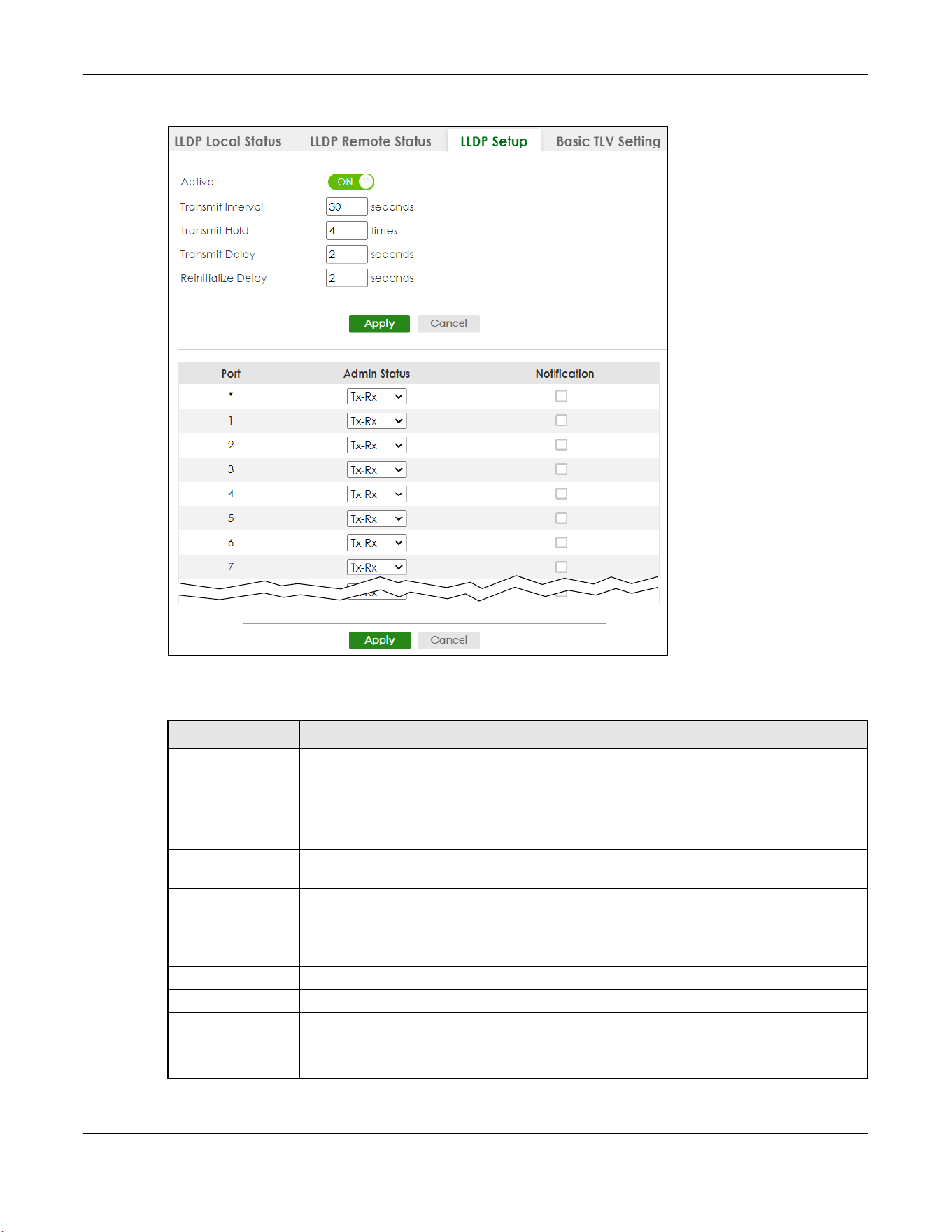
Chapter 33 Link Layer Discovery Protocol (LLDP)
XMG1915 Series User’s Guide
198
Figure 136 PORT > LLDP > LLDP > LLDP Setup
The following table describes the labels in this screen.
Table 100 PORT > LLDP > LLDP > LLDP Setup
LABEL DESCRIPTION
Active Select to enable LLDP on the Switch. It is enabled by default.
Transmit Interval Enter how many seconds the Switch waits before sending LLDP packets.
Transmit Hold Enter the time-to-live (TTL) multiplier of LLDP frames. The device information on the
neighboring devices ages out and is discarded when its corresponding TTL expires. The TTL
value is to multiply the TTL multiplier by the LLDP packets transmitting interval.
Transmit Delay Enter the delay (in seconds) between successive LLDPDU transmissions initiated by value or
status changes in the Switch MIB.
Reinitialize Delay Enter the number of seconds for LLDP to wait before initializing on a port.
Apply Click Apply to save your changes to the Switch’s run-time memory. The Switch loses these
changes if it is turned off or loses power, so use the Save link on the top navigation panel to
save your changes to the non-volatile memory when you are done configuring.
Cancel Click Cancel to begin configuring this screen afresh.
Port This displays the Switch’s port number. * means all ports.
* Use this row to make the setting the same for all ports. Use this row first and then make
adjustments to each port if necessary.
Changes in this row are copied to all the ports as soon as you make them.
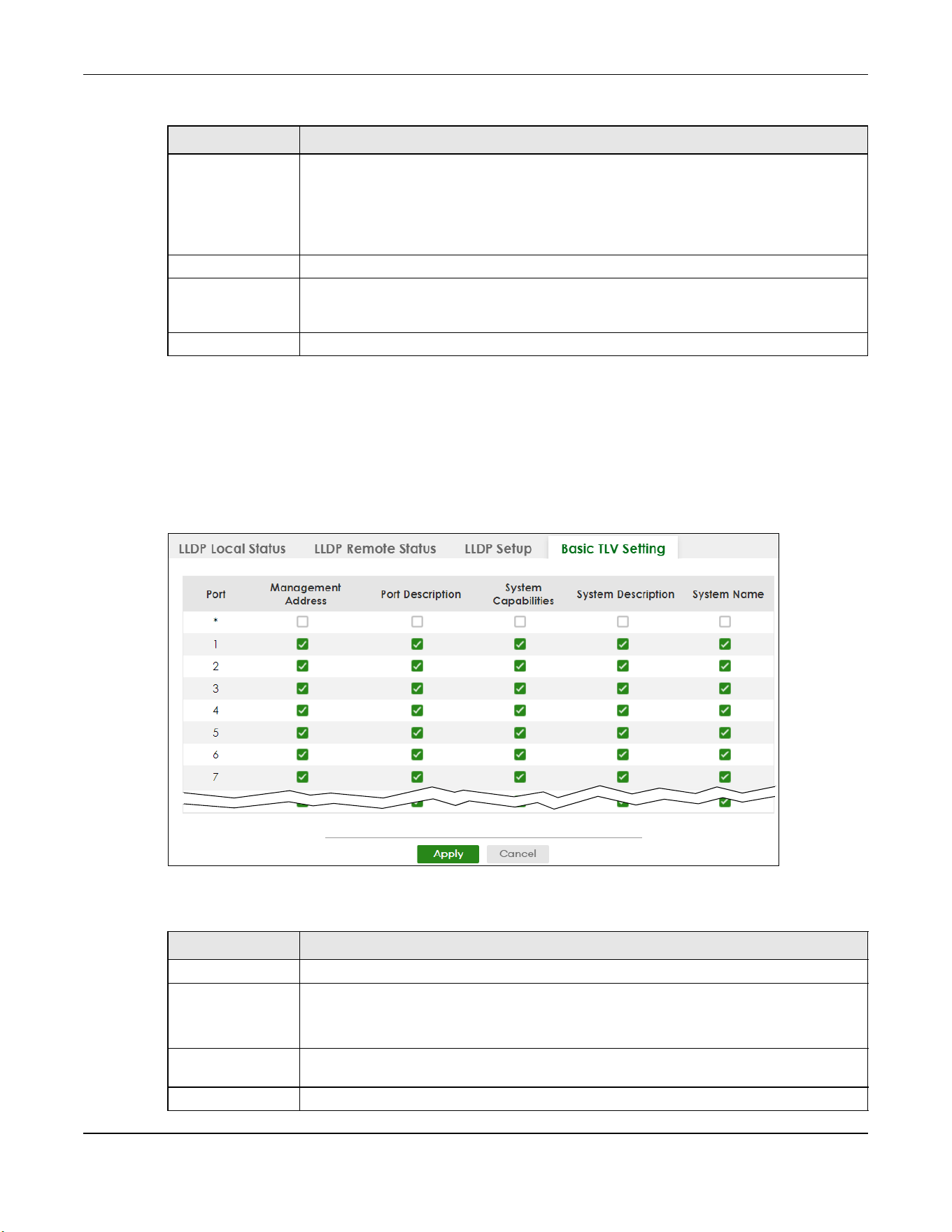
Chapter 33 Link Layer Discovery Protocol (LLDP)
XMG1915 Series User’s Guide
199
33.6 Basic TLV Setting
Use this screen to configure Basic TLV settings. Click PORT > LLDP > LLDP > Basic TLV Setting to display the
screen as shown next.
Figure 137 PORT > LLDP > LLDP > Basic TLV Setting
The following table describes the labels in this screen.
Admin Status Select whether LLDP transmission and/or reception is allowed on this port.
• Disable – not allowed
• Tx-Only – transmit only
• Rx-Only – receive only
• Tx-Rx – transmit and receive
Notification Select whether LLDP notification is enabled on this port.
Apply Click Apply to save your changes to the Switch’s run-time memory. The Switch loses these
changes if it is turned off or loses power, so use the Save link on the top navigation panel to
save your changes to the non-volatile memory when you are done configuring.
Cancel Click Cancel to begin configuring this screen afresh.
Table 100 PORT > LLDP > LLDP > LLDP Setup (continued)
LABEL DESCRIPTION
Table 101 PORT > LLDP > LLDP > Basic TLV Setting
LABEL DESCRIPTION
Port This displays the Switch’s port number.
* Use this row to make the setting the same for all ports. Use this row first and then make
adjustments to each port if necessary.
Changes in this row are copied to all the ports as soon as you make them.
Management
Address
Select the check boxes to enable or disable the sending of Management Address TLVs on
the ports.
Port Description Select the check boxes to enable or disable the sending of Port Description TLVs on the ports.
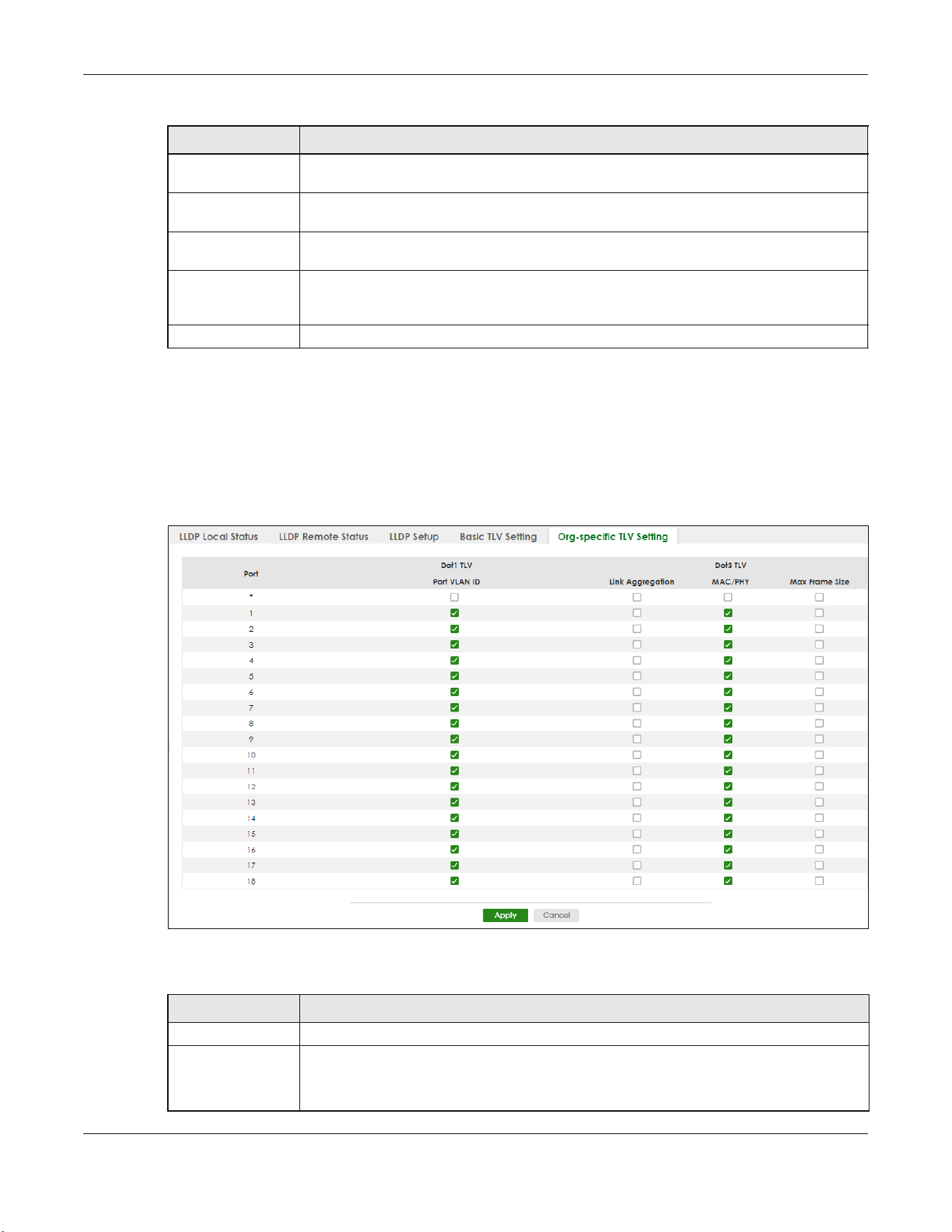
Chapter 33 Link Layer Discovery Protocol (LLDP)
XMG1915 Series User’s Guide
200
33.7 Org-specific TLV Setting
Use this screen to configure organization-specific TLV settings. Click PORT > LLDP > LLDP > Org-specific
TLV Setting to display the screen as shown next.
Figure 138 PORT > LLDP > LLDP > Org-specific TLV Setting
The following table describes the labels in this screen.
System Capabilities Select the check boxes to enable or to disable the sending of System Capabilities TLVs on the
ports.
System Description Select the check boxes to enable or to disable the sending of System Description TLVs on the
ports.
System Name Select the check boxes to enable or to disable the sending of System Name TLVs on the
ports.
Apply Click Apply to save your changes to the Switch’s run-time memory. The Switch loses these
changes if it is turned off or loses power, so use the Save link on the top navigation panel to
save your changes to the non-volatile memory when you are done configuring.
Cancel Click Cancel to begin configuring this screen afresh.
Table 101 PORT > LLDP > LLDP > Basic TLV Setting (continued)
LABEL DESCRIPTION
Table 102 PORT > LLDP > LLDP > Org-specific TLV Setting
LABEL DESCRIPTION
Port This displays the Switch’s port number.
* Use this row to make the setting the same for all ports. Use this row first and then make
adjustments to each port if necessary.
Changes in this row are copied to all the ports as soon as you make them.
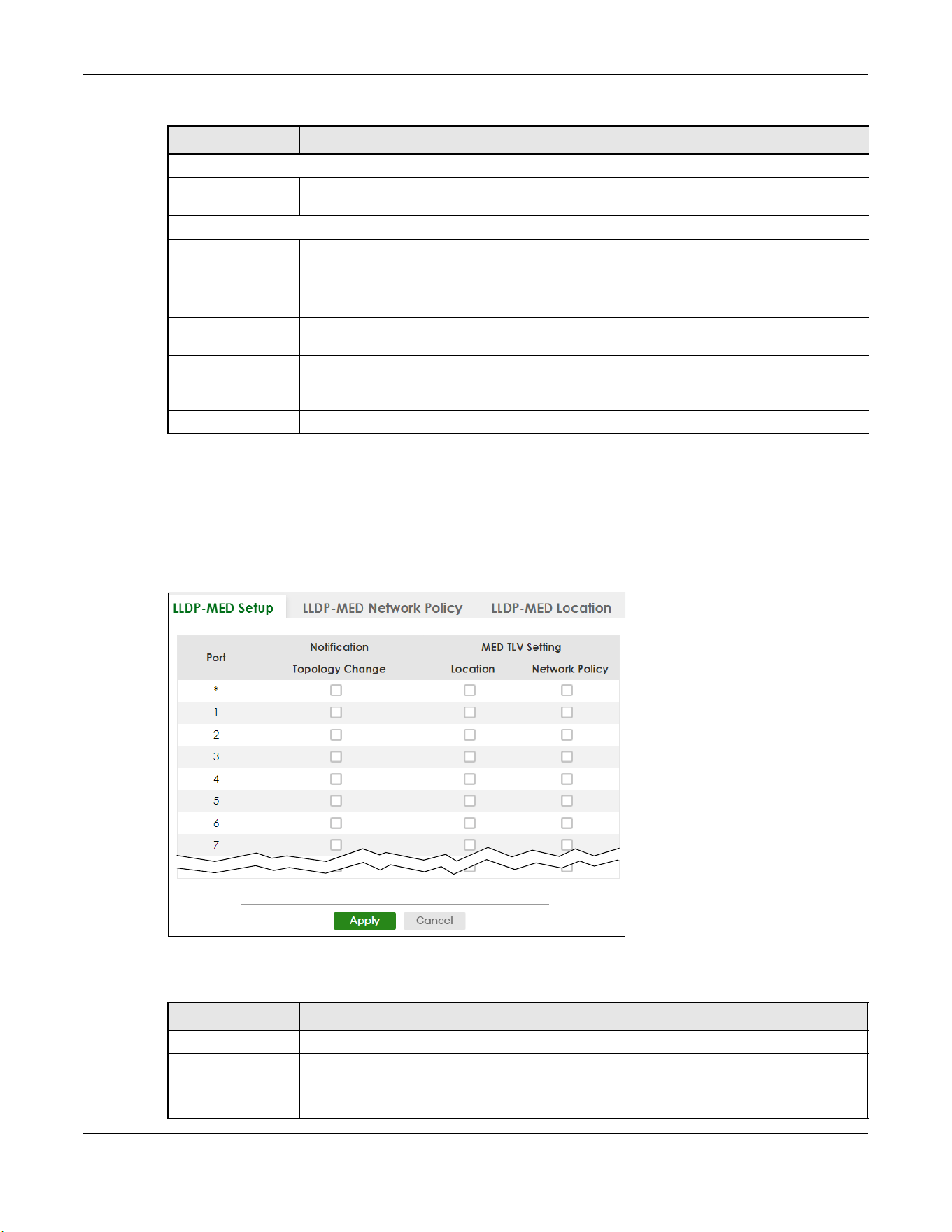
Chapter 33 Link Layer Discovery Protocol (LLDP)
XMG1915 Series User’s Guide
201
33.8 LLDP-MED Setup
Click PORT > LLDP > LLDP MED > LLDP-MED Setup to display the screen as shown next.
Figure 139 PORT > LLDP > LLDP MED > LLDP-MED Setup
The following table describes the labels in this screen.
Dot1 TLV
Port VLAN ID Select the check boxes to enable or disable the sending of IEEE 802.1 Port VLAN ID TLVs on
the ports. All check boxes in this column are enabled by default.
Dot3 TLV
Link
Aggregation
Select the check boxes to enable or disable the sending of IEEE 802.3 Link Aggregation TLVs
on the ports.
MAC/PHY Select the check boxes to enable or disable the sending of IEEE 802.3 MAC/PHY
Configuration/Status TLVs on the ports. All check boxes in this column are enabled by default.
Max Frame Size Select the check boxes to enable or disable the sending of IEEE 802.3 Max Frame Size TLVs on
the ports.
Apply Click Apply to save your changes to the Switch’s run-time memory. The Switch loses these
changes if it is turned off or loses power, so use the Save link on the top navigation panel to
save your changes to the non-volatile memory when you are done configuring.
Cancel Click Cancel to begin configuring this screen afresh.
Table 102 PORT > LLDP > LLDP > Org-specific TLV Setting (continued)
LABEL DESCRIPTION
Table 103 PORT > LLDP > LLDP MED> LLDP-MED Setup
LABEL DESCRIPTION
Port This displays the Switch’s port number. Select * to configure all ports simultaneously.
* Use this row to make the setting the same for all ports. Use this row first and then make
adjustments to each port if necessary.
Changes in this row are copied to all the ports as soon as you make them.

Chapter 33 Link Layer Discovery Protocol (LLDP)
XMG1915 Series User’s Guide
202
33.9 LLDP-MED Network Policy
Click PORT > LLDP > LLDP MED > LLDP-MED Network Policy to display the screen as shown next.
Figure 140 PORT > LLDP > LLDP MED > LLDP-MED Network Policy
The following table describes the labels in this screen.
33.9.1 Add/Edit LLDP-MED Network Policy
To access this screen, click the Add/Edit button or select an entry from the list and click the Add/Edit
button.
Notification
Topology
Change
Select to enable LLDP-MED topology change traps on this port.
MED TLV Setting
Location Select to enable transmitting LLDP-MED location TLV.
Network Policy Select to enable transmitting LLDP-MED Network Policy TLV.
Apply Click Apply to save the changes to the Switch’s run-time memory. The Switch loses these
changes if it is turned off or loses power, so use the Save link on the top navigation panel to
save your changes to the non-volatile memory when you are done configuring.
Cancel Click Cancel to begin configuring this screen afresh.
Table 103 PORT > LLDP > LLDP MED> LLDP-MED Setup (continued)
LABEL DESCRIPTION
Table 104 PORT > LLDP > LLDP MED > LLDP-MED Network Policy
LABEL DESCRIPTION
Index This field displays the of index number of the network policy. Click an index number to edit
the rule.
Port This field displays the port number of the network policy.
Application Type This field displays the application type of the network policy.
Tag This field displays the Tag Status of the network policy.
VLAN This field displays the VLAN ID of the network policy.
DSCP This field displays the DSCP value of the network policy.
Priority This field displays the priority value of the network policy.
Select an entry’s check box to select a specific entry. Otherwise, select the check box in the
table heading row to select all entries.
Add/Edit Click Add/Edit to add a new schedule rule or edit a selected one.
Delete Select the rules that you want to remove, then click Delete.
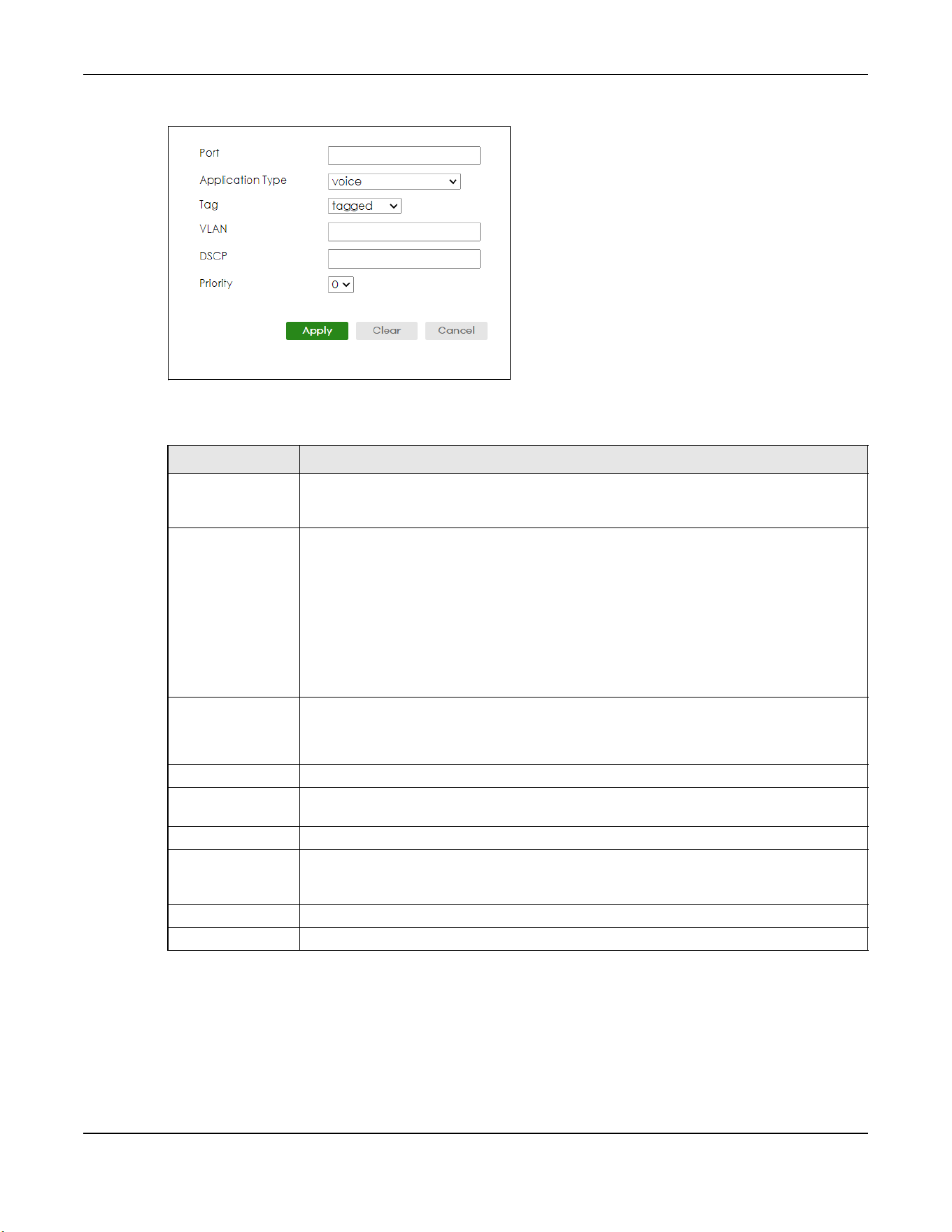
Chapter 33 Link Layer Discovery Protocol (LLDP)
XMG1915 Series User’s Guide
203
Figure 141 PORT > LLDP > LLDP MED > LLDP-MED Network Policy > Add/Edit
The following table describes the labels in this screen.
33.10 LLDP-MED Location
Click PORT > LLDP > LLDP MED > LLDP-MED Location to display the screen as shown next.
Table 105 PORT > LLDP > LLDP MED > LLDP-MED Network Policy > Add/Edit
LABEL DESCRIPTION
Port Enter the port number to set up the LLDP-MED network policy. You can enter multiple ports
separated by (no space) comma (“,”) or hyphen (“-”) for a range. For example, enter “3-5”
for ports 3, 4, and 5. Enter “3,5,7” for ports 3, 5, and 7.
Application Type Select the type of application used in the network policy.
• voice
• voice-signaling
•guest-voice
• guest-voice-signaling
• softphone-voice
• video-conferencing
• streaming-video
• video-signaling
Tag Select to tag or untag in the network policy.
•tagged
• untagged
VLAN Enter the VLAN ID number. It should be from 1 to 4094. For priority tagged frames, enter “0”.
DSCP Enter the DSCP value of the network policy. The value is defined from 0 through 63 with the 0
representing use of the default DSCP value.
Priority Enter the priority value for the network policy.
Apply Click Apply to save your changes to the Switch’s run-time memory. The Switch loses these
changes if it is turned off or loses power, so use the Save link on the top navigation panel to
save your changes to the non-volatile memory when you are done configuring.
Clear Click Clear to clear the fields to the factory defaults.
Cancel Click Cancel to not save the configuration you make and return to the last screen.
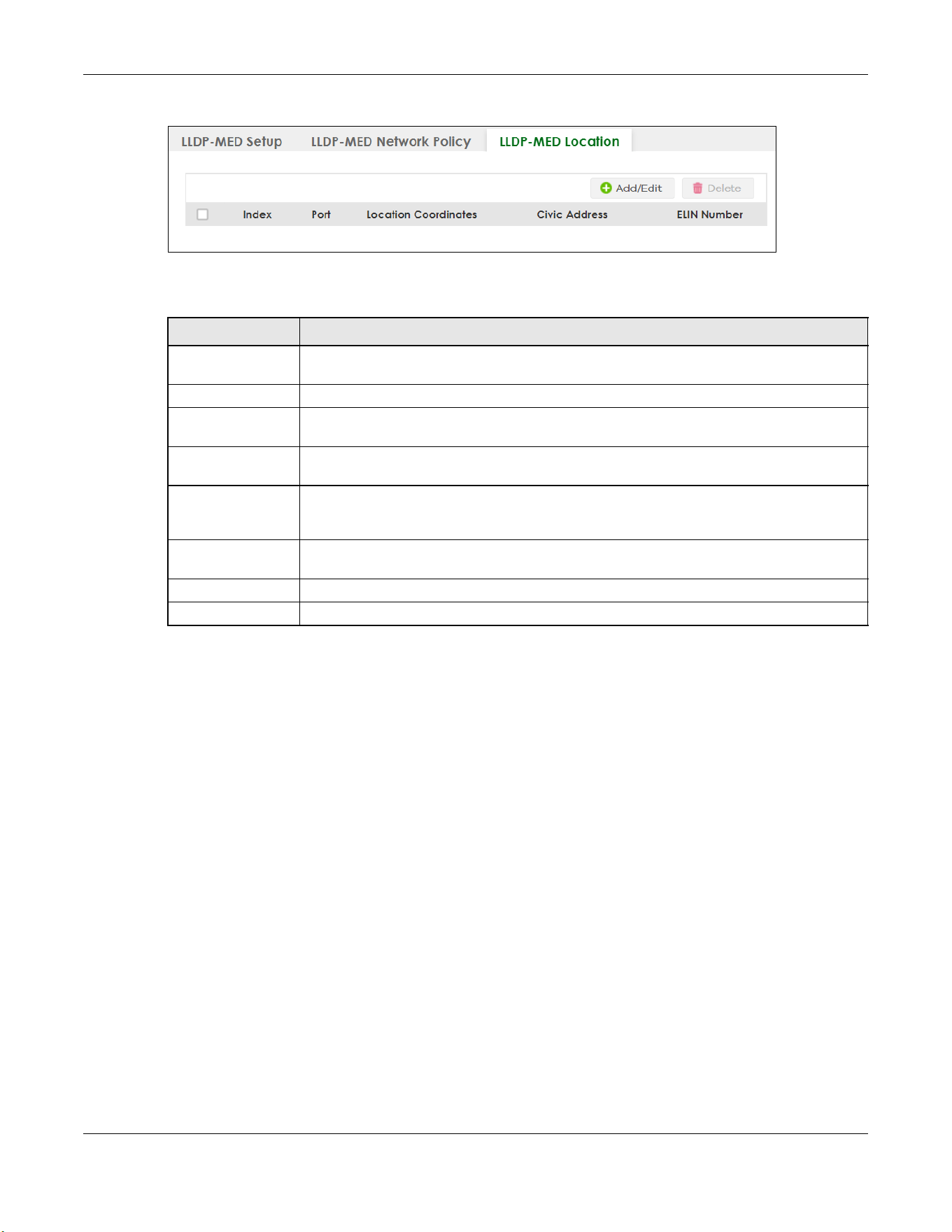
Chapter 33 Link Layer Discovery Protocol (LLDP)
XMG1915 Series User’s Guide
204
Figure 142 PORT > LLDP > LLDP MED > LLDP-MED Location
The following table describes the labels in this screen.
33.10.1 Add/Edit LLDP-MED Location
To access this screen, click the Add/Edit button or select an entry from the list and click the Add/Edit
button.
Table 106 PORT > LLDP > LLDP MED > LLDP-MED Location
LABEL DESCRIPTION
Index This lists the index number of the location configuration. Click an index number to view or edit
the location.
Port This lists the port number of the location configuration.
Location
Coordinates
This field displays the location configuration information based on geographical coordinates
that includes longitude, latitude, altitude and datum.
Civic Address This field displays the Civic Address for the remote device using information such as Country,
State, County, City, Street, Number, ZIP code and additional information.
ELIN Number This field shows the Emergency Location Identification Number (ELIN), which is used to
identify endpoint devices when they issue emergency call services. The valid length is form
10 to 25 characters.
Select an entry’s check box to select a specific entry. Otherwise, select the check box in the
table heading row to select all entries.
Add/Edit Click Add/Edit to add a new location or edit a selected one.
Delete Select the locations that you want to remove, then click Delete.
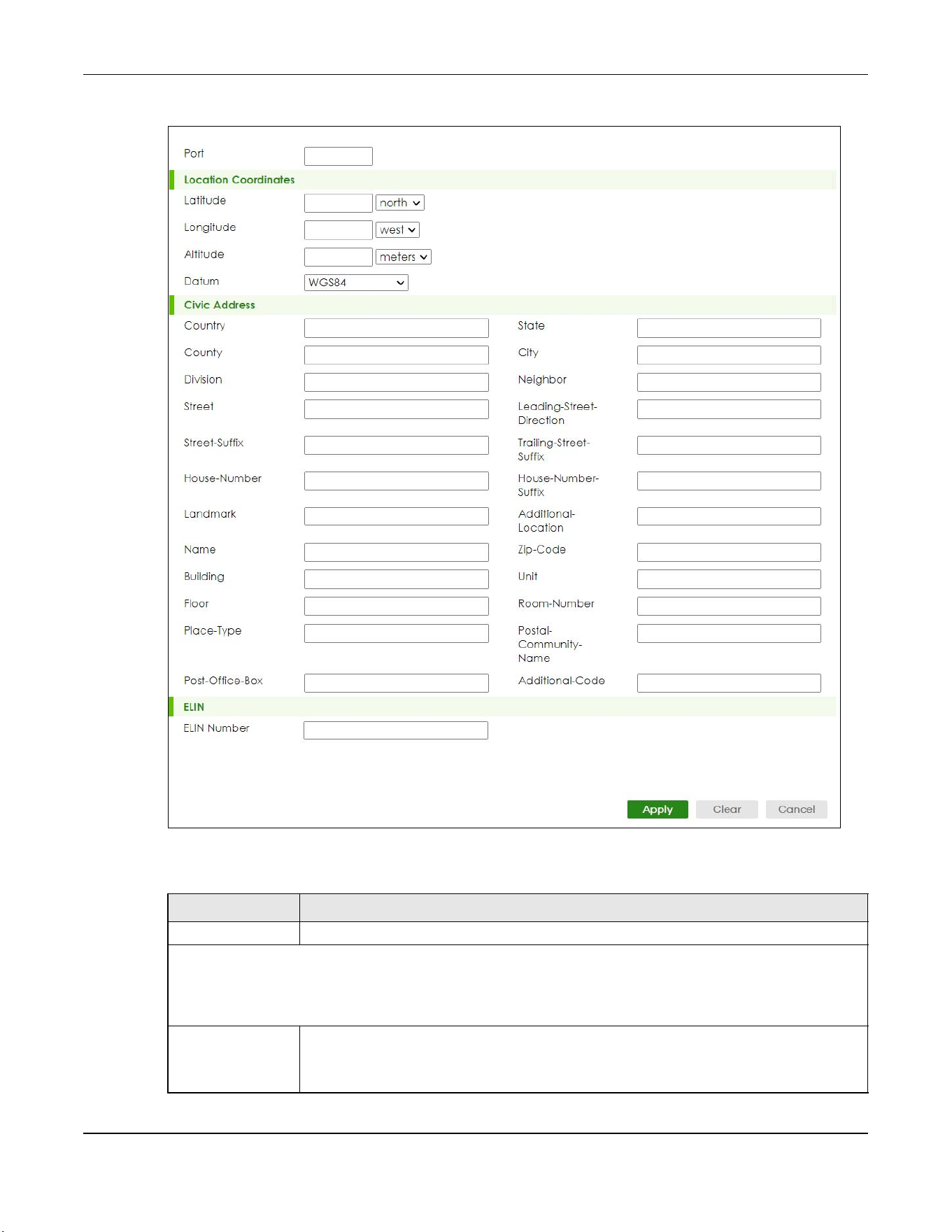
Chapter 33 Link Layer Discovery Protocol (LLDP)
XMG1915 Series User’s Guide
205
Figure 143 PORT > LLDP > LLDP MED > LLDP-MED Location > Add/Edit
The following table describes the labels in this screen.
Table 107 PORT > LLDP > LLDP MED > LLDP-MED Location > Add/Edit
LABEL DESCRIPTION
Port Enter the port number you want to set up the location within the LLDP-MED network.
Location Coordinates
The LLDP-MED uses geographical coordinates and Civic Address to set the location information of the remote
device. Geographical based coordinates includes latitude, longitude, altitude and datum. Civic Address includes
Country, State, County, City, Street and other related information.
Latitude Enter the latitude information. The value should be from 0º to 90º.
•north
•south

Chapter 33 Link Layer Discovery Protocol (LLDP)
XMG1915 Series User’s Guide
206
Longitude Enter the longitude information. The value should be from 0º to 180º.
•west
•east
Altitude Enter the altitude information. The value should be from –2097151 to 2097151 in meters or in
floors.
•meters
•floor
Datum Select the appropriate geodetic datum used by GPS.
•WGS84
• NAD83-NAVD88
• NAD83-MLLW
Civic Address Enter the Civic Address by providing information such as Country, State, County, City, Street,
Number, ZIP code and other additional information. Enter at least 2 fields in this configuration
including the Country. The valid length of the Country field is 2 characters and all other fields
are up to 32 characters.
• Country
• State
• County
• City
• Division
• Neighbor
• Street
• Leading-Street-Direction
• Street-Suffix
• Trailing-Street-Suffix
•House-Number
• House-Number-Suffix
• Landmark
• Additional-Location
•Name
•Zip-Code
• Building
•Unit
• Floor
• Room-Number
• Place-Type
• Postal-Community-Name
• Post-Office-Box
• Additional-Code
ELIN Number Enter a numerical digit string, corresponding to the ELIN identifier which is used during
emergency call setup to a traditional CAMA or ISDN trunk-based PSAP. The valid length is
from 10 to 25 characters.
Apply Click Apply to save your changes to the Switch’s run-time memory. The Switch loses these
changes if it is turned off or loses power, so use the Save link on the top navigation panel to
save your changes to the non-volatile memory when you are done configuring.
Clear Click Clear to clear the fields to the factory defaults.
Cancel Click Cancel to not save the configuration you make and return to the last screen.
Table 107 PORT > LLDP > LLDP MED > LLDP-MED Location > Add/Edit (continued)
LABEL DESCRIPTION
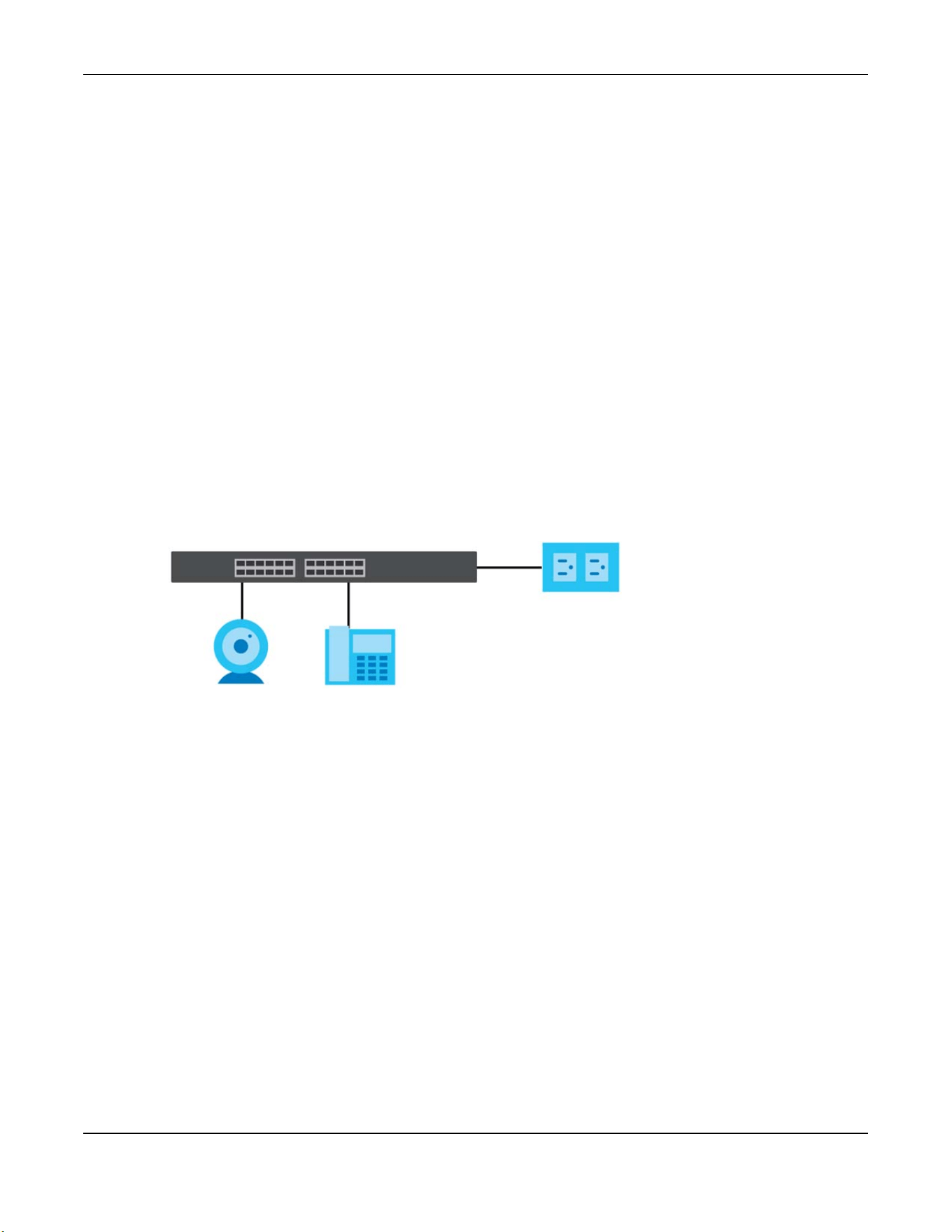
Chapter 34 PoE Setup
XMG1915 Series User’s Guide
207
CHAPTER 34
PoE Setup
34.1 PoE Status (for PoE models only)
The PoE models supports the IEEE 802.3bt High Power over Ethernet (PoE) standard.
A powered device (PD) is a device such as an access point or a switch, that supports PoE (Power over
Ethernet) so that it can receive power from another device through an Ethernet port.
In the figure below, the IP camera and IP phone get their power directly from the Switch. Aside from
minimizing the need for cables and wires, PoE removes the hassle of trying to find a nearby electric
outlet to power up devices.
Figure 144 Powered Device Examples
You can also set priorities so that the Switch is able to reserve and allocate power to certain PDs.
Note: The PoE (Power over Ethernet) devices that supply or receive power and their
connected Ethernet cables must all be completely indoors.
To view the current amount of power that PDs are receiving from the Switch, click PORT > PoE Setup >
PoE Status.
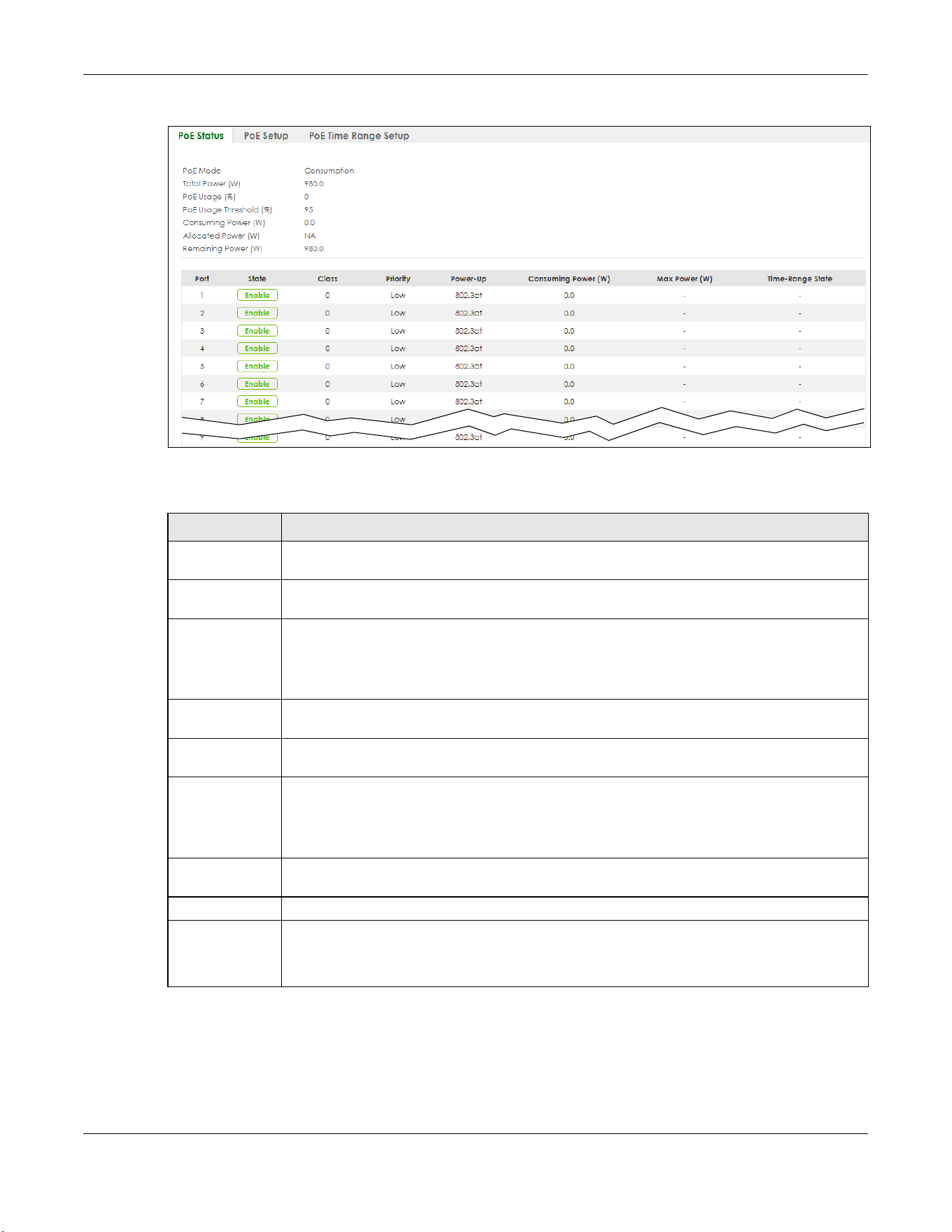
Chapter 34 PoE Setup
XMG1915 Series User’s Guide
208
Figure 145 PORT > PoE Setup > PoE Status
The following table describes the labels in this screen.
Table 108 PORT > PoE Setup > PoE Status
LABEL DESCRIPTION
PoE Mode This field displays the power management mode used by the Switch, whether it is in
Classification or Consumption mode.
Total Power (W) This field displays the total power the Switch can provide to the connected PoE-enabled
devices on the PoE ports.
PoE Usage (%) This field displays the amount of power currently being supplied to connected PoE devices (PDs)
as a percentage of the total PoE power the Switch can supply.
When PoE usage reaches 100%, the Switch will shut down PDs one-by-one according to the PD
priority which you configured in PORT > PoE Setup > PoE Setup.
PoE Usage
Threshold (%)
This field displays the percentage of PoE usage. The Switch will generate a trap and/or a log
when the usage exceeds the specified threshold.
Consuming
Power (W)
This field displays the amount of power the Switch is currently supplying to the connected PoE-
enabled devices.
Allocated Power
(W)
This field displays the total amount of power the Switch (in classification mode) has reserved for
PoE after negotiating with the connected PoE devices. It shows NA when the Switch is in
consumption mode.
Consuming Power (W) can be less than or equal but not more than the Allocated Power (W).
Remaining
Power (W)
This field displays the amount of power the Switch can still provide for PoE.
Port This is the port index number.
State This field shows which ports can receive power from the Switch.
• Disable – The PD connected to this port cannot get power supply.
• Enable – The PD connected to this port can receive power.

Chapter 34 PoE Setup
XMG1915 Series User’s Guide
209
34.2 PoE Setup
Use this screen to set the PoE power management mode, priority levels, power-up mode and the
maximum amount of power for the connected PDs.
Click the PoE Setup tab in the PORT > PoE Setup screen. The following screen opens.
Class This shows the power classification of the PD. Each PD has a specified maximum power that fall
under one of the classes.
The Class is a number from 0 to 6, where each value represents the range of power that the
Switch provides to the PD. The power ranges in PoE standards are as follows.
• Class 0 – default: 0.44 W to 15.4 W.
• Class 1 – default: 0.44 W to 4 W.
• Class 2 – default: 0.44 W to 7 W.
• Class 3 – default: 0.44 W to 15.4 W.
• Class 4 – default: 0.44 W to 30 W.
• Class 5 – default: 0.45 W to 45 W.
• Class 6 – default: 0.45 W to 60 W.
Note: You can extend or set a limit on the maximum power the connected PD can
use on a port in PORT > PoE Setup > PoE Setup.
Priority When the total power requested by the PDs exceeds the total PoE power budget on the Switch,
you can set the priority to allow the Switch to provide power to ports with higher priority first.
• Critical has the highest priority.
• High has the Switch assign power to the port after all critical priority ports are served.
• Low has the Switch assign power to the port after all critical and high priority ports are
served.
Power-Up This field displays the PoE standard the Switch uses to provide power on this port.
Consuming
Power (W)
This field displays the current amount of power consumed by the PD from the Switch on this port.
Max Power (W) This field displays the maximum amount of power the PD could use from the Switch on this port.
This field displays “–” if the maximum power is not specified in PORT > PoE Setup > PoE Setup.
Time-Range
State
This field shows whether or not the port currently receives power from the Switch according to its
schedule.
• It shows “In” followed by the time range name if PoE is currently enabled on the port.
• It shows “Out” if PoE is currently disabled on the port.
• It shows “–” if no schedule is applied to the port. PoE is enabled by default.
Table 108 PORT > PoE Setup > PoE Status (continued)
LABEL DESCRIPTION
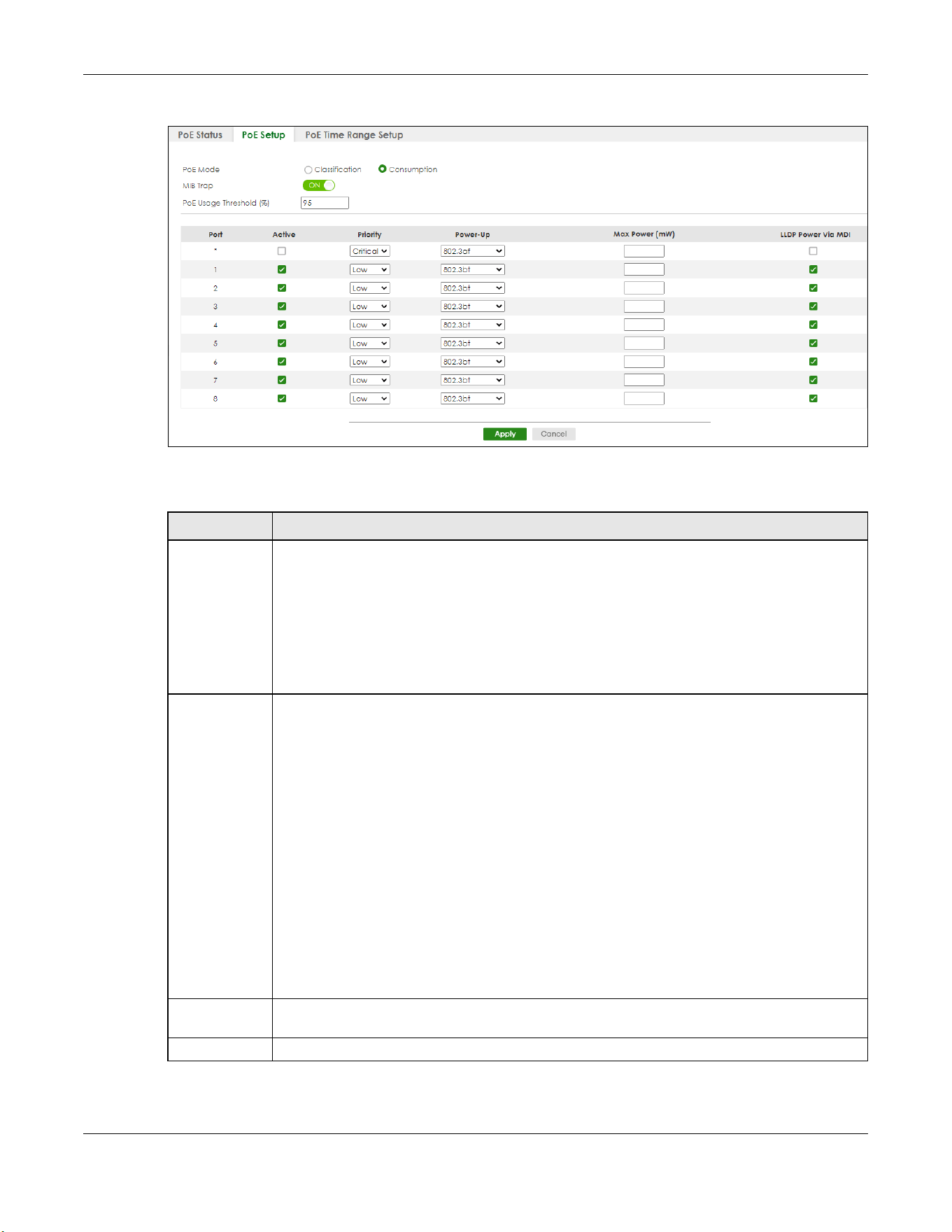
Chapter 34 PoE Setup
XMG1915 Series User’s Guide
210
Figure 146 PORT > PoE Setup > PoE Setup
The following table describes the labels in this screen.
Table 109 PORT > PoE Setup > PoE Setup
LABEL DESCRIPTION
PoE Mode Select the power management mode you want the Switch to use.
• Classification – Select this if you want the Switch to reserve the maximum power for each PD
according to the PD’s power class and priority level. If the total power supply runs out, PDs
with lower priority do not get power to function. In this mode, the maximum power is reserved
based on what you configure in Max Power or the standard power limit for each class.
• Consumption – Select this if you want the Switch to supply the actual power that the PD
needs. The Switch also allocates power based on a port’s Max Power and the PD’s power
class and priority level. The Switch puts a limit on the maximum amount of power the PD can
request and use. In this mode, the default maximum power that can be delivered to the PD is
30 W (IEEE 802.3at Class 4) or 22 W (IEEE 802.3af Classes 0 to 3).
MIB Trap The Switch sends traps (monitoring event notification) to an SNMP (Simple Network Management
Protocol) manager when an event occurs.
Select ON to allow sending of MIB Trap when the following situations occur:
• Situation 1 –
Trap sent whenever a PoE port status change occurs (PoE port delivers power or delivers no
power to a PD (powered device)
• Situation 2 –
Trap sent in cases where the total power usage exceeds the PoE usage threshold
• Situation 3 –
Trap sent if total usage power decreases below the PoE usage threshold (only if previous total
power usage exceeded the PoE usage threshold and a trap was sent).
Note: If the MIB Trap is ON, you must also configure:
• SNMP trap destination (SYSTEM > SNMP > SNMP), SNMP trap group (SYSTEM > SNMP > SNMP
Trap Group) and SNMP trap port (SYSTEM > SNMP > SNMP Trap Port) for Situation 1
• SNMP trap destination and SNMP trap group for Situation 2 and Situation 3.
See Section 26.2 on page 157 for more information on configuring SNMP.
PoE Usage
Threshold (%)
Enter a number ranging from 1 to 99 to set the threshold. The Switch will generate a trap and/or
log when the actual PoE usage is higher than the specified threshold.
Port This is the port index number.

Chapter 34 PoE Setup
XMG1915 Series User’s Guide
211
* Settings in this row apply to all ports.
Use this row only if you want to make some settings the same for all ports. Use this row first to set
the common settings and then make adjustments on a port-by-port basis.
Changes in this row are copied to all the ports as soon as you make them.
Active Select this to provide power to a PD connected to the port.
If left unchecked, the PD connected to the port cannot receive power from the Switch.
Priority When the total power requested by the PDs exceeds the total PoE power budget on the Switch,
you can set the PD priority to allow the Switch to provide power to ports with higher priority.
Select Critical to give the highest PD priority on the port.
Select High to set the Switch to assign the remaining power to the port after all critical priority
ports are served.
Select Low to set the Switch to assign the remaining power to the port after all critical and high
priority ports are served.
Power-Up Set how the Switch provides power to a connected PD at power-up.
802.3af – the Switch follows the IEEE 802.3af Power over Ethernet standard to supply power to the
connected PDs during power-up.
Legacy – the Switch can provide power to the connected PDs that require high inrush currents at
power-up. Inrush current is the maximum, instantaneous input current drawn by the PD when first
turned on.
Pre-802.3at – the Switch initially offers power on the port according to the IEEE 802.3af standard,
and then switches to support the IEEE 802.3at standard within 75 milliseconds after a PD is
connected to the port. Select this option if the Switch is performing 2-event Layer-1 classification
(PoE+ hardware classification) or the connected PD is NOT performing Layer 2 power
classification using Link Layer Discovery Protocol (LLDP).
802.3at – the Switch supports the IEEE 802.3at High Power over Ethernet standard and can supply
power of up to 30 W per Ethernet port. IEEE 802.3at is also known as PoE+ or PoE Plus. An IEEE
802.3at compatible device is referred to as Type 2. Power Class 4 (High Power) can only be used
by Type 2 devices. If the connected PD requires a Class 4 current when it is turned on, it will be
powered up in this mode.
Force-802.3at – the Switch offers power of up to 33 W on the port without performing PoE
hardware classification. Select this option if the connected PD does not comply with any PoE
standard and requests power higher than a standard power limit.
Pre-802.3bt – the Switch offers power on the port according to the IEEE 802.3bt standard. Select
this option if the connected PD was developed before the IEEE 802.3bt standard is implemented
but requires power between 33 W and 60 W. IEEE 802.3bt is also known as PoE++ or PoE Plus Plus.
802.3bt – the Switch supports the IEEE 802.3bt standard and can supply power of up to 60 W per
Ethernet port to the connected PDs at power-up.
Max Power
(mW)
Specify the maximum amount of power the PD could use from the Switch on this port. If you leave
this field blank, the Switch refers to the standard or default maximum power for each class.
Note: The setting you enter here will NOT take effect when the power-up mode is set to
802.3bt.
Table 109 PORT > PoE Setup > PoE Setup (continued)
LABEL DESCRIPTION
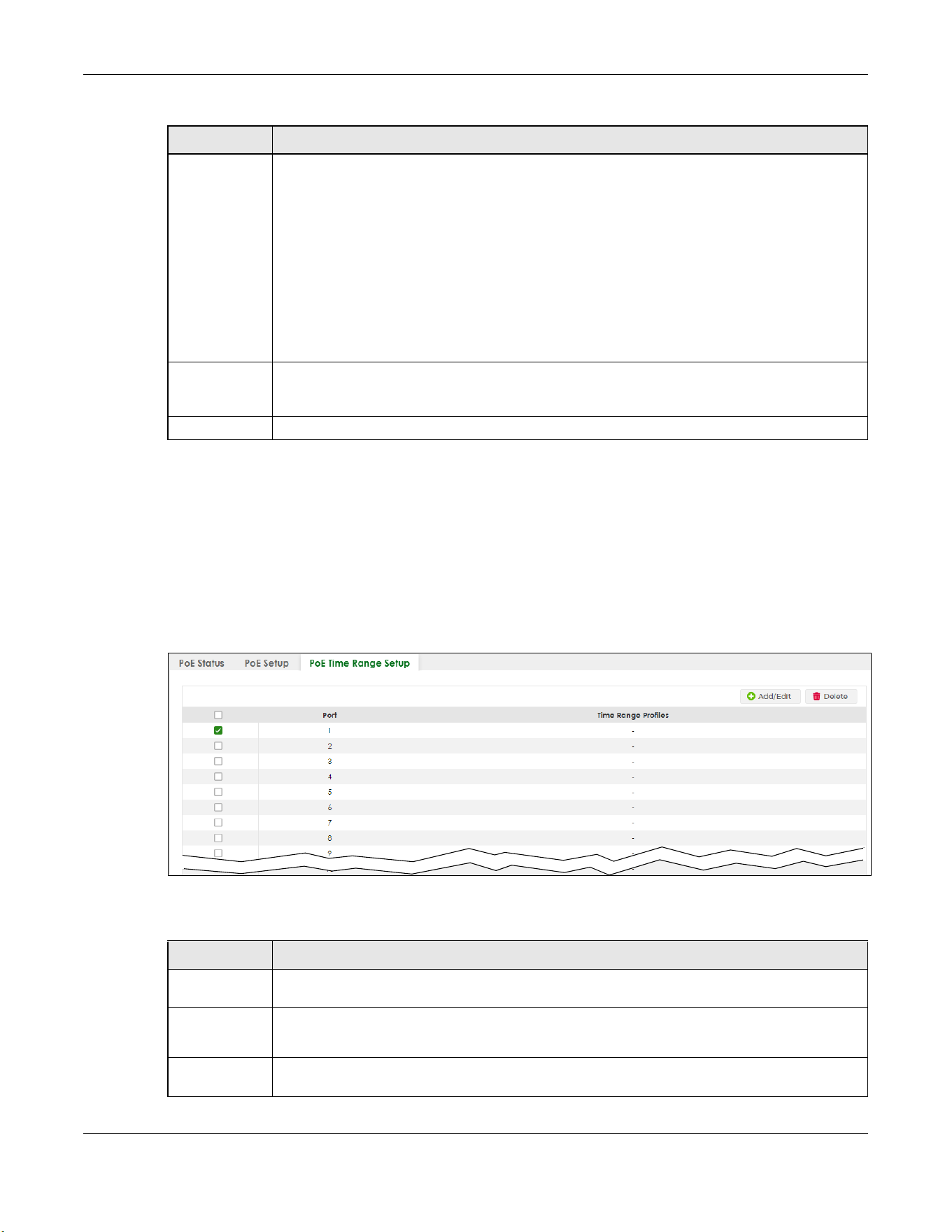
Chapter 34 PoE Setup
XMG1915 Series User’s Guide
212
34.3 PoE Time Range Setup
Use this screen to apply a schedule to the ports on the Switch. You must first configure a schedule in the
SYSTEM > Time Range screen.
Click the PoE Time Range Setup tab in the PORT > PoE Setup screen. The following screen opens.
Figure 147 PORT > PoE Setup > PoE Time Range Setup
The following table describes the labels in this screen.
LLDP Power Via
MDI
Select this to have the Switch negotiate PoE power with the PD connected to the port by
transmitting LLDP Power Via MDI TLV frames. This helps the Switch allocate less power to the PD on
this port. The connected PD must be able to request PoE power through LLDP.
The Power Via MDI TLV allows PoE devices to advertise and discover the MDI power support
capabilities of the sending port on the remote device.
•Port Class
• MDI Supported
•MDI Enabled
• Pair Controllable
• PSE Power Pairs
•Power Class
Apply Click Apply to save your changes to the Switch’s run-time memory. The Switch loses these
changes if it is turned off or loses power, so use the Save link on the top navigation panel to save
your changes to the non-volatile memory when you are done configuring.
Cancel Click Cancel to begin configuring this screen afresh.
Table 109 PORT > PoE Setup > PoE Setup (continued)
LABEL DESCRIPTION
Table 110 PORT > PoE Setup > PoE Time Range Setup
LABEL DESCRIPTION
Port This field displays the index number of the port. Click a port number to change the schedule
settings.
Time Range
Profiles
This field displays the name of the schedule which is applied to the port.
PoE is enabled at the specified time or date.
Select an entry’s check box to select a specific entry. Otherwise, select the check box in the
table heading row to select all entries.

Chapter 34 PoE Setup
XMG1915 Series User’s Guide
213
34.3.1 Add/Edit PoE Time Range
To access this screen, click the Add/Edit button or select an entry from the list and click the Add/Edit
button.
Figure 148 PORT > PoE Setup > PoE Time Range Setup > Add/Edit
The following table describes the labels in this screen.
Add/Edit Click Add/Edit to add a new rule or edit a selected one.
Delete Check the rules that you want to remove and then click the Delete button.
Table 110 PORT > PoE Setup > PoE Time Range Setup (continued)
LABEL DESCRIPTION
Table 111 PORT > PoE Setup > PoE Time Range Setup > Add/Edit
LABEL DESCRIPTION
Port Enter the number of the port to which you want to apply a schedule.
Time Range This field displays the name of the schedule that you have created using the SYSTEM > Time
Range screen.
Select a pre-defined schedule to control when the Switch enables PoE to provide power on
the port. To select more than one schedule, press [SHIFT] and select the choices at the same
time.
Apply Click Apply to save your changes to the Switch’s run-time memory. The Switch loses these
changes if it is turned off or loses power, so use the Save link on the top navigation panel to
save your changes to the non-volatile memory when you are done configuring.
Clear Click Clear to clear the fields to the factory defaults.
Cancel Click Cancel to not save the configuration you make and return to the last screen.
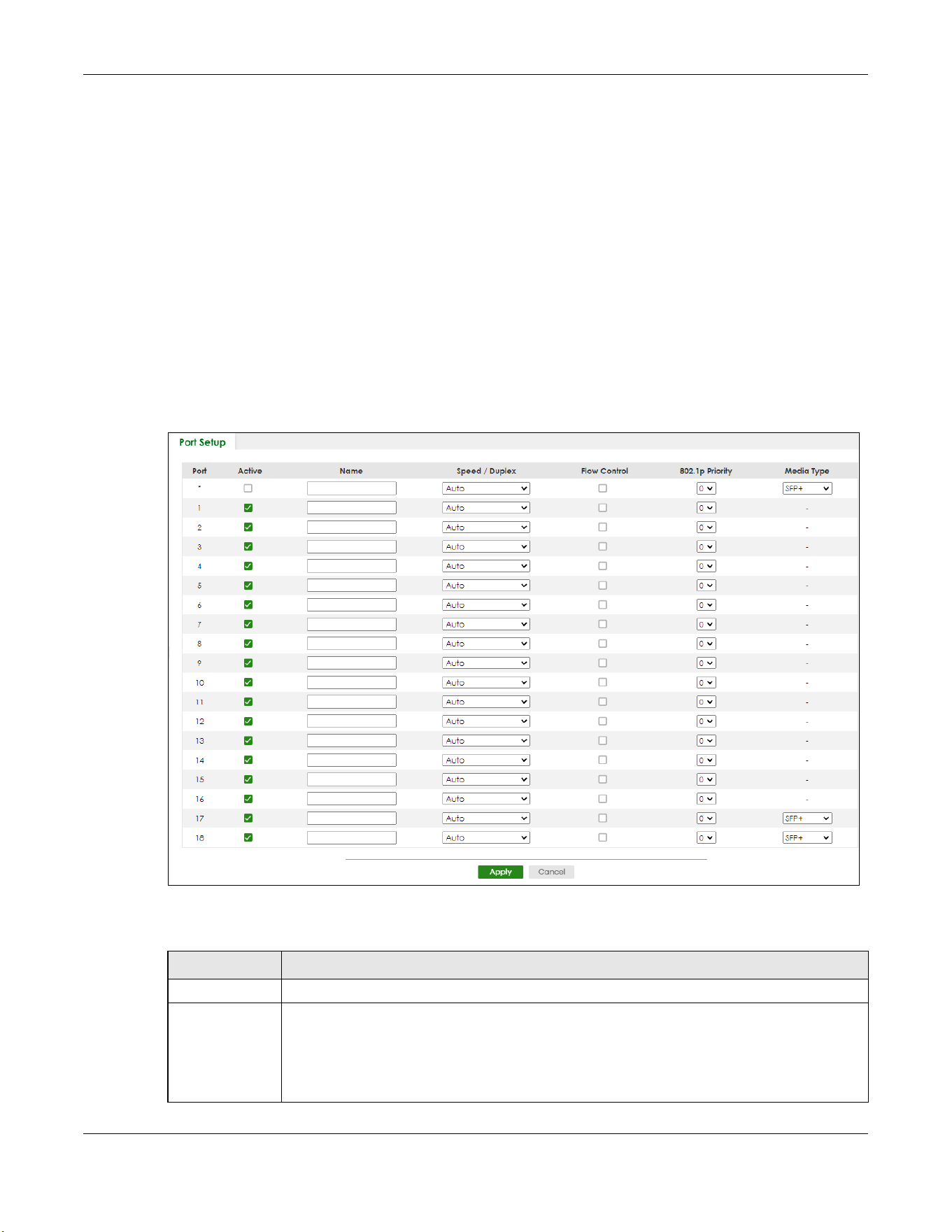
Chapter 35 Port Setup
XMG1915 Series User’s Guide
214
CHAPTER 35
Port Setup
35.1 Port Setup
Use this screen to configure Switch port settings. Click PORT > Port Setup > Port Setup in the navigation
panel to display the configuration screen.
Figure 149 PORT > Port Setup > Port Setup
The following table describes the labels in this screen.
Table 112 PORT > Port Setup > Port Setup
LABEL DESCRIPTION
Port This is the port index number.
* Settings in this row apply to all ports.
Use this row only if you want to make some settings the same for all ports. Use this row first to set
the common settings and then make adjustments on a port-by-port basis.
Note: Changes in this row are copied to all the ports as soon as you make them.

Chapter 35 Port Setup
XMG1915 Series User’s Guide
215
Active Select this check box to enable a port. The factory default for all ports is enabled. A port must
be enabled for data transmission to occur.
Name Type a descriptive name that identifies this port. You can enter up to 128 printable ASCII
characters except [ ? ], [ | ], [ ' ] or [ " ].
Note: Due to space limitations, the port name may be truncated in some Web
Configurator screens.
Speed/Duplex Select the speed and the duplex mode of the Ethernet connection on this port.
For an Ethernet port, the choices are Auto, 100-an (100M/auto-negotiation), 100M / Full Duplex,
1G / Full Duplex, and 2.5G / Full Duplex.
For an SFP+ interface, the choices are Auto, Auto-1G, 1G / Full Duplex, and 10G / Full Duplex.
Selecting Auto-1G or Auto (auto-negotiation) allows one port to negotiate with a peer port
automatically to obtain the connection speed and duplex mode that both ends support. When
auto-negotiation is turned on, a port on the Switch negotiates with the peer automatically to
determine the connection speed and duplex mode. If the peer port does not support auto-
negotiation or turns off this feature, the Switch determines the connection speed by detecting
the signal on the cable and using half duplex mode. When the Switch’s auto-negotiation is
turned off, a port uses the pre-configured speed and duplex mode when making a connection,
thus requiring you to make sure that the settings of the peer port are the same in order to
connect.
Flow Control A concentration of traffic on a port decreases port bandwidth and overflows buffer memory
causing packet discards and frame losses. Flow Control is used to regulate transmission of signals
to match the bandwidth of the receiving port.
The Switch uses IEEE 802.3x flow control in full duplex mode and backpressure flow control in half
duplex mode.
IEEE 802.3x flow control is used in full duplex mode to send a pause signal to the sending port,
causing it to temporarily stop sending signals when the receiving port memory buffers fill.
Back Pressure flow control is typically used in half duplex mode to send a "collision" signal to the
sending port (mimicking a state of packet collision) causing the sending port to temporarily stop
sending signals and resend later. Select Flow Control to enable it.
802.1p Priority This priority value is added to incoming frames without a (802.1p) tag.
Media Type You can insert either an SFP+ transceiver or an SFP+ Direct Attach Copper (DAC) cable into the
10 Gigabit interface of the Switch.
Select the media type (SFP+ or DAC10G) of the SFP+ module that is attached to the 10 Gigabit
interface.
Apply Click Apply to save your changes to the Switch’s run-time memory. The Switch loses these
changes if it is turned off or loses power, so use the Save link on the top navigation panel to save
your changes to the non-volatile memory when you are done configuring.
Cancel Click Cancel to begin configuring this screen afresh.
Table 112 PORT > Port Setup > Port Setup (continued)
LABEL DESCRIPTION

XMG1915 Series User’s Guide
216
CHAPTER 36
SWITCHING
The following chapters introduces the configurations of the links under the SWITCHING navigation panel.
Quick links to chapters:
• Loop Guard
• Mirroring
• Multicast
• Static Multicast Forwarding
• Differentiated Services
• Queuing Method
• Priority Queue
• Bandwidth Control
• Spanning Tree Protocol
• Static MAC Filtering
• Static MAC Forwarding
• VLAN
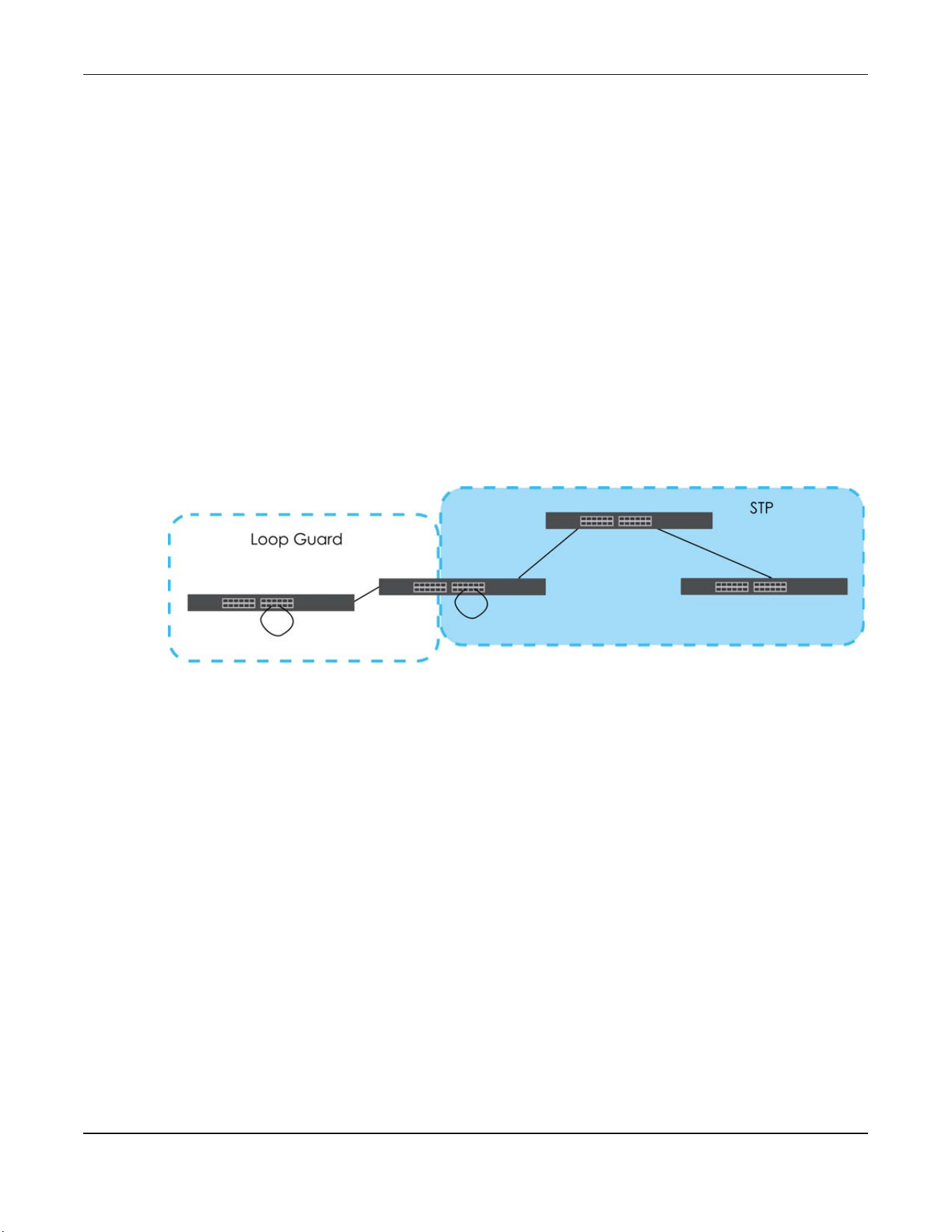
Chapter 37 Loop Guard
XMG1915 Series User’s Guide
217
CHAPTER 37
Loop Guard
37.1 Loop Guard Overview
This chapter shows you how to configure the Switch to guard against loops on the edge of your network.
Loop guard allows you to configure the Switch to shut down a port if it detects that packets sent out on
that port loop back to the Switch. While you can use Spanning Tree Protocol (STP) to prevent loops in the
core of your network. STP cannot prevent loops that occur on the edge of your network.
Figure 150 Loop Guard vs. STP
Refer to Section 37.1.2 on page 217 for more information.
37.1.1 What You Can Do
Use the Loop Guard screen (Section 37.2 on page 219) to enable loop guard on the Switch and in
specific ports.
37.1.2 What You Need to Know
Loop guard is designed to handle loop problems on the edge of your network. This can occur when a
port is connected to a Switch that is in a loop state. Loop state occurs as a result of human error. It
happens when two ports on a switch are connected with the same cable. When a switch in loop state
sends out broadcast messages the messages loop back to the switch and are re-broadcast again and
again causing a broadcast storm.
If a switch (not in loop state) connects to a switch in loop state, then it will be affected by the switch in
loop state in the following way:
• The switch (not in loop state) will receive broadcast messages sent out from the switch in loop state.
• The switch (not in loop state) will receive its own broadcast messages that it sends out as they loop
back. It will then re-broadcast those messages again.
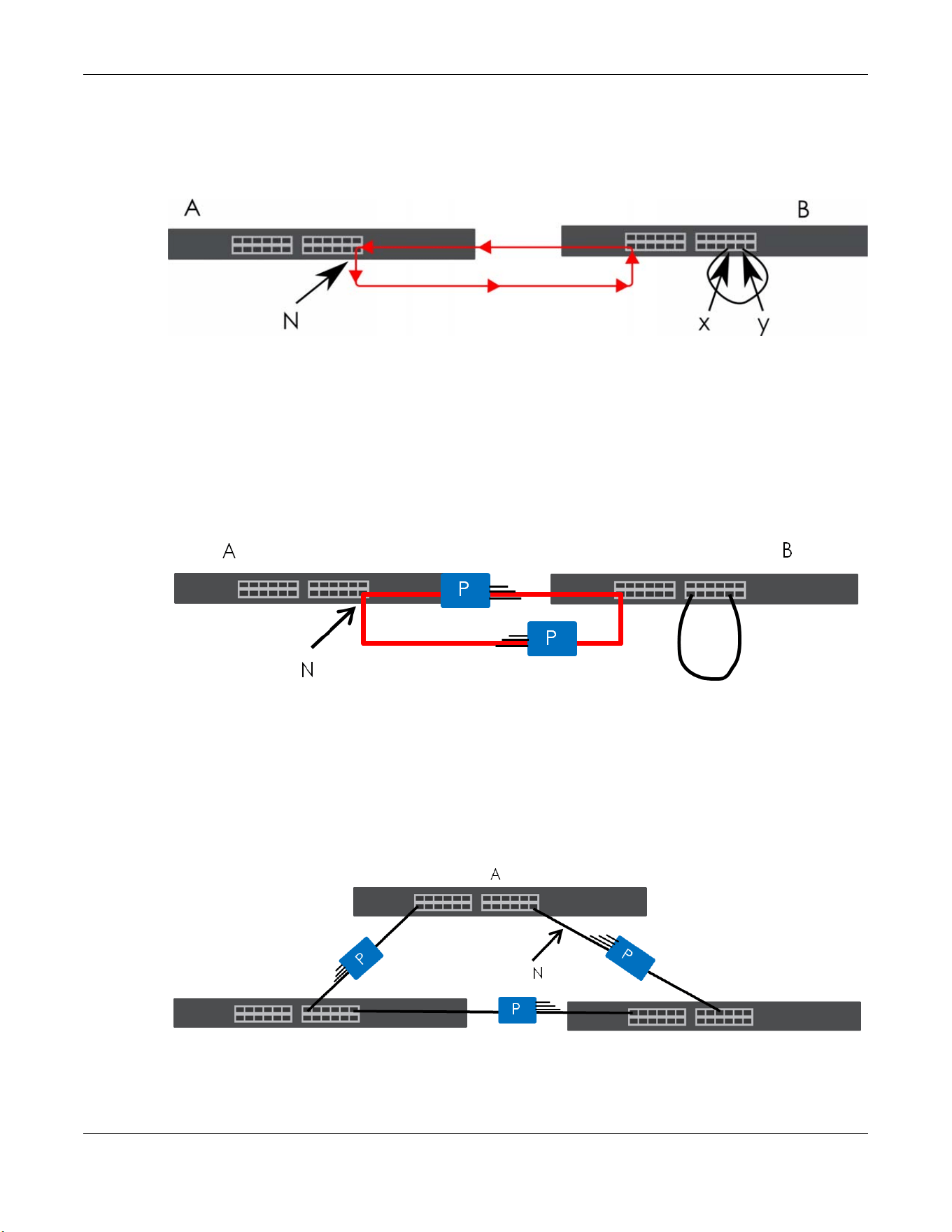
Chapter 37 Loop Guard
XMG1915 Series User’s Guide
218
The following figure shows port N on switch A connected to switch B. Switch B has two ports, x and y,
mistakenly connected to each other. It forms a loop. When broadcast or multicast packets leave port N
and reach switch B, they are sent back to port N on A as they are rebroadcast from B.
Figure 151 Switch in Loop State
The loop guard feature checks to see if a loop guard enabled port is connected to a Switch in loop
state. This is accomplished by periodically sending a probe packet and seeing if the packet returns on
the same port. If this is the case, the Switch will shut down the port connected to the switch in loop state.
Loop guard can be enabled on both Ethernet ports. The following figure shows a loop guard enabled
port N on switch A sending a probe packet P to switch B. Since switch B is in loop state, the probe
packet P returns to port N on A. The Switch then shuts down port N to ensure that the rest of the network
is not affected by the switch in loop state.
Figure 152 Loop Guard – Probe Packet
The Switch also shuts down port N if the probe packet returns to switch A on any other port. In other
words loop guard also protects against standard network loops.
The following figure illustrates three switches forming a loop. A sample path of the loop guard probe
packet is also shown. In this example, the probe packet is sent from port N and returns on another port.
As long as loop guard is enabled on port N. The Switch will shut down port N if it detects that the probe
packet has returned to the Switch.
Figure 153 Loop Guard – Network Loop
Note: After resolving the loop problem on your network you can re-activate the disabled port
through the Web Configurator or through commands (See the CLI Reference Guide).

Chapter 37 Loop Guard
XMG1915 Series User’s Guide
219
37.2 Loop Guard Setup
Click SWITCHING > Loop Guard in the navigation panel to display the screen as shown.
Note: The loop guard feature cannot be enabled on the ports that have Spanning Tree
Protocol (RSTP or MSTP) enabled.
Figure 154 SWITCHING > Loop Guard
The following table describes the labels in this screen.
Table 113 SWITCHING > Loop Guard
LABEL DESCRIPTION
Active Enable the switch button to activate loop guard function on the Switch.
The Switch generates syslog, internal log messages as well as SNMP traps when it shuts down a
port through the loop guard feature.
Port This field displays the port number.
* Settings in this row apply to all ports.
Use this row only if you want to make some settings the same for all ports. Use this row first to set
the common settings and then make adjustments on a port-by-port basis.
Note: Changes in this row are copied to all the ports as soon as you make them.
Active Select this check box to enable the loop guard feature on this port. The Switch sends broadcast
and multicast probe packets from this port to check if the switch it is connected to is in loop
state. If the switch that this port is connected is in loop state the Switch will shut down this port.
Clear this check box to disable the loop guard feature.
Apply Click Apply to save your changes to the Switch’s run-time memory. The Switch loses these
changes if it is turned off or loses power, so use the Save link on the top navigation panel to save
your changes to the non-volatile memory when you are done configuring.
Cancel Click Cancel to begin configuring this screen afresh.

Chapter 38 Mirroring
XMG1915 Series User’s Guide
220
CHAPTER 38
Mirroring
38.1 Mirroring Overview
This chapter discusses port mirroring setup screens.
Port mirroring allows you to copy a traffic flow to a monitor port (the port you copy the traffic to) in order
that you can examine the traffic from the monitor port without interference.
38.2 Port Mirroring Setup
Click SWITCHING > Mirroring > Mirroring in the navigation panel to display the Mirroring screen. Use this
screen to select a monitor port and specify the traffic flow to be copied to the monitor port.
Figure 155 SWITCHING > Mirroring > Mirroring

Chapter 38 Mirroring
XMG1915 Series User’s Guide
221
The following table describes the labels in this screen.
Table 114 SWITCHING > Mirroring > Mirroring
LABEL DESCRIPTION
Active Enable the switch button to activate port mirroring on the Switch. Disable the switch to disable the
feature.
Monitor
Port
The monitor port is the port you copy the traffic to in order to examine it in more detail without
interfering with the traffic flow on the original ports. Enter the port number of the monitor port.
Port This field displays the port number.
* Settings in this row apply to all ports.
Use this row only if you want to make some settings the same for all ports. Use this row first to set the
common settings and then make adjustments on a port-by-port basis.
Note: Changes in this row are copied to all the ports as soon as you make them.
Mirrored Select this option to mirror the traffic on a port.
Direction Specify the direction of the traffic to mirror by selecting from the drop-down list box. Choices are
Egress (outgoing), Ingress (incoming) and Both.
Apply Click Apply to save your changes to the Switch’s run-time memory. The Switch loses these changes if
it is turned off or loses power, so use the Save link on the top navigation panel to save your changes
to the non-volatile memory when you are done configuring.
Cancel Click Cancel to reset the fields.

Chapter 39 Multicast
XMG1915 Series User’s Guide
222
CHAPTER 39
Multicast
39.1 Multicast Overview
This chapter shows you how to configure various multicast features.
Traditionally, IP packets are transmitted in one of either two ways
– Unicast (one sender to one recipient)
or Broadcast (one sender to everybody on the network). Multicast delivers IP packets to just a group of
hosts on the network.
IGMP (Internet Group Management Protocol) is a network-layer protocol used to establish membership
in a multicast group
– it is not used to carry user data. Refer to RFC 1112, RFC 2236 and RFC 3376 for
information on IGMP versions 1, 2 and 3 respectively.
39.1.1 What You Can Do – IPv4 Multicast
• Use the IPv4 Multicast Status screen (Section 39.2 on page 223) to view IPv4 multicast group
information.
• Use the IGMP Snooping screen (Section 39.3 on page 224) to enable IGMP snooping to forward group
multicast traffic only to ports that are members of that group.
• Use the IGMP Snooping VLAN screen (Section 39.4 on page 226) to perform IGMP snooping on VLANs.
39.1.2 What You Need to Know
Read on for concepts on Multicasting that can help you configure the screens in this chapter.
IP Multicast Addresses
In IPv4, a multicast address allows a device to send packets to a specific group of hosts (multicast
group) in a different subnetwork. A multicast IP address represents a traffic receiving group, not
individual receiving devices. IP addresses in the Class D range (224.0.0.0 to 239.255.255.255) are used for
IP multicasting. Certain IP multicast numbers are reserved by IANA for special purposes (see the IANA
website for more information).
IGMP Filtering
With the IGMP filtering feature, you can control which IGMP groups a subscriber on a port can join. This
allows you to control the distribution of multicast services (such as content information distribution)
based on service plans and types of subscription.
You can set the Switch to filter the multicast group join reports on a per-port basis by configuring an
IGMP filtering profile and associating the profile to a port.
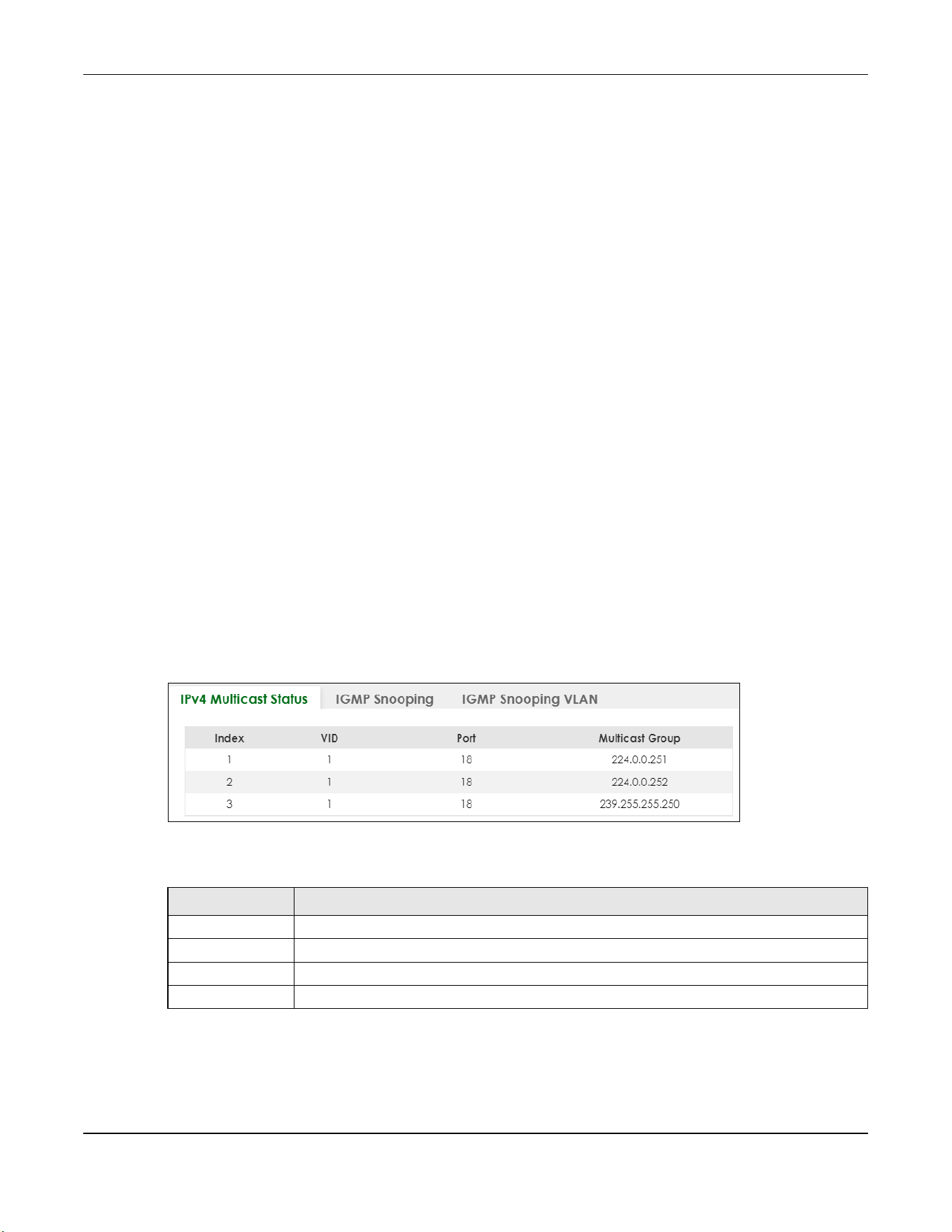
Chapter 39 Multicast
XMG1915 Series User’s Guide
223
IGMP Snooping
A Switch can passively snoop on IGMP packets transferred between IP multicast routers or switches and
IP multicast hosts to learn the IP multicast group membership. It checks IGMP packets passing through it,
picks out the group registration information, and configures multicasting accordingly. IGMP snooping
allows the Switch to learn multicast groups without you having to manually configure them.
The Switch forwards multicast traffic destined for multicast groups (that it has learned from IGMP
snooping or that you have manually configured) to ports that are members of that group. IGMP
snooping generates no additional network traffic, allowing you to significantly reduce multicast traffic
passing through your Switch.
IGMP Snooping and VLANs
The Switch can perform IGMP snooping on up to 16 VLANs. You can configure the Switch to
automatically learn multicast group membership of any VLANs. The Switch then performs IGMP
snooping on the first 16 VLANs that send IGMP packets. This is referred to as auto mode. Alternatively,
you can specify the VLANs that IGMP snooping should be performed on. This is referred to as fixed
mode. In fixed mode the Switch does not learn multicast group membership of any VLANs other than
those explicitly added as an IGMP snooping VLAN.
39.2 IPv4 Multicast Status
Click SWITCHING > Multicast > IPv4 Multicast > IPv4 Multicast Status to display the screen as shown. This
screen shows the IPv4 multicast group information. See Section 39.1 on page 222 for more information
on multicasting.
Figure 156 SWITCHING > Multicast > IPv4 Multicast > IPv4 Multicast Status
The following table describes the labels in this screen.
Table 115 SWITCHING > Multicast > IPv4 Multicast > IPv4 Multicast Status
LABEL DESCRIPTION
Index This is the index number of the entry.
VID This field displays the multicast VLAN ID.
Port This field displays the port number that belongs to the multicast group.
Multicast Group This field displays IP multicast group addresses.
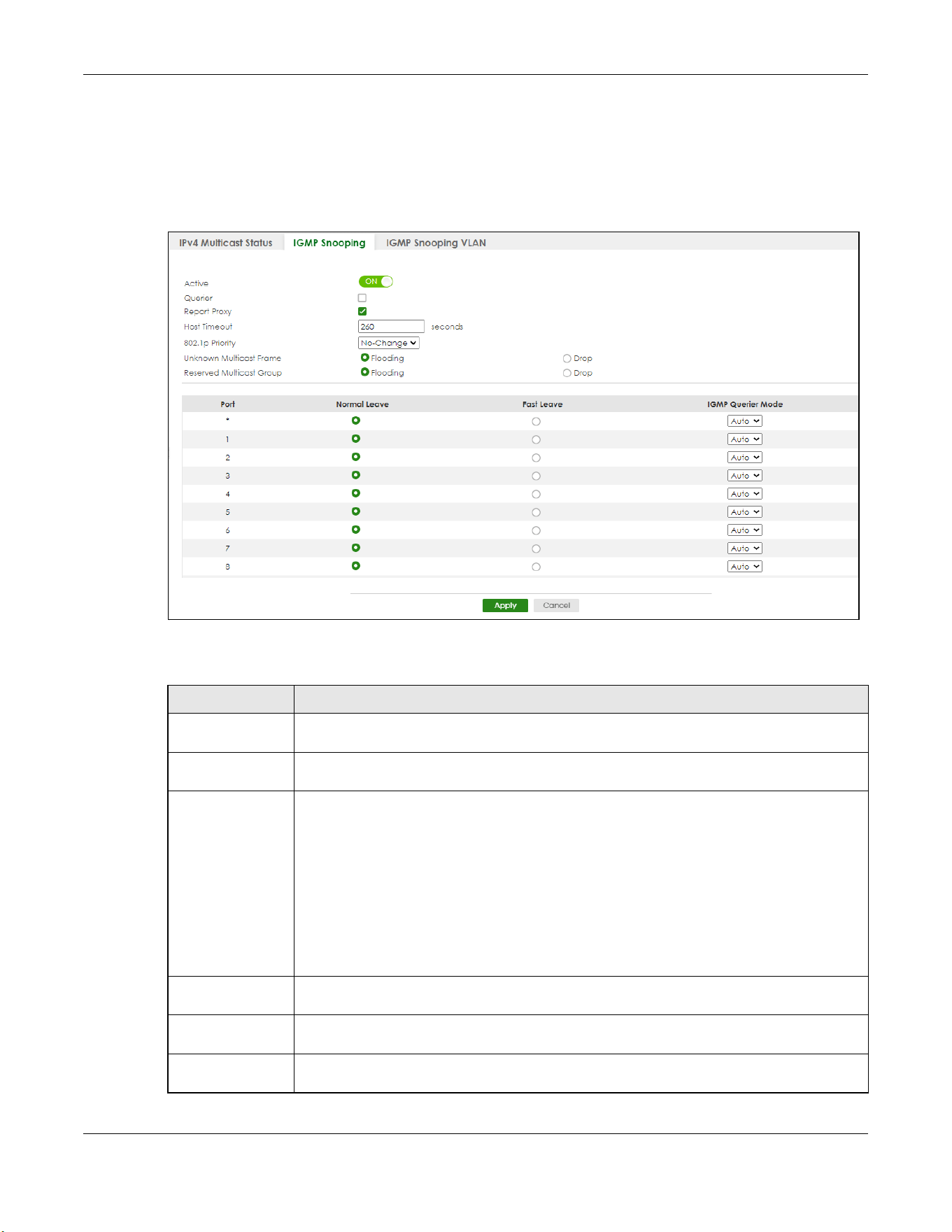
Chapter 39 Multicast
XMG1915 Series User’s Guide
224
39.3 IGMP Snooping
Click SWITCHING > Multicast > IPv4 Multicast > IGMP Snooping to display the screen as shown. See
Section 39.1 on page 222 for more information on multicasting.
Figure 157 SWITCHING > Multicast > IPv4 Multicast > IGMP Snooping
The following table describes the labels in this screen.
Table 116 SWITCHING > Multicast > IPv4 Multicast > IGMP Snooping
LABEL DESCRIPTION
Active Enable the switch button to enable IGMP Snooping to forward group multicast traffic only to
ports that are members of that group.
Querier Select this to allow the Switch to send IGMP General Query messages to the VLANs with the
multicast hosts attached.
Report Proxy Select this to allow the Switch to act as the IGMP report proxy and leave proxy. It will report
group changes to a connected multicast router.
The Switch not only checks IGMP packets between multicast routers or switches and multicast
hosts to learn the multicast group membership, but also replaces the source MAC address in
an IGMP v1/v2 report with its own MAC address before forwarding to the multicast router or
switch. When the Switch receives more than one IGMP v1/v2 join report that requests to join
the same multicast group, it only sends a new join report with its MAC address. This helps
reduce the number of multicast join reports passed to the multicast router or switch.
The Switch sends a leave message with its MAC address to the multicast router or switch only
when it receives the leave message from the last host in a multicast group.
Host Timeout Specify the time (from 1 to 16711450) in seconds that elapses before the Switch removes an
IGMP group membership entry if it does not receive report messages from the port.
802.1p Priority Select a priority level (0 – 7) to which the Switch changes the priority in outgoing IGMP control
packets. Otherwise, select No-Change to not replace the priority.
Unknown Multicast
Frame
Specify the action to perform when the Switch receives an unknown multicast frame. Select
Drop to discard the frames. Select Flooding to send the frames to all ports.

Chapter 39 Multicast
XMG1915 Series User’s Guide
225
Reserved Multicast
Group
The IP address range of 224.0.0.0 to 224.0.0.255 are reserved for multicasting on the local
network only. For example, 224.0.0.1 is for all hosts on a local network segment and 224.0.0.9 is
used to send RIP routing information to all RIP v2 routers on the same network segment. A
multicast router will not forward a packet with the destination IP address within this range to
other networks. See the IANA web site for more information.
The layer-2 multicast MAC addresses used by Cisco layer-2 protocols, 01:00:0C:CC:CC:CC
and 01:00:0C:CC:CC:CD, are also included in this group.
Specify the action to perform when the Switch receives a frame with a reserved multicast
address.
•Select Flooding to send the frames to all ports.
•Select Drop to discard the frames.
Use this section to configure IGMP Snooping on each port.
Port This field displays the port number.
* Settings in this row apply to all ports.
Use this row only if you want to make some settings the same for all ports. Use this row first to set
the common settings and then make adjustments on a port-by-port basis.
Changes in this row are copied to all the ports as soon as you make them.
Normal Leave In normal leave mode, when the Switch receives an IGMP leave message from a host on a
port, it forwards the message to the multicast router. The multicast router then sends out an
IGMP Group-Specific Query (GSQ) message to determine whether other hosts connected to
the port should remain in the specific multicast group. The Switch forwards the query message
to all hosts connected to the port and waits for IGMP reports from hosts to update the
forwarding table.
This defines how many seconds the Switch waits for an IGMP report before removing an IGMP
snooping membership entry when an IGMP leave message is received on this port from a
host.
Fast Leave In fast leave mode, right after receiving an IGMP leave message from a host on a port, the
Switch itself sends out an IGMP Group-Specific Query (GSQ) message to determine whether
other hosts connected to the port should remain in the specific multicast group. This helps
speed up the leave process.
This defines how many seconds the Switch waits for an IGMP report before removing an IGMP
snooping membership entry when an IGMP leave message is received on this port from a
host.
IGMP Querier
Mode
The Switch treats an IGMP query port as being connected to an IGMP multicast router (or
server). The Switch forwards IGMP join or leave packets to an IGMP query port.
Select Auto to have the Switch use the port as an IGMP query port if the port receives IGMP
query packets.
Select Fixed to have the Switch always use the port as an IGMP query port. Select this when
you connect an IGMP multicast server to the port.
Select Edge to stop the Switch from using the port as an IGMP query port. The Switch will not
keep any record of an IGMP router being connected to this port. The Switch does not forward
IGMP join or leave packets to this port.
Apply Click Apply to save your changes to the Switch’s run-time memory. The Switch loses these
changes if it is turned off or loses power, so use the Save link on the top navigation panel to
save your changes to the non-volatile memory when you are done configuring.
Cancel Click Cancel to begin configuring this screen afresh.
Table 116 SWITCHING > Multicast > IPv4 Multicast > IGMP Snooping (continued)
LABEL DESCRIPTION
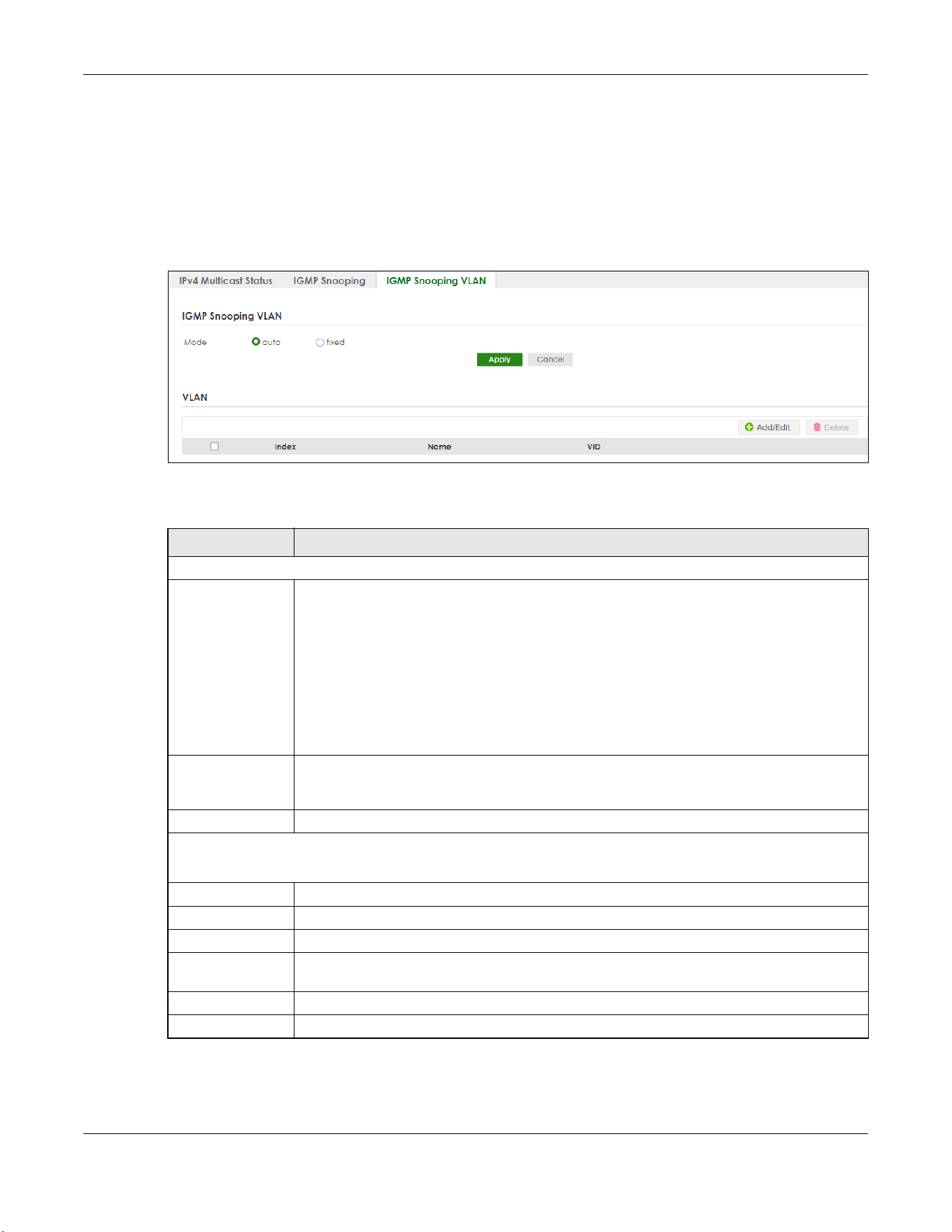
Chapter 39 Multicast
XMG1915 Series User’s Guide
226
39.4 IGMP Snooping VLAN
Click SWITCHING > Multicast > IPv4 Multicast > IGMP Snooping VLAN to display the screen as shown. See
IGMP Snooping and VLANs on page 223 for more information on IGMP Snooping VLAN.
Note: You can perform IGMP snooping on up to 16 VLANs.
Figure 158 SWITCHING > Multicast > IPv4 Multicast > IGMP Snooping VLAN
The following table describes the labels in this screen.
Table 117 SWITCHING > Multicast > IPv4 Multicast > IGMP Snooping VLAN
LABEL DESCRIPTION
IGMP Snooping VLAN
Mode Select auto to have the Switch learn multicast group membership information of any VLANs
automatically.
Select fixed to have the Switch only learn multicast group membership information of the
VLANs that you specify below.
In either auto or fixed mode, the Switch can learn up to 16 VLANs.
The Switch drops any IGMP control messages which do not belong to these 16 VLANs.
You must also enable IGMP snooping in the SWITCHING > Multicast > IPv4 Multicast > IGMP
Snooping screen first.
Apply Click Apply to save your changes to the Switch’s run-time memory. The Switch loses these
changes if it is turned off or loses power, so use the Save link on the top navigation panel to
save your changes to the non-volatile memory when you are done configuring.
Cancel Click Cancel to begin configuring this screen afresh.
VLAN
Use this section of the screen to add VLANs on which the Switch is to perform IGMP snooping.
Index This is the index number of the IGMP snooping VLAN entry in the table.
Name This field displays the descriptive name for this VLAN group.
VID This field displays the ID number of the VLAN group.
Select an entry’s check box to select a specific entry. Otherwise, select the check box in the
table heading row to select all entries.
Add/Edit Click Add/Edit to create a new entry or edit a selected one.
Delete Click Delete to remove the selected entries.
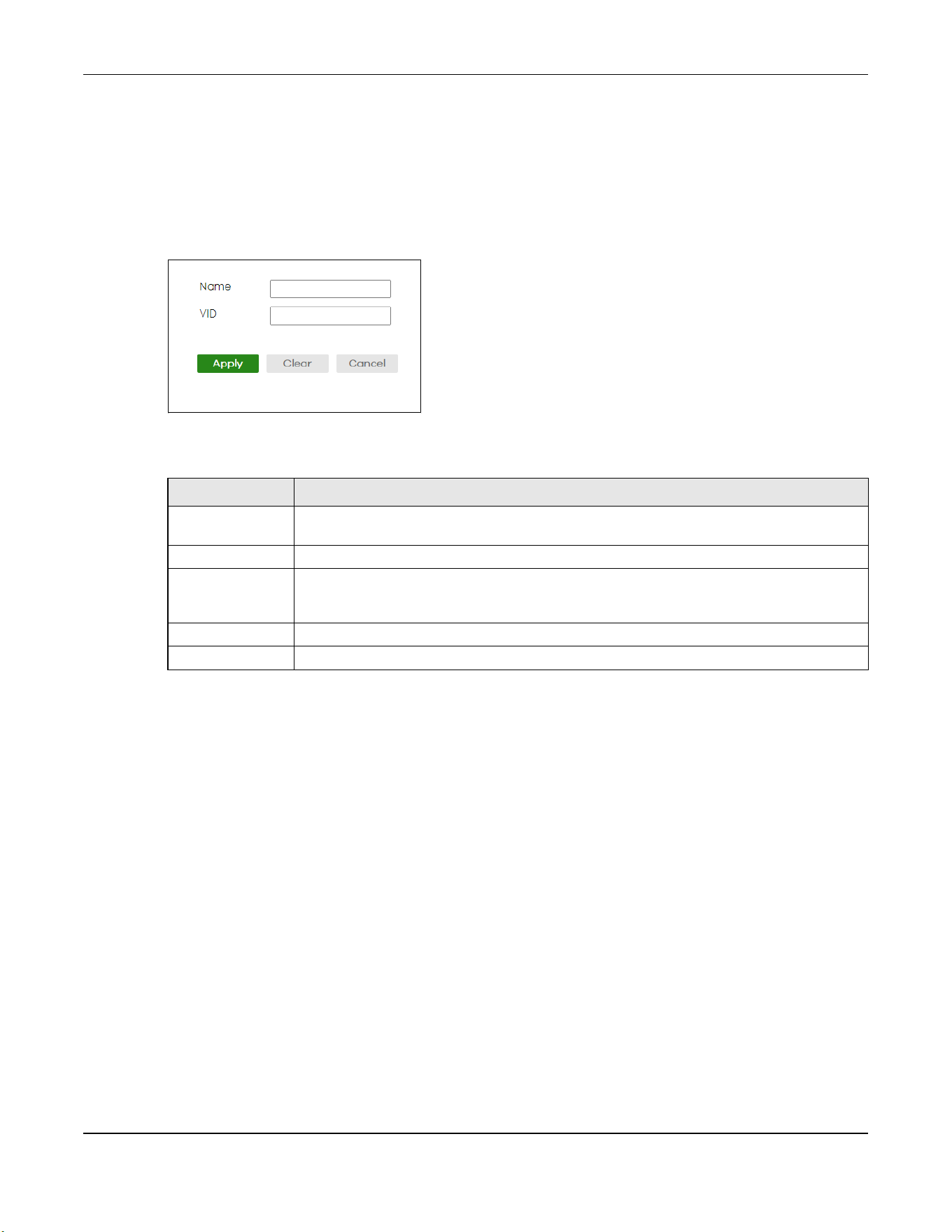
Chapter 39 Multicast
XMG1915 Series User’s Guide
227
39.4.1 Add/Edit IGMP Snooping VLANs
This screen allows you to add an IGMP snooping VLAN or edit an existing one.
To access this screen, click the Add/Edit button or select an entry from the list and click the Add/Edit
button.
Figure 159 SWITCHING > Multicast > IPv4 Multicast > IGMP Snooping VLAN > Add/Edit
The following table describes the labels in this screen.
Table 118 SWITCHING > Multicast > IPv4 Multicast > IGMP Snooping VLAN > Add/Edit
LABEL DESCRIPTION
Name Enter the descriptive name of the VLAN for identification purposes. You can enter up to 32
printable ASCII characters except [ ? ], [ | ], [ ' ], [ " ] or [ , ].
VID Enter the ID of a static VLAN; the valid range is between 1 and 4094.
Apply Click Apply to save your changes to the Switch’s run-time memory. The Switch loses these
changes if it is turned off or loses power, so use the Save link on the top navigation panel to
save your changes to the non-volatile memory when you are done configuring.
Clear Click Clear to clear the fields to the factory defaults.
Cancel Click Cancel to not save the configuration you make and return to the last screen.

Chapter 40 Static Multicast Forwarding
XMG1915 Series User’s Guide
228
CHAPTER 40
Static Multicast Forwarding
40.1 Static Multicast Forwarding Overview
This chapter discusses how to configure static multicast forwarding rules based on multicast MAC
addresses or multicast IPv4 addresses.
Use these screens to configure static multicast address forwarding by defining the ports and VLANs that
multicast traffic can pass through the Switch. If a subscriber is on a different port or VLAN, then the
subscriber will not get the multicast.
40.1.1 What You Can Do
Use the Static Multicast Forwarding By MAC screen (Section 40.2 on page 229) to configure rules to
forward specific multicast frames, such as streaming or control frames, to specific ports.
40.1.2 What You Need To Know
A multicast MAC address or multicast IP address is the MAC address or IP address of a multicast group,
and not a receiving device.
A static multicast address is a multicast MAC address or multicast IPv4 address that has been manually
entered in the multicast table. This identifies the destination of the multicast content. Multicast IPv4
addresses uses the Class D IP addresses range 224.0.0.0 to 239.255.255.255. Multicast MAC addresses
have a “1” as the last binary bit of the first octet pair (for example, 01:00:5e:00:00:0A). Static multicast
addresses do not age out. See IP Multicast Addresses on page 222 for more information on IP multicast
addresses.
Note: Static (manual) multicast forwarding allows you (the administrator) to forward multicast
frames to a member without the member having to join the group first.
If a multicast group has no members, then the Switch cannot forward to specific ports unless you
configure static (manual) multicast entries. The Switch will either flood the multicast frames to all ports
(default) or drop them. Figure 160 on page 229 shows such unknown multicast frames flooded to all
ports. With static multicast forwarding, you can forward these multicasts to ports within a VLAN group.
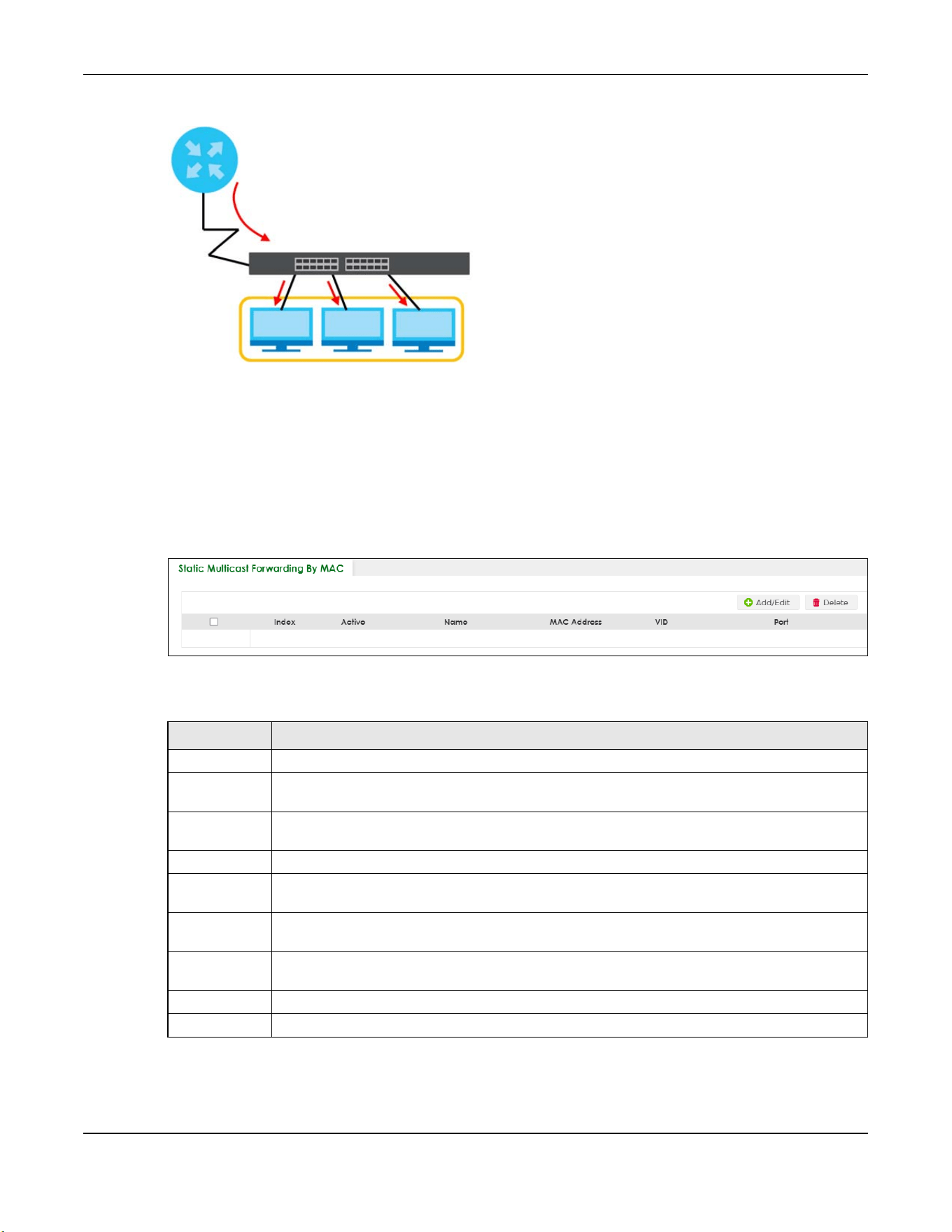
Chapter 40 Static Multicast Forwarding
XMG1915 Series User’s Guide
229
Figure 160 No Multicast Forwarding
40.2 Static Multicast Forwarding By MAC
Use this screen to view and configure static multicast MAC addresses for ports to receive the multicast
stream. Click SWITCHING > Multicast > Static Multicast Forwarding By MAC to display the screen as
shown next.
Figure 161 SWITCHING > Multicast > Static Multicast Forwarding By MAC
The following table describes the labels in this screen.
Table 119 SWITCHING > Multicast > Static Multicast Forwarding By MAC
LABEL DESCRIPTION
Index This is the index number of the static multicast MAC address rule.
Active This field displays whether a static multicast MAC address forwarding rule is active or not. You may
temporarily deactivate a rule without deleting it.
Name This field displays the descriptive name for identification purposes for a static multicast MAC
address-forwarding rule.
MAC Address This field displays the multicast MAC address that identifies a multicast group.
VID This field displays the ID number of a VLAN group to which frames containing the specified
multicast MAC address will be forwarded.
Port This field displays the ports within an identified VLAN group to which frames containing the
specified multicast MAC address will be forwarded.
Select an entry’s check box to select a specific entry. Otherwise, select the check box in the
table heading row to select all entries.
Add/Edit Click Add/Edit to add a new rule or edit a selected one.
Delete Click Delete to remove the selected rules.
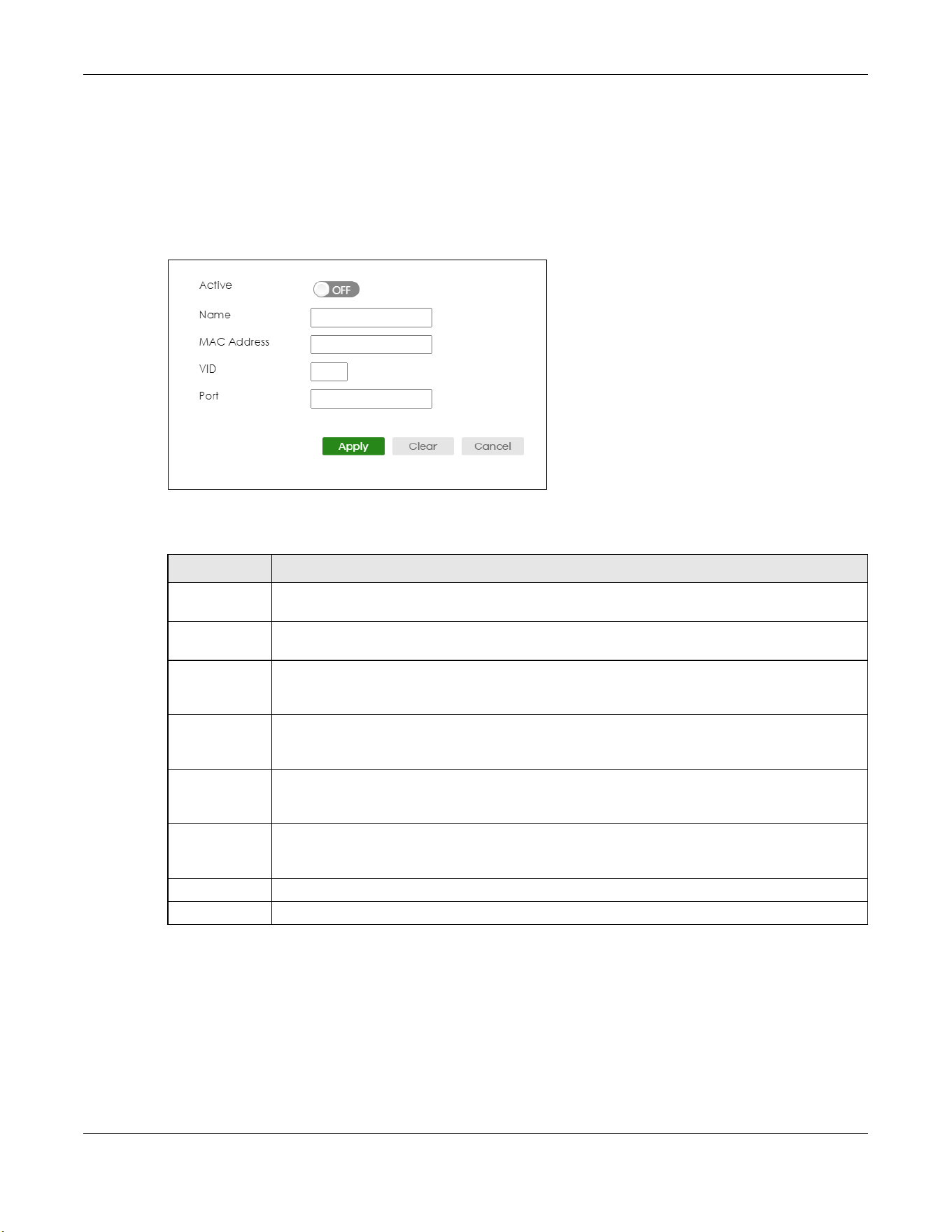
Chapter 40 Static Multicast Forwarding
XMG1915 Series User’s Guide
230
40.2.1 Add/Edit Static Multicast Forwarding By MAC
Use this screen to add a static multicast MAC address rule for ports to receive the multicast stream.
Click Add/Edit, or select an entry and click Add/Edit in the SWITCHING > Multicast > Static Multicast
Forwarding By MAC to display this screen.
Figure 162 SWITCHING > Multicast > Static Multicast Forwarding By MAC > Add/Edit
The following table describes the labels in this screen.
Table 120 SWITCHING > Multicast > Static Multicast Forwarding By MAC > Add/Edit
LABEL DESCRIPTION
Active Enable the switch button to activate your rule. You may temporarily deactivate a rule without
deleting it by disabling the switch.
Name Enter a descriptive name (up to 32 printable ASCII characters except [ ? ], [ | ], [ ' ], [ " ] or [ , ]) for
this static multicast MAC address forwarding rule. This is for identification only.
MAC Address Enter a multicast MAC address which identifies the multicast group. The last binary bit of the first
octet pair in a multicast MAC address must be 1. For example, the first octet pair 00000001 is 01 in
hexadecimal, so 01:00:5e:00:00:0A and 01:00:5e:00:00:27 are valid multicast MAC addresses.
VID You can forward frames with matching destination multicast MAC address to ports within a VLAN
group. Enter the ID that identifies the VLAN group here. If you do NOT have a specific target
VLAN, enter 1.
Port Enter the ports where frames with destination multicast MAC address that matched the entry
above are forwarded. You can enter multiple ports separated by (no space) comma (,) or
hyphen (-). For example, enter “3-5” for ports 3, 4, and 5. Enter “3,5,7” for ports 3, 5, and 7.
Apply Click Apply to save your changes to the Switch’s run-time memory. The Switch loses these
changes if it is turned off or loses power, so use the Save link on the top navigation panel to save
your changes to the non-volatile memory when you are done configuring.
Clear Click Clear to clear the fields to the factory defaults.
Cancel Click Cancel to not save the configuration you make and return to the last screen.

Chapter 41 Differentiated Services
XMG1915 Series User’s Guide
231
CHAPTER 41
Differentiated Services
41.1 DiffServ Overview
This chapter shows you how to configure Differentiated Services (DiffServ) on the Switch.
Quality of Service (QoS) is used to prioritize source-to-destination traffic flows. All packets in the flow are
given the same priority. You can use CoS (class of service) to give different priorities to different packet
types.
DiffServ is a class of service (CoS) model that marks packets so that they receive specific per-hop
treatment at DiffServ-compliant network devices along the route based on the application types and
traffic flow. Packets are marked with DiffServ Code Points (DSCPs) indicating the level of service desired.
This allows the intermediary DiffServ-compliant network devices to handle the packets differently
depending on the code points without the need to negotiate paths or remember state information for
every flow. In addition, applications do not have to request a particular service or give advanced
notice of where the traffic is going.
41.1.1 What You Can Do
• Use the Diffserv screen (Section 41.1 on page 231) to activate DiffServ to apply marking rules or IEEE
802.1p priority mapping on the Switch.
• Use the DSCP Setting screen (Section 41.3.1 on page 234) to change the DSCP-IEEE 802.1p mapping.
41.1.2 What You Need to Know
Read on for concepts on Differentiated Services that can help you configure the screens in this chapter.
DSCP and Per-Hop Behavior
DiffServ defines a new DS (Differentiated Services) field to replace the Type of Service (ToS) field in the IP
header. The DS field contains a 6-bit DSCP field which can define up to 64 service levels and the
remaining 2 bits are defined as currently unused (CU). The following figure illustrates the DS field.
Figure 163 DiffServ: Differentiated Service Field
DSCP is backward compatible with the three precedence bits in the ToS octet so that non-DiffServ
compliant, ToS-enabled network device will not conflict with the DSCP mapping.
The DSCP value determines the PHB (Per-Hop Behavior), that each packet gets as it is forwarded across
the DiffServ network. Based on the marking rule different kinds of traffic can be marked for different
DSCP (6 bits) CU (2 bits)
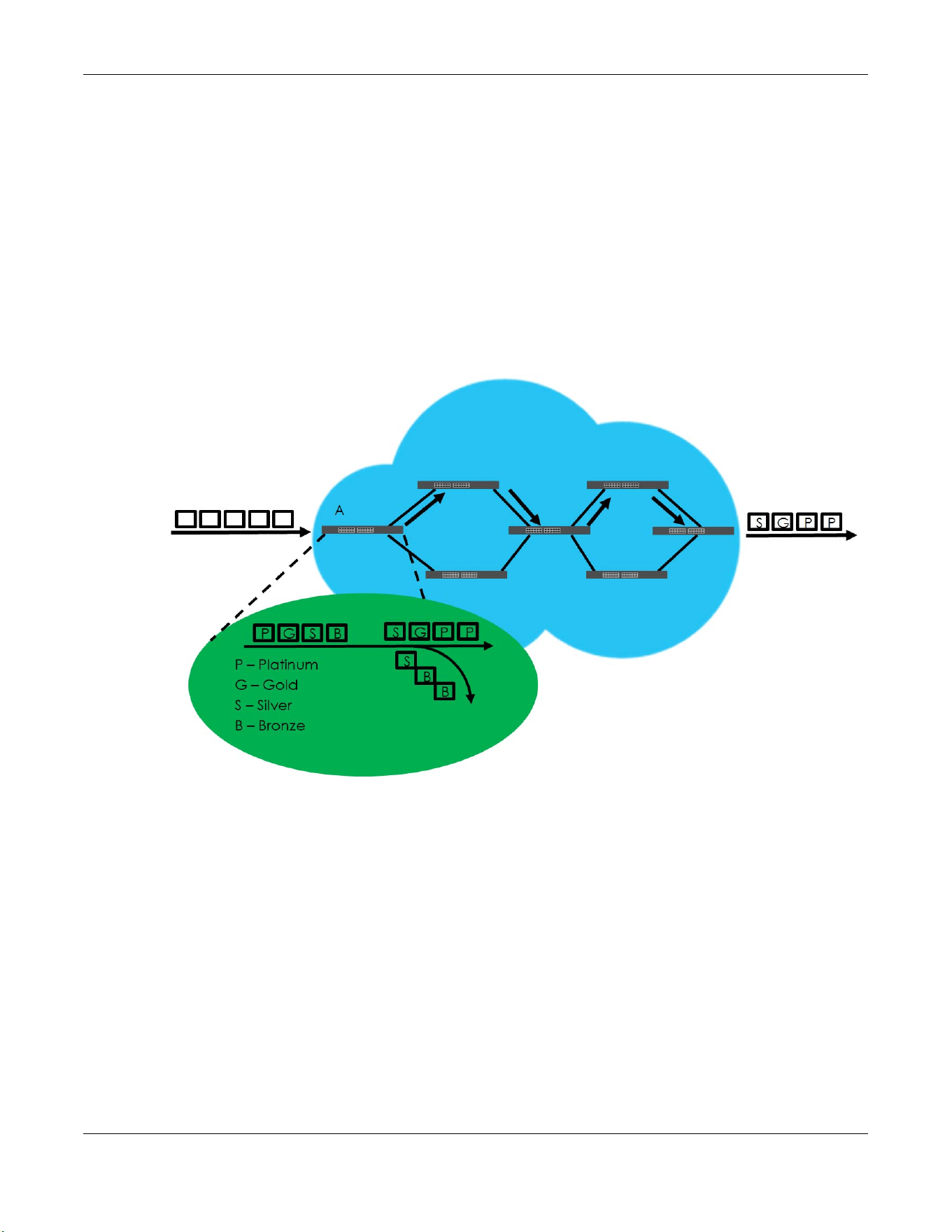
Chapter 41 Differentiated Services
XMG1915 Series User’s Guide
232
priorities of forwarding. Resources can then be allocated according to the DSCP values and the
configured policies.
DiffServ Network Example
The following figure depicts a DiffServ network consisting of a group of directly connected DiffServ-
compliant network devices. The boundary node (A in Figure 164) in a DiffServ network classifies (marks
with a DSCP value) the incoming packets into different traffic flows (Platinum, Gold, Silver, Bronze)
based on the configured marking rules. A network administrator can then apply various traffic policies to
the traffic flows. An example traffic policy, is to give higher drop precedence to one traffic flow over
others. In our example, packets in the Bronze traffic flow are more likely to be dropped when congestion
occurs than the packets in the Platinum traffic flow as they move across the DiffServ network.
Figure 164 DiffServ Network
41.2 Activating DiffServ
Activate DiffServ to apply marking rules or IEEE 802.1p priority mapping on the selected ports.
Click SWITCHING > QoS > Diffserv to display the screen as shown.
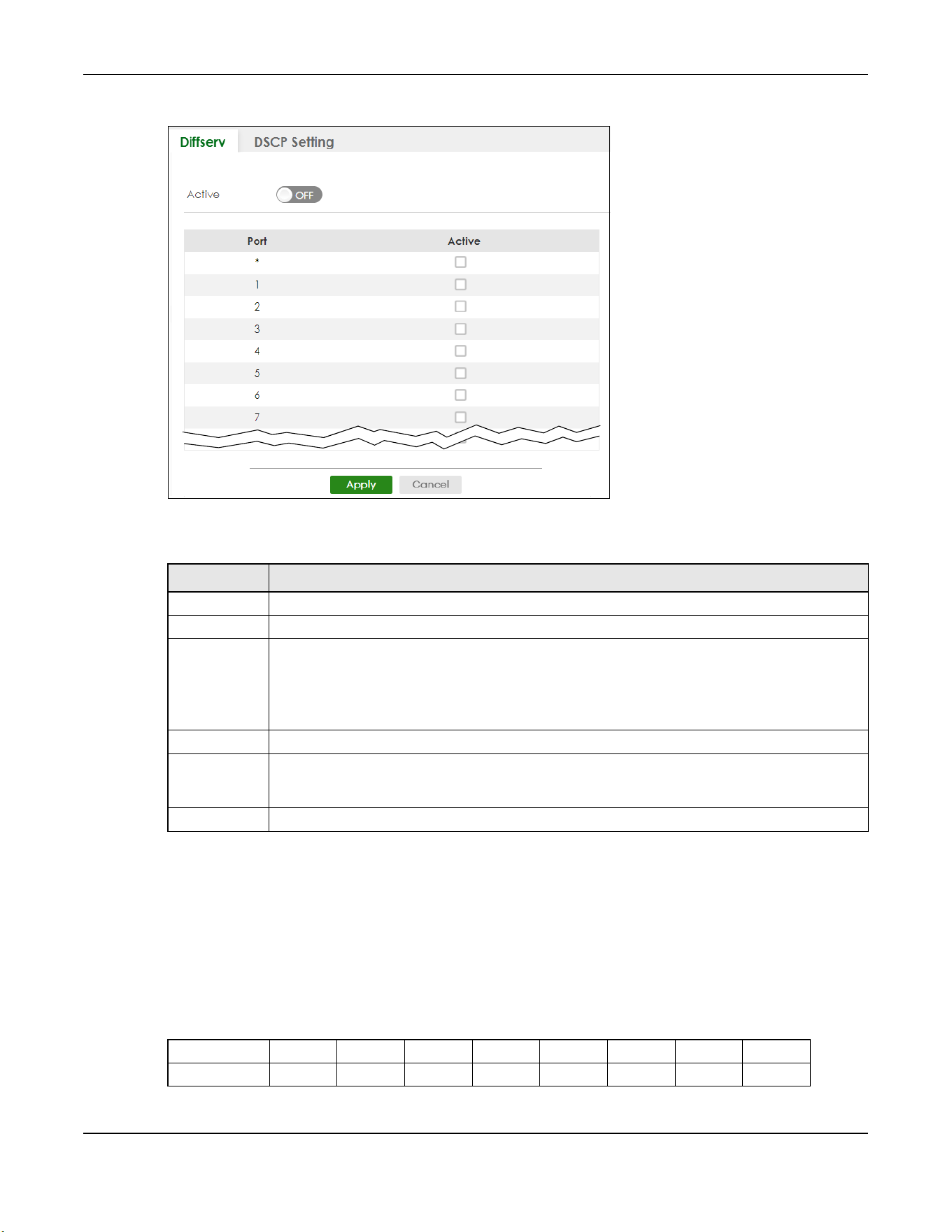
Chapter 41 Differentiated Services
XMG1915 Series User’s Guide
233
Figure 165 SWITCHING > QoS > Diffserv
The following table describes the labels in this screen.
41.3 DSCP-to-IEEE 802.1p Priority Settings
You can configure the DSCP to IEEE 802.1p mapping to allow the Switch to prioritize all traffic based on
the incoming DSCP value according to the DiffServ to IEEE 802.1p mapping table.
The following table shows the default DSCP-to-IEEE802.1p mapping.
Table 121 SWITCHING > QoS > Diffserv
LABEL DESCRIPTION
Active Enable the switch button to enable Diffserv on the Switch.
Port This field displays the index number of a port on the Switch.
* Settings in this row apply to all ports.
Use this row only if you want to make some settings the same for all ports. Use this row first to set the
common settings and then make adjustments on a port-by-port basis.
Changes in this row are copied to all the ports as soon as you make them.
Active Select Active to enable Diffserv on the port.
Apply Click Apply to save your changes to the Switch’s run-time memory. The Switch loses these
changes if it is turned off or loses power, so use the Save link on the top navigation panel to save
your changes to the non-volatile memory when you are done configuring.
Cancel Click Cancel to begin configuring this screen afresh.
Table 122 Default DSCP-IEEE 802.1p Mapping
DSCP VALUE 0 – 7 8 – 15 16 – 23 24 – 31 32 – 39 40 – 47 48 – 55 56 – 63
IEEE 802.1p01234567
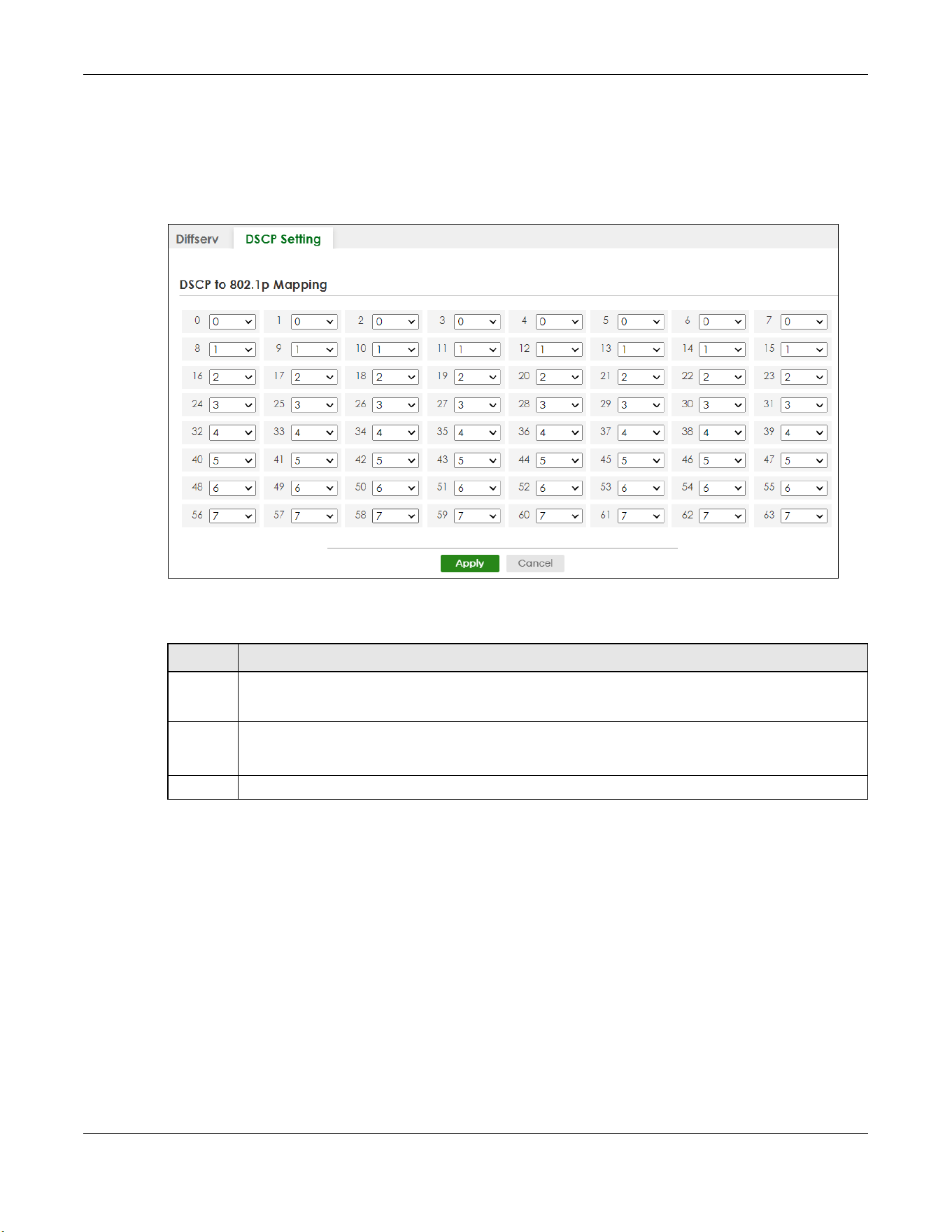
Chapter 41 Differentiated Services
XMG1915 Series User’s Guide
234
41.3.1 Configuring DSCP Settings
To change the DSCP-IEEE 802.1p mapping click SWITCHING > QoS > Diffserv > DSCP Setting to display the
screen as shown next.
Figure 166 SWITCHING > QoS > Diffserv > DSCP Setting
The following table describes the labels in this screen.
Table 123 SWITCHING > QoS > Diffserv > DSCP Setting
LABEL DESCRIPTION
0 … 63 This is the DSCP classification identification number.
To set the IEEE 802.1p priority mapping, select the priority level from the drop-down list box.
Apply Click Apply to save your changes to the Switch’s run-time memory. The Switch loses these changes if it
is turned off or loses power, so use the Save link on the top navigation panel to save your changes to
the non-volatile memory when you are done configuring.
Cancel Click Cancel to begin configuring this screen afresh.

Chapter 42 Queuing Method
XMG1915 Series User’s Guide
235
CHAPTER 42
Queuing Method
42.1 Queuing Method Overview
This section introduces the queuing methods supported.
Queuing is used to help solve performance degradation when there is network congestion. Use the
Queuing Method screen to configure queuing algorithms for outgoing traffic. See also Priority Queue
Assignment in the SWITCHING > QoS > Priority Queue screen and 802.1p Priority in the PORT > Port Setup
screen for related information.
42.1.1 What You Can Do
Use the Queuing Method screen (Section 42.2 on page 236) to set priorities for the queues of the Switch.
This distributes bandwidth across the different traffic queues.
42.1.2 What You Need to Know
Queuing algorithms allow switches to maintain separate queues for packets from each individual
source or flow and prevent a source from monopolizing the bandwidth.
Strictly Priority Queuing
Strictly Priority Queuing (SPQ) services queues based on priority only. As traffic comes into the Switch,
traffic on the highest priority queue, Q7 is transmitted first. When that queue empties, traffic on the next
highest-priority queue, Q6 is transmitted until Q6 empties, and then traffic is transmitted on Q5 and so on.
If higher priority queues never empty, then traffic on lower priority queues never gets sent. SPQ does not
automatically adapt to changing network requirements.
Weighted Fair Queuing
Weighted Fair Queuing is used to guarantee each queue's minimum bandwidth based on its bandwidth
weight (portion) (the number you configure in the Weight field) when there is traffic congestion. WFQ is
activated only when a port has more traffic than it can handle. Queues with larger weights get more
guaranteed bandwidth than queues with smaller weights. This queuing mechanism is highly efficient in
that it divides any available bandwidth across the different traffic queues. By default, the weight for Q0
is 1, for Q1 is 2, for Q2 is 3, and so on.
Weighted Round Robin Scheduling (WRR)
Round Robin Scheduling services queues on a rotating basis and is activated only when a port has more
traffic than it can handle. A queue is given an amount of bandwidth irrespective of the incoming traffic
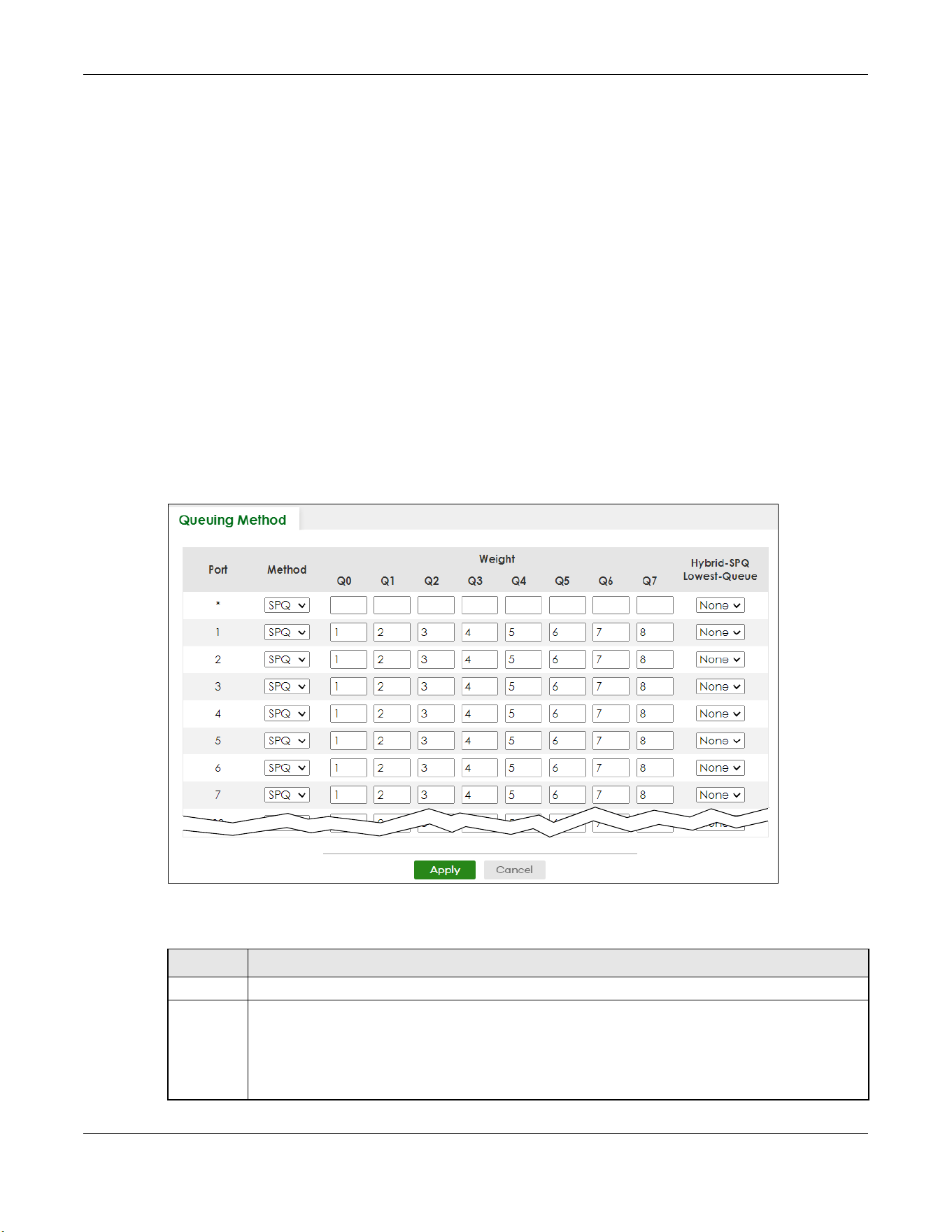
Chapter 42 Queuing Method
XMG1915 Series User’s Guide
236
on that port. This queue then moves to the back of the list. The next queue is given an equal amount of
bandwidth, and then moves to the end of the list; and so on, depending on the number of queues
being used. This works in a looping fashion until a queue is empty.
Weighted Round Robin Scheduling (WRR) uses the same algorithm as round robin scheduling, but
services queues based on their priority and queue weight (the number you configure in the queue
Weight field) rather than a fixed amount of bandwidth. WRR is activated only when a port has more
traffic than it can handle. Queues with larger weights get more service than queues with smaller
weights. This queuing mechanism is highly efficient in that it divides any available bandwidth across the
different traffic queues and returns to queues that have not yet emptied.
42.2 Configuring Queuing
Use this screen to set priorities for the queues of the Switch. This distributes bandwidth across the different
traffic queues.
Click SWITCHING > QoS > Queuing Method to display the screen as shown below.
Figure 167 SWITCHING > QoS > Queuing Method
The following table describes the labels in this screen.
Table 124 SWITCHING > QoS > Queuing Method
LABEL DESCRIPTION
Port This label shows the port you are configuring.
* Settings in this row apply to all ports.
Use this row only if you want to make some settings the same for all ports. Use this row first to set the
common settings and then make adjustments on a port-by-port basis.
Note: Changes in this row are copied to all the ports as soon as you make them.

Chapter 42 Queuing Method
XMG1915 Series User’s Guide
237
Method Select SPQ (Strictly Priority Queuing), WFQ (Weighted Fair Queuing) or WRR (Weighted Round Robin).
Strictly Priority Queuing services queues based on priority only. When the highest priority queue
empties, traffic on the next highest-priority queue begins. Q7 has the highest priority and Q0 the
lowest.
Weighted Fair Queuing is used to guarantee each queue's minimum bandwidth based on their
bandwidth portion (weight) (the number you configure in the Weight field). Queues with larger
weights get more guaranteed bandwidth than queues with smaller weights.
Weighted Round Robin Scheduling services queues on a rotating basis based on their queue weight
(the number you configure in the queue Weight field). Queues with larger weights get more service
than queues with smaller weights.
Weight When you select WFQ or WRR, enter the queue weight here. Bandwidth is divided across the different
traffic queues according to their weights.
Hybrid-SPQ
Lowest-
Queue
This field is applicable only when you select WFQ or WRR.
Select a queue (Q0 to Q7) to have the Switch use SPQ to service the subsequent queues after and
including the specified queue for the port. For example, if you select Q5, the Switch services traffic on
Q5, Q6 and Q7 using SPQ.
Select None to always use WFQ or WRR for the port.
Apply Click Apply to save your changes to the Switch’s run-time memory. The Switch loses these changes if
it is turned off or loses power, so use the Save link on the top navigation panel to save your changes to
the non-volatile memory when you are done configuring.
Cancel Click Cancel to begin configuring this screen afresh.
Table 124 SWITCHING > QoS > Queuing Method (continued)
LABEL DESCRIPTION
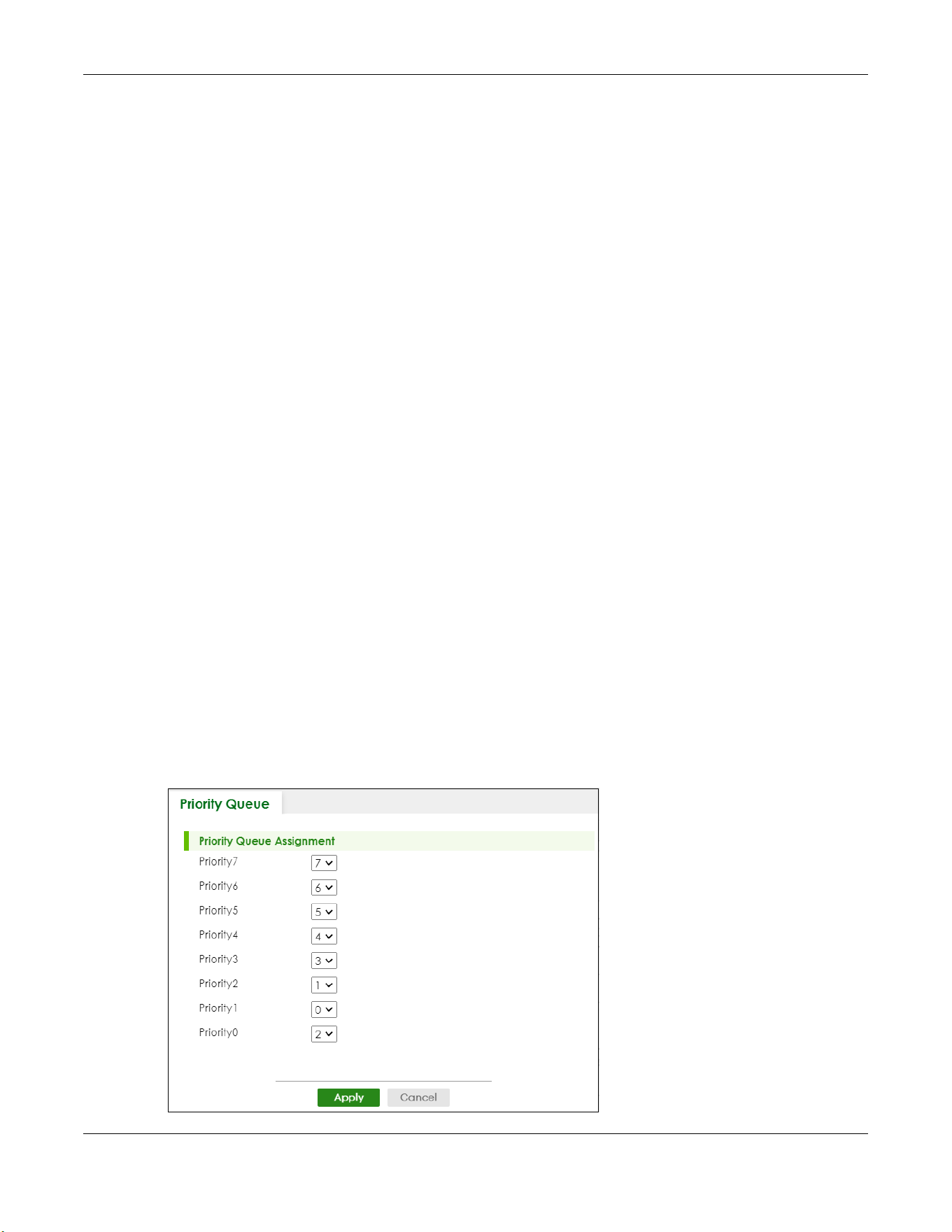
Chapter 43 Priority Queue
XMG1915 Series User’s Guide
238
CHAPTER 43
Priority Queue
43.1 Priority Queue Overview
IEEE 802.1p defines up to eight separate traffic types by inserting a tag into a MAC-layer frame that
contains bits to define class of service. Frames without an explicit priority tag are given the default
priority of the ingress port. Use this screen to configure the priority level-to-physical queue mapping. The
Switch has eight physical queues that you can map to the eight priority levels.
On the Switch, traffic assigned to higher index queues gets through faster while traffic in lower index
queues is dropped if the network is congested.
43.1.1 What You Can Do
Use the Priority Queue screen (Section 43.2 on page 238) to configure the priority level-to-physical
queue mapping.
43.2 Assign Priority Queue
Use this screen to assign priority level to each queue.
Click SWITCHING > QoS > Priority Queue to open this screen.
Figure 168 SWITCHING > QoS > Priority Queue

Chapter 43 Priority Queue
XMG1915 Series User’s Guide
239
The following table describes the related labels in this screen.
Table 125 SWITCHING > QoS > Priority Queue
LABEL DESCRIPTION
Priority Queue Assignment
The following descriptions are based on the traffic types defined in the IEEE 802.1d standard (which incorporates
the 802.1p). To map a priority level to a physical queue, select a physical queue from the drop-down menu on the
right.
Priority 7 Typically used for network control traffic such as router configuration messages.
Priority 6 Typically used for voice traffic that is especially sensitive to jitter (jitter is the variations in delay).
Priority 5 Typically used for video that consumes high bandwidth and is sensitive to jitter.
Priority 4 Typically used for controlled load, latency-sensitive traffic such as SNA (Systems Network
Architecture) transactions.
Priority 3 Typically used for “excellent effort” or better than best effort and would include important business
traffic that can tolerate some delay.
Priority 2 This is for “spare bandwidth”.
Priority 1 This is typically used for non-critical “background” traffic such as bulk transfers that are allowed but
that should not affect other applications and users.
Priority 0 Typically used for best-effort traffic.
Apply Click Apply to save your changes to the Switch’s run-time memory. The Switch loses these changes
if it is turned off or loses power, so use the Save link on the top navigation panel to save your
changes to the non-volatile memory when you are done configuring.
Cancel Click Cancel to reset the fields.
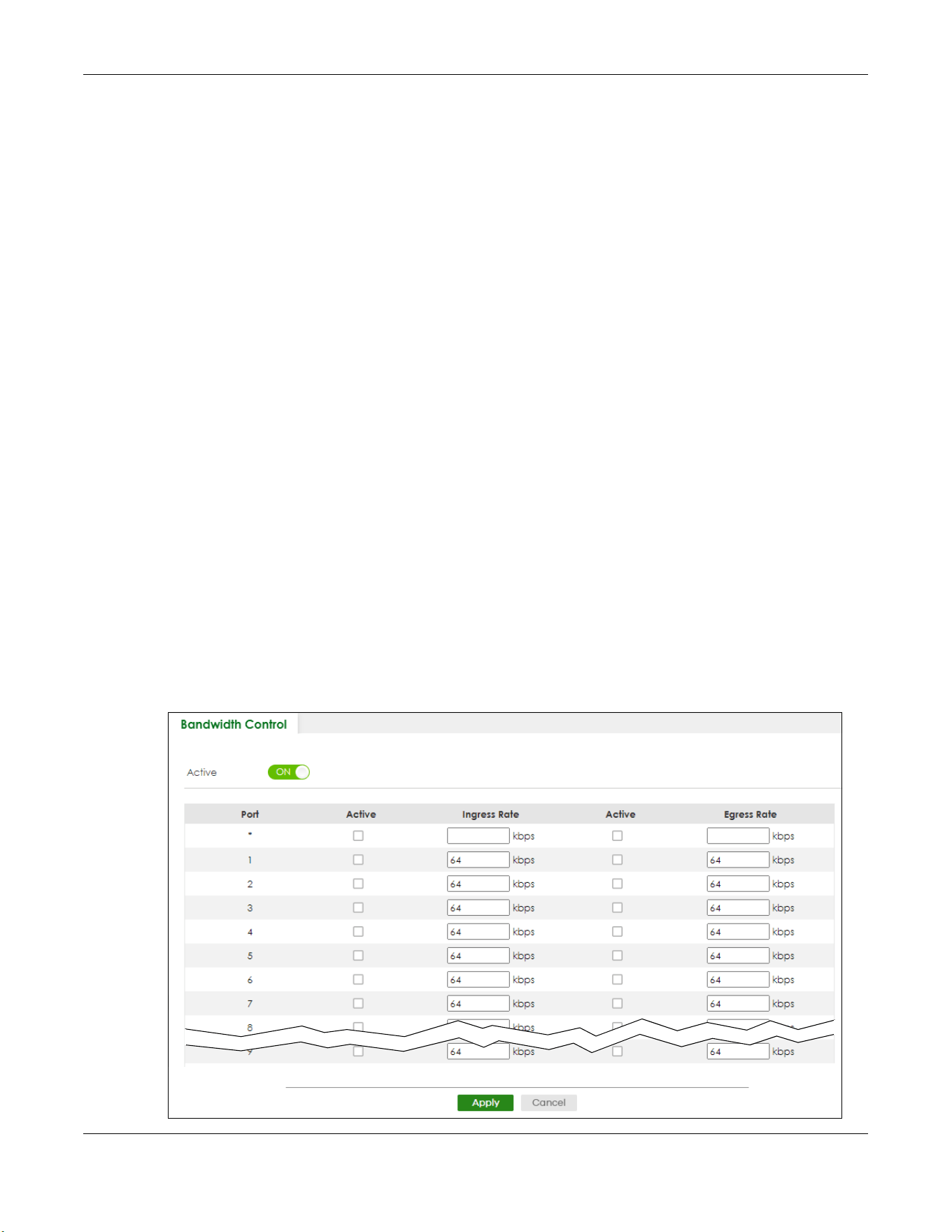
Chapter 44 Bandwidth Control
XMG1915 Series User’s Guide
240
CHAPTER 44
Bandwidth Control
44.1 Bandwidth Control Overview
This chapter shows you how you can cap the maximum bandwidth using the Bandwidth Control screen.
Bandwidth control means defining a maximum allowable bandwidth for incoming and/or out-going
traffic flows on a port.
44.1.1 What You Can Do
Use the Bandwidth Control screen (Section 44.2 on page 240) to limit the bandwidth for traffic going
through the Switch.
44.2 Bandwidth Control Setup
Click SWITCHING > QoS > Bandwidth Control in the navigation panel to bring up the screen as shown
next.
Figure 169 SWITCHING > QoS > Bandwidth Control

Chapter 44 Bandwidth Control
XMG1915 Series User’s Guide
241
The following table describes the related labels in this screen.
Table 126 SWITCHING > QoS > Bandwidth Control
LABEL DESCRIPTION
Active Enable the switch button to enable bandwidth control on the Switch.
Port This field displays the port number.
* Settings in this row apply to all ports.
Use this row only if you want to make some settings the same for all ports. Use this row first to set the
common settings and then make adjustments on a port-by-port basis.
Note: Changes in this row are copied to all the ports as soon as you make them.
Active Select this check box to activate ingress rate limits on this port.
Ingress Rate Specify the maximum bandwidth allowed in kilobits per second (Kbps) for the incoming traffic flow
on a port.
Note: Ingress rate bandwidth control applies to layer 2 traffic only.
Active Select this check box to activate egress rate limits on this port.
Egress Rate Specify the maximum bandwidth allowed in kilobits per second (Kbps) for the out-going traffic
flow on a port.
Apply Click Apply to save your changes to the Switch’s run-time memory. The Switch loses these changes
if it is turned off or loses power, so use the Save link on the top navigation panel to save your
changes to the non-volatile memory when you are done configuring.
Cancel Click Cancel to reset the fields.

XMG1915 Series User’s Guide
242
CHAPTER 45
Spanning Tree Protocol
45.1 Spanning Tree Protocol Overview
The Switch supports Spanning Tree Protocol (STP), Rapid Spanning Tree Protocol (RSTP) and Multiple
Spanning Tree Protocol (MSTP) as defined in the following standards.
• IEEE 802.1D Spanning Tree Protocol
• IEEE 802.1w Rapid Spanning Tree Protocol
• IEEE 802.1s Multiple Spanning Tree Protocol
The Switch also allows you to set up multiple STP configurations (or trees). Ports can then be assigned to
the trees.
45.1.1 What You Can Do
• Use the Spanning Tree Protocol Status screen (Section 45.2 on page 244) to view the STP status in the
different STP modes (RSTP or MSTP) you can configure on the Switch.
• Use the Spanning Tree Setup screen (Section 45.3 on page 245) to activate one of the STP modes on
the Switch.
• Use the Rapid Spanning Tree Protocol Status screen (Section 45.4 on page 247) to view the RSTP status.
• Use the Rapid Spanning Tree Protocol screen (Section 45.5 on page 249) to configure RSTP settings.
• Use the Multiple Spanning Tree Protocol Status screen (Section 45.6 on page 251) to view the MSTP
status.
• Use the Multiple Spanning Tree Protocol screen (Section 45.7 on page 254) to configure MSTP.
• Use the Multiple Spanning Tree Protocol Port Setup screen (Section 45.8 on page 257) to configure
MSTP ports.
45.1.2 What You Need to Know
Read on for concepts on STP that can help you configure the screens in this chapter.
(Rapid) Spanning Tree Protocol
(R)STP detects and breaks network loops and provides backup links between switches, bridges or
routers. It allows a switch to interact with other (R)STP-compliant switches in your network to ensure that
only one path exists between any two stations on the network.
The Switch uses IEEE 802.1w RSTP (Rapid Spanning Tree Protocol) that allows faster convergence of the
spanning tree than STP (while also being backwards compatible with STP-only aware bridges). In RSTP,
topology change information is directly propagated throughout the network from the device that
generates the topology change. In STP, a longer delay is required as the device that causes a topology
change first notifies the root bridge that then notifies the network. Both RSTP and STP flush unwanted
Chapter 45 Spanning Tree Protocol
XMG1915 Series User’s Guide
243
learned addresses from the filtering database. In RSTP, the port states are Discarding, Learning, and
Forwarding.
Note: In this user’s guide, “STP” refers to both STP and RSTP.
STP Terminology
The root bridge is the base of the spanning tree.
Path cost is the cost of transmitting a frame onto a LAN through that port. The recommended cost is
assigned according to the speed of the link to which a port is attached. The slower the media, the
higher the cost.
On each bridge, the root port is the port through which this bridge communicates with the root. It is the
port on this switch with the lowest path cost to the root (the root path cost). If there is no root port, then
this switch has been accepted as the root bridge of the spanning tree network.
For each LAN segment, a designated bridge is selected. This bridge has the lowest cost to the root
among the bridges connected to the LAN.
How STP Works
After a bridge determines the lowest cost-spanning tree with STP, it enables the root port and the ports
that are the designated ports for connected LANs, and disables all other ports that participate in STP.
Network packets are therefore only forwarded between enabled ports, eliminating any possible
network loops.
STP-aware switches exchange Bridge Protocol Data Units (BPDUs) periodically. When the bridged LAN
topology changes, a new spanning tree is constructed.
Once a stable network topology has been established, all bridges listen for Hello BPDUs (Bridge Protocol
Data Units) transmitted from the root bridge. If a bridge does not get a Hello BPDU after a predefined
interval (Max Age), the bridge assumes that the link to the root bridge is down. This bridge then initiates
negotiations with other bridges to reconfigure the network to re-establish a valid network topology.
STP Port States
STP assigns five port states to eliminate packet looping. A bridge port is not allowed to go directly from
Table 127 STP Path Costs
LINK SPEED RECOMMENDED VALUE RECOMMENDED RANGE ALLOWED RANGE
Path Cost 4 Mbps 250 100 to 1000 1 to 65535
Path Cost 10 Mbps 100 50 to 600 1 to 65535
Path Cost 16 Mbps 62 40 to 400 1 to 65535
Path Cost 100 Mbps 19 10 to 60 1 to 65535
Path Cost 1 Gbps 4 3 to 10 1 to 65535
Path Cost 10 Gbps 2 1 to 5 1 to 65535
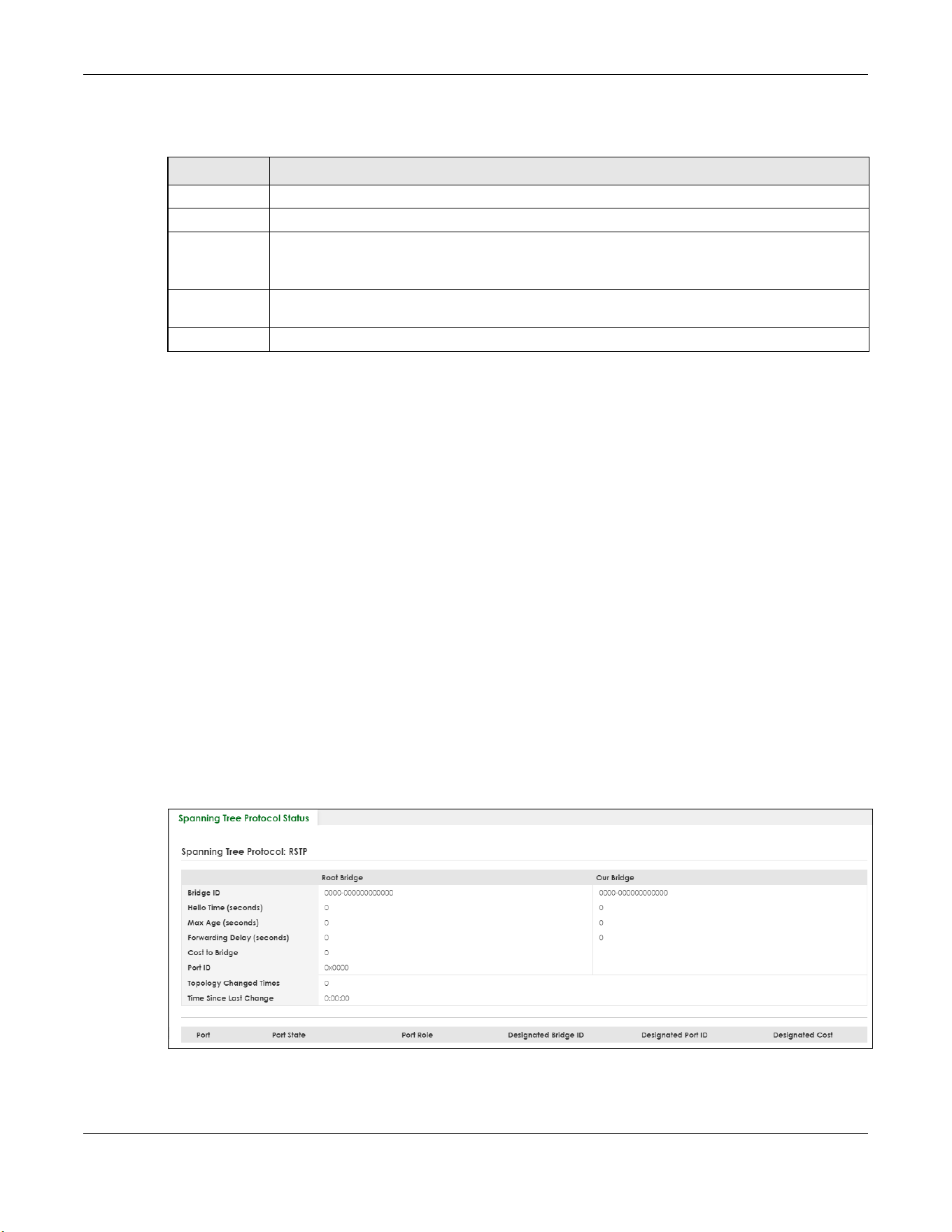
Chapter 45 Spanning Tree Protocol
XMG1915 Series User’s Guide
244
blocking state to forwarding state so as to eliminate transient loops.
Multiple STP
Multiple Spanning Tree Protocol (IEEE 802.1s) is backward compatible with STP/RSTP and addresses the
limitations of existing spanning tree protocols (STP and RSTP) in networks to include the following
features:
• One Common and Internal Spanning Tree (CIST) that represents the entire network’s connectivity.
• Grouping of multiple bridges (or switching devices) into regions that appear as one single bridge on
the network.
• A VLAN can be mapped to a specific Multiple Spanning Tree Instance (MSTI). MSTI allows multiple
VLANs to use the same spanning tree.
• Load-balancing is possible as traffic from different VLANs can use distinct paths in a region.
45.2 Spanning Tree Protocol Status
The Spanning Tree Protocol status screen changes depending on what standard you choose to
implement on your network. Click SWITCHING > Spanning Tree Protocol > Spanning Tree Protocol Status
to see the screen as shown.
Figure 170 SWITCHING > Spanning Tree Protocol > Spanning Tree Protocol Status
This screen differs depending on which STP mode (RSTP or MSTP) you configure on the Switch. This screen
is described in detail in the section that follows the configuration section for each STP mode. Use the
Table 128 STP Port States
PORT STATE DESCRIPTION
Disabled STP is disabled (default).
Blocking Only configuration and management BPDUs are received and processed.
Listening All BPDUs are received and processed.
Note: The listening state does NOT exist in RSTP.
Learning All BPDUs are received and processed. Information frames are submitted to the learning process
but not forwarded.
Forwarding All BPDUs are received and processed. All information frames are received and forwarded.
Chapter 45 Spanning Tree Protocol
XMG1915 Series User’s Guide
245
SWITCHING > Spanning Tree Protocol > Spanning Tree Setup screen to activate one of the STP standards
on the Switch.
45.3 Spanning Tree Setup
There are three Auto path-cost Modes (see Table 132 on page 247). Choose the Auto Path-cost Mode
according to the device average link speeds in the STP network.
If most of your devices support high link speed, you should select Long or User-defined mode. The path
cost of link speed slower than 10 Mbps can be set to 2000000, and the path cost of link speed faster than
10 Gbps can be set to 200. This way, the path costs can better reflect actual link speeds with a wider
range (32 bits) of path cost values. If the link speeds within the system are averagely smaller than 1
Gbps, you should select Short mode since Short mode have path cost values more detailed defined for
link speeds under1 Gbps.
The path cost values are described in the following tables.
The Switch defines the following Short mode path costs.
The Switch defines the following Long mode path costs.
Table 129 Auto Path Cost Mode: Short
LINK SPEED AUTO PATH COST VALUE
Up to 4 Mbps 250
Up to 10 Mbps 100
Up to 16 Mbps 62
Up to 100 Mbps 19
Up to 1 Gbps 4
Up to 10 Gbps 2
More than 10 Gbps 1
Table 130 Auto Path Cost Mode: Long
LINK SPEED AUTO PATH COST VALUE
Up to 10 Mbps 2000000
Up to 100 Mbps 200000
Up to 1 Gbps 20000
Up to 2.5 Gbps 8000
Up to 5 Gbps 4000
Up to 10 Gbps 2000
More than 10 Gbps 200

Chapter 45 Spanning Tree Protocol
XMG1915 Series User’s Guide
246
If you do not configure the auto path cost values for User-defined mode, the Switch uses the following
default values.
Use the this screen to activate one of the STP modes on the Switch. Click SWITCHING > Spanning Tree
Protocol > Spanning Tree Setup to display the screen as shown.
Figure 171 SWITCHING > Spanning Tree Protocol > Spanning Tree Setup
Table 131 Auto Path Cost Mode: User-defined
LINK SPEED AUTO PATH COST VALUE
Up to 10 Mbps 2000000
Up to 100 Mbps 200000
Up to 1 Gbps 20000
Up to 2.5 Gbps 8000
Up to 5 Gbps 4000
More than 5 Gbps 2000

Chapter 45 Spanning Tree Protocol
XMG1915 Series User’s Guide
247
The following table describes the labels in this screen.
45.4 Rapid Spanning Tree Protocol Status
The Spanning Tree Protocol status screen changes depending on what standard you choose to
implement on your network. Click SWITCHING > Spanning Tree Protocol > Spanning Tree Protocol Status
in the navigation panel to display the status screen as shown next. See Section 45.1 on page 242 for
more information on RSTP.
Note: This screen is only available after you activate RSTP on the Switch.
Table 132 SWITCHING > Spanning Tree Protocol > Spanning Tree Setup
LABEL DESCRIPTION
Spanning Tree
Mode
You can activate one of the STP modes on the Switch.
Select Rapid Spanning Tree or Multiple Spanning Tree.
Auto Path-cost Mode
Auto Path-cost Mode allows you to have the Switch automatically set the path cost for each port according to
their link speed. The Switch uses the path costs to determine the best path to the root bridge in a spanning tree.
There are three Auto Path-cost Modes that supports different path cost lengths:
• Short (16-bit)
• Long (32-bit)
• User-defined (32-bit).
The auto path cost values of each mode are described in Section 45.3 on page 245.
Note: It is recommended to use the same Auto Path-cost Mode on all switches within the spanning
tree network system.
To use the auto path-cost feature, select the Auto Path-cost mode (Short, Long, User-defined), set a port’s Path Cost
(in the SWITCHING > Spanning Tree Protocol > RSTP and MSTP screens) to “0”. The Switch will automatically set the
port’s path cost to the auto path cost value defined by the Auto Path-cost Mode you select.
Short Select this mode if you want to use the 16-bit auto path cost values the Switch defines.
Long Select this mode if you want to use the 32-bit auto path cost values the Switch defines.
User-defined Select this mode to manually set the auto path costs for each link speed. Enter the path cost
value for each link speed. The range is from 1 – 2000000. It is recommended to assign this value
according to link speeds. The slower the speed, the higher the cost.
Apply Click Apply to save your changes to the Switch’s run-time memory. The Switch loses these
changes if it is turned off or loses power, so use the Save link on the top navigation panel to
save your changes to the non-volatile memory when you are done configuring.
Cancel Click Cancel to begin configuring this screen afresh.
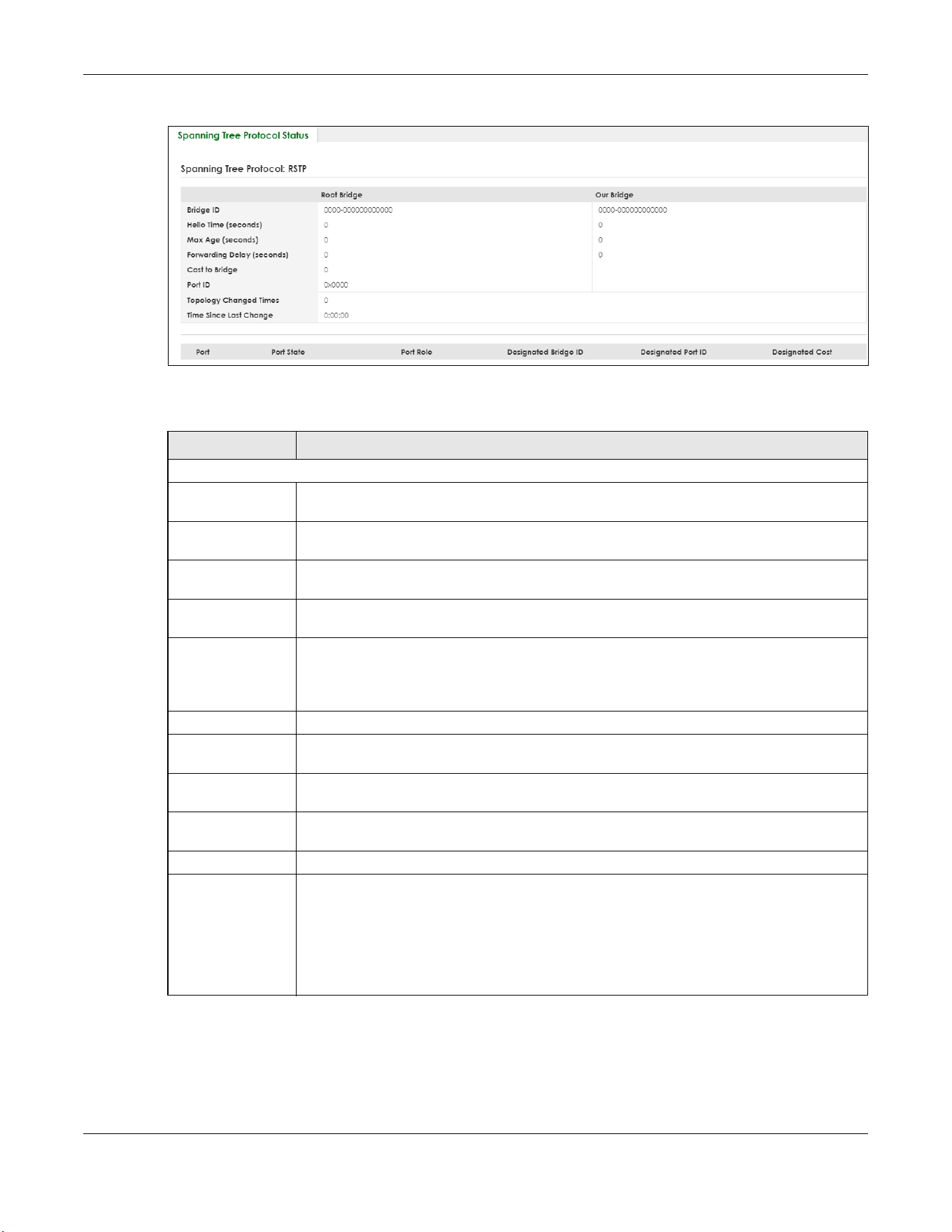
Chapter 45 Spanning Tree Protocol
XMG1915 Series User’s Guide
248
Figure 172 SWITCHING > Spanning Tree Protocol > Spanning Tree Protocol Status: RSTP
The following table describes the labels in this screen.
Table 133 SWITCHING > Spanning Tree Protocol > Spanning Tree Protocol Status: RSTP
LABEL DESCRIPTION
Spanning Tree Protocol: RSTP
Bridge Root Bridge refers to the base of the spanning tree (the root bridge). Our Bridge is this Switch.
This Switch may also be the root bridge.
Bridge ID This is the unique identifier for this bridge, consisting of bridge priority plus MAC address. This ID
is the same for Root Bridge and Our Bridge if the Switch is the root switch.
Hello Time
(seconds)
This is the time interval (in seconds) at which the root switch transmits a configuration
message. The root bridge determines Hello Time, Max Age and Forwarding Delay.
Max Age
(seconds)
This is the maximum time (in seconds) the Switch can wait without receiving a configuration
message before attempting to reconfigure.
Forwarding Delay
(seconds)
This is the time (in seconds) the root switch will wait before changing states (that is, listening to
learning to forwarding).
Note: The listening state does NOT exist in RSTP.
Cost to Bridge This is the path cost from the root port on this Switch to the root switch.
Port ID This is the priority and number of the port on the Switch through which this Switch must
communicate with the root of the Spanning Tree.
Topology
Changed Times
This is the number of times the spanning tree has been reconfigured.
Time Since Last
Change
This is the time since the spanning tree was last reconfigured.
Port This field displays the number of the port on the Switch.
Port State This field displays the port state in STP.
• DISCARDING – The port does not forward or process received frames or learn MAC
addresses, but still listens for BPDUs.
• LEARNING – The port learns MAC addresses and processes BPDUs, but does NOT forward
frames yet.
• FORWARDING – The port is operating normally. It learns MAC addresses, processes BPDUs
and forwards received frames.

Chapter 45 Spanning Tree Protocol
XMG1915 Series User’s Guide
249
45.5 Configure Rapid Spanning Tree Protocol
Use this screen to configure RSTP settings, see Section 45.1 on page 242 for more information on RSTP.
Click SWITCHING > Spanning Tree Protocol > RSTP in the navigation panel to display the screen as shown.
Port Role This field displays the role of the port in STP.
• Root – A forwarding port on a non-root bridge, which has the lowest path cost and is the
best port from the non-root bridge to the root bridge. A root bridge does NOT have a root
port.
• Designated – A forwarding port on the designated bridge for each connected LAN
segment. A designated bridge has the lowest path cost to the root bridge among the
bridges connected to the LAN segment. All the ports on a root bridge (root switch) are
designated ports.
• Alternate – A blocked port, which has a best alternate path to the root bridge. This path is
different from using the root port. The port moves to the forwarding state when the
designated port for the LAN segment fails.
• Backup – A blocked port, which has a backup or redundant path to a LAN segment
where a designated port is already connected when a switch has two links to the same
LAN segment.
• Disabled – Not strictly part of STP. The port can be disabled manually.
Designated Bridge
ID
This field displays the identifier of the designated bridge to which this port belongs when the
port is a designated port. Otherwise, it displays the identifier of the designated bridge for the
LAN segment to which this port is connected.
Designated Port ID This field displays the priority and number of the bridge port (on the designated bridge),
through which the designated bridge transmits the stored configuration messages.
Designated Cost This field displays the path cost to the LAN segment to which the port is connected when the
port is a designated port. Otherwise, it displays the path cost to the root bridge from the
designated port for the LAN segment to which this port is connected.
Table 133 SWITCHING > Spanning Tree Protocol > Spanning Tree Protocol Status: RSTP (continued)
LABEL DESCRIPTION
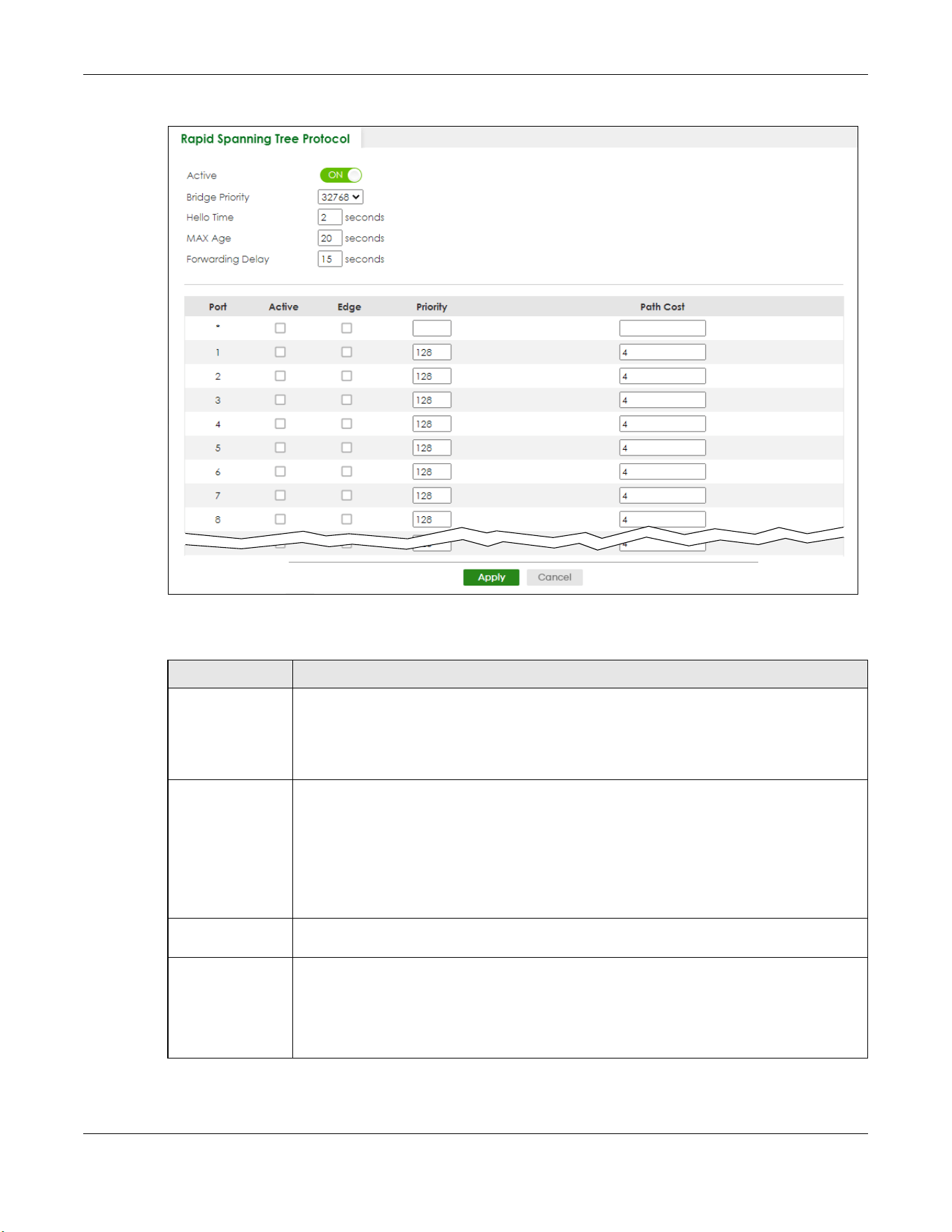
Chapter 45 Spanning Tree Protocol
XMG1915 Series User’s Guide
250
Figure 173 SWITCHING > Spanning Tree Protocol > RSTP
The following table describes the labels in this screen.
Table 134 SWITCHING > Spanning Tree Protocol > RSTP
LABEL DESCRIPTION
Active Enable the switch button to activate RSTP. Disable the switch to disable RSTP.
Note: You must also activate Rapid Spanning Tree (RSTP) in the SWITCHING >
Spanning Tree Protocol > Spanning Tree Setup screen to enable RSTP on the
Switch.
Bridge Priority Bridge priority is used in determining the root switch, root port and designated port. The Switch
with the highest priority (lowest numeric value) becomes the STP root switch. If all Switches
have the same priority, the Switch with the lowest MAC address will then become the root
switch. Select a value from the drop-down list box.
The lower the numeric value you assign, the higher the priority for this bridge.
Bridge Priority determines the root bridge, which in turn determines Hello Time, Max Age and
Forwarding Delay.
Hello Time This is the time interval in seconds between BPDU (Bridge Protocol Data Units) configuration
message generations by the root switch. The allowed range is 1 to 10 seconds.
Max Age This is the maximum time (in seconds) the Switch can wait without receiving a BPDU before
attempting to reconfigure. All Switch ports (except for designated ports) should receive BPDUs
at regular intervals. Any port that ages out STP information (provided in the last BPDU)
becomes the designated port for the attached LAN. If it is a root port, a new root port is
selected from among the Switch ports attached to the network. The allowed range is 6 to 40
seconds.

Chapter 45 Spanning Tree Protocol
XMG1915 Series User’s Guide
251
45.6 Multiple Spanning Tree Protocol Status
Click SWITCHING > Spanning Tree Protocol > Spanning Tree Protocol Status in the navigation panel to
display the status screen as shown next.
Note: This screen is only available after you activate MSTP on the Switch.
Forwarding Delay This is the maximum time (in seconds) the Switch will wait before changing states. This delay is
required because every Switch must receive information about topology changes before it
starts to forward frames. In addition, each port needs time to listen for conflicting information
that would make it return to a blocking state; otherwise, temporary data loops might result.
The allowed range is 4 to 30 seconds.
As a general rule:
2 * (Forward Delay – 1) >= Max Age >= 2 * (Hello Time + 1)
Port This field displays the port number.
* Settings in this row apply to all ports.
Use this row only if you want to make some settings the same for all ports. Use this row first to set
the common settings and then make adjustments on a port-by-port basis.
Note: Changes in this row are copied to all the ports as soon as you make them.
Active Select this check box to activate RSTP on this port.
Edge Select this check box to configure a port as an edge port when it is directly attached to a
computer. An edge port changes its initial STP port state from blocking state to forwarding
state immediately without going through listening and learning states right after the port is
configured as an edge port or when its link status changes.
Note: An edge port becomes a non-edge port as soon as it receives a Bridge
Protocol Data Unit (BPDU).
Priority Configure the priority for each port here.
Priority decides which port should be disabled when more than one port forms a loop in a
switch. Ports with a higher priority numeric value are disabled first. The allowed range is
between 0 and 255 and the default value is 128.
Path Cost Path cost is the cost of transmitting a frame on to a LAN through that port. It is recommended
to assign this value according to the speed of the bridge. The slower the media, the higher the
cost.
Apply Click Apply to save your changes to the Switch’s run-time memory. The Switch loses these
changes if it is turned off or loses power, so use the Save link on the top navigation panel to
save your changes to the non-volatile memory when you are done configuring.
Cancel Click Cancel to begin configuring this screen afresh.
Table 134 SWITCHING > Spanning Tree Protocol > RSTP (continued)
LABEL DESCRIPTION
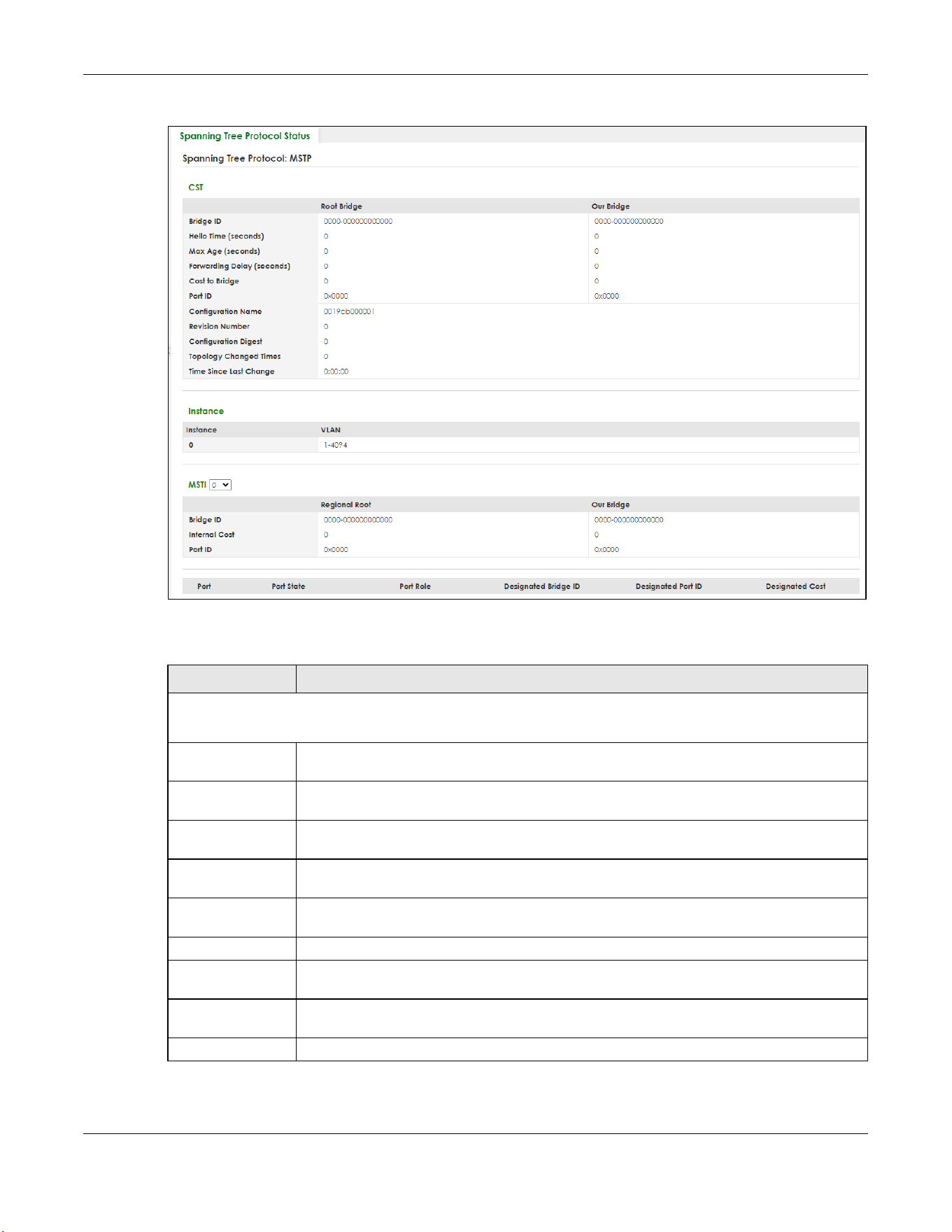
Chapter 45 Spanning Tree Protocol
XMG1915 Series User’s Guide
252
Figure 174 SWITCHING > Spanning Tree Protocol > Spanning Tree Protocol Status: MSTP
The following table describes the labels in this screen.
Table 135 SWITCHING > Spanning Tree Protocol > Spanning Tree Protocol Status: MSTP
LABEL DESCRIPTION
CST
This section describes the Common Spanning Tree settings.
Bridge Root Bridge refers to the base of the spanning tree (the root bridge). Our Bridge is this switch.
This Switch may also be the root bridge.
Bridge ID This is the unique identifier for this bridge, consisting of bridge priority plus MAC address. This ID
is the same for Root Bridge and Our Bridge if the Switch is the root switch.
Hello Time
(seconds)
This is the time interval (in seconds) at which the root switch transmits a configuration
message. The root bridge determines Hello Time, Max Age and Forwarding Delay.
Max Age
(seconds)
This is the maximum time (in seconds) the Switch can wait without receiving a configuration
message before attempting to reconfigure.
Forwarding Delay
(seconds)
This is the time (in seconds) the root switch will wait before changing states (that is, listening to
learning to forwarding).
Cost to Bridge This is the path cost from the root port on this Switch to the root switch.
Port ID This is the priority and number of the port on the Switch through which this Switch must
communicate with the root of the Spanning Tree.
Configuration
Name
This field displays the configuration name for this MST region.
Revision Number This field displays the revision number for this MST region.
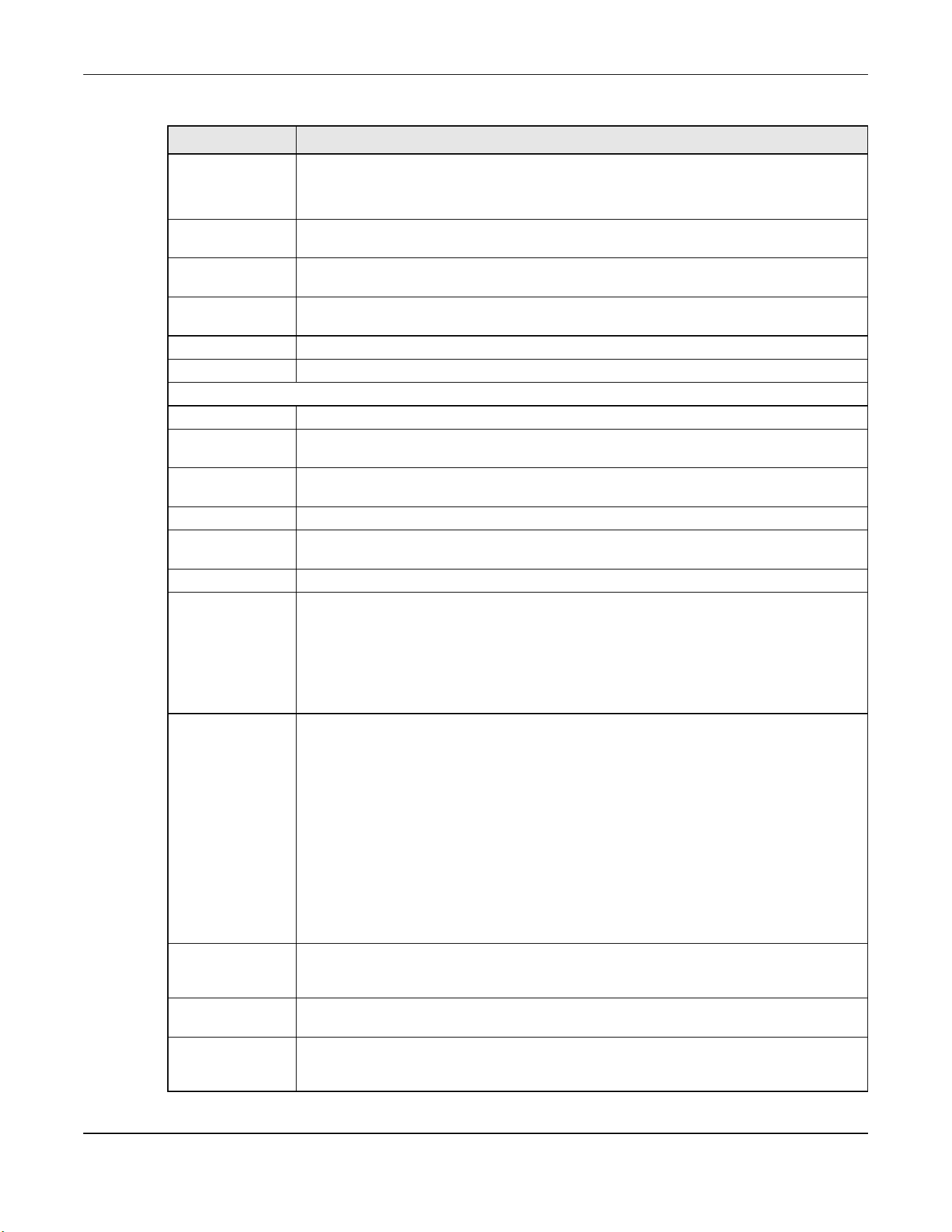
Chapter 45 Spanning Tree Protocol
XMG1915 Series User’s Guide
253
Configuration
Digest
A configuration digest is generated from the VLAN-MSTI mapping information.
This field displays the 16-octet signature that is included in an MSTP BPDU. This field displays the
digest when MSTP is activated on the system.
Topology
Changed Times
This is the number of times the spanning tree has been reconfigured.
Time Since Last
Change
This is the time since the spanning tree was last reconfigured.
Instance These fields display the MSTI to VLAN mapping. In other words, which VLANs run on each
spanning tree instance.
Instance This field displays the MSTI ID.
VLAN This field displays which VLANs are mapped to an MSTI.
MSTI
MSTI Select the MST instance settings you want to view.
Regional Root refers to the base of the MST instance. Our Bridge is this switch. This Switch may
also be the root bridge.
Bridge ID This is the unique identifier for this bridge, consisting of bridge priority plus MAC address. This ID
is the same for Regional Root and Our Bridge if the Switch is the root switch.
Internal Cost This is the path cost from the root port in this MST instance to the regional root switch.
Port ID This is the priority and number of the port on the Switch through which this Switch must
communicate with the root of the MST instance.
Port This field displays the number of the port on the Switch.
Port State This field displays the port state in STP.
• DISCARDING – The port does not forward or process received frames or learn MAC
addresses, but still listens for BPDUs.
• LEARNING – The port learns MAC addresses and processes BPDUs, but does not forward
frames yet.
• FORWARDING – The port is operating normally. It learns MAC addresses, processes BPDUs
and forwards received frames.
Port Role This field displays the role of the port in STP.
• Root – A forwarding port on a non-root bridge, which has the lowest path cost and is the
best port from the non-root bridge to the root bridge. A root bridge does not have a root
port.
• Designated – A forwarding port on the designated bridge for each connected LAN
segment. A designated bridge has the lowest path cost to the root bridge among the
bridges connected to the LAN segment. All the ports on a root bridge (root switch) are
designated ports.
• Alternate – A blocked port, which has a best alternate path to the root bridge. This path is
different from using the root port. The port moves to the forwarding state when the
designated port for the LAN segment fails.
• Backup – A blocked port, which has a backup or redundant path to a LAN segment
where a designated port is already connected when a switch has two links to the same
LAN segment.
• Disabled – Not strictly part of STP. The port can be disabled manually.
Designated Bridge
ID
This field displays the identifier of the designated bridge to which this port belongs when the
port is a designated port. Otherwise, it displays the identifier of the designated bridge for the
LAN segment to which this port is connected.
Designated Port ID This field displays the priority and number of the bridge port (on the designated bridge),
through which the designated bridge transmits the stored configuration messages.
Designated Cost This field displays the path cost to the LAN segment to which the port is connected when the
port is a designated port. Otherwise, it displays the path cost to the root bridge from the
designated port for the LAN segment to which this port is connected.
Table 135 SWITCHING > Spanning Tree Protocol > Spanning Tree Protocol Status: MSTP (continued)
LABEL DESCRIPTION
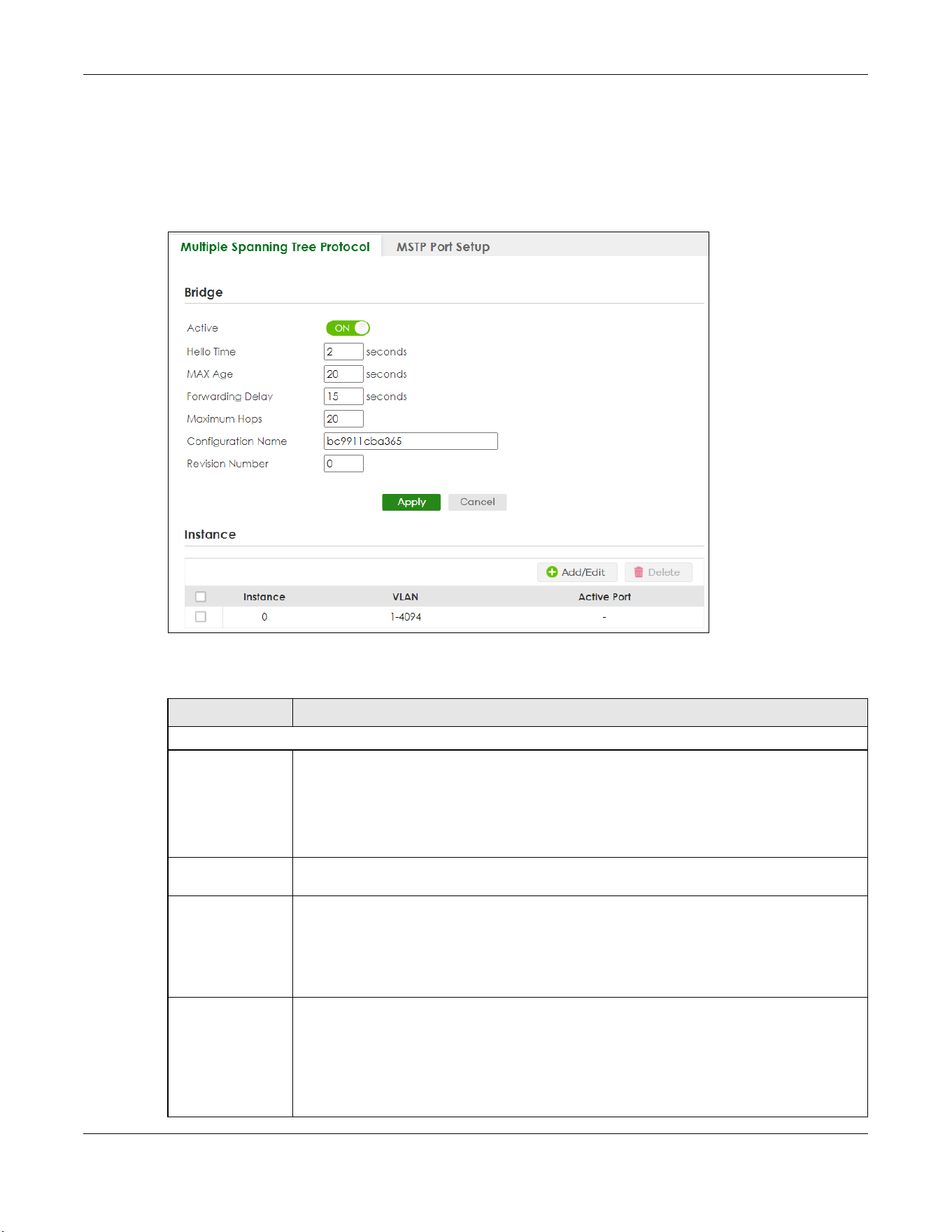
Chapter 45 Spanning Tree Protocol
XMG1915 Series User’s Guide
254
45.7 Configure Multiple Spanning Tree Protocol
To configure MSTP, click SWITCHING > Spanning Tree Protocol > MSTP in the navigation panel to display
the screen as shown.
Figure 175 SWITCHING > Spanning Tree Protocol > MSTP > Multiple Spanning Tree Protocol
The following table describes the labels in this screen.
Table 136 SWITCHING > Spanning Tree Protocol > MSTP > Multiple Spanning Tree Protocol
LABEL DESCRIPTION
Bridge
Active Enable the switch button to activate MSTP on the Switch. Disable the switch to disable MSTP
on the Switch.
Note: You must also activate Multiple Spanning Tree (MSTP) in the SWITCHING >
Spanning Tree Protocol > Spanning Tree Setup screen to enable MSTP on the
Switch.
Hello Time This is the time interval in seconds between BPDU (Bridge Protocol Data Units) configuration
message generations by the root switch. The allowed range is 1 to 10 seconds.
Max Age This is the maximum time (in seconds) a switch can wait without receiving a BPDU before
attempting to reconfigure. All switch ports (except for designated ports) should receive BPDUs
at regular intervals. Any port that ages out STP information (provided in the last BPDU)
becomes the designated port for the attached LAN. If it is a root port, a new root port is
selected from among the Switch ports attached to the network. The allowed range is 6 to 40
seconds.
Forwarding Delay This is the maximum time (in seconds) a switch will wait before changing states. This delay is
required because every switch must receive information about topology changes before it
starts to forward frames. In addition, each port needs time to listen for conflicting information
that would make it return to a blocking state; otherwise, temporary data loops might result.
The allowed range is 4 to 30 seconds. As a general rule:
Note: 2 * (Forward Delay – 1) >= Max Age >= 2 * (Hello Time + 1)

Chapter 45 Spanning Tree Protocol
XMG1915 Series User’s Guide
255
45.7.1 Add/Edit Multiple Spanning Tree
Click Add/Edit, or select an entry and click Add/Edit in the SWITCHING > Spanning Tree Protocol > MSTP >
Multiple Spanning Tree Protocol screen to display this screen.
Maximum hops Enter the number of hops (between 1 and 255) in an MSTP region before the BPDU is
discarded and the port information is aged.
Configuration
Name
Enter a descriptive name (up to 32 printable ASCII characters except [ ? ], [ | ], [ ' ], [ " ], or [ ,
]) of an MST region.
Revision Number Enter a number to identify a region’s configuration. Devices must have the same revision
number to belong to the same region.
Apply Click Apply to save your changes to the Switch’s run-time memory. The Switch loses these
changes if it is turned off or loses power, so use the Save link on the top navigation panel to
save your changes to the non-volatile memory when you are done configuring.
Cancel Click Cancel to begin configuring this screen afresh.
Instance
Use this section to configure MSTI (Multiple Spanning Tree Instance) settings.
Instance This field displays the ID of an MST instance.
VLAN This field displays the VID (or VID ranges) to which the MST instance is mapped.
Active Port This field display the ports configured to participate in the MST instance.
Select an entry’s check box to select a specific entry. Otherwise, select the check box in the
table heading row to select all entries.
Add/Edit Click Add/Edit to add a new instance or edit a selected one.
Delete Click Delete to remove the selected instances.
Table 136 SWITCHING > Spanning Tree Protocol > MSTP > Multiple Spanning Tree Protocol (continued)
LABEL DESCRIPTION

Chapter 45 Spanning Tree Protocol
XMG1915 Series User’s Guide
256
Figure 176 SWITCHING > Spanning Tree Protocol > MSTP > Multiple Spanning Tree Protocol > Add/Edit
The following table describes the labels in this screen.
Table 137 SWITCHING > Spanning Tree Protocol > MSTP > Multiple Spanning Tree Protocol > Add/Edit
LABEL DESCRIPTION
Instance Enter the number you want to use to identify this MST instance on the Switch. The Switch
supports instance numbers 0 – 16.
Bridge Priority Set the priority of the Switch for the specific spanning tree instance. The lower the number, the
more likely the Switch will be chosen as the root bridge within the spanning tree instance.
Enter priority values between 0 and 61440 in increments of 4096 (thus valid values are 4096,
8192, 12288, 16384, 20480, 24576, 28672, 32768, 36864, 40960, 45056, 49152, 53248, 57344 and
61440).
VLAN List Enter the VLAN ID range. You can specify multiple VLAN ID range separated by (no space)
comma (,) or hyphen (“-”) for a range. For example, enter “1,3,5-7” for VLANs 1, 3, 5, 6, and 7.
Port This field displays the port number. * means all ports.
* Settings in this row apply to all ports.
Use this row only if you want to make some settings the same for all ports. Use this row first to set
the common settings and then make adjustments on a port-by-port basis.
Note: Changes in this row are copied to all the ports as soon as you make them.
Active Select this check box to add this port to the MST instance.
Priority Configure the priority for each port here.
Priority decides which port should be disabled when more than one port forms a loop in the
Switch. Ports with a higher priority numeric value are disabled first. The allowed range is
between 0 and 255 and the default value is 128.
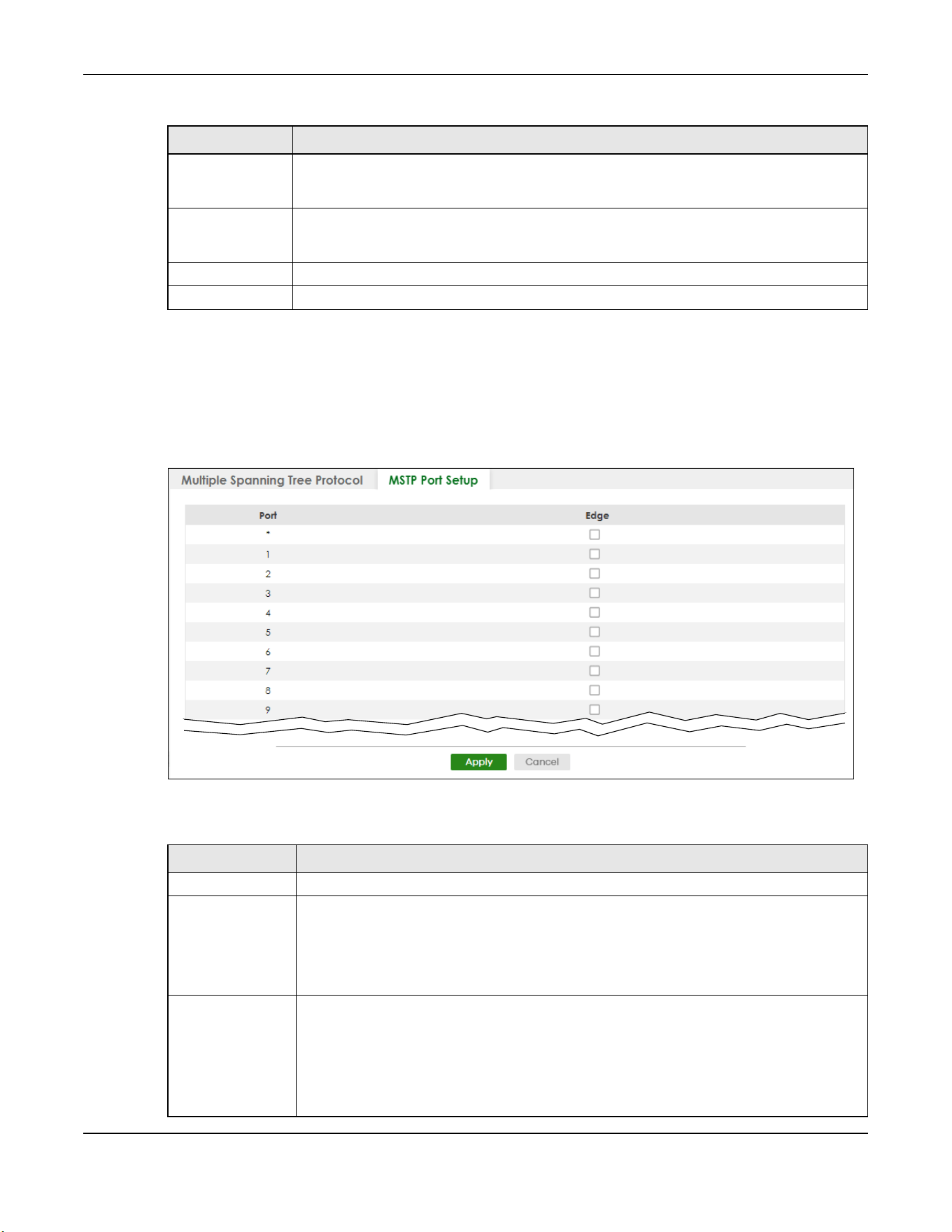
Chapter 45 Spanning Tree Protocol
XMG1915 Series User’s Guide
257
45.8 Multiple Spanning Tree Protocol Port Setup
Click SWITCHING > Spanning Tree Protocol > MSTP > MSTP Port Setup to display the screen as shown next.
Figure 177 SWITCHING > Spanning Tree Protocol > MSTP > MSTP Port Setup
The following table describes the labels in this screen.
Path Cost Path cost is the cost of transmitting a frame on to a LAN through that port. It is recommended
to assign this value according to the speed of the bridge. The slower the media, the higher the
cost.
Apply Click Apply to save your changes to the Switch’s run-time memory. The Switch loses these
changes if it is turned off or loses power, so use the Save link on the top navigation panel to
save your changes to the non-volatile memory when you are done configuring.
Clear Click Clear to clear the fields to the factory defaults.
Cancel Click Cancel to not save the configuration you make and return to the last screen.
Table 137 SWITCHING > Spanning Tree Protocol > MSTP > Multiple Spanning Tree Protocol > Add/Edit
LABEL DESCRIPTION
Table 138 SWITCHING > Spanning Tree Protocol > MSTP > MSTP Port Setup
LABEL DESCRIPTION
Port This field displays the port number. * means all ports.
* Settings in this row apply to all ports.
Use this row only if you want to make some settings the same for all ports. Use this row first to
set the common settings and then make adjustments on a port-by-port basis.
Note: Changes in this row are copied to all the ports as soon as you make them.
Edge Select this check box to configure a port as an edge port when it is directly attached to a
computer. An edge port changes its initial STP port state from blocking state to forwarding
state immediately without going through listening and learning states right after the port is
configured as an edge port or when its link status changes.
Note: An edge port becomes a non-edge port as soon as it receives a Bridge
Protocol Data Unit (BPDU).
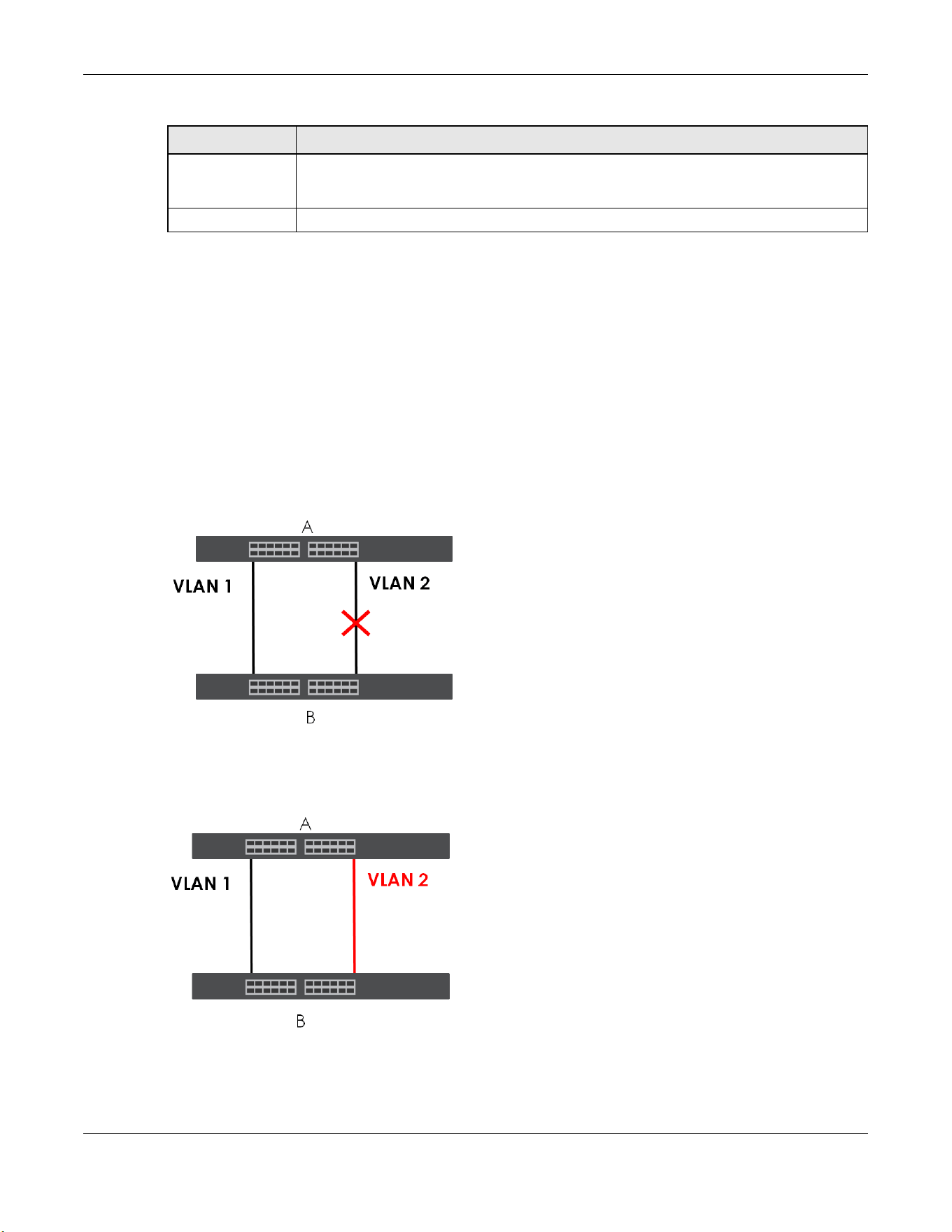
Chapter 45 Spanning Tree Protocol
XMG1915 Series User’s Guide
258
45.9 Technical Reference
This section provides technical background information on the topics discussed in this chapter.
45.9.1 MSTP Network Example
The following figure shows a network example where two VLANs are configured on the two switches. If
the switches are using STP or RSTP, the link for VLAN 2 will be blocked as STP and RSTP allow only one link
in the network and block the redundant link.
Figure 178 STP/RSTP Network Example
With MSTP, VLANs 1 and 2 are mapped to different spanning trees in the network. Therefore traffic from
the two VLANs travel on different paths. The following figure shows the network example using MSTP.
Figure 179 MSTP Network Example
Apply Click Apply to save your changes to the Switch’s run-time memory. The Switch loses these
changes if it is turned off or loses power, so use the Save link on the top navigation panel to
save your changes to the non-volatile memory when you are done configuring.
Cancel Click Cancel to begin configuring this screen afresh.
Table 138 SWITCHING > Spanning Tree Protocol > MSTP > MSTP Port Setup (continued)
LABEL DESCRIPTION
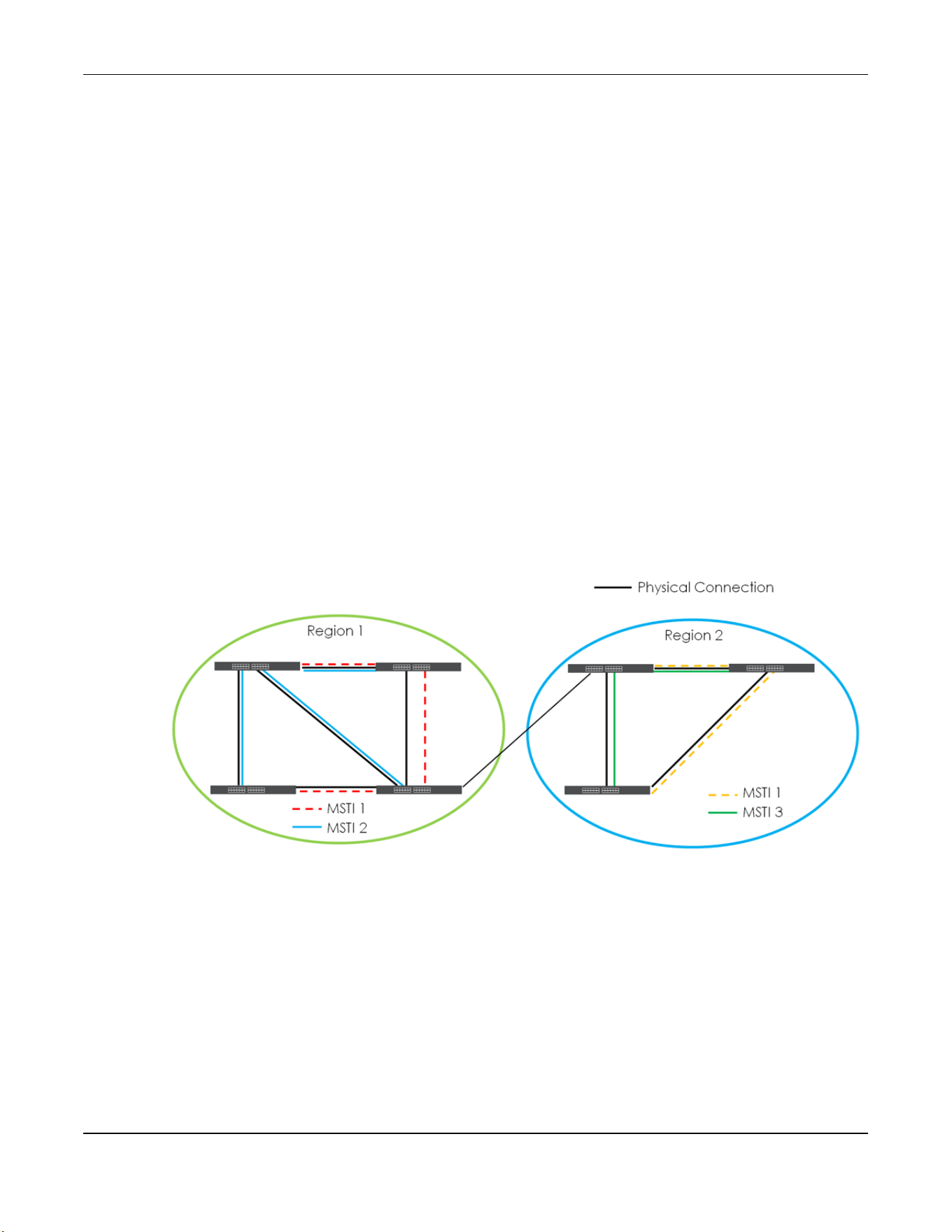
Chapter 45 Spanning Tree Protocol
XMG1915 Series User’s Guide
259
45.9.2 MST Region
An MST region is a logical grouping of multiple network devices that appears as a single device to the
rest of the network. Each MSTP-enabled device can only belong to one MST region. When BPDUs enter
an MST region, external path cost (of paths outside this region) is increased by one. Internal path cost (of
paths within this region) is increased by one when BPDUs traverse the region.
Devices that belong to the same MST region are configured to have the same MSTP configuration
identification settings. These include the following parameters:
• Name of the MST region
• Revision level as the unique number for the MST region
• VLAN-to-MST Instance mapping
45.9.3 MST Instance
An MST Instance (MSTI) is a spanning tree instance. VLANs can be configured to run on a specific MSTI.
Each created MSTI is identified by a unique number (known as an MST ID) known internally to a region.
Therefore an MSTI does not span across MST regions.
The following figure shows an example where there are two MST regions. Regions 1 and 2 have two
spanning tree instances.
Figure 180 MSTIs in Different Regions
45.9.4 Common and Internal Spanning Tree (CIST)
A CIST represents the connectivity of the entire network and it is equivalent to a spanning tree in an STP/
RSTP. The CIST is the default MST instance (MSTID 0). Any VLANs that are not members of an MST instance
are members of the CIST. In an MSTP-enabled network, there is only one CIST that runs between MST
regions and single spanning tree devices. A network may contain multiple MST regions and other
network segments running RSTP.
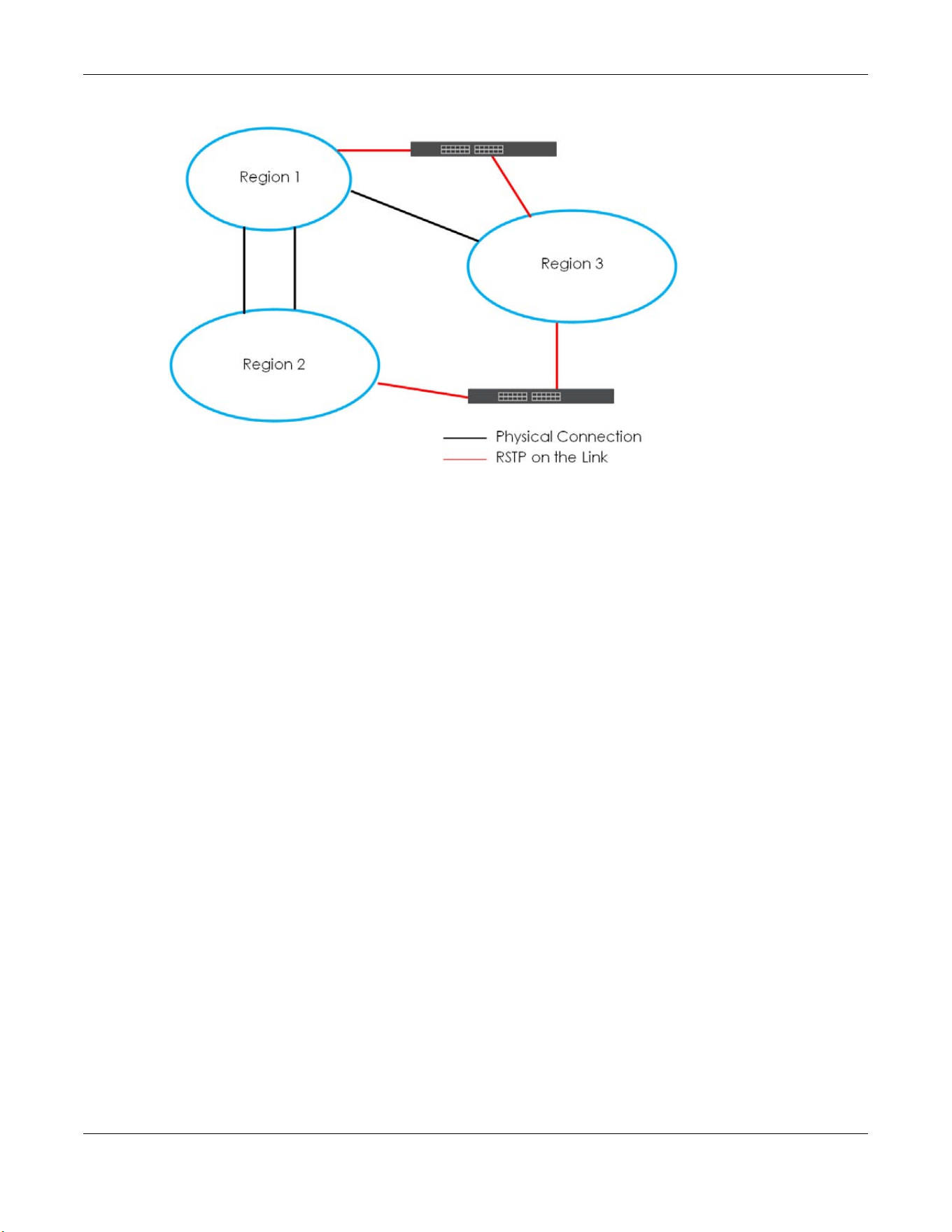
Chapter 45 Spanning Tree Protocol
XMG1915 Series User’s Guide
260
Figure 181 MSTP and Legacy RSTP Network Example
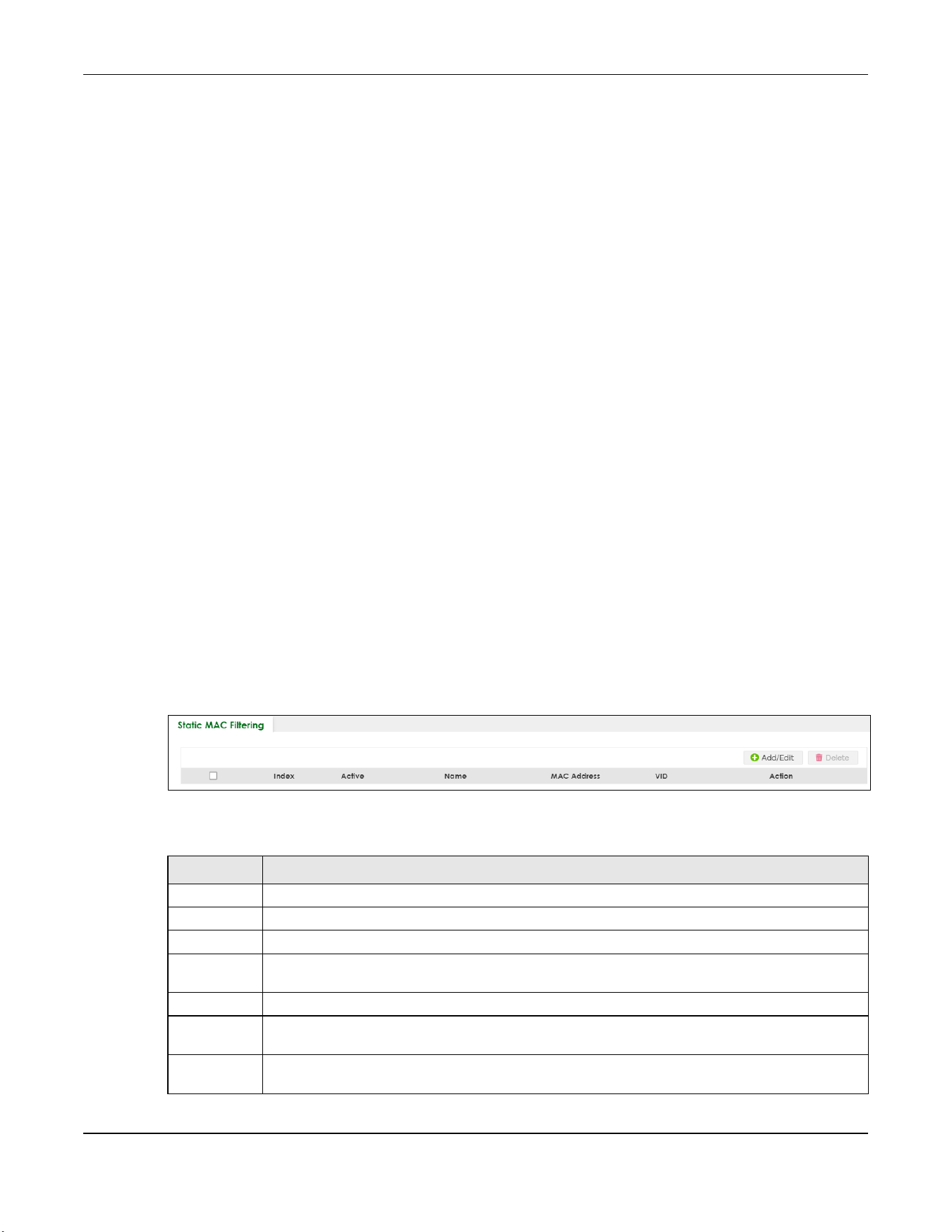
Chapter 46 Static MAC Filtering
XMG1915 Series User’s Guide
261
CHAPTER 46
Static MAC Filtering
46.1 Static MAC Filtering Overview
This chapter discusses MAC address port filtering.
Filtering means sifting traffic going through the Switch based on the source and/or destination MAC
addresses and VLAN group (ID).
46.1.1 What You Can Do
Use the Static MAC Filtering screen (Section 46.2 on page 261) to create rules for traffic going through
the Switch.
46.2 Configure a Static MAC Filtering Rule
Use this screen to view and configure rules for traffic going through the Switch. Click SWITCHING > Static
MAC Filtering in the navigation panel to display the screen as shown next.
Figure 182 SWITCHING > Static MAC Filtering
The following table describes the related labels in this screen.
Table 139 SWITCHING > Static MAC Filtering
LABEL DESCRIPTION
Index This field displays the index number of the rule.
Active This field displays whether the rule is activated or not.
Name This field displays the descriptive name for this rule. This is for identification purpose only.
MAC Address This field displays the source or destination MAC address with the VLAN identification number to
which the MAC address belongs.
VID This field displays the VLAN group identification number.
Action This field displays Discard source, Discard destination, or Discard both depending on what you
configured above.
Select an entry’s check box to select a specific entry. Otherwise, select the check box in the table
heading row to select all entries.
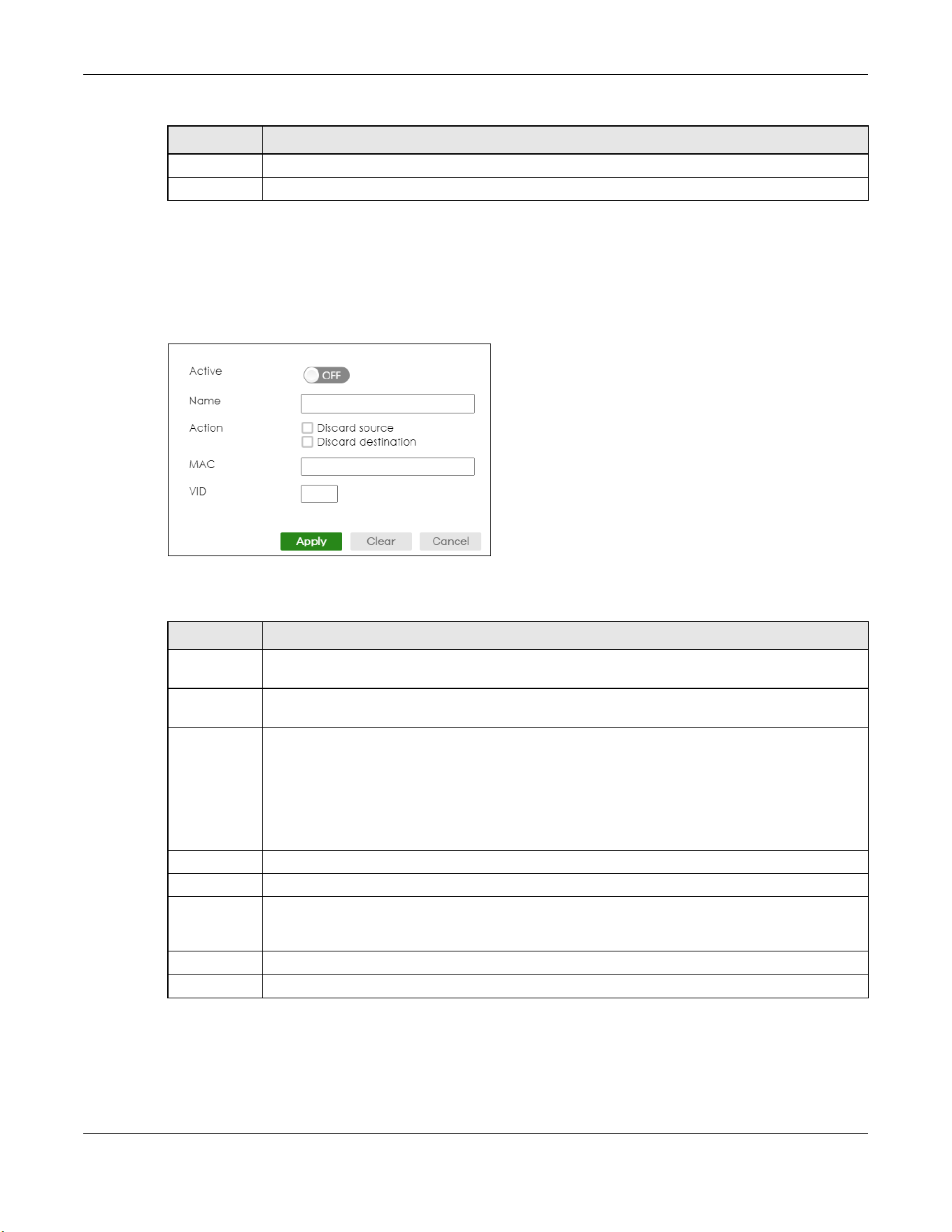
Chapter 46 Static MAC Filtering
XMG1915 Series User’s Guide
262
46.2.1 Add/Edit a Static MAC Filtering Rule
Use this screen to create or edit rules for traffic going through the Switch. Click Add/Edit, or select an
entry and click Add/Edit in the SWITCHING > Static MAC Filtering screen to display this screen.
Figure 183 SWITCHING > Static MAC Filtering > Add/Edit
The following table describes the related labels in this screen.
Add/Edit Click Add/Edit to add a new entry or edit a selected one.
Delete Click Delete to remove the selected entries.
Table 139 SWITCHING > Static MAC Filtering (continued)
LABEL DESCRIPTION
Table 140 SWITCHING > Static MAC Filtering > Add/Edit
LABEL DESCRIPTION
Active Enable the switch button to activate your rule. You may temporarily deactivate a rule without
deleting it by de-selecting this check box.
Name Enter a descriptive name (up to 32 printable ASCII characters excluding [ ? ], [ | ], [ ' ], [ " ] or [ , ]) for
this rule. This is for identification only.
Action Select Discard source to drop the frames from the source MAC address (specified in the MAC field).
The Switch can still send frames to the MAC address.
Select Discard destination to drop the frames to the destination MAC address (specified in the MAC
address). The Switch can still receive frames originating from the MAC address.
Select Discard source and Discard destination to block traffic to or from the MAC address specified
in the MAC field.
MAC Enter a MAC address in valid MAC address format, that is, six hexadecimal character pairs.
VID Enter the VLAN group identification number.
Apply Click Apply to save your changes to the Switch’s run-time memory. The Switch loses these changes
if it is turned off or loses power, so use the Save link on the top navigation panel to save your
changes to the non-volatile memory when you are done configuring.
Clear Click Clear to clear the fields to the factory defaults.
Cancel Click Cancel to not save the configuration you make and return to the last screen.
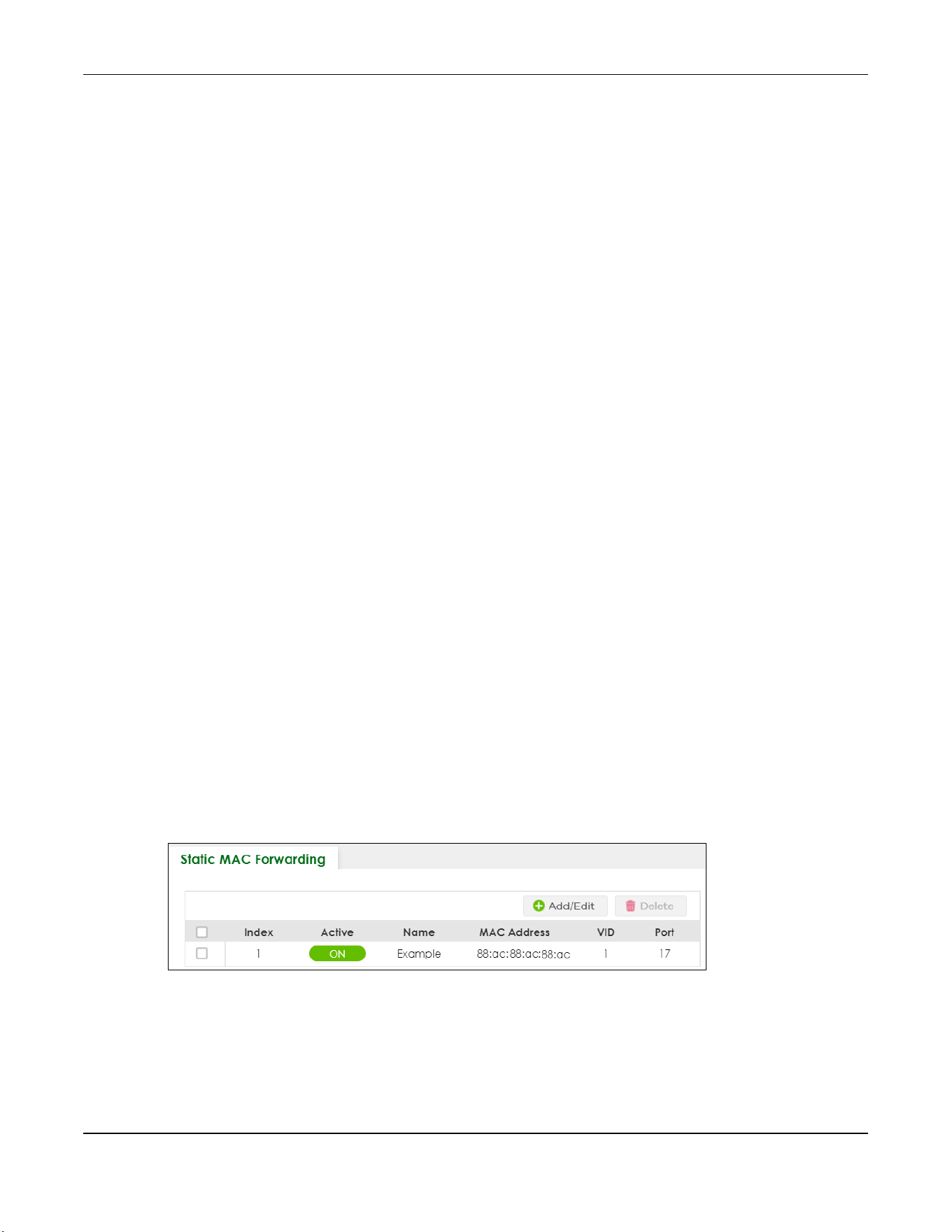
Chapter 47 Static MAC Forwarding
XMG1915 Series User’s Guide
263
CHAPTER 47
Static MAC Forwarding
47.1 Static MAC Forwarding Overview
This chapter discusses how to configure forwarding rules based on MAC addresses of devices on your
network.
Use these screens to configure static MAC address forwarding.
47.1.1 What You Can Do
Use the Static MAC Forwarding screen (Section 47.2 on page 263) to assign static MAC addresses for a
port.
47.2 Configure Static MAC Forwarding
A static MAC address is an address that has been manually entered in the MAC address table. Static
MAC addresses do not age out. When you set up static MAC address rules, you are setting static MAC
addresses for a port. This may reduce the need for broadcasting.
Static MAC address forwarding together with port security allow only computers in the MAC address
table on a port to access the Switch.
Click SWITCHING > Static MAC Forwarding in the navigation panel to display the configuration screen as
shown.
Figure 184 SWITCHING > Static MAC Forwarding
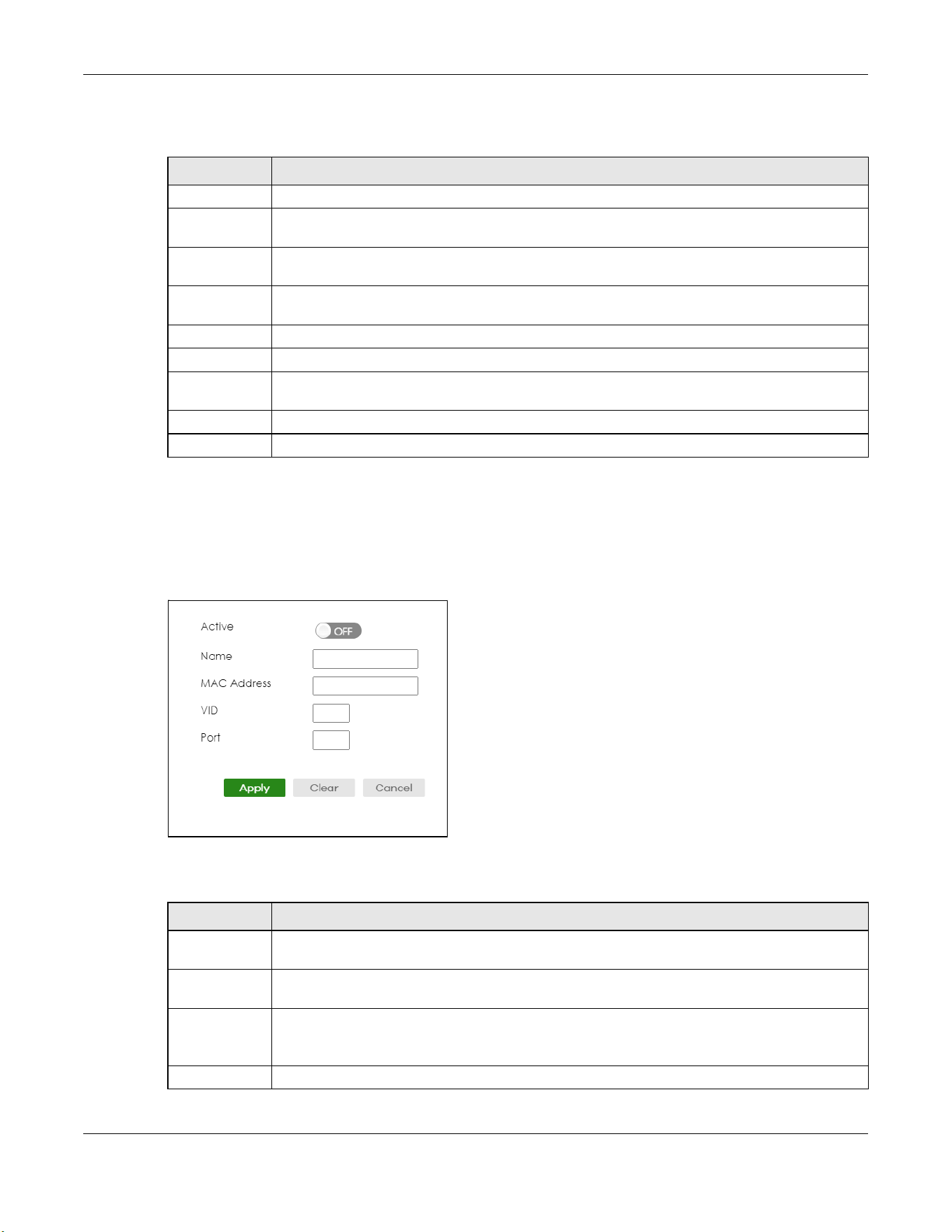
Chapter 47 Static MAC Forwarding
XMG1915 Series User’s Guide
264
The following table describes the labels in this screen.
47.2.1 Add/Edit Static MAC Forwarding Rules
Click Add/Edit, or select an entry and click Add/Edit in the SWITCHING > Static MAC Forwarding screen
to display this screen.
Figure 185 SWITCHING > Static MAC Forwarding > Add/Edit
The following table describes the labels in this screen.
Table 141 SWITCHING > Static MAC Forwarding
LABEL DESCRIPTION
Index This is the index number of a static MAC address rule.
Active This field displays whether this static MAC address forwarding rule is active. You may temporarily
deactivate a rule without deleting it.
Name This field displays the descriptive name for identification purposes for this static MAC address-
forwarding rule.
MAC Address This field displays the MAC address that will be forwarded and the VLAN identification number to
which the MAC address belongs.
VID This field displays the ID number of the VLAN group.
Port This field displays the port where the MAC address shown in the next field will be forwarded.
Select an entry’s check box to select a specific entry. Otherwise, select the check box in the table
heading row to select all entries.
Add/Edit Click Add/Edit to add a new rule or edit a selected one.
Delete Click Delete to remove the selected rules.
Table 142 SWITCHING > Static MAC Forwarding > Add/Edit
LABEL DESCRIPTION
Active Enable the switch button to activate your rule. You may temporarily deactivate a rule without
deleting it by disabling the switch.
Name Enter a descriptive name for identification purposes for this static MAC address forwarding rule.
You can enter up to 32 printable ASCII characters except [ ? ], [ | ], [ ' ], [ " ] or [ , ].
MAC Address Enter the MAC address in valid MAC address format, that is, six hexadecimal character pairs.
Note: Static MAC addresses do NOT age out.
VID Enter the VLAN identification number.

Chapter 47 Static MAC Forwarding
XMG1915 Series User’s Guide
265
Port Enter the port where the MAC address entered in the previous field will be automatically
forwarded.
Apply Click Apply to save your changes to the Switch’s run-time memory. The Switch loses these
changes if it is turned off or loses power, so use the Save link on the top navigation panel to save
your changes to the non-volatile memory when you are done configuring.
Clear Click Clear to clear the fields to the factory defaults.
Cancel Click Cancel to not save the configuration you make and return to the last screen.
Table 142 SWITCHING > Static MAC Forwarding > Add/Edit (continued)
LABEL DESCRIPTION

XMG1915 Series User’s Guide
266
CHAPTER 48
VLAN
48.1 VLAN Overview
This chapter shows you how to configure 802.1Q tagged and port-based VLANs.
48.1.1 What You Can Do
• Use the VLAN Status screen (Section 48.3 on page 269) to view and search all static VLAN groups.
• Use the VLAN Status Details screen (Section 48.3.1 on page 269) to view detailed port settings and
status of the static VLAN group.
• Use the Static VLAN Setup screen (Section 48.4 on page 270) to configure a static VLAN for the Switch.
• Use the VLAN Port Setup screen (Section 48.5 on page 272) to configure the static VLAN (IEEE 802.1Q)
settings on a port.
• Use the Voice VLAN Setup screen (Section 48.6 on page 273) to set up VLANs that allow you to group
voice traffic with defined priority and enable the Switch port to carry the voice traffic separately from
data traffic to ensure the sound quality does NOT deteriorate.
• Use the MAC Based VLAN Setup screen (Section 48.7 on page 275) to set up VLANs that allow you to
group untagged packets into logical VLANs based on the source MAC address of the packet. This
eliminates the need to reconfigure the Switch when you change ports. The Switch will forward the
packets based on the source MAC address you set up previously.
• Use the Vendor ID Based VLAN Setup screen (Section 48.8 on page 277) to set up VLANs that allow
you to group untagged packets into logical VLANs based on the source MAC address of the packet.
You can specify a mask for the MAC address to create a MAC address filter and enter a weight to set
the VLAN rule’s priority.
• Use the Port-Based VLAN Setup screen (Section 48.9 on page 278) to set up VLANs where the packet
forwarding decision is based on the destination MAC address and its associated port.
48.1.2 What You Need to Know
Read this section to know more about VLAN and how to configure the screens.
48.2 Introduction to IEEE 802.1Q Tagged VLANs
A tagged VLAN uses an explicit tag (VLAN ID) in the MAC header to identify the VLAN membership of a
frame across bridges
– they are not confined to the switch on which they were created. The VLANs can
be created statically by hand. The VLAN ID associates a frame with a specific VLAN and provides the
information that switches need to process the frame across the network. A tagged frame is 4 bytes
longer than an untagged frame and contains 2 bytes (16 Bits) of TPID (Tag Protocol Identifier, residing
within the type or length field of the Ethernet frame) and 2 bytes (16 Bits) of TCI (Tag Control Information,
starts after the source address field of the Ethernet frame). The TCI field consists of three fields: User
Priority, CFI (Canonical Format Indicator), and VLAN ID.

Chapter 48 VLAN
XMG1915 Series User’s Guide
267
A tagged VLAN uses an explicit tag (VLAN ID) in the MAC header to identify the VLAN membership of a
frame across bridges
– they are not confined to the switch on which they were created. The VLANs can
be created statically by hand or dynamically through GVRP. The VLAN ID associates a frame with a
specific VLAN and provides the information that switches need to process the frame across the network.
A tagged frame is 4 bytes longer than an untagged frame and contains 2 bytes of TPID (Tag Protocol
Identifier, residing within the type or length field of the Ethernet frame) and 2 bytes of TCI (Tag Control
Information, starts after the source address field of the Ethernet frame).
The CFI (Canonical Format Indicator) is a single-bit flag, always set to zero for Ethernet switches. If a
frame received at an Ethernet port has a CFI set to 1, then that frame should not be forwarded as it is to
an untagged port. The remaining twelve bits define the VLAN ID, giving a possible maximum number of
4096 VLANs. Note that user priority and VLAN ID are independent of each other. A frame with VID (VLAN
Identifier) of null (0) is called a priority frame, meaning that only the priority level is significant and the
default VID of the ingress port is given as the VID of the frame. Of the 4096 possible VIDs, a VID of 0 is
used to identify priority frames and value 4095 (FFF) is reserved, so the maximum possible VLAN
configurations are 4094.
Forwarding Tagged and Untagged Frames
Each port on the Switch is capable of passing tagged or untagged frames. To forward a frame from an
802.1Q VLAN-aware switch to an 802.1Q VLAN-unaware switch, the Switch first decides where to
forward the frame and then strips off the VLAN tag. To forward a frame from an 802.1Q VLAN-unaware
switch to an 802.1Q VLAN-aware switch, the Switch first decides where to forward the frame, and then
inserts a VLAN tag reflecting the ingress port's default VID. The default PVID is VLAN 1 for all ports, but this
can be changed.
A broadcast frame (or a multicast frame for a multicast group that is known by the system) is duplicated
only on ports that are members of the VID (except the ingress port itself), thus confining the broadcast to
a specific domain.
48.2.0.1 Port VLAN Trunking
Enable VLAN Trunking on a port to allow frames belonging to unknown VLAN groups to pass through
that port. This is useful if you want to set up VLAN groups on end devices without having to configure the
same VLAN groups on intermediary devices.
Refer to the following figure. Suppose you want to create VLAN groups 1 and 2 (V1 and V2) on devices
A and B. Without VLAN Trunking, you must configure VLAN groups 1 and 2 on all intermediary switches C,
D and E; otherwise they will drop frames with unknown VLAN group tags. However, with VLAN Trunking
enabled on ports in each intermediary switch you only need to create VLAN groups in the end devices
(A and B). C, D and E automatically allow frames with VLAN group tags 1 and 2 (VLAN groups that are
unknown to those switches) to pass through their VLAN trunking ports.
TPID
16 Bits
User Priority
3 Bits
CFI
1 Bit
VLAN ID
12 Bits
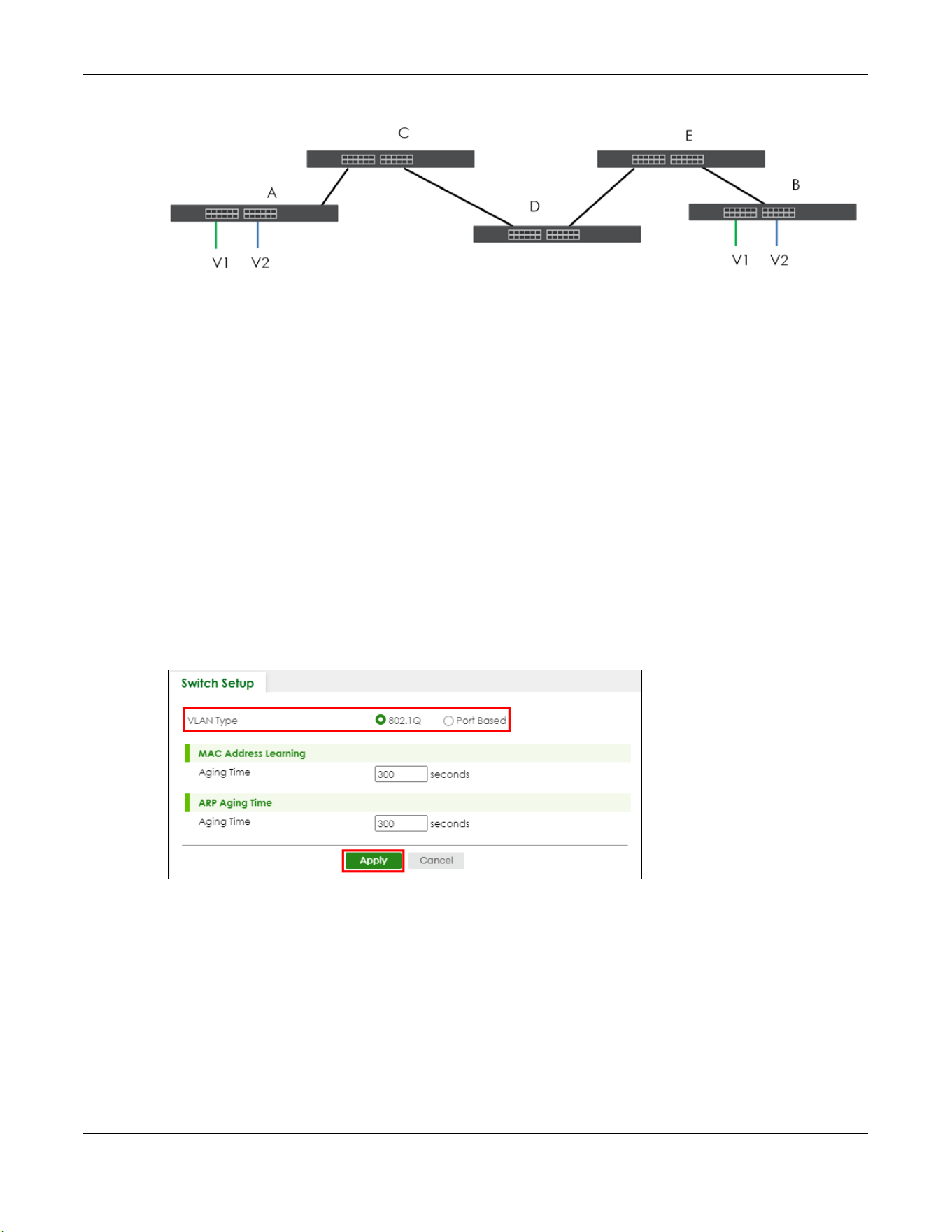
Chapter 48 VLAN
XMG1915 Series User’s Guide
268
Figure 186 Port VLAN Trunking
48.2.0.2 VLAN Priority
At the time of writing, you can create static VLANs, Voice VLANs, MAC-based VLANs and Vendor ID-
based VLANs on the Switch when the VLAN type is set to 802.1Q. When a packet is received, the Switch
processes the VLAN rules in sequence. The sequence (priority) of the VLANs is:
1 Vendor ID Based VLAN
2 Voice VLAN
3 MAC Based VLAN
If the packet matches a VLAN rule that has a higher priority, for example, an entry with weight 250 in the
vendor ID to VLAN mapping table, the Switch assigns the corresponding VLAN ID to the packet and
stops checking the subsequent VLAN rules.
48.2.0.3 Select the VLAN Type
Select a VLAN type in the SYSTEM > Switch Setup screen.
Figure 187 SYSTEM > Switch Setup: Select VLAN Type
802.1Q Static VLAN
Make sure 802.1Q is selected in the SYSTEM > Switch Setup screen.
Use a static VLAN to decide whether an incoming frame on a port should be
• sent to a VLAN group as normal depending on its VLAN tag.
• sent to a group whether it has a VLAN tag or not.
• blocked from a VLAN group regardless of its VLAN tag.

Chapter 48 VLAN
XMG1915 Series User’s Guide
269
You can also tag all outgoing frames (that were previously untagged) from a port with the specified
VID.
48.3 VLAN Status
Use this screen to view and search all static VLAN groups. Click SWITCHING > VLAN > VLAN Status from
the navigation panel to display the screen as shown next.
Figure 188 SWITCHING > VLAN > VLAN Status
The following table describes the labels in this screen.
48.3.1 VLAN Details
Use this screen to view detailed port settings and status of the static VLAN group. Click an index number
in the VLAN Status screen to display VLAN details.
Table 143 SWITCHING > VLAN > VLAN Status
LABEL DESCRIPTION
VLAN Search by
VID
Enter (an) existing VLAN ID numbers (use a comma (,) to separate individual VLANs or a hyphen
(-) to indicate a range of VLANs. For example, “3,4” or “3-9”) and click Search to display only the
specified VLANs in the list below.
Leave this field blank and click Search to display all VLANs configured on the Switch.
The Number of
VLAN
This is the number of VLANs configured on the Switch.
The Number of
Search Results
This is the number of VLANs that match the searching criteria and display in the list below.
This field displays only when you use the Search button to look for certain VLANs.
Index This is the VLAN index number. Click an index number to view more VLAN details.
VID This is the VLAN identification number that was configured in the corresponding VLAN
configuration screen.
Name This fields shows the descriptive name of the VLAN.
Tagged Port This field shows the tagged ports that are participating in the VLAN.
Untagged Port This field shows the untagged ports that are participating in the VLAN.
Elapsed Time This field shows how long it has been since a normal VLAN was registered or a static VLAN was
set up.
Status This field shows how this VLAN was added to the Switch.
Static: added as a permanent entry.
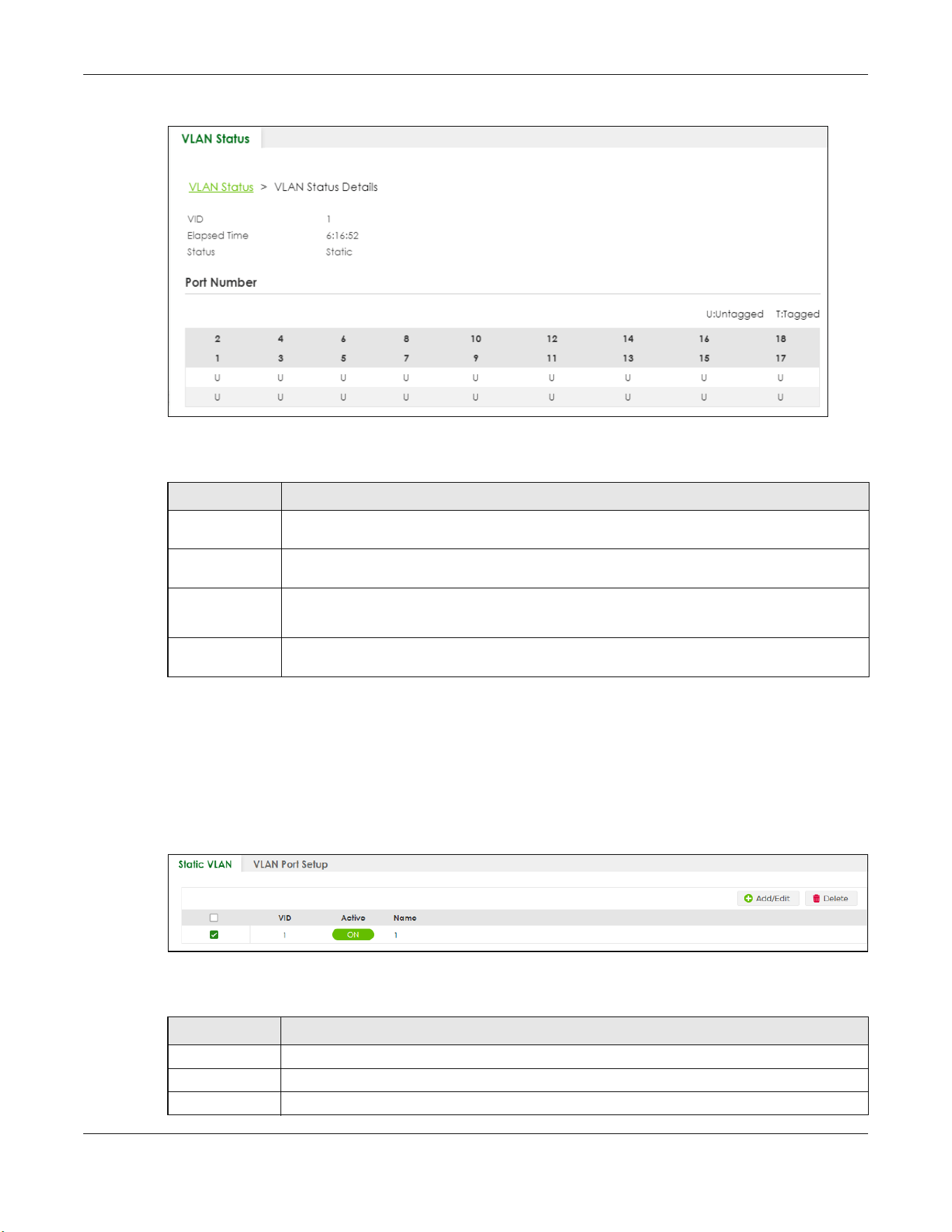
Chapter 48 VLAN
XMG1915 Series User’s Guide
270
Figure 189 SWITCHING > VLAN > VLAN Status > VLAN Status Details
The following table describes the labels in this screen.
48.4 Configure a Static VLAN
Use this screen to view and configure a static VLAN for the Switch. Click SWITCHING > VLAN > VLAN
Setup > Static VLAN to display the screen as shown next.
Figure 190 SWITCHING > VLAN > VLAN Setup > Static VLAN
The following table describes the related labels in this screen.
Table 144 SWITCHING > VLAN > VLAN Status > VLAN Status Details
LABEL DESCRIPTION
VID This is the VLAN identification number that was configured in the corresponding VLAN
configuration screen.
Elapsed Time This field shows how long it has been since a normal VLAN was registered or a static VLAN was
set up.
Status This field shows how this VLAN was added to the Switch.
Static: added as a permanent entry.
Port Number This section displays the ports that are participating in a VLAN. A tagged port is marked as T, an
untagged port is marked as U and ports not participating in a VLAN are marked as “–“.
Table 145 SWITCHING > VLAN > VLAN Setup > Static VLAN
LABEL DESCRIPTION
VID This field displays the ID number of the VLAN group.
Active This field indicates whether the VLAN settings are enabled or disabled.
Name This field displays the descriptive name for this VLAN group.
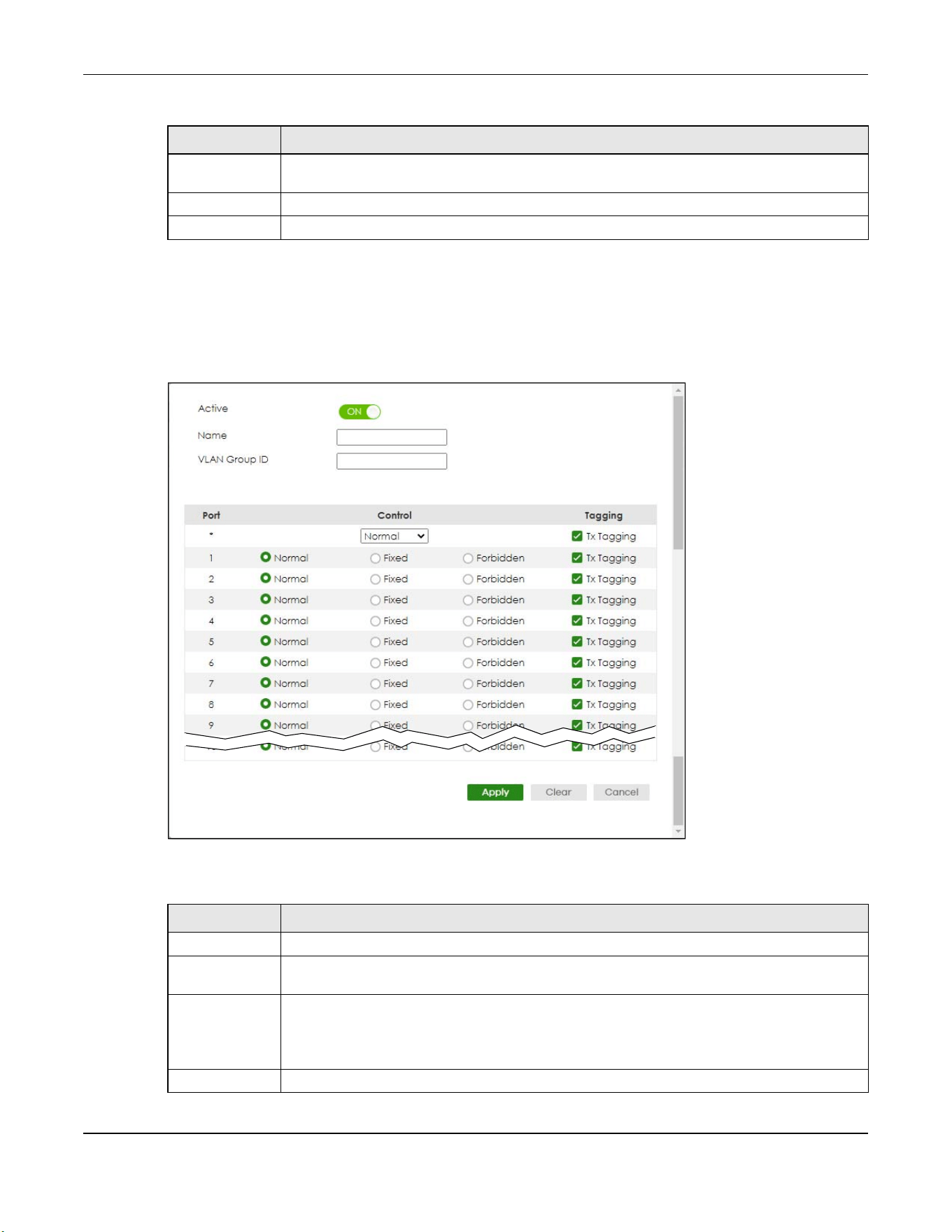
Chapter 48 VLAN
XMG1915 Series User’s Guide
271
48.4.1 Add/Edit a Static VLAN
Use this screen to configure a static VLAN for the Switch. Click Add/Edit, or select an entry and click
Add/Edit in the SWITCHING > VLAN > VLAN Setup > Static VLAN screen to display this screen.
Figure 191 SWITCHING > VLAN > VLAN Setup > Static VLAN > Add/Edit
The following table describes the related labels in this screen.
Select an entry’s check box to select a specific entry. Otherwise, select the check box in the
table heading row to select all entries.
Add/Edit Click Add/Edit to add a new static VLAN or edit a selected one.
Delete Click Delete to remove the selected static VLAN.
Table 145 SWITCHING > VLAN > VLAN Setup > Static VLAN (continued)
LABEL DESCRIPTION
Table 146 SWITCHING > VLAN > VLAN Setup > Static VLAN > Add/Edit
LABEL DESCRIPTION
Active Enable the switch button to activate the VLAN settings.
Name Enter a descriptive name for the VLAN group for identification purposes. This name consists of up
to 64 printable ASCII characters. The string should not contain [ ? ], [ | ], [ ' ], [ " ] or [ , ].
VLAN Group ID Enter the VLAN ID for this static entry; the valid range is between 1 and 4094.
Note: Do NOT add a VLAN ID that has been used in the SWITCHING > VLAN > Voice
VLAN Setup.
Port The port number identifies the port you are configuring.
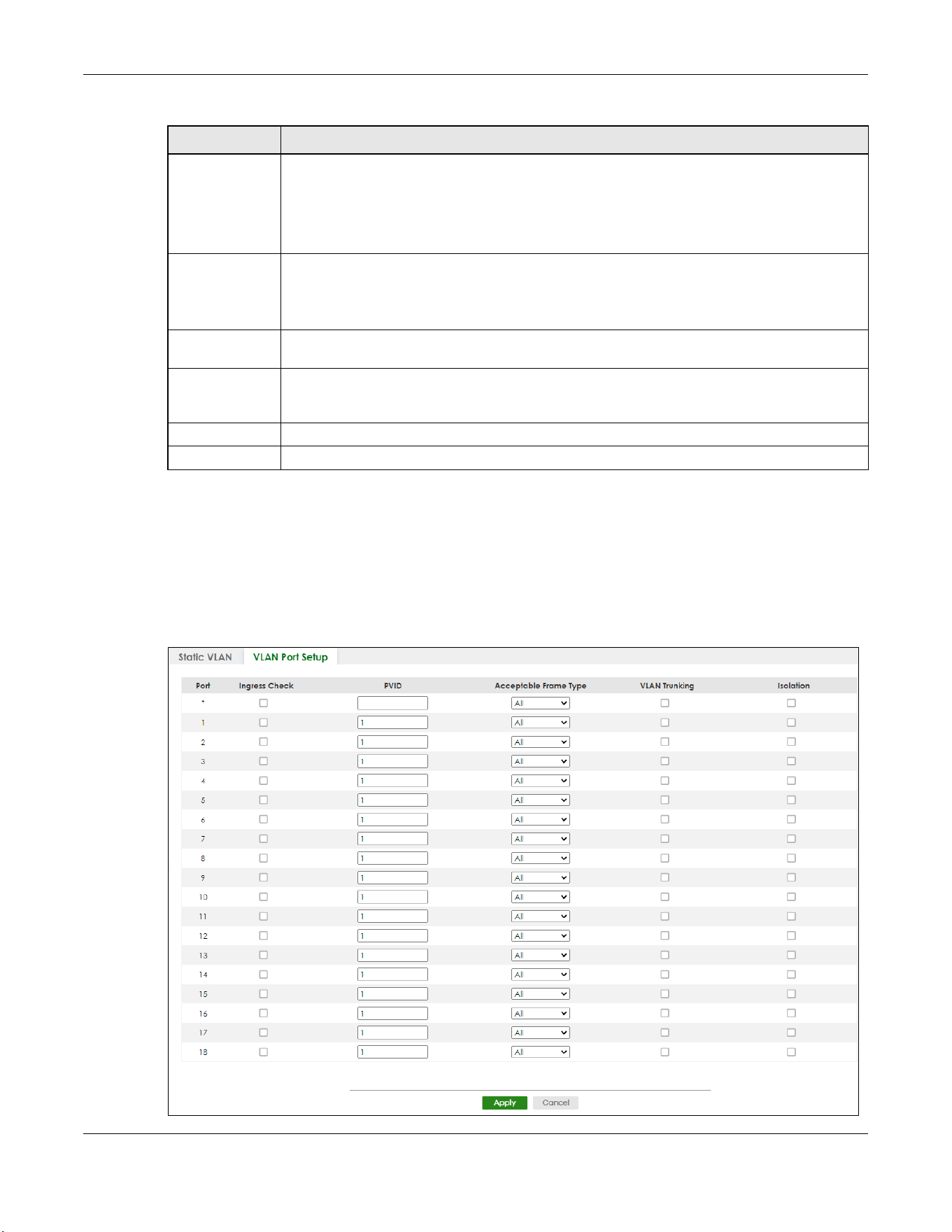
Chapter 48 VLAN
XMG1915 Series User’s Guide
272
48.5 VLAN Port Setup
Use this screen to configure the static VLAN (IEEE 802.1Q) settings on a port. Click SWITCHING > VLAN >
VLAN Setup > VLAN Port Setup to display the screen as shown.
Figure 192 SWITCHING > VLAN > VLAN Setup > VLAN Port Setup
* Settings in this row apply to all ports.
Use this row only if you want to make some settings the same for all ports. Use this row first to set
the common settings and then make adjustments on a port-by-port basis.
Note: Changes in this row are copied to all the ports as soon as you make them.
Control Select Normal for the port to dynamically join this VLAN group. This is the default selection.
Select Fixed for the port to be a permanent member of this VLAN group.
Select Forbidden if you want to prohibit the port from joining this VLAN group.
Tagging Select Tx Tagging if you want the port to tag all outgoing frames transmitted with this VLAN
Group ID.
Apply Click Apply to save your changes to the Switch’s run-time memory. The Switch loses these
changes if it is turned off or loses power, so use the Save link on the top navigation panel to save
your changes to the non-volatile memory when you are done configuring.
Clear Click Clear to clear the fields to the factory defaults.
Cancel Click Cancel to not save the configuration you make and return to the last screen.
Table 146 SWITCHING > VLAN > VLAN Setup > Static VLAN > Add/Edit (continued)
LABEL DESCRIPTION

Chapter 48 VLAN
XMG1915 Series User’s Guide
273
The following table describes the labels in this screen.
48.6 Voice VLAN
Voice VLAN is a VLAN that is specifically allocated for voice traffic. It ensures that the sound quality of an
IP phone is preserved from deteriorating when the data traffic on the Switch ports is high. It groups the
voice traffic with defined priority into an assigned VLAN which enables the separation of voice and
data traffic coming onto the Switch port.
The Switch can determine whether a received packet is
• an untagged voice packet when the incoming port is a fixed port for voice VLAN.
• a tagged voice packet when the incoming port and VLAN tag belongs to a voice VLAN.
It then checks the source packet’s MAC address against an OUI list. If a match is found, the packet is
considered as a voice packet.
Table 147 SWITCHING > VLAN > VLAN Setup > VLAN Port Setup
LABEL DESCRIPTION
Port This field displays the port number.
* Settings in this row apply to all ports.
Use this row only if you want to make some settings the same for all ports. Use this row first to set
the common settings and then make adjustments on a port-by-port basis.
Note: Changes in this row are copied to all the ports as soon as you make them.
Ingress Check If this check box is selected, the Switch discards incoming frames on a port for VLANs that do
not include this port in its member set.
Clear this check box to disable ingress filtering.
PVID A PVID (Port VLAN ID) is a tag that adds to incoming untagged frames received on a port so
that the frames are forwarded to the VLAN group that the tag defines.
Enter a number between 1and 4094 as the port VLAN ID.
Acceptable
Frame Type
Specify the type of frames allowed on a port. Choices are All, Tag Only and Untag Only.
Select All from the drop-down list box to accept all untagged or tagged frames on this port.
This is the default setting.
Select Tag Only to accept only tagged frames on this port. All untagged frames will be
dropped.
Select Untag Only to accept only untagged frames on this port. All tagged frames will be
dropped.
VLAN Trunking Enable VLAN Trunking on ports connected to other switches or routers (but not ports directly
connected to end users) to allow frames belonging to unknown VLAN groups to pass through
the Switch.
Isolation Select this to allows this port to communicate only with the CPU management port and the
ports on which the isolation feature is NOT enabled.
Apply Click Apply to save your changes to the Switch’s run-time memory. The Switch loses these
changes if it is turned off or loses power, so use the Save link on the top navigation panel to
save your changes to the non-volatile memory when you are done configuring.
Cancel Click Cancel to begin configuring this screen afresh.
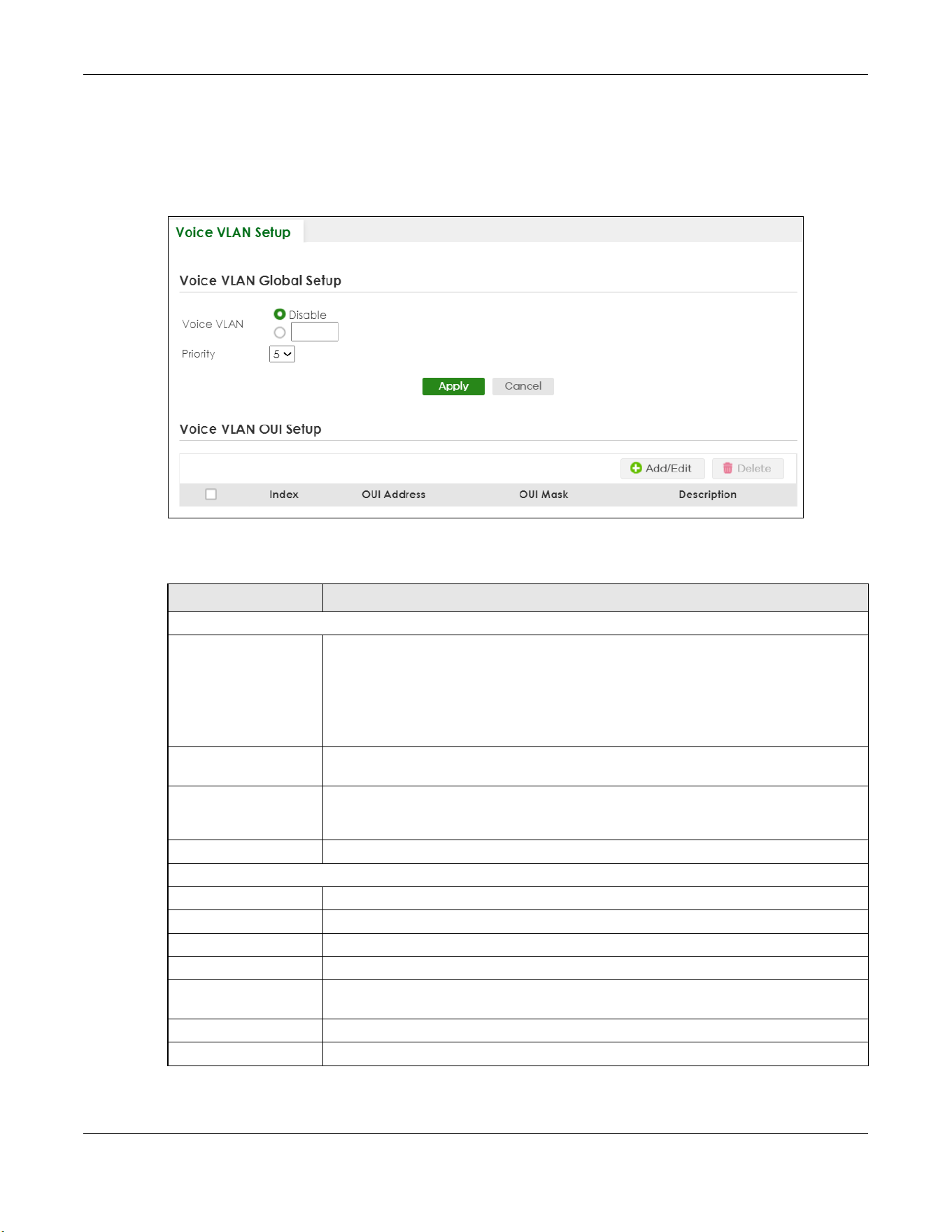
Chapter 48 VLAN
XMG1915 Series User’s Guide
274
You can set priority level to the Voice VLAN and add MAC address of IP phones from specific
manufacturers by using its ID from the Organizationally Unique Identifiers (OUI).
Click SWITCHING > VLAN > Voice VLAN Setup to display the configuration screen as shown.
Figure 193 SWITCHING > VLAN > Voice VLAN Setup
The following table describes the fields in the above screen.
Table 148 SWITCHING > VLAN > Voice VLAN Setup
LABEL DESCRIPTION
Voice VLAN Global Setup
Voice VLAN Click the second radio button if you want to enable the Voice VLAN feature. Enter a
VLAN ID number in the box next to the radio button that is associated with the Voice
VLAN. You also need to create a static VLAN with the same VID in the SWITCHING > VLAN
> VLAN Setup > Static VLAN screen, and then connect the IP phone with the specified
OUI MAC address to a port that joins the static VLAN.
Click Disable radio button if you do not want to enable the Voice VLAN feature.
Priority Select the priority level of the voice traffic from 0 to 7. Default setting is 5. The higher the
numeric value you assign, the higher the priority for this voice traffic.
Apply Click Apply to save your changes to the Switch’s run-time memory. The Switch loses these
changes if it is turned off or loses power, so use the Save link on the top navigation panel
to save your changes to the non-volatile memory when you are done configuring.
Cancel Click Cancel to begin configuring this section afresh.
Voice VLAN OUI Setup
Index This field displays the index number of the Voice VLAN.
OUI Address This field displays the OUI address of the Voice VLAN.
OUI Mask This field displays the OUI mask address of the Voice VLAN.
Description This field displays the description of the Voice VLAN with OUI address.
Select an entry’s check box to select a specific entry. Otherwise, select the check box in
the table heading row to select all entries.
Add/Edit Click Add/Edit to add a new entry or edit a selected one.
Delete Click Delete to remove the selected entry.
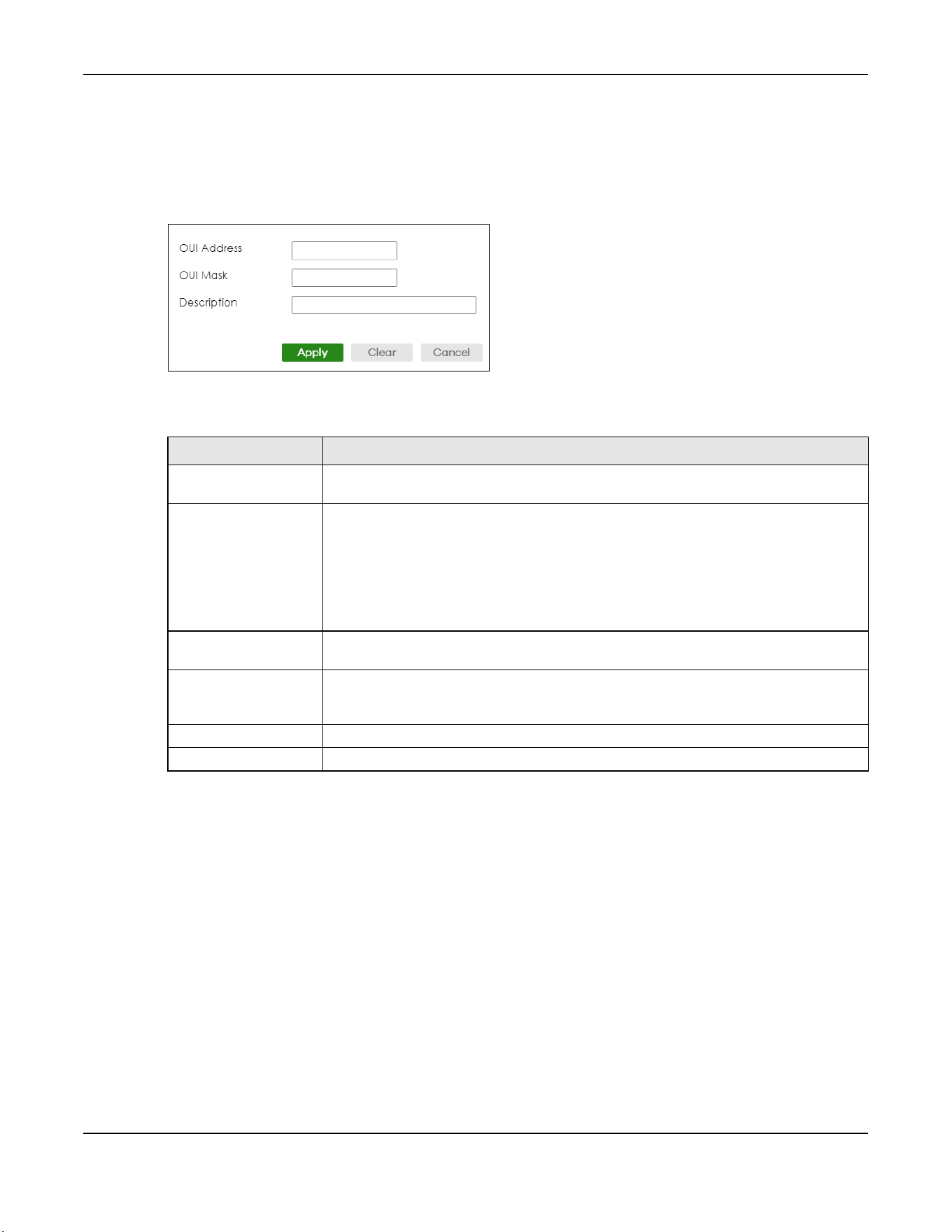
Chapter 48 VLAN
XMG1915 Series User’s Guide
275
48.6.1 Add/Edit a Voice VLAN
Click Add/Edit, or select an entry and click Add/Edit in the SWITCHING > VLAN > Voice VLAN Setup
screen to display the configuration screen.
Figure 194 SWITCHING > VLAN > Voice VLAN Setup > Add/Edit
The following table describes the fields in the above screen.
48.7 MAC Based VLAN
The MAC-based VLAN feature assigns incoming untagged packets to a VLAN and classifies the traffic
based on the source MAC address of the packet. When untagged packets arrive at the Switch, the
source MAC address of the packet is looked up in a MAC to VLAN mapping table. If an entry is found,
the corresponding VLAN ID is assigned to the packet. The assigned VLAN ID is verified against the VLAN
table. If the VLAN is valid, ingress processing on the packet continues; otherwise, the packet is dropped.
This feature allows users to change ports without having to reconfigure the VLAN. You can assign priority
to the MAC-based VLAN and define a MAC to VLAN mapping table by entering a specified source
MAC address in the MAC-based VLAN setup screen. You can also delete a MAC-based VLAN entry in
the same screen.
Click SWITCHING > VLAN > MAC Based VLAN Setup to see the following screen.
Table 149 SWITCHING > VLAN > Voice VLAN Setup > Add/Edit
LABEL DESCRIPTION
OUI Address Enter the IP phone manufacturer’s OUI MAC address. The first 3 bytes is the manufacturer
identifier, the last 3 bytes is a unique station ID.
OUI Mask Enter the mask for the specified IP phone manufacturer’s OUI MAC address to determine
which bits a packet’s MAC address should match.
Enter “f” for each bit of the specified MAC address that the traffic’s MAC address should
match. Enter “0” for the bits of the matched traffic’s MAC address, which can be of any
hexadecimal characters. For example, if you set the MAC address to 00:13:49:00:00:00
and the mask to ff:ff:ff:00:00:00, a packet with a MAC address of 00:13:49:12:34:56
matches this criteria.
Description Enter a description up to 32 printable ASCII characters except [ ? ], [ | ], [ ' ], or [ " ] for the
Voice VLAN device. For example: Siemens.
Apply Click Apply to save your changes to the Switch’s run-time memory. The Switch loses these
changes if it is turned off or loses power, so use the Save link on the top navigation panel
to save your changes to the non-volatile memory when you are done configuring.
Clear Click Clear to clear the fields to the factory defaults.
Cancel Click Cancel to not save the configuration you make and return to the last screen.
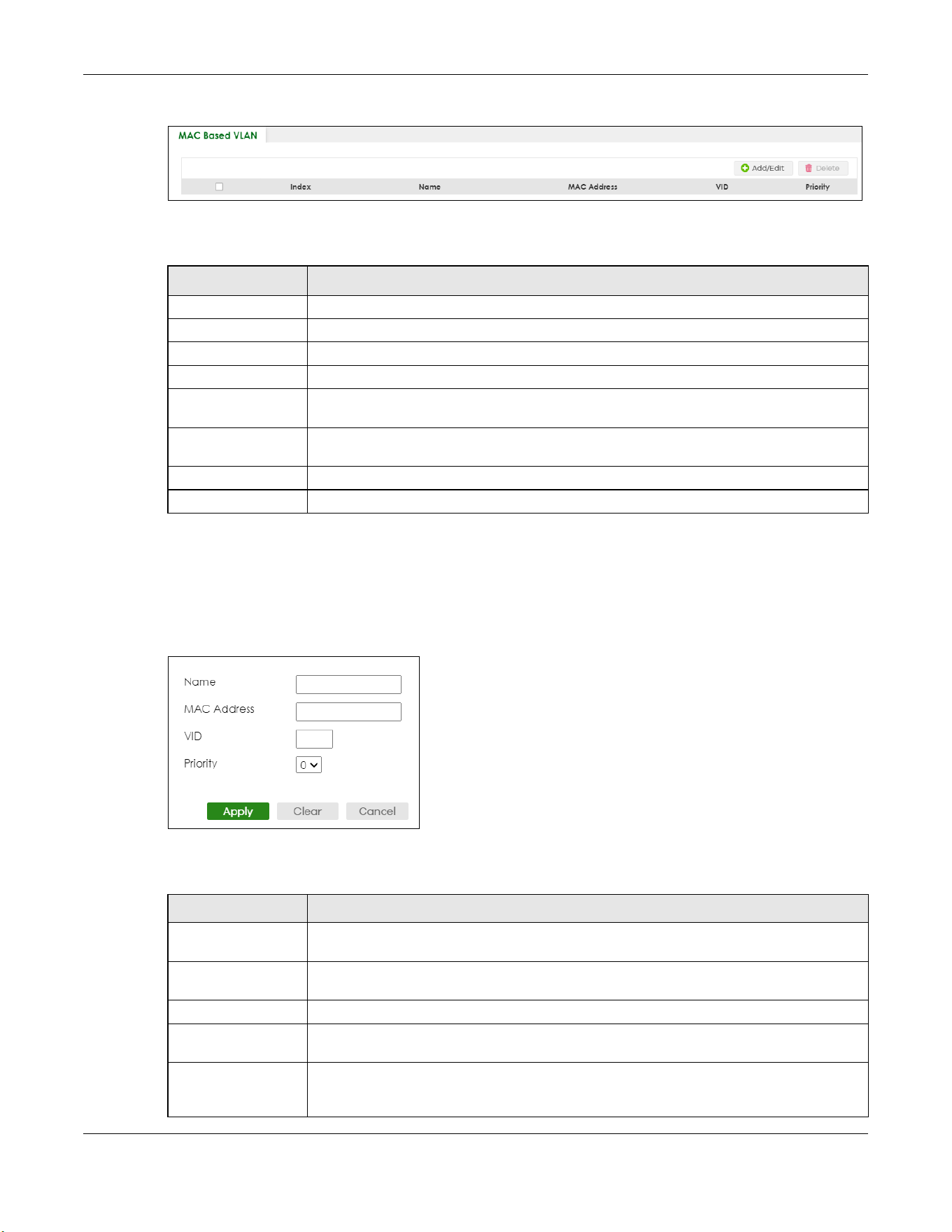
Chapter 48 VLAN
XMG1915 Series User’s Guide
276
Figure 195 SWITCHING > VLAN > MAC Based VLAN Setup
The following table describes the fields in the above screen.
48.7.1 Add/Edit a MAC Based VLAN
Click Add/Edit, or select an entry and click Add/Edit in the SWITCHING > VLAN > MAC Based VLAN Setup
screen to see this screen.
Figure 196 SWITCHING > VLAN > MAC Based VLAN Setup > Add/Edit
The following table describes the fields in the above screen.
Table 150 SWITCHING > VLAN > MAC Based VLAN Setup
LABEL
DESCRIPTION
Index This field displays the index number of the MAC-based VLAN entry.
Name This field displays the name of the MAC-based VLAN entry.
MAC Address This field displays the source MAC address that is bind to the MAC-based VLAN entry.
VID This field displays the VLAN ID of the MAC-based VLAN entry.
Priority This field displays the priority level which is assigned to frames belonging to this MAC-based
VLAN entity.
Select an entry’s check box to select a specific entry. Otherwise, select the check box in
the table heading row to select all entries.
Add/Edit Click Add/Edit to add a new entry or edit a selected one.
Delete Click Delete to remove the selected entry.
Table 151 SWITCHING > VLAN > MAC Based VLAN Setup > Add/Edit
LABEL DESCRIPTION
Name Enter a name up to 32 alphanumeric characters except [ ? ], [ | ], [ ' ], [ " ] or [ , ] for the
MAC-based VLAN entry.
MAC Address Enter a MAC address that is bind to the MAC-based VLAN entry. This is the source MAC
address of the data packet that is looked up when untagged packets arrive at the Switch.
VID Enter an ID (from 1 to 4094) for the VLAN that is associated with the MAC-based VLAN entry.
Priority Enter a priority (0 to 7) that the Switch assigns to frames belonging to this VLAN. The higher
the numeric value you assign, the higher the priority for this MAC-based VLAN entry.
Apply Click Apply to save your changes to the Switch’s run-time memory. The Switch loses these
changes if it is turned off or loses power, so use the Save link on the top navigation panel to
save your changes to the non-volatile memory when you are done configuring.
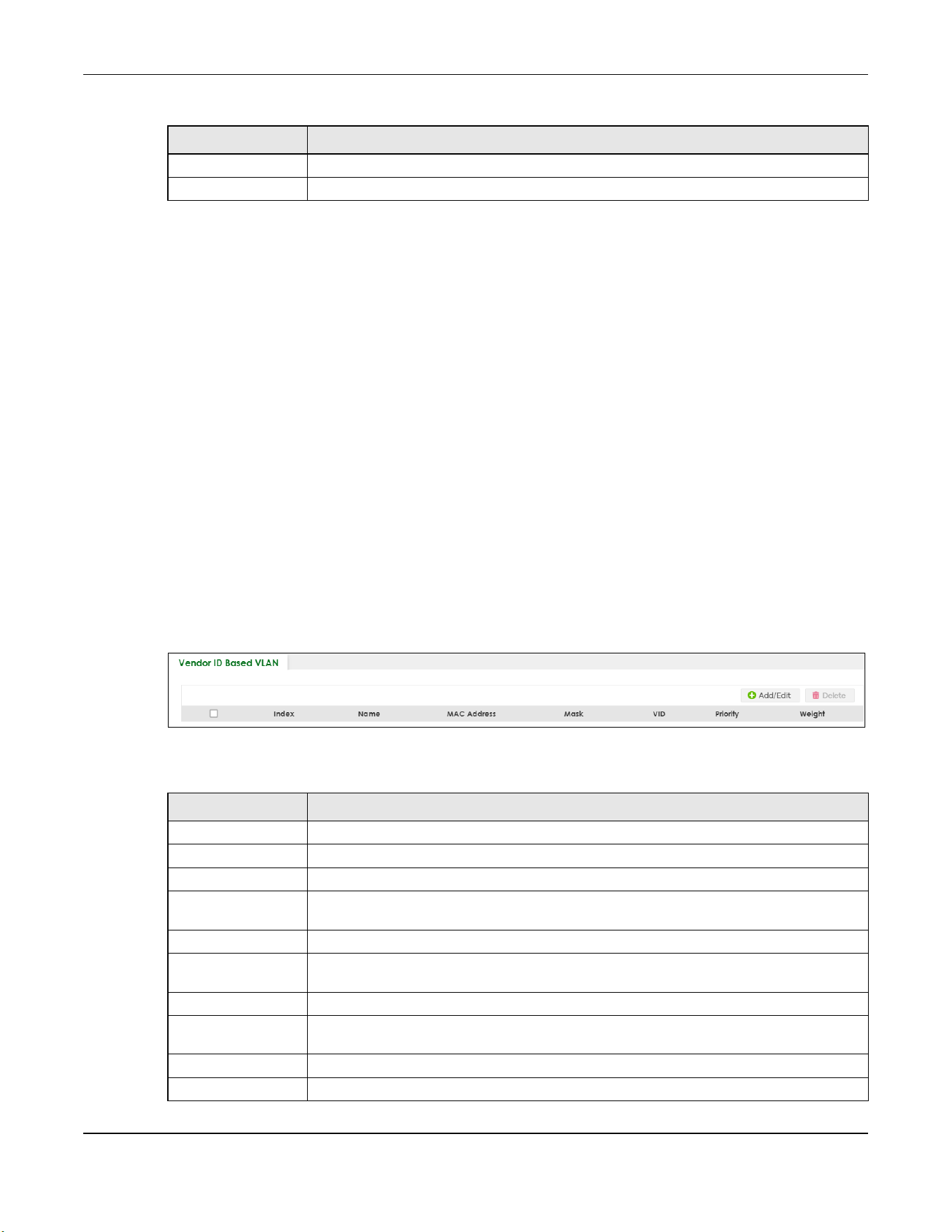
Chapter 48 VLAN
XMG1915 Series User’s Guide
277
48.8 Vendor ID Based VLAN
The Vendor ID based VLAN feature assigns incoming untagged packets to a VLAN and classifies the
traffic based on the source MAC address of the packet. When untagged packets arrive at the switch,
the source MAC address of the packet is looked up in a Vendor ID to VLAN mapping table. If an entry is
found, the corresponding VLAN ID is assigned to the packet. The assigned VLAN ID is verified against the
VLAN table. If the VLAN is valid, ingress processing on the packet continues; otherwise, the packet is
dropped.
This feature allows users to change ports without having to reconfigure the VLAN. You can assign a
802.1p priority to the vendor ID based VLAN and define a vendor ID to VLAN mapping table by entering
a specified source MAC address and mask in the vendor ID based VLAN setup screen. You can also
delete a vendor ID based VLAN entry in the same screen.
For every vendor ID based VLAN rule you set, you can specify a weight number to define the rule’s
priority level. As rules are processed one after the other, stating a priority order will let you choose which
rule has to be applied first and which second.
Click the SWITCHING > VLAN > Vendor ID Based VLAN Setup to see the following screen.
Figure 197 SWITCHING > VLAN > Vendor ID Based VLAN Setup
The following table describes the fields in the above screen.
Clear Click Clear to clear the fields to the factory defaults.
Cancel Click Cancel to not save the configuration you make and return to the last screen.
Table 151 SWITCHING > VLAN > MAC Based VLAN Setup > Add/Edit (continued)
LABEL DESCRIPTION
Table 152 SWITCHING > VLAN > Vendor ID Based VLAN Setup
LABEL DESCRIPTION
Index This field displays the index number of the vendor ID based VLAN entry.
Name This field displays the name of the vendor ID based VLAN entry.
MAC Address This field displays the source MAC address that is bind to the vendor ID based VLAN entry.
Mask This field displays the mask for the source MAC address that is bind to the vendor ID based
VLAN entry.
VLAN This field displays the VLAN ID of the vendor ID based VLAN entry.
Priority This field displays the priority level which is assigned to frames belonging to this vendor ID
based VLAN.
Weight This field displays the weight of the vendor ID based VLAN entry.
Select an entry’s check box to select a specific entry. Otherwise, select the check box in
the table heading row to select all entries.
Add/Edit Click Add/Edit to add a new entry or edit a selected one.
Delete Click Delete to remove the selected entry.
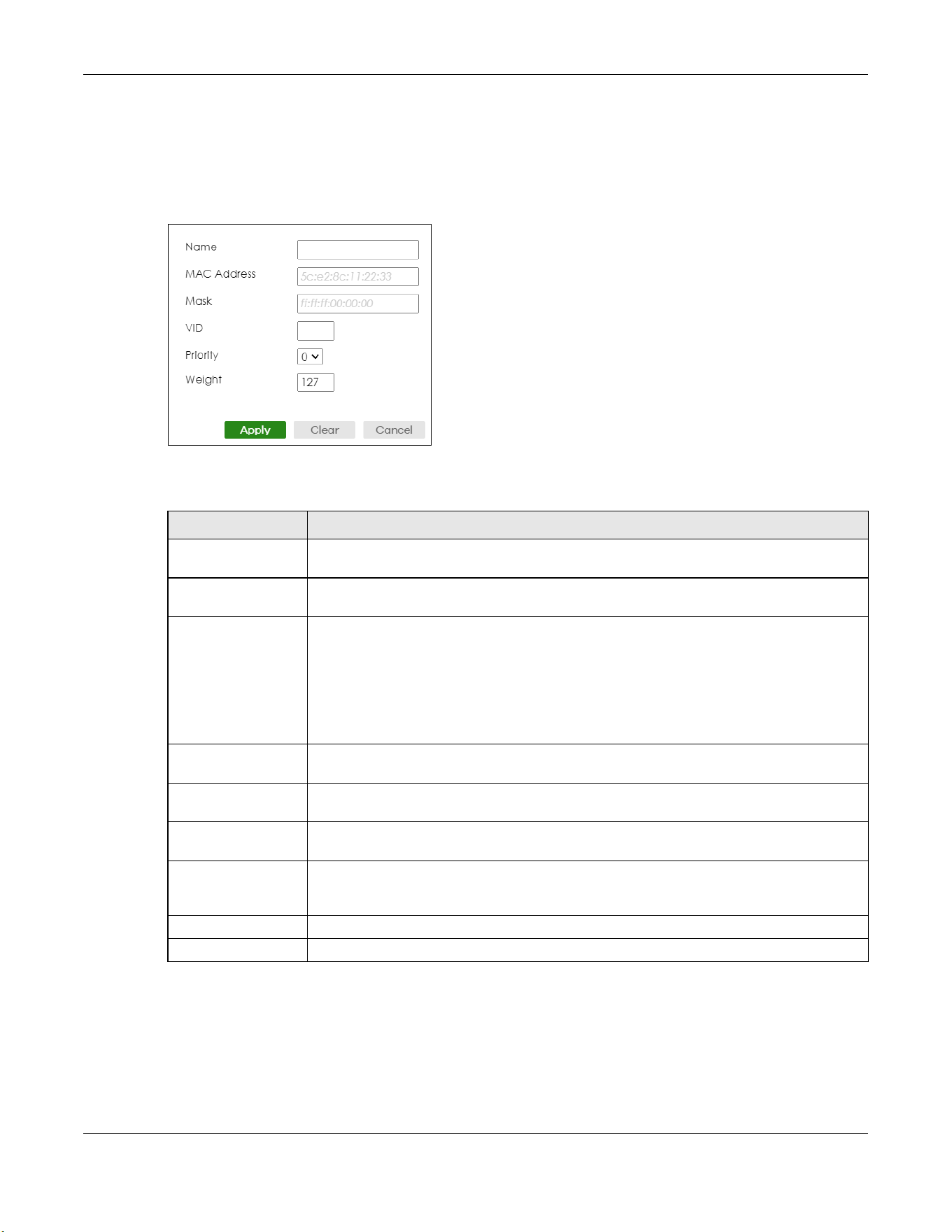
Chapter 48 VLAN
XMG1915 Series User’s Guide
278
48.8.1 Add/Edit a Vendor ID Based VLAN
Click Add/Edit, or select an entry and click Add/Edit in the SWITCHING > VLAN > Vendor ID Based VLAN
Setup to see this screen.
Figure 198 SWITCHING > VLAN > Vendor ID Based VLAN Setup > Add/Edit
The following table describes the fields in the above screen.
48.9 Port-Based VLAN Setup
Port-based VLANs are VLANs where the packet forwarding decision is based on the destination MAC
address and its associated port.
Table 153 SWITCHING > VLAN > Vendor ID Based VLAN Setup > Add/Edit
LABEL DESCRIPTION
Name Enter a name up to 32 alphanumeric characters except [ ? ], [ | ], [ ' ], or [ " ] for the vendor
ID based VLAN entry.
MAC Address Enter a MAC address that is bind to the vendor ID-based VLAN entry. This is the source MAC
address of the data packet that is looked up when untagged packets arrive at the Switch.
Mask Enter the mask for the specified source MAC address to determine which bits a packet’s
MAC address should match.
Enter “f” for each bit of the specified MAC address that the traffic’s MAC address should
match. Enter “0” for the bits of the matched traffic’s MAC address, which can be of any
hexadecimal characters. For example, if you set the MAC address to 00:13:49:00:00:00 and
the mask to ff:ff:ff:00:00:00, a packet with a MAC address of 00:13:49:12:34:56 matches this
criteria.
VID Enter an ID (from 1 to 4094) for the VLAN that is associated with the vendor ID based VLAN
entry.
Priority Select the priority level that the Switch assigns to frames belonging to this VLAN. The higher
the numeric value you assign, the higher the priority for this vendor ID based VLAN entry.
Weight Enter a number between 0 and 255 to specify the rule’s weight. This is to decide the priority
in which the rule is applied. The higher the number, the higher the rule’s priority.
Apply Click Apply to save your changes to the Switch’s run-time memory. The Switch loses these
changes if it is turned off or loses power, so use the Save link on the top navigation panel to
save your changes to the non-volatile memory when you are done configuring.
Clear Click Clear to clear the fields to the factory defaults.
Cancel Click Cancel to not save the configuration you make and return to the last screen.

Chapter 48 VLAN
XMG1915 Series User’s Guide
279
Port-based VLANs require allowed outgoing ports to be defined for each port. Therefore, if you wish to
allow two subscriber ports to talk to each other, for example, between conference rooms in a hotel, you
must define the egress (an egress port is an outgoing port, that is, a port through which a data packet
leaves) for both ports.
Port-based VLANs are specific only to the Switch on which they were created.
Note: When you activate port-based VLAN, the Switch uses a default VLAN ID of 1. You
cannot change it.
Note: In screens (such as SYSTEM > IP Setup and SWITCHING > Static MAC Filtering) that
require a VID, you must enter 1 as the VID.
The port-based VLAN setup screen is shown next. The CPU management port forms a VLAN with all
Ethernet ports.
48.10 Configure a Port-Based VLAN
Select Port Based as the VLAN Type in the SYSTEM > Switch Setup screen and then click SWITCHING >
VLAN from the navigation panel to display the next screen.
Select either All Connected or Port Isolated from the drop-down list depending on your VLAN and VLAN
security requirements. If VLAN members need to communicate directly with each other, then select All
Connected. Select Port Isolated if you want to restrict users from communicating directly. Click Apply to
save your settings.
The following screen shows users on a port-based, all-connected VLAN configuration.

Chapter 48 VLAN
XMG1915 Series User’s Guide
280
Figure 199 SWITCHING > VLAN > Port Based VLAN Setup (All Connected)
The following screen shows users on a port-based, port-isolated VLAN configuration.

Chapter 48 VLAN
XMG1915 Series User’s Guide
281
Figure 200 SWITCHING > VLAN: Port Based VLAN Setup (Port Isolation)
The following table describes the labels in this screen.
Table 154 SWITCHING > VLAN > Port Based VLAN Setup
LABEL DESCRIPTION
Setting Wizard Choose Current configuration to display the Switch’s current port-based VLAN configuration.
Choose All connected or Port isolation wizard to quickly set up a port-based VLAN according to
the below descriptions.
All connected means all ports can communicate with each other, that is, there are no virtual
LANs. All incoming and outgoing ports are selected. This option is the most flexible but also the
least secure.
Port isolation means that each port can only communicate with the CPU management port and
cannot communicate with each other. All incoming ports are selected while only the CPU
outgoing port is selected. This option is the most limiting but also the most secure.
After selecting the setting wizard, you can customize the port settings. Click on the ports to add or
delete incoming or outgoing ports. The configuration will be saved only after you click Apply at
the bottom of the screen.
Incoming These are the ingress ports; an ingress port is an incoming port, that is, a port through which a data
packet enters. If you wish to allow two subscriber ports to talk to each other, you must define the
ingress port for both ports. The numbers in the top row denote the incoming port for the
corresponding port listed on the left (its outgoing port). CPU refers to the Switch management
port. By default it forms a VLAN with all Ethernet ports. If it does not form a VLAN with a particular
port then the Switch cannot be managed from that port.
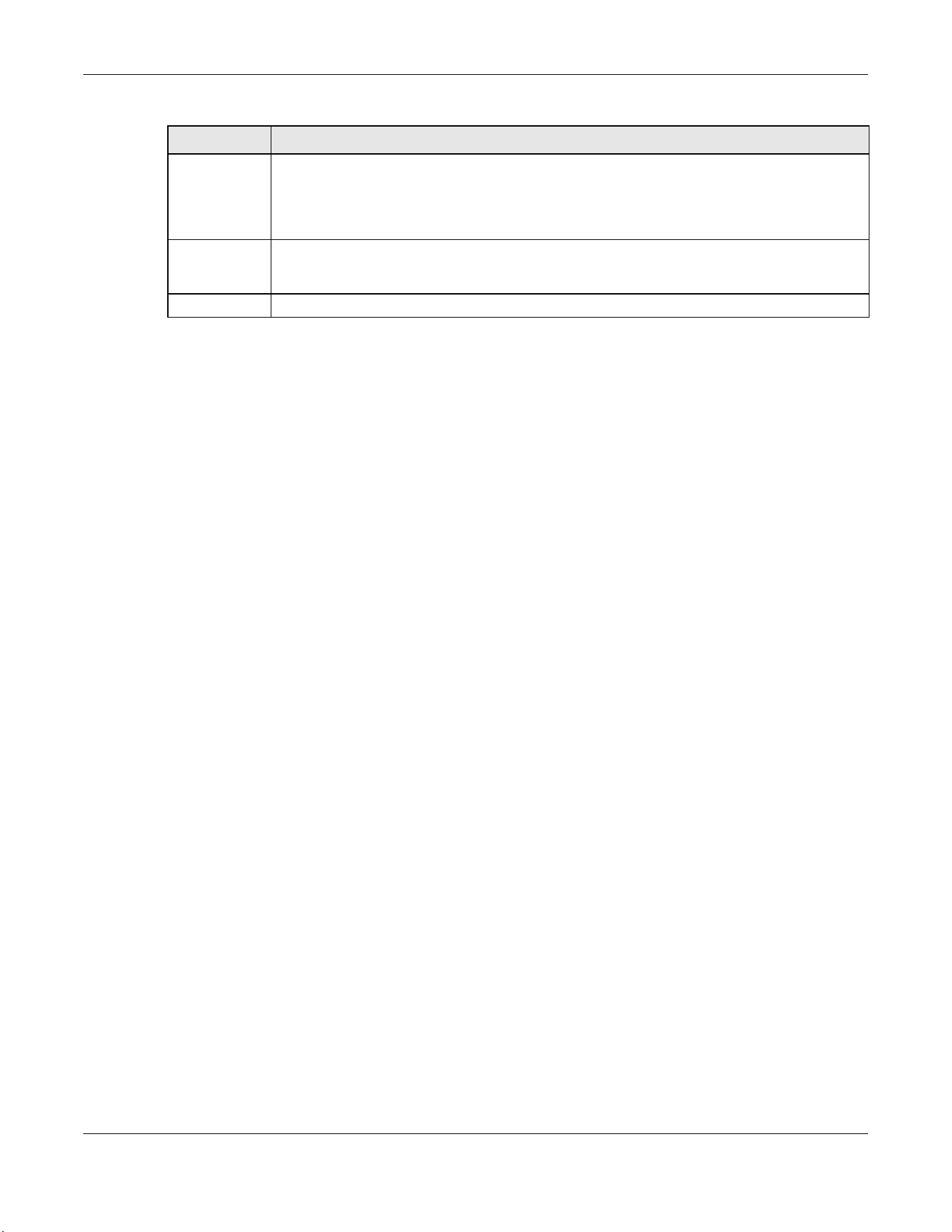
Chapter 48 VLAN
XMG1915 Series User’s Guide
282
Outgoing These are the egress ports; an egress port is an outgoing port, that is, a port through which a data
packet leaves. If you wish to allow two subscriber ports to talk to each other, you must define the
egress port for both ports. CPU refers to the Switch management port. By default it forms a VLAN
with all Ethernet ports. If it does not form a VLAN with a particular port then the Switch cannot be
managed from that port.
Apply Click Apply to save your changes to the Switch’s run-time memory. The Switch loses these
changes if it is turned off or loses power, so use the Save link on the top navigation panel to save
your changes to the non-volatile memory when you are done configuring.
Cancel Click Cancel to begin configuring this screen afresh.
Table 154 SWITCHING > VLAN > Port Based VLAN Setup (continued)
LABEL DESCRIPTION


Chapter 50 ARP Setup
XMG1915 Series User’s Guide
284
CHAPTER 50
ARP Setup
50.1 ARP Overview
Address Resolution Protocol (ARP) is a protocol for mapping an Internet Protocol address (IP address) to
a physical machine address, also known as a Media Access Control or MAC address, on the local area
network.
An IP (version 4) address is 32 bits long. In an Ethernet LAN, MAC addresses are 48 bits long. The ARP
table maintains an association between each MAC address and its corresponding IP address.
50.1.1 What You Can Do
Use the ARP Learning screen (Section 50.2 on page 286) to configure ARP learning mode on a per-port
basis.
Use the Static ARP screen (Section 50.3 on page 287) to create static ARP entries that will display in the
MONITOR > ARP Table screen and will not age out.
50.1.2 What You Need to Know
Read on for concepts on ARP that can help you configure the screen in this chapter.
50.1.2.1 How ARP Works
When an incoming packet destined for a host device on a local area network arrives at the Switch, the
Switch looks in the ARP Table and if it finds the address, it sends it to the device.
If no entry is found for the IP address, ARP broadcasts the request to all the devices on the LAN. The
Switch fills in its own MAC and IP address in the sender address fields, and puts the known IP address of
the target in the target IP address field. In addition, the Switch puts all ones in the target MAC field
(FF.FF.FF.FF.FF.FF is the Ethernet broadcast address). The replying device (which is either the IP address of
the device being sought or the router that knows the way) replaces the broadcast address with the
target's MAC address, swaps the sender and target pairs, and unicasts the answer directly back to the
requesting machine. ARP updates the ARP Table for future reference and then sends the packet to the
MAC address that replied.
50.1.2.2 ARP Learning Mode
The Switch supports three ARP learning modes: ARP-Reply, Gratuitous-ARP, and ARP-Request.
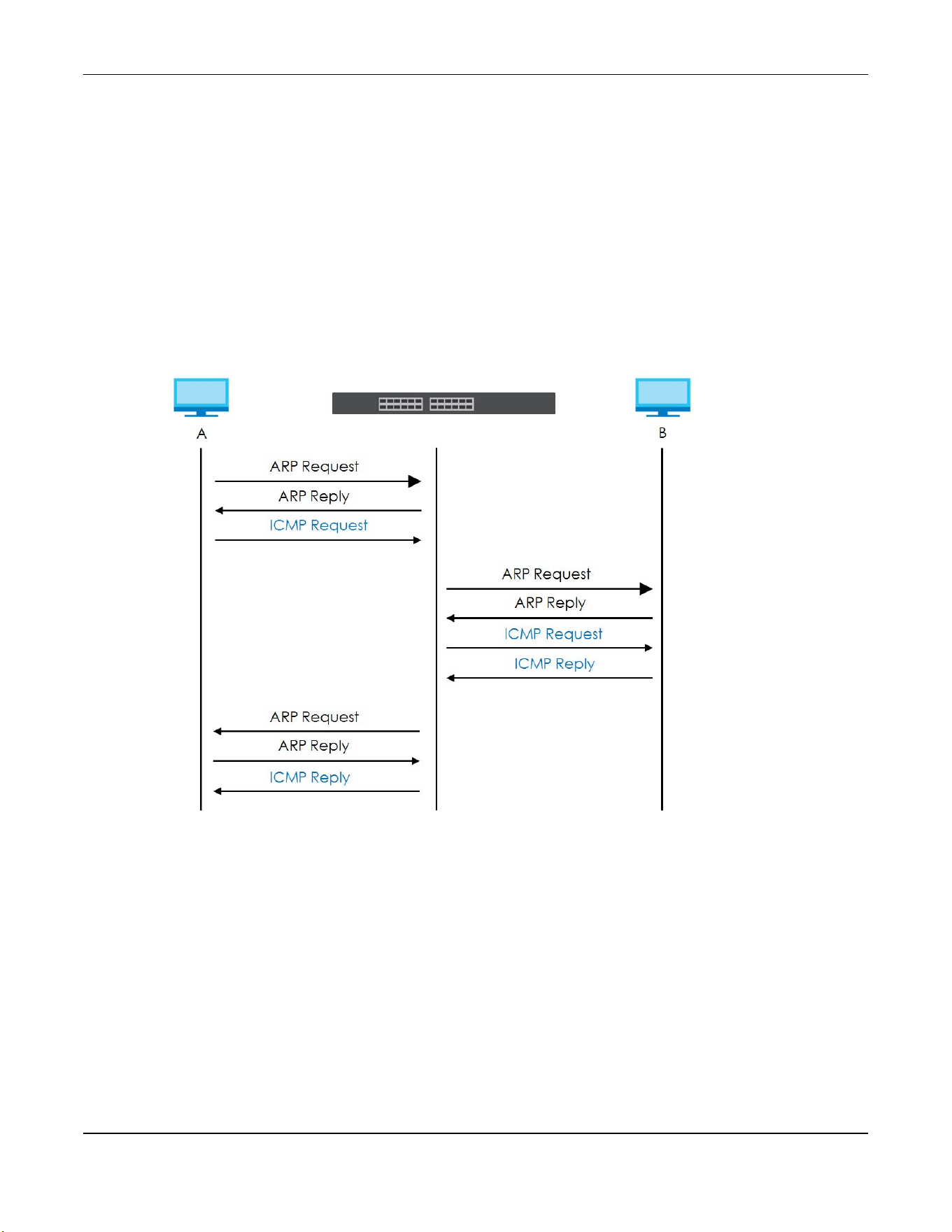
Chapter 50 ARP Setup
XMG1915 Series User’s Guide
285
ARP-Reply
The Switch in ARP-Reply learning mode updates the ARP table only with the ARP replies to the ARP
requests sent by the Switch. This can help prevent ARP spoofing.
In the following example, the Switch does not have IP address and MAC address mapping information
for hosts A and B in its ARP table, and host A wants to ping host B. Host A sends an ARP request to the
Switch and then sends an ICMP request after getting the ARP reply from the Switch. The Switch finds no
matched entry for host B in the ARP table and broadcasts the ARP request to all the devices on the LAN.
When the Switch receives the ARP reply from host B, it updates its ARP table and also forwards host A’s
ICMP request to host B. After the Switch gets the ICMP reply from host B, it sends out an ARP request to
get host A’s MAC address and updates the ARP table with host A’s ARP reply. The Switch then can
forward host B’s ICMP reply to host A.
Gratuitous-ARP
A gratuitous ARP is an ARP request in which both the source and destination IP address fields are set to
the IP address of the device that sends this request and the destination MAC address field is set to the
broadcast address. There will be no reply to a gratuitous ARP request.
A device may send a gratuitous ARP packet to detect IP collisions. If a device restarts or its MAC address
is changed, it can also use gratuitous ARP to inform other devices in the same network to update their
ARP table with the new mapping information.
In Gratuitous-ARP learning mode, the Switch updates its ARP table with either an ARP reply or a
gratuitous ARP request.
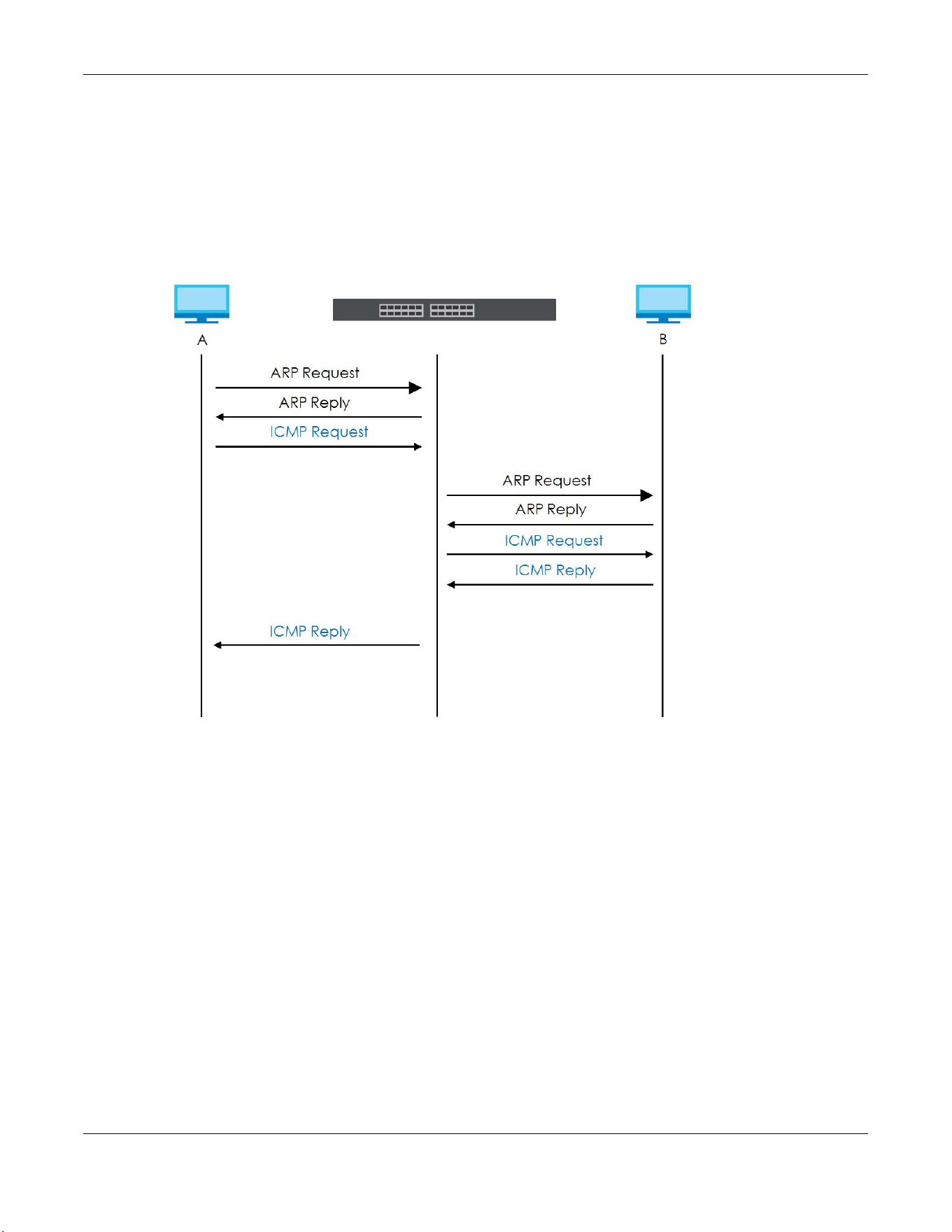
Chapter 50 ARP Setup
XMG1915 Series User’s Guide
286
ARP-Request
When the Switch is in ARP-Request learning mode, it updates the ARP table with both ARP replies,
gratuitous ARP requests and ARP requests.
Therefore in the following example, the Switch can learn host A’s MAC address from the ARP request
sent by host A. The Switch then forwards host B’s ICMP reply to host A right after getting host B’s MAC
address and ICMP reply.
50.2 ARP Learning
Use this screen to configure each port’s ARP learning mode. Click NETWORKING > ARP Setup > ARP
Learning in the navigation panel to display the screen as shown next.
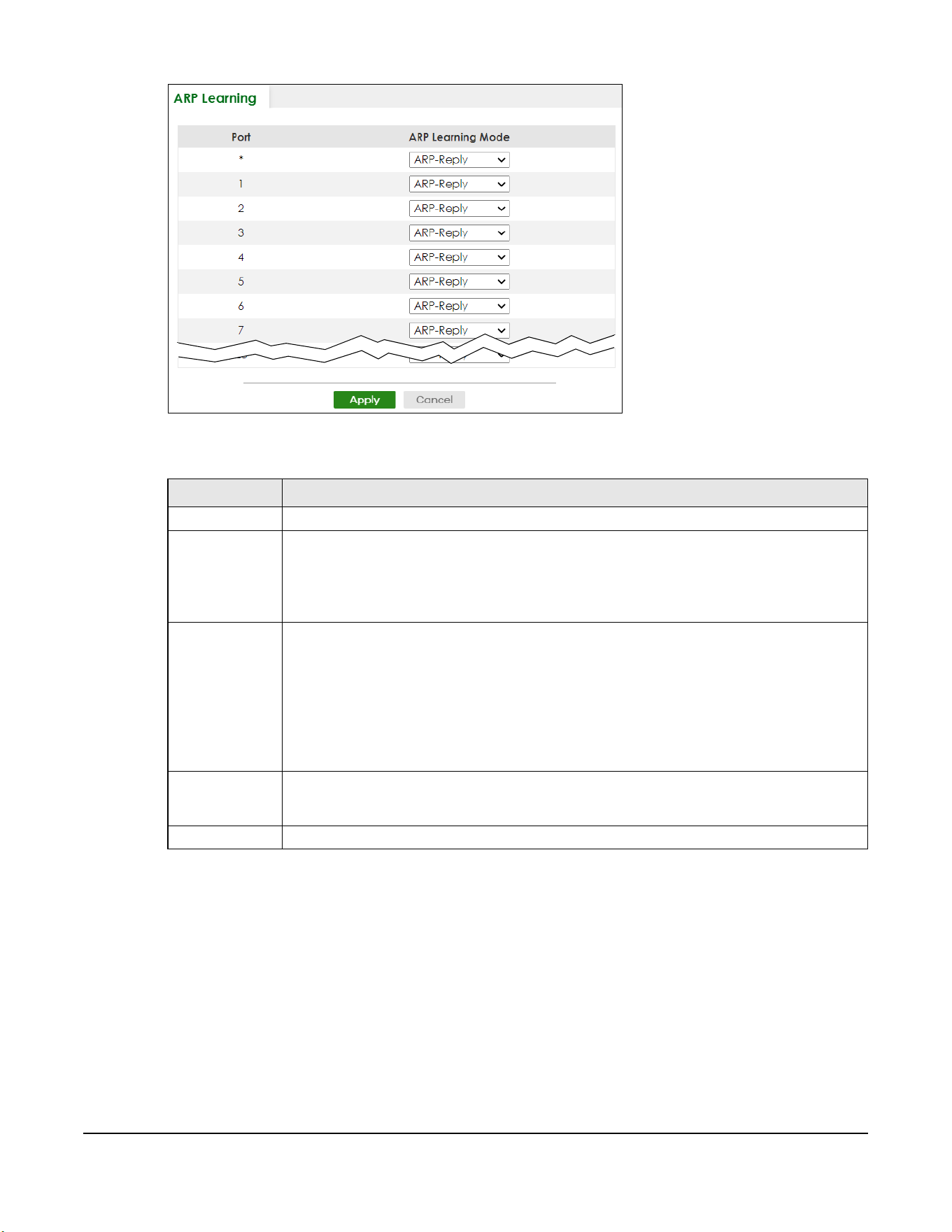
XMG1915 Series User’s Guide
287
Figure 201 NETWORKING > ARP Setup > ARP Learning
The following table describes the labels in this screen.
50.3 Static ARP
Use this screen to view and configure static ARP entries that will display in the MONITOR > ARP Table
screen and will not age out. Click NETWORKING > ARP Setup > Static ARP to display the screen as shown.
Table 155 NETWORKING > ARP Setup > ARP Learning
LABEL DESCRIPTION
Port This field displays the port number.
* Settings in this row apply to all ports.
Use this row only if you want to make some settings the same for all ports. Use this row first to set
the common settings and then make adjustments on a port-by-port basis.
Changes in this row are copied to all the ports as soon as you make them.
ARP Learning
Mode
Select the ARP learning mode the Switch uses on the port.
Select ARP-Reply to have the Switch update the ARP table only with the ARP replies to the ARP
requests sent by the Switch.
Select Gratuitous-ARP to have the Switch update its ARP table with either an ARP reply or a
gratuitous ARP request.
Select ARP-Request to have the Switch update the ARP table with both ARP replies, gratuitous
ARP requests and ARP requests.
Apply Click Apply to save your changes to the Switch’s run-time memory. The Switch loses these
changes if it is turned off or loses power, so use the Save link on the top navigation panel to save
your changes to the non-volatile memory when you are done configuring.
Cancel Click Cancel to begin configuring this screen afresh.
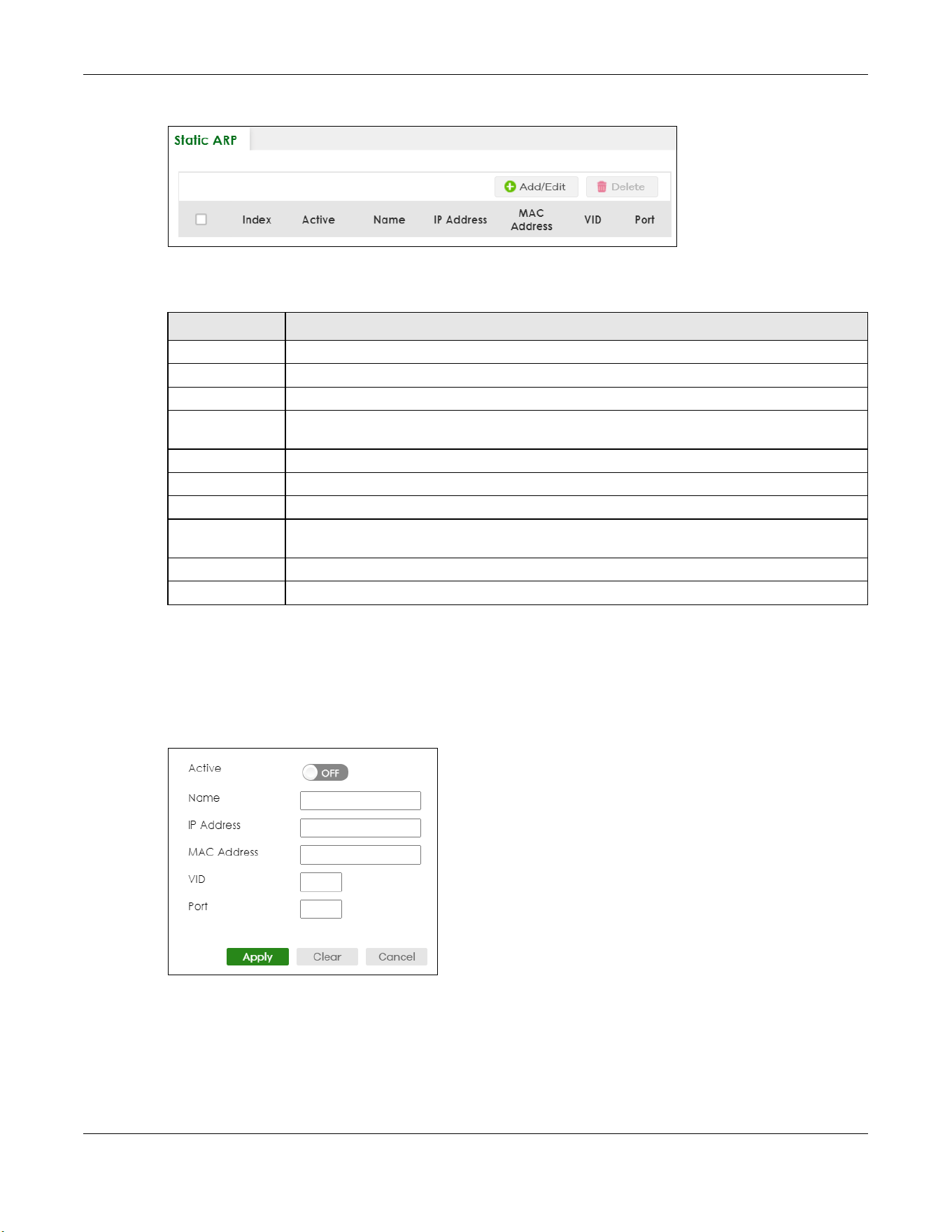
Chapter 50 ARP Setup
XMG1915 Series User’s Guide
288
Figure 202 NETWORKING > ARP Setup > Static ARP
The following table describes the related labels in this screen.
50.3.1 Add/Edit Static ARP
Use this screen to add/edit static ARP entries. Click Add/Edit, or select an entry and click Add/Edit in the
NETWORKING > ARP Setup > Static ARP to display this screen.
Figure 203 NETWORKING > ARP Setup > Static ARP > Add/Edit
Table 156 NETWORKING > ARP Setup > Static ARP
LABEL DESCRIPTION
Index This field displays the index number of an entry.
Active This field displays whether the entry is activated.
Name This field displays the descriptive name for this entry. This is for identification purposes only.
IP Address This is the IP address of a device connected to a Switch port with the corresponding MAC
address below.
MAC Address This is the MAC address of the device with the corresponding IP address above.
VID This field displays the VLAN to which the device belongs.
Port This field displays the port to which the device connects.
Select an entry’s check box to select a specific entry. Otherwise, select the check box in the
table heading row to select all entries.
Add/Edit Click Add/Edit to add a new entry or edit a selected one.
Delete Click Delete to remove the selected entries.
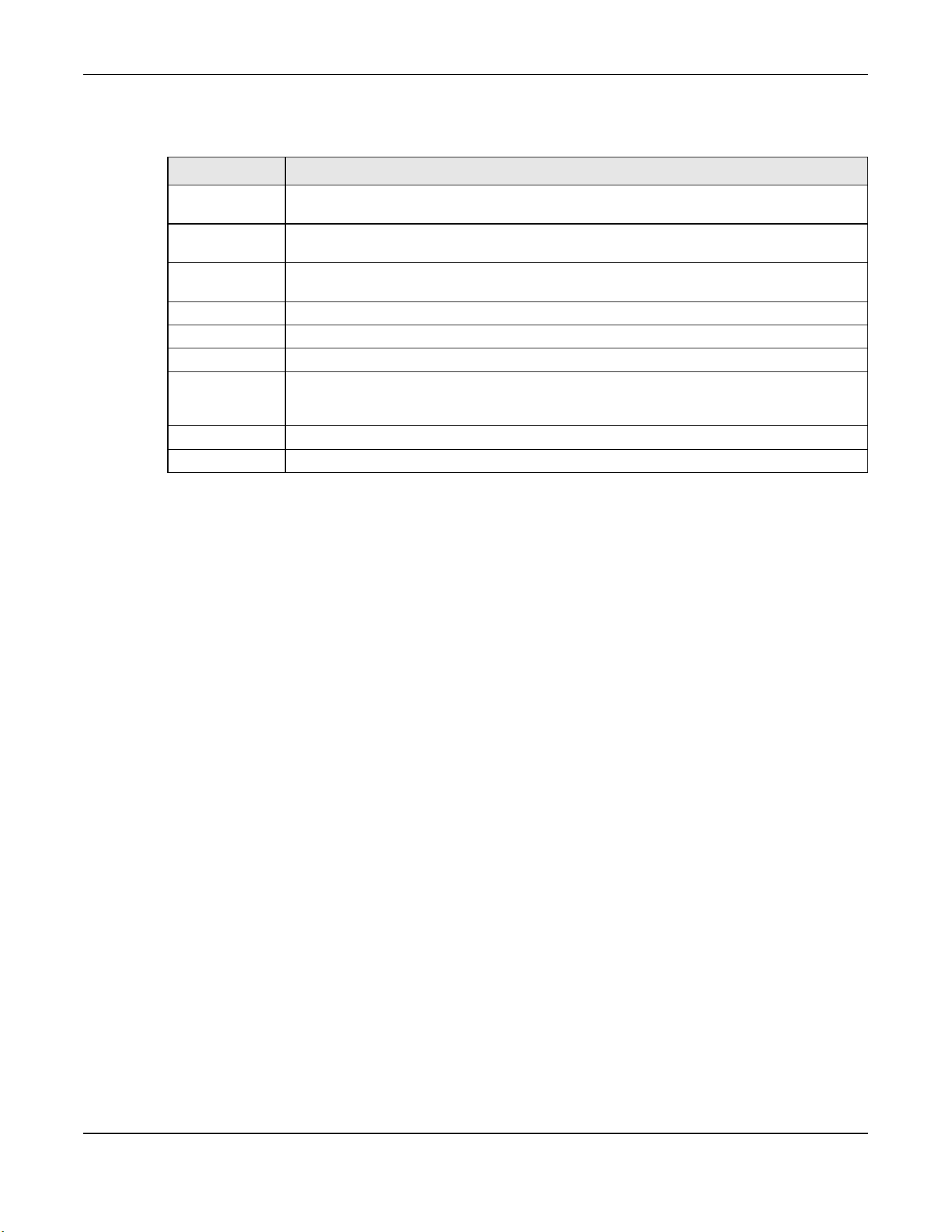
Chapter 50 ARP Setup
XMG1915 Series User’s Guide
289
The following table describes the related labels in this screen.
Table 157 NETWORKING > ARP Setup > Static ARP > Add/Edit
LABEL DESCRIPTION
Active Enable the switch button to activate your rule. You may temporarily deactivate a rule without
deleting it by clearing this check box.
Name Enter a descriptive name (up to 32 printable ASCII characters except [ ? ], [ | ], [ ' ], [ " ] or [ , ])
for identification purposes.
IP Address Enter the IP address of a device connected to a Switch port with the corresponding MAC
address below.
MAC Address Enter the MAC address of the device with the corresponding IP address above.
VID Enter the ID number of VLAN to which the device belongs.
Port Enter the number of port to which the device connects.
Apply Click Apply to save your changes to the Switch’s run-time memory. The Switch loses these
changes if it is turned off or loses power, so use the Save link on the top navigation panel to
save your changes to the non-volatile memory when you are done configuring.
Clear Click Clear to clear the fields to the factory defaults.
Cancel Click Cancel to not save the configuration you make and return to the last screen.

Chapter 51 DHCP
XMG1915 Series User’s Guide
290
CHAPTER 51
DHCP
51.1 DHCP Overview
This chapter shows you how to configure the DHCP feature.
DHCP (Dynamic Host Configuration Protocol RFC 2131 and RFC 2132) allows individual computers to
obtain TCP/IP configuration at start-up from a server. If you configure the Switch as a DHCP relay agent,
then the Switch forwards DHCP requests to DHCP server on your network. If you do not configure the
Switch as a DHCP relay agent then you must have a DHCP server in the broadcast domain of the client
computers or else the client computers must be configured manually.
51.1.1 What You Can Do
• Use the DHCPv4 Relay Status screen (Section 51.2 on page 291) to display the relay mode and status.
• Use the DHCPv4 Option 82 Profile screen (Section 51.4 on page 293) to create DHCPv4 option 82
profiles.
• Use the DHCPv4 Smart Relay screen (Section 51.5 on page 294) to configure global DHCPv4 relay.
You can also use this screen to apply different DHCP option 82 profile to certain ports on the Switch.
• Use the DHCPv4 Relay VLAN Setting screen (Section 51.6 on page 298) to configure your DHCPv4
settings based on the VLAN domain of the DHCPv4 clients. You can also use this screen to apply a
different DHCP option 82 profile to certain ports in a VLAN.
• Use the DHCPv6 Relay screen (Section 51.7 on page 301) to enable and configure DHCPv6 relay.
51.1.2 What You Need to Know
Read on for concepts on DHCP that can help you configure the screens in this chapter.
DHCP Modes
If there is already a DHCP server on your network, then you can configure the Switch as a DHCP relay
agent. When the Switch receives a request from a computer on your network, it contacts the DHCP
server for the necessary IP information, and then relays the assigned information back to the computer.
DHCPv4 Configuration Options
The DHCPv4 configuration on the Switch is divided into Smart Relay and VLAN screens. The screen you
should use for configuration depends on the DHCP services you want to offer the DHCP clients on your
network. Choose the configuration screen based on the following criteria:
• Smart Relay
– The Switch forwards all DHCP requests to the same DHCP server.
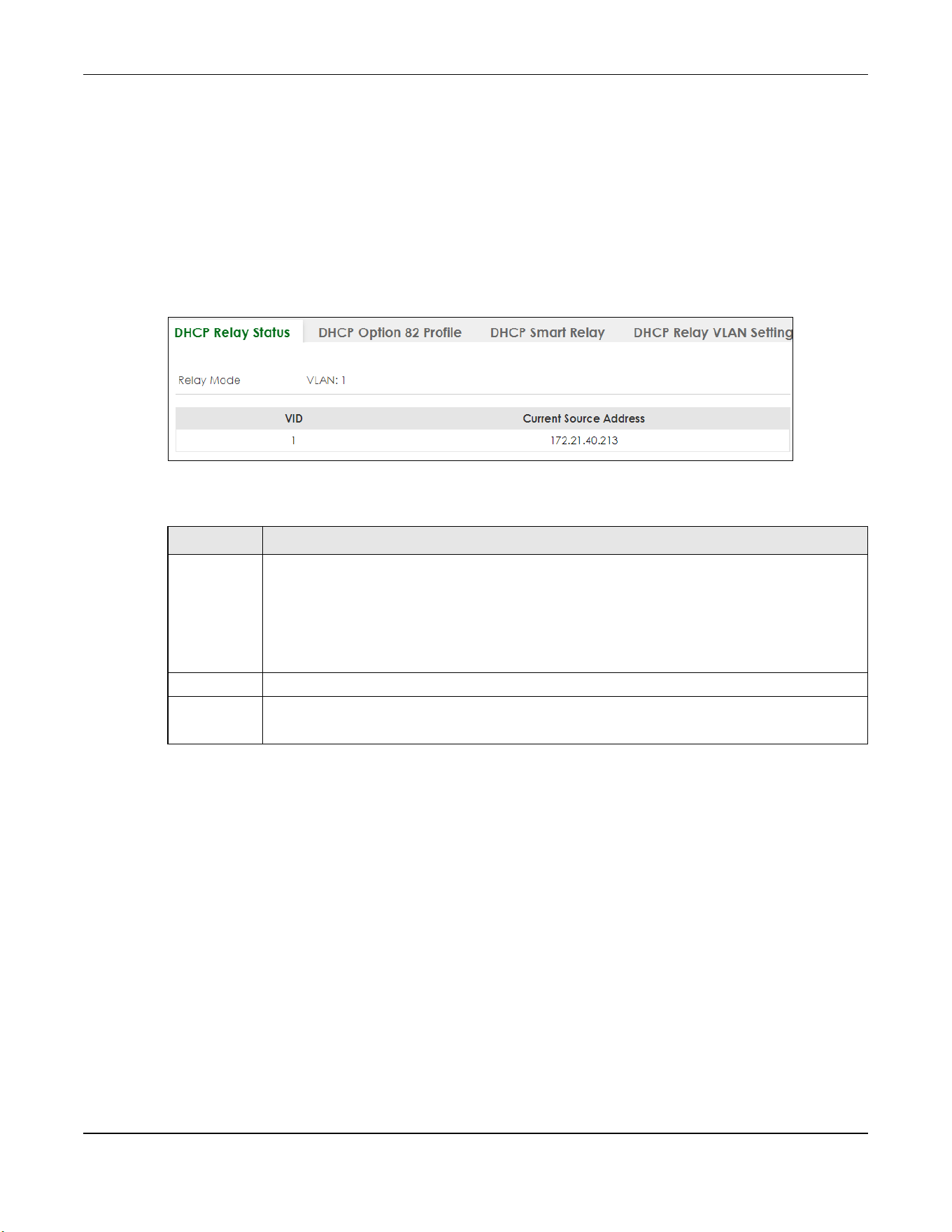
Chapter 51 DHCP
XMG1915 Series User’s Guide
291
• VLAN – The Switch is configured on a VLAN by VLAN basis. The Switch can be configured to relay
DHCP requests to different DHCP servers for clients in different VLAN.
51.2 DHCPv4 Relay Status
Click NETWORKING > DHCP > DHCPv4 Relay in the navigation panel. The DHCP Relay Status screen
displays.
Figure 204 NETWORKING > DHCP > DHCPv4 Relay > DHCP Relay Status
The following table describes the labels in this screen.
51.3 DHCPv4 Relay
Configure DHCP relay on the Switch if the DHCP clients and the DHCP server are not in the same
broadcast domain. During the initial IP address leasing, the Switch helps to relay network information
(such as the IP address and subnet mask) between a DHCP client and a DHCP server. Once the DHCP
client obtains an IP address and can connect to the network, network information renewal is done
between the DHCP client and the DHCP server without the help of the Switch.
The Switch can be configured as a global DHCP relay. This means that the Switch forwards all DHCP
requests from all domains to the same DHCP server. You can also configure the Switch to relay DHCP
information based on the VLAN membership of the DHCP clients.
Table 158 NETWORKING > DHCP > DHCPv4 Relay > DHCP Relay Status
LABEL DESCRIPTION
Relay
Mode
This field displays:
None – if the Switch is not configured as a DHCP relay agent.
Smart– if the Switch is configured as a DHCP relay agent only.
VLAN – followed by a VLAN ID or multiple VLAN IDs if it is configured as a relay agent for specific
VLANs.
VID This field displays the ID number of the VLAN for which the Switch acts as a DHCP relay agent.
Current
Source
Address
This field displays the source IP address of the DHCP requests that the Switch forwards to a DHCP
server.
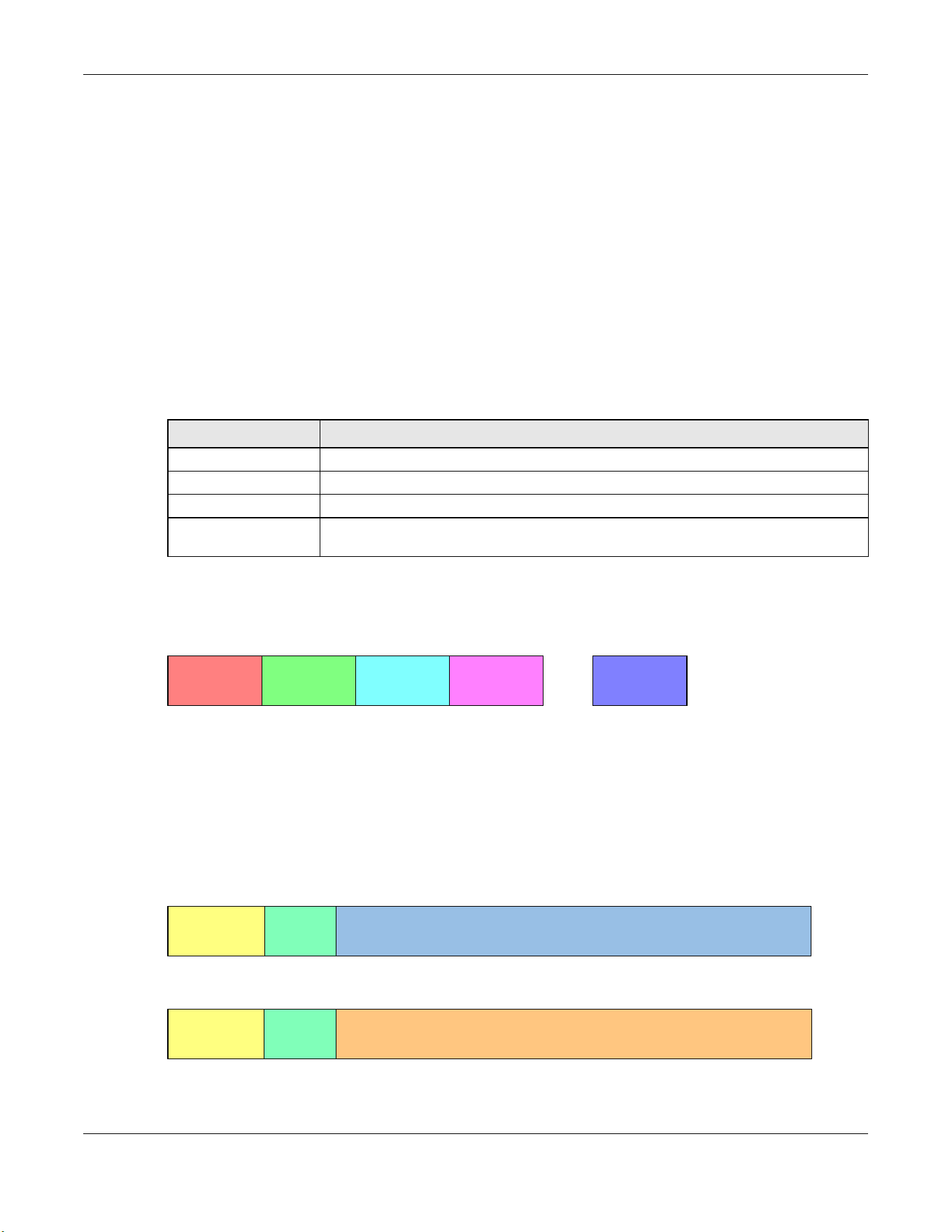
Chapter 51 DHCP
XMG1915 Series User’s Guide
292
51.3.1 DHCPv4 Relay Agent Information
The Switch can add information about the source of client DHCP requests that it relays to a DHCP server
by adding Relay Agent Information. This helps provide authentication about the source of the requests.
The DHCP server can then provide an IP address based on this information. Please refer to RFC 3046 for
more details.
The DHCP Relay Agent Information feature adds an Agent Information field (also known as the Option
82 field) to DHCP requests. The Option 82 field is in the DHCP headers of client DHCP request frames that
the Switch relays to a DHCP server.
Relay Agent Information can include the System Name of the Switch if you select this option. You can
change the System Name in SYSTEM > General Setup.
The following describes the DHCP relay agent information that the Switch sends to the DHCP server:
51.3.1.1 DHCPv4 Relay Agent Information Format
A DHCP Relay Agent Information option has the following format.
i1, i2 and iN are DHCP relay agent sub-options, which contain additional information about the DHCP
client. You need to define at least one sub-option.
51.3.1.2 Sub-Option Format
There are two types of sub-option: “Agent Circuit ID Sub-option” and “Agent Remote ID Sub-option”.
They have the following formats.
The 1 in the first field identifies this as an Agent Circuit ID sub-option and two identifies this as an Agent
Remote ID sub-option. The next field specifies the length of the field.
Table 159 Relay Agent Information
FIELD LABELS DESCRIPTION
Slot ID (1 byte) This value is always 0 for stand-alone switches.
Port ID (1 byte) This is the port that the DHCP client is connected to.
VLAN ID (2 bytes) This is the VLAN that the port belongs to.
Information (up to 64 bytes) This optional, read-only field is set according to system name set in
SYSTEM > General Setup.
Table 160 DHCP Relay Agent Information Option Format
Code
(82)
Length
(N)
i1 i2
...
iN
Table 161 DHCP Relay Agent Circuit ID Sub-option Format
SubOpt Code Length Value
1
(1 byte)
N
(1 byte)
Slot ID, Port ID, VLAN ID, System Name or String
Table 162 DHCP Relay Agent Remote ID Sub-option Format
SubOpt Code Length Value
2
(1 byte)
N
(1 byte)
MAC Address or String
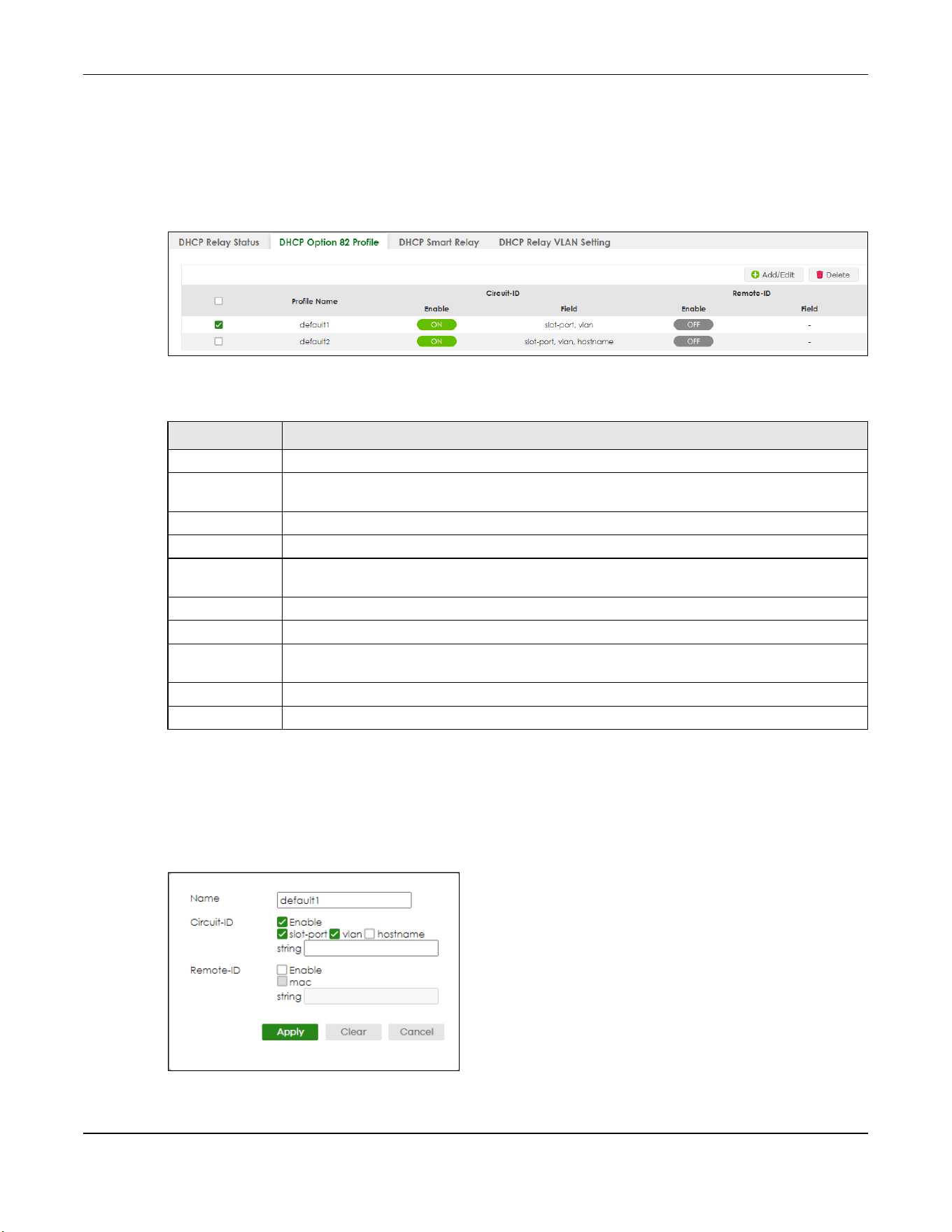
Chapter 51 DHCP
XMG1915 Series User’s Guide
293
51.4 DHCPv4 Option 82 Profile
Use this screen to view and configure DHCPv4 option 82 profiles. Click NETWORKING > DHCP > DHCPv4
Relay > DHCP Option 82 Profile link to display the screen as shown.
Figure 205 NETWORKING > DHCP > DHCPv4 Relay > DHCP Option 82 Profile
The following table describes the labels in this screen.
51.4.1 Add/Edit a DHCPv4 Option 82 Profile
Use this screen to create DHCPv4 option 82 profiles. Click Add/Edit, or select an entry and click Add/Edit
in the NETWORKING > DHCP > DHCPv4 Relay > DHCP Option 82 Profile link to display this screen.
Figure 206 NETWORKING > DHCP > DHCPv4 Relay > DHCP Option 82 Profile > Add/Edit
Note: The string of any field in this screen should not contain [ ? ], [ | ], [ ' ], [ " ] or [ , ].
Table 163 NETWORKING > DHCP > DHCPv4 Relay > DHCP Option 82 Profile
LABEL DESCRIPTION
Profile Name This field displays the descriptive name of the profile.
Circuit-ID This section displays the Circuit ID sub-option including information that is specific to the relay
agent (the Switch).
Enable This field displays whether the Circuit ID sub-option is added to client DHCP requests.
Field This field displays the information that is included in the Circuit ID sub-option.
Remote-ID This section displays the Remote ID sub-option including information that identifies the relay
agent (the Switch).
Enable This field displays whether the Remote ID sub-option is added to client DHCP requests.
Field This field displays the information that is included in the Remote ID sub-option.
Select an entry’s check box to select a specific entry. Otherwise, select the check box in the
table heading row to select all entries.
Add/Edit Click Add/Edit to add a new entry or edit a selected one.
Delete Click Delete to remove the selected entries.
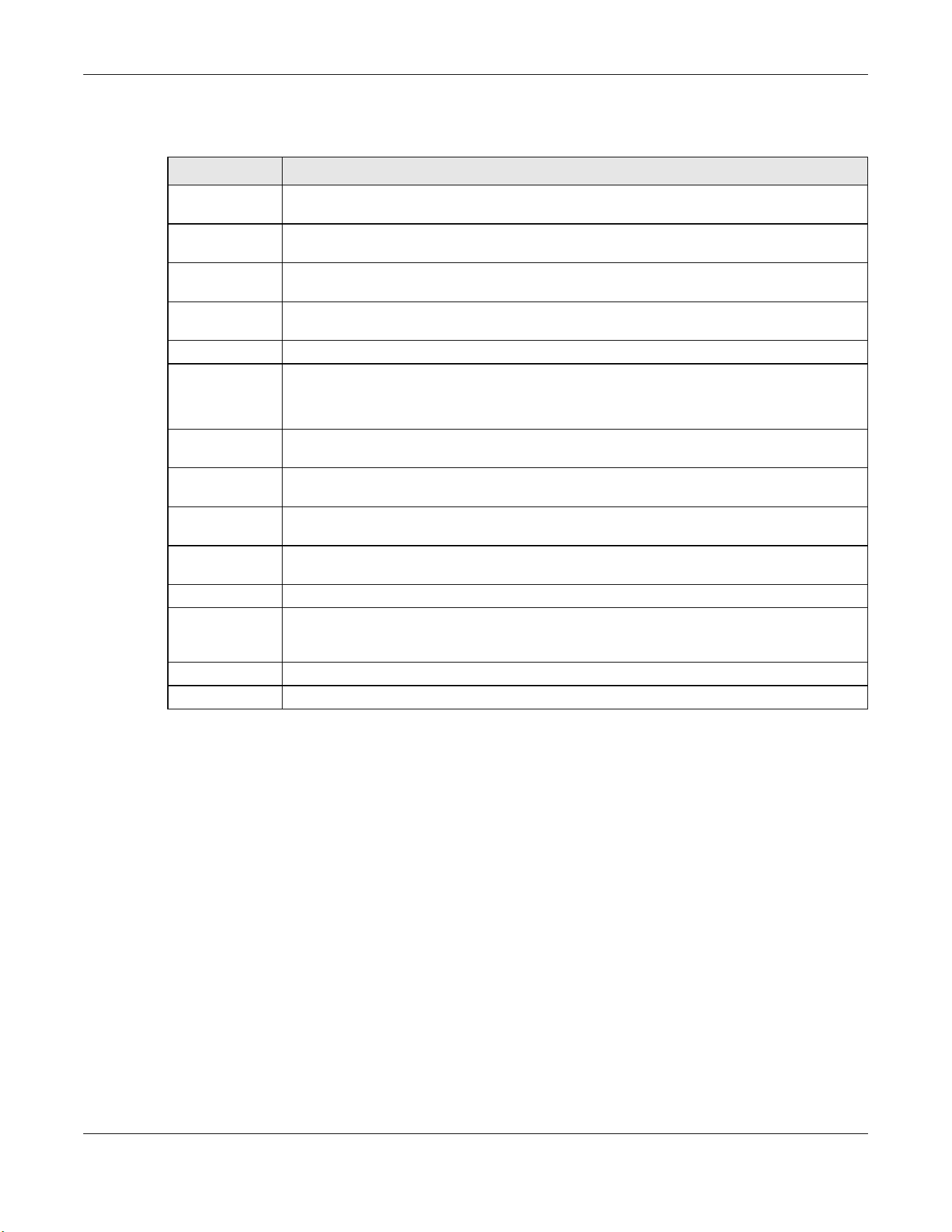
Chapter 51 DHCP
XMG1915 Series User’s Guide
294
The following table describes the labels in this screen.
51.5 Configuring DHCPv4 Smart Relay
Use this screen to configure global DHCPv4 relay. Click NETWORKING > DHCP > DHCPv4 Relay > DHCP
Smart Relay to display the screen as shown.
Table 164 NETWORKING > DHCP > DHCPv4 Relay > DHCP Option 82 Profile > Add/Edit
LABEL DESCRIPTION
Name Enter a descriptive name for the profile for identification purposes. You can use up to 32
printable ASCII characters.
Circuit-ID Use this section to configure the Circuit ID sub-option to include information that is specific to
the relay agent (the Switch).
Enable Select this option to have the Switch add the Circuit ID sub-option to client DHCP requests that it
relays to a DHCP server.
slot-port Select this option to have the Switch add the number of port that the DHCP client is connected
to.
vlan Select this option to have the Switch add the ID of VLAN which the port belongs to.
hostname This is the system name you configure in the SYSTEM > General Setup screen.
Select this option for the Switch to add the system name to the client DHCP requests that it
relays to a DHCP server.
string Enter a string of up to 64 printable ASCII characters that the Switch adds into the client DHCP
requests.
Remote-ID Use this section to configure the Remote ID sub-option to include information that identifies the
relay agent (the Switch).
Enable Select this option to have the Switch append the Remote ID sub-option to the option 82 field of
DHCP requests.
mac Select this option to have the Switch add its MAC address to the client DHCP requests that it
relays to a DHCP server.
string Enter a string of up to 64 printable ASCII characters for the remote ID information in this field.
Apply Click Apply to save your changes to the Switch’s run-time memory. The Switch loses these
changes if it is turned off or loses power, so use the Save link on the top navigation panel to save
your changes to the non-volatile memory when you are done configuring.
Clear Click Clear to clear the fields to the factory defaults.
Cancel Click Cancel to not save the configuration you make and return to the last screen.
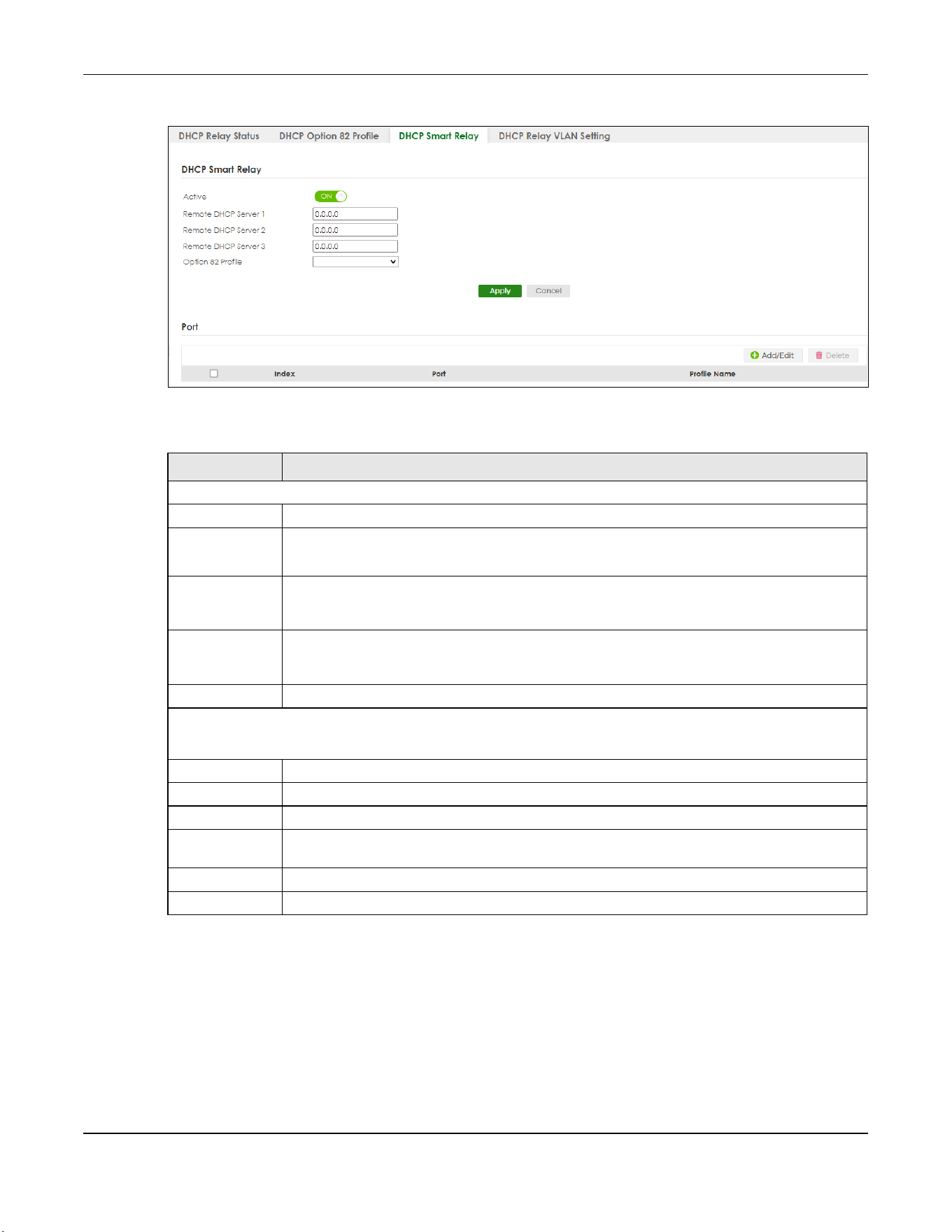
Chapter 51 DHCP
XMG1915 Series User’s Guide
295
Figure 207 NETWORKING > DHCP > DHCPv4 Relay > DHCP Smart Relay
The following table describes the labels in this screen.
51.5.1 Add/Edit DHCPv4 Global Relay Port
Use this screen to apply a different DHCP option 82 profile to certain ports on the Switch. To open this
screen, Click Add/Edit, or select an entry and click Add/Edit in the Port section of the NETWORKING >
DHCP > DHCPv4 Relay > DHCP Smart Relay screen.
Table 165 NETWORKING > DHCP > DHCPv4 Relay > DHCP Smart Relay
LABEL DESCRIPTION
DHCP Smart Relay
Active Select this check box to enable DHCPv4 relay.
Remote
DHCP Server
1 .. 3
Enter the IP address of a DHCPv4 server in dotted decimal notation.
Option 82
Profile
Select a pre-defined DHCPv4 option 82 profile that the Switch applies to all ports. The Switch
adds the Circuit ID sub-option and/or Remote ID sub-option specified in the profile to DHCP
requests that it relays to a DHCP server.
Apply Click Apply to save your changes to the Switch’s run-time memory. The Switch loses these
changes if it is turned off or loses power, so use the Save link on the top navigation panel to save
your changes to the non-volatile memory when you are done configuring.
Cancel Click Cancel to begin configuring this screen afresh.
Port
Use this section to apply a different DHCP option 82 profile to certain ports on the Switch.
Index This field displays a sequential number for each entry.
Port This field displays the ports to which the Switch applies the settings.
Profile Name This field displays the DHCP option 82 profile that the Switch applies to the ports.
Select an entry’s check box to select a specific entry. Otherwise, select the check box in the
table heading row to select all entries.
Add/Edit Click Add/Edit to add a new entry or edit a selected one.
Delete Click Delete to remove the selected entries.

Chapter 51 DHCP
XMG1915 Series User’s Guide
296
Figure 208 NETWORKING > DHCP > DHCPv4 Relay > DHCP Smart Relay > Add/Edit
The following table describes the labels in this screen.
51.5.2 DHCP Smart Relay Configuration Example
The follow figure shows a network example where the Switch is used to relay DHCP requests for the
VLAN1 and VLAN2 domains. There is only one DHCP server that services the DHCP clients in both
domains.
Table 166 NETWORKING > DHCP > DHCPv4 Relay > DHCP Smart Relay > Add/Edit
LABEL DESCRIPTION
Port Enter the number of ports to which you want to apply the specified DHCP option 82 profile.
You can enter multiple ports separated by (no space) comma (,) or hyphen (-). For example,
enter “3-5” for ports 3, 4, and 5. Enter “3,5,7” for ports 3, 5, and 7.
Option 82 Profile Select a pre-defined DHCP option 82 profile that the Switch applies to the specified ports. The
Switch adds the Circuit ID sub-option and/or Remote ID sub-option specified in the profile to
DHCP requests that it relays to a DHCP server.
The profile you select here has priority over the one you select in the NETWORKING > DHCP >
DHCPv4 Relay > DHCPv4 Smart Relay screen.
Apply Click Apply to save your changes to the Switch’s run-time memory. The Switch loses these
changes if it is turned off or loses power, so use the Save link on the top navigation panel to save
your changes to the non-volatile memory when you are done configuring.
Clear Click Clear to clear the fields to the factory defaults.
Cancel Click Cancel to not save the configuration you make and return to the last screen.

Chapter 51 DHCP
XMG1915 Series User’s Guide
297
Figure 209 DHCP Smart Relay Network Example
Configure the NETWORKING > DHCP > DHCPv4 Relay > DHCP Smart Relay screen as shown. Make sure
you select a DHCP option 82 profile (default1 in this example) to set the Switch to send additional
information (such as the VLAN ID) together with the DHCP requests to the DHCP server. This allows the
DHCP server to assign the appropriate IP address according to the VLAN ID. Click Apply after you finish
the configuration.
Figure 210 DHCP Relay Configuration Example
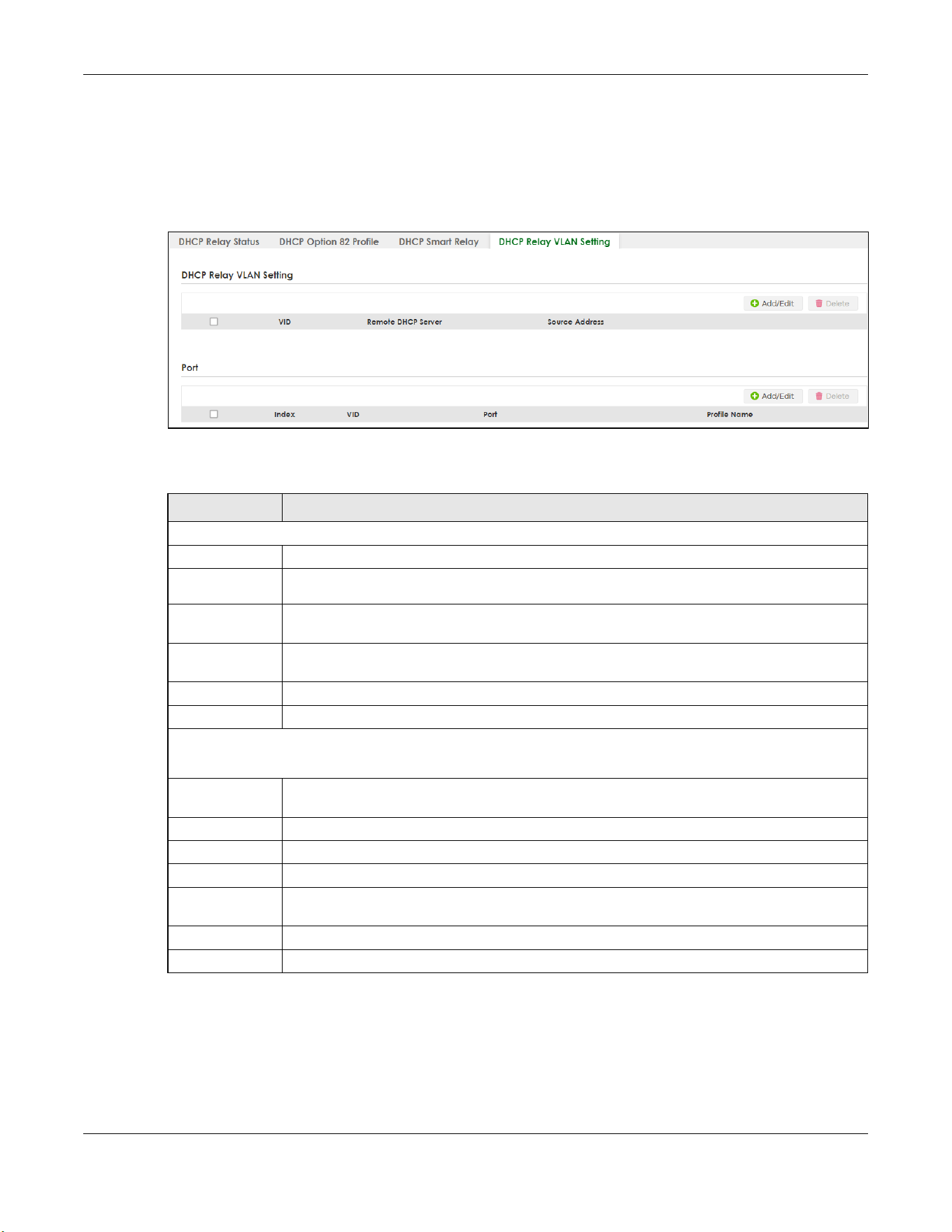
Chapter 51 DHCP
XMG1915 Series User’s Guide
298
51.6 DHCPv4 VLAN Setting
Use this screen to configure your DHCP settings based on the VLAN domain of the DHCP clients. Click
NETWORKING > DHCP > DHCPv4 Relay > DHCP Relay VLAN Setting to display the screen as shown.
Figure 211 NETWORKING > DHCP > DHCPv4 Relay > DHCP Relay VLAN Setting
The following table describes the labels in this screen.
51.6.1 Add/Edit DHCPv4 VLAN Setting
Use this screen to add/edit your DHCP settings based on the VLAN domain of the DHCP clients. Click the
Add/Edit button in the DHCP Relay VLAN Setting section of the NETWORKING > DHCP > DHCPv4 Relay >
DHCP Relay VLAN Setting screen to access this screen.
Table 167 NETWORKING > DHCP > DHCPv4 Relay > DHCP Relay VLAN Setting
LABEL DESCRIPTION
DHCP Relay VLAN Setting
VID This field displays the ID number of the VLAN group to which this DHCP settings apply.
Remote
DHCP Server
This displays the IP address of a DHCP server in dotted decimal notation.
Source
Address
This field displays the source IP address you configured for DHCP requests from clients on this
VLAN.
Select an entry’s check box to select a specific entry. Otherwise, select the check box in the
table heading row to select all entries.
Add/Edit Click Add/Edit to add a new entry or edit a selected one.
Delete Click Delete to remove the selected entries.
Port
Use this section to apply a different DHCP option 82 profile to certain ports in a VLAN.
Index This field displays a sequential number for each entry. Click an index number to change the
settings.
VID This field displays the VLAN to which the ports belongs.
Port This field displays the ports to which the Switch applies the settings.
Profile Name This field displays the DHCP option 82 profile that the Switch applies to the ports in this VLAN.
Select an entry’s check box to select a specific entry. Otherwise, select the check box in the
table heading row to select all entries.
Add/Edit Click Add/Edit to add a new entry or edit a selected one.
Delete Click Delete to remove the selected entries.
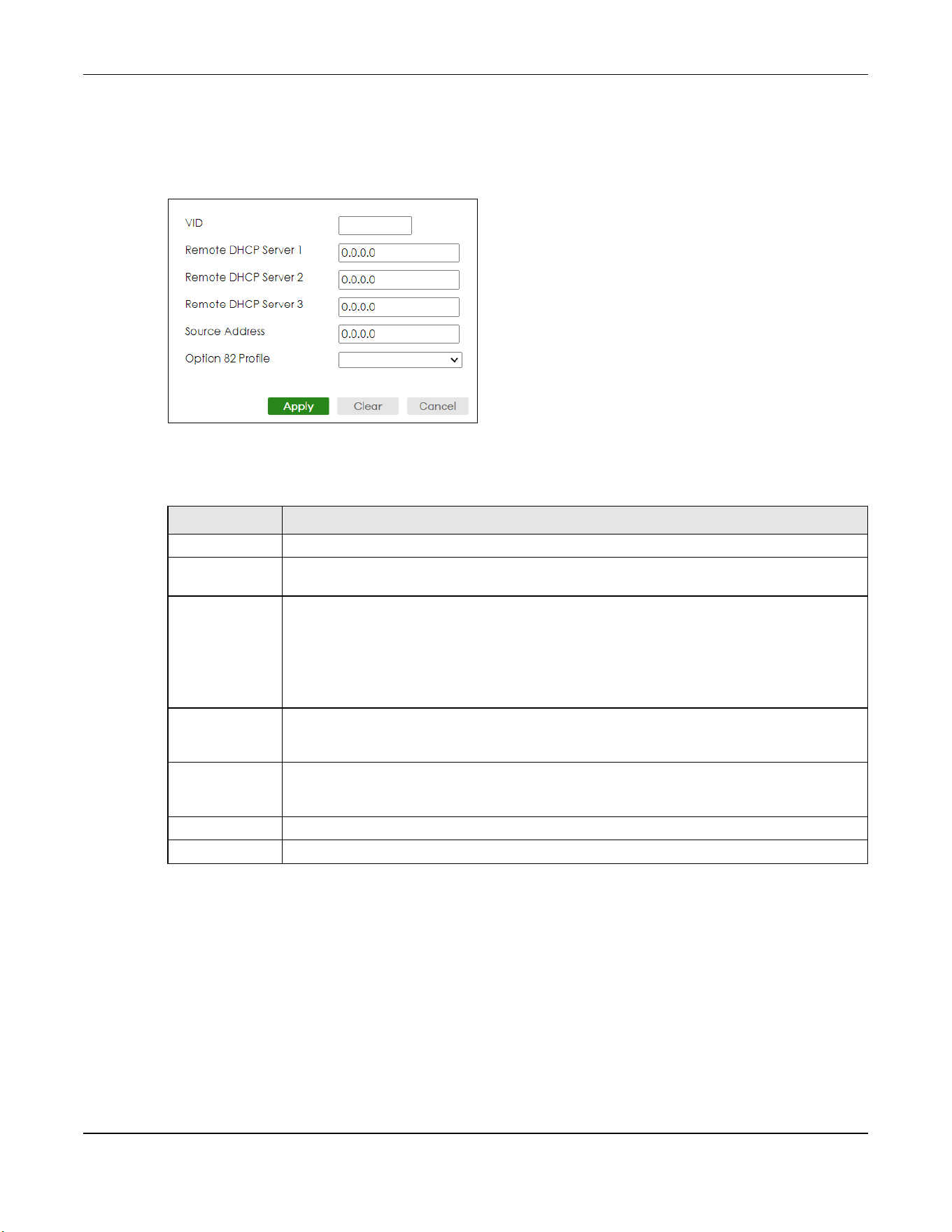
Chapter 51 DHCP
XMG1915 Series User’s Guide
299
Note: You must set up a management IP address for each VLAN that you want to configure
DHCP settings for on the Switch.
Figure 212 NETWORKING > DHCP > DHCPv4 Relay > DHCP Relay VLAN Setting > Add/Edit (DHCP Relay
VLAN Setting)
The following table describes the labels in this screen.
51.6.2 Add/Edit DHCPv4 VLAN Port
Use this screen to apply a different DHCP option 82 profile to certain ports in a VLAN. Click the Add/Edit
button in the Port section of the NETWORKING > DHCP > DHCPv4 Relay > DHCP Relay VLAN Setting
screen to access this screen.
Table 168 NETWORKING > DHCP > DHCPv4 Relay > DHCP Relay VLAN Setting > Add/Edit (DHCP Relay
VLAN Setting)
LABEL DESCRIPTION
VID Enter the ID number of the VLAN to which these DHCP settings apply.
Remote DHCP
Server 1 .. 3
Enter the IP address of a DHCP server in dotted decimal notation.
Source Address Enter the source IP address that the Switch adds to DHCP requests from clients on this VLAN
before forwarding them. If you leave this field set to 0.0.0.0, the Switch automatically sets the
source IP address of the DHCP requests to the IP address of the interface on which the packet is
received.
The source IP address helps DHCP clients obtain an appropriate IP address when you configure
multiple routing domains on a VLAN.
Option 82 Profile Select a pre-defined DHCP option 82 profile that the Switch applies to all ports in this VLAN. The
Switch adds the Circuit ID sub-option and/or Remote ID sub-option specified in the profile to
DHCP requests that it relays to a DHCP server.
Apply Click Apply to save your changes to the Switch’s run-time memory. The Switch loses these
changes if it is turned off or loses power, so use the Save link on the top navigation panel to save
your changes to the non-volatile memory when you are done configuring.
Clear Click Clear to clear the fields to the factory defaults.
Cancel Click Cancel to not save the configuration you make and return to the last screen.

Chapter 51 DHCP
XMG1915 Series User’s Guide
300
Figure 213 NETWORKING > DHCP > DHCPv4 Relay > DHCP Relay VLAN Setting > Add/Edit (Port)
The following table describes the labels in this screen.
51.6.3 Example: DHCP Relay for Two VLANs
The following example displays two VLANs (VIDs 1 and 2) for a campus network. Two DHCP servers are
installed to serve each VLAN. The system is set up to forward DHCP requests from the dormitory rooms
(VLAN 1) to the DHCP server with an IP address of 192.168.1.100. Requests from the academic buildings
(VLAN 2) are sent to the other DHCP server with an IP address of 172.16.10.100.
Table 169 NETWORKING > DHCP > DHCPv4 Relay > DHCP Relay VLAN Setting > Add/Edit (Port)
LABEL DESCRIPTION
VID Enter the ID number of the VLAN you want to configure here.
Port Enter the number of ports to which you want to apply the specified DHCP option 82 profile.
You can enter multiple ports separated by (no space) comma (,) or hyphen (-). For example,
enter “3-5” for ports 3, 4, and 5. Enter “3,5,7” for ports 3, 5, and 7.
Option 82 Profile Select a pre-defined DHCP option 82 profile that the Switch applies to the specified ports in this
VLAN. The Switch adds the Circuit ID sub-option and/or Remote ID sub-option specified in the
profile to DHCP requests that it relays to a DHCP server.
The profile you select here has priority over the one you select in the NETWORKING > DHCP >
DHCPv4 Relay > DHCP Relay VLAN Setting (the DHCP Relay VLAN Setting section)> Add/Edit
screen.
Apply Click Apply to save your changes to the Switch’s run-time memory. The Switch loses these
changes if it is turned off or loses power, so use the Save link on the top navigation panel to save
your changes to the non-volatile memory when you are done configuring.
Clear Click Clear to clear the fields to the factory defaults.
Cancel Click Cancel to not save the configuration you make and return to the last screen.
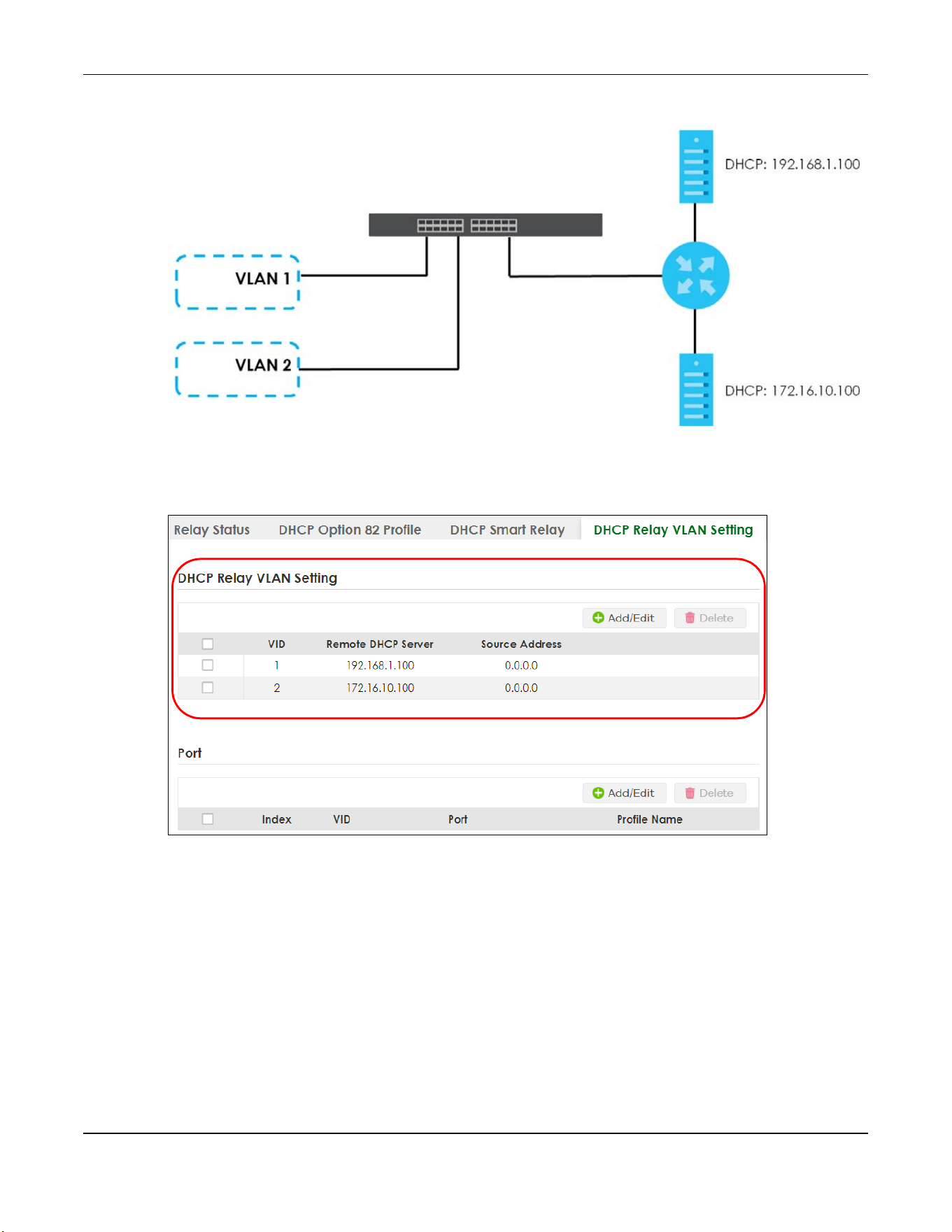
Chapter 51 DHCP
XMG1915 Series User’s Guide
301
Figure 214 DHCP Relay for Two VLANs
For the example network, add two entries in DHCP Relay VLAN Setting section of the NETWORKING >
DHCP > DHCPv4 Relay > DHCP Relay VLAN Setting screen as shown.
Figure 215 DHCP Relay for Two VLANs Configuration Example
51.7 DHCPv6 Relay
A DHCPv6 relay agent is on the same network as the DHCPv6 clients and helps forward messages
between the DHCPv6 server and clients. When a client cannot use its link-local address and a well-
known multicast address to locate a DHCPv6 server on its network, it then needs a DHCPv6 relay agent
to send a message to a DHCPv6 server that is not attached to the same network.
The DHCPv6 relay agent can add the remote identification (remote-ID) option and the interface-ID
option to the Relay-Forward DHCPv6 messages. The remote-ID option carries a user-defined string, such
as the system name. The interface-ID option provides slot number, port information and the VLAN ID to
the DHCPv6 server. The remote-ID option (if any) is stripped from the Relay-Reply messages before the
VLAN 1
VLAN 2
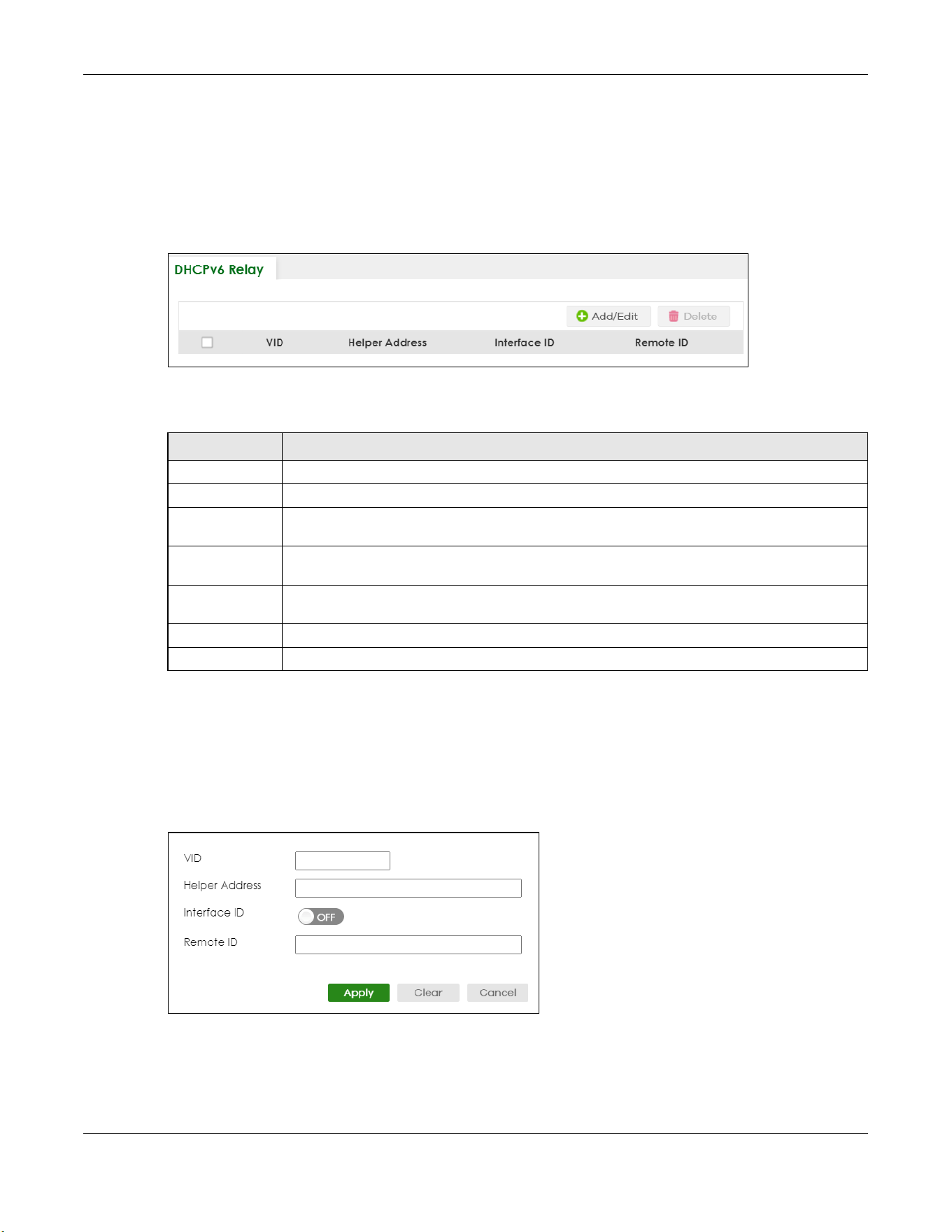
Chapter 51 DHCP
XMG1915 Series User’s Guide
302
relay agent sends the packets to the clients. The DHCPv6 server copies the interface-ID option from the
Relay-Forward message into the Relay-Reply message and sends it to the relay agent. The interface-ID
should not change even after the relay agent restarts.
Use this screen to view and configure DHCPv6 relay settings for a specific VLAN on the Switch. Click
NETWORKING > DHCP > DHCPv6 Relay in the navigation panel to display the screen as shown.
Figure 216 NETWORKING > DHCP > DHCPv6 Relay
The following table describes the labels in this screen.
51.7.1 Add/Edit DHCPv6 Relay
Use this screen to add/edit DHCPv6 relay settings for a specific VLAN on the Switch. Click Add/Edit, or
select an entry and click Add/Edit in the NETWORKING > DHCP > DHCPv6 Relay screen to display this
screen.
Figure 217 NETWORKING > DHCP > DHCPv6 Relay > Add/Edit
Table 170 NETWORKING > DHCP > DHCPv6 Relay
LABEL DESCRIPTION
VID This field displays the VLAN ID number.
Helper Address This field displays the IPv6 address of the remote DHCPv6 server for this VLAN.
Interface ID This field displays whether the interface-ID option is added to DHCPv6 requests from clients in this
VLAN.
Remote ID This field displays whether the remote-ID option is added to DHCPv6 requests from clients in this
VLAN.
Select an entry’s check box to select a specific entry. Otherwise, select the check box in the
table heading row to select all entries.
Add/Edit Click Add/Edit to add a new entry or edit a selected one.
Delete Click Delete to remove the selected entries.
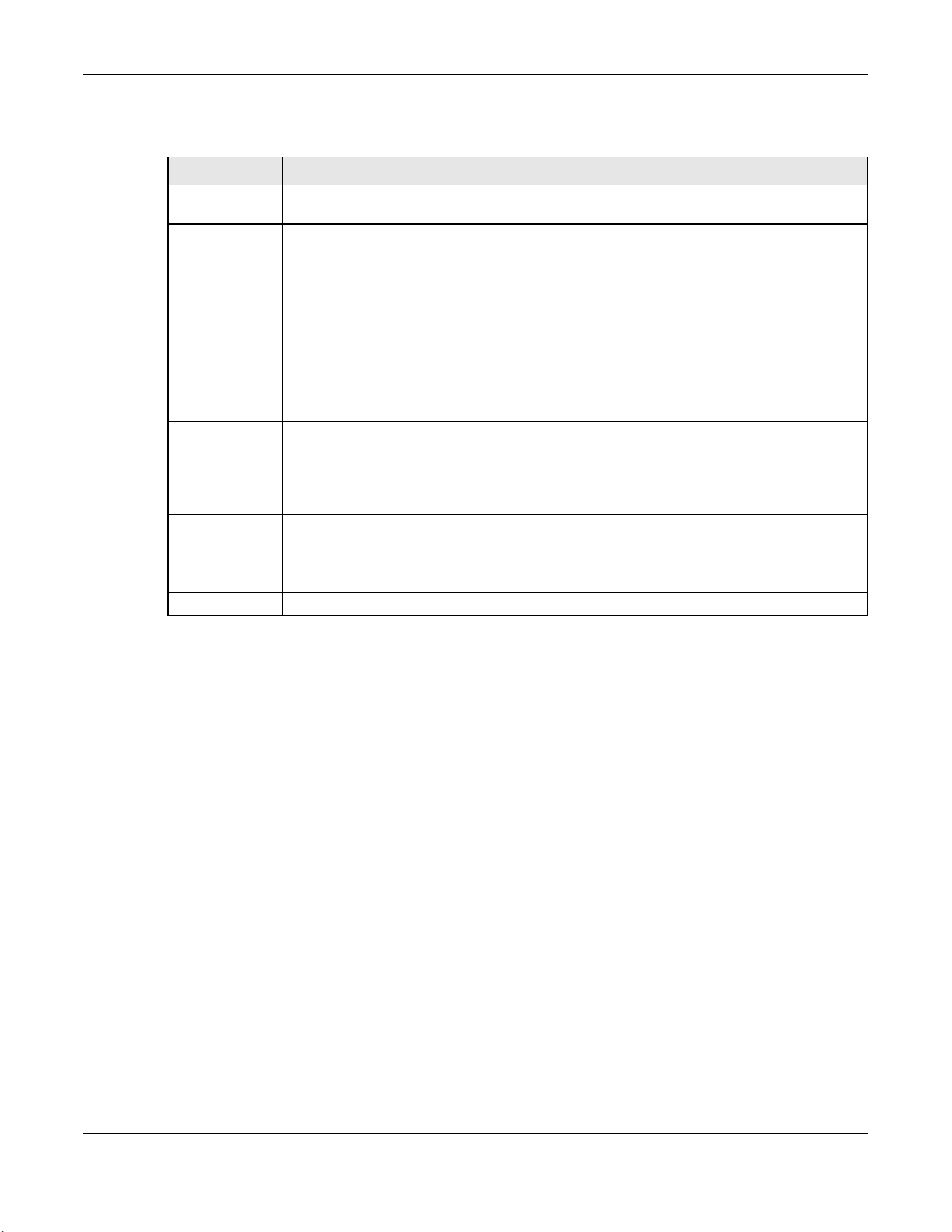
Chapter 51 DHCP
XMG1915 Series User’s Guide
303
The following table describes the labels in this screen.
Table 171 NETWORKING > DHCP > DHCPv6 Relay > Add/Edit
LABEL DESCRIPTION
VID Enter the ID number of the VLAN to which the DHCPv6 server that will assign IP information
belongs here.
Helper Address Enter the IPv6 address of the DHCPv6 server that will assign IP information here.
An 128-bit IPv6 address is written as eight 16-bit hexadecimal blocks separated by colons (:). This
is an example IPv6 address ‘2001:0db8:1a2b:0015:0000:0000:1a2f:0000’.
IPv6 addresses can be abbreviated in two ways:
• Leading zeros in a block can be omitted. So ‘2001:0db8:1a2b:0015:0000:0000:1a2f:0000’ can
be written as ‘2001:db8:1a2b:15:0:0:1a2f:0’.
• Any number of consecutive blocks of zeros can be replaced by a double colon. A double
colon can only appear once in an IPv6 address. So
‘2001:0db8:0000:0000:1a2f:0000:0000:0015’ can be written as
‘2001:0db8::1a2f:0000:0000:0015’, ‘2001:0db8:0000:0000:1a2f::0015’, ‘2001:db8::1a2f:0:0:15’
or ‘2001:db8:0:0:1a2f::15’.
Interface ID Enable the switch button to have the Switch add the interface-ID option in the DHCPv6 requests
from the clients in the specified VLAN before the Switch forwards them to a DHCPv6 server.
Remote ID Enter a string of up to 64 printable ASCII characters (except [ ? ], [ | ], [ ' ], [ " ] or [ , ]) to be
carried in the remote-ID option. The Switch adds the remote-ID option in the DHCPv6 requests
from the clients in the specified VLAN before the Switch forwards them to a DHCPv6 server.
Apply Click Apply to save your changes to the Switch’s run-time memory. The Switch loses these
changes if it is turned off or loses power, so use the Save link on the top navigation panel to save
your changes to the non-volatile memory when you are done configuring.
Clear Click Clear to clear the fields to the factory defaults.
Cancel Click Cancel to not save the configuration you make and return to the last screen.
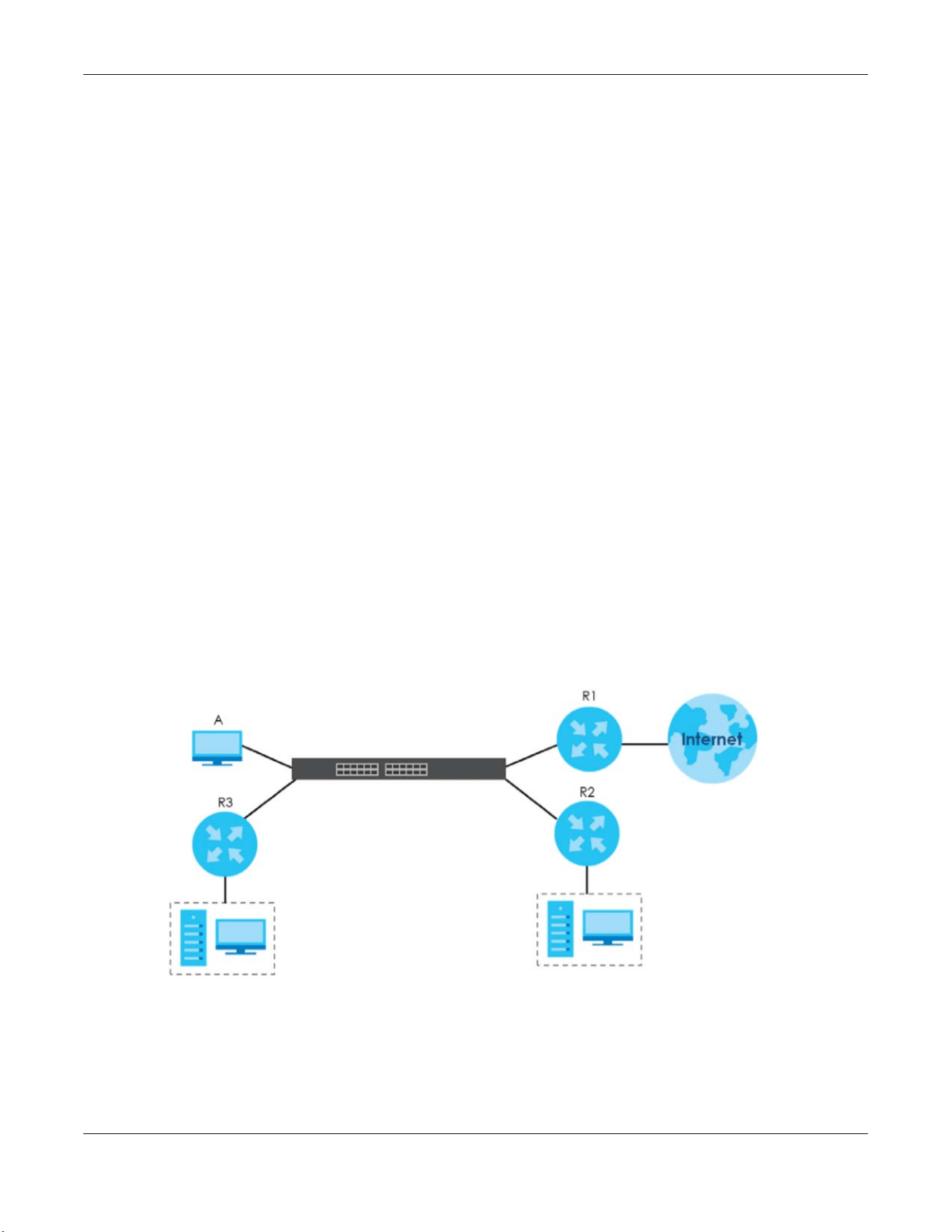
Chapter 52 Static Route
XMG1915 Series User’s Guide
304
CHAPTER 52
Static Route
52.1 Static Routing Overview
This chapter shows you how to configure static routes.
The Switch uses IP for communication with management computers, for example using HTTP, Telnet, SSH,
or SNMP. Use IP static routes to have the Switch respond to remote management stations that are not
reachable through the default gateway. The Switch can also use static routes to send data to a server
or device that is not reachable through the default gateway, for example when sending SNMP traps or
using ping to test IP connectivity.
The Switch usually uses the default gateway to route outbound traffic from computers on the LAN to the
Internet. To have the Switch send data to devices not reachable through the default gateway, use
static routes.
For example, the next figure shows a computer (A) connected to the Switch. The Switch routes most
traffic from A to the Internet through the Switch’s default gateway (R1). You create one static route to
connect to services offered by your ISP behind router R2. You create another static route to
communicate with a separate network behind a router R3 connected to the Switch.
Figure 218 Example of Static Routing Topology
This figure shows a Telnet session coming in from network N1. The Switch sends reply traffic to default
gateway R1 which routes it back to the manager’s computer. The Switch needs a static route to tell it to
use router R2 to send traffic to an SNMP trap server on network N2.
N1
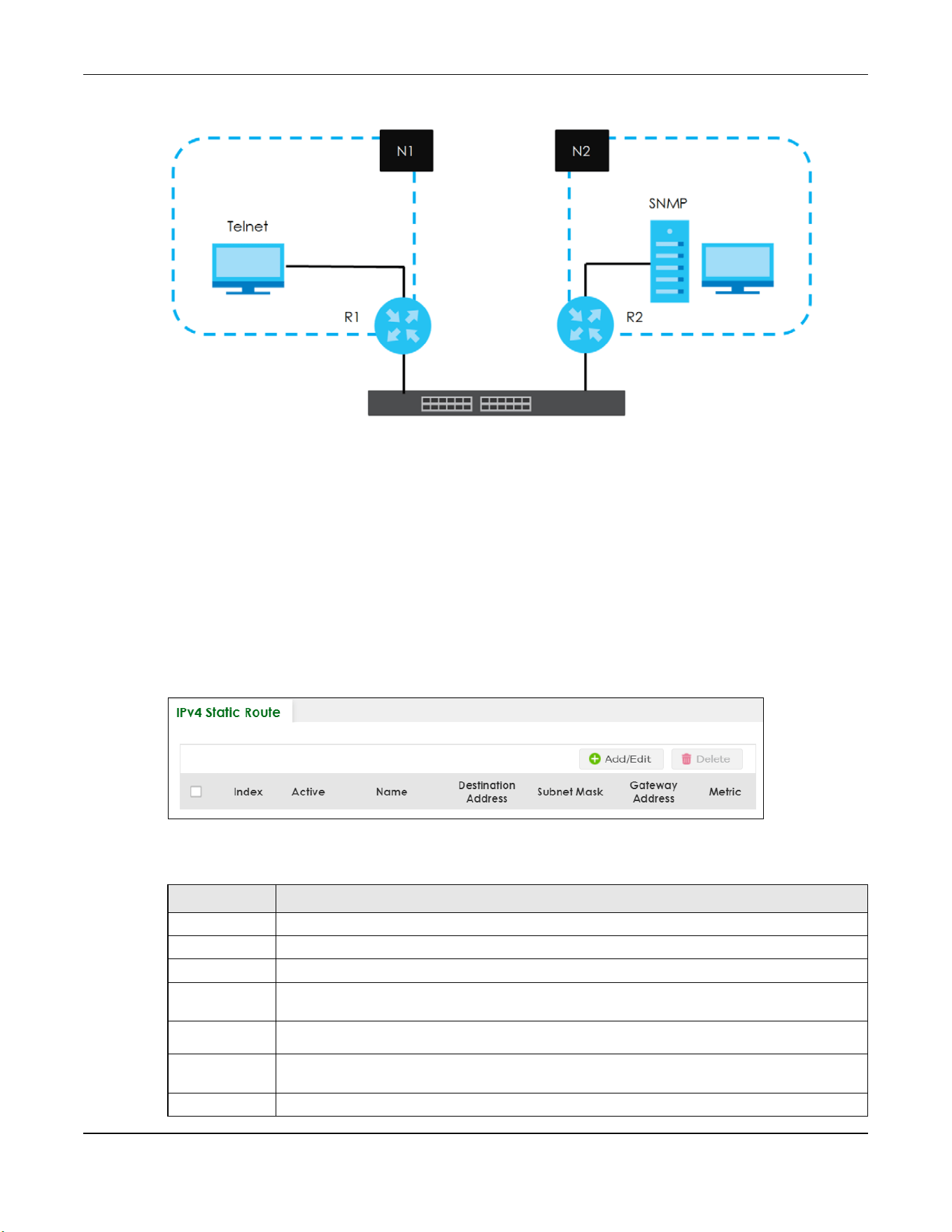
Chapter 52 Static Route
XMG1915 Series User’s Guide
305
Figure 219 Static Routing Overview
52.1.1 What You Can Do
Use the IPv4 Static Route screen (Section 52.2 on page 305) to configure and enable an IPv4 static route.
Use the IPv6 Static Route screen (Section 52.3 on page 307) to configure and enable an IPv6 static route.
52.2 IPv4 Static Route
Click NETWORKING > Static Routing > IPv4 Static Route to display the screen as shown.
Figure 220 NETWORKING > Static Routing > IPv4 Static Route
The following table describes the related labels you use to create a static route.
N1
N2
Table 172 NETWORKING > Static Routing > IPv4 Static Route
LABEL DESCRIPTION
Index This field displays the index number of the route.
Active This field displays whether the static route is activated or not.
Name This field displays the descriptive name for this route. This is for identification purposes only.
Destination
Address
This field displays the IP network address of the final destination.
Subnet Mask This field displays the subnet mask for this destination.
Gateway
Address
This field displays the IP address of the gateway. The gateway is an immediate neighbor of your
Switch that will forward the packet to the destination.
Metric This field displays the cost of transmission for routing purposes.
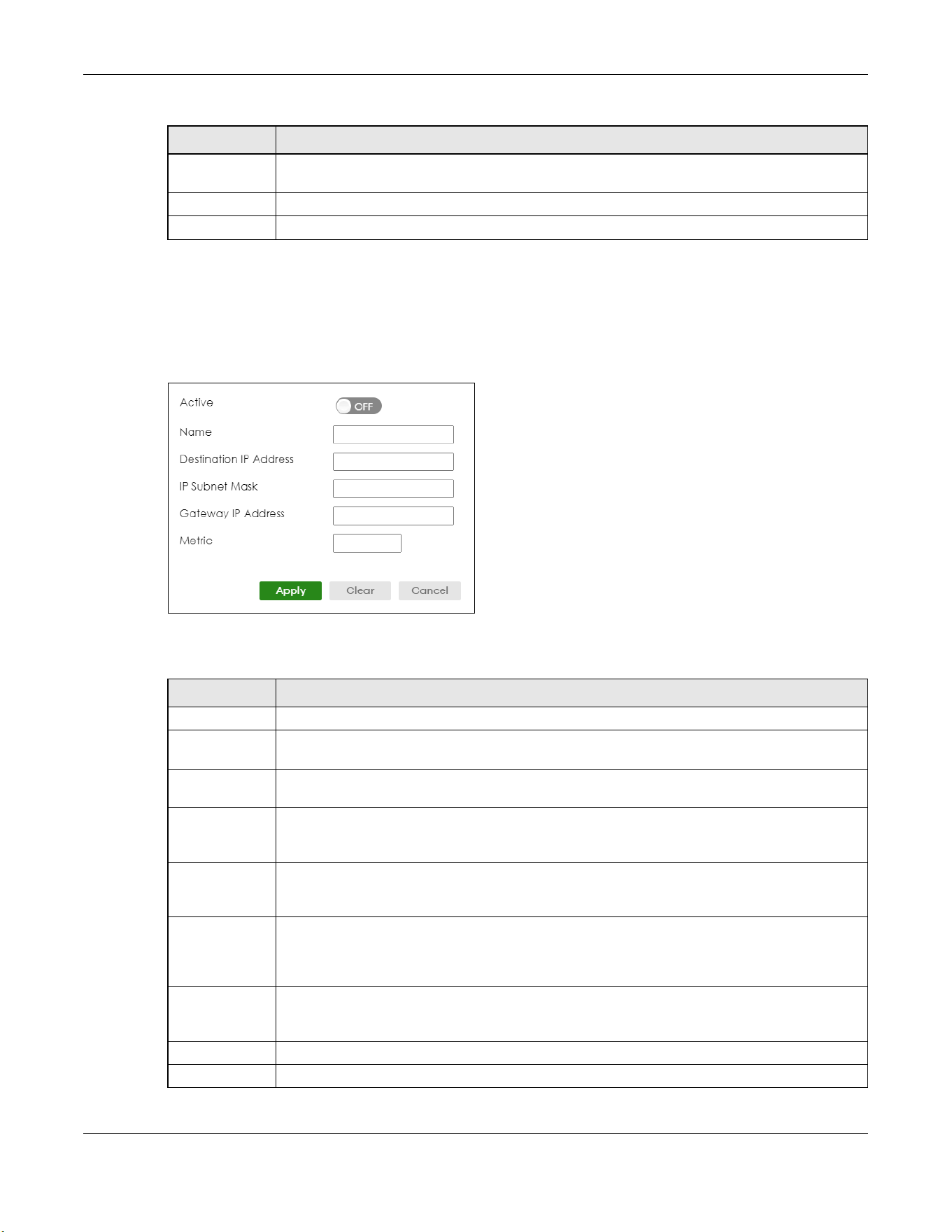
Chapter 52 Static Route
XMG1915 Series User’s Guide
306
52.2.1 Add/Edit IPv4 Static Route
Click Add/Edit, or select an entry and click Add/Edit in the NETWORKING > Static Routing > IPv4 Static
Route screen to display this screen.
Figure 221 NETWORKING > Static Routing > IPv4 Static Route > Add/Edit
The following table describes the related labels you use to create a static route.
Select an entry’s check box to select a specific entry. Otherwise, select the check box in the
table heading row to select all entries.
Add/Edit Click Add/Edit to add a new entry or edit a selected one.
Delete Click Delete to remove the selected entries.
Table 172 NETWORKING > Static Routing > IPv4 Static Route (continued)
LABEL DESCRIPTION
Table 173 NETWORKING > Static Routing > IPv4 Static Route > Add/Edit
LABEL DESCRIPTION
Active This field allows you to activate or deactivate this static route.
Name Enter a descriptive name (up to 10 printable ASCII characters except [ ? ], [ | ], [ ' ], [ " ] or [ , ]) for
identification purposes.
Destination IP
Address
This parameter specifies the IP network address of the final destination.
IP Subnet Mask Enter the subnet mask for this destination. Routing is always based on network number. If you
need to specify a route to a single host, use a subnet mask of 255.255.255.255 in the subnet mask
field to force the network number to be identical to the host ID.
Gateway IP
Address
Enter the IP address of the gateway. The gateway is an immediate neighbor of your Switch that
will forward the packet to the destination. The gateway must be a router on the same segment
as your Switch.
Metric The metric represents the “cost” of transmission for routing purposes. IP routing uses hop count as
the measurement of cost, with a minimum of 1 for directly connected networks. Enter a number
that approximates the cost for this link. The number need not be precise, but it must be between
1 and 15. In practice, 2 or 3 is usually a good number.
Apply Click Apply to save your changes to the Switch’s run-time memory. The Switch loses these
changes if it is turned off or loses power, so use the Save link on the top navigation panel to save
your changes to the non-volatile memory when you are done configuring.
Clear Click Clear to clear the fields to the factory defaults.
Cancel Click Cancel to not save the configuration you make and return to the last screen.
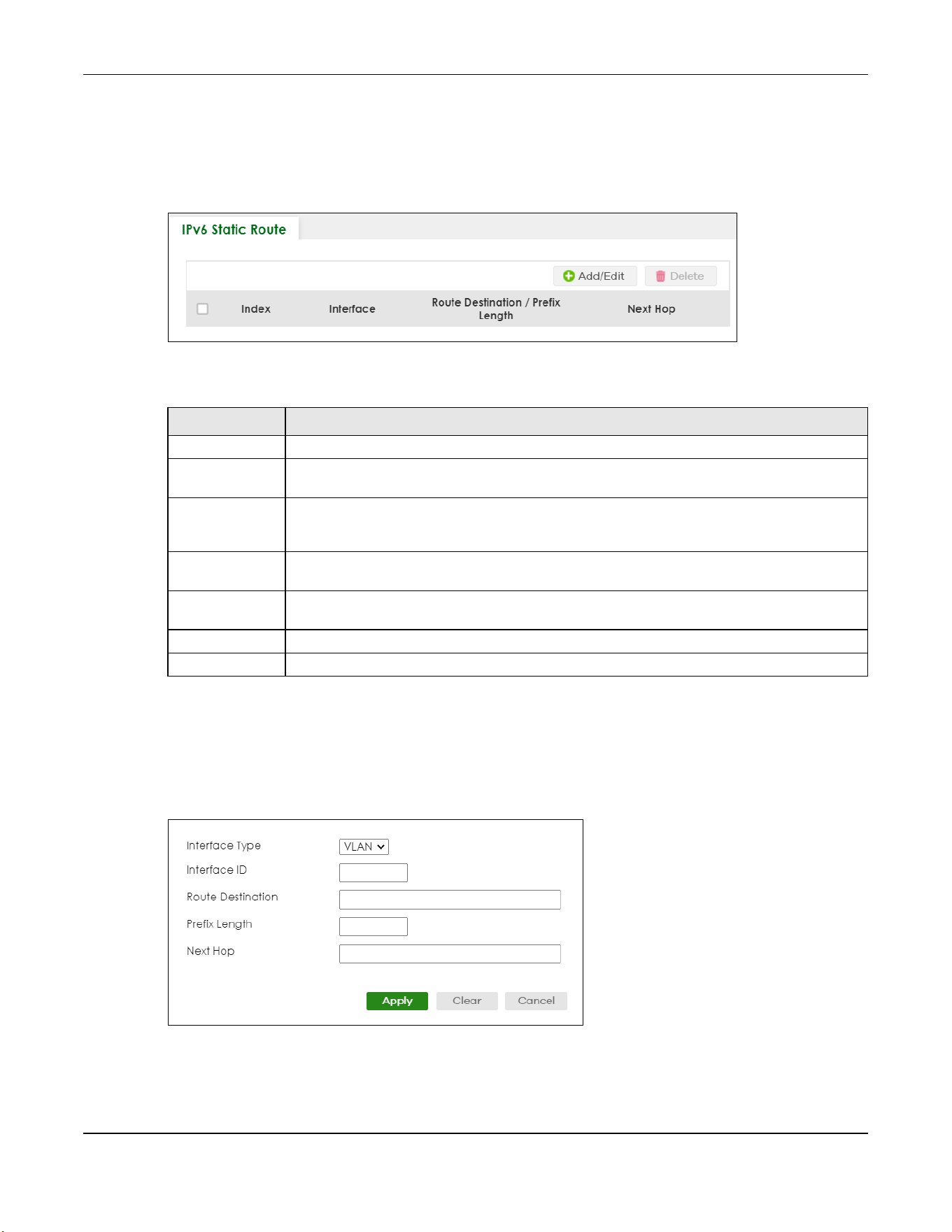
Chapter 52 Static Route
XMG1915 Series User’s Guide
307
52.3 IPv6 Static Route
Click NETWORKING > Static Routing > IPv6 Static Route to display the screen as shown.
Figure 222 NETWORKING > Static Routing > IPv6 Static Route
The following table describes the related labels you use to create a static route.
52.3.1 Add/Edit IPv6 Static Route
Click Add/Edit, or select an entry and click Add/Edit in the NETWORKING > Static Routing > IPv6 Static
Route to display this screen.
Figure 223 NETWORKING > Static Routing > IPv6 Static Route > Add/Edit
Table 174 NETWORKING > Static Routing > IPv6 Static Route
LABEL DESCRIPTION
Index This field displays the index number of the route.
Interface This field displays the descriptive name of the interface that is used to forward the packets to
the destination.
Route
Destination /
Prefix Length
This field displays the IPv6 subnet prefix and prefix length of the final destination.
Next Hop This field displays the IPv6 address of the gateway that helps forward the packet to the
destination.
Select an entry’s check box to select a specific entry. Otherwise, select the check box in the
table heading row to select all entries.
Add/Edit Click Add/Edit to add a new entry or edit a selected one.
Delete Click Delete to remove the selected entries.
Chapter 52 Static Route
XMG1915 Series User’s Guide
308
The following table describes the related labels you use to create a static route.
Table 175 NETWORKING > Static Routing > IPv6 Static Route > Add/Edit
LABEL DESCRIPTION
Interface Type Select the type of the IPv6 interface through which the IPv6 packets are forwarded.
The Switch supports only the VLAN interface type at the time of writing.
Interface ID Enter the ID number of the IPv6 interface through which the IPv6 packets are forwarded.
Route
Destination
Enter the IPv6 address of the final destination.
Prefix Length Enter the prefix length number of up to 64 for this destination.
Next Hop Enter the IPv6 address of the next-hop router.
Apply Click Apply to save your changes to the Switch’s run-time memory. The Switch loses these
changes if it is turned off or loses power, so use the Save link on the top navigation panel to
save your changes to the non-volatile memory when you are done configuring.
Clear Click Clear to clear the fields to the factory defaults.
Cancel Click Cancel to not save the configuration you make and return to the last screen.

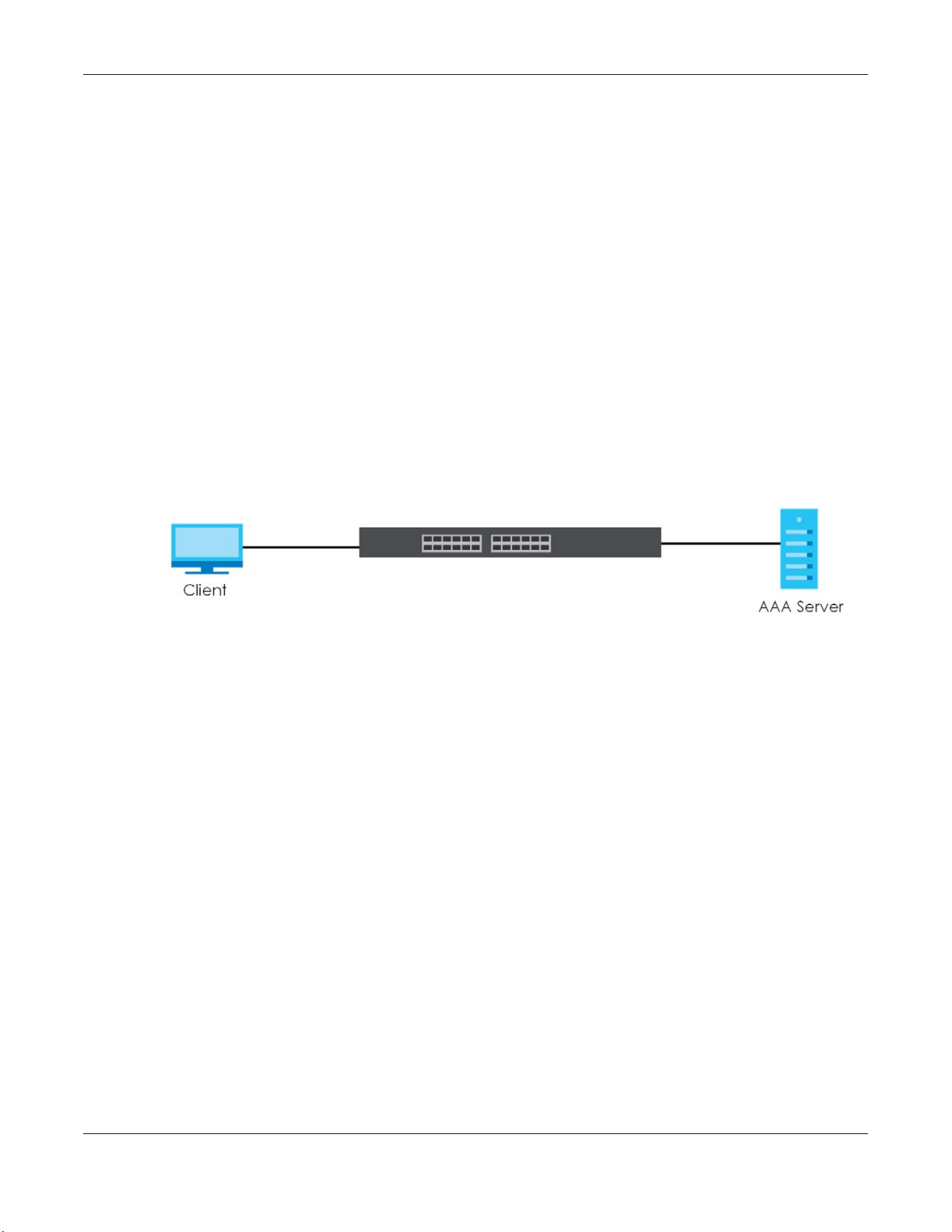
Chapter 54 AAA
XMG1915 Series User’s Guide
310
CHAPTER 54
AAA
54.1 Authentication, Authorization and Accounting (AAA)
This chapter describes how to configure authentication, authorization and accounting settings on the
Switch.
The external servers that perform authentication, authorization and accounting functions are known as
AAA servers. The Switch supports RADIUS (Remote Authentication Dial-In User Service) as the external
authentication, authorization, and accounting server.
Figure 224 AAA Server
54.1.1 What You Can Do
• use the RADIUS Server Setup screen (Section 54.2 on page 311) to configure your RADIUS server
settings.
• Use the AAA Setup screen (Section 54.3 on page 313) to configure authentication, authorization and
accounting settings, such as the methods used to authenticate users accessing the Switch and which
database the Switch should use first.
54.1.2 What You Need to Know
Authentication is the process of determining who a user is and validating access to the Switch. The
Switch can authenticate users who try to log in based on user accounts configured on the Switch itself.
The Switch can also use an external authentication server to authenticate a large number of users.
Authorization is the process of determining what a user is allowed to do. Different user accounts may
have higher or lower privilege levels associated with them. For example, user A may have the right to
create new login accounts on the Switch but user B cannot. The Switch can authorize users based on
user accounts configured on the Switch itself or it can use an external server to authorize a large number
of users.
Accounting is the process of recording what a user is doing. The Switch can use an external server to
track when users log in, log out, execute commands and so on. Accounting can also record system
related actions such as boot up and shut down times of the Switch.
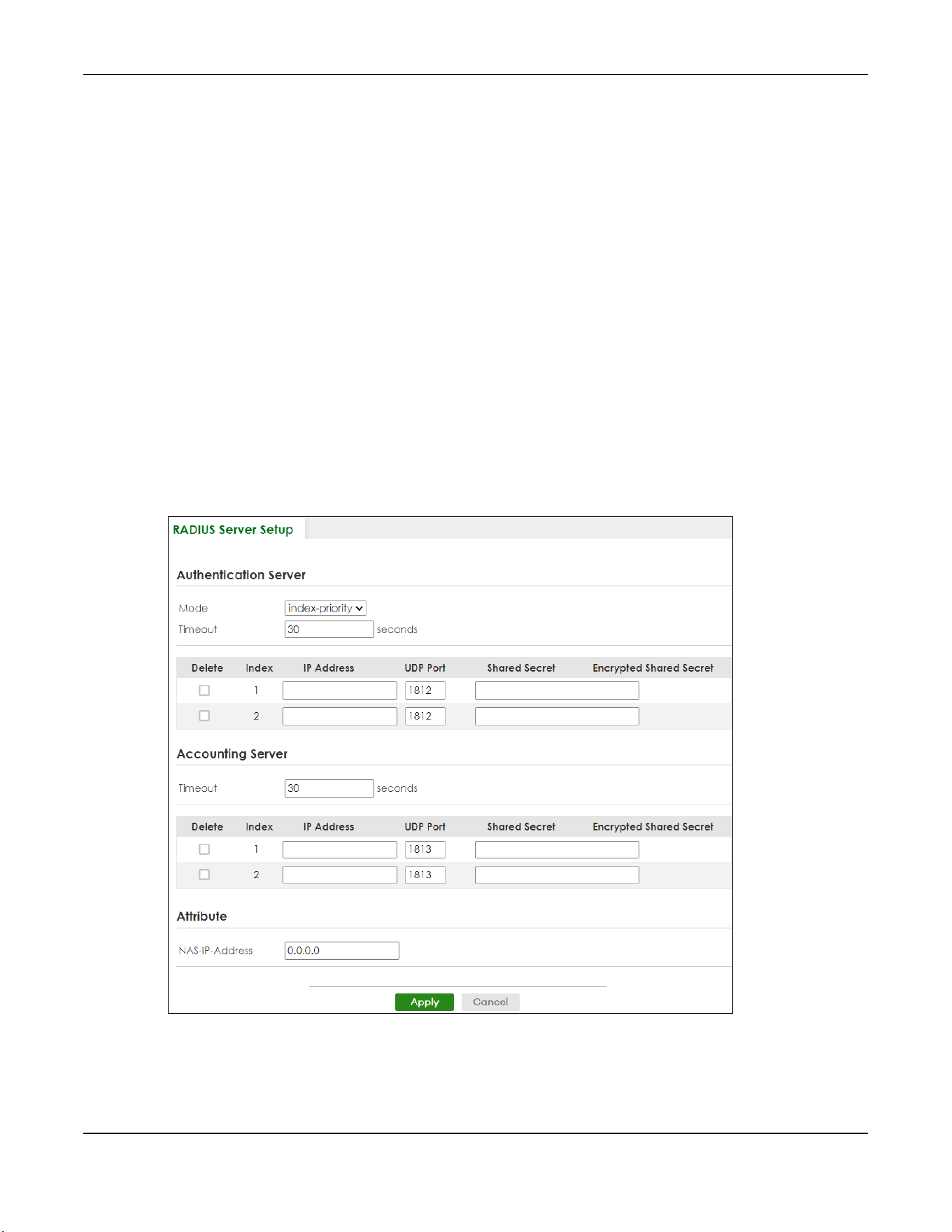
Chapter 54 AAA
XMG1915 Series User’s Guide
311
Local User Accounts
By storing user profiles locally on the Switch, your Switch is able to authenticate and authorize users
without interacting with a network AAA server. However, there is a limit on the number of users you may
authenticate in this way.
RADIUS
RADIUS is a security protocol used to authenticate users by means of an external server instead of (or in
addition to) an internal device user database that is limited to the memory capacity of the device. In
essence, RADIUS authentication allows you to validate an unlimited number of users from a central
location.
54.2 RADIUS Server Setup
Use this screen to configure your RADIUS server settings. Click SECURITY > AAA > RADIUS Server Setup to
view the screen as shown.
Figure 225 SECURITY > AAA > RADIUS Server Setup
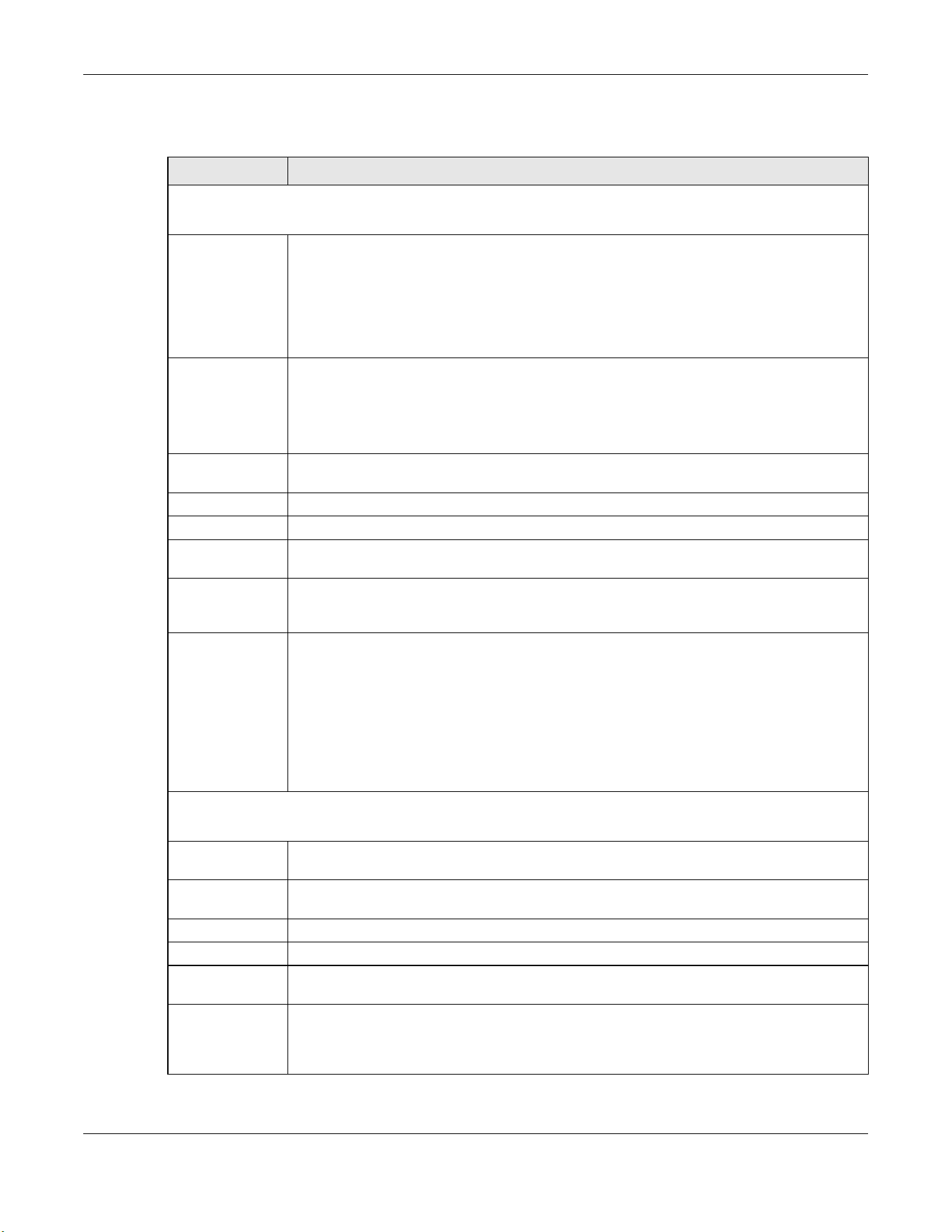
Chapter 54 AAA
XMG1915 Series User’s Guide
312
The following table describes the labels in this screen.
Table 176 SECURITY > AAA > RADIUS Server Setup
LABEL DESCRIPTION
Authentication Server
Use this section to configure your RADIUS authentication settings.
Mode This field is only valid if you configure multiple RADIUS servers.
Select index-priority and the Switch tries to authenticate with the first configured RADIUS server,
if the RADIUS server does not respond then the Switch tries to authenticate with the second
RADIUS server.
Select round-robin to alternate between the RADIUS servers that it sends authentication
requests to.
Timeout Specify the amount of time in seconds that the Switch waits for an authentication request
response from the RADIUS server.
If you are using two RADIUS servers then the timeout value is divided between the two RADIUS
servers. For example, if you set the timeout value to 30 seconds, then the Switch waits for a
response from the first RADIUS server for 15 seconds and then tries the second RADIUS server.
Delete Check this box if you want to remove an existing RADIUS server entry from the Switch. This entry
is deleted when you click Apply.
Index This is a read-only number representing a RADIUS server entry.
IP Address Enter the IPv4 address or IPv6 address of an external RADIUS server.
UDP Port The default port of a RADIUS server for authentication is 1812. You need not change this value
unless your network administrator instructs you to do so.
Shared Secret Specify a password (up to 32 alphanumeric characters except [ ? ], [ | ], [ ' ], [ " ] or [ , ]) as the
key to be shared between the external RADIUS server and the Switch. This key is not sent over
the network. This key must be the same on the external RADIUS server and the Switch.
Encrypted
Shared Secret
This displays the encrypted shared secret in ‘*’ format if you enabled Server Key Encryption in
SECURITY > AAA > AAA Setup.
Note: If you forget the key you set, simply reset the key in the Shared Secret field. If a
key is encrypted, it will remain in the encrypted format even if you later disable
Server Key Encryption in SECURITY > AAA > AAA Setup.
Note: The shared secret displayed in this field does not present the actual length of
the shared secret.
Accounting Server
Use this section to configure your RADIUS accounting server settings.
Timeout Specify the amount of time in seconds that the Switch waits for an accounting request
response from the RADIUS accounting server.
Delete Check this box if you want to remove an existing RADIUS accounting server entry from the
Switch. This entry is deleted when you click Apply.
Index This is a read-only number representing a RADIUS accounting server entry.
IP Address Enter the IPv4 address or IPv6 address of an external RADIUS accounting server.
UDP Port The default port of a RADIUS accounting server for accounting is 1813. You need not change
this value unless your network administrator instructs you to do so.
Shared Secret Specify a password (up to 32 alphanumeric characters except [ ? ], [ | ], [ ' ], [ " ] or [ , ]) as the
key to be shared between the external RADIUS accounting server and the Switch. This key is not
sent over the network. This key must be the same on the external RADIUS accounting server
and the Switch.
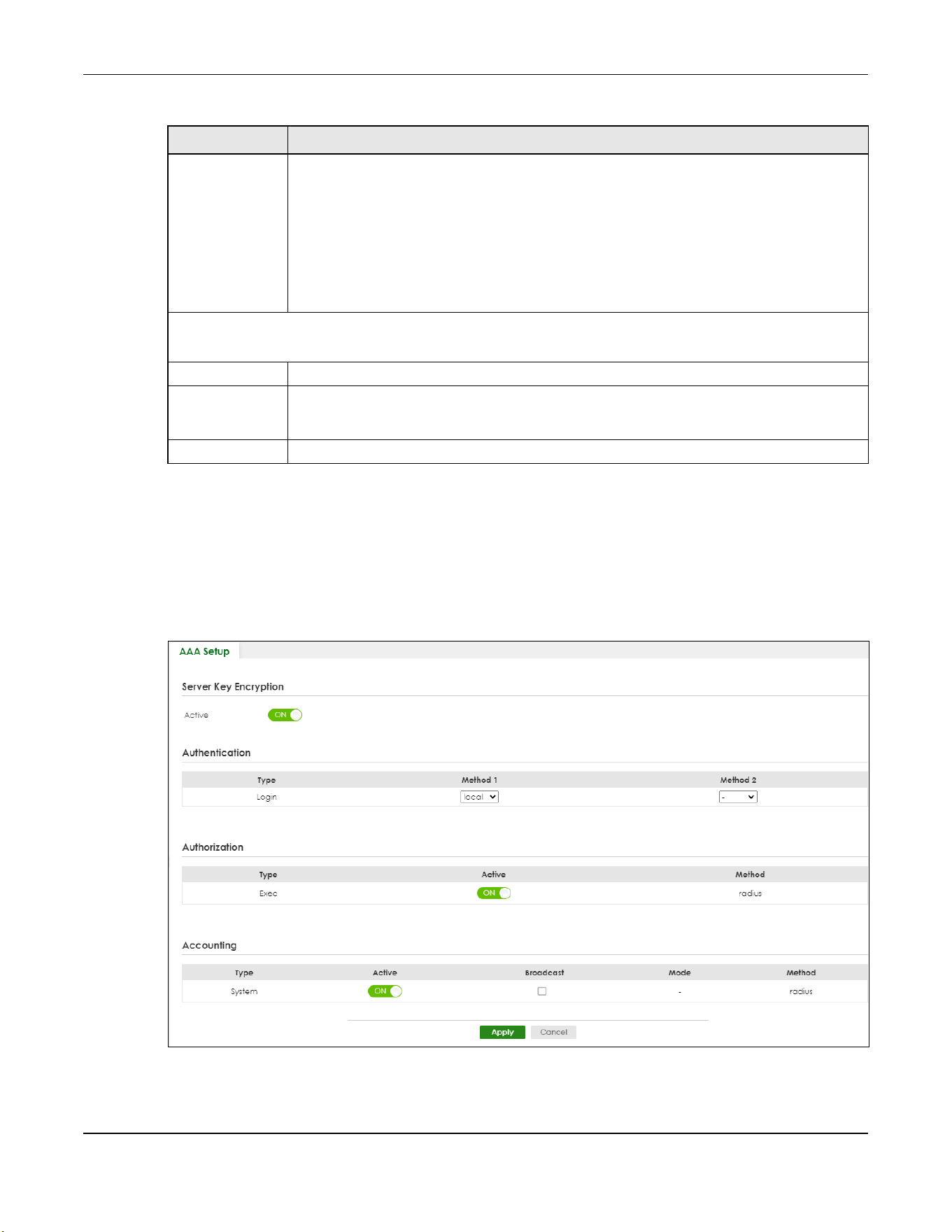
Chapter 54 AAA
XMG1915 Series User’s Guide
313
54.3 AAA Setup
Use this screen to configure authentication, authorization and accounting settings on the Switch. Click
SECURITY > AAA > AAA Setup to view the screen as shown.
Figure 226 SECURITY > AAA > AAA Setup
Encrypted
Shared Secret
This displays the encrypted shared secret in ‘*’ format if you enabled Server Key Encryption in
SECURITY > AAA > AAA Setup.
Note: If you forget the key you set, simply reset the key in the Shared Secret field. If a
key is encrypted, it will remain in the encrypted format even if you later disable
Server Key Encryption in SECURITY > AAA > AAA Setup.
Note: The shared secret displayed in this field does not present the actual length of
the shared secret.
Attribute
Use this section to define the RADIUS server attribute for its account.
NAS-IP-Address Enter the IP address of the NAS (Network Access Server).
Apply Click Apply to save your changes to the Switch’s run-time memory. The Switch loses these
changes if it is turned off or loses power, so use the Save link on the top navigation panel to
save your changes to the non-volatile memory when you are done configuring.
Cancel Click Cancel to begin configuring this screen afresh.
Table 176 SECURITY > AAA > RADIUS Server Setup (continued)
LABEL DESCRIPTION
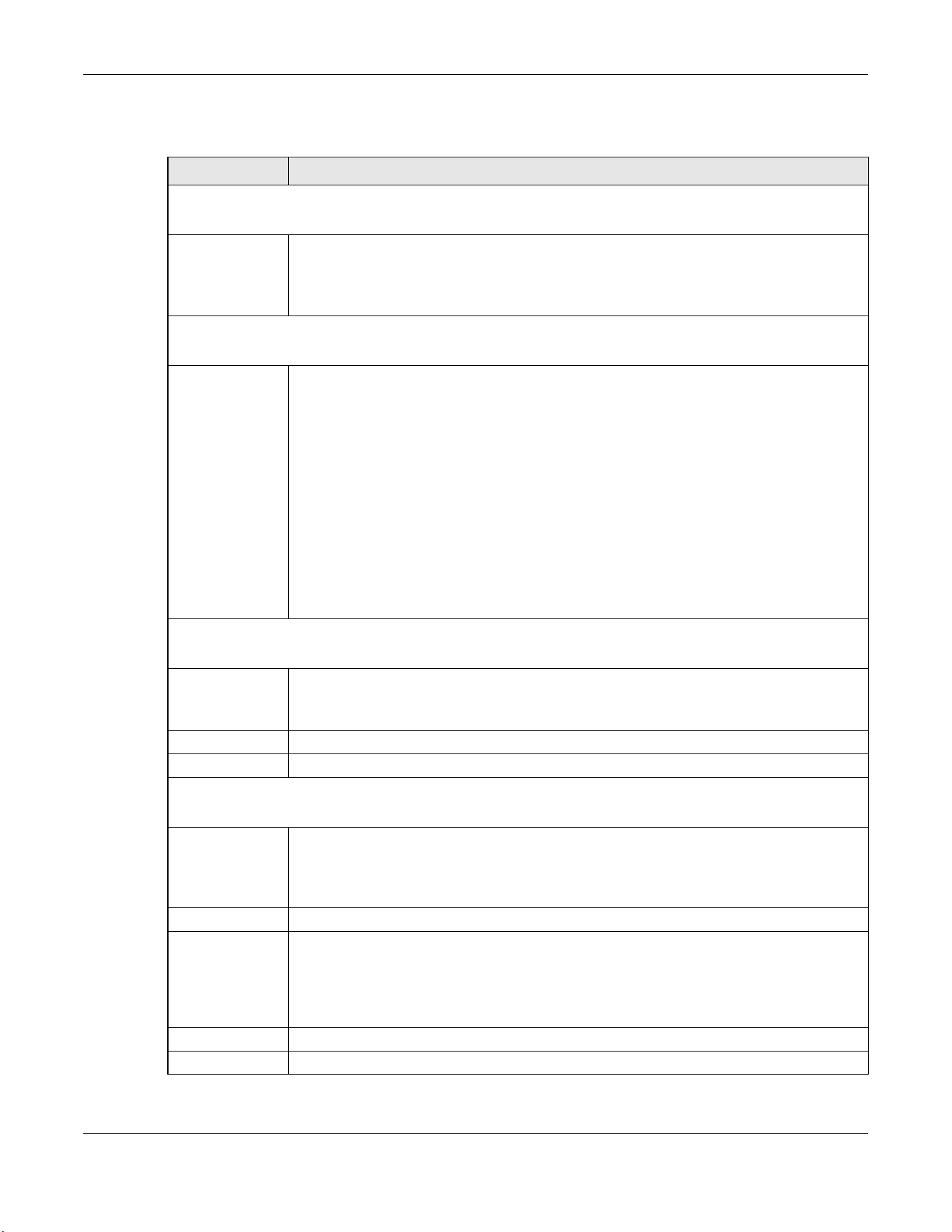
Chapter 54 AAA
XMG1915 Series User’s Guide
314
The following table describes the labels in this screen.
Table 177 SECURITY > AAA > AAA Setup
LABEL DESCRIPTION
Server Key Encryption
Use this section to configure server key encryption settings.
Active Enable the switch button to enable server key (shared secret) encryption for RADIUS server for
security enhancement.
The shared secret will be stored on the Switch in an encrypted format and displayed as ‘*’ in
the SECURITY > AAA > RADIUS Server Setup screen.
Authentication
Use this section to specify the methods used to authenticate users accessing the Switch.
Login These fields specify which database the Switch should use (first and second) to authenticate
administrator accounts (users for Switch management).
Configure the local user accounts in the SYSTEM > Logins screen. The RADIUS is an external
server. Before you specify the priority, make sure you have set up the corresponding database
correctly first.
You can specify up to two methods for the Switch to authenticate administrator accounts. The
Switch checks the methods in the order you configure them (first Method 1, and then Method
2). You must configure the settings in the Method 1 field. If you want the Switch to check
another source for administrator accounts, specify them in the Method 2 field.
Select local to have the Switch check the administrator accounts configured in the SYSTEM >
Logins screen.
Select radius to have the Switch check the administrator accounts configured through your
RADIUS server.
Authorization
Use this section to configure authorization settings on the Switch.
Type Set whether the Switch provides the following services to a user.
• Exec: Allow an administrator which logs into the Switch through Telnet or SSH to have a
different access privilege level assigned through the external server.
Active Enable the switch button to activate authorization for a specified event type.
Method RADIUS is the only method for authorization of the Exec type of service.
Accounting
Use this section to configure accounting settings on the Switch.
Type The Switch supports the following types of events to be sent to the accounting servers:
• System – Configure the Switch to send information when the following system events occur:
system boots up, system shuts down, system accounting is enabled, system accounting is
disabled.
Active Enable the switch button to activate accounting for a specified event type.
Broadcast Select this to have the Switch send accounting information to all configured accounting
servers at the same time.
If you do not select this and you have two accounting servers set up, then the Switch sends
information to the first accounting server and if it does not get a response from the accounting
server then it tries the second accounting server.
Mode This should show ‘-’ by default.
Method RADIUS is the only method for recording System type of event.

Chapter 54 AAA
XMG1915 Series User’s Guide
315
54.4 Technical Reference
This section provides technical background information on the topics discussed in this chapter.
54.4.1 Vendor Specific Attribute
RFC 2865 standard specifies a method for sending vendor-specific information between a RADIUS server
and a network access device (for example, the Switch). A company can create Vendor Specific
Attributes (VSAs) to expand the functionality of a RADIUS server.
The Switch supports VSAs that allow you to perform the following actions based on user authentication:
• Limit bandwidth on incoming or outgoing traffic for the port the user connects to.
• Assign account privilege levels (See the CLI Reference Guide for more information on account
privilege levels) for the authenticated user.
The VSAs are composed of the following:
• Vendor-ID: An identification number assigned to the company by the IANA (Internet Assigned
Numbers Authority). Zyxel’s vendor ID is 890.
• Vendor-Type: A vendor specified attribute, identifying the setting you want to modify.
• Vendor-data: A value you want to assign to the setting.
Note: Refer to the documentation that comes with your RADIUS server on how to configure
VSAs for users authenticating through the RADIUS server.
The following table describes the VSAs supported on the Switch. Note that these attributes only work
when you enable authorization (see Section 54.3 on page 313).
Apply Click Apply to save your changes to the Switch’s run-time memory. The Switch loses these
changes if it is turned off or loses power, so use the Save link on the top navigation panel to
save your changes to the non-volatile memory when you are done configuring.
Cancel Click Cancel to begin configuring this screen afresh.
Table 177 SECURITY > AAA > AAA Setup (continued)
LABEL DESCRIPTION

Chapter 54 AAA
XMG1915 Series User’s Guide
316
54.4.2 Supported RADIUS Attributes
Remote Authentication Dial-In User Service (RADIUS) attributes are data used to define specific
authentication elements in a user profile, which is stored on the RADIUS server. This section lists the
RADIUS attributes supported by the Switch.
Refer to RFC 2865 for more information about RADIUS attributes used for authentication.
This section lists the attributes used by authentication functions on the Switch. In cases where the
attribute has a specific format associated with it, the format is specified.
54.4.3 Attributes Used for Authentication
The following sections list the attributes sent from the Switch to the RADIUS server when performing
authentication.
54.4.3.1 Attributes Used to Login Users
User-Name
User-Password
NAS-Identifier
NAS-IP-Address
54.4.4 Attributes Used for Accounting
The following sections list the attributes sent from the Switch to the RADIUS server when performing
authentication.
Table 178 Supported VSAs
FUNCTION ATTRIBUTE
Privilege Assignment
Vendor-ID = 890
Vendor-Type = 3
Vendor-Data = "shell:priv-lvl=N"
or
Vendor-ID = 9 (CISCO)
Vendor-Type = 1 (CISCO-AVPAIR)
Vendor-Data = "shell:priv-lvl=N"
where N is a privilege level (from 0 to 14).
Note: If you set the privilege level of a login account differently on the RADIUS
servers and the Switch, the user is assigned a privilege level from the
database (RADIUS or local) the Switch uses first for user authentication.

Chapter 54 AAA
XMG1915 Series User’s Guide
317
54.4.4.1 Attributes Used for Accounting System Events
NAS-IP-Address
NAS-Identifier
Acct-Status-Type
Acct-Session-ID
– The format of Acct-Session-Id is date+time+8-digit sequential number, for example,
2007041917210300000001. (date: 2007/04/19, time: 17:21:03, serial number: 00000001)
Acct-Delay-Time

Chapter 55 Access Control
XMG1915 Series User’s Guide
318
CHAPTER 55
Access Control
55.1 Access Control Overview
This chapter describes how to control access to the Switch.
A console port and FTP are allowed one session each, Telnet and SSH share nine sessions, up to five web
sessions (five different user names and passwords) and/or limitless SNMP access control sessions are
allowed.
55.1.1 What You Can Do
• Use the Service Access Control screen (Section 55.2 on page 318) to decide what services you may
use to access the Switch.
• Use the Remote Management screen (Section 55.3 on page 319) to specify a group of one or more
“trusted computers” from which an administrator may use a service to manage the Switch.
• Use the Account Security screen (Section 55.4 on page 320) to encrypt all passwords configured in
the Switch. You can also display the authentication, authorization, external authentication server
information (RADIUS), system and SNMP user account information in the configuration file saved.
55.2 Service Access Control
Service Access Control allows you to decide what services you may use to access the Switch. You may
also change the default service port and configure “trusted computers” for each service in the
SECURITY > Access Control > Remote Management screen (see Section 55.3 on page 319 for more
information). Click SECURITY > Access Control > Service Access Control to display the following screen.
Table 179 Access Control Overview
Console Port SSH Telnet FTP Web SNMP
One session Share up to 9 sessions One session Up to 5 accounts No limit
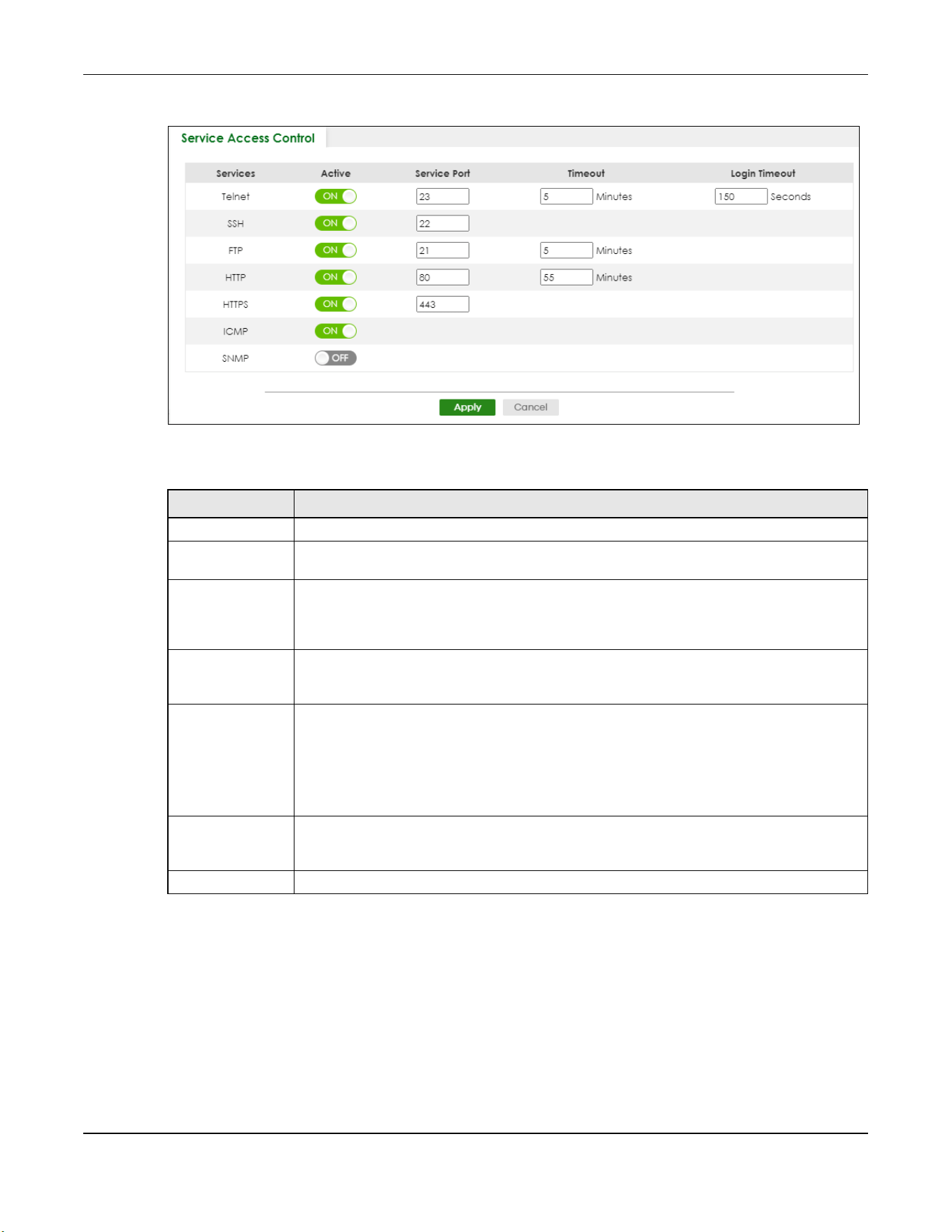
Chapter 55 Access Control
XMG1915 Series User’s Guide
319
Figure 227 SECURITY > Access Control > Service Access Control
The following table describes the fields in this screen.
55.3 Remote Management
Use this screen to specify a group of one or more “trusted computers” from which an administrator may
use a service to manage the Switch.
Click SECURITY > Access Control > Remote Management to view the screen as shown next.
Table 180 SECURITY > Access Control > Service Access Control
LABEL DESCRIPTION
Services Services you may use to access the Switch are listed here.
Active Enable the switch button for the corresponding services that you want to allow to access the
Switch.
Service Port For Telnet, SSH, FTP, HTTP or HTTPS services, you may change the default service port by typing
the new port number in the Service Port field. If you change the default port number then you
will have to let people (who wish to use the service) know the new port number for that
service.
Timeout Enter how many minutes (from 1 to 255) a management session can be left idle before the
session times out. After it times out you have to log in with your password again. Very long idle
timeouts may have security risks.
Login Timeout The Telnet or SSH server do not allow multiple user logins at the same time. Enter how many
seconds (from 30 to 300 seconds) a login session times out. After it times out you have to start
the login session again. Very long login session timeouts may have security risks.
For example, if User A attempts to connect to the Switch (through SSH), but during the login
stage, do not enter the user name and/or password, User B cannot connect to the Switch
(through SSH) before the Login Timeout for User A expires (default 150 seconds).
Apply Click Apply to save your changes to the Switch’s run-time memory. The Switch loses these
changes if it is turned off or loses power, so use the Save link on the top navigation panel to
save your changes to the non-volatile memory when you are done configuring.
Cancel Click Cancel to begin configuring this screen afresh.
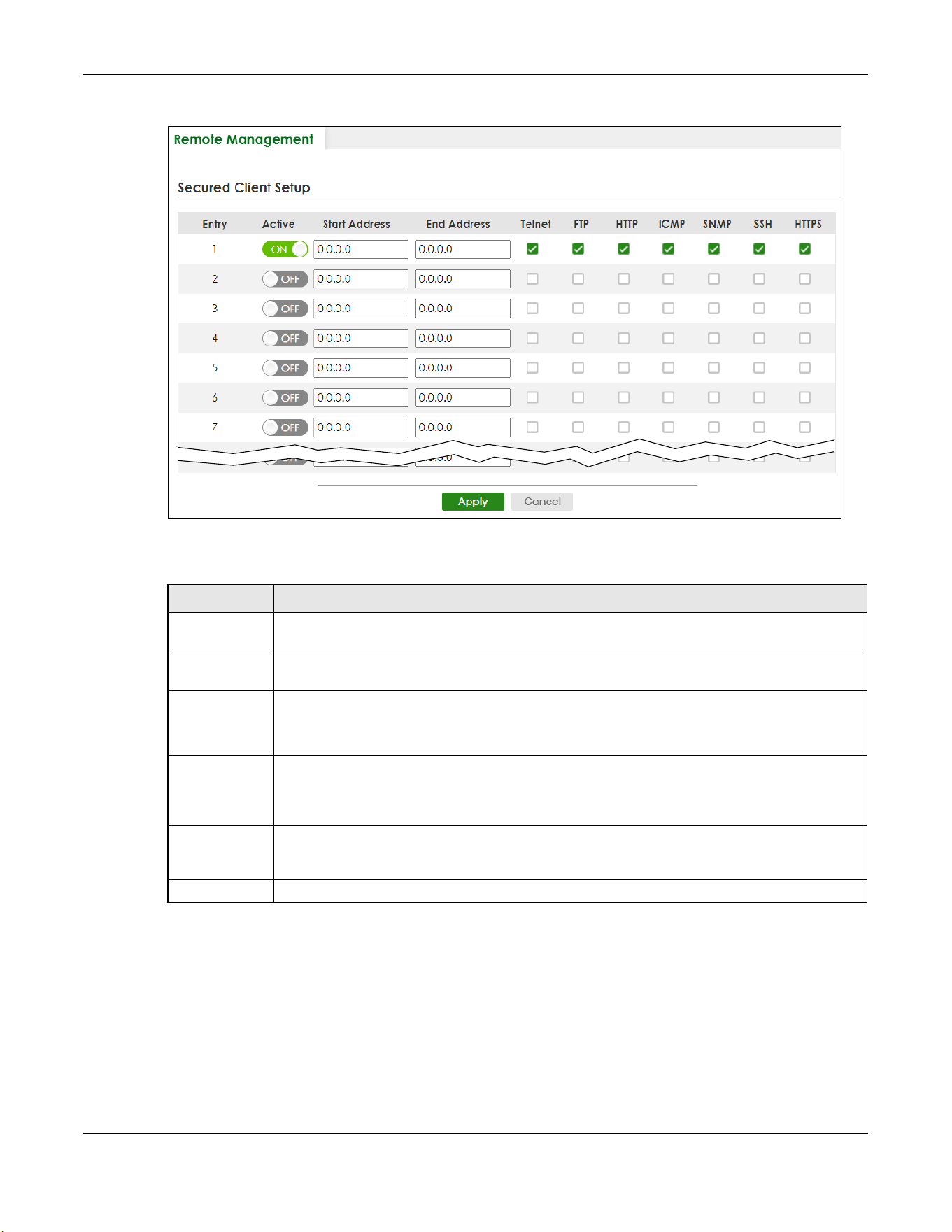
Chapter 55 Access Control
XMG1915 Series User’s Guide
320
Figure 228 SECURITY > Access Control > Remote Management
The following table describes the labels in this screen.
55.4 Account Security
Use this screen to encrypt all passwords configured in the Switch. This setting will affect how the
password is shown (as plain text or encrypted text) in the configuration file saved in MAINTENANCE >
Configuration > Save Configuration.
Table 181 SECURITY > Access Control > Remote Management
LABEL DESCRIPTION
Entry This is the client set index number. A “client set” is a group of one or more “trusted computers”
from which an administrator may use a service to manage the Switch.
Active Enable the switch button to activate this secured client set. Clear the check box if you wish to
temporarily disable the set without deleting it.
Start Address
End Address
Configure the IP address range of trusted computers from which you can manage this Switch.
The Switch checks if the client IP address of a computer requesting a service or protocol matches
the range set here. The Switch immediately disconnects the session if it does not match.
Telnet / FTP /
HTTP / ICMP /
SNMP / SSH /
HTTPS
Select services that may be used for managing the Switch from the specified trusted computers.
Apply Click Apply to save your changes to the Switch’s run-time memory. The Switch loses these
changes if it is turned off or loses power, so use the Save link on the top navigation panel to save
your changes to the non-volatile memory when you are done configuring.
Cancel Click Cancel to begin configuring this screen afresh.
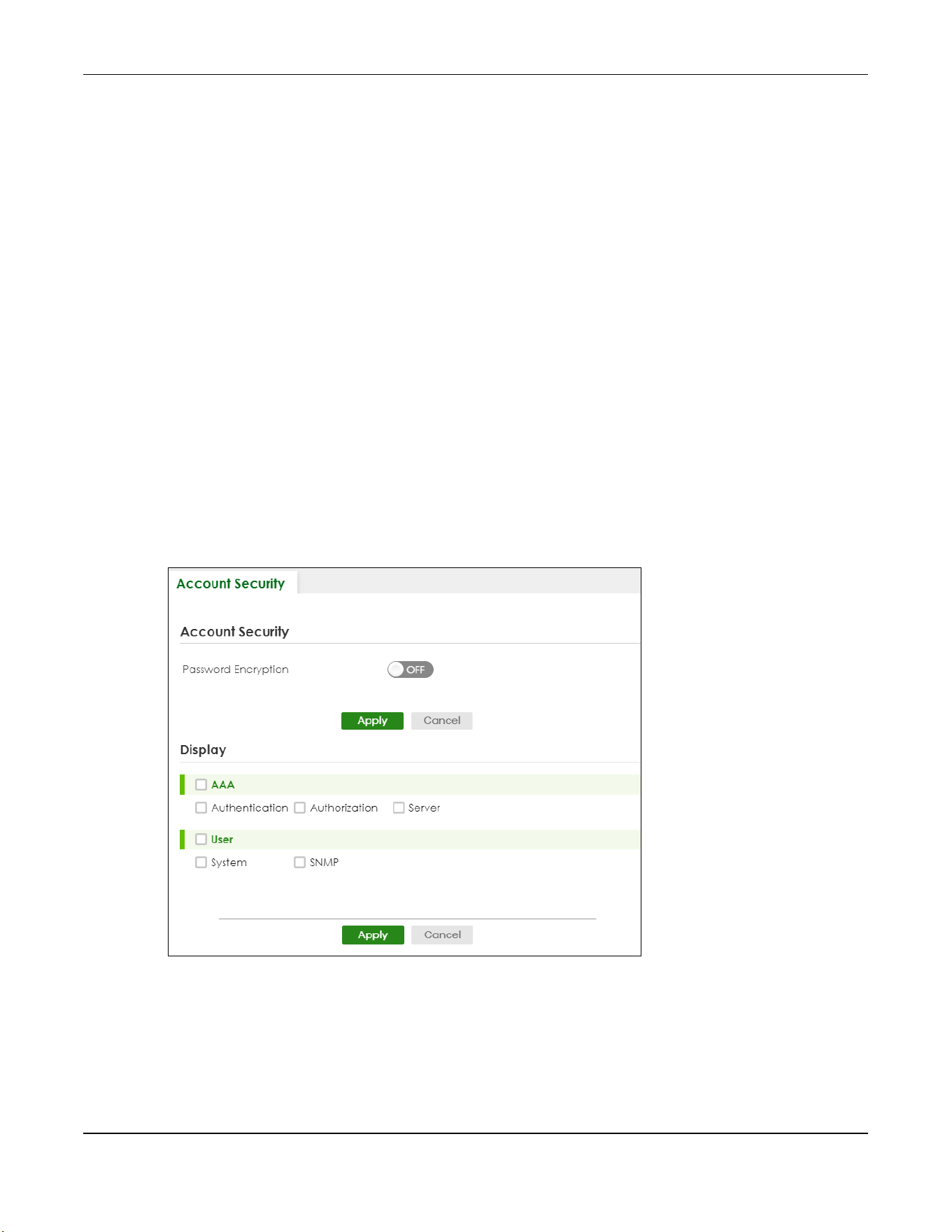
Chapter 55 Access Control
XMG1915 Series User’s Guide
321
Note: Make sure to enable Password Encryption to avoid displaying passwords as plain text in
the configuration file.
Note: Be careful who can access configuration files with plain text passwords!
Password Encryption encrypts all passwords in the configuration file. However, if you want to show some
passwords as plain text in the configuration file, select them as below:
• Authentication information configured for Authentication in the SECURITY > AAA > AAA Setup screen
(Method 1/2 setting in the Login field).
• Authorization information configured for Authorization in the SECURITY > AAA > AAA Setup screen
(Active/Method setting in the Exec field).
• Server information configured for Authentication Server in the SECURITY > AAA > RADIUS Server Setup
screen (Mode/Timeout fields).
• System account information configured in the Switch (admin, user login name, and password).
• SNMP user account information configured in the SYSTEM > SNMP > SNMP User screen (password for
SNMP user authentication in the Authentication field, and the password for the encryption method for
SNMP communication in the Privacy field).
Note: The passwords will appear as encrypted text when Password Encryption is Active.
Click SECURITY > Access Control > Account Security to view the screen as shown next.
Figure 229 SECURITY > Access Control > Account Security
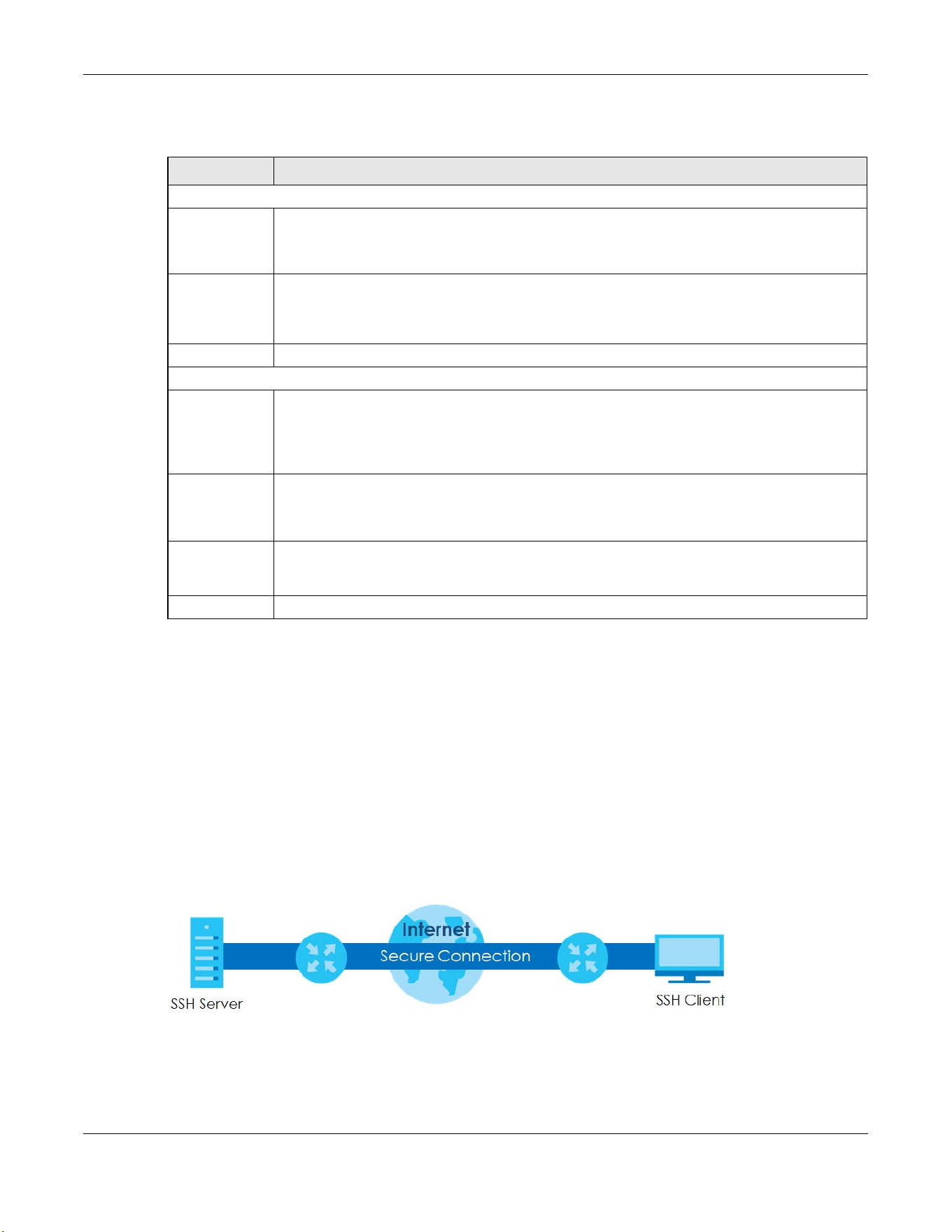
Chapter 55 Access Control
XMG1915 Series User’s Guide
322
The following table describes the labels in this screen.
55.5 Technical Reference
This section provides technical background information on the topics discussed in this chapter.
55.5.1 SSH Overview
Unlike Telnet or FTP, which transmit data in clear text, SSH (Secure Shell) is a secure communication
protocol that combines authentication and data encryption to provide secure encrypted
communication between two hosts over an unsecured network.
Figure 230 SSH Communication Example
55.5.1.1 How SSH Works
The following table summarizes how a secure connection is established between two remote hosts.
Table 182 SECURITY > Access Control > Account Security
LABEL DESCRIPTION
Account Security
Password
Encryption
Select this check box to encrypt all passwords configured on the Switch. This displays the
password as encrypted text, in a saved configuration file.
Otherwise, the passwords configured on the Switch are displayed in plain text.
Apply Click Apply to save your changes for Account Security to the Switch’s run-time memory. The
Switch loses these changes if it is turned off or loses power, so use the Save link on the top
navigation panel to save your changes to the non-volatile memory when you are done
configuring.
Cancel Click Cancel to begin configuring Account Security afresh.
Display
AAA Select which specific information to display in plain text, in the saved configuration file.
• Authentication
• Authorization
•Server
User Select which user account information to display in plain text, in the saved configuration file.
•System
•SNMP
Apply Click Apply to save your changes for Display to the Switch’s run-time memory. The Switch loses
these changes if it is turned off or loses power, so use the Save link on the top navigation panel to
save your changes to the non-volatile memory when you are done configuring.
Cancel Click Cancel to begin configuring Display afresh.
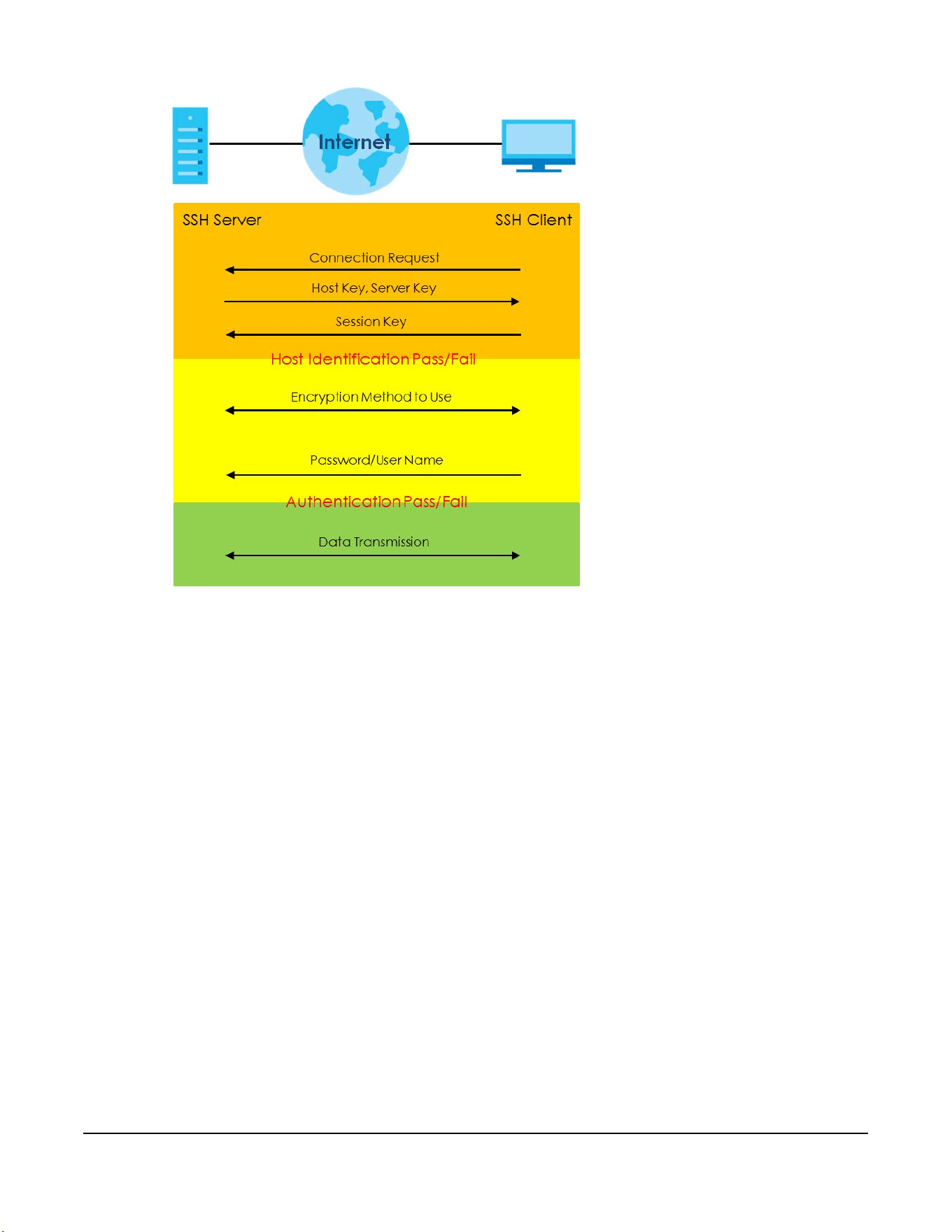
XMG1915 Series User’s Guide
323
Figure 231 How SSH Works
1 Host Identification
The SSH client sends a connection request to the SSH server. The server identifies itself with a host key. The
client encrypts a randomly generated session key with the host key and server key and sends the result
back to the server.
The client automatically saves any new server public keys. In subsequent connections, the server public
key is checked against the saved version on the client computer.
2 Encryption Method
Once the identification is verified, both the client and server must agree on the type of encryption
method to use.
3 Authentication and Data Transmission
After the identification is verified and data encryption activated, a secure tunnel is established between
the client and the server. The client then sends its authentication information (user name and password)
to the server to log in to the server.
55.5.1.2 SSH Implementation on the Switch
Your Switch supports SSH version 2 using RSA authentication and three encryption methods (DES, 3DES
and Blowfish). The SSH server is implemented on the Switch for remote management and file transfer on
port 22. Only one SSH connection is allowed at a time.
55.5.1.3 Requirements for Using SSH
You must install an SSH client program on a client computer (Windows or Linux operating system) that is
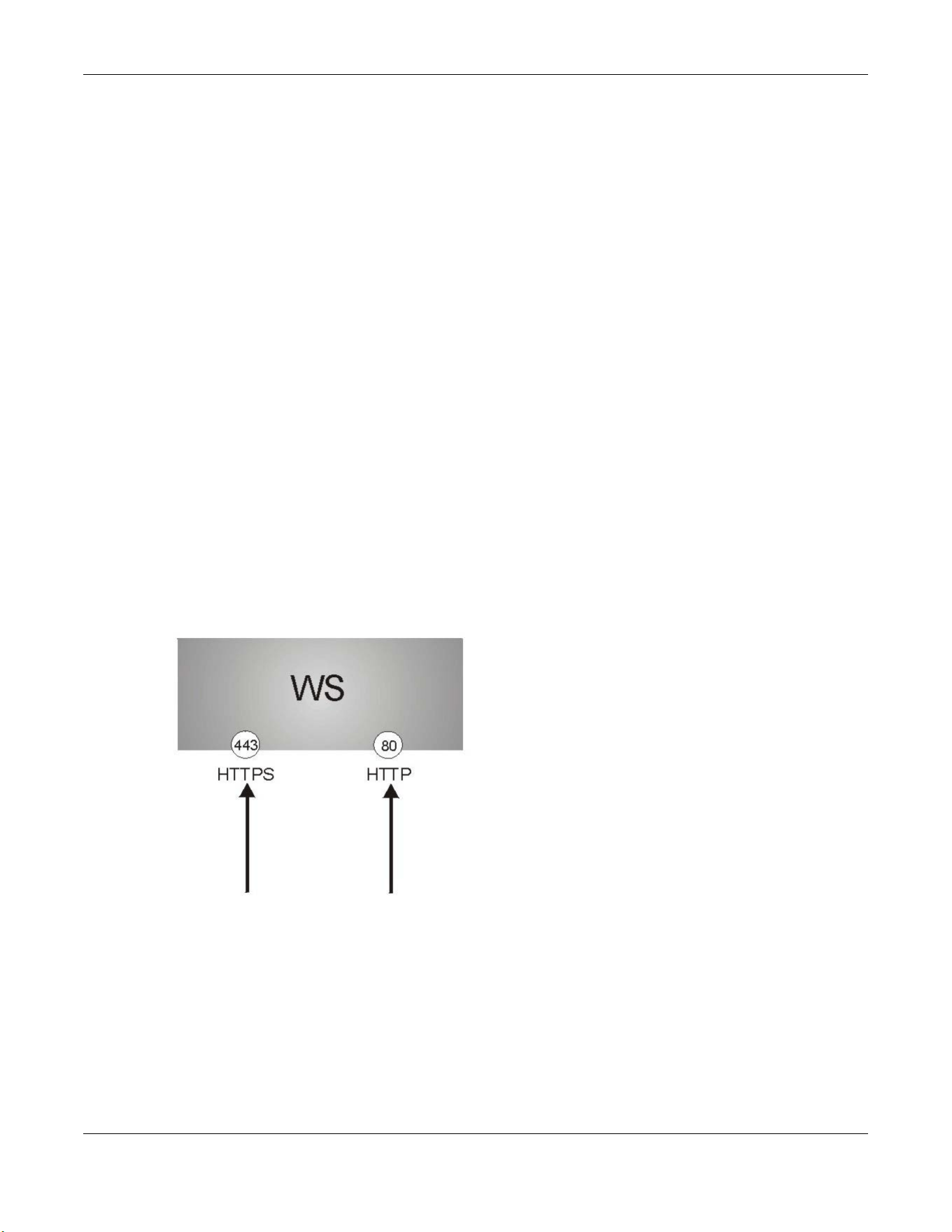
Chapter 55 Access Control
XMG1915 Series User’s Guide
324
used to connect to the Switch over SSH.
55.5.2 Introduction to HTTPS
HTTPS (HyperText Transfer Protocol over Secure Socket Layer, or HTTP over SSL) is a web protocol that
encrypts and decrypts web pages. Secure Socket Layer (SSL) is an application-level protocol that
enables secure transactions of data by ensuring confidentiality (an unauthorized party cannot read the
transferred data), authentication (one party can identify the other party) and data integrity (you know if
data has been changed).
It relies upon certificates, public keys, and private keys.
HTTPS on the Switch is used so that you may securely access the Switch using the Web Configurator. The
SSL protocol specifies that the SSL server (the Switch) must always authenticate itself to the SSL client (the
computer which requests the HTTPS connection with the Switch), whereas the SSL client only should
authenticate itself when the SSL server requires it to do so. Authenticating client certificates is optional
and if selected means the SSL-client must send the Switch a certificate. You must apply for a certificate
for the browser from a Certificate Authority (CA) that is a trusted CA on the Switch.
Please refer to the following figure.
1 HTTPS connection requests from an SSL-aware web browser go to port 443 (by default) on the Switch’s
WS (web server).
2 HTTP connection requests from a web browser go to port 80 (by default) on the Switch’s WS (web
server).
Figure 232 HTTPS Implementation
Note: If you disable HTTP in the Service Access Control screen, then the Switch blocks all HTTP
connection attempts.
55.5.2.1 HTTPS Example
If you have not changed the default HTTPS port on the Switch, then in your browser enter “https://Switch
IP Address/” as the web site address where “Switch IP Address” is the IP address or domain name of the
Switch you wish to access.
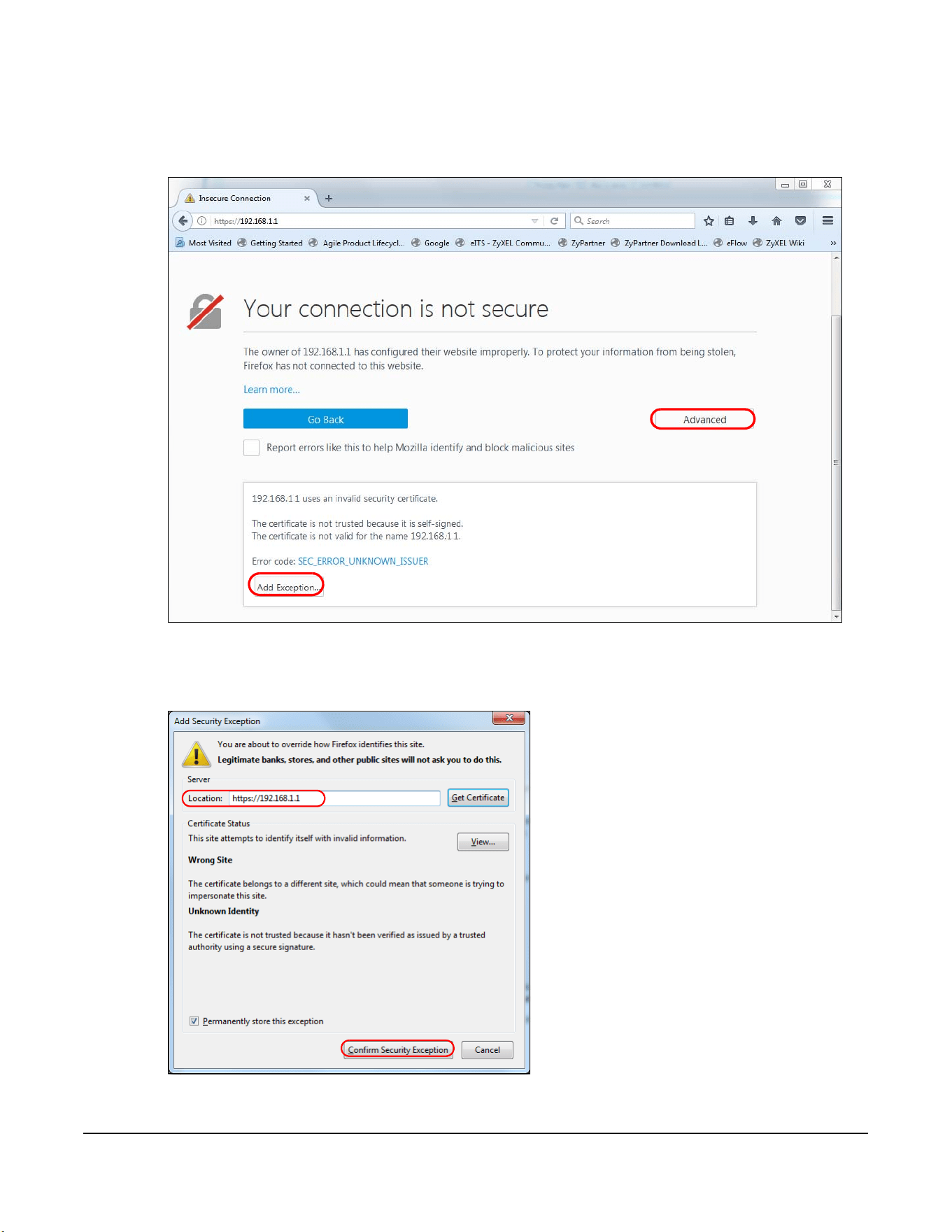
XMG1915 Series User’s Guide
325
Mozilla Firefox Warning Messages
When you attempt to access the Switch HTTPS server, a Your connection is not secure screen may
display. If that is the case, click I Understand the Risks and then the Add Exception... button.
Figure 233 Security Alert (Mozilla Firefox)
Confirm the HTTPS server URL matches. Click Confirm Security Exception to proceed to the Web
Configurator login screen.
Figure 234 Security Alert (Mozilla Firefox)
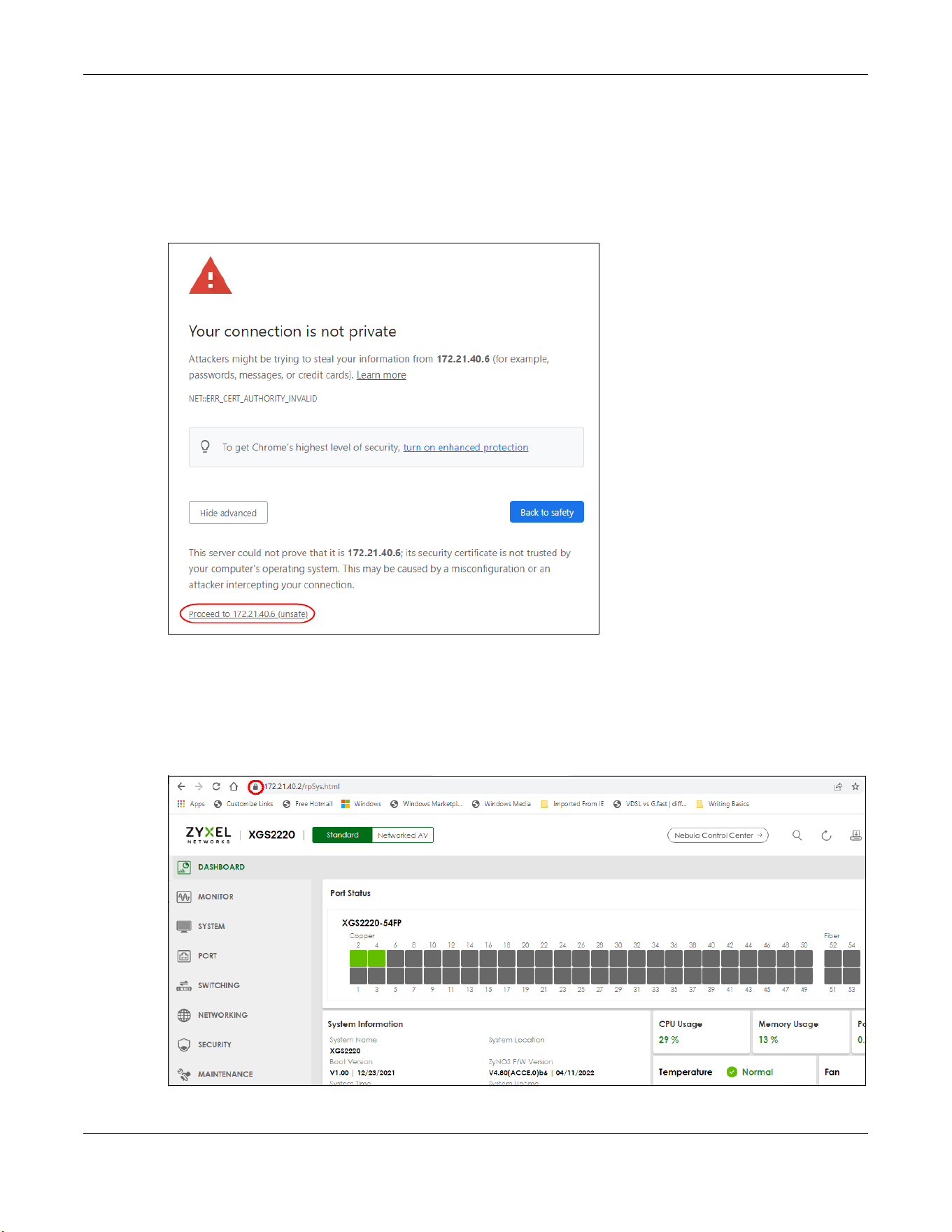
Chapter 55 Access Control
XMG1915 Series User’s Guide
326
55.5.3 Google Chrome Warning Messages
When you attempt to access the Switch HTTPS server, a Your connection is not private screen may
display. If that is the case, click Advanced and then Proceed to x.x.x.x (unsafe) to proceed to the Web
Configurator login screen.
Figure 235 Security Alert (Google Chrome 99.0.4844.82)
55.5.3.1 Main Settings
After you accept the certificate and enter the login user name and password, the Switch main screen
appears. The lock displayed in the bottom right of the browser status bar or next to the website address
denotes a secure connection.
Figure 236 Example: Lock Denoting a Secure Connection

Chapter 56 Storm Control
XMG1915 Series User’s Guide
327
CHAPTER 56
Storm Control
56.1 Storm Control Overview
This chapter introduces and shows you how to configure the storm control feature.
Storm control limits the number of broadcast, multicast and destination lookup failure (DLF) packets the
Switch receives per second on the ports. When the maximum number of allowable broadcast, multicast
and/or DLF packets is reached per second, the subsequent packets are discarded. Enable this feature
to reduce broadcast, multicast and/or DLF packets in your network. You can specify limits for each
packet type on each port.
56.1.1 What You Can Do
Use the Storm Control screen (Section 56.2 on page 327) to limit the number of broadcast, multicast and
destination lookup failure (DLF) packets the Switch receives per second on the ports.
56.2 Storm Control Setup
Click SECURITY > Storm Control in the navigation panel to display the screen as shown next.
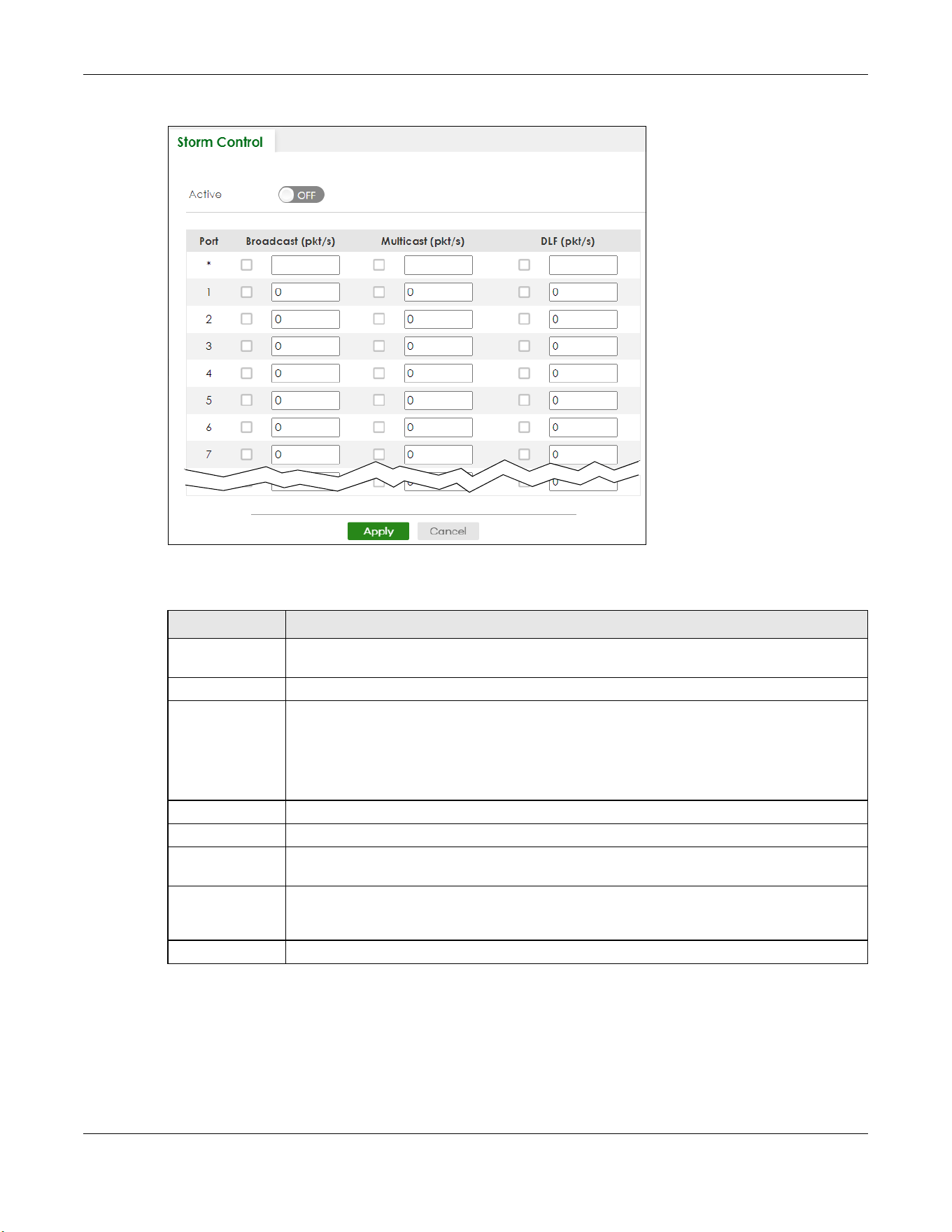
Chapter 56 Storm Control
XMG1915 Series User’s Guide
328
Figure 237 SECURITY > Storm Control
The following table describes the labels in this screen.
Table 183 SECURITY > Storm Control
LABEL DESCRIPTION
Active Enable the switch button to enable traffic storm control on the Switch. Disable the switch
button to disable this feature.
Port This field displays the port number.
* Settings in this row apply to all ports.
Use this row only if you want to make some settings the same for all ports. Use this row first to set
the common settings and then make adjustments on a port-by-port basis.
Note: Changes in this row are copied to all the ports as soon as you make them.
Broadcast (pkt/s) Select this option and specify how many broadcast packets the port receives per second.
Multicast (pkt/s) Select this option and specify how many multicast packets the port receives per second.
DLF (pkt/s) Select this option and specify how many destination lookup failure (DLF) packets the port
receives per second.
Apply Click Apply to save your changes to the Switch’s run-time memory. The Switch loses these
changes if it is turned off or loses power, so use the Save link on the top navigation panel to
save your changes to the non-volatile memory when you are done configuring.
Cancel Click Cancel to reset the fields.

Chapter 57 Error-Disable
XMG1915 Series User’s Guide
329
CHAPTER 57
Error-Disable
57.1 Error-Disable Overview
This chapter shows you how to configure the rate limit for control packets on a port, and set the Switch
to take an action (such as to shut down a port or stop sending packets) on a port when the Switch
detects a pre-configured error. It also shows you how to configure the Switch to automatically undo the
action after the error is gone.
57.1.1 CPU Protection Overview
Switches exchange protocol control packets in a network to get the latest networking information. If a
switch receives large numbers of control packets, such as ARP, BPDU or IGMP packets, which are to be
processed by the CPU, the CPU may become overloaded and be unable to handle regular tasks
properly.
The CPU protection feature allows you to limit the rate of ARP, BPDU and IGMP packets to be delivered
to the CPU on a port. This enhances the CPU efficiency and protects against potential DoS attacks or
errors from other networks. You then can choose to drop control packets that exceed the specified rate
limit or disable a port on which the packets are received.
57.1.2 Error-Disable Recovery Overview
Some features, such as loop guard or CPU protection, allow the Switch to shut down a port or discard
specific packets on a port when an error is detected on the port. For example, if the Switch detects that
packets sent out the ports loop back to the Switch, the Switch can shut down the ports automatically.
After that, you need to enable the ports or allow the packets on a port manually through the Web
Configurator or the commands. With error-disable recovery, you can set the disabled ports to become
active or start receiving the packets again after the time interval you specify.
57.1.3 What You Can Do
• Use the Errdisable Status screen (Section 57.2 on page 330) to view whether the Switch detected that
control packets exceeded the rate limit configured for a port or a port is disabled according to the
feature requirements and what action you configure, and related information.
• Use the CPU Protection screen (Section 57.3 on page 331) to limit the maximum number of control
packets (ARP, BPDU and/or IGMP) that the Switch can receive or transmit on a port.
• Use the Errdisable Detect screen (Section 57.4 on page 332) to have the Switch detect whether the
control packets exceed the rate limit configured for a port and configure the action to take once the
limit is exceeded.
• Use the Errdisable Recovery screen (Section 57.5 on page 333) to set the Switch to automatically
undo an action after the error is gone.
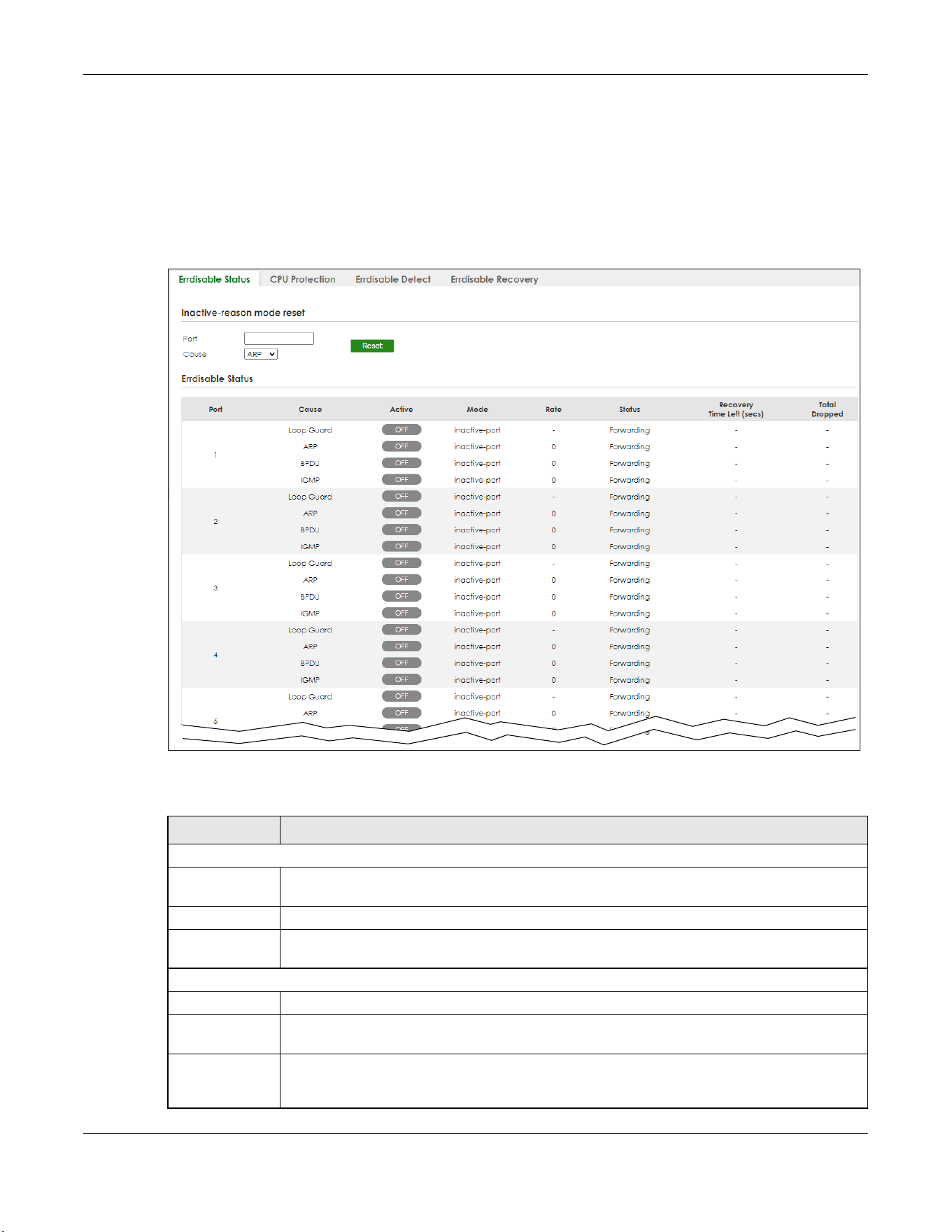
Chapter 57 Error-Disable
XMG1915 Series User’s Guide
330
57.2 Error-Disable Status
Use this screen to view whether the Switch detected that control packets exceeded the rate limit
configured for a port or a port is disabled according to the feature requirements and what action you
configure, and related information. Click SECURITY > Errdisable > Errdisable Status to display the screen
as shown.
Figure 238 SECURITY > Errdisable > Errdisable Status
The following table describes the labels in this screen.
Table 184 SECURITY > Errdisable > Errdisable Status
LABEL DESCRIPTION
Inactive-reason mode reset
Port Enter the number of the ports (separated by a comma) on which you want to reset inactive-
reason status.
Cause Select the cause of inactive-reason mode you want to reset here.
Reset Click to reset the specified ports to handle ARP, BPDU or IGMP packets instead of ignoring them,
if the ports is in inactive-reason mode.
Errdisable Status
Port This is the number of the port on which you want to configure Errdisable Status.
Cause This displays the type of the control packet received on the port or the feature enabled on the
port and causing the Switch to take the specified action.
Active This field displays whether the control packets (ARP, BPDU, and/or IGMP) detecting are enabled
or not. It also shows whether loop guard is enabled on the port. You can configure these settings
under SECURITY > Errdisable > Errdisable Detect and SWITCHING > Loop Guard screen.
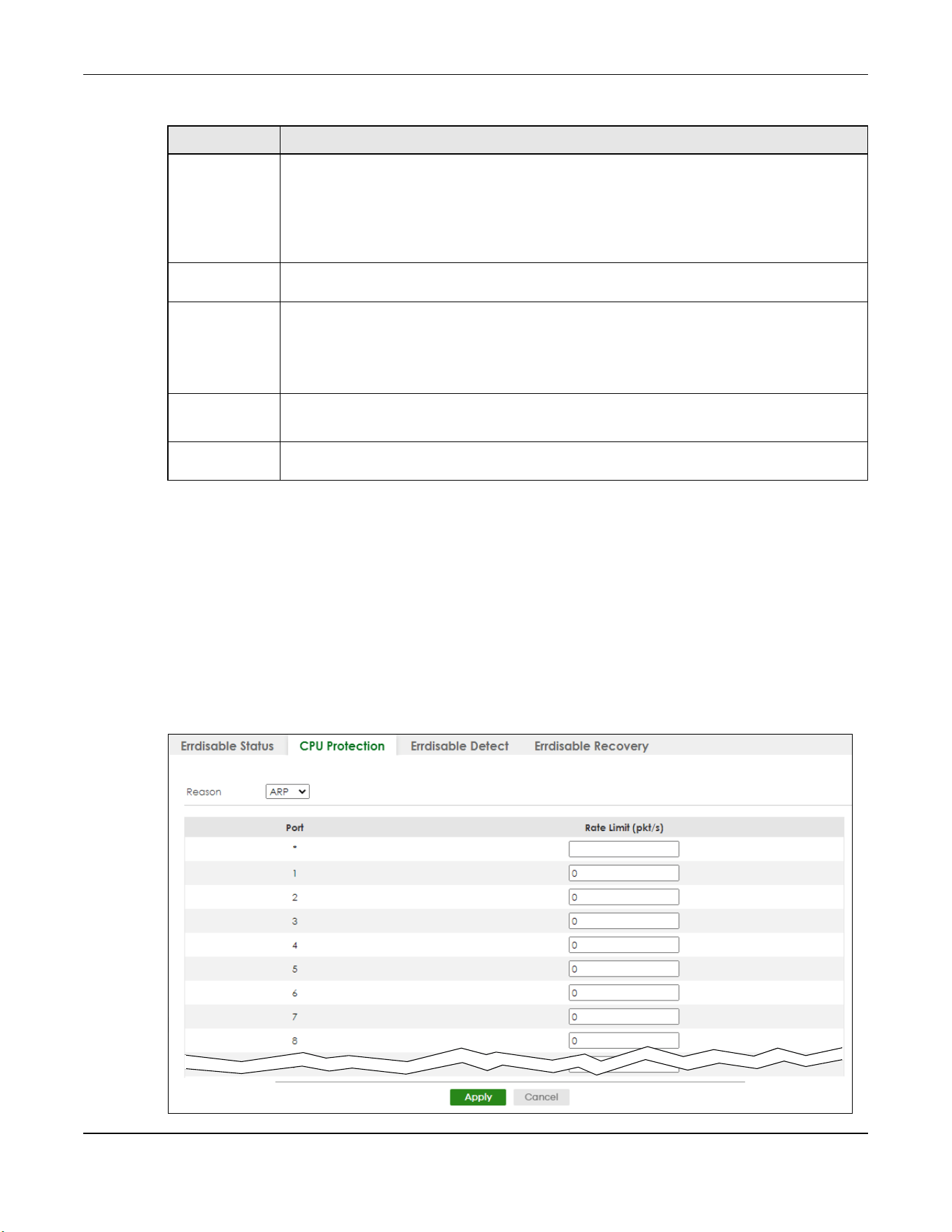
Chapter 57 Error-Disable
XMG1915 Series User’s Guide
331
57.3 CPU Protection Setup
Use this screen to limit the maximum number of control packets (ARP, BPDU and/or IGMP) that the
Switch can receive or transmit on a port. Click SECURITY > Errdisable > CPU Protection to display the
screen as shown.
Note: After you configure this screen, make sure you also enable error detection for the
specific control packets in the SECURITY > Errdisable > Errdisable Detect screen.
Figure 239 SECURITY > Errdisable > CPU Protection
Mode This field shows the action that the Switch takes for the cause.
• inactive-port – The Switch disables the port.
• inactive-reason – The Switch drops all the specified control packets (such as BPDU) on the
port.
• rate-limitation – The Switch drops the additional control packets the ports has to handle in
every one second.
Rate This field displays how many control packets this port can receive or transmit per second. It can
be adjusted in CPU Protection. 0 means no rate limit.
Status This field displays the errdisable status.
• Forwarding: The Switch is forwarding packets. Rate-limitation mode is always in Forwarding
status.
• Err-disable: The Switch disables the port on which the control packets are received
(inactive-port) or drops specified control packets on the port (inactive-reason).
Recovery
Time Left
(secs)
This field displays the time (seconds) left before the ports becomes active of Errdisable
Recovery.
Total
Dropped
This field displays the total packet number dropped by this port where the packet rate exceeds
the rate of mode rate-limitation.
Table 184 SECURITY > Errdisable > Errdisable Status (continued)
LABEL DESCRIPTION
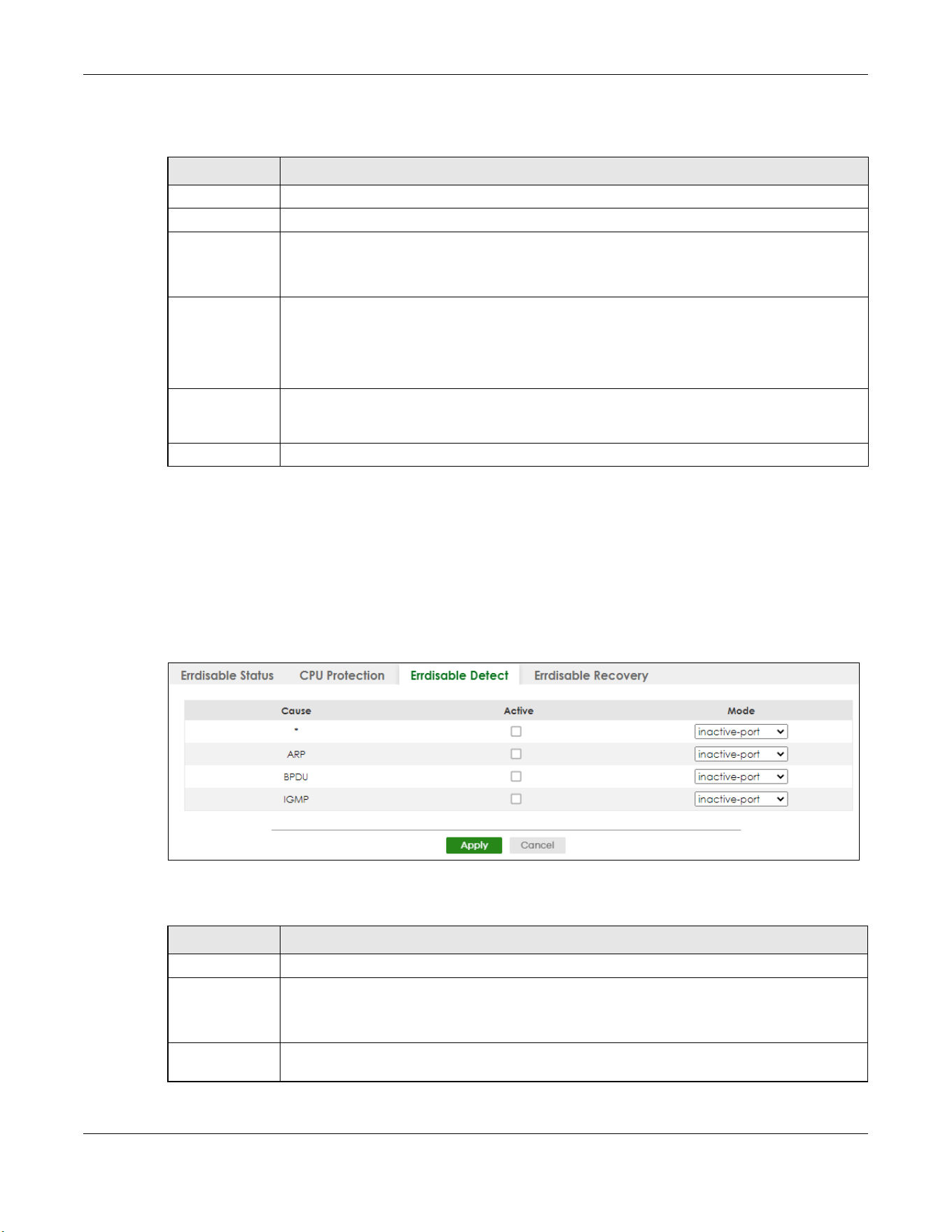
Chapter 57 Error-Disable
XMG1915 Series User’s Guide
332
The following table describes the labels in this screen.
57.4 Error-Disable Detect Setup
Use this screen to have the Switch detect whether the control packets exceed the rate limit configured
for a port and configure the action to take once the limit is exceeded. Click SECURITY > Errdisable >
Errdisable Detect to display the screen as shown.
Figure 240 SECURITY > Errdisable > Errdisable Detect
The following table describes the labels in this screen.
Table 185 SECURITY > Errdisable > CPU Protection
LABEL DESCRIPTION
Reason Select the type of control packet you want to configure here.
Port This field displays the port number.
* Use this row to make the setting the same for all ports. Use this row first and then make
adjustments to each port if necessary.
Changes in this row are copied to all the ports as soon as you make them.
Rate Limit (pkt/s) Enter a number from 0 to 256 to specify how many control packets this port can receive or
transmit per second.
0 means no rate limit.
You can configure the action that the Switch takes when the limit is exceeded.
Apply Click Apply to save your changes to the Switch’s run-time memory. The Switch loses these
changes if it is turned off or loses power, so use the Save link on the top navigation panel to save
your changes to the non-volatile memory when you are done configuring.
Cancel Click Cancel to begin configuring this screen afresh.
Table 186 SECURITY > Errdisable > Errdisable Detect
LABEL DESCRIPTION
Cause This field displays the types of control packet that may cause CPU overload.
* Use this row to make the setting the same for all entries. Use this row first and then make
adjustments to each entry if necessary.
Changes in this row are copied to all the entries as soon as you make them.
Active Select this option to have the Switch detect if the configured rate limit for a specific control
packet is exceeded and take the action selected below.
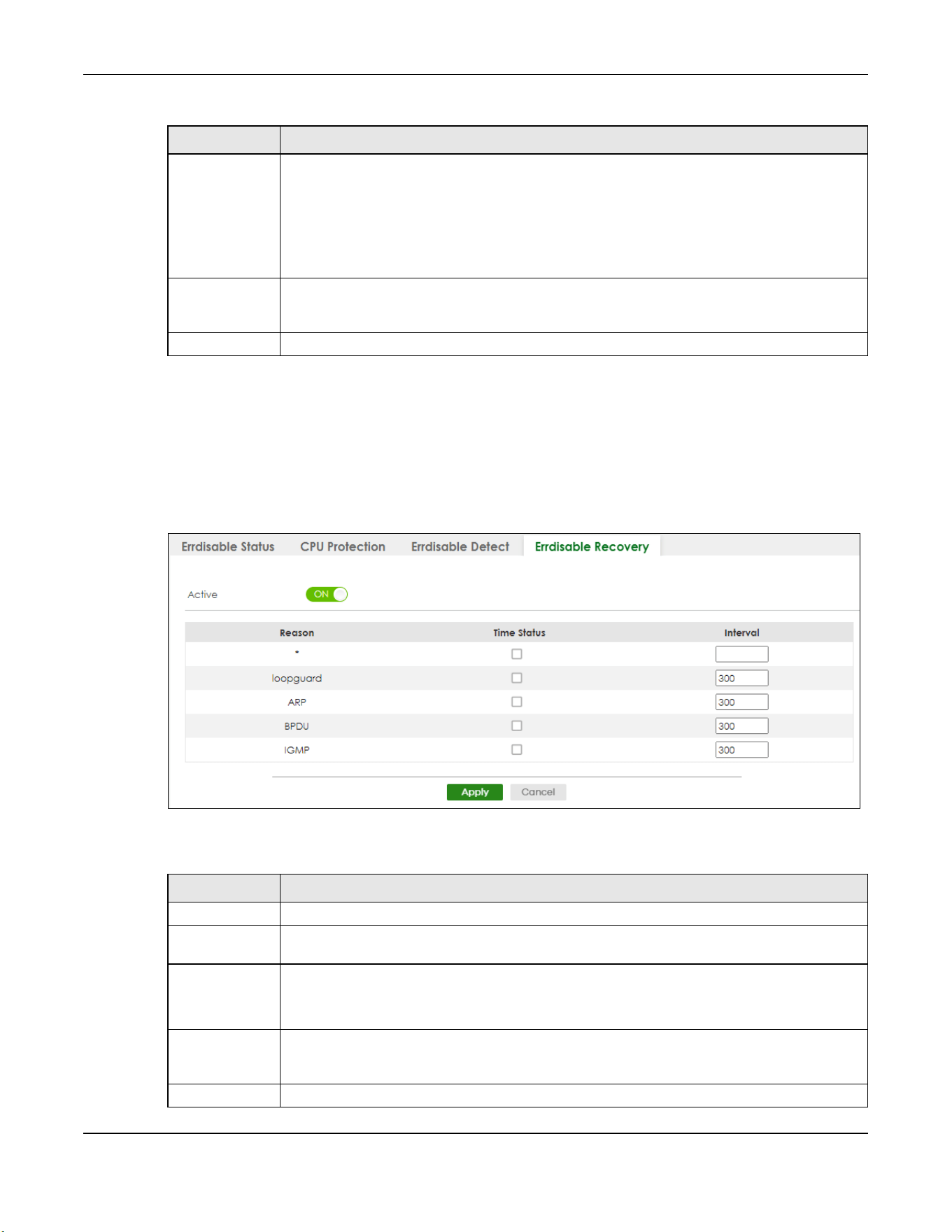
Chapter 57 Error-Disable
XMG1915 Series User’s Guide
333
57.5 Error-Disable Recovery Setup
Use this screen to configure the Switch to automatically undo an action after the error is gone. Click
SECURITY > Errdisable > Errdisable Recovery to display the screen as shown.
Figure 241 SECURITY > Errdisable > Errdisable Recovery
The following table describes the labels in this screen.
Mode Select the action that the Switch takes when the number of control packets exceed the rate
limit on a port, set in the SECURITY > Errdisable > CPU Protection screen.
• inactive-port – The Switch disables the port on which the control packets are received.
• inactive-reason – The Switch drops all the specified control packets (such as BPDU) on the
port.
• rate-limitation – The Switch drops the additional control packets the ports has to handle in
every one second.
Apply Click Apply to save your changes to the Switch’s run-time memory. The Switch loses these
changes if it is turned off or loses power, so use the Save link on the top navigation panel to save
your changes to the non-volatile memory when you are done configuring.
Cancel Click Cancel to begin configuring this screen afresh.
Table 186 SECURITY > Errdisable > Errdisable Detect (continued)
LABEL DESCRIPTION
Table 187 SECURITY > Errdisable > Errdisable Recovery
LABEL DESCRIPTION
Active Enable the switch button to turn on the error-disable recovery function on the Switch.
Reason This field displays the supported features that allow the Switch to shut down a port or discard
packets on a port according to the feature requirements and what action you configure.
* Use this row to make the setting the same for all entries. Use this row first and then make
adjustments to each entry if necessary.
Changes in this row are copied to all the entries as soon as you make them.
Time Status Select this check box to allow the Switch to wait for the specified time interval to activate a port
or allow specific packets on a port, after the error was gone. Clear the check box to turn off this
rule.
Interval Enter the number of seconds (from 30 to 2592000) for the time interval.

Chapter 57 Error-Disable
XMG1915 Series User’s Guide
334
Apply Click Apply to save your changes to the Switch’s run-time memory. The Switch loses these
changes if it is turned off or loses power, so use the Save link on the top navigation panel to save
your changes to the non-volatile memory when you are done configuring.
Cancel Click Cancel to begin configuring this screen afresh.
Table 187 SECURITY > Errdisable > Errdisable Recovery (continued)
LABEL DESCRIPTION

Chapter 58 DHCP Snooping
XMG1915 Series User’s Guide
335
CHAPTER 58
DHCP Snooping
58.1 DHCP Snooping Overview
DHCP snooping filters unauthorized DHCP server packets. The Switch allows only the authorized DHCP
server on a trusted port to assign IP addresses. Clients on your network will only receive DHCP packets
from the authorized DHCP server.
The Switch also builds a DHCP snooping binding table dynamically by snooping DHCP packets
(dynamic bindings). A DHCP snooping binding table contains the IP binding information the Switch
learns from DHCP packets in your network. A binding contains these key attributes:
• MAC address
• VLAN ID
• IP address
• Port number
The following settings demonstrates DHCP snooping on the Switch.
• An authorized DHCP server (A) on a snooped VLAN from the trusted port (T)
• An unauthorized DHCP server (B) on a snooped VLAN from an untrusted port (UT)
• DHCP clients (C) on the untrusted ports (UT).
With DHCP snooping, the Switch blocks all DHCP server packets (DHCP OFFER/ACK) coming from the
untrusted ports (UT). The Switch only forwards the DHCP server packets from the trusted port (T). This
assures that DHCP clients on your network only receive IP addresses assigned by the authorized DHCP
server (A).
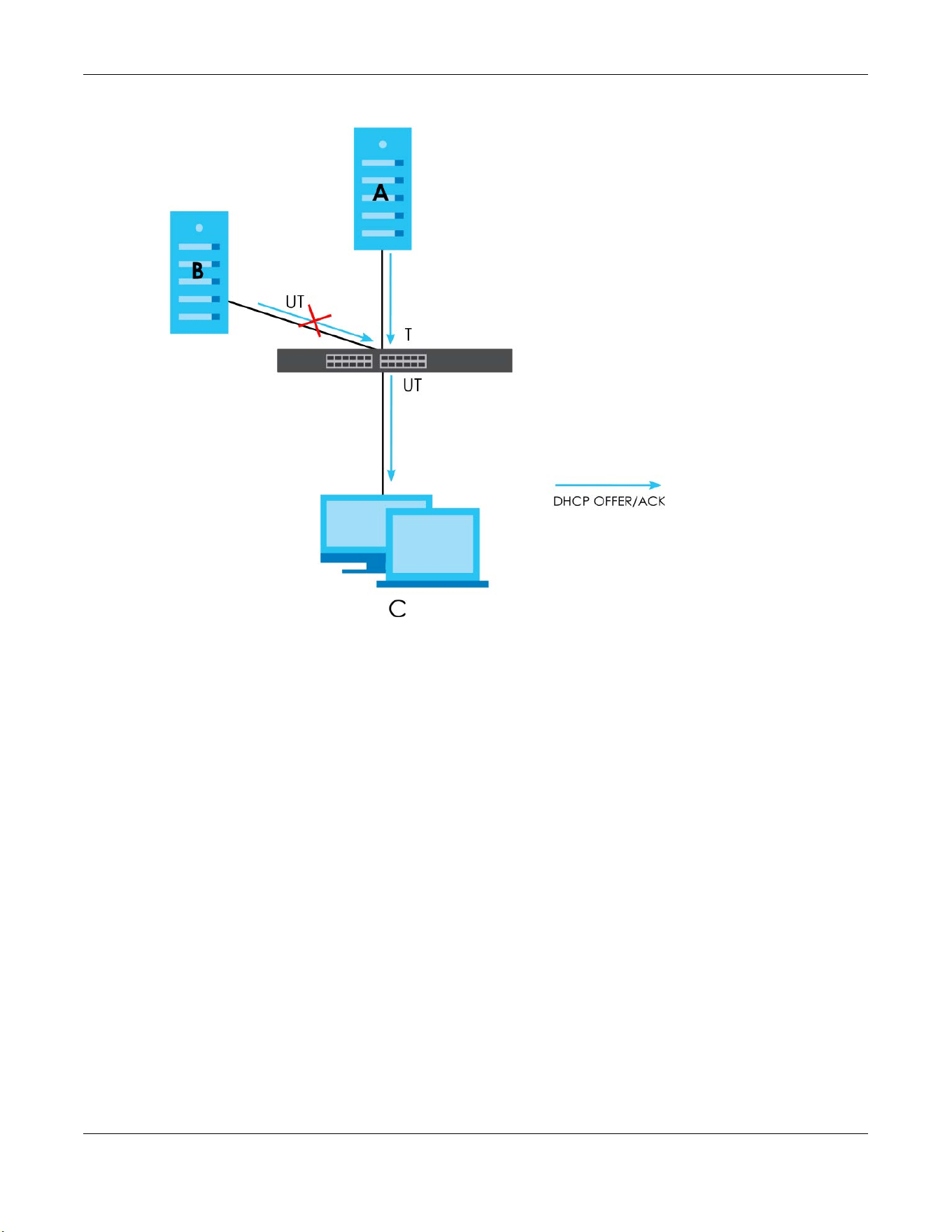
Chapter 58 DHCP Snooping
XMG1915 Series User’s Guide
336
Figure 242 DHCP Snooping Example Application
58.1.1 What You Can Do
• Use the DHCP Snooping Status screen (Section 58.2 on page 336) to look at various statistics about the
DHCP snooping database.
• Use this DHCP Snooping Setup screen (Section 58.3 on page 339) to enable DHCP snooping on the
Switch (not on specific VLAN), specify the VLAN where the default DHCP server is located, and
configure the DHCP snooping database.
• Use the DHCP Snooping Port Setup screen (Section 58.4 on page 340) to specify whether ports are
trusted or untrusted ports for DHCP snooping.
• Use the DHCP Snooping VLAN Setup screen (Section 58.5 on page 342) to enable DHCP snooping on
each VLAN and to specify whether or not the Switch adds DHCP relay agent option 82 information to
DHCP requests that the Switch relays to a DHCP server for each VLAN.
• Use the DHCP Snooping VLAN Port Setup screen (Section 58.6 on page 343) to apply a different DHCP
option 82 profile to certain ports in a VLAN.
58.2 DHCP Snooping Status
Use this screen to look at various statistics about the DHCP snooping database.
To open this screen, click SECURITY > DHCP Snooping > DHCP Snp. Status.
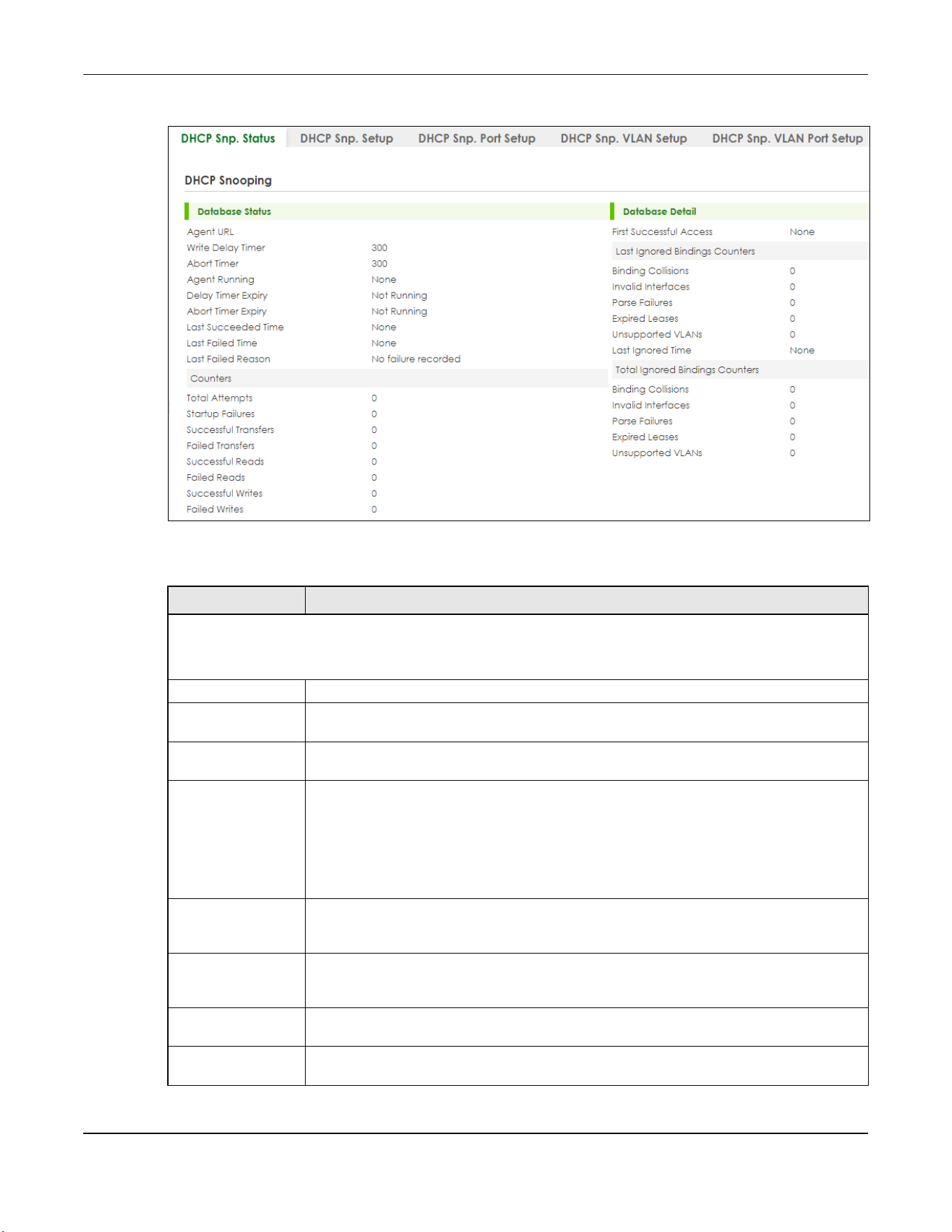
Chapter 58 DHCP Snooping
XMG1915 Series User’s Guide
337
Figure 243 SECURITY > DHCP Snooping > DHCP Snp. Status
The following table describes the labels in this screen.
Table 188 SECURITY > DHCP Snooping > DHCP Snp. Status
LABEL DESCRIPTION
Database Status
This section displays the current settings for the DHCP snooping database. You can configure them in the SECURITY
> DHCP Snooping > DHCP Snp. Setup screen.
Agent URL This field displays the location of the DHCP snooping database.
Write Delay
Timer
This field displays how long (in seconds) the Switch tries to complete a specific update in the
DHCP snooping database before it gives up.
Abort Timer This field displays how long (in seconds) the Switch waits to update the DHCP snooping
database after the current bindings change.
Agent Running This field displays the status of the current update or access of the DHCP snooping
database.
None: The Switch is not accessing the DHCP snooping database.
Read: The Switch is loading dynamic bindings from the DHCP snooping database.
Write: The Switch is updating the DHCP snooping database.
Delay Timer
Expiry
This field displays how much longer (in seconds) the Switch tries to complete the current
update before it gives up. It displays Not Running if the Switch is not updating the DHCP
snooping database right now.
Abort Timer
Expiry
This field displays when (in seconds) the Switch is going to update the DHCP snooping
database again. It displays Not Running if the current bindings have not changed since the
last update.
Last Succeeded
Time
This field displays the last time the Switch updated the DHCP snooping database
successfully.
Last Failed Time This field displays the last time the Switch updated the DHCP snooping database
unsuccessfully.

Chapter 58 DHCP Snooping
XMG1915 Series User’s Guide
338
Last Failed
Reason
This field displays the reason the Switch updated the DHCP snooping database
unsuccessfully.
Counters
This section displays historical information about the number of times the Switch successfully or unsuccessfully read
or updated the DHCP snooping database.
Total Attempts This field displays the number of times the Switch has tried to access the DHCP snooping
database for any reason.
Startup Failures This field displays the number of times the Switch could not create or read the DHCP
snooping database when the Switch started up or a new URL is configured for the DHCP
snooping database.
Successful
Transfers
This field displays the number of times the Switch read bindings from or updated the bindings
in the DHCP snooping database successfully.
Failed Transfers This field displays the number of times the Switch was unable to read bindings from or
update the bindings in the DHCP snooping database.
Successful Reads This field displays the number of times the Switch read bindings from the DHCP snooping
database successfully.
Failed Reads This field displays the number of times the Switch was unable to read bindings from the
DHCP snooping database.
Successful Writes This field displays the number of times the Switch updated the bindings in the DHCP
snooping database successfully.
Failed Writes This field displays the number of times the Switch was unable to update the bindings in the
DHCP snooping database.
Database Detail
First Successful
Access
This field displays the first time the Switch accessed the DHCP snooping database for any
reason.
Last Ignored Bindings Counters
This section displays the number of times and the reasons the Switch ignored bindings the last time it read bindings
from the DHCP binding database. You can clear these counters by restarting the Switch or using CLI commands.
See the Ethernet Switch CLI Reference Guide.
Binding Collisions This field displays the number of bindings the Switch ignored because the Switch already
had a binding with the same MAC address and VLAN ID.
Invalid Interfaces This field displays the number of bindings the Switch ignored because the port number was
a trusted interface or does not exist anymore.
Parse Failures This field displays the number of bindings the Switch ignored because the Switch was unable
to understand the binding in the DHCP binding database.
Expired Leases This field displays the number of bindings the Switch ignored because the lease time had
already expired.
Unsupported
VLANs
This field displays the number of bindings the Switch ignored because the VLAN ID does not
exist anymore.
Last Ignored
Time
This field displays the last time the Switch ignored any bindings for any reason from the DHCP
binding database.
Total Ignored Bindings Counters
This section displays the reasons the Switch has ignored bindings any time it read bindings from the DHCP binding
database. You can clear these counters by restarting the Switch or using CLI commands. See the Ethernet Switch
CLI Reference Guide.
Binding Collisions This field displays the number of bindings the Switch has ignored because the Switch already
had a binding with the same MAC address and VLAN ID.
Invalid Interfaces This field displays the number of bindings the Switch has ignored because the port number
was a trusted interface or does not exist anymore.
Table 188 SECURITY > DHCP Snooping > DHCP Snp. Status (continued)
LABEL DESCRIPTION
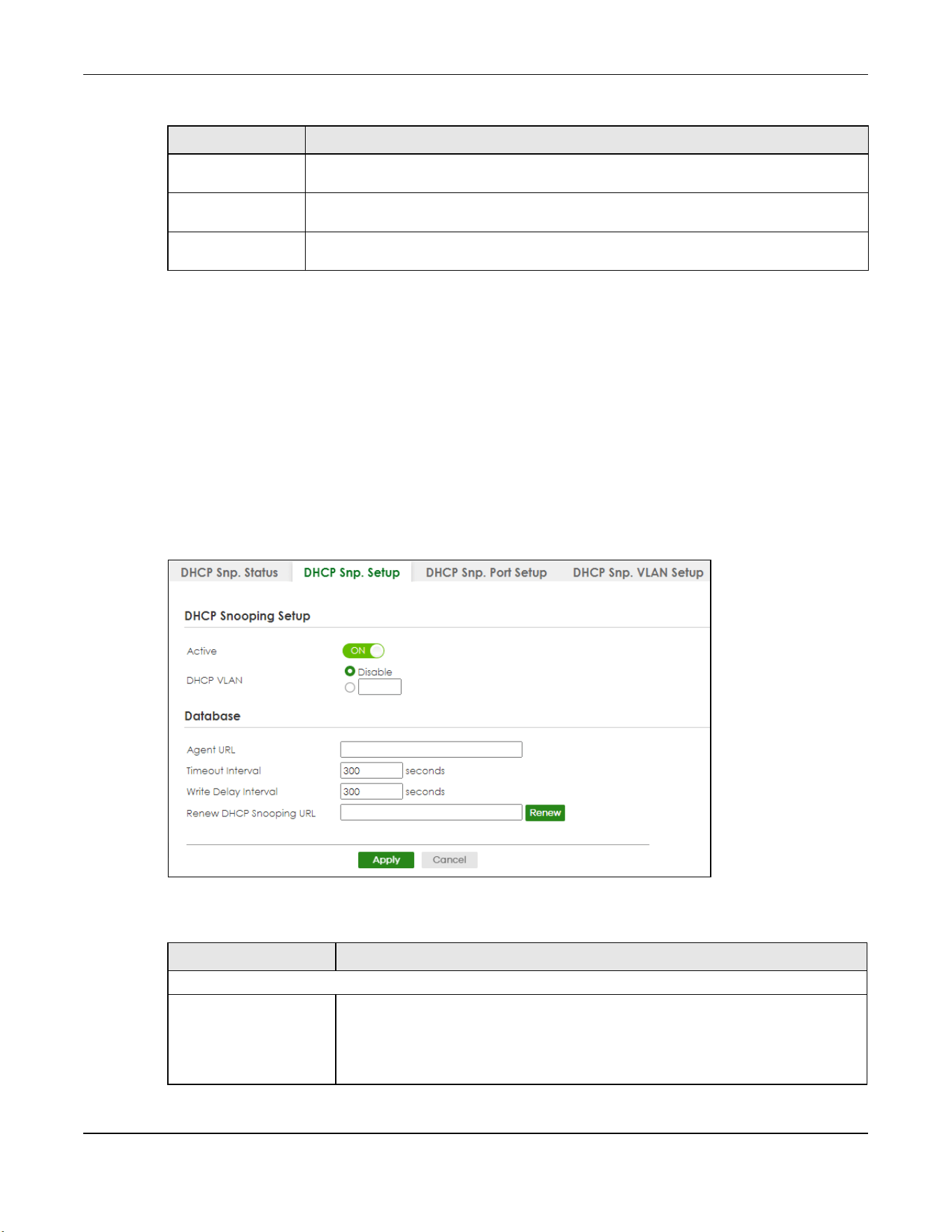
Chapter 58 DHCP Snooping
XMG1915 Series User’s Guide
339
58.3 DHCP Snooping Setup
Use this screen to enable DHCP snooping on the Switch (not on specific VLAN), specify the VLAN where
the default DHCP server is located, and configure the DHCP snooping database. The DHCP snooping
database stores the current bindings on a secure, external TFTP server so that they are still available after
a restart.
To open this screen, click SECURITY > DHCP Snooping > DHCP Snp. Setup.
Note: The input string of any field in this screen should not contain [ ? ], [ | ], [ ' ], [ " ], or [ , ].
Figure 244 SECURITY > DHCP Snooping > DHCP Snp. Setup
The following table describes the labels in this screen.
Parse Failures This field displays the number of bindings the Switch has ignored because the Switch was
unable to understand the binding in the DHCP binding database.
Expired Leases This field displays the number of bindings the Switch has ignored because the lease time
had already expired.
Unsupported
VLANs
This field displays the number of bindings the Switch has ignored because the VLAN ID does
not exist anymore.
Table 188 SECURITY > DHCP Snooping > DHCP Snp. Status (continued)
LABEL DESCRIPTION
Table 189 SECURITY > DHCP Snooping > DHCP Snp. Setup
LABEL DESCRIPTION
DHCP Snooping Setup
Active Enable the switch button to enable DHCP snooping on the Switch. You still have to
enable DHCP snooping on specific VLAN and specify trusted ports.
Note: If DHCP is enabled and there are no trusted ports, DHCP requests will
not succeed.

Chapter 58 DHCP Snooping
XMG1915 Series User’s Guide
340
58.4 DHCP Snooping Port Setup
Use this screen to specify whether ports are trusted or untrusted ports for DHCP snooping.
Note: If DHCP snooping is enabled but there are no trusted ports, DHCP requests cannot
reach the DHCP server.
You can also specify the maximum number for DHCP packets that each port (trusted or untrusted) can
receive each second.
To open this screen, click SECURITY > DHCP Snooping > DHCP Snp. Port Setup.
DHCP VLAN Select a VLAN ID if you want the Switch to forward DHCP packets to DHCP servers on a
specific VLAN.
Note: You have to enable DHCP snooping on the DHCP VLAN too.
You can enable Option 82 Profile in the SECURITY > DHCP Snooping > DHCP Snp. VLAN
Setup screen to help the DHCP servers distinguish between DHCP requests from
different VLAN.
Select Disable if you do not want the Switch to forward DHCP packets to a specific
VLAN.
Database
If Timeout Interval is greater than Write Delay Interval, it is possible that the next update is scheduled to occur
before the current update has finished successfully or timed out. In this case, the Switch waits to start the next
update until it completes the current one.
Agent URL Enter the location of the DHCP snooping database. The location should be expressed
like this: tftp://{domain name or IP address}/directory, if applicable/file name; for
example, tftp://192.168.10.1/database.txt. You can enter up to 256 printable ASCII
characters except [ ? ], [ | ], [ ' ], [ " ] or [ , ].
Timeout Interval Enter how long (10 – 65535 seconds) the Switch tries to complete a specific update in
the DHCP snooping database before it gives up.
Write Delay Interval Enter how long (10 – 65535 seconds) the Switch waits to update the DHCP snooping
database the first time the current bindings change after an update. Once the next
update is scheduled, additional changes in current bindings are automatically
included in the next update.
Renew DHCP
Snooping URL
Enter the location of a DHCP snooping database, and click Renew if you want the
Switch to load it. You can use this to load dynamic bindings from a different DHCP
snooping database than the one specified in Agent URL.
When the Switch loads dynamic bindings from a DHCP snooping database, it does not
discard the current dynamic bindings first. If there is a conflict, the Switch keeps the
dynamic binding in volatile memory and updates the Binding Collisions counter in the
DHCP Snooping Status screen (Section 58.2 on page 336).
Apply Click Apply to save your changes to the Switch’s run-time memory. The Switch loses
these changes if it is turned off or loses power, so use the Save link on the top
navigation panel to save your changes to the non-volatile memory when you are
done configuring.
Cancel Click this to reset the values in this screen to their last-saved values.
Table 189 SECURITY > DHCP Snooping > DHCP Snp. Setup (continued)
LABEL DESCRIPTION
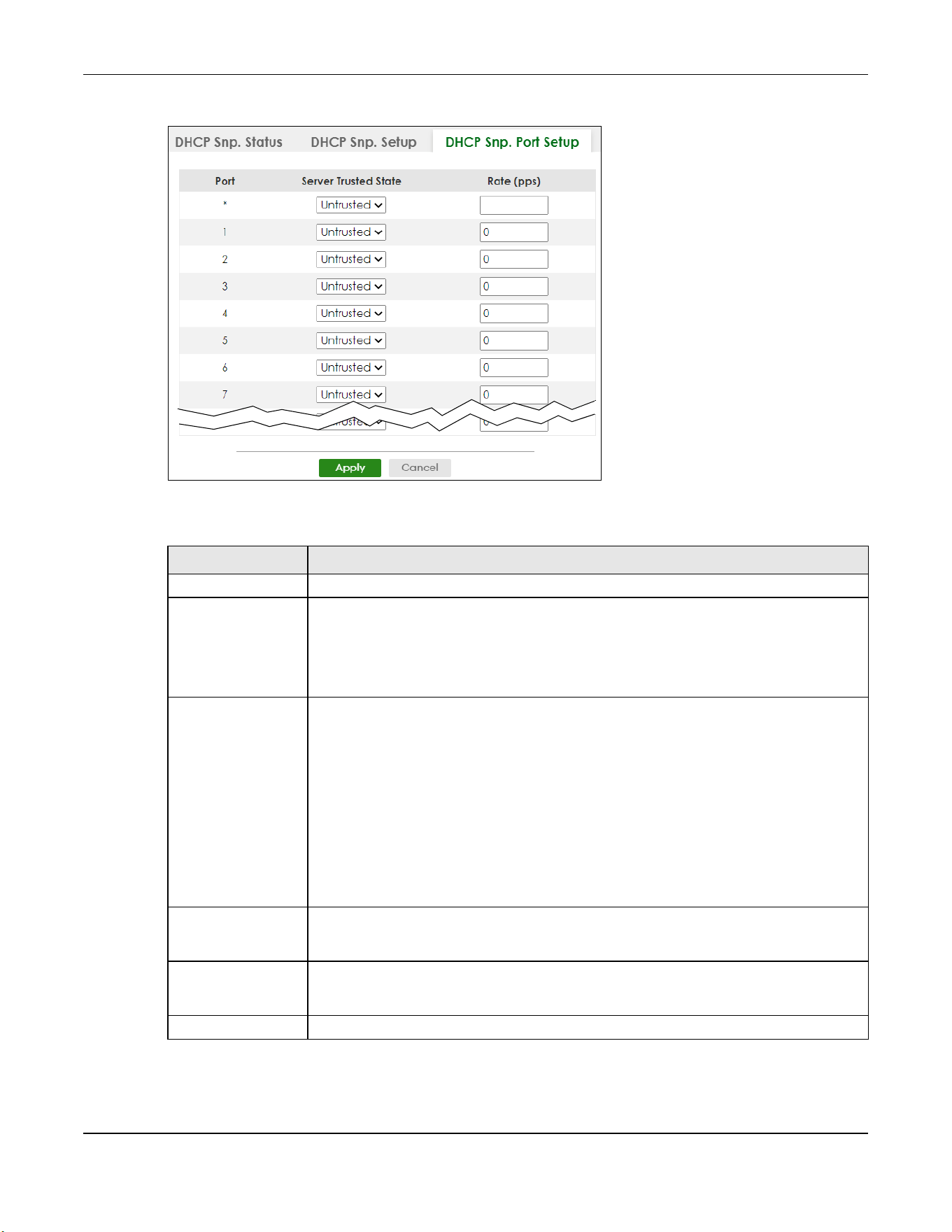
Chapter 58 DHCP Snooping
XMG1915 Series User’s Guide
341
Figure 245 SECURITY > DHCP Snooping > DHCP Snp. Port Setup
The following table describes the labels in this screen.
Table 190 SECURITY > DHCP Snooping > DHCP Snp. Port Setup
LABEL DESCRIPTION
Port This field displays the port number.
* Settings in this row apply to all ports.
Use this row only if you want to make some settings the same for all ports. Use this row first to
set the common settings and then make adjustments on a port-by-port basis.
Note: Changes in this row are copied to all the ports as soon as you make them.
Server Trusted state Select whether this port is a trusted port (Trusted) or an untrusted port (Untrusted).
Trusted ports are connected to DHCP servers or other switches, and the Switch discards
DHCP packets from trusted ports only if the rate at which DHCP packets arrive is too high.
Untrusted ports are connected to subscribers, and the Switch discards DHCP packets from
untrusted ports in the following situations:
• The packet is a DHCP server packet (for example, OFFER, ACK, or NACK).
• The source MAC address and source IP address in the packet do not match any of the
current bindings.
• The packet is a RELEASE or DECLINE packet, and the source MAC address and source
port do not match any of the current bindings.
• The rate at which DHCP packets arrive is too high.
Rate (pps) Specify the maximum number for DHCP packets (1 – 256) that the Switch receives from
each port each second. The Switch discards any additional DHCP packets. Enter 0 to
disable this limit, which is recommended for trusted ports.
Apply Click Apply to save your changes to the Switch’s run-time memory. The Switch loses these
changes if it is turned off or loses power, so use the Save link on the top navigation panel to
save your changes to the non-volatile memory when you are done configuring.
Cancel Click this to reset the values in this screen to their last-saved values.

Chapter 58 DHCP Snooping
XMG1915 Series User’s Guide
342
58.5 DHCP Snooping VLAN Setup
Use this screen to enable DHCP snooping on each VLAN and to specify whether or not the Switch adds
DHCP relay agent option 82 information to DHCP requests that the Switch relays to a DHCP server for
each VLAN.
To open this screen, click SECURITY > DHCP Snooping > DHCP Snp. VLAN Setup.
Figure 246 SECURITY > DHCP Snooping > DHCP Snp. VLAN Setup
The following table describes the labels in this screen.
Table 191 SECURITY > DHCP Snooping > DHCP Snp. VLAN Setup
LABEL DESCRIPTION
Search VLAN by VID Enter the VLAN ID you want to manage. Use a comma (,) to separate individual VLANs or a
hyphen (-) to indicates a range of VLANs. For example, “3,4” or “3-9”.
Search Click this to display the specified range of VLANs in the section below.
The Number of
VLANs
This displays the number of VLAN search results.
VID This field displays the VLAN ID of each VLAN in the range specified above. If you configure
the * VLAN, the settings are applied to all VLANs.
Enabled Select Yes to enable DHCP snooping on the VLAN. You still have to enable DHCP snooping
on the Switch and specify trusted ports.
Note: The Switch will drop all DHCP requests if you enable DHCP snooping and
there are no trusted ports.
Option 82 Profile Select a pre-defined DHCP option 82 profile that the Switch applies to all ports in the
specified VLANs. The Switch adds the information (such as slot number, port number, VLAN ID
and/or system name) specified in the profile to DHCP requests that it broadcasts to the DHCP
VLAN, if specified, or VLAN. You can specify the DHCP VLAN in the SECURITY > DHCP
Snooping > DHCP Snp. Setup screen.
Apply Click Apply to save your changes to the Switch’s run-time memory. The Switch loses these
changes if it is turned off or loses power, so use the Save link on the top navigation panel to
save your changes to the non-volatile memory when you are done configuring.
Cancel Click this to reset the values in this screen to their last-saved values.
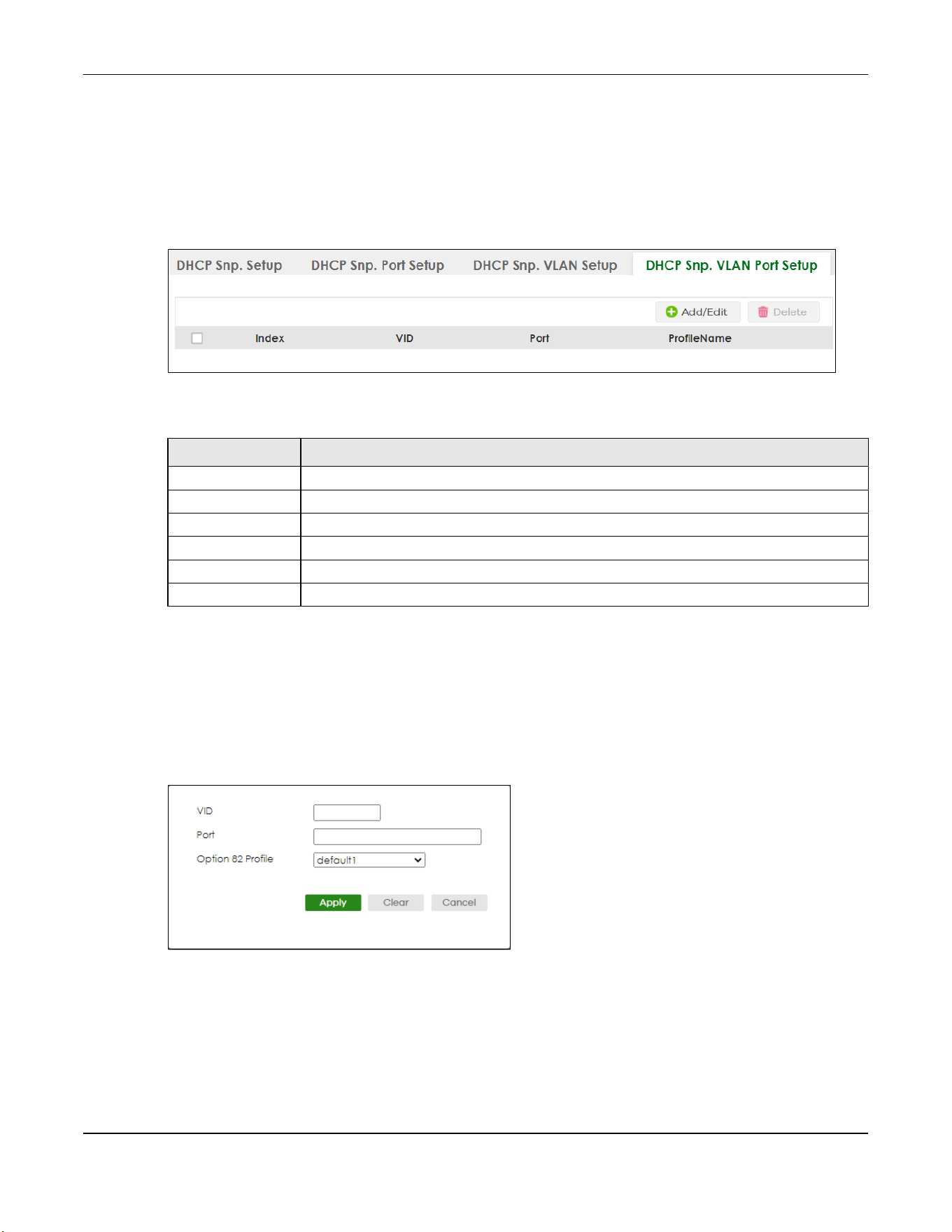
Chapter 58 DHCP Snooping
XMG1915 Series User’s Guide
343
58.6 DHCP Snooping VLAN Port Setup
Use this screen to apply a different DHCP option 82 profile to certain ports in a VLAN.
To open this screen, click SECURITY > DHCP Snooping > DHCP Snp. VLAN Port Setup.
Figure 247 SECURITY > DHCP Snooping > DHCP Snp. VLAN Port Setup
The following table describes the labels in this screen.
58.6.1 Add/EDIT DHCP Snooping VLAN Ports
Use this screen to apply a different DHCP option 82 profile to certain ports in a VLAN.
Click Add/Edit, or select an entry and click Add/Edit in the SECURITY > DHCP Snooping > DHCP Snp. VLAN
Port Setup screen to display this screen.
Figure 248 SECURITY > DHCP Snooping > DHCP Snp. VLAN Port Setup > Add/Edit
Table 192 SECURITY > DHCP Snooping > DHCP Snp. VLAN Port Setup
LABEL DESCRIPTION
Index This field displays a sequential number for each entry.
VID This field displays the VLAN to which the ports belongs.
Port This field displays the ports to which the Switch applies the settings.
Profile Name This field displays the DHCP option 82 profile that the Switch applies to the ports.
Add/Edit Click Add/Edit to add a new entry or edit a selected one.
Delete Click Delete to remove the selected entries.

Chapter 58 DHCP Snooping
XMG1915 Series User’s Guide
344
The following table describes the labels in this screen.
58.7 Technical Reference
This section provides technical background information on the topics discussed in this chapter.
58.7.1 DHCP Snooping Overview
Use DHCP snooping to filter unauthorized DHCP packets on the network and to build the binding table
dynamically. This can prevent clients from getting IP addresses from unauthorized DHCP servers.
58.7.1.1 Trusted vs. Untrusted Ports
Every port is either a trusted port or an untrusted port for DHCP snooping. This setting is independent of
the trusted or untrusted setting for ARP inspection. You can also specify the maximum number for DHCP
packets that each port (trusted or untrusted) can receive each second.
Trusted ports are connected to DHCP servers or other switches. The Switch discards DHCP packets from
trusted ports only if the rate at which DHCP packets arrive is too high. The Switch learns dynamic
bindings from trusted ports.
Note: If DHCP is enabled and there are no trusted ports, DHCP requests will not succeed.
Untrusted ports are connected to subscribers. The Switch discards DHCP packets from untrusted ports in
the following situations:
• The packet is a DHCP server packet (for example, OFFER, ACK, or NACK).
• The rate at which DHCP packets arrive is too high.
Table 193 SECURITY > DHCP Snooping > DHCP Snp. VLAN Port Setup > Add/Edit
LABEL DESCRIPTION
VID Enter the ID number of the VLAN you want to configure here.
Port Enter the number of ports to which you want to apply the specified DHCP option 82 profile.
You can enter multiple ports separated by (no space) comma (,) or hyphen (-) for a range.
For example, enter “3-5” for ports 3, 4, and 5. Enter “3,5,7” for ports 3, 5, and 7.
Option 82 Profile Select a pre-defined DHCP option 82 profile that the Switch applies to the specified ports in
this VLAN. The Switch adds the information (such as slot number, port number, VLAN ID and/
or system name) specified in the profile to DHCP requests that it broadcasts to the DHCP
VLAN, if specified, or VLAN. You can specify the DHCP VLAN in the SECURITY > DHCP
Snooping > DHCP Snp. Setup screen.
Note: The profile you select here has priority over the one you select in the
SECURITY > DHCP Snooping > DHCP Snp. VLAN Setup screen.
Apply Click Apply to save your changes to the Switch’s run-time memory. The Switch loses these
changes if it is turned off or loses power, so use the Save link on the top navigation panel to
save your changes to the non-volatile memory when you are done configuring.
Clear Click Clear to clear the fields to the factory defaults.
Cancel Click Cancel to not save the configuration you make and return to the last screen.

Chapter 58 DHCP Snooping
XMG1915 Series User’s Guide
345
58.7.1.2 DHCP Snooping Database
The Switch stores the binding table in volatile memory. If the Switch restarts, it loads static bindings from
permanent memory but loses the dynamic bindings, in which case the devices in the network have to
send DHCP requests again. As a result, it is recommended you configure the DHCP snooping database.
The DHCP snooping database maintains the dynamic bindings for DHCP snooping and ARP inspection
in a file on an external TFTP server. If you set up the DHCP snooping database, the Switch can reload the
dynamic bindings from the DHCP snooping database after the Switch restarts.
You can configure the name and location of the file on the external TFTP server. The file has the following
format:
Figure 249 DHCP Snooping Database File Format
The <initial-checksum> helps distinguish between the bindings in the latest update and the bindings
from previous updates. Each binding consists of 72 bytes, a space, and another checksum that is used
to validate the binding when it is read. If the calculated checksum is not equal to the checksum in the
file, that binding and all others after it are ignored.
58.7.1.3 DHCP Relay Option 82 Information
The Switch can add information to DHCP requests that it does not discard. This provides the DHCP server
more information about the source of the requests. The Switch can add the following information:
• Slot ID (1 byte), port ID (1 byte), and source VLAN ID (2 bytes)
• System name (up to 32 bytes)
This information is stored in an Agent Information field in the option 82 field of the DHCP headers of client
DHCP request frames.
When the DHCP server responds, the Switch removes the information in the Agent Information field
before forwarding the response to the original source.
You can configure this setting for each source VLAN. This setting is independent of the DHCP relay
settings.
58.7.1.4 Configuring DHCP Snooping
Follow these steps to configure DHCP snooping on the Switch.
1 Enable DHCP snooping on the Switch.
2 Enable DHCP snooping on each VLAN, and configure DHCP relay option 82.
<initial-checksum>
TYPE DHCP-SNOOPING
VERSION 1
BEGIN
<binding-1> <checksum-1>
<binding-2> <checksum-1-2>
...
...
<binding-n> <checksum-1-2-..-n>
END

Chapter 58 DHCP Snooping
XMG1915 Series User’s Guide
346
3 Configure trusted and untrusted ports, and specify the maximum number of DHCP packets that each
port can receive per second.
4 Configure static bindings.

Chapter 59 Port Security
XMG1915 Series User’s Guide
347
CHAPTER 59
Port Security
59.1 Port Security Overview
This chapter shows you how to set up port security.
59.2 About Port Security
Port security allows only packets with dynamically learned MAC addresses and/or configured static
MAC addresses to pass through a port on the Switch. The Switch can learn up to 16K MAC addresses in
total with no limit on individual ports other than the sum cannot exceed 16K.
For maximum port security, enable this feature, disable MAC address learning and configure static MAC
addresses for a port. It is not recommended you disable port security together with MAC address
learning as this will result in many broadcasts. By default, MAC address learning is still enabled even
though the port security is not activated.
59.3 Port Security Setup
Click SECURITY > Port Security in the navigation panel to display the screen as shown.
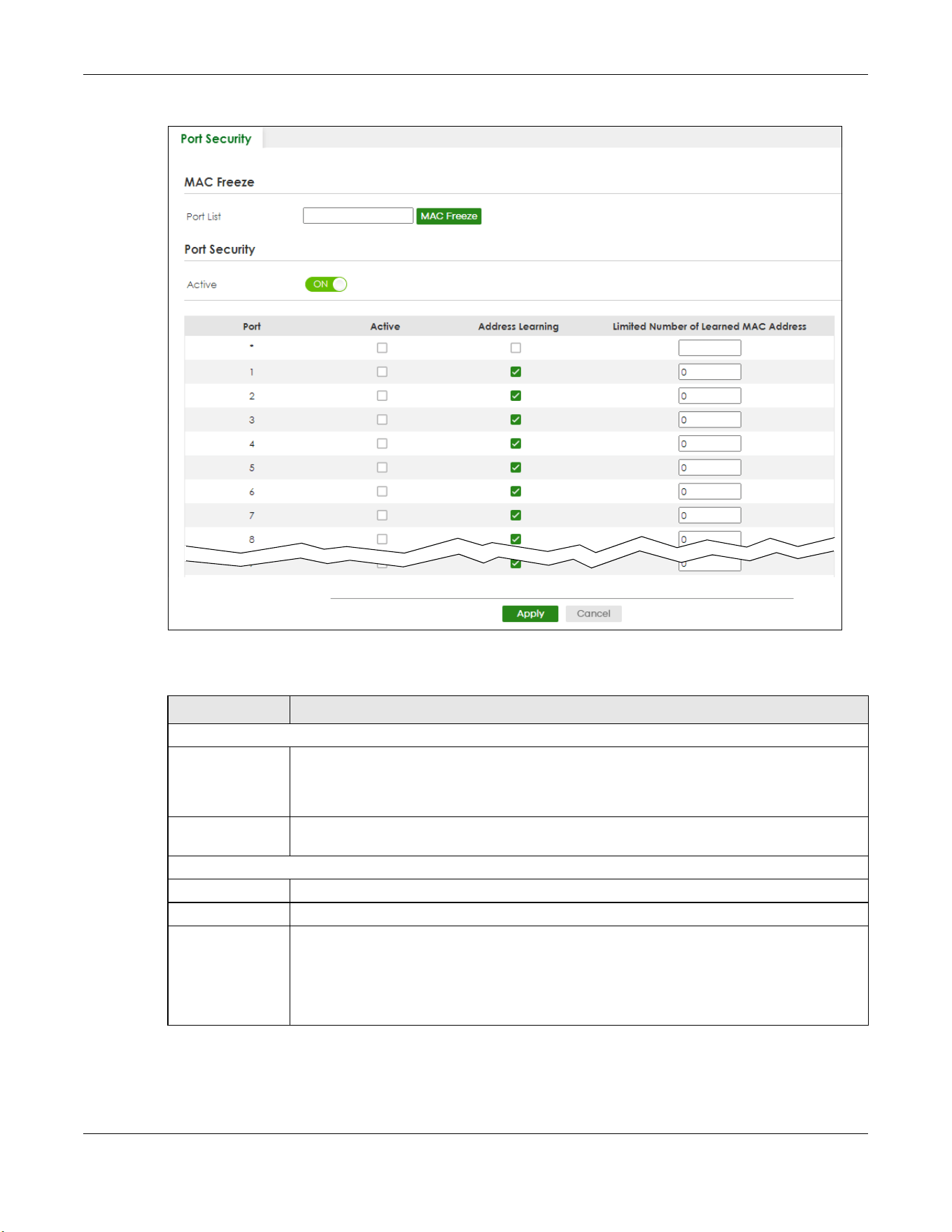
Chapter 59 Port Security
XMG1915 Series User’s Guide
348
Figure 250 SECURITY > Port Security
The following table describes the labels in this screen.
Table 194 SECURITY > Port Security
LABEL DESCRIPTION
MAC Freeze
Port List Enter the number of the ports (separated by a comma) on which you want to enable port
security and disable MAC address learning. After you click MAC Freeze, all previously learned
MAC addresses on the specified ports will become static MAC addresses and display in the
SWITCHING > Static MAC Forwarding screen.
MAC Freeze Click MAC Freeze to have the Switch automatically select the Active check boxes and clear
the Address Learning check boxes only for the ports specified in the Port List.
Port Security
Active Enable the switch button to enable port security on the Switch.
Port This field displays the port number.
* Settings in this row apply to all ports.
Use this row only if you want to make some of the settings the same for all ports. Use this row first
to set the common settings and then make adjustments on a port-by-port basis.
Note: Changes in this row are copied to all the ports as soon as you make them.
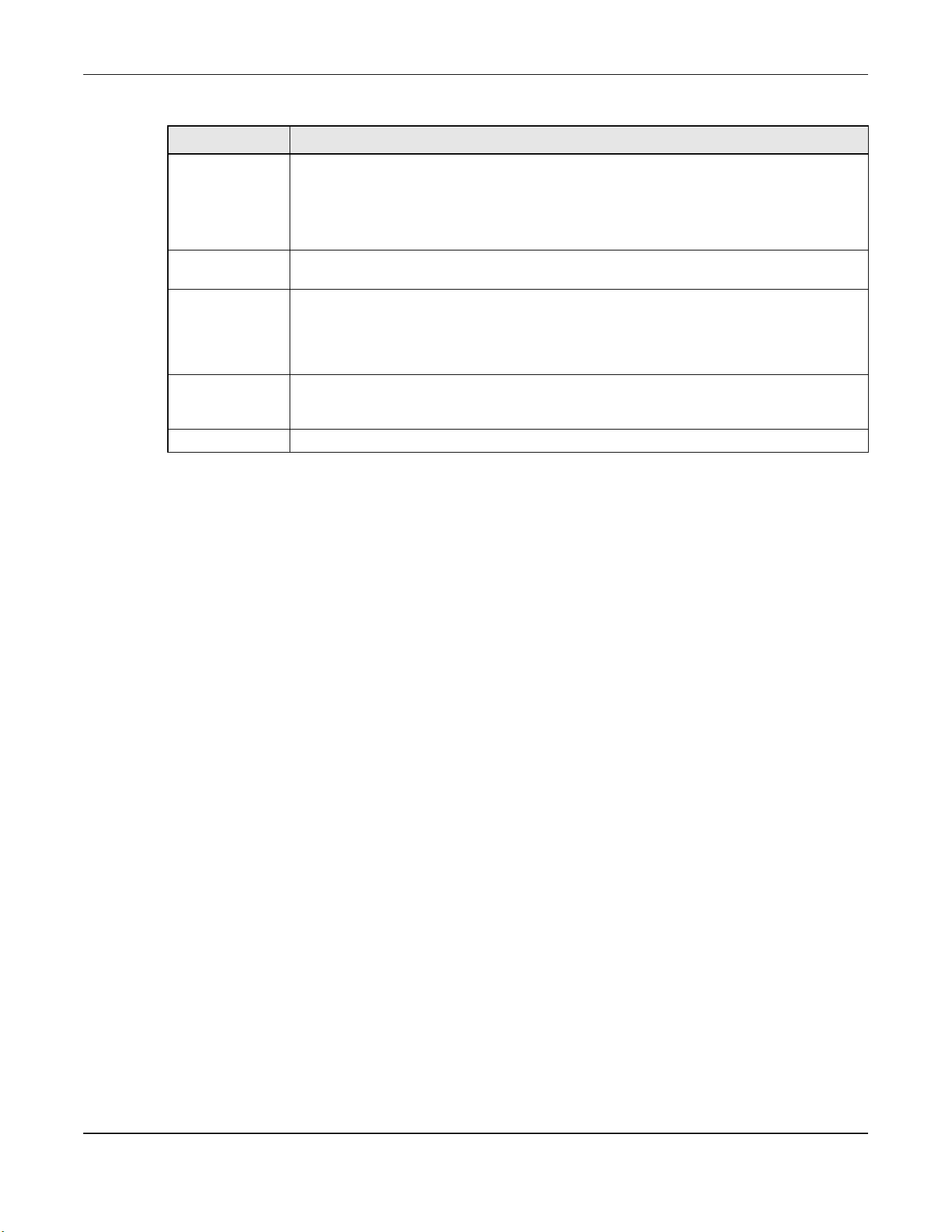
Chapter 59 Port Security
XMG1915 Series User’s Guide
349
Active Select this check box to enable the port security feature on this port. The Switch forwards
packets whose MAC addresses is in the MAC address table on this port. Packets with no
matching MAC addresses are dropped.
Clear this check box to disable the port security feature. The Switch forwards all packets on this
port.
Address
Learning
MAC address learning reduces outgoing broadcast traffic. For MAC address learning to occur
on a port, the port itself must be active with address learning enabled.
Limited
Number of
Learned MAC
Address
Use this field to limit the number of (dynamic) MAC addresses that may be learned on a port.
For example, if you set this field to "5" on port 2, then only the devices with these five learned
MAC addresses may access port 2 at any one time. A sixth device must wait until one of the
five learned MAC addresses ages out. MAC address aging out time can be set in the SYSTEM >
Switch Setup screen. The valid range is from “0” to “16K”. “0” means this feature is disabled.
Apply Click Apply to save your changes to the Switch’s run-time memory. The Switch loses these
changes if it is turned off or loses power, so use the Save link on the top navigation panel to
save your changes to the non-volatile memory when you are done configuring.
Cancel Click Cancel to begin configuring this screen afresh.
Table 194 SECURITY > Port Security (continued)
LABEL DESCRIPTION

XMG1915 Series User’s Guide
350
CHAPTER 60
MAINTENANCE
60.1 Overview
This chapter explains how to configure the screens that let you maintain the firmware and configuration
files.
60.1.1 What You Can Do
• Use the Certificates screen (Section 60.2 on page 350) to see the Certificates screen and import the
Switch's CA-signed certificates.
• Use the Cluster Management screens (Section 60.5 on page 355) to manage the switches within a
cluster and view cluster status.
• Use the Restore Configuration screen (Section 60.8 on page 360) to upload a stored device
configuration file.
• Use the Backup Configuration screen (Section 60.9 on page 360) to save your configurations for later
use.
• Use the Erase Running-Configuration screen (Section 60.10 on page 361) to reset the configuration to
the Zyxel default configuration settings.
• Use the Save Configuration screen (Section 60.11 on page 362) to save the current configuration
settings to a specific configuration file on the Switch.
• Use the Configure Clone screen (Section 60.12 on page 362) to copy the basic and advanced
settings from a source port to a destination port or ports.
• Use the Diagnostic screen (Section 60.13 on page 364) to ping IP addresses, run a traceroute, perform
port tests or show the Switch’s location between devices.
• Use the Firmware Upgrade screen (Section 60.14 on page 365) to upload the latest firmware.
• Use the Reboot System screen (Section 60.15 on page 367) to restart the Switch without physically
turning the power off and load a specific configuration file.
• Use the Tech-Support screen (Section 60.16 on page 368) to create reports for customer support if
there are problems with the Switch.
60.2 Certificates
The Switch can use HTTPS certificates that are verified by a third party to create secure HTTPS
connections between your computer and the Switch. This way, you may securely access the Switch
using the Web Configurator. See Section 55.5.2 on page 324 for more information about HTTPS.
Certificates are based on public-private key pairs. A certificate contains the certificate owner’s identity
and public key. Certificates provide a way to exchange public keys for use in authentication.

Chapter 60 MAINTENANCE
XMG1915 Series User’s Guide
351
Click MAINTENANCE > Certificates to open the following screen. Use this screen to import the Switch's
CA-signed certificates.
Figure 251 MAINTENANCE > Certificates
The following table describes the labels in this screen.
60.2.1 HTTPS Certificates
Use this screen to view the HTTPS certificate details. Click a hyperlink in the Service column in the
MAINTENANCE > Certificates screen to open the following screen.
Table 195 MAINTENANCE > Certificates
LABEL DESCRIPTION
File Path Click Choose File or Browse to find the certificate file you want to upload.
Password Enter the certificate file’s password that was created when the PKCS #12 file was exported.
The password consists of up to 32 printable ASCII characters except [ ? ], [ | ], [ ' ], [ " ] or [ ,
].
Import Click this button to save the certificate that you have enrolled from a certification authority
from your computer to the Switch.
Service This field displays the service type that this certificate is for.
Subject This field displays identifying information about the certificate’s owner, such as CN
(Common Name), OU (Organizational Unit or department), O (Organization or company)
and C (Country). It is recommended that each certificate have unique subject
information.
Issuer This field displays identifying information about the certificate’s issuing certification
authority, such as a common name, organizational unit or department, organization or
company and country.
Valid From This field displays the date that the certificate becomes applicable.
Valid To This field displays the date that the certificate expires.
Select an entry’s check box to select a specific entry.
Delete Click this button to delete the certificate (or certification request). You cannot delete a
certificate that one or more features is configured to use.
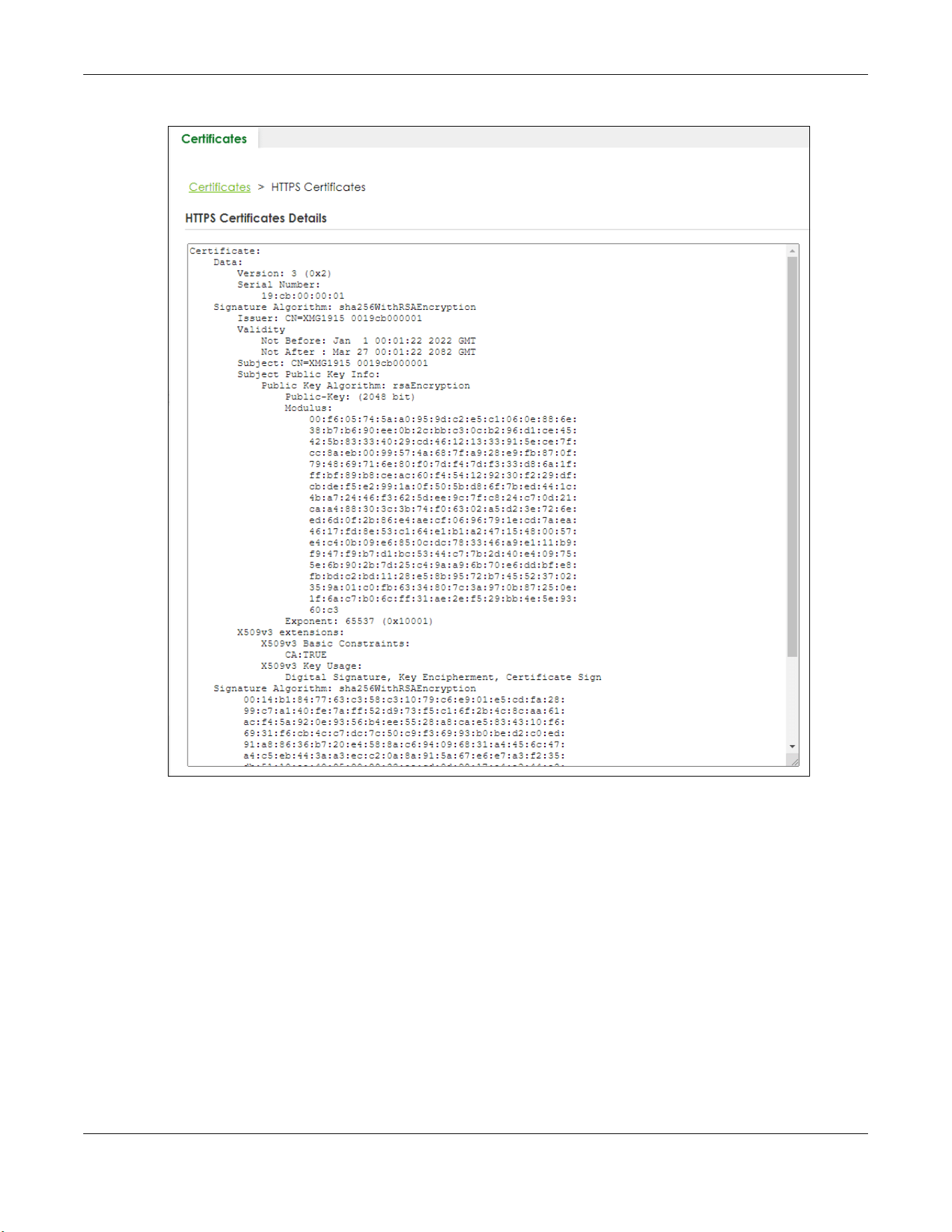
Chapter 60 MAINTENANCE
XMG1915 Series User’s Guide
352
Figure 252 MAINTENANCE > Certificates > HTTPS
60.3 Technical Reference
This section provides technical background information on the topics discussed in this chapter.
60.3.1 FTP Command Line
This section shows some examples of uploading to or downloading files from the Switch using FTP
commands. First, understand the filename conventions.
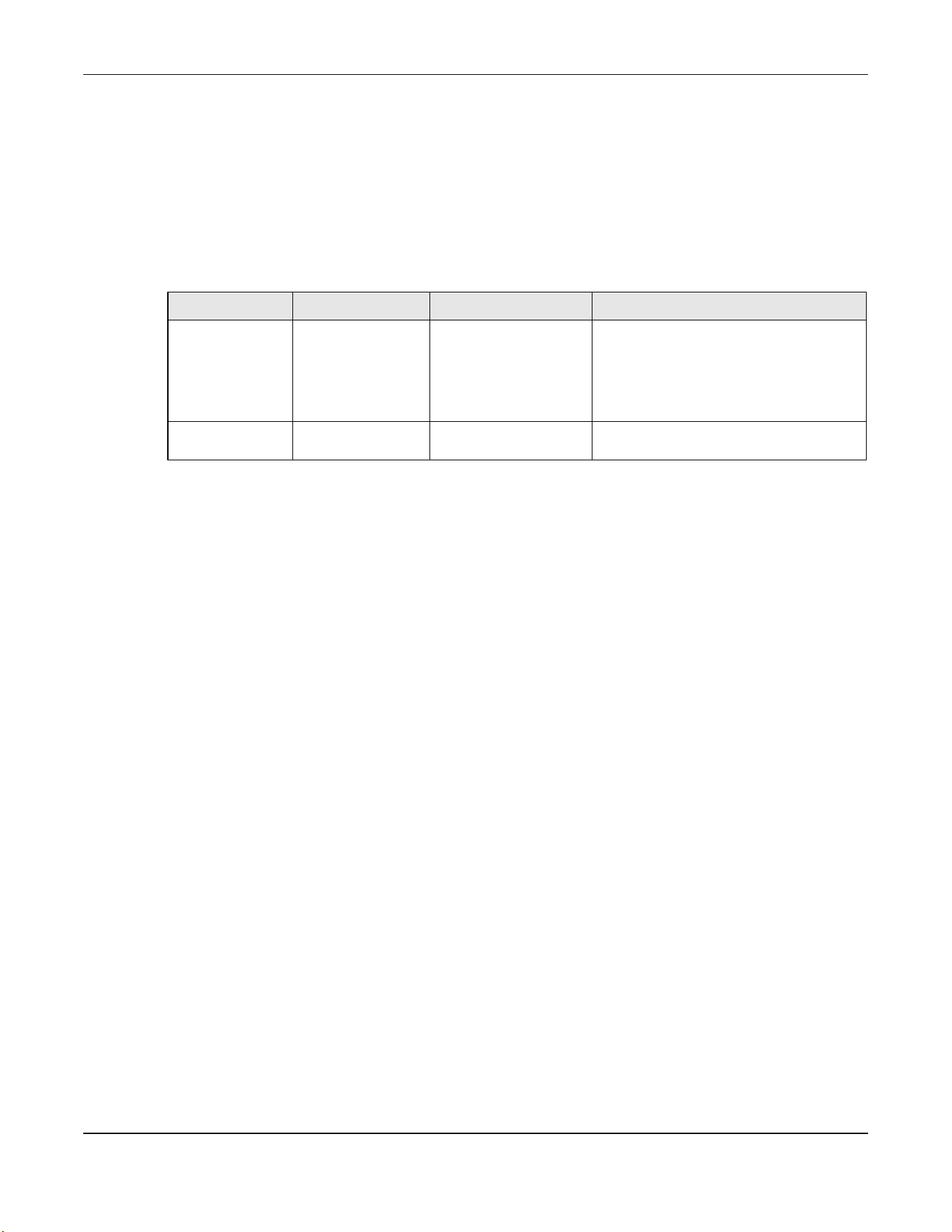
Chapter 60 MAINTENANCE
XMG1915 Series User’s Guide
353
60.3.2 Filename Conventions
The configuration file (also known as the romfile or ROM) contains the Zyxel factory default configuration
settings in the screens such as password, Switch setup, IP Setup, and so on. Once you have customized
the Switch’s settings, they can be saved back to your computer under a filename of your choosing.
ZyNOS (Zyxel Network Operating System sometimes referred to as the “ras” file) is the system firmware
and has a “bin” filename extension.
You can store up to two images, or firmware files of the same device model, on the Switch. Only one
image is used at a time.
•Run the boot image <1|2> command to specify which image is updated when firmware is loaded
using the Web Configurator and to specify which image is loaded when the Switch starts up.
• You can also use FTP commands to upload firmware to any image.
60.3.2.1 Example FTP Commands
ftp> put firmware.bin ras-0
This is a sample FTP session showing the transfer of the computer file "firmware.bin" to the Switch’s
Firmware 1.
ftp> get config1 config1.cfg
This is a sample FTP session saving the Switch’s configuration file 1 (Config1) to a file called “config1.cfg”
on your computer.
If your (T)FTP client does not allow you to have a destination filename different than the source, you will
need to rename them as the Switch only recognizes “config” and “ras”. Be sure you keep unaltered
copies of both files for later use.
Be sure to upload the correct model firmware as uploading the wrong
model firmware may damage your device.
60.3.3 FTP Command Line Procedure
1 Launch the FTP client on your computer.
2 Enter open, followed by a space and the IP address of your Switch.
3 Press [ENTER] when prompted for a user name.
Table 196 Filename Conventions
FILE TYPE INTERNAL NAME EXTERNAL NAME DESCRIPTION
Configuration File config1
config2
*.cfg This is the configuration filename on the
Switch. Uploading the config file replaces
the specified configuration file system,
including your Switch configurations,
system-related data (including the default
password), the error log and the trace log.
Firmware ras *.bin This is the generic name for the ZyNOS
firmware on the Switch.

Chapter 60 MAINTENANCE
XMG1915 Series User’s Guide
354
4 Enter your password as requested (the default is “1234”).
5 Enter bin to set transfer mode to binary.
6 Use put to transfer files from the computer to the Switch, for example, put firmware.bin ras transfers
the firmware on your computer (firmware.bin) to the Switch and renames it to “ras”. Similarly, put
config.cfg config1 transfers the configuration file on your computer (config.cfg) to the Switch and
renames it to “config1”. Likewise get config1 config.cfg transfers the configuration file on the Switch
to your computer and renames it to “config.cfg”. See Table 196 on page 353 for more information on
filename conventions.
7 Enter quit to exit the ftp prompt.
60.3.4 GUI-based FTP Clients
The following table describes some of the commands that you may see in GUI-based FTP clients.
60.3.5 FTP Restrictions
FTP will not work when:
• FTP service is disabled in the SECURITY > Access Control > Service Access Control screen.
• The IP addresses in the SECURITY > Access Control > Remote Management screen does not match the
client IP address. If it does not match, the Switch will disconnect the FTP session immediately.
Table 197 General Commands for GUI-based FTP Clients
COMMAND DESCRIPTION
Host Address Enter the address of the host server.
Login Type Anonymous.
This is when a user I.D. and password is automatically supplied to the server for
anonymous access. Anonymous logins will work only if your ISP or service administrator
has enabled this option.
Normal.
The server requires a unique User ID and Password to login.
Transfer Type Transfer files in either single-byte printable characters (plain text format) or in binary
mode. Configuration and firmware files should be transferred in binary mode.
Initial Remote Directory Specify the default remote directory (path).
Initial Local Directory Specify the default local directory (path).
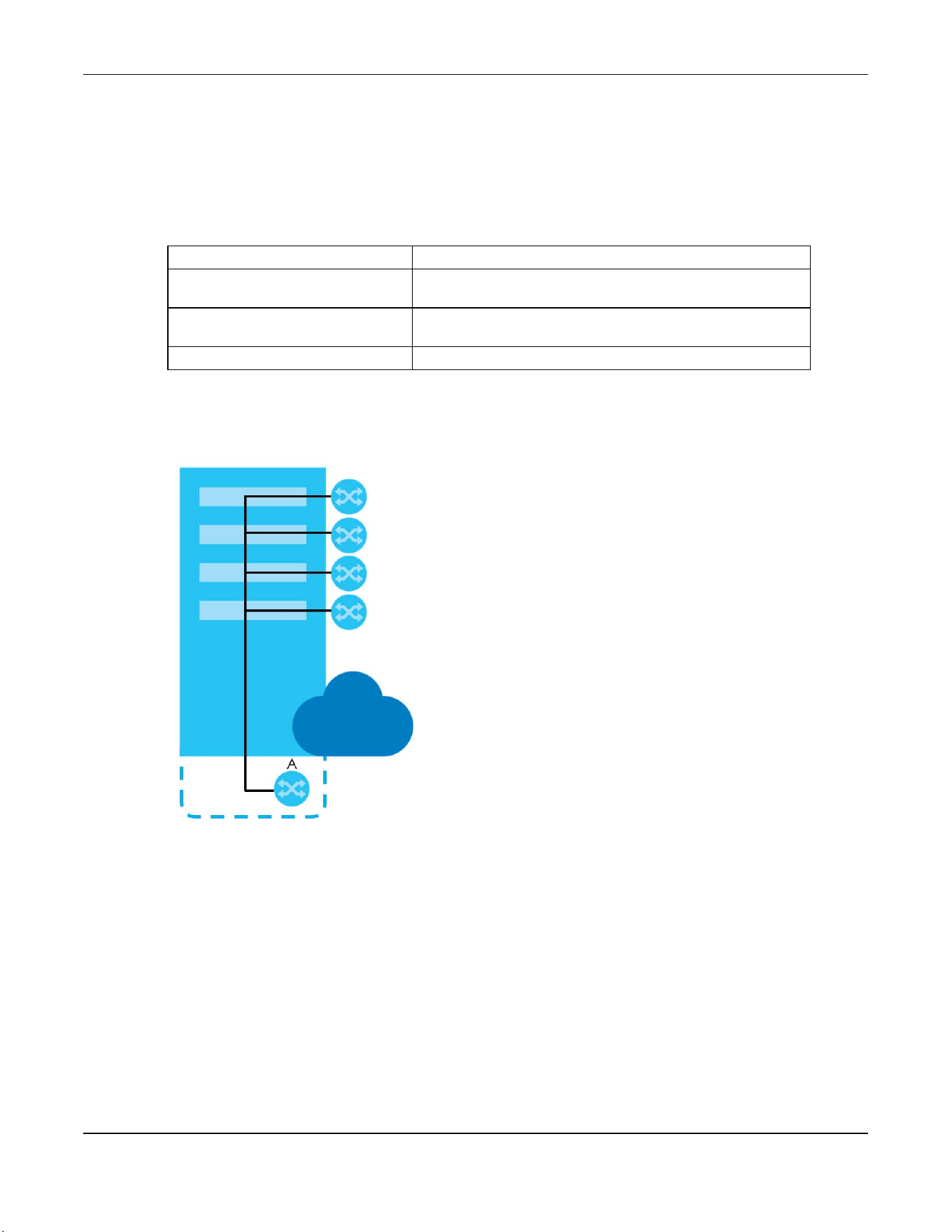
Chapter 60 MAINTENANCE
XMG1915 Series User’s Guide
355
60.4 Cluster Management Overview
Cluster Management allows you to manage switches through one Switch, called the cluster manager.
The switches must be directly connected and be in the same VLAN group so as to be able to
communicate with one another.
In the following example, switch A in the basement is the cluster manager and the other switches on the
upper floors of the building are cluster members.
Figure 253 Clustering Application Example
60.4.1 What You Can Do
• Use the Cluster Management Status screen (Section 60.5 on page 355) to view the role of the Switch
within the cluster and to access a cluster member Switch’s Web Configurator.
• Use the Cluster Management Setup screen (Section 60.6 on page 356) to configure clustering
management.
60.5 Cluster Management Status
Use this screen to view the role of the Switch within the cluster and to access a cluster member Switch’s
Web Configurator.
Table 198 Zyxel Clustering Management Specifications
Maximum number of cluster members 24
Cluster Member Models Must be compatible with Zyxel cluster management
implementation.
Cluster Manager The Switch through which you manage the cluster member
switches.
Cluster Members The switches being managed by the cluster manager Switch.

Chapter 60 MAINTENANCE
XMG1915 Series User’s Guide
356
Click MAINTENANCE > Cluster Management in the navigation panel to display the following screen.
Note: A cluster can only have one manager.
Figure 254 MAINTENANCE > Cluster Management > Cluster Management Status
The following table describes the labels in this screen.
60.6 Clustering Management Setup
Use this screen to configure clustering management. Click MAINTENANCE > Cluster Management >
Cluster Management Setup to display the next screen.
Table 199 MAINTENANCE > Cluster Management > Cluster Management Status
LABEL DESCRIPTION
Status This field displays the role of this Switch within the cluster.
Manager
Member (you see this if you access this screen in the cluster member Switch directly and not
through the cluster manager)
None (neither a manager nor a member of a cluster)
Manager This field displays the cluster manager Switch’s hardware MAC address.
The Number Of
Member
This field displays the number of switches that make up this cluster. The following fields describe
the cluster member switches.
Index You can manage cluster member switches through the cluster manager Switch. Each number in
the Index column is a hyperlink leading to the cluster member Switch’s Web Configurator.
MAC Address This is the cluster member Switch’s hardware MAC address.
Name This is the cluster member Switch’s System Name.
Model This field displays the model name.
Status This field displays:
Online (the cluster member Switch is accessible)
Error (for example the cluster member Switch password was changed or the Switch was set as
the manager and so left the member list, and so on)
Offline (the Switch is disconnected – Offline shows approximately 1.5 minutes after the link
between cluster member and manager goes down)

Chapter 60 MAINTENANCE
XMG1915 Series User’s Guide
357
Figure 255 MAINTENANCE > Cluster Management > Cluster Management Setup
The following table describes the labels in this screen.
Click the Add/Edit button to open the Add/Edit screen. Use this screen to configure a clustering
candidate for the Switch.
Table 200 MAINTENANCE > Cluster Management > Cluster Management Setup
LABEL DESCRIPTION
Clustering Manager The following fields relate to configuring the cluster manager.
Active Enable the switch button to have this Switch become the cluster manager switch. A cluster
can only have one manager. Other (directly connected) switches that are set to be cluster
managers will not be visible in the Clustering Candidates list. If a Switch that was previously a
cluster member is later set to become a cluster manager, then its Status is displayed as Error
in the Cluster Management Status screen and a warning icon ( ) appears in the member
summary list below.
Name Type a name to identify the Clustering Manager. You may use up to 32 printable ASCII
characters except [ ? ], [ | ], [ ' ], [ " ] or [ , ]. (spaces are allowed).
VID This is the VLAN ID and is only applicable if the Switch is set to 802.1Q VLAN. All switches must
be directly connected and in the same VLAN group to belong to the same cluster. Switches
that are not in the same VLAN group are not visible in the Clustering Candidates list. This field
is ignored if the Clustering Manager is using Port-based VLAN.
Apply Click Apply to save your changes to the Switch’s run-time memory. The Switch loses these
changes if it is turned off or loses power, so use the Save link on the top navigation panel to
save your changes to the non-volatile memory when you are done configuring.
Cancel Click Cancel to begin configuring this screen afresh.
Clustering
Candidate
The next summary table shows the information for the clustering members configured.
Add/Edit Click this button to create or configure a clustering candidate.
Delete Click this button to remove the clustering candidate.
Select an entry’s check box to select a specific entry. Otherwise, select the check box in the
table heading row to select all entries.
Index This is the index number of a cluster member switch.
MAC Address This is the cluster member switch’s hardware MAC address.
Name This is the cluster member switch’s System Name.
Model This is the cluster member switch’s model name.
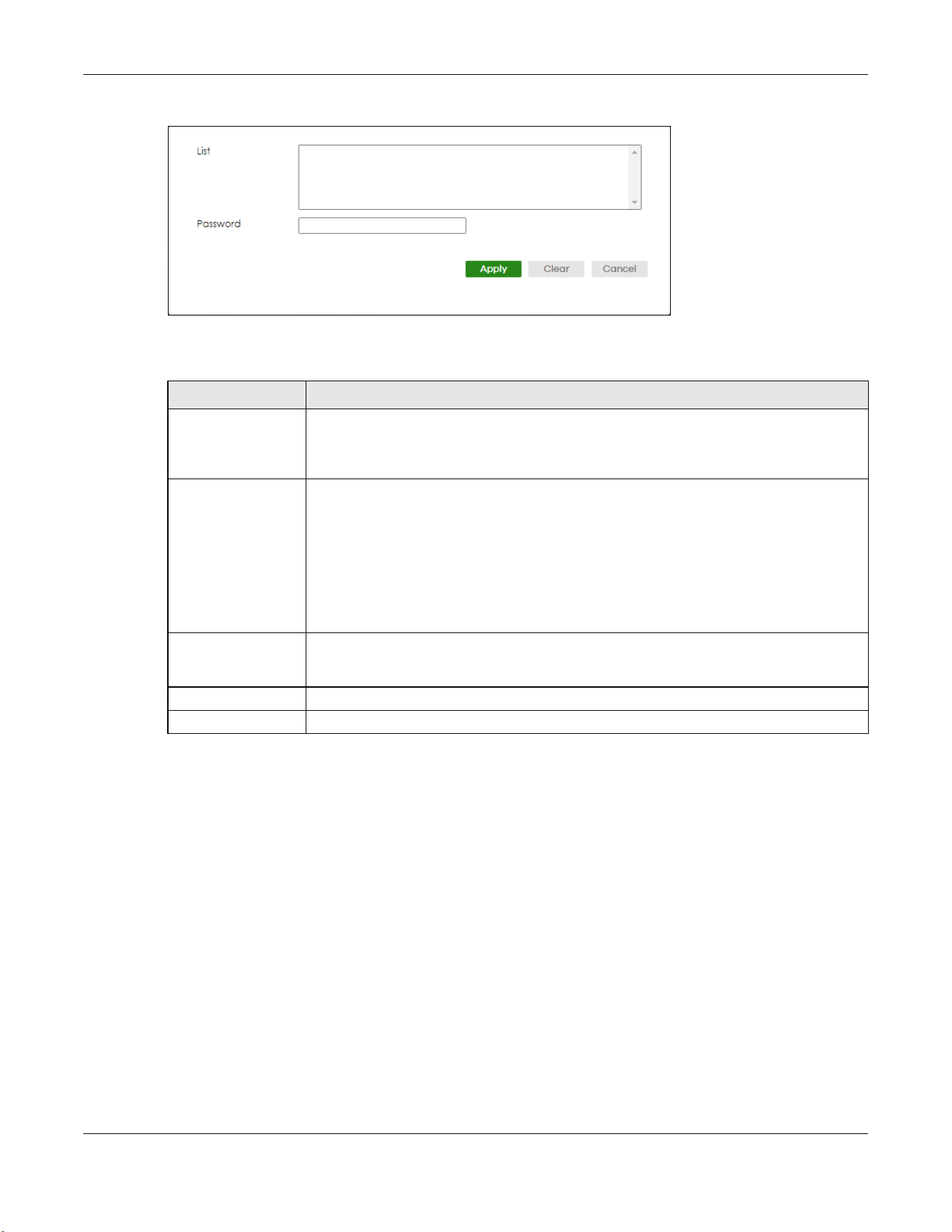
Chapter 60 MAINTENANCE
XMG1915 Series User’s Guide
358
Figure 256 MAINTENANCE > Cluster Management > Cluster Management Setup > Add/Edit
The following table describes the labels in this screen.
60.7 Technical Reference
This section provides technical background information on the topics discussed in this chapter.
60.7.1 Cluster Member Switch Management
Go to the MAINTENANCE > Clustering Management > Clustering Management Status screen of the
cluster manager switch and then select an Index hyperlink from the list of members to go to that cluster
member switch's Web Configurator home page. This cluster member Web Configurator home page
and the home page that you would see if you accessed it directly are different.
Table 201 MAINTENANCE > Cluster Management > Cluster Management Setup > Add/Edit
LABEL DESCRIPTION
List A list of suitable candidates found by auto-discovery is shown here. The switches must be
directly connected. Directly connected switches that are set to be cluster managers will not
be visible in the Clustering Candidate list. Switches that are not in the same management
VLAN group will not be visible in the Clustering Candidate list.
Password Each cluster member’s password is its Web Configurator password. Select a member in the
Clustering Candidate list and then enter its Web Configurator password. If that switch
administrator changes the Web Configurator password afterwards, then it cannot be
managed from the Cluster Manager. Its Status is displayed as Error in the Cluster
Management Status screen.
If multiple devices have the same password then hold [SHIFT] and click those switches to
select them. Then enter their common Web Configurator password.
You can enter up to 32 printable ASCII characters except [ ? ], [ | ], [ ' ], [ " ] or [ , ].
Apply Click Apply to save your changes to the Switch’s run-time memory. The Switch loses these
changes if it is turned off or loses power, so use the Save link on the top navigation panel to
save your changes to the non-volatile memory when you are done configuring.
Clear Click Clear to reset the fields to the factory defaults.
Cancel Click Cancel to begin configuring this screen afresh.
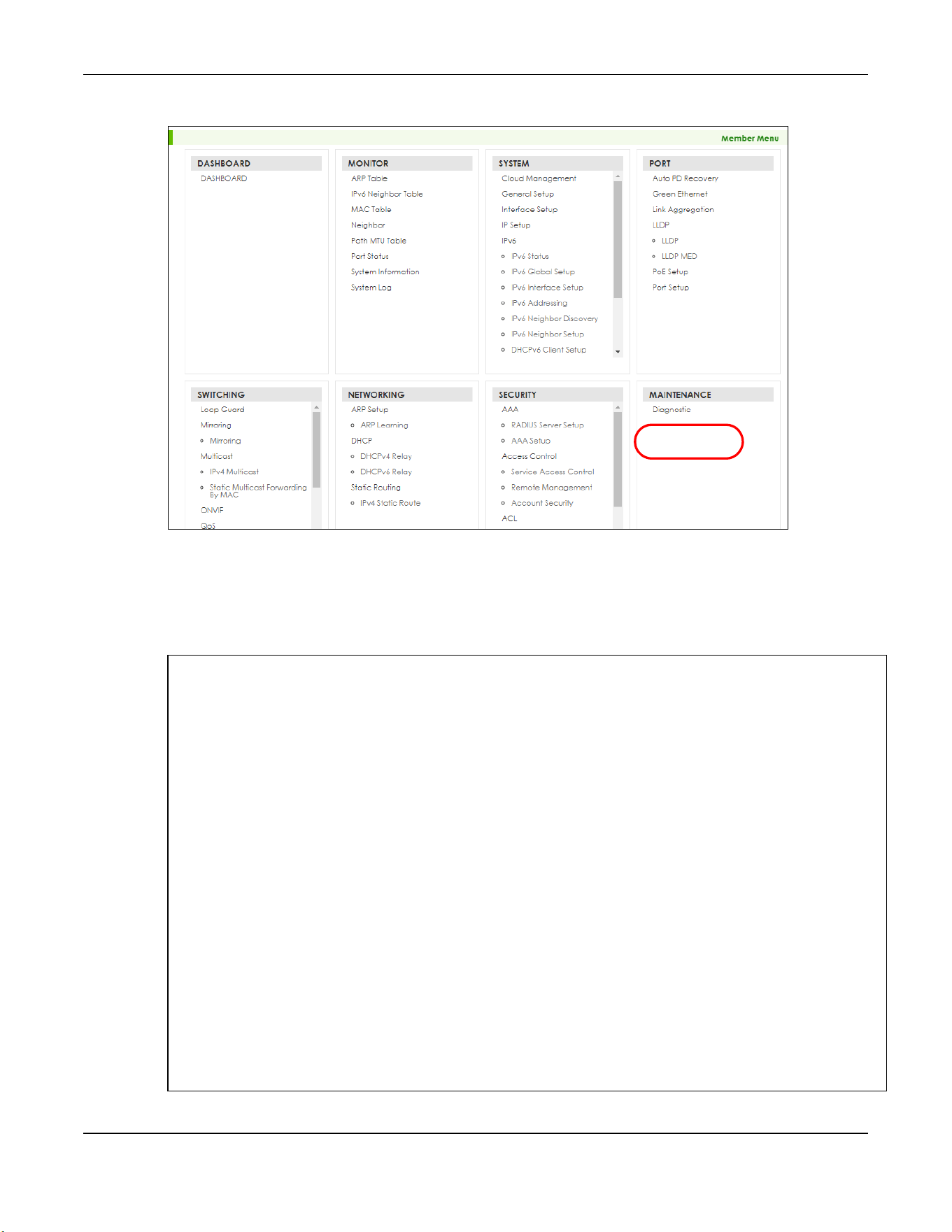
Chapter 60 MAINTENANCE
XMG1915 Series User’s Guide
359
Figure 257 Cluster Management: Cluster Member Web Configurator Screen
60.7.1.1 Uploading Firmware to a Cluster Member Switch
You can use FTP to upload firmware to a cluster member switch through the cluster manager switch as
shown in the following example.
Figure 258 Example: Uploading Firmware to a Cluster Member Switch
example
C:\>ftp 192.168.1.1
Connected to 192.168.1.1.
220 Switch FTP version 1.0 ready at Thu Jan 1 00:58:46 1970
User (192.168.0.1:(none)): admin
331 Enter PASS command
Password:
230 Logged in
ftp> ls
200 Port command okay
150 Opening data connection for LIST
--w--w--w- 1 owner group 3042210 Jul 01 12:00 ras
-rw-rw-rw- 1 owner group 393216 Jul 01 12:00 config
--w--w--w- 1 owner group 0 Jul 01 12:00 fw-00-a0-c5-01-23-46
-rw-rw-rw- 1 owner group 0 Jul 01 12:00 config-00-a0-c5-01-23-46
226 File sent OK
ftp: 297 bytes received in 0.00Seconds 297000.00Kbytes/sec.
ftp> bin
200 Type I OK
ftp> put 470ACAQ0.bin fw-00-a0-c5-01-23-46
200 Port command okay
150 Opening data connection for STOR fw-00-a0-c5-01-23-46
226 File received OK
ftp: 262144 bytes sent in 0.63Seconds 415.44Kbytes/sec.
ftp>
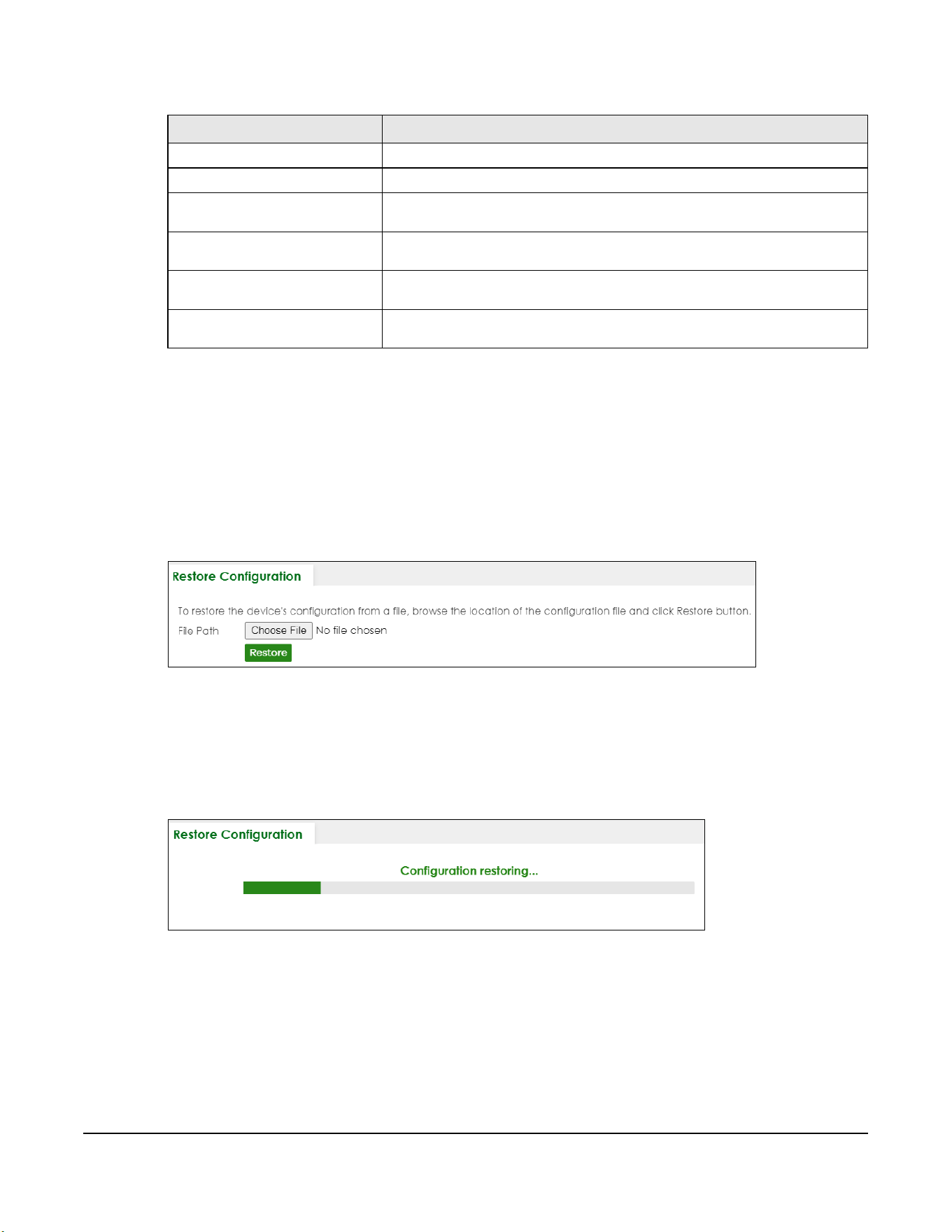
XMG1915 Series User’s Guide
360
The following table explains some of the FTP parameters.
60.8 Restore Configuration
Use this screen to restore a previously saved configuration file (See Section 60.9 on page 360 for more
information on how to back up a configuration file) from your computer to the Switch.
Click MAINTENANCE > Configuration > Restore Configuration to access this screen.
Figure 259 MAINTENANCE > Configuration > Restore Configuration
1 Click Choose File or Browse to locate the configuration file you wish to restore.
2 After you have specified the file, click Restore.
The Switch will run on the restored configuration after the restore process.
Figure 260 Configuration Restoring
60.9 Backup Configuration
Backing up your Switch configurations allows you to create various “snap shots” of your device from
which you may restore at a later date. Use this screen to back up your current Switch configuration to a
computer.
Table 202 FTP Upload to Cluster Member Example
FTP PARAMETER DESCRIPTION
User
Enter “admin”.
Password
The Web Configurator password default is 1234.
ls
Enter this command to list the name of cluster member switch’s firmware and
configuration file.
470ACAQ0.bin
This is the name of the firmware file you want to upload to the cluster member
switch.
fw-00-a0-c5-01-23-46
This is the cluster member switch’s firmware name as seen in the cluster
manager switch.
config-00-a0-c5-01-23-46
This is the cluster member switch’s configuration file name as seen in the cluster
manager switch.

Chapter 60 MAINTENANCE
XMG1915 Series User’s Guide
361
To access this screen, click MAINTENANCE > Configuration > Backup Configuration in the navigation
panel.
Figure 261 MAINTENANCE > Configuration > Backup Configuration
Follow the steps below to back up the current Switch configuration to your computer in this screen.
1 Select which Switch configuration file you want to download to your computer.
2 Click Backup.
3 If the current configuration file is open and/or downloaded to your computer automatically, you can
click File > Save As on your computer to save the file to a specific place.
If a dialog box pops up asking whether you want to open or save the file, click Save or Save File to
download it to the default downloads folder on your computer. If a Save As screen displays after you
click Save or Save File, choose a location to save the file on your computer from the Save in drop-down
list box and type a descriptive name for it in the File name list box. Click Save to save the configuration
file to your computer.
60.10 Erase Running-Configuration
Follow the steps below to reset the Switch back to the Zyxel default configuration settings.
To access this screen, click MAINTENANCE > Configuration > Erase Running Configuration in the
navigation panel.
1 In the Erase Running Configuration screen, click the Erase button to clear all Switch configuration
information you configured and return to the Zyxel default configuration settings.
Figure 262 MAINTENANCE > Configuration > Erase Running Configuration
2 Click YES to remove the running configuration on the Switch.
Figure 263 Erase Running Configuration: Confirmation
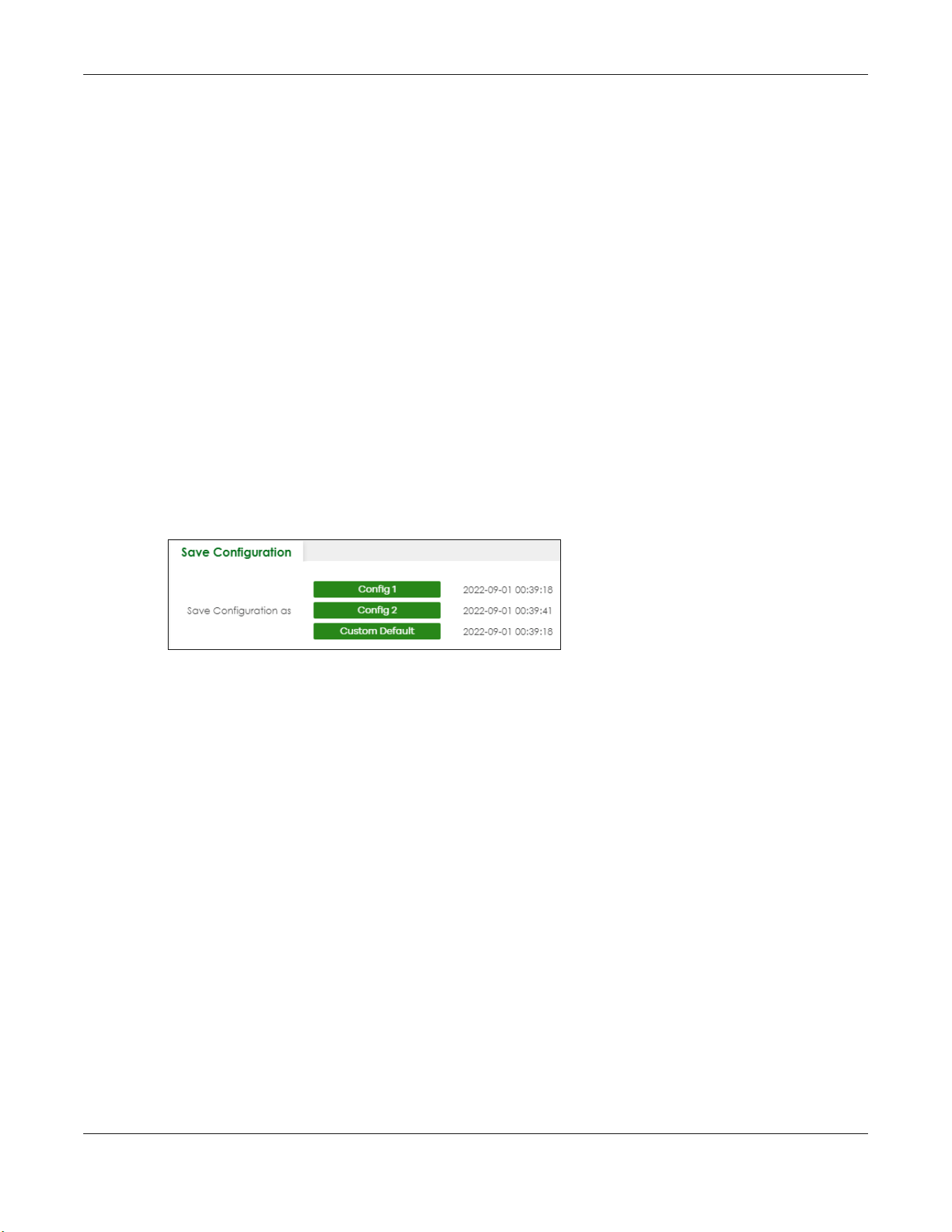
Chapter 60 MAINTENANCE
XMG1915 Series User’s Guide
362
3 In the Web Configurator, click the Save button in the top of the screen to make the changes take
effect. If you want to access the Switch Web Configurator again, you may need to change the IP
address of your computer to be in the same subnet as that of the default Switch IP address (192.168.1.1
or DHCP-assigned IP).
60.11 Save Configuration
To access this screen, click MAINTENANCE > Configuration > Save Configuration in the navigation panel.
Click Config 1 to save the current configuration settings permanently to Configuration 1 on the Switch.
These configurations are set up according to your network environment.
Click Config 2 to save the current configuration settings permanently to Configuration 2 on the Switch.
These configurations are set up according to your network environment.
Click Custom Default to save the current configuration settings permanently to a customized default file
on the Switch. If configuration changes cause the Switch to behave abnormally, click Custom Default
(in the MAINTENANCE > Reboot System screen) to have the Switch automatically reboot and restore the
saved Custom Default configuration file.
Figure 264 MAINTENANCE > Configuration > Save Configuration
Note: If a customized default file was not saved, clicking Custom Default in the MAINTENANCE
> Reboot System screen loads the factory default configuration on the Switch.
Alternatively, click Save on the top right in any screen to save the configuration changes to the current
configuration.
Note: Clicking the Apply button after making configuration does NOT save the changes
permanently. All unsaved changes are erased after you reboot the Switch.
60.12 Configure Clone
Cloning allows you to copy the basic and advanced settings from a source port to a destination port or
ports. Click MAINTENANCE > Configuration > Configure Clone to open the following screen.
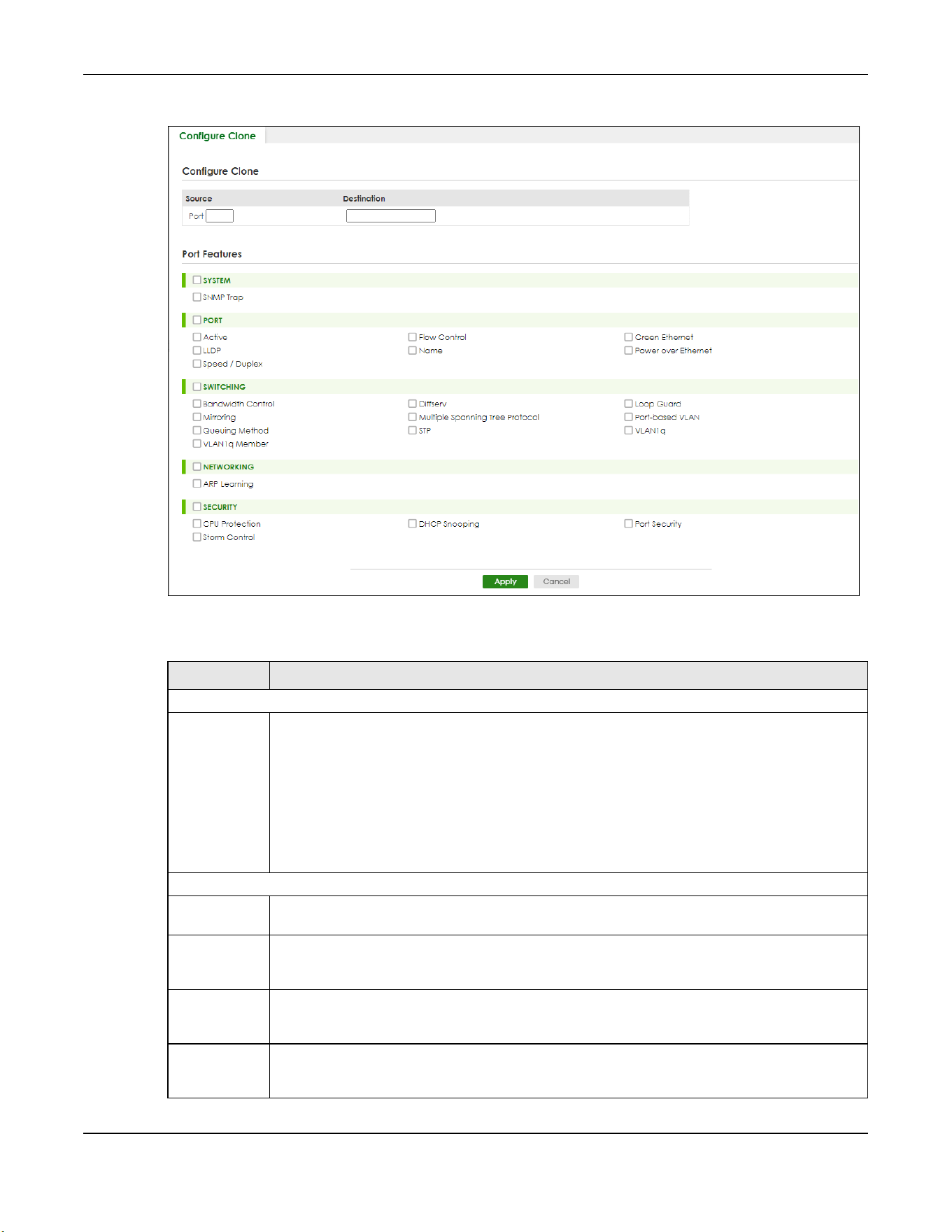
Chapter 60 MAINTENANCE
XMG1915 Series User’s Guide
363
Figure 265 MAINTENANCE > Configuration > Configure Clone
The following table describes the labels in this screen.
Table 203 MAINTENANCE > Configuration > Configure Clone
LABEL DESCRIPTION
Configure Clone
Source/
Destination
Port
Enter the source port under the Source label. This port’s attributes are copied.
Enter the destination port or ports under the Destination label. These are the ports which are going
to have the same attributes as the source port. You can enter individual ports separated by a
comma or a range of ports by using a dash.
Example:
2, 4, 6 indicates that ports 2, 4 and 6 are the destination ports.
2-6 indicates that ports 2 through 6 are the destination ports.
Port Features
Select a feature’s check box to select a specific feature. Otherwise, select the check box in the
table heading row to select all features for a category.
SYSTEM Select the system feature (you configured in the SYSTEM menus) to be copied to the destination
ports. Otherwise, select the SYSTEM check box in the table heading row to select all features for a
category.
PORT Select which port features (you configured in the PORT menus) should be copied to the
destination ports. Otherwise, select the PORT check box in the table heading row to select all
features for a category.
SWITCHING Select which switching features (you configured in the SWITCHING menus) should be copied to
the destination ports. Otherwise, select the SWITCHING check box in the table heading row to
select all features for a category.
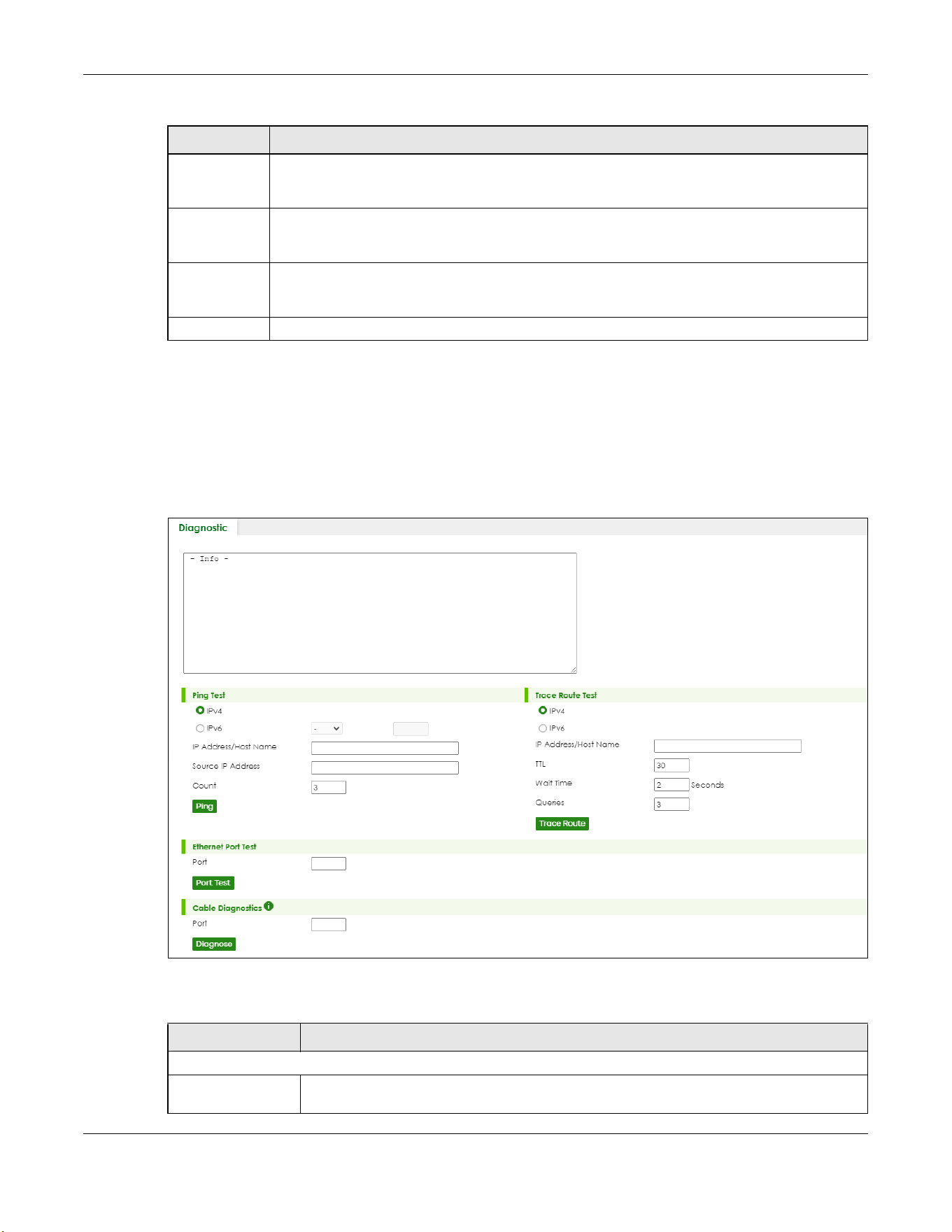
Chapter 60 MAINTENANCE
XMG1915 Series User’s Guide
364
60.13 Diagnostic
Click MAINTENANCE > Diagnostic in the navigation panel to open this screen. Use this screen to ping IP
addresses, run a traceroute, perform port tests or show the Switch’s location between devices.
Figure 266 MAINTENANCE > Diagnostic
The following table describes the labels in this screen.
NETWORKING Select the networking feature (you configured in the NETWORKING menus) to be copied to the
destination ports. Otherwise, select the NETWORKING check box in the table heading row to
select all features for a category.
SECURITY Select which security features (you configured in the SECURITY menus) should be copied to the
destination ports. Otherwise, select the SECURITY check box in the table heading row to select all
features for a category.
Apply Click Apply to save your changes to the Switch’s run-time memory. The Switch loses these
changes if it is turned off or loses power, so use the Save link on the top navigation panel to save
your changes to the non-volatile memory when you are done configuring.
Cancel Click Cancel to begin configuring this screen afresh.
Table 203 MAINTENANCE > Configuration > Configure Clone (continued)
LABEL DESCRIPTION
Table 204 MAINTENANCE > Diagnostic
LABEL DESCRIPTION
Ping Test
IPv4 Select this option if you want to ping an IPv4 address. Otherwise, select – to send ping
requests to all VLANs on the Switch.
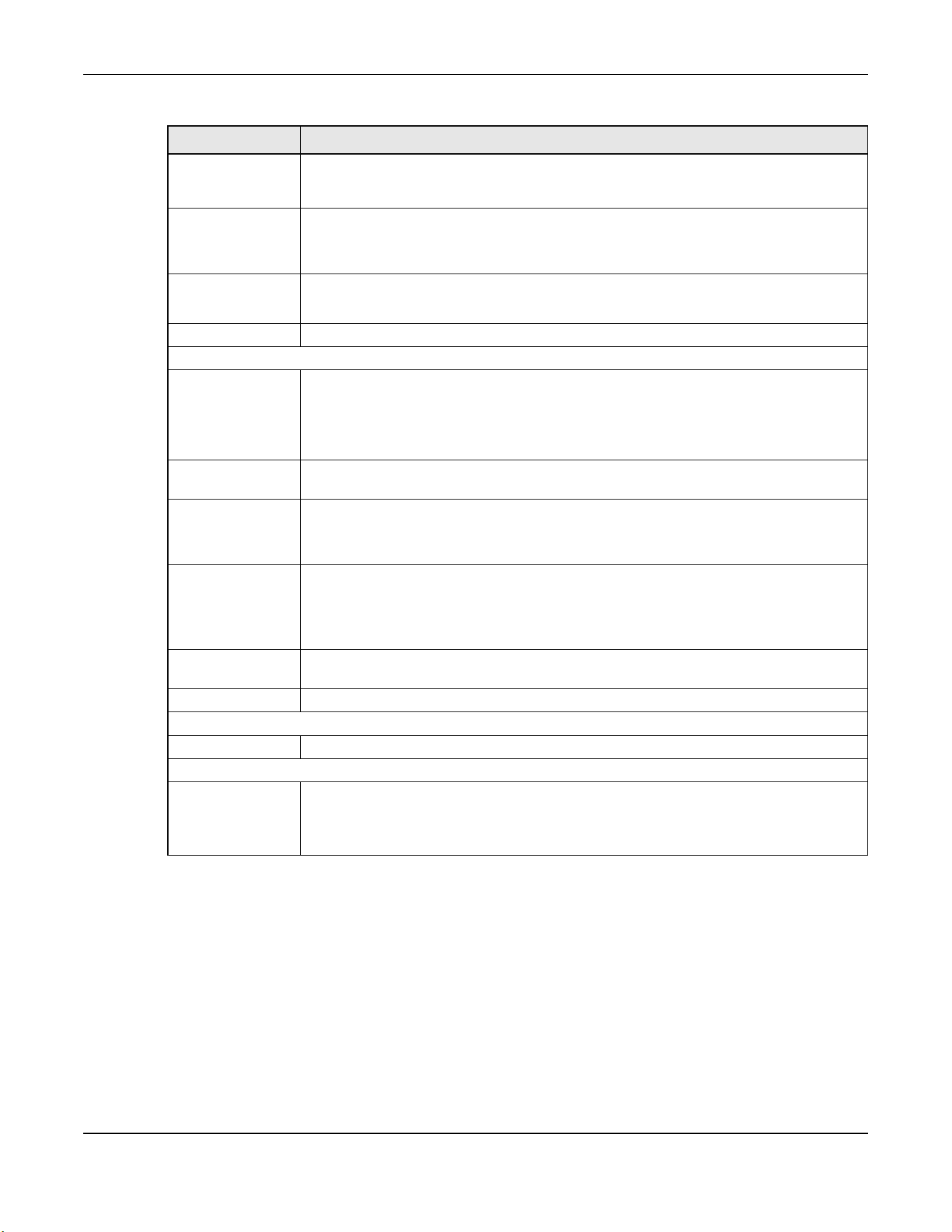
Chapter 60 MAINTENANCE
XMG1915 Series User’s Guide
365
60.14 Firmware Upgrade
You can upgrade the Switch’s firmware through Web Configurator or NCC.
Firmware Upgrade Through NCC
In cloud management mode, NCC will first check if the firmware on the Switch needs to be upgraded. If
it does, the Switch will upgrade the firmware immediately. If the firmware does not need to be
upgraded, but there is newer firmware available for the Switch, then it will be upgraded according to
the firmware upgrade schedule for the Switch on the NCC.
IPv6 Select this option if you want to ping an IPv6 address. You can also select vlan and specify
the ID number of the VLAN to which the Switch is to send ping requests. Otherwise, select – to
send ping requests to all VLANs on the Switch.
IP Address/Host
Name
Type the IP address or host name of a device that you want to ping in order to test a
connection.
Click Ping to have the Switch ping the IP address.
Source IP
Address
Type the source IP address that you want to ping in order to test a connection.
Click Ping to have the Switch ping the IP address.
Count Enter the number of ICMP Echo Request (ping) messages the Switch continuously sends.
Trace Route Test
IPv4 Select this option if you want to trace the route packets taken to a device with an IPv4
address. Otherwise, select – to trace the path on any VLAN.
Note: The device to which you want to run a traceroute must belong to the VLAN
you specify here.
IPv6 Select this option if you want to trace the route packets taken to a device with an IPv6
address.
IP Address/Host
Name
Enter the IP address or host name of a device to which you want to perform a traceroute.
Click Trace Route to have the Switch perform the traceroute function. This determines the
path a packet takes to the specified device.
TTL Enter the Time To Live (TTL) value for the ICMP Echo Request packets. This is to set the
maximum number of the hops (routers) a packet can travel through. Each router along the
path will decrement the TTL value by one and forward the packets. When the TTL value
becomes zero and the destination is not found, the router drops the packets and informs the
sender.
Wait Time Specify how many seconds the Switch waits for a response to a probe before running
another traceroute.
Queries Specify how many times the Switch performs the traceroute function.
Ethernet Port Test
Port Enter a port number and click Port Test to perform an internal loopback test.
Cable Diagnostics
Port Enter a port number and click Diagnose to perform a physical wire-pair test of the Ethernet
connections on the specified ports. The following fields display when you diagnose a port.
Note: This feature is limited to within 100 meters only.
Table 204 MAINTENANCE > Diagnostic (continued)
LABEL DESCRIPTION
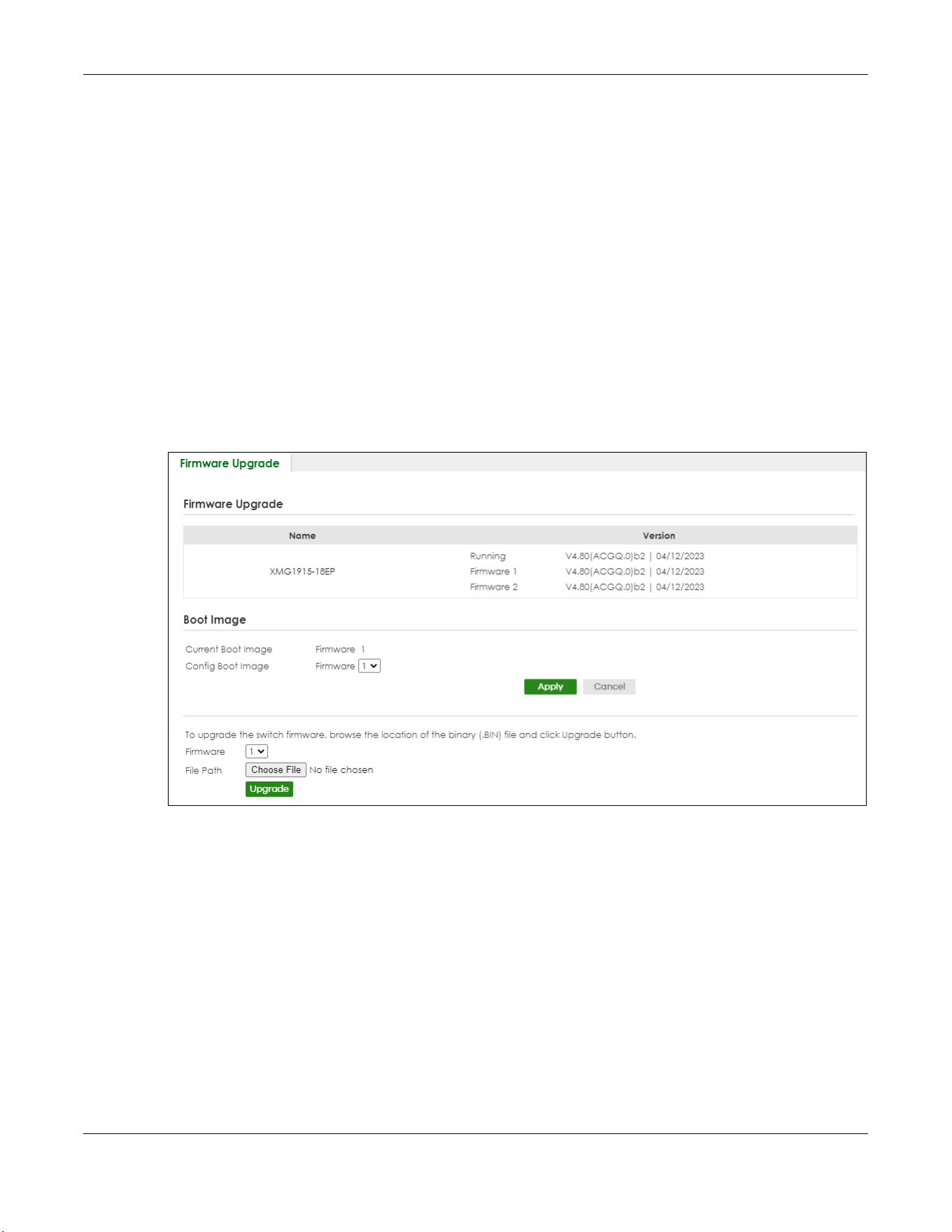
Chapter 60 MAINTENANCE
XMG1915 Series User’s Guide
366
On the NCC web portal, go to Site-wide > Configure > Firmware management to schedule the firmware
upgrade time.
Note: While the Switch is rebooting, do NOT turn off the power.
Firmware Upgrade Through the Web Configurator
Use the following screen to upgrade your Switch to the latest firmware. The Switch supports dual
firmware images, Firmware 1 and Firmware 2. Use this screen to specify which image is updated when
firmware is uploaded using the Web Configurator and to specify which image is loaded when the
Switch starts up.
Note: Make sure you have downloaded (and unzipped) the correct model firmware and
version to your computer before uploading to the device.
Click MAINTENANCE > Firmware Upgrade to view the screen as shown next.
Figure 267 MAINTENANCE > Firmware Upgrade
The top of the screen shows which firmware version is currently Running on the Switch. Click Choose File
or Browse to locate the firmware file you wish to upload to the Switch in the File Path field. Click Upgrade
to load the new firmware. The Switch does not apply the uploaded firmware immediately. Firmware
upgrades are only applied after you reboot the Switch using the uploaded firmware.
Click the Config Boot Image drop-down list box to select the boot image (Firmware1 or Firmware2) you
want the Switch to use when rebooting, click Apply. Restart the Switch (manually or using the
MAINTENANCE > Reboot System screen) to apply the firmware image you selected.
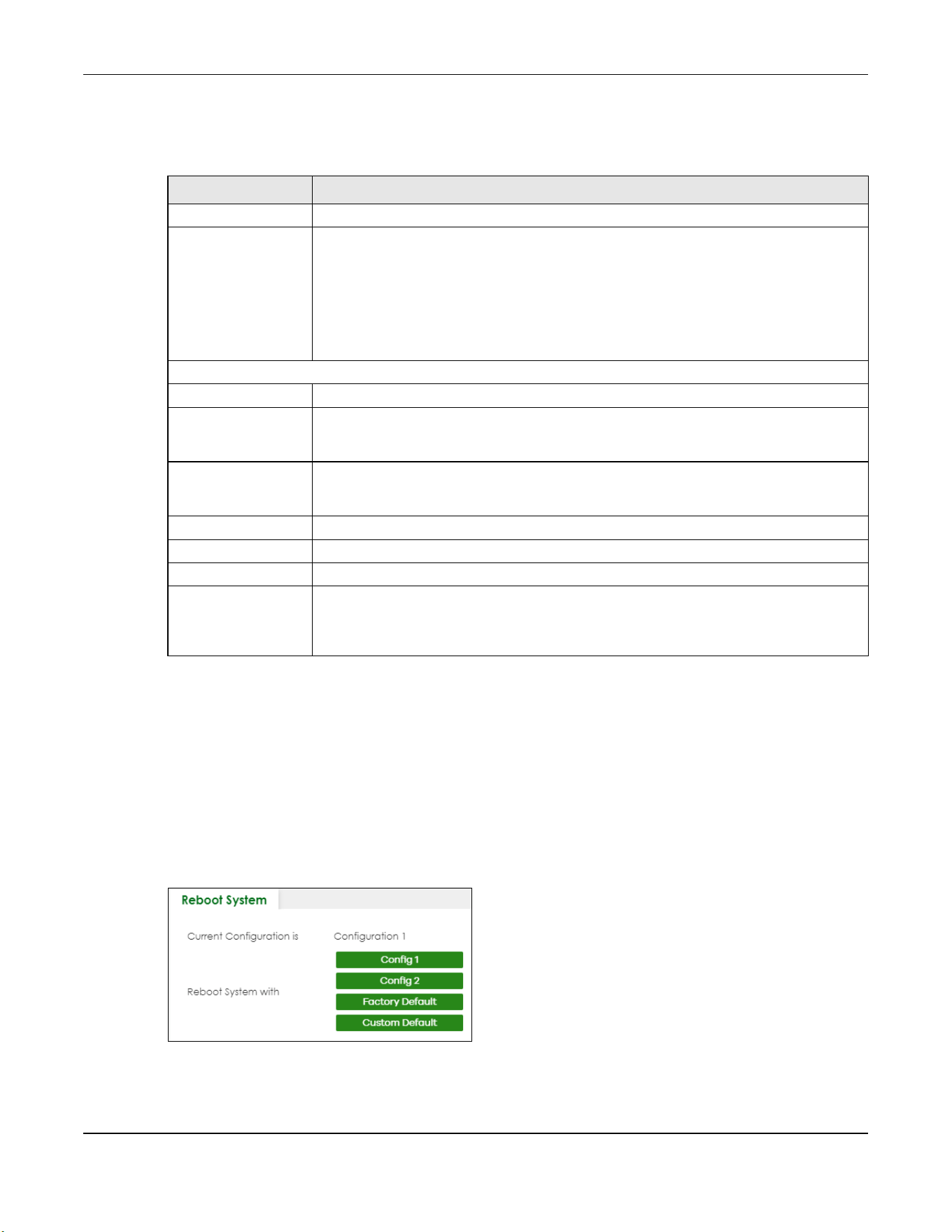
Chapter 60 MAINTENANCE
XMG1915 Series User’s Guide
367
After the process is complete, see the DASHBOARD screen to verify your current firmware version
number.
60.15 Reboot System
Reboot System allows you to restart the Switch without physically turning the power off. It also allows you
to load configuration one (Config 1), configuration two (Config 2), a Custom Default or the Factory
Default configuration when you reboot. Follow the steps below to reboot the Switch.
Click MAINTENANCE > Reboot System to view the screen as shown next.
Figure 268 MAINTENANCE > Reboot System
1 Click the Config 1, Config 2, Factory Default, or Custom Default button to reboot and load that
configuration file. The confirmation screen displays.
Table 205 MAINTENANCE > Firmware Upgrade
LABEL DESCRIPTION
Name This is the name of the Switch that you are configuring.
Version The Switch has 2 firmware sets, Firmware 1 and Firmware 2, residing in flash.
• Running shows the version number (and model code) and MM/DD/YYYY creation date
of the firmware currently in use on the Switch (Firmware 1 or Firmware 2). The firmware
information is also displayed at System Information in Basic Setting.
• Firmware 1 shows its version number (and model code) and MM/DD/YYYY creation
date.
• Firmware 2 shows its version number (and model code) and MM/DD/YYYY creation
date.
Boot Image
Current Boot Image This displays which firmware is currently in use on the Switch (Firmware 1 or Firmware 2).
Config Boot Image Select which firmware (Firmware 1 or Firmware 2) should load, click Apply and reboot the
Switch to see changes, you will also see changes in the Current Boot Image field above as
well.
Apply Click Apply to save your changes to the Switch’s run-time memory. The Switch loses these
changes if it is turned off or loses power, so use the Save link on the top navigation panel to
save your changes to the non-volatile memory when you are done configuring.
Cancel Click Cancel to begin configuring this screen afresh.
Firmware Choose to upload the new firmware to (Firmware) 1 or (Firmware) 2.
File Path Click Choose File or Browse to locate the firmware file you wish to upload to the Switch.
Upgrade Click Upgrade to load the new firmware. Firmwares are only applied after a reboot. To
reboot, go to MAINTENANCE > Reboot System and click Config 1, Config 2 or Factory
Default (Config 1, Config 2, Factory Default, and Custom Default are the configuration files
you want the Switch to use when it restarts).
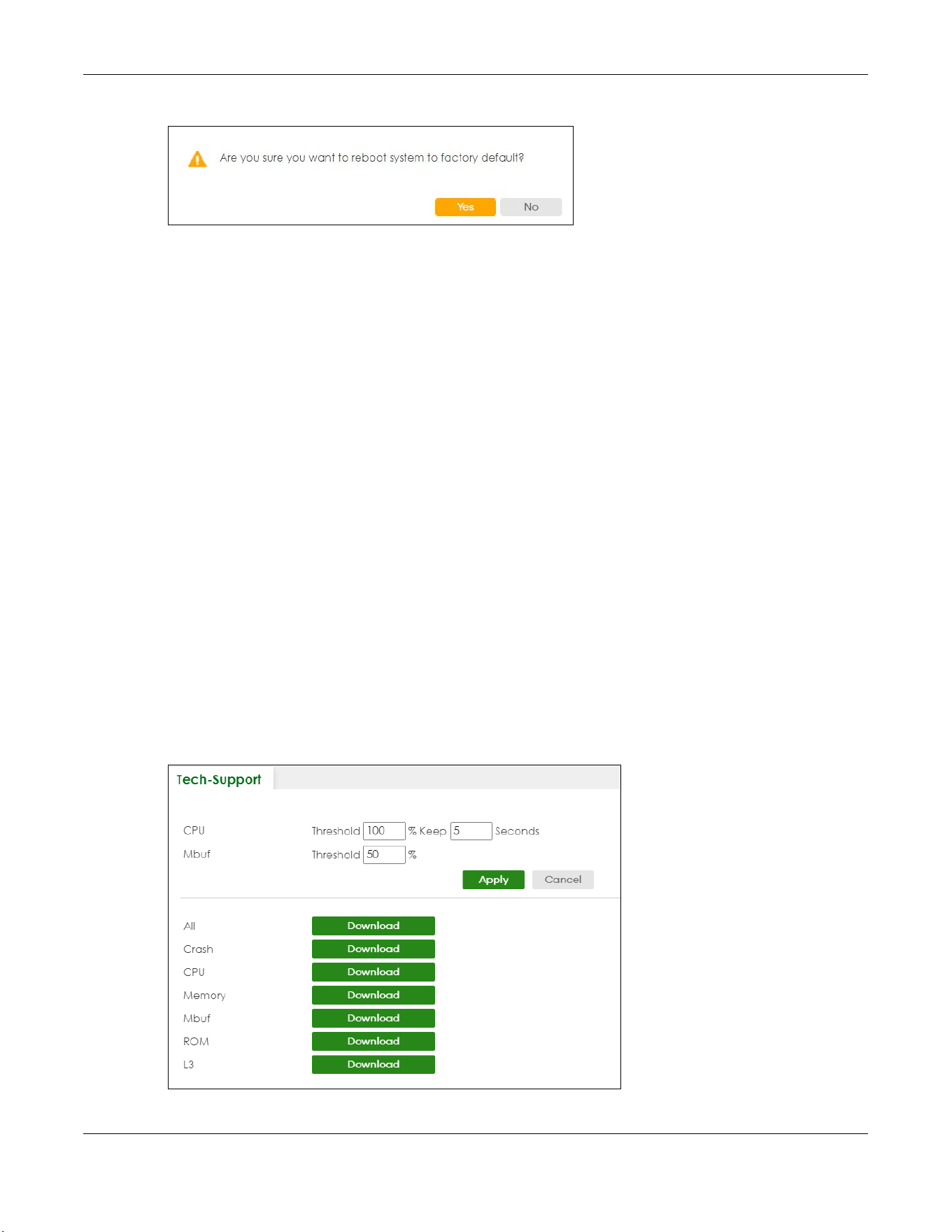
Chapter 60 MAINTENANCE
XMG1915 Series User’s Guide
368
Figure 269 Reboot Confirmation
2 Click YES and then wait for the Switch to restart. This takes up to 2 minutes.
Click Config 1 and follow steps 1 to 2 to reboot and load configuration one on the Switch.
Click Config 2 and follow steps 1 to 2 to reboot and load configuration two on the Switch.
Click Factory Default and follow steps 1 to 2 to reboot and load Zyxel factory default configuration
settings on the Switch.
Click Custom Default and follow steps 1 to 2 to reboot and load a customized default file on the Switch.
This will save the custom default configuration settings to both Configuration 1 and Configuration 2.
Note: If a customized default file was not saved, clicking Custom Default loads the factory
default configuration on the Switch.
Note: Service Register only appears in standalone mode.
60.16 Tech-Support
The Tech-Support feature is a log enhancement tool that logs useful information such as CPU utilization
history, memory and Mbuf (Memory Buffer) log and crash reports for issue analysis by customer support
should you have difficulty with your Switch.
Click MAINTENANCE > Tech-Support to see the following screen.
Figure 270 MAINTENANCE > Tech-Support

Chapter 60 MAINTENANCE
XMG1915 Series User’s Guide
369
You may need WordPad or similar software to see the log report correctly. The table below describes
the fields in the above screen.
60.16.1 Tech-Support Download
When you click Download to save your current Switch configuration to a computer, the following screen
appears. When the log report has downloaded successfully, click Back to return to the previous screen.
Table 206 MAINTENANCE > Tech-Support
LABEL DESCRIPTION
CPU Type a number ranging from 50 to 100 in the CPU threshold box, and type another
number ranging from 5 to 60 in the seconds box then click Apply.
For example, 80 for CPU threshold and 5 for seconds means a log will be created when
CPU utilization reaches over 80% and lasts for 5 seconds.
The log report holds 7 days of CPU log data and is stored in volatile memory (RAM). The
data is lost if the Switch is turned off or in event of power outage. After 7 days, the logs
wrap around and new ones and replace the earliest ones.
The higher the CPU threshold number, the fewer logs will be created, and the less data
technical support will have to analyze and vice versa.
Mbuf Type a number ranging from 50 to 100 in the Mbuf (Memory Buffer) threshold box. The
Mbuf log report is stored in flash (permanent) memory.
For example, Mbuf 50 means a log will be created when the Mbuf utilization is over 50%.
The higher the Mbuf threshold number, the fewer logs will be created, and the less data
technical support will have to analyze and vice versa.
Apply Click Apply to save your changes to the Switch’s run-time memory. The Switch loses
these changes if it is turned off or loses power, so use the Save link on the top navigation
panel to save your changes to the non-volatile memory when you are done configuring.
Cancel Click Cancel to begin configuring this screen afresh.
All Click Download to see all the log report and system status. This log report is stored in flash
memory. If the All log report is too large, you can download the log reports separately
below.
Crash Click Download to see the crash log report. The log will include information of the last
crash and is stored in flash memory.
CPU Click Download to see the CPU history log report. The 7-days log is stored in RAM and you
will need to save it, otherwise it will be lost when the Switch is shutdown or during power
outage.
Memory Click Download to see the memory section log report. This log report is stored in flash
memory.
Mbuf Click Download to see the Mbuf (Memory Buffer) log report. This log report is stored in
flash memory.
ROM Click Download to see the Read Only Memory (ROM) log report. This report is stored in
flash memory.
L3 Click Download to see the layer-3 Switch log report. The log only applies to the layer-3
Switch models. This report is stored in flash memory.
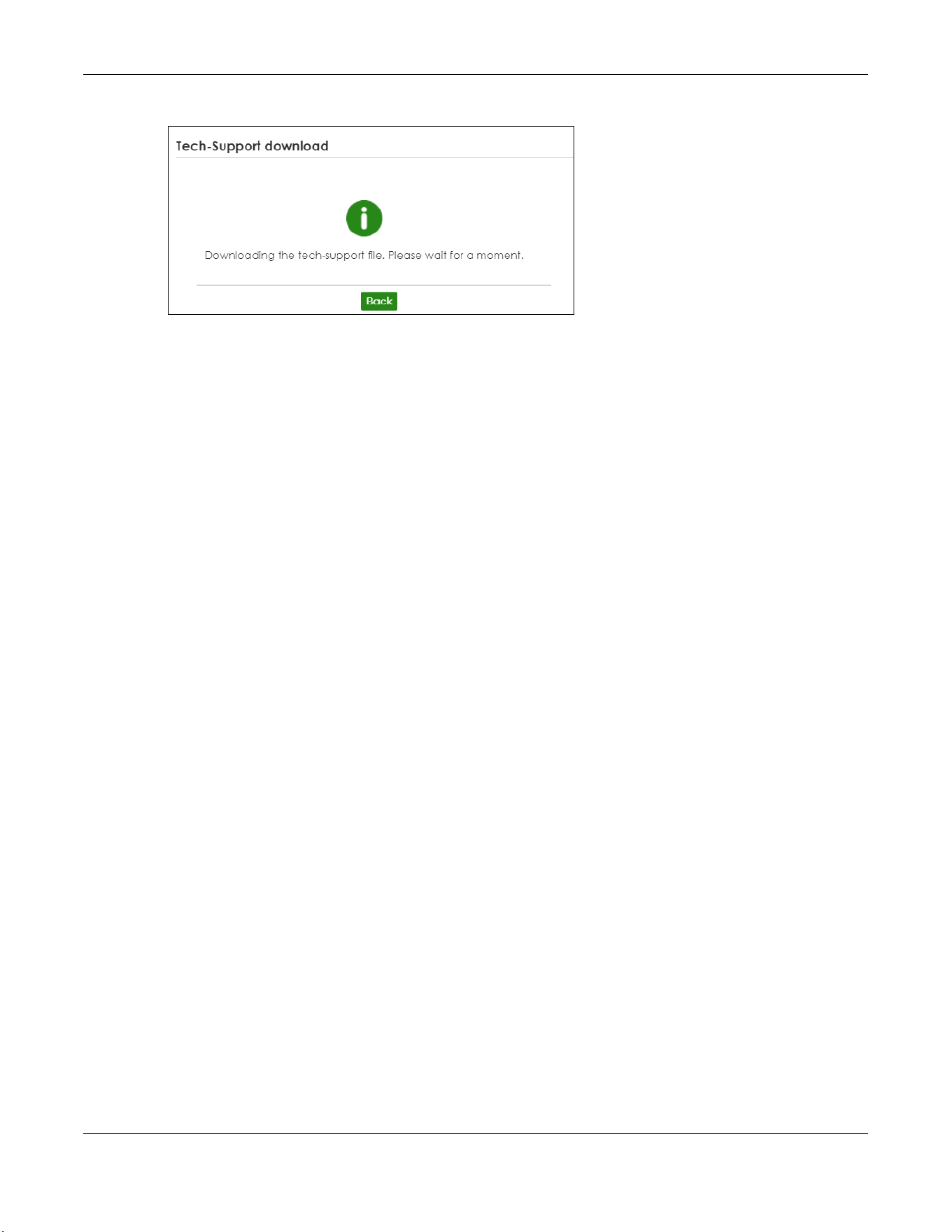
Chapter 60 MAINTENANCE
XMG1915 Series User’s Guide
370
Figure 271 MAINTENANCE > Tech-Support: Download

371
PART III
Troubleshooting and
Appendices

XMG1915 Series User’s Guide
372
CHAPTER 61
Troubleshooting
This chapter offers some suggestions to solve problems you might encounter. The potential problems are
divided into the following categories.
• Power, Hardware Connections, and LEDs
• Switch Access and Login
• Switch Configuration
• PoE Supply
• Nebula Registration
61.1 Power, Hardware Connections, and LEDs
The Switch does not turn on. None of the LEDs turn on.
1 Make sure you are using the power adapter or cord included with the Switch.
2 Make sure the power adapter or cord is connected to the Switch and plugged in to an appropriate
power source. Make sure the power source is turned on.
3 Disconnect and re-connect the power adapter or cord to the Switch.
4 If the problem continues, contact the vendor.
One of the LEDs does not behave as expected.
1 Make sure you understand the normal behavior of the LED. See Section 3.3 on page 47.
2 Check the hardware connections. See Section 3.1 on page 37.
3 Inspect your cables for damage. Contact the vendor to replace any damaged cables.
4 If the problem continues, contact the vendor.

Chapter 61 Troubleshooting
XMG1915 Series User’s Guide
373
61.2 Switch Access and Login
I can see the Login screen, but I cannot log in to the Switch. (I forgot the user name and/or
password.)
1 Check the Switch’s management mode by using the CLOUD LED. See Section 3.3 on page 47 for more
information on the LED descriptions.
• If you are in Cloud management mode, use the Local credentials Password to log in to the cloud
mode – local GUI. The Local credentials Password can be found in Site-wide > Configure > Site set-
tings > Device configuration: Local credentials: Password in the NCC portal.
• If you are in standalone management mode, use the default user name admin and the default
password 1234.
2 Depending on your Switch’s management mode, make sure you have entered the correct user name
and password. These fields are case-sensitive, please make sure [Caps Lock] is not on.
Note: Steps 1 and 2 are applicable if you get an invalid administrator password when using
some functions in the ZON utility. See Section 1.1.3 on page 25 for more information.
3 You may have exceeded the maximum number of concurrent Telnet sessions. Close other Telnet
sessions or try connecting again later.
Check that you have enabled logins for HTTP or Telnet. If you have configured a secured client IP
address, your computer’s IP address must match it. Refer to the chapter on access control for details.
4 If this does not work, or you are not sure what the Switch’s management mode is, you have to reset the
device to its factory defaults (standalone management mode) first. See Section 4.8 on page 76 for more
information on resetting the Switch. (Temporarily disconnect the Internet connection to the Switch after
the reset process, to prevent the Switch from being managed by NCC again.)
Note: After performing step 4 and you want to use the Cloud management mode, make sure
the Switch is registered in your organization and site in the NCC portal. To register the
Switch again, scan the QR code using the Zyxel Nebula Mobile app. See the Section
on page 24 for more information on using the app to register the Switch.
I forgot the IP address for the Switch.
1 Use the domain name “setup.zyxel” to access the Switch whether the Switch is using a DHCP-assigned IP
or static IP address. If you cannot use this method, please use the following method to find the IP
address.
Note: This requires your computer to be directly connected to the Switch. Make sure your
computer is able to connect to a DNS server through the Switch.
2 If this does not work, you have to reset the device to its factory defaults. See Section 4.8 on page 76.

Chapter 61 Troubleshooting
XMG1915 Series User’s Guide
374
I cannot see or access the Login screen in the Web Configurator.
1 Make sure you are using the correct IP address.
• If you changed the IP address and have forgotten it, see the troubleshooting suggestions for I forgot
the IP address for the Switch.
2 Check the hardware connections, and make sure the LEDs are behaving as expected. See Section 3.3
on page 47.
3 Make sure your Internet browser does not block pop-up windows and has JavaScripts and Java
enabled.
4 Make sure your computer is in the same subnet as the Switch. (If you know that there are routers
between your computer and the Switch, skip this step.)
5 Reset the device to its factory defaults, and try to access the Switch with the default IP address. See
Section 4.7 on page 76.
6 If the problem continues, contact Zyxel technical support, or try the advanced suggestion.
Advanced Suggestion
• Try to access the Switch using another service, such as Telnet. If you can access the Switch, check the
remote management settings to find out why the Switch does not respond to HTTP.
Pop-up Windows, JavaScripts and Java Permissions
In order to use the Web Configurator you need to allow:
• Web browser pop-up windows from your device.
• JavaScripts (enabled by default).
• Java permissions (enabled by default).
There is unauthorized access to my Switch through telnet, HTTP and SSH.
Go to the MONITOR > System Log screen to check for logs of unauthorized access to your Switch. To
avoid unauthorized access, configure the secured client setting in the SECURITY > Access Control >
Remote Management screen for telnet, HTTP and SSH (see Section 55.3 on page 319). Computers not
belonging to the secured client set cannot get permission to access the Switch.

Chapter 61 Troubleshooting
XMG1915 Series User’s Guide
375
61.3 Switch Configuration
I lost my configuration settings after I restarted the Switch.
Make sure you save your configuration into the Switch’s non-volatile memory
each time you make changes. Click Save at the top right of the Web Configurator
to save the configuration permanently. See also Section 60.11 on page 362 for
more information about how to save your configuration.
I accidentally unplugged the Switch. I am not sure which configuration file will be loaded.
If you plug the power cable back to the Switch, it will reboot and load the configuration file that was
used the last time. For example, if Config 1 was used on the Switch before you accidentally unplugged
the Switch, Config 1 will be loaded when rebooting.
I want to use a different configuration file on the Switch, what should I do?
1 Go to MAINTENANCE > Configuration > Restore Configuration.
2 Click Choose File or Browse to locate the configuration file you wish to restore.
3 After you have specified the file, click Restore. The Switch will run on the restored configuration after the
restore process.
61.4 PoE Supply
My Powered Devices (PDs) are not receiving power.
1 Check the PoE Usage on the Dashboard. This field displays the amount of power the Switch is currently
supplying to the connected PDs and the total power the Switch can provide to the connected PDs. It
also shows the percentage of PoE power usage.
When PoE usage reaches 100%, the Switch will shut down PDs one-by-one according to the PD Priority
which you configured in PORT > PoE Setup > PoE Setup.
2 Use the correct type of Ethernet cable for the corresponding PoE standard you are using.
3 Make sure the Active check box for the port supplying PoE power to PDs is enabled.

Chapter 61 Troubleshooting
XMG1915 Series User’s Guide
376
4 Check if you have set a pre-defined schedule to control when the Switch enables PoE to provide power
on the port in PORT > PoE Setup > PoE Time Range Setup.
5 If the connected IEEE 802.3at / IEEE 802.3af PD does not fully comply with any PoE standard, select
Legacy or Force-802.3at in PORT > PoE Setup > PoE Setup > Power-Up.
6 If the problem continues, contact Zyxel technical support.
61.5 Nebula Registration
I cannot register the Switch in Nebula because the previous owner has registered/locked it.
• To register a pre-owned Switch in Nebula, use the Nebula Mobile app to scan the Nebula QR code
on the back label of the Switch.
• To register a pre-owned Switch in Nebula locked by the previous owner, inform the previous owner to
remove the Switch from the Nebula organization or contact Zyxel technical support.
I no longer want to use Nebula to manage the Switch, what should I do?
• Remove the Switch from the Nebula organization first. See From Nebula-managed to Standalone on
page 25 for details. The Switch will reboot and restore its factory-default settings.
•Make sure the CLOUD LED is off or blinking green. See LEDs on page 47 for more information on LED
behavior. This means the Switch is operating in standalone mode. Nebula Control Center Discovery is
disabled in SYSTEM > Cloud Management > Nebula Control Center Discovery in the Web
Configurator.

XMG1915 Series User’s Guide
377
APPENDIX A
Customer Support
In the event of problems that cannot be solved by using this manual, you should contact your vendor. If
you cannot contact your vendor, then contact a Zyxel office for the region in which you bought the
device.
For Zyxel Communications offices, see https://service-provider.zyxel.com/global/en/contact-us for the
latest information.
For Zyxel Networks offices, see https://www.zyxel.com/index.shtml for the latest information.
Please have the following information ready when you contact an office.
Required Information
• Product model and serial number.
• Warranty Information.
• Date that you received your device.
• Brief description of the problem and the steps you took to solve it.
Corporate Headquarters (Worldwide)
Taiwan
• Zyxel Communications (Taiwan) Co., Ltd.
• https://www.zyxel.com
Asia
China
• Zyxel Communications Corporation–China Office
• https://www.zyxel.com/cn/sc
India
• Zyxel Communications Corporation–India Office
• https://www.zyxel.com/in/en-in
Kazakhstan
•Zyxel Kazakhstan
• https://www.zyxel.com/ru/ru

Appendix A Customer Support
XMG1915 Series User’s Guide
378
Korea
• Zyxel Korea Co., Ltd.
• http://www.zyxel.kr/
Malaysia
• Zyxel Communications Corp.
• https://www.zyxel.com/global/en
Philippines
• Zyxel Communications Corp.
• https://www.zyxel.com/global/en
Singapore
• Zyxel Communications Corp.
• https://www.zyxel.com/global/en
Taiwan
• Zyxel Communications (Taiwan) Co., Ltd.
• https://www.zyxel.com/tw/zh
Thailand
• Zyxel Thailand Co., Ltd.
• https://www.zyxel.com/th/th
Vietnam
• Zyxel Communications Corporation–Vietnam Office
• https://www.zyxel.com/vn/vi
Europe
Belarus
• Zyxel Communications Corp.
• https://www.zyxel.com/ru/ru
Belgium (Netherlands)
• Zyxel Benelux
• https://www.zyxel.com/nl/nl
• https://www.zyxel.com/fr/fr
Bulgaria
• Zyxel Bulgaria

Appendix A Customer Support
XMG1915 Series User’s Guide
379
• https://www.zyxel.com/bg/bg
Czech Republic
• Zyxel Communications Czech s.r.o.
• https://www.zyxel.com/cz/cs
Denmark
• Zyxel Communications A/S
• https://www.zyxel.com/dk/da
Finland
• Zyxel Communications
• https://www.zyxel.com/fi/fi
France
•Zyxel France
• https://www.zyxel.com/fr/fr
Germany
•Zyxel Deutschland GmbH.
• https://www.zyxel.com/de/de
Hungary
• Zyxel Hungary & SEE
• https://www.zyxel.com/hu/hu
Italy
• Zyxel Communications Italy S.r.l.
• https://www.zyxel.com/it/it
Norway
• Zyxel Communications A/S
• https://www.zyxel.com/no/no
Poland
• Zyxel Communications Poland
• https://www.zyxel.com/pl/pl
Romania
• Zyxel Romania
• https://www.zyxel.com/ro/ro

Appendix A Customer Support
XMG1915 Series User’s Guide
380
Russian Federation
• Zyxel Communications Corp.
• https://www.zyxel.com/ru/ru
Slovakia
•Zyxel Slovakia
• https://www.zyxel.com/sk/sk
Spain
• Zyxel Iberia
• https://www.zyxel.com/es/es
Sweden
• Zyxel Communications A/S
• https://www.zyxel.com/se/sv
Switzerland
•Studerus AG
• https://www.zyxel.com/ch/de-ch
• https://www.zyxel.com/fr/fr
Turkey
• Zyxel Turkey A.S.
• https://www.zyxel.com/tr/tr
UK
• Zyxel Communications UK Ltd.
• https://www.zyxel.com/uk/en-gb
Ukraine
•Zyxel Ukraine
• https://www.zyxel.com/ua/uk-ua
South America
Argentina
• Zyxel Communications Corp.
• https://www.zyxel.com/co/es-co
Brazil
• Zyxel Communications Brasil Ltda.

Appendix A Customer Support
XMG1915 Series User’s Guide
381
• https://www.zyxel.com/br/pt
Colombia
• Zyxel Communications Corp.
• https://www.zyxel.com/co/es-co
Ecuador
• Zyxel Communications Corp.
• https://www.zyxel.com/co/es-co
South America
• Zyxel Communications Corp.
• https://www.zyxel.com/co/es-co
Middle East
Israel
• Zyxel Communications Corp.
• https://il.zyxel.com
North America
USA
• Zyxel Communications, Inc. – North America Headquarters
• https://www.zyxel.com/us/en-us

XMG1915 Series User’s Guide
382
APPENDIX B
Common Services
The following table lists some commonly-used services and their associated protocols and port numbers.
For a comprehensive list of port numbers, ICMP type or code numbers and services, visit the IANA
(Internet Assigned Number Authority) web site.
• Name: This is a short, descriptive name for the service. You can use this one or create a different one,
if you like.
• Protocol: This is the type of IP protocol used by the service. If this is TCP/UDP, then the service uses the
same port number with TCP and UDP. If this is User-Defined, the Port(s) is the IP protocol number, not
the port number.
• Port(s): This value depends on the Protocol. Please refer to RFC 1700 for further information about port
numbers.
•If the Protocol is TCP, UDP, or TCP/UDP, this is the IP port number.
•If the Protocol is USER, this is the IP protocol number.
• Description: This is a brief explanation of the applications that use this service or the situations in which
this service is used.
Table 207 Commonly Used Services
NAME PROTOCOL PORT(S) DESCRIPTION
AH (IPSEC_TUNNEL) User-Defined 51 The IPSEC AH (Authentication Header) tunneling
protocol uses this service.
AIM/New-ICQ TCP 5190 AOL’s Internet Messenger service. It is also used
as a listening port by ICQ.
AUTH TCP 113 Authentication protocol used by some servers.
BGP TCP 179 Border Gateway Protocol.
BOOTP_CLIENT UDP 68 DHCP Client.
BOOTP_SERVER UDP 67 DHCP Server.
CU-SEEME TCP
UDP
7648
24032
A popular videoconferencing solution from
White Pines Software.
DNS TCP/UDP 53 Domain Name Server, a service that matches
web names (for example www.zyxel.com) to IP
numbers.
ESP (IPSEC_TUNNEL) User-Defined 50 The IPSEC ESP (Encapsulation Security Protocol)
tunneling protocol uses this service.
FINGER TCP 79 Finger is a UNIX or Internet related command
that can be used to find out if a user is logged
on.
FTP TCP
TCP
20
21
File Transfer Program, a program to enable fast
transfer of files, including large files that may not
be possible by email.
H.323 TCP 1720 NetMeeting uses this protocol.
HTTP TCP 80 Hyper Text Transfer Protocol – a client or server
protocol for the world wide web.
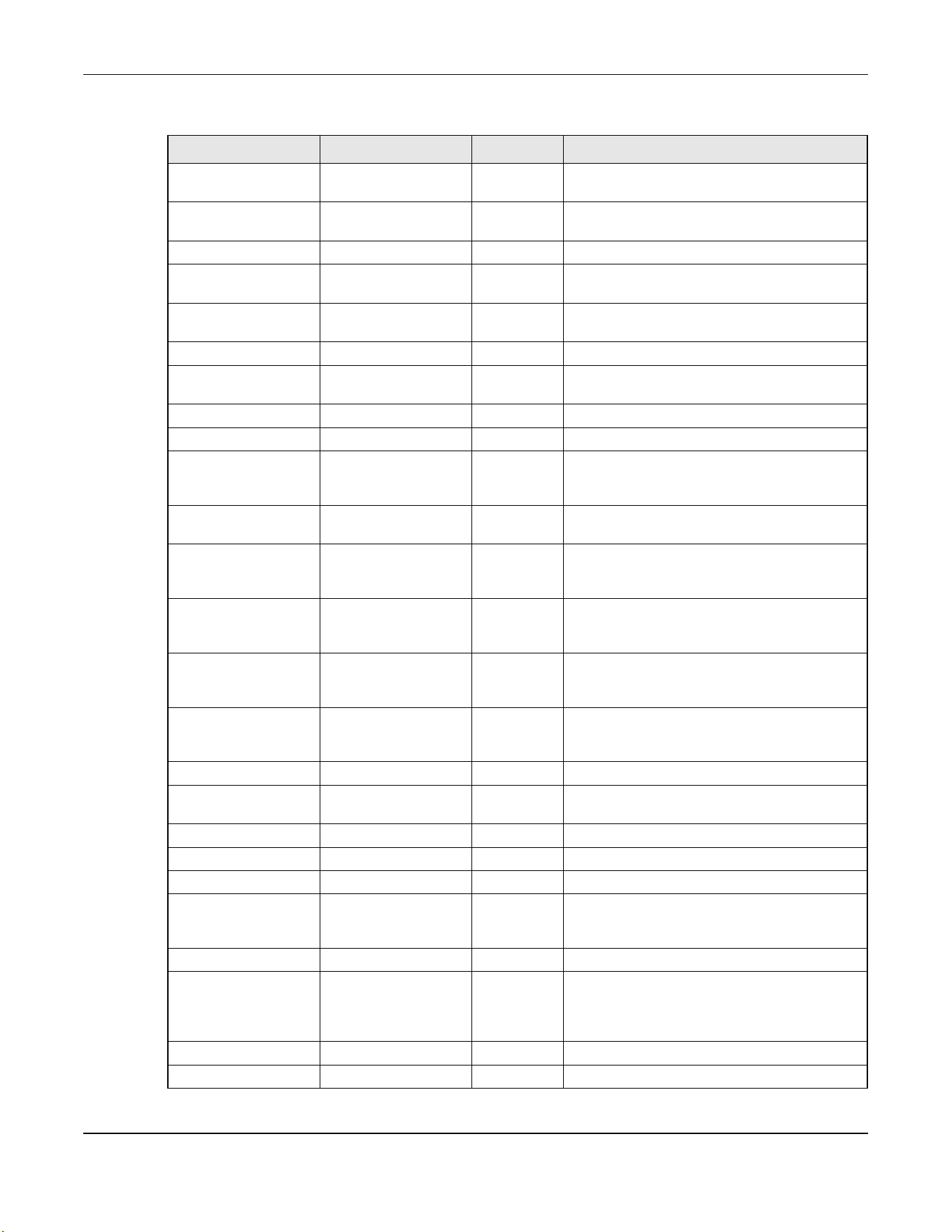
Appendix B Common Services
XMG1915 Series User’s Guide
383
HTTPS TCP 443 HTTPS is a secured http session often used in e-
commerce.
ICMP User-Defined 1 Internet Control Message Protocol is often used
for diagnostic or routing purposes.
ICQ UDP 4000 This is a popular Internet chat program.
IGMP (MULTICAST) User-Defined 2 Internet Group Multicast Protocol is used when
sending packets to a specific group of hosts.
IKE UDP 500 The Internet Key Exchange algorithm is used for
key distribution and management.
IRC TCP/UDP 6667 This is another popular Internet chat program.
MSN Messenger TCP 1863 Microsoft Networks’ messenger service uses this
protocol.
NEW-ICQ TCP 5190 An Internet chat program.
NEWS TCP 144 A protocol for news groups.
NFS UDP 2049 Network File System – NFS is a client or server
distributed file service that provides transparent
file sharing for network environments.
NNTP TCP 119 Network News Transport Protocol is the delivery
mechanism for the USENET newsgroup service.
PING User-Defined 1 Packet INternet Groper is a protocol that sends
out ICMP echo requests to test whether or not a
remote host is reachable.
POP3 TCP 110 Post Office Protocol version 3 lets a client
computer get e-mail from a POP3 server through
a temporary connection (TCP/IP or other).
PPTP TCP 1723 Point-to-Point Tunneling Protocol enables secure
transfer of data over public networks. This is the
control channel.
PPTP_TUNNEL (GRE) User-Defined 47 PPTP (Point-to-Point Tunneling Protocol) enables
secure transfer of data over public networks. This
is the data channel.
RCMD TCP 512 Remote Command Service.
REAL_AUDIO TCP 7070 A streaming audio service that enables real time
sound over the web.
REXEC TCP 514 Remote Execution Daemon.
RLOGIN TCP 513 Remote Login.
RTELNET TCP 107 Remote Telnet.
RTSP TCP/UDP 554 The Real Time Streaming (media control)
Protocol (RTSP) is a remote control for multimedia
on the Internet.
SFTP TCP 115 Simple File Transfer Protocol.
SMTP TCP 25 Simple Mail Transfer Protocol is the message-
exchange standard for the Internet. SMTP
enables you to move messages from one email
server to another.
SNMP TCP/UDP 161 Simple Network Management Program.
SNMP-TRAPS TCP/UDP 162 Traps for use with the SNMP (RFC:1215).
Table 207 Commonly Used Services (continued)
NAME PROTOCOL PORT(S) DESCRIPTION
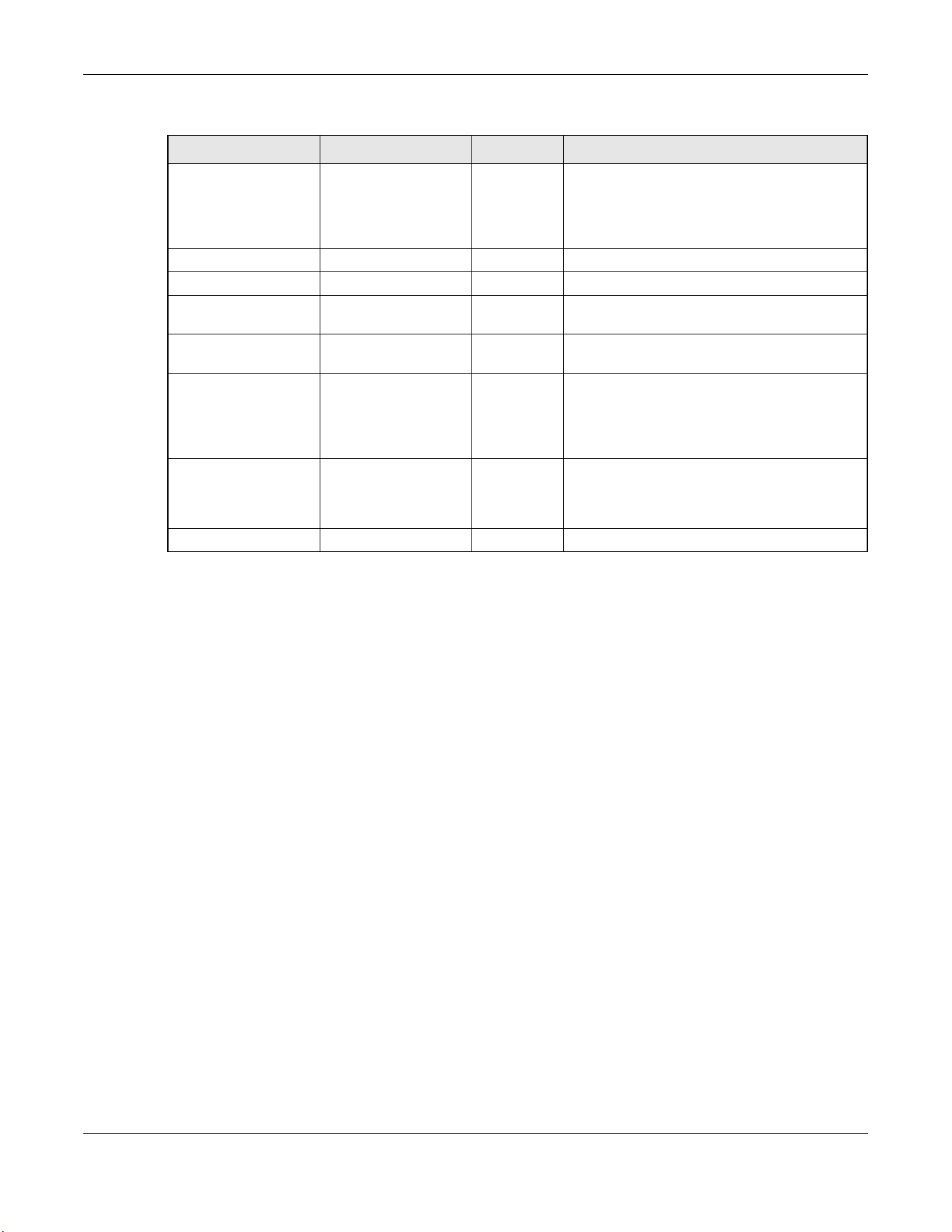
Appendix B Common Services
XMG1915 Series User’s Guide
384
SQL-NET TCP 1521 Structured Query Language is an interface to
access data on many different types of
database systems, including mainframes,
midrange systems, UNIX systems and network
servers.
SSH TCP/UDP 22 Secure Shell Remote Login Program.
STRM WORKS UDP 1558 Stream Works Protocol.
SYSLOG UDP 514 Syslog allows you to send system logs to a UNIX
server.
TACACS UDP 49 Login Host Protocol used for (Terminal Access
Controller Access Control System).
TELNET TCP 23 Telnet is the login and terminal emulation
protocol common on the Internet and in UNIX
environments. It operates over TCP/IP networks.
Its primary function is to allow users to log into
remote host systems.
TFTP UDP 69 Trivial File Transfer Protocol is an Internet file
transfer protocol similar to FTP, but uses the UDP
(User Datagram Protocol) rather than TCP
(Transmission Control Protocol).
VDOLIVE TCP 7000 Another videoconferencing solution.
Table 207 Commonly Used Services (continued)
NAME PROTOCOL PORT(S) DESCRIPTION

XMG1915 Series User’s Guide
385
APPENDIX C
IPv6
Overview
IPv6 (Internet Protocol version 6), is designed to enhance IP address size and features. The increase in
IPv6 address size to 128 bits (from the 32-bit IPv4 address) allows up to 3.4 x 10
38
IP addresses.
IPv6 Addressing
The 128-bit IPv6 address is written as eight 16-bit hexadecimal blocks separated by colons (:). This is an
example IPv6 address 2001:0db8:1a2b:0015:0000:0000:1a2f:0000.
IPv6 addresses can be abbreviated in two ways:
• Leading zeros in a block can be omitted. So 2001:0db8:1a2b:0015:0000:0000:1a2f:0000 can be
written as 2001:db8:1a2b:15:0:0:1a2f:0.
• Any number of consecutive blocks of zeros can be replaced by a double colon. A double colon can
only appear once in an IPv6 address. So 2001:0db8:0000:0000:1a2f:0000:0000:0015 can be
written as 2001:0db8::1a2f:0000:0000:0015, 2001:0db8:0000:0000:1a2f::0015,
2001:db8::1a2f:0:0:15 or 2001:db8:0:0:1a2f::15.
Prefix and Prefix Length
Similar to an IPv4 subnet mask, IPv6 uses an address prefix to represent the network address. An IPv6
prefix length specifies how many most significant bits (start from the left) in the address compose the
network address. The prefix length is written as “/x” where x is a number. For example,
2001:db8:1a2b:15::1a2f:0/32
means that the first 32 bits (2001:db8) is the subnet prefix.
Link-local Address
A link-local address uniquely identifies a device on the local network (the LAN). It is similar to a “private IP
address” in IPv4. You can have the same link-local address on multiple interfaces on a device. A link-
local unicast address has a predefined prefix of fe80::/10. The link-local unicast address format is as
follows.
Table 208 Link-local Unicast Address Format
Global Address
A global address uniquely identifies a device on the Internet. It is similar to a “public IP address” in IPv4. A
global unicast address starts with a 2 or 3.
1111 1110 10 0 Interface ID
10 bits 54 bits 64 bits

Appendix C IPv6
XMG1915 Series User’s Guide
386
Unspecified Address
An unspecified address (0:0:0:0:0:0:0:0 or ::) is used as the source address when a device does not have
its own address. It is similar to “0.0.0.0” in IPv4.
Loopback Address
A loopback address (0:0:0:0:0:0:0:1 or ::1) allows a host to send packets to itself. It is similar to “127.0.0.1”
in IPv4.
Multicast Address
In IPv6, multicast addresses provide the same functionality as IPv4 broadcast addresses. Broadcasting is
not supported in IPv6. A multicast address allows a host to send packets to all hosts in a multicast group.
Multicast scope allows you to determine the size of the multicast group. A multicast address has a
predefined prefix of ff00::/8. The following table describes some of the predefined multicast addresses.
The following table describes the multicast addresses which are reserved and cannot be assigned to a
multicast group.
Table 209 Predefined Multicast Address
MULTICAST ADDRESS DESCRIPTION
FF01:0:0:0:0:0:0:1 All hosts on a local node.
FF01:0:0:0:0:0:0:2 All routers on a local node.
FF02:0:0:0:0:0:0:1 All hosts on a local connected link.
FF02:0:0:0:0:0:0:2 All routers on a local connected link.
FF05:0:0:0:0:0:0:2 All routers on a local site.
FF05:0:0:0:0:0:1:3 All DHCP severs on a local site.
Table 210 Reserved Multicast Address
MULTICAST ADDRESS
FF00:0:0:0:0:0:0:0
FF01:0:0:0:0:0:0:0
FF02:0:0:0:0:0:0:0
FF03:0:0:0:0:0:0:0
FF04:0:0:0:0:0:0:0
FF05:0:0:0:0:0:0:0
FF06:0:0:0:0:0:0:0
FF07:0:0:0:0:0:0:0
FF08:0:0:0:0:0:0:0
FF09:0:0:0:0:0:0:0
FF0A:0:0:0:0:0:0:0
FF0B:0:0:0:0:0:0:0
FF0C:0:0:0:0:0:0:0
FF0D:0:0:0:0:0:0:0
FF0E:0:0:0:0:0:0:0
FF0F:0:0:0:0:0:0:0

Appendix C IPv6
XMG1915 Series User’s Guide
387
Subnet Masking
Both an IPv6 address and IPv6 subnet mask compose of 128-bit binary digits, which are divided into
eight 16-bit blocks and written in hexadecimal notation. Hexadecimal uses 4 bits for each character (1 –
10, A – F). Each block’s 16 bits are then represented by 4 hexadecimal characters. For example,
FFFF:FFFF:FFFF:FFFF:FC00:0000:0000:0000.
Interface ID
In IPv6, an interface ID is a 64-bit identifier. It identifies a physical interface (for example, an Ethernet
port) or a virtual interface (for example, the management IP address for a VLAN). One interface should
have a unique interface ID.
EUI-64
The EUI-64 (Extended Unique Identifier) defined by the IEEE (Institute of Electrical and Electronics
Engineers) is an interface ID format designed to adapt with IPv6. It is derived from the 48-bit (6-byte)
Ethernet MAC address as shown next. EUI-64 inserts the hex digits fffe between the third and fourth bytes
of the MAC address and complements the seventh bit of the first byte of the MAC address. See the
following example.
DHCPv6
The Dynamic Host Configuration Protocol for IPv6 (DHCPv6, RFC 3315) is a server-client protocol that
allows a DHCP server to assign and pass IPv6 network addresses, prefixes and other configuration
information to DHCP clients. DHCPv6 servers and clients exchange DHCP messages using UDP.
Each DHCP client and server has a unique DHCP Unique IDentifier (DUID), which is used for identification
when they are exchanging DHCPv6 messages. The DUID is generated from the MAC address, time,
vendor assigned ID and/or the vendor's private enterprise number registered with the IANA. It should not
change over time even after you reboot the device.
Identity Association
An Identity Association (IA) is a collection of addresses assigned to a DHCP client, through which the
server and client can manage a set of related IP addresses. Each IA must be associated with exactly
one interface. The DHCP client uses the IA assigned to an interface to obtain configuration from a DHCP
server for that interface. Each IA consists of a unique IAID and associated IP information.
The IA type is the type of address in the IA. Each IA holds one type of address. IA_NA means an identity
association for non-temporary addresses and IA_TA is an identity association for temporary addresses.
An IA_NA option contains the T1 and T2 fields, but an IA_TA option does not. The DHCPv6 server uses T1
and T2 to control the time at which the client contacts with the server to extend the lifetimes on any
addresses in the IA_NA before the lifetimes expire. After T1, the client sends the server (S1) (from which
the addresses in the IA_NA were obtained) a Renew message. If the time T2 is reached and the server
does not respond, the client sends a Rebind message to any available server (S2). For an IA_TA, the
Table 211
MAC 00 : 13 : 49 : 12 : 34 : 56
Table 212
EUI-64 02 : 13 : 49 : FF : FE : 12 : 34 : 56
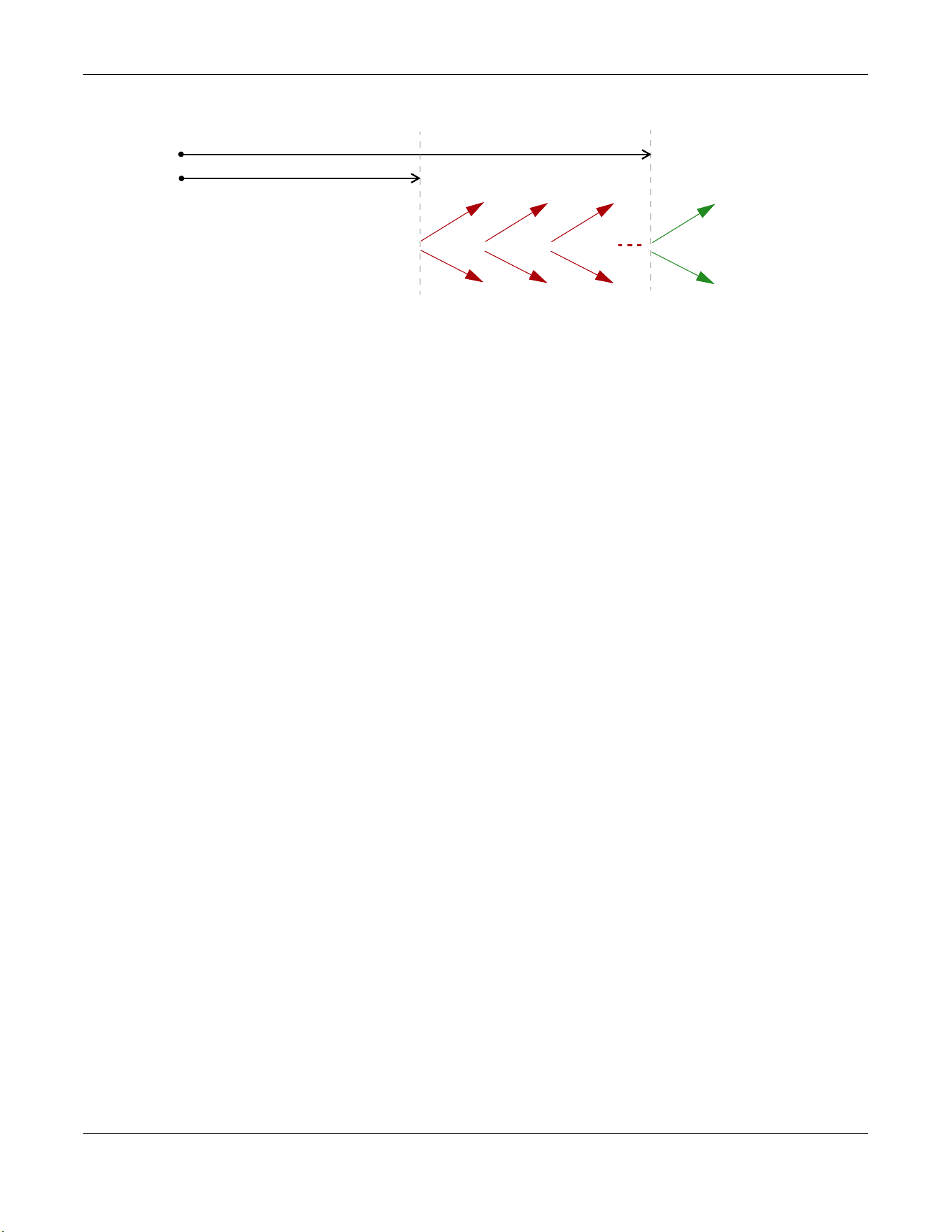
Appendix C IPv6
XMG1915 Series User’s Guide
388
client may send a Renew or Rebind message at the client's discretion.
DHCP Relay Agent
A DHCP relay agent is on the same network as the DHCP clients and helps forward messages between
the DHCP server and clients. When a client cannot use its link-local address and a well-known multicast
address to locate a DHCP server on its network, it then needs a DHCP relay agent to send a message to
a DHCP server that is not attached to the same network.
The DHCP relay agent can add the remote identification (remote-ID) option and the interface-ID option
to the Relay-Forward DHCPv6 messages. The remote-ID option carries a user-defined string, such as the
system name. The interface-ID option provides slot number, port information and the VLAN ID to the
DHCPv6 server. The remote-ID option (if any) is stripped from the Relay-Reply messages before the relay
agent sends the packets to the clients. The DHCP server copies the interface-ID option from the Relay-
Forward message into the Relay-Reply message and sends it to the relay agent. The interface-ID should
not change even after the relay agent restarts.
Prefix Delegation
Prefix delegation enables an IPv6 router to use the IPv6 prefix (network address) received from the ISP (or
a connected uplink router) for its LAN. The Switch uses the received IPv6 prefix (for example, 2001:db2::/
48) to generate its LAN IP address. Through sending Router Advertisements (RAs) regularly by multicast,
the Switch passes the IPv6 prefix information to its LAN hosts. The hosts then can use the prefix to
generate their IPv6 addresses.
ICMPv6
Internet Control Message Protocol for IPv6 (ICMPv6 or ICMP for IPv6) is defined in RFC 4443. ICMPv6 has
a preceding Next Header value of 58, which is different from the value used to identify ICMP for IPv4.
ICMPv6 is an integral part of IPv6. IPv6 nodes use ICMPv6 to report errors encountered in packet
processing and perform other diagnostic functions, such as "ping".
Neighbor Discovery Protocol (NDP)
The Neighbor Discovery Protocol (NDP) is a protocol used to discover other IPv6 devices and track
neighbor’s reachability in a network. An IPv6 device uses the following ICMPv6 messages types:
• Neighbor solicitation: A request from a host to determine a neighbor’s link-layer address (MAC
address) and detect if the neighbor is still reachable. A neighbor being “reachable” means it
responds to a neighbor solicitation message (from the host) with a neighbor advertisement message.
• Neighbor advertisement: A response from a node to announce its link-layer address.
• Router solicitation: A request from a host to locate a router that can act as the default router and
T1
T2
Renew
Rebind
Rebind
to S1
Renew
to S1
Renew
to S1
Renew
to S1
Renew
to S1
Renew
to S1
to S2
to S2

Appendix C IPv6
XMG1915 Series User’s Guide
389
forward packets.
• Router advertisement: A response to a router solicitation or a periodical multicast advertisement from
a router to advertise its presence and other parameters.
IPv6 Cache
An IPv6 host is required to have a neighbor cache, destination cache, prefix list and default router list.
The Switch maintains and updates its IPv6 caches constantly using the information from response
messages. In IPv6, the Switch configures a link-local address automatically, and then sends a neighbor
solicitation message to check if the address is unique. If there is an address to be resolved or verified, the
Switch also sends out a neighbor solicitation message. When the Switch receives a neighbor
advertisement in response, it stores the neighbor’s link-layer address in the neighbor cache. When the
Switch uses a router solicitation message to query for a router and receives a router advertisement
message, it adds the router’s information to the neighbor cache, prefix list and destination cache. The
Switch creates an entry in the default router list cache if the router can be used as a default router.
When the Switch needs to send a packet, it first consults the destination cache to determine the next
hop. If there is no matching entry in the destination cache, the Switch uses the prefix list to determine
whether the destination address is on-link and can be reached directly without passing through a router.
If the address is onlink, the address is considered as the next hop. Otherwise, the Switch determines the
next-hop from the default router list or routing table. Once the next hop IP address is known, the Switch
looks into the neighbor cache to get the link-layer address and sends the packet when the neighbor is
reachable. If the Switch cannot find an entry in the neighbor cache or the state for the neighbor is not
reachable, it starts the address resolution process. This helps reduce the number of IPv6 solicitation and
advertisement messages.
Multicast Listener Discovery
The Multicast Listener Discovery (MLD) protocol (defined in RFC 2710) is derived from IPv4's Internet
Group Management Protocol version 2 (IGMPv2). MLD uses ICMPv6 message types, rather than IGMP
message types. MLDv1 is equivalent to IGMPv2 and MLDv2 is equivalent to IGMPv3.
MLD allows an IPv6 switch or router to discover the presence of MLD listeners who wish to receive
multicast packets and the IP addresses of multicast groups the hosts want to join on its network.
MLD snooping and MLD proxy are analogous to IGMP snooping and IGMP proxy in IPv4.
MLD filtering controls which multicast groups a port can join.
MLD Messages
A multicast router or switch periodically sends general queries to MLD hosts to update the multicast
forwarding table. When an MLD host wants to join a multicast group, it sends an MLD Report message
for that address.
An MLD Done message is equivalent to an IGMP Leave message. When an MLD host wants to leave a
multicast group, it can send a Done message to the router or switch. The router or switch then sends a
group-specific query to the port on which the Done message is received to determine if other devices
connected to this port should remain in the group.

Appendix C IPv6
XMG1915 Series User’s Guide
390
Example – Enabling IPv6 on Windows 7
Windows 7 supports IPv6 by default. DHCPv6 is also enabled when you enable IPv6 on a Windows 7
computer.
To enable IPv6 in Windows 7:
1 Select Control Panel > Network and Sharing Center > Local Area Connection.
2 Select the Internet Protocol Version 6 (TCP/IPv6) check box to enable it.
3 Click OK to save the change.
4 Click Close to exit the Local Area Connection Status screen.
5 Select Start > All Programs > Accessories > Command Prompt.
6 Use the ipconfig command to check your dynamic IPv6 address. This example shows a global address
(2001:b021:2d::1000) obtained from a DHCP server.
C:\>ipconfig
Windows IP Configuration
Ethernet adapter Local Area Connection:
Connection-specific DNS Suffix . :
IPv6 Address. . . . . . . . . . . : 2001:b021:2d::1000
Link-local IPv6 Address . . . . . : fe80::25d8:dcab:c80a:5189%11
IPv4 Address. . . . . . . . . . . : 172.16.100.61
Subnet Mask . . . . . . . . . . . : 255.255.255.0
Default Gateway . . . . . . . . . : fe80::213:49ff:feaa:7125%11
172.16.100.254
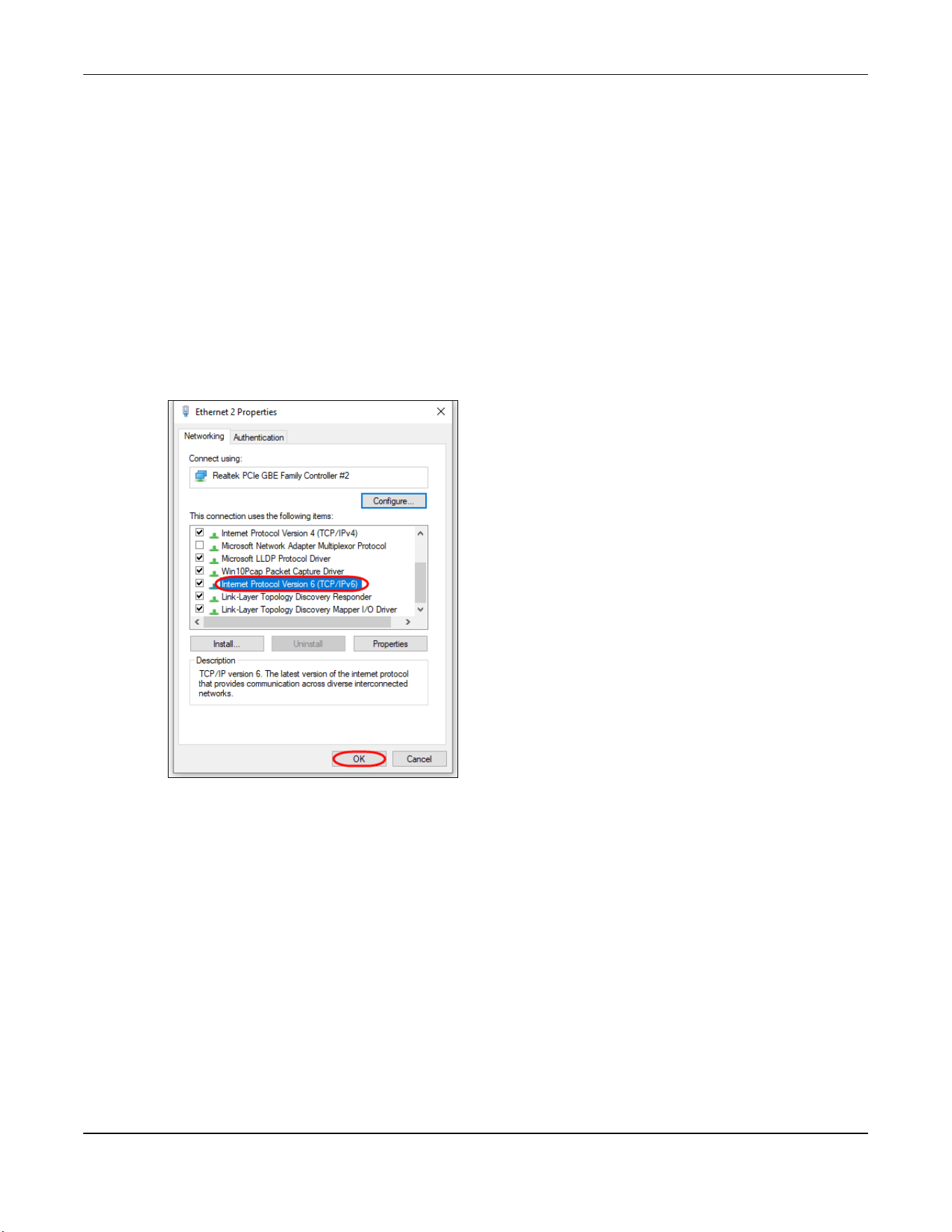
Appendix C IPv6
XMG1915 Series User’s Guide
391
Example – Enabling IPv6 on Windows 10
Windows 10 supports IPv6 by default. DHCPv6 is enabled when you enable IPv6 on a Windows 10 PC.
To enable IPv6 in Windows 10:
1 Select Control Panel > Network and Sharing Center.
2 On the left side of the Network and Sharing Center, select Change adapter settings.
3 Right-click your network connection and select Properties.
4 Select the Internet Protocol Version 6 (TCP/IPv6) check box to enable it.
5 Click OK to save the changes for the selected network adapter.
6 Click OK to exit the selected network adapter Properties screen.
Example – Enabling DHCPv6 on Windows 10
Windows 10 supports DHCPv6 by default. To enable DHCPv6 client on your computer:
1 Select Start > Settings > Network & Internet.
2 On the left side of the Network & Internet, select Ethernet. Then select the Ethernet network you are
connected to.
3 Under IP assignment, select Edit.
4 Under Edit IP settings, select Automatic (DHCP) or Manual. Then click Save.

Appendix C IPv6
XMG1915 Series User’s Guide
392
• When you select Automatic (DHCP), the IP address settings and DNS server address setting are set
automatically by your router.
• When you select Manual, you can manually set your IP address settings and DNS server address.
Now your computer can obtain an IPv6 address from a DHCPv6 server.

XMG1915 Series User’s Guide
393
APPENDIX D
Legal Information
Copyright
Copyright © 2023 by Zyxel and/or its affiliates.
The contents of this publication may not be reproduced in any part or as a whole, transcribed, stored in a retrieval system, translated into any
language, or transmitted in any form or by any means, electronic, mechanical, magnetic, optical, chemical, photocopying, manual, or
otherwise, without the prior written permission of Zyxel and/or its affiliates.
Published by Zyxel and/or its affiliates. All rights reserved.
Disclaimer
Zyxel does not assume any liability arising out of the application or use of any products, or software described herein. Neither does it convey any
license under its patent rights nor the patent rights of others. Zyxel further reserves the right to make changes in any products described herein
without notice. This publication is subject to change without notice.
Regulatory Notice and Statement
United States of America
The following information applies if you use the product within USA area.
US Importer: Zyxel Communications, Inc, 1130 North Miller Street Anaheim, CA92806-2001, https://www.zyxel.com/us/en/
Federal Communications Commission (FCC) EMC Statement
• This device complies with Part 15 of FCC rules. Operation is subject to the following two conditions:
(1) This device may not cause harmful interference.
(2) This device must accept any interference received, including interference that may cause undesired operations.
• Changes or modifications not expressly approved by the party responsible for compliance could void the user’s authority to operate the
equipment.
• This equipment has been tested and found to comply with the limits for a Class A digital device, pursuant to part 15 of the FCC Rules. These
limits are designed to provide reasonable protection against harmful interference when the equipment is operated in a commercial
environment. This equipment generates, uses, and can radiate radio frequency energy and, if not installed and used in accordance with the
instruction manual, may cause harmful interference to radio communications. Operation of this equipment in a residential area is likely to
cause harmful interference in which case the user will be required to correct the interference at his own expense.
Canada
The following information applies if you use the product within Canada area.
Innovation, Science and Economic Development Canada ICES statement
CAN ICES-3 (A)/NMB-3(A)
European Union and United Kingdom
The following information applies if you use the product within the European Union and United Kingdom.
EMC statement
WARNING: This equipment is compliant with Class A of EN55032. In a residential environment this equipment may cause radio interference.

Appendix D Legal Information
XMG1915 Series User’s Guide
394
List of National Codes
Safety Warnings
• To avoid possible eye injury, do NOT look into an operating fiber-optic module’s connector.
• Do NOT use this device near water, for example, in a wet basement or near a swimming pool.
• Do NOT expose your device to dampness, dust or corrosive liquids.
• Do NOT store things on the device.
• Do NOT obstruct the device ventilation slots as insufficient airflow may harm your device. For example, do not place the device in an
enclosed space such as a box or on a very soft surface such as a bed or sofa.
• Do NOT install or service this device during a thunderstorm. There is a remote risk of electric shock from lightning.
• Connect ONLY suitable accessories to the device.
• Do NOT open the device or unit. Opening or removing covers can expose you to dangerous high voltage points or other risks. Only qualified
service personnel should service or disassemble this device. Please contact your vendor for further information.
• Make sure to connect the cables to the correct ports.
• Place connecting cables carefully so that no one will step on them or stumble over them.
• Always disconnect all cables from this device before servicing or disassembling.
• Do NOT remove the plug and connect it to a power outlet by itself; always attach the plug to the power adaptor first before connecting it to
a power outlet.
• Do NOT allow anything to rest on the power adaptor or cord and do NOT place the device where anyone can walk on the power adaptor
or cord.
• Please use the provided or designated connection cables/power cables/adaptors. Connect it to the right supply voltage (for example, 120V
AC in North America or 230V AC in Europe). If the power adaptor or cord is damaged, it might cause electrocution. Remove it from the
device and the power source, repairing the power adapter or cord is prohibited. Contact your local vendor to order a new one.
• Do NOT use the device outside, and make sure all the connections are indoors. There is a remote risk of electric shock from lightning.
• CAUTION: RISK OF EXPLOSION IF BATTERY IS REPLACED BY AN INCORRECT TYPE, DISPOSE OF USED BATTERIES ACCORDING TO THE INSTRUCTION.
Dispose them at the applicable collection point for the recycling of electrical and electronic device. For detailed information about
recycling of this device, please contact your local city office, your household waste disposal service or the store where you purchased the
device.
• Use ONLY power wires of the appropriate wire gauge for your device. Connect it to a power supply of the correct voltage.
• Fuse Warning! Replace a fuse only with a fuse of the same type and rating.
• The POE (Power over Ethernet) devices that supply or receive power and their connected Ethernet cables must all be completely indoors.
• The following warning statements apply, where the disconnect device is not incorporated in the device or where the plug on the power
supply cord is intended to serve as the disconnect device,
– For PERMANENTLY CONNECTED DEVICES, a readily accessible disconnect device shall be incorporated external to the device;
– For PLUGGABLE DEVICES, the socket-outlet shall be installed near the device and shall be easily accessible.
• This device must be grounded by qualified service personnel. Never defeat the ground conductor or operate the device in the absence of a
suitably installed ground conductor. Contact the appropriate electrical inspection authority or an electrician if you are uncertain that
suitable grounding is available.
• If your device has an earthing screw (frame ground), connect the screw to a ground terminal using an appropriate AWG ground wire. Do this
before you make other connections.
• If your device has no earthing screw, but has a 3-prong power plug, make sure to connect the plug to a 3-hole earthed socket.
• When connecting or disconnecting power to hot-pluggable power supplies, if offered with your system, observe the following guidelines:
– Install the power supply before connecting the power cable to the power supply.
– Unplug the power cable before removing the power supply.
– If the system has multiple sources of power, disconnect power from the system by unplugging all power cables from the power supply.
• Do not put the device in a place that is humid, dusty or has extreme temperatures as these conditions may harm your device.
• Please refer to the device back label, datasheet, box specifications or catalog information for the power rating of the device and operating
temperature.
COUNTRY ISO 3166 2 LETTER CODE COUNTRY ISO 3166 2 LETTER CODE
Austria AT Liechtenstein LI
Belgium BE Lithuania LT
Bulgaria BG Luxembourg LU
Croatia HR Malta MT
Cyprus CY Netherlands NL
Czech Republic CR Norway NO
Denmark DK Poland PL
Estonia EE Portugal PT
Finland FI Romania RO
France FR Serbia RS
Germany DE Slovakia SK
Greece GR Slovenia SI
Hungary HU Spain ES
Iceland IS Sweden SE
Ireland IE Switzerland CH
Italy IT Turkey TR
Latvia LV United Kingdom GB
Appendix D Legal Information
XMG1915 Series User’s Guide
395
• CLASS 1 LASER PRODUCT
• APPAREIL À LASER DE CLASS 1
• PRODUCT COMPLIES WITH 21 CFR 1040.10 AND 1040.11.
• PRODUIT CONFORME SELON 21 CFR 1040.10 ET 1040.11.
Important Safety Instructions
1 Warning! Energy Hazard. Remove all metal jewelry, watches, and so on from your hands and wrists
before serving the Switch.
2 Caution! The RJ-45 jacks are not used for telephone line connection.
3 Hazardous Moving Parts. Keep body parts away from fan blades.
4 Hot Surface. Do not touch.
1 Avertissement: Risque de choc électrique. Retirer tout bijoux en métal et votre montre de vos mains et
poignets avant de manipuler cet appareil.
2 Attention: Les câbles RJ-45 ne doivent pas être utilisés pour les connections téléphoniques.
3 Mobilité des pièces détachées. S'assurer que les pièces détachées ne sont pas en contact avec
les pales du ventilateur.
4 Surface brûlante. Ne pas toucher.
Environment Statement
Disposal and Recycling Information
The symbol below means that according to local regulations your product and/or its battery shall be disposed of separately from domestic
waste. If this product is end of life, take it to a recycling station designated by local authorities. At the time of disposal, the separate collection of
your product and/or its battery will help save natural resources and ensure that the environment is sustainable development.
Die folgende Symbol bedeutet, dass Ihr Produkt und/oder seine Batterie gemäß den örtlichen Bestimmungen getrennt vom Hausmüll entsorgt
werden muss. Wenden Sie sich an eine Recyclingstation, wenn dieses Produkt das Ende seiner Lebensdauer erreicht hat. Zum Zeitpunkt der
Entsorgung wird die getrennte Sammlung von Produkt und/oder seiner Batterie dazu beitragen, natürliche Ressourcen zu sparen und die Umwelt
und die menschliche Gesundheit zu schützen.
El símbolo de abajo indica que según las regulaciones locales, su producto y/o su batería deberán depositarse como basura separada de la
doméstica. Cuando este producto alcance el final de su vida útil, llévelo a un punto limpio. Cuando llegue el momento de desechar el
producto, la recogida por separado éste y/o su batería ayudará a salvar los recursos naturales y a proteger la salud humana y
medioambiental.
Le symbole ci-dessous signifie que selon les réglementations locales votre produit et/ou sa batterie doivent être éliminés séparément des ordures
ménagères. Lorsque ce produit atteint sa fin de vie, amenez-le à un centre de recyclage. Au moment de la mise au rebut, la collecte séparée
de votre produit et/ou de sa batterie aidera à économiser les ressources naturelles et protéger l'environnement et la santé humaine.
Il simbolo sotto significa che secondo i regolamenti locali il vostro prodotto e/o batteria deve essere smaltito separatamente dai rifiuti domestici.
Quando questo prodotto raggiunge la fine della vita di servizio portarlo a una stazione di riciclaggio. Al momento dello smaltimento, la raccolta
separata del vostro prodotto e/o della sua batteria aiuta a risparmiare risorse naturali e a proteggere l'ambiente e la salute umana.
Symbolen innebär att enligt lokal lagstiftning ska produkten och/eller dess batteri kastas separat från hushållsavfallet. När den här produkten når
slutet av sin livslängd ska du ta den till en återvinningsstation. Vid tiden för kasseringen bidrar du till en bättre miljö och mänsklig hälsa genom att
göra dig av med den på ett återvinningsställe.

Appendix D Legal Information
XMG1915 Series User’s Guide
396
台灣
以下訊息僅適用於產品銷售至台灣地區
• 這是甲類的資訊產品,在居住的環境中使用時,可能會造成射頻干擾,在這種情況下,使用者會被要求採取某些適當的對策。
• 為避免電磁干擾,本產品不應安裝或使用於住宅環境。
安全警告 – 為了您的安全,請先閱讀以下警告及指示 :
• 請勿將此產品接近水、火焰或放置在高溫的環境。
• 避免設備接觸
– 任何液體 - 切勿讓設備接觸水、雨水、高濕度、污水腐蝕性的液體或其他水份。
– 灰塵及污物 - 切勿接觸灰塵、污物、沙土、食物或其他不合適的材料。
• 雷雨天氣時,不要安裝或維修此設備。有遭受電擊的風險。
• 切勿重摔或撞擊設備,並勿使用不正確的電源變壓器。
• 若接上不正確的電源變壓器會有爆炸的風險。
• 請勿隨意更換產品內的電池。
• 如果更換不正確之電池型式,會有爆炸的風險,請依製造商說明書處理使用過之電池。
• 請將廢電池丟棄在適當的電器或電子設備回收處。
• 請勿將設備解體。
• 請勿阻礙設備的散熱孔,空氣對流不足將會造成設備損害。
• 請使用隨貨提供或指定的連接線 / 電源線 / 電源變壓器,將其連接到合適的供應電壓 ( 如 : 台灣供應電壓 110 伏特 )。
• 假若電源變壓器或電源變壓器的纜線損壞,請從插座拔除,若您還繼續插電使用,會有觸電死亡的風險。
• 請勿試圖修理電源變壓器或電源變壓器的纜線,若有毀損,請直接聯絡您購買的店家,購買⼀個新的電源變壓器。
• 請勿將此設備安裝於室外,此設備僅適合放置於室內。
• 請勿隨⼀般垃圾丟棄。
• 請參閱產品背貼上的設備額定功率。
• 請參考產品型錄或是彩盒上的作業溫度。
• 設備必須接地,接地導線不允許被破壞或沒有適當安裝接地導線,如果不確定接地方式是否符合要求可聯繫相應的電氣檢驗機構檢驗。
• 如果您提供的系統中有提供熱插拔電源,連接或斷開電源請遵循以下指導原則 :
– 先連接電源線至設備連,再連接電源。
– 先斷開電源再拔除連接至設備的電源線。
– 如果系統有多個電源,需拔除所有連接至電源的電源線再關閉設備電源。
• 產品沒有斷電裝置或者採用電源線的插頭視為斷電裝置的⼀部分,以下警語將適用 :
– 對永久連接之設備, 在設備外部須安裝可觸及之斷電裝置;
– 對插接式之設備, 插座必須接近安裝之地點而且是易於觸及的。
About the Symbols
Various symbols are used in this product to ensure correct usage, to prevent danger to the user and others, and to prevent property damage.
The meaning of these symbols are described below. It is important that you read these descriptions thoroughly and fully understand the
contents.

Appendix D Legal Information
XMG1915 Series User’s Guide
397
Explanation of the Symbols
Viewing Certifications
Go to http://www.zyxel.com to view this product’s documentation and certifications.
Zyxel Limited Warranty
Zyxel warrants to the original end user (purchaser) that this product is free from any defects in material or workmanship for a specific period (the
Warranty Period) from the date of purchase. The Warranty Period varies by region. Check with your vendor and/or the authorized Zyxel local
distributor for details about the Warranty Period of this product. During the warranty period, and upon proof of purchase, should the product
have indications of failure due to faulty workmanship and/or materials, Zyxel will, at its discretion, repair or replace the defective products or
components without charge for either parts or labor, and to whatever extent it shall deem necessary to restore the product or components to
proper operating condition. Any replacement will consist of a new or re-manufactured functionally equivalent product of equal or higher value,
and will be solely at the discretion of Zyxel. This warranty shall not apply if the product has been modified, misused, tampered with, damaged by
an act of God, or subjected to abnormal working conditions.
Note
Repair or replacement, as provided under this warranty, is the exclusive remedy of the purchaser. This warranty is in lieu of all other warranties,
express or implied, including any implied warranty of merchantability or fitness for a particular use or purpose. Zyxel shall in no event be held
liable for indirect or consequential damages of any kind to the purchaser.
To obtain the services of this warranty, contact your vendor. You may also refer to the warranty policy for the region in which you bought the
device at https://www.zyxel.com/global/en/support/warranty-information.
Registration
Register your product online at www.zyxel.com to receive email notices of firmware upgrades and related information.
Trademarks
The trademarks mentioned in this publication are used for identification purposes only and may be properties of their respective owners.
SYMBOL EXPLANATION
Alternating current (AC):
AC is an electric current in which the flow of electric charge periodically reverses direction.
Direct current (DC):
DC if the unidirectional flow or movement of electric charge carriers.
Earth; ground:
A wiring terminal intended for connection of a Protective Earthing Conductor.
Class II equipment:
The method of protection against electric shock in the case of class II equipment is either double insulation
or reinforced insulation.

Index
XMG1915 Series User’s Guide
398
Index
Numbers
802.1P priority 215
A
AAA 310
accounting 310
authentication 310
authorization 310
external server 310
RADIUS 310
AAA (Authentication, Authorization and
Accounting) 310
access control
account security 320
limitations 318
login account 155
overview 318
remote management 319
service port 318
SNMP 163
account security 320
Account Security screen 321
accounting
setup 313
Address Resolution Protocol (ARP) 97, 284, 362, 363
admin 321
administrator password 53, 156
age 254
aging time 167
air circulation
for cooling 31
All connected
Setting Wizard 281
applications
backbone 27
bridging 28
fiber uplink 28
IEEE 802.1Q VLAN 29
PoE 26
switched workgroup 28
ARP
how it works 284
learning mode 284
overview 284
ARP (Address Resolution Protocol) 97
ARP Learning screen 286
ARP Setup screen 286
ARP Table screen 97
ARP-Reply 285
ARP-Request 286
ATM (Asynchronous Transmission Mode) 28
authentication
setup 313
authentication, authorization and accounting 310
authorization
setup 313
authorized technician
install the Switch 31
auto-crossover port 39
auto-fan 21
auto-MDIX port 39
B
back up
configuration file 360
bandwidth control 240, 241
egress rate 241
ingress rate 241
setup 240
Bandwidth Control screen 240
basic setup tutorial 83
binding table
build 335
BPDUs 243
Bridge Protocol Data Units (BPDUs) 243
bridging application 28

Index
XMG1915 Series User’s Guide
399
broadcast storm control 327
Wizard 64
C
cable type
bandwidth capacity 22
distance limitation 22
transmission speed 22
cables
supported 26
Certificates screen 351
certifications
viewing 397
CFI (Canonical Format Indicator) 267
changing the password 75
CIST 259
Class of Service 231
clearance
Switch installation 31
cloning a port, see port cloning
Cloud Connection Status 93
cluster management 355
and switch passwords 358
cluster manager 355, 357
cluster member 355
cluster member firmware upgrade 359
network example 355
setup 356
specification 355
status 355
switch models 355
VID 357
Web Configurator 358
Cluster Management Configuration screen 356
cluster manager 355
Common and Internal Spanning Tree, see CIST 259
Config 1 368
Config 2 368
configuration 304
back up 30
change running config 367
saving 76
configuration file
backup 360
restore 360
save 362
Configure Clone screen 362
contact information 377
copying port settings, see port cloning
copyright 393
CoS 231
CPU management port 279
CPU protection 329
crossover Ethernet cable 38
current date 127
current time 127
Custom Default 368
customer support 377
D
date
current 127
daylight saving time 127
DDMI Details screen 116
DDMI screen 115
device back label
Switch 24
DHCP
configuration options 290
Dynamic Host Configuration Protocol 290
modes 290
Relay Agent Information format 292
DHCP Option 82 Profile screen 293
DHCP relay
configure 89
tutorial 87
DHCP relay agent 388
DHCP relay option 82 345
DHCP server
block 335
DHCP snooping 83, 335, 344
configure 345
DHCP relay option 82 345
trusted ports 344
untrusted ports 344
DHCP snooping database 345
DHCP Status screen 291

Index
XMG1915 Series User’s Guide
400
DHCP Unique IDentifier (DUID) 387
DHCPv4
global relay 294
global relay example 296
Option 82 292
option 82 profiles 293
Relay Agent Information 292
DHCPv4 relay 291
DHCPv6
enable in Windows 10 391
DHCPv6 Client Setup screen 153
DHCPv6 relay 301
interface-ID 301
remote-ID 301
DHCPv6 Relay screen 302
diagnostics
ping 364
Differentiated Service (DiffServ) 231
DiffServ 231
activate 232
DS field 231
DSCP 231
network example 232
PHB 231
service level 231
DiffServ Code Points 231
Digital Diagnostics Monitoring Interface 115
disclaimer 393
disposal and recycling information
EU 395
DS (Differentiated Services) 231
DSCP 231
what it does 231
dual firmware images 366
duplex mode 38
dust plug 40
Dynamic Host Configuration Protocol for IPv6
(DHCPv6) 387
dynamic link aggregation 177
E
egress port 282
egress rate 241
electrical inspection authority 43
electrician 43
electrostatic discharge (ESD) 39
EMC statement 393
Environment Statement 395
Errdisable Detect screen 332
Errdisable Recovery screen 333
errdisable status 331
error disable 329
control packets 330
CPU protection 331
detect 332
recovery 333
status 330
error-disable recovery 329
Ethernet broadcast address 97, 284
Ethernet MAC 120
Ethernet port
auto-crossover 38
auto-negotiating 38
Ethernet ports
number of 21
Ethernet settings
default 38
external authentication server 311
F
Factory Default 368
FCC interference statement 393
fiber cable
connecting 40
removal 41
file transfer using FTP
command example 353
filename convention, configuration
file names 353
filtering 261
rules 261
filtering database, MAC table 103
Filtering screen 261
firmware
upgrade 359, 366
ZyNOS 120
Firmware Upgrade screen 366

Index
XMG1915 Series User’s Guide
401
flow control 215
back pressure 215
IEEE802.3x 215
forwarding
delay 254
frames
tagged 273
untagged 273
freestanding installation
precautions 32
front panel 37
FTP 352
file transfer procedure 353
restrictions over WAN 354
full duplex
Ethernet port 38
G
general setup 126
General Setup screen 126
getting help 77
gigabit ports 38
GMT (Greenwich Mean Time) 127
gratuitous ARP 285
green Ethernet 175
and uplink port 175
auto power down 175
EEE 175
grounding
for safety 41
GS1350 Series
comparison table 21
H
hardware installation 31
hardware monitor 121
hardware overview 37
hello time 254
hops 255
HTTPS 324
certificates 324
implementation 324
public keys, private keys 324
HTTPS Certificates screen 351
HTTPS example 324
I
IANA (Internet Assigned Number Authority) 382
Identity Association (IA) 387
IEEE 802.3af 25
IEEE 802.3at 25
IEEE 802.3az 175
IEEE 802.3bt 25
IEEE standard 26
IGMP filtering 222
profiles 224
IGMP leave timeout
fast 225
IGMP snooping 223
IGMP snooping and VLANs 223
ingress port 281
ingress rate 241
initial setup 78
Innovation, Science and Economic Development
Canada ICES statement 393
installation
air circulation 31
desktop 31
freestanding 31
rack-mounting 34
transceiver 39
wall mounting 32
installation scenarios 31
Interface Setup screen 129, 130
Internet Protocol version 6, see IPv6
IP
configuration 134
routing domain 131
status 132
IP address 133
Switch management 80
IP Setup screen 131
IP Status Detail screen 132
IP subnet mask 133

Index
XMG1915 Series User’s Guide
402
IP table 99
how it works 99
IPv6 385
addressing 385
enable in Windows 10 391
enable in Windows 7 390
EUI-64 387
global address 385
interface ID 387
link-local address 385
Neighbor Discovery Protocol 385
neighbor table 101
ping 385
prefix 385
prefix length 385
unspecified address 386
IPv6 cache 389
IPv6 Global Setup screen 141
IPv6 interface 129
DHCPv6 client 152, 153
enable 142, 143
global address 145
global unicast address 141
link-local address 143, 144
link-local IP 140
neighbor discovery 146, 147
neighbor table 151
status 139
IPv6 Interface Setup Edit screen 143
IPv6 Interface Setup screen 142
IPv6 Interface Status screen 140
IPv6 Neighbor Setup screen 151, 152
IPv6 Neighbor Table screen 101
IPv6 screen 138
IPv6 static route
configuration 307
J
Java permission 50, 374
JavaScript 50, 374
L
LACP 177
system priority 183
timeout 184
LED behavior
CLOUD 23
LED description 23
LEDs 47
limit MAC address learning 349
link aggregation 62, 177
dynamic 177
ID information 178
setup 180
traffic distribution algorithm 180
traffic distribution type 182
trunk group 177
link aggregation (trunking)
example 28
Link Aggregation Control Protocol (LACP) 177
Link Aggregation screen
Wizard 62
Link Layer Discovery Protocol 186
LLDP 186
basic TLV 199
global settings 197
local port status 190
organization-specific TLV 200
status of remote device 193
TLV 186
LLDP (Link Layer Discovery Protocol) 186
LLDP-MED 187
classes of endpoint devices 187
example 187
LLDP-MED Location screen 203
LLDP-MED Setup screen 201
lockout 76
Switch 76
log message 122
login 50
password 75
privilege level 156
login account
administrator 155
non-administrator 155
login accounts 155

Index
XMG1915 Series User’s Guide
403
configuring through Web Configurator 155
multiple 155
number of 155
login password
edit 156
login user name
display 321
Logins screen 155
loop guard 217
examples 218
port shut down 218
setup 219
vs. STP 217
Wizard 64
M
MAC (Media Access Control) 120
MAC address 97, 120
maximum number per port 349
MAC address learning 167, 349
specify limit 349
MAC Based VLAN screen 275, 276
MAC freeze 348
MAC table 103
display criteria 105
how it works 103
sorting criteria 105
viewing 104
MAC-based VLAN 275
maintenance
configuration backup 360
firmware 366
restore configuration 360
Management Information Base (MIB) 163
management IP address 80
management mode 22
management port 282
managing the Switch
cluster management 29
good habits 30
NCC 29
using FTP, see FTP 29
using SNMP 29
Web Configurator 29
ZON Utility 29
max
age 254
hops 255
maximum transmission unit 110
Maximum Transmission Unit (MTU) 140
Mbuf (Memory Buffer) 369
MDIX (Media Dependent Interface Crossover) 39
Media Access Control 120
Memory Buffer 369
MIB
and SNMP 163
supported MIBs 164
MIB (Management Information Base) 163
mirroring ports 220
models
XS1930 21
monitor port 220
mounting brackets
attaching 35
MSA (MultiSource Agreement) 39
MST Instance, see MSTI 259
MST region
259
MSTI 259
MSTP
bridge ID 252
configuration 254
configuration digest 253
forwarding delay 254
Hello Time 252
hello time 254
Max Age 252
max age 254
max hops 255
path cost 257
port priority 256
revision level 255
status 251
MTU 110
MTU (Multi-Tenant Unit) 166
multicast
802.1 priority 224
IP addresses 222
setup 224
multicast IP address 228
multicast MAC address 228

Index
XMG1915 Series User’s Guide
404
Multi-Tenant Unit 166
myZyxel account
sign up 24
myZyxel account information
enter 23
N
Nebula Cloud Management 22
switching to 23
Nebula web portal 22, 23
access in three ways 23
Neighbor Details 107
Neighbor Discovery Protocol (NDP) 388
Neighbor screen 106
network applications 26
network management system (NMS) 163
NTP (RFC-1305) 127
O
one-time schedule 171
Option 82 292
organization
create 24
Organizationally Unique Identifiers (OUI) 274
Org-specific TLV Setting screen 200
overheating
prevention 31
P
password 75
administrator 53, 156
change 30
change through Wizard 61
display 321
write down 30
password change
through Password / SNMP link 52
password encryption
activate 322
Path MTU Discovery 110
Path MTU Table screen 110
Per-Hop Behavior 231
PHB 231
ping, test connection 364
PoE
PD priority 211
power management mode 210
power-up mode 209
PoE (Power over Ethernet) 207
PoE features
by model 25
PoE ports
number of 21
PoE Setup screen 209
PoE standards 25
PoE Status screen 208
PoE Time Range Setup screen 212, 213
PoE type 26
port
maximum power 26
setup 214
voltage range 26
port cloning 362, 363
advanced settings 362, 363
basic settings 362, 363
port details 112
port isolation
Setting Wizard 281
port mirroring 220
port redundancy 177
Port screen
DHCPv4 Global Relay 295
port security 347
address learning 349
limit MAC address learning 349
setup 347
Port Setup screen 214
port status
port details 112
port utilization 117
port utilization 117
Port VID (PVID) 79
port VLAN ID, see PVID 273
port VLAN trunking 267

Index
XMG1915 Series User’s Guide
405
port-based VLAN 278
all connected 281
configure 279
port isolation 281
settings wizard 281
ports
diagnostics 365
mirroring 220
speed/duplex 215
standby 178
power
maximum per port 26
Power Budget
PoE 26
power connections 43
power connector 43
power management mode
PoE 26
Power Sourcing Equipment (PSE) 25
powered device (PD) 25, 207
prefix delegation 388
product registration 397
PVID 267
Q
QoS 231
priority setting 68
QoS setting 67
QR code
Switch 24
where to find 24
Quality of Service 231
queue weight 236
queuing 235, 236
SPQ 235
WRR 235
queuing method 235, 237
Quick Start Guide
steps for registering the Switch 23
R
rack-mount 21
rack-mounting 34
installation requirements 34
precautions 35
RADIUS 311, 318
advantages 311
setup 311
Rapid Spanning Tree Protocol (RSTP) 242
rear panel 41
reboot
load configuration 367
reboot system 367
recurring schedule 171
registration
product 397
Registration MAC address 24
Regulatory Notice and Statement 393
remote management 319
service 320
trusted computers 320
resetting 76, 361
to factory default settings 361
restore
configuration 30
RESTORE button 76
restore configuration 76, 360
RFC 3164 168
Round Robin Scheduling 235
Router Advertisement (RA) 388
routing domain 131
RSTP
configuration 249
rubber feet 21
attach 32
running configuration 361
erase 361
reset 361
S
safety precautions
using the Switch 31

Index
XMG1915 Series User’s Guide
406
safety warnings 394
save configuration 76, 362
Save link 76
schedule
one-time 171
recurring 171
type 172
screw anchors
using 33
screw specification
for wall mounting 32
Secure Shell, see SSH
serial number
Switch 24
service access control 318
service port 319
Setup Wizard
parts 58
Setup Wizard screen 52
SFP/SFP+ slot 39
Simple Network Management Protocol, see SNMP
site
create 24
SNMP 163
agent 163
and MIB 163
authentication 159, 160
communities 53, 158
management model 163
manager 163
MIB 164
network components 163
object variables 163
protocol operations 163
security 160
security level 159
setup 157
traps 161
users 159
version 3 and security 163
versions supported 163
SNMP agent
enable through Wizard 61
SNMP traps 164
supported 164, 165
SNMP version
select 61
SPQ (Strict Priority Queuing) 235
SSH
encryption methods 323
how it works 322
implementation 323
SSH (Secure Shell) 322
SSL (Secure Socket Layer) 324
Standalone mode
switch to 25
standby ports 178
static MAC address 263
static MAC forwarding 263
Static MAC Forwarding screen 263, 264
static multicast forwarding 228
static route 304
enable 306
metric 306
overview 304
static VLAN 270
control 272
tagging 272
status 68
MSTP 251
STP 247
VLAN 269
STP
bridge ID 248
bridge priority 250
designated bridge 243
edge port 251
forwarding delay 251
Hello BPDU 243
Hello Time 248, 250
how it works 243
Max Age 248, 250
path cost 243, 251
port priority 251
port role 249
port state 243, 248
root port 243
status 244, 247
terminology 243
vs. loop guard 217
STP Path Cost 243
straight-through Ethernet cable 38
subnet masking 387
Switch

Index
XMG1915 Series User’s Guide
407
DHCP client 50
fanless-type usage precaution 31
fan-type usage precaution 31
switch lockout 76
Switch reset 76
syslog 168
protocol 168
settings 168
setup 168
severity levels 168
Syslog Setup screen 168
System Info screen 120
system reboot 367
T
tag-based VLAN
example 29
tagged VLAN 266, 267
Tech-Support 368
log enhancement 368
Tech-Support screen 368
temperature indicator 121
time
current 127
daylight saving 127
format 127
Time (RFC-868) 127
time range 171
time server 127
time service protocol 127
ToS 231
trademarks 397
traffic distribution criteria 178
transceiver
connection interface 39
connection speed 39
installation 39
removal 40
traps
destination 158
troubleshooting 89
trunk group 177
Trunk Tagged port 67
trunking 177
trusted ports
DHCP snooping 344
tutorial
basic setup 83
DHCP snooping 83
twisted pair
used 26
Type of Service 231
Type Transfer 105
U
unregister
Switch 25
untrusted ports
DHCP snooping 344
uplink connection
super-fast 28
user name 51
default 51
user profiles 311
UTC (Universal Time Coordinated) 127
V
Vendor ID Based VLAN screen 277, 278
Vendor Specific Attribute, see VSA 315
ventilation holes 31
VID 136, 269, 270
number of possible VIDs 267
priority frame 267
VID (VLAN Identifier) 267
Virtual Local Area Network 166
VLAN 166
acceptable frame type 273
and IGMP snooping 223
creation 78, 87
ID 266, 267
ingress filtering 273
introduction 166, 266, 267
number of VLANs 269
port number 270
port settings 272

Index
XMG1915 Series User’s Guide
408
port-based 281
port-based VLAN 278
port-based, isolation 281
port-based, wizard 281
PVID 273
static VLAN 270
status 269, 270
tagged 266
trunking 267, 273
type 167, 268
VLAN (Virtual Local Area Network) 166
VLAN ID 266, 267
VLAN member port 67
VLAN number 133, 136
VLAN setting
Wizard 66
VLAN Setting screen
DHCPv4 299
VLAN trunking 273
VLAN-unaware devices 79
voice VLAN 273
Voice VLAN Setup screen 274, 275
voltage range
port 26
VSA 315
W
wall mounting 32
wall-mount 21
warranty
note 397
Web browser pop-up window 50, 374
Web Configurator
getting help 77
home 68
login 50
logout 77
navigating components 69
navigation panel 70
online help 77
usage prerequisite 50
weight 236
WRR (Weighted Round Robin Scheduling) 235
Z
ZDP 53
ZON Utility 53
compatible OS 54
fields description 57
icon description 57
installation requirements 54
introduction 25
minimum hardware requirements 54
network adapter select 55
password prompt 57
run 54
supported firmware version 55
supported models 55
Switch IP address 50
ZyNOS (Zyxel Network Operating System) 353
Zyxel AP Configurator (ZAC) 57
Zyxel Discovery Protocol (ZDP) 53
Zyxel Nebula Mobile app 24
Zyxel One Network (ZON) Utility 25