
VIVOTEK
2 - User's Manual
Table of Contents
Overview...............................................................................................................................................................4
Revision History .............................................................................................................................................. 4
Read Before Use ............................................................................................................................................. 5
Package Contents ........................................................................................................................................... 5
Symbols and Statements in this Document ..................................................................................................... 5
Introduction ......................................................................................................................................................6
Hardware Installation ....................................................................................................................................... 7
Network Deployment .......................................................................................................................................... 17
Setting up the Network Camera over the Internet ......................................................................................... 17
Software Installation ...................................................................................................................................... 21
Ready to Use .................................................................................................................................................22
Accessing the Network Camera ......................................................................................................................... 23
Using Web Browsers ..................................................................................................................................... 23
Using RTSP Players ...................................................................................................................................... 26
Using 3GPP-compatible Mobile Devices ....................................................................................................... 27
Using VIVOTEK Recording Software ............................................................................................................ 29
Main Page ..........................................................................................................................................................30
Client Settings ....................................................................................................................................................36
H.264 Media Options .................................................................................................................................... 36
H.264 Protocol Options ................................................................................................................................ 36
MP4 Saving Options ..................................................................................................................................... 37
Local streaming buffer time .......................................................................................................................... 37
Conguration ......................................................................................................................................................40
System > General settings ............................................................................................................................ 41
System > Homepage layout ......................................................................................................................... 42
System > Logs ..............................................................................................................................................45
System > Parameters ................................................................................................................................... 46
System > Maintenance .................................................................................................................................. 47
Media > Image ............................................................................................................................................51
General settings ...............................................................................................................................................51
Image settings ...................................................................................................................................................53
Exposure
.........................................................................................................................................................
55
Privacy mask ..................................................................................................................................................58
Media > Video ............................................................................................................................................... 59
Stream settings
..............................................................................................................................................
59
Media > Audio................................................................................................................................................67
Audio Settings ...................................................................................................................................................67
Network > General settings ........................................................................................................................... 68
Network > Streaming protocols ................................................................................................................... 76
Network > QoS (Quality of Service)
........................................................................................................... 84

VIVOTEK
User's Manual - 3
Network > SNMP (Simple Network Management Protocol)
.........................................................
86
Security > User Account ....................................................................................................................................... 87
Security > HTTPS (Hypertext Transfer Protocol over SSL) ....................................................................... 88
Security > Access List ........................................................................................................................................ 95
Security > IEEE 802.1x .................................................................................................................................... 98
PTZ > PTZ settings ........................................................................................................................................... 100
Digital PTZ Operation (E-PTZ Operation) .............................................................................................................. 101
Event > Event settings ....................................................................................................................................... 103
Event ..................................................................................................................................................................... 103
Add server .............................................................................................................................................................. 107
Add media ...............................................................................................................................................................111
Applications > Motion detection.......................................................................................................................... 117
Applications > DI and DO ................................................................................................................................. 120
Applications > Tampering detection ................................................................................................................... 121
Applications > Audio detection ......................................................................................................................... 122
Applications > Package management - a.k.a., VADP (VIVOTEK Application Development Platform) ............. 124
Recording > Recording settings ........................................................................................................................ 127
Local storage > SD card management ............................................................................................................... 132
Local storage > Content management ............................................................................................................... 133
Appendix ................................................................................................................................................................. 136
URL Commands for the Network Camera .......................................................................................................... 136
1. Overview ............................................................................................................................................................. 136
2. Style Convention ................................................................................................................................................ 136
Technical Specications ..................................................................................................................................... 2 11
Technology License Notice ................................................................................................................................. 212
AMR-NB Standard .................................................................................................................................................. 212
Electromagnetic Compatibility (EMC) ................................................................................................................. 213

VIVOTEK
4 - User's Manual
Overview
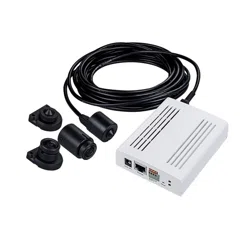
VIVOTEK’s VC8101 is a high-performance Full-HD split-type camera system. Its discreet de-
sign, rich functionality and ability to be exibly integrated into even the tightest spaces, make
this camera ideal for indoor or covert surveillance of ATMs, banks, stores and ofces.
The VC8101 features a separate camera unit and video core design, enabling the tiny camera
unit (with 5-meter long cable) to be easily and exibly installed into any decoration or interior
design, thus preserving stylish appearances while dramatically saving on installation time and
cost.
The VC8101 can support one camera unit and is designed to work in perfect harmony with a
choice of two 2-megapixel WDR camera units: the CU8161-H pinhole type, and the CU8163-
H sheye type for 180° panoramic view. Both camera units incorporate a number of advanced
features found in VIVOTEK cameras, including WDR Pro, Smart Stream II technology, 3DNR,
802.3af compliant PoE, on-board storage, and VIVOTEK’s 32-channel recording software. All of
these features and the VC8101’s unique design allow the camera units to capture clear images
in high-contrast scenes, and to make this camera system the best possible solution for indoor
surveillance when discretion is important.
Revision History
Rev. 1.0: Initial release.

VIVOTEK
User's Manual - 5
Read Before Use
The use of surveillance devices may be prohibited by law in your country. The Network Camera is not
only a high-performance web-ready camera but can also be part of a exible surveillance system. It is
the user’s responsibility to ensure that the operation of such devices is legal before installing this unit for
its intended use.
It is important to rst verify that all contents received are complete according to the Package Contents
listed below. Take note of the warnings in the Quick Installation Guide before the Network Camera is
installed; then carefully read and follow the instructions in the Installation chapter to avoid damage due to
faulty assembly and installation. This also ensures the product is used properly as intended.
The Network Camera is a network device and its use should be straightforward for those who have basic
networking knowledge. It is designed for various applications including video sharing, general security/
surveillance, etc. The Configuration chapter suggests ways to best utilize the Network Camera and
ensure proper operations. For creative and professional developers, the URL Commands of the Network
Camera section serves as a helpful reference to customizing existing homepages or integrating with the
current web server.
Package Contents
Symbols and Statements in this Document
i
INFORMATION: provides important messages or advices that might help prevent inconvenient
or problem situations.
NOTE: Notices provide guidance or advices that are related to the functional integrity of the
machine.
Tips: Tips are useful information that helps enhance or facilitae an installation, function, or
process.
WARNING: or IMPORTANT:: These statements indicate situations that can be dangerous or
hazardous to the machine or you.
Electrical Hazard: This statement appears when high voltage electrical hazards might occur
to an operator.
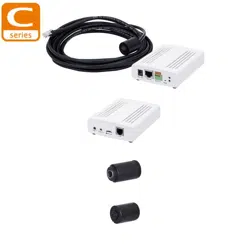
■ VC8101 camera and lens modules
■ Mounting bracket
■ Screws and anchors
■ RJ12 Lens Cables
■ Quick Installation Guide
■ Software CD
VIVOTEK
6 - User's Manual
Introduction
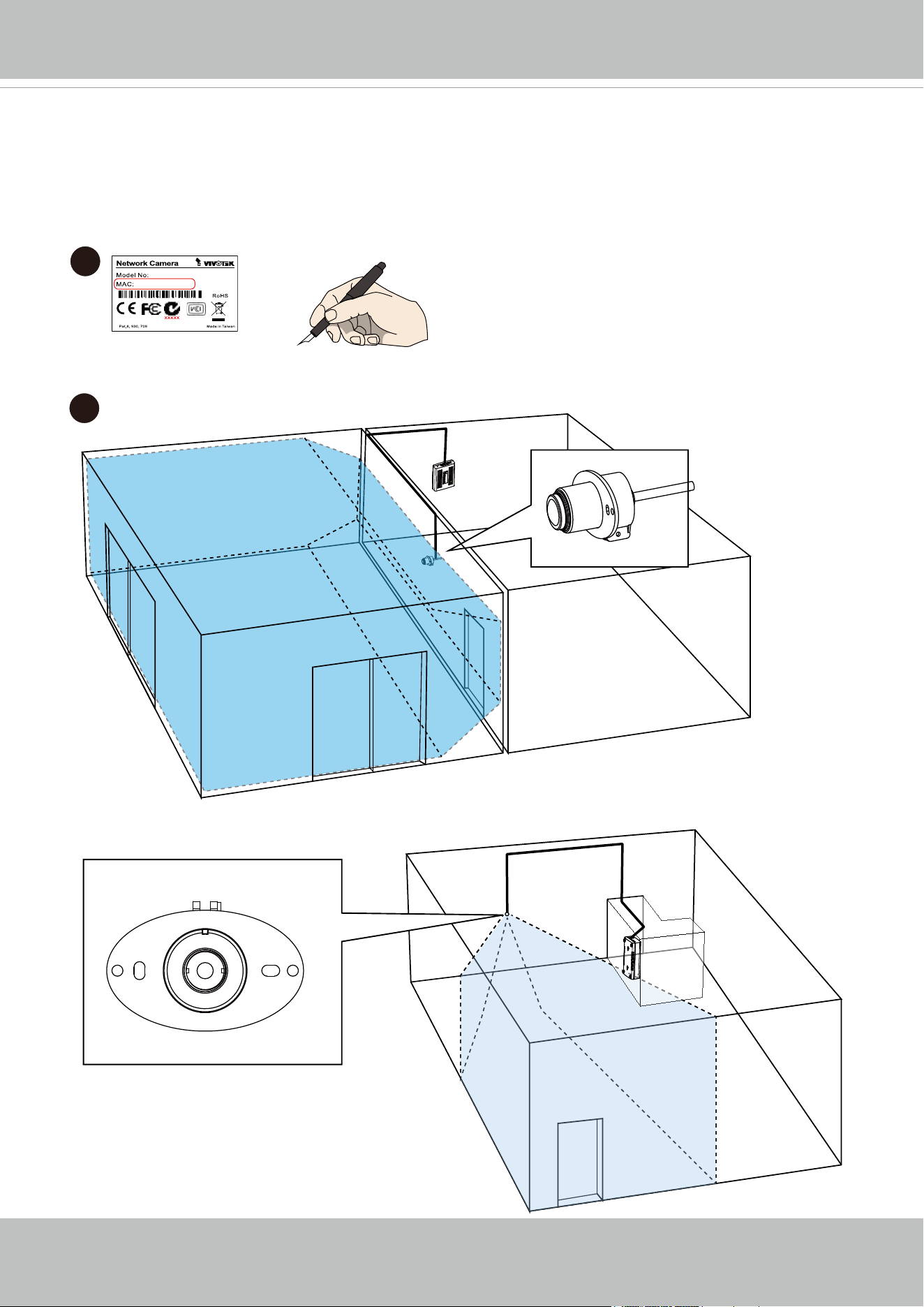
The sensor module can be installed in the same or different rooms/mounting positions. A wide
angle lens can be used to cover a wide open space, while a xed focal lens a specic eld of
view.
CU8163-H
0002D10766AD
XXXXXX
1
Jot down the camera’s MAC address for later
reference.
Plan your configuration and check your installation site.
2
CU8161-H
VIVOTEK
User's Manual - 7
5m
3
Hardware Installation
4
- OR -
DC8~36V PoE 802.3af
M
icro
SD
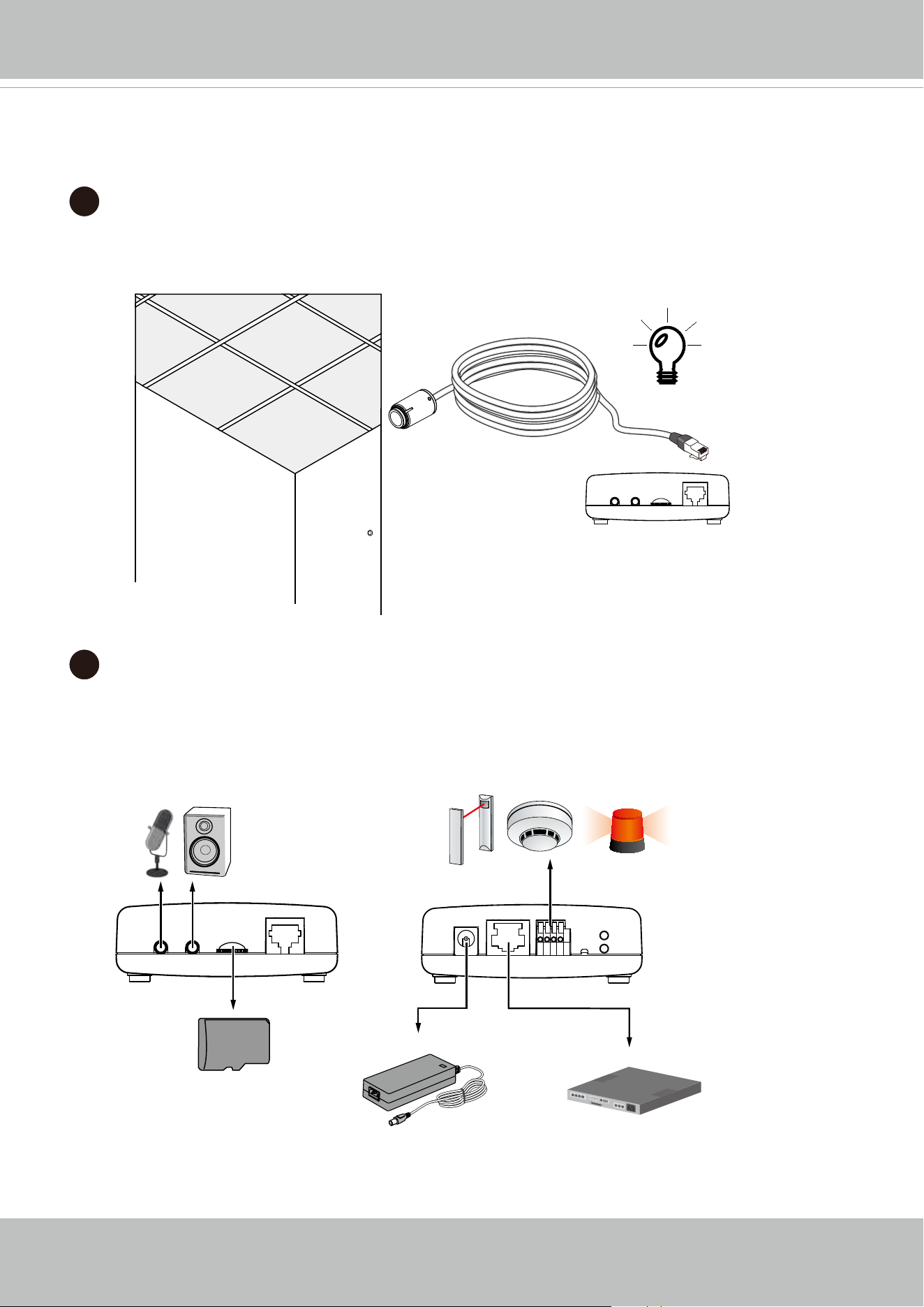
The camera can be installed through a wall. Make sure the lens unit cable can be properly
routed.
Connect other devices, such as detectors, alarm, speaker or microphone. The camera can
be powered by a DC output or a PoE switch. If local storage is preferred, install a Class 6
MicroSD card.

VIVOTEK
8 - User's Manual
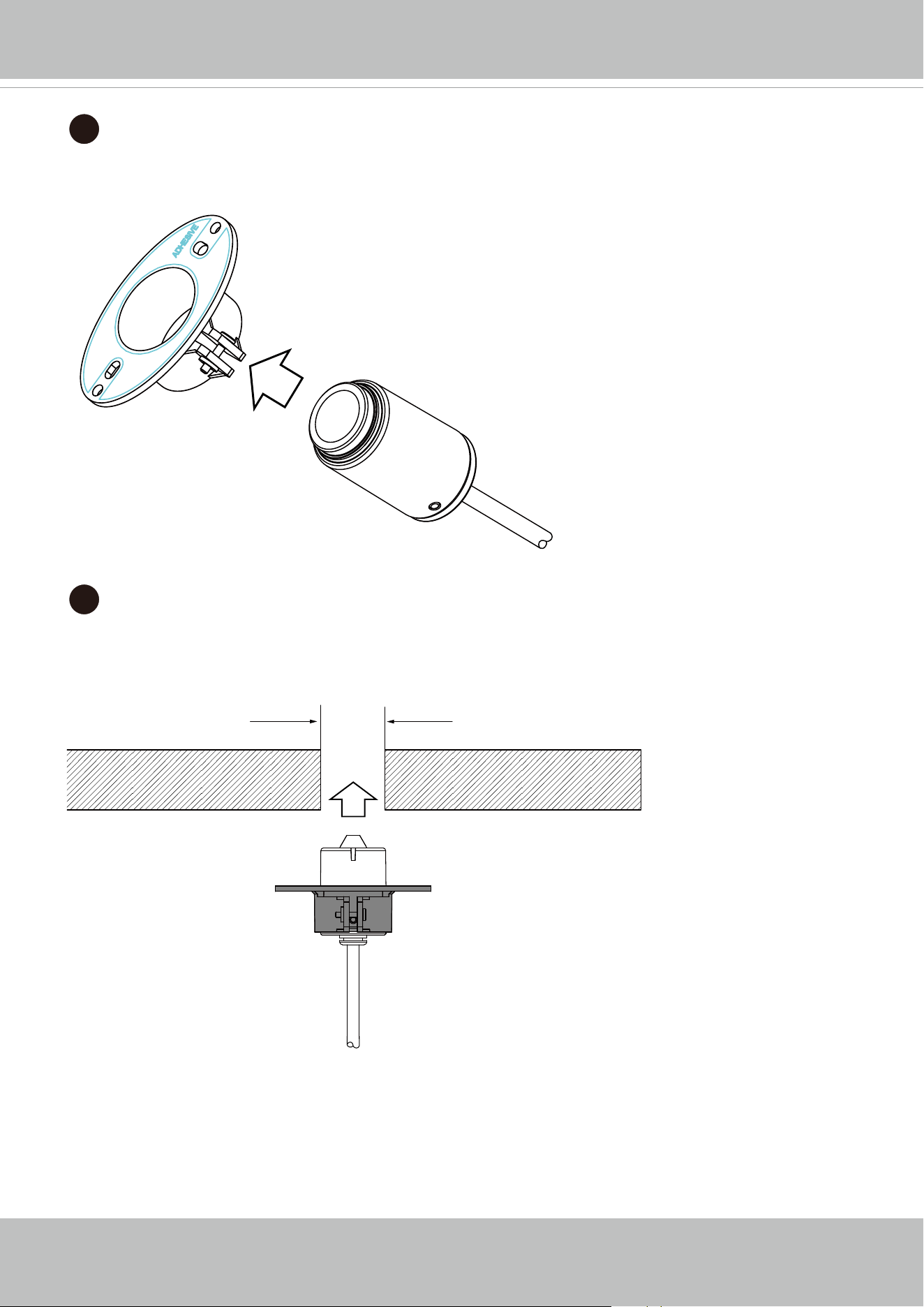
Drill a hole on ceiling or wall. Drill a hole of a diameter of 24mm.
Note that this type of installation does not apply to hard surfaces, such as a concrete wall.
24mm
Route the lens unit cable through the ceiling or wall.
5
6
VIVOTEK
User's Manual - 9
7
24mm
8
Put the mount bracket onto the lens unit.
Insert the lens unit into the pre-drilled hole.

VIVOTEK
10 - User's Manual
180º
CU8163-H
CU8163-H
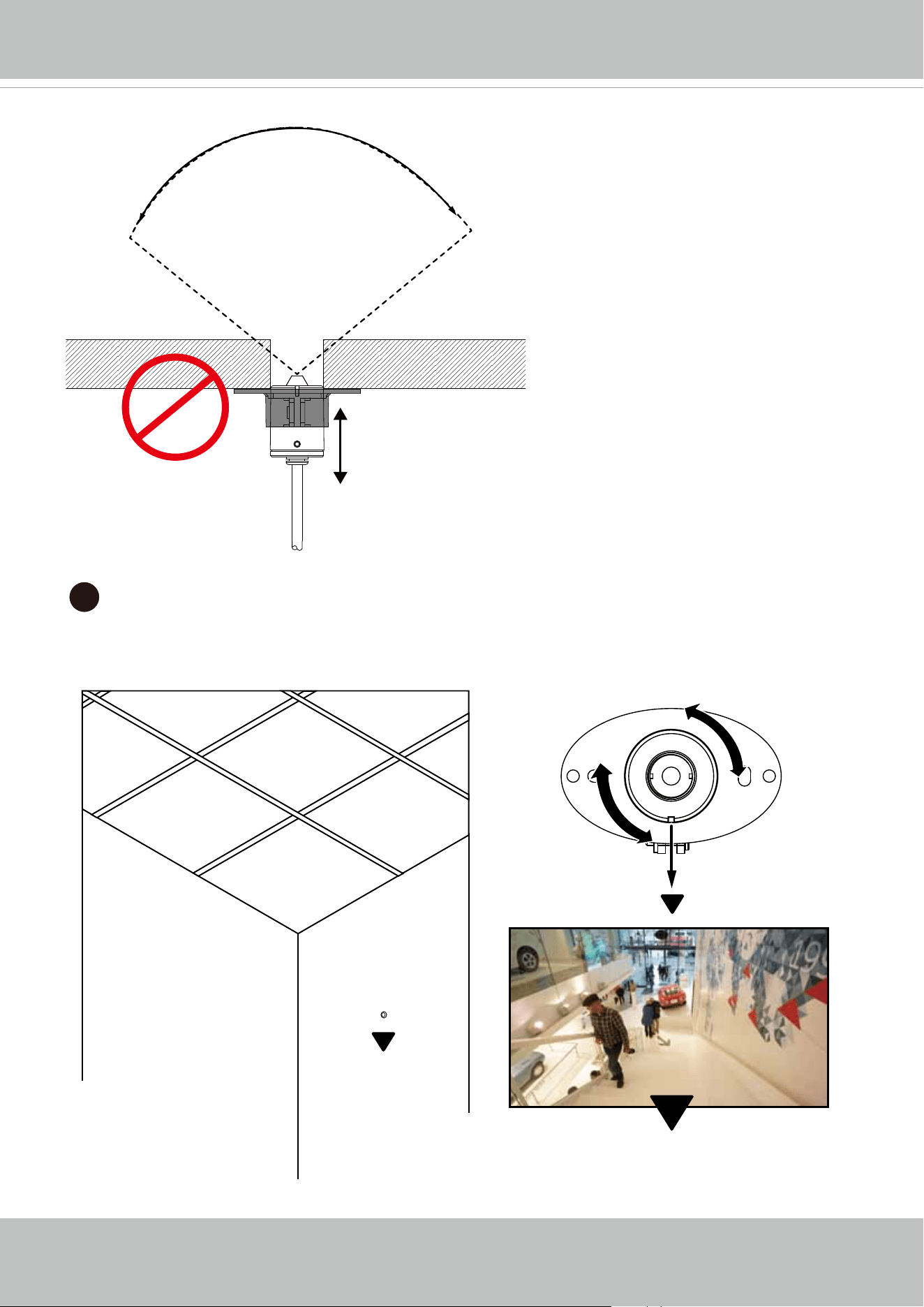
Make sure the view angle is not blocked, and lens unit is appropriately installed.
VIVOTEK
User's Manual - 11
104º
CU8161-H
9
The notch on the lens unit indicates the downward position. When fixing the lens unit, make
sure the notch is at the bottom.

VIVOTEK
12 - User's Manual
10
Having measured the right position of the lens unit in a drilled hole, tighten the grip on the lens
unit by fastening the screw on the mount bracket.
11
Remove the membrane on the sticker.
VIVOTEK
User's Manual - 13
12
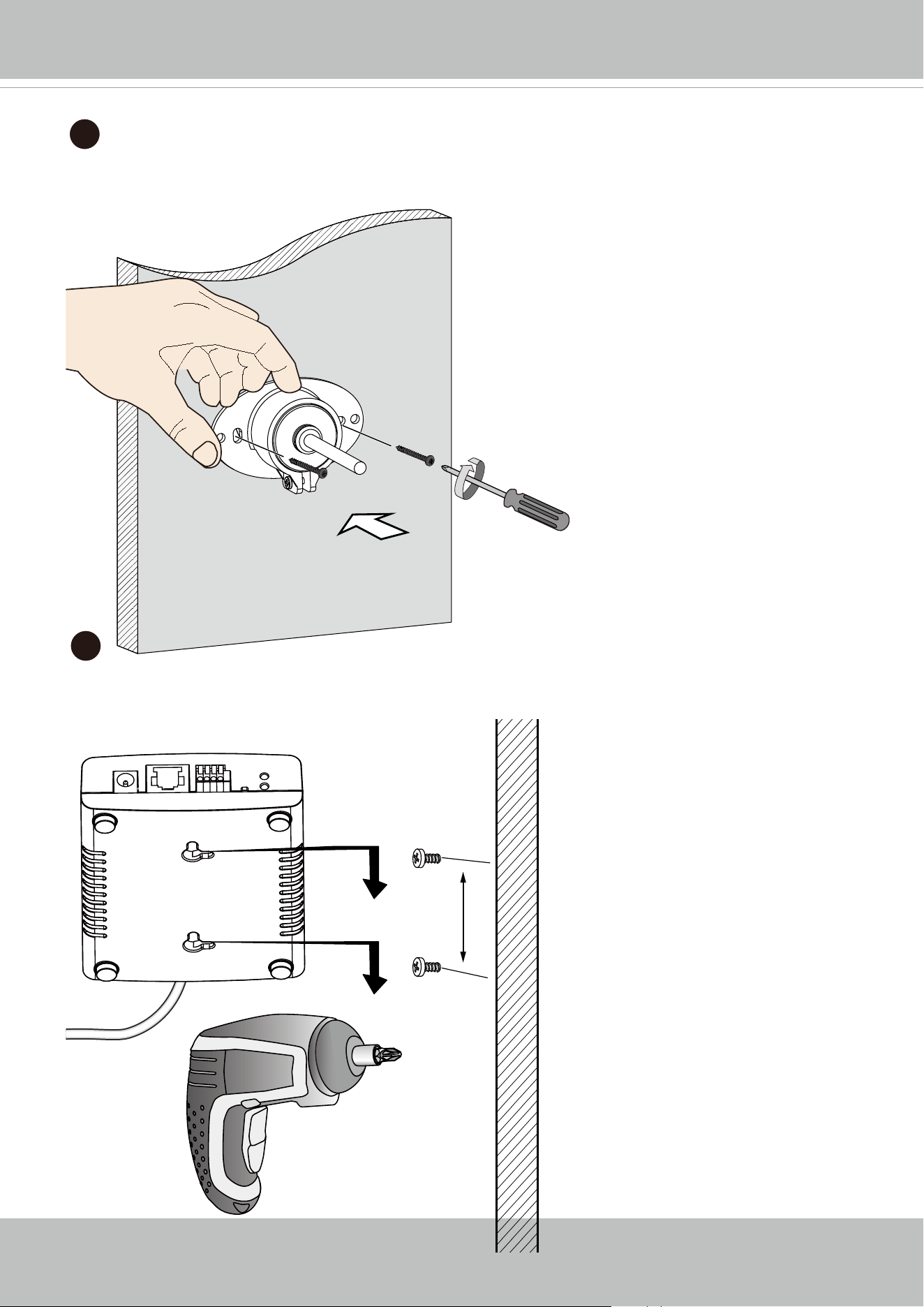
Secure the lens unit to wall by driving screws through the mount bracket.
13
55mm
Find an appropriate location for the main body. Drive two screws 55mm apart into the wall, and
then you can hang the main body onto a surface.
VIVOTEK
14 - User's Manual
0002D1730202
00-02-D1-73-02-02 192.168.5.151 FD8168
IW2
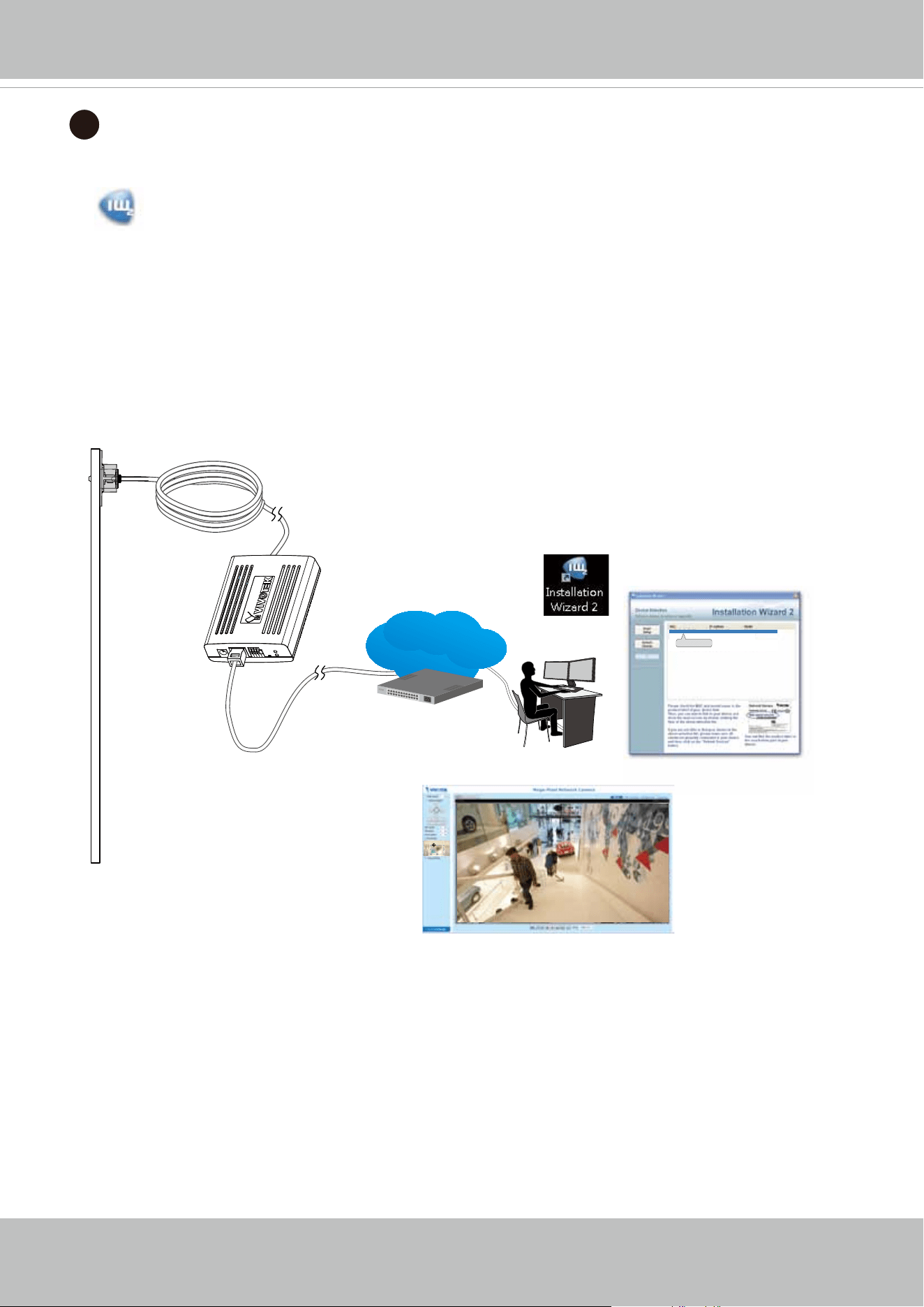
Browser
LAN
14
Install the "Installation Wizard 2" software utility from your software CD.
The program will search for VIVOTEK Video Receivers, Video Servers or Network Cameras on
the same LAN.
Double-click on the camera's MAC address to open a browser management session with the
camera.
With a live view is displayed on your laptop, adjust the zoom and focus to obtain an optimal
image. Check the live view to ensure the image is in focus.

VIVOTEK
User's Manual - 15
Item LED Status Description
1 Steady Red Power on and system booting
Red LED off Powered off
2 Steady Red + blinking Green every 1 sec. (Green
LED on for 1 sec and off for another)
Network heartbeat
Steady Red + Green LED off Network disconnected
3 Blinking Red every 0.15 sec. + Blinking Green
every 1 sec. (Red LED on for 0.15 sec. and Green
LED on for 1 sec. and off for another)
Upgrading rmware
4 Blinking Red every 0.15 sec. + blinking Green
every 0.15 sec
Restoring defaults
LED Denition
Hardware Reset
The reset button is used to reset the system or restore the factory default settings. Sometimes
resetting the system can return the camera to normal operation. If the system problems remain
after reset, press the reset button longer to restore the factory settings and install again.
Reset: Press and release the recessed reset button with a straightened paper clip. Wait for the
Network Camera to reboot.
Restore: Press and hold the recessed reset button for at least several seconds to restore. Note
that all settings will be restored to factory defaults.
SD/SDHC/SDXC Card Capacity
This network camera is compliant with SD/SDHC/SDXC 32GB, 64GB, and other preceding
standard SD cards.

VIVOTEK
16 - User's Manual
DI-
DO+
DI+
DO-
External
power source
VDC
Switch
BJT transistor
Relay
AC
Source
NO NC
External
device
DI-
DO+
DI+
DO-
VDC
Switch
BJT transistor
Relay
AC
Source
NO NC
External
device
1. The DO+ pin provides 3.3V±10% output voltages, and the max. load is 50mA.
2. The max. voltage for DO- pins is 80VDC (External power).
In order to control AC devices, the above diagram can be taken in consideration. The diagram
uses a relay to control the ON/OFF condition of the AC device.
3. An external relay can be triggered by using DO+ or by an external power source, depending
on the type of relay you use.
4. In case of using an individual relay (instead of using a relay module), for protection against
voltage or current spikes, a transient voltage suppression diode must be connected in parallel
with the inductive load.
DI/DO Diagram

VIVOTEK
User's Manual - 17
Network Deployment
Setting up the Network Camera over the Internet
There are several ways to set up the Network Camera over the Internet. The rst way is to set
up the Network Camera behind a router
. The second way is to utilize a static IP. The third way is
to use PPPoE
.
Internet connection via a router
Before enabling the access to the Network Camera over the Internet, make sure you have a
router and follow the steps below.
1. Connect your Network Camera behind a router, the Internet environment is illustrated below.
Regarding how to obtain your IP address, please refer to Software Installation on page 21 for
details.
2. In this case, if the Local Area Network (LAN) IP address of your Network Camera is
192.168.0.3, please forward the following ports for the Network Camera on the router.
■ Secondary HTTP port: 8080
■ RTSP port: 554
■ RTP port for audio: 5558
■ RTCP port for audio: 5559
■ RTP port for video: 5556
■ RTCP port for video: 5557
If you have changed the port numbers on the Network page, please open the ports
accordingly on your router. For information on how to forward ports on the router, please refer
to your router’s user’s manual.
3. Find out the public IP address of your router provided by your ISP (Internet Service Provider).
Use the public IP and the secondary HTTP port to access the Network Camera from the
Internet. Please refer to Network Type on page 68 for details.
IP address : 192.168.0.3
Subnet mask : 255.255.255.0
Default router : 192.168.0.1
IP address : 192.168.0.2
Subnet mask : 255.255.255.0
Default router : 192.168.0.1
LAN (Local Area Network)
Router IP address : 192.168.0.1
WAN (Wide Area Network )
Router IP address : from ISP
Cable or DSL Modem
POWER
COLLISION
LINK
RECEIVE
PARTITION
1
2
3
4
5
Internet

VIVOTEK
18 - User's Manual
For example, your router and IP settings may look like this:
Device IP Address: internal
port
IP Address: External Port (Mapped port on the
router)
Public IP of router 122.146.57.120
LAN IP of router 192.168.2.1
Camera 1 192.168.2.10:80 122.146.57.120:8000
Camera 2 192.168.2.11:80 122.146.57.120:8001
... ... ...
Congure the router, virtual server or rewall, so that the router can forward any data coming
into a precongured port number to a network camera on the private network, and allow data
from the camera to be transmitted to the outside of the network over the same path.
From Forward to
122.146.57.120:8000 192.168.2.10:80
122.146.57.120:8001 192.168.2.11:80
... ...
When properly congured, you can access a camera behind the router using the HTTP request
as follows: http://122.146.57.120:8000
If you change the port numbers on the Network conguration page, please open the ports ac-
cordingly on your router. For example, you can open a management session with your router to
congure access through the router to the camera within your local network. Please consult your
network administrator for router conguration if you have troubles with the conguration.
For more information with network conguration options (such as that of streaming ports),
please refer to Conguration > Network Settings. VIVOTEK also provides the automatic port for-
warding feature as an NAT traversal function with the precondition that your router must support
the UPnP port forwarding feature.

VIVOTEK
User's Manual - 19
Internet connection with static IP
Choose this connection type if you are required to use a static IP for the Network Camera.
Please refer to LAN conguration on page 68 for details.
Internet connection via PPPoE (Point-to-Point over Ethernet)
Choose this connection type if you are connected to the Internet via a DSL Line. Please refer to
PPPoE on page 89 for details.
Set up the Network Camera through Power over Ethernet (PoE)
When using a PoE-enabled switch
The Network Camera is PoE-compliant, allowing transmission of power and data via a single
Ethernet cable. Follow the below illustration to connect the Network Camera to a PoE-enabled
switch via an Ethernet cable.
When using a non-PoE switch
If your switch/router does not support PoE, use a PoE power injector (optional) to connect
between the Network Camera and a non-PoE switch.
PoE Switch
Power + Data Transmission
NOTE:
1. The camera is only to be connected to PoE networks
without routing to outside plants.
2. For PoE connection, use only UL listed I.T.E. with PoE
output.
POW
ER
C
O
LL
I
S
ION
L
I
N
K
RECEIVE
PARTITIO
N
1
2
3
4
5
POW
ER
C
O
LL
I
S
ION
L
I
N
K
RECEIVE
PARTITIO
N
1
2
3
4
5
Non-PoE Switch
PoE Power Injector
(optional)
VIVOTEK
20 - User's Manual
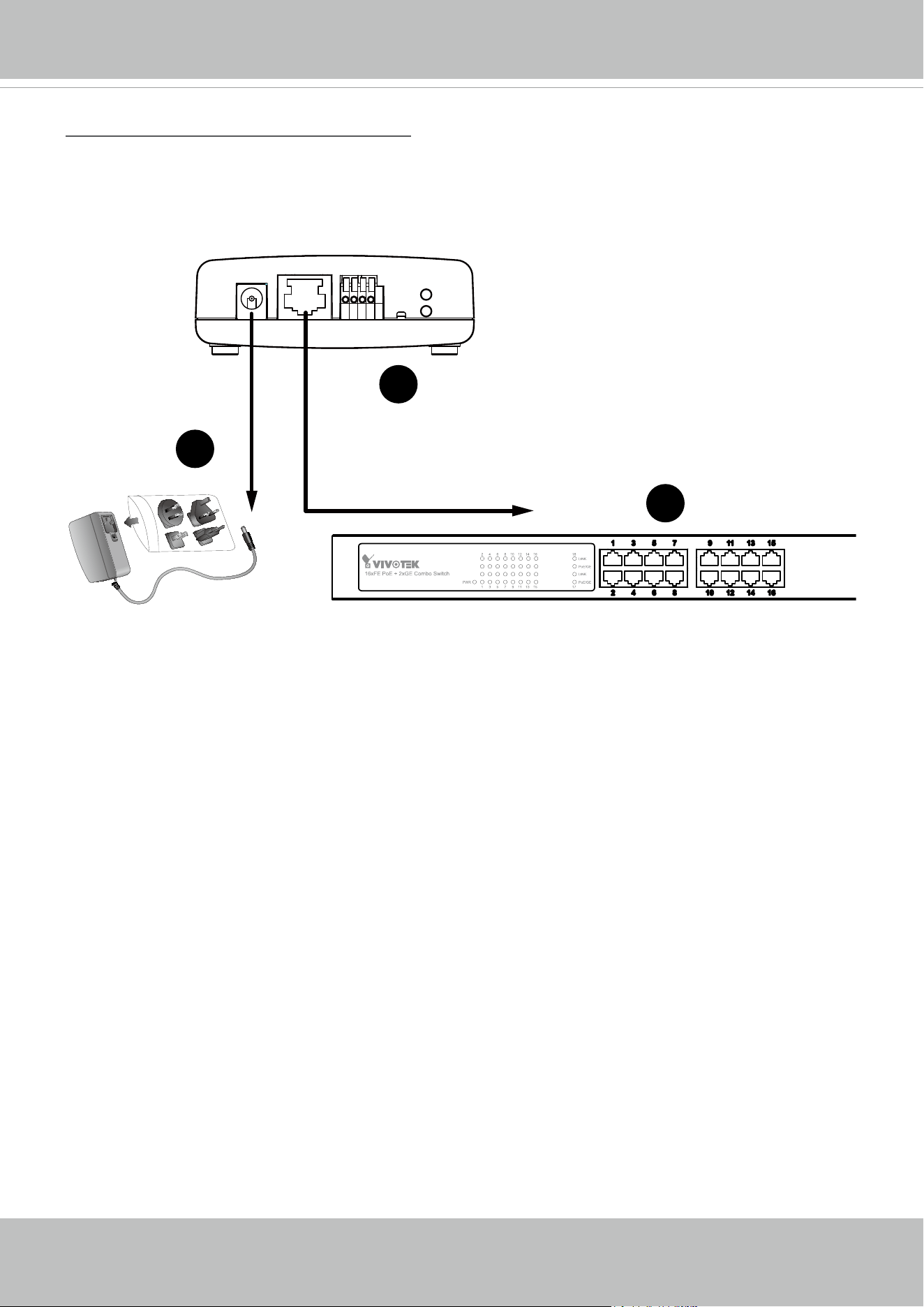
General Connection (without PoE)
1. If you have external DI devices, make the connection from general I/O terminal block.
2. Ethernet, power and IO cables are user-supplied.
3. (Optional) Connect DC power cord to a DC Adapter, and then to a power outlet.
1
2
3

VIVOTEK
User's Manual - 21
Software Installation
Installation Wizard 2 (IW2), free-bundled software included on the product CD, helps you set up
your Network Camera on the LAN.
1. Install IW2 under the Software Utility directory from the software CD.
Double click the IW2 shortcut on your desktop to launch the program.
2. The program will conduct an analysis of your network environment.
After your network environment is analyzed, please click Next to continue the program.
3. The program will search for all VIVOTEK network devices on the same LAN.
4. After a brief search, the main installer window will pop up. Double-click on the MAC address
that matches the one printed on the camera label or the S/N number on the package box label
to open a browser management session with the Network Camera.
Installation
Wizard 2
IW
2
Network Camera
Model No: VC8101
MAC: 0002D1083236
Pat. 6,930,709
This device complies with part 15 of the FCC Rules. Operation is subject to
the following two conditions:
(1) this device may not cause harmful interference, and
(2) this device must accept any interference received, including interference
that may cause undesired operation.
Made in Taiwan
0002D1083236
00-02-D1-08-32-36 192.168.5.109 VC8101
VIVOTEK
22 - User's Manual
Ready to Use
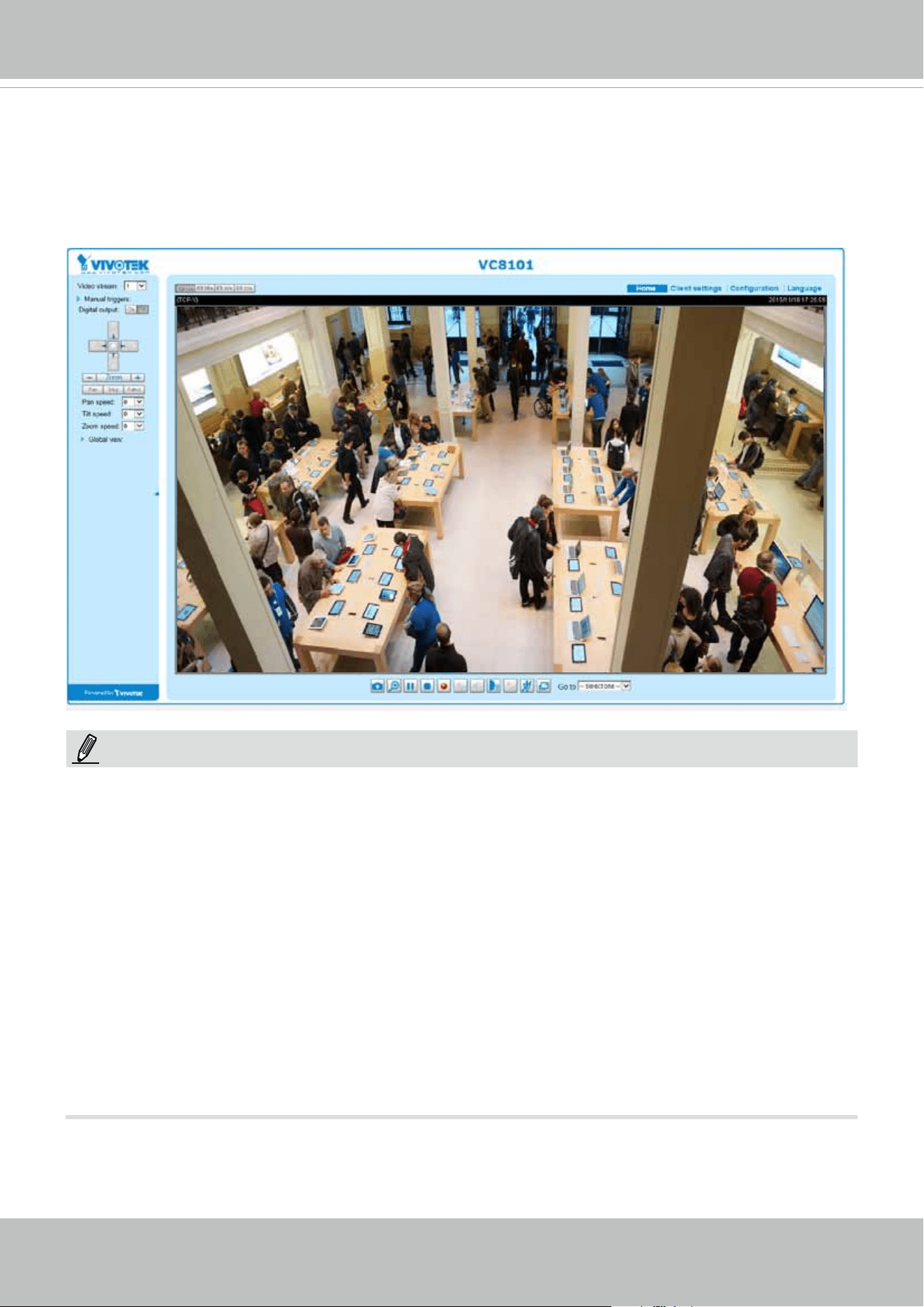
1. A browser session with the Network Camera should prompt as shown below.
2. You should be able to see live video from your camera. You may also install the 32-channel
recording software from the software CD in a deployment consisting of multiple cameras. For
its installation details, please refer to its related documents.
NOTE:
1. If you encounter problems with displaying live view or the onscreen plug-in control, you may try
to remove the plug-ins that might have been installed on your computer. Remove the following
folder: C:\Program Files (x86)\Camera Stream Controller\.
2. If you forget the root (administrator) password for the camera, you can restore the camera
defaults by pressing the reset button for longer than 5 seconds.
3. If DHCP is enabled in your network, and the camera cannot be accessed, run the IW2 utility to
search the network. If the camera has been congured with xed IP that does not comply with
your local network, you may see its default IP 169.254.x.x. If you still cannot nd the camera,
you can restore the camera to its factory defaults.
4. If you change your network parameters, e.g., added a connection to a LAN card, re-start the
IW2 utility.
VIVOTEK
User's Manual - 23
Accessing the Network Camera
This chapter explains how to access the Network Camera through web browsers, RTSP players,
3GPP-compatible mobile devices, and VIVOTEK recording software.
Using Web Browsers
Use Installation Wizard 2 (IW2) to access the Network Cameras on the LAN.
If your network environment is not a LAN, follow these steps to access the Netwotk Camera:
1. Launch your web browser (e.g., Microsoft
®
Internet Explorer, Mozilla Firefox, or Netscape).
2. Enter the IP address of the Network Camera in the address eld. Press Enter.
3. The live video will be displayed in your web browser.
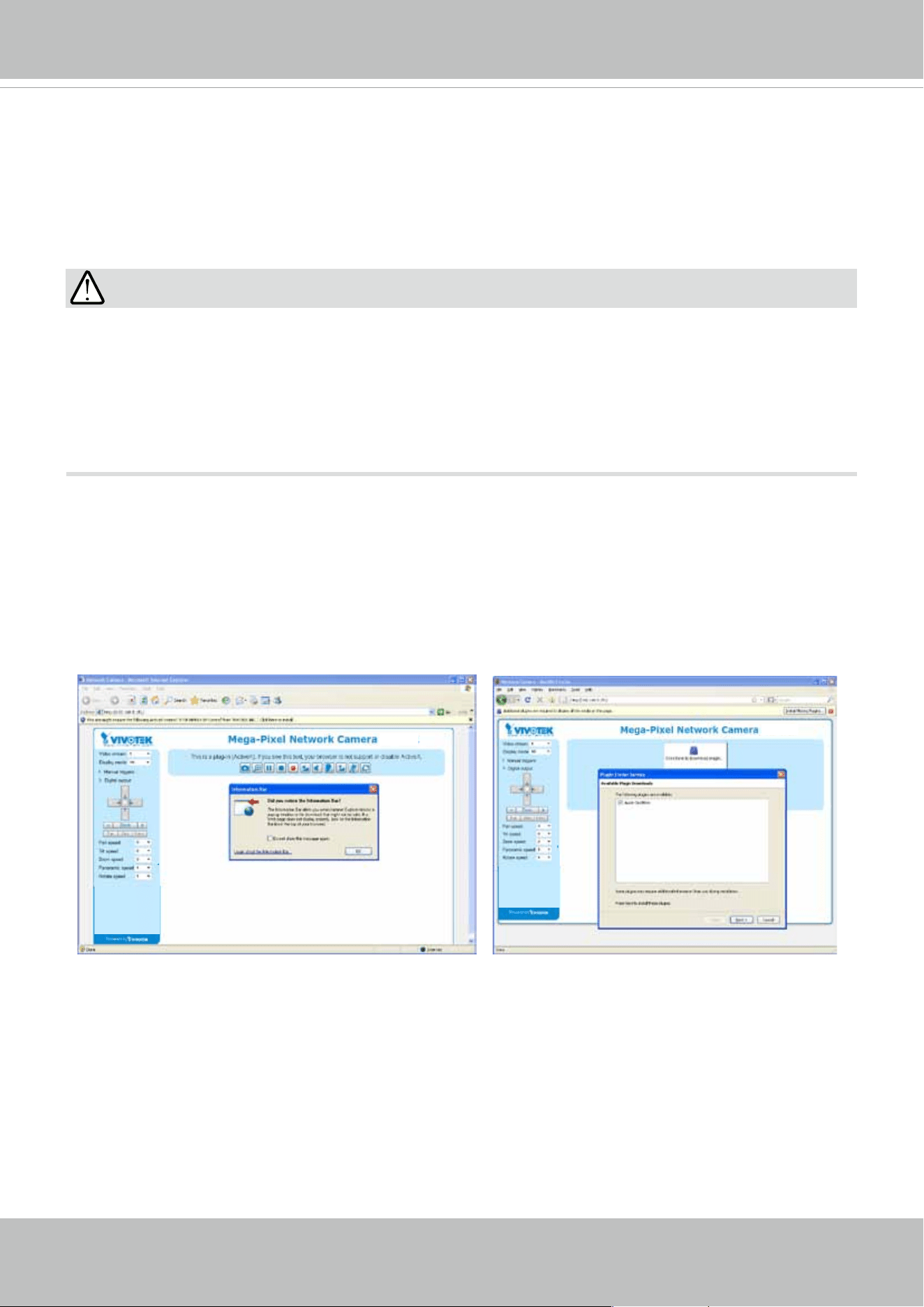
4. If it is the rst time installing the VIVOTEK network camera, an information bar will prompt as
shown below. Follow the instructions to install the required plug-in on your computer.
•
Currently the Network Camera utilizes 32-bit ActiveX plugin. You CAN NOT open a
management/view session with the camera using a 64-bit IE browser.
•
If you encounter this problem, try execute the Iexplore.exe program from C:\Windows\
SysWOW64. A 32-bit version of IE browser will be installed.
•
On Windows 7, the 32-bit explorer browser can be accessed from here: C:\Program Files
(x86)\Internet Explorer\iexplore.exe
IMPORTANT:

VIVOTEK
24 - User's Manual
NOTE:
For Mozilla Firefox users, your browser will use Quick Time to stream live video. If you do not
have QuickTime on your computer, please download QuickTime from Apple Inc's website, and
then launch your web browser.
• The onscreen Java control can malfunction under the following situations:
A PC connects to different cameras that are using the same IP address (or the same camera
running different rmware versions). Removing your browser cookies will solve this problem.
• In the event of plug-in compatibility issues, you may try to uninstall the plug-in that was previ-
ously installed.
Tips:
VIVOTEK
User's Manual - 25
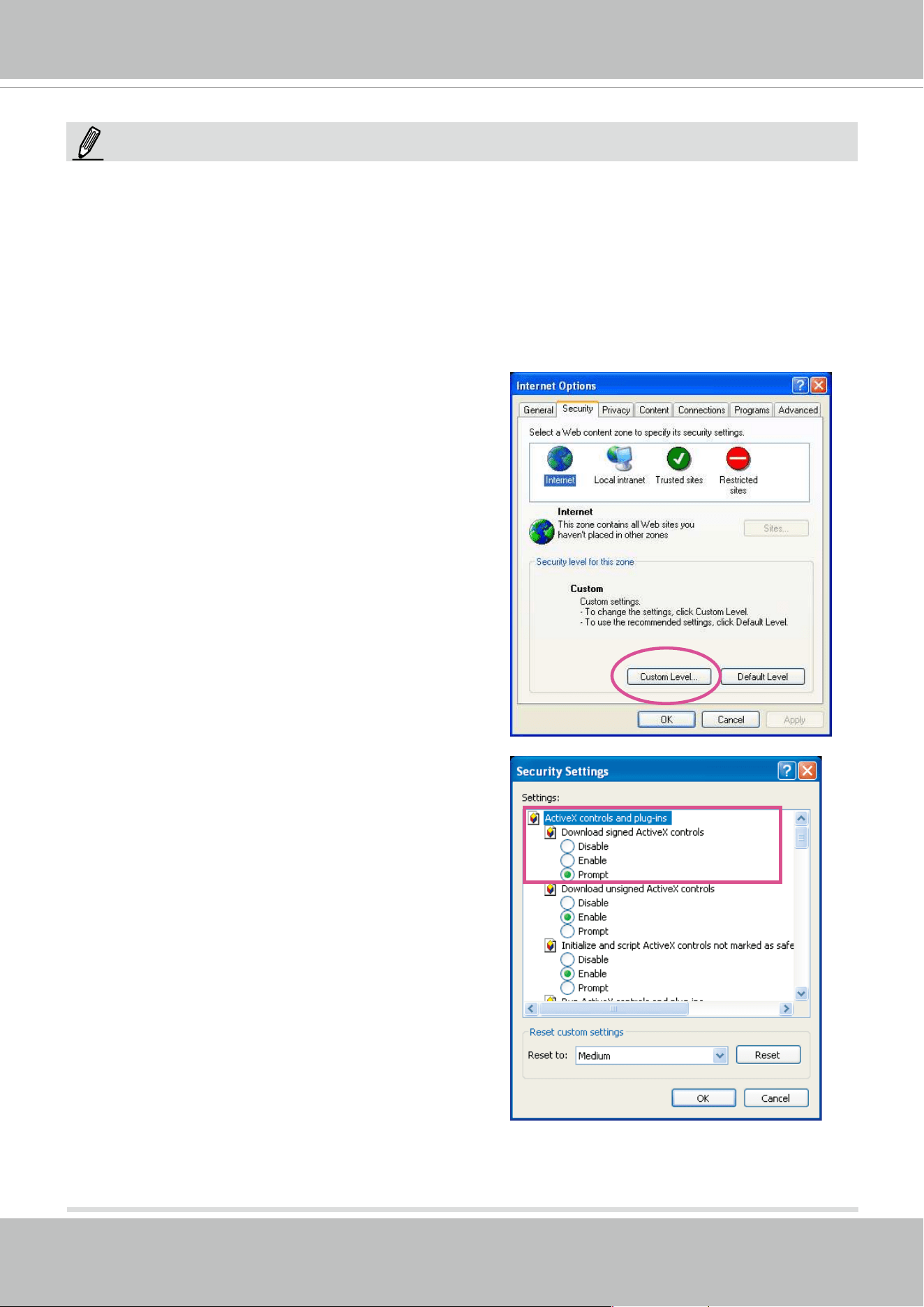
To enable the ActiveX
®
Controls for your browser:
2-3. Refresh your web browser, then install the ActiveX
®
control. Follow the instructions to
complete installation.
2-1. Choose Tools > Internet Options >
Security > Custom Level.
2-2. Look for Download signed ActiveX
®
controls; select Enable or Prompt. Click OK.
NOTE:
1. By default, your Network Camera is not password-protected. To prevent unauthorized access,
it is highly recommended to congure a password for your camera later.
For more information
about how to enable password protection, please refer to Security on page 87.
2. If you see a dialogue box indicating that your security settings prohibit running ActiveX
Controls®, please enable ActiveX Controls for your browser.

VIVOTEK
26 - User's Manual
Using RTSP Players
To view the H.264 streaming media using RTSP players, you can use one of the following
players that support RTSP streaming.
Quick Time Player
VLC Player
As most ISPs and players only allow RTSP streaming through port number 554, please set the
RTSP port to 554. For more information, please refer to RTSP Streaming on page 77.
For example:
4. The live video will be displayed in your player. For more information on how to congure the
RTSP access name, please refer to RTSP Streaming on page 77 for details.
The RTSP players will show the original circular-shape image. You can access the Regional
views via the ST7501 or VAST software. See page 78 for an example.
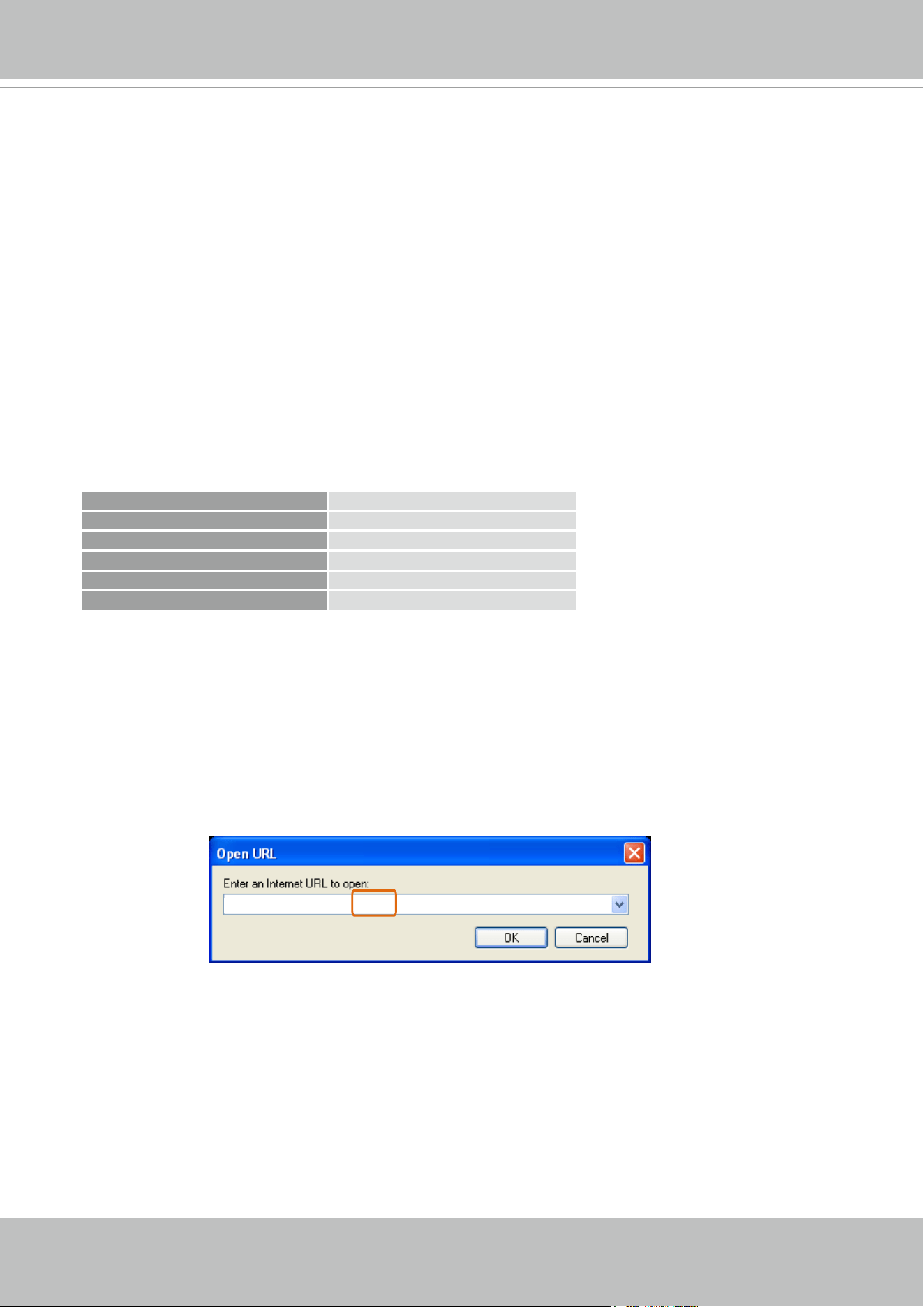
1. Launch the RTSP player.
2. Choose File > Open URL. A URL dialog box will prompt.
3. The address format is rtsp://<ip address>:<rtsp port>/<RTSP streaming access name for
stream1 to stream4>
rtsp://192.168.5.151:554/live.sdp
Video 16:38:01 2011/03/25
VIVOTEK
User's Manual - 27
Using 3GPP-compatible Mobile Devices
To view the streaming media through 3GPP-compatible mobile devices, make sure the Network
Camera can be accessed over the Internet. For more information on how to set up the Network
Camera over the Internet, please refer to Setup the Network Camera over the Internet on page
17.
To utilize this feature, please check the following settings on your Network Camera:
1. Because most players on 3GPP mobile phones do not support RTSP authentication, make
sure the authentication mode of RTSP streaming is set to disable.
For more information, please refer to RTSP Streaming on page 77.
2. As the the bandwidth on 3G networks is limited, you will not be able to use a large video size.
Please set the video and audio streaming parameters as listed below.
For more information, please refer to Stream settings on page 59.
Video Mode MPEG-4
Frame size 176 x 144
Maximum frame rate 5 fps
Intra frame period 1S
Video quality (Constant bit rate) 40kbps
Audio type (GSM-AMR) 12.2kbps
3. As most ISPs and players only allow RTSP streaming through port number 554, please set
the RTSP port to 554. For more information, please refer to RTSP Streaming on page 77.
4. Launch the player on the 3GPP-compatible mobile devices (e.g., Real Player).
5. Type the following URL commands in the URL eld.
The address format is rtsp://<public ip address of your camera>:<rtsp port>/<RTSP streaming
access name for stream 3>.
For example:
rtsp://192.168.5.151:554/live.sdp

VIVOTEK
28 - User's Manual
1. The onscreen Java control can malfunction under the following situations: A PC connects to
different cameras that are using the same IP address (or the same camera running different
rmware versions). Removing your browser cookies will solve this problem.
2. If you encounter problems with displaying the conguration menus or UI items, try disable
the Compatibility View on IE8 or IE9.
You may also press the F12 key to open the developer tools utility, and then change the
Browser Mode to the genuine IE8 or IE9 mode.
Tips:
• In the event of plug-in compatibility issues, you may try to uninstall the plug-in that was
previously installed.
VIVOTEK
User's Manual - 29
Using VIVOTEK Recording Software
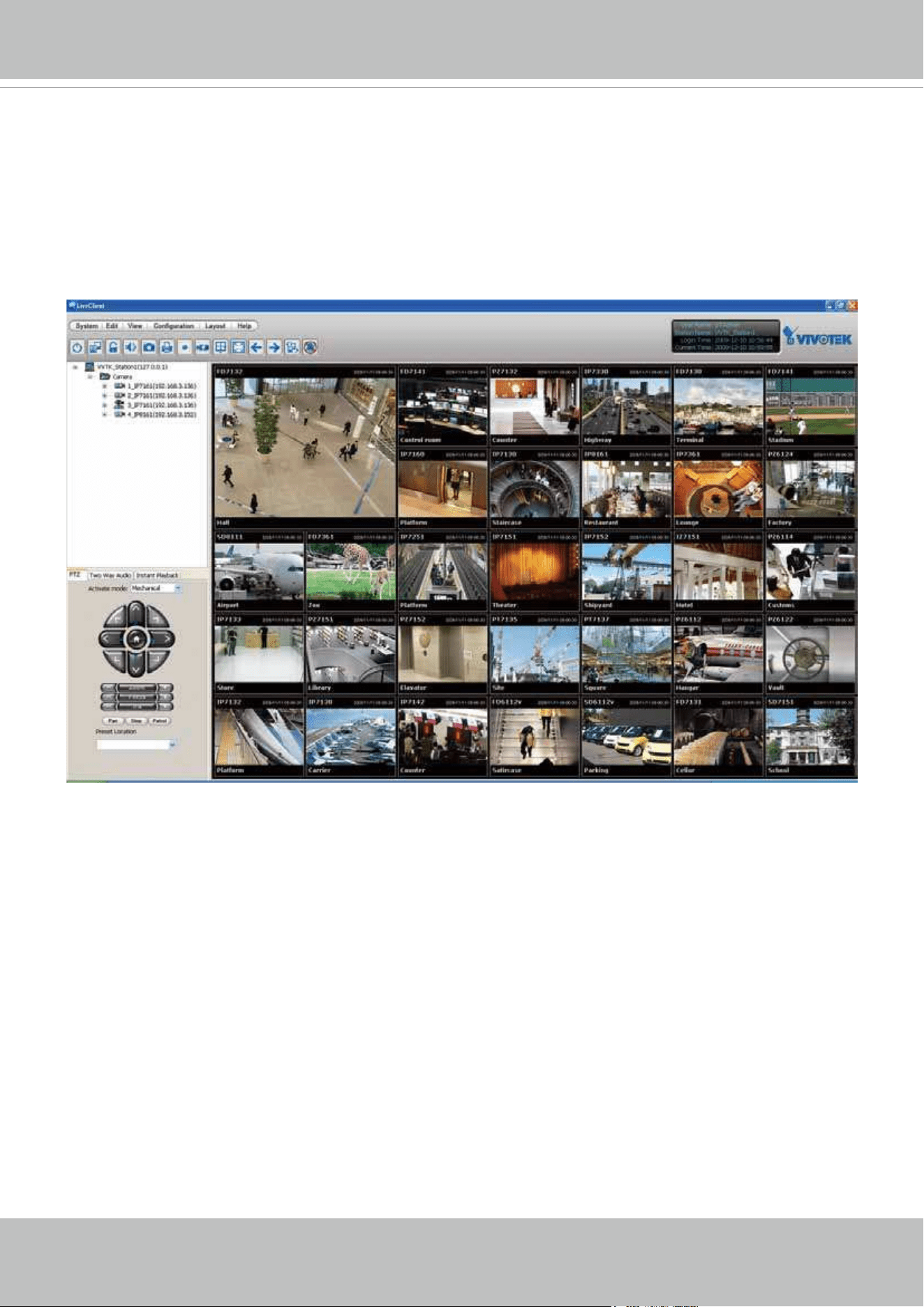
The product software CD also contains recording software, allowing simultaneous monitoring
and video recording for multiple Network Cameras. Please install the recording software; then
launch the program to add the Network Camera to the Channel list. For detailed information
about how to use the recording software, please refer to the user’s manual of the software or
download it from
http://www.vivotek.com.
VIVOTEK
30 - User's Manual
Main Page
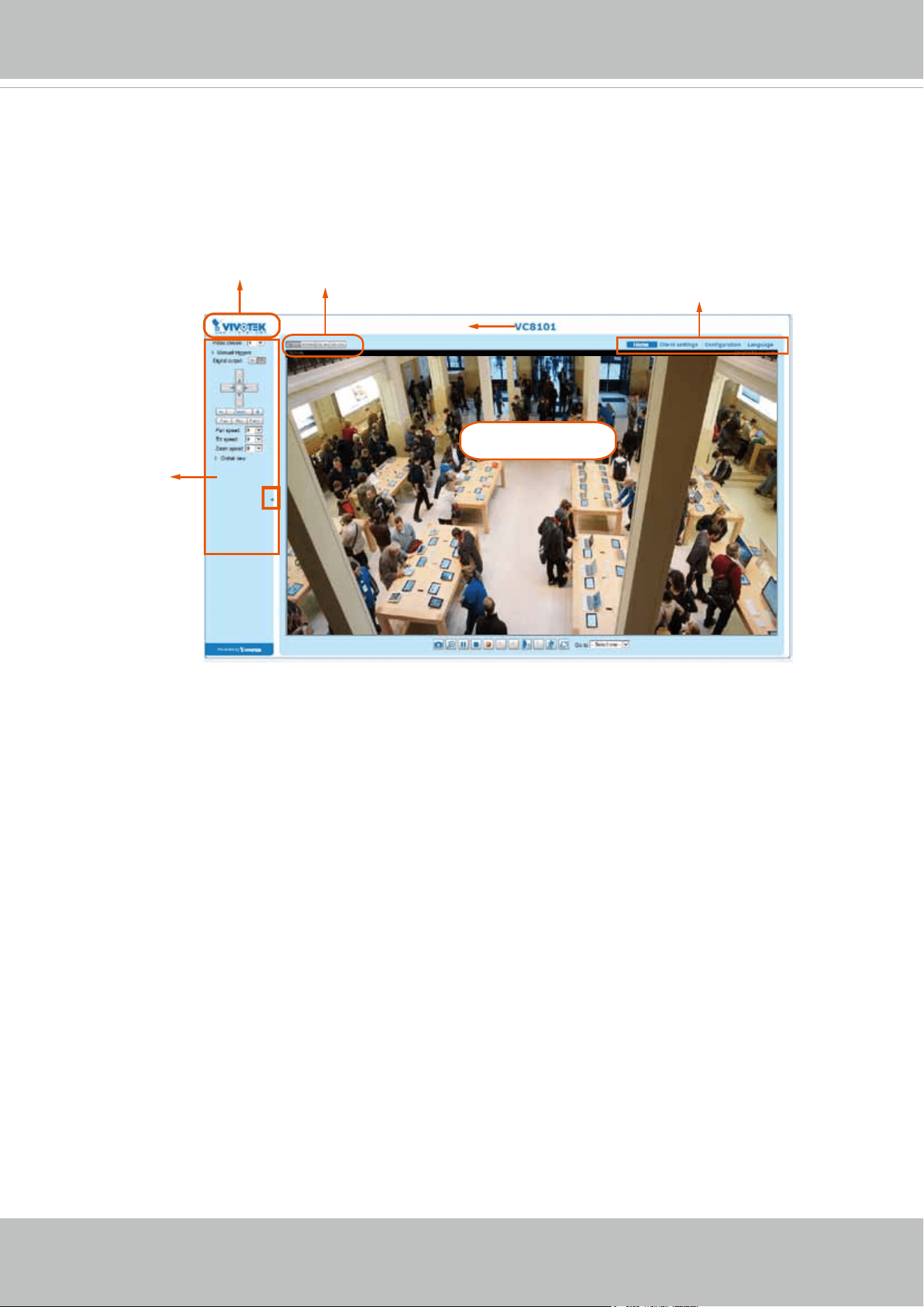
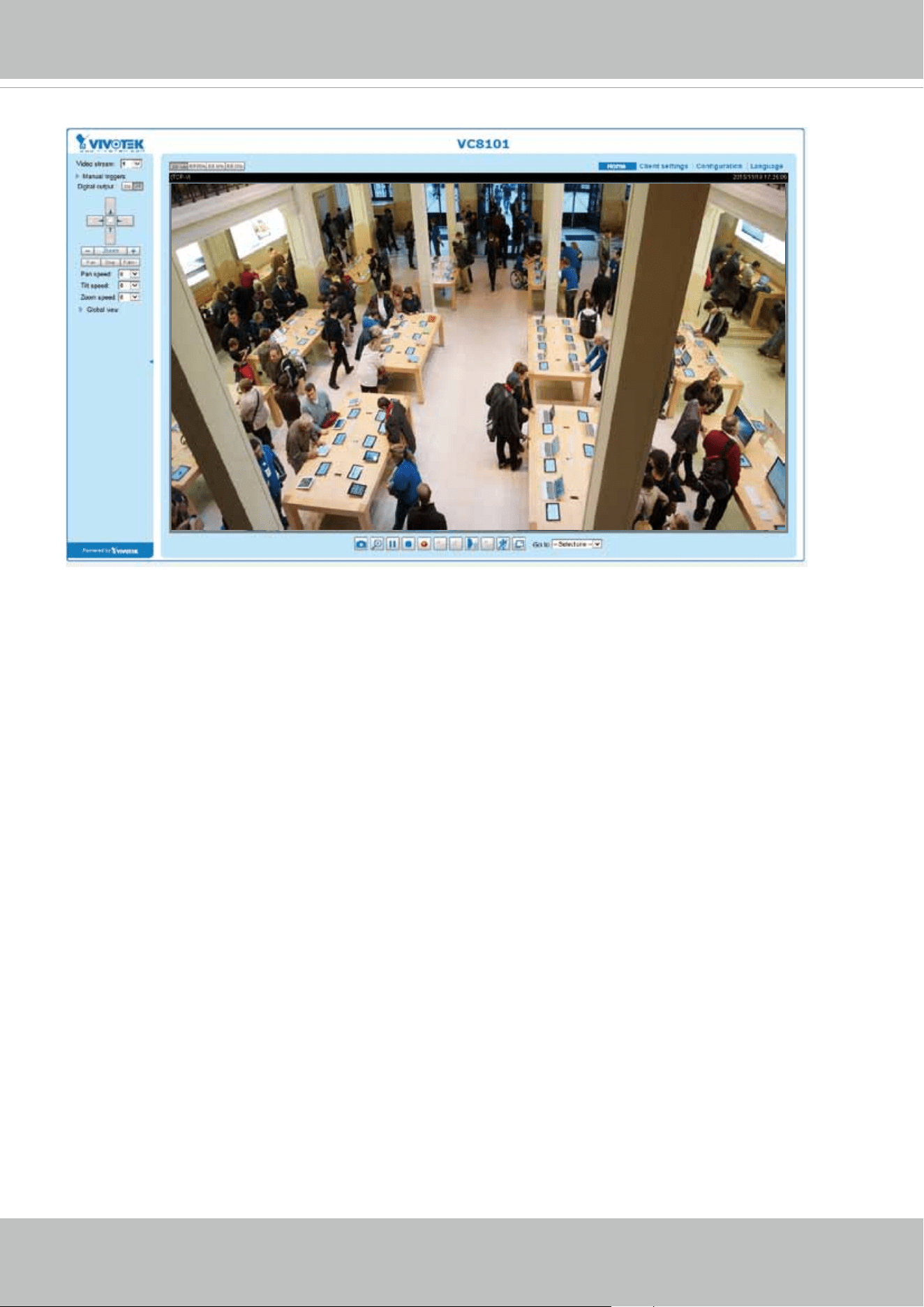
This chapter explains the screen elements on the main page. It is composed of the following
sections: VIVOTEK INC. Logo, Host Name, Camera Control Area, Conguration Area, and Live
Video Window.
Host name
Resize Buttons
VIVOTEK logo
Configuration
Area
Live View window
Camera Control
Panel
Video stream
On a web console, you can select to display any of the four video streams.
VIVOTEK INC. Logo
Click this logo to visit the VIVOTEK website.
Host Name
The host name can be customized to t your needs. For more information, please refer to System > General
Settings on page 41.
VIVOTEK
User's Manual - 31
Video Stream: This Network Camera supports multiple streams (stream #1 ~ #4) simultaneously. You
can select any one of them for live viewing. For more information about multiple streams, please refer to
page 59 for detailed information.
Manual Trigger: Click to manually enable or disable an event trigger. Please congure an event setting
before enabling this function. A total of 3 or 4 event settings can be congured. For more information
about event setting, please refer to page 103. If you want to hide this item on the homepage, please go
to the System > Homepage Layout > General settings > Customized button to deselect the “show
manual trigger button” checkbox.
Digital Output: Click to turn the digital output device on or off.
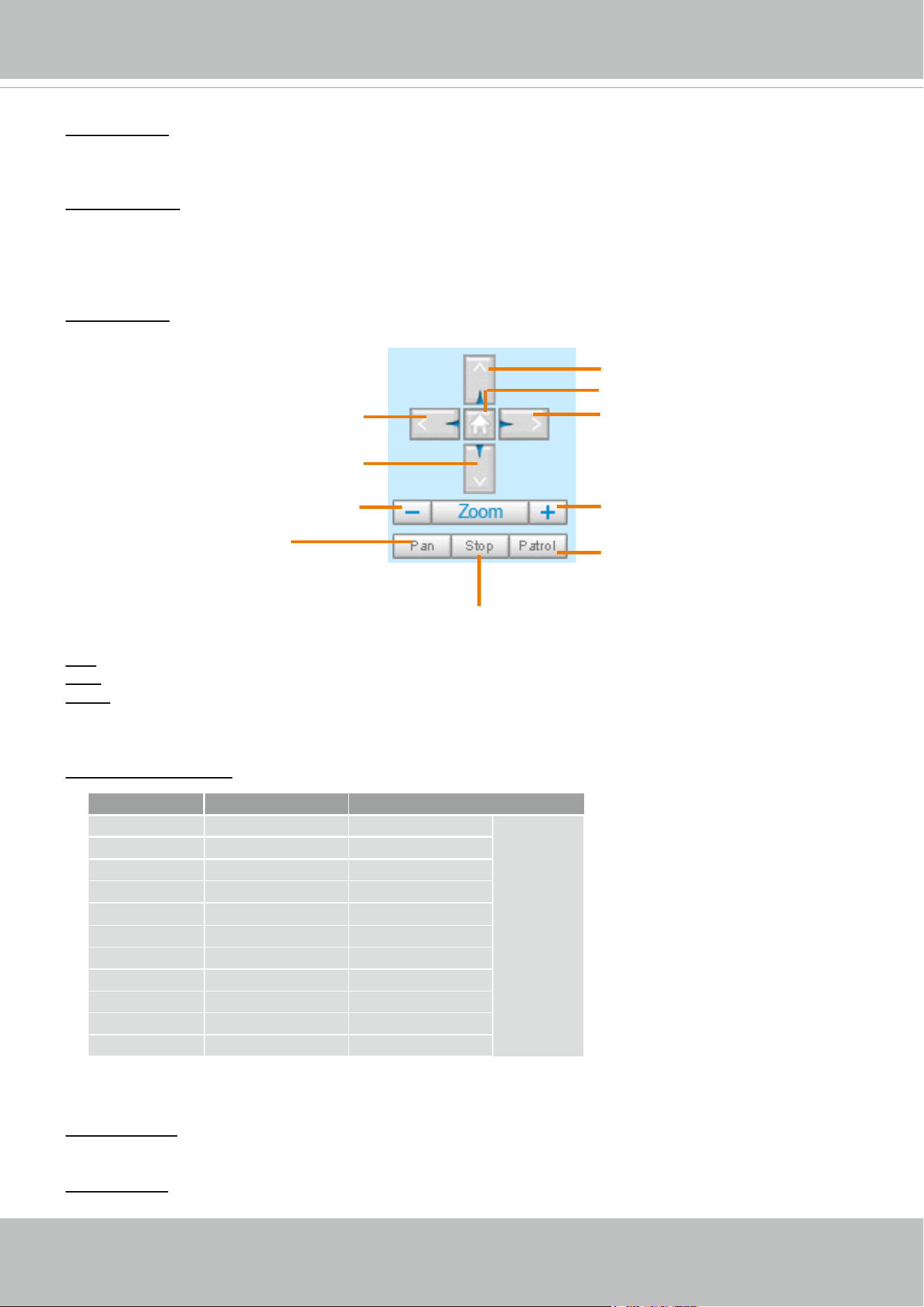
PTZ Control Panel:
Pan: Click this button to start the auto pan (360° continuous rotation).
Stop: Click this button to stop the Auto Pano and Auto Rotate functions.
Patrol: Once the Administrator has determined the list of preset positions (including the zoom-in action
on a particular position), click this button to command the camera to patrol among those positions on
the Patrol List. The Network Camera will patrol continuously. For more information, please refer to PTZ
control on page 100.
Pan /Tilt /Zoom speed: Adjust the speed of these controls when exerted:
Conguration Area
Client Settings: Click this button to access the client setting page. For more information, please refer to
Client Settings on page 36.
Conguration: Click this button to access more of the conguration options provided with the Network
Camera. It is suggested that a password is applied to the Network Camera so that only the administrator
Left
Down
Zoom Out
Start to Auto Pan
Stop Auto Pan or Patrol
Return to Home Position
Right
Up
Zoom In
Pan speed Tilt speed Zoom speed
-5 -5 -5 Slower
Faster
-4 -4 -4
-3 -3 -3
-2 -2 -2
-1 -1 -1
0 0 0
1 1 1
2 2 2
3 3 3
4 4 4
5 5 5
Patrol

VIVOTEK
32 - User's Manual
can configure the Network Camera. For more information, please refer to the description for the
Conguration menus on page 40.
Language: Click this button to choose a language for the user interface. Language options are available
in: English, Deutsch, Español, Français, Italiano,
日本語
, Português,
簡体中文
, and
繁體中文
. You can
also change a language on the Conguration page; please refer to page 40.
Hide Button
You can click the hide button to hide the control panel or display the control panel.
Resize Buttons
:
Click the Auto button, the video cell will resize automatically to t the monitor.
Click 100% is to display the original homepage size.
Click 50% is to resize the homepage to 50% of its original size.
Click 25% is to resize the homepage to 25% of its original size.
■ The following window is displayed when the video mode is set to MJPEG:
Video Title: The video title can be congured. For more information, please refer to Video settings on
page 59.
H.264 Protocol and Media Options: The transmission protocol (TCP or UDP, etc.)and media options for
H.264 video streaming. For further conguration, please refer to Client Settings on page 36.
Time: Display the current time. For further conguration, please refer to Media > Image > Genral settings
on page 51.
Title and Time: The video title and time can be stamped on the streaming video. For further conguration,
please refer to Media > Image > Genral settings on page 51.
Video and Audio Control Buttons: Depending on the Network Camera model and Network Camera
conguration, some buttons may not be available.
Video 13:59:05 2012/07/04
Title and Time
Time
Video and Audio Control Buttons
Video (TPC-AV)
H.264/MPEG-4 Protocol and Media Options
Video Title
Video 13:59:05 2012/07/04
Live Video Window
■ The following window is displayed when the video mode is set to H.264:
VIVOTEK
User's Manual - 33
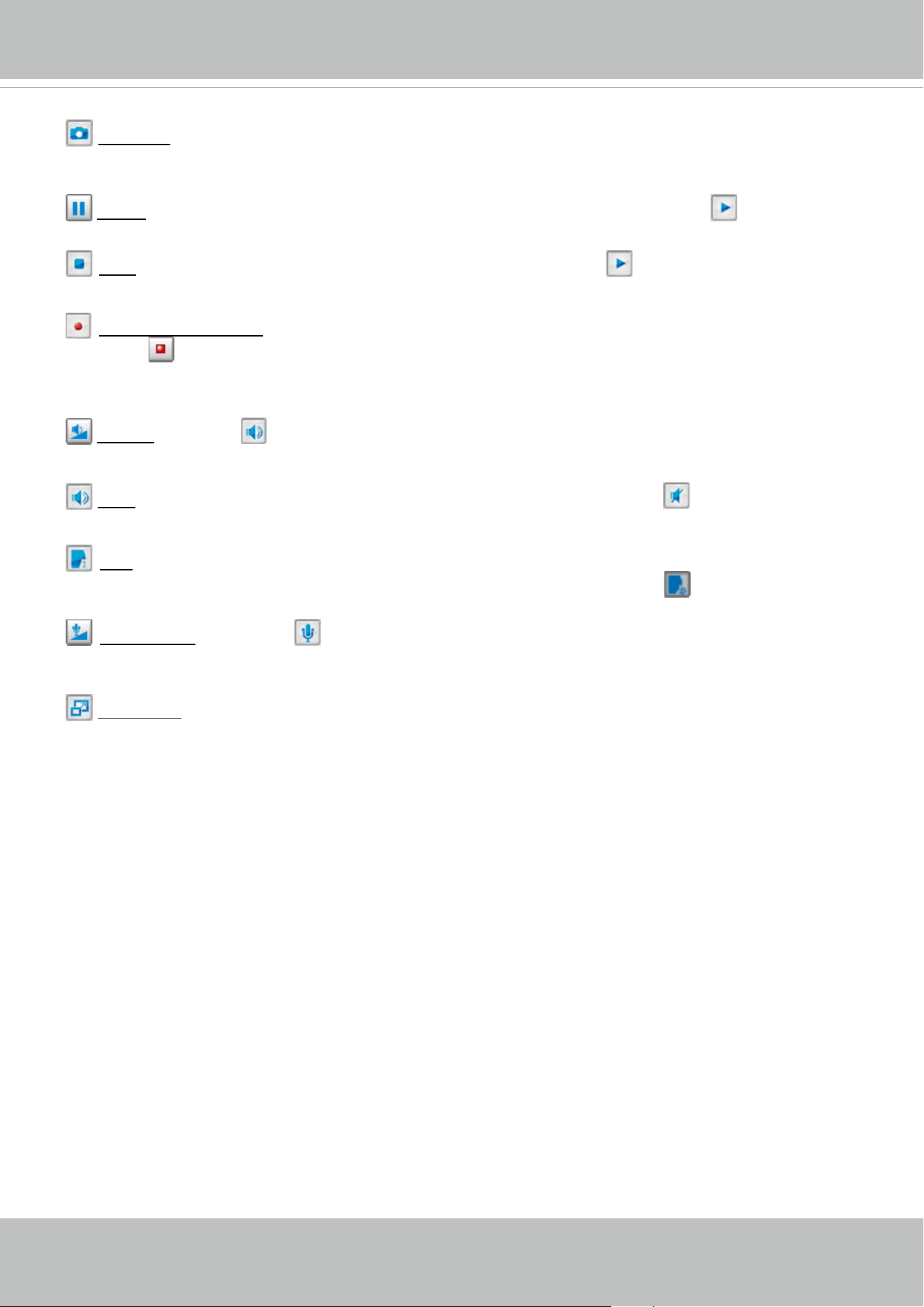
Snapshot: Click this button to capture and save still images. The captured images will be displayed
in a pop-up window. Right-click the image and choose Save Picture As to save it in JPEG (*.jpg) or BMP
(*.bmp) format.
Pause: Pause the transmission of the streaming media. The button becomes the Resume button
after clicking the Pause button.
Stop: Stop the transmission of the streaming media. Click the Resume button to continue
transmission.
Start MP4 Recording: Click this button to record video clips in MP4 file format to your computer.
Press the
Stop MP4 Recording button to end recording. When you exit the web browser, video
recording stops accordingly. To specify the storage destination and le name, please refer to MP4 Saving
Options on page 37 for details.
Volume: When the Mute function is not activated, move the slider bar to adjust the volume on the
local computer.
Mute: Turn off the volume on the local computer. The button becomes the Audio On button after
clicking the Mute button.
Talk: Click this button to talk to people around the Network Camera. Audio will project from
the external speaker connected to the Network Camera. Click this button
again to end talking
transmission.
Mic Volume: When the Mute function is not activated, move the slider bar to adjust the
microphone volume on the local computer.
Full Screen: Click this button to switch to full screen mode. Press the “Esc” key to switch back to normal
mode.

VIVOTEK
34 - User's Manual
Video Title: The video title can be congured. For more information, please refer to Media > Image on
page 51.
Time: Display the current time. For more information, please refer to Media > Image on page 51.
Title and Time: Video title and time can be stamped on the streaming video. For more information, please
refer to Media > Image on page 51
.
Video Control Buttons: Depending on the camera model and your current conguration, some buttons
may not be available.
Snapshot: Click this button to capture and save still images. The captured images will be displayed
in a pop-up window. Right-click the image and choose Save Picture As to save it in JPEG (*.jpg) or BMP
(*.bmp) format.
Start MP4 Recording: Click this button to record video clips in MP4 file format to your computer.
Press the
Stop MP4 Recording button to end recording. When you exit the web browser, video
recording stops accordingly. To specify the storage destination and le name, please refer to MP4 Saving
Options on page 37 for details.
Full Screen: Click this button to switch to full screen mode. Press the “Esc” key to switch back to normal
mode.
Please refer to page 100 for PTZ settings.
2015/03/10 17:08:56
Time
Video Control Buttons
Video 17:08:56 2015/03/10
Title and Time
Video (HTTP-V)
Video Title
2.0x Title 2014/03/05 10:39:08
VIVOTEK
User's Manual - 35
VIVOTEK
36 - User's Manual
Client Settings
This chapter explains how to select the stream transmission mode and saving options on the
local computer. When completed with the settings on this page, click Save on the page bottom
to enable the settings.
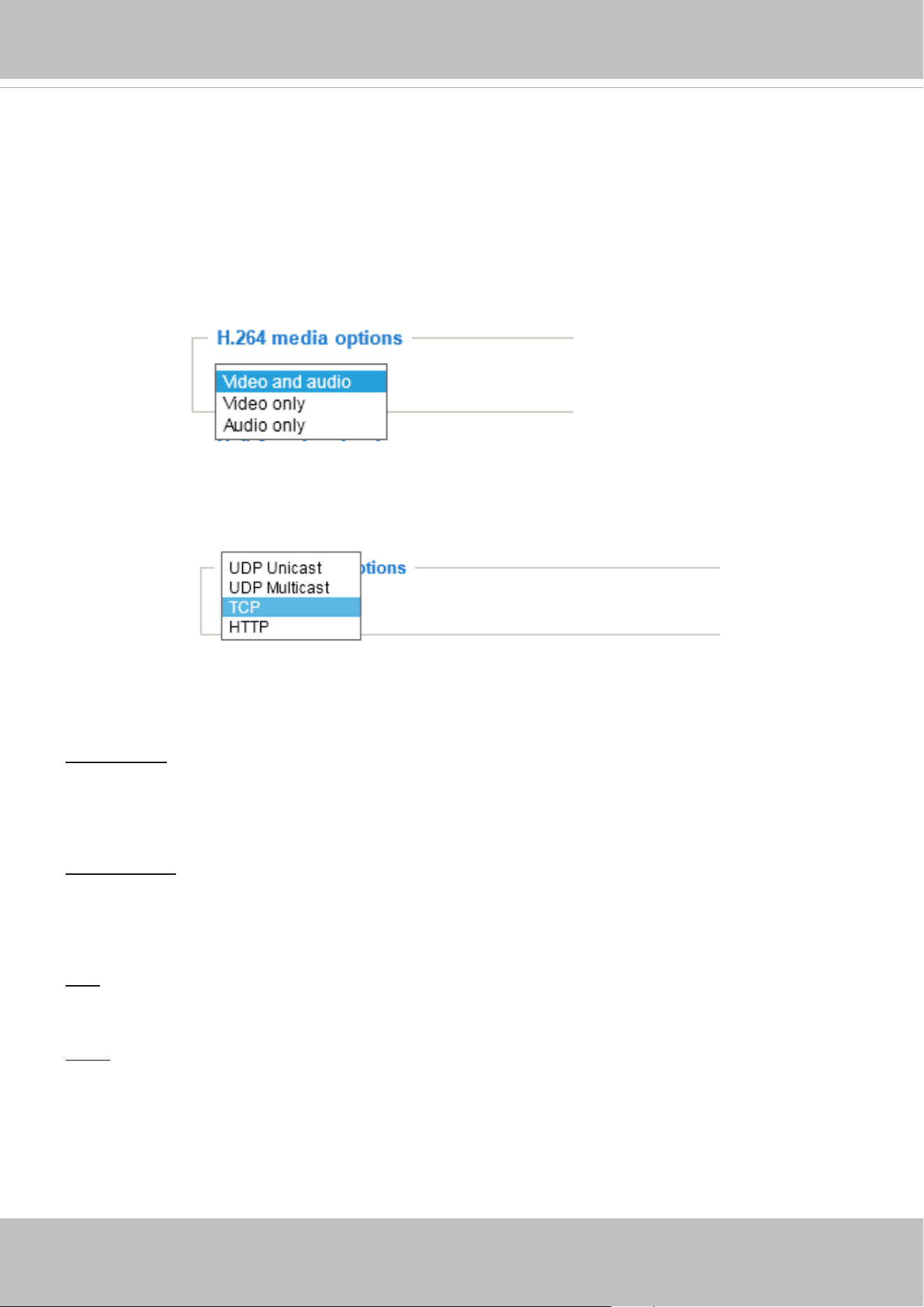
H.264 Media Options
Select to stream video or audio data or both. This is enabled only when the video mode is set to H.264.
H.264 Protocol Options
Depending on your network environment, there are four options with the transmission protocols with
H.264 streaming:
UDP unicast: This protocol allows for more real-time audio and video streams. However, network
packets may be lost due to network burst trafc and images may be broken. Activate UDP connection
when occasions require time-sensitive responses and the video quality is less important. Note that each
unicast client connecting to the server takes up additional bandwidth and the Network Camera allows up
to ten simultaneous accesses.
UDP multicast: This protocol allows multicast-enabled routers to forward network packets to all clients
requesting streaming media. This helps to reduce the network transmission load of the Network Camera
while serving multiple clients at the same time. Note that to utilize this feature, the Network Camera must
be configured to enable multicast streaming at the same time. For more information, please refer to
RTSP Streaming on page 77.
TCP: This protocol guarantees the complete delivery of streaming data and thus provides better video
quality. The downside of this protocol is that its real-time effect is not as good as that of using the UDP
protocol.
HTTP: This protocol allows the same quality as TCP protocol without needing to open specic ports for
streaming under some network environments. Users behind a rewall can utilize this protocol to allow
camera’s streaming data to pass through.
VIVOTEK
User's Manual - 37
MP4 Saving Options
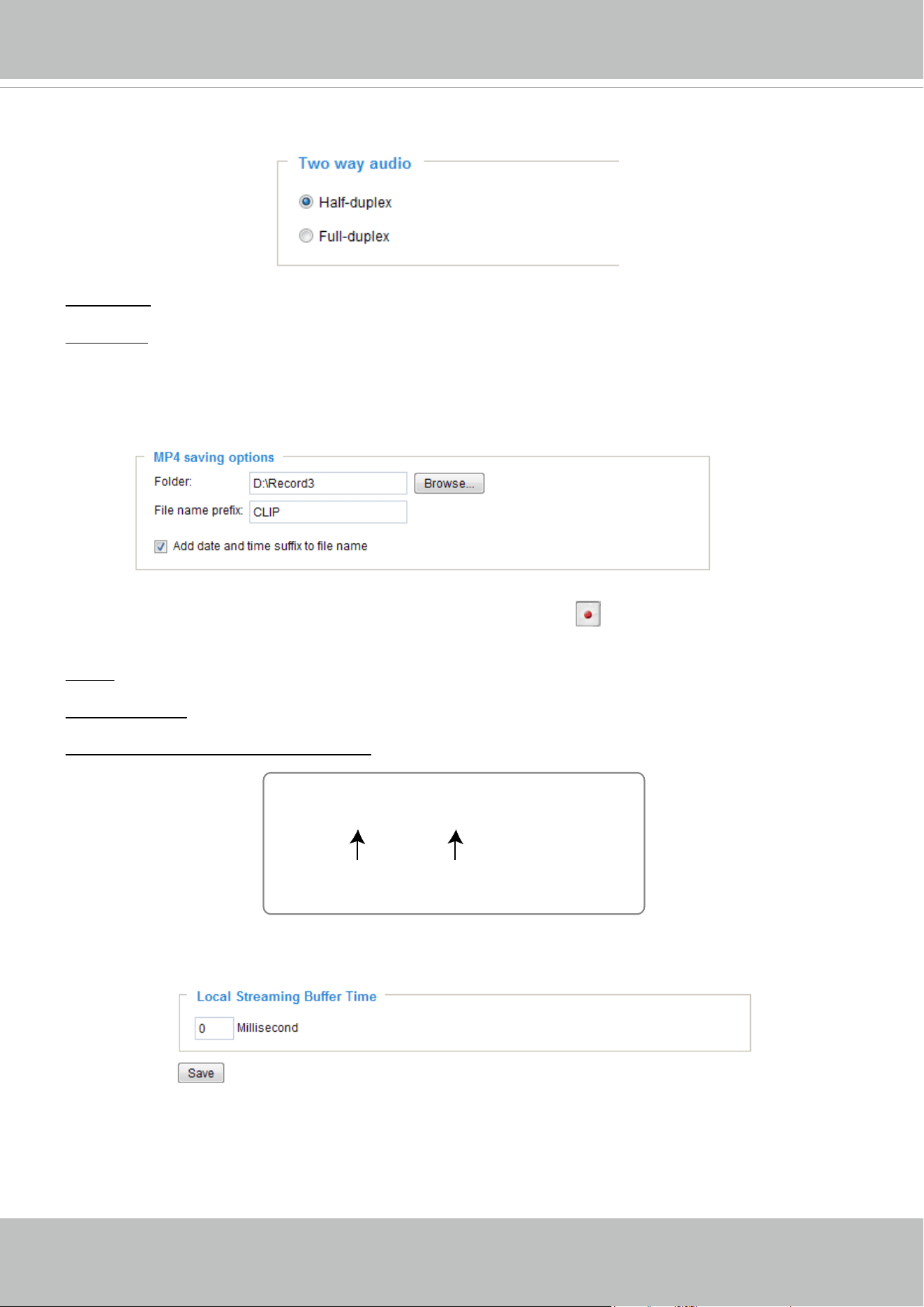
Users can record live video as they are watching it by clicking the “Start MP4 Recording” button on
the main page. Here, you can specify the storage destination and le name.
Folder: Specify a storage destination for the recorded video les.
File name prex: Enter the text that will be appended to the front of the video le name.
Add date and time sufx to the le name: Select this option to append the date and time to the end of the
le name.
Local streaming buffer time
Due to possible occurrences of unsteady network transmission, live streaming may lag and not be very
smoothly. If you enable this option, the live streaming will be stored on the client PC’s cache memory
for a few seconds before being played on the client computer’s live view window. This helps produce
a smoothlier live streaming. If you enter a vlue of 3,000 milliseconds, the streaming will delay for 3
seconds.
CLIP_20110328-180853
Date and time suffix
The format is: YYYYMMDD_HHMMSS
File name prefix
Two way audio
Half duplex: Audio is transmitted from one direction at a time, e.g., from a PC holding a web console with
the camera.
Full duplex: Audio is transmitted in both directions simultaneously.

VIVOTEK
38 - User's Manual
Joystick settings
Enable Joystick
Connect a joystick to a USB port on your management computer. Supported by the plug-in (Microsoft’s
DirectX), once the plug-in for the web console is loaded, it will automatically detect if there is any joystick
on the computer. The joystick should work properly without installing any other driver or software.
Then you can begin to congure the joystick settings of connected devices. Please follow the instructions
below to enable joystick settings.
1. Select a detected joystick, if there are multiple, from the Selected joystick menu. If your joystick is not
detected, if may be defective.
2. Click Calibrate or Congure buttons to congure the joystick-related settings.
• If you want to assign Preset actions to your joystick, the preset locations should be configured in
advance in the Conguration > PTZ page.
• If your joystick is not working properly, it may need to be calibrated. Click the Calibrate button to open
the Game Controllers window located in Microsoft Windows control panel and follow the instructions for
trouble shooting.
NOTE:
• The joystick will appear in the Game Controllers list in the Windows Control panel. If you want to check
out for your devices, go to the following page: Start -> Control Panel -> Game Controllers.
VIVOTEK
User's Manual - 39
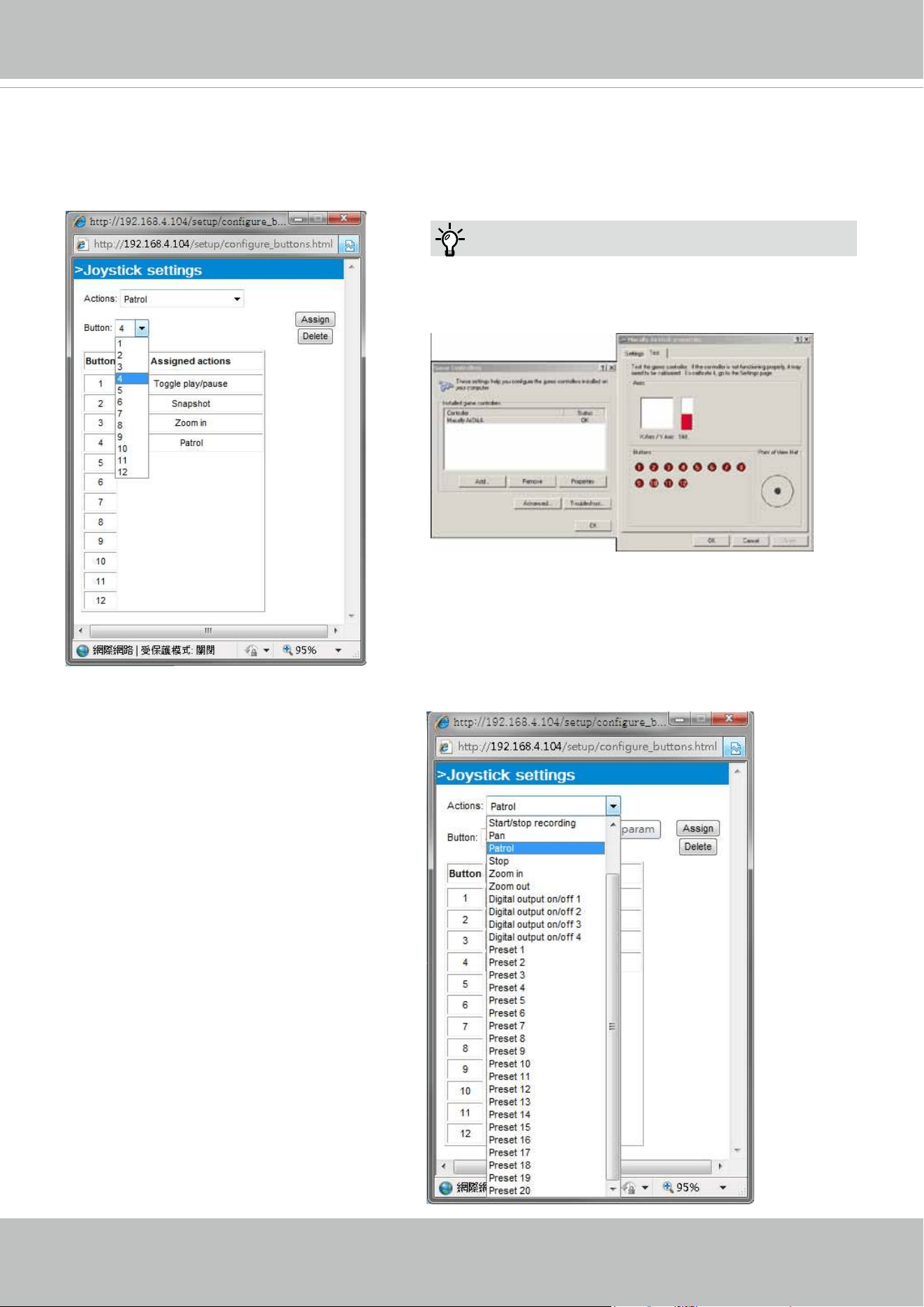
Buttons Conguration
Click the Configure Buttons button, a window will prompt as shown below. Please follow the steps
below to congure your joystick buttons:
1. Select a button number from the Button # pull-down menu.
2. Select a corresponding action, such as Patrol or Preset#.
If you are not sure of the locations of each button, use
the Properties window in the Game Controllers utility.
Tips
3.
Click the Assign button to assign an
action to the button. You can delete an
association by selecting a button number,
and then click the Delete button.
Repeat the process until you are done
with the configuration of all preferred
actions.
The buttons you dene should appear on
the button list accordingly.
4. Please remember to c
lick the Save
button on the Client settings page to
preserve your settings.
VIVOTEK
40 - User's Manual
Conguration
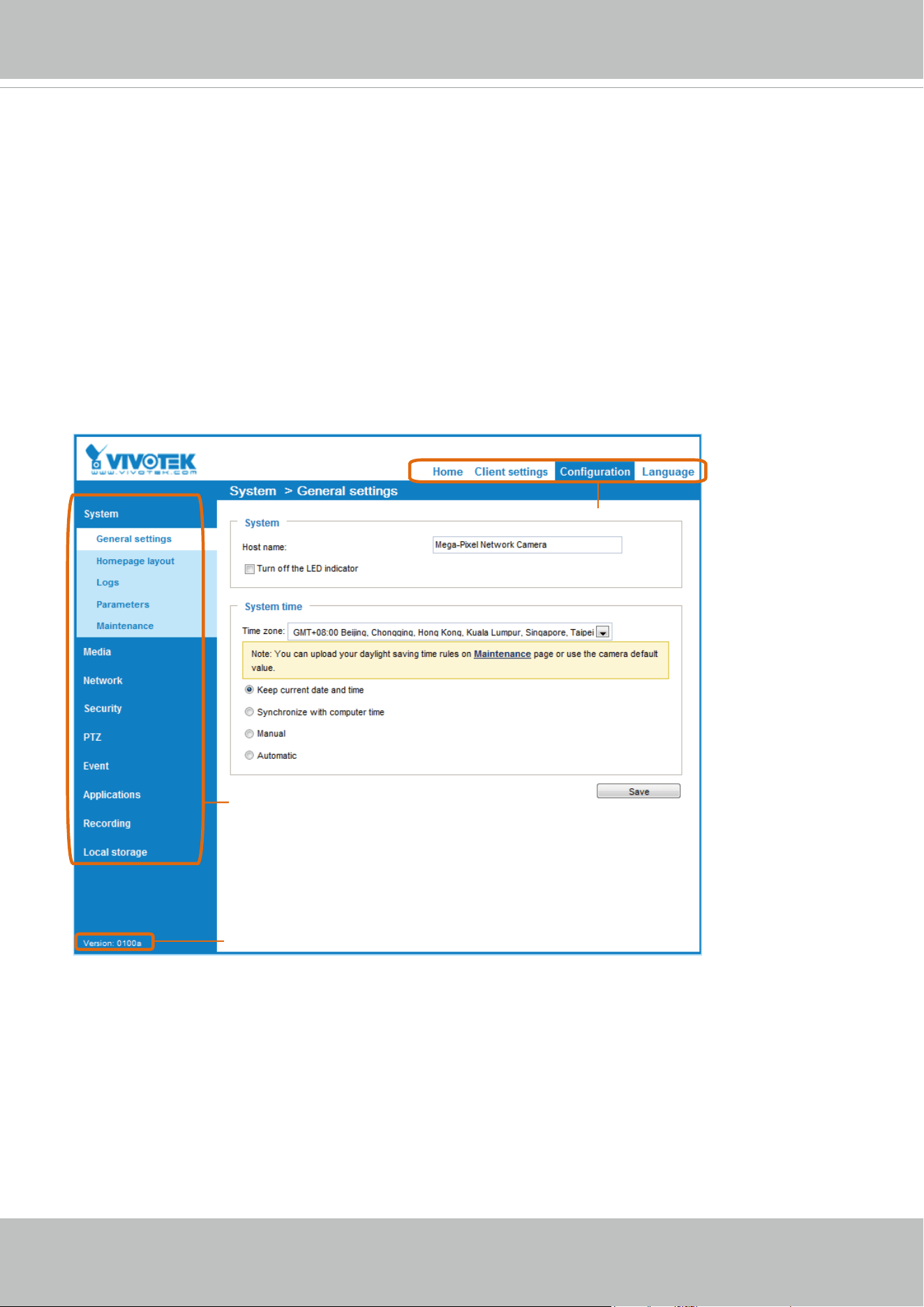
Click Configuration on the main page to enter the camera setting pages. Note that only
Administrators can access the conguration page.
VIVOTEK provides an easy-to-use user interface that helps you set up your network camera
with minimal effort. In order to simplify the user interface, detailed information will be hidden
unless you click on the function item. When you click on the first sub-item, the detailed
information for the rst sub-item will be displayed; when you click on the second sub-item, the
detailed information for the second sub-item will be displayed and that of the rst sub-item will
be hidden.
The following is the interface of the main page:
Configuration List
Firmware Version
Navigation Area
Each function on the conguration list will be explained in the following sections.
The Navigation Area provides access to all different views from the Home page (for live viewing),
Conguration page, and multi-language selection.

VIVOTEK
User's Manual - 41
System > General settings
This section explains how to congure the basic settings for the Network Camera, such as the
host name and system time. It is composed of the following two columns: System and System
Time.
System
Host name: Enter a desired name for the Network Camera. The name will be displayed at the top center
of the main page.
Turn off the LED indicator: Click to disable the onboard LEDs.
System time
Time zone : Select the appropriate time zone from the list. If you want to upload Daylight Savings Time
rules, please refer to System > Maintenance > Import/ Export les on page 48 for details.
Keep current date and time: Select this option to preserve the current date and time of the Network
Camera. The Network Camera’s internal real-time clock maintains the date and time even when the
power of the system is turned off.
Synchronize with computer time: Select this option to synchronize the date and time of the Network
Camera with the local computer. The read-only date and time of the PC is displayed as updated.
Manual: The administrator can enter the date and time manually. Note that the date and time format are
[yyyy/mm/dd] and [hh:mm:ss].
Automatic: The Network Time Protocol is a protocol which synchronizes computer clocks by periodically
querying an NTP Server.
NTP server: Assign the IP address or domain name of the time-server. Leaving the text box blank
connects the Network Camera to the default time servers.
Update interval: Select to update the time using the NTP server on an hourly, daily, weekly, or monthly
basis.
When nished with the settings on this page, click Save at the bottom of the page to enable the settings.
VIVOTEK
42 - User's Manual
System > Homepage layout
This section explains how to set up your own customized homepage layout.
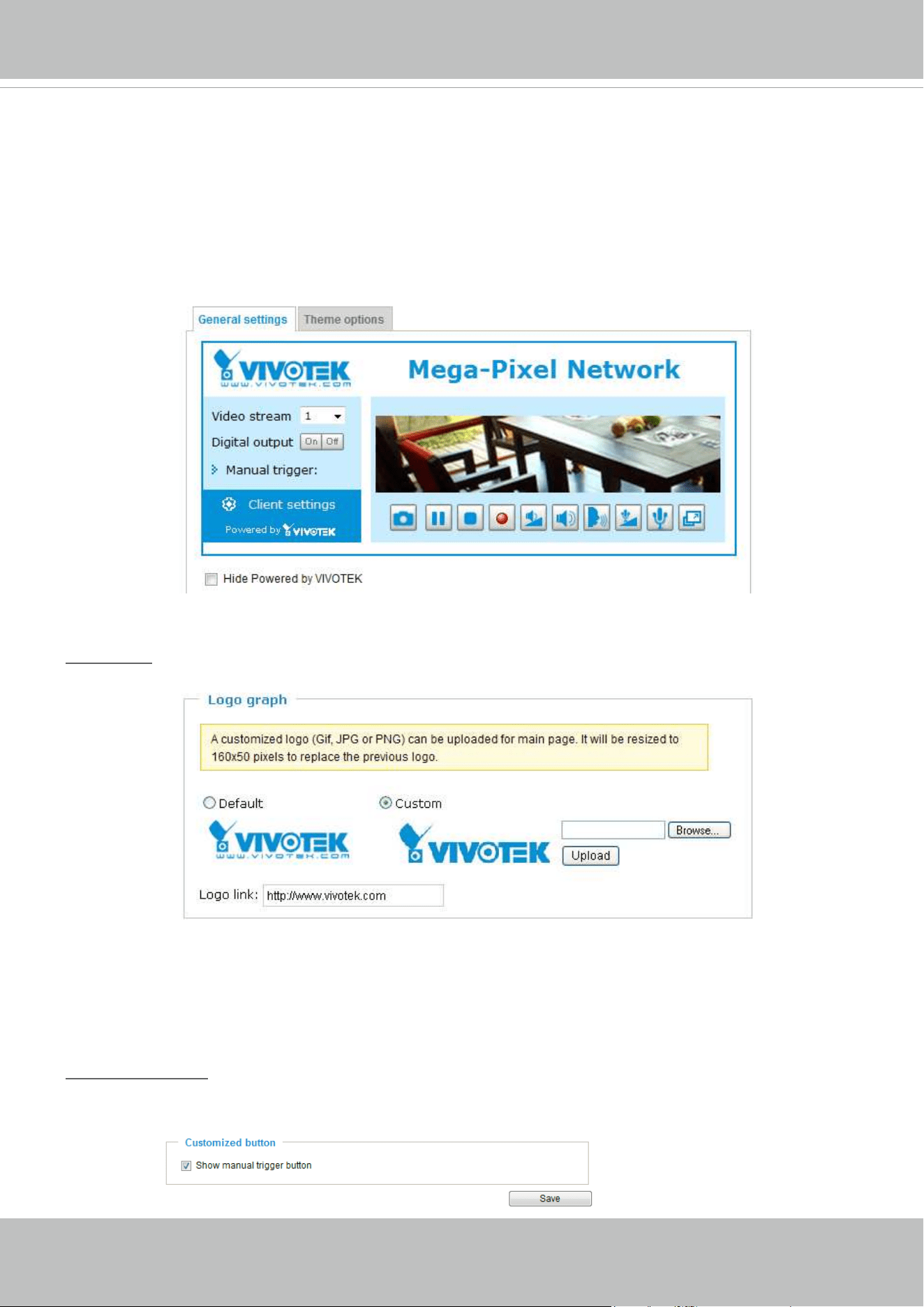
General settings
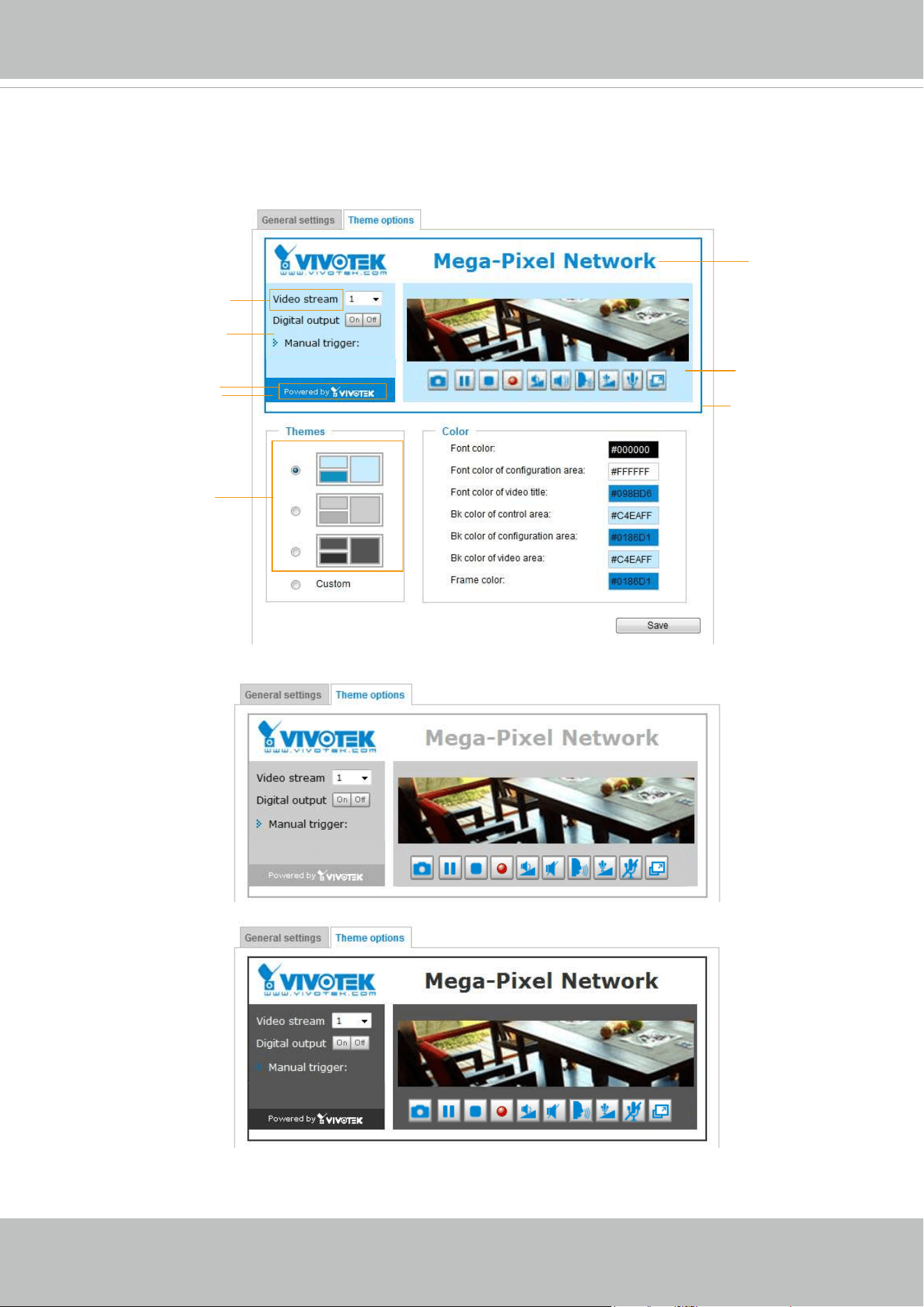
This column shows the settings of your hompage layout. You can manually select the background and
font colors in Theme Options (the second tab on this page). The settings will be displayed automatically
in this Preview eld. The following shows the homepage using the default settings:
■ Hide Powered by VIVOTEK: If you check this item, it will be removed from the homepage.
Logo graph
Here you can change the logo at the top of your homepage.
Follow the steps below to upload a new logo:
1. Click Custom and the Browse eld will appear.
2. Select a logo from your les.
3. Click Upload to replace the existing logo with a new one.
4. Enter a website link if necessary.
5. Click Save to enable the settings.
Customized button
If you want to hide the manual trigger buttons on the homepage, please uncheck this item. This item is
selected by default.
VIVOTEK
User's Manual - 43
Theme Options
Here you can change the color of your homepage layout. There are three types of preset patterns for you
to choose from. The new layout will simultaneously appear in the Preview led. Click Save to enable the
settings.
Font Color of the
Video Title
Background Color of
the Video Area
Frame Color
Font Color
Background Color of the
Control Area
Font Color of the
Configuration Area
Background Color of the
Configuration Area
Preset patterns
VIVOTEK
44 - User's Manual
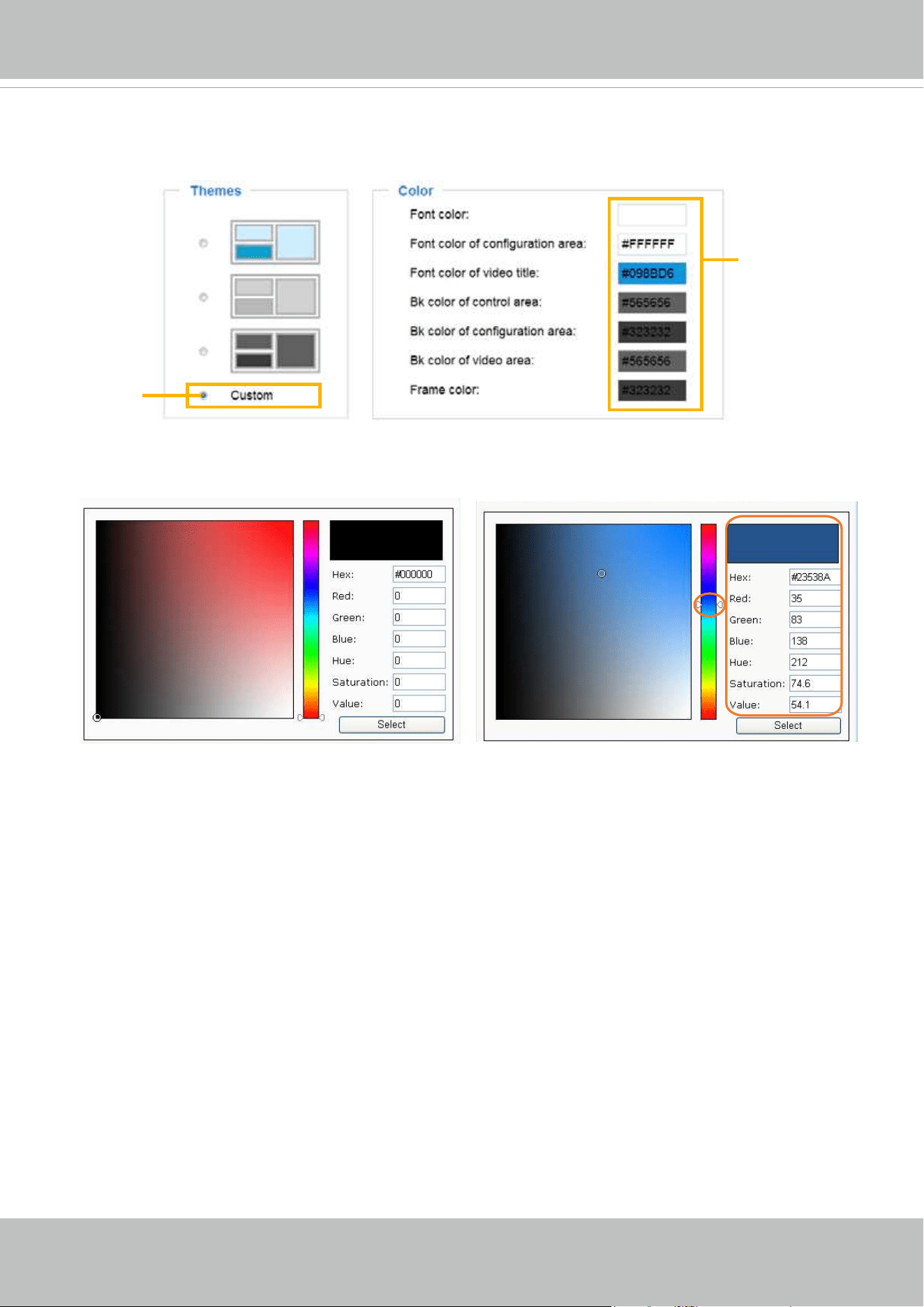
■ Follow the steps below to set up a custom homepage:
1. Click Custom on the left column.
2. Click to select a color on on the right column.
3. The palette window will pop up as shown below.
4. Drag the slider bar and click on the left square to select a desired color.
5. The selected color will be displayed in the corresponding elds and in the Preview column.
6. Click Save to enable the settings.
1
2
3
4
Color Selector
Custom
Pattern
VIVOTEK
User's Manual - 45
System > Logs
This section explains how to congure the Network Camera to backup system log to a remote
server.
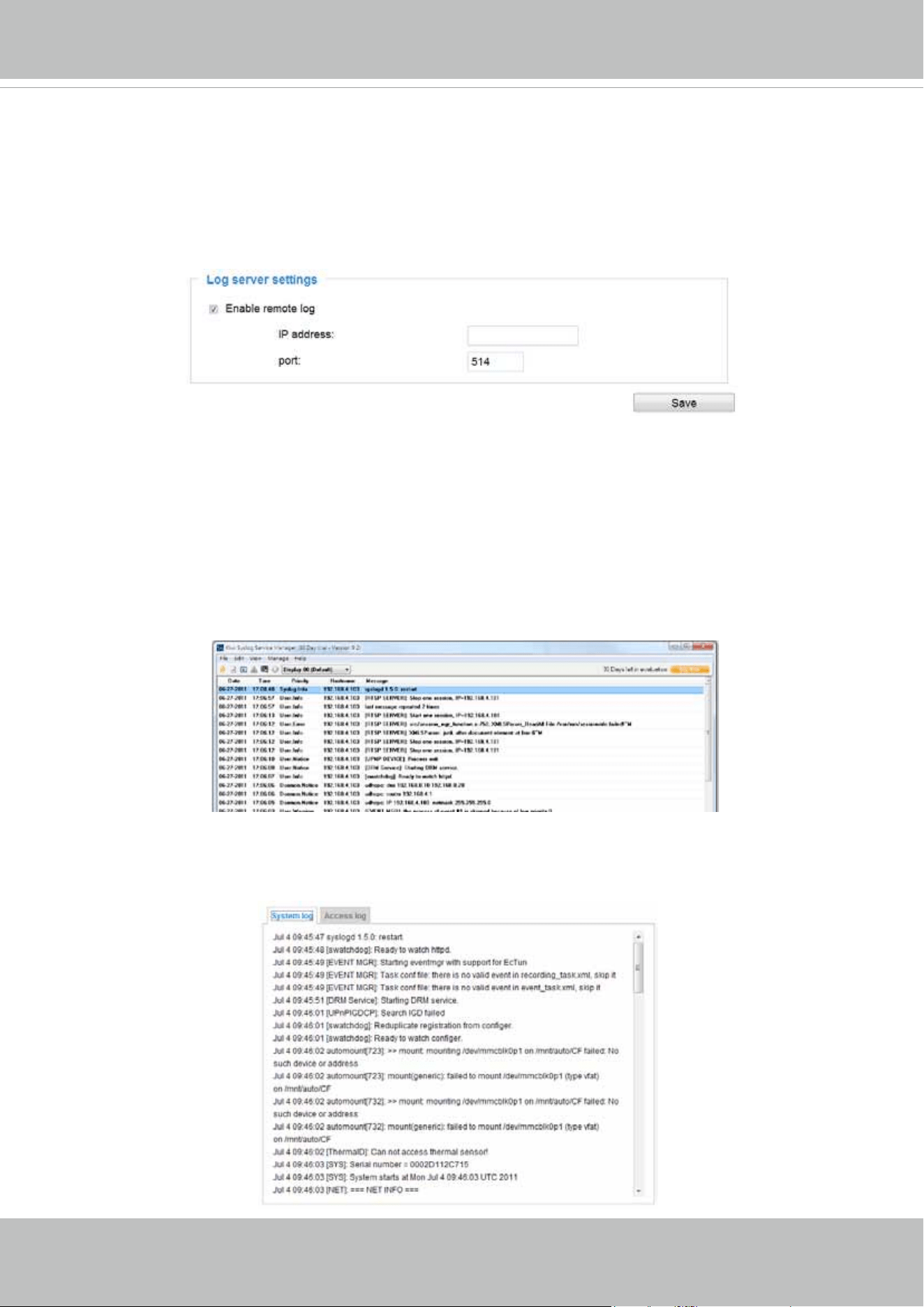
Log server settings
Follow the steps below to set up the remote log:
1. Select Enable remote log.
2. In the IP address text box, enter the IP address of the remote server.
2. In the port text box, enter the port number of the remote server.
3. When completed, click Save to enable the setting.
You can congure the Network Camera to send the system log le to a remote server as a log backup.
Before utilizing this feature, it is suggested that the user install a log-recording tool to receive system log
messages from the Network Camera. An example is Kiwi Syslog Daemon. Visit
http://www.kiwisyslog.
com/kiwi-syslog-daemon-overview/
.
System log
This column displays the system log in chronological order. The system log is stored in the Network
Camera’s buffer and dated events will be overwritten when the number of events reaches a limit.

VIVOTEK
46 - User's Manual
Access log
Access log displays the access time and IP address of all viewers (including operators and
administrators) in a chronological order. The access log is stored in the Network Camera’s buffer and
older events will be overwritten when the number of events reaches a limit.
System > Parameters
The View Parameters page lists the entire system’s parameters in an alphabetical order. If you
need technical assistance, use a text-editor program to copy and save the parameters listed on
this page. Send the parameter text le to VIVOTEK’s technical support.
VIVOTEK
User's Manual - 47
System > Maintenance
This chapter explains how to restore the Network Camera to factory default, upgrade rmware
version, etc.
General settings > Upgrade rmware
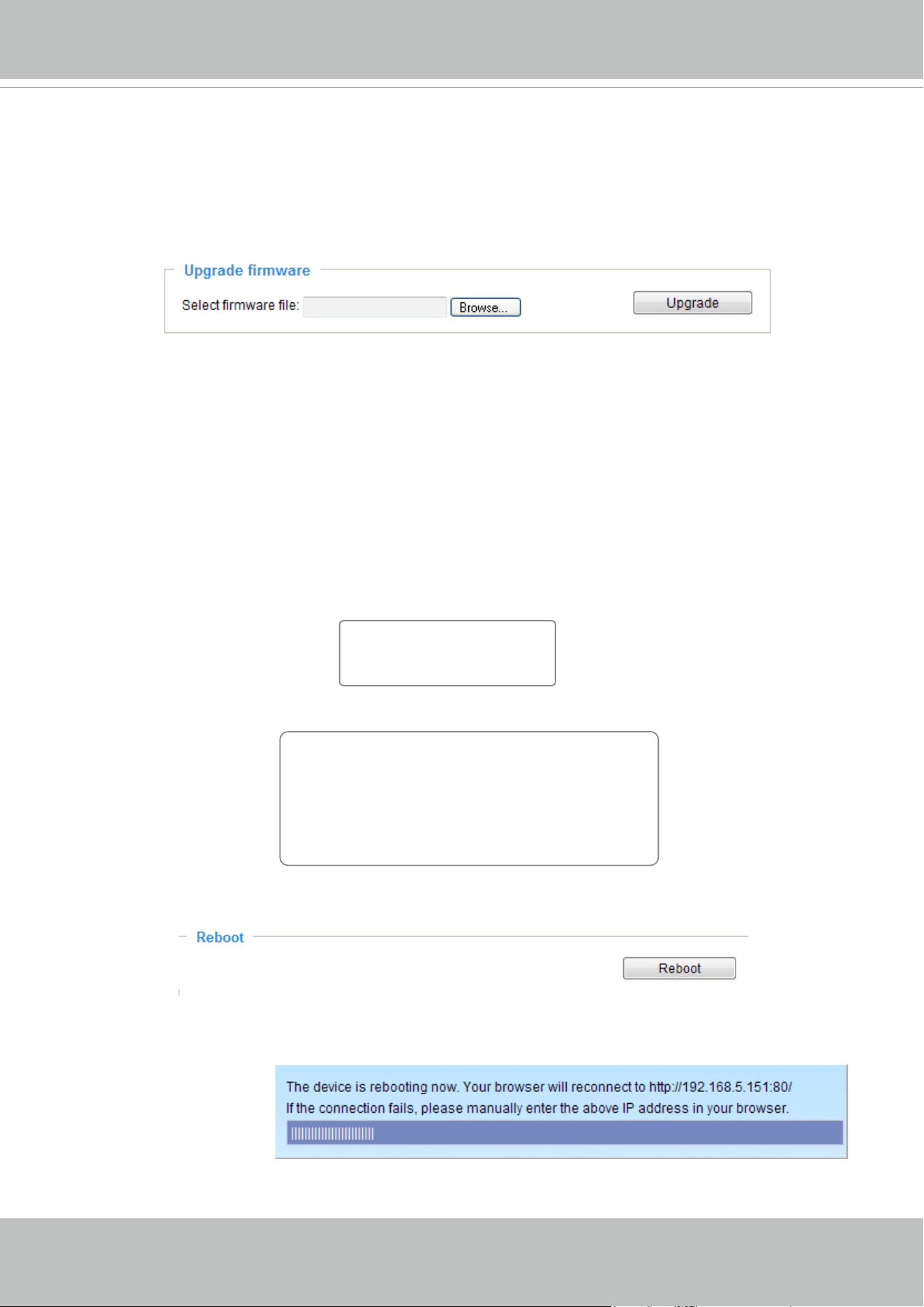
This feature allows you to upgrade the firmware of your Network Camera. It takes a few minutes to
complete the process.
Note: Do not power off the Network Camera during the upgrade!
Follow the steps below to upgrade the rmware:
1. Download the latest rmware le from the VIVOTEK website. The le is in .pkg le format.
2. Click Browse… and specify the rmware le.
3. Click Upgrade. The Network Camera starts to upgrade and will reboot automatically when the upgrade
completes.
If the upgrade is successful, you will see “Reboot system now!! This connection will close”. After that, re-
access the Network Camera.
The following message is displayed when the upgrade has succeeded.
The following message is displayed when you have selected an incorrect rmware le.
General settings > Reboot
This feature allows you to reboot the Network Camera, which takes about one minute to complete. When
completed, the live video page will be displayed in your browser. The following message will be displayed
during the reboot process.
If the connection fails after rebooting, manually enter the IP address of the Network Camera in the
address eld to resume the connection.
Starting firmware upgrade...
Do not power down the server during the upgrade.
The server will restart automatically after the upgrade is
completed.
This will take about 1 - 5 minutes.
Wrong PKG file format
Unpack fail
Reboot system now!!
This connection will close.
VIVOTEK
48 - User's Manual
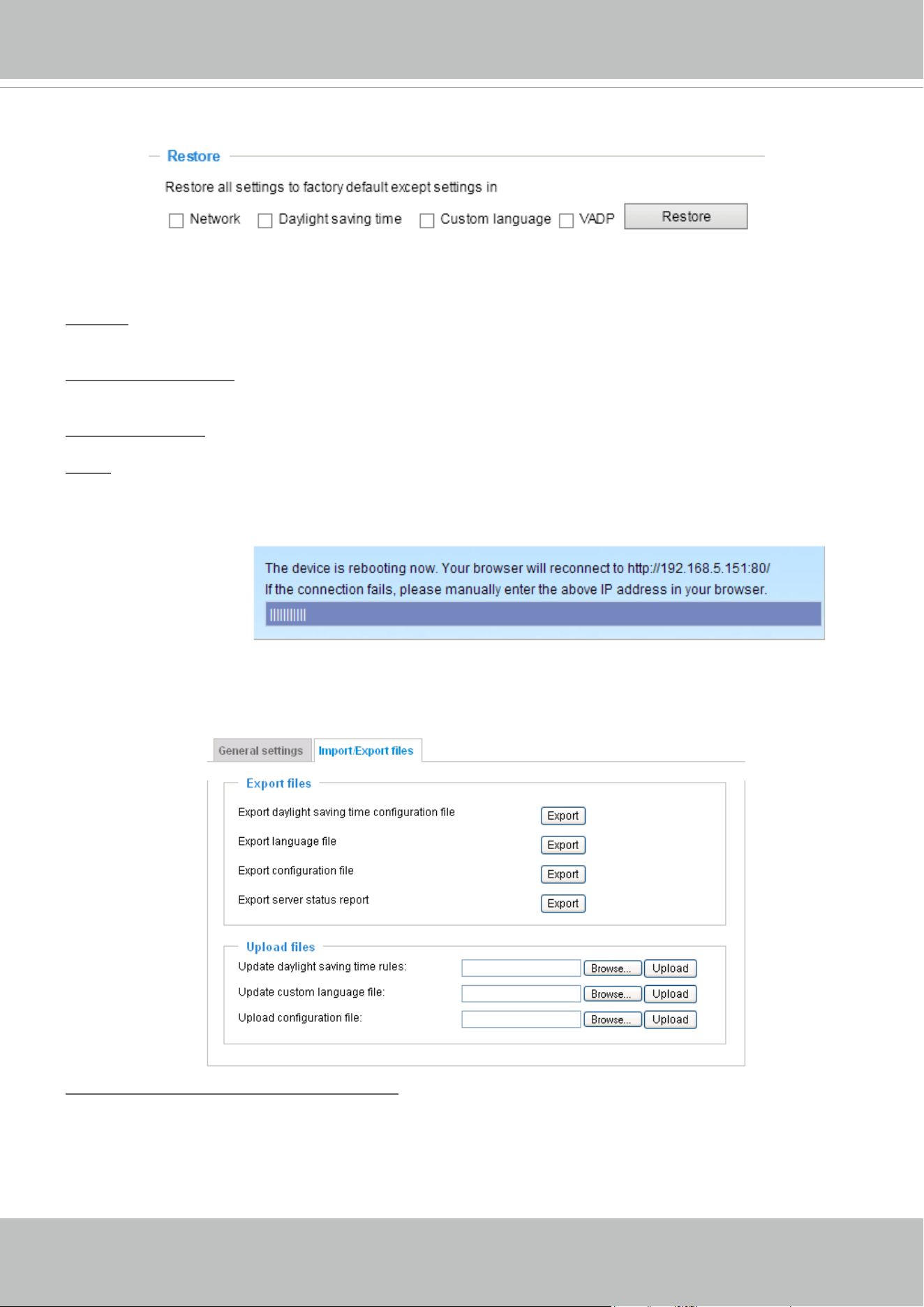
General settings > Restore
This feature allows you to restore the Network Camera to factory default settings.
Network: Select this option to retain the Network Type settings (please refer to Network Type on page
68).
Daylight Saving Time: Select this option to retain the Daylight Saving Time settings (please refer to
Import/Export les below on this page).
Custom Language: Select this option to retain the Custom Language settings.
VADP: Retain the VADP modules (3rd-party software stored on the SD card) and related settings.
If none of the options is selected, all settings will be restored to factory default. The following message is
displayed during the restoring process.
Import/Export les
This feature allows you to Export / Update daylight saving time rules, custom language file, and
conguration le.
Export daylight saving time conguration le: Click to set the start and end time of DST.
Follow the steps below to export:
1. In the Export les column, click Export to export the daylight saving time conguration le from the
Network Camera.
2. A le download dialog will pop up as shown below. Click Open to review the XML le or click Save to
store the le for editing.

VIVOTEK
User's Manual - 49
3. Open the le with Microsoft
®
Notepad and locate your time zone; set the start and end time of DST.
When completed, save the le.
In the example below, DST begins each year at 2:00 a.m. on the second Sunday in March and ends at
2:00 a.m. on the rst Sunday in November.
Update daylight saving time rules: Click Browse… and specify the XML le to update.
If incorrect date and time are assigned, you will see the following warning message when uploading the
le to the Network Camera.
VIVOTEK
50 - User's Manual
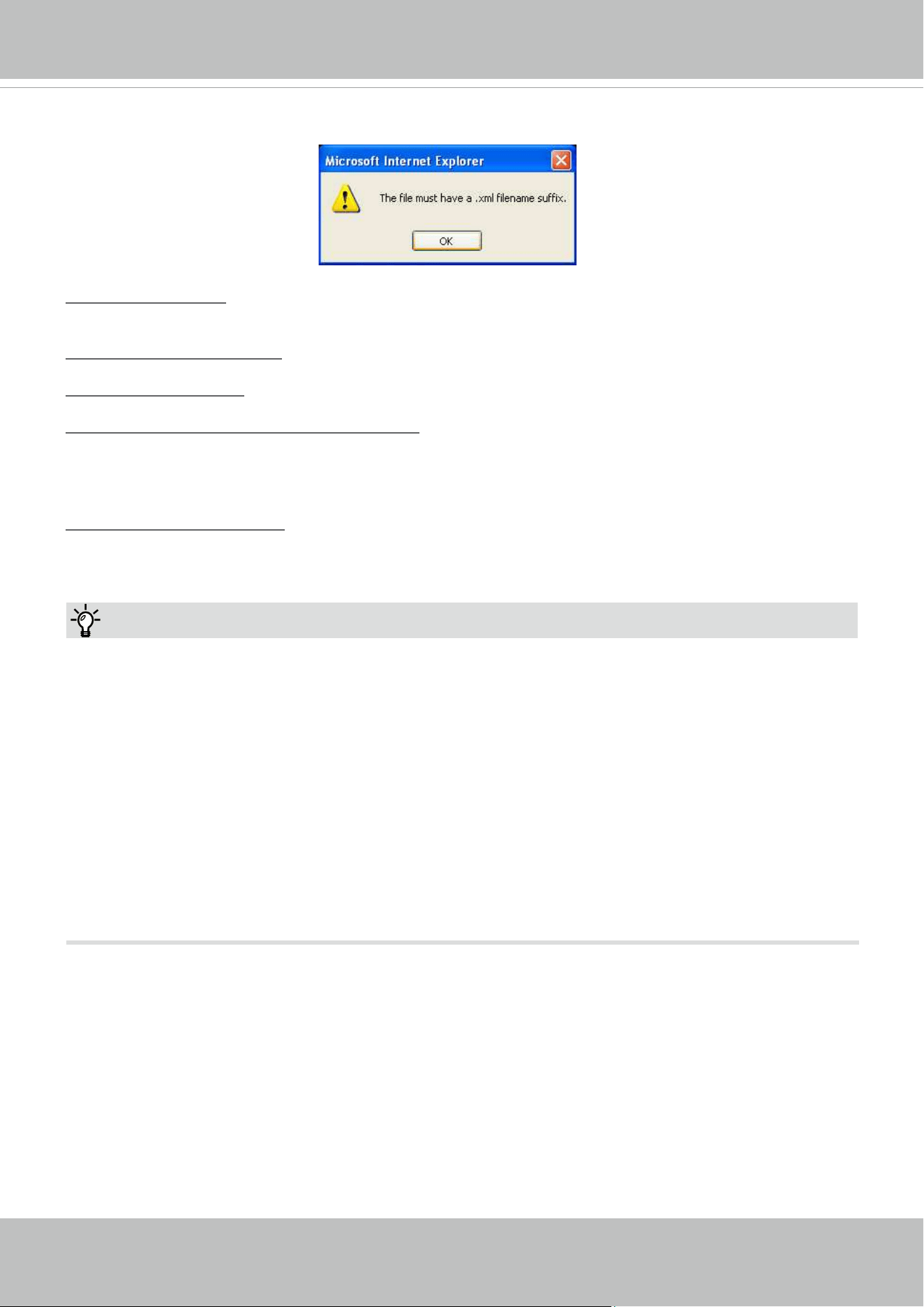
The following message is displayed when attempting to upload an incorrect le format.
Export language file: Click to export language strings. VIVOTEK provides nine languages: English,
Deutsch, Español, Français, Italiano,
日本語,
Português,
簡体中文
, and
繁體中文
.
Update custom language le: Click Browse… and specify your own custom language le to upload.
Export conguration le: Click to export all parameters for the device and user-dened scripts.
Export daylight saving time configuration file: Click Browse… to update a configuration file. Please
note that the model and firmware version of the device should be the same as the configuration file.
If you have set up a xed IP or other special settings for your device, it is not suggested to update a
conguration le.
Export server staus report: Click to export the current server status report, such as time, logs,
parameters, process status, memory status, le system status, network status, kernel message..., and so
on.
Tips:
• If a firmware upgrade is accidentally disrupted, say, by a power outage, you still have a last resort
method to restore normal operation. See the following for how to bring the camera back to work:
Applicable scenario:
(1) Power disconnected during rmware upgrade.
(2) Unknown reason causing abnormal LED status, and a Restore cannot recover normal working
condition.
You can use the following methods to activate the camera with its backup rmware:
(1) Press and hold down the reset button for at least one minute.
(2) Power on the camera until the Red LED blinks rapidly.
(3) After boot up, the rmware should return to the previous version before the camera hanged. (The
procedure should take 5 to 10 minutes, longer than the normal boot-up process). When tthis
process is completed, the LED status should return to normal.
VIVOTEK
User's Manual - 51
Media > Image
This section explains how to configure the image settings of the Network Camera. It is
composed of the following tabbed windows: General settings, Image settings, Exposure, and
Privacy mask, and Pixel Calculator.
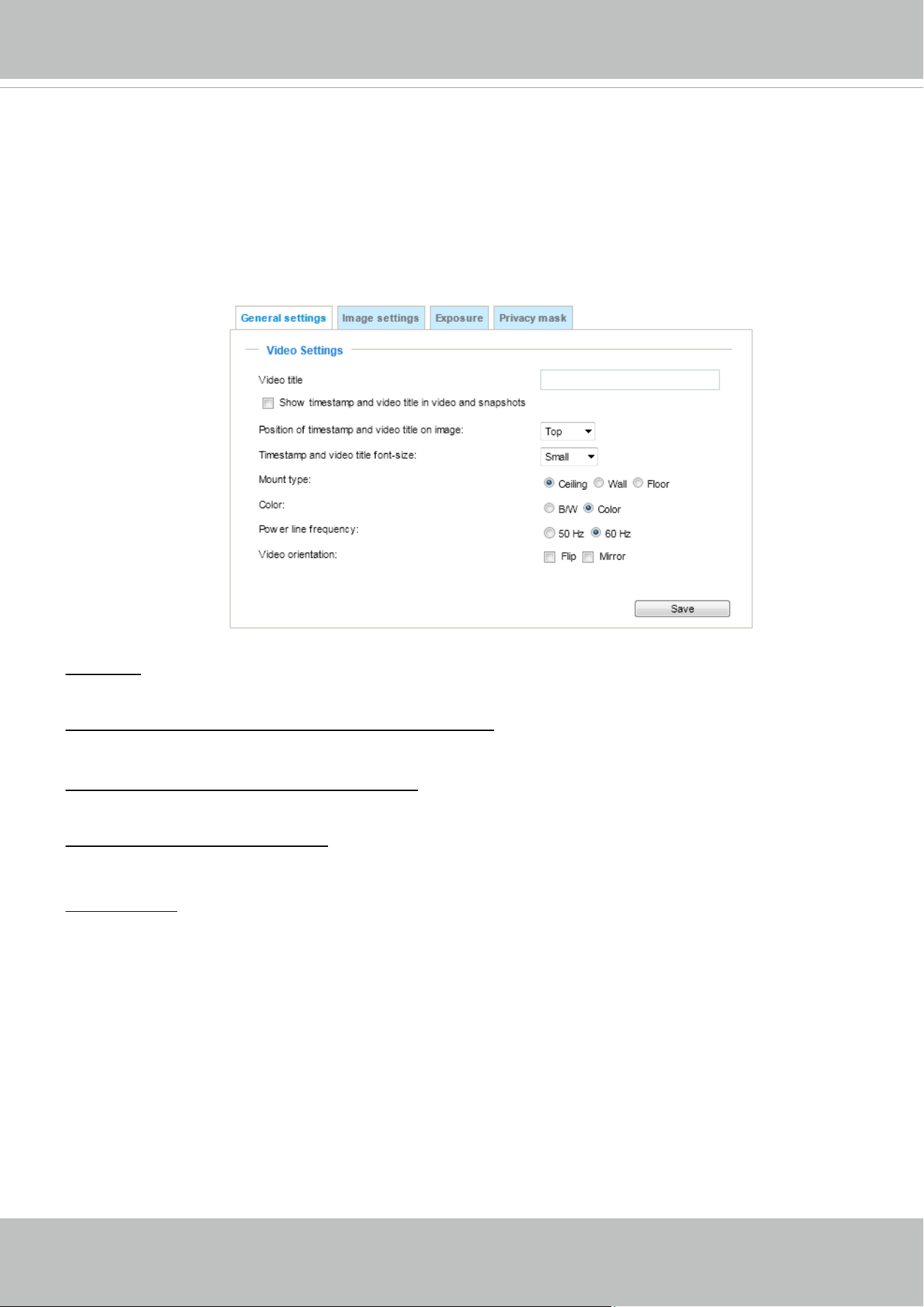
General settings
Video title: Enter a name that will be displayed on the title bar of the live video as well as the view cell on
the ST7501 and VAST recording software.
Show timestamp and video title in videos and snapshots: Enter a name that will be displayed on the title
bar of the live video as the picture shown below.
Position of timestamp and video title on image: Select to display time stamp and video title on the top or
at the bottom of the video stream.
Timestamp and video title font size: Select the font size for the time stamp and title.
Video font (.ttf): You can select a True Type font le for the display of textual messages on video.
VIVOTEK
52 - User's Manual
Color: Select to display color or black/white video streams.
Power line frequency: Set the power line frequency consistent with local utility settings to eliminate image
ickering associated with uorescent lights.
Video orientation: Flip - vertically reflect the display of the live video; Mirror - horizontally reflect the
display of the live video. Select both options if the Network Camera is installed upside-down (e.g., on the
ceiling) to correct the image orientation. Please note that the preset locations will be cleared after you
congure the ip/mirror option.
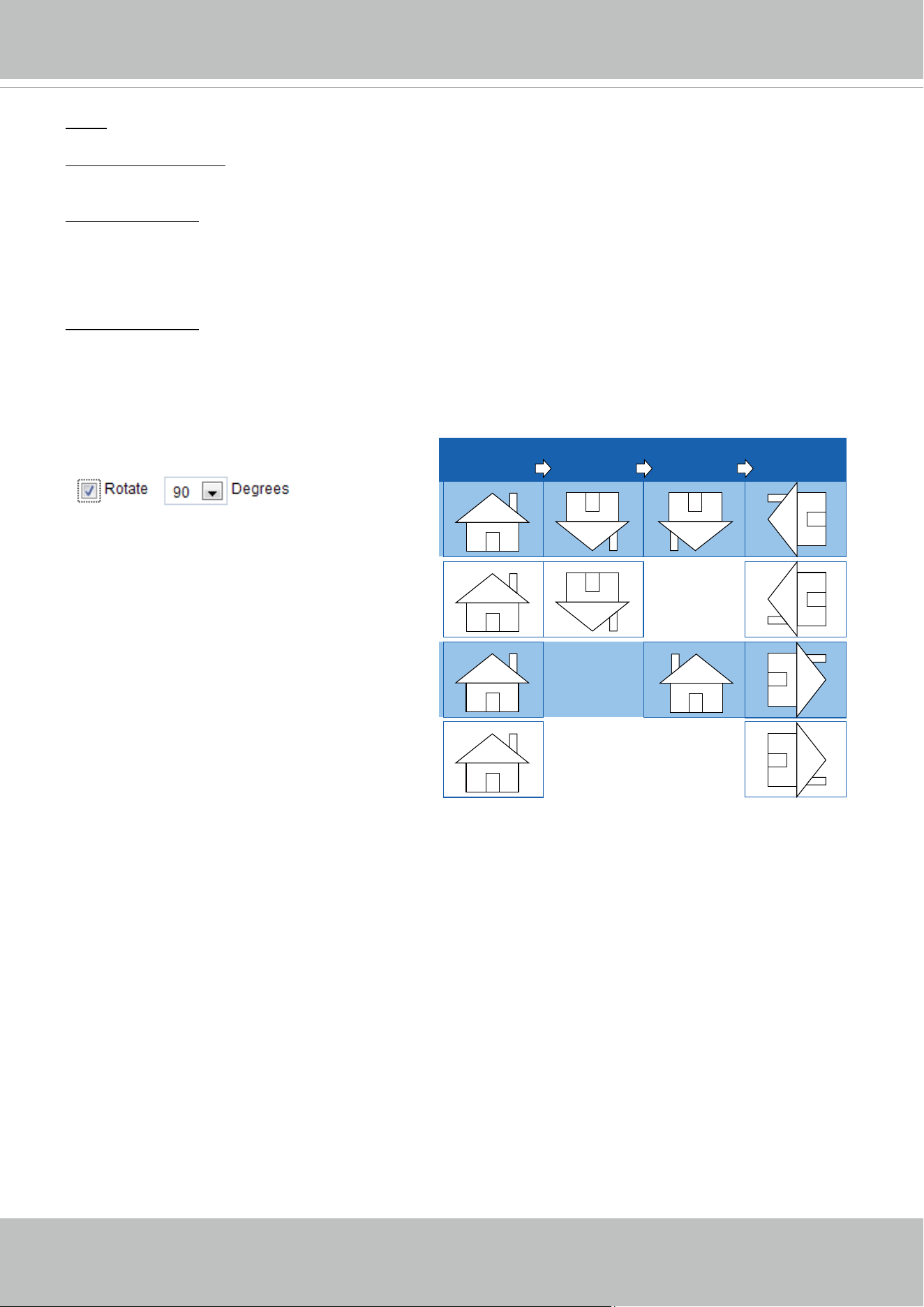
Rotate -
MirrorNormal Flip Rotate 90°
clockwise
The camera may be installed on a vertical, side-facing, or tilted surface in order to accommodate the
interior or exterior design of a building. The interior of a building can be shaped as a narrow rectangular
space, such as corridor. The conventional HD image, such as that of a 16:9 aspect ratio, will be
incongruous with its wide horizontal view. With video rotation, the camera can more readily cover the
eld of view on a tall and narrow scene.
The rotation here indicates clockwise
rotation. Rotation can be applied with
flip, mirror, and physical lens rotation
(see below) settings to adapt to different
mounting locations.
The gures in the illustration are shown in
a consecutive order.
Video orientation: Flip - vertically reflect the display of the live video; Mirror - horizontally reflect the
display of the live video. Select both options if the Network Camera is installed upside-down (e.g., on the
ceiling) to correct the image orientation. Please note that if you have preset locations, those locations will
be cleared after ip/mirror setting.
VIVOTEK
User's Manual - 53
Image settings
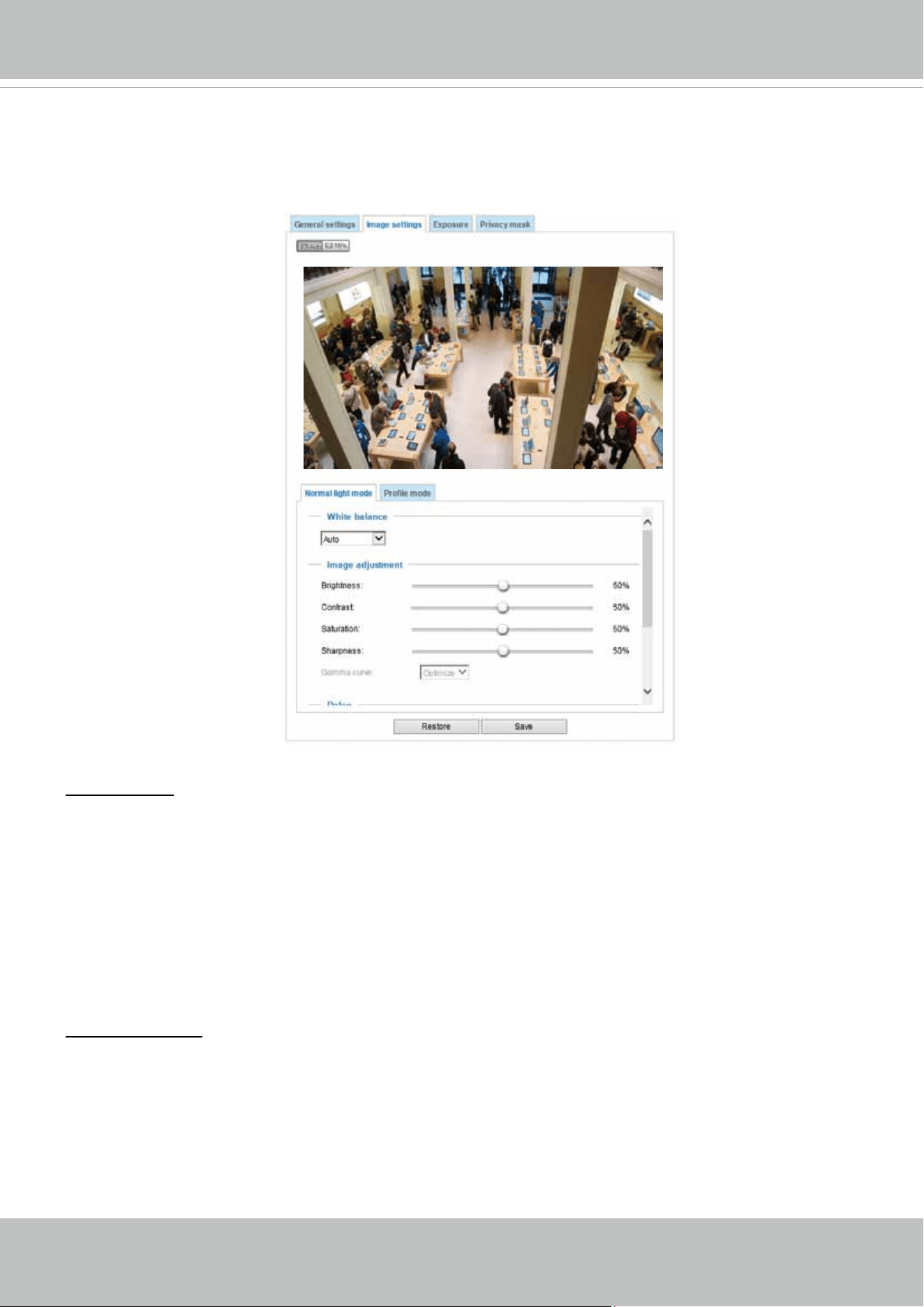
On this page, you can tune the White balance, Image adjustment and related parameters. You can
congure two sets of preferred settings: one for normal situations, the other for special situations, such
as a schedule mode.
White balance: Adjust the value for the best color temperature.
■ Auto: It will automatically adjust the color temperature of the light in response to different light sources.
You may follow the steps below to adjust the white balance to the best color temperature.
1. Set the White balance to Auto.
2. Place a sheet of white paper (or a color of a cool color temperature, such as blue) in front of the lens,
then allow the Network Camera to automatically adjust the color temperature.
3. Check the Fix current value to confirm the setting when the camera automatically measured and
adjusted the white balance.
■ Manual: This item allows users to manually input the R gain & B gain ratios.
Image Adjustment
■ Brightness: Adjust the image brightness level, which ranges from -5 to +5.
■ Contrast: Adjust the image contrast level, which ranges from -5 to +5.
■ Saturation: Adjust the image saturation level, which ranges from 0% to 100%. You can also select
Customize and manually enter a value.
VIVOTEK
54 - User's Manual
■ Sharpness:
Adjust the image sharpness level, which ranges from 0% to 100%.
■ Gamma curve:
Adjust the image sharpness level, which ranges from 0.45 to
1, from Detailed to
Contrast
. You may let rmware Optimize your display or select the Manual mode, and pull the slide bar
pointer to change the preferred level of Gamma correction towards higher contrast or towards the higher
luminance for detailed expression for both dark and lighted areas of an image.
This option is disabled when the WDR feature is enabled.
Defog: Defog helps improve the visibility quality of captured image in poor weather conditions such as
smog, fog, or smoke.
■ Noise reduction
■ Enable noise reduction: Check to enable noise reduction in order to reduce noises and flickers in
image. This applies to the onboard 3D Noise Reduction feature. Use the pull-down menu to adjust
the reduction strength. Note that applying this function to the video channel will consume system
computing power.
3D Noise Reduction is mostly applied in low-light conditions. When enabled in a low-light condition
with fast moving objects, trails of after-images may occur. You may then select a lower strength level
or disable the function.
Note that the Preview button has been cancelled, all changes made to image settings is directly shown
on screen. You can click Restore to recall the original settings without incorporating the changes. When
completed with the settings on this page, click Save to enable the setting. You can also click on the
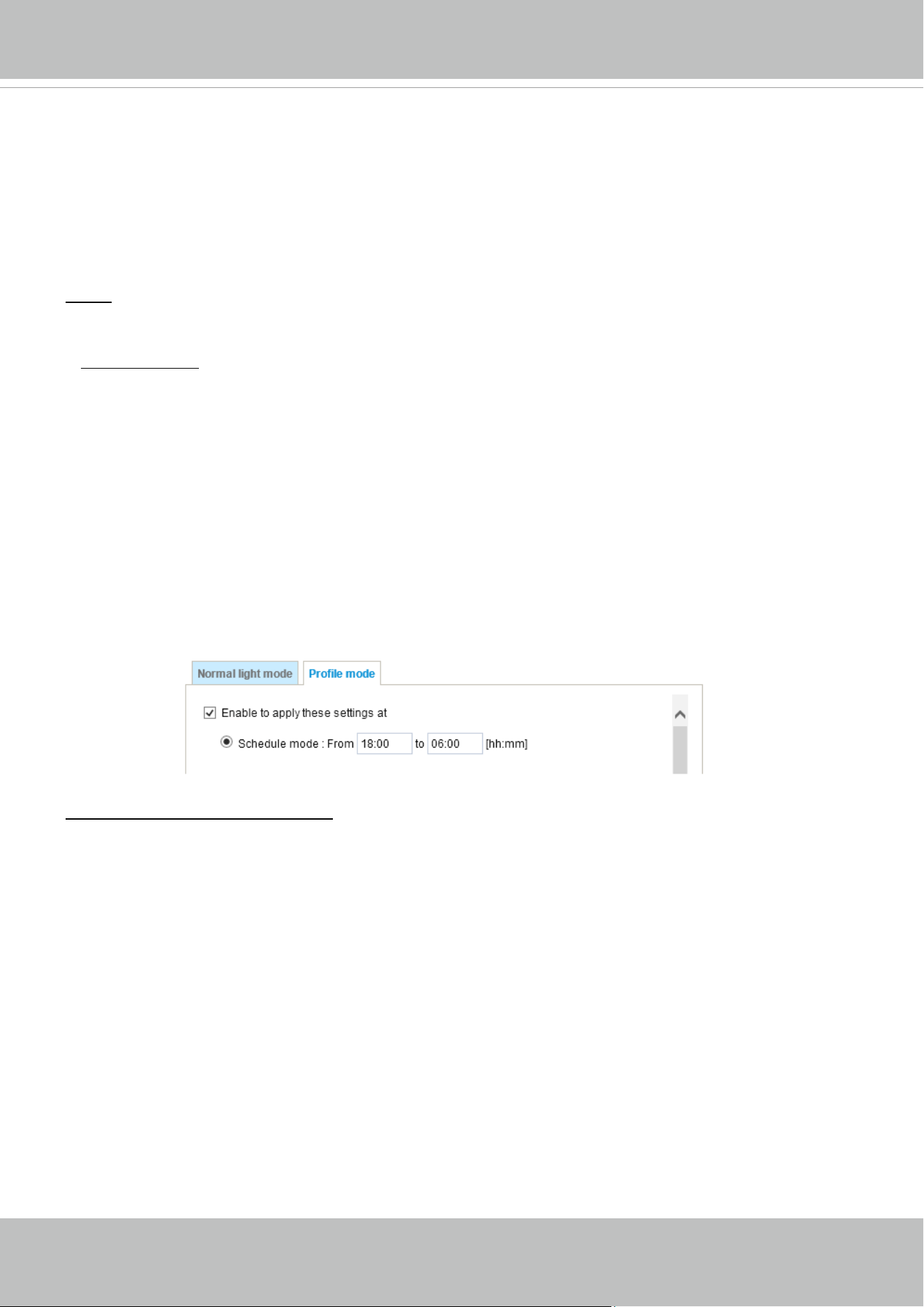
Prole mode to adjust all settings above in a tabbed window for special lighting conditions.
Enable to apply these settings at:
Select the mode this profile to apply to: Schedule mode. Please
manually enter a range of time if you choose Schedule mode. Then check Save to take effect.
VIVOTEK
User's Manual - 55
Exposure
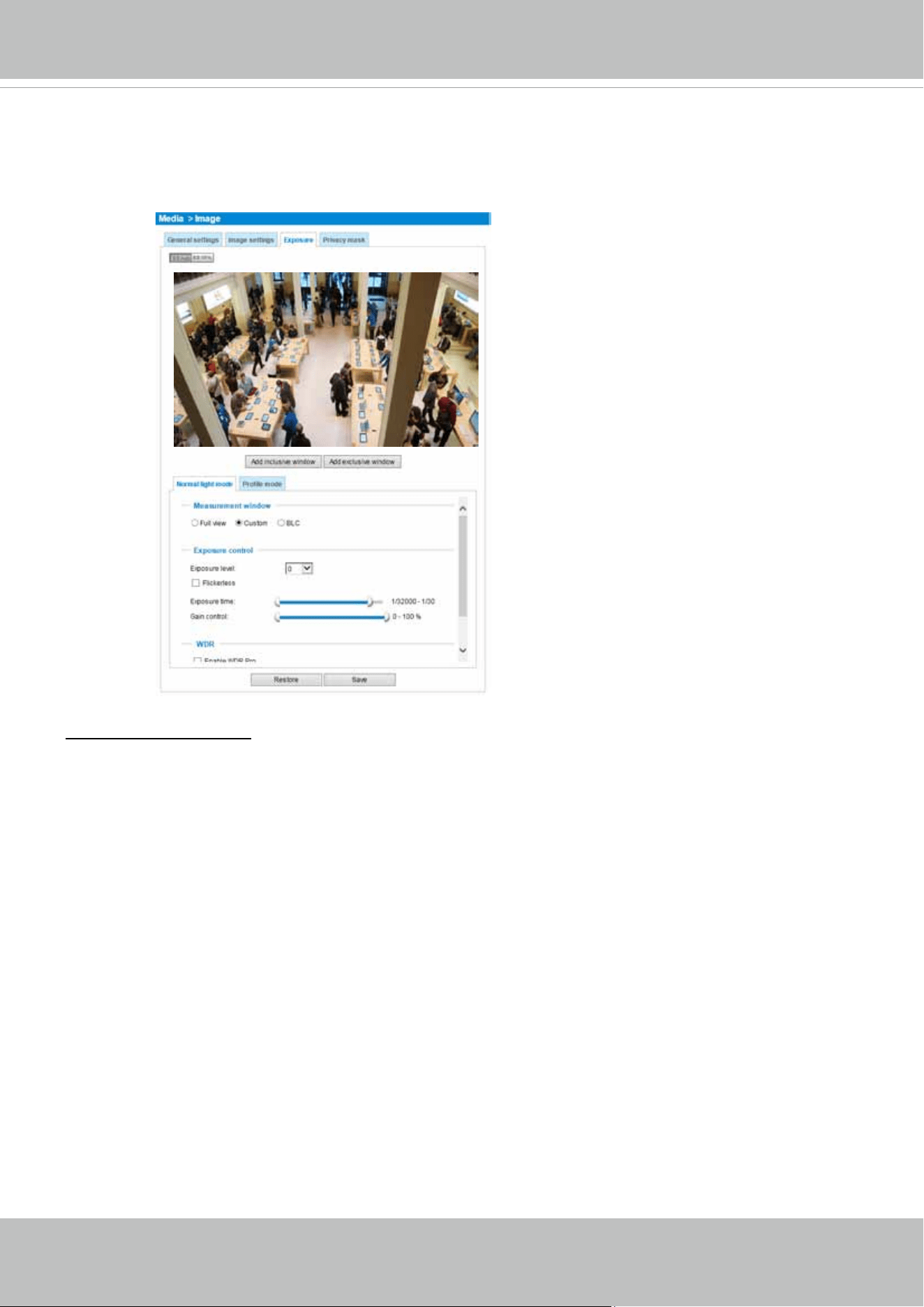
On this page, you can congure the Exposure measurement window, Exposure level, Exposure mode,
Exposure time, Gain control, and Day/Night mode settings.
M
easurement Window: This function allows users to set measurement window(s) for low light
compensation. For example, where low-light objects are posed against an extremely bright background.
You may want to exclude the bright sunlight shining through a building's corridor.
■ Full view: Calculate the full range of view and offer appropriate
light compensation.
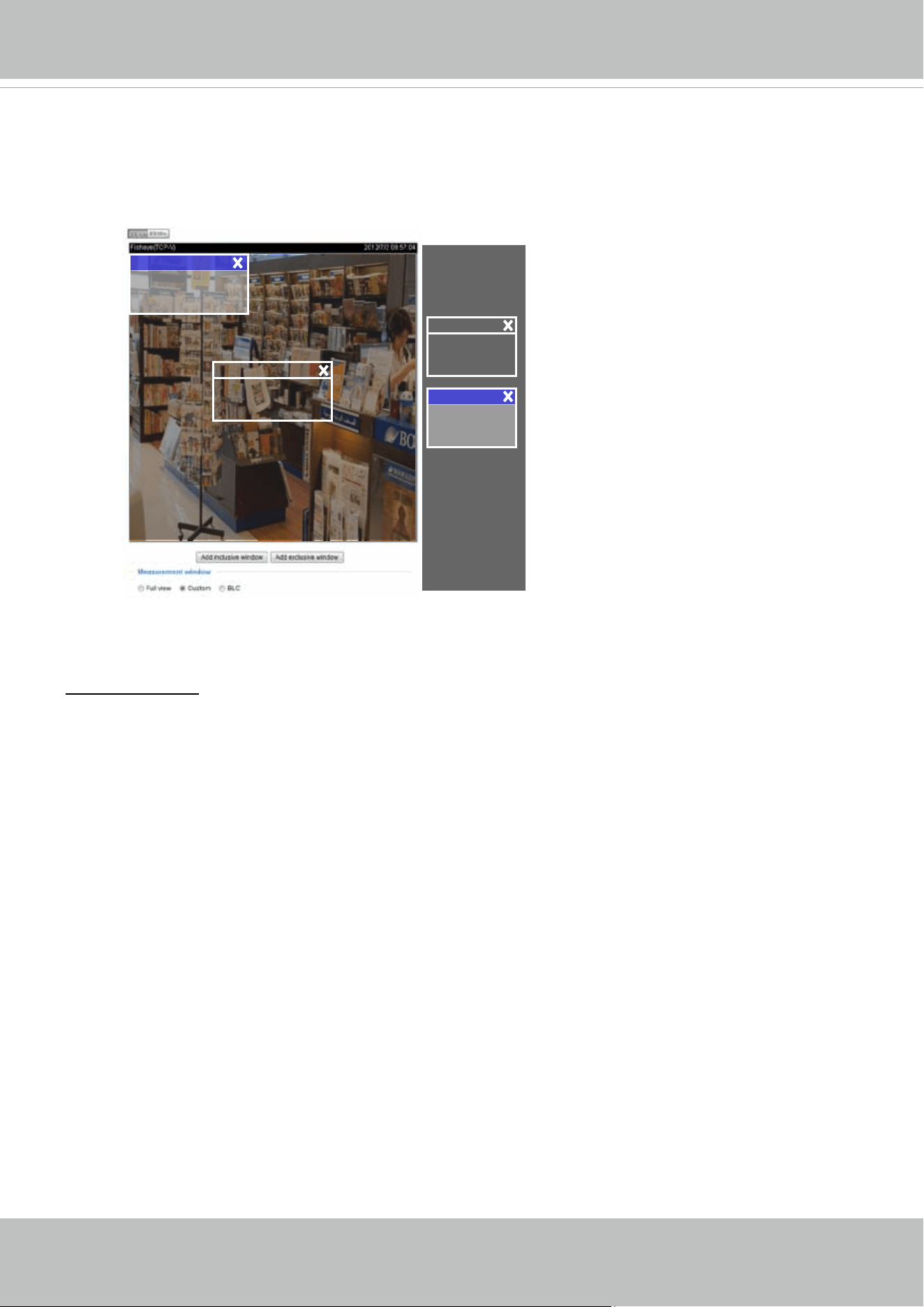
■ Custom: This option allows you to manually add customized windows as inclusive or exclusive regions.
A total of 10 windows can be congured. Please refer to the next page for detailed illustration.
VIVOTEK
56 - User's Manual
The inclusive window refers to the “weighed window“; the exclusive window refers to the “ignored
window“. It adopts the weighed averages method to calculate the value. The inclusive windows have
a higher priority. You can overlap these windows, and, if you place an exclusive window within a larger
inclusive window, the exclusive part of the overlapped windows will be deducted from the inclusive
window. An exposure value will then be calculated out of the remaining of the inclusive window.
■ BLC (Back Light Compensation): This option will automatically add a “weighted region“ in the middle of
the window and give the necessary light compensation.
Exposure control:
■
Exposure level: You can manually set the Exposure level, which ranges from -2.0 to +2.0 (dark to
bright).
Include
Exclude
Weighted region
Ignored region
Include
Exclude
■
Exposure time: you can split the round pointers on the Exposure time and Gain control slide bars
into two halves and drag them on the bars to designate a range of values in which firmware can
automatically adapt to. Note that Firmware will then automatically tune the Gain, Exposure time, and
Iris opening within the ranges you specified. For example, in low-light condition, you may prefer a
longer exposure time and more electronic gains. However, the noises in the image will also increase.
■
Gain control: Tune the slider bar to set the Gain Control to the best image quality. Higher gain control
value will generate a certain amount of noises, and that the gain control, lighting levels, and picture
performance are closely related.
Click the Save button to preserve your conguration.
■
Flickerless: Under some circumstances when there is a difference between the video capture
frequency and local AC power frequency (NTSC or PAL), the mismatch causes color shifts or ickering
images. If the above mismatch occurs, select the Flickerless checkbox, and the range of Exposure
time (the shutter time) will be limited to a range in order to match the AC power frequency. When
selected, the exposure time will be forced to stay longer than 1/120 second. For cameras that come
with xed iris lens, setting the exposure time to longer than 1/120 second may introduce too much
lights to the lens. Users can use this option to observe whether the result of long exposure time is
satisfactory.
You can click and drag the semi-circular pointers on the Exposure time and Gain control slide bars
to specify a range of shutter time and Gain control values within which the camera can automaticallly
tune to an optimal imaging result. For example, you may prefer a shorter shutter time to better capture
moving objects, while a faster shutter reduces light and needs to be compensated by electrical
brightness gains.
Note that when WDR is enabled, the exposure time and gain control are not available.

VIVOTEK
User's Manual - 57
Enable WDR enhanced:
This function allows users to identify more image details with an extreme
contrast from an object of interest with one shadowed side against a bright background, e.g., an entrance.
You may select the Enable WDR enhanced checkbox, and then adjust the strength (low, medium, high)
to reach the best image quality.
■
WDR:
Enable WDR Pro: This refers to the Wide Dynamic Range function that enables the camera to capture
details in a high contrast environment. Use the checkbox to enable the function, and use the slide bar
to select the strength of the WDR Pro functionality, depending on the lighting condition at the installation
site. You can select a higher effect when the contrast is high (between the shaded area and the light
behind the objects).
Please follow the steps below to congure a prole:
1. Select the Prole mode tab.
2. Select the applicable mode: Please manually enter
a range of time if you choose the Schedule mode.
3. Congure Exposure control settings in the folowing
columns. Please refer to previous dicussions for
detailed information.
4. Click Save to enable the setting and click Close to
exit the page.
You can click Restore to recall the original settings without incorporating the changes. When completed
with the settings on this page, click Save to enable the settings.
If you want to congure another sensor setting for a specic lighting condition for a specic period of time
in a day, please click Prole mode to open the Prole of exposure settings page as shown below.
Enable to apply these settings at: Manually enter
a range of time for this prole to take effect, and then
check Save to take effect.
VIVOTEK
58 - User's Manual
Privacy mask
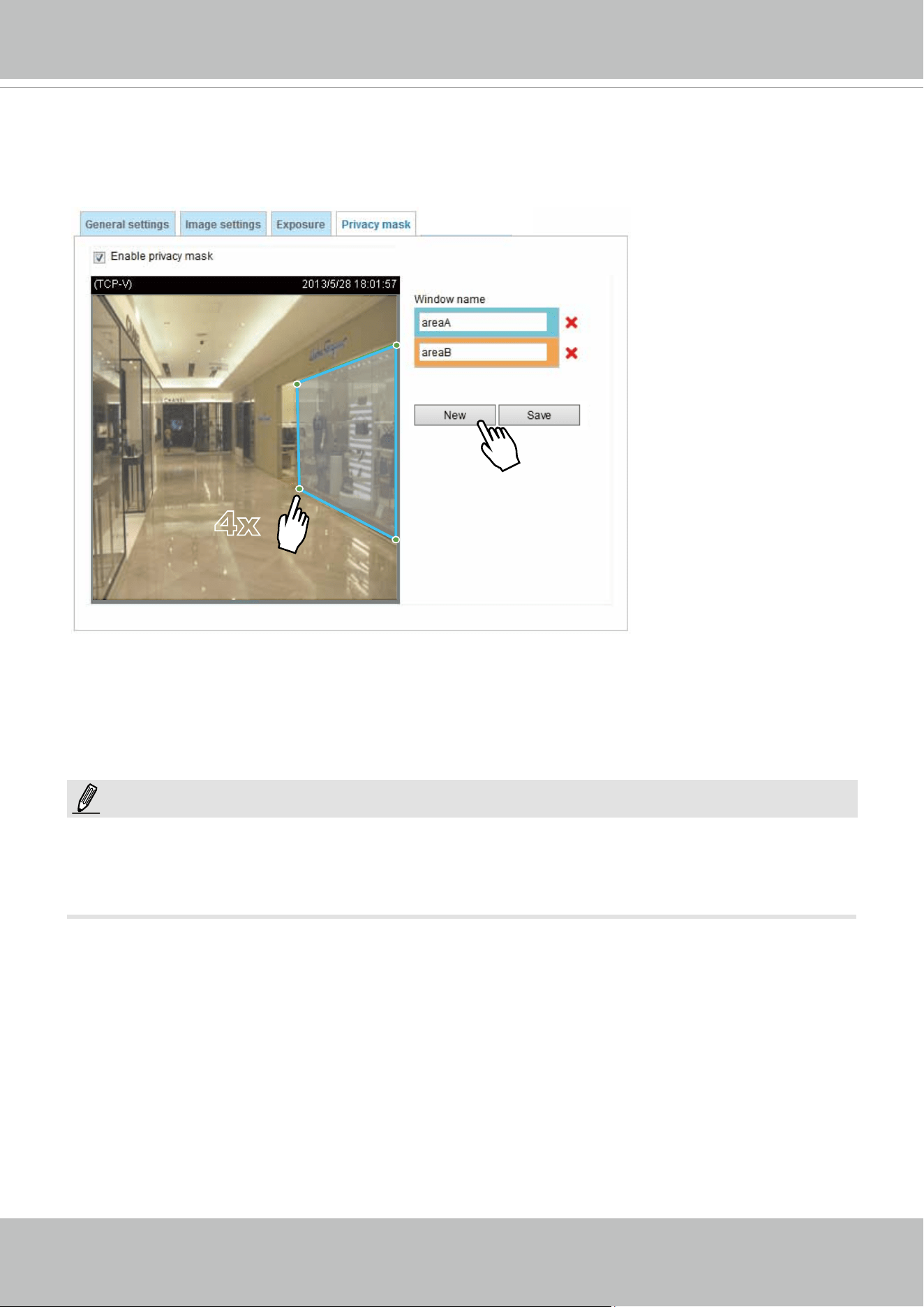
Click Privacy Mask to open the conguration page. On this page, you can block out certain sensitive
zones to address privacy concerns.
■ To congure the privacy mask windows, follow the steps below:
1. Click New to add a new window. A text box will appear allowing you to enter a name for the mask.
2. Use four mouse clicks to mark a square area, which is recommended to be at least twice the size of
the object (height and width) you want to cover.
3. Enter a Window Name and click Save to enable the setting.
4. Check Enable privacy mask to enable this function.
►
Up to 5 privacy mask windows can be congured on the same screen.
►
To delete a mask, use the red cross button and then click on the Save button.
4x
NOTE:
VIVOTEK
User's Manual - 59
Media > Video
Stream settings
Please follow the steps below to set up those settings for an individual stream:
1. Select a stream to congure its viewing region.
2. Choose a proper Frame Size from the drop-down list according to the size of monitored device.
3. Select the Maximum frame rate.
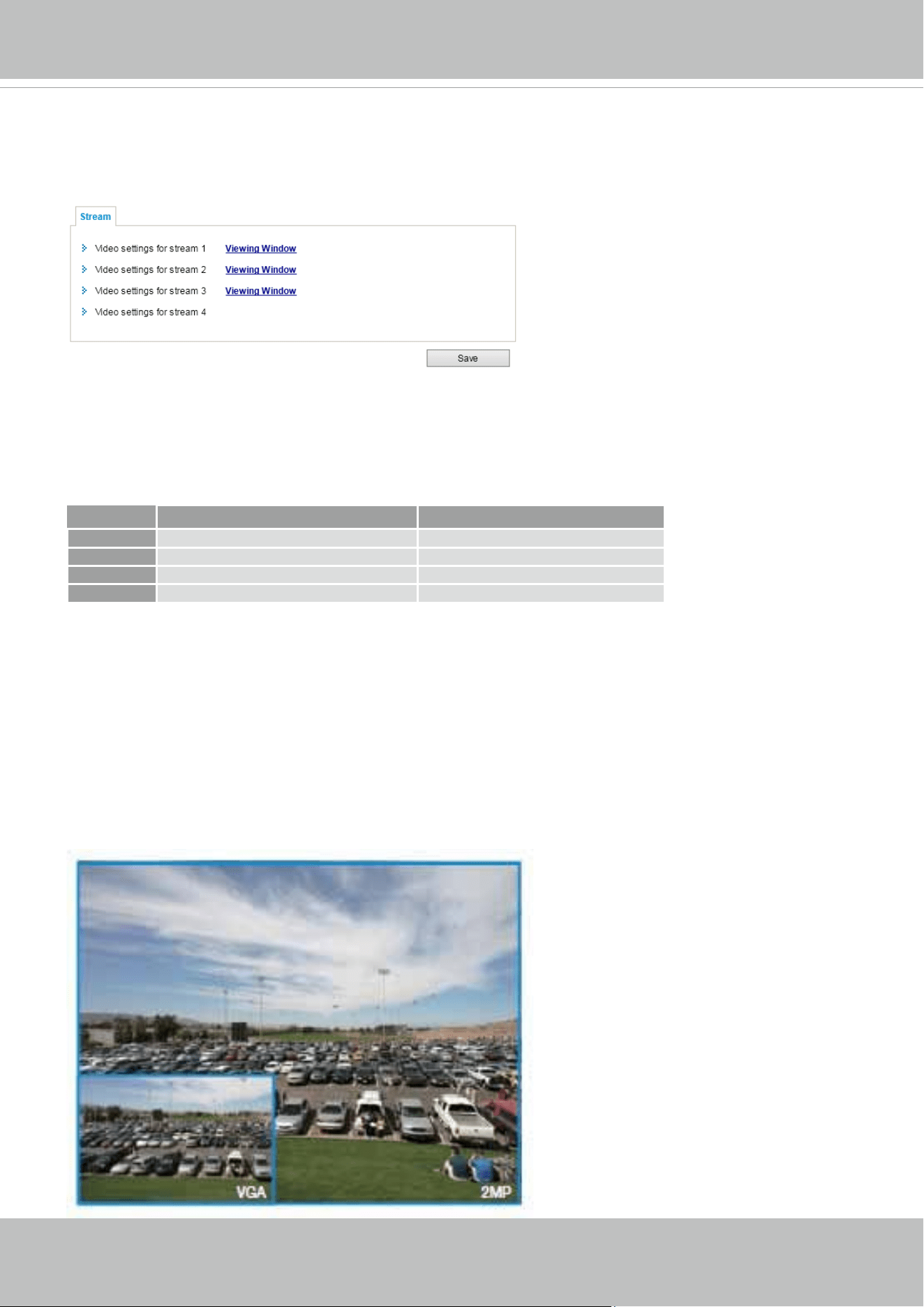
■ The parameters of a xed-focal lens' multiple streams:
Region of Interest Output frame size
Stream 1 1920 X 1080 ~ 176 x 144 (Selectable) 1920 X 1080 ~ 176 x 144 (Selectable)
Stream 2 1920 X 1080 ~ 176 x 144 (Selectable) 1920 X 1080 ~ 176 x 144 (Selectable)
Stream 3 1920 X 1080 ~ 176 x 144 (Selectable) 1920 X 1080 ~ 176 x 144 (Selectable)
Stream 4 xed xed
To begin the conguration, rst select a video channel.
To change the frame size, frame rate, and other related settings, click on video settings for a video
stream to its individual conguration panel.
Click Viewing Window to open the viewing region settings page. On this page, you can congure the
Region of Interest and the Output Frame Size for a video stream. For example, you can crop only a
portion of the image that is of your interest, and thus save the bandwidth needed to transmit the video
stream. As the example shown below, the area of your interest in a parking lot should be the vehicles.
The blue sky is of little value for the surveillance purpose.
VIVOTEK
60 - User's Manual
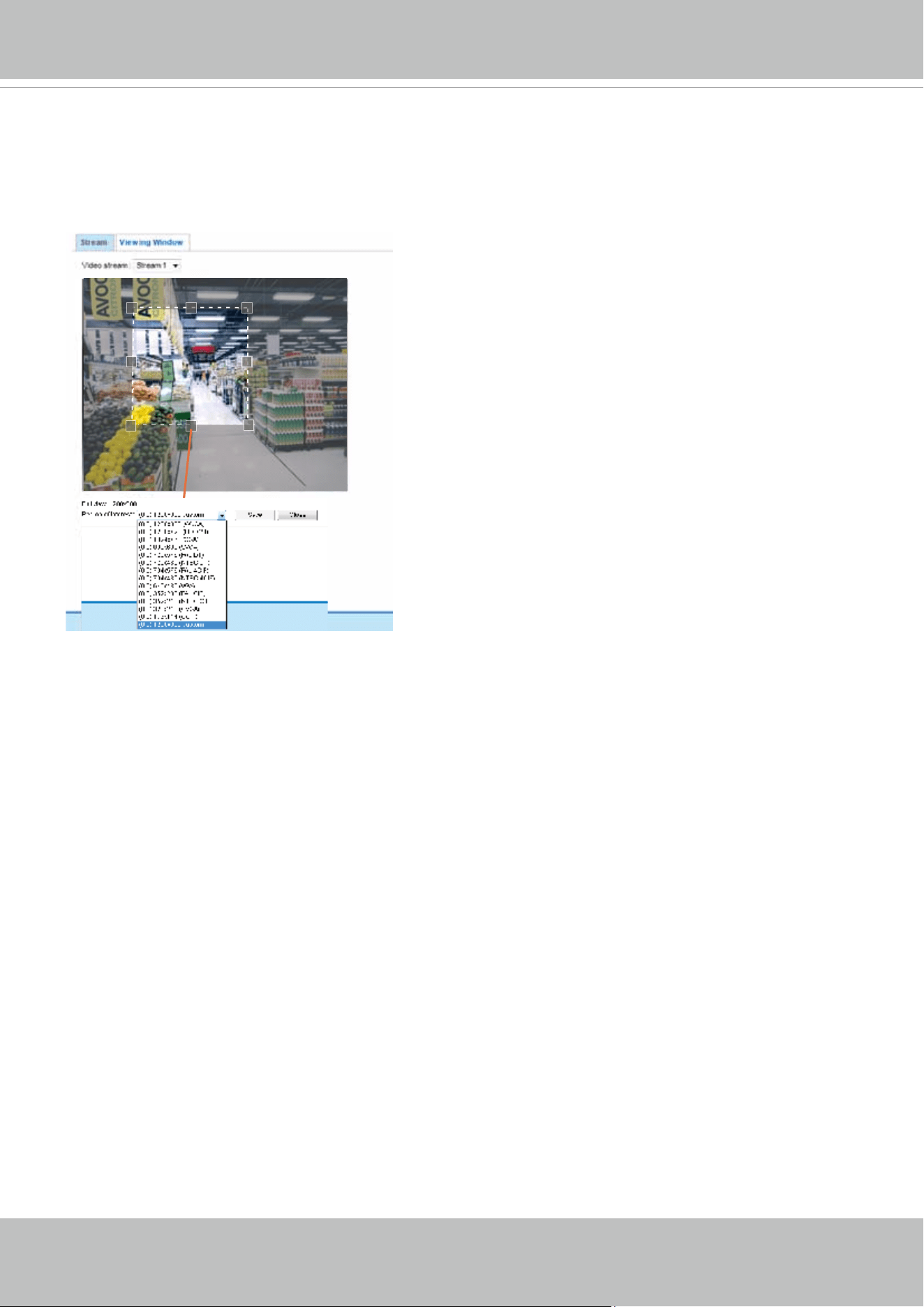
Click Viewing Window to open the viewing region settings page. On this page, you can set the Region
of Interest and the Output Frame Size for stream 1. If you prefer not to stream the full image the sensor
can capture, you can designate a smaller region of interest.
Please follow the steps below to set up those settings for a stream:
1. Select a stream for which you want to set up the viewing region.
2. Select a Region of Interest from the drop-down list. The oating frame, the same as the one in the
Gloabl View window on the home page, will resize accordingly. If you want to set up a customized
viewing region, you can also resize and drag the oating frame to a desired position with your mouse.
3. Choose a proper Output Frame Size from the drop-down list according to the size of your monitoring
device.
The Viewing Window (Video Crop) function is only available on the xed-focal lens module.
VIVOTEK
User's Manual - 61
Click the stream item to display the detailed information.
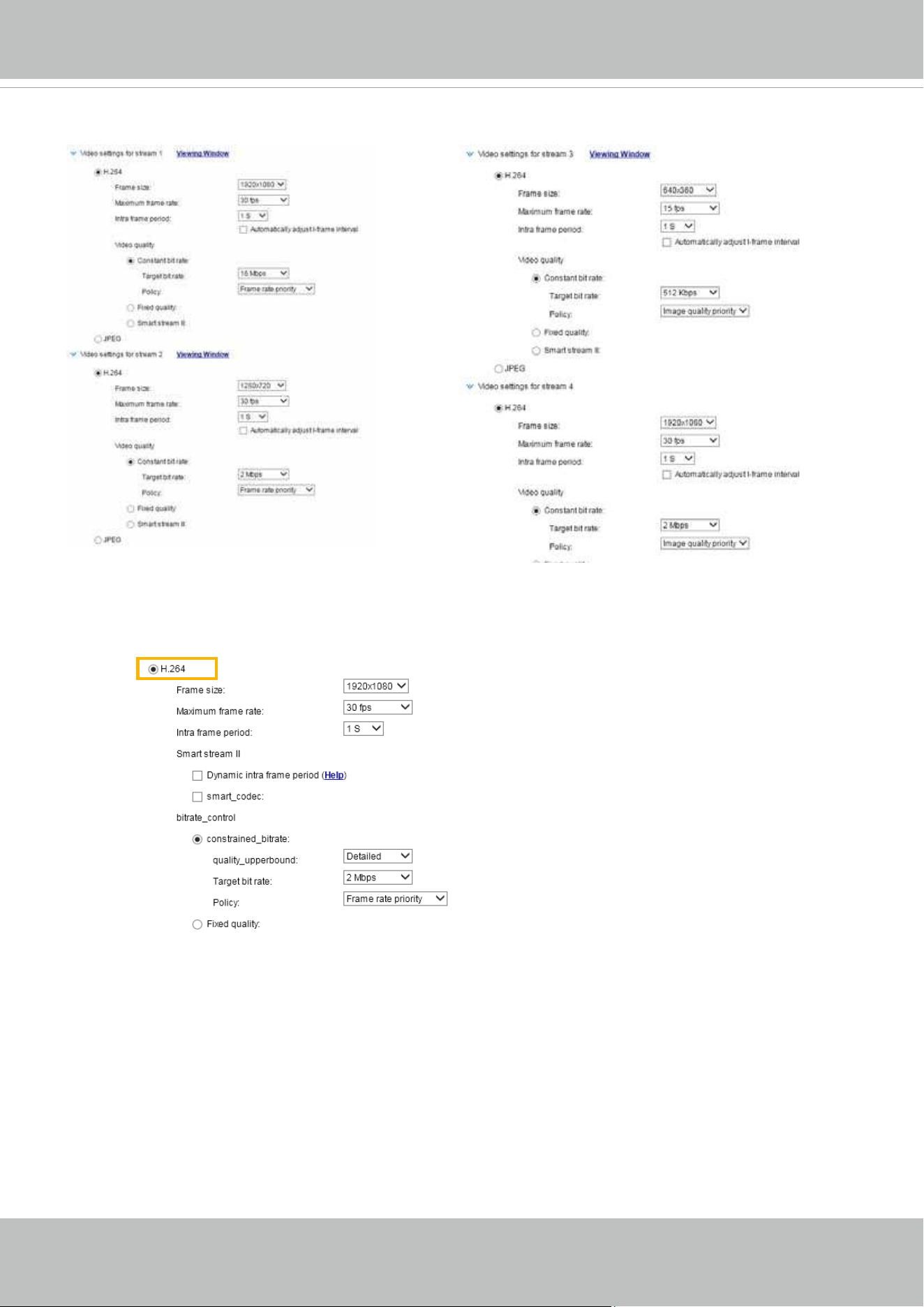
This Network Camera offers real-time H.264 and MJPEG compression standards (dual Codec) for real-
time viewing.
If the
H.264 mode is selected, the video is streamed via RTSP protocol. There are several parameters
for you to adjust the video performance:
■ Frame size
You can set up different video resolutions for different viewing devices. For example, set a smaller
frame size and lower bit rate for remote viewing on mobile phones and a larger video size and a higher
bit rate for live viewing on web browsers. Note that a larger frame size takes up more bandwidth.
■ Maximum frame rate
This limits the maximum refresh frame rate per second. Set the frame rate higher for smoother video
quality and for recognizing moving objects in the eld of view.
If the power line frequency is set to 50Hz, the frame rates are selectable at 1fps, 2fps, 3fps, 5fps,
8fps, 10fps, 15fps, 20fps, and 25fps. If the power line frequency is set to 60Hz, the frame rates are
selectable at 1fps, 2fps, 3fps, 5fps, 8fps, 10fps, 15fps, 20fps, 25fps, and 30fps. You can also select
Customize and manually enter a value.
VIVOTEK
62 - User's Manual
■ Intra frame period
Determine how often to plant an I frame. The shorter the duration, the more likely you will get better
video quality, but at the cost of higher network bandwidth consumption. Select the intra frame period
from the following durations: 1/4 second, 1/2 second, 1 second, 2 seconds, 3 seconds, and 4 seconds.
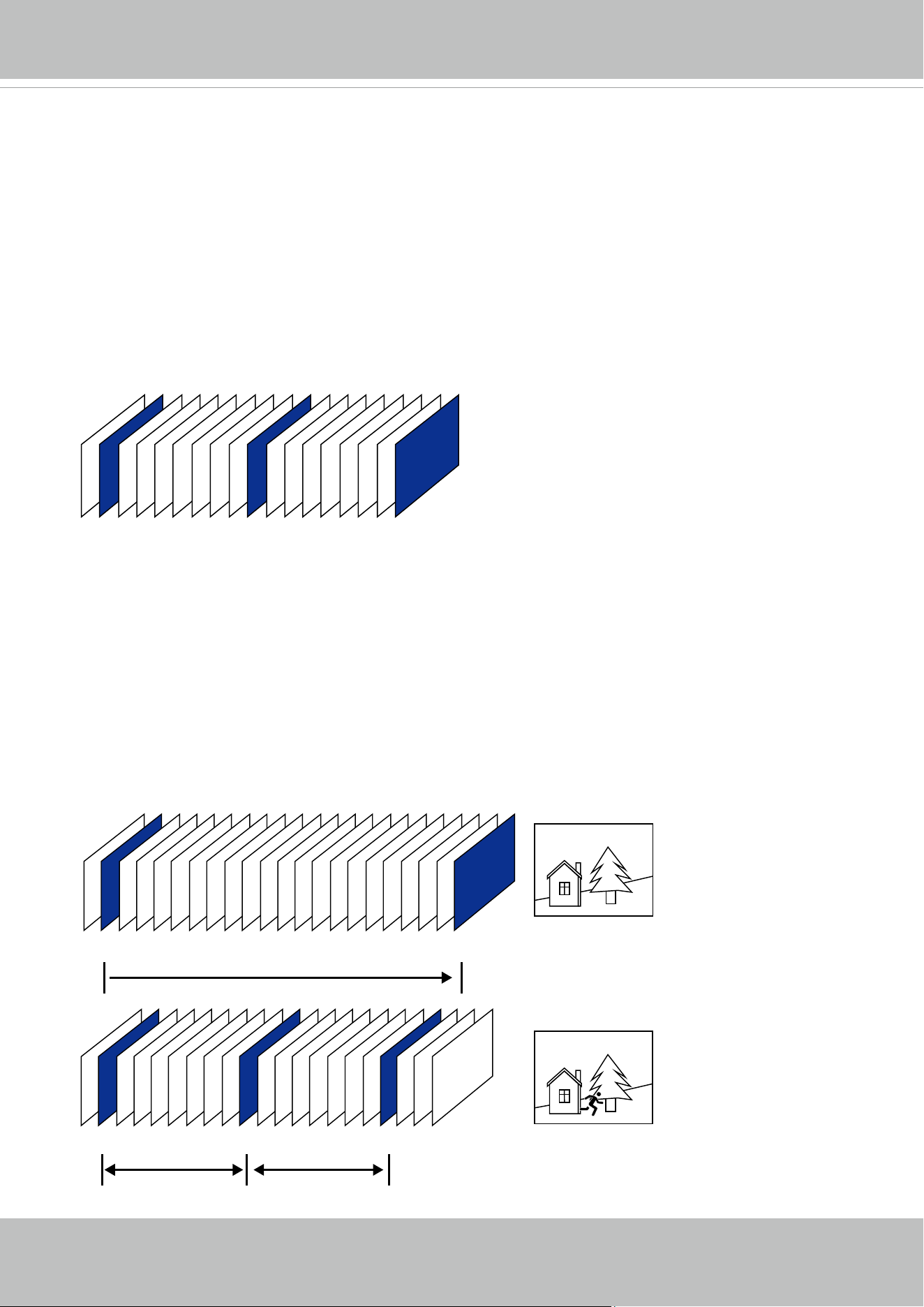
■ Dynamic Intra frame period
High quality motion codecs, such as H.264, utilize the redundancies between video frames to deliver
video streams at a balance of quality and bit rate.
The encoding parameters are summarized and illustrated below. The I-frames are completely self-
referential and they are largest in size. The P-frames are predicted frames. The encoder refers to the
previous I- or P-frames for redundant image information.
P I P P P P P P P P P P P P P P P P P P P I
P I P P P P P P P I P P P P P P P I
Static scene
Activities
P P P
P I P P P P P P P I P P P P P P P I
By dynamically prolonging the intervals for I-frames insertion to up to 10 seconds, the bit rates required
for streaming a video can be tremendously reduced. When streaming a video of a static scene,
the Dynamic Intra frame feature can save up to 53% of bandwidth. The amount of bandwidth thus
saved is also determined by the activities in the eld of view. If activities occur in the scene, rmware
automatically shortens the I-frame insertion intervals in order to maintain image quality. In the low light
or night conditions, the P-frames can have a larger size due to the noises, and hence the bandwidth
saving effect is also reduced.
Streaming a typical 2MP scene normally requires 3~4Mb/s of bandwidth. With the Dynamic Intra frame
function, the bandwidth for streaming a medium-trafc scene can be reduced to 2~3Mb/s, and during
the no-trafc period of time, down to 500kb/s.
H.264/265 Frame Types
Dynamic Intra Frame w/
static scenes
Dynamic Intra Frame w/
activities in scenes
Smart stream II
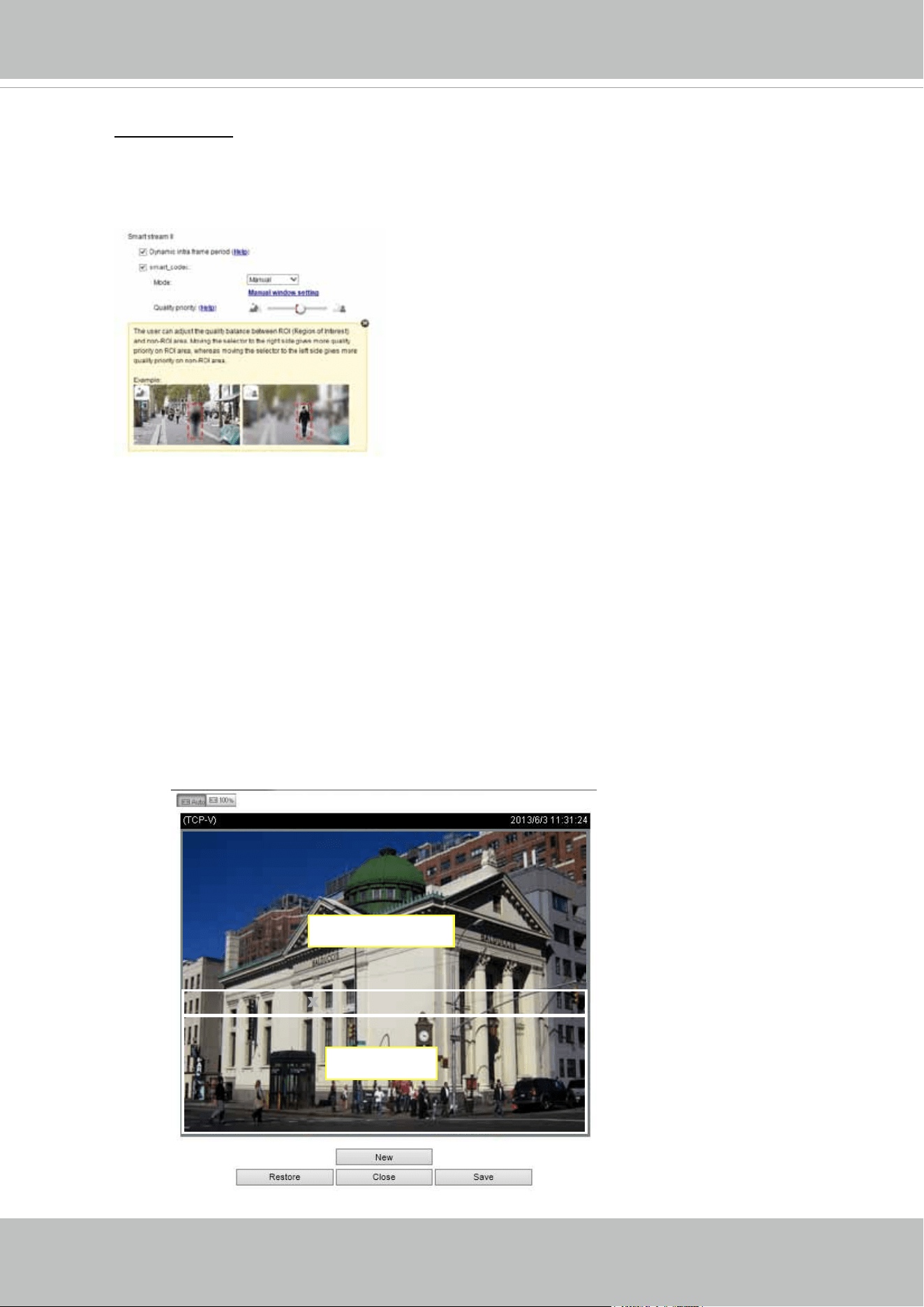
VIVOTEK
User's Manual - 63
• Smart codec: Smart codec effectively reduces the quality of the whole or the non-
interested areas on a screen and therefore reduces the bandwidth consumed.
X
ROI_0
X
ROI_0
ROI
non-interested
You can manually specify the video quality for the foreground and the background areas.
Select an operation mode if Smart codec is preferred.
- Auto tracking: The Auto mode congures the whole screen into the non-interested area.
The video quality of part of the screen returns to normal when one or more objects
move in that area. The remainder of the screen where there are no moving objects
(no pixel changes) will still be transmitted in low-quality format.
- Manual: The Manual mode allows you to congure 3 ROI windows (Region of Interest,
with Foreground quality) on the screen. Areas not included in any ROI windows
will be considered as the non-interested areas. The details in the ROI areas will be
transmitted in a higher-quality video format.
As illustrated below, the upper screen may contain little details of your interest,
while the sidewalk on the lower screen is included in an ROI window.
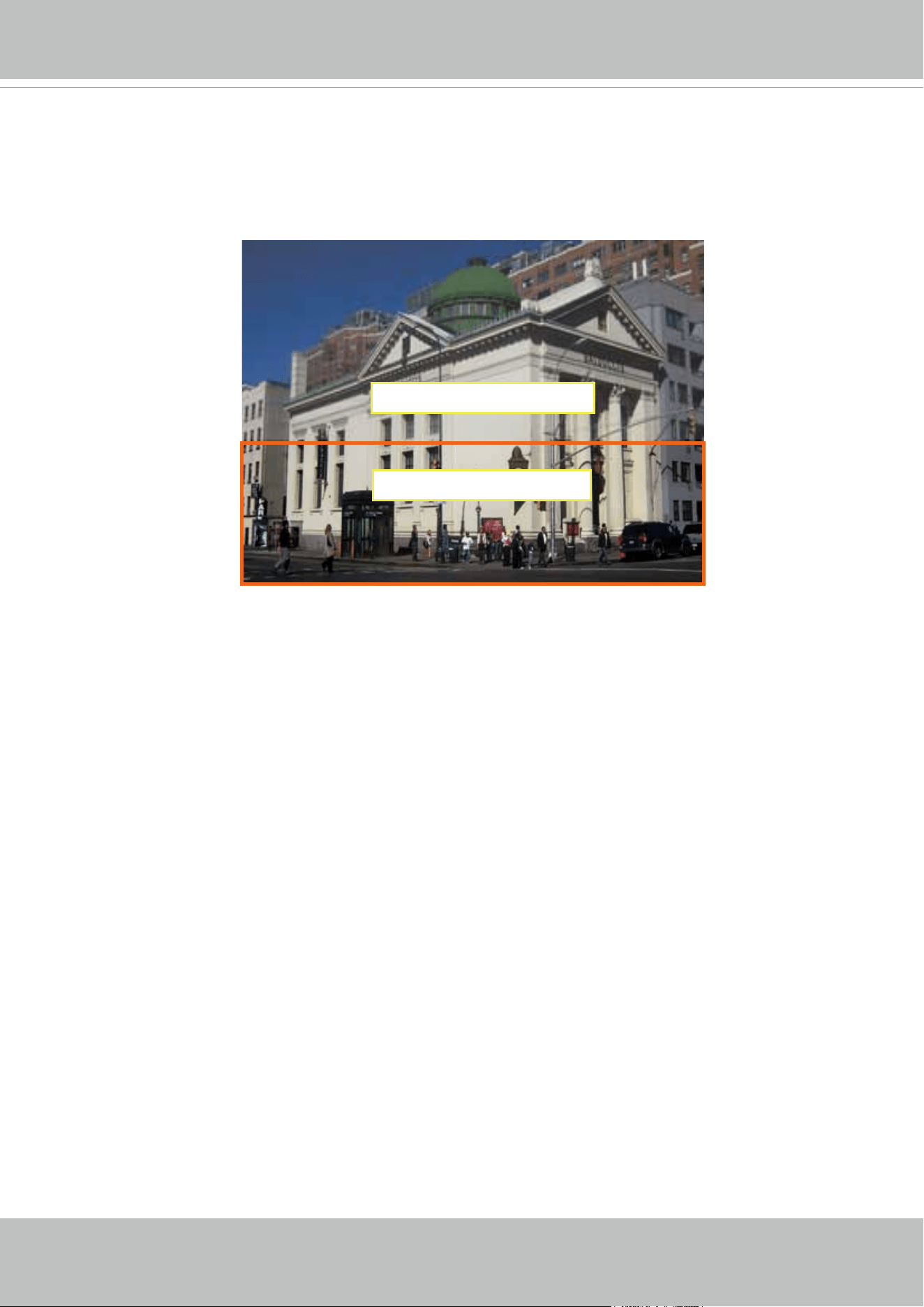
VIVOTEK
64 - User's Manual
ROI: higher-quality
non-ROI: lower-quality
As the result, the lower screen is constantly displayed in high details,
while the upper half is transmitted using a lower-quality format. Although
the upper half is transmitted using a lower quality format, you still have an
awareness of what is happening on the whole screen.
- Hybrid: The major difference between the “Manual” mode and the “Hybrid”
mode is that:
In the “Hybrid“ mode, any objects entering the non-interested area will
restore the video quality of the moving objects and the area around
them. The video quality of the associated non-interested area is
immediately restored to normal to cover the moving objects.
In the “Manual” mode, the non-interested area is always transmitted
using a low-quality format regardless of the activities inside.
You should also select the Maximum bit rate from the pull-down menu as the
threshold to contain the bandwidth consumption for both the high- and low-
quality video sections in a smart stream.
- Quality priority: Use the slide bar to tune the quality contrast between the ROI
and non-interested areas.
The farther the slide bar button is to the right, the higher the image
quality of the ROI areas. On the contrary, the farther the slide bar button
to the left, the higher the image quality of the non-interested area.
In this way, you may set up an ROI window as a privacy mask by
covering a protected area using an ROI window, while the remaining
screen become the non-interested area. You may then configure the
non-interested area to have a high image quality, or vice versa.

VIVOTEK
User's Manual - 65
■ B
it rate control
Constant bit rate:
A complex scene generally produces a larger le size, meaning that higher bandwidth
will be needed for data transmission. The bandwidth utilization is configurable to
match a selected level, resulting in mutable video quality performance. The bit rates
are selectable at the following rates: 20Kbps, 30Kbps, 40Kbps, 50Kbps, 64Kbps,
128Kbps, 256Kbps, 512Kbps, 768Kbps, 1Mbps, 2Mbps, 3Mbps, 4Mbps, 6Mbps,
8Mbps, 10Mbps, 12Mbps, 14Mbps, ~ to 40Mbps. You can also select Customize
and manually enter a value up to 40Mbps.
• - Target quality: Select a desired quality ranging from Medium to Excellent
- Maximum bit rate: select a bit rate from the pull-down menu. The bit rate ranges
from 20kbps to a maximum of 40Mbps. The bit rate then becomes the Average or
Upper bound bit rate number. The Network Camera will strive to deliver video streams
around or within the bit rate limitation you impose.
- Policy: If Frame Rate Priority is selected, the Network Camera will try to maintain
the frame rate per second performance, while the image quality will be compromised.
If Image quality priority is selected, the Network Camera may drop some video
frames in order to maintain image quality.
Fixed quality:
On the other hand, if Fixed quality is selected, all frames are transmitted with the
same quality; bandwidth utilization is therefore unpredictable. The video quality
can be adjusted to the following settings: Medium, Standard, Good, Detailed, and
Excellent. You can also select Customize and manually enter a value.
Maximum bit rate: With the guaranteed image quality, you might still want to place
a bit rate limitation to control the size of video streams for bandwidth and storage
concerns. The congurable bit rate starts from 1Mbps to 40Mbps.
The Maximum bit rate setting in the Fixed quality configuration can ensure a
reasonable and limited use of network bandwidth. For example, in low light conditions
where a Fixed quality setting is applied, video packet sizes can tremendously
increase when noises are produced with electrical gains.
You may also manually enter a bit rate number by selecting the Customized option.
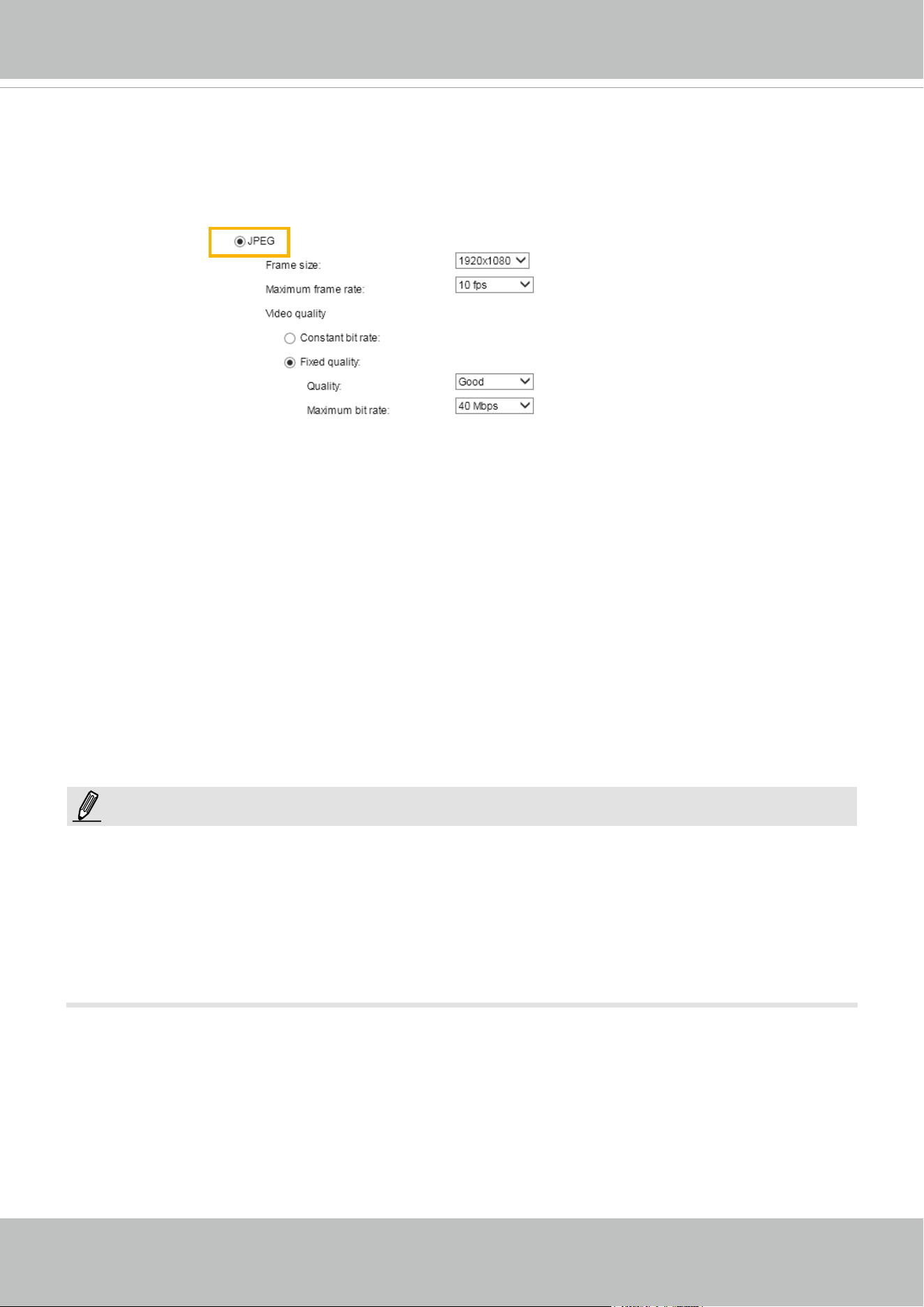
VIVOTEK
66 - User's Manual
If JPEG mode is selected, the Network Camera continuously sends JPEG images to the client, producing
a moving effect similar to a filmstrip. Every single JPEG image transmitted guarantees the same
image quality, which in turn comes at the expense of variable bandwidth usage. Because the media
contents are a combination of JPEG images, no audio data is transmitted to the client. There are three
parameters provided in MJPEG mode to control the video performance:
■ Frame size
You can set up different video resolution for different viewing devices. For example, set a smaller
frame size and lower bit rate for remote viewing on mobile phones and a larger video size and a higher
bit rate for live viewing on web browsers. Note that a larger frame size takes up more bandwidth.
■ Maximum frame rate
This limits the maximum refresh frame rate per second. Set the frame rate higher for smoother video
quality.
If the power line frequency is set to 50Hz, the frame rates are selectable at 1fps, 2fps, 3fps, 5fps,
8fps, 10fps, 15fps, 20fps, and 25fps. If the power line frequency is set to 60Hz, the frame rates are
selectable at 1fps, 2fps, 3fps, 5fps, 8fps, 10fps, 15fps, 20fps, 25fps, and 30fps. You can also select
Customize and manually enter a value.
■ Video quality
Refer to the previous page setting an average or upper bound threshold for controlling the bandwidth
consumed for transmitting motion jpegs. The conguration method is identical to that for H.264.
NOTE:
• Video quality and fixed quality refer to the compression rate. If you select to enter a Customized
value in the Fixed quality menu, a lower value will produce higher quality.
• Converting high-quality video may significantly increase the CPU load, and you may encounter
streaming disconnection or video loss while capturing a complicated scene. In the event of
occurrence, we suggest you customize a lower video resolution or reduce the frame rate to obtain a
smooth video.
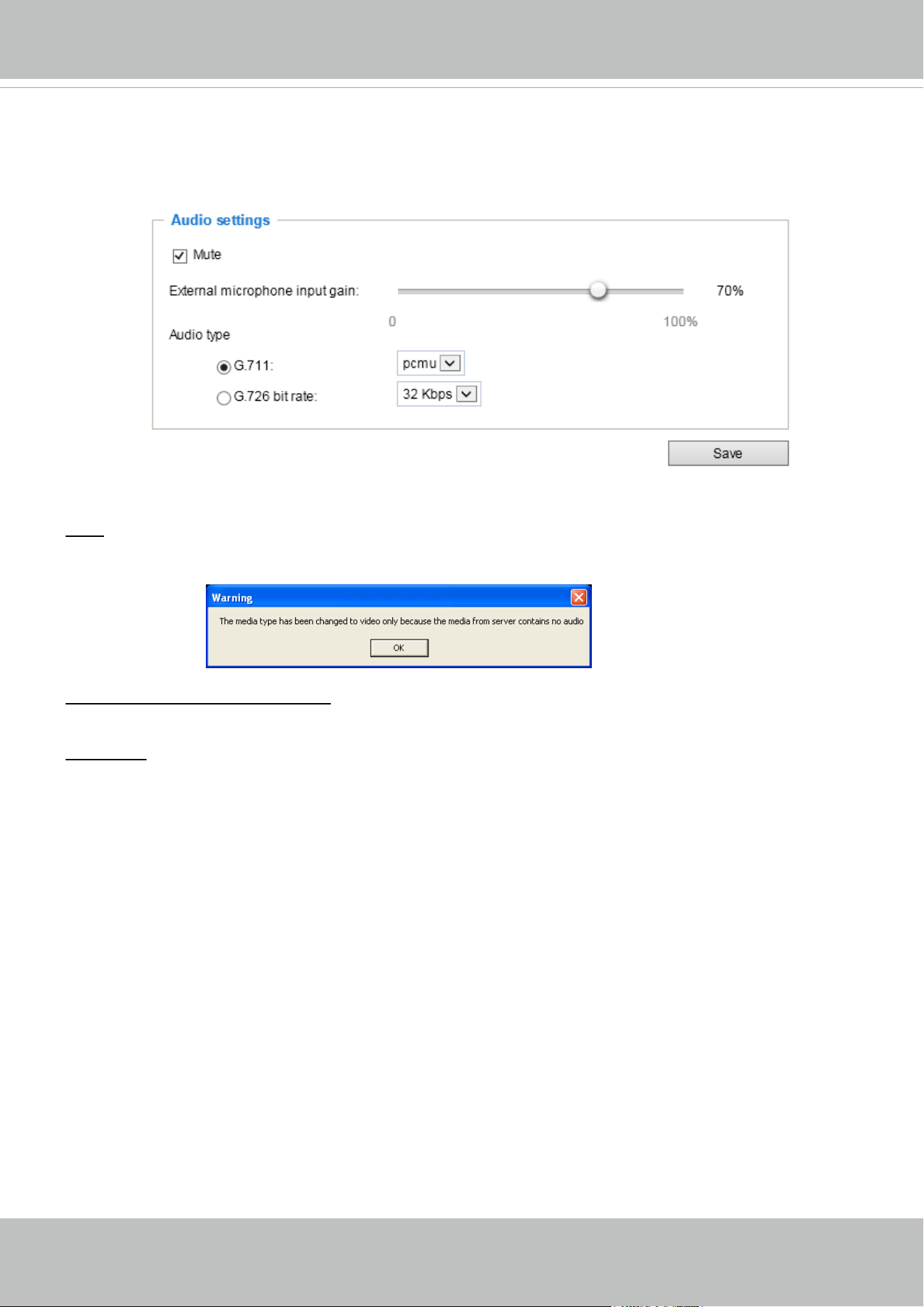
VIVOTEK
User's Manual - 67
Media > Audio
Audio Settings
Mute: Select this option to disable audio transmission from the Network Camera to all clients. Note that
if mute mode is turned on, no audio data will be transmitted even if audio transmission is enabled on the
Client Settings page. In that case, the following message is displayed:
Internal microphone input gain: Select the gain of the internal audio input according to ambient
conditions. Adjust the gain from -33dB (least) to 21dB (most).
Audio type: Select audio codec as G.711 or G.726 and the bit rate.
■ G.711 provides good sound quality and requires about 64Kbps. Select pcmu (μ-Law) or pcma (A-Law)
mode.
■ G.726 is a speech codec standard covering voice transmission at rates of 16, 24, 32, and 40kbit/s.
When completed with the settings on this page, click Save to enable the settings.
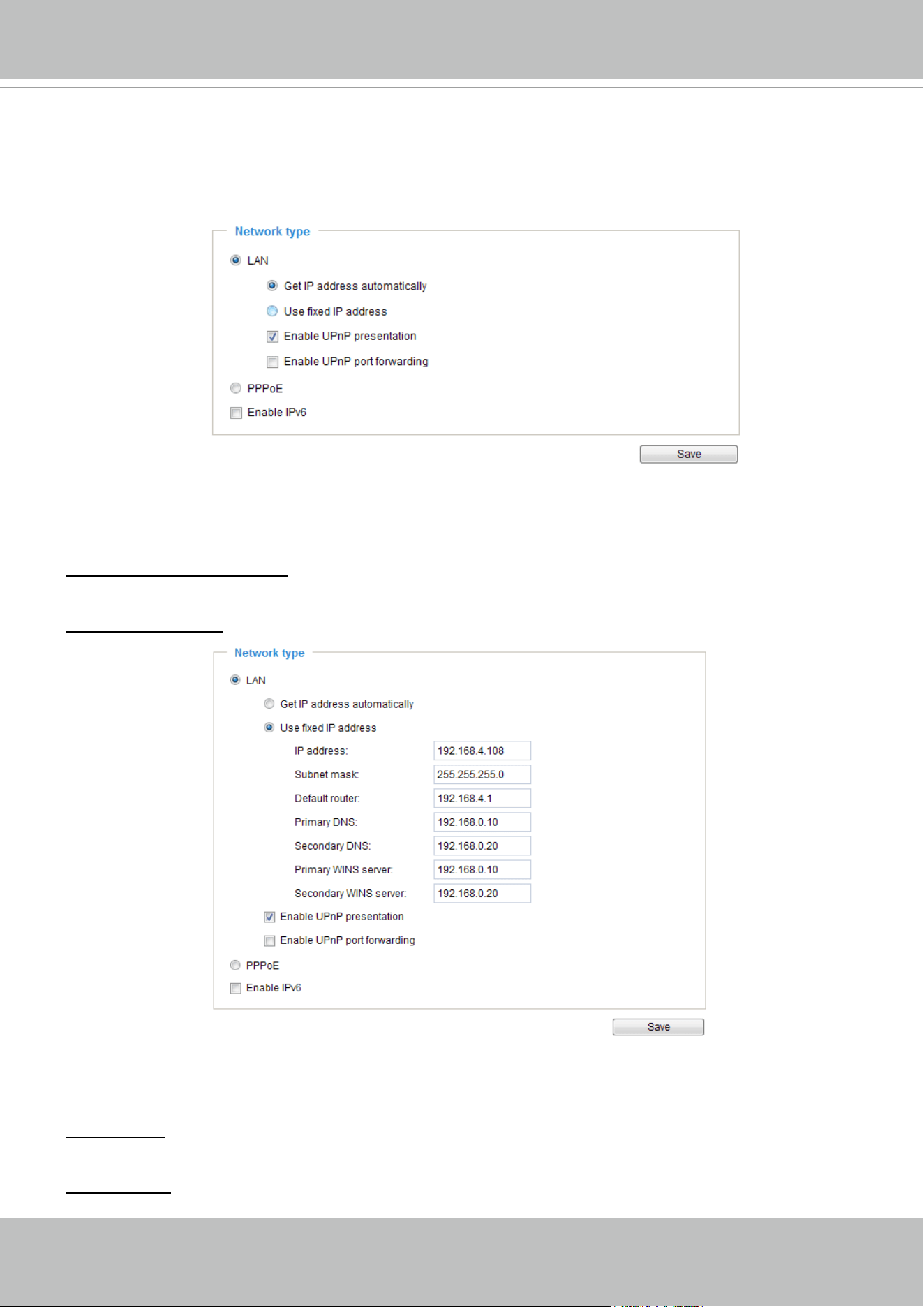
VIVOTEK
68 - User's Manual
Network > General settings
This section explains how to congure a wired network connection for the Network Camera.
Network Type
LAN
Select this option when the Network Camera is deployed on a local area network (LAN) and is intended
to be accessed by local computers. The default setting for the Network Type is LAN. Rememer to click
Save when you complete the Network setting.
Get IP address automatically: Select this option to obtain an available dynamic IP address assigned by
the DHCP server each time the camera is connected to the LAN.
Use xed IP address: Select this option to manually assign a static IP address to the Network Camera.
1. You can make use of VIVOTEK Installation Wizard 2 on the software CD to easily set up the Network
Camera on LAN. Please refer to Software Installation on page 21 for details.
2. Enter the Static IP, Subnet mask, Default router, and Primary DNS provided by your ISP.
Subnet mask: This is used to determine if the destination is in the same subnet. The default value is
“255.255.255.0”.
Default router: This is the gateway used to forward frames to destinations in a different subnet. Invalid
router setting will fail the transmission to destinations in different subnet.
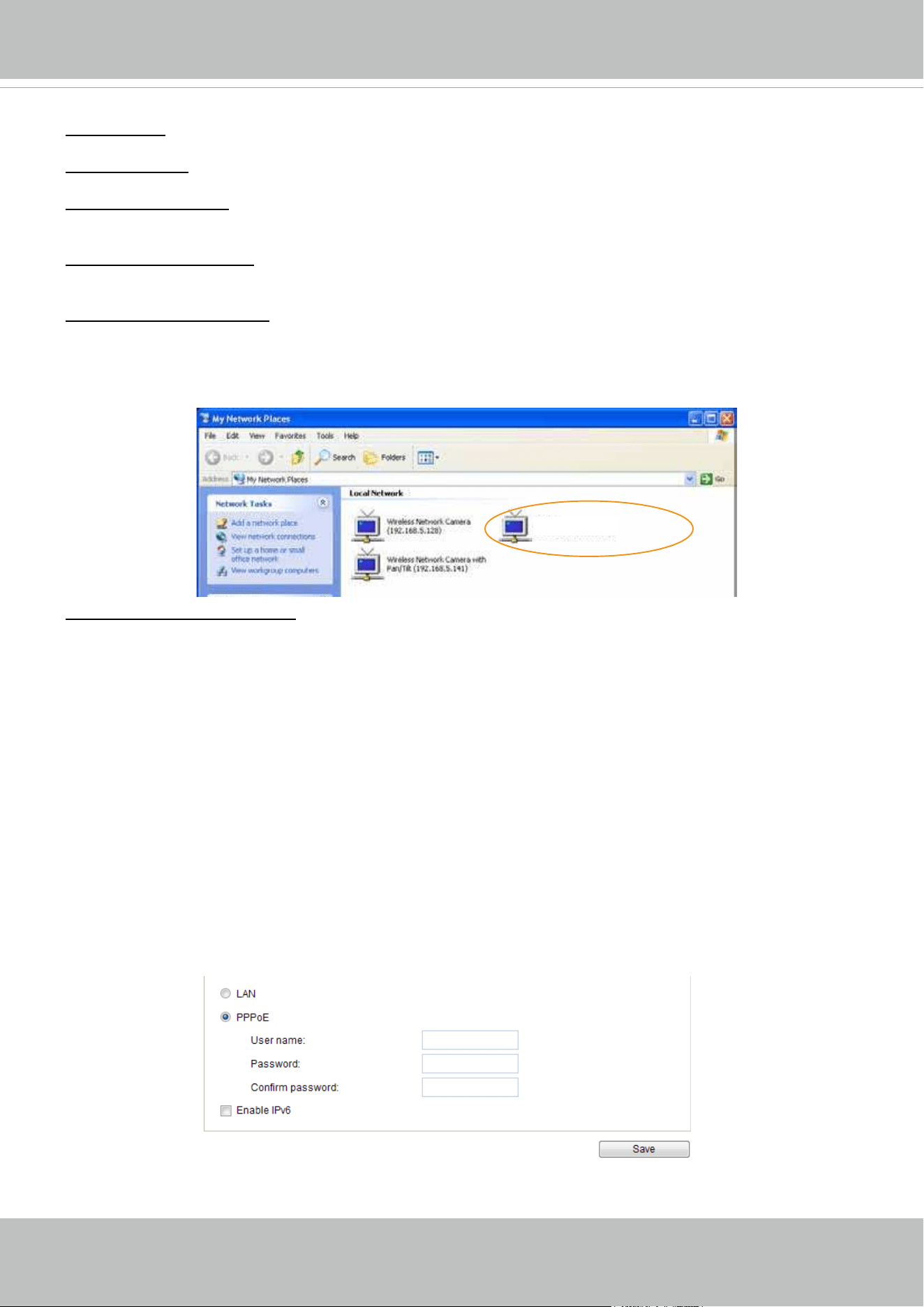
VIVOTEK
User's Manual - 69
Primary DNS: The primary domain name server that translates hostnames into IP addresses.
Secondary DNS: Secondary domain name server that backups the Primary DNS.
Primary WINS server: The primary WINS server that maintains the database of computer name and IP
address.
Secondary WINS server: The secondary WINS server that maintains the database of computer name
and IP address.
Enable UPnP presentation: Select this option to enable UPnP
TM
presentation for your Network Camera
so that whenever a Network Camera is presented to the LAN, shortcuts of connected Network Cameras
will be listed in My Network Places. You can click the shortcut to link to the web browser. Currently,
UPnP
TM
is supported by Windows XP or later. Note that to utilize this feature, please make sure the
UPnP
TM
component is installed on your computer.
Enable UPnP port forwarding: To access the Network Camera from the Internet, select this option to
allow the Network Camera to open ports on the router automatically so that video streams can be sent
out from a LAN. To utilize of this feature, make sure that your router supports UPnP
TM
and it is activated.
PPPoE (Point-to-point over Ethernet)
Select this option to congure your Network Camera to make it accessible from anywhere as long as
there is an Internet connection. Note that to utilize this feature, it requires an account provided by your
ISP.
Follow the steps below to acquire your Network Camera’s public IP address.
1. Set up the Network Camera on the LAN.
2. Go to Conguration > Event > Event settings > Add server (please refer to Add server on page 107) to
add a new email or FTP server.
3. Go to Conguration > Event > Event settings > Add media (please refer to Add media on page 111).
Select System log so that you will receive the system log in TXT le format which contains the
Network Camera’s public IP address in your email or on the FTP server.
4. Go to Conguration > Network > General settings > Network type. Select PPPoE and enter the user
name and password provided by your ISP. Click Save to enable the setting.
5. The Network Camera will reboot.
6. Disconnect the power to the Network Camera; remove it from the LAN environment.
Mega-pixel Network Camera (192.168.5.151)
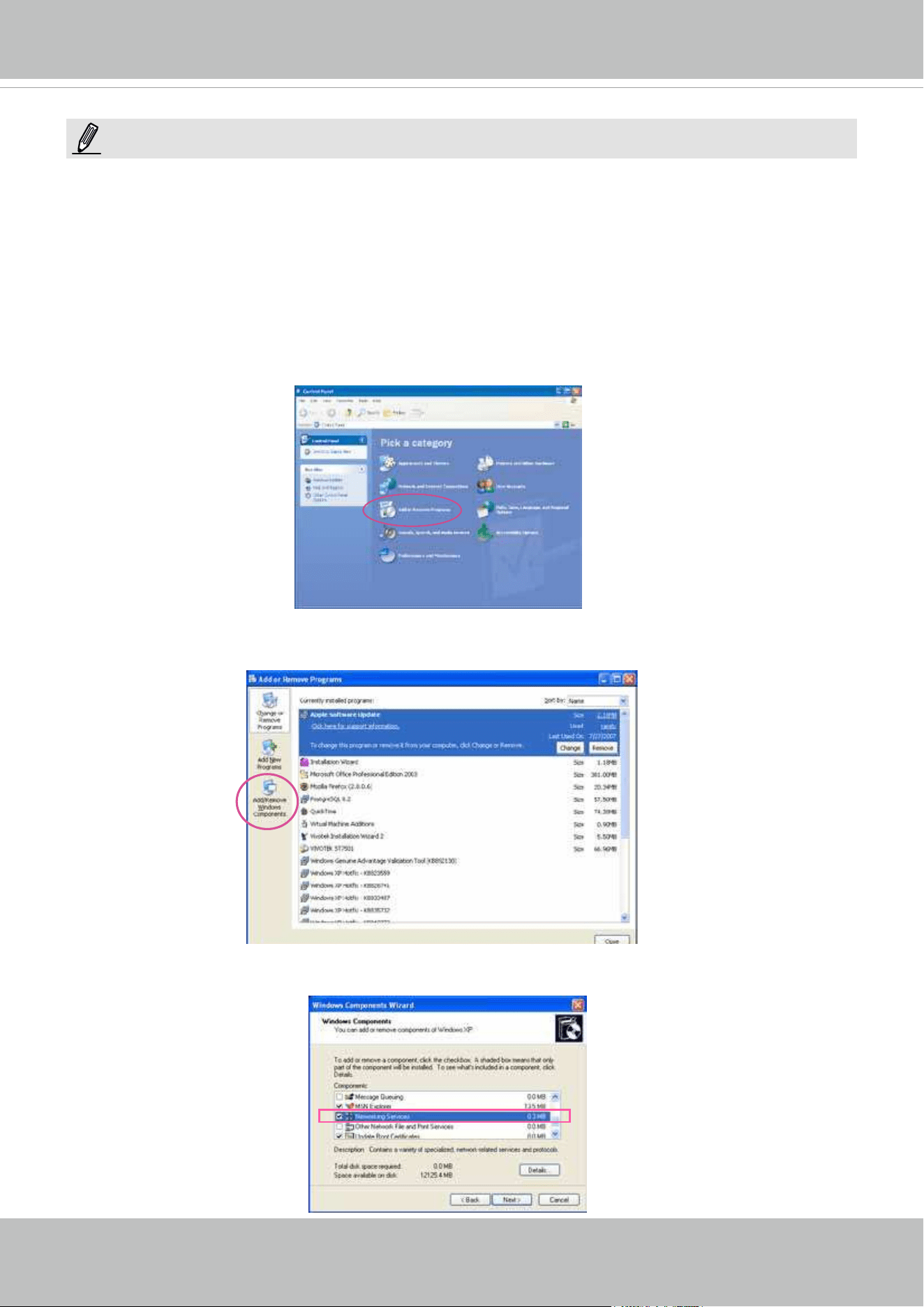
VIVOTEK
70 - User's Manual
► If the default ports are already used by other devices connected to the same router, the Network
Camera will select other ports for the Network Camera.
► If UPnP
TM
is not supported by your router, you will see the following message:
Error: Router does not support UPnP port forwarding.
► Below are steps to enable the UPnP
TM
user interface on your computer:
Note that you must log on to the computer as a system administrator to install the UPnP
TM
components.
1. Go to Start, click Control Panel, then click Add or Remove Programs.
2. In the Add or Remove Programs dialog box, click Add/Remove Windows Components.
3.
In the Windows Components Wizard dialog box, select Networking Services and click Details.
NOTE:
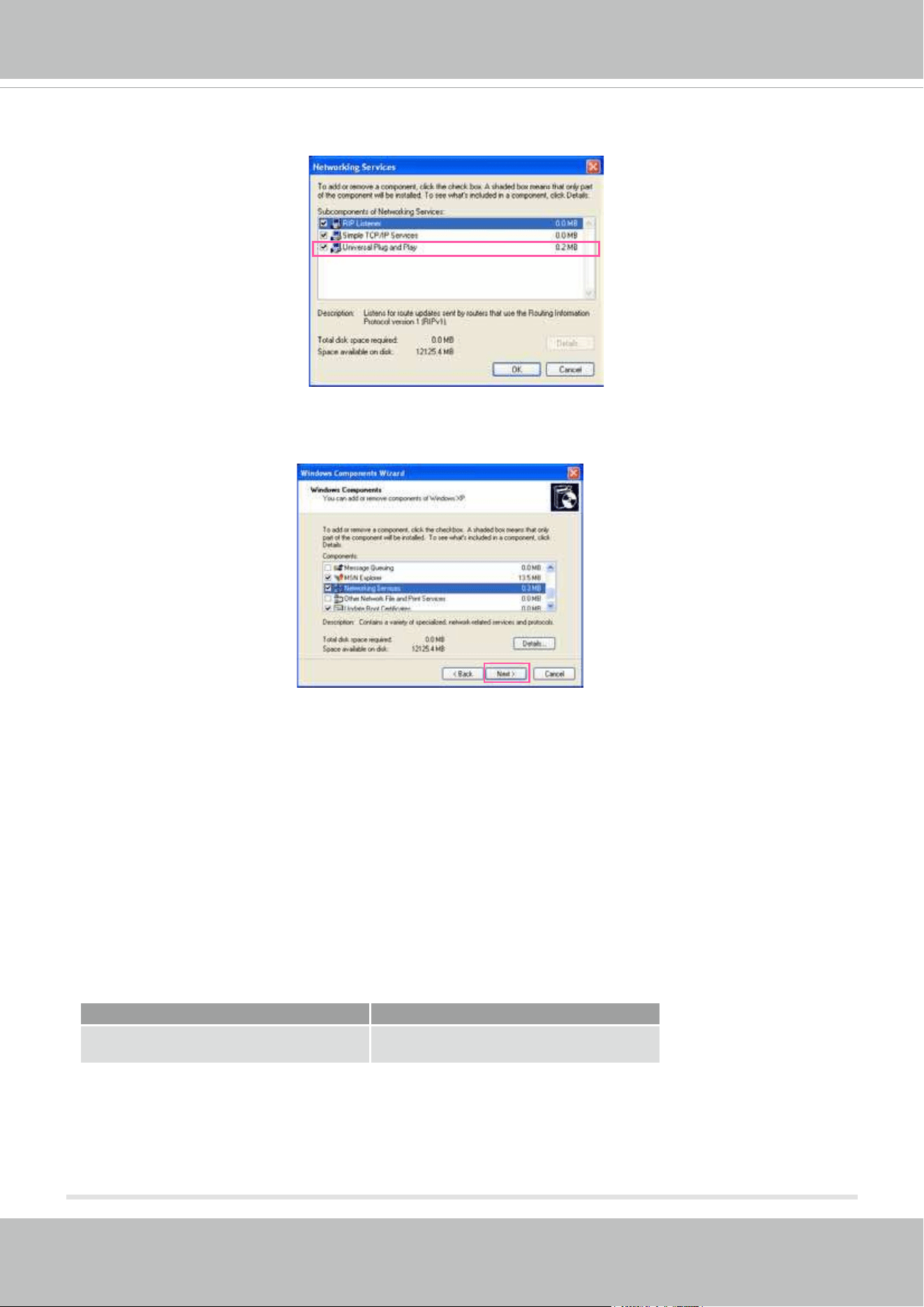
VIVOTEK
User's Manual - 71
4. In the Networking Services dialog box, select Universal Plug and Play and click OK.
5. Click Next in the following window.
6. Click Finish. UPnP
TM
is enabled.
► How does UPnP
TM
work?
UPnP
TM
networking technology provides automatic IP conguration and dynamic discovery of devices
added to a network. Services and capabilities offered by networked devices, such as printing and le
sharing, are available among each other without the need for cumbersome network conguration. In
the case of Network Cameras, you will see Network Camera shortcuts under My Network Places.
► Enabling UPnP port forwarding allows the Network Camera to open a secondary HTTP port on the
router-not HTTP port-meaning that you have to add the secondary HTTP port number to the Network
Camera’s public address in order to access the Network Camera from the Internet. For example,
when the HTTP port is set to 80 and the secondary HTTP port is set to 8080, refer to the list below for
the Network Camera’s IP address.
From the Internet In LAN
http://203.67.124.123:8080 http://192.168.4.160 or
http://192.168.4.160:8080
► If the PPPoE settings are incorrectly configured or the Internet access is not working, restore the
Network Camera to factory default; please refer to Restore on page 48 for details. After the Network
Camera is reset to factory default, it will be accessible on the LAN.
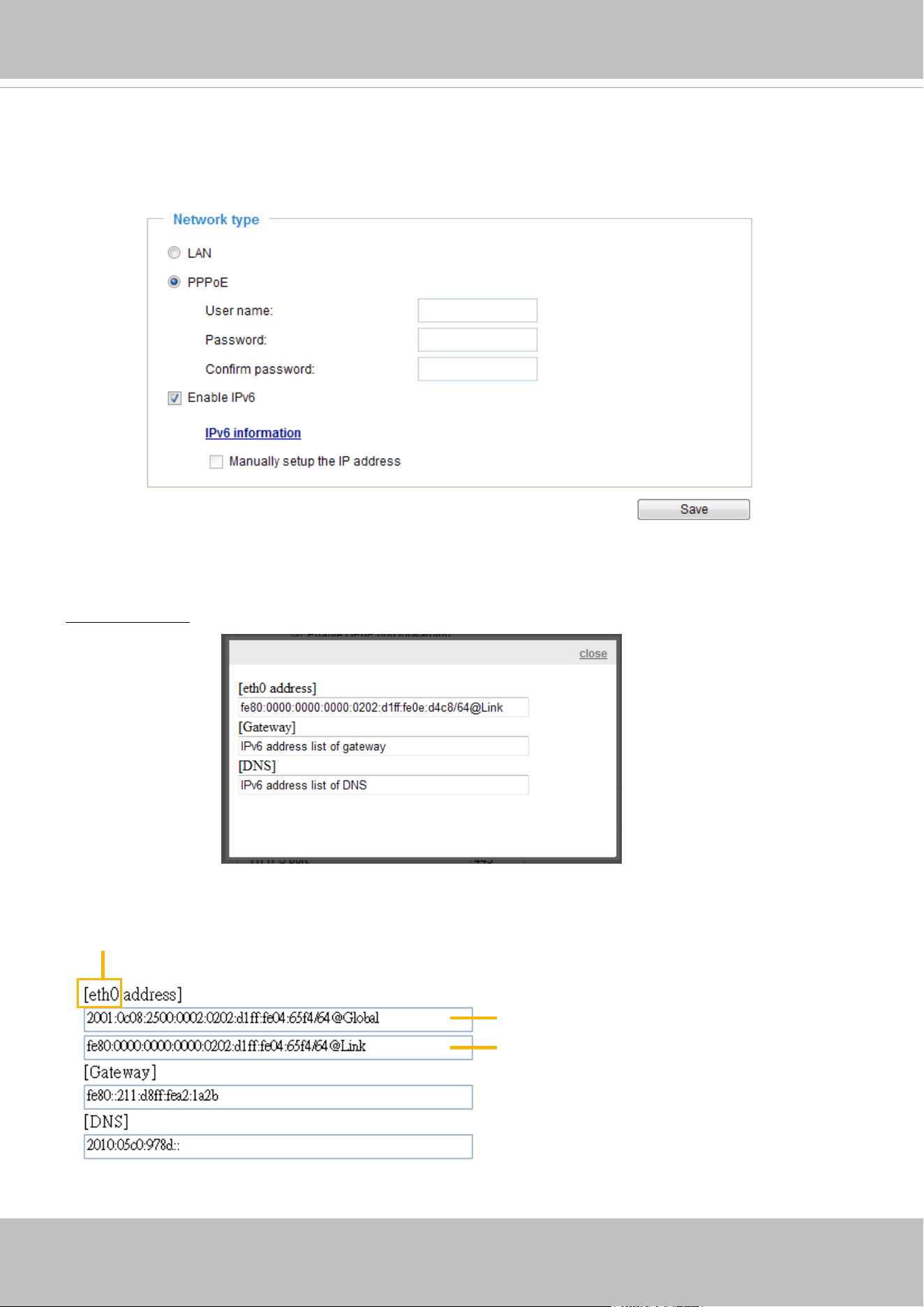
VIVOTEK
72 - User's Manual
Enable IPv6
Select this option and click Save to enable IPv6 settings.
Please note that this only works if your network environment and hardware equipment support IPv6. The
browser should be Microsoft
®
Internet Explorer 6.5, Mozilla Firefox 3.0 or above.
When IPv6 is enabled, by default, the network camera will listen to router advertisements and be
assigned with a link-local IPv6 address accordingly.
IPv6 Information: Click this button to obtain the IPv6 information as shown below.
If your IPv6 settings are successful, the IPv6 address list will be listed in the pop-up window. The IPv6
address will be displayed as follows:
Link-global IPv6 address/network mask
Link-local IPv6 address/network mask
Refers to Ethernet

VIVOTEK
User's Manual - 73
Please follow the steps below to link to an IPv6 address:
1. Open your web browser.
2. Enter the link-global or link-local IPv6 address in the address bar of your web browser.
3. The format should be:
4. Press Enter on the keyboard or click Refresh button to refresh the webpage.
For example:
NOTE:
► If you have a Secondary HTTP port (the default value is 8080), you can also link to the webpage in
the following address format: (Please refer to HTTP streaming on page 76 for detailed information.)
► If you choose PPPoE as the Network Type, the [
PPP0 address] will be displayed in the IPv6
information column as shown below.
Manually setup the IP address: Select this option to manually set up IPv6 settings if your network
environment does not have DHCPv6 server and router advertisements-enabled routers.
If you check this item, the following blanks will be displayed for you to enter the corresponding
information:
http://[2001:0c08:2500:0002:0202:d1ff:fe04:65f4]/
IPv6 address
http://[2001:0c08:2500:0002:0202:d1ff:fe04:65f4]/:8080
IPv6 address
Secondary HTTP port

VIVOTEK
74 - User's Manual
Port
HTTPS port: By default, the HTTPS port is set to 443. It can also be assigned to another port number
between 1025 and 65535.
FTP port: The FTP server allows the user to save recorded video clips. You can utilize VIVOTEK's
Installation Wizard 2 to upgrade the rmware via FTP server. By default, the FTP port is set to 21, or
assigned to another port number between 1025 and 65535.
Two way audio port: By default, the two way audio port is set to 5060. Also, it can also be assigned to
another port number between 1025 and 65535.
The Network Camera supports two way audio communication so that operators can transmit and receive
audio simultaneously. By using the Network Camera’s built-in or external microphone and an external
speaker, you can communicate with people around the Network Camera.
Note that as JPEG only transmits a series of JPEG images to the client, to enable the two-way audio
function, make sure the video mode is set to "H.264" on the Media > Video > Stream settings page and
the media option is set to “Media > Video > Stream settings” on the Client Settings page. Please refer to
Client Settings on page 36 and Stream settings on page 59.
Audio transmitted from operators
Audio transmitted to operators
America
Taiwan

VIVOTEK
User's Manual - 75
2011/03/09 17:08:56
Mute
Mic Volume
Talk Button
Video (TCP-AV)
Audio is being transmitted to the Network Camera
Click to enable audio transmission to the Network Camera; click to adjust the volume of
microphone; click
to turn off the audio. To stop talking, click again.

VIVOTEK
76 - User's Manual
Network > Streaming protocols
HTTP streaming
To utilize HTTP authentication, make sure that your have set a password for the Network Camera rst;
please refer to Security > User account on page 87 for details.
Authentication: Depending on your network security requirements, the Network Camera provides two
types of security settings for an HTTP transaction: basic and digest.
If
basic authentication is selected, the password is sent in plain text format and there can be potential
risks of being intercepted. If
digest authentication is selected, user credentials are encrypted using MD5
algorithm and thus provide better protection against unauthorized access.
HTTP port / Secondary HTTP port: By default, the HTTP port is set to 80 and the secondary HTTP port is
set to 8080. They can also be assigned to another port number between 1025 and 65535. If the ports are
incorrectly assigned, the following warning messages will be displayed:
To access the Network Camera on the LAN, both the HTTP port and secondary HTTP port can be used
to access the Network Camera. For example, when the HTTP port is set to 80 and the secondary HTTP
port is set to 8080, refer to the list below for the Network Camera’s IP address.
Access name for Channel # and stream #: This Network camera supports multiple streams
simultaneously. The access name is used to differentiate the streaming source. Users can click Media >
Video > Stream settings to set up the video quality of linked streams. For more information about how
to set up the video quality, please refer to Stream settings on page 59.
When using Mozilla Firefox or Netscape to access the Network Camera and the video mode is set to
JPEG, users will receive video comprised of continuous JPEG images. This technology, known as “server
push”, allows the Network Camera to feed live pictures to Mozilla Firefox and Netscape.
On the LAN
http://192.168.4.160 or
http://192.168.4.160:8080

VIVOTEK
User's Manual - 77
URL command -- http://<ip address>:<http port>/<access name for stream 1 ~ 4>
For example, when the Access name for stream 2 is set to video2.mjpg:
1. Launch Mozilla Firefox or Netscape.
2. Type the above URL command in the address bar. Press Enter.
3. The JPEG images will be displayed in your web browser.
IMPORTANT:
► Microsoft
®
Internet Explorer does not support server push technology; therefore, using http://<ip
address>:<http port>/<access name for stream 1 ~ 4>
will fail to access the Network Camera.
► Users can only use URL commands to request the stream 5. For more information about URL
commands, please refer to page 137.
RTSP Streaming
To utilize RTSP streaming authentication, make sure that you have set a password for the Network
Camera rst; please refer to Security > User account on page 87 for details.
http://192.168.5.151/video2.mjpg
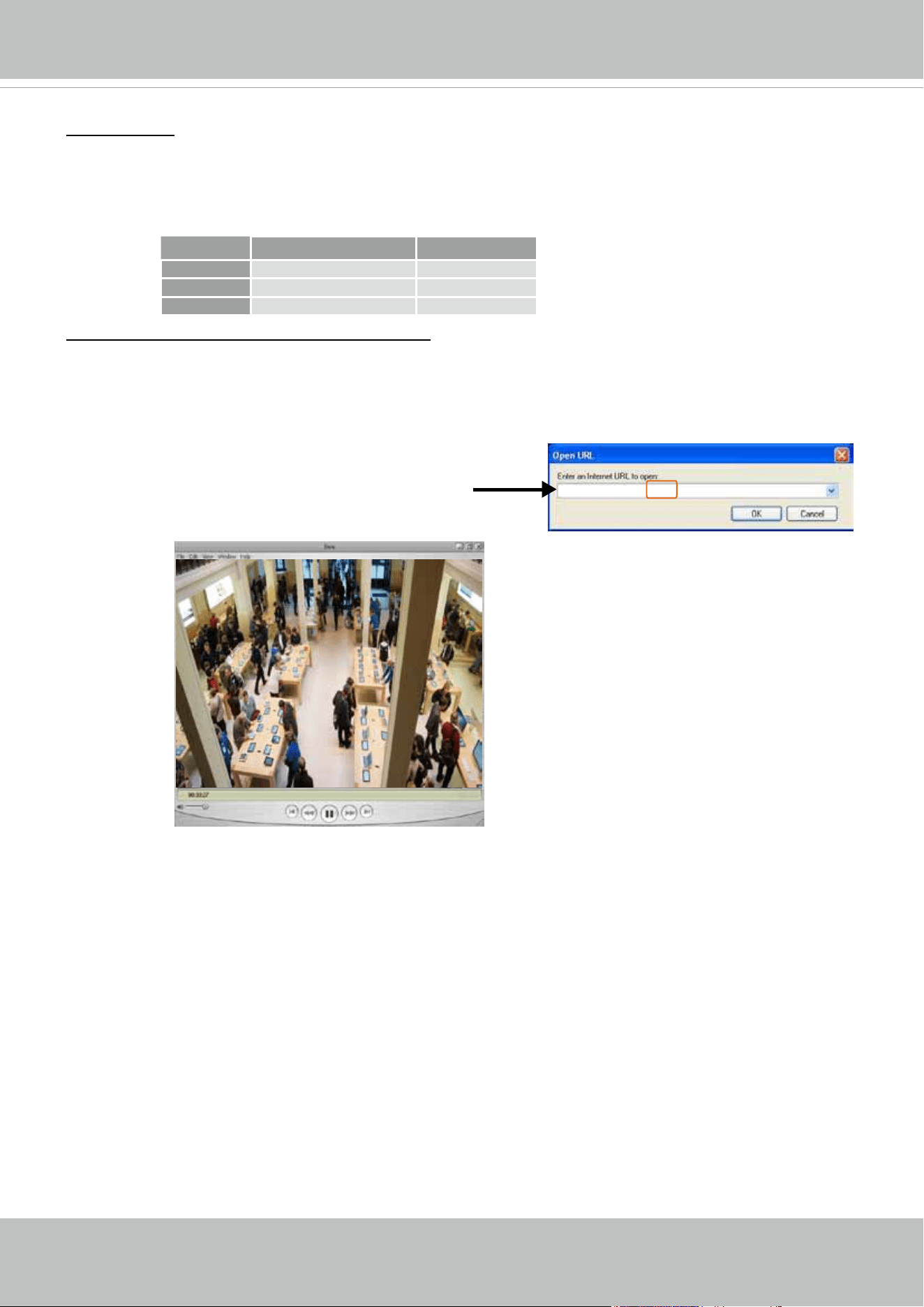
VIVOTEK
78 - User's Manual
Authentication: Depending on your network security requirements, the Network Camera provides three
types of security settings for streaming via RTSP protocol: disable, basic, and digest.
If basic authentication is selected, the password is sent in plain text format, but there can be potential
risks of it being intercepted. If
digest authentication is selected, user credentials are encrypted using
MD5 algorithm, thus providing better protection against unauthorized access.
The availability of the RTSP streaming for the three authentication modes is listed in the following table:
Access name for Channel # and stream #: This Network camera supports multiple streams
simultaneously. The access name is used to differentiate the streaming source.
If you want to use an
RTSP player to access the Network Camera, you HAVE TO set the video mode to
H.264 and use the following RTSP URL command to request transmission of the streaming data.
rtsp://<ip address>:<rtsp port>/<access name for stream1 ~ 4>
For example, when the access name for stream 1 is set to live.sdp:
1. Launch an RTSP player.
2. Choose File > Open URL. A URL dialog box will pop up.
3. Type the above URL command in the address eld.
4. The live video will be displayed in your player as shown
below.
rtsp://192.168.5.151:554/live.sdp
Quick Time player VLC Player
Disable O O
Basic O O
Digest O X
Video 16:38:01 2011/03/25
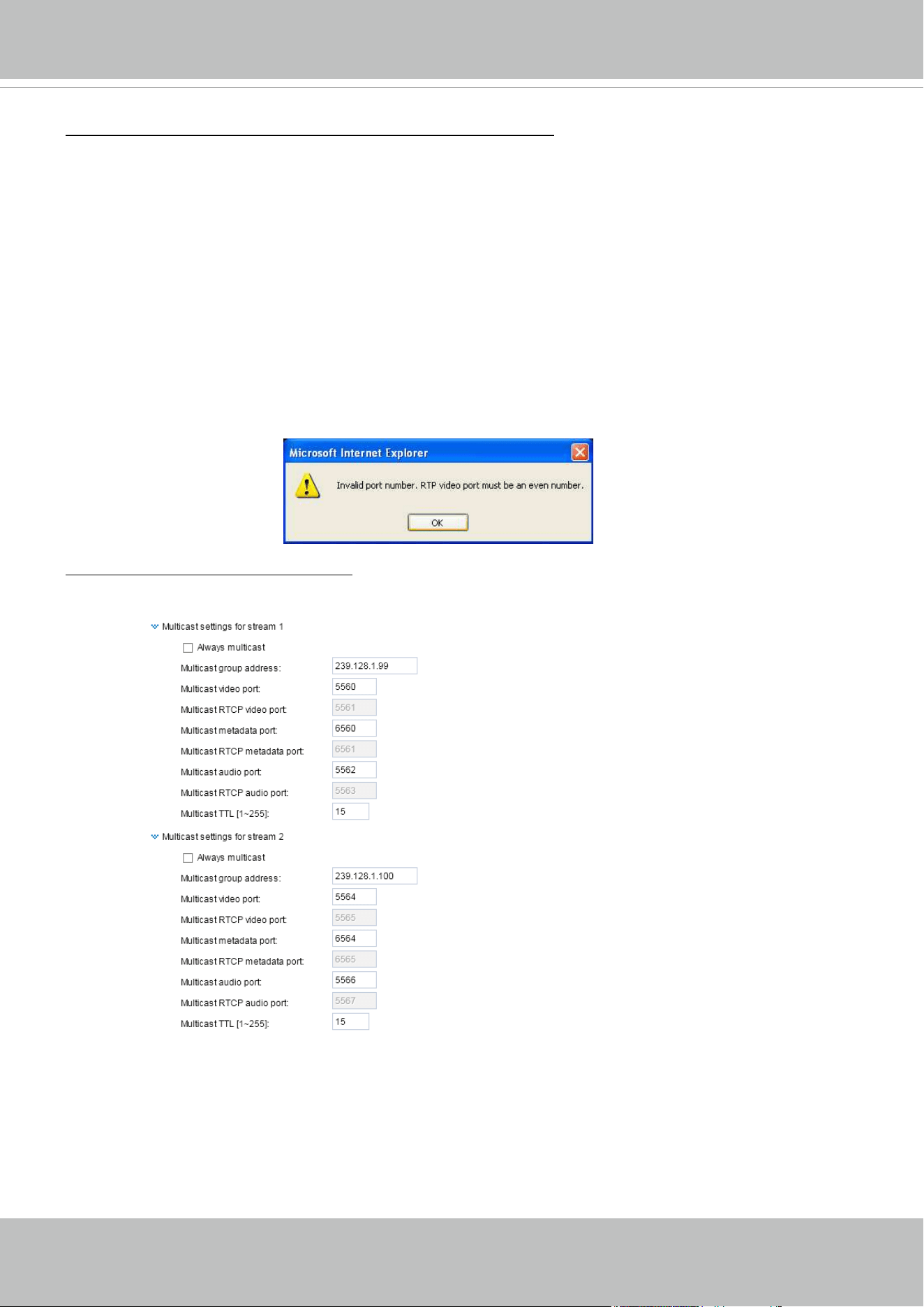
VIVOTEK
User's Manual - 79
RTSP port /RTP port for video, audio/ RTCP port for video, audio
■ RTSP (Real-Time Streaming Protocol) controls the delivery of streaming media. By default, the port
number is set to 554.
■ The RTP (Real-time Transport Protocol) is used to deliver video and audio data to the clients. By
default, the RTP port for video is set to 5556 and the RTP port for audio is set to 5558.
■ The RTCP (Real-time Transport Control Protocol) allows the Network Camera to transmit the data by
monitoring the Internet trafc volume. By default, the RTCP port for video is set to 5557 and the RTCP
port for audio is set to 5559.
The ports can be changed to values between 1025 and 65535. The RTP port must be an even number
and the RTCP port is the RTP port number plus one, and thus is always an odd number. When the RTP
port changes, the RTCP port will change accordingly.
If the RTP ports are incorrectly assigned, the following warning message will be displayed:
Multicast settings for stream #1 ~ #4: Click the items to display the detailed conguration information.
Select the Always multicast option to enable multicast for streams #1 ~ #4.

VIVOTEK
80 - User's Manual
Unicast video transmission delivers a stream through point-to-point transmission; multicast, on the other
hand, sends a stream to the multicast group address and allows multiple clients to acquire the stream at
the same time by requesting a copy from the multicast group address. Therefore, enabling multicast can
effectively save Internet bandwith.
The ports can be changed to values between 1025 and 65535. The multicast RTP port must be an even
number and the multicast RTCP port number is the multicast RTP port number plus one, and thus is
always odd. When the multicast RTP port changes, the multicast RTCP port will change accordingly.
If the multicast RTP video ports are incorrectly assigned, the following warning message will be
displayed:
Multicast TTL [1~255]: The multicast TTL (Time To Live) is the value that tells the router the range a
packet can be forwarded.
Initial TTL Scope
0 Restricted to the same host
1 Restricted to the same subnetwork
32 Restricted to the same site
64 Restricted to the same region
128 Restricted to the same continent
255 Unrestricted in scope
IMPORTANT:
The Multicast metadata port is utilized by VIVOTEK VADP modules to transfer video analytics results,
PTZ stream, textual data, and event messages between the camera and the client side running and
observing the video analysis. If your client side computer is located outside the local network, you may
need to open the associated TCP port on routers and rewall.
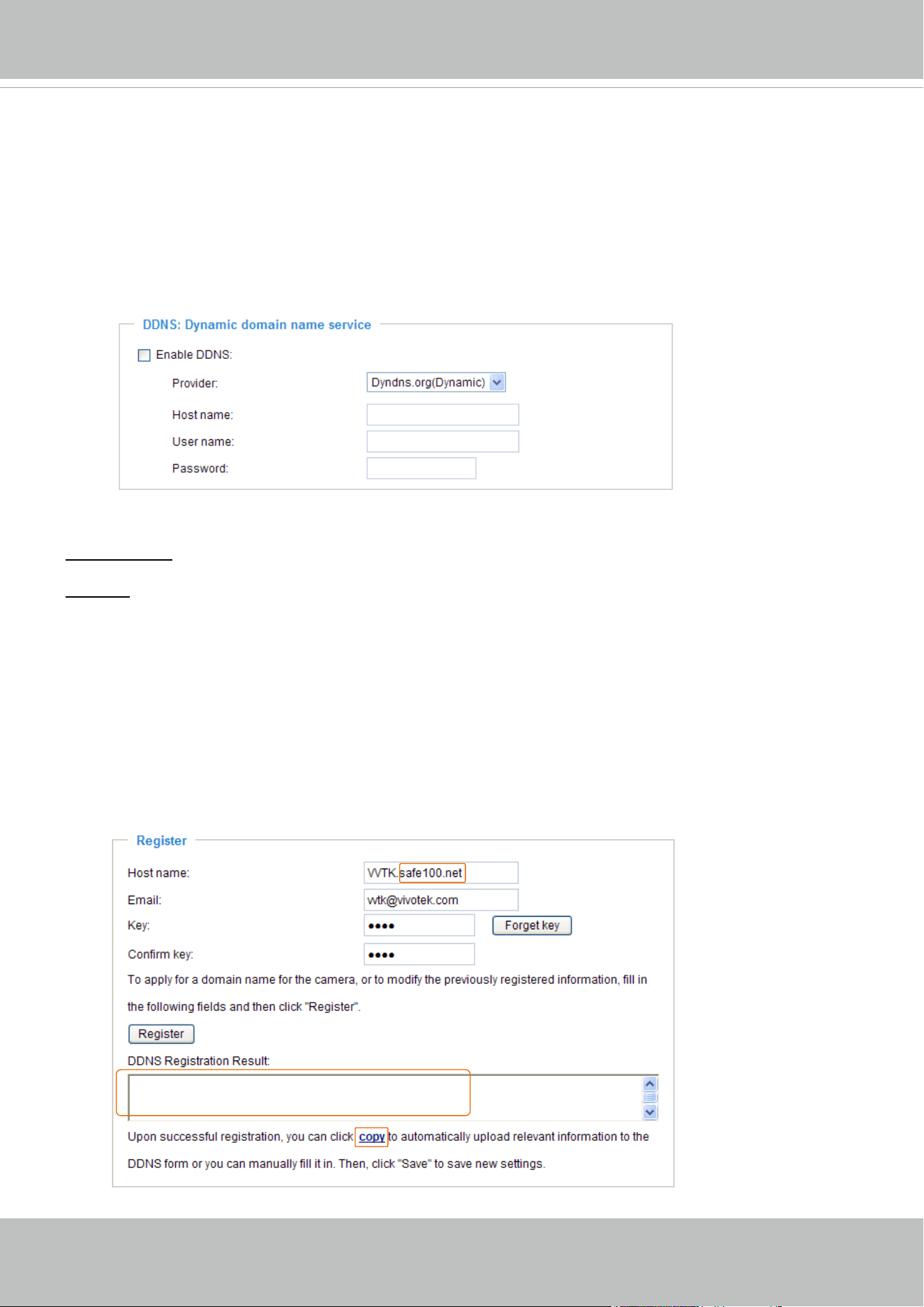
VIVOTEK
User's Manual - 81
Network > DDNS
This section explains how to congure the dynamic domain name service for the Network
Camera. DDNS is a service that allows your Network Camera, especially when assigned
with a dynamic IP address, to have a xed host and domain name.
Manual setup
DDNS: Dynamic domain name service
Enable DDNS: Select this option to enable the DDNS setting.
Provider: Select a DDNS provider from the provider drop-down list.
VIVOTEK offers
Safe100.net, a free dynamic domain name service, to VIVOTEK customers. It
is recommended that you register
Safe100.net to access VIVOTEK’s Network Cameras from the
Internet. Additionally, we offer other DDNS providers, such as Dyndns.org(Dynamic), Dyndns.
org(Custom), Safe100.net, and CustomSafe100.
Note that before utilizing this function, please apply for a dynamic domain account rst.
■
Safe100.net
1. In the DDNS column, select Safe100.net from the drop-down list. Click I accept after reviewing
the terms of the Service Agreement.
2. In the Register column, ll in the Host name (xxxx.safe100.net), Email, Key, and Conrm Key,
and click Register. After a host name has been successfully created, a success message will
be displayed in the DDNS Registration Result column.
[Register] Successfully Your account information has
been mailed to registered e-mail address

VIVOTEK
82 - User's Manual
3. Click Copy and all the registered information will automatically be uploaded to the corresponding elds
in the DDNS column at the top of the page as seen in the picture.
[Register] Successfully Your account information has
been mailed to registered e-mail address
4. Select Enable DDNS and click Save to enable the setting.
■
CustomSafe100
VIVOTEK offers documents to establish a CustomSafe100 DDNS server for distributors and system
integrators. You can use CustomSafe100 to register a dynamic domain name if your distributor or system
integrators offer such services.
1. In the DDNS column, select CustomSafe100 from the drop-down list.
2. In the Register column, ll in the Host name, Email, Key, and Conrm Key; then click Register. After a
host name has been successfully created, you will see a success message in the DDNS Registration
Result column.
3. Click Copy and all for the registered information will be uploaded to the corresponding elds in the
DDNS column.
4. Select Enable DDNS and click Save to enable the setting.
Forget key: Click this button if you have forgotten the key to Safe100.net or CustomSafe100. Your
account information will be sent to your email address.
Refer to the following links to apply for a dynamic domain account when selecting other DDNS
providers:
■ Dyndns.org(Dynamic) / Dyndns.org(Custom): visit http://www.dyndns.com/

VIVOTEK
User's Manual - 83
Please follow the steps below to enable Express Link:
1. Make sure that your router supports UPnP port forwarding and it is activated.
2. Check Enable express link.
3. Enter a host name for the network device and click Save. If the host name has been used by another
device, a warning message will show up. If the host name is valid, it will display a message as shown
below.
https://vivotek test3454.2bthere.net
Express link
Express Link is a free service provided by VIVOTEK server, which allows users to register a
domain name for a network device. One URL can only be mapped to one MAC address. This
service will examine if the host name is valid and automatically open a port on your router. If
using DDNS, the user has to manually congure UPnP port forwarding. Express Link is more
convenient and easier to set up.

VIVOTEK
84 - User's Manual
Network > QoS (Quality of Service)
Quality of Service refers to a resource reservation control mechanism, which guarantees a certain quality
to different services on the network. Quality of service guarantees are important if the network capacity
is insufcient, especially for real-time streaming multimedia applications. Quality can be dened as, for
instance, a maintained level of bit rate, low latency, no packet dropping, etc.
The following are the main benets of a QoS-aware network:
■
The ability to prioritize trafc and guarantee a certain level of performance to the data ow.
■
The ability to control the amount of bandwidth each application may use, and thus provide higher
reliability and stability on the network.
Requirements for QoS
To utilize QoS in a network environment, the following requirements must be met:
■
All network switches and routers in the network must include support for QoS.
■
The network video devices used in the network must be QoS-enabled.
QoS models
CoS (the VLAN 802.1p model)
IEEE802.1p defines a QoS model at OSI Layer 2 (Data Link Layer), which is called CoS, Class of
Service. It adds a 3-bit value to the VLAN MAC header, which indicates the frame priority level from 0
(lowest) to 7 (highest). The priority is set up on the network switches, which then use different queuing
disciplines to forward the packets.
Below is the setting column for CoS. Enter the VLAN ID of your switch (0~4095) and choose the priority
for each application (0~7).
If you assign Video the highest priority level, your network switch will handle video packets rst.
NOTE:
► A VLAN-capable Switch (802.1p) is required. Web browsing may fail if the CoS setting is incorrect.
► Class of Service technologies do not guarantee a level of service in terms of bandwidth and delivery
time; they offer a “best-effort.” Users can think of CoS as “coarsely-grained” trafc control and QoS as
“nely-grained” trafc control.
► Although CoS is simple to manage, it lacks scalability and does not offer end-to-end guarantees since
it is based on L2 protocol.
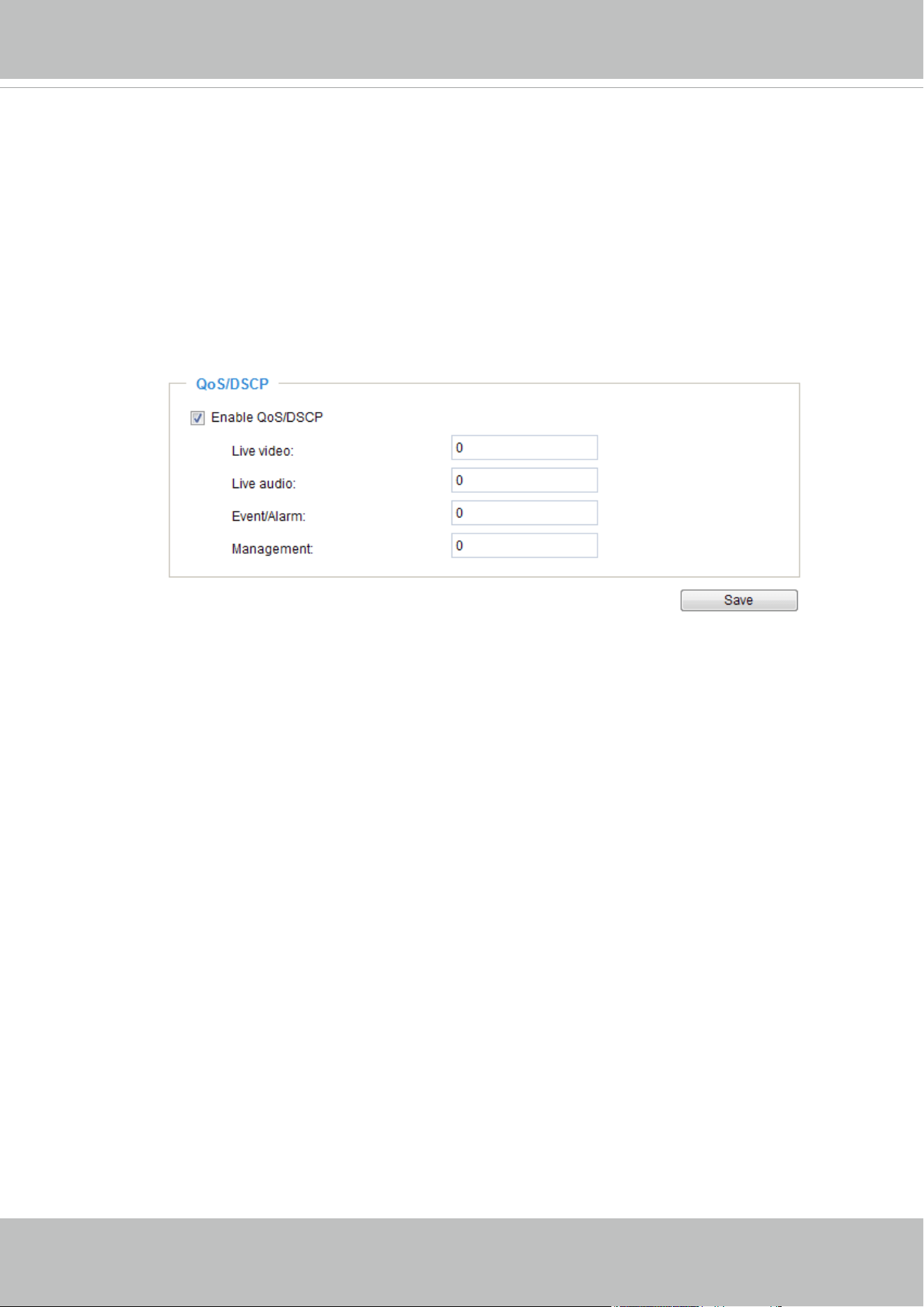
VIVOTEK
User's Manual - 85
QoS/DSCP (the DiffServ model)
DSCP-ECN defines QoS at Layer 3 (Network Layer). The Differentiated Services (DiffServ) model is
based on packet marking and router queuing disciplines. The marking is done by adding a eld to the
IP header, called the DSCP (Differentiated Services Codepoint). This is a 6-bit field that provides 64
different class IDs. It gives an indication of how a given packet is to be forwarded, known as the Per Hop
Behavior (PHB). The PHB describes a particular service level in terms of bandwidth, queueing theory,
and dropping (discarding the packet) decisions. Routers at each network node classify packets according
to their DSCP value and give them a particular forwarding treatment; for example, how much bandwidth
to reserve for it.
Below are the setting options of DSCP (DiffServ Codepoint). Specify the DSCP value for each application
(0~63).

VIVOTEK
86 - User's Manual
Network > SNMP (Simple Network Management Protocol)
This section explains how to use the SNMP on the network camera. The Simple Network
Management Protocol is an application layer protocol that facilitates the exchange of
management information between network devices. It helps network administrators to remotely
manage network devices and nd, solve network problems with ease.
■ The SNMP consists of the following three key components:
1. Manager: Network-management station (NMS), a server which executes applications that monitor and
control managed devices.
2. Agent: A network-management software module on a managed device which transfers the status of
managed devices to the NMS.
3. Managed device: A network node on a managed network. For example: routers, switches, bridges,
hubs, computer hosts, printers, IP telephones, network cameras, web server, and database.
Before conguring SNMP settings on the this page, please enable your NMS rst.
SNMP Conguration
Enable SNMPv1, SNMPv2c
Select this option and enter the names of Read/Write community and Read Only community according to
your NMS settings.
Enable SNMPv3
This option contains cryptographic security, a higher security level, which allows you to set the
Authentication password and the Encryption password.
■ Security name: According to your NMS settings, choose Read/Write or Read Only and enter the
community name.
■ Authentication type: Select MD5 or SHA as the authentication method.
■ Authentication password: Enter the password for authentication (at least 8 characters).
■ Encryption password: Enter a password for encryption (at least 8 characters).
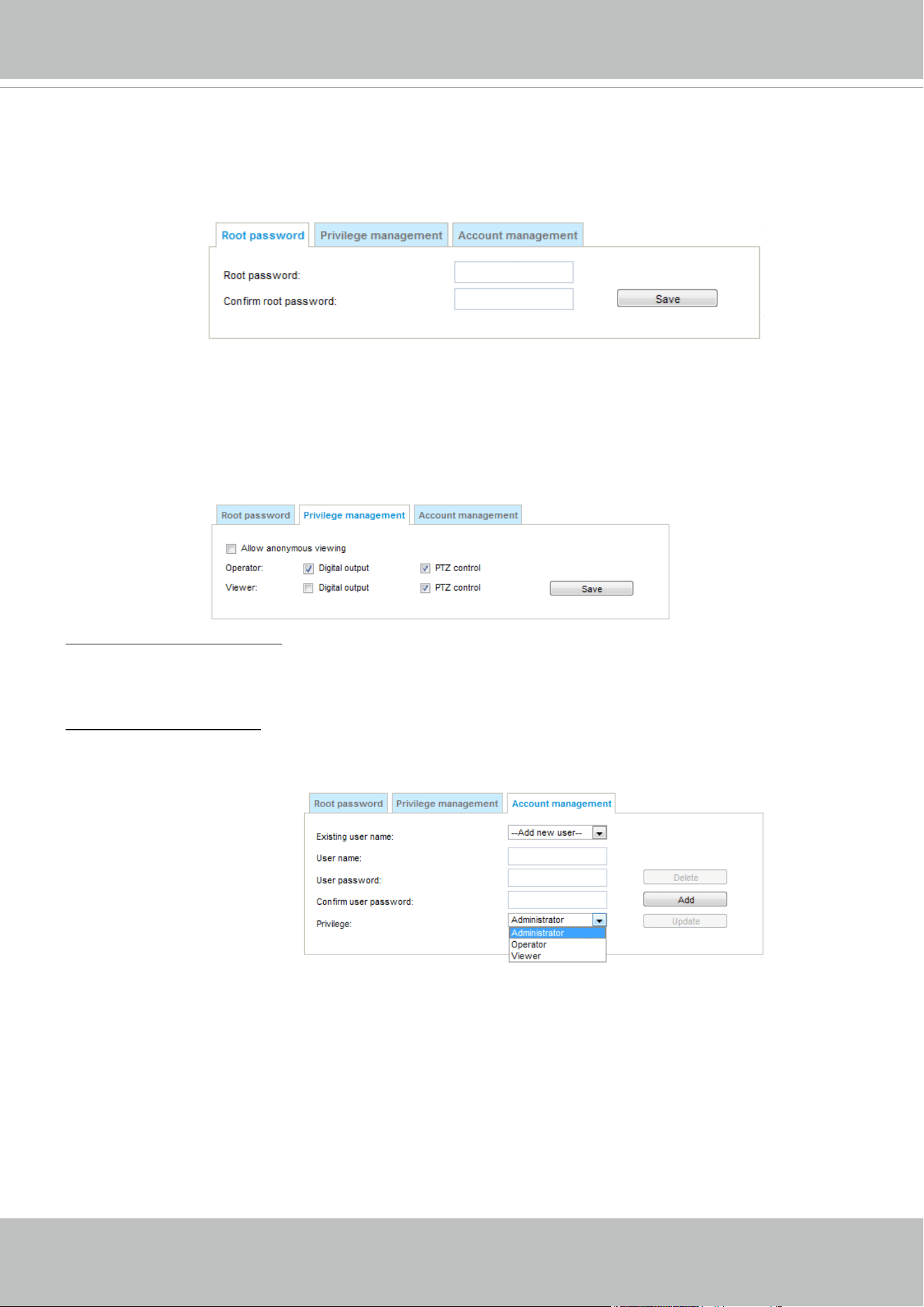
VIVOTEK
User's Manual - 87
Security > User Account
This section explains how to enable password protection and create multiple accounts.
Root Password
The administrator account name is “root”, which is permanent and can not be deleted. If you want to add
more accounts in the Manage User column, please apply the password for the “root” account rst.
1. Type the password identically in both text boxes, then click Save to enable password protection.
2. A window will prompt for authentication; type the correct user’s name and password in their respective
elds to access the Network Camera.
Privilege management
Digital Output & PTZ control: You can modify the management privilege as operators or viewers. Select
or de-select the checkboxes, and then click Save to enable the settings. If you give Viewers the privilege,
Operators will also have the ability to control the Network Camera through the main page. (Please refer
to Conguration on page 40).
Allow anonymous viewing: If you select this item, any client can access the live stream without entering a
User ID and Password.
Account management
Administrators can create up to 20 user accounts.
1. Input the new user’s name and password.
2. Select the privilege level for the new user account. Click Add to enable the setting.
Access rights are sorted by user privilege (Administrator, Operator, and Viewer). Only administrators can
access the Conguration page. Though operators cannot access the Conguration page, they can use
the URL Commands to get and set the value of parameters. For more information, please refer to URL
Commands of the Network Camera on page 136. Viewers access only the main page for live viewing.
Here you also can change a user’s access rights or delete user accounts.
1. Select an existing account to modify.
2. Make necessary changes and click Update or Delete to enable the setting.

VIVOTEK
88 - User's Manual
Security > HTTPS (Hypertext Transfer Protocol over SSL)
This section explains how to enable authentication and encrypted communication over SSL
(Secure Socket Layer). It helps protect streaming data transmission over the Internet on higher
security level.
Create and Install Certicate Method
Before using HTTPS for communication with the Network Camera, a Certicate must be created rst.
There are three ways to create and install a certicate:
Create self-signed certificate
1. Select the rst option.
2. Check Enable HTTPS secure connection, then select a connection option: “HTTP & HTTPS” or
“HTTPS only”.
3. Click Create certicate to generate a certicate.
4. The Certicate Information will automatically be displayed in the lower screen as shown below. You
can click Certicate properties to view detailed information about the certicate.

VIVOTEK
User's Manual - 89
5. Click Save to preserve your conguration, and your current session with the camera will change to the
encrypted connection.
6. If your web session does not automatically change to an encrypted HTTPS session, click Home to re-
turn to the main page. Change the URL address from “
http://” to “https://“ in the address bar and press
Enter on your keyboard. Some Security Alert dialogs will pop up. Click OK or Yes to enable HTTPS.
https://
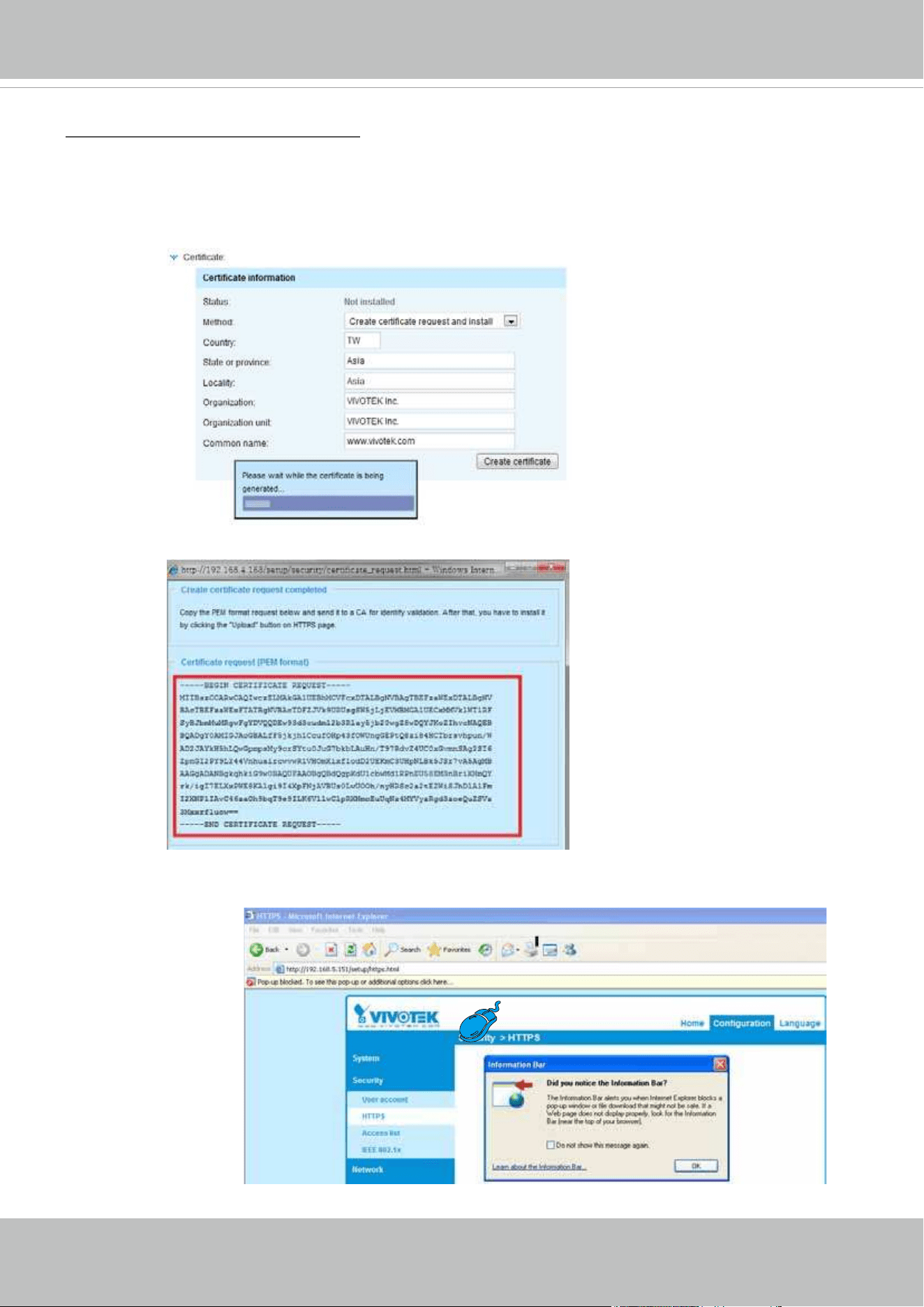
VIVOTEK
90 - User's Manual
Create certificate request and install
1. Select the option from the Method pull-down menu.
2. Click Create certicate to proceed.
3. The following information will show up in a pop-up window after clicking Create. Then click Save to
generate the certicate request.
4. The Certicate request window will prompt.
If you see the following Information bar, click OK and click on the Information bar at the top of the page
to allow pop-ups.
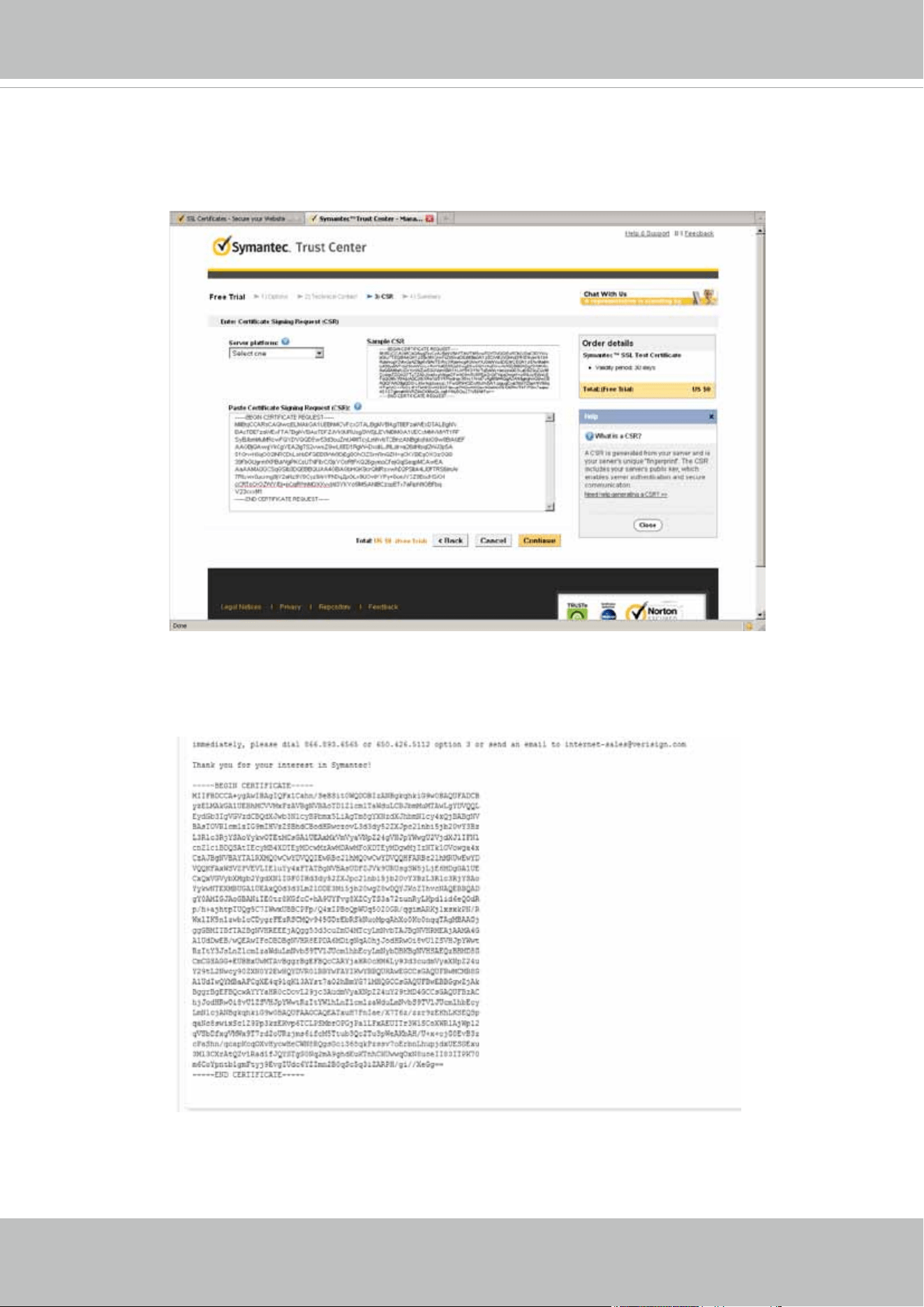
VIVOTEK
User's Manual - 91
5. Look for a trusted certificate authority, such as Symantec’s VeriSign Authentication Services, that
issues digital certificates. Sign in and purchase the SSL certification service. Copy the certificate
request from your request prompt and paste it in the CA’s signing request window. Proceed with the
rest of the process as CA’s instructions on their webpage.
6. Once completed, your SSL certicate should be delivered to you via an email or other means. Copy
the contents of the certicate in the email and paste it in a text/HTML/hex editor/converter, such as
IDM Computer Solutions’ UltraEdit.
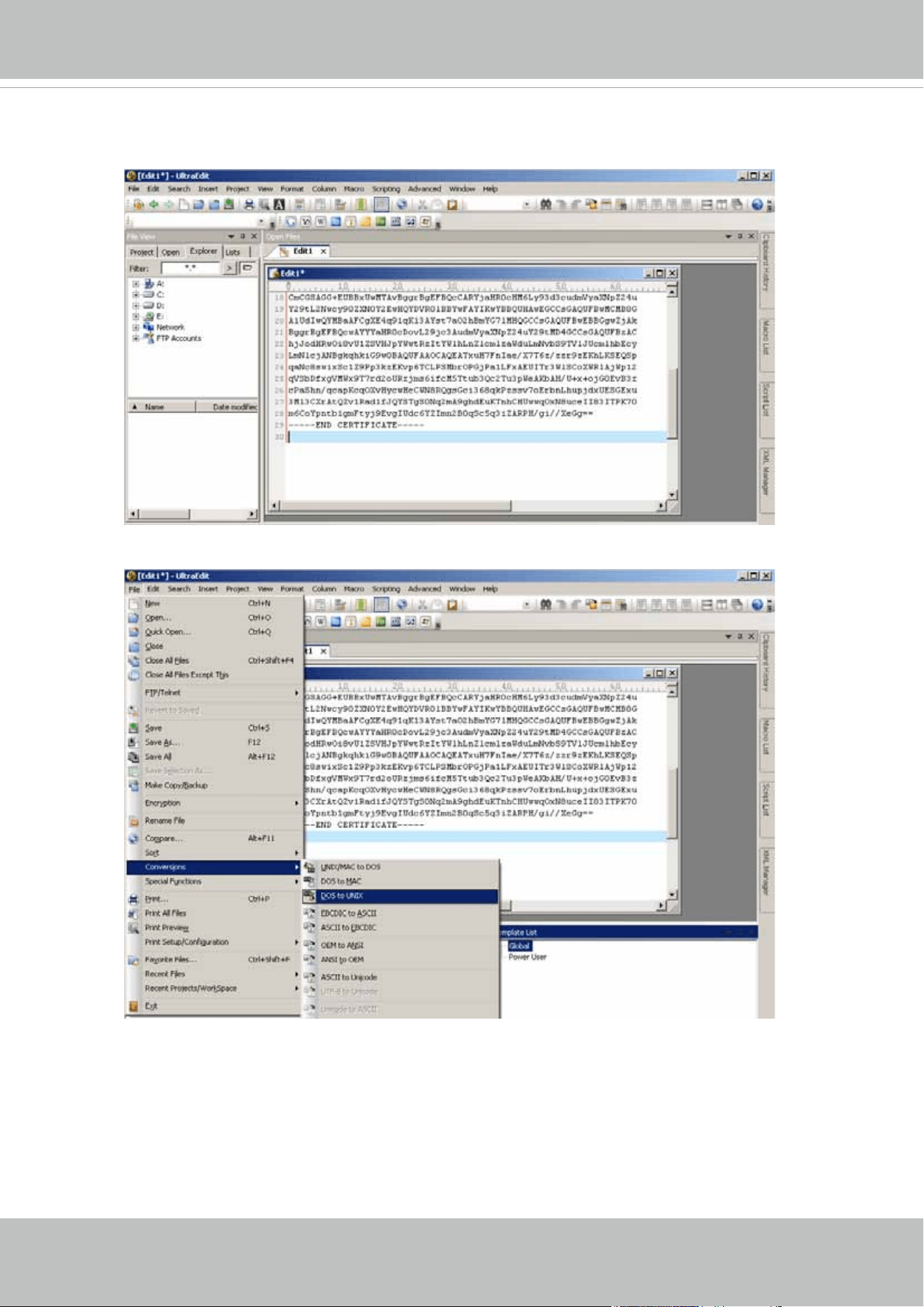
VIVOTEK
92 - User's Manual
7. Open a new edit, paste the certicate contents, and press ENTER at the end of the contents to add an
empty line.
8. Convert le format from DOS to UNIX. Open File menu > Conversions > DOS to Unix.

VIVOTEK
User's Manual - 93
9. Save the edit using the “.crt” extension, using a le name like “CAcert.crt.”
10. Return to the original rmware session, use the Browse button to locate the crt certicate le, and
click Upload to enable the certication.

VIVOTEK
94 - User's Manual
11. When the certifice file is successfully loaded, its status will be stated as Active.
Note that a
certicate must have been created and installed before you can click on the “Save" button
for the conguration to take effect.
12.To begin an encrypted HTTPS session, click Home to return to the main page. Change the URL ad-
dress from “
http://” to “https://“ in the address bar and press Enter on your keyboard. Some Security
Alert dialogs will pop up. Click OK or Yes to enable HTTPS.
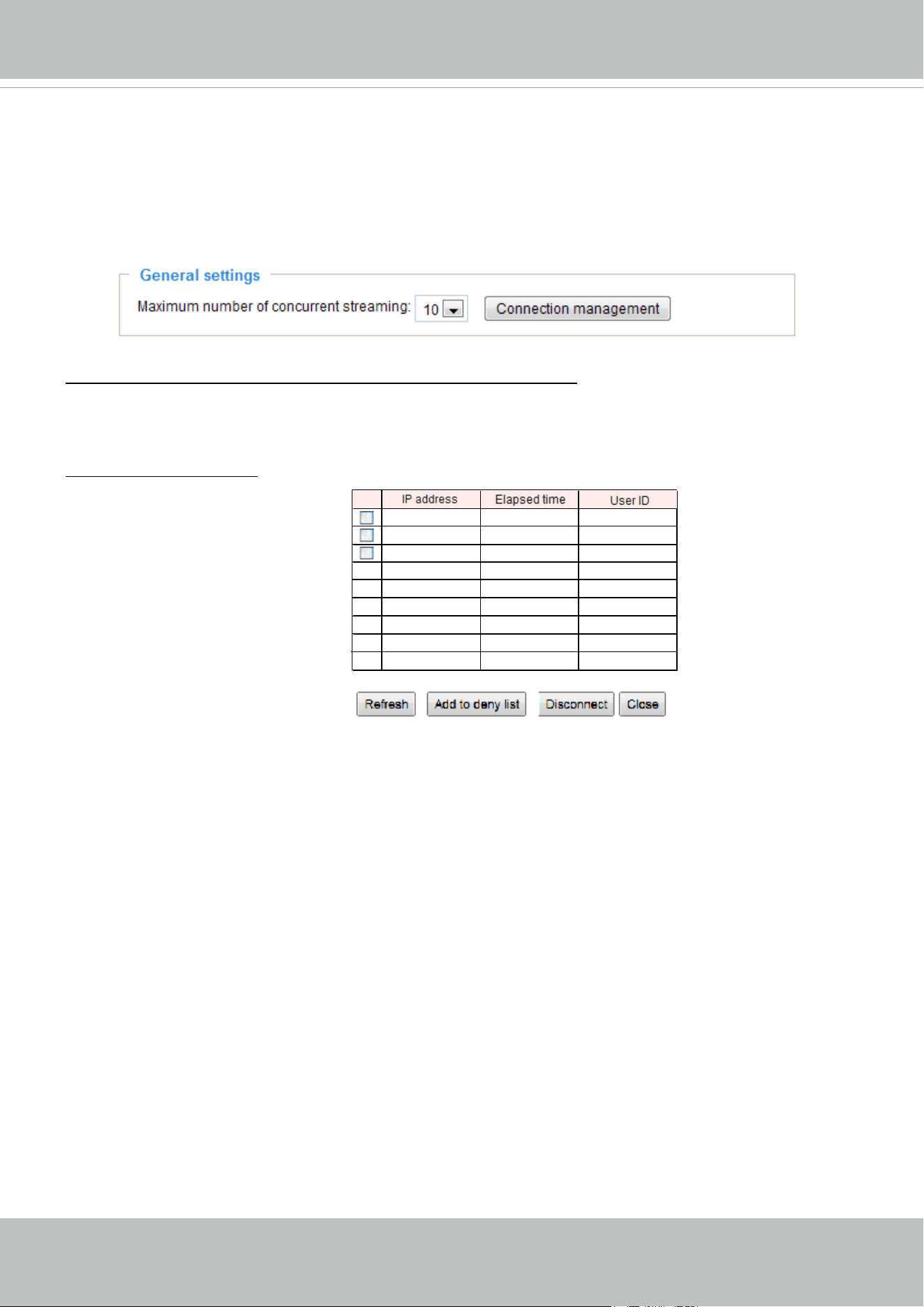
VIVOTEK
User's Manual - 95
Security > Access List
This section explains how to control access permission by verifying the client PC’s IP address.
General Settings
Maximum number of concurrent streaming connection(s) limited to: Simultaneous live viewing for 1~10
clients (including stream #1, #2, and #3). The default value is 10. If you modify the value and click Save,
all current connections will be disconnected and automatically attempt to re-link (IE Explorer or Quick
Time Player).
Connection management: Click this button to display the connection status window showing a list of the
current connections. For example:
■ IP address: Current connections to the Network Camera.
■ Elapsed time: How much time the client has been at the webpage.
■ User ID: If the administrator has set a password for the webpage, the clients have to enter a user name
and password to access the live video. The user name will be displayed in the User ID column. If the
administrator allows clients to link to the webpage without a user name and password, the User ID
column will be empty.
There are some situations which allow clients access to the live video without a user name and
password:
1. The administrator does not set up a root password. For more information about how to set up a root
password and manage user accounts, please refer to Security > User account on page 87.
2. The administrator has set up a root password, but set RTSP Authentication to “disable“. For more
information about RTSP Authentication, please refer to RTSP Streaming on page 77.
3. The administrator has set up a root password, but allows anonymous viewing. For more information
about Allow Anonymous Viewing, please refer to page 87.
■ Refresh: Click this button to refresh all current connections.
■ Add to deny list: You can select entries from the Connection Status list and add them to the Deny List
to deny access. Please note that those checked connections will only be disconnected temporarily
and will automatically try to re-link again (IE Explore or Quick Time Player). If you want to enable the
denied list, please check Enable access list ltering and click Save in the rst column.
192.168.3.25
61.22.15.3
192.168.1.147
IP address
45:00:34
00:10:09
12:20:34
Elapsed time
greg
anonymous
root
User ID
Add to Deny List DisconnectRefresh
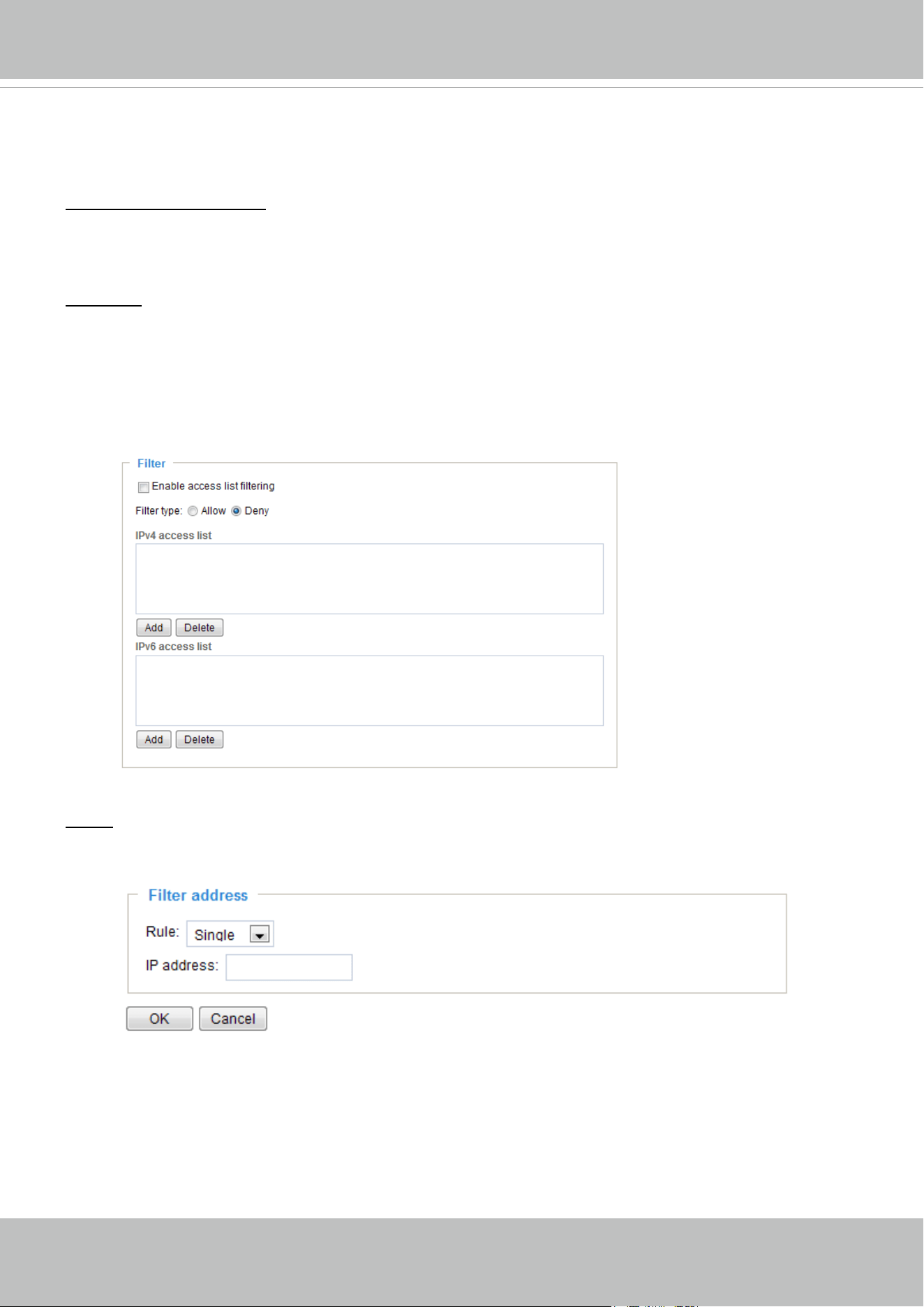
VIVOTEK
96 - User's Manual
■ Disconnect: If you want to break off the current connections, please select them and click this
button. Please note that those checked connections will only be disconnected temporarily and will
automatically try to re-link again (IE Explorer or Quick Time Player).
Enable access list ltering: Check this item and click Save if you want to enable the access list ltering
function.
Filter
Filter type: Select Allow or Deny as the lter type. If you choose Allow Type, only those clients whose
IP addresses are on the Access List below can access the Network Camera, and the others cannot
access. On the contrary, if you choose Deny Type, those clients whose IP addresses are on the Access
List below will not be allowed to access the Network Camera, and the others can access.
Then you can Add a rule to the following Access List. Please note that the IPv6 access list column
will not be displayed unless you enable IPv6 on the Network page. For more information about IPv6
Settings, please refer to Network > Enable IPv6 on page 72 for detailed information.
There are three types of rules:
Single: This rule allows the user to add an IP address to the Allowed/Denied list.
For example:
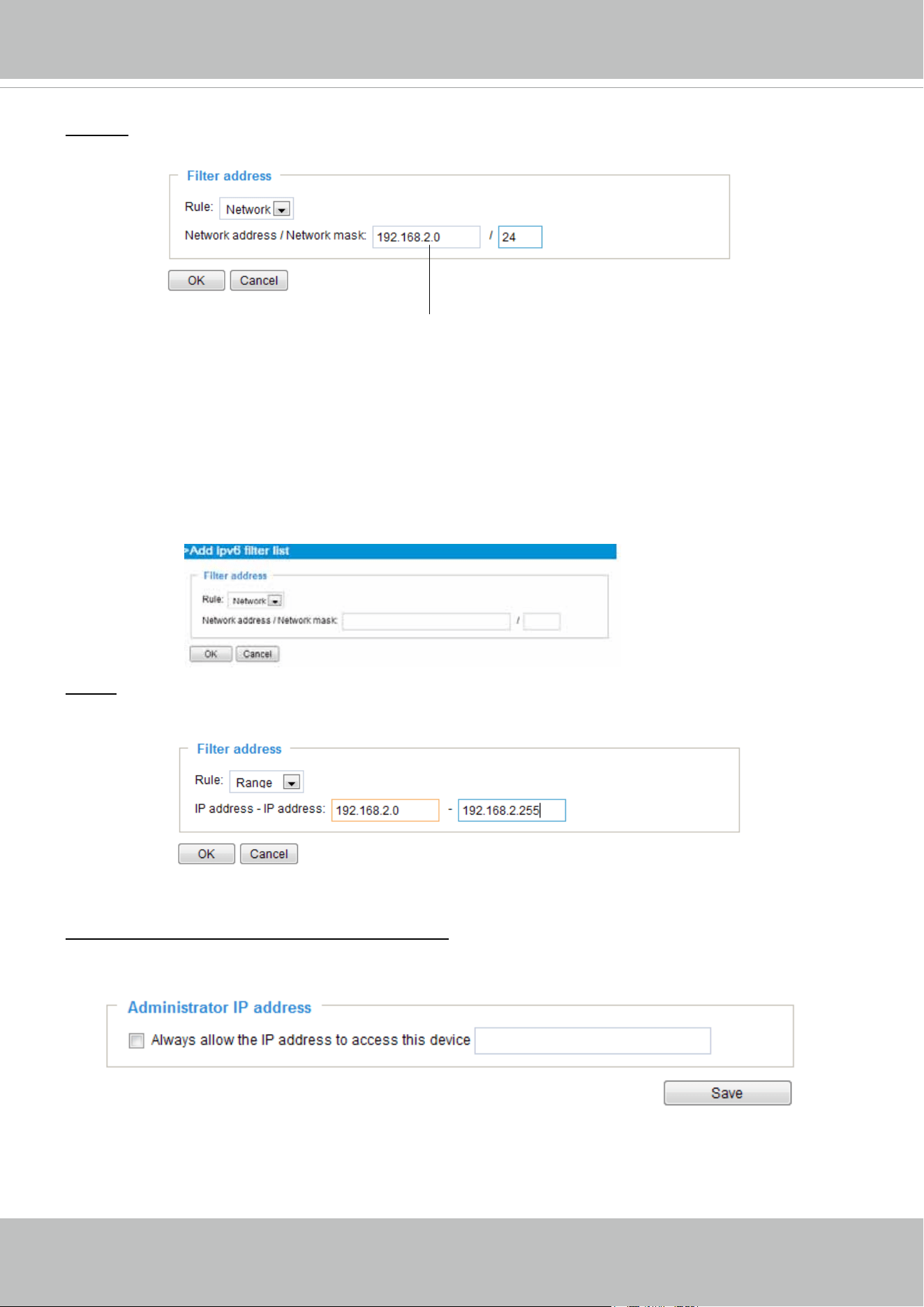
VIVOTEK
User's Manual - 97
accesses from IP address 192.168.2.x will be bolcked.
If IPv6 lter is preferred, you will be prompted by the following window. Enter the IPv6 address and the
two-digit prex length to specify the range of IP addresses in your conguration.
For example:
• 192.168.100.14/24 represents the IPv4 address 192.168.100.14 and its associated routing prefix
192.168.100.0, or equivalently, its subnet mask 255.255.255.0 has 24 leading 1-bits.
• The IPv4 block 192.168.100.0/22 represents the 1024 IPv4 addresses from 192.168.100.0 to
192.168.103.255.
Network: This rule allows the user to assign a network address and corresponding subnet mask to the
Allow/Deny List. The routing prefix is written in CIDR (Classless Inter-Domain Routing) notation. For
example:
Range: This rule allows the user to assign a range of IP addresses to the Allow/Deny List.
Note: This rule is only applied to IPv4.
For example:
Administrator IP address
Always allow the IP address to access this device: You can check this item and add the Administrator’s
IP address in this eld to make sure the Administrator can always connect to the device.
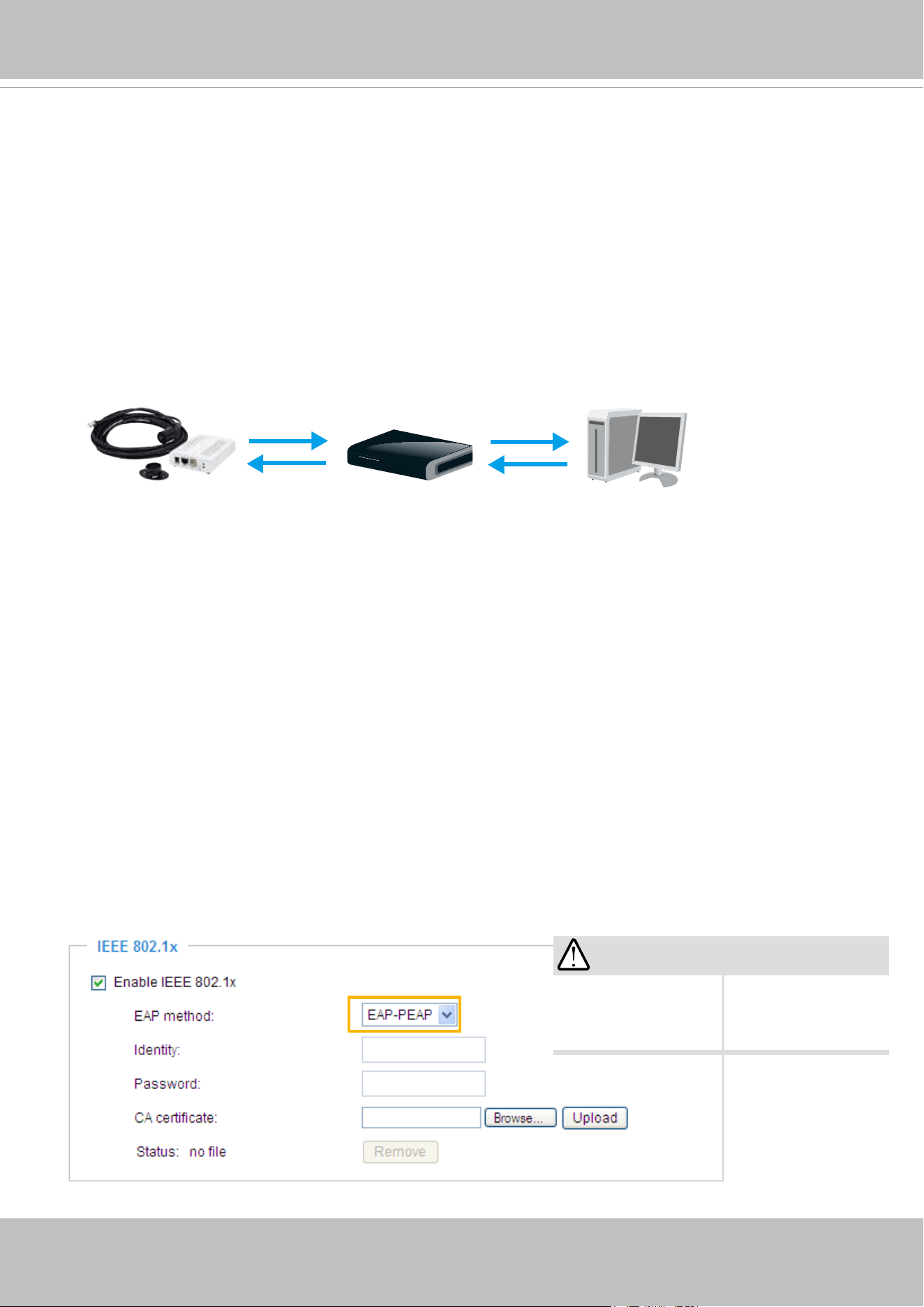
VIVOTEK
98 - User's Manual
Security > IEEE 802.1x
Enable this function if your network environment uses IEEE 802.1x, which is a port-based network
access control. The network devices, intermediary switch/access point/hub, and RADIUS server must
support and enable 802.1x settings.
The 802.1x standard is designed to enhance the security of local area networks, which provides
authentication to network devices (clients) attached to a network port (wired or wireless). If all certicates
between client and server are veried, a point-to-point connection will be enabled; if authentication fails,
access on that port will be prohibited. 802.1x utilizes an existing protocol, the Extensible Authentication
Protocol (EAP), to facilitate communication.
■
The components of a protected network with 802.1x authentication:
1.
Supplicant: A client end user (camera), which requests authentication.
2.
Authenticator (an access point or a switch): A “go between” which restricts unauthorized end users
from communicating with the authentication server.
3.
Authentication server (usually a RADIUS server): Checks the client certicate and decides whether to
accept the end user’s access request.
■
VIVOTEK Network Cameras support two types of EAP methods to perform authentication: EAP-PEAP
and EAP-TLS.
Please follow the steps below to enable 802.1x settings:
1. Before connecting the Network Camera to the protected network with 802.1x, please apply a digital
certicate from a Certicate Authority (i.e., MIS of your company) which can be validated by a RADIUS
server.
2. Connect the Network Camera to a PC or notebook outside of the protected LAN. Open the
conguration page of the Network Camera as shown below. Select EAP-PEAP or EAP-TLS as the
EAP method. In the following blanks, enter your ID and password issued by the CA, then upload
related certicate(s).
Supplicant
(Network Camera)
Authenticator
(Network Switch)
Authentication Server
(RADIUS Server)
IMPORTANT
The maximum length of password is 200
symbols.
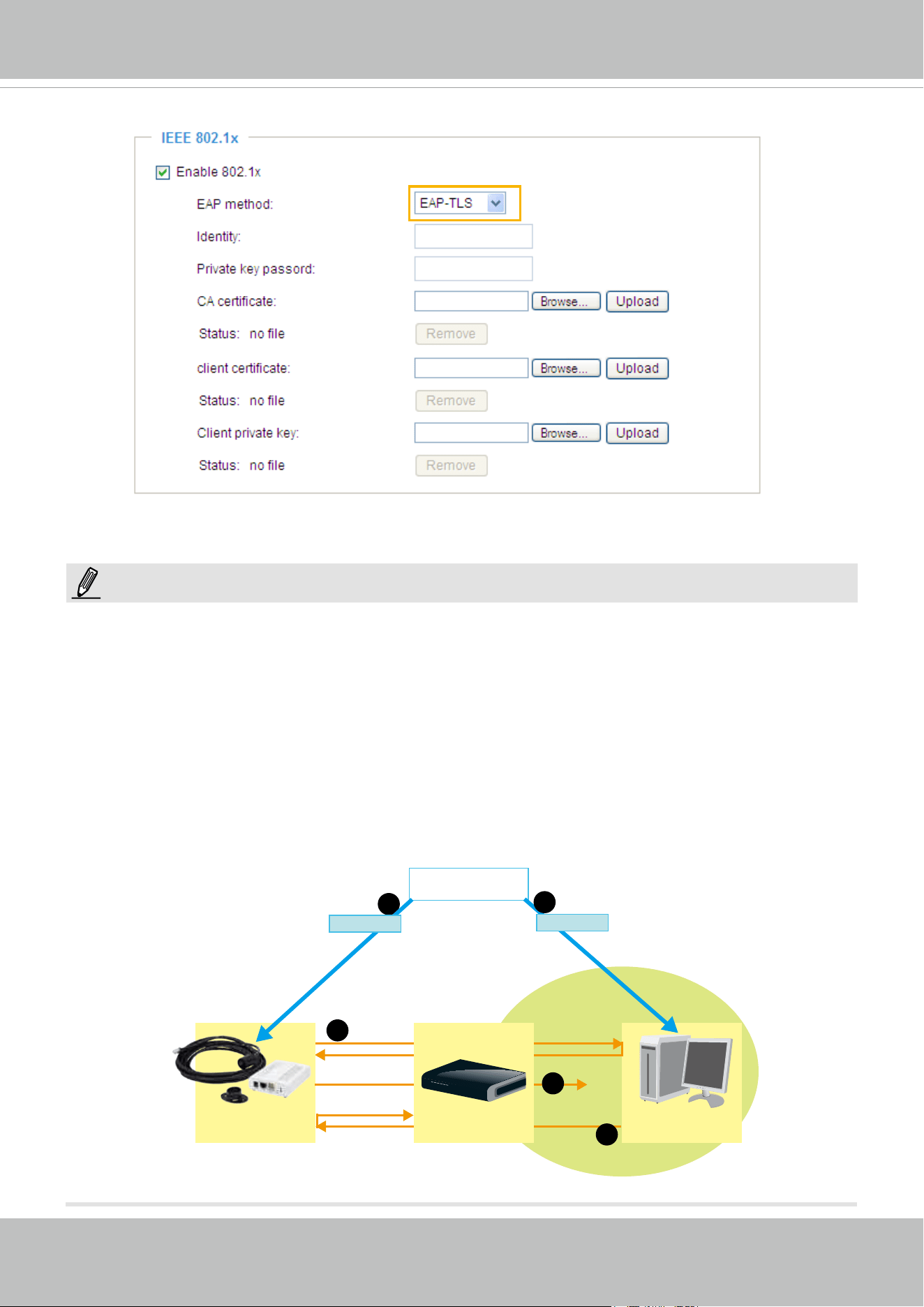
VIVOTEK
User's Manual - 99
3. When all settings are complete, move the Network Camera to the protected LAN by connecting it to an
802.1x enabled switch. The devices will then start the authentication automatically.
► The authentication process for 802.1x:
1. The Certicate Authority (CA) provides the required signed certicates to the Network Camera (the
supplicant) and the RADIUS Server (the authentication server).
2. A Network Camera requests access to the protected LAN using 802.1X via a switch (the authenticator).
The client offers its identity and client certicate, which is then forwarded by the switch to the RADIUS
Server, which uses an algorithm to authenticate the Network Camera and returns an acceptance or
rejection back to the switch.
3. The switch also forwards the RADIUS Server’s certicate to the Network Camera.
4. Assuming all certificates are validated, the switch then changes the Network Camera’s state to
authorized and is allowed access to the protected network via a pre-congured port.
VIVOTEK
Network Camera
RADIUS Server
Certificate Authority
(CA)
Protected LAN
Certificate
1
1
2
3
4
Network Switch
Certificate
NOTE:
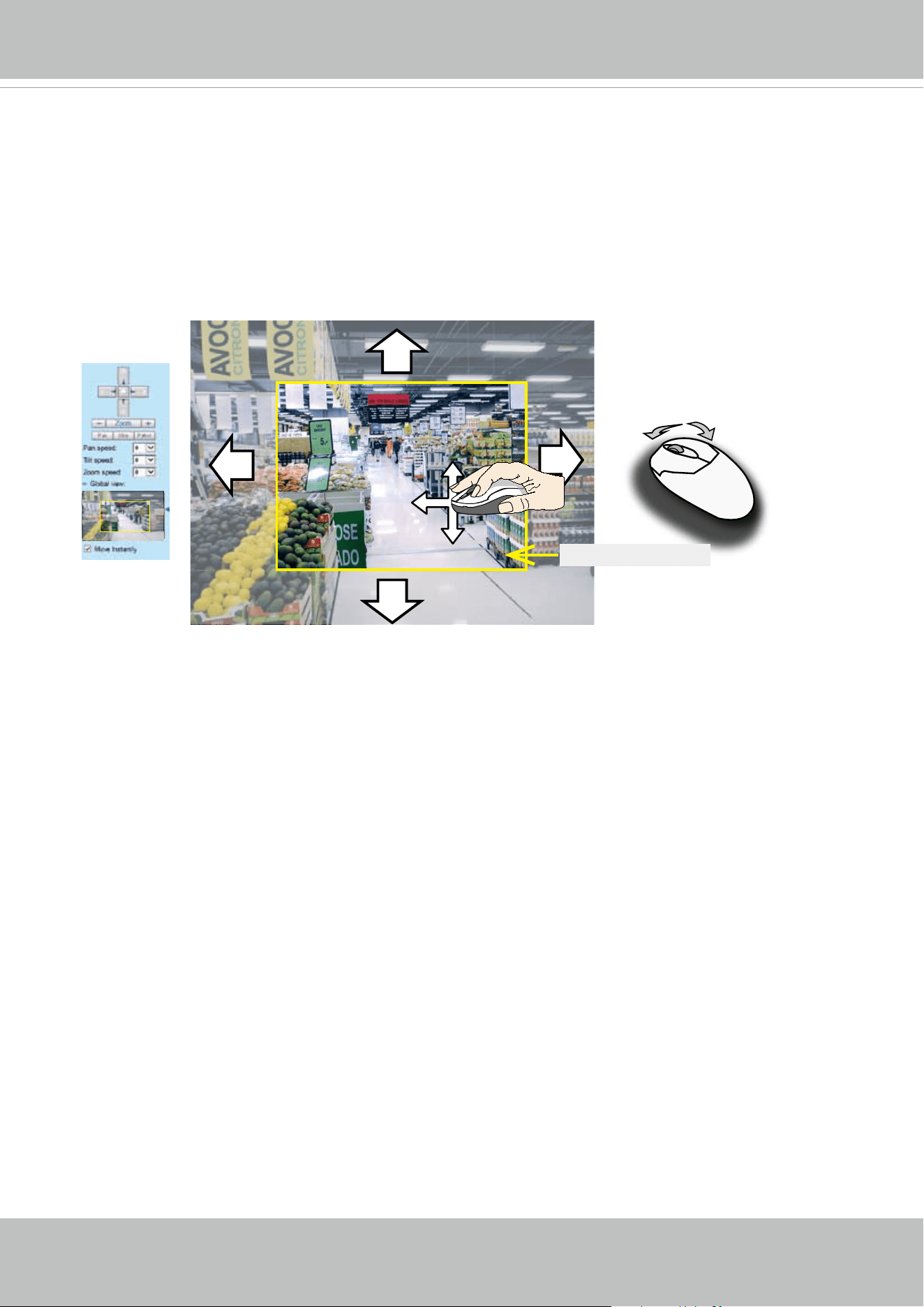
VIVOTEK
100 - User's Manual
PTZ > PTZ settings
This section explains how to control the Network Camera’s Pan/Tilt/Zoom operation.
The E-PTZ function allows users to quickly move the focus to a target area for close-up viewing
without physically zooming the camera. The E-PTZ view takes effect when the current eld of
view is not showing the full of the camera's complete eld of view. Users can then move the
view in different directions or zoom in or zoom out on the screen.
Full FOV
Zoom In
Zoom Out
Current active view
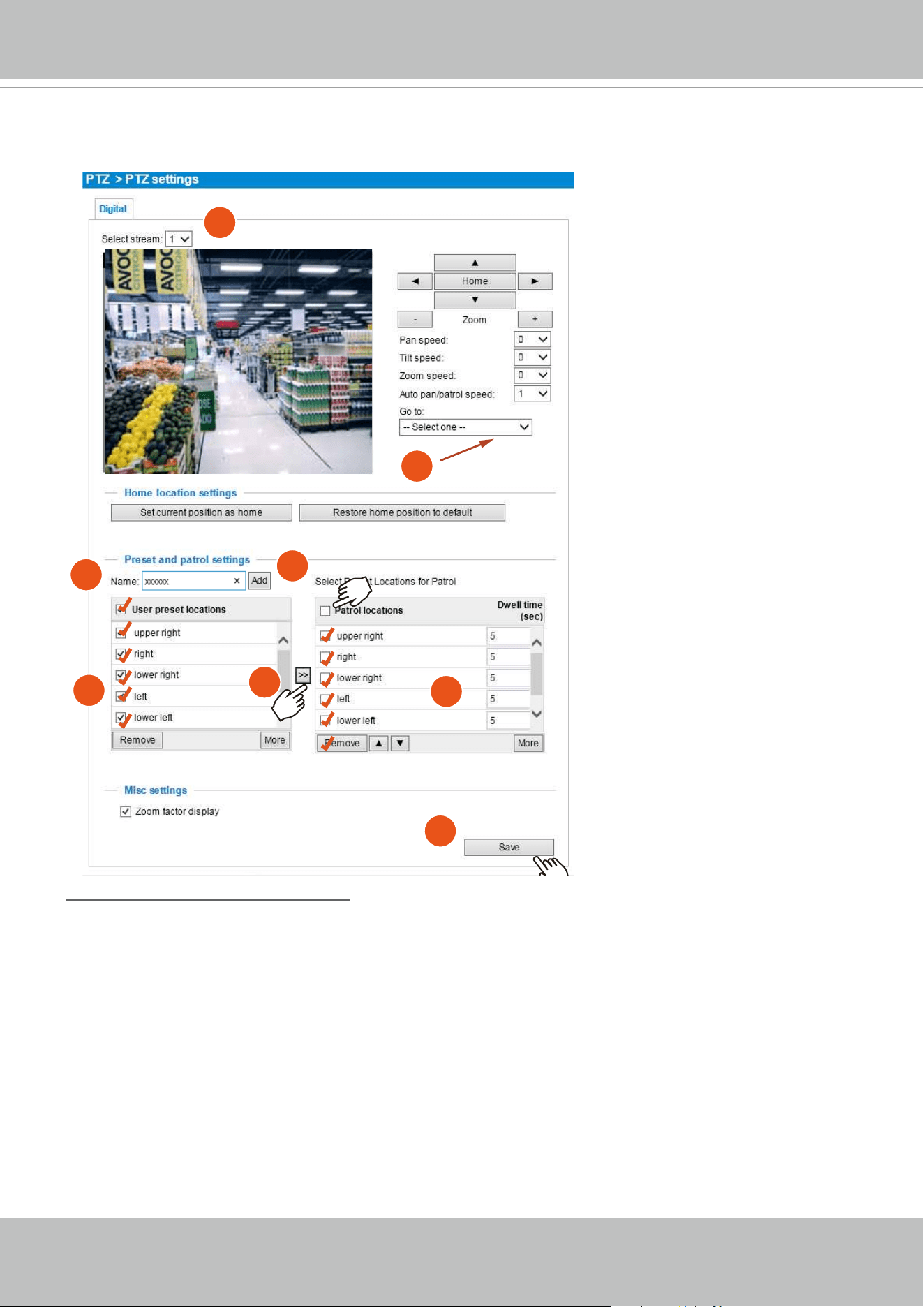
VIVOTEK
User's Manual - 101
Digital PTZ Operation (E-PTZ Operation)
Preset positions and rotation settings
In the PTZ settings page, you can create preset positions in the hemisphere covered by the sheye lens.
A total of 20 preset positions can be congured.
Please follow the steps below to congure preset positions and arrange them in a rotational tour through
different positions.
1. First select a video stream on which the PTZ settings will take place.
2
3
5
6
7
8
9
1
X2.0
4

VIVOTEK
102 - User's Manual
2. Adjust the shooting area to the desired position using the PTZ keypad, the FOV indicators, or mouse
clicks on the live screen. To begin the mouse control, click on the two interactive windows. Due to the
highly-sensitive mouse control, the PTZ control buttons can help ne-tune to an optimal location.
3. After you selected an area of interest, enter a name for the new position, which can contain up to forty
alphabetic and numeric characters.
4. Click Add to enable the settings. The preset positions will be listed on the User preset locations. (To
add more positions you wish, please repeat steps 1~3.)
5. Select the preset positions by their checkboxes.
6. Click on the move button (>>)
to move positions to the Patrol locations window.
7. You may select some or all of the imported positions as the stop points during the tour.
8. Select a preset position when you need to move to a specic place on screen.
Select a preferred Dwell time or move the preset positions for consecutively displaying views of
multiple positions. The speeds and the dwell time of each position on a Regional view window are
shown below:
9. Click on the Save button to preserve your conguration.
To remove a preset position from the list, select it and click Remove. You can re-arrange the order of
the position hop on the list using the
buttons.
Misc settings
Use this checkbox to display or hide the zoom ratio indicator on the screen. You can use your
mousewheel to zoom in or zoom out on a live view window.

VIVOTEK
User's Manual - 103
Event > Event settings
This section explains how to congure the Network Camera to respond to particular situations
(event). A typical application is that when a motion is detected, the Network Camera sends
buffered images to an FTP server or e-mail address as notifications. Click on Help, there is
an illustration shown in the pop-up window explaining that an event can be triggered by many
sources, such as motion detection or external digital input devices. When an event is triggered,
you can specify what type of action that will be performed.
Event
An event is an action initiated by a user-dened trigger source. In the Event column, click Add to open
the event settings window.
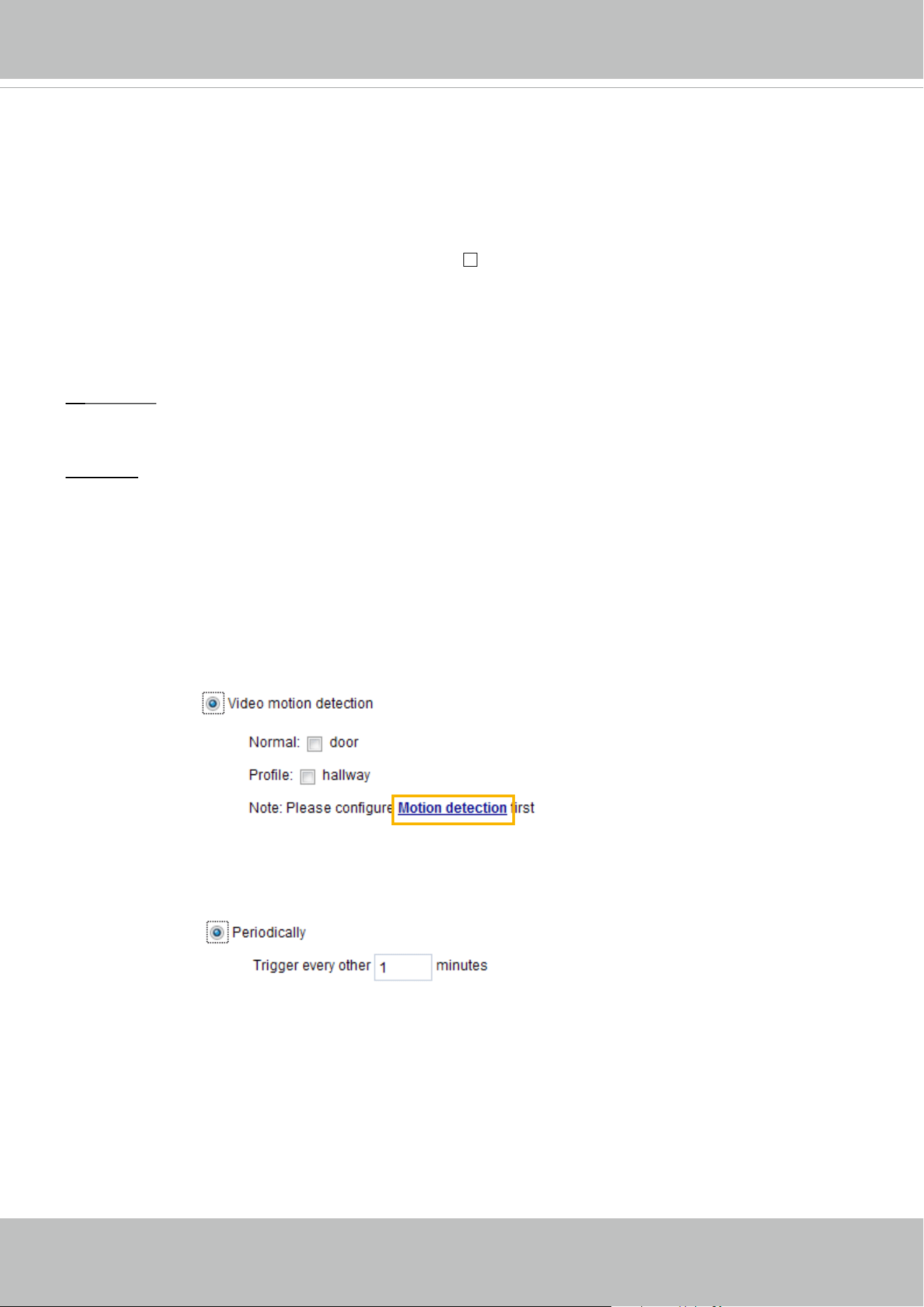
VIVOTEK
104 - User's Manual
■ Event name: Enter a name for the event setting.
■ Enable this event: Select this checkbox to enable the event setting.
■ Priority: Select the relative importance of this event (High, Normal, or Low). Events with a higher
priority setting will be executed rst.
■ Detect next motion detection or digital input after
seconds: Enter the duration in seconds to pause
motion detection after a motion is detected. This prevents too many events to be triggered within a
short time.
Follow the steps 1~3 to arrange the three elements -- Schedule, Trigger, and Action to set an event. A
total of 3 event settings can be congured.
1. Schedule
Specify the period for the event. Please select the days of the week and the time in a day (in 24-hr time
format) to specify when will the event-triggering conditions take effect.
2. Trigger
This is the cause or stimulus which denes what will trigger the event. The trigger source can be cong-
ured to use the Network Camera’s built-in motion detection mechanism or external digital inputs.
There are several choices of trigger sources as shown below.
Select each item to display its related
options.
■ Video motion detection
This option makes use of the built-in motion detection mechanism as a trigger source. To enable this
function, you need to congure a Motion Detection Window rst. For more information, please refer to
Motion Detection on page 117 for details.
■ Periodically
This option allows the Network Camera to trigger periodically for every other dened minute. Up to 999
minutes are allowed.
■ Digital input
This option allows the Network Camera to use an external digital input device or sensor as a trigger
source. Depending on your application, there are many choices with digital input devices on the market
which help detect changes in temperature, vibration, sound, light, etc.
■ System boot
This option triggers the Network Camera when the power to the Network Camera is disconnected.
■ Recording notify
This option allows the Network Camera to trigger when the recording disk is full or when recording
starts to overwrite older data.
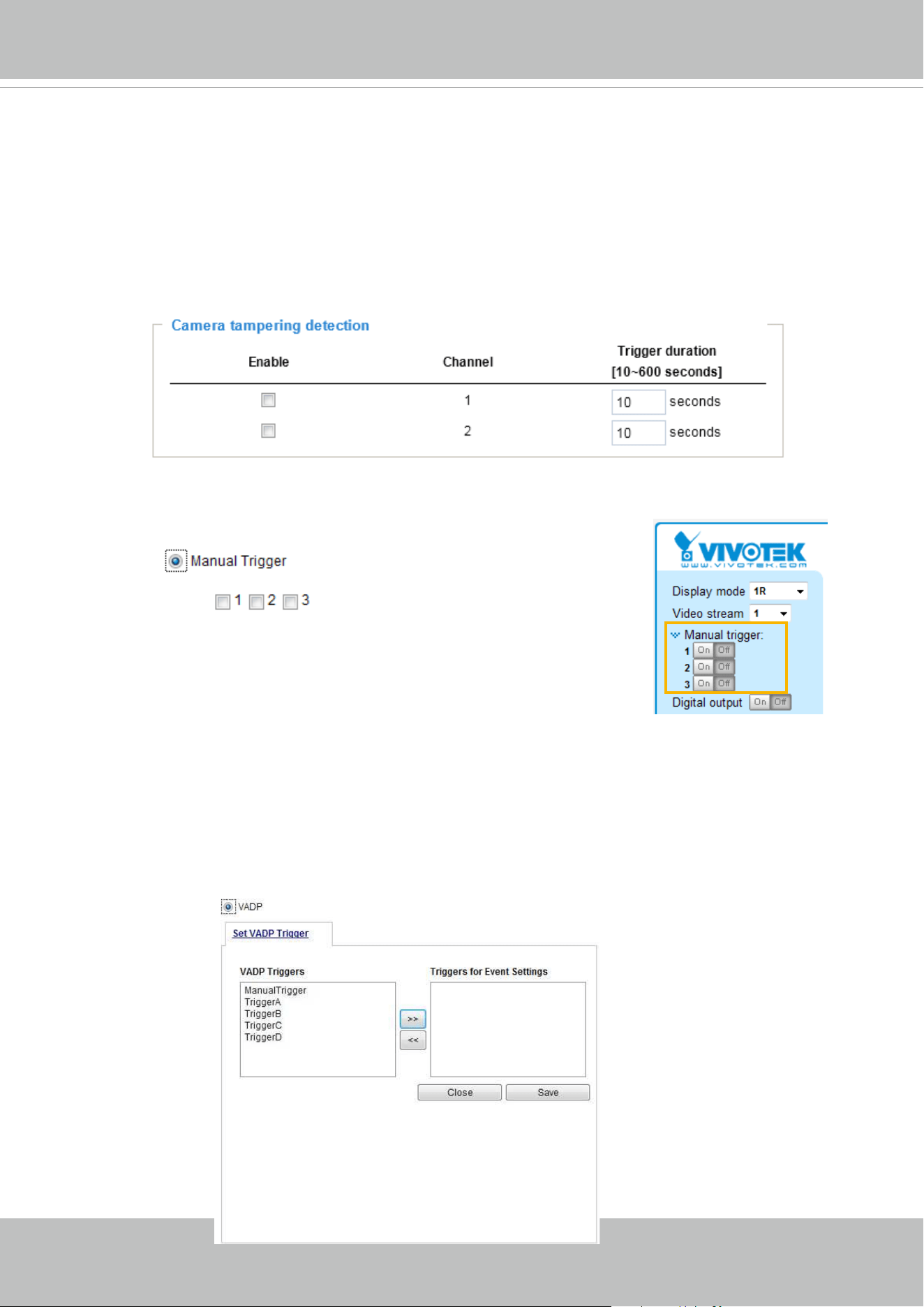
VIVOTEK
User's Manual - 105
■ Camera tampering detection
This option allows the Network Camera to trigger when the camera detects that is is being tampered
with. To enable this function, you need to congure the Tampering Detection option rst. Please refer
to page 120 for detailed information.
■ Manual Trigger
This option allows user to enable event triggers manually by clicking the on/off button on the
homepage. Please congure 1 ~ 3 events before using this function.
■ Audio detection
A preset threshold can be congured with an external microphone as the trigger to system event. The
triggering condition can be an input exceeding or falling below a threshold. Audio detection can take
place as a complement to motion detection or as a method to detect activities not covered by the
camera's view.
■ VADP
It is presumed that you already uploaded and enabled the VADP modules before you can associatee
VADP triggers with an Event setting.
Click on the Set VADP Trigger button to open the VADP setup menu. The triggering conditions
available with 3rd-party software modules known as VADP will be listed. Use the arrow buttons to
select these triggers. Users may implant these modules for different purposes such as triggering
motion detection, or applications related to video analysis, etc. Please refer to page 124 for the
conguration options with VADP modules.

VIVOTEK
106 - User's Manual
3. Action
Dene the actions to be performed by the Network Camera when a trigger
is activated.
■ Trigger digital output for
seconds
Select this option to turn on the digital output signals (via the DO connectors on the main assembly)
when a trigger is activated. Specify the length of the trigger interval in the text box.
■ Backup media if the network is disconnected
Select this option to backup media le on SD card if the network is disconnected. Please note that
this function will only apply after you set up the connection to networked storage (NAS). For more
information about how to set up network storage, please refer to page 129.
To congure an event with video recording or snapshots, it is necessary to congure/provide servers and
storage media settings so that the Network Camera will know where to send the media les to when a
trigger is activated.
Once the triggers are congured, they will be listed under the VADP option.
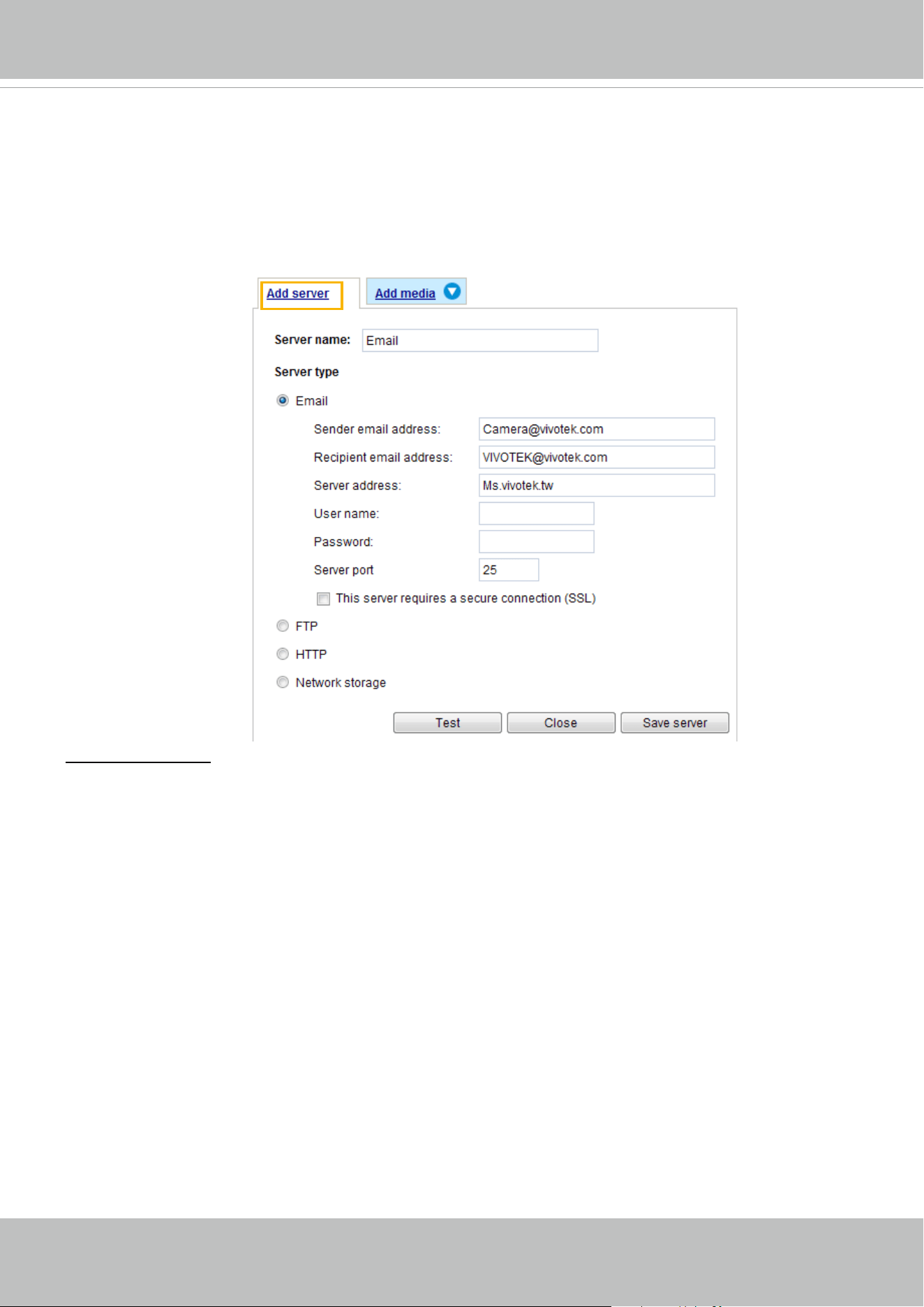
VIVOTEK
User's Manual - 107
Add server
Click Add server to unfold the server setting window. You can specify how the notication messages are
delivered when a trigger is activated. A total of 5 server settings can be congured.
There are four choices of server types available: Email, FTP, HTTP, and Network storage.
Select the item
to display the detailed conguration options. You can congure either one or all of them.
Server type - Email
Select to send the media les via email when a trigger is activated.
■ Server name: Enter a name for the server setting.
■ Sender email address: Enter a valid email address as the sender address.
■ Recipient email address: Enter a valid email address as the recipient address.
■ Server address: Enter the domain name or IP address of the email server.
■ User name: Enter the user name of the email account if necessary.
■ Password: Enter the password of the email account if necessary.
■ Server port: The default mail server port is set to 25. You can also manually set another port.
If your SMTP server requires a secure connection (SSL), check This server requires a secure
connection (SSL).
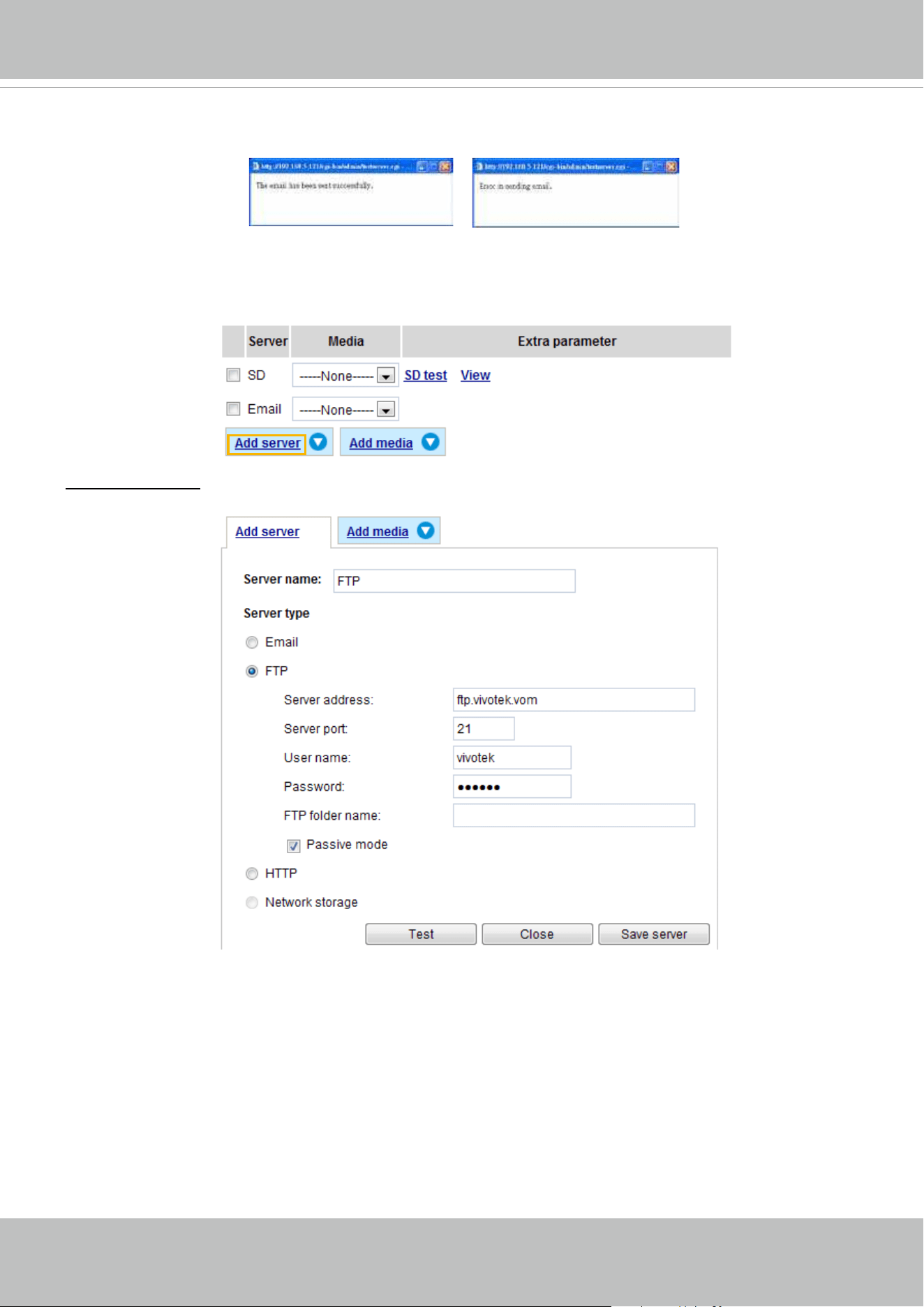
VIVOTEK
108 - User's Manual
To verify if the email settings are correctly congured, click Test. The result will be shown in a pop-up
window. If successful, you will also receive an email indicating the result.
Click Save server to enable the settings, then click Close to exit the Add server page.
After you set up the rst event server, a new item for event server will automatically appear on the Server
list. If you wish to add more server options, click Add server.
Server type - FTP
Select to send the media les to an FTP server when a trigger is activated.
■ Server name: Enter a name for the server setting.
■ Server address: Enter the domain name or IP address of the FTP server.
■ Server port: By default, the FTP server port is set to 21. It can also be assigned to another port number
between 1025 and 65535.
■ User name: Enter the login name of the FTP account.
■ Password: Enter the password of the FTP account.
■ FTP folder name
Enter the folder where the media le will be placed. If the folder name does not exist, the Network
Camera will create one on the FTP server.
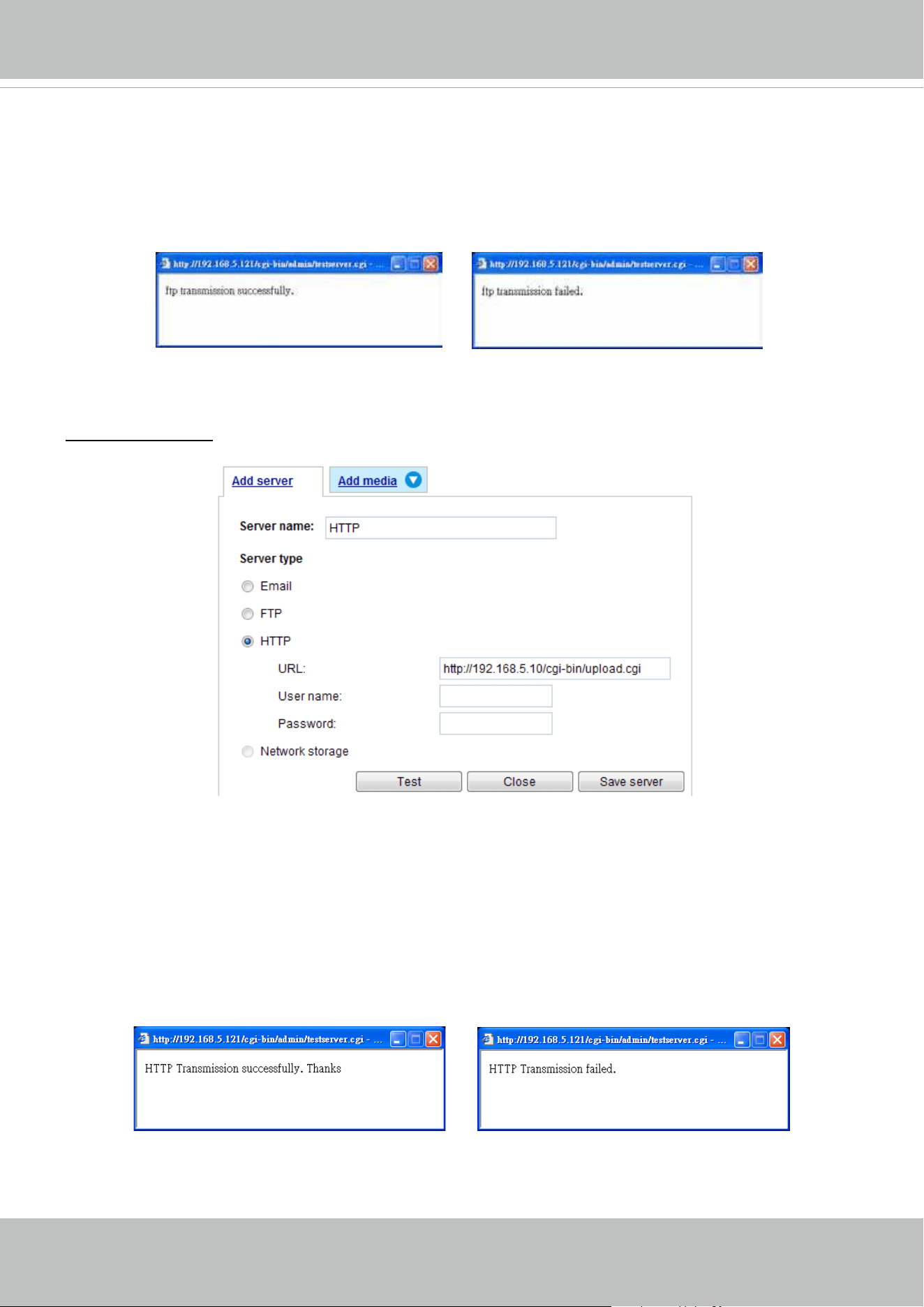
VIVOTEK
User's Manual - 109
■ Passive mode
Most firewalls do not accept new connections initiated from external requests. If the FTP server
supports passive mode, select this option to enable passive mode FTP and allow data transmission to
pass through the rewall.
To verify if the FTP settings are correctly congured, click Test. The result will be shown in a pop-up
window as shown below. If successful, you will also receive a test.txt le on the FTP server.
Click Save server to enable the settings, then click Close to exit the Add server page.
Server type - HTTP
Select to send the media les to an HTTP server when a trigger is activated.
■ Server name: Enter a name for the server setting.
■ URL: Enter the URL of the HTTP server.
■ User name: Enter the user name if necessary.
■ Password: Enter the password if necessary.
To verify if the HTTP settings are correctly congured, click Test. The result will be shown in a pop-up
window as below. If successful, you will receive a test.txt le on the HTTP server.
Click Save server to enable the settings and click Close to exit the Add server page.
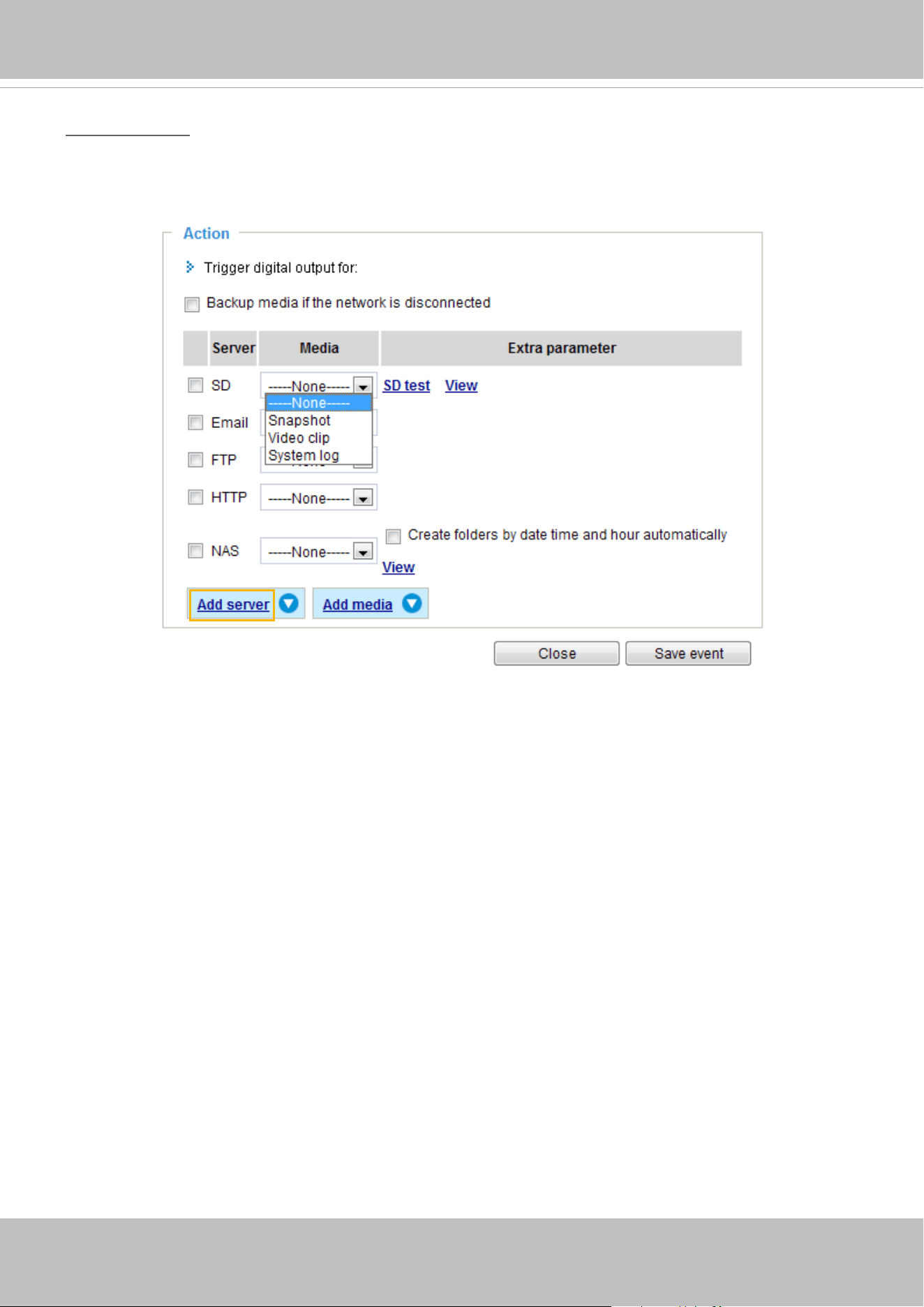
VIVOTEK
110 - User's Manual
Network storage:
Select to send the media les to a network storage location when a trigger is activated. Please refer to
NAS server on page 129 for details.
Click Save server to enable the settings, then click Close to exit the Add server page.
■ SD Test: Click to test your SD card. The system will display a message indicating success or failure. If
you want to use your SD card for local storage, please format it before use. Please refer to page 132
for detailed information.
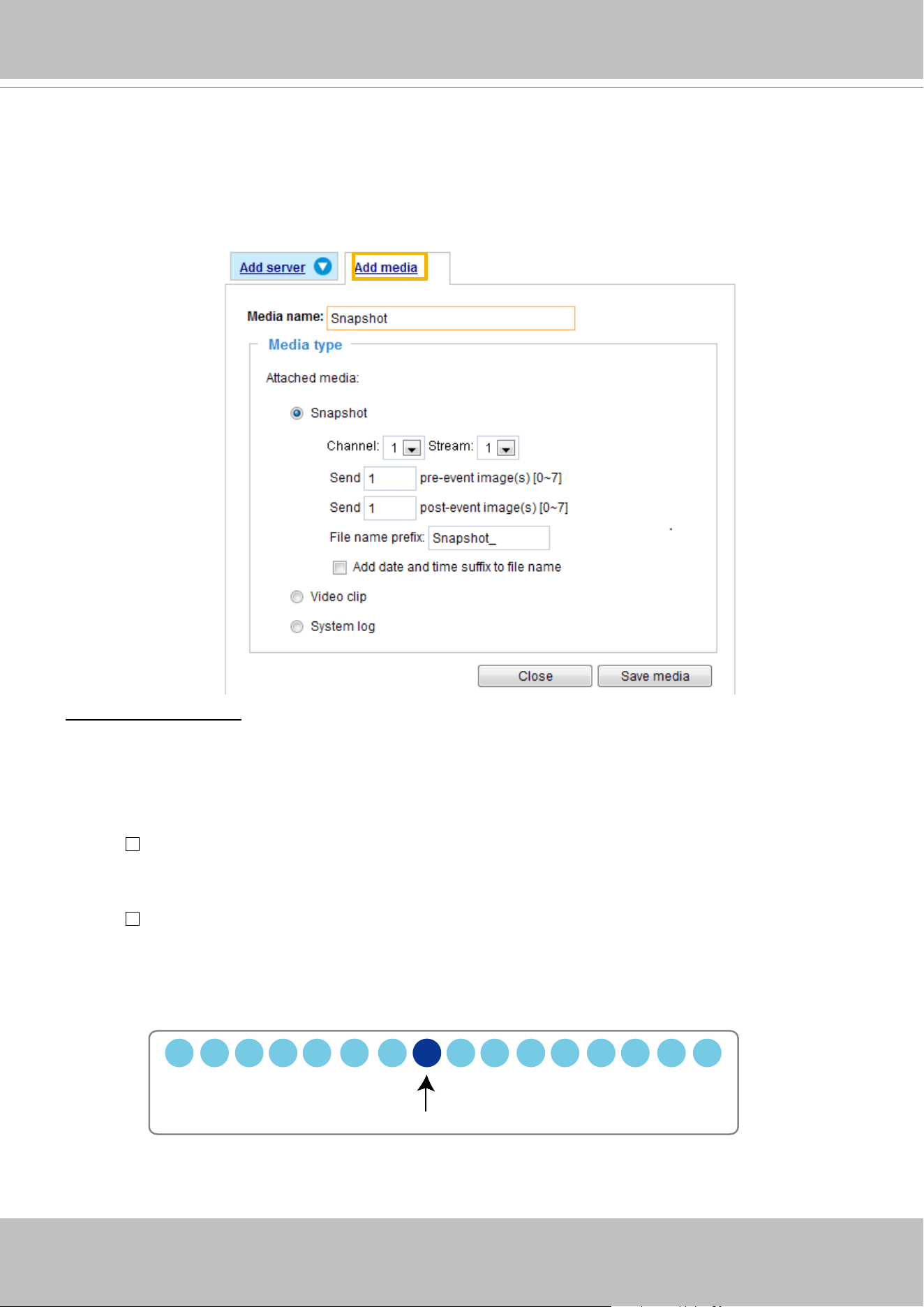
VIVOTEK
User's Manual - 111
Add media
Click
Add media
to open the media setting window. You can specify the type of media that will be
sent when a trigger is activated. A total of 5 media settings can be congured. There are three choices
of media types available: Snapshot, Video Clip, and System log.
Select the item to display the detailed
conguration options. You can congure either one or all of them.
Media type - Snapshot
Select to send snapshots when a trigger is activated.
■ Media name: Enter a name for the media setting.
■ Select the channel and stream number from which the snapshots will be taken.
■ Send
pre-event images
The Network Camera has a buffer area; it temporarily holds data up to a certain limit. Enter a number
to decide how many images to capture before a trigger is activated. Up to 7 images can be generated.
■ Send
post-event images
Enter a number to decide how many images to capture after a trigger is activated. Up to 7 images can
be generated.
For example, if both the Send pre-event images and Send post-event images are set to 7, a total of 15
images are generated after a trigger is activated.
■ File name prex
Enter the text that will be appended to the front of the le name.
1 pic. 2 pic. 3 pic. 4 pic. 5 pic. 6 pic. 7 pic. 8 pic. 9 pic.
10 pic. 11 pic. 10 pic. 12 pic. 13 pic. 14 pic. 15 pic.
Trigger Activation
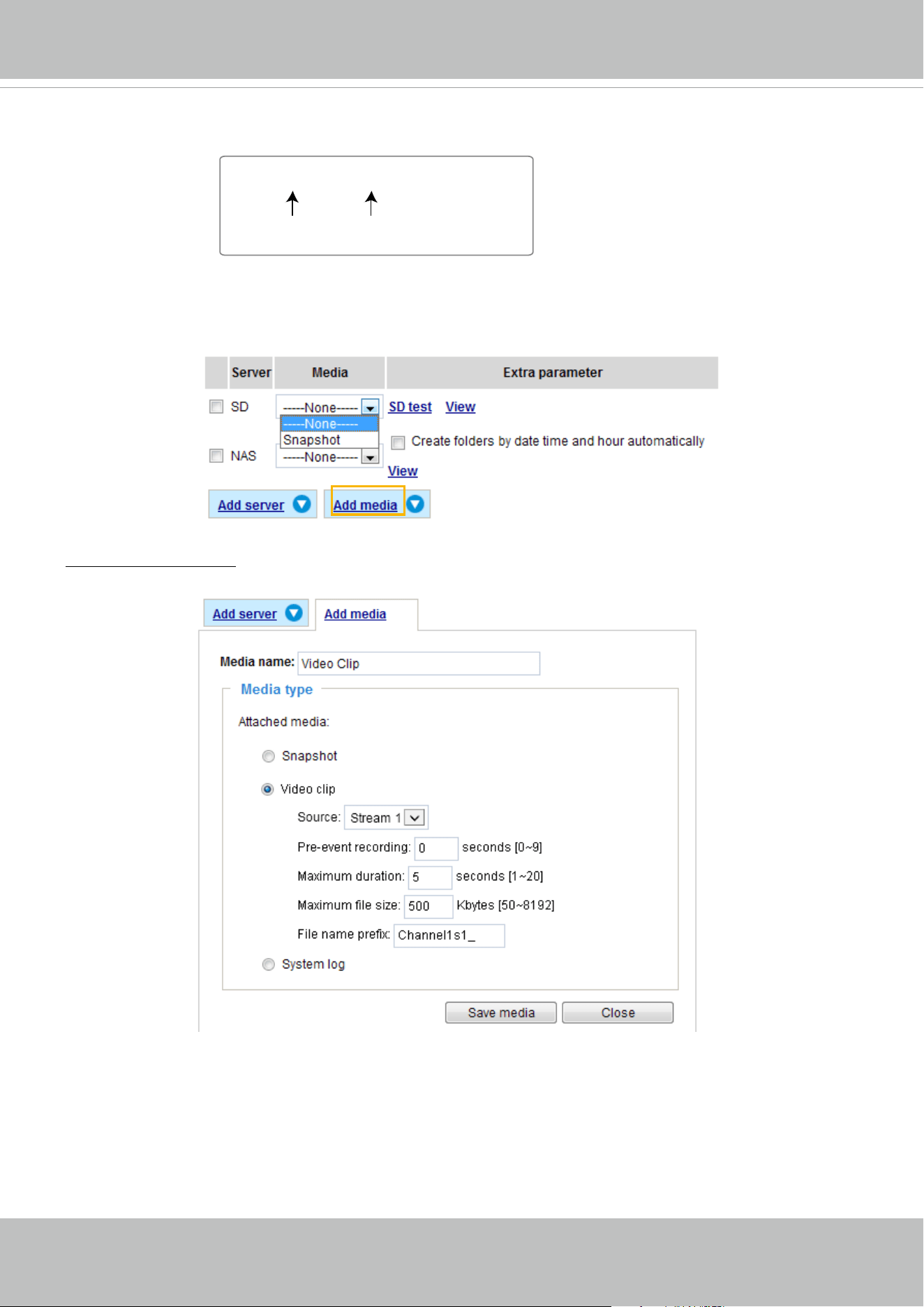
VIVOTEK
112 - User's Manual
■ Add date and time sufx to the le name. Select this option to add a date/time sufx to the le name.
For example:
Click Save media to enable the settings, then click Close to exit the Add media page.
After you set up the rst media server, a new column for media server will automatically display on the
Media list. If you wish to add more media options, click Add media.
Media type -
Video clip
Select to send video clips when a trigger is activated.
■ Media name: Enter a name for the media setting.
■ Source: Select the source of video clip from the stream number.
■ Pre-event recording
The Network Camera has a buffer area; it temporarily holds data up to a certain limit. Enter a number
to decide the duration of recording before a trigger is activated. Up to 9 seconds of video can be
recorded.
Snapshot_20140720_100341
Date and time suffix
The format is: YYYYMMDD_HHMMSS
File name prefix
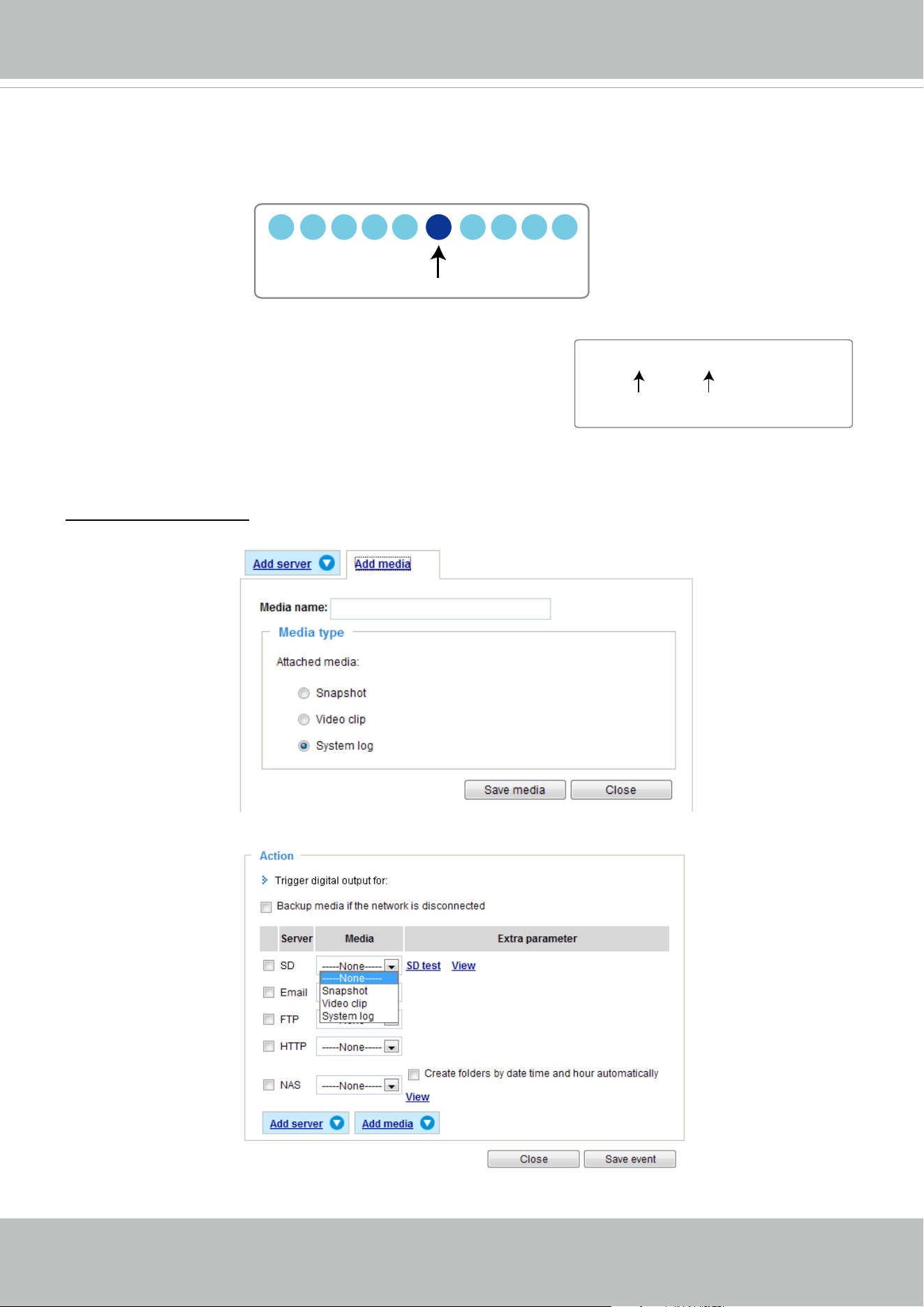
VIVOTEK
User's Manual - 113
■ Maximum duration
Specify the maximum recording duration in seconds. Up to 10 seconds of video can be recorded.
For example, if pre-event recording is set to 5 seconds and the maximum duration is set to 10
seconds, the Network Camera continues to record for another 4 seconds after a trigger is activated.
■ Maximum le size
Specify the maximum le size allowed.
■ File name prex
Enter the text that will be appended to the front of the le name.
For example:
Click Save media to enable the settings, then click Close to exit the Add media page.
Media type - System log
Select to send a system log when a trigger is activated.
Click Save media to enable the settings, then click Close to exit the Add media page.
1 sec. 2 sec. 3 sec. 4 sec. 5 sec. 6 sec. 7 sec. 8 sec. 9 sec. 10 sec.
Trigger Activation
Video_20140720_100341
Date and time suffix
The format is: YYYYMMDD_HHMMSS
File name prefix

VIVOTEK
114 - User's Manual
■ View: Click this button to open a le list window. This function is only for SD card and Network Storage.
If you click View button of SD card, a Local storage page will pop up for you to manage recorded les
on SD card. For more information about Local storage, please refer to page 132. If you click View
button of Network storage, a le directory window will pop up for you to view recorded data on Network
storage.
■ Create folders by date, time, and hour automatically: If you check this item, the system will generate
folders automatically by date.
The following is an example of a le destination with video clips:
Click 20140320 to open the directory:
Video Clip_59.mp4
Video Clip_58.mp4
2014/03/20
2014/03/20
Click to delete
selected items
Click to delete all
recorded data
Click to go back to the previous
level of the directory
The format is: HH (24r)
Click to open the le list for that hour
Video Clip_59.mp4
Video Clip_58.mp4
2014/03/20
2014/03/20
The format is: File name prex + Minute (mm)
You can set up the le name prex on Add media page.
20140320
20140321
20140322
Click to delete selected items
Click to delete all recorded data
The format is: YYYYMMDD
Click to open the directory
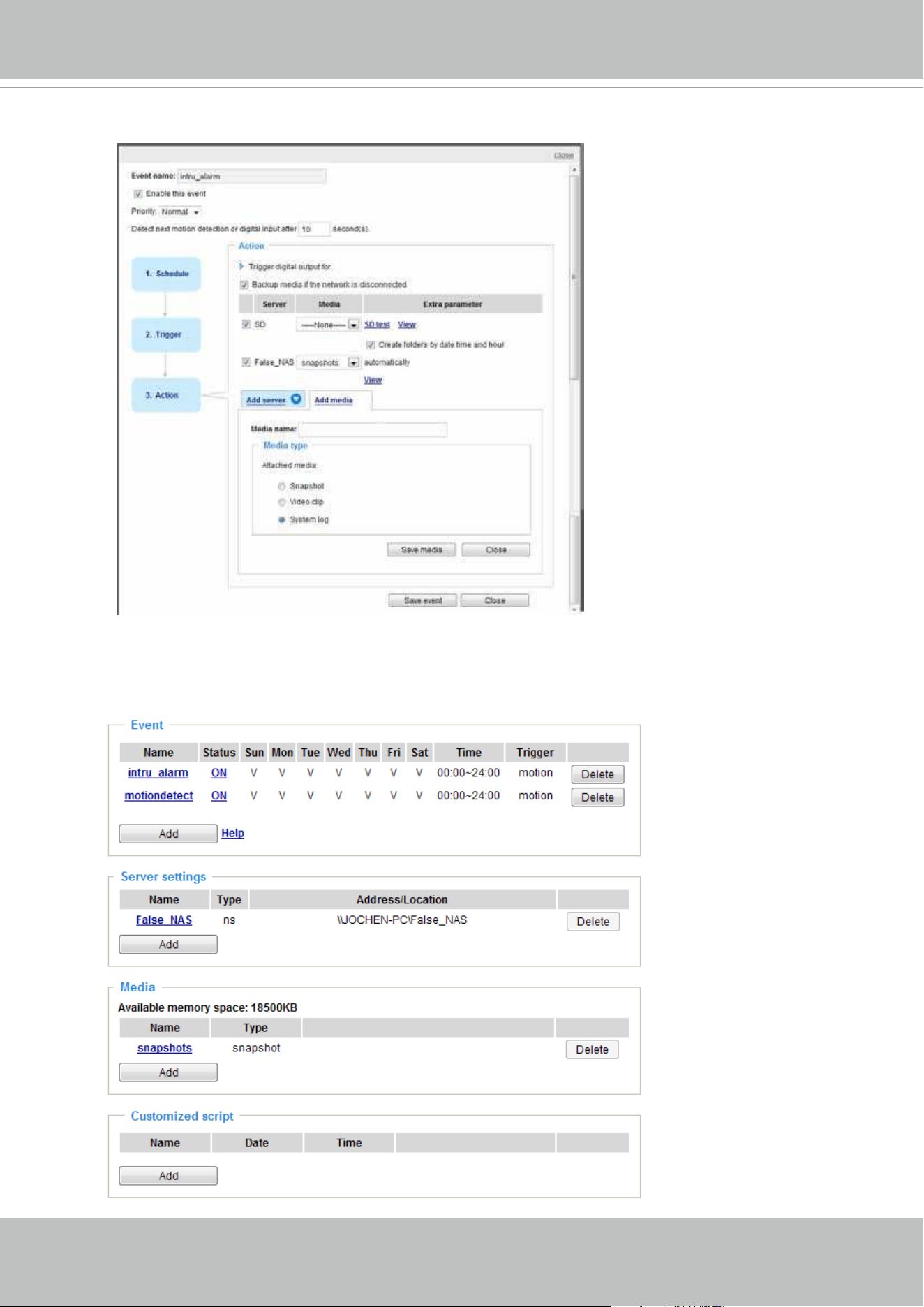
VIVOTEK
User's Manual - 115
Here is an example of the Event setting:
When completed the settings with steps 1~3 to arrange Schedule, Trigger, and Action of an event, click
Save event to enable the settings and click Close to exit the page.
The following is an example of the Event setting page:
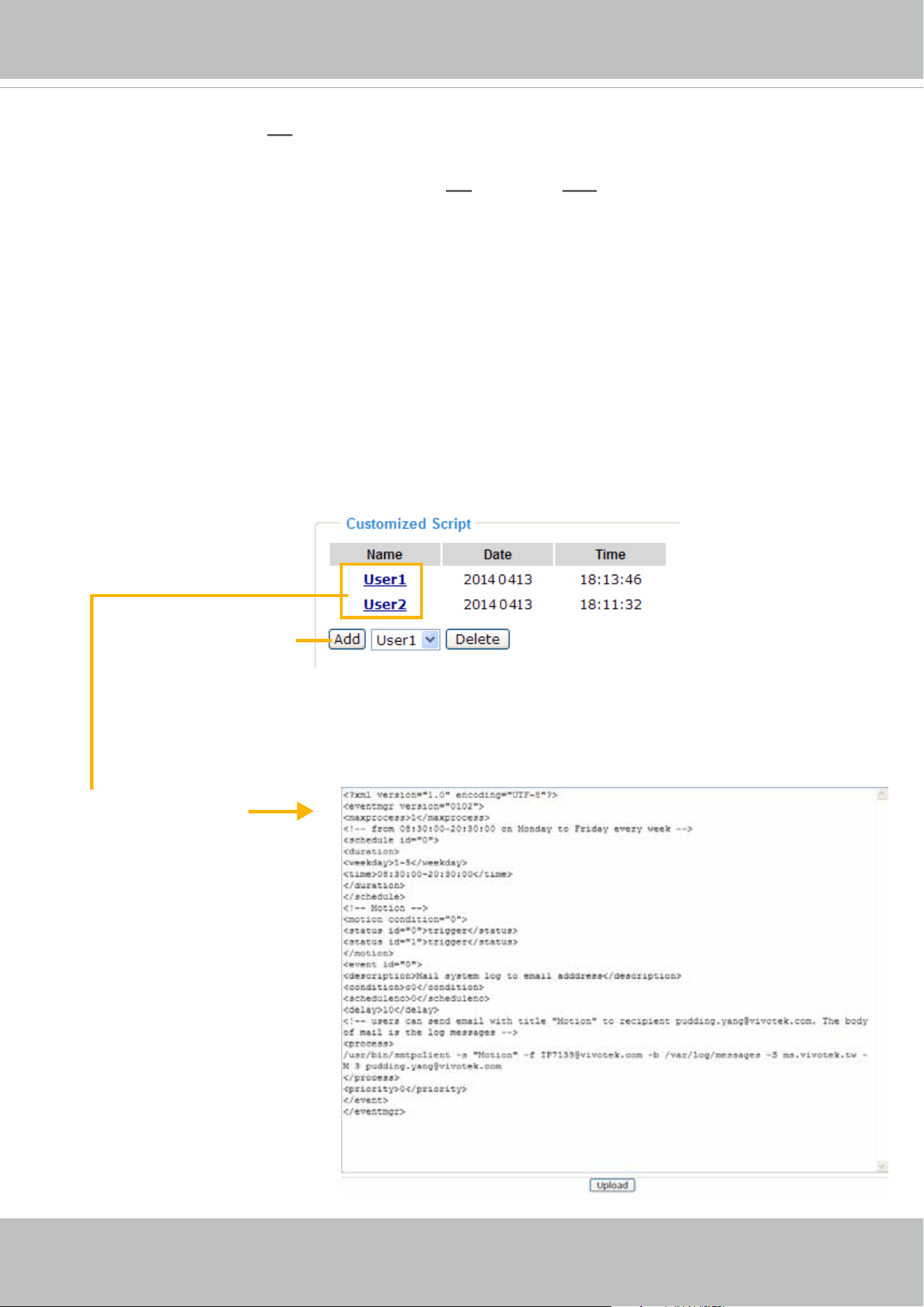
VIVOTEK
116 - User's Manual
When the Event Status is ON, once an event is triggered by motion detection, the Network Camera will
automatically send snapshots via e-mail.
If you want to stop the event trigger, you can click
ON to turn it to OFF status or click Delete to remove a
previously-congured event setting.
To remove a server setting from the list, select a server name and click Delete. Note that only when the
server setting is not being applied to an event setting can it be deleted.
To remove a media setting from the list, select a media name and click Delete. Note that only when the
media setting is not being applied to an event setting can it be deleted.
Customized Script
This function allows you to upload a sample script (.xml le) to the webpage, which will save your time on
conguring the settings. Please note that there is a limited number of customized scripts you can upload;
if the current amount of customized scripts has reached the limit, an alert message will prompt. If you
need more information, please contact VIVOTEK’s technical support.
Click to upload a le
Click to modify the
script online

VIVOTEK
User's Manual - 117
Applications > Motion detection
This section explains how to congure the Network Camera to enable motion detection. A total
of 5 motion detection windows can be congured.
Follow the steps below to enable motion detection:
Follow the steps below to enable motion detection:
1. Click New to add a new motion detection window.
2. In the Window Name text box, enter a name for the motion detection window.
■ Use 4 mouse clicks to designate a detection window. You can change the window shape by dragging
the corner marks to a preferred location.
■ Drag the item size tab to change the minimum size of item to trigger an alarm. An item size box will
appear in the center of screen for your reference (in semi-transparent red). An intruding object must
be larger than the Item size to trigger an alarm. Change the item size according to the live view.
■ To delete a window, click the X mark on the right of the window name.
3. Dene the sensitivity to moving objects by moving the Sensitivity slide bar. Note that a high sensitivity
is prone to produce false alarms such as the fast changes of light (such as day/night mode switch,
turning lights on/off). A movement must persist longer than 0.3 second for the motion to be detected.
4. Click Save to enable the settings.
5. Select Enable motion detection to enable this function.
For example:
The Percentage Indicator will rise or fall depending on the variation between sequential images. When
motions are detected by the Network Camera and are considered to exceed the preset threshold, the red
bar rises. Meanwhile, the motion detection window will be outlined in red.
Motion Detection Setting 2:
For special situations
Motion Detection Setting 1:
For normal situations
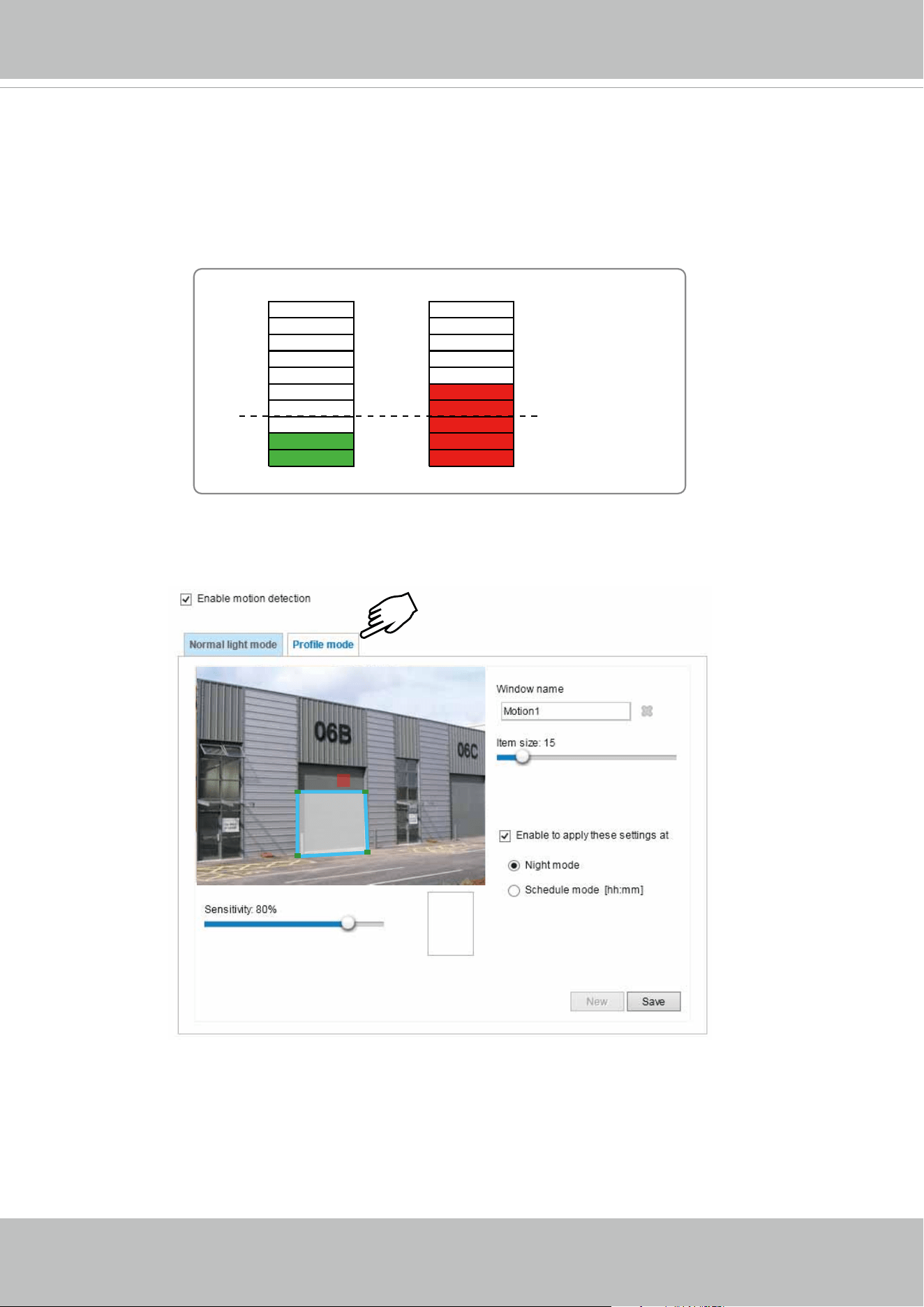
VIVOTEK
118 - User's Manual
A green bar indicates that even though motions have been detected, the event has not been triggered
because the image variations still fall under the preset threshold.
If you want to congure other motion detection settings for day/night/schedule mode (e.g., for a different
lighting condition during a specific period of time), please click Profile to open the Motion Detection
Prole Settings page as shown below. Another three motion detection windows can be congured on this
page.
Larger than the
min. item size
Photos or videos can be captured instantly and congured to be sent to a remote server (via an Email or
FTP server). For more information on how to congure an event setting, please refer to Event settings on
page 103.
Please follow the steps beolw to set up a prole:
1. Create a new motion detection window.
2. Click the Prole mode tab.
3. Select the applicable Schedule mode. Please manually enter a time range.
4. Click Save to enable the settings and click Close to exit the page.
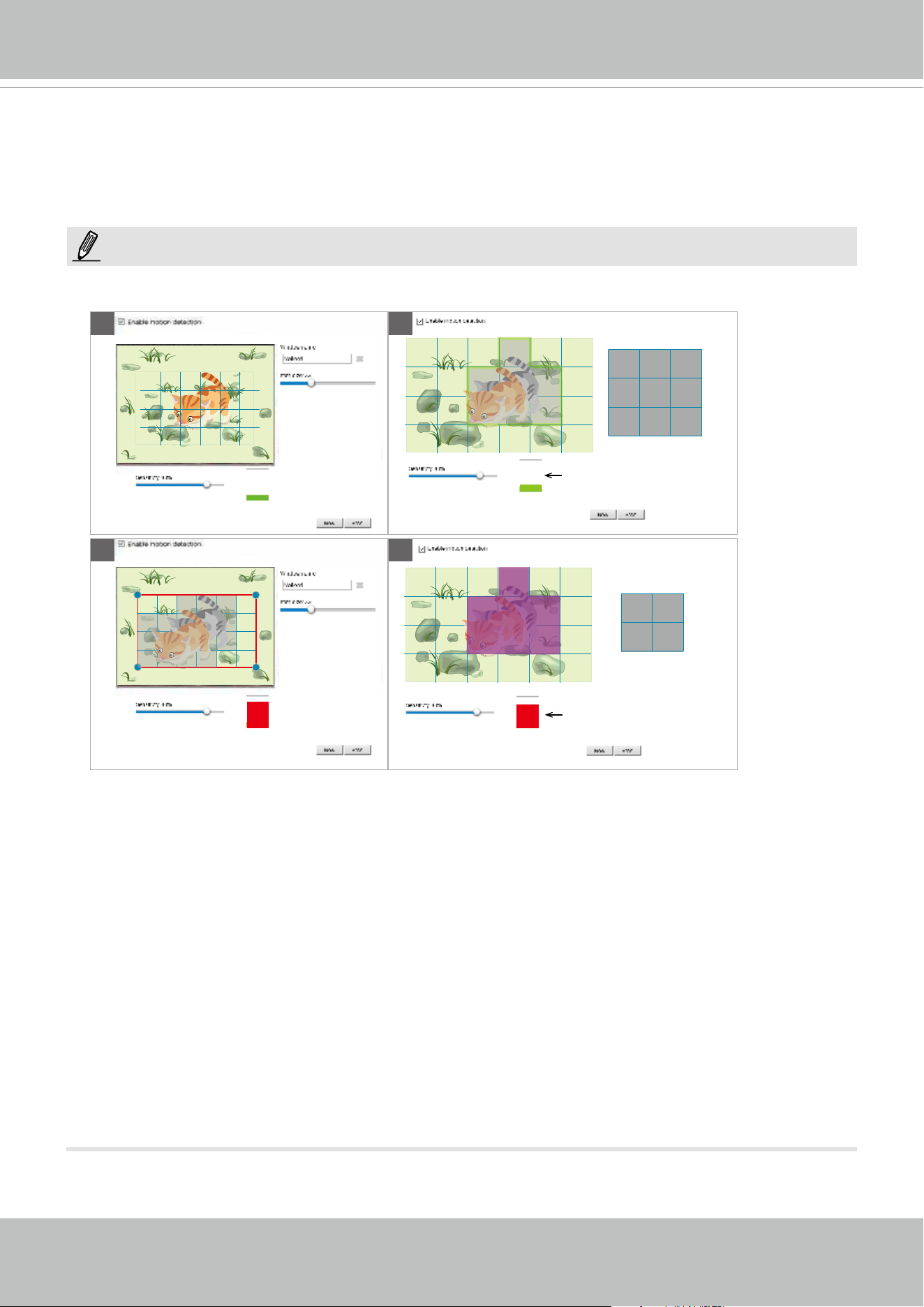
VIVOTEK
User's Manual - 119
► How does motion detection work?
There are two motion detection parameters: Sensitivity and Min. Item Size. As illustrated above, frame
A and frame B are two sequential images. Pixel differences between the two frames are detected and
highlighted in gray in which the sensitivity setting will take effect. Sensitivity is a value that expresses
the sensitivity to moving objects. A higher sensitivity setting allows camera to detect slight movements
while a lower sensitivity setting will neglect them.
The minimum item size is a threshold value that determines how many “alerted pixels” can trigger an
event. When the size of an intruding object is larger than the minimum size, and its movement persist
for 0.3 second, the motion is judged to exceed the dened threshold; and the motion window will be
outlined in red. With a large minimum item size, the size of moving object in frame C is considered as
smaller than the minimum item size, no motion alarm is triggered. With a smaller minimum item size,
the same moving object in frame D triggers the alarm.
For applications that require a high level of security management, it is suggested to use higher
sensitivity settings. However, a higher sensitivity level can also produce false alarms due to fast light
changes when switching between the day and night modes, AE switch, turning the light on or off, etc.
A
B D
C
Min. item size
Alerted pixels < Min. item size
Alerted pixels > Min. item size
Min. item size
NOTE:
This motion detection window will also be displayed on the Event Settings page. You can go to Event
> Event settings > Trigger to select it as a trigger source. Please refer to page 103 for detailed
information.
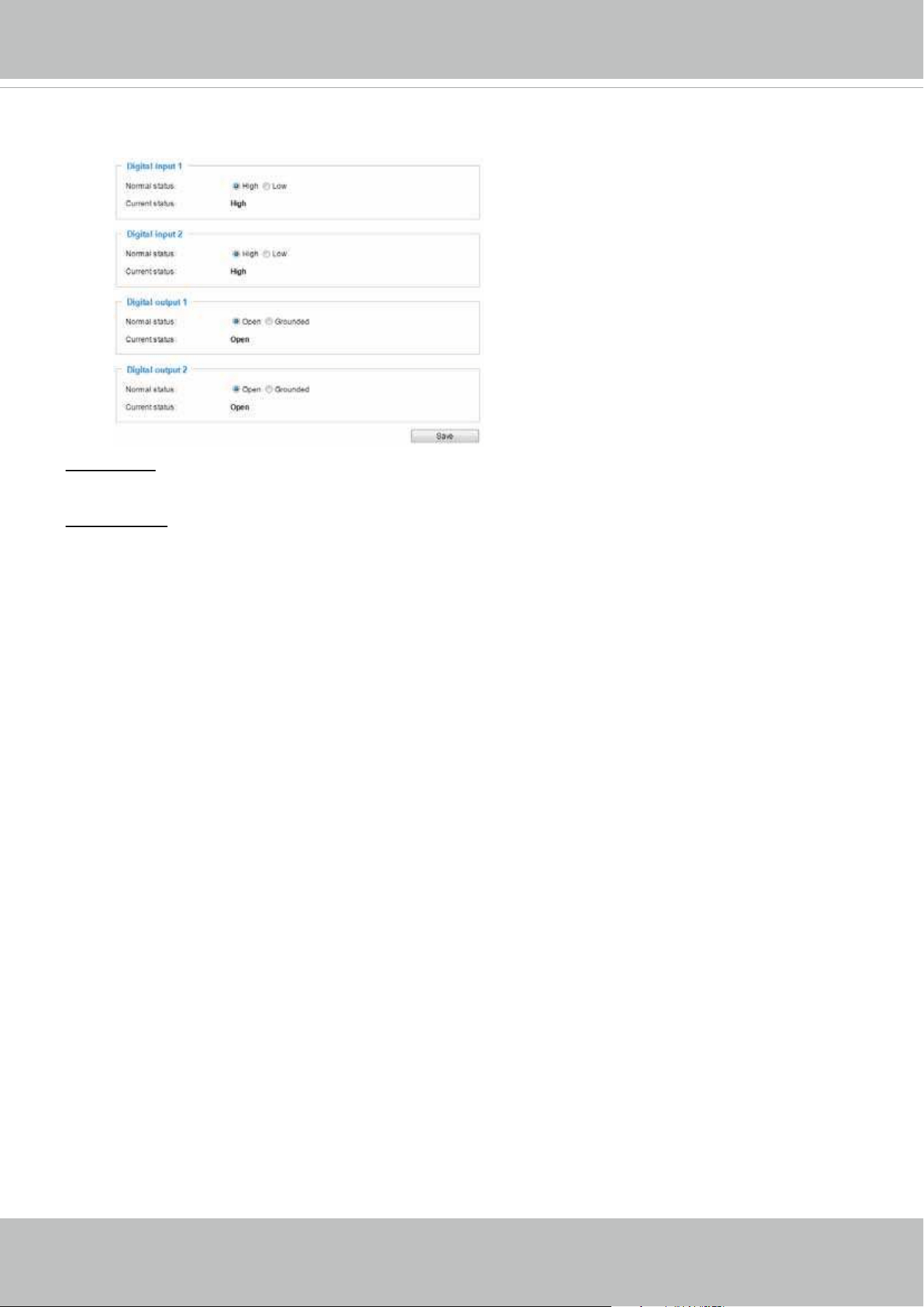
VIVOTEK
120 - User's Manual
Applications > DI and DO
Digital input: Select High or Low as the Normal status for the digital input. Connect the digital input pin of
the Network Camera to an external device to detect the current connection status.
Digital output: Select Grounded or Open to dene the normal status for the digital output. Connect the
digital output pin of the Network Camera to an external device to determine the current status.
Set up the event source as DI on Event > Event settings > Trigger. Please refer to page 104 for
detailed information.
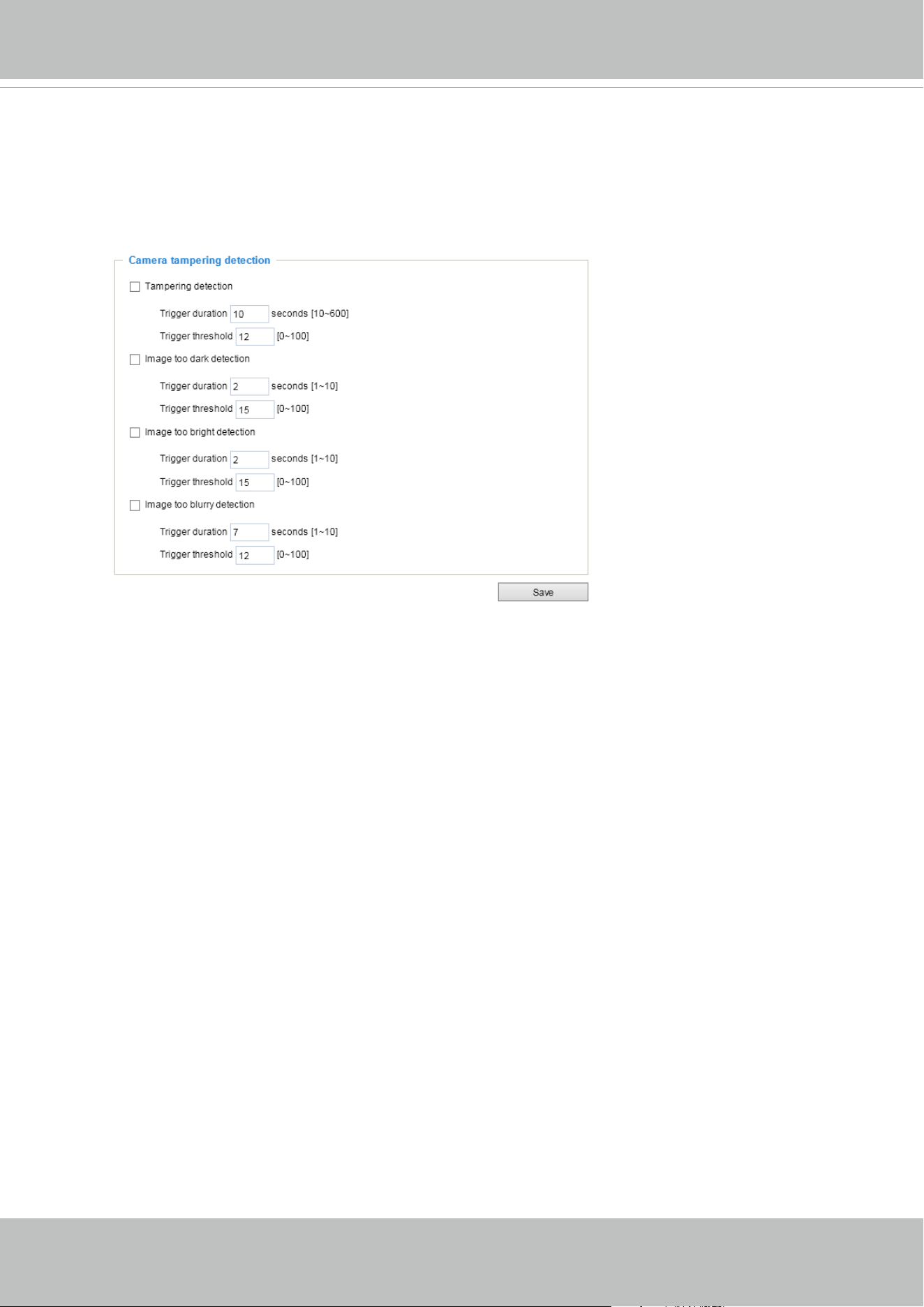
VIVOTEK
User's Manual - 121
Applications > Tampering detection
This section explains how to set up camera tamper detection. With tamper detection, the camera
is capable of detecting incidents such as redirection, blocking or defocusing, or even spray
paint.
Please follow the steps below to set up the camera tamper detection function:
1. Click to select the checkbox before tampering conditions: Tampering detection, Image too
dark, Image too bright, and Image too blurry. Enter the tamper trigger duration. (10 sec. ~
10 min.) The tamper alarm will be triggered only when the tampering factor (the difference
between current frame and pre-saved background) exceeds the trigger threshold. Conditions
such as image too dark, too bright, or too blurry (defocused) can also be configured as
tampering conditions. The Trigger threshold determines how sensitive your is tamper
detection setting.
2. You can configure Tampering Detection as a trigger element to the proactive event
configurations in Event -> Event settings -> Trigger. For example, when the camera is
tampered with, camera can be congured to send the pre- and post-event video clips to a
networked storage device. Please refer to page 103 for detailed information.
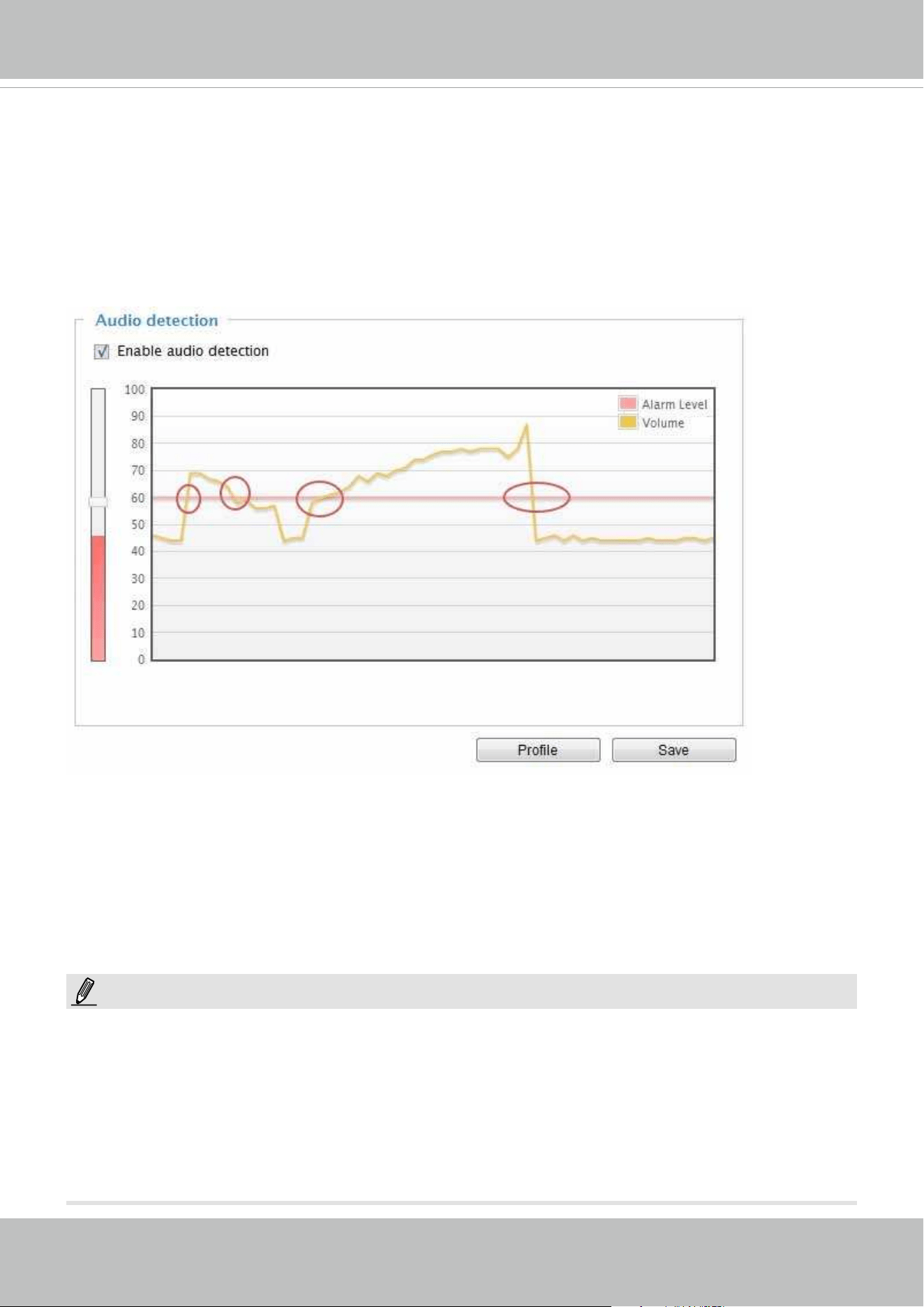
VIVOTEK
122 - User's Manual
Applications > Audio detection
Audio detection, along with video motion detection, is applicable in the following scenarios:
1. Detection of activities not covered by camera view, e.g., a loud input by gun shots or breaking a door/
window.
2. A usually noisy environment, such as a factory, suddenly becomes quiet due to a breakdown of
machines.
3. A PTZ camera can be directed to turn to a preset point by the occurrence of audio events.
4. Dark environments where video motion detection may not function well.
The red circles indicate where the audio alarms can be triggered when breaching or falling below the
preset threshold.
How to congure Audio detection:
1. Once the Audio detection window is opened, the current sound input will be interactively indicated
by a uctuating yellow wave diagram.
2. Use a mouse click to drag the Alarm level tab to a preferred location on the slide bar.
3. Select the “Enable audio detection“ checkbox and click Save to enable the feature.
1. Note that the volume numbers (0~100) on the side of wave diagram does not represent decibel (dB).
Sound intensity level has already been mapped to preset values. You can, however, use the real-
world inputs at your installation site that are shown on the wave diagram to congure an alarm level.
2. To configure this feature, you must not mute the audio in Configuration > Media > Audio.
The default of the camera can be muted due to the lack of an internal microphone. An external
microphone is provided by users.
NOTE:
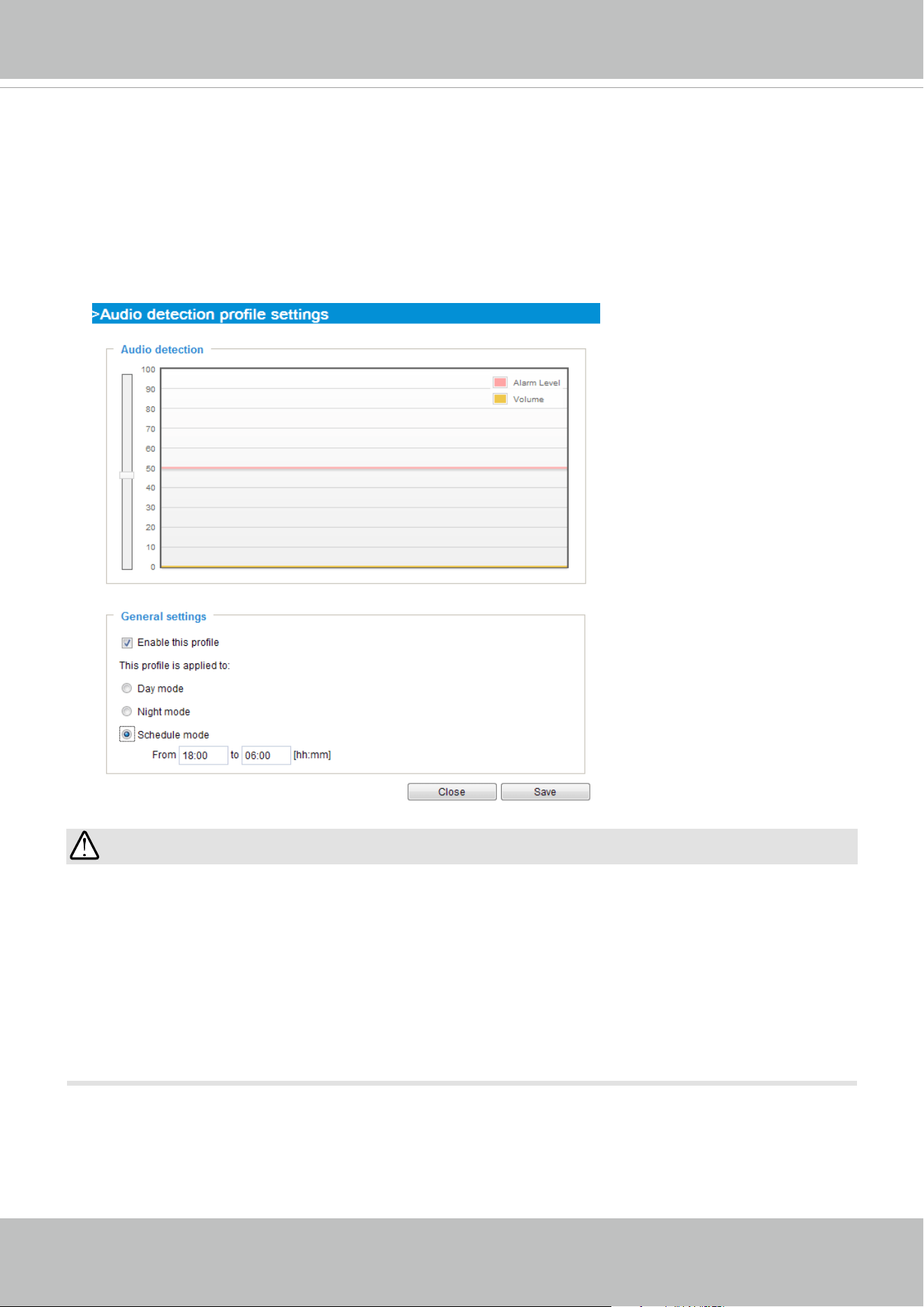
VIVOTEK
User's Manual - 123
IMPORTANT:
• If the Alarm level and the received volume are set within a range of 20% on the wave
diagram, frequent alarms will be triggered. It is recommended to set the Alarm level farther
apart from the detected sound level.
• To congure and enable this feature, you must not congure video stream #1 into Motion
JPEG. If an external microphone input is connected and recording of audio stream is
preferred, audio stream is transmitted between camera and viewer/recording station along
with stream #1.
• Refer to page 67 for Audio settings, and page 59 for video streaming settings.
You can use the Prole window to congure a different Audio detection setting. For example, a place
can be noisy in the day time and become very quiet in the night.
1. Click on the Enable this prole checkbox. Once the Audio detection window is opened, the current
sound input will be interactively indicated by a uctuating yellow wave diagram.
2. Use a mouse click to drag the Alarm level tab to a preferred location on the slide bar.
3. Select the Day, Night, or Schedule mode check circles. You may also manually congure a period
of time during which this prole will take effect.
4. Click Save and then click Close to complete your conguration.

VIVOTEK
124 - User's Manual
Applications > Package management - a.k.a., VADP (VIVOTEK
Application Development Platform)
Users can store and execute VIVOTEK's or 3rd-party software modules onto the camera's
flash memory or SD card. These software modules can apply in video analysis for intelligent
video applications such as license plate recognition, object counting, or as an agent for edge
recording, etc.
• Once the software package is successfully uploaded, the module conguration (vadp.xml)
information is displayed. When uploading a module, the camera will examine whether the
module ts the predened VADP requirements. Please contact our technical support or the
vendor of your 3rd-party module for the parameters contained within.
• Users can also run VIVOTEK's VADP packages as a means to access updated functionality
instead of replacing the entire rmware.
• Note that for some cameras the ash is too small to hold VADP packages. These cameras
will have its "Save to SD card" checkbox selected and grayed-out for all time.
• The le system of SD card (FAT32) does not support soft (symbolic) link. It will return failure
if your module tries to create soft links on SD card.
To utilize a software module, acquire the software package and click Browse and Upload
buttons. The screen message for a successful upload is shown below:

VIVOTEK
User's Manual - 125
To start a module, select the checkcircle in front, and click the Start button.
If you should need to remove a module, select the checkcircle in front and then click the Stop
button. By then the module status will become OFF, and the X button will appear at the end of
the row. Click on the X button to remove an existing module.
When prompted by a conrm message, Click Yes to proceed.
Yes
No
Note that the actual memory consumed while operating the module will be indicated on the
Memory status eld. This helps determine whether a running module has consumed too much
of system resources.
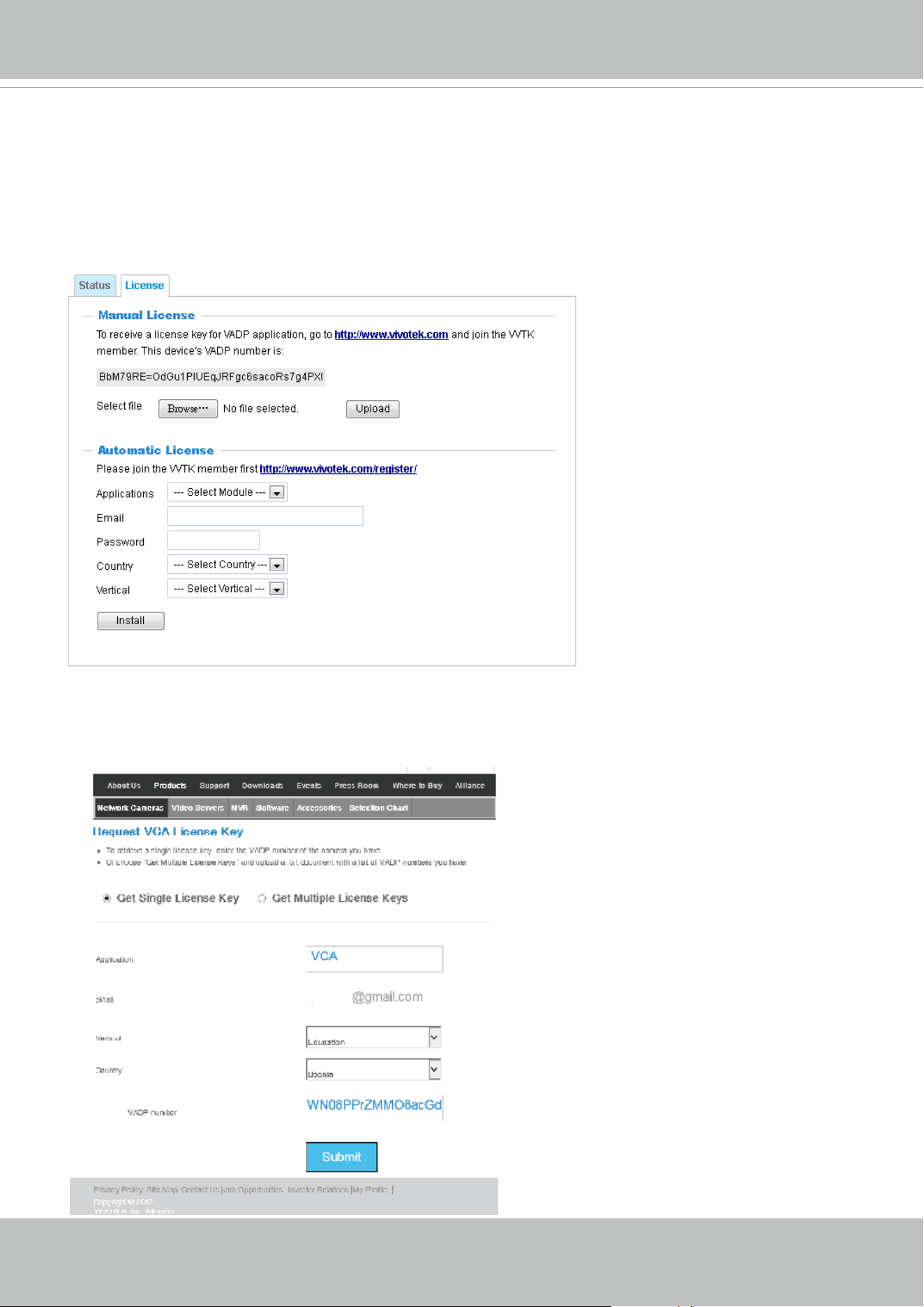
VIVOTEK
126 - User's Manual
On the License page, use the Manual or Automatic optionsto register and activate the license for
using VIVOTEK's VADP modules. The Automatic method requires an Internet connection.
Without Internet connection, you should acquire the license key elsewhere, and manually upload
to the network camera.
Follow the onscreen instruction on VIVOTEK's website for the registration procedure.
user
You can proced with the following link to download a license key: http://www.vivotek.com/vadp_
requestactivation.aspx?application=VCA or http://www.vivotek.com/vca/#downloads.
When the license key is downloaded to your computer, upload the key to the camera.
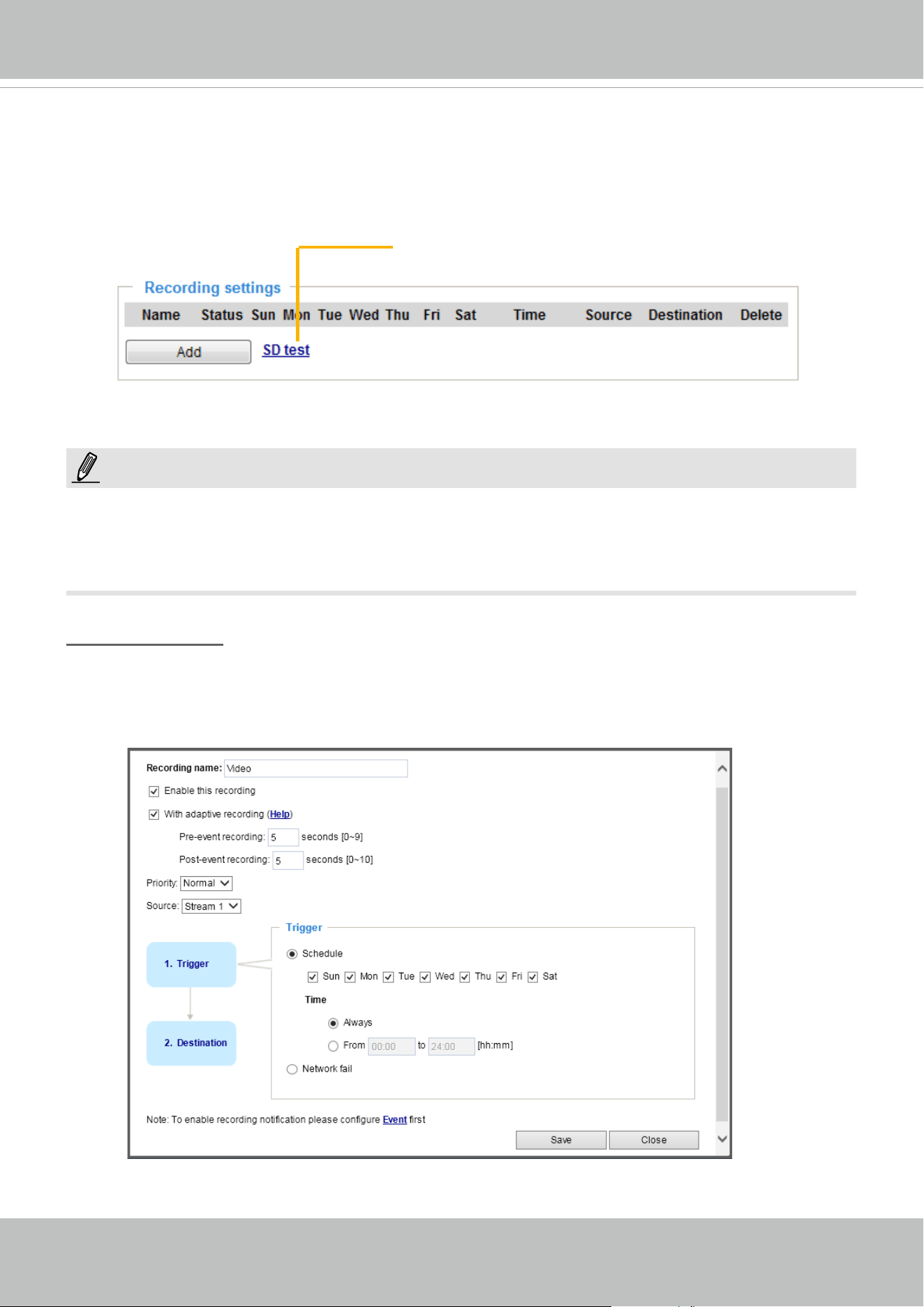
VIVOTEK
User's Manual - 127
Recording > Recording settings
This section explains how to congure the recording settings for the Network Camera.
Recording Settings
Insert your SD card and click here to test
Recording Settings
Click Add to open the recording setting window. On this page, you can dene the adaptive recording,
recording source, recording schedule, and recording capacity. A total of 2 recording settings can be
congured.
1. Each Recording setting records a video stream from one channel, i.e., from a single lens module.
2. Please remember to format your SD card when used for the rst time. Please refer to page 132 for
detailed information.
NOTE:

VIVOTEK
128 - User's Manual
If you enable adaptive recording on Camera A, only when an event is triggered on Camera A will the
server record the streaming data in full frame rate; otherwise, it will only request the I frame data during
normal monitoring, thus effectively save lots of bandwidths and storage.
The alarm trigger includes: motion detection and DI detection. Please refer to Event settings on page 103.
■ Pre-event recording and post-event recording
The Network Camera has a buffer area; it temporarily holds data up to a certain limit. Enter a number
to decide the duration of recording before and after a trigger is activated.
■ Priority: Select the relative importance of this recording (High, Normal, or Low). Recording with a higher
priority setting will be executed rst.
■ Channel # Stream #: Select a channel and a stream under it as the recording source.
► To enable adaptive recording, please also enable time shift caching stream and select a caching
stream on Media > Video > Stream settings. Please refer to page 59 for detailed instruction.
► To enable recording notication please congure Event settings rst. Please refer to page 103.
Time
Bandwidth
Bandwidth
Activity Adaptive Streaming
for Dynamic Frame Rate Control
I frame ---> Full frame rate ---> I frame
Continuous recording
► To enable adaptive recording, please make sure
you’ve set up the triggering sources such as Motion
Detection, DI Device, or Manual Trigger.
► When there is no alarm trigger:
- JPEG mode: record 1 frame per second.
- H.264 mode: record the I frame only.
► When the Intra frame period has been set to larger
than >1s on Video settings page, the Intra frame
period will be forced into 1s when the adaptive
recording is activated.
NOTE:
NOTE:
■ Recording name: Enter a name for the recording setting.
■ Enable this recording: Select this option to enable video recording.
■ With adaptive recording:
Select this option will activate the frame rate control according to alarm trigger. The frame control
means that when there is a triggered alarm/event, the frame rate will raise up to the value you’ve set
on the Stream setting page. Please refer to page 59 for more information.
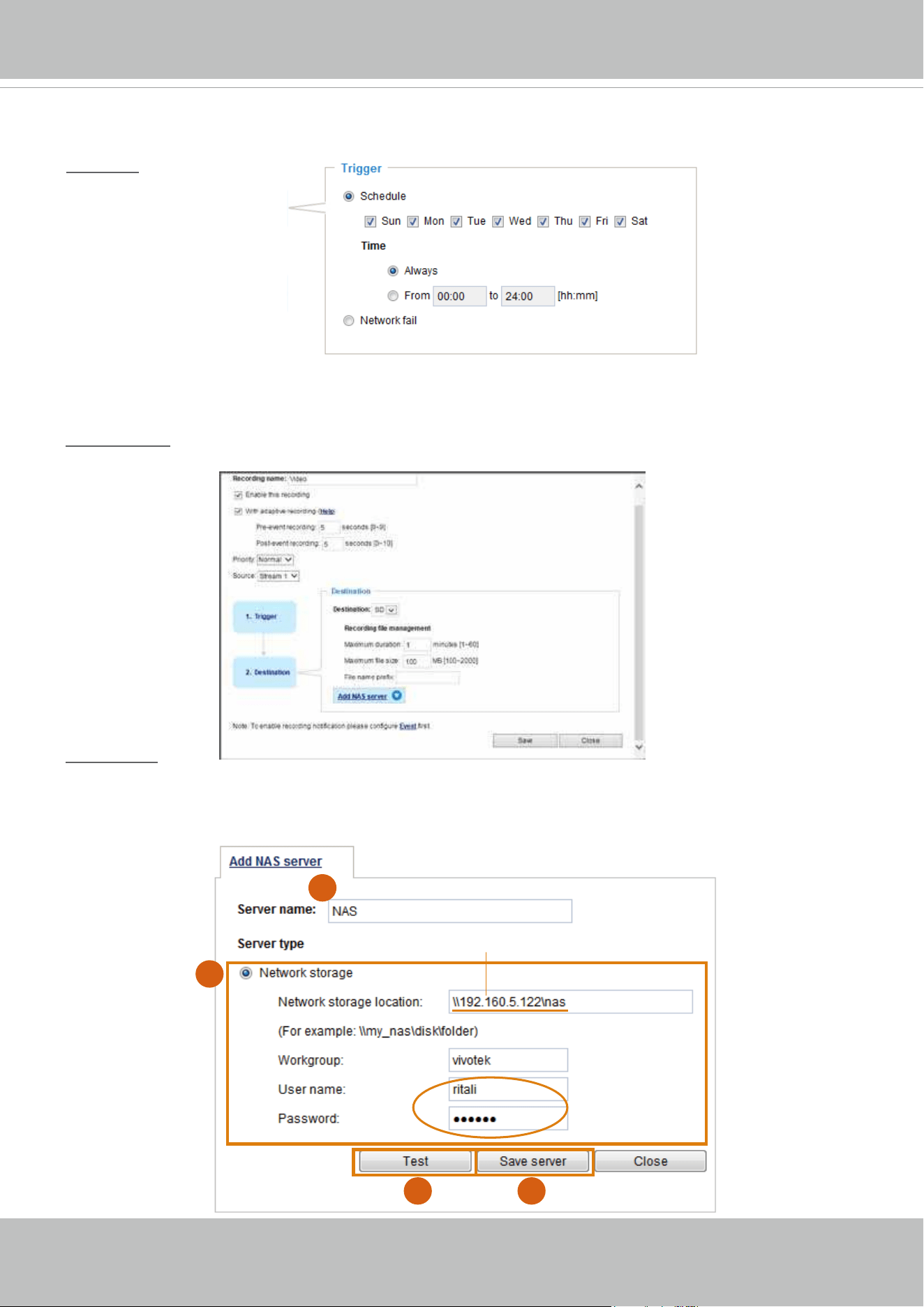
VIVOTEK
User's Manual - 129
2. Destination
You can select the SD card or network storage (NAS) for the recorded video les.
NAS server
Click Add NAS server
to open the server setting window and follow the steps below to set up:
1. Fill in the information for the access to the shared networked storage.
For example:
1
2
4
Network storage path
(\\server name or IP address\folder name)
User name and
password for your
server
3
1
2
3
4
Please follow steps 1~2 below to set up the recording:
1. Trigger
Select a trigger source.
■ Schedule: The server will start to record les on the local storage or network attached storage (NAS).
■ Network fail: Since network fail, the server will start to record les onto the local storage (SD card).
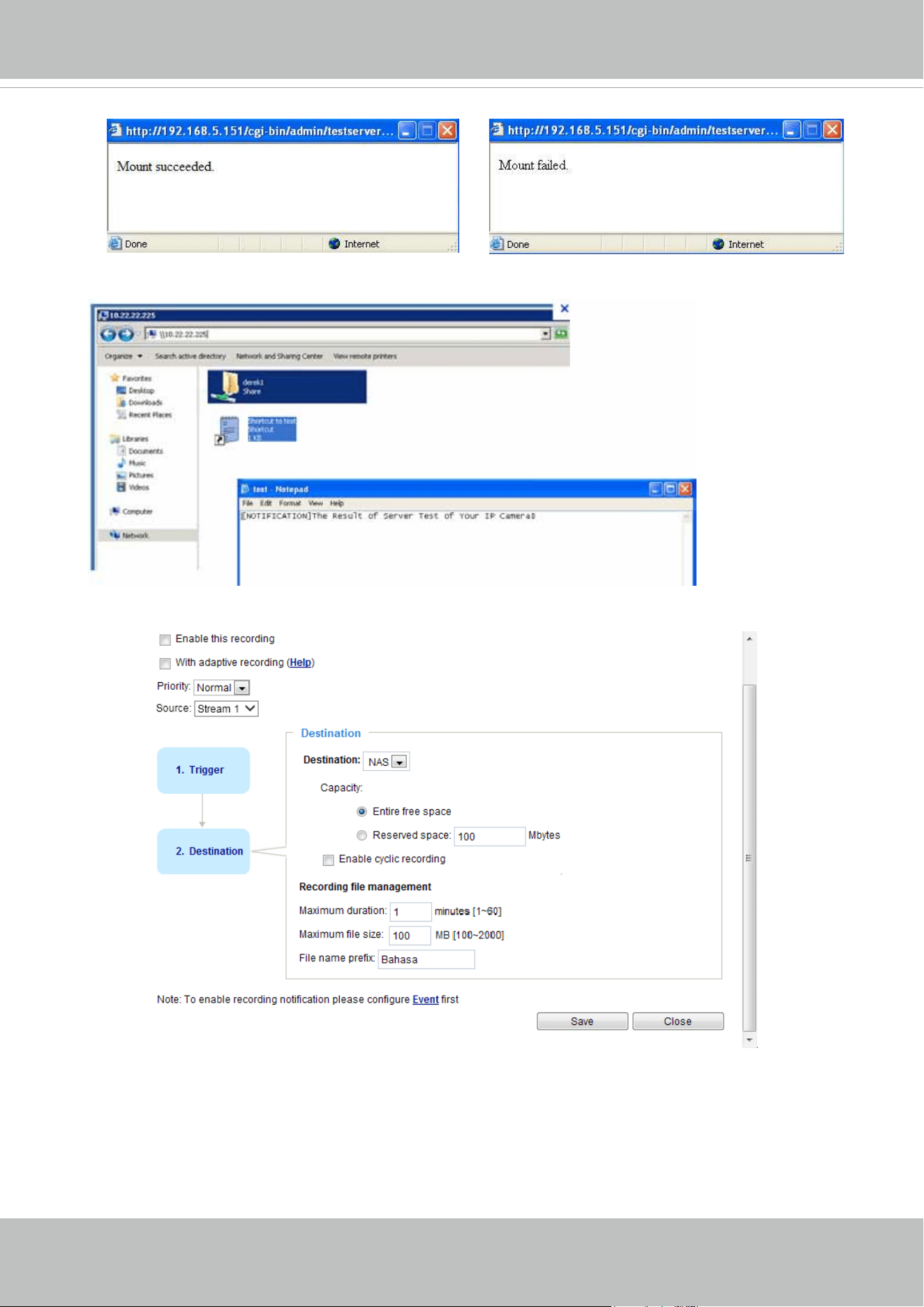
VIVOTEK
130 - User's Manual
If successful, you will receive a test.txt le on the networked storage server.
3. Enter a server name.
4. Click Save to complete the settings and click Close to exit the page.
■ Capacity: You can either choose the entire available space or impose a reserved space. The Reserved
space should be of the size of at least 15MBytes. The reserved space can be used as a safe buffer
especially when the cyclic recording function is enabled, during the transaction stage when a storage
space is full and the incoming streaming data is about to overwrite the previously saved videos.
■ File name prex: Enter the text that will be appended to the front of the le name.
2. Click Test to check the setting. The result will be shown in the pop-up window.

VIVOTEK
User's Manual - 131
■ Enable cyclic recording: If you check this item, when the maximum capacity is reached, the oldest le
will be overwritten by the latest one.
Recording le management
■ Maximum duration: This determines the length of each recorded video, applicable from 1 to 60
minutes.
■ Maximum file size: This determines the file size of each concluded recording. The applicable sizes
range from 100 to 2000 Megabytes.
■ File name prex: Enter a name for each recorded video.
If you want to enable recording notication, please click
Event
to set up. Please refer to Event > Event
settings on page 103 for more details.
When completed, select Enable this recording. Click Save to enable the setting and click Close to exit
this page. When the system begins recording, it will send the recorded les to the network storage or SD
card. The new recording name will appear on the recording page as shown below.
To remove an existing recording setting from the list, single-click to select it and click Delete.
■
Video (Name): Click to open the Recording settings page to modify.
■ ON (Status): Click to manually adjust the Status. (ON: start recording; OFF: stop recording)
■
NAS or SD (Destination): Click to open the le list of recordings as shown below. For more information
about folder naming rules, please refer to page 114 for details.

VIVOTEK
132 - User's Manual
Local storage > SD card management
SD card format
The Linux kernel EXT4 file system format applies to SD card larger than 32GB. However, if EXT4 is
applied, the computers running Windows will not be able to access the contents on the SD card unless
using some 3rd-party software .
This section explains how to manage the local storage on the Network Camera. Here you can
view SD card status, and implement SD card control.
SD card staus
This column shows the status and reserved space of your SD card. Please remember to format the SD
card when using for the rst time.
no SD card
NOTE:
• It is recommended to turn OFF the recording activity before you remove an SD card from the
camera.
• The lifespan of an SD card is limited. Regular replacement of the SD card can be necessary.
• Camera lesystem takes up several megabytes of memory space. The storage space cannot
be used for recording.
• Using an SD card that already contains data recorded by another device should not be used
in this camera.
• Please do not modify or change the folder names in the SD card. That may result in camera
malfunctions.
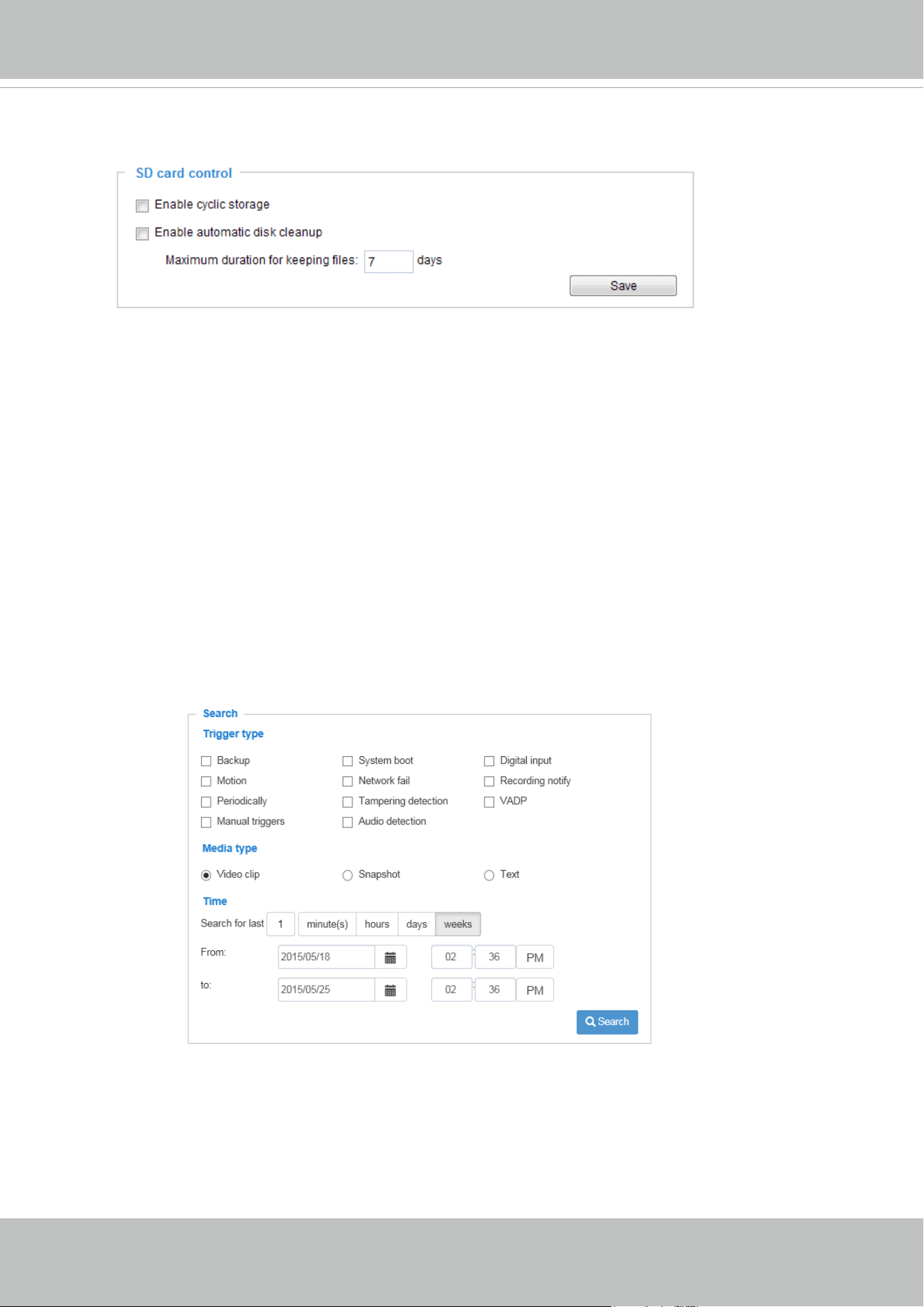
VIVOTEK
User's Manual - 133
SD card control
■ Enable cyclic storage: Check this item if you want to enable cyclic recording. When the maximum
capacity is reached, the oldest le will be overwritten by the latest one.
■ Enable automatic disk cleanup: Check this item and enter the number of days you wish to retain a le.
For example, if you enter “7 days”, the recorded les will be stored on the SD card for 7 days.
Click Save to enable your settings.
Local storage > Content management
This section explains how to manage the content of recorded videos on the Network Camera. Here you
can search and view the records and view the searched results.
Searching and Viewing the Records
This column allows the user to set up search criteria for recorded data. If you do not select any criteria
and click Search button, all recorded data will be listed in the Search Results column.
■ File attributes: Select one or more items as your search criteria.
■ Trigger time: Manually enter the time range you want to search for contents created at a specic point
in time.
Click Search and the recorded data corresponding to the search criteria will be listed in Search Results
window.
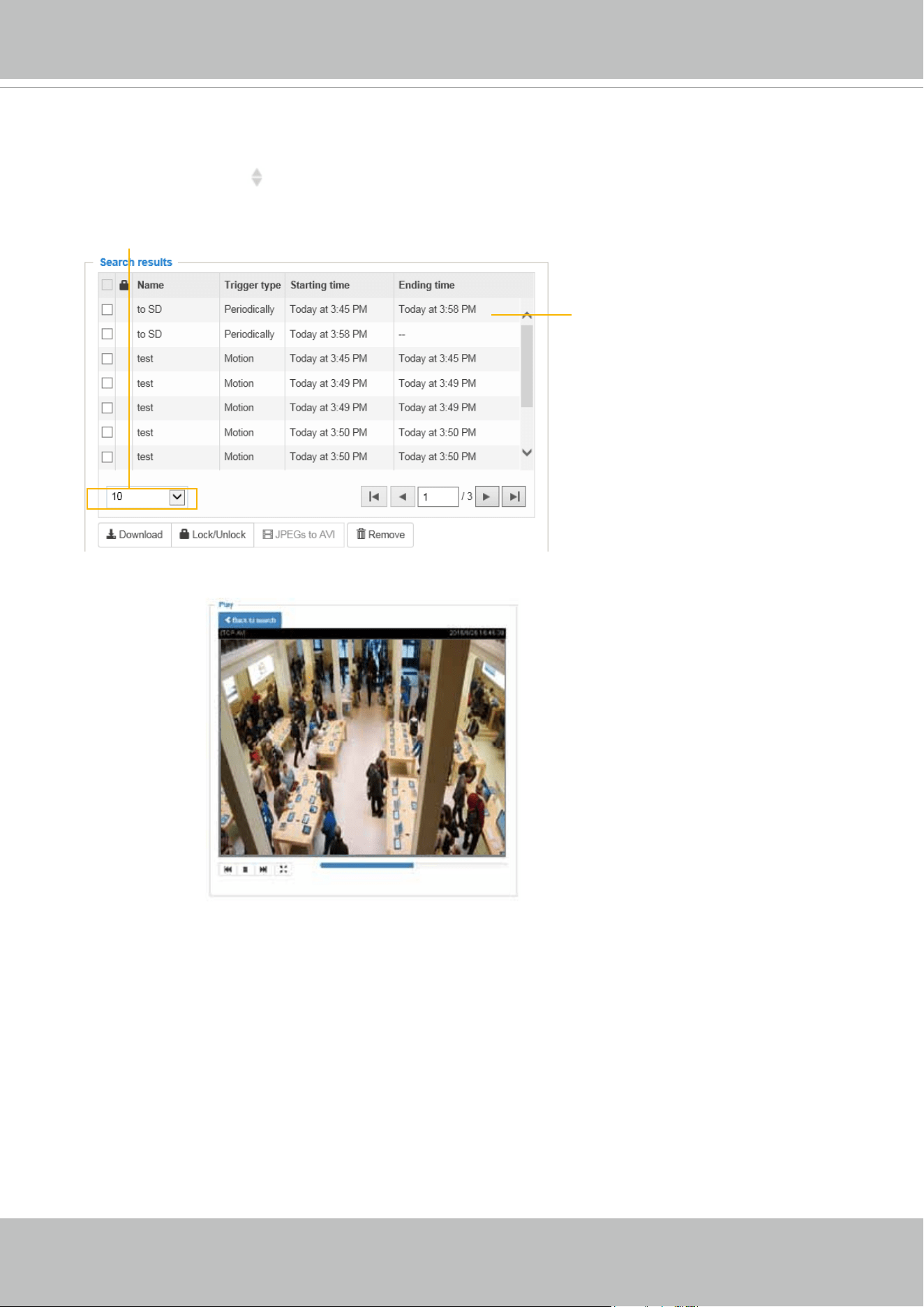
VIVOTEK
134 - User's Manual
Search Results
The following is an example of search results. There are four columns: Trigger time, Media type, Trigger
type, and Locked. Click
to sort the search results in either direction.
Numbers of entries displayed
on one page
Click to open a live view
■ Play: Click on a search result which will highlight the selected item. A Play window will appear on
top for immediate review of the selected le.
For example:
■ Download: Click on a search result to highlight the selected item in purple as shown above. Then click
the Download button and a le download window will pop up for you to save the le.
■ JPEGs to AVI: This functions only applies to “JPEG“ format les such as snapshots. You can select
several snapshots from the list, then click this button. Those snapshots will be converted into an AVI
le.
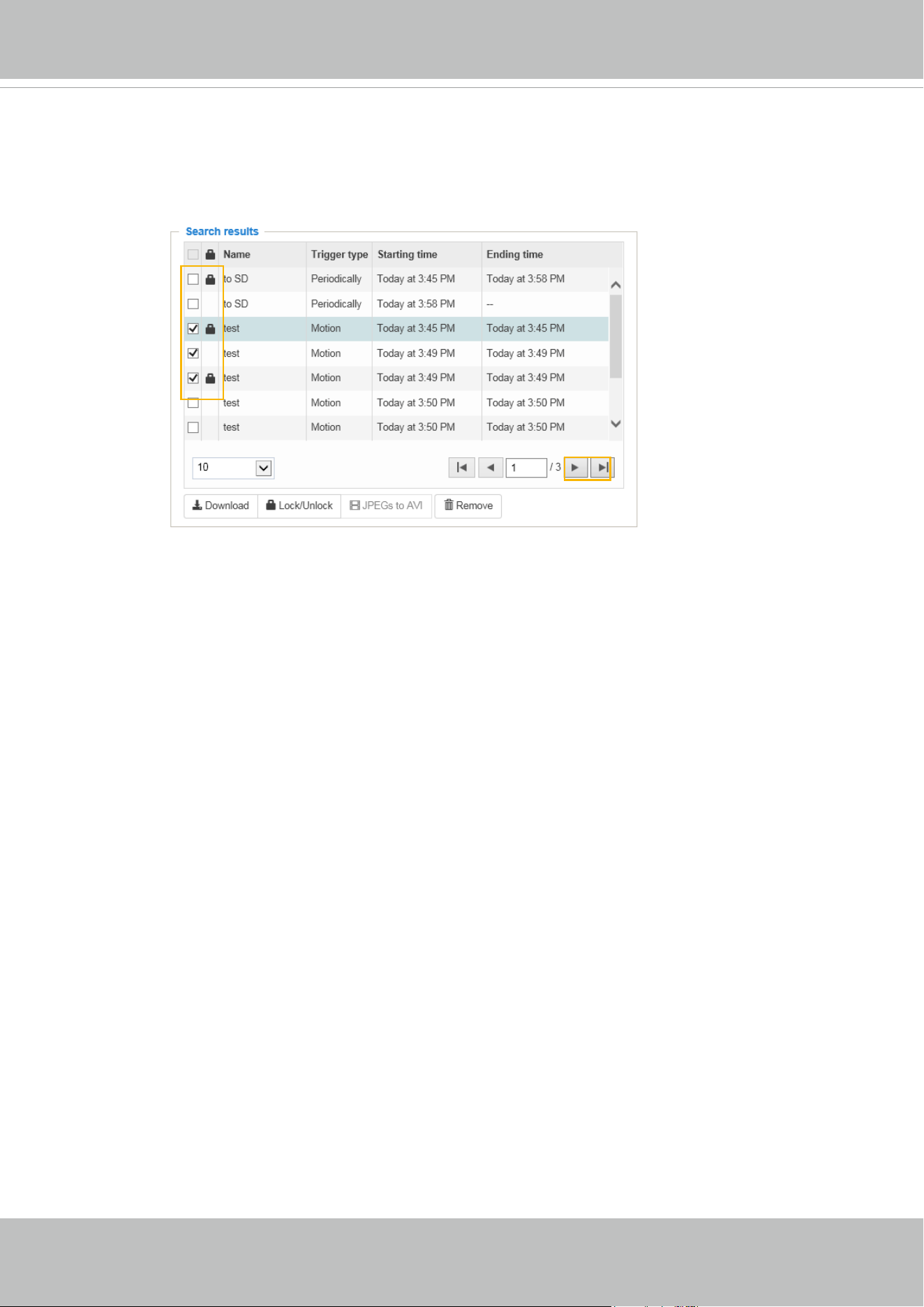
VIVOTEK
User's Manual - 135
■ Lock/Unlock: Select the checkbox in front of a desired search result, then click this button. The selected
items will become Locked, which will not be deleted during cyclic recording. You can click again to
unlock the selections.
For example:
■ Remove: Select the desired search results, then click this button to delete the les.
Click to switch
pages

VIVOTEK
136 - User's Manual
Appendix
URL Commands for the Network Camera
1. Overview
For some customers who already have their own web site or web control application, the Network
Camera/Video Server can be easily integrated through URL syntax. This section specifies the external
HTTP-based application programming interface. The HTTP-based camera interface provides the
functionality to request a single image, control camera functions (PTZ, output relay etc.), and get and set
internal parameter values. The image and CGI-requests are handled by the built-in Web server.
2. Style Convention
In URL syntax and in descriptions of CGI parameters, text within angle brackets denotes content that
is to be replaced with either a value or a string. When replacing the text string, the angle brackets
should also be replaced. An example of this is the description of the name for the server, denoted with
<servername> in the URL syntax description below, that is replaced with the string myserver in the URL
syntax example further down in the page.
URL syntax is denoted with the word "Syntax:" written in bold face followed by a box with the referenced
syntax as shown below. For example, name of the server is written as <servername> and is intended to
be replaced with the name of the actual server. This can either be a name, e.g., "mywebcam" or "thecam.
adomain.net" or the associated IP number for the server, e.g., 192.168.0.220.
Syntax:
http://<servername>/cgi-bin/viewer/video.jpg
Description of returned data is written with "Return:" in bold face followed by the returned data in a box. All data is
returned in HTTP format, i.e., each line is separated with a Carriage Return and Line Feed (CRLF) printed as \r\n.
Return:
HTTP/1.0 <HTTP code> <HTTP text>\r\n
URL syntax examples are written with "Example:" in bold face followed by a short description and a light grey box
with the example.
Example: request a single snapshot image
http://mywebserver/cgi-bin/viewer/video.jpg
VIVOTEK
User's Manual - 137
3. General CGI URL Syntax and Parameters
CGI parameters are written in lower-case and as one word without any underscores or other separators. When the
CGI request includes internal camera parameters, these parameters must be written exactly as they are named in
the camera or video server. The CGIs are organized in functionally-related directories under the cgi-bin directory.
The file extension .cgi is required.
Syntax:
http://<servername>/cgi-bin/<subdir>[/<subdir>...]/<cgi>.<ext>
[?<parameter>=<value>[&<parameter>=<value>...]]
Example: Set digital output #1 to active
http://mywebserver/cgi-bin/dido/setdo.cgi?do1=1
4. Security Level
SECURITY LEVEL SUB-DIRECTORY DESCRIPTION
0 anonymous Unprotected.
1 [view] anonymous, viewer,
dido, camctrl
1. Can view, listen, talk to camera.
2. Can control DI/DO, PTZ of the camera.
4 [operator] anonymous, viewer,
dido, camctrl, operator
Operator access rights can modify most of the camera’s
parameters except some privileges and network options.
6 [admin] anonymous, viewer,
dido, camctrl, operator,
admin
Administrator access rights can fully control the camera’s
operations.
7 N/A Internal parameters. Unable to be changed by any external
interfaces.
5. Get Server Parameter Values
Note: The access right depends on the URL directory.
Method: GET/POST
Syntax:
http://<servername>/cgi-bin/anonymous/getparam.cgi?[<parameter>]
[&<parameter>…]
http://<servername>/cgi-bin/
viewer/getparam.cgi?[<parameter>]

VIVOTEK
138 - User's Manual
[&<parameter>…]
http://<servername>/cgi-bin/operator/getparam.cgi?[<parameter>]
[&<parameter>…]
http://<servername>/cgi-bin/admin/getparam.cgi?[<parameter>]
[&<parameter>…]
Where the <parameter> should be <group>[_<name>] or <group>[.<name>]. If you do not specify any
parameters, all the parameters on the server will be returned. If you specify only <group>, the parameters of the
related group will be returned.
When querying parameter values, the current parameter values are returned.
A successful control request returns parameter pairs as follows:
Return:
HTTP/1.0 200 OK\r\n
Content-Type: text/html\r\n
Context-Length: <length>\r\n
\r\n
<parameter pair>
where <parameter pair> is
<parameter>=<value>\r\n
[<parameter pair>]
<length> is the actual length of content.
Example: Request IP address and its response
Request:
http://192.168.0.123/cgi-bin/admin/getparam.cgi?network_ipaddress
Response:
HTTP/1.0 200 OK\r\n
Content-Type: text/html\r\n
Context-Length: 33\r\n
\r\n
network.ipaddress=192.168.0.123\r\n

VIVOTEK
User's Manual - 139
6. Set Server Parameter Values
Note: The access right depends on the URL directory.
Method: GET/POST
Syntax:
http://<servername>/cgi-bin/anonymous/setparam.cgi? <parameter>=<value>
[&<parameter>=<value>…][&update=<value>][&return=<return page>]
http://<servername>/cgi-bin/viewer/setparam.cgi? <parameter>=<value>
[&<parameter>=<value>…][&update=<value>] [&return=<return page>]
http://<servername>/cgi-bin/operator/setparam.cgi? <parameter>=<value>
[&<parameter>=<value>…][&update=<value>] [&return=<return page>]
http://<servername>/cgi-bin/admin/setparam.cgi? <parameter>=<value>
[&<parameter>=<value>…][&update=<value>] [&return=<return page>]
PARAMETER VALUE DESCRIPTION
<group>_<name>
value to assigned Assign <value> to the parameter <group>_<name>.
update
<boolean> Set to 1 to update all fields (no need to update parameter in each
group).
return
<return page> Redirect to the page <return page> after the parameter is assigned.
The <return page> can be a full URL path or relative path according
to the current path. If you omit this parameter, it will redirect to an
empty page.
(Note: The return page can be a general HTML file (.htm, .html) or a
VIVOTEK server script executable (.vspx) file. It cannot be a CGI
command or have any extra parameters. This parameter must be
placed at the end of the parameter list
Return:
HTTP/1.0 200 OK\r\n
Content-Type: text/html\r\n
Context-Length: <length>\r\n
\r\n
<parameter pair>
where <parameter pair> is

VIVOTEK
140 - User's Manual
<parameter>=<value>\r\n
[<parameter pair>]
Only the parameters that you set and are readable will be returned.
Example: Set the IP address of server to 192.168.0.123:
Request:
http://myserver/cgi-bin/admin/setparam.cgi?network_ipaddress=192.168.0.123
Response:
HTTP/1.0 200 OK\r\n
Content-Type: text/html\r\n
Context-Length: 33\r\n
\r\n
network.ipaddress=192.168.0.123\r\n
7. Available parameters on the server
Valid values:
VALID VALUES DESCRIPTION
string[<n>] Text strings shorter than ‘n’ characters. The characters “,’, <,>,& are invalid.
string[n~m] Text strings longer than `n’ characters and shorter than `m’ characters. The
characters “,’, <,>,& are invalid.
password[<n>] The same as string but displays ‘*’ instead.
integer Any number between (-2
31
– 1) and (2
31
– 1).
positive integer Any number between 0 and (2
32
– 1).
<m> ~ <n> Any number between ‘m’ and ‘n’.
domain name[<n>] A string limited to a domain name shorter than ‘n’ characters (eg. www.ibm.com).
email address [<n>] A string limited to an email address shorter than ‘n’ characters (eg.
joe@www.ibm.com).
ip address A string limited to an IP address (eg. 192.168.1.1).
mac address A string limited to contain a MAC address without hyphens or colons.
boolean A boolean value of 1 or 0 represents [Yes or No], [True or False], [Enable or
Disable].
<value1>,
<value2>,
<value3>,
…
Enumeration. Only given values are valid.
blank A blank string.
everything inside <> A description

VIVOTEK
User's Manual - 141
integer primary key SQLite data type. A 32-bit signed integer. The value is assigned a unique integer by
the server.
text SQLite data type. The value is a text string, stored using the database encoding
(UTF-8, UTF-16BE or UTF-16-LE).
coordinate x, y coordinate (eg. 0,0)
window size window width and height (eg. 800x600)
NOTE: The camera should not be restarted when parameters are changed.

VIVOTEK
142 - User's Manual
7.1 system
Group: system
NAME VALUE DEFAULT SECURITY
(get/set)
DESCRIPTION
hostname string[64] Mega-Pixel
Network
Camera
1/6 Host name of server
(Network Camera,
Wireless Network Camera,
Video Server,
Wireless Video Server).
ledoff <boolean> 0 6/6 Turn on (0) or turn off (1) all led
indicators.
date <YYYY/MM/
DD>,
keep,
auto
<current
date>
6/6 Current date of system. Set to ‘keep’
to keep date unchanged. Set to ‘auto’
to use NTP to synchronize date.
time <hh:mm:s
s>,
keep,
auto
<current
time>
6/6 Current time of the system. Set to
‘keep’ to keep time unchanged. Set to
‘auto’ to use NTP to synchronize time.
datetime <MMDDhh
mmYYYY.ss
>
<blank> 7/6 Another current time format of the
system.
ntp <domain
name>,
<ip
address>,
<blank>
<blank> 6/6 NTP server.
*Do not use “skip to invoke default
server” for default value.
timezoneindex -489 ~ 529 320 6/6 Indicate timezone and area.
-480: GMT-12:00 Eniwetok, Kwajalein
-440: GMT-11:00 Midway Island,
Samoa
-400: GMT-10:00 Hawaii
-360: GMT-09:00 Alaska
-320: GMT-08:00 Las Vegas,
San_Francisco,
Vancouver
-280: GMT-07:00 Mountain Time,
Denver

VIVOTEK
User's Manual - 143
-281: GMT-07:00 Arizona
-240: GMT-06:00 Central America,
Central Time, Mexico City,
Saskatchewan
-200: GMT-05:00 Eastern Time, New
York, Toronto
-201: GMT-05:00 Bogota, Lima,
Quito, Indiana
-180: GMT-04:30 Caracas
-160: GMT-04:00 Atlantic Time,
Canada, La Paz, Santiago
-140: GMT-03:30 Newfoundland
-120: GMT-03:00 Brasilia, Buenos
Aires,
Georgetown, Greenland
-80: GMT-02:00 Mid-Atlantic
-40: GMT-01:00 Azores,
Cape_Verde_IS.
0: GMT Casablanca, Greenwich Mean
Time: Dublin,
Edinburgh, Lisbon, London
40: GMT 01:00 Amsterdam, Berlin,
Rome, Stockholm, Vienna, Madrid,
Paris
41: GMT 01:00 Warsaw, Budapest,
Bern
80: GMT 02:00 Athens, Helsinki,
Istanbul, Riga
81: GMT 02:00 Cairo
82: GMT 02:00 Lebanon, Minsk
83: GMT 02:00 Israel
120: GMT 03:00 Baghdad, Kuwait,
Riyadh, Moscow, St. Petersburg,
Nairobi
121: GMT 03:00 Iraq
140: GMT 03:30 Tehran
160: GMT 04:00 Abu Dhabi, Muscat,
Baku,
Tbilisi, Yerevan
180: GMT 04:30 Kabul

VIVOTEK
144 - User's Manual
200: GMT 05:00 Ekaterinburg,
Islamabad, Karachi, Tashkent
220: GMT 05:30 Calcutta, Chennai,
Mumbai, New Delhi
230: GMT 05:45 Kathmandu
240: GMT 06:00 Almaty, Novosibirsk,
Astana, Dhaka, Sri Jayawardenepura
260: GMT 06:30 Rangoon
280: GMT 07:00 Bangkok, Hanoi,
Jakarta, Krasnoyarsk
320: GMT 08:00 Beijing, Chongging,
Hong Kong, Kuala Lumpur, Singapore,
Taipei
360: GMT 09:00 Osaka, Sapporo,
Tokyo, Seoul, Yakutsk
380: GMT 09:30 Adelaide, Darwin
400: GMT 10:00 Brisbane, Canberra,
Melbourne, Sydney, Guam,
Vladivostok
440: GMT 11:00 Magadan, Solomon
Is., New Caledonia
480: GMT 12:00 Aucklan, Wellington,
Fiji, Kamchatka, Marshall Is.
520: GMT 13:00 Nuku'Alofa
daylight_enable <boolean> 0 6/6 Enable automatic daylight saving time
in time zone.
daylight_dstactualmode <boolean> 1 6/7 Check if current time is under daylight
saving time.
(Used internally)
daylight_auto_begintime string[19] NONE 6/7 Display the current daylight saving
start time.
daylight_auto_endtime string[19] NONE 6/7 Display the current daylight saving
end time.
daylight_timezones string ,-360,-320,
-280,-240,
-241,-200,
-201,-160,
-140,-120,
-80,-40,0,
40,41,80,
6/6 List time zone index which support
daylight saving time.

VIVOTEK
User's Manual - 145
81,82,83,
120,140,
380,400,48
0
updateinterval 0,
3600,
86400,
604800,
2592000
0 6/6 0 to Disable automatic time
adjustment, otherwise, it indicates
the seconds between NTP automatic
update intervals.
restore 0,
<positive
integer>
N/A 7/6 Restore the system parameters to
default values after <value> seconds.
reset 0,
<positive
integer>
N/A 7/6 Restart the server after <value>
seconds if <value> is non-negative.
restoreexceptnet <Any
value>
N/A 7/6 Restore the system parameters to
default values except (ipaddress,
subnet, router, dns1, dns2, pppoe).
This command can cooperate with
other “restoreexceptXYZ” commands.
When cooperating with others, the
system parameters will be restored to
the default value except for a union of
the combined results.
restoreexceptdst <Any
value>
N/A 7/6 Restore the system parameters to
default values except all daylight
saving time settings.
This command can cooperate with
other “restoreexceptXYZ” commands.
When cooperating with others, the
system parameters will be restored to
default values except for a union of
combined results.
restoreexceptlang <Any
Value>
N/A 7/6 Restore the system parameters to
default values except the custom
language file the user has uploaded.
This command can cooperate with
other “restoreexceptXYZ” commands.
When cooperating with others, the
system parameters will be restored to

VIVOTEK
146 - User's Manual
the default value except for a union of
the combined results.
7.1.1 system.info
Subgroup of system: info (The fields in this group are unchangeable.)
NAME VALUE DEFAULT SECURITY
(get/set)
DESCRIPTION
modelname string[40] VC8201 0/7 Internal model name of the server
(eg. IP7139)
extendedmodelname string[40] VC8201 0/7 ODM specific model name of server
(eg. DCS-5610). If it is not an ODM
model, this field will be equal to
“modelname”
serialnumber <mac
address>
<product
mac
address>
0/7 12 characters MAC address (without
hyphens).
firmwareversion string[40] 0100a 0/7 Firmware version, including model,
company, and version number in the
format: <MODEL-BRAND-VERSION>
language_count <integer> 9 0/7 Number of webpage languages
available on the server.
language_i<0~(count-1)> string[16] English,
Deutsch,
Español,
Français,
Italiano,
日本語,
Português,
简体中文,
繁體中文
0/7 Available language lists.
customlanguage_maxcoun
t
<integer> 1 0/6 Maximum number of custom
languages supported on the server.
customlanguage_count <integer> 0 0/6 Number of custom languages which
have been uploaded to the server.
customlanguage_i<0~(ma
xcount-1)>
string <blank> 0/6 Custom language name.

VIVOTEK
User's Manual - 147
7.2 status
Group: status
NAME VALUE DEFAULT SECURITY
(get/set)
DESCRIPTION
di_i<0~(ndi-1)> <boolean> 0 1/7 0 => Inactive, normal
1 => Active, triggered
(capability.ndi > 0)
do_i<0~(ndo-1)> <boolean> 0 1/7 0 => Inactive, normal
1 => Active, triggered
(capability.ndo > 0)
onlinenum_rtsp integer 0 6/7 Current number of RTSP
connections.
onlinenum_httppush integer 0 6/7 Current number of HTTP push
server connections.
eth_i0 <string> <product
dependent>
1/7 Get network information from
mii-tool.
vi_i<0~(nvi-1)> <boolean> 0 1/7 Virtual input
0 => Inactive
1 => Active
(capability.nvi > 0)
7.3 digital input behavior define
Group: di_i<0~(ndi-1)>
(capability.ndi > 0)
NAME VALUE DEFAULT SECURITY
(get/set)
DESCRIPTION
normalstate high,
low
high 1/1 Indicates open circuit or closed
circuit (inactive status)
7.4 digital output behavior define
Group: do_i<0~(ndo-1)>
(capability.ndo > 0)
NAME VALUE DEFAULT SECURITY
(get/set)
DESCRIPTION
normalstate open,
grounded
open 1/1 Indicate open circuit or closed
circuit (inactive status)

VIVOTEK
148 - User's Manual
7.5 security
Group: security
NAME VALUE DEFAULT SECURITY
(get/set)
DESCRIPTION
privilege_do view, operator,
admin
operator 1/6 Indicate which privileges and
above can control digital output
(capability.ndo > 0)
privilege_camctrl view, operator,
admin
view 1/6 Indicate which privileges and
above can control PTZ
(capability.ptzenabled > 0 or
capability.eptz > 0)
user_i0_name string[64] root 6/7 User name of root
user_i<1~20>_name string[64] <blank> 6/7 User name
user_i0_pass password[64] <blank> 6/6 Root password
user_i<1~20>_pass password[64] <blank> 7/6 User password
user_i0_privilege view,
operator,
admin
admin 6/7 Root privilege
user_i<1~20>_ privilege view,
operator,
admin
<blank> 6/6 User privilege
7.6 network
Group: network
NAME VALUE DEFAULT SECURITY
(get/set)
DESCRIPTION
preprocess <positive
integer>
<blank> 6/6 An 32-bit integer, each bit can
be set separately as follows:
Bit 0 => HTTP service;
Bit 1=> HTTPS service;
Bit 2=> FTP service;
Bit 3 => Two way audio and
RTSP Streaming service;
To stop service before changing
its port settings. It’s
recommended to set this
parameter when change a

VIVOTEK
User's Manual - 149
service port to the port occupied
by another service currently.
Otherwise, the service may fail.
Stopped service will auto-start
after changing port settings.
Ex:
Change HTTP port from 80 to
5556, and change RTP port for
video from 5556 to 20480.
Then, set preprocess=9 to stop
both service first.
”/cgi-bin/admin/setparam.cgi?
network_preprocess=9&networ
k_http_port=5556&
network_rtp_videoport=20480”
type lan,
pppoe
lan 6/6 Network connection type.
resetip <boolean> 1 6/6 1 => Get ipaddress, subnet,
router, dns1, dns2 from DHCP
server at next reboot.
0 => Use preset ipaddress,
subnet, rounter, dns1, and dns2.
ipaddress <ip address> <product
dependent>
6/6 IP address of server.
subnet <ip address> <blank> 6/6 Subnet mask.
router <ip address> <blank> 6/6 Default gateway.
dns1 <ip address> <blank> 6/6 Primary DNS server.
dns2 <ip address> <blank> 6/6 Secondary DNS server.
wins1 <ip address> <blank> 6/6 Primary WINS server.
wins2 <ip address> <blank> 6/6 Secondary WINS server.
7.6.1 802.1x
Subgroup of network: ieee8021x (capability.protocol.ieee8021x > 0)
NAME VALUE DEFAULT SECURITY
(get/set)
DESCRIPTION
enable <boolean> 0 6/6 Enable/disable IEEE 802.1x
eapmethod eap-peap,
eap-tls
eap-peap 6/6 Selected EAP method
identity_peap String[64] <blank> 6/6 PEAP identity

VIVOTEK
150 - User's Manual
identity_tls String[64] <blank> 6/6 TLS identity
password String[253] <blank> 6/6 Password for TLS
privatekeypassword String[253] <blank> 6/6 Password for PEAP
ca_exist <boolean> 0 6/6 CA installed flag
ca_time <integer> 0 6/7 CA installed time. Represented
in EPOCH
ca_size <integer> 0 6/7 CA file size (in bytes)
certificate_exist <boolean> 0 6/6 Certificate installed flag (for
TLS)
certificate_time <integer> 0 6/7 Certificate installed time.
Represented in EPOCH
certificate_size <integer> 0 6/7 Certificate file size (in bytes)
privatekey_exist <boolean> 0 6/6 Private key installed flag (for
TLS)
privatekey_time <integer> 0 6/7 Private key installed time.
Represented in EPOCH
privatekey_size <integer> 0 6/7 Private key file size (in bytes)
7.6.2 QOS
Subgroup of network: qos_cos (capability.protocol.qos.cos > 0)
NAME VALUE DEFAULT SECURITY
(get/set)
DESCRIPTION
enable <boolean> 0 6/6 Enable/disable CoS (IEEE
802.1p)
vlanid 1~4095 1 6/6 VLAN ID
video 0~7 0 6/6 Video channel for CoS
audio 0~7 0 6/6 Audio channel for CoS
(capability.naudio > 0)
eventalarm 0~7 0 6/6 Event/alarm channel for CoS
management 0~7 0 6/6 Management channel for CoS
eventtunnel 0~7 0 6/6 Event/Control channel for CoS
Subgroup of network: qos_dscp (capability.protocol.qos.dscp > 0)
NAME VALUE DEFAULT SECURITY
(get/set)
DESCRIPTION
enable <boolean> 0 6/6 Enable/disable DSCP
video 0~63 0 6/6 Video channel for DSCP
audio 0~63 0 6/6 Audio channel for DSCP

VIVOTEK
User's Manual - 151
(capability.naudio > 0)
eventalarm 0~63 0 6/6 Event/alarm channel for DSCP
management 0~63 0 6/6 Management channel for DSCP
eventtunnel 0~63 0 6/6 Event/Control channel for DSCP
7.6.3 IPV6
Subgroup of network: ipv6 (capability.protocol.ipv6 > 0)
NAME VALUE DEFAULT SECURITY
(get/set)
DESCRIPTION
enable <boolean> 0 6/6 Enable IPv6.
addonipaddress <ip address> <blank> 6/6 IPv6 IP address.
addonprefixlen 0~128 64 6/6 IPv6 prefix length.
addonrouter <ip address> <blank> 6/6 IPv6 router address.
addondns <ip address> <blank> 6/6 IPv6 DNS address.
allowoptional <boolean> 0 6/6 Allow manually setup of IP
address setting.
7.6.4 FTP
Subgroup of network: ftp
NAME VALUE DEFAULT SECURITY
(get/set)
DESCRIPTION
port 21,
1025~65535
21 6/6 Local ftp server port.
7.6.5 HTTP
Subgroup of network: http
NAME VALUE DEFAULT SECURITY
(get/set)
DESCRIPTION
port 80, 1025 ~
65535
80 1/6 HTTP port.
alternateport 1025~65535 8080 6/6 Alternate HTTP port.
authmode basic,
digest
basic 1/6 HTTP authentication mode.
s0_accessname string[32] video.mjpg 1/6 HTTP server push access name
for stream 1.
(capability.protocol.spush_mjpe

VIVOTEK
152 - User's Manual
g =1 and
capability.nmediastream > 0)
s1_accessname string[32] videos2.mjpg 1/6 HTTP server push access name
for stream 2.
(capability.protocol.spush_mjpe
g =1 and
capability.nmediastream > 1)
s2_accessname string[32] videos3.mjpg 1/6 Http server push access name
for stream 3
(capability.protocol.spush_mjpe
g =1 and
capability.nmediastream > 2)
S3_accessname string[32] Video2.mjpg 1/6 Http server push access name
for stream 4
(capability.protocol.spush_mjpe
g =1 and
capability.nmediastream > 3)
S4_accessname string[32] Video2s2.mjp
g
1/6 Http server push access name
for stream 5
(capability.protocol.spush_mjpe
g =1 and
capability.nmediastream > 4)
S5_accessname string[32] Video2s3.mjp
g
1/6 Http server push access name
for stream 6
(capability.protocol.spush_mjpe
g =1 and
capability.nmediastream > 5)
anonymousviewing <boolean> 0 1/6 Enable anonymous streaming
viewing.
7.6.6 HTTPS port
Subgroup of network: https_port
(capability.protocol.https > 0)
NAME VALUE DEFAULT SECURITY
(get/set)
DESCRIPTION
port 443, 1025 ~
65535
443 1/6 HTTPS port.

VIVOTEK
User's Manual - 153
7.6.7 RTSP
Subgroup of network: rtsp (capability.protocol.rtsp > 0)
NAME VALUE DEFAULT SECURITY
(get/set)
DESCRIPTION
port 554, 1025 ~
65535
554 1/6 RTSP port.
(capability.protocol.rtsp=1)
anonymousviewing <boolean> 0 1/6 Enable anoymous streaming
viewing.
authmode disable,
basic,
digest
basic 1/6 RTSP authentication mode.
(capability.protocol.rtsp=1)
s0_accessname string[32] live.sdp 1/6 RTSP access name for stream1.
(capability.protocol.rtsp=1 and
capability.nmediastream > 0)
s1_accessname string[32] lives2.sdp 1/6 RTSP access name for stream2.
(capability.protocol.rtsp=1 and
capability.nmediastream > 1)
s2_accessname string[32] lives3.sdp 1/6 RTSP access name for stream3
(capability.protocol.rtsp=1 and
capability.nmediastream > 2)
s3_accessname string[32] live2.sdp 1/6 RTSP access name for stream4
(capability.protocol.rtsp=1 and
capability.nmediastream > 3)
s4_accessname string[32] live2s2.sdp 1/6 RTSP access name for stream5
(capability.protocol.rtsp=1 and
capability.nmediastream > 4)
s5_accessname string[32] live2s3.sdp 1/6 RTSP access name for stream6
(capability.protocol.rtsp=1 and
capability.nmediastream > 5)
s0_audiotrack <boolean> -1 7/6 Enable audio for stream1.
s1_audiotrack <boolean> -1 7/6 Enable audio for stream2.
s2_audiotrack <boolean> -1 7/6 Enable audio for stream3.
s3_audiotrack <boolean> -1 7/6 Enable audio for stream4.
s4_audiotrack <boolean> -1 7/6 Enable audio for stream5.
s5_audiotrack <boolean> -1 7/6 Enable audio for stream6.

VIVOTEK
154 - User's Manual
7.6.7.1 RTSP multicast
Subgroup of network_rtsp_s<0~(n-1)>: multicast, n is stream count (capability.protocol.rtp.multicast > 0)
NAME VALUE DEFAULT SECURITY
(get/set)
DESCRIPTION
alwaysmulticast <boolean> 0 4/4 Enable always multicast.
ipaddress <ip address> For n=0,
239.128.1.99
For n=1,
239.128.1.10
0,
and so on.
4/4 Multicast IP address.
videoport 1025 ~ 65535 5560+n*2 4/4 Multicast video port.
audioport 1025 ~ 65535 5562+n*2 4/4 Multicast audio port.
(capability.naudio > 0)
ttl 1 ~ 255 15 4/4 Mutlicast time to live value.
7.6.8 RTP port
Subgroup of network: rtp
NAME VALUE DEFAULT SECURITY
(get/set)
DESCRIPTION
videoport 1025 ~ 65535 5556 6/6 Video channel port for RTP.
(capability.protocol.rtp_unicast
=1)
audioport 1025 ~ 65535 5558 6/6 Audio channel port for RTP.
(capability.protocol.rtp_unicast
=1)
7.6.9 PPPoE
Subgroup of network: pppoe (capability.protocol.pppoe > 0)
NAME VALUE DEFAULT SECURITY
(get/set)
DESCRIPTION
user string[128] <blank> 6/6 PPPoE account user name.
pass password[64] <blank> 6/6 PPPoE account password.

VIVOTEK
User's Manual - 155
7.7 IP Filter
Group: ipfilter
NAME VALUE DEFAULT SECURITY
(get/set)
DESCRIPTION
enable <boolean> 0 6/6 Enable access list filtering.
admin_enable <boolean> 0 6/6 Enable administrator IP
address.
admin_ip String[43] <blank> 6/6 Administrator IP address.
maxconnection 0~10 10 6/6 Maximum number of concurrent
streaming connection(s).
type 0, 1 1 6/6 Ipfilter policy :
0 => allow
1 => deny
ipv4list_i<0~9> Single
address: <ip
address>
Network
address: <ip
address /
network
mask>
Range
address:<star
t ip address -
end ip
address>
<blank> 6/6 IPv4 address list.
ipv6list_i<0~9> String[43] <blank> 6/6 IPv6 address list.
7.8 Video input
7.8.1 Video input setting per channel
Group: videoin_c<0~(n-1)> for n channel products, and m is stream number
NAME VALUE DEFAULT SECURITY
(get/set)
DESCRIPTION
mode 0 ~ 1 0 1/4 Set video mode.
cmosfreq 50, 60 60 1/4 CMOS frequency.
(capability.videoin.type=2)
whitebalance auto, manual, auto 4/4 “auto” indicates auto white

VIVOTEK
156 - User's Manual
rbgain balance.
“manual” indicates keep current
value.
“rbgain” indicates using rgain
and gbain.
rgain 0~100 50 1/4 Manual set rgain value of gain
control setting.
bgain 0~100 50 1/4 Manual set bgain value of gain
control setting.
exposurelevel CU8131:
0~8
CU8171:
0~12
CU8131: 4
CU8171: 6
1/4 Exposure level
enableblc 0~1 0 1/4 Enable backlight compensation.
(Only used in CU8171)
maxgain 0~100 CU8131: 50
CU8171: 100
1/4 Manual set maximum gain
value.
mingain 0~100 0 1/4 Manual set minimum gain value.
(Only used in CU8171)
color 0, 1 1 1/4 0 => monochrome
1 => color
flickerless 0, 1 0 1/4 Turn on(1) or turn off(0) the
flickerless mode
flip <boolean> 0 1/4 Flip the image.
ptzstatus <integer> 0 1/7 A 32-bit integer, each bit can be
set separately as follows:
Bit 0 => Support camera
control function; 0(not
support), 1(support)
Bit 1 => Built-in or external
camera; 0 (external), 1(built-in)
Bit 2 => Support pan
operation; 0(not support),
1(support)
Bit 3 => Support tilt operation;
0(not support), 1(support)
Bit 4 => Support zoom
operation; 0(not support),
1(support)
Bit 5 => Support focus

VIVOTEK
User's Manual - 157
operation; 0(not support),
1(support)
mirror <boolean> 0 1/4 Mirror the image.
text string[64] <blank> 1/4 Enclose caption.
imprinttimestamp <boolean> 0 1/4 Overlay time stamp on video.
textonvideo_position top, bottom top 1/4 Text on video string position
textonvideo_size 15, 25, 30 15 1/4 Text on video font size
exposuremode auto,fixed auto 1/4 Exposure mode
maxexposure 1~32000 30 1/4 Maximum exposure time.
(Only used in CU8171)
minexposure 1~32000 32000 1/4 Minimum exposure time.
(Only used in CU8171)
wdrc_mode CU8131:
0~1
CU8171:
0~3
CU8131: 1
CU8171: 0
1/4 WDR enhanced.
0: off
1: auto
2: always on
3: keep current value
wdrc_strength CU8131:
0~2
CU8171:
0~2
CU8131: 2
CU8171: 1
1/4 WDR enhanced.
0: low
1: medium
2: high
enableblc 0~1 0 1/4 Enable backlight compensation
(Only used in CU8171)
mounttype ceiling, wall,
floor
ceiling 1/6 Mount type.
(Only used in CU8171)
s<0~(m-1)>_codectype mjpeg, h264 h264 1/4 Video codec type.
s<0~(m-1)>_resolution <WxH> CU8131:
1280x800
CU8171:
1696x1696
1/4 Video resolution in pixels.
s<0~(m-1)>_forcei N/A N/A 7/6 Force I frame.
s<0~(m-1)>_h264_intrap
eriod
250, 500,
1000, 2000,
3000, 4000
1000 1/4 Intra frame period in
milliseconds.
s<0~(m-1)>_h264_rateco
ntrolmode
cbr, vbr cbr 1/4 cbr, constant bitrate
vbr, fix quality
s<0~(m-1)>_h264_quant 1~5,
99, 100
3 1/4 Quality of video when choosing
vbr in “ratecontrolmode”.
99 is the customized manual

VIVOTEK
158 - User's Manual
input setting.
1 = worst quality, 5 = best
quality.
100 is percentage mode.
s<0~(m-1)>_h264_qvalue 0~51 30 1/4 Manual video quality level input.
(s<0~(m-1)>_h264_quant =
99)
s<0~(m-1)>_h264_qperc
ent
1~100 50 1/4 Manual video quality level input.
(s<0~(m-1)>_h264_quant =
100)
s<0~(m-1)>_h264_bitrate 20000~40000
000
CU8131:
3000000
CU8171:
6000000
1/4 Set bit rate in bps when
choosing cbr in
“ratecontrolmode”.
s<0~(m-1)>_h264_maxv
brbitrate
20000~40000
000
40000000 1/4 Set bit rate in bps when
choosing vbr in
“ratecontrolmode”.
s<0~(m-1)>_h264_maxfr
ame
CU8131: 1~30
CU8171: 1~15
CU8131: 30
CU8171: 15
1/4 Set maximum frame rate in fps
(for h264).
s<0~(m-1)>_h264_profile 0~2 1 1/4 Indicate H264 profiles
0: baseline
1: main profile
2: high profile
s<0~(m-1)>_h264_bitrate
restriction
average,
upperbound
upperbound 1/4 “average” indicates the average
bit rate will be equal to its target
bit rate.
“upperbound” indicates the bit
rate will always not exceed its
target bit rate.
s<0~(m-1)>_h264_priorit
ypolicy
framerate,ima
gequality
framerate 1/4 The policy to apply when the
target bit rate is not sufficient to
satisfy current encoded
conditions.
“framerate” indicates frame rate
first.
“imagequality” indicates image
quality first.
s<0~(m-1)>_mjpeg_ratec
ontrolmode
cbr, vbr vbr 1/4 cbr, constant bitrate
vbr, fix quality
s<0~(m-1)>_mjpeg_quan 1~5, 3 1/4 Quality of JPEG video.

VIVOTEK
User's Manual - 159
t 99, 100 99 is the customized manual
input setting.
1 = worst quality, 5 = best
quality.
100 is percentage mode.
s<0~(m-1)>_mjpeg_qvalu
e
2~97 50 1/4 Manual video quality level input.
(s<0~(m-1)>_mjpeg_quant =
99)
s<0~(m-1)>_mjpeg_qper
cent
1~100 50 1/4 Manual video quality level input.
(s<0~(m-1)>_mjpeg_quant =
100)
s<0~(m-1)>_mjpeg_bitrat
e
1000~400000
00
CU8131:
6000000
CU8171:
14000000
1/4 Set bit rate in bps when
choosing cbr in
“ratecontrolmode”.
s<0~(m-1)>_mjpeg_maxv
brbitrate
1000~400000
00
40000000 1/4 Set bit rate in bps when
choosing vbr in
“ratecontrolmode”.
s<0~(m-1)>_mjpeg_maxf
rame
CU8131: 1~30
CU8171: 1~15
CU8131: 30
CU8171: 15
1/4 Set maximum frame rate in fps
(for JPEG).
s<0~(m-1)>_mjpeg_bitrat
erestriction
average,
upperbound
upperbound 1/4 “average” indicates the average
bit rate will be equal to its target
bit rate.
“upperbound” indicates the bit
rate will always not exceed its
target bit rate.
s<0~(m-1)>_mjpeg_priori
typolicy
framerate,ima
gequality
framerate 1/4 The policy to apply when the
target bit rate is not sufficient to
satisfy current encoded
conditions.
“framerate” indicates frame rate
first.
“imagequality” indicates image
quality first.

VIVOTEK
160 - User's Manual
7.9 Image setting per channel
Group: image_c<0~(n-1)> for n channel products
NAME VALUE DEFAULT SECURITY
(get/set)
DESCRIPTION
brightness -5~5,100 100 4/4 Adjust brightness of image.
100 is percentage mode.
brightnesspercent 0~100 0 4/4 Adjust brightnesspercent of
image when brightness=100.
saturation -5~5,100 100 4/4 Adjust saturation of image.
100 is percentage mode.
saturationpercent 0~100 50 4/4 Adjust saturation value of
percentage when
saturation=100.
contrast -5~5,100 100 4/4 Adjust contrast of image.
100 is percentage mode.
contrastpercent 0~100 50 4/4 Adjust contrastpercent of image
when contrast=100.
sharpness -5~5,100 100 4/4 Adjust sharpness of image.
100 is percentage mode.
sharpnesspercent 0~100 50 4/4 Adjust sharpness value of
percentage when
sharpness=100.
gammacurve 0~100 0 4/4 Gamma curve.
(Only used in CU8171)
lowlightmode 0~1 1 4/4 Enable/disable low light mode
dnr_mode 0~1 1 4/4 0:disable
1:enable
dnr_strength 1~100 50 4/4 Strength of DNR

VIVOTEK
User's Manual - 161
7.10 Exposure window setting per channel
Group: exposurewin_c<0~(n-1)> for n channel products
NAME VALUE DEFAULT SECURITY
(get/set)
DESCRIPTION
mode auto, custom,
blc
auto 4/4 The mode indicates how to
decide the exposure.
auto: Use full view as the only
one exposure window.
custom: Use inclusive and
exclusive window.
blc: Use BLC.
win_i<0~9>_enable <boolean> CU8131: 1
CU8171: 0
4/4 Enable or disable the window.
win_i<0~9>_policy 0~1 CU8131: 1
CU8171: 0
4/4 0: Indicate exclusive.
1: Indicate inclusive.
win_i<0~9>_home <coordinate> (106,79) 4/4 Left-top corner coordinate of the
window.
win_i<0~9>_size <window
size>
(106x79) 4/4 Width and height of the window.
7.11 Audio input per channel
Group: audioin_c<0~(n-1)> for n channel products
(capability.audioin>0)
NAME VALUE DEFAULT SECURITY
(get/set)
DESCRIPTION
mute 0, 1 0 1/4 Enable audio mute.
gain 0~100 65 4/4 Gain of input.
s<0~(m-1)>_codectype g711,g726 g711 4/4 Set audio codec type for input.
s<0~(m-1)>_g711_mode pcmu,
pcma
pcmu 4/4 Set G.711 mode.
s<0~(m-1)>_g726_bitrate 16000,
24000,
32000,
40000
32000 4/4 Set G.726 bitrate in bps.
s<0~(m-1)>_g726_
vlcmode
0, 1 0 4/4 Enable vlcmode for g726.
s<0~(m-1)>_g726_ little, big little 4/4 Set G.726 bit streaming packing

VIVOTEK
162 - User's Manual
bitstreampackingmode mode.
7.12 Time Shift settings
Group: timeshift, c for n channel products, m is stream number
(capability.timeshift > 0)
NAME VALUE DEFAULT SECURITY
(get/set)
DESCRIPTION
enable <boolean> 0 4/4 Enable time shift streaming.
c<0~(n-1)>_s<0~(m-1)>
_allow
<boolean> 0 4/4 Enable time shift streaming for
specific stream.
7.13 Motion detection settings
Group: motion_c<0~(n-1)> for n channel product
NAME VALUE DEFAULT SECURITY
(get/set)
DESCRIPTION
enable <boolean> 0 4/4 Enable motion detection.
win_i<0~4>_enable <boolean> 0 4/4 Enable motion window 1~3.
win_i<0~4>_name string[40] <blank> 4/4 Name of motion window 1~3.
win_i<0~4>_polygon 0 ~ 320,0 ~
240, 0 ~ 320,0
~ 240, 0 ~
320,0 ~ 240, 0
~ 320,0 ~ 240
0 4/4 Coordinate of polygon window
position.
(4 points:
x0,y0,x1,y1,x2,y2,x3,y3)
win_i<0~4>_objsize 0 ~ 100 0 4/4 Percent of motion detection
window.
win_i<0~4>_sensitivity 0 ~ 100 0 4/4 Sensitivity of motion detection
window.
7.14 Tempering detection settings
Group: tampering_c<0~(n-1)> for n channel product
(capability.tampering > 0)
NAME VALUE DEFAULT SECURITY
(get/set)
DESCRIPTION
enable <boolean> 0 4/4 Enable or disable tamper
detection.
threshold 0 ~ 255 32 1/7 Threshold of tamper detection.
duration 10 ~ 600 10 4/4 If tampering value exceeds the
‘threshold’ for more than

VIVOTEK
User's Manual - 163
‘duration’ second(s), then
tamper detection is triggered.
7.15 DDNS
Group: ddns (capability.ddns > 0)
NAME VALUE DEFAULT SECURITY
(get/set)
DESCRIPTION
enable <boolean> 0 6/6 Enable or disable the dynamic
DNS.
provider CustomSafe10
0,
DynInterfree,
DyndnsDynam
ic,
DyndnsCusto
m,
Safe100,
DyndnsDynam
ic
6/6 Safe100 => safe100.net
DyndnsDynamic => dyndns.org
(dynamic)
DyndnsCustom => dyndns.org
DynInterfree =>dyn-interfree.it
CustomSafe100 =>
Custom server using safe100
method
PeanutHull => PeanutHull
<provider>_hostname string[128] <blank> 6/6 Your DDNS hostname.
<provider>_usernameema
il
string[64] <blank> 6/6 Your user name or email to login
to the DDNS service provider
<provider>_passwordkey string[64] <blank> 6/6 Your password or key to login to
the DDNS service provider.
<provider>_servername string[128] <blank> 6/6 The server name for safe100.
(This field only exists if the
provider is customsafe100)
7.16 Express link
Group: expresslink
PARAMETER VALUE Default SECURITY
(get/set)
DESCRIPTION
enable <boolean> 0 6/6 Enable or disable express link.
state onlycheck,
onlyoffline,
checkonline,
badnetwork
badnetwork 6/6 Camera will check the status of
network environment and express
link URL

VIVOTEK
164 - User's Manual
url string[63] NULL 6/6 The url user define to link to
camera
7.17 UPnP presentation
Group: upnppresentation
NAME VALUE DEFAULT SECURITY
(get/set)
DESCRIPTION
enable <boolean> 1 6/6 Enable or disable the UPnP
presentation service.
7.18 UPnP port forwarding
Group: upnpportforwarding
NAME VALUE DEFAULT SECURITY
(get/set)
DESCRIPTION
enable <boolean> 0 6/6 Enable or disable the UPnP port
forwarding service.
upnpnatstatus 0~3 0 6/7 The status of UPnP port
forwarding, used internally.
0 = OK, 1 = FAIL, 2 = no IGD
router, 3 = no need for port
forwarding
7.19 System log
Group: syslog
NAME VALUE DEFAULT SECURITY
(get/set)
DESCRIPTION
enableremotelog <boolean> 0 6/6 Enable remote log.
serverip <IP address> <blank> 6/6 Log server IP address.
serverport 514,
1025~65535
514 6/6 Server port used for log.
level 0~7 6 6/6 Levels used to distinguish the
importance of the information:
0: LOG_EMERG
1: LOG_ALERT
2: LOG_CRIT
3: LOG_ERR
4: LOG_WARNING

VIVOTEK
User's Manual - 165
5: LOG_NOTICE
6: LOG_INFO
7: LOG_DEBUG
setparamlevel 0~2 0 6/6 Show log of parameter setting.
0: disable
1: Show log of parameter
setting set from external.
2. Show log of parameter setting
set from external and internal.
7.20 SNMP
Group: snmp (capability.snmp > 0)
NAME VALUE DEFAULT SECURITY
(get/set)
DESCRIPTION
v2 0~1 0 6/6 SNMP v2 enabled. 0 for disable,
1 for enable
v3 0~1 0 6/6 SNMP v3 enabled. 0 for disable,
1 for enable
secnamerw string[31] Private 6/6 Read/write security name
secnamero string[31] Public 6/6 Read only security name
authpwrw string[8~128] <blank> 6/6 Read/write authentication
password
authpwro string[8~128] <blank> 6/6 Read only authentication
password
authtyperw MD5,SHA MD5 6/6 Read/write authentication type
authtypero MD5,SHA MD5 6/6 Read only authentication type
encryptpwrw string[8~128] <blank> 6/6 Read/write passwrd
encryptpwro string[8~128] <blank> 6/6 Read only password
encrypttyperw DES DES 6/6 Read/write encryption type
encrypttypero DES DES 6/6 Read only encryption type
rwcommunity string[31] Private 6/6 Read/write community
rocommunity string[31] Public 6/6 Read only community
syslocation string[128] <blank> 6/6 System location
syscontact string[128] <blank> 6/6 System contact

VIVOTEK
166 - User's Manual
7.21 Layout configuration
Group: layout (New version)
NAME VALUE DEFAULT SECURITY
(get/set)
DESCRIPTION
logo_default <boolean> 1 1/6 0 => Custom logo
1 => Default logo
logo_link string[128] http://www.vi
votek.com
1/6 Hyperlink of the logo
logo_powerbyvvtk_hidden <boolean> 0 1/6 0 => display the power by
vivotek logo
1 => hide the power by vivotek
logo
custombutton_manualtrigg
er_show
<boolean> 1 1/6 Show or hide manual trigger
(VI) button in homepage
0 -> Hidden
1 -> Visible
theme_option 1~4 1 1/6 1~3: One of the default themes.
4: Custom definition.
theme_color_font string[7] #ffffff 1/6 Font color
theme_color_configfont string[7] #ffffff 1/6 Font color of configuration area.
theme_color_titlefont string[7] #098bd6 1/6 Font color of video title.
theme_color_controlbackgr
ound
string[7] #565656 1/6 Background color of control
area.
theme_color_configbackgr
ound
string[7] #323232 1/6 Background color of
configuration area.
theme_color_videobackgro
und
string[7] #565656 1/6 Background color of video area.
theme_color_case string[7] #323232 1/6 Frame color
7.22 Privacy mask
Group: privacymask_c<0~(n-1)> for n channel product
NAME VALUE DEFAULT SECURITY
(get/set)
DESCRIPTION
enable <boolean> 0 4/4 Enable privacy mask.
win_i<0~4>_enable <boolean> 0 4/4 Enable privacy mask window.

VIVOTEK
User's Manual - 167
win_i<0~4>_name string[40] <blank> 4/4 Name of the privacy mask
window.
win_i<0~4>_polygon 0 ~ 320,0 ~
240, 0 ~ 320,0
~ 240, 0 ~
320,0 ~ 240, 0
~ 320,0 ~ 240
0 4/4 Coordinate of polygon window
position.
(4 points:
x0,y0,x1,y1,x2,y2,x3,y3)
7.23 Capability
Group: capability
NAME VALUE DEFAULT SECURITY
(get/set)
DESCRIPTION
api_httpversion <string> 0301a 0/7 The HTTP API version.
bootuptime <positive
integer>
60 0/7 Server bootup time.
nir 0,
<positive
integer>
0 0/7 Number of IR interfaces.
npir 0,
<positive
integer>
0 0/7 Number of PIRs.
ndi 0,
<positive
integer>
2 0/7 Number of digital inputs.
nvi 0,
<positive
integer>
3 0/7 Number of virtual inputs
(manual trigger)
ndo 0,
<positive
integer>
2 0/7 Number of digital outputs.
naudioin 0,
<positive
integer>
2 0/7 Number of audio inputs.
naudioout 0,
<positive
integer>
0 0/7 Number of audio outputs.
nvideoin <positive
integer>
2 0/7 Number of video inputs.

VIVOTEK
168 - User's Manual
nvideoout <positive
integer>
0 0/7 Number of video outputs.
nanystream 0, <positive
integer>
0 0/7 number of any media stream
per channel
nmediastream <positive
integer>
3 0/7 Number of media stream per
channels.
nmotion <positive
integer>
5 0/7 Number of motions
naudiosetting <positive
integer>
1 0/7 Number of audio settings per
channel.
nuart 0,
<positive
integer>
0 0/7 Number of UART interfaces.
nvideoinprofile <positive
integer>
0 0/7 Number of video input profiles.
nprivacymask <positive
integer>
5 0/7 Number of privacy masks.
nmotionprofile 0, <positive
integer>
0 0/7 Number of motion profiles.
motion_type <string> polygon,core2
.0
0/7 Motion detection algorithm
motion_num <positive
integer>
5 0/7 Number of motions
ptzenabled 0, <positive
integer>
0 0/7 An 32-bit integer, each bit can
be set separately as follows:
Bit 0 => Support camera control
function;
0(not support), 1(support)
Bit 1 => Built-in or external
camera;
0(external), 1(built-in)
Bit 2 => Support pan operation,
0(not support), 1(support)
Bit 3 => Support tilt operation;
0(not support), 1(support)
Bit 4 => Support zoom
operation;
0(not support), 1(support)
Bit 5 => Support focus
operation;

VIVOTEK
User's Manual - 169
0(not support), 1(support)
Bit 6 => Support iris operation;
0(not support), 1(support)
Bit 7 => External or built-in PT;
0(built-in), 1(external)
Bit 8 => Invalidate bit 1 ~ 7;
0(bit 1 ~ 7 are valid),
1(bit 1 ~ 7 are invalid)
Bit 9 => Reserved bit;
Invalidate lens_pan, Lens_tilt,
lens_zoon, lens_focus, len_iris.
0(fields are valid),
1(fields are invalid)
windowless <boolean> 1 0/7 Indicate whether to support
windowless plug-in.
joystick <boolean> 1 0/7 Indicate whether to support
joystick control.
evctrlchannel <boolean> 1 0/7 Indicate whether to support
HTTP tunnel for event/control
transfer.
remotefocus <boolean> 0 0/7 Indicate whether to support
remote focus function.
storage_dbenabled <boolean> 1 0/7 Media files are indexed in
database.
protocol_https < boolean > 1 0/7 Indicate whether to support
HTTP over SSL.
protocol_rtsp < boolean > 1 0/7 Indicate whether to support
RT S P.
protocol_sip <boolean> 0 0/7 Indicate whether to support SIP.
protocol_maxconnection <positive
integer>
10 0/7 The maximum allowed
simultaneous connections.
protocol_maxgenconnectio
n
<positive
integer>
10 0/7 The maximum general
streaming connections .
protocol_rtp_multicast_
scalable
<boolean> 1 0/7 Indicate whether to support
scalable multicast.
protocol_rtp_multicast_
backchannel
<boolean> 0 0/7 Indicate whether to support
backchannel multicast.
protocol_rtp_tcp <boolean> 1 0/7 Indicate whether to support RTP
over TCP.

VIVOTEK
170 - User's Manual
protocol_rtp_http <boolean> 1 0/7 Indicate whether to support RTP
over HTTP.
protocol_spush_mjpeg <boolean> 1 0/7 Indicate whether to support
server push MJPEG.
protocol_snmp <boolean> 1 0/7 Indicate whether to support
SNMP.
protocol_ipv6 <boolean> 1 0/7 Indicate whether to support
IPv6.
protocol_pppoe <boolean> 1 0/7 Indicate whether to support
PPPoE.
protocol_ieee8021x <boolean> 1 0/7 Indicate whether to support
IEEE802.1x.
protocol_qos_cos <boolean> 1 0/7 Indicate whether to support
CoS.
protocol_qos_dscp <boolean> 1 0/7 Indicate whether to support
QoS/DSCP.
protocol_ddns <boolean> 1 0/7 Indicate whether to support
DDNS.
videoin_type 0, 1, 2 2 0/7 0 => Interlaced CCD
1 => Progressive CCD
2 => CMOS
videoin_codec <string> mjpeg,h264 0/7 Available codec list.
videoin_flexiblebitrate <boolean> 1 0/7 Indicate whether to support
flexible bit rate control.
videoin_c<0~1>_lens_typ
e
fisheye, fixed,
changeable,
motor, -
CU8131:
fixed
CU8171:
fisheye
0/7 The lens type of this channel.
fisheye: Fisheye lens
fixed: Build-in lens. The lens
may be fixed focal, vari-focal,
etc, but not be changeable.
changeable: changeable lens.
Like box-type camera, users can
install any C-Mount or CS-Mount
lens as they wish.
motor: Lens with motor to
support zoom, focus, etc.
-: N/A
videoin_c<0~1>_lens_mo
delname
<string> CU8131:
CU8131_VC82
01
0/7 Optional model name for lens.

VIVOTEK
User's Manual - 171
CU8171:
CU8171_VC82
01
videoin_c<0~1>_streamco
dec
<A list of
positive
integer
separated by
commas>
6,6,6 0/7 Represent supported codec
types of each stream.
This contains a list of positive
integers, split by comma. Each
one stands for a stream, and the
definition is as following:
Bit 0: Support MPEG4.
Bit 1: Support MJPEG
Bit 2: Support H.264
videoin_c<0~1>_eptz 0, <Positive
Integer>
CU8131: 3
CU8171: 0
0/7 A 32-bits integer, each bit can be
set separately as follows:
Bit 0 => 1st stream supports
ePTZ or not.
Bit 1 => 2nd stream supports
ePTZ or not, and so on.
videoin_c<0~1>_nresoluti
on
<positive
integer>
CU8131: 5
CU8171: 8
0/7 Number of videoin resolution.
videoin_c<0~1>_resolutio
n
<a list of
available
resolution
separated by
commas>
CU8131:
176x144,
384x216,
640x400,
1280x720,
1280x800
CU8171:
192x192,
256x256,
384x384,
512x512,
768x768,
1056x1056,
1536x1536,
1696x1696
0/7 Available resolution list.
videoin_c<0~1>_maxsize <WxH> CU8131:
1280x800
CU8171:
1696x1696
0/7 The maximum resolution of this
channel, the unit is pixel.

VIVOTEK
172 - User's Manual
videoin_c<0~1>_maxfram
erate
<A list of
positive
integer
separated by
commas>
CU8131:
30,30,30,30,3
0
CU8171:
15,15,15,15,1
5,15,15,15
0/7 Indicate maximum frame rate
available for the corresponding
resolution. Those values are
one-to-one mapping to the
"resolution" parameter in this
group.
videoin_c<0~1>_mpeg4_
maxframerate
<A list of
positive
integer
separated by
commas>
- 0/7 Indicate maximum frame rate
with MPEG4 available for the
corresponding resolution. Those
values are one-to-one mapping
to the "resolution" parameter in
this group.
videoin_c<0~1>_mpeg4_
maxbitrate
<Integer> - 0/7 Maximum bitrates of MPEG4.
The unit is bps.
videoin_c<0~1>_mjpeg_
maxframerate
<A list of
positive
integer
separated by
commas>
CU8131:
30,30,30,30,3
0
CU8171:
15,15,15,15,1
5,15,15,15
0/7 Indicate maximum frame rate
with MJPEG available for the
corresponding resolution. Those
values are one-to-one mapping
to the "resolution" parameter in
this group.
videoin_c<0~1>_mjpeg_
maxbitrate
<Integer> 40000000 0/7 Maximum bitrates of MJPEG.
The unit is bps.
videoin_c<0~1>_h264_m
axframerate
<A list of
positive
integer
separated by
commas>
CU8131:
30,30,30,30,3
0
CU8171:
15,15,15,15,1
5,15,15,15
0/7 Indicate maximum frame rate
with H.264 available for the
corresponding resolution. Those
values are one-to-one mapping
to the "resolution" parameter in
this group.
videoin_c<0~1>_h264_m
axbitrate
<Integer> 40000000 0/7 Maximum bitrates of MPEG4.
The unit is bps.
videoin_c<0~1>_nmode <Integer> 1 0/7 Indicate how many video modes
supported by this channel.
videoin_c<0~1>_mode <Integer> 0 0/7 Indicate current video mode.
videoin_c<0~1>_mode0_
nresolution
<positive
integer>
CU8131: 5
CU8171: 8
0/7 Number of videoin resolution in
this video mode.
videoin_c<0~1>_mode0_r
esolution
<A list of
available
resolution
separated by
CU8131:
176x144,
384x216,
640x400,
0/7 Available resolutions list in this
video mode.

VIVOTEK
User's Manual - 173
commas> 1280x720,
1280x800
CU8171:
192x192,
256x256,
384x384,
512x512,
768x768,
1056x1056,
1536x1536,
1696x1696
videoin_c<0~1>_mode0_
effectivepixel
<WxH> CU8131:
1280x800
CU8171:
1696x1696
0/7 The visible area of full scene in
this video mode.
The unit is pixel.
videoin_c<0~1>_mode0_
outputsize
<WxH> CU8131:
1280x800
CU8171:
1696x1696
0/7 The output size of source, equal
to the captured size by device,
in this video mode.
The unit is pixel.
videoin_c<0~1>_mode0_
binning
0, 1, 3 CU8131: 0
CU8171: 0
0/7 Indicate binning is used or not in
this video mode.
0: No binning
1: 2x2 binning
3: 3x3 binning
videoin_c<0~1>_mode0_
maxframerate
<A list of
positive
integer
separated by
commas>
CU8131:
30,30,30,30,3
0
CU8171:
15,15,15,15,1
5,15,15,15
0/7 Indicate maximum frame rate
available for the corresponding
resolution. Those values are
one-to-one mapping to the
"resolution" parameter in this
video mode.
videoin_c<0~1>_mode0_
maxfps_mpeg4
<A list of
positive
integer
separated by
commas>
- 0/7 Indicate maximum frame rate
with MPEG4 available for the
corresponding resolution. Those
values are one-to-one mapping
to the "resolution" parameter in
this video mode.
videoin_c<0~1>_mode0_
maxfps_mjpeg
<A list of
positive
integer
separated by
CU8131:
30,30,30,30,3
0
CU8171:
0/7 Indicate maximum frame rate
with MJPEG available for the
corresponding resolution. Those
values are one-to-one mapping

VIVOTEK
174 - User's Manual
commas> 15,15,15,15,1
5,15,15,15
to the "resolution" parameter in
this video mode.
videoin_c<0~1>_mode0_
maxfps_h264
<A list of
positive
integer
separated by
commas>
CU8131:
30,30,30,30,3
0
CU8171:
15,15,15,15,1
5,15,15,15
0/7 Indicate maximum frame rate
with H.264 available for the
corresponding resolution. Those
values are one-to-one mapping
to the "resolution" parameter in
this video mode.
videoin_c<0~1>_mode0_
description
<string> CU8131:
1-Megapixel
(16:10) (MAX
30fps)
CU8171:
3-Megapixel
Fisheye (MAX
15fps)
0/7 Description about this mode.
fisheyelocaldewarp_c<0~1
>
<boolean> 0 0/7 Indicate whether to support
local dewarp.
videoout_codec <string> - 0/7 Available codec list.
timeshift <boolean> 1 0/7 Indicate whether to support
time shift caching stream.
audio_aec <boolean> 0 0/7 Indicate whether to support
acoustic echo cancellation.
audio_mic <integer> 3 0/7 A 32-bit integer, each bit can be
set separately as follows:
Bit 0 => channel 1 supports
build-in microphone or not.
Bit 1 => channel 2 supports
build-in microphone or not.
The rest may be deduced by
analogy.
audio_extmic <boolean> 0 0/7 Indicate whether to support
external microphone input.
audio_linein <boolean> 0 0/7 Indicate whether to support
external line input.
(It will be replaced by audio_mic
and audio_extmic.)
audio_lineout <boolean> 0 0/7 Indicate whether to support line
output.

VIVOTEK
User's Manual - 175
audio_headphoneout <boolean> 0 0/7 Indicate whether to support
headphone output.
audioin_codec <string> g711,g726 0/7 Available codec list for audio
input.
audioout_codec - - 0/7 Available codec list for SIP.
camctrl_httptunnel <boolean> 0 0/7 Indicate whether to support
httptunnel.
camctrl_privilege <boolean> 1 0/7 Indicate whether to support
“Manage Privilege” of PTZ
control in the Security page.
1: support both
/cgi-bin/camctrl/camctrl.cgi and
/cgi-bin/viewer/camctrl.cgi
0: support only
/cgi-bin/viewer/camctrl.cgi
uart_httptunnel <boolean> 0 0/7 Indicate whether to support
HTTP tunnel for UART transfer.
remotecamctrl_master 0, <positive
integer>
0 0/7 Indicate whether to support
remote auxiliary camera
(master side), this value means
supporting max number of
auxiliary camera.
remotecamctrl_slave <boolean> 0 0/7 Indicate whether to support
remote camera control (slave
side).
transmission_mode Tx,
Rx,
Both
Tx 0/7 Indicate transmission mode of
the machine: TX = server, Rx =
receiver box, Both = DVR.
network_wire <boolean> 1 0/7 Indicate whether to support
Ethernet.
network_wireless <boolean> 0 0/7 Indicate whether to support
wireless.
wireless_s802dot11b <boolean> 0 0/7 Indicate whether to support
wireless 802.11b+.
wireless_s802dot11g <boolean> 0 0/7 Indicate whether to support
wireless 802.11g.
wireless_s802dot11n <boolean> 0 0/7 Indicate whether to support
wireless 802.11n.
wireless_encrypt_wep <boolean> 0 0/7 Indicate whether to support

VIVOTEK
176 - User's Manual
wireless WEP.
wireless_encrypt_wpa <boolean> 0 0/7 Indicate whether to support
wireless WPA.
wireless_encrypt_wpa2 <boolean> 0 0/7 Indicate whether to support
wireless WPA2.
derivative_brand <boolean> 1 0/7 Indicate whether to support the
upgrade function for the
derivative brand. For example, if
the value is true, the VVTK
product can be upgraded to
VVXX. (TCVV<->TCXX is
excepted)
npreset 0, <positive
integer>
20 0/7 Number of preset locations
eptz 0, <positive
integer>
<depend on
channel
configuration>
0/7 Bit 0~15 are the 1st group for
1st channel and bit 16~31 are
the 2nd group for 2nd channel.
Each bit in each group can be set
separately as follows:
Bit 0 => stream 1 supports ePTZ
or not.
Bit 1 => stream 2 supports ePTZ
or not.
The rest may be deduced by
analogy
fisheye 0, <positive
integer>
<depend on
channel
configuration>
0/7 A 32-bit integer, each bit can be
set separately as follows:
Bit 0 => channel 1 equipped
with fisheye lens.
Bit 1 => channel 2 equipped
with fisheye lens.
The rest may be deduced by
analogy
vadp 0, <positive
integer>
0 0/7 An 32-bit integer, each bit can
be set separately as follows:
Bit 0 => VADP interface
Bit 1 => Capture video raw data
Bit 2 => Support encode jpeg
Bit 3 => Capture audio raw data

VIVOTEK
User's Manual - 177
Bit 4 => Support event trigger
Bit 5 => Support license
registration
Bit 6 => Support shared
memory API
iva <boolean> 0 0/7 Indicate whether to support
Intelligent Video analysis
ir <boolean> 0 0/7 Indicate whether to support
built-in IR led
extir <boolean> 0 0/7 Indicate whether to support
external IR led
whitelight <boolean> 0 0/7 Indicate whether to support
white light led
iris <boolean> 0 0/7 Indicate whether to support iris
control
tampering <boolean> 1 0/7 Indicate whether to support
tampering detection.
temperature <boolean> 0 0/7 Indicate whether to support
temperature detection
test_ac <boolean> 0 0/7 Indicate whether to support test
ac key.
version_genetec <string> 1.0.2.2 0/7 Indicate Genetec daemon
version
version_onvifdaemon <string> 1.8.0.7 0/7 Indicate ONVIF daemon version
image_c<0~1>_basicsetti
ng
0, <positive
integer>
15 0/7 A 32-bits integer, each bit can be
set separately as follows:
Bit 0 => Supports Brightness or
not.
Bit 1 => Supports Contrast or
not.
Bit 2 => Supports Saturation or
not.
Bit 3 => Supports Sharpness or
not.
image_c<0~1>_wdrpro <boolean> CU8131: 1
CU8171: 0
0/7 Indicate whether to support
WDR pro.
image_c<0~1>_wdrstr <boolean> 1 0/7 Indicate whether to support
tuning strength of WDR.
image_c<0~1>_wdraffect -, CU8131: 0/7 When WDR Pro or WDR

VIVOTEK
178 - User's Manual
contrastNA,
contrastperce
ntNA,
exposurelevel
NA,
exposurelevel
FIX<Positive
Integer>,
blcNA
exposurelevel
FIX6
CU8171: -
Enhanced is on, some features
may become malfunction or are
forced to a given value. The
affected functions are list here.
The format is "Affected API
name" with "Affect type".
"Affect type":
NA: The API is malfunction when
WDR is enabled.
FIX<Positive Integer>: The API
is malfunction when WDR is
enabled and the related feature
runs as the API is set to
<Positive Integer>. Ex:
exposurelevelFIX4 means
"exposurelevel" is fixed to level
4, exposurelevelFIX6 means
"exposurelevel" is fixed to level
6, and so on.
"-" means no feature is affected
image_c<0~1>_dnr <boolean> 1 0/7 Indicate whether to support
digital noise reduction.
image_c<0~1>_wbmode <string> auto, manual,
rbgain, -
0/7 Available white balance mode.
"-" means white balance is not
supported.
image_ c<0~1>_wdrc <boolean> CU8131: 0
CU8171: 1
0/7 Indicate whether to support
WDR enhanced.
image_ c<0~1>_iristype <string> - 0/7 Indicate iris type.
image_
c<0~1>_exposure_mode
<boolean> 1 0/7 Indicate whether to support
exposure control.
image_
c<0~1>_exposure_levelra
nge
<string> CU8131:
1,8
CU8171:
0,12
0/7 Available range for
exposurelevel.
image_
c<0~1>_exposure_winmo
<string> auto, custom,
blc,-
0/7 Available options for exposure
window mode.

VIVOTEK
User's Manual - 179
de
image_
c<0~1>_exposure_windo
main
<string> qvga,std,px 0/7 Available options for exposure
window domain.
image_
c<0~1>_exposure_wintyp
e
<string> CU8131:
inclusive
CU8171:
inclusive,exclu
sive
0/7 Available options for exposure
window type.
image_
c<0~1>_exposure_winnu
m
0, <positive
integer>
CU8131: 1
CU8171: 9
0/7 Indicate the number of custom
exposure windows.
image_
c<0~1>_exposure_maxra
nge
<string> CU8131: -
CU8171:
5,32000
0/7 Available range for maximum
exposure time.
image_
c<0~1>_exposure_minran
ge
<string> CU8131: -
CU8171:
5,32000
0/7 Available range for minimum
exposure time.
image_
c<0~1>_agc_maxgain
<string> CU8131: -
CU8171:
0,100
0/7 Available range for maximum
gain.
image_
c<0~1>_agc_mingain
<string> CU8131: -
CU8171:
0,100
0/7 Available range for minimum
gain.
image_
c<0~1>_flickerless
<boolean> 0 0/7 Indicate whether to support
flickerless.
image_ c<0~1>_blc <boolean> 0 0/7 Indicate whether to support
old-style black light
compensation.
image_
c<0~1>_gammacurve
<boolean> CU8131: 0
CU8171: 1
0/7 Indicate whether to support
tuning Gamma curve.
image_
c<0~1>_lowlightmode
<boolean> 1 0/7 Indicate whether to support low
light mode.
image_
c<0~1>_focusassist
<boolean> 0 0/7 Indicate whether to support
focus assist.
image_
c<0~1>_backfocus
<boolean> 0 0/7 Indicate whether to support
back focus.
image_
c<0~1>_remotefocus
<boolean> 0 0/7 Indicate whether to support
remote focus.

VIVOTEK
180 - User's Manual
localstorage_manageable <boolean> 1 0/7 Indicate whether manageable
local storage is supported.
localstorage_seamless 0,<positive
integer>
3 0/7 A 32-bit integer, each bit can be
set separately as follows:
Bit 0 => channel 1 support
seamless recording.
Bit 1 => channel 2 support
seamless recording.
The rest may be deduced by
analogy.
localstorage_modnum 0,<positive
integer>
4 0/7 The maximum MOD connection
numbers.
localstorage_slconnum 0,<positive
integer>
1 0/7 The maximum seamless
connection number.
localstorage_modversion <string> 1.0.2.0 0/7 Indicate MOD daemon version
adaptiverecording <boolean> 1 0/7 Indicate whether to support
adaptive recording.
adaptivestreaming <boolean> 1 0/7 Indicate whether to support
adaptive streaming.
supportsd <boolean> 1 0/7 Indicate whether to support
local storage.
media_totalspace <positive
integer>
35000 0/7 Available memory space (KB)
for media.
media_snapshot_sizeperse
cond
<positive
integer>
500 0/7 Maximum size (KB) of one
snapshot image.
media_snapshot_maxpree
vent
<positive
integer>
7 0/7 Maximum snapshot number
before event occurred.
media_snapshot_maxpost
event
<positive
integer>
7 0/7 Maximum snapshot number
after event occurred.
media_videoclip_maxsize <positive
integer>
8192 0/7 Maximum size (KB) of a
videoclip.
media_videoclip_maxlengt
h
<positive
integer>
20 0/7 Maximum length (second) of a
videoclip.
media_videoclip_maxpreev
ent
<positive
integer>
9 0/7 Maximum duration (second)
after event occurred in a
videoclip.

VIVOTEK
User's Manual - 181
7.24 Customized event script
Group: event_customtaskfile_i<0~2>
PARAMETER VALUE Default SECURITY
(get/set)
DESCRIPTION
name string[40] <blank> 6/6 Custom script identification of this
entry.
date string[4~20] <blank> 6/6 Date of custom script.
time string[4~20] <blank> 6/6 Time of custom script.
7.25 Event setting
Group: event_i<0~2>
PARAMETER VALUE Default SECURITY
(get/set)
DESCRIPTION
name string[40] <blank> 6/6 Identification of this entry.
enable 0, 1 0 6/6 Enable or disable this event.
priority 0, 1, 2 1 6/6 Indicate the priority of this event:
“0” = low priority
“1” = normal priority
“2” = high priority
delay 1~999 20 6/6 Delay in seconds before detecting
the next event.
trigger boot,
di,
motion,
seq,
recnotify,
tampering,
vi
boot 6/6 Indicate the trigger condition:
“boot” = System boot
“di”= Digital input
“motion” = Video motion
detection
“seq” = Periodic condition
“recnotify” = Recording
notification.
“tampering” = Tamper detection.
“vi”= Virtual input (Manual
trigger)
triggerstatus String[40] trigger 6/6 The status for event trigger

VIVOTEK
182 - User's Manual
di <integer> 0 6/6 Indicate the source id of di trigger.
T
his field is required when trigger
condition is “di”.
One bit represents one digital
input. The LSB indicates DI 0.
mdwin <integer> 0 6/6 Indicate the source window id of
motion detection.
T
his field is required when trigger
condition is “md”.
One bit represents one window.
The LSB indicates the 1
st
window.
For example, to detect the 1
st
and
3
rd
windows, set mdwin as 5.
tampering <integer> 0 6/6 Indicate the source channel id of
tampering detection.
T
his field is required when trigger
condition is “tampering”.
One bit represents one channel.
The LSB indicates the 1
st
channel.
vi <integer> 0 6/6 Indicate the source id of vi trigger.
T
his field is required when trigger
condition is “vi”.
One bit represents one digital
input. The LSB indicates VI 0.
inter 1~999 1 6/6 Interval of snapshots in minutes.
This field is used when trigger
condition is “seq”.
weekday 0~127 127 6/6 Indicate which weekday is
scheduled.
One bit represents one weekday.
bit0 (LSB) = Saturday
bit1 = Friday
bit2 = Thursday
bit3 = Wednesday
bit4 = Tuesday
bit5 = Monday
bit6 = Sunday
For example, to detect events on
Friday and Sunday, set weekday
as 66.

VIVOTEK
User's Manual - 183
begintime hh:mm 00:00 6/6 Begin time of the weekly
schedule.
endtime hh:mm 24:00 6/6 End time of the weekly schedule.
(00:00 ~ 24:00 sets schedule as
always on)
action_do_i<0~(ndo-1)>_en
able
0, 1 0 6/6 Enable or disable trigger digital
output.
action_do_i<0~(ndo-1)>_du
ration
1~999 1 6/6 Duration of the digital output
trigger in seconds.
action_cf_enable <boolean> 0 6/6 Enable or disable sending media
to SD card.
action_cf_folder string[128] <blank> 6/6 Path to store media.
action_cf_media NULL, 0~4,101 <blank> 6/6 Index of the attached media.
action_cf_datefolder <boolean> 0 6/6 Enable this to create folders by
date, time, and hour
automatically.
action_cf_backup <boolean> 0 6/6 Enable or disable the function that
send media to SD card for backup
if network is disconnected.
action_server_i<0~4>_enab
le
0, 1 0 6/6 Enable or disable this server
action.
action_server_i<0~4>_medi
a
NULL, 0~4,101 <blank> 6/6 Index of the attached media.
101 means “Recording Notify”
action_server_i<0~4>_datef
older
<boolean> 0 6/6 Enable this to create folders by
date, time, and hour
automatically.

VIVOTEK
184 - User's Manual
7.26 Server setting for event action
Group: server_i<0~4>
PARAMETER VALUE DEFAULT SECURITY
(get/set)
DESCRIPTION
name string[40] NULL 6/6 Identification of this entry
type email,
ftp,
http,
ns
email 6/6 Indicate the server type:
“email” = email server
“ftp” = FTP server
“http” = HTTP server
“ns” = network storage
http_url string[128] http:// 6/6 URL of the HTTP server to upload.
http_username string[64] NULL 6/6 Username to log in to the server.
http_passwd string[64] NULL 6/6 Password of the user.
ftp_address string[128] NULL 6/6 FTP server address.
ftp_username string[64] NULL 6/6 Username to log in to the server.
ftp_passwd string[64] NULL 6/6 Password of the user.
ftp_port 0~65535 21 6/6 Port to connect to the server.
ftp_location string[128] NULL 6/6 Location to upload or store the
media.
ftp_passive 0, 1 1 6/6 Enable or disable passive mode.
0 = disable passive mode
1 = enable passive mode
email_address string[128] NULL 6/6 Email server address.
email_sslmode 0, 1 0 6/6 Enable support SSL.
email_port 0~65535 25 6/6 Port to connect to the server.
email_username string[64] NULL 6/6 Username to log in to the server.
email_passwd string[64] NULL 6/6 Password of the user.
email_senderemail string[128] NULL 6/6 Email address of the sender.
email_recipientemail string[640] NULL 6/6 Email address of the recipient.
ns_location string[128] NULL 6/6 Location to upload or store the
media.
ns_username string[64] NULL 6/6 Username to log in to the server.
ns_passwd string[64] NULL 6/6 Password of the user.

VIVOTEK
User's Manual - 185
ns_workgroup string[64] NULL 6/6 Workgroup for network storage.
7.27 Media setting for event action
Group: media_i<0~4> (media_freespace is used internally.)
PARAMETER VALUE DEFAULT SECURITY
(get/set)
DESCRIPTION
name string[40] NULL 6/6 Identification of this entry
type snapshot,
systemlog,
videoclip,
recordmsg
systemlog 6/6 Media type to send to the server
or store on the server.
snapshot_channel 0~1 0 6/6 Indicate the channel of media
stream.
0 means the first channel.
1 means the second channel and
etc.
snapshot_source 0~2 0 6/6 Indicate the source of media
stream.
0 means the first stream.
1 means the second stream and
etc.
snapshot_prefix string[16] NULL 6/6 Indicate the prefix of the
filename.
snapshot_datesuffix 0, 1 0 6/6 Add date and time suffix to
filename:
1 = Add date and time suffix.
0 = Do not add.
snapshot_preevent 0 ~ 7 1 6/6 Indicates the number of pre-event
images.
snapshot_postevent 0 ~ 7 1 6/6 The number of post-event
images.
videoclip_channel 0~1 0 6/6 Indicate the channel of media
stream.
0 means the first channel.
1 means the second channel and
etc.

VIVOTEK
186 - User's Manual
videoclip_source 0~2 0 6/6 Indicate the source of media
stream.
0 means the first stream.
1 means the second stream and
etc.
videoclip_prefix string[16] NULL 6/6 Indicate the prefix of the
filename.
videoclip_preevent 0 ~ 9 0 6/6 Indicates the time for pre-event
recording in seconds.
videoclip_maxduration 1 ~ 20 5 6/6 Maximum duration of one video
clip in seconds.
videoclip_maxsize 50 ~ 8192 500 6/6 Maximum size of one video clip file
in Kbytes.
7.28 Recording
Group: recording_i<0~1>
PARAMETER VALUE DEFAULT SECURITY
(get/set)
DESCRIPTION
name string[40] NULL 6/6 Identification of this entry.
trigger schedule,
networkfail
schedule 6/6 The event trigger type
schedule: The event is triggered
by schedule
networkfail: The event is
triggered by the failure of network
connection.
enable 0, 1 0 6/6 Enable or disable this recording.
priority 0, 1, 2 1 6/6 Indicate the priority of this
recording:
“0” indicates low priority.
“1” indicates normal priority.
“2” indicates high priority.
channel 0~1 0 6/6 Indicate the channel of media
stream.
0 means the first channel.
1 means the second channel and
etc.

VIVOTEK
User's Manual - 187
source 0~2 0 6/6 Indicate the source of media
stream.
0 means the first stream.
1 means the second stream and
so on.
limitsize 0,1 0 6/6 0: Entire free space mechanism
1: Limit recording size mechanism
cyclic 0,1 0 6/6 0: Disable cyclic recording
1: Enable cyclic recording
notify 0,1 1 6/6 0: Disable recording notification
1: Enable recording notification
notifyserver 0~31 0 6/6 Indicate which notification server
is scheduled.
One bit represents one application
server (server_i0~i4).
bit0 (LSB) = server_i0.
bit1 = server_i1.
bit2 = server_i2.
bit3 = server_i3.
bit4 = server_i4.
For example, enable server_i0,
server_i2, and server_i4 as
notification servers; the
notifyserver value is 21.
weekday 0~127 127 6/6 Indicate which weekday is
scheduled.
One bit represents one weekday.
bit0 (LSB) = Saturday
bit1 = Friday
bit2 = Thursday
bit3 = Wednesday
bit4 = Tuesday
bit5 = Monday
bit6 = Sunday
For example, to detect events on
Friday and Sunday, set weekday
as 66.
begintime hh:mm 00:00 6/6 Start time of the weekly schedule.

VIVOTEK
188 - User's Manual
endtime hh:mm 24:00 6/6 End time of the weekly schedule.
(00:00~24:00 indicates schedule
always on)
prefix string[16] <blank> 6/6 Indicate the prefix of the
filename.
cyclesize 200~ 100 6/6 The maximum size for cycle
recording in Kbytes when
choosing to limit recording size.
reserveamount 0~ 100 6/6 The reserved amount in Mbytes
when choosing cyclic recording
mechanism.
dest cf,
0~4
cf 6/6 The destination to store the
recorded data.
“
cf” means local storage (CF or SD
card).
“0” means the index of the
network storage.
cffolder string[128] NULL 6/6 Folder name.
maxsize 100~2000 100 6/6 Unit: Mega bytes.
When this condition is reached,
recording file is truncated.
maxduration 60~3600 60 6/6 Uuit: Second
When this condition is reached,
recording file is truncated.
adaptive_enable 0,1 0 6/6 Indicate whether the adaptive
recording is enabled
adaptive_preevent 0~9 1 6/6 Indicate when is the adaptive
recording started before the event
trigger point (seconds)
adaptive_postevent 0~10 1 6/6 Indicate when is the adaptive
recording stopped after the event
trigger point (seconds)

VIVOTEK
User's Manual - 189
7.29 HTTPS
Group: https (capability.protocol.https > 0)
NAME VALUE DEFAULT SECURITY
(get/set)
DESCRIPTION
enable <boolean> 0 6/6 To enable or disable secure
HTTP.
policy <Boolean> 0 6/6 If the value is 1, it will force
HTTP connection redirect to
HTTPS connection
method auto,
manual,
install
auto 6/6 auto => Create self-signed
certificate automatically.
manual => Create self-signed
certificate manually.
install => Create certificate
request and install.
status -3 ~ 1 0 6/6 Specify the https status.
-3 = Certificate not installed
-2 = Invalid public key
-1 = Waiting for certificate
0 = Not installed
1 = Active
countryname string[2] TW 6/6 Country name in the certificate
information.
stateorprovincename string[128] Asia 6/6 State or province name in the
certificate information.
localityname string[128] Asia 6/6 The locality name in the
certificate information.
organizationname string[64] VIVOTEK
Inc.
6/6 Organization name in the
certificate information.
unit string[64] VIVOTEK
Inc.
6/6 Organizational unit name in the
certificate information.
commonname string[64] www.vivotek
.com
6/6 Common name in the certificate
information.
validdays 0 ~ 3650 3650 6/6 Valid period for the certification.

VIVOTEK
190 - User's Manual
7.30 Storage management setting
Currently it’s for local storage (SD, CF card)
Group: disk_i<0~(n-1)> n is the total number of storage devices.
(capability.storage.dbenabled > 0)
PARAMETER VALUE Default SECURITY
(get/set)
DESCRIPTION
cyclic_enabled <boolean> 0 6/6 Enable cyclic storage method.
autocleanup_enabled <boolean> 0 6/6 Enable automatic clean up
method.
Expired and not locked media files
will be deleted.
autocleanup_maxage <positive
integer>
7 6/6 To specify the expired days for
automatic clean up.
7.31 Region of interest
Group: roi_c<0~(n-1)> for n channel product, and m is the number of streams which support ROI.
(capability.eptz > 0)
PARAMETER VALUE Default SECURITY
(get/set)
DESCRIPTION
s<0~(m-1)>_home <coordinate> <0,0> 1/6 ROI left-top corner coordinate.
(Only used in CU8171)
s<0~(m-1)>_size <window size> <1280x800> 1/6 ROI width and height. The width
value must be multiples of 16 and
the height value must be multiples
of 8
(Only used in CU8171)

VIVOTEK
User's Manual - 191
7.32 ePTZ setting
Group: eptz_c<0~(n-1)> for n channel product.
(capability.eptz > 0)
PARAMETER VALUE Default SECURITY
(get/set)
DESCRIPTION
osdzoom <boolean> 1 1/4 Indicates multiple of zoom in is
“on-screen display” or not
smooth <boolean> 1 1/4 Enable the ePTZ "move smoothly"
feature
tiltspeed -5 ~ 5 0 1/7 Tilt speed
(It should be set by eCamCtrl.cgi
rather than by setparam.cgi.)
panspeed -5 ~ 5 0 1/7 Pan speed
(It should be set by eCamCtrl.cgi
rather than by setparam.cgi.)
zoomspeed -5 ~ 5 0 1/7 Zoom speed
(It should be set by eCamCtrl.cgi
rather than by setparam.cgi.)
autospeed 1 ~ 5 1 1/7 Auto pan/patrol speed
(It should be set by eCamCtrl.cgi
rather than by setparam.cgi.)
panoramicspeed 1 ~ 5 1 1/4 Panoramic speed.
It’s only used in Vivotek plug-in.
rotatespeed 1 ~ 5 1 1/4 Rotate speed
It’s only used in Vivotek plug-in.
Group: eptz_c<0~(n-1)>_s<0~(m-1)> for n channel product and m is the number of streams which support
ePTZ. (capability.eptz > 0)
PARAMETER VALUE Default SECURITY
(get/set)
DESCRIPTION
patrolseq string[120] <blank> 1/4 The patrol sequence of ePTZ. All
the patrol position indexes will be
separated by ","
patroldwelling string[160] <blank> 1/4 The dwelling time (unit: second)
of each patrol point, separated by
“,”.
preset_i<0~19>_name string[40] <blank> 1/7 Name of ePTZ preset.
(It should be set by ePreset.cgi
rather than by setparam.cgi.)

VIVOTEK
192 - User's Manual
preset_i<0~19>_pos <coordinate> <blank> 1/7 Left-top corner coordinate of the
preset.
(It should be set by ePreset.cgi
rather than by setparam.cgi.)
preset_i<0~19>_size <window size> <blank> 1/7 Width and height of the preset.
(It should be set by ePreset.cgi
rather than by setparam.cgi.)
7.33 Seamless recording setting
Group: seamlessrecording (capability.localstorage.seamless > 0)
PARAMETER VALUE Default SECURITY
(get/set)
DESCRIPTION
diskmode seamless,
manageable
seamless 1/6 “seamless” indicates enable
seamless recording.
“manageable” indicates disable
seamless recording.
maxconnection 3 3 1/6 Maximum number of connected
seamless streaming.
c<0~1>_stream Channel 0: 1~3
Channel 1: 4~6
Channel 0: 1
Channel 1: 4
7/7 (Internal used, read only)
c<0~1>_output 0~3 Channel 0: 2
Channel 1: 3
7/7 (Internal used, read only)
c<0~1>_enable <boolean> 0 1/6 Indicate whether seamless
recording is recording to local
storage or not at present.
(Read only)
c<0~1>_guid<0~2>_id string[127] <blank> 1/6 The connected seamless
streaming ID.
(Read only)
c<0~1>_guid<0~2>_numb
er
0~3 0 1/6 Number of connected seamless
streaming with guid<0~2>_id.
(Read only)

VIVOTEK
User's Manual - 193
7.34 Genetec info
Group: genetec
NAME VALUE DEFAULT SECURITY
(get/set)
DESCRIPTION
image_c<0~1>_contrast <integer> 50 7/7 Only for genetec omnicast
image_c<0~1>_brightness <integer> 0 7/7 Only for genetec omnicast
motion_c<0~1>_i<0~4> <integer> 0,0,0,0 7/7 Only for genetec omnicast
VIVOTEK
194 - User's Manual
8. Useful Functions
Drive the Digital Output
(capability.ndo > 0)
Note: This request requires Viewer privileges.
Method: GET/POST
Syntax:
http://<servername>/cgi-bin/dido/setdo.cgi?do1=<state>[&do2=<state>]
[&do3=<state>][&do4=<state>]
Where state is 0 or 1; “0” means inactive or normal state, while “1” means active or triggered state.
PARAMETER VALUE DESCRIPTION
do<num> 0, 1 0 – Inactive, normal state
1 – Active, triggered state
Example: Drive the digital output 1 to triggered state and redirect to an empty page.
http://myserver/cgi-bin/dido/setdo.cgi?do1=1
Query Status of the Digital Input (capability.ndi > 0)
Note: This request requires Viewer privileges
Method: GET/POST
Syntax:
http://<servername>/cgi-bin/dido/getdi.cgi?[di0][&di1][&di2][&di3]
If no parameter is specified, all of the digital input statuses will be returned.
Return:
HTTP/1.0 200 OK\r\n
Content-Type: text/plain\r\n
Content-Length: <length>\r\n
\r\n
[di0=<state>]\r\n
[di1=<state>]\r\n
[di2=<state>]\r\n
[di3=<state>]\r\n
where <state> can be 0 or 1.

VIVOTEK
User's Manual - 195
Example: Query the status of digital input 1 .
Request:
http://myserver/cgi-bin/dido/getdi.cgi?di1
Response:
HTTP/1.0 200 OK\r\n
Content-Type: text/plain\r\n
Content-Length: 7\r\n
\r\n
di1=1\r\n
Query Status of the Digital Output
(capability.ndo > 0)
Note: This request requires Viewer privileges
Method: GET/POST
Syntax:
http://<servername>/cgi-bin/dido/getdo.cgi?[do0][&do1][&do2][&do3]
If no parameter is specified, all the digital output statuses will be returned.
Return:
HTTP/1.0 200 OK\r\n
Content-Type: text/plain\r\n
Content-Length: <length>\r\n
\r\n
[do0=<state>]\r\n
[do1=<state>]\r\n
[do2=<state>]\r\n
[do3=<state>]\r\n
where <state> can be 0 or 1.
Example: Query the status of digital output 1.
Request:
http://myserver/cgi-bin/dido/getdo.cgi?do1
Response:
HTTP/1.0 200 OK\r\n
Content-Type: text/plain\r\n

VIVOTEK
196 - User's Manual
Content-Length: 7\r\n
\r\n
do1=1\r\n
Capture Single Snapshot
Note: This request requires Normal User privileges.
Method: GET/POST
Syntax:
http://<servername>/cgi-bin/viewer/video.jpg?[channel=<value>][&resolution=<value>]
[&quality=<value>][&streamid=<value>]
If the user requests a size larger than all stream settings on the server, this request will fail.
PARAMETER VALUE DEFAULT DESCRIPTION
channel 0~(n-1) 0 The channel number of the video source.
resolution <available
resolution>
0 The resolution of the image.
quality 1~5 3 The quality of the image.
streamid 0~(m-1) 0 The stream number.
The server will return the most up-to-date snapshot of the selected channel and stream in JPEG format. The size
and quality of the image will be set according to the video settings on the server.
Return:
HTTP/1.0 200 OK\r\n
Content-Type: image/jpeg\r\n
[Content-Length: <image size>\r\n]
<binary JPEG image data>

VIVOTEK
User's Manual - 197
Account Management
Note: This request requires Administrator privileges.
Method: GET/POST
Syntax:
http://<servername>/cgi-bin/admin/editaccount.cgi?
method=<value>&username=<name>[&userpass=<value>][&privilege=<value>]
[&privilege=<value>][…][&return=<return page>]
PARAMETER VALUE DESCRIPTION
method Add Add an account to the server. When using this method, the
“username” field is necessary. It will use the default value of other
fields if not specified.
Delete Remove an account from the server. When using this method, the
“username” field is necessary, and others are ignored.
edit Modify the account password and privilege. When using this method,
the “username” field is necessary, and other fields are optional. If not
specified, it will keep the original settings.
username <name> The name of the user to add, delete, or edit.
userpass <value> The password of the new user to add or that of the old user to modify.
The default value is an empty string.
Privilege <value> The privilege of the user to add or to modify.
viewer Viewer privilege.
operator Operator privilege.
admin Administrator privilege.
Return <return page> Redirect to the page <return page> after the parameter is assigned.
The <return page> can be a full URL path or relative path according to
the current path. If you omit this parameter, it will redirect to an
empty page.

VIVOTEK
198 - User's Manual
System Logs
Note: This request require Administrator privileges.
Method: GET/POST
Syntax:
http://<servername>/cgi-bin/admin/syslog.cgi
Server will return the most up-to-date system log.
Return:
HTTP/1.0 200 OK\r\n
Content-Type: text/plain\r\n
Content-Length: <syslog length>\r\n
\r\n
<system log information>\r\n
Upgrade Firmware
Note: This request requires Administrator privileges.
Method: POST
Syntax:
http://<servername>/cgi-bin/admin/upgrade.cgi
Post data:
fimage=<file name>[&return=<return page>]\r\n
\r\n
<multipart encoded form data>
Server will accept the file named <file name> to upgrade the firmware and return with <return page> if indicated.

VIVOTEK
User's Manual - 199
ePTZ Camera Control (capability.eptz > 0)
Note: This request requires camctrl privileges.
Method: GET/POST
Syntax:
http://<servername>/cgi-bin/camctrl/eCamCtrl.cgi?channel=<value>&stream=<value>
[&move=<value>] – Move home, up, down, left, right
[&auto=<value>] – Auto pan, patrol
[&zoom=<value>]
– Zoom in, out
[&zooming=<value>&zs=<value>] – Zoom without stopping, used for joystick
[&vx=<value>&vy=<value>&vs=<value>] – Shift without stopping, used for joystick
[&x=<value>&y=<value>&videosize=<value>&resolution=<value>&stretch=<value>] – Click on image
(Move the center of image to the coordination (x,y) based on resolution or videosize.)
[ [&speedpan=<value>][&speedtilt=<value>][&speedzoom=<value>][&speedapp=<value>] ] – Set speeds
[&return=<return page>]
Example:
http://myserver/cgi-bin/camctrl/eCamCtrl.cgi?channel=0&stream=0&move=right
http://myserver/cgi-bin/camctrl/eCamCtrl.cgi?channel=0&stream=1&vx=2&vy=2&vz=2
http://myserver/cgi-bin/camctrl/eCamCtrl.cgi?channel=0&stream=1&x=100&y=100&
videosize=640x480&resolution=640x480&stretch=0
PARAMETER VALUE DESCRIPTION
channel <0~(n-1)> Channel of video source.
stream <0~(m-1)> Stream.
move home Move to home ROI.
up Move up.
down Move down.
left Move left.
right Move right.
auto pan Auto pan.
patrol Auto patrol.
stop Stop auto pan/patrol.
zoom wide Zoom larger view with current speed.
tele Zoom further with current speed.

VIVOTEK
200 - User's Manual
zooming wide or tele Zoom without stopping for larger view or further view with zs speed,
used for joystick control.
zs 0 ~ 6 Set the speed of zooming, “0” means stop.
vx <integer> The direction of movement, used for joystick control.
vy <integer>
vs 0 ~ 7 Set the speed of movement, “0” means stop.
x <integer> x-coordinate clicked by user.
It will be the x-coordinate of center after movement.
y <integer> y-coordinate clicked by user.
It will be the y-coordinate of center after movement.
videosize <window size> The size of plug-in (ActiveX) window in web page
resolution <window size> The resolution of streaming.
stretch <boolean> 0 indicates that it uses resolution (streaming size) as the range of
the coordinate system.
1 indicates that it uses videosize (plug-in size) as the range of the
coordinate system.
speedpan -5 ~ 5 Set the pan speed.
speedtilt -5 ~ 5 Set the tilt speed.
speedzoom -5 ~ 5 Set the zoom speed.
speedapp 1 ~ 5 Set the auto pan/patrol speed.
return <return page> Redirect to the page <return page> after the parameter is assigned.
The <return page> can be a full URL path or relative path according to
the current path.
VIVOTEK
User's Manual - 201
ePTZ Recall (capability.eptz > 0)
Note: This request requires camctrl privileges.
Method: GET/POST
Syntax:
http://<servername>/cgi-bin/camctrl/eRecall.cgi?channel=<value>&stream=<value>&
recall=<value>[&return=<return page>]
PARAMETER VALUE DESCRIPTION
channel <0~(n-1)> Channel of the video source.
stream <0~(m-1)> Stream.
recall Text string less than 40
characters
One of the present positions to recall.
return <return page> Redirect to the page <return page> after the parameter is assigned.
The <return page> can be a full URL path or relative path according to
the current path.
VIVOTEK
202 - User's Manual
ePTZ Preset Locations (capability.eptz > 0)
Note: This request requires Operator privileges.
Method: GET/POST
Syntax:
http://<servername>/cgi-bin/operator/ePreset.cgi?channel=<value>&stream=<value>
[&addpos=<value>][&delpos=<value>][&return=<return page>]
PARAMETER VALUE DESCRIPTION
channel <0~(n-1)> Channel of the video source.
stream <0~(m-1)> Stream.
addpos <Text string less than
40 characters>
Add one preset location to the preset list.
delpos <Text string less than
40 characters>
Delete preset location from the preset list.
return <return page> Redirect to the page <return page> after the parameter is assigned.
The <return page> can be a full URL path or relative path according to
the current path.
IP Filtering
Note: This request requires Administrator access privileges.
Method: GET/POST
Syntax:
http://<servername>/cgi-bin/admin/ipfilter.cgi?type[=<value>]
http://<servername>/cgi-bin/admin/ipfilter.cgi?method=add<v4/v6>&ip=<ipaddress>[&index=<value>][&ret
urn=<return page>]
http://<servername>/cgi-bin/admin/ipfilter.cgi?method=del<v4/v6>&index=<value>[&return=<return page>]
PARAMETER VALUE DESCRIPTION
type NULL Get IP filter type
allow, deny Set IP filter type
method addv4 Add IPv4 address into access list.
addv6 Add IPv6 address into access list.

VIVOTEK
User's Manual - 203
delv4 Delete IPv4 address from access list.
delv6 Delete IPv6 address from access list.
ip <IP address> Single address: <IP address>
Network address: <IP address / network mask>
Range address:<start IP address - end IP address>
index <value> The start position to add or to delete.
return <return page> Redirect to the page <return page> after the parameter is assigned.
The <return page> can be a full URL path or relative path according
to the current path. If you omit this parameter, it will redirect to an
empty page.
IP Filtering for ONVIF
Syntax:
http://<servername>/cgi-bin/admin/ipfilter.cgi?type[=<value>]
http://<servername>/cgi-bin/admin/ipfilter.cgi?method=add<v4/v6>&ip=<ipaddress>[&index=<value>][&ret
urn=<return page>]
http://<servername>/cgi-bin/admin/ipfilter.cgi?method=del<v4/v6>&index=<value>[&return=<return page>]
PARAMETER VALUE DESCRIPTION
type NULL Get IP filter type
allow, deny Set IP filter type
method addv4 Add IPv4 address into access list.
addv6 Add IPv6 address into access list.
delv4 Delete IPv4 address from access list.
delv6 Delete IPv6 address from access list.
ip <IP address> Single address: <IP address>
Network address: <IP address / network mask>
Range address:<start IP address - end IP address>
index <value> The start position to add or to delete.
return <return page> Redirect to the page <return page> after the parameter is assigned.
The <return page> can be a full URL path or relative path according
to the current path. If you omit this parameter, it will redirect to an
empty page.

VIVOTEK
204 - User's Manual
Get SDP of Streams
Note: This request requires Viewer access privileges.
Method: GET/POST
Syntax:
http://<servername>/<network_rtsp_s<0~m-1>_accessname>
“m” is the stream number.
“network_accessname_<0~(m-1)>” is the accessname for stream “1” to stream “m”. Please refer to the
“subgroup of network: rtsp” for setting the accessname of SDP.
You can get the SDP by HTTP GET.
When using scalable multicast, Get SDP file which contains the multicast information via HTTP.
Open the Network Stream
Note: This request requires Viewer access privileges.
Syntax:
For HTTP push server (MJPEG):
http://<servername>/<network_http_s<0~m-1>_accessname>
For RTSP (MP4), the user needs to input the URL below into an RTSP compatible player.
rtsp://<servername>/<network_rtsp_s<0~m-1>_accessname>
“m” is the stream number.
For details on streaming protocol, please refer to the “control signaling” and “data format” documents.
Storage managements (capability.storage.dbenabled > 0)
Note: This request requires administrator privileges.
Method: GET and POST
Syntax:
http://<servername>/cgi-bin/admin/lsctrl.cgi?cmd=<cmd_type>[&<parameter>=<value>…]
The commands usage and their input arguments are as follows.

VIVOTEK
User's Manual - 205
PARAMETER VALUE DESCRIPTION
cmd_type <string> Required.
Command to be executed, including search, insert, delete, update,
and queryStatus.
Command: search
PARAMETER VALUE DESCRIPTION
label <integer primary key> Optional.
The integer primary key column will automatically be assigned a
unique integer.
triggerType <text> Optional.
Indicate the event trigger type.
Please embrace your input value with single quotes.
Ex. mediaType=’motion’
Support trigger types are product dependent.
mediaType <text> Optional.
Indicate the file media type.
Please embrace your input value with single quotes.
Ex. mediaType=’videoclip’
Support trigger types are product dependent.
destPath <text> Optional.
Indicate the file location in camera.
Please embrace your input value with single quotes.
Ex. destPath =’/mnt/auto/CF/NCMF/abc.mp4’
resolution <text> Optional.
Indicate the media file resolution.
Please embrace your input value with single quotes.
Ex. resolution=’800x600’
isLocked <boolean> Optional.
Indicate if the file is locked or not.
0: file is not locked.
1: file is locked.
A locked file would not be removed from UI or cyclic storage.
triggerTime <text> Optional.
Indicate the event trigger time. (not the file created time)
Format is “YYYY-MM-DD HH:MM:SS”
Please embrace your input value with single quotes.
Ex. triggerTime=’2008-01-01 00:00:00’
If you want to search for a time period, please apply “TO”

VIVOTEK
206 - User's Manual
operation.
Ex. triggerTime=’2008-01-01 00:00:00’+TO+’2008-01-01
23:59:59’ is to search for records from the start of Jan 1
st
2008 to
the end of Jan 1
st
2008.
limit <positive integer> Optional.
Limit the maximum number of returned search records.
offset <positive integer> Optional.
Specifies how many rows to skip at the beginning of the matched
records.
Note that the offset keyword is used after limit keyword.
To increase the flexibility of search command, you may use “OR” connectors for logical “OR” search operations.
Moreover, to search for a specific time period, you can use “TO” connector.
Ex. To search records triggered by motion or di or sequential and also triggered between 2008-01-01 00:00:00 and
2008-01-01 23:59:59.
http://<servername>/cgi-bin/admin/lsctrl.cgi?cmd=search&triggerType=’motion’+OR+’di’+OR+’seq’&triggerTi
me=’2008-01-01 00:00:00’+TO+’2008-01-01 23:59:59’
Command: delete
PARAMETER VALUE DESCRIPTION
label <integer primary key> Required.
Identify the designated record.
Ex. label=1
Ex. Delete records whose key numbers are 1, 4, and 8.
http://<servername>/cgi-bin/admin/lsctrl.cgi?cmd=delete&label=1&label=4&label=8
Command: update
PARAMETER VALUE DESCRIPTION
label <integer primary key> Required.
Identify the designated record.
Ex. label=1
isLocked <boolean> Required.
Indicate if the file is locked or not.
Ex. Update records whose key numbers are 1 and 5 to be locked status.
http://<servername>/cgi-bin/admin/lsctrl.cgi?cmd=update&isLocked=1&label=1&label=5
VIVOTEK
User's Manual - 207
Ex. Update records whose key numbers are 2 and 3 to be unlocked status.
http://<servername>/cgi-bin/admin/lsctrl.cgi?cmd=update&isLocked=0&label=2&label=3
Command: queryStatus
PARAMETER VALUE DESCRIPTION
retType xml or javascript Optional.
Ex. retype=javascript
The default return message is in XML format.
Ex. Query local storage status and call for javascript format return message.
http://<servername>/cgi-bin/admin/lsctrl.cgi?cmd=queryStatus&retType=javascript
Virtual input (capability.nvi > 0)
Note: Change virtual input (manual trigger) status.
Method: GET
Syntax:
http://<servername>/cgi-bin/admin/setvi.cgi?vi0=<value>[&vi1=<value>][&vi2=<value>]
[&return=<return page>]
PARAMETER VALUE DESCRIPTION
vi<num> state[(duration)nstate]
Where "state" is 0, 1. “0”
means inactive or normal
state while “1” means
active or triggered state.
Where "nstate" is next
state after duration.
Ex: vi0=1
Setting virtual input 0 to trigger state
Ex: vi0=0(200)1
Setting virtual input 0 to normal state, waiting 200
milliseconds, setting it to trigger state.
Note that when the virtual input is waiting for next state, it
cannot accept new requests.
return <return page> Redirect to the page <return page> after the request is
completely assigned. The <return page> can be a full URL
path or relative path according the current path. If you omit
this parameter, it will redirect to an empty page.
Return Code Description
200 The request is successfully executed.
400 The request cannot be assigned, ex. incorrect parameters.

VIVOTEK
208 - User's Manual
Examples:
setvi.cgi?vi0=0(10000)1(15000)0(20000)1
No multiple duration.
setvi.cgi?vi3=0
VI index is out of range.
setvi.cgi?vi=1
No VI index is specified.
503 The resource is unavailable, ex. Virtual input is waiting for next state.
Examples:
setvi.cgi?vi0=0(15000)1
setvi.cgi?vi0=1
Request 2 will not be accepted during the execution time(15 seconds).
Open Timeshift Stream (capability.timeshift > 0,
timeshift_enable=1, timeshift_c<n>_s<m>_allow=1)
Note: This request requires Viewer access privileges.
Syntax:
For HTTP push server (MJPEG):
http://<servername>/<network_http_s<m>_accessname>?maxsft=<value>[&tsmode=<value>&reftime=<v
alue>&forcechk&minsft=<value>]
For RTSP (MP4 and H264), the user needs to input the URL below into an RTSP compatible player.
rtsp://<servername>/<network_rtsp_s<m>_accessname>?maxsft=<value>[&tsmode=<value>&reftime=<va
lue>&forcechk&minsft=<value>]
“n” is the channel index.
“m” is the timeshift stream index.
For details on timeshift stream, please refer to the “TimeshiftCaching” documents.
PARAMETER VALUE DEFAULT DESCRIPTION
maxsft <positive
integer>
0 Request cached stream at most how many seconds ago.
tsmode normal,
adaptive
normal Streaming mode:
normal => Full FPS all the time.
adaptive => Default send only I-frame for MP4 and H.264, and
send 1 FPS for MJPEG. If DI or motion window are triggered, the

VIVOTEK
User's Manual - 209
streaming is changed to send full FPS for 10 seconds.
(*Note: this parameter also works on non-timeshift streams.)
reftime mm:ss The time
camera receives
the request.
Reference time for maxsft and minsft.
(This provides more precise time control to eliminate the
inaccuracy due to network latency.)
Ex: Request the streaming from 12:20
rtsp://10.0.0.1/live.sdp?maxsft=10&reftime=12:30
forcechk N/A N/A Check if the requested stream enables timeshift, feature and
if minsft is achievable.
If false, return “415 Unsupported Media Type”.
minsft <positive
integer>
0 How many seconds of cached stream client can accept at least.
(Used by forcechk)
Return Code Description
400 Bad Request Request is rejected because some parameter values are illegal.
415 Unsupported Media Type Returned, if forcechk appears, when minsft is not achievable or the
timeshift feature of the target stream is not enabled.
Export Files
Note: This request requires Administrator privileges.
Method: GET
Syntax:
For daylight saving time configuration file:
http://<servername>/cgi-bin/admin/exportDst.cgi
For language file:
http://<servername>/cgi-bin/admin/export_language.cgi?currentlanguage=<value>
PARAMETER VALUE DESCRIPTION
currentlanguage 0~20 Available language lists.
Please refer to:
system_info_language_i0 ~ system_info_language_i19
.
For setting backup file:
http://<servername>/cgi-bin/admin/export_backup.cgi?backup
VIVOTEK
210 - User's Manual
Upload Files
Note: This request requires Administrator privileges.
Method: POST
Syntax:
For daylight saving time configuration file:
http://<servername>/cgi-bin/admin/upload_dst.cgi
Post data:
filename =<file name>\r\n
\r\n
<multipart encoded form data>
For language file:
http://<servername>/cgi-bin/admin/upload_lan.cgi
Post data:
filename =<file name>\r\n
\r\n
<multipart encoded form data>
For setting backup file:
http://<servername>/cgi-bin/admin/upload_backup.cgi
Post data:
filename =<file name>\r\n
\r\n
<multipart encoded form data>
Server will accept the file named <file name> to upload this one to camera.

VIVOTEK
User's Manual - 211
Technical Specications
Model
VC8101 (With CU8161-H)
VC8101 (With CU8163-H)
System Information
CPU Multimedia SoC (System-on-Chip)
Flash 128MB
RAM 256MB
On-board Storage
Slot type: MicroSD/SDHC/SDXC Card Slot
Seamless Recording
Video
Compression H.264 & MJPEG
Video Source 1 VIVOTEK camera unit
Maximum Streams 4 simultaneous streams
Video Streaming
Adjustable resolution, quality and bitrate
Configurable video cropping for bandwidth saving
Smart Stream II
Image Settings
Adjustable image size, quality and bit rate; Time
stamp, text overlay, flip & mirror; Configurable
brightness, contrast, saturation, sharpness,
white balance, exposure control, gain, backlight
compensation, privacy masks; Scheduled profile
settings, 3D noise reduction, video rotation
Audio
Audio Capability
Two-way audio (full duplex)
Compression G.711, G.726
Interface
External audio input
External audio output
Network
Users Live viewing for up to 10 clients
Protocols
IPv4, IPv6, TCP/IP, HTTP, HTTPS, UPnP, RTSP/RTP/
RTCP, IGMP, SMTP, FTP, DHCP, NTP, DNS, DDNS,
PPPoE, CoS, QoS, SNMP, 802.1X, ARP, SSL, TLS
Interface 10 Base-T/100 BaseTX Ethernet (RJ-45)
ONVIF Supported, specification available at www.onvif.org
Intelligent Video
Video Motion Detection Five-window video motion detection
Model CU8161-H: Pinhole
Image Sensor
1/2.7" Progressive CMOS
Maximum Resolution 30 fps @ 1920x1080
Focal Length f = 3.7 mm
Aperture F2.5
Field of View
93° (Horizontal)
48° (Vertical)
117° (Diagonal)
Shutter Time 1/5 sec. to 1/32,000 sec.
WDR Technology WDR Pro
Minimum Illumination 1.10 Lux @ F2.5 (Color)
Pan/tilt/zoom Functionalities ePTZ: 12x digital zoom
S/N Ratio 53 dB
Dynamic Range 100 dB
Dimensions Ø 24 x 37 mm (Without cable)
Weight 221 g
Operating Temperature
Starting Temperature: 0°C ~ 50°C (32°F ~ 122°F)
Working Temperature: -10°C ~ 50°C (14°F ~ 122°F)
Model CU8163-H: Fisheye Camera
Image Sensor
1/2.7" Progressive CMOS
Maximum Resolution 30 fps @ 1920x1080
Focal Length f = 1.6 mm
Aperture F2.0
Field of View
180° (Horizontal)
140° (Vertical)
Shutter Time 1/5 sec. to 1/32,000 sec.
WDR Technology WDR Pro
Minimum Illumination 0.66 Lux @ F2.0 (Color)
Pan/tilt/zoom Functionalities ePTZ: 12x digital zoom
S/N Ratio 47 dB
Dynamic Range 100 dB
Dimensions Ø 24 x 43 mm (Without cable)
Weight 221 g
Operating Temperature
Starting Temperature: 0°C ~ 50°C (32°F ~ 122°F)
Working Temperature: -10°C ~ 50°C (14°F ~ 122°F)
Specifications - Video Core
Specifications - Camera Unit
Dimensions
Alarm and Event
Alarm Triggers
Motion detection, manual trigger, digital input,
periodical trigger, system boot, recording
notification, camera tampering detection
Alarm Events
Event notification using HTTP, SMTP, FTP, NAS
server and SD card
File upload via HTTP, SMTP, FTP, NAS server and SD
card
General
Connectors
RJ-45 connector for Network/PoE connection *1
RJ-12 connector for camera unit connection *1
Audio input *1
Audio output *1
DC 8-36V power input *1
Digital input *1
Digital output *1
LED Indicator System power and status indicator
Power Input
DC 8~36V
IEEE 802.3af PoE Class 2
Power Consumption Max. 5.5 W
Dimensions 105 (W) x 84 (D) x 30 (H) mm
Weight 119 g
Safety Certifications CE, LVD, FCC Class B, VCCI, C-Tick
Operating Temperature
Starting Temperature: 0°C ~ 50°C (32°F ~ 122°F)
Working Temperature: -10°C ~ 50°C (14°F ~ 122°F)
Warranty 24 months
System Requirements
Operating System Microsoft Windows 8/7/Vista/XP/2000
Web Browser
Mozilla Firefox 7~10 (streaming only)
Internet Explorer 7.x or 8.x
Other Players
VLC: 1.1.11 or above
QuickTime: 7 or above
Included Accessories
Others
Quick installation guide, warranty card, installation
kit
30 mm 105 mm
84 mm
VC8101
37 mm
24 mm
CU8161- H
43 mm
24 mm
CU8163 -H
All specifications are subject to change without notice. Copyright © VIVOTEK INC. All rights reserved. Ver. 4
6F, No.192, Lien-Cheng Rd., Chung-Ho, New Taipei City, 235, Taiwan, R.O.C. T: +886-2-82455282 F: +886-2-82455532 E: sales@vivotek.com W: www.vivotek.com
VIVOTEK INC.

VIVOTEK
212 - User's Manual
Technology License Notice
AMR-NB Standard
THIS PRODUCT IS LICENSED UNDER THE AMR-NB STANDARD PATENT LICENSE AGREEMENT. WITH
RESPECT TO THE USE OF THIS PRODUCT, THE FOLLOWING LICENSORS’ PATENTS MAY APPLY:
TELEFONAKIEBOLAGET ERICSSON AB: US PAT. 6192335; 6275798; 6029125; 6424938; 6058359. NOKIA
CORPORATION: US PAT. 5946651; 6199035. VOICEAGE CORPORATION: AT PAT. 0516621; BE PAT. 0516621;
CA PAT. 2010830; CH PAT. 0516621; DE PAT. 0516621; DK PAT. 0516621; ES PAT. 0516621; FR PAT. 0516621;
GB PAT. 0516621; GR PAT. 0516621; IT PAT. 0516621; LI PAT. 0516621; LU PAT. 0516621; NL PAT. 0516621;
SE PAT 0516621; US PAT 5444816; AT PAT. 819303/AT E 198805T1; AU PAT. 697256; BE PAT. 819303; BR PAT.
9604838-7; CA PAT. 2216315; CH PAT. 819303; CN PAT. ZL96193827.7; DE PAT. 819303/DE69611607T2; DK
PAT. 819303; ES PAT. 819303; EP PAT. 819303; FR PAT. 819303; GB PAT. 819303; IT PAT. 819303; JP PAT. APP.
8-529817; NL PAT. 819303; SE PAT. 819303; US PAT. 5664053. THE LIST MAY BE UPDATED FROM TIME TO
TIME BY LICENSORS AND A CURRENT VERSION OF WHICH IS AVAILABLE ON LICENSOR’S WEBSITE AT
HTTP://WWW.VOICEAGE.COM.

VIVOTEK
User's Manual - 213
Electromagnetic Compatibility (EMC)
FCC Statement
This device compiles with FCC Rules Part 15. Operation is subject to the following two conditions.
■ This device may not cause harmful interference, and
■ This device must accept any interference received, including interference that may cause undesired
operation.
This equipment has been tested and found to comply with the limits for a Class A digital device, pursuant
to Part 15 of the FCC Rules. These limits are designed to provide reasonable protection against
harmful interference when the equipment is operated in a commercial environment. This equipment
generates, uses, and can radiate radio frequency energy and, if not installed and used in accordance
with the installation manual, may cause harmful interference to radio communications. Operation of this
equipment in a residential area is likely to cause harmful interference, in which case the user will be
required to correct the interference at his own expense.
CE Mark Warning
This is a Class A product. In a domestic environment, this product may cause radio interference, in which
case the user may be required to take adequate measures.
VCCI Warning
この装置は、情報処理装置等電波障害自主規制協議会(VCCI)の基準にづくクラスB情報技術装置です。この
装置は、家庭環境で使用することを目的としていますが、この装置がラジオやテレビジョン受信機に近接して使
用されると、受信障害を引き起こすことがあります。
取扱説明書に従って正しい取り扱いをして下さい
Liability
VIVOTEK Inc. cannot be held responsible for any technical or typographical errors and reserves the right
to make changes to the product and manuals without prior notice. VIVOTEK Inc. makes no warranty
of any kind with regard to the material contained within this document, including, but not limited to, the
implied warranties of merchantability and fitness for any particular purpose.