01506 rev. 06
RESIDENTIAL USE ONLY
! !
VB0128
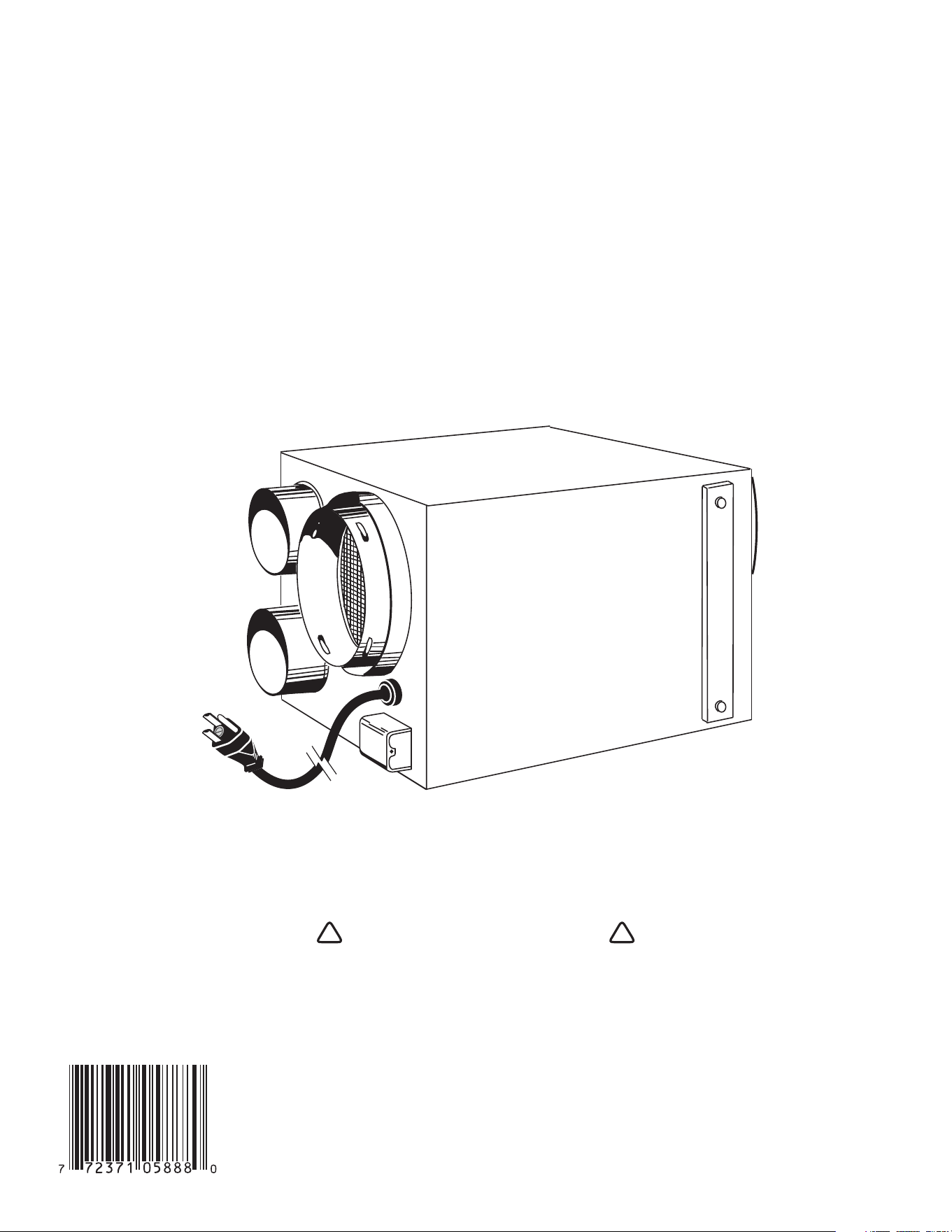
AIR EXCHANGERS MODELS
PRO 100, PRO 200, 41000
AND 1601510
INSTALLATION AND USER MANUAL
READ AND SAVE THESE INSTRUCTIONS

2
TABLE OF CONTENTS
WARNING
• When applicable local regulations comprise more restrictive installation and/or certification requirements, the
aforementioned requirements prevail on those of this document and the installer agrees to conform to these at
his own expenses.
• This unit must be grounded. The power supply cord has a 3-prong grounding plug for your personal safety.
It must be plugged into a mating 3-prong grounding receptacle, grounded in accordance with the national
electrical code and local codes and ordinances. Do not remove the ground prong. Do not use an extension cord.
• Risk of electric shocks. All electrical connections must comply with local regulations.
• Installation work and electrical wiring must be done by a qualified person(s) in accordance with all applicable
codes and standards, including fire-rated construction codes and standards.
• Before performing any maintenance or servicing, always disconnect the unit from its power source.
• When installing, servicing or cleaning the unit, it is recommended to wear safety glasses and gloves.
• This product employs overload protection (fuse). A blown fuse indicates an overload or short-circuit situation.
If the fuse blows, unplug the product and check the polarity and voltage output from the outlet. Replace the
fuse as per the servicing instructions (follow marking on power cord tag for proper fuse rating) and check the
product. If the replacement fuse blows, a short-circuit may be present and the product should be discarded or
returned to an authorized service facility for examination and/or repair.
• Not suitable for use with solid-state speed controls.
• Do not operate any fan with a damaged cord or plug. Discard fan or return to an authorized service facility for
examination and/or repair.
• Do not run cord under carpeting. Do not cover cord with throw rugs, runners, or similar coverins. Do not route
cord under furniture or appliances. Arrange cord away from traffic area and where it will not be tripped over.
!
CAUTION
• Do not use your ventilation system when renovating a house or when sanding gypsum. This type of dust may
damage the unit.
• The ductwork is intended to be installed in compliance with all applicable codes.
• Do not use your ventilation system when varnishing. Furthermore, if your unit is installed in the attic, we highly
insist that you block the stale air intake and fresh air registers. The varnish vapors may damage the unit.
• If your unit is installed in the attic, you should not turn it OFF during the winter time in order to avoid condensation
inside the unit and inside the ducts.
1. O PERATIONAL PRINCIPLES........................................................................................................................ 3
2. C
ONTROLS ......................................................................................................................................... 3-4
3. M
AINTENANCE ....................................................................................................................................... 4
4. TROUBLESHOOTING ................................................................................................................................. 5
5. INSTALLATION OF THE SYSTEM .............................................................................................................. 6-12
6. WARRANTY ..........................................................................................................................................13
3
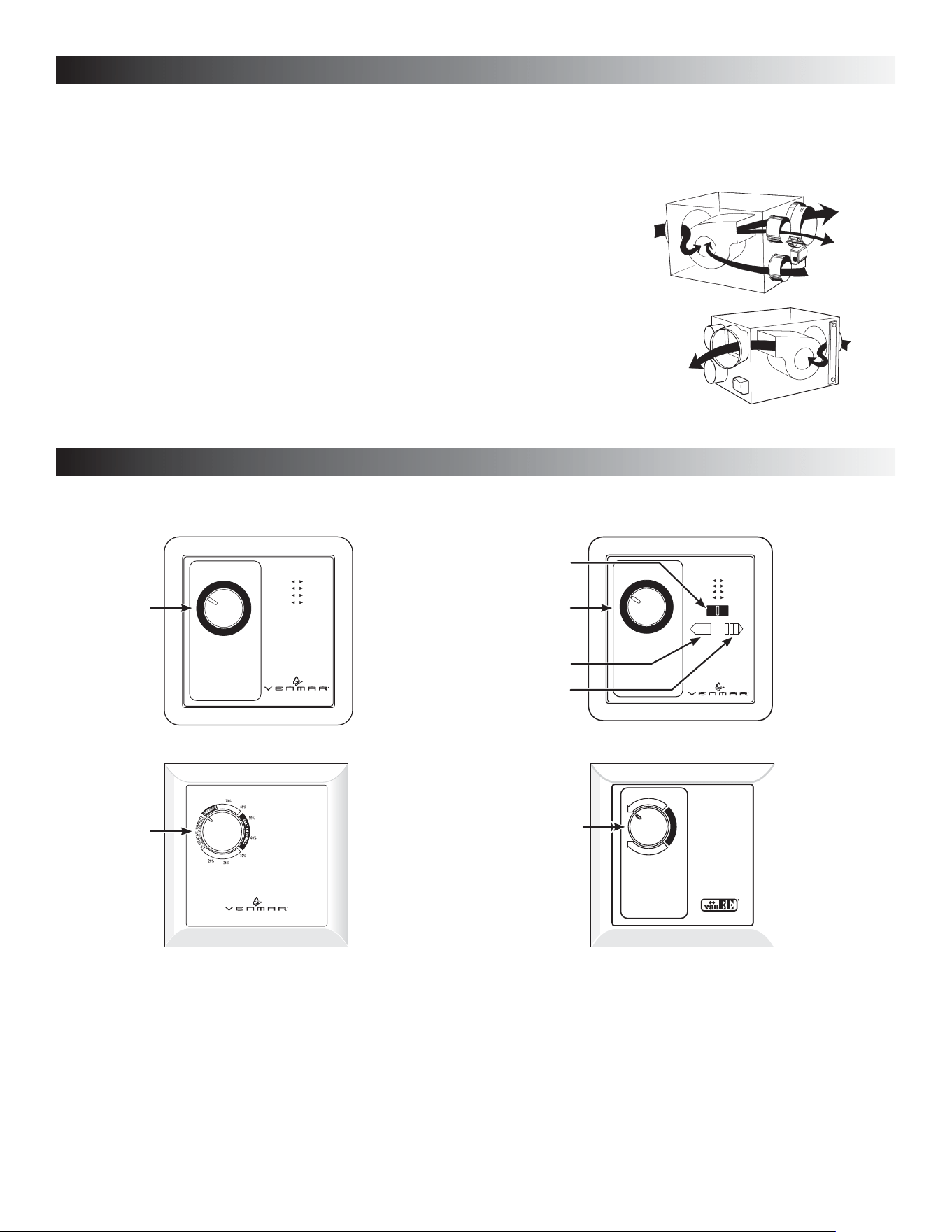
2.1 IDENTIFICATION OF PARTS
2. CONTROLS
% RELATIVE HUMIDITY
% HUMIDITÉ RELATIVE
0FF
55% 10 °
45% 0 °
35% -10 °
30% -20 °
%HUM. RELATIVE HUM EXT. TEMPS.
°
C EXT.
VC0022
20
30
40
50
60
70
80
25
-30˚C
-20˚C
5˚C+
-5˚C
20
30
40
50
60
70
80
% RELATIVE HUMIDITY
% HUMIDITÉ RELATIVE
0FF
25
-30˚C
-20˚C
-5˚C
5˚C+
55% 10°
45% 0°
35% -10°
30% -20°
%HUM. RELATIVE HUM EXT. TEMPS.°C EXT.
VC0025
VC0009
30%
25%
VC0073
M
O
R
E
H
U
M
I
D
L
E
S
S
H
U
M
I
D
C
O
M
F
O
R
T
Z
O
N
E
-30°C
-22°F
-20°C
-4°F
-5°C
23°F
5°C+
41°F+
HUMIDITY CONTROL
FALL / WINTER / SPRING
•TO DECREASE HUMIDITY
ROTATE CLOCKWISE
•TURN TO OFF
I
A V E N T L T I O N
OFF
• TO INCREASE HUMIDITY
ROTATE COUNTER
CLOCKWISE
SUMMER
HUMIDITY LEVEL
SELECTOR
HUMIDITY LEVEL
SELECTOR
HUMIDITY LEVEL
SELECTOR
HUMIDITY LEVEL
SELECTOR
CIRCULATION
SELECTOR
CONTINUOUS CIRCULATION
INDICATOR
INTERMITTENT
CIRCULATION INDICATOR
11136 (for PRO 100)
11417 (for PRO 200)
11297 (for 41000) 40240 (for 1601510)
2.2 HOW TO USE THE CONTROLS
a) Using the humidity level selector:
Winter: (outside temperature between 5°C and -30°C)
– Position the selector between 50% and 25%, pointing approximately to the corresponding outside temperature.
– If there is condensation or frost on the windows, then lower the humidity level by 1% to 2% every 24 hours until the condensation
has evaporated.
– Do not go lower than 25%: The air will become too dry for human comfort.
1. OPERATIONAL PRINCIPLES
The air exchanger is designed to eliminate problems of excessive humidity, to steady the temperature and the humidity and to filter the air
inside your house. The air exchanger carries out the following operations:
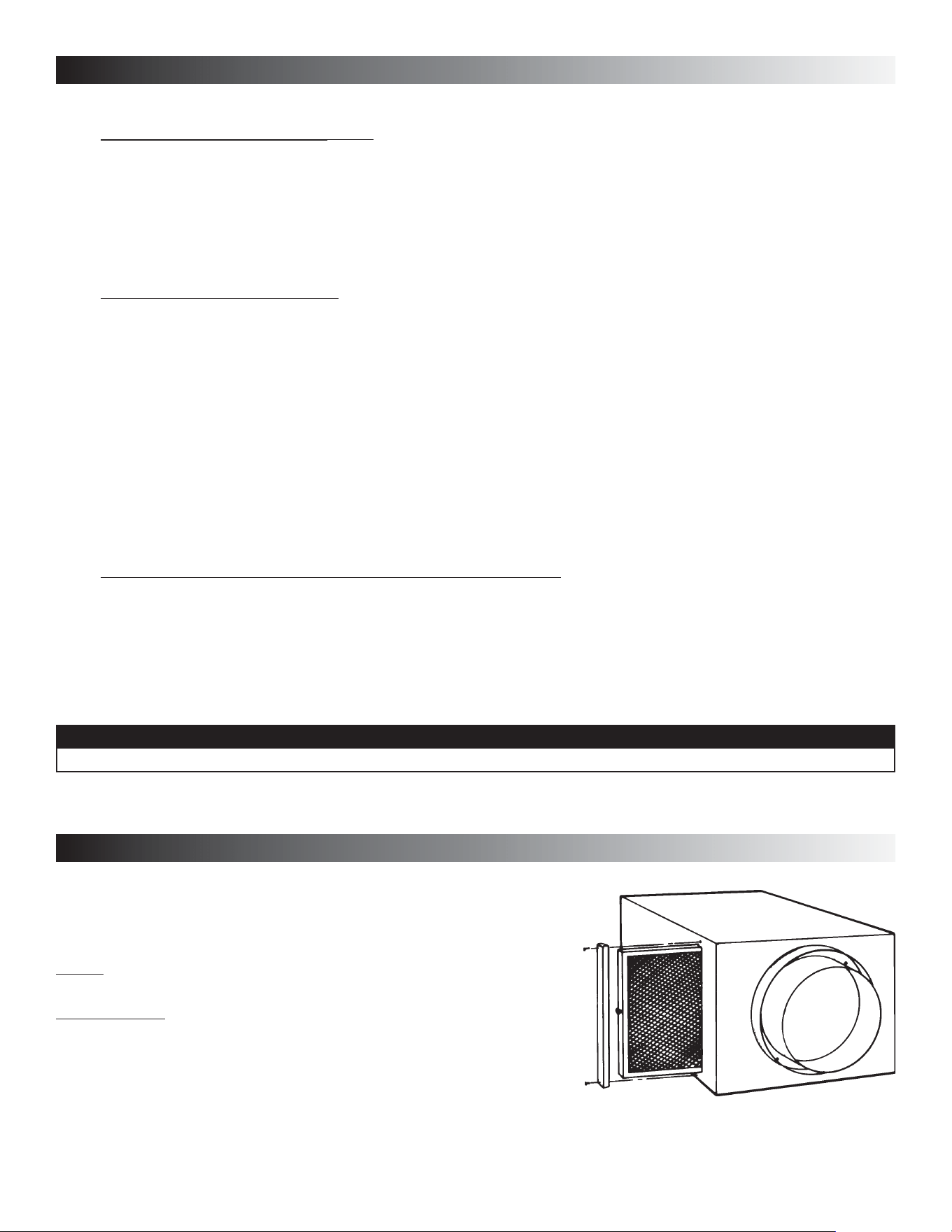
AIR CIRCULATION (PRO 200 UNIT ONLY) :
The system circulates the air inside the house, thus steadying the temperature and the humidity throughout.
CIRCULATION WITH AIR EXCHANGE: (ALL UNITS)
While continually circulating the air within the house, the unit also evacuates part of this
stale air and replaces it with fresh dry air from the outside.
The following extra benefits are thus obtained: lowering of the humidity, elimination of
stale air, cooling of the house on hot summer nights.
FILTRATION:
(ALL UNITS)
When the air flows through the system, a mechanical filter traps dust particles.
VF0007
STALE
AIR FROM
BUILDING
FRESH AIR
TO BUILDING
STALE
AIR
TO OUTSIDE
FRESH
AIR
FROM OUTSIDE
VF0021
STALE
AIR FROM
BUILDING
FILTERED
AIR
DISTRIBUTION
4
2. CONTROLS (CONT'D)
3. MAINTENANCE
2.2 HOW TO USE THE CONTROLS (CONT'D)
a) Using the humidity level selector (cont'd):
Spring and fall:
– Position the selector anywhere between 75% and 50% (higher on warm days, lower on cold days).
– If certain periods during the spring and fall seem more like winter then you should follow the instructions given for humidity
control during winter!
Summer:
– Position the selector at 80% during the day.
– If you want to introduce cool fresh air into the house during certain summer nights, then lower the selector to 20% for these nights.
b) Explanations about humidity levels: IMPORTANT
The comfort level for human beings is between 30% and 45% relative humidity. To measure the present humidity level in your
house, you can proceed as follows:
– Turn the dial to 80%.
– Turn the dial slowly downwards until you hear a “click”. The dial will then be pointing to the value for the present humidity level
(precision of 5%).
Turning the selector lower than the “click” position means that you desire to lower the humidity level in the house. This action will
initiate the “air exchange” mode on your ventilation system and means that you are expecting the stale humid air from inside to be
replaced with dryer air from outdoors. It is therefore pointless to try and lower the humidity with “air exchange” on rainy or foggy
days.
Turning the selector higher than the “click” position means that you are not interested in having your ventilation system function
under “air exchange” mode.
Finally keep in mind that the instructions given above are just guidelines. You might prefer different values for the humidity selector,
depending on the insulation of your house, the type of windows, or to satisfy the specific needs of certain occupants. After some
experimenting, you will eventually develop a control method best adapted to your household needs.
C) Using the circulation selector (Model 11417, for PRO 200 units only)
“Continuous Circulation”: At the exact moment when the desired humidity level is reached, the “air exchange” mode is interrupted
and the system continues to operate under “circulation” mode only (see section 1). The “air exchange” mode will be reactivated
only if the humidity level in the house goes up higher than the selected value.
“Intermittent Circulation”: At the exact moment when the desired humidity level is reached, the unit goes off. It will automatically
start up again in “air exchange” mode if the humidity level in the house goes up higher than the selected value.
Recommendations for a PRO 200 installed in the basement: “Continuous Circulation” during the winter; “Intermittent Circulation”
during spring, summer, and fall.
CAUTION
Adjust for “Continuous Circulation” during all 4 seasons if your unit is installed in the attic.
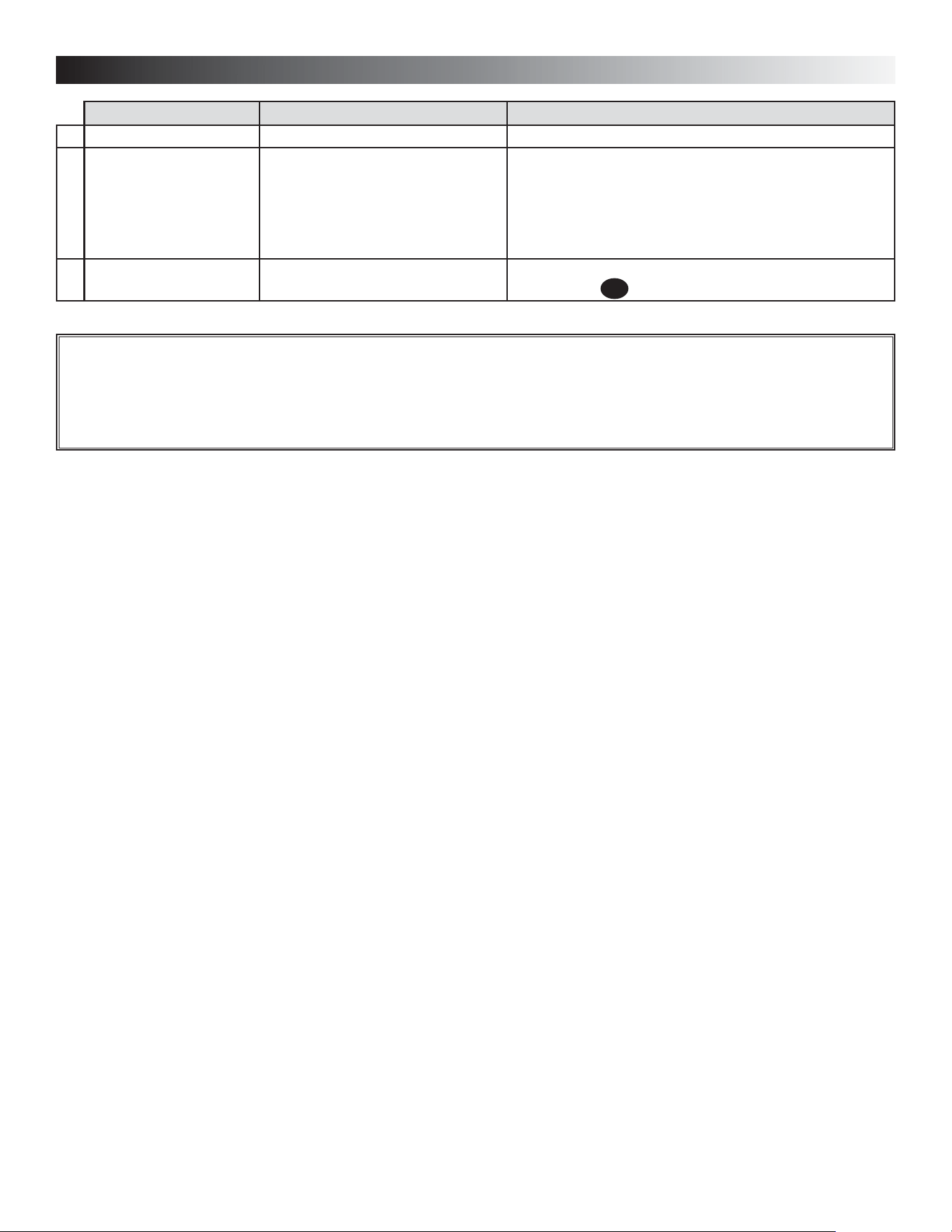
Air filter: We recommend that it be cleaned every three months. First, use a vacuum
cleaner to remove the accumulated dust. Then wash it in warm soapy water.
Exterior openings: Clean the exterior intake and exhaust screens at least once a
year, preferably in autumn.
VO0017
5
4. TROUBLESHOOTING
REPLACEMENT PARTS AND REPAIRS
In order to ensure your ventilation unit remains in good working condition, you must use the manufacturer genuine replacement parts
only. The manufacturer replacement parts are specially designed for each unit and are manufactured to comply with all the applicable
certification standards and maintain a high standard of safety. Any third party replacement part used may cause serious damage and
drastically reduce the performance level of your unit, which will result in premature failing. The manufacturer recommends to contact a
certified service depot for all replacement parts and repairs.
PROBLEMS POSSIBLE CAUSES SOLUTIONS
1 Air too dry. • Humidity level incorrectly selected. • Select humidity level according to Section 2.
2
Persistant condensation. • Humidity level incorrectly selected.
• Too much firewood in the house.
• Air cannot circulate close to windows.
• Window frame too cold.
• Select humidity level according to Section 2 and give the
unit time to respond.
• Turn on the central heating system.
• Store the wood outside.
• Do not completely close curtains, blinds, etc.
3
Air from distribution
register too cold.
• Too much air exchange with the
exterior.
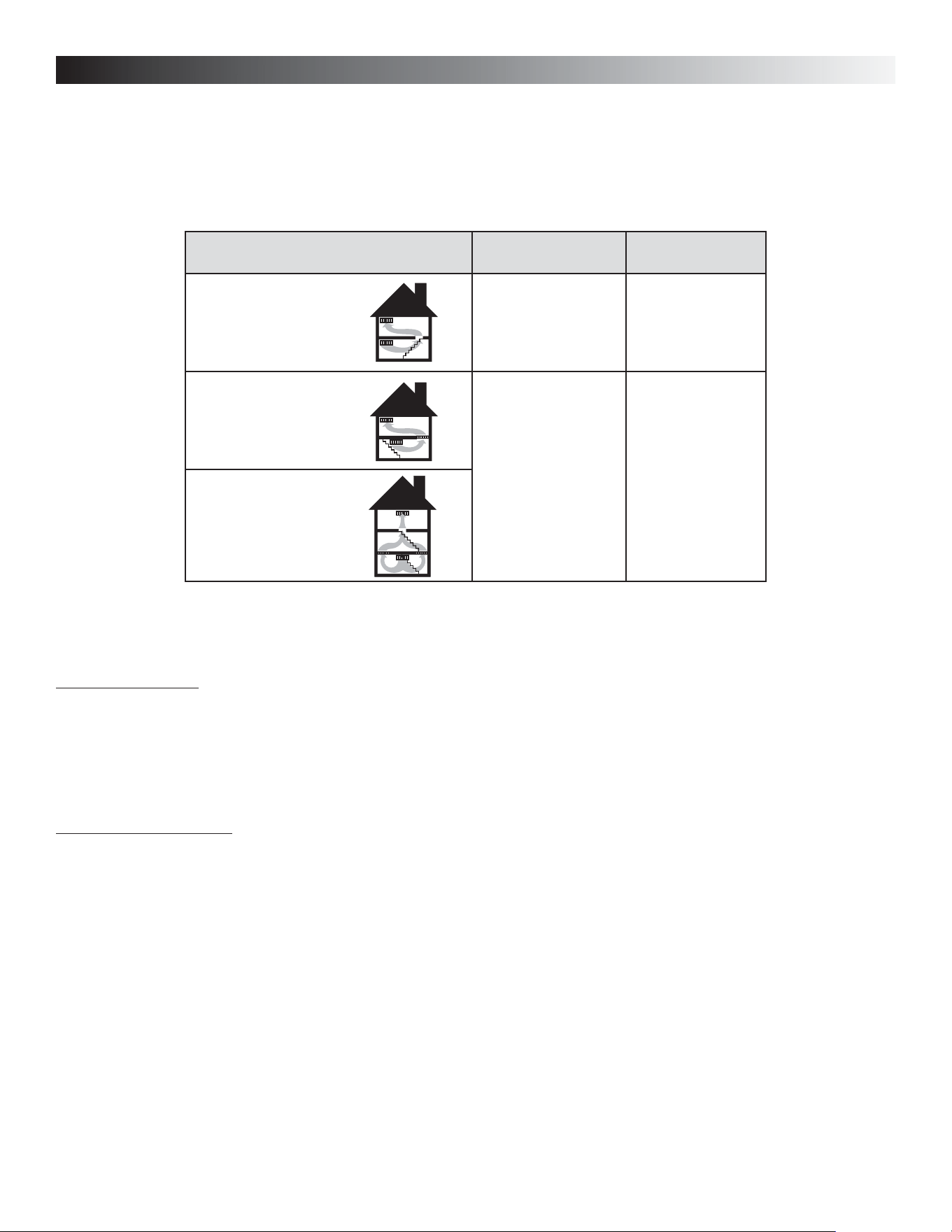
• Install the white ring in the fresh air intake port
(section 5.4 ) (Pro 200 model only).
6.1
6
5. INSTALLATION OF THE SYSTEM
5.1 INSTALLATION KITS (PRO 100 AND PRO 200 MODELS ONLY)
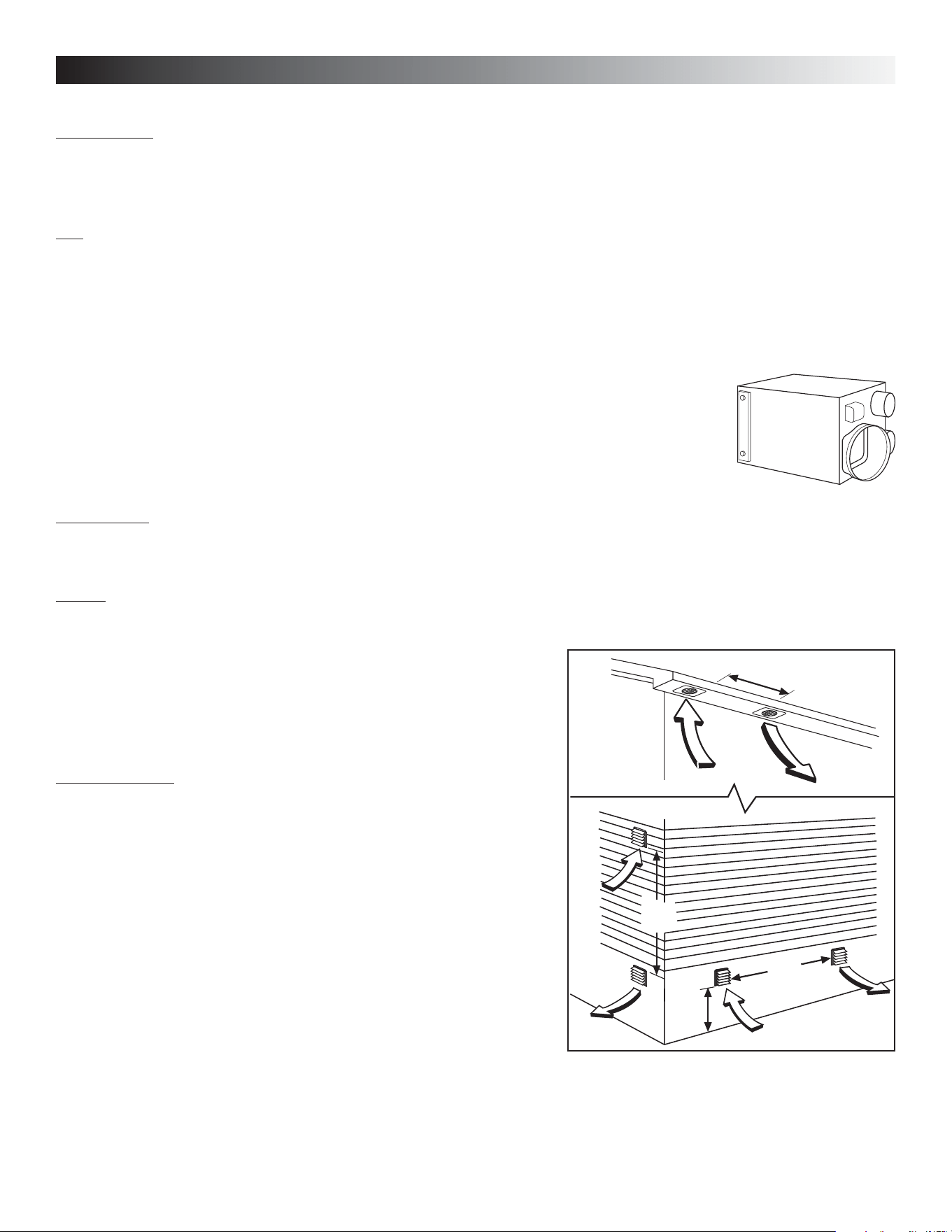
The table below indicates the installation kits which are needed to correctly install your air exchanger.
Normally, the air exchanger is installed in the basement because it then becomes easier to clean. The model PRO 200, however, can be
installed in the attic if a basement installation is impracticable. (Models PRO 100, 41000 and 1601510 should not be installed in the attic.)
When you have to install extra registers in the ground floor, use either: two 6” x 10” registers or three 4” x 10” registers.
We strongly recommend that you purchase VENMAR kits and registers.
5.2 LOCATION OF COMPONENTS
Carefully plan the location of all the components before proceeding with the actual installation. The following suggestions will help you
find the best location for each components.
Stale air intake register:
– Always locate the register at the highest point in the house, because humidity is concentrated at this point.
– Position the register as far from the stairway as possible and in such a way that the air circulates in all the lived-in spaces in the house.
– Avoid installing the register in a bathroom or a bedroom; place it in a location where the air flows freely (e.g.: living room, kitchen,
hallway).
– For silent operation, leave a minimum of 15 feet of flexible duct between the stale air intake register and the unit.
– Do not install the register close to a source of heat. The temperature of the intake air must not exceed 50°C.
Fresh air distribution register:
– Always locate the register in a large, open area in the basement to ensure the greatest possible circulation of air. If, however, your house
has no basement or has just an underfloor space, then it will be necessary to locate this register in the ceiling on the first floor and as
far as possible from the location of the stale air intake register.
– Position the register as far as possible from the stairway and in such a way that the air circulates in all the lived-in spaces of the house.
– If you have a slow combustion fireplace place the register in such a way that the heat from this fireplace can be distributed throughout
the house.
– For silent operation, leave at least 15 feet of flexible duct between the fresh air distribution register and the unit.
YOUR HOUSE
BASEMENT
PRO 100 / PRO 200
ATTIC
PRO 200
BUNGALOW
Basement stairwell:
open, lateral
EA 20140 EA 20130
BUNGALOW
Basement stairwell:
closed
EA 20140
+
2 OR 3 REGISTERS
EA 20130
+
2 OR 3 REGISTERS
COTTAGE
Basement stairwell:
closed
VA0014
VA0015
VA0019
7
5. INSTALLATION OF THE SYSTEM (CONT'D)
5.2 LOCATION OF COMPONENTS (CONT'D)
Extra registers:
– If your basement stairwell is often closed, then you must install 2 or 3 extra registers (not supplied with the kits) in the floor at the ground
floor level. As an alternative, you could install one of these registers above the stairwell door or on a wall adjacent to the stairwell. Locate
these registers so that the air will be able to circulate freely (living room, hallway, etc.). Avoid placing them near the state air intake
register.
Unit:
– Model PRO 200 can be installed in either the basement or the attic. Models PRO 100, 41000 and 1601510 can be installed in the
basement only.
– Place the unit as close as possible to an outside wall to minimize the length of the insulated flexible ducts. Place the unit in such a way
as to respect the lengths of the ducts supplied in the parts kits (if need be). Place the unit far from the areas of the house where
peace and quiet are desired.
– If possible, place the unit close to an electrical outlet. Make sure you have the required wires for the electrical installation: AWG 14/2
wire necessary for all models plus an extra AWG 14/3 wire for model PRO 200.
– Position the unit so as to permit easy access to the filter. Model PRO 200 can be installed upside down,
which in certain cases makes it easier to get at the filter (see illustration at right).
Flexible ducts:
– Use closets, cupboards and other storage spaces to run duct from one floor to another (do not use wall cavities). Stretch duct and install
in straight lines as much as possible. Do not alter the length of duct supplied with the different kits (if need be). The efficiency of your
ventilation system might be reduced.
Control:
– Locate the control on the ground floor of the house in an area where air circulates (e.g.: hallway, living room, dining room, etc.). Never
place it near a doorway to the outside, nor on an exterior wall. Place the control approximately 1.5 meters (60 inches) from the floor.
Exterior openings:
– Position the fresh air intake port far from sources of contamination such as the
garage, dryer outlet, central vacuum system, gas regulator.
Place the openings at least 45 cm (18 inches) above the ground.
Leave at least 1.8 meters (6 feet) between the two openings.
The prevailing winds should not blow the stale air towards the fresh air intake
port.
VB0039
PRO 200 in reversed position
45 cm
18”
1,8 m
6’
VD0071A
1,8 m
6’
1,8 m
6”
8
5. INSTALLATION OF THE SYSTEM (CONT'D)
5.3 SUGGESTED TOOLS
1
2
VQ0014
VQ0015
Robertson or a Phillips screwdriver no. 1
Robertson or a Phillips screwdriver no. 2
Flat tip screwdriver
Cutting pliers
Electric drill
Jig saw or hand or electric compass saw
Caulking gun and tube of silicone sealant
Adhesive duct tape roll
Metal shears (if the exterior covering of your house is
aluminum or plastic)
Chisel and hammer (if th exterior covering of your house
is brick)
5.4 INSTRUCTIONS FOR THE INSTALLATION
Once you have decided on the best location for all the components and for all the various openings that will have to be cut out, and the
necessary tools have been procured, then you are ready to commence the actual installation of your system. To facilitate the installation
we strongly recommend that you follow the detailed steps below:
You will find, on pages 11 and 12, two large drawings which illustrate the different types of installation. Determine which one
corresponds to your particular situation and encircle the drawing for easy future reference.
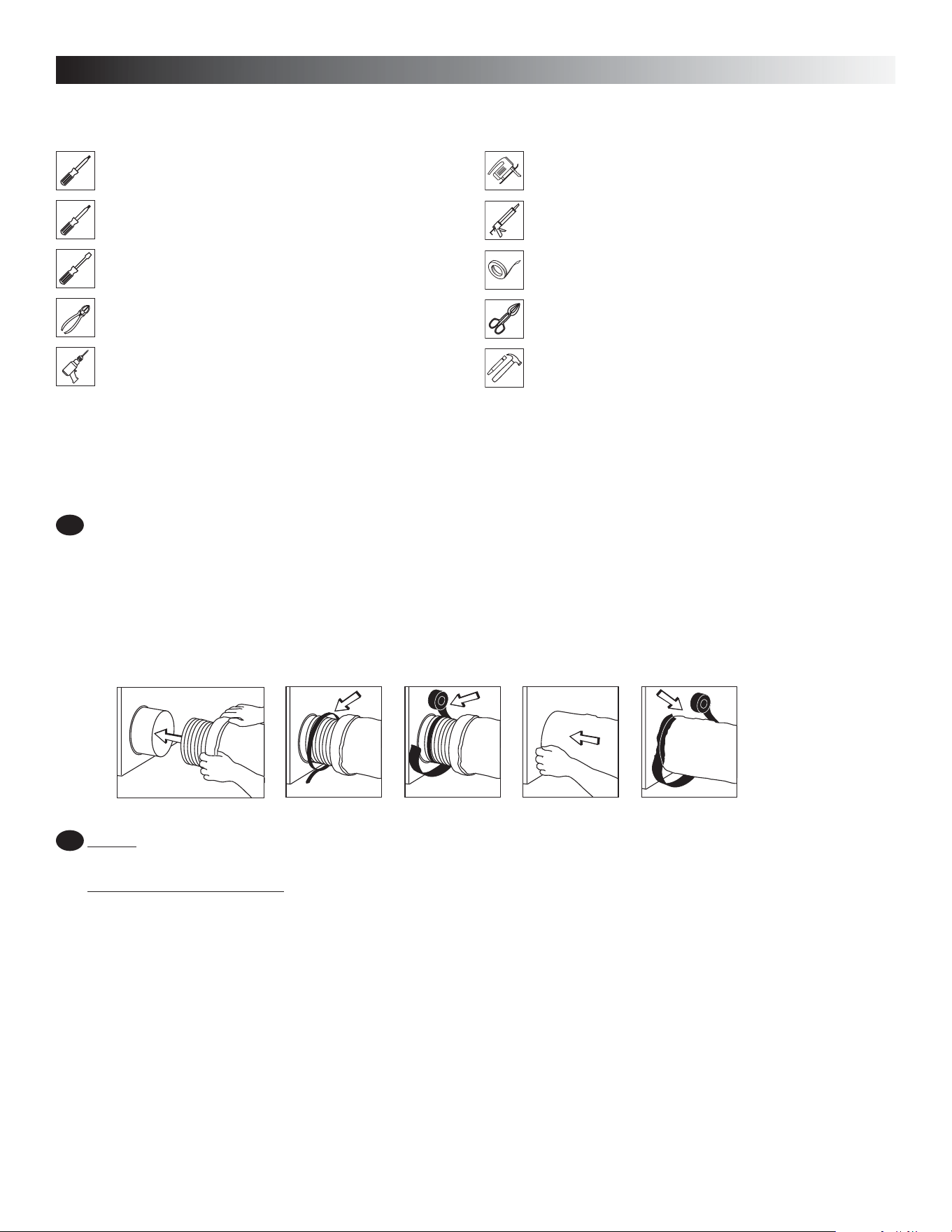
You should follow the procedure below to “connect” an insulated flexible duct to its corresponding opening:
a) Connect the interior flexible duct to the hole using screws and/or a duct tie.
b) Carefully seal the connection with duct tape.
c) Pull the insulation over the joint.
d) Once more apply duct tape to the joint making an airtight seal. Avoid pulling the tape too tight around the duct, as this will
compress the insulation making it loose its efficiency.
Cut out all the round holes that will permit the flexible duct to pass through walls, floors and ceilings, as well as the holes where you
intend to install all round registers (diffusers). A 6” duct requires a 6¼” hole and an 8” duct requires an 8¼” hole.
Installation of round registers (included in your kit, if need be):
a) Connect the duct to the plastic support provided (6” ring-pipe assembly).
b) Screw the plastic support into the ceiling.
c) Screw the register onto the plastic support.
1
2
VJ0010
a) a) b) c) d)

9
5.4 INSTRUCTIONS FOR THE INSTALLATION (CONT'D)
Cut out all the rectangular holes in the locations where you intend to install
rectangular registers. All 6” x 10” registers require 6” x 9¾” holes and all 4” x 10”
registers require 4” x 9¾” holes.
Install the rectangular registers in the correct locations and attach the
corresponding flexible duct to these registers. (Attention, if you have “extra
registers”, they are not connected to any ducts! See illustration at right.)
Cut out the two exterior openings. These holes should measure 4¼” diameter.
Basement openings are cut in the end-joists, whereas attic openings are cut in
the soffit.
Install the exterior ports and attach the corresponding flexible duct: If in the
basement, connect the insulated duct to the intake port and, if in the
attic, connect the insulated duct to the exhaust port. Use silicone sealer to
waterproof the openings if installed in the basement.
Installation of the unit. Attach the 4 hooks to the 4 corners of the unit. Using
4 screws attach the 4 chains to the ceiling joists. Put the springs on the chains.
The springs stop the vibrations from the unit being transmitted to the structure of
your house. Suspend the unit using the chains and hooks.
On PRO 200 unit only, install the white ring. Install it in the unit’s fresh air from
outside port. This ring controls the flow of fresh air. Remove the ring only if you
make frequent use of a wood-burning stove.
CAUTION
Make sure the unit is level.
5. INSTALLATION OF THE SYSTEM (CONT'D)
3
4
5
6.1
VO0016
6.1
5
3
On PRO 100, 41000 and 1601510 units only, check the stale air to outside (A) and fresh air from outside (B) ports. Those
both ports are equipped with special dampers; according to the unit installation position (normal or reversed), set these dampers as
follows:
Stale air to outside port damper: The small hole (1) must always be on the upper side of the damper.
Fresh air from outside port damper: The weight (2) must always be on the lower side of the damper.
NOTE: To set the port damper position, simply rotate the port until the right position as been reached.
6.2
VJ0044
A
1
2
A
B
B
1
2
Unit on normal position Unit on reversed position
10
5. INSTALLATION OF THE SYSTEM (CONT'D)
5.4 INSTRUCTIONS FOR THE INSTALLATION (CONT'D)
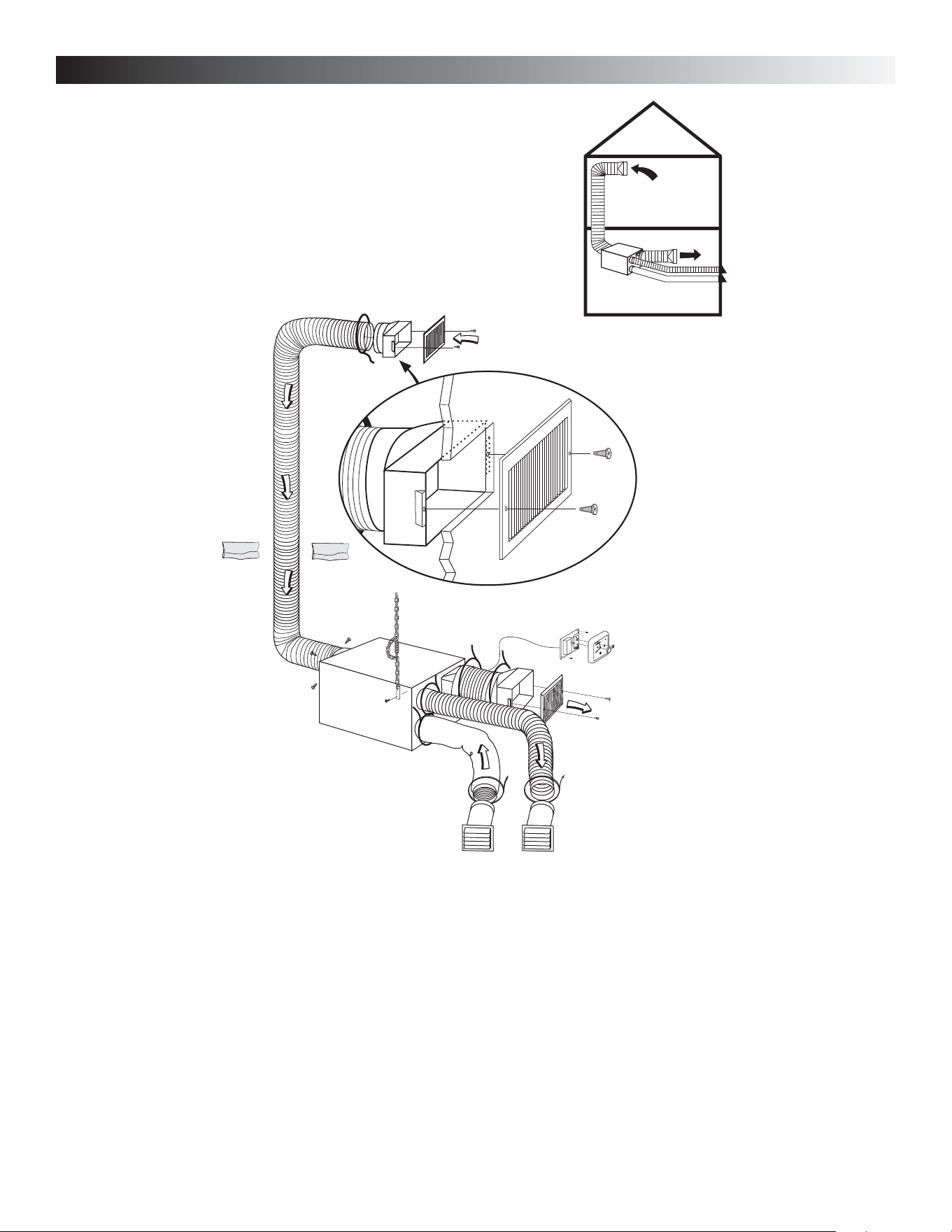
Connect all the flexible ducts to the unit as shown in the drawing which you have previously encircled. (If your unit is installed
upside down, correct the drawing accordingly.) Respect the duct lengths supplied with the different kits (if need be). Stretch the ducts
and keep them as straight as possible. (Exceptionally, you can shorten the ducts but do not try to add extra length to them.)
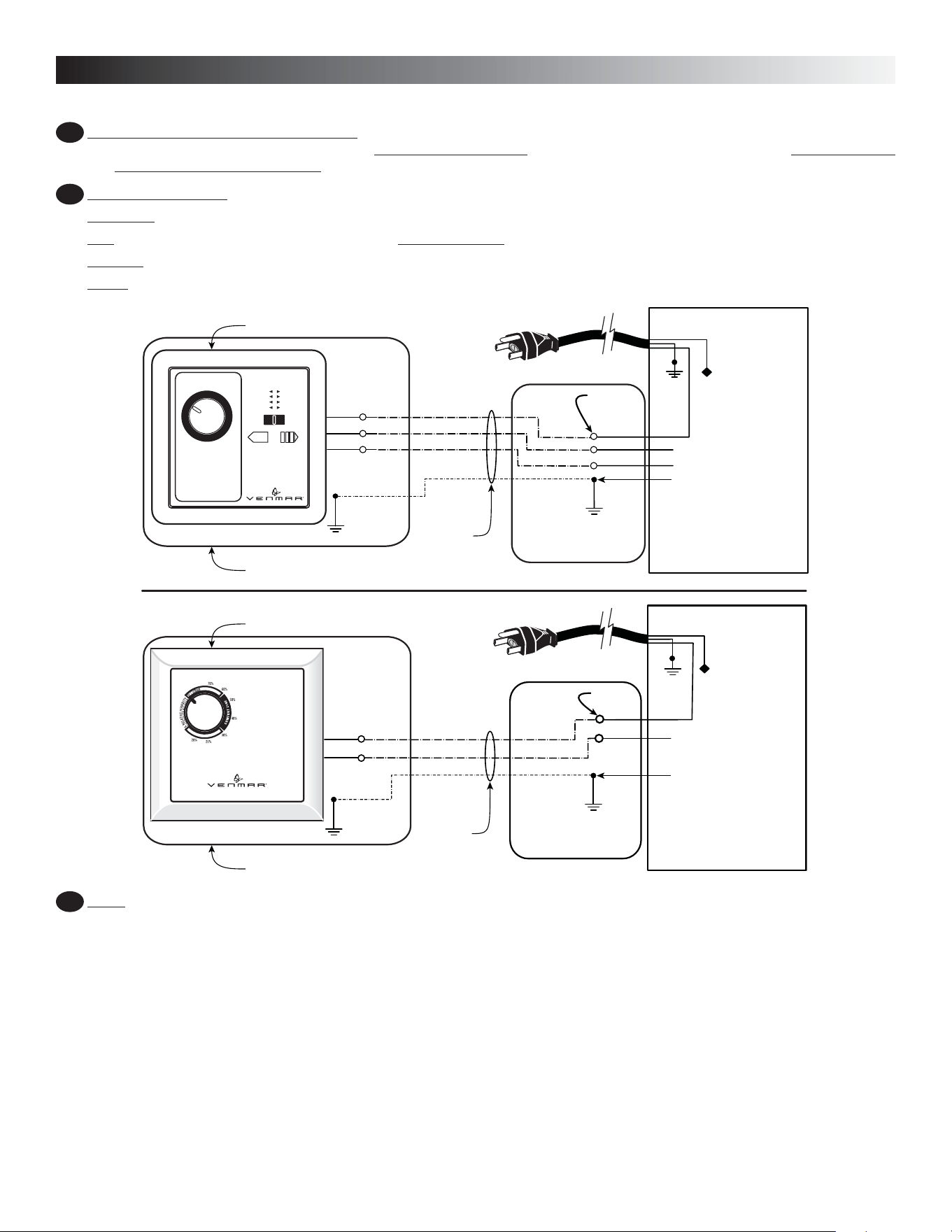
Electrical Installation.
Make hole in the wall at the chosen location for the control.
Run the AWG 14/2 and, if need be, the AWG 14/3 wire in the walls.
Connect the wires according to the drawings below.
Screw the control onto the wall.
7
8
VE0192A
WHT
BLK
GRN
Wire nut
NEMA
5-15P
PRO 200
Ground terminal
screw
Electrical compartment
RED
GREY
WHITE BLACK
WHITE
BLACK BLACK
WHITE
RED
RED
GREY
RED
14-3 AWG
Conductor
(Field wiring)
Junction box
Control
BLACK
WHITE
RED
20
30
40
50
60
70
80
% RELATIVE HUMIDITY
% HUMIDITÉ RELATIVE
0FF
25
-30˚C
-20˚C
-5˚C
5˚C+
55% 10°
45% 0°
35% -10°
30% -20°
%HUM. RELATIVE HUM EXT. TEMPS.°C EXT.
GROUND
VE0193A
PRO 100
RED
RED
WHITE WHITE
BLACK
BLACK
ORANGE
14-2 AWG
Conductor
(Field wiring)
BLACK
Junction box
Control
Ground terminal
screw
Wire nut
Electrical compartment
NEMA
5-15P
WHITE
BLACK
Ground terminal
screw
GROUND
WHT
BLK
GRN
Verify the operation of your unit:
Connect the unit to a power source. By adjusting the control as described in Sections 2.2b and 2.2c, verify that the unit works
properly. If the unit does not work properly, refer to the rules to follow on the warranty document of the unit.
9
11
5. INSTALLATION OF THE SYSTEM (CONT'D)
%
D
'
H
U
M
I
D
I
T
É
R
E
L
A
T
I
V
E
H
U
M
I
D
I
T
Y
-30˚C
-20˚C
-5˚C
5˚C
20
25
30
40
50
60
70
80
VENMAR
1-800-5
67-3855
VE
NTILA
TI
ON
inc.
®
0
1
IONS
VI0005
VH0059
BASEMENT
KIT EA 20140

12
5. INSTALLATION OF THE SYSTEM (CONT'D)
%
D
'
H
U
M
I
D
I
T
É
R
E
L
A
T
I
V
E
H
U
M
I
D
I
T
Y
-
30
˚
C
-
2
0
˚
C
-
5
˚
C
5
˚
C
2
0
2
5
3
0
4
0
5
0
6
0
7
0
8
0
V
E
N
M
A
R
1
-
8
0
0
-
5
6
7
-
3
8
5
5
V
E
N
T
I
L
A
T
I
O
N
i
n
c
.
®
0
1
I
O
N
S
VI0015
VH0060
ATTIC
KIT EA 20130

13
This unit is a high quality product, built and packaged with care. The manufacturer warrants to the original purchaser of its products, that such
products will be free from defects for the period stated below, from date of original purchase. For this unit, the warranty covers parts only against
any operational defect. This is a a 2-year warranty. Subject to perform the core maintenance according to user guide recommendations, the heat
recovery core (HRV) has a limited lifetime warranty. If any defect should occur, we urge you to read the user guide carefully. If the problem persists,
observe the following rules:
RULES TO FOLLOW
If the unit is defective, contact your ventilation contractor (see address on your user manual cover page). The contractor will determine with you
the reason for the defect, and if needed, do the replacement or repair.
If ever it is impossible to reach your ventilation contractor, call 1-800-567-3855 (in North America);
the personnel will be pleased to give you the phone number of a distributor or a service center near you.
REPLACEMENT PARTS AND REPAIR
In order to ensure your ventilation unit remains in good working condition, you must use the manufacturer's genuine replacement parts only. The
manufacturer's genuine replacement parts are specially designed for each unit and are manufactured to comply with all the applicable certification
standards and maintain a high standard of safety. Any third party replacement part used may cause serious damage and drastically reduce the
performance level of your unit, which will result in premature failing. The manufacturer also recommends to contact a service depot certified by the
manufacturer for all replacement parts and repair.
BILL OF PURCHASE
No replacement or repair covered by the warranty will be carried out unless the unit is accompanied by a copy of the original bill of purchase.
Please retain your original.
MISCELLANEOUS COSTS
In each case, the labor costs for the removal of a defective part and/or installation of a compliant part will not be covered by the manufacturer.
CONDITIONS AND LIMITATIONS
These units are created for residential use only and must be used in a building as defined below:
Building: All structures zoned and/or erected for the act, process or art of human or animal habitation and/or the storage or warehousing of goods.
Residential use: Dwelling, lodging, suite: Building, or part of a building, intended to act as either the domicile to one or several people which can
include general sanitary, food consumption and rest facilities. Buildings of only one room or a group of rooms including those occupied by a tenant
or owner; comprise the lodgings, the individual rooms of the motels, hotels, rooming/lodging houses, boarding/half-way/foster homes, dormitories,
and suites, as well as the stores and the business establishments constituted by only one room in a dwelling.
Commercial use: Agricultural establishment, commercial establishment for assembly, care, or detention: Building or part of a building that does
not contain a dwelling, situated on land dedicated to agriculture or farming and used primarily to shelter animals, or for the production, the storage
or the treatment of agricultural or horticultural products or animal food. Building or part of a building, used for the display or retail of goods,
professional or personal services, or commodities. Building, or part of a building used by persons gathering for civic activities, religious or political
assembly, tourism, educational/vocational training, recreation or the consumption of food or drink. Building, or part of a building used to shelter
persons of impaired physical or psychological states, persons requiring palliative care or medical treatments, or persons for reasons out of their
control, cannot escape harm or threat of danger autonomously.
Industrial use: Building, or part of a building, used for the assembly, the manufacture, the creation, the treatment, the repair or the storage of
products and combustible materials and that contain fuels that when ignited or exploded in sufficient quantity may constitute a risk of fire.
The above warranty applies to all cases where the damage is not a result of poor installation, improper use, mistreatment or negligence, acts of
God, or any other circumstances beyond the control of the manufacturer.
Furthermore, the manufacturer will not be held responsible for any bodily injury or damage to personal property or real estate, whether caused
directly or indirectly by the unit.This warranty supersedes all prior warranties.
6. WARRANTY
PRODUCT REGISTRATION CARD - FICHE D’ENREGISTREMENT DU PRODUIT
Country – Pays E-mail address – Courriel Language preferred – Langue de correspondance
Address – Adresse Apt. no. – App. City – Ville Province Postal code – Code postal
First name - Prénom Last name – Nom de famille
Model no.– N
o
de modèle Serial – N
o
de série
BACK / VERSO
Centre d’enregistrement de produit - Product registration center, 550 boulevard Lemire, Drummondville, Québec Canada J2C 7W9
IMPORTANT:
Please complete and return this questionnaire within 10 days of your purchase to the address below. Note that only the questions on this side of the page are
mandatory. Your answers will be used for market research studies and reports, and will help us to better serve you in the future. IMPORTANT:
Veuillez remplir ce questionnaire
et nous le retourner dans les 10 jours suivant votre achat à l’adresse inscrite en bas de la page. Veuillez noter que seules les questions de ce côté-ci de la page sont obligatoires.
Vos réponses serviront à des études de marché et nous aideront à mieux vous servir dans l’avenir.
Date of purchase – Date d’achat
//
Telephone (day) – N
o
de téléphone (jour)
--
Telephone (evening) – N
o
de téléphone (soir)
--
no.
no.
no.

14
What problem were you trying to solve with
your purchase? (Check each one that applies
to you.)
Bad odors
Respiratory
problems
Excess of humidity
Temperature
standardization
Lack of fresh air
Dust
Mildew
Allergies
No specifi c
problems
Others
Who installed your unit?
Home builder
Recommended
installer
Friend / family
Contractor
Yourself
Please read the following list of criteria
carefully. Indicate the importance of your
purchase decision on a scale of 1 (less
important) to 5 (most important).
Price
Warranty
Product design
Ventilation
capacity
Filter maintenance
indicator
Filtration quality
Recirculation
Heat recovery
Controls
Ease of cleaning
Manufacturer’s
reputation
Ease of use
Noise level
Other
Quels problèmes essayez-vous de résoudre
par cet achat? (Cochez toutes les cases
pertinentes)
Mauvaises odeurs
Problèmes
respiratoires
Excès d’humidité
Uniformisation
de la température
Manque d’air frais
Poussières
Moisissures
Allergies
Pas de problèmes
spécifi ques
Autres (Précisez SVP)
Qui a installé l’appareil?
Constructeur
de la maison
Installateur
recommandé
Ami/membre
de la famille
Entrepreneur
Vous-même
Veuillez lire la liste des critères de sélection
ci-dessous. Sur une échelle de 1 (étant le moins
important) à 5 (étant le plus important), veuil-
lez indiquer l’importance de chacun d’entre
eux dans votre décision d’achat.
Prix
Garantie
Design du produit
Débit de
ventilation
Indicateur
d’entretien du fi ltre
Qualité de fi ltration
Recirculation
Récupération
de chaleur
Récupération
d’énergie
Fonctions
Facilité de
nettoyage
Réputation
du fabricant
Simplicité
d’utilisation
Niveau de bruit
Autres
(Précisez SVP)
Would you like to receive occasional informational e-mail off ers including
product updates and special promotions from us?
Yes/No
Aimeriez-vous recevoir plus de détails sur nos promotions, off res de rabais et mises à jour
de nos produits?
Oui/Non
Are you connected? Please do not hesitate to complete the product registration
card via our Web site at www.bnv.ca
Enregistrez-vous en ligne! N’hésitez pas à remplir la fi che d’enregistrement
du produit sur notre site Internet au www.bnv.ca