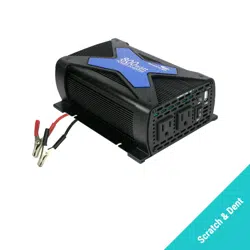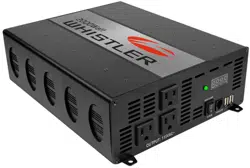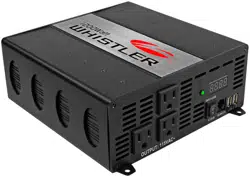
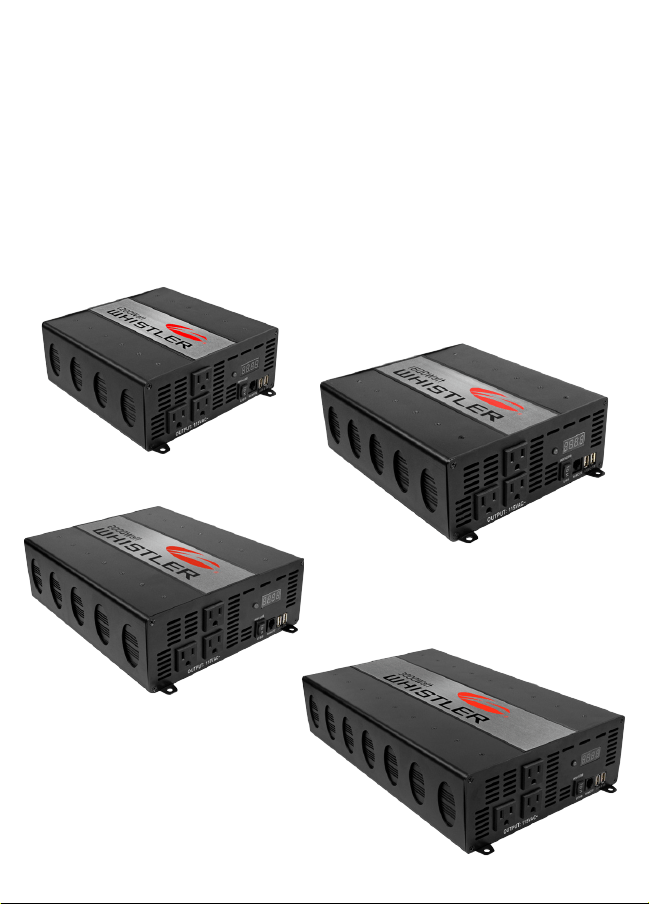
XP1200i/XP1600i/XP2000i/XP3000i
POWER INVERTER
XP1200i
XP1600i
XP2000i
XP3000i
OWNER’S MANUAL

If you have questions concerning the
operation of this Whistler product please call
customer service:
1-800-531-0004
Hours:
Monday - Friday
8:00 am - 5:00 pm CT
or visit www.whistlergroup.com
Please keep your purchase receipt in a safe
place. You may register your product online at
www.whistlergroup.com. If the unit is returned
without a dated proof of purchase, an out of
warranty service charge applies. Note: Your
warranty period begins at the time of purchase.
The warranty is validated only by your receipt.

INTRODUCTION
Dear Whistler Customer,
For many of us, a vehicle is more than just transportation.
It can be a mobile office, communications or entertainment
center, or simply an expression of our personality. Whistler
products are designed to make the time you spend in your
vehicle more productive, more fulfilling, safer, or just simply
more fun. Our mission is to provide products that improve
your driving experience.
Whistler offers a complete line of DC to AC inverters ranging
from 100 Watts to 3000 Watts. These inverters offer advanced
technology, dependable operation and will provide years of
reliable service when used in accordance with our operating
instructions.
Your new Whistler power inverter allows you to run most AC
appliances right from your car, boat or RV. They’re great for
weekend use and life on the road. They’re also great for power
outages. To fully acquaint yourself with the operation of this
power inverter, we recommend reading this entire manual.
Sincerely,
THE WHISTLER GROUP, INC.

2
Features Description ............................................................... 3
Important Information ............................................................. 6
Inverter Information ................................................................ 7
• Getting Started
• Don’t Push It
Battery Information ................................................................. 9
• Selecting the Optimum Power Source
Cable Information ................................................................. 11
• Wire Cable Gauges
Operation ............................................................................. 12
• Making the Connection
• Important Information on Battery Chargers
• The Power Source
Additional Safety Features ................................................... 16
• Automatic Shutdown
• Television Fans & Audiophiles
• For You Microwave Chefs
• Some Powerful Advice
Care and Maintainence ......................................................... 19
Operating Principles ............................................................. 20
Operation Summary ............................................................. 22
Troubleshooting ................................................................... 24
Specifications ........................................................................ 25
Warranty Information ............................................................ 27
TABLE OF CONTENTS
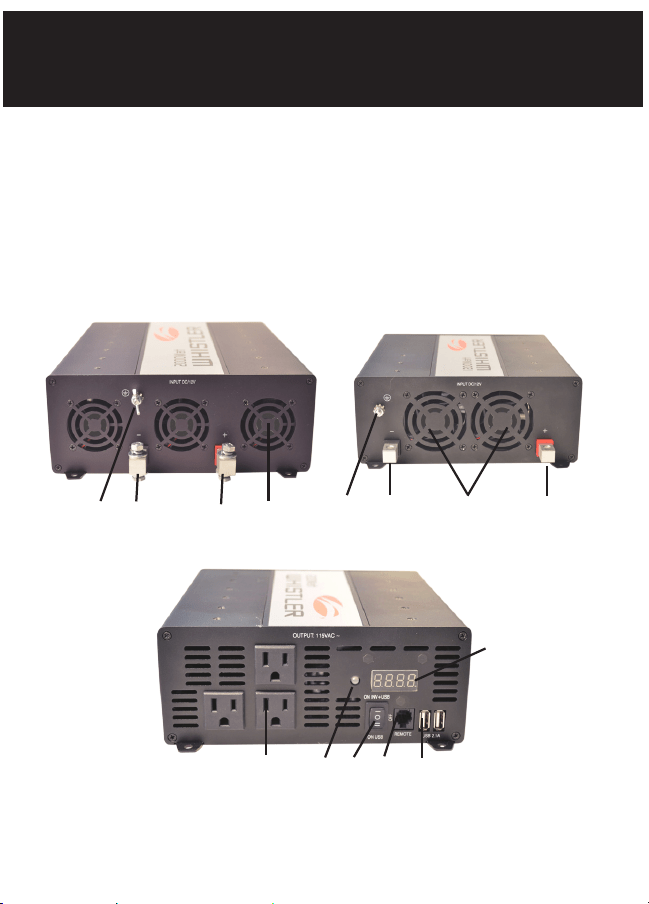
FEATURES DESCRIPTION
3
7
9
8
9
10
10 78
1 6 4 2 3
5
NOTE: Front panel layout and controls are similar for models
1200 watt and up.
XP2000i & up models XP1200i & XP1600i
A Word About Whistler Power Inverters
Whistler inverters convert low voltage, direct current (DC) to 115 volt
alternating household current (AC). The AC output is called “modified
sine wave”. See “Operating Principles” section for more information.
Depending on the model and its rated capacity, Whistler inverters draw
power either from standard 12 volt automobile and marine batteries or
from portable high power 12 volt sources.

Inverter Features
1. Three North American AC Outlets
2. Remote Operation Jack
The inverter is designed to be operated from a remote
location via a WHISTLER Remote Control Switch (P/N
Pro-RS01) which plugs into this socket. This optional
accessory is available through WHISTLER or your
WHISTLER dealer.
3. 2 USB Power Ports
4. Inv+USB/Off/USB
5. Digital Power Meter
6. On/Shutdown Indicator Light
The LED will illuminate GREEN when the inverter
is powered in normal conditions. This light will turn
RED and the inverter will automatically shut down
(except low voltage alarm) when any of the following
problems occur:
• Short Circuit Protection. The inverter will shut down
until the short is removed.
• Low Voltage Alarm. An alarm will sound when the
voltage from the battery discharges to 10.5+/-0.5
volts DC. This is an indication that the battery needs
to be recharged.
• Over Voltage Protection. The inverter will turn itself
off when the input exceeds 15.5+/-0.5 volts DC.
4
FEATURES DESCRIPTION

5
• Under Voltage Protection. The inverter will turn itself
off when the input is less than 10.0+/-0.5 volts DC.
• Overload Protection. The inverter will turn itself off
when the continuous draw or the surge draw of the
equipment being operated exceeds the maximum
power rating for the inverter.
• Thermal Protection. The inverter will turn itself off
when the internal temperature exceeds safe design
parameters.
7. Cooling Fans
8. Power Input Terminal (Black = Negative)
(Observe proper polarity)
9. Power Input Terminal (Red = Positive)
(Observe proper polarity)
10. Earth Ground Terminal
NOTE: In the event of an automatic shut down or continuous
audible alarm, turn the inverter OFF (O) until the source of the
related problem has been determined and resolved.
FEATURES DESCRIPTION

This manual will provide you with directions for the safe and
efficient operation of your WHISTLER inverter. Read the manual
carefully before using your new WHISTLER inverter and keep
the manual on file for future reference.
NOTE: Your WHISTLER inverter is designed to operate from
a 12 volt power source only. Never attempt to connect your
Whistler inverter to any other power source, including any AC
power source.
• The length of the supplied cables is matched for the current
needed by the inverter. Making this cable longer will make the
inverter less efficient and may cause the cables to heat up.
• Do not attempt to lengthen the supplied power cables.
• 115 volts can be lethal. Improper use of your WHISTLER
inverter may result in property damage, personal injury or
loss of life.
• Not recommended for use with medical equipment. Check
with the appliance manufacturer for compatibility with
modified sine wave inverters. Some appliances may not work
well, not at all or be damaged. For more information on
compatibility issues, please visit our inverter FAQ page at
www.whistlergroup.com
IMPORTANT INFORMATION
6

INVERTER INFORMATION
7
Getting Started
Power equipment and appliances which operate with motors
or tubes require an initial surge of power to get them up and
running. This power surge is referred to as the “starting load”
or “peak load”. (By comparison, electrical devices such as
standard light bulbs do not require a large starting load.) Once
the equipment or appliance has been powered up, it settles
down to a slower pace and requires far less electrical power to
operate. This lower power requirement is referred to as the
“continuous load.”
In order to ensure that the capacity of your Whistler inverter is
sufficient to meet the required start up load, you must first
determine the power consumption of the equipment or
appliance you plan to operate.
Power consumption is rated either in wattage or amperes, and
information regarding the required “watts” or “amps” generally
is stamped or printed on most appliances and equipment. If this
information is not indicated on the appliance or equipment, check
the owner’s manual. Contact the appliance or equipment
manufacturer to determine if the device you are using
(TV’s, battery charger, computer, etc.) is compatible with a
modified sine wave.
If the power consumption is rated in amps, multiply the number
of amps by 115 (AC voltage) to determine the comparable
wattage rating. Induction motors may require 2 to 6 times their
wattage rating to start up.
For further information on the fundamental operating
principles of Whistler inverters and related technical data, see
“Operating Principles”.

Don’t Push It.
Although your Whistler power inverter has the capacity to
provide power output (excess current) equal to approximately
two times its rated wattage capacity for a very brief period, it
is designed to operate equipment and appliances with start up
load wattage ratings no higher than its own maximum continuous
wattage rating.
For example, the 1200W model has a maximum continuous
rating of 1200 watts. Although this model has the capacity to
briefly provide more than its continuous power (that is, excess
current), it is designed to operate equipment and appliances
with start up load requirements of 1200 watts or less.
Consequently, if the start up load rating of your equipment
or appliance is slightly higher than the maximum continuous
rating of the inverter, the inverter will attempt to start loads
above the continuous rating.
Some refrigerators, freezers, pumps and other similar equipment
and appliances require very high start up loads to operate.
Before attempting to power up this type of equipment or
appliance, make certain that all connections have been properly
made and that the power source is fully charged.
To determine whether your inverter will operate a particular
piece of equipment or appliance, run a test. The inverter is
designed to shut down automatically in the event of a power
overload. Testing appliances and equipment with start up load
ratings comparable to your inverter wattage rating will not
damage it.
INVERTER INFORMATION
8

If a piece of equipment or an appliance will not operate, first
confirm that the inverter has been properly connected to the 12
volt power source. If all connections have been properly made,
turn the inverter rocker switch ON (l), OFF (O) and ON (I) again
in quick succession. If this procedure is unsuccessful, it is likely
that the inverter does not have the required start up capacity to
operate the equipment or appliance in question.
Selecting the Optimum Power Source.
Operating the inverter for extended periods combined with
a high continuous load demand may result in excessive
power drain from the battery. Therefore, the reserve capacity
of the battery you select to power the inverter is an
important consideration.
The potential power drain can be estimated by calculating
the reserve power (“amp-hour”or Ah) of the battery and the
amps required by the inverter to meet the continuous load
demand of the equipment or appliance being operated.
1. To calculate the Ah of the battery, first determine its “reserve
minutes” rating. (Deep cycle marine batteries generally have the
highest reserve minute ratings). This rating typically is marked
on the battery along with the “Cold Cranking Amps” (CCA)
rating. Multiply the reserve minutes rating of the battery by 0.3
to determine the battery approximate Ah rating. A battery with
a reserve minutes rating of 166 has an Ah rating of 49.8.
2. To estimate the maximum battery current the inverter will
require to run a piece of equipment or appliance, divide its
continuous load wattage requirement by 10.
The 1200W watt model utilizes 50 amps of battery power
to operate an appliance with a 500 watt continuous load
requirement. (500W divided by 10V = 50A).
BATTERY INFORMATION
9

BATTERY INFORMATION
10
3. Conclusion: The reserve power of the battery is sufficient to
satisfy the continuous load demand placed on the inverter
for a maximum of about one hour. (49.8 Ah divided by
50A = 1 hour).
NOTE:
• When the inverter will be operating equipment or
appliances with high continuous load ratings for extended
periods, it is not advisable to power the inverter with the same
battery used to power your vehicle. If the car or truck battery is
utilized for an extended period, it is possible that the battery
voltage may be drained to the point where the battery has
insufficient reserve power to start the vehicle.
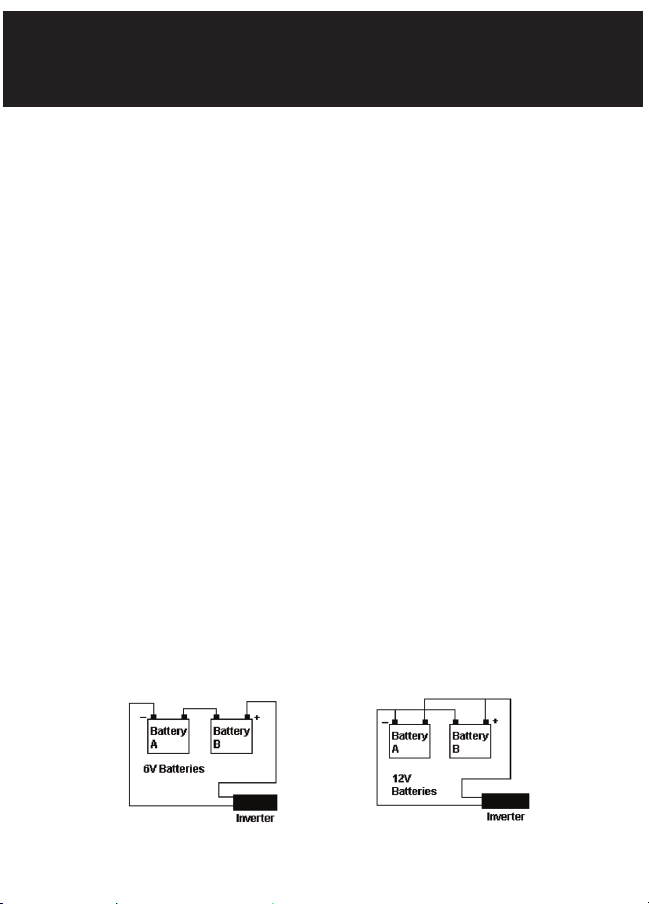
• It may be advisable to operate the inverter from a bank of
batteries of the same type in a “parallel” configuration. Two
such batteries will generate twice the Ah of a single battery;
three batteries will generate three times the Ah and so
on. See “Making the Connection” on page 12 for more
information.
This multiple parallel battery option is especially
recommended for the XP2000i and XP3000i inverters due to
the high level of amps these models require to produce up to
3000 watts of continuous load. For more information regarding
battery power please visit our inverter faq page at:
www.whistlergroup.com.

11
CABLE INFORMATION
Wire Cable Gauges
For safe and proper operation of the inverter, connect the
inverter to the power source with the proper gauge available
and in the shortest length practical.
XP1200i and XP1600i
When the inverter and the battery are set up within three feet
of each other, use a minimum of #4 gauge wire to make the
connections. Within four to six feet, use a minimum of #2 gauge
wire for XP1200i, #0 gauge for XP1600i. At distances between
six feet to ten feet, use #0 gauge wire for XP1200i, #00 gauge
for XP1600i.
XP2000i
When the inverter and the battery are set up within three feet
of each other, use a minimum of #2 gauge wire to make the
connections. Within four to six feet, use a #0 gauge wire. At
distances between six feet to ten feet, use #000 gauge wire.
XP3000i
When the inverter and the battery are set up within three feet
of each other, use a minimum of #0 gauge wire to make the
connections. Within four to six feet, use a #000 gauge wires.
At distances between six feet to ten feet, use 2 sets of #00
gauge wires connected in parallel to the battery.

Check Whistler’s online store for cable availability.
Making the Connection.
1. Make certain that the Power switch is in the center OFF (O)
position.
2. Connect the cables to the power input terminals at the rear
of the inverter and tighten the screws to make a secure
connection.
(To make these connections, install the wire connectors flush
with the metal backing plates and fasten the nuts securely.
3. Connect the cable from the Negative (-) terminal on the
inverter to the Negative (-) terminal on the 12 volt power
source. Make certain the connection is secure.
4. Confirm that the cable you have just installed is properly
connected. Specifically, make certain that the cable is
connected to the Negative (-) terminals on both the
inverter and the 12 volt power source.
5. Connect the cable from the Positive (+) terminal on the
inverter to the Positive (+) terminal on the power source.
NOTE:
• Loose connections can result in a severe decrease in
voltage which may cause damage to the wires and insulation.
• Failure to make proper polarity connection between the
inverter and the power source will result in reverse polarity.
Reverse polarity will blow the internal fuses in the inverter and
may cause permanent damage to the inverter. Damage
caused by reverse polarity is not covered under the
12
OPERATION
OPERATION
Whistler warranty.
• Making the connection between the Positive (+)
terminals may cause a spark as a result of current flowing to
the capacitors in the inverter. This is a normal occurrence.
Due to the potential for sparking, however, it is extremely
important that both the inverter and the 12 volt battery
be well removed from any possible source of flammable
fumes or gases. Failure to heed this warning could
result in fire or explosion.
6. Run a ground from the Ground Lug Terminal at the rear
of the inverter to a proper grounding point using the
shortest practical length of 18 AWG wire. Selection of the
grounding point will depend on where you are using the
inverter. The ground wire may be connected to the chassis
of your vehicle or to the grounding system in your boat or
to the earth* if you are operating the inverter in a remote
location. Before connecting the ground, make certain that
the inverter is turned off.
* This ground can’t be the same ground as the AC ground.
Operating the inverter without properly grounding it may
result in electrical shock.
7. Confirm that the equipment or appliance to be operated
is turned off. Plug the equipment or appliance into one of
the AC receptacles on the front panel of the the inverter.
13

14
OPERATION
8. Turn the inverter to the ON (I) position. Turn on the
equipment or appliance.
9. Plug the USB powered device into the inverter’s USB
power port.
10. The USB can be powered independantly of the inverter by
turning on the rocker switch to the USB (II) position.
NOTE: Indicator LED will not illuminate in this position.
Note:
•The audible alarm may make a momentary “chirp” when
the inverter is turned OFF (O). The same alarm may
also sound when the inverter is being connected to or
disconnected from the 12 volt power source.
• The use of an extension cord from the inverter to the appliance
or equipment being operated will decrease the power being
delivered to the load. For best operating results, the extension
cord should be no more than 50 feet long.
• Check frequently to ensure that the input and output
connections are secure. Loose connections may damage the
inverter, the power source, or may generate excessive heat.
To generate the maximum output, the 3000 watt model (for
example) should be connected to a power supply which has
the capacity to produce up to 300 amps. The loads should be
distributed between the receptacles to ensure that each outlet
is producing no more than its maximum 1500 watt output.
If more than one piece of equipment or appliance is to be
operated at the same time, first turn on the inverter and then
turn on each piece of equipment or appliance separately to
enable the inverter to produce the required start up loads.

15
OPERATION
Important Information on Battery Chargers
Using your inverter with battery chargers for power tools,
flashlights, video cameras and laptop computers may cause
damage to the inverter or the charging unit. Check with the
appliance manufacturer for compatibility with modified sine
wave inverters if you’re unsure.
Although we advise against it, if you attempt to use a
charging unit, monitor the temperature of the charging unit
for approximately 10 minutes. If the charging unit becomes
unusually warm, disconnect it from the inverter immediately.
The Power Source.
When the engine is off, most batteries will provide ample power
to the inverter for up to 1 hour. The actual length of time is a
function of several variables including the age and condition
of the battery, the number of batteries and the power demand
being placed on it by the equipment being operated with the
inverter. If you are using the inverter while the engine is off,
we recommend you start the engine every 30 minutes and let
it run for at least 10 minutes to recharge the battery. We also
recommend that the device plugged into the inverter be turned
off before turning over the engine.
Although it is not necessary to turn off the inverter when turning
over the engine, the inverter may momentarily cease operation as
the battery voltage decreases. When the inverter is not supplying
power, and is turned on, it draws low amperage from the battery
(see specifications).

16
ADDITIONAL SAFETY FEATURES
Automatic Shut Down & Related Safety Features.
This inverter has an unique LED indicator warning light system
which operates in conjunction with the automatic shut down
feature. These indicator lights operate as follows:
GREEN LED: System ready.
RED LED: System overload/automatic shut down.
1. Your inverter will shut down automatically when any of the
following problems occur:
2. The power input from the battery drops below 10 volts.
3. The power input from the battery exceeds 15 volts.
The inverters are also equipped with the following additional
safety features:
1. Thermal Cut Off: Automatic shut down if internal
temperature exceeds safe design parameters.
2. Low Battery Voltage Alarm/Shutdown Protection:
a) When the input voltage from the 12 volt power source
drops below 10.5 volts, an audible tone will be heard. This is
the low battery voltage alarm.
b) The inverter will automatically shut down when the input
voltage drops below 10.0 volts. This protects the battery from
completely draining.
In the event of automatic shut down or continuous audible
alarm, turn the inverter rocker switch to the center OFF (O)
position until the source of the related problem has been
identified and resolved.

17
For You Television Fans & Audiophiles.
Although the inverter is shielded and filtered to minimize signal
interference, some interference with your television picture
may be unavoidable, especially with weak signals. However,
here are some suggestions that may improve the reception.
1. First, make certain that the television antenna produces
a clear signal under normal operating conditions (i.e., at
home plugged into a standard 110 AC wall outlet). Also,
ensure that the antenna cable is properly shielded and of
good quality.
2. Change the relative positions of the inverter, antenna cables
and television power cord.
3. Isolate the television, its power cord and antenna cables from
the 12 volt power source by running an extension cord from
the inverter to the television set.
4. Coil the television power cord and the input cables running
from the 12 volt power source to the inverter.
NOTE: Inexpensive sound systems may emit a “buzzing” sound
when operated with the inverter. This is due to inadequate filters
in the sound system. There is no solution to his problem short of
purchasing a sound system with a higher quality power supply.
ADDITIONAL SAFETY FEATURES

18
For You Microwave Chefs.
The power rating commonly associated with microwave ovens is
the “cooking power” which is the power being “delivered” to
the item being microwaved. The actual operating power
requirement rating is higher than the cooking power rating
and typically is referenced on the back of the microwave. If the
operating power requirement does not appear on the back of
the microwave, check the owner’s manual or contact
the manufacturer.
Some Powerful Advice.
When driving with the inverter in operation, make certain
that neither the inverter nor the power cords will impede safe
operation of your vehicle. Keep the unit and all cords clear of
the steering wheel, gas, brake and clutch pedals and gear shift.
ADDITIONAL SAFETY FEATURES

19
CARE & MAINTAINENCE
To maintain your inverter in proper working condition, note the
following important safety precautions:
• MOISTURE. Keep the inverter dry. Do not expose it to
moisture. Do not operate the inverter if you, the inverter, the
device being operated or any other surfaces that may come in
contact with any power sources are wet. Water and many other
liquids can conduct electricity which may lead to serious injury
or death.
• HEAT. For peak efficiency, the ambient air temperature should
be between 50° and 80° F. Avoid placing the inverter on or
near heating vents, radiators or other sources of heat. Do not
place the inverter in direct sunlight.
• VENTILATION. In order to disperse the heat generated while
the inverter is in operation, keep it well ventilated. While in
use, maintain several inches of clearance around the top and
sides of the inverter.
• FUMES & GASES. Avoid using the inverter near flammable
materials. Do not place the inverter in areas such as battery
compartments, where fumes or gases may accumulate.
20
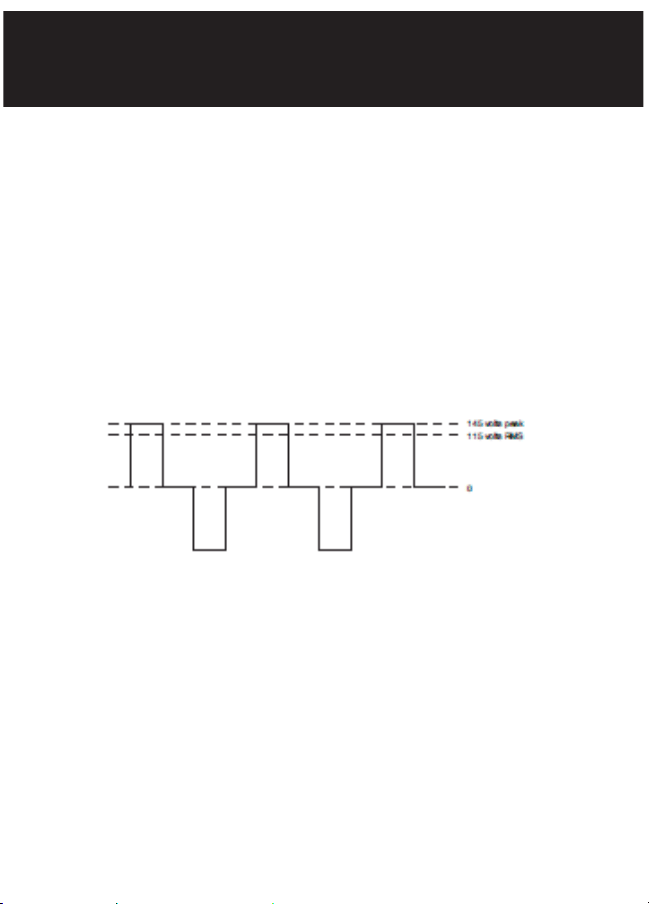
Whistler inverters work in two stages. During the first stage,
the DC to DC converter increases the DC input voltage from
the power source (e.g. a 12 volt battery) to 145 volts DC. In the
second stage, the high voltage DC is converted to 115 volts
(60 Hz AC) using advanced power MOSFET transistors in a full
bridge configuration. The result is excellent overload capability
and the capacity to operate difficult reactive loads. The output
waveform resulting from these conversions is a “quasi-sine
wave” or a “modified sine wave” as shown on below.
This stepped waveform is similar to the power generated by
utilities and has a broad range of applications.
The modified sine wave produced by the Inverter
The modified sine wave produced by your Whistler inverter has
a root mean square (RMS) voltage of 115 volts. The majority of AC
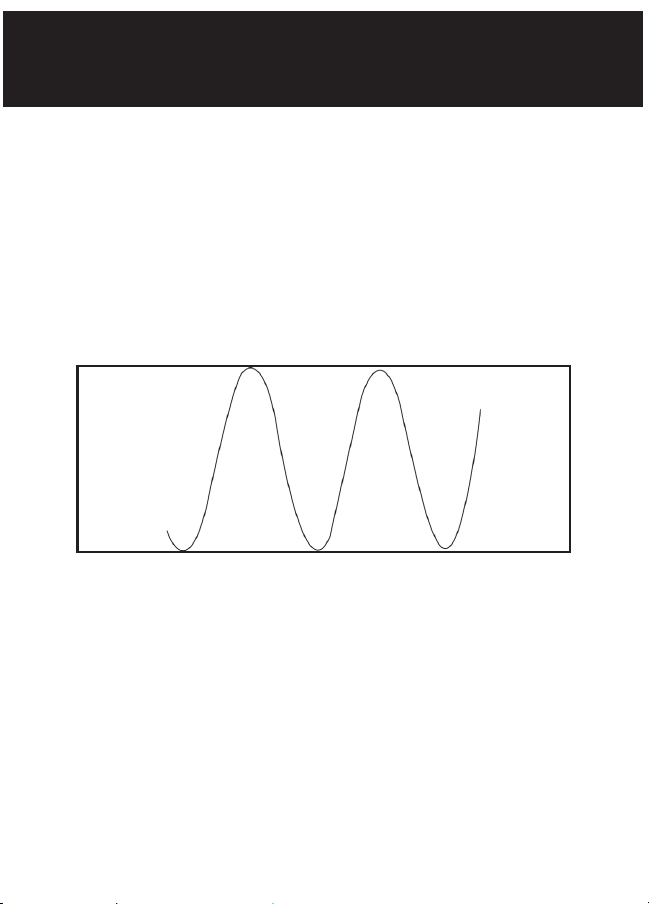
voltmeters measure RMS voltage and assume that the measured
waveform will be a pure sine wave.
OPERATING PRINCIPLES
21
Consequently, these meters will not read the RMS modified
sine wave voltage correctly and, when measuring your
Whistler inverter output, the meters will read about 20 to 30
volts too low. To accurately measure the output voltage of
your inverter, use a true RMS reading voltmeter such as a
Fluke 87, Fluke 8060A, Beckman 4410, Triplett 4200 or any
multimeter identified as “True RMS.”
For more information on inverters see our Inverter FAQ page at
www.whistlergroup.com
A true sine wave typical of home AC outlet.
OPERATING PRINCIPLES

OPERATION SUMMARY
22
In Review.
• Never attempt to operate your Whistler inverter from any
power source other than a 12 volt battery or a group of
batteries that total 12 volts.
• Always make certain that the power cable terminal
connections Negative (-) to Negative (-) and Positive (+) to
Positive (+). Check these connections frequently to ensure
that they are secure.
• Make certain the rated power consumption of the appliance
or equipment you wish to operate is compatible with the
capacity of your inverter.
• If the rated power consumption of the equipment is in the
range of the maximum specified wattage of your converter,
test the inverter to ensure that it will operate properly.
• Before attempting to use a battery charger see page 15.
• Before attempting to use medical equipment see page 6.
• Use the proper gauge cable (smaller the number, the
larger the cable) available to connect the inverter to the
power source.
• When operating the inverter with the engine off, start
the engine every 30 minutes and let it run for at least 10
minutes to recharge the battery.

OPERATION SUMMARY
23
• In the event of automatic shut down, turn the inverter OFF
(O) immediately. Do not restart the inverter until the source
of the problem has been identified and corrected.
• To avoid battery drain, always disconnect the inverter when
the vehicle is not in use for long periods.
• Do not expose the inverter to moisture.
• Avoid placing the inverter near sources of heat or in direct
sunlight.
• When in use, make certain that the inverter is
properly ventilated.
• Do not use the inverter near flammable materials, fumes,
or gases.
• Always operate the inverter in accordance with the
instructions in this manual. Failure to do so may result in
property damage, personal injury, or loss of life
• While connecting the inverter to the power source, make
certain that the inverter is well removed from any potential
source of flammable fumes or gases.
• In the event a continuous audible alarm or automatic shut
off, turn the inverter OFF immediately. Do not restart the
inverter until the source of the problem has been identified
and corrected.
TROUBLESHOOTING
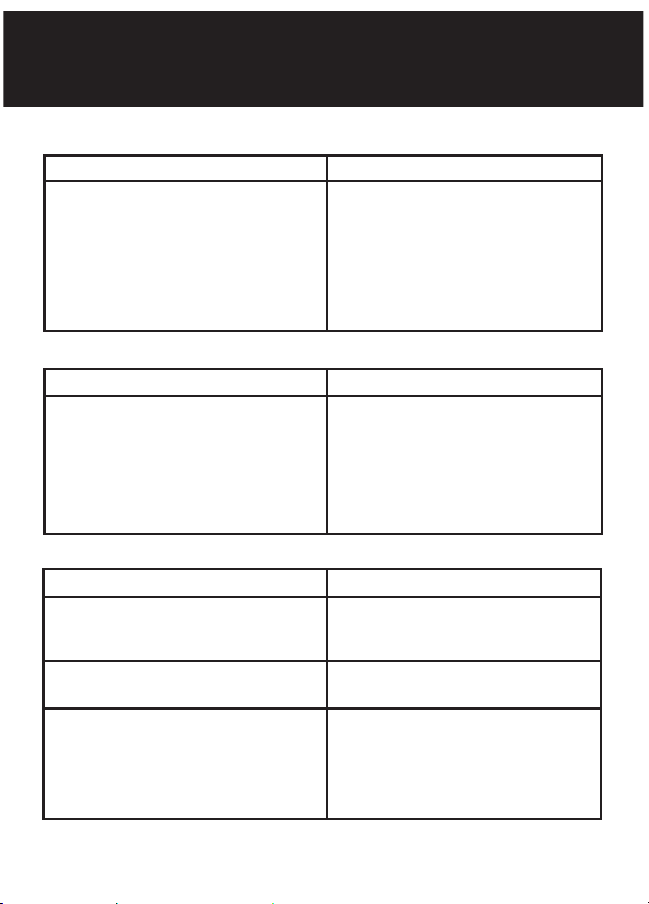
PROBLEM: TV Interference
Problem Solution
Electrical interference from Add a Ferrite data line
filter inverter. on to the TV power cord.
This filter is available at
electronic supply stores.
PROBLEM: Low or No Output Voltage
Problem Solution
Using incorrect type of Use true RMS reading meter
voltmeter to test output See “For You Technical
voltage. Types” Section of this
manual.
PROBLEM: Low Battery Alarm On All The Time
Problem Solution
Input voltage below Keep input voltage above
11 volts. 11 volts to maintain
regulation.
Poor or weak battery Replace battery.
condition.
Inadequate power being Use heavier gauge wire. See
delivered to the inverter “Wire Cable Gauges”
or excessive voltage drop. section of this manual.
Keep wire length as short
as possible.
24
25
TROUBLESHOOTING/SPECIFICATION
Overload LED on
Problem Solution
Equipment has a high Turn inverter power switch
start up surge. OFF (O) and then ON (l)
again until the inverter
powers your appliance.
Repeat as necessary
to get your appliance
“started”.
Battery voltage below Recharge or replace
10 volts. battery.
Equipment being operated Use a higher capacity
draws too much power. inverter.
Inverter is too hot (thermal Allow inverter to cool.
shutdown mode). Check for adequate
ventilation. Reduce the
load on the inverter to
rated continuous power
output.
XP1200i INVERTER SPECIFICATIONS
Maximum Continuous Power .............................................. 1200 Watts
Maximum Surge Capability (Peak Power) .......................... 2400 Watts*
No Load Current Draw ................................................................ < 1.0A
Waveform .............................................................. Modified Sine Wave
Operating Input Voltage Range ............................. 11-15+0.5 Volts DC
AC Receptacle .................................... Three North American 3 Prong
USB Port .......................................................................... 5 V 2.1A Max
Approximate Dimensions .............................. 8.9” L x 7.4” W x 3.54” H
Approximate Weight ................................................................... 4.5 lbs

SPECIFICATION
XP1600i INVERTER SPECIFICATIONS
Maximum Continuous Power ............................................... 1600 Watts
Maximum Surge Capability (Peak Power) ........................... 3200 Watts*
No Load Current Draw ................................................................ < 1.0A
Waveform ............................................................... Modified Sine Wave
Operating Input Voltage Range ............................. 11-15+0.5 Volts DC
AC Receptacle ...................................... Three North American 3 Prong
USB Port ........................................................................... 5 V 2.1A Max
Approximate Dimensions ............................... 8.9” L x 7.4” W x 3.54” H
Approximate Weight ................................................................... 5.4 lbs
XP2000i INVERTER SPECIFICATIONS
Maximum Continuous Power ............................................... 2000 Watts
Maximum Surge Capability (Peak Power) ........................... 4000 Watts*
No Load Current Draw ................................................................ < 1.0A
Waveform .............................................................. Modified Sine Wave
Operating Input Voltage Range ............................. 11-15+0.5 Volts DC
AC Receptacle ...................................... Three North American 3 Prong
USB Port ............................................................................ 5 V 2.1A Max
Approximate Dimensions ............................... 12” L x 8.9” W x 3.54” H
Approximate Weight ................................................................... 7.3 lbs
XP3000i INVERTER SPECIFICATIONS
Maximum Continuous Power ............................................... 3000 Watts
Maximum Surge Capability (Peak Power) ........................... 6000 Watts*
No Load Current Draw ................................................................ < 1.3A
Waveform ............................................................... Modified Sine Wave
Operating Input Voltage Range ............................. 11-15+0.5 Volts DC
AC Receptacle ...................................... Three North American 3 Prong
USB Port ........................................................................... 5 V 2.1A Max
Approximate Dimensions ............................. 15.5” L x 8.9” W x 3.54” H
Approximate Weight ................................................................... 12.5 lb
*Under certain conditions your inverter may provide up to 2 times
the continuous rating for a brief period.
26

WARRANTY
27
Consumer Warranty
This Whistler product is warranted to the original purchaser for a
period of two (2) years from the date of original purchase against
all defects in materials and workmanship, when purchased from an
authorized Whistler retailer. This limited warranty is void if the unit is
abused, misused, modified, installed improperly, or if the housing
and/or serial numbers have been removed. There are no express
warranties covering this product other than those set forth in this
warranty. All express or implied warranties for this product are limited
to two (2) years. Whistler is not liable for damages arising from the
use, misuse, or operation of this product including but not limited to
loss of time, inconvenience, loss of use of your product or property
damage caused by your product or its failure to work, or any other
incidental or consequential damages including personal injury.
DO NOT RETURN ITEM TO STORE WHERE PURCHASED.
FOR WARRANTY INFORMATION, CONTACT WHISTLER
CUSTOMER SERVICE AT 1-800-531-0004.
Representatives are available to answer your questions
Monday – Friday
from 8:00 a.m. to 5:00 p.m. CT
Service Under Warranty
During the warranty period, defective units will be repaired or replaced
(with the same or a comparable model), at Whistler’s option, without
charge to the purchaser when returned prepaid, with dated proof of
purchase to the address below. Units returned without dated proof
of purchase will be considered out of warranty and therefore are not
covered by the described Limited Warranty. (Refer to Service Out of
Warranty section.)
Due to the specialized equipment necessary for testing Whistler products,
there are no authorized service centers other than Whistler. When returning
a unit for service under warranty, please follow these instructions:

WARRANTY
28
1. Ship the unit in the original carton or in a suitable sturdy equivalent,
fully insured, with return receipt requested to:
Whistler Repair Dept.
1412 South 1st St.
Rogers, AR. 72756
Please allow 3 weeks turnaround time.
IMPORTANT: Whistler will not assume responsibility for loss or damage
incurred in shipping. Therefore, please ship your unit insured with return
receipt requested. CODs will not be accepted!
2. Include with your unit the following information, clearly printed:
• Your name and physical street address for shipping (no PO
Boxes), a daytime telephone number, and an email address (if
applicable).
• A detailed description of the problem (e.g.,“device will not
Power ON”).
• A copy of your dated proof of purchase or bill of sale.
3. Be certain your unit is returned with its serial number. Units
without serial numbers are not covered under warranty.
IMPORTANT: To validate that your unit is within the warranty period,
make sure you keep a copy of your dated proof of purchase. For
warranty verification purposes, a copy of your dated store receipt
must accompany any Whistler product sent in for warranty work.

29
WARRANTY
Service Out Of Warranty
Units will be repaired at “out of warranty” service rates when:
• The unit’s original warranty has expired.
• A dated proof of purchase is not supplied.
• The unit has been returned without its serial number.
• The unit has been misused, abused, modified, installed
improperly, or had its housing removed.
The out of warranty service fee for these inverters are as follows:
XP1200i inverter is $75.00 XP1600i inverter is $95.00
XP2000i inverter is $125.00 XP3000i inverter is $185.00
If you require out of warranty service, please return your unit as outlined
in the section “Service Under Warranty” along with a cashier’s check or
money order in the amount specified for purchased inverter. Payment
may also be made by MasterCard, VISA or American Express. Personal
checks are not accepted.
In the event repairs cannot be covered by the minimum service fee,
you will be contacted by a Whistler technical service specialist who
will outline options available to you.
IMPORTANT: When returning your unit for service, be certain to
include a daytime telephone number and an email address
(if applicable).
Customer Service
If you have questions concerning the operation of your Whistler
product, or require service during or after the warranty period,
please call Customer Service at 1-800-531-0004.
Representatives are available to answer your questions Monday
- Friday from 8:00 a.m. to 5:00 p.m. (CT) or visit the F.A.Q.’s at
www.whistlergroup.com.

CORPORATE HEADQUARTERS
1716 SW Commerce Dr. Ste. 8
PO Box 1760
Bentonville, AR 72712
Toll Free (800) 531-0004
TEL (479) 273-6012
FX (479) 273-2927
www.whistlergroup.com
CUSTOMER RETURN CENTER
1412 South 1st St.
Rogers, AR 72756
Customer Service Tel (800) 531-0004
Email: [email protected]
P/N 401566
Rev.2 © 05/2014 The Whistler Group, Inc.