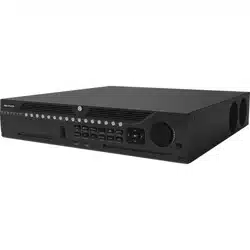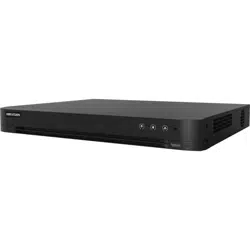

Digital Video Recorder
User Manual

Legal Informaon
About this Document
●
This Document includes instrucons for using and managing the Product. Pictures, charts,
images and all other informaon hereinaer are for descripon and explanaon only.
●
The informaon contained in the Document is subject to change, without noce, due to
rmware updates or other reasons. Please nd the latest version of the Document at the
Hikvision website ( hps://www.hikvision.com ). Unless otherwise agreed, Hangzhou Hikvision
Digital Technology Co., Ltd. or its aliates (hereinaer referred to as "Hikvision") makes no
warranes, express or implied.
●
Please use the Document with the guidance and assistance of professionals trained in
supporng the Product.
Acknowledgment of Intellectual Property Rights
●
Hikvision owns the copyrights and/or patents related to the technology embodied in the
Products described in this Document, which may include licenses obtained from third pares.
●
Any part of the Document, including text, pictures, graphics, etc., belongs to Hikvision. No part
of this Document may be excerpted, copied, translated, or modied in whole or in part by any
means without wrien permission.
●
and other Hikvision’s trademarks and logos are the properes of Hikvision in
various jurisdicons.
●
Other trademarks and logos menoned are the properes of their respecve owners.
●
The terms HDMI and HDMI High-Denion Mulmedia Interface, and the HDMI Logo
are trademarks or registered trademarks of HDMI Licensing Administrator, Inc. in the United
States and other countries.
LEGAL DISCLAIMER
●
TO THE MAXIMUM EXTENT PERMITTED BY APPLICABLE LAW, THIS DOCUMENT AND THE
PRODUCT DESCRIBED, WITH ITS HARDWARE, SOFTWARE AND FIRMWARE, ARE PROVIDED "AS
IS" AND "WITH ALL FAULTS AND ERRORS". HIKVISION MAKES NO WARRANTIES, EXPRESS OR
IMPLIED, INCLUDING WITHOUT LIMITATION, MERCHANTABILITY, SATISFACTORY QUALITY, OR
FITNESS FOR A PARTICULAR PURPOSE. THE USE OF THE PRODUCT BY YOU IS AT YOUR OWN RISK.
IN NO EVENT WILL HIKVISION BE LIABLE TO YOU FOR ANY SPECIAL, CONSEQUENTIAL,
INCIDENTAL, OR INDIRECT DAMAGES, INCLUDING, AMONG OTHERS, DAMAGES FOR LOSS OF
BUSINESS PROFITS, BUSINESS INTERRUPTION, OR LOSS OF DATA, CORRUPTION OF SYSTEMS, OR
LOSS OF DOCUMENTATION, WHETHER BASED ON BREACH OF CONTRACT, TORT (INCLUDING
NEGLIGENCE), PRODUCT LIABILITY, OR OTHERWISE, IN CONNECTION WITH THE USE OF THE
Digital Video Recorder User Manual
i

PRODUCT, EVEN IF HIKVISION HAS BEEN ADVISED OF THE POSSIBILITY OF SUCH DAMAGES OR
LOSS.
●
YOU ACKNOWLEDGE THAT THE NATURE OF THE INTERNET PROVIDES FOR INHERENT SECURITY
RISKS, AND HIKVISION SHALL NOT TAKE ANY RESPONSIBILITIES FOR ABNORMAL OPERATION,
PRIVACY LEAKAGE OR OTHER DAMAGES RESULTING FROM CYBER-ATTACK, HACKER ATTACK,
VIRUS INFECTION, OR OTHER INTERNET SECURITY RISKS; HOWEVER, HIKVISION WILL PROVIDE
TIMELY TECHNICAL SUPPORT IF REQUIRED.
●
YOU AGREE TO USE THIS PRODUCT IN COMPLIANCE WITH ALL APPLICABLE LAWS, AND YOU ARE
SOLELY RESPONSIBLE FOR ENSURING THAT YOUR USE CONFORMS TO THE APPLICABLE LAW.
ESPECIALLY, YOU ARE RESPONSIBLE, FOR USING THIS PRODUCT IN A MANNER THAT DOES NOT
INFRINGE ON THE RIGHTS OF THIRD PARTIES, INCLUDING WITHOUT LIMITATION, RIGHTS OF
PUBLICITY, INTELLECTUAL PROPERTY RIGHTS, OR DATA PROTECTION AND OTHER PRIVACY
RIGHTS. YOU SHALL NOT USE THIS PRODUCT FOR ANY PROHIBITED END-USES, INCLUDING THE
DEVELOPMENT OR PRODUCTION OF WEAPONS OF MASS DESTRUCTION, THE DEVELOPMENT OR
PRODUCTION OF CHEMICAL OR BIOLOGICAL WEAPONS, ANY ACTIVITIES IN THE CONTEXT
RELATED TO ANY NUCLEAR EXPLOSIVE OR UNSAFE NUCLEAR FUEL-CYCLE, OR IN SUPPORT OF
HUMAN RIGHTS ABUSES.
●
IN THE EVENT OF ANY CONFLICTS BETWEEN THIS DOCUMENT AND THE APPLICABLE LAW, THE
LATTER PREVAILS.
© Hangzhou Hikvision Digital Technology Co., Ltd. All rights reserved.
Digital Video Recorder User Manual
ii

Regulatory Informaon
FCC Informaon
Please take aenon that changes or modicaon not expressly approved by the party responsible
for compliance could void the user's authority to operate the equipment.
FCC compliance: This equipment has been tested and found to comply with the limits for a Class A
digital device, pursuant to part 15 of the FCC Rules. These limits are designed to provide
reasonable protecon against harmful interference in a residenal installaon. This equipment
generates, uses and can radiate radio frequency energy and, if not installed and used in accordance
with the instrucons, may cause harmful interference to radio communicaons. However, there is
no guarantee that interference will not occur in a parcular installaon. If this equipment does
cause harmful interference to radio or television recepon, which can be determined by turning
the equipment o and on, the user is encouraged to try to correct the interference by one or more
of the following measures:
●
Reorient or relocate the receiving antenna.
●
Increase the separaon between the equipment and receiver.
●
Connect the equipment into an outlet on a circuit dierent from that to which the receiver is
connected.
●
Consult the dealer or an experienced radio/TV technician for help.
FCC Condions
This device complies with part 15 of the FCC Rules. Operaon is subject to the following two
condions:
●
This device may not cause harmful interference.
●
This device must accept any interference received, including interference that may cause
undesired operaon.
EU Conformity Statement
This product and - if applicable - the supplied accessories too are marked
with "CE" and comply therefore with the applicable harmonized European
standards listed under the EMC Direcve 2014/30/EU, LVD Direcve 2014/
35/EU, the RoHS Direcve 2011/65/EU.
2012/19/EU (WEEE direcve): Products marked with this symbol cannot be
disposed of as unsorted municipal waste in the European Union. For
proper recycling, return this product to your local supplier upon the
Digital Video Recorder User Manual
iii

purchase of equivalent new equipment, or dispose of it at designated
collecon points. For more informaon see: hp://www.recyclethis.info .
2006/66/EC (baery direcve): This product contains a baery that cannot
be disposed of as unsorted municipal waste in the European Union. See
the product documentaon for specic baery informaon. The baery is
marked with this symbol, which may include leering to indicate cadmium
(Cd), lead (Pb), or mercury (Hg). For proper recycling, return the baery to
your supplier or to a designated collecon point. For more informaon
see: hp://www.recyclethis.info .
Industry Canada ICES-003 Compliance
This device meets the CAN ICES-3 (A)/NMB-3(A) standards requirements.
Digital Video Recorder User Manual
iv

Applicable Model
This manual is applicable to the following models.
Table 1-1 Applicable Model
Series Model
iDS-9000HQHI-M8/S iDS-9032HQHI-M8/S
iDS-9000HUHI-M8/S iDS-9016HUHI-M8/S
iDS-9032HUHI-M8/S
iDS-7300HQHI-M4/S iDS-7316HQHI-M4/S
iDS-7332HQHI-M4/S
iDS-7300HUHI-M4/S iDS-7316HUHI-M4/S
iDS-7332HUHI-M4/S
iDS-8100HQHI-M8/S iDS-8116HQHI-M8/S
Digital Video Recorder User Manual
v
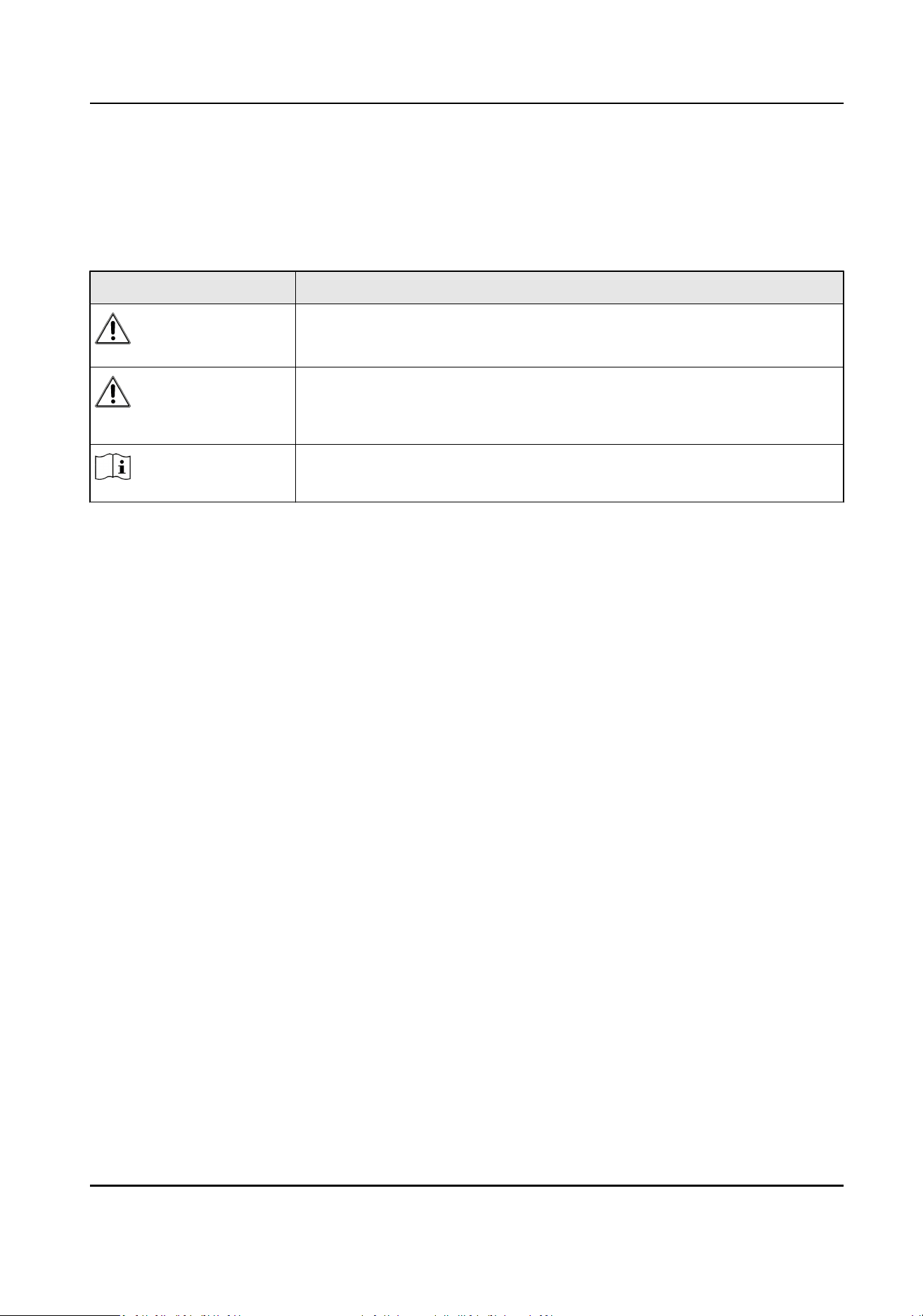
Symbol Convenons
The symbols that may be found in this document are dened as follows.
Symbol Descripon
Danger
Indicates a hazardous situaon which, if not avoided, will or could
result in death or serious injury.
Cauon
Indicates a potenally hazardous situaon which, if not avoided, could
result in equipment damage, data loss, performance degradaon, or
unexpected results.
Note
Provides addional informaon to emphasize or supplement
important points of the main text.
Digital Video Recorder User Manual
vi

Safety Instrucon
●
Proper conguraon of all passwords and other security sengs is the responsibility of the
installer and/or end-user.
●
In the use of the product, you must be in strict compliance with the electrical safety regulaons
of the naon and region.
●
Firmly connect the plug to the power socket. Do not connect several devices to one power
adapter. Power o the device before connecng and disconnecng accessories and peripherals.
●
Shock hazard! Disconnect all power sources before maintenance.
●
The equipment must be connected to an earthed mains socket-outlet.
●
The socket-outlet shall be installed near the equipment and shall be easily accessible.
●
indicates hazardous live and the external wiring connected to the terminals requires
installaon by an instructed person.
●
Never place the equipment in an unstable locaon. The equipment may fall, causing serious
personal injury or death.
●
Input voltage should meet the SELV (Safety Extra Low Voltage) and the LPS (Limited Power
Source) according to the IEC62368.
●
High touch current! Connect to earth before connecng to the power supply.
●
If smoke, odor or noise rise from the device, turn o the power at once and unplug the power
cable, and then please contact the service center.
●
Use the device in conjuncon with an UPS, and use factory recommended HDD if possible.
●
This product contains a coin/buon cell baery. If the baery is swallowed, it can cause severe
internal burns in just 2 hours and can lead to death.
●
This equipment is not suitable for use in locaons where children are likely to be present.
●
CAUTION: Risk of explosion if the baery is replaced by an incorrect type.
●
Improper replacement of the baery with an incorrect type may defeat a safeguard (for
example, in the case of some lithium baery types).
●
Do not dispose of the baery into re or a hot oven, or mechanically crush or cut the baery,
which may result in an explosion.
●
Do not leave the baery in an extremely high temperature surrounding environment, which may
result in an explosion or the leakage of ammable liquid or gas.
●
Do not subject the baery to extremely low air pressure, which may result in an explosion or the
leakage of ammable liquid or gas.
●
Dispose of used baeries according to the instrucons.
●
Keep body parts away from fan blades and motors. Disconnect the power source during
servicing.
●
Keep body parts away from motors. Disconnect the power source during servicing.
Digital Video Recorder User Manual
vii

Prevenve and Cauonary Tips
Before connecng and operang your device, please be advised of the following ps:
●
The device is designed for indoor use only. Install it in a well-venlated, dust-free environment
without liquids.
●
Ensure recorder is properly secured to a rack or shelf. Major shocks or jolts to the recorder as a
result of dropping it may cause damage to the sensive electronics within the recorder.
●
The device shall not be exposed to water dripping or splashing, and no objects lled with liquids,
such as vases, shall be placed on the device.
●
No naked ame sources, such as lighted candles, should be placed on the device.
●
The venlaon should not be impeded by covering the venlaon openings with items, such as
newspapers, table-cloths, curtains, etc. The openings shall never be blocked by placing the
equipment on a bed, sofa, rug or other similar surface.
●
For certain models, ensure correct wiring of the terminals for connecon to an AC mains supply.
●
For certain models, the equipment has been designed, when required, modied for connecon
to an IT power distribuon system.
●
idenes the baery holder itself and idenes the posioning of the cell(s) inside the
baery holder.
●
+ idenes the posive terminal(s) of equipment which is used with, or generates direct current.
- idenes the negave terminal(s) of equipment which is used with, or generates direct current.
●
Keep a minimum 200 mm (7.87 inch) distance around the equipment for sucient venlaon.
●
For certain models, ensure correct wiring of the terminals for connecon to an AC mains supply.
●
Do not touch the sharp edges or corners.
●
When the device is running above 45 °C (113 °F), or its HDD temperature in S.M.A.R.T. exceeds
the stated value, please ensure the device is running in a cool environment, or replace HDD(s) to
make the HDD temperature in S.M.A.R.T. below the stated value.
●
Provide a surge suppressor at the inlet opening of the device under special condions such as
the mountain top, iron tower, and forest.
●
Do not touch the bare components (such as the metal contacts of the inlets) and wait for at least
5 minutes, since electricity may sll exist aer the device is powered o.
●
The USB port of the equipment is used for connecng to a mouse, keyboard, USB ash drive, or
Wi-Fi dongle only. The current for the connected device shall be not more than 0.1 A.
●
The serial port of the device is used for debugging only.
●
If the power output port of the device does not comply with Limited Power Source, the
connected device powered by this port shall be equipped with a re enclosure.
●
If a power adapter is provided in the device package, use the provided adapter only.
●
For the device with scker
or , pay aenon to the following cauons: CAUTION: Hot
parts! Do not touch. Burned ngers when handling the parts. Wait one-half hour aer switching
o before handling the parts.
●
If the device needs to be installed on the wall or ceiling,
Digital Video Recorder User Manual
viii
1. Install the device according to the instrucons in this manual.
2. To prevent injury, this device must be securely aached to the installaon surface in
accordance with the installaon instrucons.
●
Under high working temperature (40 °C (104 °F) to 55 °C (131 °F)), the power of some power
adapters may decrease.
●
Make sure that the power has been disconnected before you wire, install, or disassemble the
device.
●
If the device needs to be wired by yourself, select the corresponding wire to supply power
according to the electric parameters labeled on the device. Strip o wire with a standard wire
stripper at corresponding posion. To avoid serious consequences, the length of stripped wire
shall be appropriate, and conductors shall not be exposed.
●
If smoke, odor, or noise arises from the device, immediately turn o the power, unplug the
power cable, and contact the service center.
Coin/Buon Cell Baery Replacement
The coin/buon cell baery should be replaced when the device has been powered o or placed
for a long me, and the system me is incorrect.
Before You Start
Power o your device.
Steps
1.
Remove the device chassis cover.
2.
Find the coin/buon cell baery on motherboard.
3.
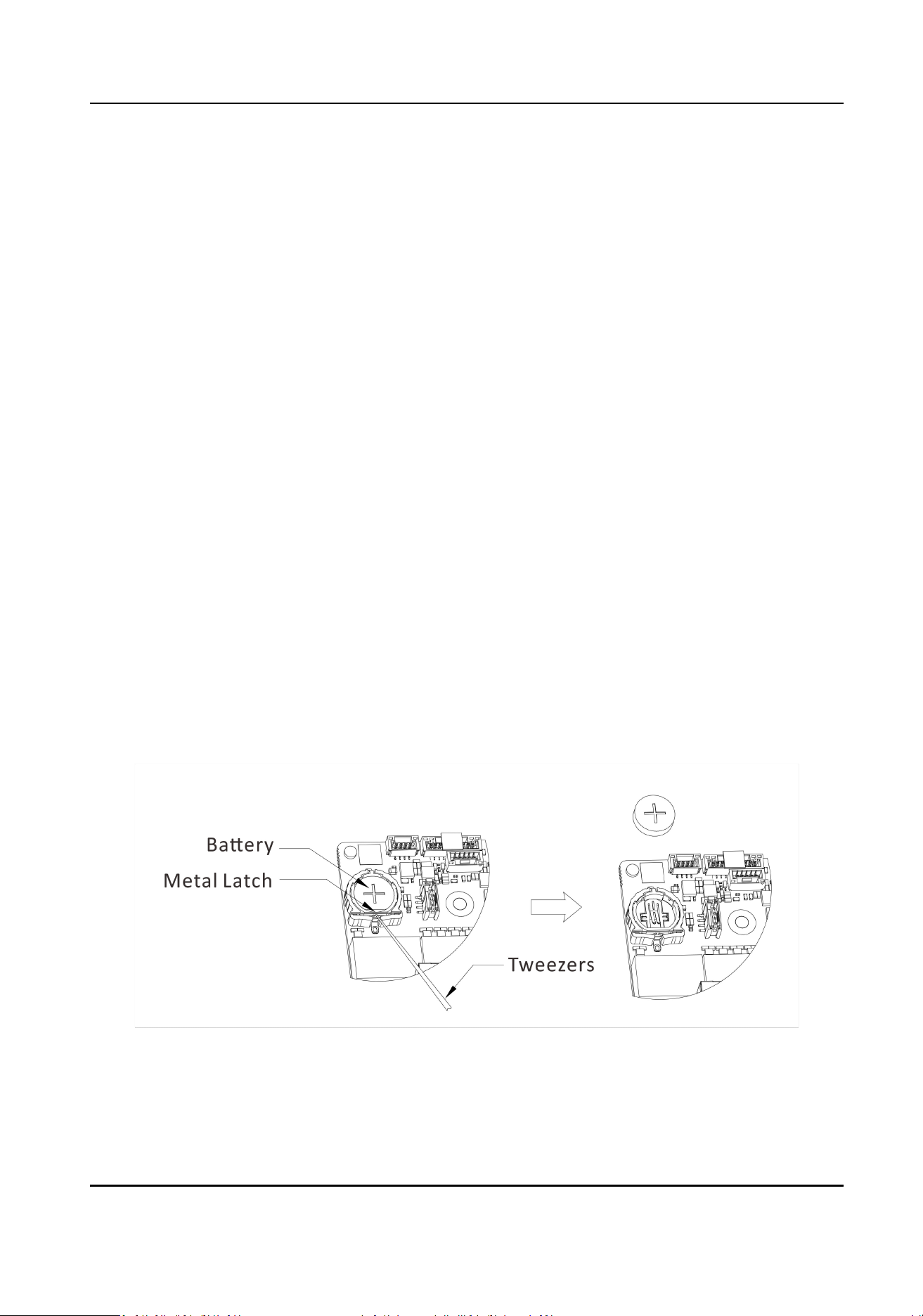
Use tweezers to push the metal latch at the middle from its inside, and the baery would
automacally pop up.
Figure 1-1 Remove Baery
4.
Take out the old baery and press a new baery with the same model in to the baery slot.
Digital Video Recorder User Manual
ix
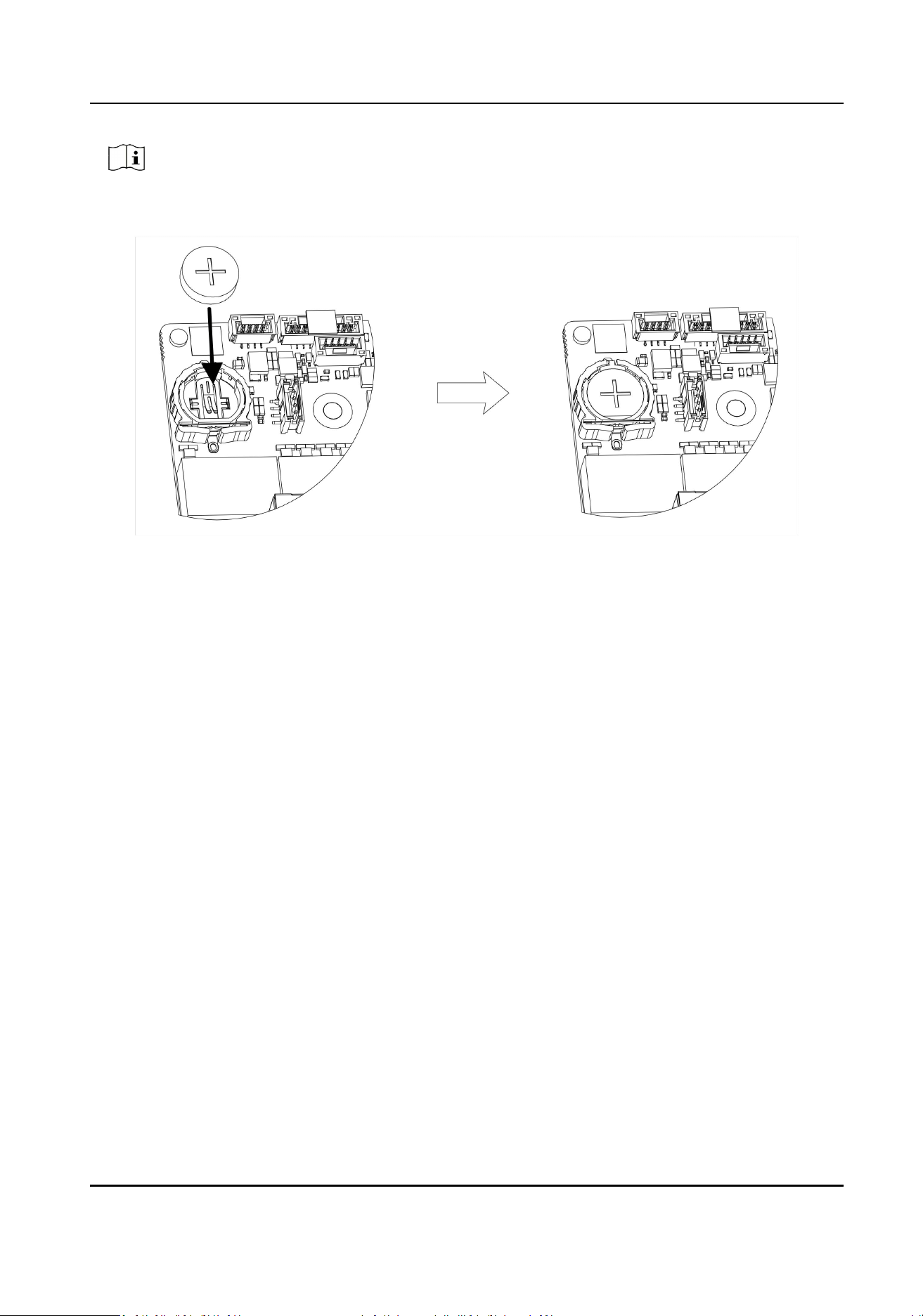
Note
The baery posive terminal (+ idenes the posive terminal) should be placed upward.
Figure 1-2 Replace Baery
5.
Reinstall the device chassis cover.
What to do next
If the system me is incorrect, please go to congure the me.
HDD Installaon
Disconnect the power from the device before installing a hard disk drive (HDD). A factory
recommended HDD should be used for this installaon.
Tools Required: Screwdriver.
Bracket Installaon
Bracket installaon is applicable when it requires to remove the device cover, and install HDD on
the internal bracket.
Steps
1.
Unfasten screws on the back, and push the cover backwards to remove the cover.
Digital Video Recorder User Manual
x
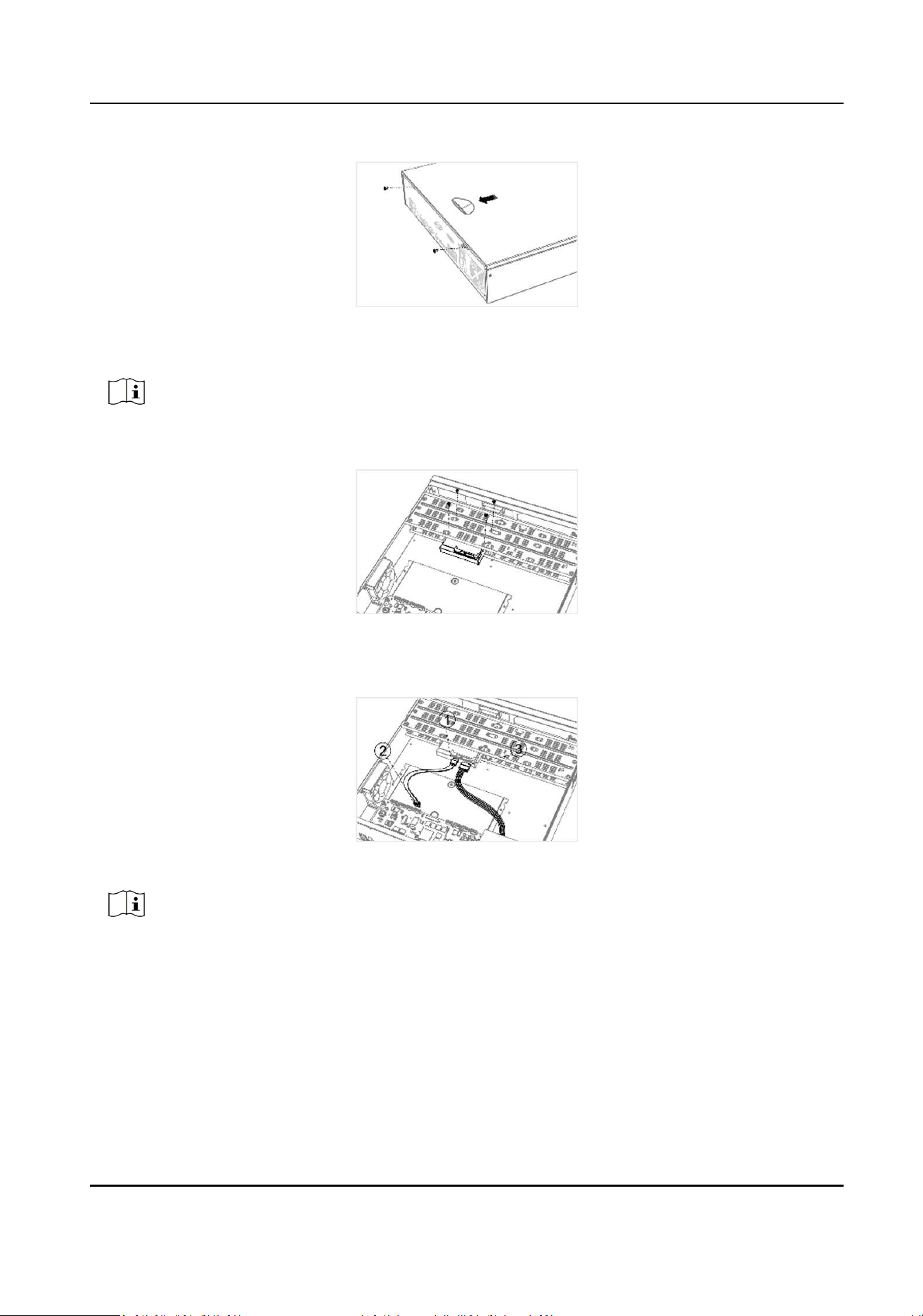
Figure 1-3 Remove Cover
2.
Fix the HDD on the bracket with screws.
Note
Please uninstall the upper layer bracket rst before installing HDD on the lower layer bracket.
Figure 1-4 Fix HDD
3.
Connect the data cable and power cable.
Figure 1-5 Connect Cable
Note
You can repeat the steps above to install other HDDs.
4.
Reinstall the device cover and fasten screws.
Front Panel Plug-Pull Installaon
Front panel plug-pull installaon is applicable when you need to open the device front panel with
key and install the HDD.
Digital Video Recorder User Manual
xi
Steps
1.
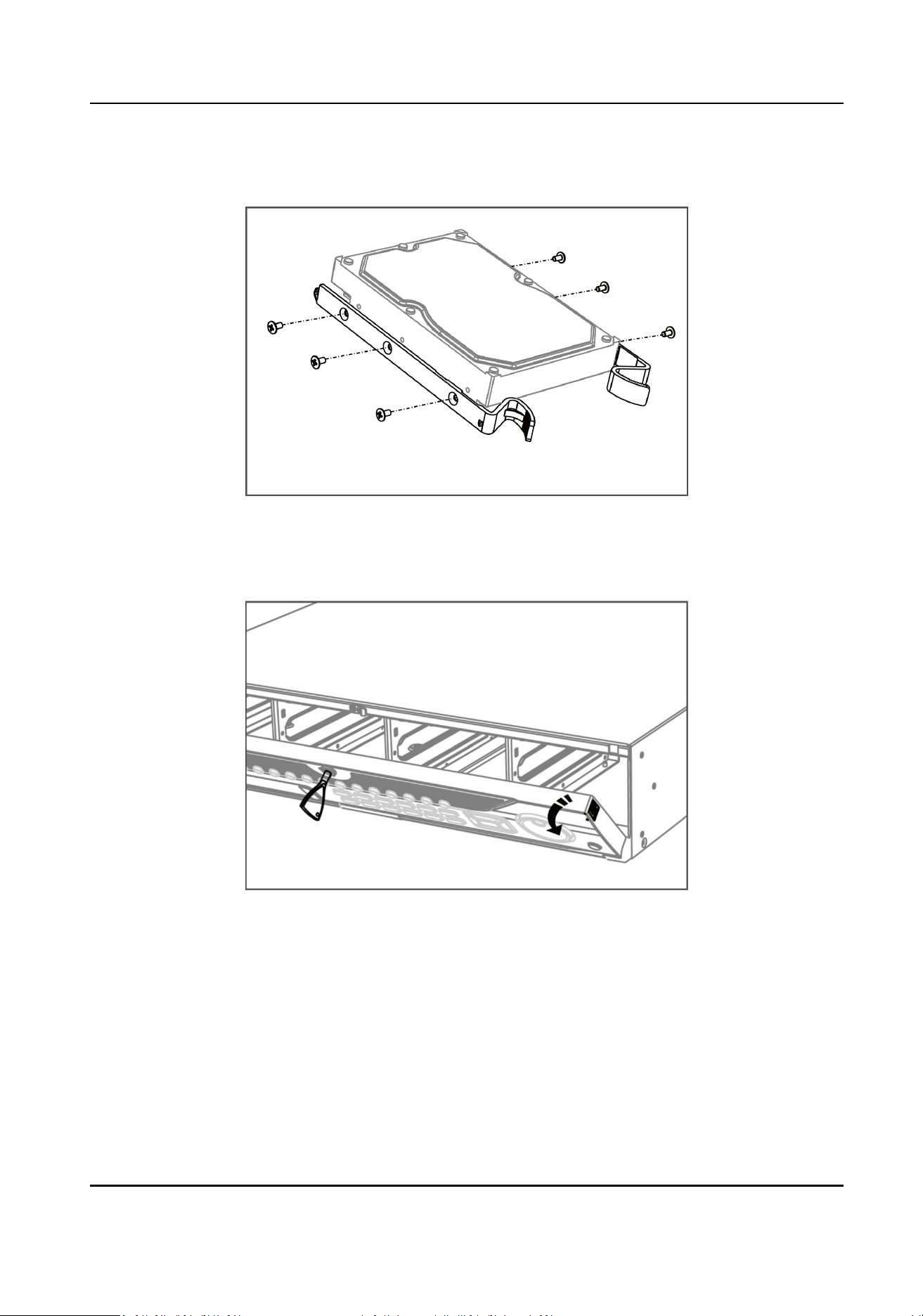
Fix mounng ears to HDD with screws.
Figure 1-6 Fix Mounng Ears to HDD
2.
Unlock the front panel with the aached key, and press the buons on both sides of the front
panel to open it.
Figure 1-7 Open Front Panel
3.
Insert the HDD unl it is xed rmly.
Digital Video Recorder User Manual
xii
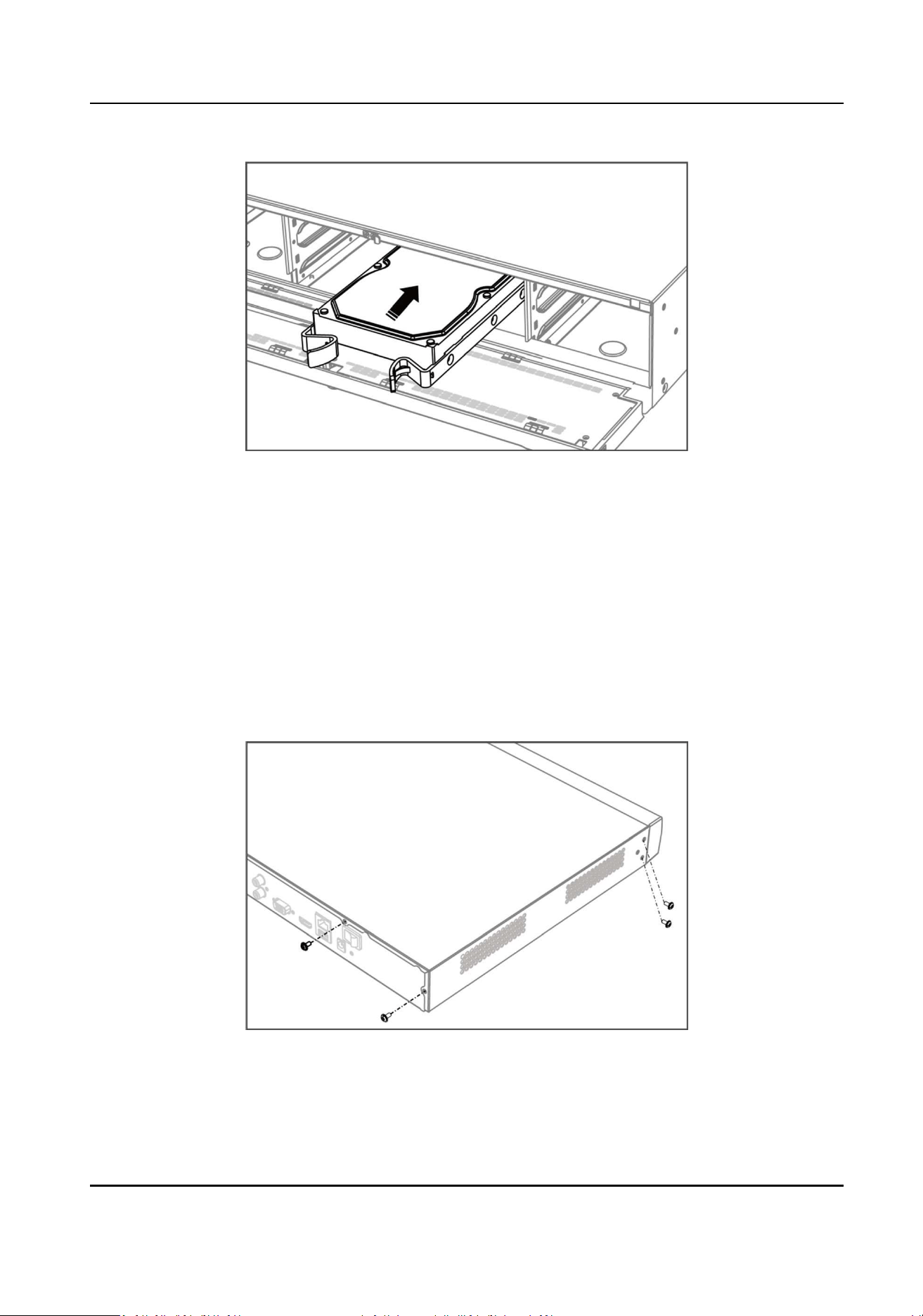
Figure 1-8 Insert HDD
4.
Oponal: Repeat the steps above to install other HDDs.
5.
Close the front panel and lock it with key.
Fix-on-Boom Installaon
Fix-on-boom installaon is applicable when you need to install and x the HDD on the device
boom.
Steps
1.
Remove the cover from device by unfastening the screws on panels.
Figure 1-9 Remove Cover
2.
Connect the data cable and power cable.
1) Connect one end of data cable to the device motherboard.
Digital Video Recorder User Manual
xiii
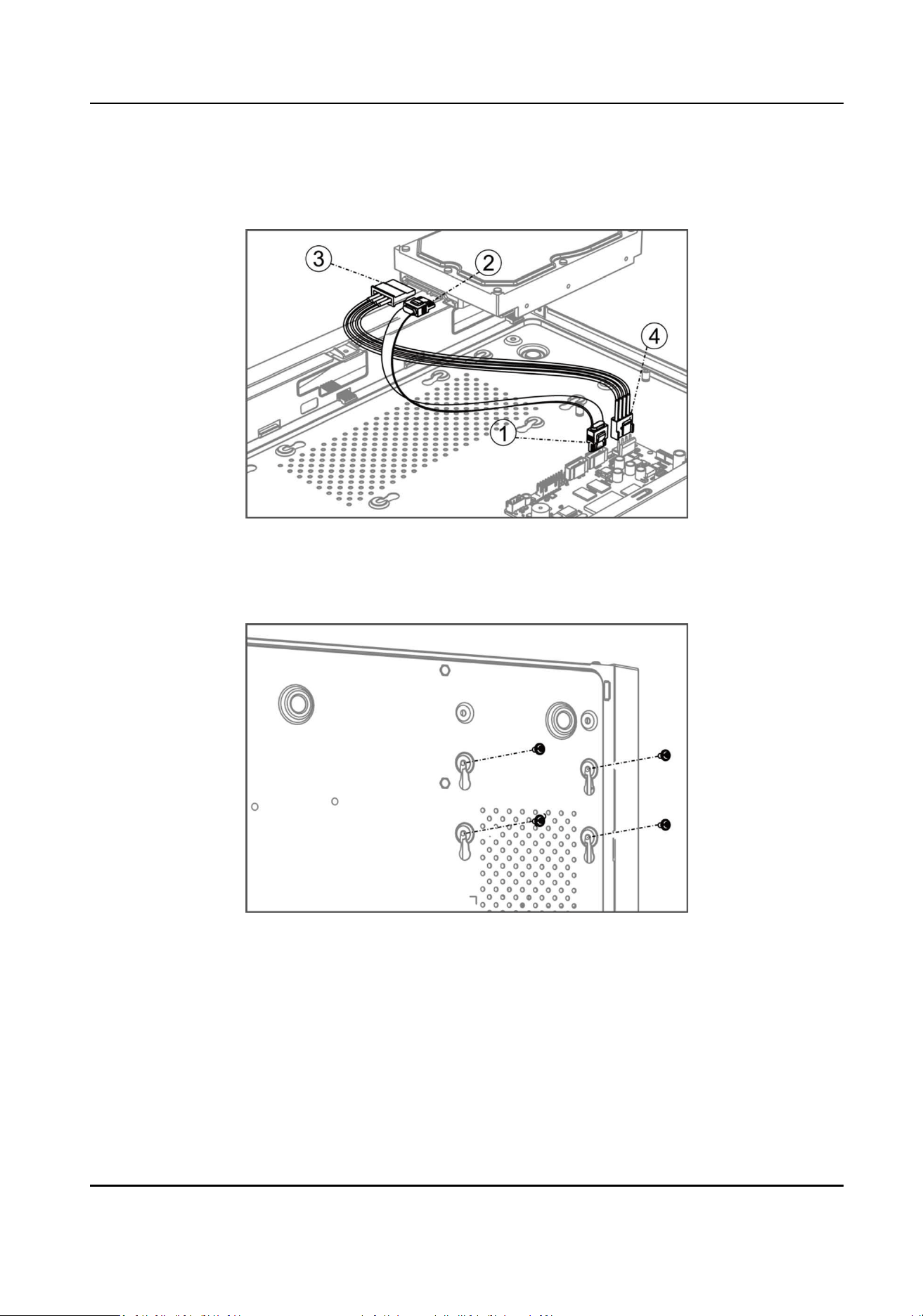
2) Connect the other end of data cable to HDD.
3) Connect one end of power cable to HDD.
4) Connect the other end of power cable to the device motherboard.
Figure 1-10 Connect Cables
3.
Set the device up, match HDD screw threads with the reserved holes on the device boom, and
x HDD with screws.
Figure 1-11 Fix HDD to Device Boom
4.
Oponal: Repeat the steps above to install other HDDs.
5.
Reinstall the device cover and fasten screws.
Digital Video Recorder User Manual
xiv

Contents
Chapter 1 Basic Operaon .......................................................................................................... 1
1.1 Acvate Your Device .............................................................................................................. 1
1.1.1 Default User and IP Address ......................................................................................... 1
1.1.2 Acvate via Local Menu ................................................................................................ 1
1.1.3 Acvate via SADP .......................................................................................................... 2
1.1.4 Acvate via Client Soware .......................................................................................... 3
1.1.5 Acvate via Web Browser ............................................................................................. 7
1.2 Congure TCP/IP .................................................................................................................... 8
1.3 Congure HDD ....................................................................................................................... 9
1.4 Congure Signal Input ............................................................................................................ 9
1.5 Congure Enhanced IP Mode .............................................................................................. 10
1.6 Connect PoC Camera ........................................................................................................... 10
1.7 Add Network Camera ........................................................................................................... 11
1.7.1 Add Automacally Searched Online Network Camera ............................................... 12
1.7.2 Add Network Camera Manually .................................................................................. 13
1.7.3 Add Network Camera via Customized Protocol .......................................................... 14
1.8 Congure 5 MP Long Distance Transmission ....................................................................... 15
1.9 Connect to Plaorm ............................................................................................................. 16
1.9.1 Congure Hik-Connect ................................................................................................ 16
1.9.2 Congure ISUP ............................................................................................................ 17
Chapter 2 Camera Sengs ........................................................................................................ 19
2.1 Congure OSD ...................................................................................................................... 19
2.2 Congure Image Parameters ................................................................................................ 20
2.3 Congure Camera Parameters Sengs ............................................................................... 20
2.4 Congure Privacy Mask ........................................................................................................ 21
2.5 Import/Export IP Camera Conguraon Files ...................................................................... 22
Digital Video Recorder User Manual
xv

2.6 IP Camera Time Sync ............................................................................................................ 23
2.7 Save Camera VCA Data ......................................................................................................... 23
2.8 Upgrade IP Cameras ............................................................................................................. 23
Chapter 3 Live View .................................................................................................................. 25
3.1 Start Live View ..................................................................................................................... 25
3.1.1 Congure Live View Sengs ....................................................................................... 25
3.1.2 Congure Auto-Switch of Cameras ............................................................................. 26
3.1.3 Congure Live View Layout ......................................................................................... 27
3.1.4 Congure Channel-Zero Encoding ............................................................................... 29
3.1.5 Use an Auxiliary Monitor ............................................................................................ 29
3.2 Digital Zoom ......................................................................................................................... 30
3.3 Live View Strategy ................................................................................................................ 31
3.4 3D Posioning ...................................................................................................................... 31
3.5 Facial Recognion ................................................................................................................ 32
3.6 PTZ Control .......................................................................................................................... 34
3.6.1 Congure PTZ Parameters ........................................................................................... 34
3.6.2 Set a Preset ................................................................................................................. 35
3.6.3 Call a Preset ................................................................................................................ 36
3.6.4 Set a Patrol .................................................................................................................. 36
3.6.5 Call a Patrol ................................................................................................................. 38
3.6.6 Set a Paern ................................................................................................................ 39
3.6.7 Call a Paern ............................................................................................................... 40
3.6.8 Set Linear Scan Limit ................................................................................................... 40
3.6.9 One-Touch Park ........................................................................................................... 41
3.6.10 Auxiliary Funcons .................................................................................................... 41
Chapter 4 Recording and Playback ............................................................................................ 43
4.1 Recording ............................................................................................................................. 43
4.1.1 Congure Recording Parameters ................................................................................ 43
Digital Video Recorder User Manual
xvi

4.1.2 Enable H.265 Stream Access ....................................................................................... 45
4.1.3 Manual Recording ....................................................................................................... 45
4.1.4 Congure Recording Schedule .................................................................................... 45
4.1.5 Congure Connuous Recording ................................................................................ 47
4.1.6 Congure Moon Detecon Triggered Recording ...................................................... 48
4.1.7 Congure Event Triggered Recording .......................................................................... 48
4.1.8 Congure Alarm Triggered Recording ......................................................................... 48
4.1.9 Congure Picture Capture ........................................................................................... 49
4.1.10 Congure Holiday Recording ..................................................................................... 49
4.1.11 Congure Redundant Recording and Capture .......................................................... 50
4.1.12 Congure 1080p Lite Mode ...................................................................................... 51
4.2 Playback ............................................................................................................................... 52
4.2.1 Instant Playback .......................................................................................................... 52
4.2.2 Play Normal Video ...................................................................................................... 52
4.2.3 Play Smart Searched Video ......................................................................................... 53
4.2.4 Play Custom Searched Files ......................................................................................... 54
4.2.5 Play Tag Files ............................................................................................................... 55
4.2.6 Play by Sub-periods ..................................................................................................... 56
4.2.7 Play Log Files ............................................................................................................... 56
4.2.8 Play External Files ....................................................................................................... 57
4.3 Playback Operaons ............................................................................................................ 58
4.3.1 Normal/Smart/Custom Video ..................................................................................... 58
4.3.2 Set Play Strategy in Important/Custom Mode ............................................................ 58
4.3.3 Edit Video Clips ........................................................................................................... 58
4.3.4 Switch between Main Stream and Sub-Stream .......................................................... 59
4.3.5 Thumbnails View ......................................................................................................... 59
4.3.6 Fast View ..................................................................................................................... 59
4.3.7 Digital Zoom ................................................................................................................ 60
Digital Video Recorder User Manual
xvii

Chapter 5 Smart Analysis .......................................................................................................... 61
5.1 Task Conguraon ............................................................................................................... 61
5.2 Congure Enhanced VCA Mode ........................................................................................... 62
5.3 Face Picture Comparison ..................................................................................................... 62
5.3.1 Facial Detecon ........................................................................................................... 62
5.3.2 Face Picture Library Management .............................................................................. 63
5.3.3 Congure Face Picture Comparison ............................................................................ 64
5.3.4 Face Picture Search ..................................................................................................... 66
5.4 Perimeter Protecon ........................................................................................................... 69
5.4.1 Line Crossing Detecon ............................................................................................... 69
5.4.2 Intrusion Detecon ..................................................................................................... 71
5.4.3 Region Entrance Detecon ......................................................................................... 72
5.4.4 Region Exing Detecon ............................................................................................. 73
5.5 Human Body Detecon ........................................................................................................ 74
5.5.1 Human Body Detecon ............................................................................................... 74
5.5.2 Human Body Search .................................................................................................... 75
5.6 Moon Detecon ................................................................................................................. 77
5.7 Vehicle Detecon ................................................................................................................. 78
5.7.1 Congure Vehicle Detecon ....................................................................................... 78
5.7.2 Vehicle Search ............................................................................................................. 78
5.8 Target Detecon ................................................................................................................... 79
5.9 View People Counng Stascs ........................................................................................... 80
5.10 Heat Map ........................................................................................................................... 80
Chapter 6 Event ........................................................................................................................ 82
6.1 Normal Event Alarm ............................................................................................................. 82
6.1.1 Congure Video Loss Alarms ....................................................................................... 82
6.1.2 Congure Video Tampering Alarms ............................................................................ 82
6.1.3 Congure Sensor Alarms ............................................................................................. 82
Digital Video Recorder User Manual
xviii

6.1.4 Congure Excepons Alarms ...................................................................................... 83
6.2 VCA Event Alarm .................................................................................................................. 84
6.2.1 Unaended Baggage Detecon .................................................................................. 84
6.2.2 Object Removal Detecon .......................................................................................... 85
6.2.3 Audio Excepon Detecon .......................................................................................... 87
6.2.4 Defocus Detecon ....................................................................................................... 88
6.2.5 Sudden Scene Change Detecon ................................................................................ 89
6.2.6 PIR Alarm .................................................................................................................... 90
6.3 Congure Arming Schedule ................................................................................................. 91
6.4 Congure Linkage Acons .................................................................................................... 92
6.4.1 Congure Auto-Switch Full Screen Monitoring ........................................................... 92
6.4.2 Congure Buzzer ......................................................................................................... 92
6.4.3 Nofy Surveillance Center .......................................................................................... 93
6.4.4 Congure Email Linkage .............................................................................................. 93
6.4.5 Trigger Alarm Output .................................................................................................. 93
6.4.6 Congure PTZ Linkage ................................................................................................. 93
6.4.7 Congure Audio and Light Alarm Linkage ................................................................... 94
Chapter 7 File Management ...................................................................................................... 95
7.1 Search Files .......................................................................................................................... 95
7.2 Export Files ........................................................................................................................... 95
7.3 Smart Search ........................................................................................................................ 95
Chapter 8 POS Conguraon .................................................................................................... 96
8.1 Congure POS Connecon ................................................................................................... 96
8.2 Congure POS Text Overlay .................................................................................................. 99
8.3 Congure POS Alarm .......................................................................................................... 100
Chapter 9 Storage ................................................................................................................... 102
9.1 Storage Device Management ............................................................................................. 102
9.1.1 Manage Local HDD .................................................................................................... 102
Digital Video Recorder User Manual
xix

9.1.2 Add a Network Disk .................................................................................................. 104
9.1.3 Manage eSATA ........................................................................................................... 105
9.2 Disk Array ........................................................................................................................... 107
9.2.1 Create a Disk Array .................................................................................................... 107
9.2.2 Rebuild an Array ........................................................................................................ 110
Chapter 10 Network Sengs .................................................................................................. 113
10.1 Congure DDNS ............................................................................................................... 113
10.2 Congure PPPoE .............................................................................................................. 113
10.3 Congure Port Mapping (NAT) ......................................................................................... 114
10.4 Congure Wi-Fi ................................................................................................................ 115
10.5 Congure SNMP ............................................................................................................... 117
10.6 Congure Email ................................................................................................................ 119
10.7 Congure Port .................................................................................................................. 120
10.8 Congure ONVIF .............................................................................................................. 121
Chapter 11 User Management and Security ............................................................................ 123
11.1 Manage User Accounts .................................................................................................... 123
11.1.1 Add a User ............................................................................................................... 123
11.1.2 Edit the Admin User ................................................................................................ 124
11.1.3 Edit an Operator/Guest User .................................................................................. 125
11.2 Manage User Permissions ................................................................................................ 125
11.2.1 Set User Permissions ............................................................................................... 126
11.2.2 Set Live View Permission on Lock Screen ................................................................ 128
11.3 Congure Password Security ........................................................................................... 129
11.3.1 Export GUID File ...................................................................................................... 129
11.3.2 Congure Security Quesons .................................................................................. 130
11.3.3 Congure Reserved Email ....................................................................................... 131
11.4 Reset Password ................................................................................................................ 132
11.4.1 Reset Password by GUID ......................................................................................... 132
Digital Video Recorder User Manual
xx

11.4.2 Reset Password by Security Quesons ................................................................... 133
11.4.3 Reset Password by Hik-Connect .............................................................................. 133
11.4.4 Reset Password by Reserved Email ......................................................................... 134
Chapter 12 System Management ............................................................................................ 135
12.1 Congure Device .............................................................................................................. 135
12.2 Congure Time ................................................................................................................. 135
12.2.1 Manual Time Synchronizaon ................................................................................. 135
12.2.2 NTP Synchronizaon ............................................................................................... 136
12.2.3 DST Synchronizaon ............................................................................................... 136
12.3 Network Detecon ........................................................................................................... 137
12.3.1 Network Trac Monitoring ..................................................................................... 137
12.3.2 Test Network Delay and Packet Loss ....................................................................... 137
12.3.3 Export Network Packet ........................................................................................... 138
12.3.4 Network Resource Stascs .................................................................................... 138
12.4 Storage Device Maintenance ........................................................................................... 139
12.4.1 Bad Sector Detecon .............................................................................................. 139
12.4.2 S.M.A.R.T. Detecon ................................................................................................ 140
12.4.3 HDD Health Detecon ............................................................................................. 141
12.4.4 Congure Disk Clone ............................................................................................... 142
12.4.5 Repair Database ...................................................................................................... 143
12.5 Upgrade Device ................................................................................................................ 144
12.5.1 Upgrade by Local Backup Device ............................................................................ 144
12.5.2 Upgrade by FTP ....................................................................................................... 144
12.5.3 Upgrade by Web Browser ....................................................................................... 145
12.5.4 Upgrade by Hik-Connect ......................................................................................... 145
12.6 Import/Export Device Conguraon Files ........................................................................ 146
12.7 Log Management ............................................................................................................. 146
12.7.1 Log Storage ............................................................................................................. 147
Digital Video Recorder User Manual
xxi

12.7.2 Search & Export Log Files ........................................................................................ 147
12.7.3 Upload Logs to the Server ....................................................................................... 148
12.7.4 One-Way Authencaon ........................................................................................ 149
12.7.5 Two-Way Authencaon ........................................................................................ 149
12.8 Restore Default Sengs ................................................................................................... 150
12.9 Security Management ...................................................................................................... 150
12.9.1 Congure ONVIF ..................................................................................................... 150
12.9.2 IP/MAC Address Filter ............................................................................................. 151
12.9.3 RTSP Authencaon ............................................................................................... 152
12.9.4 RTSP Digest Algorithm ............................................................................................ 152
12.9.5 ISAPI Service ............................................................................................................ 152
12.9.6 HTTP Authencaon ............................................................................................... 153
12.9.7 HTTP/Web Digest Algorithm ................................................................................... 153
12.9.8 Picture URL Digest Authencaon .......................................................................... 153
12.9.9 Disable SADP Services ............................................................................................. 154
Chapter 13 Appendix .............................................................................................................. 155
13.1 List of Applicable Power Adapter ..................................................................................... 155
13.2 Glossary ........................................................................................................................... 156
13.3 Communicaon Matrix .................................................................................................... 157
13.4 Device Command ............................................................................................................. 157
13.5 Frequently Asked Quesons ............................................................................................ 158
13.5.1 Why is there a part of channels displaying “No Resource” or turning black screen in
mul-screen live view? ...................................................................................................... 158
13.5.2 Why is the video recorder nofying risky password aer a network camera is added?
............................................................................................................................................ 158
13.5.3 Why is the video recorder nofying the stream type is not supported? ................ 159
13.5.4 How to improve the playback image quality? ......................................................... 159
13.5.5 Why is analog channel having "NO VIDEO" overlaid on live view? ......................... 159
13.5.6 How to conrm the video recorder is using H.265 to record video? ...................... 160
Digital Video Recorder User Manual
xxii

13.5.7 Why is the meline at playback not constant? ....................................................... 160
13.5.8 Why is the video recorder nofying the network is unreachable when a network
camera is being added? ..................................................................................................... 160
13.5.9 Why is the IP address of network camera being changed automacally? .............. 161
13.5.10 Why is the video recorder nofying IP conict? ................................................... 161
13.5.11 Why is image geng stuck when playing back by single or mul-channel cameras?
............................................................................................................................................ 161
13.5.12 Why does my video recorder make a beeping sound aer boong? ................... 161
13.5.13 Why is there no recorded video aer the moon detecon is set? ..................... 162
13.5.14 Why is the device not able to control PTZ camera via coaxitron? ........................ 162
13.5.15 Why does the PTZ seem unresponsive via RS-485? .............................................. 162
13.5.16 Why is the video sound quality not good? ............................................................ 163
Digital Video Recorder User Manual
xxiii
Chapter 1 Basic Operaon
1.1 Acvate Your Device
1.1.1 Default User and IP Address
●
Default administrator account: admin.
●
Default IPv4 address: 192.168.1.64.
1.1.2 Acvate via Local Menu
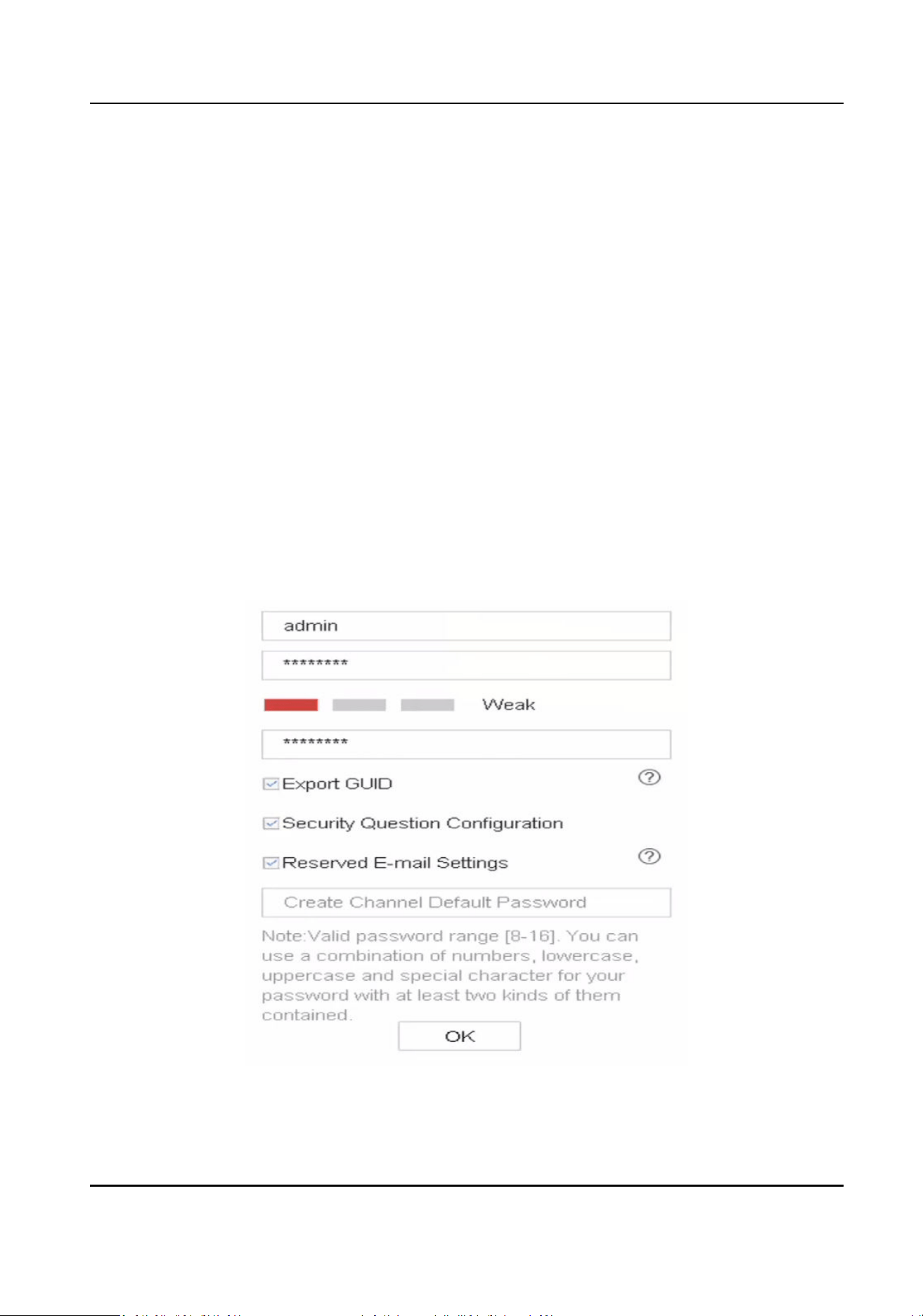
For the rst-me access, you need to acvate the device by seng an admin password. No
operaon is allowed before acvaon. You can also acvate the device via Web Browser, SADP or
Client Soware.
Steps
1.
Enter the admin password twice.
Figure 1-1 Acvate via Local Menu
Digital Video Recorder User Manual
1

Warning
We highly recommend you to create a strong password of your own choosing (using a minimum
of 8 characters, including at least three kinds of following categories: upper case leers, lower
case leers, numbers, and special characters) in order to increase the security of your product.
And we recommend you change your password regularly, especially in the high security system,
changing the password monthly or weekly can beer protect your product.
2.
Enter the password to acvate the IP cameras.
3.
Oponal: Check Export GUID, Security Queson Conguraon, or Reserved E-mail Sengs.
4.
Click OK.
Note
●
Aer the device is acvated, you should properly keep the password.
●
You can duplicate the password to the IP cameras that are connected with default protocol.
●
The available password reseng funcons may vary according to dierent models.
What to do next
●
When you have enabled Export GUID, connue to export the GUID le to the USB ash driver
for the future password reseng.
●
When you have enabled Security Queson Conguraon, connue to set the security quesons
for the future password reseng.
●
When you have enabled Reserved E-mail Sengs, connue to set the reserved email for the
future password reseng.
1.1.3 Acvate via SADP
SADP soware is used for detecng the online device, acvang the device, and reseng its
password.
Before You Start
Get the SADP soware from the supplied disk or the ocial website, and install the SADP
according to the prompts.
Steps
1.
Connect your video recorder power supply to an electrical outlet and turn on it.
2.
Run the SADP soware to search the online recorders.
3.
Check the recorder status from the device list, and select the inacve recorder.
Digital Video Recorder User Manual
2
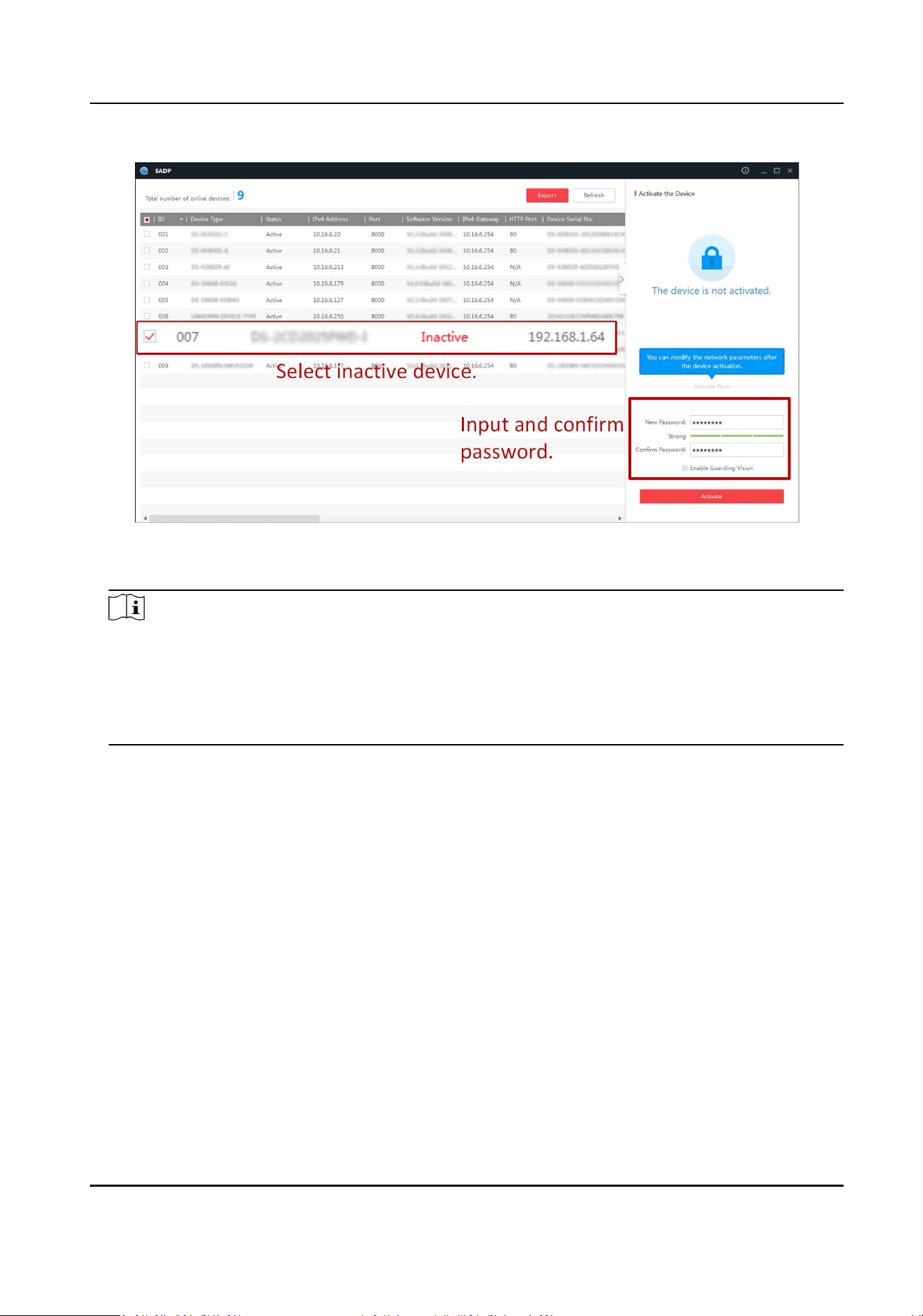
Figure 1-2 Acvate via SADP
4.
Create and input the new password in the password eld, and conrm the password.
Note
We highly recommend you to create a strong password of your own choosing (using a minimum
of 8 characters, including at least three kinds of following categories: upper case leers, lower
case leers, numbers, and special characters) in order to increase the security of your product.
And we recommend you change your password regularly, especially in the high security system,
changing the password monthly or weekly can beer protect your product.
5.
Click Acvate.
1.1.4 Acvate via Client Soware
The client soware is versale video management soware for mulple kinds of devices.
Before You Start
Get the client soware from the supplied disk or the ocial website, and install the soware
according to the prompts.
Steps
1.
Run the client soware and the control panel of the soware pops up, as shown below.
Digital Video Recorder User Manual
3
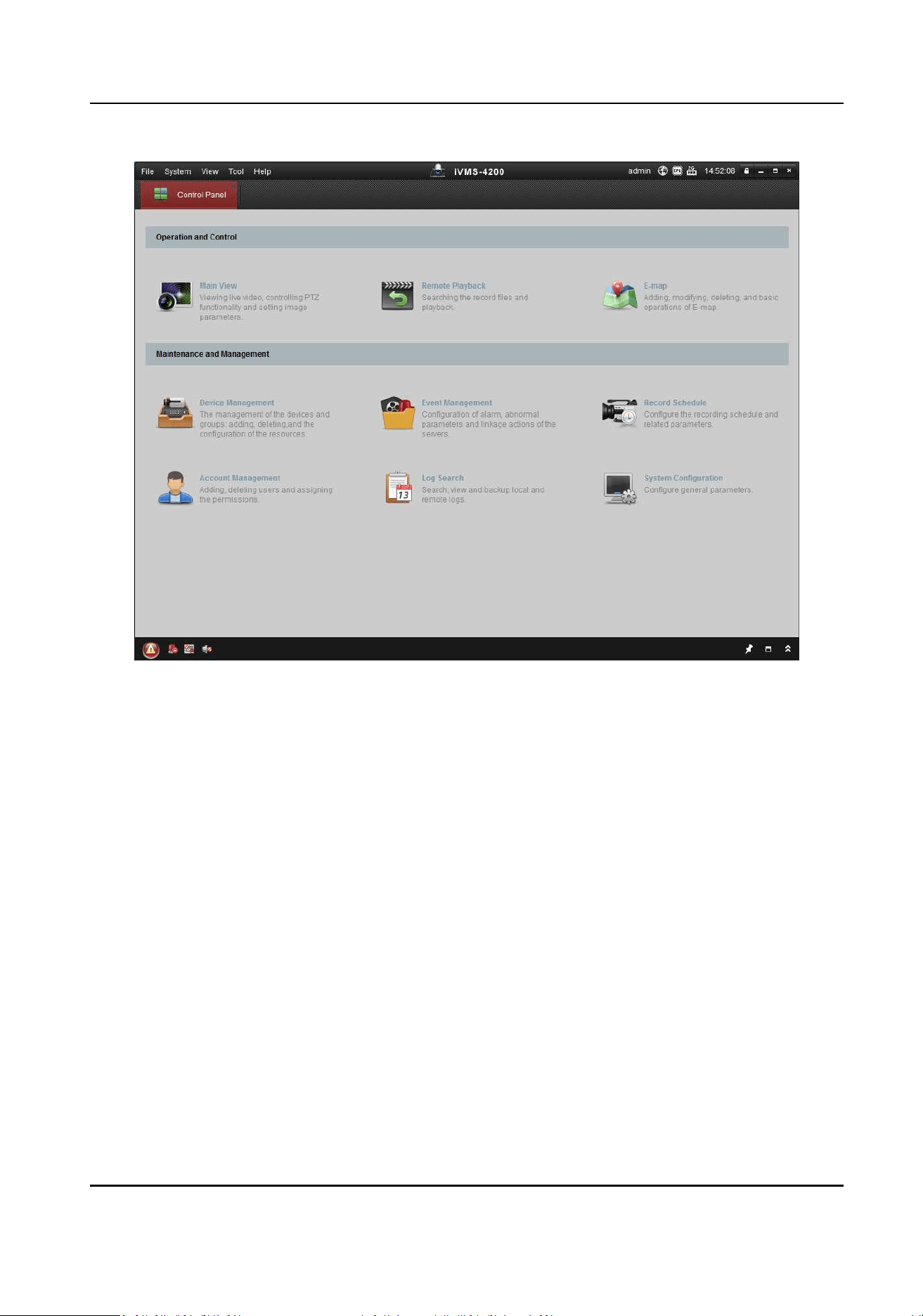
Figure 1-3 Control Panel
2.
Click Device Management to enter the Device Management interface, as shown below.
Digital Video Recorder User Manual
4
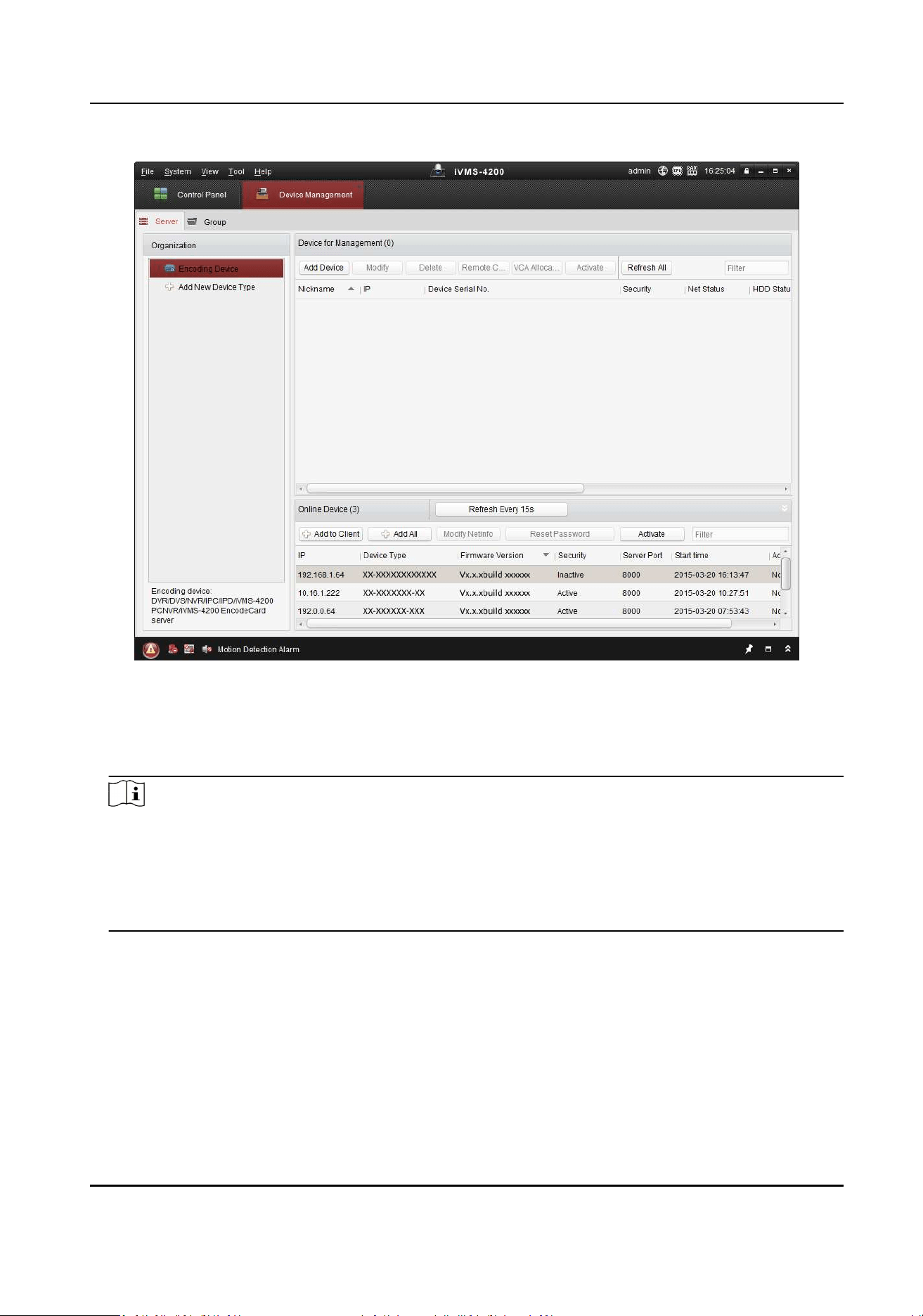
Figure 1-4 Device Management Interface
3.
Check the recorder status from the device list, and select an inacve recorder.
4.
Click Acvate to pop up the Acvaon interface.
5.
Create a password and input the password in the password eld, and conrm the password.
Note
We highly recommend you to create a strong password of your own choosing (using a minimum
of 8 characters, including at least three kinds of following categories: upper case leers, lower
case leers, numbers, and special characters) in order to increase the security of your product.
And we recommend you change your password regularly, especially in the high security system,
changing the password monthly or weekly can beer protect your product.
Digital Video Recorder User Manual
5
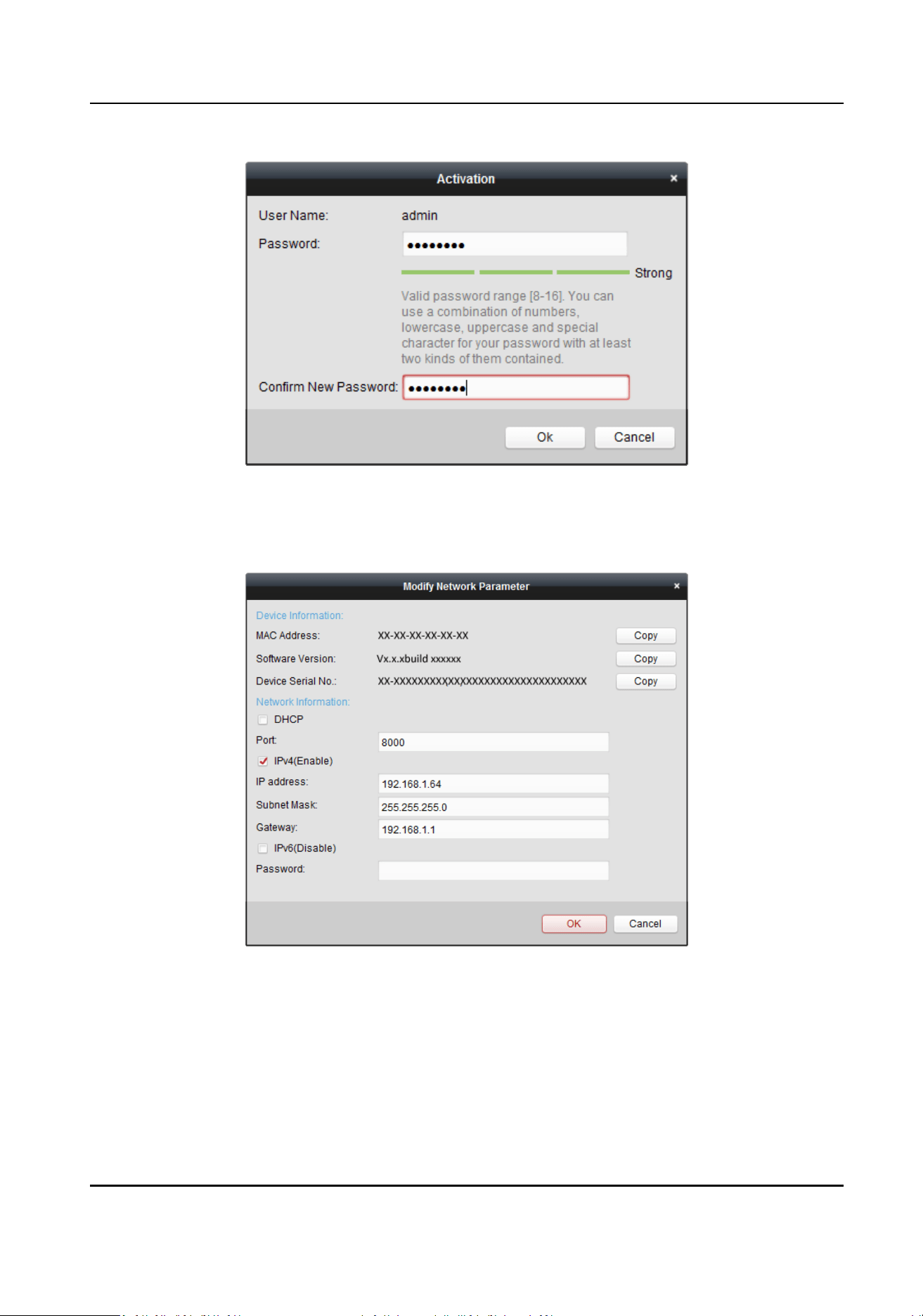
Figure 1-5 Acvaon
6.
Click OK to start acvaon.
7.
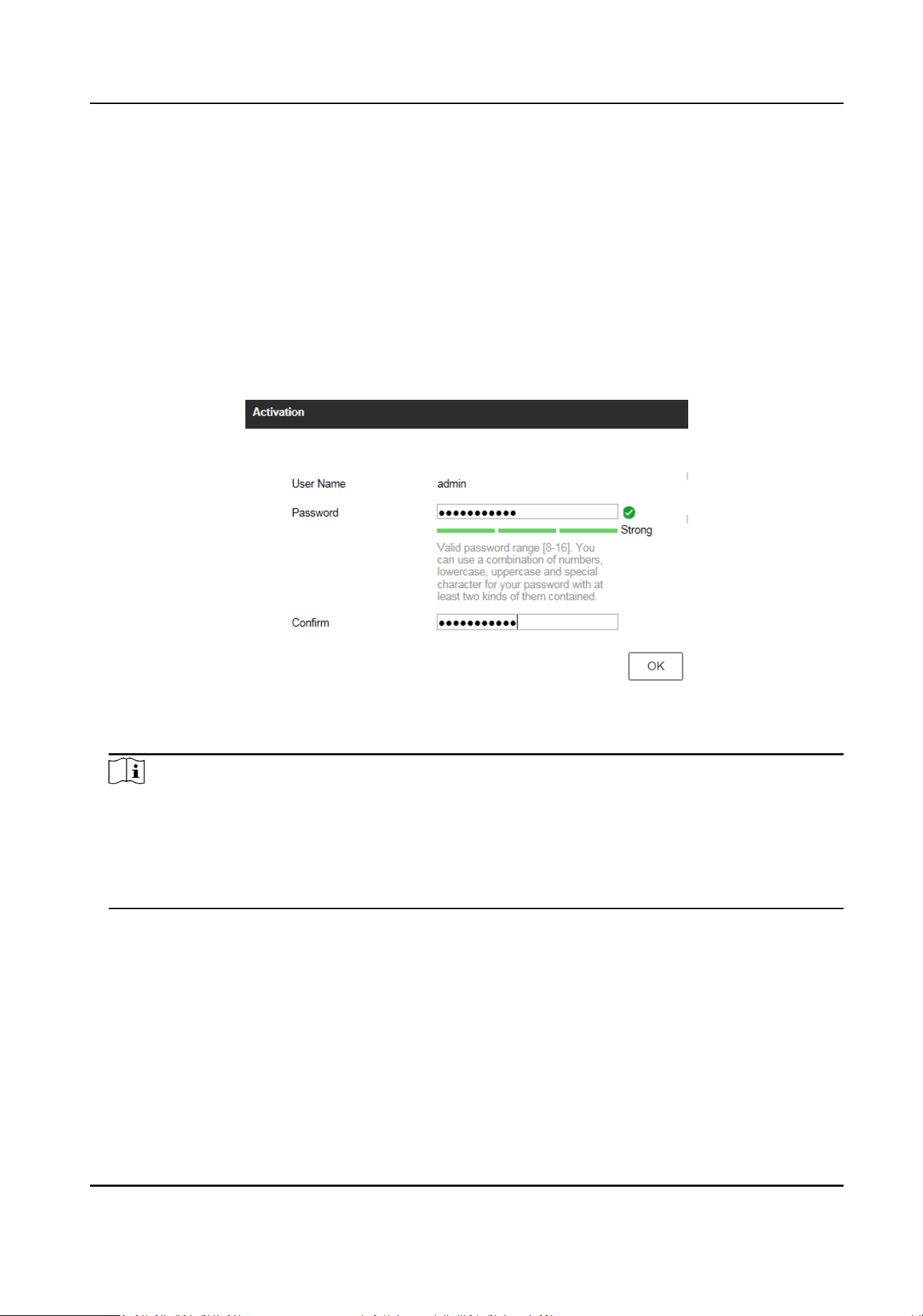
Click Modify Nenfo to pop up the Network Parameter Modicaon interface, as shown below.
Figure 1-6 Modify Network Parameters
8.
Change the recorder IP address to the same subnet with your computer.
-
Modify the IP address manually.
-
Check Enable DHCP.
9.
Input the password to acvate your IP address modicaon.
Digital Video Recorder User Manual
6
1.1.5 Acvate via Web Browser
You can get access to the recorder via web browser. You may use one of the following listed web
browsers: Internet Explorer 6.0 and above, Apple Safari, Mozilla Firefox, and Google Chrome. The
supported resoluons include 1024*768 and above.
Before You Start
Ensure you are on the same network segment with your device.
Steps
1.
Enter the IP address in web browser, and then press Enter.
Figure 1-7 Web Browser Acvaon
2.
Set the password for the admin user account.
Note
We highly recommend you to create a strong password of your own choosing (using a minimum
of 8 characters, including at least three kinds of following categories: upper case leers, lower
case leers, numbers, and special characters) in order to increase the security of your product.
And we recommend you change your password regularly, especially in the high security system,
changing the password monthly or weekly can beer protect your product.
3.
Click OK.
4.
Oponal: Set the security quesons, password recovery email, or export GUID le for password
reseng in the future.
5.
Click OK.
6.
Install the plug-in before viewing the live video and managing the device. You may have to close
the web browser to nish the installaon of the plug-in.
Digital Video Recorder User Manual
7
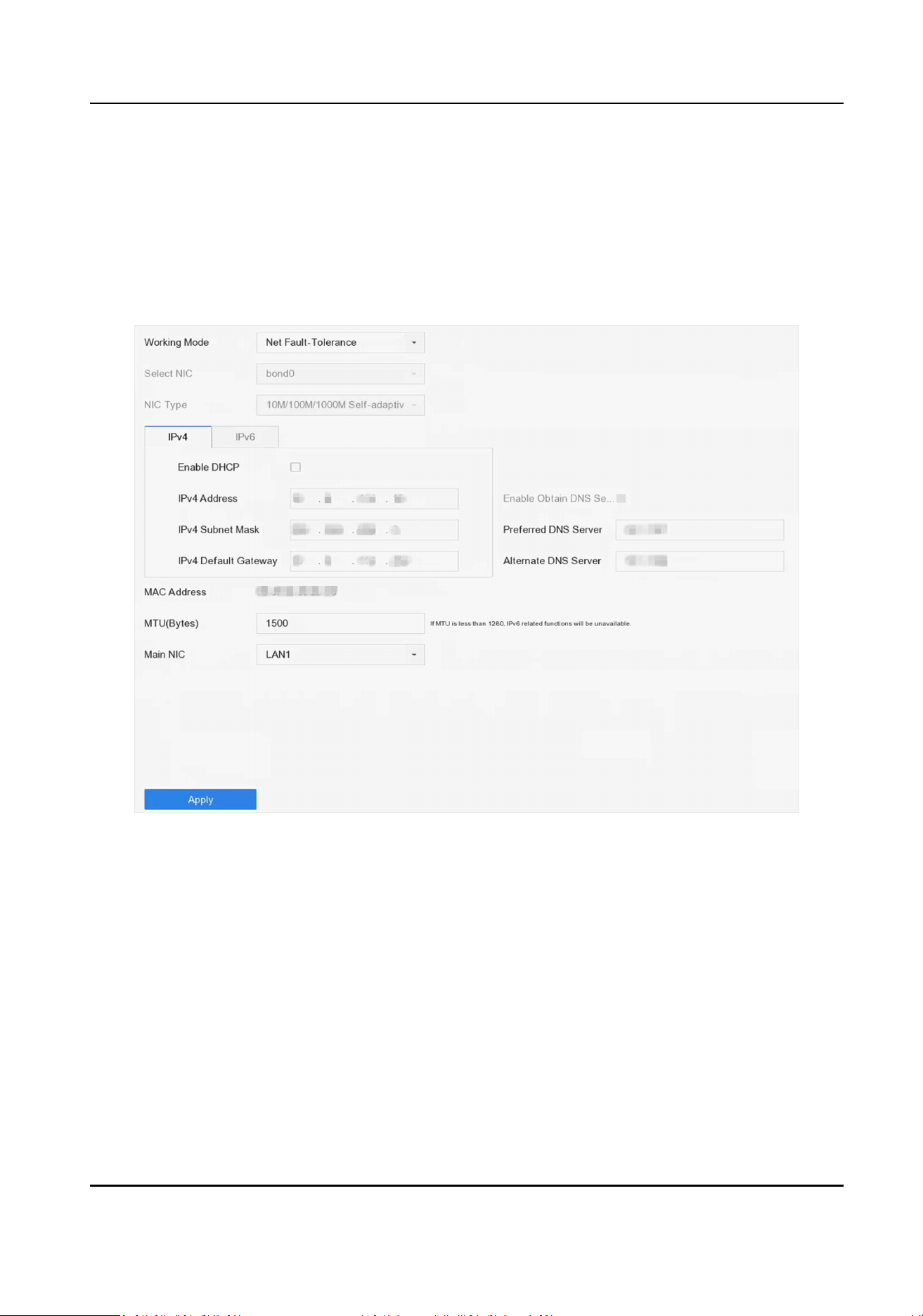
1.2 Congure TCP/IP
TCP/IP must be properly congured before operang your device over a network. Both IPv4 and
IPv6 are available.
Steps
1.
Go to System → Network → TCP/IP .
Figure 1-8 TCP/IP Sengs
2.
Select Working Mode as Net-Fault Tolerance or Mul-Address Mode.
Net-Fault Tolerance
The two NIC cards use the same IP address, and you can select the main NIC to LAN1 or LAN2.
In this way, in case of one NIC card failure, the device will automacally enable another
standby NIC card so as to ensure the normal running of the system.
Mul-Address Mode
The parameters of the two NIC cards can be congured independently. You can select LAN1
or LAN2 under Select NIC for parameter sengs. Select one NIC card as the default route.
When the system connects with the extranet, the data will be forwarded through the default
route.
3.
Click IPv4 or IPv6 as you required.
Digital Video Recorder User Manual
8
4.
Oponal: Check Enable DHCP to obtain IP sengs automacally if a DHCP server is available on
the network.
5.
Set related parameters.
Note
Valid MTU value range is from 500 to 1500.
6.
Click Apply.
1.3 Congure HDD
Ensure the video recorder storage media is well. You can install at least one HDD and inialize it, or
create a RAID and inialize it.
1.4 Congure Signal Input
You can congure the analog and IP signal input types, disabling one analog channel can add one IP
channel.
Steps
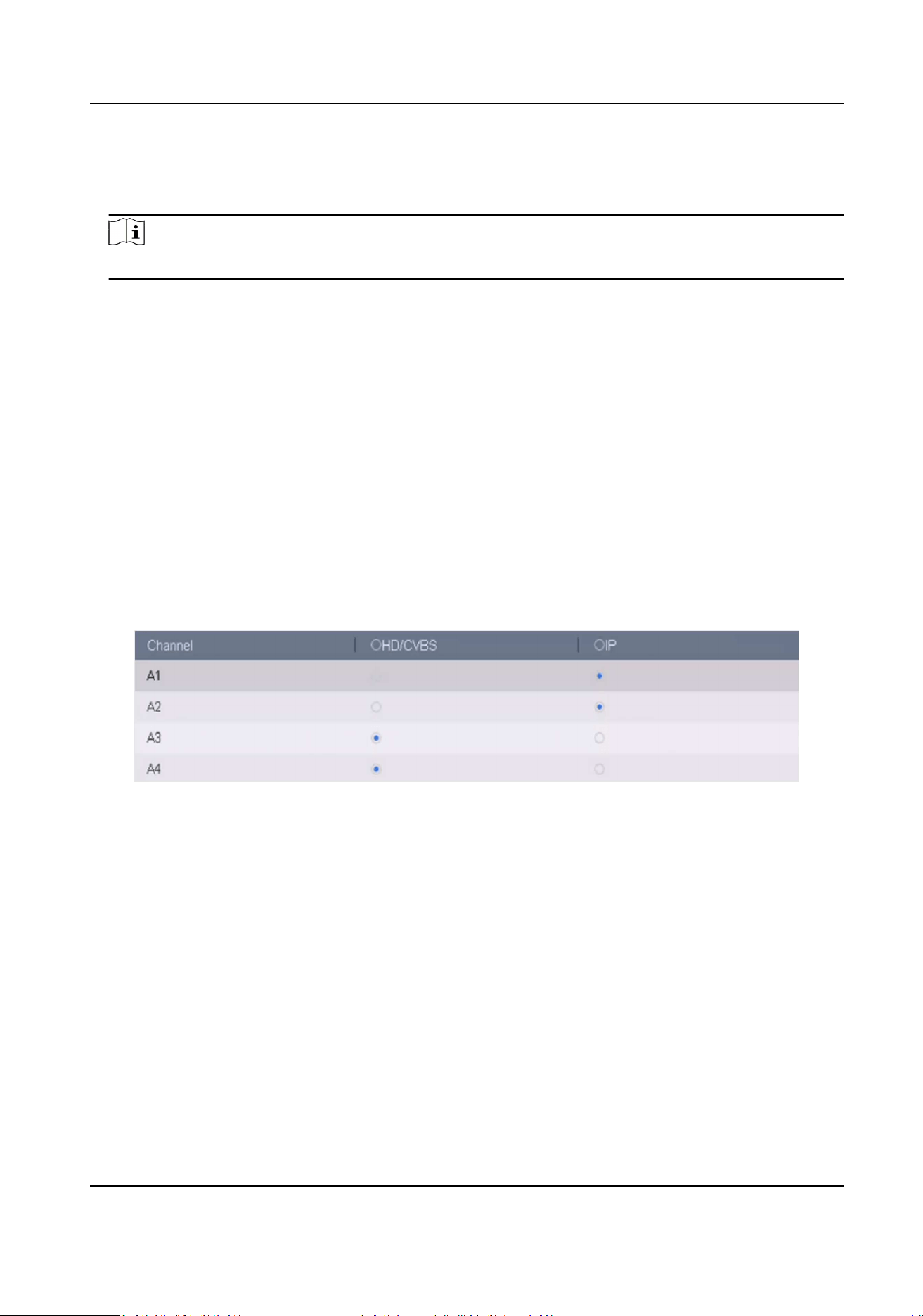
1.
Go to Camera → Camera → Analog .
Figure 1-9 Signal Input Type
2.
Select signal input type as HD/CVBS or IP for each channel.
HD/CVBS
Four types of analog signal inputs including Turbo HD, AHD, HDCVI, and CVBS can be
connected randomly for the channel.
IP
Network camera can be connected for the channel.
3.
Click Apply. You can view the maximum network camera accessible number in Max. IP Camera
Number.
Digital Video Recorder User Manual
9

1.5 Congure Enhanced IP Mode
Enabling enhanced IP mode will allow you to connect to the maximum number of cameras, but
disable 2K/4K output resoluon, and make perimeter protecon, human or vehicle detecon of
moon detecon, facial detecon and face picture comparison funcons unavailable in analog
channel.
Note
This funcon is only available for certain models.
Go to System → General , and check Enhanced IP Mode.
1.6 Connect PoC Camera
The devices of /P series can detect the connected PoC cameras automacally, manage the power
consumpon via the coaxial communicaon, and provide power to the cameras via coaxitron.
Before You Start
●
Ensure your device supports PoC (Power over Coaxitron) cameras connecon.
●
Connect the PoC camera to the DVR.
Steps
1.
Go to Menu → Camera → PoC Status .
2.
Turn on the PoC for the channel(s) as your desire.
3.
Check the status of connected PoC camera.
●
If the power consumpon of the DVR is lower than that of AF camera, when AF or AT camera
is connected, there is no video and “Insucient Power for PoC” is overlaid on the live view
image.
●
If the power consumpon of the DVR is higher than that of the AF camera and lower than that
of the AT camera, when AF camera is connected, it is powered on normally; when AT camera
is connected, it is powered on and then powered o, and there is no video and “Insucient
Power for PoC” is overlaid on the live view image.
●
If the power consumpon of the DVR is higher than that of the AT camera, when AF or AT
camera is connected, it is powered on normally.
4.
Check the connected AF or AT camera number and the connectable camera number.
Digital Video Recorder User Manual
10
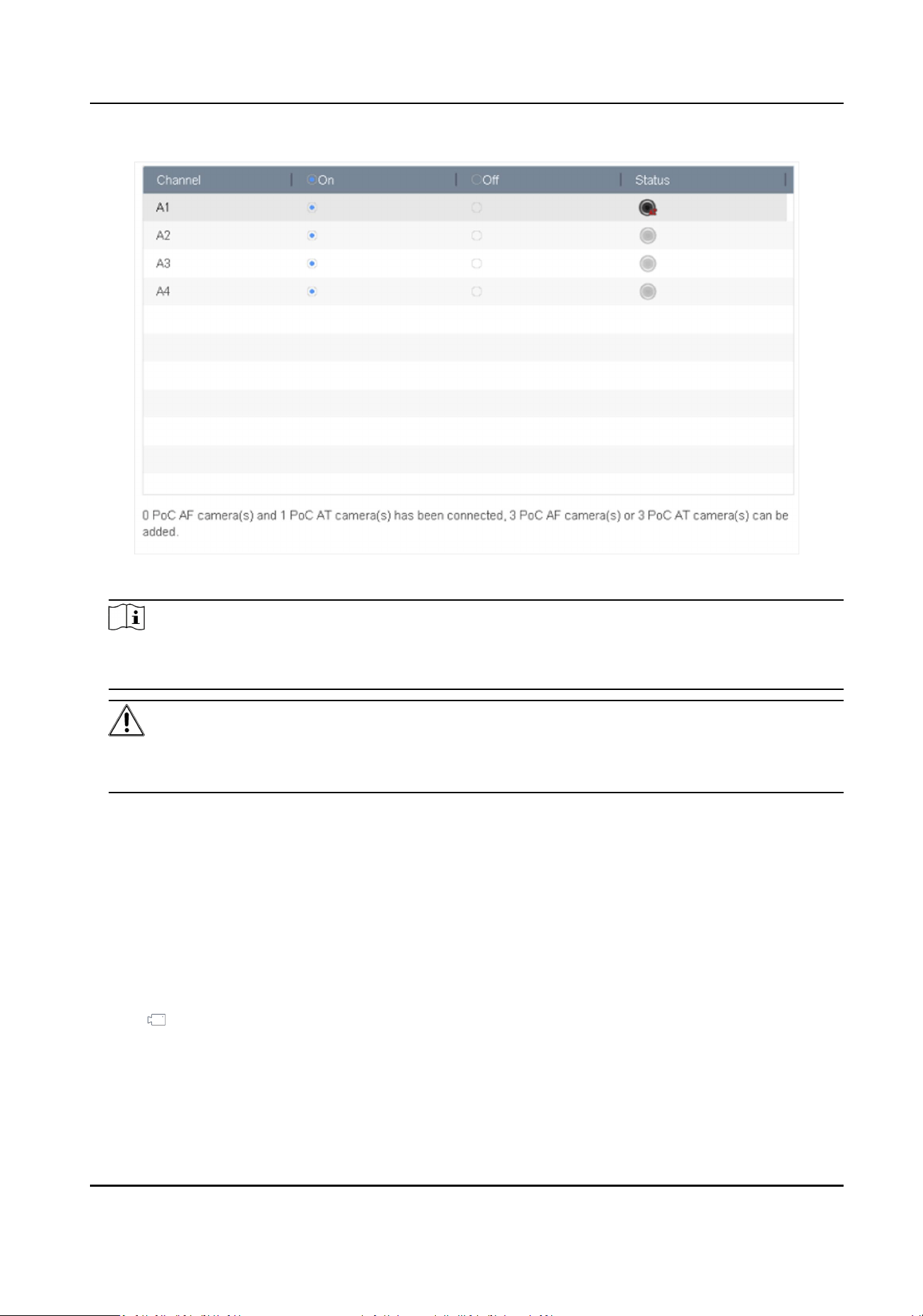
Figure 1-10 PoC Status
Note
●
Only Hikvision PoC camera is supported.
●
The maximum connectable AT/AF camera number varies with dierent models.
Warning
Please turn o the PoC funcon if the camera does not support PoC, or the camera is not
produced by Hikvision. Otherwise, it may result in permanent damage to the camera or DVR.
1.7 Add Network Camera
Before you can get live video or record the video les, you must add the network cameras to the
connecon list of the device.
Before You Start
Ensure the network connecon is valid and correct and the IP camera to add has been acvated.
Steps
1.
Click on the main menu bar.
2.
Click Custom Add tab on the tle bar.
Digital Video Recorder User Manual
11
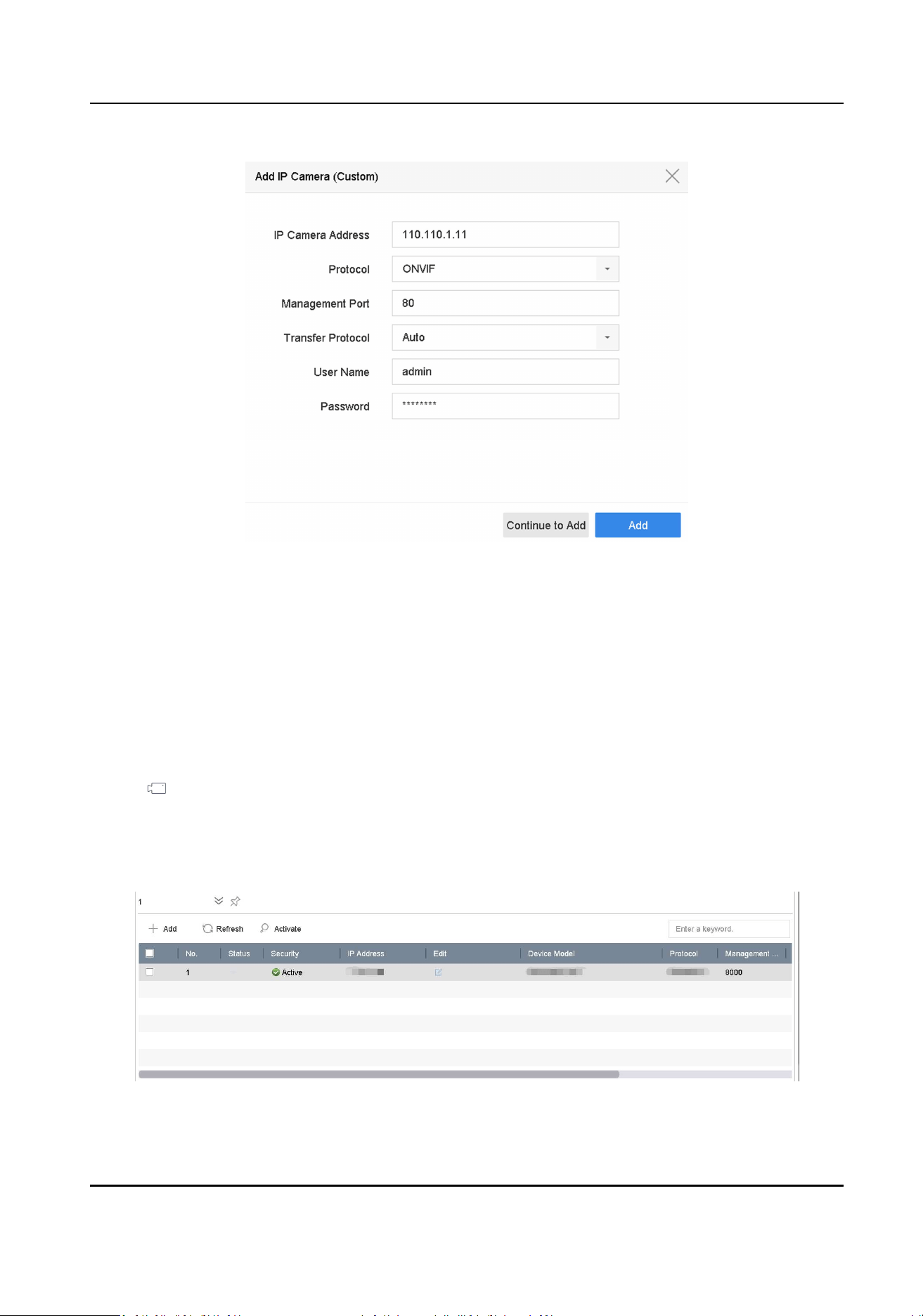
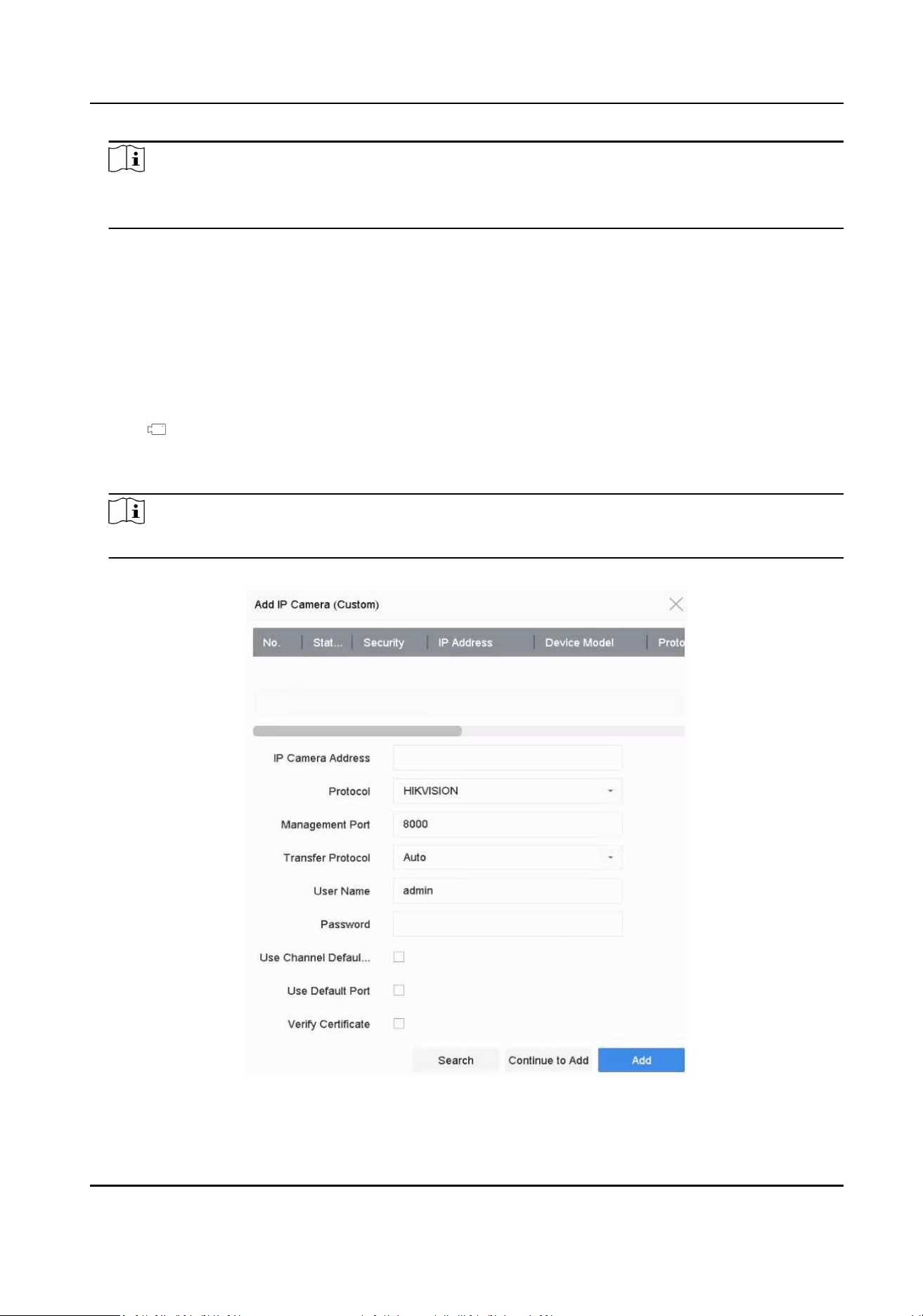
Figure 1-11 Add IP Camera
3.
Enter IP address, protocol, management port, and other IP camera informaon to add.
4.
Enter the login user name and password of the IP camera.
5.
Click Add to nish the adding of the IP camera.
6.
Oponal: Click Connue to Add to connue to add addional IP cameras.
1.7.1 Add Automacally Searched Online Network Camera
Steps
1.
Click on the main menu.
2.
Click Number of Unadded Online Device at the boom.
3.
Select the automacally searched online network cameras.
4.
Click Add to add the camera which has the same login password with the video recorder.
Figure 1-12 Add Automacally Searched Online Network Camera
Digital Video Recorder User Manual
12
Note
If the network camera to add has not been acvated, you can acvate it in the network camera
list of camera management interface.
1.7.2 Add Network Camera Manually
Before you view live video or record video les, you must add network cameras to the device.
Before You Start
Ensure the network connecon is valid and correct, and the network camera is acvated.
Steps
1.
Click on the main menu.
2.
Click Custom Add.
3.
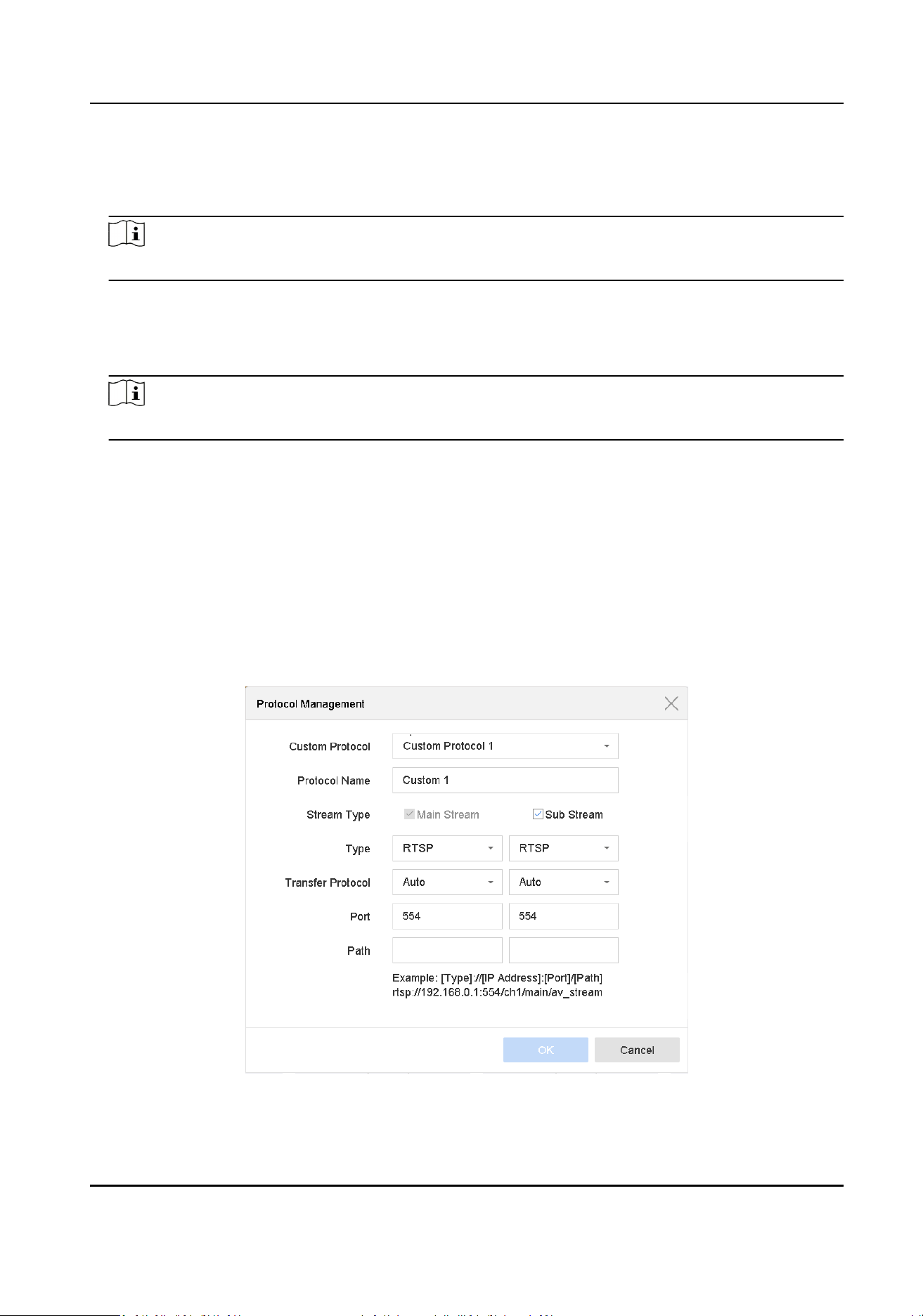
Set the parameters. For example, IP Camera Address, Protocol, etc.
Note
Management port ranges from 1 to 65535.
Figure 1-13 Add Network Camera
Digital Video Recorder User Manual
13
4.
Oponal: Check Use Channel Default Password to use the default password to add the camera.
5.
Oponal: Check Use Default Port to use the default management port to add the camera. For
SDK service, the default port value is 8000. For enhanced SDK service, the default value is 8443.
Note
The funcon is only available when you use HIKVISION protocol.
6.
Oponal: Check Verify Cercate to verify the camera with cercate. The cercate is a form
of idencaon for the camera that provides more secure camera authencaon. It requires to
import the network camera cercate to the device rst when you use this funcon. For details,
refer to .
Note
The enhanced SDK service is only available when you use HIKVISION protocol.
7.
Click Add.
8.
Oponal: Check Connue to Add to add other network cameras.
1.7.3 Add Network Camera via Customized Protocol
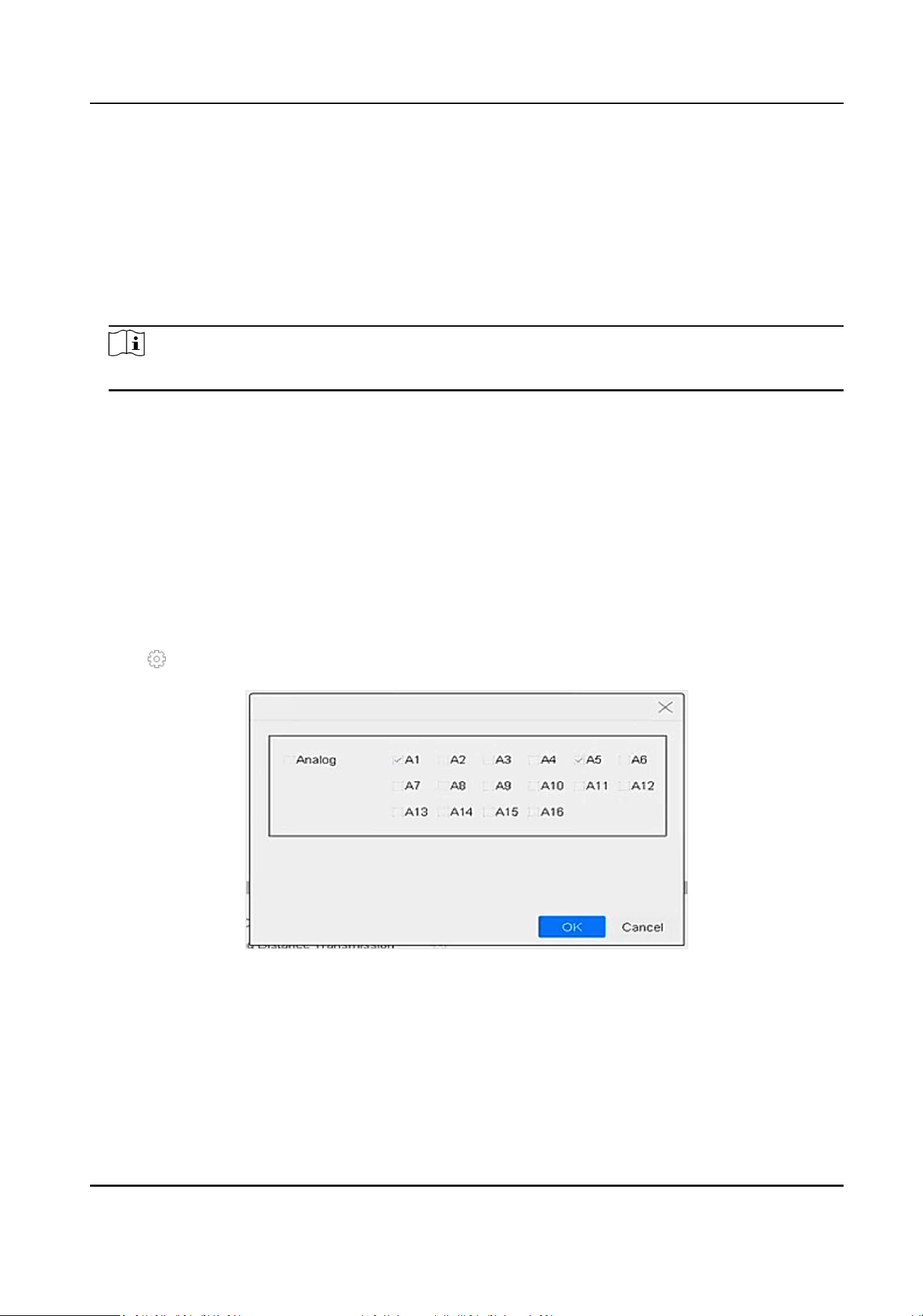
For network cameras that are not using standard protocols, you can congure customized
protocols to add them. The system provides 16 customized protocols.
Steps
1.
Go to More Sengs → Protocol .
Figure 1-14 Protocol Management
Digital Video Recorder User Manual
14
2.
Set protocol parameters.
Type
The network camera adopng custom protocol must support geng stream through
standard RTSP.
Path
Contact the manufacturer of network camera for the URL (Uniform Resource Locator) of
geng main stream and sub-stream.
Note
The protocol type and the transfer protocol must be supported by the network camera to add.
3.
Click OK.
4.
Click Custom Add to add cameras.
5.
Set the parameters.
6.
Click OK.
1.8 Congure 5 MP Long Distance Transmission
For certain models, you can congure 5 MP long distance transmission.
Steps
1.
Go to Camera → Camera → Analog .
2.
Click to enter the 5 MP Long Distance Transmission Sengs interface.
Figure 1-15 5 MP Long Distance Transmission Sengs
3.
Select channel(s) to enable 5 MP Long Distance Transmission.
4.
Click OK.
5.
Click Apply.
Digital Video Recorder User Manual
15

1.9 Connect to Plaorm
1.9.1 Congure Hik-Connect
Hik-Connect provides mobile phone applicaon and plaorm service to access and manage your
video recorder, which enables you to get a convenient remote access to the video security system.
Steps
1.
Go to System → Network → Advanced → Plaorm Access .
2.
Check Enable to acvate the funcon. Then the service terms will pop up.
1) Enter Vericaon Code.
2) Scan the QR code to read the service terms and privacy statement.
3) Check The Hik-Connect service will require Internet access. Please read Service Terms and
Privacy Statement before enabling the service. if you agree with the service terms and
privacy statement.
4) Click OK.
Note
●
Hik-Connect is disabled by default.
●
The vericaon code is empty by default. It must contain 6 to 12 leers or numbers, and it is
case sensive.
3.
Oponal: Congure following parameters.
●
Check Custom and enter Server Address as your desire.
●
Check Enable Stream Encrypon, then vericaon code is required for remote access and live
view.
●
Check Time Sync, and the device will sync me with Hik-Connect instead of NTP server.
4.
Bind your device with a Hik-Connect account.
1) Use a smart phone to scan the QR code, and download Hik-Connect app. You can also
download it from
hps://appstore.hikvision.com , or the QR code below. Refer to Hik-
Connect Mobile Client User Manual for details.
Digital Video Recorder User Manual
16

Figure 1-16 Download Hik-Connect
2) Use Hik-Connect to scan the device QR, and bind the device.
Note
If the device is already bound with an account, you can click Unbind to unbind with the
current account.
5.
Click Apply.
What to do next
You can access your video recorder via Hik-Connect.
1.9.2 Congure ISUP
SDK is based on Intelligent Security Uplink Protocol (ISUP). It provides APIs, library les, and
commands for the third-party plaorm to access devices such as NVRs, speed domes, DVRs,
network cameras, mobile NVRs, mobile devices, decoding devices, etc. With this protocol, the
third-party plaorm can realize funcons like live view, playback, two-way audio, PTZ control, etc.
Steps
Note
This funcon is only available for certain models.
1.
Go to System → Network → Advanced → Plaorm Access .
Digital Video Recorder User Manual
17
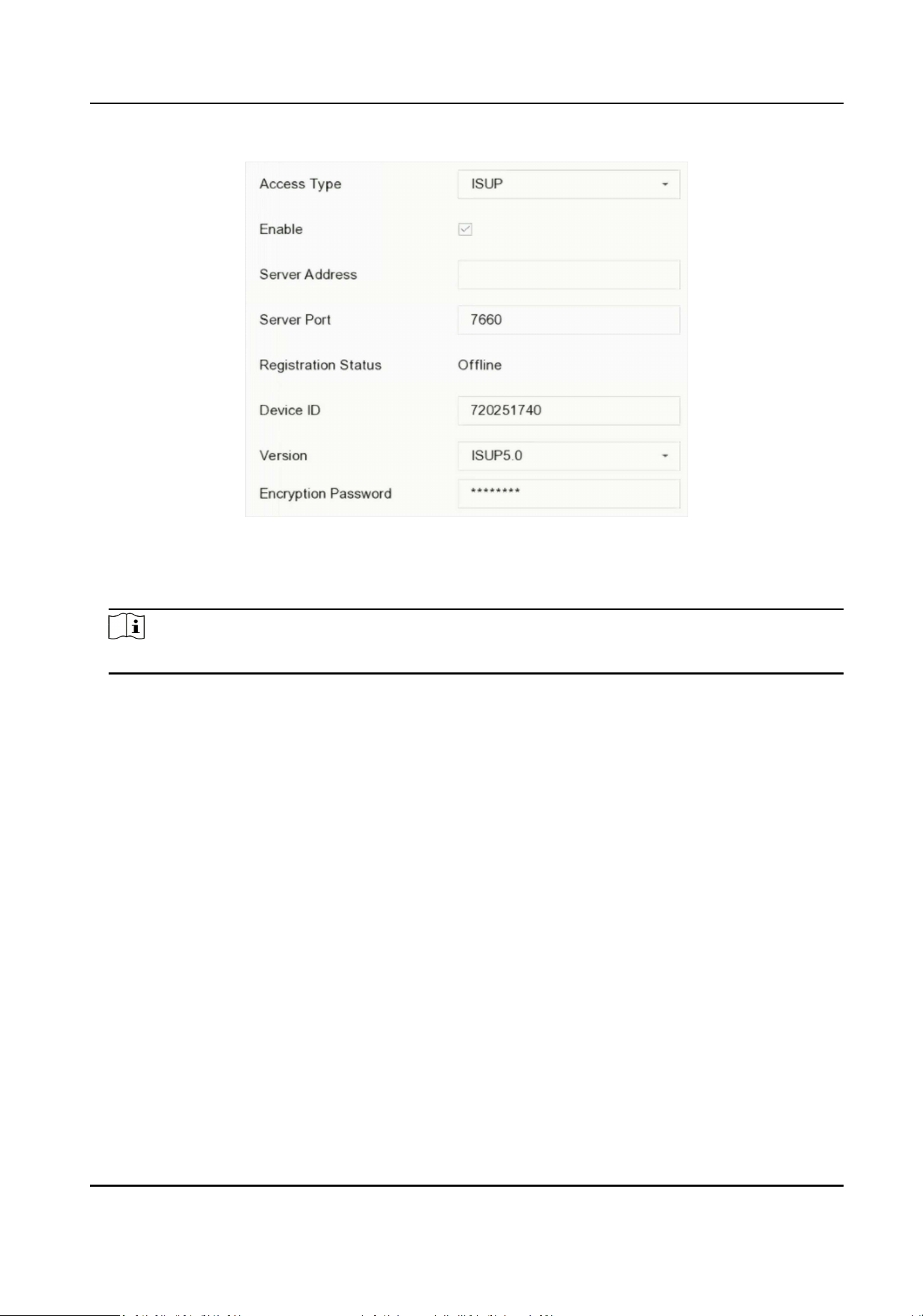
Figure 1-17 ISUP Sengs
2.
Select Access Type as ISUP.
3.
Check Enable.
Note
Enabling ISUP will disable other plaorm access.
4.
Set the related parameters.
Server Address
The plaorm server IP address.
Server Port
The plaorm server port, ranges from 1024 to 65535. The actual port shall be provided by
the plaorm.
Device ID
Device ID shall be provided by the plaorm.
Version
ISUP protocol version, only V5.0 is available.
Encrypon Password
Encrypon password is required when using ISUP V5.0 version, it provides more secure
communicaon between the device and plaorm. Enter it for vericaon aer the device is
registered to the ISUP plaorm. It cannot be empty, or "ABCDEF".
5.
Click Apply to save the sengs and restart the device.
What to do next
You can see the registraon status (online or oine) aer the device is restarted.
Digital Video Recorder User Manual
18
Chapter 2 Camera Sengs
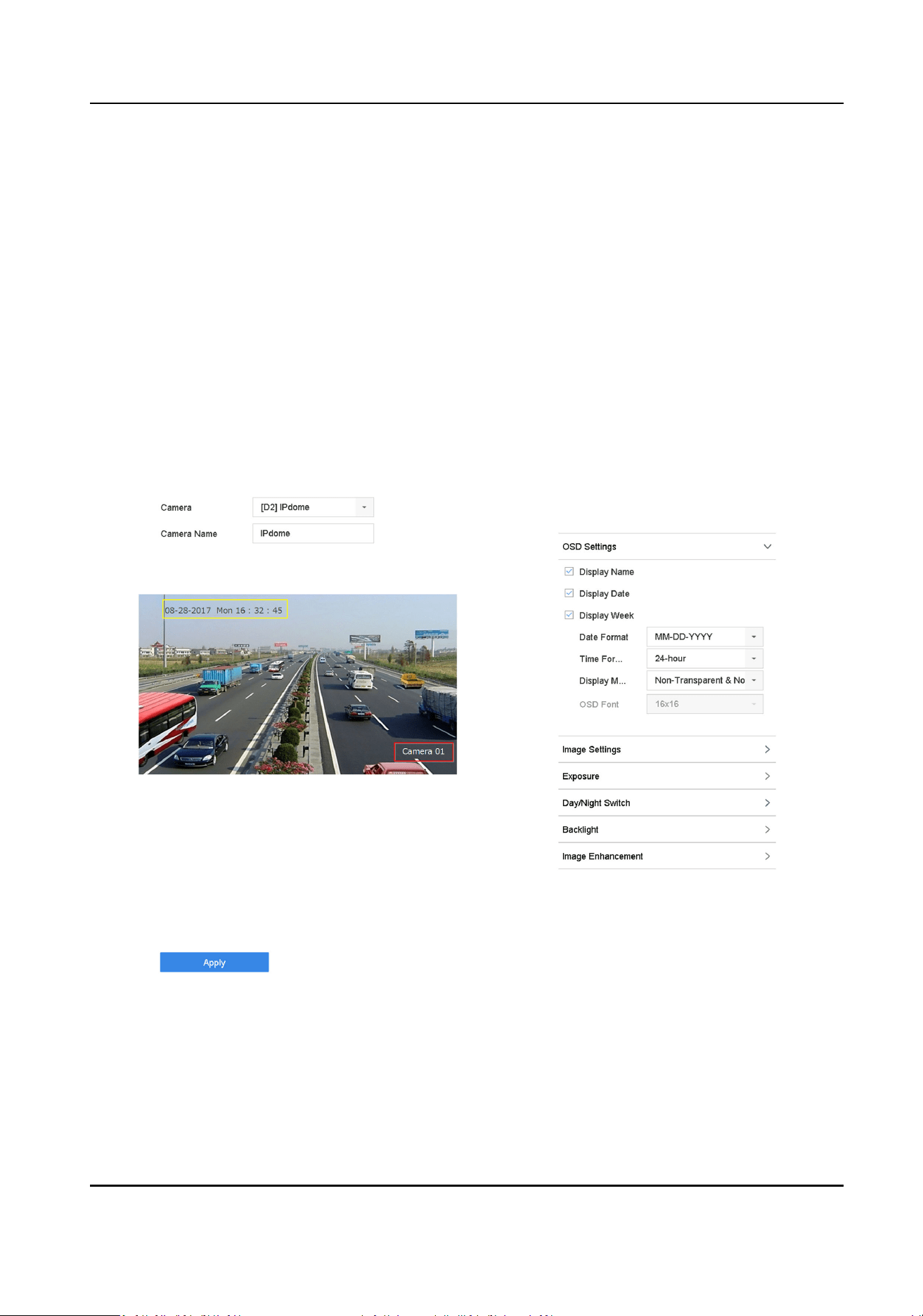
2.1 Congure OSD
You can congure the OSD (On-screen Display) for the camera, including date/me, camera name,
etc.
Steps
1.
Go to Camera → Display .
2.
Select a camera as your desire.
3.
Edit name in Camera Name.
4.
Check Display Name, Display Date and Display Week to show the informaon on the image.
5.
Set the date format, me format, and display mode.
Figure 2-1 OSD Sengs
6.
Drag the text frame on the preview window to adjust the OSD posion.
7.
Click Apply.
Digital Video Recorder User Manual
19

2.2 Congure Image Parameters
You can customize image parameters, including day/night switch, backlight, contrast, and
saturaon in Camera → Display .
Image Sengs
Customize the image parameters including brightness, contrast, and saturaon.
Exposure
Set the camera exposure me (1/10000 to 1 sec). A larger exposure value results in a brighter
image.
Day/Night Switch
Set the camera to day, night, or auto switch mode according to me or the surrounding
illuminaon condion. When the light diminishes at night, the camera can switches to night
mode with high quality black and white image.
Backlight
Set the camera's wide dynamic range (0 to 100). When the surrounding illuminaon and the
object have large dierences in brightness, you can set the WDR value to balance the brightness
level of the whole image.
Image Enhancement
For opmized image contrast enhancement that reduces noise in video stream.
2.3 Congure Camera Parameters Sengs
You can congure the camera parameters, including day/night mode, supplement light mode, etc.
Steps
1.
Go to Camera → Display .
2.
Select a camera as your desire.
3.
Edit name in Camera Name.
4.
Congure the parameters.
Signal Switch
Switch the 4 MP or 5 MP signal from Signal Switch. 4 MP 25/30 fps and 5 MP 20 fps are
selectable. The 4 MP 25 fps and 4 MP 30 fps signals are self-adapve for the camera.
Enable Defog
Check Enable Defogto enable the defog funcon of the selected camera. And set the Defog
Levelfrom 1 to 4.
Day to Night Sensivity/Night to Day Sensivity
Digital Video Recorder User Manual
20

Adjust the parameters including Day to Night Sensivity, Night to Day Sensivity and IR
Light Brightness for the cameras. The default value of Day to Night Sensivity, Night to Day
Sensivity and IR Light Brightness is 5. The eecve value ranges from 1 to 9
Day/Night Mode
Select Day/Night Mode of the camera from the drop-down list.
As for the day mode, the image is always in color. As for the night mode, the image is black/
white.
WDR Switch
Check WDR Switch to enable the funcon of the camera.
5.
Oponal: Click Copy to copy the parameters of the current camera to other cameras.
6.
Oponal: Click Apply to save the sengs.
Note
●
The parameters are saved to the connected camera and are not saved to the DVR.
●
If you exit from the interface and enter it again, the parameters displayed are those you have
set the last me.
●
The camera parameters sengs is only applicable for the cameras which support those
funcons.
2.4 Congure Privacy Mask
The privacy mask protects personal privacy by concealing parts of the image from live view or
recording with a masked area.
Steps
1.
Go to Camera → Privacy Mask .
2.
Select a camera to set privacy mask.
3.
Check Enable.
4.
Draw a zone on the window. The zone will be marked by dierent frame colors.
Digital Video Recorder User Manual
21
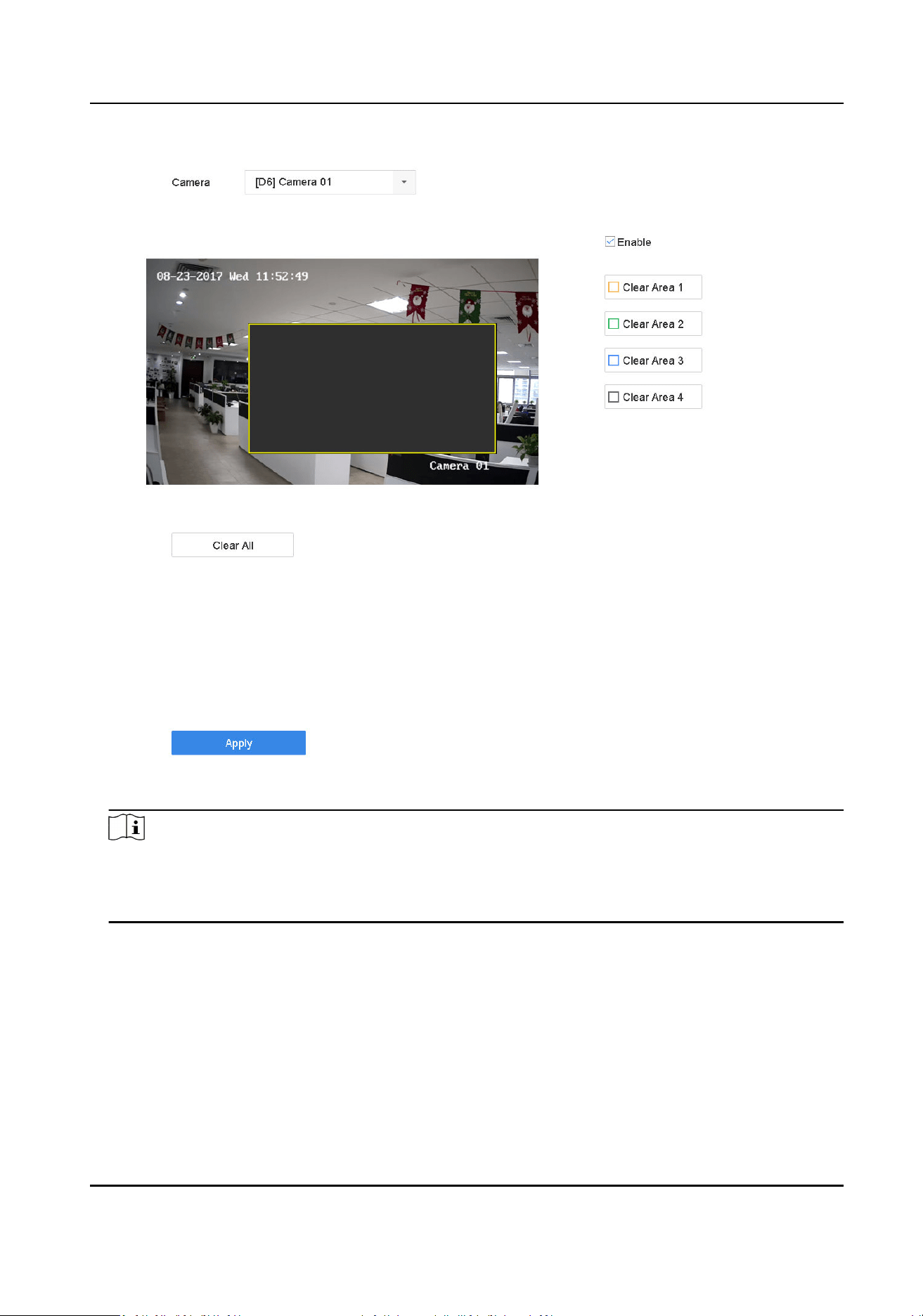
Figure 2-2 Privacy Mask Sengs
Note
●
Up to 4 privacy masks zones can be congured and the size of each area can be adjusted.
●
You can clear the congured privacy mask zones on the window by clicking the corresponding
clear zone 1 to 4 icons on the right of the window, or click Clear All to clear all zones.
5.
Click Apply.
2.5 Import/Export IP Camera Conguraon Files
The IP camera informaon, including the IP address, manage port, password of admin, etc., can be
saved in Microso Excel format and backed up to the local device. The exported le can be edited
on a PC, including adding or deleng the content, and copying the seng to other devices by
imporng the Excel le to it.
Digital Video Recorder User Manual
22

Before You Start
When imporng the conguraon le, connect the storage device that contains the conguraon
le to the device.
Steps
1.
Go to Camera → IP Camera Import/Export .
2.
Click IP Camera Import/Export, and the detected external device contents appear.
3.
Export or import the IP camera conguraon les.
-
Click Export to export the conguraon les to the selected local backup device.
-
To import a conguraon le, select the le from the selected backup device and click Import.
Note
Aer the imporng process is completed, you must reboot the device to acvate the sengs.
2.6 IP Camera Time Sync
The device can automacally synchronize the me of connected IP camera aer enabling this
funcon.
Steps
Note
This funcon is only available for certain models.
1.
Go to Camera → Camera → IP Camera .
2.
Posion the cursor on the window of the IP camera and click .
3.
Check Enable IP Camera Time Sync.
4.
Click OK.
2.7 Save Camera VCA Data
Aer saving camera VCA data to your device, you will be able to search the camera VCA data.
Go to Storage → Advanced to enable Save VCA Data via local GUI interface.
Go to Conguraon → Video and Audio → Display Info. on Scream to turn on Enable Dual-VCA
via web browser.
2.8 Upgrade IP Cameras
The IP camera can be remotely upgraded through the device.
Digital Video Recorder User Manual
23

Before You Start
Ensure you have inserted the USB ash drive to the device, and it contains the IP camera upgrade
rmware.
Steps
1.
On the camera management interface, select a camera.
2.
Go to More Sengs → Upgrade .
3.
Select the rmware upgrade le from the USB ash drive.
4.
Click Upgrade.
The IP camera will reboot automacally aer the upgrading completes.
Digital Video Recorder User Manual
24
Chapter 3 Live View
Live view displays the video image geng from each camera in real me.
3.1 Start Live View
Click on the main menu bar.
●
Select a window and double click a camera from the channel list to play the live image of the
camera.
●
Double click a window to view it in single-screen mode. Double click again to exit single-screen
mode.
●
Use the toolbar at the playing window boom to realize the capture, instant playback, audio on/
o, digital zoom, live view strategy, show informaon and start/stop recording, etc.
●
Click to start/stop auto-switch. The screen will automacally switch to the next one.
●
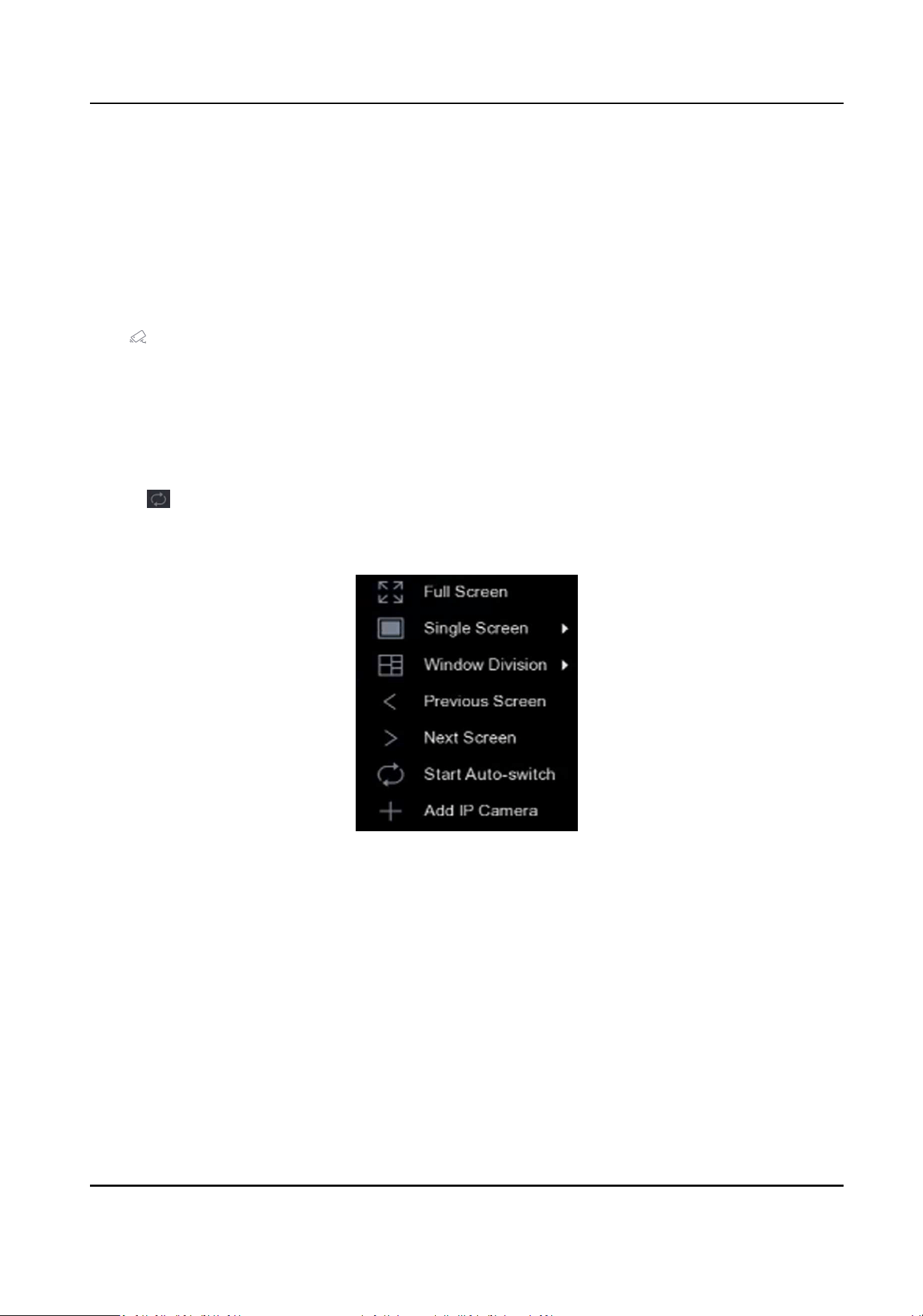
Move the cursor to a window, and right click your mouse to display the shortcut menu of the
window. The shortcut menu will be dierent according to the window.
Figure 3-1 Shortcut Menu
3.1.1 Congure Live View Sengs
Live View sengs can be customized. You can congure the output interface, dwell me for screen
to be shown, mute or turning on the audio, the screen number for each channel, etc.
Steps
1.
Go to System → Live View → General .
Digital Video Recorder User Manual
25

Figure 3-2 Live View-General
2.
Congure the live view parameters.
Video Output Interface
Select the video output to congure.
Live View Mode
Select the display mode for Live View, e.g., 2*2, 1*5, etc.
Dwell Time
The me in seconds to wait between switching of cameras when using auto-switch in Live
View.
Enable Audio Output
Enable/disable audio output for the selected video output.
Volume
Adjust the Live View volume, playback and two-way audio for the selected output interface.
Event Output
Select the output to show event video.
Full Screen Monitoring Dwell Time
Set the me in seconds to show alarm event screen.
3.
Click OK.
3.1.2 Congure Auto-Switch of Cameras
You can set the auto-switch of cameras to play in dierent display modes.
Steps
1.
Go to System → Live View → General .
2.
Set Video Output Interface, Live View Mode, and Dwell Time.
Video Output Interface
Digital Video Recorder User Manual
26

Select the video output interface.
Live View Mode
Select the display mode for live view, e.g., 2*2, 1*5, etc.
Dwell Time
The me in seconds to dwell between switching of cameras when enabling auto-switch. The
range is from 5s to 300s.
3.
Go to View Sengs to set the view layout.
4.
Click OK to save the sengs.
3.1.3 Congure Live View Layout
Live view displays the video image geng from each camera in real me.
Congure Custom Live View Layout
Steps
1.
Go to System → Live View → View .
2.
Click Set Custom Layout.
3.
Click on the Custom Layout Conguraon interface.
4.
Edit the layout name.
5.
Select a window division mode from the toolbar.
Digital Video Recorder User Manual
27
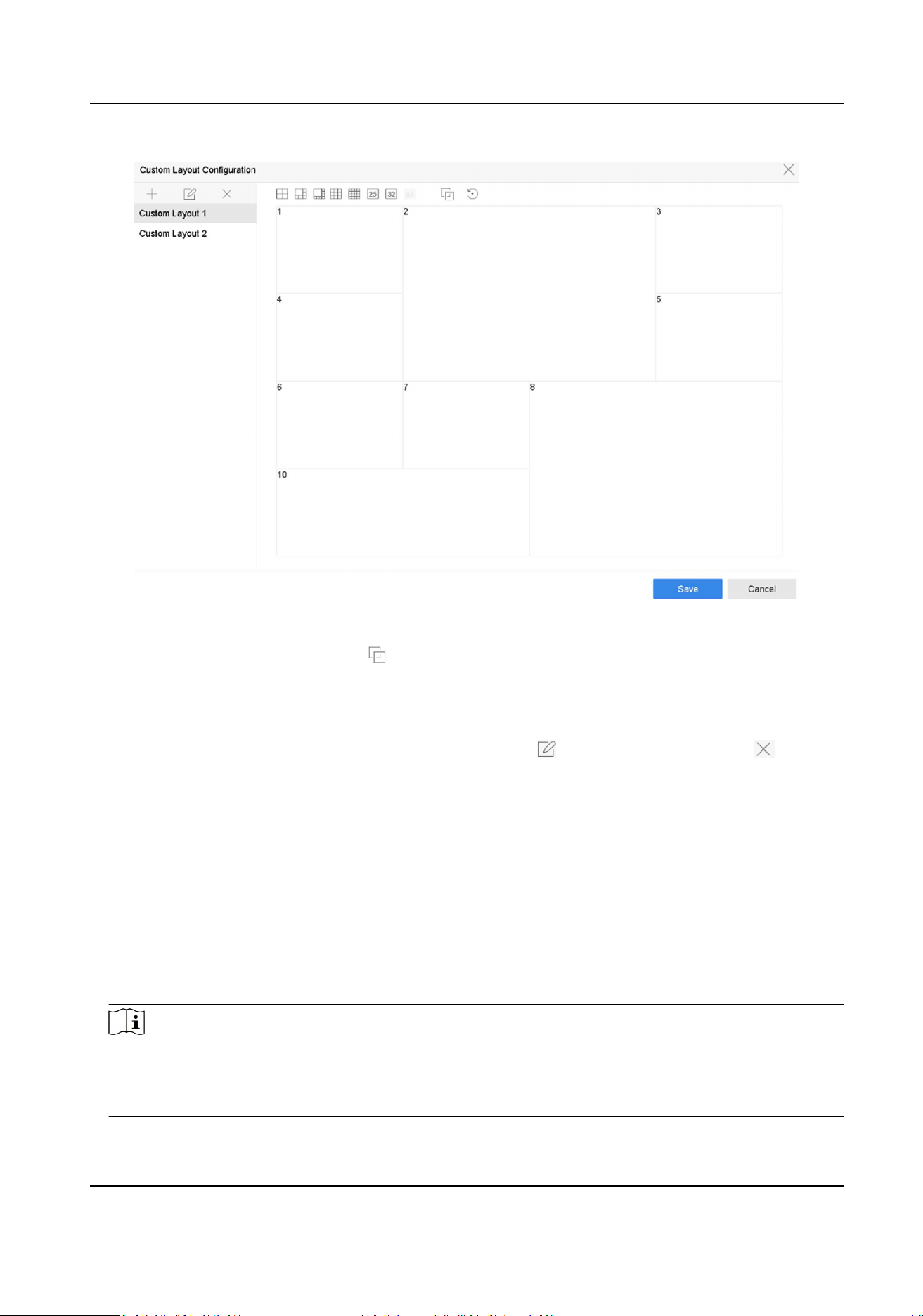
Figure 3-3 Congure Live View Layout
6.
Select mulple windows and click to joint the windows. The selected windows must be in
rectangle area.
7.
Click Save.
The successfully congured layout is displayed in the list.
8.
Oponal: Select a live view layout from the list and click
to edit the name, or click to
delete the name.
Congure Live View Mode
Steps
1.
Go to System → Live View → View .
2.
Select the video output interface.
3.
Select a layout or custom layout from the toolbar.
4.
Select a division window, and double-click on a camera in the list to link the camera to the
window.
Note
●
You can also click-and-drag the camera to the desired window on the Live View interface to
set the camera order.
●
You can enter the number in the text eld to quickly search the camera from the list.
Digital Video Recorder User Manual
28
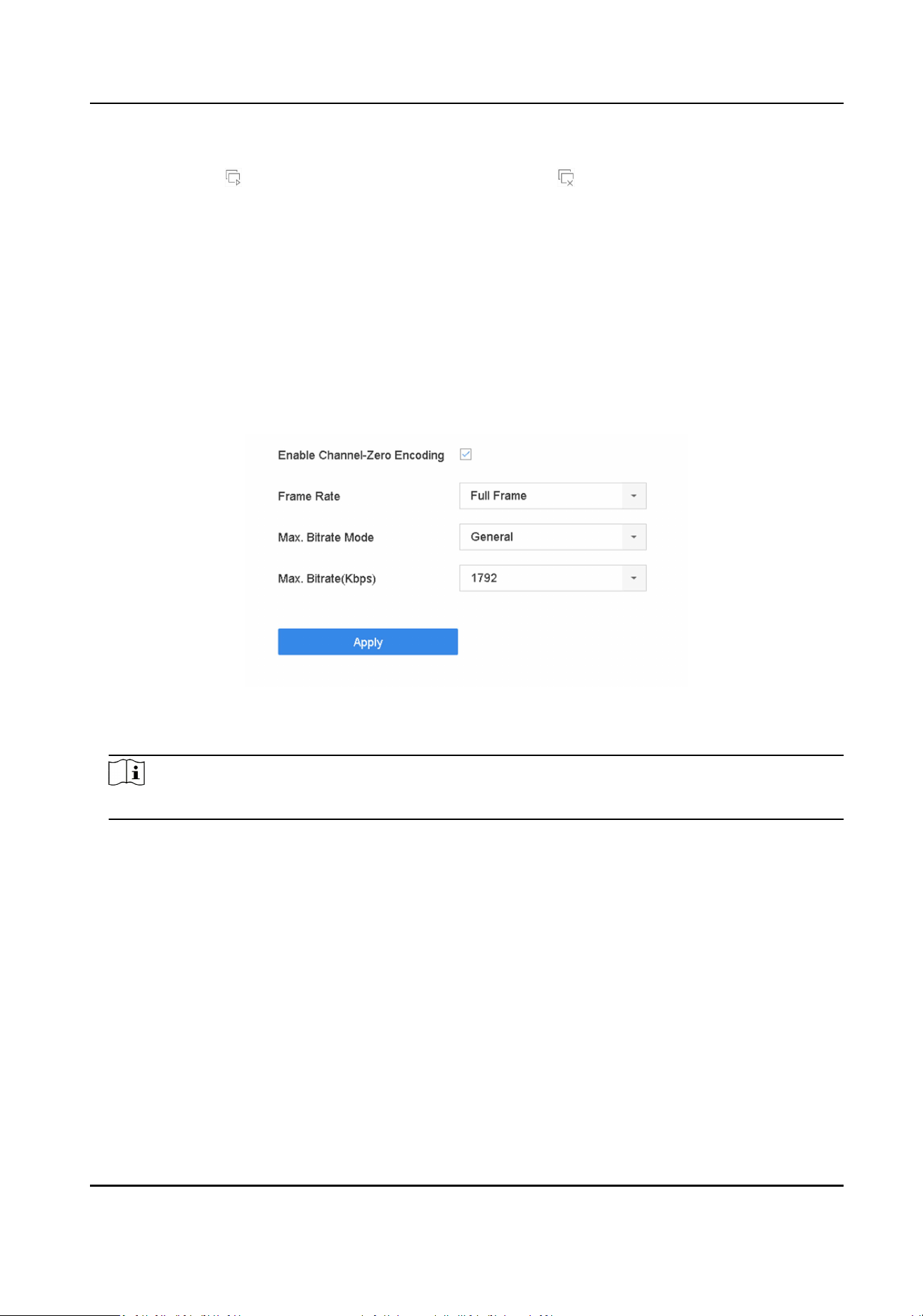
5.
Click Apply.
6.
Oponal: Click to start live view for all channels, or click to stop all live view channels.
3.1.4 Congure Channel-Zero Encoding
Enable the channel-zero encoding when you need to get a remote view of many channels in real
me from a web browser or CMS (Client Management System) soware, in order to decrease the
bandwidth requirement without aecng the image quality.
Steps
1.
Go to System → Live View → Channel-Zero .
2.
Check Enable Channel-Zero Encoding.
Figure 3-4 Channel-Zero Encoding
3.
Congure Frame Rate, Max. Bitrate Mode, and Max. Bitrate.
Note
The higher frame rate and bitrate require the higher bandwidth.
4.
Click Apply.
You can view all the channels on one screen via CMS or web browser.
3.1.5 Use an Auxiliary Monitor
Certain features of the Live View are also available while in an Aux monitor. Features include:
Single Screen
Switch to a full screen display of the selected camera. Camera can be selected from a dropdown
list.
Mul-screen
Digital Video Recorder User Manual
29

Switch between dierent display layout opons. Layout opons can be selected from a
dropdown list.
Next Screen
When displaying less than the maximum number of cameras in Live View, clicking this feature
will switch to the next set of displays.
Playback
Enter into Playback mode.
PTZ Control
Enter PTZ Control mode.
Main Monitor
Enter Main operaon mode.
Note
In the live view mode of the main output monitor, the menu operaon is not available while Aux
output mode is enabled.
3.2 Digital Zoom
Digital Zoom zooms into the live image in dierent magnicaons (1x to 16x).
Steps
1.
Start live view.
2.
Click from the toolbar.
3.
Move the sliding bar or scroll the mouse wheel to zoom in/out the image to dierent
magnicaons (1x to 16x).
Digital Video Recorder User Manual
30
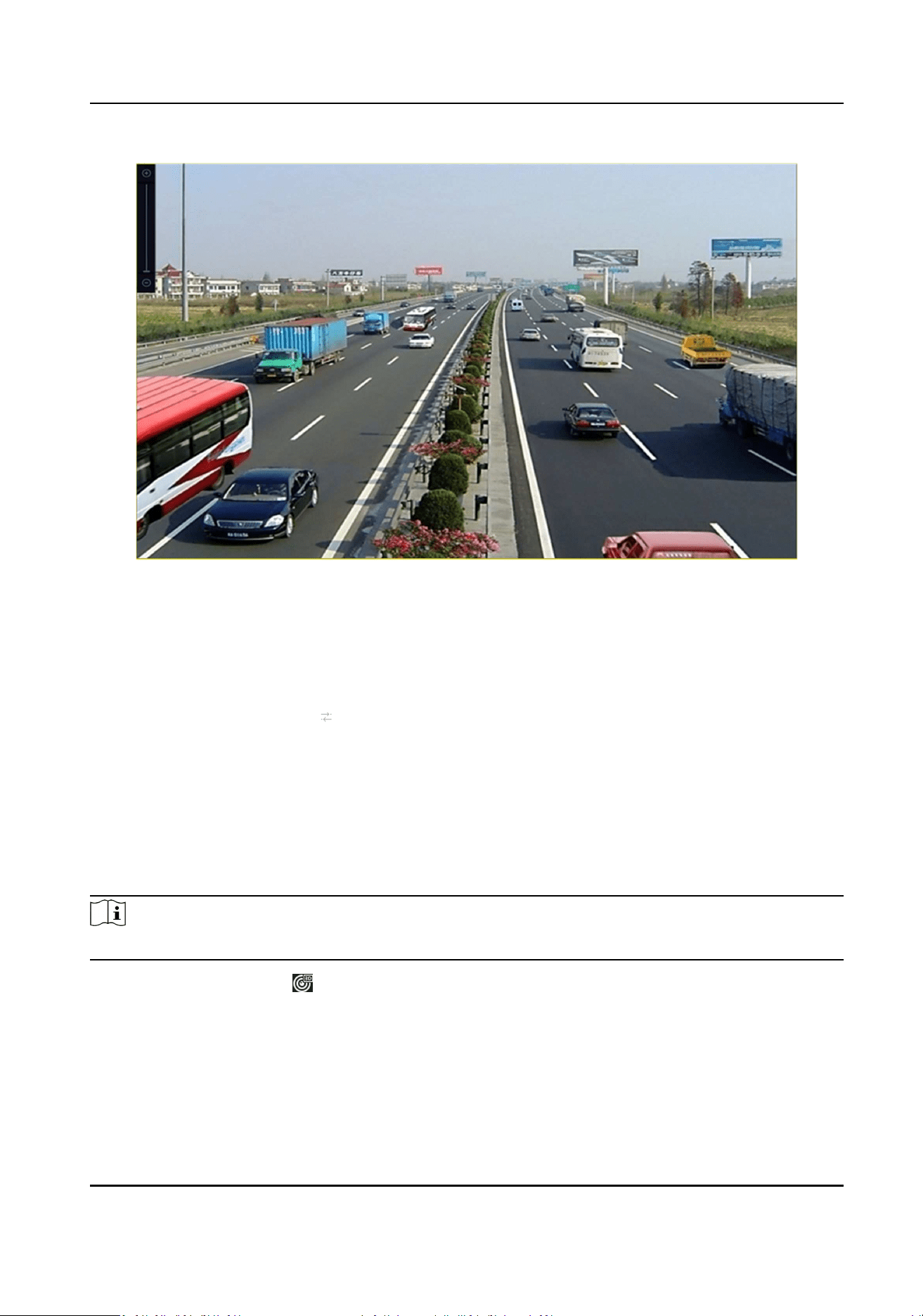
Figure 3-5 Digital Zoom
3.3 Live View Strategy
Steps
1.
In the live view mode, click to enter the digital zoom operaon interface in full screen mode.
2.
Select the live view strategy to Real-me, Balanced or Fluency.
3.4 3D Posioning
3D Posioning zooms in/out a specic live image area.
Steps
Note
This funcon is only available for certain models.
1.
Start live view, and click .
2.
Zoom in/out the image.
-
Zoom in: Click on the desired posion in the video image and drag a rectangle area in the
lower right direcon to zoom in.
-
Zoom out: Drag a rectangle area in the upper le direcon to move the posion to the center
and enable the rectangle area to zoom out.
Digital Video Recorder User Manual
31
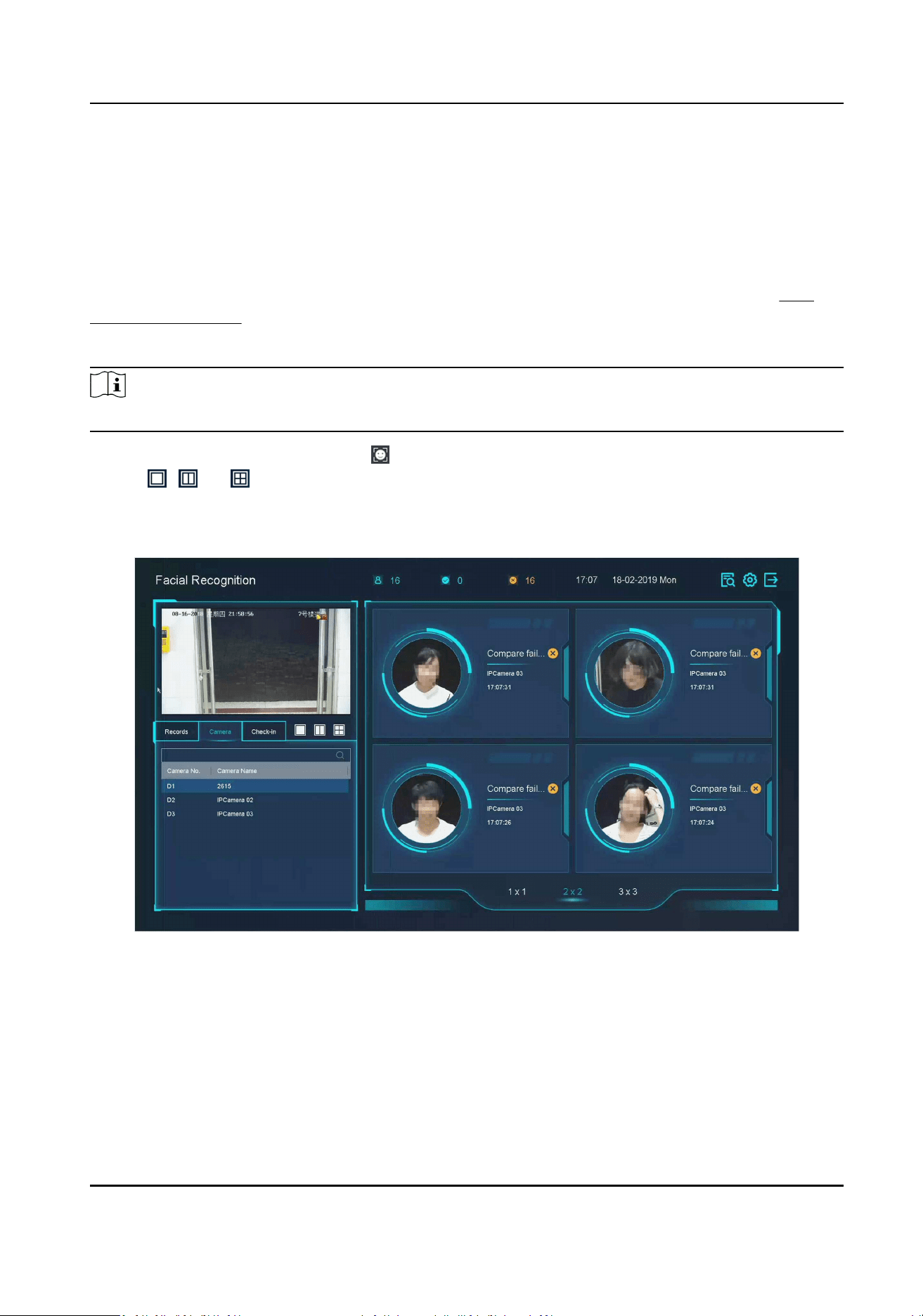
3.5 Facial Recognion
You can enter facial recognion interface to view real-me facial recognion and stranger
recognion results.
Before You Start
Ensure you have congured facial detecon and face picture comparison funcon, refer to Face
Picture Comparison for details.
Steps
Note
This funcon is only available for certain models
1.
Go to live view interface, and click in toolbar.
2.
Click
, , or to set window division.
3.
Select a window as you desired.
4.
Double click a camera from the camera list on the le boom.
Figure 3-6 Facial Recognion
5.
Click Records to view the real-me facial recognion records of selected camera. The records
will also be shown in the window on the right. You can view the facial detecon number at the
top, including the total number, succeeded number and failed number.
6.
Oponal: For the unregistered face picture, you can double click it in records list, and add it to
face picture library.
Digital Video Recorder User Manual
32
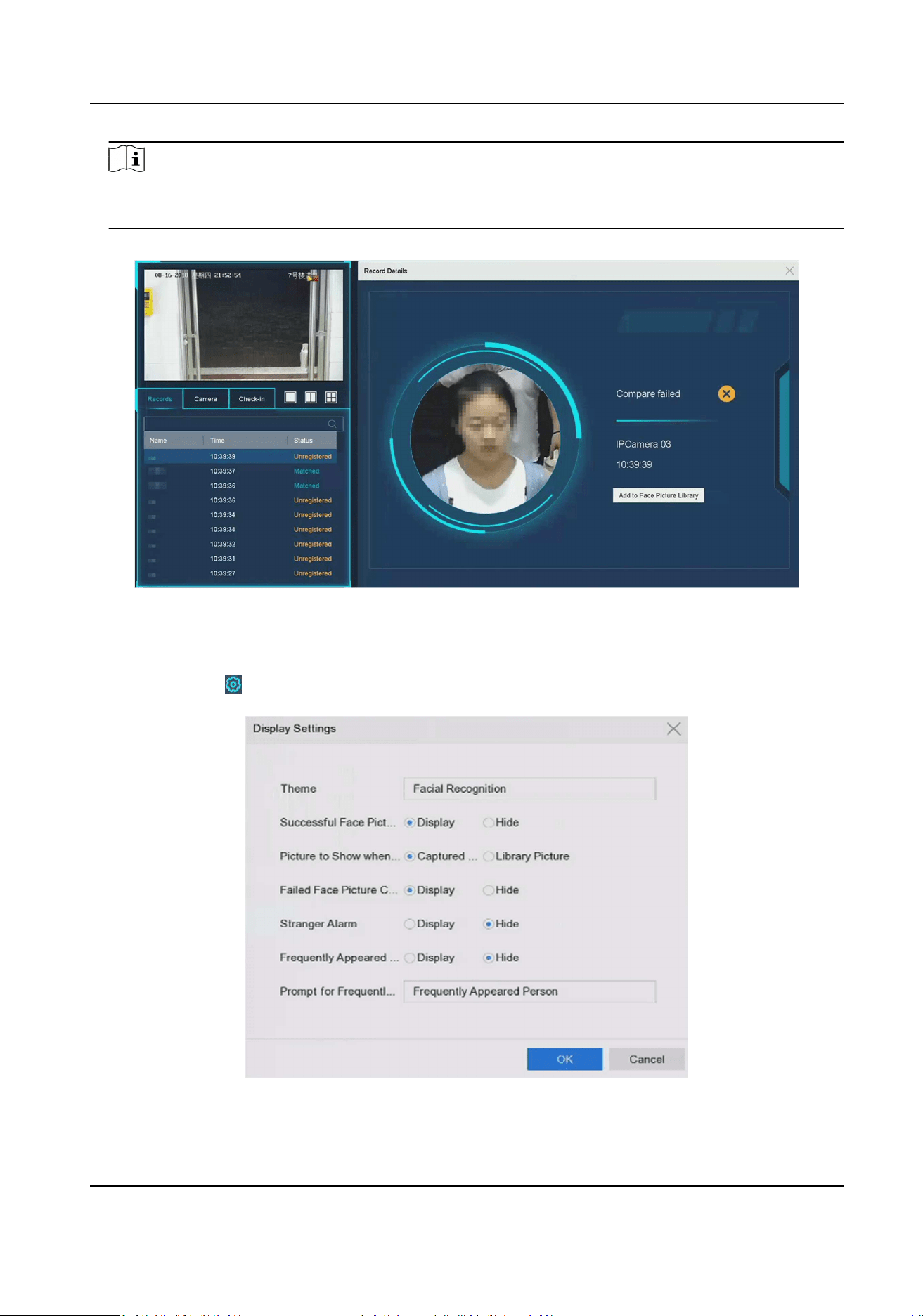
Note
For guest and operator user, it requires Local Parameters Sengs permission to add
unregistered face picture to face picture library.
Figure 3-7 Add Unregistered Face Picture
7.
Oponal: Click Check-in to view face picture library check-in record, including Total No.,
Checked In and Unchecked In.
8.
Oponal: Click on the upper right corner to congure the display sengs as you desired.
Figure 3-8 Facial Recognion Display Sengs
Digital Video Recorder User Manual
33
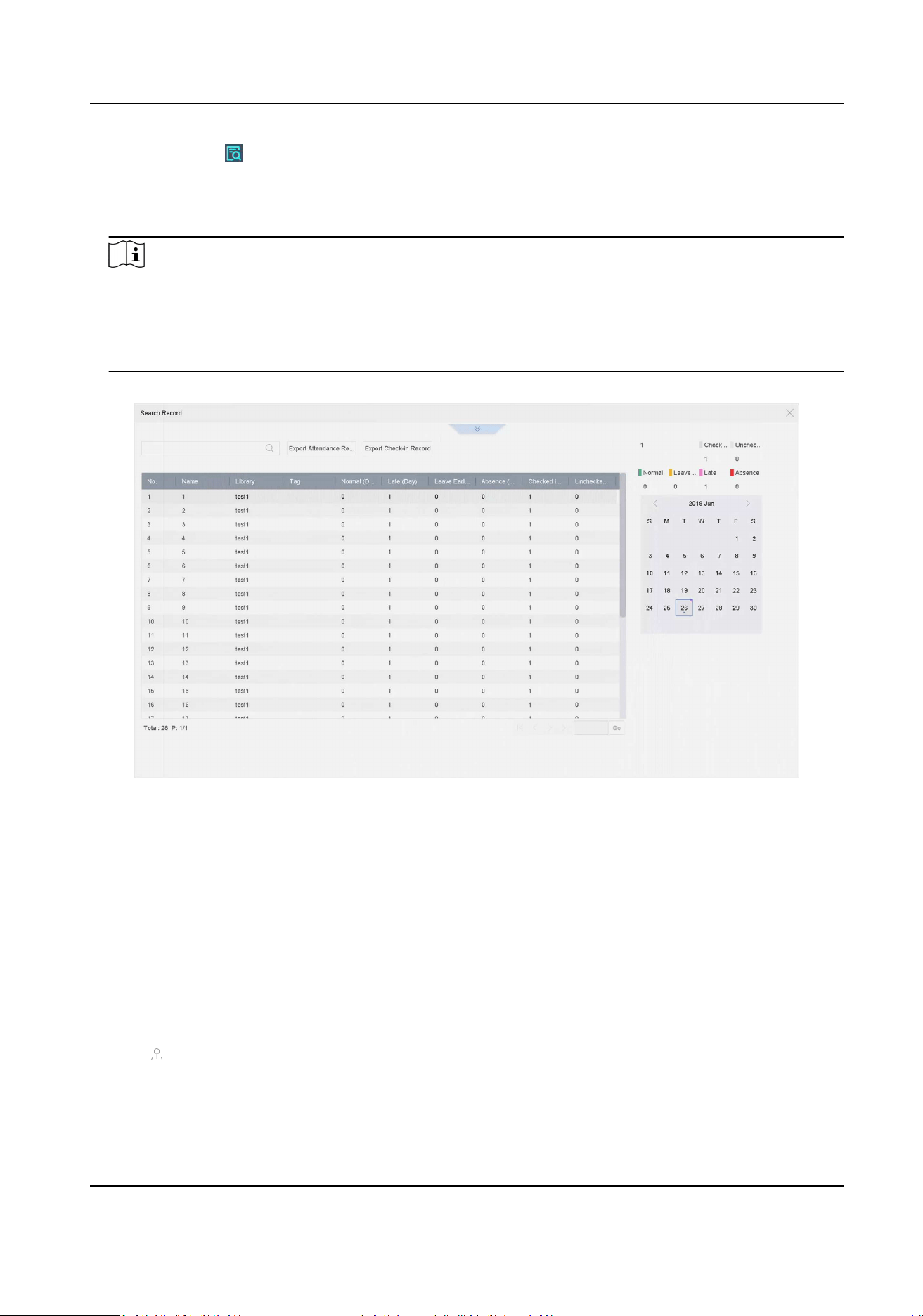
9.
Oponal: Click on the upper right corner to search and export record.
1) Set the search parameters as you desired.
2) Click Search.
3) Click Export Aendance Record or Export Check-in Record.
Note
●
Ensure you have inserted USB ash drive before export.
●
You can click a record to review the aendance informaon of this individual in calendar.
●
For guest and operator user, it requires "Local Video Export permission" (in "Camera
Permission") to search and export record.
Figure 3-9 Face Recognion Search Record
3.6 PTZ Control
3.6.1 Congure PTZ Parameters
Follow these procedures to set the PTZ parameters. The PTZ parameters conguraon must be
done before you can control the PTZ camera.
Steps
1.
Click on the quick sengs toolbar of the PTZ camera.
2.
Click PTZ Parameters Sengs to set the PTZ parameters.
Digital Video Recorder User Manual
34
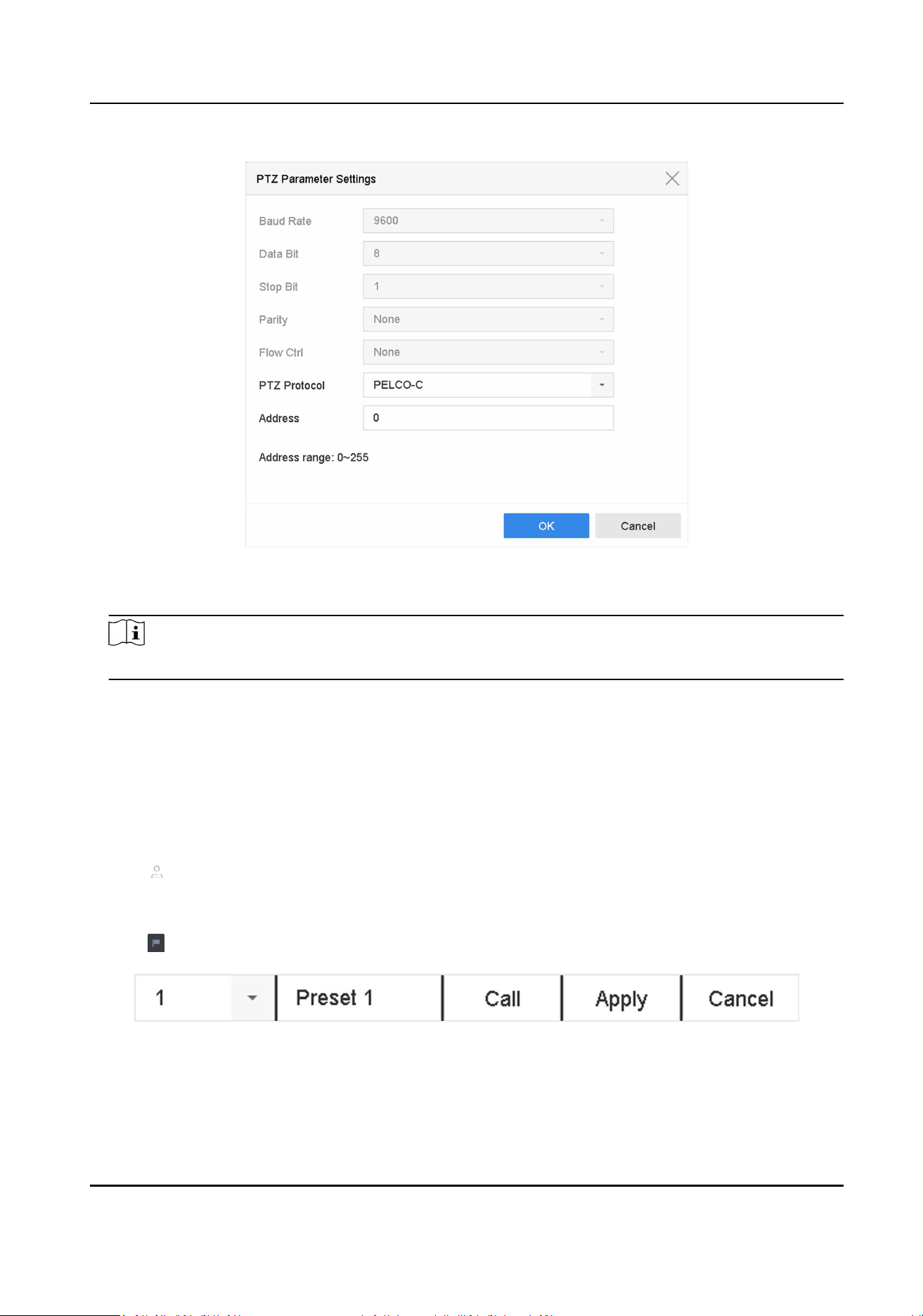
Figure 3-10 PTZ Parameters Sengs
3.
Edit the PTZ parameters.
Note
All the parameters should be exactly match the PTZ camera parameters.
4.
Click OK to save the sengs.
3.6.2 Set a Preset
Presets record the PTZ posion and the status of zoom, focus, iris, etc. You can call a preset to
quickly move the camera to the predened posion.
Steps
1.
Click on the quick sengs toolbar of the PTZ camera's live view.
2.
Click direconal buons to wheel the camera to a locaon.
3.
Adjust the zoom, focus and iris status.
4.
Click
in the lower right corner of Live View to set the preset.
Figure 3-11 Set Preset
5.
Select the preset No. (1 to 255) from the drop-down list.
6.
Enter the preset name.
Digital Video Recorder User Manual
35
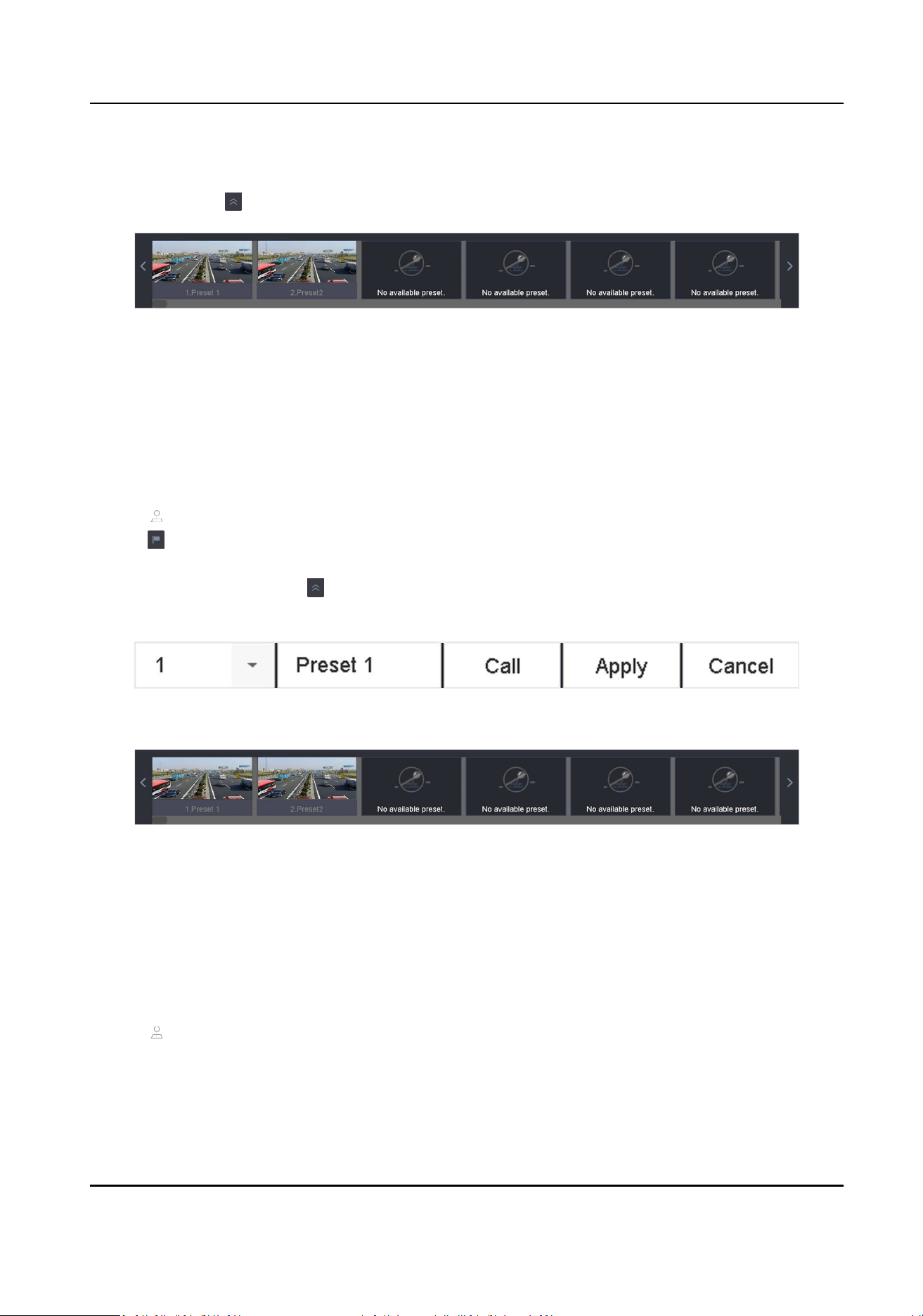
7.
Click Apply to save the preset.
8.
Oponal: Click Cancel to cancel the locaon informaon of the preset.
9.
Oponal: Click in the lower right corner of Live View to view the congured presets.
Figure 3-12 View the Congured Presets
3.6.3 Call a Preset
A preset enables the camera to point to a specied posion such as a window when an event takes
place.
Steps
1.
Click on the quick sengs toolbar of the PTZ camera's Live View.
2.
Click in the lower right corner of Live View to set the preset.
3.
Select the preset No. from the drop-down list.
4.
Click Call to call it, or click in the lower right corner of Live View, and click the congured
preset to call it.
Figure 3-13 Call Preset (1)
Figure 3-14 Call Preset (2)
3.6.4 Set a Patrol
Patrols can be set to move the PTZ to key points and have it stay there for a set duraon before
moving on to the next key point. The key points are correspond to the presets.
Steps
1.
Click
on the quick sengs toolbar of the PTZ camera's live view.
2.
Click Patrol to congure patrol.
Digital Video Recorder User Manual
36
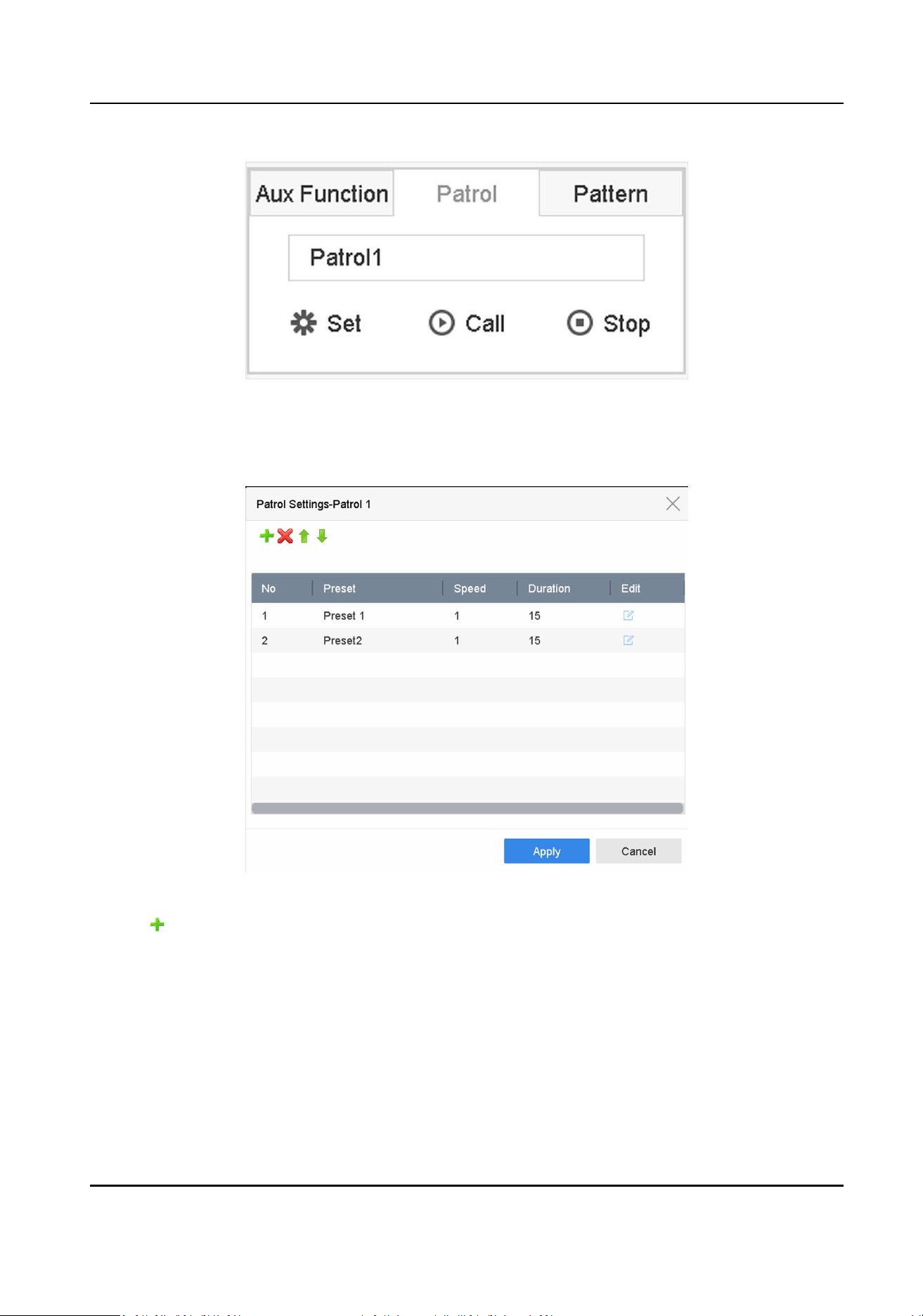
Figure 3-15 Patrol Conguraon
3.
Select the patrol No.
4.
Click Set.
Figure 3-16 Patrol Sengs
5.
Click to add a key point to the patrol.
Digital Video Recorder User Manual
37
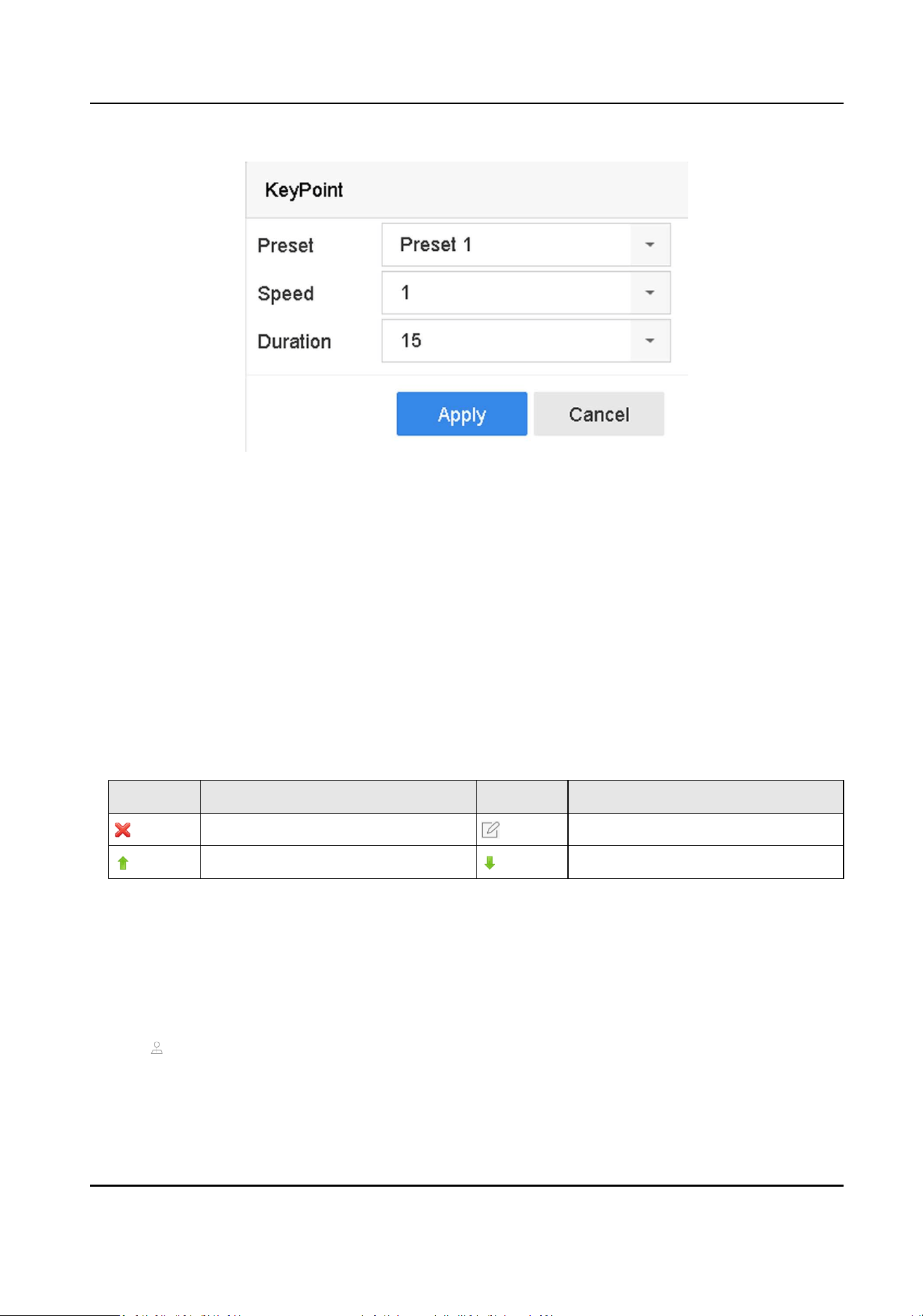
Figure 3-17 Key Point Conguraon
1) Congure key point parameters.
Preset
Determines the order the PTZ will follow while cycling through the patrol.
Speed
Denes the speed the PTZ will move from one key point to the next.
Duraon
Refers to the duraon to stay at the corresponding key point.
2) Click Apply to save the key points to the patrol.
6.
Other operaon is as follows.
Table 3-1 Operaon Descripon
Operaon Descripon Operaon Descripon
Select a key point to delete. Edit the added key point.
Adjust the key point order Adjust the key point order
7.
Click Apply to save the patrol sengs.
3.6.5 Call a Patrol
Calling a patrol makes the PTZ move according to the predened patrol path.
Steps
1.
Click
on the quick sengs toolbar of the PTZ camera's live view.
2.
Click Patrol on the PTZ control panel.
Digital Video Recorder User Manual
38
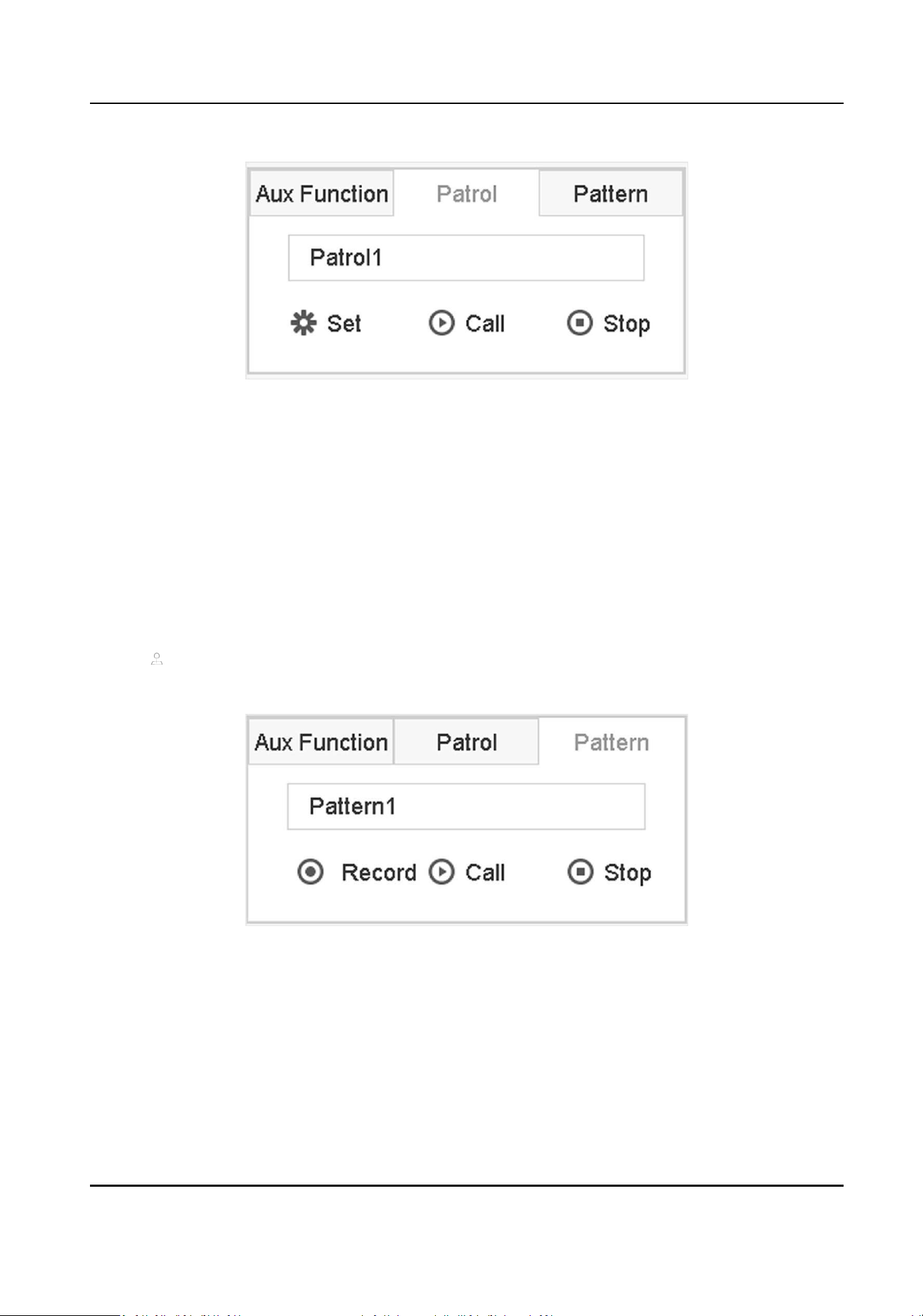
Figure 3-18 Patrol Conguraon
3.
Select a patrol.
4.
Click Call to start the patrol.
5.
Oponal: Click Stop to stop the patrol.
3.6.6 Set a Paern
Paerns can be set by recording the movement of the PTZ. You can call the paern to make the
PTZ move according to the predened path.
Steps
1.
Click on the quick sengs toolbar of the PTZ camera's live view.
2.
Click Paern to congure a paern.
Figure 3-19 Paern Conguraon
3.
Select the paern No.
4.
Set the paern.
1) Click Record to start recording.
2) Click corresponding buons on the control panel to move the PTZ camera.
3) Click Stop to stop recording. The PTZ movement is recorded as the paern.
Digital Video Recorder User Manual
39
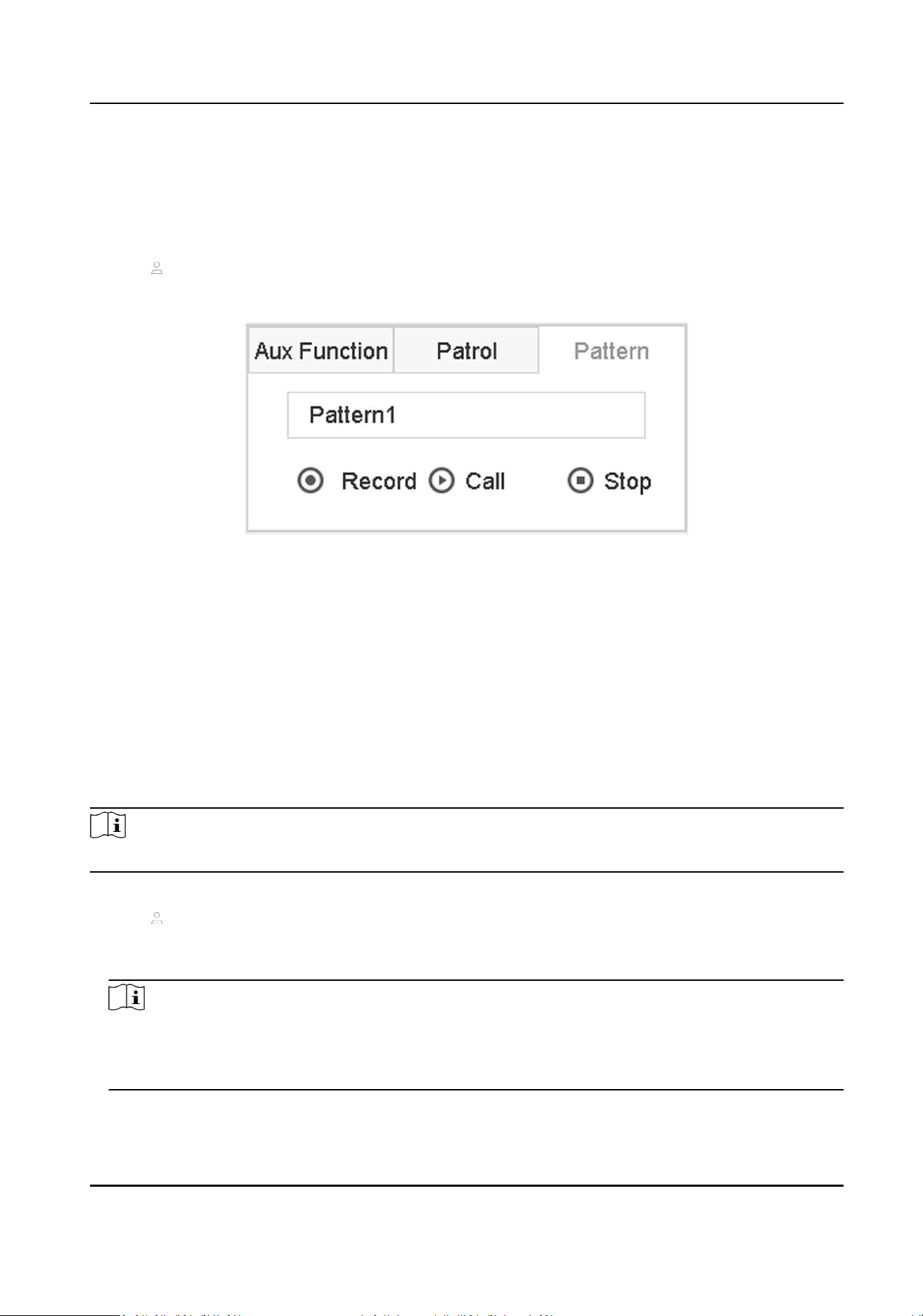
3.6.7 Call a Paern
Follow the procedure to move the PTZ camera according to the predened paerns.
Steps
1.
Click on the quick sengs toolbar of the PTZ camera's live view.
2.
Click Paern to congure paern.
Figure 3-20 Paern Conguraon
3.
Select a paern.
4.
Click Call to start the paern.
5.
Oponal: Click Stop to stop the paern.
3.6.8 Set Linear Scan Limit
Linear Scan trigger a scan in the horizontal direcon in the predened range.
Before You Start
Make sure the connected IP camera supports the PTZ funcon and is properly connected.
Note
This funcon is supported only by certain models.
Steps
1.
Click on the quick sengs toolbar of the PTZ camera's live view.
2.
Click direconal buons to wheel the camera to a locaon, and click Le Limit or Right Limit to
link the locaon to the corresponding limit.
Note
The speed dome linear scans from the le limit to the right limit, and you must set the le limit
on the le side of the right limit. Also, the angle from the le limit to the right limit must be not
greater than 180º.
Digital Video Recorder User Manual
40

3.6.9 One-Touch Park
Certain speed dome models can be congured to start a predened park acon (scan, preset,
patrol, etc.) automacally aer a period of inacvity (park me).
Before You Start
Before operang this funcon, make sure the connected camera supports linear scan and is in
HIKVISION protocol.
Steps
1.
Click on the quick sengs toolbar of the PTZ camera's live view.
2.
Click Park (Quick Patrol), Park (Patrol 1), or Park (Preset 1) to acvate the park acon.
Park (Quick Patrol)
The dome starts patrolling from the predened preset 1 to preset 32 in order aer the park
me. Undened presets will be skipped.
Park (Patrol 1)
The dome starts moving according to the predened patrol 1 path aer the park me.
Park (Preset 1)
The dome moves to the predened preset 1 locaon aer the park me.
Note
The park me can be set only via the speed dome conguraon interface. The default value is 5s
by default.
3.
Oponal: Click Stop Park (Quick Patrol), Stop Park (Patrol 1), or Stop Park (Preset 1) to
inacvate it.
3.6.10 Auxiliary Funcons
You can operate the auxiliary funcons including light, wiper, 3D posioning, and center on the PTZ
control panel.
Before You Start
Make sure the connected IP camera supports the PTZ funcon, and is properly connected.
Steps
1.
Click
on the quick sengs toolbar of the PTZ camera's live view. The PTZ control panel
displays on the right of the interface.
2.
Click Aux Funcon.
Digital Video Recorder User Manual
41
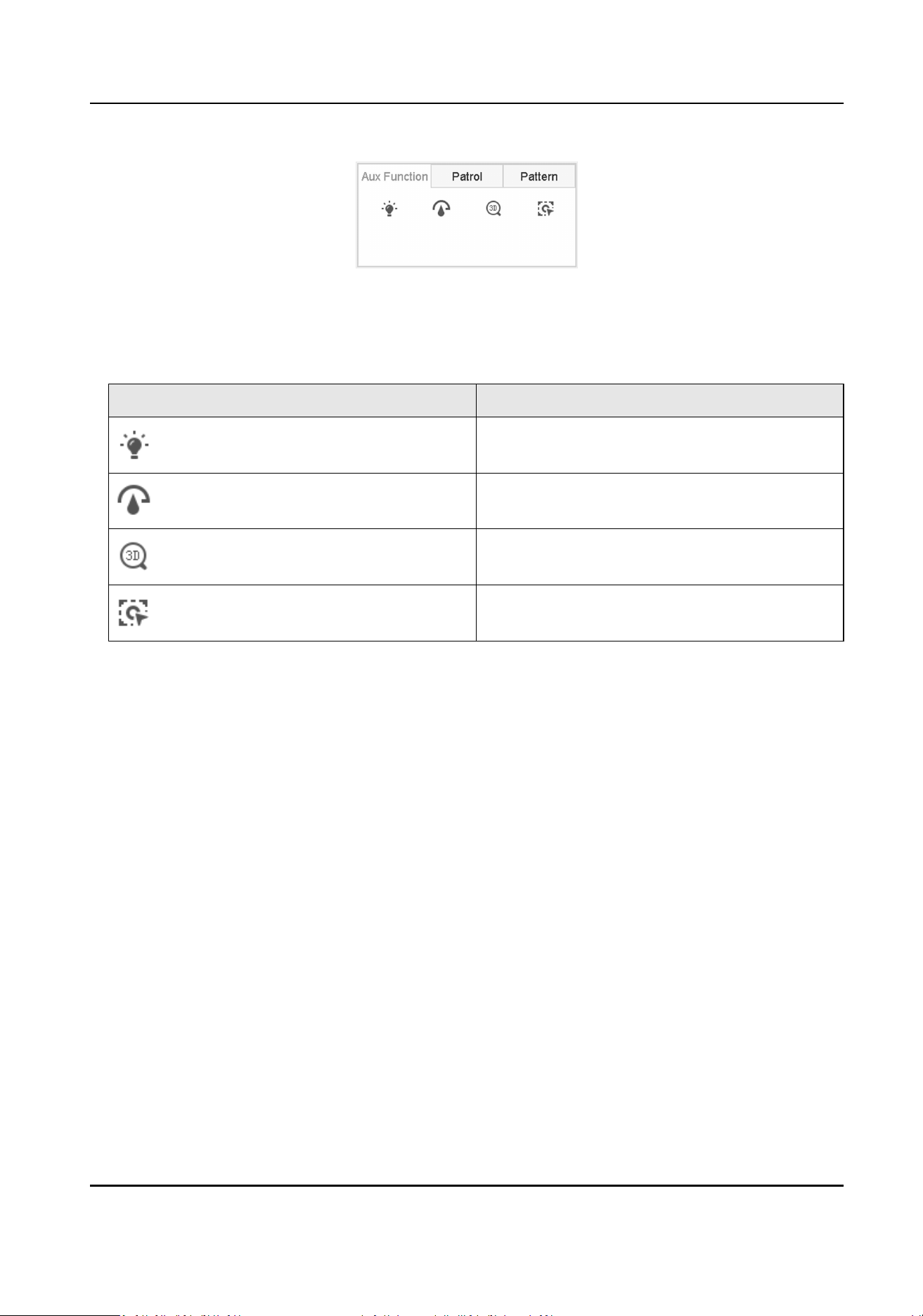
Figure 3-21 Aux Funcon Conguraon
3.
Click the icons to operate the aux funcons. See the table for the icon descripons.
Table 3-2 Descripon of Aux Funcons Icons
Icon Descripon
Light on/o
Wiper on/o
3D posioning
Center
Digital Video Recorder User Manual
42

Chapter 4 Recording and Playback
4.1 Recording
4.1.1 Congure Recording Parameters
Go to Camera → Video Parameters .
Main Stream
Main stream refers to the primary stream that aects data recorded to the hard disk drive and will
directly determine your recording quality and image size.
Comparing with the sub-stream, the main stream can provide a higher quality video with higher
resoluon and frame rate.
Frame Rate (FPS - Frames per Second)
It refers to how many frames are captured each second. A higher frame rate is advantageous
when there is movement in the video stream, as it maintains image quality throughout.
Resoluon
Image resoluon is a measure of how much detail a digital image can hold. The greater the
resoluon, the greater the level of detail. Resoluon can be specied as the number of pixel-
columns (width) by the number of pixel-rows (height), e.g., 1024 × 768.
Bitrate
The bit rate (in kbit/s or Mbit/s) is oen referred to as speed, but actually denes the number of
bits/me unit and not distance/me unit.
Enable H.264+
H.264+ combines intelligent analysis technology with predicve encoding, noise suppression,
and long-term bit rate control to realize a lower bit rate, which plays a signicant role in cung
storage costs and provides a higher return value for the investment.
Enable H.265+
H.265+ is an opmized encoding technology based on the standard H.265/HEVC compression.
With H.265+, the video quality is almost the same as that of H.265/HEVC but with less
transmission bandwidth and storage capacity required.
Note
●
A higher resoluon, frame rate and bit rate seng will provide you the beer video quality, but
it will also require more internet bandwidth and use more storage space on the hard disk drive.
●
H.264+ or H.265+ encoding technology is only available for certain models.
Digital Video Recorder User Manual
43
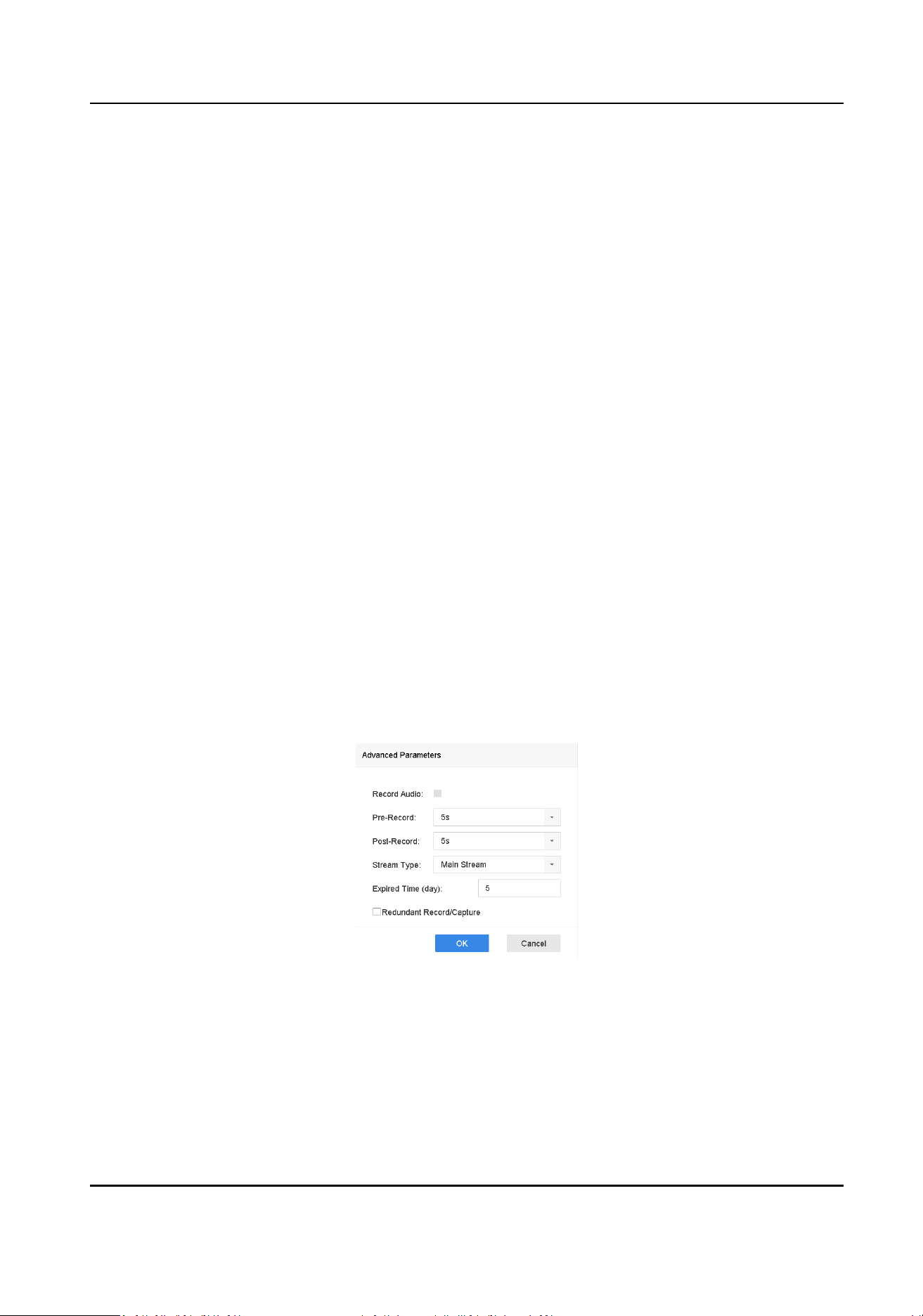
Sub-Stream
Sub-stream is a second codec that runs alongside the main stream. It allows you to reduce the
outgoing internet bandwidth without sacricing your direct recording quality.
Sub-stream is oen exclusively used by apps to view live video. Users with limited internet speeds
may benet most from this seng.
Picture
The picture refers to the live picture capture in connuous or event recording type. ( Storage →
Capture Schedule → Advanced
Picture Quality
Set the picture quality to low, medium or high. The higher picture quality results in more
storage space requirement.
Interval
The interval of capturing live picture.
Capture Delay Time
The duraon of capturing pictures.
Congure Advanced Parameters
Steps
1.
Go to Storage → Schedule → Record .
2.
Check Enable Schedule to enable scheduled recording.
3.
Click Advanced to set the advanced parameters.
Figure 4-1 Advanced Record Sengs
Record Audio
Enable or disable audio recording.
Pre-record
Digital Video Recorder User Manual
44

The me you set to record before the scheduled me or event. For example, when an alarm
triggers the recording at 10:00, and if you set the pre-record me as 5 seconds, the camera
records at 9:59:55.
Post-record
The me you set to record aer the event or the scheduled me. For example, when an
alarm triggered recording ends at 11:00, and if you set the post-record me as 5 seconds, it
records ll 11:00:05.
Stream Type
Main stream and sub-stream are selectable for recording. When you select sub-stream, you
can record for a longer me with the same storage space.
Expired Time
The expired me is period for a recorded le to be kept in the HDD. When the deadline is
reached, the le will be deleted. If you set the expired me to 0, the le will not be deleted.
The actual keeping me for the le should be determined by the capacity of the HDD.
Redundant Record/Capture
By enabling redundant record or capture you save the record and captured picture in the
redundant HDD.
4.1.2 Enable H.265 Stream Access
The device can automacally switch to the H.265 stream of IP camera (which supports H.265 video
format) for the inial access.
Go to Camera → More Sengs → H.265 Auto Switch Conguraon to enable the funcon.
4.1.3 Manual Recording
You can click to manually start/stop recording videos at live view.
4.1.4 Congure Recording Schedule
The camera would automacally start/stop recording according to the congured recording
schedule.
Before You Start
●
Ensure you have installed the HDDs to the device or added the network disks before storing the
video les, pictures and log les.
●
Before enabling Moon, Alarm, M | A (moon or alarm), M & A (moon and alarm), and Event
triggered recording and capture, you must congure the moon detecon sengs, alarm input
sengs and other events as well. Refer to
VCA Event Alarm for details.
Digital Video Recorder User Manual
45

Steps
1.
Go to Storage → Schedule → Record .
2.
Select a camera.
3.
Check Enable Schedule.
4.
Select a recording type.
Connuous
Scheduled recording.
Event
Recording triggered by all event triggered alarm.
Moon
Recording triggered by moon detecon.
Alarm
Recording triggered by alarm.
M/A
Recording triggered by either moon detecon or alarm.
M&A
Recording triggered by moon detecon and alarm.
POS
Recording triggered by POS and alarm.
5.
Drag the cursor on me bar to set the record schedule.
Digital Video Recorder User Manual
46
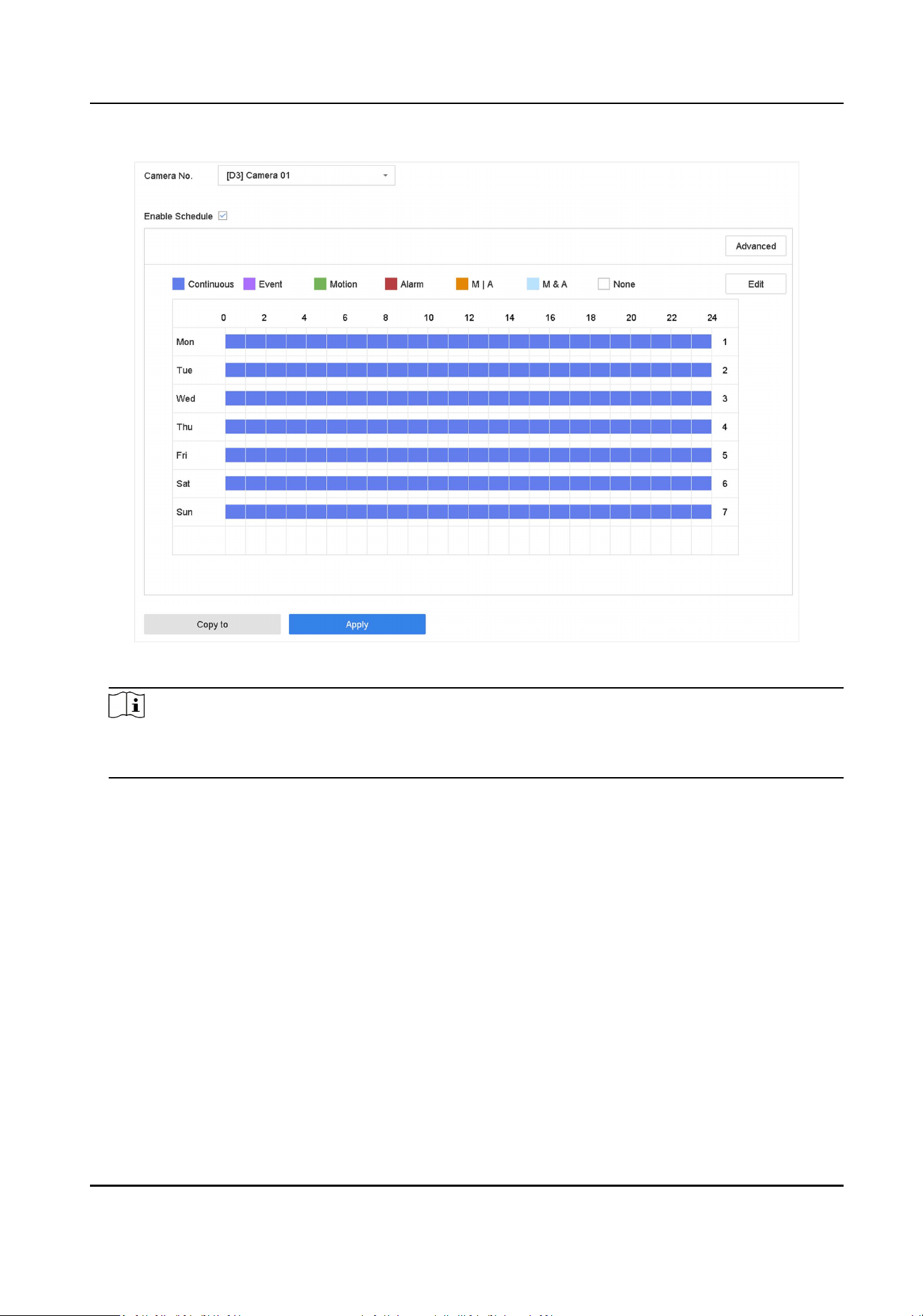
Figure 4-2 Record Schedule
Note
●
You can repeat the above steps to set schedule recording or capture for each day in the week.
●
Connuous recording is applied to each day by default.
6.
Oponal: Copy the recording schedule to other camera(s).
1) Click Copy to.
2) Select camera(s) to duplicate with the same schedule sengs.
3) Click OK.
7.
Click Apply.
4.1.5 Congure Connuous Recording
The device can connuously record the video within the congured me schedule.
Steps
1.
Go to Camera → Encoding Parameters → Recording Parameters .
2.
Set the connuous main stream/sub-stream recording parameters for the camera.
3.
Go to Storage → Recording Schedule .
Digital Video Recorder User Manual
47

4.
Drag the mouse on the me bar to set the connuous recording schedule. Refer to Congure
Recording Schedule for details.
4.1.6 Congure Moon Detecon Triggered Recording
You can congure the recording triggered by the moon detecon event.
Steps
1.
Go to System → Event → Normal Event → Moon Detecon .
2.
Congure the moon detecon and select the channel (s) to trigger the recording when moon
event occurs. Refer to Congure Linkage Acons for details.
3.
Go to Camera → Encoding Parameters → Recording Parameters .
4.
Set the event main stream/sub-stream recording parameters for the camera.
5.
Go to Storage → Recording Schedule .
6.
Select the recording type to Moon.
7.
Drag the mouse on the me bar to set moon detecon recording schedule. Refer to Congure
Recording Schedule for details.
4.1.7 Congure Event Triggered Recording
You can congure the recording triggered by the moon detecon, moon detecon and alarm,
face detecon, vehicle detecon, line crossing detecon, etc.
Steps
1.
Go to System → Event .
2.
Congure the event detecon and select the channel(s) to trigger the recording when event
occurs. Refer to Event for details.
3.
Go to Camera → Encoding Parameters → Recording Parameters .
4.
Set the event main stream/sub-stream recording parameters for the camera.
5.
Go to Storage → Recording Schedule .
6.
Select the recording type to Event.
7.
Drag the mouse on the me bar to set the event detecon recording schedule. Refer to
Congure Recording Schedule for details.
4.1.8 Congure Alarm Triggered Recording
You can congure the recording triggered by the moon detecon, face detecon, vehicle
detecon, line crossing detecon, etc.
Steps
1.
Go to System → Event → Normal Event → Alarm Input .
2.
Congure the alarm input and select the channel(s) to trigger the recording when alarm occurs.
Refer to Event for details.
Digital Video Recorder User Manual
48

3.
Go to Camera → Encoding Parameters → Recording Parameters .
4.
Set the event main stream/sub-stream recording parameters for the camera.
5.
Go to Storage → Recording Schedule .
6.
Select the recording type to Alarm.
7.
Drag the mouse on the me bar to set the alarm recording schedule. Refer to Congure
Recording Schedule for details.
4.1.9 Congure Picture Capture
The picture refers to the live picture capture in connuous or event recording type. Only certain
models support this funcon.
Steps
1.
Go to Camera → Encoding Parameters → Capture .
2.
Set the picture parameters.
Resoluon
Set the resoluon of the picture to capture.
Picture Quality
Set the picture quality to low, medium or high. The higher picture quality results in more
storage space requirement.
Interval
The interval of capturing live picture.
3.
Go to Storage → Capture Schedule .
4.
Select the camera to congure the picture capture.
5.
Set the picture capture schedule. Refer to
Congure Recording Schedule for details.
4.1.10 Congure Holiday Recording
You may want to have dierent plan for recording on holiday, this funcon allows you to set the
recording schedule on holiday for the year.
Steps
1.
Go to System → Holiday .
2.
Select a holiday item from the list.
3.
Click to edit the selected holiday.
4.
Check Enable.
Digital Video Recorder User Manual
49
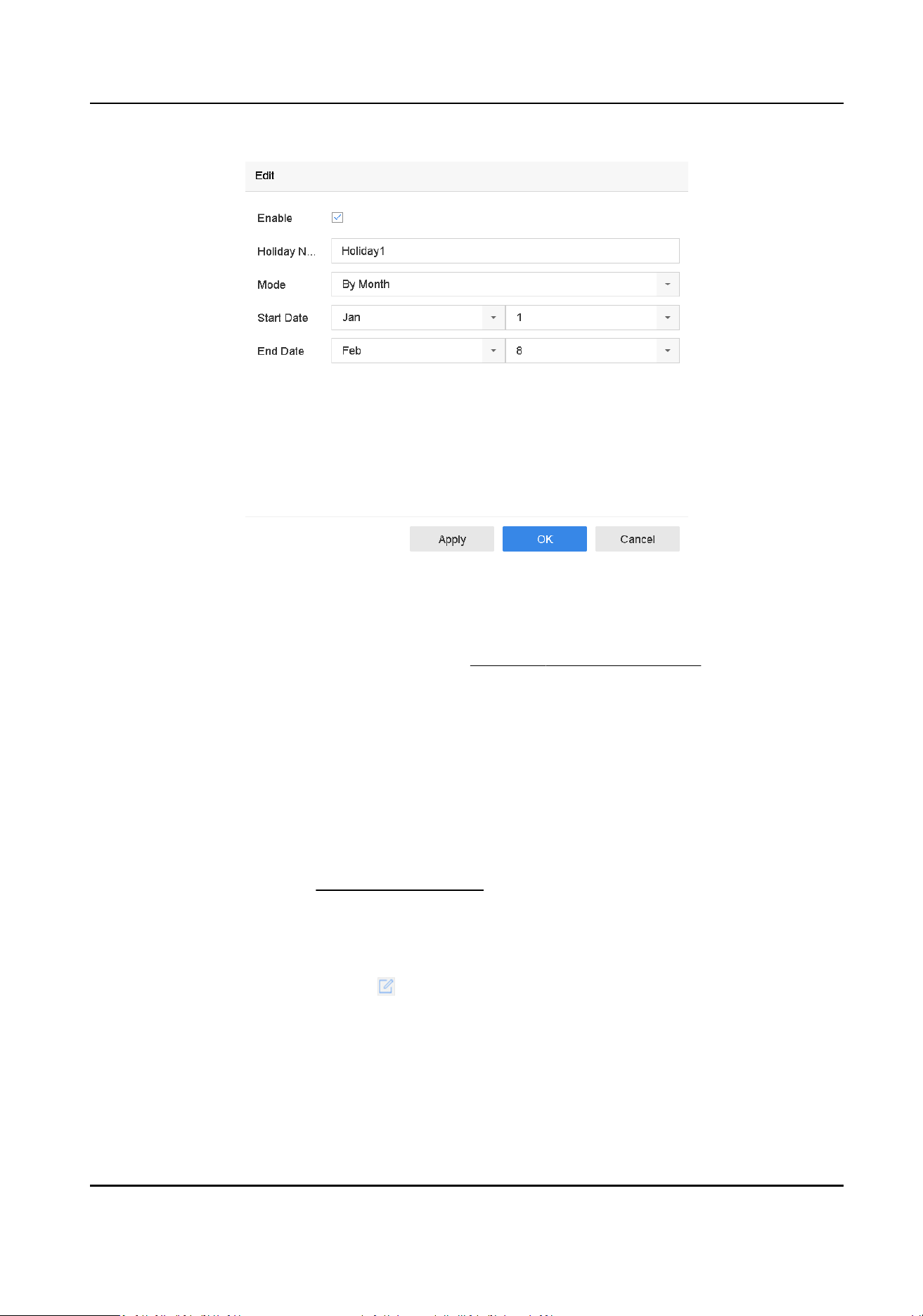
Figure 4-3 Edit Holiday Sengs
5.
Set Holiday Name, Mode, Start Date, and End Date.
6.
Click OK.
7.
Set the schedule for holiday recording. Refer to Congure Recording Schedule for details.
4.1.11 Congure Redundant Recording and Capture
Enabling redundant recording and capture, which means saving the record les and captured
pictures not only in the R/W HDD but also in the redundant HDD, will eecvely enhance the data
safety and reliability.
Before You Start
You must set the storage mode to Group before you set the HDD property to Redundancy. For
detailed informaon, refer to
Congure HDD Group . There should be at least another HDD which
is in Read/Write status.
Steps
1.
Go to Storage → Storage Device .
2.
Select a HDD from the list and click to enter the Local HDD Sengs interface.
3.
Set the HDD property to Redundancy.
4.
Go to Storage → Schedule Sengs → Record Schedule/Capture Schedule .
5.
Click Advanced to set the camera recording parameters.
Digital Video Recorder User Manual
50
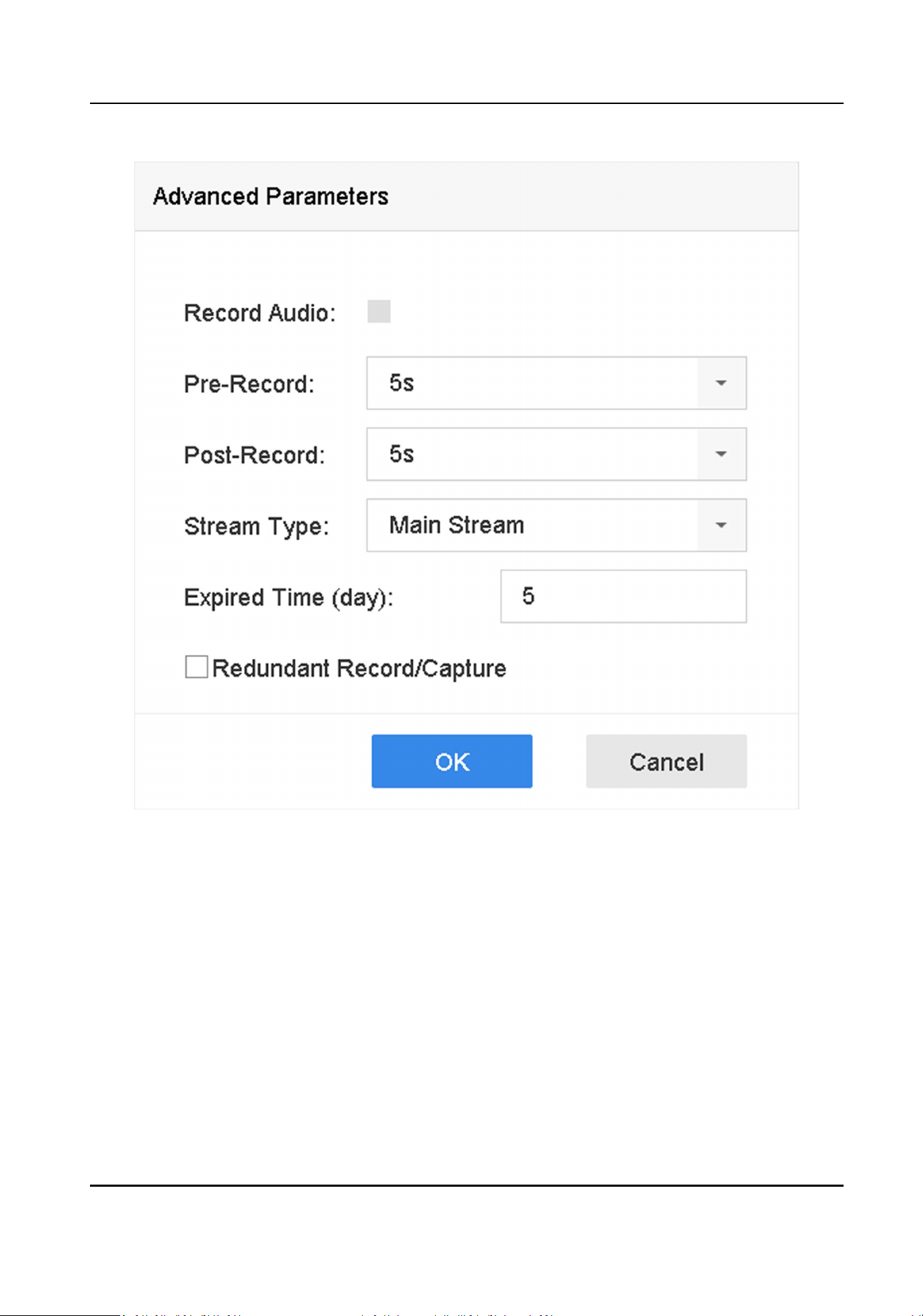
Figure 4-4 Record Parameters
6.
Check Redundant Record/Capture.
7.
Click OK to save sengs.
4.1.12 Congure 1080p Lite Mode
When 1080P Lite Mode is enabled, the encoding resoluon at 1080P Lite (real-me) is supported.
If not, up to 1080P (non-real-me) is supported.
Go to Storage → Advanced to enable or disable 1080P Lite Mode.
Digital Video Recorder User Manual
51
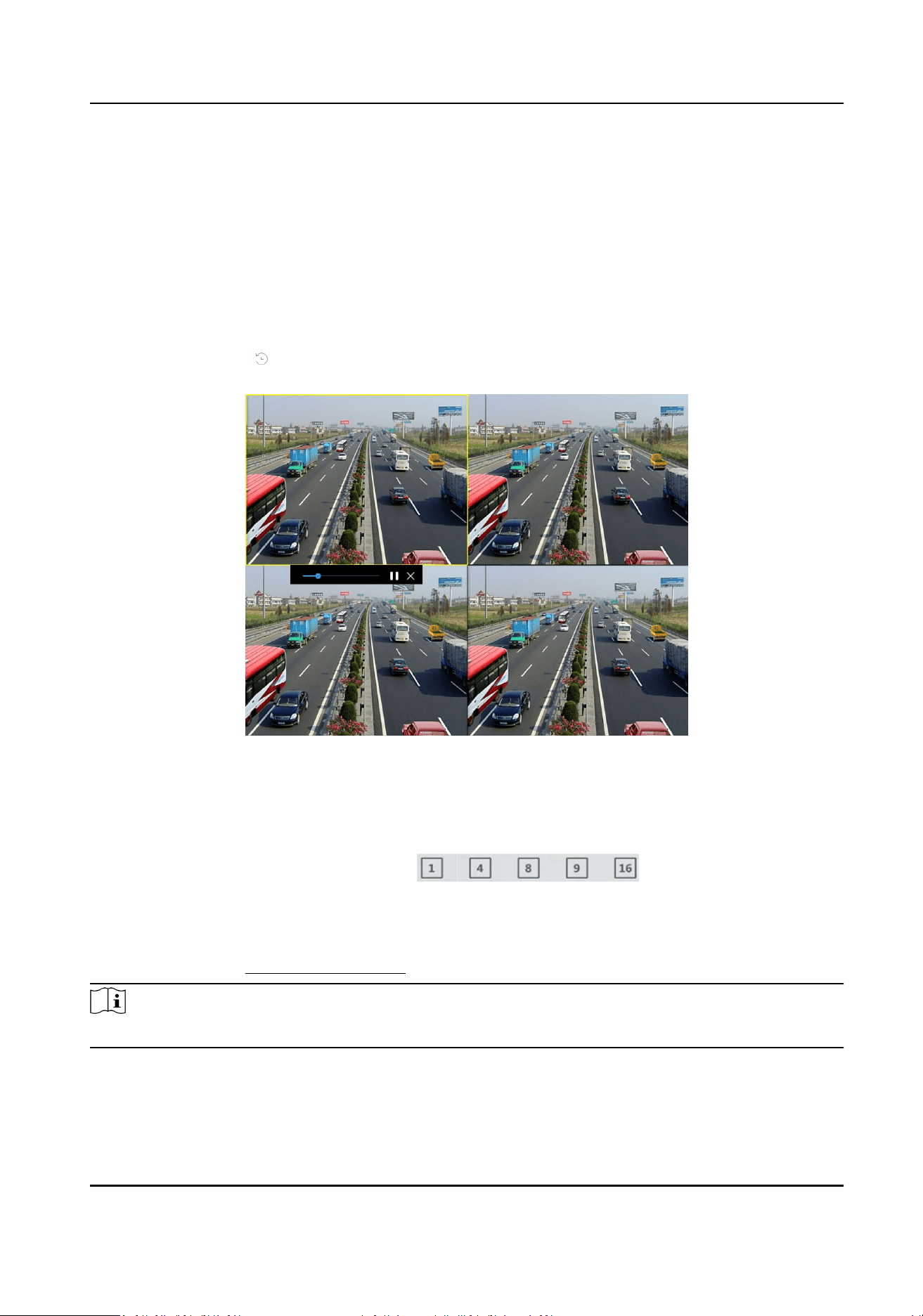
4.2 Playback
4.2.1 Instant Playback
Instant playback enables the device to play the recorded video les recorded in the last ve
minutes. If no video is found, it means there is no recording during the last ve minutes.
Aer selecng the camera on Live View, you can move the cursor to the window boom to access
the toolbar, and click to start instant playback.
Figure 4-5 Playback
4.2.2 Play Normal Video
Go to Playback, select date and camera(s).
is the window division
shortcut for grouping cameras and playing videos. You can also select camera(s) from the list to
achieve simultaneous playback of mulple camera(s).
Posion the cursor on playback window, and use the toolbar at the boom to perform playback
operaons. Refer to Playback Operaons for details.
Note
256x playing speed is supported.
Digital Video Recorder User Manual
52
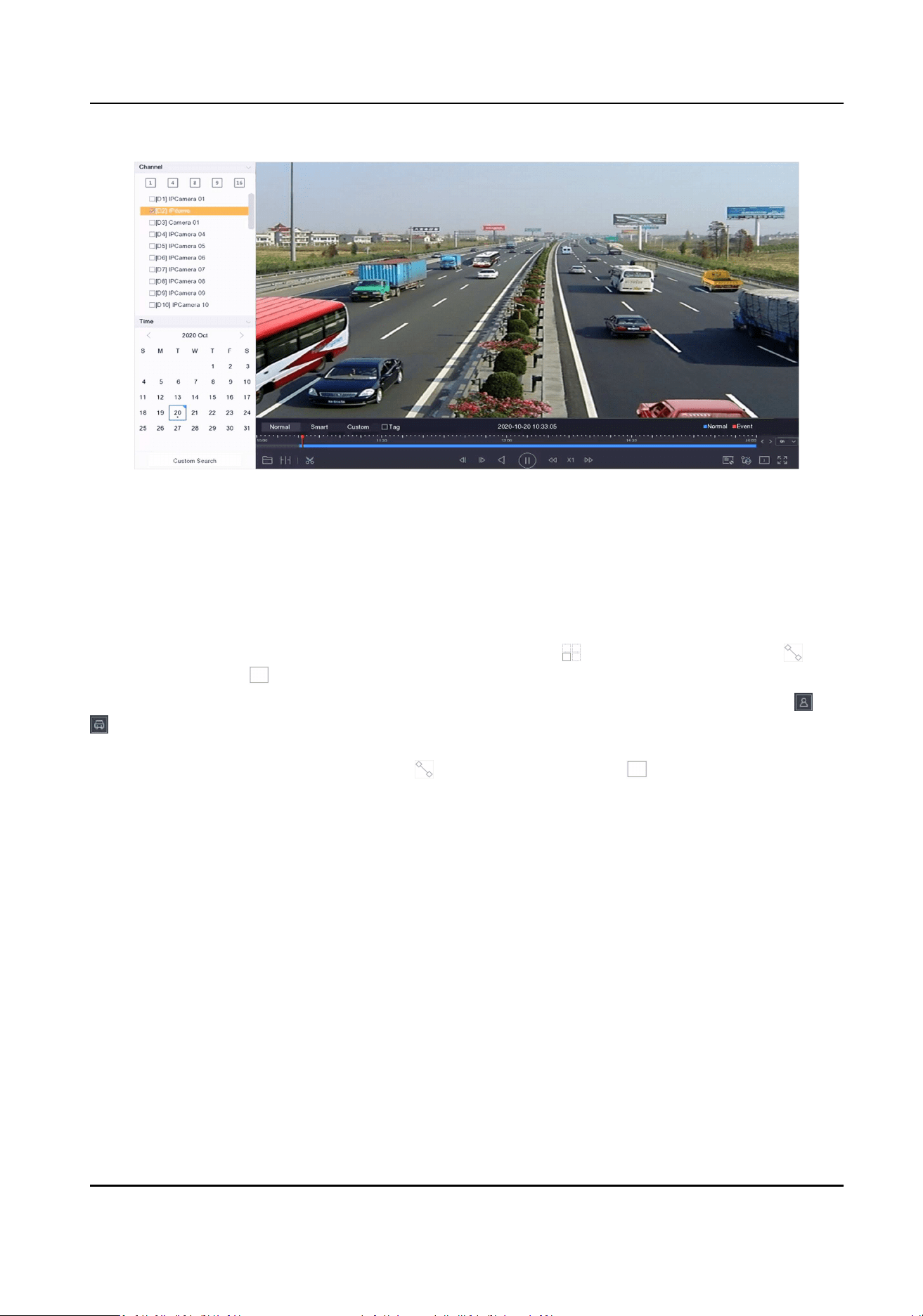
Figure 4-6 Play Normal Video
4.2.3 Play Smart Searched Video
In smart playback mode, the device can analyze videos that containing moon, line, or intrusion
detecon informaon, and mark them in red.
Go to Playback, click Smart, and then click moon detecon ( ), line crossing detecon ( ), or
intrusion detecon ( ) in the toolbar at the boom to play the video as your desire.
For certain cameras that have enabled human and vehicle of moon detecon, you can click or
to search human and vehicle targets. When you are playing back videos that contain human or
vehicle targets, the device cannot use the videos (that contain human or vehicle targets) to apply a
double analysis of line crossing detecon ( ) or intrusion detecon ( ).
Digital Video Recorder User Manual
53
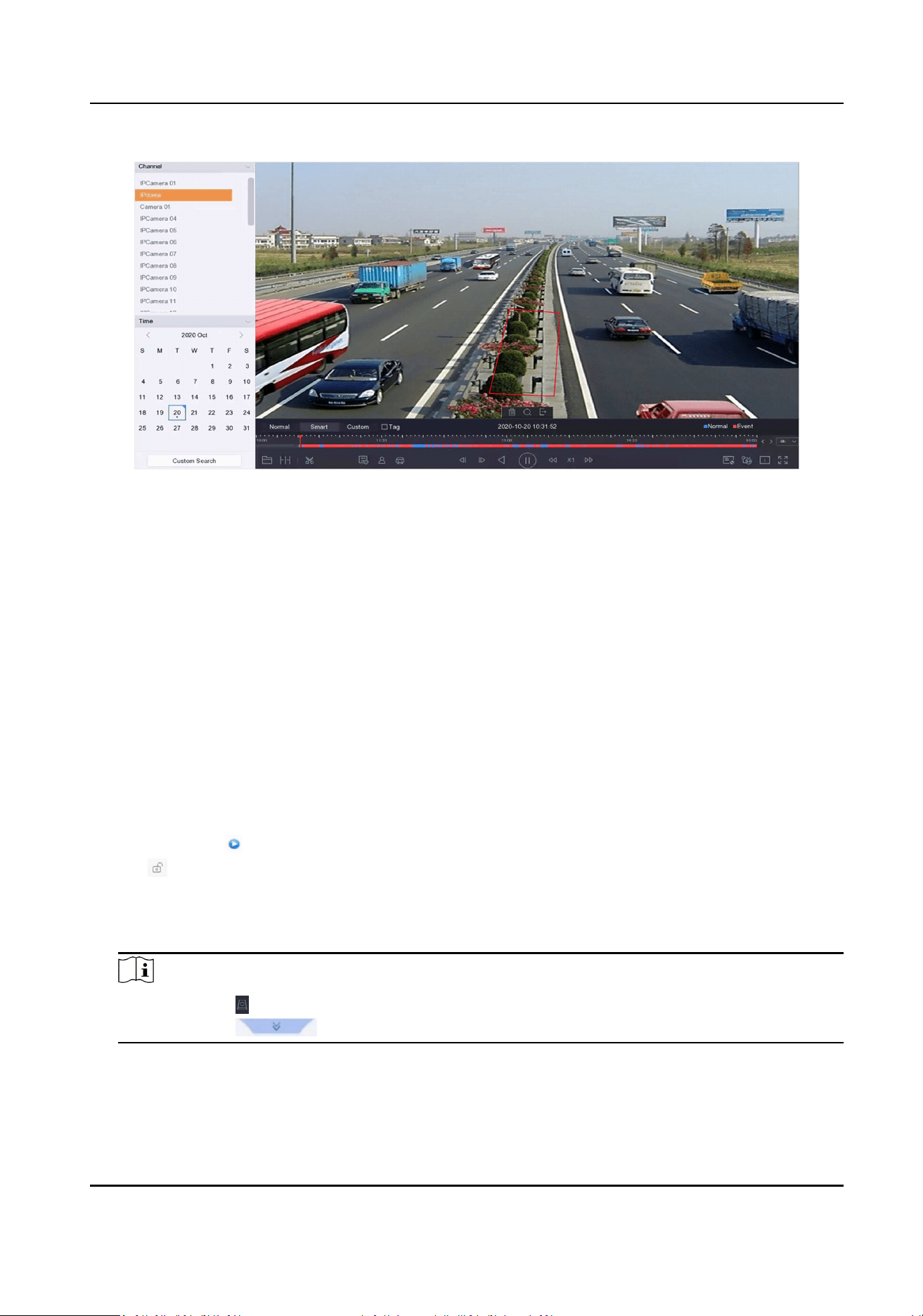
Figure 4-7 Payback by Smart Search
4.2.4 Play Custom Searched Files
You can play video by customized search condions.
Steps
1.
Go to Playback.
2.
Select camera(s) from the list.
3.
Click Custom Search at the lower-le corner.
4.
Select a search method. For example, Search by Appearance.
5.
Set search condions
6.
Click Start Search. The search result list displays 1 channel.
7.
Click Channel to select a channel as your desire. It will display search results for the selected
channel.
8.
Oponal: Click
to play a video.
9.
Click to lock a le. The locked le will not be overwrien.
10.
Oponal: Export search results to a backup device.
1) Select le(s) in the search result list, or check Select All to select all les.
2) Click Export to export the selected le(s) to a backup device.
Note
●
You can click to view export progress.
●
You can click to return to search interface.
Digital Video Recorder User Manual
54
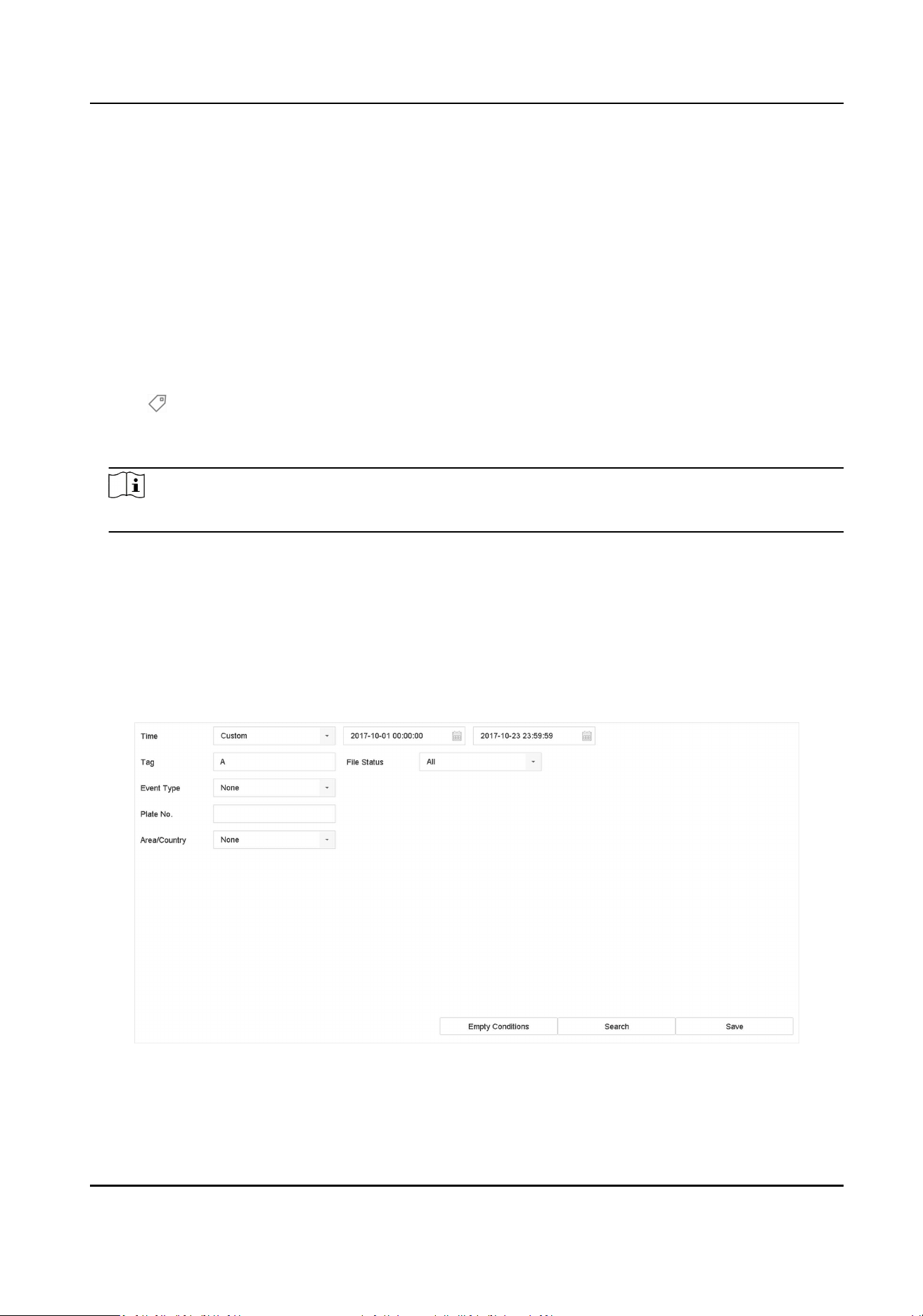
4.2.5 Play Tag Files
Video tag allows you to record informaon, such as people and locaons of a certain me point,
during playback. You can use video tag(s) to search video les and posion me point.
Add Tag Files
Steps
1.
Go to Playback.
2.
Search and play back the video le(s).
3.
Click to add the tag.
4.
Edit the tag informaon.
5.
Click OK.
Note
Max. 64 tags can be added to a single video le.
Play Tag Files
Steps
1.
Go to Playback.
2.
Click Custom Search at the le boom.
3.
Enter search condions, including me and tag keyword.
Figure 4-8 Tag Search
4.
Click Search.
Digital Video Recorder User Manual
55

Figure 4-9 Searched Tag Files
5.
Select a tag le, and play the video on the search results interface.
4.2.6 Play by Sub-periods
The video les can be played in mulple sub-periods simultaneously on the screen.
Steps
1.
Go to Playback.
2.
Click at the lower-le corner.
3.
Select a camera.
4.
Set the start me and end me for searching video.
5.
Select the dierent mul-period at the lower-right corner, e.g., 4-Period.
Note
According to the dened number of split-screens, the video les on the selected date can be
divided into average segments for playback. E.g., if there are video les exisng between 16:00
and 22:00, and the 6-screen display mode is selected, then it can play the video les for 1 hour
on each screen simultaneously.
4.2.7 Play Log Files
Play back record le(s) associated with channels aer searching system logs.
Steps
1.
Go to Maintenance → Log Info .
2.
Click Log Search .
3.
Set search me and type and click Search.
Digital Video Recorder User Manual
56
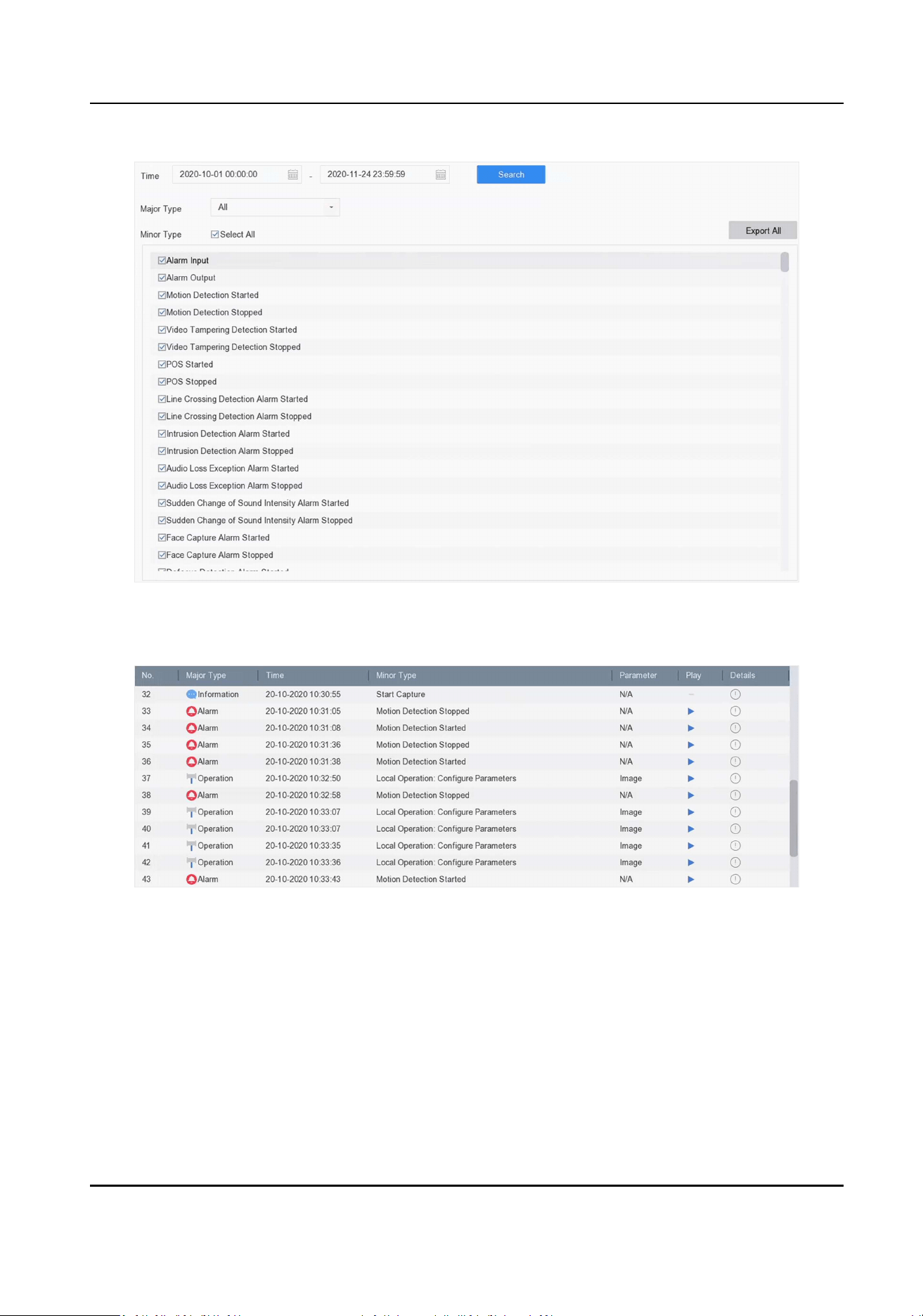
Figure 4-10 Search Log Files
4.
Choose a log with a video le and click to start playing the log le.
Figure 4-11 Play Log Files
4.2.8 Play External Files
You can play les from external storage devices.
Before You Start
Connect the storage device with the video les to your device.
Digital Video Recorder User Manual
57

Steps
1.
Go to Playback.
2.
Click at the lower-le corner.
3.
Click , or double-click the le to play it.
4.3 Playback Operaons
4.3.1 Normal/Smart/Custom Video
During the playback, you can select the following three modes to play the video.
Normal
Video les from the connuous recording.
Smart
Video les from events and alarm triggered recording.
Custom
Video les searched by custom condions.
4.3.2 Set Play Strategy in Important/Custom Mode
When you are in the smart or custom video playback mode, you can set the playing speed
separately for the normal video and the smart/custom video, or you can select to skip the normal
video.
In the Smart/Custom video playback mode, click
to set the play strategy.
●
When Do not Play Normal Videos is checked, the device will skip the normal video and play the
smart (moon/line crossing/intrusion) video and the custom (searched video) only in the normal
speed (X1).
●
When Do not Play Normal Videos is unchecked, you can set the play speed for the normal video
the smart/custom video separately. The speed range is from X1 to XMAX.
Note
You can set the speed in the single-channel play mode only.
4.3.3 Edit Video Clips
You can cut and export video clips during playback.
Steps
1.
Go to Playback.
2.
Click
at the boom toolbar.
Digital Video Recorder User Manual
58
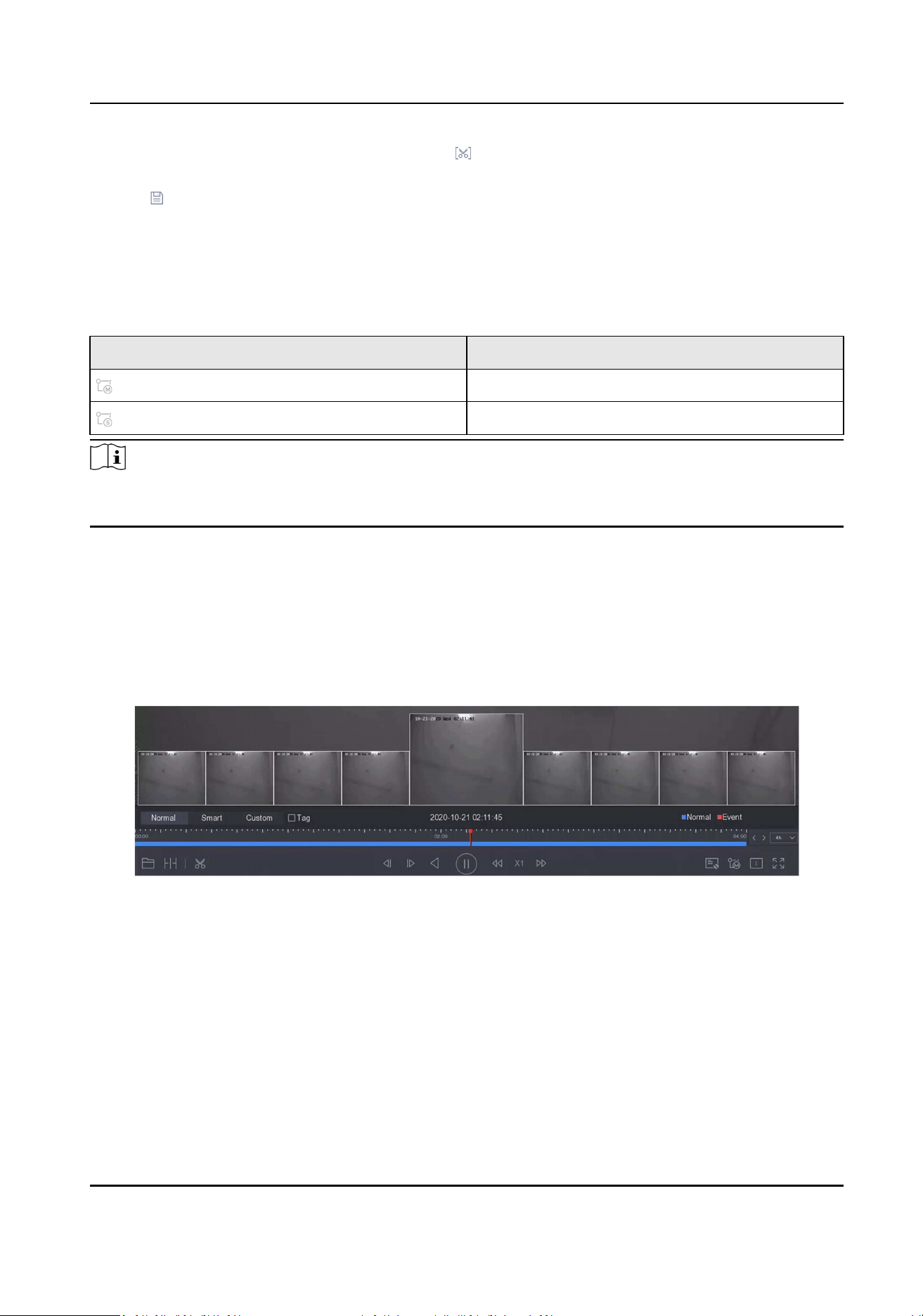
3.
Set the start me and end me. You can click to set the me period, or set a me segment on
me bar.
4.
Click to save the video clip to a storage device.
4.3.4 Switch between Main Stream and Sub-Stream
You can switch between the main stream and the sub-stream during the playback.
Icon Descripon
Play the video in main stream.
Play the video in sub-stream.
Note
The encoding parameters for the main stream and sub-stream can be congured in Storage →
Encoding Parameters .
4.3.5 Thumbnails View
With the thumbnails view on the playback interface, you can conveniently locate the required
video les on the me bar.
In the playback mode, posion the cursor on me bar to get preview thumbnails.
Figure 4-12 Thumbnails View
You can click a thumbnail to enter the full-screen playback.
4.3.6 Fast View
Hold the mouse to drag on the me bar to get a fast view of the video les.
In the Video Playback mode, hold and drag the mouse through the playing me bar to fast view
the video les.
Release the mouse at the required me point to enter the full-screen playback.
Digital Video Recorder User Manual
59
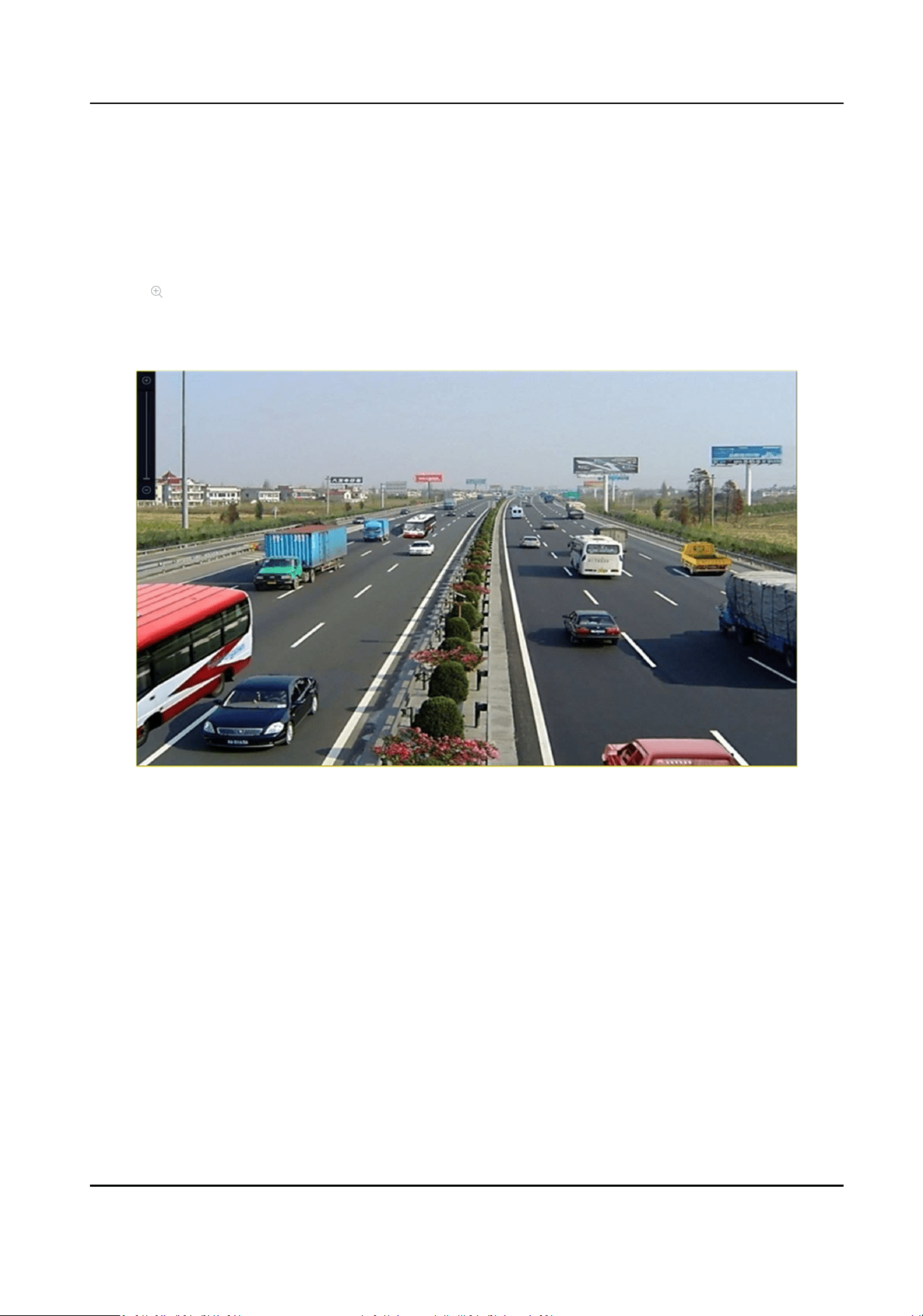
4.3.7 Digital Zoom
Digital Zoom zooms into the live image in dierent magnicaons (1x to 16x).
Steps
1.
Start live view.
2.
Click from the toolbar.
3.
Move the sliding bar or scroll the mouse wheel to zoom in/out the image to dierent
magnicaons (1x to 16x).
Figure 4-13 Digital Zoom
Digital Video Recorder User Manual
60
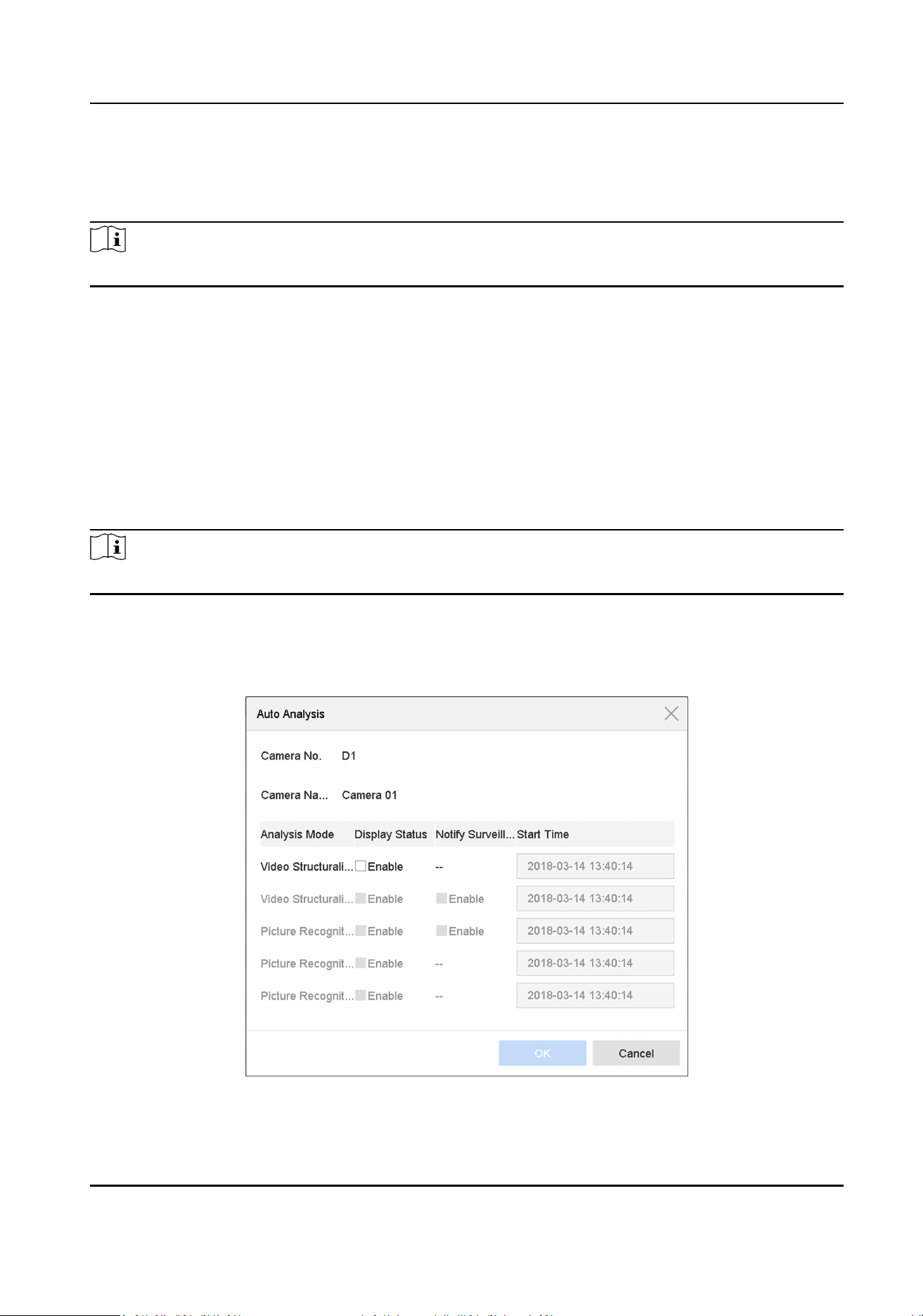
Chapter 5 Smart Analysis
Note
The funcons in this secon are only available for certain models.
5.1 Task Conguraon
You can view the task status in task conguraon. Smart analysis results are used for ltering the
pictures when searching interested human body and vehicle pictures.
Before You Start
Check Save VCA Pictures for human body detecon/vehicle detecon, line crossing detecon,
intrusion detecon, region entrance, or region exing.
Steps
Note
The chapter is only available for certain models of iDS series.
1.
Go to Smart Analysis → Smart Analysis → Task Conguraon .
2.
Check cameras to enable corresponding analysis mode.
3.
Enable auto analysis.
Figure 5-1 Auto Analysis
Digital Video Recorder User Manual
61

1) Click Edit.
2) Oponal: Check Enable of Display Status and Nofy Surveillance Center.
3) Set Start Time of video to analyze.
4) Click OK.
4.
Check cameras and click Enabled to start analyzing.
Task status includes 3 condions: Disabled, Waing, and Enabled.
●
Disabled: No analysis task is enabled on the camera.
●
Waing: The analysis task of the camera is enabled. Device is waing to analyze data.
●
Enabled: The analysis task of the camera is enabled and device is analyzing data of the
camera.
5.
Oponal: For Non-Real-Time Face Picture Comparison analysis mode, click View Record to view
the progress of each day.
5.2 Congure Enhanced VCA Mode
Enabling enhanced VCA mode will maximize the connectable channel number for line crossing
detecon and intrusion detecon. However, it will disable 2K/4K HDMI output resoluon and 4
MP/5 MP/8 MP signal input for HUHI-K series. And for HQHI-K series, it will disable CVBS output
and channel-zero encoding.
Go to System → General , and check Enhanced VCA Mode.
5.3 Face Picture Comparison
The device supports the face picture comparison alarm and face capture for the connected camera
based on face recognion feature.
Note
The chapter is only available for certain models of iDS series.
5.3.1 Facial Detecon
The facial detecon detects the face appearing in the surveillance scene. Linkage acons can be
triggered when a human face is detected.
Steps
1.
Go to System → Event → Smart Event .
2.
Click Face Detecon.
Digital Video Recorder User Manual
62
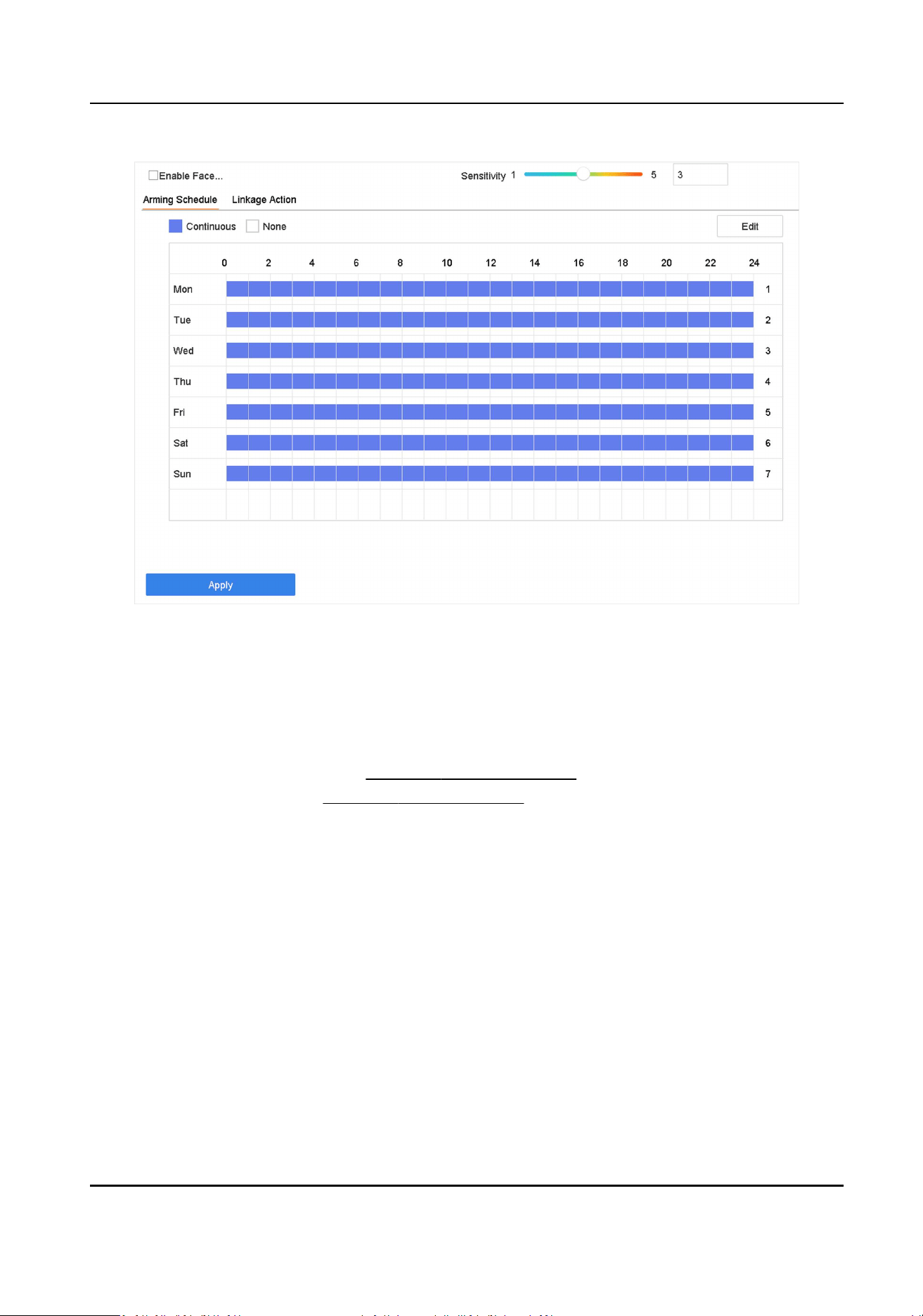
Figure 5-2 Facial Detecon
3.
Select a camera to congure.
4.
Check Enable Face Detecon.
5.
Oponal: Check Save VCA Picture to save the captured pictures of face detecon.
6.
Set the detecon sensivity. Sensivity range: [1-5]. The higher the value is, the more easily the
face will be detected.
7.
Set the arming schedule. Refer to
Congure Arming Schedule
8.
Set linkage acons. Refer to Congure Linkage Acons
9.
Click Apply.
5.3.2 Face Picture Library Management
Face picture library is mainly used for face picture storage and face picture comparison.
Add a Face Picture Library
You can create face picture libraries via local GUI or Hik-Connect app. Here we take the operaons
on local GUI as an example.
Steps
1.
Go to Smart Analysis → Face Picture Database .
Digital Video Recorder User Manual
63

2.
Click .
3.
Enter the face picture library name.
4.
Click OK.
Note
You can click or to edit the library name or delete the library.
Upload Face Pictures to the Library
Face picture comparison is based on face pictures in the library. You can upload a single face
picture or import mulple face pictures to the library.
Before You Start
●
Ensure the picture format is JPEG or JPG.
●
For each picture, ensure it only has one face.
●
Import all pictures to a backup device in advance.
Steps
1.
Select a face picture library in the list.
2.
Click Add or Import Face Picture Library.
3.
Import picture(s).
-
Add: Select a picture to import and click Import.
-
Import Face Picture Library: Select mulple pictures to import and click Import.
4.
Oponal: Select pictures and click Copy to to copy the uploaded pictures of the current library
to other library.
5.
Oponal: Select a picture and click Edit to modify the picture informaon.
6.
Oponal: Select a picture from the list and click Delete to delete the picture.
7.
Oponal: Select a library and click Export Face Picture Library to export library to backup device.
8.
Oponal: Click
or to view by gure or list.
5.3.3 Congure Face Picture Comparison
Compare detected face pictures with specied face picture library. Trigger alarm when comparison
succeeded.
Steps
1.
Go to System → Event → Smart Event → Face Picture Comparison .
Digital Video Recorder User Manual
64
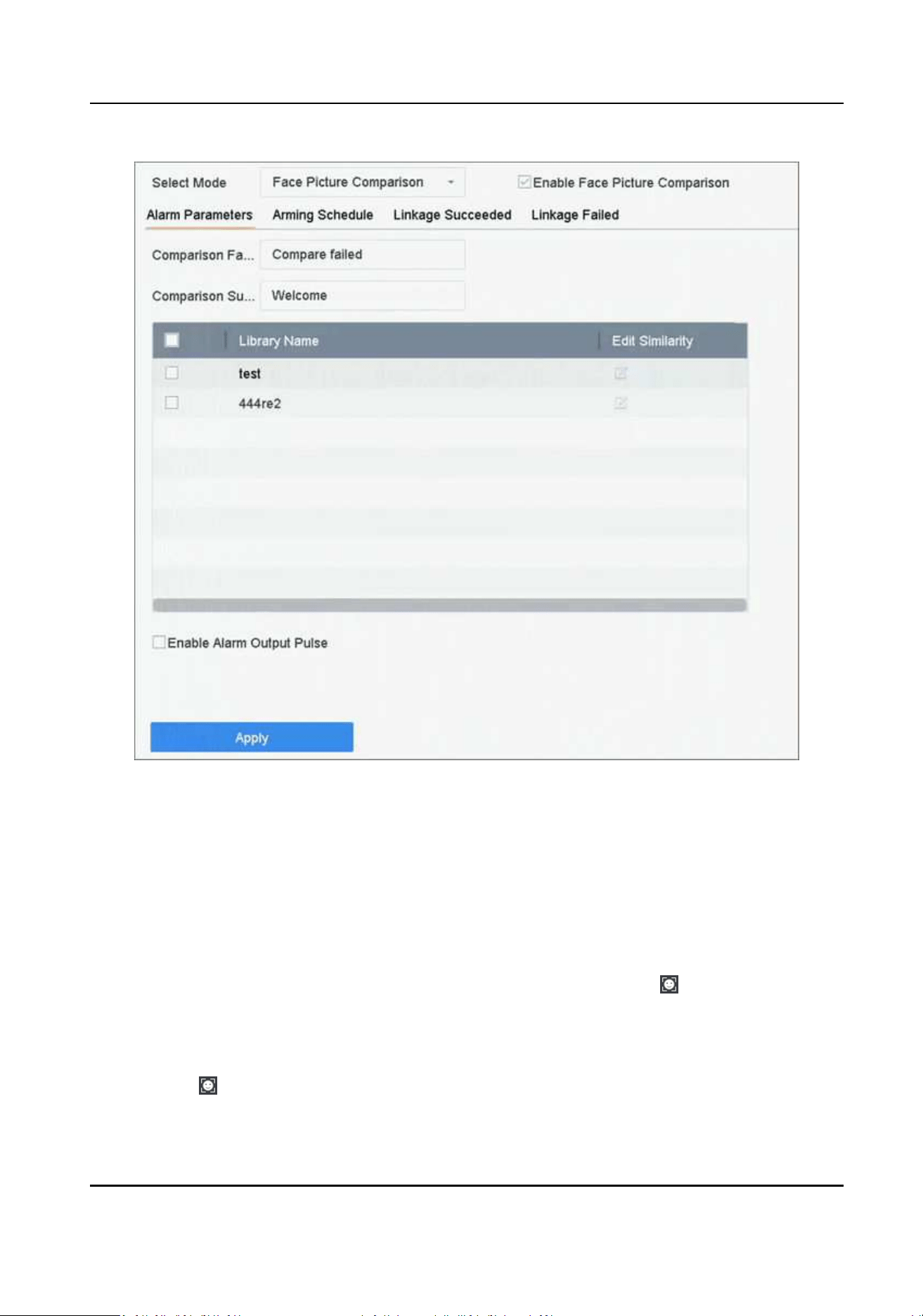
Figure 5-3 Face Picture Comparison
2.
Select a camera.
3.
Select Mode as Face Picture Comparison.
4.
Check Enable Face Picture Comparison.
5.
Oponal: Set Comparison Failed Prompt, Comparison Succeeded Prompt, and Enable Alarm
Output Pulse.
Comparison Failed Prompt
It will display the prompt in live view Target Detecon (with Facial Detecon checked) or
Facial Recognion when face picture comparison failed. You can click in live view to enter
Facial Recognion interface.
Comparison Succeeded Prompt
It will display the prompt in Facial Recognion when face picture comparison succeeded. You
can click in live view to enter Facial Recognion interface.
Digital Video Recorder User Manual
65

Enable Alarm Output Pulse
It is usually linked with a gate. When a person is passing a gate, if the comparison succeeded,
it will trigger a pulse to open the gate. The pulse is between 100 to 900 ms. You can set Alarm
Output Pulse (ms) in System → Event → Normal Event → Alarm Output .
6.
Select face picture libraries and set similarity.
7.
Set the arming schedule. Refer to Congure Arming Schedule .
8.
Set the linkage acons when face picture comparison succeeded or failed. Refer to Congure
Linkage Acons .
9.
Click Apply to save the sengs.
5.3.4 Face Picture Search
Search by Face Picture Comparison Event
Search face picture by face picture comparison results.
Steps
1.
Go to Smart Analysis → Smart Search → Face Search → Search by Event .
2.
Set the start me and end me.
3.
Select a channel.
4.
Select Event Type as Face Picture Comparison.
5.
Click Start Search. The search result list displays 1 channel.
6.
Click Channel to select a channel as your desire. It will display search results for the selected
channel.
What to do next
Refer to
View Searching Result .
Search by Uploaded Picture
You can search the face pictures by uploaded picture.
Steps
1.
Go to Smart Analysis → Smart Search → Face Search → Search by Picture .
Digital Video Recorder User Manual
66
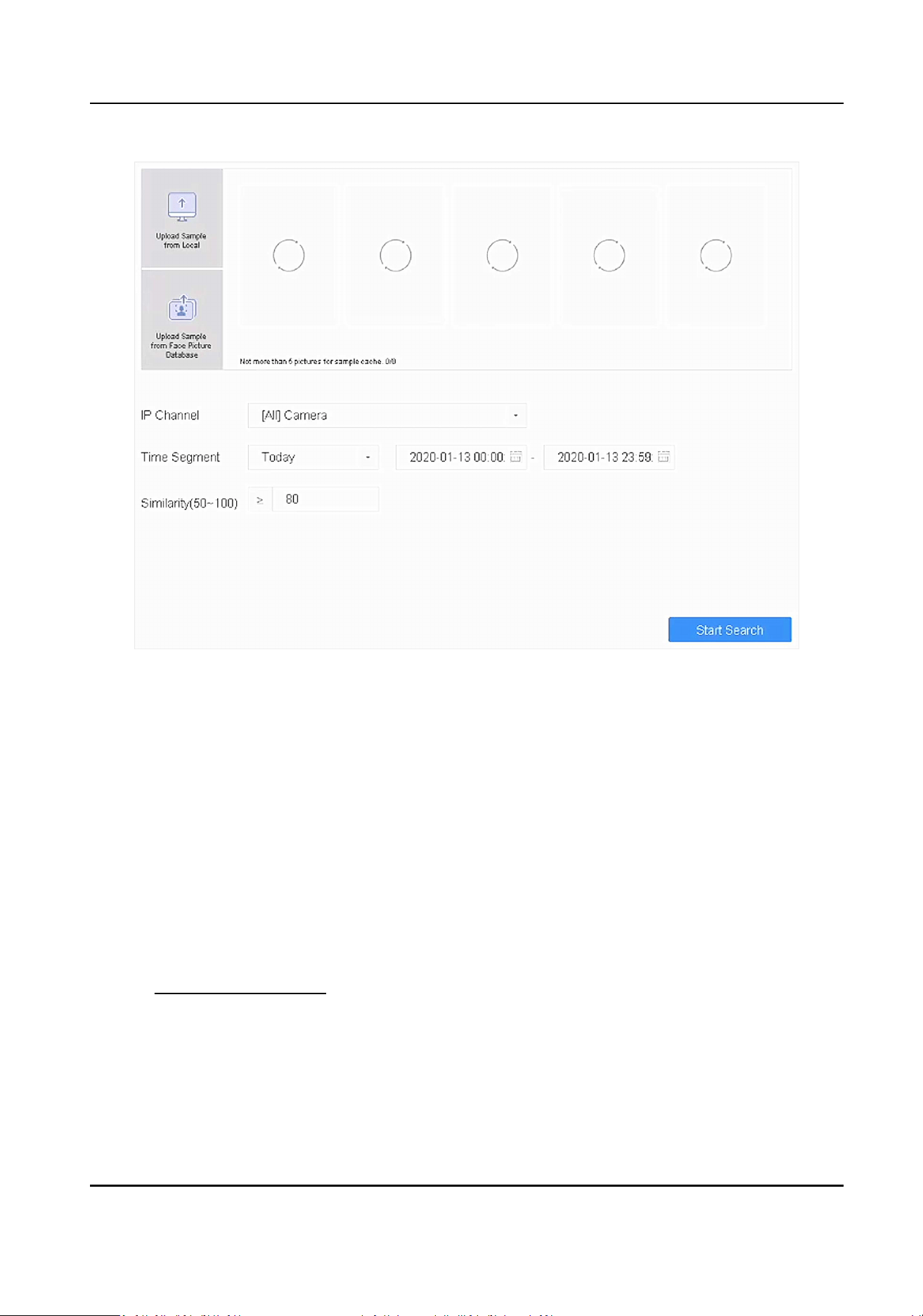
Figure 5-4 Search by Uploaded Picture
2.
Select a channel.
3.
Select face pictures for search.
-
Click Upload Sample from Local and select face pictures from your local directory.
-
Click Upload Sample from Face Picture Database and select face pictures from created face
picture libraries.
4.
Set the start me and end me.
5.
Set the Similarity value (range: 0 to 100). Device will analyze the similarity between samples and
face pictures in library and show pictures the similarity of which are higher than the set one.
6.
Click Start Search. The search result list displays 1 channel.
7.
Click Channel to select a channel as your desire. It will display search results for the selected
channel.
What to do next
Refer to
View Searching Result .
Search by Personal Name
Search face picture by personal name.
Digital Video Recorder User Manual
67
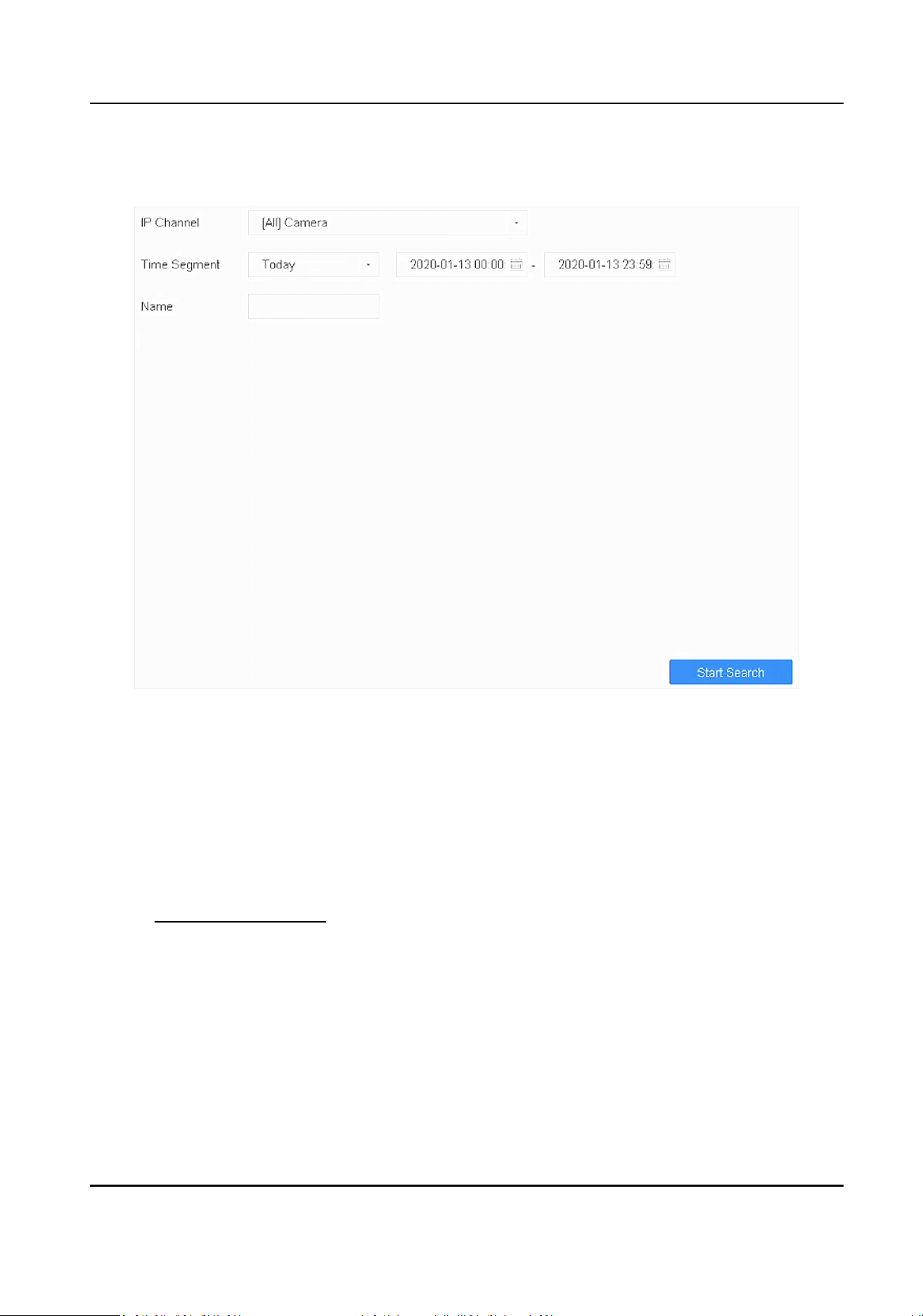
Steps
1.
Go to Smart Analysis → Smart Search → Face Search → Search by Name .
Figure 5-5 Search by Personal Name
2.
Set the start me and end me of the face pictures to search.
3.
Select a channel.
4.
Enter a name.
5.
Click Start Search. The search result list displays 1 channel.
6.
Click Channel to select a channel as your desire. It will display search results for the selected
channel.
What to do next
Refer to View Searching Result .
Search by Appearance
Search face picture by appearance.
Steps
1.
Go to Smart Analysis → Smart Search → Face Search → Search by Appearance .
2.
Set search condions.
Digital Video Recorder User Manual
68

3.
Click Start Search. The search result list displays 1 channel.
4.
Click Channel to select a channel as your desire. It will display search results for the selected
channel.
What to do next
Refer to View Searching Result .
View Searching Result
●
Double click a le to view the related video.
●
Click Add to Face Database to add the selected le(s) to a face picture library.
●
Click Add to Sample to add the select le(s) as sample picture(s). You can use the sample
picture(s) to search other pictures. Refer to Search by Uploaded Picture .
●
Click Export to export the selected le(s) to a backup device. You can click Select All to select all
les.
Note
●
You can click to view export progress.
●
You can click to return to search interface.
5.4 Perimeter Protecon
Go to Smart Analysis → Smart Event Sengs → Perimeter Protecon . Refer to channels on the
pop-up window to congure the Perimeter Protecon.
5.4.1 Line Crossing Detecon
Line crossing detecon detects people, vehicles, and objects crossing a set virtual line. The
detecon direcon can be set as bidireconal, from le to right or from right to le.
Steps
1.
Go to Smart Analysis → Smart Event Sengs → Perimeter Protecon .
2.
Click Line Crossing.
Digital Video Recorder User Manual
69

Figure 5-6 Line Crossing Detecon
3.
Select a camera.
4.
Check Enable Line Crossing Detecon.
5.
Set the line crossing detecon rules and detecon areas.
1) Select an Arming Area.
2) Select Direcon as A<->B, A->B, or A<-B.
A<->B
Only the arrow on the B side shows. When an object goes across the congured line with
both direcons can be detected and alarms are triggered.
A->B
Only the object crossing the congured line from the A side to the B side can be detected.
B->A
Only the object crossing the congured line from the B side to the A side can be detected.
3) Set the detecon sensivity. The higher the value is, the more easily the detecon alarm can
be triggered.
4) Check Target Detecon as Human or Vehicle. Only the target of selected type will trigger the
alarm.
5) Click Draw Area.
6) Draw a virtual line in the preview window.
7) Set the Max. Size and Min. Size for valid target object size. Targets smaller or larger than the
valid target size will not trigger detecon.
6.
Set the arming schedule. Refer to
Congure Arming Schedule .
7.
Set linkage acons. Refer to Congure Linkage Acons .
8.
Click Apply.
Digital Video Recorder User Manual
70
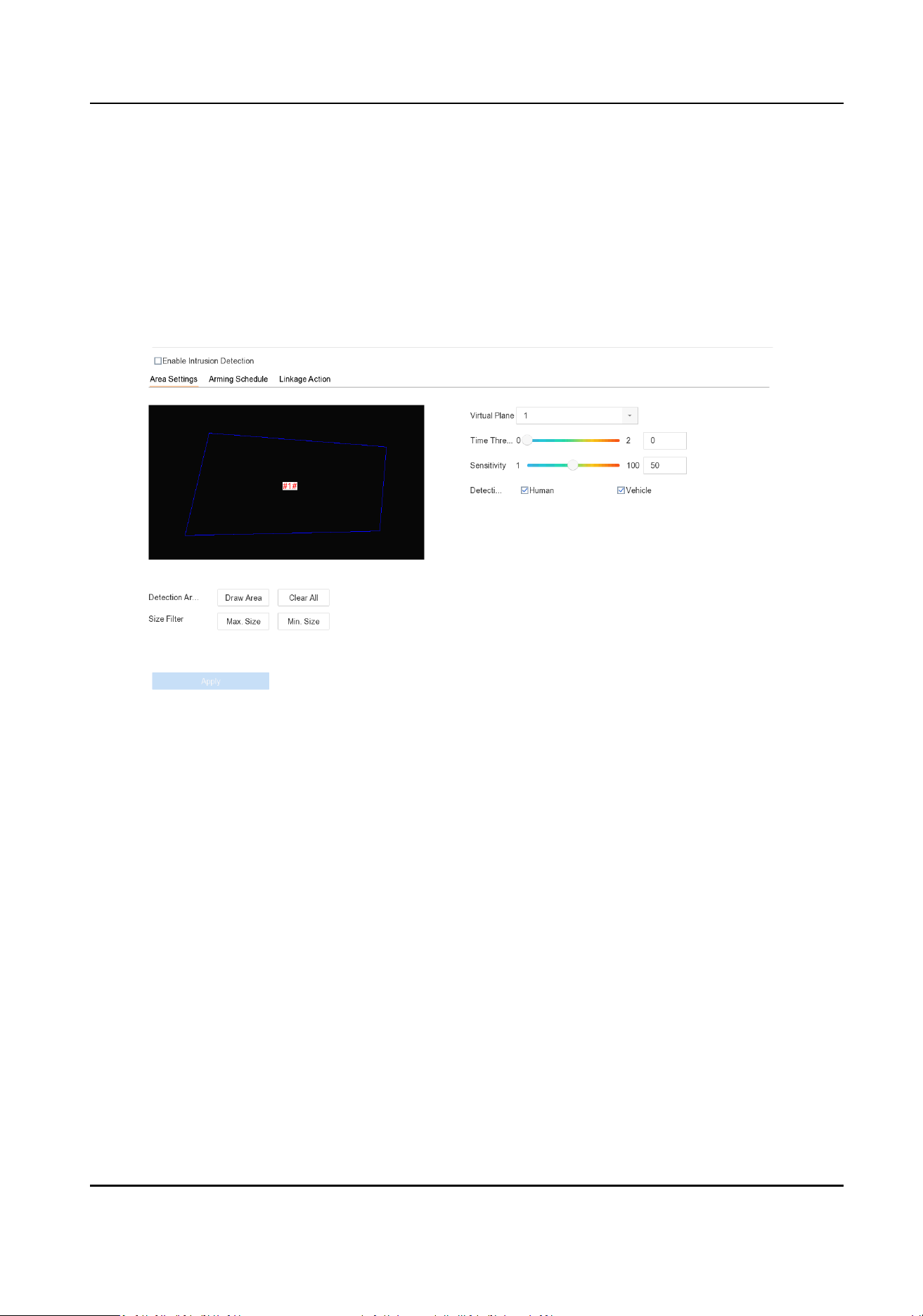
5.4.2 Intrusion Detecon
The Intrusion detecon funcon detects people, vehicles or other objects that enter and loiter in a
pre-dened virtual region. Specic acons can be taken when an alarm is triggered.
Steps
1.
Go to Smart Analysis → Smart Event Sengs → Perimeter Protecon .
2.
Click Intrusion.
Figure 5-7 Intrusion Detecon
3.
Check Enable Intrusion Detecon.
4.
Set the detecon rules and detecon areas.
1) Select a virtual panel. Up to 4 virtual panels are selectable.
2) Set Time Threshold, and Sensivity.
Time Threshold
The me an object loiter in the region. When the duraon of the object in the dened
detecon area exceeds the threshold, the device will trigger an alarm.
Sensivity
The size of the object that can trigger the alarm. The higher the value is, the more easily
the detecon alarm will be triggered.
3) Check Target Detecon as Human or Vehicle. Only the target of selected type will trigger the
alarm.
4) Click Draw Area.
5) Draw a quadrilateral in the preview window.
6) Set the Max. Size and Min. Size for valid target object size. Targets smaller or larger than the
valid target size will not trigger detecon.
Digital Video Recorder User Manual
71
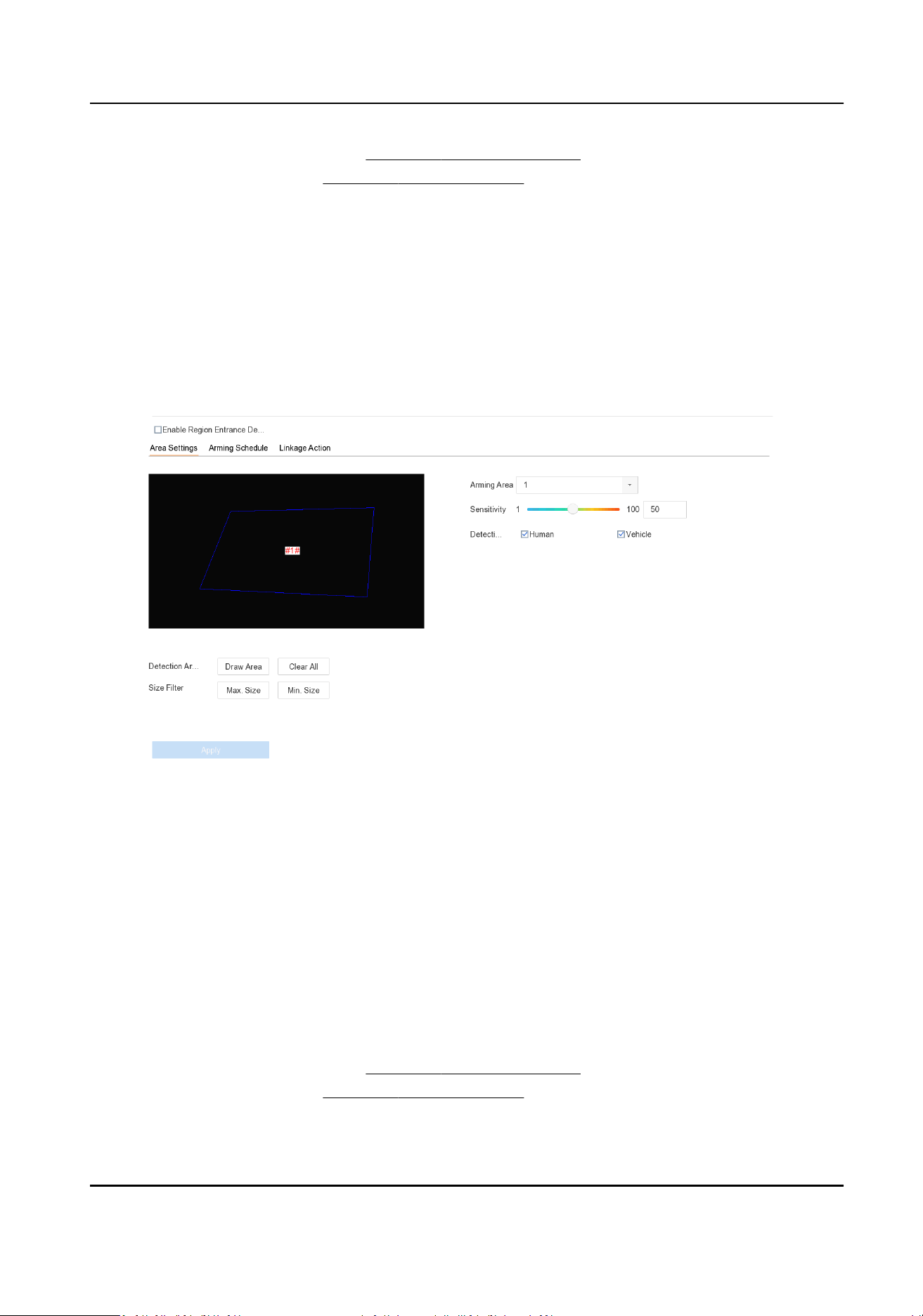
5.
Set the arming schedule. Refer to Congure Arming Schedule .
6.
Set linkage acons. Refer to Congure Linkage Acons .
7.
Click Apply.
5.4.3 Region Entrance Detecon
Region entrance detecon detects objects that enter a predened virtual region.
Steps
1.
Go to Smart Analysis → Smart Event Sengs → Perimeter Protecon .
2.
Click Region Entrance.
Figure 5-8 Region Entrance Detecon
3.
Select a camera.
4.
Check Enable Region Entrance Detecon.
5.
Set detecon rules and detecon areas.
1) Select Arming Area. Up to 4 regions are selectable.
2) Set Sensivity. The higher the value is, the easier the detecon alarm will be triggered. Its
range is [0-100].
3) Check Target Detecon as Human or Vehicle. Only the target of selected type will trigger the
alarm.
4) Click Draw Area, and draw a quadrilateral in the preview window.
5) Set the Max. Size and Min. Size for valid target object size. Targets smaller or larger than the
valid target size will not trigger detecon.
6.
Set the arming schedule. Refer to
Congure Arming Schedule .
7.
Set linkage acons. Refer to Congure Linkage Acons .
8.
Click Apply.
Digital Video Recorder User Manual
72
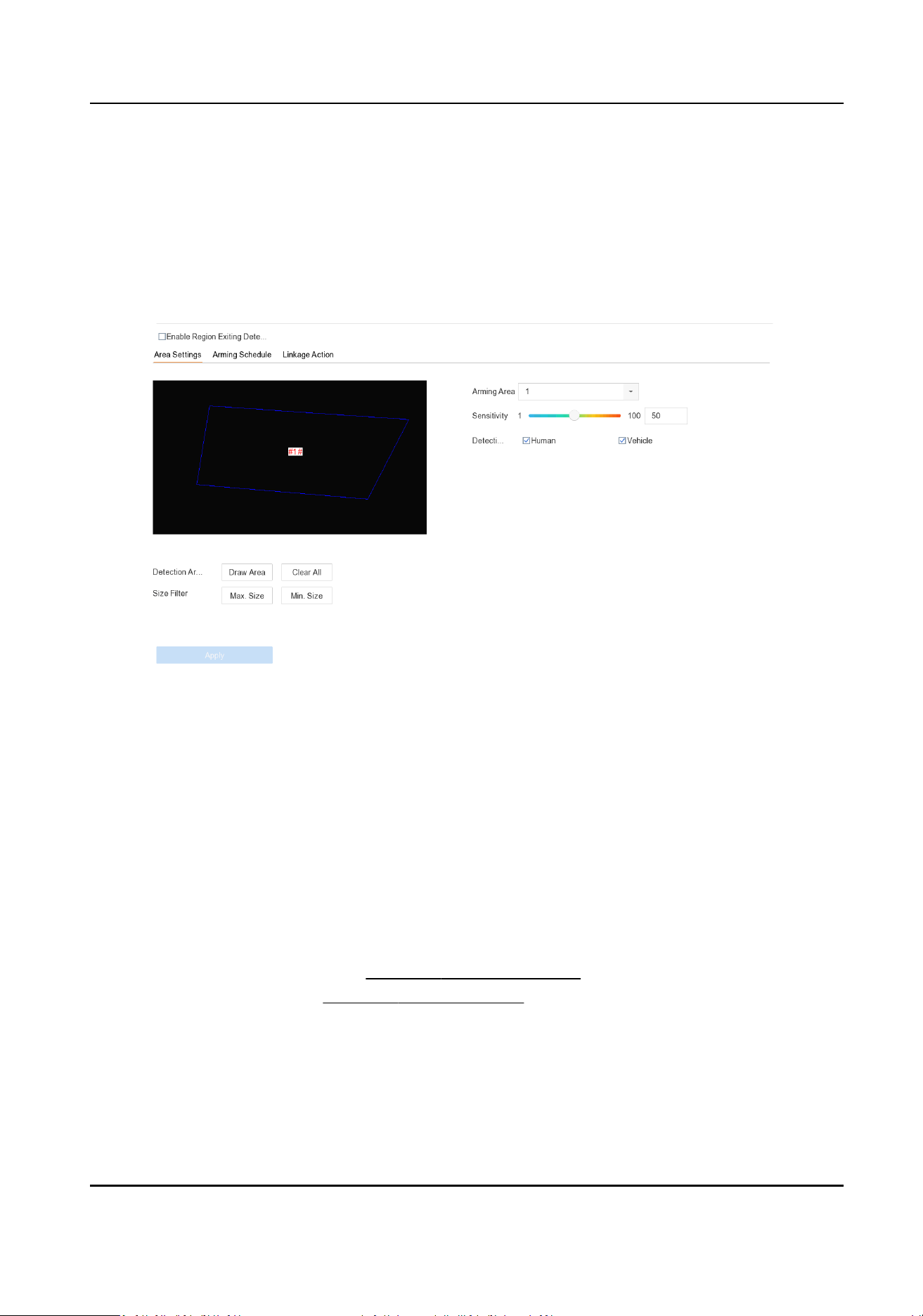
5.4.4 Region Exing Detecon
Region exing detecon detects objects that exit from a predened virtual region.
Steps
1.
Go to Smart Analysis → Smart Event Sengs → Perimeter Protecon .
2.
Click Region Exing.
Figure 5-9 Region Exing Detecon
3.
Select a camera.
4.
Check Enable Region Exing Detecon.
5.
Follow these steps to set the detecon rules and detecon areas.
1) Select Arming Area. Up to 4 regions are selectable.
2) Set Sensivity. The higher the value is, the more easily the detecon alarm will be triggered.
Its range is [0-100].
3) Check Target Detecon as Human or Vehicle. Only the target of selected type will trigger the
alarm.
4) Click Draw Area and draw a quadrilateral in the preview window.
5) Set the Max. Size and Min. Size for valid target object size. Targets smaller or larger than the
valid target size will not trigger detecon.
6.
Set the arming schedule. Refer to
Congure Arming Schedule .
7.
Set linkage acons. Refer to Congure Linkage Acons .
8.
Click Apply.
Digital Video Recorder User Manual
73

5.5 Human Body Detecon
Go to Smart Analysis → Smart Analysis → Task Conguraon to enable the task for camera. For
details, refer to Task Conguraon for details.
Note
The chapter is only available for certain models of iDS series.
5.5.1 Human Body Detecon
The human body detecon enables to detect the human body appearing in the monitoring scene,
and capture the human body pictures.
Before You Start
The connected camera supports the human body detecon.
Steps
1.
Go to System → Event → Smart Event .
2.
Click Human Body.
3.
Oponal: For IP camera does not support human body detecon, Check Enable Local Human
Body Detecon. Then the device will consume its decoding resource to execute human body
detecon.
4.
Enabling the funcon will change smart events supported by the camera.
5.
Select the camera to congure the human body detecon.
6.
Check Save VCA Picture to save the captured pictures of human body detecon.
7.
Check Target of Interest (Human Body) to discard non-human body pictures and videos which
are not triggered by human body detecon. The feature is only available for local human body
detecon.
8.
Set detecon area.
Digital Video Recorder User Manual
74
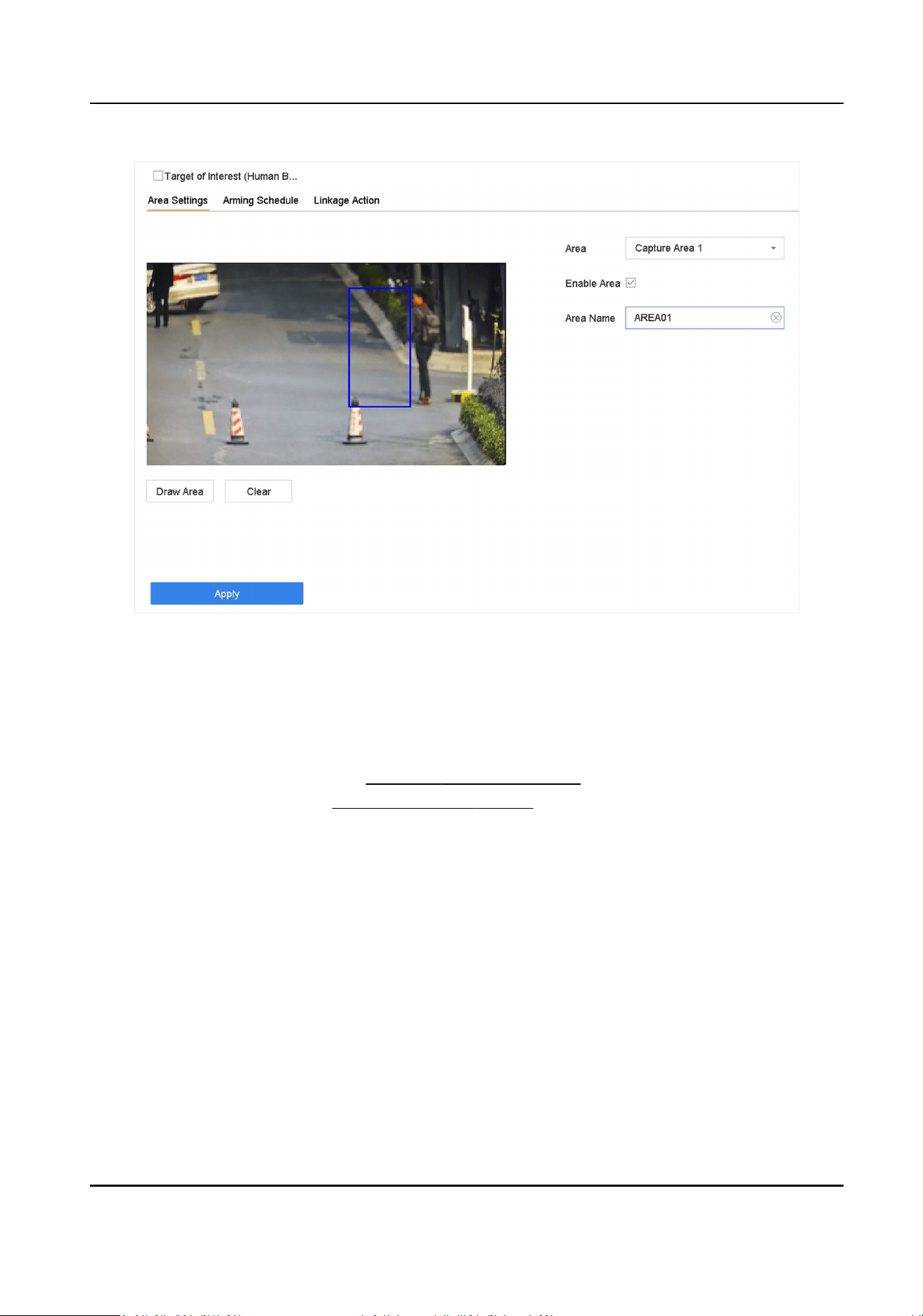
Figure 5-10 Human Body Detecon
1) Select the detecon area to congure from the Area drop-down list. Up to 8 detecon areas
are selectable.
2) Check Enable Area to enable the selected detecon area.
3) Edit the area name in Scene Name. The scene name can contain up to 32 characters.
4) Click Draw Area to draw a quadrilateral in the preview window and then click Stop Drawing.
9.
Set the arming schedule. Refer to Congure Arming Schedule .
10.
Set linkage acons. Refer to Congure Linkage Acons .
11.
Click Apply to acvate the sengs.
5.5.2 Human Body Search
Search by Appearance
Search human body pictures according to manually specied search condions.
Steps
1.
Go to Smart Analysis → Smart Search → Human Body Detecon → Search by Appearance .
2.
Specify search condions.
3.
Click Start Search. The search result list displays 1 channel.
Digital Video Recorder User Manual
75

4.
Click Channel to select a channel as your desire. It will display search results for the selected
channel.
5.
Oponal: Export search results.
1) Select result le(s) from the search result interface, or check Select All to select all les.
2) Click Export to export the selected le(s) to a backup device.
Note
●
You can click to view export progress.
●
You can click to return to search interface.
Search by Uploaded Picture
To increase search accuracy, upload several pictures of one person to compare with captured
human body pictures.
Before You Start
Import human body pictures in a USB ash drive and connect it to device.
Steps
Note
●
When there are mulple targets exisng in the same picture, up to 30 target pictures can be
analyzed and displayed.
●
The maximum allowed picture size is 3840*2160.
●
The picture must be in JPG or JPEG format.
●
The picture name (with the sux) cannot exceed 64 characters.
●
Ensure the picture you uploaded is clear and recognizable.
1.
Go to Smart Analysis → Smart Search → Human Body Detecon → Search by Picture .
2.
Select a channel.
3.
Click Upload Sample.
4.
Click Upload Sample from Local and select face pictures from your local directory.
5.
Set the start me and end me.
6.
Select a picture in USB ash drive, and click Import.
7.
Select related pictures, and click Upload.
8.
Specify search condions.
Similarity
Device will analyze the similarity between samples and face pictures in library and show
pictures the similarity of which are higher than the set one.
9.
Click Start Search. The search result list displays 1 channel.
10.
Oponal: Export search results.
1) Select result le(s) from the search result interface, or check Select All to select all les.
2) Click Export to export the selected le(s) to a backup device.
Digital Video Recorder User Manual
76

Note
●
You can click to view export progress.
●
You can click to return to search interface.
Add Search Result as Sample Picture
You can add searched human body pictures as sample pictures. And then search human body
pictures by the sample pictures.
Steps
1.
Search human body pictures.
2.
In search result interface, click to select a picture and click Add to Sample.
3.
Return to search condion sengs interface, the selected sample will be listed.
5.6 Moon Detecon
Moon detecon enables the device to detect the moving objects in the monitored area and
trigger alarms.
Steps
1.
Go to System → Event → Normal Event → Moon Detecon .
2.
Select a camera.
3.
Check Enable.
4.
Set detecon areas and rules.
1) Click Draw Area to draw the detecon area(s) on the preview screen.
2) Right-click the mouse, and click Stop Drawing to nish drawing.
3) Set Sensivity (0-100). The sensivity allows you to calibrate how readily movement triggers
the alarm. A higher value results in the more readily to triggers moon detecon.
4) Oponal: For certain analog PIR cameras, check False Alarm Filter to reduce alarms.
5) Check Human or Vehicle. Only the target of selected type will trigger the alarm, which can
reduce false alarms that are caused by other objects.
Note
●
Target Detecon of moon detecon is conicted with PIR alarm, hence False Alarm Filter
and Target Detecon of Human and Vehicle cannot be enabled at the same me.
●
Target Detecon of moon detecon may also be conicted with enhanced IP mode, and
smart events like facial detecon, face picture comparison, perimeter protecon (line crossing
detecon and intrusion detecon).
5.
Set the arming schedule. Refer to Congure Arming Schedule .
6.
Set linkage acons. Refer to Congure Linkage Acons .
7.
Click Apply.
Digital Video Recorder User Manual
77

5.7 Vehicle Detecon
Vehicle detecon is available for the road trac monitoring. In vehicle detecon, the passed
vehicle can be detected and the picture of its license plate can be captured.
5.7.1 Congure Vehicle Detecon
Vehicle detecon is available for road trac monitoring. In Vehicle Detecon, a passed vehicle can
be detected and the picture of its license plate can be captured.
Steps
1.
Go to System → Event → Smart Event .
2.
Select a camera to congure.
3.
Click Vehicle.
4.
Check Enable Vehicle Detecon.
5.
Oponal: Check Save VCA Picture to save the captured vehicle detecon pictures.
6.
Set the arming schedule.Refer to Congure Arming Schedule
7.
Set the linkage acons. Refer to Congure Linkage Acons
8.
Congure rules, including Area Sengs, Picture, Overlay Content, and Blocklist and Allowlist.
Area Sengs
Up to 4 lanes are selectable.
Blocklist and Allowlist
You can export the le rst to see its format, and edit it and import it to the device.
9.
Click Apply.
Note
Refer to the Network Camera User Manual for detailed instrucons for the vehicle detecon.
5.7.2 Vehicle Search
You can search and view the matched vehicle pictures.
Steps
1.
Go to Smart Analysis → Smart Search → Vehicle Search .
2.
Select the IP camera for the vehicle search.
3.
Set search condions.
Digital Video Recorder User Manual
78
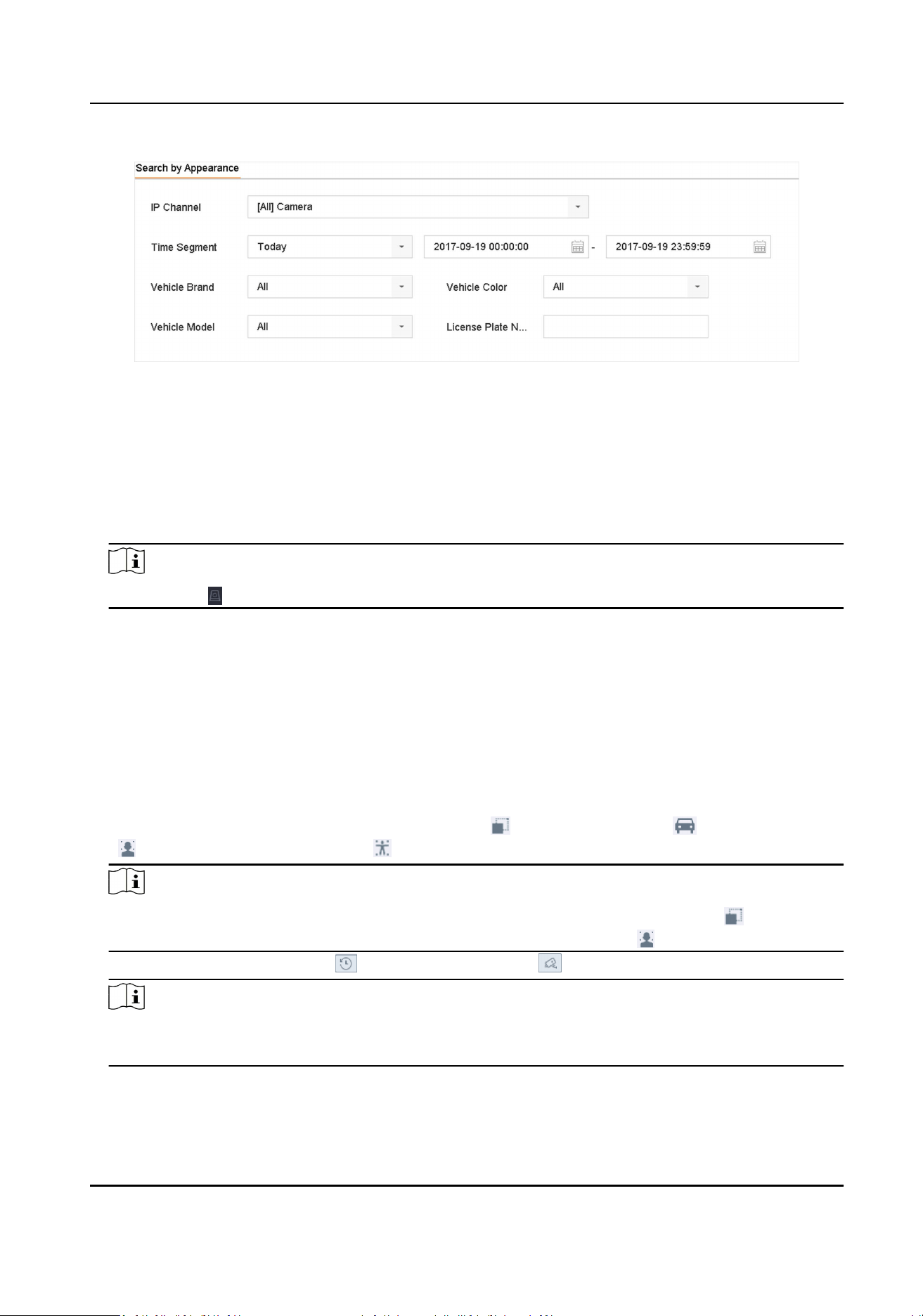
Figure 5-11 Vehicle Search
4.
Click Start Search. The search result list displays 1 channel.
5.
Click Channel to select a channel as your desire. It will display search results for the selected
channel.
6.
Export search results.
1) Select result le(s) from the search result interface, or check Select All to select all les.
2) Click Export to export the selected le(s) to a backup device.
Note
You can click to view export progress.
5.8 Target Detecon
In live view mode, the target detecon funcon can achieve smart detecon, facial detecon,
vehicle detecon, and human body detecon during the last 5 seconds and the following 10
seconds.
Steps
1.
In Live View mode, click Target to enter the target detecon interface.
2.
Select dierent detecon types: smart detecon ( ), vehicle detecon ( ), facial detecon
( ), and human body detecon ( ).
Note
For thermal cameras, the temperature measurement event is in mart detecon ( ), the face
capture and facial temperature measurement are in facial detecon ( ).
3.
Select the historical analysis ( ) or real-me analysis ( ) to obtain the results.
Note
The smart analysis results of the detecon are displayed in the list. Click a result in list to play
the related video.
4.
Oponal: You can select channels that require picture capture. The unselected channels will not
capture picture.
Digital Video Recorder User Manual
79
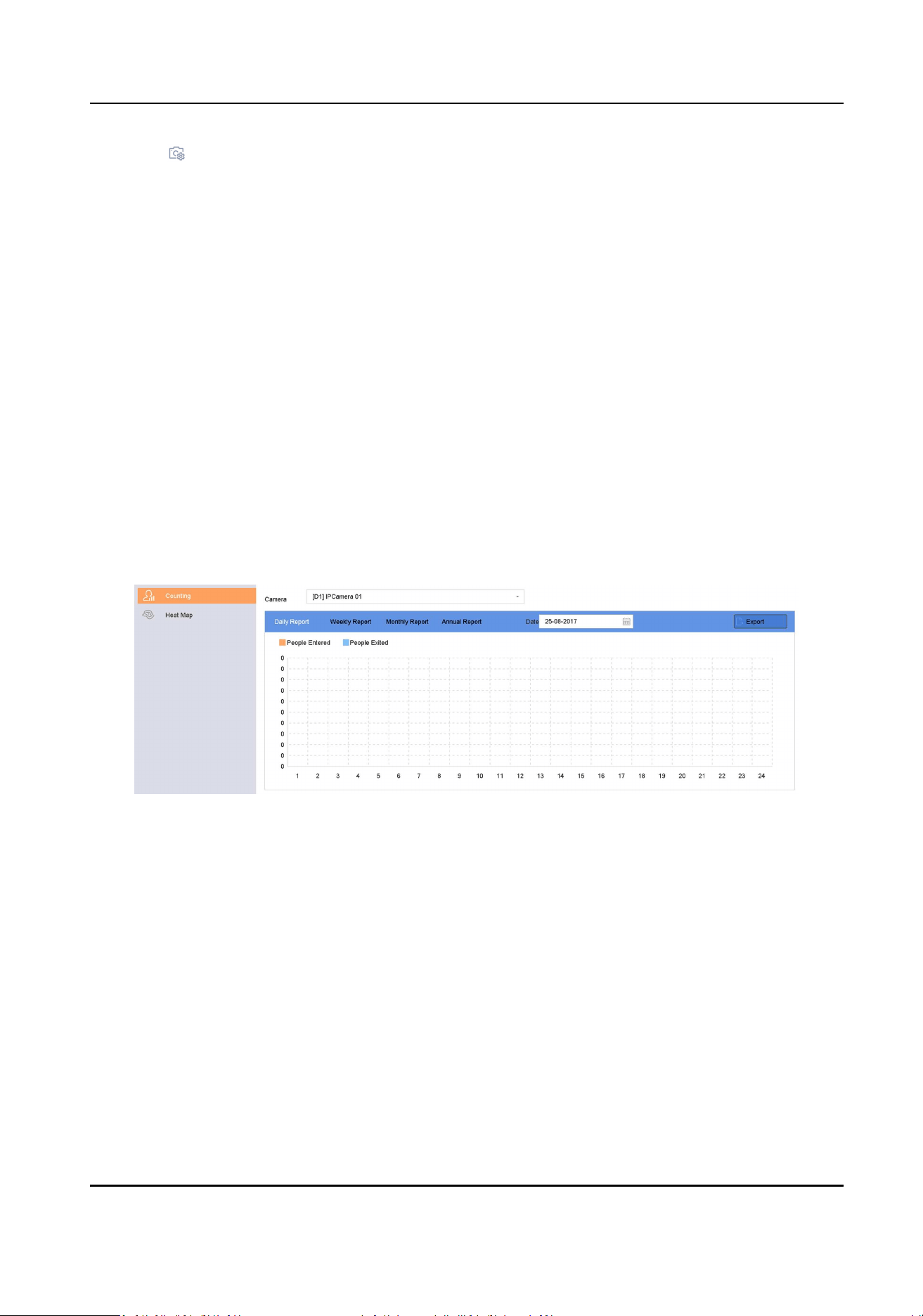
1) Click at the le boom of live view interface.
2) Select channel(s), the checked channel(s) will capture picture. All channels are selected as
default.
3) Click Finish.
5.9 View People Counng Stascs
People counng stascs calculates the number of people entering or leaving a certain congured
area and creates daily/weekly/monthly/annual reports for analysis.
Before You Start
The funcon must be supported by the connected IP camera and the corresponding conguraon
must be set.
Steps
1.
Go to Smart Analysis → Smart Report → Counng via local device GUI.
2.
Select a camera.
3.
Select the report type.
4.
Set Date to analyze. The people counng graphic will show.
Figure 5-12 People Counng Interface
5.
Oponal: Click Export to export the report in Microso Excel format.
5.10 Heat Map
Heat Map is a graphical representaon of data. The heat map funcon is used to analyze how
many people visited and stayed in a specic area.
Before You Start
The Heat Map funcon must be supported by the connected IP camera and the corresponding
conguraon must be set.
Steps
1.
Go to Smart Analysis → Heat Map .
Digital Video Recorder User Manual
80
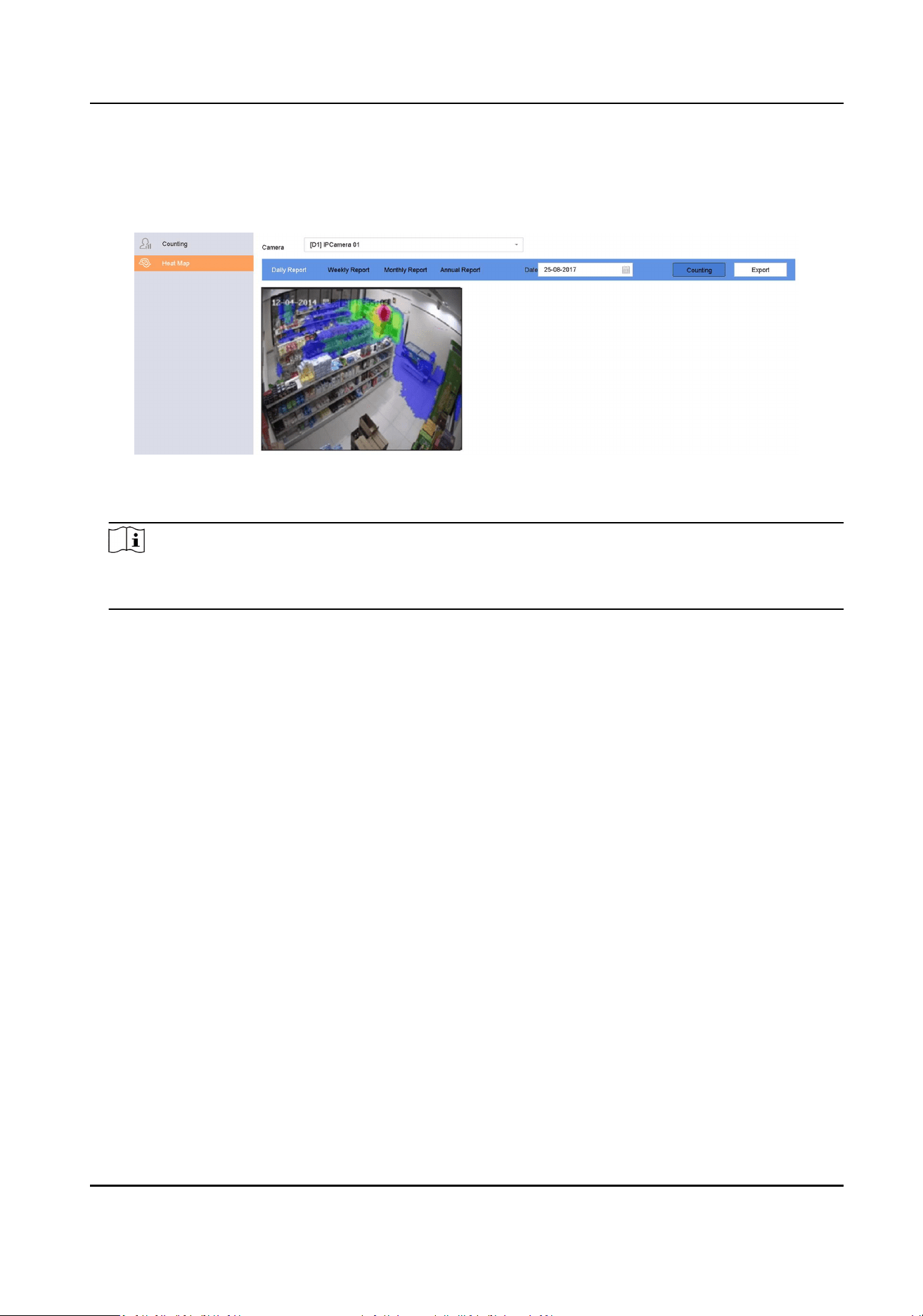
2.
Select a camera.
3.
Select the report type.
4.
Set Date to analyze.
Figure 5-13 Heat Map Interface
5.
Click Counng. The results will be displayed in graphics marked in dierent colors.
Note
As shown in the gure above, red color block (255, 0, 0) indicates the most tracked area, and
blue color block (0, 0, 255) indicates the less-popular area.
6.
Oponal: Click Export to export the stascs report in Microso Excel format.
Digital Video Recorder User Manual
81

Chapter 6 Event
6.1 Normal Event Alarm
6.1.1 Congure Video Loss Alarms
Video loss detecon detects video loss of a channel and takes alarm response acon(s).
Steps
1.
Go to System → Event → Normal Event → Video Loss .
2.
Select a camera.
3.
Check Enable.
4.
Set the arming schedule. Refer to Congure Arming Schedule .
5.
Set linkage acons. Refer to Congure Linkage Acons .
6.1.2 Congure Video Tampering Alarms
Video tampering detecon triggered an alarm when the camera lens is covered and takes alarm
response acon(s).
Steps
1.
Go to System → Event → Normal Event → Video Tampering .
2.
Select a camera.
3.
Check Enable.
4.
Set the video tampering area. Drag on the preview screen to draw the customized video
tampering area.
5.
Set Sensivity (0-2). 3 levels are available. The sensivity calibrates how readily movement
triggers the alarm. A higher value more readily triggers the video tampering detecon.
6.
Set the arming schedule. Refer to
Congure Arming Schedule .
7.
Set linkage acons. Refer to Congure Linkage Acons .
6.1.3 Congure Sensor Alarms
Set the handling acon of an external sensor alarm.
Steps
1.
Go to System → Event → Normal Event → Alarm Input .
2.
Select an alarm input item from the list and click .
3.
Select the alarm input type.
4.
Edit the alarm name.
Digital Video Recorder User Manual
82
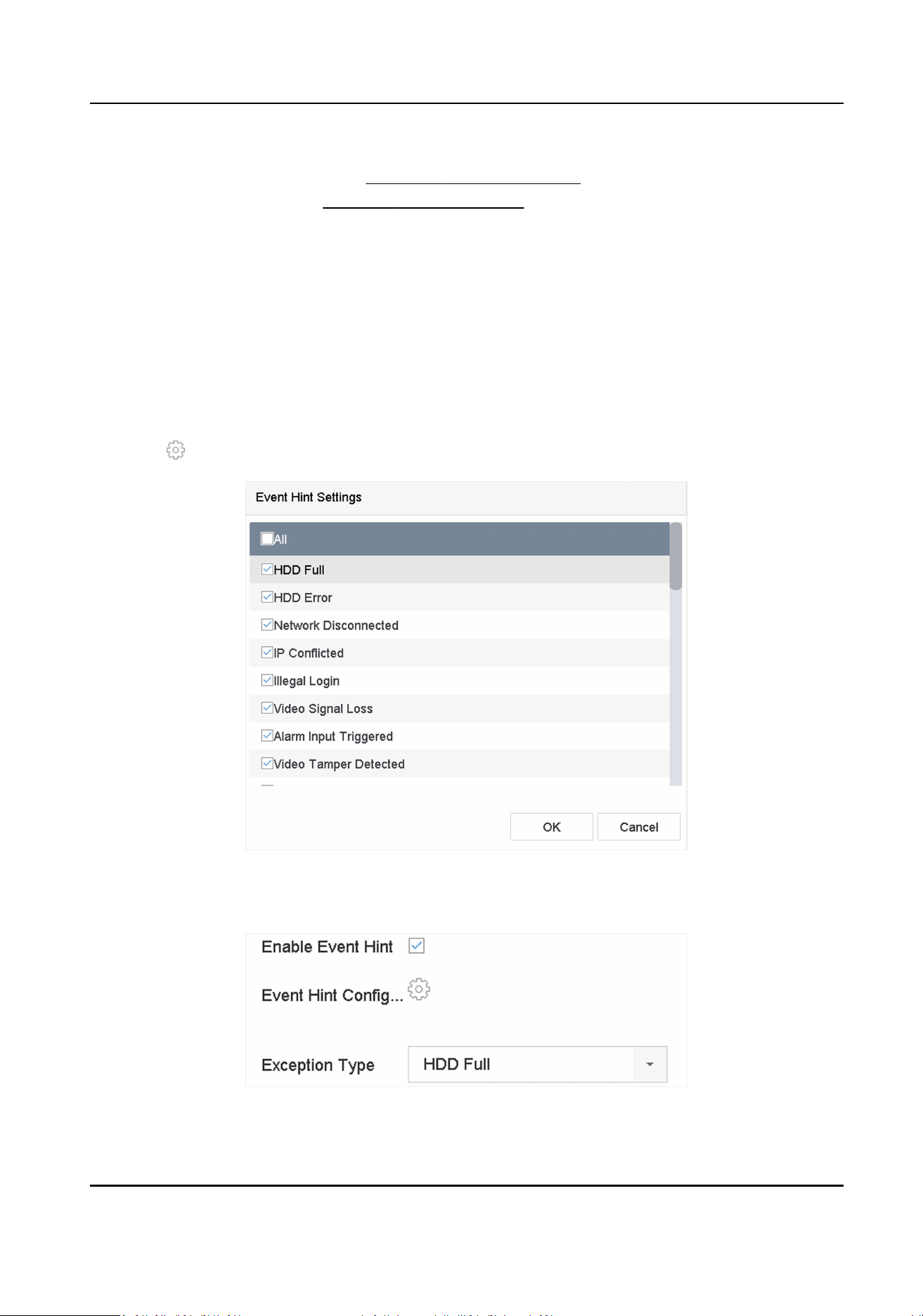
5.
Check Input.
6.
Set the arming schedule. Refer to Congure Arming Schedule .
7.
Set linkage acons. Refer to Congure Linkage Acons .
6.1.4 Congure Excepons Alarms
Excepon events can be congured to take the event hint in the Live View window and trigger
alarm output and linkage acons.
Steps
1.
Go to System → Event → Normal Event → Excepon .
2.
Oponal: Enable the event hint to display it in the live view window.
1) Check Enable Event Hint.
2) Click to select the excepon type(s) to take the event hint.
Figure 6-1 Event Hint Sengs
3.
Select an excepon type.
Figure 6-2 Excepons Handling
Digital Video Recorder User Manual
83
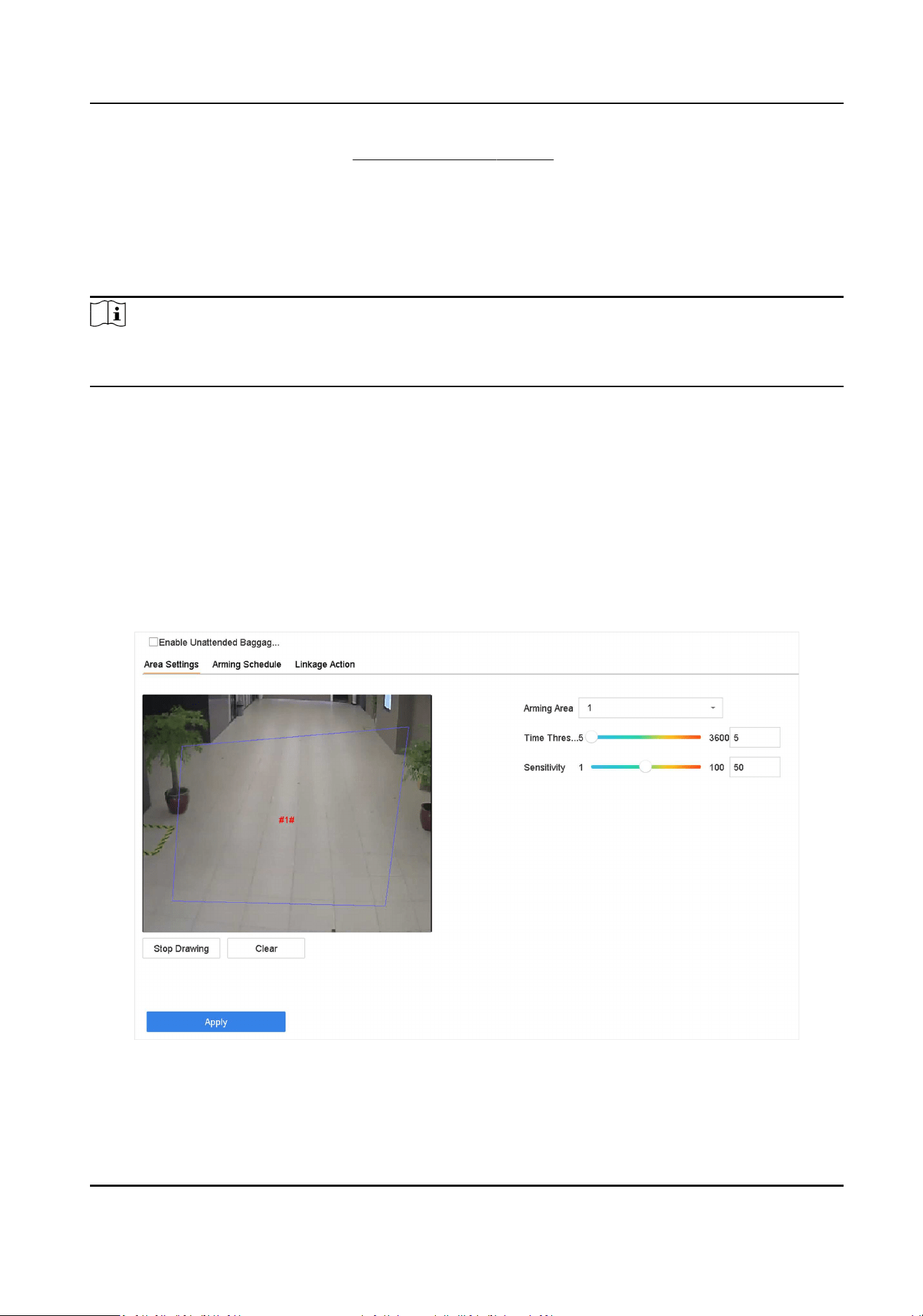
4.
Set the linkage acons. Refer to Congure Linkage Acons .
6.2 VCA Event Alarm
The device supports receiving VCA detecons sent by connected IP cameras. Enable and congure
VCA detecon on the IP camera sengs interface rst.
Note
●
VCA detecons must be supported by the connected IP camera.
●
Refer to the network camera user manual for detailed VCA detecon instrucons.
6.2.1 Unaended Baggage Detecon
Unaended baggage detecon detects the objects le over in a predened region such as the
baggage, purses, dangerous materials, etc., and a series of acons can be taken when the alarm is
triggered.
Steps
1.
Go to System → Event → Smart Event .
2.
Click Unaended Baggage.
Figure 6-3 Unaended Baggage Detecon
3.
Select a camera.
4.
Check Enable Unaended Baggage Detecon.
Digital Video Recorder User Manual
84

5.
Oponal: Check Save VCA Picture to save the captured unaended baggage detecon pictures.
6.
Set the detecon rules and detecon areas.
1) Select Arming Region. Up to 4 regions are selectable.
2) Drag the sliders to set Time Threshold and Sensivity.
Time Threshold
The me of the objects are le in the region. If the value is 10, an alarm is triggered aer
the object is le and stayed in the region for 10s. Its range is [5s-20s].
Sensivity
Similarity of the background image to the object. The higher the value, the easier the
detecon alarm will be triggered.
3) Click Draw Region and draw a quadrilateral in the preview window.
7.
Set the arming schedule. Refer to Congure Arming Schedule .
8.
Set linkage acons. Refer to Congure Linkage Acons .
9.
Click Apply.
6.2.2 Object Removal Detecon
The object removal detecon funcon detects the objects removed from a pre-dened region,
such as the exhibits on display, and a series of acons can be taken when the alarm is triggered.
Steps
1.
Go to System → Event → Smart Event .
2.
Click Object Removable.
Digital Video Recorder User Manual
85
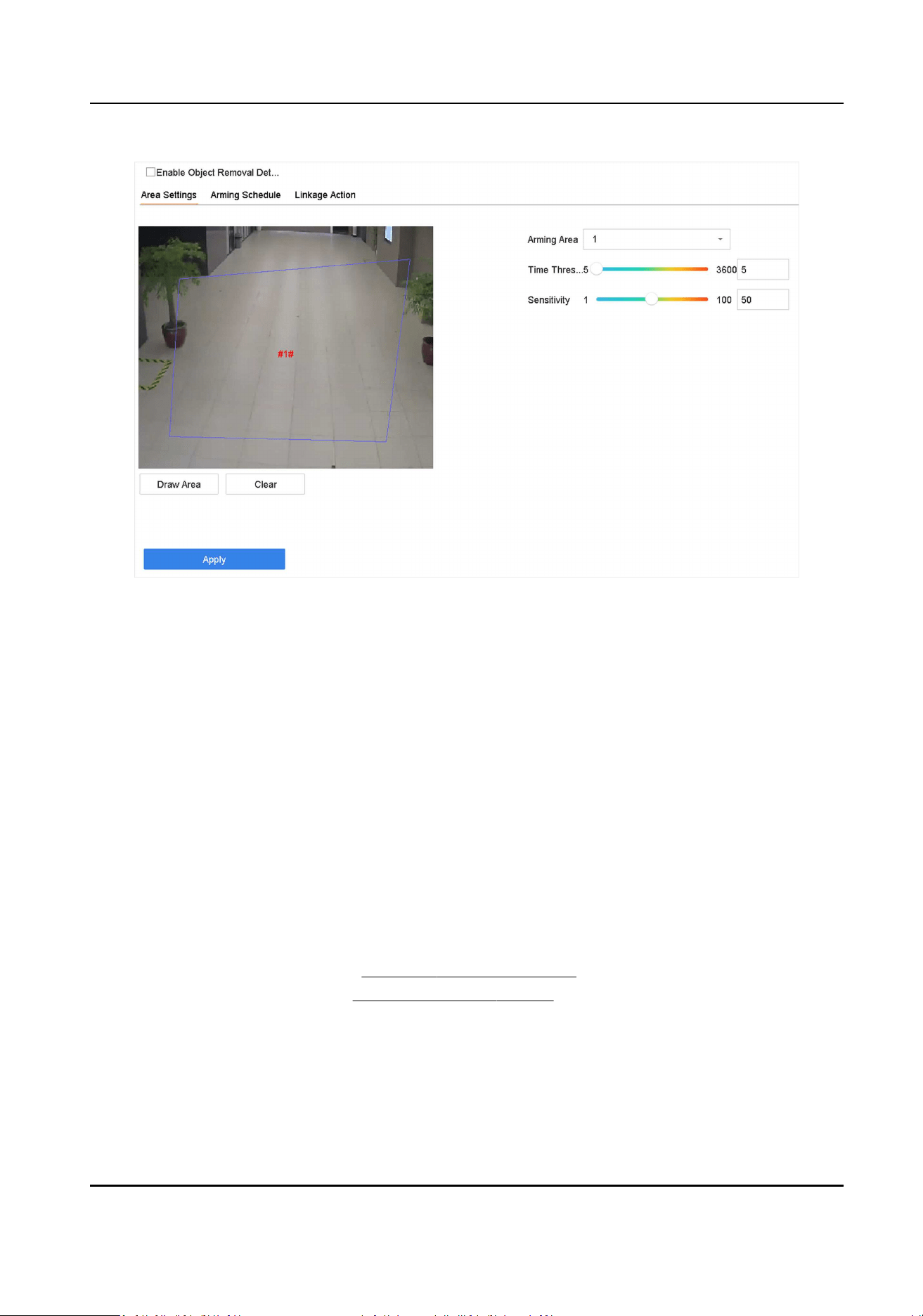
Figure 6-4 Object Removal Detecon
3.
Select a camera to congure.
4.
Check Enable Object Removable Detecon.
5.
Oponal: Check Save VCA Picture to save the captured object removable detecon pictures.
6.
Follow these steps to set the detecon rules and detecon areas.
1) Select Arming Region. Up to 4 regions are selectable.
2) Drag the sliders to set Time Threshold and Sensivity.
Time Threshold
The me of the objects removed from the region. If the value is 10, alarm will be triggered
aer the object disappears from the region for 10s. Its range is [5s-20s].
Sensivity
The similarity degree of the background image. If the sensivity is high, a very small object
taken from the region will trigger the alarm.
3) Click Draw Area and draw a quadrilateral in the preview window by specifying four verces of
the detecon region.
7.
Set the arming schedule.Refer to
Congure Arming Schedule .
8.
Set the linkage acons. Refer to Congure Linkage Acons .
9.
Click Apply.
Digital Video Recorder User Manual
86
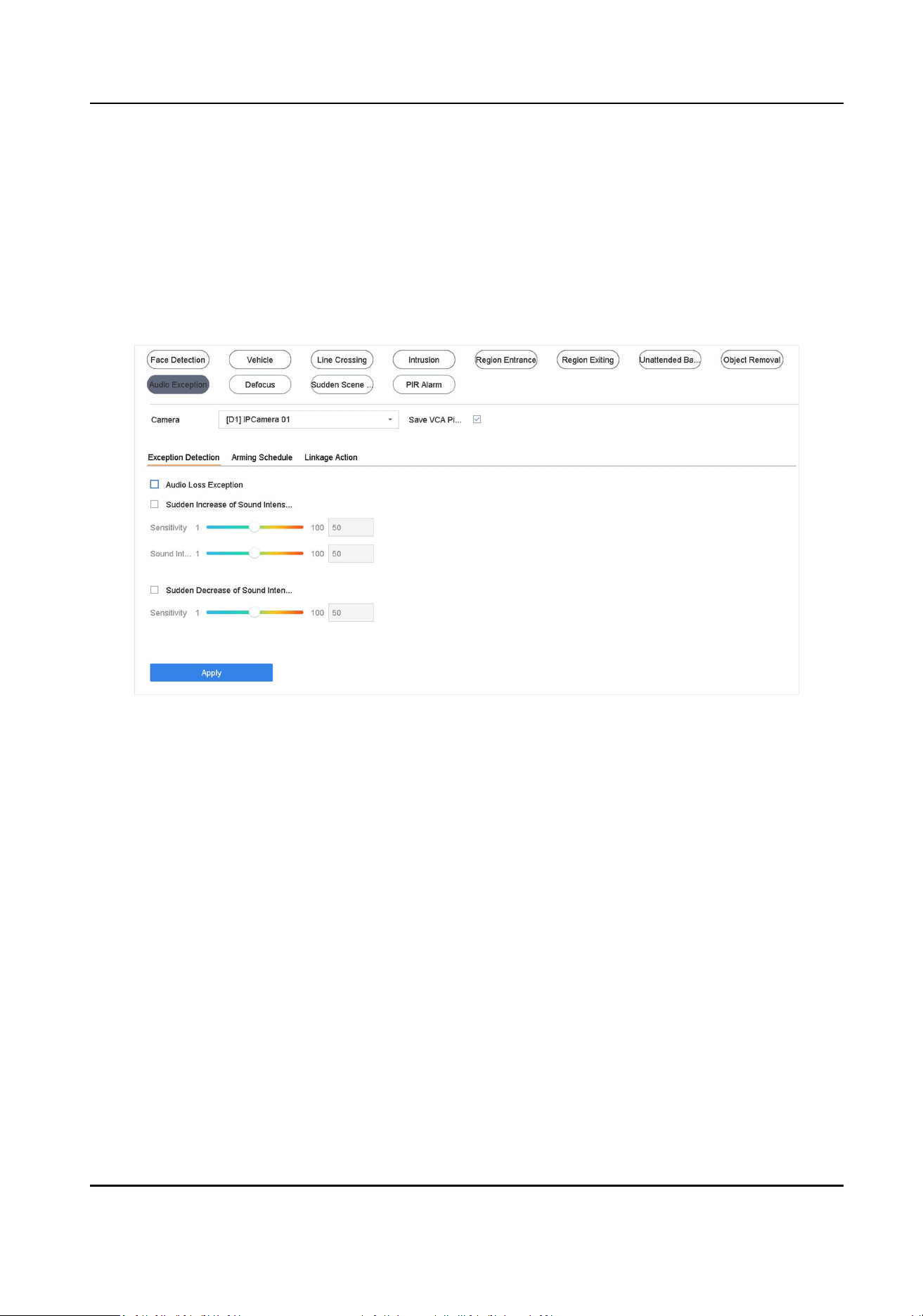
6.2.3 Audio Excepon Detecon
Audio excepon detecon detects abnormal sounds in the surveillance scene, such as a sudden
increase/decrease in sound intensity.
Steps
1.
Go to System → Event → Smart Event .
2.
Click Audio Excepon.
Figure 6-5 Audio Excepon Detecon
3.
Select a camera to congure.
4.
Oponal: Check Save VCA Picture to save the captured audio excepon detecon pictures.
5.
Set the detecon rules:
1) Select Excepon Detecon.
2) Check Audio Loss Excepon,Sudden Increase of Sound Intensity Detecon,and/or Sudden
Decrease of Sound Intensity Detecon.
Audio Loss Excepon
Detects a steep sound rise in the surveillance scene. You can set the detecon sensivity
and threshold for steep sound rise by conguring its Sensivity and Sound Intensity
Threshold
Sensivity
The smaller the value, the more severe the change must be to trigger the detecon. Range
[1-100].
Sound Intensity Threshold
Digital Video Recorder User Manual
87
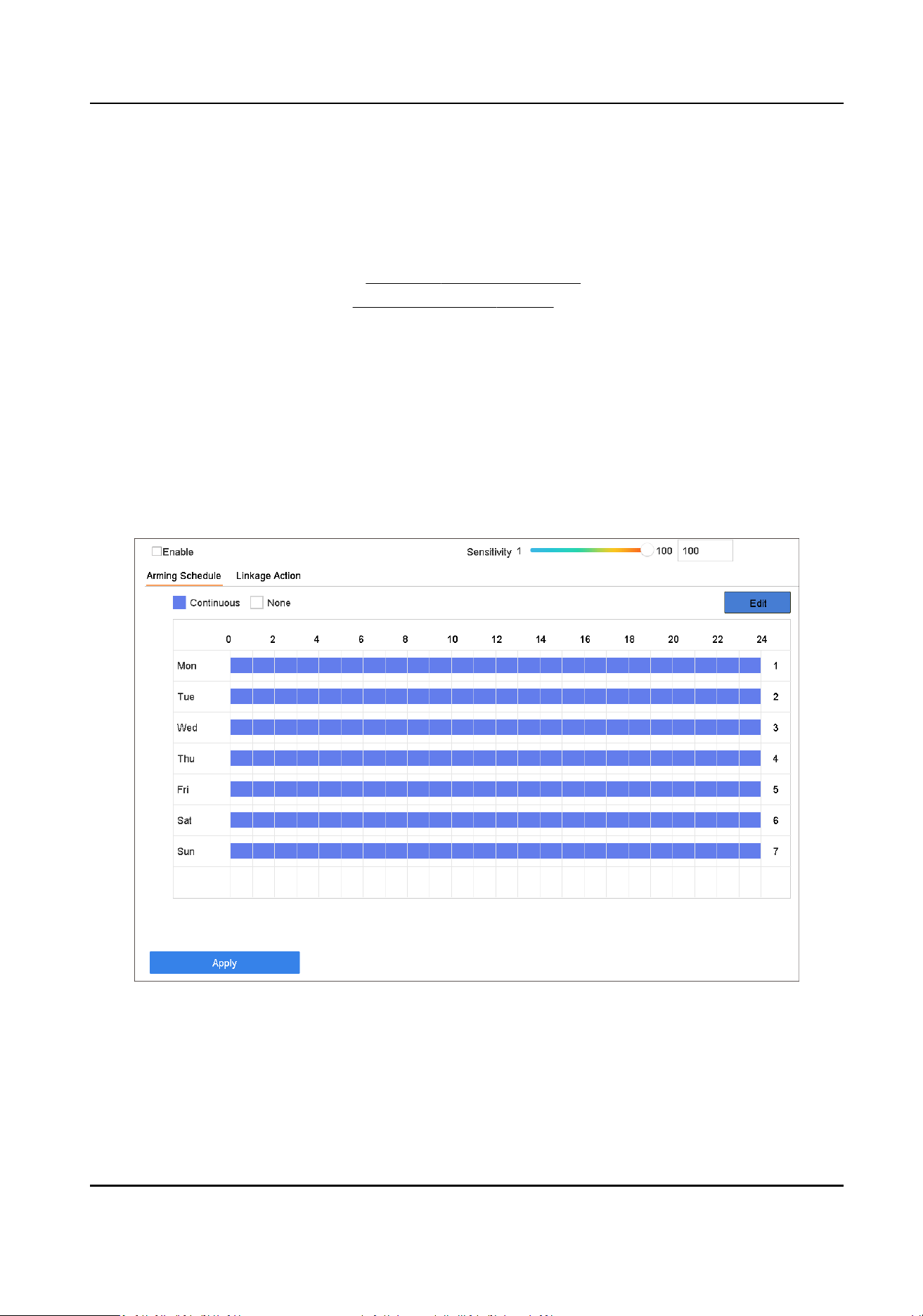
It can lter the sound in the environment. The louder the environment sound, the higher
the value should be. Adjust it according to the environment. Range [1-100].
Sudden Decrease of Sound Intensity Detecon
Detects a steep sound drop in the surveillance scene. You need set the detecon sensivity
[1-100].
6.
Set the arming schedule. Refer to Congure Arming Schedule .
7.
Set the linkage acons. Refer to Congure Linkage Acons .
8.
Click Apply.
6.2.4 Defocus Detecon
Image blur caused by lens defocus can be detected.
Steps
1.
Go to System → Event → Smart Event .
2.
Click Defocus.
Figure 6-6 Defocus Detecon
3.
Select a camera to congure.
4.
Check Enable.
5.
Oponal: Check Save VCA Picture to save the captured defocus detecon pictures.
6.
Drag the Sensivity slider to set the detecon sensivity.
Digital Video Recorder User Manual
88
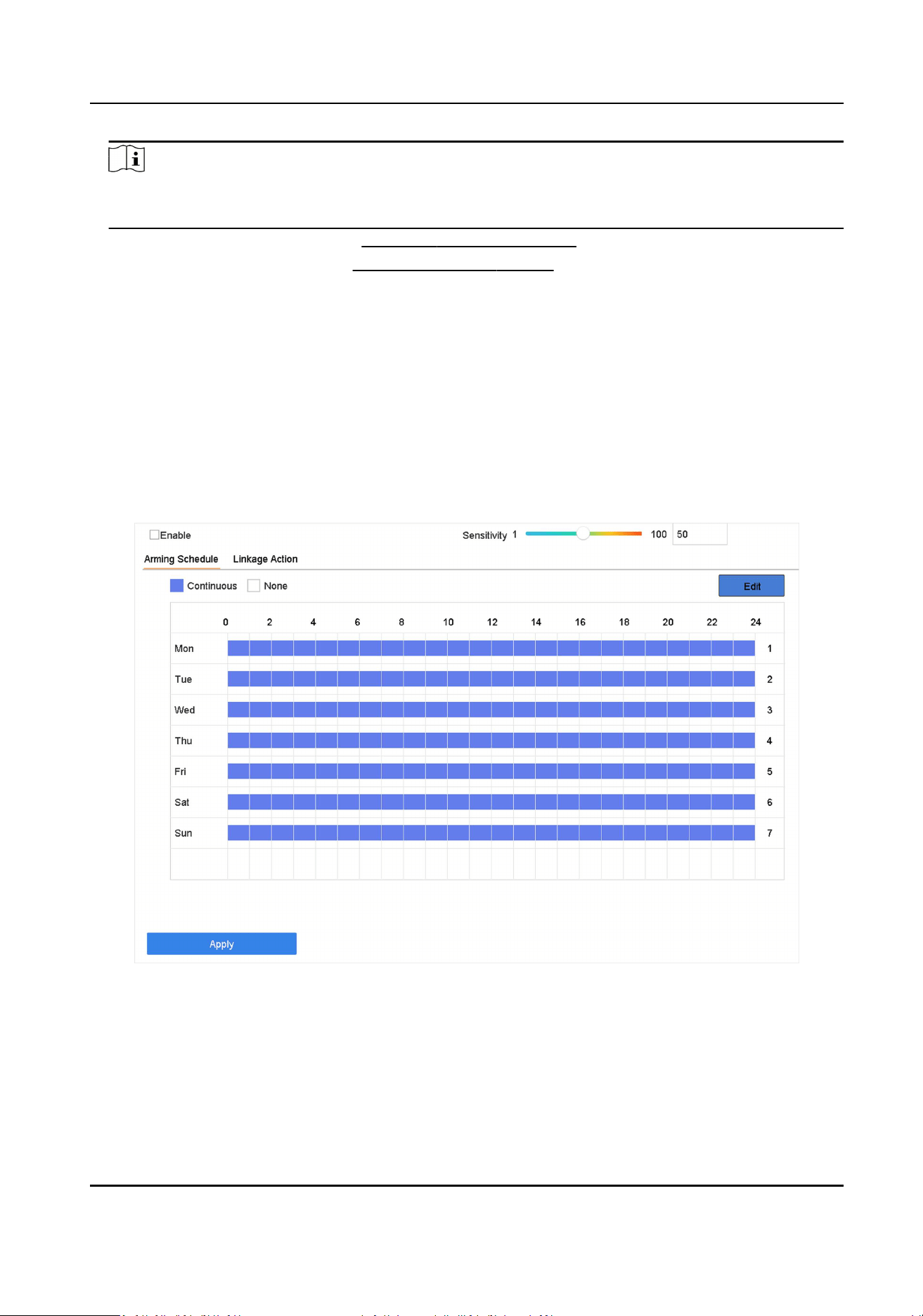
Note
Sensivity range: [1-100]. The higher the value, the more easily the defocus image will be
detected.
7.
Set the arming schedule.Refer to Congure Arming Schedule .
8.
Set the linkage acons. Refer to Congure Linkage Acons .
9.
Click Apply.
6.2.5 Sudden Scene Change Detecon
Scene change detecon detects the change of the surveillance environment aected by external
factors, such as the intenonal rotaon of the camera.
Steps
1.
Go to System → Event → Smart Event .
2.
Click Sudden Scene Change.
Figure 6-7 Sudden Scene Change
3.
Select a camera to congure.
4.
Check Enable.
5.
Oponal: Check Save VCA Picture to save the captured sudden scene change detecon pictures.
6.
Drag the Sensivity slider to set the detecon sensivity.
Digital Video Recorder User Manual
89
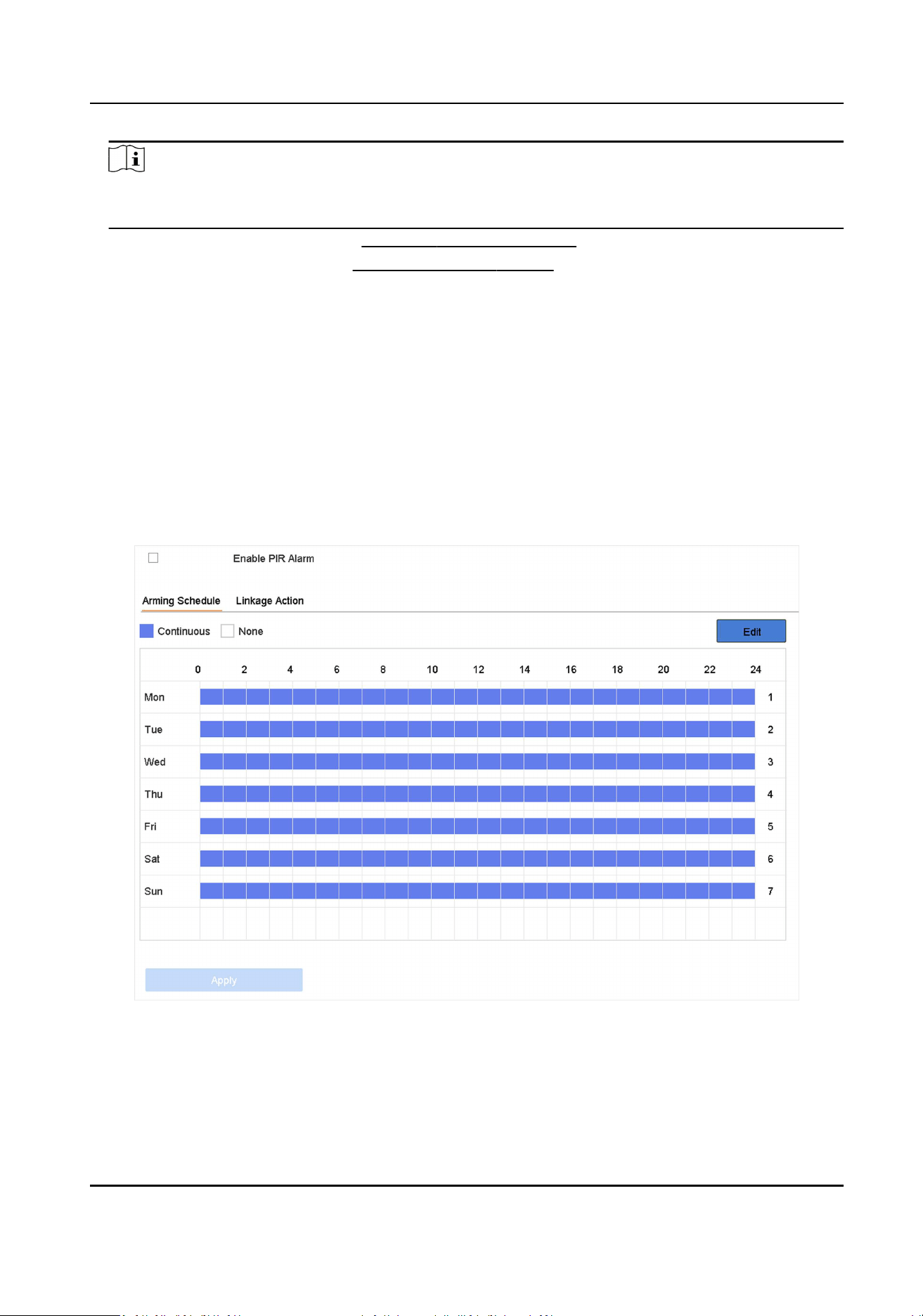
Note
Sensivity range: [1-100]. The higher the value, the more easily the change of scene can trigger
the alarm.
7.
Set the arming schedule.Refer to Congure Arming Schedule .
8.
Set the linkage acons. Refer to Congure Linkage Acons .
9.
Click Apply.
6.2.6 PIR Alarm
A PIR (Passive Infrared) alarm is triggered when an intruder moves within the detector vision eld.
The heat energy dissipated by a person or any other warm blooded creature such as dogs, cats,
etc., can be detected.
Steps
1.
Go to System → Event → Smart Event .
2.
Click PIR Alarm.
Figure 6-8 PIR Alarm
3.
Select a camera to congure.
4.
Check PIR Alarm.
5.
Oponal: Check Save VCA Picture to save the captured of PIR alarm pictures.
Digital Video Recorder User Manual
90
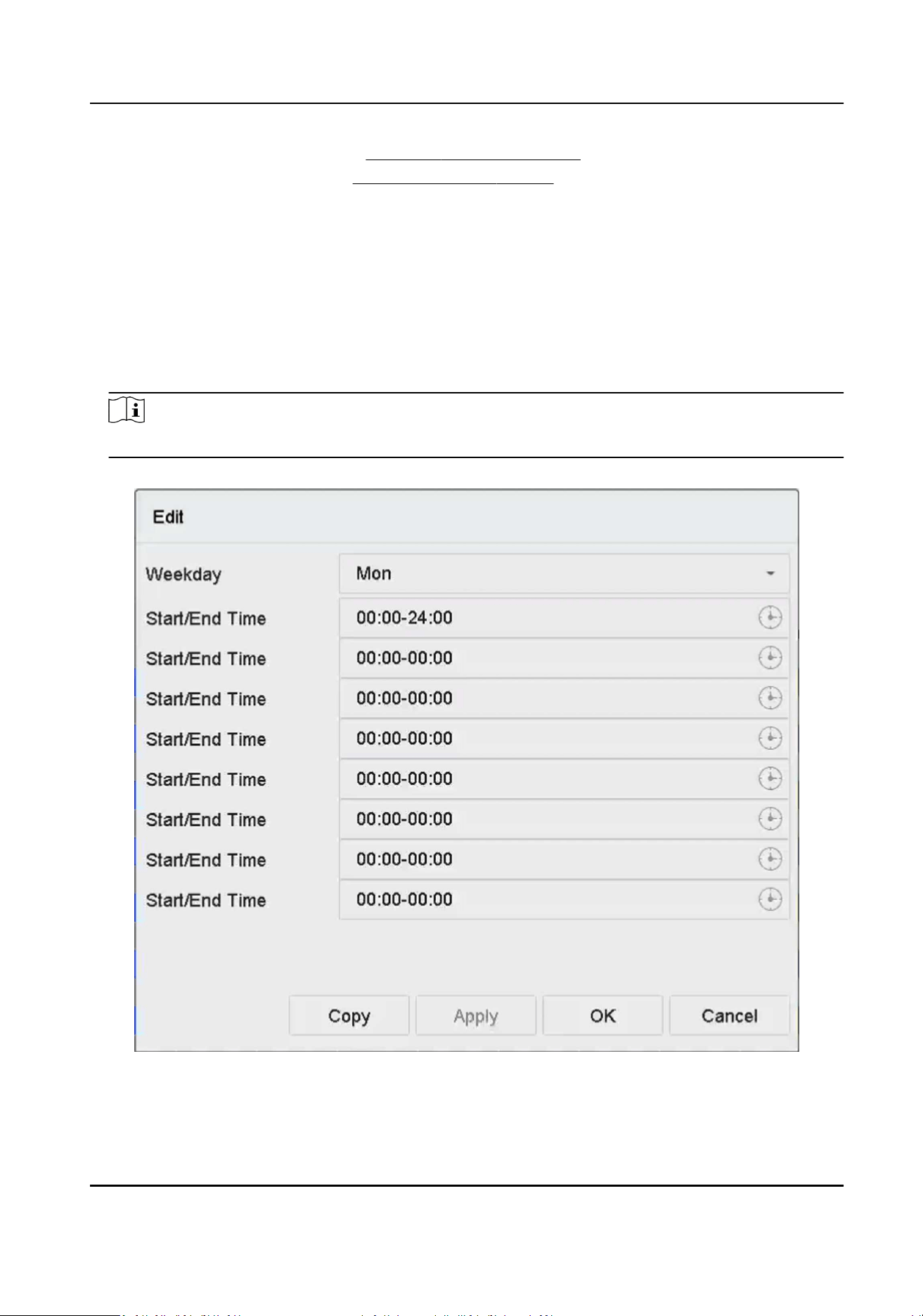
6.
Set the arming schedule. Refer to Congure Arming Schedule .
7.
Set the linkage acons. Refer to Congure Linkage Acons .
8.
Click Apply.
6.3 Congure Arming Schedule
Steps
1.
Click Arming Schedule.
2.
Click Edit.
3.
Select a day of the week and set the me period. Up to eight me periods can be set each day.
Note
Time periods cannot repeat or overlapped.
Figure 6-9 Set Arming Schedule
4.
You can click Copy to copy the current day arming schedule sengs to other day(s).
Digital Video Recorder User Manual
91

5.
Click Apply to save the sengs.
6.4 Congure Linkage Acons
Alarm linkage acons will be acvated when an alarm or excepon occurs.
6.4.1 Congure Auto-Switch Full Screen Monitoring
When an alarm is triggered, the local monitor displays in full screen the video image from the
alarming channel congured for full screen monitoring. And when the alarm is triggered
simultaneously in several channels, you must congure the auto-switch dwell me.
Note
Auto-switch will terminate once the alarm stops and back to the live view interface.
Steps
1.
Go to System → Live View → General .
2.
Set the event output and dwell me.
Event Output
Select the output to show the event video.
Full Screen Monitoring Dwell Time
Set the me in seconds to show the alarm event screen. If alarms are triggered
simultaneously in several channels, their full-screen images will be switched at an interval of
10 seconds (default dwell me).
3.
Go to the Linkage Acon interface of the alarm detecon (e.g., moon detecon, video
tampering, face detecon, etc.).
4.
Select the Full Screen Monitoring alarm linkage acon.
5.
Select the channel(s) in Trigger Channel for full screen monitoring.
6.4.2 Congure Buzzer
When an alarm is detected, the buzzer will make an audible beep.
Steps
1.
Go to System → Live View → General .
2.
Check Enable Audio Output.
3.
Set the audio volume.
4.
Click Apply.
5.
Go to Linkage Acon interface of the alarm detecon (e.g., moon detecon, video tampering,
face detecon, etc.).
6.
Select Buzzer as the alarm linkage acon.
Digital Video Recorder User Manual
92

6.4.3 Nofy Surveillance Center
The device can send an excepon or alarm signal to the remote alarm host when an event occurs.
The alarm host refers to the PC installed with client soware (e.g., iVMS-4200, iVMS-5200).
Steps
1.
Go to System → Network → Advanced → More Sengs .
2.
Set the alarm host IP and alarm host port.
3.
Go to Linkage Acon interface of the alarm detecon (e.g., moon detecon, video tampering,
face detecon, etc.).
4.
Select Nofy Surveillance Center.
6.4.4 Congure Email Linkage
The system can send an email with alarm informaon to a user or users when an alarm is detected.
Steps
1.
Go to System → Network → Advanced → Email .
2.
Set the email parameters.
3.
Click Apply.
4.
Go to the Linkage Acon interface of the alarm detecon (e.g., moon detecon, video
tampering, face detecon, etc.).
5.
Select Send Email alarm linkage acon.
6.4.5 Trigger Alarm Output
The alarm output can be triggered by the alarm input, moon detecon, video tampering
detecon, face detecon, line crossing detecon, and any all other events.
Steps
1.
Go to Linkage Acon of the alarm detecon (e.g., moon detecon, face detecon, line crossing
detecon, intrusion detecon, etc.).
2.
In Trigger Alarm Outputs, select the alarm output(s) to trigger.
3.
Go to System → Event → Normal Event → Alarm Output .
4.
Select an alarm output item from the list.
6.4.6 Congure PTZ Linkage
The system can trigger the PTZ acons (e.g., call preset/patrol/paern) when the alarm event, or
VCA detecon events occurs.
Before You Start
Make sure the connected PTZ or speed dome connected supports PTZ linkage.
Digital Video Recorder User Manual
93

Steps
1.
Go to Linkage Acon interface of the alarm input or VCA detecon (e.g., face detecon, line
crossing detecon, intrusion detecon, etc.).
2.
Select the PTZ Linkage.
3.
Select the camera to perform the PTZ acons.
4.
Select the preset/patrol/paern No. to call when the alarm events occur.
Note
You can set only one PTZ type for the linkage acon each me.
6.4.7 Congure Audio and Light Alarm Linkage
For certain cameras, you can set the alarm linkage acon as audio alarm or light alarm.
Before You Start
●
Ensure your camera supports audio and light alarm linkage.
●
Ensure the audio output and volume are properly congured.
Steps
1.
Go to the linkage acon interface of the alarm detecon (e.g., moon detecon).
2.
Set Audio and Light Alarm Linkage as your desire.
3.
Click Apply.
Note
You can use Hik-Connect to record customized voice messages, and send voice messages to
cameras. The customized voice messages can be used for audio linkage.
Digital Video Recorder User Manual
94

Chapter 7 File Management
7.1 Search Files
Specify detailed condions to search videos and pictures.
Steps
1.
Go to File Management → All Files/Human Files/Vehicle Files .
2.
Specify detailed condions, including me, camera, event type, etc.
Note
●
For All Files, select Time, Camera, File Type, and Event type.
●
For Human Files, select Time, Camera, and File Type.
●
For Vehicle Files, select Time, Camera, File Type, Plate No., and Area/Country.
3.
Click Search to display results.The matched les will be displayed.
4.
Select Target Picture or Source Picture in the menu bar to display related pictures only.
-
Target Picture: Display the search results of vehicle close-ups.
-
Source Picture: Display the search results of original pictures captured by camera.
7.2 Export Files
Export les for backup purposes to a USB device, or eSATA HDD.
Steps
1.
Search les. Refer to
Search Files for details.
2.
Select les.
3.
Click Export.
4.
Oponal: For vehicle les, check Backup License Plate Stascs Info to export license plate
stascs informaon later.
5.
Select the le to export as Video and log and click OK.
6.
Select the backup device and folder path.
7.
Click OK.
7.3 Smart Search
You can search human body les, face les and vehicles in File Management → Smart Search .
Refer to Human Body Search Face Picture Search , and Vehicle Search for details.
Digital Video Recorder User Manual
95
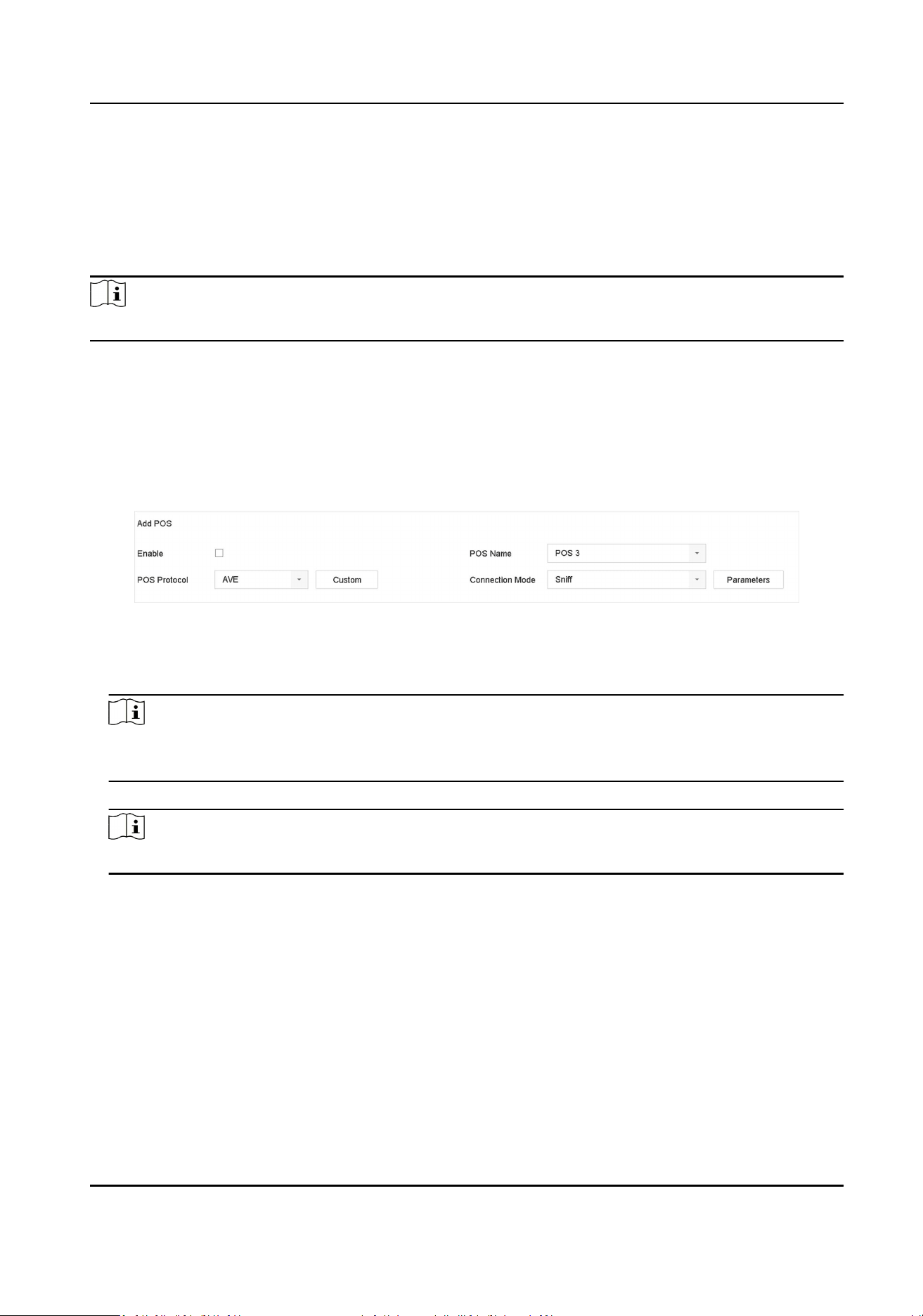
Chapter 8 POS Conguraon
The device can be connected to a POS machine/server, and receive a transacon message to
overlay on the image during Live View or playback, as well as trigger a POS event alarm.
Note
This funcon is only available for certain models.
8.1 Congure POS Connecon
Steps
1.
Go to System → POS .
2.
Click Add.
Figure 8-1 POS Sengs
3.
Select a POS device from the drop-down list.
4.
Check Enable.
Note
The number of POS devices supported by each device is the half of its number of channel, e.g., 8
POS devices are supported for the DS-9616NI-I8 model.
5.
Select POS Protocol.
Note
When a new protocol is selected, reboot the device to acvate the new sengs.
Universal Protocol
Click Advanced to expand more sengs when selecng the universal protocol. You can set
the start line idener, line break tag, and end line tag for the POS overlay characters, and
the case-sensive property of the characters. You can also oponally check the ltering
idener and the XML protocol.
Digital Video Recorder User Manual
96
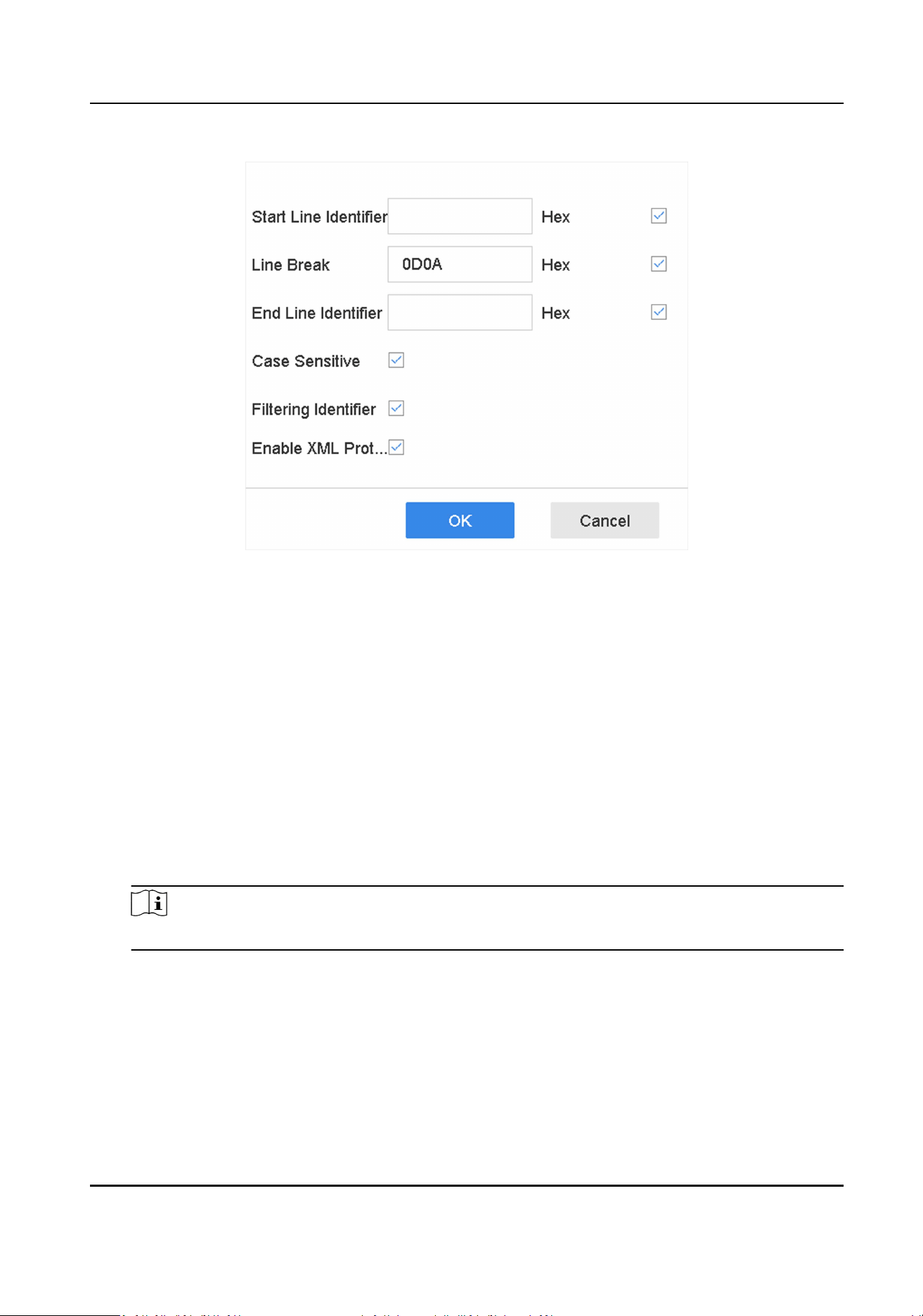
Figure 8-2 Universal Protocol Sengs
EPSON
The xed start and end line tag are used for EPSON protocol.
AVE
The xed start and end line tag are used for AVE protocol. Serial port and virtual serial port
connecon types are supported.
Click Custom to congure the AVE sengs. Select Rule as VSI-ADD or VNET . Set the address
bit of the POS message to send. Click OK to save the sengs.
NUCLEUS
Click the Custom to congure the NUCLEUS sengs.
Enter the employee No., shi No., and the terminal No. in the eld. The matching message
sent from the POS device will be used as the valid POS data.
Note
The NUCLEUS protocol must be used in the RS-232 connecon communicaon.
6.
Select Connecon Mode and click Parameters to congure the parameters for each connecon
mode.
TCP Connecon
When using TCP connecon, the port must be set from 1 to 65535, and the port for each POS
machine must be unique.
Set the Allowed Remote IP Address of the device sending the POS message.
Digital Video Recorder User Manual
97
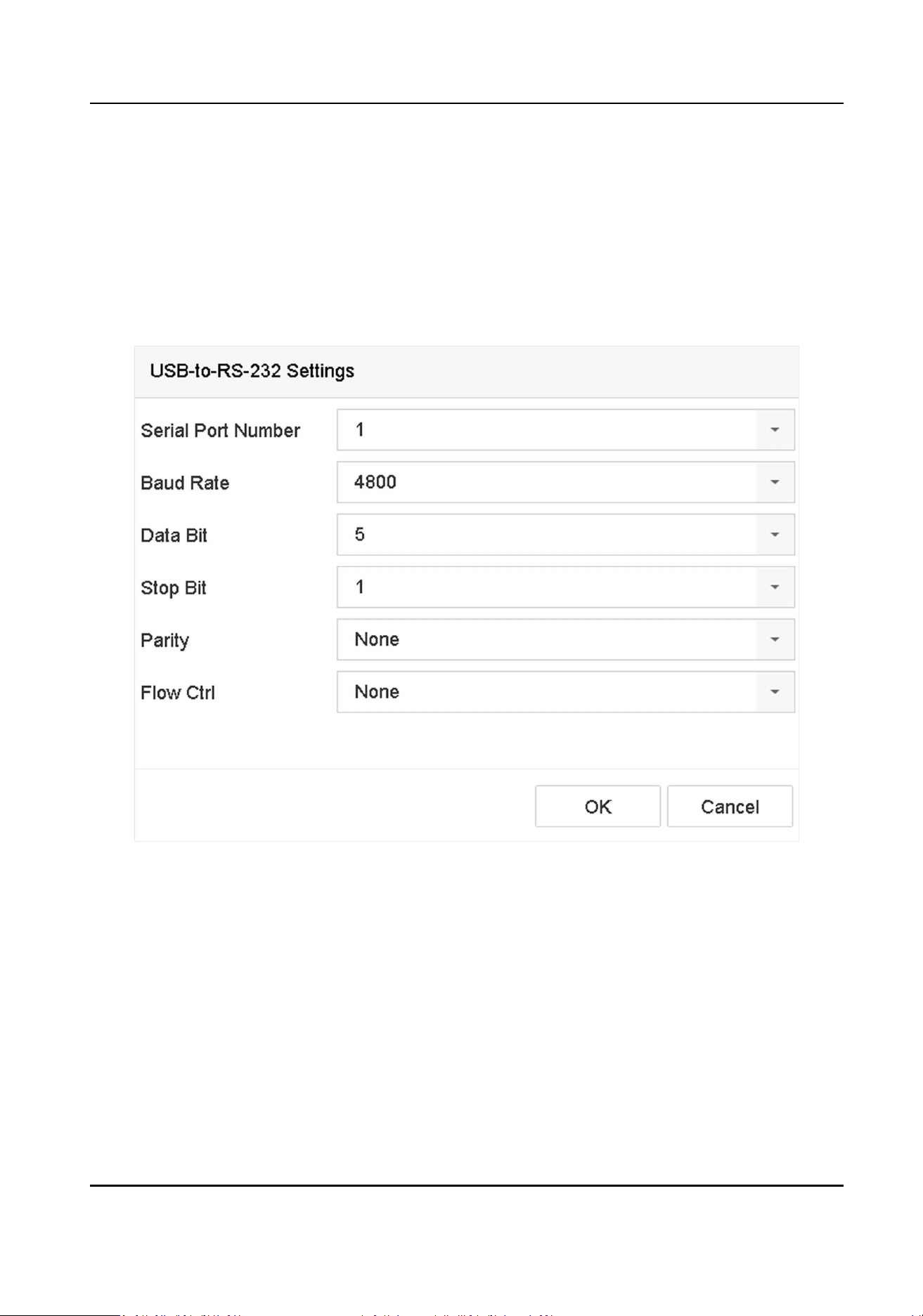
UDP Connecon
When using UDP connecon, the port must be set from 1 to 65535, and the port for each
POS machine must be unique.
Set the Allowed Remote IP Address of the device sending the POS message.
USB-to-RS-232 Connecon
Congure the USB-to-RS-232 convertor port parameters, including the port serial number,
baud rate, data bit, stop bit, parity, and ow ctrl.
Figure 8-3 USB-to-RS-232 Sengs
RS-232 Connecon
Connect the device and the POS machine via RS-232. The RS-232 sengs can be congured in
Menu → Conguraon → RS-232 . The Usage must be set to Transparent Channel.
Mulcast Connecon
When connecng the device and the POS machine via Mulcast protocol, set the mulcast
address and port.
Sni Connecon
Digital Video Recorder User Manual
98
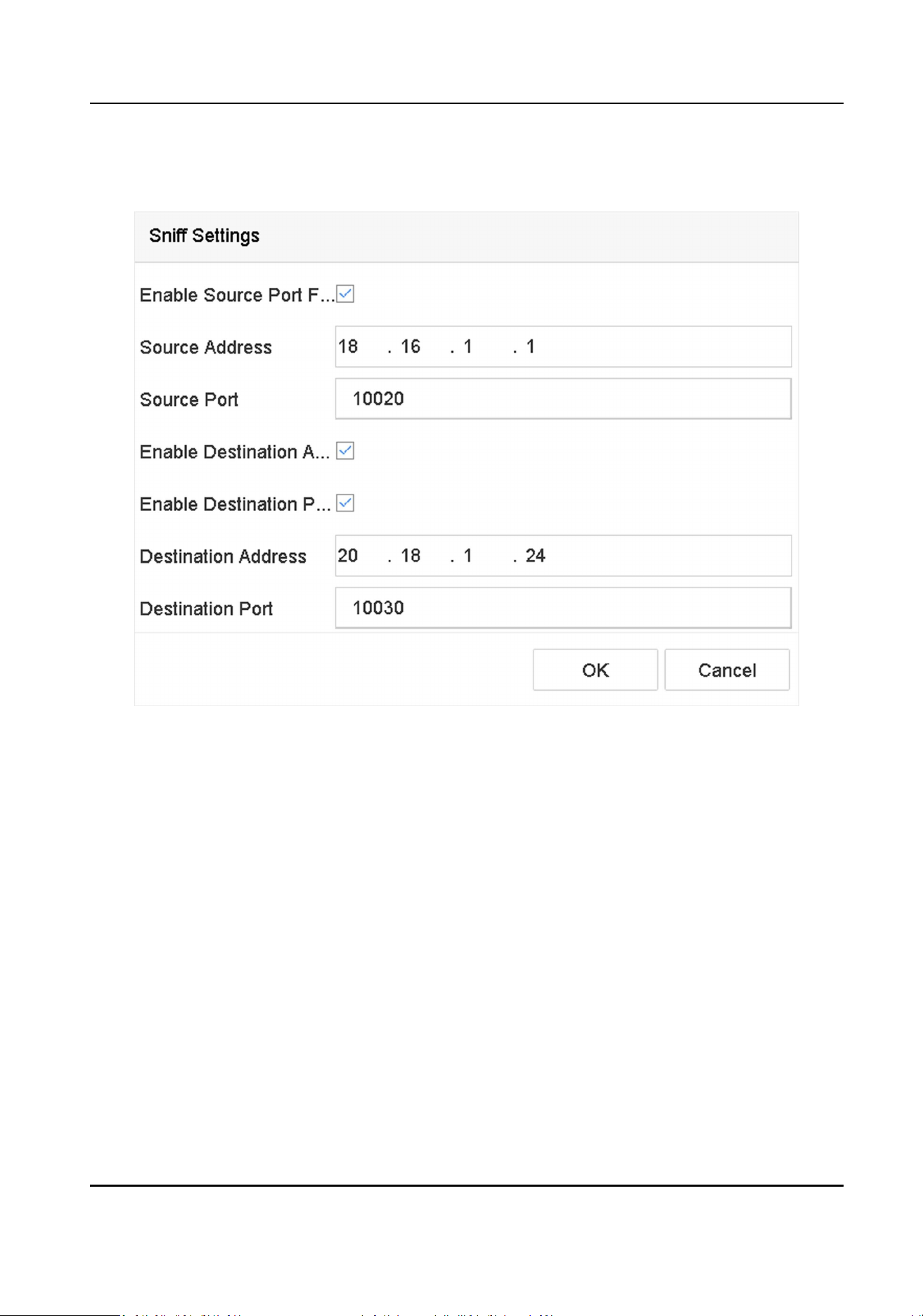
Connect the device and the POS machine via Sni. Congure the source address and
desnaon address sengs.
Figure 8-4 Sni Sengs
8.2 Congure POS Text Overlay
Steps
1.
Go to System → POS .
2.
Click Channel Linkage and Display.
Digital Video Recorder User Manual
99
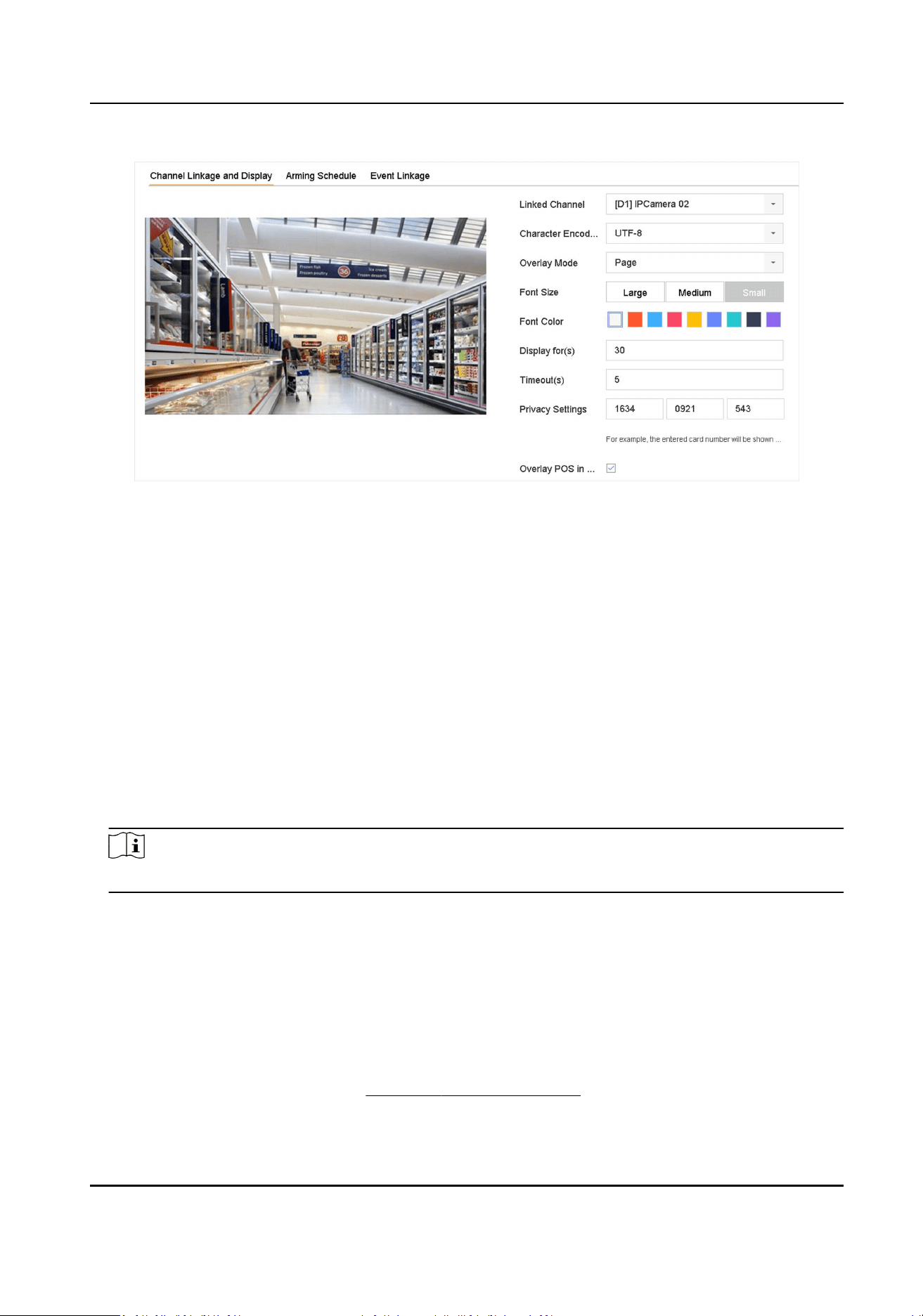
Figure 8-5 Overlay Character Sengs
3.
Select linked channel to overlay the POS characters.
4.
Set the characters overlay for the enabled POS.
●
Character encoding format: currently the Lan-1 format is available
●
Overlay mode of the characters to display in scrolling or page mod
●
Font size and font color
●
Display me (sec) of the characters. The value ranges 5 -3600 sec.
●
Timeout of POS event. The value ranges 5 -3600 sec. When the device has not received the
POS message within the dened me, the transacon ends.
5.
In Privacy Sengs, set the POS privacy informaon to not display on the image, e.g., the card
number, user name, etc.
The dened privacy informaon will be displayed using ***on the image instead.
6.
Check Overlay POS in Live View. When this feature is enabled, the POS informaon is overlaid
on the Live View image.
Note
Drag the frame to adjust the textbox size and posion on POS sengs interface preview screen.
7.
Click Apply to acvate the sengs.
8.3 Congure POS Alarm
A POS event can trigger channels to start recording, or trigger full screen monitoring, etc.
Steps
1.
Go to Storage → Recording Schedule .
2.
Set the arming schedule. Refer to
Congure Arming Schedule .
3.
Go to System → POS .
Digital Video Recorder User Manual
100
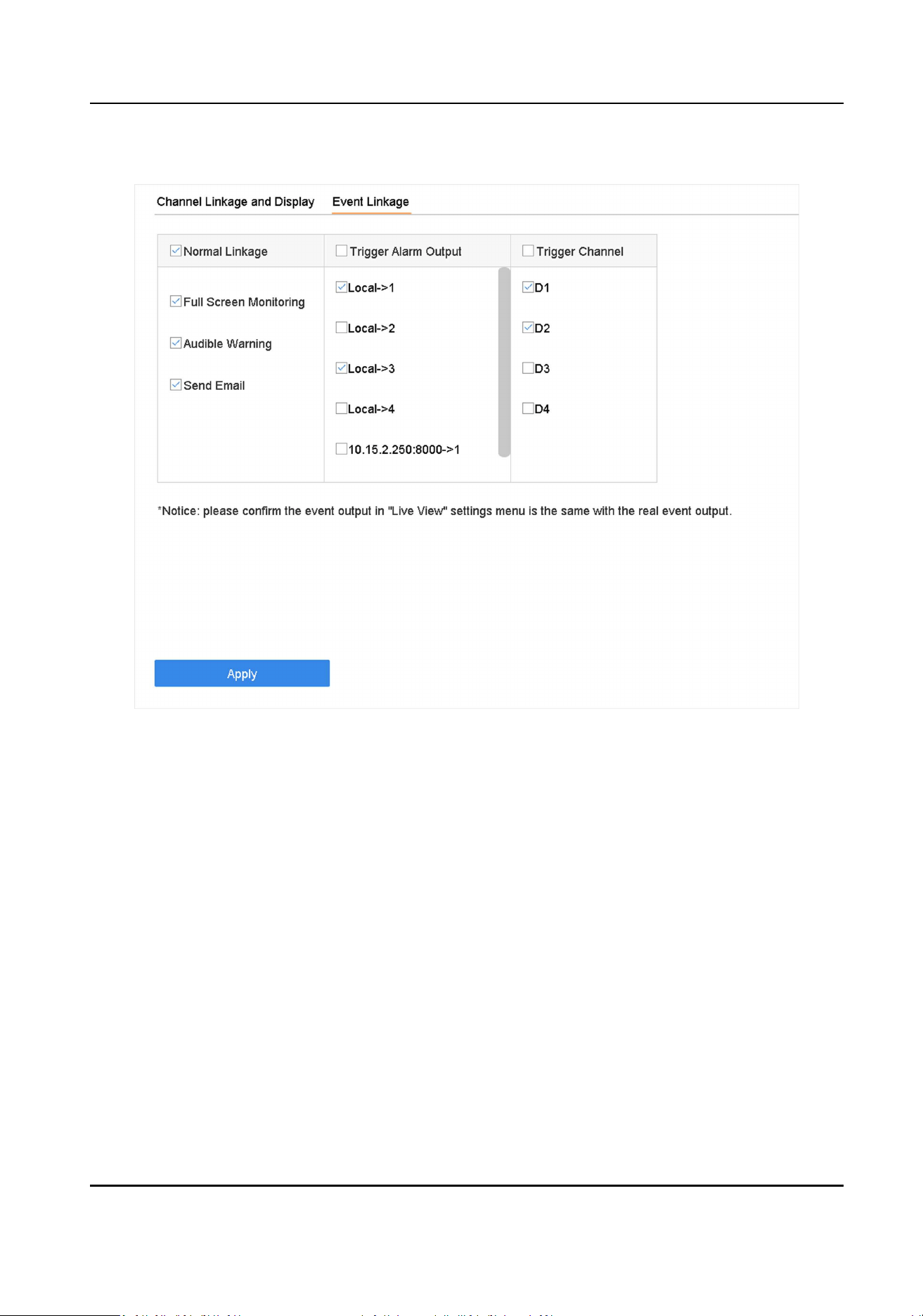
4.
Click Event Linkage on the POS adding or eding interface.
Figure 8-6 Set Trigger Cameras of POS
5.
Select the normal linkage acons.
6.
Select one or more alarm output(s) to trigger.
7.
Select one or more channels to record or become full-screen monitoring when a POS alarm is
triggered.
8.
Click Apply to save the sengs.
Digital Video Recorder User Manual
101
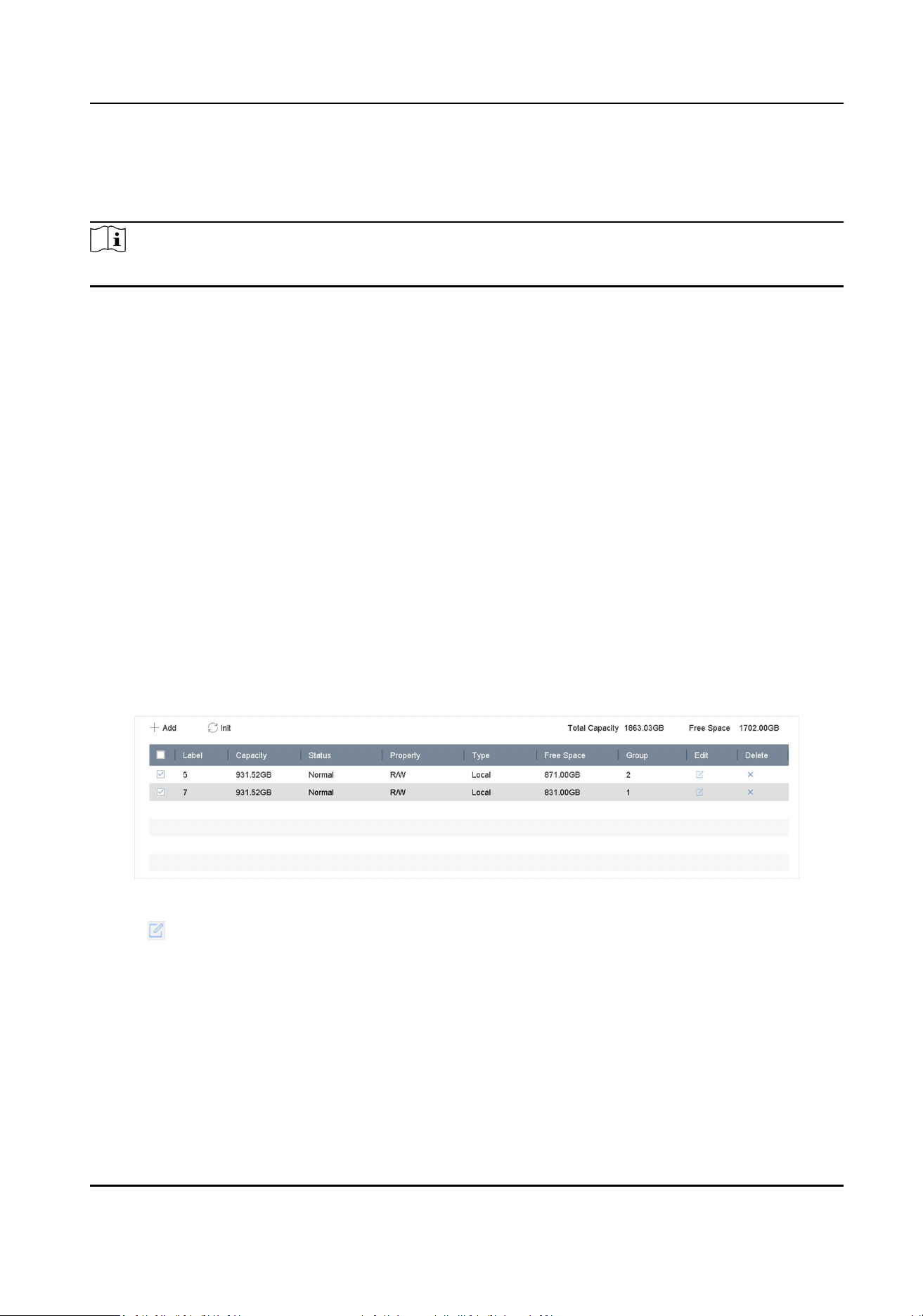
Chapter 9 Storage
Note
The available funcons in this chapter may vary according to dierent models.
9.1 Storage Device Management
9.1.1 Manage Local HDD
Congure HDD Group
Mulple HDDs can be managed in groups. Video from specied channels can be recorded onto a
parcular HDD group through HDD sengs.
Steps
1.
Go to Storage → Storage Mode .
2.
Select Mode as Group.
3.
Click Apply.
4.
Go to Storage → Storage Device .
5.
Select a HDD.
Figure 9-1 Storage Device
6.
Click to enter Local HDD Sengs interface.
Digital Video Recorder User Manual
102
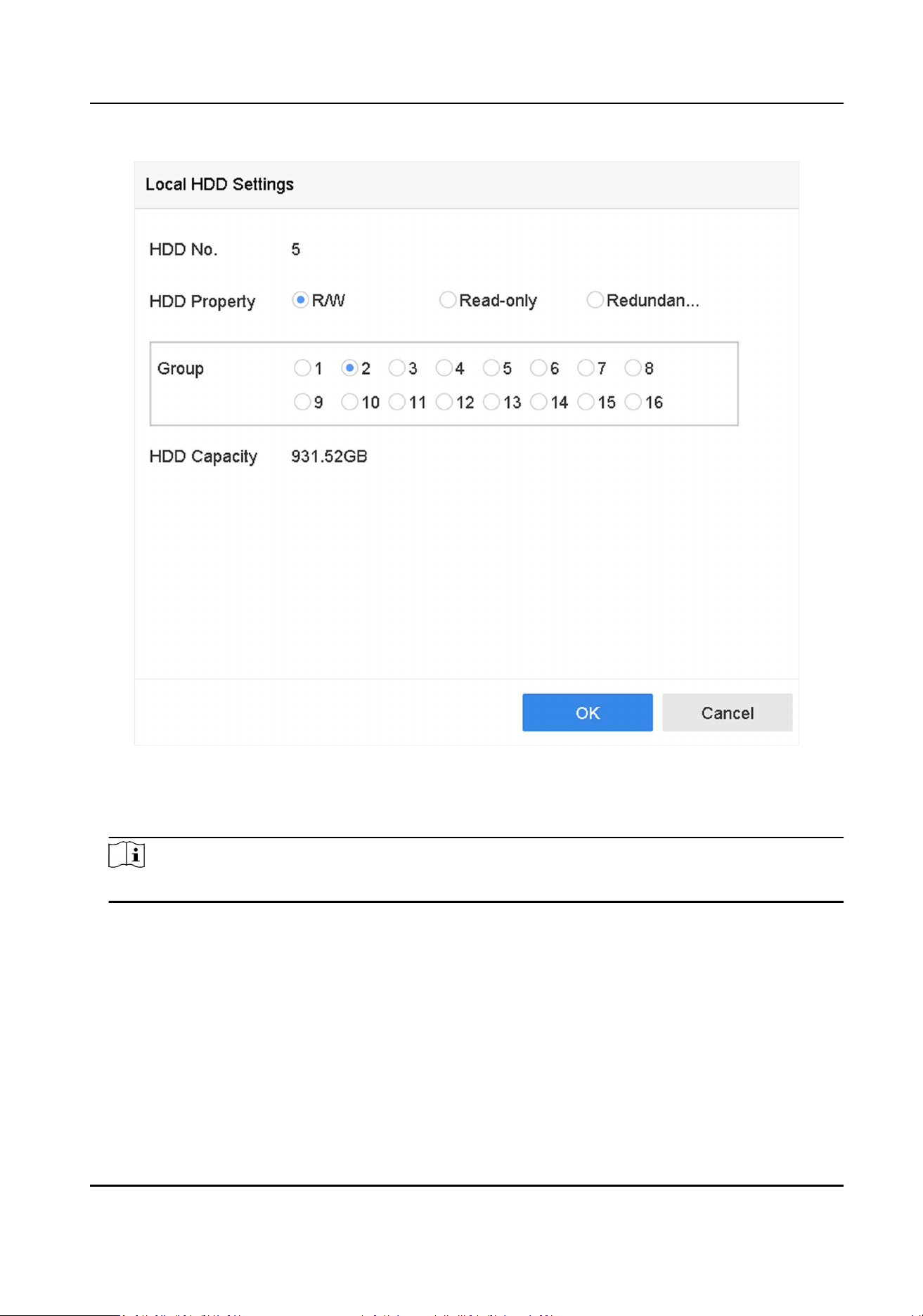
Figure 9-2 Local HDD Sengs
7.
Select a group number for the HDD.
8.
Click OK.
Note
Regroup the cameras for HDD if the HDD group number is changed.
9.
Go to Storage → Storage Mode .
10.
Select group number from the list.
11.
Select related camera(s) to save videos and pictures on the HDD group.
12.
Click Apply.
Congure the HDD Property
HDD property can be set as R/W, Read-only, or Redundant.
Digital Video Recorder User Manual
103

Before You Start
Set the storage mode to Group. For detailed steps, refer to Congure HDD Group
Steps
1.
Go to Storage → Storage Device .
2.
Click of desired HDD.
3.
Select HDD Property.
R/W
HDD supports both read and write.
Read-only
Files in read-only HDD will not be overwrien.
Redundant
Save the videos and pictures not only in the R/W HDD but also in the redundant HDD. It
eecvely enhances the data safety and reliability. Ensure at least another HDD which is in
Read/Write status exists.
4.
Click OK.
Congure the HDD Quota
Each camera can be congured with an allocated quota for storing videos or pictures.
Steps
1.
Go to Storage → Storage Mode .
2.
Select Mode as Quota.
3.
Select a camera to set quota.
4.
Enter the storage capacity in the text elds of Max. Record Capacity (GB) and Max. Picture
Capacity (GB).
5.
Click Copy to to copy the quota sengs of the current camera to other cameras.
6.
Click Apply.
Note
●
When the quota capacity is set to 0, all cameras will use the total capacity of HDD for videos
and pictures.
●
Reboot the video recorder to acvate the new sengs.
9.1.2 Add a Network Disk
You can add the allocated NAS or IP SAN disk to the device, and use it as a network HDD.
Steps
1.
Go to Storage → Storage Device .
2.
Click Add.
Digital Video Recorder User Manual
104
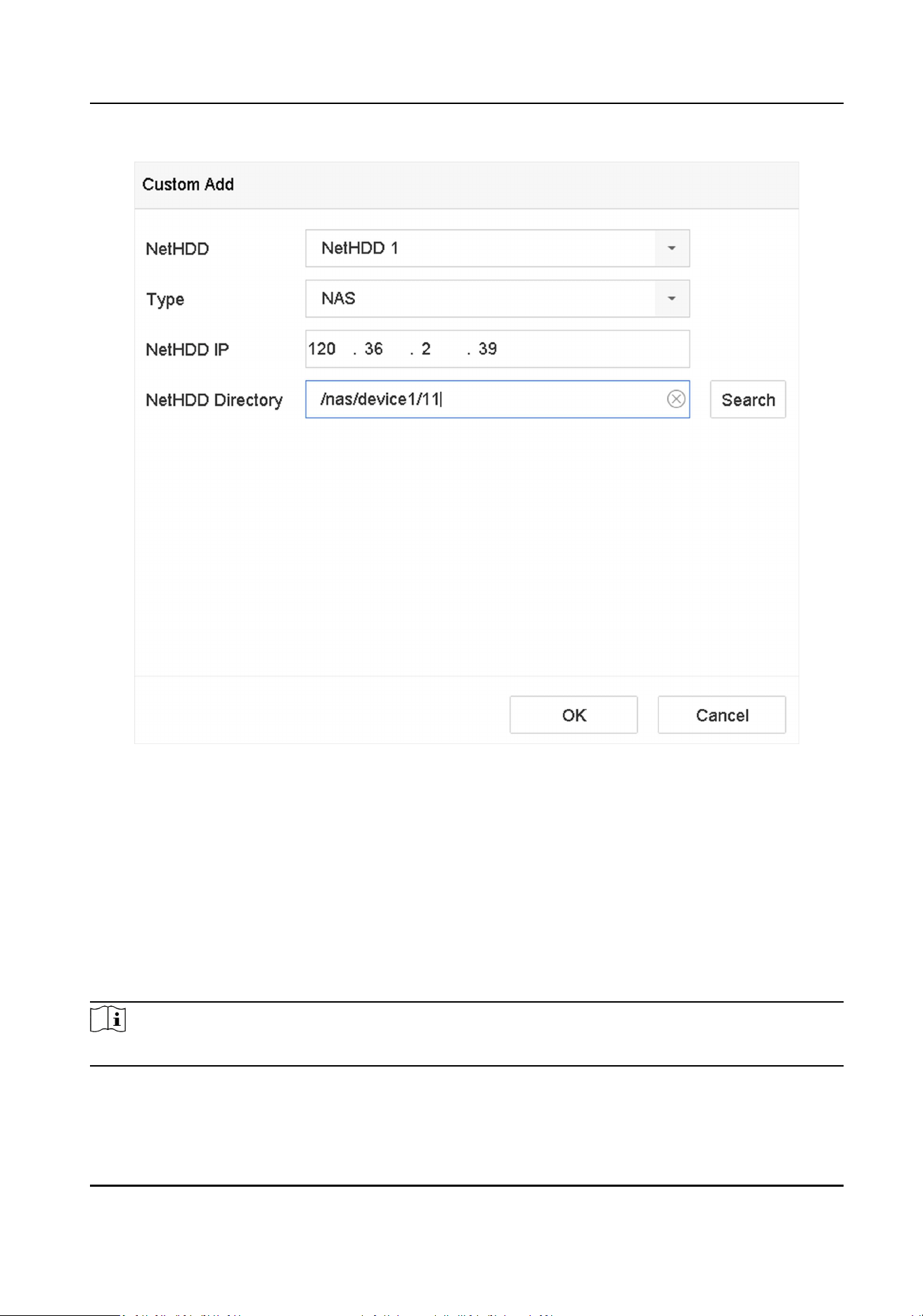
Figure 9-3 Add NetHDD
3.
Select NetHDD type.
4.
Enter NetHDD IP address and click Search to search the available NetHDD.
5.
Select the desired NetHDD.
6.
Click OK.
7.
The added NetHDD will be displayed in the HDD list. Select the newly added NetHDD and click
Init.
9.1.3 Manage eSATA
Note
The eSATA funcon is only available for certain models.
Digital Video Recorder User Manual
105
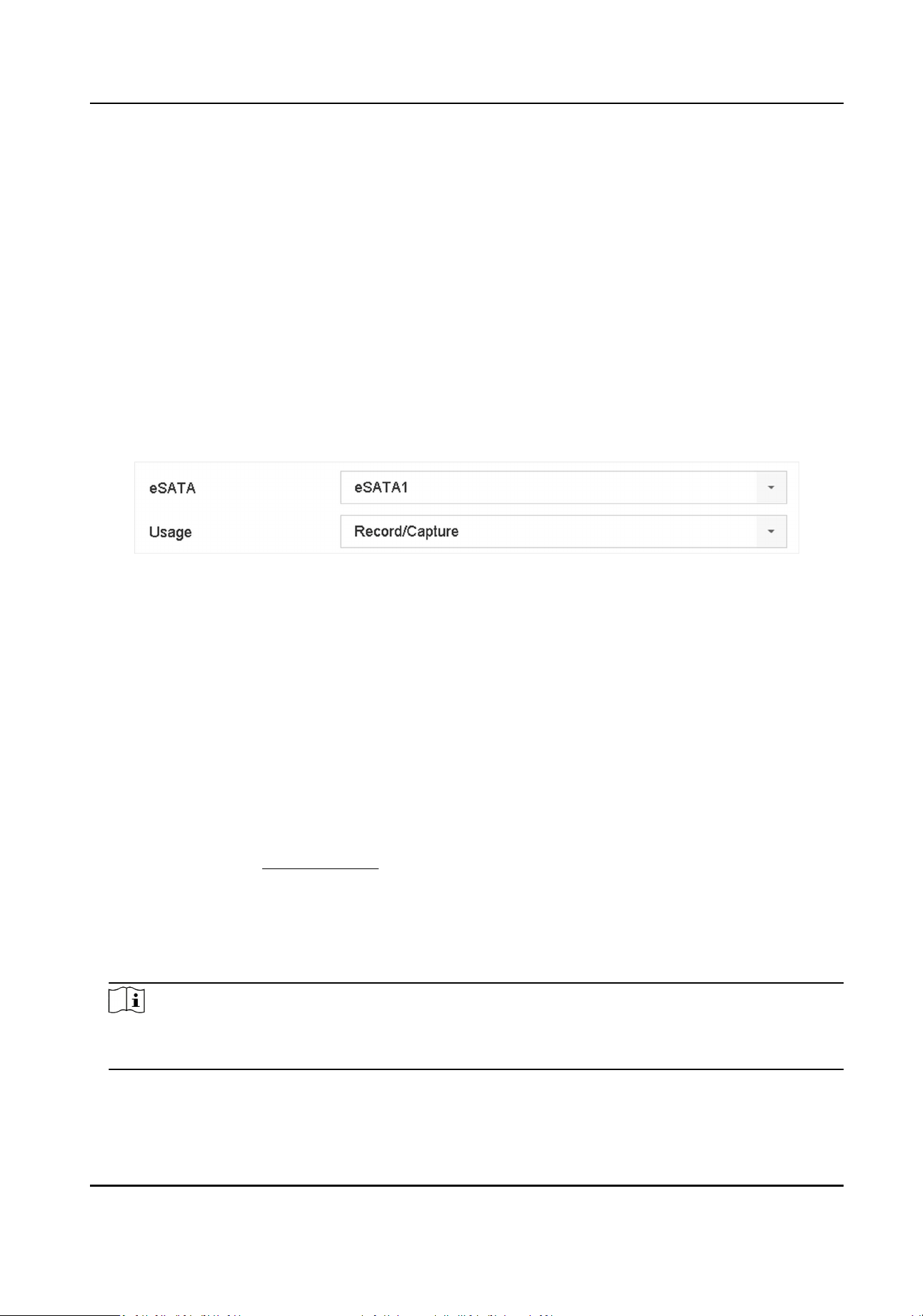
Congure eSATA for Data Storage
When there is an external eSATA device connected to your video recorder, you can congure the
eSATA usage as data storage and manage the eSATA.
Steps
1.
Go to Storage → Advanced .
2.
Select eSATA Usage as Export or Record/Capture.
Export
Use the eSATA for backup.
Record/Capture
Use the eSATA for record/capture. Refer to the following steps for operang instrucons.
Figure 9-4 eSATA Mode
What to do next
If eSATA usage is set as Record/Capture, enter the storage device interface to edit its property or
inialize it.
Congure eSATA for Auto Backup
If you made an automac backup plan, the video recorder will back up the local videos of 24 hours
ahead of the backup start me to eSATA.
Before You Start
Ensure the device has correctly connected with an external eSATA hard drive, and its usage type is
set as Export. Refer to
Manage eSATA for details.
Steps
1.
Go to Storage → Auto Backup .
2.
Check Auto Backup.
3.
Set the backup start me in Start Backup at.
Note
If the day experiences a failed backup, the video recorder will back up the videos 48 hours ahead
of the backup start me in the next day.
4.
Select channels for backup.
5.
Select Backup Stream Type as your desire.
Digital Video Recorder User Manual
106
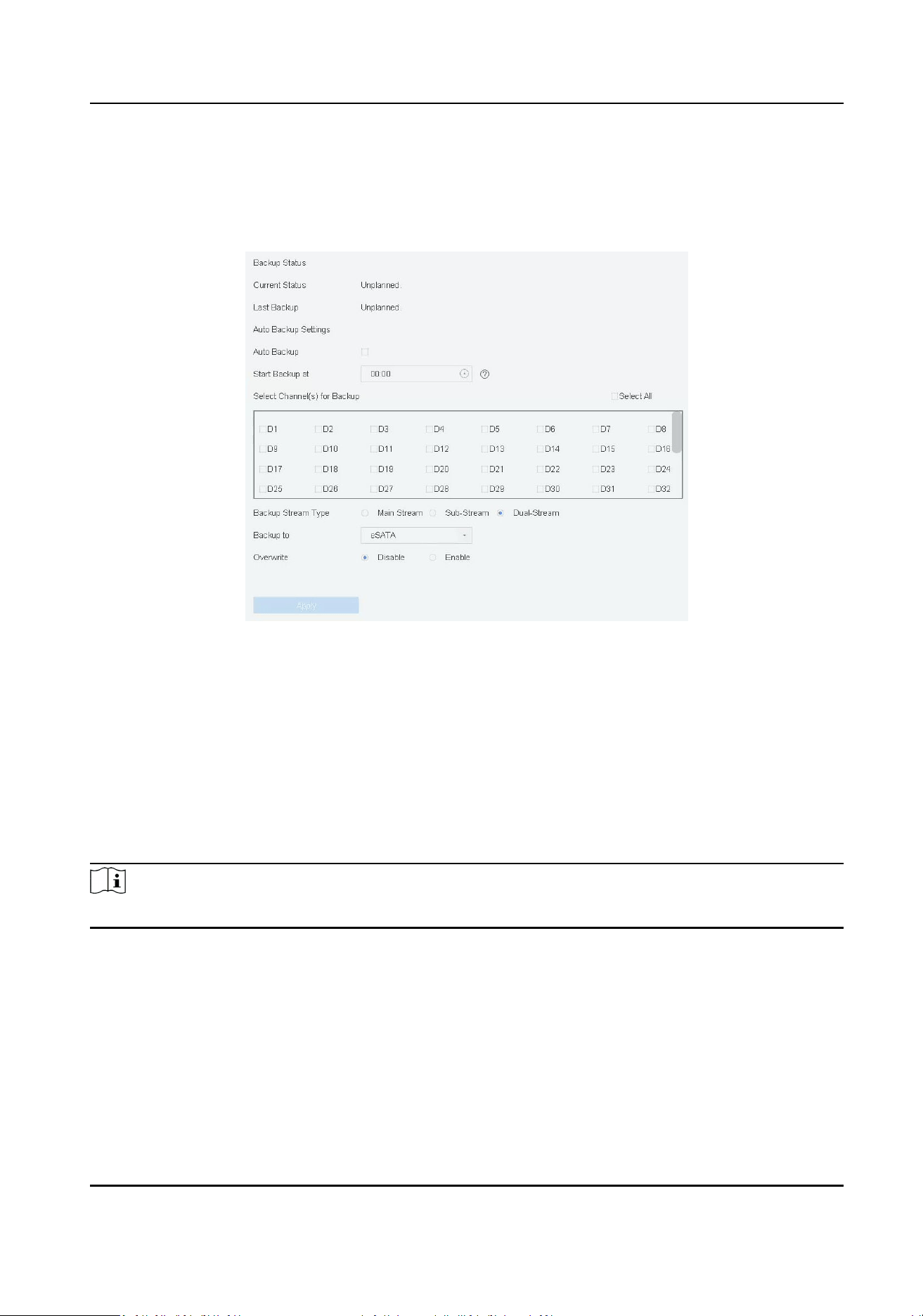
6.
Select Overwrite type.
-
Disable: When HDD is full, it will stop wring.
-
Enable: When HDD is full, it will connue to write new les by deleng the oldest les.
7.
Click Apply.
Figure 9-5 Congure eSATA for Auto Backup
9.2 Disk Array
A disk array is a data storage virtualizaon technology that combines mulple physical disk drives
into a single logical unit. Also known as a "RAID", an array stores data over mulple HDDs to
provide enough redundancy so that data can be recovered if one disk fails. Data is distributed
across the drives in one of several ways called "RAID levels", based the redundancy and
performance required.
Note
The funcons in this secon are only available for certain models.
9.2.1 Create a Disk Array
The video recorder supports soware-based disk arrays. Enable the RAID funcon as required, and
ensure each HDD capacity is not less than 4 TB. If your device has no more than 16 SATA interfaces,
a disk array can contain no more than 8 HDDs. If your device has 24 SATA interfaces, a disk array
can contain no more than 12 HDDs. Two ways are available for creang an array: one-touch
conguraon and manual conguraon.
Digital Video Recorder User Manual
107

One-Touch Creaon
One-touch conguraon creates the disk array. By default, the array type created by one-touch
conguraon is RAID 5.
Before You Start
Install at least 3 HDDs. If more than 10 HDDs are installed, 2 arrays will be created. To maintain
reliability and stability running of the HDDs, it is recommended to use of enterprise-level HDDs of
the same model and capacity.
Steps
1.
Go to Storage → Advanced .
2.
Check Enable RAID.
3.
Click Apply and reboot the device to have sengs take eect.
4.
Aer reboot, go to Storage → RAID Setup → Physical Disk .
5.
Click One-touch Cong.
6.
Edit Array Name and click OK to start conguring.
Note
If you install 4 or more HDDs, a hot spare disk for array rebuilding will be created.
7.
Oponal: The video recorder will automacally inialize the created array. Go to Storage →
RAID Setup → Array to view the informaon of the created array.
Manual Creaon
Manually create a RAID 0, RAID 1, RAID 5, RAID 6, or RAID 10 array.
Steps
1.
Go to Storage → Advanced .
2.
Check Enable RAID.
3.
Click Apply and reboot the device to have sengs take eect.
4.
Aer reboot, go to Storage → RAID Setup → Physical Disk .
5.
Click Create.
Digital Video Recorder User Manual
108
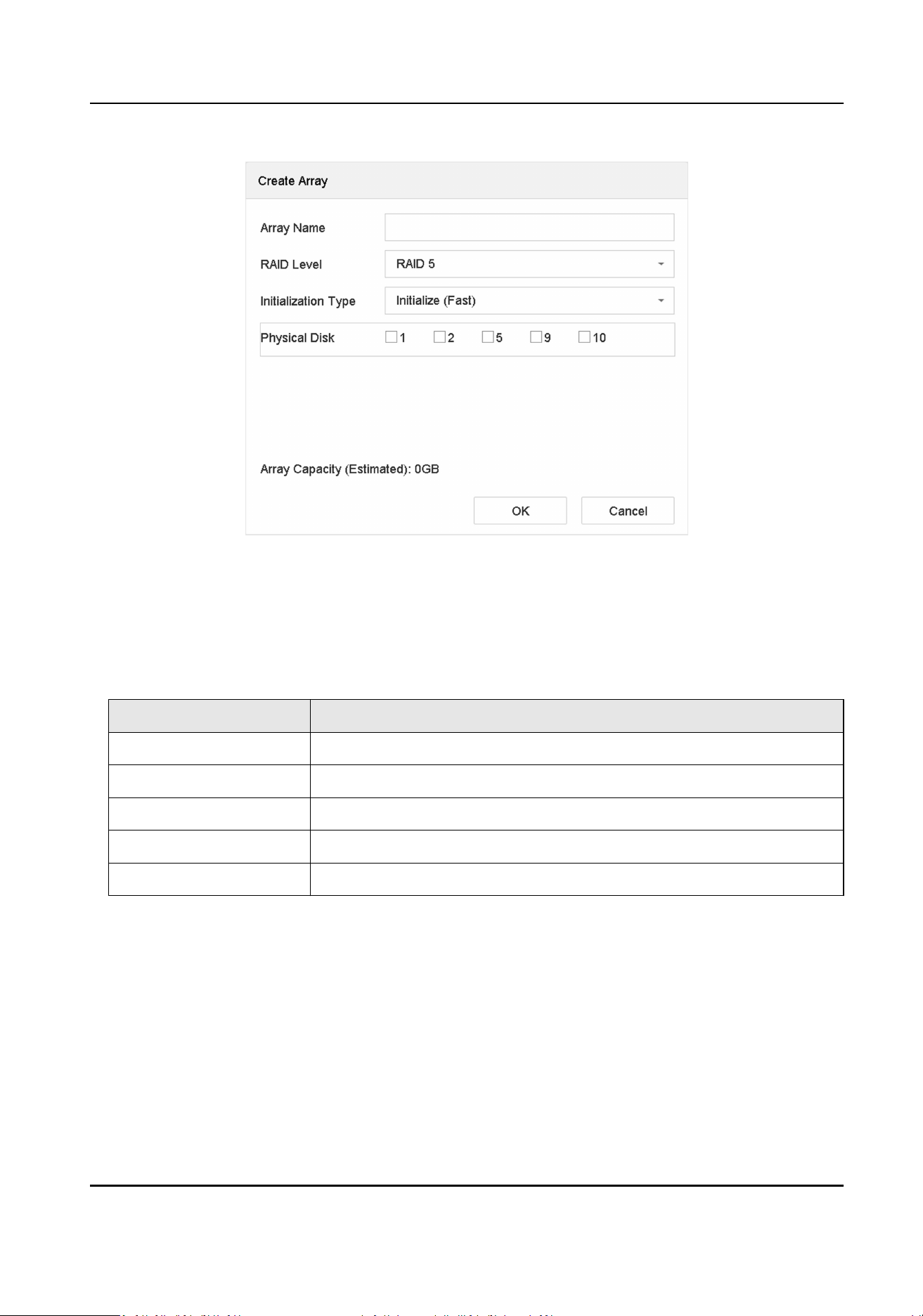
Figure 9-6 Create Array
6.
Enter Array Name.
7.
Select RAID Level as required.
8.
Select the physical disks to constute the array.
Table 9-1 The Required Number of HDDs
RAID Level The Required Number of HDDs
RAID 0 At least 2 HDDs.
RAID 1 At least 2 HDDs.
RAID 5 At least 3 HDDs.
RAID 6 At least 4 HDDs.
RAID 10 The number of HDD must be an even ranges from 4 to 16.
9.
Click OK.
10.
Oponal: The video recorder will automacally inialize the created array. Go to Storage →
RAID Setup → Array to view the informaon of the created array.
Digital Video Recorder User Manual
109
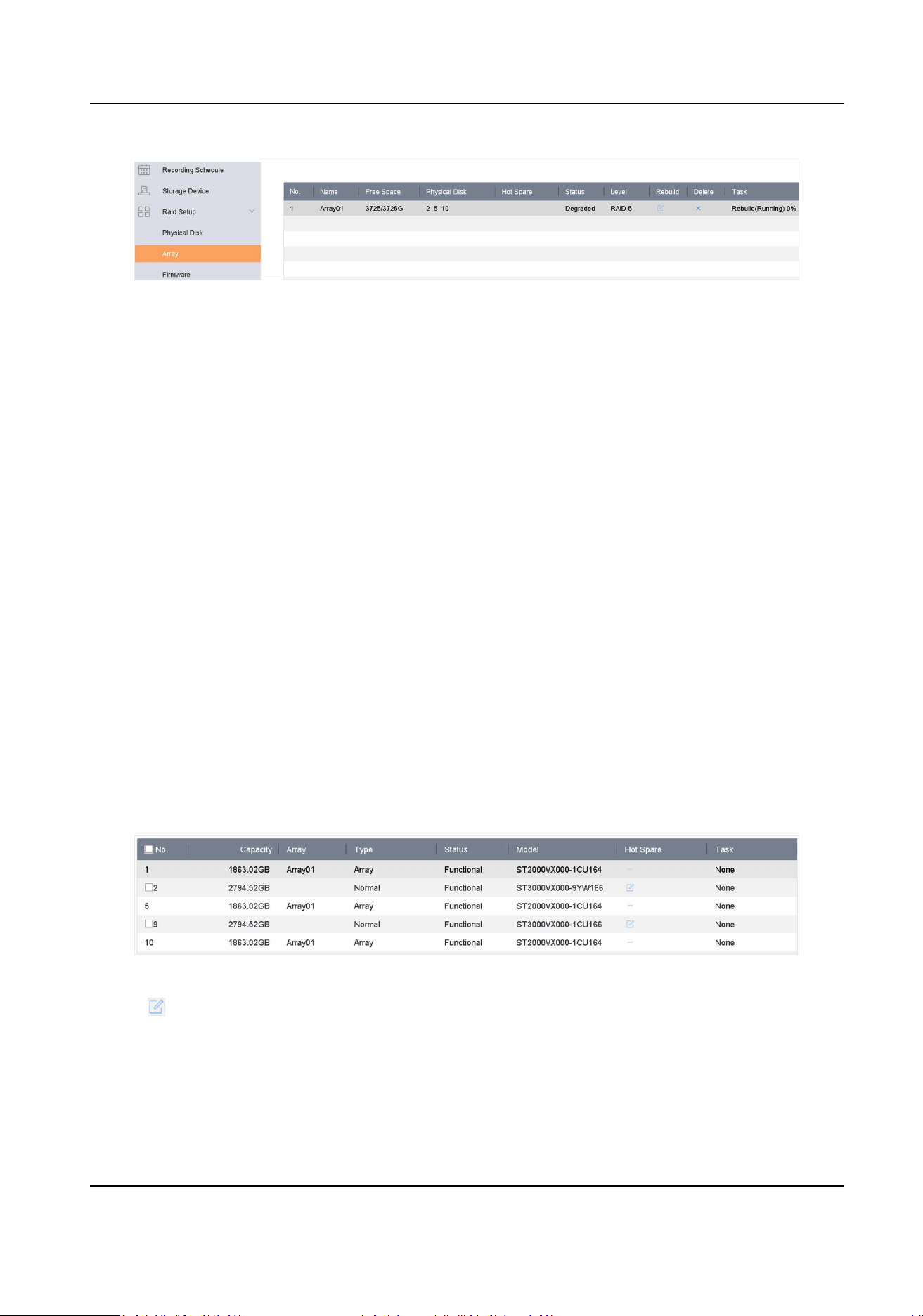
Figure 9-7 Array List
9.2.2 Rebuild an Array
The array status includes Funconal, Degraded, and Oine. To ensure the high security and
reliability of the data stored in an array, take immediate and proper maintenance of the arrays
according its status.
Funconal
No disk loss in the array.
Oine
The number of lost disks has exceeded the limit.
Degraded
If any HDD fails in the array, the array degrades. Restore it to Funconal status by rebuilding the
array.
Congure a Hot Spare Disk
The hot spare disk is required for the disk array automac rebuilding.
Steps
1.
Go to Storage → RAID Setup → Physical Disk .
Figure 9-8 Physical Disk
2.
Click of an available HDD to set it as the hot spare disk.
Automacally Rebuild an Array
The video recorder can automacally rebuild degraded arrays with the hot spare disks.
Digital Video Recorder User Manual
110

Before You Start
Create hot spare disks. For details, refer to Congure a Hot Spare Disk .
Steps
1.
Go to Storage → RAID Setup → Array .
Figure 9-9 Array List
Manually Rebuild an Array
If no hot spare disks are congured, rebuild a degraded array manually.
Before You Start
At least one available physical disk must exist to rebuild an array.
Steps
1.
Go to Storage → RAID Setup → Array .
2.
Click
of the degraded array.
Digital Video Recorder User Manual
111
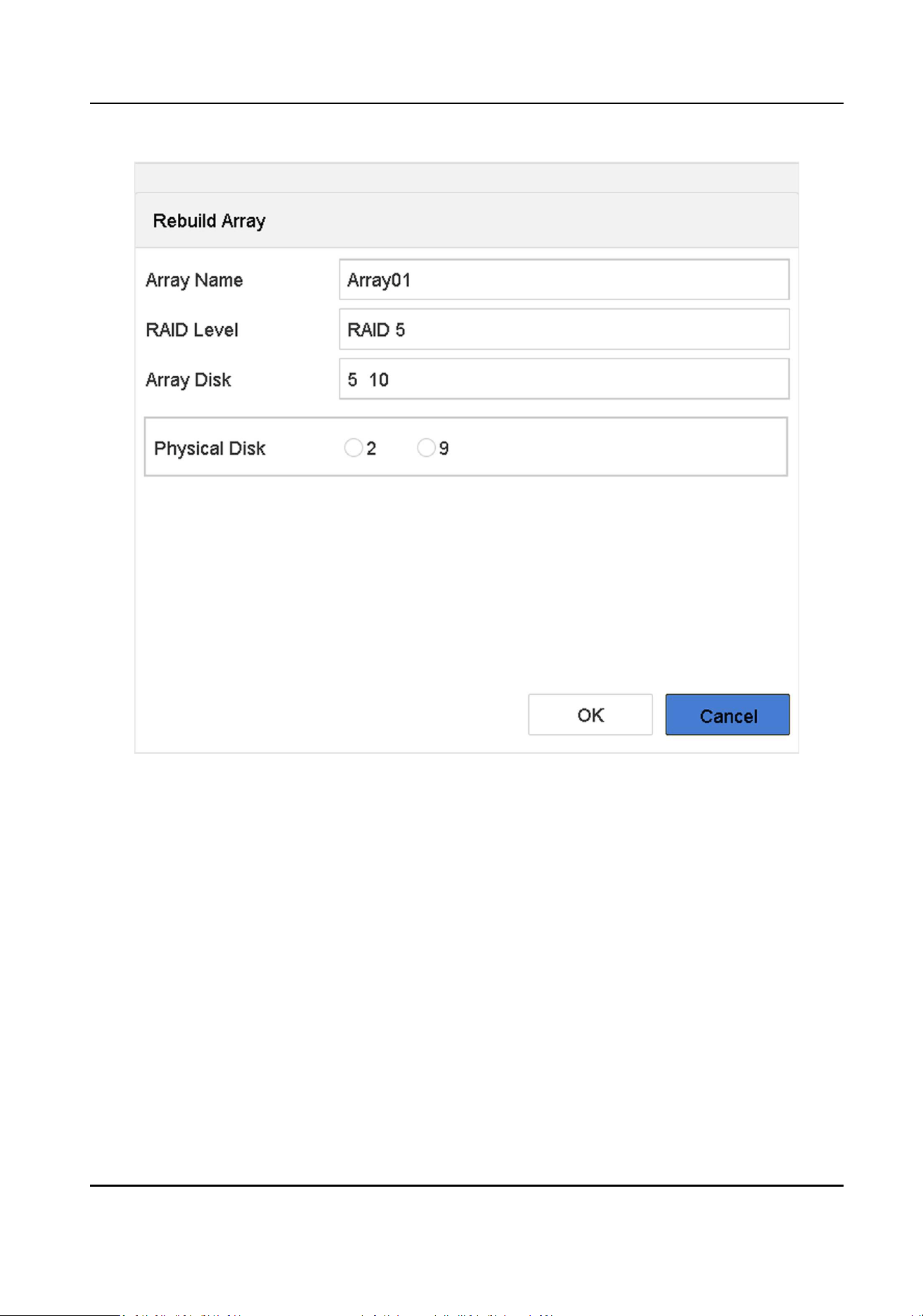
Figure 9-10 Rebuild Array
3.
Select the available physical disk.
4.
Click OK.
5.
Click OK on the pop up message box "Do not unplug the physical disk when it is under
rebuilding."
Digital Video Recorder User Manual
112
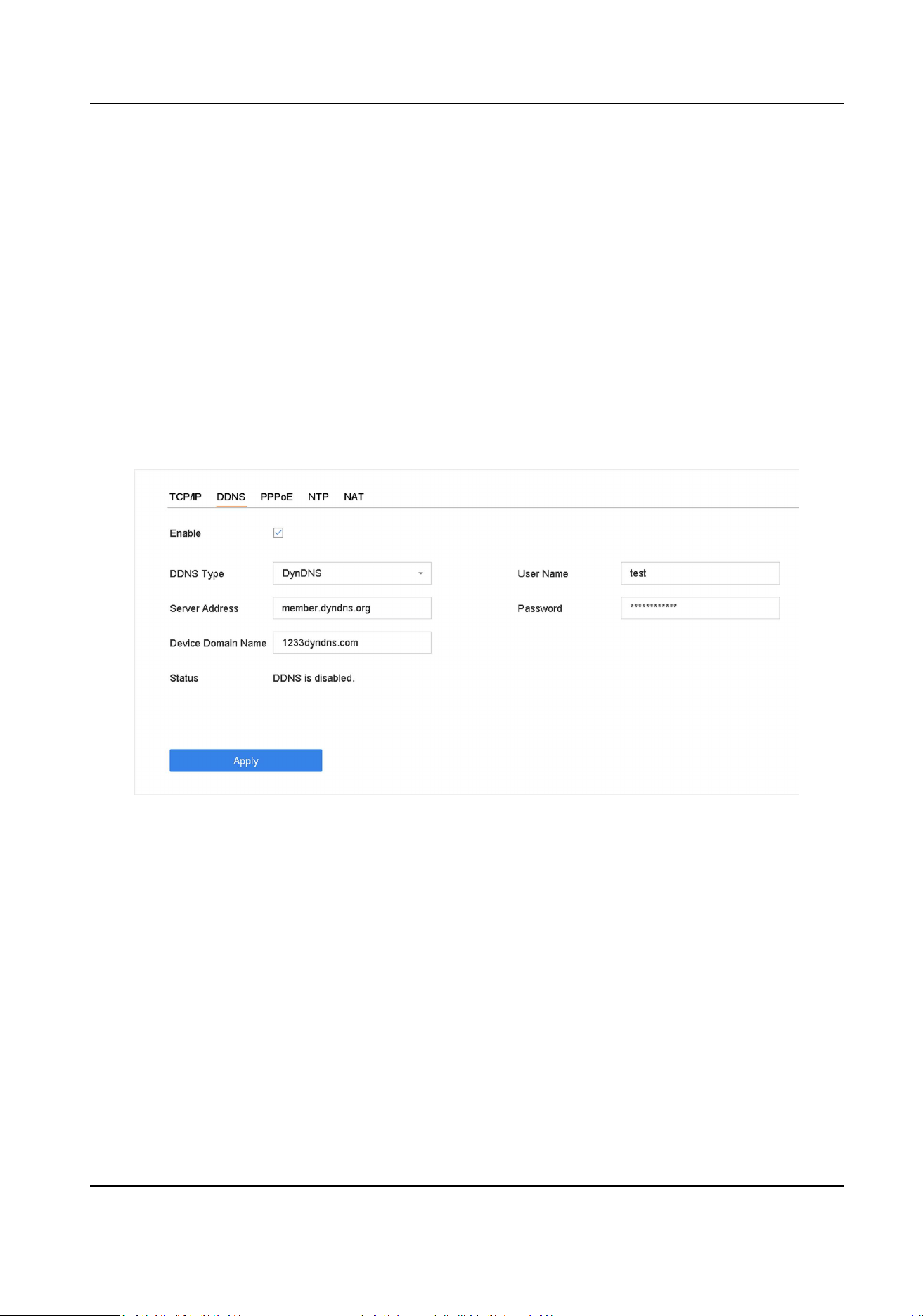
Chapter 10 Network Sengs
10.1 Congure DDNS
You can set Dynamic DNS service for network access. Dierent DDNS modes are available: DynDNS,
PeanutHull, and NO-IP.
Before You Start
You must register the DynDNS, PeanutHull, or NO-IP services with your ISP before conguring
DDNS sengs.
Steps
1.
Go to System → Network → TCP/IP → DDNS
Figure 10-1 DDNS Sengs
2.
Check Enable.
3.
Select DDNS Type as DynDNS.
4.
Enter Server Address for DynDNS (i.e., members.dyndns.org).
5.
Under Device Domain Name, enter the domain name obtained from the DynDNS Website.
6.
Enter User Name and Password registered in the DynDNS Website.
7.
Click Apply.
10.2 Congure PPPoE
If the device is connected to Internet through PPPoE, you need to congure user name and
password accordingly under System → Network → TCP/IP → PPPoE .
Digital Video Recorder User Manual
113
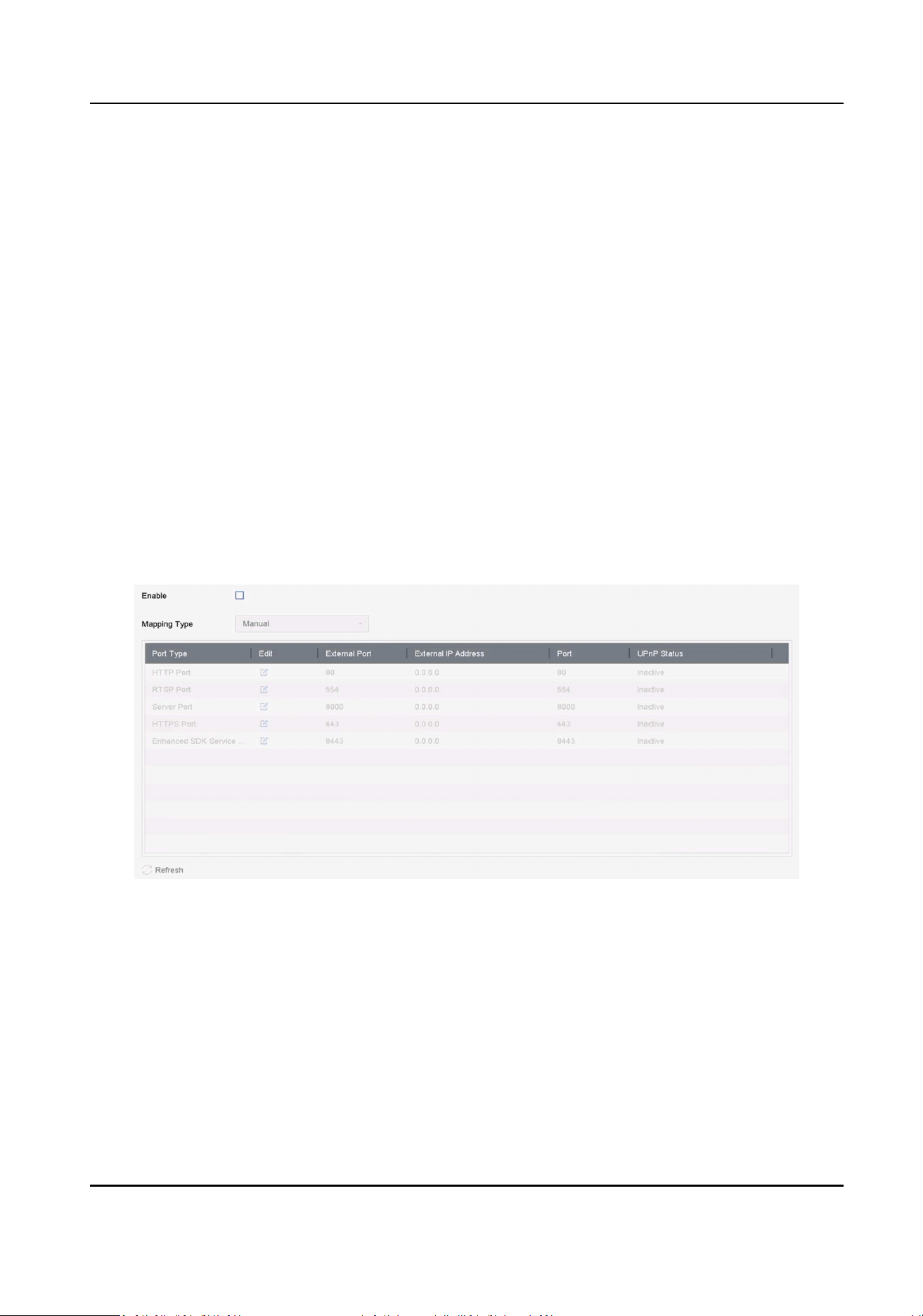
Contact your Internet service provider for details about PPPoE service.
10.3 Congure Port Mapping (NAT)
Two ways are provided for port mapping to realize the remote access via the cross-segment
network, UPnP™ and manual mapping.
Before You Start
If you want to enable the UPnP™ funcon of the device, you must enable the UPnP™ funcon of
the router to which your device is connected. When the network working mode of the device is set
as mul-address, the Default Route of the device should be in the same network segment as that
of the LAN IP address of the router.
Universal Plug and Play (UPnP™) can permit the device seamlessly discover the presence of other
network devices on the network and establish funconal network services for data sharing,
communicaons, etc. You can use the UPnP™ funcon to enable the fast connecon of the device
to the WAN via a router without port mapping.
Steps
1.
Go to System → Network → TCP/IP → NAT .
Figure 10-2 Port Mapping Seng
2.
Check Enable.
3.
Select Mapping Type as Manual or Auto.
-
Auto: If you select Auto, the port mapping items are read-only, and the external ports are set
by the router automacally.
-
Manual: If you select Manual, you can edit the external port on your demand by clicking to
acvate External Port Sengs.
Digital Video Recorder User Manual
114
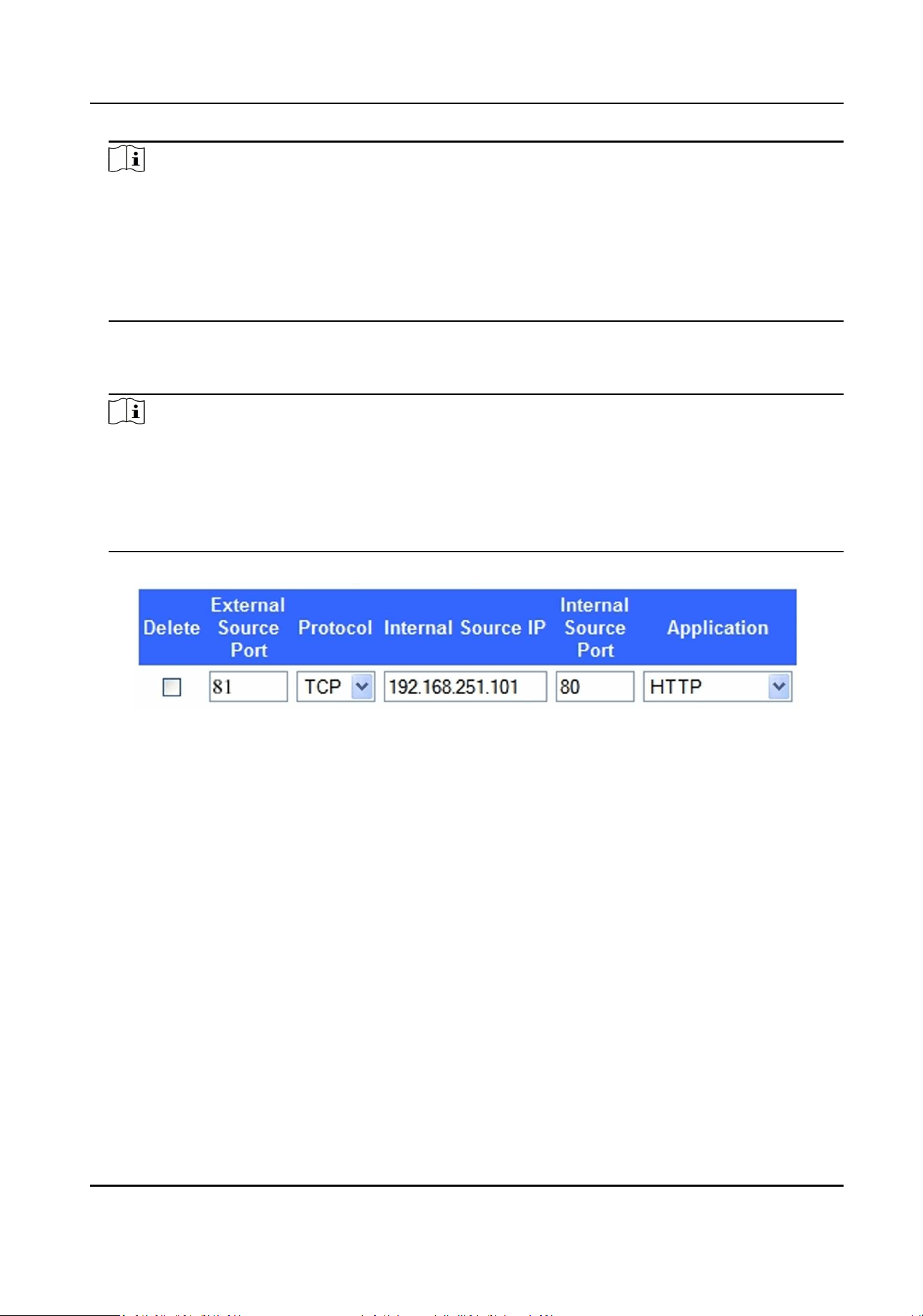
Note
●
You can use the default port No., or change it according to actual requirements.
●
External Port indicates the port No. for port mapping in the router.
●
The value of the RTSP port No. should be 554 or between 1024 and 65535, while the value of
the other ports should be between 1 and 65535 and the value must be dierent from each
other. If mulple devices are congured for the UPnP™ sengs under the same router, the
value of the port No. for each device should be unique.
4.
Enter the virtual server seng page of router; ll in the blank of Internal Source Port with the
internal port value, the blank of External Source Port with the external port value, and other
required contents.
Note
●
Each item should be corresponding with the device port, including server port, hp port, RTSP
port and hps port.
●
The virtual server seng interface below is for reference only, it may be dierent due to
dierent router manufactures. Please contact the manufacture of router if you have any
problems with seng virtual server.
Figure 10-3 Set Virtual Server Item
10.4 Congure Wi-Fi
You can use a Wi-Fi dongle to connect your device to a wireless network. Only certain models
support this funcon.
Before You Start
Prepare a suitable Wi-Fi dongle, and insert it in to the USB interface at the rear panel.
Steps
1.
Go to System → Network → TCP/IP → Wi-Fi .
Digital Video Recorder User Manual
115
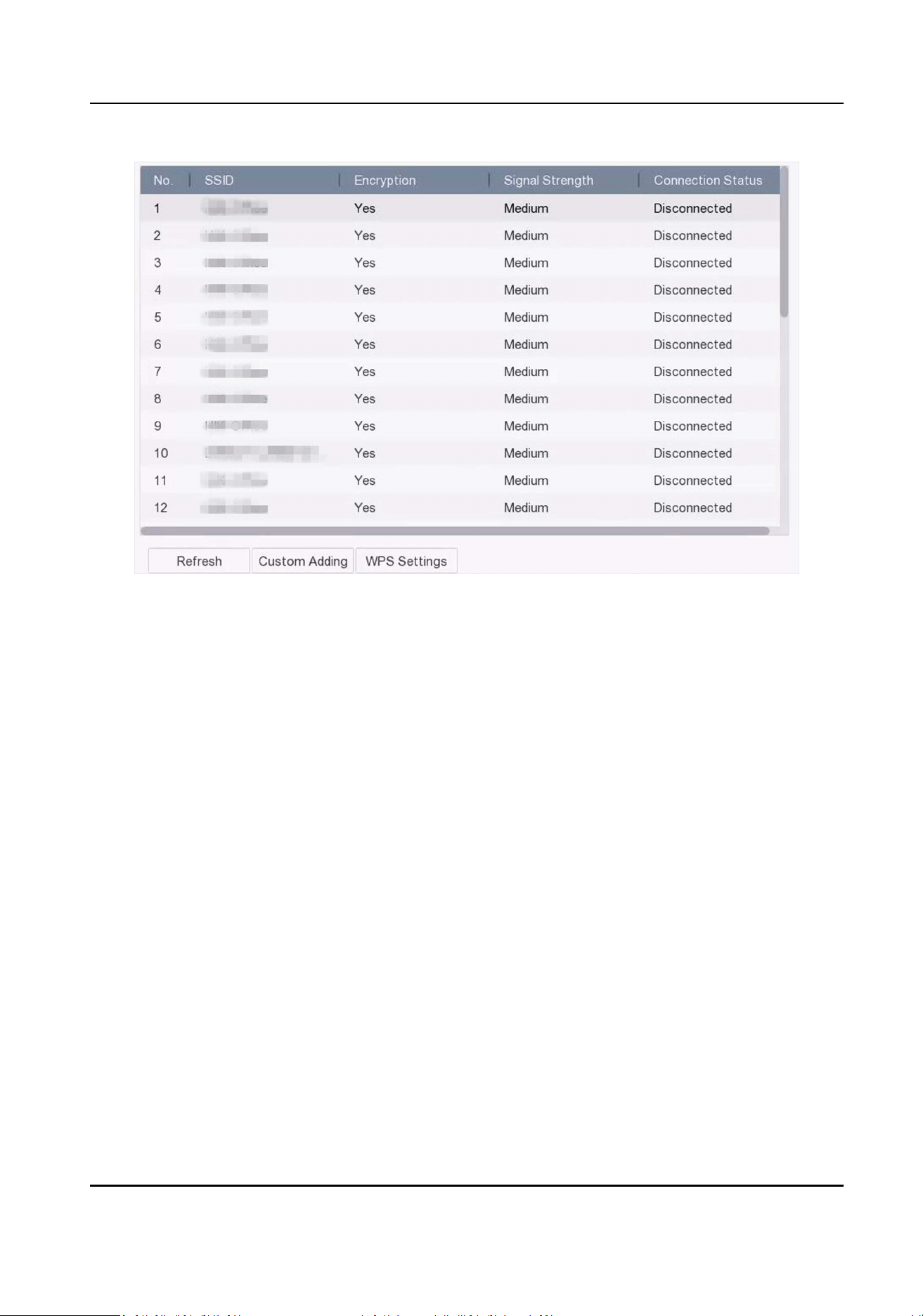
Figure 10-4 Connect to a Wireless Network
2.
Check Enable Wi-Fi.
3.
Connect to a wireless network.
Connect to an Automacally
Searched Wireless Network
a. Double click the wireless network from the list as
you desired.
b. Set wireless network parameters.
c. Click OK.
Connect to a Customized Wireless
Network
a. Click Custom Adding.
b. Set wireless network parameters.
c. Click OK.
Connect to a Wireless Network with
WPS (Wi-Fi Protected Setup)
a. Click WPS Sengs.
b. Check Enable WPS.
c. Set wireless network parameters.
d. Click Apply.
Aer connecng to an available wireless network, you can view the connecon result in
Connecon Status.
4.
Go to System → Network → TCP/IP → TCP/IP .
5.
Set Select NIC and Default Route as WLAN0.
6.
Set other network parameters.
7.
Click Apply.
Digital Video Recorder User Manual
116

10.5 Congure SNMP
You can congure SNMP sengs to get device status and parameter informaon.
Before You Start
Download the SNMP soware to receive device informaon via the SNMP port. By seng the trap
address and port, the device is allowed to send alarm events and excepon messages to the
center.
Steps
1.
Go to System → Network → Advanced → SNMP .
Digital Video Recorder User Manual
117
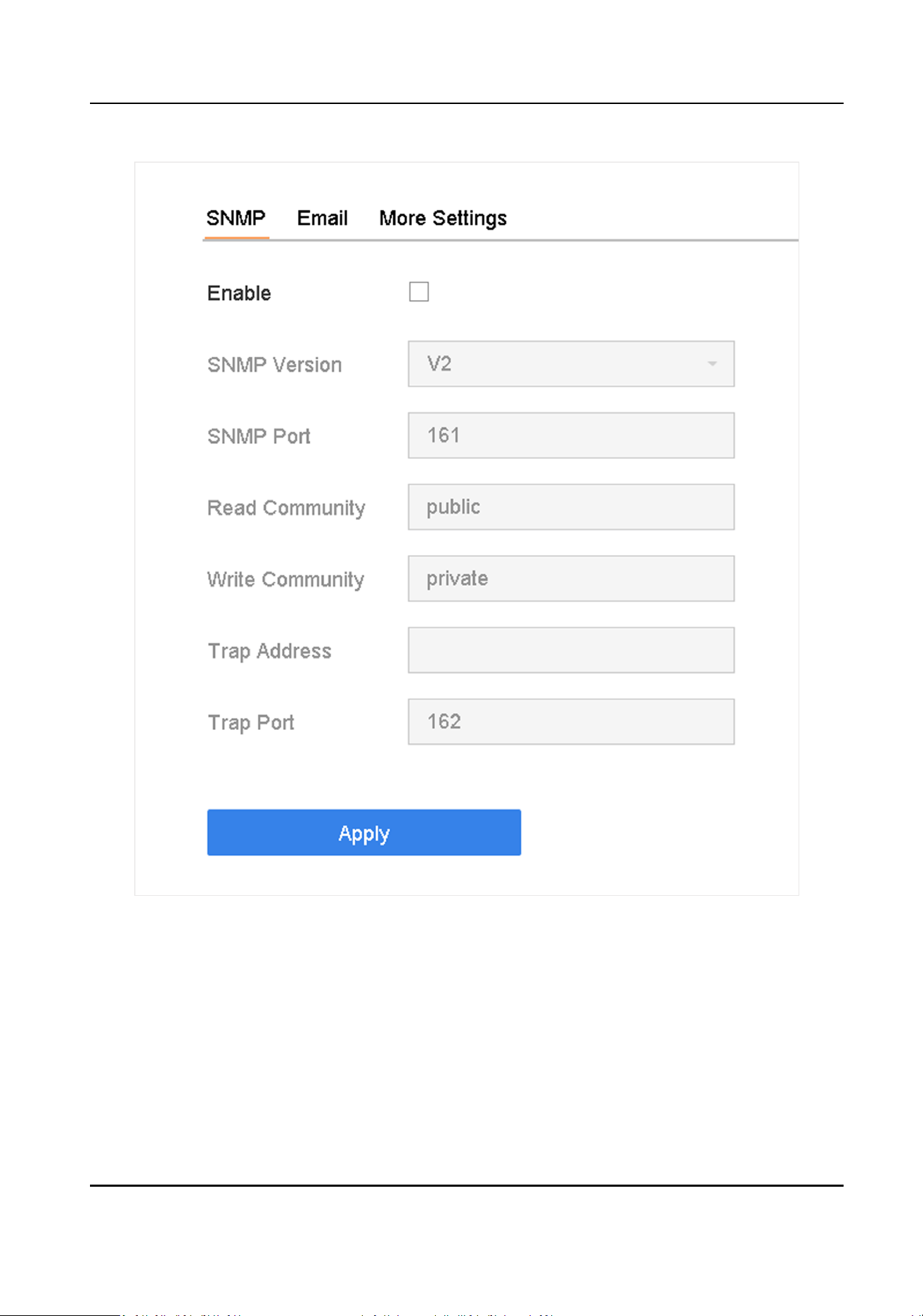
Figure 10-5 SNMP Sengs
2.
Check Enable. A message will pop up to nofy about a possible security risk. Click Yes to
connue.
3.
Congure the SNMP sengs as needed.
Trap Address
SNMP host IP address.
Trap Port
Port of the SNMP host.
Digital Video Recorder User Manual
118

4.
Click Apply.
Note
You can congure SNMP v2 and SNMP v3 parameters via web browser in Conguraon →
System → Advanced Sengs → SNMP .
10.6 Congure Email
The system can be congured to send an e-mail nocaon to all designated users when a
specied event occurs such as when an alarm or moon event is detected, or the administrator
password is changed, etc.
Before You Start
The device must be connected to a local area network (LAN) that contains an SMTP mail server.
The network must also be connected to either an intranet or the Internet depending on the
locaon of the email accounts to which you want to send nocaons.
Steps
1.
Go to System → Network → Advanced → Email .
2.
Congure the email sengs.
Server Authencaon
Check to enable the funcon if the SMTP server requires user authencaon and enter the
user name and password accordingly.
SMTP Server
The IP address of SMTP Server or host name (e.g., smtp.263xmail.com).
SMTP Port
The SMTP port. The default TCP/IP port used for SMTP is 25.
Enable SSL/TLS
Check to enable SSL/TLS if required by the SMTP server.
Sender
The sender's name.
Sender's Address
The sender's address.
Select Receivers
Select the receiver. Up to 3 receivers can be congured.
Receiver
The receiver's name.
Receiver's Address
The email address of the user to be noed.
Digital Video Recorder User Manual
119
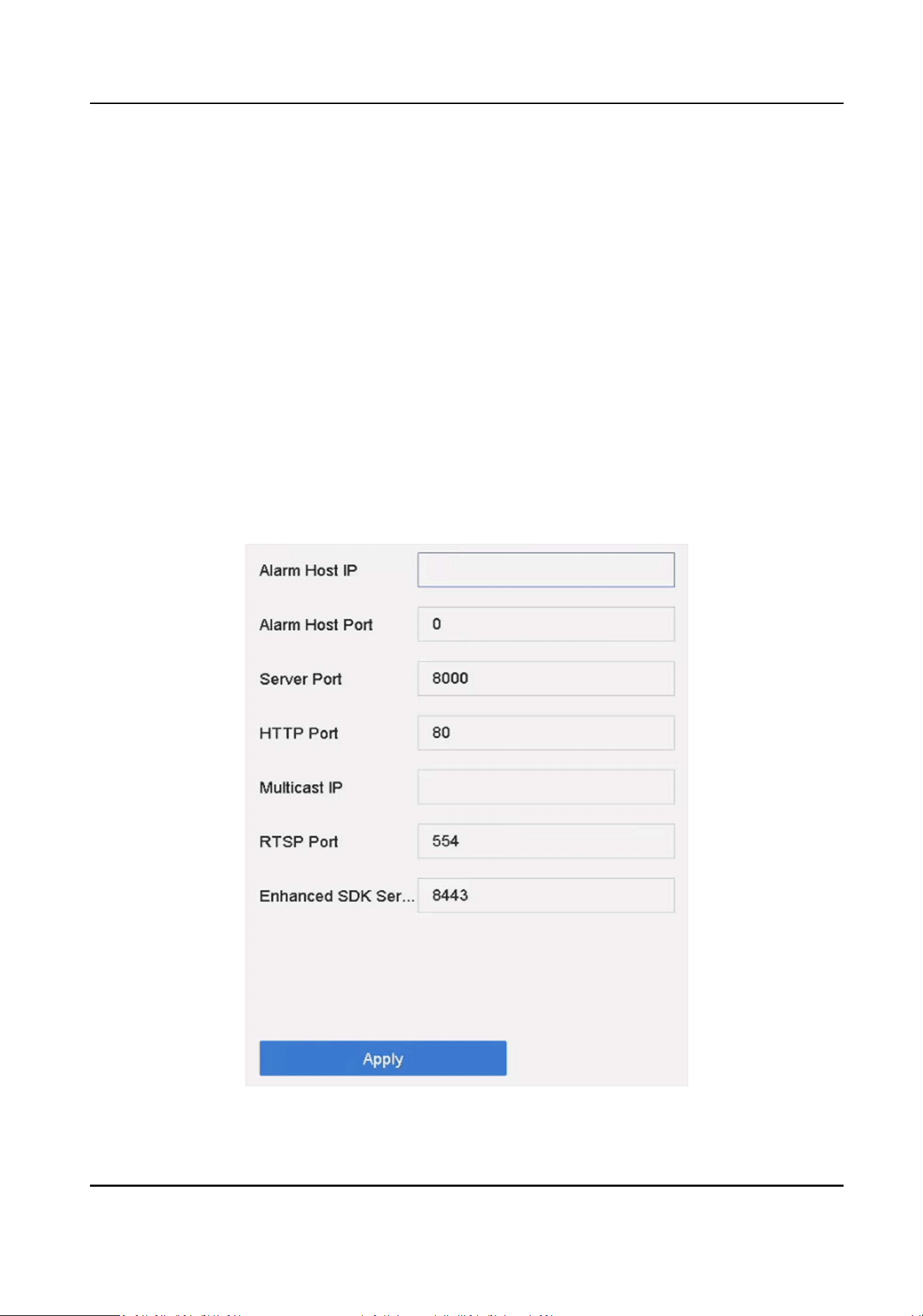
Aached Image
Check to send email with aached alarm images. The interval is the me between sending
two subsequent alarm images.
Interval
The me interval for capturing the aached images.
3.
Oponal: Enable the alternate SMTP, and congure the required parameters for alternate SMTP.
When the preferred SMTP is invalid, the device will use alternate SMTP to send emails.
4.
Oponal: Click Test to send a test email.
5.
Click Apply.
10.7 Congure Port
You can congure dierent types of ports to enable relevant funcons.
Steps
1.
Go to System → Network → Advanced → More Sengs .
Figure 10-6 Port Sengs
Digital Video Recorder User Manual
120

2.
Congure port sengs as needed.
Alarm Host IP/Port
With a remote alarm host congured, the device will send the alarm event or excepon
message to the host when an alarm is triggered. The remote alarm host must have the client
management system (CMS) soware installed. The alarm host IP refers to the IP address of
the remote PC on which the CMS soware (e.g., iVMS-4200) is installed, and the alarm host
port (7200 by default) must be the same as the alarm monitoring port congured in the
soware.
Server Port
Server port (8000 by default) should be congured for remote client soware access and its
valid range is 2000 to 65535.
HTTP Port
HTTP port (80 by default) should be congured for remote Web browser access.
Mulcast IP
Mulcast can be congured to enable Live View for cameras that exceed the maximum
number allowed through network. Both IPv4 and IPv6 are available for mulcast IP address.
For IPv4, it covers Class-D IP ranging from 224.0.0.0 to 239.255.255.255 and it is
recommended to use an IP address ranging from 239.252.0.0 to 239.255.255.255. When
adding a device to the CMS soware, the mulcast address must be the same as that of the
device.
RTSP Port
RTSP (Real Time Streaming Protocol) is a network control protocol designed to control
streaming media servers. The port is 554 by default.
Enhanced SDK Service Port
The enhanced SDK service adopts TLS protocol over the SDK service that provides safer data
transmission. The port is 8443 by default.
3.
Click Apply.
10.8 Congure ONVIF
ONVIF protocol allows the connecon with third-party cameras. The added user accounts have the
permission to connect other devices via ONVIF protocol.
Steps
1.
Go to Maintenance → System Service → ONVIF .
2.
Check Enable ONVIF to enable the ONVIF access management.
Note
ONVIF protocol is disabled by default.
3.
Click Add.
Digital Video Recorder User Manual
121

4.
Enter User Name, and Password
Cauon
We highly recommend you create a strong password of your own choosing (Using a minimum of
8 characters, including at least three of the following categories: upper case leers, lower case
leers, numbers, and special characters.) in order to increase the security of your product. And
we recommend you reset your password regularly, especially in the high security system,
reseng the password monthly or weekly can beer protect your product.
5.
Select Level as Media User, Operator or Admin.
6.
Click OK.
Digital Video Recorder User Manual
122

Chapter 11 User Management and Security
11.1 Manage User Accounts
The Administrator user name is admin and the password is set when you start the device for the
rst me. The Administrator has the permission to add and delete users and congure user
parameters.
11.1.1 Add a User
Steps
1.
Go to System → User .
2.
Click Add to enter the operaon permission interface.
3.
Input the admin password and click OK.
4.
In the Add User interface, enter the informaon for a new user.
Cauon
Strong Password Recommended–We highly recommend you create a strong password of your
own choosing (using a minimum of 8 characters, including at least three of the following
categories: upper case leers, lower case leers, numbers, and special characters) in order to
increase the security of your product. We also recommend that you reset your password
regularly. Especially in the high security systems, reseng the password monthly or weekly can
beer protect your product.
User Level
Set the user level to Operator or Guest. Dierent user levels have dierent operang
permission.
●
Operator: An Operator user level has Two-way Audio permission in Remote Conguraon
and all operang permissions in Camera Conguraon by default.
●
Guest: The Guest user has no permission of Two-way Audio in Remote Conguraon and
only has the local/remote playback in the Camera Conguraon by default.
User’s MAC Address
The MAC address of the remote PC that logs onto the device. If it is congured and enabled,
it allows only the remote user with this MAC address to access the device.
5.
Click OK.
In the User Management interface, the added new user is displayed on the list.
Digital Video Recorder User Manual
123
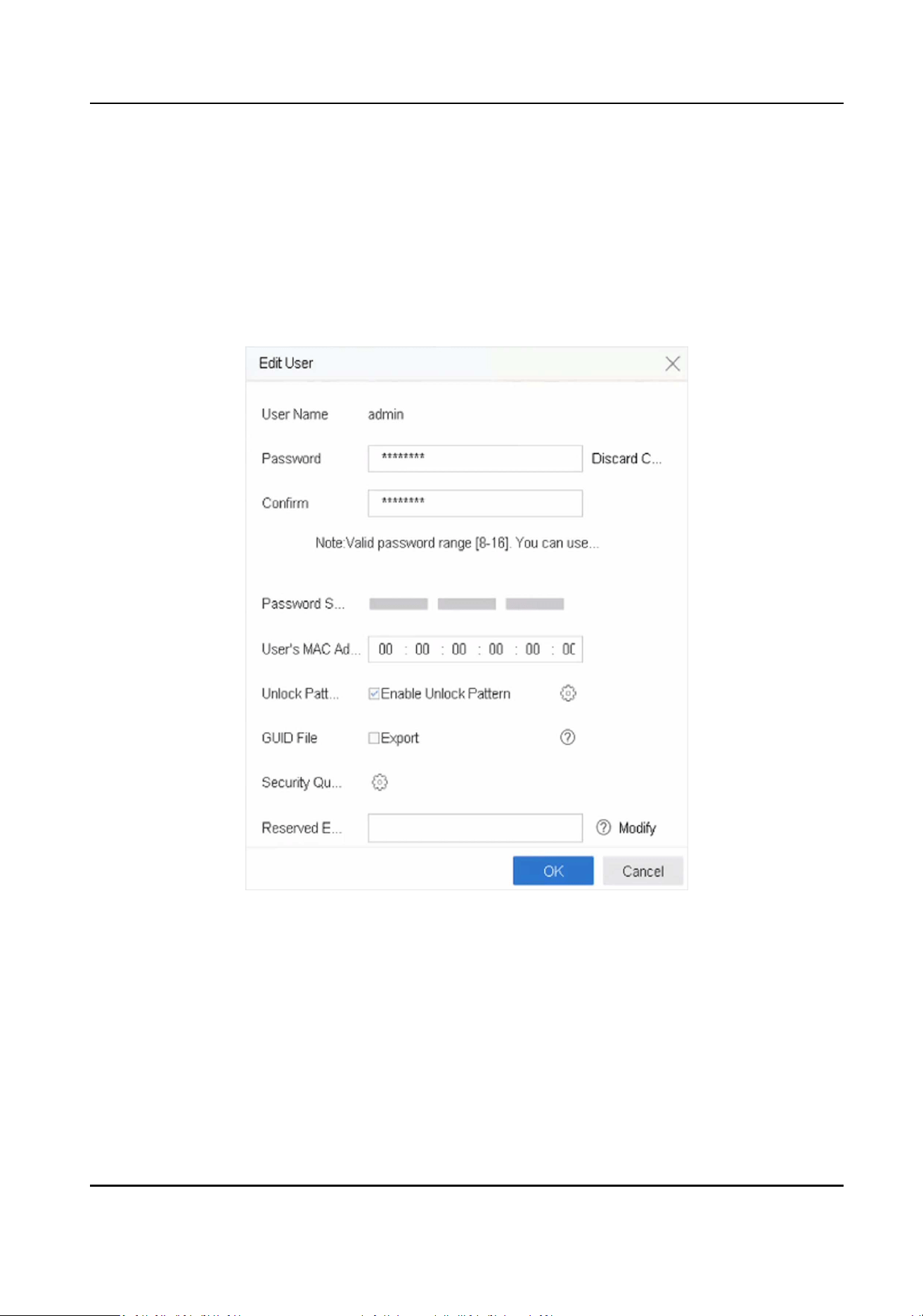
11.1.2 Edit the Admin User
For the admin user account, you can modify your password and unlock paern.
Steps
1.
Go to System → User .
2.
Select the admin user from the list.
3.
Click Modify.
Figure 11-1 Edit User (Admin)
4.
Edit the admin user informaon as desired, including a new admin password (strong password is
required) and MAC address.
5.
Edit the unlock paern for the admin user account.
1) Check Enable Unlock Paern to enable the use of an unlock paern when logging in to the
device.
2) Use the mouse to draw a paern among the 9 dots on the screen, and release the mouse
when the paern is done.
6.
Check Export of GUID File to export the GUID le for the admin user account.
Digital Video Recorder User Manual
124
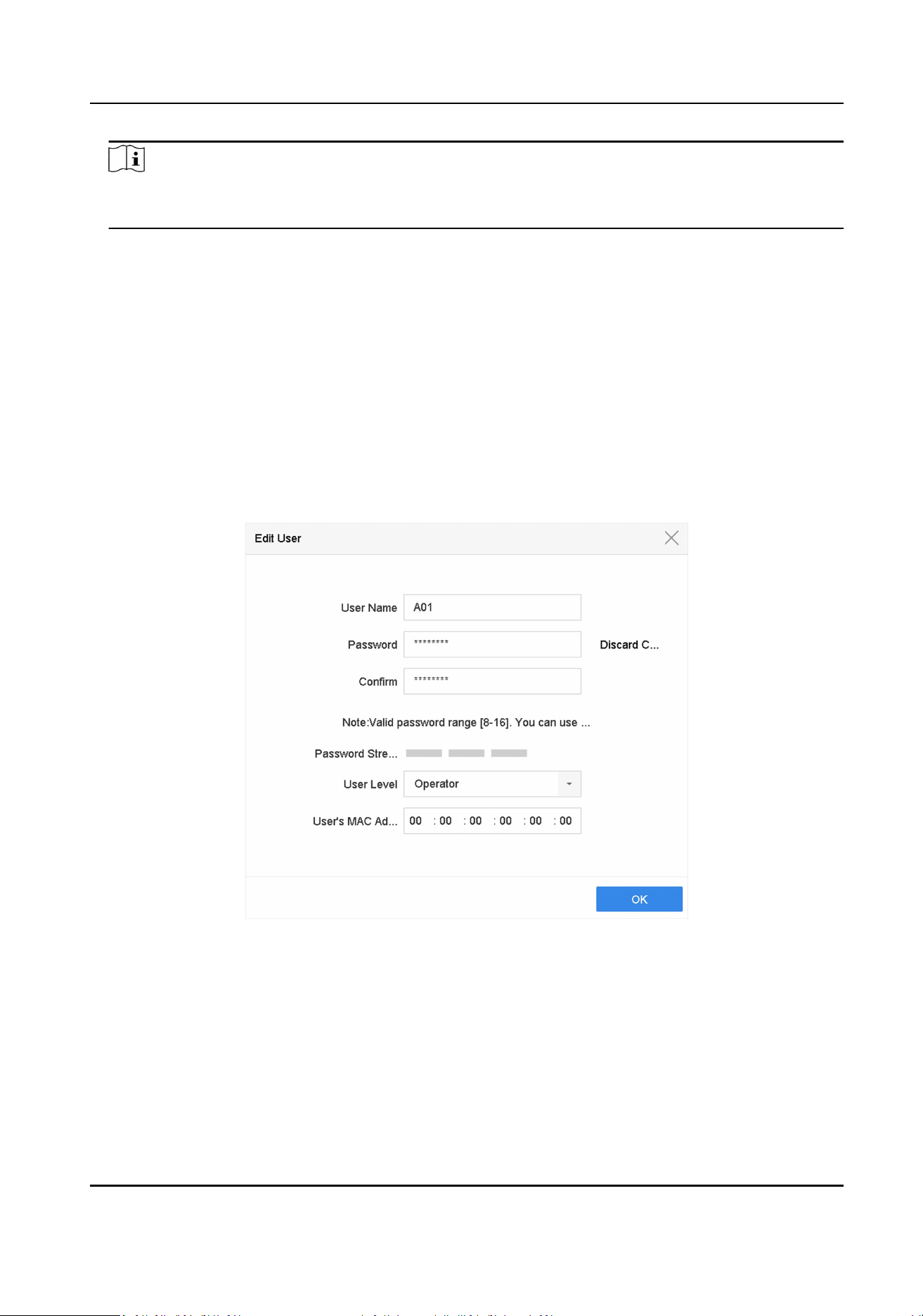
Note
When the admin password is changed, export the new GUID to the connected USB ash drive in
the Import/Export interface for the future password reseng.
7.
Congure security queson for password reseng.
8.
Congure reserved email for password reseng.
9.
Click OK to save the sengs.
11.1.3 Edit an Operator/Guest User
You can edit the user informaon, including user name, password, permission level, and MAC
address.
Steps
1.
Go to System → User .
2.
Select a user from the list and click Modify.
Figure 11-2 Edit User (Operator/Guest)
3.
Edit the user informaon as desired, including the new password (strong password is required)
and MAC address.
4.
Click OK.
11.2 Manage User Permissions
Digital Video Recorder User Manual
125
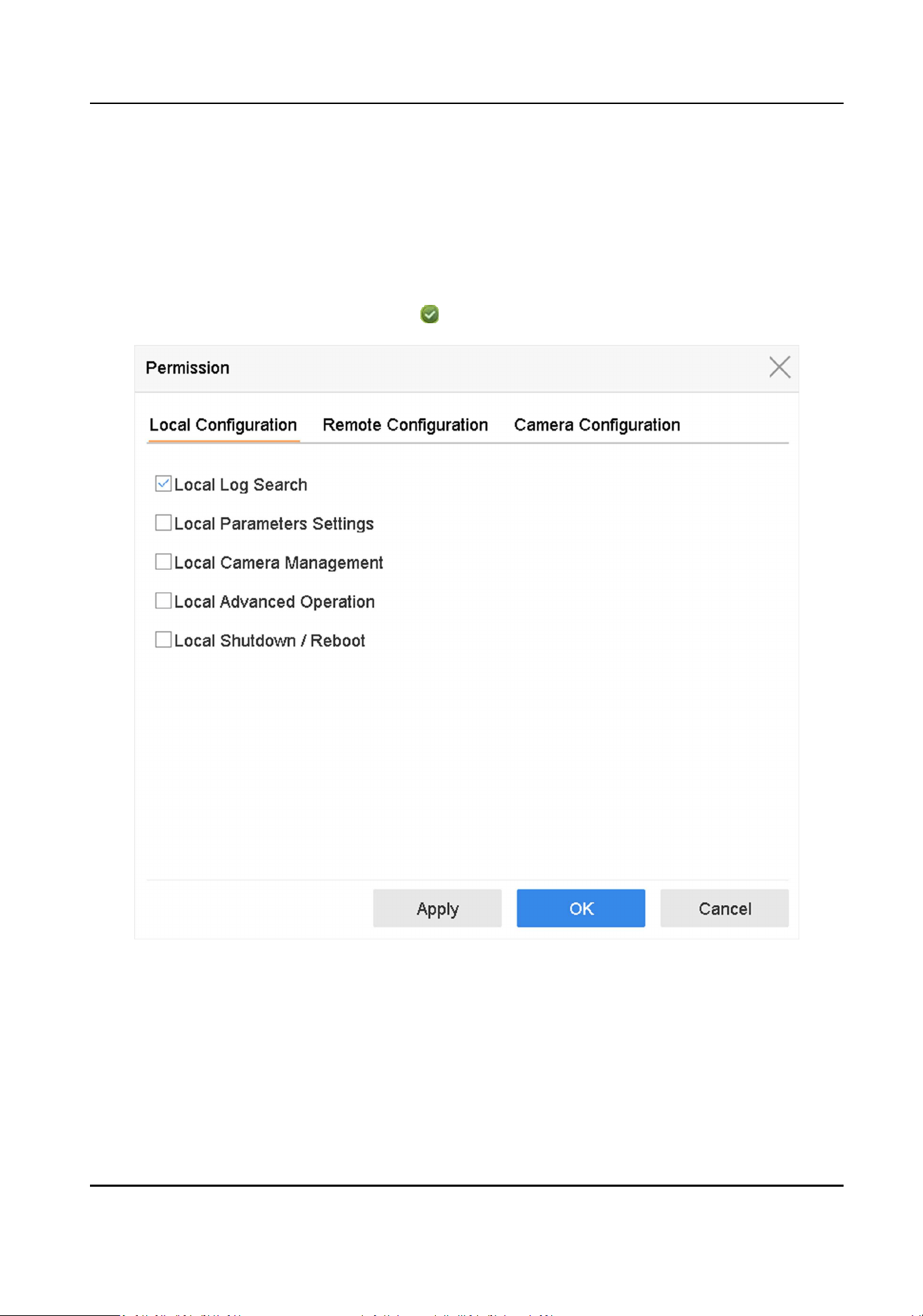
11.2.1 Set User Permissions
For an added user, you can assign the dierent permissions, including local and remote operaon
of the device.
Steps
1.
Go to System → User .
2.
Select a user from the list, and then click to enter the permission sengs interface.
Figure 11-3 User Permission Sengs Interface
3.
Set the user's operang permissions for Local Conguraon, Remote Conguraon, and
Camera Conguraon for the user.
1) Set Local Conguraon
Local Log Search
Searching and viewing logs and system informaon of device.
Digital Video Recorder User Manual
126

Local Parameters Sengs
Conguring parameters, restoring factory default parameters, and imporng/exporng
conguraon les.
Local Camera Management
Adding, deleng, and eding of IP cameras.
Local Advanced Operaon
Operang HDD management (inializing HDD, seng HDD property), upgrading system
rmware, clearing I/O alarm output.
Local Shutdown Reboot
Shung down or reboong the device.
2) Set Remote Conguraon
Remote Log Search
Remotely viewing logs that are saved on the device.
Remote Parameters Sengs
Remotely conguring parameters, restoring factory default parameters, and imporng/
exporng conguraon les.
Remote Camera Management
Remote adding, deleng, and eding of the IP cameras.
Remote Serial Port Control
Conguring sengs for RS-232 and RS-485 port sengs.
Remote Video Output Control
Sending remote buon control signals.
Two-Way Audio
Operang the two-way radio between the remote client and the device.
Remote Alarm Control
Remotely arming (nofy alarm and excepon message to the remote client) and
controlling the alarm output.
Remote Advanced Operaon
Remotely operang HDD management (inializing HDD, seng HDD property), upgrading
system rmware, clearing I/O alarm output.
Remote Shutdown/Reboot
Remotely shung down or reboong the device.
3) Set Camera Conguraon
Remote Live View
Remotely viewing live video of the selected camera(s).
Local Manual Operaon
Digital Video Recorder User Manual
127

Locally starng/stopping manual recording and alarm output of the selected camera(s).
Remote Manual Operaon
Remotely starng/stopping manual recording and alarm output of the selected camera(s).
Local Playback
Locally playing back recorded les of the selected camera(s).
Remote Playback
Remotely playing back recorded les of the selected camera(s).
Local PTZ Control
Locally controlling PTZ movement of the selected camera(s).
Remote PTZ Control
Remotely controlling PTZ movement of the selected camera(s).
Local Video Export
Locally exporng recorded les of the selected camera(s).
Local Live View
View live video of the selected camera(s) in local.
4.
Click OK to save the sengs.
11.2.2 Set Live View Permission on Lock Screen
The admin user can set live view permission for specic cameras in the screen lock status of device.
●
The admin user can set this permission for user accounts.
●
When the normal user (Operator or Guest) has no local live view permission for specic camera
(s), the live view permission for such camera (s) on lock screen status cannot be congured (live
view not allowed by default).
Steps
1.
Go to System → User .
2.
Click Live View Permission on Lock Screen.
3.
Input admin password and click Next.
Digital Video Recorder User Manual
128
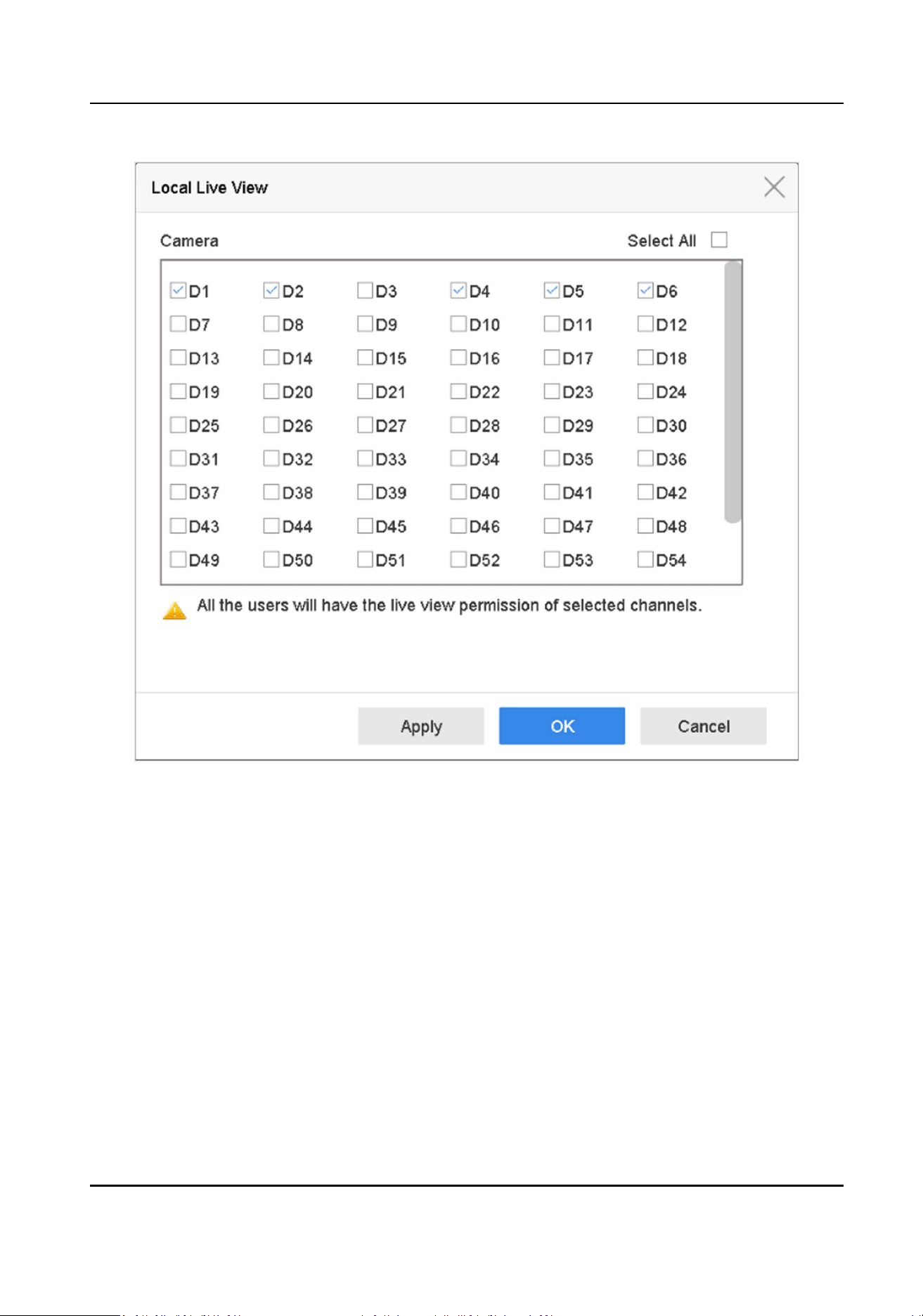
Figure 11-4 Set Live View Permissions on Lock Screen
4.
Set the permissions. Select the camera (s) to allow live view when the current user account is in
logout status.
5.
Click OK.
11.3 Congure Password Security
11.3.1 Export GUID File
The GUID le can help you to reset password when you forget it. You can export GUID le via web
browser. Please keep the GUID le properly.
Before You Start
Ensure you are on the same network segment with your device.
Digital Video Recorder User Manual
129
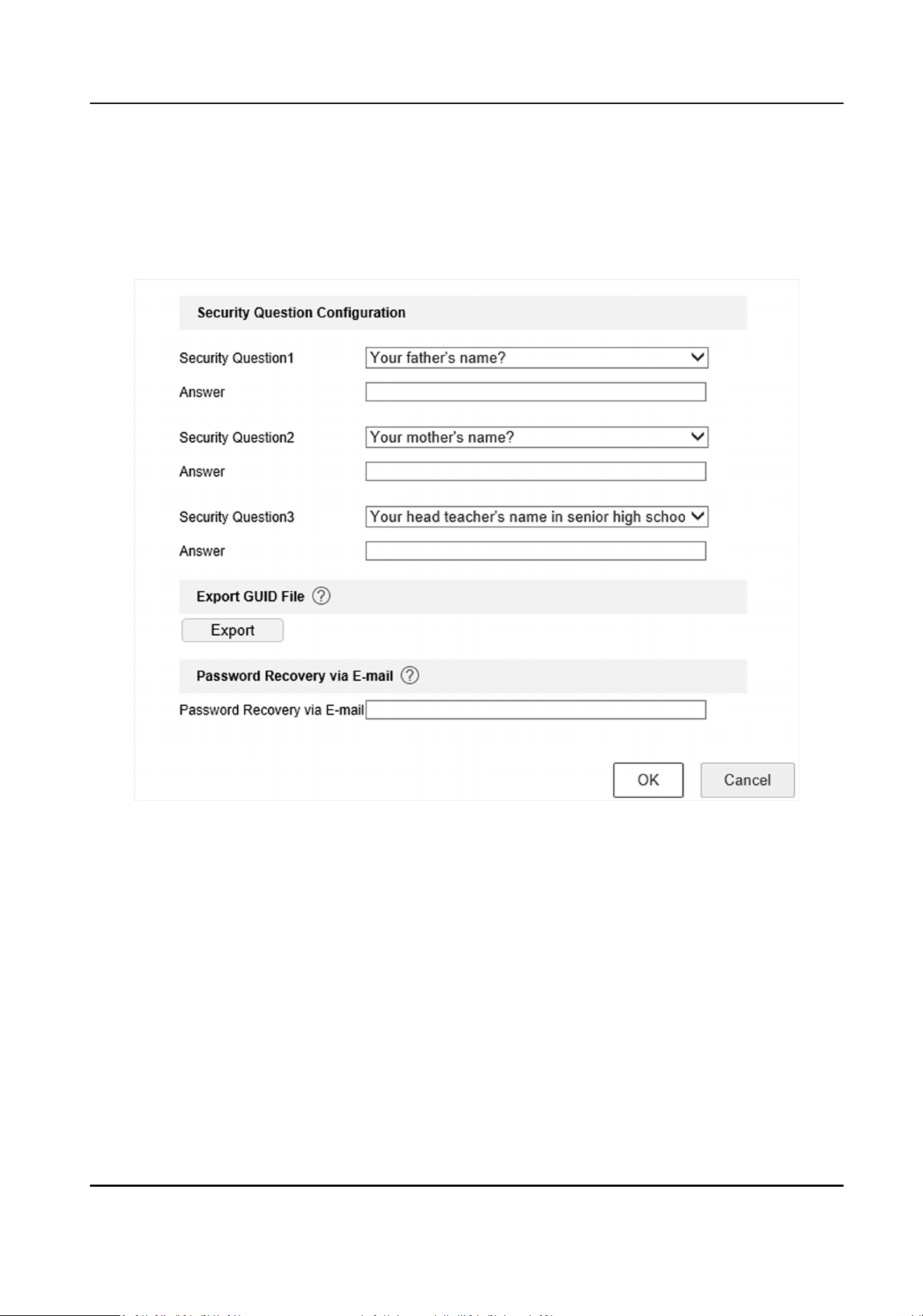
Steps
1.
Go to Conguraon → System → User Management → User Management .
2.
Select the admin user.
3.
Click Account Security Sengs.
4.
Click Modify.
Figure 11-5 Export GUID File
5.
Click Export in Export GUID File.
6.
Enter the admin password.
7.
Save the GUID le to a directory as your desire.
11.3.2 Congure Security Quesons
The security quesons can help you to reset password when you forget your password, or
encounter security issues. You can congure security quesons via web browser.
Before You Start
Ensure you are on the same network segment with your device.
Digital Video Recorder User Manual
130
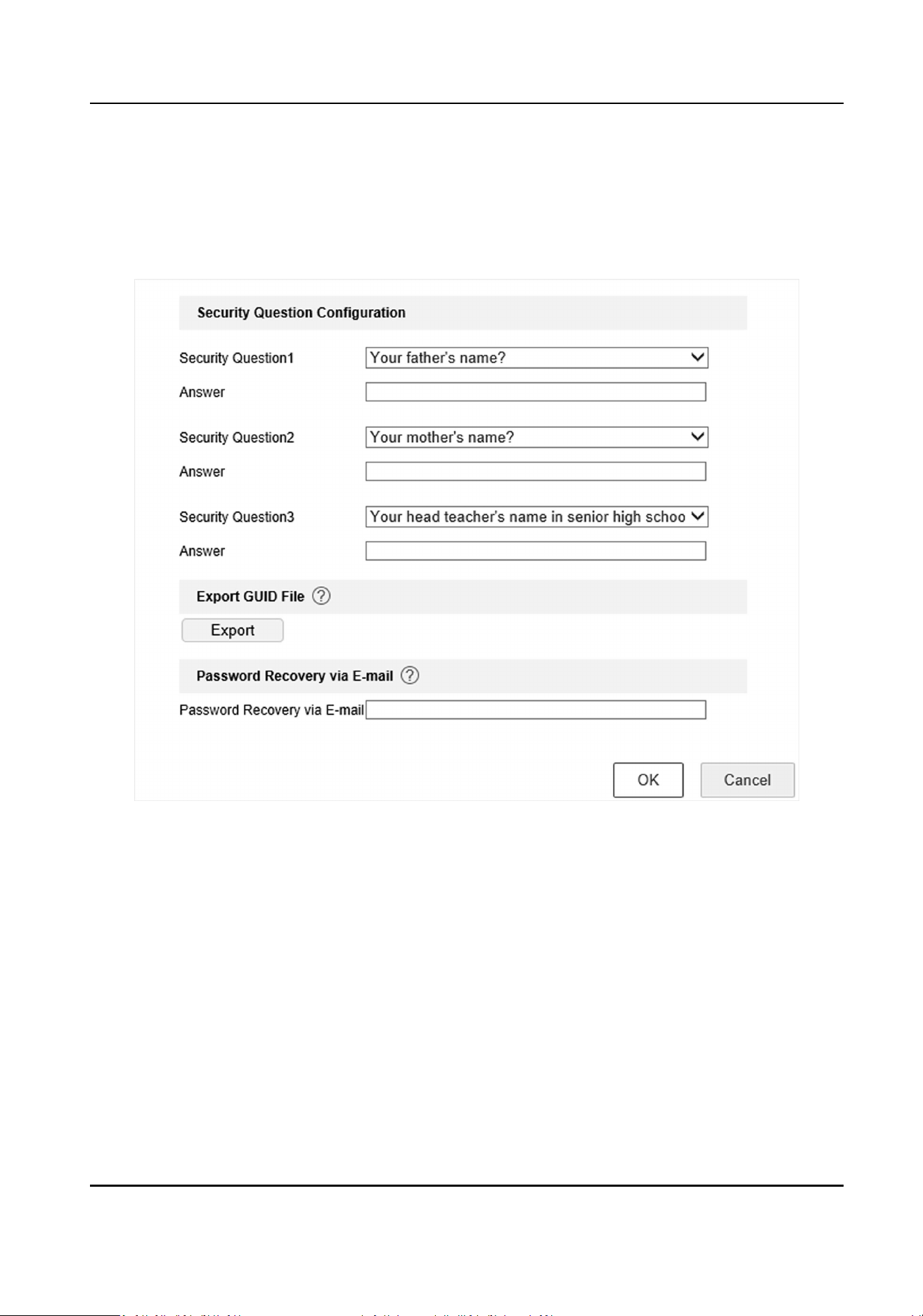
Steps
1.
Go to Conguraon → System → User Management → User Management .
2.
Select the admin user.
3.
Click Account Security Sengs.
4.
Click Modify.
Figure 11-6 Congure Security Quesons
5.
Set the security quesons.
6.
Click OK.
7.
Enter the admin password.
8.
Click OK.
11.3.3 Congure Reserved Email
The reserved email will help you to reset password when you forget your password.
Steps
1.
Check Reserved E-mail when you are acvang the device, or click Modify when you are eding
the admin user account.
Digital Video Recorder User Manual
131
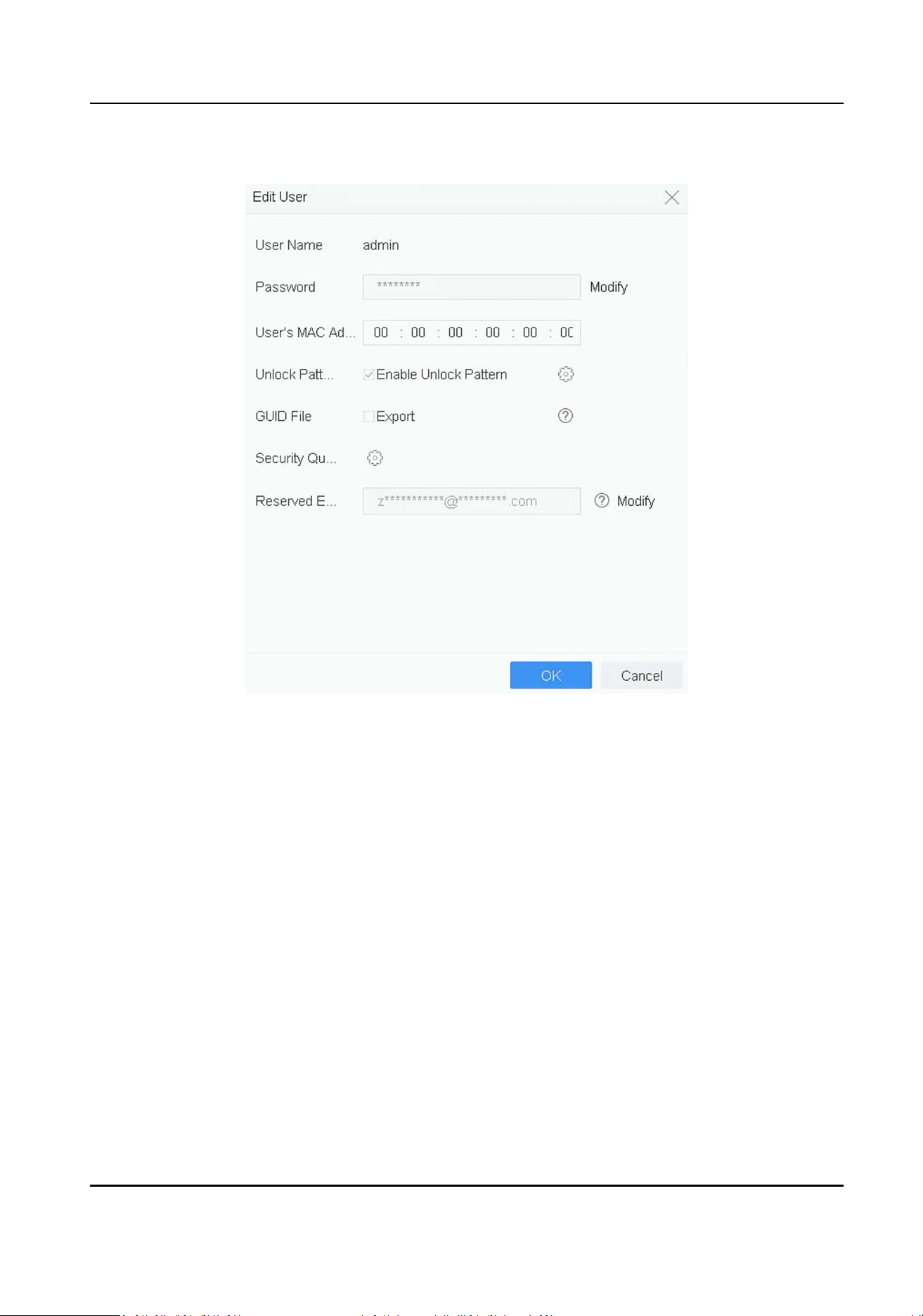
2.
Enter reserved email address.
Figure 11-7 Congure Reserved Email
3.
Click OK.
11.4 Reset Password
When you forget the admin password, you can reset the password by imporng the GUID le,
answering security quesons, or entering vericaon code from your reserved email.
11.4.1 Reset Password by GUID
You can reset password by GUID via web browser.
Before You Start
Ensure you have the correct GUID le.
Steps
1.
On the user login interface, click Forgot password.
2.
Select Vericaon Mode as GUID File Vericaon.
Digital Video Recorder User Manual
132

3.
Click Browse to locate the GUID le.
4.
Click Next.
5.
Enter a new password.
Warning
We highly recommend you to create a strong password of your own choosing (using a minimum
of 8 characters, including at least three kinds of following categories: upper case leers, lower
case leers, numbers, and special characters) in order to increase the security of your product.
And we recommend you change your password regularly, especially in the high security system,
changing the password monthly or weekly can beer protect your product.
6.
Conrm the new password.
7.
Click Next.
11.4.2 Reset Password by Security Quesons
You can reset password by answering security quesons via web browser.
Before You Start
Ensure you have congured the security quesons when you acvate the device or edit the admin
user account.
Steps
1.
On the user login interface, click Forgot password.
2.
Select Vericaon Mode as Security Queson Vericaon.
3.
Enter the answers of each queson.
4.
Click Next.
5.
Enter a new password.
Warning
We highly recommend you to create a strong password of your own choosing (using a minimum
of 8 characters, including at least three kinds of following categories: upper case leers, lower
case leers, numbers, and special characters) in order to increase the security of your product.
And we recommend you change your password regularly, especially in the high security system,
changing the password monthly or weekly can beer protect your product.
6.
Click Next.
11.4.3 Reset Password by Hik-Connect
Before You Start
Ensure your device has enabled Hik-Connect, and bound with a registered Hik-Connect account.
Steps
1.
On the user login interface, click Forgot Password.
Digital Video Recorder User Manual
133

2.
On the password reset type interface, select Verify by Hik-Connect.
3.
Log in to Hik-Connect app with the account that has bound with your device.
4.
Use Hik-Connect to scan the QR code. Thereaer, you will have a vericaon code from Hik-
Connect.
5.
Enter the vericaon code.
6.
Click OK.
11.4.4 Reset Password by Reserved Email
Before You Start
Ensure you have congured the reserved email when you are acvang the device or eding the
admin user account. (Refer to Congure Reserved Email )
Steps
1.
On the user login interface, click Forgot Password.
2.
On the password reset type interface, select Verify by Reserved Email.
3.
Click OK.
4.
Click Next if you accept the legal disclaimer. You can use a smartphone to scan the QR code and
read the legal disclaimer.
5.
Obtain the vericaon code. There are two ways to get the vericaon code.
-
Use Hik-Connect app to scan the QR code.
-
Send the QR code to email server.
a. Insert a USB ash drive to your device.
b. Click Export to export the QR code to USB ash drive.
c. Email the QR code to
[email protected] as aachment.
6.
Check your reserved email, and you will receive a vericaon code within 5 minutes.
7.
Enter the vericaon code.
8.
Click OK to set the new password.
Digital Video Recorder User Manual
134

Chapter 12 System Management
12.1 Congure Device
Steps
1.
Go to System → General .
2.
Congure the following sengs.
Language
The default language used is English.
Output Standard
Set the output standard to NTSC or PAL, which must be the same as the video input standard.
Resoluon
Congure video output resoluon.
Device Name
Edit device name.
Device No.
Edit the device serial number. The Device No. can be set in the range of 1 to 255, and the
default No. is 255. The number is used for the remote and keyboard control.
Auto Logout
Set the meout me for menu inacvity. E.g., when the meout me is set to 5 minutes,
then the system will exit from the current operaon menu to Live View screen aer 5
minutes of menu inacvity.
Mouse Pointer Speed
Set the speed of the mouse pointer; 4 levels are congurable.
Enable Wizard
Enable/disable the Wizard when the device starts up.
Enable Password
Enable/disable the use of the login password.
3.
Click Apply to save the sengs.
12.2 Congure Time
12.2.1 Manual Time Synchronizaon
Digital Video Recorder User Manual
135

Steps
1.
Go to System → General .
2.
Congure the date and me.
3.
Click Apply to save the sengs.
12.2.2 NTP Synchronizaon
Connecon to a network me protocol (NTP) server can be congured on your device to ensure
the system’s date and me accuracy.
Steps
1.
Go to System → Network → TCP/IP → NTP .
2.
Check Enable.
3.
Congure NTP sengs as need.
Interval (min)
Time interval between two me synchronizaon with NTP server
NTP Server
IP address of the NTP server
NTP Port
Port of the NTP server
4.
Click Apply
12.2.3 DST Synchronizaon
DST (daylight saving me) refers to the period of the year when clocks are moved one period
ahead. In some areas worldwide, this has the eect of creang more sunlit hours in the evening
during months when the weather is the warmest.
We advance our clocks ahead a certain period (depends on the DST bias you set) at the beginning
of DST, and move them back the same period when we return to standard me (ST).
Steps
1.
Go to System → General .
2.
Check Enable DST.
3.
Set DST mode as Auto or Manual.
Auto
Automacally enable the default DST period according to the local DST rules.
Manual
Manually set the start me and end me of the DST period, and the DST bias.
4.
Set the DST Bias. Set the me (30/60/90/120 minutes) oset from the standard me.
5.
Click Apply to save the sengs.
Digital Video Recorder User Manual
136
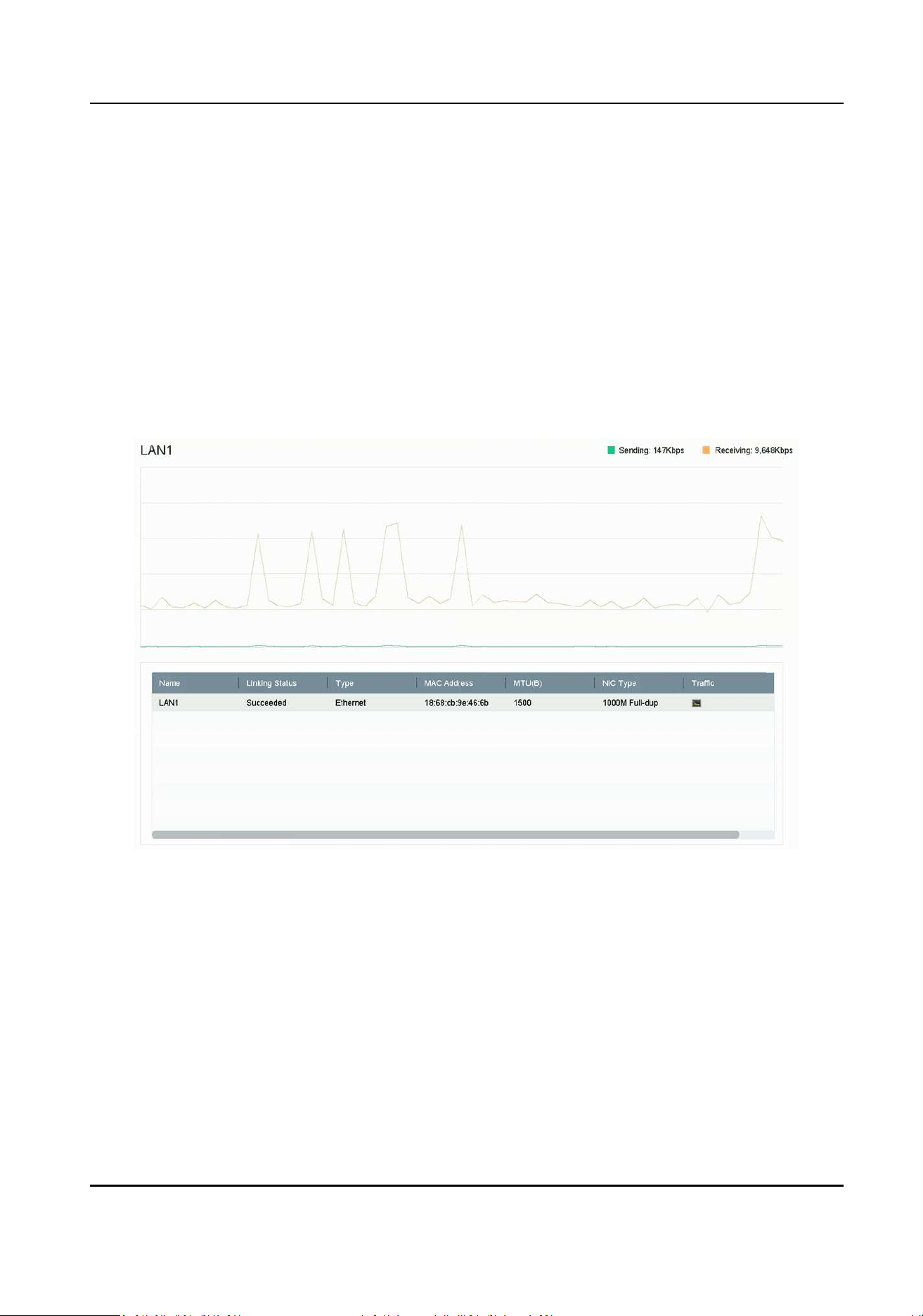
12.3 Network Detecon
12.3.1 Network Trac Monitoring
Network trac monitoring is the process of reviewing, analyzing and managing network trac for
any abnormality or process that can aect network performance, availability and/or security.
Steps
1.
Go to Maintenance → Network → Trac .
2.
You can view the real-me network trac status, including MTU (Maximum Transmission Unit),
and network throughput.
Figure 12-1 Network Trac
12.3.2 Test Network Delay and Packet Loss
Network delay is caused by slow response of the device when oversized data informaon is not
limited during transmission under certain network protocol, e.g. TCP/IP. Packet loss test is for
tesng network packet loss rate that is the rao of lost data packet and total number of
transmied data packet.
Steps
1.
Go to Maintenance → Network → Detecon .
Digital Video Recorder User Manual
137

2.
Select a network card in Select NIC.
3.
Enter the desnaon IP address in Desnaon Address.
4.
Click Test.
Figure 12-2 Test Network Delay and Packet Loss
12.3.3 Export Network Packet
Aer the recorder accessing network, you can use USB ash drive to export network packet.
Before You Start
Prepare a USB ash drive to export network packet.
Steps
1.
Insert the USB ash drive.
2.
Go to Maintenance → Network → Detecon .
3.
Select network card in Select NIC.
4.
Select the USB ash drive in Device Name. You can click Refresh if the connected local backup
device cannot be displayed.
Figure 12-3 Export Network Packet
5.
Oponal: Click Status to view the network status.
6.
Click Export.
Note
It will export 1 MB data each me as default.
12.3.4 Network Resource Stascs
The remote access, including web browser and client soware, will consume output bandwidth.
You can view the real-me bandwidth stascs.
Steps
1.
Go to Maintenance → Network → Stat .
Digital Video Recorder User Manual
138

Figure 12-4 Network Resource Stascs
2.
View the bandwidth stascs, including IP Camera, Remote Live View, Remote Play, Net Total
Idle, etc.
3.
Oponal: Click Refresh to obtain the latest data.
12.4 Storage Device Maintenance
12.4.1 Bad Sector Detecon
Steps
1.
Go to Maintenance → HDD Operaon → Bad Sector Detecon .
2.
Select the HDD No. you want to congure in the dropdown list.
3.
Select All Detecon or Key Area Detecon as the detecon type.
4.
Click Self-Test to start the detecon.
Digital Video Recorder User Manual
139
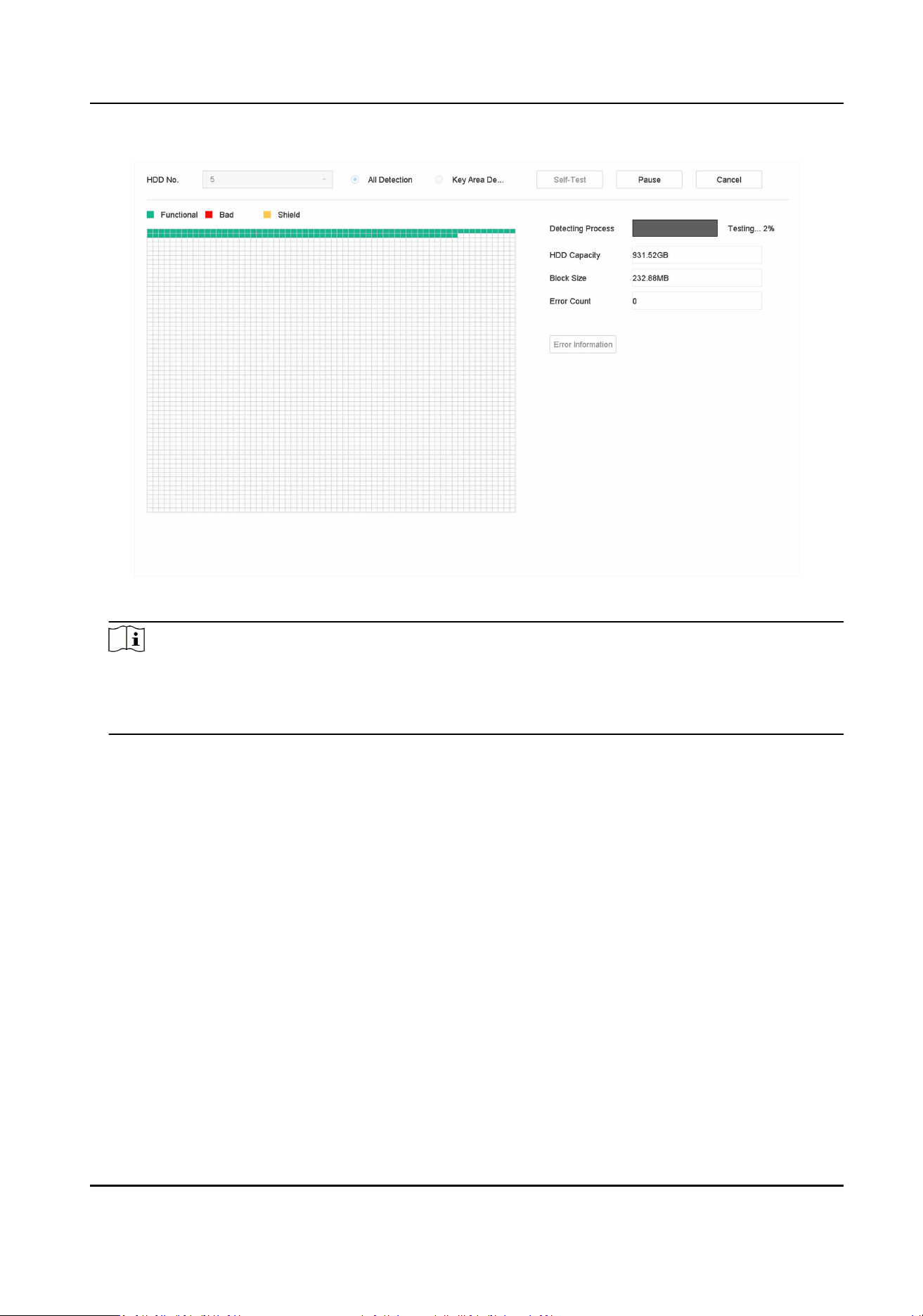
Figure 12-5 Bad Sector Detecon
Note
●
You can pause/resume or cancel the detecon.
●
Aer tesng has been completed, you can click Error informaon to see the detailed damage
informaon.
12.4.2 S.M.A.R.T. Detecon
HDD detecon funcons such as the adopng of the S.M.A.R.T. and the Bad Sector Detecon
techniques. S.M.A.R.T. (Self-Monitoring, Analysis, and Reporng Technology) are HDD monitoring
systems to detect various reliability indicators in the hopes of ancipang failures.
Steps
1.
Go to Maintenance → HDD Operaon → S.M.A.R.T .
2.
Select the HDD to view its S.M.A.R.T. informaon list.
3.
Set Self-Test Type.
4.
Click Self-Test to start the S.M.A.R.T. HDD self-evaluaon.
Digital Video Recorder User Manual
140
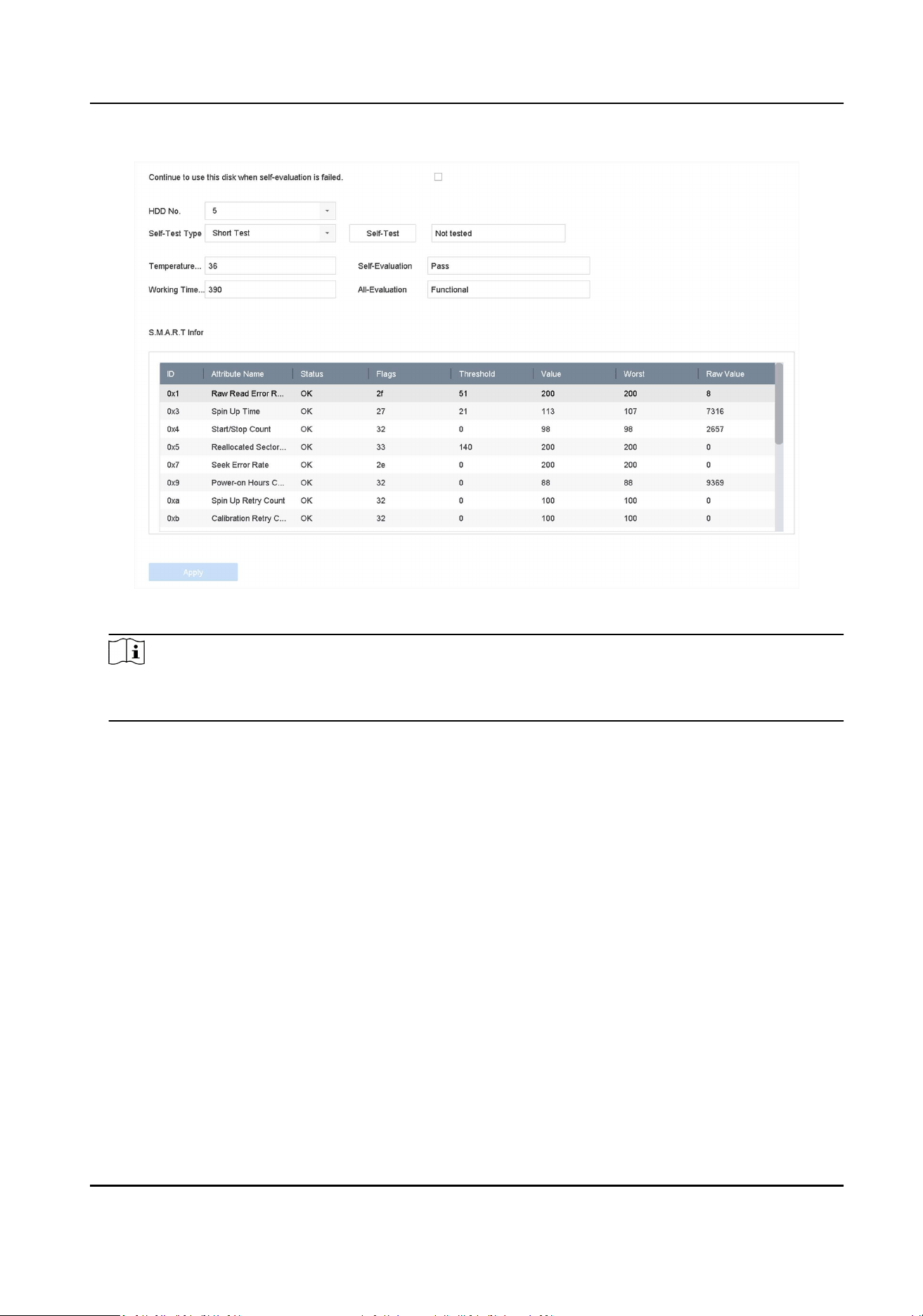
Figure 12-6 S.M.A.R.T. Sengs Interface
Note
To use the HDD even when the S.M.A.R.T. checking has failed, check Connue to use the disk
when self-evaluaon is failed.
The related informaon of the S.M.A.R.T. is shown, and you can check the HDD status.
12.4.3 HDD Health Detecon
You can view the health status of a 4 TB to 8 TB Seagate HDD that generated aer October 1, 2017.
Use this funcon to help troubleshoot HDD problems. Health Detecon shows a more detailed
HDD status than the S.M.A.R.T. funcon.
Steps
1.
Go to Maintenance → HDD Operaon → Health Detecon .
Digital Video Recorder User Manual
141

Figure 12-7 Health Detecon
2.
Click a HDD to view details.
12.4.4 Congure Disk Clone
Select the HDDs to clone to the eSATA HDD.
Before You Start
Connect an eSATA disk to the device.
Steps
1.
Go to Maintenance → HDD Operaon → HDD Clone .
Digital Video Recorder User Manual
142
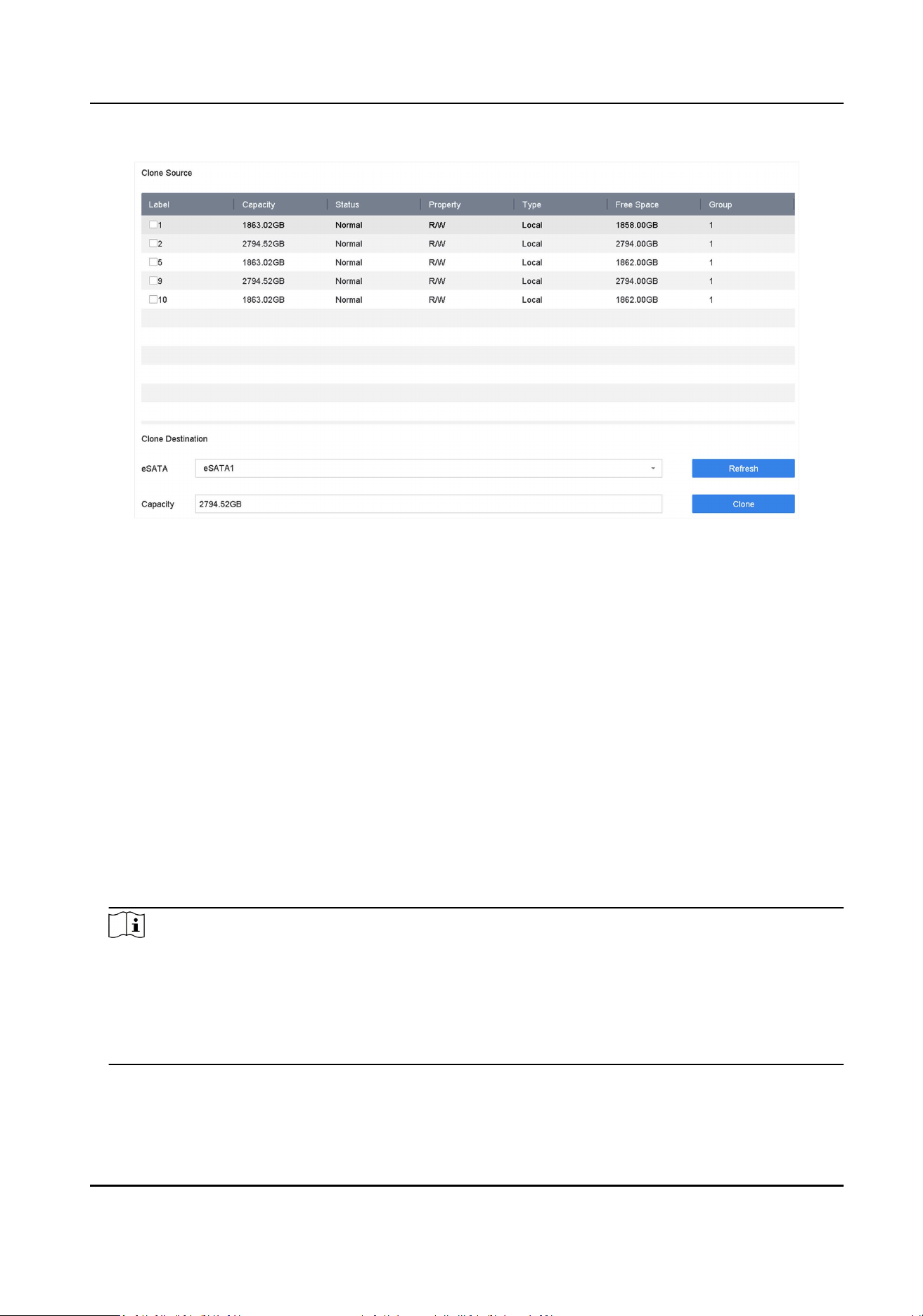
Figure 12-8 HDD Clone
2.
Check the HDD to clone. The capacity of the selected HDD must match the capacity of the clone
desnaon.
3.
Click Clone.
4.
Click Yes on the pop up message box to create the clone.
12.4.5 Repair Database
Repairing database will rebuild all databases. It might help to improve your system speed aer
upgrade.
Steps
1.
Go to Storage → Storage Device .
2.
Select the drive.
3.
Click Repair Database.
4.
Click Yes.
Note
●
Repairing database will rebuild all databases. Exisng data will not be aected, but local
search and playback funcons will not be available during the process, you can sll achieve
search and playback funcons remotely via web browser, client soware, etc.
●
Do not pull out the drive, or shut down the device during the process.
●
You can see the repairing progress at Status.
Digital Video Recorder User Manual
143
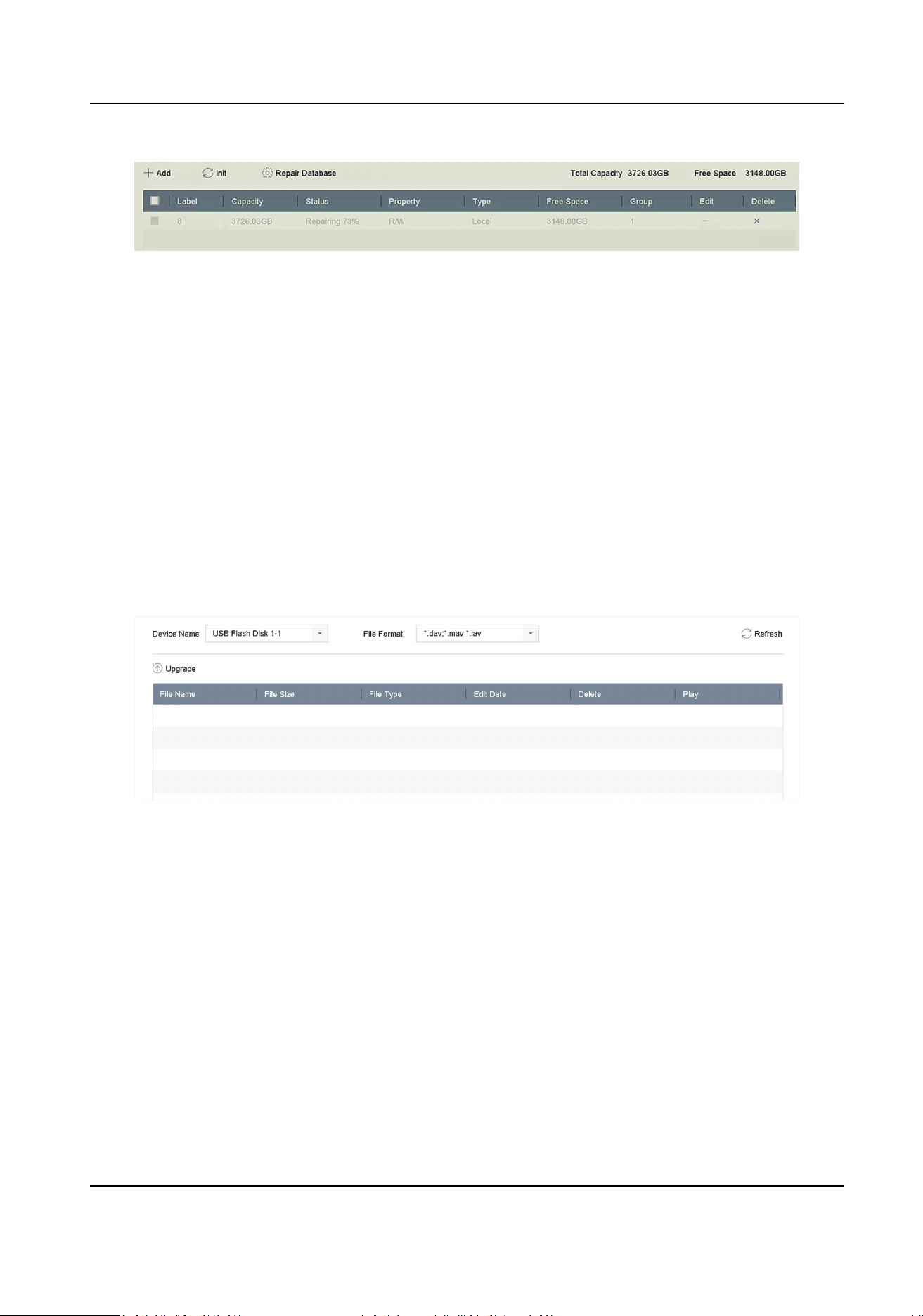
Figure 12-9 Repair Database
12.5 Upgrade Device
Your device rmware can be upgraded with a local backup device or remote FTP server.
12.5.1 Upgrade by Local Backup Device
Before You Start
Connect your device to a local storage device that contains the rmware update le.
Steps
1.
Go to Maintenance → Upgrade .
2.
Click Local Upgrade to enter the local upgrade interface.
Figure 12-10 Local Upgrade
3.
Select the rmware update le from the storage device.
4.
Click Upgrade to start upgrading.
Aer the upgrade is completed, the device will reboot automacally to acvate the new
rmware.
12.5.2 Upgrade by FTP
Before You Start
Ensure the network connecon of the PC (running FTP server) and the device are valid and correct.
Run the FTP server on the PC and copy the rmware into the corresponding directory of your PC.
Digital Video Recorder User Manual
144

Steps
1.
Go to Maintenance → Upgrade .
2.
Click FTP to enter the local upgrade interface.
Figure 12-11 FTP Upgrade
3.
Enter FTP Server Address.
4.
Click Upgrade to start upgrading.
5.
Aer the upgrading is complete, reboot the device to acvate the new rmware.
12.5.3 Upgrade by Web Browser
You can upgrade the device by web browser
Aer logging in to the device via web browser, go to Conguraon → System → Maintenance →
Upgrade . Click Browse to upload the rmware, and upgrade the device.
12.5.4 Upgrade by Hik-Connect
Aer logging the device into Hik-Connect, the device would periodically check for the latest
rmware from Hik-Connect. If an upgrade rmware is available, the device will nofy you when
you log in. You can also manually check for the latest rmware.
Before You Start
Ensure the device has successfully connected to Hik-Connect, and it requires to install at least one
read-write HDD for rmware downloading.
Steps
1.
Go to Maintenance → Upgrade → Online Upgrade .
2.
Click Check Upgrade to manually check and download the latest rmware from Hik-Connect.
Note
The device will automacally check for the latest rmware every 24 hours. If it detects available
upgrade rmware, the device will nofy you when you log in.
3.
Oponal: You can switch on Download Latest Package Automacally to automacally download
the latest rmware package.
Digital Video Recorder User Manual
145
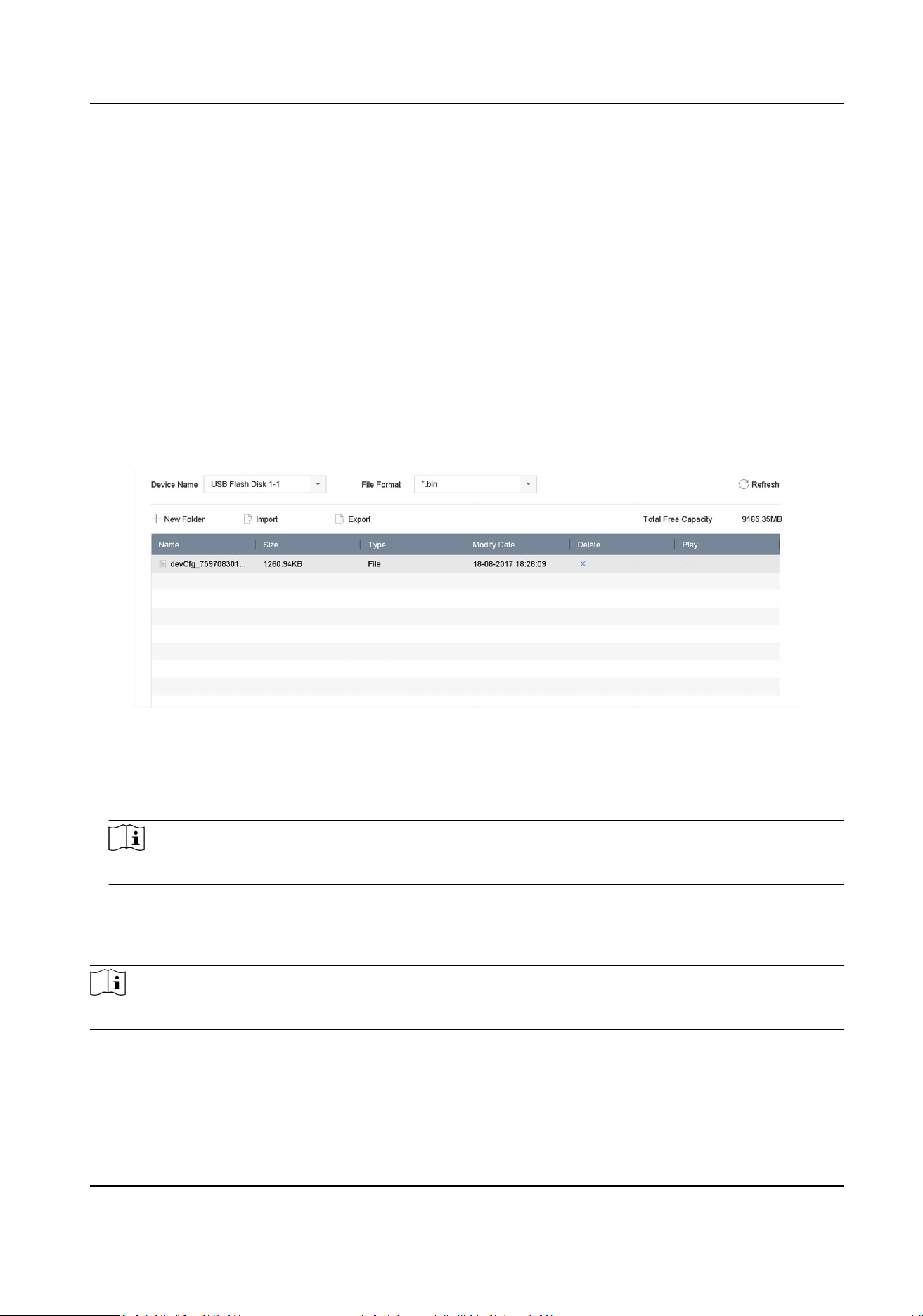
4.
Click Upgrade Now.
12.6 Import/Export Device Conguraon Files
The device conguraon les can be exported to a local device for backup; and the conguraon
les of one device can be imported to mulple devices if they are to be congured with the same
parameters.
Before You Start
Connect a storage device to your device. To import the conguraon le, the storage device must
contain the le.
Steps
1.
Go to Maintenance → Import/Export .
Figure 12-12 Import/Export Conguraon File
2.
Export or import the device conguraon les.
-
Click Export to export conguraon les to the selected local backup device.
-
To import a conguraon le, select the le from the selected backup device and click Import.
Note
Aer having nished imporng conguraon les, the device will reboot automacally.
12.7 Log Management
Note
The funcons in this secon are only available for certain models.
Digital Video Recorder User Manual
146
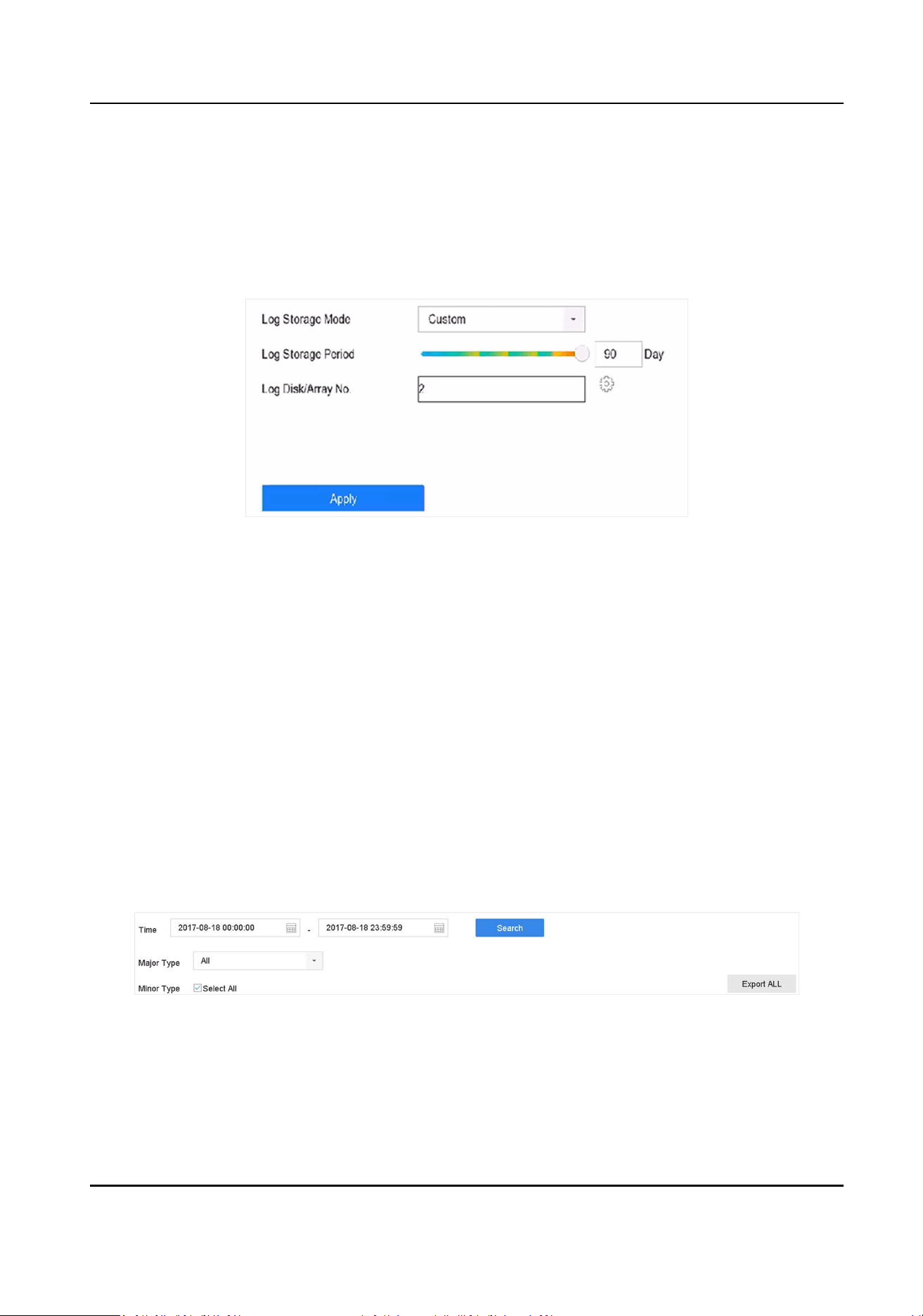
12.7.1 Log Storage
You can customize the log storage disk and log storage period.
Steps
1.
Go to Storage → Advanced .
Figure 12-13 Log Storage
2.
Set Log Storage Mode.
System
Default
Each disk will allocate a certain space to store logs in 6 months. Aer 6 months,
old logs will be overwrien.
Custom You can set Log Storage Period and allocate Log Disk for log storage. When the
log disk is full, logs that exceed the period will be overwrien.
3.
Click Apply.
12.7.2 Search & Export Log Files
The device operaon, alarm, excepon, and informaon can be stored in log les, which can be
viewed and exported at any me.
Steps
1.
Go to Maintenance → Log Info .
Figure 12-14 Log Search Interface
2.
Set the log search condions, including the me, major type and minor type.
3.
Click Search to start searching the log les.
4.
The matched log les will be displayed on the list, as shown below.
Digital Video Recorder User Manual
147
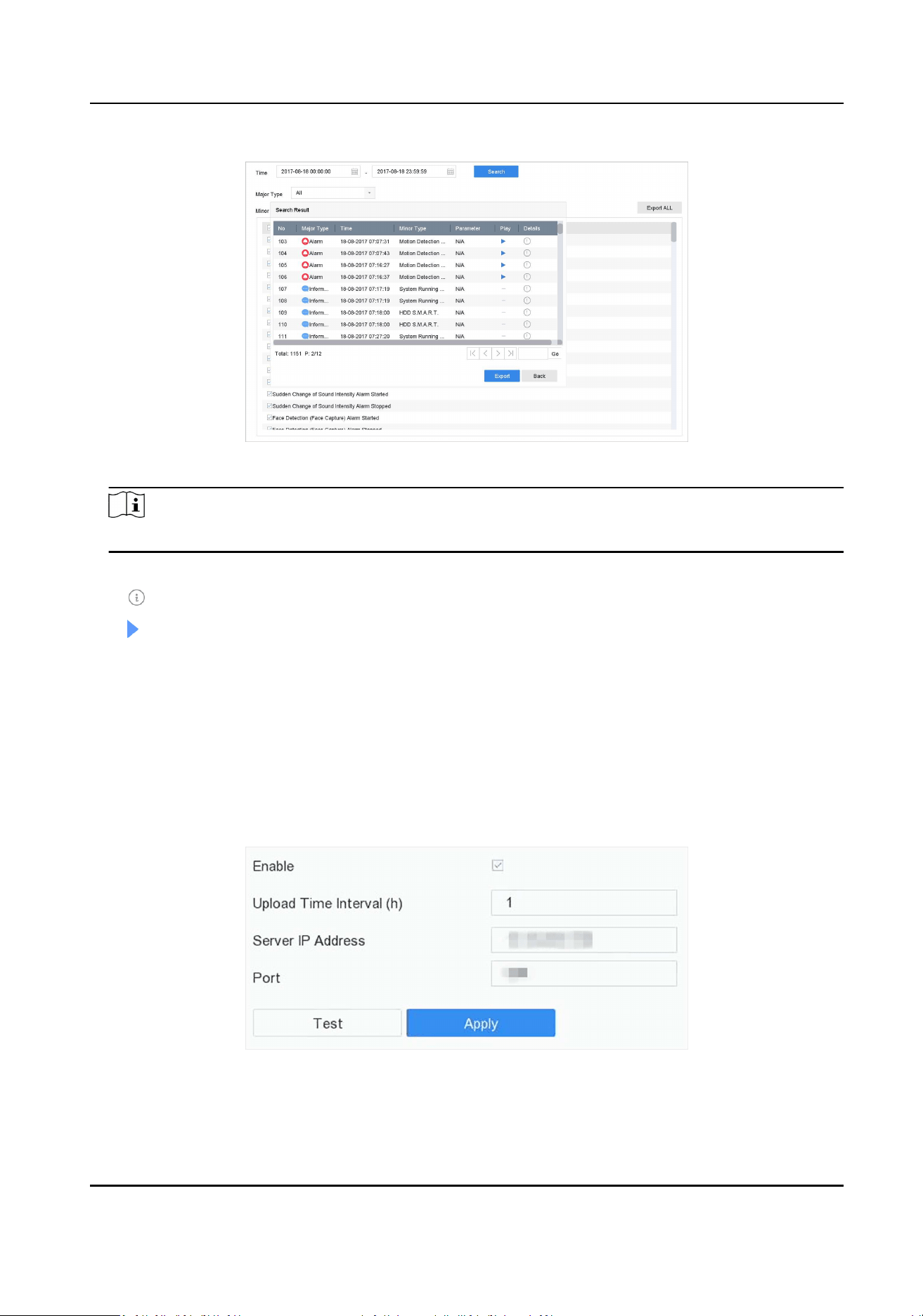
Figure 12-15 Log Search Results
Note
Up to 2,000 log les can be displayed each me.
5.
Related Operaon:
Click or double-click it to view detailed informaon.
Click it to view the related video le.
Export/Export ALL Click it to export all the system logs to the storage device.
12.7.3 Upload Logs to the Server
You can upload system logs to the server for backup.
Steps
1.
Go to System → Network → Advanced → Log Server Sengs .
Figure 12-16 Log Server Sengs
2.
Check Enable
Digital Video Recorder User Manual
148

3.
Set Upload Time, Server IP Address, and Port.
4.
Oponal: Click Test to test if parameters are valid.
5.
Click Apply.
12.7.4 One-Way Authencaon
You can install a CA cercate (from the server) to your device to authorize the server via web
browser. It would improve the log communicaon security.
Before You Start
●
Download the CA cercate from the server.
●
Ensure log server parameters are valid.
Steps
1.
Go to Conguraon → Network → Advanced Sengs → Log Server Conguraon .
2.
Install the CA cercate in CA Cercate.
3.
Oponal: Click Test to test if the connecon is valid.
4.
Click Save.
12.7.5 Two-Way Authencaon
You can install a CA cercate (from the server) to your device to authorize the server, and create a
cercate (from your device) to authorize your device by the server. This would improve the log
communicaon security. Two-way authencaon can be congured via web browser.
Before You Start
●
Download the CA cercate from the server.
●
Ensure log server parameters are valid.
Steps
1.
Go to Conguraon → Network → Advanced Sengs → Log Server Conguraon .
2.
Install the CA cercate in CA Cercate.
3.
Click Create in Client Cercate, and follow the pop-up to create the cercate.
4.
Click Download to download the cercate le to a desired locaon.
5.
Upload the downloaded cercate le to the server, and the server will return the cercate
key.
6.
Open the cercate as a text le, and modify it by the cercate key as the server returned.
7.
Install the modied cercate in Client Cercate.
8.
Oponal: Click Test to test if the connecon is valid.
9.
Click Save.
Digital Video Recorder User Manual
149
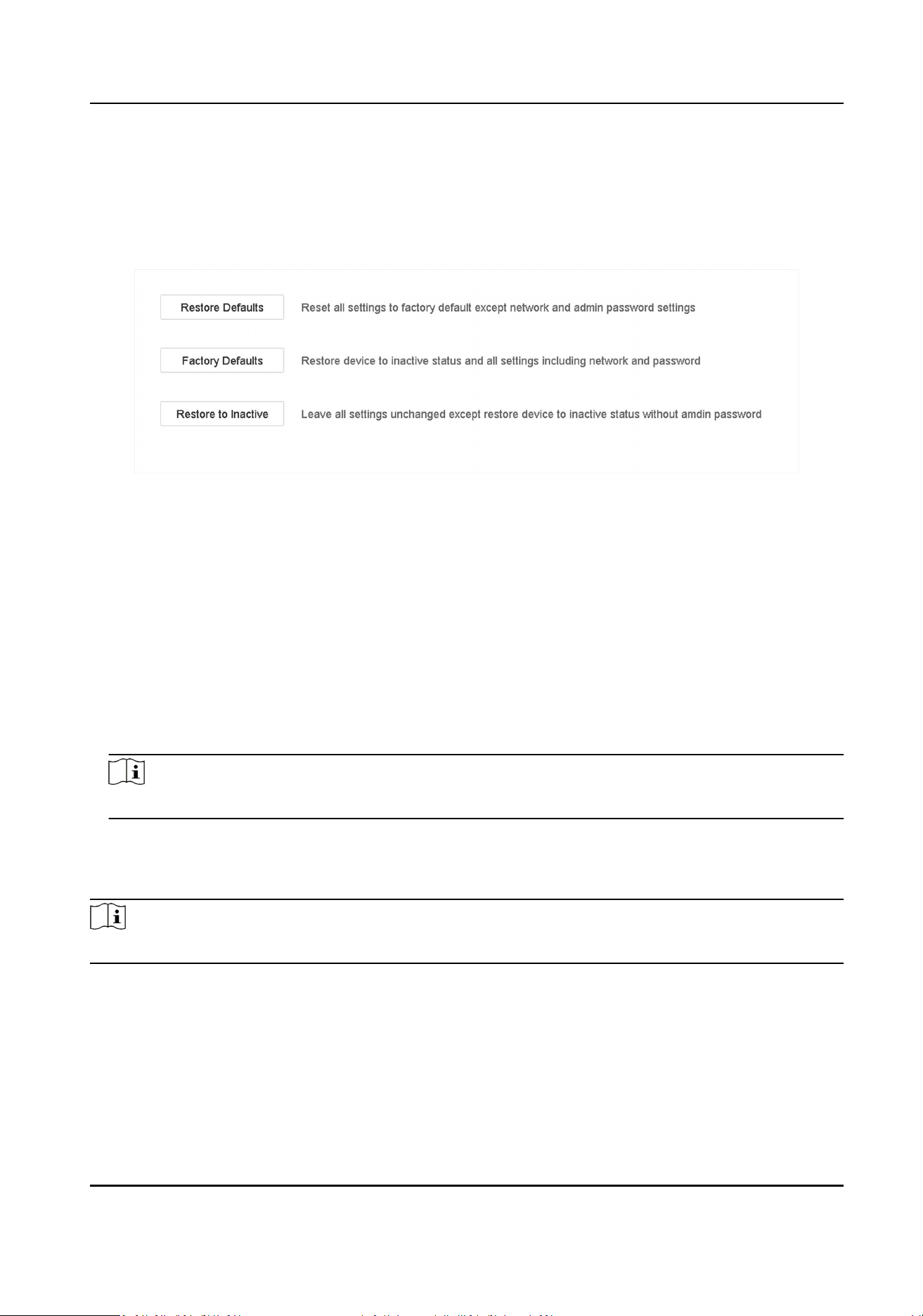
12.8 Restore Default Sengs
Steps
1.
Go to Maintenance → Default .
Figure 12-19 Restore Default Sengs
2.
Select the restore type from the following three opons.
Restore Defaults
Restore all parameters, except the network (including IP address, subnet mask, gateway,
MTU, NIC working mode, default route, server port, etc.) and user account parameters, to the
factory default sengs.
Factory Defaults
Restore all parameters to the factory default sengs.
Restore to Inacve
Restore the recorder to inacve status.
Note
The recorder will reboot automacally aer restoring to the default sengs.
12.9 Security Management
Note
The funcons in this secon are only available for certain models.
12.9.1 Congure ONVIF
ONVIF protocol allows the connecon with third-party cameras. The added user accounts have the
permission to connect other devices via ONVIF protocol.
Digital Video Recorder User Manual
150
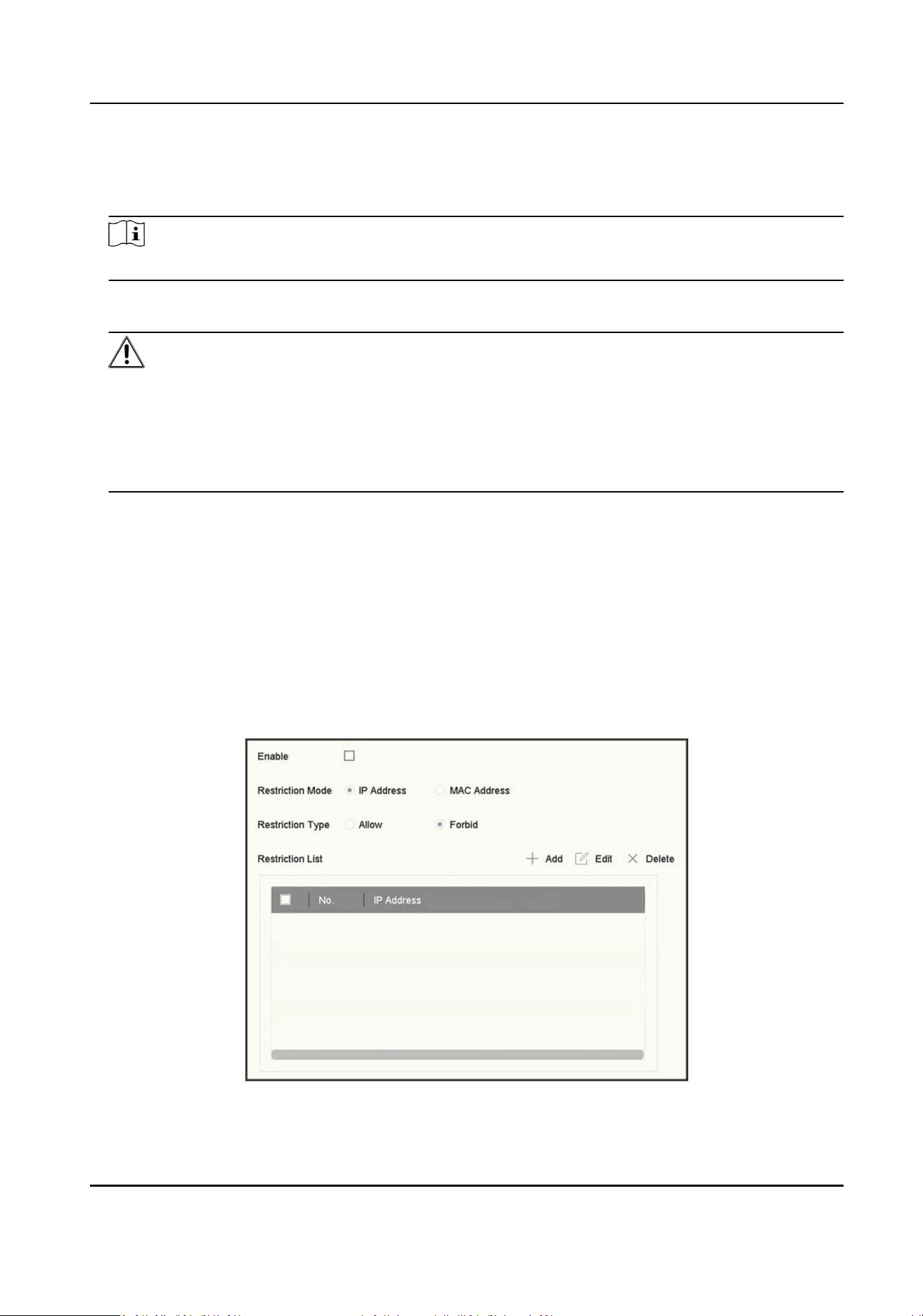
Steps
1.
Go to Maintenance → System Service → ONVIF .
2.
Check Enable ONVIF to enable the ONVIF access management.
Note
ONVIF protocol is disabled by default.
3.
Click Add.
4.
Enter User Name, and Password
Cauon
We highly recommend you create a strong password of your own choosing (Using a minimum of
8 characters, including at least three of the following categories: upper case leers, lower case
leers, numbers, and special characters.) in order to increase the security of your product. And
we recommend you reset your password regularly, especially in the high security system,
reseng the password monthly or weekly can beer protect your product.
5.
Select Level as Media User, Operator or Admin.
6.
Click OK.
12.9.2 IP/MAC Address Filter
The address lter decides whether to allow or forbid specic IP/MAC address to get access to your
device.
Steps
1.
Go to Maintenance → System Service → Address Filter .
Figure 12-20 Address Filter
Digital Video Recorder User Manual
151
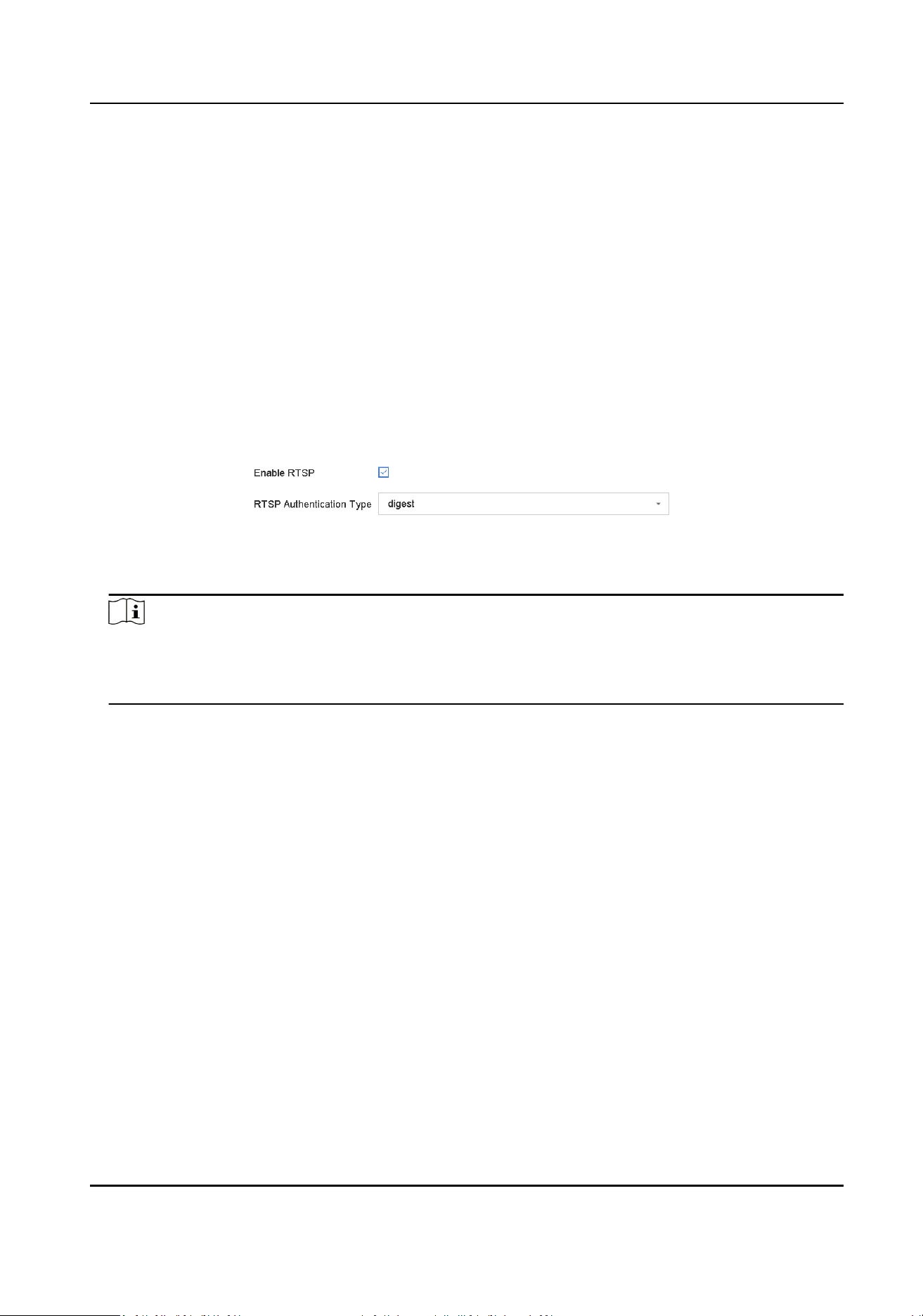
2.
Check Enable.
3.
Select Restricon Mode. Choose to lter by IP address or MAC Address.
4.
Select Restricon Type. The device mechanism will allow or forbid specic IP/MAC address to
get access to your device.
5.
Oponal: Set Restricon List. You can add, edit or delete address.
6.
Click Apply to save the sengs.
12.9.3 RTSP Authencaon
You can specically secure the stream data of live view by seng the RTSP authencaon.
Steps
1.
Go to System → System Service → System Service .
Figure 12-21 RTSP Authencaon
2.
Select RTSP Authencaon Type.
Note
Two authencaon types are selectable, if you select digest, only the request with digest
authencaon can access the video stream by the RTSP protocol via the IP address. For security
reasons, it is recommended to select digest as the authencaon type.
3.
Click Apply.
4.
Restart the device to take eect the sengs.
12.9.4 RTSP Digest Algorithm
RTSP digest algorithm is based on RTSP protocol, it is an algorithm for digest authencaon of the
user authencaon. You can congure RTSP digest algorithm via web browser.
Go to Conguraon → System → Security → Authencaon via web browser to select the
required RTSP digest algorithm type.
12.9.5 ISAPI Service
ISAPI (Internet Server Applicaon Programming Interface) is an open protocol based on HTTP,
which can realize the communicaon between the system devices (e.g., network camera, NVR,
etc.). The device is as a server, the system can nd and connect the device.
Digital Video Recorder User Manual
152

Steps
1.
Go to System → System Service → System Service .
2.
Check Enable ISAPI.
3.
Click Apply.
4.
Restart the device to take eect the sengs.
12.9.6 HTTP Authencaon
If you need to enable the HTTP service, you can set HTTP authencaon to enhance access
security.
Steps
1.
Go to Maintenance → System Service → System Service .
Figure 12-22 HTTP Authencaon
2.
Check Enable HTTP.
3.
Select HTTP Authencaon Type.
Note
Two authencaon types are selectable, for security reasons, it is recommended to select digest
as the authencaon type.
4.
Click Apply to save the sengs.
5.
Restart the device to take eect the sengs.
12.9.7 HTTP/Web Digest Algorithm
HTTP/Web digest algorithm is based on HTTP protocol, it is an algorithm for digest authencaon
of the user authencaon. You can congure HTTP/web digest algorithm via web browser.
Go to Conguraon → System → Security → Authencaon via web browser to select the
required digest algorithm type.
12.9.8 Picture URL Digest Authencaon
When using HTTP protocol to download the pictures which are uploaded by SDK, picture URL
digest authencaon controls whether the picture download process requires digest
authencaon or not. You can congure picture URL digest authencaon via web browser.
Go to Conguraon → System → Security → Security Service via web browser to enable/disable
picture URL digest authencaon.
Digital Video Recorder User Manual
153

12.9.9 Disable SADP Services
You can disable SADP service to enhance the access security, e.g., when you are in the untrusted
network environment.
Go to System → System Service → System Service , and uncheck Enable SADP to disable the
service.
Digital Video Recorder User Manual
154

Chapter 13 Appendix
13.1 List of Applicable Power Adapter
Only use power adapters listed below.
Power Adapter Model Specicaons Manufacturer
ADS-26FSG-12 12024EPG 12 V, 2 A Shenzhen Honor Electronic Co.,
Ltd.
MSA-Z3330IC12.0-48W-Q 12 V, 3.33 A Moso Power Supply Technology
Co., Ltd.
MSA-C1500IC12.0-18P-DE 12 V, 1.5 A 0000201935 MOSO Technology
Co., Ltd.
ADS-25FSG-12 12018GPG CE, 100 to 240 VAC, 12 V, 1.5 A,
18 W, Φ5.5 × 2.1 × 10
0000200174 Shenzhen Honor
Electronic Co., Ltd.
MSA-C1500IC12.0-18P-US 12 V, 1.5 A 0000201935 MOSO Technology
Co., Ltd.
TS-A018-120015AD 100 to 240 VAC, 12 V, 1.5 A, 18
W, Φ5.5 × 2.1 × 10
0000200878 Shenzhen Transin
Technologies Co., Ltd.
MSA-C2000IC12.0-24P-DE 12 V, 2 A 0000201935 MOSO Technology
Co., Ltd.
ADS-24S-12 1224GPG CE, 100 to 240 VAC, 12 V, 2 A,
24 W, Φ2.1
0000200174 Shenzhen Honor
Electronic Co., Ltd.
MSA-C2000IC12.0-24P-US US, 12 V, 2 A 0000201935 MOSO Technology
Co., Ltd.
ADS-26FSG-12 12024EPCU US, 12 V, 2 A 0000200174 Shenzhen Honor
Electronic Co., Ltd.
KPL-040F-VI 12 V, 3.33 A, 40 W 0000203078 Channel Well
Technology Co., Ltd.
MSA-Z3330IC12.0-48W-Q 12 V, 3.33 A 0000201935 MOSO Technology
Co., Ltd.
MSP-Z1360IC48.0-65W 48 V, 1.36 A 0000201935 MOSO Technology
Co., Ltd.
KPL-050S-II 48 V, 1.04 A 0000203078 Channel Well
Technology Co., Ltd.
Digital Video Recorder User Manual
155

13.2 Glossary
Dual-Stream
Dual-stream is a technology used to record high resoluon video locally while transming a
lower resoluon stream over the network. The two streams are generated by the DVR, with the
main stream having a maximum resoluon of 1080P and the sub-stream having a maximum
resoluon of CIF.
DVR
Acronym for Digital Video Recorder. A DVR is device that is able to accept video signals from
analog cameras, compress the signal and store it on its hard drives.
HDD
Acronym for Hard Disk Drive. A storage medium which stores digitally encoded data on plaers
with magnec surfaces.
DHCP
Dynamic Host Conguraon Protocol (DHCP) is a network applicaon protocol used by devices
(DHCP clients) to obtain conguraon informaon for operaon in an Internet Protocol
network.
HTTP
Acronym for Hypertext Transfer Protocol. A protocol to transfer hypertext request and
informaon between servers and browsers over a network.
PPPoE
PPPoE, Point-to-Point Protocol over Ethernet, is a network protocol for encapsulang Point-to-
Point Protocol (PPP) frames inside Ethernet frames. It is used mainly with ADSL services where
individual users connect to the ADSL transceiver (modem) over Ethernet and in plain Metro
Ethernet networks.
DDNS
Dynamic DNS is a method, protocol, or network service that provides the capability for a
networked device, such as a router or computer system using the Internet Protocol Suite, to
nofy a domain name server to change, in real me (ad-hoc) the acve DNS conguraon of its
congured hostnames, addresses or other informaon stored in DNS.
Hybrid DVR
A hybrid DVR is a combinaon of a DVR and NVR.
NTP
Acronym for Network Time Protocol. A protocol designed to synchronize the clocks of
computers over a network.
NTSC
Digital Video Recorder User Manual
156

Acronym for Naonal Television System Commiee. NTSC is an analog television standard used
in such countries as the United States and Japan. Each frame of an NTSC signal contains 525
scan lines at 60Hz.
NVR
Acronym for Network Video Recorder. An NVR can be a PC-based or embedded system used for
centralized management and storage for IP cameras, IP Domes and other DVRs.
PAL
Acronym for Phase Alternang Line. PAL is also another video standard used in broadcast
televisions systems in large parts of the world. PAL signal contains 625 scan lines at 50Hz.
PTZ
Acronym for Pan, Tilt, Zoom. PTZ cameras are motor driven systems that allow the camera to
pan le and right, lt up and down and zoom in and out.
USB
Acronym for Universal Serial Bus. USB is a plug-and-play serial bus standard to interface devices
to a host computer.
13.3 Communicaon Matrix
Please scan the QR code below to view the communicaon matrix document.
Figure 13-1 Communicaon Matrix
13.4 Device Command
Please scan the QR code below to view the device command document.
Digital Video Recorder User Manual
157

Figure 13-2 Device Command
13.5 Frequently Asked Quesons
13.5.1 Why is there a part of channels displaying “No Resource” or turning black
screen in mul-screen live view?
Reason
1. Sub-stream resoluon or bitrate sengs is inappropriate.
2. Connecng sub-stream failed.
Soluon
1. Go to Camera → Video Parameters → Sub-Stream . Select the channel, and turn down the
resoluon and max. bitrate (resoluon shall be less than 720p, max. bitrate shall be less than
2048 Kbps).
Note
If your video recorder noes not support this funcon, you can log in to the camera, and
adjust video parameters via web browser.
2. Properly set the sub-stream resoluon and max. bitrate (resoluon shall be less than 720p, max.
bitrate shall be less than 2048 Kbps), then delete the channel and add it back again.
13.5.2 Why is the video recorder nofying risky password aer a network camera
is added?
Reason
The camera password is too weak.
Digital Video Recorder User Manual
158

Soluon
Change the camera password.
Warning
We highly recommend you create a strong password of your own choosing (Using a minimum of 8
characters, including at least three of the following categories: upper case leers, lower case
leers, numbers, and special characters.) in order to increase the security of your product. And we
recommend you reset your password regularly, especially in the high security system, reseng the
password monthly or weekly can beer protect your product.
13.5.3 Why is the video recorder nofying the stream type is not supported?
Reason
The camera encoding format mismatches with the video recorder.
Soluon
If the camera is using H.265/MJPEG for encoding, but video recorder does not support H.265/
MJPEG, change the camera encoding format to the same as video recorder.
13.5.4 How to improve the playback image quality?
Reason
Recording parameter sengs are inappropriate.
Soluon
Go to Camera → Video Parameters . Increase resoluon and max. bitrate, and try again.
13.5.5 Why is analog channel having "NO VIDEO" overlaid on live view?
Reason
1. The video in connector is loose, which results in weak video signal.
2. Video in/out standard mismatch.
3. Transmission distance too long.
4. Cable damage causes weak video signal.
5. The video in connector of video recorder is broken.
Digital Video Recorder User Manual
159

Soluon
1. Ensure connectors are connected rmly.
2. Go to System → General . Ensure the output standard is correct.
3. Ensure the distance between analog camera and video recorder has not exceeded the limit.
4. Ensure the cable is not damaged.
5. Try other BNC connectors if they are working normally.
13.5.6 How to conrm the video recorder is using H.265 to record video?
Soluon
Check if the encoding type at live view toolbar is H.265.
13.5.7 Why is the meline at playback not constant?
Reason
1. When the video recorder is using event recording, it only records video when event occurs.
Hence the video may not be connuous.
2. Excepon occurs, such as the device oine, HDD error, record excepon, network camera
oine, etc.
Soluon
1. Ensure the recording type is connuous recording.
2. Go to Maintenance → Log Informaon . Search the log le during the video me period. See if
there are unexpected events, such as HDD error, record excepon, etc.
13.5.8 Why is the video recorder nofying the network is unreachable when a
network camera is being added?
Reason
1. The IP address or port of network camera is incorrect.
2. The network between video recorder and camera is disconnected.
Soluon
1. Go to Camera → Camera → IP Camera . Click
of the selected camera, and edit its IP address
and port. Ensure the video recorder and camera is using the same port.
2. Go to Maintenance → Network → Detecon . Enter the IP address of network camera in
Desnaon Address, and click Test to see if the network is reachable.
Digital Video Recorder User Manual
160

13.5.9 Why is the IP address of network camera being changed automacally?
Reason
When network camera and video recorder are using the same switch but in dierent subnets, the
video recorder will change the IP address of network camera to the same subnet as itself.
Soluon
When adding camera, click Custom Add to add camera.
13.5.10 Why is the video recorder nofying IP conict?
Reason
The video recorder uses the same IP address as other devices.
Soluon
Change the IP address of video recorder. Ensure it is not the same as other devices.
13.5.11 Why is image geng stuck when playing back by single or mul-channel
cameras?
Reason
HDD read/write excepon.
Soluon
Export the video, and play it with other devices. If it plays normally on other device, change your
HDD, and try again.
13.5.12 Why does my video recorder make a beeping sound aer boong?
Reason
1. The front panel is not fastened (for the device which its front panel is removable).
2. HDD error, or do not have HDD.
Digital Video Recorder User Manual
161

Soluon
1. If it makes connuous beeps, and your device's front panel is removable, ensure the front panel
is fastened.
2. If it makes non-connuous beeps (3 long, 2 short), take HDD error as an example, check if the
device has installed HDD. If not, you can go to System → Event → Normal Event → Excepon ,
and uncheck Event Hint Conguraon to disable HDD error event hint.
Check if the HDD is inialized. If not, go to Storage > Storage Device to inialize the HDD.
Check if the HDD is broken. You can change it, and try again.
13.5.13 Why is there no recorded video aer the moon detecon is set?
Reason
1. The recording schedule is incorrect.
2. The moon detecon event seng is incorrect.
3. HDD excepon.
Soluon
1. The recording schedule is setup correctly by following the steps listed in Conguring Record/
Capture Schedule.
2. The moon detecon area is congured correctly. The channels are being triggered for moon
detecon (See Conguring Moon Detecon).
3. Check if the device has installed HDD.
Check if the HDD is inialized. If not, go to Storage > Storage Device to inialize the HDD.
Check if the HDD is broken. You can change it, and try again.
13.5.14 Why is the device not able to control PTZ camera via coaxitron?
Reason
1. The camera does not support coaxitron.
2. The coaxitron protocol is incorrect.
3. The signal is aected by video opcal transceiver.
Soluon
1. Ensure the video input signal is HDTVI, and the camera supports coaxitron.
2. Ensure coaxitron protocol parameters are correct, such as baud rate and address.
3. Remove the video opcal transceiver, and try again.
13.5.15 Why does the PTZ seem unresponsive via RS-485?
Digital Video Recorder User Manual
162

Reason
1. The RS-485 cable is not properly connected.
2. The RS-485 interface is broken.
3. The control protocol is not correct.
Soluon
1. Check if RS-485 cable is properly connected.
2. Change RS-485 interface, and try again.
3. Ensure control protocol is Pelco.
13.5.16 Why is the video sound quality not good?
Reason
1. The audio input device does not have a good eect in sound collecon.
2. Interference in transmission.
3. The audio parameter is not properly set.
Soluon
1. Check if the audio input device is working properly. You can change another audio input device,
and try again.
2. Check the audio transmission line. Ensure all lines are well connected or welded, and there is no
electromagnec interference.
3. Adjust the audio volume according to the environment and audio input device.
Digital Video Recorder User Manual
163

UD35434B